
C a talog & Student Handbook
|
|
|
- Marilyn Harrington
- 10 years ago
- Views:
Transcription
1 C a talog & Student Handbook

2 Academic Calendar Fall Semester * Re g i s t r a t i o n * Classes Begin Sa t u rd a y August 23 Labor Day Re c e s s Mo n d a y September 1 Apply for December 2003 Graduation On or Be f o re Fr i d a y October 3 Last Day for Withdrawal without In s t ru c t o r s Si g n a t u re Fr i d a y October 10 Ve t e r a n s Day Re c e s s Tu e s d a y November 11 Thanksgiving Re c e s s T h u r s d a y - Su n d a y Nov Last Day Student Initiated Withdrawal Ac c e p t e d Mo n d a y December 1 Last of Day Regular Classes Su n d a y December 14 Final Ex a m s Fr i d a y - T h u r s d a y December Mi d - Year Recess Begins (St u d e n t s ) Fr i d a y December 19 Fall Semester En d s Fr i d a y December 19 Spring Semester * Re g i s t r a t i o n * Classes Be g i n Sa t u rd a y Ja n u a ry 17 Ma rtin Luther King, Jr. Bi rthday Re c e s s Mo n d a y Ja n u a ry 19 Pre s i d e n t s Day Re c e s s Mo n d a y Fe b ru a ry 16 Apply for May 2004 Graduation On or Be f o re Fr i d a y Ma rch 5 Last Day for Withdrawal without In s t ru c t o r s Si g n a t u re Fr i d a y Ma rch 5 Spring Re c e s s Mo n d a y - Su n d a y Ma rch Last Day Student Initiated Withdrawal Ac c e p t e d Mo n d a y April 26 Last Day of Regular Classes Su n d a y May 9 Final Ex a m s Fr i d a y - T h u r s d a y May 7-13 C o m m e n c e m e n t Fr i d a y May 14 Spring Semester En d s Fr i d a y May 14 Summer School Note: Subject to Fall 2004 Ca t a l o g * Re g i s t r a t i o n * Memorial Day Re c e s s Mo n d a y May 31 First 5-Week and 8-Week Session Be g i n s Tu e s d a y June 1 First 5-Week Session En d s T h u r s d a y July 1 Independence Day Re c e s s Mo n d a y July 5 Second 5-Week Session Be g i n s Tu e s d a y July Week Session En d s T h u r s d a y July 22 Second 5-Week Session En d s T h u r s d a y August 5 * For specific information concerning registration dates, class start dates, and final exam dates, consult the Class S c h e d u l e.

3 Welcome to C h a n d l e r-gilbert Community College President Maria L. H e s s e Welcome to Chandler-Gi l b e rt Community College, now serving more than 10,000 students in the southeast m e t ro Phoenix area. We are honored that you have chosen us as the place to pursue your higher education. We re committed to do eve rything we can to help you succeed. This catalog is a valuable re s o u rce for you. Use it often to familiarize yourself with programs and classes, college policies, activities and services at our three campus locations Pecos, Williams, and Sun Lakes. Our college continues to experience phenomenal growth, mirroring our service area. It s a challenge to keep up with the educational needs of citizens in Chandler, Gi l b e rt, Queen Creek and other southeast valley communities, but it s a challenge we relish. No matter how fast we grow together in the southeast va l l e y, there are elements of the college that will remain constant our commitment to students and their success, our dedication to quality teaching and learning experiences, and our willingness to be re s p o n s i ve to the needs of our local comm u n i t i e s. I invite you to take advantage of all CGCC has to offer to you in the pursuit of your educational goals and life d reams. Si n c e re l y, Maria L. He s s e

4 C h a n d l e r - Gi l b e rt Community College Catalog & Student Handbook i i Table of Contents Academic Calendar Inside Front Cove r Welcome from the Pre s i d e n t i General In f o rm a t i o n C h a n d l e r - Gi l b e rt Community College One College ~ T h ree Campuses Community Pa rt n e r s h i p s Maricopa Community Colleges Maricopa Community College Po l i c i e s Maricopa County Community College Di s t r i c t Ad m i s s i o n s / Re g i s t r a t i o n Scholastic St a n d a rd s College En v i ro n m e n t College Se rv i c e s College Se rv i c e s College Regulations and Pr a c t i c e s Computer Conduct Im m u n i z a t i o n College Safety Re g u l a t i o n s Dress Code Student Policies and Pro c e d u re s Student Rights and Re s p o n s i b i l i t i e s De g ree Re q u i re m e n t s Gr a d u a t i o n / General Education Po l i c i e s Arizona General Education Curriculum (AGEC) A, B, S Associate in Arts (AA) De g ree, General Re q u i rements (GR) Associate in Arts (AA) De g ree, Special Re q u i rements (SR) Associate in Science (AS) De g re e, General Re q u i rements (GR) Associate in Science (AS) De g ree, Special Re q u i rements (SR) Associate in Business (ABus) De g ree, General Re q u i rements (GR) Associate in Business (ABus) De g ree, Special Re q u i rements (SR) Associate in Arts in El e m e n t a ry Education (AAEE) De g re e Academic Cert i f i c a t e Associate in Transfer Pa rtnership (ATP) De g re e Associate in General Studies (AGS) De g re e Associate in Applied Science (AAS) De g re e / General Education Re q u i re m e n t s Occupational Program Ma t r i x Educational Pro g r a m s Educational Pro g r a m s In s t ructional Di v i s i o n s Occupational Pro g r a m s A i rcraft Construction Te c h n o l o g i e s A i rcraft Flight Te c h n o l o g y A i rcraft Maintenance Te c h n o l o g y A rt: Computer Il l u s t r a t i o n A rt: Digital Ph o t o g r a p h y Automated Manufacturing Avionics Te c h n o l o g y Computer Ap p l i c a t i o n s Computer Database Ad m i n i s t r a t i o n and De ve l o p m e n t Computer Ha rd w a re Ma i n t e n a n c e Computer Ne t w o rk i n g Computer Pro g r a m m i n g Criminal Ju s t i c e De velopmental Di s a b i l i t i e s Electric Utility Te c h n o l o g y General Bu s i n e s s Ma s s a g e Nu t r i t i o n Special Pro g r a m s Course De s c r i p t i o n s Course Descriptions Administration, Fa c u l t y, Management and St a f f Ad m i n i s t r a t i o n Fa c u l t y Ma n a g e m e n t St a f f Gl o s s a ry of College Te rm i n o l o g y Gl o s s a ry of College Te r m i n o l o g y Appendix: Scholarship Do n o r s Scholarship Do n o r s In d e x In d e x Course Prefix In d e x St u d e n t Activities Ca l e n d a r inside Back Cove r

5 G e n e ral Information
6 C h a n d l e r - Gi l b e rt Community College Catalog & Student Handbook C h a n d l e r-gilbert Community College Maria L. He s s e Pre s i d e n t (480) William Gu e r r i e ro Dean, In s t ru c t i o n (480) Lois M. Ba rt h o l o m e w Dean, Student Se rv i c e s (480) William Cr a w f o rd III Associate Dean, Occupational Ed u c a t i o n (480) Librado (Lee) Ga rz a Dean, Ad m i n i s t ra t i ve Se rv i c e s (480) Earl R. Mo n s o u r Associate Dean, Te c h n o l o gy (480) Courses, programs, and re q u i rements described in this catalog may be suspended, deleted, re s t r i c t e d, supplemented, or changed in any other manner at any time at the sole discretion of the college and the Maricopa Community College District Gove r n i n g B o a rd. This catalog does not establish a contractual relationship but summarizes total re q u i rements that the student must presently meet before qualifying for a faculty recommendation to the Governing Board to award a degree or cert i f i c a t e. The Maricopa Community College District re s e rve s the right to change, without notice, any of the materials information, re q u i rements, re g u l a t i o n s p u b- lished in the catalog. C h a n d l e r - Gi l b e rt Community College (CGCC) is a c c redited by The Higher Learning Commission and is a member of the No rth Central Association, 30 No rth LaSalle St reet, Suite 2400, Chicago, Illinois ; (800) CGCC Vi s i o n C h a n d l e r - Gi l b e rt Community College strives to be a dynamic learning community reflecting collaboration, dive r s i t y, and student success through quality, enthusiastic teaching, learning, and serv i n g. CGCC Mission Statement C h a n d l e r - Gi l b e rt Community College serves students and its diverse communities by providing quality lifelong learning opportunities in a l e a r n e r - c e n t e red environment through effective, accessible educational programs and activities. We fulfill this mission as an institution of higher education thro u g h : Un i versity Transfer Ed u c a t i o n General Ed u c a t i o n De velopmental Ed u c a t i o n Wo rk f o rce De ve l o p m e n t Academic Su p p o rt Se rv i c e s Student Su p p o rt Se rv i c e s Continuing Ed u c a t i o n Community Ed u c a t i o n CGCC Strategic Goals 1. Provide quality educational programs, serv i c e s and re s o u rces for the citizens of Chandler, Gi l b e rt, Queen Creek, Hi g l e y, and the surrounding communities. 2. Offer developmental courses that will empower students to succeed in pursuing higher educational opport u n i t i e s. 3. Su p p o rt our community s economic deve l o p- ment by providing educational programs to meet the s p e c i a l i zed needs of business, industry, and the c o m m u n i t y. 4. Enable the institution to respond to the changing needs of today s educational programs, by p roviding technology for instruction and operat i o n s.
7 5. Enhance student success by providing quality student and academic support serv i c e s. 6. Promote community service and student deve l- opment opport u n i t i e s. 7. Foster activities and programs that promote the understanding, appreciation and acceptance of d i ve r s i t y. 8. Se rve as a community re s o u rce for social and cultural interaction. Student Development Philosophy The goal of Chandler-Gi l b e rt Community College is to assure student success. Success is defined as the accomplishment of, or the continued opportunity to accomplish, students individual goals. The success of our students will be determined not only by their acquisition of knowledge and skills, but also by their personal growth and development. This would include intellectual development, multicultural a w a reness, aesthetic appreciation, physical we l l n e s s, emotional well-being, community re s p o n s i b i l i t y, and values clarification. C h a n d l e r - Gi l b e rt Community College will prov i d e the environment in which students can identify and pursue their goals. The following general institutional practices are necessary to insure student succ e s s : 1. To provide programs that assure student competence in specified academic and skill are a s ; 2. To provide a full range and schedule of serv i c e s to permit students to benefit from college prog r a m s ; 3. To provide simplified and clearly defined p rocesses for admitting students, monitoring their pro g ress and maintaining accurate academic re c o rd s ; 4. To provide activities that encourage students to e f f e c t i vely interrelate with others in their college and communities; 5. To provide opportunities for the development of self-esteem, personal identity, independence and s e l f - d i re c t i o n ; 6. To provide coordination with secondary and p o s t s e c o n d a ry schools, and business and indust ry ; C h a n d l e r - Gi l b e rt Community College Catalog & Student Handbook To provide delive ry of instructional serv i c e s t h rough alternative systems which pre p a re students to function in an increasingly technological and informational-based society; and 8. To develop and implement a compre h e n s i ve staff development program to educate the staff in student development philosophy and pract i c e s. C h a n d l e r - Gi l b e rt Community College will assist students in initiating their own paths to success. T h e college re c o g n i zes that all students are unique and capable adults, responsible for directing their ow n d e velopment throughout life, and that the major responsibility for a student s development rests with the student. All faculty, administrators and staff members of CGCC will support and contribute to the implementation of this student development phil o s o p h y. Instructional Philosophy At Chandler-Gi l b e rt Community College, the goal is to provide quality educational courses and pro g r a m s to help students reach whatever their goals may be transferring to a university program, entering the job m a rket, seeking a promotion, or exploring a personal i n t e rest. CGCC teachers use a variety of learning strategies. They use collaborative learning activities, perf o r m c l a s s room re s e a rch, invo l ve students in service learning experiences, and form learning communities. As often as possible, students are invo l ved in seeing, doing, solving, discussing and reflecting, rather than just listening to an instructor lecture about a subject. In s t ructors focus on development of critical thinking and other skills that will serve students well in their p rofessional and personal lives. The student learning and outcomes assessment program helps gauge p ro g ress in re g a rd to developing skills in these are a s, as well as in writing, mathematics, speaking, computer literacy, and other are a s. De velopment of a sense of social responsibility and community engagement is another area of emphasis. C G C C s service learning program, community hour p rogram, and learning communities have re c e i ve d national recognition by the League of In n ova t i o n, the American Association of Higher Education, the American Association of Community Colleges, and other prominent organizations for their effective n e s s in increasing student connections to one another, to the faculty, and to their communities. Be yond offering classes at convenient times, in a va r i- ety of formats, and at a reasonable cost to the stu-

8 C h a n d l e r - Gi l b e rt Community College Catalog & Student Handbook dent, CGCC has the added goal of providing an experience that will have lifelong worth. T h e re is a serious institutional commitment to make students college years a transforming experience by engaging them actively in the subjects they are studying. C O L L A B O R ATIVE LEARNING In collaborative learning, faculty facilitate small g roups of students who work together to optimize their own and each other s learning. When students interact with each other and become active rather than passive learners, their achievement as well as their cognitive and social development improve s. The challenge for faculty is to inspire and motiva t e students tow a rd the common purpose of maximizing each other s learning. S E RVICE LEARNING Se rvice learning combines community service with academic instruction, focusing on critical thinking and problem solving, values clarification, social and personal development, and civic and community re s p o n s i b i l i t y. Classes engaged in service learning p rovide meaningful services to the community while making the curriculum more re l e vant to students l i ves. When designing a service learning component for a course, faculty must be careful to include a clear connection between the service and the course competencies or objectives, a carefully stru c t u re d assignment that includes a reflection component, and a meaningful contribution to the community. The extent of the service experience will va ry based upon the degree to which the service connects with the course objectives. LEARNING COMMUNITIES Sometimes called block courses, linked courses or interd i s c i p l i n a ry studies, two or more classes are connected through content, ideas, or activities. Often these courses are team-taught by college facu l t y. In a learning community, students learn with the same group of peers for more than one class period. Not only does this format help students form friendships and support each other, but it also allows students to feel more comfortable contributing to each o t h e r s learning as they explore topics for longer periods of time. Ac t i vely learning together, the class can examine ideas from multiple perspectives. Se e k i n g connections between the subject matters in a learning community often carries over into other classes and into life. Ad d i t i o n a l l y, assignments for the two or more courses are coordinated, which deepens learning. To further enhance learning, field trips, s e rvice learning, and guest speakers are often used, extending the classroom into the community. CLASSROOM RESEARCH C l a s s room re s e a rch encourages college faculty to become more systematic and sensitive observers of learning as it takes place. Assessment instruments are c reated, administered, and analyzed by the teachers t h e m s e l ves. Students and teachers are invo l ved in the continuous monitoring of student learning. T h i s p rocess helps students reflect on what they have learned and how they have learned it, while prov i d- ing faculty with continuous feedback about their e f f e c t i veness as teachers. STUDENT LEARNING AND OUTCOMES A S S E S S M E N T Assessment of student learning at Chandler-Gi l b e rt Community College (CGCC) is continuously u n d e rtaken to monitor and improve the degree to which students are meeting college level competencies. The assessment process engages residential and adjunct faculty in the systematic collection and examination of student academic achievement data and in the interpretation of results, which leads to reflection and re v i ew of teaching practices and re c- ommended changes in academic programs, staff d e velopment and strategic planning. The purpose of assessment is to improve teaching and learning. T h e faculty and programs at CGCC are dedicated to e f f e c t i ve teaching and successful learning with emphasis in the following areas: reading, speaking, listening, writing, mathematics, science, computer application skills, humanities, pro b l e m - s o l v i n g, information literacy, critical thinking, and personal d e ve l o p m e n t. Students participate in formal and informal assessment activities that will help faculty improve instru c- tional programs and teaching strategies. Assessments of student learning are taken at five different levels to impact learning at CGCC: 1. Individual classro o m l e vel, 2. Course level, 3. Program level, 4. Di v i s i o n l e vel, and 5. College leve l. History of the College In 1978, the Long Range Master Plan for Ma r i c o p a County Community College District, , recommended a new campus site for the East Va l l e y in the Chandler-Gi l b e rt service area. The plan designated Mesa, Phoenix, and Glendale Community Colleges as Regional Campuses to be expanded to a capacity of 5,000 day Fu l l - Time Student Eq u i va l e n t s
9 ( F TSE). Mesa Community College (MCC) re a c h e d and surpassed that number. All other campuses (Scottsdale, South Mountain, Maricopa Tech) would be designated as a re a campuses. Tadlock Associates (TAI), who developed the Master Plan, re c o m- mended that new area campuses be developed in south Mesa, Litchfield/Go o d ye a r, and nort h Phoenix. The District completed the south Me s a ( C h a n d l e r - Gi l b e rt) and north Phoenix (Pa r a d i s e Valley) site acquisitions early in The new campus would be opened as an extension of Mesa Community College until an application for independent accreditation would be completed. In 1984, MCC Dean of Students Arnette Scott Wa rd was selected as the founding provost of the new educational center. An 80-acre Chandler site was purchased at the corner of Gi l b e rt and Pecos Roads in In 1983, leaders in the Chandler and Gi l b e rt communities formed the Southeast Valley Task Fo rce to support the new campus, and a successful bond election in 1984 provided funds to begin construction of the new camp u s. In Ma y, 1985, the Chandler-Gi l b e rt Ed u c a t i o n Center Master Plan Proposal was submitted to the MCC President and later approved by the Ma r i c o p a Community College District Governing Board. T h e p roposal was designed by the Provost and two Assistant Provosts of the Chandler-Gi l b e rt Ed u c a t i o n Center in consultation with the Southeast Va l l e y Task Fo rce. The proposal included curricular re c o m- mendations, program groupings and permanent facilities proposals. Also central to the proposal we re these institutional purposes: 1. To create a caring community and student-cent e red educational enviro n m e n t ; 2. To provide a challenging, cre a t i ve enviro n m e n t t h rough modern arc h i t e c t u re, educational programming and technology; 3. To keep the community informed and invo l ve d in the programs and services of the educational c e n t e r ; 4. To re c ruit students not normally attracted to college and provide a developmental pro g r a m and curriculum to meet the variety of needs pres e n t e d ; 5. To encourage student development of goals; to assist with student development of personal, academic and career plans, and to monitor and supp o rt their achieve m e n t ; C h a n d l e r - Gi l b e rt Community College Catalog & Student Handbook To provide a system and an environment that encourages student success; 7. To provide students with excellence in teaching and access to learning re s o u rces, including hardw a re and software ; 8. To provide a quality academic program leading to associate and baccalaureate degre e s ; 9. To provide state-of-the-art career training in vocational and technical areas, in response to community needs, and leading to cert i f i c a t e s, associate and baccalaureate degre e s ; 1 0. To meet the training needs of the high technology industries; 1 1. To accommodate adult, lifelong educational needs for personal and career deve l o p m e n t t h rough classes, flexible scheduling, and conve n- ient means for accessing information; 1 2. To provide service programs of interest to community gro u p s ; 1 3. To provide efficient and timely information and management services for students and the comm u n i t y, using computer systems and telecommunications network s ; 1 4. To provide a compre h e n s i ve program of co-curricular activities; 1 5. To inspire student achievement of excellence in their chosen field and vocational activities. These purpose statements we re the framew o rk for the development of the first CGCC mission statement. These purposes are demonstrated thro u g h o u t the college from the building design to the curricul u m. C h a n d l e r - Gi l b e rt Community College Center opened in 1985 as an extension of Mesa Community College in remodeled facilities of the former Se t o n High School in central Chandler. This was 10 ye a r s ahead of schedule, based on projections in the 1978 Long Range Master Plan for Maricopa County Community College District. The new campus, located at the corner of Gi l b e rt and Pecos Roads, was completed for the fall 1987 semester. In the academic ye a r, the college center completed an institutional self-study re q u i red for independent a c c reditation status. Successful fulfillment of the self-study process resulted in the college center being granted accreditation by the No rth Central Association on Fe b ru a ry 28, Funded with bond proceeds approved by Ma r i c o p a County voters in November of 1994 for Ma r i c o p a

10 C h a n d l e r - Gi l b e rt Community College Catalog & Student Handbook Community College District capital improve m e n t s, CGCC re c e i ved $31 million in allocations to expand the college. This phase of construction totaled more than $18 million for new building space with another $10 million in technology, voice, video and data connections. Two large academic buildings and an enhanced physical plant added over 141,000 s q u a re feet in facilities to the Pecos Campus s 75,000 s q u a re feet. Other funded projects in the bond we re additional land on the Pecos Campus, the opening of the Sun Lakes Education Center, and improve m e n t s to the Williams Campus. The final phase of cons t ruction at the Pecos Campus now includes a Student Center and a new Pe rforming Arts Center. The closing of the Williams Air Fo rce Base in Me s a opened new opportunities for CGCC. T h e Williams Air Fo rce Base Economic Reuse Pl a n ( August, 1992) provided initial direction for the establishment of a consortium-based campus, comprised of a variety of educational institutions, which would jointly develop and utilize a wide array of education, re s e a rch and training facilities as well as take a d vantage of its close proximity to the new Wi l l i a m s Ga t eway Airport. The Williams Ed u c a t i o n, Re s e a rch, and Training Campus Master Plan was initiated in Ma y, 1994, to define and plan for a 753 a c re, multi-institutional campus at the former Air Fo rce Base. CGCC has a strong educational part n e r- ship with ASU East as well as the Un i versity of No rth Dakota Ae rospace, Em b ry - R i d d l e Ae ronautical Un i ve r s i t y, and United States Air Fo rc e A r m s t rong Laboratory. Aviation flight and aviation maintenance classes began Spring 1995; general studies classes began Fall Sun Lakes Education Center part n e red with Chandler Regional Hospital to provide health and education services to the greater Sun Lakes commun i t y. Passage of the general obligation bond in Nove m b e r, 1994, provided $500,000 for the deve l- opment and construction of a 5,000 square feet education center in the Sun Lakes/Sun Bi rd communities. Sun Lakes Education Center, planned as a college extension to serve the re t i rement community of Sun Lakes, is located on the northeast corner of the Alma School and Riggs Roads in Chandler/ Sun Lakes. No n - c redit classes began in the Fall 1995 and credit classes began Fall After 17 years of leading Chandler-Gi l b e rt Community College, founding President Arnette Scott Wa rd re t i red in Ju l y, President Wa rd s re t i rement marks the end of the birth and deve l o p- ment of CGCC and welcomes the new era as the college continues to grow into a full compre h e n s i ve community college. C h a n d l e r - Gi l b e rt Community College is part of the Maricopa County Community College Di s t r i c t. The Maricopa Community College District is part of the Arizona state community college system, which is organized on a county basis. The Ma r i c o p a Community College District is a large, urban, college system comprised of 11 entities: 10 colleges and a skill center, some with multiple campuses.
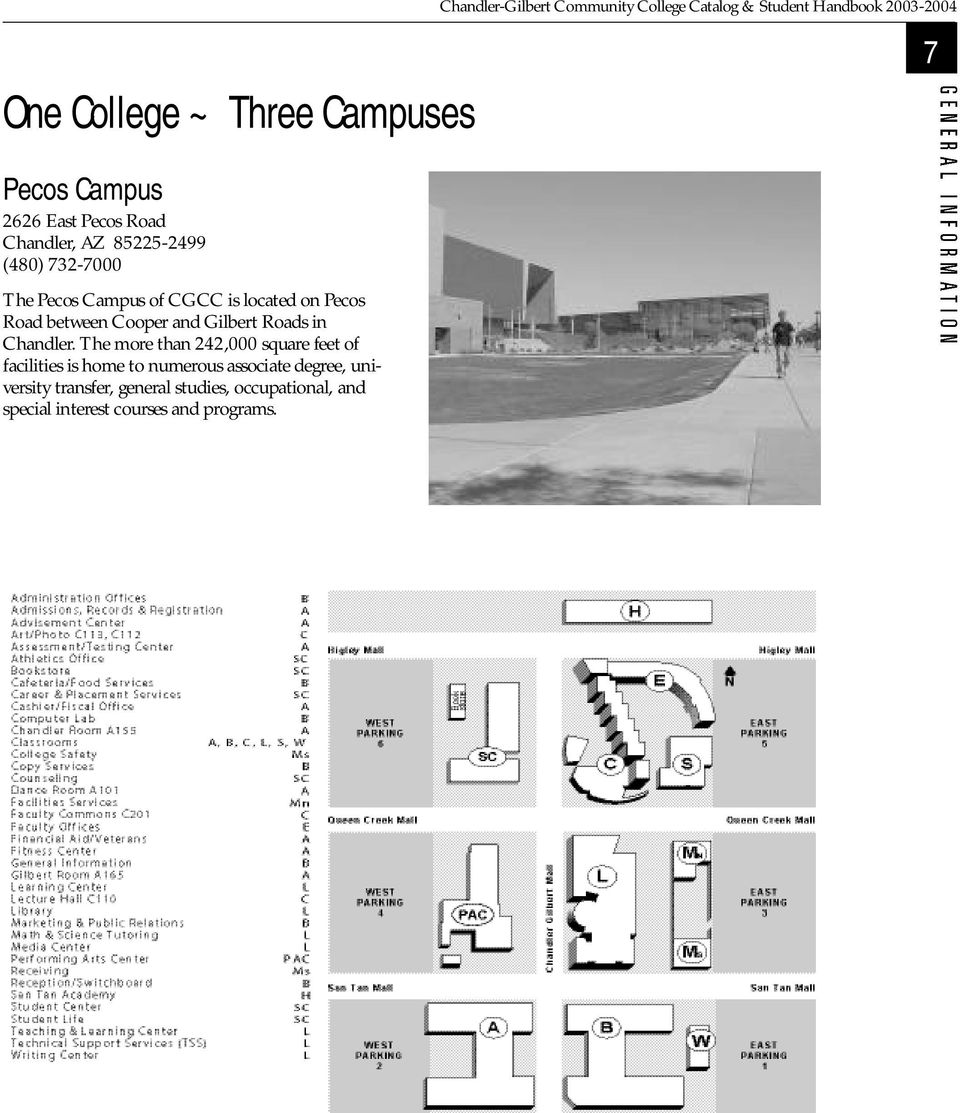
11 7 C h a n d l e r - Gi l b e rt Community College Catalog & Student Handbook One College ~ Three Campuses Pecos Campus 2626 East Pecos Ro a d C h a n d l e r, AZ (480) The Pecos Campus of CGCC is located on Pe c o s Road between Cooper and Gi l b e rt Roads in C h a n d l e r. The more than 242,000 square feet of facilities is home to numerous associate degree, university transfer, general studies, occupational, and special interest courses and programs.
12 C h a n d l e r - Gi l b e rt Community College Catalog & Student Handbook Williams Campus 7360 East Tahoe Ave n u e Mesa, AZ (480) The Williams Campus of CGCC is located at Williams Ga t eway Airport on Power Road betwe e n Ray and Williams Field roads. Ad m i n i s t r a t i ve offices a re located at 7360 East Tahoe Avenue, and are easily accessible by taking the Ray Road extension east of Power Road. The campus is a partnership among s e veral institutions, anchored by CGCC and Arizo n a State Un i versity East. A complete Student Se rv i c e s office is also located at Williams, as well as student h o u s i n g.

13 Sun Lakes Education Center South Alma School Ro a d Sun Lakes, AZ (480) The Sun Lakes Education Center of CGCC is located at the northeast corner of Alma School and Riggs roads in Sun Lakes. The Center offers a va r i e t y of credit and non-credit special interest courses, such as computer classes, and is designed to serve the lifelong learning needs of a large re t i rement population in the Southeast Va l l e y. C h a n d l e r - Gi l b e rt Community College Catalog & Student Handbook

14 1 0 C h a n d l e r - Gi l b e rt Community College Catalog & Student Handbook Community Pa r t n e r s h i p s The college and the community are interrelated in many ways. College personnel and students are ve ry i n vo l ved in the community and serve on a variety of committees and boards to plan for the future. Pa rticipation in local civic, governmental, business, p rofessional, and service organizations and activities abounds. College re p re s e n t a t i ves participate in local city and chamber of commerce planning pro c e s s e s, including the Chandler To m o r row Conference and Gi l b e rt To d a y. Students are invo l ved in serv i c e - learning projects in the community. Many opport u- nities exist for staff and students to become more i n vo l ved in community serv i c e. L i k ewise, community members are invo l ved in C h a n d l e r - Gi l b e rt Community College (CGCC) committees and planning. College facilities and s e rvices, including the Library, classrooms, meeting space, Computer Lab, and Fitness Center, are used by community gro u p s. Affiliations and A s s o c i a t i o n s Commission on Accreditation for Dietetics E d u c a t i o n The Dietetic Technology Program is curre n t l y granted developmental accreditation by the Commission on Ac c reditation for Di e t e t i c s Education (CADE) of the American Di e t e t i c Association, 216 West Jackson Bouleva rd, Chicago, IL , (312) Upon successful completion of the program, the graduate will be eligible to take the CADE Registration Examination in o rder to become a Dietetic Technician, Re g i s t e re d ( D T R ). Federal Aviation A d m i n i s t r a t i o n The Aircraft Maintenance Technology Pro g r a m s, designed to pre p a re students for licensure as cert i f i e d a i rframe and powerplant (A&P) mechanics, are cert i- fied by the Federal Aviation Administration (FA A ), Pa rt 147. The Aircraft Flight Technology Programs, designed to pre p a re students to apply technical knowledge and skills to pre p a re them for Commercial Pi l o t C e rtificate with Single Engine Airplane Land Rating and In s t rument Rating, and the Multiengine Rating, t h rough a partnership with the Un i versity of No rt h Dakota, are certified by the FAA, Pa rt 141. All aviation programs are housed in the Aviation and Technology Center at the Williams Campus, 7360 East Tahoe Avenue, Mesa, AZ Maricopa County Community College District In 1962, the citizens of Maricopa County voted to establish a college district. Phoenix College, which was founded in 1920 as part of the Phoenix Un i o n High School District, became the first college in the n ew Maricopa County Community College Di s t r i c t in On July 1, 1965, the Governing Board created Me s a Community College on 160 acres at Dobson Ro a d and Southern Avenue in Mesa. At the same time, the Governing Board combined the Camelback and Glendale extensions of Phoenix College to establish Glendale Community College on 160 acres at 6000 West Ol i ve Avenue in Glendale. By 1981, Me s a Community College had become the largest college in the Di s t r i c t. The Maricopa Skill Center opened in 1964 and the other community colleges soon followed: Ga t e Wa y opened as Maricopa Tech in 1967; Scottsdale in 1970; Rio Salado, the college without walls, in 1978; South Mountain in 1979; Paradise Valley and C h a n d l e r - Gi l b e rt in 1985; and Estrella Mountain in Maricopa Colleges Fo u n d a t i o n The Maricopa Colleges Foundation is a private, nonp rofit Arizona corporation established in 1977 to supplement the financial needs of the Ma r i c o p a Community Colleges. The Foundation is a qualified 501 (c) (3) organization in accordance with federal regulations. A volunteer board of directors assists in the acquisition and management of funds and/or p ro p e rty derived from bequests, corporate contributions, foundation grants, endowments, memorials, and annual individual giving. These funds prov i d e for needs not met by public funds and tuition re v- enue. For more information, contact the Ma r i c o p a Community College District De velopment Office at (480) North Central A s s o c i a t i o n C h a n d l e r - Gi l b e rt Community College is accre d i t e d by The Higher Learning Commission and is a member of the No rth Central Association, 30 No rt h L a Salle St reet, Suite 2400, Chicago, Illinois ; (800)

15 Advisory Committees Ad v i s o ry groups have proven invaluable in dire c t i n g the college s future. The Pre s i d e n t s Community Ad v i s o ry Council and Academic Program Ad v i s o ry Councils have provided input into educational program development and improvement of the college. Academic Program Advisory Councils Academic Program Ad v i s o ry Councils provide assistance to several CGCC academic divisions by taking a leadership role in the design of programs to pre p a re students for entry - l e vel positions and for transfer into f o u r - year college degree programs. Other activities include projecting labor market demands, re c o m- mending learning activities, advocating pro g r a m s, recommending equipment purchases and donations, and identifying job-specific skills and knowledge that a re consistent with the needs of local business and i n d u s t ry. Automated Manufacturing Systems Ad v i s o ry C o u n c i l Aviation Ad v i s o ry Council Business Ad v i s o ry Council Computer Graphic Design Ad v i s o ry Council Crime and Intelligence Analysis Ad v i s o ry C o u n c i l De velopmental Disabilities Ad v i s o ry Council Dietetic Technician Ad v i s o ry Council Information Technology Institute Ad v i s o ry C o u n c i l Mi c rocomputer Applications Ad v i s o ry Council Contact the Associate Dean of Business and In d u s t ry at (480) for more information. A c h i evement in Mathematics, E n g i n e e r i n g, and Science Student Advisory Committee CGCC and local school districts have formed an Ac h i e vement in Mathematics, Engineering, and Science (AIMES) Student Ad v i s o ry Committee t o i m p rove the quality of, participation in and coord i- nation of the programs and services for under-re p resented populations in math and science education. Acting as a steering committee for the AIMES program, the advisory committee has identified activities such as staff development, student tracking, pro g r a m a rticulation, student re c ruitment, joint planning, information exchange, and coordination of pro g r a m s and calendars. Call the AIMES Coordinator (480) for more information. C h a n d l e r - Gi l b e rt Community College Catalog & Student Handbook P r e s i d e n t s Community Advisory Council Community invo l vement has been a cornerstone of CGCC since before the college offered its first class. The evolution of ideas and visions that became the CGCC philosophy of education and community s e rvice are the result of continuous dialogue with business, industry, and community leaders. In 1983, leaders in Chandler and Gi l b e rt formed the Southeast Valley Task Fo rce to support the new campus, and a successful bond election in 1984 prov i d e d funds to begin construction of CGCC. Members of that original task force and other community, education, and business leaders formed the initial Pre s i d e n t s Community Ad v i s o ry Council (PCAC ). O ver 30 members of the Council continue to meet on a regular basis with CGCC administration, facu l t y, and staff to assist the college in identifying needs and establishing programs. In addition, three subcommittees have aided the college in Cu r r i c u l u m De velopment, Capital De velopment, and Institutional Finance and Scholarship. In 1994, they s u p p o rted the bond election for capital deve l o p m e n t of the CGCC campus. Contact the Pre s i d e n t s Office at (480) for more information. Sun Lakes Advisory Board The Sun Lakes Ad v i s o ry Board was formed in Fe b ru a ry of 1995 to provide gro u n d w o rk for the d e velopment of the Sun Lakes Education Center. B o a rd membership is comprised of residents fro m the Sun Lakes communities, a District Gove r n i n g B o a rd member, and employees of CGCC including administrators, faculty, and staff. The Board meets during the academic ye a r. Call (480) for m o re information. Educational Pa r t n e r s h i p s CGCC participates in a number of special part n e r- ships and collaborative projects to serve our students and the community. A c h i evement in Mathematics, E n g i n e e r i n g, and Science The Ac h i e vement in Mathematics, Engineering, and Science (AIMES) program is designed to incre a s e o p p o rtunities for under-re p resented populations in math, engineering, science, and technology. Students enter the program by taking the AIMES class and science and math courses at Gi l b e rt, Highland, Mesquite, and Hamilton high schools. Students are provided with career awareness, advisement, training, and enrichment activities designed to

16 C h a n d l e r - Gi l b e rt Community College Catalog & Student Handbook enable them to acquire the academic backgro u n d needed to major in math, engineering, science, or t e c h n o l o g y - related fields. College scholarships to CGCC are provided for qualified students. Fo r m o re information on the AIMES program, call the AIMES Coordinator at (480) A c h i eving a College Education Plus The CGCC Achieving a College Education (AC E ) Plus program is a scholarship-based, early-outre a c h college preparation program for high school students. The program reaches out to students who are members of an underre p resented gro u p, financially d i s a d vantaged, first-generation college students, and those who may come from a one-parent household. The Plus part of the program stands for Program for Learning Un i versal Skills and focuses on academic skills in the areas of English, reading, and mathematics. Call (480) for more information about ACE Pl u s. Arizona State University East CGCC and Arizona State Un i versity (ASU) East h a ve transformed the fact of co-location at the Williams Campus into the reality of co-operation t h rough an innova t i ve student-centered Pa rt n e r s h i p In Ba c c a l a u reate Education. The Pa rtnership takes community college/university articulation to the next level, integrating the strengths of the two institutions and creating a wholly new option in bacc a l a u reate education for students from Arizona and a round the world. Williams Campus students may be jointly admitted to ASU East and CGCC. ASU East is offering baccalaureate degree programs in t e c h n o l o g y, agribusiness, elementary education, business administration, technical communication, nutrition, exe rcise science, and applied psyc h o l o g y. CGCC is providing the lower division general studies, general interest, and pre requisite courses that complete and enrich the baccalaureate pro g r a m s. ASU East and CGCC faculty are working together to plan and coordinate curriculum and scheduling. The cooperation in curriculum extends to virt u a l l y e ve ry other functional area of the two institutions: l i b r a ry, computer center, classrooms, general facilities, housing, bookstore, food service, re c reation, student life, financial aid, advising, registration, class schedule, campus security, and campus maintenance. T h rough the Pa rt n e r s h i p, students can complete e n t i re baccalaureate programs at the Wi l l i a m s Campus, either as commuter or residential students, as if it we re a single institution. The Pa rtnership in Ba c c a l a u reate Education at the Williams Campus provides an innova t i ve and powe r- ful model for the development of new campuses nationwide to meet the growing need for compreh e n s i ve post secondary programs and a broader range of points of entry than universities or community colleges have been able to provide separately. Fo r m o re information about the Pa rtnership In Ba c c a l a u reate Education, call the Dean of In s t ruction at (480) Chandler Regional Hospital CGCC had the opportunity to partner with Chandler Regional Hospital (East Valley Re g i o n a l Health System, also known as Catholic He a l t h c a re West) to collaborate in the development of the Su n Lakes Health Center campus, a 9.5 acre parc e l located on the northeast corner of Riggs and Alma School Roads, and includes the CGCC Sun Lakes Education Center (SLEC). SLEC is a facility deve l- oped for the primary purpose of providing credit and n o n - c redit classes to meet the needs of senior adults and became fully operational in the fall of Fo r m o re information, call the Di rector of SLEC at (480) East Va l l ey Think Ta n k The East Valley Think Tank, a consortium of educational institutions re p resenting students from kinderg a rten through the postgraduate level, was created to d e velop collaborative educational projects to serve students in the East Va l l e y. Think Tank members are CGCC, Mesa Community College, Arizona St a t e Un i versity East, and school districts in Chandler, Gi l b e rt, Queen Creek, Ky rene, Mesa, Tempe, and Apache Junction. Initial projects include pro g r a m s for vocational and occupational education, teacher and aide development, and foreign language deve l- opment as well as an alternative campus for at-risk students. Contact the Pre s i d e n t s Office at (480) for more information. Microsoft Corporation The Maricopa Community College Di s t r i c t (MCCD) was selected by Mi c rosoft Corporation to p rovide faculty training on the latest technology to s e c o n d a ry and post secondary educational institutions in Arizona, New Mexico, Ne vada, and Ut a h. C h a n d l e r - Gi l b e rt Community College has been selected to re p resent MCCD as the Mi c rosoft IT Academy So u t h west Regional Training Center. CGCC is one of thirteen regional centers in the United States that will provide direct support and guidance to all participating IT Academy faculty and s t a f f. The overall goal of the program is to help schools deliver high quality training that dire c t l y a d d resses the information technology work f o rc e s h o rt a g e.

17 San Tan A c a d e my In 1989 Chandler Unified School District and C h a n d l e r - Gi l b e rt Community College created a p a rtnership to support the needs of at-risk students in grades 9 through 12. The San Tan Academy is an alternative high school located on the CGCC campus serving the needs of at-risk high school students. The Chandler School District provides the instructor for this pro g r a m. Students can earn Chandler High School diplomas or General Eq u i valency Diplomas (GED). St u d e n t s can also take college classes as part of their pro g r a m s. Call (480) for admission or general program information. U n i versity of North Dako t a CGCC and the Un i versity of No rth Dakota have signed an agreement establishing a Joint Fl i g h t Training Program at the Williams Campus. Si n c e the Un i versity of No rth Dakota is an internationally re c o g n i zed leader in aviation education, this part n e r- ship is a tremendous opportunity for CGCC students desiring a career in the aviation industry. Community Eve n t s CGCC has established a number of annual eve n t s and activities open to students and the community. Some of these include Into the St reets, Ad o p t - A - Fa m i l y, the Spring Noche de Fiesta Dance, the De s e rt Rose Fall Fe s t i val, Alcohol and Dru g Aw a reness Week, Black Hi s t o ry Month, the Generations Prom, the San Tan Arts Fe s t i va l, Wellness Week, Library Week, Cultural Aw a re n e s s Week, and Cinco de Ma yo. C h a n d l e r - Gi l b e rt Community College Catalog & Student Handbook Desert Rose Fall Fe s t i va l During a beautiful autumn Sa t u rday night, CGCC sponsors the De s e rt Rose Fall Fe s t i val outdoors. T h i s popular community event draws the entire family with entertainment, live music, dancing, fun rides, food booths, games, prizes, and much more. T h e Ro s e was created by students in 1989 as a fundraiser for the Ad o p t - A - Family Program and continues to be a student project. Contact the Office of Student Life at (480) for more informat i o n. San Tan Arts Fe s t i va l Each spring, CGCC presents the San Tan Art s Fe s t i val at the Pecos Campus. The festival feature s t h ree days of arts and crafts booths and perf o r m a n c e s as well as master classes and workshops taught by local and regional artists. The entire festival is open to the public. School and Community Relations CGCC works closely with local public, private, and c h a rter schools as well as a variety of community agencies to provide information and pre s e n t a t i o n s about CGCC. En rollment services are provided to all school-age students who request assistance with admissions, re c ruitment, advisement, assessment, and orientation. Call the CGCC Re c ruitment Office at (480) or the Dean of Students Office at (480) for assistance.

18 1 4 C h a n d l e r - Gi l b e rt Community College Catalog & Student Handbook Maricopa Community Colleges C h a n d l e r - Gi l b e rt Community College 2626 East Pecos Ro a d C h a n d l e r, AZ (480) Glendale Community College 6000 West Ol i ve Ave n u e Glendale, AZ (623) Pecos Ca m p u s 2626 East Pecos Ro a d C h a n d l e r, AZ (480) Mesa Community College 1833 West Southern Ave n u e Mesa, AZ (480) Sun Lakes Education Center South Alma School Ro a d Sun Lakes, AZ (480) Paradise Va l l ey Community College No rth 32nd St re e t Phoenix, AZ (602) Williams Ca m p u s 7360 East Tahoe Ave n u e Mesa, AZ (480) Phoenix College 1202 West Thomas Ro a d Phoenix, AZ (602) District Su p p o rt Se rvices Center 2411 West 14th St re e t Tempe, AZ (480) Rio Salado College 2323 West 14th St re e t Tempe, AZ (480) E s t rella Mountain Community College 3000 No rth Dysart Ro a d Avondale, AZ (623) Scottsdale Community College 9000 East Chaparral Ro a d Scottsdale, AZ (480) Gateway Community College 108 No rth 40th St re e t Phoenix, AZ (602) South Mountain Community College 7050 South 24th St re e t Phoenix, AZ (602)

19 M aricopa Co m m u n i t y Co ll e g e Po l i ci e s

20 1 6 C h a n d l e r - Gi l b e rt Community College Catalog & Student Handbook Maricopa County Community College District General Statement (AR 2.4.1) The Maricopa Community Colleges are dedicated to p roviding a healthy, comfortable and educationally p ro d u c t i ve environment for students, employees and v i s i t o r s. Nondiscrimination Po l i cy (AR 2.4.2) It is the policy of the Maricopa Community Colleges (consisting of Chandler-Gi l b e rt Community College, the District Office, Estrella Mo u n t a i n Community College, Ga t e Way Community College, Glendale Community College, Ma r i c o p a Skill Center, So u t h west Skill Center, Me s a Community College, Paradise Valley Community College, Phoenix College, Rio Salado College, Scottsdale Community College, and So u t h Mountain Community College) to promote equal e m p l oyment opportunities through a positive continuing program. This means that Maricopa will not discriminate, nor tolerate discrimination, against any applicant or employee because of race, color, re l i g i o n, g e n d e r, sexual orientation, national origin, age, disa b i l i t y, or veteran status. Ad d i t i o n a l l y, it is the policy of the Maricopa Community Colleges to provide an e n v i ronment for each job applicant and employe e that is free from sexual harassment, as well as harassment and intimidation on account of an individual s race, color, religion, gender, sexual orientation, national origin, age, disability, or veteran status. This nondiscrimination policy covers all aspects of the employment relationship and admission to, access to, and treatment of students in the Ma r i c o p a Community Colleges programs and activities including vocational education. This policy also prohibits discrimination on the basis of sexual orientation in the admission and treatment of students in the Maricopa Community Colleges programs and activities and in the hiring, treatment, pro m o t i o n, e valuation, and termination of employe e s. Equal Opportunity Statement (AR 2.4.3) It is the policy of the Maricopa Community Colleges to promote equal employment opport u n i t i e s t h rough a positive continuing program. This means that Maricopa will not discriminate, nor tolerate discrimination, against any applicant or employe e because of race, color, religion, gender, sexual orientation, national origin, age, disability, or veteran status. Ad d i t i o n a l l y, it is the policy of the Ma r i c o p a Community Colleges to provide an environment for each job applicant and employee that is free fro m sexual harassment, as well as harassment and intimidation on account of an individual s race, color, re l i- gion, gender, sexual orientation, national origin, age, d i s a b i l i t y, or veteran status. A f f i rm a t i ve Action Statements A f f i rm a t i ve Action Po l i cy Statement for Individuals with Disabilities In conformance with the provisions of Section 503 of the Rehabilitation Act of 1973, as amended, and the implementing regulations, 41 CFR (a), as amended, Maricopa Community College Di s t r i c t will not discriminate, or tolerate discrimination, against any applicant or employee because of physical or mental disability in re g a rd to any position for which the known applicant or employee is qualified. Maricopa agrees to take affirmative action to employ, a d vance in employment and otherwise treat know n qualified individuals with disabilities without re g a rd to their physical or mental disability in all human re s o u rces selection and decision practices, such as the f o l l owing: adve rtising, benefits, compensation, discipline (including probation, suspension, and/or termination for cause or layo f f), employee facilities, p e rformance evaluation, re c ruitment, social/re c reational programs, and training. Maricopa will also continue to administer these practices without re g a rd to race, color, religion, gender, sexual orientation, national origin, age, disability, or veteran status. Ad d i t i o n a l l y, all applicants and employees are protected from coercion, intimidation, interf e rence, or discrimination for filing a complaint or assisting in an investigation under the Ac t.
21 A f f i rm a t i ve Action Po l i cy Statement for Other Eligible Ve t e r a n s,special Disabled Ve t e r a n s, and Vietnam Era Ve t e r a n s In conformation with the Vietnam Era Ve t e r a n s Readjustment Assistance Act of 1974, the Ve t e r a n s Em p l oyment Op p o rtunities Act of 1998, and the implementing regulations, 41 CFR (k), Maricopa County Community College District will not discriminate, or tolerate discrimination, against any applicant or employee because he or she is a special disabled veteran or Vietnam era veteran in re g a rd to any position for which the known applicant or e m p l oyee is qualified. Maricopa agrees to take affirm a t i ve action to employ, advance in employ m e n t, and otherwise treat known qualified special disabled veterans and Vietnam era veterans without discrimination based upon their disability or veteran status in all human re s o u rces section and decision practices, such as the following: adve rtising, benefits, compensation, discipline (including probation, suspension, and/or termination for cause or layo f f), employe e facilities, performance evaluation, re c ru i t m e n t, s o c i a l / re c reational programs, and training. Ma r i c o p a will continue to administer these practices without re g a rd to race, color, religion, gender, sexual orientation, national origin, age, disability, or veteran status. Ad d i t i o n a l l y, Maricopa agrees to post all suitable job openings at the local office of the State employ m e n t s e rvice where the job opening occurs. This includes full-time, temporary greater than 3 days duration, and part-time employment. Fi n a l l y, all applicants, e m p l oyees are protected from coercion, intimidation, i n t e rf e rence, or discrimination for filing a complaint or assisting in an investigation under the Ac t. Notice of Americans with Disabilities Act (ADA)/Section 504 of the Rehabilitation A c t / Title IX C o o r d i n a t o r A D A / / Title IX Coord i n a t o r, Di s a b i l i t y Re s o u rces and Se rvices, Chandler-Gi l b e rt Community College, 2626 East Pecos Ro a d, C h a n d l e r, AZ ; (480) Un d e r the ADA and Section 504, the District and its colleges re c o g n i ze the obligation to provide overall program accessibility throughout its locations for persons with disabilities. The designated A D A / / Title IX Coordinator at each college will p rovide information as to the existence and location of services, activities and facilities that are accessible to and usable by persons with disabilities. Re q u e s t s C h a n d l e r - Gi l b e rt Community College Catalog & Student Handbook for accommodation should be addressed to the coord i n a t o r. Likewise, under Title IX, there is an obligation to provide services and program accessibility in a gender-neutral manner. Students with disabilities may request catalog information in an alternative format from the college ADA/504 Coord i n a t o r. Póliza de No Descriminación Es la póliza de los Colegios Comunitarios del Condado de Maricopa (The Maricopa Community Colleges) que consisten del Centro de Ap oyo del Distrito, los colegios comunitarios de Chandler- Gi l b e rt, Estrella Mountain, Ga t ew a y, Gl e n d a l e, Mesa, Paradise Va l l e y, Phoenix, Rio Sa l a d o, Scottsdale, South Mountain y el Centro de Capacitación de Maricopa, proveer igualdad en las o p o rtunidades de empleo mediante un pro g r a m a continuo positivo. Esto significa que Maricopa no descriminará o tolerará descriminación en contra de ningún aplicante o empleado debido a su raza, color, religión, sexo, orientación sexual, nacionalidad, edad, incapacitación o por ser veterano incapacitado. Asi mismo, es la póliza de los Colegios Comunitarios p roveer para cada aplicante y empleado un ambiente l i b re de acoso sexual como también de acoso intimidación re f e rente a raza, color, religión, sexo, orientación sexual, nacionalidad, edad o estado de veterano de cualquier individuo. Esta póliza de no descriminación cubre todos los aspectos de contratación del empleado, ingre s o, acceso a, y tratamiento de alumnos en los Colegios Comunitarios de Maricopa los cuáles incluyen también programas de educación vocacional. Esta póliza también prohibe descriminación en base de orientación sexual en la admisión y tratamiento de estudiantes, en sus programas y actividades y en la contratación, tratamiento, promoción/ascensos, eva l- uación y despido de empleados. Declaración de Igualdad de O p o r t u n i d a d Es la póliza de los Colegios Comunitarios del Condado de Maricopa proveer igualdad en las oportunidades de empleo mediante un programa continuo positivo. Esto significa que Maricopa no descriminará o tolerará descriminación en contra de ningún aplicante o empleado debido a su raza, color, religión, sexo, orientación sexual, nacionalidad, edad, incapacidad o por ser veterano incapacitado.
22 C h a n d l e r - Gi l b e rt Community College Catalog & Student Handbook A g regando, es la póliza de los Colegios Comunitarios p roveer para cada aplicante y empleado un ambiente l i b re de acoso sexual como también de acoso e intimidación re f e rente a la raza, color, religión, sexo, orientación sexual, nacionalidad, edad y condición de veterano de cualquier individuo. Declaración de Acción A f i rm a t i va Póliza y Declaración de Acción A f i rm a t i va para Individuos con Incapacidades De acuerdo a lo que provee la Sección 503 de la Ley de Rehabilitación de 1973, como enmienda, y las l e yes de implementación, 41 CFR (a), declara que el Distrito de Colegios Comunitarios de Maricopa no descriminarán o tolerarán descriminación en contra ningún aplicante o empleado debido a su desabilidad/incapacitación fisica o mental re f e rente a cualquier posición para la cuál el aplicante o empleado ha calificado. Maricopa pro m e t e tomar acción afirmativa para emplear, dar ascenso en empleo y tratar a dichos individuos con incapacidades sin hacer incapie en sus incapacidades fisicas o mentales en la selección de recursos humanos y prácticas decisivas como son las siguientes: anuncios, beneficios, compensación, disciplina (incluye n d o periodo de prueba, suspensión, y/o terminación de empleo por causa de paro forzoso), facilidades para empleados, evaluación de trabajo, re c ru t a m i e n t o, p rogramas sociales/re c reacionales y entre n a m i e n t o. Maricopa continuará llevando a cabo éstas prácticas de no descriminar por razones de raza, color, religión, sexo, orientación sexual, nacionalidad, edad, incapacidad o estado de ve t e r a n o. Asi mismo, todo los aplicantes y empleados estan protegidos en contra de coacción, intimidación, interf e rencia o descriminación por quejas o por ayudar en una inve s t i g a c i ó n c u b i e rta bajo éste Ac t o. Declaración de Póliza de Acción A f i rm a t i va para Otros Veteranos Elegibles,Veteranos con Incapacitación Especial y Veteranos de la Era Vi e t n a m i t a Conforme a la ley de Reajuste y Asistencia para los Veteranos de la Era Vietnamita de 1974, acta de Op o rtunidades de Empleo para Veteranos de 1998 y reglamentos de implementación, 41 CFR (k), el Distrito de Colegios Comunitarios del Condado de Maricopa no descriminará ni tolerará descriminación en contra de ningún aplicante o empleado veterano o veterano de la Era Vietnamita con desabilidad/incapacitación especial re f e rente a cualquier posición la cual dicho aplicante o empleado califique. Maricopa promete aplicar acción afirmativa para e m p l e a r, ascender en empleo y tratar a dichos ve t e r a- nos incapacitados y de la Era Vietnamita que califiquen sin descriminar base a su desabilidad/ incapacitación o condición de veterano en todas las á reas de recursos humanos y decisiones como son las siguientes: anuncios, beneficios, compensación, disciplina (incluyendo perìodo de prueba, suspensión, y/o despido por causa o paro forzoso), facilidades para empleados, evaluación de trabajo, re c rutamiento, programas sociales/re c reacionales y entren a m i e n t o. Maricopa continuará llevando a cabo estas prácticas sin descriminar por razones de raza, c o l o r, religión, sexo, orientación sexual, nacionalidad, edad, incapacidad o condición de ve t e r a n o. Maricopa promete anunciar todas las oport u n i d a d e s de empleo disponibles en la oficina local del serv i c i o de empleo del Estado donde el empleo esté disponible. Esto incluye empleo de tiempo completo, temporal de más de tres días de duración y empleo de tiempo medio. Finalmente, todos los aplicantes y empleados están protegidos en contra de coacción, intimidación, interf e rencia o descriminación por quejas o por ayudar en una inve s t i g a c i ó n c u b i e rta sobre este Ac t o. Notificación del Acta de Americanos con Impedimentos ( A DA)/Sección 504 del Acta de Rehabilitación/Coordinador del Título IX A D A / / C o o rdinador del Título IX, Di s a b i l i t y Re s o u rces and Se rvices, Chandler-Gi l b e rt Community College, 2626 East Pecos Ro a d, C h a n d l e r, AZ ; (480) De a c u e rdo a ADA y a la sección 504, el distrito y sus colegios reconocen la obligación de proveer acceso a p rogramas en todas sus localidades a personas incapacitadas. El coordinador designado de ADA/504/Título IX proveerá información tocante a la existencia y localidad de servicios, actividades y facilidades que son accesibles y de utilidad a personas incapacitadas. Solicitudes para acomodación deben ser dirigidas al coord i n a d o r. Del mismo modo, bajo el Título IX, hay obligación de proveer acceso a serv i- cios y programas de una manera imparcial segun el g é n e ro. Estudiantes incapacitados pueden solicitar información de catálogo en una forma diferente por medio del Coordinador designado por ADA/504 en cada c o l e g i o.
23 Vi s i o n The Maricopa Community Colleges strive to exc e e d the changing expectations of our many communities for effective, innova t i ve, student-centered, flexible and lifelong educational opportunities. Our employees are committed to respecting dive r s i t y, continuous quality improvement, and the efficient use of re s o u rces. We are a learning organization guided by our shared va l u e s. M i s s i o n The Maricopa Community Colleges create and continuously improve affordable, accessible, effective and safe learning environments for the lifelong educational needs of the diverse communities we serve. Our colleges fulfill this mission through unive r s i t y transfer education, general education, deve l o p m e n t a l education, work f o rce development, student deve l o p- ment services, continuing education and community e d u c a t i o n Va l u e s We adhere to the philosophy that education thrive s in a community bound by moral and ethical va l u e s and devotion to lifelong learning. We accept the responsibility to respond to the needs of the people in our communities who desire to fulfill their potential in life. T h e re f o re, we operate on the basis of openness and trust, to nurt u re an enviro n m e n t w h e re all can be heard. We commit to living according to the following basic values which are vital to maintaining the integrity and vitality of our community of learners. Value Ed u c a t i o n We value lifelong learning opportunities that respond to the needs of our communities and a re accessible, affordable and of the highest quali t y. Value St u d e n t s We value students as the primary reason we exist. We respect their diverse life experiences, value their achievements, and appreciate their contributions to our learning community. C h a n d l e r - Gi l b e rt Community College Catalog & Student Handbook Value Em p l oye e s We value all our residential faculty, adjunct facu l t y, administration, professional support staff, and crafts, and maintenance and operations personnel, respect their diverse life experiences, a p p reciate their contributions to our learning c o m m u n i t y, and encourage their individual professional deve l o p m e n t. Value Exc e l l e n c e We invite innovation, support cre a t i ve pro b l e m - solving, and encourage risk-taking. We va l u e t e a m w o rk, cooperation and collaboration as part of our continuous improvement effort s. Value Di ve r s i t y We celebrate the diversity of our communities and pledge to promote and re c o g n i ze the s t rengths as reflected in our employees and students. We believe no one is more import a n t than another, each is important in a unique way, and we depend on each other to accomplish our m i s s i o n. Value Honesty and In t e g r i t y We believe academic and personal honesty and integrity are essential elements in our learning e n v i ronment. Em p l oyees and students must speak and act tru t h f u l l y. Value Fre e d o m To foster our learning environment, we re s p e c t individual rights and the privacy of our employees and students, and encourage dialogue and the free exchange of view s. Value Fa i r n e s s We advocate fairness and just treatment for all students and employe e s. Value Re s p o n s i b i l i t y We believe employees are accountable for their personal and professional actions as they carry out their assignments. We are all responsible for making our learning experiences significant and m e a n i n gful. We are accountable to our communities for the efficient and effective use of re s o u rc e s. Value Public Tru s t We honor the trust placed in us by the community to pre p a re our students for their role as prod u c t i ve world citize n s.
24 C h a n d l e r - Gi l b e rt Community College Catalog & Student Handbook General Regulation (AR 2.1) A. Compliance with Policies, Rules, Re g u l a t i o n s Admission Po l i cy (AR 2.2.1) Persons meeting the admissions criteria may attend any Maricopa Community College of their choice. Falsification of any admission materials or official college re c o rds may be cause for denial or cancellation of admission. Exceptions to the admissions policies may be requested through the Admissions and St a n d a rd s C o m m i t t e e. Admission Classifications The following admission criteria have been adopted by the State Board of Di rectors for Community Colleges of Arizo n a : A. Eve ry student is expected to know and comply with all current published policies, rules and re g- ulations as printed in the college catalog, class schedule, and/or student handbook. Copies are a vailable at each college. Policies, courses, programs, fees and re q u i rements may be suspended, deleted, restricted, supplemented or changed through action of the Governing Board of the Maricopa Community C o l l e g e s. The Maricopa Community Colleges re s e rve the right to change, without notice, any materials, information, curriculum, re q u i rements and re g u- l a t i o n s. Note: The regulations that comprise the student section contain language that appears in va r i o u s s o u rces such as the Catalog Common Pages and the Student Handbook. All areas became Ad m i n i s t r a t i ve Regulations with the 1996 adoption of the Governance Model. Changes are made annually either through the Ad m i n i s t r a t i ve Regulations approval process, or by Board a p p roval for those items that fall under its statut o ry duty, such as Tuition and Fees. In an effort A d m i s s i o n / R e g i s t r a t i o n Admission of Regular St u d e n t s Admission to the community college in Arizo n a may be granted to any person who meets at least one of the following criteria: B. B. to pre vent duplication, topics in this section may be incorporated by re f e rence, as they are feature d in other areas of the manual and are noted a c c o rd i n g l y. The Maricopa Community Colleges Vi s i o n, Mission and Values that are featured in the Common Pages are a part of approve Gove r n i n g B o a rd Policy and are located in the policy section of the manual. As such, the following statement related to Outcomes Assessment that appears in the Common Pages is presented here as a general s t a t e m e n t. Outcomes As s e s s m e n t The mission of the Maricopa Community Colleges is to create and continuously improve a f f o rdable, accessible, and effective learning environments for the lifelong educational needs of the diverse communities we serve. In order to e valuate how successfully Maricopa Community Colleges accomplish this mission, student outcomes will be assessed as part of the continuous i m p rovement pro c e s s. Students may be asked to participate in a va r i e t y of assessment activities at each college. Assessment results will be used to improve educational programs, services and student learning. 1. Is a graduate of a high school, which is a c c redited by a regional accrediting association as defined by the United States Of f i c e of Education or approved by a St a t e De p a rtment of Education or other appro p r i- ate state educational agency. 2. Has a high school certificate of equiva l e n c y. 3. Is 18 years of age or older and demonstrates evidence of potential success in the community college. 4. Is a transfer student in good standing fro m another college or unive r s i t y. Admission of Students Under 18 Years of Ag e 1. Admission to the community colleges in A r i zona shall be granted to any student who is under age 18 and who achieves the following test score s :
25 a. Scholastic Aptitude Test (SAT) composite (verbal and math) - SAT I or more, or - SAT II or more, or an b. American College Test (AC T) composite of 22 or more. 2. A student shall not be denied admission because of age, lack of a high school diploma or high school certificate of equiva l e n c y, grade in school, lack of permission of school officials or lack of concurre n t e n rollment in a public or private school, if the student has achieved at least the test s c o res specified in paragraph 1, subparagraphs a or b of this subsection. 3. A student admitted under this subsection is not guaranteed admission to a specific d e g ree program or to all courses offered by the community college. 4. A community college may limit the number of credit hours in which the student may enroll to no fewer than six (6) cre d i t h o u r s. C. Admission of Students in Special St a t u s Students not meeting any of the prov i s i o n s stated above may be admitted on an individual basis with the approval of college officials, so long as the students meet the established re q u i rements of the courses for which they e n roll and the college officials determine that such admission is in the best interest of the stud e n t s. The status of Special Ad m i s s i o n s may be granted to a student who: 1. Is beyond the age of compulsory high school attendance and has met the established re q u i rements for the courses for which he or she plans to enroll based on the college assessment examinations, or 2. Is under the age of 18 and has taken the a p p ropriate college assessment tests in ord e r to demonstrate the knowledge of the necess a ry academic skill level to benefit from the course. De p a rtments may have additional re q u i rements to register for a course. ( Si g n a t u re of parent or guardian is re q u i re d for students under 18), or 3. Is a participant in a special program spons o red by the admitting college. C h a n d l e r - Gi l b e rt Community College Catalog & Student Handbook The colleges re s e rve the right to enroll students in courses. The final decision for admission to any class for students admitted under s p e c i a l status will be determined by the designated college administrator in consultation with the department chairperson. D. Sp e c i a l i zed Vo c a t i o n a l / Training Pro g r a m E. If districts are granted authority for specialize d curricula, local district boards shall adopt guidelines to determine admissibility of students for such programs. These guidelines must be a p p roved by the State Board of Di rectors for Community Colleges of Arizo n a. Admission of F-1 Nonimmigrant St u d e n t s Pro s p e c t i ve students should contact the Of f i c e of Admissions and Re c o rds or designated office for the necessary student information form(s). When completed, the form(s) should be returned to the Office of Admissions and Re c o rds or designated office with all re q u e s t e d s u p p o rting documents. After the file has been re v i ewed, a notice will be sent indicating either acceptance or denial of admission. To be guaranteed consideration for admission, all application materials must be re c e i ved by July 1 for the fall semester and November 1 for the spring semester. Pro s p e c t i ve students seeking admission based on F-1 nonimmigrant status must have the equivalent of a United States high school diploma. It is recommended that F-1 nonimmigrant students h a ve graduated in the upper 50% of their seco n d a ry school (high school or equivalent) in o rder to ensure success in academic classes at this college. Applicants for admission to the college must have high school and college (if applicable) transcripts sent directly from the high school or college to the Office of Admissions and Re c o rd s or designated office. In addition, it is the applic a n t s responsibility to have all transcripts translated into English and evaluated by a fore i g n c redential evaluation service if necessary. 1. Admission to Academic Pro g r a m s Applicants who wish to enroll in an academic program at the college must pre s e n t evidence of English language pro f i c i e n c y. If the Test of English as a Fo reign Language (TOEFL) is used to satisfy this re q u i rement, the applicant must attain a score of at least 500 (on the traditional TOEFL) or 173 (on the computer-based test.) If the
26 C h a n d l e r - Gi l b e rt Community College Catalog & Student Handbook International Language Testing Sy s t e m ( I E LTS) is used to satisfy this re q u i re m e n t, an IELTS overall Band Score of 5.5 or better is re q u i red, and a minimum IELTS individual Band Score of 5.0 on each module is recommended. The dean or director of admission and re c o rds of the college may accept other proof of English language proficiency for admission purposes, such as the ASSET test, COMPASS or CELSA tests. Questions about the TOEFL should be d i rected to the Educational Testing Se rv i c e s at the following addre s s : TOEFL Se rv i c e s P.O. Box 6151 Princeton, NJ Admission to the In t e n s i ve En g l i s h Pro g r a m An applicant for admission to the In t e n s i ve English Program must provide evidence of at least intermediate command of En g l i s h by way of one or more of the following crit e r i a : a. At least six years of English language i n s t ruction as shown by the applicant s school transcript(s); b. A minimum TOEFL score of 400 (on the traditional TOEFL) or 97 (on the computer-based test); c. An original letter of re c o m m e n d a t i o n f rom a teacher, school principal or headmaster/ headmistress, or the dire c- tor of an English language institute attesting to the applicant s pro f i c i e n c y at the intermediate leve l ; d. Other credentials, test scores, interv i ew results, or evidence accepted by the c o o rdinator of the intensive En g l i s h p rogram or the college s re s p o n s i b l e d e s i g n e e. Students admitted to the In t e n s i ve English Program will not be allowed to e n roll in courses outside those officially designated as part of the pro g r a m unless and until they have met all of the pre requisites or other course re q u i re m e n t s. e. Fo reign students under certain types of visas may need special permission to e n roll and should contact the appro p r i- ate college official. 3. Financial Su p p o rt Evidence of financial support will be re q u i red prior to issuance of the I-20 form. The colleges have no scholarship or financial aid provisions for foreign students; t h e re f o re, students must be fully pre p a re d to meet the necessary financial obligations for the full time they will be in the Un i t e d St a t e s. The colleges estimate the student s ave r a g e costs for 12 months to be: Tuition and fees: $ 6,000 1 Living Ex p e n s e s : 10,400 2 B o o k s : Health In s u r a n c e : To t a l $ 17, Note: The estimates for the expenses of the dependents of F-1 students (spouse and dependent children) may va ry from college to college depending on the cost of living in each community. T h e re f o re, each college should set its own estimate for dependent s expenses. Howe ve r, the cost of Ma r i c o p a health insurance ($1382 per year for a spouse and $782 per year for each dependent child) should be added to the general cost of living and personal expenses. 4. Health In s u r a n c e All F-1 students who have an I-20 issued by one of the Maricopa Community Colleges must have an approved health insurance plan. The plan currently in use in the Maricopa Community Colleges is administ e red by the Renaissance Agencies and u n d e rwritten by Guarantee Trust Life Insurance Company. For more information contact the college office of admissions and re c o rds or designated international student office. Fo o t n o t e s : (1) Based on tuition and fee schedule with enrollment in cre d i t s. (2) Based on estimated costs of apartment rental, utilities, local tra n s p o rtation, food, and entert a i n m e n t. (3) Based on ave rage new and used textbook prices. Assumes books are sold at the end of the semester. (4) Based on insurance premium for the mandatory Maricopa Community C o l l e g e s In t e rnational Student Health Pl a n.
27 (5) Applicants must provide evidence of this minimum amount of financial support before an I-20 is issued. Admission Information (AR 2.2.2) Students must file a Student Information Form with the Office of Admissions and Re c o rds at the college of attendance. T h e re is no charge for this serv i c e. A. B. Student St a t u s 1. Freshman - A student who has completed f ewer than 30 credit hours in 100-level courses and above. 2. So p h o m o re - A student who has completed 30 credit hours or more in 100-level courses and above. 3. Unclassified - A student who has earned an associate degree or higher. Student Identification Nu m b e r The social security number is generally used as the student s identification number. Di s c l o s u re of the social security number is vo l u n t a ry and an alternate student identification number may be requested (A.R.S ). Correct social security numbers must be on file for re p o rt i n g information pertaining to potential educational tax credits and for processing federal financial aid applications. Choosing an alternative identification number may delay matching of educational re c o rd s. C. Declaration of Previous College At t e n d a n c e Students who have attended other colleges are re q u i red to give the names of those colleges when they apply for admission to one of the Ma r i c o p a Community Colleges. If this is not done, enro l l- ment in the college may be canceled. Transfer students who do not meet the minimum grade point averages listed under Scholastic St a n d a rds may be admitted on academic pro b a- t i o n. D. Re s i d e n c y All students are classified for tuition purposes under one of the following residency classificat i o n s : 1. Maricopa County re s i d e n t 2. Out-of-County re s i d e n t C h a n d l e r - Gi l b e rt Community College Catalog & Student Handbook Ou t - o f - State resident (including F-1 nonimmigrant students) 4. Unclassified, Ou t - o f - C o u n t y, Ou t - o f - St a t e (1-6 credit hours system-wide) Guidelines used to determine residency for tuition purposes are a combination of statut o ry law (A.R.S et. sec.) and re g- ulations of the State Board of Di rectors for Community Colleges of Arizona (R ). All of the Maricopa Community Colleges are subject to the above statutes and regulations. Students who have questions about their residency should contact the Office of Admissions and Re c o rds for clarific a t i o n. Implementation of Gu i d e l i n e s 1. Domicile status must be established before the student registers and pays fees. It is the s t u d e n t s responsibility to register under the c o r rect domicile status. 2. En f o rcement of domicile re q u i rements shall be the responsibility of the Chancellor of the Maricopa Community Colleges. T h e Chancellor has charged the Di rector of Admissions and Re c o rds or other designee at each college to make the initial domicile classification. In determining a student s classification, the college may consider all evidence, written or oral, presented by the student and any other information re c e i ve d f rom any source which is re l e vant to determining classification. The college may request written sworn statements or sworn testimony of the student. 3. A request for re v i ew of the initial classification may be made to a district re v i ew committee. The request must be in writing, signed by the student and accompanied by a sworn statement of all facts re l e vant to the m a t t e r. The request must be filed with the admissions officer of the college within ten days of receipt of notification of classification as a non-resident. Fa i l u re to pro p e r l y file a request for re v i ew within the pre s c r i b e d time limit constitutes a waiver of re v i ew for the current enrollment period. The decision of the re v i ew committee shall be final. De f i n i t i o n s Armed Fo rces of the United St a t e s means the a r m y, the navy, the air force, the marine corps, the coast guard, the commissioned corps of the
28 C h a n d l e r - Gi l b e rt Community College Catalog & Student Handbook United States public health services, the national oceanographic and atmospheric association administration, the national guard, and any mili t a ry re s e rve unit of any branch of the armed f o rces of the United St a t e s. Continuous attendance means enrollment at one of Maricopa Community Colleges as a fulltime or part-time student for a normal academic year since the beginning of the period for which continuous attendance is claimed. St u d e n t s need not attend summer sessions or other such intersession beyond the normal academic year in o rder to maintain continuous attendance. County re s i d e n t means an individual who has l i ved in the county for at least fifty (50) days b e f o re the first day of classes of the semester. Do m i c i l e means a person s true, fixed, and permanent home and place of habitation. It is the place where he or she intends to remain and to which he or she expects to return when he or she leaves without intending to establish a new domicile elsew h e re. Emancipated person means a person who is neither under a legal duty of service to his pare n t nor entitled to the support of such parent under the laws of this state. Full-time student means one who registers for at least twe l ve (12) credit hours per semester. Pa rt-time student means one who registers for f ewer than twe l ve (12) credit hours per semester. Pa re n t means a person s father, or mother, or if one parent has custody, that parent, or if there is no surviving parent or the whereabouts of the p a rents are unknown, then a guardian of an unemancipated person if there are not circ u m- stances indicating that such guardianship was c reated primarily for the purpose of conferring the status of an in-state student on such unemancipated person. Criteria for Determining Re s i d e n c y The following criteria for determining a stud e n t s residency have been re p roduced fro m A r i zona statutes, State Board of Di rectors for Community Colleges of Arizona regulations and guidelines adopted by the Ma r i c o p a Community Colleges Governing Board. In - State Student St a t u s A. Except as otherwise provided in this art i c l e, no person having a domicile elsew h e re than in this state is eligible for classification as an in-state student for tuition purposes. B. C. A person is not entitled to classification as an in-state student until he or she is domiciled in this state for one year preceding the official starting day of the semester, exc e p t that a person whose domicile is in this state is entitled to classification as an in-state student if: 1. His or her pare n t s domicile is in this state and his parent is allowed to claim him or her as an exemption for state and federal tax purposes. 2. He or she is an employee of an e m p l oyer which transferred him or her to this state for employment purposes or he or she is the spouse of such e m p l oye e. 3. He or she is an employee of a school district in this state and is under contract to teach on a full-time basis, or is e m p l oyed as a full-time non-cert i f i e d c l a s s room aide, at a school within that school district. For purposes of this paragraph, he or she is eligible for classification as an in-state student only for courses necessary to complete the re q u i rements for certification by the state board of education to teach in a school district in this state. No member of his or her family is eligible for classification as an in-state student if he or she is eligible for classification as an in-state student pursuant to this parag r a p h. The domicile of an unemancipated person is that of such person s pare n t. D. An unemancipated person who remains in this state when such person s parent, who had been domiciled in this state, re m ove s f rom this state is entitled to classification as an in-state student until attainment of the d e g ree for which currently enrolled, as long as such person maintains continuous attend a n c e. E. A person who is a member of the Armed Fo rces of the United States and who is stationed in this state pursuant to military o rders or who is the spouse or a dependent child of a person who is a member of the armed forces of the United States and who is stationed in this state pursuant to military o rders is entitled to classification as an instate student. The student does not lose instate student classification while in
29 continuous attendance tow a rd the degre e for which he or she is currently enro l l e d. F. A person who is a member of the armed f o rces of the United States or the spouse or a dependent of a member of the armed f o rces of the United States is entitled to classification as an in-state student if the member of the armed forces has claimed this state as the person s state of home re c o rd for at least twe l ve consecutive months before the member of the armed f o rces, spouse or dependent enrolls in a university under the jurisdiction of the Arizo n a b o a rd of regents or a community college under jurisdiction of the state board of d i rectors for community colleges. For purposes of this subsection, the re q u i re m e n t that a person be domiciled in this state for one year before enrollment to qualify for instate student classification does not apply. G. A person who is honorably discharged fro m the armed forces of the United States shall be granted immediate classification as an in-state student on honorable discharge f rom the armed forces and, while in continuous attendance tow a rd the degree for which currently enrolled, does not lose instate student classification if the person has met all of the following re q u i re m e n t s : 1. De c l a red Arizona as the person s legal residence with the person s branch of s e rvice at least one year prior to discharge from the armed forc e s. 2. Demonstrated objective evidence of intent to be a resident of Arizo n a which, for the purposes of this section, include at least one of the follow i n g : a. An Arizona driver license. b. A r i zona motor vehicle re g i s t r a t i o n. c. Em p l oyment history in Arizo n a. d. A r i zona voter re g i s t r a t i o n. e. Transfer of major banking services to Arizo n a. f. Change of permanent address on all pertinent re c o rd s. g. Other materials of whatever kind or source re l e vant to domicile or residency status. 3. Filed an Arizona income tax re t u r n with the department of re venue during the previous tax ye a r. C h a n d l e r - Gi l b e rt Community College Catalog & Student Handbook H. A person who is a member of an In d i a n tribe re c o g n i zed by the United St a t e s De p a rtment of the Interior whose re s e rvation land lies in the state and extends into another state and who is a resident of the re s e rvation is entitled to classification as an in-state student. Alien In - State Student St a t u s A. An alien shall be classified as an in-state student if the alien can establish that on or b e f o re the official starting date of the semester the alien meets one of the following situa t i o n s : B. 1. Has been domiciled in the state for at least one year immediately pre c e d i n g the official starting date of the semest e r. 2. Is domiciled in this state and: a ) The domicile of the alien s parent is in this state, and b ) The parent is entitled to claim the alien as an exemption for federal and state tax purposes. 3. The alien is domiciled in this state and the alien is: a ) An employee of an employer which transferred the alien to this state for employment purposes, or b ) The spouse of such an employe e. 4. Qualifies as an in-state refugee student by virtue of having been granted refugee status in accordance with all applicable laws of the United St a t e s and having met all other re q u i re m e n t s for domicile in this state. In establishing domicile, the alien must not hold a visa that prohibits establishing domicile in this state. After meeting other re s i- dency re q u i rements, students holding va l i d, u n e x p i red visas in the following categories may be classified as in-state students: A E G H I K Fo reign Government Of f i c i a l Treaty Tr a d e r Principal Resident Re p re s e n t a t i ve of Re c o g n i zed Fo reign Me m b e r Government to International St a f f Te m p o r a ry Wo rker in Pro f e s s i o n a l Nu r s i n g / Sp e c i a l t y / No n a g r i c u l t u r a l Oc c u p a t i o n s Re p re s e n t a t i ve of Fo reign In f o r m a t i o n Me d i a Fiancé or Child of Fiancé of U.S. C i t i ze n
30 C h a n d l e r - Gi l b e rt Community College Catalog & Student Handbook C. L N O Intracompany Tr a n s f e re e Pa rent or Child Ac c o rded Sp e c i a l Immigrant St a t u s Wo rkers of Ex t r a o rd i n a ry Ability in Sciences, Arts, Education, Business, or At h l e t i c s P Internationally Re c o g n i ze d En t e rtainers & Athletes, Re c i p ro c a l Exc h a n g e or Culturally Un i q u e A rtists & En t e rt a i n e r s Q Cultural Exchange Vi s i t o r s R Religious Wo rk e r s V Spouses and Dependent Children of Lawful Permanent Re s i d e n t s I-688 Em p l oyment Au t h o r i z a t i o n Students who hold visas as listed above, or who we re issued a visa of a type other than those of the foregoing categories but have been out of status for at least one ye a r, may establish domicile by complying with paragraphs A1, A2 or A3 above. In the event a student who is not a Un i t e d States citizen intends to establish domicile under paragraphs A.2.a. (dependent of parent - parent domiciled in Arizona), the stud e n t s parent, in order to establish domicile, must hold a valid, unexpired visa in one of the categories listed in paragraph B. above. To be eligible to establish domicile, the parent must: 1. hold a valid visa of a type as listed in paragraph B., or 2. h a ve never held a visa, or 3. h a ve been issued a visa of a type other than those of the foregoing categories but be out of status for at least one ye a r. D. A person s status as an undocumented or illegal alien shall not preclude that person f rom being able to qualify as an in-state student on the same terms as other persons. E. An alien is entitled to classification as an instate refugee student if such person has been granted refugee status in accordance with all applicable laws of the United States and has met all other re q u i rements for domicile. Presumptions Relating to Student St a t u s Unless there is evidence to the contrary, the re g- istering authority of the community college or u n i versity at which a student is registering will p resume that: A. B. C. No emancipated person has established a domicile in this state while attending any educational institution in this state as a fulltime student, as such status is defined by the State Board of Di rectors for Community Colleges of Arizona or the A r i zona Board of Regents, in the absence of a clear demonstration to the contrary. Once established, a domicile is not lost by m e re absence unaccompanied by intention to establish a new domicile. A person who has been domiciled in this state immediately before becoming a member of the Armed Fo rces of the Un i t e d States shall not lose in-state status by re a s o n of such person s presence in any other state or country while a member of the Armed Fo rces of the United St a t e s. Proof of Re s i d e n c y When a student s residency is questioned, the f o l l owing proof will be re q u i re d : A. B. In - State Re s i d e n c y 1. An affidavit signed by the student must be filed with the person responsible for verifying re s i d e n c y. 2. Any of the following may be used in determining a student s domicile in A r i zo n a : a ) Income tax re p o rt b ) Voter re g i s t r a t i o n c ) Automobile re g i s t r a t i o n d ) Dr i ve r s license e ) Place of graduation from high s c h o o l f) So u rce of financial support g ) Dependency as indicated on federal income tax re t u r n h ) Ownership of real pro p e rt y i ) No t a r i zed statement of landl o rd and/or employe r j ) Bank accounts k ) Other re l e vant information County Re s i d e n c y 1. An affidavit signed by the student must be filed with the person responsible for verifying domicile to prove continuous residency in a county for fifty (50) days, and
31 2. Any of the following may be used to determine a student s county re s i d e n c y : a ) No t a r i zed statements of landlord and/or employe r b ) County voter re g i s t r a t i o n c ) So u rce of financial support d ) Place of graduation from high s c h o o l e ) Ownership of real pro p e rt y f) Bank accounts g ) Other re l e vant information Concurrent Enrollment in A r i z o n a Public Institutions of Higher Education (A.R.S ) It is unlawful for any non-resident student to re g i s t e r c o n c u r rently in two or more public institutions of higher education in this state including any unive r s i t y, college or community college for a combined student c redit hour enrollment of more than six (6) cre d i t hours without payment of non-resident tuition at one of such institutions. Any non-resident student desiring to enroll concurrently in two or more public institutions of higher education in this state including any university or community college for a combined total of more than six (6) credit hours who is not subject to non-re s i d e n t tuition at any of such institutions shall pay the nonresident tuition at the institution of his choice in an amount equivalent to non-resident tuition at such institution for the combined total of credit hours for which the non-resident student is concurre n t l y e n ro l l e d. Other Admission Information (AR 2.2.3) A. Ve t e r a n s By Arizona statute, any failing grades from any A r i zona university or community college that we re re c e i ved prior to military service will not be used to determine admission to the community college for the honorably discharged ve t e r a n s with two ye a r s service in the Armed Fo rces of the United States. Students admitted or re - a d m i t t e d to the community college under this statute are subject to pro g ression, retention, graduation and other academic regulations and standards. (Also see Withdrawal - Appendix G.) B. C h a n d l e r - Gi l b e rt Community College Catalog & Student Handbook Ability to Benefit - Classifications Federal guidelines re q u i re that students without a high school diploma or certificate of equiva l e n c y who are applying for financial aid must demonstrate the ability to benefit. Evaluation during the admission process results in the student being admitted to the college with the status of REGU- LAR, REGULAR WITH PROV I S I O N A L R E QU I R E M E N TS or SPE C I A L. R E G U LAR status, for the purpose of B, is granted to an individual admitted to the college who is a high school graduate or has a GED c e rtificate. A student without a high school diploma or GED certification and beyond the age of compulsory high school attendance may be a regular status student if the student has been assessed to benefit from college instruction by receiving qualifying scores on approved assessment instruments. All regular status students must be pursuing a degre e / c e rtificate or be in an eligible pro g r a m. R E G U LAR WITH PROV I S I O N A L R E QU I R E M E N TS status, for the purpose of B, is granted to a student admitted to the college who is not a high school graduate, does not have a GED certificate, and is beyond the age of compulsory high school attendance but has been assessed to benefit from college instru c- tion requiring deve l o p m e n t a l / remedial coursew o rk and is pursuing a degre e / c e rtificate or be in an eligible pro g r a m. S PECIAL status, for the purpose of B, is granted to a student admitted to the college for c o n c u r rent enrollment or pursuing one or more courses of special interest and who meets all the State Board of Di rectors for Community Colleges of Arizona re q u i rements for admission. C. Tr a n s c r i p t s The Maricopa Community Colleges re s e rve the right to re q u i re transcripts for clarification or admission to specific programs, for part i c i p a t i o n in official athletic events, and for determination of academic standing and eligibility. When an official transcript is re q u i red, the transcript must be sent directly to the college Office of Admissions and Re c o rds. It is the student s responsibility to ensure that transcripts have been re c e i ved and are complete. Students entering as high school graduates may be re q u i red to submit high school transcripts. Students entering as GED recipients may be re q u i red to present a copy of the high school e q u i valency certificate or official re p o rt of qualifying GED score s.
32 C h a n d l e r - Gi l b e rt Community College Catalog & Student Handbook D. Educational As s e s s m e n t All students are encouraged to undergo an educational assessment to determine course placement. Pro s p e c t i ve students who do not possess a high school diploma or GED equivalence certificate are re q u i red to complete an educational assessment to determine their ability to benefit f rom college instruction. See St u d e n t Assessment and Course Placement (AR 2.2.7). Credit for Prior Learning (AR 2.2.4) The Maricopa Community Colleges re c o g n i ze that learning takes place in a variety of situations and circumstances. Many students have significant, demonstrable learning from experiences outside the traditional academic environment. T h e re f o re, prior learning, not life experience, is the basis for the award of college cre d i t. Students may be awarded no more than 30 cre d i t hours, unless re q u i red by a specific program of study, within the Maricopa Community Colleges using one or more of the following assessment methods re c o m- mended by the Council for Adult and Ex p e r i e n t i a l Learning (CAEL) and the American Council on Education (AC E ) : A rticulated Pro g r a m s Credit By Eva l u a t i o n C o l l e g e - L e vel Eq u i valency Ex a m i n a t i o n s. Students must be currently enrolled in a credit course at the college at which they apply for assessment of their prior learning. Exceptions may be granted at some MCCCD colleges for specifically approve d p ro g r a m s. Credit awarded for prior learning does not count as hours in residence for graduation re q u i re m e n t s. Exceptions may be granted at some MCCD colleges for their unique programs of study. No more than 20 semester credit hours may be applied to AG E C. Credit re c e i ved through Prior Learning Assessment is transferable within the Maricopa Community Colleges but is not necessarily transferable to other colleges and universities. T h e re f o re, students are s t rongly advised to meet with a program advisor or contact the college or university they plan to attend. For further information on Prior Learning Assessment, contact the Office of Admissions and Re c o rd s. A. Credit by Eva l u a t i o n The Maricopa Community Colleges offer cre d i t by evaluation. The American Council on Education (ACE) evaluates military training and experiences as well as non-collegiate sponsore d training programs and recommends cre d i t a w a rds based on this eva l u a t i o n. The number of credits listed in the ACE guide a re recommendations only. A college is not re q u i red to grant a student the number of cre d- its recommended. The credits are included on a s t u d e n t s transcript. 1. Educational Experiences in the Armed Se rv i c e s The Maricopa Community Colleges may a w a rd credit for military experiences based on the ACE Guide to the Evaluation of Educational Experiences in the Armed Se rvices. A student may re c e i ve college c redit if: a. training parallels a discipline are a o f f e red through the Ma r i c o p a Community Colleges, and b. c redit meets a program re q u i rement or is used as elective cre d i t. Upon request, individuals who have successfully completed Basic Training, four (4) c redit hours in Physical Education will be a w a rded as indicated in the ACE Guide and the Community College of the Air Fo rc e Catalog. Official documentation of milit a ry training is re q u i re d. 2. College Credit Recommendation Se rv i c e ( C R E D I T) ACE evaluates training programs offered by business, industry, and government and publishes its credit recommendations in The National Guide to Educational Cre d i t for Training Programs. If a student has re c e i ved training which appears in the guide, he or she may re c e i ve college cre d i t i f : a. training parallels a discipline are a o f f e red through the Ma r i c o p a Community Colleges, and b. c redit meets a program re q u i rement or is used as elective cre d i t. 3. De p a rtmental Credit By Eva l u a t i o n Students may apply for De p a rt m e n t a l Credit By Evaluation in certain courses by
33 B. obtaining the appropriate form in the Office of Admissions and Re c o rds, and completing applicable paperw o rk and other re q u i rements of the college, including payment of re q u i red fee. See fee schedule for a p p ropriate fee. Fees are not refundable if a student fails to obtain cre d i t. Students may not re q u e s t : a. the evaluation of a course a second t i m e ; b. the evaluation of a course while currently enrolled in the course; c. to establish credit in a previously completed course; and d. to establish credit for a lower level of a course in which credit has been re c e i ve d. C e rtain departments have additional re q u i rements which must be met before c redit may be granted through depart m e n- tal credit by eva l u a t i o n. When credit is granted as outlined above, a notation of c redit by evaluation, and the number of credits will appear on the stud e n t s transcript. These credits are not used in computing the grade point ave r a g e. Credit by evaluation is transferable within the Maricopa Community Colleges, but is not necessarily transferable to other colleges and unive r s i t i e s. C o l l e g e - L e vel Eq u i valency Ex a m i n a t i o n s ACE has published credit recommendations for a number of national standard i zed examinations such as the ones listed below in the Guide to Educational Credit By Ex a m i n a t i o n. The Maricopa Community Colleges use these recommendations to award credit for equiva l e n t Maricopa Community Colleges coursew o rk as well as elective credit. Scores must be sent d i rectly to the Office of Admissions and Re c o rd s f rom the specific testing company(s) before c redit is award e d. All equivalency is subject to future re v i ew and possible catalog change. 1. Ad vanced Placement Ex a m i n a t i o n s Students who have taken an adva n c e d placement course of the College En t r a n c e Examination Board (CEEB) in their seco n d a ry school and who have taken an C h a n d l e r - Gi l b e rt Community College Catalog & Student Handbook Ad vanced Placement Examination of the CEEB may re c e i ve course credit with a s c o re of 3, 4 or 5. Scores must be re c e i ve d d i rectly from CEEB before credit is a w a rd e d. English AP Re c o m m e n d a t i o n : Ex a m S c o re English-Language and Composition 4 or 5 Credit Ho u r s / Eq u i va l e n c y 6 credit hrs/ ENG 101, ENG AA, AC, AD eligible for Honors ENG 102 Ex a m S c o re En g l i s h - L i t e r a t u re and Composition 4 or 5 Credit Ho u r s / Eq u i va l e n c y 6 credit hrs/eng101, ENH 110 eligible for Honors ENG 102 Math AP Re c o m m e n d a t i o n : Ex a m S c o re Math-Calculus AB 3, 4 or 5 Credit for Course M AT 220 or MAT 221 Ex a m S c o re Math-Calculus BC 3 Credit for Course M AT 220 or MAT 221 Ex a m S c o re Math-Calculus BC 4 or 5 Credit for Course M AT 220 or MAT 221, and M AT 230 or MAT 231 upon completion of MAT 241 Ex a m S c o re Computer Science A and AB 4 or 5 Credit for Course CSC College Level Examination Pro g r a m The Maricopa Community Colleges may a w a rd credit to individuals who have re c e i ved a score of 500 or more for the 1986 version of the College Leve l Examination Program (CLEP) Ge n e r a l Examinations (610 on the 1978 ve r s i o n ) and who meet or exceed the American Council on Education (ACE) re c o m- mended scores for awarding credit on the CLEP subject examinations. The AC E c redit-granting score recommendation will be 50 (on the scale) for all CLEP computer-based exams beginning July 1,
34 C h a n d l e r - Gi l b e rt Community College Catalog & Student Handbook Credit re c e i ved through CLEP is transferable within the Maricopa Community Colleges, but is not necessarily transferable to other colleges and unive r s i t i e s. The Assessment Center at Rio Sa l a d o College is a national CLEP test site. Fo r additional information on registering for CLEP examinations, call (480) English Composition: Students pursuing credit for ENG 101 must take the English Composition with Essay. The Maricopa Community Colleges do not a w a rd credit for ENG 102 through CLEP e x a m i n a t i o n. Fo reign Languages: Credit earned through CLEP examination for French, German, and Spanish meets the language proficiency re q u i rements of the Maricopa Community Colleges. For CLEP examinations taken prior to Ju l y 1, 2001, the Maricopa Community Colleges will grant credit based on the scaled score s indicated below : C o u r s e Sp a n i s h Fre n c h Ge rm a n Cre d i t (101) (101, 102 ) (101, 102, 201) (101, 102, 201, 202 ) At the discretion of the individual college, an oral exam at the 202 level may be admini s t e re d. 3. Defense Activity for No n - t r a d i t i o n a l Education Su p p o rt Examination Pro g r a m The Maricopa Community Colleges may a w a rd credit for the Defense Activity for Non-traditional Education Su p p o rt (DANTES) Examination Program to individuals who meet or exceed the ACE re c o m- mended scores for awarding credit on the DANTES subject examinations. T h e Maricopa Community Colleges do not a w a rd credit for ENG 102 thro u g h DANTES examination. Credit re c e i ve d t h rough DANTES is transferable within the Maricopa Community Colleges, but is not necessarily transferable to other colleges and u n i ve r s i t i e s. The Assessment Center at Rio Sa l a d o College is a national test site. For additional information on registering for DANTES examinations, call (480) American College Testing Pro f i c i e n c y Examination Pro g r a m The Maricopa Community Colleges may a w a rd credit for the American College Testing Proficiency Examination Pro g r a m ( AC T- PEP) based on the scores earned. 5. De p a rtmental Credit By Ex a m i n a t i o n Students may apply for De p a rt m e n t a l Credit By Examination in certain courses by obtaining the appropriate form in the Of f i c e of Admissions and Re c o rds, paying the re q u i red fee, and completing the examination and other re q u i rements of the college. See fee schedule for appropriate fees. Students may not re q u e s t : a. to challenge a course a second time; b. to challenge a course while curre n t l y e n rolled in the course; c. to establish credit in a previously completed course; and d. to establish credit for a lower level of a course in which credit has been re c e i ve d. C e rtain departments may have additional re q u i rements which must be met b e f o re credit may be granted thro u g h d e p a rtmental credit by examination. Only grades of A, B, C, D, or P earned as a result of this examination will be re c o rd e d on the student s transcript. Fees are not refundable after the examination has been a d m i n i s t e red, re g a rdless of re s u l t s. When credit is granted as outlined above, a notation of c redit by examination, a grade and the number of credits will appear on the s t u d e n t s transcript. The grade is used in computing the grade point ave r a g e.
35 3 1 C h a n d l e r - Gi l b e rt Community College Catalog & Student Handbook College Level Examination Program (CLEP) Ta b l e
36 3 2 C h a n d l e r - Gi l b e rt Community College Catalog & Student Handbook A d vanced Placement Ta b l e
37 International Baccalaureate Diploma/Certificate Credit Ta b l e Students who present an International Ba c c a l a u re a t e Di p l o m a / C e rtificate may qualify for college cre d i t. Maricopa Community Colleges grant credit for coll e g e - l e vel courses only. A grade of 5 qualifies a student to re c e i ve credit for one intro d u c t o ry course. No credit is awarded for English B (English as a Second Language). Credit is awarded according to the International Ba c c a l a u reate Di p l o m a / C e rt i f i c a t e Cre d i t table. C. Health Ca re Integrated Educational Sy s t e m (HCIES) Credit for Prior Learn i n g Na t i o n a l / Regional Credential Re c o g n i t i o n Students who have re c o g n i zed credentials re l a t e d to healthcare may request an evaluation for course competency equivalence on a case-by - case basis through the Integrated Competency Assessment Ne t w o rk (ICAN). For more information contact the ICAN office at (480) When national or regional credentials are determined to be equivalent to the competencies demonstrated in corresponding courses, the recognition of external credentials will fulfill graduation credit re q u i rements for the identified courses through Credit by Eva l u a t i o n. C h a n d l e r - Gi l b e rt Community College Catalog & Student Handbook Credit by Examination and Credit by Sk i l l s Demonstration Assessment Health Care students may apply for credit for prior learning in certain courses. Credit by Examination in the HCIES is determined t h rough the use of HCIES Competency Assessment Tests (CATs) and/or Sk i l l s Demonstration Assessment under the dire c t i o n of the HCIES Integrated Competency Assessment Ne t w o rk (I CAN). Students may apply for HCIES Health Care Pa t h w a y / Program Ad vanced Placement in certain courses by obtaining the appro p r i a t e form(s) in the Office of Admissions and Re c o rds, paying the re q u i red fee(s), and successfully completing the examination and/or skills demonstration and other re q u i rements of the college. See fee schedule for appropriate fee. Fees are not refundable if a student fails to obtain cre d i t. Students may not re q u e s t : a. to challenge a course a second time; b. to challenge a course while currently e n rolled in the course; c. d. to establish credit in a previously completed course; or to establish credit for a lower level of a course in which credit has been re c e i ve d. C e rtain health care pathways/programs have additional re q u i rements which must be met b e f o re credit may be granted through HCIES c redit by examination and credit by skills demonstration assessment. Grades of A, B, C, D or P, earned as a result of examination or skills assessment will be re c o rd e d on the student s transcript. Fees are not re f u n d- able after the examination/skills demonstration has been administered, re g a rdless of results. A grade of P/Z is not used in computing the grade point ave r a g e. When credit is granted as outlined above, a notation of CREDIT BY EXAMINAT I O N, CREDIT BY EVA LUATION, or CREDIT BY SKILLS DEMONSTRATION a grade and the number of credits will appear on the s t u d e n t s transcript. The grade is used in computing the grade point average with the exc e p- tion of courses graded P/Z.
38 C h a n d l e r - Gi l b e rt Community College Catalog & Student Handbook D. Transfer Cre d i t E. Students who have had official transcripts sent d i rectly to the Office of Admissions and Re c o rd s f rom regionally accredited institutions of higher education may be granted credit for college-leve l courses in which a C (2.0 on a 4.0 scale) or higher grade has been re c e i ved; but cre d i t s accepted in transfer do not necessarily apply to all certificate or degree programs. Re g i o n a l l y a c c redited institutions of higher education are those that are fully accredited by New En g l a n d Association of Schools and Colleges, Mi d d l e States Association of Colleges and Schools, No rth Central Association of Colleges and Schools, No rt h west Association of Schools and Colleges, Southern Association of Colleges and Schools, and/or the Western Association of Schools and Colleges. Credits from institutions with candidate status f rom one of the above regional accrediting associations will be re v i ewed for transferability by a college committee. Credits from foreign institutions will be re v i ewed for acceptance. It is the student s responsibility to have all such transcripts translated into English and evaluated by an International Student Evaluation Se rvice before submitting them to the college. Se rv i c e m e n s Op p o rtunity College The Maricopa Community Colleges re c o g n i ze the unique educational problems confro n t i n g many active duty military personnel in attaining their educational goals. The colleges have, t h e re f o re, established themselves as Se rv i c e m e n s Op p o rtunity Colleges. This means that the colleges re c o g n i ze the peculiar needs of military personnel in that they provide courses on the various military bases located in Ma r i c o p a County and provide opportunities to complete courses through non-traditional means when education is interrupted by military obligations. Maricopa Community Colleges maintain liberal entrance re q u i rements, offer maximum cre d i t for educational experiences obtained in the Mi l i t a ry Se rvices, and follow residency statutes applicable to the special needs of serv i c e m e n. Maricopa Community Colleges follow the re c- ommendations established by the American Council on Education. If, for any re a s o n, Maricopa Community Colleges status as a Se rv i c e m e n s Op p o rtunity College District is discontinued, it will nonetheless maintain its commitment to students previously enro l l e d. In addition, the option to enter into a c o n t r a c t for a degre e allows the community college, as the college of re c o rd, to grant a degree upon completion of twe l ve (12) credit hours at the college and the satisfaction of graduation re q u i re m e n t s. F. Transfer Articulation Guidelines ( Appendix B) Transfer Articulation with Se c o n d a ry Institutions, the Maricopa Skills Center, and the So u t h west Skill Center Students who have participated in pro g r a m s a rticulated with Maricopa Community Colleges District programs may be granted credit for prior learning as provided for in the re s p e c t i ve a rticulation agreements. No fees will be assessed for credits for prior learning granted thro u g h a rticulation. Articulated program credit is transferable within MCCD, but is not necessarily transferable to other colleges or universities. Fo r p roper placement in an articulated pro g r a m, students should obtain a program of study fro m an academic advisor. Once the course re q u i rements are completed, students must provide the valid documentation of articulated credits to the Office of Admissions and Re c o rds to place cre d- its on their academic re c o rd. Transfer Articulation from Arizona Pu b l i c Community College Districts and Un i ve r s i t i e s into the Maricopa Community Colleges Any course that meets general education re q u i rements at any Arizona public community college district or university will be accepted in transfer to meet comparable general education re q u i rements at any of the Ma r i c o p a Community Colleges provided the courses we re completed with a grade of C or better. Acceptance of courses other than general education re q u i rements is determined by individual Maricopa Community Colleges. A student transcript with the completed block of courses included in the Arizona Ge n e r a l Education Curriculum (AGEC-A, AGEC-B, or AGEC-S) will transfer as a block and fulfill the re q u i rements for the corresponding AGEC at the Maricopa Community Colleges.
39 Maricopa Community Colleges Tr a n s f e r Associate De g re e s The Maricopa Community Colleges offers thre e transfer Associate degrees: Associate in Arts (AA), Associate in Business (ABUS), and Associate in Science (AS). Each degree articulates with specific majors offered by Arizo n a s public unive r s i- ties. In addition, the degrees are re c o g n i zed and transfer based on articulation agreements with s e veral other baccalaureate degree-granting institutions. The three transfer Associate degre e s transfer as a block and include groups or blocks of courses, e.g. the Arizona General Ed u c a t i o n Curriculum (AGEC), and the Common Lowe r - Division Courses. Completed blocks are tre a t e d as whole; the components are not examined separately to determine transferability. All cre d i t s a re accepted and applied tow a rd the d e s i g n a t e d / a p p ropriate baccalaureate degre e. The Maricopa Community Colleges also offer Associate in Transfer Pa rtnership (ATP) De g re e s for specific majors at identified public and universities. Ma r i c o p a s Associate degrees are accessible on the web at d i s t. m a r i c o p a. e d u / e d d e v / c u r r i c / p rogram.html. Click on Pro g r a m / So rt i n g / Re p o rt i n g. Transfer Articulation from the Ma r i c o p a Community Colleges to Ba c c a l a u reate De g re e - Granting In s t i t u t i o n s The Maricopa Community Colleges have transfer articulation agreements with private, public and international baccalaureate degre e - g r a n t i n g institutions that have achieved full accre d i t a t i o n or candidacy status with a regional accre d i t a t i o n commission such as the No rth Central Association of Colleges and Schools. Ma r i c o p a Community Colleges transfer articulation agre e- ments are on behalf of the district as a whole and not with individual colleges within the district. Courses taken at any of the Ma r i c o p a Community Colleges are equally transferable by institutions wishing to enter into an art i c u l a t i o n a g reement. Ad d i t i o n a l l y, the articulation agre e- ments re q u i re that all Associate De g rees award e d by Maricopa will transfer to participating institutions as a block. As mentioned above, these blocks transfer as a whole. Transfer Options for Maricopa Community Colleges Associate in Applied Science De g re e s The Maricopa Community Colleges Associate in Applied Science (AAS) degrees are re c o m m e n d e d for students who want to gain a depth of technical expertise leading to employment through the C h a n d l e r - Gi l b e rt Community College Catalog & Student Handbook completion of an occupational program. So m e students may want to pursue a baccalaure a t e d e g ree as well. The AAS degrees transfer as a b l o c k to the Bachelor of Applied Science at A r i zona State Un i versity (East and West), and No rthern Arizona Un i ve r s i t y. Course Acceptability and Ap p l i c a b i l i t y Transfer articulation to Arizo n a s public baccalaureate degree-granting institutions is communicated in terms of a c c e p t a b i l i t y and a p p l i c a b i l i t y of community college courses and p ro g r a m s. To determine a c c e p t a b i l i t y of Ma r i c o p a Community Colleges courses, refer to the Course Eq u i valency Guide (CEG) on the Arizo n a Courses Applicability System (AZCAS). T h e A ZCAS CEG is online at a z. t r a n s- f e r.org/cas/. Ef f e c t i ve Fall 2000, the course eva l- uation and/or the general education designation as listed in AZCAS is valid for the term in which c redits are earned and appear on the transcript. A course evaluation and/or university general education designation may be subject to change. Gi ven that curriculum is dynamic at both the Maricopa Community Colleges and the institutions to which Maricopa Community College students transfer, students have the option to petition for equivalencies and/or general education designations. To determine a p p l i c a b i l i t y of Ma r i c o p a Community Colleges courses and transfer associate degrees to university-specific degree re q u i rements, refer to the Maricopa Community C o l l e g e s Associate in Transfer Pa rt n e r s h i p d e g rees, the AZCAS Transfer Planning Aids, or the university transfer guides, described below. Un i versity Transfer Gu i d e s Each of Arizo n a s public universities have deve l- oped Un i versity Transfer Guides to show how Maricopa Community College courses apply to specific baccalaureate degree re q u i rements. T h e transfer guides are useful both for students pursuing Associate in Transfer Pa rtnership De g rees, as well as for students who want to transfer to A r i zo n a s public universities to pursue degrees for which the Maricopa Community Colleges do not have Associate in Transfer Pa rt n e r s h i p De g rees. Un i versity Transfer Guides are accessible at the following web sites:
40 C h a n d l e r - Gi l b e rt Community College Catalog & Student Handbook A r i zona State Un i versity Main or A r i zona State Un i versity East h t t p :// w w w. a s u. e d u / p ovo r s t / a rt i c u l a t i o n / A r i zona State Un i versity We s t h t t p :// w w w. we s t. a s u. e d u / g we os t / No rthern Arizona Un i ve r s i t y h t t p : / / w w w. n a u. e d u / re g i s / t r a n s g u i d e / i n f o. h t m Un i versity of Arizo n a h t t p : / / w 3. a r i zo n a. e d u / ~ o n c o u r s e / t g u i d e s A r i zona Course Applicability Sy s t e m ( A ZC A S ) Transfer Planning Gu i d e s A student may enter community college or university coursew o rk into AZCAS to create a Transfer Planning Guide. The guide eva l u a t e s p ro g ress tow a rd completing a community college transfer certificate, transfer degree, and/or an Arizona public university degree and assists students in selecting additional course work that meets the academic program re q u i rements. T h e transfer planning guides are accessible at the foll owing web site: a z. t r a n s f e r. o r g / c a s /. Student Assessment and Course Placement (AR 2.2.7) Two important concepts shape the student assessment and course placement policy. First, academic a c h i e vement is directly related to the quality and amount of academic assessment and proper course placement students re c e i ve before their enro l l m e n t and during their college experience. Second, the Maricopa Community Colleges have a commitment to provide opportunities for a successful academic experience for students. A. S c re e n i n g The assessment and course placement pro c e s s will begin with student screening to determine if a student should take an English, reading and math placement test (ASSET/COMPASS) or an alternate form of assessment. In this initial screening process, all students re g- istering for the first time will be asked to complete the college student information form. T h i s information will be stored in the student information system. B. Course Placement As s e s s m e n t Students will be re q u i red to complete placement assessments under the following conditions: The student is taking his or her first college c redit English, reading and/or math course, or any college course for which En g l i s h, reading or math is a pre re q u i s i t e. The student is pursuing a degree and does not have current valid district approve d placement assessments on file or does not h a ve previous college credit in En g l i s h, reading and math. The student does not have a high school diploma or GED, and is applying for federal financial aid. The student for whom English is not the p r i m a ry language is re q u i red to take a test of English pro f i c i e n c y. Students will be strongly encouraged to complete placement assessments under the follow i n g c o n d i t i o n s : The student is taking a math course and has a college-level pre requisite on file that is m o re than five (5) years old. The student is taking a college course for which English, reading or math is a pre re q- uisite, and such credit is more than five (5) years old. Students MAY be exempt from the placement assessments if at least one of the following conditions apply: The student has earned an associate or higher degre e. The student has earned college credits in English, reading, and math with a grade of C or higher, and such credit is no more than five (5) years old. The student demonstrates that s/he has currently valid district approved placement assessments on file. No t e : Being exempt from taking the A S S E T / C O M PASS for course placement does not exempt the student from fulfilling the graduation re q u i re m e n t s.
41 C. Other Fo rms of As s e s s m e n t If seeking an exemption from taking the ASSET or COMPASS, other assessments will be used to determine appro p r i a t e course placement, such as: - Evaluation of high school transcripts - Evaluation of college transcripts - Evaluation of course placement assessments on file at any of the Ma r i c o p a Community Colleges. D. Course Pl a c e m e n t E. Students are strongly urged to enroll in the courses indicated by their placement tests. This placement should be discussed with an advisor or counselor who is skilled in assessing the student s needs and factors that affect student success. A student re c e i v i n g an assessment score within a designated decision zo n e must re c e i ve advisement to aid the student in selecting a course(s). A S S E T / C O M PASS scores should be used only for course placement re c o m m e n d a- tions and not as an admissions criterion for any college pro g r a m. Wa i ver of Course Pl a c e m e n t If the student chooses to enroll in or re m a i n in a course different than one re c o m- mended during assessment, the student will be asked to sign a waiver stating that he or she has re c e i ved advisement and that the course selection is his or her decision, providing the student has met the pre re q u i s i t e s for the course. It will be noted on the stud e n t s re c o rds that he or she has signed a w a i ver and the waiver will be kept on file in the Office of Admissions and Re c o rd s. F. Implementation of Po l i c y To ensure consistency of assessment and student placement within the Ma r i c o p a Community Colleges: All colleges shall use the same assessment instru m e n t s. All colleges shall adhere to the same cut-off score s. The student shall be permitted no m o re than one re-test (after a 24-hour waiting period) per discipline each ye a r (one year from date of student s original or re-test assessment at any A S S E T / C O M PASS assessment site). C h a n d l e r - Gi l b e rt Community College Catalog & Student Handbook Assessment scores, with the exception of the reading exemption, will be valid for two years from the date of the original or re - t e s t a s s e s s m e n t. Note: The Dean of Student Se rvices or designee may approve re-testing for students with special needs or circ u m s t a n c e s. The re-test date will then serve as the date of re c o rd. G. Eva l u a t i o n The Maricopa Community Colleges will p rovide an ongoing evaluation of the assessment and placement process. An annual re p o rt shall be submitted to the Gove r n i n g B o a rd to indicate the policy s effective n e s s noting the number of students assessed, their placement scores and their success in courses. Eve ry three years a thoro u g h re v i ew of the policy and pro c e d u res shall be implemented, including re c o m m e n d a t i o n s f rom the English, Reading and Ma t h In s t ructional Councils re g a rding cut-off s c o re s. Academic Advising (AR 2.2.6) Academic advising assists students in the formation of educational plans and goals. This is an ongoing p rocess of clarification, evaluation, re - c l a r i f i c a t i o n, and re - e va l u a t i o n. The ultimate responsibility for making decisions about life goals and educational plans rests with the student. The academic advisor helps to identify and assess alternatives and consequences. The academic advisor also serves as a re s o u rce for accurate information. The advisor is know l e d g e a b l e about institutional policies, pro c e d u res, pro g r a m s and re s o u rces and assists students in making use of printed and online materials. Advisors are in a position to help students identify their learning-related needs. Feedback re c e i ved fro m advisors could be beneficial and should be used in policy-making decisions at all levels of the institutional administration. With the help of an academic advisor, students will: - gain an understanding of their academic abilities and intere s t s. - be re i n f o rced in their successes.
42 C h a n d l e r - Gi l b e rt Community College Catalog & Student Handbook be provided information re g a rding the nature and purpose of higher education. - be re f e r red to counselors and other re s o u rces to e x p l o re their interests, skills, abilities, and va l u e s. - define and refine educational goals and objective s and understand the consequences of alternative courses of action. - consider alternative careers through counselors, w o rk-shops, seminars, and other re s o u rc e s. - make course, certificate, and/or degree selections. - understand and utilize placement test re s u l t s. - be encouraged to be active participants in their educational planning and college life. - be informed of support services that are ava i l a b l e and how to make an appointment, if appro p r i a t e. - be aware of transfer articulation arrangements. - be informed about re s e a rch results and general perceptions of student experiences at the institution. - re c e i ve accurate printed materials on academic majors, minors, and other degree and pro g r a m re q u i re m e n t s. - be encouraged to use the technology which supp o rts the academic advising pro c e s s. Registration (AR 2.2.8) Students must register according to the dates indicated and in the manner described in the college class schedule. To be eligible for registration, students must have completed the appropriate steps listed under Admissions. En rollment is not complete until tuition and fees are paid. Students may not attend a class for which they are not re g i s t e re d. Emissions Control Compliance (AR 2.4.6) Pursuant to A.R.S C. no vehicle shall be a l l owed to park in any college parking lot unless it complies with A.R.S (the vehicle emissions inspection program). At the time of course re g i s t r a- tion, eve ry out-of-county and out-of-state students will be re q u i red to sign an affidavit stating that the s t u d e n t s vehicle meets the re q u i rements of A.R.S Vehicles which are not in compliance are subject to being towed at the ow n e r s expense. Transcripts for Transfer (AR ) The transcript is issued upon written request only. Those students who want to transfer to other institutions of higher education, including other Ma r i c o p a Community Colleges, must request their transcripts be sent from the Office of Admissions and Re c o rd s. Howe ve r, transcripts may be shared within the Maricopa Community College District without the written request of the student in compliance with F E R PA. Official transcripts will not be issued to students having outstanding debts to any of the Ma r i c o p a Community Colleges. The release of transcripts is g overned by the guidance of the Family Ed u c a t i o n Rights and Pr i vacy Act of 1974 (see Re c o rds Po l i c y section). T h e re is no charge for unofficial transcripts, or for official transcripts sent between Ma r i c o p a Community Colleges. See the fee schedule for charges for other official transcripts. Tuition and Fees (AR 2.2.9) Tuition and fees are public monies within the jurisdiction and responsibility of the Ma r i c o p a Community Colleges Governing Board under the laws and regulations of the State of Arizona and must be administered by the Governing Board. T h e Governing Board re s e rves the right to change tuition and fee charges when necessary without notice. All students are classified for tuition purposes under one of the following residency classifications: 1. Maricopa County re s i d e n t 2. Out-of-County re s i d e n t 3. Ou t - o f - State resident (including F-1 non-immigrant students) 4. Unclassified, Ou t - o f - C o u n t y, Ou t - o f - State (1-6 credit hours system-wide) Guidelines used to determine residency for tuition purposes are a combination of statutory law (A.R.S et. sec.) and regulations of the State Board of Di rectors for Community Colleges of Arizo n a (R ). All of the Maricopa Community Colleges are subject to the above statutes and re g u l a- tions. Students who have questions about their re s i- dency should contact the Office of Admissions and Re c o rds for clarification. Students attending more than one Ma r i c o p a Community College will be assessed fees for their e n rollment at each of the Maricopa Community colleges/centers. (Students who are considered to be
43 out-of-state residents for tuition and fees purposes should refer to the Concurrent En rollment in A r i zona Public Institutions of Higher Education policy under the Residency section of this publication.) A. Time of Pa y m e n t All tuition, fees, assessments and deposits must be paid at the time of registration or by the specified deadline date and in accordance with the fee schedule approved by the Ma r i c o p a Community Colleges Governing Board. En rollment is not complete until tuition and fees are paid. B. Tuition and Fees Schedule (Appendix D) ( e f f e c t i ve July 1, 2003 for Fall, Spring and Summer Se s s i o n s ) The following is a tuition and fees schedule for and is provided for re f e rence. T h e s e tuition and fees are subject to change. Consult the college s Office of Admissions and Re c o rds for fees in effect at the time you intend to re g i s t e r. Student St a t u s 1. County Resident - Resident Rate - per credit hour General Tuition: $38.50 plus Fees: $ $ County Resident - Audit Rate - per credit hour Audit Fee Su rcharge: $25.00 plus General Tuition: $38.50 plus Fees: $ $ Out-of-County Re s i d e n t(7 & more c redit hours system-wide) - per credit hour Out-of-County Su rcharge: $ (Applies only to counties with no community college) plus General Tuition: $38.50 plus Fees: $ $ Ou t - o f - State Re s i d e n t *(including F1 Non-immigrants - 7 & more c redit hours system-wide) - per credit hour Ou t - o f - State Su rcharge: $ plus General Tuition: $38.50 plus Fees: $ $ Unclassified Student - Ou t - o f - St a t e, Out-of-County* (less than 7 credit hours system-wide) - per credit hour Unclassified Student Su rcharge: $25.00 plus General Tuition: $38.50 plus Fees: $ $ C h a n d l e r - Gi l b e rt Community College Catalog & Student Handbook Ou t - o f - State students participating in We s t e rn Undergraduate Exchange Pro g r a m *(any number of credit hours) - per credit hour WUE Ou t - o f - State Su rcharge: $25.50 plus General Tuition: $38.50 plus Fees: $ $ Courses offered out of Arizona, including distance learning, to n o n - resident out-of-state students** Total tuition per credit hour.... $ Corporate Tuition Rate - Ou t - o f - St a t e * (any number of credit hours) for out-of-state employees of companies in training contracts with Maricopa - per credit hour Ou t - o f - State Su rcharge: $76.00 plus General Tuition: $38.50 plus Fees: $ $ Skill Center Tuition Ra t e s Hourly Tu i t i o n : $ Credit by Examination & Credit by Evaluation - per credit hour - excludes HCIES c o u r s e s Regular Rate: $ Contract Testing Rate: $ Students from the following counties are conside red out-of-county and should check with their local County Board of Su p e rvisors about out-ofcounty tuition and fee payments: Apache, Greenlee, Santa Cru z. Students from any other county in Arizona are c o n s i d e red in-county due to a re c i p ro c a l arrangement with that county. * Ac c o rding to Arizona Revised Statute, F, A person who is a member of an In d i a n tribe re c o g n i zed by the US De p a rtment of the Interior whose re s e rvation lies in this state and extends into another state and who is a re s i d e n t of the re s e rvation is entitled to classification as an in-state student. T h e re f o re, unclassified and out-of-state surcharges do not apply to such stud e n t s. ** Ac c o rding to ARS , community college districts are excluded from counting as FTSE those students who reside out of the state but are taking an AZ community college district distance learning course or a classro o m based credit course.
44 C h a n d l e r - Gi l b e rt Community College Catalog & Student Handbook Special Fe e s The following fees are in addition to applicable tuition and fees: Check Returned from Ba n k $ Child Care Fees: (per clock hour) GCC - Drop in For each 15 minutes of late pick-up Registration per semester - St u d e n t s G WCC - St u d e n t s Staff & Fa c u l t y For each minute of late pick-up Registration per semester MCC - St u d e n t s Drop in Registration per semester - St u d e n t s Registration per semester - Staff & Fa c u l t y For each 15 minutes of late pick-up For eve ry week payment is late PC For each 15 minutes of late pick-up P VCC Registration per semester For each 15 minutes of late pick-up SCC - St u d e n t s Staff & Fa c u l t y Additional time from 7 am-8 am for all Registration per semester - St u d e n t s Registration per semester - Staff & Fa c u l t y Contract Changes (2+) For each 15 minutes of late pick-up For eve ry week payment is late SMC - St u d e n t s From 9 am-12 pm Preschool per we e k Staff & Fa c u l t y From 9 am-12 pm per we e k Registration per semester For each 15 minutes of late pick-up All other colleges $ Course Materials Fe e actual to Distance Learning Fe e s actual cost Emergency Medical Technology ( E M T) actual cost, not to exc e e d Exc e s s i ve Laboratory Bre a k a g e actual cost Field St u d i e s actual cost Fitness Center GED - First Te s t Test repeat (per section) General Laboratory & Course Fees not to exceed Graduation Fe e s : Ap p l i c a t i o n / Re c o rd i n g ssuance / I Fee ( De g re e s / C e rtificates - 25 or more credits) non re f u n d a b l e Commencement Fee (One time fee refundable up to 2 weeks prior to graduation) HCIES Skills Demonstration Assessment Fe e actual cost L i b r a ry Fines - lost materials....(list price) Pa rking Fi n e s : (All fines are doubled if not paid within 15 working days.) - Displaying an altered or substituted p e r m i t Fa i l u re to register a vehicle and display a p a rking permit Falsifying information on vehicle registration application Im p roperly displaying a parking permit Ob s t ructing a properly park e d / m oving ve h i c l e Pa rking in an unauthorized parking are a Pa rking by a college employee or student in a visitor are a Pa rking in a Fi re Lane Pa rking on or blocking a pedestrian path Pa rking outside stall lines Pa rking beyond posted time limit Pa rking in an undesignated, restricted, or unauthorized off-pavement are a Re m oving a barricade or failure to obey vehicle control device Violating disabled parking stall or access PED Special Course Charge Actual cost Pr i vate Music Lessons: Music Ma j o r s - First 1/2 hr per wk/per semester Each additional 1/2 hr per wk/per s e m e s t e r No n - Music Ma j o r s - First 1/2 hr per wk/per semester Each additional 1/2 hr per wk/per s e m e s t e r Registration Processing Fee - (charged at the college of first registration, if at more than one) - c redit classes only (per student/semester - refundable only if student qualifies for 100% refund - see refund schedule) Transcript Fe e
45 College Specific Fees: (not inclusive ) Ae ronautics Fee (Chandler-Gi l b e rt ) AET 205, 215, A M T Aviation In d u s t ry Lab AV T El e c t ronics (Chandler-Gi l b e rt ) ELE In t ro to IC De v i c e s $ Field Trips & Ou t - o f - C o u n t y / Ou t - o f - C o u n t ry Tours (Special assessment directly related to actual cost of trip or tour. ) Actual cost Food and Nutrition (Chandler-Gi l b e rt ) FON 142 AB PED Special Course Fe e actual cost Vi rtual Reality Training (Chandler-Gi l b e rt) V RT Students may incur expenses beyond the established fees in certain courses. No n - Credit Courses/Se m i n a r s / Wo rk s h o p s / Community Se rv i c e s Fees for these courses are determined by the length and type of each course and will cover total costs. C. Outstanding De b t s Any debt or returned check may re voke a stud e n t s current enrollment and the student s right to register in subsequent semesters at all Maricopa Community Colleges. De l i n q u e n t debts may re q u i re penalties, late charges, collection costs, and/or legal fees to be paid before good standing is re s t o red to the student. The following pro c e d u re will be used for the collection of returned checks and other outstanding d e b t s : 1. The college fiscal agent is responsible for: a. verifying the student s districtwide debt, b. notifying the student of the debt, c. attempting to collect the debt, and d. notifying credit re p o rting organizations of the debt. 2. All Maricopa Community College serv i c e s will be withheld pending payment of debt at college fiscal office with cash, certified check or money ord e r. Student may be withdrawn f rom classes. 3. If other attempts fail, the Ma r i c o p a Community Colleges District Office will either collect or use other means ava i l a b l e, i n c l u d i n g : C h a n d l e r - Gi l b e rt Community College Catalog & Student Handbook a ) b ) c ) collection agency, requiring payment of collection fees by the student; the Tax Refund Setoff Programs as stated in A.R.S ; litigation, requiring payment of court costs and legal fees by the student. D. Discounted Fees and Wa i ve r s C i t i zens 62 years of age and older shall be issued ID cards that allow them the privilege of attending events at no cost and that allow them to use the library facilities. Tuition and fee waivers shall be funded thro u g h Au x i l i a ry Fund Monies for college credit courses for the enrolled members of the Pi m a - Ma r i c o p a Indian Community who live on the Pi m a - Maricopa Re s e rva t i o n. The Maricopa Community Colleges waive s tuition and student activity fees for employe e s and their dependents, and for legislative mandated groups. Special fees and fees for No n - Cre d i t / Special In t e rest Community Se rv i c e s courses are not waive d. Refund Po l i cy (AR ) A. Refund Policy for Credit Courses All students who officially withdraw from the college or individual classes (in fall, spring, or summer) by the withdrawal process set forth in the catalog will re c e i ve a refund based on the foll owing schedule. (Deadlines that fall on a we e k- end or a college holiday will advance to the next college work d a y.) Be yond these deadlines there will be no re f u n d. Amount of Refund of En ro l l m e n t Length of Deadline for a n d Te rm Notice Course Fe e s * Each Class Any time prior to the day 100 % of the first class meeting 13 or more Within seven (7) calendar 100 % weeks days including the day of the first class meeting 13 or more Within eight (8) to fourt e e n 50 % we e k s (14) calendar days including the day of the first class meeting Continued on next page.
46 C h a n d l e r - Gi l b e rt Community College Catalog & Student Handbook Amount of Refund of En ro l l m e n t Length of Deadline for a n d Te rm Notice Course Fe e s * 10 to 12 Within four (4) calendar 100 % we e k s days including the day of the first class meeting 3 to 9 Within three (3) calendar days 100 % we e k s including the day of the first class meeting 3 days to No later than the day 100 % 2 we e k s of the first class meeting Less than Prior to the day of the 100 % 3 days first class meeting *Course fees and registration processing fees will be refunded only if the student qualifies for a 100% re f u n d. All refunds and deposits that may be due a student will first be applied to debts that the student owes the college. When federal student aid was used by a stud e n t - recipient to pay for tuition fees, the refund will be made to the federal fund, not to the student. Refunds for students receiving federal financial assistance are subject to federal guidelines. B. Canceled Classes When a class is canceled by the college, a 100% refund will be made for the canceled class. C. Other Re f u n d s - Students withdrawing from a college or fro m courses for one of the following reasons must submit a written request for a refund to the Office of Admissions and Re c o rd s : - A student with a serious illness, verifiable by a d o c t o r s written statement that the illness prevents the student from attending all classes for the semester. The doctor s statement must be on file with the college before a refund can be give n. - Serious illness or death of a family member that pre vents the student from attending all classes for the semester. Ap p ropriate documentation must be provided before a refund can be g i ve n. - Death of a student. Ap p ropriate documentation must be provided before a refund can be g i ve n. Requests for a total withdrawal from a college or courses for one of the above reasons may re s u l t in a prorated refund of tuition, provided courses h a ve not been completed. A student in the Armed Fo rces or the Arizo n a National Gu a rd who is called to active duty and assigned to a duty station, verifiable by a copy of the orders, will be allowed to withdraw and re c e i ve a 100% refund of tuition, prov i d e d courses have not been completed. D. Refunds for No n - Credit Courses Unless otherwise specified, students must dro p the class prior to the first day to be eligible for a 100% refund for a non-credit course. Student Financial Assistance (AR & Appendix E) The Maricopa Community Colleges provide students financial assistance to enable access to higher education. Student financial assistance shall be a w a rded on the basis of demonstrated financial need e xcept where funds are specified for recognition of special talents and achieve m e n t s. H ow to Apply for Federal Financial A i d New students must complete the Free Ap p l i c a t i o n for Federal Student Aid (FAFSA) or FAFSA on the Web at f a f s a. e d. g ov/. Caution: Ot h e r websites may charge a fee. Each academic ye a r, continuing students must reapply by completing a FAFSA, Re n ewal FAFSA, or FAFSA on the We b. Scholarships re q u i re separate applications. Sp e c i f i c information re g a rding financial assistance, including application deadlines or priority dates, may be obtained from the college Office of Student Fi n a n c i a l A i d. Types of A i d Grants, loans, student employment, and scholarship funds may be available from federal, state, and/or p r i vate sourc e s. Distribution of A i d Criteria by which aid is distributed among eligible financial aid applicants are available on request at the college Office of Student Financial Aid. Rights and Responsibilities Students should read all information provided in the p rocess of applying for federal financial aid in ord e r to gain a greater knowledge of all the rights as well as responsibilities invo l ved in receiving that assistance.
47 Satisfactory Academic Progress Specific re q u i rements for academic pro g ress for financial aid recipients are applied differently than scholastic standards. In addition to scholastic stand a rds which are explained elsew h e re in this catalog, financial aid recipients are also subject to the following St a n d a rds of Sa t i s f a c t o ry Academic Pro g re s s. Specific information is available at the college Of f i c e of Student Financial Aid. Standards of Satisfactory Academic Progress (SAP) for Financial Aid Eligibility Federal regulations (CFR (f) and ) re q u i re a student to move tow a rd the completion of a d e g ree or certificate within an eligible program when receiving financial aid. Specific re q u i rements for academic pro g ress for financial aid recipients are applied d i f f e rently than Scholastic St a n d a rds. Federal re g u l a- tions state that Academic Pro g ress St a n d a rds must include a re v i ew of all periods of enrollment, re g a rdless of whether or not aid was re c e i ved. The student must meet the following minimum standards in o rder to re c e i ve financial aid. I. Evaluation of Financial Aid El i g i b i l i t y A. B C. St a n d a rds of Sa t i s f a c t o ry Academic Pro g re s s (SAP) are applied once per ye a r, beginning on or about June 1st to determine the eligibility for the following academic ye a r. The evaluation period will be based on attendance in the immediate prior Sp r i n g, Fall, Summer term (example: for academic ye a r, academic pro g ress will be evaluated on Spring 2003, Fall 2002, and Summer 2002). Credits evaluated will include cre d i t s attempted at the evaluating school and courses funded through consortium agre e- m e n t. D. Students who do not meet the SAP will be notified. The student may follow the appeal process or the reinstatement pro c e- d u res as outlined in V and V I. I I. El i g i b i l i t y A. Students must meet the following criteria: 1. Students who have attempted at least 6 c redit hours in the last eva l u a t i o n period must complete with a passing grade 2/3 of all credits attempted within that evaluation period, OR C h a n d l e r - Gi l b e rt Community College Catalog & Student Handbook B. 2. Students who have N OT attempted at least 6 credit hours in the last eva l u a- tion period must complete with passing grades 2/3 of A L L c re d i t s a t t e m p t e d. A N D All students must meet the following minimum credit hour/cumulative GPA re q u i rem e n t Credits At t e m p t e d * Min GPA *for which grade points are computed. Note: Grades of F, I, N, W, X, Y,Z, and courses not yet graded are considered attempted but not meeting pro g ress standards for the purposes of financial aid. I I I. Maximum Time Frame El i g i b i l i t y A. B. C. Students who have attempted more than 150% of the credits re q u i red for their program of study are not considered to be making Sa t i s f a c t o ry Academic Pro g ress and, t h e re f o re, are ineligible for financial aid f u n d s. All evaluated transfer credits will be included when determining Ma x i m u m Time Frame El i g i b i l i t y. A student with a Ba c h e l o r s degree or higher will be considered to have exhausted Maximum Time Frame El i g i b i l i t y. An e xception to this rule occurs if the student is e n rolled in a state-approved teacher cert i f i- cation pro g r a m. D. A student may appeal as outlined in V. E. Reinstatement pro c e d u res as outlined in V I a re not applicable to Maximum Ti m e Frame El i g i b i l i t y. I V. Repeated, Audited, Consortium, Re m e d i a l Courses, Summer Se s s i o n s A. B. Financial aid may be used to cover the cost of repeated courses. Audited courses, non-credit courses, credit by examination, and any credit for prior learning option (as outlined in the catalog) a re excluded when determining eligibility for financial aid.
48 C h a n d l e r - Gi l b e rt Community College Catalog & Student Handbook C. Courses funded through a consort i u m a g reement are included in determining academic pro g re s s. D. All attempted remedial credits will be included when evaluating SAP. (A maximum of 30 remedial credit hours, exc l u d- ing ESL courses, may be funded.) E. En rollment in any or all summer sessions within the same calendar year will be cons i d e red one term. V. Appeal Pro c e s s A student who has lost financial aid eligibility due to extenuating circumstances may appeal. A. B. C. Extenuating circumstances that may be c o n s i d e red include: personal illness or accident, serious illness or death within immediate family, or other circumstances beyo n d the reasonable control of the student. All appeals must be in writing to the Financial Aid Office where the student is applying for aid and include appro p r i a t e d o c u m e n t a t i o n. Examples of documentation could include an obituary notice, divo rce decree, or a letter from a physician, attorney, social serv i c e s a g e n c y, parole officer, etc. D. The condition or situation must be re s o l ve d which will allow the student the ability to complete course work successfully or an appeal will not be granted. E. The outcome of an appeal may include a p p roval, a pro b a t i o n a ry period, or denial. F. A student will be notified in writing of the results of the appeal, and of any re s t r i c t i o n s or conditions pertaining to their appeal. V I. Reinstatement of Financial Aid El i g i b i l i t y A. B. C. A student who has lost financial aid eligibility may be reinstated after the student has taken (without federal funds) at least six c redit hours in a semester, passed all attempted credit hours, and meets minimum cumulative GPA re q u i re m e n t s. If the student attempts more than six hours, the student will be evaluated on all attempted credit hours within that term. Classes taken at other colleges will not be taken into consideration for re i n s t a t e m e n t p u r p o s e s. D. It is the student s responsibility to notify the Office of Student Financial Aid when this condition has been met. For more information, please contact the Of f i c e of Student Financial Aid. Refunds and Re p a y m e n t s In accordance with federal regulations (CFR ), a student may be re q u i red to repay federal financial aid funds if they completely withd r a w, are withdrawn, or fail to earn a passing grade from all classes during a semester. Fu rt h e r information is available at the college Office of Student Financial Aid. This could affect a stud e n t s ability to re c e i ve Financial Aid in the f u t u re at any school. For a student re c e i v i n g Financial Aid, also see Appendix G for Withdrawal pro c e d u re s. Aw a rd Amount and level of En ro l l m e n t Aw a rd amount is determined, in part, on the l e vel of enrollment. Federal student aid re c i p i- ents are advised to register at the same time for all classes they intend to take during a semester to maximize award. Some federal aid may not be awarded for classes added at a later date. Contact the college Office of Student Fi n a n c i a l Aid for more information. Veterans Services (AR 2.9) The Maricopa Community Colleges veterans services offices act as liaisons with the De p a rtment of Veterans Affairs. Each program must be approved by the State of Arizona De p a rtment of Ve t e r a n s Se rvices. Students may be eligible to re c e i ve educational benefits if they are re g i s t e red in approved programs. Application forms, counseling, advisement and tutoring are available for students who are eligible for ve t e r a n s educational benefits. St u d e n t s applying for ve t e r a n s educational benefits should a l l ow eight to ten weeks before receiving benefits. The amount of benefits awarded is determined by the De p a rtment of Veterans Affairs, and is based on the number of credit hours or clock hours for which a student is enro l l e d. Ve t e r a n s benefits ava i l a b l e : Chapter 30 - Mo n t g o m e ry GI Bi l l Chapter 31 - Vocational Rehabilitation (separately served through the local VA office) Chapter 32 - VEAP Pro g r a m
49 Chapter 35 - Su rv i vors and dependents of deceased/100% disabled ve t e r a n s Chapter Mo n t g o m e ry GI Bill, Se l e c t e d Re s e rve It is the student s responsibility to notify the office that serves veterans at their campus re g a rding any change in enrollment, address, program of study, e n rollment at another institution, or any other change that may impact their ve t e r a n s educational b e n e f i t s. Those students receiving benefits must follow the VA academic pro g ress policy to continue to re c e i ve benef i t s. Academic Pro g ress Policy for Students Re c e i v i n g Ve t e r a n s Educational Benefits Credit Hours for W h i c h Grade Points are Computed at Resident Ma r i c o p a Community College (A, B, C, D, F, and Y) Minimum Grade Po i n t Average Re q u i re d C h a n d l e r - Gi l b e rt Community College Catalog & Student Handbook De p a rtment of Veterans Affairs regulations re q u i re that all persons using any type of veteran educational assistance program be making satisfactory academic p ro g ress tow a rd achievement of their educational o b j e c t i ve (program of study). A student who does not meet the minimum standards (see above) will be placed on probation for a maximum of two (2) cons e c u t i ve semesters. At this point, if satisfactory academic pro g ress has not been demonstrated, ve t e r a n educational benefits will be terminated. B e n e f i t s may be resumed when the student raises the c u m u l a t i ve grade point average to the re q u i re d minimum standards or demonstrates the ability to meet these standards through the approval of a written appeal. For appeal pro c e d u res, contact the office that serves veterans at your campus. For additional details and information re g a rding ve t- e r a n s educational benefits, contact the office that s e rves veterans at your campus. Scholastic Standards Academic Load (AR 2.3.1) Students carrying at least twe l ve (12) credit hours will be considered full-time students for the fall and spring semesters. T h re e - q u a rter-time is cre d i t hours. Half-time is credit hours. Fewer than six (6) credit hours is considered less than half-time. Academic load for summer and special terms may be defined differe n t l y. Contact the Office of Ad m i s s i o n s and Re c o rds for clarification. Courses may va ry in length, and begin and end t h roughout the ye a r. A credit hour indicates the va l u e of an academic credit. St a n d a rds for the awarding of c redit hours may be time based or competency based. To obtain credit, a student must be properly re g i s- t e red and must pay fees for the course. The fall and spring semesters are t y p i c a l l ysixteen (16) weeks in length. Summer sessions are typically five or eight weeks in length. Students desiring to take more than eighteen (18) c redit hours must obtain approval from the designated college official. Ord i n a r i l y, only students with a grade point average of 3.0 or higher for the pre c e d i n g semester or first semester students who we re in the upper quarter of their high school graduating class are permitted to carry more than eighteen (18) cre d i t h o u r s. Students participating in extra-curricular or co-curricular activities or receiving financial assistance may be re q u i red to maintain a specified minimum academic l o a d. Students who are working, have considerable extracurricular or co-curricular activities, or have been reinstated from academic suspension/pro b a t i o n should plan their academic load accord i n g l y.
50 C h a n d l e r - Gi l b e rt Community College Catalog & Student Handbook Schedule Changes Students may change their schedule by following the designated pro c e d u res at their college of enro l l m e n t. It is the student s responsibility to notify the college if he/she will no longer be attending class (see withdrawal policy). Attendance (AR 2.3.2) Only persons who are re g i s t e red for a class at any of the Maricopa Community Colleges may attend that c l a s s. Attendance re q u i rements are determined by the course instru c t o r. Students who do not meet the attendance re q u i rement as determined by the course i n s t ructor may be withdrawn. Students who fail to attend the first scheduled class meeting, or to contact the instructor re g a rd i n g absence before the first scheduled class meeting may, at the option of the instru c t o r, be withdrawn. At the beginning of each course, each faculty member will provide students with written attendance re q u i rements. It is the student s responsibility to consult with the instructor re g a rding official or unofficial absences. Absences begin to accumulate with the first scheduled class meeting. Students bear the responsibility of notifying the Office of Admissions and Re c o rds when they discontinue studies in a course or at the college. Please re f e r to the Withdrawal Pro c e d u re s. A. Official Ab s e n c e s Official absences are those which occur when students are invo l ved in an official activity of the college (e.g., field trips, tournaments, athletic e vents) and present an official absence exc u s e form. Absences for such events shall not count against the number of absences allowed by an i n s t ructor or department. Students who must miss a class for an official reason must obtain an official absence verification card from the appropriate dean or associate dean and present it to the appropriate instructor(s) before the absence. Prior arrangements must be made with each i n s t ructor for make-up work. If prior arrangements have been made, the student will not be p e n a l i ze d. Other official absences include jury duty and subpoenas. Ap p ropriate documentation will be re q u i red. Prior arrangements must be made B. with each instructor for makeup work. If prior arrangements have been made, the student will not be penalize d. In the event of the death of an immediate family m e m b e r, absences for periods of up to one we e k will not be counted against the number of absences allowed by an instructor or department. Students should contact instructor(s) as soon as possible to arrange for make-up work. Ap p ropriate documentation will be re q u i red (for example, a copy of the obituary or funeral program). In specialized programs that re q u i re clinical rotations, this regulation may not apply. Religious Ho l i d a y s Students shall have the right to observe major religious holidays without penalty or reprisal by any administrator, instructor or employee of the Maricopa Community Colleges. Absences for such holidays shall not count against the number of absences allowed by an instructor or d e p a rtment. At least one week before the holid a y, students shall submit to their instructor(s) a written statement which includes both the date of the holiday and the reason why class attendance is impossible. Prior arrangements must be made with each instructor for make-up work. If prior arrangements have been made, the student will not be penalize d. Grading (AR 2.3.3) A. Po l i c y It is the policy of the Maricopa Community Colleges that a grade will be assigned at the conclusion of the course. Grade Key A -Exc e l l e n t grade points per credit hour B -Ab ove Ave r a g e grade points per credit hour C -Ave r a g e grade points per credit hour D -Pa s s i n g grade point per credit hour F -Fa i l u re grade point per credit hour I -In c o m p l e t e Not computed in grade point ave r a g e IP -Course In Pro g re s s Not computed in grade point ave r a g e N -Au d i t Not computed in grade point ave r a g e P* -Cre d i t Not computed in grade point ave r a g e W -Withdrawn, passing..... Not computed in grade point ave r a g e Y - Withdrawn, failing ( e f f e c t i ve Fall 2000) grade point per credit hour Z - No Cre d i t Not computed in grade point ave r a g e * A P is judged to be equivalent to a grade of C or higher.
51 B. Incomplete Gr a d e Students who are doing acceptable work may request an incomplete grade I if they are unable to complete the course re q u i rements by the end of the term because of illness or other extenuating circumstances. If the request is approved by the instru c t o r, he or she shall define, in a written contract, how the course will be completed. T h e contract will be filed with the Office of Admissions and Re c o rd s. Students must complete the re q u i rements within the time period agreed to - maximum time a l l owed is seven (7) months from the last date of class in which the grade of incomplete was assigned. Students who do not complete the re q u i rements within seven (7) months will have their grade re c o rded in accordance with the written contract. Students should NOT re re g i s t e r for the course to complete the contract. C. Repeating a Course/Im p roving a Gr a d e To improve a previously earned grade, students may repeat the course up to three times after the initial attempt to improve a grade. (A W or Y is not considered an attempt.) St u d e n t s planning to enroll in a course for the third time should seek advisement prior to enrolling. All e n rollments in a course will appear on the transcript and will be included in calculating the grade point average. The student may request in writing that the course(s) with the lower grade(s) be excluded during the grade point average calculation. The written request must be submitted to the Office of Admission and Re c o rds at the Maricopa Community College where the course with the lower grade was taken. Check individual courses and programs for exc e p t i o n s. D. Cre d i t / No Credit Courses (P/Z) Some courses may be taken under a cre d i t / n o c redit grading system. These courses carry grades of P (credit, equivalent to a grade of C or higher) or Z (no credit) and are not computed in the stud e n t s grade point average. Credits earned with a grade of P may be counted tow a rd graduation. The prescribed time limits are for full semester classes. Time limits for classes which meet fewe r than sixteen (16) weeks are adjusted accord i n g l y. See Im p o rtant Deadlines for St u d e n t s. In courses with credit/no credit (P/Z) grading, the student may request standard grading (A,B,C,D,F), within fourteen (14) days including the date of the first class meeting. T h e E. C h a n d l e r - Gi l b e rt Community College Catalog & Student Handbook i n s t ructor must immediately notify the Office of Admissions and Re c o rd s. In courses with standard grading (A, B, C, D, F), the instructor determines if the credit/no cre d i t option is available. If the option is available, the student must obtain the permission of the i n s t ru c t o r. The instructor must notify the Of f i c e of Admissions and Re c o rds within fourteen (14) days including the day of the first class meeting. It is the student s responsibility to verify the transferability of credit/no credit courses. So m e u n i versities place a limitation on the number of c redit/no credit courses that can be transferre d. Ad v i s o ry note: Some institutions outside the Maricopa Community Colleges may translate the Z grade as failing. Audit Courses Auditors are those who enroll in a course for the sole purpose of obtaining information; they re c e i ve no credit, grades, homew o rk, or tests. If an auditor wishes to earn credit, he or she must change from audit status to credit status within the first week. If a student wishes to audit a course for which he or she is enrolled for cre d i t, the change must be made within the first five (5) weeks of a semester. Auditors are subject to the same attendance policies as other students. Se e the fee schedule for charges. Financial aid is not a vailable for audited courses. The pre s c r i b e d time limits are for full semester classes. Ti m e limits for classes which meet fewer than sixteen (16) weeks are adjusted accord i n g l y. Se e Im p o rtant Deadlines for St u d e n t s.
52 C h a n d l e r - Gi l b e rt Community College Catalog & Student Handbook F. Im p o rtant Deadlines for St u d e n t s
53 Academic Probation (Progress) (AR 2.3.4) A. Pro b a t i o n A student will be placed on academic pro b a t i o n under the following conditions: 1. If, after completion of twe l ve (12) or more c redit hours, the student s cumulative grade point average is less than: Credit Hours for W h i c h Grade Points are Computed at Resident Ma r i c o p a Community College Minimum Gr a d e (A, B, C, D, F, and Y) Point Average Re q u i re d B ( Students should also be aware that graduation re q u i res a cumulative minimum grade point average of 2.00). 2. If, in transferring from any accredited institution of higher education, the student s c u m u l a t i ve grade point average from other colleges and universities does not meet the re q u i rements listed above. Students on academic probation may take no more than twe l ve (12) credit hours per semester unless approved by the Ad m i s s i o n s and St a n d a rds Committee. Continued Pro b a t i o n A student on academic probation who fails to raise the cumulative grade point average to the re q u i red minimum standards (see above) will be placed on continued probation and may be limited to taking six (6) credit hours. Regulations re g a rding continued probation do not apply to the summer session. Credit hours earned in summer sessions will be included in the c u m u l a t i ve grade point ave r a g e. C. Admission of Suspended St u d e n t s Transfer students who do not meet the minimum grade point average listed under Scholastic St a n d a rds may be admitted on academic pro b a- t i o n. C h a n d l e r - Gi l b e rt Community College Catalog & Student Handbook Student Grievance - A c a d e m i c Process (AR & Appendix F) A student who feels that he or she has been tre a t e d unfairly or unjustly by a faculty member with re g a rd to an academic process such as grading, testing, or assignments, has the right to appeal according to the a p p roved pro c e d u res. The appeal process for grades e x p i res one year from the date the grade was issued. Steps for students to follow : 1. Discuss the issue with the faculty member i n vo l ved. This conference should be re q u e s t e d by the student within fifteen working days fro m the time the student knew or reasonably should h a ve known about the unfair or unjust tre a t- m e n t. 2. If, within ten working days of the request for the c o n f e rence with the faculty member, the pro b l e m is not re s o l ved or the faculty member has been unable to meet with the student, the student may continue the process by filing a written complaint with the department/division chairperson and appropriate administrative officer at the college/ center. This written complaint must be filed within ten working days following the previous deadline. The written complaint will be g i ven to the faculty member five days before any official meetings are conve n e d. 3. Upon receipt of a written complaint, the department/division chair or appropriate college a d m i n i s t r a t i ve officer will work with the part i e s in an attempt to re s o l ve the conflict. The faculty member may ask that the college faculty senate p resident be in attendance. Eve ry attempt will be made to maintain confidentiality during this p ro c e s s. A faculty member will not be re q u i red to respond to a complaint which is not in writing and which, when appropriate, did not have specific documentation including dates, times, materials, etc. The written complaint will be made available to the faculty member. 4. If the grievance is not re s o l ved at this level within ten working days, the student should forw a rd to the dean of instruction or appro p r i a t e college/center administrative officer, a copy of the original written complaint with an explanation re g a rding action taken at each prior leve l. The dean of instruction or appro p r i a t e college/center administrative officer will meet with the student, faculty member, the college fac-
54 C h a n d l e r - Gi l b e rt Community College Catalog & Student Handbook ulty senate president if requested by the faculty m e m b e r, and department/division chairperson and attempt to re s o l ve the issues. This level will be the final step in any grievance process re g a rding grades. 5. If the grievance, other than those concerning grades, is not re s o l ved by the dean of instru c t i o n or the appropriate college/center administrative o f f i c e r, it may be forw a rded in writing by the student to the college president for final re s o l u- tion. The college president or designee will expedite a timely examination of the issues and will issue a final written determination in the g r i e vance pro c e s s. Wi t h d r awal (AR 2.3.6) To withdraw from a course or courses from the college, students must follow approved pro c e d u res. T h e Office of Admissions and Re c o rds provides information about the withdrawal pro c e s s. The official date of withdrawal is the last date of attendance as determined by the student s withdrawal or as re p o rted by the instru c t o r. The official date of withdrawal determines re f u n d s. Ne ver attending is not a guarantee for a refund or an e xcuse of the debt incurred through re g i s t r a t i o n. Please see the refund policy. The prescribed time limits are for full semester classes. Time limits for classes which meet fewe r than sixteen (16) weeks are adjusted accord i n g l y. Se e Im p o rtant Deadlines for St u d e n t s. Wi t h d r awal Procedures (Appendix G) A. Withdrawal from Specific Courses The prescribed time limits are for full semester classes. Time limits for classes which meet fewe r than sixteen (16) weeks are adjusted accord i n g l y. See Im p o rtant Deadlines for Students. Fa i l u re to file an official withdrawal form may result in failing grades and responsibility for course tuition and fees. Students may be officially withdrawn from specific courses in the following ways: 1. T h rough the 7th week, a student may initiate an official withdrawal from any course by submitting a course withdrawal form B. with the re q u i red signatures to the Office of Admissions and Re c o rds in accordance with the published deadlines. A grade of W will be assigned. 2. After the 7th week, a student may initiate a withdrawal. The instructor will sign the form and assign a grade of W or Y. T h e form is then to be returned to the Office of Admissions and Re c o rds. (See the college academic calendar for student deadline d a t e. ) 3. An instructor has the option of withdrawing a student who has accumulated unofficial absences in excess of the number of times a class meets per week. St u d e n t s withdrawn for exc e s s i ve absences may be reinstated only with the approval of the i n s t ru c t o r. A grade of W will be assigned t h rough the 7th week. After the 7th we e k, a grade of W or Y will be assigned. In s t ructors electing to withdraw students must file the withdrawal form, including the last date of attendance, with the Of f i c e of Admissions and Re c o rd s. Fa i l u re to file an official withdrawal form may result in failing grades. Complete Withdrawal from College The prescribed time limits are for full semester classes. Time limits for classes which meet fewe r than sixteen (16) weeks are adjusted accord i n g l y. See Im p o rtant Deadlines for Students. Fa i l u re to withdraw officially from the college within the published deadlines may result in failing grades and responsibility for course tuition and f e e s. Students electing to withdraw from the college must contact the Office of Admissions and Re c o rds no later than two weeks before the end of the last class meeting and may be re q u i red to file a written re q u e s t. A grade of W will be assigned in all courses for students who withdraw by the end of the 7th week of classes. Withdrawals completed after this time will result in a grade of W (withdrawn, passing) or Y (withdrawn, failing). C. Withdrawal of Financial Aid St u d e n t s In accordance with federal regulations (CFR ), a student may be re q u i red to repay federal financial aid funds if they completely withdraw or are withdrawn, or fail to earn a passing
55 grade from all classes during a semester. Fu rt h e r information is available at the college Office of Student Financial Aid. This could affect a stud e n t s ability to re c e i ve Financial Aid in the f u t u re at any school. Academic Renewal (AR 2.3.7) Students who are returning after a separation of five (5) years or more from the Maricopa Community College District, may petition for academic re n ew a l. The request must be in writing and submitted to the Office of Admissions and Re c o rds at the college w h e re the grades we re earned. Academic re n ewal at one of the Ma r i c o p a Community Colleges does not guarantee that colleges outside the Maricopa Colleges will accept this action. Acceptance of academic re n ewal is at the disc retion of the receiving institution. A. Prior to petitioning for academic re n ewal, the student must demonstrate re n ewed academic p e rformance by earning a minimum of twe l ve (12) credit hours and a cumulative grade point a verage of 2.5 or higher within Ma r i c o p a Colleges after re e n ro l l m e n t. B. Upon approval, all courses taken prior to re e n- rollment with a grade of A, B, C, D, F, and Y will be annotated as academic re n ew a l on the student s permanent re c o rd. All course w o rk affected by academic re n ewal will not be computed in the grade point average. Courses with grades A, B, or C will have the associated credit hours counted in the total cre d i t hours earned. Such credit will not be computed in the grade point ave r a g e. C h a n d l e r - Gi l b e rt Community College Catalog & Student Handbook C. All course work will remain on the student s permanent academic re c o rd, ensuring a true and accurate academic history. D. The academic re n ewal policy may be used only once at each college and cannot be re voked once a p p rove d. E. Students who have been granted Ac a d e m i c Re n ewal must also meet the Financial Aid St a n d a rds of Academic Pro g ress if they wish to re c e i ve financial aid. Honors Program (AR 2.3.8) Each of the Maricopa Community Colleges has an honors program. In t e rested students should contact the college honors coordinator for information about the program and available scholarships, including the C h a n c e l l o r s, Fo u n d a t i o n s, and Pre s i d e n t s S c h o l a r s h i p s. P r e s i d e n t s Honor List The Pre s i d e n t s Honor List for each college consists of all students who complete twe l ve (12) or more c redit hours in residence in courses numbered 100 or higher in a given semester with a college semester grade point average of 3.75 or higher.
56 C h a n d l e r - Gi l b e rt Community College Catalog & Student Handbook College Environment S exual Harassment Po l i cy (AR & ) The policy of the Maricopa Community Colleges is to provide an educational, employment, and business e n v i ronment free of unwelcome sexual adva n c e s, requests for sexual favors, and other verbal and/or physical conduct or communications constituting sexual harassment as defined and otherwise pro h i b- ited by local, state, and federal law. Sexual harassment by and between employees, students, employees and students, and campus visitors and students or employees is prohibited by this policy. Violations of this policy may result in disciplinary action up to and including termination of employe e s, sanctions up to and including suspension or expulsion of students, and appropriate sanctions against campus visitors. This policy is subject to constitutionally pro t e c t e d speech rights and principles of academic fre e d o m. Questions about this policy may be directed to the Maricopa Community Colleges Equal Em p l oy m e n t Op p o rtunity/ Affirmative Action (EEO/AA) Of f i c e. Examples of Po l i cy Violations (AR 5.1.9) It shall be a violation of Maricopa Community C o l l e g e s Sexual Harassment Policy for any employe e, student or campus visitor to: A. Make unwelcome sexual advances to another e m p l oyee, student or campus visitor; B. Make unwelcome requests for sexual favo r s, whether or not accompanied by promises or t h reats with re g a rd to the employment or academic re l a t i o n s h i p ; C. Engage in verbal or physical conduct of a sexual n a t u re with another employee, student or campus visitor, that may threaten or insinuate, either explicitly or implicitly, that the individual s submission to, or rejection of, the sexual adva n c e s will in any way: 1. Influence any personnel decision re g a rd i n g that person s employment, eva l u a t i o n, wages, advancement, assigned duties, shifts or any other condition of employment or c a reer development; or 2. Influence his or her grades, participation in or access to academic programs, class standing or other educational opport u n i t i e s ; D. Engage in verbal or physical conduct of a sexual n a t u re that: E. 1. Has the purpose or effect of substantially i n t e rfering with an employe e s ability to do his or her job; or with a student s ability to learn or participate in a class; or 2. Which creates an intimidating, hostile or o f f e n s i ve work or academic enviro n m e n t ; Commit any act of sexual assault or public sexual indecency against any employee or student whether on Maricopa Community Colleges p ro p e rty or in connection with any Ma r i c o p a Community Colleges-sponsored activity; F. Continue to express sexual interest in another e m p l oyee, student or campus visitor after being informed or on notice that the interest is unwe l- come (re c i p rocal attraction is not considered sexual harassment); G. Engage in other sexually harassing conduct in the w o rkplace or academic environment, whether physical or verbal, including, but not limited to, c o m m e n t a ry about an individual s body (or body p a rts), sexually degrading words to describe an individual, sexually offensive comments, sexually s u g g e s t i ve language or jokes, innuendoes, and sexually suggestive objects, books, magazines, computer software, photographs, cartoons or pict u re s. Additional Po l i cy Violations (AR ) Su p e rvisors, managers, administrators and faculty who disre g a rd or fail to re p o rt allegations of sexual harassment (whether re p o rted by the person who is the subject of the sexual harassment or a witness) are in violation of this policy. Responsibility for Po l i cy Enforcement (AR ) Eve ry Maricopa Community Colleges employee and student must avoid offensive or inappropriate sexual and/or sexually harassing behavior at work or in the academic enviro n m e n t.
57 Em p l oyees and students are encouraged (but not re q u i red) to inform perc e i ved offenders of this policy that the commentary/conduct is offensive and unwe l- c o m e. Amorous Relationships (AR ) An amorous relationship that might be appropriate in other circumstances may be inappropriate if one of the individuals in the relationship has a pro f e s s i o n a l responsibility tow a rd, or is in a position of authority with respect to, the other, such as in the context of i n s t ruction, counseling, advisement or superv i s i o n. An element of power is often present in such a context and it is incumbent upon those with authority not to abuse that powe r. Complaints (AR ) A. Em p l oye e s Em p l oyees who experience sexual harassment at w o rk (by a superv i s o r, co-employee, student or visitor) are urged to re p o rt such conduct to the d i rect attention of their supervisor their college p resident or to the Maricopa Community Colleges EEO/AA Office. If the complaint i n vo l ves the employe e s supervisor or someone in the direct line of supervision, or if the employe e for any reason is uncomfortable in dealing with his or her immediate superv i s o r, the employe e may go directly to the Maricopa Community Colleges EEO/AA Of f i c e. B. C. C h a n d l e r - Gi l b e rt Community College Catalog & Student Handbook St u d e n t s Students who experience sexual harassment in the academic environment (by a faculty member, a d m i n i s t r a t o r, campus visitor or other student) a re urged to re p o rt such conduct to the Dean of Students (or equivalent) at each individual campus. A student may also contact the Ma r i c o p a Community Colleges EEO/AA Office to obtain the name and phone number of the college official designated to respond to sexual harassment c o m p l a i n t s. General - Applicable to Both Em p l oyees and St u d e n t s Complaints will be investigated according to proc e d u res established by the Maricopa Community Colleges EEO/AA Office. Copies of these pro c e- d u res may be obtained in the college pre s i d e n t s office, Dean of Students Office and the Maricopa Community Colleges EEO/AA Of f i c e. The college/center/mcccd will investigate all complaints as professionally and expeditiously as p o s s i b l e. W h e re investigation confirms the allegations, a p p ropriate re s p o n s i ve action will be taken by the c o l l e g e / c e n t e r / M C C C D. The Maricopa Community Colleges EEO/AA Office phone number is
58 C h a n d l e r - Gi l b e rt Community College Catalog & Student Handbook Confidentiality (AR ) Re c o rds will be maintained in a confidential manner to the extent permitted by law and insofar as they do not interf e re with Maricopa Community Colleges legal obligation to investigate and re s o l ve issues of sexual harassment. Violations of Law (AR ) An employee or student may be accountable for sexual harassment under applicable local, state, and/or federal law, as well as under Maricopa Community Colleges policy. Di s c i p l i n a ry action by Ma r i c o p a Community Colleges may proceed while criminal p roceedings are pending and will not be subject to challenge on the grounds that criminal charges i n volving the same incident have been dismissed or re d u c e d. False Statements Prohibited (AR ) Any individual who knowingly provides false information pursuant to filing a discrimination charge or during the investigation of a discrimination charge, will be subject to appropriate disciplinary action, up to and including, employment termination or academic dismissal. Retaliation Prohibited (AR ) Retaliation against an employee or student for filing a sexual harassment complaint, or participating in the investigation of a complaint, is strictly pro h i b- ited. Maricopa Community Colleges will take a p p ropriate disciplinary action, up to and including e m p l oyment termination or academic dismissal if retaliation occurs. Petition Signature Solicitation (AR 2.4.8) A. B. This regulation shall govern access to college p remises by re p re s e n t a t i ves who wish to solicit s i g n a t u res on petitions for the purpose of submission of a ballot proposition to voters, or nomination of a candidate for elective office, in a city-, county-, or state-wide election. Each college president shall designate general hours of accessibility for solicitation and a location on college premises where all re p re s e n t a t i ve s on behalf of any candidate or ballot pro p o s i t i o n may solicit signatures. The location shall be in a common area where the solicitation will not s e rve as an obstruction to student activities or o t h e rwise disrupt the college enviro n m e n t. C. All solicitation must take place in designated a reas. St a n d a rd space may include one or two tables and chairs. Campus restrictions re g a rd i n g amplification will apply. Re p re s e n t a t i ves may not distribute or make available to students, e m p l oyees, or college visitors any tangible item, e xcept for informational literature about the p roposed candidate or ballot initiative. D. Re p re s e n t a t i ves shall notify the designated official at each college or center of their intent to be p resent on college premises no fewer than thre e w o rking days prior to soliciting signature s. Upon obtaining authorization, re p re s e n t a t i ve s shall be provided a written version of this re g u l a- t i o n. Solicitation (AR 2.4.9) A. De f i n i t i o n s B. A s o l i c i t o r is any non-maricopa Community Colleges-affiliated entity that would, on the p remises of any Maricopa Community College or Center, purport to sell or promote any pro d- uct, service, or idea, but does not include such an entity that would enter the premises for the purposes of promoting, opposing, or soliciting petition signatures in connection with any political candidate or initiative, or re f e rendum ballot. A special eve n t is a college-sponsored eve n t conducted on college premises for the benefit of students that is based on a particular theme, and for which the college has deemed it essential to invite the participation of solicitors whose pro d- ucts, services or ideas are pertinent to the special e ve n t s theme. Re q u i re m e n t s 1. A solicitor must notify the designated official at each college or center of their intent to solicit on college or center premises. A solicitor who would purport to sell any p roduct or service is responsible for obtaining any necessary tax licenses and must submit to the designated official a certificate of c o m m e rcial liability insurance and pay to the college or center, in consideration for the opportunity for solicitation, a fee in the amount of $50 per day or $125 per full we e k. 2. Campus restrictions re g a rding location, time, date, and use of amplification may a p p l y. All requests for space shall be granted on a first-come, first-served basis
59 only upon completion of the re q u i re m e n t s contained in this re g u l a t i o n. 3. All solicitation must take place at tables in designated areas. St a n d a rd space will be one or two tables and chairs. Solicitors may be limited to no more than fifty (50) hours of solicitation activity per semester at each college or center. 4. By requesting the opportunity for solicitation on the premises of a college or center, a solicitor warrants that it may lawfully sell or p romote its product, service or idea and that such activity does not violate any law, and does not violate any trademark, copyright, or similar pro p r i e t a ry interest. T h e activity of any solicitor may not violate any existing Maricopa contract. 5. The president of eve ry college or center shall establish for such location re s t r i c t i o n s g overning the activities of solicitors. Su c h restrictions shall supplement, but shall not replace or waive, this re g u l a t i o n. 6. A college may waive the fee prescribed in this regulation for any solicitor s part i c i p a- tion in a special event if the college determines that such participation will be of p a rticular educational benefit to the interests of that college s students; the part i c i p a- tion is sponsored by a club, organization, or academic division; and the participation is a p p roved by the college s Student Life and Leadership department. A college may w a i ve both the fee and the insurance cert i f i- cate re q u i rements prescribed in this re g u l a- tion for a student purporting to sell or p romote a product or service at a special e vent, provided that: a. Such product or service presents low risk of harm to a potential user; b. The product or service is not food or f o o d - related and; c. The student is soliciting solely on his or her own behalf and not pursuant to any sales agreement, commission a g reement, or similar affiliation or contractual relationship with another e n t i t y. C h a n d l e r - Gi l b e rt Community College Catalog & Student Handbook Any solicitor who violates this re g u l a t i o n may be deemed a trespasser on college or center premises, and there f o re subject to a p p ropriate prosecution within the discretion of the College Safety department and other responsible officials at the college or c e n t e r. The Maricopa County Community College District, its colleges and centers, assume no responsibility financial or othe rwise for the acts or omissions of any vendor whose presence on college pre m i s e s pursuant to this regulation is approved by any college official. Children on Campus (AR ) C h i l d ren (younger than 18) may not attend any class unless they are officially re g i s t e red for the class. C h i l d ren will not be allowed on campus unless participating in an authorized college program or under the supervision of an adult. Crime Awareness and Campus Security Act (AR ) Federal legislation re q u i res the college to maintain data on the types and number of crimes on college p ro p e rty as well as policies dealing with campus secur i t y. To obtain additional information on this subject, contact the college Safety and Se c u r i t y De p a rt m e n t. Workplace Violence Preve n t i o n (AR ) It is the policy of the Maricopa Community Colleges to promote a safe environment for its employees, students, and visitors. The Maricopa Community Colleges are committed to working with its employees to maintain an environment free from violence, t h reats of violence, harassment, intimidation, and other disru p t i ve behavior. Violence, threats, harassment, intimidation, and other disru p t i ve behavior in our facilities will not be tolerated, and it is the responsibility of all members of the Maricopa Community Colleges to re p o rt any o c c u r rence of such conduct. Eve ry employee, student and visitor on Maricopa Community College District pro p e rty is encouraged to re p o rt threats or acts of physical violence of which he/she is aware. All re p o rts will be taken seriously and will be dealt with a p p ro p r i a t e l y. Such behavior can include oral or written statements, gestures, or expressions that communicate a direct or indirect threat of physical harm.
60 C h a n d l e r - Gi l b e rt Community College Catalog & Student Handbook This policy applies to employees and students, as we l l as independent contractors and other non-employe e s doing business with the Maricopa Community Colleges. Individuals who commit such acts may be re m oved from the premises and may be subject to disc i p l i n a ry action, criminal penalties, or both. T h e Chancellor is here by instructed to enact all administ r a t i ve regulations necessary to implement this policy. Student Right to Know (AR ) Under the terms of the Student Right To Know Ac t, the college must maintain and re p o rt statistics on the number of students receiving athletically related student aid re p o rted by race and sex, the graduation rate for athletes participating in specific sports re p o rted by race and sex, the graduation rate for students in general, re p o rted by race and sex and other similar statistics. To obtain copies of these re p o rts, contact the Office of Admissions and Re c o rd s.
61 Co llege Se rvi c e s
62 5 8 C h a n d l e r - Gi l b e rt Community College Catalog & Student Handbook College Services Academic A d v i s e m e n t Academic advising is available in the Ac a d e m i c Advisement Center located in Building A on the Pecos Campus and in Student Se rvices located in the ATC Building on the Williams Campus. Ac a d e m i c advising helps students to: Define and achieve educational goals Understand initial placement into English, mathematics, and reading courses Ex p l o re degree programs and plan a program of s t u d y Transfer to and from other colleges Schedule classes The Center also coordinates campus visitations for re p re s e n t a t i ves from local colleges and state unive r s i- ties throughout the year to meet with students to assist with their transition to a four-year institution or professional school. Topics cove red with unive r s i t y and college re p re s e n t a t i ves include information on admission, credit transfer, housing, and financial a s s i s t a n c e. It is recommended that all students meet with an academic advisor at least once each semester. Academic advisement is available on a walk-in basis at the Pecos Campus in Building A, Room A140R, and by appointment at the Williams Campus. Additional Academic Advisement Center and Transfer Center information is available on-line at w w w.cgc.maricopa.edu/advisement/ or by phone at (480) at the Pecos Campus and (480) at the Williams Campus. Students can access on-line advisement tools and check sheets for CGCC certificates, degrees, and transfer pro g r a m s ; these tools can be printed for informational purposes and used during an advisement session. Students can submit general questions to an advisor on-line via the Advisement Center Web page or AskAd v i s o c g c m a i l. m a r i c o p a. e d u. A d m i s s i o n s,r e c o r d s,a n d R e g i s t r a t i o n The Admissions, Re c o rds, and Registration Of f i c e, located in Building A at the Pecos Campus and the Aviation and Technology Center at the Wi l l i a m s Campus, provides the following serv i c e s : Processes the Student Information Form needed to register at CGCC and handles special admission re q u i rements and forms Evaluates credits from prior learning such as Ad vanced Placement, Articulated Programs, College Level Examination Program, Transfer Credit, and Mi l i t a ry Se rv i c e Verifies credits for graduation Determines residency for tuition purposes and p rocesses changes in re s i d e n c y Processes all class registrations and dro p / a d d s Hears Admissions and St a n d a rds appeals, including refund issues (requests must be in w r i t i n g ) Maintains official college re c o rds for all students and responds to requests for transcripts and letters of ve r i f i c a t i o n For additional information, visit www. c g c. maricopa.edu/admissions/ or call (480) at the Pecos Campus and (480) at the Williams Campus. Assessment and New Student O r i e n t a t i o n Assessment (Placement Te s t i n g ) Assessment, or placement testing, is the process of e valuating students present skills in English, re a d i n g, and mathematics to assist students in choosing courses that match their skills. Course selection is based on scores from the Assessment of Skills for Successful En t ry and Transfer (ASSET) course placement tests. New students enrolling in seven or more credit hours and students pursuing a degree or enrolling in English, mathematics, or reading courses must take a placement test. Upon entry, new students will: Complete information about educational back g round and current college goals
63 Complete the ASSET course placement tests in English, reading, and mathematics Obtain placement test results and course re c o m- mendations that students can then take to Advisement to work with an academic advisor for course selection The Assessment and New Student Or i e n t a t i o n Office at the Pecos Campus is located in Building A, Room A151R. The Assessment Office at the Williams Campus is located in the Aviation and Technology Center. For additional information re g a rding the times of the Assessment Sessions at the Pecos Campus, visit w w w.cgc.maricopa.edu/assessment/ or call (480) or (480) For additional information or to schedule Assessment Sessions at the Williams Campus, call (480) N ew Student Orientation All new students should plan to attend the New Student Orientation Session. The Or i e n t a t i o n Session is free, and students will have the opport u- nity to: Hear a brief ove rv i ew of CGCC, its policies and p ro c e d u res, and course and degree offerings Discuss success strategies designed for students Learn about student support services, clubs, organizations, and student leadership opport u- n i t i e s C e rtain students (e.g., Athletes, ESL students, Re e n t ry students) will also attend special orientation activities designed to meet their specific needs. Please call (480) or (480) for the dates and times of the New Student Or i e n t a t i o n Sessions. Additional information can also be found at w w w. c g c. m a r i c o p a. e d u / o r i e n t a t i o n /. A t h l e t i c s C h a n d l e r - Gi l b e rt would like to welcome students to the Coyote athletic programs. CGCC is looking forw a rd to another successful season of interc o l l e g i a t e competition in the Arizona Community College Athletic Conference. CGCC student athletes not only distinguish themselves on the athletic fields, but also in the classroom, setting high standards for f u t u re CGCC athletes. C h a n d l e r - Gi l b e rt Community College Catalog & Student Handbook Volleyball and basketball games are played at the CGCC Williams Campus Gym. Softball and baseball games and soccer matches are played on new fields at the Pecos Campus. For more information, visit www. c g c. m a r i c o p a. e d u / athletics/ or call: Vo l l e y b a l l (480) Ba s e b a l l (480) Me n s & Wo m e n s So c c e r (480) Wo m e n s Ba s k e t b a l l (480) Me n s Ba s k e t b a l l (480) So f t b a l l (480) Athletic Tr a i n e r (480) Athletic Di re c t o r (480) Academic Ad v i s e m e n t (480) B o o k s t o r e Students can purchase all textbooks and supplies for the Pecos campus through the Bookstore, located west of the Student Center. Students on the Williams Campus can purchase textbooks and most supplies through the Williams Campus Bookstore, located in Room 102 of the Arizona State Un i ve r s i t y East Academic Center Building. The Bookstore also carries gifts, clothing, book bags, phone cards, official school rings, and gift certificates. The CGCC Bookstore allows students to pay with cash, check, or major credit card. Refunds are give n to Bookstore customers under certain conditions. Complete payment and refund policies are posted at both Bookstore locations and are listed in the class schedule. Because Follett Higher Education Group manages the Pecos campus Bookstore, students on that campus also have the option of re s e rving, prepaying, and shipping their current semester s textbooks on-line at w w w.efollett.com. Call (480) for additional information about the Pecos Campus Bookstore, or (480) for additional information about the Wi l l i a m s Campus Bookstore. Career and Placement Services The Career and Placement Se rvices Office has two locations in which to serve the students of Chandler- Gi l b e rt Community College. At the Pecos Campus, the Career and Placement Se rvices Office is located in Room 159 of the Student Center. At the Wi l l i a m s Campus, the office is located in the Aviation and Technology Center. Se rvices to students and alumni include resume development, interv i ew pre p a r a t i o n,
64 C h a n d l e r - Gi l b e rt Community College Catalog & Student Handbook placement assistance, job postings and career assessment. Op p o rtunities are also available to occupational students that allow them to participate in a s t ru c t u red work experience in their career field prior to graduation. Students seeking career related information can also visit the Career Se rvices section of the CGCC We b site at www. c g c. m a r i c o p a. e d u / c a eers. r This site will guide students in assessing their interests, personalities, and abilities as they relate to the world of work. Once assessments have been made, students can i n vestigate care e r, employment, and college information. Fi n a l l y, students can learn how to mark e t t h e m s e l ves to employers with links to resume and i n t e rv i ew information sites. The Web site also contains a link to the Maricopa Career Ne t w o rk at w w w. m a r i c o p a. e d u / c a eers. r This site is the Ma r i c o p a Community College Di s t r i c t s local job board for e m p l oyers in the Phoenix are a. For more information or to speak with a career advis o r, contact the Career and Placement Se rvices Of f i c e at or visit www. c g c. m a r i c o p a. e d u / c a re e r s. C a s h i e r / Fi s c a l The Cashier/Fiscal office manages financial operations for the college, including tuition and fee collections, and provides financial accountability to funding agencies and individuals. Trained and qualified staff members also provide student assistance during both day and evening hours in Building A, Room A139, at the Pecos Campus and Room 109 at the Aviation and Technology Center at the Wi l l i a m s Campus. Students who have questions re g a rd i n g financial matters other than financial aid should call (480) at the Pecos Campus or (480) at the Williams Campus. Students can also visit for additional i n f o r m a t i o n. College Safety The College Safety department is responsible for maintaining a safe, ord e r l y, and peaceful atmosphere on campus to contribute to student deve l o p m e n t and success. It was formed with these objectives in mind, and is staffed by qualified security personnel, including Certified Peace Officers. The College Safety department is located in Building M, Ro o m M105, at the Pecos Campus and in the Aviation and Technology Center at the Williams Campus. Students are encouraged to inform the Di rector of College Safety about any situation that might warrant support for safety reasons (stalkers, potentially violent situations, orders of protection, etc). Se rvices to students, faculty, and staff include: Issuing CGCC student and faculty identification card s Issuing CGCC student, faculty, and staff parking decals and temporary disabled parking placa rd s Providing Security escorts to and from park i n g lots when re q u e s t e d Assisting students, faculty, and staff in case of accident or injury on campus Providing minor assistance to motorists with disabled cars, such as jump-starts and re m oving keys from locked ve h i c l e s De l i vering emergency messages En f o rcing traffic and parking regulations on c a m p u s Providing Lost and Found serv i c e s Administering college vehicle use Pa t rolling campus Encouraging student, faculty, and staff part i c i p a- tion in Campus Crime Watch and other safety and crime pre vention pro g r a m s For additional information, call (480) at the Pecos Campus or (480) at the Williams Campus. Information on crime pre ve n t i o n p rograms, safety policies, re p o rting incidents, and CGCC crime statistics for the previous three ye a r s can be found at www. c g c. m a r i c o p a. e d u / s a f e t y /. E m e r g e n c i e s In the event of emergencies on campus, contact the College Safety department at (480) at the Pecos campus or (480) at the Wi l l i a m s campus. Emergency telephones are located in the east and west parking lots of the Pecos Campus and ring directly into the College Safety depart m e n t. Call 911 in the event of a medical emergency.
65 Computer Lab Cu r rently enrolled students who re q u i re computer re s o u rces to complete class assignments have access to an open computer lab environment in the Computer Lab, located in Building B, Room B123, on the Pecos Campus. All Chandler-Gi l b e rt Community College students will be assessed a $1 per credit hour or $1 per noncredit section Technology Re s o u rce Fee. This fee supports stud e n t s access to CGCC computer re s o u rces. T h e Computer Lab is similar to a library, where students h a ve open access to a self-paced learning enviro n- ment to study class materials, complete class assignments, and re s e a rch information. Computer Lab technicians and student assistants are a vailable for general assistance. Questions re g a rd i n g specific classes, assignments, or materials should be d i rected to class instru c t o r s. Access to the Computer Lab equipment is on a firstcome, first-served basis. Established hours of operation may va ry each semester, with greatest usage occurring during early morning hours. T h e Computer Lab is also open on Sa t u rdays. St u d e n t s can call (480) or visit www. c g c. m a r i c o p a. edu/cic/ for additional information. CGCC students enrolled in classes on the Wi l l i a m s Campus also have access to the Computing Commons, located in Arizona State Un i versity East s Academic Center Building. The Computing Commons is a general-purpose computer lab prov i d- ing computer re s o u rces for Williams Campus faculty, s t a f f, and students. Students must provide proof of c u r rent enrollment in Williams Campus classes for access. Computer lab technicians are available for assistance. For further information about access and hours of operation, call (480) Computer Classrooms In addition to the computer re s o u rces in the Computer Lab, CGCC has several computer classrooms on the Pecos Campus, the Williams Campus, and the Sun Lakes Education Center. These facilities provide computer-based learning in a c l a s s room setting. Although some open lab hours may be scheduled, these hours are limited and depend on the current schedule of classes. See the schedule posted in each room to identify open lab h o u r s. C h a n d l e r - Gi l b e rt Community College Catalog & Student Handbook Computer Resources Mu l t i ve n d o r, multiplatform computing re s o u rc e s p rovide access to a variety of network services including desktop applications, network file and print services, CD-ROM LAN materials, and Internet access. A number of computing systems are support e d, including Digital Equipment, Compaq, Hew l e t t Pa c k a rd, and Apple Computer. CGCC s network topology integrates voice, video, and data services via a campus-wide network infrastru c t u re. El e c t ronic mail and computer conferencing are ava i l- able to students in selected classes. Similar classro o m access to electronic re s e a rch and media holdings is also available from libraries located at CGCC at the Pecos Campus, ASU East at the Williams Campus, ASU Main, and community libraries located in the East Va l l e y. Dean of Students Office/Student Helpline Chief Student A d vo c a t e The Dean of St u d e n t s Office serves as the chief a d vocate for all students at Chandler-Gi l b e rt Community College. All students are welcome to call, come by Room SC150 in the Student Center at the Pecos Campus, or the Dean of St u d e n t s with any issues related to Chandler-Gi l b e rt Community College at: l o i s. b a rt h o l o m c g c m a i l. m a r i c o p a. e d u. The Dean of St u d e n t s Office provides information on all student services and the following MCCD p o l i c i e s : Student Rights and Re s p o n s i b i l i t i e s Student Discipline and Gr i e va n c e s ADA Ac c o m m o d a t i o n s Sexual Harassment Is s u e s 504 and EEOC Is s u e s / Discrimination Is s u e s Em p l oyee Discrimination Is s u e s Student Em e r g e n c i e s Students can find MCCD policies related to these issues at the following Web site: www. d i s t. m a r i c o p a. e d u / e d d e v / s t u d e n t s / g e n p o l i c i e s / o u t l i. n e. h t m
66 C h a n d l e r - Gi l b e rt Community College Catalog & Student Handbook Student Helpline: (480) The 24-hour HELPLINE affords students another way to communicate any personal, social, or academic concern they may have while attending CGCC. The HELPLINE is a means for students to seek personal attention on matters that are of importance to them and affect their efforts to succeed while attending CGCC. Students who have questions or concerns about campus or classroom policies, pro c e- d u res, or activities are encouraged to call this number at any time of the day or night. The Dean will p romptly respond within twenty-four hours. This call will go to the Dean of St u d e n t s voice mail; a tape-re c o rded message will ask students to leave their name, phone number (if students choose to p rovide it), and their request. Eve ry effort will be made to contact students and answer or re s o l ve their questions or concerns. Reasons students or their parents may wish to use this HELPLINE are : Pa rental inquiries Student legal rights and code of conduct Complaints of any nature. Referrals will be made to appropriate re s o u rc e s Matters of campus safety of self or others Adjustment to college Underage students Academic probation or suspension issues Information about enrollment and support services on campus De s i re to get invo l ved in school activities or student organizations Student grievance pro c e d u re s Personal concerns about: - O verall campus climate - Ha r a s s m e n t / d i s c r i m i n a t i o n - Any campus pro c e d u re in student s e rv i c e s - Thinking about withdrawing or dro p p i n g out because of - Concerns about a course or instru c t o r - Questions about a campus rule, regulation, or policy - Suggestions for a work s h o p, activity, or program to meet a campus need Any topic that students need someone to take action on at CG CC! By identifying students needs, the Dean of St u d e n t Se rvices, through the use of this HELPLINE, is willing to offer support in addressing their needs and making effective referrals to the appropriate campus s e rvice, program, or personnel. Complete confidentiality is assure d. Disability Resource and Services The CGCC Disability Re s o u rce and Se rvices Of f i c e (DRS) serves the needs of all qualified students. Students seeking accommodation must self identify and make an appointment with the DRS Office to re v i ew appropriate accommodation and support. Students will be provided a bro c h u re outlining DRS s e rvices, accommodations, and documentation re q u i rements. Students must provide proper documentation prior to accommodation. The DRS coordinator can be reached at (480) , TTY (480) Additional information is also ava i l- able at www. c g c. m a r i c o p a. e d u / s s / d i s a b i l i t y /. The 504/ADA Coordinator for CGCC is the De a n of Student Se rvices. Please direct all concerns and requests to the De a n s office at (480) Facilities Services The Facilities Se rvices office is responsible for cre a t- ing and maintaining a physical environment cond u c i ve to effective teaching and learning. To re p o rt p roblems associated with either buildings or g rounds, stop by the office or call (480) at the Pecos Campus or (480) at the Williams Campus. The Facilities Se rvices office is located in Building M at the Pecos Campus and in the Aviation and Technology Center at the Wi l l i a m s Campus. For additional information, visit w w w. c g c. m a r i c o p a. e d u / f a c i l i t i e s /. Financial Aid and Veterans Services The Financial Aid Office, located in Building A at the Pecos Campus and the Aviation and Te c h n o l o g y Center at the Williams Campus, is responsible for the following student services functions: Financial aid Veterans serv i c e s S c h o l a r s h i p s Federal Wo rk - Study employ m e n t
67 Financial Aid and Veterans Se rvices Office telephone numbers are (480) at the Pecos Campus, and (480) at the Aviation and Te c h n o l o g y Center at the Williams Campus. Financial A i d CGCC is committed to providing support to students with financial need. Howe ve r, students are expected to share in the expenses of attending college. The purpose of the CGCC Financial Aid Office is to assist with this responsibility by determining students financial need and awarding assistance to eligible students. This is accomplished by e valuating all aid applications through the use of a s t a n d a rd financial needs analysis system that determines how much students and/or their families can a f f o rd to contribute tow a rd the college costs. Se veral types of federal financial aid are ava i l a b l e. These include: Gr a n t s - Pell Gr a n t - Supplemental Educational Op p o rtunity Grant (SEOG) - LEAP Grant (State Grant Pro g r a m ) L o a n s - Di rect St a f f o rd Loans - Di rect Pa rent Loan for Undergraduate Students (PLU S ) - Pe rkins Loan Wo rk - St u d y - Pa rt-time employment on campus Students must apply and qualify for financial aid for each academic year in order to be considered for assistance by completing the Free Application for Federal Student Aid (FAFSA). The application p rocess re q u i res approximately two months, so it is best to apply as early as possible before the semester of attendance. Students should file an application by May of each year for the fall term and by Oc t o b e r for the spring term. Applications re c e i ved after these months are processed but are considered late, and award funds may be limited. Students must be making satisfactory academic p ro g ress in order to re c e i ve financial aid. Vi s i t w w w.cgc.maricopa.edu/financial_aid/ or contact the office for specific details: (480) at the Pecos Campus, or (480) at the Av i a t i o n and Technology Center at the Williams Campus. C h a n d l e r - Gi l b e rt Community College Catalog & Student Handbook Veterans Services Application forms, counseling, advisement, and tutoring are available for students who are eligible for veterans educational benefits. Students applying for veterans benefits for the first time should allow eight to ten weeks before receiving benefits. The amount of benefits awarded is based on the number of cre d i t hours for which a student is enrolled. Those students receiving benefits must be following the VA academic pro g ress policy to continue to re c e i ve benef i t s. Veterans chapters serve d : Chapter 30 - Mo n t g o m e ry GI Bi l l Chapter 31 - Vocational Rehabilitation (separately served through local VA Vo c a t i o n a l Rehabilitation offices) Chapter 32 - VEAP Pro g r a m Chapter 35 - Su rv i vors and Dependents of Deceased/100% Disabled Ve t e r a n s Chapter Selected Re s e rve GI Bi l l For additional details, contact the Financial Aid and Veterans Se rvices Office at (480) at the Pecos Campus and (480) at the Wi l l i a m s Campus. Information is also available at w w w. c g c. m a r i c o p a. e d u / ve t e r a n s /. S c h o l a r s h i p s Scholarships are available for pro s p e c t i ve students as well as currently enrolled students. Because the applications and deadlines va ry for each scholarship, applying early is critical. Completion of the federal financial aid application may be re q u i red for some scholarships. CGCC gratefully acknowledges scholarship donors for their support of our students. Please see the appendix for a list of donors. Federal Wo r k - S t u dy Employ m e n t Federal Wo rk - Study positions are coord i n a t e d t h rough the Financial Aid Office and the Career and Placement Office on the Pecos Campus. Food Services The CGCC food service operation is contracted t h rough ARAMARK and The Coyote Cafe is located in Building B, Room B133, at the Pecos Campus.
68 C h a n d l e r - Gi l b e rt Community College Catalog & Student Handbook Food service for the CGCC community is prov i d e d at the Pecos Campus on a daily basis Mo n d a y - Fr i d a y during the academic year and Mo n d a y - T h u r s d a y during the summer. Hours of operation may va ry. All payments must be in cash or by debit card. Fo o d Se rvices also provides catering for special events, banquets, and meetings. The manager is glad to hear s t u d e n t s comments and assist with catering arrangements. Visit or call (480) Institutional Research The Institutional Re s e a rch office, located on the Pecos Campus in Building B, Room B112, prov i d e s assistance to instructional and student support services divisions by collecting and analyzing information used to improve the quality of education and serv i c e s and ensure student success. The office accomplishes this task by coordinating the development and implementation of the Institutional Ef f e c t i ve n e s s Plan, providing administrative support to the Student Learning Outcomes Assessment Committee, and providing appropriate re s e a rch support to faculty and staff to improve the delive ry of products and s e rvices. Call (480) or visit www. c g c. m a r i c o p a. e d u / i n s t i t u t i o n a l _ re s e a rc h /. International Students Students thinking of coming to CGCC as an international student may contact the Ad m i s s i o n s, Re c o rds and Registration office for information related to necessary paperw o rk to attend CGCC. This office can give you information on student insurance re q u i rements for all international students. For academic advisement, international students should contact the advisement coordinator at (480) The coordinator will be glad to answe r any academic questions related to CGCC pro g r a m s of study. For other issues related to international students please call the Dean of Students office at (480) for information or lois.bart h o l o m c g c m a i l. m a r i c o p a. e d u. Learning Center (Tu t o r i n g ) The Learning Center mission is to support students academic learning by providing free instru c t i o n a l s u p p o rt (tutoring) and re s o u rces to re i n f o rce and supplement classroom instruction and to assist students in achieving academic success. While the emphasis is on providing writing, mathematics, and science support, services are available for a wide range of academic courses at CGCC. Tutoring services are a vailable on a drop-in basis for many courses and by appointment for select courses. Re s o u rces include videotapes, software, and print materials. Students must be enrolled at CGCC in the class for which they are seeking assistance. For more information, visit or call (480) Mathematics and Science Tu t o r i n g The Math and Science tutoring program at the Pe c o s Campus is located on the second floor of the Library, Room L229. At the Williams Campus, tutoring takes place in the Learning Center, ASU East Academic Center, Room 160. A schedule of tutoring hours and services is posted at the beginning of each s e m e s t e r. The Math and Science tutoring program offers: Drop-in tutoring for math, chemistry, biology, physics, and engineering Trained tutors, including math and science faulty Computers with mathematics software Videos of algebra lessons Writing Center The Writing Center is a valuable re s o u rce to assist students with their writing needs in all of their college courses. The Center helps students address a wide range of writing concerns, from how to determine whether they have a good thesis to how to o r g a n i ze their work, revise more effective l y, and document sources accurately. The Writing Center at the Pecos Campus is located on the second floor of the Library, Room L227. Writing tutors are also a vailable at the Williams Campus Learning Center in the ASU East Academic Center, Room 160. A schedule of tutoring hours and services is posted at the beginning of each semester. No appointment is n e c e s s a ry. The Writing Center services include: Tu t o r i n g Re f e rence materials for help with writing assignm e n t s A comfortable, quiet study area for individual or s m a l l - g roup work Computers for academic use
69 L i b r a r y The CGCC Library creates the connection betwe e n people and information. The library faculty and staff teach the identification, location, and critical eva l u a- tion of the dynamic information world. The full gamut of information re s o u rces is available, including Web-based as well as traditional print and multim e d i a. The Library has ten conference/study rooms, a l i b r a ry instruction classroom, an index/cd-ro M a rea, periodicals and newspaper display and storage, and carrels with telecommunications serv i c e s. Cu r rently the CGCC Library owns 24,000 books, 180 periodical subscriptions, 94,000 microfiche, and 170 maps. In addition to CGCC s holdings, the MCCD L i b r a ry and Media Centers, Internet, and a variety of C D - ROM databases are among the primary re s o u rces used by staff and students. Library staff also assist patrons through re f e rence, interlibrary loan, database searching, and information re f e r r a l s e rv i c e s. Students, faculty, and staff may access Library materials and selected databases, such as magazines and journals, newspapers, and Web re s o u rces, from home by going to the Library Web page at www. c g c. m a r i- c o p a. e d u / l i b r a ry/. The patron will need his/her l i b r a ry card number (on the back of the CGCC ID c a rd) connected to the Library computer system. CGCC students at the Williams Campus have access to the CGCC Library located on the Pecos Campus as well as the Arizona State Un i versity East Library located in the Academic Center Bu i l d i n g. For more information about the CGCC Library, call (480) M a r keting and Public Relations The college Ma rketing and Public Relations office is responsible for internal and external public re l a t i o n s, m a rketing, and communications programs, including publicity, promotion, media relations, the college n ew s l e t t e r, adve rtising, college information, publications, and other projects. The Ma rketing and Pu b l i c Relations office, located at the Pecos Campus in Building B, Room B118, also serves in an advisory role for student government, activities, events, and p rograms. Call (480) , (480) or (480) for more information, or visit our Web site at www. c g c. m a r i c o p a. e d u / m a rk e t i n g /. C h a n d l e r - Gi l b e rt Community College Catalog & Student Handbook Media Services Media Se rvices provides telecommunication and media services and equipment at all CGCC campus locations: Pecos, Williams, and Sun Lakes. T h e Media Center is located on the second floor of the L i b r a ry, at the Pecos Campus. Media re s o u rces and equipment can be re s e rved for classroom use by an i n s t ru c t o r. The videos from the video collection are a vailable for viewing via the campus cable system. In order to use the Media Center re s o u rces, please h a ve a CGCC ID card available. Visit the Web site at for additional information concerning Media Center hours and serv i c e s for all locations or call (480) Recruitment Services The Office of Re c ruitment Se rvices provides information to students about various programs and the benefits of attending Chandler-Gi l b e rt Community College. Activities such as regular high school visits, on-site ASSET testing, college campus tours, and a variety of re c ruitment events are customized to meet the needs of potential students. To request information or schedule a campus tour, visit our Web site at w w w. c g c. m a r i c o p a. e d u / p ro s p e c e/ t i vor call (480) Student Development Center Students needing personal assistance with any issue a re welcome to go to the student development office in the Student Center. The student deve l o p m e n t center staff assists students with appropriate on-campus referrals. The phone number for this area is (480) Student Life and Student A c t i v i t i e s All students are encouraged to participate in programs and activities sponsored by the Office of Student Life, located in the Student Center, at the Pecos Campus. T h e re are many opportunities to enhance classroom experience with co-curricular activities. These include leadership deve l o p m e n t, community service programs, cultural events, and an o p p o rtunity to participate in one of the many student organizations. For additional information, visit w w w.cgc.maricopa.edu/student/life/. To part i c i p a t e in campus and community service programs, call the Office of Student Life at (480)
70 C h a n d l e r - Gi l b e rt Community College Catalog & Student Handbook Leadership Deve l o p m e n t EMERGING LEADERS PROGRAM The Em e r g i n g Leaders Program is designed to train students to become future leaders. A series of leadership workshops is provided for all students during the spring s e m e s t e r. GETTING INVO LVED - LEADERSHIP RETREAT S AND LEADERSHIP AC T I V I T I E S Leadership re t re a t s a re organized to increase students leadership skills during the fall and spring semesters. In t e rested students are encouraged to call the Office of St u d e n t L i f e. Community Service and Vo l u n t e e r O p p o r t u n i t i e s Students are encouraged to serve and volunteer on campus and in the community in a variety of ways. Listed below are some of the activities that students p a rticipate in: SERVICE LEARNING This is an exciting pro g r a m designed to integrate community service into the c l a s s room. This program benefits eve ryone invo l ve d : students, faculty members, and the community. Students interested in becoming part of the Se rv i c e - Learning team as an assistant or wanting furt h e r information are encouraged to stop by or call the Office of Student Life at the Pecos Campus for more i n f o r m a t i o n.
71 I N TO THE ST R E E T S Each semester students are encouraged to participate in the Into the St reets program, which is designed to give students hands-on experience serving in some of CGCC s many community service agencies, such as the Boys and Gi r l s Clubs, nursing homes, and homeless shelters. A D O P T- A- FA M I LY PROGRAM This program assists CGCC students with necessary food, clothing, and related re s o u rces. During the holidays, meals and gifts are provided as well. Students must complete an application or be re f e r red by college employe e s. Student Organizations The list of student organizations at CGCC grow s each ye a r. Listed below are the current, officially re c- o g n i zed groups. Student organizations may be formed for many purposes social, service, athletic, p rofessional, and religious. Cu r rent information is a vailable in the Office of Student Life. For more information about student organizations, visit or contact the Student Life office. ALSO - Alternative Lifestyles St u d e n t Or g a n i z a t i o n ASCGCC - Associated Students of Chandler- Gi l b e rt Community College CIA - Christians in Ac t i o n Eagle Feather Essence of Color HSO - Hispanic Student Organization ICE - In t e rcultural Exchange Club LDSSA - Latter-Day Saints Student Association PASO - Pe rforming Arts Student Or g a n i z a t i o n PTK - Phi Theta Kappa (PTK) Political Science Organization VICA - Vocational and Industrial Clubs of America H OW TO CREATE A STUDENT ORGANIZAT I O N Student organizations can be created to meet the needs of a diverse student population. St u d e n t s thinking of creating a new student organization should meet with the Di rector of Student Life to learn the steps to take to have any group officially re c o g n i zed at CGCC. C h a n d l e r - Gi l b e rt Community College Catalog & Student Handbook Voter Registration Students and community members have the opportunity to register to vote in the Office of Student Life at Chandler-Gi l b e rt Community College. Voter re g- istration is also available on-line at or by calling (877) T H E - VOTE [(877) ]. Contact the Office of Student Life at (480) or visit www. c g c. m a r i c o p a. e d u / s t u d e n t / l i f e / vo t e r _ registration.shtml for registration deadlines and election dates. Technical Support Services Technical Su p p o rt Se rvices (TSS) is located on the second floor of the Library. Technical planning, design, integration, and ongoing operational support for computing and network communications for voice and data services is provided by TSS staff. T h i s includes technical support in the following are a s : Enterprise Ne t w o rk Se rv i c e s C l i e n t / Ne t w o rk Su p p o rt Computer Ha rd w a re Re p a i r Desktop So f t w a re Telephone Su p p o rt Student Information System (SIS) Web-based Ap p l i c a t i o n s TSS provides technical support at the Pecos Campus, Williams Campus, and Sun Lakes Education Center. C G C C s intranetwork design provides connectivity to a variety of network environments, including the Internet, and supporting cross-platform work s t a t i o n s such as Macintosh, Wi n d ows, and Un i x. Trained, qualified staff members are available for d e l i vering technical services, implementation, and s u p p o rt for instructional and administrative systems. For technical assistance or coordination of technical s u p p o rt issues please call the Technical Assistance Center (TAC) at (480) or visit the We b site at www. c g c. m a r i c o p a. e d u / t s s / e m p ye l oe _ re s o u rc e s. s h t m l.
72 C h a n d l e r - Gi l b e rt Community College Catalog & Student Handbook Williams Campus Housing Student residential living is provided at the Wi l l i a m s Campus for those students who meet eligibility and priority criteria. Two-, three-, four-, and five - b e d- room houses and residential hall rooms and suites are a vailable for rent. Housing at the Williams Campus is open to any student enrolled in one of the Maricopa Community Colleges. Pre f e rence is give n to students enrolled in educational programs at the Williams Campus, with priority assigned accord i n g to enrollment and program during the academic t e r m ( s ). Verification of Continuing Students and Go o d Standing: Student status and eligibility to remain in residential living will be verified each term. To remain in good standing and continue residing on the Williams Campus, students need to be enro l l e d t h roughout the term(s) in which priority is assigned. Cu r rently enrolled CGCC students at the Wi l l i a m s Campus may appeal possible withdrawal from re s i- dential living based upon exceptional or extenuating c i rc u m s t a n c e s. Contact the Williams Campus Housing Office at (480) for specific information, or visit the Web site at www. e a s t. a s u. e d u / s t a / u - l i f e / h o u s i n g /.
73 Co llege Re gu lations and Pra c t i c e s
74 7 0 C h a n d l e r - Gi l b e rt Community College Catalog & Student Handbook Computer Conduct A r i zona state law prohibits unauthorized access, alteration, or damage to any computer, computer system, or computer network, including both hardw a re and software. Examples of such unauthorize d access are illegal software copying and hacking or illegal access to a computer system. These actions are held to be felonies under the law, and there f o re are subject to college disciplinary action. The student is responsible for proper computer conduct, including the knowledge that unauthorized access is illegal. Fo r f u rther information concerning the statutes on computer fraud, see Arizona Revised Statutes Computer fraud, classification A. B. A person commits computer fraud in the first d e g ree by accessing, altering, damaging or d e s t roying without authorization of use of any c o m p u t e r, computer system, computer network, or any part of such computer, system or netw o rk, with the intent to devise or execute any scheme or artifice to defraud or deceive, or cont rol pro p e rty or services by means of false or fraudulent pretenses, re p resentations or pro m- i s e s. A person commits computer fraud in the second d e g ree by intentionally and without authorization or by exceeding authorization, accessing, altering, damaging or destroying any computer, computer system or computer network, or any computer software, program or data contained in such computer, computer system or computer network. C. Computer fraud in the first degree is a Class 3 f e l o n y. Computer fraud in the second degree is a Class 5 felony. (A.R.S. Section ) For the purposes of : 1. Ac c e s s means to approach, instruct, communicate with, store data in, re t r i e ve data from or o t h e rwise make any use of any re s o u rces of a c o m p u t e r, computer system or computer netw o rk. 2. C o m p u t e r means an electronic device which p e rforms logic, arithmetic or memory functions by the manipulations of electronic or magnetic impulses and includes all input, output, pro c e s s- ing, storage, software or communication facilities which are connected or related to such a device in a system or network. 3. Computer network means the interc o n n e c- tion of communication lines with a computer t h rough remote terminals or a complex consisting of two or more interconnected computers. 4. Computer pro g r a m means a series of instru c- tions or statements, in a form acceptable to a c o m p u t e r, which permits the functioning of a computer system in a manner designed to provide appropriate products from such computer system. 5. Computer software means a set of computer p rograms, pro c e d u res and associated documentation concerned with the operation of a computer system. 6. Computer system means a set of related, connected, or unconnected computer equipment, devices and software s. 7. Financial instru m e n t means any check, draft, money ord e r, certificate of deposit, letter of c redit, bill of exchange, credit card or mark e t a b l e security or any other written instrument, as defined by section , paragraph 7, which is transferable for va l u e. 8. Pro p e rt y means financial instruments, information, including electronically produced data, computer software and programs in either machine or human readable form, and anything of value, tangible or intangible. 9. Se rv i c e s includes computer time, data pro c e s s- ing and storage functions. (A.R.S. Section , Paragraph E)
75 I m m u n i z a t i o n Students who we re born after Ja n u a ry, 1957, and who we re not immunized after 1968 are urged to seek immunization for measles/rubella to safeguard their health and to pre vent illness that could interrupt their educational plans. College Safety Regulations E m e r g e n c i e s In the event of emergencies on campus, contact the College Safety department at (480) on the Pecos Campus or (480) on the Wi l l i a m s C a m p u s. Call 911 in the event of a medical emergency. I d e n t i f i c a t i o n College Safety personnel are authorized to ask any person on campus for proper identification, should the need arise. Students failing or refusing to identify t h e m s e l ves properly will be: 1. Asked to leave the campus (if conduct or behavior warrants such action), and 2. Re p o rted to the Dean of St u d e n t s. We a p o n s All firearms, explosives, knives, or instruments that can be construed as dangerous weapons are pro h i b- ited on campus. Only certified peace officers are permitted to carry firearms at the college. All persons bringing firearms or other weapons for classro o m demonstrations or any other academic reason are re q u i red to bring them to the College Safety department for examination. Motor Ve h i c l e s The administration of college regulations gove r n i n g motor vehicles operated by CGCC students shall be under the jurisdiction of the college administration. C h a n d l e r - Gi l b e rt Community College Catalog & Student Handbook Students transferring to one of the three state unive r- sities must have up-to-date immunization re c o rd s. All Arizona State Un i versities re q u i re immunization for admittance. Vehicle Damage or Loss C h a n d l e r - Gi l b e rt Community College assumes no responsibility for damage to motor vehicles, or for any loss while vehicles are parked or operated on or near the campus. Vehicle Registration Eve ry student, faculty or staff member who owns or d r i ves a motor vehicle on campus is re q u i red to re g i s- ter it and any other vehicles that may be used on campus with the College Safety department. Persons who p u rchase or trade their vehicles must register new ve h i c l e s. An out-of-state/out-of-country student or college e m p l oyee who operates or parks a motor vehicle on college pro p e rty must sign an affidavit at the time of registration certifying that the vehicle complies with A.R.S relating to vehicle emission testing. Vehicles which do not comply with A.R.S will not be granted a permit. Vehicles must be re g i s t e red in person at the College Safety department in Building M, Room 105, at the Pecos Campus and in the Aviation and Te c h n o l o g y Center at the Williams Campus. College Traffic Regulations The following college traffic regulations are applicable to all members of the college community, including students, faculty, staff, and visitors: 1. Maximum speed limit on campus is 15 m.p. h. 2. Students, faculty, and staff members who operate a motor vehicle on campus must register their vehicle with the College Safety De p a rtment and display the sticker in accordance with curre n t re g u l a t i o n s. 3. Dr i vers must observe and comply with stop signs, pavement arrows, right-turn-only signs,
76 C h a n d l e r - Gi l b e rt Community College Catalog & Student Handbook and other traffic control devices. All ve h i c l e s must stop at marked crosswalks to yield to pedestrian traffic within the cro s s w a l k s. 4. Persons driving on campus must follow dire c- tions given by College Safety officers and furnish student or other identification when so re q u i re d. 5. Vehicles may be parked only in those spaces designated for a particular sticker. 6. Students may park in any parking space exc e p t those marked Visitors, Ha n d i c a p p e d, Maintenance, Em p l oyees, No Pa rking, or any a rea with a red or ye l l ow curb. 7. Persons having a Handicapped sticker on their vehicle may use any marked space on the campus, including those marked Ha n d i c a p p e d, e xcept those areas with red or ye l l ow curbs. 8. No vehicle other than an emergency vehicle may be parked along red curbs or in striped are a s. These are fire - h a z a rd and safety zones, and violators will be towed away without warning at the ow n e r s expense. 9. No vehicle may be parked in driveways, where signs indicate No Pa rking, or in areas not specifically marked for park i n g Visitors may use student zones on a temporary basis. Visitor permits may be obtained from the College Safety depart m e n t. Dress Code Students are expected to dress appropriately and in good taste at all times while on campus, in the classroom, or in the Student Center. Students are re q u i red to wear some type of shirt in addition to other normal apparel. State Health De p a rtment laws and college policy re q u i re that all students wear shoes In angled parking spaces, no vehicle may be p a rked in a direction opposite the normal dire c- tion of traffic Pa rking of motorc ycles, mopeds and bicyc l e s : a. Students are urged to exe rcise care in securing their personal pro p e rt y, including motor vehicles, bicycles, mopeds, and m o t o rc yc l e s. b. Mo t o rc ycles and mopeds may be park e d only on crossbars. Bi c ycles must be park e d in existing bike racks only. Mopeds, bicycles, and/or motorc ycles that are found chained or affixed to trees, buildings, or light posts are subject to having their chains cut and being re m oved to the College Safety department. Owners will be re s p o n- sible for the cost of the lock or cut chain. Traffic Violation Pe n a l t i e s Violation of traffic regulations will result in a citation and a fine being issued. In the case of parking violations, re p e a t e r s vehicles may be towed away at their ow n e r s expense. All monetary fines shall be paid to the college cashier in the Cashier/Fiscal office. Payment may be made in person or by mail. Fa i l u re to pay or appeal a citation within 15 working days of date of issue will re s u l t in the fine being doubled. In order to insure due p rocess, fines may be appealed to the Dean of Student Se rvices, located in the Student Center, Room SC150, on the Pecos Campus. If, in the opinion of the faculty or staff member, any s t u d e n t s dress, manner, appearance, or conduct distracts, disrupts or interf e res in any way with the classroom pro c e d u res or the educational processes, the violator may be asked to leave the classroom or the campus. The violator may not return until the condition is corrected or the case is re v i ewed by the pro p e r a u t h o r i t i e s.
77 Student Po l i cies and Pro c e d ure s
78 C h a n d l e r - Gi l b e rt Community College Catalog & Student Handbook Important Student Inform a t i o n Sexual Harassment (Em p l oyee & St u d e n t ) Refer to Student Policies and Pro c e d u res. Mo re information is available in the Office of the Dean of Student Se rv i c e s. Equal Op p o rtunity St a t e m e n t Mo re information is available in the Office of the Dean of Student Se rv i c e s. Student In s u r a n c e Mo re information is available in the Office of the Dean of Student Se rv i c e s. Americans with Disabilities Ac t Mo re information is available in the Office of the Dean of Student Se rv i c e s. Student Conduct Refer to Student Policies and Pro c e d u res. Mo re information is available in the Office of the Dean of Student Se rv i c e s. Student Em p l oyment & Student Gr i e va n c e Mo re information is available in the Financial Aid Office or the bulletin board in Building B, classro o m w i n g. Ca n vassing, Peddling, So l i c i t i n g Ap p roval must be obtained at Chandler-Gi l b e rt Community College by contacting the Office of Student Life. Pa rking and Traffic Re g u l a t i o n s Mo re information is available in the College Sa f e t y Of f i c e. D i versity Po l i cy The Maricopa District is committed to integrating d i versity into its processes, policies, pro c e d u res, programs, services, curriculum, work f o rce, and student population so that the organizational climate is one which respects and celebrates our diverse communit i e s. D i versity Values Statement We celebrate the diversity of our communities and pledge to promote and re c o g n i ze the strengths as reflected in our employees and students. We believe no one is more important than another, each is i m p o rtant in a unique way, and we depend on each other to accomplish our mission. Discrimination Complaint Procedures for Students This pro c e d u re provides a means for resolving complaints by students who believe they have been a d versely affected by illegal or MCCCD-pro h i b i t e d discrimination by the college/center, MCCCD, or their students or employe e s. Complaints may be brought under this pro c e d u re for discrimination based on race, color, religion, national origin, sex (including pregnancy discrimination and sexual harassment), sexual orientation, age, Vi e t n a m - era veteran status, and physical or mental disability. I n f o rmal Resolution of Discrimination C o m p l a i n t s Be f o re filing a formal complaint under this pro c e- d u re, a student may attempt to re s o l ve the pro b l e m t h rough informal discussions with the person claimed to be responsible for the discriminatory action, that person s supervisor or department head. The student may choose to ask the Dean, Associate Dean or Di rector of Student Se rvices to assist in the informal resolution process. Attempts to informally re s o l ve alleged discrimination should occur within ninety (90) calendar days of the alleged discriminatory act. Once the complaint is informally re s o l ved, a summ a ry of the allegations and the final resolution shall be forw a rded to the Office of General Counsel within five (5) working days. For complaints dealing with alleged discrimination b e yond the 90-day timeframe, a student must submit a written complaint under the formal re s o l u t i o n p ro c e d u re of this policy. If the complaint cannot be informally re s o l ved to the satisfaction of the complainant, the complainant has the right to file a written complaint within 180 days of the alleged discriminatory act and to pro c e e d under formal resolution pro c e d u re s.
79 Fo rmal Resolution of Discrimination C o m p l a i n t s A student (part- or full-time) who contends that unlawful or MCCCD-prohibited discrimination has o c c u r red, may file a formal complaint by contacting the Dean, Associate Dean or Di rector of St u d e n t Se rvices or his or her designee at each re s p e c t i ve college. These officials will accept complaint filings within 180 calendar days of the occurrence of the alleged discriminatory eve n t. A complaint must be signed by the student and filed on the form prescribed by the Office of Ge n e r a l Counsel. A student may also contact the Office of General Counsel to obtain the name and phone number of the campus official designated to re s p o n d to discrimination complaints. The complaint must identify the action, decision, conduct, or other basis that constituted an alleged act or practice of unlawful or MCCCD-prohibited discrimination. The complaint must also allege that the action, decision, or occurrence was taken or based on the complainant s race, color, religion, sex, sexual orientation, national origin, citize n s h i p, age (over 40), d i s a b i l i t y, Vietnam-era veteran status, or any other unlawful discriminatory gro u n d s. Upon receipt of a complaint, the receiving official will notify the college president or provost and the Office of General Counsel. The Office of Ge n e r a l Counsel will assign a case number to the complaint. A copy of the complaint (or a summary of the allegations) will be shared with the respondent within five (5) working days of receipt by the receiving official ( Dean of Students, etc.). Respondent will be put on notice that retaliation against the complainant or potential witnesses will not be tolerated and that an i n vestigation will be conducted by the De a n, Associate Dean or Di rector of Student Se rvices under the guidance of the Office of General Counsel. Respondent must provide a written response to the complaint within fifteen (15) calendar days of his or her receipt of the complaint. After accepting a complaint, the Dean, Associate Dean or Di rector of Student Se rvices will conduct a fact-finding investigation which will include, at a minimum, a re v i ew of written evidence (including the complaint and response), and interv i ews with a p p ropriate employees and students. Upon completion of the investigation, the Dean, Associate De a n or Di rector of Office of General Counsel. C h a n d l e r - Gi l b e rt Community College Catalog & Student Handbook The Dean, Associate Dean or Di rector of St u d e n t Activities will submit its findings and re c o m m e n d a- tions to the president or provost within ninety (90) calendar days of receipt of the complaint. The president or provost will accept, reject, or modify the recommendations and will provide a written notification of his or her action to the parties within fifteen (15) calendar days of receiving the findings f rom the Dean, Associate Dean, or Di rector of Student Se rv i c e s. When the investigation confirms the allegations, a p p ropriate corre c t i ve action will be taken. Ap p ropriate corre c t i ve action is determined solely by MCCCD, the college or center and, with the exc e p- tion of academic suspension or dismissal, cannot be a p p e a l e d. Evidence which is collateral to the allegations of discrimination and/or sexual harassment and which was obtained during an investigation under these pro c e- d u res, may be used in subsequent grievance or discip l i n a ry pro c e d u re s. Within ten (10) working days of the conclusion of the investigation, the college will forw a rd the inve s t i- g a t o ry file to the Office of General Counsel. MCCCD A d m i n i s t r a t i ve Rev i ew Process: Request for Reconsideration A complainant or respondent who is not satisfied with the decision of the president or provost has ten (10) working days to request, in writing, administrat i ve re v i ew of the decision, by his or her college pre s i- dent or provo s t. The request for administrative re v i ew must state specific reasons why the complainant or re s p o n d e n t b e l i e ves the finding was impro p e r. The president or provost will re v i ew the finding and respond to the request within ten (10) working days f rom receipt of the re q u e s t. If the president or provost determines that the decision is not supported by the evidence, the case file will be reopened and assigned for further inve s t i g a- t i o n. If the president or provost determines that the inve s- tigation was thorough and complete, he or she will deny the request for administrative re v i ew. At this point, the complainant has exhausted the In t e r n a l Discrimination Complaint Pro c e d u re.
80 C h a n d l e r - Gi l b e rt Community College Catalog & Student Handbook Maintenance of Documentation Documentation resulting from each level in the Discrimination Complaint Pro c e d u re (including witness statements, inve s t i g a t i ve notes, etc.) will be forw a rded to and maintained by the MCCCD Office of General Counsel. In ve s t i g a t i ve re c o rds are not to be maintained with or considered as a part of a student re c o rd. Documentation re g a rding corre c t i ve action is c o n s i d e red part of the student s re c o rd. Right to Representation A complainant or respondent may be re p resented by another person at any stage of a complaint filed under this Discrimination Complaint Pro c e d u re. Confidentiality of Proceedings Eve ry effort will be made by the college and MCCCD to protect the confidentiality of the part i e s during the processing of complaints under this proc e d u re. Re c o rds will be maintained in a confidential manner to the extent permitted by law and insofar as they do not interf e re with MCCCD s legal obligation to investigate and re s o l ve issues of discrimination. Retaliation Prohibited Retaliation against a person who has filed a complaint or against any witness questioned during an i n vestigation, is strictly prohibited. Any re t a l i a t o ry action by instructors, supervisors, managers, academic professionals, administrators, or other employees who have the authority to take adverse action Student Rights and Responsibilities C o pyright Act Compliance (AR 2.4.5) Students are expected to comply with the prov i s i o n s of the Copyright Act of 1976 pertaining to photocopying of printed materials, copying of computer s o f t w a re and videotaping. In order to assist students in complying with the Copyright Law, appro p r i a t e notices shall be placed on or near all equipment capable of duplicating copyrighted materials. C o pyright Regulation (AR 3.2) A. It is the intent of the Governing Board of the Maricopa County Community College Di s t r i c t to adhere to the provisions of the U.S. Copyright Law (Title 17, United States Code, Section 101, et seq.). Though there continues to be controversy re g a rding interpretation of the Copyright Law, this policy re p resents a sincere against a complainant or witness is prohibited and may be grounds for disciplinary action up to and including termination of employment. False Statements Prohibited Any individual who knowingly provides false information pursuant to filing a discrimination charge or during the investigation of a discrimination charge, will be subject to appropriate discipline, up to and including, termination. External Filing of Discrimination Complaints Office for Civil Rights, Region VIII (OCR) De n ver Of f i c e U.S. De p a rtment of Ed u c a t i o n Federal Bu i l d i n g 1244 Speer Bouleva rd, Suite 310 De n ve r, Colorado Phone: Fax: OCR_De n ve e d. g ov C a n vassing and Pe d d l i n g In process by MCCD s Legal De p a rtment. Ap p rova l can be obtained at Chandler-Gi l b e rt Community College by contacting the Office of Student Life, ( ). B. C. e f f o rt by the Board to operate legally within the Di s t r i c t. The Governing Board directs the Chancellor or his designee(s) to develop and distribute to e m p l oyees guidelines that (1) clearly discourage violation of the Copyright Law and (2) inform e m p l oyees of their rights and re s p o n s i b i l i t i e s under the Copyright Law. Each college president or provost and the Chancellor shall name an individual(s) at each district location who will assume the re s p o n s i b i l i- ties of distributing copyright guidelines, act as a re s o u rce person re g a rding copyright matter and p rovide training programs on current copyright l a w s.
81 D. Em p l oyees are prohibited from copying materials not specifically allowed by the (1) Copyright L a w, (2) fair use guidelines, (3) licenses or contractual agreements, or (4) other permission. E. The Governing Board disapproves of unauthor i zed duplication in any form. Em p l oyees who willfully disre g a rd this Board policy and/or the a f o rementioned copyright guidelines do so at their own risk and assume all liability for their a c t i o n s. F. In order to assist employees and students in complying with the Copyright Law, appro p r i a t e notices shall be placed on or near all equipment capable of duplicating copyrighted materials. Taping of Faculty Lectures (AR 3.4) The Maricopa Community Colleges acknow l e d g e that faculty members are, by law, afforded copyright p rotection in their classroom lectures and, there f o re, may limit the circumstances under which students may tape (audio/visual) their classes. Each faculty member shall inform his/her students within the first week of classes to his/her policy with re g a rd to taping. Fa i l u re to do so will accord students the right to tape lecture s. Students with disabilities that render them unable to take adequate lecture notes are entitled to re a s o n a b l e accommodation to remedy this inability. Accommodation may re q u i re a faculty member to e xempt a student from his/her taping policy. Computing Resource Standards (AR 4.4) I n t r o d u c t i o n The Maricopa Community Colleges provide its students and employees wide access to information re s o u rces and technologies. With the advent of new forms of technology, Maricopa Community Colleges h a ve re c o g n i zed that the free exchange of opinions and ideas essential to academic freedom is furt h e re d by making technological re s o u rces more accessible. At Maricopa, technological re s o u rces are shared by its users; misuse of these re s o u rces by some users infringes upon the opportunities of all the rest. As Maricopa is a public institution of higher education, h owe ve r, the proper use of those re s o u rces is all the m o re important. That Maricopa makes its technology available for educational purposes re q u i res users C h a n d l e r - Gi l b e rt Community College Catalog & Student Handbook to observe Constitutional and other legal mandates whose aim is to safeguard equipment, networks, data and software that are acquired and maintained with public funds. General Responsibilities Computing re s o u rces (including, but not limited to, desktop and laptop systems, printers, central computing facilities, District-wide or college-wide netw o rks, local-area networks, access to the In t e r n e t, e l e c t ronic mail and similar electronic information) of the Maricopa Community Colleges are available only to authorized users, and any use of those re s o u rces is subject to these St a n d a rds. All users of Ma r i c o p a s computing re s o u rces are presumed to have read and understood the St a n d a rds. While the St a n d a rds govern use of computing re s o u rces District-wide, an individual community college or center may establish guidelines for computing re s o u rce usage which supplement (but do not replace or waive) these St a n d a rd s. Use of Ma r i c o p a s computing re s o u rces, including websites created by employees, is limited to educational, re s e a rch, service, operational, and management purposes of the Maricopa Community C o l l e g e s. It is not Ma r i c o p a s practice to monitor the content of electronic mail transmissions, files, or other data maintained in its computing re s o u rces. The maintenance, operation and security of Ma r i c o p a s computing re s o u rces, howe ve r, re q u i re that network administrators and other authorized personnel have access to those re s o u rces and, on occasion, re v i ew the content of data and communications maintained t h e re. A re v i ew may be performed exc l u s i vely by persons expressly authorized for such purpose and only for cause. To the extent possible in the elect ronic environment and in a public setting, a user s p r i vacy will be honored. Ne ve rtheless, that privacy is subject to Arizo n a s public re c o rds laws and other applicable state and federal laws, as well as policies of Ma r i c o p a s Governing Board, all of which may supersede a user s interests in maintaining privacy in information contained in Ma r i c o p a s computing re s o u rc e s. Fre q u e n t l y, access to Ma r i c o p a s computing re s o u rc e s can be obtained only through use of a password k n own exc l u s i vely to the user. It is the user s re s p o n- sibility to keep a password confidential. W h i l e Maricopa takes reasonable measures to ensure netw o rk security, it cannot be held accountable for u n a u t h o r i zed access to its computing re s o u rces by other users, both within and outside the Ma r i c o p a
82 C h a n d l e r - Gi l b e rt Community College Catalog & Student Handbook Community Colleges. Mo re ove r, it cannot guarantee users protection against loss due to system failure, f i re, etc. Much of the data contained in Maricopa re c o rds that a re accessible through use of computing re s o u rces is confidential under state and federal law. That a user may have the technical capability to access confidential re c o rds does not necessarily mean that such access is authorized. A user of Ma r i c o p a s computing re s o u rces is prohibited from the unauthorized access to, or dissemination of, confidential re c o rd s. Maricopa personnel are discouraged from offering advice to Maricopa employees re g a rding personal, n o n - j o b - related use, maintenance or repair of any computer equipment or software that belongs to such employees. Maricopa can assume no re s p o n s i- bility for any result from such advice. Violation of any provision of the St a n d a rds could result in immediate termination of a user s access to Ma r i c o p a s computing re s o u rces, as well as appro p r i- ate disciplinary action. A violation of the St a n d a rd s should be re p o rted immediately to the appro p r i a t e a d m i n i s t r a t o r. Prohibited Conduct The following is prohibited conduct in the use of Ma r i c o p a s computing re s o u rc e s : 1. Posting to the network, downloading or transp o rting any material that would constitute a violation of Maricopa County Community College District contracts. 2. Un a u t h o r i zed attempts to monitor another u s e r s password protected data or electro n i c communication, or delete another user s passw o rd protected data, electronic communications or software, without that person s permission. 3. Installing or running on any system a pro g r a m that is intended to or is likely to result in eve n- tual damage to a file or computer system. 4. Pe rforming acts that would unfairly monopolize computing re s o u rces to the exclusion of other users, including (but not limited to) unauthor i zed installation of server system software. 5. Hosting a website through the use of Ma r i c o p a s computing re s o u rces without the use of m a r i- c o p a. e d u in its URL. If an institution ow n s additional domain names, those services should d i rectly re route visitors to a m a r i c o p a. e d u domain and not host web pages dire c t l y. 6. Use of computing re s o u rces for non-ma r i c o p a c o m m e rcial purposes. 7. Use of software, graphics, photographs, or any other tangible form of expression that would violate or infringe any copyright or similar l e g a l l y - re c o g n i zed protection of intellectual p ro p e rty rights. 8. Activities that would constitute a violation of any policy of Ma r i c o p a s Governing Board, including (but not limited to) Ma r i c o p a s nondiscrimination policy and its policy against sexual harassment. 9. Transmitting, storing, or receiving data, or othe rwise using computing re s o u rces in a manner that would constitute a violation of state or federal law, including (but not limited to) obsceni t y, defamation, threats, harassment, and theft Attempting to gain unauthorized access to a remote network or remote computer system Exploiting any computing re s o u rces system by attempting to pre vent or circ u m vent access, or using unauthorized data protection schemes Pe rforming any act that would disrupt normal operations of computers, workstations, terminals, peripherals, or network s Using computing re s o u rces in such a way as to w ro n gfully hide the identity of the user or pose as another person. Personal Website Standards Fa c u l t y, staff and students may use Ma r i c o p a s computing re s o u rces for development of personal we b- sites as a learning tool. Use of Ma r i c o p a s re s o u rc e s for this purpose is a privilege, not a right. The deve l- opment and maintenance of such a website is subject to the following Fa c u l t y, Staff and Student Pe r s o n a l Website St a n d a rds, as well as the General St a n d a rd s for Use of Ma r i c o p a s Computing Re s o u rc e s : 1. The author of a website may not use the site to a d ve rtise personal services, whether or not for financial gain, nor for any commercial purpose. 2. A website may not be created in such a way as to a l l ow any person unauthorized access to Ma r i c o p a s computing re s o u rc e s. 3. The author of a website is solely responsible for the contents of the site. The home page of a personal website must display, or link to, the foll owing disclaimer in a conspicuous manner: This site is authored and maintained by [name of author]. It is not an official website of the Maricopa Community Colleges, and Ma r i c o p a is not responsible for the contents of this site.
83 4. Maricopa does not endorse the contents of any personal website. It is solely the author s re s p o n- sibility to ensure that the personal website comply with all re l e vant St a n d a rds, as well as state and federal law, and any re l e vant policy of Ma r i c o p a s Governing Board. 5. Upon discove ry of a violation of any re l e va n t St a n d a rd, Maricopa may unilaterally delete a personal website from its computing re s o u rc e s and terminate the author s access to those re s o u rc e s. Hazing Prevention Regulation (AR 2.6) The Maricopa County Community College Di s t r i c t (MCCCD) strives to exceed the changing expectations of our many communities for effective, innovat i ve, student-centered, flexible and lifelong educational opportunities. Our employees are committed to respecting dive r s i t y, continuous quality i m p rovement and the efficient use of re s o u rces. We a re a learning organization guided by our shared va l- ues of: education, students, employees, exc e l l e n c e, d i ve r s i t y, honesty and integrity, freedom, fairness, responsibility and public tru s t. Central to the vitality and dignity of our community of learners is an environment that produces bro a d l y educated responsible citizens, who are pre p a red to s e rve and lead in a free society. Academic instru c- tion, co-curricular activities and community invo l vement come together to meet this goal. All members of the Maricopa Community Colleges community, t h rough the best of their abilities, must be prov i d e d the opportunity to contribute in a safe, ord e r l y, civil and positive learning environment. One factor that inhibits the achievement of the above stated purpose is the practice of hazing. 1. Hazing by any student, employee or other person affiliated with the Maricopa Community Colleges is pro h i b i t e d. 2. Ha z i n g is defined as any intentional, know i n g or reckless act committed by a student or other person in any MCCCD college or affiliated educational setting, whether individually or in conc e rt with other persons, against another student, and in which both of the following apply: a. The act was committed in connection with an initiation into, an affiliation with or the maintenance of membership in any club/organization that is affiliated with Maricopa Community Colleges; and, C h a n d l e r - Gi l b e rt Community College Catalog & Student Handbook b. The act contributes to a substantial risk of potential physical injury, mental harm or personal degradation, or causes physical i n j u ry, mental harm or personal degradat i o n. 3. Any solicitation to engage in hazing is pro h i b- i t e d. 4. Aiding and abetting another person who is engaged in hazing is pro h i b i t e d. 5. Victim consent is not a defense for violation of the Maricopa Community Colleges Ha z i n g Pre vention Re g u l a t i o n. 6. All students, faculty and staff must take re a s o n- able measures within the scope of their individual authority to pre vent violations of the Maricopa Community Colleges Ha z i n g Pre vention Re g u l a t i o n. 7. Hazing activities and situations include, but are not limited to, the follow i n g : a. Pre-pledging, illegal pledging or underg round activities. b. Acts of mental and physical abuse, including, but not limited to: paddling, slapping, kicking, pushing, yelling, biting, duckwalking, line-ups, tuck-ins, belittling, exc e s- s i ve exe rcise, beating or physical abuse of any kind, and the potentially forced consumption of any food or beverage that contributes to or causes physical injury, mental harm or personal degradation. c. d. e. Sleep deprivation (activities that deprive p ro s p e c t i ve and/or current students and/or members of the opportunity of a minimum of six hours sufficient sleep each day). Encouraging or forcing use of alcohol or d ru g s. Any type of student club/organization scavenger hunt, quest, road trip or activity that would physically or psychologically endanger pro s p e c t i ve and/or current students and/or members or others. f. St roking or physically touching in an indecent or inappropriate manner. See Se x u a l Harassment policy g. Student club/organization activities that subject pro s p e c t i ve and/or current students and/or members or others to public nuisance or spectacle. h. Aiding or abetting theft, fraud, embez z l e- ment of funds, destruction of public, per-
84 C h a n d l e r - Gi l b e rt Community College Catalog & Student Handbook i. j. sonal or private pro p e rt y, or academic misc o n d u c t. Being re q u i red to wear odd or look-alike a p p a rel that contributes to or causes physical injury, mental harm or personal degrad a t i o n. Personal services that contribute to or cause physical injury, mental harm or personal d e g r a d a t i o n. 8. Alleged violations of this regulation by students or student organizations can be re p o rted to the dean of students office for investigation by any member of the college community. The dean of s t u d e n t s office will investigate the complaint in a c c o rdance with the student disciplinary code, all other college and Maricopa Community Colleges policies, and local and state laws. Alleged violations of the Maricopa Community Colleges hazing pre vention regulation or interf e rence with an investigation under this re g u l a- tion by students or student organizations are subject to sanctions under the student disciplin a ry code. The student disciplinary code shall govern all p roceedings involving such a complaint. Decisions arrived at as outcomes of the pro c e e d- ings shall be final, pending the normal appeal p ro c e s s. 9. Alleged violations of the Maricopa Community Colleges hazing pre vention regulation by any faculty or staff member can be re p o rted to the dean of students office for investigation by any member of the college community. The dean of s t u d e n t s office will investigate the complaint in a c c o rdance with college and Ma r i c o p a Community Colleges policies, and local and state laws. Any Maricopa Community Colleges faculty or staff member who knowingly permitted, authori zed or condoned the alleged hazing activity is subject to disciplinary action in accordance with college and Maricopa Community Colleges policies, and local and state laws If the dean of students office re c e i ves a re p o rt or complaint of an alleged hazing activity invo l v i n g physical injury, threats of physical injury, intimidation, harassment or pro p e rty damage, or any other conduct that appears to violate Arizo n a state law, the college will re p o rt such conduct to the appropriate college safety office. The said college safety office will investigate, respond to and re p o rt on the alleged hazing activity in a c c o rdance with all college, district, local, state and federal guidelines, policies and laws Should the proceedings outlined above substantiate an occurrence of hazing activity where students or student organizations know i n g l y permitted, authorized or condoned the hazing activity the college can recommend the foll owing sanctions against student clubs/organizat i o n s : a. C e n s u re: Censure can include the re q u i re d completion of a program designed with the intent of eliminating the hazing activity. The programs will be devised with the cooperation of all invo l ved parties and m o n i t o red by the dean of students office. b. Probation: The student club(s)/organization(s) will be placed on probation for a specified period of time. Conditions of p robation will be determined by the dean of students office and outlined in writing to the student club(s)/organization(s). T h e p ro b a t i o n a ry term will be monitored by the dean of students office. c. d. Suspension: The student club(s)/organization(s) will be suspended. The terms of the suspension can be defined in the sanction, including criteria the student club(s)/organization(s) must meet within a specified time to be considered for admission or re n ew a l of college recognition status. Re vocation: The student club(s)/organization(s) will have its status re voked, with the loss of all college associations, re c o g n i t i o n s and privileges. The national or international office of an organization, if so affiliated, will be requested to re voke the chart e r of an organization The Maricopa Community Colleges hazing prevention regulation is not intended to prohibit or sanction the following conduct: a. Cu s t o m a ry athletic events, contests or competitions that are sponsored by any of the Maricopa Community Colleges. b. Any activity or conduct that furthers the goals of a legitimate educational curriculum, a legitimate co-curricular experience or a legitimate military training pro g r a m.
85 1 3. For the purposes of the Maricopa Community Colleges hazing pre vention re g u l a t i o n : Or g a n i z a t i o n is defined as an athletic team, association, ord e r, society, corps, cooperative, club or other similar group that is affiliated with Maricopa Community Colleges, whose membership consists primarily of students enrolled at Maricopa Community Colleges and that may also be classro o m - related or co-curricular in n a t u re. A b u s e - Free Environment (AR 2.4.7) A. Substance Ab u s e / Misuse St a t e m e n t Drug abuse and misuse has become a national issue and is receiving national attention, part i c u- larly in the academic community. The insidious effects of the abuse of these agents are also felt by all walks of life and economic levels. T h e re f o re, as an education providing institution, we are responsible to provide knowledge and guidelines about pre vention, control, and treatment of the abuse/misuse of alcohol, illegal and legal dru g uses and misuses. This policy statement has been constructed on the belief that higher education has a re s p o n s i- bility to face safety and health factors of substance abuse/misuse issues forthrightly and i n n ova t i ve l y. We believe that the community college needs to adapt programs applicable to their community as well as to our individual stud e n t s needs. The policy statements should be c o m p re h e n s i ve, understood by those expected to c o m p l y, realistic and enforceable, consistently applied, and cover foreseeable dangers. C o n s t ruction of this statement has been founded on concerns of individual safety, educational quality, and legal liability. It is re c o g n i ze d that each individual is responsible for his/her actions and must be afforded an opportunity to d e velop knowledge, skills and talent, and be willing to share community re s p o n s i b i l i t i e s. The Maricopa Community College District has an equal duty to care responsibility and a commitment to substance abuse/misuse education for all students and employe e s. The Maricopa Community College Di s t r i c t s h a l l : C h a n d l e r - Gi l b e rt Community College Catalog & Student Handbook Visibly demonstrate a performance of the Maricopa Community College Di s t r i c t duty to care. 2. Comply with re q u i rements for federal f u n d s. 3. Describe what the college does about substance abuse/misuse (alcohol, drugs, anabolic stero i d s ). 4. Inform/educate members of the academic community of adverse effects of these subs t a n c e s. 5. Inform/educate the academic community about the policies concerning substance misuse and abuse. 6. Discourage illegal drug abuse and legal substance misuse. 7. Provide individual and group counseling 8. Provide assistance and guidance to obtain t reatment and rehabilitation of any identified pro b l e m. To achieve these objectives, the program must p rovide an environment capable of: 1. De veloping and implementing substance misuse/abuse pre vention pro g r a m s. 2. Providing educational training and pre ve n- tion programs for the college and community it serve s. 3. Providing timely and accurate information d i s s e m i n a t i o n. 4. Establishing support i ve counseling programs as needed. 5. Establishing a strong on-going evaluation of s e rv i c e s. 6. Providing assistance to obtain tre a t m e n t and rehabilitation of substance abuse/misu s e. 7. Clarifying the college regulations for cont rol of alcohol and drug use. 8. Providing pro c e d u res that the college will f o l l ow to correct and stabilize emergency s i t u a t i o n s. Each college will identify key people to provide emergency services and to contact and w o rk with outside agencies.
86 C h a n d l e r - Gi l b e rt Community College Catalog & Student Handbook B. The Maricopa Community College District is committed to establishing a preve n t a t i ve substance abuse program at each college designed to affect positively the p roblems of irresponsible use of alcohol and the use and abuse of illegal substances. A main focus of the program will be on education of the campus community and assistance to individuals. The Maricopa Community College District fully supports disciplinary action for misconduct and the enforcement of state laws governing the use of alcohol and the use, abuse, possession or distribution of c o n t rolled substances or illegal dru g s. Student Program to Pre vent Illicit Use of Drugs and Abuse of Alcohol 1. In t roduction and Pu r p o s e The recent adoption by Congress of the Drug Free Schools and Communities Ac t amendments of 1989 (Public Law ) re q u i res federal contractors and grantees to certify that they will provide a d ru g - f ree school. As a recipient of federal grants, the District must adopt a pro g r a m t ow a rd accomplishing this goal. While federal legislation has been the impetus for creation of the program, the administration and Governing Board re c o g n i ze that substance abuse is a problem of national prop o rtions that also affect students at Maricopa Community Colleges. Ba s e d upon that concern, it is intended that this p rogram on pre vention of alcohol and dru g abuse on college campuses will go beyo n d the strict dictates of the law and will serve as a compre h e n s i ve educational and re s o u rc e t o o l. The Maricopa Community Colleges are committed to maintaining learning environments that enhance the full benefits of a s t u d e n t s educational experience. T h e Maricopa Community College District will make eve ry effort to provide students with optimal conditions for learning that are fre e of the problems associated with the unaut h o r i zed use and abuse of alcohol and d rugs. Pa rt of the educational mission of Maricopa Community Colleges, in conjunction with this program, is to educate students about positive self-deve l o p m e n t, the benefits of a healthy lifestyle and the health risks associated with substance abuse. The purpose of this program is to: a. En s u re that the Maricopa Community Colleges working and learning environment for students and the public is safe, orderly and free of illegal activity. b. Comply with the Dru g - Free School and Communities Act of 1989, and other re l e vant substance abuse laws. c. Provide students with access to appropriate treatment and re h a b i l i t a t i o n assistance for problems associated with substance use or abuse. 2. St a n d a rds of Conduct In the student handbooks of the Ma r i c o p a Community Colleges under codes of conduct, the following are examples of behavior that is prohibited by law and/or college rules and policies: a. Drinking or possession of alcoholic b e verages on the college campus. b. Misuse of narcotics or dru g s. 3. Sanctions for Violation of St a n d a rds of C o n d u c t Di s c i p l i n a ry actions include, but are not limited to: a. Wa r n i n g, b. Loss of privileges, c. Suspension, or d. Ex p u l s i o n. 4. Legal Consequences of Alcohol and Ot h e r Dru g s a. Laws Governing Alcohol The State of Arizona sets twenty-one as the legal drinking age. An underage person who buys, re c e i ves, possesses or consumes alcoholic beverages is guilty of a misdemeanor and may be subject to a fine and imprisonment for up to six months. The Uniform Act Regulating Traffic on Highways prohibits driving while under the influence of intox i c a t i n g liquor or drugs (DWI). Dr i ve r s charged with DWI who refuse to be tested face suspension of their licenses or permits to drive for twe l ve months. A driver whose test results show a blood or breath alcohol concentration
87 of 0.10 or more will have his/her license or permit to drive suspended or denied for not less than ninety consecu t i ve days. The punishment for DW I ranges from not less that twe n t y - f o u r c o n s e c u t i ve hours in jail and a fine of not less than $250 for a first offense to a minimum of six months in jail and re vocation of the drive r s license for t h ree years upon a third offense. b. Federal Penalties and Sanctions for Illegal Possession of a Contro l l e d Su b s t a n c e First conviction: Up to one ye a r imprisonment and fined at least $1,000 but not more than$100,000, or both. After one prior drug conviction: At least fifteen days in prison, not to e xceed two years and fined at least $2,500 but not more than $250,000, or both. After two or more prior drug convictions: At least ninety days in prison, not to exceed three years and fined at least $5,000 but not more than $250,000, or both. Special sentencing provisions for possession of crack cocaine: Ma n d a t o ry at least five years in prison, not to exceed twenty years and fined up to $250,000, or both, if: 1 ) First conviction and the amount of crack possessed exceeds five g r a m s. 2 ) Second conviction and the amount of crack possessed exc e e d s t h ree grams. 3 ) T h i rd or subsequent crack conviction and the amount of crack possessed exceeds one gram. Fo rf e i t u re of personal and real pro p e rt y used to possess or to facilitate possession of a controlled substance if that offense is punishable by more than one year imprisonment. (See special sentencing provisions re: crack) Fo rf e i t u re of vehicles, boats, aircraft or any other conveyance used to transport or conceal a controlled substance. Civil fine of up to $10,000 (pending adoption of final re g u l a t i o n s ). C h a n d l e r - Gi l b e rt Community College Catalog & Student Handbook c. Denial of Federal benefits, such as student loans, grants, contracts, and professional and commercial licenses, up to one year for first offense, up to five years for second and subsequent o f f e n s e s. Ineligible to re c e i ve or purchase a f i re a r m. Miscellaneous: Re vocation of cert a i n Federal licenses and benefits, e.g., pilot licenses, public housing tenancy, etc., a re vested within the authorities of individual Federal agencies. Note: These are only Federal penalties and sanctions. State Penalties and Sa n c t i o n s Title T h i rteen, Chapter 34 of the A r i zona Revised Statutes lists dru g offenses and their penalties. Fo l l ow i n g is list of drugs that are frequently misused with a description of the potential penalties attached to a conviction. 1 ) Marijuana: A first offense for possession or use of marijuana in an amount of less that one pound constitutes a class 6 felony and carries a possible prison term of one and one-half years and a fine of not less than seven hundre d fifty dollars. The sale of marijuana in an amount of less that one pound carries a prison sentence of four years and a fine of at least s e ven hundred fifty dollars. 2 ) LSD: Possession, use and sale of LSD are felonies carrying sentences from four to five years and fines of not less that one thousand d o l l a r s. 3 ) He roin and Cocaine: Po s s e s s i o n, use and sale of heroin are felonies c a r rying sentences from four to s e ven years and a fine of not less that two thousand dollars. C. Alcoholic Beverages - Usage Regulation (AR 4.13) 1. No alcoholic beverage is allowed on or in the premises owned (by the State) and/or l e a s e d / rented by the Maricopa Community Colleges for Di s t r i c t - a p p roved educational purposes, except as provided here i n.
88 C h a n d l e r - Gi l b e rt Community College Catalog & Student Handbook No purchase of alcoholic beverages is a l l owed from any funds under the jurisdiction of the Governing Board of the Di s t r i c t. 3. Lawful occupants of residential housing under the jurisdiction of the Gove r n i n g B o a rd, if over the age of 21 years and not o t h e rwise lawfully barred from such practice, may possess and consume alcoholic b e verages in the privacy of their re s p e c t i ve leased housing facility. Guests of such occupants over the age of 21 years shall h a ve the same privilege. No alcohol is permitted in public areas (nor common are a s of a dormitory) at any time. 4. The personal or individual purchase of alcoholic beverages by individuals attending District approved functions held in places s e rving alcoholic beverages is a personal and individual re s p o n s i b i l i t y. Ad m i n i s t r a t i ve d i s c retion shall be exe rcised in the approva l of the location of such activities, as such decision pertains to the nature of the gro u p i n vo l ve d. D. Other Health Concern s General Guidelines Concerning AIDS Neither a diagnosis of AIDS nor a positive HIV antibody test will be part of the initial admission decision for those applying to attend any of the Maricopa Community Colleges. The Ma r i c o p a Community Colleges will not re q u i re scre e n i n g of students for antibody to HIV. Students with AIDS or a positive HIV antibody test will not be restricted from access to student unions, theaters, cafeterias, snack bars, gymnasiums, swimming pools, re c reational facilities, re s t rooms, or other common areas, as there is not current medical justification for doing so. W h e re academically and logistically feasible, students who have medical conditions, including AIDS, may seek accommodation in order to remain enrolled. Medical documentation will be needed to support requests for accommodation through the Office of Disabled Re s o u rc e s and Se rvices or the Office of Dean of St u d e n t Se rv i c e s. The Maricopa Community Colleges acknow l- edge the importance of privacy considerations with re g a rd to persons with AIDS. The number of people who are aware of the existence and/or identity of students who have AIDS or a positive HIV antibody test should be kept to a minimum. When a student confides in an instru c- t o r, knowledge of the condition should be transmitted to the appropriate Dean who will make the determination if the information should be further disseminated. It should be re m e m b e red that mere exposure to the person in a classroom does not constitute a need to know the diagnosis. It is, there f o re, unnecessary to document in a student s file the fact that he or she has AIDS unless the information is to be used for accommodation reasons. Sharing confidential information without consent may create legal liability. Students are encouraged to contact the Office of Disabled Re s o u rces and Se rvices and/or the Dean of Student Se rvices for the types of services available in the district or community on matters re g a rding AIDS or the HIV viru s. Academic Misconduct (AR ) A. De f i n i t i o n s B. 1. Academic Misconduct - includes misconduct associated with the classroom, laborat o ry or clinical learning process. So m e examples of academic misconduct are cheating, plagiarism, and exc e s s i ve absences. 2. Cheating - includes, but is not limited to, (a) use of any unauthorized assistance in taking quizzes, tests, assessment tests or examinations; (b) dependence upon the aid of sources beyond those authorized by the i n s t ructor in writing papers, pre p a r i n g re p o rts, solving problems, or carrying out other assignments; or (c) the acquisition, without permission, of tests or other academic material belonging to a member of the college faculty or staff. 3. Plagiarism - includes, but is not limited to, the use of paraphrase or direct quotation of the published or unpublished work of another person without full and clear a c k n owledgment. It also includes the unack n owledged use of materials pre p a red by another person or agency engaged in the selling of term papers or other academic m a t e r i a l s. Sa n c t i o n s Any student found by a faculty member to have committed academic misconduct is subject to the following sanctions:
89 1. Warning - A notice in writing to the student that the student has violated the academic code. 2. Grade Adjustment - Lowering of a test, assignment or academic misconduct has o c c u r red but is confronted with facts that rebut that belief to the extent that re a s o n- able doubt occurs, the disciplinary due p rocess pro c e d u res should be invoked to determine guilt or innocence. C. Appeal of Sanctions for Ac a d e m i c Mi s c o n d u c t Students can appeal sanctions imposed for academic misconduct by following the student g r i e vance pro c e s s. Disciplinary Standards A. Di s c i p l i n a ry Probation and Su s p e n s i o n ( ) Ac c o rding to the laws of the State of Arizo n a, jurisdiction and control over the Ma r i c o p a Community Colleges are vested in the St a t e B o a rd of Di rectors for Community Colleges of A r i zona and the District Governing Board. T h e Governing Board and its agents the chancell o r, administration and faculty are granted b road legal authority to regulate student life subject to basic standards of re a s o n a b l e n e s s. In developing responsible student conduct, the Maricopa Community Colleges prefer mediation, guidance, admonition and example. Howe ve r, when these means fail to re s o l ve pro b- lems of student conduct and re s p o n s i b i l i t y, a p p ropriate disciplinary pro c e d u res will be foll owe d. Misconduct for which students are subject to d i s c i p l i n a ry action falls into the general areas of: 1. Cheating on an examination, assessment tests, laboratory work, written work (plagiarism); falsifying, forging or altering college re c o rd s. 2. Actions or verbal statements which thre a t e n the personal safety of any faculty, staff, students, or others lawfully assembled on the campus, or any conduct which is harmful, o b s t ru c t i ve, disru p t i ve to, or interf e res with the educational process or institutional f u n c t i o n s. C h a n d l e r - Gi l b e rt Community College Catalog & Student Handbook B. 3. Violation of Arizona statutes, and/or college regulations and policies. Di s c i p l i n a ry Re m oval from Class An instructor may re m ove a student from class meetings for disciplinary reasons. If an instru c- tor re m oves a student for more than one class period, the instructor shall notify the department/division chair and the appropriate dean in writing of the problem, action taken by the i n s t ru c t o r, and the instru c t o r s re c o m m e n d a t i o n. If a resolution of the problem is not reached, the student may be re m oved permanently pursuant to appropriate due process pro c e d u re s. Student Disciplinary Code (AR 2.5.2) Pu r p o s e The purpose of this policy is to help ensure a healthy, c o m f o rtable and educationally pro d u c t i ve enviro n- ment for students, employees and visitors. A rticle I: De f i n i t i o n s The following are definitions of terms or phrases contained within this document: A. B. C. C o l l e g e means Maricopa Community Colleges or a designated college or center. College pre s i d e n t also refers to center provo s t. St u d e n t means any person taking courses at the college whether full-time or part - t i m e. Persons who are not officially enrolled for a particular term but who have a continuing re l a t i o n- ship with the college are considered s t u d e n t s. Faculty member means any person hired by the college or District to conduct classro o m i n s t ru c t i o n. D. College official means any person employe d by the college or District, performing assigned a d m i n i s t r a t i ve or professional re s p o n s i b i l i t i e s pursuant to this Student Code. The college p re s i d e n t / p rovost shall designate the college official to be responsible for the administration of the Student Code. E. College community means students, faculty members, college officials or any other persons e m p l oyed by the college. A person s status in a p a rticular situation shall be determined by the college pre s i d e n t.
90 C h a n d l e r - Gi l b e rt Community College Catalog & Student Handbook F. College pre m i s e s means all land, buildings, facilities and other pro p e rty in the possession of or owned, used or controlled by the college or Di s t r i c t. G. Or g a n i z a t i o n means a group that has complied with the formal re q u i rements for college re c o g n i t i o n. H. Judicial body means any person or persons a u t h o r i zed by the college pre s i d e n t / p rovost to determine whether a student has violated this Student Code and to recommend imposition of s a n c t i o n s. I. J. K. L. Judicial advisor means a college official a u t h o r i zed on a case by case basis by the college p re s i d e n t / p rovost to impose sanctions upon students found to have violated this Student Code. The college pre s i d e n t / p rovost may authorize a judicial advisor to serve simultaneously as a judicial advisor and the sole member or one of the members of a judicial body. Nothing shall prevent the college pre s i d e n t / p rovost from authorizing the same judicial advisor to impose sanctions in all cases. Appellate board s means any person or persons a u t h o r i zed by the college pre s i d e n t / p rovost to consider an appeal from a judicial body s determination that a student has violated this St u d e n t Code or from the sanctions imposed by the judicial advisor. Nothing shall pre vent the college pre s i d e n t / p rovost from acting as the appellate board. The term s h a l l is used in the imperative sense. The term m a y is used in the permissive sense. M. The term p o l i c y is defined as the written re g u- lations of the college and/or District as found in, but not limited to, this Student Code and Governing Board policy. A rticle II: Judicial Au t h o r i t y A. B. The college pre s i d e n t / p rovost shall determine the composition of judicial bodies and appellate b o a rds and determine which judicial advisor, judicial body and appellate board shall be a u t h o r i zed to hear each case. The judicial advisor shall develop pro c e d u res for the administration of the judicial program and rules for the conduct of hearings that are consistent with provisions of this Student Code. C. Decisions made by the judicial advisor shall be final, pending the normal appeal pro c e s s. A rticle III: Prescribed Conduct A. B. Jurisdiction of the College Generally college jurisdiction and discipline shall be limited to conduct which occurs on college/center premises and/or during college spons o red or supervised activities, or which adve r s e l y affects the college community and/or pursuit of its objective s. Conduct - rules and re g u l a t i o n s Any student found to have committed the foll owing misconduct is subject to the disciplinary sanctions outlined in Article IV: 1. Acts of dishonesty, including but not limited to the follow i n g : a. Furnishing false information to any official, college employee or office. b. Fo r g e ry, alteration or misuse of any college document, re c o rd or instrument of identification. c. Tampering with the election of any c o l l e g e - re c o g n i zed student organizat i o n. 2. Di s ruption or obstruction of teaching, re s e a rch, administration, disciplinary proceedings or college activities, including its public service functions on or off campus, or other authorized non-college activities, when the act occurs on college pre m i s e s. An instructor may re m ove a student from a class meeting for disciplinary reasons. If an i n s t ructor re m oves a student for more than one class period, the instructor shall notify the appropriate dean in writing of the pro b- lem, action taken by the instru c t o r, and the i n s t ru c t o r s recommendation. If a re s o l u- tion of the problem is not reached, the student may be re m oved permanently pursuant to appropriate due process pro c e- d u re s. 3. Physical abuse, verbal abuse, threats, intimation, harassment, coercion and/or conduct which threatens or endangers the health or safety of any person. 4. Attempted or actual theft of and/or damage to pro p e rty of the college or pro p e rty of a member of the college community or other personal or public pro p e rt y.
91 5. Fa i l u re to comply with direction of college officials or law enforcement officers in the p e rformance of their duties and/or failure to identify one s self to these persons when requested to do so. 6. Un a u t h o r i zed possession, duplication or use of keys to any college premises, or u n a u t h o r i zed entry to or use of college p re m i s e s. 7. Violation of published Governing Board p o l i c y, college rules or re g u l a t i o n s. 8. Violation of federal, state or local law on college/center premises or at college-spons o red or supervised activities. 9. Use, possession, or distribution of narc o t i c or other controlled substances except as e x p ressly permitted by l a w Use, possession or distribution of alcoholic b e verages or public intox i c a t i o n Illegal or unauthorized possession of f i rearms, explosives, other weapons, or dang e rous chemicals on college pre m i s e s Pa rticipation in a college demonstration that disrupts the normal operations of the college and infringes on the rights of other members of the college community; leading or inciting others to disrupt scheduled and/or normal activities within any college building or area; intentional obstru c t i o n that unreasonably interf e res with fre e d o m of movement, or either pedestrian or ve h i c- u l a r, on campus Ob s t ruction of the free flow of pedestrian or vehicular traffic on college premises or at college sponsored or supervised activities Conduct which is disord e r l y, lewd or indecent; breach of the peace; or aiding, abetting or procuring another person to bre a c h the peace on college premises or at activities s p o n s o red by or participated in by the coll e g e Attempted or actual theft or other abuse of computer time, including but not limited t o : a. Un a u t h o r i zed entry into a file, to use, read or change the contents or for any other purpose b. Un a u t h o r i zed transfer of a file C h a n d l e r - Gi l b e rt Community College Catalog & Student Handbook C. c. Un a u t h o r i zed use of another user s identification and password d. Use of computing facilities to interf e re with the work of another student, faculty member or college official e. Use of computing facilities to send obscene or abusive messages f. Use of computing facilities to interf e re with normal operation of the college computing system g. Use of computing facilities for stud e n t s personal benefit 1 6. Abuse of the judicial system, including but not limited to: a. Falsification, distortion or misre p re s e n- tation of information before a judicial b o d y b. Di s ruption or interf e rence with judicial pro c e e d i n g s c. Institution of a judicial pro c e e d i n g d. k n owingly without cause Attempting to discourage an individu a l s proper participation in, or use of, the judicial system e. Attempting to influence the impart i a l- ity of the member of a judicial body prior to, and/or during the course of, the judicial pro c e e d i n g f. Harassment, either verbal or physical, and/or intimidation of a member of a judicial body prior to, during and/or after a judicial pro c e e d i n g g. h. Fa i l u re to comply with the sanctions imposed under this Student Code Influence or attempting to influence another person to commit an abuse of the judicial system Violation of Law and College Di s c i p l i n e 1. When a student is charged only with an offcampus violation of federal, state or local laws but not with any other violation of this Student Code, disciplinary action may be taken and sanctions imposed for grave misconduct which demonstrates flagrant disreg a rd for the college community. In such cases, no sanction may be imposed unless the student has been found guilty in a court of law or has declined to confess such charges, although not actually admitting guilt, e. g., no contest or nolo cont e n d e re.
92 C h a n d l e r - Gi l b e rt Community College Catalog & Student Handbook College disciplinary proceedings may be instituted against a student charged with violation of a law which is also a violation of this Student Code, for example, if both violations result from the same factual situation, without re g a rd to the pendency to civil litigation in court or criminal arre s t and prosecution. Proceedings under this Student Code may be carried out before, during, or after civil or criminal pro c e e d- ings off campus. 3. When a student is charged by federal, state or local authorities with a violation of law, the college will not request or agree to special considerations for that individual because of his or her status as a student. If the alleged offense is also a subject of a proceeding before a judicial body under this Student Code, howe ve r, the college may advise off campus authorities of the existence of this Student Code and of how such matters will be handled internally within the college community. The college will cooperate fully with the law enforc e m e n t and other agencies in the enforcement of criminal law on campus and in the conditions imposed by criminal courts for the rehabilitation of student violators. Individual students and faculty members, acting within their personnel capacities, remain free to interact with gove r n m e n t a l re p re s e n t a t i ves as they deem appro p r i a t e. A rticle IV: Judicial Po l i c i e s A. Charges and He a r i n g s 1. Any member of the college community may file charges against any student for his conduct under this Student Code. Charges shall be pre p a red in writing and directed to the judicial advisor responsible for administration of the college judicial system. Any charge should be submitted within thirt y (30) days of the incident. The judicial advisor will rule on the timeliness of the c h a r g e s. 2. The judicial advisor may conduct an inve s- tigation to determine if the charges have merit and/or if they can be disposed of a d m i n i s t r a t i vely by mutual consent of the p a rties invo l ved on a basis acceptable to the judicial advisor. Such dispositions shall be final and there shall be no subsequent proceedings. If the charges cannot be disposed of by mutual consent, the judicial advisor may later serve in the same matter as the judicial body or a member there o f. 3. All charges shall be presented to the accused student in written form. A time shall be set for a hearing, not less than five (5) nor more than fifteen (15) working days after the student has been notified. Maximum time limits for scheduling of hearings may be extended at the discretion of the judicial a d v i s o r. 4. Hearings shall be conducted by judicial body according to the following guidelines: a. Hearings normally shall be conducted in priva t e. b. Admission of any person to the closed hearing shall be at the discretion of the judicial body, and/or its judicial advis o r. c. In hearings involving more than one accused student, the chairperson of the judicial body, in his or her discre t i o n, may permit the hearing concerning each student to be conducted separ a t e l y. d. The complainant and the accused shall h a ve the right to be assisted by any advisor they choose, at their ow n expense. The advisor may be an attorn e y. Both the complainant and the accused are responsible for pre s e n t i n g their own cases and, there f o re, advisors a re not permitted to speak or part i c i- pate directly in any hearing before a e. judicial body. The complainant, the accused, and the judicial body shall have the privilege of p resenting witnesses, subject to the right of cro s s - e x a m i n a t i o n. f. Pe rtinent re c o rds, exhibits, and written statements may be accepted as evidence for consideration by a judicial body at the discretion of the chairpers o n. g. h. All procedural questions are subject to the final decision of the chairperson of the judicial body. After the hearing, the judicial body (if consisting of multiple members) shall determine by majority vote whether the student violated the designated sections of this Student Code. The judi-
93 B. i. cial body shall render written findings of fact and conclusions and forw a rd these along with recommended sanctions as outlined in Article IV, Se c t i o n B to the judicial advisor within thre e (3) working days of the conclusion of the hearing. The judicial body s determination shall be made on the basis of whether it is m o re likely than not that the accused student violated this Student Code. 5. T h e re shall be a single verbatim re c o rd, such as a tape re c o rding, of all hearings b e f o re the judicial body. The re c o rd shall be the pro p e rty of the college and/or Di s t r i c t. 6. No student may be found to have violated this Student Code solely because student failed to appear before a judicial body. In all cases, the evidence and support of the charges shall be presented and considere d. Sa n c t i o n s 1. The following sanctions may be imposed upon any student found to have violated the Student Code: a. Warning - a written notice to the student that the student is violating or has violated institutional re g u l a t i o n s. b. Probation - a written reprimand for violation of specified re g u l a t i o n s. Probation is for a designated period of time and includes the probability of m o re seve re disciplinary sanctions if the student is found to be violating any institutional regulation(s) during the p ro b a t i o n a ry period. c. Loss of Privileges - denial of specified privileges for a designated period of t i m e. d. Restitution - compensation for loss, e. damage or injury. Di s c re t i o n a ry Sanctions - work assignments, service to the college, or other related discre t i o n a ry assignments. ( Such assignments must have the prior a p p roval of the judicial advisor). f. College Suspension - separation of the student from the college for a definite period of time, after which the student is eligible to return. Conditions for readmission may be specified. (College C h a n d l e r - Gi l b e rt Community College Catalog & Student Handbook C. g. suspension applies at all of the Maricopa Community Colleges.) College Expulsion - permanent separation of the student from the college. (College expulsion applies at all of the Maricopa Community Colleges) 2. Mo re than one of the sanctions listed above may be imposed for any single violation. 3. Other than college expulsion, disciplinary sanction shall not be made part of the stud e n t s academic re c o rd, but shall become p a rt of the student s confidential re c o rd. Upon graduation, the student s confidential re c o rd maybe expunged of disciplinary actions upon the student s application to the judicial advisor. Cases involving the imposition of sanctions other than suspension or expulsion shall be expunged fro m the student s confidential re c o rd five (5) years after final disposition of the case. 4. The following sanctions may be imposed upon groups or organizations: a. Those sanctions listed above in Se c t i o n B 1. a through d. b. De a c t i vation -loss of all privileges, including college recognition for a desi g n a t e d. 5. All sanction(s) shall be determined and imposed by the judicial advisor based upon the findings and conclusions of the judicial b o d y. The judicial advisor will consider the recommendations for sanction(s) of the judicial body but will not be bound by its recommendations. The judicial advisor will f o rw a rd the sanctions s/he determines to be a p p ropriate along with the findings and conclusion to the accused student within two (2) working days after receipt of the judicial body s findings. Interim Su s p e n s i o n In certain circumstances, appro p r i a t e college/center officials may impose an interim suspension prior to the hearing before a judicial b o d y. 1. Interim suspension may be imposed only: a. To insure the safety and well-being of members of the college community or p re s e rvation of college pro p e rt y ;
94 C h a n d l e r - Gi l b e rt Community College Catalog & Student Handbook b. To insure the student s own physical or emotional safety and well-being; or c. If the student poses a definite threat of d i s ruption of or interf e rence with the normal operations of the college. 2. During the interim suspension, the student shall be denied access to the college including classes and/or all other activities or privileges for which the student might o t h e rwise be eligible, as the judicial advisor deems appro p r i a t e. D. Ap p e a l s 1. A decision reached by the judicial body or a sanction imposed by the judicial advisor may be appealed by accused students or complainants to an appeal board within five (5) working days of receipt of the decision. Such appeals shall be in writing and shall be d e l i ve red to the judicial advisor or his/her d e s i g n e e. 2. An appeal shall be limited to the re v i ew of the verbatim re c o rd of the initial hearing and supporting documents for one or more of the following purposes: a. To determine whether the original hearing was conducted fairly and in a c c o rdance with this Student Code p rescribed pro c e d u re s b. To determine whether the decision reached re g a rding the accused student was conformed with the standard established in Article IV section A #4 i c. To determine whether the sanction(s) imposed was appropriate to the violat i o n d. To consider new evidence 3. If an appeal is upheld by the appellate b o a rd, the matter shall be remanded to the original judicial body and judicial advisor for reopening of the hearing to allow consideration of the original determination and/or sanction(s). In cases involving appeals by students accused of violating this Student Code, re v i ew of the sanction by the appellate b o a rd may not result in more seve re sanction(s) for the accused student. Instead, foll owing an appeal, the appropriate college official may, upon re v i ew of the case, re d u c e but not increase the sanctions imposed by the judicial advisor. 4. In cases involving appeals by persons other than students accused of violating this Student Code, the appropriate college official may, upon re v i ew of the case, reduce or i n c rease the sanctions imposed by the judicial advisor or remand the case to the original judicial body and judicial advisor. A rticle V: In t e r p retation and Re v i s i o n A. B. Any question of interpretation re g a rding the Student Code shall be re f e r red to person designated in Article I #13, or his/her designee, for final determination. The Student Code shall be re v i ewed eve ry thre e (3) years under the direction of the Vi c e - Chancellor for Student De velopment and Community Affairs. Student Records (2.5.3) A. De f i n i t i o n s For the purposes of this policy, the Ma r i c o p a County Community College District has used the following definition of terms. 1. College - includes all colleges, educational centers, skill centers and District office. 2. Educational Re c o rds - any re c o rd (in handwriting, print, tapes, film, or other media) maintained by the college or an agent of the college which is directly related to a student, e xc e p t : a. A personal re c o rd kept by a staff memb e r, if it is kept in the personal possession of the individual who made the re c o rd, and information contained in the re c o rd has never been re vealed or made available to any other person e xcept the maker s temporary substit u t e b. An employment re c o rd of an individual whose employment is not contingent on the fact that s/he is a student, p rovided the re c o rd is used only in relation to the individual s employ m e n t c. Re c o rds maintained by the colleges security unit, if the re c o rd is maintained solely for law enforcement purposes, is re vealed only to law e n f o rcement agencies of the same juris-
95 B. d. diction and the security unit does not h a ve access to education re c o rds maintained by the community college Alumni re c o rds which contain information about a student after he or she is no longer an attendant of the community college and the re c o rds do not relate to the person as a student Annual No t i f i c a t i o n Students will be notified of their further rights annually by publication in the college catalog and/or the student handbook: Rights of Access to Educational Re c o rd s The Family Educational Rights and Pr i vacy Ac t ( F E R PA) affords students certain rights with respect to their education re c o rds. These rights a re : 1. The right to inspect and re v i ew the stud e n t s education re c o rds within 45 days of the day the college re c e i ves a request for a c c e s s. Students should submit to the college admissions and re c o rds department written requests that identify the re c o rd(s) they wish to inspect. The college official will make arrangements for access and notify the student of the time and place where the re c o rds may be inspected. If the re c o rds are not maintained by the college official to whom the request was submitted, that official shall advise the student of the corre c t official to whom the request should be a d d re s s e d. 2. The right to request the amendment of the s t u d e n t s education re c o rds that the student b e l i e ves to be inaccurate or misleading. Students may ask the college to amend a re c o rd that they believe is inaccurate or misleading. They should write the college official responsible for the re c o rd, clearly identify the part of the re c o rd they want changed, and specify why it is inaccurate or m i s l e a d i n g. If the college decides not to amend the re c o rd as requested by the student, the college will notify the student of the decision and advise the student of his or her right to a hearing re g a rding the request for amendment. Additional information re g a rd i n g C h a n d l e r - Gi l b e rt Community College Catalog & Student Handbook the hearing pro c e d u res will be provided to the student when notified of the right to a h e a r i n g. 3. The right to consent to disclosures of personally identifiable information contained in the student s education re c o rds, except to the extent that FERPA authorizes disclosure without consent. One exception, which permits disclosure without consent, is disclosure to school officials with legitimate educational intere s t s. A school official is defined as a person e m p l oyed by the college or District in an a d m i n i s t r a t i ve, superv i s o ry, academic, or s u p p o rt staff position (including law e n f o rcement unit and health staff); a person or company with whom the college or District has contracted (such as an attorney, a u d i t o r, or collection agent); a person serving on the Governing Board; or a person assisting another school official in perf o r m- ing his or her tasks. A school official has a legitimate educational interest if the official needs to re v i ew an education re c o rd in order to fulfill his or her professional re s p o n s i b i l i t y. Upon request, the college discloses education re c o rds without consent to officials of another school in which a student seeks or intends to enro l l. 4. The right to file a complaint with the US De p a rtment of Education concerning alleged failures by the college to comply with the re q u i rements of FERPA. The name and address of the Office that administers FERPA is: Family Policy Compliance Of f i c e US De p a rtment of Ed u c a t i o n 400 Ma ryland Ave., S.W. Washington, DC C. Student Di re c t o ry A Maricopa community college may re l e a s e d i re c t o ry information about any student who has not specifically requested the withholding of such information. Students who do not want d i re c t o ry information released may so indicate during the admissions process or notify the Office of Admissions and Re c o rd s. At any Maricopa community college, dire c t o ry information is defined as a student s name,
96 C h a n d l e r - Gi l b e rt Community College Catalog & Student Handbook a d d ress, telephone number, major field of study, p a rticipation in officially re c o g n i zed activities and sports, weight and height of members of athletic teams, degrees and awards re c e i ve d, dates of attendance, part-time or full-time status, most recent previous educational agency or institution attended by the student, college within the Maricopa Community Colleges w h e re the student has been enrolled, photograph of student, and electronic mail addre s s. D. Use of Educational Re c o rds for Ad v i s e m e n t Pu r p o s e s E. All colleges within the Maricopa Community Colleges have access to the computerized degre e audit program. During the advisement pro c e s s, each student may have his or her academic re c o rd re v i ewed for coursew o rk taken at any of the Di s t r i c t s colleges or centers. The institution retains the right to exe rcise disc retion in determining the release of dire c t o ry i n f o r m a t i o n. Di s c l o s u re to Pa re n t s In accordance with federal law, college officials may disclose educational re c o rds to parents of minors or to parents of a student who have established the student s status as a dependent a c c o rding to the Internal Re venue Code of 1986, section 152, without the written consent of the student. Student Employ m e n t Student employment policies are available from the Financial Aid Of f i c e. Student Employment (AR 2.5.4) A. District Student Em p l oye e s 1. In t ro d u c t i o n Students may be employed by the college as student help. District policies re q u i re that students be hired in essential jobs and that they be properly trained and superv i s e d. 2. Philosophy and Wo rkload for St u d e n t Em p l oye e s a. It shall be the philosophy of Ma r i c o p a Community College District that a student may work to augment college and living expenses, howe ve r, the scholastic endeavor should be foremost. Sufficient time should be allotted for classroom attendance, homew o rk, out-of-class study and part i c i p a- tion in activities. b. A workload of twenty (20) hours per week should be established as the maximum number of hours a student e m p l oyee may work on campus. All student employees shall be enrolled in a minimum of three (3) semester cre d i t hours. Any combination of day and e vening hours would meet this re q u i rement. Any student employee having special reasons to work over 20 hours per week or having dropped below t h ree (3) credit hours should re q u e s t his/her immediate supervisor to obtain a p p roval from the College president or his/her designee. c. During the summer sessions, students may be eligible for employment if they we re enrolled for a minimum of thre e (3) semester credit hours at the end of the spring semester, or if they have been accepted for admission for the fall s e m e s t e r. Exceptions to the three (3) semester credit hours may be made by the president, or his/her designee. Summer shall be designated as the time f rom the official end of the spring semester to the beginning of classes for the fall semester. 3. Student Em p l oyee Be n e f i t s As student employees, there are no entitlements to employee benefits; i.e., va c a t i o n, re t i rement, sick leave, health and life, or disability insurance. Students will, howe ve r, be cove red under Wo rk e r s Compensation In s u r a n c e. 4. Student Em p l oyment Re c o rd s Student employee re c o rds will be maintained at the Financial Aid office, the office of the Fiscal Agent or the Care e r / Pl a c e m e n t Office and will be re v i ewed periodically by the Dean of St u d e n t s. 5. Student Compensation The hourly rate of pay for student employees shall coincide with the policies of the District Sa l a ry Schedule. 6. Em p l oyee Contracts and Fo r m s See Appendix N.
97 B. 7. Student Em p l oyee Gr i e vance Pro c e d u re Pa rt-time student employees working for one of the Maricopa Community Colleges may wish to file a grievance relating to certain working conditions or violation of student employment regulation. Please re f e r to the grievance pro c e d u re as specified in the Student Policy Ma n u a l. Student Security Gu a rd s 1. In t roduction and Ph i l o s o p h y Students may be employed by the college as student help. If student guards do not come from the ranks of Administration of Justice classes, they must undergo appro p r i- ate training to qualify them as student g u a rds. This training program is outlined in the re g u l a t i o n. 2. Wo rkload of Student Security Gu a rd s a. Student security guards shall be e n rolled for a minimum of three (3) semester hours. b. Student security guards shall be limited to 20 hours per week when the workweek starts at 7:00 a.m. on Mo n d a y and concludes at 11:00 p.m. on Fr i d a y. Additional hours may be w o rked if guards are assigned special duty at games or activities held on campus during the weekend, or if g u a rds are assigned a shift on Sa t u rd a y and Su n d a y, between 7:00a.m. and 11:00 p. m. 3. Students not in Administration of Ju s t i c e Pro g r a m a. Use of student other than those in Administration of Justice Pro g r a m : 1 ) Selection of the student must be personally approved by the De a n of Students and Chief Se c u r i t y Of f i c e r. 2 ) Selection of a student should not extend beyond one semester without the approval of the Dean of St u d e n t s. 3 ) Selected student must undergo a special training program dire c t e d by the Chief of Security and a p p roved by the Dean of St u d e n t s. C h a n d l e r - Gi l b e rt Community College Catalog & Student Handbook b. Recommended program for students other than those in Administration of Justice pro g r a m s : Students employed by campus security who are not majors in the Administration of Justice pro g r a m should be given at least twenty (20) hours of training with pay before being a l l owed to function independently as a campus security guard. This training should include, but not be limited to i n s t ruction in: 1 ) Wearing of the uniform, general appearance, and demeanor 2 ) The use of the various security re p o rt forms and how to pro p e r l y complete them to prov i d e requested information. general re p o rt writing methods 3 ) Public relations methods used on the campus 4 ) Crime pre vention methods used on the campus; patrol methods used in buildings and gro u n d s. 5 ) Basic techniques for interv i ew i n g students, faculty and visitors re l a- t i ve to the incidents 6 ) Laws and regulations gove r n i n g the actions of campus security personnel concerning rendering of assistance to students, faculty and visitors on the campus 7 ) Basic first aid 4. Student Security Gu a rds Em p l oyee Be n e f i t s As student employees there are not entitlements to employee benefits; i.e., va c a t i o n re t i rement, sick leave, health and life, or disability insurance. Students will, howe ve r, be cove red under Wo rk e r s Compensation In s u r a n c e. 5. Student Em p l oyment Re c o rd s The student security guard s employ m e n t re c o rds will be maintained at the office of the Chief of Security and re v i ewed periodically by the Dean of St u d e n t s. F I CA Information for Students The IRS provides general standards for determining whether work performed by a student is exe m p t f rom FICA (Social Security and Me d i c a re) taxe s under Code Section 3121(b) (10).
98 C h a n d l e r - Gi l b e rt Community College Catalog & Student Handbook The standards apply only to institutions of higher education. Generally speaking, a student is exe m p t f rom FICA taxes so long as the student is enro l l e d and regularly attending classes at that school and the w o rk performed is incident to and for the purpose of pursuing a course of study at the school. Care e r e m p l oye e s are ineligible for FICA exe m p t i o n. In Re v. Proc ( IRB 2/5/98), the IRS made it easier for part-time students to qualify for the student FICA exemption. Anyone who is at least a half-time under-graduate student or a half-time graduate or professional student (not a care e r e m p l oyee) qualifies for the exemption with respect to w o rk performed for an institution of higher education. Ha l f - t i m e is defined as credit hours per the Student Se rvices Policies & Pro c e d u re s. The determination of student status should be made by each supervisor at the end of the drop-add period and may be adjusted later on at the school s option. For payroll periods ending before the end of the d rop-add period, student status may be determined based on the number of semester hours being taken at the end of registration period for that semester. The exemption does not apply to work performed by a n yone who is not enrolled in classes during school b reaks of more than five weeks (including summer b reaks of more than five we e k s ) This exemption applies no matter how much the student is paid, what kind of work is performed, where it is performed or the number of hours worked so long as the work is incident to and for the purpose of pursuing a course of study at the college. Student Gove r n a n c e Student Gove rnance (AR 2.5.5) Student governing bodies derive their authority fro m the Maricopa County Community College Di s t r i c t Governing Board that exists in accordance with A r i zona Statutes. The administration of the Di s t r i c t is vested in the Chancellor who delegates re s p o n s i b i l- ity for each college to the college President who s e rves in a management and policy implementation capacity having the ultimate responsibility for all activities of the college. The President shall designate the administrator(s) (i.e., Di rectors of St u d e n t Leadership) at each college who will be charged with the responsibility for working with the college student governing body(ies) in the development of college student activities and pro g r a m s. A re p re s e n t a t i ve form of student governance may exist at each college/center as well as district wide to p rovide an effective means of communication among students, faculty, staff and administration and to provide student input in college and District matters. Eligibility re q u i rements are to be met and spelled out in detail in each student governance constitution, with the re q u i rements of the district-wide student g overnance organization outlined in the Associated Students District Ad v i s o ry Council s (ASDAC) constitution. These constitutions shall establish the minimum re q u i rements for the elective / a p p o i n t i ve officers. All student government constitutions shall be submitted to the Governing Board Ge n e r a l Counsel to ensure compliance with federal and state laws, State Board for Community College of Arizo n a resolutions and ordinances and the Ma r i c o p a Community Colleges Governing Board policies. Since Rio Salado College is a countywide non-campus college, the president shall ensure that opport u- nities exist for student invo l ve m e n t. College student constitutions should be re v i ewe d annually by student governance. The appro p r i a t e dean or designee of each college shall be re s p o n s i b l e for submitting any changes to the president of the college for transmittal to the Governing Board Legal C o u n s e l. The ASDAC student constitution shall be re v i ewe d annually by the newly elected officers. The members/advisors of the District student leadership exe c u- t i ve council shall be responsible for submitting any changes to the Deans of Students Exe c u t i ve Council for transmittal to the Governing Board legal counsel. A. Of f i c e r s / Me m b e r s All re f e rence in this document to positions will designate whether the position is an officer position or a member position. Each student governance constitution shall define which of its elected positions (maximum of 5) within its stru c t u re shall be designated as officers. The persons filling those positions shall be re f e r red to, in this document, as officers. Persons filling all other positions, elected or appointed, shall be re f e r red to as members ( e xcluding non-voting committee members). A S D AC will be comprised of primary leaders of the student governing bodies from MCCCD colleges specifically: Chandler-Gi l b e rt Community College, Estrella Mo u n t a i n Community College, Ga t eway Community College, Glendale Community College, Me s a Community College, Paradise Va l l e y Community College, Phoenix College, Rio
99 B. Salado College, Scottsdale Community College, South Mountain Community College. Each ASDAC member college is allotted one vote. The primary leader(s) of the established student governing bodies at each MCCCD higher educational institution must be in compliance with the re s p e c t i ve office re q u i re m e n t s of that institution. All positions filled by election shall be conside red as elected positions, even though the person filling the position may have been appointed to fill an unexpired term of another individual. De s i g n a t i o n Colleges with two (2) student governments shall designate the governments as d a y or e vening. Colleges with one (1) gove r n m e n t shall be considered day students, for the purposes of this document. C. Eligibility for Of f i c e All student governance constitutions shall prescribe that all person selected or appointed as officers shall be enrolled in and maintain a minimum of six (6) credit hours for day student governments, three (3) credit hours for eve n i n g student governments. Officers shall have and maintain a minimum cumulative grade point a verage of 2.50 and be in good standing (not on p robation) according to the written district poli c y. Convicted felons shall be ineligible for office (ARS ). The constitution may, h owe ve r, set more rigid re q u i rements, if so d e s i red by college student gove r n a n c e. D. Te n u re of Po s i t i o n E. Te n u re in any student governance position shall be determined by the re s p e c t i ve student gove r- nance constitutions. In no case shall any student be allowed to serve in any combination of officer/member positions beyond a total of ten (10) semesters. Te n u re in any combination of officer positions shall be limited to four (4) semesters. Re m oval from Of f i c e Provisions shall be made in all student gove r- nance constitutions for re m oval for cause of individuals from elected or appointed student g overnance positions. F. Remuneration Limitations 1. Student body officers may re c e i ve financial s u p p o rt and/or a letter grade in a leadership class during their terms of office as authori zed in their re s p e c t i ve student gove r n a n c e c o n s t i t u t i o n s. Student body officers (maximum 5) may re c e i ve up to twenty (20) hours per week in financial support and/or up to six (6) cre d i t hours in leadership classes per semester. Remuneration shall be for services re n d e re d and not for merely holding the office. 2. For qualifying students, College Wo rk Study (CWS) funds may be used in accordance with Federal guidelines. 3. The allowance for awarding honorariums or scholarships for exe c u t i ve student officers is a maximum of $ Compensation may be re c e i ved for both honorariums/scholarships and college e m p l oyment in the same semester. G. Amending Student Constitutions College student constitutions should be re v i ewed annually by student governance. T h e a p p ropriate dean or designee of each college shall be responsible for submitting any constitutional changes to the President of the college for transmittal to the Governing Board Ge n e r a l C o u n s e l. H. Student Gove rnance Ad v i s o r s I. C h a n d l e r - Gi l b e rt Community College Catalog & Student Handbook College organization advisors will be prov i d e d for in each student governance constitutions. Such advisors shall be full-time or part - t i m e e m p l oyees of the Maricopa Community C o l l e g e s. Recommendations for appointment of an advisor may be submitted to the appropriate dean or college president. Recommendations for dismissal of an advisor with just cause may be submitted to the appropriate dean or college p resident. One or more of the Di rectors of Student Leadership will serve as advisor at all official meetings and functions of ASDAC. L e g a l / Fi s c a l / Financial Ma t t e r s Authority and responsibility beyond the scope specifically cove red in student policies, or interp retation of such matters within laws, board
100 C h a n d l e r - Gi l b e rt Community College Catalog & Student Handbook J. policies, etc. shall rest with the offices of General Counsel and Chancellor, re s p e c t i ve l y. Final Au t h o r i t y In the event of a complete bre a k d own of the g overnance body, the college president will serve as the final authority. Clubs and Organizations Student De velopment is expressed in diverse experiences on campus. Student life is an important part of the collegiate experience for all students attending a Maricopa Community College. Op p o rtunities will be available through the deve l o p- ment of clubs, organizations and volunteerism at e ve ry campus serving a diverse student population. Petitions for new college organizations are obtained f rom the office designated by student governance or, in its absence, by the designated dean. The petition must be signed by at least fifteen (15) students interested in organizing a club. A general outline of the proposed constitution indicating the o b j e c t i ves and pro c e d u res for the club shall accompany the petition. Ap p roved constitutions of all college organizations must include the follow i n g p rov i s i o n s : 1. College organization advisors must be prov i d e d for in each club/organization s constitution. 2. All monies of the organization must be deposited with the college fiscal agent and be expended by requisition authorized by the designated organization officer(s), college administrator and college fiscal agent. A recommendation for approval should be forw a rd e d to the college pre s i d e n t / p rovo s t. Fund-raising projects may be held on or in college/center facilities when approved specifically within issued guidelines. Intercollegiate A t h l e t i c s Community colleges are intended to serve the needs of the community insofar as possible within the re s o u rces available to the Governing Board. At h l e t i c p rograms are considered to be within the scope of this mission. T h e re f o re, a pro p o rtionate part of the re s o u rces shall be used to provide athletic pro g r a m s. Within the guidelines of offering substantial athletic p rograms, residents of the college community shall be served by these programs. Priority shall be give n the residents of the college community for part i c i p a- tion in the programs. Howe ve r, no properly re g i s- t e red student shall be denied an equal opportunity to p a rticipate in any college activity. Contact your campus athletic director and/or the Dean of Student Se rvices for the regulations and proc e d u res specific to the athletics pro g r a m. Tr avel by Students Official college trips should be made in vehicles provided by the college or by commercial ve h i c l e s. College vehicles may be used for official college business only. See MCCD policy on Operation and Insurance Coverage of District Owned and/or Lease Vehicles and Pr i vately Owned Vehicular Usage for District Pu r p o s e s. The college president may re q u i re an advisor(s) for c o l l e g e - s p o n s o red student trips that invo l ve out-ofcounty travel. No approved college organization, association or club that is financed out of the appropriate re venue fund budget shall travel out of state m o re than three (3) times during one (1) school ye a r. Exceptions may be made for student officers who hold offices in national or regional organizations and tournaments. For travel out of the country, Governing Board approval is re q u i re d. If campus financial support is requested for attending tournaments or club functions, students must obtain campus approval prior to running for national or regional organizations and/or officer positions. College and Student A c t i v i t i e s B u d g e t s CGCC allocates funds to a variety of college and student activities. These funds cover a host of special e vents, cultural celebrations, cocurricular activities, academic recognitions, service learning, and a va r i e t y of performing arts activities. Please contact the De a n of Students Office at (480) for more inform a t i o n.
101 D e gree Re q u i re m e n t s
102 C h a n d l e r - Gi l b e rt Community College Catalog & Student Handbook Graduation/General Education Po l i c i e s FOR MARICO PA CO M M U N I TY CO L L E G E S Catalog Under Which a Student G r a d u a t e s Students maintaining continuous enrollment at any public Arizona community college or university may graduate according to the re q u i rements of the catalog in effect at the time of initial enrollment or accord i n g to the re q u i rements of any single catalog in effect during subsequent terms of continuous enro l l m e n t. Students may maintain continuous enro l l m e n t whether attending a single public community college or university in Arizona or transferring among public institutions in Arizona while pursuing their degre e s. 1. A semester in which a student earns course c redit will be counted tow a rd continuous enro l l- ment. No n - c redit courses, audited courses, failed courses, or courses from which the student withdraws do not count tow a rd the determination of continuous enrollment for catalog purp o s e s. EXAMPLE A: Admitted & Earned Course Credit at a Public Community College or Un i ve r s i t y Fall ( Ac t i ve ) Continued at a Public Community College Spring 94, Fall ( Ac t i ve ) (1993 or Any Su b s e q u e n t Tr a n s f e r red to a Un i ve r s i t y.. Spring C a t a l o g ) EXAMPLE B: Admitted & Earned Course Credit at a Public Community College or Un i ve r s i t y Fall ( Ac t i ve ) En rolled But Earned All Ws, Zs, or Fs Spring ( In a c t i ve ) En rolled in Au d i t Courses On l y Fall ( In a c t i ve ) No n a t t e n d a n c e Spring ( In a c t i ve ) (94 or Any Subsequent Tr a n s f e r red to a Un i ve r s i t y.. Fall C a t a l o g ) 2. Students who do not meet the minimum enro l l- ment standard stipulated in No. 1 during thre e c o n s e c u t i ve semesters (fall/spring) and the intervening summer term* at any public Arizo n a community college or university are no longer c o n s i d e red continuously enrolled, and must meet re q u i rements of the public Arizona community college or university catalog in effect at the time they are readmitted or of any single catalog in effect during subsequent terms of continuous enrollment after re a d m i s s i o n. EXAMPLE A: Admitted & Earned Course Credit at a Public Community College or Un i ve r s i t y Fall ( Ac t i ve ) No n a t t e n d a n c e.. Spring 93, Fall 93, Spring 94.. ( In a c t i ve ) Readmitted & Earned Course Credit at a Public Community College Fall ( Ac t i ve ) (1994 or Any Su b s e q u e n t Tr a n s f e r ed r to a Un i ve r s i t. y... Spring C a t a l o g ) EXAMPLE B: Admitted & Earned Course Credit at a Public Community College or Un i ve r s i t y Fall ( Ac t i ve ) No n a t t e n d a n c e Spring ( In a c t i ve ) Readmitted & Earned Course Credit at a Public Community College Summer ( Ac t i ve ) No n a t t e n d a n. c. e Fall 93, Spring ( In a c t i ve ) (1992 or Any Subsequent Tr a n s f e r red to a Un i ve r s i t y.. Fall C a t a l o g ) * Students are not obligated to enroll and earn course credit during summer terms, but summer e n rollment may be used to maintain continuous e n rollment status. 3. Students admitted or readmitted to a public A r i zona community college or university during a summer term must follow the re q u i rements of the catalog in effect the following fall semester or of any single catalog in effect during subsequent terms of continuous enro l l m e n t.
103 E X A M P L E : Admitted & Earned Course Credit at a Public Community College or Un i ve r s i t y Summer ( Ac t i ve ) Continued at a Public Community College Fall 94, Spring ( Ac t i ve ) No n a t t e n d a n c e Fall ( In a c t i ve ) Readmitted & Earned Course Credit at a Public Community College Spring ( Ac t i ve ) (1994 or Any Subsequent Tr a n s f e r red to a Un i versity. Summer C a t a l o g ) 4. Students transferring among Arizona public higher education institutions must meet the admission re q u i rements, residency re q u i rements, and all curricular and academic re q u i rements of the degree-granting institution. U n i versity Department Time Limit for Coursewo r k In areas of study in which the subject matter changes r a p i d l y, material in courses taken long before graduation may become obsolete or irre l e vant. Coursew o rk that is more than eight years old is applicable to completion of degree re q u i rements at the discretion of the student s major department. De p a rtments may accept such coursew o rk, reject it, or request that the student re validate its substance. The eight-year limit on coursew o rk applies except when program accre d i- tation agencies limit the life of coursew o rk to less than eight years. De p a rtments may also re q u i re students to satisfy current major re q u i rements rather than major re q u i rements in earlier catalogs, when completing earlier re q u i rements is no longer possible or educationally sound. The college re s e rves the right to make necessary course and program changes in order to meet curre n t educational standard s. General Graduation Requirements All students are re q u i red to complete the degre e and/or certificate re q u i rements as approved by the MCCCD Governing Board. The college re s e rves the right to make necessary course and program changes in order to meet current educational standards. In addition, students must: 1. be credited in the Office of Admissions and Re c o rds with not fewer than: 60 semester cre d i t C h a n d l e r - Gi l b e rt Community College Catalog & Student Handbook units in courses numbered 100 or above for the Associate in Arts degree, Associate in Science d e g ree, Associate in Transfer Pa rtnership degre e, and Associate in General Studies degree; 60 semester credit units for the Associate in Ap p l i e d Science degree; 62 semester credits for the Associate in Business degrees; for specific cert i f i- cate programs, be credited with not fewer than the minimum total of credit units re q u i red for the certificate pro g r a m. Students not continuously enrolled as outlined in the Catalog Under Which a St u d e n t Graduates policy, must satisfy current graduation re q u i re m e n t s. 2. h a ve earned a minimum of 12 semester cre d i t units tow a rd the degree or certificate at the district college granting the degree or cert i f i c a t e, e xcept in cases where the certificate re q u i re s f ewer than 12 credit units. 3. h a ve filed an application for the degree or cert i f i- cate with the Office of Admissions and Re c o rd s on the date determined by the college/center. 4. h a ve a minimum cumulative grade point ave r- age of at the college granting the degre e. 5. h a ve a minimum cumulative grade point ave r- age of in all courses used to fulfill degre e re q u i re m e n t s. ( Some specific programs have higher grade re q u i rements. It is the student s responsibility to be aware of these program re q u i re m e n t s. ) 6. h a ve re m oved, thirty (30) days after the anticipated graduation date, all deficiencies on the re c o rd to use those courses tow a rd pro g r a m c o m p l e t i o n. 7. h a ve re m oved any indebtedness to any MCCCD college/center. 8. h a ve paid re q u i red degree or certificate application fee. See fee schedule for charges. C e r t i f i c a t e s / D e g r e e s The Maricopa Community Colleges offer C e rtificates of Completion as well as Associate De g rees, one of which is conferred on each student who has completed a program of study. These certificates and degrees are as follows: (1) Certificate of Completion (Career Program Specified); (2) Academic Certificate; (3) Associate in Arts; (4)
104 C h a n d l e r - Gi l b e rt Community College Catalog & Student Handbook Associate in Science; (5) Associate in Business; (6) Associate in General Studies; (7) Associate in Transfer Pa rtnership; and (8) Associate in Ap p l i e d Science (Career Program Sp e c i f i e d ). All candidates for a degree and/or certificate must complete the General Graduation Re q u i rements as a p p roved by the MCCCD Governing Board. All students are urged to meet with a faculty advisor, p rogram advisor or counselor as soon as possible to determine which program meets their needs and to plan their course of study. MCCCD General Education Statement (Effective Fall 2002) The general education core of the program of study for an associate degree or a certificate helps students d e velop a greater understanding of themselves, of their relationship with others, and of the richly d i verse world in which they live. The general education experience provides students with opport u n i t i e s to explore broad areas of commonly held know l e d g e and pre p a res them to contribute to society thro u g h personal, social, and professional interactions with others. General education fosters students personal d e velopment by opening them to new dire c t i o n s, p e r s p e c t i ves, and pro c e s s e s. T h rough its general education re q u i rements, the Maricopa County Community College District is committed to helping students develop qualities and skills that will serve them throughout their live s. General education opportunities encourage students t o : Build self-awareness, self-respect, and self-confid e n c e Re c o g n i ze and respect the beliefs, traditions, abilities, and customs of all people and all cult u re s Consider the local, global, and enviro n m e n t a l impacts of personal, professional, and social decisions and actions Access, evaluate, analyze, synthesize, and use information wisely Communicate effectively personally, socially, and pro f e s s i o n a l l y Think critically, make informed decisions, solve p roblems, and implement decisions Consider the ethical implications of their c h o i c e s Value the learning process throughout their live s Integrate and connect ideas and events in a historical perspective, and see relationships among the past, the present, and the future De velop a personal sense of aesthetics Use technological re s o u rces appropriately and p ro d u c t i ve l y Wo rk cooperatively and respectfully with others to serve their communities The general education experience at MCCCD is composed of specific elements across the curriculum designed to provide the learner with essential know l- edge and skills: Communication A rts and Hu m a n i t i e s Nu m e r a c y Scientific In q u i ry in the Natural and So c i a l S c i e n c e s Information Literacy Pro b l e m - Solving and Critical T h i n k i n g Cultural Di ve r s i t y General Education Designations ( E x a m p l e :( F Y C ),[ S B ],[ H U ],e t c. ) Ef f e c t i ve Fall 2000 the course evaluation and/or general education designation as listed in the Arizo n a CEG (Course Eq u i valency Guide) within the A r i zona Course Applicability System (AZCAS) is valid for the term in which the student is award e d c redit on the transcript. A course evaluation and/or general education designation may be subject to change. Gi ven that curriculum is dynamic at both MCCCD and the institutions to which MCCCD students transfer, students have the option to petition for general education evaluations and/or general education designations. The college re s e rves the right to make necessary course and program changes in order to meet curre n t educational standard s.
105 1 0 1 C h a n d l e r - Gi l b e rt Community College Catalog & Student Handbook Arizona General Education Curriculum ( AG E C ) A,B,S The Maricopa County Community College District Arizona General Education Curriculum (MCCCD AGEC) is a 35-semester-credit general education program of study that fulfills lower-division general education re q u i rements for students planning to transfer to any Arizona public community college or unive r s i t y. T h e MCCCD AGEC transfers as a block without loss of cre d i t. All credits used to satisfy the MCCCD AGEC will apply to graduation re q u i rements of the university major for which the AGEC was designed, re g a rdless of whether the credit was awarded for completion of course work or for prior learning. For additional information on credit awarded for prior learning assessment, see the policy on Credit for Prior Learning in the general catalog. For students planning to pursue an associate degree or transfer to an Arizona public community college or unive r s i t y, the AGEC A is a component of the MCCCD Associate in Arts, the AGEC B is a component of the MCCCD Associate in Business, and the AGEC S is a component of the MCCCD Associate in Science. T h ree Types of MCCCD AG E C s T h e re are three types of MCCCD AGECs. They are the AGEC A, the AGEC B, and the AGEC S. De s i g n e d to articulate with different academic majors, their re q u i rements va ry accord i n g l y. Additional information on academic majors can be accessed at the Arizona Transfer Articulation Su p p o rt System (ATASS) website or via the following web addre s s : h t t p : / / w w w. a b o r. a s u. e d u / 4 _ s p e c i a l _ p ro g r a m s / a t a s s / i n d e x. h t m l Select Student In f o r m a t i o n Select De g rees and Pathways S c roll down to the bottom of the page Select the letter of the major yo u ' re interested in 1. The AGEC A is designed to satisfy re q u i rements in many liberal arts majors as well as other majors that a rticulate with the Associate in Arts (e.g., social sciences, fine arts, humanities). AGEC A re q u i res a minimum of college mathematics or college algebra to satisfy the Mathematics [MA] re q u i rement. AGEC A Mathematics re q u i rement is less stringent than the AGEC B and AGEC S. AGEC A and AGEC B Natural Sciences re q u i rements are less stringent than AGEC S. 2. The AGEC B is designed to satisfy re q u i rements in business majors that articulate with the Associate in Business. AGEC B re q u i res a minimum of brief calculus to satisfy the Mathematics [MA] re q u i re m e n t. 3. The AGEC S is designed to satisfy re q u i rements in majors with more pre s c r i p t i ve mathematics and mathematics-based science re q u i rements. AGEC S articulates with the Associate in Science. AGEC S re q u i res a minimum of the first course in a calculus sequence to satisfy the Mathematics [MA] re q u i rement, and a minimum of eight credits of either university chemistry, university physics or general biology to satisfy the Natural Sciences [SQ/SG] re q u i re m e n t. The MCCCD AGEC A, AGEC B, and AGEC S: * Re q u i re 35 semester credits in courses numbered 100 and above to be completed with a grade of C or b e t t e r. Credit units transferred from outside of the district need to be at a grade of C or better. A grade of C equals 2.0 on a 4.0 grading scale or equiva l e n t ; * Use the following policies to help students complete the re q u i red Core and Aw a reness Areas without e xceeding the 35 semester cre d i t s : 1. Courses can satisfy a Core Area and one or two Aw a reness Areas simultaneously. 2. A course cannot be used to satisfy more than one Core Area re q u i re m e n t.
106 C h a n d l e r - Gi l b e rt Community College Catalog & Student Handbook * Fo l l ows the general education policy below : General Education Designations (example: (FYC), [SB], [HU], etc.) Ef f e c t i ve Fall 2000 the course evaluation and/or the general education designation as listed in the Arizo n a CEG (Course Eq u i valency Guide) within the Arizona Course Applicability System (AZCAS) is valid for the term in which the student is awarded credit on the transcript. A course evaluation and/or general education designation may be subject to change. Gi ven that curriculum is dynamic at both MCCCD and the institutions to which MCCCD students transfer, students have the option to petition for course eva l u a- tions and/or general education designations. * Re q u i re courses that transfer as equivalent courses, departmental elective credit (XXXXDEC), or general e l e c t i ve credit (El e c t i ve) at all Arizona public universities according to the Arizona CEG. The course eva l u- ation and/or general education designation as listed in AZCAS is valid for the term in which the student is a w a rded credit on the transcript; * Re q u i re that a minimum of 12 semester credits of course work be taken at any of the MCCCD colleges; * Include both courses and their modular equivalents, either the course or the modular equivalents will satisfy the AG E C ; * Accept one of the courses that is cro s s - re f e renced with other courses; * Provide for exemption from Arizona university admission re q u i rements for: Students who complete the AGEC A, AGEC B, or AGEC S with a minimum 2.0 on a 4.0=A scale, or students who complete an associate or higher degree from a regionally accredited post-secondary institution with a minimum 2.0 on a 4.0=A scale for Arizona residents and a minimum 2.5 on a 4.0=A scale for non-re s i d e n t s. The 35 semester credits re q u i red for each of the three AGECs follow. See the list entitled MCCCD Courses That Can Be Used to Satisfy MCCCD AGEC A, AGEC B and/or AGEC S for specific course information via the following web address: h t t p : / / w w w. d i s t. m a r i c o p a. e d u / a c a d e m i c / c u r r i c / Select Program In f o r m a t i o n S c roll down to Program So rt i n g / Re p o rt i n g Select AGEC Course Matrix or Select the current academic ye a r Select the desired General Education De s i g n a t i o n The list identifies the courses in alpha-order by prefix as well as the different Core Areas and Aw a reness Are a s w h e re the course will apply. When selecting Mathematical Studies and Natural Sciences options, select fro m the appropriate AGEC A, B, or S list. A. C o re Are a s : Cre d i t s 1. Fi r s t - Year Composition (FYC ) Literacy and Critical In q u i ry [L] Mathematical Studies [MA/CS] To complete the Mathematical Studies re q u i rement select one course to satisfy Mathematics [MA], and a second course from Computer/St a t i s t i c s / Qu a n t i t a t i ev Applications [CS]. NOTE: The Mathematics [MA] re q u i rement differs for AGEC A, AGEC B, and AGEC S. AGEC A re q u i re s : a. Mathematics [MA] A (3 credits) AND N OTE: Re q u i res a course in college mathematics or college algebra or pre - c a l c u- lus or any other mathematics course for which college algebra is a pre re q u i s i t e. b. C o m p u t e r / St a t i s t i c s / Qu a n t i t a t e i vapplications [CS] (3 cre d i t s )
107 AGEC B re q u i re s : a. Mathematics [MA] B (3 credits) AND N OTE: Re q u i res a course in brief calculus or a higher level mathematics course. b. C o m p u t e r / St a t i s t i c s / Qu a n t i t a t e i vapplications [CS] (3 cre d i t s ) AGEC S re q u i re s : a. Mathematics [MA] S (3 credits) AND N OTE: Re q u i res the first course in a calculus sequence or any mathematics course for which that course is a pre re q u i s i t e. b. C o m p u t e r / St a t i s t i c s / Qu a n t i t a t e i vapplications [CS] (3 cre d i t s ) 4. Humanities and Fine Arts [HU] Students are encouraged to choose courses from more than one discipline for a total of six semester cre d i t s. 5. Social and Behavioral Sciences [SB] Students are encouraged to choose courses from more than one discipline for a total of six semester cre d i t s. 6. Natural Sciences [SQ/SG] To complete the Natural Sciences re q u i re m e n t : AGEC A and AGEC B re q u i re four (4) semester credits of [SQ] and four (4) semester c redits of [SG] for a total of eight (8) semester credits, OR eight (8) semester credits of [SQ]. Students c a n n o ttake eight (8) semester credits of [SG] to meet the Na t u r a l Sciences re q u i re m e n t. The Natural Sciences re q u i rement [SQ/SG] differs for AGEC S. AGEC S re q u i re s eight (8) semester credits of either university chemistry or eight (8) semester credits of u n i versity physics or eight (8) semester credits of general biology appropriate to the m a j o r. The lecture course(s) selected for Natural Sciences must include or be accompanied by the corresponding laboratory course. The lecture and corresponding laboratory course(s) may carry separate credit. Students should consult with an advisor for appropriate course selection. Students should also access the Arizona Course Eq u i va l e n c y Guide (CEG) within the Arizona Course Applicability System (AZCAS) for information on transfer equiva l e n c i e s B. Aw a reness Are a s : Students must satisfy two Aw a reness Areas: Cultural Di versity in the United States [C] and either Global Aw a reness [G] or Historical Aw a reness [H]. Howe ve r, it is not necessary for students to exceed thirt y - f i ve semester credits to complete any of the three MCCCD AG E C s because courses can satisfy a Core Area and one or two Aw a reness Areas simultaneously. T h e re f o re, no additional semester credits are re q u i red to satisfy the two Aw a reness Are a s. Cultural Di versity in the United States [C] A N D Global Aw a reness [G] O R Historical Aw a reness [H] C h a n d l e r - Gi l b e rt Community College Catalog & Student Handbook
108 C h a n d l e r - Gi l b e rt Community College Catalog & Student Handbook AGEC Area Re q u i rements De s c r i p t i o n s / De f i n i t i o n s CORE AREAS Cre d i t s 1. Fi r s t - Year Composition (FYC ) cre d i t s A total of six semester credits must be completed with a grade of C or better in the Fi r s t - Ye a r Composition Core Area. Courses must emphasize skills necessary for college-level learning and writing skills. 2. Literacy and Critical In q u i ry [L] cre d i t s A total of three semester credits must be completed with a grade of C or better in the Literacy and Critical In q u i ry Core Area. In the [L] course, typically at the sophomore leve l, students gather, interpret, and evaluate evidence and express their findings in writing or speech. This course includes a series of graded written or spoken formal assignments. Literacy is defined broadly as communicative competence in written and oral discourse; critical inquiry is defined as the gathering, interpreting, and evaluating of evidence. Building on the proficiency attained in traditional Fi r s t - Year Composition courses, the Literacy and Critical In q u i ry re q u i rement helps students sustain and extend their ability to reason critically and communicate clearly through language. Mathematical St u d i e s cre d i t s A total of six semester credits must be completed with a grade of C or better in the Mathematical Studies Core Area. One course must be selected from Mathematics [MA]. A second course must be selected from Computer/ Statistics /Qu a n t i t a t i ve Applications [CS]. The Mathematical Studies re q u i rement is intended to ensure that students have skill in basic mathematics, can use mathematical analysis in their chosen fields, and can understand how computers make mathematical analysis more powe rful and efficient. First, the acquisition of essential skill in basic mathematics re q u i res the student to complete a course in college algebra or to demonstrate a higher level of skill by completing a course for which college algebra is a pre re q u i s i t e. Second, the real-world application of mathematical reasoning re q u i res the student to take a course in statistics or the use of quantitative analysis to solve problems of substance. T h i rd, the use of the computer to assist in serious analytical work is re q u i red. Computers are widely used to study the implications of social decisions or to model physical systems. Mathematics [MA] AGEC A The AGEC A Mathematics Core Area re q u i res a course in college mathematics, college algebra, pre-calculus, or any other mathematics course for which college algebra is a p re re q u i s i t e. Mathematics [MA] AGEC B The AGEC B Mathematics Core Area re q u i res a course in brief calculus or a higher l e vel mathematics course. Mathematics [MA] AGEC S The AGEC S Mathematics Core Area re q u i res the first course in the calculus sequence or any mathematics course for which that course is a pre re q u i s i t e. C o m p u t e r / St a t i s t i c s / Qu a n t i t a t e i vapplications [CS] AGEC A, B, and S [CS] option re q u i res: Courses that emphasize the use of statistics or other mathematical methods in the interpretation of data and in describing and understanding quantitative relationships, courses that invo l ve the use of computer programming languages or software in the development of skills in analytical thinking.
109 Humanities and Fine Arts [HU] cre d i t s A total of six semester credits must be completed with a grade of C or better in the Humanities and Fine Arts Core Area. Students are encouraged to choose course work fro m m o re than one discipline for a total of six semester cre d i t s. The Humanities and Fine Arts Core Area enables students to broaden and deepen their consideration of basic human values and their interpretation of the experiences of human b e i n g s. The humanities are concerned with questions of human existence and the universality of human life, questions of meaning and the nature of thinking and knowing, and questions of moral, aesthetic, and other human values. The humanities investigate these questions in both the present and the past and make use of philosophy, foreign languages, linguistics and communications studies, religious studies, literature, and fine art s. The fine arts constitute the art i s t s cre a t i ve deliberation about re a l i t y, meaning, know l e d g e, and va l u e s. Social and Behavioral Sciences [SB] cre d i t s A total of six semester credits must be completed with a grade of C or better in the So c i a l and Behavioral Sciences Core Area. Students are encouraged to choose courses from more than one discipline for a total of six semester cre d i t s. The Social and Behavioral Sciences Core Area provides scientific methods of inquiry and empirical knowledge about human behavior, both within society and within individuals. The forms of study may be cultural, economic, geographic, historical, linguistic, political, p s ychological, or social. The courses in this Area address the challenge of understanding the d i verse natures of individuals and cultural groups who live together in a world of diminishing economic, linguistic, military, political, and social distance. Natural Sciences [SQ/SG] cre d i t s A total of eight semester credits must be completed with a grade of C or better in the Natural Sciences Core Area. The courses selected must include or be accompanied by the c o r responding laboratory course. When the lecture and corresponding laboratory re c e i ve separate credit, both will be counted as equivalent to one course in that pre f i x. Courses in the Natural Sciences Core Area help the student to develop an appreciation of the scope and limitations of scientific capability to contribute to the quality of society. T h i s C o re Area emphasizes knowledge of methods of scientific inquiry and mastery of basic scientific principles and concepts, in particular those that relate to matter and energy in living and non-living systems. Firsthand exposure to scientific phenomena in the laboratory is important in developing and understanding the concepts, principles, and vo c a b u l a ry of science. At least one of the two laboratory courses re q u i red in the Natural Sciences Core Area must include an introduction to the fundamental behavior of matter and energy in physical or biological systems. Natural Sciences [SQ] A & B The AGEC A and B Natural Sciences Core Area re q u i res one laboratory course in natural sciences that includes a substantial introduction to the fundamental behavior of matter and energy in physical or biological systems. Natural Sciences [SG] A & B C h a n d l e r - Gi l b e rt Community College Catalog & Student Handbook The AGEC A and B Natural Sciences Core Area re q u i res a second laboratory course in the natural sciences, for example, from anthro p o l o g y, astro n o m y, biology, chemistry, experimental psyc h o l o g y, geology, micro b i o l o g y, physical anthro p o l o g y, physical geograp h y, physics, plant biology.
110 C h a n d l e r - Gi l b e rt Community College Catalog & Student Handbook Natural Sciences [SQ], [SG] S The AGEC S Natural Sciences Core Area re q u i res eight semester credits of either university chemistry or eight semester credits of university physics or eight semester cre d i t s of general biology appropriate to the major. SQ = Natural Science-Qu a n t i t a t i ve SG = Natural Science-Ge n e r a l AWARENESS AREAS Students must satisfy two Aw a reness Areas: Cultural Di versity in the United States and either Global Aw a re n e s s or Historical Aw a reness. Courses can satisfy a Core Area and one or two Aw a reness Areas simultaneously. T h e re f o re, no additional semester credits are re q u i red to satisfy the two Aw a reness Are a s. Cultural Di versity in the United States [C] The contemporary c u l t u re of the United States invo l ves the complex interplay of many d i f f e rent cultures that exist side by side in various states of harmony and conflict. U.S. hist o ry invo l ves the experiences not only of different groups of Eu ropean immigrants and their descendants, but also of diverse groups of American Indians, Hispanic Americans, African Americans and Asian Americans all of whom played significant roles in the deve l o p m e n t of contemporary culture and together shape the future of the United States. At the same time, the recognition that gender, class, and religious differences cut across all distinctions of race and ethnicity offers an even richer variety of perspectives from which to view oneself. Aw a reness of cultural diversity and its multiple sources can illuminate the collective past, p resent, and future and can help to foster greater mutual understanding and re s p e c t. The objective of the Cultural Di versity Area re q u i rement is to promote awareness of and a p p reciation for cultural diversity within the contemporary United States. This is accomplished through the study of the cultural, social, or scientific contributions of women and minority groups, examination of their experiences in the United States, or exploration of successful or unsuccessful interactions between and among cultural gro u p s. Global Aw a reness [G] Human organizations and relationships have evo l ved from being family and village centere d to the modern global interdependence that is apparent in many disciplines for example, c o n t e m p o r a ry art, business, engineering, music, and the natural and social sciences. Ma n y serious local and national problems are world issues that re q u i re solutions which exhibit mutuality and re c i p ro c i t y. These problems occur in a wide variety of activities, such as food s u p p l y, ecology, health care delive ry, language planning, information exchange, economic and social developments, law, technology transfer, and even philosophy and the arts. T h e Global Aw a reness Area re c o g n i zes the need for an understanding of the values, elements, and social processes of cultures other than the culture of the United States. The Gl o b a l Aw a reness Area includes courses that re c o g n i ze the nature of other contemporary culture s and the relationship of the American cultural system to generic human goals and we l f a re. Courses that satisfy the Global Aw a reness option in the re q u i rements are of one or more of the following types: 1. A rea studies that are concerned with an examination of culture-specific elements of a region of the world; 2. The study of a non-english language; 3. Studies of international relationships, particularly those in which cultural change is facilitated by such factors as social and economic development, education, and the transfer of technology; and
111 Associate in Arts (AA) Degree, General Requirements (GR) C h a n d l e r - Gi l b e rt Community College Catalog & Student Handbook Studies of cultural interrelationships of global scope such as the global interd e p e n d e n c e p roduced by problems of world ecology. Historical Aw a reness [H] The Historical Aw a reness Area option in the re q u i rements aims to develop a knowledge of the past that can be useful in shaping the present and future. Because historical forces and traditions have created modern life and lie just beneath its surface, historical awareness is an aid in the analysis of present-day problems. Also, because the historical past is a source of social and national identity, historical study can produce intercultural understanding by tracing cultural differences to their origins. Even the remote past may have instru c t i ve analogies for the pre s e n t The Historical Aw a reness Area consists of courses that are historical in method and content. In this Area, the term history designates a sequence of past events or a narrative whose intent or effect is to re p resent such a sequence. The re q u i rement presumes that these are human events and that history includes all that has been felt, thought, imagined, said, and done by human beings. Hi s t o ry is present in the languages, art, music, literature, philosophy, religion, and the natural sciences, as well as in the social science traditionally called history. The Maricopa County Community College District Associate in Arts General Re q u i rements (AA GR) is a d e g ree requiring a total of semester credits for the program of study. The degree has three major components: 1) General Education which includes the Arizona General Education Curriculum A (AGEC A), and MCCCD Additional Re q u i rements, 2) No n - English Language Re q u i rements, 3) General El e c t i ve s. The degree is designed for students who plan to transfer to Arizo n a s public universities into majors that art i c- ulate with the Associate in Arts General Re q u i rements pathway and for students who plan to complete l ower division course work tow a rd a baccalaureate program at other degree granting institutions. T h e AA GR is designed for students who may or may not know their major or unive r s i t y. Additional information on academic majors at the Arizona public universities can be accessed via the following web address: h t t p : / / w w w. a b o r. a s u. e d u / 4 _ s p e c i a l _ p ro g r a m s / a t a s s / i n d e x. h t m l Select Student In f o r m a t i o n Select De g rees and Pathways S c roll down to the bottom of the page Select the letter of the major yo u ' re interested in The degree transfers as a block without loss of credit to Arizo n a s public universities and other institutions with district-wide articulation agreements. All semester credits used to satisfy the MCCCD Associate in Art s General Re q u i rements will apply to university graduation re q u i rements of the university major for which the AA GR was designed, re g a rdless of whether the credit was awarded for completion of course work or for prior learning. For additional information on credit awarded for prior learning assessment, see the policy on Cre d i t for Prior Learning in the general catalog. The MCCCD Associate in Arts General Re q u i re m e n t s : * Re q u i res semester credits in courses numbered 100 and above to be completed with a grade of C or better;
112 C h a n d l e r - Gi l b e rt Community College Catalog & Student Handbook AA De g ree, General Re q u i rements Continued * Uses the following policies to help students complete the re q u i red Core and Aw a reness Areas in AGEC A without exceeding the 35 semester cre d i t s : 1. Courses can satisfy a Core Area and one or two Aw a reness Areas simultaneously. 2. A course cannot be used to satisfy more than one Core Area re q u i re m e n t. * Uses the following policy to help students complete the program re q u i rements at a minimum of 60 semester credits but not more than 64 semester cre d i t s : Courses can satisfy multiple areas within the degree simultaneously (AGEC A Core Area, AGEC A Aw a reness Area, MCCCD Additional Re q u i rements, No n - English Language Re q u i re m e n t s ). * Fo l l ows the general studies policy below : General Education Designations (example: (FYC), [SB], [HU], etc.) Ef f e c t i ve Fall 2000 the course evaluation and/or general education designation as listed in the Arizona CEG (Course Eq u i valency Guide) within the Arizona Course Applicability System (AZCAS) is valid for the term in which the student is awarded credit on the transcript. A course evaluation and/or general education designation may be subject to change. Gi ven that curriculum is dynamic at both MCCCD and the institutions to which MCCCD students transfer, students have the option to petition for general education evaluations and/or general education designations. * Re q u i res courses that transfer as an equivalent course, departmental elective credit (XXXXDEC), or general elective credit (El e c t i ve) at all Arizona public universities according to the Arizona Course Eq u i valency Guide (CEG) within the Arizona Course Applicability System (AZCAS). The course e valuation and/or general education designation as listed in AZCAS is valid for the term in which the student is awarded credit on the transcript; * Fo l l ows the graduation policies within the general catalog; * Includes both courses and their modular equivalents, either the course or the modular equivalents will satisfy the Associate in Arts General Re q u i re m e n t s ; * Accepts one of the courses that is cro s s - re f e renced with other courses; * Provides for exemption from Arizona university admission re q u i rements for students who complete the Associate in Arts degree from a regionally accredited post-secondary institution with a minimum 2.0 on a 4.0=A scale for Arizona residents and a minimum 2.5 on a 4.0=A scale for non-re s i d e n t s. The semester credits re q u i red for the Associate in Arts General Re q u i rements follow. See the list entitled MCCCD Courses That Can Be Used to Satisfy MCCCD AGEC A, AGEC B and/or AGEC S for specific course information via the following web addre s s : h t t p : / / w w w. d i s t. m a r i c o p a. e d u / a c a d e m i c / c u r r i c / Select Program In f o r m a t i o n S c roll down to Program So rt i n g / Re p o rting Select AGEC Course Matrix or Select current academic ye a r Select desired General Education De s i g n a t i o n The list identifies the courses in alpha-order by prefix as well as the different Core Areas and Aw a reness Are a s w h e re the course will apply. When selecting Mathematical Studies and Natural Sciences options, select fro m the appropriate AGEC A, B, or S list. I. M CCCD GENERAL EDUCATION Cre d i t s The MCCCD General Education includes two areas, MCCCD AGEC A and MCCCD Ad d i t i o n a l Re q u i re m e n t s.
113 A. M CCCD AGEC A C h a n d l e r - Gi l b e rt Community College Catalog & Student Handbook C o re Are a s : a. Fi r s t - Year Composition (FYC) b Literacy and Critical In q u i ry [L] c. Mathematical Studies [MA/CS] To complete the Mathematical Studies re q u i rement select one course to satisfy the Mathematics [MA] A and a second course from either Computer/ Statistics/ Qu a n t i t a t i ve Applications [CS]. 1 ) Mathematics [MA] A (3 cre d i t s ) Select a course in college mathematics or college algebra or pre-calculus or any other mathematics course for which college algebra is a pre re q u i s i t e. A N D 2 ) C o m p u t e r / St a t i s t i c s / Qu a n t i t a t e i vapplications [CS] (3 cre d i t s ) d. Humanities and Fine Arts [HU] Students are encouraged to choose course work from more than one discipline for a total of six semester cre d i t s. e. Social and Behavioral Sciences[SB] Students are encouraged to choose course work from more than one discipline for a total of six semester cre d i t s. f. Natural Sciences [SQ/SG] To complete the Natural Sciences re q u i re m e n t : Select four (4) semester credits of [SQ] and four (4) semester credits of [SG] for a total of eight (8) semester cre d i t s, O R Eight (8) semester credits of [SQ]. Students cannot take eight (8) semester credits of [SG] to meet the Na t u r a l Sciences re q u i re m e n t. The lecture course(s) selected for Natural Sciences must include or be accompanied by the corresponding laboratory course. The lecture and corresponding laboratory course(s) may carry separate credit. Students should consult with an advisor for a p p ropriate course selection. Students should also access the Arizona Course Eq u i valency Guide (CEG) within the Arizona Course Applicability Sy s t e m ( A ZCAS) for information on transfer equiva l e n c i e s. 2. Aw a reness Are a s : Students must satisfy two Aw a reness Areas: Cultural Di versity in the United States [C] and either Global Aw a reness [G] or Historical Aw a reness [H]. Howe ve r, it is not necessary for students to exceed thirt y - f i ve semester credits to complete the Aw a reness Areas because courses can satisfy a Core Area and one or two Aw a reness Areas simultaneously. T h e re f o re no additional semester c redits are re q u i red to satisfy the two Aw a reness Are a s. Cultural Di versity in the United States [C] A N D Global Aw a reness [G] O R Historical Aw a reness [H] 3. M CCCD Additional Re q u i re m e n t s Students must satisfy Oral Communication and Critical Reading Areas for a total of six (6) semester credits. Howe ve r, it is not necessary for students to exceed the t h i rt y - f i ve semester credits re q u i red in order to complete the MCCCD Ad d i t i o n a l Re q u i rements because courses can satisfy a Core Area and MCCCD Additional
114 C h a n d l e r - Gi l b e rt Community College Catalog & Student Handbook AA De g ree, General Re q u i rements Continued a. Re q u i rements simultaneously. T h e re f o re no additional semester credits are re q u i red to satisfy Oral Communication and Critical Re a d i n g. Oral Communication A total of three (3) semester credits is re q u i red for Oral Communication. Howe ve r, if students select a Communication course that satisfies both the Oral Communication Area and an area within the Core, then the Or a l Communication re q u i rement has been satisfied and additional electives may be taken. Select from the following options: COM100 [SB] (3 credits) OR COM100AA & COM100AB & COM100AC [SB] (3 credits) OR COM110 [SB] (3 credits) OR COM110AA & COM110AB & COM110AC [SB] (3 credits) OR COM225 [L] (3 credits) OR COM230 [L] [SB] (3 cre d i t s ) b. Critical Re a d i n g A total of three (3) semester credits is re q u i red for the Critical Reading Are a. Howe ve r, if students select a Critical Reading course that satisfies both the Critical Reading Area and an area within the Core, or the students demonstrate proficiency through assessment, then the Critical Reading re q u i re m e n t has been satisfied and additional electives may be taken. CRE101 [L] OR Eq u i valent as indicated by assessment I. No n - English Language Re q u i re m e n t s Students must demonstrate 4th semester proficiency at the 202 course level to satisfy the No n - English Language Re q u i rements or a maximum of 16 semester credits in one No n - English language. Howe ve r, if students select non-english language courses that satisfy multiple areas of the degree, or if students demonstrate pro f i c i e n c y, then the No n - En g l i s h Language Re q u i rements have been satisfied and additional electives may be taken. I I I. General El e c t i ve s Select courses to complete a minimum of 60 semester credits but no more than a total of 64 semester cre d i t s. For students who have decided on a major that articulates with the AA GR, but are undecided on the university they will transfer to, courses satisfying the General El e c t i ves are a should be selected from the list of Common Courses in order for the courses to apply in the major upon transfer. See advisor for list of Common Courses. Not all majors have common courses. The list of Common Courses is accessible at the following web address: h t t p : / / w w w. a b o r. a s u. e d u / 4 _ s p e c i a l _ p ro g r a m s / a t a s s / i n d e x. h t m l Select Student In f o r m a t i o n Select Common Course Ma t r i c e s Students must select courses that are acceptable as an equivalent course, departmental elective c redit (XXXXDEC), or general elective credit (El e c t i ve) at all Arizona public universities according to the Arizona Course Eq u i valency Guide (CEG) within the Arizona Course Ap p l i c a b i l i t y System (AZCAS). For appropriate course selection, students should consult with an advisor. AA GR Total Cre d i t s :
115 1 1 1 C h a n d l e r - Gi l b e rt Community College Catalog & Student Handbook Associate in Arts (AA) Degree Special Requirements (SR) The Maricopa County Community College District Associate in Arts Special Re q u i rements (AA SR) re q u i res a total of semester credits for the program of study. The degree has three major components: 1) Ge n e r a l Education which includes the Arizona General Education Curriculum A (AGEC A), and MCCCD Ad d i t i o n a l Re q u i rements, 2) Common Lower Division Program Re q u i rements, 3) General El e c t i ve s. The degree is designed for students who plan to transfer to Arizo n a s public universities into majors that art i c- ulate with the Associate in Arts Special Re q u i rements pathway and for students who plan to complete l ower division course work tow a rd a baccalaureate program at other degree granting institutions. T h e AA SR is designed for students who know their major but have not decided on their university for transfer purposes. Additional information on academic majors at the Arizona public universities can be accessed via the f o l l owing web address: h t t p : / / w w w. a b o r. a s u. e d u / 4 _ s p e c i a l _ p ro g r a m s / a t a s s / i n d e x. h t m l Select Student In f o r m a t i o n Select De g rees and Pathways S c roll down to the bottom of the page Select the letter of the major yo u ' re interested in The degree transfers as a block without loss of credit to Arizo n a s public universities and other institutions with district-wide articulation agreements. All semester credits used to satisfy the MCCCD Associate in Arts Sp e c i a l Re q u i rements degree will apply to university graduation re q u i rements of the university major for which the AA SR was designed, re g a rdless of whether the credit was awarded for completion of course work or for prior learning. For additional information on credit awarded for prior learning assessment, see the policy on Credit for Prior Learning in the general catalog. The MCCCD Associate in Arts Special Re q u i re m e n t s : * Re q u i res semester credits in courses numbered 100 and above to be completed with a grade of C or better; * Uses the following policies to help students complete the re q u i red Core and Aw a reness Areas in AGEC A without exceeding the 35 semester cre d i t s : 1. Courses can satisfy a Core Area and one or two Aw a reness Areas simultaneously. 2. A course cannot be used to satisfy more than one Core Area re q u i re m e n t. * Uses the following policy to help students complete the program re q u i rements at a minimum of 60 semester credits but not more than 64 semester cre d i t s : Courses can satisfy multiple Areas within the degree simultaneously (AGEC A Core Area, AGEC A Aw a reness Area, MCCCD Additional Re q u i rements, Common Lower Division Program Re q u i re m e n t s ). * Fo l l ows the general education policy below : General Education Designations (example: (FYC), [SB], [HU], etc.) Ef f e c t i ve Fall 2000 the course evaluation and/or general education designation as listed in the Arizona CEG (Course Eq u i valency Guide) within the Arizona Course Applicability System (AZCAS) is valid for the term in which the student is awarded credit on the transcript. A course evaluation and/or general education designation may be subject to change. Gi ven that curriculum is dynamic at both MCCCD and the institutions to which MCCCD students transfer, students have the option to petition for general education evaluations and/or general education designations.
116 C h a n d l e r - Gi l b e rt Community College Catalog & Student Handbook AA De g ree, Special Re q u i rements Continued * Re q u i res courses that transfer as an equivalent course, departmental elective credit (XXXXDEC), or general elective credit (El e c t i ve) at all Arizona public universities according to the Arizona Course Eq u i valency Guide (CEG) within the Arizona Course Applicability System (AZCAS). The course e valuation and/or general education designation as listed in AZCAS is valid for the term in which the student is awarded credit on the transcript; * Fo l l ows the graduation policies within the general catalog; * Includes both courses and their modular equivalents, either the course or the modular equivalents will satisfy the Associate in Arts Special Re q u i re m e n t s ; * Accepts one of the courses that is cro s s - re f e renced with other courses; * Provides for exemption from Arizona university admission re q u i rements for students who complete the Associate in Arts degree from a regionally accredited post-secondary institution with a minimum 2.0 on a 4.0=A scale for Arizona residents and a minimum 2.5 on a 4.0=A scale for non-re s i d e n t s. The semester credits re q u i red for the Associate in Arts Special Re q u i rements follow. See the list entitled MCCCD Courses That Can Be Used to Satisfy MCCCD AGEC A, AGEC B and/or AGEC S for specific course information via the following web address: h t t p : / / w w w. d i s t. m a r i c o p a. e d u / a c a d e m i c / c u r r i c / Select Program In f o r m a t i o n S c roll down to Program So rt i n g / Re p o rt i n g Select AGEC Course Matrix or Select the current academic ye a r Select the desired General Education De s i g n a t i o n The list identifies the courses in alpha-order by prefix as well as the different Core Areas and Aw a reness Are a s w h e re the course will apply. When selecting Mathematical Studies and Natural Sciences options, select fro m the appropriate AGEC A, B, or S list. I. M CCCD GENERAL EDUCATION Cre d i t s The MCCCD General Education includes two areas, MCCCD AGEC A and MCCCD Ad d i t i o n a l Re q u i re m e n t s. A. M CCCD AGEC A 1. C o re Are a s : a. Fi r s t - Year Composition (FYC) b. Literacy and Critical In q u i ry [L] c. Mathematical Studies [MA/CS] To complete the Mathematical Studies re q u i rement select one course to satisfy the Mathematics [MA] A and a second course from Computer/St a t i s t i c s / Qu a n t i t a t i ev Applications [CS]. 1 ) Mathematics [MA] A (3 cre d i t s ) Select a course in college mathematics or college algebra or pre-calculus or any other mathematics course for which college algebra is a pre re q u i s i t e. A N D 2 ) C o m p u t e r / St a t i s t i c s / Qu a n t i t a t e i vapplications [CS] (3 cre d i t s ) d. Humanities and Fine Arts [HU] Students are encouraged to choose course work from more than one discipline for a total of six semester cre d i t s. e. Social and Behavioral Sciences [SB] Students are encouraged to choose course work from more than one discipline for a total of six semester cre d i t s.
117 f. Natural Sciences [SQ/SG] To complete the Natural Sciences re q u i re m e n t : Select four (4) semester credits of [SQ] and four (4) semester credits of [SG] for a total of eight (8) semester cre d i t s, O R Select eight (8) semester credits of [SQ]. Students c a n n o ttake eight (8) semester credits of [SG] to meet the Na t u r a l Sciences re q u i re m e n t. The lecture course(s) selected for Natural Sciences must include or be accompanied by the corresponding laboratory course. The lecture and corre s p o n- ding laboratory course(s) may carry separate credit. Students should consult with an advisor for appropriate course selection. Students should also access the Arizona Course Eq u i valency Guide (CEG) within the Arizona Course Applicability System (AZCAS) for information on transfer equiva l e n c i e s. 2. Aw a reness Are a s : Students must satisfy two Aw a reness Areas: Cultural Di versity in the United St a t e s [C], and either Global Aw a reness [G] or Historical Aw a reness [H]. Howe ve r, it is not necessary for students to exceed thirt y - f i ve semester credits to complete the Aw a reness Areas because courses can satisfy a Core Area and one or two Aw a re n e s s A reas simultaneously. T h e re f o re no additional semester credits are re q u i red to satisfy the two Aw a reness Are a s. Cultural Di versity in the United States [C] A N D Global Aw a reness [G] O R Historical Aw a reness [H] 3. M CCCD Additional Re q u i re m e n t s Students must satisfy Oral Communication and Critical Reading Areas for a total of six (6) semester credits. Howe ve r, it is not necessary for students to exceed the t h i rt y - f i ve semester credits re q u i red in order to complete the MCCCD Ad d i t i o n a l Re q u i rements because courses can satisfy a Core Area and MCCCD Ad d i t i o n a l Re q u i rements simultaneously. T h e re f o re no additional semester credits are re q u i re d to satisfy Oral Communication and Critical Re a d i n g. a. Oral Communication A total of three (3) semester credits is re q u i red for Oral Communication. Howe ve r, if students select a Communication course that satisfies both the Oral Communication Area and an area within the Core, then the Or a l Communication re q u i rement has been satisfied and additional electives may be taken. Select from the following options: COM100 [SB] (3 credits) OR COM100AA & COM100AB & COM100AC [SB] (3 credits) OR COM110 [SB] (3 credits) OR COM110AA & COM110AB & COM110AC [SB] (3 credits) OR COM225 [L] (3 credits) OR COM230 [L] [SB] (3 cre d i t s ) C h a n d l e r - Gi l b e rt Community College Catalog & Student Handbook
118 C h a n d l e r - Gi l b e rt Community College Catalog & Student Handbook AA De g ree, Special Re q u i rements Continued b. Critical Re a d i n g A total of three (3) semester credits is re q u i red for the Critical Reading Area. Howe ve r, if students select a Critical Reading course that satisfies both the Critical Reading Area and an area within the Core, or if the students demonstrate proficiency through assessment, then the Critical Reading re q u i re m e n t has been satisfied and additional electives may be taken. CRE101 [L] OR Eq u i valent as indicated by assessment I I. Common Lower Division Program Re q u i re m e n t s A minimum of six (6) semester credits is re q u i red for Common Lower Division Pro g r a m Re q u i re m e n t s. Students should refer to the Common Courses list for their chosen major and/or consult with an advisor to select courses from the Common Courses list. The list of Common Courses is accessible on the following web address: h t t p : / / w w w. a b o r. a s u. e d u / 4 _ s p e c i a l _ p ro g r a m s / a t a s s / i n d e x. h t m l Select Student In f o r m a t i o n Select Common Course Ma t r i c e s I I I. General El e c t i ve s A total of semester credits are re q u i red for General El e c t i ves. Students may wish to select additional courses in consultation with an advisor to complete a minimum of 60 semester credits but no more than a total of 64 semester cre d i t s. For students who have decided on a major that articulates with the AA SR, but are undecided on the university they will transfer to, courses satisfying the General El e c t i ves are a should be selected from the list of Common Courses in order for the courses to apply in the major upon transfer. See advisor for list of Common Courses. Not all majors have common courses. The list of Common Courses is accessible at the following web address: h t t p : / / w w w. a b o r. a s u. e d u / 4 _ s p e c i a l _ p ro g r a m s / a t a s s / i n d e x. h t m l Select Student In f o r m a t i o n Select Common Course Ma t r i c e s In some majors students must demonstrate 4th semester proficiency at the 202 course leve l to satisfy the No n - English Language Re q u i rement or complete a maximum of 16 semester c redits. Howe ve r, if students select non-english language courses that satisfy multiple are a s of the degree, or if students demonstrate pro f i c i e n c y, then the No n - English Language Re q u i rement has been satisfied and additional electives may be taken. Students must select courses that are acceptable as an equivalent course, departmental elect i ve credit (XXXXDEC), or general elective credit (El e c t i ve) at all Arizona public unive r s i t i e s a c c o rding to the Arizona Course Eq u i valency Guide (CEG) within the Arizona Course Applicability System (AZCAS). For appropriate course selection, students should consult with an advisor. AA SR Total Cre d i t s :
119 1 1 5 C h a n d l e r - Gi l b e rt Community College Catalog & Student Handbook Associate in Science (AS) Degree, General Requirements (GR) The Maricopa County Community College District Associate in Science General Re q u i rements (AS GR) re q u i res a total of semester credits for the program of study. The degree has three major components: 1) General Education which includes the Arizona General Education Curriculum S (AGEC S) and MCCCD Additional Re q u i rements, 2) Major Specific Re q u i rements, 3) General El e c t i ve s. The degree is designed for students who plan to transfer into majors that articulate with the Associate in Science General Re q u i rements pathway and for students who plan to complete lower division course w o rk tow a rd a baccalaureate program at other degree granting institutions. The AS GR is designed for students who plan to pursue an associate degree or transfer to an Arizona university and satisfy re q u i rements in majors with more stringent mathematics and mathematics-based science re q u i rements. Additional information on academic majors at the Arizona public universities can be accessed via the following web address: h t t p : / / w w w. a b o r. a s u. e d u / 4 _ s p e c i a l _ p ro g r a m s / a t a s s / i n d e x. h t m l Select Student In f o r m a t i o n Select De g rees and Pathways S c roll down to the bottom of the page Select the letter of the major yo u re interested in The degree transfers as a block without loss of credit to Arizo n a s public universities and other institutions with district-wide articulation agreements. All semester credits used to satisfy the MCCCD Associate in Science General Re q u i rements will apply to university graduation re q u i rements of the university major for which the AS GR was designed, re g a rdless of whether the credit was awarded for completion of course work or for prior learning. For additional information on credit awarded for prior learning assessment, see the policy on Cre d i t for Prior Learning in the general catalog. The MCCCD Associate in Science General Re q u i re m e n t s : * Re q u i res semester credits in courses numbered 100 and above to be completed with a grade of C or better; * Uses the following policies to help students complete the re q u i red Core and Aw a reness Areas in AGEC S without exceeding the 35 semester cre d i t s : 1. Courses can satisfy a Core Area and one or two Aw a reness Areas simultaneously. 2. A course cannot be used to satisfy more than one Core Area re q u i re m e n t. * Uses the following policy to help students complete the program re q u i rements at a minimum of 60 semester credits but not more than 64 semester cre d i t s : Courses can satisfy multiple areas within the degree simultaneously (AGEC S Core Area, AGEC S Aw a reness Area, MCCCD Additional Re q u i rements, No n - English Language Re q u i re m e n t s ). * Fo l l ows the general studies policy below : General Education Designations (examples: (FYC), [SB], [HU], etc.) Ef f e c t i ve Fall 2000 the course evaluation and/or the general education designation as listed in the A r i zona CEG (Course Eq u i valency Guide) within the Arizona Course Applicability System (AZC A S ) is valid for the term in which the student is awarded credit on the transcript. A course eva l u a t i o n and/or general education designation may be subject to change. Gi ven that curriculum is dynamic at both MCCCD and the institutions to which MCCCD students transfer, students have the option to petition for general education evaluations and/or general education designations.
120 C h a n d l e r - Gi l b e rt Community College Catalog & Student Handbook AS De g ree, General Re q u i rements Continued * Re q u i res courses that transfer as an equivalent course, departmental elective credit (XXXXDEC), or general elective credit (El e c t i ve) at all Arizona public universities according to the Arizona Course Eq u i valency Guide (CEG) within the Arizona Course Applicability System (AZCAS). The course e valuation and/or general education designation as listed in AZCAS is valid for the term in which the student is awarded credit on the transcript; * Fo l l ows the graduation policies within the general catalog; * Includes both courses and their modular equivalents, either the course or the modular equivalents will satisfy the Associate in Science General Re q u i re m e n t s ; * Accepts one of the courses that is cro s s - re f e renced with other courses; * Provides for exemption from Arizona university admission re q u i rements for students who complete the Associate in Science degree from a regionally accredited post-secondary institution with a minimum 2.0 on a 4.0=A scale for Arizona residents and a minimum 2.5 on a 4.0=A scale for non-re s i- d e n t s. The semester credits re q u i red for the Associate in Science General Re q u i rements follow. See the list entitled MCCCD Courses That Can Be Used to Satisfy MCCCD AGEC A, AGEC B and/or AGEC S for specific course information via the following web address: h t t p : / / w w w. d i s t. m a r i c o p a. e d u / a c a d e m i c / c u r r i c / Select Program In f o r m a t i o n S c roll down to Program So rt i n g / Re p o rt i n g Select AGEC Course Matrix or Select the current academic ye a r Select the desired General Education De s i g n a t i o n The list identifies the courses in alpha-order by prefix as well as the different Core Areas and Aw a reness Are a s w h e re the course will apply. When selecting Mathematical Studies and Natural Sciences options, select fro m the appropriate AGEC A, B, or S list. I. M CCCD GENERAL EDUCATION Cre d i t s The MCCCD General Education includes two areas, MCCCD AGEC S and MCCCD Ad d i t i o n a l Re q u i re m e n t s. A. M CCCD AGEC S 1. C o re Are a s : a. Fi r s t - Year Composition (FYC) b. Literacy and Critical In q u i ry [L] c. Mathematical Studies [MA/CS] To complete the Mathematical Studies re q u i rement select one course to satisfy the Mathematics [MA] S and a second course fro m C o m p u t e r / St a t i s t i c s / Qu a n t i t a t e i vapplications [CS]. 1 ) Mathematics [MA] S (3 cre d i t s ) Select a course in a calculus sequence (MAT 220 / M AT221), or any mathematics course for which that course is a pre re q u i s i t e. A N D 2 ) C o m p u t e r / St a t i s t i c s / Qu a n t i t a t e i vapplications [CS] (3 cre d i t s ) d. Humanities and Fine Arts [HU] Students are encouraged to choose course work from more than one discipline for a total of six semester cre d i t s. e. Social and Behavioral Sciences [SB] Students are encouraged to choose course work from more than one discipline for a total of six semester cre d i t s.
121 C h a n d l e r - Gi l b e rt Community College Catalog & Student Handbook f. Natural Sciences [SQ/SG] To complete the Natural Sciences re q u i re m e n t : Select eight (8) semester credits of either general chemistry (CHM151 & CHM151LL, and CHM152 & CHM152LL), O R Eight (8) semester credits of university physics (PHY115 & PHY116, or PHY121 & PH Y ), O R Eight (8) semester credits of general biology (BIO181 & BIO182) appro p r i a t e to the major. The lecture course(s) selected for Natural Sciences must include or be accompanied by the corresponding laboratory course. The lecture and corre s p o n d - ing laboratory course(s) may carry separate credit. Students should consult with an advisor for appropriate course selection. Students should also access the Arizona Course Eq u i valency Guide (CEG) within the Arizona Course Applicability System (AZCAS) for information on transfer equiva l e n c i e s. 2. Aw a reness Are a s : Students must satisfy two Aw a reness Areas: Cultural Di versity in the United States [C] and either Global Aw a reness [G] or Historical Aw a reness [H]. Howe ve r, it is not necess a ry for students to exceed thirt y - f i ve semester credits to complete the Aw a reness Are a s because courses can satisfy a Core Area and one or two Aw a reness Areas simultaneously. T h e re f o re no additional semester credits are re q u i red to satisfy the two Aw a reness Are a s. Cultural Di versity in the United States [C] A N D Global Aw a reness [G] O R Historical Aw a reness [H] 3. M CCCD Additional Re q u i re m e n t s Students must satisfy Oral Communication and Critical Reading areas for a total of six (6) semester credits. Howe ve r, it is not necessary for students to exceed the t h i rt y - f i ve semester credits re q u i red in order to complete the MCCCD Ad d i t i o n a l Re q u i rements because courses can satisfy a Core Area and MCCCD Ad d i t i o n a l Re q u i rements simultaneously. T h e re f o re no additional semester credits are re q u i red to satisfy Oral Communication and Critical Re a d i n g. a. Oral Communication A total of three (3) semester credits is re q u i red for Oral Communication. Howe ve r, if students select a Communication course that satisfies both the Oral Communication area and an area within the Core, then the Or a l Communication re q u i rement has been satisfied and additional electives may be taken. Select from the following options: COM100 [SB] (3 credits) OR COM100AA & COM100AB & COM100AC [SB] (3 credits) OR COM110 [SB] (3 credits) OR COM110AA & COM110AB & COM110AC [SB] (3 credits) OR COM225 [L] (3 credits) OR COM230 [L] [SB] (3 cre d i t s )
122 C h a n d l e r - Gi l b e rt Community College Catalog & Student Handbook AS De g ree, General Re q u i rements Continued b. Critical Re a d i n g A total of three (3) semester credits is re q u i red for the Critical Reading Are a. Howe ve r, if students select a Critical Reading course that satisfies both the Critical Reading Area and an area within the Core, or if the students demonstrate proficiency through assessment, then the Critical Reading re q u i re m e n t has been satisfied and additional electives may be taken. CRE101 [L] OR Eq u i valent as indicated by assessment I I. Major Specific Re q u i re m e n t s No n - English Language Re q u i re m e n t s In some majors students must demonstrate 4th semester proficiency at the 202 course leve l to satisfy the No n - English Language Re q u i rements or complete a maximum of 16 semester c redits. Howe ve r, if students select non-english language courses that satisfy multiple are a s of the degree, or if students demonstrate pro f i c i e n c y, then the No n - English Language Re q u i rements have been satisfied and additional electives may be taken. I I I. General El e c t i ve s Select courses to complete a minimum of 60 semester credits but no more than a total of 64 semester cre d i t s. For students who have decided on a major that articulates with the AS GR, but are undecided on the university they will transfer to, courses satisfying the General El e c t i ves are a should be selected from the list of Common Courses in order for the courses to apply in the major upon transfer. Students should consult with an advisor for a list of Common Courses. Not all majors have common courses. The list of Common Courses is accessible at the foll owing web address: h t t p : / / w w w. a b o r. a s u. e d u / 4 _ s p e c i a l _ p ro g r a m s / a t a s s / i n d e x. h t m l Select Student In f o r m a t i o n Select Common Course Ma t r i c e s Students must select courses that are acceptable as an equivalent course, departmental elect i ve credit (XXXXDEC), or general elective credit (El e c t i ve) at all Arizona public unive r s i t i e s a c c o rding to the Arizona Course Eq u i valency Guide (CEG) within the Arizona Course Applicability System (AZCAS). For appropriate course selection, students should consult with an advisor. AS GR Total Cre d i t s :
123 1 1 9 C h a n d l e r - Gi l b e rt Community College Catalog & Student Handbook Associate in Science (AS) Degree, Special Requirements (SR) The Maricopa County Community College District Associate in Science Special Re q u i rements (AS SR) is a d e g ree requiring a total of semester credits for the program of study. The degree has three major components: 1) General Education which includes the Arizona General Education Curriculum S (AGEC S) and MCCCD Additional Re q u i rements, 2) Additional Mathematics and Science Re q u i rements, 3) Major Sp e c i f i c Re q u i re m e n t s. The degree is designed for students who plan to transfer to Arizo n a s public universities into majors that art i c- ulate with the Associate in Science Special Re q u i rements pathway and for students who plan to complete l ower division course work tow a rd a baccalaureate program at other degree granting institutions. T h e AS SR is designed for students who know their major and plan to pursue an associate degree or transfer to an A r i zona unive r s i t y, as yet undecided, and satisfy re q u i rements in majors with more stringent mathematics and mathematics-based science re q u i rements. Additional information on academic majors at the Arizona public u n i versities can be accessed via the following web address: h t t p : / / w w w. a b o r. a s u. e d u / 4 _ s p e c i a l _ p ro g r a m s / a t a s s / i n d e x. h t m l Select Student In f o r m a t i o n Select De g rees and Pathways S c roll down to the bottom of the page Select the letter of the major yo u ' re interested in The degree transfers as a block without loss of credit to Arizo n a s public universities and other institutions with district-wide articulation agreements. All semester credits used to satisfy the MCCCD Associate in Science Special Re q u i rements will apply to university graduation re q u i rements of the university major for which the AS SR was designed, re g a rdless of whether the credit was awarded for completion of course work or for prior learning. For additional information on credit awarded for prior learning assessment, see the policy on Credit for Prior Learning in the general catalog. The MCCCD Associate in Science Special Re q u i re m e n t s : * Re q u i res semester credits in courses numbered 100 and above to be completed with a grade of C or better; * Uses the following policies to help students complete the re q u i red Core and Aw a reness Areas in AGEC S without exceeding the 35 semester cre d i t s : 1. Courses can satisfy a Core Area and one or two Aw a reness Areas simultaneously. 2. A course cannot be used to satisfy more than one Core Area re q u i re m e n t. * Uses the following policy to help students complete the program re q u i rements at a minimum of 60 semester credits but not more than 64 semester cre d i t s : Courses can satisfy multiple areas within the degree simultaneously (AGEC S Core Area, AGEC S Aw a reness Area, MCCCD Additional Re q u i rements, No n - English Language Re q u i re m e n t s, Additional Mathematics and Science Re q u i rements, Common Lower Division Pro g r a m Re q u i re m e n t s ). * Fo l l ows the general studies policy below : General Education Designations (examples: (FYC), [SB], [HU], etc.) Ef f e c t i ve Fall 2000 the course evaluation and/or general education designation as listed in the Arizona CEG (Course Eq u i valency Guide) within the Arizona Course Applicability System (AZCAS) is va l i d for the term in which the student is awarded credit on the transcript. A course evaluation and/or gen-
124 C h a n d l e r - Gi l b e rt Community College Catalog & Student Handbook AS De g ree, Special Re q u i rements Continued eral education designation may be subject to change. Gi ven that curriculum is dynamic at both MCCCD and the institutions to which MCCCD students transfer, students have the option to petition for general education evaluations and/or general education designations. * Re q u i res courses that transfer as an equivalent course, departmental elective credit (XXXXDEC), or general elective credit (El e c t i ve) at all Arizona public universities according to the Arizona Course Eq u i valency Guide (CEG) within the Arizona Course Applicability System (AZCAS). The course e valuation and/or general education designation as listed in AZCAS is valid for the term in which the student is awarded credit on the transcript; * Fo l l ows the graduation policies within the MCCCD general catalog; * Includes both courses and their modular equivalents, either the course or the modular equivalents will satisfy the Associate in Science Special Re q u i re m e n t s ; * Accepts one of the courses that is cro s s - re f e renced with other courses; * Provides for exemption from Arizona university admission re q u i rements for students who complete the Associate in Science degree from a regionally accredited post-secondary institution with a minimum 2.0 on a 4.0=A scale for Arizona residents and a minimum 2.5 on a 4.0=A scale for non-re s i - d e n t s. The semester credits re q u i red for the Associate in Science Special Re q u i rements follow. See the list entitled MCCCD Courses That Can Be Used to Satisfy MCCCD AGEC A, AGEC B and/or AGEC S for specific course information via the following web address: h t t p : / / w w w. d i s t. m a r i c o p a. e d u / a c a d e m i c / c u r r i c / Select Program In f o r m a t i o n S c roll down to Program So rt i n g / Re p o rt i n g Select AGEC Course Matrix or Select the current academic ye a r Select the desired General Education De s i g n a t i o n The list identifies the courses in alpha-order by prefix as well as the different Core Areas and Aw a reness Are a s w h e re the course will apply. When selecting Mathematical Studies and Natural Sciences options, select fro m the appropriate AGEC A, B, or S list. I. M CCCD GENERAL EDUCAT I O N Cre d i t s The MCCCD General Education includes two areas, MCCCD AGEC S and MCCCD Ad d i t i o n a l Re q u i re m e n t s. A. M CCCD AGEC S 1. C o re Are a s : a. Fi r s t - Year Composition (FYC) b. Literacy and Critical In q u i ry [L] c. Mathematical Studies [MA/CS] To complete the Mathematical Studies re q u i rement select one course to satisfy the Mathematics [MA] S and a second course from Computer/St a t i s t i c s / Qu a n t i t a t i ve Applications [CS]. 1 ) Mathematics [MA] S (3 cre d i t s ) Select a course in a calculus sequence (MAT 220 / M AT221) or any mathematics course for which that course is a pre re q u i s i t e. A N D 2 ) C o m p u t e r / St a t i s t i c s / Qu a n t i t a t e i vapplications [CS] (3 cre d i t s )
125 d. Humanities and Fine Arts [HU] Students are encouraged to choose course work from more than one discipline for a total of six semester cre d i t s. e. Social and Behavioral Sciences [SB] Students are encouraged to choose course work from more than one discipline for a total of six semester cre d i t s. f. Natural Sciences [SQ/SG] To complete the Natural Sciences re q u i re m e n t s : Select eight (8) semester credits of either general chemistry (CHM151 & CHM151LL, and CHM152 & CHM152LL), O R Eight (8) semester credits of university physics (PHY115 & PHY116, or PHY121 & PH Y ), O R Eight (8) semester credits of general biology (BIO181 & BIO182) appro p r i a t e to the major. The lecture course(s) selected for Natural Sciences must include or be accompanied by the corresponding laboratory course. The lecture and corre s p o n d - ing laboratory course(s) may carry separate credit. Students should consult with an advisor for appropriate course selection. Students should also access the Arizona Course Eq u i valency Guide (CEG) within the Arizona Course Applicability System (AZCAS) for information on transfer equiva l e n c i e s. 2. Aw a reness Are a s : Students must satisfy two Aw a reness Areas: Cultural Di versity in the United St a t e s [C] and either Global Aw a reness [G] or Historical Aw a reness [H]. Howe ve r, it is not necessary for students to exceed thirt y - f i ve semester credits to complete the Aw a reness Areas because courses can satisfy a Core Area and one or two Aw a re n e s s A reas simultaneously. T h e re f o re no additional semester credits are re q u i red to satisfy the two Aw a reness Are a s. Cultural Di versity in the United States [C] A N D Global Aw a reness [G] O R Historical Aw a reness [H] C h a n d l e r - Gi l b e rt Community College Catalog & Student Handbook M CCCD Additional Re q u i re m e n t s Students must satisfy Oral Communication and Critical Reading areas for a total of six (6) semester credits. Howe ve r, it is not necessary for students to exceed the t h i rt y - f i ve semester credits re q u i red in order to complete the MCCCD Ad d i t i o n a l Re q u i rements because courses can satisfy a Core Area and MCCCD Ad d i t i o n a l Re q u i rements simultaneously. T h e re f o re no additional semester credits are re q u i red to satisfy Oral Communication and Critical Re a d i n g. a. Oral Communication A total of three (3) semester credits is re q u i red for Oral Communication. Howe ve r, if students select a Communication course that satisfies both the Oral Communication area and an area within the Core, then the Or a l Communication re q u i rement has been satisfied and additional electives may be taken.
126 C h a n d l e r - Gi l b e rt Community College Catalog & Student Handbook AS De g ree, Special Re q u i rements Continued b. Select from the following options: COM100 [SB] (3 credits) O R COM100AA & COM100AB & COM100AC [SB] (3 credits) O R COM110 [SB] (3 credits) O R COM110AA & COM110AB & COM110AC [SB] (3 credits) O R COM225 [L] (3 credits) O R COM230 [L] [SB] (3 cre d i t s ) Critical Re a d i n g A total of three (3) semester credits is re q u i red for the Critical Reading Are a. Howe ve r, if students select a Critical Reading course that satisfies both the Critical Reading Area and an area within the Core, or if the students demonstrate proficiency through assessment, then the Critical Reading re q u i re m e n t has been satisfied and additional electives may be taken. CRE101 [L] OR Eq u i valent as indicated by assessment I I. Additional Mathematics and Science Re q u i re m e n t A. Additional Mathematics Re q u i re m e n t s Select a course in a calculus sequence (MAT230 or MAT231) or any mathematics course for which that course is a pre re q u i s i t e. B. Additional Science Re q u i re m e n t s Select o n e option from the following. Option selected under Natural Sciences [SQ/SG] in MCCCD Core Areas will not apply in the Additional Science Re q u i rement are a. N OTE: Students should consult with an advisor or department/division chair for a p p ropriate course selection. Select eight (8) semester credits of either general chemistry (CHM151 & CHM151LL, and CHM152 & CHM152LL), O R Eight (8) semester credits in university physics (PHY115 & PHY116, or PHY121 & PH Y ), O R Eight (8) semester credits in general biology (BIO181 & BIO182) appropriate for the m a j o r. I I I. Major Specific Re q u i re m e n t s A. No n - English Language Re q u i re m e n t s In some majors students must demonstrate 4th semester proficiency at the 202 course l e vel to satisfy the No n - English Language Re q u i rement or complete a maximum of 16 semester credits. Howe ve r, if students select non-english language courses that satisfy multiple areas of the degree, or if students demonstrate pro f i c i e n c y, then the No n - English Language Re q u i rement has been satisfied and additional electives may be taken. B. Common Lower Division Program Re q u i re m e n t s A minimum of six (6) semester credits is re q u i red for Common Lower Di v i s i o n Program Re q u i re m e n t s. Students should refer to the list of Common Courses for their chosen major and/or consult with an advisor to select courses from the list. The list of Common Courses is accessible at the following web address:
127 h t t p : / / w w w. a b o r. a s u. e d u / 4 _ s p e c i a l _ p ro g r a m s / a t a s s / i n d e x. h t m l Select Student In f o r m a t i o n Select Common Course Ma t r i c e s C. General El e c t i ve s If needed, select courses to complete a minimum of 60 semester credits but no more than a total of 64 semester cre d i t s. For students who have decided on a major that articulates with the AS SR, but are undecided on the university they will transfer to, courses satisfying the General El e c t i ve s a rea should be selected from the list of Common Courses in order for the courses to apply in the major upon transfer. See advisor for list of Common Courses. Not all majors have common courses. The list of Common Courses is accessible at the following web address: h t t p : / / w w w. a b o r. a s u. e d u / 4 _ s p e c i a l _ p ro g r a m s / a t a s s / i n d e x. h t m l Select Student In f o r m a t i o n Select Common Course Ma t r i c e s C h a n d l e r - Gi l b e rt Community College Catalog & Student Handbook Students must select courses for General El e c t i ves that are acceptable as equiva l e n t courses, departmental elective credit (XXXXDEC), or general elective credit (El e c t i ve ) at all Arizona public universities according to the Arizona Course Eq u i valency Gu i d e (CEG) within the Arizona Course Applicability System (AZCAS). For appro p r i a t e course selection, students should consult with an advisor. AS SR Total Cre d i t s : Associate in Business (ABus) Degree, General Requirements (GR) The Maricopa County Community College District Associate in Business General Re q u i rements (ABus GR) d e g ree re q u i res a total of semester credits for the program of study. The degree has three major components: 1) MCCCD General Education which includes Arizona General Education Curriculum B (AGEC B), 2) Common Lower Division Program Re q u i rements, 3) General El e c t i ve s. The ABus GR degree is designed for students who plan to transfer to Arizo n a s public universities into m a j o r s that articulate with the Associate in Business General Re q u i rements pathway and for students who plan to complete lower division course work tow a rd a baccalaureate program at other degree granting institut i o n s. All business majors except Accountancy and Computer Information Systems should follow the ABu s GR pathway. Accountancy majors should follow the Transfer Guide (TG-XR) pathway. Computer Information Systems majors should follow the Associate in Business Special Re q u i rements pathway. The degree transfers as a block without loss of credit to Arizo n a s public universities and other institutions with district-wide articulation agreements. All semester credits used to satisfy the MCCCD Associate in Bu s i n e s s General Re q u i rements will apply to university graduation re q u i rements of the university major for which the A Bus GR was designed, re g a rdless of whether the credit was awarded for completion of course work or for prior learning. For additional information on credit awarded for prior learning assessment, see the policy on Cre d i t for Prior Learning in the general catalog.
128 C h a n d l e r - Gi l b e rt Community College Catalog & Student Handbook A Bus De g ree, General Re q u i rements Continued The MCCCD Associate in Business General Re q u i re m e n t s : * Re q u i res semester credits in courses numbered 100 and above to be completed with a grade of C or better; * Uses the following policies to help students complete the re q u i red Core and Aw a reness Areas in AGEC B without exceeding the 35 semester cre d i t s : 1. Courses can satisfy a Core Area and one or two Aw a reness Areas simultaneously. 2. A course cannot be used to satisfy more than one Core Area re q u i re m e n t. * Uses the following policy to help students complete the program re q u i rements at a minimum of 62 semester credits but not more than 63 semester cre d i t s : Courses can satisfy multiple areas within the degree simultaneously (AGEC B Core Area, AGEC B Aw a reness Area, and/or Common Lower Division Program Re q u i re m e n t s ). * Fo l l ows the general studies policy below : General Education Designations (example: (FYC), [SB], [HU], etc.) Ef f e c t i ve Fall 2000 the course evaluation and/or general education designation as listed in the Arizo n a CEG (Course Eq u i valency Guide) within the Arizona Course Applicability System (AZCAS) is va l i d for the term in which the student is awarded credit on the transcript. A course evaluation and/or general education designation may be subject to change. Gi ven that curriculum is dynamic at both MCCCD and the institutions to which MCCCD students transfer, students have the option to petition for general education evaluations and/or general education designations. * Re q u i res courses that transfer as an equivalent course, departmental elective credit (XXXXDEC), or general elective credit (El e c t i ve) at all Arizona public universities according to the Arizona Course Eq u i valency Guide (CEG) within the Arizona Course Applicability System (AZCAS). The course e valuation and/or general education designation as listed in AZCAS is valid for the term in which the student is awarded credit on the transcript; * Fo l l ows the graduation policies within the general catalog; * Includes both courses and their modular equivalents, either the course or the modular equivalents will satisfy the Associate in Business General Re q u i re m e n t s ; * Accepts one of the courses that is cro s s - re f e renced with other courses; * Provides for exemption from Arizona university admission re q u i rements for students who complete the ABus GR degree from a regionally accredited post-secondary institution with a minimum 2.0 on a 4.0=A scale for Arizona residents and a minimum 2.5 on a 4.0=A scale for non-re s i d e n t s. The semester credits re q u i red for the Associate in Business General Re q u i rements follow. See the list entitled MCCCD Courses That Can Be Used to Satisfy MCCCD AGEC A, AGEC B and/or AGEC S f o r specific course information via the following web addre s s : h t t p : / / w w w. d i s t. m a r i c o p a. e d u / a c a d e m i c / c u r r i c / Select Program In f o r m a t i o n S c roll down to Program So rt i n g / Re p o rt i n g Select AGEC Course Matrix or Select the current academic ye a r Select the desired General Education De s i g n a t i o n The list identifies the courses in alpha-order by prefix as well as the different Core Areas and Aw a reness Are a s w h e re the course will apply. When selecting Mathematical Studies and Natural Sciences options, select fro m the appropriate AGEC A, B, or S list.
129 C h a n d l e r - Gi l b e rt Community College Catalog & Student Handbook I. M CCCD General Ed u c a t i o n Cre d i t s A. MCCCD AGEC B 1. C o re Are a s : a. Fi r s t - Year Composition (FYC ) b. Literacy and Critical In q u i ry [L] c. Mathematical Studies [MA/CS] To complete the Mathematical Studies re q u i rement select one course to satisfy Mathematics [MA] B and a second course from Computer/St a t i s t i c s / Qu a n t i t a t i ve Applications [CS]. 1 ) Mathematics [MA] B (3 cre d i t s ) M AT212, Brief Calculus, or a higher level mathematics course A N D 2 ) C o m p u t e r / Statistics/ Qu a n t i t a t i ve Applications [CS] (3 credits) No t e : Students are encouraged to select GBS221 or CIS105 to satisfy [CS]. d. Humanities and Fine Arts [HU] Students are encouraged to choose course work from more than one discipline for a total of six semester cre d i t s. e. Social and Behavioral Sciences [SB] Students are encouraged to choose course work from more than one discipline for a total of six semester cre d i t s. f. Natural Sciences [SQ/SG] To complete the Natural Sciences re q u i re m e n t : Select four (4) semester credits of [SQ] and four (4) semester credits of [SG] for a total of eight (8) semester cre d i t s, O R Eight (8) semester credits of [SQ]. Students c a n n o ttake eight (8) semester credits of [SG] to meet the Na t u r a l Sciences re q u i re m e n t. The lecture course(s) selected for Natural Sciences must include or be accompanied by the corresponding laboratory course. The lecture and corre s p o n d - ing laboratory course(s) may carry separate credit. Students should consult with an advisor for appropriate course selection. Students should also access the Arizona Course Eq u i valency Guide (CEG) within the Arizona Course Applicability System (AZCAS) for information on transfer equiva l e n c i e s. 2. Aw a reness Are a s Students must satisfy two Aw a reness Areas: Cultural Di versity in the United St a t e s [C] and either Global Aw a reness [G] or Historical Aw a reness [H]. Howe ve r, it is not necessary for students to exceed thirt y - f i ve semester credits to complete the Aw a reness Areas because courses can satisfy a Core Area and one or two Aw a re n e s s A reas simultaneously. T h e re f o re no additional semester credits are re q u i red to satisfy the two Aw a reness Are a s. Cultural Di versity in the United States [C] A N D Global Aw a reness [G] O R Historical Aw a reness [H]
130 C h a n d l e r - Gi l b e rt Community College Catalog & Student Handbook A Bus De g ree, General Re q u i rements Continued I I. Common Lower Division Program Re q u i re m e n t s : A total of credits is re q u i red to satisfy the Common Lower Division Pro g r a m Re q u i rements. Howe ve r, if students select courses that simultaneously satisfy multiple are a s of the degree, then the number of semester credits re q u i red for Common Lower Division Program Re q u i rements is reduced. Additional semester credits may be re q u i red in Ge n e r a l El e c t i ves to complete the minimum total program semester cre d i t s. Complete the follow i n g : Ac c o u n t i n g : * ACC111 & ACC230 & AC C 24 O R ** ACC211 & AC C *MCCCD ACC250 or ACC211 may be taken in lieu of AC C 111. **MCCCD ACC111 and ACC112 together are e q u i valent to AC C 211. CIS105 [CS] ECN111 [SB] ECN112 [SB] G B S GBS220 or MAT172 [MA] GBS221 [CS] Business El e c t i ve Select from the following options: CIS158 [CS] COBOL Programming I CIS159 [CS]..... Visual Basic Programming I CIS162AA [CS] C: Level I CIS162AB [CS] C++: Level I C I S AC [CS] Visual C++: Level I CIS163AA [CS].... Ja va Programming: Level I G B S In t roduction to Bu s i n e s s GBS233 [L] Business Communication M G T Human Relations in Bu s i n e s s M G T Owning and Operating a Small Bu s i n e s s R E A Real Estate Principles I I I I. General El e c t i ve s Select courses to complete a minimum of 62 semester credits but no more than a total of 63 semester credits. General El e c t i ves semester credits may be necessary if courses selected for the degree satisfy multiple areas. For appropriate course selection, students should consult an advisor. Students must select courses that are acceptable as an equivalent course, departmental elect i ve credit (XXXXDEC), or general elective credit (El e c t i ve) at all Arizona public unive r s i t i e s a c c o rding to the Arizona Course Eq u i valency Guide (CEG) within the Arizona Course Applicability System (AZCAS). For appropriate course selection, students should consult with an advisor. A Bus GR De g ree Total Cre d i t s :
131 1 2 7 C h a n d l e r - Gi l b e rt Community College Catalog & Student Handbook Associate in Business (ABus) Degree, Special Requirements (SR) The Maricopa County Community College District Associate in Business, Special Re q u i rements (ABus SR) d e g ree re q u i res a total of semester credits for the program of study. The degree has three major components: 1) MCCCD General Education which includes Arizona General Education Curriculum B (AGEC B), 2) Common Lower Division Program Re q u i rements, 3) General El e c t i ves. The ABus SR degree is designed for Computer In f o rmation Systems majors who plan to transfer to A r i zo n a s public universities and for students who plan to complete lower division course work tow a rd a b a c c a l a u reate program at other degree granting institutions. Cu r rently the pathway for accountancy majors is a Transfer Guide Pathway (TG-XR). The Associate in Business General Re q u i rements (ABus GR) is designed for all other business majors. Additional information on academic majors can be accessed via the foll owing web addre s s : h t t p : / / a z. t r a n s f e r. o r g / c a s / a t a s s / i n d e x. h t m l Select Student In f o r m a t i o n De g rees and Pa t h w a y s S c roll down to the bottom of the page Select the letter of the major yo u ' re interested in The Associate in Business Special Re q u i rements transfers as a block without loss of credit to Arizo n a s public u n i versities and other institutions with district-wide articulation agreements. All semester credits used to satisfy the MCCCD Associate in Business Special Re q u i rements will apply to university graduation re q u i rements of the university major for which the ABus SR was designed, re g a rdless of whether the credit was awarded for completion of course work or for prior learning. For additional information on credit awarded for prior learning assessment, see the policy on Credit for Prior Learning in the general catalog. The MCCCD Associate in Business Special Re q u i re m e n t s : * Re q u i res semester credits in courses numbered 100 and above to be completed with a grade of C or better; * Uses the following policies to help students complete the re q u i red Core and Aw a reness Areas in AGEC B without exceeding the 35 semester cre d i t s : 1. Courses can satisfy a Core Area and one or two Aw a reness Areas simultaneously. 2. A course cannot be used to satisfy more than one Core Area re q u i re m e n t. * Uses the following policy to help students complete the program re q u i rements at a minimum of 62 semester credits but not more than 63 semester cre d i t s : Courses can satisfy multiple areas within the degree simultaneously (AGEC B Core Area, AGEC B Aw a reness Area, and/or Common Lower Division Program Re q u i re m e n t s ). * Fo l l ows the general studies policy below : General Education Designations (example: (FYC), [SB], [HU], etc.) Ef f e c t i ve Fall 2000 the course evaluation and/or general education designation as listed in the Arizona CEG (Course Eq u i valency Guide) within the Arizona Course Applicability System (AZCAS) is valid for the term in which the student is awarded credit on the transcript. A course evaluation and/or general education designation may be subject to change. Gi ven that curriculum is dynamic at both MCCCD and the institutions to which MCCCD students transfer, students have the option to petition for general education evaluations and/or general education designations.
132 C h a n d l e r - Gi l b e rt Community College Catalog & Student Handbook A Bus De g ree, Special Re q u i rements Continued * Re q u i res courses that transfer as an equivalent course, departmental elective credit (XXXXDEC), or general elective credit (El e c t i ve) at all Arizona public universities according to the Arizona Course Eq u i valency Guide (CEG). The course evaluation and/or general education designation as listed in A ZCAS is valid for the term in which the student is awarded credit on the transcript; * Fo l l ows the graduation policies within the general catalog; * Includes both courses and their modular equivalents, either the course or the modular equivalents will satisfy the Associate in Business Special Re q u i re m e n t s ; * Accepts one of the courses that is cro s s - re f e renced with other courses; * Provides for exemption from Arizona university admission re q u i rements for students who complete the ABus SR degree from a regionally accredited post-secondary institution with a minimum 2.0 on a 4.0=A scale for Arizona residents and a minimum 2.5 on a 4.0=A scale for non-re s i d e n t s. The semester credits re q u i red for the Associate in Business Special Re q u i rements follow. See the list entitled MCCCD Courses That Can Be Used to Satisfy MCCCD AGEC A, AGEC B and/or AGEC S for specific course information via the following web addre s s : h t t p : / / w w w. d i s t. m a r i c o p a. e d u / a c a d e m i c / c u r r i c / Select Program In f o r m a t i o n S c roll down to Program So rt i n g / Re p o rt i n g Select AGEC Course Matrix or Select the current academic ye a r Select the desired General Education De s i g n a t i o n The list identifies the courses in alpha-order by prefix as well as the different Core Areas and Aw a reness Are a s w h e re the course will apply. When selecting Mathematical Studies and Natural Sciences options, select fro m the appropriate AGEC A, B, or S list. I. M CCCD General Ed u c a t i o n Cre d i t s A. M CCCD AGEC B 1. C o re Are a s : a. Fi r s t - Year Composition (FYC) b. Literacy and Critical In q u i ry [L] c. Mathematical Studies [MA/CS] To complete the Mathematical Studies re q u i rement select one course to satisfy the Mathematics [MA] B and a second course from Computer/St a t i s t i c s / Qu a n t i t a t i ve Applications [CS]. 1 ) Mathematics [MA] B (3 cre d i t s ) M AT212, Brief Calculus, or a higher level mathematics course A N D 2 ) C o m p u t e r / St a t i s t i c s / Qu a n t i t a t e i vapplications [CS] (3 cre d i t s ) Note: Students are encouraged to select GBS221 or CIS105 to satisfy [CS]. d. Humanities and Fine Arts [HU] Students are encouraged to choose course work from more than one discipline for a total of six semester cre d i t s. e. Social and Behavioral Sciences [SB] Students are encouraged to choose course work from more than one discipline for a total of six semester cre d i t s. f. Natural Sciences [SQ/SG] To complete the Natural Sciences re q u i re m e n t : Select four (4) semester credits of [SQ] and four (4) semester credits of [SG] for a total of eight (8) semester cre d i t s,
133 O R Eight (8) semester credits of [SQ]. Students c a n n o ttake eight (8) semester credits of [SG] to meet the Natural Sciences re q u i re m e n t. C h a n d l e r - Gi l b e rt Community College Catalog & Student Handbook The lecture course(s) selected for Natural Sciences must include or be accompanied by the corresponding laboratory course. The lecture and corresponding labor a t o ry course(s) may carry separate credit. Students should consult with an advisor for appropriate course selection. Students should also access the Arizona Course Eq u i valency Guide (CEG) within the Arizona Course Applicability Sy s t e m ( A ZCAS) for information on transfer equiva l e n c i e s. 2. Aw a reness Are a s Students must satisfy two Aw a reness Areas: Cultural Di versity in the United States [C] and either Global Aw a reness [G] or Historical Aw a reness [H]. Howe ve r, it is not nece s s a ry for students to exceed thirt y - f i ve semester credits to complete the Aw a re n e s s A reas because courses can satisfy a Core Area and one or two Aw a reness Areas simultan e o u s l y. T h e re f o re no additional semester credits are re q u i red to satisfy the two Aw a reness Are a s. Cultural Di versity in the United States [C] A N D Global Aw a reness [G] O R Historical Aw a reness [H] I I. Common Lower Division Program Re q u i re m e n t s : A total of credits is re q u i red for the Common Lower Division Program Re q u i rements. Common courses meeting general education areas are noted with the general education designations encased in b r a c k e t s. Complete the follow i n g : Ac c o u n t i n g : ACC111 & ACC230 & AC C O R * * ACC211 & AC C *MCCCD ACC250 or ACC211 may be taken in lieu of AC C **MCCCD ACC111 and ACC112 together are e q u i valent to AC C CIS158 [CS] Programming I (Visual Ba s i c ) : CIS163AA [CS] Programming II (Ja va ) : G B S GBS220 or MAT172 [MA] GBS221 [CS] ECN111 [SB] ECN112 [SB] III. General El e c t i ve s Select courses to complete a minimum of 62 semester credits but no more than a total of 63 semester credits for the program. General El e c t i ves semester credits may be necessary if courses selected for the degree satisfy multiple areas. For appropriate course selection, students should consult an advisor. Students must select courses that are acceptable as an equivalent course, departmental elective c redit (XXXXDEC), or general elective credit (El e c t i ve) at all Arizona public universities according to the Arizona Course Eq u i valency Guide (CEG) within the Arizona Course Ap p l i c a b i l i t y System (AZCAS). For appropriate course selection, students should consult with an advisor. A Bus SR Total Cre d i t s :
134 1 3 0 C h a n d l e r - Gi l b e rt Community College Catalog & Student Handbook Associate in Arts in Elementary Education (AAEE) Degree The Maricopa County Community College District Associate in Arts in El e m e n t a ry Education (AAEE) re q u i res the student to complete semester credits for the program of study. The degree has two major c o m p o n e n t s : I. I I. MCCCD General Ed u c a t i o n A. A r i zona General Education Curriculum A (AGEC A) B. MCCCD Additional Re q u i re m e n t s El e m e n t a ry Education Re q u i re m e n t s A. B. Education Fo u n d a t i o n s El e c t i ves for Arizona Professional Teacher St a n d a rd s The AAEE is designed for the student who plans to transfer to an El e m e n t a ry Education program at an A r i zo n a s public higher education institution and/or who plans to become a classroom instructional aide. The degree transfers as a block without loss of credit to Arizo n a s public universities. All semester cre d i t s applied to the MCCCD Associate in Arts in El e m e n t a ry Education also apply to graduation re q u i rements of the university major for which the AAEE was designed, re g a rdless of whether the credit was awarded for completion of course work or for prior learning. ( For additional information on credit awarded for prior learning assessment, see the policy on Credit for Pr i o r Learning in the college catalog.) The MCCCD Associate in Arts in El e m e n t a ry Ed u c a t i o n * Re q u i res completion of semester credits in courses numbered 100 and above with a grade of C or better; * Is governed by the following policies to enable students to satisfy AGEC A re q u i rements without e xceeding the 35 semester cre d i t s : 1. Courses can satisfy a Core Area and one or two Aw a reness Areas simultaneously. 2. Courses can satisfy an El e m e n t a ry Education Re q u i rement and one or more Aw a reness Areas s i m u l t a n e o u s l y. 3. A course cannot be used to satisfy more than one Core Area re q u i re m e n t 4. A course cannot satisfy both the El e m e n t a ry Education Re q u i rement and a Core Area Re q u i rement simultaneously. 5. Ef f e c t i ve Fall 2000, the course evaluation and/or general education designation listed in the C E G / A ZCAS (Course Eq u i valency Gu i d e / A r i zona Course Applicability System) is valid for the term in which the student is awarded credit on the transcript.* A course evaluation and/or general education designation may be subject to change. Gi ven that curriculum is dynamic at both MCCD and the institutions to which MCCD students transfer, students h a ve the option to petition for general education evaluations and/or general education design a t i o n s. * ( Note: The Second Summer 2000 term is the last term that the course evaluation and/or the general education designation as listed in the printed Course Eq u i valency Guide (CEG) is valid for the academic year in which the student completes the course. Summer session is included with the previous academic ye a r. ) 6. All courses applied to AGEC A must transfer as an equivalent course, a departmental elective c redit, or general elective credit (E) at all Arizona public universities according to the CEG within the CAS.
135 * Fo l l ows MCCCD graduation policies within the college catalog; C h a n d l e r - Gi l b e rt Community College Catalog & Student Handbook * Re c o g n i zes both courses and their modular equivalents; either a course or its modular equivalents satisfy the Associate in Arts in El e m e n t a ry Education re q u i re m e n t s ; * Re c o g n i zes both courses and their cro s s - re f e rences as equivalent courses; * Provides exemption from Arizona public university admission re q u i rements for students who complete the AAEE with a minimum 2.0 on a 4.0=A scale for Arizona residents, and a minimum 2.5 on a 4.0=A scale for non-re s i d e n t s. I. M CCCD General Education Re q u i re m e n t s Cre d i t s A. M CCCD AGEC A 1. C o re Are a s a. First Year Composition [FYC] ENG101 or ENG102 OR ENG107 or ENG108 b. Mathematics Studies [MA] & Computer/St a t i s t i c s / Qu a n t i t a t i e vapplications [CS] ) MA - MAT142 College Mathematics or higher ( Note: MAT156 and MAT157 are excluded) AND 2 ) CS - CIS105 Su rvey of Computer Information Systems, OR BPC110 Computer Usage and Ap p l i c a t i o n s c. Literacy and Critical In q u i ry [L] ) Select 3 semester credits from the following courses: COM225 Public Speaking OR COM230 Small Group Communication d. Humanities and Fine Arts [HU] ) Select 3 semester credits from the following courses: ARH100 In t roduction to Art ARH101 Prehistoric through Gothic Art ARH102 Renaissance through Contemporary Art A N D 2 ) Select 3 semester credits from the following courses: ENH110 In t roduction to Literature ENH241 American Literature Be f o re 1860 ENH242 American Literature After 1860 EDU291 OR ENH291 Childre n s Literature HUM250 OR HUM251 Ideas and Values in the Hu m a n i t i e s THE111 In t roduction to T h e a t re THE220 Modern Dr a m a DAH100 In t roduction to Da n c e DAH201 World Dance Pe r s p e c t i ve s e. Social and Behavioral Sciences [SB] ) Select 3 semester credits from the following courses: HIS103 United States Hi s t o ry to 1870 HIS104 United States Hi s t o ry 1870 to Present AND 2 ) Select 3 semester credits from the following courses: PSY101 In t roduction to Ps yc h o l o g y GCU121 World Geography I: Eastern He m i s p h e re GCU122 World Geography II: Western He m i s p h e re ECN111 Ma c roeconomic Pr i n c i p l e s ECN112 Mi c roeconomic Pr i n c i p l e s POS110 American National Gove r n m e n t ECH176 or CFS176 Child De ve l o p m e n t
136 C h a n d l e r - Gi l b e rt Community College Catalog & Student Handbook AAEE De g ree Continued f. Natural Sciences - Science Qu a n t i t a t i ve [SQ] and Science General [SG] To complete the Natural Sciences re q u i rement, select a total of 8 semester cre d- its from the following categories. At least 4 credits must be SQ courses. Yo u can select 4 semester credits of SG and 4 semester credits of SQ for a total of 8 semester credits. Natural Sciences courses must include or be accompanied by the corresponding laboratory course. When the lecture and corrsponding labor a t o ry are awarded separate credit, both will be counted as equivalent to one course in that discipline. Select SQ and SG courses from the following categories: 1 ) Life Sciences AND 2 ) Physical Sciences OR E a rt h / Space Sciences 2. Aw a reness Are a s The MCCCD AAEE re q u i res coursew o rk in two Aw a reness Are a s : Cultural Di versity in the US [C] AND Historical Aw a reness [H] OR Global Aw a reness [G Courses can satisfy a Core Area Re q u i rement and one or more Aw a reness Areas, or can satisfy an El e m e n t a ry Education Re q u i rement and one or more Aw a re n e s s A reas simultaneously. T h e re f o re, no additional semester credits are re q u i red to satisfy the two Aw a reness Are a s. B. M CCCD Additional Re q u i re m e n t s Oral Communication Satisfied by COM225 or COM230 taken for Literacy and Critical In q u i ry Re q u i re m e n t 2. Critical Re a d i n g CRE101 or exemption by testing I I. El e m e n t a ry Education Re q u i re m e n t s A total of 25 semester credits are re q u i red to satisfy the El e m e n t a ry Education Re q u i re m e n t s A. Education Fo u n d a t i o n s Complete the following courses to satisfy the Education Foundations re q u i re m e n t s EDU221 In t roduction to Ed u c a t i o n EDU222 In t roduction to the Exceptional Learner EDU230 Cultural Di versity in Ed u c a t i o n M AT156 Mathematics for El e m e n t a ry Teachers I M AT157 Mathematics for El e m e n t a ry Teachers II B. El e c t i ves for Arizona Professional Teacher St a n d a rd s A total of 10 semester credits are re q u i red to satisfy the El e c t i ves for Arizona Pro f e s s i o n a l Teacher St a n d a rds: 3 credits in an additional Education course and 7 credits in Content A rea El e c t i ve s. Courses must transfer to all public Arizona universities as El e c t i ve Credit, De p a rt m e n t a l El e c t i ve, or Eq u i valent to a university course as indicated in the Arizona Course Eq u i valency Guide in effect when the course is taken. Courses identified as No n - t r a n s- ferable in the Arizona Course Eq u i valency Guide cannot be used to satisfy this re q u i rem e n t.
137 1. Additional Education Course Re q u i re m e n t Select any EDU course (except EDU250) to satisfy this re q u i re m e n t. 2. Content Area El e c t i ve s Select 7 credits from the following pref i xe s : A R H A RT CFS176 or ECH176 Child De ve l o p m e n t CIS or BPC EDU (except EDU250) E N G E N H G PH H I S Academic Certificate C h a n d l e r - Gi l b e rt Community College Catalog & Student Handbook The Maricopa Community College District Academic Certificate is a defined and coherent program of study that is recommended for students who wish to gain additional expertise in an academic area. While this program of study can result in proficiency in specified skills and competencies, as well as mastery of knowledge, it is not designed to pre p a re someone for employment in a specific occupation. The content for an Ac a d e m i c C e rtificate may be derived from a variety of disciplines or it can be discipline specific. The Ac a d e m i c C e rtificate does not re q u i re a general education component even though re q u i rements of the certificate may include courses that currently meet specific general education designations such as Humanities and Fine Art s, Social and Behavioral Sciences, etc. The Academic Cert i f i c a t e : * Generally ranges from credit hours in courses numbered 100 or above, although there is no minimum number of credit hours re q u i red for an Academic Cert i f i c a t e ; * Re q u i res a cumulative GPA of 2.0 or better for completion; * Fo l l ows the graduation policies within the general catalog; * Accepts one of the courses that is cro s s - re f e renced with other courses; * Includes both courses and their modular equivalents, either the course or the modular equivalents will satisfy the Academic Certificate re q u i re m e n t s ; * Does not presume block transfer value. Consequently, in most cases the Academic Certificate should not be a subset of an existing transfer degre e ; * May have admission criteria established by the college if and when appro p r i a t e ; * Is for the most part college specific. M AT (courses numbered higher than 142 except MAT156 and MAT ) M H L M TC P O S T H E T H P Fo reign Language Natural Science AAEE Total Cre d i t s :
138 1 3 4 C h a n d l e r - Gi l b e rt Community College Catalog & Student Handbook Associate in Transfer Partnership (ATP) Degree The Maricopa County Community College District Associate in Transfer Pa rtnership (ATP) degree is designed to meet the needs of the Maricopa Community College students transferring to public and private colleges and u n i versities. This degree is developed specifically for students who have an identified major and have selected the baccalaureate degree-granting institution to which they intend to transfer. The Associate in Transfer Pa rtnership degree is an articulated academic program of study established among the student, the accredited baccalaureate degree-granting institution selected by the student, and the primary Maricopa Community College the student attends. The program of study will p a r a l l e l the student s four-ye a r d e g ree as designated by the baccalaureate degree-granting institution. That is, the courses and number of cre d i t hours in the degree will consist of the Freshman and So p h o m o re lower division course degree re q u i rements of the major as jointly planned and agreed on with the community college and the accredited institution to which the student plans to transfer. The ATP degree re q u i res a core of general studies credits in the following general education categories: Fi r s t - Year Composition (6 credits); Mathematics (3 credits); Natural Sciences (4 credits); and Humanities and Fi n e A rt s / Social and Behavioral Sciences or related area general education re q u i rements (6 credits). Also included in the ATP degree are the general education and major re q u i rements to meet the lower division re q u i rements of the major at the baccalaureate degree-granting institution. The ATP degree must consist of at least a minimum of 60 credit hours. The ATP degrees are accessible on the following website: d i s t. m a r i c o p a. e d u / academic/curric/. Click on Program Information to access AT Ps. Exemption From Arizona Un i versity Admission Re q u i re m e n t s The Associate in Transfer Pa rtnership degree provides for exemption from Arizona university admission re q u i rements for students who complete the degree from a regionally accredited post-secondary institution with a minimum 2.0 on a 4.0=A scale for Arizona residents and a minimum 2.5 on a 4.0=A scale for non-re s i- d e n t s. The ATP degree does not assure admission to the specific program at the baccalaureate degre e - g r a n t i n g institution. Students participating in the ATP degree will be treated as n a t i ve students by the upper division institution in terms of course evaluation and course changes. Advising is a critical element of the transfer partnership degree, and students must work closely with a community college academic advisor prior to entering into a transfer partnership agreement. Once a transfer part n e r- ship agreement has been initiated by the student, approved and signed off by a community college academic advisor and university authorized official, the student is responsible for periodic meetings with the community college advisor and, if/when determined necessary, with the appropriate baccalaureate degree-granting institution academic advisor. Upon completion of 36 hours, the student must re c e i ve formal advising at a Ma r i c o p a Community College before the remainder of their classes can be scheduled. E L E M E N TS OF THE ASSOCIATE IN TRANSFER PA RTNERSHIP (ATP) DEGREE E L E M E N T C R E D I TS MCCCD General Education Core 1 9 Ap p roved Lower Division Transfer Courses (Major dependent with maximum to be determined by receiving baccalaureate degree-granting institution) Associate in Transfer Pa rtnership De g ree Total Hours Variable 60 Mi n i m u m Associate in Transfer Pa rtnership degrees are available in following areas: accountancy, general business, p s yc h o l o g y, computer information systems, elementary education, exe rcise science, social work, constru c- tion, American Indian studies, re c reation, nursing, food and nutrition, exe rcise and wellness, and housing and urban development. Other ATP degrees may be added later depending on curricular needs.
139 1 3 5 C h a n d l e r - Gi l b e rt Community College Catalog & Student Handbook Associate in General Studies (AGS) Degree The Maricopa County Community College District Associate in General Studies (AGS) degree is re c o m- mended for students whose educational goals re q u i re flexibility. The AGS allows students to choose any elect i ve courses numbered 100 and above to complete the degree. T h e re f o re, this degree may be less appro p r i a t e for students who intend to transfer to a baccalaureate-granting institution. Students who demonstrate skills comparable to those in Critical Reading and/or Mathematics and/or Computer Usage may substitute acceptable elective courses to satisfy the total credits re q u i red for the degre e. The MCCCD Associate in General St u d i e s : * Re q u i res a minimum of 60 semester credits in courses numbered 100 and above. AGS degree re q u i rements follow with the use of a diagonal character (/) between course numbers to signify options. An asterisk (*) following the course number defines re q u i rements with an effective begin term of spring; * Re q u i res grades as listed for specific areas such as the General Education Core where a minimum grade of C is re q u i red. Courses applied to other areas may be completed with a minimum grade of D ; * Uses the following policies for course(s) satisfying multiple program are a s : 1. A course can simultaneously satisfy one Core Area and one Distribution Area. Courses that meet this criterion are b o l d print in the Core Areas and Distribution Are a s. 2. A course cannot satisfy more than one Core Area, even if it is approved for more than one Core A re a. 3. A course cannot satisfy more than one Distribution Area, even if it is approved for more than one Distribution Are a. * Fo l l ows the graduation policies within the general catalog; * Includes both courses and their modular equivalents; either the course or the modular equivalents will satisfy the Associate in General St u d i e s ; * Accepts courses that are cro s s - re f e renced with other courses; * Provides for exemption from Arizona university admission re q u i rements for students who complete the Associate in General Studies degree from a regionally accredited post-secondary institution with a minimum 2.0 on a 4.0=A scale for Arizona residents and a minimum 2.5 on a 4.0=A scale for nonre s i d e n t s. * Key: / = OR & = AND GENERAL EDUCATION CORE AREAS (16 credits - grade of C or better) Fi r s t - Year Composition (6 cre d i t s ) E N G English [101/107] & [102/108] Oral Communication (3 cre d i t s ) C O M Communication / A A& A B& AC / / A A& 110AB &1 1 0 AC/2 2 5/2 3 0
140 C h a n d l e r - Gi l b e rt Community College Catalog & Student Handbook AGS De g ree Continued Critical Reading (3 cre d i t s ) CRE Critical Reading 1 0 1/ Eq u i valent as indicated by assessment Mathematics (3 cre d i t s ) M AT Mathematics 102/105/120/121/122/122AA/122AB/122AC / 126 / 142 / 150 / 151 / 151 A A / 151 A B / 151 AC / 151 A D / 152 / 156 / 162 / 167 / 172 / 182 / 187 / 212 / 216 / 220 / 221 / 225 / 226 / 227 / 230 / 231 / 236 / 240 / 241 / 261 / 262 / Eq u alent i v course/sa t i s f a c t o ry completion of a higher l e vel Mathematics course. Computer Usage (1 cre d i t ) C o m p u t e r - related course or demonstration of comparable computer skills. Additional courses may be a p p roved by individual colleges. Students should contact their advisor for college-specific courses satisfying the re q u i re m e n t. AC C Accounting 115/115AA/115AB/115BA/115BB A D A Ad ve rtising Arts 169/170/170AA/170AB/173/173AA/173AB/173AC / 175 / 175 A A / 175AB/177/177AA/177AB/any 180 module/183/183aa/183ab/183ac / 283 / 283 A A 283 A B / 283 AC / 289 / 289 A A / 289 A B / 289 CA AG B Agribusiness 139 A J S Administration of Justice Studies 117/119/ 205 A RT A rt 100/169/170/170AA/170AB/173/173AA/173AB/173AC / 175 / 175 A A / 175 A B / 177/177AA/177AB/179/179AA/179AB/any 180 module/183/183aa/183ab/183ac / 283 / 283 A A / 283 A B / 283 AC / 289 / 289 A A / 289 A B / 28 C9 A B P C Bu s i n e s s - Personal Computers Any BPC Course(s) C F S C h i l d / Family Studies 180 C I S Computer Information Systems Any CIS Course(s) (Except CIS183AA) C S C Computer Science Any CSC Course(s) C T R C o u rt Re p o rting 101/102 D F T Drafting Technology 103/105/any 105 module/150/151/200/201/251/any 251 module/253/any 253 module/any 254 module/any 256 module E C E Engineering Science 102/102AA/103/103AB/139 E C H Early Childhood Education 238 E E E Electrical Engineering 120 E L E El e c t ronic 115/150/181/241/243/245/281 E LT El e c t ronics Technology 131/131AA/131AB/241/243/249/273/281/282 E N G English 100AE F O N Food & Nutrition 100/100AA/100AC / 100 A D / 140 B C G PH Physical Geography 217/219 H R M Hotel Restaurant Management 126 J R N Journalism 133 LA S Legal Assisting 229 L BT L i b r a ry Technology 106 M E T Manufacturing Technology 105AA/264 M TC Music: T h e o ry/composition 191 N E T Ne t w o rking Technology 181/181AA/181AB/247 OA S Office Automation Systems111AA/111AB/113/113AA & 113AB/ 119/130/ any 130 module/any 135 module/any 235 module Q C T Quality Control Technology 274 S B S Small Business 211 S M T Semiconductor Manufacturing Technology 131/131AA/131AB/150 TC M Telecommunications 106 T V L Tr a vel Agent Technology 203/205 V P T Video Production Technology 106
141 GENERAL EDUCATION DISTRIBUTION AREAS (28-29 cre d i t s ) Humanities and Fine Arts (9 cre d i t s ) Students are encouraged to choose courses from more than one discipline. Select nine (9) credits from the follow i n g : A I S American Indian Studies 213 A J S Administration of Justice Studies 123 A R H A rt Humanities Any ARH Course(s) A S B A n t h ropology 211/222/223 C O M Communication 241 D A H Dance Humanities 100/201 E D U Education 291/292/294 E N G English 200/260 E N H English Humanities Any ENH Course(s) F R E French 265/266 H C R Health Care Related 210 H I S Hi s t o ry 109/243 H U M Humanities Any HUM Course(s) I N T Interior Design 115/120/225 LAT Latin 201/202 M H L Mu s i c : Hi s t o ry / L i t e r a t u e r140/143/145/146/147/153/155 PH I Philosophy Any PHI Course(s) (EXCEPT 113) R E L Religious Studies Any REL Course(s) S PA Spanish 265/266 S PH Spanish Humanities 150/151/245 S TO St o rytelling 292/294 TC M Telecommunications 145 T H E Theater 111/205/206/210/220/260 T H P Theater Pe rf o r m a n c e / Production 241 W S T Wo m e n s Studies 209/284/285 Social and Behavioral Sciences (9 cre d i t s) Students are encouraged to choose courses from more than one discipline. A I S American Indian Studies 101/105/140/141/170 A J S Administration of Justice Studies 101/119/ 200 / 225 / 258 / 259 / 270 A S B A n t h ropology 100/102/211/214/222/223/230/235/238/245 A S M A n t h ropology 104 C F S C h i l d / Family Studies 157/159/176/205/259 C O M Communication 100 / 100 A A& 100 A B& 100 AC / 110 / 110 A A& 110 A B& 110 AC / 230/ 250 / 263 E C H Early Childhood Education 176 E C N Economics Any ECN Course(s) E D U Education 221/222 E M T Emergency Medical Technology 258 F S C Fi re Science Technology 258 F U S Fu t u re Studies 101 G B S General Business 280 G C U Cultural Geography 102/121/122/141/221/253 H E S Health Science 100 H I S Hi s t o ry Any HIS Courses I B S International Business 109 M C O Mass Communications 120 PH I Philosophy 243 P O S Political Science Any POS Course(s) (EXCEPT 115) C h a n d l e r - Gi l b e rt Community College Catalog & Student Handbook
142 C h a n d l e r - Gi l b e rt Community College Catalog & Student Handbook AGS De g ree Continued Social and Behavioral Sciences Continued P S Y Ps ychology 101/123/132/156/157/215/218/235/ 240/245/250/258/259/260/ 266 / 270 / 277 / 280 / 292 R E C Re c reation 120/160 R E L Religious Studies 243 S BU Society and Business 200 S O C Sociology Any SOC Course(s) (EXCEPT 242) S W U Social Wo rk 102/171/258/292 T E C Textiles & Clothing 105/106 W E D Wellness Education 110 W S T Wo m e n s Studies 100/105/110/120/160/161 Y AQ Yaqui Indian Hi s t o ry and Cu l t u re 100 Natural Sciences (6-7-8 cre d i t s ) Two lecture courses and one corresponding laboratory course are to be selected. The lecture and corre - sponding laboratory course(s) may carry separate credit. For appropriate course selection students should consult with an advisor. AG S Agricultural Science 164/183 A S B A n t h ropology 231 A S M A n t h ropology 265 A S T A s t ronomy 101/102/111/112/113/114 B I O Biology 100/101/102/105/108/109/110/145/149AF/149AH/149AI/149AJ/ A K / A L / A M / A N / / / / / / / / / C H M C h e m i s t ry 107/107LL/130/130LL/151/151LL/152/152LL/154/154LL/230/230LL G LG Geology Any GLG Course(s) G PH Physical Geography 111/112/113/210/211/212*/214* I S S In t e rd i s c i p l i n a ry Science Studies 111/112 PH S Physical Science 110/120 PH Y Physics 101/111/112/115/116/121/131/252 P S Y Ps ychology 290AB/290AC Literacy and Critical In q u i ry (3 cre d i t s ) AIS American Indian Studies 213 C C S Chicana and Chicano Studies 101 C O M Communication 207/222/225/2 30/ 241 C R E Critical Reading 101 E N G English 111/200/213/215/216/217/218 E N H English Humanities 254/255 F O N Food & Nutrition 206 G B S General Business 233 G PH Physical Geography 211 H U M Humanities 250/251 I G S Integrated Studies 291/293 J R N Journalism 201/212 M C O Mass Communications 220 N U R Nursing 211 PH I Philosophy 103/106/225 P S Y Ps ychology 290AB/290AC R E L Religious Studies 203/205/225 T H E Theater 220 T H P Theater Pe rf o r m a n c e / Production 241
143 ELECTIVE COURSES (15-16 cre d i t s ) The Maricopa County Community College District Associate in Applied Science (AAS) degree is re c o m- mended for students who wish to gain a depth of technical expertise by completing an occupational pro g r a m p resented in the college catalog. Students should consult this catalog to determine specific program re q u i rem e n t s. The MCCCD Associate in Applied Science degre e : * Re q u i res 60 or more credits numbered 100 and above and includes credits or the equivalent in the General Education Core Areas and credits in the Distribution Areas. AAS degree re q u i rements follow with the use of a diagonal character (/) between course numbers to signify options. An asterisk (*) foll owing the course number defines re q u i rements with an effective begin term of spring; * Re q u i res grades as listed for specific areas such as the General Education Core where a minimum grade of C is re q u i red. See specific AAS occupational degree for specific program grade re q u i re - m e n t s ; * Fo l l ows the graduation policies within the general catalog; * Includes both courses and their modular equivalents, either the course or the modular equivalents will satisfy the Associate in Applied Science re q u i re m e n t s ; * Re q u i res at least 12 semester credit hours earned at the college awarding the AAS degree. The 12 hours in the AAS degree curricula may be in the Re q u i red Courses area and/or Restricted El e c t i ves courses. Courses from the General Education Core and Distribution Area are exc l u d e d ; * Re q u i res completion of General Studies courses as indicated in the General Studies Re q u i rements for the Associate in Applied Science degree from the Maricopa County Community College District, or completion of a curriculum as stated in the catalog; For Sh a red Programs, programs to be offered at multiple colleges but not available at all colleges. The re q u i rements are identical at all the colleges offering the pro g r a m ; * Re q u i res a minimum of six credit hours be completed with a grade of "C" or better at the college a w a rding the shared certificate or degree in programs other than Nursing. For those programs with less than six credit hours, the total hours for the program must be completed at the college awarding the shared certificate. The minimum of six credit hours in the certificate or degree curricula may be in the Re q u i red Courses area and/or the Restricted El e c t i ves. Courses from the General Education core and Distribution area are exc l u d e d ; * For an AAS in Nursing, a student must apply for graduation from the college where they have successfully completed Block 4; * Re q u i res completion of General Education courses as indicated in the General Education Re q u i rements for the Associate in Applied Science degree from the Maricopa County Community College District, or completion of a curriculum as stated in the catalog; * Accepts one of the courses that is cro s s - re f e renced with other courses; C h a n d l e r - Gi l b e rt Community College Catalog & Student Handbook May select courses from pre f i xes already chosen for General Education Distribution re q u i rements in order to d e velop depth in one or more subject are a s Associate in Applied Science (AAS) Degree/General Education Requirements
144 C h a n d l e r - Gi l b e rt Community College Catalog & Student Handbook AAS De g ree Continued * Provides for exemption from Arizona university admission re q u i rements for students who complete the Associate in Applied Science (AAS) degree from a regionally accredited post-secondary institution with a minimum 2.0 on a 4.0=A scale for Arizona residents and a minimum 2.5 on a 4.0=A scale for n o n - re s i d e n t s. * Key: / = OR & = AND General Education Core Areas (15 credits - grade of C or better) Demonstrate college-level skills in the following are a s : Fi r s t - Year Composition (6 cre d i t s ) E N G English [101/107] & [102/108/111] Oral Communication (3 cre d i t s ) C O M Communication 100/100AA &100AB & 100AC/110/110AA & 110AB & 110AC / / Critical Reading (3 cre d i t s ) C R E Critical Reading 101/111/Eq u i valent as indicated by assessment Mathematics (3 cre d i t s ) M AT Mathematics 102/105/120/121/122/122AA/122AB/122AC/126/142/150/151/ 151 A A / 151 A B / 151 AC/151AD/152/156/162/167/172/182/187/212/216/ 220/221/ 225 / 226 / 227 / 230 / 231 / 236 / 240 / 241 / 261 / 262 / Eq alent u i v course/ Sa t i s f a c t o ry completion of a higher level mathematics course. General Education Distribution Areas (9-10 cre d i t s ) Humanities and Fine Arts (2-3 cre d i t s ) Students are encouraged to choose courses from more than one discipline. A I S American Indian Studies 213 A J S Administration of Justice Studies 123 A R H A rt Humanities Any ARH Course(s) A S B A n t h ropology 211/222/223 C O M Communication 241 D A H Dance Humanities 100/201 E D U Education 291/292/294 E N G English 200/260 E N H English Humanities Any ENH Course(s) F R E French 265/266 H C R Health Care Related 210 H I S Hi s t o ry 243 H U M Humanities Any HUM Course(s) I N T Interior Design 115/120/225 LAT Latin 201/202 M H L Music: Hi s t o ry / L i t e r a t u re 140/143/145/146/147/153/155 PH I Philosophy Any PHI Course(s) (EXCEPT 113) R E L Religious Studies Any REL Course(s) S PA Spanish 265/266 S PH Spanish Humanities 150/151/245 S TO St o rytelling 292/294 TC M Telecommunications 145 T H E Theater 111/205/206/210/220/260
145 Humanities and Fine Arts Continued T H P Theater Pe rf o r m a n c e / Production 241 W S T Wo m e n s Studies 209/284/285 Social and Behavioral Sciences (3 cre d i t s ) Students are encouraged to choose courses from more than one discipline. A I S American Indian Studies 101/105/140/141/160 A J S Administration of Justice Studies 101/200/225/258/259/270 A S B A n t h ropology 100/102/211/214/222/223/230/235/238/245 A S M A n t h ropology 104 C F S C h i l d / Family Studies 157/159/176/205/259 E C H Early Childhood Education 176 E C N Economics Any ECN Course(s) E D U Education 221/222 E M T Emergency Medical Technology 258 F S T Fi re Science Technology 258 F U S Fu t u re Studies 101 G B S General Business 280 G C U Cultural Geography 102/121/122/141/221/253 H E S Health Science 100 H I S Hi s t o ry Any HIS Course(s) I B S International Business 109 M C O Mass Communications 120 PH I Philosophy 243 P O S Political Science Any POS Course(s) (EXCEPT 115) P S Y Ps ychology 101/123/125/132/156/157/215/ 218/235/240/245/250/258/259/ 260 / 266 / 270 / 277 / 280 / 292 R E C Re c reation 120/160 R E L Religious Studies 243 S BU Society and Business 200 S O C Sociology Any SOC Course(s) (EXCEPT 242) S W U Social Wo rk 102/171/258/292 T E C Textiles & Clothing 105/106 W E D Wellness Education 110 W S T Wo m e n s Studies 100/105/110/120/160/161 Y AQ Yaqui Indian history and Cu l t u re 100 Natural Sciences (4 cre d i t s ) Two lecture courses and one corresponding laboratory course are to be selected. The lecture and c o r responding laboratory course(s) may carry separate credit. For appropriate course selection students should consult with an advisor. AG S Agricultural Science 164 A S B A n t h ropology 231 A S M A n t h ropology 265 A S T A s t ronomy 101/102/111/112/113/114 B I O Biology 100/101/102/105/108/109/110/145/149AN/150/156/160/181/182/ 201/205/241/245 & 246 C H M C h e m i s t ry 107/107LL/130/130LL/151/151LL/152/152LL/154/154LL/230/230LL G LG Geology Any GLG course(s) (EXCEPT 140/251MC/275) G PH Physical Ge o g r a p h y 111 / 112 / 113 / 212 */ 214 * I S S In t e rd i s c i p l i n a ry Science Studies 111/112 PH S Physical Science 110/120 PH Y Physics 101/111/112/115/116/121/131/252 P S Y Ps ychology 290AB/290AC C h a n d l e r - Gi l b e rt Community College Catalog & Student Handbook
146 C h a n d l e r - Gi l b e rt Community College Catalog & Student Handbook Occupational Program Matrix College Key C G..... C h a n d l e r - Gi l b e rt Community College E M..... E s t rella Mountain Community College G C..... Glendale Community College G W.... Ga t e Way Community College M C.... Mesa Community College P C..... Phoenix Community College P V..... Paradise Valley Community College R S..... Rio Salado College S M..... South Mountain Community College S C..... Scottsdale Community College AG R I C U LT U R E Agribusiness Sales and Service Pest Management Aide M C Agricultural Production and Management A g r i b u s i n e s s GC, MC ( See Agribusiness Sales and Se rvice and Ho rt i c u l t u re sections for additional pro g rams and related are a s ) Ranch and Livestock Management Aide..... M C Ranch and Livestock Management Sp e c i a l i s t.. M C Urban Ho rt i c u l t u re GC, MC ( See Ho rt i c u l t u re section for additional pro g rams and related are a s ) Equine Training and Management Equine Science S C H o r t i c u l t u r e Landscape Aide M C Landscape Design and In s t a l l a t i o n G C Landscape Ma n a g e m e n t G C Landscape Sp e c i a l i s t M C Nu r s e ry Op e r a t i o n s G C ( See Ag r i c u l t u ral Production and Management section for additional pro g rams and related are a s ) B U S I N E S S A c c o u n t i n g Ac c o u n t i n g P C Accounting - Sp e c i a l i zed Pa r a - Pro f e s s i o n a l..... P V B o o k k e e p i n g S C B o o k k e e p i n g / Ac c o u n t i n g G W Mi c rocomputer Ac c o u n t i n g G W, PC, PV ( See Business Ad m i n i s t ration for additional pro g ra m s and related are a s ) Pa r a p rofessional Ac c o u n t i n g G C Business A d m i n i s t r a t i o n Bu s i n e s s MC, SC Business (Fa s t r a c k ) S C General Bu s i n e s s CG, GC, GW PC, PV ( See Management section for additional pro g rams and related are a s ) Im p o rt / Ex p o rt Tr a d e G W, MC, PV International Bu s i n e s s..... G W, MC, PC, PV, SC Computer Science Computer Applications Te c h n o l o g y E M Computer Ha rd w a re and Desktop Su p p o rt.. CG, EM, GW, MC, PC, SC Computer Ha rd w a re and Ne t w o rk Su p p o rt.... S C Computer Information Sy s t e m s GC, GW, MC, PC, PV, SC, SM Helpdesk Sp e c i a l i s t G C Oracle Applications De ve l o p e r GC, EM Oracle Database Op e r a t i o n s CG Oracle Database Ad m i n i s t r a t i o n GC, EM Web De s i g n GC, GW, PV Web Design and De ve l o p m e n t S C Web De ve l o p e r GC, GW, PC, PV, EM Computer Ne t w o rking Te c h n o l o g y P V Computer Systems Ma i n t e n a n c e P V Computer Te c h n o l o g y EM, RS Computer Usage and Ap p l i c a t i o n s R S Desktop Pu b l i s h i n g EM, RS Ne t w o rk Pro f e s s i o n a l R S Web Ma s t e r R S Database De ve l o p m e n t S C Education Te c h n o l o g y G W Geographic Information Sy s t e m s M C Internet Design and De ve l o p m e n t S M In t e r n e t / Intranet Web De velopment Te c h n o l o g y M C Linux Information Sy s t e m s S M Mi c rocomputer Ap p l i c a t i o n s G C ( See Office Occupations section for additional pro g ra m s and related are a s ) Mi c rocomputer Applications: Office Sp e c i a l i s t / C o re Leve l CG Mi c rocomputer Applications: Office Sp e c i a l i s t / Ex p e rt Leve l CG ( See Office Occupations section for additional pro g ra m s and related are a s ) Mi c rocomputer Business Ap p l i c a t i o n s.. CG, GC ( See Office Occupations section for additional pro g ra m s and related are a s ) Mi c rosoft Applications Sp e c i a l i s t / C o re S M
147 Mi c rosoft Applications Sp e c i a l i s t / Ex p e rt S M Mi c rosoft Database Ad m i n i s t r a t i o n CG Mi c rosoft Ne t w o rking Te c h n o l o g y CG, EM, GC, GW, PV, SC Computer Applications: Mi c rosoft Of f i c e Sp e c i a l i s t / Ad va n c e d M C Computer Applications: Mi c rosoft Of f i c e Sp e c i a l i s t / Ba s i c M C Mi c rosoft Product Sp e c i a l i s t..... CG, EM, GC, GW, PC, PV, SC Mi c rosoft So l u t i o n s De ve l o p m e n t CG, EM, GC, GW, MC, PC, PV, SC Mi c rosoft Systems Ad m i n i s t r a t o r S M Mi c rosoft Systems Ad m i n i s t r a t i o n.... CG, EM, GW, PV, RS, SC Mi c rosoft Systems En g i n e e r CG, EM, GC, GW, PV, SC Ne t w o rk Ad m i n i s t r a t i o n G W, SC Ne t w o rk Administration: CISCO M C Ne t w o rk Administration: Mi c rosoft Wi n d ows NT M C Ne t w o rk Administration: Nove l l M C Ne t w o rk Administration: UNIX-So l a r i s M C Ne t w o rk Administration: Mi c rosoft Wi n d ows M C Ne t w o rk Pro f e s s i o n a l R S Ne t w o rk Se c u r i t y M C Ne t w o rk i n g R S Ne t w o rking Administration: Ci s c o CG, EM, GC, GW, PC, SM Ne t w o rking System Ad m i n i s t r a t i o n M C Ne t w o rking Te c h n o l o g y : Ci s c o CG, EM, GC, GW, SC, PC Pro g r a m m i n g R S Programming Me t h o d o l o g y M C Programming and System A n a l y s i s EM, GC, GW, MC, PC, PV, SC So f t w a re De ve l o p m e n t S C Technology Helpdesk Su p p o rt R S Technology Troubleshooting and A+ Pre p a r a t i o n R S Fi n a n c e Banking and Fi n a n c e P C Real Estate GC, MC M a n a g e m e n t Business Ma n a g e m e n t S M Credit Union Ma n a g e m e n t P C General Bu s i n e s s G W, PC Ma n a g e m e n t PC, MC, SC Management I P C Management II P C Middle Ma n a g e m e n t GC, PV C h a n d l e r - Gi l b e rt Community College Catalog & Student Handbook Public Ad m i n i s t r a t i o n R S Public Administration: Legal Se rv i c e s R S Public Re l a t i o n s G C (See Middle Management section for additional p ro g rams and related are a s ) Retail Ma n a g e m e n t G C Small Bu s i n e s s M C Small Business En t re p re n e u r s h i p GC, SM Small Business Ma n a g e m e n t E M Su p e r m a rket Ma n a g e m e n t S M Su p e rv i s i o n G C Su p e rvision and Management I S M Su p e rvision and Management II S M Supply Chain and Operations Ma n a g e m e n t.. G W Tribal De ve l o p m e n t S C Wholesale Food Ma n a g e m e n t S M M a r ke t i n g Ma rk e t i n g MC, PC, SC Ma rketing II P C Retail Ma rketing and Ma n a g e m e n t S C Retail Me rc h a n d i s i n g / Ma rk e t i n. g P C Sa l e s m a n s h i p M C Media Te c h n o l o gy Motion Pi c t u re / Television Pro d u c t i o n S C Broadcast Pro d u c t i o n S C Ed i t i n g S C Film Pro d u c t i o n S C S c re e n w r i t i n g S C Media Arts: Computer A rt / Il l u s t r a t i o n CG, MC, PC, PV Media Arts: Desktop Pu b l i s h i n g PC, MC Media Arts: Digital Animation PC, MC Media Arts: Digital Im a g i n g CG, PC, MC Media Arts: Music Te c h n o l o g y PC, MC Media Arts: Web Page De s i g n PC, MC Video Production Te c h n o l o g y G C Middle Management Public Re l a t i o n s M C (See Management section for additional pro g rams and related are a s ) Office Occupations Ad m i n i s t r a t i ve Information Management Su p p o rt P V Ad m i n i s t r a t i ve Office Coord i n a t o r G C Ad m i n i s t r a t i ve Office Pro f e s s i o n a l M C Call Center Su p e rv i s i o n G C Computer So f t w a re Ap p l i c a t i o n s P V C o u rt Re p o rt i n g G W Data En t ry Clerk G C General Office Se c re t a ry G C
148 C h a n d l e r - Gi l b e rt Community College Catalog & Student Handbook College Key C G..... C h a n d l e r - Gi l b e rt Community College E M..... E s t rella Mountain Community College G C..... Glendale Community College G W.... Ga t e Way Community College M C.... Mesa Community College P C..... Phoenix Community College P V..... Paradise Valley Community College R S..... Rio Salado College S M..... South Mountain Community College S C..... Scottsdale Community College Office Occupations Continued Legal Assisting P C Legal Se c re t a r i a l P C Medical Office Su p p o rt P C Medical Office Su p p o rt: Basic Clerical P C Medical Office Su p p o rt: Basic Tr a n s c r i p t i o n... P C Office Automation Sy s t e m s P V, SC, SM Office Coord i n a t o r G C Office Fu n d a m e n t a l s S C Office Specialist: Computer Ap p l i c a t i o n s..... G W Office Su p p o rt P C Office Su p p o rt I P C Office Su p p o rt II P C Re c e p t i o n i s t G C S c o p i n g G W Wo rd Pro c e s s i n g S C Total Quality Management Organizational L e a d e r s h i p EM, GW, MC, PC, PV, RS Quality Customer Se rv i c e G W, MC, PC, RS Automobile Insurance: Customer Se rv i c e.... R S Credit Counseling: Customer Se rv i c e R S Credit Card: Customer Se rv i c e R S Human Se rvices - Assistance: Customer Se rv i c e R S Human Se rvices - Long Term Care Customer Se rv i c e R S Human Se rvices - Specialist: Customer Se rv i c e R S In s u r a n c e - Customer Se rv i c e R S Telecommunications: Customer Se rv i c e..... R S Tr a vel Agency: Customer Se rv i c e R S Utilities Customer Se rv i c e R S Quality Process Leadership G W, MC, RS Total Quality Ma n a g e m e n t E M H E A LTH OCCUPAT I O N S Allied Health Ad vanced Behavioral Health Sciences S M Basic Behavioral He a l t h S M Community Health Ad vocate, Di a b e t e s.. MC, SC De velopmental Disabilities Sp e c i a l i s t... CG, GC Diagnostic Medical Ultrasound Te c h n o l o g y... G W Di rect Care Pr a c t i c e M C E KG / Te l e m e t y rte c h n i c i a n P C Health In f o r m a t i o n P C Health Information Te c h n o l o g y P C Health Se rvices Ma n a g e m e n t G W Health Unit Coord i n a t i n g G W Hospital Central Se rvice Te c h n o l o g y G W L a b o r a t o ry Assisting P C Medical Assisting P C Medical Bi l l i n g P C Medical Coding: Ho s p i t a l - Ba s e d P C Medical Coding: Physician Ba s e d P C Medical Front Of f i c e P C Medical Radiography G W Medical Tr a n s c r i p t i o n G W Nuclear Medicine Te c h n o l o g y G W Patient Care Te c h n i c i a n P C Pe r i o p e r a t i ve Nu r s i n g G W Ph l e b o t o m y P C Physical Therapist Assisting G W R a d i o g r a p h y S C Re s p i r a t o ry Care G W Re s p i r a t o ry Care Te c h n o l o g y G W Speech Language Pa t h o l o g y S C Surgical Technician First Assistant G W Surgical Te c h n o l o g y G W D e n t a l Clinical Dental Assisting R S Dental Assisting P C Dental Hy g i e n e PC, RS Dental Office Ma n a g e m e n t P C E m e r g e n cy Medical Te c h n o l o gy Ad vanced Emergency Me d i c a l Technology (Pa r a m e d i c ) GC, PC, SC Basic Emergency Medical Te c h n o l o g y GC, MC, PC, PV, SC Emergency Communications and De p l oy m e n t P C Intermediate Emergency Medical Te c h n o l o g y MC, PC ( See Allied Health section for additional pro g rams and related are a s ) Pa r a m e d i c i n e M C N u r s i n g Nu r s i n g GC, GW, MC, PC, PV, SC, RS Nurse Assisting... GC, GW, MC, PC, PV, SC, RS Fast Track Practical Nu r s i n g G W Practical Nu r s i n g.. GC, GW, MC, PC, PV, SC, RS
149 HOME ECONOMICS Early Childhood Education Adolescent St u d i e s P C Child Care M C Child Care Ad m i n i s t r a t i o n P C Child De ve l o p m e n t M C C l a s s room Management for Infants, Toddlers and Preschool Childre n P C Early Childhood De ve l o p m e n t SC, SM Early Childhood Ed u c a t i o n P V, GC Early Childhood Small Business Ma n a g e m e n t.. S C Family Re s o u rc e s P C Family Su p p o rt P C In f a n t / Toddler De ve l o p m e n t S C E d u c a t i o n In s t ructional Assistance MC, PC Bilingual En d o r s e m e n t MC, PC English as a Second Language (ESL) En d o r s e m e n t MC, PC Reading En d o r s e m e n t MC, PC Teacher Assisting E M Fashion Design Fashion De s i g n P C Ap p a rel Constru c t i o n P C Fashion Design Level I P C Fashion Design Level II P C Fashion Illustration Level I P C Fashion Illustration Level II P C Fashion Illustration Level III P C Pattern Design Level I P C Pattern Design Level II P C Food and Nutrition Basic Cu l i n a ry St u d i e s E M C o m m e rcial Food Pre p a r a t i o n P C Cu l i n a ry St u d i e s EM, PC ( See Hospitality section for additional pro g rams and related are a s ) Dietetic Te c h n o l o g y CG, PV Food Se rvice Ad m i n i s t r a t i o n P C Professional Food and Be verage Se rv i c e P C Interior Design Interior De s i g n MC, PC, SC Ad vanced Interior De s i g n MC, PC Home Furnishing and Ma t e r i a l s GC, MC, PC Interior Design: Professional Leve l S C M e r c h a n d i s i n g Ap p a rel Me rc h a n d i s i n g M C Fashion Me rc h a n d i s i n g P C C h a n d l e r - Gi l b e rt Community College Catalog & Student Handbook S E RVICE OCCUPAT I O N S Administration of Justice Administration of Ju s t i c e EM, GC, MC, PC Administration of Justice Compre h e n s i ve..... P C Administration of Justice Fu n d a m e n t a l s P C Administration of Justice St u d i e s S C Adult Corre c t i o n s P C Ad vanced Corre c t i o n s R S Basic Corre c t i o n s R S C o r re c t i o n s R S C o r rectional Program Officer Tr a i n i n g P C C o r rectional Se rvice Officer Tr a i n i n g P C C o r rections Su p e rv i s i o n / Ma n a g e m e n. t P C Crime and Intelligence Analysis CG Crime Scene Te c h n o l o g y S C Detention Se rv i c e s R S Evidence Te c h n o l o g y P C Fingerprint Classification and Id e n t i f i c a t i o n... P C Judicial St u d i e s M C Justice Agencies Su p p o rt MC, PC Justice Agencies Su p p o rt Level I MC, PC Justice Agencies Su p p o rt Level II MC, PC Justice St u d i e s S C Law En f o rc e m e n t S C Law En f o rcement In ve s t i g a t o r G C Law En f o rcement Su p e rv i s i o n S C Law En f o rcement Te c h n o l o g y R S Law En f o rcement Field Tr a i n i n g R S Pa role Officer Tr a i n i n g P C Police Ac a d e m y G C Police Academy Pre p a r a t i o n G C Police Academy Preparation Level I S C Police Science GC, MC, SC Police Science I GC, MC Police Science II GC, MC Police Science III GC, MC, SC Police Su p e rv i s i o n G C Public Safety Te c h n o l o g y R S Tribal Court Ad vo c a c y P C Tribal Court Ad vocacy I P C Tribal Court Ad vocacy II P C Fire Science Basic Fi re f i g h t e r M C Dr i ver Op e r a t o r M C Fi re Ac a d e m y GC, SC Fi re Officer I M C Fi re Science GC, PC, RS Fi re Science Te c h n o l o g y GC, MC, SC Re c ruit Fi re f i g h t e r s G C H o s p i t a l i t y Airline Op e r a t i o n s R S Airline Operations: Ground Op e r a t i o n s R S
150 C h a n d l e r - Gi l b e rt Community College Catalog & Student Handbook College Key C G..... C h a n d l e r - Gi l b e rt Community College E M..... E s t rella Mountain Community College G C..... Glendale Community College G W.... Ga t e Way Community College M C.... Mesa Community College P C..... Phoenix Community College P V..... Paradise Valley Community College R S..... Rio Salado College S M..... South Mountain Community College S C..... Scottsdale Community College Hospitality Continued Airline Operations: Initial Flight At t e n d a n t.... R S Airline Operations: Passenger Se rv i c e s R S Airline Operations: Re s e rva t i o n s R S Airline Operations: Va c a t i o n s R S Cu l i n a ry Art s S C ( See Food & Nutrition section for additional pro g ra m s and related are a s ) Ho s p i t a l i t y / Hotel Ma n a g e m e n t E M Hospitality and To u r i s m / Golf Ma n a g e m e n t.... S C Hospitality and To u r i s m / Hotel Ma n a g e m e n t... S C Hospitality and To u r i s m / Re s t a u r a n t Ma n a g e m e n t S C Tr a vel In d u s t ry Te c h n o l o g y P C Library Media Te c h n o l o gy L i b r a ry Information Te c h n i c i a n M C L i b r a ry Information Technician: Ad va n c e d... M C L i b r a ry Information Technician: Ba s i c M C Mortuary Science Mo rt u a ry Science M C Pa r k s,r e c r e a t i o n,leisure and Fitness Studies Re c reational Re s o u rces and Facilities Ma n a g e m e n t P C Re c reational Re s o u rces and Facilities Management: Ho rt i c u l t u re P C Re c reational Re s o u rces and Facilities Management: Equipment Ma i n t e n a n c e and Re p a i r P C Re c reational Re s o u rces and Fa c i l i t i e s Management: Pe s t i c i d e s P C Re c reational Re s o u rces and Fa c i l i t i e s Management: Pro Shop Ma n a g e m e n t..... P C Re c reational Re s o u rces and Fa c i l i t i e s Management: Tu rf and Ir r i g a t i o n P C Health and Physical Education/Fi t n e s s Group Fitness In s t ru c t o r G C Personal Tr a i n e r G C Teaching, Healing, Meditation & St ress Ma n a g e m e n t P V Therapeutic Ma s s a g e CG, PC Social Sciences Chemical De p e n d e n c y R S Chemical Dependency Level I R S Chemical Dependency Level II R S Clinical Re s e a rch Coord i n a t i n g G W In t e r p reter Pre p a r a t i o n MC, PC Professional Addictions Counseling R S Sign Language Communication Pre - Em p l oy m e n t P C Social Services Ad vanced Aging Se rvices Management and Ad m i n i s t r a t i ve Tr a i n i n g P C Aging Se rvices Management and Ad m i n i s t r a t i ve Tr a i n i n g P C Assisted Living: Di rected Care Se rv i c e s P C Assisted Living: Ma n a g e m e n t P C Assisted Living: Medications for Personal Care Se rv i c e s P C Assisted Living: Personal Care Se rv i c e s P C Assisted Living: Su p e rv i s o ry Care Se rv i c e s..... P C Ge ro n t o l o g y P C Human Se rv i c e s G C TECHNOLOGY AND TRADE INDUSTRIAL Air Conditioning and Refrigeration Air Conditioning/Re f r i g e r a t i o n / Fa c i l i t i e. s.... G W Heat and Frost In s u l a t i o n G W Ap p renticeship Related In s t ru c t i o n G W C a r p e n t ry G W C o n s t ruction Trades: Br i c k l a y i n g G W C o n s t ruction Trades: Carpentry G W C o n s t ruction Trades: Mi l l w r i g h t G W C o n s t ruction Trades: Sheet Me t a l G W El e c t r i c i t y G W Iro n w o rk i n g G W Mi l l w r i g h t G W Pa i n t i n g G W Pl u m b i n g G W Ro o f i n g G W Sheet Me t a l G W St e a m f i t t i n g G W Aviation and A e r o n a u t i c s A i rcraft Construction Te c h n o l o g y CG A i rcraft Maintenance Te c h n o l o g y CG A i rcraft Maintenance Technology ( Pa rt 147) CG A i rframe Maintenance (Pa rt 147) CG
151 A i rway Science Te c h n o l o g y, Flight Em p h a s i s CG Aviation El e c t ronics Maintenance Te c h n o l o g y CG Avionics Te c h n o l o g y CG Composite Te c h n o l o g y CG Flight Te c h n o l o g y CG Powerplant Maintenance (Pa rt 147) CG Sheet Metal St ru c t u res Te c h n o l o g y CG A u t o m o t i ve Te c h n o l o gy Air Conditioning M C Air Conditioning and Electrical Ac c e s s o r i e s... G W Au t o m o t i ve Chassis G C Au t o m o t i ve Dr i ve Tr a i n s G W Au t o m o t i ve Electrical Sy s t e m s M C Au t o m o t i ve Engines and Dr i ve Tr a i n s G C Au t o m o t i ve Pe rformance Te c h n o l o g y M C Au t o m o t i ve Suspension, Steering and Br a k e s.. G W Au t o m o t i ve Te c h n o l o g y GC, GW Brakes, Alignment, Suspension and St e e r i n g... M C Caterpillar Technician Tr a i n i n g M C Engine Pe rformance and Di a g n o s i s..... G W, MC Transmissions and Power Tr a i n s M C Building and Construction Building Safety Te c h n o l o g y S C Building Safety and Construction Te c h n o l o g y.. P C Building Safety & Planning Te c h n o l o g y S C C a r p e n t ry G W Civil Engineering Te c h n o l o g y P C C o n s t ruction Ma n a g e m e n t G W, PC Home Im p rovement Retail Operations: Fl o o r i n g G W Home Im p rovement Retail Operations: Kitchen G W Home Im p rovement Retail Operations: Mi l l w o rk s G W Planning and De velopment Te c h n o l o g y S C Commercial A r t / A d vertising A r t Computer Graphic De s i g n GC, PC ( See Media Te c h n o l o gy section for additional pro g ra m s and related are a s ) Drafting Te c h n o l o gy Applied Te c h n o l o g y - El e c t ro / Mechanical Dr a f t i n g M C A rchitectural CAD Te c h n o l o g y G C A rchitectural Dr a f t i n g P C A rchitectural Te c h n o l o g y S C A rc h i t e c t u re M C C A D - Based Design Do c u m e n t a t i o n G C Civil CAD Te c h n o l o g y G C C h a n d l e r - Gi l b e rt Community College Catalog & Student Handbook Computer Aided Dr a f t i n g MC, PC C o n s t ruction Drafting Te c h n o l o g y M C C o n s t ruction Drafting I M C C o n s t ruction Drafting II M C C o n s t ruction Drafting III M C Manufacturing Design Te c h n o l o g y G C Mechanical Dr a f t i n g M C Mi c ro Circuit Mask De s i g n M C Mi c rocomputer Se rv i c i n g G C Process Technology Level I M C Process Technology Level II M C Electronics/Electrical Te c h n o l o gy Cable Te l e c o m m u n i c a t i o n s S M Computer and Ne t w o rking Te c h n o l o g y G C Electric Utility Te c h n o l o g y CG Electrical Te c h n o l o g y G W El e c t romechanical Automation Te c h n o l o g y... M C El e c t romechanical Automation Technology I.. M C El e c t romechanical Automation Technology II. M C El e c t ronic Industries Technology I M C El e c t ronics Engineering Te c h n o l o g y M C El e c t ronics Manufacturing Te c h n o l o g y G C El e c t ronics Te c h n o l o g y M El e c t ronics Technology I M C El e c t ronics Technology II M C General Te l e c o m m u n i c a t i o n s S M Industrial Op e r a t i o n s EM, GW Industrial Operations Te c h n o l o g y EM, GW Local Area Ne t w o rks Se rv i c i n g G C Telecommunications Te c h n o l o g y S M Environmental Te c h n o l o gy Bi o t e c h n o l o g y M C En v i ronmental Health and Safety Te c h n o l o g y.. P V Hyd rologic St u d i e s G W Occupational Safety and Health Te c h n o l o g y.. G W Sa f e t y, Health and En v i ronmental St u d i e s..... P V Wa s t ewater Tre a t m e n t G W Water Distribution and Collection G W Wa t e r, Wa s t ewater & Industrial Tre a t m e n t Te c h n o l o g y G W Water Purification Te c h n o l o g y G W Water Tre a t m e n t G W Wa t e r / Wa s t ewater Te c h n o l o g y G W E n g i n e e r i n g Civil Engineering Te c h n o l o g y P C M a n u f a c t u r i n g Ae rospace Manufacturing Te c h n o l o g y g W Automated Manufacturing Sy s t e m s cg Manufacturing CNC M C Manufacturing Engineering Te c h n o l o g y.....m C
152 C h a n d l e r - Gi l b e rt Community College Catalog & Student Handbook Manufacturing Continued Manufacturing Ma c h i n i n g M C Manufacturing Ma n a g e m e n t M C Manufacturing Te c h n o l o g y G W, MC Manufacturing We l d i n g M C ( See Welding Te c h n o l o gy section for additional pro g ra m s and related are a s ) M a c h i n i s t Machinist, Tool and Di e M C Machinist, Tool and Die Level I M C Machinist, Tool and Die Level II M C Welding Te c h n o l o gy Applied Technology - We l d i n g M C Welding Cert i f i c a t i o n M C ( See Manufacturing section for additional pro g rams and related are a s ) We l d i n g P C M A R I C O PA SKILL CENTER CERT I F I CAT E S The Maricopa Skill Center (MSC), a division of Ga t e Way Community College, offers entry - l e ve l courses and programs for hands-on job training at 1245 E. Bu c k e ye Road, Phoenix. The more than 150 non-credit Maricopa Skill Center certificates are o p e n - e n t ry /open-exit, and self-paced (with the e xception of nursing): Auto Body Auto Body Basic Refinishing and Metal Re p a i r Auto Body Metal Re p a i r Auto Body Basic Re f i n i s h i n g Auto Body Repair He l p e r Auto Body Sa n d e r Auto Body Masker and Ta p e r Auto Body Special Pro j e c t s Industrial Spray Pa i n t e r B a n k i n g Ba n k i n g Bank Op e r a t i o n s / En c o d e r Bank Op e r a t i o n s / Data En t ry Bank Op e r a t i o n s Operations Clerk Principles of Ba n k i n g Proof En c o d e r Ten Ke y / Ke y b o a rd Op e r a t o r Te n - Key Op e r a t o r Te n - Key Skills Bu i l d e r Understanding and Selling Bank Pro d u c t s Call Center Communication In c o m i n g / Outgoing Calls Computer Software Courses Mi c rosoft Office User Specialist (MOUS) C e rt i f i c a t i o n R e t a i l Retail Cashier Su p e r m a rket Cashier Computerized Office Programs Office Assistant Computer Ke y b o a rd Op e r a t o r Computer Ke y b o a rd Op e r a t o r / File Clerk C o m p u t e r i zed Office Pro c e d u res Special Pro j e c t s General Office Clerk General Office Clerk with Data En t ry Office Associate Medical Office Medical Fi l i n g Medical Te r m i n o l o g y Medical Terminology w/tr a n s c r i p t i o n Office Associate with Medical Ap p l i c a t i o n s Office Associate with Medical Fi l i n g Office Associate with Medical In s u r a n c e Ap p l i c a t i o n s Office Associate with Medical Te r m i n o l o g y Office Associate with Medical Terminology and Tr a n s c r i p t i o n s Medical Insurance Office Medical In s u r a n c e Medical Insurance with Billing Codes Medical Pro c e d u res Coding L aw Office Legal Te r m i n o l o g y Legal Terminology w/tr a n s c r i p t i o n Office Associate with Legal Ap p l i c a t i o n s In t roduction to Paralegal Care e r s In t roduction to Paralegal St u d i e s Legal Terminology w/in t ro Paralegal St u d i e s A s s o c i a t e / In t ro Paralegal St u d i e s R e c e p t i o n i s t Office Associate with Re c e p t i o n i s t Call Center Representative Call Center & Customer Se rvice Re p re s e n t a t i ve
153 S h o r t - Te rm Custom Courses A l p h a / Numeric Fi l i n g Computer Ke y b o a rd i n g Customer Se rvice Re p re s e n t a t i ve Data En t ry Ke y p a d Hands on Telephone Tr a i n i n g In t roduction to Computers In t roduction to Paralegal St u d i e s Legal Office Si m u l a t i o n Legal Te r m i n o l o g y Legal Tr a n s c r i p t i o n Machine Tr a n s c r i p t i o n Medical Pro c e d u res Coding Medical In s u r a n c e Medical Te r m i n o l o g y Medical Tr a n s c r i p t i o n Mi c rocomputer So f t w a re Op e r a t o r Mi c rosoft Ac c e s s Mi c rosoft Access Ove rv i ew Mi c rosoft Exc e l Mi c rosoft Excel Ove rv i ew Mi c rosoft Powe r p o i n t Mi c rosoft Powerpoint Ove rv i ew Mi c rosoft Wo rd Mi c rosoft Wo rd Ove rv i ew Mi c rosoft Wo rd and Exc e l Te n - Key by To u c h Tr a vel Agent Wi n d ows Op e r a t i o n s Facilities Maintenance Facilities Maintenance with In t roduction to HVAC Facilities Maintenance He l p e r Facilities Maintenance Ove rv i ew / City of Ph o e n i x Facilities Maintenance Special Pro j e c t s Maintenance Carpentry He l p e r Maintenance Electrician He l p e r Maintenance Electrician Helper with In t roduction to HVAC Maintenance Plumbing He l p e r Food Preparation Ba k e r s He l p e r C o o k s Ap p re n t i c e C o o k s He l p e r Dining Room At t e n d a n t Food Preparation Special Pro j e c t s Food Se rvice Assessment DES/BEP Kitchen He l p e r Machine Di s h w a s h e r Pa n t ry Goods (Salad) Ma k e r C h a n d l e r - Gi l b e rt Community College Catalog & Student Handbook Medical A s s i s t a n t Machine Tr a d e s CNC Machining Center Op e r a t o r CNC Turning Center Op e r a t o r CNC Turning and Machining Center Op e r a t o r Drill Press Op e r a t o r Manual Lathe Op e r a t o r Manual Machine Op e r a t o r Manual Milling Op e r a t o r Machine Trades Special Pro j e c t s Saw Op e r a t o r Upgrade to CNC Meat Cutting Ap p rentice Meat Cu t t e r Meat and Deli Counter Pe r s o n Meat Cutting Special Pro j e c t s Meat Room Cleanup Meat Room He l p e r Po rtion Control Cu t t e r Po u l t ry Pro c e s s o r Se l f - Se rvice Meat Wr a p p e r N u r s i n g Nursing Assistant Practical Nu r s i n g Printing Tr a d e s Bi n d e ry Wo rk e r Job Shop Pr i n t e r Offset Press Op e r a t o r Printing Trades Special Pro j e c t s Quick Print Shop Wo rk e r We l d i n g Combination Welder (Arc, MIG, Flux Core ) Combination Welder with In t ro to Pipe We l d i n g TIG Welder/TIG Fi n g e rtip We l d e r Welder Fi t t e r - He l p e r Welding Special Pro j e c t s
154 C h a n d l e r - Gi l b e rt Community College Catalog & Student Handbook SOUTH WEST SKILL CENTER The South West Skill Center at Estrella Mo u n t a i n Community College, located at 3000 No rth Dysart Road, Avondale, offers entry - l e vel courses and programs for hands-on job training at 1245 E. Bu c k e ye Road, Phoenix. The non-credit South West Sk i l l Center certificates are open-entry /open-exit, and s e l f - p a c e d. Business Te c h n o l o gy Occupation (Certificate P r o g r a m s ) Data En t ry Clerk File Clerk In t roduction to Computers In t roduction to Computer Sk i l l s In t roduction to In t e r n e t In t roduction to Wi n d ows 98 Mi c rosoft Office Su i t e Office Assistant Office Clerk Re c e p t i o n i s t Medical Assistant (Certificate Programs) Medical Assistant Front Of f i c e / Back Of f i c e Medical Assistant Front Of f i c e Medical Assistant Back Of f i c e C - Te c h C o p p e r - Based Fiber Optics Cabling
155 E d u cational Pro gra m s
156 C h a n d l e r - Gi l b e rt Community College Catalog & Student Handbook Educational Programs The Chandler-Gi l b e rt Community College (CGCC) mission statement calls for serving s t u- dents and its diverse communities by providing quality lifelong learning opportunities in a l e a r n e r - c e n t e red environment through effective, accessible educational programs and activities. CGCC faculty, staff, and administration are committed to providing a dynamic learning community reflecting collaboration, dive r s i t y, and student success t h rough quality, enthusiastic teaching, learning, and s e rv i n g. CGCC students have several choices of educational p rograms to pursue: De g rees offered by all Maricopa Community Colleges and found in the De g ree Re q u i re m e n t s section of this catalog: - Associate in Arts, Associate in Science, Associate in Business and Associate in A rts in El e m e n t a ry Education degre e s o f f e red by all Maricopa Community Colleges and designed for students who may or may not know their majors but plan to transfer to one of Arizo n a s public unive r- s i t i e s. - Associate in General Education degre e for students whose educational goals re q u i re flexibility and a broader choice of courses. Associate in Transfer Pa rtnership (AT P ) d e g re efor specific majors for transfer to Arizo n a State Un i versity (ASU) Main, Arizona St a t e Un i versity West, and Arizona State Un i ve r s i t y East. The following AT Ps are available at C G C C : - Accountancy at ASU Main and ASU We s t - Computer Information Systems at ASU Ma i n - El e m e n t a ry Education at ASU Main and ASU We s t - Exe rcise and Wellness at ASU East - Exe rcise Science and Physical Education at ASU Ma i n - Food & Nutrition at ASU East - General Business at ASU Main for economics, finance, management, marketing, real estate, and supply chain management majors - Global Business at ASU We s t - Ps ychology (B.A.) at ASU Main and ASU We s t - Ps ychology (B.S.) at ASU Main and ASU We s t - Re c reation at ASU Ma i n Occupational Pro g r a m so f f e red at CGCC have s e veral missions: preparing students for employment, upgrading students existing job skills, and assisting students in career changes. Students can choose from several alternative s : 1. Associate in Applied Science degree programs usually a two-year program of course work. 2. C e rtificate Programs a series of courses designed for concentrated proficiency in s p e c i a l i zed career fields. 3. Individual courses designed to meet individual career or personal needs. Because change is a constant factor in the e m p l oyment picture, each occupational program has an advisory committee. These committees are composed of local leaders in industry and provide valuable assistance to faculty as they continually adjust the courses and programs to meet community needs. With the support of the advisory committees, highly qualified facu l t y, and up-to-date facilities, students are a s s u red quality instruction in their future care e r f i e l d. Students who choose to transfer to four-ye a r institutions will find that many credits are transferable and provide a beginning foundation for completing a baccalaureate degree. The AAS d e g rees transfer as a block to the Bachelor of Applied Science at Arizona State Un i ve r s i t y (East and West), and No rthern Arizo n a Un i ve r s i t y. Special pro g r a m si n c l u d e : - Training for Business, In d u s t ry and Gove r n m e n t - Continuing Ed u c a t i o n - English as a Second Language - Fitness, Wellness, and Re c re a t i o n - Honors Pro g r a m - Pe rforming Art s For more information about educational pro g r a m s, contact the Academic Advisement Center at (480)
157 MCCD Health Care Integrated Educational System (HCIES) In collaboration and partnership with the health care community and its response to the dynamic changes occurring in the health care arena and health care prof e s s i o n s practice, the Maricopa Community Colleges integrated the curriculum of all allied health and nursing programs. All HCIES program pathways and educational offerings emphasize the achieve m e n t of re l e vant competencies and provide value to the individual, the employe r, and the community. As a result, graduates of the various HCIES program pathways will meet the community s demand for a flexible, multi-skilled health care work f o rce that meets e m p l oyer and consumer needs. Refer to individual college catalogs for specific health care program pathw a y s. To respond to the dynamic changes occurring in health care arena and health pro f e s s i o n s practice, the MCCCD has integrated the curriculum of all allied health and nursing programs and identified common, s h a red, or program competencies for specific He a l t h C a re pathways. G E N E R A L E D U C A T I O N L EVEL III Pro g r a mc o m p e t e n c i e s Sh a re dc o m p e t e n c i e s L EVEL II Pro g r a mc o m p e t e n c i e s Sh a re dc o m p e t e n c i e s C o m m o nc o m p e t e n c i e s L EVEL I C o m m o n C o m p e t e n c i e s En t ry Po i n t Assessment of Basic Academic Sk i l l s Sp e c i a l i zed Placement (if appro p r i a t e ) A s s e s s m e n t / Exit Po i n t Academic Assessment Op t i o n a l & Separate Application Re q u i re d Exit Po i n t A s s e s s m e n t / Exit Po i n t C h a n d l e r - Gi l b e rt Community College Catalog & Student Handbook No t e s : 1. Students are responsible for completing Ge n e r a l Education coursew o rk re q u i red for their part i c u- lar Health Care Pa t h w a y. 2. All students must successfully demonstrate re q u i red reading, writing, and mathematics competencies. Academic remediation is ava i l a b l e. 3. It may be possible for some students to meet Health Care Competency re q u i rements for Leve l I and Level II common competencies thro u g h assessment of prior experience and/or education. 4. Completion of Level I and Level II does not guarantee admission into Level III Health Care Pa t h w a y s. Chandler Gi l b e rt (CGCC), Estrella Mo u n t a i n (EMCC), Ga t e Way (GWCC), Glendale (GCC), Mesa (MCC), Phoenix (PC), Paradise Va l l e y ( P VCC), Rio Salado (RSC), Scottsdale (SCC), So u t h Mountain (SMCC), and the Maricopa Skill Center (MSC) and the So u t h west Skill Center at EMCC (SWSC/EMCC) offer health care courses. Not all courses are offered at all sites. Please contact the specific college for more information re g a rding the ava i l- ability of courses and course schedule information. L EVEL 1 - Common Competencies -2.0 Cre d i t s A L L Health Care Students must satisfactorily achieve the Level I Common Competencies found in the foll owing courses. H C C A A Health Care To d a y H C C A B Wo rkplace Behavior in Health Care H C C AC Personal Wellness and Sa f e t y H C C A D Communication and Te a m w o rk in Health Care Or g a n i z a t i o n s L EVEL II - Common Competencies Credits Va ry A L L Health Care Students must satisfactorily achieve the Level II Common Competencies. See your advisor for which Medical Terminology course satisfies your pathway s course re q u i re m e n t s. H C C A E H C C A F H C C A A Legal and Ethical Issues in Health Care Decision Making in the Health C a re Se t t i n g Medical Terminology for Health C a re Wo rkers I
158 C h a n d l e r - Gi l b e rt Community College Catalog & Student Handbook H C C A B Medical Terminology for Health C a re Wo rkers II H C C AC Medical Terminology for Health C a re Wo rkers III L EVEL II - Sh a red and Program Competencies Credits Va ry Re q u i red of only certain health occupations pro g r a m pathways. Refer to specific program pathway curriculum or check with a program advisor. Sh a re d Competencies are shared by several health pro g r a m pathways. Program Competencies are specific to individual health occupations program pathways. L e vel III - Sh a red and Program Competencies* Credits Va ry Sh a red Competencies are shared by several He a l t h C a re Pathways. Program Competencies are specific to individual Health Care Pathways. These are re q u i red for certain Health Occupations Pro g r a m Pathways. Refer to specific Pathway re q u i rements or check with an advisor. * C e rtain Health Care Pathways re q u i re satisfactory a c h i e vement of all Level I and II Common Competencies prior to being admitted and re g i s t e r- ing for courses in Level III. Admission into Level III Health Care Pathways is based on meeting additional re q u i rements and invo l ves a separate admission p rocess. See your advisor for more information. Examples of Level II Health Ca re Pathways ** Clinical Re s e a rch Coordinating (GWC C ) Community Health Ad vocate for Diabetes (MCC) Dental Assisting (PC, RSC) Dental Office Management (PC) Diagnostic Medical Ultrasound (GWC C ) Di rect Care Practice (MCC) Health Information Technology (PC) Health Se rvices Management (GWC C ) Health Unit Coordinating (GWC C ) Hospital Central Se rvice (GWC C ) L a b o r a t o ry Assisting (PC) Medical Assisting (MSC, PC, SWSC/EMCC) Medical Billing (PC Medical Coding: Physician or Hospital Based (PC) Medical Transcription (GWCC, SWSC/EMCC) Nuclear Medicine Technology (GWC C ) Nurse Assisting (GCC, MCC, PC, SCC, GWCC, MSC, PVCC, SWSC/EMCC) Patient Care Technician (PC) Pe r i o p e r a t i ve Nursing (GWC C ) Phlebotomy (PC) Surgical Technician First Assistant (GWC C ) Surgical Technology (GWC C ) Teaching Healing Meditation and St re s s Management (PVC C ) Therapeutic Massage (CGCC, PC) Examples of Level III Health Ca re Pathways ** Dental Hygiene (PC, RSC) Dental Office Management (PC) Diagnostic Medical Ultrasound (GWC C ) Di rect Care Practice (MCC) Health Information Technology (PC) Health Se rvices Management (GWC C ) Medical Assisting (MSC, PC, SWSC/EMCC) Medical Radiography (GWC C ) Nuclear Medicine Technology (GWC C ) Nursing (GCC, GWCC, MCC, PC, RSC, SCC) Physical Therapist Assisting (GWC C ) Practical Nursing (GCC, GWCC, MCC, MSC, PC, SCC, SWSC/EMCC) Re s p i r a t o ry Care (GWC C ) Surgical Technology (GWC C ) Therapeutic Massage (CGCC, PC) ** subject to change HCIES Assumption of Risk/Release of Liability Most of the program pathways of the HCIES include a program of study in a clinical training environment which may contain exposures to risks inherent in patient-oriented educational experiences (such as but not limited to bodily injury or communicable and infectious diseases). Students enrolling in clinical educational courses will be asked to sign a statement assuming all risks inherent in their coursew o rk. HCIES College of At t e n d a n c e As the programs within the HCIES are integrated a c ross the Maricopa Community College Di s t r i c t, college of attendance re q u i rements for the completion of the healthcare program pathways can be met t h rough the completion of coursew o rk taken at all the Maricopa Community Colleges and Sk i l l C e n t e r s.
159 Instructional Divisions Most courses offered at CGCC fall under one of nine academic divisions. They include: Aviation Division C h a i r p e r s o n : Ha rvey Stone ~ (480) Aviation & Technology Center Williams Campus 7360 East Tahoe Ave n u e Mesa, AZ C o u r s e s : AC T - A i rcraft Construction Te c h n o l o g i e s A E T - Ae ro n a u t i c s A M T - A i rcraft Maintenance Te c h n o l o g y AV T - Avionics Te c h n o l o g y Occupational Pro g r a m s : A i rcraft Construction Technologies Composite Te c h n o l o g y Sheet Metal St ru c t u res Te c h n o l o g y A i rcraft Construction Te c h n o l o g y A i rcraft Flight Te c h n o l o g y Flight Te c h n o l o g y A i rway Science Te c h n o l o g y, Flight Em p h a s i s A i rcraft Maintenance Te c h n o l o g y A i rframe Maintenance (Pa rt 147) Powerplant Maintenance (Pa rt 147) A i rcraft Maintenance Technology (Pa rt 147) A i rcraft Maintenance Te c h n o l o g y Avionics Te c h n o l o g y Avionics Te c h n o l o g y Aviation El e c t ronics Maintenance Te c h n o l o g y Business and Computer I n f o rmation Systems Division C h a i r p e r s o n : Shirley Miller ~ (480) C o u r s e s : AC C - Ac c o u n t i n g B P C - Bu s i n e s s - Personal Computers C I S - Computer Information Sy s t e m s C N T - Cisco Ne t w o rking Te c h n o l o g y C S C - Computer Science G B S - General Bu s i n e s s M G T - Ma n a g e m e n t M K T - Ma rk e t i n g M S T - Mi c rosoft Te c h n o l o g y OA S - Office Automation Sy s t e m s TQ M - Total Quality Ma n a g e m e n t C h a n d l e r - Gi l b e rt Community College Catalog & Student Handbook Occupational Pro g r a m s : Computer Ap p l i c a t i o n s Mi c rocomputer Applications: Office Specialist/ Core Leve l Mi c rocomputer Applications: Office Specialist/ Ex p e rt Leve l Mi c rocomputer Business Ap p l i c a t i o n s Computer Database Administration and De ve l o p m e n t Mi c rosoft Database Ad m i n i s t r a t i o n Oracle Database Op e r a t i o n s Computer Ha rd w a re Ma i n t e n a n c e Computer Ha rd w a re and Desktop Su p p o rt Computer Ne t w o rk i n g Ne t w o rking Administration: Cisco Ne t w o rking Technology: Cisco Mi c rosoft Product Sp e c i a l i s t Mi c rosoft Systems Ad m i n i s t r a t i o n Mi c rosoft Systems En g i n e e r Mi c rosoft Ne t w o rking Te c h n o l o g y Computer Pro g r a m m i n g Mi c rosoft Solutions De ve l o p m e n t General Bu s i n e s s General Bu s i n e s s Communications and Fine Arts Division C h a i r p e r s o n : Kelley Kirkpatrick ~ (480) C o u r s e s : A R H - A rt Hu m a n i t i e s A RT - A rt C O M - C o m m u n i c a t i o n D A H - Dance Hu m a n i t i e s D A N - Da n c e M C O - Mass Communications M H L - Music: Hi s t o ry / L i t e r a t u re M TC - Music: T h e o ry / C o m p o s i t i o n M U C - Music: Commerc i a l / Bu s i n e s s M U P - Music: Pe rf o r m a n c e S LG - Sign Language TC M - Te l e c o m m u n i c a t i o n s T H E - T h e a t e r T H P - Theater Pe rf o r m a n c e / Pro d u c t i o n
160 C h a n d l e r - Gi l b e rt Community College Catalog & Student Handbook Occupational Pro g r a m s : A rt: Computer Il l u s t r a t i o n Media Arts: Computer Art / Il l u s t r a t i o n A rt: Digital Ph o t o g r a p h y Media Arts: Digital Im a g i n g Languages and Humanities Division C h a i r p e r s o n : Pamela Da ve n p o rt ~ (480) C o u r s e s : C R E - Critical Re a d i n g E N G - En g l i s h E N H - English Hu m a n i t i e s E S L - English as a Second Language F R E - Fre n c h H U M - Hu m a n i t i e s J R N - Jo u r n a l i s m PHI - Ph i l o s o p h y R D G - Reading Ed u c a t i o n R E L - Religious St u d i e s S PA - Sp a n i s h WAC - Writing Ac ross Cu r r i c u l u m Library Division C h a i r p e r s o n : Barbara Stott ~ (480) Mathematics Division C h a i r p e r s o n : Melinda Rudibaugh ~ (480) C o u r s e s : M AT - Ma t h e m a t i c s Science Division C h a i r p e r s o n : Brad Bates ~ (480) C o u r s e s : A M S - Automated Manufacturing Sy s t e m s A S T - A s t ro n o m y BIO - Bi o l o g y C A D - Computer-Aided Dr a f t i n g C H M - C h e m i s t ry C S C - Computer Science E C E - Engineering Science E E E - Electrical En g i n e e r i n g E LT - El e c t ronics Te c h n o l o g y E U T - Electric Utility Te c h n o l o g y G LG - Ge o l o g y G PH - Physical Ge o g r a p h y PHS PHY - Physical Science - Ph y s i c s Occupational Pro g r a m s : Automated Manufacturing Sy s t e m s Electric Utility Te c h n o l o g y Social and Behavioral Sciences Division C h a i r p e r s o n : Pamela Petty ~ (480) C o u r s e s : A J S - Administration of Justice St u d i e s A S B - A n t h ro p o l o g y CFS - C h i l d / Family St u d i e s CIA - Crime and Intelligence Analysis ECH - Early Childhood Ed u c a t i o n ECN - Ec o n o m i c s EDU - Ed u c a t i o n H I S - Hi s t o ry POS - Political Science P S Y - Ps yc h o l o g y SOC - So c i o l o g y SWU - Social Wo rk Occupational Pro g r a m s : Criminal Ju s t i c e Crime and Intelligence Analysis De velopmental Di s a b i l i t i e s De velopmental Disabilities Sp e c i a l i s t Wellness Division C h a i r p e r s o n : Regina Mu n ro ~ (480) C o u r s e s : CPD - Counseling & Personal De ve l o p m e n t E Q S - Equine Science FON - Food & Nu t r i t i o n FSC - Fi re Science Te c h n o l o g y GCO - Golf Course Op e r a t i o n s HCC - Health Core Cu r r i c u l u m HCE - Health Care Ed u c a t i o n HES - Health Science PED - Physical Ed u c a t i o n R E C - Re c re a t i o n WED - Wellness Ed u c a t i o n Occupational Pro g r a m s : Ma s s a g e Therapeutic Ma s s a g e Nu t r i t i o n Dietetic Te c h n o l o g y
161 Occupational Programs Aircraft Construction Te c h n o l o g i e s Composite Te c h n o l o gy Certificate of Completion: CCL Cre d i t s Division Chairperson: Ha rvey Stone (480) Program Description The Certificate of Completion in Composite Technology is designed for individuals who hold an FAA Airframe Certificate or who desire to specialize in areas of composite structural maintenance or re p a i r. This program of study normally re q u i res one semester to complete for licensed airframe mechani c s. PROGRAM PREREQUISITES: 9-10 CREDITS + E N G Fundamentals of Writing (3) OR Eq u i valent as indicated by assessment M AT In t ro d u c t o ry Algebra (4) OR + M AT In t ro d u c t o ry Algebra (3) OR Eq u i valent as indicated by assessment R D G College Reading Skills I (3) OR Eq u i valent as indicated by assessment REQUIRED CO U R S E S : 34 CREDITS + A M T A i rcraft Forms and Re g u l a t i o n s, Weight and Balance, Drawings, and Ground Operations (5) OR + A M T A A A i rcraft Forms and Re g u l a t i o n s, Weight and Balance, Drawings, and Ground Operations: Pa rt 65 (5) A M T Fundamentals of Aviation Physics, Corrosion Control, Materials and Processes, Fluid Lines and Fittings (5) OR + A M T A A Fundamentals of Aviation Physics, Corrosion Contro l, Materials and Processes, Fluid Lines and Fittings: Pa rt 65 (5) A M T Fundamentals of Aircraft Wood St ru c t u res, Covering and Finishing, and Bonded St ru c t u res (3) OR C h a n d l e r - Gi l b e rt Community College Catalog & Student Handbook A M T A A Fundamentals of Aircraft Wo o d St ru c t u res, Covering and Finishing, and Bonded St ru c t u res: Pa rt 65 (3) A M T A i rcraft Sheet Metal (5) OR + A M T A A A i rcraft Sheet Metal: Pa rt 65 (5) AC T Tr a n s p o rt Category Airc r a f t Maintenance Forms and Do c u m e n t s AC T In t roduction to Aircraft St ructural Repair Te c h n o l o g y AC T Composite St ructural Repairs I AC T Composite St ructural Repairs II..3 + AC T A i rcraft St ructural Damage Evaluation and Re p a i r Note: Individuals with a Federal Av i a t i o n Administration Airframe Certificate obtained on practical experience or from other Pa rt 147 schools may obtain credit for the AMT courses through the De p a rtment Credit By Eva l u a t i o n pro c e s s. Note: + indicates course has pre requisites and/or c o re q u i s i t e s. O verall program minimum G.P.A Sheet Metal Structures Te c h n o l o gy Certificate of Completion: CCL Cre d i t s Division Chairperson: Ha rvey Stone (480) Program Description The Certificate of Completion in Sheet Me t a l St ru c t u res Technology is designed for individuals who hold an FAA Airframe Certificate or who desire to specialize in areas of sheet metal structural maintenance or re p a i r. This program of study normally re q u i res one semester to complete for licensed airframe mechanics.
162 C h a n d l e r - Gi l b e rt Community College Catalog & Student Handbook PROGRAM PREREQUISITES: 9-10 CREDITS + E N G Fundamentals of Writing (3) OR Eq u i valent as indicated by assessment M AT In t ro d u c t o ry Algebra (4) OR + M AT In t ro d u c t o ry Algebra (3) OR Eq u i valent as indicated by assessment R D G College Reading Skills I (3) OR Eq u i valent as indicated by assessment REQUIRED CO U R S E S : 34 CREDITS + A M T 124 A i rcraft Forms and Regulations, Weight and Balance, Dr a w i n g s, and Ground Operations (5) OR + A M T 124 A A A i rcraft Forms and Regulations, Weight and Balance, Drawings, and Ground Operations: Pa rt 65 (5) A M T 128 Fundamentals of Aviation Physics, Corrosion Contro l, Materials and Processes, Fluid Lines and Fittings (5) OR + A M T 128 A A Fundamentals of Aviation Physics, Corrosion Control, Materials and Processes, Fluid Lines and Fittings: Pa rt 65 (5) A M T 220 Fundamentals of Aircraft Wood St ru c t u res, Covering and Finishing, and Bonded St ru c t u res (3) OR + A M T 220 A A Fundamentals of Aircraft Wood St ru c t u res, Covering and Finishing, and Bonded St ru c t u res: Pa rt 65 (3) AMT224 A i rcraft Sheet Metal (5) OR + A M T 224 A A A i rcraft Sheet Metal: Pa rt 65 (5)..5 + AC T 201 Tr a n s p o rt Category Aircraft Maintenance Forms and Do c u m e n t s AC T 205 In t roduction to Aircraft St ructural Repair Te c h n o l o g y AC T 213 Tr a n s p o rt Category Sheet Metal Repairs I AC T 217 Tr a n s p o rt Category Sheet Metal Repairs II AC T 240 A i rcraft St ructural Damage Evaluation and Re p a i r Note: Individuals with a Federal Av i a t i o n Administration Airframe Certificate obtained on practical experience or from other Pa rt 147 schools may obtain credit for the AMT courses through the De p a rtment Credit By Eva l u a t i o n pro c e s s. Note: + indicates course has pre requisites and/or c o re q u i s i t e s. Aircraft Construction Te c h n o l o gy Associate in Applied Science: AAS Cre d i t s Division Chairperson: Ha rvey Stone (480) Program Description The Aircraft Construction Technology certificate and d e g ree programs are designed to pre p a re individuals for employment in specialized structural repair positions in the aircraft maintenance field. These programs build on the knowledge obtained thro u g h p reparation for licensure as Federal Av i a t i o n Administration (FAA) airframe mechanics, but can be completed without completing the airframe license p rogram if necessary. These programs are not cert i- fied under FAA Pa rt 147, but serve to extend the Pa rt 147 curriculum into specialized skill are a s. Completion of the appropriate Certificate pro g r a m s may lead to an Associate in Applied Science in A i rcraft Construction Te c h n o l o g y. The C e rtificate of Completion in Composite Te c h n o l o g yis designed for individuals who hold an FAA Airframe Certificate or who desire to specialize in areas of composite structural maintenance or re p a i r. This program of study normally re q u i res one semester to complete for licensed airframe mechanics. The C e rtificate of Completion in Sheet Me t a l St ru c t u res Te c h n o l o g yis designed for individuals who hold an FAA Airframe Certificate or who desire to specialize in areas of sheet metal structural maintenance or re p a i r. This program of study normally re q u i res one semester to complete for licensed airframe mechanics. The Associate in Applied Science in Airc r a f t C o n s t ruction Te c h n o l o g ycombines the technical aspects of the certificate programs with selected General Education courses in the areas of En g l i s h, mathematics, reading, communications, humanities, and physics. PROGRAM PREREQUISITES: 9-10 CREDITS + E N G Fundamentals of Writing (3) OR Eq u i valent as indicated by assessment M AT In t ro d u c t o ry Algebra (4) OR + M AT In t ro d u c t o ry Algebra (3) OR Eq u i valent as indicated by assessment R D G College Reading Skills I (3) OR Eq u i valent as indicated by assessment O verall program minimum G.P.A
163 REQUIRED CO U R S E S : 40 CREDITS + A M T A i rcraft Forms and Re g u l a t i o n s, Weight and Balance, Drawings, and Ground Operations (5) OR + A M T A A A i rcraft Forms and Regulations, Weight and Balance, Drawings, and Ground Operations: Pa rt 65 (5) A M T Fundamentals of Aviation Physics, Corrosion Contro l, Materials and Processes, Fluid Lines and Fittings (5) OR + A M T A A Fundamentals of Aviation Physics, Corrosion Contro l, Materials and Processes, Fluid Lines and Fittings: Pa rt 65 (5) A M T Fundamentals of Aircraft Wood St ru c t u res, Covering and Finishing, and Bonded St ru c t u res (3) OR + A M T A A Fundamentals of Aircraft Wood St ru c t u res, Cove r i n g and Finishing, and Bonded St ru c t u res: Pa rt 65 (3) A M T A i rcraft Sheet Metal (5) OR + A M T A A A i rcraft Sheet Metal: Pa rt 65 (5)..5 + AC T Tr a n s p o rt Category Aircraft Maintenance Forms and Do c u m e n t s AC T In t roduction to Aircraft St ructural Repair Te c h n o l o g y AC T Tr a n s p o rt Category Sheet Metal Repairs I AC T Tr a n s p o rt Category Sheet Metal Repairs II AC T Composite St ructural Repairs I AC T Composite St ructural Repairs II..3 + AC T A i rcraft St ructural Damage Evaluation and Re p a i r C h a n d l e r - Gi l b e rt Community College Catalog & Student Handbook GENERAL EDUCAT I O N : CO R E : CREDITS CREDITS First-Year Composition + E N G Fi r s t - Year Composition (3) AND + E N G Technical Writing (3) OR + E N G Fi r s t - Year Composition for ESL (3) AND + E N G Technical Writing (3) Oral Communication Any approved general education course in the Oral Communication are a Critical Reading + C R E Critical and Eva l u a t i ve Reading I (3) OR Eq u i valent as indicated by assessment M a t h e m a t i c s + M AT Intermediate Algebra (5) OR + M AT Intermediate Algebra (3) OR Eq u i valent as indicated by assessment D I ST R I B U T I O N : 9-10 CREDITS Humanities and Fine Arts Any approved general education course in the Humanities and Fine Arts are a Social and Behavioral Sciences Any approved general education course in the Social and Behavioral Sciences are a Natural Sciences + PHY101 In t roduction to Ph y s i c s Note: + indicates course has pre requisites and/or c o re q u i s i t e s. O verall program minimum G.P.A General Education Re q u i rements are listed on pages Note: Individuals with a Federal Av i a t i o n Administration Airframe Certificate obtained on practical experience or from other Pa rt 147 schools may obtain credit for the AMT courses through the De p a rtment Credit By Eva l u a t i o n pro c e s s.
164 1 6 0 C h a n d l e r - Gi l b e rt Community College Catalog & Student Handbook Aircraft Flight Te c h n o l o gy Flight Te c h n o l o gy Certificate of Completion: CCL Cre d i t s Program Contact: Bashir Khalil (480) Program Description The Certificate of Completion in Flight Te c h n o l o g y curriculum is designed to pre p a re students to apply technical knowledge and skills to the aircraft flying and to pre p a re them to sit for the Federal Av i a t i o n Administration (FAA) written and practical examinations for Commercial Pilot Certificate with Si n g l e Engine Airplane Land Rating and the In s t ru m e n t Rating, and the Multiengine Rating. In s t ru c t i o n includes aircraft design, systems, flight operations and pro c e d u res, radio communication and navigation, and governmental rules and regulations pert a i n- ing to aircraft operations. Job Description This program is designed to pre p a re students with the re q u i red Federal Aviation Administration cert i f i- cates for initial employment as airplane pilots in a wide variety of entry - l e vel, flight-related occupations such as flight instru c t o r, banner tow pilots, jump plane pilots, etc. In some instances, additional spec i a l i zed training will be re q u i re d. Flight Policies Flight and simulator training costs are the re s p o n s i- bility of the student. They are determined on an hourly basis for aircraft and flight instruction, and a re in addition to tuition, fees, and other re g i s t r a t i o n expenses. Once students have been accepted into the CGCC Flight Technology program, they will not re c e i ve college credit for flight instruction re c e i ved at flight schools other than the school or schools with which Maricopa County Community College District has currently contracted for such instru c t i o n. Ground school courses must be taken concurrently with the appropriate flight courses. Attendance is mandatory in the aviation gro u n d school courses in accordance with Federal Av i a t i o n Regulation Pa rt 141, Appendices A and D. Fa i l u re to meet these attendance re q u i rements will disqualify the student for FAA pilot cert i f i c a t i o n. Transfer of Pilot Ratings Students with a Pr i vate Pilot Certificate obtained without college credit must demonstrate pro f i c i e n c y and knowledge before enrolling in any 200-leve l g round or flight courses. Students holding Commercial Pilot or Fl i g h t In s t ructor Certificates obtained without college c redit are re q u i red to take the appropriate gro u n d school courses, and complete the flight lessons contained in the Federal Aviation Regulations Pa rt 141 C o m m e rcial Pilot Test Course. Aviation and related courses from other colleges and u n i versities will not automatically transfer to CGCC. All aviation transfer courses, flight or nonflight, are re v i ewed by the Aviation Division for transferability. Students with pilot certificates obtained with college c redit at other institutions must demonstrate pro f i- ciency of each certificate and associated ratings before c redit will be accepted to satisfy CGCC curriculum re q u i re m e n t s. In all cases, it is the responsibility of the student to initiate the pro c e s s. Medical Certificates A current medical certificate is re q u i red for all students planning to begin flight training. The physical examination must be performed by a medical doctor who is a designated FAA Medical Ex a m i n e r. Students are advised to obtain their medical cert i f i- cates well in advance of beginning the flight program. This will ensure that medical problems or physical limitations that may alter career plans can be a d d ressed before entering flight courses. T h e re are three types of medical cert i f i c a t e s C l a s s III, Class II, and Class I. Students are advised to obtain a Class I certificate if they are planning a c a reer in professional flight. Students must have at least a Class II medical before beginning 200-leve l flight courses. Admission Criteria Students must apply for acceptance into the Fl i g h t Technology program before enrolling in any 200- l e vel flight courses by completing an application a vailable from the Aviation Di v i s i o n
165 PROGRAM NOT E S + indicates course has pre requisites and/or core q u i- s i t e s. Students must earn a grade of C or better for all courses re q u i red within the pro g r a m. O verall program minimum G.P.A. = PROGRAM PREREQUISITES: CREDITS Students must consult with a pro g ram advisor as the p ro g ram pre requisites may be waived as re q u i rements to the pro g ram for those students who have FAA Pr i va t e Pilot Ce rtificates and/or have course equivalents as indicated by assessment. + A E T Pr i vate Pilot Ground School (5) AND + A E T Pr i vate Pilot Flight (2) OR FAA Pr i vate Pilot Cert i f i c a t e C R E Critical and Eva l u a t i ve Reading I (3) OR Eq u i valent as indicated by assessment M AT Intermediate Algebra (5) OR + M AT Intermediate Algebra (4) OR + M AT Intermediate Algebra (3) OR Eq u i valent as indicated by assessment OR Sa t i s f a c t o ry completion of a higher level mathematics course REQUIRED CO U R S E S : 29.5 CREDITS A E T 115 Aviation Me t e o ro l o g y A E T 203 Basic Airplane Sy s t e m s A E T 205 A i rcraft St ru c t u res, Systems and Ma i n t e n a n c e A E T 207 Attitude In s t ruments and Na v i g a t i o n A E T 210 C o m m e rcial Pilot Flight I A E T 213 Ae rodynamics and Pe rf o r m a n c e..2 + A E T 215 A i rcraft Powe r p l a n t s A E T 217 In s t rument Pro c e d u re s A E T 220 C o m m e rcial Pilot Flight II A E T 225 Ad vanced Aircraft Sy s t e m s A E T 237 Multiengine Airplane Pilot Ground School A E T 240 Multiengine Airplane Pilot Fl i g h t C h a n d l e r - Gi l b e rt Community College Catalog & Student Handbook A i r way Science Te c h n o l o gy, Flight Emphasis Associate in Applied Science: AAS Cre d i t s Program Contact: Bashir Khalil (480) Program Description The Associate in Applied Science in Airway Science Te c h n o l o g y, Flight Emphasis is designed to pre p a re students to apply technical knowledge and skills to the flying of commercial, agricultural, public serv i c e, corporate, or private airplanes, and to pre p a re students to sit for the Federal Aviation Ad m i n i s t r a t i o n ( FAA) written and practical examinations for C o m m e rcial Pilot Certificate with Single En g i n e Airplane Land Rating; In s t rument Rating; and the Multiengine Rating as well as the Flight In s t ru c t o r C e rtificate with the Single Engine Airplane Land Rating. Students desiring to transfer to another institution for completion of a four-year degre e should consult an advisor and the catalog of the institution to which they plan to transfer to determine specific re q u i re m e n t s. Job Description The Associate in Applied Science in Airway Science Te c h n o l o g y, Flight Emphasis Program is designed to p re p a re students with the re q u i red Federal Av i a t i o n Administration certificates for initial employment as airplane pilots in a wide variety of entry - l e vel, flightrelated occupations such as flight instru c t o r, banner t ow pilots, jump plane pilots, etc. In some instances, additional specialized training will be re q u i re d. Students aspiring to employment with airlines can elect to use their flight instructor certificate to help build flight time in an economical manner. Opportunities While the aviation industry is cyclic, affected by both economic and military implications, indicators point to an increase in pilot hiring from 1995 thro u g h Job mobility within the aviation industry i n c reases as flight experience increases. The experienced pilot who demonstrates quality flight techniques, willingness to learn, organizational skills, re l i a b i l i t y, and good communication skills will find o p p o rtunities to advance into large aircraft operations, or other positions within the industry such as management, business ow n e r, sales, corporate jet o p e r a t o r, or systems trainer
166 C h a n d l e r - Gi l b e rt Community College Catalog & Student Handbook Flight Po l i c i e s Flight, altitude chamber, and simulator training costs a re the responsibility of the student. They are determined on an hourly basis for aircraft and flight i n s t ruction, and are in addition to tuition, fees, and other registration expenses. Once students have been accepted into the CGCC Airway Science Te c h n o l o g y, Flight Emphasis program, they will not re c e i ve college credit for flight instruction re c e i ved at flight schools other than the school or schools with which Maricopa County Community College District has currently contracted for such instru c t i o n. Ground school courses must be taken concurrently with the appropriate flight courses. Attendance is mandatory in the aviation gro u n d school courses in accordance with Federal Av i a t i o n Regulation Pa rt 141, Appendices A and D. Fa i l u re to meet these attendance re q u i rements will disqualify the student for FAA pilot cert i f i c a t i o n. Transfer of Pilot Ratings Students with a Pr i vate Pilot Certificate obtained without college credit must complete the flight lessons contained in the Federal Aviation Re g u l a t i o n s Pa rt 141 Pr i vate Pilot Test Course before enrolling in any 200-level ground or flight courses. Students holding Commercial Pilot or Fl i g h t In s t ructor Certificates obtained without college c redit are re q u i red to take the appropriate gro u n d school courses, and complete the flight lessons contained in the Federal Aviation Regulations Pa rt 141 C o m m e rcial Pilot Test Course. Aviation and related courses from other colleges and u n i versities will not automatically transfer to CGCC. All aviation transfer courses, flight or nonflight, are re v i ewed by the Aviation Division for transferability. Students with pilot certificates obtained with college c redit at other institutions must demonstrate pro f i- ciency of each certificate and associated ratings before c redit will be accepted to satisfy CGCC curriculum re q u i re m e n t s. In all cases, it is the responsibility of the student to initiate the pro c e s s. Medical Certificates A current medical certificate is re q u i red for all students planning to begin flight training. The physical examination must be performed by a medical doctor who is a designated FAA Medical Ex a m i n e r. Students are advised to obtain their medical cert i f i- cates well in advance of beginning the flight program. This will ensure that medical problems or physical limitations that may alter career plans can be a d d ressed before entering flight courses. T h e re are three types of medical cert i f i c a t e s C l a s s III, Class II, and Class I. Students are advised to obtain a Class I certificate if they are planning a c a reer in professional flight. Students must have at least a Class II medical before beginning 200-leve l flight courses. Admission Criteria Students must apply for acceptance into the Associate in Applied Science in Airway Science Te c h n o l o g y, Flight Emphasis program before e n rolling in any 200-level flight courses by completing an application available from the Av i a t i o n Di v i s i o n PROGRAM NOT E S : + indicates course has pre requisites and/or core q u i- s i t e s. Students must earn a grade of C or better for all courses re q u i red within the pro g r a m. O verall program minimum G.P.A. = PROGRAM PREREQUISITES: CREDITS Students must consult with a pro g ram advisor as the p ro g ram pre requisites may be waived as re q u i rements to the pro g ram for those students who have FAA Pr i va t e Pilot Ce rtificates and/or have course equivalents as indicated by assessment. + A E T Pr i vate Pilot Ground School (5) AND + A E T Pr i vate Pilot Flight (2) OR FAA Pr i vate Pilot Cert i f i c a t e C R E Critical and Eva l u a t i ve Reading I (3) OR Eq u i valent as indicated by assessment M AT Intermediate Algebra (5) OR + M AT Intermediate Algebra (4) OR + M AT Intermediate Algebra (3) OR Eq u i valent as indicated by assessment OR Sa t i s f a c t o ry completion of a higher level mathematics course REQUIRED CO U R S E S : 40.5 CREDITS A E T 115 Aviation Me t e o ro l o g y A E T 203 Basic Airplane Sy s t e m s A E T 205 A i rcraft St ru c t u res, Systems, and Ma i n t e n a n c e A E T 207 Attitude In s t ruments and Na v i g a t i o n A E T 210 C o m m e rcial Pilot Flight I A E T 213 Ae rodynamics and Pe rf o r m a n c e..2
167 + A E T 215 A i rcraft Powe r p l a n t s A E T 217 In s t rument Pro c e d u re s A E T 220 C o m m e rcial Pilot Flight II A E T 225 Ad vanced Aircraft Sy s t e m s A E T 227 C e rtified Flight In s t ructor: Airplane, Single Engine Land Ground School A E T 230 C e rtified Flight In s t ructor: Airplane, Single Engine Land A E T 237 Multiengine Airplane Pilot Ground School A E T 240 Multiengine Airplane Pilot Fl i g h t A E T 257 Readings in Av i a t i o n C I S 105 Su rvey of Computer Information Sy s t e m s R E STRICTED ELECTIVES: 2-3 CREDITS + A E T 253 Avionics for Pi l o t s A E T 259 Human Fa c t o r s A E T 290 Flight Ph y s i o l o g y C h a n d l e r - Gi l b e rt Community College Catalog & Student Handbook E N G Technical Writing (3) OR + E N G Fi r s t - Year Composition for ESL (3) Oral Communication + C O M Public Sp e a k i n g Critical Re a d i n g Met by CRE101 in Program Pre requisites are a...0 Ma t h e m a t i c s + M AT Precalculus (5) OR Eq u i valent as indicated by assessment OR Sa t i s f a c t o ry completion of a higher l e vel mathematics course D I ST R I B U T I O N : 9-10 CREDITS Humanities and Fine Art s Any approved general education course in the Humanities and Fine Arts are a Social and Behavioral Sciences E C N Mi c roeconomic Pr i n c i p l e s Natural Sciences + PH Y General Physics I GENERAL EDUCAT I O N : CO R E : CREDITS 14 CREDITS Fi r s t - Year Composition + E N G 101 Fi r s t - Year Composition (3) AND + E N G 111 Technical Writing (3) OR + E N G 102 Fi r s t - Year Composition (3) OR + E N G 107 Fi r s t - Year Composition for ESL (3) AND Aircraft Maintenance Te c h n o l o gy Airframe Maintenance (Part 147) Certificate of Completion: CCL Cre d i t s Division Chairperson: Ha rvey Stone (480) Program Description The Certificate of Completion in Airf r a m e Maintenance (Pa rt 147) Program is designed for individuals who hold an FAA Powerplant Certificate or who desire to specialize in areas of structural maintenance or re p a i r. This certificate provides the necessary k n owledge to continue into areas of avionics, composites, or heavy stru c t u res specializations. This program of study normally re q u i res two semesters to complete if the pre requisites have been met. St u d e n t s wishing to enroll in this Pa rt 147 Certificate pro g r a m General Education Re q u i rements are listed on pages must complete an application process before being officially accepted into the pro g r a m. The program pre requisites normally re q u i re one or m o re semesters to complete. PROGRAM PREREQUISITES: 29 CREDITS + E N G Fundamentals of Writing (3) OR Eq u i valent as indicated by assessment M AT In t ro d u c t o ry Algebra (4) OR + M AT In t ro d u c t o ry Algebra (3) OR Eq u i valent as indicated by assessment R D G College Reading Skills I (3) OR Eq u i valent as indicated by assessment A N D + A M T A i rcraft Forms and Regulations, Weight and Balance, Drawings, and Ground Op e r a t i o n s
168 C h a n d l e r - Gi l b e rt Community College Catalog & Student Handbook A M T Fundamentals of Mathematics and El e c t r i c i t y A M T Fundamentals of Aviation Physics, Corrosion Control, Materials and Processes, Fluid Lines and Fi t t i n g s O R Hold a valid FAA Powerplant Certificate and pass an Aviation General Subject exam with a minimum s c o re of 70 perc e n t. A N D Permission of the De p a rtment or Di v i s i o n. REQUIRED CO U R S E S : 32 CREDITS + A M T Fundamentals of Aircraft Wo o d St ru c t u res, Covering and Finishing and Bonded St ru c t u re s A M T At m o s p h e re Control, Fi re Protection, Ice and Rain Protection Sy s t e m s A M T A i rcraft Sheet Me t a l A M T A i rcraft Landing Ge a r, Hydraulic, Pneumatic, Fuel, Position and Warning Sy s t e m s A M T A i rcraft Electrical Sy s t e m s, In s t ruments, Fuel In d i c a t i n g, Communication and Navigation Sy s t e m s A M T A i rframe Assembly, Inspection, and We l d i n g Note: + indicates course has pre requisites and/or c o re q u i s i t e s O verall program minimum G.P.A Powerplant Maintenance ( Part 147) Certificate of Completion: CCL Cre d i t s Division Chairperson: Ha rvey Stone (480) Program Description The Certificate of Completion in Powe r p l a n t Maintenance (Pa rt 147) Program is designed for individuals who hold an FAA Airframe Certificate or who d e s i re to specialize in areas of engine maintenance or re p a i r. This program of study normally re q u i res two semesters to complete if the pre requisites have been met. Students wishing to enroll in this Pa rt 147 C e rtificate program must complete an application p rocess before being officially accepted into the prog r a m. The program pre requisites normally re q u i re one or m o re semesters to complete. PROGRAM PREREQUISITES: CREDITS + E N G Fundamentals of Writing (3) OR Eq u i valent as indicated by assessment M AT Algebra/Anxiety Reduction (4) OR + M AT In t ro d u c t o ry Algebra (3) OR Eq u i valent as indicated by assessment R D G College Reading Skills I (3) OR Eq u i valent as indicated by assessment A N D + A M T A i rcraft Forms and Regulations, Weight and Balance, Drawings, and Ground Op e r a t i o n s A M T Fundamentals of Mathematics and El e c t r i c i t y A M T Fundamentals of Aviation Physics, Corrosion Contro l, Materials and Processes, Fluid Lines and Fi t t i n g s O R Hold a valid FAA Airframe Certificate and pass an Aviation General Subject exam with a minimum s c o re of 70 perc e n t. A N D Permission of the De p a rtment or Di v i s i o n. REQUIRED CO U R S E S : 33 CREDITS + A M T A i rcraft Turbine En g i n e s A M T A i rcraft Re c i p rocating En g i n e s A M T Engine Fuel System, Fuel Metering and Induction Sy s t e m A M T Engine Electrical, Ignition and St a rter Sy s t e m s A M T Engine In s t ruments, Fi re Protection and Lubrication, Cooling and Exhaust Sy s t e m s A M T Propeller Systems and Engine In s p e c t i o n s Note: + indicates course has pre requisites and/or c o re q u i s i t e s. O verall program minimum G.P.A
169 Aircraft Maintenance Te c h n o l o gy ( Part 147) Certificate of Completion: CCL Cre d i t s Division Chairperson: Ha rvey Stone (480) Program Description The Certificate of Completion in Airc r a f t Maintenance Technology (Pa rt 147) Program is designed for individuals who want to pre p a re for the FAA Airframe and Powerplant Certificates but are limited by funding agencies to a single continuing p rogram of study. This program of study normally re q u i res four semesters to complete if the pre re q u i- sites have been met. Students wishing to enroll in this Pa rt 147 Certificate program must complete an application process before being officially accepted into the pro g r a m. The program pre requisites normally re q u i re one or m o re semesters to complete. PROGRAM PREREQUISITES: CREDITS + E N G Fundamentals of Writing (3) OR Eq u i valent as indicated by assessment M AT In t ro d u c t o ry Algebra (4) OR + M AT In t ro d u c t o ry Algebra (3) OR Eq u i valent as indicated by assessment R D G College Reading Skills I (3) OR Eq u i valent as indicated by assessment A N D + A M T A i rcraft Forms and Regulations, Weight and Balance, Drawings, and Ground Op e r a t i o n s A M T Fundamentals of Mathematics and El e c t r i c i t y A M T Fundamentals of Aviation Physics, Corrosion Contro l, Materials and Processes, Fluid Lines and Fi t t i n g s A N D Permission of the De p a rtment or Di v i s i o n. C h a n d l e r - Gi l b e rt Community College Catalog & Student Handbook REQUIRED CO U R S E S : 65 CREDITS + A M T Fundamentals of Aircraft Wo o d St ru c t u res, Covering and Fi n i s h i n g and Bonded St ru c t u re s A M T At m o s p h e re Control, Fi re Protection, Ice and Rain Protection Sy s t e m s A M T A i rcraft Sheet Me t a l A M T A i rcraft Landing Ge a r, Hydraulic, Pneumatic, Fuel, Position and Warning Sy s t e m s A M T A i rcraft Electrical Sy s t e m s, In s t ruments, Fuel In d i c a t i n g, Communication and Navigation Sy s t e m s A M T A i rframe Assembly, Inspection, and We l d i n g A M T A i rcraft Turbine En g i n e s A M T A i rcraft Re c i p rocating En g i n e s A M T Engine Fuel System, Fuel Metering and Induction Sy s t e m..6 + A M T Engine Electrical, Ignition and St a rter Sy s t e m s A M T Engine In s t ruments, Fi re Protection and Lu b r i c a t i o n, Cooling and Exhaust Sy s t e m s A M T Propeller Systems and Engine In s p e c t i o n s Note: + indicates course has pre requisites and/or c o re q u i s i t e s. O verall program minimum G.P.A
170 C h a n d l e r - Gi l b e rt Community College Catalog & Student Handbook Aircraft Maintenance Te c h n o l o gy Associate in Applied Science: AAS Cre d i t s Division Chairperson: Ha rvey Stone (480) Program Description The Aircraft Maintenance Technology (AMT) cert i f i- cate and degree programs are designed to pre p a re students for licensure as certified airframe, powe r p l a n t, or airframe and powerplant (A&P) technicians and for employment in entry - l e vel positions in the airc r a f t maintenance field. PART 14 7 : The Pa rt 147 curriculum meets Fe d e r a l Aviation Administration (FAA) re q u i rements for the number of hours of instruction and for the level and type of competency expected of the students in general, airframe, and powerplant subject are a s. Completion of the appropriate Certificate pro g r a m / s may lead to an Associate in Applied Science in A i rcraft Maintenance Technology degree. St u d e n t s wishing to enroll in a Pa rt 147 Certificate pro g r a m must complete an application process before being officially accepted into the pro g r a m. The Certificate of Completion in Airf r a m e Maintenance (Pa rt 147) is designed for individuals who hold an FAA Powerplant Certificate or who d e s i re to specialize in areas of structural maintenance or re p a i r. This Certificate provides the necessary k n owledge to continue into areas of avionics, composites, or heavy stru c t u res specializations. This program of study normally re q u i res two semesters to complete if the program pre requisites have been met. The C e rtificate of Completion in Powe r p l a n t Maintenance (Pa rt 147) is designed for individuals who hold an FAA Airframe Certificate or who desire to specialize in areas of engine maintenance or re p a i r. This program of study normally re q u i res two semesters to complete if the program pre requisites have been met. The C e rtificate of Completion in Airc r a f t Maintenance Technology (Pa rt 147) is designed for individuals who want to pre p a re for FAA Airf r a m e and Powerplant Certificates but are limited by funding agencies to a single continuing program of study. This program of study normally re q u i res four semesters to complete if the program pre requisites have been met. The program pre requisites normally re q u i re one or m o re semesters to complete. The Associate in Applied Science in Airc r a f t Maintenance Technology degree combines the technical aspects of the Certificate programs with selected General Education courses in the areas of En g l i s h, math, reading, communications, humanities, and p h y s i c s. PART 65: The Pa rt 65 curriculum is designed for those students who wish to gain specific know l e d g e and skills in the aircraft maintenance field or are pursuing Federal Aviation Administration cert i f i c a t i o n under Federal Aviation Regulation, Pa rt Students benefiting from these courses would include a i rcraft maintenance apprentices, pilots, kit airc r a f t builders, aircraft enthusiasts, and past and curre n t m i l i t a ry personnel who have worked in aircraft maintenance. Completion of the Pa rt 65 courses may lead to an Associate in Applied Science in Airc r a f t Maintenance Technology degree. Students wishing to e n roll in the Pa rt 65 courses must have the permission of the De p a rtment or Division and will be accepted on a first-come, first-served, space-available basis only. Job Description Aviation maintenance technicians inspect the engines, landing gear, instruments, pre s s u r i zed sections, accessories, and other parts of the aircraft, and perf o r m n e c e s s a ry maintenance. Technicians use pre c i s i o n i n s t ruments and non-destru c t i ve inspection equipment. They also repair sheet metal or composite surfaces and check for corrosion, distortion, and cracks in the aircraft stru c t u re. After completing re p a i r s, mechanics must test them to ensure that they work p ro p e r l y. Aviation maintenance technicians must perform careful and thorough work requiring a high degree of mechanical aptitude. Fre q u e n t l y, they must lift or pull as much as 50 pounds. They often stand, lie, or kneel in awkward positions and occasionally must w o rk in precarious positions on scaffolds or ladders. Noise and vibration are common when testing engines. Aviation maintenance technicians generally w o rk 40 hours a week on 8-hour shifts around the c l o c k. Aviation maintenance technicians who work on civilian aircraft are certificated by the Federal Av i a t i o n Administration (FAA) as airframe mechanic, powe r- plant mechanic, or combination airframe and powe r- plant (A&P) mechanics who can work on nearly any p a rt of the plane. Although a few people become Aviation maintenance technicians through on-the-job training, most learn their job in one of the schools c e rtified by the FAA under Federal Av i a t i o n Regulation Pa rt 147. FAA standards re q u i re cert i f i- cated schools offer students at least 1,900 class hours.
171 Opportunities Ac c o rding to the Occupational Ou t l o o k Handbook, over 60% of salaried aviation maintenance technicians work for airlines, nearly 20% for a i rcraft manufacturers, and nearly 15% for the federal g overnment. Most of the rest are general aviation mechanics, the majority of whom work for independent repair shops or companies that operate their ow n planes to transport exe c u t i ves and cargo. CGCC Aircraft Maintenance Technology students a re in high demand. For example, during the school ye a r, 100% of those students interested in going directly into the work force we re successfully placed in industry - related positions. Em p l oyers seek applicants who are self-motiva t e d, h a rd - w o rking, enthusiastic, and able to diagnose and s o l ve complex mechanical problems. Em p l oyers prefer technicians who can perform a wide variety of tasks. Courses in mathematics, physics, chemistry, e l e c t ronics, computer science, and mechanical drawing are helpful. Courses that develop writing skills are also important because aviation maintenance technicians are often re q u i red to submit written re p o rt s. As aviation maintenance technicians gain experience, they may have opportunity for advancement, especially if they continue their training. A technician may advance to crew chief, inspector, lead inspector, or shop superv i s o r. Those with broad experience sometimes become inspectors with the FAA. Wi t h additional business and management training, some open their own aircraft maintenance facilities. PROGRAM PREREQUISITES: CREDITS + E N G Fundamentals of Writing (3) OR Eq u i valent as indicated by assessment M AT In t ro d u c t o ry Algebra (4) OR + M AT In t ro d u c t o ry Algebra (3) OR Eq u i valent as indicated by assessment R D G College Reading Skills I (3) OR Eq u i valent as indicated by assessment A N D + A M T A i rcraft Forms and Regulations, Weight and Balance, Drawings, and Ground Operations (5) AND + A M T Fundamentals of Mathematics and Electricity (9) AND + A M T Fundamentals of Aviation Physics, Corrosion Contro l, Materials and Processes, Fluid Lines and Fittings (5) OR + A M T A A A i rcraft Forms and Regulations, Weight and Balance, Drawings, and Ground Operations: Pa rt 65 (5) AND C h a n d l e r - Gi l b e rt Community College Catalog & Student Handbook A M T A A Fundamentals of Mathematics and Electricity: Pa rt 65 (9) AND + A M T A A Fundamentals of Aviation Physics, Corrosion Control, Materials and Processes, Fluid Lines and Fittings: Pa rt 65 (5) A N D Permission of the De p a rtment or Di v i s i o n. REQUIRED CO U R S E S : 65 CREDITS C e rtificate of Completion in Airframe Maintenance (Pa rt 147) (32) AND C e rtificate of Completion in Powe r p l a n t Maintenance (Pa rt 147) (33) OR C e rtificate of Completion in Aircraft Maintenance Technology (Pa rt 147) (65) O R + A M T A A Fundamentals of Aircraft Wood St ru c t u res, Covering and Finishing and Bonded St ru c t u res: Pa rt A M T A A At m o s p h e re Control, Fi re Protection, Ice and Rain Protection Systems: Pa rt A M T A A A i rcraft Sheet Metal: Pa rt A M T A A A i rcraft Landing Ge a r, Hydraulic, Pneumatic, Fuel, Position and Warning Systems: Pa rt A M T A A A i rcraft Electrical Sy s t e m s, In s t ruments, Fuel In d i c a t i n g, Communication and Navigation Systems: Pa rt A M T A A A i rframe Assembly, Inspection, and Welding: Pa rt A M T A A A i rcraft Turbine Engines: Pa rt A M T A A A i rcraft Re c i p rocating En g i n e s A M T A A Engine Fuel System, Fuel Metering and Induction System: Pa rt A M T A A Engine Electrical, Ignition and St a rter Systems: Pa rt A M T A A Engine In s t ruments, Fi re Protection and Lubrication, Cooling and Exhaust Systems: Pa rt A M T A A Propeller Systems and En g i n e Inspections: Pa rt
172 C h a n d l e r - Gi l b e rt Community College Catalog & Student Handbook GENERAL EDUCAT I O N : CO R E : CREDITS CREDITS Fi r s t - Year Composition + E N G Fi r s t - Year Composition (3) AND + E N G Technical Writing (3) OR + E N G Fi r s t - Year Composition for ESL (3) AND + E N G Technical Writing (3) Oral Communication Any approved general education course in the Oral Communication are a Critical Reading + C R E Critical and Eva l u a t i ve Reading I (3) OR Eq u i valent as indicated by assessment M a t h e m a t i c s + M AT Intermediate Algebra (5) OR + M AT Intermediate Algebra (3) OR Eq u i valent as indicated by assessment A rt: Computer Illustration Media A r t s : Computer A r t / I l l u s t r a t i o n Certificate of Completion: CCL Cre d i t s Program Contact: Ted Wolter (480) Program Description This program is designed for the student who wishes to develop an area of specialization in Computer A rt / Illustration. The program acquaints the student with art principles and assists the students in deve l o p- ing their abilities to solve design and compositional p roblems as related to the art. It allows for the deve l- opment of an individual s personal interest in this a rea, pre p a res students for employment, and upgrades skills of those already employed in this field. Em p l oyment opportunities are included in multimedia such as illustrator, artist, designer, paste-up art i s t, f reelance art i s t - d e s i g n e r, graphic design artist, or multimedia art i s t. D I ST R I B U T I O N : 9-10 CREDITS Humanities and Fine Arts Any approved general education course in the Humanities and Fine Arts are a Social and Behavioral Sciences Any approved general education course in the Social and Behavioral Sciences are a Natural Sciences + PH Y In t roduction to Ph y s i c s Note: + indicates course has pre requisites and/or c o re q u i s i t e s. O verall program minimum G.P.A General Education Re q u i rements are listed on pages PROGRAM NOT E S : Students must earn a grade of C or better for all courses re q u i red within the pro g r a m. + indicates course has pre requisites and/or core q u i- s i t e s. O verall program minimum G.P.A REQUIRED CO U R S E S : 16 CREDITS A RT 100 In t roduction to Computer Graphic Art A RT 111 Drawing I A RT 116 Life Drawing I A RT 169 Tw o - Dimensional Computer De s i g n A RT 173 Computer Art (3) OR + A RT 177 Computer Photographic Imaging (3) A RT 289 Computer Il l u s t r a t i o n
173 A rt: Digital Photography Media A r t s : Digital Imaging Certificate of Completion: CCL Cre d i t s Program Contact: Ted Wolter (480) Program Description This program, designed for the student who wishes to d e velop marketable skills in the area of photography and digital imaging, provides the student with an understanding of film, cameras, and film equipment; a knowledge of photography terminology; and digital imaging tools and processes. It pre p a res students for e m p l oyment and upgrades the skills of persons a l ready employed in this field. Knowledge and skills can be applied to such occupational areas as media p roduction, marketing, graphic production, desktop publishing, multimedia, service bureau and customer s e rvice, and web page production. Sample job titles Automated Manufacturing Automated Manufacturing Systems Certificate of Completion: CCL Cre d i t s Program Contact: Academic Advisement (480) Program Description The Certificate of Completion in Au t o m a t e d Manufacturing Systems is designed to provide students with the knowledge and skills for employ m e n t as automated manufacturing technicians. The program focuses on the installation and tro u b l e s h o o t i n g of electronic and electro-mechanical systems as we l l as utilizing state-of-the-art tools to program and maintain automated assembly and robotic equipm e n t. PROGRAM NOT E S : + indicates course has pre requisites and/or core q u i- s i t e s. Students must earn a grade of C or better for all courses re q u i red within the pro g r a m. C h a n d l e r - Gi l b e rt Community College Catalog & Student Handbook could be artist, photographer, designer, and fre e l a n c e a rt i s t - d e s i g n e. r PROGRAM NOT E S : Students must earn a grade of C or better for all courses re q u i red within the pro g r a m. + indicates course has pre requisites and/or core q u i- s i t e s. O verall program minimum G.P.A REQUIRED CO U R S E S : O verall program minimum G.P.A. = REQUIRED COURSES: 16 CREDITS A RT 100 In t roduction to Computer Graphic Art A RT 131 Photography I A RT 132 Photography II A RT 177 C o m p u t e r - Photographic Im a g i n g 3 + A RT 270 Intermediate Computer Photographic Im a g i n g A RT 274 Ad vanced Computer Photographic Im a g i n g CREDITS AMS101 In t roduction to Au t o m a t e d Manufacturing AMS110 Programming Automated Equipment AMS120 Fluid Power and Programmable Logic Controllers (PLC) AMS130 Vacuum Te c h n o l o g i e s AMS150 Digital Systems and Mi c ro p ro c e s s o r s AMS160 Linear Circuits AMS210 El e c t ro - Mechanical De v i c e s AMS220 Automated Manufacturing Pro c e s s e s C A D 103 A A Basic Print Reading for Ma n u f a c t u r i n g ELE113 DC Circuit Analysis ELE114 AC Circuit Analysis M AT120 Intermediate Algebra (5) OR + M AT121 Intermediate Algebra (4) OR + M AT122 Intermediate Algebra (3) N E T 181 A A Visual BASIC for the Technologies I
174 C h a n d l e r - Gi l b e rt Community College Catalog & Student Handbook Automated Manufacturing Systems Associate of Applied Science: AAS Cre d i t s Program Contact: Academic Advisement (480) Program Description The Associate in Applied Science in Au t o m a t e d Manufacturing Systems is designed to provide students with the knowledge and skills for employ m e n t as automated manufacturing technicians. The program focuses on the installation and tro u b l e s h o o t i n g of electronic and electro-mechanical systems as well as utilizing state-of-the-art tools to program and maintain automated assembly and robotic equipment. PROGRAM NOT E S : + indicates course has pre requisites and/or core q u i- s i t e s. Students must earn a grade of "C" or better for all courses re q u i red within the pro g r a m. O verall program minimum G.P.A. = REQUIRED COURSES: CREDITS AMS101 In t roduction to Automated Manufacturing AMS110 Programming Automated Equipment AMS120 Fluid Power and Programmable Logic Controllers (PLC) AMS130 Vacuum Te c h n o l o g i e s AMS150 Digital Systems and Mi c ro p ro c e s s o r s AMS160 Linear Circuits AMS210 El e c t ro - Mechanical De v i c e s AMS220 Automated Manufacturing Pro c e s s e s C A D 103 A A Basic Print Reading for Manufacturing E L E 113 DC Circuit Analysis ELE114 AC Circuit Analysis M AT120 Intermediate Algebra (5) OR + M AT121 Intermediate Algebra (4) OR + M AT122 Intermediate Algebra (3) N E T 181 A A Visual BASIC for the Technologies I GENERAL EDUCATION: CORE 22 CREDITS 12 CREDITS First-Year Composition +ENG101 Fi r s t - Year Composition (3) AND +ENG111 Technical Writing (3) OR +ENG102 Fi r s t - Year Composition (3) OR +ENG107 Fi r s t - Year Composition for ESL (3) AND +ENG111 Technical Writing (3) OR +ENG108 Fi r s t - Year Composition for ESL (3) Oral Communication Any approved general education course in the Oral Communication area Critical Reading +CRE101 Critical and Eva l u a t i ve Reading I (3) OR Eq u i valent as indicated by assessment M a t h e m a t i c s + Met by MAT120 or MAT121 or MAT121 in the re q u i red courses are a D I STRIBUTION 10 CREDITS Humanities and Fine Arts Any approved general education course in the Humanities and Fine Arts are a Social and Behavioral Sciences Any approved general education course in the Social and Behavioral Sciences are a Natural Sciences + PHY101 In t roduction to Ph y s i c s General Education Re q u i rements are listed on pages
175 Avionics Te c h n o l o gy Avionics Te c h n o l o gy Certificate of Completion: CCL Cre d i t s Program Contact: Bashir Khalil (480) Program Description The Certificate of Completion in Av i o n i c s Technology provides training for the entry - l e vel position in line maintenance and troubleshooting of aircraft communications and navigation equipment. The program develops an understanding of electro n- ics theory, avionics system theory, avionics equipment operation, system design analysis, and logistic s u p p o rt. Job Description The Avionics Technician works on the flight line or in the aircraft hangar testing, troubleshooting, performing minor repairs, performing aircraft and integrated electronic system operational and functional check outs, evaluating avionic system malfunctions, re m oving and installing avionics equipment, and completing re q u i red aircraft documentation log book entries. O p p o r t u n i t i e s The Avionics Technician who demonstrates analytical troubleshooting techniques, a willingness to learn, organizational skills, re l i a b i l i t y, and good communication skills will find opportunities to advance into other positions within the industry such as management, business ow n e r, sales, or systems trainer. Program Application Process Students wishing to enroll in Certificate of Completion in Avionics Technology must complete an application process before being officially accepted into the pro g r a m. C h a n d l e r - Gi l b e rt Community College Catalog & Student Handbook PROGRAM PREREQUISITES: 18 CREDITS + A M T Fundamentals of Mathematics and Electricity (9) OR + A M T A A Fundamentals of Mathematics and Electricity: Pa rt 65 (9) OR Pass an exam on electrical circuit analysis, solid-state devices, and digital logic circuits with a minimum s c o re of 70 percent OR Provide sufficient documentation of related work experience and/or equivalent college course(s) c o m p l e t e d C R E Critical and Eva l u a t i ve Reading I (3) OR Eq u i valent as indicated by assessment E N G Fundamentals of Writing (3) OR Eq u i valent as indicated by assessment M AT Intermediate Algebra (3) OR Eq u i valent as indicated by assessment A N D Permission of De p a rtment or Di v i s i o n. REQUIRED CO U R S E S : 48 CREDITS + AV T In t roduction to Av i o n i c s AV T Communication and Navigation Basic Circ u i t s AV T Avionics: Airframe Systems In t e rfacing I AV T Ad vanced Electrical and El e c t ro n i c s AV T Avionics: Airframe and Engine Systems In t e rfacing II AV T Navigation Systems: Ba s i c AV T Navigation Systems: Ad va n c e d AV T Navigation Systems: Long R a n g e Note: + indicates course has pre requisites and/or c o re q u i s i t e. O verall program minimum G.P.A
176 C h a n d l e r - Gi l b e rt Community College Catalog & Student Handbook Aviation Electronics Maintenance Te c h n o l o gy Associate in Applied Science: AAS Cre d i t s Program Contact: Bashir Khalil (480) Program Description The Associate in Applied Science in Av i a t i o n El e c t ronics Maintenance Technology is designed to p re p a re students to apply technical knowledge and skills for employment in the specialized aviation elect ronic maintenance positions in the aircraft maintenance field. The program of study combines the technical aspects of the certificate program with selected General Education courses in the area of English, mathematics, reading, communications, humanities, and physics. Students desiring to transfer to another institution for completion of a fouryear degree should consult an advisor and the catalog for the institution to which they plan to transfer to determine specific re q u i re m e n t s. Job Description The Associate in Applied Science in Av i a t i o n El e c t ronics Maintenance Technology is designed to p re p a re students for initial employment as Av i o n i c s Technicians in a wide variety of entry - l e vel occupations associated with the Avionics In s t a l l e r Technician position. In some instances, additional s p e c i a l i zed on-the-job training will be re q u i re d. Opportunities The Avionics Technician who demonstrates analytical troubleshooting techniques, a willingness to learn, organizational skills, re l i a b i l i t y, and good communication skills will find opportunities to advance into other positions within the industry such as management, business ow n e r, sales, or systems trainer. Program Application Process Students wishing to enroll in Associate in Ap p l i e d Science in Aviation El e c t ronics Ma i n t e n a n c e Technology must complete an application pro c e s s b e f o re being officially accepted into the pro g r a m. PROGRAM PREREQUISITES: 18 CREDITS + A M T Fundamentals of Mathematics and Electricity (9) OR + A M T A A Fundamentals of Mathematics and Electricity: Pa rt 65 (9)OR Pass an exam on electrical circuit analysis, solid-state devices, and digital logic circuits with a minimum score of 70 percent OR Provide sufficient documentation of related w o rk experience and/or equivalent college course(s) completed C R E Critical and Eva l u a t i ve Reading I (3) OR Eq u i valent as indicated by assessment E N G Fundamentals of Writing (3) OR Eq u i valent as indicated by assessment M AT Intermediate Algebra (3) OR Eq u i valent as indicated by assessment A N D Permission of De p a rtment or Di v i s i o n. REQUIRED CO U R S E S : 48 CREDITS + AV T 110 In t roduction to Av i o n i c s AV T 115 Communication and Navigation Basic Circ u i t s AV T 120 Avionics: Airframe Systems In t e rfacing I AV T 128 Ad vanced Electrical and El e c t ro n i c s AV T 155 Avionics: Airframe and Engine Systems In t e rfacing II AV T 225 Navigation Systems: Ba s i c AV T 250 Navigation Systems: Ad va n c e d..6 + AV T 260 Navigation Systems: Long R a n g e GENERAL EDUCAT I O N : CO R E : CREDITS 9-15 CREDITS First-Year Composition + E N G Fi r s t - Year Composition (3) AND + E N G Technical Writing (3) OR + E N G Fi r s t - Year Composition for ESL (3) AND + E N G Technical Writing (3) Oral Communication + C O M Small Group Communication...3 Critical Reading Met by CRE101 in Program Pre requisites a rea (3) OR Eq u i valent as indicated by assessment M a t h e m a t i c s + M AT Plane Tr i g o n o m e t ry (3) OR Eq u i valent as indicated by assessment D I ST R I B U T I O N : 9-10 CREDITS Humanities and Fine Arts Any approved general education course in the Humanities and Fine Arts are a
177 Social and Behavioral Sciences Any approved general education course in the Social and Behavioral Sciences are a Natural Sciences + PH Y In t roduction to Ph y s i c s Computer A p p l i c a t i o n s Microcomputer A p p l i c a t i o n s :O f f i c e Specialist/Core Leve l Certificate of Completion: CCL Cre d i t s Program Contacts: Shirley Miller (480) s h i r l e y. m i l l e c g c m a i l. m a r i c o p a. e d u Cathy Urbanski (480) c a t h y. u r b a n s k c g c m a i l. m a r i c o p a. e d u Program Description The Certificate of Completion in Mi c ro c o m p u t e r Applications: Office Sp e c i a l i s t / C o re Level program is designed to provide the basic skills needed in the use of microcomputer software applications for entry - l e vel employment as clerks, typists, word pro c e s s o r s, receptionists, and other administrative support positions for a wide variety of employers. Course work includes the Wi n d ows operating system, the In t e r n e t, and software applications for word processing, elect ronic spreadsheet, database management, electro n i c mail, and presentation graphics. Students who complete this certificate will be pre p a red for the Core examinations for certification as a Mi c rosoft Of f i c e Specialist (MOS). PROGRAM NOTES: Students must earn a grade of C or better for all courses re q u i red within the pro g r a m. + indicates course has pre requisites and/or core q u i- s i t e s. O verall program minimum G.P.A C h a n d l e r - Gi l b e rt Community College Catalog & Student Handbook Note: + indicates course has pre requisites and/or c o re q u i s i t e s. O verall program minimum G.P.A General Education Re q u i rements are listed on pages REQUIRED CO U R S E S : 7.5 CREDITS B P C A H Mi c rosoft Outlook: Level I B P C A E Excel: Level I B P C 117 A M Database Management: Mi c rosoft Access Level I B P C 118 A B Powe r Point Level I B P C A E Wi n d ows Operating System: L e vel I B P C D K Wo rd Processing So f t w a re: Wo rd C I S A A The In t e r n e t / World Wide We b : L e vel I R E STRICTED ELECTIVES: 5 CREDITS Students should select five (5) credits from the follow i n g courses in consultation with a pro g ram advisor: AC C 111 Accounting Principles I AC C 115 C o m p u t e r i zed Accounting ( Quicken or Qu i c k b o o k s ) A RT In t roduction to Computer Graphic Art B P C A A In t roduction to Mi c rocomputers I: IBM B P C B A In t roduction to Mi c rocomputers II: IBM B P C A A Computer Ke y b o a rding I B P C A B Computer Ke y b o a rding II B P C A B MS-DOS Operating Sy s t e m C I S B A The In t e r n e t / World Wide We b : L e vel II C I S A A Web Design and Publishing I C I S B A Web Design and Publishing II...1 OA S Business En g l i s h
178 C h a n d l e r - Gi l b e rt Community College Catalog & Student Handbook Microcomputer A p p l i c a t i o n s : Office Specialist/Expert Leve l Certificate of Completion: CCL Cre d i t s Program Contacts: Shirley Miller (480) s h i r l e y. m i l l e c g c m a i l. m a r i c o p a. e d u Cathy Urbanski (480) c a t h y. u r b a n s k c g c m a i l. m a r i c o p a. e d u Program Description The Certificate of Completion in Mi c ro c o m p u t e r Applications: Office Sp e c i a l i s t / Ex p e rt Level pro g r a m is designed to provide the advanced skills needed in the use of microcomputer software applications for e m p l oyment as secretaries, exe c u t i ve secretaries, and a d m i n i s t r a t i ve assistants in organizations of eve ry description. Coursew o rk includes business En g l i s h, the Internet, presentation graphics, and the Wi n d ows operating system along with adva n c e d s o f t w a re applications for electronic mail, word processing, electronic spreadsheet, and database management. Students who complete this certificate will be p re p a red for the Ex p e rt examinations for cert i f i c a t i o n as a Mi c rosoft Office Specialist (MOS). PROGRAM NOTES: Students must earn a grade of C or better or all courses re q u i red within the pro g r a m. + indicates course has pre requisites and/or core q u i- s i t e s. O verall program minimum G.P.A REQUIRED CO U R S E S : 16 CREDITS B P C 106 A H Mi c rosoft Outlook: Level I B P C 106 B H Mi c rosoft Outlook: Level II B P C 114 A E Excel: Level I B P C 114 B E Excel: Level II B P C 117 A M Database Management: Mi c rosoft Access Level I B P C 117 B M Database Management: Mi c rosoft Access Level II B P C 118 A B Powe r Point Level I B P C A E Wi n d ows Operating System: L e vel I B P C D K Wo rd Processing So f t w a re: Wo rd B P C D K Ad vanced Wo rd Processing So f t w a re: Wo rd C I S A A The In t e r n e t / World Wide We b : L e vel I C I S B A The In t e r n e t / World Wide We b : L e vel II OA S Business En g l i s h R E STRICTED ELECTIVES: 9 CREDITS Students should select nine (9) credits from the follow i n g courses in consultation with a pro g ram advisor: AC C 111 Accounting Principles I AC C 115 C o m p u t e r i zed Accounting ( Quicken or Qu i c k b o o k s ) A RT In t roduction to Computer Graphic Art B P C 101 A A In t roduction to Mi c rocomputers I: IBM B P C 101 B A In t roduction to Mi c rocomputers II: IBM B P C 111 A A Computer Ke y b o a rding I B P C 111 A B Computer Ke y b o a rding II B P C 121 A B MS-DOS Operating Sy s t e m....1 C I S Su rvey of Computer Information Sy s t e m s C I S 233 A A The Internet Web Publishing I C I S 233 B A The Internet Web Publishing II..1 G B S 151 In t roduction to Bu s i n e s s Microcomputer Business A p p l i c a t i o n s Associate in Applied Science: AAS Cre d i t s Program Contacts: Shirley Miller (480) s h i r l e y. m i l l e c g c m a i l. m a r i c o p a. e d u Cathy Urbanski (480) c a t h y. u r b a n s k c g c m a i l. m a r i c o p a. e d u Program Description The Associate of Applied Science in Mi c ro c o m p u t e r Business Applications is designed to provide the skills needed for those students who are interested in becoming part of the support system in almost any office configuration in a wide variety of business a reas. Coursew o rk will provide a variety of microcomputer application skills and general business k n owledge. The General Education courses prov i d e a we l l - rounded background that includes writing, reading, communication, mathematics, natural science, social sciences, and humanities and fine art s. Courses in the program pre p a re for the Core and Ex p e rt examinations for certification as a Mi c ro s o f t Office Specialist (MOS).
179 O p p o r t u n i t i e s Ad m i n i s t r a t i ve support positions currently account for over 17 percent of all jobs in Arizona. Jo b p rospects are brightest for those with the best technical skills, in part i c u l a r, expertise in a variety of softw a re packages. PROGRAM NOTES: Students must earn a grade of C or better for all courses re q u i red within the pro g r a m. + indicates course has pre requisites and/or core q u i- s i t e s. O verall program minimum G.P.A REQUIRED CO U R S E S : 29 CREDITS AC C 111 Accounting Principles I AC C 115 C o m p u t e r i zed Accounting ( Quicken or Qu i c k b o o k s ) B P C 106 A H Mi c rosoft Outlook: Level I B P C 106 B H Mi c rosoft Outlook: Level II B P C 114 A E Excel: Level I B P C 114 B E Excel: Level II B P C 117 A M Database Management: Mi c rosoft Access Level I B P C 117 B M Database Management: Mi c rosoft Access Level II B P C 118 A B Powe r Point Level I B P C A E Wi n d ows Operating System: L e vel I B P C 135 D K Wo rd Processing So f t w a re: Wo rd B P C 235 D K Ad vanced Wo rd Processing So f t w a re: Wo rd C I S Su rvey of Computer Information Sy s t e m s C I S 133 A A The In t e r n e t / World Wide We b : L e vel I C I S 133 B A The In t e r n e t / World Wide We b : L e vel II C I S 233 A A Web Design and Publishing I C I S 233 B A Web Design and Publishing II...1 G B S 151 In t roduction to Bu s i n e s s OA S 108 Business En g l i s h R E STRICTED ELECTIVES: 10 CREDITS Students should select ten (10) credits from the follow i n g courses in consultation with a pro g ram advisor: A RT 100 In t roduction to Computer Graphic Art B P C 101 A A In t roduction to Mi c rocomputers I: IBM B P C 101 B A In t roduction to Mi c rocomputers II: IBM C h a n d l e r - Gi l b e rt Community College Catalog & Student Handbook B P C 110 Computer Usage and Ap p l i c a t i o n s B P C 111 A A Computer Ke y b o a rding I B P C 111 A B Computer Ke y b o a rding II B P C 121 A B MS-DOS Operating Sy s t e m C O M 259 Communication in Business G B S and Pro f e s s i o n s Legal, Ethical, and Re g u l a t o ry Issues in Bu s i n e s s M G T 229 Management and Leadership I...3 M K T 271 Principles of Ma rk e t i n g GENERAL EDUCAT I O N : CO R E : 25 CREDITS 15 CREDITS First-Year Composition + E N G 101 Fi r s t - Year Composition (3) AND + E N G 102 Fi r s t - Year Composition (3) OR + E N G 107 Fi r s t - Year Composition for ESL (3)AND + E N G 108 Fi r s t - Year Composition for ESL (3) Oral Communication C O M In t roduction to Human Communication (3) OR + C O M Small Group Communication (3) Critical Reading + C R E Critical and Eva l u a t i ve Reading I (3) OR Eq u i valent as indicated by assessment M a t h e m a t i c s Any approved general education course in the Mathematics area (3) OR Eq u i valent as indicated by assessment OR Sa t i s f a c t o ry completion of a higher-level mathematics course D I ST R I B U T I O N : 10 CREDITS Humanities and Fine Arts Any approved general education course in the Humanities and Fine Arts are a Social and Behavioral Sciences E C N Ma c roeconomic Principles (3) OR E C N Mi c roeconomic Principles (3)...3 Natural Sciences Any approved general education course in the Natural Sciences are a General Education Re q u i rements are listed on pages
180 C h a n d l e r - Gi l b e rt Community College Catalog & Student Handbook Computer Database Administration and Deve l o p m e n t Microsoft Database A d m i n i s t r a t i o n Certificate of Completion: CCL Cre d i t s Program Contact: Patricia Baker (480) p a t r i c i a. b a k e c g c m a i l. m a r i c o p a. e d u Program Description C h a n d l e r - Gi l b e rt Community College pre p a res students for Mi c rosoft industry - re c o g n i zed cert i f i c a t i o n s. The Mi c rosoft Technology curriculum is taught by Mi c rosoft Certified Pro f e s s i o n a l s. The Certificate of Completion in Mi c rosoft Da t a b a s e Administration provides training to work in the field of Mi c rosoft database administration. Courses in the p rogram also pre p a re students for the Mi c ro s o f t C e rtified Database Administrator (MCDBA) cert i f i- cation exams, which are industry - re c o g n i zed cert i f i c a- tions. The MCDBA credential is the pre m i e r c e rtification for professionals who design, implement, and administer Mi c rosoft SQL Se rver databases. Job Opportunities By earning the MCDBA credential, students demonstrate they have the skills necessary to be successful in this field. The demand for skilled MCDBAs is expected to increase significantly. Ac c o rding to a re p o rt appearing in the Se p t e m b e r, 2001, issue of National In d u s t ry - Occupation Em p l oyment, projected employment for MCDBAs is expected to i n c rease 77% by 2008, making this the fastest growing segment in the Mi c rosoft technical industry. PROGRAM NOTES: Students are strongly encouraged to work closely with an academic advisor to assure proper course selection and discuss minimum program GPA re q u i re m e n t s. Students must earn a grade of C or better for all courses re q u i red within the pro g r a m. O verall program minimum G.P.A. = indicates course has pre requisites and/or core q u i- s i t e s. PROGRAM PREREQUISITES: 13 CREDITS In lieu of the courses listed below, students with experience in the information technology field may meet these p ro g ram pre requisite re q u i rements with the permission of the instru c t o r. C I S Su rvey of Computer Information Sy s t e m s C I S 159 Visual Basic Programming I C I S 190 In t roduction to Local A rea Ne t w o rks (3) OR M S T Mi c rosoft Ne t w o rking Essentials (3) M S T Visual Basic Desktop Application De ve l o p m e n t REQUIRED CO U R S E S : 16 CREDITS + M S T Mi c rosoft Wi n d ows Pro f e s s i o n a l M S T Mi c rosoft Wi n d ows Se rve r M S T Implementing Wi n d ows Ne t w o rk In f r a s t ru c t u re (3) OR + M S T Mi c rosoft Visual Basic Distributed Applications (3) M S T Mi c rosoft SQL Se rver Ad m i n i s t r a t i o n M S T Mi c rosoft SQL Se rver Design and Im p l e m e n t a t i o n Microsoft Database A d m i n i s t r a t i o n Associate in Applied Science: AAS Cre d i t s Program Contact: Patricia Baker (480) p a t r i c i a. b a k e c g c m a i l. m a r i c o p a. e d u Program Description C h a n d l e r - Gi l b e rt Community College pre p a res students for Mi c rosoft industry - re c o g n i zed cert i f i c a t i o n s. The Mi c rosoft Technology curriculum is taught by Mi c rosoft Certified Pro f e s s i o n a l s. The Associate in Applied Science in Mi c ro s o f t Database Administration provides training to work in the field of Mi c rosoft database administration. Courses in the program also pre p a re students for the Mi c rosoft Certified Database Ad m i n i s t r a t o r (MCDBA) certification exams, which are industry - re c o g n i zed certifications. The General Ed u c a t i o n courses provide a we l l - rounded background that
181 includes writing, reading, communication, mathematics, natural science, social sciences, and humanities and fine arts. The MCDBA credential is the p remier certification for professionals who design, implement, and administer Mi c rosoft SQL Se rve r d a t a b a s e s. Job Opportunities By earning the MCDBA credential, students demonstrate they have the skills necessary to be successful in this field. The demand for skilled MCDBAs is expected to increase significantly. Ac c o rding to a re p o rt appearing in the Se p t e m b e r, 2001, issue of National In d u s t ry - Occupation Em p l oyment, projected employment for MCDBAs is expected to i n c rease 77% by 2008, making this the fastest growing segment in the Mi c rosoft technical industry. PROGRAM NOTES: Students are strongly encouraged to work closely with an academic advisor to assure proper course selection and discuss minimum program GPA re q u i re m e n t s. Students must earn a grade of C or better for all courses re q u i red within the pro g r a m. O verall program minimum G.P.A. = indicates course has pre requisites and/or core q u i- s i t e s. PROGRAM PREREQUISITES: 8-9 CREDITS Completion of the courses listed in the Pro g ra m Pre requisites area is dependent upon a student s prior experience in the information technology field and/or the courses selected for completion in the Re s t r i c t e d El e c t i ves are a : 1. Students with previous experience in the inform a - tion technology field may meet the CIS105 course re q u i rement with the permission of the instru c t o r. 2. Students electing to complete CIS235 and/or MST174 in the Restricted El e c t i ves area may need to complete one or more of the four In t e rnet courses listed below or meet the course re q u i rement(s) with the permission of the instru c t o r. C I S Su rvey of Computer Information Sy s t e m s C I S 133 A A The In t e r n e t / World Wide We b : L e vel I (1) AND + C I S 133 B A The In t e r n e t / World Wide We b : L e vel II (1) OR C I S 133 D A The In t e r n e t / Wo rd Wide Web (3) C I S 233 D A Web Design and Pu b l i s h i n g C h a n d l e r - Gi l b e rt Community College Catalog & Student Handbook REQUIRED CO U R S E S : 25 CREDITS Students without background or experience in the information technology field may need to complete pre re q u i- site courses for Re q u i red Courses. These pre requisites are listed in the Restricted El e c t i ves area. Students may need to complete CIS190 or MST140 before enro l l i n g in MST150. Students electing to complete MST172 may need to complete CIS159 and MST170. C I S Interpersonal and Customer Se rvice Skills for IT Pro f e s s i o n a l s C I S D O In t roduction to Oracle: SQL and PL/SQL C I S D A UNIX Operating Sy s t e m C I S AG Oracle: Data Modeling and Relational Database Design (2) OR + M S T Data Modeling and Re l a t i o n a l Database Design (2) M S T Mi c rosoft Wi n d ows Pro f e s s i o n a l M S T Mi c rosoft Wi n d ows Se rve r M S T Implementing Wi n d ows Ne t w o rk In f r a s t ru c t u re (3) OR + M S T Mi c rosoft Visual Basic Distributed Applications (3) M S T Mi c rosoft SQL Se rve r Ad m i n i s t r a t i o n M S T Mi c rosoft SQL Se rver Design and Im p l e m e n t a t i o n R E STRICTED ELECTIVES CREDITS Students without background or experience in the information technology field may need to complete pre re q u i- site courses for Re q u i red Courses. These pre requisites are listed in the Restricted El e c t i ves area. Students may need to complete CIS190 or MST140 before enro l l i n g in MST150. Students electing to complete MST172 may need to complete CIS159 and MST170. Ad d i t i o n a l l y, students electing to complete CIS235 and/or MST174 in the Restricted El e c t i ves area may need to complete one or more of the four In t e rnet courses listed in the Pro g ram Pre requisites area or meet the course re q u i rement(s) with the permission of the instru c- t o r. Students must select courses in the Restricted El e c t i ve s a rea to satisfy the AAS re q u i rement of 64 cre d i t s. + C I S D P Oracle: Database Ad m i n i s t r a t i o n C I S Programming Fu n d a m e n t a l s C I S Visual Basic Programming I C I S A A Ja va Programming: Level I C I S A B Oracle: PL/SQL Pro g r a m m i n g
182 C h a n d l e r - Gi l b e rt Community College Catalog & Student Handbook C I S 190 In t roduction to Local A rea Ne t w o rks (3) OR M S T 140 Mi c rosoft Ne t w o rking Essentials (3) C I S e - C o m m e rc e Students may select no more than four (4) cre d i t s combined from CIS290AA-AC and CIS296WA - WD courses. + C I S A A - Computer Information Systems + C I S AC Internship (Any module) (1-3) OR + C I S WA C o o p e r a t i ve Ed u c a t i o n + C I S W D (Any module) (1-4) G B S In t roduction to Bu s i n e s s M S T Implementing Wi n d ows Ne t w o rk In f r a s t ru c t u re (3) OR + M S T Mi c rosoft Visual Basic Distributed Applications (3) M S T Visual Basic Desktop Application De ve l o p m e n t M S T Mi c rosoft Visual In t e r De v M S T A A - Special Pro j e c t s M S T AC (Any module) GENERAL EDUCAT I O N : CO R E : CREDITS CREDITS First-Year Composition + E N G Fi r s t - Year Composition (3) AND + E N G Fi r s t - Year Composition (3) OR + E N G Fi r s t - Year Composition for ESL (3) AND + E N G Fi r s t - Year Composition for ESL (3) Oral Communication Any approved general education course in the Oral Communication are a Critical Reading + C R E Critical and Eva l u a t i ve Reading OR Eq u i valent as indicated by assessment M a t h e m a t i c s + M AT Intermediate Algebra (5) OR + M AT Intermediate Algebra (4) OR + M AT Intermediate Algebra (3) OR Eq u i valent as indicated by assessment OR Sa t i s f a c t o ry completion of a higher level mathematics course D I ST R I B U T I O N Computer Hardware Maintenance Computer Hardware and Desktop Support Certificate of Completion: CCL Cre d i t s Program Contact: Linda Watson (480) l i n d a. w a t s o c g c m a i l. m a r i c o p a. e d u Program Description The Certificate of Completion in Computer Ha rd w a re and Desktop Su p p o rt is designed to provide training to work in an entry - l e vel computer maintenance and help-desk position. Students will be 9-10 CREDITS Humanities and Fine Arts Any approved general education course in the Humanities and Fine Arts are a Social and Behavioral Sciences Any approved general education course in the Social and Behavioral Sciences are a Natural Sciences Any approved general education course in the Natural Sciences are a General Education Re q u i rements are listed on pages p rovided the opportunity to apply technical concepts, fundamentals, and interpersonal skills in a help-desk e n v i ronment through an internship. Job Description Computer hard w a re and help-desk professionals can w o rk in several different scenarios. They may build computers, analyze and troubleshoot hard w a re pro b- lems, repair and refurbish computers, install and conf i g u re software, train end-users on application usage, and assist end-users with computer hard w a re and s o f t w a re problems. In addition to being technically competent, it is important to have strong interpersonal skills.
183 O p p o r t u n i t i e s C a reer opportunities include help desk technician, computer repair technician, manufacturing, and sales. The salary range is $20,000 to $37,000 depending on experience and position. This area is expected to grow by 46% by the year 2005 as more computer equipment is used. PROGRAM NOT E S : Students must earn a grade of C or better for all courses re q u i red within the pro g r a m. + indicates course has pre requisites and/or core q u i- s i t e s. O verall program minimum G.P.A REQUIRED CO U R S E S : B P C C I S CREDITS Computer Usage and Applications (3) OR Su rvey of Computer Information Systems (3) Computer Netwo r k i n g N e t working A d m i n i s t r a t i o n :C i s c o Certificate of Completion: CCL Cre d i t s Program Contact: Linda Watson (480) l i n d a. w a t s o c g c m a i l. m a r i c o p a. e d u Program Description C h a n d l e r - Gi l b e rt Community College, a Cisco Systems re c o g n i zed Regional or Local Ac a d e m y, prep a res students for industry - re c o g n i zed cert i f i c a t i o n. The curriculum is taught by Cisco Systems Cert i f i e d Professionals. The Certificate of Completion in Ne t w o rking Administration: Cisco provides training for a position working with Cisco Systems networking and Internet hard w a re. Knowledge and skills are d e veloped to install, configure, maintain, and tro u- bleshoot Cisco routers and components, adva n c e d routing protocols, Local Area Ne t w o rks (LANs), and Wide Area Ne t w o rks (WANs). Courses in the program also pre p a re students for the Cisco Cert i f i e d Ne t w o rking Associate examination. Job Description A Cisco Certified Ne t w o rking Associate will be re q u i red to perform various tasks such as designing, C h a n d l e r - Gi l b e rt Community College Catalog & Student Handbook B P C 121 A B / MS-DOS C I S 121 A B Operating Sy s t e m B P C 170 Computer Maintenance I: A+ Pre p B P C 171 Re c ycling Used Computer Te c h n o l o g y B P C 270 Mi c rocomputer Maintenance II C I S 102 Interpersonal and Customer Se rvice Skills for IT Pro f e s s i o n a l s C I S 190 In t roduction to Local Area Ne t w o rks (3) OR C N T 140 Cisco Ne t w o rking M S T Fundamentals (4) OR Mi c rosoft Ne t w o rking Essentials (3) C I S A A - Computer Information Sy s t e m s + C I S AC Internship (Any Module) (1-3) OR + C I S WA - C o o p e r a t i ve Ed u c a t i o n + C I S W D (Any Module) (1-4) installing, maintaining and troubleshooting Cisco routers and components, Local Area Ne t w o rk s ( LANs), and Wide Area Ne t w o rks (WA N s ). Opportunities Cisco Systems is the world s largest manufacturer of n e t w o rking and Internet hard w a re and has seen t remendous growth of market share. The employment opportunities for trained Ne t w o rking Associates a re outstanding. PROGRAM NOT E S : Students must earn a grade of C or better in all courses in the Re q u i red Are a. + indicates course has pre requisites and/or core q u i- s i t e s. O verall program minimum G.P.A REQUIRED CO U R S E S : 13 CREDITS C N T 140 Cisco Ne t w o rking Fu n d a m e n t a l s C N T 150 Cisco Ne t w o rking Ro u t e r Te c h n o l o g i e s C N T 160 Cisco Ad vanced Routing and Sw i t c h i n g C N T 170 Cisco Project Based Learning....3
184 C h a n d l e r - Gi l b e rt Community College Catalog & Student Handbook N e t working Te c h n o l o gy :C i s c o Certificate of Completion: CCL Cre d i t s Program Contact: Linda Watson (480) l i n d a. w a t s o c g c m a i l. m a r i c o p a. e d u Program Description C h a n d l e r - Gi l b e rt Community College, a Cisco Systems re c o g n i zed Regional or Local Ac a d e m y, prep a res students for industry - re c o g n i zed cert i f i c a t i o n. The curriculum is taught by Cisco Systems Cert i f i e d Professionals. The Certificate of Completion in Ne t w o rking Technology: Cisco provides training for a superv i s o ry position working with Cisco Sy s t e m s n e t w o rking and Internet hard w a re. Knowledge and skills are developed to install, configure, maintain, and troubleshoot Cisco routers and components, a d vanced routing protocols, Local Area Ne t w o rk s ( LANs), and Wide Area Ne t w o rks (WANs); use the MS-DOS operating systems; troubleshoot pro b l e m s with various common hard w a re and software configurations; and perform administrative tasks in a netw o rk. Courses in the program also pre p a re students for the Cisco Certified Ne t w o rking Associate examin a t i o n. Job Description A Ne t w o rking Technology Associate will be re q u i re d to perform various tasks such as designing, installing, maintaining and troubleshooting Cisco routers and components, Local Area Ne t w o rks (LANs), and Wide Area Ne t w o rks (WANs). Additional skills that a re necessary include using the MS-DOS operating systems, troubleshooting problems with va r i o u s common hard w a re and software configurations, and p e rforming administrative tasks in a network. O p p o r t u n i t i e s Cisco Systems is the world s largest manufacturer of n e t w o rking and Internet hard w a re and has seen t remendous growth of market share. The employment opportunities for trained Ne t w o rk i n g Technology Associates are outstanding. PROGRAM NOT E S : Students must earn a grade of C or better in all courses in the Re q u i red Are a. + indicates course has pre requisites and/or core q u i- s i t e s. O verall program minimum G.P.A REQUIRED CO U R S E S : 20 CREDITS B P C 121 A B MS-DOS Operating Sy s t e m B P C 170 Computer Maintenance I: A+ Pre p C I S 126 D A C I S 126 A A UNIX Operating System (3) OR UNIX Operating System L e vel: I (1) AND + C I S B A UNIX Operating System L e vel: II (1) AND + C I S C A UNIX Operating System L e vel: III (1) OR + C I S Novell Ne t Wa re System Administration (3) OR + M S T Mi c rosoft Wi n d ows C N T Professional (3) Cisco Ne t w o rking Fu n d a m e n t a l s C N T Cisco Ne t w o rking Ro u t e r Te c h n o l o g i e s C N T Cisco Ad vanced Routing and Sw i t c h i n g C N T Cisco Project Based Learning....3 N e t working Te c h n o l o gy :C i s c o Associate in Applied Science: AAS Cre d i t s Program Contact: Linda Watson (480) l i n d a. w a t s o c g c m a i l. m a r i c o p a. e d u Program Description C h a n d l e r - Gi l b e rt Community College, a Cisco Systems re c o g n i zed Regional or Local Ac a d e m y, prep a res students for industry - re c o g n i zed cert i f i c a t i o n. The curriculum is taught by Cisco Systems Cert i f i e d Professionals. The Associate in Applied Science in Ne t w o rking Technology: Cisco provides training for a superv i s o ry position working with Cisco Sy s t e m s n e t w o rking and Internet hard w a re. Knowledge and skills are developed to install, configure, maintain, and troubleshoot Cisco routers and components, a d vanced routing protocols, Local Area Ne t w o rk s ( LANs), and Wide Area Ne t w o rks (WANs); use the MS-DOS operating systems; troubleshoot pro b l e m s with various common hard w a re and software configurations; perform administrative tasks in a network ; d e velop methods for customer service; and describe the basic components of electronic systems. Courses in the program also pre p a re students for the Cisco C e rtified Ne t w o rking Associate examination.
185 Job Description A Cisco Ne t w o rking Administrator will be re q u i re d to perform various tasks such as designing, installing, maintaining and troubleshooting Cisco routers and components, Local Area Ne t w o rks (LANs), and Wide Area Ne t w o rks (WANs). Additional skills that a re necessary include using the MS-DOS operating systems, troubleshooting problems with va r i o u s common hard w a re and software configurations, performing administrative tasks in a network, deve l o p- ing methods for customer service, and utilizing e l e c t ronic systems. Opportunities Cisco Systems is the world s largest manufacturer of n e t w o rking and Internet hard w a re and has seen t remendous growth of market share. The employment opportunities for trained Ne t w o rk i n g Administrators are outstanding. PROGRAM NOT E S : Students must earn a grade of C or better in all courses in the Re q u i red Are a. + indicates course has pre requisites and/or core q u i- s i t e s. O verall program minimum G.P.A REQUIRED CO U R S E S : 24 CREDITS Note: A course cannot be used to satisfy both Re q u i re d Courses and Restricted El e c t i ves are a. B P C 121 A B MS-DOS Operating Sy s t e m B P C 170 Computer Maintenance I: A+ Pre p C I S 102 Interpersonal and Customer Se rvice Skills for IT Pro f e s s i o n a l s C I S 126 D A UNIX Operating System (3) OR C I S 126 A A UNIX Operating System: L e vel I (1) AND + C I S B A UNIX Operating System: L e vel II (1) AND + C I S C A UNIX Operating System: L e vel III (1) OR + C I S Novell Ne t Wa re System Administration (3) OR + M S T Mi c rosoft Wi n d ows C N T Professional (3) Cisco Ne t w o rking Fu n d a m e n t a l s C N T 150 Cisco Ne t w o rking Ro u t e r Te c h n o l o g i e s C N T 160 Cisco Ad vanced Routing and Sw i t c h i n g C N T 170 Cisco Project Based Learning....3 E LT 100 Su rvey of El e c t ro n i c s C h a n d l e r - Gi l b e rt Community College Catalog & Student Handbook R E STRICTED ELECTIVES: 15 CREDITS Note: A course cannot be used to satisfy both Re q u i re d Courses and Restricted El e c t i ves are a. B P C 110 Computer Usage and Application (3) OR C I S 105 Su rvey of Computer Information Systems (3) C I S 126 D A UNIX Operating System (3) OR C I S 126 A A UNIX Operating System: L e vel I (1) AND + C I S 126 B A UNIX Operating System: L e vel II (1) AND + C I S 126 C A UNIX Operating System: L e vel III (1) OR + C I S 191 Novell Ne t Wa re System Administration (3) OR + M S T 150 Mi c rosoft Wi n d ows Professional (3) C I S 270 Essentials of Ne t w o rk and Information Se c u r i t y C I S 296 WA - C o o p e r a t i ve Ed u c a t i o n + C I S 296 W D (Any Mo d u l e s ) C I S 298 A A - Special Pro j e c t s C I S 298 AC (Any Mo d u l e s ) M S T 145 Mi c rosoft Client System Ad m i n i s t r a t i o n M S T 240 Mi c rosoft Transmission Control Pro t o c o l / Internet Protocol (TC P / I P ) GENERAL EDUCAT I O N : CO R E : 25 CREDITS 15 CREDITS First-Year Composition + E N G 101 Fi r s t - Year Composition (3) AND + E N G 102 Fi r s t - Year Composition (3) Oral Communication C O M 100 In t roduction to Human C O M Communication (3) OR Interpersonal Communication (3) OR + C O M Small Group Communication (3) Critical Reading + C R E Critical and Eva l u a t i ve Reading I (3) OR Eq u i valent as indicated by assessment M a t h e m a t i c s + M AT Mathematical Concepts/ Applications (3)
186 C h a n d l e r - Gi l b e rt Community College Catalog & Student Handbook D I ST R I B U T I O N : 10 CREDITS Humanities and Fine Arts Any approved general education course in the Humanities and Fine Arts are a Social and Behavioral Sciences Any approved general education course in the Social and Behavioral Sciences are a Natural Sciences Any approved general education course in the Natural Sciences are a General Education Re q u i rements are listed on pages Microsoft Product Specialist Certificate of Completion: CCL Cre d i t s Program Contact: De i d re Grafel (480) d e i d re. g r a f e c g c m a i l. m a r i c o p a. e d u Program Description The Certificate of Completion in Mi c rosoft Pro d u c t Specialist provides training for an entry - l e vel position w o rking with Wi n d ows networks. Knowledge and skills are developed to install, configure, customize, o p t i m i ze, and troubleshoot Wi n d ows servers and Wi n d ows client workstations. Courses in the program also help to pre p a re for Mi c rosoft Cert i f i e d Product Specialist (MCP), Mi c rosoft Cert i f i e d Systems Administrator (MCSA), and Mi c ro s o f t C e rtified Systems Engineer (MCSE) examinations. The curriculum is taught by Mi c rosoft Cert i f i e d Pro f e s s i o n a l s. Job Description A Mi c rosoft Product Specialist will be re q u i red to p e rform various tasks such as installing and configuring software, creating and managing user and gro u p accounts, analyzing and optimizing system perf o r m- ance, troubleshooting system and printing pro b l e m s, and working with system administrators and end u s e r s. PROGRAM NOT E S : Students must earn a grade of C or better for all courses re q u i red within the pro g r a m. O verall program minimum G.P.A. = indicates course has pre requisites and/or core q u i s i t e s. ++ indicates any module PROGRAM PREREQUISITES: 3 CREDITS C I S 105 Su rvey of Computer Information Systems OR Permission of De p a rtment or Di v i s i o n REQUIRED COURSES: CREDITS B P C 121 A B / MS-DOS C I S 121 A B Operating Sy s t e m B P C 170 Computer Maintenance I: A+ Pre p C I S 190 In t roduction to Local Area Ne t w o rks (3) OR C N T 140 Cisco Ne t w o rking M S T Fundamentals (4) OR Mi c rosoft Ne t w o rking Essentials (3) M S T Any MST150 course M S T Any MST152 course Microsoft Systems A d m i n i s t r a t i o n Certificate of Completion: CCL Cre d i t s Program Contact: De i d re Grafel (480) d e i d re. g r a f e c g c m a i l. m a r i c o p a. e d u Program Description The Certificate of Completion in the Mi c ro s o f t Systems Administration provides training for pro f e s- sionals who implement, manage, and tro u b l e s h o o t existing network and system environments based on c u r rent Mi c rosoft Se rver operating systems. Courses in the program also pre p a re for Mi c rosoft Cert i f i e d Product Specialist (MCP), Mi c rosoft Cert i f i e d Systems Administrator (MCSA), and Mi c ro s o f t C e rtified Systems Engineer (MCSE) examinations. Job Description The Mi c rosoft Certified Systems Ad m i n i s t r a t o r (MCSA) will be re q u i red to implement, to manage, and to troubleshoot networks containing messaging s e rvices, file and print servers, and firewalls in addition to configuring Internet access, to enabling remote access for users, and to managing client comp u t e r s. PROGRAM NOT E S : Students must earn a grade of C or better for all courses re q u i red within the pro g r a m. O verall program minimum G.P.A. = indicates course has pre requisites and/or core q u i- s i t e s. ++ indicates any module.
187 PROGRAM PREREQUISITES: 3 CREDITS C I S 105 Su rvey of Computer Information Systems OR Permission of De p a rtment or Di v i s i o n REQUIRED COURSES: CREDITS BPC121AB/MS-DOS C I S 121 A B Operating Sy s t e m B P C 170 Computer Maintenance I: A+ Pre p C I S 190 In t roduction to Local A rea Ne t w o rks (3) OR C N T 140 Cisco Ne t w o rking M S T Fundamentals (4) OR Mi c rosoft Ne t w o rking Essentials (3) M S T Any MST150 course M S T Any MST152 course M S T WC Wi n d ows 2003 Se rve r Administration: Level II M S T Implementing Wi n d ows Ne t w o rk In f r a s t ru c t u re M S T Managing a Wi n d ows Ne t w o rk En v i ro n m e n t Microsoft Systems Engineer Certificate of Completion: CCL Cre d i t s Program Contact: De i d re Grafel (480) d e i d re. g r a f e c g c m a i l. m a r i c o p a. e d u Program Description The Certificate of Completion in Mi c rosoft Sy s t e m s Engineer provides training for an intermediate- to s u p e rv i s o ry - l e vel position working with Wi n d ow s n e t w o rks. The program develops skills to install, conf i g u re, customize, optimize, and tro u b l e s h o o t Wi n d ows servers, Wi n d ows client work s t a t i o n s, Mi c rosoft Backoffice products. Courses in the program also help to pre p a re for Mi c rosoft Cert i f i e d Product Specialist (MCP), Mi c rosoft Cert i f i e d Systems Administrator (MCSA), and Mi c ro s o f t C e rtified Systems Engineer (MCSE) examinations. The curriculum is taught by Mi c rosoft Cert i f i e d Pro f e s s i o n a l s. Job Description A Mi c rosoft Systems Engineer will be re q u i red to perform various tasks such as developing a local area netw o rk, installing and configuring software, cre a t i n g and managing user and group accounts, analyzing and optimizing system performance, tro u b l e s h o o t i n g system and printing problems, training end users, and w o rking as a system administrator. C h a n d l e r - Gi l b e rt Community College Catalog & Student Handbook PROGRAM NOT E S : Students must earn a grade of C or better for all courses re q u i red within the pro g r a m. O verall program minimum G.P.A. = indicates course has pre requisites and/or core q u i- s i t e s. ++ indicates any module. PROGRAM PREREQUISITES: 3 CREDITS C I S 105 Su rvey of Computer Information Systems OR Permission of De p a rtment or Di v i s i o n REQUIRED COURSES: CREDITS B P C 121 A B / MS-DOS C I S 121 A B Operating Sy s t e m B P C 170 Computer Maintenance I: A+ Pre p C I S 190 In t roduction to Local A rea Ne t w o rks (3) OR C N T 140 Cisco Ne t w o rking M S T Fundamentals (4) OR Mi c rosoft Ne t w o rking Essentials (3) M S T Any MST150 course M S T Any MST152 course M S T WC Wi n d ows 2003 Se rve r Administration: Level II M S T Implementing Wi n d ows Ne t w o rk In f r a s t ru c t u re M S T Implementing Wi n d ows Di re c t o ry Se rv i c e s M S T Managing a Wi n d ows Ne t w o rk En v i ro n m e n t M S T Mi c rosoft SQL Se rver Ad m i n i s t r a t i o n M S T Designing a Mi c rosoft Wi n d ow s 2000 Di re c t o ry Se rv i c e s In f r a s t ru c t u re (3) OR + M S T Designing Wi n d ows Ne t w o rk Security (3) M S T Designing Wi n d ows Ne t w o rk In f r a s t ru c t u re
188 C h a n d l e r - Gi l b e rt Community College Catalog & Student Handbook Microsoft Networking Te c h n o l o gy Associate in Applied Science: AAS Cre d i t s Program Contact: De i d re Grafel (480) d e i d re. g r a f e c g c m a i l. m a r i c o p a. e d u Program Description The Associate in Applied Science in Mi c ro s o f t Ne t w o rking Technology provides training for a s u p e rv i s o ry - l e vel position working with Wi n d ow s n e t w o rks. The program develops skills to implement a network infrastru c t u re and install, configure, monit o r, optimize, and troubleshoot Wi n d ows server and Wi n d ows client workstations. Courses in the program also help to pre p a re for Mi c rosoft Cert i f i e d Product Specialist (MCP), Mi c rosoft Cert i f i e d Systems Administrator (MCSA), and Mi c ro s o f t C e rtified Systems Engineer (MCSE) examinations. The curriculum is taught by Mi c rosoft Cert i f i e d Pro f e s s i o n a l s. Job Description A Mi c rosoft Ne t w o rking administrator will be re q u i red to perform various tasks such as deve l o p i n g a local area network, installing and configuring softw a re, creating and managing user and gro u p accounts, analyzing and optimizing system perf o r m- ance, troubleshooting system and printing pro b l e m s, i n t e roperating with various operating systems, working with local area networks as well as metro p o l i t a n a rea networks and wide area networks, training end users, and working as a system administrator. PROGRAM NOT E S : Students must earn a grade of C or better for all courses re q u i red within the pro g r a m. O verall program minimum G.P.A. = indicates course has pre requisites and/or core q u i s i t e s. ++ indicates any module. PROGRAM PREREQUISITES: 3 CREDITS C I S 105 Su rvey of Computer Information Systems (3) OR Permission of De p a rtment or Di v i s i o n REQUIRED COURSES: CREDITS Selected courses will not apply in both re q u i red courses and restricted electives are a. BPC121AB/MS-DOS C I S 121 A B Operating Sy s t e m B P C 170 Computer Maintenance I: A+ Pre p C I S 102 Interpersonal and Cu s t o m e r Se rvice Skills for IT Pro f e s s i o n a l s C I S 126 D A UNIX Operating C I S A A System (3) OR UNIX Operating System: L e vel I (1) AND + C I S 126 B A UNIX Operating System: L e vel II (1) AND + C I S 126 C A UNIX Operating System: L e vel III (1) C I S 190 In t roduction to Local A rea Ne t w o rks (3) OR C N T M S T Cisco Ne t w o rking Fundamentals (4) OR Mi c rosoft Ne t w o rking Essentials (3) M S T Any MST150 course Selected course will not apply in both re q u i re courses and restricted electives are a. M S T Any MST152 course Selected course will not apply in both re q u i re courses and restricted electives are a. + M S T WC Wi n d ows 2003 Se rve r Administration: Level II M S T Implementing Wi n d ows Ne t w o rk In f r a s t ru c t u re M S T Managing a Wi n d ows Ne t w o rk En v i ro n m e n t R E STRICTED ELECTIVES: 13 CREDITS Selected courses will not apply in both re q u i red courses and restricted electives are a. Students should select thirteen (13) credits from the foll owing courses in consultation with a pro g ram advisor: B P C 110 Computer Usage and Applications (3) OR C I S 105 Su rvey of Computer Information Systems (3) B P C 171 Re c ycling Used Computer Te c h n o l o g y B P C 270 Mi c rocomputer Maintenance II C I S 150 Programming Fu n d a m e n t a l s C I S 159 Visual Basic Programming I C I S 162 A B C++: Level I (3) OR + C I S 162 AC Visual C++: Level I (3) C I S 191 Novell Ne t Wa re Sy s t e m Ad m i n i s t r a t i o n
189 Students may select no more than four (4) credits combined from CIS290AA-AC and CIS296WA - W D c o u r s e s. + C I S A + Computer Information Sy s t e m s Internship (Any module) (1-3) OR + C I S W + C o o p e r a t i ve Education (Any module) (1-4) C N T Cisco Ne t w o rking Ro u t e r Te c h n o l o g i e s M S T Any MST150 course Selected course will not apply in both re q u i re d courses and restricted electives are a. + M S T Any MST152 course Selected course will not apply in both re q u i red courses and restricted electives are a. + M S T Implementing Wi n d ows Di re c t o ry Se rv i c e s M S T Mi c rosoft Exchange Se rve r M S T Mi c rosoft SQL Se rver Ad m i n i s t r a t i o n M S T Mi c rosoft Wi n d ows Ne t w o rk Up g r a d e M S T Designing a Mi c rosoft Wi n d ow s 2000 Di re c t o ry Se rv i c e s In f r a s t ru c t u re M S T Mi c rosoft SQL Se rver Design and Im p l e m e n t a t i o n M S T Designing Wi n d ows Ne t w o rk In f r a s t ru c t u re M S T Designing Wi n d ows Ne t w o rk Se c u r i t y M S T A + Special Projects (Any module)..1-3 C h a n d l e r - Gi l b e rt Community College Catalog & Student Handbook GENERAL EDUCAT I O N : CO R E : 25 CREDITS 15 CREDITS First-Year Composition + E N G Fi r s t - Year Composition (3) AND + E N G Fi r s t - Year Composition (3) OR + E N G Fi r s t - Year Composition for ESL (3) AND + E N G Fi r s t - Year Composition for ESL (3) Oral Communication Any approved general education course in the Oral Communication Are a Critical Reading + C R E Critical and Eva l u a t i ve Reading I (3) OR Eq u i valent as indicated by assessment M a t h e m a t i c s Any approved general education course in the Mathematics are a D I ST R I B U T I O N : 10 CREDITS Humanities and Fine Arts Any approved general education course in the Humanities and Fine Arts are a Social and Behavioral Sciences Any approved general education course in the Social and Behavioral Sciences are a Natural Sciences Any approved general education course in the Natural Sciences are a General Education Re q u i rements are listed on pages
190 C h a n d l e r - Gi l b e rt Community College Catalog & Student Handbook Computer Programming Microsoft Solutions Deve l o p m e n t Certificate of Completion: CCL Cre d i t s Program Contact: DJ Christian (480) d j. c h r i s t i a c g c m a i l. m a r i c o p a. e d u Program Description The Certificate of Completion in Mi c rosoft So l u t i o n s De velopment is designed to provide training in p reparation for the Mi c rosoft Certified So l u t i o n s De veloper (MCSD) certification examinations. T h e MCSD credential is the premium certification for p rofessionals who design and develop custom business solutions with Mi c rosoft development tools, technologies, and platforms. Focus is on application d e velopment for desktop, distributed, and Internet/intranet enviro n m e n t s. Job Description Mi c rosoft solutions developers design and deve l o p custom solutions to build Web-based, distributed, and commerce applications by using Mi c ro s o f t s p roducts, such as Mi c rosoft SQL Se rve r, Mi c ro s o f t Visual Studio, and Mi c rosoft Component Se rv i c e s. Job tasks include analyzing business re q u i re m e n t s, defining the technical arc h i t e c t u re, designing a solution, coding and implementing a solution, testing the solution, deploying the solution, and maintaining the s o l u t i o n. Opportunities C a reer opportunities include systems architect, systems analyst, pro g r a m m e r, e-commerce administrat o r, data base administrator, trainer, and contractor. T h e re is a critical shortage of Mi c rosoft developers as t h e re are approximately 22,000 MCSDs worldwide. The growth of e-commerce and use of Mi c ro s o f t p roducts will increase the demand for qualified solutions developers. Average salary in the southwe s t region is $78,500. PROGRAM NOT E S : Students entering the Mi c rosoft So l u t i o n s De velopment program often come with backgro u n d or experience in the computer programming are a. Students must consult with a program advisor as the p rogram pre requisites may not be necessary and may be waived as re q u i rements to the program. St u d e n t s without background or experience in the computer p rogramming area may need to take additional program pre re q u i s i t e s. Students must earn a grade of C or better for all courses re q u i red within the pro g r a m. + indicates course has pre requisites and/or core q u i- s i t e s. O verall program minimum G.P.A PROGRAM PREREQUISITES: + C I S 233 B A Web Design and Publishing II (1) OR + C I S 233 D A The Internet Web Publishing (3) OR + M S T 244 Mi c rosoft SQL Se rver Administration (3) AND C I S CREDITS Su rvey of Computer Information Systems (3) O R Permission of De p a rtment or Di v i s i o n. REQUIRED CO U R S E S : 24 CREDITS + AC C 230 Uses of Accounting Information I (3) OR G B S 151 In t roduction to Business (3) C I S 150 Programming Fu n d a m e n t a l s C I S 159 Visual Basic Programming I C I S AG Oracle: Data Modeling and Relational Database Design (2) OR + M S T Data Modeling and Relational Database Design (2) M S T Visual Basic Desktop Application De ve l o p m e n t M S T Mi c rosoft Visual Basic Distributed Ap p l i c a t i o n s M S T Mi c rosoft Solutions A rc h i t e c t u re s Students should select (3) credits from the follow i n g courses in consultation with a pro g ram advisor. + M S T Mi c rosoft Fro n t Page (3) OR + M S T Mi c rosoft Visual In t e r Dev (3) OR + M S T Mi c rosoft SQL Se rver Design and Implementation (3)
191 Microsoft Solutions Deve l o p m e n t Associate in Applied Science: AAS Cre d i t s Program Contact: DJ Christian (480) d j. c h r i s t i a c g c m a i l. m a r i c o p a. e d u Program Description The Association in Applied Science in Mi c ro s o f t Solutions De velopment is designed to provide training in preparation for the Mi c rosoft Cert i f i e d Solutions De veloper (MCSD) certification examinations. The MCSD credential is the premium cert i f i c a- tion for professionals who design and develop custom business solutions with Mi c rosoft development tools, technologies, and platforms. Focus is on application d e velopment for desktop, distributed, and Internet/intranet enviro n m e n t s. Job Description Mi c rosoft solutions developers design and deve l o p custom solutions to build Web-based, distributed, and commerce applications by using Mi c ro s o f t s p roducts, such as Mi c rosoft SQL Se rve r, Mi c ro s o f t Visual Studio, and Mi c rosoft Component Se rv i c e s. Job tasks include analyzing business re q u i re m e n t s, defining the technical arc h i t e c t u re, designing a solution, coding and implementing a solution, testing the solution, deploying the solution, and maintaining the s o l u t i o n. Opportunities C a reer opportunities include systems architect, systems analyst, pro g r a m m e r, e-commerce administrat o r, database administrator, trainer, LA N a d m i n i s t r a t o r, network engineer, information systems m a n a g e r, and contractor. T h e re is a critical shortage of Mi c rosoft developers as there are approx i m a t e l y 22,000 MCSDs worldwide. The growth of e-comm e rce and use of Mi c rosoft products will increase the demand for qualified solutions developers. Ave r a g e s a l a ry in the southwest region is $78,500. P R O G R A M N OT E S : Students must earn a grade of C or better for all courses re q u i red within the pro g r a m. + indicates course has pre requisites and/or core q u i- s i t e s. O verall program minimum G.P.A C h a n d l e r - Gi l b e rt Community College Catalog & Student Handbook REQUIRED CO U R S E S : 25 CREDITS + AC C 230 Uses of Accounting Information I (3) OR G B S 151 In t roduction to Business (3) C I S Interpersonal and Customer Se rvice Skills for IT Pro f e s s i o n a l s C I S Programming Fu n d a m e n t a l s C I S Visual Basic Programming I C I S AG Oracle: Data Modeling and Relational Database Design (2) OR + M S T Data Modeling and Relational Database Design (2) M S T Visual Basic Desktop Application De ve l o p m e n t M S T Mi c rosoft Visual Basic Distributed Ap p l i c a t i o n s M S T Mi c rosoft Solutions A rc h i t e c t u re s Students should select (3) credits from the follow i n g courses in consultation with a pro g ram advisor: + M S T Mi c rosoft Fro n t Page (3) OR + M S T Mi c rosoft Visual In t e r Dev (3) OR + M S T Mi c rosoft SQL Se rver Design and Implementation (3) R E STRICTED ELECTIVES: 14 CREDITS + C I S 162 A B C++: Level I C I S 163 A A Ja va Programming: Level I C I S 166 Web Scripting/Pro g r a m m i n g C I S 225 A B Ob j e c t - Oriented Analysis and De s i g n C I S 233 D A Web Design and Pu b l i s h i n g C I S 235 e - C o m m e rc e C I S 290 A A - Computer Information Systems + C I S 290 AC Internship (Any module) (1-3) OR + C I S 296 WA - C o o p e r a t i ve Ed u c a t i o n + C I S 296 W D (Any module) (1-4) M S T Mi c rosoft Ne t w o rking E s s e n t i a l s M S T Mi c rosoft Wi n d ows Pro f e s s i o n a l s M S T Mi c rosoft Wi n d ows Se rve r M S T Mi c rosoft Fro n t Pa g e M S T Mi c rosoft Visual In t e r De v M S T Mi c rosoft SQL Se rver Ad m i n i s t r a t i o n M S T Mi c rosoft SQL Se rver Design and Im p l e m e n t a t i o n M S T A A - Special Pro j e c t s M S T AC (Any module)
192 C h a n d l e r - Gi l b e rt Community College Catalog & Student Handbook GENERAL EDUCAT I O N : CO R E : CREDITS CREDITS First-Year Composition + E N G Fi r s t - Year Composition (3) AND + E N G Fi r s t - Year Composition(3) OR + E N G Fi r s t - Year Composition for ESL (3) AND + E N G Fi r s t - Year Composition for ESL (3) Oral Communication Any approved general education course in the Oral Communications Are a Critical Reading + C R E Critical and Eva l u a t i ve Reading I (3) OR Eq u i valent as indicated by assessment CRIMINAL JUSTICE Crime and Intelligence Analysis Certificate of Completion: CCL Cre d i t s Division Chairperson: Pamela Petty (480) Program Description The Certificate of Completion in Crime and Intelligence Analysis is designed to pre p a re students to apply the strategies and techniques that constitute the art and science of crime and intelligence analysis in a criminal justice environment. The certificate will also provide opportunities for law enforcement personnel to enhance their professional knowledge and skills in these areas. The program includes the thre e types of crime analysis: gathering and analyzing crime data for crime trend, pattern, or series detection; the intelligence cycle and the utilization of analytical tools such as telephone toll analysis, flow analysis, link analysis, visual inve s t i g a t i ve analysis, and time event charting; crime analysis statistics for forecasting and predicting crime trends and series and statistical analysis using computer software; and using A rc Vi ew Geographic Information System (GIS) softw a re to perform crime and intelligence analysis functions and presenting information in the form of maps, bulletins, and chart s. M a t h e m a t i c s + M AT Intermediate Algebra (5) OR + M AT Intermediate Algebra (4) OR + M AT Intermediate Algebra (3) OR Eq u i valent as indicated by assessment OR Sa t i s f a c t o ry completion of a higher-level mathematics course D I ST R I B U T I O N : 10 CREDITS Humanities and Fine Arts Any approved general education course in the Humanities and Fine Arts are a Social and Behavioral Sciences Any approved general education course in the Social and Behavioral Sciences are a Natural Sciences Any approved general education course in the Natural Sciences are a General Education Re q u i rements are listed on pages Job Description Crime and intelligence analysts perform analysis work for various criminal justice agencies. Duties may include performing statistical and analytical re s e a rc h i n volving the use of computer applications, random statistical sampling, correlation analysis, re g re s s i o n analysis, and probability studies; gathering and analyzing crime data for crime pattern detection, suspectcrime correlations, target-suspect profiles, and crime f o recasting; preparing re p o rts on crime data and t rends for police personnel; evaluating intelligence information to determine source re l i a b i l i t y, content va l i d i t y, and potential truthfulness; collecting and compiling intelligence information re q u i rements to recommend, plan, and implement collection plans; generating data in support of investigations; prioritizing collection of data and delegating assignments; making presentations to police personnel, members of the community, and outside agencies. The analyst may also assist the department in monitoring crime and potential crime pre vention. Wo rk is perf o r m e d under the general direction of a supervisor with a l l owance for independent initiative, judgment, and latitude for selection of methods and pro c e d u re s.
193 Opportunities This certificate program specifically addresses the skills necessary for students interested in entry - l e ve l crime and intelligence analyst positions as well as sworn officers and professionals currently employe d in a criminal justice position. Job titles may include crime analyst, tactical crime analyst, intelligence analyst, intelligence re s e a rch analyst, police intelligence analyst, police crime statistical analyst, statistical re s e a rch aide, police planner, police planning aide, police re s e a rch aide, and re s e a rch and statistics analyst. Positions with criminal justice agencies are ava i l- able at the municipal, county, state, and federal leve l s. Op p o rtunities also exist in private industry in the a reas of fraud analysis, financial crime analysis, phone fraud, loss pre vention, and private investigation. T h e c u r rent annual salary range in Arizona is fro m $24,000 to $56,000 depending on education, experience, position, agency, and geographic location. Special Requirements Individual agencies have standard i zed hiring qualifications and disqualifiers. It is the responsibility of the student to contact the various agencies or other potential employers of interest to determine job eligib i l i t y. These re q u i rements may include a compre h e n- s i ve background check, drug test, and polygraph test. Disqualifiers may include felony convictions, illegal d rug activity, and/or other information discove re d during the background pro c e s s. D E V E L O P M E N TAL DISABILITIES D evelopmental Disabilities S p e c i a l i s t Certificate of Completion: CCL Cre d i t s Program Contact: Scott Silberman (480) Program Description This program pre p a res students for employment in residential settings serving clients with deve l o p m e n t a l disabilities. Coursew o rk combines theory and application. Academic preparation focuses on the physical and emotional correlates of developmental disability. Students also gain experience working in re s i d e n t i a l settings with persons with developmental disability. C h a n d l e r - Gi l b e rt Community College Catalog & Student Handbook PROGRAM NOT E S : Students must demonstrate sufficient knowledge and skills for each course with an assessment pre re q u i s i t e by passing the applicable sections of the Crime and Intelligence Analysis Course Pre requisite Assessment Test prior to enrolling in each of the courses. Students must earn a grade of C or better for all courses re q u i red within the program in such a manner as to meet the 2.50 overall program minimum G. P.A. re q u i rement upon program completion. + indicates course has pre requisites and/or core q u i- s i t e s. REQUIRED CO U R S E S : 16 CREDITS C I A 210 In t roduction to Crime and Intelligence Analysis C I A 220 Link Analysis, Visual In ve s t i g a t i ve Analysis (VIA), and Time Event C h a rting (T E C ) C I A 230 Telephone Toll and Fl ow Analysis C I A 240 Crime Analysis C I A 250 Statistics for Crime Analysis C I A 260 Analysis Using Geographic Information Systems (GIS) PROGRAM NOT E S : Students must earn a grade of C or better in all Re q u i red Courses. + indicates course has pre requisites and/or core q u i- s i t e s. O verall program minimum G.P.A REQUIRED CO U R S E S : 11 CREDITS P S Y In t roduction to Ps yc h o l o g y P S Y Understanding and Changing Be h a v i o r P S Y Understanding and Changing Behavior Lab P S Y The Ps ychology of De ve l o p m e n t a l Di s a b i l i t i e s P S Y De velopmental Di s a b i l i t i e s In t e r n s h i p
194 C h a n d l e r - Gi l b e rt Community College Catalog & Student Handbook R E STRICTED ELECTIVES: 3 CREDITS C F S 114 Wo rking with the Hy p e r a c t i ve Child C F S 176 Child De ve l o p m e n t C F S 185 De veloping IEPs for Children with Di s a b i l i t i e s C F S 257 Wo rking with Families with Di verse Ne e d s C F S 280 C h i l d ren with Special Needs in C F S A A Early Childhood Ed u c a t i o n Child Abuse: Identification and Re p o rting in Child Care Se t t i n g s C P D A A A s s e rt i veness Tr a i n i n g C P D A D Eliminating Se l f - Defeating Be h a v i o r C P D A H St ress Ma n a g e m e n t C P D A S Conflict Re s o l u t i o n Electric Utility Te c h n o l o gy Electric Utility Te c h n o l o gy Certificate of Completion: CCL Cre d i t s Program Contact: Academic Advisement (480) Program Description The Certificate of Completion in Electric Ut i l i t y Technology program is designed to pre p a re the student for the position of an appre n t i c e - l e vel line w o rker who is familiar with the use of tools, materials, and the equipment of the electric utility industry. Students will be trained in power line installation and maintenance, pole climbing and use of tools, tru c k and equipment operation, and overhead and underg round distribution, construction, and maintenance of electrical lines. PROGRAM NOT E S : A grade of C or better is re q u i red for all courses within the pro g r a m. Students must obtain a Commercial Dr i ve r s License f rom the State of Arizona prior to completion of the Re q u i red Courses. C O M 110 Interpersonal Communication C O M 259 Communication in Business and Pro f e s s i o n s F O N 100 In t ro d u c t o ry Nu t r i t i o n G B S 132 Personal and Family H E S Financial Se c u r i t y First Aid/Card i o p u l m o n a ry Re s u s c i t a t i o n P S Y 240 De velopmental Ps yc h o l o g y P S Y 266 Abnormal Ps yc h o l o g y P S Y 270 Personal & Social Ad j u s t m e n t...3 R E C 250 Re c reation Leadership S LG 101 American Sign Language I S PA Beginning Spanish C o n versation I S W U 102 In t roduction to Social Wo rk S W U 280 Wo rking with Ju venile De l i n q u e n t s Students must obtain First Aid/Card i o p u l m o n a ry Resuscitation (CPR) certification by the completion of EUT215. O verall program minimum G.P.A ADMISSION CRITERIA: Application and acceptance into the Electric Ut i l i t y Technology Pro g r a m. PROGRAM PREREQUISITES: Passing a physical examination in the twe l ve - m o n t h period prior to acceptance into the pro g r a m. REQUIRED CO U R S E S : 33 CREDITS + E N G 101 Fi r s t - Year Composition E N G 111 Technical Writing OR + E N G 102 Fi r s t - Year Composition E U T 110 Line Wo rk I E U T 112 Basic Electricity: AC and DC E U T 115 Field Training I E U T 210 Line Wo rk II E U T 211 Electrical Ap p a r a t u s E U T 215 Field Training II M AT 102 Mathematical C o n c e p t s / Ap p l i c a t i o n s
195 Electric Utility Te c h n o l o gy Associate in Applied Science: AAS Cre d i t s Program Contact: Academic Advisement (480) Program Description The Associate in Applied Science in Electric Ut i l i t y Technology program is designed to pre p a re the student for the position of an appre n t i c e - l e vel line w o rker who is familiar with the use of tools, materials, and the equipment of the electric utility industry. Students will be trained in power line installation and maintenance, pole climbing and use of tools, tru c k and equipment operation, and overhead and underg round distribution, construction, and maintenance of electrical lines. The General Education courses p rovide a we l l - rounded background that includes writing, reading, communication, mathematics, natural science, social sciences, and humanities and fine a rt s. PROGRAM NOT E S : A grade of C or better is re q u i red for all courses within the pro g r a m. Students must obtain a Commercial Dr i ve r s License f rom the State of Arizona prior to completion of the Re q u i red Courses. Students must obtain First Aid/Card i o p u l m o n a ry Resuscitation (CPR) certification by the completion of EUT215. O verall program minimum G.P.A ADMISSION CRITERIA: Application and acceptance into the Electric Ut i l i t y Technology Pro g r a m. Program Pre re q u i s i t e s : Passing a physical examination in the twe l ve - m o n t h period prior to acceptance into the pro g r a m. REQUIRED CO U R S E S : 33 CREDITS + E N G 101 Fi r s t - Year Composition E N G 111 Technical Writing OR + E N G 102 Fi r s t - Year Composition E U T 110 Line Wo rk I E U T 112 Basic Electricity: AC and DC E U T 115 Field Training I E U T 210 Line Wo rk II E U T 211 Electrical Ap p a r a t u s E U T 215 Field Training II M AT 102 Mathematical Concepts/ Ap p l i c a t i o n s C h a n d l e r - Gi l b e rt Community College Catalog & Student Handbook R E STRICTED ELECTIVES: 15 CREDITS B P C 110 Computer Usage and Ap p l i c a t i o n s C I S 105 Su rvey of Computer Information Sy s t e m s G B S 233 Business Communication PE D 115 Lifetime Fitness (2-8) OR PE D 117 Weight Training for We l l n e s s ( 2-8 ) S PA 115 Beginning Spanish C o n versation I S PA 116 Beginning Spanish C o n versation II GENERAL EDUCAT I O N : CO R E : 16 CREDITS 6 CREDITS First-Year Composition Met by ENG101 and ENG111 or ENG102 in Re q u i red Courses are a Oral Communication Any approved general education course in the Oral Communication are a Critical Reading + C R E Critical and Eva l u a t i ve Reading I (3) OR Eq u i valent as indicated by assessment M a t h e m a t i c s Met by MAT102 in Re q u i red Courses are a D I ST R I B U T I O N : 10 CREDITS Humanities and Fine Arts Any approved general education course in the Humanities and Fine Arts are a Social and Behavioral Sciences Any approved general education course in the Social and Behavioral Sciences are a Natural Sciences Any approved general education course in the Natural Sciences are a General Education Re q u i rements are listed on pages
196 1 9 2 C h a n d l e r - Gi l b e rt Community College Catalog & Student Handbook General Business General Business Associate in Applied Science: AAS Cre d i t s Program Contact: Academic Advisement (480) Program Description The Associate in Applied Science (AAS) degree in General Business is a program designed to meet the needs of students who wish to gain a broad understanding of business principles. The program is designed to acquaint the student with major subject a reas of business, such as accounting, economics, m a rketing, management, and business law. In addition, this program could aid a student in re c o g n i z i n g a specific business field to be pursued in future studies. Completion of this degree can aid in obtaining e n t ry - l e vel employment as well as in career adva n c e- m e n t. Note: Students interested in pursuing a baccalaureate degree are strongly encouraged to meet with a academic advisor for guidance. PROGRAM NOT E S : Students must earn a grade of C or better for all courses re q u i red within the pro g r a m. + indicates course has pre requisites and/or core q u i- s i t e s. O verall program minimum G.P.A REQUIRED CO U R S E S : 31 CREDITS AC C 111 Accounting Principles I AC C 230 Uses of Accounting Information I C I S 105 Su rvey of Computer Information Sy s t e m s C I S 131 A A Doing Business on the In t e r n e t..1 G B S 151 In t roduction to Bu s i n e s s G B S 205 Legal, Ethical, and Re g u l a t o ry Issues in Bu s i n e s s G B S 233 Business Communication M G T 229 Management and Leadership....3 M G T 251 Human Relations in Bu s i n e s s....3 M K T 271 Principles of Ma rk e t i n g TQ M 101 Quality Customer Se rv i c e R E STRICTED ELECTIVES: 8 CREDITS Students should select courses in consultation with prog ram advisor. Minimum 6-8 credits re q u i red dependent on 3-5 credits in Mathematics are a. + AC C 115 C o m p u t e r i zed Ac c o u n t i n g ( Qu i c k b o o k s ) AC C 240 Uses of Accounting Information II B P C 111 A A Computer Ke y b o a rding I B P C 114 D E / Exc e l C I S 114 D E Sp re a d s h e e t B P C 117 A M /Database Management: C I S 117 A M Mi c rosoft Access Level I B P C 117 B M / Database Ma n a g e m e n t : + C I S 117 B M Mi c rosoft Access Level II B P C 120 D A / Mi c rosoft Gr a p h i c s : C I S 120 D A IBM Powe r Po i n t B P C 121 A B / M S - D O S C I S 121 A B Operating Sy s t e m B P C 121 A E / Wi n d ows Op e r a t i n g C I S 121 A E System: Level I B P C / Wo rd Processing So f t w a re + OA S (Any module) C I S 133 A A The Internet: Level I C I S 133 B A The Internet: Level II M G T 253 Owning and Operating a Small Bu s i n e s s GENERAL EDUCAT I O N : CO R E : CREDITS CREDITS First-Year Composition + E N G Fi r s t - Year Composition (3) AND + E N G Fi r s t - Year Composition (3) OR + E N G Fi r s t - Year Composition for ESL (3) AND + E N G Fi r s t - Year Composition for ESL (3) Oral Communication Any approved general education course in the Oral Communication are a Critical Reading + C R E Critical and Eva l u a t i ve Reading I (3) OR Eq u i valent as indicated by assessment M a t h e m a t i c s + M AT Intermediate Algebra (5)OR + M AT Intermediate Algebra (4) OR + M AT Intermediate Algebra (3) OR
197 Eq u i valent as indicated by assessment OR Sa t i s f a c t o ry completion of a higher-level mathematics course D I ST R I B U T I O N : 10 CREDITS Humanities and Fine Arts Any approved general education course in the Humanities and Fine Arts are a C h a n d l e r - Gi l b e rt Community College Catalog & Student Handbook Social and Behavioral Sciences E C N Ma c roeconomic Pr i n c i p l e s Natural Sciences Any approved general education course in the Natural Sciences are a General Education Re q u i rements are listed on pages M a s s a g e Therapeutic Massage Certificate of Completion: CCL Cre d i t s Program Contact: Ed Loughlin (480) Program Description This certificate program is designed to provide students with the philosophical foundation and technical skills re q u i red to perform therapeutic massage. Students are pre p a red to manage a private massage practice and/or work in collaboration with other health field professionals. Completers of this cert i f i- cate program will be qualified to apply for licensure as massage therapists in the Phoenix metropolitan are a. PROGRAM NOT E S : + indicates course has pre requisites and/or core q u i s i t e s. ++ indicates any course. Students must earn a grade of C or better for all courses re q u i red within the pro g r a m. Students must attend an orientation prior to making an application to the program and re c e i ve advisement f rom the Program Di re c t o r. A special application must be completed to be officially accepted in the program. Contact the Advisement Center to obtain the T h e r a p e u t i c Massage Program packet. O verall program minimum G.P.A ADMISSION CRITERIA: High school diploma or GED. Completion of Program Pre re q u i s i t e s. Proof of current immunization: MMR (Me a s l e s, Mumps, and Rubella), TB (tuberculosis skin test), varicella, and HEB (Hepatitis va c c i n e ). CPR Certification at the Health Care Provider leve l. Completion of the Fitness Declaration Fo r m. Pass a drug scre e n i n g. Successfully complete an interv i ew pro c e s s. Acceptance into the Therapeutic Massage Pro g r a m.
198 C h a n d l e r - Gi l b e rt Community College Catalog & Student Handbook PROGRAM PREREQUISITES: CREDITS Note: the credit hour range is subject to change depending on the student s educational experiences. OPTION 1: 10 CREDITS H CC courses are waived for students who have completed an Associate in Applied Science degree or higher d e g ree in a health science discipline from a re g i o n a l l y a c c redited institution of higher education re c o g n i zed by Maricopa County Community College District. B I O 160 In t roduction to Human Anatomy and Ph y s i o l o g y W E D 151 O ve rv i ew of Alternative Me d i c i n e W E D 165 O ve rv i ew of Massage T h e r a p y...2 W E D 215 Se l f - C a re for Massage T h e r a p i s t s OPTION 2: 14 CREDITS B I O 160 In t roduction to Human Anatomy and Ph y s i o l o g y H C C 130 Fundamentals in Health Care De l i ve ry H C C 145 A A Medical Terminology for Health Care Wo rkers I W E D 151 O ve rv i ew of Alternative Me d i c i n e W E D 165 O ve rv i ew of Massage T h e r a p y...2 W E D 215 Se l f - C a re for Massage T h e r a p i s t s REQUIRED CO U R S E S : 24 CREDITS M G T 253 Owning and Operating a Small Bu s i n e s s W E D 230 Therapeutic Massage Practices I W E D 231 Therapeutic Massage Practices II W E D 232 Therapeutic Massage Practices III W E D 250 Clinical Pr a c t i c u m R E STRICTED ELECTIVES: 7 CREDITS Note: Students must select a minimum of one (1) course f rom each category. CAT E G O RY I: Note: Select a minimum of one (1) course from Ca t e g o ry I. H E S 100 Healthful Living H E S Pre vention and Treatment of Athletic In j u r i e s W E D AC Special Topics: Therapeutic Ma s s a g e CAT E G O RY II: Note: Select a minimum of one (1) course fro m Ca t e g o ry II. Pe rmission of Pro g ram Director is re q u i re d. + W E D Sp o rts Ma s s a g e W E D Ac u p re s s u re / Shiatsu I WED264 Ac u p re s s u re / Shiatsu II W E D A B Special Topics: Therapeutic Ma s s a g e CAT E G O RY III: Note: Select a minimum of one (1) course from Ca t e g o ry III. W E D Humor and Pl a y W E D Meditation and We l l n e s s WED170 Principles of Ho m e o p a t h y W E D Herbal Re m e d i e s W E D Fl ower Essences W E D A ro m a t h e r a p y W E D A A Special Topics: Therapeutic Ma s s a g e CAT E G O RY IV: Note: Select a minimum of one (1) course from Ca t e g o ry IV. PE D 101 AO Aikido (1) OR PE D 102 AO Aikido (1) OR PE D 201 AO Aikido (1) OR PE D 202 AO Aikido (1) PE D 101 V R Tai Chi (1) OR PE D 102 V R Tai Chi (1) OR PE D 201 V R Tai Chi (1) OR PE D 202 V R Tai Chi (1) PE D 101 Y J Yoga (1) OR PE D 102 Y J Yoga (1) OR PE D 201 Y J Yoga (1) OR PE D 202 Y J Yoga (1) W E D 121 / Physical Conditioning for PE D 121 Massage T h e r a p i s t s
199 Therapeutic Massage Associate in Applied Science: AAS Cre d i t s Program Contact: Ed Loughlin (480) Program Description This degree program is designed to provide students with the philosophical foundation and technical skills re q u i red to perform therapeutic massage. Students are pre p a red to manage a private massage practice and/or work in collaboration with other health field professionals. Completers of this degre e p rogram will be qualified to apply for licensure as massage therapists in the Phoenix metropolitan are a. PROGRAM NOT E S : + indicates course has pre requisites and/or core q u i s i t e s. ++ indicates any course. Students must earn a grade of C or better for all courses re q u i red within the pro g r a m. Students must attend an orientation prior to making an application to the program and re c e i ve advisement from the Program Di re c t o r. A special application must be completed to be officially accepted in the program. Contact the Pro g r a m Di rector or Advisement to obtain the T h e r a p e u t i c Massage Program packet. O verall program minimum G.P.A ADMISSION CRITERIA: High school diploma or GED. Completion of Program Pre re q u i s i t e s. Proof of current immunization: MMR (Me a s l e s, Mumps, and Rubella), TB (tuberculosis skin test), varicella, and HEB (Hepatitis va c c i n e ). CPR Certification at the Health Care Provider leve l. Completion of the Fitness Declaration Fo r m. Pass a drug scre e n i n g. Successfully complete an interv i ew pro c e s s. Acceptance into the Therapeutic Massage Pro g r a m. C h a n d l e r - Gi l b e rt Community College Catalog & Student Handbook PROGRAM PREREQUISITES: CREDITS Note: the credit hour range is subject to change depending on the student s educational experiences. OPTION 1: 10 CREDITS H CC courses are waived for students who have completed an Associate in Applied Science degree or higher d e g ree in a health science discipline from a re g i o n a l l y a c c redited institution of higher education re c o g n i zed by Maricopa County Community College District. B I O 160 In t roduction to Human Anatomy and Ph y s i o l o g y W E D 151 O ve rv i ew of Alternative Me d i c i n e W E D 165 O ve rv i ew of Massage T h e r a p y...2 W E D 215 Se l f - C a re for Massage T h e r a p i s t s OPTION 2: 14 CREDITS B I O 160 In t roduction to Human Anatomy and Ph y s i o l o g y H C C 130 Fundamentals in Health Care De l i ve ry H C C 145 A A Medical Terminology for Health C a re Wo rkers I W E D 151 O ve rv i ew of Alternative Me d i c i n e W E D 165 O ve rv i ew of Massage T h e r a p y...2 W E D 215 Se l f - C a re for Massage T h e r a p i s t s..2 REQUIRED CO U R S E S : 24 CREDITS M G T 253 Owning and Operating a Small Bu s i n e s s W E D 230 Therapeutic Massage Practices I W E D 231 Therapeutic Massage Practices II W E D 232 Therapeutic Massage Practices III W E D 250 Clinical Pr a c t i c u m R E STRICTED ELECTIVES: 11 CREDITS Note: Students must select a minimum of one (1) course f rom each category. CAT E G O RY I: Note: Select a minimum of one (1) course fro m Ca t e g o ry I. H E S 100 Healthful Living H E S Pre vention and Treatment of Athletic In j u r i e s W E D AC Special Topics: Therapeutic Ma s s a g e
200 C h a n d l e r - Gi l b e rt Community College Catalog & Student Handbook CAT E G O RY II: Note: Select a minimum of one (1) course from Ca t e g o ry II. Pe rmission of Pro g ram Director is re q u i re d. + W E D Sp o rts Ma s s a g e W E D Ac u p re s s u re / Shiatsu I WED264 Ac u p re s s u re / Shiatsu II W E D A B Special Topics: Therapeutic Ma s s a g e CAT E G O RY III: Note: Select a minimum of one (1) course from Ca t e g o ry III. W E D Humor and Pl a y W E D Meditation and We l l n e s s WED170 Principles of Ho m e o p a t h y W E D Herbal Re m e d i e s W E D Fl ower Essences W E D A ro m a t h e r a p y W E D A A Special Topics: Therapeutic Ma s s a g e CAT E G O RY IV: Note: Select a minimum of one (1) course from Ca t e g o ry IV. PE D 101 AO Aikido (1) OR PE D 102 AO Aikido (1) OR PE D 201 AO Aikido (1) OR PE D 202 AO Aikido (1) PE D 101 V R Tai Chi (1) OR PE D 102 V R Tai Chi (1) OR PE D 201 V R Tai Chi (1) OR PE D 202 V R Tai Chi (1) PE D 101 Y J Yoga (1) OR PE D 102 Y J Yoga (1) OR PE D 201 Y J Yoga (1) OR PE D 202 Y J Yoga (1) W E D 121 / Physical Conditioning for PE D 121 Massage T h e r a p i s t s GENERAL EDUCAT I O N : CO R E : 21 CREDITS 15 CREDITS First-Year Composition Any approved general education course in the Fi r s t - Year Composition are a Oral Communication C O M Interpersonal Communication (3)OR + C O M Small Group Communication (3) Critical Reading +Any approved general education course in the Critical Reading are a M a t h e m a t i c s +Any approved general education course in the Mathematics are a D I ST R I B U T I O N : 6 CREDITS Humanities & Fine Arts Any approved general education course in the Humanities and Fine Arts are a Social and Behavioral Sciences R E C L e i s u re and the Qualify of Life...3 Natural Sciences Met by BIO160 in Program Pre requisites are a...0 General Education Re q u i rements are listed on pages
201 N u t r i t i o n Dietetic Te c h n o l o gy Associate in Applied Science: AAS Cre d i t s Program Contact: Sue Gaumont (480) Program Description The Dietetic Technology program is an Associate in Applied Science degree emphasizing medical nutrition therapy and food service management. St u d e n t s a c q u i re the knowledge and skills foundation to work in dietetics through the integration of classro o m learning and 450 hours of supervised practice. Emphasis is placed on the development of communication and human relations techniques that prep a re the graduate for professional success. Job Description and Opportunities The Dietetic Technician, Re g i s t e red is pre p a red to play a key role in providing quality, cost-effective client care and food service management in a va r i e t y of employment settings. Job responsibilities may include patient counseling and education in basic and therapeutic nutrition, medical re c o rd documentation, health promotion and disease pre ve n t i o n, menu development, and superv i s o ry and administrat i ve skills related to nutrition services and institutional food pro d u c t i o n. Dietetic Technicians are an integral part of health c a re and food service management teams. T h e y w o rk independently or in partnership with Re g i s t e red Dietitians in a variety of settings: C l i n i c a l Hospitals, clinics, nursing homes, re t i re m e n t centers, home health care programs, and re s e a rch facilities. Food Se rv i c e Schools, dayc a re centers, correctional facilities, restaurants, hospitals, and long-term care facilit i e s. Community and Public He a l t h WIC programs, public health agencies, and community health pro g r a m s. C h a n d l e r - Gi l b e rt Community College Catalog & Student Handbook We l l n e s s Health clubs, weight management clinics, and community wellness centers. Bu s i n e s s Food companies, food venders, and food distribu t o r s. The Dietetic Technology program is curre n t l y granted developmental accreditation by the Commission on Ac c reditation for Di e t e t i c s Education (CADE) of the American Di e t e t i c Association, 216 W. Jackson Bl vd., Chicago, IL , (312) Upon successful completion of the program, the graduate will be eligible to take the CADE Registration Examination in o rder to become a Dietetic Technician, Re g i s t e re d ( D T R ). PROGRAM NOT E S : Students must earn a grade of C or better for all courses re q u i red within the pro g r a m. + indicates course has pre requisites and/or core q u i- s i t e s. ++ indicates any module O verall program minimum G.P.A PROGRAM PREREQUISITES: 4 CREDITS Students selecting BIO201 in the Re q u i red Courses are a must complete BIO156 or BIO181 in consultation with a pro g ram advisor. B I O Human Biology for Allied Health (4) OR B I O General Biology (Majors) I (4)...4 CPR Certification for Health Care Prov i d e r s t h rough the American Red Cross or the American He a rt Association. REQUIRED CO U R S E S : CREDITS Students selecting BIO201 in the Re q u i red Courses are a must complete BIO156 or BIO181 in the Pro g ra m Pre requisites are a. B I O In t roduction to Human Anatomy and Physiology (4) OR + B I O Human Anatomy and Physiology I (4) AND + B I O Human Anatomy and B P C Physiology II (4) Computer Usage and Applications (3) OR
202 C h a n d l e r - Gi l b e rt Community College Catalog & Student Handbook B P C 101 A A In t roduction to Mi c rocomputers I: IBM (1) AND + B P C 101 B A In t roduction to Mi c rocomputers II: IBM (1) AND + B P C 101 C A In t roduction to Mi c rocomputers III: IBM (1) OR B P C / Sp re a d s h e e t C I S L e vel I (Any module) (1) AND B P C / Database Management C I S L e vel I (Any module) (1) AND + B P C / Beginning Wo rd + OA S Processing (Any module) (1)....3 F O N 104 C e rtification in Food Se rvice F O N Safety and Sa n i t a t i o n In t roduction to the Profession of Di e t e t i c s F O N A B Applied Food Pr i n c i p l e s F O N Nutrition Se rvices Ma n a g e m e n t..3 + F O N Re s e a rch Fundamentals for the Health Pro f e s s i o n a l F O N Principles of Human Nu t r i t i o n..3 + F O N In t roduction to Planning Therapeutic Di e t s F O N Practicum I: Food Se rv i c e Ma n a g e m e n t F O N Practicum II: Medical Nutrition T h e r a p y F O N Practicum III: Community Nu t r i t i o n H C E Basic Medical Te r m i n o l o g y PE D Lifetime Fi t n e s s GENERAL EDUCAT I O N : CO R E : CREDITS CREDITS First-Year Composition + E N G Fi r s t - Year Composition (3) OR + E N G Fi r s t - Year Composition for ESL (3) AND + E N G Technical Writing (3) Oral Communication C O M 100 In t roduction to Human Communication (3) OR C O M 110 Interpersonal Communication (3) OR + C O M 225 Public Speaking (3) OR + C O M 230 Small Group Communication (3) Critical Reading + C R E 101 Critical and Eva l u a t i ve Reading I (3) OR + C R E 111 Critical Reading for Business and In d u s t ry (3) OR Eq u i valent as indicated by assessment M a t h e m a t i c s + M AT 120 Intermediate Algebra (5) OR + M AT 121 Intermediate Algebra (4) OR + M AT 122 Intermediate Algebra (3) OR Eq u i valent as indicated by assessment OR Sa t i s f a c t o ry completion of a higher-level mathematics course D I ST R I B U T I O N : 10 CREDITS Humanities and Fine Arts Any approved general education course in the Humanities and Fine Arts are a Social and Behavioral Sciences E C N 111 Ma c roeconomic Principles (3) OR E C N 112 Mi c ro e c o n o m i c P S Y Principles (3) OR In t roduction to Ps ychology (3) OR S O C In t roduction to Sociology (3)....3 Natural Sciences + C H M Fundamental Chemistry (3) AND + C H M L L Fundamental Chemistry L a b o r a t o ry (1) OR + C H M General Chemistry I (3) AND + C H M L L General Chemistry I L a b o r a t o ry (1) General Education Re q u i rements are listed on pages
203 Special Programs Training for Business, Industry and Gove r n m e n t CGCC customizes curriculum and designs speciali zed classes to respond to the varied training needs of local businesses, industries, and governments. Call the Associate Dean of Occupational Education at (480) for more information. Continuing Education The Continuing Education department at Chandler- Gi l b e rt Community College offers a number of educational opport u n i t i e s : No n - c redit special interest classes. Summer program for gifted yo u t h. Hu n d reds of on-line courses that technology, business, personal and professional pro g r a m s. No n - c redit classes for business, industry, and g overnmental organizations. Inquiries should be directed to Continuing Education by calling (480) English as a Second Language CGCC is committed to a partnership in learning with students who are non-native English speakers. The English as a Second Language (ESL) courses are designed to help foreign speakers from a variety of countries learn English by emphasizing four skill a reas: listening, speaking, reading, and writing. Students enrolling in ESL courses should be tested so they can be placed in the appropriate skill leve l s. Based on test scores, students are placed in the approp r i a t e - l e vel conversation, grammar, and writing courses. Call (480) to schedule an appointment for ESL testing. Call (480) for more information about C G C C s ESL program or visit the Web site at h t t p : / / w w w. c g c. m a r i c o p a. e d u / e s l /. C h a n d l e r - Gi l b e rt Community College Catalog & Student Handbook Fi t n e s s,wellness and Recreation CGCC offers a variety of fitness, wellness, and re c reation opportunities on the Pecos and Wi l l i a m s Campuses. The Williams Physical Education Center is a multipurpose facility which houses the Fi t n e s s C e n t e r, gymnasium, and racquetball, volleyball, and indoor and outdoor basketball courts. The Pe c o s Fitness Center specializes in strength and card i ova s- cular training programs, and also has a multipurpose room for yoga, tai chi, aerobics, karate, and other a c t i v i t i e s. Fitness Centers Both Fitness Centers feature state-of-the-art compute r i zed card i ovascular equipment, as well as Cy b e x, and Hammer St rength weight training machines. Lockers, shower facilities, and workout towels are also available to students. Individual fitness assessments and instruction are p rovided by degreed and certified professionals in the e xe rcise field. All students must be enrolled in a c redit or non-credit Lifetime Fitness course to utilize the facilities and have a current CGCC identification c a rd. Additional information is available by calling the Pecos Campus Fitness Center at (480) or the Williams Campus Fitness Center at (480) We l l n e s s The wellness program offers students, faculty, staff, and community members the following opport u n i- t i e s : The Wellness Lectures present speakers on nutrition, weight control, exe rcise, sports performance, injury pre vention and re h a b i l i t a t i o n, successful aging, and stress management; Credit and non-credit courses in weight contro l, nutrition, Kajukenbo Karate, rock climbing, yoga, hiking, fly fishing, golf, cycling, aero b i c s, mountain biking, outdoor surv i val camping, and more. Health education computer programs for d i e t a ry analysis and fitness;
204 C h a n d l e r - Gi l b e rt Community College Catalog & Student Handbook Health and fitness newsletters, journals, audiovideo tapes and related information; Annual wellness activities such as health scre e n- ings, re c reational sports tournaments, Se n i o r Health and Fitness Da y, Cancer Aw a re n e s s Week, National Nutrition Month, Bre a s t Canter Walk, and AIDS Wa l k. Students, faculty, staff, and community members i n t e rested in using wellness re s o u rces can contact the Pecos Campus Fitness Center at (480) or the Williams Campus Fitness Center at (480) for more information. R e c r e a t i o n The Physical Education Center at the Wi l l i a m s Campus, with its well-qualified staff, provides an array of intramural sports leagues and re c re a t i o n a l activities, such as indoor and outdoor basketball, indoor and sand volleyball, racquetball, vo l l e y b a l l, softball, tennis, and soccer. These leagues and activities are available to MCCCD and Arizona St a t e Un i versity East students, staff, and their families. Students with current college identification card s may also check out equipment for Community Hour activities that include informal basketball, vo l- leyball and table tennis. Call (480) for additional information. Honors Program The CGCC Honors Program provides the opport u- nity for academically advanced students to part i c i- pate in challenging and rew a rding educational experiences. The purpose of the Honors Program is to foster greater depth of thought in reading, writing, and discussion with faculty and guest lecture r s, which will better pre p a re Honors students to complete baccalaureate degrees or to begin their care e r s. A variety of academic scholarships and fee waivers are a vailable to eligible Honors Program students. Honors students enjoy : Fe e - a w a rds and scholarships Special recognition on transcripts and diplomas Cultural and social activities, such as the Ho n o r s Fo rum Lecture Se r i e s Enhanced intellectual growth through Ho n o r s courses and pro j e c t s Students with a grade point average of 3.25 or better on a 4.0=A scale based on at least 12 credit hours of p revious college coursew o rk are invited to apply as a Fee Wa i ver Scholar. Those graduating in the top 15% from an accredited Maricopa County high school are invited to apply to the Honors Program as a Pre s i d e n t s Scholar. For full details on the Honors Program or Ho n o r s scholarships, visit or contact the Honors Coordinator at (480) Pe r f o rming A r t s The Pe rforming Arts Program at CGCC is an integrated approach to dance, theatre, and music. T h e classes, while separate, are coordinated to prov i d e students a broader base to their education and more versatility in the performing art s. A wide variety of opportunities exist for student i n vo l vement in the performing arts. Na t u r a l l y, dance, music, and theatre performers are needed, but t h e re are also many experiences available related to p ro d u c t i o n : public relations, adve rtising, and pro m o t i o n computer graphics video pro d u c t i o n n ewsletter publishing c o s t u m e s s c e n e ry m a k e - u p l i g h t i n g College credit may be earned for some of the above. For more information on performing arts at CGCC, please call (480) , (480) , or (480)
205 Co urse Descrip t i o n s
206 2 0 2 C h a n d l e r - Gi l b e rt Community College Catalog & Student Handbook Course Descriptions All courses offered by the Maricopa Community Colleges appear in a standard i zed format using six common course elements. Students are encouraged to become familiar with the course elements included in a course description. Please see How to Read Course De s c r i p t i o n s below. The courses that follow are all of the courses offere d at Chandler-Gi l b e rt Community College (CGCC). Not all courses in this section will necessarily be o f f e red during any given school ye a r. The intent of the Course Description section is to enable students to re v i ew courses that are available at CGCC. H ow To Read Course D e s c r i p t i o n s All courses offered at the Maricopa Community Colleges are identified by a three-letter abbre v i a t i o n of the academic subject plus a three-digit number (e.g., ENG101 identifies an English course). Course descriptions are listed alphabetically and in ascending numerical ord e r. Each course listing has six common elements: 1. Course Pre f i x : T h ree-letter subject code abbreviation indicating discipline/area of study (e.g., E N G ). 2. Course Nu m b e r : T h ree-digit number assigned to indicate sequence and academic leve l. Numbers range from Courses numb e red below 100 are offered for the purpose of s t rengthening skills and knowledge and cannot be applied tow a rd degrees awarded by Ma r i c o p a Community Colleges. These courses cannot be t r a n s f e r red to four-year institutions. Fi r s t - ye a r courses are generally identified with 100-leve l numbers. Se c o n d - year courses are generally identified with 200-level numbers. 3. Course Ti t l e : Identifying name of the course. May also indicate course level (e.g., College Algebra or Beginning Spanish Conversation I). 4. Course De s c r i p t i o n : Brief statement describing the content of the course. In s t ru c t o r s course syllabus gives additional information, including o b j e c t i ves and grading criteria. 5. Course Credit Ho u r s : College credit hours a w a rded for satisfactory completion of the c o u r s e. 6. Course Pre requisites and/or Core q u i s i t e s : Re q u i rements that must be met before or, in the case of corequisites, at the same time as enro l l- ment in a course. Not all courses have pre re q u i- sites or core q u i s i t e s. E X A M P L E : ( 1 ) = Course Pre f i x ( 2 ) = Course Nu m b e r ( 3 ) = Course Ti t l e ( 4 ) = Course De s c r i p t i o n ( 5 ) = Course Cre d i t s ( 6 ) = Course Pre requisites and/or Core q u i s i t e s * = Periods: Weekly time in class during a typical week semester; 50 minutes = 1 period. ( 1 ) ENG ( 2 ) 101 ( 5 ) 3 CREDITS *3 PERIODS ( 3 ) Fi r s t - Year Composition ( 4 ) St a n d a rd English writing skills. Emphasis on e x p o s i t o ry composition. ( 6 ) Pre requisites: Ap p ro - priate English placement test score or C, or better, in ENG071. Accounting (AC C ) AC C CREDITS 3 PERIODS Accounting Principles I Fundamental theory of accounting principles and p ro c e d u res. Pre requisites: No n e. AC C CREDITS 3 PERIODS Computerized A c c o u n t i n g Ma s t e ry of a microcomputer accounting system including the general ledger, accounts re c e i va b l e, accounts payable and payroll. Pre re q u i s i t e s : ACC107, or higher level accounting course, or permission of instru c t o r. AC C 115 A A 1 CREDIT 2 PERIODS Computerized A c c o u n t i n g :Q u i c ke n - L evel I In t roduction to using Quicken to automate an accounting system. Pre requisites: ACC107, or higher level accounting course, or permission of i n s t ru c t o r.
207 AC C 115 A B 1 CREDIT 2 PERIODS Computerized A c c o u n t i n g :Pe a c h t r e e - L evel I In t roduction to using Pe a c h t ree to automate an accounting system. Pre requisites: ACC107, or higher level accounting course, or permission of i n s t ru c t o r. AC C 115 BA 1 CREDIT 2 PERIODS Computerized A c c o u n t i n g :Q u i c ke n - L evel II Additional applications using Quicken to automate an accounting system. Pre requisites: AC C A A. AC C CREDITS 3 PERIODS Uses of Accounting Information I In t roduction to the uses of accounting information for internal and external purposes with emphasis on financial statement analysis. Pre requisites: Grade of C or better in ACC111 or ACC211, or a grade of C or better in (ENG101 and MAT151 and CRE101), or equivalent, or satisfactory score on District placement exam. AC C CREDITS 3 PERIODS Uses of Accounting Information II In t roduction to the uses of accounting information for internal and external purposes with emphasis on analysis for use by management. Pre re q u i s i t e s : AC C AC C CREDIT 3 PERIODS Introductory Accounting Lab Procedural details of accounting for the accumulation of information and generation of re p o rts for internal and external users. Pre requisites: No n e. AC C A A 1 CREDIT 1 PERIOD Accounting Internship Accounting work experience in a business or indust ry. Eighty hours of designated work per credit per s e m e s t e r. Maximum of 3 credits allowe d. Pre requisites: De p a rtmental approva l. AC C A B 2 CREDITS 2 PERIODS Accounting Internship Accounting work experience in a business or indust ry. Eighty hours of designated work per credit totaling 160 hours per semester. Maximum of 3 cre d i t s a l l owed. Pre requisites: De p a rtmental approva l. C h a n d l e r - Gi l b e rt Community College Catalog & Student Handbook AC C AC 3 CREDITS 3 PERIODS Accounting Internship Accounting work experience in a business or indust ry. Eighty hours of designated work per credit totaling 240 hours per semester. Maximum of 3 cre d i t s a l l owed. Pre requisites: De p a rtmental approva l. Administration of Justice Studies (AJS) A J S CREDITS 3 PERIODS Introduction to Criminal Justice An examination of the organization and jurisdiction of local, state and federal law enforcement, judicial and corrections systems; their history and philosophy; career opportunities and qualifying re q u i rements, terminology and constitutional limitations of the system. Re q u i red in AJS curriculum. Pre requisites: No n e. A J S CREDITS 3 PERIODS Ethics and the Administration of Justice In t roduces and explores ethical issues and the justice system. Focuses on ethics and the law, the police, c o u rts and corrections. Re v i ews ethical theory, concepts and practices as they relate to administration of justice. Encourages critical thinking and value decision making in criminal justice system situations. Pre requisites: No n e. A J S CREDITS 3 PERIODS The Police Function Theories of pro c e d u res and methods of operations of public police with emphasis on discre t i o n a ry powe r s a vailable to the working police officer. Career opportunities and current trends in law enforcement presented. Pre requisites: No n e. Aeronautics (AET) A E T CREDITS 5 PERIODS P r i vate Pilot Ground School Ground school in preparation for the Fe d e r a l Aviation Administration (FAA) Pr i vate Pi l o t C e rtificate written examination. Includes aero d y- namics, airplane systems, airports, airspace, communications, Federal Air Regulations, navigation, airplane performance, flight planning, and flight p h y s i o l o g y. Re q u i res passing a written exam similar to the FAA Pr i vate Pilot written exam. Pre re q u i s i t e s : None. Corequisite: AET110.
208 C h a n d l e r - Gi l b e rt Community College Catalog & Student Handbook A E T CREDITS 5 PERIODS P r i vate Pilot Flight Flight course in preparation for the Federal Av i a t i o n Administration (FAA) Pr i vate Pilot Certificate practical examination. Includes preflight preparation and planning, ground operations, airport operations, d e p a rt u res, navigation, basic instrument flight, night flight, slow flight, ground re f e rence maneuve r s, emergency operations, and arrivals. Ap p rox i m a t e l y 50 hours airplane flight experience at student s expense re q u i red. Re q u i res passing check ride similar to the FAA Pr i vate Pilot check ride. Pre re q u i s i t e s : None. Corequisites: AET107. A E T CREDITS 3 PERIODS Aviation Meteorology Me t e o rology for professional pilots. Includes atmosp h e re, air mass circulation, cloud type identification, weather hazards, and high altitude, Arctic, and tro p i- cal weather systems. Basic forecasting, use of Di re c t User Access Terminal (DUAT) systems and re a d i n g and interpreting weather charts. Pre re q u i s i t e s : No n e. A E T CREDITS 2 PERIODS Basic Airplane Systems Initial instrument and commercial pilot gro u n d course in preparation for the Federal Av i a t i o n Administration (FAA) Commercial Pilot Cert i f i c a t e and In s t rument rating written examinations. Includes night flight, flight instrument systems and operation, and basic engine, airplane, and altitude systems. Pre requisites: Permission of instru c t o r. Pre requisites or Corequisites: AET115. C o requisites: AET207 and AET210. A E T CREDITS 4 PERIODS Aircraft Structures, S y s t e m s,and Maintenance Su rvey of airframe stru c t u res, systems, and maintenance regulations for pilots. Includes aircraft and airfoil design and construction, and electrical, i n s t rumentation, and automatic flight control systems. Maintenance privileges and limitations, and forms and re c o rds. Pre requisites: Pr i vate Pi l o t C e rtificate or permission of instru c t o r. A E T CREDITS 2 PERIODS Attitude Instruments and Nav i g a t i o n Continuing instrument and commercial pilot g round course in preparation for the Federal Av i a t i o n Administration (FAA) Commercial Pilot Cert i f i c a t e and In s t rument rating written examinations. Includes flight physiology, theory of instru m e n t flight, radio navigation, flight and navigation aids, and instrument charts and approach plates. Pre requisites: Permission of instru c t o r. Pre re q u i s i t e s or Corequisites: AET115. Corequisites: AET203 and AET210. A E T CREDITS 5 PERIODS Commercial Pilot Flight I Initial flight course in preparation for the Fe d e r a l Aviation Administration (FAA) Commercial Pi l o t C e rtificate with In s t rument rating practical examination. Emphasis on night and instrument operations. Student must fly approximately 60 hours at ow n expense. Re q u i res passing an operational phase check. Pre requisites: Permission of instru c t o r. Pre requisites or Corequisites: AET115. C o requisites: AET203 and AET207. A E T CREDITS 2 PERIODS A e r o dynamics and Pe r f o rm a n c e Continuing instrument and commercial pilot g round course in preparation for the Federal Av i a t i o n Administration (FAA) Commercial Pilot Cert i f i c a t e and In s t rument rating written examinations. Includes aerodynamics, airport and airplane operation, stability and control, commercial maneuve r s, and flight computer. Pre requisites: AET210. C o requisites: AET217 and AET220. A E T CREDITS 4 PERIODS Aircraft Powe r p l a n t s Su rvey of engines and engine systems for pilots. Includes theory and analysis of re c i p rocating and turbine aircraft engines. Lubrication, ignition, fuel cont rol, cooling, exhaust, and propellers. Pre re q u i s i t e s : AET205 or permission of instru c t o r. A E T CREDITS 2 PERIODS Instrument Procedures Final instrument and commercial pilot gro u n d course in preparation for the Federal Av i a t i o n Administration (FAA) Commercial Pilot Cert i f i c a t e and In s t rument rating written examinations. Includes Federal Aviation Regulations, instru m e n t a p p roach pro c e d u res, and instrument enroute considerations. Re q u i res passing written exams similar to the FAA Commercial Pilot and In s t rument rating written exams. Pre requisites: AET210. C o requisites: AET213 and AET220. A E T CREDITS 5 PERIODS Commercial Pilot Flight II Ad vanced flight course in preparation for the Fe d e r a l Aviation Administration (FAA) Commercial Pi l o t with In s t rument rating practical examinations.
209 Emphasis on commercial and high perf o r m a n c e operations. Student must fly approximately 60 hours at own expense, including high perf o r m a n c e operations. Re q u i res passing commercial pilot and i n s t rument rating check rides similar to the FA A check rides. Pre requisites: AET210. Core q u i s i t e s : AET213 and AET217. A E T CREDITS 4 PERIODS A d vanced Aircraft Systems Ad vanced aircraft systems for pilots. Pre s s u r i z a t i o n, cabin atmosphere, ice control, rain control, fire detection and extinguishing, hydraulic, landing gear, anti-skid systems, and weight and balance for transp o rt category airplanes. Pre requisites: AET215 or permission of instru c t o r. A E T CREDITS 4 PERIODS Certified Flight Instructor: A i r p l a n e,s i n g l e Engine Land Ground School Ground school in preparation for the Fe d e r a l Aviation Administration (FAA) Certified Fl i g h t In s t ructor and Fundamentals of In s t ruction written examinations. Includes fundamentals of instru c t i o n, a e rodynamics, airplane performance, systems, operations, weight and balance, we a t h e r, federal re g u l a- tions, navigation, maneuvers, pilot physiology, ethics, and aeronautical decision making. Re q u i res passing written exams similar to the FAA Certified Fl i g h t In s t ructor: Airplane, and Fundamentals of In s t ruction written exams. Pre requisites: AET240 or FAA Commercial Pilot Certificate with instrument rating. Corequisite: AET230. A E T CREDIT 3 PERIODS Certified Flight Instructor: A i r p l a n e,s i n g l e Engine Land Flight course in preparation for the Federal Av i a t i o n Administration (FAA) Certified Flight In s t ru c t o r : Airplane practical examination. Emphasis on demonstration and analysis of flight maneuve r s. Includes preflight, ground operations, airport operations, takeoffs, climbs, flight fundamentals, stalls, spins, slow flight, basic instrument operations, performance maneuvers, ground re f e rence maneuve r s, emergency operations, approaches, landings, and postflight pro c e d u res. Re q u i res approximately 25 hours of flight that includes high performance operations at student s expense. Also re q u i res passing check ride similar to the FAA Certified Fl i g h t In s t ructor check ride. Pre requisites: AET240 or FAA Commercial Pilot Certificate with instru m e n t rating. Corequisite: AET227. C h a n d l e r - Gi l b e rt Community College Catalog & Student Handbook A E T CREDITS 2 PERIODS Multiengine Airplane Pilot Ground School Ae ronautical knowledge necessary to meet re q u i rements for a multiengine airplane rating including orientation, aerodynamics, airplane systems, airplane p e rformance, flight planning, and emergency pro c e- d u res. Pre requisites: AET220 or FAA Commerc i a l Pilot Certificate with instrument rating. C o requisites: AET240. A E T CREDIT 1.5 PERIODS Multiengine Airplane Pilot Flight Flight course in preparation for the Federal Av i a t i o n Administration (FAA) Multiengine Airplane practical examination. Ap p roximately 15 hours of flight experience at the student s expense and passing check ride similar to the FAA Multiengine check ride are re q u i red. Pre requisites: AET220 or FA A C o m m e rcial Pilot Certificate with instrument rating. C o requisites: AET237. A E T CREDITS 3 PERIODS Avionics for Pilots In t roduction to avionics for pilots or individuals cons t ructing personal aircraft. Includes avionics history, t h e o ry, installation and antenna considerations, autopilots, and troubleshooting. Pre re q u i s i t e s : Pr i vate Pilot Certificate or permission of instru c t o r. A E T CREDITS 4 PERIODS Readings in Av i a t i o n Critical inquiry of a particular aviation theme from a wide variety of sources. St ru c t u red to provide an a t m o s p h e re of individualized re s e a rch and study paralleled by professional expertise and guidance. International data communication facilities and equipment made available for student use. Pre requisites: ENG102 or ENG111, and permission of instru c t o r. A E T CREDITS 2 PERIODS Human Factors in Aviation Flight Operations In t roduction to the relationship between person and machine, the need to optimize design for better person-machine interaction, and the psychological and physiological limitations of humans in complex aviation operating environments. Pre requisites: No n e.
210 C h a n d l e r - Gi l b e rt Community College Catalog & Student Handbook A E T CREDITS 3 PERIODS Flight Phy s i o l o gy In-depth study of aeromedical factors for pilots. T h e causes, symptoms, pre vention, and treatment of flight environment disorders, altitude effects, spatial disorientation, visual illusions, body heat imbalance, and psychological factors are included as they re l a t e to pilot performance and surv i val. Two altitude chamber flights at the student s expense are re q u i re d. Pre requisites: Cu r rent FAA medical cert i f i c a t e. Aircraft Construction Technologies (AC T ) AC T CREDITS 3 PERIODS Aircraft Maintenance Fo rms and Documents Maintenance documentation typical of transport cate g o ry aircraft including illustrated parts catalogs, t roubleshooting guides, maintenance, stru c t u r a l re p a i r, wiring, and standard practices manuals. Blueprint reading and maintenance forms. Pre requisites: (AMT124 or AMT124AA, AMT128 or AMT128AA, AMT220 or AMT220AA, and AMT224 or AMT224AA) or Federal Av i a t i o n Administration Airframe Mechanic License. AC T CREDITS 5 PERIODS Introduction to Aircraft Structural Repair Te c h n o l o gy Hi s t o ry and types of composite and sheet metal materials used in typical transport category airc r a f t s t ru c t u res. Safety practices, corrosion control, and fabrication of projects using modern aircraft stru c- tural materials. Pre requisite or core q u i s i t e : AC T AC T CREDITS 5 PERIODS Transport Category Sheet Metal Repairs I Use of materials common to transport category aircraft metallic stru c t u res, special fasteners, bends, shaping, routing, pre s s u re vessel repairs, sealing, and flight control repairs. Pre requisites: AC T AC T CREDITS 5 PERIODS Transport Category Sheet Metal Repairs II Metal shaping techniques, heat treatment, built up (step) repairs, exotic metals, and intermediate re p a i r s including complex shapes in accordance with St ructural Repair Manuals. Pre requisite: AC T AC T CREDITS 5 PERIODS Composite Structural Repairs I Basic composite materials, construction, and re p a i r. Manufacturing methods and equipment. Assessment and repair of composite stru c t u res using vacuum bagging and other approved pro c e d u re s. Pre requisite: AC T AC T CREDITS 5 PERIODS Composite Structural Repairs II C o r rosion control, electrical bonding, materials substitutions, machining of composite components, mold fabrication. Hot bond repair of composite components including complex shapes and va r i e d materials in accordance with the appro p r i a t e St ructural Repair Manual. Pre requisite: AC T AC T CREDITS 6 PERIODS Aircraft Structural Damage Eva l u a t i o n / R e p a i r Practical application of intermediate repair skills on a i rcraft stru c t u res using appropriate documentation in a simulated repair station enviro n m e n t. Evaluation of damage, non-destru c t i ve testing, re p a i r p rocess planning, and cost estimating. Actual re p a i r s accomplished to airw o rthy standards. Pre re q u i s i t e : ACT217 or AC T Aircraft Maintenance Te c h n o l o gy (AMT) A M T CREDITS 9 PERIODS Aircraft Fo rms and Regulations,Weight and B a l a n c e,d r aw i n g s,and Ground Operations Federal Aviation maintenance publications, forms and re c o rds. Ove rv i ew of technician s privileges and limitations. Pe rform aircraft weight and balance, aircraft ground operations and fuel servicing techniques. Drawings, symbols and schematic diagrams. Pre requisites: ENG071, RDG091, MAT091 or M AT092, and permission of the De p a rtment or Di v i s i o n. A M T 12 4 A A 5 CREDITS 9 PERIODS Aircraft Fo rms and Regulations,Weight and B a l a n c e,d r aw i n g s,and Ground Operations: Part 65 Federal Aviation maintenance publications, forms and re c o rds. Ove rv i ew of technician s privileges and limitations. Pe rform aircraft weight and balance, aircraft ground operations and fuel servicing techniques. Drawings, symbols and schematic diagrams.
211 Pre requisites: ENG071, RDG091, MAT091 or M AT092, and permission of the De p a rtment or Di v i s i o n. A M T CREDITS 12 PERIODS Fundamentals of Mathematics and Electricity Mathematical computation of fundamental electrical c i rcuit parameters. Basic definitions, laws, and concepts. Schematic, wiring, and parts placement diagrams. Test and troubleshoot electrical and e l e c t ronic components and circuits. Pre re q u i s i t e s : ENG071, RDG091, MAT091 or MAT092, and permission of the De p a rtment or Di v i s i o n. A M T 12 6 A A 9 CREDITS 12 PERIODS Fundamentals of Mathematics and Electricity: Part 65 Mathematical computation of fundamental electrical c i rcuit parameters. Basic definitions, laws, and concepts. Schematic, wiring, and parts placement diagrams. Test and troubleshoot electrical and e l e c t ronic components and circuits. Pre re q u i s i t e s : ENG071, RDG091, MAT091 or MAT092, and permission of the De p a rtment or Di v i s i o n. A M T CREDITS 9 PERIODS Fundamentals of Aviation Phy s i c s,c o r r o s i o n C o n t r o l,materials and Processes, Fluid Lines and Fi t t i n g s Basic concepts of motion, fluid dynamics, heat and sound, aerodynamics, aircraft stru c t u re, and theory of flight. Fluid lines and fittings, component identification, function, inspection, and installation. Cleaning and corrosion control, materials and p rocesses, non-destru c t i ve testing, and pre c i s i o n m e a s u rement techniques. Pre requisites: ENG071, RDG091, MAT091 or MAT092, and permission of the De p a rtment or Di v i s i o n. A M T 12 8 A A 5 CREDITS 9 PERIODS Fundamentals of Aviation Phy s i c s,c o r r o s i o n C o n t r o l,materials and Processes, Fluid Lines and Fi t t i n g s : Part 65 Basic concepts of motion, fluid dynamics, heat and sound, aerodynamics, aircraft stru c t u re, and theory of flight. Fluid lines and fittings, component identification, function, inspection, and installation. Cleaning and corrosion control, materials and p rocesses, non-destru c t i ve testing, and pre c i s i o n m e a s u rement techniques. Pre requisites: ENG071, RDG091, MAT091 or MAT092, and permission of the De p a rtment or Di v i s i o n. C h a n d l e r - Gi l b e rt Community College Catalog & Student Handbook A M T CREDITS 6 PERIODS Fundamentals of Aircraft Wood Structures, C overing and Fi n i s h i n g,and Bonded Structures Theories and techniques of aircraft wood stru c t u re s. Inspection, test and repair of aircraft fabric and wood s t ru c t u res. Aircraft structural design and methods of w o rking with selected materials. Characteristics of composites, inspections and repairs. Pre re q u i s i t e s : Admission to the Pro g r a m. A M T A A 3 CREDITS 6 PERIODS Fundamentals of Aircraft Wood Structures, C overing and Fi n i s h i n g,and Bonded S t r u c t u r e s :Part 65 Theories and techniques of aircraft wood stru c t u re s. Inspection, test and repair of aircraft fabric and wood s t ru c t u res. Aircraft structural design and methods of w o rking with selected materials. Characteristics of composites, inspections and repairs. Pre re q u i s i t e s : Permission of Program Di re c t o r. A M T CREDITS 6 PERIODS Atmosphere Control, Fire Detection, Ice and Rain Protection Systems Operation and maintenance of aircraft auxiliary systems. Inspection, servicing, troubleshooting and repair of environmental control, ice and rain contro l, f i re protection and warning systems. Pre re q u i s i t e s : Admission to the Pro g r a m. A M T A A 4 CREDITS 6 PERIODS Atmosphere Control, Fire Detection, Ice and Rain Protection Systems: Part 65 Operation and maintenance of aircraft auxiliary systems. Inspection, servicing, troubleshooting and repair of environmental control, ice and rain contro l, f i re protection and warning systems. Pre re q u i s i t e s : Permission of Program Di re c t o r. A M T CREDITS 11 PERIODS Aircraft Sheet Metal Inspection, fabrication, and repair techniques of aircraft structural and nonstructural components. Sheet metal heat-treating techniques. Pre re q u i s i t e s : Admission to the pro g r a m. A M T A A 5 CREDITS 11 PERIODS Aircraft Sheet Metal: Part 65 Inspection, fabrication, and repair techniques of aircraft structural and nonstructural components. Sheet metal heat-treating techniques. Pre re q u i s i t e s : Permission of Program Di re c t o r.
212 C h a n d l e r - Gi l b e rt Community College Catalog & Student Handbook A M T CREDITS 12 PERIODS Aircraft Landing Gear, H y d r a u l i c,p n e u m a t i c, F u e l,position and Warning Systems Identification, inspection, re p a i r, and tro u b l e s h o o t- ing techniques of aircraft landing gear, hyd r a u l i c, fuel, pneumatic, and position and warning system components. Pre requisites: Admission to the prog r a m. A M T A A 7 CREDITS 12 PERIODS Aircraft Landing Gear, H y d r a u l i c,p n e u m a t i c, F u e l,position and Warning Systems: Part 65 Identification, inspection, re p a i r, and tro u b l e s h o o t- ing techniques of aircraft landing gear, hyd r a u l i c, fuel, pneumatic, and position and warning system components. Pre requisites: Permission of Pro g r a m Di re c t o r. A M T CREDITS 12 PERIODS Aircraft Electrical Systems, I n s t r u m e n t s,f u e l I n d i c a t i n g,communication and Nav i g a t i o n S y s t e m s Proper operation, inspection, servicing and tro u- bleshooting of DC and AC sources, systems, and components. Mechanical and electrical sensing and information display systems. Fuel indicator system inspections, repairs, and tro u b l e s h o o t i n g. Transmitter and re c e i ver fundamentals. Av i o n i c s installation, inspection and testing. Pre re q u i s i t e s : Admission to the Pro g r a m. A M T A A 7 CREDITS 12 PERIODS Aircraft Electrical Systems, I n s t r u m e n t s,f u e l I n d i c a t i n g,communication and Nav i g a t i o n S y s t e m s : Part 65 Proper operation, inspection, servicing and tro u- bleshooting of DC and AC sources, systems, and components. Mechanical and electrical sensing and information display systems. Fuel indicator system inspections, repairs, and tro u b l e s h o o t i n g. Transmitter and re c e i ver fundamentals. Av i o n i c s installation, inspection and testing. Pre re q u i s i t e s : Permission of Program Di re c t o r. A M T CREDITS 11 PERIODS Airframe A s s e m b l y, Inspection and We l d i n g A i rcraft assembly and rigging. Flight control balancing and rigging. Airframe inspection techniques, re p o rting pro c e d u res, and aircraft jacking. We l d i n g techniques, theory, and materials identification. Pre requisites: Admission to the pro g r a m. A M T A A 6 CREDITS 11 PERIODS Airframe A s s e m b l y, Inspection and We l d i n g : Part 65 A i rcraft assembly and rigging. Flight control balancing and rigging. Airframe inspection techniques, re p o rting pro c e d u res, and aircraft jacking. We l d i n g techniques, theory, and materials identification. Pre requisites: Permission of Program Di re c t o r. A M T CREDITS 9 PERIODS Aircraft Turbine Engines Historical development and application of turbine engines. T h e o ry of thrust and the design and environmental factors which influence thrust. Tu r b i n e engine troubleshooting, inspection, service, re p a i r and overhaul. Operational characteristics and engine test techniques on the aircraft and in test cells. Pre requisites: Admission to the pro g r a m. A M T A A 5 CREDITS 9 PERIODS Aircraft Turbine Engines: Part 65 Historical development and application of turbine engines. T h e o ry of thrust and the design and environmental factors which influence thrust. Tu r b i n e engine troubleshooting, inspection, service, re p a i r and overhaul. Operational characteristics and engine test techniques on the aircraft and in test cells. Pre requisites: Permission of Program Di re c t o r. A M T CREDITS 11 PERIODS Aircraft Reciprocating Engines Historical development and application of re c i p rocating engines, theory, design, and operations. Techniques used in troubleshooting, ove r h a u l, inspection, and repair of opposed and radial engines. Pre requisites: Admission to the pro g r a m. A M T A A 7 CREDITS 11 PERIODS Aircraft Reciprocating Engines: Part 65 Historical development and application of re c i p rocating engines, theory, design, and operations. Techniques used in troubleshooting, ove r h a u l, inspection, and repair of opposed and radial engines. Pre requisites: Permission of Program Di re c t o r. A M T CREDITS 9 PERIODS Engine Fuel Systems, Fuel Metering and Induction System Inspection, servicing, troubleshooting, overhaul, and repair of aircraft fuel systems and components, fuel metering devices, injection systems, turbochargers, and superchargers. Induction system principles of operation and design. Pre requisites: Admission to the pro g r a m.
213 A M T A A 6 CREDITS 9 PERIODS Engine Fuel Systems, Fuel Metering and Induction System: Part 65 Inspection, servicing, troubleshooting, overhaul, and repair of aircraft fuel systems and components, fuel metering devices, injection systems, turbochargers, and superchargers. Induction system principles of operation and design. Pre requisites: Permission of Program Di re c t o r. A M T CREDITS 12 PERIODS Engine Electrical, Ignition and Starter Systems Inspect, service, troubleshoot, overhaul, and repair of engine electrical, ignition, starter systems, and components. Pre requisites: Admission to the pro g r a m. A M T A A 6 CREDITS 12 PERIODS Engine Electrical, Ignition and Starter Systems: Part 65 Inspect, service, troubleshoot, overhaul, and repair of engine electrical, ignition, starter systems, and components. Pre requisites: Permission of Pro g r a m Di re c t o r. A M T CREDITS 8 PERIODS Engine Instruments, Fire Protection and L u b r i c a t i o n,cooling and Exhaust Systems Operation, maintenance, servicing, inspection, re p a i r, and troubleshooting of engine instru m e n t s, f i re detection and extinguishing, engine lubrication, cooling, and exhaust systems. Pre re q u i s i t e s : Admission to the pro g r a m. A M T A A 5 CREDITS 8 PERIODS Engine Instruments, Fire Protection and L u b r i c a t i o n,cooling and Exhaust Systems: Part 65 Operation, maintenance, servicing, inspection, re p a i r, and troubleshooting of engine instru m e n t s, f i re detection and extinguishing, engine lubrication, cooling, and exhaust systems. Pre re q u i s i t e s : Permission of Program Di re c t o r. A M T CREDITS 8 PERIODS Propeller Systems and Engine Inspections Historical development, operation, disassembly, inspection, re p a i r, and maintenance of pro p e l l e r s. Re c i p rocating and turbine engine inspection and documentation. Pre requisites: Admission to the p ro g r a m. C h a n d l e r - Gi l b e rt Community College Catalog & Student Handbook A M T A A 4 CREDITS 8 PERIODS Propeller Systems and Engine Inspections: Part 65 Historical development, operation, disassembly, inspection, re p a i r, and maintenance of pro p e l l e r s. Re c i p rocating and turbine engine inspection and documentation. Pre requisites: Permission of Program Di re c t o r. A n t h r o p o l o gy (ASB) AS B CREDITS 3 PERIODS Introduction to Cultural and Social A n t h r o p o l o gy Principles of cultural and social anthro p o l o g y, with i l l u s t r a t i ve materials from a variety of cultures. T h e n a t u re of culture; social, political, and economic systems; religion, aesthetics and language. Pre re q u i s i t e s : No n e. AS B CREDITS 3 PERIODS Indians of the Southwe s t C o m p a r a t i ve study of the cultures, including the histories and present status, of Indians of the So u t h we s t. Pre requisites: No n e. Art (ART ) A R T CREDIT 2 PERIODS Introduction to Computer Graphic A r t Conceptualization, visualization, and production of a rt using the computer. Pre requisites: No n e. A R T CREDITS 6 PERIODS D r awing I Fundamental principles of drawing. Emphasis on composition and facility in objective and expre s s i ve re p resentation, using variety of drawing media. Pre requisites: No n e. A R T CREDITS 6 PERIODS Two-Dimensional Design Study of fundamental elements and principles of two-dimensional design. Pre requisites: No n e.
214 C h a n d l e r - Gi l b e rt Community College Catalog & Student Handbook A R T CREDITS 6 PERIODS C o l o r In vestigation seeking visual solutions to a variety of p roblems concerning color in two and three dimensions and modes of color appearances, including light and effects in design and theory of design. Pre requisites: ART A R T CREDITS 6 PERIODS Life Drawing I Use of form, stru c t u re and anatomy of draped and undraped human figure to develop basic principles of sound draftsmanship. Pre requisites: No n e. A R T CREDITS 6 PERIODS Life Drawing II Fu rther study of form, stru c t u re, and anatomy of the draped and undraped human figure with emphasis on composition. Pre requisites: ART 116. A R T CREDITS 6 PERIODS P h o t o g r a p hy I Basic black and white photographic principles and techniques. Camera functions and contro l s. Da rk room experience in film processing and printmaking. Camera re q u i red. Pre requisites: No n e. A R T CREDITS 6 PERIODS P h o t o g r a p hy II Ad vanced camera and dark room techniques. Aesthetic awareness with personal expre s s i o n. Pre requisites: ART131 or permission of instru c t o r. A R T CREDITS 6 PERIODS Ceramics I In t roduction to ceramic materials and techniques of hand construction, decorating, glazing and throw i n g on potters wheel. Pre requisites: No n e. A R T CREDITS 6 PERIODS Ceramics II Major emphasis on wheel throwing, glaze making and decorating techniques. Pre requisites: ART 161. A R T CREDITS 6 PERIODS Painting I Exploration of technical and expre s s i ve possibilities of various painting media in easel painting. Pre requisites: ART111 and ART112 or permission of instru c t o r. A R T CREDITS 6 PERIODS Two-Dimensional Computer Design Generation of electronic two-dimensional images and traditional methods of visual problem solving. Understanding of computer techniques and art pre s- entation methods. Pre requisites or Core q u i s i t e s : A RT100 or permission of instru c t o r. A R T CREDITS 6 PERIODS Computer A r t In t roduction to the multiple elements of paint softw a re programs using the micro c o m p u t e r. Ba s i c foundation in the use of computer techniques including color paint programs for the production of computer images. Use of electronic input and output devices. Pre requisites: ART 100, or permission of instru c t o r. A R T CREDITS 6 PERIODS C o m p u t e r-photographic Imaging In t roduction to the multiple elements of micro c o m- puter-photographic imaging. Basic foundation in the use of the photographic manipulation of images using software programs. Special attention to aesthetic foundations underlying photographic composition. Pre requisites or Corequisites: ART100 or permission of instru c t o r. A R T CREDITS 6 PERIODS Art of Web Site Design Print vo c a b u l a ry, relationships, and typographic style for HTML and World Wide Web publication. Discussion of color, pro p o rtion, and design emphasis. Producing Web sites using Hy p e r Text Ma rk u p Language (HTML), digital text, and graphics to produce artistic form and content for the We b. Pre requisites: ART180AB or ART AC or A RT180AE or permission of instru c t o r. A R T 255 A B 1 CREDIT 1 PERIOD The Po r t f o l i o Choosing the right pieces to include, presenting art w o rk, developing the port f o l i o. Pre re q u i s i t e s : A RT255AA or permission of instru c t o r. A R T CREDITS 6 PERIODS I n t e rmediate Computer Photographic Imaging Intermediate microcomputer-based photographic imaging techniques. Refinement of aesthetic awareness and personal expression. Pre re q u i s i t e s : A RT177 or (ART177AA and ART A B ).
215 A R T CREDITS 6 PERIODS A d vanced Computer Photographic Imaging Ad vanced microcomputer-based photographic imaging techniques. Ad vanced manipulation techniques of photographic images. Continued development of aesthetic awareness and personal expre s s i o n. Pre requisites: ART A R T CREDITS 6 PERIODS Computer Illustration In t roduction to the multiple elements of commerc i a l illustration using the micro c o m p u t e r. Basic foundation in the use of computer techniques including color paint and draw programs for the production of c o m m e rcial illustrations for publications and printed m a t t e r. Use of input and output devices. Pre requisites or Corequisites: ART100 or permission of instru c t o r. A R T CREDITS 6 PERIODS Studio A r t Studio course for art majors allowing continuation in a subject field. Pre requisites: All 100 and 200 courses in subject matter area, or permission of i n s t ru c t o r. Art Humanities (ARH) A R H CREDITS 3 PERIODS Introduction to A r t Understanding and enjoyment of art through study of painting, sculpture, arc h i t e c t u re design, photograp h y, and decorative arts. Emphasis on contemporary topics and cultural diversity in the arts. Pre re q u i s i t e s : No n e. A R H CREDITS 3 PERIODS Prehistoric through Gothic A r t Hi s t o ry of art from prehistoric through medieva l period. Pre requisites: No n e. A R H CREDITS 3 PERIODS Renaissance Through Contemporary A r t Hi s t o ry of art from around the world from the Renaissance through contemporary period. Pre requisites: No n e. A R H CREDITS 3 PERIODS Art of Ancient Egy p t The art and culture of ancient Egypt from pre h i s t o r i c t h rough the Gre c o - Roman period. Pre re q u i s i t e s : No n e. C h a n d l e r - Gi l b e rt Community College Catalog & Student Handbook A s t r o n o my (AST) AST CREDITS 3 PERIODS Introduction to A s t r o n o my I In t roduction to astronomy for the non-science m a j o r. Hi s t o ry of astro n o m y, pro p e rties of light, i n s t ruments, the solar system and nearby stars. Pre requisites: MAT092 or equiva l e n t. AST CREDITS 3 PERIODS Introduction to A s t r o n o my II In t roduction to astronomy for the non-science m a j o r. St ru c t u re and evolution of stars; star clusters; galaxies; cosmology. Pre requisites: MAT092 or e q u i va l e n t. AST CREDIT 3 PERIODS A s t r o n o my I Laboratory A s t ronomical observations and exe rcises to supplement AST111. Pre requisites or Core q u i s i t e s : A S T AST CREDIT 3 PERIODS A s t r o n o my II Laboratory A s t ronomical observations and exe rcises to supplement AST112. Pre requisites or Core q u i s i t e s : A S T Automated Manufacturing Systems (AMS) A M S CREDITS 2.5 PERIODS Introduction to Automated Manufacturing An introduction to automated manufacturing and the role of the manufacturing technician. In c l u d e s general manufacturing techniques, industry stand a rds, and statistical process control. Pre re q u i s i t e s : No n e. A M S CREDITS 6 PERIODS Programming Automated Equipment Automated equipment uses, characteristics, geometric movement, and performance measure s. Programming, troubleshooting, operating, and maintaining an automated (robotic) equipment system. Pre requisites: No n e.
216 C h a n d l e r - Gi l b e rt Community College Catalog & Student Handbook A M S CREDITS 6 PERIODS Fluid Power and Programmable Logic Controllers (PLC) Fundamentals of fluid power and fluid power system components with an emphasis on pneumatic systems. Basic programmable logic controller (PLC ) p rogramming and operation. Pre re q u i s i t e s : M AT090, or MAT091, or MAT092, or equiva l e n t, or satisfactory score on District Placement exam. A M S CREDITS 3.75 PERIODS Vacuum Te c h n o l o g i e s Vacuum systems technologies used in industry. Includes vacuum system fundamentals, pumps, gauges, and system assembly. Pre re q u i s i t e s : A M S A M S CREDITS 6 PERIODS Digital Systems and Microprocessors Fundamentals of digital systems and micro p ro c e s s o r s with Boolean Algebra and combinational logic. Mi c ro p rocessor programming and applications. Pre requisites: ELE113. A M S CREDITS 6.5 PERIODS Linear Circuits Linear circuit fundamentals. Includes diodes, bipolar transistors, field effect transistors, and an operational amplifier. Pre requisites: ELE113. A M S CREDITS 7 PERIODS Electro-Mechanical Dev i c e s El e c t ro-mechanical devices including physics of simple machines. Gear and sensor assembly and tro u- bleshooting. Designing, constructing, and t roubleshooting power transmission and stepper motor drives. Pre requisites: ELE114. A M S CREDITS 6.75 PERIODS Automated Manufacturing Processes Automated manufacturing including inve n t o ry management, computer aided processes, work-cell operation, advanced programmable logic controller (PLC ) p rogramming, and statistical methods and calculations. Pre requisites: AMS110 and AMS120. Avionics Te c h n o l o gy (AV T ) AV T CREDITS 8 PERIODS Introduction to Av i o n i c s Pro c e d u res and instructions for using aircraft manuals. Id e n t i f y, inspect, re p a i r, and service wires, wire harnesses, and various electrical connectors. Pre requisites: Permission of De p a rtment or Di v i s i o n. AV T CREDITS 8 PERIODS Communication and Navigation Basic Circuits T h e o ry of operation and circ u i t ry of all transmitter and re c e i ver circ u i t ry including interfacing and tro u- bleshooting of amplitude and frequency modulation transmitters and re c e i vers, antennas, high and ve ry high frequency communication and interphone systems. Pre requisites: Permission of De p a rtment or Di v i s i o n. AV T CREDITS 8 PERIODS Av i o n i c s :Airframe Systems Interfacing I T h e o ry of operation, interfacing, and tro u b l e s h o o t- ing of systems and components related to airc r a f t lighting, fire protection and extinguishing, electrical p ower systems and instrument and warning systems for all types of aircraft. T h e o ry of operation, interfacing, and adjustment of landing gear systems, h ydraulic systems, and doors. Pre re q u i s i t e s : Permission of De p a rtment or Di v i s i o n. AV T CREDITS 7 PERIODS A d vanced Electrical and Electronics Ad vanced electronics theory and application of diodes, bipolar transistors, field effect transistors, AC p ower control devices, transistor amplifiers, sine w a ve oscillators, square wave generators, bistable circuits, operation amplifiers, and power supply and voltage regulators. Pre requisites: AMT126, or AMT126AA, or permission of the De p a rtment or Di v i s i o n. AV T CREDITS 8 PERIODS Av i o n i c s :Airframe and Engine Systems Interfacing II T h e o ry of operation, interfacing, and tro u b l e s h o o t- ing of pneumatic, air-conditioning, ice and rain protection, engine, and fuel systems. Pre re q u i s i t e s : AVT120 or permission of De p a rtment or Di v i s i o n.
217 AV T CREDITS 6 PERIODS N avigation Systems: B a s i c T h e o ry of operation, interfacing, and tro u b l e s h o o t- ing of instrument, flight environment data, air data p re s s u re, altitude and direction, clocks, stall warning, cockpit voice re c o rd e r, static discharge, and audio and video monitoring systems. Pre re q u i s i t e s : Permission of De p a rtment or Di v i s i o n. AV T CREDITS 8 PERIODS N avigation Systems: A d va n c e d T h e o ry of operation, interfacing, and tro u b l e s h o o t- ing of automatic directional finder, ve ry high frequency range, instrument landing, microw a ve landing, air traffic control, traffic alert, and collision a voidance, distance measurement equipment, radio a l t i m e t e r, altitude alert, and ground proximity warning systems. Pre requisites: AVT225 or permission of De p a rtment or Di v i s i o n. AV T CREDITS 8 PERIODS N avigation Systems: Long Range T h e o ry of operation, interfacing, and tro u b l e s h o o t- ing of long range navigational, weather radar, and airborne data integrated, weight and balance computations, and flight control systems. Pre re q u i s i t e s : AVT250 or permission of De p a rtment or Di v i s i o n. B i o l o gy (BIO) B I O CREDITS 3-6 PERIODS Fundamentals of Life Science (Modules A A - AO ) Consists of modules corresponding to biology courses offered in Maricopa Community College District. If student performance inadequate for currently enrolled biology course, enrollment may be changed to appropriate BIO080 module. Change only allowed if pre requisite met for currently enro l l e d course. Pre requisites: No n e. B I O CREDITS 6 PERIODS B i o l o gy Concepts A one-semester intro d u c t o ry course covering basic principles and concepts of biology. Methods of scientific inquiry and behavior of matter and energy in biological systems are explored. Field trips may be re q u i red at students expense. Pre requisites: No n e. C h a n d l e r - Gi l b e rt Community College Catalog & Student Handbook B I O CREDITS 6 PERIODS Environmental Biology Fundamentals of ecology and their re l e vance to human impact on natural ecosystems. Field trips may be re q u i red at students expense. Pre re q u i s i t e s : No n e. B I O CREDITS 3 PERIODS Natural History of the Southwe s t Study of the common plants and animals of the So u t h west including their distribution, adaptation, b e h a v i o r, and ecology. Field trips may be re q u i red at s t u d e n t s expense. Pre requisites: No n e. B I O CREDIT 3 PERIODS Laboratory for Natural History of the S o u t h we s t In t roduction to basic field and laboratory techniques used in the study of natural history. Specific field p roblems presented dealing with plant and animal analysis and ecological interrelationships. We e k e n d field trips re q u i red at students expense. Pre re q u i s i t e s or Corequisites: BIO109 or permission of instru c t o r. B I O CREDITS 6 PERIODS Introduction to Human A n a t o my and P hy s i o l o gy Principles of scientific method. St ructural organization, homeostasis and control mechanisms of the b o d y. Specific chemistry concepts. St ru c t u re and function of the major systems of the body. Pre requisites: No n e. B I O CREDITS 3 PERIODS M i c r o b i o l o gy Concepts for Allied Health Types of microorganisms. Principles of growth and re p roduction for specific types of micro o r g a n i s m s. Chain of disease transmission and defense mechanisms. Use of compound microscope. Safe handling and culturing of specific microbes. Methods of sterilization and use of disinfectants and chemotherapeutic agents. Pre requisites: No n e. B I O CREDITS 6 PERIODS General Biology (Majors) I Principles of stru c t u re and function of living things at molecular, cellular, and organismic levels of organization. Field trips may be re q u i red at students expense. Pre requisites: None. One year of high school chemistry or one semester of college-leve l c h e m i s t ry is strongly re c o m m e n d e d.
218 C h a n d l e r - Gi l b e rt Community College Catalog & Student Handbook B I O CREDITS 6 PERIODS General Biology (Majors) II Additional principles of stru c t u re and function of living things at molecular, cellular, and organismic and higher levels of organization. Field trips may be re q u i red at students expense. Pre requisites: BIO181 or permission of instru c t o r. B I O CREDITS 6 PERIODS Human A n a t o my and Phy s i o l o gy I Study of stru c t u re and function of the human body. Topics include cells, tissues, integumentary system, skeletal system, muscular system, and nervous system. Pre requisites: BIO156, or BIO181, or equivalent, or permission of instru c t o r. B I O CREDITS 6 PERIODS Human A n a t o my and Phy s i o l o gy II Continuation of stru c t u re and function of the human body. Topics include endocrine, circ u l a t o ry, lymphatic, re s p i r a t o ry, digestive, urinary, and re p rod u c t i ve systems; and fluid and electrolyte balance. Pre requisites: BIO201 or permission of instru c t o r. B I O CREDITS 6 PERIODS M i c r o b i o l o gy Study of microorganisms and their relationship to health, ecology, and related fields. Pre re q u i s i t e s : BIO156, or BIO181, or equivalent, or permission of i n s t ru c t o r. B u s i n e s s - Personal Computers (BPC) B P C 101 A A 1 CREDIT 2 PERIODS Introduction to Microcomputers I: I B M Mi c rocomputer software applications for the IBM personal computer, including electronic spre a d s h e e t and word processing, keyboarding re v i ew, and a desktop environment. Pre requisites: No n e. B P C 101 BA 1 CREDIT 1 PERIOD Introduction to Microcomputers II: I B M Mi c rocomputer software applications for the IBM personal computer, including database management, computer graphics, electronic spreadsheet and word p rocessing, and operating system commands. Pre requisites: BPC101AA. B P C 101 CA 1 CREDIT 1 PERIOD Introduction to Microcomputers III: I B M In d i v i d u a l i zed advanced applications of software selected to solve specific problems on the IBM. Pre requisites: BPC101BA or permission of instru c- t o r. B P C 10 2 A D.5 CREDIT.5 PERIOD Using Wi n d ow s : L evel I Basic commands and methods associated with the Wi n d ows operating system. Pre requisites: No n e. B P C 10 2 B D.5 CREDIT.5 PERIOD Using Wi n d ow s : L evel II Ad vanced commands and methods of the Wi n d ow s operating system. Pre requisites: BPC102AD or permission of instru c t o r. B P C 106 A H.5 CREDIT.5 PERIOD MS Outlook: L evel I Messaging and word processing functions of a Mi c rosoft Outlook electronic work state. Pre / C o requisites: No n e. B P C 10 6 B H.5 CREDIT.5 PERIOD Microsoft Outlook: L evel II Mi c rosoft Outlook features including sort, filter and g roup items; templates and forms; information sharing by public folders and Net Folders; share and fax contacts; and re c o rd activities in the Jo u r n a l. Outlook environment customization also cove re d. Pre requisites: BPC106AH or permission of instru c- t o r. B P C CREDITS 4 PERIODS Computer Usage and A p p l i c a t i o n s In t roduction to business and personal computer operations and usage. So f t w a re applications for analyzing and solving business problems including word p rocessing, spreadsheet, database, and pre s e n t a t i o n graphics. Pre requisites: No n e. B P C 111 A A 1 CREDIT 1.7 PERIODS Computer Keyboarding I Ma s t e ry of essential microcomputer keyboard i n g skills. Emphasis on touch typing of alphabetic and numeric keys and symbols. Pre requisites: No n e. B P C 111 A B 1 CREDIT 1.7 PERIODS Computer Keyboarding II Fu rther development of microcomputer keyboard speed and accuracy. Emphasis on touch typing with speed and accuracy development of numerals as
219 related to preparation and handling of documents. Pre requisites: BPC/OAS111AA or permission of i n s t ru c t o r. B P C 114 A E 1 CREDIT 2 PERIODS Excel Level I Computer spreadsheet skills for solving business p roblems using Excel, including calculations, forecasting, and projections. Pre requisites: No n e. B P C 114 B E 1 CREDIT 2 PERIODS Excel Level II Additional Excel spreadsheet techniques, including m a c ro programming, database searching, extraction, and linking to obtain prescribed re p o rts and graphs. Pre requisites: BPC/CIS114AE or permission of i n s t ru c t o r. B P C 114 D E 3 CREDITS 5 PERIODS Excel Spreadsheet Computer spreadsheet skills for solving business p roblems using Excel, including calculations, forecasting, projections, macro programming, database s e a rching, extraction, linking, statistics, and matrix manipulation. Production of graphs and re p o rt s. Project design using multiple, integrated spre a d- sheets. Pre requisites: No n e. B P C 115 A A 1 CREDIT 2 PERIODS Personal Finance Softwa r e :Q u i c ken - Level I In t roduction to the basic features of Quicken, a comp u t e r i zed personal finances software pro g r a m. Pre requisites: No n e. B P C 115 BA 1 CREDIT 1 PERIOD Personal Finance Softwa r e :Q u i c ken - Level II Ad vanced business applications using Quicken 99 Home & Business to automate a computerize d accounting system for a small business. Pre re q u i s i t e s : B P C A A. B P C 117 A M 1 CREDIT 2 PERIODS Database Management: Microsoft Access - L evel I In t roduction to the basic elements of a current ve r- sion of the Mi c rosoft Access database management p rogram, for casual and beginning users. Pre requisites: No n e. C h a n d l e r - Gi l b e rt Community College Catalog & Student Handbook B P C 117 B M 1 CREDIT 2 PERIODS Database Management: Microsoft Access - L evel II Exploration of additional components of the Mi c rosoft Access database management pro g r a m. Pre requisites: BPC117AM or CIS117AM or permission of instru c t o r. B P C 118 A B 1 CREDIT 2 PERIODS Powe r Po i n t :L evel I Use of Powe r Point software to produce pro f e s s i o n a l - quality presentation visuals. Pre requisites: No n e. B P C 12 1 A B 1 CREDIT 2 PERIODS MS-DOS Operating System Use of the MS-DOS operating system: basic concepts, internal and external commands, subdire c t o- ries, and editor. Pre requisites: No n e. B P C 12 1 A E 1 CREDIT 2 PERIODS Wi n d ows Operating System: L evel I Specific topics include booting and shutting dow n the computer, navigating the desktop, start button f e a t u res, taskbar status, and receiving on-line help s u p p o rt. Exploring and managing folders and files, running programs, and learning about Wo rdpad and Paint application programs. Pre requisites: No n e. B P C 130 D K 1 CREDIT 2 PERIODS Beginning Wo r d Using Wo rd for Wi n d ows to create, edit, and print documents. Pre requisites: Ability to keyboard a minimum of 20 wpm or permission of instru c t o r. B P C 13 5 D K 2 CREDITS 2 PERIODS Wo r d :L evel I Using Wo rd word processing software to create and name files, edit text, format, and print a variety of documents. Pre requisites: The ability to use a keyb o a rd at a minimum of 24 wpm or permission of i n s t ru c t o r. B P C CREDITS 4 PERIODS Computer Maintenance I: A+ Prep Technical aspects of the micro c o m p u t e r, including system setup (hard w a re and software) and basic tro u- bleshooting. Emphasis on basic troubleshooting, use of tools, hard w a re components and hard w a re / s o f t- w a re interfacing. Pre requisites: CIS105 and BPC121AB or permission of instru c t o r.
220 C h a n d l e r - Gi l b e rt Community College Catalog & Student Handbook B P C CREDIT 2 PERIODS R e cycling Used Computer Te c h n o l o gy Use of hard w a re maintenance knowledge and skills to refurbish used computers. May be repeated for a total of three (3) credits. Pre requisites or C o requisites: BPC170 or permission of instru c t o r. B P C 235 D K 2 CREDITS 2 PERIODS Wo r d :L evel II Using Wo rd word processing software features such as math, columns, macros, styles, graphics, sort, outlines, and table of contents. Pre re q u i s i t e s : B P C / OAS135DK or permission of instru c t o r. B P C CREDITS 4 PERIODS Microcomputer Maintenance II Ad vanced technical aspects of maintaining and servicing microcomputers. Emphasis placed on installation, periodic maintenance, diagnosis, and/or p roblem resolution of power system, motherboard, m e m o ry, storage devices, and network interf a c e c a rds. Ex t e n s i ve use of software diagnostic and utility tools. Pre requisites: BPC170 with grade of C or b e t t e r, or permission of instru c t o r. Chemistry (CHM) C H M CREDITS 3 PERIODS Fundamental Chemistry Elements of general chemistry for all students. Se rves to pre p a re the student for CHM151 or CHM230. Pre requisites: Grade of C or better in CHM090 or MAT091, or MAT092 or MAT102 or s a t i s f a c t o ry score on math placement exam. Course Notes: Course content designed to meet the needs of students in such areas as agriculture, home economics, nursing, and physical education among othe r s. C H M 13 0 L L 1 CREDIT 3 PERIODS Fundamental Chemistry Laboratory L a b o r a t o ry experience in support of CHM130. Pre requisites or Corequisites: CHM130. C H M CREDITS 3 PERIODS Chemistry for Allied Health Elements of fundamental and organic chemistry. Includes the general chemical behavior of inorganic matter and the stru c t u re of organic and biochemical systems. This course is designed for specific allied health programs at MCCD. It may not be applicable to other allied health programs or transferable.. Pre requisites: Grade of C or better in CHM090; or one year of high school chemistry with a grade of C or better; or MAT092 or MAT102 or satisfact o ry score on placement exam. C H M 13 8 L L 1 CREDIT 3 PERIODS Chemistry for Allied Health Lab L a b o r a t o ry experience in support of CHM138, C h e m i s t ry for Allied Health. Pre requisites: No n e. C o requisites: CHM138. C H M CREDITS 3 PERIODS General Chemistry I A detailed study of the principles of chemistry. Designed for science majors and students in pre - p rofessional curricula. Completion of CHM151LL re q u i red to meet the Natural Science re q u i re m e n t. Pre requisites: (CHM130 and CHM130LL) or one year high school chemistry with a grade of C or b e t t e r, and completion of Intermediate Algebra or e q u i va l e n t. C H M 15 1 L L 1 CREDIT 3 PERIODS General Chemistry I Laboratory L a b o r a t o ry experience in support of CHM151. Pre requisites: CHM130LL or equiva l e n t. Pre requisites or Corequisites: CHM151. C H M CREDITS 3 PERIODS General Chemistry II A study of the chemical pro p e rties of the major g roups of elements, equilibrium theory, thermodynamics, electro c h e m i s t ry, and other selected topics. Completion of CHM152LL re q u i red to meet the Natural Science re q u i rement. Pre re q u i s i t e s : CHM151 and CHM151LL. C H M 15 2 L L 1 CREDIT 3 PERIODS General Chemistry II Laboratory L a b o r a t o ry experience in support of CHM152. Pre requisites: CHM151LL or equiva l e n t. Pre requisites or Corequisites: CHM152. C H M CREDITS 3 PERIODS General Chemistry II with Qual A study of the chemical pro p e rties of the major g roups of elements, equilibrium theory, thermodynamics, kinetics, electro c h e m i s t ry, and other selected topics. Includes qualitative analysis. Pre p a res students for all sophomore chemistry courses. Completion of CHM154LL re q u i red to meet the Natural Science re q u i rement. Pre re q u i s i t e s : CHM151 and CHM151LL.
221 C H M 15 4 L L 2 CREDITS 6 PERIODS General Chemistry II with Qualitative L a b o r a t o r y L a b o r a t o ry experience in support of CHM154. Includes qualitative analysis. Pre re q u i s i t e s : CHM151LL or equivalent. Pre requisites or C o requisites: CHM154. C H M CREDITS 3 PERIODS Fundamental Organic Chemistry C h e m i s t ry of re p re s e n t a t i ve groups of organic compounds, emphasizing biological applications. Pre requisites: (CHM130 and CHM130LL), or (CHM151 and CHM151LL). Course No t e s : Course content designed to meet the needs of students in agriculture, home economics, nursing, pre physician assistant, and physical education among o t h e r s. C H M L L 1 CREDIT 3 PERIODS Fundamental Organic Chemistry Laboratory L a b o r a t o ry experience in support of CHM230. Pre requisites: CHM130LL, or CHM151LL, or e q u i valent. Pre requisites or Corequisites: CHM230. C H M CREDITS 3 PERIODS General Organic Chemistry I R i g o rous introduction to chemistry of carbon-containing compounds. Reaction mechanisms and recent methods of synthesis emphasize d. Pre requisites: CHM152 and CHM152LL, or CHM154 and CHM154LL. C H M L L 1 CREDIT 4 PERIODS General Organic Chemistry I Laboratory L a b o r a t o ry experience in support of CHM235. Pre requisites: CHM152LL, or CHM154LL, or e q u i valent. Pre requisites or Corequisites: CHM235. C H M CREDITS 3 PERIODS General Organic Chemistry IIA Study of chemistry of carbon-containing compounds continued. St ructural determination and additional reaction mechanisms and modern methods of synthesis emphasized. Pre requisites: CHM235 and C H M L L. C H M L L 1 CREDIT 4 PERIODS General Organic Chemistry IIA Laboratory L a b o r a t o ry experience in support of CHM236. Pre requisites: CHM235LL or equiva l e n t. Pre requisites or Corequisites: CHM236. C h a n d l e r - Gi l b e rt Community College Catalog & Student Handbook C h i l d / Family Studies (CFS) C F S CREDIT 1 PERIOD Working with the Hyperactive Child Causes of hyperactivity in children; focus on the f a m i l y s role in identification, treatment and school/community support. Pre requisites: No n e. C F S CREDITS 3 PERIODS Child Deve l o p m e n t Study of human development from the pre n a t a l stage through adolescence, with consideration of parent and adult roles in the life experience of the growing child. Independent observation of children and personal investigation into child-related issues in c o n t e m p o r a ry America included. Pre re q u i s i t e s : No n e. C F S CREDIT 1 PERIOD D eveloping IEPs for Children with Disabilities Designed for classroom teachers, special needs teachers, and parents who will be contributing their unique perspectives as members of a team in the writing of an In d i v i d u a l i zed Education Plan (IEP). Includes legal re q u i rements; perspectives, expert i s e, and responsibilities of members of the team; and communication techniques to facilitate the pro c e s s. Pre requisites: CFS/ECH176 and ECH279. C F S CREDITS 3 PERIODS Working with Families with Diverse Needs A collaborative approach to working with families with diverse needs. Examines the effect of specific challenges on the family system. Presents techniques for those working with families to facilitate stre s s management, conflict resolution, and utilization of community and personal re s o u rces to aid in the s t rengthening of the family unit. Pre re q u i s i t e s : No n e. C F S CREDITS 3 PERIODS Children with Special Needs in Early Childhood Education Strategies for working with young children who have handicaps and disabilities in the preschool setting. Types of disabilities, assessment techniques, programming skills and activity design, types of programs, and working with families. Pre re q u i s i t e s : C F S
222 C h a n d l e r - Gi l b e rt Community College Catalog & Student Handbook C F S A A 1 CREDIT 1 PERIOD Child A b u s e : Identification and Reporting in Child Care Settings Identification, re c o rding, and re p o rting by child care p roviders of sexual abuse, physical abuse, or neglect of young children. Pre requisites: No n e. Cisco Networking Te c h n o l o gy (CNT) C N T CREDITS 6 PERIODS Cisco Networking Fundamentals Emphasis on the OSI model and industry standard s. Includes network topologies, IP addressing, subnet masks, basic network design and cable installation. Preparation for Cisco certification examination. Pre requisites: No n e. C N T CREDITS 6 PERIODS Cisco Networking Router Te c h n o l o g i e s K n owledge of skills to install, configure, customize, maintain and troubleshoot Cisco routers and components. Preparation for Cisco certification examination. Pre requisites: CNT140 or permission of i n s t ru c t o r. C N T CREDITS 4 PERIODS Cisco A d vanced Routing and Switching De velopment of knowledge and skills to configure a d vanced routing protocols, Local Areas Ne t w o rk s ( LANs), and LAN switching. Design and management of advanced networks. Preparation for Cisco c e rtification examination. Pre requisites: CNT 150 or permission of instru c t o r. Corequisites: CNT170. C N T CREDITS 4 PERIODS Cisco Project Based Learning De velopment of knowledge and skills to design and c o n f i g u re advanced wide area network (WAN) pro j- ects using Cisco IOS command set. Preparation for Cisco certification examination. Pre re q u i s i t e s : CNT150 or permission of instru c t o r. Core q u i s i t e s : C N T Communication (COM) CO M CREDITS 3 PERIODS Basic Oral Communication Skills Listening, speaking, and related academic perf o r m- ance skills, including note taking. Emphasis on activities designed to improve and synthesize these skills. Pre requisites: No n e. CO M CREDITS 3 PERIODS Introduction to Human Communication T h e o ry and practice of communication skills in public, small gro u p, and interpersonal settings. In c l u d e s study of the speech communication pro c e s s. Pre requisites: No n e. CO M CREDITS 3 PERIODS Interpersonal Communication T h e o ry and practice of communication skills which affect day-to-day interactions with other persons. Topics may include using verbal and nonverbal symbols, interactive listening, resolving interpersonal conflict, developing and maintaining personal and p rofessional relationships. Pre requisites: No n e. CO M CREDITS 3 PERIODS Pronunciation of American Speech Analysis of American speech production pro b l e m s due to accents produced by another language, corre c- tion of misarticulated American speech sounds, critical listening to sound production, understanding American English speech patterns, practicing American idioms and expressions, and preparing and d e l i vering group and individual speech pre s e n t a t i o n s. Pre requisites: No n e. CO M CREDITS 3 PERIODS Introduction to Communication Inquiry Bases of inquiry into human communication, including introduction to notions of theory, philosop h y, problems, and approaches to the study of communication. Re q u i red for communication major status at ASU. Pre requisites: ENG101 or ENG107 or equivalent, and COM100 or equivalent or permission of instru c t o r. CO M CREDITS 3 PERIODS Public Speaking Designed to improve one s self-confidence and selfconcept through improving communication skills used in public speaking. To enhance each student s ability to present his/her ideas in an organized, time constrained format. To improve critical thinking skills and enhance student s ability to express himself or herself objective l y, subjective l y, and cre a t i ve l y. Pre requisites: ENG101 or ENG107 or equiva l e n t. CO M CREDITS 3 PERIODS Small Group Communication Principles and processes of small groups and deve l o p- ment of skills for participation and leadership in small group settings. Practice in problem solving, decision making, and information sharing. Pre requisites: ENG101 or ENG107 or equiva l e n t.
223 CO M CREDITS 3 PERIODS Pe r f o rmance of Literature The study, analysis, and preparation for perf o r m a n c e of prose, poetry, and dramatic literature. Pre p a r a t i o n of material for public audiences. Pre re q u i s i t e s : ENG101 or ENG107 or equiva l e n t. CO M CREDITS 3 PERIODS Introduction to Organizational Communication In t roduction to the study of communication in organizations including identification of va r i a b l e s, roles and patterns influencing communication in organizations. Pre requisites: COM207. CO M CREDITS 3 PERIODS Communication in Business and Professions Interpersonal, gro u p, and public communication in business and professional organizations. Em p h a s i s on oral communication. Pre requisites: ENG101 or ENG107 or equiva l e n t. CO M CREDITS 3 PERIODS Elements of Intercultural Communication Basic concepts, principles, and skills for improv i n g oral communication between persons from differe n t m i n o r i t y, racial, ethnic, and cultural backgro u n d s. Pre requisites: No n e. CO M CREDITS 3 PERIODS N o n verbal Communication Effects of space, time, body movements, enviro n- ment, objects, and voice quality on human communication and interaction. Pre requisites: No n e. C o m p u t e r-aided Drafting (CA D ) CA D 10 3 A A 1 CREDIT 1 PERIOD Basic Print Reading for Manufacturing Basic print reading knowledge and skills necessary for workers in the manufacturing field. Vi s u a l i z a t i o n, i n t e r p retation and analysis of common manufacturing drawings, and other design documentation. Pre requisites: No n e C h a n d l e r - Gi l b e rt Community College Catalog & Student Handbook Computer Information Systems (CIS) C I S CREDIT.5 PERIOD I n t e r n e t :A Tool for Learning Use of the internet to promote learning. Focus on Internet services and access. Information prov i d e d on browsing, Internet addresses, naming conve n- tions, search concepts and techniques, using bookm a rks and capturing information. Pre re q u i s i t e s : No n e. C I S CREDIT 1 PERIOD Interpersonal and Customer Service Skills for IT Professionals Examines behaviors necessary to develop and supp o rt an effective client service organization. Fo c u s e s on methods of increasing the effectiveness of helpdesk professionals when responding to a range of customer conditions. Pre requisites: No n e. C I S CREDITS 4 PERIODS S u r vey of Computer Information Systems O ve rv i ew of computer information systems, fundamental computer concepts, and programming techniques. Hands-on experience with selected business s o f t w a re and one programming language. Pre requisites: No n e. C I S 114 A E 1 CREDIT 2 PERIODS E x c e l :L evel I Computer spreadsheet skills for solving business p roblems using Excel, including calculations, forecasting, and projections. Pre requisites: No n e. C I S 114 D E 3 CREDITS 5 PERIODS Excel Spreadsheet Computer spreadsheet skills for solving business p roblems using Excel, including calculations, forecasting, projections, macro programming, database s e a rching, extraction, linking, statistics, and matrix manipulation. Production of graphs and re p o rt s. Project design using multiple, integrated spre a d- sheets. Pre requisites: No n e. C I S 117 A M 1 CREDIT 2 PERIODS Database Management: Microsoft Access - L evel I In t roduction to the basic elements of a current ve r- sion of the Mi c rosoft Access database management p rogram, for casual and beginning users. Pre requisites: No n e.
224 C h a n d l e r - Gi l b e rt Community College Catalog & Student Handbook C I S 119 D O 3 CREDITS 4 PERIODS Introduction to Oracle: SQL and PL/SQL Use of Oracle tools and methodologies to fulfill re a l - world business information re q u i rements. Ha n d s - o n e xe rcises for designing and creating database stru c- t u res to store, re t r i e ve, update, and display data in a relational database. Creating PL/SQL blocks of application code that can be shared by multiple forms, re p o rts, and data management applications. Pre requisites: CIS105 or permission of instru c t o r. C I S 119 D P 3 CREDITS 4 PERIODS O r a c l e : Database A d m i n i s t r a t i o n De velops a conceptual understanding of the Or a c l e database arc h i t e c t u re and re i n f o rces learning with s t ru c t u red hands-on practices. Designed to give the Oracle database administrator (DBA) a firm foundation in basic administrative tasks. Pre re q u i s i t e s : CIS119DO or CIS126AA or CIS126DA or permission of instru c t o r. C I S 12 1 A B 1 CREDIT 2 PERIODS MS-DOS Operating System The use of the MS-DOS operating system: basic concepts, internal and external commands, subdire c- tories, and editor. Pre requisites: No n e. C I S 12 1 A E 1 CREDIT 2 PERIODS Wi n d ows Operating System: L evel I Specific topics include booting and shutting dow n the computer, navigating the desktop, start button f e a t u res, taskbar status, and receiving on-line help s u p p o rt. Exploring and managing folders and files, running programs, and learning about Wo rdpad and Paint application programs. Pre requisites: No n e. C I S 12 6 A A 1 CREDIT 2 PERIODS UNIX Operating System: L evel I Use of the UNIX operating system: system components, built-in commands, files and directories, editors, and UNIX Shell and command lines. Pre requisites: No n e. C I S 12 6 BA 1 CREDIT 1 PERIOD UNIX Operating System: L evel II Installation, configuration, and maintenance of the UNIX operating system. Pre requisites: CIS126AA. C I S 12 6 CA 1 CREDIT 1 PERIOD UNIX Operating System: L evel III Create login scripts and batch files, and maintain system communications. Pre requisites: CIS126BA. C I S 12 6 DA 3 CREDITS 4 PERIODS UNIX Operating System Use of a UNIX operating system including system components, built-in commands, files, and dire c t o- ries, editors, and UNIX shell and command lines. Installation, configuration, and maintenance of a UNIX operating system. Create scripts and batch files, and maintain system communications. Pre requisites: No n e. C I S 13 1 A A 1 CREDIT 1 PERIOD Doing Business on the Internet O ve rv i ew of different ways businesses are taking a d vantage of and using the Internet. Includes how companies are selling items and services over the Internet; techniques used to expand customer contacts; marketing strategies; availability of gove r n m e n t and financial information; future potential and disa d vantages; using the Internet for customer serv i c e ; establishing a World Wide Web site. Some pre v i o u s computer experience pre f e r red. Pre requisites: No n e. C I S 13 3 A A 1 CREDIT 2 PERIODS The Internet/World Wide We b :L evel I O ve rv i ew of the Internet and its re s o u rces. Ha n d s - on experience with various Internet communication tools. Pre requisites: No n e. C I S 13 3 BA 1 CREDIT 1 PERIOD The Internet/World Wide We b :L evel II Exploration of additional Internet re s o u rces. Ha n d s - on experience with a variety of re s o u rce discove ry and information re t r i e val tools. Pre re q u i s i t e s : B P C / C I S A A. C I S CREDITS 4 PERIODS Programming Fundamentals St ru c t u red program design and logic tools. Use of computer problems to demonstrate and teach concepts using appropriate programming language. Pre requisites: CIS105, or permission of instru c t o r. C I S CREDITS 4 PERIODS Visual Basic Programming I Use of the Visual Basic programming language to s o l ve problems using suitable examples from business or other disciplines. Pre requisites: CIS105, or permission of instru c t o r. C I S 162 A B 3 CREDITS 4 PERIODS C + + : L evel I In t roduction to C++ programming including general concepts, program design, development, data types, operators, expressions, flow control, functions,
225 classes, input and output operations, debugging, s t ru c t u red programming, and object-oriented programming. Pre requisites: CIS105, or permission of i n s t ru c t o r. C I S 16 3 A A 3 CREDITS 4 PERIODS J ava Programming: L evel I In t roduction to Ja va programming. Includes feature s needed to construct Ja va Applets, Ja va Ap p l i c a t i o n s, c o n t rol stru c t u res, methods, arrays, character and string manipulation, graphics, and object-oriented p rogramming. Pre requisites: CIS105. C I S 16 4 A B 3 CREDITS 3 PERIODS O r a c l e : PL/SQL Programming Writing PL/SQL pro c e d u res, functions, and packages. Creating and managing PL/SQL program units and database triggers in Oracle development environments. Managing dependencies and manipulating large objects. Pre requisites: CIS119DO, or permission of the instru c t o r. C I S 16 4 AG 2 CREDITS 3 PERIODS O r a c l e :Data Modeling and Relational Database Design To p - d own, systematic approach to developing a re l a- tional database and defining re q u i rements as entities, attributes, and relationships. De veloping an entityrelationship (ER) diagram that accurately reflects the business. Mapping the ER diagram to an initial database design. Pre requisites: CIS105 or permission of instru c t o r. C I S CREDITS 4 PERIODS Web Scripting/Programming So f t w a re development for Web sites, including client-side script and Common Ga t eway In t e rf a c e (CGI) scripting. Covers Web-based transaction processing and use of databases in conjunction with the We b. Includes security issues. Pre re q u i s i t e s : CIS133CA or CIS133DA or permission of instru c- t o r. C I S CREDITS 4 PERIODS Introduction to Local Area Netwo r k s O ve rv i ew of local area networks. Emphasis on the elements of a local area network, current issues and p roducts, and use of a local area network. In c l u d e s t e r m i n o l o g y, hard w a re and software components, c o n n e c t i v i t y, re s o u rce monitoring and sharing, elect ronic mail and messaging, and security issues. Pre requisites: CIS105, or permission of instru c t o r. C h a n d l e r - Gi l b e rt Community College Catalog & Student Handbook C I S CREDITS 4 PERIODS N ovell NetWare System A d m i n i s t r a t i o n K n owledge and skills re q u i red to administer or manage a Novell Ne t Wa re local area network operating system. Level I, II, and III network management tasks. Pre requisites: CIS105, or permission of i n s t ru c t o r. C I S A B 3 CREDITS 4 PERIODS Object-Oriented Analysis and Design Methodologies and notations for fundamental object-oriented analysis and design including use cases, objects, classes, stereotypes, and re l a t i o n s h i p s. Object-oriented iterative process for system deve l o p- ment. A continuous application development exe r- cise for applying the analysis and design concepts. Pre requisites: Any program language, or permission of instru c t o r. C I S A A 1 CREDIT 2 PERIODS Web Design and Publishing I Design and creation of pages on the In t e r n e t s Wo r l d Wide Web using the hypertext markup language (HTML). Hands-on experience authoring HTML and preparing sophisticated web documents. Pre requisites: BPC/CIS133BA or permission of i n s t ru c t o r. C I S BA 1 CREDIT 1 PERIOD Web Design and Publishing II Hands-on experience designing Web pre s e n t a t i o n s using advanced markup languages, pro g r a m m i n g languages, scripts and multimedia. Pre re q u i s i t e s : CIS233AA or permission of instru c t o r. C I S B B 1 CREDIT 2 PERIODS Internet Web Publishing: Fr o n t Page Level II Ad vanced hypertext markup language (HTML) using Fro n t Page. Covers tables, forms, image maps, g a t eway scripts, and multimedia. Hands-on experience of designed advanced Web pre s e n t a t i o n s. Pre requisites: CIS233AB or permission of instru c- t o r.
226 C h a n d l e r - Gi l b e rt Community College Catalog & Student Handbook C I S DA 3 CREDITS 4 PERIODS Web Design and Publishing Design and create on the World Wide Web with a variety of markup languages, programming languages, scripts, and multimedia. Hands-on experience authoring and preparing sophisticated we b documents. Exploration of best practices/issues for web design and publishing and careers in web deve l- opment and e-commerce. Pre re q u i s i t e s : BPC/CIS133CA or BPC/CIS133DA or permission of instru c t o r. C I S CREDITS 4 PERIODS e - C o m m e r c e In t roduction to El e c t ronic Commerce on the Internet. Designing an electronic store f ront including web page content and development, e-commerc e site marketing, adve rtisement, legal and security considerations, credit card and other debit transaction c ove red. Also includes current issues in e-commerc e. Pre requisites: CIS133CA, or CIS133DA, or permission of instru c t o r. C I S CREDITS 4 PERIODS A d vanced UNIX System A d m i n i s t r a t i o n System administration tasks using one or more ve r- sions of UNIX. Topics include: installing the operating system, configuring peripherals, security, monitoring system performance, networking, and t roubleshooting. Pre requisites: CIS126DA, or permission of instru c t o r. C I S CREDITS 4 PERIODS Visual Basic Programming II Use of the Visual Basic programming language to identify and solve advanced problems using suitable examples from business or other disciplines. Pre requisites: CIS159 or permission of instru c t o r. C I S A A 3 CREDITS 4 PERIODS J ava Programming: L evel II Intermediate Ja va programming. Includes feature s needed to construct object-oriented pro g r a m m i n g, m u l t i t h reading, multimedia, files, streams and data s t ru c t u re. Pre requisites: CIS163AA or permission of the instru c t o r. C I S CREDITS 4 PERIODS Essentials of Network and Inform a t i o n S e c u r i t y T h reats to security of information systems; re s p o n s i- bilities and basic tools for information security, including communication security, infrastru c t u re s e c u r i t y, organizational security and basic cry p t o g r a- p h y. In t roduction to the language of network security and hard w a re, software and firmware components of an information security system for local, m e t ropolitan, enterprise, and wide area network s. Helps pre p a re participants for the Comptia Se c u r i t y + exam and the GIAC Security Essentials Cert i f i c a t e (GSEC). Pre requisites: CNT150, or (MST150 or MST150 any module), or permission of instru c t o r. C I S DA 3 CREDITS 4 PERIODS Security Certified Professional (SCP)- Hardening the Infrastructure Ne t w o rk security-related fundamentals, issues, and skills for systems administrators to implement netw o rk security. Includes network security basics, a d vanced Transmission Control Pro t o c o l / In t e r n e t Protocol (TCP/IP), IP packet stru c t u re and analysis, routing and access control lists, securing Wi n d ow s computers, securing Linux computers, Internet secur i t y, and hacker attack techniques. Pre re q u i s i t e s : (CNT150 and MST 150) or permission of instru c- t o r. C I S DA 3 CREDITS 4 PERIODS Security Certified Professional (SCP)-Netwo r k Defense and Counterm e a s u r e s A rc h i t e c t u re of network defense and skills for system administrators to implement network defense. Includes network defense fundamentals, designing and configuring firewalls, configuring Vi rtual Pr i va t e Ne t w o rks (VPNs), designing and configuring an In t rusion Detection System (IDS), analyzing intrusion signatures, performing risk analysis, and cre a t i n g a security policy. Pre requisites: CIS271DA or permission of instru c t o r. C I S A A 1 CREDIT 6 PERIODS C I S A B 2 CREDITS 12 PERIODS C I S AC 3 CREDITS 18 PERIODS Computer Information Systems Internship Wo rk experience in business or industry. Pre requisites: Permission of instru c t o r. Computer Science (CSC) C S C CREDITS 3 PERIODS Introduction to Computer Science for Non-Computer Majors Concepts of problem solving, stru c t u red pro g r a m- ming in a C++, fundamental algorithms and techniques, and computer system concepts. Social and ethical responsibilities. Intended for majors other than Computer Science. Pre requisites: MAT120 or M AT121 or MAT
227 C S C 110 A A 3 CREDITS 4 PERIODS Introduction to Computer Science for Majors Concepts of problem solving, stru c t u red and objectoriented programming in Ja va, fundamental algorithms and techniques and computer system concepts. Social and ethical responsibilities. In t e n d e d for Computer Science and Computer Sy s t e m s Engineering Majors. Pre requisites: MAT120 or M AT121 or MAT C S C CREDITS 6 PERIODS Digital Design Fundamentals Number systems, conversion methods, binary and complement arithmetic, Boolean switching algebra and circuit minimization techniques. Analysis and design of combinational logic, flip-flops, simple counters, registers, ROMs, PLDs, synchronous and a s y n c h ronous sequential circuits, and state re d u c t i o n techniques. Building physical circuits. Pre re q u i s i t e s : CSC100, or CSC110 or CSC181, or ELE181, or NET181, or equivalent, or permission of instru c t o r. C S C CREDITS 3 PERIODS Applied Problem Solving with Visual BA S I C In t roduction to systematic definition of pro b l e m s, solution formulation, and testing. Visual BASIC p rogramming language applied to problems in mathematics, science, and business. Pre requisites: No n e. C S C 18 1 A A 3 CREDITS 4 PERIODS Applied Problem Solving with Visual BA S I C In t roduction to systematic definition of pro b l e m s, solution formulation, and testing. Visual BASIC p rogramming language applied to problems in mathematics, science, and business. Pre requisites: No n e. C S C 2 00 A A 3 CREDITS 4 PERIODS Principles of Computer Science (Java ) In t roduction to computer science. Issues and concepts throughout the field, including software deve l- opment, data organization, machine arc h i t e c t u re, algorithmic machines, and ethics in computing. Programming in Ja va. Pre requisites: CSC110 or (CSC100 or equivalent) and permission of instru c- t o r. C S C CREDITS 5 PERIODS Assembly Language Programming on Motorola Microprocessors Assembly language programming including input/output programming and exc e p t i o n / i n t e r ru p t handling. Re g i s t e r - l e vel computer organization, I/O i n t e rfaces, assemblers, and linkers. Ma c i n t o s h - b a s e d assignments. Pre requisites: [(CSC100 or CSC110 C h a n d l e r - Gi l b e rt Community College Catalog & Student Handbook or CSC200) and CSC/EEE120] or permission of i n s t ru c t o r. Counseling & Pe r s o n a l D evelopment (CPD) C P D 10 2 A A 2 CREDITS 2 PERIODS A s s e r t i veness Tr a i n i n g Designed to help students, differentiate assert i ve, n o n - a s s e rt i ve and aggre s s i ve behavior, ove rc o m e blocks to acting assert i ve l y, establish boundaries, and d e velop effective verbal and nonverbal assert i ve b e h a v i o r. Group discussion, role playing, and videotape feedback are used to enable students to expre s s feelings, beliefs, and opinions in a direct appro p r i a t e m a n n e r. Pre requisites: No n e. C P D 10 2 A B 2 CREDITS 2 PERIODS Career Exploration Designed to assist students making career choices. Focuses on self-assessment in terms of educational and career opportunities and reasonable possibilities in the world of work. Includes assessment for pers o n a l / c a reer interests, values, needs, attitudes, skills, and other potential, and exploration of occupational information to establish career and educational goals. Pre requisites: No n e. C P D 10 2 A D 2 CREDITS 2 PERIODS Eliminating Self-Defeating Behav i o r Designed to help students change behaviors that w o rk against their potential, i.e., inferior feelings, shyness, nervousness, stage fright, under achieve m e n t etc. Focus on identifying undesirable thoughts, emotions and behaviors, for the purpose of deve l o p i n g a l t e r n a t i ve, and more desirable thoughts, emotions and behaviors. Pre requisites: No n e. C P D 10 2 A F 2 CREDITS 2 PERIODS Human Sex u a l i t y Enables students to view their own sexuality as a normal aspect of personal development. Examination of masculine and feminine differences and/or conflicts in social roles, emotions, and physical deve l o p m e n t. Pre requisites: No n e. C P D 102 A H 2 CREDITS 2 PERIODS Stress Management Re v i ews the sources of stress, the physiological effects and the psychological impact of stress on the individual. Provides strategies to reduce stre s s. Pre requisites: No n e.
228 C h a n d l e r - Gi l b e rt Community College Catalog & Student Handbook C P D 102 AS 2 CREDITS 2 PERIODS Conflict Resolution De veloping new skills for dealing effectively with e ve ryday conflict and improving quality of one s ow n life. Op p o rtunity to discuss issues and seek cooperat i ve resolutions. Pre requisites: No n e. C P D 10 3 BA 2 CREDITS 2 PERIODS Women in Tr a n s i t i o n Designed to assist and support women who are experiencing life transitions. Emphasis on assessing selfpotential, increasing self-confidence, managing life change, and exploring education/career/life options in terms of the realities of roles for women today. Pre requisites: No n e. C P D 10 3 B H 2 CREDITS 2 PERIODS M a l e - Female Communication Designed to provide students with a better understanding of male-female characteristics and how that along with a re n ewed emphasis on basic communication skills will improve communication between the s e xes. Pre requisites: No n e. C P D CREDITS 3 PERIODS Career and Personal Deve l o p m e n t An ove rv i ew of the process of career/life planning t h rough self-awareness and understanding. Focus on specific skill development such as dealing with change, decision making, goal setting and understanding lifestyles. Provides opportunity to eva l u a t e i n t e rests, skills and values. Emphasis on the deve l o p- ment of a compre h e n s i ve career search process which includes current occupational information, specific tools for re s e a rching the job market and acquiring e m p l oyment. Pre requisites: No n e. C P D CREDITS 3 PERIODS Strategies for College Success Focus on increasing student success through college orientation and personal growth, study skills deve l- opment, and educational and career planning. Pre requisites: No n e. C P D 15 0 A A 1 CREDIT 1 PERIOD College Orientation & Personal Grow t h Emphasis on increasing student success through college orientation, identification of learning style and the use of time management, goal-setting, and interpersonal communication strategies. Pre re q u i s i t e s : No n e. C P D 15 0 A B 1 CREDIT 1 PERIOD S t u dy Skills Deve l o p m e n t Emphasis on increasing student success through the use of study strategies including materials organization, note-taking, reading, test-taking, memory, and critical and cre a t i ve thinking. Pre requisites: No n e. C P D 15 0 AC 1 CREDIT 1 PERIOD Educational and Career Planning Emphasis on increasing student success through educational and career planning. Pre requisites: No n e. C P D CREDITS 3 PERIODS Introduction to Multiculturalism Examination of the multiple cultures and subculture s within the contemporary United States. Pe r s o n a l exploration of awareness and appreciation of multiculturalism. Activities for experiencing diverse cultural perspectives. Skills for recognizing, analyzing, and mediating cultural and psychological factors impacting conflict and accord between diverse cult u res. Credit (P) or no credit (Z). St a n d a rd grading a vailable according to pro c e d u res outlined in catalog. Pre requisites: No n e. Crime and Intelligence Analysis (CIA) Course Notes for all Crime and Intelligence Analysis courses: For students to re c e i ve Az POST (Arizo n a Peace Officer St a n d a rds and Training) continuing education credits upon completion of this course, the student must be a sworn law enforcement officer, and the course must be taught by an Az POST General In s t ructor or specialized civilian instru c t o r who has completed the Az POST General In s t ru c t o r t r a i n i n g. C I A CREDITS 2 PERIODS Introduction to Crime and Intelligence Analysis I Basic crime analysis and intelligence analysis methodologies and functions in the law enforc e m e n t e n v i ronment. Intelligence analysis includes types of intelligence, the intelligence process, intelligence c ycle, and analytical charting. Crime analysis includes types of crime analysis, administration of crime analysis, data collection and data integrity, re s e a rch methodology, statistics, spatial analysis, and tactical analysis. Information presentations and e m p l oyment ove rv i ew. Pre requisites: No n e.
229 C I A CREDITS 3 PERIODS Link A n a l y s i s,visual Inve s t i g a t i ve A n a l y s i s ( V I A ),and Time Event Charting (TEC) Use of link analysis, visual inve s t i g a t i ve analysis (VIA), and time event charting (TEC) as analytical tools in a criminal justice environment. In c l u d e s analysis techniques, chart development, and an ove rv i ew of commonly used software applications. Pre requisites: CIA210 or permission of instru c t o r. C I A CREDITS 3 PERIODS Telephone Toll and Flow A n a l y s i s Use of telephone toll analysis and flow charting as analytical tools in a criminal justice enviro n m e n t. Includes analysis techniques, chart development, and an ove rv i ew of commonly used software applications. Pre requisites: CIA220 or permission of instru c t o r. C I A CREDITS 3 PERIODS Crime A n a l y s i s Basics of crime analysis and skills needed to pre d i c t f u t u re crime occurrences and create crime bulletins by using information to analyze crimes and crime t rends. Includes crime analysis types and how they a re used in the criminal justice environment, the crime analysis process, crime mapping, and computer software applications used in crime analysis. Pre requisites: Demonstrate knowledge and skills by passing the basic Mi c rosoft Wo rd word pro c e s s i n g and basic Mi c rosoft Excel spreadsheets sections within the Crime and Intelligence Analysis Course Pre requisite Assessment Test, or permission of i n s t ru c t o r. C I A CREDITS 3.75 PERIODS Statistics for Crime A n a l y s i s In t roduction to the use of statistics in crime analysis. Includes an ove rv i ew of inferential and descriptive statistics, computing the types of statistics that are most frequently utilized in crime analysis, and using s o f t w a re tools to conduct statistical analysis. Pre requisites: Demonstrate knowledge and skills by passing the Mi c rosoft Excel spreadsheets and basic mathematics sections within the Crime and Intelligence Analysis Course Pre requisite Assessment Test, or permission of instru c t o r. C I A CREDITS 3.6 PERIODS Analysis Using Geographic Inform a t i o n Systems (GIS) Using Geographic Information Systems (GIS) A rc Vi ew software in the performance of intelligence analysis and the three phases of crime analysis: C h a n d l e r - Gi l b e rt Community College Catalog & Student Handbook a d m i n i s t r a t i ve, strategic, and tactical. Various types of maps, hot spot identification, crime patterns, crime re p o rts, and spatial analysis are intro d u c e d. Extensions and other tools to support the thre e phases of crime analysis implementation. Pre requisites: Demonstrate knowledge and skills by passing the basic Mi c rosoft Wo rd word pro c e s s i n g, basic Mi c rosoft Excel spreadsheets, and basic Wi n d ows operating sections within the Crime and Intelligence Analysis Course Pre requisite Assessment Test, or permission of instru c t o r. CIA250 suggested but not re q u i re d. Critical Reading (CRE) C R E CREDITS 3 PERIODS Critical and Eva l u a t i ve Reading Emphasis on applying critical inquiry skills to va r i e d and challenging reading materials. Includes analysis, synthesis, and evaluation through written discourse. Pre requisites: ENG101 and (reading placement test s c o re of 41 or higher (ASSET), or grade of C or better in RDG091, or permission of instru c t o r. ) Also see Reading Education (RDG). Dance (DA N ) DA N CREDIT 3 PERIODS Ballet I In t roduction to the theory and practice of ballet at the beginning level. De velopment of move m e n t quality and performance skills. May be repeated for a total of two (2) semester credit hours. Pre requisites: None. Corequisites: DAN138 for dance majors. DA N CREDIT 3 PERIODS Modern Dance I In t roduction to the theory and practice of modern dance at the beginning level. De velopment of movement quality and performance skills. May be repeated for a total of two (2) semester credit hours. Pre requisites: None. Corequisites: DAN138 for dance majors. DA N CREDIT 3 PERIODS Modern Jazz Dance I In t roduction to the theory and practice of modern jazz dance at the beginning level. De velopment of m ovement quality and performance skills. May be repeated for a total of two (2) semester credit hours. Pre requisites: None. Corequisites: DAN138 for dance majors.
230 C h a n d l e r - Gi l b e rt Community College Catalog & Student Handbook DA N CREDIT 3 PERIODS Ballet II T h e o ry and practice of ballet at the advanced beginning level. De velopment of movement quality and p e rformance skills. May be repeated for a total of two (2) semester credit hours. Pre re q u i s i t e s : DAN131 or instru c t o r s permission. Core q u i s i t e s : DAN138 for dance majors. DA N CREDIT 3 PERIODS Modern Dance II T h e o ry and practice of modern dance at the a d vanced beginning level. De velopment of movement quality and performance skills. May be repeated for a total of two (2) semester credit hours. Pre requisites: DAN132 or instru c t o r s permission. C o requisites: DAN138 for dance majors. DA N CREDIT 3 PERIODS Modern Jazz Dance II T h e o ry and practice of modern jazz dance at the a d vanced beginning level. De velopment of movement quality and performance skills. May be repeated for a total of two (2) semester credit hours. Pre requisites: DAN133 or instru c t o r s permission. C o requisites: DAN138 for dance majors. DA N CREDIT 1 PERIOD Dance Seminar I Scientific and critical evaluation of work done in l e vel I dance technique allowing the student to engage in in-depth discussion of the theory and practice of dance. Pre requisites: None. Core q u i s i t e s : DAN131 or DAN132 or DAN133. DA N CREDIT 1 PERIOD Dance Seminar II Scientific and critical evaluation of work done in l e vel II dance technique allowing the student to engage in in-depth discussion of the theory and practice of dance. Pre requisites: None. Core q u i s i t e s : DAN134, or DAN135, or DAN136. DA N CREDIT 3 PERIODS Tap Dance I An introduction to the theory and practice of tap dance. May be repeated for a total of two (2) semester credit hours. Pre requisites: No n e. DA N CREDIT 3 PERIODS Dance Wo r k s h o p An intensive experience in the process of chore o g r a- p h y, performance, and production elements. May be repeated for a total of two (2) semester credit hours. Pre requisites: No n e. DA N CREDIT 3 PERIODS Dance Pe r f o rmance I An introduction to the process and practice of dance p e rformance. May be repeated for a total of two (2) semester credit hours. Pre requisites: No n e. DA N CREDIT 3 PERIODS I m p r ov i s a t i o n An introduction to and an exploration of basic i m p rovisational dance skills. Pre requisites: No n e. DA N CREDITS 3 PERIODS Dance Production I In t roduction to the elements of light, sound, and s c e n e ry as they relate to the art of dance. Pre requisites: No n e. DA N CREDITS 3 PERIODS Dance Production II In t roduction to the theory and practice of makeup and costuming as they relate to dance. Pre re q u i s i t e s : No n e. DA N CREDITS 3 PERIODS R hythmic Theory for Dance I Exploration of the ways in which music, time, pitch, and energy work with the art of dance. Emphasis on reading and writing music notation and perf o r m i n g m ovement that correlates to the notation and vice versa. Pre requisites: No n e. DA N CREDITS 3 PERIODS R hythmic Theory for Dance II Study at the intermediate level of the ways in which music, time, pitch, and energy work with the art of dance with an emphasis on small group move m e n t p rojects and their relationship to musical time and s t ru c t u re. Pre requisites: DAN221 or permission of i n s t ru c t o r. DA N CREDIT 3 PERIODS Ballet III T h e o ry and practice of ballet at the beginning intermediate level. De velopment of movement quality and performance skills. May be repeated for a total of two (2) semester credit hours. Pre re q u i s i t e s : DAN134 or instru c t o r s permission. Core q u i s i t e s : DAN138 for dance majors.
231 DA N CREDIT 3 PERIODS Modern Dance III T h e o ry and practice of modern dance at the beginning intermediate level. De velopment of move m e n t quality and performance skills. May be repeated for a total of two (2) semester credit hours. Pre requisites: DAN135 or instru c t o r s permission. C o requisites: DAN138 for dance majors. DA N CREDIT 3 PERIODS Modern Jazz Dance III T h e o ry and practice of modern jazz dance at the beginning intermediate level. De velopment of m ovement quality and performance skills. May be repeated for a total of two (2) semester credit hours. Pre requisites: DAN136 or instru c t o r s permission. C o requisites: DAN138 for dance majors. DA N CREDIT 3 PERIODS Ballet IV T h e o ry and practice of ballet at the intermediate l e vel. De velopment of movement quality and performance skills. May be repeated for a total of two (2) semester credit hours. Pre requisites: DAN231 or i n s t ru c t o r s permission. Corequisites: DAN138 for dance majors. DA N CREDIT 3 PERIODS Modern Dance IV T h e o ry and practice of modern dance at the intermediate level. De velopment of movement quality and performance skills. May be repeated for a total of two (2) semester credit hours. Pre re q u i s i t e s : DAN232 or instru c t o r s permission. Core q u i s i t e s : DAN138 for dance majors. DA N CREDIT 3 PERIODS Modern Jazz Dance IV T h e o ry and practice of modern jazz dance at the intermediate level. De velopment of movement quality and performance skills. May be repeated for a total of two (2) semester credit hours. Pre re q u i s i t e s : DAN233 or instru c t o r s permission. Core q u i s i t e s : DAN138 for dance majors. DA N CREDIT 1 PERIOD Dance Seminar III Scientific and critical evaluation of work done in l e vel III dance technique allowing the student to engage in in-depth discussion of the theory and practice of dance. Pre requisites: None. Core q u i s i t e s : DAN231, or DAN232, or DAN233. C h a n d l e r - Gi l b e rt Community College Catalog & Student Handbook DA N CREDIT 1 PERIOD Dance Seminar IV Scientific and critical evaluation of work done in l e vel IV dance technique allowing the student to engage in in-depth discussion of the theory and practice of dance. Pre requisites: None. Core q u i s i t e s : DAN234, or DAN235, or DAN236. DA N CREDITS 3 PERIODS C h o r e o g r a p hy I Study of basic dance choreography to include cons t ruction of a phrase, stru c t u re and form in a composition, and the basic elements of time, space and e n e r g y. Pre requisites: No n e. DA N CREDITS 3 PERIODS C h o r e o g r a p hy II Exploration of the craft of choreography at the intermediate level. Experimentation with the va r i o u s a p p roaches to contemporary choreography as established by 20th century artists. Pre re q u i s i t e s : D A N DA N CREDITS 3 PERIODS Dance for Children T h e o ry and practice of teaching cre a t i ve, folk, square and other dance forms for children. Includes field experience. Pre requisites: No n e. DA N CREDITS 6 PERIODS Dance Practicum A culmination of coursew o rk for the dance major requiring completion of an extended chore o g r a p h i c w o rk from conception to performance. Also re q u i re s a final eva l u a t i ve paper on the successes and challenges encountered throughout the pro j e c t. Pre requisites: DAH100, DAH190, DAN150, DAN210, DAN211, DAN222, DAN231, DAN232, DAN233, DAN238, DAN265, and ENG101, or permission of instru c t o r. Core q u i s i t e s : DAN234, or DAN235, or DAN236, or permission of instru c t o r. Dance Humanities (DA H ) DA H CREDITS 3 PERIODS Introduction to Dance O ve rv i ew of the field of dance focusing on origins, historical development, and cultural characteristics of the various styles of dance. Pre requisites: No n e.
232 C h a n d l e r - Gi l b e rt Community College Catalog & Student Handbook DA H CREDIT 1 PERIOD D i s c overing Dance Careers An ove rv i ew of the professional opportunities ava i l- able in dance and dance related fields. Pre re q u i s i t e s : No n e. DA H CREDITS 3 PERIODS World Dance Pe r s p e c t i ve s Exploration, analysis, synthesis, and evaluation of the role of dance in various cultures around the world. Pre requisites: ENG101, or ENG107, or equiva l e n t. DAH100 strongly suggested but not re q u i re d. Economics (ECN) E C N CREDITS 3 PERIODS Macroeconomic Principles A descriptive analysis of the stru c t u re and functioning of the American economy. Emphasis on basic economic institutions and factors that determine national income and employment leve l s. Consideration given to the macroeconomic topics of national income, unemployment, inflation and mone t a ry and fiscal policies. Pre requisites: No n e. E C N CREDITS 3 PERIODS Microeconomic Principles Mi c roeconomic analysis including the theory of consumer choice, price determination, re s o u rce allocation and income distribution. In c l u d e s n o n - c o m p e t i t i ve market stru c t u res such as monopoly and oligopoly; and the effects of government re g u l a- tion. Selected issues examined. Pre requisites: No n e. E C N CREDITS 3 PERIODS The World Economy An analysis of the economic interdependence among nations, with emphasis on international trade and finance. Consideration given to the role and function of the multinational enterprise. Pre re q u i s i t e s : ECN112 or permission of instru c t o r. Education (EDU) E D U CREDITS 3 PERIODS Introduction to Developmental Disabilities Basic ove rv i ew of causation, pre vention and habilitation of developmentally disabled individuals. Historical development and influences affecting remediation and treatment of deve l o p m e n t a l l y d e l a yed or disabled individuals. Pre requisites: No n e. E D U CREDITS 3 PERIODS Family Centered Services Specific techniques and strategies available to families that enhance interactions with a special needs child. An ove rv i ew of dynamics of family-child and pare n t - child relations. Legislation affecting children with special needs. Pre requisites: No n e. E D U CREDITS 3 PERIODS Self-Assessment for Te a c h i n g An exploratory course for students considering a teaching care e r. Examination of the field of education in the United Sates through field experiences, self-assessment activities and career information. Pre requisites: No n e. E D U CREDITS 3 PERIODS Introduction to Education O ve rv i ew of education and educational institutions in our society, including current issues, re s p o n s i b i l i- ties, and qualifications of educators. Op p o rtunity for students to assess their interest in this are a. Pre requisites: None. Course Notes: Re q u i res minimum of 30 hours of field experience in elementary or secondary classroom enviro n m e n t. E D U CREDITS 3 PERIODS Introduction to the Exceptional Learner O ve rv i ew of the exceptional learner, one who differs f rom the average or normal, with emphasis on factors relating to current practices, identification, characteristics, and educational adaptations. Issues related to mildly disabled, seve rely disabled, emotionally and behaviorally disord e red, mentally re t a rded, and gifted students. Pre requisites: None. Course Notes: Ma y include twenty (20) hours of field experience in an e l e m e n t a ry or secondary classroom enviro n m e n t. E D U CREDITS 3 PERIODS Cultural Diversity in Education Examination of the relationship of cultural values to the formation of the child s self-concept and learning styles. Examination of the role of prejudice, stere o- typing and cultural incompatibilities in education. Emphasis on preparing future teachers to offer an equal educational opportunity to children of all cultural groups. Pre requisites: No n e. E D U CREDITS 3 PERIODS O ve r v i ew of the Community Colleges The history, functions, organization and curre n t issues in the community/junior college with emphasis on the Arizona community colleges. Pre requisites: No n e.
233 E D U CREDITS 3 PERIODS C h i l d r e n s Literature Re v i ew of folk and modern literature from a va r i e t y of world cultures, including application of literary criteria to folk and modern literature for childre n. Pre requisites: No n e. Electric Utility Te c h n o l o gy (EUT) E U T CREDITS 2 PERIODS Line Work I O ve rv i ew of line work industry including its history, technological developments and current practices. Examines industry equipment and tools. Focuses on safety practices and pro c e d u res used in utility line w o rk industry. Pre requisites: None. Core q u i s i t e s : EUT112 and EUT115. E U T CREDITS 4 PERIODS Basic Electricity:AC and DC Re v i ews the basic principles of Alternating Cu r re n t ( AC) and Di rect Cu r rent (DC) electricity. Ex a m i n e s the stru c t u re and function of AC and DC circ u i t s including series, parallel and series-parallel circ u i t s. Includes an ove rv i ew of electric systems and their applications in the utility industry. Pre re q u i s i t e s : None. Corequisites: EUT110 and EUT115. E U T CREDITS 18 PERIODS Field Training I Practice in the basics of climbing and working on utility poles. Focuses on apparatus and equipment, using ropes and rigging equipment, installations of single and double cross arms, pole framing and setting, use of hand line and building single-phase lines. Pre requisites: None. Corequisites: EUT110, E U T E U T CREDITS 2 PERIODS Line Work II O ve rv i ew of line work industry including its history, technological developments and current practices. Examines industry equipment and tools. Focuses on hot sticking, tag out and lock out pro c e d u res with emphasis on industry safety practices and pro c e- d u res. Pre requisites: EUT110. C h a n d l e r - Gi l b e rt Community College Catalog & Student Handbook phase, open Y and Delta transformer connections. Presents an ove rv i ew of surge arresters, including applications and installation. Pre re q u i s i t e s : EUT110,EUT112 and EUT115. Core q u i s i t e s : E U T E U T CREDITS 18 PERIODS Field Training II Practice in the installation of electrical lines including transformers, reclosers, and service loops. Te a c h e s rubber gloving, hot sticking techniques, and tre n c h- ing of underground lines. Practice in the safe set-up and operation of equipment used in the line industry with a focus on the development of entry - l e vel skills as drivers and operators. Includes pro c e d u res and practice in pole-top and bucket-truck re s c u e s. Pre requisites: EUT110, EUT112, and EUT115. C o requisites: EUT211. Electrical Engineering (EEE) E E E CREDITS 6 PERIODS Digital Design Fundamentals Number systems, conversion methods, binary and complement arithmetic, Boolean switching algebra and circuit minimization techniques. Analysis and design of combinational logic, flip-flops, simple counters, registers, ROMs, PLDs, synchronous and a s y n c h ronous sequential circuits, and state re d u c t i o n techniques. Building physical circuits. Pre re q u i s i t e s : CSC100, or CSC110 or CSC181, or ELE181, or NET181, or equivalent, or permission of instru c t o r. E E E CREDITS 5 PERIODS Assembly Language Programming on Motorola Microprocessors Assembly language programming including input/output programming and exc e p t i o n / i n t e r ru p t handling. Re g i s t e r - l e vel computer organization, I/O i n t e rfaces, assemblers, and linkers. Ma c i n t o s h - b a s e d assignments. Pre requisites: [(CSC100 or CSC110 or CSC200) and CSC/EEE120] or permission of i n s t ru c t o r. E U T CREDITS 4 PERIODS Electrical A p p a r a t u s O ve rv i ew of transformers and how they operate. Re v i ews single and three-phase theory. Focuses on c o n s t ruction and hook-up of single-phase, thre e -
234 C h a n d l e r - Gi l b e rt Community College Catalog & Student Handbook Electronic (ELE) E L E CREDITS 6 PERIODS DC Circuit A n a l y s i s Di rect current (DC) electric circuits. Oh m s law, K i rc h o f f s laws, series, parallel and series-parallel circuits, network theorems, fundamentals of inductance and capacitance, and the transient behavior of circuits containing resistance and capacitance or re s i s t- ance and inductance. Pre requisites: No n e. C o requisites: ELE105, or MAT122, or equiva l e n t. E L E CREDITS 6 PERIODS AC Circuit A n a l y s i s Alternating Cu r rent (AC) circuits containing re s i s t- ance and reactance. Detailed coverage of AC circ u i t parameters, including theorems, impedance matching, and resonance. Pre requisites: ELE113. Electronics Te c h n o l o gy (ELT ) E LT CREDITS 3 PERIODS S u r vey of Electronics An introduction to the field of electronics for those who may not intend to specialize in electro n i c s. Essentially nonmathematical in nature; includes familiarization with a wide range of electronic components. Application to electronic systems, such as radio transmitters and re c e i vers - both AM and FM, television transmitters and re c e i vers, logic contro l, and computers. Application also to automotive elect ronics. Pre requisites: No n e. Engineering Science (ECE) E C E 10 2 A A 2 CREDITS 4 PERIODS Engineering Analysis Tools and Te c h n i q u e s Learning culture of engineering, engineering use of computer tools, and computer modeling as applied to engineering analysis and design. Pre re q u i s i t e s : Two years of high school algebra or MAT122 or d e p a rtmental approval. Corequisites: MAT151 or M AT182 or MAT E C E 10 3 A B 2 CREDITS 4 PERIODS Engineering Problem Solving and Design Fundamentals of the design process: engineering modeling, communication and pro b l e m - s o l v i n g skills in a team environment. Emphasis on pro c e s s - based improvements to the design pro c e s s. In t roduction to engineering as a pro f e s s i o n. Pre requisites: ECE102, high school physics, or PH Y E C E CREDITS 6 PERIODS Electrical Network I In t roduction to electrical networks. Component models, transient and steady state analysis. Pre requisites: ECE103. Pre requisites or C o requisites: MAT262, and (PHY115 and PHY116) or (PHY121 and PH Y ). E C E CREDITS 5 PERIODS Engineering Mechanics-Statics Mathematical treatment of the basic physical principles of statics. Methods of vector algebra and ve c t o r calculus. Pre requisites: ECE103, (MAT230 or M AT231), and (PHY115 or PH Y ). C o requisites: MAT E C E CREDITS 5 PERIODS Engineering Mechanics-Dynamics Kinematics and kinetics of particles, translating and rotating coordinate systems, rigid body kinematics, dynamics of systems of particles and rigid bodies, and energy and momentum principles. Pre requisites: ECE211 and MAT English (ENG) E N G CREDITS 3 PERIODS Basic Writing Skills Emphasis on basic writing skills, including grammar and mechanics necessary to write clear and corre c t sentences in paragraphs. Pre requisites: Ap p ro p r i a t e English placement test score, or ENG056. (NOT E : Change in requisite effective spring semester 2003: Pre requisites: Ap p ropriate English placement test s c o re, or ENG056 with a grade of C or better, or permission of department/division chair. ) E N G CREDITS 3 PERIODS Fundamentals of W r i t i n g Emphasis on the fundamentals of sentence, paragraph, and multi-paragraph stru c t u re. Pre re q u i s i t e s : Ap p ropriate English placement test score, or ENG056, or ENG061, or permission of depart m e n t c h a i r. (NOTE: Change in requisite effective spring semester 2003: Pre requisites: Ap p ropriate En g l i s h placement test score, or ENG056 with a grade of C or better, or ENG061 with a grade of C or b e t t e r, or permission of department/division chair. ) E N G CREDITS 3 PERIODS Fi r s t - Year Composition St a n d a rd English writing skills. Emphasis on exposit o ry composition. Pre requisites: Ap p ro p r i a t e
235 English placement test score or a grade of C or bett e r, in ENG071. E N G CREDITS 3 PERIODS Fi r s t - Year Composition Continued development of standard English writing skills. In t roduction to re s e a rch, note taking, organization, and documentation in the preparation and writing of a re s e a rch paper. Pre requisites: ENG101 with a grade of C or better. E N G CREDITS 3 PERIODS Fi r s t - Year Composition for ESL Eq u i valent of ENG101 for students of English as a Second Language (ESL). St a n d a rd American En g l i s h writing skills and emphasis on expository composition. Pre requisites: Ap p ropriate ASSET/COMPA S S placement test score, or a grade of C or better in ENG071 or ESL077. Course Note: Taking ESL040 and ESL042 may build skills tested by the A S S E T / C O M PASS placement. E N G CREDITS 3 PERIODS Fi r s t - Year Composition for ESL Eq u i valent of ENG102 for students of English as a second language (ESL). Continued development of s t a n d a rd English writing skills. In t roduction to re s e a rch, note taking, organization and documentation in the preparation and writing of a re s e a rc h p a p e r. Not open to students who have completed ENG101. Pre requisites: Grade of C, or better, in E N G E N G CREDITS 3 PERIODS Technical W r i t i n g Analysis, planning, organization, re s e a rch, and writing of technical re p o rts and oral presentations for specific job-related audiences. Preparation of re c o m- mendation and feasibility re p o rts, proposals, and applications of graphics in documents and oral presentations. Pre requisites: ENG101 with a grade of C or better, or permission of instru c t o r. E N G CREDITS 3 PERIODS C r e a t i ve W r i t i n g Skills and techniques used in the production of marketable materials for contemporary publications that buy prose fiction, poetry, and expository art i c l e s. May be repeated for a total of six (6) credit hours with departmental approval. Pre re q u i s i t e s : ENG102 with a grade of C, or better or permission of depart m e n t. C h a n d l e r - Gi l b e rt Community College Catalog & Student Handbook E N G CREDITS 3 PERIODS Pe r s u a s i ve Writing on Public Issues Ad vanced course in techniques of analyzing and writing persuasive arguments addressing topics of c u r rent public interest. Papers re s e a rch based. Pre requisites: ENG102. E N G CREDITS 3 PERIODS Personal and Exploratory W r i t i n g Using writing to explore one s self and the world one l i ves in; emphasis on expository writing as a means of learning. Pre requisites: ENG101 and ENG102. English as a Second Language (ESL) E S L CREDITS 6 PERIODS Basic English as a Second Language I Listening, speaking, reading, and writing in En g l i s h at a basic level. Focus on surv i val skills related to life in the United States. In t roduction to elementary grammatical patterns. Pre requisites: None. Course Notes: Credit (P) or no credit (Z). St a n d a rd grading a vailable according to pro c e d u res outlined in catalog. May be repeated for a total of twe l ve (12) cre d i t s. E S L CRÉDITO S 6 PERÍODOS Inglés Como Segundo Idioma I Énfasis en conversacíon, pronunciacíon, vo c a b u l a r i o, y gramática básica. Énfasis en las habilidades de s u p e rv i vencia en los Estados Unidos. Calificación estándar disponible de acuerdo a los pro c e d i m i e n t o s descritos en el catálogo. Este curso puede ser repetido por un total correspondiente a 12 créditos. E S L CREDITS 3 PERIODS English as a Second Language I: G r a m m a r First level of English as a Second Language (ESL). Emphasis on basic conversational skills, pro n u n c i a- tion, vo c a b u l a ry building and grammar. Some re a d- ing and sentence level writing. Credit (P) or no c redit (Z). St a n d a rd grading available according to p ro c e d u res outlined in catalog. May be repeated for a maximum of six (6) credits. Pre re q u i s i t e s : Ap p ropriate ESL placement test score.
236 C h a n d l e r - Gi l b e rt Community College Catalog & Student Handbook E S L CRÉDITO S 3 PERÍODOS Inglés Como Segundo Idioma I: G r a m á t i c a N i vel 1 C o r responde al primer nivel de inglés como segundo idioma con énfasis en las habilidades básicas de pronunciación, enriquecimiento del vocabulario y cons t rucción gramática. In c l u ye cierto nivel de lectura y escritura de oraciones. Calificación estándar disponible de acuerdo a los procedimientos descritos en el catálogo. Este curso puede repetirse por un máximo de 6 créditos. Requisitos previos: un examen de inglés. E S L CREDITS 3 PERIODS English as a Second Language I: Listening and S p e a k i n g Emphasis on listening and speaking skills invo l v i n g s u rv i val skills. Asking and answering questions related to work, shopping, and personal safety. Ma y be repeated for a maximum of six cre d i t s. Pre requisites: Ap p ropriate ESL placement test score or ESL002. E S L CRÉDITO S 3 PERÍODOS Inglés Como Segundo Idioma I: Escuchar y C o n ve r s a r Este curso hace énfasis en las habilidades para escuchar y conversar en inglés incluyendo temas de la vida cotidiana, tales como preguntando y contestando preguntas relacionadas con el trabajo, cómo ir a compras y seguridad personal. Calificación estándar disponible de acuerdo a los pro c e d i m i e n t o s descritos en el catálogo. El curso puede ser re p e t i d o por un máximo de seis créditos. Requisitos pre v i o s : un examen de inglés o ESL002. E S L CREDITS 3 PERIODS English as a Second Language II: G r a m m a r Second level of English as a Second Language (ESL). Continued emphasis on conversational skills, pronunciation, vo c a b u l a ry building and grammar with some reading and sentence level writing. Credit (P) or no credit (Z). St a n d a rd grading available according to pro c e d u res outlined in catalog. May be repeated for a maximum of six (6) cre d i t s. Pre requisites: Ap p ropriate ESL placement test score, or a grade of P or C or better in ESL010, or (ESL010AA, ESL010AB, and ESL010AC ). E S L CRÉDITO S 3 PERÍODOS Inglés Como Segundo Idioma II: G r a m á t i c a N i vel 2 En este segundo nivel de inglés como segundo idioma, se continua con el énfasis en el desarrollo de las habilidades conversacionales, de pro n u n c i a c i ó n, vocabulario y gramática, involucrando algun nivel de lectura y escritura de oraciones. Calificación estándar de acuerdo a los procedimientos descritos en el catálo g o. Este curso puede ser repetido por un máximo de 6 créditos. Requisitos previos: un examen de inglés o un grado de P, C, o mas elevado en ESL010, o (ESL010AA, AB, AC ). E S L CREDITS 3 PERIODS English as a Second Language II - Listening and Speaking Emphasis on listening and speaking skills invo l v i n g social exchange. Asking and answering questions, using tag questions. Practice with question and a n s wer patterns. Polite questions and re s p o n s e s. May be repeated for a maximum of six (6) cre d i t s. Pre requisites: Ap p ropriate ESL placement test score or ESL010 or ESL011 or ESL012 or RDG010. E S L CRÉDITO S 3 PERÍODOS Inglés Como Segundo Idioma II - Escuchando y Conversando Nivel 2 Se realiza énfasis en el desarrollo de las habilidades de c o m p rensión y conversación en las relaciones sociales (de comunidad). Puede ser repetido por un mámimo de 6 créditos. Calificación estándar de a c u e rdo a los procedimientos descritos en el catálogo. Requisitos previos: un examen de inglés o un grado de P, C, o mas elevado en ESL010, ESL011, ESL012, o RDG010. E S L CREDITS 3 PERIODS English as a Second Language III: G r a m m a r T h i rd - l e vel of English as a Second Language (ESL). Emphasis on sentence stru c t u re and paragraph building. Ex t e n s i ve grammar study and writing practice. Credit (P) or no credit (Z). St a n d a rd grading ava i l- able according to pro c e d u res outlined in catalog. May be repeated for a maximum of six (6) cre d i t s. Pre requisites: Ap p ropriate ESL placement test score, or a grade of P or C or better in ESL020, or (ESL020AA, ESL020AB, and ESL020AC ).
237 E S L CRÉDITO S 3 PERÍODOS Inglés Como Segundo Idioma III: G r a m á t i c a N i vel 3 En este curso de tercer nivel de inglés como segundo idioma, se da especial atención a la estructura de la oración y la escritura de párrafos. Comprende un e x t e n s i vo estudio de la gramática y práctica de escritura. Puede ser repetido por un máximo de 6 créditos. Requisitos previos: un examen de inglés o un grado de P, C, o mas elevado en ESL020, o (ESL020AA, AB, AC ). E S L CREDITS 3 PERIODS English as a Second Language III - Listening and Speaking Emphasis on listening and speaking skills related primarily to the academic environment. Asking questions, working in small groups, using college re s o u rces, informal oral presentation. May be repeated for a maximum of six credits. Pre re q u i s i t e s : Ap p ropriate ESL placement test score or ESL020 or ESL021 or ESL022 or RDG020. E S L CRÉDITO S 3 PERÍODOS Inglés Como Segundo Idioma III - Escuchando y Conversando Nivel 3 El desarrollo de las habilidades de comprensión y c o n versación; principalmente dentro del ambito académico, constituye el mayor énfasis de este curso. Se adelantan prácticas de cómo hacer preguntas, trabajar en grupos pequeños, como usar los medios o f recidos por la institución académica y se realiza una p resentación oral informal. Puede ser repetido por un máximo de 6 créditos. Requisitos previos: un examen de inglés o un grado de P, C, o mas elevado en ESL020, ESL021, ESL022, o RDG020. E S L CREDITS 3 PERIODS English as a Second Language IV: G r a m m a r Fo u rt h - l e vel of English as a Second Language (ESL). Continued emphasis on sentence stru c t u re and paragraph building. Ex t e n s i ve grammar study and writing practice. Credit (P) or no credit (Z). St a n d a rd grading available according to pro c e d u res outlined in catalog. May be repeated for a maximum of six (6) c redits. Pre requisites: Ap p ropriate ESL placement test score, or a grade of P or C or better in ESL030, or (ESL030AA, ESL030AB, and E S L AC ). C h a n d l e r - Gi l b e rt Community College Catalog & Student Handbook E S L CRÉDITO S 3 PERÍODOS Inglés Como Segundo Idioma IV: G r a m á t i c a N i vel 4 Se continúa con el énfasis en la estructura de la oración y la escritura de párrafos, abarcando un e x t e n s i vo estudio de la gramática y práctica de escritura. Puede ser repetido por un máximo de 6 créditos. Calificación estándar disponible e acuerdo a los p rocedimientos descritos en el catálogo. Re q u i s i t o s p revios: un examen de inglés o un grado de P, C, o mas elevado en ESL030, (ESL030AA,AB,AC ). E S L CREDITS 3 PERIODS English as a Second Language IV: L i s t e n i n g and Speaking Emphasis on academic skills. Listening to lecture s, note taking, peer interaction, accessing and using media re s o u rces, formal oral presentations. May be repeated for a maximum of six (6) cre d i t s. Pre requisites: Ap p ropriate ESL placement test score or ESL030 or ESL031 or ESL032 or RDG030. E S L CRÉDITO S 3 PERÍODOS Inglés Como Segundo Idioma IV: E s c u c h a n d o y Conve r s a n d o Diseñado para preparar a aquellos estudiantes que deseen adelantar estudios superiores, este curso continua con el desarrollo de las habilidades académicas requeridas por quienes lo adelantan. Escuchar lecturas, tomar notas, revisar escritos de otros estudiantes. Puede ser repetido por un máximo de 6 créditos. Requisitos previos: un examen de inglés o un grado de P, C, o mas elevado en ESL030, ESL031, ESL032, o RDG030. E S L CREDITS 3 PERIODS R ev i ew Grammar For ESL Re v i ew of grammatical concepts for ESL (English as a Second Language) students who have some pre v i- ous experience in reading and writing En g l i s h. Ap p ropriate for students who want to practice sentence skills in English. May be repeated for a total of six (6) credits. Pre requisites: Ap p ropriate ESL placement test score, or a grade of C or better in ESL010, or (ESL010AA, ESL010AB, and E S L AC), or permission of instru c t o r. E S L CREDITS 3 PERIODS Pronunciation Improvement for ESL Speake r s In d i v i d u a l i zed pronunciation practice and drills for English as a second language (ESL) speakers. May be repeated for a maximum of six (6) cre d i t s. Pre requisites: No n e.
238 C h a n d l e r - Gi l b e rt Community College Catalog & Student Handbook E S L CREDITS 3 PERIODS Introduction to the Culture of the United States Reading and writing about American customs, traditions, major historical events, and celebrations. Ap p ropriate for students enrolled in ENG010 or higher level ESL courses. May be repeated for a total of six (6) credits. Pre requisites: Ap p ropriate ESL placement test score, or a grade of C or better in ESL010, or (ESL010AA, ESL010AB, and E S L AC), or permission of instru c t o r. English Humanities (ENH) E N H CREDITS 3 PERIODS Introduction to Literature In t roduction to international literature through va r i- ous forms of literary expression; e.g., poetry, drama, e s s a y, biography, autobiography, short story, and n ovel. Provides a global ove rv i ew of literature with special emphasis on diverse cultural contributions of women, African Americans, Asian Americans, Hispanic Americans, and Na t i ve Americans.. Pre requisites: No n e. E N H CREDITS 3 PERIODS World Literature Through the Renaissance Includes a selection of the world s literary masterpieces in their cultural background, beginning with ancient Oriental and Occidental writings and concluding with Renaissance writings. Pre re q u i s i t e s : No n e. E N H CREDITS 3 PERIODS World Literature After the Renaissance Includes a selection of the world s literary masterpieces from the Renaissance to modern times. Pre requisites: No n e. E N H CREDITS 3 PERIODS S u r vey of English Literature Before 1800 Em p h a s i zes the social and political backgrounds as well as the form and content of English literature f rom Anglo-Sa xon times to the end of the eighteenth c e n t u ry. Pre requisites: No n e. E N H CREDITS 3 PERIODS S u r vey of English Literature After 1800 Em p h a s i zes the social and political backgrounds as well as the form and content of English literature in the nineteenth and twentieth centuries. Pre requisites: No n e. E N H CREDITS 3 PERIODS American Literature Before 1860 Includes literature written prior to 1860 in the United States. Pre requisites: No n e. E N H CREDITS 3 PERIODS American Literature After 1860 Includes literature written after 1860 in the Un i t e d States. Pre requisites: No n e. E N H CREDITS 3 PERIODS M y t h o l o gy Deals with the myths and legends of civilizations with the greatest influence upon the development of the literature and culture of the English speaking people, and compares those myths with myths fro m other cultures. Pre requisites: No n e. E N H CREDITS 3 PERIODS Literature and Fi l m Presents works of literature and their film ve r s i o n s and analyzes distinguishing techniques of each medium. Pre requisites: ENG101, or ENG107, or e q u i va l e n t. E N H CREDITS 3 PERIODS Contemporary U.S. Literature and Fi l m St rengths and weaknesses of literature and film. Challenges of adapting literature to film. Ad d re s s i n g racial, ethnic, gender, class and religious differe n c e s b e t ween cultures and mediums. Use of narrative in each medium and how it translates various cultural values and assumptions. Specific genres present in lite r a t u re and film. Cultural metaphors and symbols used in literature and film. Pre requisites: ENG101. E N H CREDITS 3 PERIODS American Indian Literature C o n t e m p o r a ry American Indian forms of literary e x p ression. Selected oral traditions of American Indians. Trends and movements within American Indian literary history. Pre requisites: No n e. E N H CREDITS 3 PERIODS Literature of the Southwe s t In vestigates major themes in So u t h western American l i t e r a t u re including the Western myth, minority ro l e s in the re g i o n s literature, control of nature versus primacy of nature, and growth. Both prose and poetry a re examined with an emphasis on contemporary So u t h western writing. Pre requisites: No n e.
239 E N H CREDITS 3 PERIODS 19th Century Women W r i t e r s In vestigates major themes in literature by women writing in the 19th century including the nature of w o m e n s lives in the family, in work situations, and in s o c i e t y. Po e t ry, prose, essays and drama are examined with an emphasis on common themes. Pre re q u i s i t e s : No n e. E N H CREDITS 3 PERIODS Contemporary Women W r i t e r s Ex p l o res twentieth century literature (short stories, essays, plays, and poetry) written by women and about women. Focus on themes re l e vant to women s l i ves re g a rdless of age, creed, or ethnic backgro u n d. Pre requisites: No n e. E N H CREDITS 3 PERIODS C h i l d r e n s Literature Re v i ew of folk and modern literature from a va r i e t y of world cultures, including application of literary criteria to folk and modern literature for childre n. Pre requisites: No n e. Equine Science (EQS) E Q S CREDITS 3 PERIODS Principles of Equine Science Breeds, colors and markings; horse selection; basic confirmation; form to function; stru c t u res of the hoof; footfall sequences; vision, managed health program; nutrition principles and management practices. Pre requisites: No n e. E Q S CREDITS 3 PERIODS Equine A n a t o my and Phy s i o l o gy Study of stru c t u re and function of the equine. Includes cell stru c t u re and anatomy and physiology of major systems with emphasis on skeletal, muscul a r, and digestive systems. Pre requisites: No n e. E Q S CREDITS 6 PERIODS Basic Horsemanship Ru d i m e n t a ry knowledge concerning horse handling s a f e t y, basic riding equipment, grooming techniques, saddling, bridling, mounting, dismounting, and basic control of the horse at the walk and tro t. English or western equipment used. Emphasis on position of rider as it relates to basic control of the horse. Pre requisites: No n e. C h a n d l e r - Gi l b e rt Community College Catalog & Student Handbook E Q S CREDITS 4 PERIODS Equine Management Hands-on practice sessions devoted to good horsekeeping skills. Includes assessment of vital signs, methods of restraint, intermuscular injections, oral medications, leg wraps, leg sweats and poultice applications, body clipping and fitting sheets and blankets. Pre requisites: (EQS105 and EQS145), or permission of depart m e n t. E Q S CREDITS 6 PERIODS English Horsemanship I Basic ground work and safety pro c e d u res; control of the horse at the walk, trot, and canter; rider position and use of fundamental aids. Pre requisites: EQS145 or departmental approva l. E Q S CREDITS 6 PERIODS Western Horsemanship I Basic ground work and safety pro c e d u res; control of the horse at the walk, jog, and lope; rider position and use of fundamental aids. Pre requisites: EQS145 or departmental approva l. E Q S CREDITS 3 PERIODS Equine Nutrition Basic principles of equine nutrition and digestion. Proper selection, evaluation, and utilization of feeds. Emphasis on nutrient content of ration, nutritionally associated diseases, general health aspects, and feeding management. Pre requisites: EQS105 and EQS120, or department approva l. E Q S CREDITS 3 PERIODS Equine Reproduction Re p ro d u c t i ve anatomy and physiology; care and management of the breeding stallion; breeding proc e d u res and artificial insemination. Care of pre g n a n t m a re; foaling pro c e d u res. Pre requisites: EQS105, EQS120, and EQS215 or department approva l. E Q S CREDITS 3 PERIODS Equine Health and Disease Management Aspects of equine health and disease pre ve n t i o n. Emphasis on pre ve n t i ve maintenance. Pre ve n t i ve medicine and necessary managerial practices needed to keep the equine athlete, bro o d m a re, or family horse in good health. Pre requisites: EQS105 and EQS120 or department approva l.
240 C h a n d l e r - Gi l b e rt Community College Catalog & Student Handbook Fire Science Te c h n o l o gy (FSC) F S C CREDITS 4.6 PERIODS Fitness & Conditioning/Fi r e f i g h t e r s O ve rv i ew of all aspects of fitness for current and p ro s p e c t i ve firefighters. Includes mental aspects of p e rformance for optimal achievement on fire department agility tests and firefighting tasks; physical fitness and workout techniques as they apply to p e rforming specific firefighting tasks; individual conditioning strategies, nutritional guidelines, and basic e xe rcise principles. Lifelong fitness and conditioning. Pre requisites: No n e. Food & Nutrition (FON) F O N CREDITS 3 PERIODS Introductory Nutrition Basic nutrition concepts for health and fitness. Em p h a s i zes current dietary recommendations for maximizing well-being and minimizing risk of c h ronic disease. Focuses on use of tables, food guides, and guidelines for making healthy food choices. Includes unique nutrition needs for selected stages of the lifecycle, methods for evaluating cre d- itability of nutrition claims, principles of ve g e t a r i a n nutrition, safe and economic use of supplements, principles of energy balance, basic elements of food s a f e t y, diet for exe rcise and sports, and personal d i e t a ry evaluation techniques. Not for predietetics or selected other pre p rofessional majors. May not be taken for credit if credit has been earned in FON100AA and/or FON100AC. Pre re q u i s i t e s : No n e. F O N CREDIT 1 PERIOD Certification in Food Service Safety and S a n i t a t i o n Preparation for and certification in a national food sanitation and safety program. Emphasis on food f rom purchasing, receiving, and storing to pre p a r a- tion, holding, and serving. Focuses on safe and sanit a ry food service facilities and equipment, employe e habits and personal hygiene, and role of management in safety and sanitation. Includes time-tempera t u re principles, foodborne illnesses, pest contro l, accident pre vention, standards for cleaning and sanitizing, and regional regulations and standard s. Pre requisites: No n e. F O N CREDIT 1 PERIOD Introduction to the Profession of Dietetics In t roduction to the profession of dietetics, including h i s t o ry, current practice, and future tre n d s. Emphasis on the integration of dietetics within health care systems and public policy. Hi g h l i g h t s p rofessional ethics, standards of practice, education re q u i rements and areas of practice. Pre re q u i s i t e s : No n e F O N 14 0 AS 1 CREDIT 1 PERIOD Nutrition for Senior A d u l t s Managing the nutritional needs of the senior adult; emphasis on solutions to routine dietary pro b l e m s resulting from the aging process. Pre re q u i s i t e s : No n e. F O N 140 B D 1 CREDIT 1 PERIOD Weight Control Principles of and participation in weight management. Emphasis on low-fat eating, nutrition, exe r- cise, and evaluation of weight management p rograms. Pre requisites: No n e. F O N 14 2 A B 3 CREDITS 5 PERIODS Applied Food Principles Exploration and applications of scientific principles i n vo l ved in food preparation; experiences with basic cooking methods; emphasis on the rationale of cooking techniques. Pre requisites: No n e. F O N CREDITS 3 PERIODS Nutrition Services Management Principles, knowledge, and techniques re q u i red for e f f e c t i ve nutrition services management. In c l u d e s nutrition service issues in relation to health care t rends, leadership skills, management theories and styles, food service manager responsibilities, and laws which pertain to nutrition service operations. Pre requisites: MAT092 or equivalent, or satisfactory s c o re on district placement exam. F O N CREDIT 1 PERIOD Research Fundamentals for the Health P r o f e s s i o n a l In t roduction to basic re s e a rch methods and statistics as applied to the health sciences. Emphasis on the analysis and interpretation of health-related re s e a rc h. Pre requisites: MAT092 or equivalent, or satisfactory s c o re on district placement exam.
241 F O N CREDITS 3 PERIODS Principles of Human Nutrition Scientific principles of human nutrition. Em p h a s i s on health promotion and concepts for conve y i n g accurate nutrition information in a professional setting. Ad d resses therapeutic nutrition principles for t reatment of common health conditions. In c l u d e s exploration of food sources of nutrients, basic metabolism of nutrients in the human body, re l a t i o n s h i p b e t ween diet and other lifestyle factors, use of supplements, current recommendations for food selection t h roughout the life cycle, and use of nutrition tools for planning food intake or assessment of nutritional status. Pre requisites or Corequisites: One year high school chemistry with grade of C or better, or CHM130 and CHM130LL, or BIO100, or BIO156, or BIO181, or approval of instru c t o r. F O N CREDITS 3 PERIODS Introduction to Planning Therapeutic Diets In t roduction to fundamental principles of medical nutrition therapy. Emphasis on development and analysis of diets that fit an individual s personal and therapeutic needs. Includes strategies to pro m o t e d i e t a ry adherence and the development of educational programs for a diverse adult population. Pre requisites: FON241. F O N CREDITS 17 PERIODS Practicum I: Food Service Management Practicum experience, integrated with classro o m p reparation and training, under the instruction and s u p e rvision of a re g i s t e red dietitian. Application of principles, knowledge, and skills re q u i red for food s e rvice management including food service operations, quantity food production, pro c u re m e n t, organizing and management principles, facility design and equipment, financial management, food safety and sanitation, menu planning, and mark e t- ing. Pre requisites: FON104, FON125, FON142AB, FON207, and FON242. F O N CREDITS 12 PERIODS Practicum II: Medical Nutrition T h e r a py Practicum experience, integrated with classro o m p reparation and training, under the instruction and s u p e rvision of a re g i s t e red dietitian. Application of principles, knowledge, and skills re q u i red for the d e l i ve ry of medical nutrition therapy. Includes nutritional screening, assessment, monitoring, and eva l u a- tion for common and complex medical conditions, medical documentation, patient interv i ewing and counseling, and education in health promotion and disease pre vention. Pre requisites: FON125, C h a n d l e r - Gi l b e rt Community College Catalog & Student Handbook FON242, HCE103 or equivalent, and MAT092 or e q u i valent, or satisfactory score on district placement e x a m. F O N CREDITS 12 PERIODS Practicum III: Community Nutrition Practicum experience, integrated with classro o m p reparation and training, under the instruction and s u p e rvision of a re g i s t e red dietitian. Application of principles, knowledge, and skills re q u i red in the d e l i ve ry of nutrition services in community-based agencies, outpatient health care settings, and social s e rvice agencies. Includes nutrition intervention and wellness promotion for individuals and groups acro s s the lifespan; i.e., infants through geriatrics with a d i versity of cultural, religious, and social backg rounds. Pre requisites: FON125 and FON242. French (FRE) F R E CREDITS 4 PERIODS Elementary French I Basic grammar, pronunciation and vo c a b u l a ry of the French language. Includes the study of French cult u re, practice of listening, speaking, reading and writing skills. Pre requisites: No n e. F R E CREDITS 4 PERIODS Elementary French II Continued study of grammar and vo c a b u l a ry of the French language along with the study of French cult u re. Emphasis on speaking, listening, reading and writing skills. Pre requisites: FRE101 or equiva l e n t. F R E CREDITS 4 PERIODS I n t e rmediate French I Re v i ew of essential grammar of the French language and study of French culture. Continued practice and d e velopment of reading, writing, and speaking skills. Pre requisites: FRE102 with a grade of C or better, two years of high school French with an average of C or better, or departmental approva l. F R E CREDITS 4 PERIODS I n t e rmediate French II Re v i ew of grammar, continued development of French language skills, and continued study of the French culture. Pre requisites: FRE201 with a grade of C or better or three years of high school Fre n c h with an average of C or better.
242 C h a n d l e r - Gi l b e rt Community College Catalog & Student Handbook General Business (GBS) G B S CREDITS 3 PERIODS Personal and Family Financial Security Principles and practices of personal and family financial planning, includes savings, budgeting, cre d i t, buying versus renting and general principles of consumerism. Pre requisites: No n e. G B S CREDITS 3 PERIODS Introduction to Business Characteristics and activities of current local, national, and international business. An ove rv i ew of economics, marketing, management and finance. Pre requisites: No n e. G B S CREDITS 3 PERIODS L e g a l,e t h i c a l,and Regulatory Issues in B u s i n e s s Legal theories, ethical issues and re g u l a t o ry climate affecting business policies and decisions. Pre requisites: No n e. G B S CREDITS 3 PERIODS Q u a n t i t a t i ve Methods in Business Business applications of quantitative optimization methods in operations management decisions. Pre requisites: (Grade of C or better in MAT 1 5 0, M AT151, or MAT152) or equivalent, or satisfactory s c o re on district placement exam. G B S CREDITS 3 PERIODS Business Statistics Business applications of descriptive and infere n t i a l statistics, measurement of relationships, and statistical process management. Pre requisites: Grade of C or better in GBS220 or MAT 172. G B S CREDITS 3 PERIODS Business Communication Internal and external business communications, including verbal and nonverbal techniques. Pre requisites: ENG101 or ENG107 with grade of C or better, or permission of depart m e n t / d i v i s i o n. G e o l o gy (GLG) G L G CREDITS 3 PERIODS Introduction to Geology I - Physical Lecture A study of the kind and arrangement of materials composing the eart h s crust and the geological p rocesses at work on and within the eart h s surf a c e. Pre requisites: No n e. G L G CREDITS 3 PERIODS Introduction to Geology II - Historical Lecture Outlines the origin and history of the earth with emphasis on No rth America-its dynamic, geographic, and climatic changes; animals and plants of the past; the evolution of life. Pre requisites: No n e. G L G CREDIT 3 PERIODS Introduction to Geology I - Physical Lab May accompany GLG101. Study of common ro c k - forming minerals, rocks, and maps. Pre re q u i s i t e s : No n e. G L G CREDIT 3 PERIODS Introduction to Geology II - Historical Lab May accompany GLG102. Study of geological s t ru c t u res and rocks, fossils, and geologic maps. Ma y re q u i re field trips. Pre requisites: No n e. G L G CREDITS 3 PERIODS Geologic Disasters and the Environment Acquaints students with the use and importance of geological studies as they apply to the interactions b e t ween people and the earth. Includes geological p rocesses and hazards such as floods, eart h q u a k e s, and landslides; use of fossil fuels; mining of raw materials. Pre requisites: No n e. G L G CREDIT 3 PERIODS Geological Disasters and the Environment Lab May accompany GLG110. Basic geological p rocesses and concepts. Emphasis on geology-re l a t e d e n v i ronmental problems concerning Arizona. Case histories and field studies. May re q u i re field trips. Pre requisites: No n e. Golf Course Operations (GCO) G CO CREDIT 2 PERIODS C l u b f i t t i n g / R e p a i r Basic principles of golf club design. Includes personal fitting of golf clubs to customer needs as well as re p a i r. Pre requisites: No n e. Health Care Education (HCE) H C E CREDITS 2 PERIODS Basic Medical Te rm i n o l o gy In t roduction to medical vo c a b u l a ry with emphasis on accurate spelling and pronunciation of medical terms as they pertain to anatomy, physiology, diseases, and pharmacology. Pre requisites: No n e.
243 Health Core Curriculum (HCC) H C C CREDITS 3 PERIODS Fundamentals in Health Care Delive r y O ve rv i ew of current health care professions including career and labor market information. Health care d e l i ve ry systems, third party payers, and facility ow n- e r s h i p. Health organization stru c t u re, patient rights and quality care. Health care and life va l u e s. Definition and importance of values, ethics, and essential behaviors in the workplace. Wo rker rights and responsibilities. Healthful living practices to include nutrition, stress management and exe rc i s e. Occupational Safety and Health Ad m i n i s t r a t i o n (OSHA) standard precautions and facility safety. Us e of principles of body mechanics in daily living activities. Basic communication skills which facilitate t e a m w o rk in the health care setting. Focus on deve l- opment of personal communication skills and an understanding of how effective communication skills p romote teamwork. Focus on intercultural communication strategies. Pre requisites: No n e. H C C 14 5 A A 1 CREDIT 1 PERIOD Medical Te rm i n o l o gy for Health Care Wo r kers I In t roduction to medical terms used in health care. Body systems approach to selected terms related to s t ru c t u res, functions, diseases, pro c e d u res, and diagnostic tests. Building and analyzing terms using basic word parts. Selected medical abbreviations and symbols and term spelling. Pre requisites: No n e. H C C 14 5 A B 1 CREDIT 1 PERIOD Medical Te rm i n o l o gy for Health Care Wo r kers II Additional medical terms used in health care. Body systems approach to more detailed terms related to s t ru c t u res, functions, diseases, pro c e d u res, and diagnostic tests. Building and analyzing terms using stand a rd word parts. Common abbreviations and symbols and term spelling. Pre re q u i s i t e s : H C C A A. Health Science (HES) H E S CREDITS 3 PERIODS Healthful Living Health and wellness and their application to an optimal life style. Ex p l o res current topics of interest such as stress management, nutrition, fitness, and enviro n- mental health. Evaluates common risk factors associated with modern lifestyles. Pre requisites: No n e. C h a n d l e r - Gi l b e rt Community College Catalog & Student Handbook H E S CREDITS 3 PERIODS First Aid/Cardiopulmonary Resuscitation C a rd i o p u l m o n a ry Resuscitation and first aid for the adult, child and infant patients includes Au t o m a t e d External Defibrillator (AED), rescue bre a t h i n g, o b s t ructed airw a y, and other first aid pro c e d u re s. Designed to train citizen responders in skills and proc e d u res re q u i red during emergency situation. Pre requisites: No n e. H E S CREDITS 3 PERIODS P r evention and Treatment of Athletic Injuries Pre vention and care of athletic injuries, emphasizing use of modern training techniques and support materials. Utilization of pre ve n t i ve taping, strapping, bandaging, card i o p u l m o n a ry re s u s c i t a t i o n, massage, cryo t h e r a p y, hyd ro t h e r a p y, and practical application of muscle reconditioning. Pre re q u i s i t e s : No n e. History (HIS) H I S CREDITS 3 PERIODS History of Western Civilization 1789 to P r e s e n t Su rvey of origin and development of Western civilization and its institutions from French Re vo l u t i o n t h rough the present. Pre requisites: No n e. H I S CREDITS 3 PERIODS United States History to 1870 The political, economic, and social development of United States from Colonial through Re c o n s t ru c t i o n period. Pre requisites: No n e. H I S CREDITS 3 PERIODS United States History 1870 to Present The political, economic and social development of United States from Re c o n s t ruction period up to p resent time. Pre requisites: No n e. H I S CREDITS 3 PERIODS S o u t h west History Su rvey of Hispanic, Anglo, African-American and Na t i ve cultures of the peoples who have settled the American So u t h west. Emphasis on cattle, mining, fur trade and transportation industries and ro l e d e velopment of the region. Pre requisites: No n e.
244 C h a n d l e r - Gi l b e rt Community College Catalog & Student Handbook H I S CREDITS 3 PERIODS History of Women in A m e r i c a In t roduction to women s history from the colonial period to the present. Deals chronologically with changes and developments which have influenced the lives of women. Pre requisites: No n e. H I S CREDITS 3 PERIODS US Experience in Vietnam Su rvey of the US experience in Vietnam, , in view of political, economic, and social forces of the Cold Wa r. Pre requisites: No n e. H I S CREDITS 3 PERIODS The Modern Middle East Su rvey of the political and economic development of the Middle East since Emphasis on the decline of the Moslem empire, the resurgence of contempor a ry Pan-Arabian, the Pa l e s t i n i a n - Israeli question and the impact of oil production on the region and the rest of the world. Pre requisites: No n e. Humanities (HUM) H U M CREDITS 3 PERIODS Cultural Vi ewpoints in the A r t s In t roduction to the influence of culture and ethnicity on the artist, including factors such as race, re l i g i o n, g e n d e r, class, sexual pre f e rence, age, and re g i o n. L e c t u re and discussion on various art forms, including literature, visual arts, music, dance, film, and thea t e r. Pre requisites: No n e. H U M CREDITS 3 PERIODS Ideas and Values in the Humanities An historical analysis of the interrelationships of art, a rc h i t e c t u re, literature, music, and philosophy fro m the early civilizations to the Renaissance, including western and non-western cultures. Pre re q u i s i t e s : E N G H U M CREDITS 3 PERIODS Ideas and Values in the Humanities An historical analysis of the interrelationships of art, a rc h i t e c t u re, literature, music, and philosophy fro m the Renaissance to modern period, including Western and No n - Western cultures. Pre re q u i s i t e s : E N G Journalism (JRN) J R N CREDITS 5 PERIODS N ews W r i t i n g Writing news for the print media. Composing at the computer keyboard. Associated Press editing style, writing skills, and organizational stru c t u re for new s. Pre requisites: ENG101, ENG107 or equiva l e n t. Management (MGT) M G T CREDITS 3 PERIODS Techniques of Supervision O ve rv i ew of the foundations of supervision and how to get things done within an organization thro u g h other people. The functions of planning, organizing, staffing, motivating and controlling pre s e n t e d. Pre requisites: No n e M G T CREDITS 3 PERIODS Management and Leadership C overs management concepts and applications for business, industry, and government organizations. Pre requisites: No n e. M G T CREDITS 3 PERIODS Human Relations in Business Analysis of motivation, leadership, communications, and other human factors. Cultural differences that may create conflict and affect morale individually and within organizations. Pre requisites: No n e. MGT101 or MGT175 or MGT229 suggested, but not re q u i re d. M G T CREDITS 3 PERIODS Owning and Operating a Small Business St a rting, organizing, and operating a small business, including location, finance management pro c e s s e s, a d ve rtisement and promotion, credit, inve n t o ry cont rol and ethics. Pre requisites: No n e. M a r keting (MKT) M K T CREDITS 3 PERIODS Principles of Salesmanship A n a l y zes and applies the steps and techniques used in personal selling. Highlights the role of the pro f e s- sional sales re p re s e n t a t i ve and his/her functions as they relate to the company s mission and customer expectations. Pre requisites: No n e.
245 M K T CREDITS 3 PERIODS Principles of Marke t i n g An analysis of the marketing process and enviro n- ment with re g a rd to the product, pricing, distribution, and communication in order to satisfy buye r needs. Pre requisites: No n e. Mass Communications (MCO) M CO CREDITS 3 PERIODS Media and Society Study of historical and contemporary roles of media and its perva s i veness in society as it related to politics, education and culture. Pre requisites: ENG101 or ENG107, or equiva l e n t. Mathematics (MAT ) M AT CREDIT 1 PERIOD Graphing Calculator Computations, graphing, matrices, and elementary p rogramming using a graphing calculator. Pre requisites: No n e. M AT CREDITS 4 PERIODS Basic A r i t h m e t i c Pr i m a ry emphasis placed on fundamental operations with whole numbers, fractions, decimals, integers, and rational numbers; pro p o rtions, and perc e n t a g e s. Other topics include re p resentations of data, geometric figures, and measurement. Pre requisites: No n e. M AT CREDITS 3 PERIODS Basic A r i t h m e t i c Pr i m a ry emphasis placed on fundamental operations with whole numbers, fractions, decimals, integers, and rational numbers; pro p o rtions, and perc e n t a g e s. Other topics include re p resentations of data, geometric figures, and measurement. Pre requisites: No n e. M AT CREDITS 5 PERIODS D evelopmental A l g e b r a Linear behavior; linear equations and inequalities in one and two variables; graphs; systems of equations in two variables; function notation, graphs, and data tables; operations on polynomials; pro p e rties of exponents; applications. Pre requisites: Grade of C or better in MAT082, or MAT102, or equivalent, or s a t i s f a c t o ry score on District Placement exam. Course Note: May re c e i ve credit for only one of the f o l l owing: MAT090, MAT091, MAT092, or M AT C h a n d l e r - Gi l b e rt Community College Catalog & Student Handbook M AT CREDITS 4 PERIODS Introductory A l g e b r a Linear behavior; linear equations and inequalities in one and two variables; graphs; systems of equations in two variables; function notation, graphs, and data tables; operations on polynomials; pro p e rties of exponents; applications. Pre requisites: Grade of C or better in MAT082, or MAT102, or equivalent or s a t i s f a c t o ry score on District placement exam. Course Note: May re c e i ve credit for only one of the f o l l owing: MAT090, MAT091, MAT092, or M AT M AT CREDITS 3 PERIODS Introductory A l g e b r a Linear behavior; linear equations and inequalities in one and two variables; graphs; systems of equations in two variables; function notation, graphs, and data tables; operations on polynomials; pro p e rties of exponents; applications. Pre requisites: Grade of C or better in MAT082, or MAT102, or equivalent, or s a t i s f a c t o ry score on District Placement exam. Course Note: May re c e i ve credit for only one of the f o l l owing: MAT090, MAT091, MAT092, or M AT M AT CREDITS 3 PERIODS Mathematical Concepts/Applications A problem solving approach to mathematics as it applies to life and the world of work. De ve l o p m e n t, demonstration, and communication of mathematical concepts and formulas that relate to measure m e n t, p e rcentage, statistics, and geometry. Pre re q u i s i t e s : Grade of C or better in MAT082, or equivalent, or s a t i s f a c t o ry score on District placement exam. M AT CREDITS 5 PERIODS I n t e rmediate A l g e b r a Quadratic, rational, radical, exponential, and logarithmic functions and equations; graphs of quadratic, exponential, and logarithmic functions; equations quadratic in form; operations on rational expre s s i o n s, radical expressions, and complex numbers; rational exponents; applications. Pre requisites: Grade of C or better in MAT090, MAT091, MAT 0 9 2, M AT093, or equivalent, or a satisfactory score on the District placement exam. Course Note: May re c e i ve c redit for only one of the following: MAT 1 2 0, M AT121, or MAT
246 C h a n d l e r - Gi l b e rt Community College Catalog & Student Handbook M AT CREDITS 4 PERIODS I n t e rmediate A l g e b r a Quadratic, rational, radical, exponential, and logarithmic functions and equations; graphs of quadratic, exponential, and logarithmic functions; equations quadratic in form; operations on rational expre s s i o n s, radical expressions, and complex numbers; rational exponents; applications. Pre requisites: Grade of C or better in MAT090, MAT091, MAT 0 9 2, M AT093, or equivalent, or a satisfactory score on the District placement exam. Course Note: May re c e i ve c redit for only one of the following: MAT 1 2 0, M AT121, or MAT M AT CREDITS 3 PERIODS I n t e rmediate A l g e b r a Quadratic, rational, radical, exponential, and logarithmic functions and equations; graphs of quadratic, exponential, and logarithmic functions; equations quadratic in form; operations on rational expre s s i o n s, radical expressions, and complex numbers; rational exponents; applications. Pre requisites: Grade of B or better in MAT090, MAT091, MAT 0 9 2, M AT093, or equivalent, or a satisfactory score on the District placement exam. Course Note: May re c e i ve c redit for only one of the following: MAT 1 2 0, M AT121, or MAT M AT CREDITS 3 PERIODS College Mathematics Wo rking knowledge of college-level mathematics and its applications to real-life problems. Em p h a s i s on understanding mathematical concepts and their applications rather than on manipulative skills. Ap p ropriate for the student whose major does not re q u i re college algebra or pre-calculus. Pre re q u i s i t e s : Grade of C or better in MAT120 or MAT121 or M AT122 or equivalent, or satisfactory score on District placement exam. M AT CREDITS 5 PERIODS College Algebra Concepts Relations and functions; polynomial functions; exponential and logarithmic functions; systems of equations and inequalities; matrices; sequences and series. Pre requisites: Grade of C or better in MAT120 or M AT121 or MAT122 or equivalent, or satisfactory s c o re on District placement exam. Course No t e s : May re c e i ve credit for only one of the follow i n g : M AT150, MAT151, MAT152, or MAT M AT CREDITS 4 PERIODS College A l g e b r a Relations and functions; polynomial functions; exponential and logarithmic functions; systems of equations and inequalities; matrices; sequences and series. May re c e i ve credit for only one of the follow i n g : M AT150, MAT151, MAT152, or MAT Pre requisites: Grades of C or better in MAT 1 2 0, M AT121, MAT122, equivalent, or satisfactory score on District placement exam. Course Notes: Ma y re c e i ve credit for only one of the follow i n g : M AT150, MAT151, MAT152, or MAT M AT CREDITS 3 PERIODS College A l g e b r a Relations and functions; polynomial functions; exponential and logarithmic functions; systems of equations and inequalities; matrices; sequences and series. Pre requisites: Grade of B or better in MAT120 or M AT121 or MAT122 or equivalent, or satisfactory s c o re on District placement exam. Course No t e s : May re c e i ve credit for only one of the follow i n g : M AT150, MAT151, MAT152, or MAT M AT CREDITS 3 PERIODS Mathematics for Elementary Teachers I Focuses on numbers and operations. Algebraic re a- soning and problem solving integrated thro u g h o u t the course. Pre requisites: Grade of C or better in M AT142 or MAT150 or MAT151 or MAT152 or e q u i valent, or satisfactory score on District placement exam. M AT CREDITS 3 PERIODS Mathematics for Elementary Teachers II Focuses on measurement, geometry, probability and data analysis. Ap p ropriate technologies, pro b l e m solving, reasoning, and proof are integrated thro u g h- out the course. Pre requisite: MAT156 or equival e n t. M AT CREDITS 3 PERIODS Elements of Statistics Basic concepts and applications of statistics, including data description, estimation and hypothesis tests. Pre requisites: Grade of C or better in MAT150 or M AT151 or MAT152 or equivalent or satisfactory s c o re on District placement exam. M AT CREDITS 3 PERIODS Finite Mathematics An introduction to the mathematics re q u i red for the study of social and behavioral sciences. Includes sets, combinatorics, pro b a b i l i t y, matrix algebra, linear
247 p rogramming and mathematics of finance. Pre requisites: Grade of C or better in MAT150, or M AT151, or MAT152, or equivalent, or satisfactory s c o re on District placement exam. M AT CREDITS 3 PERIODS Plane Tr i g o n o m e t r y A study of measures of angles, pro p e rties of graphs of trigonometric functions, fundamental identities, addition and half-angle formulas, inverse trigonometric functions, solutions of trigonometric equations, complex numbers and pro p e rties of triangle solution. May re c e i ve credit for only one of the foll owing: MAT182 or MAT187. Pre re q u i s i t e s : Grade of C or better in MAT150, or MAT151, or M AT152, or equivalent, or concurrent re g i s t r a t i o n in MAT150, or MAT151, MAT152, or satisfactory s c o re on District placement exam. M AT CREDITS 5 PERIODS P r e c a l c u l u s A precalculus course combining topics from college algebra and trigonometry. Preparation for analytic g e o m e t ry and calculus. May re c e i ve credit for only one of the following: MAT150, MAT 1 5 1, M AT152, or MAT187. Pre requisites: Grade of B or better in MAT120, or MAT122, or equivalent, or s a t i s f a c t o ry score on a placement test. St rongly re c- ommended that students have some knowledge of t r i g o n o m e t ry. M AT CREDITS 3 PERIODS Brief Calculus An introduction to the theory, techniques and applications of the differential and integral calculus of elem e n t a ry functions with problems of interest to students in business and the social sciences. Pre requisites: Grade of C or better in MAT150, or M AT151, or MAT152, or equivalent, or satisfactory s c o re on District placement exam. M AT CREDITS 3 PERIODS Technical Calculus I Analytic geometry, differential, and integral calculus of elementary functions, emphasizing physical interp retation and problem solving. Pre requisites: Gr a d e of C or better in MAT187, or (MAT150, or M AT151, or MAT152) and MAT182, or equivalent, or satisfactory score on District placement e x a m. M AT CREDITS 5 PERIODS Analytic Geometry and Calculus I Topics from analytic geometry with special emphasis on inequalities and absolute value expressions, limits, C h a n d l e r - Gi l b e rt Community College Catalog & Student Handbook c o n t i n u i t y, the fundamental principles and formulae for differential and integral calculus along with their applications to geometry and mechanics, the mean value theorems and the fundamental theorem of calculus. May re c e i ve credit for only one of the following: MAT220 or MAT221. Pre requisites: Grade of C or better in (MAT150 or MAT151 or MAT ) and MAT182 or MAT187 or equivalent, or satisfact o ry score on district placement exam. M AT CREDITS 4 PERIODS Calculus with Analytic Geometry I Real numbers, limits, continuity, differential and integral calculus of functions of one variable. Ma y re c e i ve credit for only one of the follow i n g : M AT220 or MAT221. Pre requisites: Grade of C or better (MAT150 or MAT151 or MAT152) and M AT182 or MAT187 or equivalent, or satisfactory s c o re on district placement exam. M AT CREDITS 3 PERIODS Elementary Linear A l g e b r a In t roduction to matrices, systems of linear equations, determinants, vector spaces, linear transformations and eigenvalues. Em p h a s i zes the development of computational skills. Pre requisites: Grade of C or better in MAT212 or MAT220, or MAT221, or e q u i va l e n t. M AT CREDITS 3 PERIODS Technical Calculus II Di f f e rential, and integral calculus of trigonometric, exponential, and logarithmic functions including p a rtial deriva t i ves, double integrals, and polar coord i- nates. Pre requisites: Grade of C or better in M AT M AT CREDITS 4 PERIODS Calculus with Analytic Geometry II Methods of integration, applications of calculus, elements of analytic geometry, improper integrals, sequences and series. May re c e i ve credit for only one of the following: MAT230 or MAT Pre requisites: Grade of C or better in MAT220 or M AT221 or equiva l e n t. M AT CREDITS 3 PERIODS Technical Calculus III Infinite series, an introduction to differential equations of elementary linear algebra. Pre re q u i s i t e s : Grade of C or better in MAT
248 C h a n d l e r - Gi l b e rt Community College Catalog & Student Handbook M AT CREDITS 4 PERIODS Calculus with Analytic Geometry III Ve c t o r - valued functions of several variables, multiple integration, introduction to vector analysis. Pre requisites: Grade of C or better in MAT230 or M AT M AT CREDITS 3 PERIODS Differential Equations Ord i n a ry differential equations with applications including LaPlace transforms with numerical methods. Pre requisites: Grade of C or better in M AT230 or MAT231 or equiva l e n t. M AT A A 1 CREDIT 1 PERIOD M AT A B 2 CREDITS 2 PERIODS M AT AC 3 CREDITS 3 PERIODS Volunteerism for Mathematics: A Service Learning Experience Se rvice learning field experience within priva t e / p u b- lic agencies, educational institutions, and citizen vo l- unteer groups. Pre requisites: Permission of i n s t ru c t o r. Course Notes: May be repeated for a total of six (6) credit hours. St a n d a rd grading ava i l a b l e a c c o rding to pro c e d u res outlined in catalog. Microsoft Te c h n o l o gy (MST) M ST CREDITS 4 PERIODS Microsoft Networking Essentials Emphasis on local area network with ove rv i ew of wide area networks. Includes terminology, hard w a re and software components, connectivity, network a rc h i t e c t u re, packet stru c t u re, topologies, communication standards and protocols, and security issues. Preparation for Mi c rosoft certification examination. Pre requisites: None. Recommend BPC110 or CIS105, and BPC121AB. M ST CREDITS 4 PERIODS Microsoft Client System A d m i n i s t r a t i o n K n owledge and skills to install, configure, customize, o p t i m i ze, maintain, and troubleshoot the Mi c ro s o f t Wi n d ows client operating system in a Mi c rosoft netw o rking environment. Preparation for Mi c ro s o f t c e rtification examination. Pre requisites or core q u i- sites: MST140 or permission of instru c t o r. M ST CREDITS 3 PERIODS Data Modeling and Relational Database D e s i g n To p - d own, systematic approach to developing a re l a- tional database and defining re q u i rements as entities, attributes, and relationships. De veloping an entityrelationship (ER) diagram that accurately reflects the business. Mapping the ER diagram to an initial database design. Pre requisites: CIS105, or MST140, or permission of instru c t o r. M ST CREDITS 4 PERIODS Microsoft Wi n d ows Professional K n owledge and skills necessary to perform day-today administration tasks in a Mi c rosoft Wi n d ow s - based network. Preparation for Mi c ro s o f t c e rtification examination. Pre requisites: No n e. CIS190, or CNT140, or MST140 suggested but not re q u i re d. M ST 15 0 DA 3 CREDITS 5 PERIODS Microsoft Wi n d ows 2000 Professional K n owledge and skills necessary to perform day-today administration tasks of Mi c rosoft Wi n d ow s 2000 Professional. Preparation for Mi c rosoft cert i f i- cation examination. Pre requisites: None. CIS190, or CNT140, or MST140 suggested but not re q u i re d. M ST 15 0 X P 3 CREDITS 4 PERIODS Microsoft Wi n d ows XP Professional K n owledge and skills necessary to perform day-today administration tasks of Mi c rosoft Wi n d ows XP Professional. Preparation for Mi c rosoft cert i f i c a t i o n examination Pre requisites: None. CIS190, or CNT140, or MST140 suggested but not re q u i re d. M ST CREDITS 5 PERIODS Microsoft Wi n d ows Serve r K n owledge and skills necessary to install, configure, c u s t o m i ze, optimize, network, integrate, and tro u- bleshoot Wi n d ows Se rve r. Preparation for Mi c ro s o f t c e rtification examination. Pre requisites or C o requisites: Any MST150 course or permission of i n s t ru c t o r. M ST 15 2 DA 4 CREDITS 6 PERIODS Microsoft Wi n d ows 2000 Serve r K n owledge and skills necessary to install, configure, c u s t o m i ze, optimize, network, integrate, and tro u- bleshoot Mi c rosoft Wi n d ows 2000 Se rve r. Preparation for Mi c rosoft certification examination. Pre requisites or Corequisites: Any MST150 course or permission of instru c t o r.
249 M ST 15 2 W C 3 CREDITS 4 PERIODS Wi n d ows 2003 Server A d m i n i s t r a t i o n : L evel I K n owledge and skills necessary to install, configure, and maintain Wi n d ows 2003 Se rver accounts and re s o u rces. Preparation for Mi c rosoft cert i f i c a t i o n examination. Pre requisites or Corequisites: Any MST150 course or permission of instru c t o r. M ST 15 3 W C 3 CREDITS 4 PERIODS Wi n d ows 2003 Server A d m i n i s t r a t i o n : L evel II K n owledge and skills necessary to administer, monit o r, and maintain a Wi n d ows 2003 Se rver and netw o rk. Preparation for Mi c rosoft cert i f i c a t i o n examination. Pre requisites or Corequisites: Any MST152 course or permission of instru c t o r. M ST CREDITS 4 PERIODS Implementing Wi n d ows Netwo r k I n f r a s t r u c t u r e K n owledge and skills to install, configure, maintain, and support a Mi c rosoft Wi n d ows network infras t ru c t u re. Preparation for Mi c rosoft cert i f i c a t i o n examination. Pre requisites or corequisites: Any MST152 course or permission of instru c t o r. M ST CREDITS 4 PERIODS Implementing Wi n d ows Directory Services K n owledge and skills to install, configure, and administer Mi c rosoft Wi n d ows Ac t i ve Di re c t o ry d i re c t o ry services. Preparation for Mi c rosoft cert i f i- cation examination. Pre requisites: Any MST152 course or permission of instru c t o r. M ST CREDITS 5 PERIODS Visual Basic Desktop A p p l i c a t i o n D eve l o p m e n t Use of Visual Basic programming language to cre a t e database applications using Visual Data Access tools, Ac t i vex Controls, Component Objects, and St ru c t u red Qu e ry Language (SQL) Se rver database. Pre requisites: CIS159 or permission of instru c t o r. M ST CREDITS 4 PERIODS Microsoft Fr o n t Pa g e K n owledge and skills to analyze, design, build, and implement enterprise Web sites using Mi c ro s o f t Fro n t Page. Includes use of Ac t i vex components, databases, and Fro n t Page server extensions. Pre requisites: (CIS233BA or CIS233DA) and MST170, or permission of instru c t o r. C h a n d l e r - Gi l b e rt Community College Catalog & Student Handbook M ST CREDITS 4 PERIODS Microsoft Visual Basic Distributed A p p l i c a t i o n s K n owledge and skills to build three-tier client/serve r solutions. Use of Mi c rosoft Visual Basic to build Component Object Model (COM) Dynamic-Link Libraries (DLLs). Re t r i e ve and modify re c o rds using Ac t i vex Data Objects (ADO). Create stored pro c e- d u res with St ru c t u red Qu e ry Language (SQL). Preparation for Mi c rosoft Certified So l u t i o n s De veloper (MCSD) examination. Pre re q u i s i t e s : MST170 or permission of instru c t o r. M ST CREDITS 4 PERIODS Microsoft Visual InterDev Web site programming tasks to create enterprise-leve l Web sites that use Component Object Mo d e l (COM) components on both the client and the s e rve r. Preparation for Mi c rosoft Certified So l u t i o n s De veloper (MCSD) examination. Pre re q u i s i t e s : (CIS233BA or CIS233DA) and MST170, or permission of instru c t o r. M ST CREDITS 4 PERIODS Supporting a Microsoft Wi n d ows New Te c h n o l o gy (NT) 4.0 Netwo r k K n owledge and skills re q u i red to support and maintain networks using Mi c rosoft Wi n d ows New Technology (NT) Se rver 4.0 as a primary operating system. Preparation for Mi c rosoft Cert i f i c a t i o n Exam, which may be used as a Wi n d ows 2000 Mi c rosoft Certified Systems Engineer (MCSE) elect i ve. Pre requisites: Any MST150 course or permission of instru c t o r. M ST CREDITS 4 PERIODS Managing a Wi n d ows Network Environment K n owledge and skills necessary to administer Wi n d ows network operating systems. Pre p a r a t i o n for Mi c rosoft certification examination. Pre requisites: MST140, MST150, and MST152, or permission of instru c t o r. M ST CREDITS 4 PERIODS Microsoft Transmission Control Protocol/Internet Protocol (TCP/IP) K n owledge and skills necessary to install, configure, use, and support TCP/IP on Mi c rosoft Wi n d ow s n e t w o rk. Preparation for Mi c rosoft cert i f i c a t i o n examination. Pre requisites: MST152 or permission of instru c t o r.
250 C h a n d l e r - Gi l b e rt Community College Catalog & Student Handbook M ST CREDITS 5 PERIODS Microsoft Exchange Serve r K n owledge and skills re q u i red to plan, implement, and administer Mi c rosoft Exchange Se rve r. Preparation for Mi c rosoft certification examination. Pre requisites: Any MST152 course or permission of i n s t ru c t o r M ST CREDITS 4 PERIODS Microsoft SQL Server A d m i n i s t r a t i o n K n owledge and skills re q u i red to install, configure, and administer Mi c rosoft SQL serve r. Pre p a r a t i o n for Mi c rosoft certification examination. Pre requisites: Any MST152 course, or MST170, or permission of instru c t o r. M ST CREDITS 3 PERIODS Implementing Microsoft Internet Explorer St rong foundation in the arc h i t e c t u re and key feat u res of Mi c rosoft Internet Ex p l o re r. Set up, configu re, use, and deploy Internet Ex p l o rer in a network e n v i ronment, with particular emphasis on intranet use. Pre requisites: Any MST152 course or permission of instru c t o r. Knowledge of HTML suggested but not re q u i re d. M ST CREDITS 3 PERIODS Microsoft Proxy Serve r K n owledge and skills to install, configure, and administer Mi c rosoft Proxy Se rve r. Preparation for Mi c rosoft certification examination. Pre re q u i s i t e s : MST155, or MST240, or permission of instru c t o r. M ST CREDITS 4 PERIODS Microsoft Wi n d ows Network Upgrade Evaluate differences between current version of Mi c rosoft Wi n d ows network operating system and upgraded version. Intended for Mi c rosoft network administrators seeking upgrade training. Pre requisites: MST152 or permission of instru c t o r. M ST CREDITS 4 PERIODS Designing a Microsoft Wi n d ows 2000 Directory Services Infrastructure Provides students with the knowledge and skills nece s s a ry to plan and implement Mi c rosoft Wi n d ow s 2000 Di re c t o ry Se rvices in an enterprise enviro n- ment. Pre requisites: Any MST152 course, or permission of instru c t o r. M ST CREDITS 4 PERIODS Microsoft SQL Server Design and I m p l e m e n t a t i o n K n owledge and skills re q u i red to design and implement databases using Mi c rosoft SQL Se rve r. Preparation for Mi c rosoft certification examination. Any MST152 course, or MST170, or permission of i n s t ru c t o r. M ST CREDITS 4 PERIODS Designing Wi n d ows Network Infrastructure K n owledge and skills to create a networking serv i c e s i n f r a s t ru c t u re design that supports network applications and the needs of an organization. Pre p a r a t i o n for Mi c rosoft certification examination. Pre requisites or Corequisites: MST155 or permission of instru c t o r. M ST CREDITS 4 PERIODS Designing Wi n d ows Network Security K n owledge and skills to analyze business re q u i rements and processes to design a security solution for a Mi c rosoft Wi n d ows network. Preparation for Mi c rosoft certification examination. Pre requisites or C o requisites: MST157 or permission of instru c t o r. M ST CREDITS 4 PERIODS Microsoft Solution A r c h i t e c t u r e s K n owledge and skills to analyze business re q u i rements in a given scenario and define technical solution arc h i t e c t u res to optimize business results using Mi c rosoft development tools. Pre re q u i s i t e s : ( ACC230 or GBS151) and MST170, or permission of instru c t o r. M u s i c : C o m m e r c i a l / Business (MUC) M UC CREDITS 5 PERIODS Studio Music Recording I Basic principles of studio sound re c o rd i n g. Emphasis on musical acoustics, operation of re c o rding equipment, studio setups, and multitrack re c o rding. Includes studio session process and musical p roduction decisions. Pre requisites: No n e. M UC CREDITS 5 PERIODS Studio Music Recording II Emphasis on signal-processing equipment, mixing consoles, and advanced musical re c o rding session p ro c e d u res, production, and engineering. In c l u d e s m i x - d own and resultant master tape of a musical re c o rding session. Pre requisites: MUC195.
251 M u s i c : History/Literature (MHL) M H L CREDITS 3 PERIODS Music in World Cultures No n - Eu ropean musical traditions including the study of music in rituals, musical instruments and the impact of cultures on musical styles. Pre requisites: No n e. M H L CREDITS 3 PERIODS American Jazz and Popular Music The study of cultural and social contributions to the e volution of American jazz and popular music fro m m i d s to present. Pre requisites: No n e. M H L CREDITS 3 PERIODS S u r vey of Broadway Musicals Su rvey of Broadway musicals traced from their origins to the present viewed in their cultural, political, and socio-economic contexts. Emphasis on stylistic periods, composers, lyricists, directors, and chore o g- raphers. Pre requisites: No n e. M H L CREDITS 3 PERIODS Rock Music and Culture Hi s t o ry of Rock n Roll and its impact of American popular culture. Pre requisites: No n e. M H L CREDITS 3 PERIODS S u r vey of American Music Hi s t o ry of the music of No rth America from the earliest American Indian music to the pre s e n t. In t roduction to the musical trends, composers, socioeconomic developments and trends, musical forms and styles that influence our modern American musical sense. Pre requisites: No n e. M H L CREDITS 3 PERIODS Music in Latin America and the Carribean To discuss the role of music in Latin and Caribbean c u l t u res and the impact of these cultures on music. To present a historical survey to the evolution and d e velopment of musical styles from rumba to re g g a e. Among the topics, and to include: origins, gender, race, ethnicity, politics, elements of music, instruments, both sacred and secular music, and significant individuals influencing the evolution of many different genres of music in Latin America and Caribbean c u l t u res. Pre requisites: No n e. C h a n d l e r - Gi l b e rt Community College Catalog & Student Handbook M H L CREDITS 3 PERIODS Music History and Literature to 1750 In-depth study of music history from the primitive era through the Ba roque period. Pre re q u i s i t e s : M TC155 and MTC156 or permission of instru c t o r. M H L CREDITS 3 PERIODS Music History and Literature 1750 to Present In-depth study of music history from the Classical period through the Contemporary period. Pre requisites: MHL241 or permission of instru c t o r. M u s i c : Pe r f o rmance (MUP) M U P CREDIT.6 PERIOD M U P CREDIT.6 PERIOD M U P CREDIT.6 PERIOD M U P CREDIT.6 PERIOD P r i vate Instruction Pr i vate instruction emphasizing deve l o p m e n t a l i m p rovement of musicianship and technique fro m an entering skill level. Four course sequence re q u i re d of all music majors meeting departmental re q u i rements. In s t ruction provided on voice, piano, harpsic h o rd, organ, guitar, trumpet, French horn, t rombone, baritone horn, tuba, flute, oboe, clarinet, bassoon, saxophone, violin, viola, violoncello, contrabass, bass guitar, percussion, and harp. May be repeated for credit. Pre requisites: No n e. M U P CREDITS 1.2 PERIODS M U P CREDITS 1.2 PERIODS M U P CREDITS 1.2 PERIODS M U P CREDITS 1.2 PERIODS P r i vate Instruction Pr i vate instruction emphasizing musicianship, literat u re, technique and performance. Four course sequence designed for university transfer equiva l e n c y. In s t ruction provided on voice, piano, harpsichord, organ, guitar, trumpet, French horn, trombone, baritone horn, tuba, flute, oboe, clarinet, bassoon, saxophone, violin, viola, violoncello, contrabass, bass g u i t a r, percussion, and harp. May be repeated for c redit. Pre requisites: No n e. M U P CREDITS 3 PERIODS Class Piano I De velopment of beginning piano techniques and the fundamentals of music including basic hand position, music reading skills of melodic and harmonic material, major scales, transposition, and harmonizations including the I, IV, V7 chords. Pre re q u i s i t e s : No n e.
252 C h a n d l e r - Gi l b e rt Community College Catalog & Student Handbook M U P CREDITS 3 PERIODS Class Piano II Continuation of Piano I with emphasis on element a ry piano techniques including major and minor scales, transposition, improvisation, and sight re a d- ing. Pre requisites: MUP131 or permission of i n s t ru c t o r. M U P CREDITS 3 PERIODS Class Voice I In t roduction to the fundamentals of vocal pro d u c- tion. Emphasis on breathing techniques, tone production and performances in class of solo vo c a l l i t e r a t u re. Pre requisites: No n e. M U P CREDITS 3 PERIODS Class Voice II Continuation of Class Voice I including the elements of stage presence and diction. Pre re q u i s i t e s : MUP133 or permission of instru c t o r. M U P CREDIT 3 PERIODS Community Chorus A mixed chorus with emphasis on college/community participation and preparation of a variety of choral literature for public performance. Au d i t i o n s may be re q u i red. May be repeated for cre d i t. Pre requisites: No n e. M U P 15 4 A A 1 CREDIT 3 PERIODS Jazz Vocal Ensemble Practical and performing experience in vocal jazz. Includes music from the 1920 s through the pre s e n t. Pre requisites: Auditions re q u i red or permission of i n s t ru c t o r. M U P CREDIT 3 PERIODS Community Orchestra Emphasis on college/community participation and the preparation of orchestral literature for public performance. Auditions may be re q u i red. May be repeated for credit. Pre requisites: No n e. M U P CREDIT 3 PERIODS Community Band Emphasis on college/community participation and the preparation of band literature for public perf o r m- ance. Auditions may be re q u i red. May be re p e a t e d for credit. Pre requisites: No n e. M U P CREDIT 3 PERIODS Jazz Ensemble Practical and performance experience in various jazz styles. Open to all students on the basis of auditions. May be repeated for credit. Pre requisites: No n e. M U P CREDITS 3 PERIODS Jazz Improvisation I T h e o retical and performance skills in many styles of jazz improvisation. May be repeated for a total of six (6) credit hours. Pre requisites: No n e. M U P CREDIT 2 PERIODS Chamber Music Ensembles Practical and performance experience in instru m e n- tal, vocal, and mixed ensembles. May be repeated for c redit. Pre requisites: No n e. M U P CREDIT 3 PERIODS Chamber Singers Practical and performance experience in va r i o u s styles of vocal music. Open to all students on the basis of auditions. May be repeated for cre d i t. Pre requisites: No n e. M U P CREDITS 2 PERIODS Elements of Conducting Essentials of conducting techniques used in choral and instrumental ensembles including terminology, i n t e r p retation, and styles. Pre requisites: No n e. M U P CREDITS 3 PERIODS Class Guitar I Emphasis on note-reading and folk-style harmonic accompaniment. Includes finger-style playing. St resses development of efficient practice techniques and proper sitting and hand positions. Pre re q u i s i t e s : No n e. M U P CREDITS 3 PERIODS Class Guitar II No t e - reading range including second position and p a rts of higher positions. Classical, popular, Latin, and other styles of music. T h e o ry including scales, keys, and chord construction. Technical exe rcises of both hands. Pre requisites: MUP225 or permission of instru c t o r. M U P CREDITS 3 PERIODS Class Guitar III Additional fingerboard positions. Ensemble techniques and performance. Pre requisites: MUP226 or permission of instru c t o r.
253 M U P CREDITS 3 PERIODS Class Guitar IV Ad vanced fingerboard positions. Duet and trio performances. Ad vanced ensemble techniques. Pre requisites: MUP227 or permission of instru c t o r. M U P CREDITS 3 PERIODS Class Piano III De velopment of intermediate piano techniques including selected solo literature, transposition of harmonic patterns, and secondary dominants. Pre requisites: MUP132 or permission of instru c t o r. M U P CREDITS 3 PERIODS Class Piano IV Continuation of Piano III including modulation techniques, improvisation of piano accompaniments, a d vanced chromatic harmony, and sight reading of a d vanced literature. Pre requisites: MUP231 or permission of instru c t o r. M U P CREDITS 3 PERIODS Class Voice III In t e r p re t i ve singing through a closer examination of coloring, tone production, dynamics, and tempo indications. Pre requisites: MUP134. M U P CREDITS 3 PERIODS Class Voice IV Continuation of Class Voice III with additional emphasis on the preparation of solo vocal literature for the purpose of evaluation and the integration of the music with the drama of the music. Pre requisites: MUP233 or permission of instru c t o r. M U P CREDITS 5 PERIODS Musical Theatre Wo r k s h o p Wo rkshop in the study and performance of Mu s i c a l T h e a t re re p e rt o i re. Including audition techniques, talent evaluation criticism, rehearsal techniques, vocal acting styles, stage movement, and perf o r m- ance. May be repeated for credit. Pre re q u i s i t e s : No n e. M u s i c : Theory/Composition (MTC) M T C CREDITS 3 PERIODS Fundamentals of Music In t roduction to music notation and theory. Emphasis on fundamental concepts, including m e t e r, rhythm, scales, keys, intervals and triads. Designed for the nonmusic major, but may be advised for music majors. Pre requisites: No n e. C h a n d l e r - Gi l b e rt Community College Catalog & Student Handbook M T C CREDITS 3 PERIODS Introduction to Music T h e o r y Designed to develop written and aural skills necess a ry for advanced study of music theory and skills. Recommended for music majors. Pre re q u i s i t e s : No n e. M T C CREDITS 2 PERIODS Introduction to Aural Pe r c e p t i o n An introduction to the aural skills necessary to hear relationships of intervals, rhythms, melody, and harmony in music. May be repeated for a total of four (4) credit hours. Pre requisites: No n e. M T C CREDITS 3 PERIODS Music Theory I The chronological study of music theory including: h a r m o n y, melody, texture, stru c t u re and timbre t h rough analysis, original compositions and basic e xe rcises to demonstrate musical concepts. Pre requisites: MTC100 or MTC101 or permission of instru c t o r. Corequisites: MTC M T C CREDIT 2 PERIODS Aural Perception I The development of listening and performing skills t h rough dictation, sight singing and keyboard harm o n y. Pre requisites: None. Core q u i s i t e s : M TC 105. M T C CREDITS 3 PERIODS Music Theory II A continuation of Music T h e o ry I with emphasis on harmony and part-writing pro c e d u res. Pre re q u i s i t e s : M TC105. Corequisites: MTC 156. M T C CREDIT 2 PERIODS Aural Perception II A continuation of Aural Pe rception I, including harmonic practices. Pre requisites: None. Core q u i s i t e s : M TC 155. M T C CREDITS 3 PERIODS Music Theory III The study of chromatic harmony and melody, modulation techniques and expanded chords. The analysis of formal stru c t u re. Pre requisites: MTC 155. C o requisites: MTC 206.
254 C h a n d l e r - Gi l b e rt Community College Catalog & Student Handbook M T C CREDIT 2 PERIODS Aural Perception III A development of listening and performing skills, including an introduction of chromatic harmonic techniques and concepts of style. Pre re q u i s i t e s : None. Corequisites: MTC 205. M T C CREDITS.6 PERIODS C o m p o s i t i o n In t roduction to the basics of music composition, s t ressing techniques and pro c e d u res for deve l o p i n g original ideas. May be repeated for total of twe l ve (12) credit hours. Pre requisites: (MTC105 and M TC106, or equivalent), and permission of instru c- t o r. M T C CREDITS 3 PERIODS Music Theory IV A continuation of Music T h e o ry III, including 20th c e n t u ry theories and techniques. Pre re q u i s i t e s : M TC205. Corequisites: MTC 256. M T C CREDIT 2 PERIODS Aural Perception IV A continuation of Aural Pe rception III, including extended chords. Pre requisites: None. Core q u i s i t e s : M TC 255. N e t working Te c h n o l o gy (NET) N E T 18 1 A A 1.5 CREDITS 3.5 PERIODS Visual BASIC for the Technologies I System familiarization, flowc h a rting, pseudocoding, formatting, subprograms, BASIC language mathematics and numbers. Pre requisites: No n e. Office Automation Systems (OA S ) OAS CREDITS 3 PERIODS Business English C o m p re h e n s i ve coverage of correct use of En g l i s h grammar including spelling, punctuation, capitalization, and number style mechanics in a business context. Pre requisites: No n e. OAS 13 5 D K 2 CREDITS 2 PERIODS Wo r d :L evel I Using Wo rd word processing software to create and name files, edit text; format, and print a variety of documents. Pre requisites: The ability to use a keyb o a rd at a minimum of 24 wpm or permission of i n s t ru c t o r. P h i l o s o p hy (PHI) P H I CREDITS 3 PERIODS Introduction to Philosophy General consideration of human nature and the n a t u re of the universe. Knowledge, perception, fre e- dom and determinism, and the existence of Go d. Pre requisites: No n e. P H I CREDITS 3 PERIODS Introduction to Logic Informal logic, logical fallacies, elementary symbolic logic, analysis of argument forms, and constru c t i o n of proofs for va l i d i t y. Pre requisites: ENG101 or ENG107 or equiva l e n t. P H I CREDITS 3 PERIODS Introduction to Ethics Major theories of conduct. Emphasis on normative ethics, theories of good and evil from Plato to the p resent. Pre requisites: No n e. P hysical Education (PED) P E D CREDIT 2 PERIODS P E D CREDIT 2 PERIODS P E D CREDIT 2 PERIODS P E D CREDIT 2 PERIODS P hysical A c t i v i t i e s Individual, dual, or team sports activities as listed in the schedule of classes. May be repeated for cre d i t. Pre requisites: No n e. P E D CREDITS 4 PERIODS Lifetime Fi t n e s s Fitness activity and wellness study to help develop a lifetime of regular exe rcise, stress management, and p roper nutrition. Wo rkout includes warm-up/ s t retch, aerobic exe rcise, selected strength exe rc i s e s, and cool dow n / s t retch. May be repeated for cre d i t. Pre requisites: No n e. P E D CREDITS 4 PERIODS Weight Training for We l l n e s s Weight training activity and wellness study to help d e velop a lifetime of regular exe rcise, stress management, and proper nutrition. Wo rkout includes w a r m - u p / s t retch, selected endurance/strength exe r- cises, and cool dow n / s t retch. May be repeated for a maximum of eight (8) credits. Pre requisites: No n e.
255 P E D CREDIT 2 PERIODS P hysical Conditioning for Massage T h e r a p i s t s Physical fitness necessary for current and pro s p e c t i ve massage therapists. Includes physical fitness and w o rkout techniques as related to performing massage therapy; individual conditioning strategies, and basic nutritional guidelines. Pre requisites: No n e. P E D CREDITS 5 PERIODS Strategies in Diabetes Management In t roduction to strategies in diabetes mellitus management and pre vention for individuals diagnosed with diabetes and their caretakers. Includes a physical activity component. Pre requisites: No n e P E D CREDITS 3 PERIODS Introduction to Exercise Science and Phy s i c a l E d u c a t i o n In t ro d u c t o ry course for students considering or just beginning a course of study in exe rcise science and physical education. Ove rv i ew of each of the disciplines, sub- disciplines, and professions in the cro s s - discipline field of exe rcise science/physical education, including historical and philosophical foundations. Course emphasizes the study of physical activity. Pre requisites: No n e. P E D 2 10 J X 1 CREDIT 3 PERIODS M ovement A n a l y s i s : G o l f Practical application of biomechanical, physiological, p s ychological, and teaching/learning principles in the analysis of skill acquisition and perf o r m a n c e. Pre requisites: No n e. P E D 2 10 T P 1 CREDIT 3 PERIODS M ovement A n a l y s i s :S o c c e r Practical application of biomechanical, physiological, p s ychological, and teaching/learning principles in the analysis of skill acquisition and perf o r m a n c e. Pre requisites: No n e. P E D 2 10 X P 1 CREDIT 3 PERIODS M ovement A n a l y s i s :Weight Tr a i n i n g Practical application of biomechanical, physiological, p s ychological, and teaching/learning principles in the analysis of skill acquisition and perf o r m a n c e. Pre requisites: No n e. P E D 2 12 C R 2 CREDITS 3 PERIODS Instructional Competency Laboratory: Cardiorespiratory Exercises and A c t i v i t i e s Fundamental methods of instructing and leading fitness activities including card i o re s p i r a t o ry exe rc i s e s C h a n d l e r - Gi l b e rt Community College Catalog & Student Handbook and activities. Core competencies identified by professional certification agencies. Pre requisites: No n e. P E D 2 12 F L 2 CREDITS 3 PERIODS Instructional Competency Laboratory: F l exibility and Mind-Body Exe r c i s e s Fundamental methods of instructing and leading fitness activities including flexibility activities. Core competencies identified by professional cert i f i c a t i o n agencies. Pre requisites: No n e. P E D 2 12 S C 2 CREDITS 3 PERIODS Instructional Competency Laboratory: Muscular Strength and Conditioning Fundamental methods of instructing and leading fitness activities including strength and conditioning activities. Core competencies identified by pro f e s- sional certification agencies. Pre requisites: No n e. P E D CREDITS 3 PERIODS Fitness for Life Lifetime health and skill-related components of fitness to achieve total wellness. Topics include health and skill- related components of fitness, guidelines for health and fitness assessment, exe rcise safety and p recautions, nutrition, weight control, card i ova s c u l a r risk reduction, psychology of fitness and we l l n e s s, consumerism, and overall self-management of personal health and lifestyle habits to achieve the highest potential for well-being. Pre requisites: No n e. P hysical Geography (GPH) G P H CREDITS 6 PERIODS Introduction to Physical Geography Spatial and functional relationships among climates, landforms, soils, water, and plants. Pre re q u i s i t e s : No n e. P hysical Science (PHS) P H S CREDITS 6 PERIODS Fundamentals of Physical Science Su rvey of the principles of physics and chemistry. Pre requisites: Grade of C or better in MAT091, or M AT092, or satisfactory score on Math placement e x a m.
256 C h a n d l e r - Gi l b e rt Community College Catalog & Student Handbook P hysics (PHY) P H Y CREDITS 6 PERIODS Introduction to Phy s i c s A survey of physics emphasizing applications of physics to modern life. Designed for students who need a course in physics in order to understand the physical basis of modern technology. Pre re q u i s i t e s : Grade of C or better in MAT091 or MAT092, or s a t i s f a c t o ry score on Math placement exam. P H Y CREDITS 6 PERIODS General Physics I Includes motion, energy, and pro p e rties of matter. Pre requisites: Tr i g o n o m e t ry or department consent. Course Notes: Recommended for pre p ro f e s s i o n a l and suggested for certain other majors. P H Y CREDITS 6 PERIODS General Physics II Includes electricity, electromagnetism, and modern physics. Pre requisites: PHY105 or PH Y 111. P H Y CREDITS 6 PERIODS U n i versity Physics I: M e c h a n i c s Kinematics, New t o n s laws, work, energy, momentum, conservation laws, dynamics of particles, solids, fluids, mechanical waves, and sound. Pre re q u i s i t e s : M AT220 or MAT221 or department consent. On e year of High School physics or PHY111 and PHY112 is strongly re c o m m e n d e d. P H Y CREDITS 6 PERIODS U n i versity Physics II: Electricity and M a g n e t i s m Electric charge and current, electric and magnetic fields in vacuum and in materials, and induction. AC circuits, displacement current, and electro m a g- netic waves. Pre requisites: MAT230 or MAT231 or d e p a rtment consent and PHY121. Core q u i s i t e s : M AT241 or department consent. P H Y CREDITS 6 PERIODS U n i versity Physics III:T h e rm o dy n a m i c s, O p t i c s,and Wave Phenomena Heat, entro p y, and laws of thermodynamics; wave p ropagation; geometrical and physical optics; introduction to special re l a t i v i t y. Pre requisites: PH Y Political Science (POS) P O S CREDITS 3 PERIODS Introduction to Political Science In t roduction to the discipline of political science and its relation to other disciplines with emphasis on the major philosophies and institutions of gove r n m e n t. Pre requisites: No n e. P O S CREDITS 3 PERIODS American National Gove r n m e n t Study of the historical backgrounds, governing principles, and institutions, of the national gove r n m e n t of the United States. Pre requisites: No n e. P O S CREDITS 3 PERIODS World Po l i t i c s In t roduction to the principles and issues relating to the study of international relations. Evaluation of the political, economic, national, and transnational rationale for international interactions. Pre re q u i s i t e s : No n e. P O S CREDITS 3 PERIODS U. S.and Arizona Constitution Examination of the United States Constitution and the constitution and government of the State of A r i zona. Pre requisites: No n e. P O S CREDIT 1 PERIOD Arizona Constitution Examination of the Constitution of the State of A r i zona. Eq u i valent to the second part of POS220. May not enroll in POS220 and POS221 concurre n t l y. Pre requisites: No n e. P O S CREDITS 2 PERIODS U. S.C o n s t i t u t i o n Examination of the United States Constitution. Eq u i valent to the first part of POS220. May not e n roll in POS220 and POS222 concurre n t l y. Pre requisites: No n e. P s y c h o l o gy (PSY) P SY CREDITS 3 PERIODS Introduction to Psychology To acquaint the student with basic principles, methods and fields of psychology such as learning, memo ry, emotion, perception, physiological, d e velopmental, intelligence, social and abnormal. Pre requisites: No n e.
257 P SY CREDITS 3 PERIODS P s y c h o l o gy of Pa r e n t i n g The demonstration and application of psyc h o l o g i c a l principles to the development and guidance of child ren and adolescents. Pre requisites: No n e. P SY CREDITS 3 PERIODS Educational Psychology Scientific re s e a rch and psychological principles as they apply to teaching and learning. The role of psychology in educational settings, human dive r s i t y, theories of learning, intelligence, memory, cre a t i v i t y, assessment, and factors influencing effective instru c- tion and learning. Pre requisites: PSY101 with a grade of C or better or permission of instru c t o r. P SY CREDITS 3 PERIODS Introduction to Statistics An introduction to basic concepts in descriptive and i n f e rential statistics, with emphasis upon application to psyc h o l o g y. Consideration given to the methods of data collection, sampling techniques, graphing of data, and the statistical evaluation of data collected t h rough experimentation. Re q u i red of psyc h o l o g y majors. Pre requisites: PSY101 with a grade of C or better and MAT092 or equivalent, or permission of instru c t o r. P SY CREDIT 2 PERIODS Laboratory for Statistics Applications of inferential and descriptive statistics to computers in the field of psyc h o l o g y. Pre re q u i s i t e s : None. Corequisites: PSY230. P SY CREDITS 3 PERIODS P s y c h o l o gy of Gender Differences To assess historical and psychological perspectives on women and men and to evaluate contemporary v i ewpoints re g a rding the psychology of women and men. Pre requisites: PSY101 with a grade of C or better or permission of the instru c t o r. P SY CREDITS 3 PERIODS D evelopmental Psychology Human development from conception thro u g h adulthood. Includes: physical, cognitive, emotional and social capacities that develop at various ages. Recommended for students majoring in nursing, education, pre-med, and psyc h o l o g y. Pre re q u i s i t e s : PSY101 with a grade of C or better or permission of the instru c t o r. C h a n d l e r - Gi l b e rt Community College Catalog & Student Handbook P SY CREDITS 3 PERIODS Understanding and Changing Behav i o r T h e o ry and methods for observing, analyzing, and modifying behavior. Pre requisites: PSY101 with grade of C or better or permission of the instru c t o r. P SY CREDIT 2 PERIODS Understanding and Changing Behavior Lab Designed to apply the principles of behavior modification. Application of behavior modification principles, techniques, and treatment(s) to modify self-behavior or the behavior of others. Ex p o s u re to the hands-on application of behavioral pro g r a m- ming, including the identification, deve l o p m e n t, implementation, assessment, and modification of a behavioral program. Pre requisites: PSY101. Pre requisites or Corequisites: PSY241. P SY CREDITS 3 PERIODS The Psychology of Developmental Disabilities The interrelationships among the physical, intellectual, social, and psychological aspects of deve l o p m e n- tal disabilities (DD). Various service appro a c h e s, policies, and programs designed to foster an adequate adjustment for individuals with DD and their families. Values and beliefs relating to persons with deve l- opmental disabilities. Pre requisites: PSY101. P SY CREDIT 1 PERIOD D evelopmental Disabilities Internship Experience in working with persons with deve l o p- mental disabilities and their families. 80 hours of designated work. Pre requisites: PSY101, PSY241, PSY242, and PSY243, and departmental approva l. P SY CREDITS 3 PERIODS A b n o rmal Psychology Distinguishes between normal behavior and psyc h o- logical disorders. Subjects may include stress disorders, problems with anxiety and depression, unusual and abnormal sexual behavior, schizo p h renia and a d d i c t i ve behaviors. Causes and treatments of psychological problems and disorders are discussed. Pre requisites: PSY101 with a grade of C or better, or permission of instru c t o r. P SY CREDITS 3 PERIODS Personal & Social A d j u s t m e n t Su rveys the basic mental health principles as they relate to coping with stress, interpersonal re l a t i o n- ships, sex, marriage, and working. Emphasis on learning to become a more competent and effective person. Pre requisites: PSY101 with a grade of C or better or permission of the instru c t o r.
258 C h a n d l e r - Gi l b e rt Community College Catalog & Student Handbook P SY A B 4 CREDITS 6 PERIODS Research Methods Planning, execution, analysis, and written re p o rt i n g of psychological re s e a rch. Su rveys the literature, proc e d u res, and instruments in re p re s e n t a t i ve areas of p s ychological re s e a rch. Pre requisites: ENG101, ENG107 or equivalent. Pre requisites or C o requisites: PSY230 (or equivalent) with a grade of C or better, or permission of instru c t o r. P SY AC 4 CREDITS 5 PERIODS Research Methods Planning, execution, analysis, and written re p o rt i n g of psychological re s e a rch. Su rveys the literature, proc e d u res, and instruments in re p re s e n t a t i ve areas of p s ychological re s e a rch. Pre requisites: ENG101, ENG107 or equivalent. Pre requisites or C o requisites: PSY230 (or equivalent) with a grade of C or better, or permission of instru c t o r. Reading Education (RDG) R D G CREDITS 3 PERIODS Reading English as a Second Language III Designed for students who are learning English as a Second Language. Includes instruction for more a d vanced vo c a b u l a ry and reading compre h e n s i o n skills. Pre requisites: Ap p ropriate ESL placement test s c o re or grade of C or better in RDG020 or permission of instru c t o r. R D G CREDITS 3 PERIODS Reading English as a Second Language IV De veloped for students of English as a second language. Includes development of advanced vo c a b u- l a ry, comprehension skills, and culture aware n e s s. Pre requisites: Ap p ropriate ESL placement test score or grade of C or better in RDG030 or permission of instru c t o r. R D G CREDITS 3 PERIODS Reading Improve m e n t Designed to improve basic reading skills. In c l u d e s w o rd recognition, prediction of contents of re a d i n g selections, and development of basic vo c a b u l a ry. Emphasis on identifying main ideas and re l a t e d details. Re v i ews following directions and the understanding of graphic materials. Pre re q u i s i t e s : Placement test scores, or permission of instru c t o r. R D G CREDITS 3 PERIODS College Reading Skills I Designed to improve basic reading and study skills, vo c a b u l a ry and comprehension skills. Recommended to all students whose placement test s c o res indicate a need for reading instru c t i o n. Pre requisites: Reading placement test score ( A S S E T), or grade of C or better in RDG081, or permission of instru c t o r. Recreation (REC) R E C CREDITS 3 PERIODS Leisure and the Quality of Life O ve rv i ew of the historical, psychological, social, and cultural aspects of play, leisure, and re c reation and their role in contemporary society. Na t u re of play and leisure behavior in human development within d i f f e rent cultures and the contribution play, re c reation, and leisure make to the quality of life for individuals in today s society. Pre requisites: No n e. R E C 15 0 A A 1 CREDIT 2 PERIODS Outdoor Living Skills Field Experience Practical application of camping and outdoor skills including camping, equipment selection and use, cooking, fire building, camp programs, backpacking, and safety. Pre requisites: No n e. R E C 15 0 A B 3 CREDITS 3 PERIODS Outdoor Living Skills Camping and outdoor skills including types of camping, equipment selection and use, cooking and f i re building, camp programs, backpacking, and s a f e t y. Pre requisites: No n e. R E C CREDITS 3 PERIODS Recreation Leadership An examination of roles and methods of leadership in leisure services settings. Ove rv i ew of theories and models of leadership, group dynamics, part i c i p a n t m o t i vation, communication, and face-to-face leaders h i p. Exploration of leadership contexts, including coaching and officiating sports, leading community g roups and volunteers, working with persons in va r i- ous life stages and with va rying abilities, and leading d i f f e rent re c reation activity areas. Pre re q u i s i t e s : No n e.
259 Religious Studies (REL) R E L CREDITS 3 PERIODS World Religions The development of various religions from the prehistoric to modern times. Political, economic, social and geographic relationships among world re l i g i o n s. Consideration of both Eastern and Western re l i g i o n s. Pre requisites: No n e. R E L CREDITS 3 PERIODS Introduction to Christianity The nature and content of the Christian tradition d e veloped over time, with ove rv i ew of the New Testament, major historical trends and figures, major Christian ideas and practices, and survey of denominations. Pre requisites: No n e. Sign Language (SLG) S L G CREDITS 4 PERIODS American Sign Language I In t roduction of principles, methods, and techniques for communicating with deaf people who sign. De velopment of expre s s i ve and re c e p t i ve sign skills, manual alphabet, numbers, and sign vo c a b u l a ry. O ve rv i ew of syntax, grammar, and culture related to American Sign Language (A.S.L.). Pre re q u i s i t e s : None. SLG103 suggested as a corequisite but not re q u i re d. S L G CREDITS 4 PERIODS American Sign Language II Continued development of knowledge and language skills for communicating with deaf people who sign. Includes numbers, fingerspelling, and culture. Emphasis on enhancement of re c e p t i ve sign skills and continued development of expre s s i ve sign skills. Application of ru d i m e n t a ry, syntactical, and grammatical stru c t u re stressed with continued deve l o p- ment of sign vo c a b u l a ry. Pre requisites: SLG 1 0 1, with a grade of C or better, or permission of d e p a rt m e n t / d i v i s i o n. S L G CREDIT 1 PERIOD Introduction to Deafness Hi s t o ry and development of American Si g n Language and English codes. Ove rv i ew of education for hearing-impaired children. Common adaptive devices used by this special population. Pre re q u i s i t e s : No n e. C h a n d l e r - Gi l b e rt Community College Catalog & Student Handbook Social Work (SWU) S W U CREDITS 3 PERIODS Introduction to Social Wo r k An introduction to the fields within the area of social w o rk through a study of the disciplines of social case w o rk, social group work, and community organization. Op p o rtunities to experience the various techniques of practice within each discipline. Re q u i re d for students enrolled in the associate degree pro g r a m of the social work curriculum. Pre re q u i s i t e s : Eligibility for ENG101 and CRE101. S W U CREDITS 3 PERIODS Working with Juvenile Delinquents Concepts of delinquency and strategies for tre a t m e n t of juvenile delinquents. Legal and ethical issues which arise. Pre requisites: SOC101 or permission of program dire c t o r. S o c i o l o gy (SOC) S O C CREDITS 3 PERIODS Introduction to Sociology Fundamental concepts of social organization, cult u re, socialization, social institutions and social change. Pre requisites: No n e. S O C CREDITS 3 PERIODS S o c i o l o gy of Marriage & Fa m i l y The study of court s h i p, marriage, and family patterns, their historical development, their adaptation to a changing culture, and their impact on individuals. Pre requisites: No n e. Spanish (SPA ) S PA CREDIT 1 PERIOD Fundamentals of Spanish Grammar In t roduces basic concepts of Spanish pro n u n c i a t i o n and grammar for successful study of the language. Emphasis on grammar, sentence stru c t u re, and practice of simple dialogues. Pre requisites: No n e. S PA CREDITS 4 PERIODS Elementary Spanish I Basic grammar, pronunciation and vo c a b u l a ry of the Spanish language. Includes the study of the Sp a n i s h - speaking cultures. Practice of listening, speaking, reading, and writing skills. Pre requisites: No n e.
260 C h a n d l e r - Gi l b e rt Community College Catalog & Student Handbook S PA CREDITS 4 PERIODS Elementary Spanish II Continued study of grammar and vo c a b u l a ry of the Spanish language and study of the Sp a n i s h - s p e a k i n g c u l t u res. Emphasis on speaking, reading, and writing skills. Pre requisites: SPA101 or depart m e n t a l a p p rova l. S PA CREDITS 3 PERIODS Beginning Spanish Conversation I C o n versational Spanish. Basic sentence stru c t u re, p ronunciation and vo c a b u l a ry necessary to deve l o p speaking ability in Spanish. Designed for students seeking speaking and listening abilities with little emphasis on grammar. Pre requisites: No n e. S PA CREDITS 3 PERIODS Beginning Spanish Conversation II Continued development of speaking and listening skills for effective communication in Sp a n i s h. Pre requisites: SPA115 or departmental approva l. S PA CREDITS 3 PERIODS Health Care Spanish Basic conversational Spanish for health care work e r s or students. Emphasis on basic sentence stru c t u re, p ronunciation and vo c a b u l a ry used in health care settings. Pre requisites: No n e. S PA CREDITS 4 PERIODS I n t e rmediate Spanish I Continued study of essential Spanish grammar and Spanish-speaking cultures. Continued practice and d e velopment of reading, writing, and speaking skills in Spanish. Emphasis on fluency and accuracy in spoken Spanish. Pre requisites: SPA102, two years of high school Spanish, or departmental approva l. S PA CREDITS 4 PERIODS I n t e rmediate Spanish II Re v i ew of grammar, continued development of Spanish language skills with continued study of the Spanish-speaking cultures. Pre requisites: SPA201 or d e p a rtmental approva l. S PA CREDITS 3 PERIODS I n t e rmediate Spanish Conversation I A continuation of SPA116. Continued deve l o p m e n t of skills in conversational Spanish. A re v i ew of the major grammatical and pronunciation pro b l e m s. Pre requisites: SPA116, SPA102 or depart m e n t a l a p p rova l. S PA CREDITS 3 PERIODS I n t e rmediate Spanish Conversation II A continuation of SPA225. Continued deve l o p m e n t of skills in conversational Spanish with a re v i ew of grammatical problems. Pre requisites: SPA225, two years Spanish or the equivalent or depart m e n t a l a p p rova l. S PA CREDITS 3 PERIODS A d vanced Spanish Conversation I Continued development of skills in conve r s a t i o n a l f l u e n c y. Class conducted completely in Sp a n i s h. Pre requisites: SPA226 or equivalent or depart m e n t a l a p p rova l. S PA CREDITS 3 PERIODS A d vanced Spanish Conversation II Fu rther development of skills in conversational flue n c y. Grammar presented only to clarify student e r rors. Pre requisites: SPA235 or equivalent or d e p a rtmental approva l. S PA CREDITS 3 PERIODS A d vanced Spanish I In t roduction and study of Spanish and Sp a n i s h - American literature. Selected readings from most Spanish-speaking countries. All discussions, oral re p o rts, and written assignments are in Sp a n i s h. Pre requisites: SPA202 or departmental approva l. S PA CREDITS 3 PERIODS A d vanced Spanish II Fu rther study of Spanish and Spanish-American lite r a t u re. Reading selections from most Sp a n i s h - speaking countries. All oral re p o rts, discussions, and written re p o rts in Spanish. Graduated level of difficulty from the literature studied in SPA Pre requisites: SPA265 or departmental approva l. Telecommunications (TCM) T C M CREDITS 5 PERIODS Video Production Video production technology including ENG & EFP styles and equipment usage. Corporate, cable, and broadcast applications. Basic production techniques in scriptwriting; single camera film style shooting; lighting, audio re c o rding; and editing; p o s t - p roduction techniques, production personnel and their roles, budgeting and copyright issues. Pre requisites: No n e.
261 T C M CREDITS 3 PERIODS Screenwriting I Provides an introduction to screenwriting for feature films. Pre requisites: No n e. Theater (THE) T H E CREDITS 3 PERIODS Introduction to T h e a t r e A survey of theatre, including basic elements and principles of production, styles, and/or historical perceptions of theatre, dramatic literature, and criticism. Pre requisites: No n e. T H E CREDITS 3 PERIODS P l ay w r i t i n g Practice and study of theories and techniques of writing for the stage; creating characters, dialogue, and plot for monodramas, scenes, and plays. Pre requisites: No n e. T H E CREDITS 3 PERIODS Introduction to Cinema Su rvey of the history and development of the art of motion pictures, including criticism of aesthetic and technical elements. Pre requisites: No n e. T H E CREDITS 3 PERIODS Introduction to Te l evision A r t s Hi s t o ry and development of electronic media and its impact on popular arts. Pre requisites: No n e. T H E CREDITS 3 PERIODS Modern Drama Analysis of dramatic literature studied within political, historical, and cultural contexts and examined f rom the perspective of the playwright s stru c t u re and style. Pre requisites: ENG101 or ENG107 or equiva l e n t. T H E CREDITS 3 PERIODS Film A n a l y s i s Understanding and enjoyment of film and its correlation to literature, art, music, and other disciplines. Pre requisites: No n e. C h a n d l e r - Gi l b e rt Community College Catalog & Student Handbook Theater Pe r f o rm a n c e / Production (THP) T H P CREDITS 4 PERIODS Acting I Fundamentals techniques and terminology of acting t h rough physical and vocal expression, improv i s a- tion, and monologue and scene work. Emphasis on characterization. Pre requisites: No n e. T H P CREDITS 4 PERIODS Theatre Make u p Purposes, materials, and techniques of theatrical m a k e u p. Pre requisites: No n e. T H P 201 A A 1 CREDIT 2 PERIODS Theatre Production I Designed to give college credit to the cast and technical production crews of college theatre pro d u c t i o n s. May be repeated for up to a maximum of four (4) c redits. Pre requisites: No n e. T H P 2 01 A B 2 CREDITS 4 PERIODS Theatre Production II Designed to give college credit to the cast and technical production crews of college theatre pro d u c t i o n s. May be repeated for up to a maximum of four (4) c redits. Pre requisites: No n e. T H P CREDITS 4 PERIODS Acting II Fundamental techniques of acting through script analysis, rehearsal, and performance. Pre re q u i s i t e s : THP112 or departmental approva l. T H P CREDITS 5 PERIODS Introduction to Technical T h e a t r e Pro c e d u res of technical theatre production and demonstration. Topics include design and constru c- tion of scenery; lighting and pro p e rt i e s. Pre requisites: No n e. T H P CREDITS 4 PERIODS Beginning Stage Lighting Basic theories and methods of stage lighting for all p roduction types. Emphasis on technical/theore t i c a l facts, artistic/design concept development, and t e a m w o rk stru c t u re of theatre. Examines stage lighting optics, instrument selection and application, color theory, circuiting and control systems, and basic design. Pre requisites: THP213 or permission of instru c t o r.
262 C h a n d l e r - Gi l b e rt Community College Catalog & Student Handbook T H P CREDITS 3 PERIODS Pe r f o rmance of Literature The study, analysis, and preparation for perf o r m a n c e of prose, poetry, and dramatic literature. Pre p a r a t i o n of material for public audiences. Pre re q u i s i t e s : ENG101 or ENG107 or equiva l e n t. Total Quality Management (TQM) T Q M CREDITS 3 PERIODS Quality Customer Service Examines the nature of quality customer service and the attitudes, knowledge, and skill needed to work e f f e c t i vely in a quality customer service enviro n m e n t. Foundation skills for quality customer services are taught, applied, and practiced. Pre requisites: No n e. Virtual Reality Technologies (VRT ) V R T CREDIT 1 PERIOD S u r vey of Virtual Reality Te c h n o l o gy In t roduction to virtual reality technologies and its uses. Ove rv i ew of the various hard w a re, software, and virtual environments used in developing and d e l i vering virtual re a l i t y. Emphasis on how to understand the techniques and potential of virtual re a l i t y in today s society. Pre requisites: None. Wi n d ow s operating system experience recommended but not re q u i re d. V R T CREDITS 4.5 PERIODS Virtual Reality Real-Time Modeling I Techniques for creating highly optimized, interactive, real-time, three-dimensional models for use in re a l - time application(s) and in visual simulation enviro n- ment(s).. Pre requisites: (Wi n d ows operating system experience or BPC/CIS121AE) and V RT100, or permission of instru c t o r. V R T CREDITS 4.5 PERIODS Virtual Reality Real-Time Modeling II Ad vanced techniques for creating highly optimize d, i n t e r a c t i ve, real-time, three-dimensional models for use in real-time application(s) and in visual simulation environment(s). Pre requisites: V RT210 or permission of instru c t o r.. V R T CREDITS 4.5 PERIODS Three-Dimensional Haptic Modeling I T h ree-dimensional modeling techniques using haptic technology to create three-dimensional models to o p t i m i ze form with function with direct model interaction for use in animation, simulation, multimedia, and industrial environments. Pre re q u i s i t e s : (Wi n d ows operating system experience or BPC/CIS121AE) and V RT100, or permission of i n s t ru c t o r. V R T CREDITS 4.5 PERIODS Three-Dimensional Haptic Modeling II Ad vanced three-dimensional modeling techniques using haptic technology to create thre e - d i m e n s i o n a l models to optimize form with function with dire c t model interaction for use in animation, simulation, and multimedia, and industrial enviro n m e n t s. Pre requisites: V RT230 or permission of instru c t o r. V R T CREDITS 4.5 PERIODS Virtual Reality Real-Time Simulation I: E O N Authoring techniques for developing real-time, intera c t i ve applications for use in visual simulation environments. Pre requisites: V RT211, or V RT231, or permission of instru c t o r. V R T A A 1 CREDIT 6 PERIODS V R T A B 2 CREDITS 12 PERIODS V R T AC 3 CREDITS 18 PERIODS Virtual Reality Internship Wo rk experience in business or industry. Pre requisites: Permission of instru c t o r. Wellness Education (WED) W E D CREDIT 2 PERIODS P hysical Conditioning for Massage T h e r a p i s t s Physical fitness necessary for current and pro s p e c t i ve massage therapists. Includes physical fitness and w o rkout techniques as related to performing massage therapy; individual conditioning strategies, and basic nutritional guidelines. Pre requisites: No n e. W E D CREDITS 5 PERIODS Strategies in Diabetes Management In t roduction to strategies in diabetes mellitus management and pre vention for individuals diagnosed with diabetes and their caretakers. Includes a physical activity component. Pre requisites: No n e. W E D CREDITS 3 PERIODS Spirituality and A g i n g Exploration of the spiritual dimensions of aging; re l a- tionship of major life tasks and transitions to spirituality; exploration of conscious aging, including a l i t e r a ry analysis; re f l e c t i ve and contemplative tools used in conscious aging; interrelationships betwe e n wisdom, ritual, and spirituality; and development of a new vision of aging. Pre requisites: No n e
263 W E D CREDITS 2 PERIODS O ve r v i ew of A l t e r n a t i ve Medicine Definition of health; exploration of mind-body-spirit connection in health; various therapeutic modalities; identification of strengths and limitations of alternat i ve therapies. Also includes development of ability to critically re v i ew written material in the alternative therapy area. Pre requisites: No n e. W E D CREDIT 1 PERIOD Humor and Play Physiological, psychological, emotional, and intellectual effects of humor and play; suggestions for planning periods of play and incorporating it into one s life. Pre requisites: No n e. W E D CREDIT 1 PERIOD Meditation and We l l n e s s Physiology of meditation and its effects on physical and mental health; scholastic abilities and interpersonal relationships; differentiation between meditation and other relaxation techniques. Pre re q u i s i t e s : No n e. W E D CREDITS 2 PERIODS O ve r v i ew of Massage T h e r a py Hi s t o ry of massage; ove rv i ew of bodywork systems; benefits and indications of massage; legal re q u i rements for practice in Arizona. Pre requisites: No n e. W E D CREDIT 1 PERIOD Principles of Homeopathy Origins of homeopathy; key concepts; perceptions of disease; schools of homeopathy; scientific studies; p reparation of remedies; case taking. Pre re q u i s i t e s : No n e. W E D CREDIT 1 PERIOD O ve r v i ew of Herbal Remedies Hi s t o ry and evolution of herbs for healing applications. Preparation, usage, and effects of certain herbs used for healing purposes. Basic literature re v i ew skills in the area of herbal medicine. Pre re q u i s i t e s : No n e. W E D CREDIT 1 PERIOD F l ower Essences Healing pro p e rties of Bach flower remedies; Ba c h s d e velopment of remedies and his philosophy of healing; use and preparation of a variety of flowe r essences. Pre requisites: No n e. C h a n d l e r - Gi l b e rt Community College Catalog & Student Handbook W E D CREDITS 3 PERIODS Sports Massage Purpose, benefits, and contraindications of sport s massage; principles of sports physiology; massage techniques, applications, and pro c e d u res; tre a t m e n t of injuries. Pre requisites: WED165 and W E D 2 3 0, or permission of Program Di re c t o r. W E D CREDITS 5 PERIODS Self-Care for Massage T h e r a p i s t s Energetic dynamics of human relationships; elements that influence physical, mental, emotional, and spiritual wellness; techniques for body/mind healing. Emphasis on self- awareness and self-healing. Assessing, writing, and participating in personali zed programs of card i ovascular fitness, we i g h t c o n t rol, and muscular strength and flexibility. Pre requisites: No n e. W E D CREDIT 1 PERIOD A r o m a t h e r a py Physiology of aromatherapy; methods of use; pre p a- ration of oils; uses in sports, beauty care, massage, child care, health care, at work, and in the home. Pre requisites: No n e. W E D CREDITS 9 PERIODS Therapeutic Massage Practices I Principles of professionalism, ethics, and legalities. Includes use of terminology related to massage thera p y. Applications, indications, and contraindications of the nine strokes of Swedish massage. Study of the human osseous and muscular stru c t u re. Emphasis on normal movement patterns, origins, insertions, and functions of the muscular system. Pre re q u i s i t e s : (BIO160 and WED165) or permission of Pro g r a m Di re c t o r. W E D CREDITS 9 PERIODS Therapeutic Massage Practices II Refined application of the nine strokes of Swe d i s h massage and contraindications to avoid. Ap p l i c a t i o n of advanced principles and techniques of trigger point therapy, muscle energy technique, stre t c h i n g, h yd rotherapy protocols, hot and cold applications, re f l e xo l o g y, and corporate massage. Study of the human osseous and muscular stru c t u re. Em p h a s i s on normal movement patterns and the origin, insertion, and function of the muscular system. Pre requisites: W E D
264 C h a n d l e r - Gi l b e rt Community College Catalog & Student Handbook W E D CREDITS 10 PERIODS Therapeutic Massage Practices III Refinement and integration of technical skills, psychosocial competencies, and role identity. Exploration of techniques to assess and facilitate range of motion and function; purpose, benefits, indications, and contraindications of therapeutic massage for specific neuro-musculoskeletal disord e r s / i n j u ry and special populations. Application of massage techniques with therapists pre- and postclient evaluations of the client. Adaptation of massage techniques for special populations. Pre requisites: WED231. Corequisite: WED250, or permission of Program Di re c t o r. W E D CREDITS 6 PERIODS Clinical Practicum Application of fundamental massage techniques. Pre requisites: WED231. Corequisites: W E D 232, and permission of Program Di re c t o r. W E D CREDITS 3 PERIODS Acupressure/Shiatsu I O ve rv i ew of the principles of Traditional Chinese Medicine and the Meridian System; history, purpose, benefits, indications, and contraindications of Ac u p re s s u re / Shiatsu. Therapeutic techniques and applications of Ac u p re s s u re / Shiatsu; pre and post e valuations of intervention pro c e d u res. Pre re q u i s i t e s : WED250, and permission of instru c t o r. W E D CREDITS 3 PERIODS Acupressure/Shiatsu II Therapeutic techniques and applications for Anma massage used to disperse heat and stagnant Ki; hands-on techniques to balance Kyo and Ji t s u energy; meridian rebalancing stretches and visualizations for release of acute/chronic muscle tension. Pre requisites: WED262, or permission of instru c t o r. W E D AC 3 CREDITS 3 PERIODS Special To p i c s :Therapeutic Massage Ex p l o res a special topic related to therapeutic massage. Topics va ry and include concepts re l e vant to those pursuing careers in therapeutic massage. Pre requisites: No n e. Writing Across Curriculum (WAC ) WAC CREDITS 3 PERIODS Writing Across the Curriculum Emphasis on the elements of sentence and paragraph s t ru c t u re, the four stages of the writing process for personal-based and expository. Ex t e n s i ve journal entries, editing and revision of written assignments. Pre p a re and write multi-paragraph essays. Assigned readings, participation in extensive workshops and g ro u pw o rk. Pre requisites: No n e. I n f o rmation Regarding Special Courses Not Listed in the College Catalog C o o p e r a t i ve Education (courses numbered 296) Wo rk-college experiences that invo l ve the combined e f f o rts of educators and employers to accomplish an outcome related to the career objectives of the students. Pre requisites: None. Corequisites: Must be c o n c u r rently enrolled in at least one class related to job/co-op subject area; must maintain an enro l l m e n t ratio of two (2) hours of credit in other courses for e ve ry one (1) hour of Cooperative Education cre d i t ( e xcluding radio and television); a maximum of sixteen (16) hours of Cooperative Education credit is a l l owable in a college pro g r a m. Special Projects (courses numbered 298) Or g a n i zed and tailored around the interests and needs of the individual student. St ru c t u red to provide an atmosphere of individualized re s e a rch and study paralleled by professional expertise and guidance. Professional-type facilities and equipment are made available for student use. Allows the best aspects of independent study and individualize d learning to be combined to maximize student deve l- opment. Pre requisites: No n e.
265 Ad m i n i s t r ation, Fa c u l ty, Management and Staff
266 C h a n d l e r - Gi l b e rt Community College Catalog & Student Handbook A d m i n i s t r a t i o n Maricopa Community College G overning Board Maricopa County Community College Di s t r i c t District Su p p o rt Se rvices Center 2411 West 14th St re e t Tempe, Arizona (480) D r. Donald R. C a m p b e l l Reelected District Precinct #5 Phoenix, South and We s t M r. Ed Contreras Elected District Precinct #1 East Va l l e y M r. Gene Eastin Elected District Precinct #4 Phoenix No rth and West to Wi c k e n b u r g M r s.linda B. R o s e n t h a l Reelected District Precinct #3 No rth Central Maricopa County including New Rive r M s.n a n cy Stein Reelected District Precinct #2 Scottsdale, No rtheast Phoenix and East Va l l e y Maricopa Community College District A d m i n i s t r a t i o n 2411 West 14th St re e t Tempe, Arizona (480) D r. Rufus Glasper ACTING CHANCELLO R D r.anna Solley VICE CHANCELLOR, ACADEMIC A F FA I R S M r. Ron Bleed VICE CHANCELLOR, I N F O R M ATION T E C H N O LO G I E S D r. S t even Helfgot VICE CHANCELLOR, STUDENT DEVELOPMENT AND CO M M U N I T Y A F FA I R S M s.debbie T h o m p s o n AC T I N G / AS S O C I ATE VICE CHANCELLOR, BUSINESS SERVICES D r. Jose Ley b a AS S O C I ATE VICE CHANCELLOR, HUMAN RESOURCES
267 C h a n d l e r-gilbert Community College A d m i n i s t r a t i o n H E S S E,Maria L. P R E S I D E N T B.S., M.B.A., Arizona State Un i ve r s i t y ; M. Ed., No rthern Arizona Un i ve r s i t y. BA RT H O L O M E W, Lois M. DEAN, STUDENT SERVICES A.A., Phoenix College; B.S., Arizona State Un i ve r s i t y ; M.A., No rthern Arizona Un i ve r s i t y. G A R Z A,Librado (Lee) DEAN, A D M I N I ST R ATIVE SERVICES B.B.A., M.B.A., Un i versity of Texas at San Antonio; Ed.D., Arizona State Un i ve r s i t y. C h a n d l e r - Gi l b e rt Community College Catalog & Student Handbook G U E R R I E R O,William DEAN, INST R UC T I O N B.A., Aquinas College; M.S., Central Michigan Un i ve r s i t y. C R AWFORD III,Wi l l i a m AS S O C I ATE DEAN, OCCUPATIONAL EDUCAT I O N B.S., Arizona State Un i ve r s i t y ; M. Ed., No rthern Arizona Un i ve r s i t y. M O N S O U R,Earl R. AS S O C I ATE DEAN, T E C H N O LO G Y C e rtificate in Computing Te c h n o l o g y, Community College of the Air Fo rc e ; B.S.B.A., M.B.A., Avila College. Fa c u l t y A DA M S O N,S c o t t M AT H E M AT I C S A.A., Itasca Community College; B.S., M.A., No rthern Arizona Un i ve r s i t y. A LVA R,Brent A. WELLNESS, HEALTH AND PHYS I CAL EDUCAT I O N B.S., M.S., Ph.D. Arizona State Un i ve r s i t y. BA K E R,Pa t r i c i a COMPUTER INFORMATION SYSTEMS A N D COMPUTER SCIENCE B.S., Un i versity of Mi c h i g a n ; M.C.S., Arizona State Un i ve r s i t y. BA N J O KO,A d e b i y i B I O LO G Y A.S., Community College of Allegheny County B.S., Ph.D., Arizona State Un i ve r s i t y. BA R R I O S,R e n é CO U N S E L I N G A.A., Arizona Western College; B.A., M.Ed., Un i versity of Arizo n a ; Ed.D., Arizona State Un i ve r s i t y. BAT E S,B r a d CHAIRPERSON, SCIENCE DIVISION C H E M I ST RY B.S., M.Ed., Arizona State Un i ve r s i t y. B I N G H A M,Cynthia F. S PA N I S H C e rtificate, Latin American Studies, A r i zona State Un i ve r s i t y ; B.A., Brigham Young Un i ve r s i t y ; M.A., Arizona State Un i ve r s i t y. B O R I N G,S t eve AV I AT I O N A.A., St. Petersburg Junior College. CA N H A M,J e a n n e M AT H E M AT I C S B.S., Taylor Un i ve r s i t y ; M. Ed., Arizona State Un i ve r s i t y. C H AV E Z,Ernest G. M AT H E M AT I C S B.A., Arizona State Un i ve r s i t y ; M.A., No rthern Arizona Un i ve r s i t y.
268 C h a n d l e r - Gi l b e rt Community College Catalog & Student Handbook C H R I S T I A N,D. J. COMPUTER INFORMATION SYST E M S B.A., No t re Dame College; M.S., Ph.D., Utah State Un i ve r s i t y. C H U P PA - C O R N E L L,K i m b e r l y ENGLISH AND HUMANITIES B.A., M.A., Arizona State Un i ve r s i t y ; Ed.D., No rthern Arizona Un i ve r s i t y. C L A R K,D i a n e ENGLISH AND HUMANITIES B.A., Louisiana State Un i ve r s i t y ; M.A., Arizona State Un i ve r s i t y. C OX,Tr ey M AT H E M AT I C S B.A., M.S., Concordia Un i versity Wi s c o n s i n. DA S S I N G E R,J o h n G E O LO G Y B.A., M.N.S., Arizona State Un i ve r s i t y ; Ed.S., Nova Un i ve r s i t y. DAV E N P O RT, Pamela G. CHAIRPERSON, LANGUAGES AND HUMANITIES E N G L I S H B.A., M.A., Arizona State Un i ve r s i t y. D E N TO N,Marcus L. M U S I C B.A., Arizona State Un i ve r s i t y ; M.M., Brigham Young Un i ve r s i t y. D O H E RT Y, R o b e r t CO M M U N I CAT I O N A.A.S., Clinton Community College; A.A.S., Community College of the Air Fo rc e ; B.A., State Un i versity of New Yo rk at Pl a t t s b u r g h ; B.A., Columbia College; M.A., Un i versity of No rthern Colorado. E DWA R D S,Vi r g i n i a ENGLISH AS A SECOND LANGUAG E A.A., Chandler-Gi l b e rt Community College; B.A., M.C., Arizona State Un i ve r s i t y. FAG A N,Sharon O. E D UCAT I O N B.A.E., M.A., Arizona State Un i ve r s i t y ; M. Ed., No rthern Arizona Un i ve r s i t y. F O R D, S i d n ey E. AC CO U N T I N G B.B.A., Wichita State Un i ve r s i t y ; M.B.A., Arizona State Un i versity; C.P. A. G A R Z A,Librado (Lee) AC COUNTING, GENERAL BUSINESS, MARKETING AND MANAG E M E N T B.B.A., M.B.A., Un i versity of Texas at San Antonio; Ed.D., Arizona State Un i ve r s i t y. G AU M O N T, Susan A. N U T R I T I O N B.S., M.S., Arizona State Un i versity; R.D. G AU T R E AU,Wayne G. COMPUTER SCIENCE AND MAT H E M AT I C S A.A., Glendale Community College; B.A., M.S., Arizona State Un i ve r s i t y ; Ed.D., Nova Un i ve r s i t y. G R A F E L,D e i d r e COMPUTER INFORMATION SYST E M S B.A., Un i versity of Fl o r i d a ; M.A., Jacksonville Un i ve r s i t y ; M.C.S.E., M.C.T. G U O,Yi Q. C H E M I ST RY B.S., Un i versity of Science and Technology of China; M.S., Un i versity of California, Los Angeles; Ph.D., Un i versity of Iow a. H E AT H,D a r by A N T H R O P O LOGY AND SOCIOLO G Y B.A., M.A., Arizona State Un i ve r s i t y. H O L M E S,William G. BUSINESS-PERSONAL CO M P U T E R S B.S., Colorado State Un i ve r s i t y ; M.S., Arizona State Un i ve r s i t y. H O R N,H e a t h e r E N G L I S H B.A., Rice Un i ve r s i t y ; M.A., Ph.D., Un i versity of Wi s c o n s i n - Ma d i s o n. H U T TO, Clarence (Mike ) AV I AT I O N A.A., Mesa Community College; B.A., St. Leo College.
269 J A RV I S,Ana C. S PA N I S H B.A., California State College; M.A., Ph.D., Un i versity of California, Rive r s i d e. J E S S E,Gordon L. T H E AT E R A.A., Phoenix College; B.A., M.A., Arizona State Un i ve r s i t y. J E S S E,Sally Sugden DA N C E B.A., M.A., Mills College. J O H N S O N,Patti N. JOURNALISM AND MASS CO M M U N I CAT I O N S A.A., Ya vapai College; B.A., M.A., No rthern Arizona Un i ve r s i t y. K H A L I L,Bashir M. AV I AT I O N A.A., A.S., Cochise College; B.S., M.S., Indiana State Un i ve r s i t y. K I R K PAT R I C K,Ke l l ey CHAIRPERSON, CO M M U N I CATIONS AND FINE A R T S P H OTO G R A P H Y B.A., Humboldt State Un i ve r s i t y ; M. F.A., Arizona State Un i ve r s i t y. K R I S H N A S WA M, YS u j a t h a C H E M I ST RY B.S., Un i versity of Ma d r a s ; M.S., Indian Institute of Te c h n o l o g y ; M.S., Ph.D., Vanderbilt Un i ve r s i t y. L A R A,Olivia M. CO U N S E L I N G B.S., M.C., Arizona State Un i ve r s i t y. L A R S O N - B I R N E Y, Brenda J. E D UCATION, BUSINESS, AND CO M P U T E R I N F O R M ATION SYST E M S B.S., Bowling Green State Un i ve r s i t y ; M.A., Arizona State Un i ve r s i t y ; M.S., Nova Un i ve r s i t y ; Ed.D., No rthern Arizona Un i ve r s i t y. L O U G H L I N,E d ward J. H E A LTH CA R E B.S., M.A., M.Ed., No rthern Arizona Un i ve r s i t y. C h a n d l e r - Gi l b e rt Community College Catalog & Student Handbook M A RT I N E Z,Ramiro (To ny ) AV I AT I O N A.A., Community College of the Air Fo rc e ; B.S., Hawaii Pacific Un i ve r s i t y ; M.A., Un i versity of Ph o e n i x. M A S O N,M a r y b e t h ENGLISH AND HUMANITIES B.A., M.A., Arizona State Un i ve r s i t y. M ATA R,B a s s a m E N G I N E E R I N G B.S.E.E., No rthern Arizona Un i ve r s i t y ; M.S.E.E., Oklahoma State Un i ve r s i t y. M c C O R D, R. A. P H YSICS AND PHYS I CAL SCIENCE B.S., M.N.S., Ph.D., Arizona State Un i ve r s i t y. M c C O U RT, Joseph J. AIRCRAFT MAINTENANCE T E C H N O LO G Y A.S., Eastern Maine Vocational Technical In s t i t u t e ; B.S., Husson College; M.B.A., Lewis Un i ve r s i t y. M c G L A S S O N,Mary J. E CO N O M I C S B.S., State Un i versity of New Yo rk at Bi n g h a m t o n ; Ph.D., Arizona State Un i ve r s i t y. M I L L E R,Larry A. L I B R A RY B.A., Eastern Illinois Un i ve r s i t y ; M.S., Un i versity of Illinois at Ur b a n a - C h a m p a i g n ; Ed.D., Loyola Un i versity of Chicago. M I L L E R,S h i r l ey CHAIRPERSON, BUSINESS AND COMPUTER I N F O R M ATION SYST E M S BUSINESS-PERSONAL CO M P U T E R S B.S., Eastern Illinois Un i ve r s i t y ; M.A., Un i versity of Phoenix; M O R E L O S,N o e l P O L I T I CAL SCIENCE B.A., San Diego State Un i ve r s i t y ; M.A., California State Un i ve r s i t y, Long Be a c h. M O S E R,Te r i E N G L I S H B.A., M.A., Utah State Un i ve r s i t y ; Ph.D., Arizona State Un i ve r s i t y.
270 C h a n d l e r - Gi l b e rt Community College Catalog & Student Handbook M U L L A N E Y,Wi l l i a m ENGLISH AND HUMANITIES B.A., Un i versity of Vi r g i n i a ; M.A., Un i versity of California, San Di e g o ; Ph.D., Tulane Un i ve r s i t y. M U Ñ O Z,D av i d P H I LOSOPHY AND RELIGIOUS ST U D I E S A.A., So u t h western College; B.A., Grand Canyon Un i ve r s i t y ; M.A., Fuller Theological Se m i n a ry ; M.A., Arizona State Un i ve r s i t y. M U N R O, R e g i n a CHAIRPERSON, W E L L N E S S W E L L N E S S B.A., Un i versity of Wisconsin-Eau Claire ; M.S., Ph.D., Arizona State Un i ve r s i t y. O M A R A,K a t h l e e n ART HISTO RY B.A., Oakland Un i ve r s i t y ; M.A., Wayne State Un i ve r s i t y. O R O Z C O, E s t e l a B I O LO G Y B.S., M.S., Un i versity of Texas at El Pa s o ; B.S., D.V.M., Texas A&M Un i ve r s i t y. PA N TO J A,M.Ve r o n i c a E N G L I S H A.A., Del Mar College; B.A., M.A., Texas A&M Un i versity-corpus Christi. PAU L S,J e n n i f e r P H YSICS AND MAT H E M ATICS B.A., B.S., Bethel College; Ph.D., Un i versity of Kansas. P E A B O DY, S h e r r y L I B R A RY B.S., M.Ed., No rthern Arizona Un i ve r s i t y ; M.A., Un i versity of Arizo n a. P E T T Y, Pa m e l a CHAIRPERSON, SOCIAL AND BEHAV I O R A L SCIENCES H I STO RY B.A., Un i versity of Arizo n a ; M.A., Arizona State Un i ve r s i t y ; Ed.D., No rthern Arizona Un i ve r s i t y. R A M A K R I S H N A,P u s h p a B I O LO G Y B.S., M.S., Ba n g a l o re Un i ve r s i t y ; M.N.S., Arizona State Un i ve r s i t y. R E I D, M i c h a e l AV I AT I O N A.A., Community College of the Air Fo rc e ; B.S., Southern Illinois Un i ve r s i t y. R E I N E K E,Y vo n n e E N G L I S H B.A., Un i versity of Michigan, Ann Arbor; M.A., Wayne State Un i ve r s i t y ; Ph.D., Un i versity of California, Irv i n e. R U D I BAU G H,Melinda C. CHAIRPERSON, MAT H E M ATICS DIVISION M AT H E M AT I C S B.S., Indiana Un i versity of Pe n n s y l va n i a ; M.N.S., Arizona State Un i ve r s i t y. S A N D OVA L,R a l p h R E A D I N G A.A., Phoenix College; B.A., Un i versity of Arizo n a ; M.A., Arizona State Un i ve r s i t y. S A N D OVA L,Va n e s s a CO M M U N I CAT I O N B.A., Un i versity of Arizo n a ; M. Ed., No rthern Arizona Un i ve r s i t y. S AU C E D O, K a t hy COMPUTER INFORMATION SYST E M S B.A., Arizona State Un i ve r s i t y ; M.A., No rthern Arizona Un i versity; M.C.S.E., M.C.P.+I, A+. S C H N I C K,Christopher J. ENGLISH AND HUMANITIES B.S., M.A., Un i versity of Ma ryland, College Pa rk. S E G E R B E R G,M a r s h a B I O LO G Y B.S., Un i versity of Cincinnati; Ph.D., Un i versity of Wi s c o n s i n - Ma d i s o n. S H O RT, N a n cy C. E CO N O M I C S B.A., M.S., Arizona State Un i ve r s i t y.
271 S H OV E R S,Barbara A. W E L L N E S S B.A., Un i versity of Wi s c o n s i n ; M.A., Un i versity of Texas at Au s t i n. S I L B E R M A N,Scott W. P SYC H O LO G Y B.A., Un i versity of Arizo n a ; M.A., Un i versity of Ge o r g i a ; Ph.D., Arizona State Un i ve r s i t y. S M A L LWO O D, L a u r a M AT H E M AT I C S B.S., Un i versity of Arizo n a ; M.B.A., M.S., Arizona State Un i ve r s i t y. S P E I E R,H oward S. M AT H E M AT I C S B.A., M.S., State Un i versity of New Yo rk at New Pa l t z. S TO N E,H a r vey CHAIRPERSON, AV I AT I O N AIRCRAFT MAINTENANCE T E C H N O LO G Y A.A., Scottsdale Community College. S TOT T, Barbara S. CHAIRPERSON, LIBRARY B.A., Brigham Young Un i ve r s i t y ; M.A., Un i versity of Arizo n a. S T U E B N E R,S a n d r a P SYC H O LO G Y B.A., Chapman College; M.C., Arizona State Un i ve r s i t y. S WA N,Gregory C. COMPUTER INFORMATION SYST E M S A.A.S., Mesa Community College; B.S., M.Acc., Arizona State Un i ve r s i t y ; Ed.D., No rthern Arizona Un i ve r s i t y ; C. P.A., M.C.P., C.D.P. C h a n d l e r - Gi l b e rt Community College Catalog & Student Handbook T R AV E R S,D i a n e CO M M U N I CAT I O N A.G.S., Mesa Community College; B.S., No rthern Arizona Un i ve r s i t y ; M.A., West Virginia Un i ve r s i t y. U N D E RWO O D, Jacqueline M. M AT H E M AT I C S B.S., Knoxville College; M.S., M.M., Ed.D., Un i versity of Te n n e s s e e. U R BA N S K I,C a t hy BUSINESS-PERSONAL CO M P U T E R S A.A., Phoenix College; B.A., Un i versity of Ph o e n i x ; M. P.A., Arizona State Un i versity; M. O. U. S. VA L E N Z U E L A - E M A N U E L,K r i s t a ENGLISH AS A SECOND LANGUAG E B.A.E., Arizona State Un i ve r s i t y ; M.A., No rthern Arizona Un i ve r s i t y. WAT S O N,L i n d a COMPUTER INFORMATION SYST E M S A.A.S., Chandler-Gi l b e rt Community College; B.A., M.B.A., Arizona State Un i ve r s i t y ; C.C.N.A., C.C.A.I., M.C.S.E., A+. W E AV E R,D av i d P H YS I C S B.S., M.S., East Texas State Un i ve r s i t y ; C.N.A., C.C.N.A. WO LT E R,William T. ( Te d ) A R T B.A., Western Illinois Un i ve r s i t y ; M. F.A., Un i versity of Illinois at Ur b a n a - C h a m p a i g n. W R I G H T, R a n d a l l I N ST R U M E N TAL MUSIC B.M.E., M.M., No rthern Arizona Un i ve r s i t y. T E R R E L L - BA M I R O, C a r y l ENGLISH AND HUMANITIES B.S., M.A., Arizona State Un i ve r s i t y.
272 C h a n d l e r - Gi l b e rt Community College Catalog & Student Handbook Administration and Faculty Emeritus B E DA L,Charles D. ( ) M AT H E M AT I C S A.A., Phoenix College; B.S., M.S., No rthern Arizona Un i ve r s i t y. C O N K R I G H T,Alice ( ) ENGLISH AND HUMANITIES B.A., M.A., Syracuse Un i ve r s i t y ; M.L.S., No rthern Illinois Un i ve r s i t y ; Ph.D., No rthern Illinois Un i ve r s i t y. M a n a g e m e n t A D D I C OT T, F l oy d MAINTENANCE SUPERVISOR A L L E N,Mary Kaye D I R E C TOR, SUN LAKES EDUCATION CENTER BA S H A,S h e r r i SUPERVISOR, INST R UCTIONAL CO M P U T I N G SUPPORT SERVICES A.A.S., Chandler-Gi l b e rt Community College; B.A., Arizona State Un i ve r s i t y. B E R G E R,D ave S. SYSTEMS PROGRAMMER II B E R RY, M i c h a e l SYSTEMS PROGRAMMER I A +. B U L L O C K,Douglas B. D I R E C TOR, FINANCIAL A I D B.S., M.C., Arizona State Un i ve r s i t y. CA R P E N T E R,J oy SUPERVISOR, HELP DESK B.S., Colorado State Un i ve r s i t y. DAY, M a r y D I R E C TOR, RESEARCH, PLANNING A N D D E V E LO P M E N T B.S., Arizona State Un i ve r s i t y. WA R D,Arnette S. ( ) P R E S I D E N T A.A., Ed w a rd Waters Junior College; B.S., Florida Agricultural and Mechanical Un i ve r s i t y ; M.A., Arizona State Un i ve r s i t y. Z A B E Z E N S K Y, Ferne L. ( ) B I O LO G Y B.S., M.S., Ph.D., Arizona State Un i ve r s i t y. FA L L E T TA,E va D I R E C TOR, LEARNING CENTER B.S., New Mexico State Un i ve r s i t y ; M.C., Arizona State Un i ve r s i t y. F L U RY, S h a r o n CURRICULUM CO O R D I N ATO R F O S T E R,To m I N ST R UCTIONAL T E C H N O LO G I ST A.A., Mesa Community College; B. A. Ed., M.Ed., Arizona State Un i ve r s i t y. F R E D E R I C K,M a r y CO O R D I N ATOR, CAREER AND PLAC E M E N T S E R V I C E S B.S., Un i versity of Illinois at Ur b a n a - C h a m p a i g n ; M.E.D., Arizona State Un i ve r s i t y. G A R C I A,J o s é C H I E F, COLLEGE SA F E T Y A.A., Mesa Community College. G A R R I D O, J a i m e M A N AGER, FACILITIES SERVICES B.A., Un i versidad Central Del Este; M.B.A., Un i versity of Ph o e n i x. G R AC I,M a r y D I R E C TOR, GRANTS A.A., Phoenix College; B. F.A., Arizona State Un i ve r s i t y ; M. Ed., No rthern Arizona Un i ve r s i t y.
273 G R E E N,B a r b a r a A D M I N I ST R ATIVE AS S I STANT II - COLLEGE RISK MANAG E M E N T A.A., Mesa Community College; B.A., No rthern Arizona Un i ve r s i t y. G R E E N E,M i c h a e l D I R E C TOR, STUDENT LIFE/LEADERSHIP B.S., Arizona State Un i ve r s i t y. K E E F E,Ti m o t hy D I R E C TOR OF COLLEGE T E C H N O LO G Y, MEDIA SERVICES A.A., Bellevue Community College; B.A., M.Ed., Un i versity of Wa s h i n g t o n. M A S O N,J e f f r ey D I R E C TOR, AT H L E T I C S C e rtification in Ad m i n i s t r a t i o n, No rthern Arizona Un i ve r s i t y ; B.S., M.S., Arizona State Un i ve r s i t y. M AT U S,D av i d M A N AGER, SECURITY & BUILDING OPERATIONS; WILLIAMS CA M P U S B.A., Grand Canyon Un i ve r s i t y. M AT YA S,L a u r a CO O R D I N ATOR, OFFICE OF ASSESSMENT AND NEW STUDENT ORIENTAT I O N B.A., Ottawa Un i ve r s i t y. C h a n d l e r - Gi l b e rt Community College Catalog & Student Handbook M E S A N KO, M a r g i e SUPERVISOR, COLLEGE EMPLOYEE SERVICES C e rtificate of Completion in Ac c o u n t i n g, Jefferson County Vocational Technical School; A.A., A.G.S., Chandler-Gi l b e rt Community College. M U Ñ I Z,D i a n a CO O R D I N ATOR, ACADEMIC A DV I S E M E N T B.A., M.S.W., Un i versity of Te x a s - Au s t i n ; Ph.D., Un i versity of Michigan-Ann Arbor. N AVA R R O,Vi c t o r M A N AGER, COMPUTER OPERAT I O N S A.A., Mesa Community College; B.A., Un i versity of Ph o e n i x. N I C O L,Thomas E. SUPERVISOR, CASHIER SERVICES A.A., Mesa Community College; B.S., Arizona State Un i ve r s i t y. P E A R L,I r e n e SUPERVISOR, ADMISSIONS AND RECO R D S B.A., Western Kentucky Un i ve r s i t y ; M. Ed., No rthern Arizona Un i ve r s i t y. P E T E R S O N,Dean K. CO O R D I N ATOR, INFORMATION T E C H N O LO G Y SERVICES; WILLIAMS CAMPUS AND SUN LAKES E D UCATION CENTER A.A., Chandler-Gi l b e rt Community College; B.A., Ottawa Un i ve r s i t y.
274 C h a n d l e r - Gi l b e rt Community College Catalog & Student Handbook P O P E,R oy PROJECT CO O R D I N ATO R A.S., Moraine Valley Community College; A.A., B.S., Southern Illinois Un i ve r s i t y ; M.A., Governors State Un i ve r s i t y. R E I N E B O L D, Charles T. CO O R D I N ATOR, MARKETING AND PUBLIC R E L AT I O N S A.A., Central Arizona College. R I C H A R D S O N,J o d i CO O R D I N ATOR OF DISABILITY SERVICES B.A., Arizona State Un i ve r s i t y M. Ed., No rthern Arizona Un i ve r s i t y ; M T- B C. R O M A N O, R u t h D I R E C TOR, CONTINUING EDUCATION B.S., Un i versity of Ph o e n i x ; M.A., Ed.D., No rthern Arizona Un i ve r s i t y. S I T T N E R,C a r o l y n M A N AGER, COLLEGE BUSINESS SERVICES A.A., Saddleback Community College; B.S., Un i versity of Ph o e n i x. S t a f f A N TO S Z,H o l l y LEARNING AS S O C I ATE, COMPUTER LAB A.A., College of Du Pa g e ; B.A., Western International Un i versity; A+. A R C H E R,B e n COMPUTER EQUIPMENT LEAD TECHNICIAN AV E RY, Pa m e l a OFFICE CO O R D I N ATOR I, STUDENT LIFE A.A., Eastern Arizona College. AV I L A,D a n i e l BUILDING MAINTENANCE T E C H N I C I A N ; WILLIAMS CA M P U S AYA L A,M a r g a r i t a C U STO D I A N S L A M K A,R o n SYSTEMS PROGRAMMER I A.A., Chandler-Gi l b e rt Community College; B.S., Arizona State Un i ve r s i t y. T H U R M A N,A u d r e e M A N AGER, ENTERPRISE A P P L I CAT I O N S B.S., Montclair State College; M.S., Pu rdue Un i ve r s i t y. W E AV E R,M a r k D I R E C TOR, ELECTRIC UTILITIES T E C H N O LO G Y PROGRAM; WILLIAMS CA M P U S W I C K H A M,S c o t t SYSTEMS ENGINEER II Z A M O R A,Frank C. SUPERVISOR, STUDENT SERVICES; WILLIAMS CA M P U S B. S. W., Arizona State Un i ve r s i t y ; M. Ed., No rthern Arizona Un i ve r s i t y. AY E R S,J o h a n n a COMMUNITY EDUCATION T E C H N I C I A N ; SUN LAKES EDUCATION CENTER B.A., Un i versity of Re d l a n d s ; M. Ed., Un i versity of Ha w a i i. BA DA M E,D avid B. AU D I OV I S UAL MAINTENANCE T E C H N I C I A N ; WILLIAMS CA M P U S B.S., Arizona State Un i ve r s i t y. BA L D E N E G R O, R a l p h GROUNDSKEEPER I BA R N E Y, B aw d e n LEAD CUSTODIAN I
275 BA R R E T T, J o ey A DVISOR, CAREER AND PLACEMENT SERVICES B.S., Arizona State Un i ve r s i t y. BA RT E L,B r e n t CERTIFIED COLLEGE SAFETY OFFICER A.A.S., Rio Salado Community College; B.A., M.S., Arizona State Un i ve r s i t y. BA RT L E T T, C o r y T E C H N O LOGY CUSTOMER SERVICE R E P R E S E N TAT I V E B L U E,O t i l i a C U STODIAN I B L U T H,C i n d i STUDENT SERVICES T E C H N I C I A N, ACADEMIC A DV I S E M E N T B R A AT E N,A n t h o ny O C C U PATIONAL PROGRAMS A DVISOR AND RECRUITMENT SPECIALIST; WILLIAMS CA M P U S B.S., M.Ed., No rthern Arizona Un i ve r s i t y. B R E C K E R,D e b b i e A DVISOR, CAREER AND PLACEMENT SERVICES; WILLIAMS CA M P U S B.A., Un i versity of Ge o r g i a ; M.S., Ed.S., Florida State Un i ve r s i t y. B R I N K E R H O F F, J a n n a A D M I N I ST R ATIVE SECRETA RY II; WILLIAMS CA M P U S A.A., Phoenix College; B.A., Arizona State Un i ve r s i t y. B U C H A N A N,L i n d a R E C E P T I O N I ST B U L L O C K,B eve r l y F I S CAL TECHNICIAN I A.A., Phoenix College; B.A., No rthern Arizona Un i ve r s i t y. B U R M A N,E l i z a b e t h A D M I N I ST R ATIVE SECRETA RY III, AS S O C I ATE DEAN OF T E C H N O LOGY OFFICE CA I N,R ya n STUDENT SERVICES SPECIALIST, ACA D E M I C A DV I S E M E N T B.S., Arizona State Un i ve r s i t y. C h a n d l e r - Gi l b e rt Community College Catalog & Student Handbook CA M B R O N,D e l l a A D M I N I ST R ATIVE SECRETA RY II, LIBRARY B.G.S., No rthern Arizona Un i ve r s i t y. CA R D E N A S,L o r e n z o C U STODIAN I CA R P I O, Romana A. ADMISSIONS AND RECORDS CLERK; WILLIAMS CA M P U S A.A., A.G.S., Chandler-Gi l b e rt Community College. C L A R K,C y n t h i a A D M I N I ST R ATIVE SECRETA RY II, AV I AT I O N DIVISION; WILLIAMS CA M P U S C e rtificate, Maricopa Skill Center. C O N T R E R A S,R o b e r t LEAD CUSTODIAN I C O R N W E L L,J e s s e COMPUTER LAB TECHNICIAN; WILLIAMS CA M P U S C O R O N A D O, M a r dy CURRICULUM T E C H N I C I A N A.S., Central Arizona College. C O S T E L L O, Linda D. C U STODIAN I; WILLIAMS CA M P U S C OX,E t h n e A D M I N I ST R ATIVE SECRETA RY II, AT H L E T I C S A.A., Mesa Community College; B.A., Arizona State Un i ve r s i t y. C R A N E,C a r o l PUBLIC RELATIONS AS S I STA N T A.G.S., Mesa Community College; C e rtificate, Legal Assisting, Phoenix College; C e rtified Program Pl a n n e r. C R O S S L E Y, K a t hy OFFICE CO O R D I N ATOR II; WILLIAMS CA M P U S C R OT E AU,Brenda L. FACILITIES T E C H N I C I A N C e rtificate of Completion in Airframe and Powerplant, A.A., Chandler-Gi l b e rt Community C o l l e g e.
276 C h a n d l e r - Gi l b e rt Community College Catalog & Student Handbook C R U M P TO N,De Lois F I S CAL OFFICE CAS H I E R C e rtificate, Lamson Business College; A.A., Chandler-Gi l b e rt Community College. DA M R O N,G l o r i a A D M I N I ST R ATIVE SECRETA RY III, CONTINUING EDUCAT I O N D e H A A N,Kimberly K. F I S CAL TECHNICIAN II; WILLIAMS CA M P U S A.A., Mesa Community College; B.S., Arizona State Un i ve r s i t y. D E H I YA,C a r r i a n n STUDENT SERVICES SPECIALIST, ACA D E M I C A DV I S E M E N T B. S. W., No rthern Arizona Un i ve r s i t y. D E L A N Y- U M U S U,J a s o n FINANCIAL AID CLERK II L.L.B., Un i versity of We s t m i n s t e r ; M.A., Un i versity of No rth London. DE LA TO R R E,Maria de Jesus CO O R D I N ATOR STUDENT SERVICES, ACADEMIC A DV I S E M E N T A.A., Chandler-Gi l b e rt Community College; B.A.E., Arizona State Un i ve r s i t y. D O U G H E RT Y, Shannon M. LEARNING AS S O C I ATE B.A., Arizona State Un i ve r s i t y. E A R LY, P h i l l i p BUILDING MAINTENANCE T E C H N I C I A N F R A N C O, M a r t i n C U STODIAN I G A R C I A,G a b e PROPERTY/RECEIVING T E C H N I C I A N G I L S E T H,T h o m a s CO O R D I N ATOR, PERFORMING ARTS FAC I L I T I E S M. F.A., California Institute of the Art s. G O N Z A L E S,D a h l i a A D M I N I ST R ATIVE SECRETA RY II, CO M M U N I CATIONS AND FINE ARTS DIVISION A.A., Chandler-Gi l b e rt Community College. G R E G O RY, J a m e s PROGRAM A DVISOR, ACADEMIC A DV I S E M E N T B.A., Arizona State Un i ve r s i t y ; M.C., Un i versity of Ph o e n i x.
277 G UA R I G L I O, L i n d a ATHLETIC T R A I N E R B.S., Arizona State Un i ve r s i t y. G U E R R E R O, S a l va d o r C U STODIAN I H A L E,J e f f L I B R A RY AS S I STANT II A.A., Glendale Community College; B.S., No rthern Arizona Un i ve r s i t y. H A M I L L,L a r r y C U STODIAN; SUN LAKES EDUCATION CENTER H A R R I S O N,N a n cy ADMISSIONS & RECORDS TECHNICIAN II A.A., Mesa Community College. H E A RT Q U I S T, L i n d a ADMISSIONS & RECORDS TECHNICIAN I; WILLIAMS CA M P U S H E R DA N,L i n d a SYSTEMS A D M I N I ST R ATOR I B.A., Un i versity of Ut a h ; M.B.A., Un i versity of Illinois at Ur b a n a - C h a m p a i g n. H E R N A N D E Z,L aw r e n c e AU D I OV I S UAL MAINTENANCE T E C H N I C I A N H O L L I N G S WO RT H,R a c h e l FITNESS CENTER T E C H N I C I A N B.A., Indiana Un i ve r s i t y ; M.S., Arizona State Un i ve r s i t y. H O N A K E R,Kara E. A D M I N I ST R ATIVE SECRETA RY II, LANGUAG E AND HUMANITIES DIVISION A.G.S., A.A., Chandler-Gi l b e rt Community C o l l e g e. H OWA R D, R o b e r t CARPENTER; WILLIAMS CA M P U S H U F F, S o f i a F I S CAL TECHNICIAN I; WILLIAMS CA M P U S A.G.S., Estrella Mountain Community College. J A R M A N,M i ke SCIENCE LABORATO RY T E C H N I C I A N B.S., Arizona State Un i ve r s i t y. C h a n d l e r - Gi l b e rt Community College Catalog & Student Handbook J E N K I N S,R o g e r H VAC MAINTENANCE TECHNICIAN; WILLIAMS CA M P U S A.A., Clark County Community College. J I M E N E Z,L e o n a r d,j r. CERTIFIED COLLEGE SAFETY OFFICER J O H N S,J u l i e AC COUNTING AS S I STA N T K A PA DYA,M i ke HELP DESK A N A LYST A.A., Fu l l e rton College; B.S., California State Un i ve r s i t y, Fu l l e rt o n. K R E B S,A b r a m HELP DESK A N A LYST, COMPUTER LAB A.A., Chandler-Gi l b e rt Community College; B.S., Grand Canyon Un i ve r s i t y. K R I D E R,K a t h l e e n SCIENCE LABORATO RY T E C H N I C I A N B.A., Antioch College. L A K E,S t eve GROUNDSKEEPER I L A N G F O R D, B r i a n CERTIFIED COLLEGE SAFETY OFFICER A.A., Chandler-Gi l b e rt Community College. L e B L A N C,A n a STUDENT SERVICES SPECIALIST, RECRUITMENT SERVICES B.S., Arizona State Un i ve r s i t y. L E O N A R D, S c o t t N E T WORK T E C H N I C I A N C.C.N.A., M.C.S.E., A+. L I T T L E,D i a n a OFFICE CO O R D I N ATOR I, MAILROOM SERVICES A.A., Mesa Community College. L O P E Z,J a i m e UTILITY WO R K E R L O P E Z,L a u r o UTILITY WO R K E R
278 C h a n d l e r - Gi l b e rt Community College Catalog & Student Handbook L O P E Z,Maria Dolores C U STODIAN I L O P E Z,R o g e l i o GROUNDSKEEPER I L U CA S,M i c h a e l AU D I OV I S UAL T E C H N I C I A N M A RT I N,S.R e n e e FINANCIAL AID TECHNICIAN III; WILLIAMS CA M P U S A.A., Mesa Community College. M c B R O O M,J a n e t A D M I N I ST R ATIVE AS S I STANT I, PRESIDENT S O F F I C E General Business Di p l o m a, Fo rt Wayne International Business College. M c H E N RY,Ti m o t hy CARPENTER; WILLIAMS CA M P U S M O N C I VA I Z,B e t h a ny A. TRANSFER CENTER CO O R D I N ATO R A.A., A.G.S., Chandler-Gi l b e rt Community C o l l e g e ; B. S. W., Arizona State Un i ve r s i t y. M O N T E M AYO R,G u a d a l u p e C U STODIAN I N AY L O R,G a i l SCIENCE LABORATO RY TECHNICIAN; WILLIAMS CA M P U S A.A., Mesa Community College; B.S., Arizona State Un i ve r s i t y. N E L S O N,M o n i c a ADMISSIONS AND RECORDS CLERK N E T S A N E T, E s aya s TOOL ROOM TECHNICIAN; WILLIAMS CA M P U S N I E M A N N,Tr i s h A D M I N I ST R ATIVE AS S I STANT I, MARKETING/PUBLIC RELAT I O N S B.A., Arizona State Un i ve r s i t y ; M.M.C., Arizona State Un i ve r s i t y. N O B L E,D o u g COMPUTER MAINTENANCE T E C H N I C I A N ; WILLIAMS CA M P U S A.A., Mesa Community College; B.S., Brigham Young Un i ve r s i t y. OA K E S,Va n i t a PBX OPERATO R O RT E G A,J a n e t A D M I N I ST R ATIVE AS S I STANT I, A D M I N I ST R ATIVE SERVICES A.A., Chandler-Gi l b e rt Community College; B.S., Arizona State Un i ve r s i t y. O S M A N,E l m o t a s i m LEAD CUSTODIAN I; WILLIAMS CA M P U S PA L I N S K Y, J u l i e n n e A D M I N I ST R ATIVE AS S I STANT I, ADMISSIONS AND RECO R D S A.A., Mesa Community College. PA L I O, J o A n n ADMISSIONS AND RECORDS TECHNICIAN I C e rtificate of Completion in Mi c ro c o m p u t e r Business Usage and Applications, C h a n d l e r - Gi l b e rt Community College. PA R S O N S,B o n n i e CO O R D I N ATOR, ADMISSIONS AND RECO R D S P E N N E Y,Te r e s a COMPUTER LAB TECHNICIAN; SUN LAKES EDUCATION CENTER C e rtificates of Completion in Business Of f i c e Technology and Computer Te c h n o l o g y, A.A.S., Rio Salado College. P E R E Z,R a f a e l MAINTENANCE AS S I STA N T; WILLIAMS CA M P U S P E Z Z O R E L L O, S u z a n n e A D M I N I ST R ATIVE SECRETA RY II, STUDENT SERVICES; WILLIAMS CA M P U S A.G.S., A.A., Chandler-Gi l b e rt Community C o l l e g e. P I E R C E,Wa l t e r C U STODIAN I; WILLIAMS CA M P U S
279 P O L L A R D, S h a n n o n FINANCIAL AID TECHNICIAN I A.A.S., Linn-Benton Community College. P R I C E,L i z a b e t h A D M I N I ST R ATIVE SECRETA RY II, SCIENCE AND M AT H E M ATICS DIVISION B.S., William Patterson College. R A M E Y,T h o m a s C U STODIAN I; WILLIAMS CA M P U S R A M I R E Z,A rm i d a OFFICE CO O R D I N ATOR II, FACILITIES SERVICES R E G E H R,N a n c i FINANCIAL AID TECHNICIAN III B.S., Kansas State Un i ve r s i t y. R E I D, R h o n d a P U R C H ASING TECHNICIAN II R E I N E S C H,R o c h e l l e A D M I N I ST R ATIVE AS S I STANT I, A D M I S S I O N S AND RECORDS; WILLIAMS CA M P U S R I L E Y,Valeria (Sissy) A D M I N I ST R ATIVE SECRETA RY II, SCIENCE DIVISION; WILLIAMS CA M P U S R O D R I G U E Z,D avid E. AU D I OVIDEO T E C H N I C I A N A.A.S., Phoenix College. R O S E N B E R G,R o n a A D M I N I ST R ATIVE SECRETA RY II, WELLNESS DIVISION A.A.S., Mesa Community College. R O S E N H A N,D a n i e l l e STUDENT SERVICES SPECIALIST, ACADEMIC A DV I S E M E N T A.G.S., Chandler-Gi l b e rt Community College. S C H L O S S E R,B eve r l y L I B R A RY AS S I STANT I S C H U L E R,Pa m e l a PROGRAM A DVISOR, PERFORMING A R T S B.A., B.S., Kearney State College. C h a n d l e r - Gi l b e rt Community College Catalog & Student Handbook S M A L L S,L o r e t t a A D M I N I ST R ATIVE SECRETA RY II, SOCIAL AND BEHAVIORAL SCIENCES DIVISION B.A., Johnson C. Smith Un i ve r s i t y. S M I T H,E va Jean L I B R A RY AS S I STANT II A.A., South Mountain Community College. S O OT E R,C h e r y l SAFETY COMPLIANCE T E C H N I C I A N A.A., Mesa Community College. S TA R K S,E l i z a b e t h A D M I N I ST R ATIVE AS S I STANT I, DEAN OF INST R UCTION S OFFICE S T R I C K L I N G,Y ve t t e A D M I N I ST R ATIVE AS S I STANT I, DEAN OF STUDENT SERVICES OFFICE A.A., Chandler-Gi l b e rt Community College; B.A., Ottawa Un i ve r s i t y. S U G I YA M A - M U R R AY, E n i d STUDENT SERVICES SPECIALIST, ACADEMIC A DV I S E M E N T B.A., M.Ed., Arizona State Un i ve r s i t y. S U T TO N,M a r i a CERTIFIED COLLEGE SAFETY OFFICER A.G.S., Paradise Valley Community College; A.A., Rio Salado College. TA P I A,M a r i t z a FINANCIAL AID TECHNICIAN I; WILLIAMS CA M P U S B.S., Arizona State Un i ve r s i t y. T H E A K E R,C r y s t a l RESEARCH AS S I STA N T A.A., Chandler-Gi l b e rt Community College. T I T U S,A r l e n e ADMISSIONS, REGIST R ATION, AND RECO R D S SERVICE REPRESENTATIVE; SUN LAKES EDUCATION CENTER T U R O S K I,N i c h o l a s AV I ATION LAB TECHNICIAN; WILLIAMS CA M P U S A.A.S., Sp a rtan School of Ae ro n a u t i c s. VA L D E Z,J u a n H VAC MAINTENANCE T E C H N I C I A N
280 C h a n d l e r - Gi l b e rt Community College Catalog & Student Handbook VA L E N Z U E L A,Tr u dy COLLEGE SAFETY DISPAT C H E R VA R G A S,R a m o n C U STODIAN I WA R D, E l r a AU D I OV I S UAL T E C H N I C I A N A.A., Mesa Community College; B.A., Augustana College. W E B E R G,C a r l e n e A D M I N I ST R ATIVE SECRETA RY II, BUSINESS A N D COMPUTER INFORMATION SYSTEMS DIVISION A.A.S., Mesa Community College. W E S C OT T, K a t hy L I B R A RY AS S I STANT I A.A., Mesa Community College; B.S., Arizona State Un i ve r s i t y. W E S T, R o n COLLEGE SAFETY OFFICER W H E E L E R,H e a t h e r STUDENT SERVICES T E C H N I C I A N, T E STING CENTER W I L S O N,D oy l e STUDENT SERVICES SPECIALIST, ACADEMIC A DV I S E M E N T A.A., Mesa Community College; B.S., Arizona State Un i ve r s i t y. W R I G H T, B r a d LEARNING CENTER T E C H N I C I A N A.A., Chandler-Gi l b e rt Community College.
281 G l oss ary of Co llege Te r m i n o l o yg
282 2 7 8 C h a n d l e r - Gi l b e rt Community College Catalog & Student Handbook Glossary of College Te rm i n o l o gy Academic Load Also called academic load. The total number of c redit hours taken in a term. Twe l ve credit hours is c o n s i d e red a full-time load. Academic Program A d v i s o r A designated staff member who has re c e i ved training to provide students with academic information that will direct them to the appropriate classes to achieve their educational goals and enhance their academic s u c c e s s. A d m i s s i o n Acceptance into a college after the student has filed a completed Student Information Form with the Admissions, Re c o rds and Registration Office and has been admitted according to admissions criteria. Students who have been admitted are eligible to re g- ister for courses. A l u m n u s / A l u m n a A graduate of a college or unive r s i t y. (Pl u r a l : a l u m n i / a l u m n a e ) A s s e s s m e n t Evaluation of students present skills in English, re a d- ing, and mathematics using tests known as Assessment of Skills for Successful En t ry and Tr a n s f e r ( A S S E T). Scores are used as a guide for pro p e r course placement so students can choose courses that match their skills. Such a match leads to greater succ e s s. A S S E T See Assessment. Associate Degree De g ree awarded by community colleges after a student completes a specified number of course re q u i rements and credit hours, generally a minimum of 60 semester credits. May be an Associate in Arts (AA), designed primarily for transfer to complete a bacc a l a u reate degree; an Associate in Applied Science (AAS), designed primarily to enhance work p l a c e skills and knowledge; or an Associate in Ge n e r a l Studies (AGS), designed to fulfill students goals of higher education. Audit An option for class registration in which the student pays to attend class but does not want to re c e i ve c redit. Students sometimes choose to audit courses in which they do not wish to complete re q u i re d a s s i g n m e n t s. B a c h e l o r s Degree A degree awarded by a four-year college or unive r s i t y. Generally re q u i res completion of 120 semester cre d- its. Also re f e r red to as a baccalaureate degree (e.g., BA or BS). Class Pe r i o d Time spent in class and/or lab each week. On e period is equivalent to 50 minutes per we e k. Class Schedule A college publication that lists all courses offered during a semester, including dates and times of class meetings, names of instructors, buildings and ro o m s, c redit hours, and other important registration inform a t i o n. Cocurricular A c t i v i t i e s Also known as extracurricular. Activities, clubs, or organizations students may participate in above and b e yond their academic courses. C o m m e n c e m e n t Also known as graduation. A ceremony during which colleges award certificates of completion and d e g rees to graduating students. Continuous Enrollment The process of registering for and completing courses during consecutive semesters, excluding summer sessions. Determines catalog year for graduation. C o r e q u i s i t e Specified conditions, re q u i rements, or courses that must be completed at the same time as another c o u r s e.
283 C o u n s e l o r A faculty member professionally trained in counseling who helps students with educational, care e r, or personal concerns as well as goal setting and decision m a k i n g. C o u r s e A specific subject studied within a limited period of time, such as a semester, and taught by a faculty m e m b e r. Also called course offering or class. Course Fe e A charge for services, supplies, and/or materials for a course, in addition to tuition and fees for the course. Course Number A three-digit code that identifies a specific course and indicates its level and sequence (e.g., 101 in E N G ). Course Prefix A three-letter code that identifies the subject area of a course (e.g., ENG in ENG101 indicating a course in En g l i s h ). Course Selection Fo rm This form is used by students to list their course selections for a particular term. In most cases, an advisor must approve the courses and sign the form b e f o re a student can re g i s t e r. Course Ti t l e The name of a specific course that indicates subject and content (e.g., Fi r s t - Year Composition, title for English 101). Credit Hour The numerical unit of college credits earned for the s a t i s f a c t o ry completion of a specific course. Also re f e r red to as semester hours or units (e.g., 3 cre d i t h o u r s ). C u r r i c u l u m A planned sequence of courses for an academic or occupational goal. Also re f e r red to as a program of s t u d y. C h a n d l e r - Gi l b e rt Community College Catalog & Student Handbook D i v i s i o n A group of faculty who teach classes in related subjects, such as accounting, management and computer information systems in the Business Di v i s i o n. Drop/Add Pe r i o d A specified period of time at the beginning of a term when schedule changes (i.e., adding or dropping one or more classes) are allowed without a refund penalty. Courses added or dropped during the Dro p / Ad d Period do not appear on students transcripts. E l e c t i ve s No n - re q u i red courses that students may select to complete their program of study. Extended Probation A student on academic probation is placed on extended probation if they do not raise their cumulat i ve grade point average to the re q u i red minimum s t a n d a rd. En rollment is limited to six (6) cre d i t hours for a period of one semester. Fa c u l t y In s t ructors, teachers. Counselors and librarians are also faculty. Final Exams Tests or exe rcises given at the end of a term that are often compre h e n s i ve; that is, they may include all material cove red during the semester. The schedule of final exam dates and times for each term is included in the Class Schedule. Financial A i d Dollars available which help students attend college to complete their education. Includes grants, loans, scholarships, and work study funds. So u rces are va r- ied with funds coming from federal and state gove r n- ments, colleges, private donors, and local agencies and organizations. Fiscal Services Also known as the Cashier s Office. Students may pay tuition and fees, course fees, and other encumbrances owed the college at the Fiscal Of f i c e.
284 C h a n d l e r - Gi l b e rt Community College Catalog & Student Handbook F T S E Fu l l - Time Student Eq u i valents. Known as FTS E ( Pronounced Foot see ). Grade Po i n t The numerical value of a grade multiplied by the c redit hours for a course (A=4 points; B=3 points; C=2 points; D=1 point). If, for example, a student earns an A in English 101 (3 credit hours), then the student earns 12 points: A=4 points x 3 (cre d i t hours) = 12 points. Grade Point Ave r a g e Generally called GPA, grade point average is determined by dividing the total number of grade points earned by the total number of credit hours attempted. For example, 45 grade points divided by 15 credit hours earned = 3.0 GPA. L ower Division Normally freshman- and sophomore - l e vel (100 and 200) courses offered by a college. Community colleges offer ONLY lower division courses. Fo u r - ye a r institutions also offer upper division courses, which a re junior-level and senior-level (300 and 400) c o u r s e s. M a j o r An area of concentrated study often for a specific d e g ree or occupation, such as journalism, nursing, or a i rcraft maintenance. N ew Student Orientation A session during which new students are intro d u c e d to academic programs, facilities, and services provided by a college. Official A b s e n c e Absence from class approved by the Dean of St u d e n t Se rvices for students who are participants in an official college activity. Ap p roved absence documentation must be presented by students to their i n s t ructors before the official absence. St u d e n t s make arrangements to complete the work they will m i s s. Pa s s / Fa i l An option for class registration in which students choose to re c e i ve a grade of Pass or Fail in lieu of a letter grade (A, B, C, D, F). Students can earn cre d- its tow a rds graduation by passing these courses but the grades will not count in their GPAs. It is best to check with an advisor to make sure that Pa s s / Fa i l grades will transfer to another college or unive r s i t y.
285 Placement Te s t See Assessment. P r e r e q u i s i t e Specified conditions, re q u i rements, or classes that must be completed before enrolling in a class. Fo r example, ENG102 has a pre requisite of ENG101. P r o b a t i o n A warning that a student is not in good academic standing. May be accompanied by restricted cre d i t hour enro l l m e n t. R e c e s s Holidays and the periods of time between academic semesters when classes are not in session. R e g i s t r a t i o n Actual enrollment of a student into specific courses after the student has been admitted to the college and has re c e i ved academic advisement. Required Course A course that a student must complete to meet certain goals or to complete a certain curriculum. Scholastic Suspension Students on suspension from any accredited institution of higher education may appeal to the Admissions and St a n d a rds Committee or campus designee for permission to re g i s t e r. The student will be limited to twe l ve (12) credit hour unless approve d by Admissions and St a n d a rds Committee. Section Number A unique, four-digit code used to identify each class section of each course offered. Section numbers are listed in the Class Schedule. S e l f - Paced Classes Also called open-entry/open-exit (OE/OE). Essentially self-study courses that permit students to set flexible schedules. Students may enroll in selfpaced courses throughout most of a semester. Se l f - C h a n d l e r - Gi l b e rt Community College Catalog & Student Handbook paced courses are recommended for students who are s e l f - m o t i vated, are strong readers, have good pro b- lem-solving skills, can manage time well, and can set their own deadlines. S e m e s t e r Traditionally half an academic ye a r, about 16 we e k s in length. Fall semester begins in August and spring semester begins in Ja n u a ry. Subject Codes See Course Prefix and Course Nu m b e r. S y l l a b u s One or more pages of course re q u i rements that i n s t ructors give to students on the first day of class. The syllabus may include detailed information about a course, such as an instru c t o r s grading system, attendance policies, and testing and assignment d a t e s. Tr a n s c r i p t An official re c o rd of a student s college coursew o rk that is maintained by the college re g i s t r a r. Courses taken, grades, GPA, and graduation information are included on a transcript. Transfer Credit Course credit that is accepted from or by another college or unive r s i t y. Trial Schedule A form on which students list their course selections in order to determine which combination of courses and class times works best during a particular term. Tuition and Fe e s The cost per semester credit unit that students must pay for their college courses. Tuition and fees are determined by the Maricopa County Community College Governing Board.
286 C h a n d l e r - Gi l b e rt Community College Catalog & Student Handbook Tu t o r i n g Additional learning assistance provided by tutors to students in individual or group sessions. Tutoring is c e n t r a l i zed in the Learning Assistance Center. Wi t h d r awa l Officially dropping any or all courses during a semest e r.
287 Appendix: Scholar s h ip Donors
288 2 8 4 C h a n d l e r - Gi l b e rt Community College Catalog & Student Handbook Scholarship Donors CGCC gratefully acknowledges the following scholarship donors for their support of our students: Clara Abbott Fo u n d a t i o n Ac h i e vement in Mathematics, Engineering and Science (AIMES) A D A P T Adflex So l u t i o n s Aid Association for Lu t h e r a n s Aldersgate United Methodist Churc h Allied Signal Ae rospace Company A l t rusa Club America West Airlines American Association of Airport Exe c u t i ves Fo u n d a t i o n American Legion Au x i l i a ry American Oil Chemists So c i e t y A m e r i c a s Junior Miss Scholarship Fo u n d a t i o n Apache Junction Unified School Di s t r i c t A r i zona Association Fu t u re Farmers of America A r i zona Cindere l l a A r i zona Cotton Ginners Association A r i zona Elks Association A r i zona Food & Drug In d u s t ry Education Fo u n d a t i o n A r i zona Food Ma rk e t i n g A r i zona 4-H Youth Fo u n d a t i o n A r i zona Friends of Foster Children Fo u n d a t i o n A r i zona He ro Club, In c. A r i zona Hoy Y Manana LLC A r i zona Maxillofacial Su r g e o n s A r i zona Prudential Re a l t y A r i zona Public Se rv i c e A r i zona STRIVE A s h c roft Memorial Scholarship Fu n d AZ Sundance Chapter of Ni n e t y - Ni n e r s Bank of America Bank of Commerc e Barrick Goldstrike Mi n e s Ba s h a s, In c. Fo rd Be r ry Po rtrait St u d i o Black Educational Task Fo rc e Bradshaw Mountain High School Bristol Bay Economic De velopment C o r p o r a t i o n Bu c k e ye Elks Lodge, No Camelback Design Gro u p Caramel Community Integrated Arts School Casa Grande Union High School Foundation S c h o l a r s h i p Central Arizona College Central Phoenix Ro t a ry Club C h a l o s Chandler Airpark Chandler Arts and Crafts League Chandler Coalition for Civil and Human Rights Chandler Educational Fo u n d a t i o n Chandler Elks Lodge #2429 C h a n d l e r - Gi l b e rt Community College English Fa c u l t y Chandler High School Chandler High School Booster Club Chandler Ho r i zon Ro t a ry Club Chandler Ojo Rojo Lions Club Chandler Regional Ho s p i t a l Chandler Regional Hospital Au x i l i a ry Chandler Republican Wo m e n s Club Chandler Ro t a ry Chandler Se rvice Club Chandler Unified School Di s t r i c t C h i c k - f i l - A Choral Pa rents Association The Circle K Corporation C i t i ze n s Scholarship Foundation of America Coca-Cola Scholarship Fo u n d a t i o n Columbus Fo u n d a t i o n Communications Wo rkers of America
289 Community Church of Bu c k e ye Community Kids James Comstock Memorial Scholarship C o o p e r a t i ve Office Ed u c a t i o n Delta and Pine Land Company De s e rt Club of Me s a De s e rt General Surgeons, LT D Millicent Joyce Di xon Memorial Scholarship Dobson High School Do u g h e rty Fo u n d a t i o n Eastern Arizona College Fo u n d a t i o n Eastern Pinal County 4-H East Valley Chapter of ABWA East Valley Institute of Te c h n o l o g y East Valley Hispanic Wo m e n s Association Elks National Fo u n d a t i o n Emmetsburg Education Fo u n d a t i o n Em p i re So u t h we s t Equitable In s u r a n c e Experimental Aircraft Association - Chapter 883 F.A.C.S. ED Ronnie Felix Memorial Scholarship Fo u n d a t i o n First Interstate Bank of Arizo n a First United Methodist Churc h Fre e p o rt Mc Moran, In c. Friendly House, In c. Fu t u re Farmers of America Joe and Rosalia Ga rc i a Gila River Indian Community Gila Valley Ro t a ry Club Gi l b e rt High School Gi l b e rt High School Spirit St o re Gi l b e rt Lions Club Gi l b e rt Promotional Corporation Gi l b e rt Public Schools Gi l b e rt Tiger Pr i d e Globe Unified School Di s t r i c t Golden Eagle Foundation In c. Goldring Family Fo u n d a t i o n GOULD, In c. C h a n d l e r - Gi l b e rt Community College Catalog & Student Handbook Greater Kansas City Community Fo u n d a t i o n Harriet M. Heatherington, YWC A Haws Fl ower Sh o p He i l i g - Me ye r s Heritage Ac a d e m y Ho l b rook Education Association Holtville Ro t a ry Club HUB Distributing, In c. I C A N Idaho Head St a rt Idaho Irrigation Equipment Association Intel Corporation Junior Ac h i e vement of Central Arizona, In c. Kankakee County Cr i m e s t o p p e r s K a werak In c. - A l a s k a K i k i k t a g ruk Inupiat Corporation Kiwanis Club of Chandler Kiwanis Club of Gi l b e rt Kiwanis Club Queen Cre e k Kodalak Area Na t i ve Association Las Vegas Invitational Scholarship Fu n d Mancos Lodge #100 A.F. & A.M. Mancos School Di s t r i c t Marsha Lewicki Scholarship Lincoln Foundation, In c. Major League Ba s e b a l l Ma rcos de Niza High School Maricopa Community Colleges Fo u n d a t i o n Maricopa County Fa i r Marine Corps Scholarship Fo u n d a t i o n Mata En t e r p r i s e s Mc Donnell Douglas Helicopter Company Duncan E. and Lillian M. Mc Gregor Scholarship Fund of the Lincoln Fo u n d a t i o n Mesa Association of Hispanic Citize n s Mesa Foundation for Educational Exc e l l e n c e Mesa Public Schools Mesa Unified School Di s t r i c t Mesquite Area Chamber of Commerc e Mesquite High School Booster Club Miami Ro t a ry Club
290 C h a n d l e r - Gi l b e rt Community College Catalog & Student Handbook Mi d d l e t own Lions Club Miss America Pa g e a n t Miss Black Arizona Pa g e a n t Dr. Ma rvin Mo r r i s o n Most Worshipful Prince Hall Grand Lodge Mo t o rola Fo u n d a t i o n Mo t o rola Re t i re e s Mountain Pointe Baseball Boosters Mountain Pointe High School Mountain Vi ew Booster Club (To ro s ) Nana Corporation The Na vajo Na t i o n Otto and Edna Neely Fo u n d a t i o n Ne vada Youth Baseball Association Ro b e rt Aqqaluk Newlin, Sr. Memorial Tru s t Nucor Corporation The Tommy Nu n ez National Hispanic Basketball Classic Ohio Elks Association O Odham Ta s h Page Unified School Di s t r i c t Palmer Lodge BPO El k s Pan American Golf Association Ro b e rt Pastor Me m o r i a l Father Joseph N. Patterson Fo u n d a t i o n Payless Cashways, In c. Phoenix Cotton Wo m e n Phoenix Scottish Rite Foundation, In c. Phoenix Suns Charities Phoenix Union Pa rt n e r s h i p s Professional Aviation Maintenance Association Professional Chemicals Corporation Professional Se c retaries In t e r n a t i o n a l Pueblo de Laguna Pueblo Grande Museum Au x i l i a ry George M. Pullman Education Fo u n d a t i o n Queen Creek Unified School Di s t r i c t Ray Chapter-Order Eastern St a r Red Mountain High School Red Mountain High School Booster Club Roadway Package Sy s t e m s Ro t a ry Club of Gi l b e rt Rural Me t ro Corporation Nancy Rutledge Memorial Fu n d Sa f f o rd High School Salt Rive r, Pi m a - Maricopa Indian Community Si Se Puede Fo u n d a t i o n Sitnasuak Fo u n d a t i o n So roptimist International of the San Ta n s So u t h west Airlines State Compensation Fu n d Sun Lakes Ro t a ry Club Supima Association of America Temecula Valley High School Tempe Schools Credit Un i o n Tempe St. Lu k e s Ho s p i t a l Tohono O odham Na t i o n Top O Texas Chapter of ABWA United Pa rent and Youth League United Wa y Urbanek/Levy Education Fu n d Valley Hope Association Valley of the Sun Y M C A Vermont In c e n t i ve Gr a n t VFW Post #1170 in Mi d d l e t own, KY Arnette S. Wa rd En d owed Scholarship Fu n d Dr. Ronald Wa t r a s West High School Westminster Vi l l a g e Thomas White In s u r a n c e Wi l l i a m s - Grand Canyo n Wo m e n s Au x i l i a ry to the M.O.C. Wo m e n s Sp o rt Fo u n d a t i o n Woodmen of the Wo r l d Wo rd of Gr a c e Samuel S. Wu rt zer Scholarship Young American Bowling Alliance Youth Singers Fo u n d a t i o n Youth To g e t h e r, In c.
291 I n d ex
292 2 8 8 C h a n d l e r - Gi l b e rt Community College Catalog & Student Handbook I n d ex A Absences 46 Academic Advising 37, 58 Academic Calendar, Inside Front Cove r Academic Certificate 133 Academic Load 45 Academic Misconduct 84 Academic Probation 49 Academic Re n ewal 51 Accounting (ACC) (Course Descriptions) 202 Administration 2, 262 Administration, Fa c u l t y, Management and Staff 261 Administration of Justice Studies (AJS) (Course Descriptions) 203 Admissions 20 Admissions, Re c o rds, and Registration 58 Ad vanced Placement 29, 32 Ad v i s o ry Committees 11 Ae ronautics (AET) (Course Descriptions) 203 Affiliations and Associations 10 A f f i r m a t i ve Action Statements 16, 18 AIDS, General Guidelines 84 A i rcraft Construction Technologies 157 A i rcraft Construction Technologies (AC T) (Course Descriptions) 206 A i rcraft Construction Te c h n o l o g y, Associate in Applied Science 158 A i rcraft Flight Technology 160 A i rcraft Maintenance Technology 163 A i rcraft Maintenance Technology (AMT) (Course Descriptions) 206 A i rcraft Maintenance Te c h n o l o g y, Associate in Applied Science 166 A i rcraft Maintenance Technology (Pa rt 147), C e rtificate of Completion 165 A i rframe Maintenance (Pa rt 147), Certificate of Completion 163 A i rway Science Te c h n o l o g y, Flight Em p h a s i s, Associate in Applied Science 161 Alcoholic Be verages 83 Appendix: Scholarship Donors 283 A n t h ropology (ASB) (Course Descriptions) 209 A r i zona Course Applicability System (AZ CAS) Transfer Planning Guides 36 A r i zona General Education Curriculum (AGEC) - A, B, S 101 A rt (ART) (Course Descriptions) 209 A rt: Computer Illustration 168 A rt: Digital Photography 169 A rt Humanities (ARH) (Course Descriptions) 211 Assessment and New Student Orientation 58 Associate in Applied Science (AAS) De g re e / Ge n e r a l Education Re q u i rements 139 Associate in Applied Science in: A i rcraft Construction Technology 158 A i rcraft Maintenance Technology 166 A i rway Science Te c h n o l o g y, Flight Emphasis 161 Automated Manufacturing Systems 170 Aviation El e c t ronics Maintenance Te c h n o l o g y Dietetic Technology 197 Electric Utility Technology 191 General Business 192 Mi c rocomputer Business Applications 174 Mi c rosoft Database Administration 176 Mi c rosoft Ne t w o rking Technology 184 Mi c rosoft Solutions De velopment 187 Ne t w o rking Technology: Cisco 180 Therapeutic Massage 195 Associate in Arts (AA) De g ree, Ge n e r a l Re q u i rements (GR) 107 Associate in Arts (AA) De g ree, Special Re q u i re m e n t s (SR) 111 Associate in Arts in El e m e n t a ry Education (AAEE) De g ree 130 Associate in Business (ABus) De g ree, Ge n e r a l Re q u i rements (GR) 123 Associate in Business (ABus) De g ree, Sp e c i a l Re q u i rements (SR) 127 Associate in General Studies (AGS) De g ree 135 Associate in Science (AS) De g ree, Ge n e r a l Re q u i rements (GR) 115 Associate in Science (AS) De g ree, Sp e c i a l Re q u i rements (SR) 119 Associate in Transfer Pa rtnership (ATP) De g ree 134 A s t ronomy (AST) (Course Descriptions) 211 Athletics 59, 96 Attendance 46 Audit Courses 47 Automated Manufacturing 169 Automated Manufacturing Systems (AMS) (Course Descriptions) 211 Automated Manufacturing Systems, Associate in Applied Science 170 Automated Manufacturing Systems, Certificate of Completion 169 Aviation Division 155 Aviation El e c t ronics Maintenance Te c h n o l o g y, Associate in Applied Science 172 Avionics Technology 171
293 Avionics Technology (AV T) (Course De s c r i p t i o n s ) Avionics Te c h n o l o g y, Certificate of Completion 171 B Biology (BIO) (Course Descriptions) 213 B o o k s t o re 59 Business and Computer Information Sy s t e m s Division 155 Bu s i n e s s - Personal Computers (BPC) (Course Descriptions) 214 C Calendars Inside Front and Back Cove r s Cancelled Classes (Refund Policy) 42 C a n vassing and Peddling 76 C a reer and Placement Se rvices 59 C a s h i e r / Fiscal 60 Catalog Under Which a Student Graduates 98 C e rtificate of Completion in: A i rcraft Maintenance Technology (Pa rt 147) 165 A i rframe Maintenance (Pa rt 147) 163 Automated Manufacturing Systems 169 Avionics Technology 171 Composite Technology 157 Computer Ha rd w a re Maintenance and De s k t o p Su p p o rt 178 Crime and Intelligence Analysis 188 De velopmental Disabilities Specialist 189 Electric Utility Technology 190 Flight Technology 160 Media Arts: Computer Art / Illustration 168 Media Arts: Digital Imaging 169 Mi c rocomputer Applications: Of f i c e Sp e c i a l i s t / C o re Level 173 Mi c rocomputer Applications: Of f i c e Sp e c i a l i s t / Ex p e rt Level 174 Mi c rosoft Database Administration 176 Mi c rosoft Product Specialist 182 Mi c rosoft Solutions De velopment 186 Mi c rosoft Systems Administration 182 Mi c rosoft Systems Engineer 183 Ne t w o rking Administration: Cisco 179 Ne t w o rking Technology: Cisco 180 Powerplant Maintenance (Pa rt 147) 164 Sheet Metal St ru c t u res Technology 157 Therapeutic Massage 193 C h a n d l e r - Gi l b e rt Community College 2, 263 C h e m i s t ry (CHM) (Course Descriptions) 216 C h i l d / Family Studies (CFS) (Course De s c r i p t i o n s ) C h a n d l e r - Gi l b e rt Community College Catalog & Student Handbook C h i l d ren on Campus 55 Cisco Ne t w o rking Technology (CNT) (Course Descriptions) 218 C l a s s room Re s e a rch 4 Clubs and Organizations 67, 96 C o l l a b o r a t i ve Learning 4 College En v i ronment 52 College Hi s t o ry 4 C o l l e g e - L e vel Eq u i valency Examinations 29 College Level Examination Program (CLEP) 29, 31 College Regulations and Practices 69 College Safety 60, 71 College Se rvices 57 Communication (COM) (Course De s c r i p t i o n s ) Communications and Fine Arts Division 155 Community Events 13 Community Pa rtnerships 10 Compliance with Policies, Rules, Regulations 20 Composite Te c h n o l o g y, Certificate of Completion Computer-Aided Drafting (CAD) (Course Descriptions) 219 Computer Applications 173 Computer Conduct 70 Computer Database Administration and De velopment 176 Computer Ha rd w a re Maintenance 178 Computer Ha rd w a re Maintenance and De s k t o p Su p p o rt, Certificate of Completion 178 Computer Information Systems (CIS) (Course Descriptions) 219 Computer Lab 61 Computer Ne t w o rking 179 Computer Programming 186 Computer Science (CSC) (Course De s c r i p t i o n s ) Computing Re s o u rce St a n d a rds 77 C o n c u r rent En rollment 27 Continuing Education 199 C o o p e r a t i ve Education (Course Descriptions) 260 Copyright Act Compliance 76 Counseling & Personal De velopment (CPD) (Course Descriptions) 223 Course Descriptions 201 Accounting (ACC) 202 Administration of Justice Studies (AJS) 203 Ae ronautics (AET) 203 A i rcraft Construction Technologies (AC T) 206 A i rcraft Maintenance Technology (AMT) 206 A n t h ropology (ASB) 209 A rt (ART) 209 A rt Humanities (ARH) 211 A s t ronomy (AST) 211 Automated Manufacturing Systems (AMS) 211
294 C h a n d l e r - Gi l b e rt Community College Catalog & Student Handbook Avionics Technology (AV T) 212 Biology (BIO) 213 Bu s i n e s s - Personal Computers (BPC) 214 C h e m i s t ry (CHM) 216 C h i l d / Family Studies (CFS) 217 Cisco Ne t w o rking Technology (CNT) 218 Communication (COM) 218 Computer-Aided Drafting (CAD) 219 Computer Information Systems (CIS) 219 Computer Science (CSC) 222 C o o p e r a t i ve Education 260 Counseling & Personal De velopment (CPD) 223 Crime and Intelligence Analysis (CIA) 224 Critical Reading (CRE) 225 Dance (DAN) 225 Dance Humanities (DAH) 227 Economics (ECN) 228 Education (EDU) 228 Electric Utility Technology (EUT) 229 Electrical Engineering (EEE) 229 El e c t ronic (ELE) 230 El e c t ronics Technology (ELT) 230 Engineering Science (ECE) 230 English (ENG) 230 English as a Second Language (ESL) 231 English Humanities (ENH) 234 Equine Science (EQS) 235 Fi re Science Technology (FSC) 236 Food & Nutrition (FON) 236 French (FRE) 237 General Business (GBS) 238 Geology (GLG) 238 Golf Course Operations (GCO) 238 Health Care Education (HCE) 238 Health Core Curriculum (HCC) 239 Health Science (HES) 239 Hi s t o ry (HIS) 239 Humanities (HUM) 240 Journalism (JRN) 240 Management (MGT) 240 Ma rketing (MKT) 240 Mass Communications (MCO) 241 Mathematics (MAT) 241 Mi c rosoft Technology (MST) 244 Music: Commerc i a l / Business (MUC) 246 Music: Hi s t o ry / L i t e r a t u re (MHL) 247 Music: Pe rformance (MUP) 247 Music: T h e o ry/composition (MTC) 249 Ne t w o rking Technology (NET) 250 Office Automation Systems (OAS) 250 Philosophy (PHI) 250 Physical Education (PED) 250 Physical Geography (GPH) 251 Physical Science (PHS) 251 Physics (PH Y) 252 Political Science (POS) 252 Ps ychology (PSY) 252 Reading Education (RDG) 254 Re c reation (REC) 254 Religious Studies (REL) 255 Sign Language (SLG) 255 Social Wo rk (SWU) 255 Sociology (SOC) 255 Spanish (SPA) 255 Special Projects 260 Telecommunications (TCM) 256 Theater (THE) 257 Theater Pe rf o r m a n c e / Production (THP) 257 Total Quality Management (TQM) 258 Vi rtual Reality Technologies (V RT) 258 Wellness Education (WED) 258 Writing Ac ross Curriculum (WAC) 260 C o u r s ew o rk Time Limit 99 Credit by Evaluation 28 Credit for Prior Learning 28, 33 Cre d i t / No Credit Courses (P/Z) 47 Crime and Intelligence Analysis, Certificate of Completion 188 Crime and Intelligence Analysis (CIA) (Course Descriptions) 224 Crime Aw a reness and Campus Security Act 55 Criminal Justice 188 Critical Reading (CRE) (Course Descriptions) 225 D Dance (DAN) (Course Descriptions) 225 Dance Humanities (DAH) (Course De s c r i p t i o n s ) Deadlines for Students, Im p o rtant 48 Dean of Students Of f i c e / Student Helpline 61 Declaración de Acción Afirmativa 18 Declaración de Igualdad de Op o rtunidad 17 De g ree Re q u i rements 97 De velopmental Disabilities 189 De velopmental Disabilities Specialist, Certificate of Completion 189 Dietetic Te c h n o l o g y, Associate in Applied Science Disability Re s o u rce and Se rvices 62 Di s c i p l i n a ry St a n d a rds 85 Discrimination Complaint Pro c e d u res for St u d e n t s 7 4 Di versity 74 Dress Code 72
295 E Economics (ECN) (Course Descriptions) 228 Educational Pa rtnerships 11 Educational Programs 151 Education (EDU) (Course Descriptions) 228 Electric Utility Technology 190 Electric Utility Technology (EUT) (Course Descriptions) 229 Electric Utility Te c h n o l o g y, Associate in Ap p l i e d Science 191 Electric Utility Te c h n o l o g y, Certificate of Completion 190 Electrical Engineering (EEE) (Course De s c r i p t i o n s ) El e c t ronic (ELE) (Course Descriptions) 230 El e c t ronics Technology (ELT) (Course De s c r i p t i o n s ) Emergencies 60, 71 Emissions Control Compliance 38 Em p l oyment, Student 63, 92 Engineering Science (ECE) (Course De s c r i p t i o n s ) English (ENG) (Course Descriptions) 230 English as a Second Language 199 English as a Second Language (ESL) (Course Descriptions) 231 English Humanities (ENH) (Course De s c r i p t i o n s ) Equal Op p o rtunity Statement 16, 17 Equine Science (EQS) (Course Descriptions) 235 F Facilities Se rvices 62 Faculty 263 Fees 38 Financial Aid 42, 63 Financial Aid and Veterans Se rvices 62 Fi re Science Technology (FSC) (Course Descriptions) 236 Fitness Centers 199 Fitness, Wellness and Re c reation 199 Flight Te c h n o l o g y, Certificate of Completion 160 Food & Nutrition (FON) (Course De s c r i p t i o n s ) Food Se rvices 63 French (FRE) (Course Descriptions) 237 G General Business 192 General Business, Associate in Applied Science 192 C h a n d l e r - Gi l b e rt Community College Catalog & Student Handbook General Business (GBS) (Course Descriptions) 238 General Education 100 General Information 1 General Education Policies, Graduation/ 98 Geology (GLG) (Course Descriptions) 238 Gl o s s a ry of College Terminology 277 Golf Course Operations (GCO) (Course Descriptions) 238 Grade Point Average, Graduation 99 Grading 46 Graduation 98, 99 H Hazing 79 Health Care Education (HCE) (Course Descriptions) 238 Health Care Integrated Educational Sy s t e m (HCIES) 33, 153 Health Core Curriculum (HCC) (Course Descriptions) 239 Health Science (HES) (Course Descriptions) 239 Helpline, Student 62 Hi s t o ry (HIS) (Course Descriptions) 239 Honors 51, 200 Housing, Williams Campus 68 Humanities (HUM) (Course Descriptions) 240 I Identification 71 Immunization 71 Im p roving a Grade 47 Incomplete Grade 47 Institutional Re s e a rch 64 In s t ructional Divisions 155 In s t ructional Philosophy 3 International Ba c c a l a u reate Di p l o m a / C e rt i f i c a t e Credit 33 International Students 64 J Journalism (JRN) (Course Descriptions) 240 L Languages and Humanities Division 156 Learning Center (Tutoring) 64 Learning Communities 4 L i b r a ry 65 L i b r a ry Division 156
296 C h a n d l e r - Gi l b e rt Community College Catalog & Student Handbook M Management 268 Management (MGT) (Course Descriptions) 240 Maps 7, 8, 9 Maricopa Community College Di s t r i c t Administration 262 Maricopa Community College Governing Board Maricopa Community College Policies 15 Maricopa Community Colleges 14 Maricopa County Community College District 16 Ma rketing and Public Relations 65 Ma rketing (MKT) (Course Descriptions) 240 Mass Communications (MCO) (Course Descriptions) 241 Massage 193 Mathematics Division 156 Mathematics (MAT) (Course Descriptions) 241 Media Arts: Computer Art / Illustration, Cert i f i c a t e of Completion 168 Media Arts: Digital Imaging, Certificate of Completion 169 Media Se rvices 65 Mi c rocomputer Applications: Office Sp e c i a l i s t / C o re L e vel, Certificate of Completion 173 Mi c rocomputer Applications: Of f i c e Sp e c i a l i s t / Ex p e rt Level, Certificate of Completion Mi c rocomputer Business Applications, Associate in Applied Science 174 Mi c rosoft Database Administration, Associate in Applied Science 176 Mi c rosoft Database Administration, Certificate of Completion 176 Mi c rosoft Ne t w o rking Te c h n o l o g y, Associate in Applied Science 184 Mi c rosoft Product Specialist, Certificate of Completion 182 Mi c rosoft Solutions De velopment, Associate in Applied Science 187 Mi c rosoft Solutions De velopment, Certificate of Completion 186 Mi c rosoft Systems Administration, Certificate of Completion 182 Mi c rosoft Systems En g i n e e r, Certificate of Completion 183 Mi c rosoft Technology (MST) (Course De s c r i p t i o n s ) Mission Statements 2, 19 Motor Vehicles 71 Music: Commerc i a l / Business (MUC) (Course Descriptions) 246 Music: Hi s t o ry / L i t e r a t u re (MHL) (Course Descriptions) 247 Music: Pe rformance (MUP) (Course De s c r i p t i o n s ) Music: T h e o ry/composition (MTC) (Course Descriptions) 249 N Ne t w o rking Administration: Cisco, Certificate of Completion 179 Ne t w o rking Technology (NET) (Course Descriptions) 250 Ne t w o rking Technology: Cisco, Associate in Applied Science 180 Ne t w o rking Technology: Cisco, Certificate of Completion 180 New Student Orientation 59 Nondiscrimination Policy 16, 17 Notice of Americans with Disabilities Act (ADA) 17, 18 Notificación del Acta de Americanos con Impedimentos (ADA) 18 Nutrition 197 O Occupational Program Matrix, 142 Occupational Programs 157 Office Automation Systems (OAS) (Course Descriptions) 250 Outstanding Debts 41 P Pecos Campus 7 Pe rforming Arts 200 Petitions 54 Philosophy (PHI) (Course Descriptions) 250 Physical Education (PED) (Course De s c r i p t i o n s ) Physical Geography (GPH) (Course De s c r i p t i o n s ) Physical Science (PHS) (Course Descriptions) 251 Physics (PH Y) (Course Descriptions) 252 Placement Se rvices, Career and 59 Placement Testing 36, 58 Póliza de No Discriminación 17 Political Science (POS) (Course Descriptions) 252 Powerplant Maintenance (Pa rt 147), Certificate of Completion 164 Probation 49, 85 Ps ychology (PSY) (Course Descriptions) 252
297 R Reading Education (RDG) (Course De s c r i p t i o n s ) Re c o rds, Student 90 Re c reation 200 Re c reation (REC) (Course Descriptions) 254 Re c ruitment Se rvices 65 Refund Policy 41 Registration 20, 38 Religious Holidays 46 Religious Studies (REL) (Course Descriptions) 255 Re m oval from Class, Di s c i p l i n a ry 85 Repeating a Course 47 Residency 23 S Schedule Changes 46 Scholarships 63, 283 Scholastic St a n d a rds 45 School and Community Relations 13 Science Division 156 Se rvice Learning 4, 66 Se rv i c e m e n s Op p o rtunity College 34 Sexual Harassment Policy 52 Sheet Metal St ru c t u res Te c h n o l o g y, Certificate of Completion 157 Sign Language (SLG) (Course Descriptions) 255 Social and Behavioral Sciences Division 156 Social Wo rk (SWU) (Course Descriptions) 255 Sociology (SOC) (Course Descriptions) 255 Solicitation 54 Spanish (SPA) (Course Descriptions) 255 Special Programs 199 Special Projects 260 Staff 270 Strategic Goals 2 Student Activities 65, 96, Inside Back Cove r Student Assessment and Course Placement 36, 58 Student De velopment Center 65 Student De velopment Philosophy 3 Student Di re c t o ry 91 Student Governance 94 Student Gr i e vance - Academic Process 49 Student Learning and Outcomes Assessment 4, 20 Student Life 65 Student Policies and Pro c e d u res 73 Student Re c o rds 90 Student Right to Know 56 Student Rights and Responsibilities 76 Substance Ab u s e / Misuse 81 Sun Lakes Education Center 9 Suspension 49, 85 C h a n d l e r - Gi l b e rt Community College Catalog & Student Handbook T Table of Contents ii Taping of Faculty Lectures 77 Technical Su p p o rt Se rvices 67 Telecommunications (TCM) (Course De s c r i p t i o n s ) Theater (THE) (Course Descriptions) 257 Theater Pe rf o r m a n c e / Production (THP) (Course Descriptions) 257 Therapeutic Massage, Associate of Applied Science Therapeutic Massage, Certificate of Completion Total Quality Management (TQM) (Course Descriptions) 258 Traffic Regulations 71 Training for Business, In d u s t ry and Gove r n m e n t Transcripts 27, 38 Transfer Articulation Guidelines 34 Transfer Credit 34 Tr a vel by Students 96 Tuition and Fees 38 (Tutoring), Learning Center 64 U Un i versity Transfer Guides 35 V Values Statement 19 Vehicle Registration 71 Veterans 27, 44, 63 Vi rtual Reality Technologies (V RT) (Course Descriptions) 258 Vision Statements 2, 19 W Weapons 71 Welcome from the President i Wellness 199 Wellness Education (WED) (Course De s c r i p t i o n s ) Wellness Division 156 Williams Campus 8, 68 Withdrawal 50 Wo rkplace Violence Pre vention 55 Writing Ac ross Curriculum (WAC) (Course Descriptions) 260
298 2 9 4 C h a n d l e r - Gi l b e rt Community College Catalog & Student Handbook Course Prefix Index ( In alphabetical order by course pre f i x ) AC C Ac c o u n t i n g AC T A i rcraft Construction Te c h n o l o g i e s A E T Ae ro n a u t i c s A J S Administration of Justice St u d i e s A M S Automated Manufacturing Sy s t e m s A M T A i rcraft Maintenance Technology A R H A rt Hu m a n i t i e s A RT A rt A S B A n t h ro p o l o g y A S T A s t ro n o m y AV T Avionics Te c h n o l o g y B I O Bi o l o g y B P C Bu s i n e s s - Personal Computers C A D Computer-Aided Dr a f t i n g C F S C h i l d / Family St u d i e s C H M C h e m i s t ry C I A Crime and Intelligence Analysis C I S Computer Information Sy s t e m s C N T Cisco Ne t w o rking Te c h n o l o g y C O M C o m m u n i c a t i o n C P D Counseling & Personal De ve l o p m e n t C R E Critical Re a d i n g C S C Computer Science D A H Dance Hu m a n i t i e s D A N Da n c e E C E Engineering Science E C N Ec o n o m i c s E D U Ed u c a t i o n E E E Electrical En g i n e e r i n g E L E El e c t ro n i c E LT El e c t ronics Te c h n o l o g y ENG En g l i s h E N H English Hu m a n i t i e s E Q S Equine Science E S L English as a Second Language E U T Electric Utility Te c h n o l o g y F O N Food & Nu t r i t i o n F R E Fre n c h F S C Fi re Science Te c h n o l o g y G B S General Bu s i n e s s G C O Golf Course Op e r a t i o n s G LG Ge o l o g y G PH Physical Ge o g r a p h y H C C Health Core Cu r r i c u l u m H C E Health Care Ed u c a t i o n H E S Health Science H I S Hi s t o ry H U M Hu m a n i t i e s J R N Jo u r n a l i s m M AT Ma t h e m a t i c s M C O Mass Communications M G T Ma n a g e m e n t M H L Music: Hi s t o ry / L i t e r a t u re M K T Ma rk e t i n g M S T Mi c rosoft Te c h n o l o g y M TC Music: T h e o ry / C o m p o s i t i o n M U C Music: Commerc i a l / Bu s i n e s s M U P Music: Pe rf o r m a n c e N E T Ne t w o rking Te c h n o l o g y OA S Office Automation Sy s t e m s PE D Physical Ed u c a t i o n PH I Ph i l o s o p h y PHS Physical Science PH Y Ph y s i c s P O S Political Science P S Y Ps yc h o l o g y R D G Reading Ed u c a t i o n R E C Re c re a t i o n R E L Religious St u d i e s S LG Sign Language S O C So c i o l o g y S PA Sp a n i s h S W U Social Wo rk TC M Te l e c o m m u n i c a t i o n s T H E T h e a t e r T H P Theater Pe rf o r m a n c e / Pro d u c t i o n TQ M Total Quality Ma n a g e m e n t V RT Vi rtual Reality Technologies WAC Writing Ac ross Cu r r i c u l u m W E D Wellness Ed u c a t i o n
299 Student Activities Calendar Fall Semester August New Student Or i e n t a t i o n August New Student Or i e n t a t i o n August Pavilion Da y August Music at the Pa v i l i o n August Welcome Week Ac t i v i t i e s Voter Registration We e k September Student Life Open Ho u s e Clubs and Organizations Fa i r September C oyote Ga t h e r i n g September Student Life Re t re a t October Hunger Ba n q u e t October Blood Dr i ve October C oyote Ga t h e r i n g October Into the St re e t s October Fall Pl a y October De s e rt Ro s e November Giving Trees Ap p e a r November C oyote Ga t h e r i n g November Gi l b e rt Days Pa r a d e November Thanksgiving Ad o p t - A - Fa m i l y De l i ve r i e s December Ad o p t - A - Family Gifts Du e December Ad o p t - A - Family Gift Wr a p p i n g December Holiday Ad o p t - A - Fa m i l y De l i ve r i e s Spring Semester Ja n u a ry New Student Or i e n t a t i o n Ja n u a ry Welcome We e k Fe b ru a ry Blood Dr i ve Student Leaders' Spring Re t re a t Into the St re e t s Ma rch Spring Mu s i c a l Ma rch San Tan Arts Fe s t i va l Lu a u April Generations Pro m April Dance Concert April Recognition Bru n c h Note: Dates subject to change C R E D I TS : C o o rdination: Sh a ron Fl u ry and C. T. Re i n e b o l d Production: Carol Cr a n e C over and Section Page Design, and Maps: Ma ry Scanlon, Ember De s i g n Printing: Liberty Pre s s C over Photos: Jackie Me rc a n d e t t i Inside Photos: Carol Crane, Liz Gu y, Tr i s h Niemann, Jill Pabst, Roy Pope, Deborah Randall, C. T. Reinebold, Bonnie Siegel, Magdalena So t o, Jennifer Su m m e r s
300 PECOS CAMPUS 2626 East Pecos Road Chandler, AZ (480) SUN LAKES EDUCATION CENTER South Alma School Road Sun Lakes, AZ (480) WILLIAMS CAMPUS 7360 East Tahoe Avenue Mesa, AZ (480)
1.- L a m e j o r o p c ió n e s c l o na r e l d i s co ( s e e x p li c a r á d es p u é s ).
 PROCEDIMIENTO DE RECUPERACION Y COPIAS DE SEGURIDAD DEL CORTAFUEGOS LINUX P ar a p od e r re c u p e ra r nu e s t r o c o rt a f u e go s an t e un d es a s t r e ( r ot u r a d e l di s c o o d e l a
COUNSELING, M.A. GRADUATE PROGRAM SCHOOL COUNSELING, M.A. GRADUATE PROGRAM. Achieve More. Together.
 SCHOOL COUNSELING, M.A. GRADUATE PROGRAM Achieve More. Together. SCHOOL COUNSELING, M.A. GRADUATE PROGRAM Licensed Teachers Licensed Teachers Earning M.A. in School Counseling with LPC Option Non-Licensed
Maricopa County Community College District Governing Board. A Citizen s Guide
 Maricopa County Community College District Governing Board A Citizen s Guide Vision A Community of Colleges...Colleges for the Community... working collectively and responsibly to meet the life-long learning
Bachelor of Science in Elementary Education
 Bachelor of Science in Elementary Education NAU degree can be completed on the Paradise Valley Community College campus! We re everywhere you want to learn! Classes are held 2 nights each week Final semester
CONCURRENT PROGRAM INFORMATION AND ELIGIBILITY DETERMINATION
 INTRODUCTION The MaricopaNursing/Northern Arizona University (NAU) Concurrent Enrollment Associate Degree/Baccalaureate Degree Nursing Program is designed for qualified associate degree nursing students
READING. Master of Arts in. online.arbor.edu ONLINE PROGRAM GUIDE
 Master of Arts in READING ONLINE PROGRAM GUIDE online.arbor.edu 1 CONTENTS 04 From the Office of the President 05 About SAU Online 06 Student Support 06 Online Learning Community 07 Accreditation and Rankings
Rio Salado College Dual Enrollment Handbook
 Rio Salado College Dual Enrollment Handbook Welcome to Dual Enrollment at Rio Salado College Through dual enrollment, you can get a head start on college by earning college credits while you re still in
COPPIN STATE COLLEGE REHABILITATION COUNSELING PROGRAM STUDENT HANDBOOK
 COPPIN STATE COLLEGE REHABILITATION COUNSELING PROGRAM STUDENT HANDBOOK Available in Alternative Formats 2500 West North Avenue, Baltimore, Maryland 21216-9978 (410) 951-3510 (Voice/TTY) * (410) 951-3511
SPECIAL EDUCATION. Masters in. online.arbor.edu ONLINE PROGRAM GUIDE
 Masters in SPECIAL EDUCATION ONLINE PROGRAM GUIDE online.arbor.edu 1 CONTENTS 04 From the Office of the President 05 About SAU Online 06 Student Support 06 Online Learning Community 07 Accreditation and
Vice Chancellor for Academic, Faculty and Student Affairs
 Announcing the Invitation for Applications and Nominations for the Vice Chancellor for Academic, University of Tennessee Health Science Center - Memphis, Knoxville, Nashville, and Chattanooga www.uthsc.edu
SPIRITUAL FORMATION AND LEADERSHIP
 Master of Arts in SPIRITUAL FORMATION AND LEADERSHIP ONLINE PROGRAM GUIDE online.arbor.edu 1 CONTENTS 04 From the Office of the President 05 About SAU Online 06 Student Support 06 Online Learning Community
UNIVERSITY OF NORTH DAKOTA COLLEGE OF NURSING INFORMATION AND APPLICATION TO THE COLLEGE OF NURSING DISTANCE DELIVERY RN TO BSN PROGRAM
 UNIVERSITY OF NORTH DAKOTA COLLEGE OF NURSING INFORMATION AND APPLICATION TO THE COLLEGE OF NURSING DISTANCE DELIVERY RN TO BSN PROGRAM INTRODUCTION The RN/BSN Option is an upper division completion program
Dallas County Community College District. Honors Program Student Handbook
 Dallas County Community College District Honors Program Student Handbook 1 Table of Contents. Introduction and Contact Information 3 Honors Program Statement of Purpose and Goals 4 Honors Program Values
Master of Library and Information Science (MLIS)
 St. Catherine University 1 Master of Library and Information Science (MLIS) Mission The Master of Library and Information Science (MLIS) program at St. Catherine educates students in the principles, practices
Military. Programs & Services
 Military Programs & Services Northwest Florida State College is an official Military Friendly School and offers a variety of specialized services and programs for members of the military, veterans and
AUTOMOTIVE TECHNOLOGY
 AUTOMOTIVE TECHNOLOGY Associate in Applied Science in Automotive Technology Certificates of Completion in Five Automotive Programs Dealer-based Internships with Honda and Toyota MORE INFORMATION: GATEWAYCC.EDU/AUTOMOTIVE
Graduate Programs. Curriculum and Instruction ONLINE. Meeting teachers continuing education needs through online learning.
 Curriculum and Instruction ONLINE Graduate Programs Meeting teachers continuing education needs through online learning. global.k-state.edu/education/curriculum-instruction If you are an educator who is
Arizona General Education Curriculum (AGEC) for Casteel High School. Prepared by the Dual Enrollment Department cgc.edu/dual 480.732.
 2626 E. Pecos Road Chandler AZ 85225 480.732.7000 cgc.edu Arizona General Education Curriculum (AGEC) for Casteel High School Prepared by the Dual Enrollment Department cgc.edu/dual 480.732.7006 The Maricopa
Associates Degree (University Transfer) for Mesquite High School
 2626 E. Pecos Road Chandler AZ 85225 480.732.7000 cgc.edu Associates Degree (University Transfer) for Mesquite High School Prepared by the Dual Enrollment Department cgc.edu/dual 480.732.7006 The Maricopa
Dennis J. Bona, Ed.D.
 Dennis J. Bona, Ed.D. SUMMARY OF QUALIFICATIONS Extensive experience in public education, including executive leadership positions at the Community College level, as well as faculty positions at both post-secondary
Dual Credit in Indiana Q & A. Version 7.8 October 30, 2012
 Dual Credit in Indiana Q & A Version 7.8 October 30, 2012 Dual Credit in Indiana Q&A GENERAL INFORMATION 1. What is dual credit? In Indiana, dual credit is the term given to courses in which high school
SECTION 4: MASTER OF EDUCATION DEGREE
 SECTION 4: MASTER OF EDUCATION DEGREE Beginning with the summer session in 1954, a fifthyear program of teacher education leading to the degree Master of Teaching was instituted at Northwestern Oklahoma
Steps for Getting Started Online
 Why Choose The University of West Alabama Online? Division of Online Programs Convenience No residency requirement. You work at your chosen time of the day. Five terms per year in eight-week blocks. Graduates
EFRT 305 Human Development and Learning
 EFRT 305 Human Development and Learning Required Textbooks: Slavin, Robert E., (2010). Educational psychology: Theory and practice. 9 th Ed. ISBN: 9780137034352 EMSP Registration: This course has a field
Still Scholars & Early Decision programs
 Still Scholars & Early Decision programs Osteopathic Medicine (DO degree) A.T. Still University Kirksville College of Osteopathic Medicine Location: Kirksville, Mo. Still Scholars - DO Get admitted early
2014-2015. AAS in Nursing to Master of Science in Nursing Concurrent Enrollment Program
 2014-2015 AAS in Nursing to Master of Science in Nursing Concurrent Enrollment Program MaricopaNursing-Grand Canyon University AAS-MSN Nursing Concurrent Enrollment Program (NCEP) If you re a prospective
UCC/UGC/ECCC Proposal for Plan Change or Plan Deletion
 UCC/UGC/ECCC Proposal for Plan Change or Plan Deletion FAST TRACK (Select if this will be a fast track item. Refer to Fast Track Policy for eligibility) If this proposal represents changes to the intent
B.A. in Education Specialization: Early Childhood Education (P-3) Student Handbook
 B.A. in Education Specialization: Early Childhood Education (P-3) Student Handbook Rowan University College of Education Teacher Education Department 1 Table of Contents Program Description 3 ECED Program
Santa Susana High School Counseling: Preparing for a Brighter Future: College Handbook Author: Miss Jillian Bischoff/Counselor
 Santa Susana High School Counseling: Preparing for a Brighter Future: College Handbook Author: Miss Jillian Bischoff/Counselor Putting the College Process into Perspective The primary focus of your early
RADIOLOGIC TECHNOLOGY PROGRAM
 RADIOLOGIC TECHNOLOGY PROGRAM CENTRAL GEORGIA TECHNICAL COLLEGE Warner Robins Campus 80 Cohen Walker Drive, Warner Robins, GA 31088 (478)218-3216 Macon Campus 3300 Macon Tech Drive, Macon, GA 31206 478-757-3552
BALL STATE UNIVERSITY GRADUATE CATALOG
 BALL STATE UNIVERSITY GRADUATE CATALOG 2005 2007 BALL STATE UNIVERSITY BULLETIN (USPS 040-660) Volume LXXX, Number 2 Spring 2005 Ball State University Bulletin published four times a year by Ball State
ONLINE Graduate Programs How to Apply
 Kansas State University Curriculum and Instruction Online Graduate Programs Global Campus Curriculum and Instruction ONLINE Graduate Programs How to Apply Begin your study as a nondegree distance education
2015-2016 Articulation Manual
 2015-2016 Articulation Manual Ringling College of Art and Design For more information please visit: www.ringling.edu Mission Ringling College of Art and Design recognizes that artists and designers play
PARENT INFORMATION PROGRAM NOTICE
 PARENT INFORMATION PROGRAM NOTICE Parent Information Program - This is a very important document. Read it completely. You and the other parent must attend and complete a class in the PARENT INFORMATION
Grand Valley State University School of Social Work
 Grand Valley State University School of Social Work Grand Valley State University was chartered by the Michigan Legislature in 1960, in response to the need for a public, four-year institution of higher
The Owens Community College Honors Program:
 Owens Community College Honors Program Student Handbook 2013-2014 Table of Contents Mission 3 Vision 3 Student Learning Outcomes 3 Honors Scholars FAQs 4 The Honors Program Curriculum 7 Requirements for
CENTRAL GEORGIA TECHNICAL COLLEGE Macon Campus 3300 Macon Tech Drive, Macon, GA 31206 478-757-3403
 DENTAL ASSISTING CENTRAL GEORGIA TECHNICAL COLLEGE Macon Campus 3300 Macon Tech Drive, Macon, GA 31206 478-757-3403 www.centralgatech.edu DENTAL ASSISTING PROGRAM SELECTION Admission to the college and
CLINICAL MENTAL HEALTH COUNSELING, M.A.
 CLINICAL MENTAL HEALTH COUNSELING, M.A. GRADUATE PROGRAM Achieve More. Together. CLINICAL MENTAL HEALTH COUNSELING, M.A. GRADUATE PROGRAM Adult Clinical Mental Health Counseling Child and Adolescent Clinical
Official School Records Literal English translations
 Version One 12 3 04 I NT ER N AT I O N A L ADM IS SI O N I NF O R M AT I O N Thank you for applying to Dallas Baptist University! Dallas Baptist University is the perfect choice for students wanting an
DOÑA ANA BRANCH COMMUNITY COLLEGE. Strategic Plan. 2003 Revision THIS DOCUMENT REFLECTS FINAL EDITING COMPLETED APRIL 10, 2003.
 DOÑA ANA BRANCH COMMUNITY COLLEGE Strategic Plan 2003 Revision THIS DOCUMENT REFLECTS FINAL EDITING COMPLETED APRIL 10, 2003. Table of Contents DABCC Mission Statement....................................................
2015-2016. AAS in Nursing to Master of Science in Nursing Concurrent Enrollment Program
 2015-2016 AAS in Nursing to Master of Science in Nursing Concurrent Enrollment Program MaricopaNursing-Grand Canyon University AAS-MSN Nursing Concurrent Enrollment Program (NCEP) If you re a prospective
Master of Education in Special Education with Elementary Licensure through the Urban Institute for Teacher Education 2015-2016
 University of Utah, College of Education Master of Education in Special Education with Elementary Licensure through the Urban Institute for Teacher Education 2015-2016 Program information is subject to
An Invitation to Apply:
 An Invitation to Apply: The University of Tampa College of Natural and Health Sciences: Department of Nursing Tenure Track Nurse Practitioner Faculty Member With Concentration In Care of Older Adults THE
SECTION X EDUCATIONAL OPPORTUNITIES Author: Dr. Will Harden, et al 10/12/2004
 SECTION X EDUCATIONAL OPPORTUNITIES Author: Dr. Will Harden, et al 10/12/2004 EXECUTIVE SUMMARY Residents of Camden County and KBNSB are fortunate to enjoy quality educational opportunities. Public schools
A Guide to Bridgewater College. For International Students
 A Guide to Bridgewater College For International Students The Town The 1.2 km 2 campus is located in Bridgewater, Virginia. The town (approximate population of 5,300) is about a two-hour drive from Washington,
Criminal Justice Department Review - Spring 2007
 Criminal Justice Department Review - Spring 2007 Section I. Criminal Justice Purpose and Goals 1. Mission: The mission of the Criminal Justice Area of Emphasis is to educate entry level and in-service
College of Education Vision and Mission
 1 College of Education Vision and Mission The Mission of the College of Education at New Mexico State University is to serve the people of New Mexico through education, research, extension education, and
Honors Program Student Handbook
 Honors Program Student Handbook NAU HONORS Cowden Learning Community Room 104 P.O. Box 5689 Flagstaff, AZ 86011-5689 (928) 523-3334 www.nau.edu/honors MISSION The mission of the Honors Program at Northern
Associates Degree (University Transfer) for Arizona College Prep - Erie
 2626 E. Pecos Road Chandler AZ 85225 480.732.7000 cgc.edu Associates Degree (University Transfer) for Arizona College Prep - Erie Prepared by the Dual Enrollment Department cgc.edu/dual [email protected]
Providing Educational Excellence
 2012-2013 Viewbook Mountain View College empowers people and transforms communities. Student Services Building Providing Educational Excellence Mountain View College was founded in 1970, as the second
CHAPTER TWO General Institutional Requirements
 CHAPTER 2 GIRs CHAPTER TWO General Institutional Requirements Chapter 2 General Institutional Requirements A. MISSION 1) It has a mission statement, formally adopted by the governing board and made public,
NEW UNITS OF INSTRUCTION, PUBLIC SERVICE, AND RESEARCH AT PUBLIC UNIVERSITIES
 Item #10 April 1, 2008 NEW UNITS OF INSTRUCTION, PUBLIC SERVICE, AND RESEARCH AT PUBLIC UNIVERSITIES Submitted for: Action. Summary: This item requests approval of seven degree programs and one center
Share responsibilities in the Forensics Program, including teaching and related activities, as assigned.!
 Communication Studies/Speech Instructor North Orange County Community College District JOB #FCF782 STARTING DATE August 21, 2015 DUTIES AND RESPONSIBILITIES Tenure-track position, 100% contract Duties
PSYCHOLOGY. 194 / Psychology. Bachelor of Arts in Psychology Semester Hours. Mission. Bachelor of Science in Psychology
 194 / Psychology PSYCHOLOGY Taylor Hall 206, 4.625.93 Faculty McDermid - Head, Adamopoulos, Cathey, Cochran, A. Cole, C. Cole, Huffman, Kostan Mission The Psychology Department at Missouri Southern provides
PHARMACY TECHNOLOGY PROGRAM Offered on the Macon Campus Admission Packet Criteria
 PHARMACY TECHNOLOGY PROGRAM Offered on the Macon Campus Admission Packet Criteria CENTRAL GEORGIA TECHNICAL COLLEGE Warner Robins Campus 80 Cohen Walker Drive, Warner Robins, GA 31088 (478)988-6850 Macon
NORTH CENTRAL TEXAS COLLEGE COURSE SYLLABUS
 NORTH CENTRAL TEXAS COLLEGE COURSE SYLLABUS The North Central Texas College (NCTC) Course Syllabus provides the following as required by the Texas Higher Education Coordinating Board (THECB): (1) a brief
ent, I m learning new career skills, leader I knew I had the potential to become.
 At Re ent, I m learning new career skills, making new friends and developing into the leader I knew I had the potential to become. I m ready to change the world. -Scott Berry 09 Discover the Regent Difference
How To Get A College Degree In North Carolina
 HIGH SCHOOL OPTIONS FAQ s High School Options - Quick Glance: pg 1 International Baccalaureate Program: pg 2 Health Sciences Academy: pg 3 Phoenix STEM Academy: pg 4 Rockingham Early College High: pg 5
I Can Make A Difference! Self Family Community Country World With Hope, Education and Action
 Children s Defense Fund Freedom Schools Program 2016 Program Operating Principles I Can Make A Difference! Self Family Community Country World With Hope, Education and Action The Children's Defense Fund
School of Accounting Florida International University Strategic Plan 2012-2017
 School of Accounting Florida International University Strategic Plan 2012-2017 As Florida International University implements its Worlds Ahead strategic plan, the School of Accounting (SOA) will pursue
Empowering You For Success! You Can Get There From Here. Transfer Students Continuing Adults
 Empowering You For Success! You Can Get There From Here. Transfer Students Continuing Adults Your Journey Completing a degree as a transfer student or returning adult is an incredible journey that can
Richard Bland College Honors Program Handbook 2014-2015
 Richard Bland College Honors Program Handbook 2014-2015 Table of Contents Mission 3 Vision 3 Goals and Student Learning Outcomes 3-4 Introduction 5 Honors Scholars FAQ s 5-7 Honors Program Requirements
Mt. San Antonio College Joint Board and Superintendent Dinner. March 31, 2015
 Mt. San Antonio College Joint Board and Superintendent Dinner March 31, 2015 Topics Common Core and Community Colleges: Defining College Readiness Dual/Concurrent Enrollment Current Trends and Options
BARBARA R. ALLEN, Dean
 1 THE COLLEGE OF GENERAL STUDIES BARBARA R. ALLEN, Dean THE COLLEGE of GENERAL STUDIES offers a baccalaureate and associate degree in General Studies for students who desire a plan of study not found in
Monroe Public Schools English Language Learner Program Description and Guidelines Revised, Fall 2012
 Monroe Public Schools Language Learner Program Description and Guidelines Revised, Fall 2012 It is the policy of Monroe Public Schools not to discriminate on the basis of race, color, national origin,
Master of Education in Educational Psychology With Elementary Licensure through the Urban Institute for Teacher Education 2015-2016
 University of Utah, College of Education Master of Education in Educational Psychology With Elementary Licensure through the Urban Institute for Teacher Education 2015-2016 Program Information is subject
INTRODUCTION CONCURRENT ENROLLMENT PROGRAM INFORMATION ELIGIBILITY
 INTRODUCTION The MaricopaNursing/Northern Arizona University (NAU) Concurrent Enrollment Associate Degree/Baccalaureate Degree Nursing Program is designed for qualified associate degree nursing students
Enrollment Guide. www.tri-c.edu/schedule. View credit class schedule ONLINE. Register for Spring/Summer 2015
 Enrollment Guide Spring/Summer 2015 View credit class schedule ONLINE www.tri-c.edu/schedule Register for Spring/Summer 2015 Spring Classes 2015 Full-Term Session: January 12 May 10 First 8-week Session
Associates Degree (University Transfer) for Basha High School
 2626 E. Pecos Road Chandler AZ 85225 480.732.7000 cgc.edu Associates Degree (University Transfer) for Basha High School For more information regarding university transfer go to: maricopa.edu/transfer-partners
Phillips Academy Summer Session & (MS) 2 Elwin Sykes Teaching Assistant Program
 Phillips Academy Summer Session & (MS) 2 Elwin Sykes Teaching Assistant Program The Teaching Assistant program at Phillips Academy looks to give rising seniors, recent college graduates, and graduate students
This Academic Advising Syllabus details important information regarding your ACADEMIC SUCCESS!
 Mountain View College Academic Advising Syllabus YOUR KEY TO SUCCESS! Welcome to Mountain View College! This Academic Advising Syllabus details important information regarding your ACADEMIC SUCCESS! Following
WATSON SCHOOL OF EDUCATION UNIVERSITY OF NORTH CAROLINA WILMINGTON. BACHELOR OF ARTS DEGREE IN SPECIAL EDUCATION Adapted Curriculum
 WATSON SCHOOL OF EDUCATION UNIVERSITY OF NORTH CAROLINA WILMINGTON BACHELOR OF ARTS DEGREE IN SPECIAL EDUCATION Adapted Curriculum Program Goals and Objectives The goals and objectives of the Special Education
ABHE Commission on Accreditation Manual
 2012 ABHE Commission on Accreditation Manual 2012, Ed.1 EXCERPT All rights reserved, no part of the Manual may be reproduced in any form or by any electronic or mechanical means, including information
Cypress College Heath Science Division Psychiatric Technician Program
 Program Objectives Heath Science Division This program aims to prepare students to meet the requirements for licensure as a Psychiatric Technician in the State of California. A Psychiatric Technician is
Defining Volunteer Roles and Responsibilities
 CHAPTER 4: Defining Volunteer Roles and Responsibilities Contributing Author: Johnnie ( Shani ) L. Brown-Falu Introduction In most literacy programs, the volunteer manager wears many hats. Volunteer management
EL PASO COMMUNITY COLLEGE PROCEDURE
 For information, contact Institutional Effectiveness: (915) 831-2614 EL PASO COMMUNITY COLLEGE PROCEDURE 6.00.01.18 Establishing Guidelines for the Honors Program APPROVED: July 2, 2001 REVISED: December
ADMISSION REQUIREMENTS AND PROCEDURES
 ADMISSION REQUIREMENTS AND PROCEDURES Changes to some admission requirements have occurred, edits are indicated below in red. Santa Fe University of Art and Design is an academically challenging institution
Engage in careful, logical thinking and critical analysis.
 A. Semester System The Ohio State University operates on the Semester System. The academic year is divided into semesters. Autumn and Spring semesters typically have 14 weeks of classes followed by a week
Medical Assisting Program 2015 Application Packet
 Medical Assisting Program 2015 Application Packet The goal of the medical assisting program is to prepare competent, entry-level medical assistants in the cognitive (knowledge), psychomotor (skills), and
2014-2015 ACADEMIC CATALOG ILLINOIS
 2014-2015 ACADEMIC CATALOG ILLINOIS MISSION Rasmussen College is an institution of higher learning dedicated to global enrichment and meeting the evolving needs of our diverse communities. With an emphasis