
EXPERIENCES VERIFYING THE IDENTITY OF DISTANCE LEARNING STUDENTS
|
|
|
- Susanna Crawford
- 10 years ago
- Views:
Transcription
1 IDENTITY SOLUTIONS EXPERIENCES VERIFYING THE IDENTITY OF DISTANCE LEARNING STUDENTS THIRD ANNUAL REPORT ON IDENTITY IN DISTANCE LEARNING Acxiom Corporation 601 E. Third, Little Rock, AR For Acxiom s view on privacy, visit Acxiom Corporation. All rights reserved.

2 EXPERIENCES VERIFYING THE IDENTITY OF DISTANCE LEARNING STUDENTS THIRD ANNUAL REPORT ON IDENTITY IN DISTANCE LEARNING The education industry is exploring and improving strategies to verify the identities of distance learning students. Accreditors require institutions to document their processes for ensuring integrity of their online courses by verifying the identities of online students. A growing approach is to strengthen students user IDs and passwords by adding new processes and technology to increase academic integrity and ensure proper use of federal student aid. Assessing an institution s risk for online academic integrity and student aid fraud helps guide the adoption of student identity solutions. BACKGROUND Distance education is transforming the United States higher education model. Just as the music and publishing industries are being reshaped, new education models have taken hold, and traditional institutions are adapting to current consumer demands. The for-profit education sector and community colleges are experiencing significant online education enrollment growth to meet consumer demand for education in a down economy. Along with growth comes quality concerns related to two areas: academic integrity and criminals targeting online education programs for student aid fraud. To address these concerns, a new federal policy to verify the identity of online students is being implemented. The U.S. Department of Education s recognized accreditation agencies now require institutions to document how they comply with a new federal policy requiring identity verification of online students. This has always been a common concern in distance education how do you know who s doing the work for the credit? INTEGRITY IN ONLINE EDUCATION Like clockwork, there are consistent media stories and cases about cheating in education. In 2008, University of California San Diego published its second Annual Report on Academic Integrity 1, which states: If students perceive wide-spread cheating and dishonesty, even the most honest student may find herself cheating under the impression that she has no choice. Or, if students do not hear the University publicly condemn unethical behavior or do not see the University supporting ethical behavior, then even the most integrous student may find himself cheating under the impression that the behavior is no longer unacceptable. In 2009, a number of incidents specific to online learning demonstrated how the current technology of user ID and password failed to protect the interests of taxpayers, the institutions, faculty and students. In June, 65 people were indicted in a student loan scam where a ringleader would enroll and log in as others to fraudulently obtain student aid funds. 2 In July, a police investigation revealed college staff routinely shared user IDs and passwords to enable students to pass exams. 3 In January 2010, The National Collegiate Athletic Association (NCAA) published a case in which user ID sharing enabled academic integrity violations: The former assistant coach was clearly assigned academic oversight responsibilities for the men s basketball program. In that capacity, he obtained all of the men s basketball studentathletes online academic account IDs and passwords at the beginning of each academic year. This enabled him to log on to the institution s Internet system posing as the student-athletes. His access included, but was not limited to, class schedules, unofficial transcript and financial information. Additionally, if a student enrolled in an online course, the ID and password were used to access the course and to participate in required online chats. 4 In October 2009, the U.S. Department of Education s acting Inspector General testified about integrity in online learning before a Congressional hearing of the Committee on Education and Labor Subcommittee on Higher Education, Lifelong Learning, and Competitiveness in the House of Representatives. Mary Mitchelson testified that the Inspector General s staff regularly confronts fraud in distance education. The DOE IG has conducted 29 investigations related to distance education since 2005, 19 from the past two Acxiom Corporation 601 E. Third, Little Rock, AR For Acxiom s view on privacy, visit Acxiom Corporation. All rights reserved.
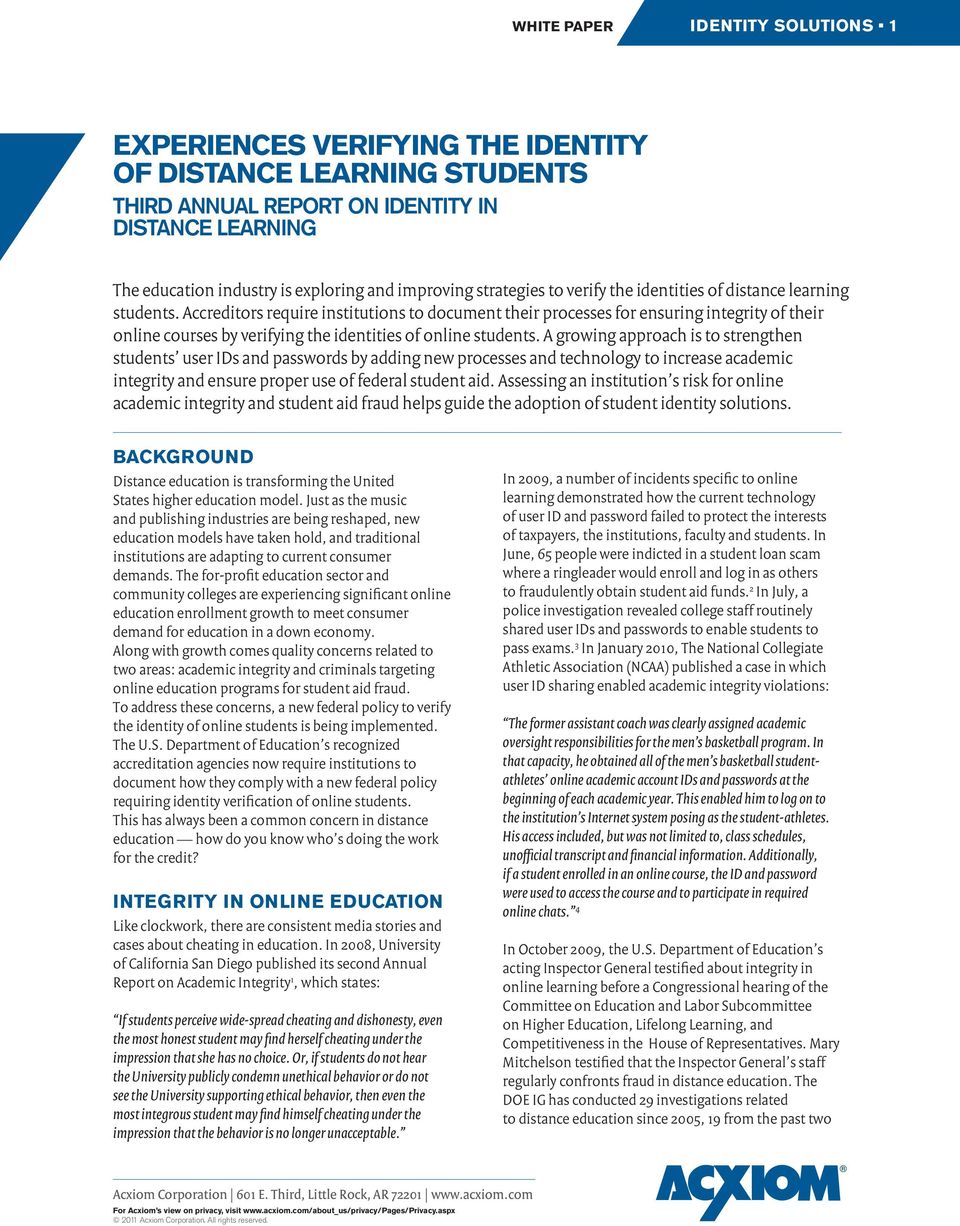
3 years and more since Mitchelson s testimony. She outlined four key issues in distance education that need to be addressed through policy changes: 5 student aid used elsewhere? student receive and therefore how much aid should be repaid? Congress has already mandated that improvements be made to increase the integrity of online higher education. Some faculty who teach distance education courses agree with Congress. In an August 2009 faculty survey by researchers at Kaplan University 6, instructors were asked for their opinions about the need to improve methods of student identity verification. When asked about importance, more than 92 percent felt confirming identity was important, very important or urgent. Below are responses to the question In my estimation, the need for improved methods of student identity verification is Also from the Kaplan study, faculty feel improving identity in distance education improves the reputation and credibility behind their institutions degree proven by their response to this question: The ability to confirm student identity in my institution s programs impacts its reputation in the marketplace and the quality of its graduates: Very Not Very Important Important Urgent Important % 39.70% 11.20% 8.90% In my estimation, the need for improved methods of student identity verification is: 11.20% 8.90% Strongly Strongly % 21.80% 19.70% 1.00% 4.10% The ability to confirm student identityin my institution s programs impacts its reputation in the marketplace and the quality of its graduates % 11.00% 4.10% 21.80% 43.40% Dr. Barbara Beno, President of the Accrediting Commission for Community and Junior Colleges, is a leader in the higher education accreditation field. She weighed in on the credibility of distance education when she posted this comment in response to a student aid fraud case documented in The Chronicle of Higher Education: In addition to the financial aid fraud described in this article, there is a significant issue of institutional integrity. If a fake student can sign up for credits so readily, can a fake student also earn credits easily? Arguing that there can be fraudulent practices in large lecture courses, and that distance education should not be required to institute more security than is presently required, is not wise if the higher education community wishes to encourage public confidence in online education. All higher education institutions need to work to ensure the quality and integrity of ALL of their forms of educational delivery systems. Without necessary oversight to assure integrity and quality, the greater access provided through distance education may result in a substandard reputation for the institutions and the students who complete on-line programs and courses % 40.20% Important Very Important Urgent Not Very Important HIGHER EDUCATION INDUSTRY REGULATIONS The higher education industry regulates itself via accreditation. Accreditation is a process of external quality review used by higher education to scrutinize colleges, universities, and educational programs for quality assurance and quality improvement, according to the Council for Higher Education Accreditation. 8
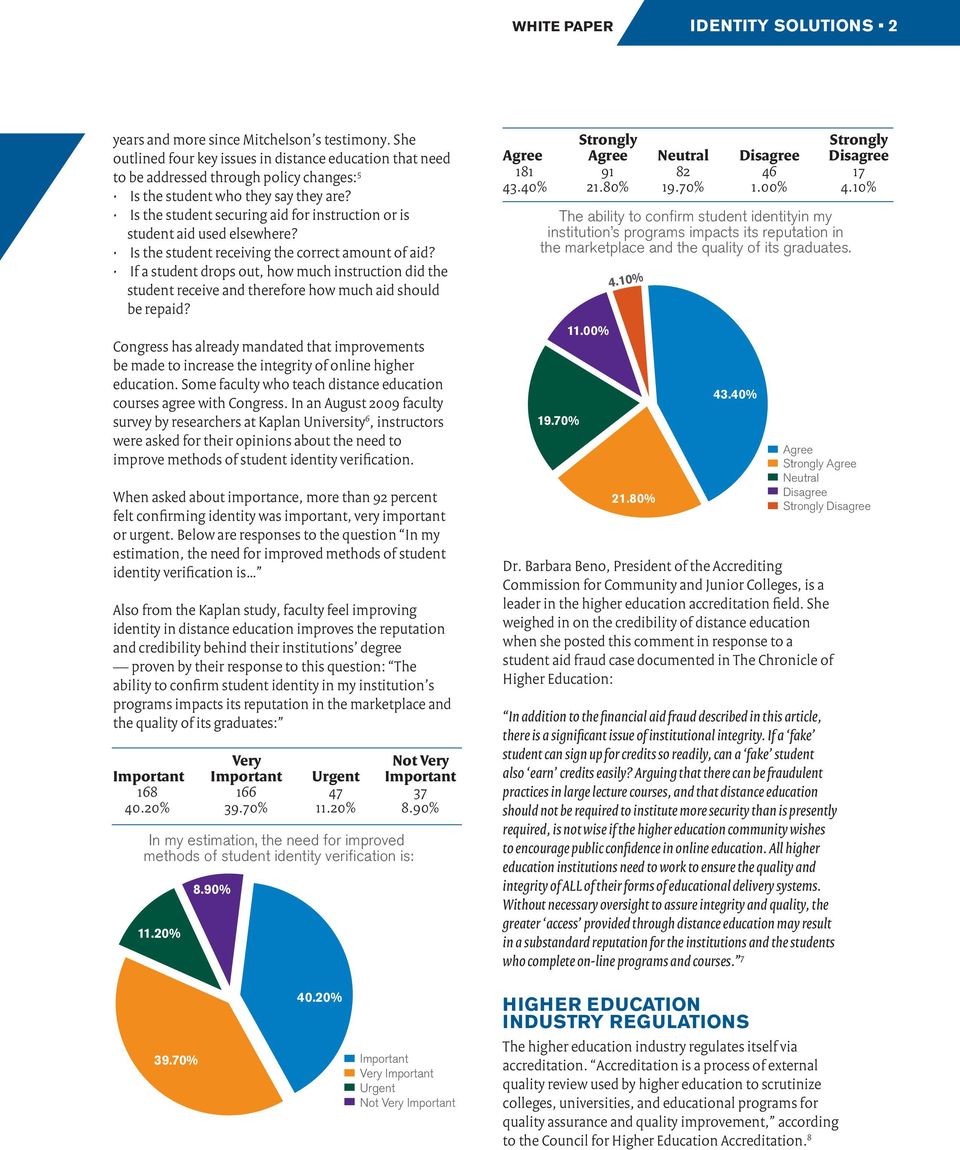
4 U.S. accreditation agencies now question how institutions with distance education programs verify the identity of distance learning students. Specifically, the Higher Education Opportunity Act (HEOA), which was signed August 14, 2008, states, Accreditors must, however, require institutions that offer distance education to establish that a student registered for a distance education course is the same student who completes and receives credit for it. 9 In the Joint Explanatory Statement of The Committee of Conference, Congress stated the current technology (as of mid-2008) of user IDs and passwords are sufficient, but that, As technology develops over time, the Committee anticipates that additional identification technologies will become more sophisticated, less expensive and more mainstream. 10 As of early 2010, many regional accreditors posed questions to accredited institutions regarding exams. When examinations are employed (paper, online, demonstrations of competency, etc.), they take place in circumstances that include firm student identification. The institution otherwise seeks to assure the integrity of student work. 11 selecting proctors, establishing student identity, assuring security of test instruments, administering the examinations, and assuring secure and prompt evaluation? take the examination, how is identification firmly established? How are the conditions of the examination (security, time limits, etc.) controlled? procedures to assure the integrity of student work? As Congress expected, since the HEOA was signed, the market has developed new technologies to meet the needs of concerned faculty. In , new technology solutions were adopted and are now generally available to improve user ID. These solutions are being used in addition to current academic integrity tools, such as plagiarism detection databases, secure web browsers, encrypted test question banks, and publicizing policies for cheating and ethical violations. The following table outlines categories of solutions currently being implemented. METHODOLOGY APPLICATIONS STUDENT ENROLLMENT OR REGISTRATION PROCESS ADMINISTRATIVE OR ACADEMIC STAFF EFFORTS PRICING MODEL AND ADDITIONAL INSTITUTION OR STUDENT COSTS LIMITATIONS CHALLENGE QUESTIONS WEB PROCTOR BIOMETRICS/SPECIAL HARDWARE IN PERSON PROCTORED EXAM Challenge questions based on third-party data. Any assessment may be protected with random settings for low- or high-value assessments. None required. Supports walk-up students. Determine when to pose identity questions. Determine ramifications of failure to authenticate. One-time distance learning staff involvement to set up process and program monitoring. Per transaction pricing, no additional costs. Primarily a U.S.-only solution. Audio and video conference proctoring via webcam. Screen monitoring service with live, certified proctors. Typically high-value assessments such as midterms and finals. Also applicable to placement exams or industry certifications. Acquire webcam upon enrollment. Student schedules exam with proctor via online scheduling system. Instruct students to schedule exams with proctor. One-time distance learning staff involvement to set up process and program monitoring. Per exam or hour. Purchase of a standard, sound-equipped webcam. Addressing paradigm shift with hesitant faculty. Unique typing style or fingerprint plus targeted recording of student in exam via webcam. High-value assessments, such as finals, capstone assessments, placements exams or industry certifications. Capture fingerprint, typing samples or digital pictures. Student and device registration for student s PC. May require student signature on consent form. Set up course assessment in software or integrate to learning software. Troubleshoot devices and user training, and monitor post-assessment video or audio. Manage device availability, inventory, assignment to students and break/fix process. Program monitoring to oversee usage. Startup and often per exam. Server software and database applications. Shipping costs for special device. May require specialized webcam or software. Extensive faculty and student training and startup effort. Windows required. Face to face with government or institution issued identification. Typically high-value assessments such as midterms and finals. Also applicable to placement exams or industry certifications. Proctor approval process. May require pre-registration of exam time, location and proctor. Proctor must ensure student complies with proctored exam policies and procedures. (No calculator, no notes, etc.) Staff to verify proctor quality, proctor facilities, time, exam shipping, etc. Per exam or hour. Student travel time, child care and time away from work. Proctor quality assurance process. Very high administrative costs; limited test center hours.
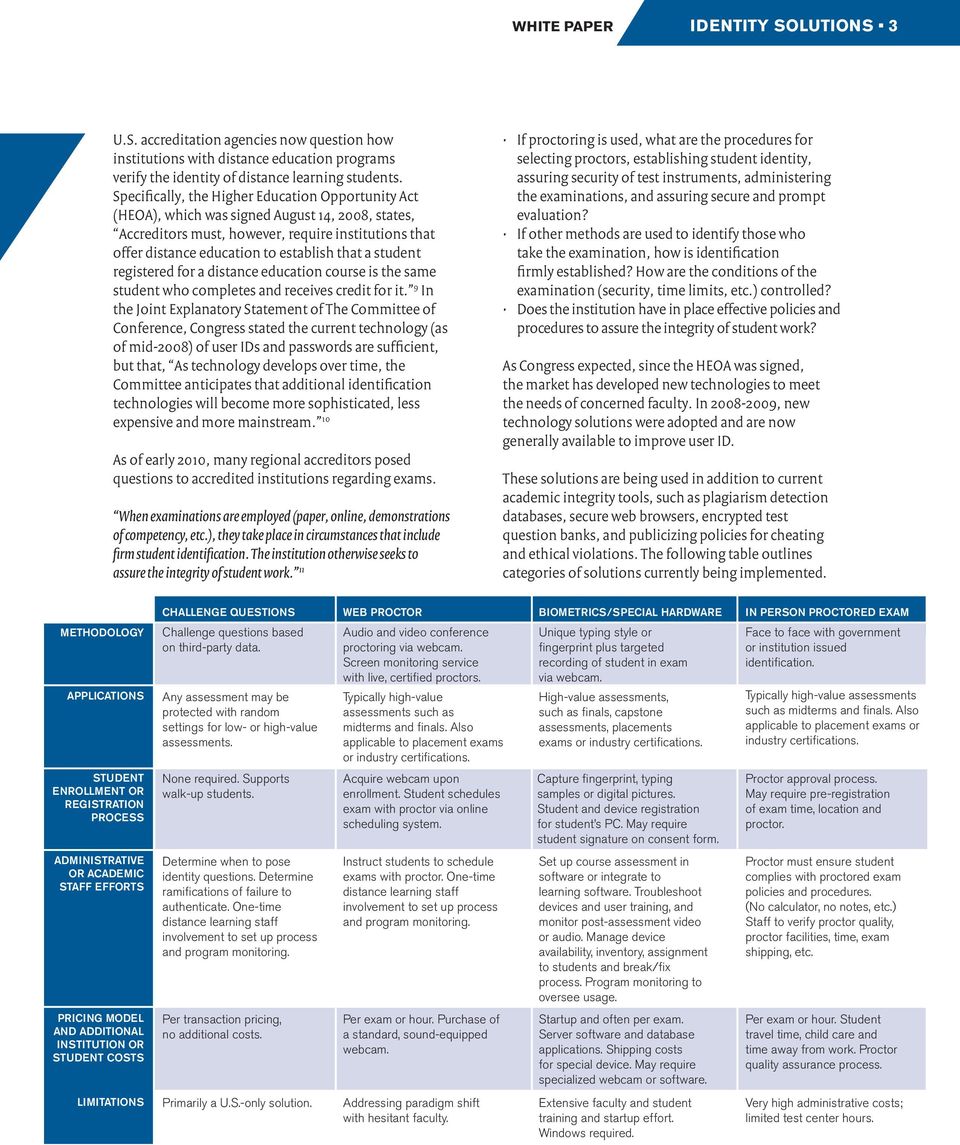
5 EXPERIENCES WITH CHALLENGE QUESTIONS During 2009, institutions began using the Acxiom Identity Verification and Authentication challenge questions to verify students identities. Feedback from students, faculty, IT administrators and distance education leaders was very positive. After thousands of identity verification transactions, Acxiom users reported no privacy concerns and no significant deployment challenges. One institution was fully operational in less than two hours. At Sullivan University in Louisville, 85 students responded to a survey about identity verification. Sullivan staff concluded challenge questions were best suited for their programs and students: STRONGLY AGREE AGREE NEUTRAL DISAGREE STRONGLY DISAGREE THIS IDENTITY VERIFICATION SYSTEM IS AN EFFECTIVE WAY TO VERIFY STUDENT IDENTITY THIS SYSTEM IS A GOOD ALTERNATIVE TO HAVING STUDENTS COME TO CAMPUS TO TAKE PROCTORED EXAMS USING THIS SYSTEM WOULD IMPROVE THE ACADEMIC INTEGRITY OF SULLIVAN S ONLINE PROGRAMS THIS SYSTEM GIVES PROPER RESPECT TO STUDENT PRIVACY 20% 32% 24% 18% 57% 45% 49% 61% 18% 20% 26% 20% 4% 2% 1% 0% 1% 1% 0% 0% This system is a good alternative to having students come to campus to take proctored exams 2%1% Using this system would improve the academic integrity of sullivan s online programs 1% 20% 26% 32% 24% 45% 49% This identity verification system is an effective way to verify student identity This system gives proper respect to student privacy 4% 1% 18% 20% 20% 18% 57% 61%

6 Given the choice, I would rather that Sullivan University use the following method to verify online student identity: Having students answer questions (i.e. the system that I just used) 91% Having students use a web cam so that a proctor can see them 2% Having students fingerprints or eyes scanned using a scanner 5% Having students signatures or eyes scanned using a recognition program 2% Having students come to campus to take exams (live proctor) 0% CASE STUDIES Below are three case studies from identity projects conducted by Acxiom in CASE 1: STUDENT AID FRAUD For this state system, Acxiom helped identify a group of out-of-state online students who appeared to be committing student aid fraud. Upon review of the students enrollment data, we learned that many students shared names, addresses and phone numbers. This alone was cause for alarm. Further comparison against the student records to the Acxiom Identity Verification and Authentication system showed these individuals had a high number of inaccurate Social Security numbers, dates of birth, addresses and phone numbers. We found that one student submitted a prison address and a second a nightclub as their residence. This inexpensive methodology to verify a student s identity supports not only the HEOA identity provisions but also Federal Trade Commission red flag programs to detect and prevent many forms of identity theft. The Department of Education s Inspector General testified to Congress about these types of scams on October 14, CASE 2: DEAD STUDENT TAKING EXAM In this case, an online school in the Southeast had an out-of-state 24-year-old student who could not receive challenge questions. Upon investigation, Acxiom learned the student was listed on the Social Security Death Index. Together with the institution, we immediately verified her name, address, phone, SSN and date of birth to ensure she was not committing Title IV student aid fraud. We learned she was the victim of identity theft. Her name was linked to a dead individual s SSN from the 1950s in Texas. The student services department proactively notified the student of the issue. CASE 3: MBA FAILS IDENTITY TEST This online Masters of Business Administration program posed four challenge questions to all students enrolled in a series of courses. The integration to their custom learning managment system (LMS) identified which students should receive challenge questions and then allowed them three minutes to respond. This student missed all four questions. Upon review, the institution notified faculty and administration to be aware of this student and to closely monitor his work in the future. RISKS DRIVE IDENTITY REQUIREMENTS When focusing on academic integrity, academic leaders should review assessment strategies in their online courses to help decide their approach to student identity. Acxiom customers concluded that courses with online assessments and little instructor interaction are the best candidates for frequent random student identity verification. Advanced-level courses with face-to-face instruction, threaded discussions, term papers or projects need less frequent identity verification. Just as assessment types differ across lower- and upperlevel undergraduate and graduate programs, identity verification technology and policies should match the risk associated with the assessment. Many large distance education institutions avoid online objective assessments in favor of subjective assessments, group projects, participation and other methods of assessing an individual s learning. With a new ability to verify the identity of an online test taker, instructional designers may now include objective assessments in their arsenal of assessment strategies where appropriate. When focusing on student aid fraud, in-person registration or secure and identity verified processes can deter fraudsters from entering a program. Additional data mining techniques can spot relationships between students who may be working together to commit fraud. Comparing information in the institutional student information reports (ISIRs) and a school s enrollment records as well as monitoring for red flags, such as invalid Social Security numbers and falsified directory information, can help detect and prevent student aid fraud in online programs.
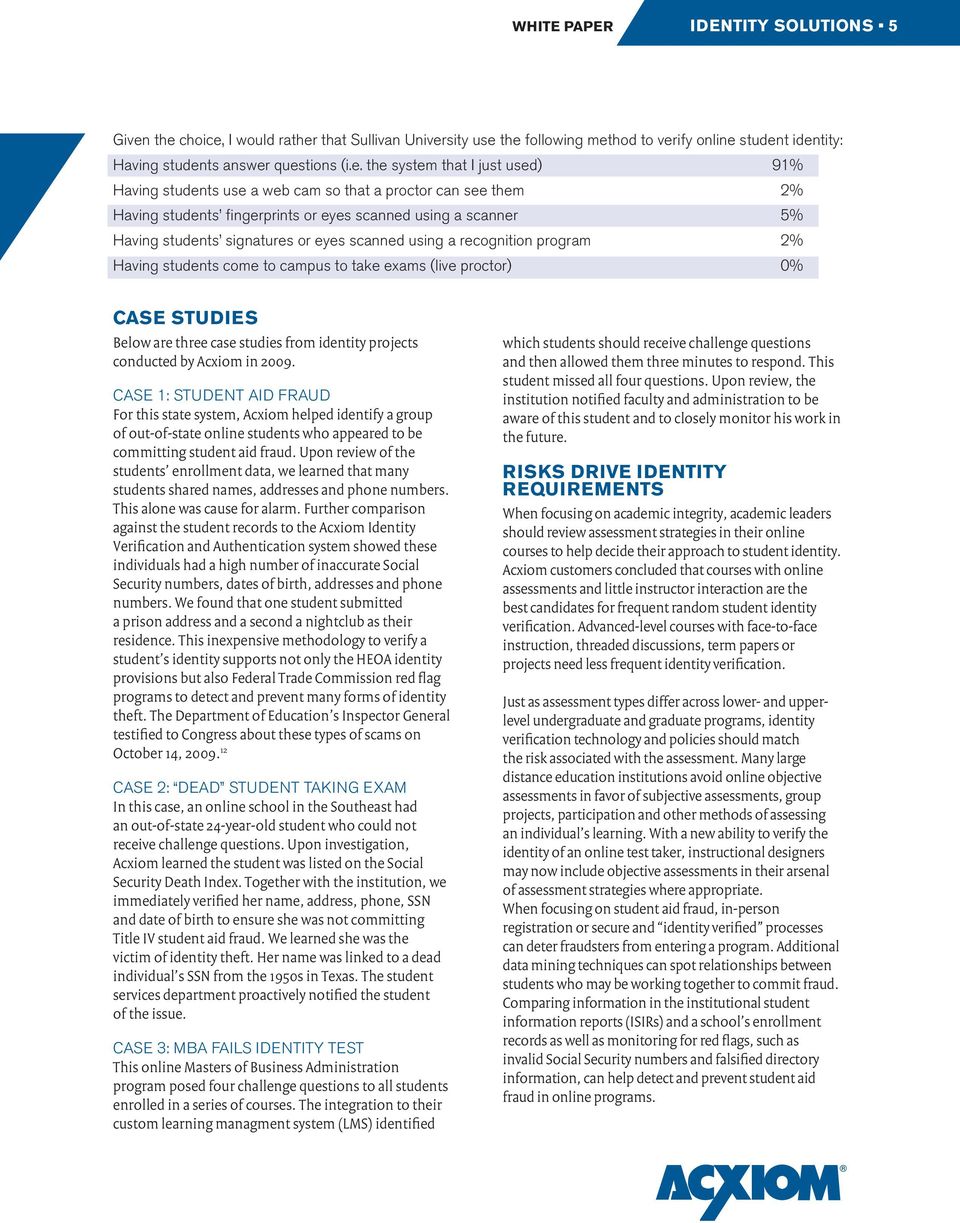
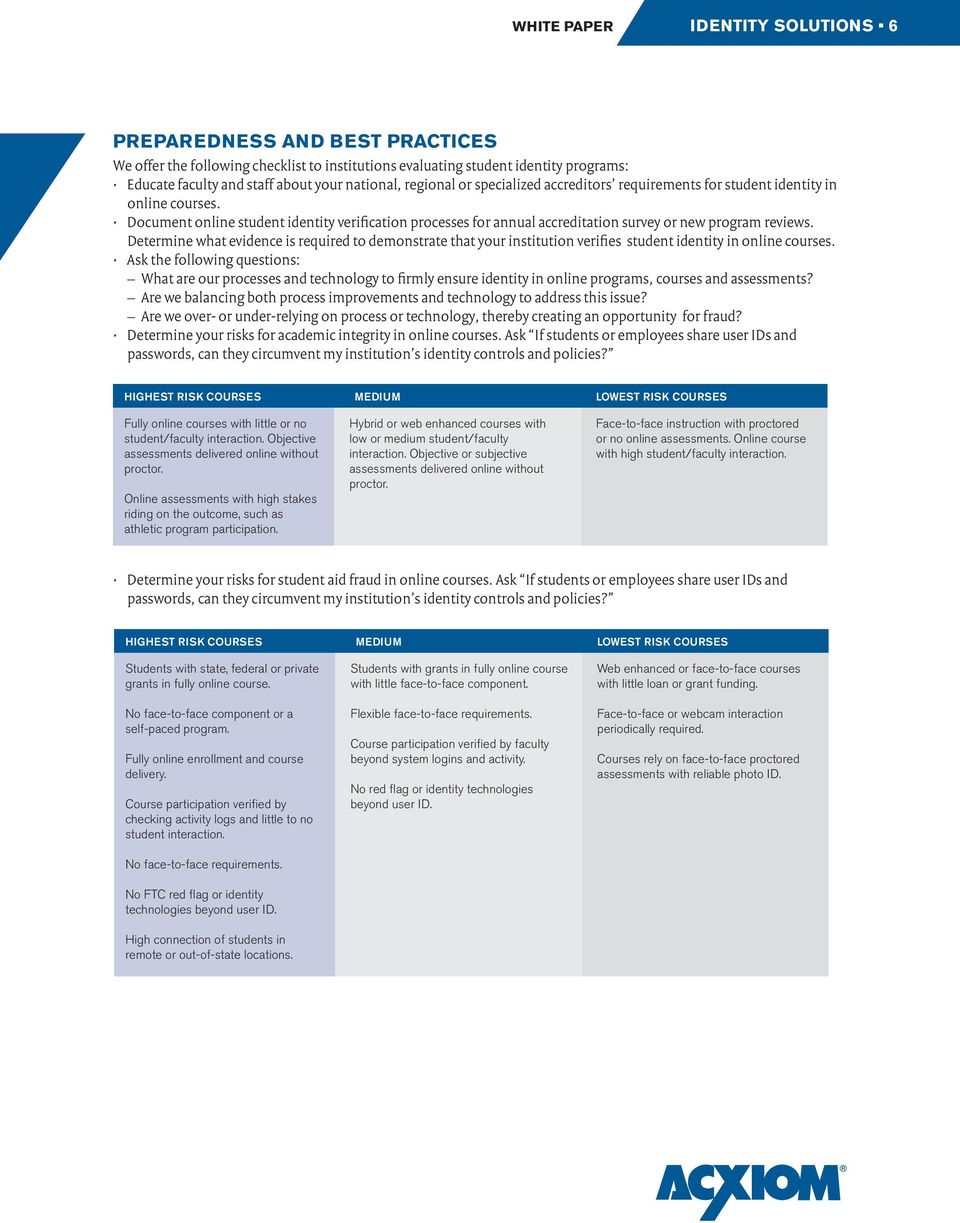
7 PREPAREDNESS AND BEST PRACTICES We offer the following checklist to institutions evaluating student identity programs: online courses. Determine what evidence is required to demonstrate that your institution verifies student identity in online courses. What are our processes and technology to firmly ensure identity in online programs, courses and assessments? Are we balancing both process improvements and technology to address this issue? Are we over- or under-relying on process or technology, thereby creating an opportunity for fraud? passwords, can they circumvent my institution s identity controls and policies? HIGHEST RISK COURSES Fully online courses with little or no student/faculty interaction. Objective assessments delivered online without proctor. Online assessments with high stakes riding on the outcome, such as athletic program participation. MEDIUM Hybrid or web enhanced courses with low or medium student/faculty interaction. Objective or subjective assessments delivered online without proctor. LOWEST RISK COURSES Face-to-face instruction with proctored or no online assessments. Online course with high student/faculty interaction. passwords, can they circumvent my institution s identity controls and policies? HIGHEST RISK COURSES Students with state, federal or private grants in fully online course. No face-to-face component or a self-paced program. Fully online enrollment and course delivery. Course participation verified by checking activity logs and little to no student interaction. No face-to-face requirements. No FTC red flag or identity technologies beyond user ID. High connection of students in remote or out-of-state locations. MEDIUM Students with grants in fully online course with little face-to-face component. Flexible face-to-face requirements. Course participation verified by faculty beyond system logins and activity. No red flag or identity technologies beyond user ID. LOWEST RISK COURSES Web enhanced or face-to-face courses with little loan or grant funding. Face-to-face or webcam interaction periodically required. Courses rely on face-to-face proctored assessments with reliable photo ID.
8 CONCLUSION Many industries that deliver online services have developed processes and deployed technology for ensuring integrity. Higher education is now increasing academic integrity and preventing student aid fraud in online education by implementing identity verification in distance learning programs. To adopt best practices to prevent misuse of financial aid funds and improve program quality, institutions should evaluate their online programs, assessment policies and student loan risk profile to match the right level of identity verification to ensure the student who enrolls is also the student who does the work and receives course credit. SUGGESTED READING of Online Users , Methods to Verify the Identity of Distance Learning Students website-resources/pdf/white_papers/ AC _DistanceLearningStudentsWP.pdf Academic Integrity in Distance Education wiche.edu/attachment_library/briefing_paper_ Feb_2008.pdf. Sloan Consortium For Electronically Offered Degree and Certificate Programs Pract_DEd.pdf Aid ensuring-student-eligibility-r.shtml ABOUT ACXIOM Acxiom provides marketing and risk mitigation consulting services and technology solutions in higher education. Acxiom is a participating member of Educause and WCET. IDENTITY AND PRIVACY policies. ADMISSION MARKETING students. comprehensive prospective student data enrollment marketing technologies. behaviors that reflect the most up-to-date status of U.S. households and life stages. contact strategy through predictive modeling. ALUMNI RELATIONS community development. IT SERVICES and server management services.

9 ACXIOM CORPORATION 601 E. Third, Little Rock, AR (1) University of San Diego Academic Integrity Annual Report (2) 65 indicted in student loan fraud against Rio Salado College (3) Gross academic fraud at UTB-TSC rocked Office of Distance Education (4) NCAA Georgia Southern University Public Infractions Report, January 20, Infractions+Report.pdf?MOD=AJPERES&CACHEID=f4ebf400411cfa44afe7ff122174eb00 (5) Ensuring Student Eligibility Requirements for Federal Aid (6) Student Identity Verification and the Higher Education Opportunity Act: A Faculty Perspective (7) Online Scheme Highlights Fears About Distance-Education Fraud Scheme-Highlights-Fears/63517/ (8) The Fundamentals Of Accreditation (9) ACE Analysis of Higher Education Act Reauthorization (10) Joint Explanatory Statement Of The Committee Of Conference Hearings/2008_07_29_E/Statement_of_Managers.pdf (11) Best Practices For Electronically Offered Degree and Certificate Program Best_Pract_DEd.pdf (12) Ensuring Student Eligibility Requirements for Federal Aid Acxiom Corporation. All rights reserved. Acxiom, InfoBase and Personicx are registered trademarks of Acxiom Corporation. Personicx Visionscape is a trademark of Acxiom Corporation. All other trademarks and service marks mentioned herein are property of their respective owners. AC /12

University Policy: Identity Theft Prevention Policy
 University Policy: Identity Theft Prevention Policy Policy Category: Ethics, Integrity and Legal Compliance Policies Subject: Detection, prevention and mitigation of identity theft Office Responsible for
Number: 56.300. Index
 Identity Theft Prevention Program Section: General Operations Title: Identity Theft Prevention Program Number: 56.300 Index POLICY.100 POLICY STATEMENT.110 POLICY RATIONALE.120 AUTHORITY.130 APPROVAL AND
Identity theft. A fraud committed or attempted using the identifying information of another person without authority.
 SUBJECT: Effective Date: Policy Number: Identity Theft Prevention 08-24-11 2-105.1 Supersedes: Page Of 2-105 1 8 Responsible Authority: Vice President and General Counsel DATE OF INITIAL ADOPTION AND EFFECTIVE
University Identity Theft and Detection Program (NEW) All Campuses and All Service Providers Subject to the Red Flags Rule
 NUMBER: BUSF 4.12 SECTION: SUBJECT: Finance and Planning University Identity Theft and Detection Program (NEW) DATE: March 3, 2011 Policy for: Procedure for: Authorized by: Issued by: All Campuses and
I. Purpose. Definition. a. Identity Theft - a fraud committed or attempted using the identifying information of another person without authority.
 Procedure 3.6: Rule (Identity Theft Prevention) Volume 3: Office of Business & Finance Managing Office: Office of Business & Finance Effective Date: December 2, 2014 I. Purpose In 2007, the Federal Trade
Identity Theft Prevention Policy
 Eastern Kentucky University Policy and Regulation Library 6.#.#P Volume 6, Volume Title: Financial Affairs Chapter #, Chapter Title Section #, Name: Identity Theft Prevention Policy Approval Authority:
IDENTITY THEFT DETECTION POLICY
 IDENTITY THEFT DETECTION POLICY Approved By: President s Cabinet Date of Last Revision: May 5, 2009 Responsible Office/Department: Business and Finance Policy Statement Grand Valley State University (GVSU)
II. F. Identity Theft Prevention
 II. F. Identity Theft Prevention Effective Date: May 3, 2012 Revises Previous Effective Date: N/A, New Policy I. POLICY: This Identity Theft Prevention Policy is adopted in compliance with the Federal
Oklahoma State University Policy and Procedures. Red Flags Rules and Identity Theft Prevention
 Oklahoma State University Policy and Procedures Rules and Identity Theft Prevention 3-0540 ADMINISTRATION & FINANCE July 2009 Introduction 1.01 Oklahoma State University developed this Identity Theft Prevention
Wake Forest University. Identity Theft Prevention Program. Effective May 1, 2009
 Wake Forest University Identity Theft Prevention Program Effective May 1, 2009 I. GENERAL It is the policy of Wake Forest University ( University ) to comply with the Federal Trade Commission's ( FTC )
Secure Testing Options for the University
 Secure Testing Options for the University Jason Smith Innovation in Learning Center April 12, 2011 Introduction The University of South Alabama currently offers 350 fully online courses annually. In fall
Traditional courses are taught primarily face to face.
 REACH Distance Learning Program Center Handbook Introduction Distance learning is an educational delivery method where students work on their own and communicate with faculty and other students through
CITY OF MARQUETTE, MICHIGAN CITY COMMISSION POLICY
 CITY OF MARQUETTE, MICHIGAN CITY COMMISSION POLICY Policy Number: 2008-02 Date Adopted: October 27, 2008 Department: Administrative SUBJECT: IDENTITY THEFT PREVENTION PROGRAM I. OBJECTIVE: A. To protect
Interagency Guidelines on Identity Theft Detection, Prevention, and Mitigation
 Guidelines to FTC Red Flag Rule(reformatted) Appendix A to Part 681 Interagency Guidelines on Identity Theft Detection, Prevention, and Mitigation Section 681.2 of this part requires each financial institution
What is FERPA? This act is enforced by the Family Policy Compliance Office, U.S. Department of Educational, Washington, D.C.
 What is FERPA? The Family Educational Rights and Privacy Act of 1974 (FERPA), as amended (also referred to as the Buckley Amendment), is a Federal law designed to protect the confidentiality of a student
POLICY TITLE: IDENTITY THEFT PROTECTION POLICY
 POLICY TITLE: IDENTITY THEFT PROTECTION POLICY I. Purpose The purpose of this policy is to establish an Identity Theft Prevention Program designed to detect, prevent and mitigate identity theft in connection
Spotting ID Theft Red Flags A Guide for FACTA Compliance. An IDology, Inc. Whitepaper
 Spotting ID Theft Red Flags A Guide for FACTA Compliance An IDology, Inc. Whitepaper With a November 1 st deadline looming for financial companies and creditors to comply with Sections 114 and 315 of the
NEVADA SYSTEM OF HIGHER EDUCATION PROCEDURES AND GUIDELINES MANUAL CHAPTER 13 IDENTITY THEFT PREVENTION PROGRAM (RED FLAG RULES)
 NEVADA SYSTEM OF HIGHER EDUCATION PROCEDURES AND GUIDELINES MANUAL CHAPTER 13 IDENTITY THEFT PREVENTION PROGRAM (RED FLAG RULES) Section 1. NSHE... 2 Section 2. UNR... 4 Section 3. WNC... 9 Chapter 13,
Texas A&M University Commerce. Identity Theft Prevention Program Effective beginning May 1, 2009
 Texas A&M University Commerce Identity Theft Prevention Program Effective beginning May 1, 2009 1 I. PROGRAM ADOPTION Texas A&M University - Commerce ( University ) developed this Identity Theft Prevention
Florida International University. Identity Theft Prevention Program. Effective beginning August 1, 2009
 Florida International University Identity Theft Prevention Program Effective beginning August 1, 2009 I. PROGRAM ADOPTION Florida International University developed this Identity Theft Prevention Program
Identity Theft Prevention Program
 Identity Theft Prevention Program DATE: 10/22/2015 VERSION 2015-1.0 Abstract Purpose of this document is to establish an Identity Theft Prevention Program designed to detect, prevent and mitigate identity
Distance Education Policies and Procedures
 Distance Education Policies and Procedures These policies and procedures are designed to ensure Clayton State University compliance with Federal Regulations concerning the definition of distance vs. correspondence
21.01.04.Z1.01 Guideline: Identity Theft Prevention Program
 Texas A&M Health Science Center Guidelines 21.01.04.Z1.01 Guideline: Identity Theft Prevention Program Approved October 7, 2009 Reviewed February 26, 2015 Supplements System Regulation 21.01.04 Reason
Questions and Answers About the Identity Theft Red Flag Requirements
 Questions and Answers About the Identity Theft Red Flag Requirements 1. Who is covered by the new Identity Theft Regulations? The Identity Theft Regulations consist of three different sets of requirements,
Red Flag Rules and Aging Services: What You Need to Know
 Red Flag Rules and Aging Services: What You Need to Know Late in 2007, six federal agencies, including the Federal Trade Commission ( FTC ), jointly issued final rules and accompanying guidelines to implement
University of Alaska. Identity Theft Prevention Program
 University of Alaska Identity Theft Prevention Program Effective beginning October 31, 2009 I. PROGRAM ADOPTION The University of Alaska ( University ) developed this Identity Theft Prevention Program
Village of Brockport Identity Theft Prevention Program Effective December 1, 2009 Confirmed 7/21/14
 Village of Brockport Identity Theft Prevention Program Effective December 1, 2009 Confirmed 7/21/14 I. PROGRAM ADOPTION The Village of Brockport ( Village ) developed this Identity Theft Prevention Program
Detecting, Preventing, and Mitigating Identity Theft
 THE RED FLAGS RULE Detecting, Preventing, and Mitigating Identity Theft Training for Ball State University s Identity Theft Protection Program What is the Red Flag Rule? Congress passed the Fair and Accurate
[FACILITY NAME] IDENTITY THEFT PREVENTION PROGRAM. Effective May 1, 2009
![[FACILITY NAME] IDENTITY THEFT PREVENTION PROGRAM. Effective May 1, 2009](/thumbs/29/13346234.jpg "[FACILITY NAME] IDENTITY THEFT PREVENTION PROGRAM. Effective May 1, 2009") [FACILITY NAME] IDENTITY THEFT PREVENTION PROGRAM Effective May 1, 2009 Because [FACILITY NAME] offers and maintains covered accounts, as defined by 16 C.F.R. Part 681 (the Regulations ), [FACILITY NAME]
[FACILITY NAME] IDENTITY THEFT PREVENTION PROGRAM Effective May 1, 2009 Because [FACILITY NAME] offers and maintains covered accounts, as defined by 16 C.F.R. Part 681 (the Regulations ), [FACILITY NAME]
Pacific University. Policy Governing. Identity Theft Prevention Program. Red Flag Guidelines. Approved June 10, 2009
 Pacific University Policy Governing Identity Theft Prevention Program Red Flag Guidelines Approved June 10, 2009 Program adoption Pacific University developed this identity Theft Prevention Program ( Program
University of St. Thomas. Identity Theft Prevention Program. (Red Flags Regulation Response)
 University of St. Thomas Identity Theft Prevention Program (Red Flags Regulation Response) Revised: January 10, 2013 Program Adoption and Administration The University of St. Thomas ( University ) established
Identity Theft Policy Created: June 10, 2009 Author: Financial Services and Information Technology Services Version: 1.0
 Identity Theft Policy Created: June 10, 2009 Author: Financial Services and Information Technology Services Version: 1.0 Scope: The risk to Loyola University Chicago and its faculty, staff and students
Bishop State Community College Distance Education Policy
 Bishop State Community College Distance Education Policy Purpose of Distance Education The goal of distance education at Bishop State Community College (BSCC or the College) is to provide students with
Deterring Identity Theft. The Federal Trade Commission estimates that as many as 9 million Americans have their identities stolen each year.
 Deterring Identity Theft The evolving threats of Identity Theft The Federal Trade Commission estimates that as many as 9 million Americans have their identities stolen each year. Identity theft complaints
RESPONSIBILITIES OF DIVISION I HEAD COACHES. Understanding rules compliance and monitoring
 RESPONSIBILITIES OF DIVISION I HEAD COACHES Understanding rules compliance and monitoring NCAA Division I Bylaw 11.1.1.1 states that a head coach is presumed to be responsible for the actions of all staff
Identity Theft and Data Protection
 Identity Theft and Data Protection As keepers of student, faculty, and staff information, we as an institution are obligated and regulated by state and federal laws to protect certain pieces of information.
Red Flag Rules Information and Training
 Red Flag Rules Information and Training What are Red Flag Rules? The Red Flag Rules: - Are enforced by the Federal Trade Commission (FTC), the federal bank regulatory agencies, and the National Credit
RADLEY ACURA RED FLAG IDENTITY THEFT PROTECTION PROGRAM and ADDRESS DISCREPANCY PROGRAM
 RADLEY ACURA RED FLAG IDENTITY THEFT PROTECTION PROGRAM and ADDRESS DISCREPANCY PROGRAM SUMMARY OF OUR PROGRAM AND PROCESSES This dealership is committed to protecting its customers and itself from identity
Administrative Procedure 5800 Prevention of Identity Theft in Student Financial Transactions
 Reference: Fair and Accurate Credit Transactions Act, ( Pub. L. 108-159) The purpose of the Identity Theft Prevention Program (ITPP) is to control reasonably foreseeable risks to students from identity
Ouachita Baptist University. Identity Theft Policy and Program
 Ouachita Baptist University Identity Theft Policy and Program Under the Federal Trade Commission s Red Flags Rule, Ouachita Baptist University is required to establish an Identity Theft Prevention Program
Identification of Red Flags, Detecting Red Flags, and Preventing and Mitigating Identity Theft
 George Mason University Identity Theft Prevention Program - Procedures Revised September 30, 2012 Identification of, ing, and Preventing and Mitigating Identity Theft IDENTIFICATION OF COVERED ACCOUNT
USING MULTIPLE ONLINE SECURITY MEASURES TO DELIVER SECURE COURSE EXAMS TO DISTANCE EDUCATION STUDENTS
 USING MULTIPLE ONLINE SECURITY MEASURES TO DELIVER SECURE COURSE EXAMS TO DISTANCE EDUCATION STUDENTS David Foster, Nancy Mattoon and Paul Walker (presenter) KRYTERION, Inc., United Kingdom Rick Shearer
Facts About FACTA Red Flag Identity Theft Prevention Program
 FACTA Red Flag Identity Theft Prevention Program FACTA Red Flag Policy Program, page 1 of 6 Contents Overview 3 Definition of Terms 3 Covered Accounts..3 List of Red Flags 3 Suspicious Documents...4 Suspicious
The University of Texas of the Permian Basin Distance Education Policy
 The University of Texas of the Permian Basin Distance Education Policy 1. UTPB Mission Statement The programs and courses offered via distance education are consistent with the role and mission of the
POLICY NO. 449 IDENTITY THEFT PREVENTION POLICY
 POLICY NO. 449 IDENTITY THEFT PREVENTION POLICY I. POLICY SUMMARY It shall be the policy of Polk County Rural Public Power District (PCRPPD) to take all reasonable steps to identify, detect, and prevent
identity TheFT PREVENTION Programs and Response
 IDENTITY THEFT PREVENTION PROGRAM This program is launched in response to the Federal Trade Commission Red Flag Rules and Address Discrepancy Rules in conjunction with the Fair and Accurate Credit Transaction