
Moving to reliable next-day switching
|
|
|
- Beverley Ross
- 10 years ago
- Views:
Transcription

1 Moving to reliable next-day switching Consultation - supplementary appendices Contact: Andrew Wallace Publication date: 16 June 2014 Team: Smarter Markets Response deadline: 11 August 2014 Tel: [email protected] Overview: We want consumers to be able to reliably switch supplier the next day. We believe that this should be achieved by replacing the existing network-run gas and electricity switching services with a new centralised switching service, run by Data and Communications Company (DCC). We want consumers to benefit from these new arrangements from 2018 at the latest. Our proposals will require a major industry change programme. We are exploring how best to implement these changes.
2 Context The government wants all consumers to have smart meters by the end of the decade. We want to use the opportunities provided by smart metering to make the switching process faster and more reliable for consumers, open up opportunities for time-ofuse tariffs and demand side response, and improve consumer protection (especially for vulnerable consumers), as we move to a more sustainable economy. Our work on switching builds on the Retail Market Review (RMR) reforms to make the market simpler, clearer and fairer for consumers and increase engagement. It also supports our March 2014 State of the Market assessment which found that competition, including the switching process, is not working as well as it could for households and small businesses. This consultation supports the commitment we made in our Forward Work Programme 2014/5 to make changes to existing market arrangements to deliver a faster, more reliable change of supplier process. Associated documents Promoting smarter energy markets: a work programme. Ofgem, 31 July Summary of findings of Change of Supplier Expert Group (COSEG). Ofgem, 3 December Change of Supplier update. Ofgem, 3 December Ofgem Consumer First Panel - Research to inform Ofgem s review of the change of supplier process. Ipsos MORI, 9 August 2013, published by Ofgem on 3 December Non-domestic consumers and the Change of Supplier process - Qualitative research findings. Collaborate research, September 2013, published by Ofgem on 3 December Statutory consultation on licence modifications to enforce three week switching and prevent erroneous transfers. Ofgem, 9 April rroneoustransfers.pdf

3 Contents Appendix 2 Change of supplier process 4 Appendix 3 Detailed analysis of reform options 6 High level approach 6 Supply point registration services 6 Objections (transfer blocking) 11 Confirmation window 14 Supporting information 18 Appendix 4 Detailed approach and methodology 21 Approach 21 Methodology 26 Annex 34 Appendix 5 Detailed results 45 Base case results 45 Sensitivity analysis results 51 Scenario analysis results 60 Annex 62 Appendix 6: Switching experience in other markets 73 Introduction 73 Switching timescales 73 Erroneous transfers 74 Cooling off arrangements 74 Consumer information campaigns and switching rates 75

4 Appendix 2 Change of supplier process 1.1. The table below sets out a description of the change of supplier process and comparison of the main differences between the gas and electricity switching arrangements. It supplements the description of the process provided in Chapter 2. Process Description Electricity Gas Consumer acquisition and cooling off arrangements Registration Objections Consumers enter into contracts with suppliers through a range of engagement channels (eg TPIs and direct contact). Domestic customers have a 14 day cooling off period. Each network company is required by its licence to maintain a register of supply points connected to its network. This register includes an address and unique reference number for each supply point as well as the identity of the supplier responsible for it. Each network company is also required make sure that administrative arrangements are in place to facilitate the change of supply process The new supplier will send a request to the network to ask to take over responsibility for the supply point on a set date The network will send a message to the current supplier to inform it of the proposed switch. The Similar processes for gas and electricity for consumers to enter into contracts and for suppliers to process these and any subsequent cancelations. Each DNO runs its own registration system. Nearly all take services from a single provider. Rules defining a common change of supplier process across all DNOs are set out in an industry code (the MRA). A transfer can be requested for the next day (although process complexity means that this does not happen in practice). There is a 5 day objection period followed by a 5 day window within which an objection can be Large gas transporters have an Agent (Xoserve) that provides services on their behalf. Industry is developing changes under Project Nexus that would see Xoserve also provide services for Independent Gas Transporters (igts). The change of supplier rules are set out in the UNC for large gas transporters and the IGT UNC for IGTs. The minimum period for a transfer is 15 working days (around three weeks). This will reduce to 14 calendar days by the end of There is a flexible window within which transfers can be objected to by the
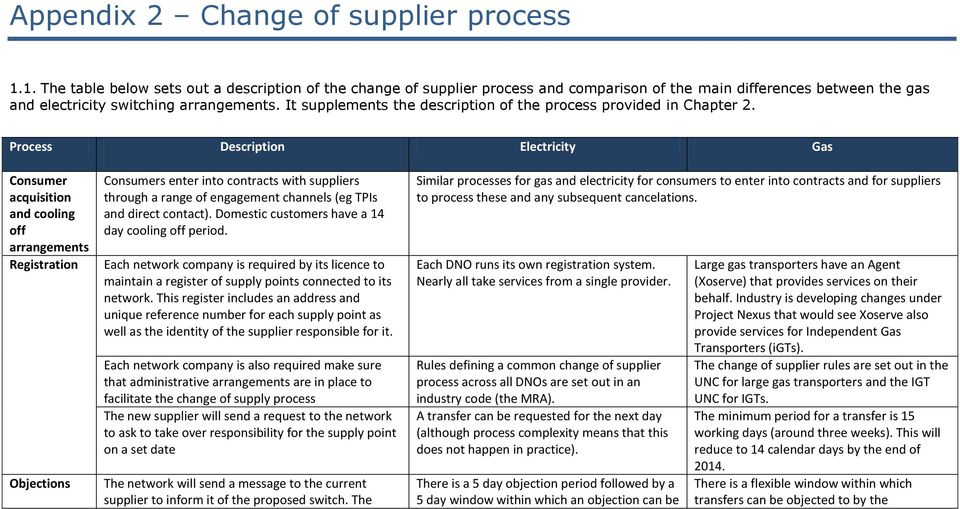
5 Metering current supplier may block the transfer if it has grounds to do so under the terms of its licence Where an objection is not received, or is withdrawn, the transfer will proceed on the date requested and the supply point register will be updated to show that the new supplier is now responsible for that supply point. The new supplier will obtain information about the metering arrangements at the supply point. It will also try to take a meter read (or if this is not possible, this is estimated). This meter read is used by both the new and outgoing supplier for customer billing as well as the allocation of settlement and network charges for the supply point withdrawn. The electricity objection withdrawal window will be reduced to 1 working day by the end of 2014 The switch can take place during the objection window. The DNO does not hold metering data. The new supplier must appoint metering agents who will exchange metering and consumption data with the old supplier s agents to enable opening and closing meter reads to be processed or an estimate to be generated. incumbent supplier of between 2 and 7 working days. 1 There is a minimum 7 working day period after the objection window has closed before a switch can become effective. This period will reduce to 2 working days by end Gas transporters hold a central record of all installed meters and consumption history at supply points. The gas transporter will validate the opening and closing meter reads provided by the new supplier or will generate an estimated read if the new supplier does not provide one. 1 This flexibility has been introduced to allow a switch to occur within three weeks (after any cooling off period) and varies depending on the number of non-working days (eg weekends and public holidays) that occur over that period).

6 Moving to reliable next-day switching Appendix 3 Detailed analysis of reform options Summary: This appendix describes the parts of the switching process where we have identified reforms that can make a positive difference for both consumers and the market. Question 1: Do you agree that we have accurately identified and assessed the main reforms that could improve the switching process? High level approach 1.1. Through extensive work with stakeholders we have identified a range of potential reforms to the specific parts of the switching process. Many of these are radical proposals that would have significant and transformative impacts on how consumers and participants experience the retail energy market. Figure 1 below summarises the options examined. Figure 1: Summary of reform options Reform Area Reform Options Supply point registration services Objections (transfer blocking) Confirmation Window (gas only) Option 1: Centralise registration services Option 1: Reduce period of time allowed to block transfers Option 1: Close objection window at 5pm two days before switch Option 2: Enhance existing registration services Option 2: Maintain a central register of objection status Option 2: Close objection window at 5pm on day the before switch Central Metering Database (electricity only) Option 1: Database holding data for traditional and/or AMR meters 1.2. Our assessment of the electricity central metering database reform proposal is described in Chapter 4. We assess the remaining reform areas in the section below. This assessment includes the Net Present Value (NPV) of implementing each option and operating it to As described in Chapter 2, we have not attempted to quantify the wider impacts on competition and consumers. Supply point registration services 2 Further detail on our approach to quantifying the impact of our reform options is set out in Appendix 4. 6

7 Moving to reliable next-day switching Current arrangements: Design 1.3. Registration systems sit at the heart of switching. These systems define how long switching takes and hold the key data that suppliers rely on Each gas and electricity network operator is required to maintain an accurate register for the supply points connected to its network. They facilitate competition by providing services to allow responsibility for supply points to switch between suppliers. The register is the definitive record of which supplier is responsible for each supply point There are around 21 million gas supply points and 31 million electricity supply points on these registers. The supply point register must include accurate address data, a unique reference number for each supply point and a record of which party is and has been responsible for the supply of gas or electricity to that supply point. Information from the register is also used to calculate the network and settlement charges attributable to the responsible supplier The gas and electricity markets operate separate meter point registers and switching services. In the electricity market, Distribution Network Operators (DNOs) each operate separate registers but do so in accordance with a common industry code (the Master Registration Agreement). 4 In the gas market, Xoserve provides a single service on behalf of the Gas Distribution Networks (GDNs). Work to extend the scope of Xoserve s role to cover Independent Gas Transporter (IGT) networks is also underway To facilitate competition, suppliers (and some other industry parties) have online access to the register. 5 This allows parties to check the details of the supply point to make sure that they have correctly identified the consumer to transfer and have checked the characteristics of the supply point. Current arrangements: Impacts 1.8. Switching services have generally proven to be reliable and, as noted in Chapter 2, these have facilitated over 8 million transfers each year over the last decade although this has dropped in recent years to around 5.5 million transfers. 3 Gas shippers contract with gas transporters for services by being parties to the Network Codes. Gas shippers then provide service to suppliers. Although the role of a gas shipper is a separate licensable activity, in nearly all cases the shipper and supplier will be the same company. 4 The MRA defines the common data to be used by suppliers and DNOs and how it will be exchanged. By defining data flows and using a common data transfer network, suppliers can uses the same systems and processes for dealing with each DNO. The registration systems in electricity can be thought of as a common system even though each DNO has their own registration system. 5 In electricity, this service is referred to as ECOES. In gas, Xoserve operate the Data Enquiry service. These services offer web based tools designed to be used by authorised users to access certain data relating to a supply point. Suppliers can use this data to check the information they have about a supply point before starting the switching process. 7
8 Moving to reliable next-day switching However, there are a number of concerns that constrain the switching process and can lead to poor outcomes for consumers. These are: While they have been modified on a regular basis, the core design of both the gas and electricity registration systems and switching services date back to the opening of competition in the mid-1990s. The systems are based on overnight batch processing which limits switching speed. For example, where a new supplier sends a message to the switching service to request a switch, it will be processed and is not required to be sent to the current supplier earlier than the start of the next day. There are a number of sequential steps that are required to complete a switch. The time allowed in industry codes to process these data flows and move through these steps will define how long the process takes. The basic requirements for gas and electricity registration systems are similar but they have been developed separately. Suppliers that operate in both markets must therefore maintain separate systems and processes to deal with two different ways of working. This can add costs, lead to delays and increase confusion for dual fuel consumers. The gas and electricity markets also have separate communication interfaces and data definitions. Parties have expressed concerns that the core data held on the supply point register, in particular in relation to addresses, can in some instances be poor and that this leads to transfer delays, erroneous transfers and abandonment of some attempts to transfer When thinking about how the switching process could be improved, a few participants in our consumer research suggested that it should be more standardised and that there should be smarter data-sharing between industry participants (and potentially also consumers and TPIs). This would improve the speed and reliability of the switching process. Reform options Option 1: Centralising registration Centralising registration would place the data for gas and electricity supply points on a single central system. This system should be capable of supporting faster switching. The key features of this option are: Near real-time processing and sending of messages. Aligning gas and electricity switching processes, data flows and governance. Storing relevant data centrally, for example to remove the dependence on sequential data flows between metering service providers. Supporting industry arrangements to update the smart meter with the new supplier s security credentials on change of supply. 8

9 Moving to reliable next-day switching The approach we are proposing would require network companies to be released from their licence obligation to provide registration services. An obligation would be placed on the DCC to procure a service that would meet the requirements to be set out in its licence and in the Smart Energy Code (SEC). A central registration system would offer suppliers a single gateway to manage gas and electricity switches Network companies would continue to use the information on the central register to support their responsibilities for network charging and management of the creation and removal of supply points. The central registration system would provide information about when a switch had taken place and who the new supplier was We anticipate that the new system would operate through the DCC s gateway and self-service portal. This will allow suppliers and other users the option of connecting their systems directly to the new registration systems. The system would be able to support queries in advance of a switch so that the supplier can check address and metering information. Messages sent by the industry would be capable of being dealt with straight away rather than relying on overnight batch processing To support our lead proposal of next-day switching we would expect that suppliers would be able to notify a switch to the registration system up to 5pm for the start date to be scheduled the next day, taking place at midnight for electricity and at 6am 6 for gas. Option 2: Adapting existing systems Under this option, existing network service providers would upgrade the way in which they process the data flows for the switching process. Our analysis suggests that fast switching would require the near real-time processing of messages between suppliers and the switching service This would require network companies to make changes to their systems to support service requirements that they do not directly benefit from. It would not achieve the benefits for suppliers of having common systems and processes to interface with the registration systems. Potential impact of reform options By introducing near real-time processing of data flows, both of our reform proposals can support next-day switching We consider that a new centralised registration service can offer a series of additional benefits over upgrading existing systems. These are set out below: Common systems and processes for gas and electricity 6 Changes are being made under the UNC to align the Gas Day with Europe. Currently the Gas Day starts at 6am but in the future it will be 5am (or 4am allowing for British Summer Time). 9

10 Moving to reliable next-day switching Around 80% of premises have a gas and electricity supply and there are over 17.5m consumers with a dual fuel contract. 7 Operating common systems and processes is likely to be more efficient for suppliers and can reduce cost and complexity and lead to a more aligned experience for dual fuel consumers. Common systems can increase efficiency in the overall cost of providing the services that support switching when compared to the existing separate arrangements for service provision between the gas and electricity markets. Improved reliability Address data in the gas and electricity industry is held in different formats. As noted above, concerns have been raised by market participants on its quality. The potential to hold gas and electricity data centrally, together with the Unique Property Reference Number (UPRN), could help improve address data consistency and quality. We would also expect to explore the potential for incentives on the provider of a new centralised registration service to support any obligations to maintain an accurate supply point register. Simplified governance A centralised service for gas and electricity switching offers the potential for a common change control process under the SEC. This could support the implementation of any new requirements across both fuels at the same time. There may also be benefits from identifying the costs of operating registration systems directly rather than this being an allowance as part of a network price control framework. Enhanced service provision A new centralised service offers the ability for industry to provide additional features and services, for example, monitoring of specific processes and industry party performance together with alerts and attribution of data errors. We anticipate that additional data requirements, necessary to support market operation, will need to be held centrally to support faster switching and that authorised users should be able to access it on demand. A new service would provide a one-stop real-time access to the data needed by the new supplier for them to manage the switch. During the development of the new arrangements a review should be undertaken on what information should be held centrally and who should be entitled to access and update that information. It will be important for all relevant stakeholders, including non-domestic consumers and metering service agents, to be involved in these discussions. The supporting information at the end of this appendix summarises the range of additional data items that stakeholders have so far suggested should be included in a centralised registration system Our analysis shows that registration services that include near real-time processing of data are likely to be more efficient if provided centrally. The estimated NPV cost for centralised registration operational from is 22m compared with 101m for upgrading existing systems. This is driven by the relative costs of 7 Information provided by the Big 6 suppliers as of January
11 Moving to reliable next-day switching upgrades to existing systems and the potential benefits from having aligned processes and governance and improved data quality Moving to a new common platform for registration services will be a challenging project. We have highlighted the implementation issues in the next chapter when we describe the impacts of our lead reform package. Objections (transfer blocking) Current arrangements: Design A consumer s supplier can block their switch to a new supplier. The circumstances in which the current supplier can object are described in licence conditions. 8 Broadly, there are three circumstances where an objection is permitted: Debt: For domestic consumers, the old supplier can block a switch when the consumer has not paid a written demand for payment that has been outstanding for more than 28 days. Contract: For non-domestic consumers, the current supplier can block the transfer where permitted by the terms of the contract. Typically, objections will be raised where there is a debt or the switch is scheduled to take place before a fixed term contract has ended. Prevent an unintended switch: For both domestic and non-domestic consumers the current supplier can object to prevent a transfer happening in error, for example where the gaining supplier has made a mistake or the consumer has changed their mind When a gaining supplier makes a request to switch a supply point, the registration service notifies the current supplier. The current supplier then has a number of days (the objection window ) to decide to object. In electricity, there is a five working day objection window within which the old supplier can object. In gas, the window varies between two and seven working days If the current supplier decides to object to a transfer, it sends a message to the registration system which then notifies the gaining supplier. The losing supplier must write to the consumer telling them that it has blocked the transfer, the reason for the objection and what the consumer needs to do remedy the situation. Current arrangements: Impacts The objection window and time allowed to withdraw objections adds a significant period of time to the switching process. For example, in electricity, the objections process takes more than a week. 8 Standard Licence Condition SLC 14 of the Gas and Electricity Supply Licences. The detailed rules that define how the objections process operates are set out in industry codes. 11

12 Moving to reliable next-day switching Around 7% of domestic and 25% of non-domestic gas transfers and 14% of electricity transfers are blocked by the losing supplier. However, all consumer switches are delayed by the objection timescales which are built into the switching process. As a result, the current objections process imposes a delay for all consumers when they switch Our consumer research identified that for medium and large business consumers and Third Party Intermediaries (TPIs) their main concerns on switching related to objections. These consumers felt that the current level of objections, and perceived misuse of the objections process, needed to be addressed as a priority. Dealing with these was often a source of frustration and required a high level of consumer (and in some cases TPI) involvement to resolve. There was a common perception amongst consumers and TPIs alike that many supplier objections are made without a valid reason. Those consumers who had experienced objections felt that they were the single greatest impediment to the reliability of the switching process. In several cases over the last few years, Ofgem has taken enforcement action against suppliers for misuse of the objections process. To tackle concerns on potential misuse of the objections process we are stepping up our monitoring of supplier performance. Reforms options Option 1: Shorten the objection window We have examined the potential to reduce the current gas and electricity objection windows to two working days or one working day. We have also looked at two options that would provide the supplier with a minimum of two hours to object. One option (the two hour flex option) would allow the current supplier two hours to object from when they were notified of the proposed switch. The other (the 5pm cut off option) would have a final cut off of 5pm for the current supplier to object for any loss notification received before 3pm on that day. An objection period of less than a day would be required to support next-day switching. Option 2: Pre-notify objections A more radical option would be to maintain a register of the objection status at each supply point. This would show if the old supplier would object on any given day if another supplier attempted to switch the consumer. The objections register would need to be accurately maintained by the current supplier and updated on a daily basis. Potential impact of reform options Both options enable next-day switching. For option 1, this would require an objection window of less than one day The consumer experience would be improved if the new supplier and the consumer could be informed at (or close to) the time they entered in to a contract that the losing supplier has objected to the switch. This would avoid the uncertainty 12

13 Moving to reliable next-day switching and delays that consumers experience with the current process where a consumer may not be informed for some days that their expected switch has been stopped Our assessment is that either option would be relatively straightforward to implement for a new centralised registration system or as an enhancement to existing systems. However, they are likely to have a significant impact on suppliers systems and how they manage debt and the termination of a contract To be able to object under options 1 and 2 we would expect that most suppliers would need to automate their systems rather than rely on manual processes to deal with objections. Our understanding is that, for most domestic suppliers, the objections process is automated Shortening the objection window is closer to the existing process and may be easier to engineer compared to pre-notification. Many suppliers systems are configured to recognise where there is a debt on the account and to trigger an objection. Notification, by the current supplier to the registration system to object, is typically sent on, or close to, the day that the loss notification is received For the pre-notification option, the new supplier will need to accurately maintain the status of the objection. In most cases a supplier would know if there is a debt or time remaining on a fixed period contract that would entitle them to set the objection status on the registration system. Where a supplier chooses to use the objections flag, it would update the registration system where there are changes to circumstances that would enable an objection to be made. The clarity provided by the pre-notification option on a supplier s objection activity may also assist our monitoring of compliance with the licence obligations on objections The estimated NPV costs for option 1 reforms which shorten the objections window, operational from , are: 10m for a two-day window; 97m for a 5pm cut off window; and 157m for a two hour window. We did not ask for data on a one-day objection window but have assumed that these costs would be similar to those of a two-day window The equivalent estimates for an instant objections register are: 97m if the register is provided by the DCC, and 106m if the register is added to existing gas and electricity registration systems As noted in Chapter 3, given the high cost of introducing an objections process that is compatible with our ambition for next-day switching, we are now consulting on bringing forward our review of the continued role of objections in the retail energy market. This review had originally been scheduled for These options do not support the use of objections to prevent unintended switches from taking place. The supply licence conditions permit suppliers to block transfers where the gaining supplier realises that a mistake has been made and requests the losing supplier to stop the transfer or (in the case of domestic 9 We expect to retain the requirement for the losing supplier to inform the customer that an objection had taken place, the grounds for the objection and the steps the customer will need to take to dispute or resolve such grounds. 13
14 Moving to reliable next-day switching consumers) the consumer asks the losing supplier to stop the transfer. A shorter objection window would reduce the opportunity to stop erroneous transfers. 10 However, a faster transfer process would allow these consumers to transfer back more quickly. We are also introducing new licence obligations specifically targeted at preventing erroneous transfers Any new arrangements to improve the change of supplier process should incorporate arrangements to return a consumer quickly and without fuss to their previous supplier. Such an arrangement is currently being discussed by Energy UK in relation to cooling off arrangements. The application of such an arrangement to returning erroneously transferred consumers should also be considered Industry processes include a notification (the change of tenancy flag) from the gaining supplier to the losing supplier if it believes that the consumer it is contracting with has recently moved into the premises and does not have a contract with the losing supplier. Non-domestic suppliers currently use the objection window to check if a change of tenancy has taken place and they do not have a right to object. This approach would not be possible with next-day transfers. 11 Confirmation window Current arrangements: Design The gas switching arrangements currently include a minimum of seven working days between the end of the objection window and the date when the switch becomes effective. Following our recent approval of modification UNC477, this period will reduce to two working days, with a target implementation date of November During the confirmation window Xoserve provides the gaining supplier with important information about the meter. From the end of 2014 this information will be provided by 8am, two working days prior to the switch having effect To support the gas balancing arrangements, the gas confirmation window is also used by Xoserve and shippers to exchange information. This means that the new and outgoing shipper will be aware of their requirements to contract for gas in advance of the gas day. A summary of the gas balancing arrangements is set out in the supporting information at the end of this appendix. 10 The causes of erroneous transfers are typically the gaining supplier picking the wrong reference number (MPxN) for the supply point or being provided with incorrect information by consumers, not processing a contract cancellation in time or mis-selling of a supply contract. Smart meters will offer suppliers techniques for checking where there is any ambiguity in address data (for example by asking the customer to provide a meter reading and checking it against an actual read via the DCC). We would also expect that a centralised registration system would offer solutions for more accurate address data. 11 Between September 2012 and September 2013, Xoserve indicated that 13.1% of transfers had a change of tenancy flag attached to it, of those, 83.2% were successful and went through as transfers. 12 The changes scheduled for the end of this year also require Xoserve to provide the supplier with basic meter information such as the meter make and model within two working days of a transfer request. This has been introduced to allow suppliers with complex customer portfolios to make an early transfer request and establish meter reading contracts in advance of the transfer date. 14

15 Moving to reliable next-day switching Current arrangements: Impacts The design of the two working day confirmation window, to be implemented at the end of this year, will continue to constrain switching speed. For example, if the objection window closed on a Monday then, with a confirmation window of two working days, the earliest that the consumer could be with their new supplier would be the Thursday. Reforms options Our reforms in this area relate to the gas market only. The original suite of reforms discussed at COSEG included the potential to reduce the confirmation window to two working days. As discussed above, this change has now been approved and is considered below as the base case for the switching process against which our other reform proposals have been compared Our two remaining reform proposals further shorten the confirmation window. Option 1: Confirmation window starts on the day before the switch The objection window would close no later than 5pm, the day before the switch became effective. After this point there would be certainty that a switch would take place and which supplier and shipper would be responsible for the supply point. Option 2: Confirmation window starts two days before the switch The objection window would close no later than 5pm 13, two days before the switch became effective. As with Option 1, it is only after this point that there would be certainty that the switch would take place. Potential impact of reform options Our two reform proposals can speed up the switching process. When combined with other reform proposals, most notably a move from overnight batch processing to near instant processing of messages, Option 1 can support next-day switching We have identified two key impacts of reducing the gas confirmation window. These relate to metering and gas balancing. These are discussed in more detail below. We then summarise the quantified costs of the reform options. Metering Xoserve provides the shipper with metering data during the switching process. This data is needed by the new supplier to process and validate a change of 13 The two-day confirmation window being introduced at the start of the year will require an objection to be made by the end of the third day before the transfer. 15

16 Moving to reliable next-day switching supplier read. Our reform options could lead to this metering information being provided to the shipper later in the switching process This may have different impacts depending on the type of metering: Smart meter customers. We anticipate that, subject to the reforms we have initiated to the smart change of supplier meter read process 14, there will be a negligible impact. The new supplier can obtain the information it needs by sending a request to the smart meter. The new supplier will however require a period of time prior to the switch taking place to send its security key to a smart meter. The supplier will also want to recalibrate the meter with its tariff information in advance of the switch. Under Option 1 the industry arrangements will need to facilitate this happening between the end of the objection window, ie at 5pm, and midnight when the switch will be effective in electricity and 6am when it will take place for gas. Traditional metered customers. Our expectation is that, for both reform options, the supplier would receive the information needed to allow it to process a customer reading and send it to Xoserve, within the required period of 10 working days after the transfer. However, the supplier may have less time to ask the consumer to obtain a meter read, which currently must be taken within five working days before and after the switch. This could lead to more estimated reads, complaints from consumers and subsequent effort by the consumer and both suppliers to agree a new meter read. One advantage of very fast switching would be the ability to ask the consumer for a meter read at the same time that they entered into a new contract which could improve billing accuracy. Later access to metering data may constrain a supplier s ability to use agents to take physical meter reads on change of supply (although we understand this is rare in the domestic market). In certain circumstances, our proposals may also lead to later identification of prepayment metering at a supply point where the consumer has not notified this when entering into a contract. This could potentially lead to delays in sending out new PPM cards to the consumer. AMR and DM customers. As with traditional metered customers we expect there to be limited impacts for the processing of customer own reads. Metering data should be provided in time to do this. However, where the supplier wants to appoint a meter reading agent to obtain a physical meter read, or where the consumer has more complex metering arrangements, the new supplier may want to access the metering data prior to the switch having effect. It is less likely that a supplier will offer very fast switching to these consumer groups so that it can access metering data sufficiently in advance to let it manage the smooth transfer of these supply points. 14 See Chapter 4 for further information. 16
17 Moving to reliable next-day switching Balancing Suppliers have indicated that they may be less likely to want to offer fast switching to large non-domestic consumers because of the more complex contractual arrangements, the potentially large volumes of gas involved and current practices that typically require consumers to provide contract termination notice to their old supplier. However, if there was very fast switching, the outgoing supplier could potentially be exposed to a balancing risk if it is not able to trade out of its position Our understanding is that incumbent suppliers can manage this risk through their contracts with consumers and many use the objections process to ensure that they receive termination notice from non-domestic consumers. Where termination notice is not received the incumbent supplier will block the switch. A supplier could also seek other contractual measures to manage their risk, for example charging early termination fees. Our initial view is that suppliers should be able to manage their balancing risk linked to a faster switching process at non-domestic sites Domestic suppliers are not able to use the objections process to require termination notice. A supplier could therefore be exposed to changes in their gas purchasing requirements, by consumers switching away, at short notice. During our discussions with stakeholders, some suppliers indicated that this was a low risk to them and one that could be managed through their normal planning and risk management strategies. 15 As described in Chapter 3, we would welcome further views from domestic suppliers on their ability to manage their balancing risk as the losing supplier under both Options 1 and Option 1 would end the objection window after the current nomination processes for Daily Metered (DM) and Non-Daily Metered (NDM) sites. As described in Chapter 3, we would welcome views on the implications of this for shippers and the market. In particular, given a shipper s ability to refine its position within and after the gas day, is it realistic to expect a losing shipper to be able to trade out of any potential imbalance position? 16 We would also welcome any further views on wholesale balancing market implications from reducing the confirmation window. 17 Overall cost and ease of implementation Options 1 and 2 require new ways of working to manage transactions with shippers. We have assessed the costs of these changes. We do not have data that allows us to identify differences in cost if these were delivered as part of a new centralised registration service or an enhancement to existing systems. For Option 1, the NPV cost is expected to be 17m. For Option 2 the costs would be 12m. 15 Shippers may be required to deal with short-term fluctuations in demand now to deal with intermittent gas flow requirements to support back up gas generation or when a gas fired power station trips off. 16 We would not expect this to be an issue under Option B as the objection window would close prior to the day before the gas day. 17 For example, we note that the OCM operates on a near 24-hour basis but traders typically stick to traditional business hours, so there may limited liquidity available in the market to trade out of imbalances in the latter half of the balancing day (ie, 6pm-6am). 17

18 Moving to reliable next-day switching These costs do not include any impacts on the balancing arrangements to account for any change to the requirements to exchange and process data or the impact on balancing risks. We are seeking further information on this as part of this consultation. Supporting information 1.2. This section sets out information to support this Appendix. It relates to new data items that could be held in central registration systems and a summary of the gas balancing arrangements. Potential new data items to be held in central systems 1.3. Our discussions with stakeholders have identified a number of additional data items that could be held centrally to improve the switching process. These could be held in registration services or in a separate electricity metering database, as appropriate. We have listed a number of these data items below. As part of any detailed work on the design of our longer-term reform proposals, we would expect there to be a full review of the range of information that should be held centrally and who should be entitled to access and update it. Data item Equipment type Customer appointed agents Meter location Last inspection date Function of meters Metering agent IDs Request Additional information on equipment type/functionality (either in a registration system or a central metering database). These include: An indicator on whether the meter is SMETS1/SMETS2/AMR/HHly An indicator on whether there is a data logger at the site (and what the MTDs of the data logger are) Other details e.g. gas regulators, comms hubs, gas mirrors etc. A flag to record customer appointed agents. Exceptions currently arise where the new supplier attempts to appoint agents, but the customer wishes to keep their own customer appointed agents. Better information on meter location. This was thought to be necessary to allow parties to complete informed risk assessments of any necessary works, prior to visiting the property. This was suggested to be needed to allow a new supplier to identify when a gas meter will next need to be inspected. Better information on if the meter is a related meter, submeter, associated meter or generation meter. A customer s metering arrangements can be complex and it was suggested that it will be important to ensure that adequate information on meter arrangements is available centrally. Holding the ID of the Meter Asset Providers (MAPs) was felt to be necessary to ensure that a definitive view is held centrally of the IDs of all relevant agents responsible for a particular metering point. 18

19 Moving to reliable next-day switching Gas balancing arrangements 1.4. The following is a high level summary of the key stages of the gas balancing arrangements and how they interact with the change of supplier process In the Non-Daily Metered (NDM) market, Xoserve provides information to shippers on their gas volumes requirements at 14:00 on the day ahead of the gas day. This sets out how much gas a shipper is expected to put on the system to match that off-taken by its suppliers customers. In the Daily Metered (DM) market, a shipper is required to nominate the amount of gas they expect to flow at the day-ahead stage by 13:00. Although they can do this up to one month in advance and refine this up to 13:00 on the day ahead. Shippers can also re-nominate through the day (from 18:00 day ahead to 03:59 on the day). Shippers nominate inputs at terminals by 16:00 day-ahead. After the day, NDM sites are allocated consumption by Xoserve, and this is combined with actual reads from DM sites and inputs to calculate imbalances. DM and NDM sites are cashed-out based on the difference between their actual (ie, allocated, not nominated) outputs (UDQO) and inputs (UDQI). Imbalance charges invoiced at M+23. This is based on outputs (ie consumption) which close out at D+5 and inputs (ie gas onto the system) closed out at M+15. This time is to allow for information to be received from data loggers and for allocations to be amended for instance at a terminal with multiple shippers. Where there is a difference between forecast imbalance (based on nominations) and actual imbalance (based on actual flows), shippers pay a charge on the difference. Cash-out charges incentivise shippers to end the day in balance, and shippers can adjust their positions by making changes to their flows or trading in the market. With limitations, shippers can adjust their imbalance positions retrospectively. The On-The-Day Commodity Market (OCM) operates on-theday, and so shippers cannot trade retrospectively at NBP. However as UDQI do not close out until M+15, shippers could in theory trade upstream, and then submit a revised allocation which would change the split of flows which came through that terminal. However, this would not affect overall flows into the system, just the apportionment of the actual physical flows between shippers. Imbalances are settled based on inputs and outputs at the close-out dates. For Large Supply Points (LSP) NDMs, there is a reconciliation process which 19

20 Moving to reliable next-day switching takes place when meter reads are submitted, and any reconciliation is spread over the time between meter reads. This adjusts the amount of gas attributed to the sites, and so shippers are paid (or charged) based on the difference between their allocated output and the reconciled output at the System Average Price (SAP) for each day of the reconciliation period. 20

21 Moving to reliable next-day switching Appendix 4 Detailed approach and methodology Summary: This appendix sets out the approach and methodology we have adopted to quantitatively assess the direct monetary impacts of our proposals to improve the Change of Supplier (CoS) process. Chapter 2 of the Consultation document qualitatively assesses the wider, indirect impacts of the proposals on consumers and competition in the energy market. Chapter 3 provides a summary of the qualitative and quantitative impacts of our proposed package of reforms. Appendix 2 provides an overall qualitative and quantitative assessment of each reform option. Question 1: Do you agree that our approach, methodology and assumptions are appropriate to identify the quantified impacts of our reforms? Question 2: Do you agree with our approach for approximating the direct costs for market participants of investing in upgrading existing registration systems to realtime processing and the ongoing costs of operating these systems? Question 3: Do you agree with our assumption that the direct costs for market participants of investing in systems to shorten the objections window and the ongoing cost of operating these systems would be similar for a two-day and a oneday objections window? Question 4: Do you agree with our assumption (see Annex Figure 3) that 10% of the counterfactual change of supplier electricity meter read costs provided by market participants should be attributed to AMR meters? Question 5: Do you agree with our assumption (see Annex Figure 2) on the reduced efficiency of operating a central electricity metering database for traditional and AMR meters as the numbers of traditional meters declines? Question 6: Do you think there is efficiency potential for shortening the objections window to one day combined with: (a) upgrading the existing gas and electricity registration systems to real-time processing; or (b) centralising registration with real-time processing? If so, what do you estimate this efficiency potential to be? Approach 1.1. We have undertaken extensive consumer research as outlined in Chapter 2 and analysed other markets (see Appendix 6) in order to identify the best outcome for consumers. This research has been used to identify potential reforms that could enable beneficial consumer outcomes. Identifying reform options to achieve the desired outcomes 1.2. Ofgem established a Change of Supplier Expert Group (COSEG) to seek support from stakeholders (suppliers, network companies, DECC, consumer groups, industry code administrators, metering agents and experts from other industries) in identifying and assessing potential reform options. 21
22 Moving to reliable next-day switching 1.3. In this appendix we describe our qualitative assessment of four areas for reform: Supply point registration services; Objections; Confirmation window (gas only); 1.4. Central Metering Database (electricity only). Figure 1 provides a summary of the reform options for each reform area and these are described in more detail in Appendix 3. Figure 1 - Reform options Reform Area Reform Options Confirmation Window (gas only) 5pm D-2 window 5pm D-1 window Objections 2 day window 1 day window 5pm cut off 2 hour flex window Objections register Registration Real-time processing (centralised registration) Real-time processing (adapting existing systems) Overnight batch processing (centralised registration) Central Metering Database (electricity only) Meter technical details (MTDs) and consumption history for traditional and AMR meters MTDs and consumption history for AMR meters 1.5. We combined the potential reform options into the most efficient reform packages that would deliver against our longer-term objective of a change of supplier process that is fast, reliable and cost-effective and which will facilitate competition and build consumer confidence. Figure 2 provides the list of reform packages that formed part of our assessment. For next-day and two-day switching we have considered sub-options that would either centralise registration services under the DCC ( new platform ) or enhance existing services ( old platform ) Reform package 3 (five-day into next-day) is the only reform package which envisages a staggered approach to implementing the CoS reforms. It considers 22
23 Moving to reliable next-day switching delivering five-day switching earlier to deliver a quick win for consumers (using existing registration services) while giving additional time to design and implement the changes required to deliver next-day switching with a centralised registration service. This delay in implementing the more stretching reforms would mean these reforms would become operational after the expected completion of the smart meter roll-out. Figure 2 - List of reform packages 18 Reform Package Registration Objections 1a 1b 2a 2b 3 4 Next Day New Platform Next Day Old Platform Two Day New Platform Two Day Old Platform Five Day Into Next Day Five Day Switching Real-time processing (centralised registration) Real-time processing (adapting existing systems) Real-time processing (centralised registration) Real-time processing (adapting existing systems) Retain overnight batch processing Real-time processing (centralised registration) Retain overnight batch processing Objections register Objections register Confirmation Window 5pm D-1 window 5pm D-1 window 1 day window 5pm D-1 window 1 day window 5pm D-1 window 2 day window Retain D-2 window Objections register 5pm D-1 window 2 day window Retain D-2 window Reform package evaluation 1.7. To assess each of the reform packages, we identified a set of evaluation criteria. These are described in Chapter 3. These are a slight refinement of the evaluation criteria that we developed with stakeholders at our COSEG meetings 1.8. Given the difficulties in quantifying some of the direct and wider impacts of the reforms, the assessment criteria are heavily oriented towards qualitative aspects. 18 As discussed in Chapter 4, we are consulting on including a central electricity metering database for traditional and/or AMR meters within our proposed reform package. 23
24 Moving to reliable next-day switching 1.9. To examine our last criteria on the estimated cost of the solution we have undertaken quantitative analysis. Our methodology is described below. Assessment against a counterfactual Our assessment of the switching reforms considers their impact against a counterfactual that holds other factors constant For our quantitative analysis the counterfactual is: Avoided capital expenditure, ie costs that would not be incurred over the modelling period if the reform options were to be implemented Operational expenditure that would be incurred in the absence of any reform The proposed counterfactual for our quantitative analysis incorporates the following events that are expected to take place before the start of, or during, the modelling period: Energy UK Faster Switching proposals are due to speed up the switching process to 17 days by end This implies: i. Shortening the confirmation window to D-2 19 ; ii. Introducing a new electricity registration withdrawal process; iii. Appointing electricity metering agents and having data exchanged more quickly (referred to as the 7WD agent requirements in Chapter 3); iv. Reducing the electricity objection resolution window from five to one working day. Smart meter roll-out will continue as planned and conclude by the end of ; The DCC will go live by the end of This is a necessary condition for the proposed policy options based on central registration; Project Nexus will be implemented by the end of This implies that the IGT registration services will be administered by Xoserve and therefore the costs of the change of supplier reforms would be incorporated within Xoserve s costs. 19 We did not seek quantitative evidence from stakeholders on the counterfactual costs of operating the confirmation window at D-2 as these costs were deemed to be of a small magnitude. 20 This has an implication on the suppliers costs attributable to traditional meters and therefore our modelling assumptions as explained in Figure 3 of the Annex to this appendix. 24
25 Moving to reliable next-day switching Gathering evidence We sought quantitative evidence from stakeholders to attach a monetary value to the potential benefits and costs of the reform options by issuing a Request For Information (RFI). We received 22 responses. Figure 3 provides a breakdown of responses by participants categories There are three key categories of stakeholders that will need to make changes to implement the CoS reforms. These are the energy suppliers, the network companies and the central service providers (e.g. DCC and code administrators) We have verified the data quality by conducting a preliminary analysis of the dataset. We then sought to clarify any inconsistencies with the relevant parties. Figure 3 - RFI stakeholder categories Market Category Market Sub-category Size category Energy Suppliers Big 6 energy suppliers Small energy suppliers >100k customers Small energy suppliers <100k and >795 customers Large Company Small Company Number of responses Network Companies Electricity DNOs Gas DNs Large Company 5 1 (on behalf of the GDNs) IDNOs Small 1 IGTs Company 1 Central Service Providers Those bodies that would provide a centralised service, e.g. DCC and industry code administrators Large Company 4 Approach to missing data and outliers In some cases data has not been provided. We have accounted for this in a number of ways: For large companies we replaced blank capex entries using data points submitted by the most similar company either in terms of size or processes (e.g. similar IT system) where a reasonable number of data points were available. 25
26 Moving to reliable next-day switching For small companies, the issue of missing data is more acute given the number of market participants and the relative lack of resources available to respond to the RFI comprehensively. In this instance, missing data is replaced by using non-weighted average capex and opex figures calculated from the relevant market sub-category of small companies In a specific instance, we sought additional information from a third party information provider to address the lack of cost data for small suppliers. This was in relation to centralised registration reform option costs Two reform options were identified after the RFI was sent out real-time processing in existing registration systems, and a one-day objections window. The quantified costs and benefits of this reform option have been estimated using the data gathered on other reform options within the reform areas of registration and objections respectively. Figure 3 of the Annex to this appendix details the assumptions made to estimate the costs and benefits of individual reform options. We would welcome views on our assumptions on the costs for market participants of upgrading existing registration systems to real-time processing, and shortening the objections window to one day. Methodology Methodology overview We have assessed the overall cost of each reform option. We have then used this information to put together the most efficient packages of reforms to meet different switching timescales based on centralising registration services or enhancing existing network-run services Any benefits of the reforms that have been quantified are direct cost-savings in capex and opex against the counterfactual, estimated using quantitative evidence gathered from stakeholders Throughout the assessment, we take into account the government guidelines for producing an Impact Assessment In the following paragraphs we discuss our methodology in more detail. Net present value calculation parameters We use the net present value (NPV) discounting technique to obtain the net benefit or cost of each reform option. This method applies a discount rate that is 21 mplete.pdf 26
27 Moving to reliable next-day switching used to convert all costs and benefits to present values, so that they can be compared with each other The parameters used in the calculation are as follows: The base year for the present value calculation is 2015; The discounting period is 15 years ( ); The discount rate applied is 3.5% (as per HM Treasury s Green Book guidance); Monetary values are in 2013 prices (we received responses to the RFI in November 2013) The reform packages considered have different capital and operational expenditure profiles which are detailed in Figure 1 of the Annex to this appendix. For example, for the proposed reform package (next-day switching with new platforms), it is assumed that investment takes place from Q Q and operating costs are incurred from Q Q The investment period has been assumed to begin late in We recognise that in reality, limited investment will take place in the early part of this period with most occurring during 2017 and The length of the investment period reflects the feedback from stakeholders on the time required to implement the reforms. The operating costs have been modelled until the end of 2030 so that we can assess the costs of each reform package over a modelling period of at least ten years, including reform package 3 (5 day into nextday switching). Capital expenditure Capex is a one off, fixed cost that is incurred by market participants in order to implement the new switching process We have made a number of assumptions on how capex is modelled. Capex is company-specific due to a number of factors such as existing IT system architecture and project implementation costs; Each company impacted by the reform will procure new IT systems or undertake any changes to existing assets in the most efficient manner. 22 Where year 0 is the present, the present value, at the middle of year 0, of a payment of 1 made at the middle of year n is given by: D n = 1 / (1 + r) n where r is the discount rate and D n is the discount factor. For example, a payment of 150 at the middle of year 5 with a discount rate of 3.5% has a present value at the middle of year 0 of: 150 x1/(1.035) 5 = 150 x =
28 Moving to reliable next-day switching As part of our methodology, we calculate the total capex profile for the industry for each reform option and apply the NPV discount We have taken a different approach between large and small companies for the following reasons: i. Company capex costs will vary by size of company in steps rather than in a linear manner. The data received from the RFI revealed that the ratio between cost and size for large companies tends to be much lower than for small companies as larger companies benefit from economies of scale; ii. We received a good level of response from large companies. The response from small companies has understandably been more limited. We therefore considered it appropriate to split our calculation between the two categories and take a simple average approach for the small companies We derive the industry total capex figure by summing the total capex costs for large and small companies, with: Total capex costs for large companies calculated by adding up the individual company capital expenditure costs; Total capex costs for small companies calculated by adding up the products of the average market sub category capex and the number of participants in each market sub category. Operational expenditure As part of our methodology, we calculate the total opex cost profile for each reform option scenario and apply the relevant NPV discount We have taken a different approach between large and small companies for the following reasons: We have chosen to take an accuracy weighted average (see accuracy framework below) for energy suppliers and electricity DNOs in the large companies size category. This is because we had several data points from respondents in these categories and the analysis of the opex RFI responses at a cost per customer level showed large ranges and inconsistencies in the data. Although we sought to better understand the information provided through follow up interviews with RFI respondents, we have not been able to fully account for variances between parties; As with capex, we received a reasonable amount of data from large companies. On the other hand, small companies participation has been, understandably, limited. This difference in data availability suggested the need to take a simple average approach for small companies. Furthermore, 28
29 Moving to reliable next-day switching opex data received for the reform options were similar for companies of different sizes within the small companies market category, suggesting a fixed element of the operational costs for smaller companies. We have therefore scaled up small company costs by the number of companies to take into account missing data, rather than the number of customers We derive the industry total opex figure by summing the total opex costs for large and small companies with: Total opex costs for large companies calculated by adding up the products of the accuracy weighted average cost per customer for each Market sub category and the number of customers for each market sub category (for energy suppliers and electricity DNOs) and the individual company operating expenditure costs for all other large companies; Total opex costs for small companies calculated by adding up the products of the average market sub category opex and the number of participants in each market sub category. For example the total cost for IDNOs is calculated as the average IDNO cost multiplied by the total number of IDNOs. Opex Accuracy Framework To ensure consistency between the responses received, we have created a weighted average opex per customer based on the accuracy of each data point. The accuracy framework is presented in Figure 4 below. Figure 4 Opex accuracy framework Accuracy Score High accuracy 5 High to medium accuracy 4 Medium accuracy 3 Medium to low accuracy 2 Low accuracy 1 Missing value 0 Description Data point only includes costs that are applicable to the reform option. A full explanation was provided with a high consideration for how the reform option will impact internal costs. Data point only includes costs that are applicable to the reform with an explanation of costs. Data point has some explanation of costs. There is scope for irrelevant costs items to have been included due to the lack of explanation. Data point has little explanation of costs or essential cost items have been excluded. It has required us to estimate some cost items within a data point for modelling. Data point has little to no explanation of costs and is likely to include costs not applicable to the reform option which we could not isolate. Where essential cost items have been excluded, it has required us to estimate cost items within a data point for modelling. No expenditure value given. 29
30 Moving to reliable next-day switching To calculate the weighted average based on accuracy, a cost per customer for each company is calculated (company cost divided by respective company customer numbers), and then weighted according to the appropriate accuracy score. Those data points that are assessed as more accurate are assigned a higher weight. Figure 5 Weighted average example Company 1 Company 2 Company 3 Company 4 Company 5 Company 6 Cost per customer Accuracy weighting Product The weighted average (summed products divided by the sum of the weights) in the example in Figure 5 above is therefore This is then multiplied by the total number of customers of Company 1 Company 6, to derive the opex costs for the market sub-category these companies belong to. Opex profile for traditional meters During the modelling period, the number of traditional energy meters will decline significantly. Therefore, the opex costs that could be directly attributed to traditional meters have been assumed to decline. This assumption has been informed by suppliers projected smart meter roll-out profile, as detailed in Figure 3 of the Annex to this appendix. 23 Efficiency potential A number of efficiency assumptions are applied when modelling expenditure which we expect to materialise over the modelling period. These are detailed in Figure 2 of the Annex to this appendix The efficiencies identified can be broadly split into two types. Firstly, an annual opex efficiency saving is expected to arise over time, regardless of reform, due to competitive industry pressure driving down operating costs. Secondly, there is potential for capex and opex efficiencies to be gained by implementing changes at the same time We received limited information on the efficiency potential of implementing changes at the same time for the different categories of market participants eport_smart_meters.pdf 30
31 Moving to reliable next-day switching Therefore we have only applied assumptions on this type of efficiency potential to a single combination of reform options for which we had clear supporting data from energy suppliers (an objections register and reform to the registration systems) We had some useful data from other individual parties on the efficiency potential of combining other reform options. In these cases, we applied these reported efficiencies to the costs for those individual parties which are used in the model. Sensitivity analysis We have used sensitivity analysis to assess the impact of uncertainty in the data inputs and assumptions made in the modelling. Our sensitivity analysis varies our modelling assumptions and inputs. Figure 4 of the Annex to this appendix provides an overview of the sensitivity tests we conducted and the areas are summarised below. Opex accuracy framework - as described in the methodology for calculating opex, opex values of energy suppliers and central bodies within the large companies market category are weighted according to an assessment of their relative accuracy. Some values may have been assessed as less accurate than others due to limited accompanying information from the data providers. These may have in fact been estimated precisely, and further supporting information could have provided confidence in their accuracy. Efficiency potentials - as described in Figure 2 of the Annex to this appendix, assumptions have been made on different types of efficiency potential. These assumptions are a source of uncertainty due to the complexity of the reform options and the length of the modelling period the assumptions are applied over. Industry data received - the quantitative evidence received from stakeholders on the monetary impacts of the change of supplier reform options was based on industry s high level estimates of the costs and benefits of new processes that have not yet been designed in detail. The realised costs and benefits may lie within a range either side of the estimates industry made. Missing data as described above, the RFI dataset was incomplete and this was particularly the case for small companies. The data received may not be sufficiently representative to calculate an accurate average impact of the reforms on companies within the market sub-categories of small companies. Scenario analysis We also analysed what the best and worst case scenario would be in terms of total costs for the industry of the change of supplier reforms. 31
32 Moving to reliable next-day switching The scenarios focus on uncertainty in the assumptions related to the quantified costs and benefits of building and operating the new industry systems in reform packages 1a, 2a and 3 as described in Figure The worst case scenario describes a set of events which are unlikely to occur. However, we have put this scenario together to take its impact on the base case results into consideration in our analysis The scenarios are defined as follows: i. Base Case: The base case scenario includes the benefits and costs of each reform package under the assumptions considered most likely to materialise (as detailed in Figures 1-3 of the Annex to this appendix); ii. Best Case Scenario: (a) The DCC is able to provide centralised registration services, building on to its existing systems and services; (b) Suppliers benefit from the highest efficiency of interacting with the DCC for the objections register and the centralised registration service at the same time; and (c) Opex accuracy weights are set higher for those who reported opex cost savings for manual processes through centralised registration than for those who did not. iii. Worst Case Scenario: (a) Detailed feasibility studies are undertaken which take longer than expected. In order to maintain the implementation timescales, Total Industry Capex costs are 20% higher than in the base case for those reforms requiring more radical change. These reforms are: objections register (within the DCC), central electricity metering database 24, and centralised registration; (b) Total Industry Opex costs are 20% higher than in the base case for the reforms described in (a) above as implementation to tight timescales leads to greater operational issues; 24 We are consulting on whether the metering database should be included in our proposed reform package and have therefore set out the costs of this reform option separately in the annex to Appendix 5 to help parties better understand the cost impacts. 32
33 Moving to reliable next-day switching (c) Annual opex efficiencies are lowered to 1% per annum as implementation to tight timescales lowers the potential for improvement in the operation of the new processes; (d) Opex accuracy weights are set higher for those who did not report opex cost savings for manual processes through centralised registration, than for those who did. 33
34 Annex Figure 1 Capital and operational expenditure profiles 25 Name Capex Opex Additional information Counterfactual Reform Package 1 (a/b) Next-Day Switching Q Q Q Q Q Q Q Q Capex is represented as avoided cost due to implementation of the reform options and is distributed according to the following profile over the period: 5.88%, 23.53%, 23.53%, 23.53%, 23.53% 27. Opex is represented as costs incurred in the absence of any reform. 25% of opex is modelled during the year 2018, 100% (before efficiency) is then expended each year until the end of the modelling period 100%. Capex is distributed 8.33%, 33.33%, 33.33%, 25% in 2015, 2016, 2017 and 2018 respectively. 25% of opex is modelled during the go-live year 2018, 100% (before efficiency) is then expended each year until the end of the modelling period The quarters stated in dates refer to the start of a quarter for the first year of a period and the end of a quarter for the final year of a period. For example Q to Q is equal to 1st October 2014 to 31st December Q when evaluating the costs of reform package Avoided capex is distributed over 5 years following feedback from stakeholders on their limited visibility of investment requirements beyond 5 years. 28 The investment period has been assumed to begin late in 2015 once most of the changes required for the DCC to become operational have been undertaken. The length of the investment period for reform packages 1, 2 and 4 reflects the feedback from stakeholders on the time required to implement the reforms. The operating costs have been modelled until the end of 2030 so that we can assess the costs of each reform package over a modelling period of at least ten years, including reform package 3.
35 Capex is distributed 8.33%, 33.33%, 33.3%, 25% in 2015, 2016, 2017 and 2018 respectively. Reform Package 2 (a/b) Two-Day Switching Q Q Q Q % of opex is modelled during the go-live year 2018, 100% (before efficiency) is then expended each year until the end of the modelling period 100%. For 1st phase, capex is distributed from 1 st October th September 2016 i.e. 25%, 75% in 2015 and 2016 respectively. In the second phase capex is distributed 33%, 33%, 33% in 2018, 2019, 2020 respectively as implementation is delayed. Reform Package 3 Five-Day into Next-Day switching Reform Package 4 Five-Day Switching Q Q (1 st phase) Q Q (2 nd phase) Q Q Q Q (1 st phase) and Q Q (2 nd phase) Q Q % of opex is modelled during the go-live year 2016, 100% (before efficiency) is then expended each year until the end of the modelling period. During the second phase of reform package 3, the opex value in the go-live year 2021 is modelled at 97% (of the original Total Industry reform option cost). This aims to account for the savings arising from the additional time given to market participants to consider the detailed design, and the increased number of smart meters. 29 Capex is distributed 8.33%, 33.33%, 33.33%,25% in 2015, 2016, 2017 and 2018 respectively. 25% of opex is modelled during the go-live year 2018, 100% (before efficiency) is then expended each year until the end of the modelling period. 29 Reform package 3 (five-day into next-day) is the only reform package which envisages a staggered approach to implementing the CoS reforms. It considers delivering five-day switching by the end of 2016 to deliver a quick win for consumers (using existing registration services) while giving additional time (until the end of 2020) to design and implement the changes required to deliver next-day switching with a centralised registration service. This delay in implementing the more stretching reforms would mean these reforms would become operational after the expected completion of the smart meter roll-out. 35
36 Figure 2 - Efficiency assumptions Name Reasoning Calculation Annual Opex Efficiency Central Metering Database Objections Register and Real-Time Processing (Centralised Registration) Savings can be generated over time through streamlining processes under competitive industry pressures. Efficiency is created for suppliers when a central metering database for AMR and traditional meters is implemented compared with separate databases for the different meter types. Efficiency is created for suppliers when centralised registration and an objections register within the DCC are implemented at the same time. We have assumed over the modelling period the industry opex cost will move to an efficient cost. An opex efficiency saving is calculated as a 2% reduction in industry costs per annum. The efficiency factor is applied to all opex costs in the counterfactual and each reform option. The average opex savings that suppliers reported for operating with a combined AMR and traditional metering database, compared with two separate databases for the different meter types, is 35%. We have assumed that this opex saving will be reduced to 25% in 2019, 20% in 2020, and 0% in 2021 as more traditional meters are replaced with smart meters over time. Costs for a single database for AMR meters and traditional meters respectively are summed and the efficiency rate is applied. A 15% efficiency rate is applied to the sum of the capex costs needed to implement the two distinct reform options. A 1% efficiency rate is applied to the sum of opex costs needed to operate the two distinct reform options. These efficiency rates are the simple average of efficiency rates suppliers reported for implementing and operating these reform options at the same time. 36
37 Objections Register and Real-Time Processing (Centralised Registration) Capex efficiency is created for suppliers when real-time processing in the current registration systems and an objections register within DNO systems /Xoserve s systems are implemented at the same time. A 9% efficiency rate is applied to the sum of capex costs needed to implement the two distinct reform options. Efficiency from joint testing, documentation and training, historically, accounts for 60% of total efficiency savings gained from implementing two reform options at the same time. Efficiency from implementing brand new technical systems at the same time accounts for the remaining 40%. A 60% factor has been applied to the average efficiency rate suppliers reported for implementing the objections register (within the DCC) and centralised registration with real-time processing at the same time. 37
38 Figure 3 - Other data assumptions Name Reasoning Assumption All reform areas IGT Costs Small Supplier - Costs Counterfactual: Central Bodies - Avoided Capex Costs Central Bodies - Objections, Opex Costs Suppliers - Metering, Opex costs The counterfactual assumes that Project Nexus will be implemented which would bring IGTs under Xoserve s centralised gas systems. Some small companies in the energy supplier market category have outlying customer bases and are unlikely to experience the switching process in the same way as the vast majority in this category. Some DNOs included capex that would be avoided if registration was centralised. This included planned hardware system refreshes and change control costs which were judged to be reasonable given the length of the modelling period. DNOs reported a difficulty in isolating their counterfactual objections costs from registration costs due to the interdependence of processes. Opex costs requested from suppliers in the RFI for counterfactual change of supplier meter read are for traditional and AMR meters in the year The IGTs will not incur internal investment and operational costs as a result of the change of supplier reform options, in addition to those captured by the impact on the central gas service provider. In scaling up the costs for small suppliers, suppliers with less than 795 customers have been excluded from the calculation. The costs of any small suppliers whose data points were considered extreme outliers have also been removed from the analysis. To ensure consistency between different DNOs, avoided capex due to centralised registration was assumed to be 3.5m shared across all DNOs covering hardware refresh and change control budget. A notional percentage of 2.5% was applied to DNO s counterfactual registration opex costs to account for objections. This is the average of the estimated notional percentages 5 DNOs reported. Suppliers opex costs for the year 2018 are assumed to follow a ratio of 90:10 (traditional:amr). Opex costs attributable to traditional meters are 38
39 Objections: One-Day Objections Window - Costs Registration: Suppliers - Real-time Processing in Existing Systems, Costs Centralised Registration - Opex Costs Confirmation Window Suppliers - 5pm D-2, Capex Costs value therefore includes costs for traditional energy meters. During and after the smart meter roll-out the number of traditional meters will decline significantly, and applicable costs will reduce in line with this. Industry data was not collected for this reform option. Data was collected on shortening the objections window to 2 days and to within a day. Industry data was not collected for this reform option, and current registration systems operate on an overnight batch basis. A centralised registration database would hold a master record of data items related to switching. This would allow for reconciliation of address data items between gas and electricity. The counterfactual assumed that the confirmation window would be reduced to D-2 before Suppliers were asked for their capex costs of the 5pm D-1 reform option, if D-2 was in place. reduced in line with the number of expected meters as follows: 60%, 25% and 0% of traditional meters in place at the start of 2018 remain in place at the start of 2019, 2020, and 2021 respectively 30. Capex and opex costs for all market participants were assumed to be the same for a 1 day and 2 day objections window. Suppliers capex and opex costs were approximated by calculating the increase in costs suppliers reported for the centralised registration reform option with real-time processing compared with the centralised registration with overnight batch processing. The RFI asked respondents to assume a 50% improvement in address data quality with centralised registration compared with the status quo. The reform option of 5pm D-2 would move the confirmation window to a different time of day. The capex cost of this was assumed to be half of the capex cost suppliers reported for moving from D-2 to 5pm D We recognise that some meters may be in place from 2021 onwards that are traditional or smart but not operating with full smart capability. The impact of these meters on the costs of the change of supplier reforms and the benefits that could be achieved from their inclusion within a central electricity metering database is particularly uncertain. 39
40 Suppliers - Confirmation Window Opex Costs Central Metering Database Suppliers - Metering, Opex Costs Some suppliers reported costs of the confirmation window reforms which solely related to the cost of collecting meter reads from traditional meters. During and after the smart meter rollout the number of traditional meters will decline significantly, and applicable costs will reduce in line with this. Opex costs requested from suppliers in the RFI for the central electricity metering database reform option is for traditional and AMR meters, respectively, in the year The value therefore includes costs for traditional energy meters. During and after the smart meter roll-out the number of traditional meters will decline significantly, and applicable costs will reduce in line with this. Costs for these suppliers were reduced in line with the number of expected meters as follows: 60%, 25% and 0% of traditional meters in place at the start of 2018 remain in place at the start of 2019, 2020, 2021 respectively. 30 Opex costs are reduced in line with the number of expected meters as follows: 60%, 25% and 0% of traditional meters in place at the start of 2018 remain in place at the start of 2019, 2020, and 2021 respectively
41 Figure 4 Detailed sensitivity and scenario analysis assumptions Name Description Sensitivity test applied Base Case Opex Accuracy Weights The base case illustrates the benefits and costs of each reform option under the assumptions considered most likely to materialise. The total opex costs for large energy companies and central bodies is calculated using an accuracy weighted average cost per customer. This test considers how sensitive the NPV of the reforms is to this assumption. N/A i. Simple average, i.e. no accuracy weightings for all counterfactual and reform option opex costs; ii. Setting the opex accuracy weights for those who reported opex cost savings for manual processes through centralised registration lower (accuracy score 2) than for those who did not (accuracy score 4); iii. Setting the opex accuracy weights for those who reported opex cost savings for manual processes through centralised registration higher (accuracy score 4) than for those who did not (accuracy score 2). 41
42 Multiple Reform Efficiency Potential Annual Opex Efficiency Opex Efficiency Delayed Implementation Efficiency gains can be unlocked for suppliers when centralised registration and an objections register within the DCC are implemented at the same time. In this circumstance, the base case scenario assumes a 15% capex efficiency and 1% opex efficiency. Efficiency gains can also be unlocked for suppliers when real-time processing in the existing registration systems and an objections register within DNO systems and Xoserve s systems are implemented at the same time. In this circumstance the base case assumes 9% capex efficiency. This test considers how sensitive the NPV of the reforms is to this assumption. It is recognised across the industry that cost savings can be generated over time through streamlining processes under competitive industry pressures. The base case scenario assumes a 2% opex efficiency saving per annum. This test considers how sensitive the NPV of the reforms is to this assumption. Cost savings may arise if implementation of the reform options is delayed due to the additional time market participants have to consider the detailed design, and the increased number of smart meters. In the base case, year 1 opex for those i. Lowest capex (2%) and opex (0%) efficiency reported by suppliers of implementing centralised registration and an objections register at the same time. The lowest capex efficiency (1.2%) estimated for suppliers of implementing real-time processing in existing registration systems and an objections register at the same time; ii. Highest capex (25%) and opex (2%) efficiency reported by suppliers of implementing centralised registration and an objections register at the same time. The highest capex efficiency (15%) estimated for suppliers of implementing real-time processing in existing registration systems and an objections register at the same time. i. 1% general opex efficiency saving per annum; ii. 5% general opex efficiency saving per annum. i. 100% of the original year 1 Total Industry Opex cost; ii. 95% of the original year 1 Total Industry Opex cost. 42
43 Objections Reform Option Costs Small Suppliers - Costs reform options, in operation from 2021 onwards, is set at 97% of the original reform option value. This test considers how sensitive the NPV of the reform options is to this assumption. Objections reform costs drive the incremental cost of moving from 2 day switching to next day switching. We based our calculations on the industry high level estimates of impacts of objections reforms. This test considers how sensitive the NPV of the reforms is to the data provided by the industry on objection policy costs. The amount of information available on small companies capex and opex costs is limited. Our methodology for small companies is based on our assumptions on missing data and how to account for it. This test considers how sensitive the NPV of the reforms is to the amount of data provided by small suppliers and our methodology to overcome the problem. Percentage changes apply to the costs for small suppliers of all reform options and the counterfactual. i. +20% of Total Industry Capex and Total Industry Opex values for objection costs; ii. +10% of Total Industry Capex and Total Industry Opex values for objection costs; iii. +5% of Total Industry Capex and Total Industry Opex values for objection costs; iv. -5% of Total Industry Capex and Total Industry Opex values for objection costs; v. -10% of Total Industry Capex and Total Industry Opex values for objection costs; vi. -20% of Total Industry Capex and Total Industry Opex values for objection costs. i. +20% of Total small suppliers Capex and Total small suppliers Opex values; ii. +10% of Total small suppliers Capex and Total small suppliers Opex values; iii. +5% of Total small suppliers Capex and Total small suppliers Opex values; iv. -5% of Total small suppliers Capex and Total small suppliers Opex values; v. -10% of Total small suppliers Capex and Total small suppliers Opex values; vi. -20% of Total small suppliers Capex and Total small suppliers Opex values. 43
44 IGTs - Costs The counterfactual in the base case scenario assumes that Project Nexus will be implemented which would bring IGTs under Xoserve s centralised gas systems. This test considers how sensitive the NPV of the reforms is to this assumption. IGTs internal investment costs and operational costs as a result of the change of supplier reform options are estimated according to the methodology for small companies. These costs are included in the modelling, in addition to the costs of the central gas service provider. 44
45 Appendix 5 Detailed results Summary: This appendix summarises the quantitative assessment of our reform options and reform packages. It provides analysis against our base case scenario which includes the assumptions we consider most likely. We also provide sensitivity analysis and model alternative scenarios. Question 1: Do you think the results set out in this appendix are comprehensive enough to show the potential direct cost impacts of the reform packages we have considered? Base case results 1.1. Appendix 4 (Figure 2) described the reform packages that we have analysed. Our base case modelling assumptions are also described in Appendix 4 (see Annex, Figures 1-3). The results of our analysis are shown in Figure 1 below. The results are presented in NPV cost terms over the modelling period and assume that investment takes place from and operating costs are incurred from The NPV costs are presented as incremental to the counterfactual costs. Figure 1 - Incremental NPV cost of reform options ( 000's) Reform Area Registration Policy Option Real time processing (centralised registration) Meter Type NPV cost 21,770 Overnight batch processing (centralised registration) Real time processing (existing systems) Overnight processing (existing systems) All - 45, ,162 3,974 Objections Objections register (within the DCC) 97,340 Objections Register (DNO and Xoserve systems) 106,028 2 hour flex window All 156,674 5pm cut-off 96,574 1 day window 10,199 2 day window 10,199 C onfirmation Window 5pm D-2 window 11,921 All 5pm D-1 window 16,492 C entral Metering Database MTD & Consumption Data (within DCC) Traditional & AMR 45,806 45
46 1.2. The results in our base case scenario for all of the reform packages considered are shown in Figure 2 in NPV cost terms over the modelling period, as incremental to the counterfactual costs. The results are split by reform area Costs for the central electricity metering database reform option have not been included in the proposed reform package. We are consulting on whether the metering database should be included and have set out the costs of this reform option in Figure 2 to help parties better understand the impacts. 46
47 Figure 2 Incremental NPV of reform packages ( 000 s) Re form Are a Re form Option Me te r Type NP V Cost 1a. Ne xt Da y Ne w P la tform 2 a. Two Da y Ne w P la tform 1b. Ne xt Da y Old P la tform Objections Objections register All 97,340 Confirmation Window 5pm D- 1 window All 16,492 Registration Real time processing (centralised) All 21,770 Efficiency Potential - 12,318 S um 12 3,2 8 5 Centralised Metering Database MTDs & consumption history Traditional & AMR 45,806 Objections 1 day window All 10,199 Confirmation Window 5pm D- 1 window All 16,492 Registration Real time processing (centralised) All 21,770 S um 4 8,4 6 1 Centralised Metering Database MTDs & consumption history Traditional & AMR 45,806 Objections Objections register All 106,028 Confirmation Window 5pm D- 1 window All 16,492 Registration Real time processing (existing) All 101,162 Efficiency Potential - 17,161 S um 2 0 6,5 2 1 Centralised Metering Database MTDs & consumption history Traditional & AMR 45,009 2 b. Two Da y Old P la tform 3. Five Da y into Ne xt Da y Objections 1 day window All 10,199 Confirmation Window 5pm D- 1 window All 16,492 Registration Real time processing (existing) All 101,162 Efficiency Potential - 6,471 S um 12 1,3 8 2 Centralised Metering Database MTDs & consumption history Traditional & AMR 45,009 Objections 2 day window All 6,654 Registration Overnight processing (existing) All 3,599 Objections (2021) Objections register All 82,520 Confirmation Window (2021) 5pm D- 1 window All 12,494 Registration (2021) Real time processing (centralised) All 48,631 Efficiency Potential (2021) - 21,139 S um 13 2,7 5 9 Centralised Metering Database (2021) MTD & consumption history AMR 40, Five Da y Objections 2 day window All 10,199 Registration Overnight processing (existing) All 3,974 S um 14,
48 1.4. Figure 3 plots the results of Figure 2, excluding any reform to the change of supplier meter read processes. Figure 3 - Incremental NPV costs of reform packages ( m) Five Day Switching Five Day into Next Day b. Two Day Old Platform b. Next Day Old Platform 2a. Two Day New Platform 1a. Next Day New Platform Efficiency Potential Registration Confirmation Window Objections 1.5. Figure 4 plots the results as incremental NPV costs of the reform packages, excluding any reform to the change of supplier meter read processes, split by market category. The results of the network companies and central service providers have been combined for confidentiality purposes. 48
49 Figure 4 - Incremental NPV cost of reform packages, by market category ( 000's) 250, ,000 Network Companies & Central Service Providers Small Suppliers Large Suppliers 44m 150,000 12m 100,000 57m 42m 56m 50,000 10m 10m 151m 9m 66m 69m 56m 58m 0 5m 1m 8m 4. Five Day Switching 3. Five Day into Next Day 2b. Two Day Old Platform 1b. Next Day Old Platform 7m -14m 2a. Two Day New Platform 1a. Next Day New Platform 1.6. The results are also presented as capex costs and average annual opex costs over the opex modelling period for the reform packages and the counterfactual respectively without any discounting. These costs have been distributed across GB gas customers and electricity customers respectively in Figure 5 to illustrate the impact of the reform packages on consumers of different fuels The analysis uses 30.2 million electricity customers and 21.6 million gas customers. For the objections and registration reform areas, capex costs are allocated according to the approximate share of total costs for the counterfactual and reform attributable to gas systems and electricity systems respectively. Opex costs are allocated according to the proportion of total GB energy customers that are electricity customers and gas customers respectively. Average annual change of supplier electricity meter read costs under existing processes are estimated to be 0.05 per annum per electricity customer over the modelling period. 49
50 Figure 5 - Undiscounted capex and average annual opex costs per customer Undiscounted capex cost per customer ( ) Existing CoS process 4. Five Day Switching 3. Five Day into Next Day 2b. Two Day Old Platform 1b. Next Day Old Platform 2a. Two Day New Platform 1a. Next Day New Platform Cost/electricity customer Cost/gas customer Cost/dual fuel customer Incremental cost/ dual fuel customer Additional incremental metering database cost/electricity customer Undiscounted average annual opex cost per customer ( ) Existing CoS process (excluding CoS meter read) 4. Five Day Switching 3. Five Day into Next Day 2b. Two Day Old Platform 1b. Next Day Old Platform 2a. Two Day New Platform 1a. Next Day New Platform Cost/electricity customer Cost/gas customer Cost/dual fuel customer Incremental cost/ dual fuel customer Additional incremental metering database cost/electricity customer The results of our base case scenario show that for the impacts we quantified, the reform package with the lowest NPV cost delivers the smallest overall improvement in switching speed (five days). This reform package consists of a change to the existing switching arrangements (a shorter objection window). The relatively minor nature of the reform proposed is reflected in the low costs of this package The reform packages which deliver next-day or two-day switching require greater changes to the existing industry processes to deliver faster switching speeds. In particular, all of these reform packages introduce instant processing to the registration systems which is a key driver of capex and opex costs for industry The large increase in the NPV cost for the reform packages delivering next-day switching speeds compared with two-day switching speeds is driven by the move from a one-day objections window to an objections register. For an objections register, suppliers would need to update the database regularly (daily) if they want to object to transfers and this drives up the opex costs and drives the step-up in costs for reform packages 1a and 1b The results show that the NPV cost for the reform packages that include adaptation of existing registration systems (1b and 2b) is greater than the NPV cost of reform packages delivering the same switching speed with new, centralised registration systems (1a and 2a). This is driven by the opex savings that some large suppliers reported of centralised registration. The opex savings were attributed to the scale efficiencies achieved through operating with common gas and electricity registration processes, the reduced costs of future governance and systems change, and an improvement in data quality. Conversely, when adapting existing registration 50
51 systems industry incurs net opex costs in order to move from overnight batching to instant processing in the gas and electricity registration systems respectively The NPV cost of the reform package delivering a five-day switch from Q and a next-day switch from Q (package 3) reflects the shorter timeframe within the fixed modelling period for the ongoing benefits of centralised registration to be realised ie between 2021 and The NPV cost is also driven by the additional two years of operational costs modelled for this reform package compared with the others. 32 Metering When compared to the counterfactual, the higher NPV cost for a central metering database for AMR and traditional meters implemented in 2018 is predominantly driven by the costs for AMR meters. This is due to the planned replacement of all traditional meters with smart meters by the end of The NPV cost is also influenced by our assumption that the efficiency of operating the database for both traditional and AMR meters will reduce as the traditional meter stock declines (detailed in Figure 2 of the Annex to Appendix 4) The NPV cost we have estimated for a central metering database for AMR meters only when compared to the counterfactual is influenced by the proportion of the change of supplier meter read costs for suppliers under existing (counterfactual) metering processes attributable to AMR meters. As detailed in Figure 3 of the Annex to Appendix 4, we have made an assumption that this proportion is 10%. We would welcome further information from suppliers on this aspect of their counterfactual change of supplier metering costs The estimated NPV cost is also driven by the opex large suppliers reported for a central metering database for AMR meters only. These operating costs were on average approximately 60% of the equivalent costs large suppliers reported for operating with a central metering database for traditional meters only. We note that the costs suppliers reported of communicating with a central metering database for AMR meters therefore appear high relative to the size of the meter stock. We would welcome further clarification from suppliers on these costs. Sensitivity analysis results Figure 4 of the Annex to Appendix 4 details the sensitivity testing undertaken to analyse uncertainty in the quantitative estimates of the impacts of different reform packages. This section presents the results of the sensitivity analysis, excluding any reform to the change of supplier meter read processes. In the annex to this appendix 32 This is because this reform package models a quick transition to five-day switching, assuming the minor reforms required will be operational by Q rather than Q4 2018, whilst more challenging reforms required to move to next-day switching with new platforms are delayed until
52 we have set out the detailed data tables that sit behind the graphs presented below. These data tables include information on the impact of metering reforms in our reform packages to help parties better understand their impacts. Opex accuracy weights The simple average sensitivity test removes all opex accuracy weights from the calculation of total opex costs for large energy suppliers and DNOs, and instead applies a non-weighted average. Figure 1 in the Annex to this appendix shows the detailed analysis which is summarised in Figure 6 below. Figure 6 - Incremental NPV cost of reform packages, simple average ( m) 250, , m 207m Base case Simple average 158m 159m 150, m 121m 135m 123m 100,000 88m 50,000 48m 14m - 4. Five Day Switching 3. Five Day into Next Day 2b. Two Day Old Platform 1b. Next Day Old Platform 2a. Two Day New Platform 1a. Next Day New Platform The results of the simple average sensitivity test show the potential impact of the reform packages if the opex input data received from respondents to our RFI were of equal accuracy. For our proposed reform package (see 1a in Figure 6 above), this would increase the incremental NPV cost from 123m (our base case scenario) to 159m. Reform packages 1a, 2a and 3 are most sensitive because the opex accuracy weights have had most impact on the estimated NPV cost of the centralised registration reform option, as shown in Figure 1 of the Annex. 52
53 Figure 7 - Incremental NPV cost of reform packages, registration ( m) 250, ,000 Base case Lower weighting centralised registration cost savings Higher weighting centralised registration cost savings 150, m 157m 123m 155m 100,000 99m 80m 80m 50,000 48m - 3. Five Day into Next Day 2a. Two Day New Platform 1a. Next Day New Platform 5m The registration reform sensitivity test removes the opex accuracy weightings from the calculation of the registration reform option opex costs for large energy suppliers and electricity DNOs. Instead, the opex accuracy weights for those who reported opex cost savings for manual processes through centralised registration are set (i) lower than for those who did not; or (ii) higher than for those who did not. Given that the simple average sensitivity test had the greatest impact on the centralised registration reform option, these tests focus further on the uncertainty in the accuracy of the opex input data received from stakeholders for this reform option. Figure 2 in the Annex to this appendix shows the detailed analysis which is summarised in Figure 7 above These sensitivity tests impact the NPV cost of reform packages 1a, 2a and 3 which contain the centralised registration reform option. The costs of the packages which do not contain the centralised registration reform option (package 4 and 2b) are held constant and therefore have not been shown in Figure 7 above. The estimated NPV cost of the proposed reform package ranges from 80m to 155m through changing the registration reform option weightings. Multiple reform efficiency potential 53
54 1.20. The multiple reform efficiency potential sensitivity test varies the efficiency potential for suppliers when reforms to the registration process are implemented at the same time as an objections register to the highest and lowest percentages reported in the RFI. Figure 3 in the Annex to this appendix shows the detailed analysis which is summarised in Figure 8 below. The centralised objections register is only used in reform packages 3, 1b and 1a. Figure 8 - Incremental NPV cost of reform packages, multiple reform efficiency potential ( m) 250, , m 204m 150, m 152m 117m 123m 135m 114m Base case Lowest multiple reform efficiency 100,000 Highest multiple reform effiency 50, Five Day into Next Day 1b. Next Day Old Platform 1a. Next Day New Platform For our proposed reform package 1a, the NPV cost ranges from 114m- 135m as a result of varying the assumptions around this efficiency potential These sensitivity tests have a smaller impact on reform package 1b. This is because the efficiency potential for suppliers of adapting the existing registration systems at the same time as implementing an instant objections register is assumed in all scenarios to be less than the equivalent efficiency potential for suppliers under new, centralised systems Due to a lack of information, we have not made assumptions around the efficiency potential for industry of implementing more than two reform options at the same time. We have also not made assumptions around the efficiency potential for suppliers of implementing a shorter objections window at the same time as reforms to the registration process. This is because the data we received in the RFI responses was not as clear on this efficiency potential. We would welcome any views and information on the efficiency potential for suppliers of the two-day reform packages (2a and 2b). 54
55 Annual opex efficiency saving This sensitivity test varies the assumption made in the base case scenario on the opex savings generated over time under competitive industry pressures. Figure 4 of the Annex to this appendix shows the detailed analysis which is summarised in Figure 9 below. Figure 9 - Incremental NPV cost of reform packages, annual opex efficiency savings ( m) 250, m Base case 200, , ,000 50, m 14m 13m 165m 207m 133m 126m 119m 121m 109m 4. Five Day 3. Five Day Switching into Next Day 2b. Two Day Old Platform 182m 1b. Next Day Old Platform 47m 48m 51m 2a. Two Day New Platform 126m 123m 116m 1a. Next Day New Platform General opex efficiency savings 1% p.a. General opex efficiency savings 5% p.a Opex costs and benefits drive the overall incremental NPV cost of the different reform packages, therefore, these sensitivity tests have the largest impact on the more expensive reform packages. This impact is heightened for reform package 3 which contains two additional years of opex under the reforms relative to the other reform packages. Delayed implementation opex efficiency This sensitivity test varies the assumption made in the base case scenario that the year one opex costs for reform options will be lower if the reforms are operational from 2021 onwards rather than from This assumption reflected cost savings that could be gained due to the additional time market participants have to consider the detailed design, and the increased number of smart meters. Figure 5 of the Annex to this appendix shows the detailed analysis which are summarised in Figure 10 below. Figure 10 - Incremental NPV cost of reform packages, delayed implementation opex efficiency ( m) 55
56 150, , m 140, , , , , m 125m Base case 100% Opex values for delayed options 95% Opex values for delayed options 115, Five Day into Next Day The test impacts the results of reform package 3. Figure 10 shows that through applying the more conservative assumption, (ie that reform option opex costs would remain the same if implementation was delayed) there is a 11m increase in the incremental NPV cost. Objections reform costs These sensitivity tests vary the total industry capex and opex costs calculated for the objections reform options. Figures 6 and 7 of the Annex to this appendix show the detailed analysis which are summarised in Figure 11 below. 56
57 Figure 11 - Incremental NPV costs of reform packages, objections reform costs ( m) 300,000 Base case 250, % objections values 110% objections values 200, m 90% objections values 80% objections values 150, m 129m 239m 139m 100, m 50, m 117m 136m 114m 56m 154m 108m 29m 63m 0 7m 41m 14m 133m 102m 121m 107m 207m 174m 48m 34m 123m 92m 21m 0m 4. Five Day Switching 3. Five Day into Next Day 2b. Two Day Old Platform 1b. Next Day Old Platform 2a. Two Day New Platform 1a. Next Day New Platform 57
58 1.29. The tests have the greatest absolute impact on the NPV cost of reform packages 1a, 2a and 3. This is because the total NPV of each of these packages is driven by the NPV cost of the instant objections register reform option (which is greater than 85m). Small suppliers costs These sensitivity tests vary the total capex and opex costs calculated for small suppliers for the reform options and the counterfactual. Figures 8 and 9 in the Annex to this appendix show the detailed analysis which is summarised in Figure 12 below. These tests have a minor impact on the results of the base case scenario; the NPV cost of our proposed reform package (1a) ranges from 122m- 125m. 58
59 Figure 12 - Incremental NPV cost of reform packages, small suppliers' costs ( m) 250,000 Base case 225, % small suppliers values 110% small suppliers values 200, m 90% small suppliers values 175,000 80% small suppliers values 150, , , m 122m 209m 205m 124m 75,000 50,000 25, m 4. Five Day Switching 135m 132m 123m 120m 133m 131m 121m 119m 207m 204m 48m 47m 123m 122m 3. Five Day into Next Day 2b. Two Day Old Platform 1b. Next Day Old Platform 50m 49m 48m 2a. Two Day New Platform 125m 122m 1a. Next Day New Platform 59
60 IGT costs This sensitivity test assumes that Project Nexus is not implemented and independent gas transporters (IGTs) have additional internal costs which are no longer captured by Xoserve s costs. Figure 10 of the Annex to this Appendix shows the detailed analysis which is summarised below in Figure 13. This test has a minor impact on the results of the base case scenario, increasing the NPV cost of each reform package by 1m- 2m. Figure 13 - Incremental NPV cost of reform packages, IGTs costs ( m) 250, , m 208m 150, , m 133m 121m 122m 123m 124m Base case igts cost 50,000 48m 50m 0 14m 15m 4. Five Day Switching 3. Five Day into Next Day 2b. Two Day Old Platform 1b. Next Day Old Platform 2a. Two Day 1a. Next Day New Platform New Platform We would welcome further information on the impacts of the reforms on industry and are happy to discuss with individual parties or groups. In particular, we welcome information from small suppliers and IGTs/ IDNOs who have not yet responded. Scenario analysis results Appendix 4 sets out the best and worst case scenarios that were modelled. Figure 14 below presents the results of the different reform packages considered in incremental NPV cost terms, excluding any reform to the change of supplier meter read processes. Figure 11 of the Annex to this appendix shows the detailed analysis, and sets out the costs of the metering reform option to help parties better understand the cost impacts of this reform option. 60
61 Figure 14 - Incremental NPV costs, best and worst case scenario ( m) 350,000 Base case 300, , m 293m Worst case scenario Best case scenario 200, m 150, m 123m 100,000 50,000 65m 48m 49m ,000-16m 3. Five Day into Next Day 2a. Two Day New Platform 1a. Next Day New Platform The scenarios modelled focus on altering the assumptions around centralised registration as this was the reform option which was most sensitive to the assumptions made in the base case scenario. Accordingly, packages 1a, 2a and 3 are directly impacted by the scenarios modelled Additionally, the worst case scenario varies the assumptions around the costs of the reform options which feature in the proposed reform package (1a) and in reform package 3 that require more radical changes to industry systems Figure 14 above shows that the possible NPV cost of the proposed reform package (option 1a) ranges from 49m in the best case scenario, which is less than half of the base case result, to 293m in the worst case scenario, which is more than double the base case result As discussed in Appendix 4, the likelihood of the assumptions in the worst case scenario materialising is considered particularly low. 61
62 Annex Figure 1 - Incremental NPV cost of reform packages, simple average sensitivity test ( 000 s) Re form Are a Re form Option Me te r Type NP V Cost Ba se Ca se S imple a ve ra ge 1a. Ne xt Da y Ne w P la tform 2 a. Two Da y Ne w P la tform 1b. Ne xt Da y Old P la tform Objections Objections register All 97,340 93,941 Confirmation Window 5pm D- 1 window All 16,492 16,821 Registration Real time processing (centralised) All 21,770 60,439 Efficiency Potential - 12,318-12,184 S um 12 3, ,0 18 Centralised Metering Database MTDs & consumption history Traditional & AMR 45,806 48,293 Objections 1 day window All 10,199 10,418 Confirmation Window 5pm D- 1 window All 16,492 16,821 Registration Real time processing (centralised) All 21,770 60,439 S um 4 8, ,6 7 9 Centralised Metering Database MTDs & consumption history Traditional & AMR 45,806 48,293 Objections Objections register All 106, ,557 Confirmation Window 5pm D- 1 window All 16,492 16,821 Registration Real time processing (existing) All 101, ,819 Efficiency Potential - 17,161-17,248 S um 2 0 6, ,9 4 9 Centralised Metering Database MTDs & consumption history Traditional & AMR 45,009 47,496 2 b. Two Da y Old P la tform 3. Five Da y into Ne xt Da y Objections 1 day window All 10,199 10,418 Confirmation Window 5pm D- 1 window All 16,492 16,821 Registration Real time processing (existing) All 101, ,819 Efficiency Potential - 6,471-6,513 S um 12 1, ,5 4 6 Centralised Metering Database MTDs & consumption history Traditional & AMR 45,009 47,496 Objections 2 day window All 6,654 6,754 Registration Overnight processing (existing) All 3,599 3,599 Objections (2021) Objections register All 82,520 79,647 Confirmation Window (2021) 5pm D- 1 window All 12,494 12,742 Registration (2021) Real time processing (centralised) All 48,631 76,625 Efficiency Potential (2021) - 21,139-20,974 S um 13 2, ,3 9 3 Centralised Metering Database (2021) MTD & consumption history AMR 40,328 42, Five Da y Objections 2 day window All 10,199 10,418 Registration Overnight processing (existing) All 3,974 3,974 S um 14, ,
63 Figure 2 Incremental NPV cost of reform packages, registration reform sensitivity tests ( 000 s) 1a. Ne xt Da y Ne w P la tform Re form Are a Re form Option Me te r Type NP V Cost Ba se Ca se Lowe r we ighte d c e ntra lise d re gistra tion c ostsa vings Highe r we ighte d c e ntra lise d re gistra tion c ostsa vings Objections Objections register All 97,340 97,340 97,340 Confirmation Window 5pm D- 1 window All 16,492 16,492 16,492 Registration Real time processing (centralised) All 21,770 53,693-21,936 Efficiency Potential - 12,318-12,609-11,903 S um 12 3, , ,9 9 4 Centralised Metering Database MTDs & consumption history Traditional & AMR 45,806 45,806 45,806 2 a. Two Da y Ne w P la tform 3. Five Da y into Ne xt Da y Objections 1 day window All 10,199 10,199 10,199 Confirmation Window 5pm D- 1 window All 16,492 16,492 16,492 Registration Real time processing (centralised) All 21,770 53,693-21,936 S um 4 8, , ,7 5 6 Centralised Metering Database MTDs & consumption history Traditional & AMR 45,806 45,806 45,806 Objections 2 day window All 6,654 6,654 6,654 Registration Overnight processing (existing) All 3,599 3,599 3,599 Objections (2021) Objections register All 82,520 82,520 82,520 Confirmation Window (2021) 5pm D- 1 window All 12,494 12,494 12,494 Registration (2021) Real time processing (centralised) All 48,631 73,718 14,285 Efficiency Potential (2021) - 21,139-21,496-20,629 S um 13 2, , ,9 2 3 Centralised Metering Database (2021) MTD & consumption history AMR 40,328 40,328 40,328 63
64 Figure 3 - Incremental NPV cost of reform packages, multiple reform efficiency potential sensitivity test ( 000 s) 1a. Ne xt Da y Ne w P la tform Re form Are a Re form Option Me te r Type NP V Cost Ba se Ca se Lowe st multiple re form e ffic ie nc y Highe st multiple re form e ffie nc y Objections Objections register All 97,340 97,340 97,340 Confirmation Window 5pm D- 1 window All 16,492 16,492 16,492 Registration Real time processing (centralised) All 21,770 21,770 21,770 Efficiency Potential - 12,318-1,095-21,898 S um 12 3, , ,7 0 5 Centralised Metering Database MTDs & consumption history Traditional & AMR 45,806 45,806 45,806 2 a. Two Da y Ne w P la tform 1b. Ne xt Da y Old P la tform Objections 1 day window All 10,199 10,199 10,199 Confirmation Window 5pm D- 1 window All 16,492 16,492 16,492 Registration Real time processing (centralised) All 21,770 21,770 21,770 S um 4 8, , ,4 6 1 Centralised Metering Database MTDs & consumption history Traditional & AMR 45,806 45,806 45,806 Objections Objections register All 106, , ,028 Confirmation Window 5pm D- 1 window All 16,492 16,492 16,492 Registration Real time processing (existing) All 101, , ,162 Efficiency Potential - 17,161-14,304-19,359 S um 2 0 6, , ,3 2 3 Centralised Metering Database MTDs & consumption history Traditional & AMR 45,009 45,009 45,009 2 b. Two Da y Old P la tform 3. Five Da y into Ne xt Da y Objections 1 day window All 10,199 10,199 10,199 Confirmation Window 5pm D- 1 window All 16,492 16,492 16,492 Registration Real time processing (existing) All 101, , ,162 Efficiency Potential - 6,471-6,471-6,471 S um 12 1, , ,3 8 2 Centralised Metering Database MTDs & consumption history Traditional & AMR 45,009 45,009 45,009 Objections 2 day window All 6,654 6,654 6,654 Registration Overnight processing (existing) All 3,599 3,599 3,599 Objections (2021) Objections register All 82,520 82,520 82,520 Confirmation Window (2021) 5pm D- 1 window All 12,494 12,494 12,494 Registration (2021) Real time processing (centralised) All 48,631 48,631 48,631 Efficiency Potential (2021) - 21,139-2,147-36,910 S um 13 2, , ,9 8 9 Centralised Metering Database (2021) MTD & consumption history AMR 40,328 40,328 40, Five Da y Objections 2 day window All 10,199 10,199 10,199 Registration Overnight processing (existing) All 3,974 3,974 3,974 S um 14, , ,
65 Figure 4 - Incremental NPV cost of reform packages, annual opex efficiency saving sensitivity test ( 000 s) 1a. Ne xt Da y Ne w P la tform Re form Are a Re form Option Me te r Type NP V Cost Ba se Ca se Ope x e ffic ie nc y sa vings 1% p.a. Ope x e ffic ie nc y sa vings 5 % p.a. Objections Objections register All 97, ,024 85,098 Confirmation Window 5pm D- 1 window All 16,492 17,118 14,853 Registration Real time processing (centralised) All 21,770 19,590 27,468 Efficiency Potential - 12,318-12,565-11,674 S um 12 3, , ,7 4 4 Centralised Metering Database MTDs & consumption history Traditional & AMR 45,806 48,620 38,471 2 a. Two Da y Ne w P la tform Objections 1 day window All 10,199 10,603 9,142 Confirmation Window 5pm D- 1 window All 16,492 17,118 14,853 Registration Real time processing (centralised) All 21,770 19,590 27,468 S um 4 8, , ,4 6 2 Centralised Metering Database MTDs & consumption history Traditional & AMR 45,806 48,620 38,471 1b. Ne xt Da y Old P la tform Objections Objections register All 106, ,954 93,152 Confirmation Window 5pm D- 1 window All 16,492 17,118 14,853 Registration Real time processing (existing) All 101, ,088 90,900 Efficiency Potential - 17,161-17,448-16,413 S um 2 0 6, , ,4 9 2 Centralised Metering Database MTDs & consumption history Traditional & AMR 45,009 47,786 37,771 2 b. Two Da y Old P la tform Objections 1 day window All 10,199 10,603 9,142 Confirmation Window 5pm D- 1 window All 16,492 17,118 14,853 Registration Real time processing (existing) All 101, ,088 90,900 Efficiency Potential - 6,471-6,587-6,170 S um 12 1, , ,7 2 5 Centralised Metering Database MTDs & consumption history Traditional & AMR 45,009 47,786 37, Five Da y into Ne xt Da y Objections 2 day window All 6,654 6,726 6,448 Registration Overnight processing (existing) All 3,599 3,611 3,563 Objections (2021) Objections register All 82,520 82,799 80,877 Confirmation Window (2021) 5pm D- 1 window All 12,494 12,832 11,579 Registration (2021) Real time processing (centralised) All 48,631 33,911 83,327 Efficiency Potential (2021) - 21,139-21,318-20,646 S um 13 2, , ,14 7 Centralised Metering Database (2021) MTD & consumption history AMR 40,328 41,913 36, Five Da y Objections 2 day window All 10,199 10,603 9,142 Registration Overnight processing (existing) All 3,974 4,044 3,793 S um 14, , ,
66 Figure 5 - Incremental NPV cost of reform packages, delayed implementation opex efficiency sensitivity test ( 000 s) Re form Are a Re form Option Me te r Type NP V Cost Ba se Ca se 10 0 % Ope x va lue s for de la ye d options 9 5 % Ope x va lue s for de la ye d options 3. Five Da y into Ne xt Da y Objections 2 day window All 6,654 6,654 6,654 Registration Overnight processing (existing) All 3,599 3,599 3,599 Objections (2021) Objections register All 82,520 85,917 80,255 Confirmation Window (2021) 5pm D- 1 window All 12,494 12,740 12,330 Registration (2021) Real time processing (centralised) All 48,631 56,511 43,378 Efficiency Potential (2021) - 21,139-21,295-21,035 S um 13 2, , ,18 1 Centralised Metering Database (2021) MTD & consumption history AMR 40,328 41,675 39,431 66
67 Figure 6 Incremental NPV cost of reform packages, objections reform costs sensitivity test ( 000 s) Re form Are a Re form Option Me te r Type NP V Cost Ba se Ca se 12 0 % obje c tions va lue s 110 % obje c tions va lue s 10 5 % obje c tions va lue s 1a. Ne xt Da y Ne w P la tform Objections Objections register All 97, , , ,301 Confirmation Window 5pm D- 1 window All 16,492 16,492 16,492 16,492 Registration Real time processing (centralised) All 21,770 21,770 21,770 21,770 Efficiency Potential - 12,318-13,145-12,732-12,525 S um 12 3, , , ,0 3 8 Centralised Metering Database MTDs & consumption history Traditional & AMR 45,806 45,806 45,806 45,806 2 a. Two Da y Ne w P la tform Objections 1 day window All 10,199 24,611 17,405 13,802 Confirmation Window 5pm D- 1 window All 16,492 16,492 16,492 16,492 Registration Real time processing (centralised) All 21,770 21,770 21,770 21,770 S um 4 8, , , ,0 6 4 Centralised Metering Database MTDs & consumption history Traditional & AMR 45,806 45,806 45,806 45,806 1b. Ne xt Da y Old P la tform Objections Objections register All 106, , , ,423 Confirmation Window 5pm D- 1 window All 16,492 16,492 16,492 16,492 Registration Real time processing (existing) All 101, , , ,162 Efficiency Potential - 17,161-17,880-17,521-17,341 S um 2 0 6, , , ,7 3 6 Centralised Metering Database MTDs & consumption history Traditional & AMR 45,009 45,009 45,009 45,009 2 b. Two Da y Old P la tform Objections 1 day window All 10,199 24,611 17,405 13,802 Confirmation Window 5pm D- 1 window All 16,492 16,492 16,492 16,492 Registration Real time processing (existing) All 101, , , ,162 Efficiency Potential - 6,471-6,471-6,471-6,471 S um 12 1, , , ,9 8 5 Centralised Metering Database MTDs & consumption history Traditional & AMR 45,009 45,009 45,009 45, Five Da y into Ne xt Da y Objections 2 day window All 6,654 13,618 10,136 8,395 Registration Overnight processing (existing) All 3,599 3,599 3,599 3,599 Objections (2021) Objections register All 82, ,084 95,302 88,911 Confirmation Window (2021) 5pm D- 1 window All 12,494 12,494 12,494 12,494 Registration (2021) Real time processing (centralised) All 48,631 48,631 48,631 48,631 Efficiency Potential (2021) - 21,139-22,557-21,848-21,493 S um 13 2, , , ,5 3 7 Centralised Metering Database (2021) MTD & consumption history AMR 40,328 40,328 40,328 40, Five Da y Objections 2 day window All 10,199 24,611 17,405 13,802 Registration Overnight processing (existing) All 3,974 3,974 3,974 3,974 S um 14, , , ,
68 Figure 7 Incremental NPV cost of reform packages, objections reform costs sensitivity test ( 000 s) Re form Are a Re form Option Me te r Type NP V Cost Ba se Ca se 9 5 % obje c tions va lue s 9 0 % obje c tions va lue s 8 0 % obje c tions va lue s 1a. Ne xt Da y Ne w P la tform Objections Objections register All 97,340 89,380 81,420 65,500 Confirmation Window 5pm D- 1 window All 16,492 16,492 16,492 16,492 Registration Real time processing (centralised) All 21,770 21,770 21,770 21,770 Efficiency Potential - 12,318-12,111-11,905-11,491 S um 12 3, , , ,2 7 1 Centralised Metering Database MTDs & consumption history Traditional & AMR 45,806 45,806 45,806 45,806 2 a. Two Da y Ne w P la tform Objections 1 day window All 10,199 6,596 2,993-4,213 Confirmation Window 5pm D- 1 window All 16,492 16,492 16,492 16,492 Registration Real time processing (centralised) All 21,770 21,770 21,770 21,770 S um 4 8, , , ,0 4 9 Centralised Metering Database MTDs & consumption history Traditional & AMR 45,806 45,806 45,806 45,806 1b. Ne xt Da y Old P la tform Objections Objections register All 106,028 97,634 89,239 72,450 Confirmation Window 5pm D- 1 window All 16,492 16,492 16,492 16,492 Registration Real time processing (existing) All 101, , , ,162 Efficiency Potential - 17,161-16,982-16,802-16,443 S um 2 0 6, , , ,6 6 2 Centralised Metering Database MTDs & consumption history Traditional & AMR 45,009 45,009 45,009 45,009 2 b. Two Da y Old P la tform Objections 1 day window All 10,199 6,596 2,993-4,213 Confirmation Window 5pm D- 1 window All 16,492 16,492 16,492 16,492 Registration Real time processing (existing) All 101, , , ,162 Efficiency Potential - 6,471-6,471-6,471-6,471 S um 12 1, , , ,9 7 0 Centralised Metering Database MTDs & consumption history Traditional & AMR 45,009 45,009 45,009 45, Five Da y into Ne xt Da y Objections 2 day window All 6,654 4,914 3, Registration Overnight processing (existing) All 3,599 3,599 3,599 3,599 Objections (2021) Objections register All 82,520 76,129 69,737 56,955 Confirmation Window (2021) 5pm D- 1 window All 12,494 12,494 12,494 12,494 Registration (2021) Real time processing (centralised) All 48,631 48,631 48,631 48,631 Efficiency Potential (2021) - 21,139-20,784-20,430-19,721 S um 13 2, , , ,6 5 0 Centralised Metering Database (2021) MTD & consumption history AMR 40,328 40,328 40,328 40, Five Da y Objections 2 day window All 10,199 6,596 2,993-4,213 Registration Overnight processing (existing) All 3,974 3,974 3,974 3,974 S um 14, , ,
69 Figure 8 Incremental NPV cost of reform packages, small suppliers costs sensitivity test ( 000 s) Re form Are a Re form Option Me te r Type NP V Cost Ba se Ca se 12 0 % sma ll supplie rs' va lue s 110 % sma ll supplie rs' va lue s 10 5 % sma ll supplie rs' va lue s 1a. Ne xt Da y Ne w P la tform Objections Objections register All 97,340 98,164 97,752 97,546 Confirmation Window 5pm D- 1 window All 16,492 17,947 17,220 16,856 Registration Real time processing (centralised) All 21,770 21,434 21,602 21,686 Efficiency Potential - 12,318-12,511-12,414-12,366 S um 12 3, , , ,7 2 2 Centralised Metering Database MTDs & consumption history Traditional & AMR 45,806 49,031 47,418 46,612 2 a. Two Da y Ne w P la tform Objections 1 day window All 10,199 10,474 10,336 10,268 Confirmation Window 5pm D- 1 window All 16,492 17,947 17,220 16,856 Registration Real time processing (centralised) All 21,770 21,434 21,602 21,686 S um 4 8, , , ,8 10 Centralised Metering Database MTDs & consumption history Traditional & AMR 45,806 49,031 47,418 46,612 1b. Ne xt Da y Old P la tform Objections Objections register All 106, , , ,234 Confirmation Window 5pm D- 1 window All 16,492 17,947 17,220 16,856 Registration Real time processing (existing) All 101, , , ,220 Efficiency Potential - 17,161-17,194-17,177-17,169 S um 2 0 6, , , ,14 1 Centralised Metering Database MTDs & consumption history Traditional & AMR 45,009 48,234 46,622 45,816 2 b. Two Da y Old P la tform Objections 1 day window All 10,199 10,474 10,336 10,268 Confirmation Window 5pm D- 1 window All 16,492 17,947 17,220 16,856 Registration Real time processing (existing) All 101, , , ,220 Efficiency Potential - 6,471-6,471-6,471-6,471 S um 12 1, , , ,8 7 2 Centralised Metering Database MTDs & consumption history Traditional & AMR 45,009 48,234 46,622 45, Five Da y into Ne xt Da y Objections 2 day window All 6,654 6,816 6,735 6,695 Registration Overnight processing (existing) All 3,599 3,599 3,599 3,599 Objections (2021) Objections register All 82,520 83,345 82,933 82,726 Confirmation Window (2021) 5pm D- 1 window All 12,494 13,640 13,067 12,781 Registration (2021) Real time processing (centralised) All 48,631 48,856 48,743 48,687 Efficiency Potential (2021) - 21,139-21,435-21,287-21,213 S um 13 2, , , ,2 7 5 Centralised Metering Database (2021) MTD & consumption history AMR 40,328 43,045 41,687 41, Five Da y Objections 2 day window All 10,199 10,474 10,336 10,268 Registration Overnight processing (existing) All 3,974 3,974 3,974 3,974 S um 14, , , ,
70 Figure 9 Incremental NPV cost of reform packages, small suppliers costs sensitivity test ( 000 s) Re form Are a Re form Option Me te r Type NP V Cost Ba se Ca se 9 5 % sma ll supplie rs' va lue s 9 0 % sma ll supplie rs' va lue s 8 0 % sma ll supplie rs' va lue s 1a. Ne xt Da y Ne w P la tform Objections Objections register All 97,340 97,135 96,929 96,517 Confirmation Window 5pm D- 1 window All 16,492 16,129 15,765 15,037 Registration Real time processing (centralised) All 21,770 21,854 21,938 22,106 Efficiency Potential - 12,318-12,270-12,222-12,126 S um 12 3, , , ,5 3 4 Centralised Metering Database MTDs & consumption history Traditional & AMR 45,806 45,000 44,194 42,581 2 a. Two Da y Ne w P la tform Objections 1 day window All 10,199 10,130 10,062 9,924 Confirmation Window 5pm D- 1 window All 16,492 16,129 15,765 15,037 Registration Real time processing (centralised) All 21,770 21,854 21,938 22,106 S um 4 8, , , ,0 6 8 Centralised Metering Database MTDs & consumption history Traditional & AMR 45,806 45,000 44,194 42,581 1b. Ne xt Da y Old P la tform Objections Objections register All 106, , , ,205 Confirmation Window 5pm D- 1 window All 16,492 16,129 15,765 15,037 Registration Real time processing (existing) All 101, , , ,931 Efficiency Potential - 17,161-17,153-17,145-17,129 S um 2 0 6, , , ,0 4 4 Centralised Metering Database MTDs & consumption history Traditional & AMR 45,009 44,203 43,397 41,785 2 b. Two Da y Old P la tform Objections 1 day window All 10,199 10,130 10,062 9,924 Confirmation Window 5pm D- 1 window All 16,492 16,129 15,765 15,037 Registration Real time processing (existing) All 101, , , ,931 Efficiency Potential - 6,471-6,471-6,471-6,471 S um 12 1, , , ,4 2 2 Centralised Metering Database MTDs & consumption history Traditional & AMR 45,009 44,203 43,397 41, Five Da y into Ne xt Da y Objections 2 day window All 6,654 6,614 6,574 6,493 Registration Overnight processing (existing) All 3,599 3,599 3,599 3,599 Objections (2021) Objections register All 82,520 82,313 82,107 81,694 Confirmation Window (2021) 5pm D- 1 window All 12,494 12,208 11,921 11,349 Registration (2021) Real time processing (centralised) All 48,631 48,575 48,519 48,406 Efficiency Potential (2021) - 21,139-21,065-20,990-20,842 S um 13 2, , , ,6 9 8 Centralised Metering Database (2021) MTD & consumption history AMR 40,328 39,649 38,970 37, Five Da y Objections 2 day window All 10,199 10,130 10,062 9,924 Registration Overnight processing (existing) All 3,974 3,974 3,974 3,974 S um 14, , , ,
71 Figure 10 Incremental NPV cost of reform packages, IGTs costs sensitivity test ( 000 s) Re form Are a Re form Option Me te r Type NP V Cost Ba se Ca se igts' va lue s 1a. Ne xt Da y Ne w P la tform Objections Objections register All 97,340 97,340 Confirmation Window 5pm D- 1 window All 16,492 16,492 Registration Real time processing (centralised) All 21,770 22,968 Efficiency Potential - 12,318-12,318 S um 12 3, ,4 8 2 Centralised Metering Database MTDs & consumption history Traditional & AMR 45,806 45,806 2 a. Two Da y Ne w P la tform Objections 1 day window All 10,199 10,821 Confirmation Window 5pm D- 1 window All 16,492 16,492 Registration Real time processing (centralised) All 21,770 22,968 S um 4 8, ,2 8 1 Centralised Metering Database MTDs & consumption history Traditional & AMR 45,806 45,806 1b. Ne xt Da y Old P la tform Objections Objections register All 106, ,226 Confirmation Window 5pm D- 1 window All 16,492 16,492 Registration Real time processing (existing) All 101, ,162 Efficiency Potential - 17,161-17,272 S um 2 0 6, ,6 0 8 Centralised Metering Database MTDs & consumption history Traditional & AMR 45,009 45,009 2 b. Two Da y Old P la tform Objections 1 day window All 10,199 10,821 Confirmation Window 5pm D- 1 window All 16,492 16,492 Registration Real time processing (existing) All 101, ,162 Efficiency Potential - 6,471-6,471 S um 12 1, ,0 0 4 Centralised Metering Database MTDs & consumption history Traditional & AMR 45,009 45, Five Da y into Ne xt Da y Objections 2 day window All 6,654 6,964 Registration Overnight processing (existing) All 3,599 3,599 Objections (2021) Objections register All 82,520 82,520 Confirmation Window (2021) 5pm D- 1 window All 12,494 12,494 Registration (2021) Real time processing (centralised) All 48,631 49,579 Efficiency Potential (2021) - 21,139-21,139 S um 13 2, ,0 16 Centralised Metering Database (2021) MTD & consumption history AMR 40,328 40, Five Da y Objections 2 day window All 10,199 10,821 Registration Overnight processing (existing) All 3,974 3,974 S um 14, ,
72 Figure 11 Incremental NPV cost of reform packages, best and worst case scenarios ( 000 s) Re form Are a Re form Option Me te r Type NP V Cost Ba se Ca se Worst c a se sc e na rio Be st c a se sc e na rio 1a. Ne xt Da y Ne w P la tform Objections Objections register All 97, ,545 96,194 Confirmation Window 5pm D- 1 window All 16,492 17,118 16,492 Registration Real time processing (centralised) All 21, ,441-42,572 Efficiency Potential - 12,318-1,315-21,067 S um 12 3, , ,0 4 8 Centralised Metering Database MTDs & consumption history Traditional & AMR 45,806 61,607 44,660 2 a. Two Da y Ne w P la tform Objections 1 day window All 10,199 10,603 10,199 Confirmation Window 5pm D- 1 window All 16,492 17,118 16,492 Registration Real time processing (centralised) All 21, ,441-42,572 S um 4 8, , ,8 8 0 Centralised Metering Database MTDs & consumption history Traditional & AMR 45,806 61,607 44,660 1b. Ne xt Da y Old P la tform Objections Objections register All 106, , ,028 Confirmation Window 5pm D- 1 window All 16,492 17,118 16,492 Registration Real time processing (existing) All 101,162 90,350 48,720 Efficiency Potential - 17,161-17,448-17,161 S um 2 0 6, , ,0 7 9 Centralised Metering Database MTDs & consumption history Traditional & AMR 45,009 47,786 45,009 2 b. Two Da y Old P la tform Objections 1 day window All 10,199 10,603 10,199 Confirmation Window 5pm D- 1 window All 16,492 17,118 16,492 Registration Real time processing (existing) All 101,162 90,350 48,720 Efficiency Potential - 6,471-6,587-6,471 S um 12 1, , ,9 4 0 Centralised Metering Database MTDs & consumption history Traditional & AMR 45,009 47,786 45, Five Da y into Ne xt Da y Objections 2 day window All 6,654 6,726 6,654 Registration Overnight processing (existing) All 3,599 3,611 3,599 Objections (2021) Objections register All 82, ,545 81,555 Confirmation Window (2021) 5pm D- 1 window All 12,494 13,089 12,494 Registration (2021) Real time processing (centralised) All 48, ,806-3,076 Efficiency Potential (2021) - 21,139-2,577-35,890 S um 13 2, , ,3 3 7 Centralised Metering Database (2021) MTD & consumption history AMR 40,328 53,272 39, Five Da y Objections 2 day window All 10,199 10,603 10,199 Registration Overnight processing (existing) All 3,974 4,044 3,974 S um 14, , ,
73 Appendix 6: Switching experience in other markets Introduction 1.1. To inform our review of the change of supplier process, and the development of reform options, we have looked at the switching process in other energy markets, and in the banking and telecoms sectors in Great Britain. This appendix highlights examples of different ways that elements of the switching process work in these countries and sectors These examples are not an exhaustive comparative analysis of practice, but do offer useful insights to help inform the development of a switching process that meets our longer-term objective to deliver a fast, reliable and cost-effective switching that facilitates competition and builds consumer confidence A number of European countries plan to make changes to market processes due to the roll-out of smart meters. 33 For example, in Belgium, major changes to market processes, to take into account the introduction of smart meters and reduce switching complexity, are planned by mid 2016 before the end of the smart meter rollout in Switching timescales 1.4. Across the EU, a customer switch should take a maximum of three weeks. These rules were introduced under the Third EU Energy Package. The Council of European Energy Regulators (CEER) recommends that regulators should keep switching timeframes under review, and says that if rolling out smart meters, a forward-looking approach would strive toward a same-day switch in the long run. 34 CEER also recommends that switching timeframes are the same for electricity and gas to support dual fuel switches In some European countries, and other international energy markets, a customer switch can take place much faster than three weeks. In Norway, there is one-day switching in the electricity market, and one-day electricity switching was introduced in Greece in Victoria (Australia), which had the highest switching rates in the world, at 28 per cent in , has next-day electricity transfers and 5 33 CEER, Status Review of Regulatory Aspects of Smart Metering Including an assessment of roll-out as of 1 January 2013, September CEER, Electricity and Gas Retail market design, with a focus on supplier switching and billing. Guidelines of Good Practice. Ref: C11-RMF (2012) 35 VaasaETT, World Energy Retail Market Rankings Report (2012) 73
74 working day gas transfers. Ireland has an eight working day transfer process for electricity customers and next-day switching in the gas market Ten years ago, the average switch time in the electricity market in New Zealand was six months. In October 2010, new rules were implemented requiring switching for all NHH consumers to be completed within 10 working days, with at least 50 per cent of standard switches completed within five working days. A review of performance in October 2011, showed the industry to be completing NHH switches within a weighted average timeframe of less than five business days British consumers experience faster switching in a number of other markets. In September 2013, a new current account switch service in banking was launched which has reduced the time to switch from 28 days to 7 working days (after the new account has been agreed). If you want to switch your mobile number to a new company, you must be issued with your Porting Authorisation Code within two hours, and the new supplier should be able to complete the transfer the next working day. Erroneous transfers 1.8. There are a number of different practices and regulations to reduce the possibility of customers being transferred in error In the electricity sector in Spain, legislation requires that the supplier responsible for an erroneous transfer must pay the costs for the period when the customer was supplied by a company they had not chosen. This includes energy costs (electricity consumed during the period) and access tariffs (that cover infrastructure costs, among others). Consumers do not have to meet any of the costs during this period, and if they have already paid a bill, the supplier must refund the money. On top of this, the relevant DNO has the right to charge the supplier that has made the mistake an amount to compensate for the costs incurred to return the customer to their previous supplier (15 if the situation is reversed before the first bill and 30 if it is done after the first bill) To prevent erroneous transfers in Italy, the regulator has introduced rules to ensure that the customer s request to switch is verified. For example, there is a requirement to inform the customer of the conclusion of the contract (welcome call). Cooling off arrangements A number of European countries are revising the rules on cooling off periods, as a result of Consumer Rights Directive 2011/83 coming into force. In Italy, a supplier was previously only allowed to submit a switching request after the expiry of the cooling off period but this is being revised in line with the Directive so that customers are able to switch within the cooling off period New cooling off arrangements are also being developed in Spain, which will require a customer who cancels during the 14 day cooling off period to be returned to their previous supplier on their previous contract terms. 74
75 Consumer information campaigns and switching rates Tracker research for Ofcom asked consumers whether they had switched certain utility suppliers in the past 12 months and found that in 2013, car insurance had the highest switching rate at 36 per cent, followed by electricity and gas, both at 12per cent, mobile contracts at 11 per cent, bank accounts at 5 per cent and digital TV at the bottom on 3 per cent CEER recommends that comprehensive and reliable information is a key precondition for customer switching. Especially relevant is information on customers rights with regards to switching, on contract conditions offered by different suppliers and on measures that have to be taken in order to switch A number of initiatives have been taken by the Flemish regulator, VREG, to increase consumer engagement. In September 2012 a Belgian campaign was launched by the federal Minister of Economy and Consumers in which town clerks and officers helped about 72,000 citizens complete a price comparison using the tools available on the websites of the regional regulators In New Zealand, the 2009 Ministerial Review of the electricity industry estimated that residential consumers could save on average $100 a year by switching to the cheapest available retailer, and noted that "consumer switching puts real pressure on retailers to improve their offerings". Out of this review, a number of changes were made, including the reduction in switching timescales, and there has been a significant increase in switching rates in New Zealand, from an annual rate of 10.5per cent in 2008 to 19.5 per cent in To accompany these changes, the Government mandated the creation of a $5m Consumer Switching Fund, to be met by a levy of electricity retailers (1 November April 2014). What s My Number 39 is the central programme of activity for the Consumer Switching Fund, made up of a $1.5m upgrade to the Consumer Power switch website 40 and $3.5m to deliver programmes to facilitate and promote to consumers the benefits of comparing and switching retailers. The advertising campaign ran from June to August 2011 and in June 2011, the monthly switching rate increased to over 2 per cent, a 35 per cent increase over June In the UK, the significant reduction in switching timescales in the current account switching process has been accompanied by a major advertising campaign, including a new current account switch guarantee for consumers. In 2010, when the reform process began, the annual switching rate for personal current accounts was just 3.8 per cent. The introduction of the 7 day switching service was 36 The Consumer Experience of 2013, Ofcom, T P CEER, Electricity and Gas Retail market design, with a focus on supplier switching and billing. Guidelines of Good Practice 38 Electricity Authority, Review of Switching Timeframes,
76 accompanied by an advertising campaign by the Payments Council and marketing campaigns by the individual banks. Tracking research shows that the 67per cent of people in the UK are now aware of the Current Account Switch Service, helping to contribute to switching levels increasing by 14 per cent for the first six months of operation from September 2013 compared to the same period from the previous year Current account switch service dashboard. The Payments Council, April pdf 76
Decision. Moving to reliable next-day switching. Contact: Andrew Wallace, Senior Manager. Publication date: 10 February 2015 Team: Retail Markets
 ` Moving to reliable next-day switching Decision Contact: Andrew Wallace, Senior Manager Publication date: 10 February 2015 Team: Retail Markets Tel: 020 7901 7067 Email: [email protected] Overview:
Ofgem Change of Supplier Expert Group (COSEG) 20 May 2013
 Ofgem Change of Supplier Expert Group (COSEG) 20 May 2013 Headlines Ofgem is aiming to streamline and improve the switching process by focussing on a number of areas it feels could be speeded up/ improved;
Electricity settlement reform moving to halfhourly
 Electricity settlement reform moving to halfhourly settlement Launch Statement Publication date 4 April 2014 Contact: Jonathan Amos and Jeremy Adams- Strump Team: Smarter Markets Tel: 0207 901 7000 Email:
Proposed debt assignment protocol for prepayment customers. A consultation document
 Proposed debt assignment protocol for prepayment customers A consultation document Summary Ofgem is committed to removing any unnecessary barriers preventing customers from switching suppliers. This document
The Gas and Electricity Regulated Providers (Redress Scheme) Order 2008. Consultation Document
 The Gas and Electricity Regulated Providers (Redress Scheme) Order 2008 Consultation Document URN 13D/305 07 January 2014 2 The Gas and Electricity Regulated Providers (redress scheme) Order 2008 Department
Appendix 10: Improving the customer experience
 Appendix 10: Improving the customer experience Scottish Water is committed to delivering leading customer service to all of our customers. This means we deliver the following activities: We will ensure
0432: Project Nexus Gas Demand Estimation, Allocation, Settlement and Reconciliation reform. Stage 03: Draft Modification Report
 Stage 03: At what stage is this document in the process? : Project Nexus Gas Demand Estimation, Allocation, Settlement and Reconciliation reform! This modification is one of a number of complementary proposals
Smart energy for business. Our approach to engaging microbusinesses in the smart meter roll-out
 Our approach to engaging microbusinesses in the smart meter roll-out Executive Summary Hello Thanks for taking the time to read this paper which outlines our approach to engaging microbusinesses with smart
Financial Settlement Strategy
 Financial Settlement Strategy We are seeking stakeholders views on the questions set out in this consultation document. If you have any comments on the paper please contact: [email protected]
Consultation on DCC Enduring Release Management Policy. Consultation opens: 18 September 2015
 Consultation on DCC Enduring Release Management Policy Consultation opens: 18 September 2015 Consultation closes: 16 October 2015 Classification: DCC Public Table of Contents 1 Introduction... 4 1.1 Objective...
Competition and Markets Authority Energy market investigation: Notice of possible remedies Response of Smart DCC Ltd
 Competition and Markets Authority Energy market investigation: Response of Smart DCC Ltd 05 August 2015 DCC Public Page 1 of 7 1 Executive summary 1. Smart DCC Ltd, known as the Data and Communications
Standard terms and conditions
 Standard terms and conditions For small and medium enterprises (SMEs) including micro businesses. Effective from 31 March 2014 Helping our customers. We re on it. 1 Contents Section 1 Taking over premises
20th February 2015 ScottishPower Standard Domestic Tariff. Prices. Your domestic gas and electricity pricing information
 20th February 2015 ScottishPower Standard Domestic Tariff Prices Your domestic gas and electricity pricing information How to find your electricity supply area See what supply area you are in by using
The Retail Market Review Final domestic proposals
 Promoting choice and value for all gas and electricity customers The Retail Market Review Final domestic proposals Consultation on policy effect and draft licence conditions Reference: 40/13 Contact: David
Terms & Conditions. For the Supply of Gas and Electricity to our Domestic Customers. A not for profit company1
 Terms & Conditions For the Supply of Gas and Electricity to our Domestic Customers A not for profit company1 Contents Introduction and definitions... 3 1. About your supply contract... 4 2. Energy tariff
We/us/E.ON E.ON Energy Solutions Limited, our agents and companies within the E.ON UK plc group.
 E.ON EnergyOnline Terms and Conditions Please read these terms carefully 1 Definitions We/us/E.ON E.ON Energy Solutions Limited, our agents and companies within the E.ON UK plc group. You/your - the person
Data Communications Company (DCC) price control guidance: process and procedures
 Guidance document Contact: Tricia Quinn, Senior Economist Publication date: 27 July 2015 Team: Smarter Metering Email: [email protected] Overview: The Data and Communications Company (DCC) is required
Project Nexus Workgroup. Reconciliation Meeting 1
 Project Nexus Workgroup Reconciliation Meeting 1 Contents Background and Context Objectives of the Workgroup Objectives of this meeting Recap on High-level Principles Initial areas for discussion Background
EDF ENERGY S CONSOLIDATED SEGMENTAL STATEMENT YEAR ENDED 31 DECEMBER 2013
 This Consolidated Segmental Statement ( CSS ) satisfies Standard Licence Condition 19A of the Gas and Electricity Supply Licences and Standard Licence Condition 16B of the Electricity Generation Licence.
Business Process Design Team Level 2 Process Diagram
 Business Process Design Team Level 2 Process Diagram SUBJECT : Customer Switching Scenario 2 Title: Dual fuel prepayment domestic customer with SMETS2 metering TOM Ref: tom_v2_final_17112015_0 Author Phil
Smart metering A REPORT PREPARED FOR CENTRICA. October 2007. Frontier Economics Ltd, London.
 Smart metering A REPORT PREPARED FOR CENTRICA October 2007 Frontier Economics Ltd, London. i Frontier Economics October 2007 Smart metering Executive summary...1 1.1 Introduction...1 1.2 The case for
Co-operative Energy, Co-operative House Warwick Technology Park, Warwick CV34 6DA.
 Terms and Conditions May 2014 Co-operative Energy: General Terms and Conditions for Domestic Customers Only Applicable from 1st June 2014. Co-operative Energy Limited is a limited liability company registered
Disclaimer: All costs contained within this report are indicative and based on latest market information. 16 th March 2015
 Disclaimer: All costs contained within this report are indicative and based on latest market information 16 th March 2015 FD SUMMARY The make up of the electricity bill is changing, with non-commodity
INDUSTRIAL AND COMMERCIAL CODE OF PRACTICE FOR SUPPLY POINT TRANSFER
 INDUSTRIAL AND COMMERCIAL CODE OF PRACTICE FOR SUPPLY POINT TRANSFER (Version 5.2 September 2009) 2 CONTENTS PAGE Definitions 3 The Gas Forum - Status of Gas Forum 4 INTRODUCTION Preface 5 Scope of the
Project Nexus - Meeting Scenarios and Review
 Monday 18 th May 2009 Attendees: Name Nick Salter (NS) Helen Bennett (HB) (Secretary) Shirley Wheeler (SW) (Chair) Andrew Campbell (AC) Simon Harrison (SH) Simon Trivella (ST) Graham Wood (GW) Ashley Collins
Our Services for Partners
 Our Services for Partners ElectraLink as the central body providing the infrastructure for the British retail electricity industry can provide unique services to support Partner s projects with utility
August 2000. A Review of the Development of Competition in the Industrial and Commercial Gas Supply Market
 August 2000 A Review of the Development of Competition in the Industrial and Commercial Gas Supply Market Executive summary This document explains the conclusions of Ofgem s 1999 review of the development
www.consumerfocus.org.uk
 The aim of this information is to help you understand how to change your energy supplier. It should all go smoothly, but it s a great help if you can provide accurate information to your new supplier,
Fairerpower Terms & Conditions
 Fairerpower Terms & Conditions Fairerpower c/o OVO 1 Rivergate,Temple Quay, Bristol, BS1 6ED www.fairerpower.co.uk [email protected] 0800 408 6701 1. Introduction 1.1. We means Fairerpower Brand,
Treating customers fairly
 Treating customers fairly August 2015 Our promise to treat you fairly At SSE we are committed to giving excellent service and treating customers fairly. We are proud of our track record on this. However,
Operation of electricity meters when energy flowing in reverse
 Title: Operation of electricity meters when energy flowing in reverse Synopsis: To document the impact of reverse energy flow of whole current import electricity meters Date: 20 th August 2013 Prepared
Dear Colleague, Summary
 System Operators, Transmission and Transportation System Owners, Generators, Shippers, Suppliers, Customers, Investors and other interested parties Date: 20 December 2013 Dear Colleague, Consultation on
How To Resolve A Complaint From A Customer To The Ombudsman Of Europe
 Ombudsman Services energy case summaries Guide to case summaries The table included in this document includes a selection of recent complaints. These are complaints, from consumers (household and small
NERA Analysis of Energy Supplier Margins
 7 December 2009 NERA Analysis of Energy Supplier Margins By Graham Shuttleworth Even though wholesale energy prices have fallen recently, gas and electricity suppliers are earning very little margin on
Standard terms for supplying electricity and gas to domestic customers. October 2013
 Stard terms for supplying electricity gas to domestic customers October 2013 Glossary agents service providers Agents provide services on our behalf. Service providers provide services to us. central charge
Online Fixed Energy A Guaranteed Deal
 Online Fixed Energy A Guaranteed Deal Online Fixed Price Energy July 2015 Offer Prices effective from 8th April 2014 Limited Offer subject to availability and may be withdrawn from sale at any time. Online
YOUR BANKING RELATIONSHIP WITH US. Personal Banking terms and conditions
 YOUR BANKING RELATIONSHIP WITH US Personal Banking terms and conditions July 2015 Changes to your Bank Account or Savings Account Conditions We are making some changes to the conditions that apply to our
Consultation: Electricity and Gas Retail Supply Price Controls 2017 (SPC 17) Date: 08/12/2015 Contact: Andy McClenaghan Our Reference: 2405 PD20010
 Consultation: Electricity and Gas Retail Supply Price Controls 2017 (SPC 17) Date: 08/12/2015 Contact: Andy McClenaghan Our Reference: 2405 PD20010 The Consumer Council welcomes the opportunity to respond
Energy Act 2011 CHAPTER 1 CONTENTS PART 1 ENERGY EFFICIENCY GREEN DEAL
 Energy Act 2011 CHAPTER 16 CONTENTS PART 1 ENERGY EFFICIENCY CHAPTER 1 GREEN DEAL Introductory 1 Green deal plans 2 Green deal plans: supplementary 3 Framework regulations Green deal plan 4 Assessment
Date: 13 September 2013. Dear Colleague. Decision: New typical domestic consumption values
 To all retail energy market participants, price comparison websites, consumer groups and other interested parties Direct Dial: 020 7901 1846 Email: [email protected] Date: 13 September 2013
Please read and sign the following. This is to confirm you have received and read all of the. Client ID: EDS <<ClientID>> Version 2.5.
 Terms and Conditions of Business Please read and sign the following. This is to confirm you have received and read all of the Terms and Conditions of Business. Client ID: EDS Version 2.5.7
ElectraLink s New Data Flow Services
 ElectraLink s New Data Flow Services ElectraLink s New Data Flow Services The gas and electricity markets are complex, competitive and evolving, especially as we move into the Smart era. ElectraLink connects
How To Read The Unitholders Of The Kukon Island Power Station
 E.ON s UK Consolidated Segmental Report for the year ended 31 December 2012 Introduction In accordance with the Electricity Generation Licence Condition 16 - Financial Information Reporting, and the Electricity
ScottishPower Gas and Electricity. General Terms and Conditions for Domestic Customers
 ScottishPower Gas and Electricity General Terms and Conditions for Domestic Customers Part 1 Glossary of important terms 2 1 The words listed below have the following meanings in these terms and conditions
ENA Submission to the Parliamentary Renewable and Sustainable Energy Group Inquiry into the access and management of renewables and the Grid
 1 ENA Submission to the Parliamentary Renewable and Sustainable Energy Group Inquiry into the access and management of renewables and the Grid 1.0 Introduction 1.1 Energy Networks Association (ENA) is
Contract for the supply of electricity to business premises
 Conditions of supplying electricity These conditions apply if you are a business customer (which includes a Micro Business customer) and are using our electricity services to supply your Premises. (For
Rights and obligations of DSOs and suppliers in the customer interface
 Rights and obligations of DSOs and suppliers in the customer interface Report 4/2011 Rights and obligations of DSOs and suppliers in the customer interface Nordic Energy Regulators 2011 Report 4/2011
Code of practice for accurate bills
 Code of practice for accurate bills Version: January 2015 Contents Definitions 3 Introduction 4 Switching 6 Meter reading 7 Energy bills and statements 8 Payments and refunds 9 Back billing 10 2 Billing
Note No. 138 March 1998. Natural Gas Markets in the U.K.
 Privatesector P U B L I C P O L I C Y F O R T H E Note No. 138 March 1998 Competition, industry structure, and market power of the incumbent Andrej Juris The deregulation of the U.K. natural gas industry
Systems Architecture and Data Model
 Systems Architecture and Data Model We are seeking stakeholders views on the questions set out in this consultation document. If you have any comments on the paper please contact: [email protected]
GO ENERGY SHOPPING GUIDE
 GO ENERGY SHOPPING GUIDE CONTENTS 1. NOW IT S EASIER TO BE AN ENERGY SHOPPER 2. START ENERGY SHOPPING 3 4. COMPARISON NOTEPAD 5. USEFUL NUMBERS AND WEBSITES 6. OFGEM-ACCREDITED PRICE COMPARISON SITES 7.
EXPLANATORY MEMORANDUM TO THE CONTRACTS FOR DIFFERENCE (ELECTRICITY SUPPLIER OBLIGATIONS) REGULATIONS 2014. 2014 No. [XXXX]
![EXPLANATORY MEMORANDUM TO THE CONTRACTS FOR DIFFERENCE (ELECTRICITY SUPPLIER OBLIGATIONS) REGULATIONS 2014. 2014 No. [XXXX]](/thumbs/39/19228373.jpg "EXPLANATORY MEMORANDUM TO THE CONTRACTS FOR DIFFERENCE (ELECTRICITY SUPPLIER OBLIGATIONS) REGULATIONS 2014. 2014 No. [XXXX]") EXPLANATORY MEMORANDUM TO THE CONTRACTS FOR DIFFERENCE (ELECTRICITY SUPPLIER OBLIGATIONS) REGULATIONS 2014 2014 No. [XXXX] 1. This explanatory memorandum has been prepared by the Department for Energy
EXPLANATORY MEMORANDUM TO THE CONTRACTS FOR DIFFERENCE (ELECTRICITY SUPPLIER OBLIGATIONS) REGULATIONS 2014 2014 No. [XXXX] 1. This explanatory memorandum has been prepared by the Department for Energy
Bank of Scotland Private Banking Savings Accounts
 Bank of Scotland Private Banking Savings Accounts Terms and Conditions Applicable to: Premier Investment Account Premier Reserve Account (for Personal Customers) Premier Reserve Account (for Trusts) 3
Making CfDs work for renewable generators
 Making CfDs work for renewable generators This is in two parts. 1 st a brief introduction to the Green Power Auction Market. 2 nd gives more detail on the structure and follows on. We consider this a critical
Standard conditions of electricity supply licence
 Gas and Electricity Markets Authority ELECTRICITY ACT 1989 Standard conditions of electricity supply licence SECTION A: STANDARD CONDITIONS FOR ALL SUPPLIERS Standard conditions 1 to 6: General arrangements
Non Traditional Business Models: Supporting transformative change in the energy market
 Non Traditional Business Models: Supporting transformative change in the energy market Response by Community Energy England, Regen SW, Community Energy Coalition and 10:10 SUMMARY This is a collaborative
Your Gas and Electricity Bill
 Your Gas and Electricity Bill Page 3 This charter sets out what you need to know about paying for your gas and electricity, and what to do if you re having difficulty paying a bill. Section Contents Page
Date and time of 12 February 2014 at 14:15pm Location Ofgem s offices, 9 Millbank, London SW1P 3GE
 Gas Day Change Hosted Meeting This meeting comprised a series of presentations by industry participants and representative groups on progress and thinking around the legislative requirement to change GB
Bank Account Conditions.
 Personal Banking Bank Account Conditions. Applicable from 30 July 2015. Bank Account Conditions. This booklet contains the general conditions that apply to our personal bank accounts and some related services.
Response to Ofcom s consultation on price rises in fixed term contracts
 Response to Ofcom s consultation on price rises in fixed term contracts 14 March 2013 Price rises in fixed term contracts Ombudsman Services consultation response 1 Summary 1.1 About Ombudsman Services
Competition. Quick reference guides and checklists for: Retailers Wholesalers Currently Integrated Businesses
 Quick reference guides and checklists for: Retailers Wholesalers Currently Integrated es About Ascendancy Water At Ascendancy we believe that the best way to develop a competitive advantage is to be totally
Making R&D Easier HMRC s plan for small business R&D tax relief. October 2015
 Making R&D Easier HMRC s plan for small business R&D tax relief October 2015 Contents 1 Introduction 4 2 Awareness 6 3 Design 8 4 Understanding 10 5 Administration 12 6 Next steps 14 2 Foreword Research
Go energy shopping. ContentS. 1. Now it s easier to be an energy shopper. 2. Start energy shopping. 3 4. Comparison notepad
 Go energy shopping guide ContentS 1. Now it s easier to be an energy shopper 2. Start energy shopping 3 4. Comparison notepad 5. Useful numbers and websites 6. Ofgem-accredited price comparison sites 7.
Customer Service Strategy 2010-2013
 Service Strategy 2010-2013 Introduction Our vision for customer service is: Oxfordshire County Council aims to deliver excellent customer service by putting our customers at the heart of everything we
Energy Market Investigation Statement of Issue
 Which?, 2 Marylebone Road, London, NW1 4DF Date: 14th August To: Project Manager Energy Investigation Team, CMA Response by: Fiona Cochrane Project Manager Energy Market Investigation Competition and Markets
Code of Conduct for Marketing Retail Energy in Victoria
 Code of Conduct for Marketing Retail Energy in Victoria January 2009 TABLE OF CONTENTS Page INTRODUCTION...1 1. MARKETING REPRESENTATIVES - TRAINING...3 2. CONTACT WITH CONSUMERS...4 2.1 Personal contact...4
Power cut. Powering your business is our priority
 Power cut Powering your business is our priority Contents 2 Preventing power cuts 3 Who are UK Power Networks 4 Plans for your business in case of a power cut 6 My business has lost money 8 Your rights
Government response: EMR consultation on industry code and licence modifications
 Government response: EMR consultation on industry code and licence modifications June 2014 Crown copyright 2014 Copyright in the typographical arrangement and design rests with the Crown. This publication
PORTFOLIO, PROGRAMME & PROJECT MANAGEMENT MATURITY MODEL (P3M3)
 PORTFOLIO, PROGRAMME & PROJECT MANAGEMENT MATURITY MODEL (P3M3) 1st February 2006 Version 1.0 1 P3M3 Version 1.0 The OGC logo is a Registered Trade Mark of the Office of Government Commerce This is a Value
Final Report. Profile Class 1 4: Mandating HH Settlement Cost Benefit Analysis. Executive Summary
 Profile Class 1 4: Mandating HH Settlement Cost Benefit Analysis Executive Summary ELEXON is reviewing the profiling and settlement arrangements for suppliers of domestic and commercial customers. This
Nationwide Paym. Terms and Conditions. How will Nationwide use your personal information? Terms and Conditions
 Nationwide Paym Terms and Conditions How will Nationwide use your personal information? In signing up and agreeing to these terms and conditions, you give your express consent to the use and disclosure
Online Fixed Energy A Guaranteed Deal
 Online Fixed Energy A Guaranteed Deal Online Fixed Price Energy August 2014 Offer Prices effective from 20th March 2013 Limited Offer subject to availability and may be withdrawn from sale at any time.
Review of Electricity Customer Switching
 ISSUES PAPER Review of Electricity Customer Switching 3 December 2013 Submissions due 24 December 2013. Reference: EPR0038 Issues Paper Inquiries Australian Energy Market Commission PO Box A2449 Sydney
DPM. Acquiring and terminating programme responsibility & financial consequences
 DPM Acquiring and terminating programme responsibility & financial consequences Published by EDSN Author WMWG Version number 3.0 Version date 12 June 2013 Status Final Version management Versi Name Date
The Transport Business Cases
 Do not remove this if sending to pagerunnerr Page Title The Transport Business Cases January 2013 1 Contents Introduction... 3 1. The Transport Business Case... 4 Phase One preparing the Strategic Business