
HANDBOOK NURSING PROGRAM.
|
|
|
- Gavin Cox
- 10 years ago
- Views:
Transcription
1 NURSING PROGRAM HANDBOOK Revised August 2015 NOTE: Each student is responsible for compliance with the information in this handbook. NOTE: Nursing Program policies and procedures described herein are subject to change. 1
2 ST. LOUIS COMMUNITY COLLEGE (STLCC) NURSING PROGRAM The St. Louis Community College Nursing Departments at the Florissant Valley and Forest Park Campuses are fully approved and the Meramec Camus is conditionally approved by: The Missouri State Board of Nursing The St. Louis Community College District Nursing Program is fully accredited by: The Accreditation Commission for Education in Nursing, Inc., (ACEN), 3343 Peachtree Road NE, Suite 850 Atlanta, GA Phone: (404) Fax: (404) STLCC is accredited by the Higher Learning Commission of the North Central Association of Colleges and Schools and approved by the Missouri Department of Higher Education AGENCY MEMBER OF: Missouri League for Nursing (MLN) National League for Nursing (NLN) The Organization for Associate Degree Nursing (OADN) ADDRESS ADMISSION INQUIRIES TO: STLCC Florissant Valley, Office of Admissions, 3400 Pershall Road, St. Louis, MO STLCC Forest Park, Office of Admissions, 5600 Oakland Avenue, St. Louis, MO STLCC Meramec, Office of Admissions, Big Bend Road, St. Louis, MO NOTE: Each student is responsible for compliance with the information in this handbook. NOTE: Nursing Program policies and procedures described herein are subject to change. 2
3 Accommodations Statement St. Louis Community College is committed to providing access and reasonable accommodations for individuals with disabilities as addressed by the Americans with Disabilities Act as amended and Section 504 of The Rehabilitation Act. If you have a disability and need accommodations (for example, volunteer notetaker, extended time for tests, special seating, an interpreter, etc.), please call the Access office at the campus of your choice to apply for services. Documentation of disability may be required. Although services can be requested at any time, please apply for services as soon as possible. Six weeks advance notice is recommended to ensure support services are in place when classes begin. More information can be found at: Information for Nursing students with disabilities who are seeking accommodations for the National Council Licensure Examination (NCLEX) can access information from the National Council of State Boards of Nursing (NCSBN) at: then click on Candidate FAQs, and then click on How does a candidate with special needs request testing accommodations? Additional information from the Missouri State Board of Nursing for Nursing students with disabilities is available at and includes the Position Paper Requests for Modifications from Disabled Candidates. Notice of Non-Discrimination St. Louis Community College is committed to non-discrimination and equal opportunities in its admissions, educational programs, activities, and employment regardless of race, color, creed, religion, sex, sexual orientation, national origin, ancestry, age, disability, genetic information or status as a disabled or Vietnam-era veteran and shall take action necessary to ensure non-discrimination. Sexual harassment, including sexual violence, is also prohibited. For information contact: Section 504/Title II/TitleIX Coordinator Dr. William Woodward, Acting Vice Chancellor of Student Affairs 300 S. Broadway, St. Louis, MO , , [email protected] 3
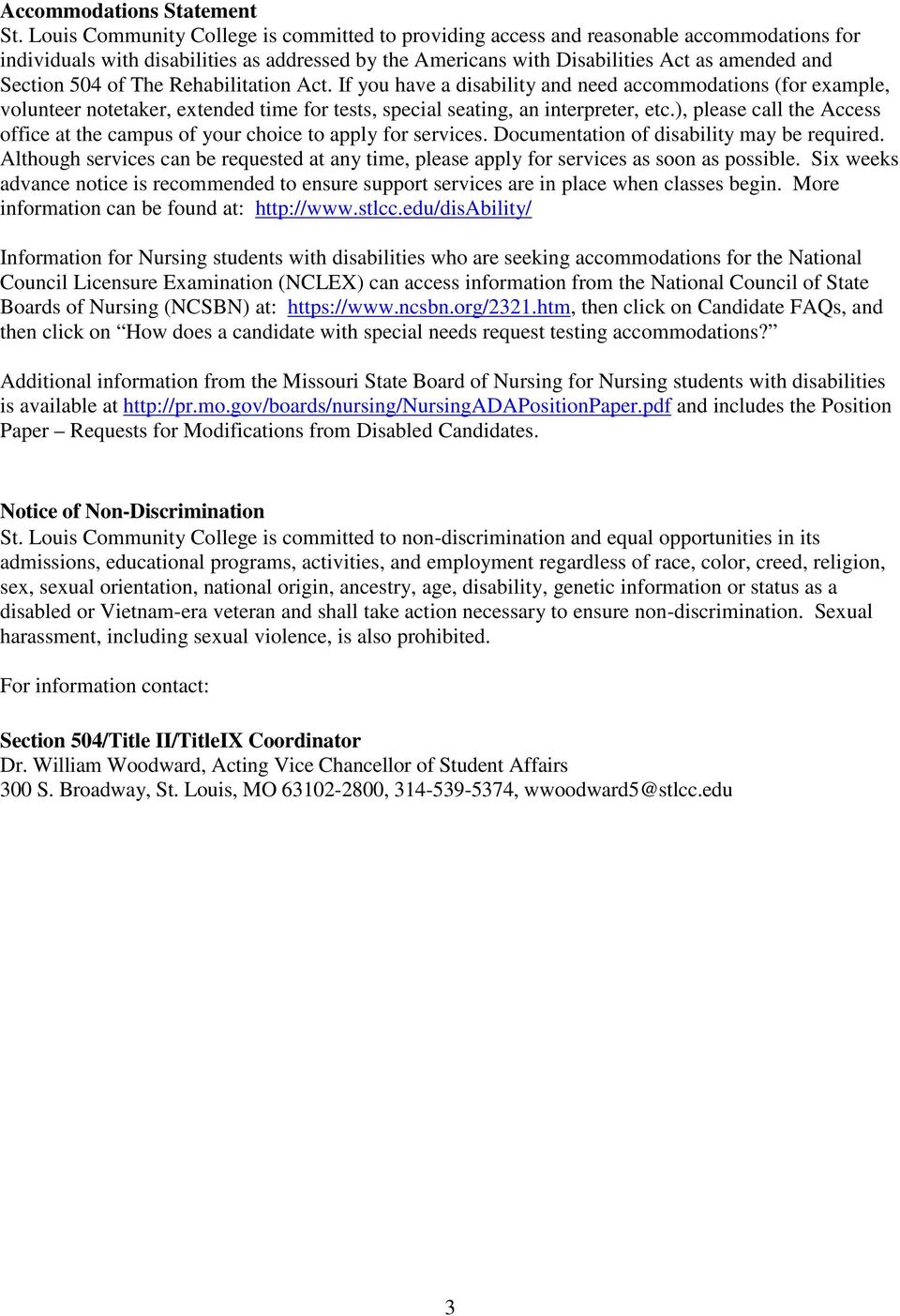
4 Table of Contents I. PROGRAM INFORMATION... 6 A. Introduction... 6 B. St. Louis Community College Mission, Strategic Foci, and Strategic Priorities... 6 C. Nursing Philosophy... 7 D. Expected Graduate Competencies (Student Learning Outcomes)... 8 II. NURSING CURRICULUM (Begin implementation Fall 2014)... 9 A. Program of Study... 9 B. Course Descriptions C. Methods of Instruction D. Course Workload III. LEARNING RESOURCES A. Instructional Resources B. Nursing College Laboratory C. Clinical Facilities /Observation Sites (Utilized 2014/2015) IV. PROGRESSION AND RETENTION A. Evaluation/Grading B. Attendance Policies Classroom Attendance Clinical Attendance C. Withdrawal D. Readmission Policies First Semester: Second, Third, and Fourth Semester: E. Transfer Procedure Intra-District Transfers Out-of-District Transfers Intra-District and Out-of-District Priority Student Placement for LPN Bridge, Readmission, and Transfers F. Retention Policies G. Graduation Requirements Post-Graduation Licensure as a Registered Nurse V. HEALTH AND SAFETY GUIDELINES A. Functional Abilities Requirements of Nursing Students B. Health Policy Health Insurance Immunization Requirements Pregnancy/Altered Health Status C. Infection Control/Standard Precaution Guidelines D. Latex Information and Policy E. Substance Abuse Policy F. USE OF HUMAN SUBJECTS IN TRAINING AND HEALTH RISKS VI. PROFESSIONAL CONDUCT A. Nursing Student Code of Conduct B. Professional Appearance (Dress Code) C. Classroom Recording Policy (Revised 05/2013) D. Testing Policy (Revised 05/2013) E. Test Review Policy in Classroom (Revised 05/2013) F. Test Review Policy in Faculty Office (Revised 05/2013)
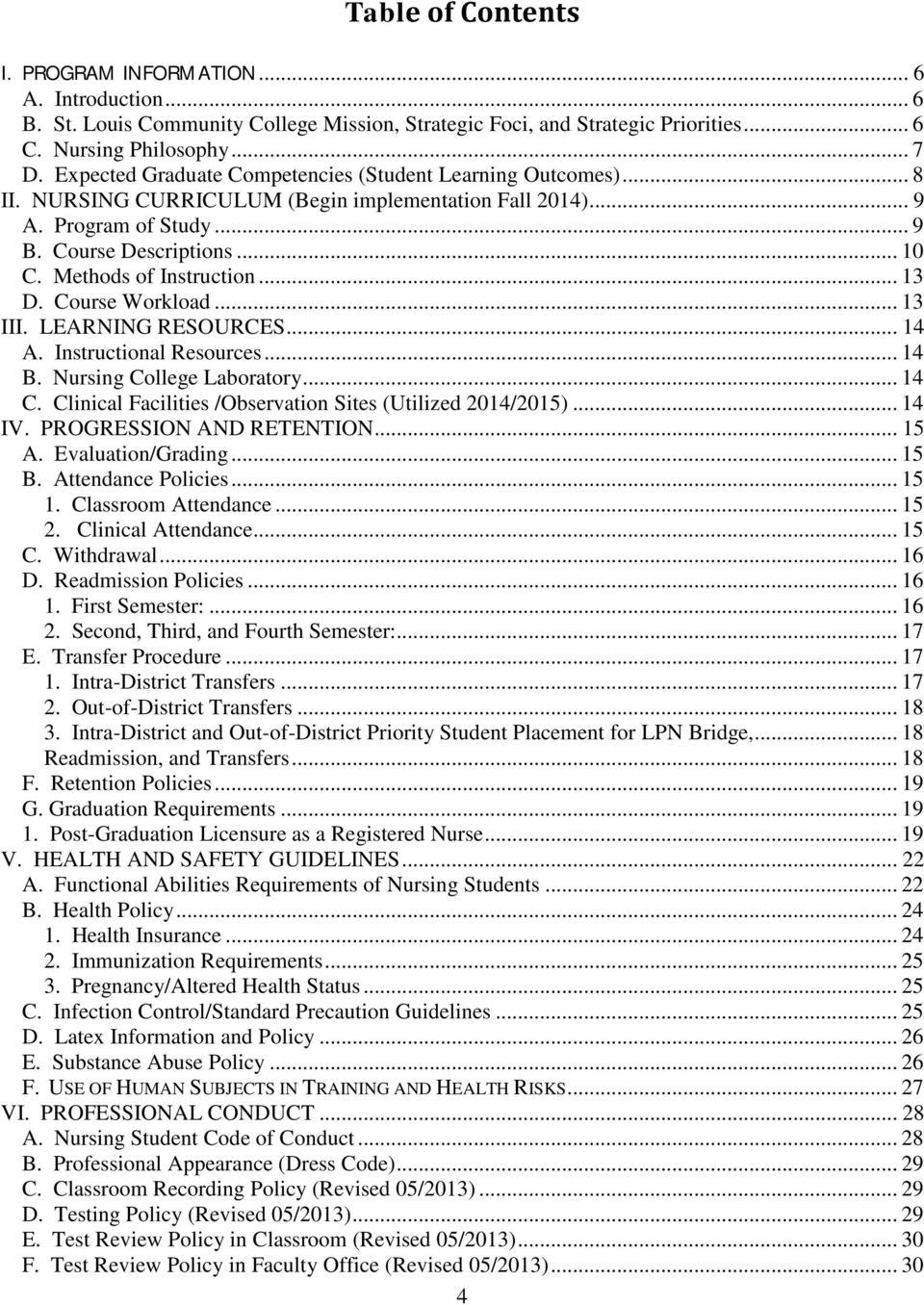
5 VII. STUDENT SERVICES AND COLLEGE POLICIES A. The Access Office Disability Support Services B. Student Rights and Responsibilities (as referenced in the STLCC Fact Finder) C. Student Academic Rights and Responsibilities (as referenced in the STLCC Fact Finder) D. STLCC Nursing Program Organizational Structure E. Nursing Review and Retention Committee VIII. FULL-TIME FACULTY AND STAFF - DISTRICT NURSING PROGRAM IX. APPENDIX A A. Admission to the Nursing Program Admission Criteria Acceptance Procedure Criminal Background Check, Drug Screen, and Immunization Tracking Procedures Physical Examination/Immunizations American Heart Association Healthcare Provider CPR Additional Course Recommendations X. APPENDIX B A. LPN Admission Criteria to the Nursing Program XI. APPENDIX C A. Financial Information Financial Aid Estimated Program Expenses XII. STUDENT SIGNATURE FORMS A. Nursing Program Handbook Acknowledgement & Latex Waiver Form 50 B. Duplicate Form to Be Signed and Returend to Nursing Program.. 51 NOTE: Each student is responsible for compliance with the information in this handbook. NOTE: Nursing Program policies and procedures described herein are subject to change. 5
6 I. PROGRAM INFORMATION A. Introduction St. Louis Community College at Florissant Valley, Forest Park, and Meramec offers an Associate in Applied Science Degree in Nursing. This sixty-nine (69) credit hour program can be completed in two years. Upon completion of the program, the graduate is eligible to apply for licensure as a Registered Professional Nurse by the NCLEX-RN examination (National Council Licensure Examination for Registered Nurses). The nursing programs were initiated in 1963 (Meramec), 1965 (Forest Park), and 1970 (Florissant Valley) and the first nursing classes were graduated in 1965 (Meramec), 1967 (Forest Park) and 1972 (Florissant Valley). The programs have had approval by the Missouri State Board of Nursing since their inception. Full accreditation by the National League for Nursing Accrediting Commission (NLNAC) was granted during the (Meramec), (Forest Park), and (Florissant Valley) academic years and has been maintained since that time. Effective May 6, 2013, the NLNAC changed its name and became the Accreditation Commission for Education in Nursing (ACEN). North Central Association of Colleges and Schools and the Missouri Department of Education accredit St. Louis Community College and its nursing departments. Instruction in nursing courses includes theory, college laboratory; and clinical laboratory experiences. Clinical laboratory experiences are carried out in co-operating health care agencies. The nursing program is subject to the nondiscrimination policies of St. Louis Community College. B. St. Louis Community College Mission, Strategic Foci, and Strategic Priorities Mission: St. Louis Community College expands minds and changes lives every day. We create accessible, dynamic learning environments focused on the needs of our diverse communities. Strategic Foci: 1) Student retention and persistence, and 2) Climate and culture Strategic Priorities: 1) Redesign students experiences, 2) Operationalize one college, and 3) Strengthen identity and community awareness of STLCC. Strategy 1. Redesign students experiences o o o Action Step 1. Develop and use academic maps for all college programs. Action Step 2. Strengthen and expand alternative delivery models. Action Step 3. Develop and implement strategies that increase college readiness. Strategy 2. Operationalize one college. o o o Action Step 1. Engage the entire college in adopting the definition of one college Action Step 2. Reinvent and clarify institutional roles to support one college mission, vision, and values. Action Step 3. Increase college efficiencies to improve customer and student services. Strategy 3. Strengthen identity and community awareness of STLCC. o o o Action Step 1. Strengthen partnerships. Action Step 2. Define branding and marketing of the college. Action Step 3. Redesign and repurpose the college web site. 6
7 C. Nursing Philosophy THE NURSING FACULTY BELIEVES that Nursing, a caring profession, is both an art and a science. Nursing assists diverse populations in the promotion and maintenance of optimal health across the lifespan. Utilizing evidence-based-practice and critical thinking, nurses plan, implement, and evaluate patientcentered care. Nursing Education Nursing education assists the student to think critically, problem solve creatively, and practice from a caring perspective. Nursing education uses evidence-based practice and knowledge from applied science in the development of teaching-learning strategies. Education is influenced by changes in the demographics of society, the healthcare delivery system, and advances in technology. As role models of critical thinking, faculty create an educational environment which expands minds and empowers students to become independent life-long learners. Faculty facilitate educational opportunities that meet diverse individual student needs and promote professionalism. Health Health is an ever-changing state determined by the individual's ability to adapt within an environment and achieve maximum function along the continuum of life. Recipient of Nursing Nursing impacts patients, families, communities, and society. THE NURSING FACULTY FURTHER BELIEVES IN THE FOLLOWING VALUES: LEARNING We are a learner-centered institution that values learning as a lifelong pursuit. STUDENTS We value student success and provide opportunities for students to gain the knowledge and skills necessary to be successful. DIVERSITY AND INCLUSION We recognize the strength in different views and values and promote diversity in our students and employees. AFFORDABLE AND ACCESSIBLE We embrace our obligation to provide affordable and accessible learning opportunities. CREATIVITY AND INNOVATION We believe that a creative and innovative environment strengthens our effectiveness and flexibility in meeting the challenges of ever-changing internal and external environments. EXCELLENCE We value academic and professional excellence in our employees and students and hold ourselves accountable as an institution for continuous improvement efforts and for achieving our goals. 7
8 COLLABORATION AND TEAMWORK We believe that our mutual goals are best accomplished through collaboration and teamwork and that we as individuals must have the respect and support of others to succeed. HONESTY AND INTEGRITY We value academic, professional, and personal honesty and integrity in individual employees and students and as an institution. COMMUNITY We recognize our responsibility to prepare our students to be productive citizens and value our services as important contributions to improving our local and regional communities. COMMUNICATION We value communication as a means of encouraging dialogue, facilitating the open exchange of diverse viewpoints, sharing information, and building community to foster the interaction that enables us to reach our goals. D. Expected Graduate Competencies (Student Learning Outcomes) At the completion of the program, students are expected to know and be able to: 1. Adhere to standards of professional practice, the American Nurses Association Code of Ethics, and demonstrate accountability for actions and behaviors. 2. Demonstrate effective and appropriate verbal, non-verbal, and written communication with individuals, families, groups, and communities across the lifespan. 3. Develop, implement, and evaluate teaching and learning across the lifespan that facilitates the promotion and maintenance of health and reduction of risks specific to individuals, families, and communities. 4. Efficiently and effectively care for individuals, families, groups, or communities utilizing resources, demonstrating leadership skills and an understanding of health care policy and regulations. 5. Utilize the nursing process and best current evidence in the delivery of safe, competent, and effective nursing care for patients, families, groups, communities, and health care providers across the lifespan. 6. Collaborate with team members to plan, coordinate, and deliver patient-centered care across the lifespan respecting culture, values, preferences, and needs, thereby empowering the patient to participate in all aspects of care. 8
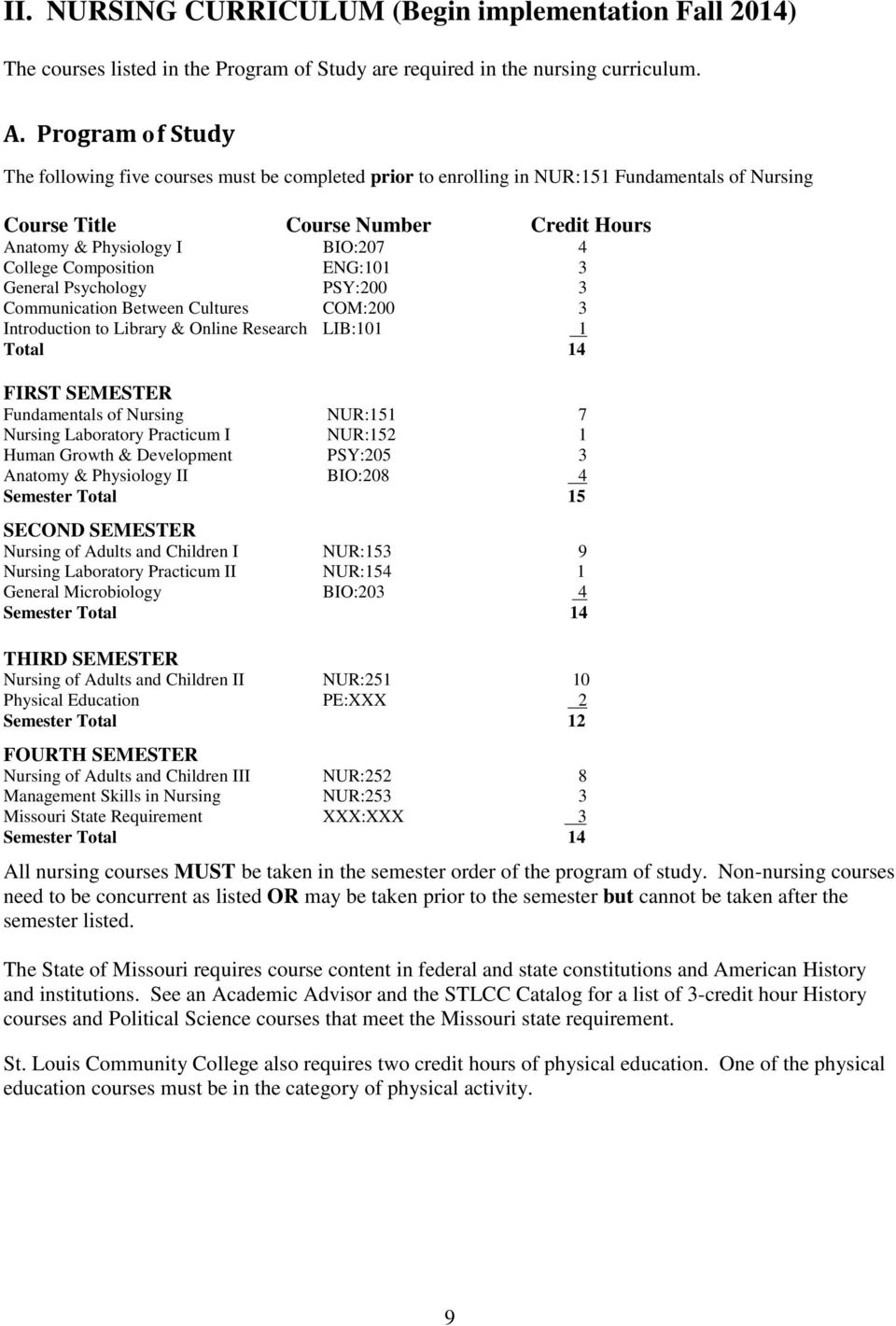
9 II. NURSING CURRICULUM (Begin implementation Fall 2014) The courses listed in the Program of Study are required in the nursing curriculum. A. Program of Study The following five courses must be completed prior to enrolling in NUR:151 Fundamentals of Nursing Course Title Course Number Credit Hours Anatomy & Physiology I BIO:207 4 College Composition ENG:101 3 General Psychology PSY:200 3 Communication Between Cultures COM:200 3 Introduction to Library & Online Research LIB:101 1 Total 14 FIRST SEMESTER Fundamentals of Nursing NUR:151 7 Nursing Laboratory Practicum I NUR:152 1 Human Growth & Development PSY:205 3 Anatomy & Physiology II BIO:208 4 Semester Total 15 SECOND SEMESTER Nursing of Adults and Children I NUR:153 9 Nursing Laboratory Practicum II NUR:154 1 General Microbiology BIO:203 4 Semester Total 14 THIRD SEMESTER Nursing of Adults and Children II NUR: Physical Education PE:XXX 2 Semester Total 12 FOURTH SEMESTER Nursing of Adults and Children III NUR:252 8 Management Skills in Nursing NUR:253 3 Missouri State Requirement XXX:XXX 3 Semester Total 14 All nursing courses MUST be taken in the semester order of the program of study. Non-nursing courses need to be concurrent as listed OR may be taken prior to the semester but cannot be taken after the semester listed. The State of Missouri requires course content in federal and state constitutions and American History and institutions. See an Academic Advisor and the STLCC Catalog for a list of 3-credit hour History courses and Political Science courses that meet the Missouri state requirement. St. Louis Community College also requires two credit hours of physical education. One of the physical education courses must be in the category of physical activity. 9
10 B. Course Descriptions NUR:151 FUNDAMENTALS OF NURSING 7 CREDITS This course is an introduction to the role of the nurse in meeting needs common to all patients through knowledge, skill, and attitudes essential for the practice of nursing, based on principles of physical, biological and behavioral sciences, and nursing theory (Equivalent of 5 lecture hours per week, 6 hours of clinical lab per week for a total of 90 clinical lab clock hours for the semester). Course Prerequisites: Enrollment in nursing program, PSY:200, ENG:101, LIB:101, COM:200, BIO:207, all with a grade of C or better, Math proficiency at or above the Math 140 level, and Reading proficiency. Co-requisites: NUR:152, BIO:208 with a minimum grade of C or higher or prior enrollment, and PSY:205 with a grade of C or higher or prior enrollment. NUR:152 NURSING LABORATORY PRACTICUM I 1 CREDIT This course is designed to provide the student with the practice of nursing skills in the college nursing laboratory and to reinforce principles introduced in Fundamentals of Nursing (Equivalent of 2 practicum lab hours per week). Course Prerequisite: Enrollment in the nursing program. Co-requisite: NUR:151. NUR:153 NURSING OF ADULTS & CHILDREN I 9 CREDITS This course is designed to assist the student to acquire knowledge and skills in meeting the needs of adults and children with an emphasis on adaptation to illness and hospitalization in medical-surgical nursing, and mothers and newborns during the maternity cycle (Equivalent of 6 lecture hours per week, 9 clinical lab hours per week for a total of 135 clinical lab clock hours for the semester). Course Prerequisites: NUR:151, BIO:208, PSY:205, all with a minimum grade of C or higher. Co-requisite: NUR:154. NUR:154 NURSING LABORATORY PRACTICUM II 1 CREDIT This course is designed to provide the student with the practice of nursing skills in the college nursing laboratory and to reinforce nursing principles introduced in NUR:153 (Equivalent of 2 practicum lab hours per week). Course Prerequisite: NUR:151 and NUR:152, both with a minimum grade of C or higher. Co-requisite: NUR:153. NUR:160 LICENSED PRACTICAL NURSE TO ASSOCIATE DEGREE: NURSING BRIDGE 7 CREDITS This course is required to prepare the Licensed Practical Nurse (LPN) to enter the Associate Degree in Nursing Program. Emphasis is on assessing, reinforcing and expanding competencies. Classroom content focuses on role change, communication, critical thinking, the nursing process, pharmacology, and nutrition. Additional classroom content focuses on the needs of adults and children with an emphasis on health promotion, adaptation to illness and hospitalization in medical-surgical nursing, and mothers and newborns during the maternity cycle. Includes a college and clinical laboratory component. Course Prerequisites: Current Practical Nurse license with recent clinical or education experience; enrollment in nursing program including passing the Dosage Calculation Test; ENG:101, PSY:200, PSY:205, COM:200, LIB:101, BIO:207, and BIO:208, all with a minimum grade of C or higher. 10

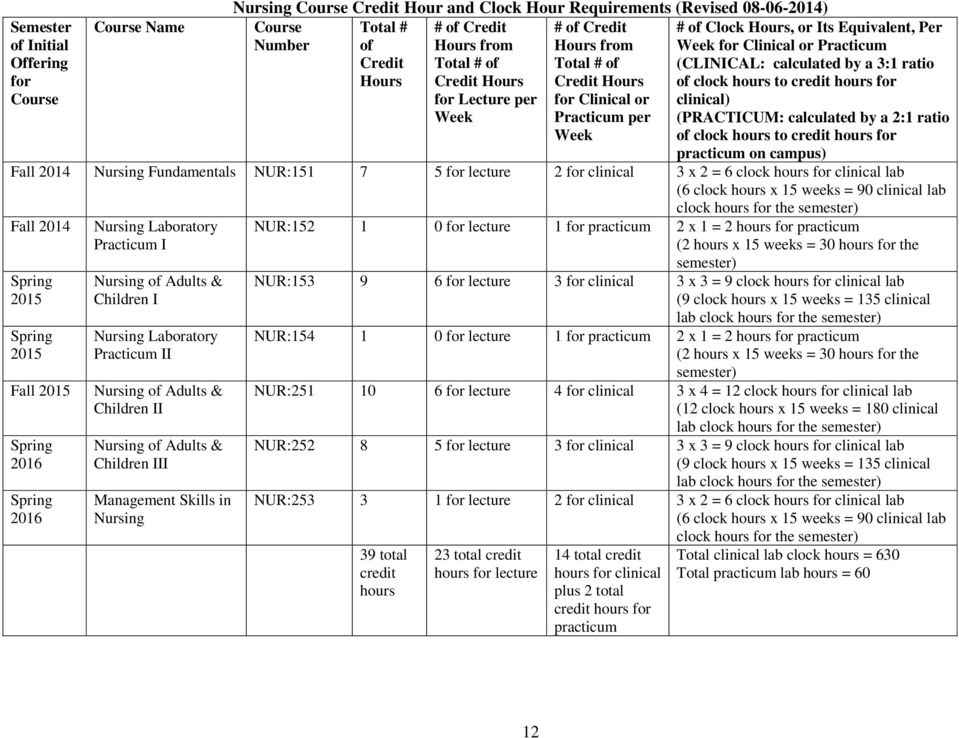
11 NUR:161 LPN EXPERIENTIAL CREDIT I 11 CREDITS This no-fee, non-registration course is designed to transcript LPN experiential credit for first and second semester nursing. A non-lpn Bridge student admitted to the Nursing Program completes 18 credit hours of Nursing courses in the first and second semesters. An LPN Bridge student completes 7 credit hours of Nursing, 11 hours less than the non-lpn Bridge student. The 11 hours of LPN Experiential Credit equalizes the Nursing credit hour requirement between the non-lpn Bridge student and the LPN Bridge student. Course Prerequisites: Enrollment in LPN bridge program and successful completion of NUR:160 with a minimum grade of C or higher. NUR:251 NURSING OF ADULTS & CHILDREN II 10 CREDITS This course is designed to assist the student to further develop knowledge and skills necessary to meet the needs of adults and children with selected medical-surgical problems and behavioral health problems (Equivalent of 6 lecture hours per week, 12 clinical lab hours per week for a total of 180 clinical lab clock hours for the semester). Course Prerequisites: NUR:153 or NUR:160 with a minimum grade of C or better; BIO:203 with a minimum grade of C or higher. Co-requisite: Physical Education requirement or prior enrollment. NUR:252 NURSING OF ADULTS & CHILDREN III 8 CREDITS This course is designed to assist the student to further develop knowledge and skills necessary to meet the needs of adults and children with selected medical-surgical problems (Equivalent of 5 hours lecture per week, 9 clinical lab hours per week for a total of 135 clinical lab clock hours for the semester). Course Prerequisite: NUR:251 with a minimum grade of C or higher Co-requisite: NUR:253; Missouri state requirement or prior enrollment. NUR:253 MANAGEMENT SKILLS IN NURSING 3 CREDITS This course includes theory and practicum in principles managing the care of a group of patients. The student will participate actively in the role of a beginning staff nurse under the guidance of agency staff and instructor. (Equivalent of 1 hour lecture per week, 6 clinical lab hours per week for a total of 90 clinical lab clock hours for the semester). Course Prerequisite: NUR:251 with a minimum grade of C or higher. Co-requisite: NUR:252. NUR:513 NURSING REINFORCEMENT 1 CREDIT (Offered at Florissant Valley Campus only) The special problems course Nursing Reinforcement is a repeat of the semester prior to where the student has experienced academic failure and/or withdrawal. The student is to attend existing classes, take tests, and successfully complete lab practicum checkouts, as required for non-audit content. The student will not attend the clinical component. The course evaluation will be pass/fail based on the criteria for the course evaluation (76% to pass). The course is designed to prepare nursing students for reentry into the nursing program after there has been an unsuccessful semester. The Florissant Valley Campus admits one time per year so every Nursing course is offered only one time per year as opposed to every semester. Enrollment in NUR:513 allows a student to avoid sitting out one semester while waiting for the course to be offered again. Prerequisite: Approval of nursing department Coordinator. 11
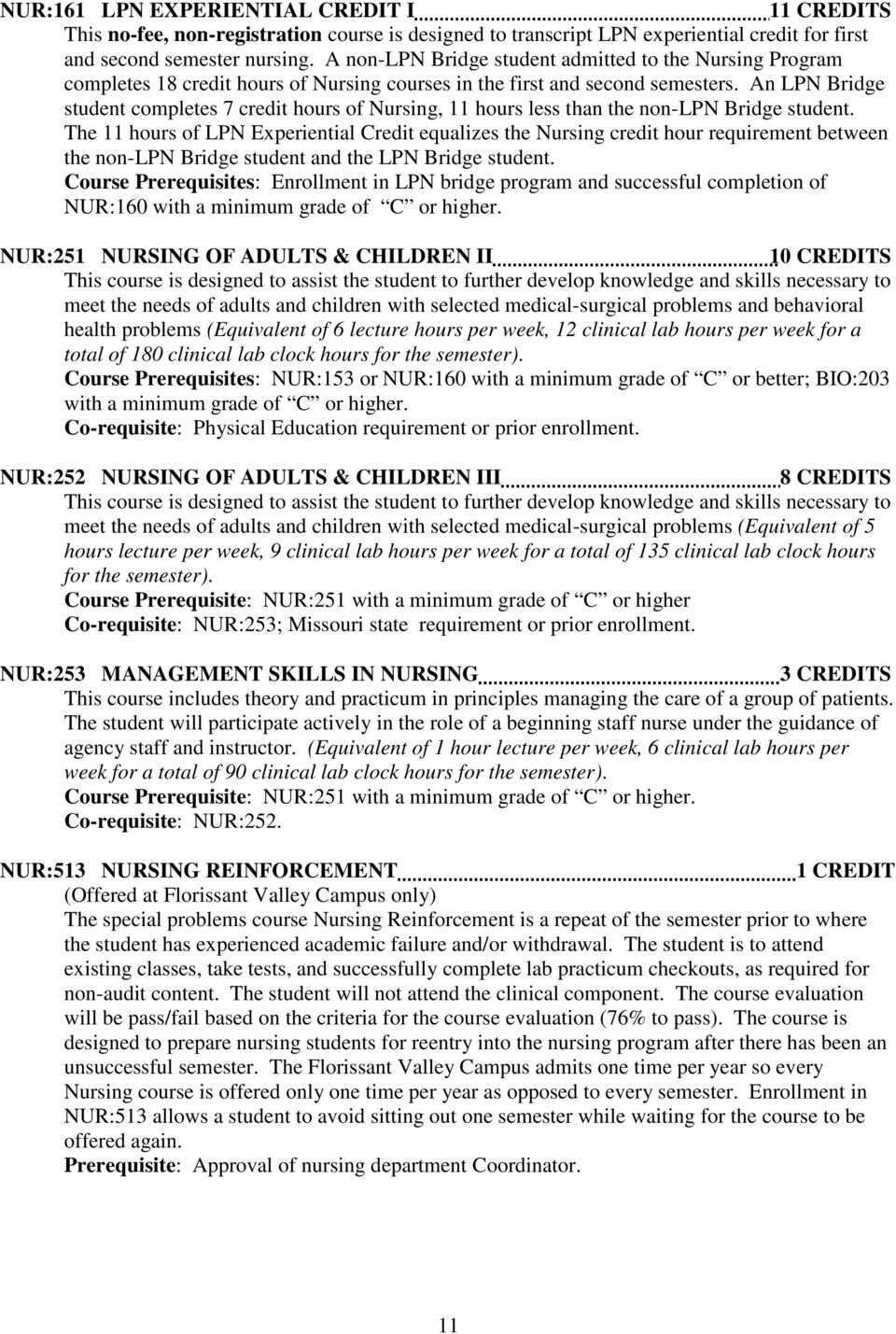
12 Semester of Initial Offering for Course Course Name Nursing Course Credit Hour and Clock Hour Requirements (Revised ) Course Number Total # of Credit Hours # of Credit Hours from Total # of Credit Hours for Lecture per Week # of Credit Hours from Total # of Credit Hours for Clinical or Practicum per Week # of Clock Hours, or Its Equivalent, Per Week for Clinical or Practicum (CLINICAL: calculated by a 3:1 ratio of clock hours to credit hours for clinical) (PRACTICUM: calculated by a 2:1 ratio of clock hours to credit hours for practicum on campus) Fall 2014 Nursing Fundamentals NUR: for lecture 2 for clinical 3 x 2 = 6 clock hours for clinical lab (6 clock hours x 15 weeks = 90 clinical lab clock hours for the semester) Fall 2014 Spring 2015 Spring 2015 Fall 2015 Spring 2016 Spring 2016 Nursing Laboratory Practicum I Nursing of Adults & Children I Nursing Laboratory Practicum II Nursing of Adults & Children II Nursing of Adults & Children III Management Skills in Nursing NUR: for lecture 1 for practicum 2 x 1 = 2 hours for practicum (2 hours x 15 weeks = 30 hours for the semester) NUR: for lecture 3 for clinical 3 x 3 = 9 clock hours for clinical lab (9 clock hours x 15 weeks = 135 clinical lab clock hours for the semester) NUR: for lecture 1 for practicum 2 x 1 = 2 hours for practicum (2 hours x 15 weeks = 30 hours for the semester) NUR: for lecture 4 for clinical 3 x 4 = 12 clock hours for clinical lab (12 clock hours x 15 weeks = 180 clinical lab clock hours for the semester) NUR: for lecture 3 for clinical 3 x 3 = 9 clock hours for clinical lab (9 clock hours x 15 weeks = 135 clinical lab clock hours for the semester) NUR: for lecture 2 for clinical 3 x 2 = 6 clock hours for clinical lab (6 clock hours x 15 weeks = 90 clinical lab clock hours for the semester) 39 total credit hours 23 total credit hours for lecture 14 total credit hours for clinical plus 2 total credit hours for practicum Total clinical lab clock hours = 630 Total practicum lab hours = 60 12
13 C. Methods of Instruction A variety of teaching-learning methods are used in nursing courses and may include readings, lecture-discussion, demonstrations, audiovisual media, study guides, written assignments, nursing care plans, concept maps, small group work, case studies, computer assisted programs, simulations, practice of nursing skills in nursing college laboratory, and providing care to patients in clinical areas. D. Course Workload Science courses, Nursing Practicum I, and Nursing Practicum II include a college laboratory experience component with a 2:1 clock hour to credit hour ratio, e.g., one credit hour earned requires two clock hours of laboratory per week per semester. Nursing courses include a clinical laboratory experience with a 3:1 clock hour to credit hour ratio, e.g., each credit hour earned requires three clock hours of laboratory per week per semester. In addition to the class and clinical hours published in the Semester Schedule of Classes, nursing students can anticipate additional practice hours and individually arranged evaluation sessions in the nursing college laboratory. During each semester, additional time will be required for clinical preparation. Students may be required to visit the clinical agency the day prior to the clinical experience to obtain material from agency records that assists in planning patient care as well as meeting the outcomes for each course. Due to the demands of the nursing program, it is highly recommended that a nursing student not be employed more than sixteen (16) hours per week. 13

14 III. LEARNING RESOURCES A. Instructional Resources Nursing students have access to the campus library for reference books and current journals in nursing and general education. Audiovisual materials are available for student use during regular library hours, which may include evening, and weekend hours. Orientation to the library information system is available. Assistance with audiovisual equipment and computer usage is provided. Computers are available in the computer center, the library and/or nursing college laboratory. B. Nursing College Laboratory The nursing college laboratory permits simulation of numerous nursing skills and situations. Students are expected to practice designated skills in the nursing collage laboratory and to have these skills evaluated on their own time. Students in the nursing college laboratory must perform selected skills satisfactorily before they may be performed in the clinical setting. The actual amount of time spent in the nursing college laboratory varies according to the specific nursing course. Students may expect to spend two to four hours per week in the nursing college laboratory outside of scheduled class periods. C. Clinical Facilities /Observation Sites (Utilized 2014/2015) Clinical Sites Florissant Forest Meramec Valley Park Barnes-Jewish Hospital X Barnes-Jewish Hospital West County X Christian Hospital X X Deer Valley Home Health X X DePaul Health Center X X X Mercy Hospital St. Louis X X X Mercy Rehabilitation Hospital St. Louis X Ranken Jordan Pediatric Hospital X St. Alexis Hospital X St. Anthony s Medical Center X St. Claire Health Center X X SSM Rehabilitation Hospital X St. Joseph s Medical Center St. Charles X St. Louis Children s Hospital X X St. Louis University Hospital X X St. Luke s Medical Center X St. Mary s Health Center X X Veteran s Administration X Observation Sites Cardinal Glennon Children s Hospital Valley Park School District Webster Groves School District Kirkwood School District Special School District Florissant Valley Forest Park Meramec X X X X X 14

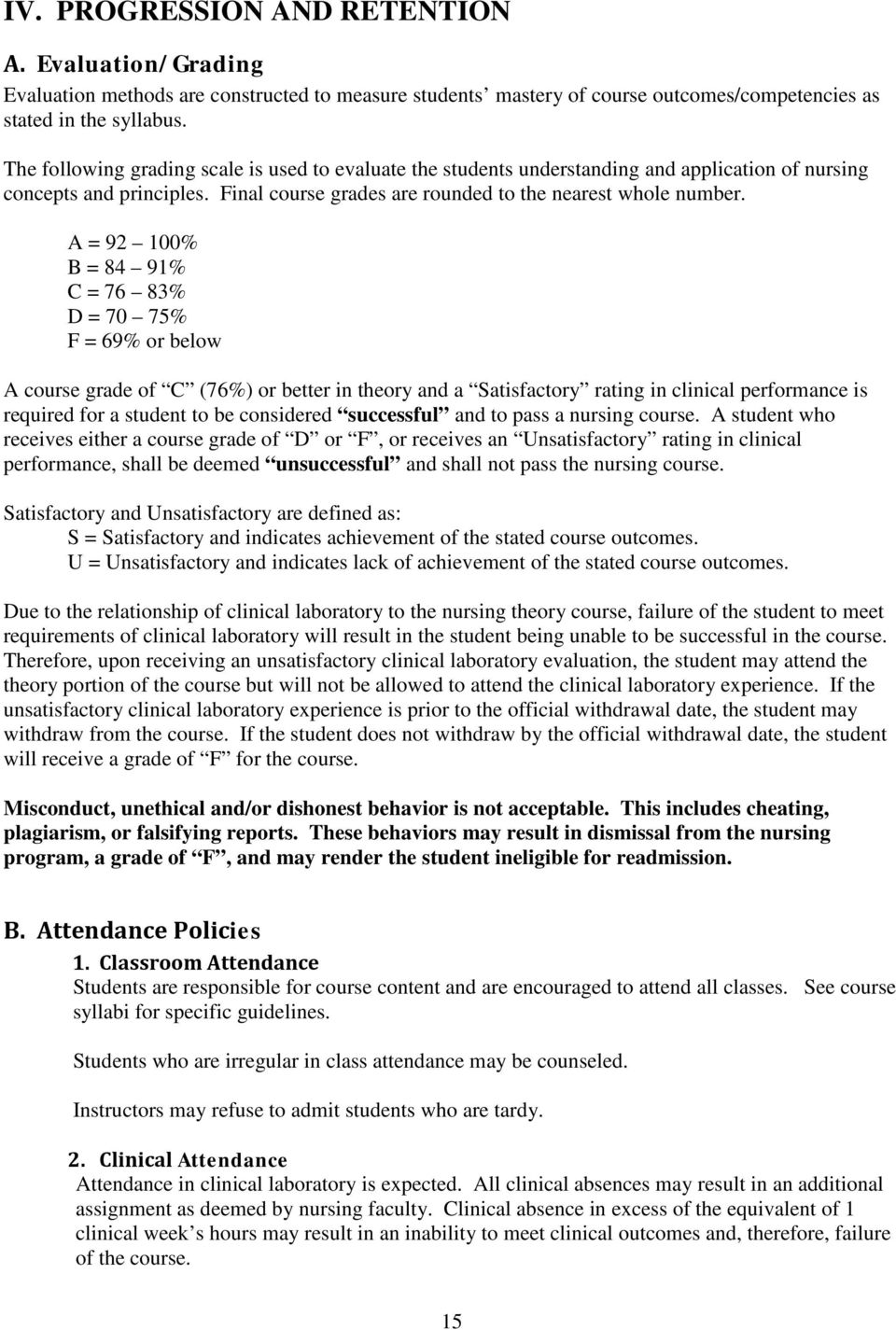
15 IV. PROGRESSION AND RETENTION A. Evaluation/Grading Evaluation methods are constructed to measure students mastery of course outcomes/competencies as stated in the syllabus. The following grading scale is used to evaluate the students understanding and application of nursing concepts and principles. Final course grades are rounded to the nearest whole number. A = % B = 84 91% C = 76 83% D = 70 75% F = 69% or below A course grade of C (76%) or better in theory and a Satisfactory rating in clinical performance is required for a student to be considered successful and to pass a nursing course. A student who receives either a course grade of D or F, or receives an Unsatisfactory rating in clinical performance, shall be deemed unsuccessful and shall not pass the nursing course. Satisfactory and Unsatisfactory are defined as: S = Satisfactory and indicates achievement of the stated course outcomes. U = Unsatisfactory and indicates lack of achievement of the stated course outcomes. Due to the relationship of clinical laboratory to the nursing theory course, failure of the student to meet requirements of clinical laboratory will result in the student being unable to be successful in the course. Therefore, upon receiving an unsatisfactory clinical laboratory evaluation, the student may attend the theory portion of the course but will not be allowed to attend the clinical laboratory experience. If the unsatisfactory clinical laboratory experience is prior to the official withdrawal date, the student may withdraw from the course. If the student does not withdraw by the official withdrawal date, the student will receive a grade of F for the course. Misconduct, unethical and/or dishonest behavior is not acceptable. This includes cheating, plagiarism, or falsifying reports. These behaviors may result in dismissal from the nursing program, a grade of F, and may render the student ineligible for readmission. B. Attendance Policies 1. Classroom Attendance Students are responsible for course content and are encouraged to attend all classes. See course syllabi for specific guidelines. Students who are irregular in class attendance may be counseled. Instructors may refuse to admit students who are tardy. 2. Clinical Attendance Attendance in clinical laboratory is expected. All clinical absences may result in an additional assignment as deemed by nursing faculty. Clinical absence in excess of the equivalent of 1 clinical week s hours may result in an inability to meet clinical outcomes and, therefore, failure of the course. 15
16 Prior to any clinical absence, it is the student s responsibility to inform the clinical instructor, per their instruction, before the scheduled clinical time. Punctuality and preparedness are expected at all times. Instructors may refuse to admit students who are tardy. The nursing faculty has the responsibility to refuse a student admission to the clinical area whose preparation/performance is unsatisfactory. This will constitute a clinical absence. Students may be restricted from a clinical area during a course for the following reasons: a. In the professional judgment of the faculty, the student does not have sufficient theoretical background to function safely and competently in the clinical area. b. Failure to demonstrate competence in the Nursing College Laboratory. c. The student s performance directly or indirectly endangers a patient s safety and welfare. d. The student requires supervision in excess of that expected for level of education. e. Medically imposed restrictions. Students restricted from the clinical area are considered absent. C. Withdrawal Any Nursing student wanting to withdraw from a Nursing course must schedule an appointment for an Exit Interview with the Nursing Program Coordinator, Director, or designee. Failure to complete this process within one (1) week of withdrawal may result in the inability to re-enroll in nursing courses. Appointments to meet with the Program Coordinator or Director can be made through the Department Secretary. Nursing students who are unsuccessful in a Nursing course are to schedule an appointment for an Exit Interview with the Nursing Program Coordinator, Director, or designee. Failure to complete this process within one (1) week of withdrawal may result in the inability to re-enroll in nursing courses. D. Readmission Policies Violation of student rights and responsibilities may deem a student ineligible for readmission. Students may enroll in any given core nursing course a maximum of two (2) times. A student is allowed to repeat a maximum of two (2) nursing core courses. The core nursing courses are: NUR:151, 152, 251, 252, and 253. NOTE: Background check and drug screens need to be repeated for any student not enrolled for one semester, i.e. if a student leaves during a semester, they do not need to repeat the background check and drug screen if returning immediately the following semester. If a student does not return immediately the following semester, then they need to repeat the background check and drug screen with satisfactory results received prior to the start of clinical. Immunizations and CPR certification must remain current for all students. 1. First Semester: A student who withdraws or who has not been successful is required to reapply to the program and meet the same requirements as listed in the Admission Criteria section. This will place them on the nursing waiting list and they will be readmitted in order of application. Applications to reapply are only available in the Advising office. 16
17 2. Second, Third, and Fourth Semester: A student who withdraws or who has not obtained a grade of C or higher must schedule an appointment for an Exit Interview with the Nursing Program Coordinator, Director, or designee. Failure to complete this process within one (1) week of withdrawal or being unsuccessful may result in the inability to re-enroll in nursing courses. A student who has not been enrolled in the nursing program for more than one full semester and requests readmission must take the following challenge examinations: a. Second Semester: 1. Comprehensive final examination for NUR:151 with a minimum score of 76%. 2. Satisfactory performance on a technical skill examination for NUR:152. b. Third Semester: 1. Comprehensive final examination for NUR:151 with a minimum score of 76%. 2. Comprehensive examination for NUR:153 with minimum score of 76%. 3. Satisfactory performance on a technical skill examination for NUR:152 and NUR:154. c. Fourth Semester: 1. All the above requirements as stated plus the comprehensive final examination for NUR:251 with a minimum score of 76%. d. Readmissions: 1. After satisfactorily meeting the stated requirements, applicants for readmission to the nursing program are considered on a space-available basis. 2. Students who are ineligible for readmission due to excessive failures must wait a minimum of five (5) years from the date of the most recently failed course to apply for readmission. Students who have been unsuccessful after two attempts in Fundamentals of Nursing must also wait a minimum of five (5) years from the date of the most recently unsuccessful Fundamentals of Nursing course. 3. All readmissions will be accepted in the order as delineated in the section labeled Intra- District and Out-of-District Priority Student Placement for LPN Bridge, Readmission, and Transfers. E. Transfer Procedure 1. Intra-District Transfers Intra-district transfer is permitted if the student is eligible to return to the original campus-nursing program. Transfers may occur only if the student has been enrolled in a Nursing course within the previous three semesters. If the student has not taken nursing course(s) for a semester or more, qualified intra-district transfer students will be evaluated in the same manner as the St. Louis Community College readmission students. Intra-district transfer Nursing students are to schedule an exit interview with the Nursing Program Coordinator, Director, or designee, on the original campus, within one week if unsuccessful in a course, within one week if withdrawing from a course, or within one week if successful in a course. Failure to complete this process during the current semester may result in the inability to reenroll in nursing courses. Appointments to meet with the Program Coordinator or Director can be made through the Department Secretary. NOTE: Background check and drug screens need to be repeated for any student not enrolled for one semester, i.e. if a student leaves during a semester, they do not need to repeat the background check and drug screen if returning immediately the following semester. If a student does not return immediately the following semester, then they need to repeat the background check and drug screen with satisfactory results received prior to the start of the semester. Immunizations and CPR certification must remain current for all students. 17

18 2. Out-of-District Transfers Students who have completed nursing courses in other collegiate nursing programs, or who have completed one year of course work in a diploma program, will be required to challenge (by examination) the first semester nursing courses for placement into the second semester, or to challenge by examination the first and second semester nursing courses for placement into the third semester. Transfers may occur only if the student has been enrolled in a Nursing course within the previous three semesters. Out-of-District Transfer Students are required to complete the following: a. Meet the St. Louis Community College and nursing program admission criteria. b. Have a transcript(s) from each college and/or nursing school sent to the Admissions Office. c. Submit a completed transcript Evaluation Request form to the Admissions Office. 1. Transfer credit must be approved by the Admissions Office and/or the appropriate campus department coordinator. 2. Course substitutions and/or waivers that are not designated on the Transfer Credit Evaluation form and deviate from the above curriculum must be approved by the appropriate campus department coordinator. d. Challenge Process 1. Contact the nursing department on the campus where the challenge process will be completed. 2. Schedule an appointment with the nursing program coordinator to determine appropriate testing and semester placement. 3. The challenge exam consists of two parts: 1) final exam(s) and 2) lab skills. A student may take the challenge examination only one time in the STLCC District. 4. The decision rendered by one campus will be binding on all campuses. 5. Challenge examinations will be arranged by the nursing department upon payment of an instructional materials fee equal to one credit hour. 6. A grade of R (credit by examination) will be awarded upon successful passing or completion of all parts of the challenge process. 7. After successfully meeting the stated requirements, applicants for transfer to the nursing program are considered on a space-available basis. 8. Out-of-district transfer students are not accepted into fourth semester nursing courses. e. NOTE: All out-of-district transfer students are required to meet the same criminal background check, drug screen, and immunization requirements as all other Nursing students. 3. Intra-District and Out-of-District Priority Student Placement for LPN Bridge, Readmission, and Transfers Intra-district and out-of-district priority student placement for LPN Bridge, readmission, and transfers will be admitted based on space availability in the following order: a. LPN bridge students who have successfully completed NUR:160. b. A successful student returning from a leave of absence. c. Students who withdrew from their original campus nursing program with a passing grade and have maintained a cumulative G.P.A. of 2.00 or better. d. Students withdrawing with a failing grade will be readmitted based on their course average at the time of exit. Failing students from their original campus will be admitted first. Failing intra-district students will be admitted next. e. Out of district transfer students who have successfully completed the challenge examination. 18

19 F. Retention Policies Retention /Promotion The Nursing Program is an intensive and highly structured academic and clinical experience for students. Moreover, it is not self-contained but affects the staff and patients of the cooperating agencies where the clinical portions of the program are carried out. St. Louis Community College and the Nursing Program share a serious responsibility toward those agencies and their staffs and patients to send them only nursing students who are adequately prepared to perform their assigned tasks with competence. For all these reasons, St. Louis Community College must maintain standards and procedures appropriate to the Nursing Program. 1. A cumulative grade point average of 2.00 is required to remain in the program. A grade of C or higher is required in each nursing course as well as in all other courses required in the Nursing Program. All other required courses must be completed with a grade of C or higher prior to or during the semester the course is scheduled in the curriculum. 2. A student-initiated withdrawal from a nursing course will result in withdrawal from the nursing program. The student may apply for re-admission to the program, which requires a favorable recommendation from the nursing faculty and may require approval by the Review and Retention Committee. The Nursing Review and Retention Committee Appeal Form is available from an Academic Advisor. 3. A student who fails to maintain an overall G.P.A. of 2.00, who receives a grade of less than C in any nursing course or required prerequisite course, or who does not return to a nursing course when expected, will automatically be withdrawn from the program. The student may apply for readmission to the program, which requires a favorable recommendation from the nursing faculty and may require approval by the Review and Retention Committee. The Nursing Review and Retention Committee Appeal Form is available from an Academic Advisor. G. Graduation Requirements Students are responsible for meeting the St. Louis Community College requirements for graduation as outlined in the college catalog. Students who expect to graduate in December should file an application with Enrollment Services for their degree no later than October 1. Students who expect to graduate in May should file an application with Enrollment Services for their degree no later than March Post-Graduation Licensure as a Registered Nurse A graduate of the St. Louis Community College nursing program is eligible to apply to the Missouri State Board of Nursing to write the NCLEX-RN examination. Successful completion of this examination is necessary to become licensed as a registered nurse (R.N.). Registered nurse licensure in Missouri is under the control of the Missouri State Board of Nursing. The Board determines eligibility requirements for candidates who apply to take the National Council Licensure Examination for Registered Nurses (NCLEX-RN). The following are among the requirements of the Missouri State Board of Nursing. a. Successful completion of an approved/accredited program of professional nursing. b. Completed, signed, and notarized application for licensure including: 1. legal name 2. explanation of circumstances regarding previous applications/licensure 3. explanation of any crime that has resulted in a conviction (excluding traffic violations) 4. explanation of conviction of any traffic offense resulting from or related to the use of drugs or alcohol 5. explanation of addiction to any drug or alcohol 6. submission of (non-refundable) fees 19
20 7. attachment of signed recent portrait style photograph for identification purposes 8. payment receipt for electronic fingerprinting c. The signature of the Director of Nursing Education HOWEVER, successful completion of the nursing program DOES NOT guarantee eligibility to take the licensure examination. Since one of the functions of the Missouri State Board of Nursing is to protect the public, the Board may refuse licensure to applicants who may jeopardize the well-being of Missouri citizens. The Missouri State Board of Nursing may also refuse to grant the student permission to take licensing exams or refuse to issue any certificate of registration of authority, permit, or license for the cause(s) outlined in the Missouri State Nurse Practice Act Chapter RSMO, as amended. Nursing students should be aware that there are reasons for refusal to issue a registered nurse license as defined by the State Statute as quoted below from the April 2014 Missouri Nurse Practice Act Denial, revocation, or suspension of license, grounds for, civil immunity for providing information- -complaint procedures. 1. The board may refuse to issue or reinstate any certificate of registration or authority, permit or license required pursuant to chapter 335 for one or any combination of causes stated in subsection 2 of this section or the board may, as a condition to issuing or reinstating any such permit or license, require a person to submit himself or herself for identification, intervention, treatment, or rehabilitation by the impaired nurse program as provided in section The board shall notify the applicant in writing of the reasons for the refusal and shall advise the applicant of his or her right to file a complaint with the administrative hearing commission as provided by chapter The board may cause a complaint to be filed with the administrative hearing commission as provided by chapter 621 against any holder of any certificate of registration or authority, permit or license required by sections to or any person who has failed to renew or has surrendered his or her certificate of registration or authority, permit or license for any one or any combination of the following causes: (1) Use or unlawful possession of any controlled substance, as defined in chapter 195, or alcoholic beverage to an extent that such use impairs a person's ability to perform the work of any profession licensed or regulated by sections to ; (2) The person has been finally adjudicated and found guilty, or entered a plea of guilty or nolo contendere, in a criminal prosecution pursuant to the laws of any state or of the United States, for any offense reasonably related to the qualifications, functions or duties of any profession licensed or regulated pursuant to sections to , for any offense an essential element of which is fraud, dishonesty or an act of violence, or for any offense involving moral turpitude, whether or not sentence is imposed; (3) Use of fraud, deception, misrepresentation or bribery in securing any certificate of registration or authority, permit or license issued pursuant to sections to or in obtaining permission to take any examination given or required pursuant to sections to ; (4) Obtaining or attempting to obtain any fee, charge, tuition or other compensation by fraud, deception or misrepresentation; (5) Incompetency, gross negligence, or repeated negligence in the performance of the functions or duties of any profession licensed or regulated by chapter 335. For the purposes of this subdivision, "repeated negligence" means the failure, on more than one occasion, to use that degree of skill and learning ordinarily used under the same or similar circumstances by the member of the applicant's or licensee's profession; (6) Misconduct, fraud, misrepresentation, dishonesty, unethical conduct, or unprofessional conduct in the performance of the functions or duties of any profession licensed or regulated by this chapter, including, but not limited to, the following: (a) Willfully and continually overcharging or overtreating patients; or charging for visits which did not occur unless the services were contracted for in advance, or for services which were not rendered or documented in the patient's records; (b) Attempting, directly or indirectly, by way of intimidation, coercion or deception, to obtain or retain a patient or discourage the use of a second opinion or consultation; (c) Willfully and continually performing inappropriate or unnecessary treatment, diagnostic tests, or nursing services; (d) Delegating professional responsibilities to a person who is not qualified by training, skill, competency, age, experience, or licensure to perform such responsibilities; (e) Performing nursing services beyond the authorized scope of practice for which the individual is licensed in this state; 20
21 (f) Exercising influence within a nurse-patient relationship for purposes of engaging a patient in sexual activity; (g) Being listed on any state or federal sexual offender registry; (h) Failure of any applicant or licensee to cooperate with the board during any investigation; (i) Failure to comply with any subpoena or subpoena duces tecum from the board or an order of the board; (j) Failure to timely pay license renewal fees specified in this chapter; (k) Violating a probation agreement, order, or other settlement agreement with this board or any other licensing agency; (l) Failing to inform the board of the nurse's current residence; (m) Any other conduct that is unethical or unprofessional involving a minor; (7) Violation of, or assisting or enabling any person to violate, any provision of sections to , or of any lawful rule or regulation adopted pursuant to sections to ; (8) Impersonation of any person holding a certificate of registration or authority, permit or license or allowing any person to use his or her certificate of registration or authority, permit, license or diploma from any school; (9) Disciplinary action against the holder of a license or other right to practice any profession regulated by sections to granted by another state, territory, federal agency or country upon grounds for which revocation or suspension is authorized in this state; (10) A person is finally adjudged insane or incompetent by a court of competent jurisdiction; (11) Assisting or enabling any person to practice or offer to practice any profession licensed or regulated by sections to who is not registered and currently eligible to practice pursuant to sections to ; (12) Issuance of a certificate of registration or authority, permit or license based upon a material mistake of fact; (13) Violation of any professional trust or confidence; (14) Use of any advertisement or solicitation which is false, misleading or deceptive to the general public or persons to whom the advertisement or solicitation is primarily directed; (15) Violation of the drug laws or rules and regulations of this state, any other state or the federal government; (16) Placement on an employee disqualification list or other related restriction or finding pertaining to employment within a health-related profession issued by any state or federal government or agency following final disposition by such state or federal government or agency; (17) Failure to successfully complete the impaired nurse program; (18) Knowingly making or causing to be made a false statement or misrepresentation of a material fact, with intent to defraud, for payment pursuant to the provisions of chapter 208 or chapter 630, or for payment from Title XVIII or Title XIX of the federal Medicare program; (19) Failure or refusal to properly guard against contagious, infectious, or communicable diseases or the spread thereof; maintaining an unsanitary office or performing professional services under unsanitary conditions; or failure to report the existence of an unsanitary condition in the office of a physician or in any health care facility to the board, in writing, within thirty days after the discovery thereof; (20) A pattern of personal use or consumption of any controlled substance unless it is prescribed, dispensed, or administered by a provider who is authorized by law to do so; (21) Habitual intoxication or dependence on alcohol, evidence of which may include more than one alcoholrelated enforcement contact as defined by section ; (22) Failure to comply with a treatment program or an aftercare program entered into as part of a board order, settlement agreement, or licensee's professional health program. 21
22 V. HEALTH AND SAFETY GUIDELINES A. Functional Abilities Requirements of Nursing Students Introduction The knowledge, skills and abilities required to safely and effectively practice nursing are varied and complex. The National Council has defined the following functional abilities that a nurse must possess to practice safely and effectively. To ensure that your decision to pursue a career in nursing is the correct one for you, we ask that you review these functional abilities. They are the non-academic requirements of the program, and they comprise physical, emotional, and professional demands required of a nurse. Take into consideration whether you can perform the following functions, with or without accommodations. If you determine that you are unable to perform any of the skills listed due to a documented disability, you will then need to determine if a reasonable accommodation can be provided. Throughout your educational program, you will find yourself in a variety of learning experiences. You will need to take into consideration the specifics of each position and the percentage of time the skill will be needed in order to determine if reasonable accommodations can be provided. To request an accommodation, contact the campus access office and present documentation of your disability. FUNCTIONAL ABILITY CATEGORIES AND REPRESENTATIVE ACTIVITIES/ATTRIBUTES GROSS MOTOR SKILLS Move within confined spaces Sit and maintain balance Stand and maintain balance Reach above shoulders (e.g., IV poles) Reach below waist (e.g., plug electrical appliance into wall outlets) FINE MOTOR SKILLS Pick up objects with hands Grasp small objects with hands (e.g., IV tubing, pencil) Write with pen or pencil Key/type (e.g., use a computer) Pinch/pick or otherwise work with fingers (e.g., manipulate a syringe) Twist (e.g., turn objects/knobs using hands) Squeeze with finger (e.g., eye dropper) PHYSICAL ENDURANCE Stand (e.g., at patient side during surgical or therapeutic procedure) Sustain repetitive movements (e.g., CPR) Maintain physical tolerance (e.g., work entire shift) PHYSICAL STRENGTH Push and pull 25 pounds (e.g., position patients) Support 25 pounds of weight (e.g., ambulate patient) Lift 25 pounds (e.g., pick up a child, transfer patient) Move light objects weighing up to 10 pounds (e.g., IV poles) Move heavy objects weighing from 11 to 50 pounds Defend self against combative patient Carry equipment/supplies Use upper body strength (e.g., perform CPR, physically restrain a patient) Squeeze with hands (e.g., operate fire extinguisher) MOBILITY Twist Bend Stoop/squat 22
23 Move quickly (e.g., response to an emergency) Climb (e.g., ladders/stools/stairs) Walk HEARING Hear normal speaking level sounds (e.g., person-to-person report) Hear faint voices Hear faint body sounds (e.g., blood pressure sounds, assess placement of tubes) Hear in situations when not able to see lips (e.g., when masks are used) Hear auditory alarms (e.g., monitors, fire alarms, call bells) VISUALS See objects up to 20 inches away (e.g., information on a computer screen, skin conditions) See objects up to 20 feet away (e.g., patient in a room) See objects more than 20 feet away (e.g., patient at end of hall) Use depth perception Use peripheral vision Distinguish color (e.g., color codes on supplies, charts, bed) Distinguish color intensity (e.g., flushed skin, skin paleness) TACTILE Feel vibrations (e.g., palpate pulses) Detect temperature (e.g., skin, solutions) Feel differences in surface characteristics (e.g., skin turgor, rashes) Feel differences in sizes, shapes (e.g., palpate vein, identify body landmarks) Detect environmental temperature (e.g., check for drafts) SMELL Detect odors from patient (e.g., foul smelling drainage, alcohol breath, etc.) Detect smoke Detect gases or noxious smells READING Read and understand written documents (e.g., policies, protocols) ARITHMETIC COMPETENCE Read and understand columns of writing (flow sheet, charts) Read digital displays Read graphic printouts (e.g., EKG) Calibrate equipment Convert numbers to and/or from the Metric System Read graphs (e.g., vital sign sheets) Tell time Measure time (e.g., count duration of contractions, etc.) Count rates (e.g., drips/minute, pulse) Use measuring tools (e.g., thermometer) Read measurement marks (e.g., measurement tapes, scales, etc.) Add subtract, multiply, and/or divide whole numbers Compute fractions (e.g., medication dosages) Use a calculator Write numbers in records EMOTIONAL STABILITY Establish therapeutic boundaries Provide patient with emotional support Adapt to changing environment/stress Deal with the unexpected (e.g., patient going bad, crisis) 23
24 Focus attention on task Monitor own emotions Perform multiple responsibilities concurrently Handle strong emotions (e.g., grief) ANALYTICAL THINKING Transfer knowledge from one situation to another Process information Evaluate outcomes Problem solve Prioritize tasks Use long-term memory Use short-term memory CRITICAL THINKING Identify cause-effect relationships Plan/control activities for others Synthesize knowledge and skills Sequence information INTERPERSONAL SKILLS Negotiate interpersonal conflict Respect differences in patients Establish rapport with patients Establish rapport with co-workers COMMUNICATION SKILLS Teach (e.g., patient/family about health care) Explain procedures Give oral reports (e.g., report on patient s condition to others) Interact with others (e.g., health care workers) Speak on the telephone Influence people Direct activities of others Convey information through writing (e.g., progress notes) Originally reprinted with permission from the National Council of State Boards of Nursing, Inc., Chicago, IL, May B. Health Policy The nursing student is required to meet the specific health requirements of each assigned clinical agency. A physical examination form must be completed within six (6) months of the start of the semester. See below for immunization requirements. 1. Health Insurance St. Louis Community College and the clinical agencies are not responsible for any occupational hazards encountered during the course of study i.e. infections, communicable diseases or injury. Students are responsible for their own health care and are required to have health insurance throughout the nursing program. Students are also responsible for any costs and expenses they incur relating to illness or injury they suffer during clinical. 24
25 2. Immunization Requirements The following are the current requirements and are subject to change at any time based on clinical site directives: a) two doses of mumps-measles-rubella (MMR) vaccine or MMR blood titers, b) Hepatitis B series, or blood titer, or signed declination form, c) two doses of Varicella immunization or blood titer, d) TDaP immunization every 10 years, e) seasonal flu shot annually, f) proof of two negative PPD s, one of which is current. If PPD is positive, then need a negative chest x-ray. After your chest x-ray, a TB symptom check form is to be completed annually. 3. Pregnancy/Altered Health Status Students who are pregnant or who have an altered health status must have written approval from their healthcare provider to continue in the clinical laboratory setting and must meet all of the stated clinical outcomes with a satisfactory performance. C. Infection Control/Standard Precaution Guidelines All nursing personnel and nursing students are professionally and ethically obligated to provide patient care with compassion and respect for human dignity. Hence, they may not ethically refuse to care for patients solely because the patient is at risk of contracting, or has, an infectious disease such as Human Immunodeficiency Virus (HIV), or Hepatitis B Virus (HBV). All rules of confidentiality are followed when working with patients. 1. If individuals are considering a career in nursing, they should be aware that during the course of their education and subsequent employment, they are likely to be working in situations where exposure to infectious diseases is possible. This is an occupational risk for all health care workers and persons should not become health care workers unless they recognize and accept this risk. 2. Education and strict adherence to well-established infection control guidelines, however, can reduce this risk to a minimum. Thorough training in infection control procedures will be an important part of the students program. 3. Students in the nursing program are expected to care for patients with any infectious disease. 4. All care shall be provided with respect for the dignity of the unrestricted by considerations of social or economic status, personal attributes, or the nature of the health problem. 5. Students will be provided with supplies necessary to meet CDC guidelines at affiliating agencies. Missouri State Board of Nursing Position Statement regarding HIV or HBV infection The Missouri State Board of Nursing recognizes the serious implications the spread of HIV or HBV has on the health, safety, and welfare of the public, and the Board s mandated responsibility to the public for assuring safe and competent nursing care. All licensed nurses and nursing students who discriminate against a patient on the basis of HIV or HBV infection, or makes HIV or HBV testing a condition of treatment shall be subject to the denial of licensure or the disciplinary processes of the Missouri State Board of Nursing. All licensed nurses and nursing students with HIV or HBV who perform invasive procedures are encouraged by the Missouri State Board of Nursing to voluntarily participate in the Department of Health s evaluation process. It is the position of the Missouri State Board of Nursing that all licensed nurses and nursing students with HIV or HBV are entitled to the same reasonable accommodation guaranteed by the Americans with Disabilities Act. 25
26 EXPOSURE GUIDELINES 1. Students must wear appropriate protective clothing/equipment when performing task(s) that may involve exposure to blood/body fluids. 2. Any direct exposure to blood/body fluids occurring while functioning as a nursing student must be reported immediately to the clinical instructor. 3. Students exposed to blood/body fluids shall follow this protocol: A. Wash the area immediately with a disinfectant agent; for eye splashes rinse the area with clean water. B. Report the incident to the clinical instructor. C. Follow agency policy regarding exposures. D. The student is responsible for all costs related to the exposure, triage, and treatment. D. Latex Information and Policy To the greatest extent possible, STLCC minimizes exposure and prevents additional sensitization of individuals to latex. Non-latex products & supplies are utilized in the nursing laboratories including non-latex gloves, tape, tubing, catheters and blood pressure equipment. All latex sensitive/allergic individuals must be aware that learning environments may utilize latex and should read the contents of packages and equipment prior to use. Individuals who are high risk for latex allergies include: People with congenital defects requiring intermittent urinary catheterization. Employees who wear gloves on a frequent basis. People with multiple allergies, especially to fruits, kiwis, bananas, avocados and chestnuts. A student, who is latex sensitive/allergic, must notify the course coordinator and lab faculty of that sensitivity/allergy prior to the beginning of each semester. If a student develops a latex sensitivity/allergy reaction during their enrollment, they are to contact their health care provider and notify the course coordinator. For additional information regarding latex allergies please refer to the CDC website at E. Substance Abuse Policy Nursing students at STLCC are responsible for maintaining standards and adhering to regulations adopted by the College as stated in the Student Handbook. The educational environment in the classroom, college lab and clinical areas will be Drug/Alcohol-Free. The following policy is established in order to: Maintain a working, learning, and clinical education environment that is safe and healthy for students, faculty, staff and the patients we care for. Ensure a positive reputation of the college and its graduates within the community Minimize the number of accidental injuries to person and property. All students, faculty and staff members are prohibited from being under the influence of alcohol, or illegal drugs during classroom, college lab, clinical hours or any college sponsored function. The unlawful manufacture, distribution, possession or use of illegal or controlled substances while on College Property or at a College sanctioned event is strictly prohibited. Possession of prescription drugs on campus or at the clinical site by any person other than the one it was prescribed for is prohibited. Such drugs are to be used only in the manner in which they are prescribed. 26
27 The purpose of these policies is to provide a drug-free, healthy, safe and secure environment for all nursing students. The College recognizes drug/alcohol abuse as a potential health, safety and security problem. Students needing help with dealing with drug/alcohol abuse are encouraged to seek assistance in the College Counseling Department. Random drug/alcohol testing may be required if the student reports to the clinical, college lab, classroom setting or college sponsored function in an impaired condition. Drug testing may be required if the student is involved in an accident at the clinical site, if he or she is observed using a prohibited substance, if he or she exhibits a severe and prolonged reduction in productivity, or any other reasonable cause which is determined at the discretion of the faculty/staff member. The student must obtain drug testing within 2 hours of the instructor s request or will be considered a testing refusal. A student who refuses or has positive screening will not be allowed to return to clinical, college lab, class, or other college sponsored activity until he/she meets with the Director of Nursing Education. The Director of Nursing Education will utilize clinical site guidelines and college policies in the decision making. A positive test may result in immediate dismissal from the program. All pre-enrollment screening, random screenings and all other expenses, including transportation, incurred will be the responsibility of the student. F. USE OF HUMAN SUBJECTS IN TRAINING AND HEALTH RISKS For the purpose of becoming proficient in skills required in the Nursing Program, students will be asked to volunteer to act as patients during classroom and lab activities. If a student does not feel comfortable acting as a patient for a particular skill(s), it is the responsibility of the student to communicate with the instructor(s) that he/she does not give consent for the instructor or students to practice the skill(s) on him/her. Without this communication, it is assumed that all students give consent for instructors and other students to practice Nursing skills on them. It is also assumed that the student understands the risks involved in these activities. 27
28 VI. PROFESSIONAL CONDUCT A. Nursing Student Code of Conduct The faculty at STLCC believe that standards of professional conduct are an integral aspect of professional education and expect nursing students to adhere to professional standards. Nursing students must adhere to the STLCC Code of Student Conduct specified in the Student Handbook. Additionally the nursing faculty hold students enrolled in the nursing program accountable to the American Nurses Association Code of Ethics, ( Behavior inconsistent with these standards is inappropriate for students aspiring to a professional nursing career. Any student who violates the standards will be counseled, referred appropriately according to the Student Handbook, and subject to dismissal from the nursing program. These standards include: 1. Respects the dignity and worth of all individuals, regardless of the nature of health problems, social or economic status or personal attributes. 2. Respects patients right to self-determination. 3. Provides safe, humane care, puts the needs of patients ahead of those self. 4. Delivers patient care without prejudice. 5. Takes into account the values of others. 6. Demonstrates respect for all individuals with whom the student interacts including colleagues, students, faculty, and families. 7. Does not harass or threaten others. 8. Provides opportunities for patients to participate in planning of care. 9. Collaborates through the use of open dialogue, expresses one s self clearly and accurately. 10. Maintains professional boundaries. 11. Maintains confidentiality, including privacy of patients. 12. Advocates for patients. 13. Maintains accountability and responsibility for ones own actions, offers assistance to others instead of waiting to be asked. 14. Exhibits dependability by attending class and clinical in an unimpaired state including but not limited to the use of drugs and alcohol. 15. Demonstrates reliability by fulfilling all program obligations. 16. Displays honesty. Does not lie or provide false information, does not falsify patient records, or falsely represent oneself. 17. Demonstrates personal and professional integrity. Does not cheat on tests or check-outs. Does not borrow or use work that has been completed by others and does not allow others to use work they have completed. Does not copy material word for word, acknowledges through appropriate citations any words or ideas authored by someone else. Does not use profanity or participate in indecent or lewd behavior. Is not insubordinate and does not assault others either verbally or physically. 18. Accepts responsibility for professional growth. This includes preparing well for clinical so that patients may be cared for safely. Reflects on own behaviors, identifies areas for self-improvement and accepts and reflects on constructive feedback from nursing faculty and institutional staff. 19. Is responsible for articulating nursing values and maintaining the integrity of the profession including reporting acts of dishonesty and professional misconduct. 20. Acts in an ethical manner. Adheres to the ANA Code of Ethics for Nurses with Interpretive Statements (2001) which has set the ethical standard for the nursing profession. Adheres to the established dress code in all professional and clinical activities. 28
29 B. Professional Appearance (Dress Code) Students are expected to dress in a professional manner, which includes maintaining a clean and ironed uniform, and being in compliance with the clinical agency and Nursing Program dress code. The student uniform for the STLCC Nursing Program is navy blue scrub pants and grey scrub top with the navy STLCC logo. The tops are available for purchase through the campus bookstores. A navy blue or grey undershirt may be worn under the scrub top. The pants may be purchased through any uniform store. The pant legs should not drag on the floor. One pair of small earrings is allowed but no other facial jewelry. No visible tattoos are allowed. Black leather shoes are required. Nursing students may not wear the STLCC name badge and/or uniform while working in a capacity other than for the STLCC Nursing Program. Refer to individual course syllabi for additional dress code policies. C. Classroom Recording Policy (Revised 05/2013) 1. Students may record lecture and/or classroom activities with the permission of the instructor. 2. Lecture and/or classroom activities that are recorded are for personal study use only and are not to be used for any other purpose. 3. Handling of all learning activities, whether via electronic, written, or other format, should be in accordance with the ethical standards reflected by the ANA social media statement and NCSBN white paper. NCSBN s white paper is available at and at 4. Test review cannot be recorded. 5. Permission to record may be withdrawn by the instructor at any time and without advance notice. 6. Students acknowledge any speaker can make a statement that conflicts with the textbook. It is the student s responsibility to clarify the information. D. Testing Policy (Revised 05/2013) 1. Students arriving after the starting time for the exam will be allowed to test with the remaining time allotted for taking the exam. As an example, if 40 minutes are allotted to take the exam and the student arrives 20 minutes late, the student will have 20 minutes to complete the exam. 2. Students who do not appear to take the exam must follow procedures in order to receive permission to take a make-up exam. 3. No study aids are allowed in the test seating area. All notebooks, textbooks, classroom notes must be left away from the seating area prior to taking a seat for the exam. 4. No food, drinks, pens, purses, wallets, beepers, sunglasses, cell phones or any electronic devices will be allowed in the test seating area. 5. No scratch paper. 6. Shirts without pockets are to be worn on test day. No outerwear is allowed. 7. Students are required to leave hats, scarves, gloves and coats away from the test seating area. (Provisions are made for religious/cultural dress.) 8. Students may not leave the testing environment without permission of the instructor. 9. All cell phones must be turned off and will be stored and maintained at the discretion of the individual nursing campus. 10. Students may be subject to assigned seating. 11. Students not adhering to the testing policy may not be allowed to test. 12. Academic dishonesty will not be tolerated. If cheating is suspected, the student will have his or her test stopped immediately and will be removed from the testing environment. Grounds for receiving a 0 grade 1. Copying and removing examination items. 2. Giving or receiving assistance of any kind to or from other students during exam. 29
30 3. Failure to abide by any of the stated policies can be grounds for discipline up to and including receiving a grade of 0 for the exam. E. Test Review Policy in Classroom (Revised 05/2013) 1. The student will be given his/her individual test review materials. Any further clarification or review of testing materials not provided will be done by appointment only (Faculty Office). 2. No study aids are allowed in the test review seating area. All notebooks, textbooks, classroom notes must be placed away from the test seating area. 3. No food, drinks, pens, purses, wallets, beepers, sunglasses, cell phones or any electronic devices will be allowed in the test review seating area. 4. No outerwear is allowed. 5. Students are required to leave hats, scarves, gloves and coats away from the test review seating area. (Provisions are made for religious/cultural dress.) 6. All cell phones will be turned in to the testing proctor prior to all test reviews. Faculty are not responsible for the return of the correct phone. (Please check the phone before you leave the testing review environment to make sure the phone is your phone.) Cell phones must be turned off. Students not turning in a cell phone will be subject to assigned seating. 7. Students not adhering to the testing review policy may not be allowed to review their test. 8. Academic dishonesty will not be tolerated. If a student is observed copying test items or recording the test review, the student will have his or her test review stopped immediately and will be removed from the testing review environment. 9. Students may not leave the testing review environment without permission of the instructor. 10. No scratch paper. 11. Any attempt to copy, record or remove examination items during the review is prohibited. 12. Students must turn in the test review materials at the end of the session and are not allowed to remove any test review materials from the test review session. 13. All students have a right to review any and all completed work. Grounds for receiving a 0 grade 1. Using prohibited aids. Bringing aids to the test seating area. 2. Copying and removing examination items. 3. Failure to abide by any of the stated policies can be grounds for discipline up to and including receiving a grade of 0 for the exam. F. Test Review Policy in Faculty Office (Revised 05/2013) In addition to the classroom test review, exams may be reviewed individually by scheduling an appointment with the appropriate faculty member in the faculty member s office. This review will be done 1:1 (one faculty member to one student). Exams will be available for review for one (1) week after the scheduled in class test review. No change of test scores will be considered after two weeks of the scheduled exam. Test booklets and/or Scantron sheets will be available for student review if requested. No information may be copied from testing materials. 1. The student will be given his or her individual test review materials and if requested the Scantron and testing booklet. 2. All study aids, notebooks, textbooks, classroom notes must be placed away from the test review seating area prior to taking a seat for the exam review. 3. No food, drinks, pens, purses, wallets, beepers, sunglasses, cell phones or any electronic devices will be allowed in the test review seating area. 30
31 4. All cell phones will be turned off and placed away from the test review seating area. 5. Students may not leave the faculty member s office during a test review session without permission of the instructor. 6. No note taking. 7. Students must turn in the test review materials at the end of the session and are not allowed to remove any test review materials from the test review session. This includes but is not limited to the Scantron and testing booklet. 8. Academic dishonesty will not be tolerated. If a student is observed copying test items or recording the test review, the student will have his or her test review stopped immediately and will be asked to leave the faculty office. 9. All students have a right to review any and all completed work. Grounds for receiving a 0 grade 1. Using prohibited aids. Bringing aids to the test review area. 2. Copying or removing examination items or attempting to do so. 3. Failure to abide by any of the stated policies can be grounds for discipline up to and including receiving a grade of 0 for the exam. 31
32 VII. STUDENT SERVICES AND COLLEGE POLICIES Students may refer to the St. Louis Community College Catalog, Fact Finder and Student Handbook of St. Louis Community College and the Semester Schedule of Classes for general information on student services. Counselors are available to the Nursing Departments to assist students with academic or personal concerns. However, a student may consult with a counselor of his/her choice if assistance is needed. Students interested in this service should contact the Counseling Office for an appointment. A Career and Employment Services Office is available to help students and graduates in interviewing and seeing employment. A. The Access Office Disability Support Services The Access Office Disability Support Services has been designated by the College as the primary office to guide, counsel and assist students with disabilities. If you receive services through the Access Office and require accommodations for class, please make an appointment with an Instructor as soon as possible to discuss your approved accommodation needs. Bring your Instructor Notification Memo provided by the Access Office to the appointment. The Instructor will hold any information you share in strictest confidence unless you give permission to do otherwise. If you have not made contact with the Access Office and have reasonable accommodation needs (e.g. volunteer note-taker, extended time for tests, seating arrangements), an instructor will be happy to refer you. The Access Office will require appropriate documentation of disability. If you wish to receive accommodations in a class, you must register with the Access Office. Registration with the Access Office is voluntary for people with disabilities, but it is a requirement for receiving accommodations. B. Student Rights and Responsibilities (as referenced in the STLCC Fact Finder) A copy of the Student Handbook Fact Finder of St. Louis Community College can be obtained on campus from the Office of Campus Life or online at l. Upon enrolling in the college, each student assumes an obligation to conduct himself/herself in a manner compatible with the college's function as an educational institution and to obey the laws enacted by federal, state and local governments. If this obligation is neglected or ignored by the student, the College must, in the interest of fulfilling its function, institute appropriate disciplinary action. Students who are parents have the responsibility to arrange suitable care for their children while they attend class. Students are not permitted to bring children to class nor should children be left unattended in halls, building offices or on campus. The college reserves the right to protect the safety and welfare of unattended children. In addition to the above, misconduct that may subject a student to disciplinary action includes the following: a. Dishonesty such as cheating, plagiarism, or knowingly furnishing false information to the college. b. Forgery, alteration or misuse of college documents, records or identification. c. Hazing, which is defined as any act that injures, frightens, endangers or degrades an individual. 32
33 d. Obstruction or disruption of teaching, research, administration, disciplinary procedures, or other college-authorized activities. e. Sexual harassment of any person on college property or at college-authorized activities. f. Physical abuse of any person on college property or at college-authorized activities, or conduct that threatens or endangers the health or safety of such person. g. Theft or damage to college property or property of others on college premises or at collegeauthorized activities. h. Unauthorized entry to or use of college facilities. i. Violation of law or of college policies or procedures or campus rules or regulations (herein collectively called "Regulations"). j. Use of, being under the influence of, possession of, or distribution of, alcohol or controlled substances on college property or at college-authorized activities except as permitted under the Board policy entitled "Food Service Facilities." k. Disorderly conduct, breach of the peace, aiding or inciting another to breach the peace, or infringement upon the rights or defamation of another either on college property or at collegeauthorized activities. l. Failure to comply with directions of a college official acting in the performance of his/her duties. m. Possession or use of a firearm, explosive, dangerous chemical or other weapon or anything that could be construed as a weapon on college property or at college-authorized activities except as required by law and permitted by regulations. Law enforcement officers who are enrolled and are on campus to attend classes or study are to take no action to enforce any regulations, except as required by law. Alleged violations must be reported to campus police. n. Any of the foregoing, if proven to be knowingly committed in concert with other persons, may make each participant responsible for the acts of the entire group. Students are protected against race and ethnicity discrimination by Title VI of the Civil Rights Act of 1964, against sex discrimination, including sexual harassment by Title IX of the Education Amendments of 1972 and against discrimination based on sexual orientation, religion, age and status as a disabled or Vietnam-era veteran by board policy. Students who believe they have been subjected to discrimination should use the procedures described in Board of Trustees Policy B9 and Administrative Procedures G15. Students are protected against discrimination based upon reason of disability by the Americans with Disabilities Act (ADA) of 1990 and section 504 of the Rehabilitation Act of Students who believe they have been discriminated against based upon reason of disability should use the procedures described in Board of Trustees Policy G8 and Administrative Procedure G6. Students who believe they are being sexually harassed are encouraged to discuss the matter first with one of the sexual harassment advisors listed in the Student Handbook Fact Finder. Students should refer to Board of Trustees Policy B12, the guidelines for implementation of the sexual harassment policy found in each campus library, and the Student Handbook Fact Finder for more information. Non-Academic Appeals - Students non-academic rights and responsibilities are listed in the Student Handbook Fact Finder of St. Louis Community College. Students are expected to comply with the responsibilities and follow the proper procedures as identified in the Student Handbook Fact Finder of St. Louis Community College for alleged violations of his/her rights or responsibilities. Disciplinary actions involving alleged violations of a student s responsibilities will follow the procedure. A student may appeal an alleged violation of his/her non-academic rights by following the proper procedure for non-academic appeals as listed in the Fact Finder. 33
34 C. Student Academic Rights and Responsibilities (as referenced in the STLCC Fact Finder) Problems that develop between an instructor and a student often result from a simple misunderstanding of what is expected from the other person. Direct communication between the student and the instructor will usually resolve these matters. Therefore, the following regulations incorporate a definition of student academic rights and responsibilities and both informal and formal means of due process and conflict resolution. Student Academic Rights - Students shall have the right to: 1. Access to scheduled class meetings and appropriate instructional and support service. 2. A syllabus describing course objectives; units of subject matter to be provided; evaluation procedures; major course requirements such as term papers, book reviews, field trips and weekly reports; and rules of attendance, grading and conduct. 3. Instruction that begins promptly; is presented in a clear and concise manner; and provides relevant structured activities consistent with the contact hour requirements of the course. 4. Classroom instruction, assignments and evaluations that are consistent with the general course description and the specifications of the syllabus. 5. Be treated in a humane, ethical and professional manner both in the classroom and in all communication and contact with the instructor, other staff and other students. Student Academic Responsibilities - Students shall be responsible for: 1. Selecting a program of study that is consistent with his/her interests, skills and abilities. 2. Selecting courses that are consistent with his/her program objectives and readiness level. 3. Enrolling for a schedule of courses in accordance with the time and effort he/she will allocate to academic requirements. 4. Being punctual and attending classes. 5. Being attentive and for appropriately participating in class activities. 6. Completing all class assignments as directed by the instructor. 7. Consulting with the instructor as soon as possible if problems arise. 8. Complying with official announcements. 9. Seeking appropriate support services to improve his/her level of academic achievement and to enhance the quality of college life. 10. Behaving in a humane and ethical manner both in the classroom and in all communication and contact with the instructor, other staff members and other students. Academic Appeals - Students academic rights and responsibilities are listed in the Student Handbook Fact Finder of St. Louis Community College. A student may appeal an alleged violation of his/her academic rights by following the proper procedure for academic appeal as listed in the Fact Finder. Following is the STLCC Nursing Program Organizational Structure. 34
35 D. STLCC Nursing Program Organizational Structure STLCC Nursing Program Organizational Structure 35 Revised 08/12/2015
36 E. Nursing Review and Retention Committee Each campus has a Nursing Review and Retention Committee appointed by the President. Each committee shall be composed of a Dean, the Director of Nursing Education, two advisors or counselors, one admissions representative, and three faculty members, including at least the Nursing Department Program Coordinator. Program applicants (including transfer students) may appeal a decision on the waiver or satisfaction of certain admissions criteria by completing the Nursing Review and Retention Committee Appeal Form available from an Academic Advisor. The committee shall render its decision after completing a review of the appropriate documentary evidence. A hearing may be held by the Committee at its discretion. The Chairperson of the Committee will notify the student of the Committee s decision within ten (10) working days of the committee decision. Within ten (10) working days after the decision of the Committee is received by the student, the student may appeal in writing to the Campus President and provide all documentation available related to the appeal. The decision of the Campus President, or his/her designee, shall be final. Under no condition will the Nursing Review and Retention Committee arbitrate on grades. In addition, the Committee shall not hear appeals alleging violations of student s rights and/or responsibilities for academic appeals. 36
37 VIII. FULL-TIME FACULTY AND STAFF - DISTRICT NURSING PROGRAM Mayes, Karen, Director of Nursing Education B.S.N., Southern Illinois University-Edwardsville M.S.N., Southern Illinois University-Edwardsville FLORISSANT VALLEY CAMPUS Wallner, Donna Campus Program Coordinator A.D.N., Lincoln Land Community College B.S.N., University of Missouri-St. Louis M.S.N., Southern Illinois University-Edwardsville Darris, Maria L.P.N., U.S. Army A.D.N., St. Louis Community College- Florissant Valley B.S.N., University of Missouri-St. Louis M.S.N., University of Missouri-St. Louis McManemy, Jeffrey C. Diploma, Lutheran Medical Center School of Nursing B.S.N., Webster University M.S.N., St. Louis University Ph.D., St. Louis University Oney, Margaret Diploma, Missouri Baptist Hospital School of Nursing B.S.N., University of Missouri-St. Louis M.S.N., University of Missouri-St. Louis Pea, Nancy (Nursing College Laboratory Faculty) B.S.N., Indiana State University M.S.N., University of Phoenix Petterchak, Michelle B.S.N., St. Francis College of Nursing M.S.N., University of Missouri-St. Louis Stillwell, Ellen B.S.N., University of Missouri-St. Louis M.S.N., St. Louis University NURSING RETENTION COACH Leiber, Ann B.S., Truman State M.Ed., University of Missouri-St. Louis FLORISSANT VALLEY CAMPUS NURSING DEPARTMENT SECRETARY Cooper, Joseph (Joe) A.A.S., St. Louis Community College-Florissant Valley 37
38 Otto, Esther - Campus Program Coordinator Diploma, Lutheran Medical Center B.S.N., Maryville University M.S.N., St. Louis University B.C.-M/S C.N.S. Aiello, Janis A.D.N., St. Louis Community College-Meramec B.S.N., University of Missouri-St. Louis M.S.N., University of Missouri-Kansas City Breed, Gwen E. B.S.N., St. Louis University M.S.N., St. Louis University Godfrey, Carolyn B.S.N., Central Missouri State University M.S.N., Southern Illinois University-Edwardsville FOREST PARK CAMPUS Hall, Sandra (Nursing College Laboratory Faculty) B.S.N., St. Louis University M.S.N., St. Louis University Mayfield, Patrick Diploma, Missouri Baptist School of Nursing B.S.N., Webster University M.S.N., Webster University Moreland, Lisa B.S.N., Avila College M.S.N., Southern Illinois University-Edwardsville Mueller, Karen A.D.N., Maryville University B.S.N., Webster University M.S.N., University of Phoenix Rizzo, Kathleen B.S.N., University of Missouri-St Louis M.S.N., University of Missouri-St Louis Shockley, James L.P.N., United States Army A.D.N., Sanford Brown B.S.N., Maryville University M.S.N., Maryville University 38
39 FOREST PARK CAMPUS Continued Skurat, Angie B.S.N., Maryville University M.S.N., Maryville University Swallow, Cheryl Diploma, Missouri Baptist School of Nursing B.S.N., St. Louis University M.S.N., Webster University NURSING RETENTION COACH Hyde, Michelle B.S., Lindenwood University M.A., Lindenwood University FOREST PARK CAMPUS NURSING DEPARTMENT SECRETARY Mosley, Coyita 39
40 MERAMEC CAMPUS Hartwig, Cynthia - Campus Program Coordinator B.S.N., University of Missouri-Columbia M.S.N., Webster University Caster, Faith B.S.N., St. Louis University M.S.N., Walden University Chanasue, Deborah B.S.N., St. Louis University M.S.N., Webster University M.S.C., Southern Illinois University Clark, Sarah B.S.N., University of Missouri-Columbia M.S.N., University of Southern Mississippi Dorsey, Mary Kay A.A.S., St. Louis Community College-Meramec B.S.N., St. Louis University M.S.N., St. Louis University Franks, Stephanie B.S.N., Southeast Missouri State University M.S.N., Webster University Kaufmann, Lacee L.P.N., Jefferson College A.D.N., Jefferson College B.S.N., Central Methodist University M.S.N., Webster University Knickerbocker, Deborah (Nursing College Laboratory Faculty) B.S.N., University of Illinois M.S.N., Southern Illinois University- Edwardsville. Kokotovich, Lisa B.S.N., St. Louis University B.A., St. Louis University M.S.N., Southern Illinois University-Edwardsville Rebore, Joyce B.S.N., University of Missouri-St. Louis M.S.N., University of Missouri-St. Louis Strahm, Cheryl B.S.N., University of Evansville M.S.N., Webster University 40
41 MERAMEC CAMPUS Continued Yale, Emily B.S.N., Deaconess College of Nursing M.S.N., Southern Illinois University at Edwardsville NURSING RETENTION COACH Ciarlo, Erica A.S., Corning Community College B.A., Boston College M.S.Ed., Northern Illinois University MERAMEC CAMPUS NURSING DEPARTMENT SECRETARY Bramlett, Cathy B.S., Eastern Illinois University Note: All full-time and part-time nursing faculty members at St. Louis Community College are Registered Nurses licensed to practice in the state of Missouri and meet eligibility requirements established by the Missouri State Board of Nursing. Note: All campuses utilize part-time faculty as enrollment dictates. 41
42 IX. APPENDIX A A. Admission to the Nursing Program Standards of admission and retention have been established for certain programs and courses to make sure students have the necessary aptitude and background for success. Students applying for a program with selective admissions criteria may be required to take additional tests for admission purposes, and/or meet certain requirements to continue in the program. Admission to the nursing program is on a selective basis. The nursing program application must be signed by an advisor and submitted in person for a specific campus nursing department on one, two, or three campuses (Florissant Valley, Forest Park, or Meramec). Students are admitted to the nursing program each fall and/or spring semester dependent upon space availability at each campus. An LPN Bridge course is available for Licensed Practical Nurses (LPNs) who are interested in entering the third semester. Students are admitted to the bridge course each spring. See section titled LPN Admission Criteria to the Nursing Program in this handbook. A LPN Bridge Course Information Sheet is available from the Advising/Counseling Office. 1. Admission Criteria NURSING REQUIREMENTS CHECKLIST (See an Academic Advisor for Assistance) Admission to the College does not guarantee admission to the nursing program. Before submitting a nursing program application, students must have successfully completed all pre-application requirements listed below (items 1-9). 1. Application Form for admission to the college. 2. Regular Student Status, which requires: a. Official College Transcripts An official transcript from each college attended must be sent directly from the college attended to the campus Admissions Office. Hand carried or faxed transcripts will not be accepted. Once transcript(s) have been received, please request a transcript evaluation. The evaluation request form is available in the Admissions Office or online at b. High School Transcript or GED required only for students with fewer than 15 hours of college level work or those who have satisfied the science requirements in high school. Current high school students must submit a final high school transcript before applying to the nursing program. 3. Minimum cumulative GPA of 2.5 in high school or for 15 hours of college work (100 level or higher). Students with fewer than 15 hours of college credit must have both a 2.5 GPA in high school and a 2.5 GPA in college. GED applicants must have 15 hours of college work (100 level or higher) with a 2.5 GPA. Students with at least 15 college level credits at STLCC and a 2.5 GPA will have met this requirement, regardless of the GPA at other colleges. College transfer students with fewer than 15 STLCC credits must have a cumulative 2.5 GPA in college level credits earned at all colleges attended. Developmental courses (numbered below 100) will not be counted toward the 15 hours of college work and will not be included in the GPA for admission to the nursing program. The 2.5 GPA must be maintained the entire time a student is on the waiting list. 4. Reading: Complete one of the following to meet the reading prerequisite Composite ACT score of 21 or higher or SAT verbal score of 500 or higher (within the last 3 years) Compass score of 82 or higher on the Reading portion (within the last 3 years) Completion of RDG 030 or ENG 070 with a C grade or higher Proof of completion of a 3 credit hour course (100 level or higher) with a C grade or higher from a US accredited institution Students who have met the college s reading proficiency have also met the reading requirement for nursing 5. English: Complete one of the following to meet the English prerequisite Composite ACT score of 21 or higher or SAT verbal score of 500 or higher (within the last 3 years) Compass score of 70 or higher on the Writing Skills portion (within the last 3 years) Completion of ENG 030 or ENG 070 with a C grade or higher 6. Math: Complete one of the following to meet the math prerequisite Math ACT score of 23 or higher or SAT math score of 580 or higher (within the last 3 years) Place into MTH160 or higher on the Compass (within the last 3 years) Completion of MTH140 or higher level math with a C grade or higher 7. Chemistry: Students are required to have completed two semesters of high school chemistry with lab, or one semester of college chemistry with lab (STLCC CHM101 or higher) with C grades or higher within 5 years of applying to the nursing program. 42
43 8. Biology: Students are required to have completed two semesters of high school biology with lab, or one semester of college biology with lab (STLCC BIO: 111 or higher) with C grades or higher within 5 years of applying to the nursing program. Only the biology course being used for placement on the waiting list needs to meet the within 5 year requirement. 9. DOSAGE CALCULATION TEST (given in the Assessment Center by appointment) Students are required to pass the Dosage Calculation Test (DCT) prior to applying to the nursing program. Students are given three opportunities within a calendar year (Jan. Dec.) to pass the test and must pass with a minimum score of 90%. Students will be furnished with a 6-function calculator when taking the DCT. An optional preparation course, NRSG: 704 Nursing Math, is offered through Continuing Education. Call or check the Continuing Education class schedule online for times. A sample test is available at from an academic advisor or from the Assessment Center. The Dosage Calculation Test does not replace the math assessment test. 10. WHEN THE ABOVE CRITERIA (Items 1-9) HAVE BEEN MET, STUDENTS MUST SUBMIT A NURSING PROGRAM APPLICATION SIGNED BY AN ADVISOR, IN PERSON TO THE ADMISSIONS OFFICE AT THE CAMPUS OF THEIR CHOICE. MAILED OR FAXED APPLICATIONS WILL NOT BE ACCEPTED. It is the applicant s responsibility to know the application process and to document the entrance requirements being met. The following requirements (Items 11-15) must be met in order to enroll in Nursing 151: Fundamentals of Nursing 11. English: Completion of ENG101 or higher with a C grade or higher 12. Anatomy and Physiology I: Completion of BIO207 with a C grade or higher 13. Psychology: Completion of PSY200, with a C grade or higher 14. Communication Between Cultures: Completion of COM200, with a C grade or higher 15. Library and Online Research: Completion of LIB101, with a C grade or higher Admission and degree requirements are subject to change without advance notice. 2. Acceptance Procedure The Admissions Office reviews completed student records. Applicants meeting the published admission criteria are admitted based on available space. The Admissions Office notifies applicants of their acceptance. A student may defer admission one time and may only defer until the next admission class on the campus where admission is being offered. The student must notify the Admissions Office in writing of the request for a deferment. Applicants accepted into the nursing program are informed via letter of the deadline for registration, and the date and time of the advising and orientation sessions scheduled by the nursing department. Please be aware of the following: You must reply to your respective campus Admissions Office by the deadline. If your response is not returned by the due date, your name will be removed from the admission list. The admission letter will notify you of an orientation session that is required. You must register for classes by the deadline specified in the letter. If you do not meet this deadline your space will be offered to another student. When you register for Nursing courses at one campus, you will not be allowed to change to another campus after the deadline specified. Payment must be made by the date specified in the letter or your space will be lost. If you need college courses transferred from another college or university, you must have your transcripts sent to STLCC and you must complete a transcript evaluation request form in the Admissions Office. Do this as soon as possible as to not delay your graduation. 3. Criminal Background Check, Drug Screen, and Immunization Tracking Procedures Satisfactory results for the criminal background check, drug screen, and immunization tracking are required by clinical agencies. Hospitals and other healthcare facilities mandate that a criminal background check, a drug screen, and appropriate immunizations be documented prior to placement in a clinical setting. Students not passing these checks will be denied admission to the Nursing Program due to being prohibited from participating in the clinical setting thus rendering the student 43
44 ineligible to satisfactorily meet the course/program requirements. Students should contact an academic advisor or the program coordinator for further details. 4. Physical Examination/Immunizations An examination by a healthcare provider that includes selected diagnostic procedures, immunizations, and personal health history is required. Instructions regarding access and completion of the health form will be given to the student during the Nursing Program orientation. Students must be in a state of health compatible with the responsibilities of a nursing career. Students are expected to be free of communicable disease and capable of performing essential functions of a professional nurse such as lifting and moving patients, operating equipment, and performing technical procedures with skill and manual dexterity. Students must have the capability to quickly and accurately assess changes in the patients emotional and physical status. 5. American Heart Association Healthcare Provider CPR A student is required to remain current in American Heart Association s Healthcare Provider CPR throughout the entire Nursing Program. 6. Additional Course Recommendations Although not required for admission to the Nursing Program, two additional courses are strongly recommended. The two courses are Keyboarding (Typing) and Medical Terminology. 44
45 X. APPENDIX B A. LPN Admission Criteria to the Nursing Program A Licensed Practical Nurse (LPN) may be eligible to be admitted to the STLCC Nursing Program through the LPN bridge course. NURSING REQUIREMENTS CHECKLIST for LPN BRIDGE STUDENTS (See an Academic Advisor for Assistance) Admission to the College does not guarantee admission to the nursing program. Before submitting a nursing program application, students must have successfully completed all pre-application requirements listed below (items 1-12). 1. Application Form for admission to the college. 2. Regular Student Status, which requires: a Official College Transcripts An official transcript from each college attended must be sent directly from the college attended to the campus Admissions Office. Hand carried or faxed transcripts will not be accepted. Once transcript(s) have been received, please request a transcript evaluation. The evaluation request form is available in the Admissions Office or online at b High School Transcript or GED required only for students with fewer than 15 hours of college level work or those who have satisfied the science requirements in high school. Current high school students must submit a final high school transcript before applying to the nursing program. 3. Minimum cumulative GPA of 2.5 in high school or for 15 hours of college work (100 level or higher). Students with fewer than 15 hours of college credit must have both a 2.5 GPA in high school and a 2.5 GPA in college. GED applicants must have 15 hours of college work (100 level or higher) with a 2.5 GPA. Students with at least 15 college level credits at STLCC with a 2.5 GPA will have met this requirement, regardless of the GPA at other colleges. College transfer students with fewer than 15 STLCC credits must have a cumulative 2.5 GPA in college level credits earned at all colleges attended. Developmental courses (numbered below 100) will not be counted toward the 15 hours of college work and will not be included in the GPA for admission to the nursing program. The 2.5 GPA must be maintained. 4. Reading: Complete one of the following to meet the reading prerequisite Composite ACT score of 21 or higher or SAT verbal score of 500 or higher (within the last 3 years) Compass score of 82 or higher on the Reading portion (within the last 3 years) Completion of RDG 030 or ENG 070 with a C grade or higher Proof of completion of a 3 credit hour course (100 level or higher) with a C grade or higher from a US accredited institution Students who have met the college s reading proficiency have also met the reading requirement for nursing 5. English: Complete one of the following to meet the English prerequisite Composite ACT score of 21 or higher or SAT verbal score of 500 or higher (within the last 3 years) Compass score of 70 or higher on the Writing Skills portion (within the last 3 years) Completion of ENG 030 or ENG 070 with a C grade or higher 6. Math: Complete one of the following to meet the math prerequisite Math ACT score of 23 or higher or SAT math score of 580 or higher (within the last 3 years) Place into MTH160 or higher on the Compass (within the last 3 years) Completion of MTH140 or higher level math with a C grade or higher 7. Chemistry: Students are required to have completed two semesters of high school chemistry with lab, or one semester of college chemistry with lab (STLCC CHM101 or higher) with C grades or higher within 5 years of applying to the nursing program. 8. Biology: Students are required to have completed two semesters of high school biology with lab, or one semester of college biology with lab (STLCC BIO: 111 or higher) with C grades or higher within 5 years of applying to the nursing program. Only the biology course being used for placement on the waiting list needs to meet the within 5 year requirement. 9. DOSAGE CALCULATION TEST (given in the Assessment Center by appointment) Students are required to pass the Dosage Calculation Test (DCT) prior to applying to the nursing program. Students are given three opportunities within a calendar year (Jan. Dec.) to pass the test and must pass with a minimum score of 90%. Students will be furnished with a 6-function calculator when taking the DCT. An optional preparation course, NRSG: 704 Nursing Math, is offered through Continuing Education. Call or check the Continuing Education class schedule online for times. A sample test is available at from an academic advisor or from the Assessment Center. The Dosage Calculation Test does not replace the math assessment test. 10. LPN License - Current undisciplined LPN License. 11. LPN Work Experience One year of LPN work experience within five years of enrolling in NUR160. For LPNs who have graduated within the past 12 months (1 year), the one year of LPN work experience requirement will be waived. 12. Letter of Reference from a recent or current employer if applicant is not an LPN who has graduated within the past 12 months (1 year). 13. WHEN THE ABOVE CRITERIA (Items 1-12) HAVE BEEN MET, STUDENTS MUST SUBMIT A NURSING PROGRAM APPLICATION SIGNED BY AN ADVISOR, IN PERSON TO THE ADMISSIONS OFFICE AT THE CAMPUS OF THEIR CHOICE. MAILED OR FAXED APPLICATIONS WILL NOT BE ACCEPTED. 45
46 The following requirements (Items 14-21) must be met in order to enroll in Nursing 160: LPN to RN Bridge 14. English: Completion of ENG101 or higher with a C grade or higher 15. Anatomy and Physiology I: Completion of BIO207 with a C grade or higher 16. Anatomy and Physiology II: Completion of BIO208 with a C grade or higher 17. General Psychology: Completion of PSY200, with a C grade or higher 18. Human Growth and Development: Completion of PSY205, with a C grade or higher 19. Communication Between Cultures: Completion of COM200, with a C grade or higher 20. Library and Online Research: Completion of LIB101, with a C grade or higher 21. CPR - Current American Heart Association Healthcare Provider CPR certification Admission and degree requirements are subject to change without advance notice. Revised 10/01/2013 NOTE: The LPN Bridge course (NUR:160) may not be repeated. If an LPN Bridge student is unsuccessful in NUR:160, they may proceed through the traditional admission process to be placed on the waiting list for NUR:
47 XI. APPENDIX C A. Financial Information 1. Financial Aid Financial Aid may be available for nursing students who qualify. For information contact the Financial Aid Office on each respective campus. FLORISSANT VALLEY CAMPUS - 2 nd Floor Administration Building, Phone (314) FOREST PARK CAMPUS - 2 nd Floor (Student Center), Phone (314) MERAMEC CAMPUS - Clark Hall, Phone (314) Estimated Program Expenses Maintenance fees are determined by the St. Louis Community College District. Refer to the College Catalog or STLCC s website for further information on fees including refund policy. Additional costs may include uniforms, textbooks, standardized examinations, graduation fees, application for NCLEX-RN examination and Missouri licensure, lab fees/materials, and the nursing school pin. NOTE: See next pages for estimated program expenses. 47
48 ST. LOUIS COMMUNITY COLLEGE NURSING PROGRAM Estimated Program Expenses (August 2015) - Amounts subject to change Five Program Courses (ENG:101, BIO:207, PSY:200, COM:200, and LIB:101) Required Prior to Enrolling in Fundamentals of Nursing, NUR:151: In-District Maintenance Fees (14 credit $103/cr.hr.) Personal Transportation (approximate) Books Additional Five Required Courses Estimated Expenses $ Pre-Entry: The following eight items are required to be completed within six months prior to the first day of Fundamentals of Nursing, NUR:151. Each campus Nursing Department will have specific deadlines for submitting documentation of these eight items. Failure to meet these deadlines will result in removal of your name from the admission process. 1. Criminal Background Check (Depends on # of names & # of states) Drug Screen Immunization Tracker Missouri Department of Health & Senior Services Family Care Safety Registry Health Exam Immunizations or Titers (If no documented history of immunizations then you must have titer results showing immunity or receive the immunizations.) Health Insurance (must maintain throughout program) American Heart Assoc. (AHA) Healthcare Provider CPR Pre-Entry Estimated Expenses $ First Semester In-District Maintenance Fees (15 credit $103/cr.hr.) Nursing Books Personal Transportation (approximate) Lab Kit Uniforms $50) Black Leather Shoes Stethoscope Lab Coat Watch with Ability to Count Seconds Bandage Scissors Student Nurse Association (SNA) Dues (Optional) 5.00 Assessment Exam First Semester Estimated Expenses $
49 Second Semester In-District Maintenance Fees (14 credit $103/cr.hr.) Personal Transportation (approximate) Nursing Books Student Nurse Association (SNA) Dues (Optional) 5.00 Assessment Exam Second Semester Estimated Expenses $ Between Second and Third Semester in the Nursing Program Health Insurance (must maintain throughout program) Repeat Health Exam if History of (+) TB Test Immunization Tracker Annual Renewal Between Second and Third Semester Estimated Expenses $ Third Semester In-District Maintenance Fees (12 credit $103/cr. hr.) Nursing Books Personal Transportation (approximate) Fingerprinting Fee State Board License Application Fee Student Nurse Association (SNA) Dues (Optional) 5.00 Assessment Exam Third Semester Estimated Expenses $ Fourth Semester In-District Maintenance Fees (14 credit $103/cr. hr.) Personal Transportation (approximate) NCLEX-RN Exam Registration Fee Transcript to State Board 5.00 Assessment Exam Student Nurse Association (SNA) Dues (Optional) 5.00 NCLEX-RN Review Course (Optional) School Pin (Optional) Graduation Pictures (Optional) Graduation Robe Rental (Optional) Fourth Semester Estimated Expenses $ Total Estimated Expenses for Program $15,
50 XII. STUDENT SIGNATURE FORMS ST. LOUIS COMMUNITY COLLEGE NURSING PROGRAM Nursing Program Handbook Acknowledgement I have been provided access to the St. Louis Community College Nursing Program Handbook and the information and policies contained within the handbook. I understand that I am responsible for making myself aware of and for following the information, policies, and guidelines written within the St. Louis Community College Nursing Program Handbook. Initial r Latex Waiver Form I have read the information regarding the use of latex products, latex allergies and potential allergic effects due to exposure to latex products. I understand the potential for untoward reactions with personal exposure to latex in various settings where I may be assigned as a student. I will use latex-free products as a preventive intervention. My signature indicates that I understand the potential for and the risks of latex exposure and that I wish to continue my education at STLCC. Initial r Print Name: Signature: Date: A#: STLCC 50
51 XII. STUDENT SIGNATURE FORMS ST. LOUIS COMMUNITY COLLEGE NURSING PROGRAM Nursing Program Handbook Acknowledgement I have been provided access to the St. Louis Community College Nursing Program Handbook and the information and policies contained within the handbook. I understand that I am responsible for making myself aware of and for following the information, policies, and guidelines written within the St. Louis Community College Nursing Program Handbook. Initial r Latex Waiver Form I have read the information regarding the use of latex products, latex allergies and potential allergic effects due to exposure to latex products. I understand the potential for untoward reactions with personal exposure to latex in various settings where I may be assigned as a student. I will use latex-free products as a preventive intervention. My signature indicates that I understand the potential for and the risks of latex exposure and that I wish to continue my education at STLCC. Initial r Print Name: Signature: Date: A#: STLCC 51
52 Blank Page 52
53 Blank Page 53
54 54
COLUMBIA PUBLIC SCHOOLS PROGRAM OF PRACTICAL NURSING PROGRAM INFORMATION
 COLUMBIA PUBLIC SCHOOLS PROGRAM OF PRACTICAL NURSING PROGRAM INFORMATION PRACTICAL NURSING PROGRAM Columbia Public Schools Program of Practical Nursing is conditionally approved by the Missouri State Board
ASSOCIATE DEGREE NURSING
 ASSOCIATE DEGREE NURSING (Wallace Campus) The two-year Associate Degree Nursing (ADN) program is designed to provide knowledge in general education courses and nursing. On successful completion of the
McHenry County College
 Office Use Only: Prerequisite GPA: TEAS Score: Composite Score: McHenry County College Nursing (RN) Degree Application Applications for Spring semester will be accepted from September 1 through October
El Camino College ADN Nursing Program
 El Camino College ADN Nursing Program Upward Mobility Program (LVN-RN and Transfer Applicants) FILING PERIOD: The El Camino College Nursing Program accepts applications twice a year beginning the third
ADMISSION REQUIREMENTS
 Degree: Associate in Applied Science Major: NURSING (ADN5) - Limited Access Program Credit Requirements: 68 semester credit hours Criminal Background Check Required: YES Urine Drug Screening Required:
To be considered for acceptance into the nursing program, students must have:
 Page 1 of 10 Gordon State College A state college in the University System of Georgia Associate of Science in Nursing return to contents Admission Requirements Applicants must have graduated from high
Nursing Program Requirements
 Nursing Program Requirements In addition to the College s general admission requirements, applicants to the Nursing Program must meet the following criteria: 1. Be 18 years of age or older. 2. Have a high
Pearl River Community College Practical Nursing Full-Time Program Applications Accepted October 1 till March 1
 Pearl River Community College Practical Nursing Full-Time Program Applications Accepted October 1 till March 1 We are pleased that you have shown an interest in the Practical Nursing Program at Pearl River
Minimum Standards for the Associate Degree Nursing (ADN) Program include:
 Health Science Degree Requirements 256.840.4185 [email protected] The Health Science Division of Snead State Community College offers students the opportunity to earn an Associate in Applied Science degree
Nursing. OCtech. Orangeburg-Calhoun Technical College. Nursing
 OCtech Orangeburg-Calhoun Technical College Nursing ASSOCIATE IN APPLIED SCIENCE MAJOR IN NURSING 68 SEMESTER HOURS Registered Nurses provide for the physical, mental, and emotional needs of their patients.
PORTERVILLE COLLEGE HEALTH CAREERS DIVISION LVN TO RN 30-UNIT OPTION CERTIFICATE
 PORTERVILLE COLLEGE HEALTH CAREERS DIVISION LVN TO RN 30-UNIT OPTION CERTIFICATE MISSION The mission of the Porterville College LVN to RN 30-Unit Option Certificate is to prepare entry-level registered
The Lakeland Advantage. For more information. Career Opportunities
 Nursing Registered nurses play a critical role in providing quality healthcare services to patients. RNs administer treatments and medications, review the results of diagnostic tests, and assist clients
Department of Teacher Education
 Department of Teacher Education Graduate Program Handbook This handbook provides information about graduate programs leading to a Masters of Arts in Education, Master of Arts in Special Education, and
NORTHEAST ALABAMA COMMUNITY COLLEGE EVALUATION OF NURSING APPLICANT - ADN PROGRAM
 Northeast NORTHEAST ALABAMA COMMUNITY COLLEGE EVALUATION OF NURSING APPLICANT - ADN PROGRAM SELECTION OF APPLICANTS: After meeting all minimum requirements, applicants are rank-ordered using a point system
NURSING ADVANCED PLACEMENT BRIDGE LPN TO RN TRANSITION PROGRAM PACKET
 NURSING ADVANCED PLACEMENT BRIDGE LPN TO RN TRANSITION PROGRAM PACKET After you have read and studied these procedures, return the application page to: Wytheville Community College Admissions & Records
Nursing. Nursing (A.S.)
 Nursing COLUMBIA-GREENE COMMUNITY COLLEGE 2014-2015 CATALOG Nursing offers an outstanding associate degree program. The faculty of highly trained nursing professionals is dedicated to working with their
ADN INFORMATION SHEET
 RIVERSIDE CITY COLLEGE ASSOCIATE IN SCIENCE DEGREE PROGRAM FOR REGISTERED NURSING 4800 Magnolia Avenue, Riverside, CA 92506-1299 Phone: (951) 222-8000 School of Nursing Program Information & Workshop Schedule:
www.aacc.edu/cache/pta
 PHYSICAL THERAPIST ASSISTANT PROGRAM www.aacc.edu/cache/pta ADMISSION REQUIREMENTS Revised 9/21/15 Students interested in the program should contact: Lorraine Holden Nursing and Allied Health Advisor 10-822-500
Nursing, Generic Track
 2012-13 PROGRAM GUIDE See your Career Program Advisor to help you get into the right classes. Nursing, Generic Track Articulated A.S. to B.S. Degree Set Yourself Up for a Great Career There is no career
Frequently Asked Questions
 NURSING DEPARTMENT Frequently Asked Questions APPLICATION: How do I apply to the nursing program? There are two(2) applications required to apply to the nursing program. First all applicants must apply
Nursing, Generic Track
 2011-12 See your Career Program Advisor to help you get in the right classes. Nursing, Generic Track Articulated A.S. to B.S. Degree Set Yourself Up for a Great Career There is no career path hotter right
PNE Practical Nursing Education Fall 2013 Class of 2014
 PNE Practical Nursing Education Fall 2013 Class of 2014 Practical Nursing Education D45660 (Diploma) The Practical Nursing curriculum prepares individuals with the knowledge and skills to provide nursing
Guide for Pre-Nursing Students. Dutchess Community College
 Guide for Pre-Nursing Students Dutchess Community College 2014 Revised 2014 2 PLEASE NOTE: Currently there is a very high interest in the nursing curriculum. Since registration into the General Studies
SHELTON STATE COMMUNITY COLLEGE NURSING PROGRAM
 SHELTON STATE COMMUNITY COLLEGE NURSING PROGRAM Thank you for your interest in the Nursing Program at Shelton State Community College. SSCC is committed to helping students reach their career goals. The
UNIVERSITY OF NORTH DAKOTA COLLEGE OF NURSING INFORMATION AND APPLICATION TO THE COLLEGE OF NURSING DISTANCE DELIVERY RN TO BSN PROGRAM
 UNIVERSITY OF NORTH DAKOTA COLLEGE OF NURSING INFORMATION AND APPLICATION TO THE COLLEGE OF NURSING DISTANCE DELIVERY RN TO BSN PROGRAM INTRODUCTION The RN/BSN Option is an upper division completion program
CREDIT NURSING PROGRAMS
 COLLEGE of SOUTHERN MARYLAND CREDIT NURSING PROGRAMS ADMISSIONS BOOKLET TABLE OF CONTENTS General Information 3 Accreditation 4 Required Courses 5 Admission Requirements for 8 PN and ADN Clinical Programs
Table of Contents. Applicant Ranking Form (for ADN Program Admissions)... 8. Nursing Program Intent Form... 9
 Table of Contents Introduction.................................................................... 1 ASSOCIATE DEGREE NURSING (ADN).............................................. 1 BRIDGING OPTION FOR LICENSED
College of the Redwoods
 College of the Redwoods Health Occupations (707) 476-4214 Revised November 2003 7351 Tompkins Hill Road (707) 476-4419 (Fax) Eureka, CA 95501-9300 www.redwoods.edu/departments/ho/index.htm LVN to RN Career
RIVERSIDE CITY COLLEGE SCHOOL OF NURSING ASSOCIATE DEGREE PROGRAM FOR REGISTERED NURSING 4800 Magnolia Avenue, Riverside, CA 92506-1299
 RIVERSIDE CITY COLLEGE SCHOOL OF NURSING ASSOCIATE DEGREE PROGRAM FOR REGISTERED NURSING 4800 Magnolia Avenue, Riverside, CA 92506-1299 ADN (RN) INFORMATION SHEET General Information The Associate Degree
PLEASE NOTE UPCOMING APPLICATION PERIOD: Effective March 2015, there will be only one application period per year.
 ALLIED HEALTH DIVISION LVN TO ASSOCIATE DEGREE NURSING PROGRAM INTRODUCTION The study of nursing is the application of knowledge from the arts and sciences. The purpose of the Bakersfield College Associate
PURPOSE ACCREDITATION
 It is our pleasure to provide you with the information regarding the Registered Nursing (R.N.) Program at City College of San Francisco. It is strongly recommended that you read this information brochure
OKLAHOMA BOARD OF NURSING 2915 North Classen Blvd., Suite 524 Oklahoma City, OK 73106 (405) 962-1800
 OKLAHOMA BOARD OF NURSING 2915 North Classen Blvd., Suite 524 Oklahoma City, OK 73106 (405) 962-1800 INSTRUCTIONS FOR PRACTICAL NURSE EQUIVALENCY CANDIDATES APPLYING FOR LICENSURE BY EXAMINATION FEE FOR
University of Pikeville Division of Nursing RN- to- BSN Program. Accreditation Statement. Admission Criteria* RN to BSN Program
 University of Pikeville Division of Nursing RN- to- BSN Program Accreditation Statement The University of Pikeville RN- BSN program is a candidate for accreditation by the National League for Nursing Accrediting
Connecticut Community College Nursing Program (CT-CCNP) Gateway Community College
 Connecticut Community College Nursing Program (CT-CCNP) Capital Community College Capital Community College is one of five colleges offering The Connecticut Community College Nursing Program (CT-CCNP),
ACCESS EVENING / WEEKEND BSN Program Admission & Progression Policy
 ACCESS has combined the strengths of the DeSales nursing education with an accelerated format that enables busy adult learners to earn a BSN degree while continuing to work, care for a family, and handle
NC General Statutes - Chapter 90B 1
 Chapter 90B. Social Worker Certification and Licensure Act. 90B-1. Short title. This Chapter shall be known as the "Social Worker Certification and Licensure Act." (1983, c. 495, s. 1; 1999-313, s. 1.)
RN- BSN Program Admission and Curriculum. Accreditation Statement. Admission Criteria RN- BSN Program
 RN- BSN Program Admission and Curriculum Accreditation Statement The University of Pikeville RN- BSN program is accredited by the Accreditation Commission for Education in Nursing (ACEN), 4 Peachtree Road
Master of Science in Occupational Therapy
 Master of Science in Occupational Therapy Applicant Handbook (entering 202-20) Occupational Therapy: Living Life to Its Fullest Philadelphia University 420 Henry Avenue Philadelphia, PA 944-5497 25.95.29
THREE RIVERS COLLEGE PRACTICAL NURSING APPLICATION PACKET CLASS 2015-2016
 THREE RIVERS COLLEGE PRACTICAL NURSING APPLICATION PACKET CLASS 2015-2016 Three Rivers College Practical Nursing program is an approved school of the Missouri State Board of Nursing as determined by the
RN PROGRAM PURPOSE INFORMATION
 RN PROGRAM We are pleased to hear of your interest in the field of Nursing and it is our pleasure to send you information about our R.N. Program. It is strongly recommended that you review the college
NORTHERN MICHIGAN UNIVERSITY SCHOOL OF NURSING
 NORTHERN MICHIGAN UNIVERSITY SCHOOL OF NURSING Information Packet for the Baccalaureate Nursing Program RN to BSN Track www.nmu.edu/nursing/ Revised may 2014 km/tv University & Nursing Program Information
Nursing Program Information 2014-2015
 Nursing Program Information 2014-2015 Alpena Community College (ACC) offers two program options in nursing; both programs are approved by the Michigan State Board of Nursing. Alpena Community College's
OREGON COAST COMMUNITY COLLEGE
 OREGON COAST COMMUNITY COLLEGE 2014-2015 NURSING PROGRAM RE-ADMISSION, ADVANCED PLACEMENT, AND TRANSFER STUDENTS POLICIES AND APPLICATION APPROVED AND SUBMITTED AUGUST 2014 ADAPTED WITH PERMISSION FROM
Practical Nursing Certificate Program (LPN)
 1 Cecil College Nursing Programs Practical Nursing Certificate Program (LPN) The Licensed Practical Nursing (LPN) Program at Cecil College has limited enrollment, competitive admissions, and requires specific
Florence Darlington Technical College Respiratory Care Program Application and Selection Criteria Rev. 2/2015
 Application and Selection Criteria Rev. 2/2015 MINIMUM APPLICATION CRITERIA for the (RES). Applicants must have a high school diploma or GED, admission to Florence Darlington Technical College and at a
CHAPTER SIX STANDARDS FOR NURSING EDUCATION PROGRAMS
 Agency #067.00 CHAPTER SIX STANDARDS FOR NURSING EDUCATION PROGRAMS SECTION I APPROVAL OF PROGRAMS This chapter presents the Standards established by the Arkansas State Board of Nursing for nursing education
Master of Science in Occupational Therapy
 Master of Science in Occupational Therapy Applicant Handbook (entering 205-206) Occupational Therapy: Living Life to Its Fullest Philadelphia University 420 Henry Avenue Philadelphia, PA 944-5497 25.95.29
NORTHERN MICHIGAN UNIVERSITY SCHOOL OF NURSING
 NORTHERN MICHIGAN UNIVERSITY SCHOOL OF NURSING Information Packet for the Baccalaureate Nursing Program RN to BSN Track www.nmu.edu/nursing/ Revised may 2015 MC/AS University & Nursing Program Information
Division of Applied Science & Technology
 Division of Applied Science & Technology 3441 Mountain Empire Road Big Stone Gap, VA 24219 276.523.2400 www.mecc.edu 2015-2016 Associate of Applied Science Degree Nursing Track Three LPN to RN Bridge (156)
ASSOCIATE DEGREE NURSING PROGRAM
 ASSOCIATE DEGREE NURSING PROGRAM Revised Summer 2010 Nursing is a service to individuals, to families and to the community of man. The individual nurse has scientifically based competencies and skills
MANDATORY REPORTING LAWS & RULES
 Janet Napolitano Governor Joey Ridenour Executive Director Arizona State Board of Nursing 4747 North 7th Street, Suite 200 Phoenix AZ 85014-3653 Phone (602) 889-5150 Fax (602) 889-5155 E-Mail: [email protected]
NORTHERN MICHIGAN UNIVERSITY SCHOOL OF NURSING
 NORTHERN MICHIGAN UNIVERSITY SCHOOL OF NURSING Information Packet for the Baccalaureate Nursing Program Traditional Track www.nmu.edu/nursing/ Updated May 2014 Getting Information about the University
Department of Nursing
 Department of Nursing The Department of Nursing offers two undergraduate programs of study leading to the associate degree and the baccalaureate degree. Upon completion of the first two years, the student
Application & Information Packet. Bachelor of Science in Nursing Degree BSN PROGRAM
 Application & Information Packet Bachelor of Science in Nursing Degree BSN PROGRAM Application for Admission Bachelor of Science in Nursing (BSN) 1. Complete this application. (Type or print legibly) 2.
CATALOG CHANGES 2006-2007 Academic Year AD Nursing Program Application and Admission to the Clinical Component
 CATALOG CHANGES 2006-2007 Academic Year AD Nursing Program Application and Admission to the Clinical Component Admission to the nursing program is a process that occurs separately from, and in addition
REGISTERED NURSING PROGRAM RN INFORMATION PACKET
 REGISTERED NURSING PROGRAM RN INFORMATION PACKET Get In. Get Out. Get On With Your Life. Get In. Get Out. Get On With Your Life. MESSAGE FROM THE PRESIDENT Education remains one of the best investments
College of the Redwoods Health Occupations (707) 476-4214
 College of the Redwoods Health Occupations (707) 476-4214 Revised November 2003 7351 Tompkins Hill Road (707) 476-4419 (Fax) Eureka, CA 95501-9300 www.redwoods.edu.main/dept/ho/index.htm Licensed Vocational
EFFECTIVE NEBRASKA HEALTH AND HUMAN SERVICES 172 NAC 97 12/9/06 REGULATION AND LICENSURE
 TITLE 172 CHAPTER 97 PROFESSIONAL AND OCCUPATIONAL LICENSURE APPROVAL OF BASIC NURSING PROGRAMS IN NEBRASKA TABLE OF CONTENTS SUBJECT SECTION PAGE Accreditation of Controlling Institution 004 4 Administration
PRACTICAL NURSING PROGRAM
 PRACTICAL NURSING PROGRAM 0 Santa Barbara Blvd. North 3800 Michigan Avenue Cape Coral, FL 33993 Fort Myers, FL 33916 239-574-4440 239-334-4544 www.capecoraltech.edu www.fortmyerstech.edu PROGRAM INFORMATION
Policy and Procedure Manual 2015-2016
 2015-2016 The provisions in this manual are based on Hartnell College policies and services and are subject to change. Material cited does not constitute an irrevocable contract between any applicant or
SENATE BILL 1099 AN ACT
 Senate Engrossed State of Arizona Senate Forty-third Legislature First Regular Session SENATE BILL AN ACT amending sections -, -.0, -, -, -, -, -, -, -, - and -, Arizona revised statutes; repealing section
May 6, 2015. Admission to Nursing Program, GENERIC OPTION August 2015. Dear Potential Applicant:
 May 6, 2015 Admission to Nursing Program, GENERIC OPTION August 2015 Dear Potential Applicant: Thank you for your interest in the nursing program at Polk State College. This packet contains vital information
RIVERSIDE CITY COLLEGE SCHOOL OF NURSING ASSOCIATE DEGREE PROGRAM FOR REGISTERED NURSING 4800 Magnolia Avenue, Riverside, CA 92506-1299
 RIVERSIDE CITY COLLEGE SCHOOL OF NURSING ASSOCIATE DEGREE PROGRAM FOR REGISTERED NURSING 4800 Magnolia Avenue, Riverside, CA 92506-1299 ADN (RN) ADVANCED PLACEMENT/TRANSFER/30-UNIT OPTION INFORMATION SHEET
CHAPTER 43-40 OCCUPATIONAL THERAPISTS
 CHAPTER 43-40 OCCUPATIONAL THERAPISTS 43-40-01. Definitions. As used in this chapter, unless the context or subject matter otherwise requires: 1. "Board" means the board of occupational therapy practice.
General Admission Requirements for Traditional Track Applicants Seeking the BSN
 Admission & Progression Requirements for Bachelor of Science in Nursing (BSN) Degree Program School of Nursing Middle Tennessee State University Murfreesboro, Tennessee Admission Requirements: The School
CHAPTER 6 STANDARDS FOR NURSING EDUCATION PROGRAMS
 CHAPTER 6 STANDARDS FOR NURSING EDUCATION PROGRAMS Section 1: Statement of Purpose. (a) To foster the safe and effective practice of nursing by graduates of nursing education programs by setting standards
RARITAN VALLEY COMMUNITY COLLEGE ACADEMIC COURSE OUTLINE NURS 130: NURSING TRANSITIONS
 RARITAN VALLEY COMMUNITY COLLEGE ACADEMIC COURSE OUTLINE NURS 130: NURSING TRANSITIONS I. Basic Course Information A. Course Number and Title: NURS 130 Nursing Transition B. New or Modified Course: Modified
244 CMR: BOARD OF REGISTRATION IN NURSING 244 CMR 6.00: APPROVAL OF NURSING EDUCATION PROGRAMS AND THE GENERAL CONDUCT THEREOF
 244 CMR 6.00: APPROVAL OF NURSING EDUCATION PROGRAMS AND THE GENERAL CONDUCT THEREOF Section 6.01: Definitions 6.02: Public Notice of Nursing Education Program Approval Status 6.03: Nursing Education Programs
Bachelor of Science Degree In Nursing
 Bachelor of Science Degree In Nursing Option for Registered Nurses 2013/2014 Student Handbook On Blackboard at UT Martin Campus and UT Martin Ripley Center Campus Accredited by the Accreditation Commission
Nursing Program Outcomes
 The Associate Degree Nursing Program at Thomas Nelson Community College has as its mission to empower students to obtain the knowledge, skills and attitudes necessary to successfully apply for the National
LICENSED PRACTICAL NURSE TO REGISTERED NURSE PROGRAM OPTION CLASS SELECTION CRITERIA
 LICENSED PRACTICAL NURSE TO REGISTERED NURSE PROGRAM OPTION CLASS SELECTION CRITERIA *Criteria effective for the March 2016 application deadline* The Licensed Practical Nurse to Registered Nurse (LPN to
Nursing Career Ladder Curriculum Program Information and Application Packet 2014-2015
 Nursing Career Ladder Curriculum Program Information and Application Packet 2014-2015 PROGRAM DESCRIPTION The Nursing Career Ladder Curriculum (NCLC) is designed to improve nursing career mobility and
August 18, 2015. Admission to Nursing Program, GENERIC OPTION January 2016. Dear Potential Applicant:
 August 18, 2015 Admission to Nursing Program, GENERIC OPTION January 2016 Dear Potential Applicant: Thank you for your interest in the nursing program at Polk State College. This packet contains vital
Nursing Education Program Requirements in Arkansas
 CHAPTER SIX STANDARDS FOR NURSING EDUCATION PROGRAMS SECTION I APPROVAL OF PROGRAMS This chapter presents the Standards established by the Arkansas State Board of Nursing for nursing education programs
NURSING APPLICATION and INFORMATION GUIDE for Spring 2015 RE-ADMISSION
 NURSING APPLICATION and INFORMATION GUIDE for Spring 2015 RE-ADMISSION DIRECT ALL QUESTIONS AND MAIL ALL REQUIRED APPLICATION MATERIALS TO THE PRESCOTT OFFICE: Yavapai College Phone: 928-776-2247 Nursing
academic programs Accreditation Program Description Associate of Science Nursing (ASN) Program ASN Program Admission Requirements Career Pathways
 academic programs Nursing DEPARTMENT Associate of Science in Nursing Degree (ASN) (122 Credits) Bachelor of Science in Nursing Degree (RN/BSN) (184 Credits) Program Description The associate and baccalaureate
University of Central Arkansas Department of Nursing. APPLICATION INFORMATION FOR BSN PROGRAM (Pre-licensure and LPN to BSN)
 APPLICATION PROCESS University of Central Arkansas Department of Nursing APPLICATION INFORMATION FOR BSN PROGRAM (Pre-licensure and LPN to BSN) 1. Apply to UCA (if not a current UCA student). http://uca.edu/admissions/
LPN to ADN FLEX OPTION Application Requirements for Spring
 LPN to ADN FLEX OPTION Application Requirements for Spring 1. Attend a Health Information Program (HIP) Session to obtain admission information and application materials for the application year. If you
NORTHLAND PIONEER COLLEGE LICENSED PRACTICAL NURSE TO REGISTERED NURSE PROGRAM APPLICATION PACKET DEADLINE: OCTOBER 1
 LICENSED PRACTICAL NURSE TO REGISTERED NURSE PROGRAM APPLICATION PACKET DEADLINE: OCTOBER 1 All 8 prerequisites must be completed with a grade of C or better prior to Fall Admission into the Nursing Program.
LICENSED PRACTICAL NURSE TO REGISTERED NURSE PROGRAM APPLICATION PACKET DEADLINE: OCTOBER 15, 2015
 Name: LICENSED PRACTICAL NURSE TO REGISTERED NURSE PROGRAM APPLICATION PACKET DEADLINE: OCTOBER 15, 2015 Date: Thank you for your interest in the Northland Pioneer College, Associate of Applied Science
Assembly Bill No. 85 Committee on Commerce and Labor
 Assembly Bill No. 85 Committee on Commerce and Labor CHAPTER... AN ACT relating to professions; transferring certain duties of the Secretary-Treasurer of the Board of Examiners for Alcohol, Drug and Gambling
RULES AND REGULATIONS FOR LICENSING DOCTORS OF ACUPUNCTURE AND ACUPUNCTURE ASSISTANTS (R5-37.2-ACU)
 RULES AND REGULATIONS FOR LICENSING DOCTORS OF ACUPUNCTURE AND ACUPUNCTURE ASSISTANTS (R5-37.2-ACU) STATE OF RHODE ISLAND AND PROVIDENCE PLANTATIONS Department of Health July 1980 As Amended: March 1988
Making Application to Nursing at Central Alabama Community College. Be sure your application is complete before the appropriate deadline!
 Making Application to Nursing at Central Alabama Community College What does a complete admission file include? For Nursing Applicants: Application for Admission to Nursing Program Application for Admission/Readmission
Graduate Assistant Employment Handbook. Policies and Procedures. The Office of Graduate Studies
 Graduate Assistant Employment Handbook Policies and Procedures The Office of Graduate Studies Table of Contents Overview Purpose 3 General Information about Graduate Assistantships What is a Graduate Assistantship?
02 DEPARTMENT OF PROFESSIONAL AND FINANCIAL REGULATION STANDARDS FOR EDUCATIONAL PROGRAMS IN NURSING TABLE OF CONTENTS INTRODUCTION...
 02 DEPARTMENT OF PROFESSIONAL AND FINANCIAL REGULATION 380 STATE BOARD OF NURSING Chapter 7: STANDARDS FOR EDUCATIONAL PROGRAMS IN NURSING TABLE OF CONTENTS Page INTRODUCTION... 1 1. PHILOSOPHY OF THE
LPN to RN ADMISSION REQUIREMENTS
 LPN to RN ADMISSION REQUIREMENTS Students must turn in a complete application packet in a plain manila envelope to a Nursing Program Advisor, Room 191-D, prior to the listed application deadlines. Incomplete
CERRITOS COLLEGE HEALTH OCCUPATIONS DIVISION ASSOCIATE DEGREE NURSING PROGRAM
 CERRITOS COLLEGE HEALTH OCCUPATIONS DIVISION ASSOCIATE DEGREE NURSING PROGRAM DEAR APPLICANT: Thank you for your interest in the Associate Degree Nursing Program, which leads to eligibility for licensure
ROCKLAND COMMUNITY COLLEGE NURSING REGISTRATION, PROGRESSION, GRADING AND TESTING POLICIES FOR CORE NURSING PROCESS COURSES
 ROCKLAND COMMUNITY COLLEGE NURSING REGISTRATION, PROGRESSION, GRADING AND TESTING POLICIES FOR CORE NURSING PROCESS COURSES All students enrolled in courses at Rockland Community College are required to
HEALTH OCCUPATIONS TITLE 19. SOCIAL WORKERS SUBTITLE 3. LICENSING
 HEALTH OCCUPATIONS TITLE 19. SOCIAL WORKERS SUBTITLE 3. LICENSING 19-301. License required; exceptions; practice without license (a) In general. -- Except as otherwise provided in this title, an individual
CHAPTER 152 SENATE BILL 1362 AN ACT
 Senate Engrossed State of Arizona Senate Fiftieth Legislature Second Regular Session 0 CHAPTER SENATE BILL AN ACT AMENDING SECTION -0, ARIZONA REVISED STATUTES; AMENDING TITLE, CHAPTER, ARTICLE, ARIZONA
NURSING PROGRAM APPLICATION PACKET APPLICATION DEADLINE: FEBRUARY 16, 2015 4:00 PM
 Name: Nursing Program P.O. Box 610 Holbrook, AZ 86025 (928) 532-6136 NURSING PROGRAM APPLICATION PACKET APPLICATION DEADLINE: FEBRUARY 16, 2015 4:00 PM Date: Thank you for your interest in the Northland
Table of Contents. School of Nursing... 2 Nursing - MSN... 5 Curriculum in Nursing - Traditional... 7 Index... 10
 Table of Contents School of Nursing... 2 Nursing - MSN... 5 Curriculum in Nursing - Traditional... 7 Index... 10 2 School of Nursing School of Nursing GREGG E. NEWSCHWANDER, Dean JENNIFER SCHUESSLER, Associate
ASSOCIATE DEGREE NURSING PROGRAM
 Revised 11/23 Revised for Fall 2005 ASSOCIATE DEGREE NURSING PROGRAM The Galveston College Associate Degree Nursing program is offered by Galveston College in Galveston, Texas. The first year of the program
TITLE 4. PROFESSIONS AND OCCUPATIONS CHAPTER 33. BOARD OF EXAMINERS OF NURSING CARE INSTITUTION ADMINISTRATORS AND ASSISTED LIVING FACILITY MANAGERS
 TITLE 4. PROFESSIONS AND OCCUPATIONS CHAPTER 33. BOARD OF EXAMINERS OF NURSING CARE INSTITUTION ADMINISTRATORS AND ASSISTED LIVING FACILITY MANAGERS ARTICLE 1. GENERAL Section R4-33-101. R4-33-108. Definitions