
Pennsylvania Pre-K Counts Statute, Regulations and Guidelines
|
|
|
- MargaretMargaret Walton
- 10 years ago
- Views:
Transcription
1 Pennsylvania Pre-K Counts Statute, Regulations and Guidelines February 2013 COMMONWEALTH OF PENNSYLVANIA DEPARTMENT OF EDUCATION 333 Market Street Harrisburg, PA

2 Commonwealth of Pennsylvania Tom Corbett, Governor Department of Education Ronald J. Tomalis, Secretary Office of Child Development and Early Learning Barbara Minzenberg, Ph.D., Deputy Secretary Bureau of Early Learning Services Tracey Campanini, Director The Pennsylvania Department of Education (PDE) does not discriminate in its educational programs, activities, or employment practices, based on race, color, national origin, sex, sexual orientation, disability, age, religion, ancestry, union membership, or any other legally protected category. Announcement of this policy is in accordance with State Law including the Pennsylvania Human Relations Act and with Federal law, including Title VI and Title VII of the Civil Rights Act of 1964, Title IX of the Education Amendments of 1972, Section 504 of the Rehabilitation Act of 1973, the Age Discrimination in Employment Act of 1967, and the Americans with Disabilities Act of The following persons have been designated to handle inquiries regarding the Pennsylvania Department of Education s nondiscrimination policies: For Inquiries Concerning Nondiscrimination in Employment: Pennsylvania Department of Education Equal Employment Opportunity Representative Bureau of Human Resources 333 Market Street, 11th Floor Harrisburg, PA Voice Telephone: (717) Fax: (717) Text Telephone TTY: (717) For Inquiries Concerning Nondiscrimination in All Other Pennsylvania Department of Education Programs and Activities: Pennsylvania Department of Education School Services Unit Director 333 Market Street, 5th Floor Harrisburg, PA Voice Telephone: (717) Fax: (717) Text Telephone TTY: (717) If you have any questions about this publication or for additional copies, contact: Pennsylvania Department of Education Voice: (717) Office of Child Development and Early Learning Fax: (717) Market Street, 6th Floor Harrisburg, PA All Media Requests/Inquiries: Contact the Office of Press & Communications at (717)

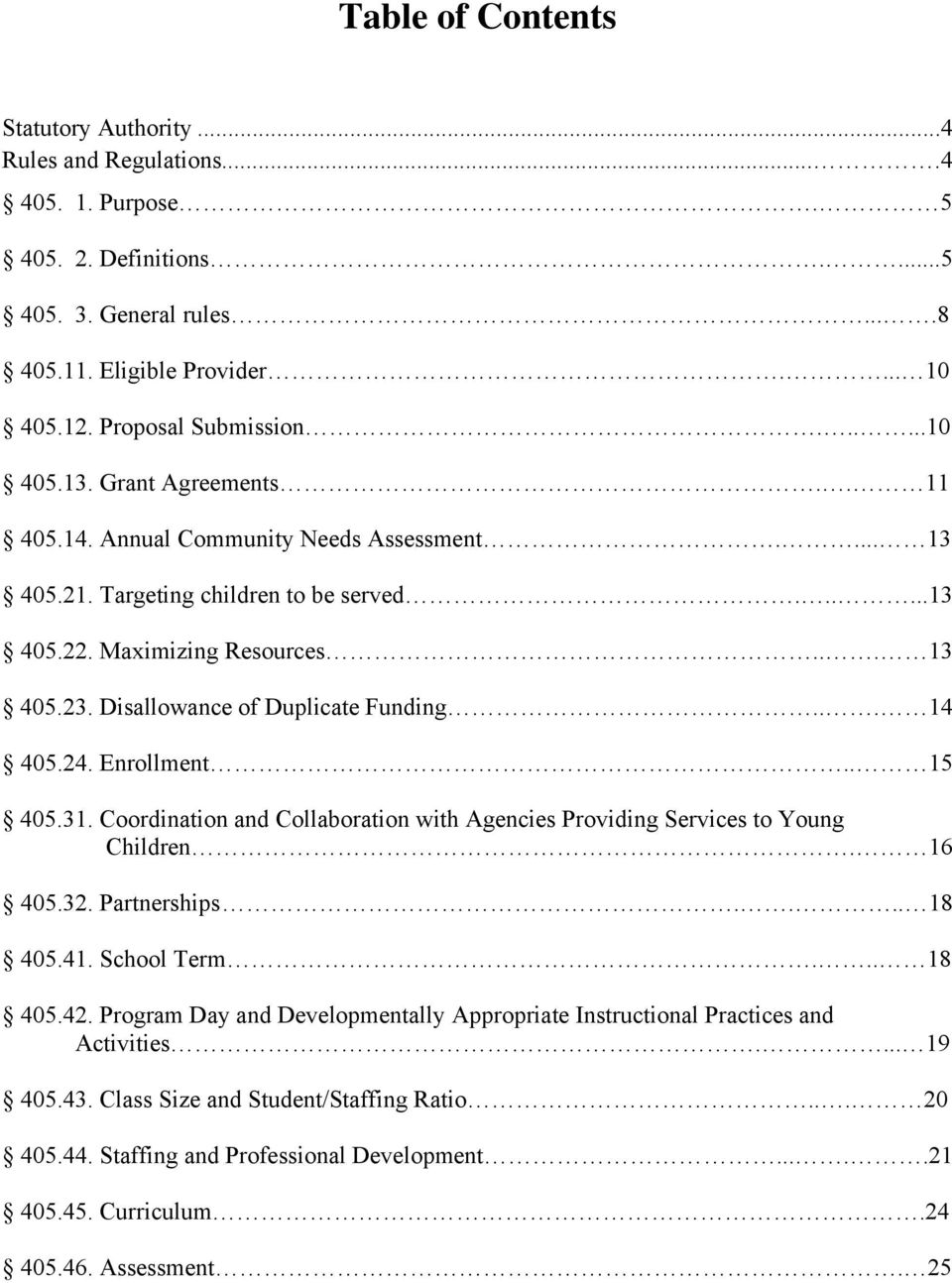
3 Table of Contents Statutory Authority...4 Rules and Regulations Purpose Definitions General rules Eligible Provider Proposal Submission Grant Agreements Annual Community Needs Assessment Targeting children to be served Maximizing Resources Disallowance of Duplicate Funding Enrollment Coordination and Collaboration with Agencies Providing Services to Young Children Partnerships School Term Program Day and Developmentally Appropriate Instructional Practices and Activities Class Size and Student/Staffing Ratio Staffing and Professional Development Curriculum Assessment. 25
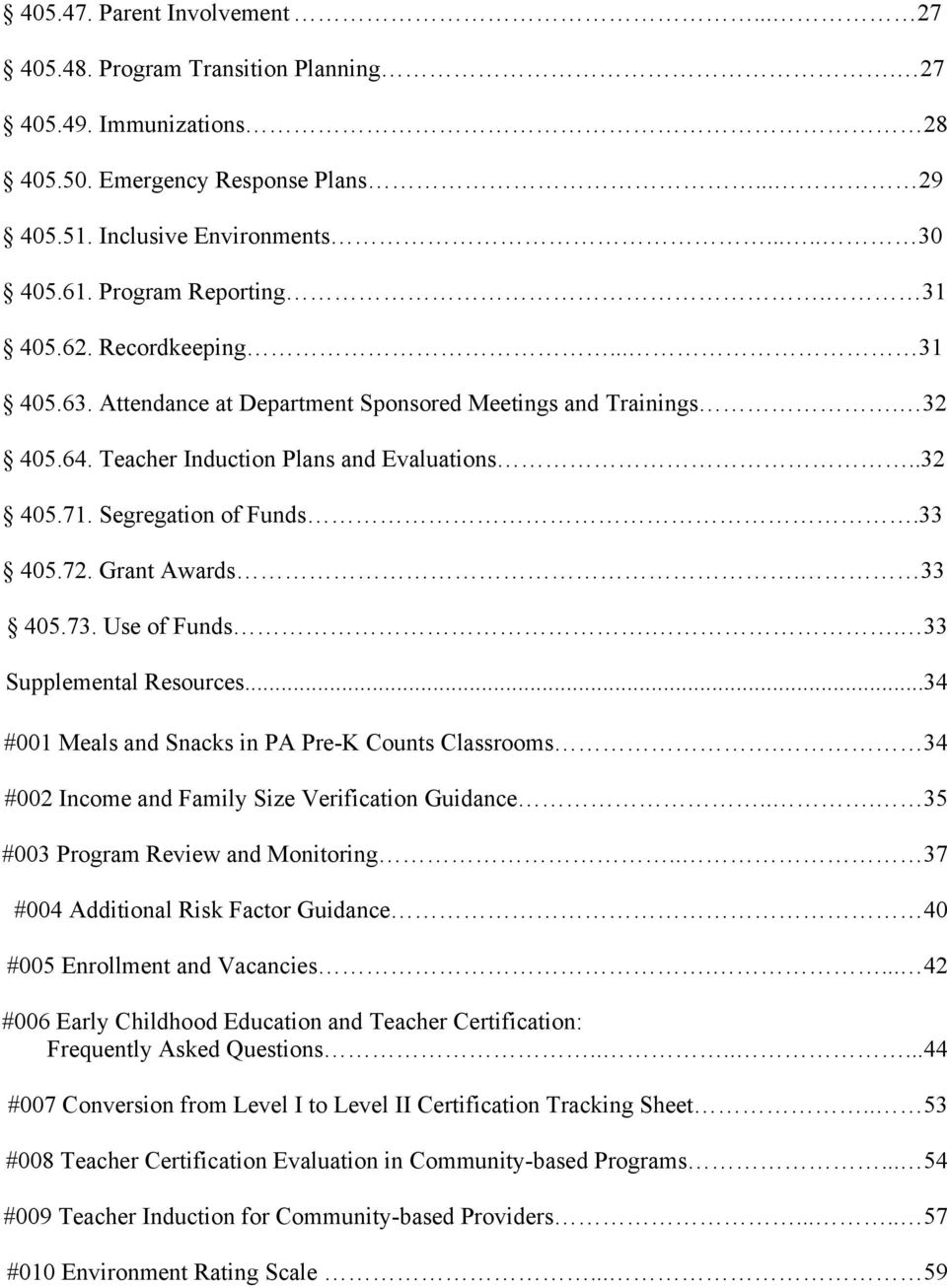
4 Parent Involvement Program Transition Planning Immunizations Emergency Response Plans Inclusive Environments Program Reporting Recordkeeping Attendance at Department Sponsored Meetings and Trainings Teacher Induction Plans and Evaluations Segregation of Funds Grant Awards Use of Funds.. 33 Supplemental Resources...34 #001 Meals and Snacks in PA Pre-K Counts Classrooms. 34 #002 Income and Family Size Verification Guidance #003 Program Review and Monitoring.. 37 #004 Additional Risk Factor Guidance 40 #005 Enrollment and Vacancies #006 Early Childhood Education and Teacher Certification: Frequently Asked Questions #007 Conversion from Level I to Level II Certification Tracking Sheet.. 53 #008 Teacher Certification Evaluation in Community-based Programs #009 Teacher Induction for Community-based Providers #010 Environment Rating Scale... 59
5 #011 Reporting and Data Requirements #012 Continuous Quality Improvement/Best Practices. 64 #013 Fiscal Reporting and Deadlines 68 #014 Audit Requirements.. 70

6 1. Statutory Authority: Act 45 established the Program (Pennsylvania Pre-K Counts) as a competitive grant program to expand pre-kindergarten opportunities for eligible students throughout this commonwealth. It authorized the Pennsylvania Department of Education (PDE) to promulgate regulations and establish guidelines and standards necessary to implement the Program. The regulations that were promulgated can be found at Part 405 of Title 22 of the Pennsylvania Code. The Program serves children who are at least 3 years of age and younger than the entry age for kindergarten in their school district of residence and must be provided free of charge. However, families that can afford to pay some or all of the cost for the Program may do so but they may not be solicited to pay. Grants are awarded through a competitive grant process to school districts, Head Start recipients, licensed nursery schools, child care centers and group child care homes that are at least a STAR 3 under the Keystone STARS quality rating system established by the Pennsylvania Department of Public Welfare and third-party entities that carry out the administrative and fiduciary provisions of the Program but not operate a classroom funded by the grant. The programs must target enrollment to children who are most at risk of school failure, which is defined as living in households below 300 percent of the federal poverty rate, are English language learners or are at risk due to community factors, academic difficulties or economic disadvantage. Grant recipients shall verify income and family size before enrolling students. Children with identifiable disabilities or developmental delays may be included in the Program and shall be served in inclusive environments in which they constitute no more than 20 percent of the initial enrollment at the start of the Program year. Grant funds may not be placed in a reserve account or used for administrative purposes. They may only fund Programs that provide no fewer than 180 days of pre-kindergarten services, include a minimum of 2 1/2 hours of instructional services in half-day programs and a minimum of 5 hours of instructional services for full-day programs. Program providers may have a delayed start-up in the first year of their participation in the Program and offer fewer than 180 days of instructional services upon approval by PDE. Classroom size is restricted to no more than 20 students (with 17 students preferred as in the State Board of Education regulations in Chapter 4 (relating to academic standards and assessment)) with two adult staff a teacher certified in early childhood education, and a teacher aide who is highly qualified. To be considered highly qualified, a teacher aide shall have completed two full years of postsecondary study, hold a child development associate's credential or an associate's degree or higher, or pass a rigorous formal state or local assessment demonstrating knowledge. Continuing professional development must be provided to both teachers and teacher aides. In addition, teachers shall complete a year-long teacher induction program, undergo evaluations and apply for Level II Certification under the State Board of Education regulations in Chapter 49 (relating to certification of professional personnel). In planning programs, providers shall coordinate and collaborate with Early Intervention and Head Start agencies, school districts, community groups and other area providers of prekindergarten services. In particular, grantees should coordinate the availability of services with other Office of Child Development and Early Learning programs which have waiting lists. Grantees operating in partnerships with other entities shall have written partnership agreements 4

7 explaining how they will operate. Providers shall have plans for parental engagement, transition of students to kindergarten, immunizations and emergency response. The Program's curriculum must be aligned with the early learning standards established by PDE, and grantees and their provider partners shall perform other duties under applicable regulations and standards, including assessment of student progress and the classroom environment. Eligible students may not be included in school district calculations for average daily membership for the purpose of fund reimbursements under Article XXV of the Public School Code of 1949 (24 P. S ). PDE has promulgated regulations and established guidelines and standards that address the process through which eligible providers may apply for grant funds, allowable and required uses of the funds, per-student funding levels and the criteria for identifying approved providers. PDE Department will also identify student and program assessments to be used by approved providers, encourage the development and maintenance of community coordination and partnerships and perform other functions necessary to carry out the Program, including the monitoring of approved providers. 2. RULES and REGULATIONS, [22 PA. CODE CH. 405 Pennsylvania (PA) PRE-K COUNTS General Provisions Purpose. This chapter establishes rules and procedures for implementing the Program created to provide expanded access to high quality prekindergarten experiences for eligible students. No Further Clarification Required Definitions. The following words and terms, when used in this chapter, have the following meanings, unless the context clearly indicates otherwise: No Further Clarification Required Act Article XV-D(b) of the Public School Code of 1949 (24 P.S D D), added by the act of July 20, 2007 (P.L. 278, No. 45). Approved provider An eligible provider that has been approved by the Department to offer prekindergarten under the act. At-risk child A child who is at risk of 5
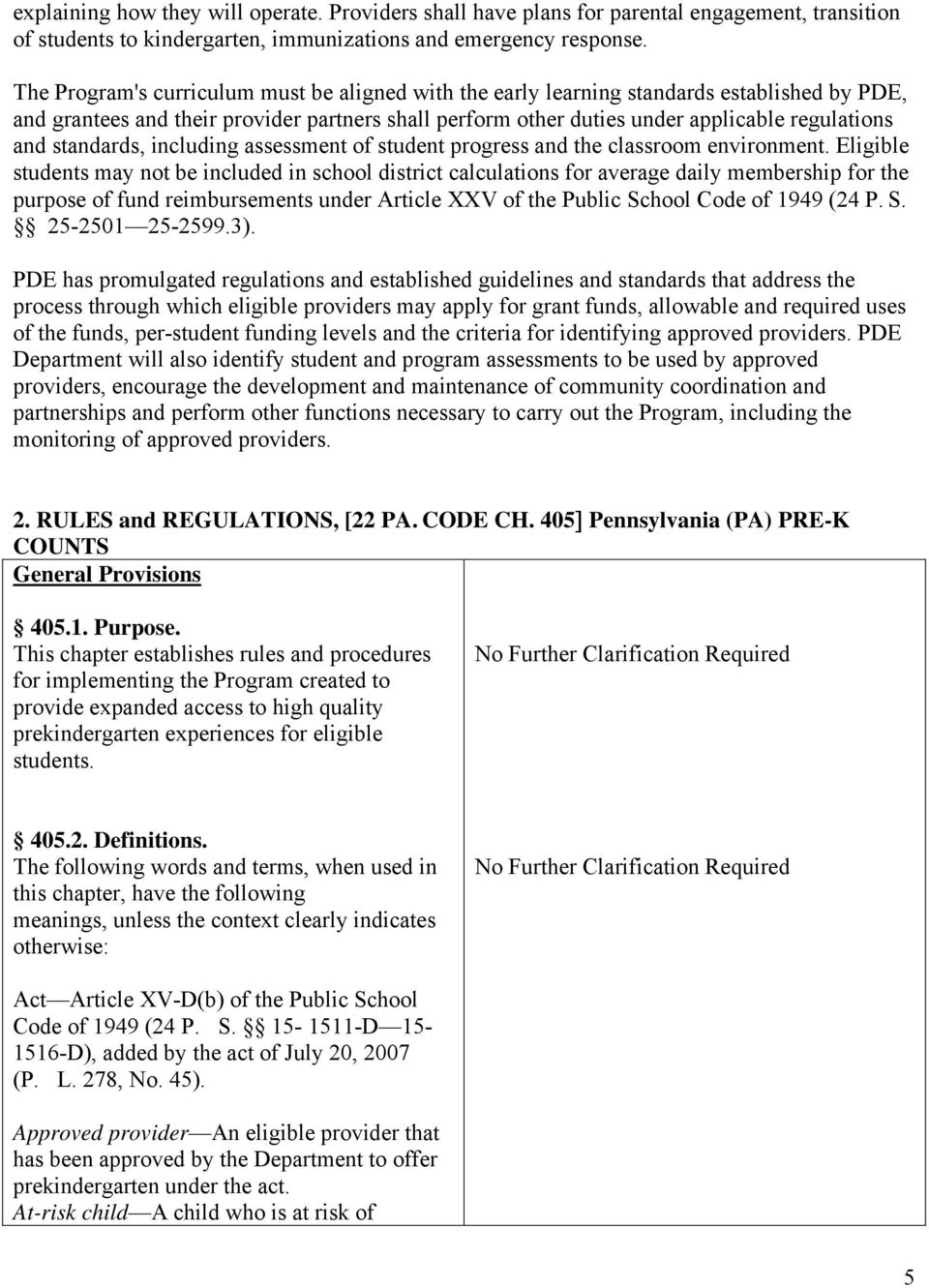
8 educational failure because of poverty, economic disadvantage, limited English proficiency, academic difficulties, or individual or community factors. CDA Child Development Associate Credential. Department The Department of Education of the Commonwealth. Eligible applicant Any of the following entities: (i) A school district. (ii) A Head Start program. (iii) A nursery school licensed under the Private Academic Schools Act (24 P.S ). (iv) A regulated child day care center or a group day care home that is designated a STAR 3, or higher under the Keystone STARS quality rating system established by the Department of Public Welfare, as of the beginning of the program year. (v) A third party entity that will carry out fiduciary and other lead agency responsibilities for entities eligible to operate program classrooms. Eligible provider An eligible provider as defined in section 1511-D of the act (24 P.S D). A child day care center or group day care home must have been designated a STAR 3, or higher under the Keystone STARS quality rating system established by the Department of Public Welfare as of the beginning of the program year. Eligible student An eligible student as defined in the section 1511-D of the act. Grant An award of funds by the Department for the purposes of carrying out the Program. Identified developmental delay or disability As used in this chapter, a child who has a written Individualized Education Program under Chapter 14 (relating to special education services and programs) and the Federal Individuals with Disabilities Education Improvement Act (20 U.S.C.A ). Lead agency An entity that submits an 6

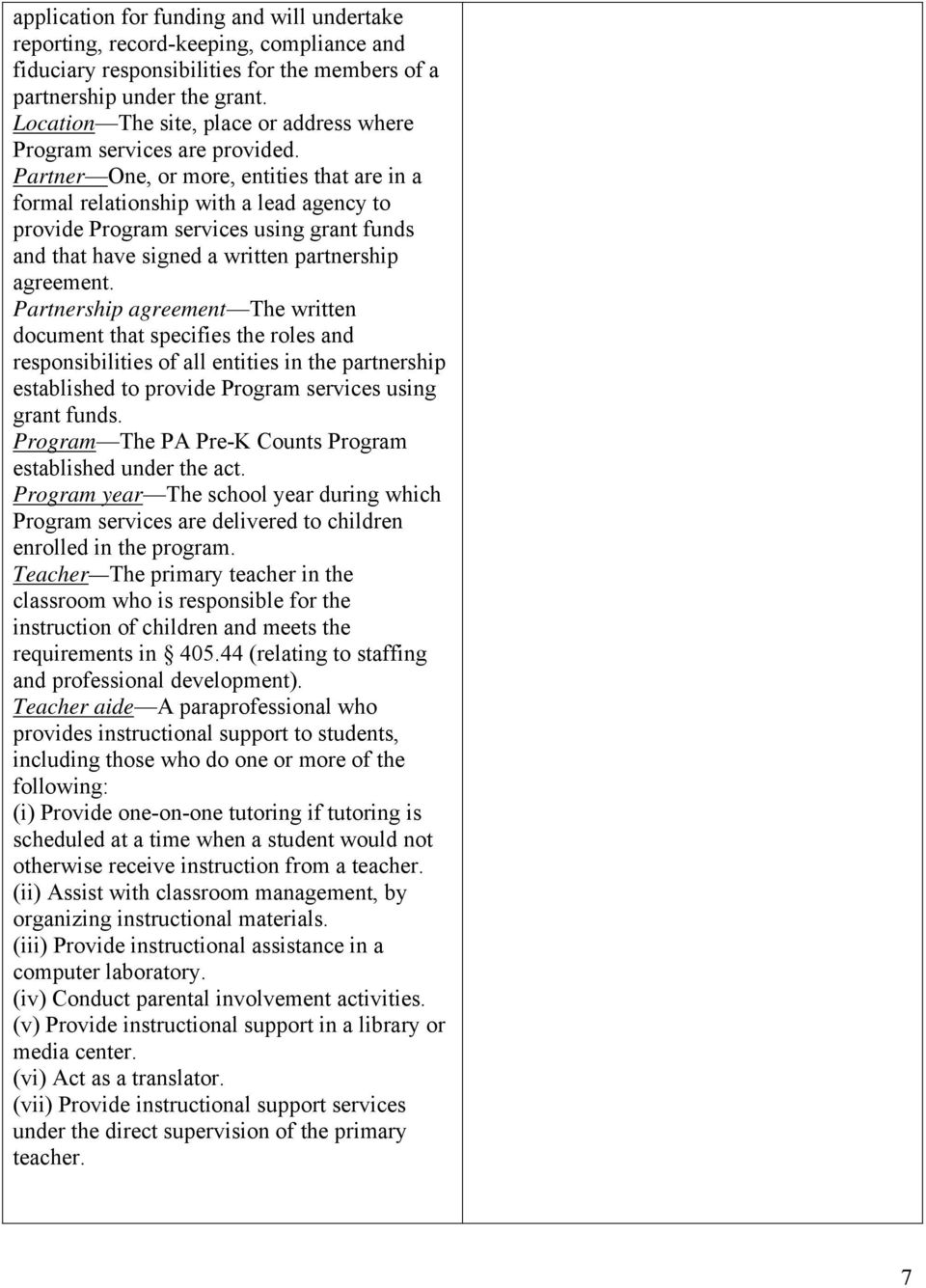
9 application for funding and will undertake reporting, record-keeping, compliance and fiduciary responsibilities for the members of a partnership under the grant. Location The site, place or address where Program services are provided. Partner One, or more, entities that are in a formal relationship with a lead agency to provide Program services using grant funds and that have signed a written partnership agreement. Partnership agreement The written document that specifies the roles and responsibilities of all entities in the partnership established to provide Program services using grant funds. Program The PA Pre-K Counts Program established under the act. Program year The school year during which Program services are delivered to children enrolled in the program. Teacher The primary teacher in the classroom who is responsible for the instruction of children and meets the requirements in (relating to staffing and professional development). Teacher aide A paraprofessional who provides instructional support to students, including those who do one or more of the following: (i) Provide one-on-one tutoring if tutoring is scheduled at a time when a student would not otherwise receive instruction from a teacher. (ii) Assist with classroom management, by organizing instructional materials. (iii) Provide instructional assistance in a computer laboratory. (iv) Conduct parental involvement activities. (v) Provide instructional support in a library or media center. (vi) Act as a translator. (vii) Provide instructional support services under the direct supervision of the primary teacher. 7
10 General rules. (a) Program services shall be provided free of charge. (b) Nothing in this section shall be construed to prevent families with children who participate in the Program and are willing and able to pay part or all of the cost of the participation, from doing so. Approved and eligible providers and lead agencies are prohibited from soliciting costs from families. (c) A student participating in the Program may not be included in the average daily membership or adjusted average daily membership of an approved provider school district for the purpose of reimbursement under Article XXV of the Public School Code of 1949 (24 P.S ). (d) Programs must be open to children with identified developmental delays or disabilities, or both, and provide inclusive environments for these children. (e) Approved providers may enroll eligible students who reside outside of the providers' usual attendance area but all eligible children must be residents of this Commonwealth. (f) Program grant funds are to be used for providing services and programs to ageeligible students as described in (relating to targeting children to be served). Program classes may include children supported by alternative funding sources, including Early Intervention, Head Start, school district or other public funds. In addition, those other funding sources may be used to support a student in a Program outside the age requirements or the 2-year time limitation. (g) Approved providers shall verify the income and family size of all children participating in the Program prior to enrollment pursuant to Program announcements issued by the Department. (h) Program providers shall be provided with Program announcements issued by the Department to provide guidance and direction General Information: PA Pre-K Counts programs may not charge families any fees during the established program hours and must assure that all PA Pre- K Counts children attend for free, including any meals and field trips. Nutritious meals and snacks must be provided by the PA Pre-K Counts program at appropriate times during the PA Pre-K Counts day. A half day program must offer, at a minimum, one snack each day. Full day programs must offer both a snack and a meal. No fees may be charged for any snack or meal. Additional information on meals and snacks can be found in Supplemental Resource #001 on page 34 of this document. Providers may not charge a concurrent fee to any other program for a PA Pre-K Counts funded child during the PA Pre-K Counts portion of the day. Once a child is age-eligible to attend kindergarten in the public school district of residence he/she is no longer eligible for enrollment to be supported by PA Pre-K Counts funding. Those children eligible for kindergarten, whose parents elect to keep their child in prekindergarten for an additional year, may be placed in a PA Pre-K Counts classroom provided alternate funding sources are used and the child is not included in the PA Pre-K Counts enrollment. This applies to a kindergarten-eligible child who is participating in the Early Intervention program. There are two primary eligibility requirements that all children must meet in order to be considered eligible for PA Pre-K Counts: children must be age and income eligible for the program. Local programs may define additional eligibility requirements, but at a minimum age and income must be met. 8

11 regarding application, implementation and reporting requirements. (i) The Department will administer the Program consistent with the statutory authorization. All children who participate in PA Pre-K Counts must be income-eligible. Families whose income is at or below 300 percent of the federal poverty level are eligible. Income verification is required for every child. Grantees must verify a child s low-income status before final enrollment is completed by collecting documentation of income that confirms the reported annual gross income noted during the initial stages of the enrollment process. The verification of family size and income must be documented through a staff person s signature and kept on file. Acceptable documentation to determine eligibility can be found in Supplemental Resource #002 on page 35 of this document. Approved income eligibility is valid for the entire time the child is enrolled in the program. It does not need to be re-assessed annually. Documentation of this requirement must be kept on file at the program, either in a locked separate file or in the child s confidential file. These records, while confidential, are subject to audit and review. The current poverty guidelines are available on the PA Keys PA Pre-K Counts Intranet. Grantees will need to use the guidelines established for the current year for enrollment decisions and income verification. PELICAN will serve as the authoritative contact list for the program. Notices and announcements and other communications will be dispersed based on addresses pulled from this source. PA Pre-K Counts agencies and partners will have a minimum of one formal compliance review visit annually. Preschool program specialists will utilize the Program Review Instrument and other supporting documents to 9

12 identify areas of strength and areas of needed focus to assure full compliance with the PA Pre-K Counts regulations and policies. Additional Information on Program Review and Monitoring can be found in Supplemental Resource #003 on page 37 of this document. Competitive Application Procedures Eligible Provider. An eligible provider may apply for a grant alone or in combination with other eligible providers as a joint applicant, in which case the entity that applies for the grant shall be the lead agency in a partnership, as defined in (relating to definitions). Eligible Provider: The following entities may provide PA Pre-K Counts classrooms. 1. School districts; 2. Licensed nursery schools; 3. Head Start grantees; and 4. Child Care Centers and Group Child Care Homes that maintain a STAR 3 rating or higher under the Keystone STARS Program. A third-party entity may apply for PA Pre K Counts funding and administer the lead agency responsibilities for entities that are eligible to provide the classroom services under the categories listed above. Provider eligibility must be maintained throughout the entire grant period Proposal Submission. (a) The Department will announce through its web site that competitive grant applications are to be submitted to the Department, specifying the submission deadline. (b) To be considered for a grant award, an applicant shall meet the deadline for submission of all information by the dates announced in the request for applications. No Further Clarification Required 10

13 Grant Agreements. (a) After an eligible provider has been approved, the provider or lead agency shall enter into a grant agreement with the Department. Grant agreements must contain, at a minimum, a work statement and budget. (b) Grantees shall contact the Department for guidance if a change needs to be made to the scope of work or the budget contained in the grant agreement. Competitive Grants: Competitive grants are awarded for one year, with four subsequent years of continuation grants if funding is available. Continuation Grants: There are several potential types of Continuation Grant applicants. Each is described below: 1. Continuation Grants with No Changes. This category includes single applicants that are requesting the same number of half-day and/or full day PA Pre-K Counts slots and the same level of funding as was awarded in the previous fiscal year. It also includes joint/partnership applicants with no changes in the partners, the total number and type of slots requested, or in the site or location that a particular partner plans to use for its PA Pre-K Counts classes, or in the number and type of slots (half-day and full-day) for each partner. The total funding and number and type of slots remain the same as in the previous fiscal year. There is no change in any of the partners in this category of continuation application nor a change in the funding level requested. There may, however, be changes in specific line items in the budget that show how the funds are to be used, including the level of pass through funds provided to each partner, but not in the number or type of slots each pass through recipient is to receive. 2. Continuation Grants with Changes. There are several types of Continuation Grants with Changes. a. This category is for single applicants that want to change the number and type of slots, (half-day and full-day) they will provide, but not the level of funding. It also includes partnerships or joint applicants proposing to 11

14 change the number and types of slots requested for any of the partners in a partnership, but not the total funds requested. b. This category includes a request for a change in the distribution of half-day and/or full-day slots among various locations and/or partners and their locations. c. This category includes a request for fewer slots and funding by a single applicant or a joint applicant. It includes a joint applicant that is requesting funds for a partnership that is dropping one or more partner. If a partner is not planning to be an ongoing part of a partnership, whether by its own volition or for any other reason, the slots and per child funding provided to that partner through the lead agency revert to OCDEL. The slots and their funding do not belong to the partnership or the lead agency. Nor do the slots belong to the departing Partner to continue as a PA Pre- K Counts provider either on its own or as part of another partnership. d. This category includes grantees requesting a change in the location of one or more classroom. e. This change indicates that a grantee is proposing a change in one or more partner (adding a partner, dropping a partner, or both). f. Consolidation Grants. Two or more lead agencies may consolidate their program under one lead agency, designating the other as a partner. The funds requested for a Continuation Grant for the consolidated lead agencies may not exceed the sum of the grants to the lead agencies when they were individual or separate grantees in the previous fiscal year. Lead agencies that wish to Consolidate should contact their preschool program specialist as soon as possible for directions on how to consolidate. 12

15 Annual Community Needs Assessment. Applicants for Program funding shall conduct an annual assessment of community needs for Pre-K services as part of the application process for continuation, expansion or new grant funds. Annual Community Needs Assessment: Continuation applications will not need to conduct a new community needs assessment each year however, it is recommended that lead agencies and their partners update their needs assessment annually and conduct new needs assessments after the fifth year of the PA Pre-K Counts Program. Program Planning Targeting children to be served. The Department will instruct applicants to target their program enrollment to children who are most at risk, consistent with the description in the program guidance of targeting services to children most at risk, if it is likely that the funds appropriated for the upcoming program year will be less than the funds required to serve all eligible children in this Commonwealth. The Department will also instruct approved providers to engage in outreach and partnership with Child Care Works, Head Start, and other appropriate programs of the Office of Child Development and Early Learning to inform Programs and families that they serve about the availability of the Program and to coordinate with these programs particularly when there are waiting lists. Eligible Children: Age and income are the two primary eligibility requirements that all children must meet in order to be considered for enrollment in PA Pre-K Counts. Eligible 3 and 4 year olds who reside in a low income household and are at risk of educational failure because of limited English proficiency, poverty, community factors, academic difficulties or economic disadvantage may be enrolled in the program. Additional Risk Factor Guidance can be found in Supplemental Resource #004 on page 40 of this document. Children living in families with income at or below 300 percent of the federal poverty level are eligible for enrollment in PA Pre-K counts. Outreach: Grantees are expected to collaborate with other PA Pre-K Counts providers, local Head Start and Child Care Works programs to ensure children on waiting lists have the opportunity for participation in PA Pre-K Counts as well as to maintain program enrollment at 100 percent Maximizing Resources. Approved providers shall use Program grant funds to supplement, not to supplant, public funds from any other source that are used to serve otherwise eligible students, including, but not limited to, Accountability Block Grant Maximizing Resources: Children who are enrolled in PA Pre K Counts may be co-enrolled in other programs, including Child Care Works, federal or state Head Start or private pay options. 13

16 funds, local funds, or Federal or State Head Start funds for Programs provided in the same geographic area. However, this requirement does not prohibit combining funding sources for support of a single Program as long as additional eligible students are served and all of the Program standards are met by the program supported with the combined resources. Those providers who participate in the Child Care Works Subsidy program may continue to do so. Note that for those children/families who are participating in PA Pre-K Counts and receive Child Care Works Subsidy, the Child Care Works eligibility regulations provide for the child to typically remain in subsidy as well as PA Pre-K Counts throughout the course of the child s participation in PA Pre- K Counts. PA Pre-K Counts providers and county subsidy offices are required to work together to coordinate services for those PA Pre-K Counts children who are also enrolled in wrap-around child care. Head Start programs may participate in PA Pre-K Counts as well. In order to assure full use of Head Start funds, PA Pre-K Counts providers must commit to avoid enrolling children in PA Pre-K Counts who are already served in a Head Start program or eligible to participate in Head Start. The purpose of this requirement is to avoid an impact on enrollments in Head Start such that federal Head Start resources or the state Head Start Supplemental Assistance Program resources would be supplanted. Head Start eligible families may have unique needs that are best supported by a program that is designed especially to meet those needs and offers a broad array of services, as does Head Start. However, families with children eligible for Head Start may prefer to enroll them in PA Pre-K Counts, rather than Head Start. The PA Pre-K Counts Program may enroll these students, giving the parents an option. The goal is to have cooperation, rather than competition between Head Start and PA Pre-K Counts in enrollment of students Disallowance of Duplicate Funding. Program funds may not be used to provide the same service for a child already receiving that Disallowance of Duplicate Funding: PA Pre-K Counts funding is the sole source of funding during the PA Pre-K Counts instructional day. Providers may utilize 14

17 service funded by another resource. alternative funding for those PA Pre-K Counts children who are enrolled in additional programs such as Head Start and child care for the hours that extend beyond the PA Pre-K Counts day. Additional guidance on reimbursement for PA Pre-K Counts slots can be found in Supplemental Resource #005 on page 42 of this document Enrollment. Each approved provider shall develop and implement a plan for securing full enrollment throughout the program year, except as follows: (1) When a student leaves the Program after the start of the program year, the provider shall have up to 20 instructional days to fill the vacancy, after which time the Department may request the return of funds or reduce future payments for the vacated and unfilled slot in the amount of funds, relative to the remaining instructional days of the Program for that program year, unless the vacancy occurs within 21 instructional days of the last day of class. (2) If an enrolled child has ten or more unexcused absences, the provider shall take appropriate steps to address attendance, up to and including dismissal of the child from the program. The department may request the return of funds or reduce future payments to Programs that have not taken appropriate steps to overcome unexcused absences. (3) Provider policies regarding unexcused absences and the number allowed must be written and provided to parents, families or guardians of enrolled children and to the Department. (4) An approved provider may not deny a Enrollment: Full enrollment, as demonstrated by PELICAN enrollment statistics, must be achieved by September 1 of each year and maintained at all times. A child will not be counted by OCDEL as enrolled if the child is not entered into PELICAN. Children are considered to be enrolled when there is mutual understanding between parent or guardian and the PA Pre K Counts program that the child has been accepted into the program and will begin attending on a specified future date. In addition, an intake meeting between parent and school has been completed, the necessary information has been gathered and the child has been identified as a candidate for a PA Pre-K Counts slot. Outreach efforts throughout the community to locate and enroll children whose families are at 300 percent or below the federal poverty guidelines is an ongoing requirement for PA Pre K Counts. Through collaborative efforts with other community providers, PA Pre K Counts programs may be able to reduce the waiting lists in the county Head Start program or subsidized child care programs by establishing a system of reciprocal referrals. A selection and prioritization strategy must be developed that first looks at 300 percent or below of income, then other risk factors such as homelessness, teen mother or English 15
18 student admission to a Program by reason of the student s disability. language learner. Providers have 20 instructional days to fill vacated slots. Vacancies lasting more than 20 days should be reported to the preschool program specialist. Maintaining a waiting list will ensure slots are filled immediately. Chronic, unexcused absences will be considered on a case-by-case basis and could result in reduced funding. These situations require ongoing support from the PA Pre-K Counts provider and may result in the child s dismissal from the program. Written provider policies regarding attendance and notification when a child is absent must be provided to parents, guardians and PDE. A parent or family handbook is an effective means of defining program procedures and policies and sharing that information with families. The Attendance Policy should be included within the handbook and/ or provided in some other manner in writing. Children with disabilities shall be considered for PA Pre-K Counts enrollment under the program s enrollment strategies for income verification and receive an at-risk prioritization and at no time will be denied services because of their disability. Program Coordination and Collaboration Coordination and Collaboration with Agencies Providing Services to young Children. (a) Approved providers shall coordinate and collaborate with the local agencies providing Early Intervention services to Infants and Toddlers to ensure a smooth transition for children and families that have been receiving services from Early Intervention. (b) Approved providers shall coordinate and Community Outreach/Early Intervention: Children receiving supports and services from local Early Intervention agencies shall be receive services in typical settings for all children. PA Pre-K Counts providers must coordinate enrollment strategies with Child Find (a program to identify all children who may be eligible or in need of Early Intervention 16

19 collaborate with the local agencies providing Early Intervention services to preschool age children to ensure the following: (1) A smooth transition for children and families that have been receiving services from Early Intervention. (2) Coordination of any continued Early Intervention services the child will receive while enrolled in the Program. (3) Awareness of the available Early Intervention services for children enrolled in the Program who have not been identified as in need of Early Intervention services but who may be eligible for the services, and the capacity to provide appropriate information to parents and make appropriate referrals for Early Intervention evaluations and services. (c) Approved providers shall coordinate and collaborate with the Child Care Information Services agency in their area to coordinate services and benefits received by families and to achieve enrollment in the Program of children who are most at risk and in need of services. (d) Approved providers shall coordinate and collaborate with programs that provide the before and after Program child care for participating children so that transportation arrangements, emergency contacts and other necessary information are shared and so that the needs of families whose children are enrolled in the Program are met. (e) Approved providers shall coordinate and collaborate with Head Start agencies. (f) Approved providers shall coordinate and collaborate with school districts in those areas from which they are enrolling children in the Program to develop and implement plans for a smooth transition for children who will leave the Program to be enrolled in the school districts' K-12 program; to ensure alignment of curriculum and standards between the Program and the K- 12 school district program; and to consolidate activities, such as professional development, to the extent practicable, to the advantage of both services). Children receiving Early Intervention services must participate in the full range of opportunities within the program for a 2.5 or 5 hour day, 180 days per year. The method of support for each child with a disability will be decided upon by the family and Early Intervention staff after a formal evaluation has taken place. PA Pre-K Counts staff should be invited to meetings so that the staff can benefit from expectations and strategies shared at meetings. Early Intervention Staff and PA Pre-K Counts staff will integrate targeted skills and strategies within the program day during routines and activities. Transitions from Infant-Toddler Early Intervention programs entering into a PA Pre- K Counts program will begin at least six months prior to child s third birthday. Both agencies will develop procedure for families to explore PA Pre-K Counts as a viable option for inclusive services. Collaborative efforts should be used to support the child and families transition processes. Referrals should be made by PA Pre-K Counts staff to families for Early Intervention services when appropriate. PA Pre-K Counts providers must document all collaboration efforts. Transition from PA Pre-K Counts programs into kindergarten shall support a child s individual and family needs during the transfer of services (share adaptations and best practices) for a successful transition. 17
20 programs and creation of greater efficiencies. (g) Approved providers shall coordinate and collaborate with the local community groups that engage the public in issues related to early childhood education. (h) Approved providers shall coordinate and collaborate with other Program sites in their county on activities such as professional development, family outreach and child enrollment strategies, to the extent practicable to the advantage of all of the Programs and creation of greater efficiencies Partnerships. Partnerships of eligible providers must have a signed partnership agreement. The agreement shall be submitted to and approved by the Department. The partnership agreement must delineate how the entities that comprise the partnership will carry out their roles and responsibilities within the Program, including: communication, decision-making, reporting, monitoring of program requirements, recordkeeping and fiduciary matters. Partnerships: As applied to PA Pre-K Counts, a partnership is an agreed upon formal relationship between a lead agency and eligible PA Pre-K Counts classroom providers, or partners, in which partnership members work together to provide high quality prekindergarten in a specific geographic area. For purposes of PA Pre-K Counts, the word partner is used exclusively to mean an eligible provider that is providing a PA Pre-K Counts classroom and is receiving funding for all of its operational expenses, such as salaries of the teacher and the aide, materials, and supplies. This would not include an entity that is merely providing space for the classroom (rental agreement). Program and Classroom Requirements School Term. Programs shall offer a minimum of 180 Days of developmentally appropriate instructional practices and activities for students. (1) In the first year of operation as a provider, if the provider is unable to start up immediately at the beginning of the program year, the provider may serve children for fewer than 180 days, but in no case fewer than 160 days. Program Year: All continuing grantees are required to operate for a minimum of 180 instructional days per program year, and snow days or school cancellations must be made up to assure the full number of days of operation. It is advisable to include a few extra days of operation in the school calendar to anticipate weather-related closures. 18
21 (2) Days may not be counted as days of developmentally appropriate practices and activities when the Program is closed, and time may not be counted as time spent on developmentally appropriate practices and activities for an activity to which admission is charged Program Day and Developmentally Appropriate Instructional Practices and Activities. Instructional time for students shall be time in the program devoted to developmentally appropriate instructional practices and activities provided as an integral part of the Program under the direction of qualified employees. (1) The following practices and activities, as described in the early learning standards in 4.20 (relating to prekindergarten education), count towards instructional time: (i) Classroom instruction (ii) Orientation of children during regular school hours to the Program, Program setting and Program routines conducted: (iii) Meals and snack-time, as long as they are integral parts of the curriculum facilitated by the lead teacher and used for student learning experiences (iv) Play-time, including outdoor and indoor play or child directed activities as long as they are an integral part of the instructional day, facilitated by the lead teacher and used for student learning (v) Time spent at the library, and in art, music or physical education (vi) Opening exercises that engage children, including opening circle time, in preparation for the day (vii) School, group or class educational trips to which admission is not charged to students or parents and provided that a teacher accompanies the students. Length of Day There are two ways that PA Pre-K Counts can be structured: PA Pre-K Counts programs may operate as half-day programs. These half-day programs must provide a minimum of 2.5 hour per day of instructional services or activities, for a minimum of 180 days per year PA Pre-K Counts programs may operate as full-day programs for a minimum of 5 hours per day of instructional services or activities, for a minimum of 180 days per year. Grantees are advised to plan for a minimum of an extra half hour in their schedule for arrival and departure time in order to ensure that children receive either the full 2 ½ or 5 hours of instructional time that is intended. Teachers and teacher aides will need to be scheduled and paid salary for a minimum of ½ hour a day beyond the scheduled time for the students to allow for planning and preparation time. Counting Hours per Day. Only time providing instructional activities to children may be counted toward the half-day and full-day length of day and the 180 days per year. Grantees will need to plan for a slightly longer day and year so that you have allowed for naptime in full-day programs and for arrival time, as well as for closures for inclement weather and non-attendance of students on days when 19
22 (viii) Student services, such as guidance and counseling services, psychological services, speech pathology and audiology services, and student health services (ix) Civil defense, fire, bus evacuation and similar drills (x) Early dismissal and delayed opening only when due to inclement weather (2) Time spent in transportation, professional development and parent/teacher conferences does not count as instructional time professional development is being provided. Instructional activities only count toward instructional time when children are with appropriately certified staff and include the following: Time spent at the library, and in art, music or physical education constitutes instructional time if provided by the regular teacher or area specialists An early dismissal so that a part of the day may be spent in parent/teacher conferences does not count as a full day of instruction Class Size and Student/Staffing Ratio. (a) Program class enrollments are limited to at most 20 students with at least one teacher and one aide in the classroom, however, for high quality programming a maximum of 17 students is recommended. (b) If a Program class has ten or fewer students, there shall be one teacher in the classroom and an aide must be available onsite to assist the teacher as needed. (c) Whenever the enrollment in a class exceeds 20, the class shall be divided into two classes so that each class individually does not exceed 20 students. Each class must be properly staffed and, if space is to be shared, that space must be divided by a barrier that adequately separates the spaces for instructional purposes. Class Size and Student-Teacher Ratios PA Pre-K Counts programs must have a student/teacher ratio of no more than 20 students for one teacher and one teacher aide in a classroom, that is, two adults in a classroom for every 20 students. Programs of high quality ordinarily have a student/teacher ratio of no more than 17 students for one teacher and one teacher aide in a classroom or two adults for every 17 students. This requirement is consistent with State Board of Education regulations (22 Pa. Code ss4.20 (6)). If the classroom has 10 or fewer 3 and 4 year olds, it must have one highly qualified teacher and a secondary person available in the facility. The secondary person must meet the requirements for a PA Pre-K Counts teacher's aide. Any number of children in a classroom above 20 constitutes a second classroom. Classrooms that share space must provide physical barriers that denote the separation of the classrooms. Each space must meet the student/teacher ratio and have the appropriately qualified staff. 20
23 Staffing and Professional Development. (a) Teachers of eligible students supported by Program funding shall meet the following requirements: (1) In school districts, teachers shall have early childhood education certification. (2) In Head Start and child care programs, teachers shall possess a minimum of an associate's degree in early childhood education or child development. (3) In licensed nursery school programs, teachers shall have a minimum of a bachelor's degree, 18 credits from an institution of higher education in early childhood education and a private academic teaching or temporary approval certificate. (4) By December 31, 2011, all teachers in Program classrooms shall have early childhood education certification. (b) Teacher aides in any classroom of eligible students supported by Program funding shall meet one of the following criteria: (1) Completion of at least 2 years of full-time postsecondary study or the equivalent. (2) Possession of an associate's degree or higher. (3) Ability to meet a rigorous standard of quality and demonstration of knowledge through a formal state or local academic assessment or possession by the teacher aide of a Child Development Associate's (CDA) certificate. (4) Teacher aides who work solely as translators shall have a high school diploma or its equivalent, and do not have to meet any of the other requirements of paragraphs (1) (3). (c) A lead teacher in the Program, including those in community-based settings, including outdoor and indoor play or child directed activities with an Instructional Level I certificate shall convert the certificate to an Instructional Level II certificate within 6 years from the time of initial service as an Instructional Level I teacher in the Program. Teachers holding an Instructional Level I early Staffing and Professional Development: 1. School district lead teachers in PA Pre-K Counts Classrooms: As with all prekindergarten classrooms operated by school districts, the standard for a lead teacher in a PA Pre-K Counts classroom or any classroom enrolling children who generated PA Pre-K Counts per child funding, is possession of a Pennsylvania teaching certificate for early childhood education. 2. Community-based lead teachers in PA Pre-K Counts Classrooms: All teachers who are hired for PA Pre-K Counts classrooms must have Early Childhood Education certification at the start of the school year. 3. Lead agencies must assure that partner sites lead teachers possess a bachelor s degree in early childhood and their teaching certification. 4. Teacher aides in PA Pre-K Counts Classrooms. A teacher aide is required in all PA Pre-K Counts classrooms that exceed 10 students. All aides must meet one of the following criteria: a. Possession of a current Child Development Associate s certificate for preschool. Aides who have completed all of the requirements of the Child Development Associate s certificate and have submitted their application to the Council of Professional Recognition and are awaiting their formal assessment by the council may apply for a time-limited waiver. b. Completion of at least two years of postsecondary study with a minimum of 60 college credits, or c. Possession of an associate s degree or higher, or d. Ability to meet a rigorous standard of quality and demonstration of knowledge in and the ability to assist a teacher in instructing reading, writing, and mathematics. This rigorous standard of quality includes a 21
24 childhood certificate may count their time working in a Program community-based program toward the 3 years of required experience necessary before converting the certificate to an Instructional Level II certificate, in accordance with the requirements of the Department, including a year's participation in a Department approved teacher induction plan, six semiannual evaluations and the Department specified continuing professional development credits. (d) Program teachers shall undertake continuous professional development as specified by the Department and, at a minimum, meet the requirements of sections of the Public School Code of 1949 (24 P...S ). (e) Program teacher aides shall take a minimum of 24 hours of continuous professional development as specified by the Department, and in early childhood education and development, each year. demonstration of competence in basic literacy skills, the ability to speak and write standard English, and the ability to provide instruction of pre-kindergarten students in the acquisition of the knowledge, skills and abilities described in the Early Learning Standards. Demonstration of this knowledge and ability can be accomplished through a formal state or local academic assessment, or possession by the teacher aide of a Child Development Associate s certificate. Teacher aides who work solely as translators must have a secondary diploma or its equivalent, and do not have to meet any of the other requirements of (a) through (c) above Professional Development: At a minimum, 24 hours of professional development must be obtained annually with at least 50 percent or 12 hours specific to early childhood education. Professional development hours may include hours facilitated by a Pennsylvania Quality Assurance System (PQAS)-certified instructor, providing ACT 48 credit or college classes. All PA Pre-K Counts teachers must attend the PA Pre-K Counts Core Series of Professional Development. Within the first two years of PA Pre-K Counts participation, the following sessions are required: 1. Environment Rating Scale 2. Observation and Assessment 3. Linking Schedules, Standards and Assessment 4. Strengthening Relationships with Children, Families and Colleagues All core series trainings can be scheduled through the PA Keys training calendar. PA Pre-K Counts personnel (and all educational professionals in Pennsylvania) are required, under the Child Protective Services 22
25 Act, to report suspected child abuse to the appropriate authorities. This requirement must be conducted within the agency-specific procedures and policies regarding suspected child abuse and neglect. Beginning in 2013, all PA Pre-K Counts staff who have the potential to be left alone with a child must attend a professional development event on mandated reporting. This training may be offered by county child welfare agencies, the Regional Key, or other protective services agencies qualified to instruct on this topic. This training requirement must be accomplished by Sept. 1, 2013, for existing staff who have not previously received such training and within 30 days of hire for newly employed staff. Those staff who received a Mandated Reporting training within the last five years are grandfathered and do not need to repeat the training. Lead Teachers in a community-based PA Pre- K Counts settings that have Instructional Level I Certificates must convert and maintain their certificate to an Instructional II Certificate within six years from the time of initial service as an Instructional Level I teacher in the program, beginning with and counting 2007 as the first year in the six-year window. Teachers holding an Instructional Level I Early Childhood Certificate may count their time working in a community-based PA Pre-K Counts program toward the three years of successful teaching experience necessary before converting the certificate to an Instructional Level II Certificate, in accordance with the requirements of PDE. These requirements also include one year of participation in an OCDEL-approved Teacher Induction Plan, six bi-annual evaluations and PDE-specified continuing professional development credits. Additional information on this requirement can be found in Supplemental Resources #006 (page 44 of this document), #007 (page 53 of this document), #008 (page 54 of this document), and 23
26 #009(page 57 of this document). Teacher Aides. Professional development for teacher aides must include at least 24 hours of continuing professional education each year. Acceptable professional development includes instruction eligible for Act 48, continuing education credits, college credits, or hours taught by Pennsylvania Department of Public Welfare certified Pennsylvania Quality Assurance System instructors based on the Early Learning Standards (available on the Early Childhood section of PDE s website) and the Early Childhood Education Core Body of Knowledge (available on the PA Keys website). Substitutes. Teacher and teacher aide substitutes must be placed in classrooms whenever there is staff absence to assure the PA Pre-K Counts student/teacher ratio. Every effort must be made to assure substitutes meet the qualification requirements of the position they are filling. In short-term substitute situations (less than 90 days), at a minimum, the lead teacher substitute must hold a Bachelor s degree in early childhood education or a related field. In cases where a long-term substitute is required (more than 90 days), long-term lead teacher substitutes must meet the PA Pre-K Counts teacher qualifications Curriculum. (a) The curriculum used in any classroom that includes a child who is enrolled in the Program must be standards-based. (b) The curriculum used in the Program must be determined by the Department to be aligned with the Early Learning Standards established by the Department. Curriculum : A copy of approved curriculum is available on PDE s Standards Aligned System (SAS) at /page.aspx. These curriculum models have been determined to align with the 2009 Revised Pre-Kindergarten Early Learning Standards. Copies of the Early Learning Standards can be downloaded at the following address 24
27 PD/Standards/Pre-Kindergarten% pdf or can be ordered at When a program is considering the use of a curriculum that has not yet been aligned with Early Learning Standards, the publisher should be contacted to complete and submit an alignment review to Maryanne Olley at [email protected]. All requested alignments will be reviewed, and if they meet the OCDEL framework, will be posted on the PDE website. Programs that use a locally designed curriculum must demonstrate alignment with the Early Learning Standards prior to the use in PA Pre-K Counts. Locally designed curriculum alignments must be submitted to Maryanne Olley at [email protected] for review and approval to assure alignment. A template for submission is available on the PA Keys website at areer_standards Assessment. Approved providers shall: (1) Assess eligible students with a minimum frequency determined by the Department using an assessment tool approved by the Department. (2) Participate in Department conducted training in the use of the assessment tool as prescribed by the Department. (3) Report aggregate assessment information to the Department for purposes of Program monitoring, evaluation, reporting child outcomes and accountability in a manner and with a frequency and schedule determined by the Department. (4) Participate in a Department conducted assessment of the Program learning environment and attend the training in the use of the environmental self-assessment tool as prescribed by the Department. Comprehensive Assessment: Beginning 2013, PA Pre-K Counts providers must complete a developmental screening on all children within 45 calendar days of the child s first day in the classroom setting. This evidence-based, reliable and valid screening instrument should be used as a first step in identification of potential delays and to indicate those children who need to be further referred for evaluation. OCDEL recommends the use of the Ages & Stages (ASQ and ASQ- SE). PA Pre-K Counts providers will select and use an assessment tool from the available tools approved by PDE to assess and monitor a child s developmental progress. Student assessments guide instructional practice, professional development and technical assistance to programs and provide a method 25
28 for reporting all progress of children participating in a PA Pre-K Counts program. It is recommended that those staff responsible for implementation of the chosen assessment tool, attend training on the use of the tool, to assure the collection of reliable data. PA Pre-K Counts grantees are required to report child outcomes on October 15, and May 15 using one of the tools approved by PDE, which aligns to the Early Learning Outcomes Reporting Framework. Data gathering from families, the education team and researchbased assessment instruments should be combined to obtain the information needed to assess and report children s progress on the chosen assessment tool. Grantees should develop procedures for sharing assessment information with parents as defined in the Program Partnerships Key Learning Area of the Learning Standards for Early Childhood. Parents can partner with their PA Pre-K Counts providers to help insure the best outcomes for their children. PA Pre-K Counts classrooms must utilize the Environmental Rating Scales to assess classrooms. At a frequency determined by PDE, an Environment Rating Scale assessment, by an outside assessor, should result in an overall minimum program score of Classroom self-assessments, performed by a trained facility person, must be completed annually. Lead teachers must take the Environment Rating Scale Foundations and the Early Childhood Environment Rating Scale- Revised courses within the first six months of employment in a Pre-K Counts classroom as part of the core training series for PA Pre-K Counts. Additional information on this requirement can be found in Supplemental Resources #010 on page 59 of this document. 26
29 Parent Involvement. Approved providers shall develop and implement a plan for involvement and input of parents, families and guardians of children enrolled in the program to inform them of program goals, instructional strategies, and the progress of their children and to involve them in supportive activities designed to help ensure their child s success. Parental Involvement: Parental involvement is an important element that contributes to the success of the program and the children receiving its services. Parent involvement requires vigilant planning and understanding of the diverse situation and needs of families and their children. Elements to consider in development of a plan for family involvement include the following: Joint staff and parent planning. Polices for development and support of reciprocal relationships with families that acknowledges families as the child s first teacher. Establishment of a role for families in developing and evaluating program success. A regular system of reporting to families showing the progress of their children and provision of opportunities for families to contribute their ideas and thoughts about progress, using language and a communication vehicle that is understood and readily accessible to them. Involvement activities such as field trips, informational training, workshops, and other family and child events. Toy and book lending programs Program Transition Planning. (a) Approved providers shall develop and implement plans designed to ensure a smooth and supportive transition for children entering the program from the setting from which they are coming, including the home, Early Intervention services, Early Head Start or child care. (b) Approved providers shall develop and implement plans to ensure a smooth and supportive transition for children leaving the Program to enter kindergarten and the K-12 school environment. Transition: Transition for young children from one setting to another are very critical times in their lives. The planning and development of relationships with the individuals, programs and organizations that may be involved in a child s life as that child moves from one setting to another takes time, but is time well spent. This planning and developing of relationships needs to be conducted with care and sensitivity to the child, the family, and the programs and agencies involved. 1. Transition between pre-kindergarten 27
30 programming involves coordination with the agencies that provide these services. 2. Transition plans must be developed for those children preparing to enter kindergarten programs. Transition into kindergarten is an important time in children s lives, and influences their later school careers. Robert Pianta s research demonstrates that children face discontinuities between preschool and kindergarten as they enter elementary school for the first time. These discontinuities underscore the importance of this period. Smooth transitions are even more critical for children in high risk categories. OCDEL produced a Transition Best Practices Rubric and Transition Tool Kit that is available to all early learning practitioners at or within PDE s SAS ( Transition Across the Continuum of Early Learning Professional Learning Community Immunizations. Approved providers shall meet the immunization requirements that pertain to their provider type; for school districts and licensed nursery schools see 28 Pa...Code (relating to immunization); for child care centers and group child care homes see 28 Pa...Code (relating to immunization requirements for children in child care group settings); and for Head Start agencies see 45 CFR (relating to child health and development services), the Federal Head Start Performance Standards. Immunization Requirements: All providers of PA Pre-K Counts funded programs must meet the immunization requirements for their provider type: School districts and licensed nursery schools- -28 PA. Code ss which implements Sec of the Public School Code (24 P.S a); Child care centers and group child care homes PA Code Head Start agencies CFR ss , the federal Head Start Performance Standards. These requirements include, but are not limited to the following: 1. Within 60 days of a child s first day of attendance in the program, the provider shall obtain a record establishing that the child has received the vaccinations recommended by the 28
31 American Committee on Immunization Practices; or 2. Receipt from a parent or guardian of a child of a written objection to the child being vaccinated on religious grounds or a physician verified medical reason of a temporary or permanent nature explaining why the child is not to be vaccinated. 3. Providers must exclude children from group activities for an additional 30 days who are not vaccinated due to a temporary medical condition, unless they have received written confirmation from a physician, or state or local health department of vaccination or continuation of the medical condition. A new verification is required every 30 days or the child may not be readmitted to the setting until the requirements are met Emergency Response Plans. Approved providers shall develop, implement, review and revise annually as necessary, a comprehensive disaster and emergency response plan that meets the guidelines of the Pennsylvania Emergency Management Agency. See Practical Information on Crisis Planning: a Guide for Schools and Communities, at Comprehensive Emergency Response Plan: Each PA Pre-K Counts Program provider must adopt and implement a comprehensive disaster response and emergency preparedness plan. The plan must be developed in cooperation with the local Emergency Management Agency and be consistent with the guidelines developed by the Pennsylvania Emergency Management Agency and other pertinent state requirements. The plan must be reviewed annually and modified as necessary. A copy of the plan must be provided to the county emergency management agency. If the applicant does not already have such a plan in place, one must be developed. The Office of Child Development and Early Learning has developed a toolkit to guide providers in the development of a comprehensive emergency response plan. The toolkit can be ordered by contacting the PA Key at
32 Inclusive Environments. A Program classroom should reflect the naturally occurring ratio of students with and without developmental delays and disabilities in the area served by the approved provider and should not contain more than 20% of students who have been identified by the start of the program year as having a developmental delay or disability. However, in attempting to promote inclusion in this way, approved providers may not deny students admission to a classroom based on their disability or delay. Early Intervention Program: Providers of PA Pre-K Counts programs must coordinate with the Infant and Toddler, and the Preschool Early Intervention programs. The purpose of this requirement is to ensure a smooth transition for children coming into PA Pre-K Counts from the Infant and Toddler program and who may be receiving Preschool Early Intervention services. In such instances, it is important for the PA Pre-K Counts provider to know what, if any, supportive services have been determined to be necessary for a child identified as having a developmental delay or disability and are available through the Early Intervention program. A working relationship with the Early Intervention program will be helpful in coordinating the array of services a particular child may be receiving. Children in PA Pre-K Counts that receive Early Intervention services may not miss significant portions of the PA Pre-K Counts program in order to receive their Early Intervention services. The Early Intervention services must be scheduled so as to make regular attendance in the PA Pre-K Counts program possible. Managing these kinds of scheduling challenges requires cooperation and good working relationships across programs that serve children. The PA Pre-K Counts provider may be the first to identify that a particular child is in need of a referral for Early Intervention services. This Child Find or child identification role will be greatly facilitated if there is an established working relationship with both the Infant and Toddler Early Intervention program and the Preschool Early Intervention program for three to five year-olds. The practice of enrolling children with developmental delays in typical environments is often referred to as inclusion. In order for a 30
33 PA Pre-K Counts classroom to be an inclusive early childhood setting, it may not have an enrollment that is predominantly children participating in Early Intervention. An inclusive early childhood setting is no more than 20 percent of the classroom s initial enrollment being children diagnosed with developmental delays or disabilities, and having either an Individualized Education Program (IEP) or individualized Family Service Plan (IFSP) prior to entering PA Pre-K Counts. After the start of the program year, additional children may be identified as needing Early Intervention services and ultimately an IEP or IFSP, bringing the percentage of children in the classroom having identified developmental delays or disabilities higher than 20 percent. This increase in the percentage after the start of the program year is allowed. Recordkeeping, Reporting and Attendance at Department Sponsored Meetings and Trainings Program Reporting. Approved providers shall provide reports as requested by the Department and in the manner and at times as prescribed by the Department, including, but not limited to, expenditure reports, reconciliation of cash reports, enrollment, attendance, demographic information and child outcomes Recordkeeping. Approved providers shall maintain all records pertinent to the program, including, but not limited to, financial, statistical, property, changes in Keystone STARS status, child care certificate, nursery school license, teacher evaluations and Program Reporting: PA Pre-K Counts providers must submit documentation of program implementation through multiple sources: Early Learning Network, Financial Accounting Information System (FAI system), and submission of written program plans. Additional Information on reporting can be found in Supplemental Resources #011 (page 61of this document), #012 (page 64 of this document), #013 (page 68 of this document) Recordkeeping: Providers must maintain all pertinent records for a minimum of seven years, (or until all unresolved issues have been addressed). This includes but is not limited to all documents related to operating requirements, child 31
34 recommendations, and any other supporting documentation, for a period of at least 7 years from the date of submission of their final closeout report, or until all audits are complete and findings have been completely resolved, whichever occurs last Attendance at Department Sponsored Meetings and Trainings. Approved providers shall attend any mandatory meetings and training sessions arranged by the Department Teacher Induction Plans and Evaluations. Approved providers shall facilitate activities that teachers must undertake to advance their certification from Instructional Level I to Instructional Level II. (1) Providers shall implement a teacher induction program that meets the requirements of and (relating to approval of induction plans; and Instructional II) and implementing Department guidelines, and that has been approved by the Department and facilitates the involvement of teachers in the Program. (2) Providers shall conduct or make available to teachers holding Level I teaching certificates semiannual evaluations as are necessary for Level I certificate holders to be recommended for a Level II teaching certificate. records, teacher evaluations, and all other supporting documents. In addition, grantees are also expected to maintain books, records, documents, and other evidence in sufficient detail to support all claims against the PA Pre- K Counts funding. Meeting Attendance: All approved providers are expected to attend all mandatory meetings and trainings. This includes, but is not limited to, monthly partner and annual regional meetings, annual statewide conferences, professional development sessions, etc. Professional Development: Lead teachers in community-based PA Pre-K Counts settings that have Instructional Level I Certificates must convert and maintain their certificate to an Instructional II Certificate within six years from the time of initial service as an Instructional Level I teacher in the program. Teachers holding an Instructional Level I Early Childhood Certificate may count their time working in a community-based PA Pre-K Counts program toward the three years of successful teaching experience necessary before converting the certificate to an Instructional Level II Certificate, in accordance with the requirements of PDE. These requirements also include one year of participation in an OCDEL-approved Teacher Induction Plan, six bi-annual evaluations and PDE specified continuing professional development credits. Additional information on this requirement can be found in Supplemental Resources #006 (page 44 of this document), #007 (page 53 of this document), #008 (page 54 of this document), and #009(page 57 of this document). Teacher aides must attend at least 24 hours of continuing professional education each year. 32
35 Acceptable professional development includes instruction eligible for Act 48, continuing education credits, college credits, or hours taught by Pennsylvania Department of Public Welfare certified Pennsylvania Quality Assurance System (PQAS) instructors based on the Early Learning Standards (available on the Early Childhood section of PDE s website). Grantee Fiscal Responsibilities Segregation of Funds. An approved provider that receives grant funds under the Program shall maintain a separate account in its budget to facilitate monitoring and auditing of the use of the grant funds. If the approved provider is a school district, the school district may not place grant funds in a reserve account. Segregation of Funds: All funds provided by PDE for the PA Pre-K Counts program must, at a minimum, be segregated from other funds through the use of a general ledger or other acceptable accounting practices. All funded PA Pre-K Counts lead agencies and partner agencies will be required to meet PA Pre-K Counts audit requirements. Additional information on the requirements can be found in Supplemental Resource #014 on page 70 of this document Grant Awards. (a)grants shall be awarded by the Department to approved providers on a per-child basis, in an amount set by the Department, for each eligible student served by an approved provider. (b)the amount of grant funds provided perstudent may not exceed the cost of administering the approved provider s prekindergarten program. Grant Awards: Funds will be available for both half-day and full-day programs. Half-day programs may receive no less than no less than $3,630 per child and no more than $3,910 per child. Fullday programs may receive no less than $7,260 per child and no more than $7,860 per child. Per child amounts must be fully justified in the grant application and will not be awarded unless fully justified Use of Funds. (a)funds may only be used for the costs associated with providing Program services to eligible students enrolled in the Program. (b)funds may not be used for administrative or indirect costs. No Further Clarification. 33
36 3. Supplemental Resources #001: Meals and Snacks in PA Pre-K Counts Classrooms Nutritious meals and snacks must be provided by the PA Pre-K Counts program at appropriate times during the PA Pre-K Counts day. A half-day program must offer, at a minimum, a snack each day. Full day programs must offer both a snack and a meal. Additional Clarification The PA Pre-K Counts meal may be either breakfast or lunch, depending on the time of operational day. No child may be forced to eat the prepared meal, however, it must be offered. Food may not be withheld for any reason including discipline. No fees may be charged for any snack or meal. A family member may prefer to provide an occasional meal or snack. While this is allowable, it is not recommended and providers should work with families to assure that offered meals meet family expectations whenever possible. Alternative foods for children who are allergic to the prepared meal or snack must be offered. Families who offer to share birthday snacks or holiday treats should be encouraged to provide healthy and nutritious snacks. If non-nutritious sweets such as birthday cakes are offered, a nutritious alternative must be provided in addition to the celebratory treat. Whenever feasible, PA Pre-K Counts providers should access federal food reimbursement programs. The Food and Nutrition Services Division of the Pennsylvania Department of Education can provide information and guidance about these programs. Each parent is required to complete the Child and Adult Care Food Program (CACFP) form for free and reduced meal reimbursement. These should be kept on file at the PA Pre-K Counts program. Educational activities and information for families that focus on nutrition and healthy eating for preschoolers are recommended as part of the program s family engagement activities. Resources Pennsylvania Department of Education: Division of Food and Nutrition Services nutrition_services/7483 Penn State Extension: USDA Food and Nutrition Service: Child and Adult Care Food Program USDA My Pyramid: 34
37 #002: Income and Family Size Verification Guidance Income Verification Guidance: The following are included when verifying income: Earned income from all sources including gross wages from work, cash, and in-kind payments received by an individual in exchange for services and net income from selfemployment. Unearned income including cash and contributions received by an individual for which the individual does not perform a service such as: alimony; child support; military family allotments or other regular support from an absent family member; pensions; public assistance (including Temporary Assistance for Needy Families, Supplemental Security Insurance, Emergency Assistance money payments and non-federally Funded General Assistance or General Relief money payments); and dividends, interest, net income, net royalties and periodic receipts from estates or trusts. Unearned benefits received periodically by an individual, such as unemployment compensation, workman s compensation, gambling or lottery winnings, or retirement benefits. Income Deductions: The following are deducted when determining family income: Voluntary or court-ordered child support or child support paid by the parent or caretaker or family member to a present or former spouse not residing in the same household. A medical expense not reimbursed through medical insurance that exceeds 10 percent of the family gross monthly income. Income Exclusions: The following are excluded when determining family income: Employment earnings of an individual who is an emancipated minor. Tax refunds, including earned income tax credits. Withdrawals of bank, credit union or brokerage deposits or money borrowed. Loans or grants, such as scholarships or income from federal student aid or participation in work-study program. Payments to volunteers in service to America, such as Americorps or Foster Grandparent programs. Any foster care payments by a foster care placement agency, including payments to permanent legal custodians or adoption assistance payments by county children and youth agency. Whose Income is Counted?: The parent or caretaker of the child. 35
38 The parent or caretaker s spouse. Children s, excluding a child s earned income. Time Period: The period of time for income verification is the 12 months immediately before the month in which the application or reapplication for enrollment of a child is made, or for the calendar year immediately before the calendar year in which the application or reapplication is made. Verification of Income: Acceptable verification of earned income from employment includes pay stubs reflecting earnings, W-2 forms, the IRS form used for reporting tips, a written employer statement of anticipated earnings or other document that establishes the parent s or caretaker s anticipated earnings from employment. Acceptable verification from self-employment includes tax returns, business records or other documents establishing profit from self-employment. Acceptable verification of unearned income includes a copy of a current benefit check, an award letter that designates the amount of a grant or benefit, such as a letter from the Social Security Administration stating the amount of the social security benefit, a bank statement, a court order, or other document or data base report that establishes the amount of unearned income. If a family receives or pays child support, the eligibility agency shall verify the amount of support received or paid by the family by documents from the Pennsylvania Department of Public Welfare. Family Size The number of people in the house to be counted for the purposes of reporting family size include the child or children for whom PA Pre-K Counts is being requested and the following individuals who live with that child or children in the same household: Parent of the child. The parent is the biological or adoptive mother or father, stepmother or stepfather, caretaker or spouse who exercises care and control over the child requesting PA Pre-K Counts. A biological, adoptive, unrelated or foster child or stepchild of the parent or caretaker who is under 18 years of age and not emancipated. A child who is 18 years of age or older but under 22 years of age who is enrolled in high school, a general educational development program, or a post-secondary program leading to a degree, diploma or certificate and who is wholly or partially dependent on the income of the parent or caretaker or spouse of the parent or caretaker. 36
39 #003: Program Review and Monitoring PA Pre-K Counts lead agencies and partners will have a minimum of one formal compliance review visit annually. Preschool Program Specialists will utilize the Program Review Instrument and other supporting documents to identify areas of strength and areas of needed focus to assure full compliance with the PA Pre-K Counts regulations and policies. A minimum acceptable score of 151 on the Program Review Instrument must be documented annually. Additional Clarification PA Pre-K Counts providers have a fundamental set of requirements that have been established to guide their program design. These requirements are detailed in the PA Pre- K Counts statute, the regulations, the PA Pre-K Counts policies, and the annual guidance that is included in the continuation grant application. Ongoing participation in PA Pre-K Counts is reliant on a provider s successful implementation of the program as detailed in the regulatory and policy documents described above. It is anticipated that both lead agencies and partners are familiar with the requirements of the program including updates or revisions that may occur annually. A variety of sources of evidence will be assessed annually to assure compliance with PA Pre-K Counts policies and regulations. These sources include, but are not limited to, the Program Review Instrument, the Best Practices Rubric, the Environment Rating Scale score (external and self-assessment), the Continuous Quality Improvement Plan and information entered in the Early Learning Network. Program Review Instrument The Program Review Instrument includes a review of each of the PA Pre-K Counts regulations and policies for compliance. The 40 elements within the Program Review Instrument are reviewed and assessed on a varying point scale with totals as follows: o Exemplary = o Compliant = o Deficient = Best Practice Rubric The Best Practice rubric describes a teacher s implementation of classroom practices that are based on the guiding principles and content within the Learning Standards for Early Childhood. The first three sections of the Rubric will be utilized in each classroom that is visited. These sections are: Lesson Planning, Instruction, and Ongoing Assessment. This information provides a consistent framework across PA Pre-K Counts providers for the review of effective classroom instruction. Results will be summarized and the Preschool Program Specialists will incorporate this information into the Program Review 37
40 Instrument and encourage the results to be folded into the program s Continuous Quality Improvement Plan. The Best Practices Rubric is NOT meant as a teacher evaluation and will be used solely as a source of evidence that indicates areas of strength and/or areas for considered enhancement. Some classrooms may be asked to pilot a more complete classroom review using the full Best Practices Rubric or additional sections within. Preschool Program Specialists will contact administrators to determine their interest in the use of the tool as a strategy to identify and implement additional technical assistance. Environment Rating Scale Supplemental Resource #011 details the implementation of the Environment Rating Scale for PA Pre-K Counts programs. A review of any needed improvement plans that have been developed will be completed to fully understand the program s efforts to improve the sub-scale areas that fell below 4.5 or the overall rating that fell below Continuous Quality Improvement Plan The requirements for a Continuous Quality Improvement Plan are explained in Supplemental Resource #012. The ongoing assessment of the goals within the Continuous Quality Improvement Plan will be monitored as a source of evidence for compliance with PA Pre-K Counts policies. Early Learning Network Data Entry Ongoing updates of the demographic and child outcomes information in Early Learning Network are mandated requirements for PA Pre-K Counts providers. The Preschool Program Specialists will monitor the data entry process for each program to ensure information is accurate and complete, and submitted within the designated timeframes. Additional information on the Early Learning Network can be found at Procedures for the Monitoring Site Visit Preschool Program Specialists utilize a Program Review Instrument to determine a provider s compliance. The Program Review Instrument reviews multiple sources of evidence that indicate exemplary areas as well as those areas that need additional effort to assure compliance. A Program Review Instrument will be completed for each PA Pre-K Counts lead agency and partner annually during a site visit. Preschool Program Specialists will work with the program administrators to schedule a convenient date for the visit. Lead agencies should be prepared to accurately reflect a partner s performance as well as their own during this visit. 38
41 Administrators of the program must participate in this site visit that will include a review of the Program Review Instrument document, the specialist s findings through classroom observation, and an interview or discussion to better understand the way in which the program complies and monitors its compliance. A list of documents that should be available will be sent to each provider prior to the visit. 39
42 #004: Additional Risk Factor Guidance Family income that is 300 percent below the federal poverty guideline is the primary risk factor required for a child s participation in PA Pre-K Counts. Additional risk factors include: Child receiving behavioral supports- A child who is referred to PA Pre-K Counts from an appropriately credentialed health or mental health provider, who is not employed by the PA Pre-K Counts program, or a child who is receiving mental health treatment. Additional verification beyond the interview is required. Child or family who receives protective services- A child who is a foster child, a kinship care child, or receiving Children and Youth Services. Education level of guardian- The parent or legal guardian of the child does not have a high school diploma, or GED or postsecondary degree. English language learner- A child whose first language is not English and who is in the process of learning English is considered an English language learner. Ask these two questions, as established by the Pennsylvania Department of Education, to determine if a child qualifies as an English language learner. o What is/was the child s first language? o Does the child speak a language other than English? (do not include languages learned in school) Homeless- A child who lacks a fixed, adequate and regular place of nighttime residence due to one of the following: o Children who are sharing the household of other individuals due to the loss of housing, economic hardship or a similar reason. Children, who are residing in motels, hotels or camping grounds due to the lack of alternate accommodations, are living in emergency or transitional shelters, are abandoned in hospitals, or are awaiting foster care placement. o Children who have a primary nighttime residence that is a public or private place not designed for or ordinarily used as a regular sleeping accommodation for human beings. o Children who are living in cars, parks, public places, abandoned buildings, substandard housing, bus or train stations, or similar settings. Incarcerated Parent- A child for whom one of the child s parents is currently incarcerated. Preschooler with an Individualized Education Program (IEP)- A child who is currently enrolled in the Early Intervention program with an active IEP. Verification includes a copy of the IEP or other source of documentation from the parent or the Early Intervention agency. (See the PA Pre-K Counts Regulations in Section One for more guidance on enrolling children with IEPs) 40
43 Migrant (non-immigrant) seasonal student- A migrant child has moved from one school district to another in order to accompany or join a migrant parent or guardian who is a migratory worker or fisher within the preceding 36 months, in order to obtain temporary or seasonal employment in qualifying agricultural or fishing work, including agri-related businesses such as meat or vegetable processing, or working in nurseries such as Christmas and evergreen tree farming. Teen mother- A child whose mother was under the age of 18 when the child was born. Any additional risk factors that are identified must be reported in the Early Learning Network. These risk factors can be determined by careful interviewing. Providers should ask specific questions and follow up with requests for additional documentation as needed. 41
44 #005: Enrollment and Vacancies Full enrollment PA Pre-K Counts programs must achieve full enrollment by September 1 of each school year, except for the start-up year when programs may operate fewer days to accommodate the cost and time related to starting a new program. PA Pre-K Counts providers must maintain 100 percent enrollment throughout the program year as indicated by their number of funded slots and establish a written plan on ways to assure 100 percent enrollment. Enrollment reporting Each enrolled child must be entered in the PELICAN data system and updated monthly. Vacancies Providers have 20 instructional days to fill vacated slots. Additional Clarification Definitions Enrollment: Children are considered to be enrolled when there is mutual understanding between parent or guardian, and the PA Pre-K Counts program that the child has been accepted in the program and will begin attending on a specified future date. Start date: The date children begin attending the PA Pre-K Counts class. Full Enrollment Outreach efforts throughout the community to locate and enroll children whose families are at 300 percent or below the federal poverty guidelines is an ongoing requirement for PA Pre-K Counts. Through collaborative efforts with other community providers, PA Pre-K Counts programs may be able to reduce the waiting lists in the county Head Start program or subsidized child care programs by establishing a system of reciprocal referrals. A selection and prioritization strategy must be developed that first looks at 300 percent or below of income, then other risk factors such as homelessness, teen mother or English Language Learner. Slots that are less than 20 days since they were vacated are considered as enrolled and may be reported as such. Chronic under-enrollment will be considered on a case-by-case basis and could result in reduced funding, calculated by the number of vacancies and the length of time. 42
45 When slots are unfilled or a partner returns slots to a lead agency, they must be returned to the Office of Child Development and Early Learning for redistribution to a program that demonstrates the capacity to serve additional children with identified need. Enrollment Reporting The Office of Child Development and Early Learning uses the PELICAN data to assess overall PA Pre-K Counts enrollment as well as provider compliance with enrollment requirements. All enrollments must be recorded into PELICAN and kept up to date. Preschool Program Specialists will monitor PELICAN periodically to assure data is entered accurately for each child and that enrollment is at 100 percent. Vacancies Programs that have not filled a vacant slot within the 20 day timeframe will be considered under-enrolled. Providers must submit a Plan for Vacant Slots for any un-filled slots. 43
46 #006: Early Childhood Education and Teacher Certification: Frequently Asked Questions Revised July 2010 This document was developed by the Pennsylvania Department of Education s, Office of Postsecondary Education and the Office of Child Development and Early Learning, to address issues regarding currently certified early childhood educators and individuals who are seeking certification. 1. What are the requirements for an Early Childhood Education Instructional I Certificate? In order to obtain an Early Childhood Education Instructional I Certificate (also referred to as a Level I) a teacher must do the following: a. Complete a state-approved Early Childhood Education teacher preparation program, including: Student teaching Grade point average (GPA) requirements: 3.0 overall cumulative GPA as noted on Bachelor's or Master's transcript. (See also question 11 for a limited exemption of this requirement under the internship program.) six semester hour credits in college level mathematics; and three semester hour credits in college level English Composition; and three semester hour credits in college level English/American Literature. b. Receive the recommendation or verification of education from the preparing college/university; and c. Meet all testing requirements established by the State Board of Education. Currently required tests and required qualifying scores can be found at keyword: Praxis. 2. What is required to convert an Early Childhood Education Instructional I Certificate to an Instructional II Certificate? In order to convert an Early Childhood Education Instructional I Certificate to an Instructional II Certificate (also referred to as a Level II), the teacher must complete the following: a. 24 postbaccalaureate credits of collegiate study (graduate or undergraduate) from a Baccalaureate or Master degree granting institution, or Pennsylvania Department of 44
47 Education-approved college equivalent in-service credits or a combination of both. Credits in the areas of law, medicine, theology, or real estate are not acceptable unless relevant to the area of Early Childhood Education. Initial certificates issued on or after Sept. 1, 2007, must complete six specific course credit hour requirements as identified in Certification Staffing and Policy Guidelines (CSPG) #7. keyword CSPG 7. b. Three years of satisfactory teaching on an Instructional I Certificate attested to by the chief school administrator of the approved public or non-public school entity in which the most recent service was performed (22 Pa. Code 49.83). When one Instructional I Certification area is converted to a Level II, all other instructional certificates held by the educator will be simultaneously converted to a Level II. An Instructional I Certificate is valid for six service years. Therefore, the educator has six years of teaching in which to complete all requirements to convert to a Level II Certificate. Teaching in a PA Pre-K Counts program, applies toward years of service on an Instructional I certificate. Service Time Counted as Mandatory Service in PA Pre-K Counts program, beginning in 2007 Service in a public school Pre-K program Service in a public school K-4 as an Early Childhood Education certified teacher Service Time Counted as Optional (Applied at the discretion of the certificate holder) Service in Head Start programs Service in child care facilities that are a STAR 3 or above Service in licensed nursery schools Only 50 percent of total required experience may be in an Early Intervention special education classroom c. Completion of a PDE-approved induction program. Programs such as Head Start that already have an approved plan that meets the requirements of an Induction Plan may submit that plan to OCDEL for approval. d. A completed Instructional I to Instructional II Assessment (PDE 427) with a Satisfactory rating for teachers who were certified on or after Sept. 1, The entity where the teacher taught keeps the following documents on file at the institution: 45
48 The record of six Semi-Annual Evaluations, preferably using the Semi-Annual Employee Evaluation Form for Instructional I Teachers form PDE 426, which is used as a basis for the recommendation/verification. However, a PDE 5501 evaluation form or a locally developed, state-approved form may be used as well. o Assessments for educators employed in community-based, non-public school PA Pre-K Counts programs and other community-based entities may be conducted by an individual who meets one of the following requirements: Holds a certification as a principal, assistant principal, superintendent, assistant superintendent, IU director, assistant IU director or supervisor with experience in Early Childhood Education. Where this is not possible, the following alternatives are available: Is a member of a PDE-approved Early Childhood Education teacher preparation program higher education faculty. Is approved by PDE. OCDEL will provide assistance in finding appropriately credentialed assessors. The semi-annual assessments and the Instructional II assessment and recommendation for public school entities that are completed by a school district superintendent or IU director. The satisfactory years of service must be attested to by the chief school administrator or the school entities equivalent of a chief school administrator on the Instructional I to Instructional II Assessment form PDE How many years is an Instructional I Certificate valid before it must be converted to an Instructional II Certificate? An Instructional I certificate is valid for six years of actual professional service, not calendar years, in a public school entity and PA Pre-K Counts Programs. Service on a Level I certificate in a public school entity and PA Pre-K Counts Program will be charged against the period of validity of the Level I Certificate. An Instructional I Certificate may be valid for longer than six years of service if the service is performed in one of the schools identified in question number two as optional. Service time in these schools is only credited toward Level II Certification at the option of the certificate holder. 46
49 4. Will the time an individual certified in Early Childhood Education at the Instructional I level teaches for PA Pre-K Counts, regardless of the setting, count toward Instructional II? Yes 5. Do PA Pre-K Counts teachers working in community-based PA Pre-K Counts Programs have to earn an Early Childhood Education Instructional II after six years of teaching experience on an Instructional I Certificate? Yes 6. Does the experience approved for the Instructional II certification apply for eligibility to become a supervisor of a single area (i.e. supervisor of Early Childhood Education or supervisor of elementary? Yes Issuance of a Supervisory Certificate requires a minimum of five years of professional school service in the area for which the certificate is sought. Preparation for this certificate is at the graduate level and includes in-depth study in the area of supervision (22 PA Code Section ). A person prepared as a single area supervisor may be eligible for certification provided the applicant: a. Has completed an approved program of graduate study preparing him/her for the responsibilities of supervising in the specified single program area and of directing the activities of certificated professional employees. (Preparation completed out-of-state must meet Pennsylvania standards for certification.) b. Is recommended for certification by the authorized certification officer of the institution where such education was obtained, or holds a comparable certificate from another state (for out-ofstate applicants only). c. Provides a chief school administrator's verification of the completion of five years of satisfactory professional service in a program in the area for which the supervisory certificate is sought. 47
50 d. Has provided evidence of satisfactory achievement on assessments prescribed by PDE under Section 49.18(a). e. Is able to meet all other requirements provided by law. 7. What will happen if an educator fails to convert an Early Childhood Education Instructional I Certificate to an Instructional II Certificate after six years of certified service? If an individual has served six years on an Instructional I Certificate in a public school entity or PA Pre-K Counts program without applying to convert it to an Instructional II, the certification is considered lapsed or invalid. In order for the individual to continue teaching beyond the six years, she/he must convert the certification to an Instructional II. In order to receive a Level II Certificate by September 1 st, PDE should receive the application by January 1 st of the year in which conversion is sought. 8. How do you re-establish the validity of an invalid or lapsed certificate? If an individual has completed six years of service on an Instructional I or Level I Certificate in a public school entity or PA Pre-K Counts program without applying to convert it to a Level II, their certification is considered lapsed. In order for the individual to continue teaching, he/she must submit the required documentation and application to convert the certification to an Instructional II or Level II. (See list of requirements in Question #2.) 9. What will happen if an educator fails to achieve the continued professional development requirements of Act 48? In order to maintain active certification, an individual must comply with the continuing education requirements of Act 48. If an individual fails to comply with the continuing education requirement of 180 hours or six credits of professional education within the five year period, his/her certification is considered inactive. In order for the individual to continue teaching, she/he must complete the required professional education and submit proof of successful completion of the credits required. Once the requirement is met, the certification automatically becomes reactivated. Act 48 requirements can be found at: How do you re-activate an inactive certificate? To re-activate an inactive certificate, one must complete the required six credits or 180 hours, or equivalent combination of approved continuing professional education. The coursework can 48
51 come from an accredited 4-year college, an accredited 2-year college, a Pennsylvania intermediate unit, or any Act 48 approved provider. If credits or hours are earned from a PDE-approved provider, at the request of the teacher, the credits will be submitted by the professional education provider to PDE s Bureau of School Leadership and Teacher Quality. If credits are earned from an out-of-state college, the teacher must submit official, sealed transcripts to The Pennsylvania Department of Education, Act 48 Transcripts, 333 Market Street, 8 th Floor, Harrisburg, PA A certificate that has been put on Voluntary Inactive (suspends the continuing education requirements) status by the educator will require an application and fee to be sent to PDE for reactivation. A certificate inactivated by the system due to insufficient Act 48 hours continuing professional education credits, will be re-activated only when all requirements are met. 11. What is the required status of a certification? PA Pre-K Counts requires all lead classroom teachers in the program to be Early Childhood Education certified. This means the certification must be both active and valid. 12. What is a Teacher Intern Certificate? The Pennsylvania Teacher Intern Certification Program is specifically designed for individuals who have: a. A minimum of a baccalaureate degree related to the area of certification requested. b. Completed six credits of college-level math, six credits of college-level English literature and composition. c. A minimum of a 3.0 GPA in their baccalaureate degree. An individual who has passed the PRAXIS I may enter the program with a 2.80 GPA and exit the program with a 3.0. d. Completed an approved institution of higher education s screening process and been accepted to the Teacher Intern Program in order to teach under an Intern Certificate. e. Achieved a satisfactory score on the PRAXIS I, PPST Reading, PPST Writing and PPST Mathematics; the appropriate specialty area test, Praxis II, Early Childhood Education test, and the PRAXIS II, Fundamental Subjects: Content Knowledge test. 49
52 f. Achieved satisfactory assessments on their student teaching conducted by the college or university in which they are enrolled. Further information regarding the program and requirements can be found at the following link on PDE s website: &tea chingnav= How do I find the list of higher education institutions that offer the Teacher Intern Certificate process? Approved colleges that participate in the Teacher Intern Program can be found on PDE s website at: &tea chingnav= Are elementary education staff eligible to participate in the Teacher Intern Certificate Program to achieve an Early Childhood Education certificate? Yes. The individual will have to meet the requirements of the institution offering the Teacher Internship Program. 15. Does teaching under an Intern Certification require the candidate to leave his/her teaching position in order to meet student teaching obligations? Not necessarily. The intern candidate may continue as a lead teacher in a classroom. The assessment of his/her teaching by the college or university under which the Intern Certificate is being acquired constitutes the assessment of the student s teaching. However, this is determined by the college or university offering the intern program. Prospective interns are encouraged to ask these detailed questions of the institution where they hope to do their internship. In some cases the college or university may require the intern candidate to spend some time teaching in another classroom and grade level, particularly if the individual is not certified in any field. 16. What is the minimum number of Early Childhood Education credits a person must take to become Early Childhood Education certified? The preparing institutions make this decision, not the Pennsylvania Department of Education. 17. Can a community college refer someone to be presented for certification? 50
53 No. Community colleges do not have PDE approval for teacher certification programs. The program referral for certification must come from a PDE-approved 4-year degree granting college/university. However, the degree granting institution may decide which community college credits to accept toward certification requirements. 18. What are the requirements for Emergency Permits and how is an Emergency Permit obtained? The Emergency Permit must be requested by the public school entity for an individual to serve in a vacant position or as a long-term or day-to-day substitute teacher. Emergency Permits are issued at the request of the employing public school entity expressing an emergency need to fill a position that has been advertised, but no qualified and properly certificated applicant is available. The candidate for an Emergency Permit must have earned a bachelor's degree from a state-approved college or university and must meet all other eligibility requirements related to age, citizenship, mental and physical health, and good moral character. The permit is valid from the first day of the month of issuance until the last day of summer school in that school year and may be reissued only if the emergency circumstances necessitating the permit still exist, a fully qualified and certified individual is unavailable, and the entity submits the appropriate application to PDE. Additional information about Emergency Permits can be found at: Can an Early Childhood Education certificate be added onto an existing instructional certificate by taking the PRAXIS alone? No. PDE does not permit an Early Childhood Education certificate to be added on to an existing certificate by passing the PRAXIS Test alone. 20. Can student teaching be waived by a college? A 12-week full-time student teaching experience under the supervision of qualified program faculty and cooperating teachers is required. Individuals providing supervision must be program faculty with knowledge and experience in the program area. The cooperating teachers must be trained by the preparation program faculty and have certification in Early Childhood Education, have had three years of satisfactory certificated teaching experience and at least one year of certificated teaching experience in the school entity where the student teacher is placed. 51
54 There is no provision for a waiver of student teaching experience. However, the Teacher Intern Program may offer an option for fulfilling this requirement. See questions 10 through 13 for more information. 21. Does a minor in Early Childhood Education enable a candidate who holds a bachelor s degree in another area to take the PRAXIS and become certified in Early Childhood Education? No. An individual must complete the college s or university s certification program approved by PDE for that area of certification. 22. What is the Accelerated Certification Program, how does it work, and what is its status? Pennsylvania Code 22 Pa. Code refers to an accelerated program for Early Childhood Education and Elementary/Middle Certificate administration. This section requires that PDE develop and approve accelerated programs for candidates to attain these certificates, effective Jan. 1, The accelerated programs will be developed after the Early Childhood Education and Elementary/Middle guidelines are finalized. 52
55 #007: Conversion from Level I to Level II Certification Tracking Sheet 53
56 #008: Teacher Certification Evaluation in Community-based Programs Teachers in PA Pre-K Counts community-based classrooms must engage in the Pennsylvania Department of Education s prescribed evaluation process as part of the Level II Certification requirement. Additional Clarification Evaluation Requirement Teachers must have at least three years of satisfactory teaching experience to convert a Level I teaching certificate to Level II. Teachers must have a minimum of six semi-annual evaluations with a satisfactory rating. These evaluations must be conducted within the 6-year window for Level I to Level II conversion. PA Pre-K Counts providers must identify an evaluator who meets the criteria (described below) for this requirement. Lead agencies must monitor partners efforts to fulfill this requirement and to offer support in the identification of a qualified evaluator. Options for Teacher Evaluators There are three types of potential teacher evaluators: o The following school district or intermediate unit personnel (with an active certificate in their field as listed) qualify to perform the teacher evaluation function: Principal or Assistant Principal Superintendent or Assistant Superintendent IU Executive Director or Assistant Executive Director Supervisor o These individuals will have had training in teacher evaluation in order to obtain their certificate. o It is recommended that evaluators have experience or understanding of early childhood classrooms, and their unique instructional structure in order to offer appropriate feedback. Early childhood faculty at an approved institution of higher education that has a PDEapproved Early childhood teacher preparatory program. This does not include adjunct faculty. OCDEL-approved individual. o OCDEL will consider approving individuals who meet the following credentials: > Level I Pennsylvania Teaching Certificate in Early Childhood Education > Five years teaching experience in an early childhood setting > Three years supervisory experience > Documentation of teacher evaluations, submitted to OCDEL 54
57 o Interested professionals who meet these credentials may apply to OCDEL for approval. Documentation of all required elements must be submitted. Engaging Teacher Evaluators Community-based providers that have an approved person on staff may have evaluations conducted by that person. Providers may contact local school districts or intermediate units to determine if there is someone on staff with the expertise and availability to conduct the evaluations. Provider may contact faculty at local institutions of higher education to determine if there is someone on staff with the expertise and availability to conduct the evaluations. If providers are unable to secure an evaluator from these options, they should contact their preschool program specialist for additional options. The cost association with conducting teacher evaluations may be included in the PA Pre- K Counts budget. Instructions for Using the Pennsylvania Department of Education s Evaluation and Assessment Forms Evaluations must be completed on the PDE-approved forms: 426, 427. OCDEL, in conjunction with PDE s Bureau of Teacher Certification have developed an early childhood-specific version of these forms. o These are identified as 426-ECE and 427-ECE o They include an additional line for the optional signature of a third party such as the administrative office of an intermediate unit, school district or higher education institution. The language contained within the 426 and 427 documents is specific to school district personnel, however community-based providers may interpret the wording as follows: What the Form Says Page 1 of each form says District/IU Page 1 of each form says School Page 1 of each form refers to Pennsylvania Academic Standards Category IV on each form refers to schools and districts Community-based Provider Interpretation Name of the PA Pre-K Counts entity or partner Name of the site where the teacher is teaching This refers to Learning Standards for Early Childhood This is a reference to the PA Pre-K Counts lead agency or partner 55
58 Signature pages, the last pages, have a place for the Principal or the Assistant Principal to sign Signature pages, the last pages, have a place for the Superintendent or IU Director to sign This is where the evaluator signs. This section is optional and may be used by a school district or intermediate unit administrator if requested. Resources PDE s Bureau of School Leadership and Teacher Quality: 56
59 #009: Teacher Induction for Community-Based Providers PA Pre-K Counts teachers, including those that are in community-based programs, must complete a year-long induction program as part of the requirement for conversion of the Pennsylvania teaching certificate from Level I to Level II. Additional Clarification The Guidelines for Induction Programs, developed by the Pennsylvania Department of Education (PDE), while written for public school districts, should be interpreted to apply to community-based providers. PA Pre-K Counts lead agencies must work together with their partners to determine the best option for induction programs for the partnership. Lead agencies should discuss the options available to partners and secure agreement about the option they want to pursue. Community-based partners may add an addendum to a district or intermediate unit plan to include the provider. This addendum must indicate how the plan will be made applicable to and implemented by community-based partners. School districts or intermediate units do not need to undertake submission of a Teacher Induction Plan as they already have PDE-approved plans. All community-based PA Pre-K Counts providers must name an induction coordinator and ensure that all of their early childhood education teachers participate in an approved, year-long teacher induction program, regardless of years of teaching. Options for Teacher Induction Plans 1. Become part of a school district s Teacher Induction Plan using the following steps: a. This option works especially well for PA Pre-K Counts providers in partnerships that include a public school district or those providers that have a strong collaboration with a local district. b. The lead agency should consult with the local district(s) of the partnership to determine the school s willingness to assist community-based providers with meeting the induction requirement. c. Meet with representatives of each partner provider to be included in the plan to discuss ways the Induction Plan can be amended to include the community-based providers. d. Create an addendum to the plan that details the variations of the plan and how it has been made applicable to partners. e. Submit both the plan and the addendum to the director and the Teacher Induction Council for sign-off by the authorized person. f. The lead agency should submit the plan and addendum to the Preschool Program Specialist who will send it to the Office of Child Development and Early Learning (OCDEL) for approval. The Preschool Program Specialist will review the plan and 57
60 work with the provider to suggest any changes as needed prior to submitting the document to OCDEL. 2. Become part of an intermediate unit s existing Induction Plan. a. Follow the steps outlined above. 3. Develop a stand-alone Induction Plan. a. This option works well for those providers who are not in a partnership with a school district or intermediate unit. 58
61 #010: Environment Rating Scale PA Pre-K Counts classrooms must utilize the Environment Rating Scale to assess classrooms. A bi-annual assessment, by an outside assessor, must result in an overall minimum program score of Classroom self-assessments, performed by a trained facility person, must be completed annually. Lead teachers must take the Environment Rating Scale Foundations and the Early Childhood Environment Rating Scale-Revised courses within the first six months of employment in a PA Pre-K Counts classroom as part of the core training series for PA Pre-K Counts. Additional Clarification External Assessment for all PA Pre-K Counts Programs The full Early Childhood Environment Rating Scale-Revised instrument includes seven sub-scales. PA Pre-K Counts classrooms that are not participating in Keystone STARS, will be rated on five of the seven subscales during the external assessment. They include Space and Furnishings, Language Reasoning, Activities, Interaction and Program Structure. At least one half of all PA Pre-K Counts classrooms will be assessed annually. A random sample of classrooms will be selected for the external Early Childhood Environment Rating Scale-Revised assessment. Preschool program specialists will initiate the application for an external Environment Rating Scale assessment. Providers will be required to complete and submit application documents that indicate center information to assist in the determination of the number of classrooms to be assessed. This application also provides an opportunity for selecting black-out days. Programs will be notified of their Environment Rating Scale window for the external assessment. Failure to keep the Environment Rating Scale window will result in a charge of $700 per day for each day that was cancelled, rescheduled or denied unless just cause is established. When the assessor arrives at the site, a facility contact should greet the assessor and show him/her all areas that are used by parents, children and teachers during facility operating hours. Following the tour, the facility contact should escort the assessor to the selected classrooms and introduce her to staff. The assessor will spend approximately 3-4 hours of continuous observation, followed by an interview with the classroom teacher that lasts approximately one hour and will notify the facility contact when the observation is complete. Based on the number of classrooms that need to be assessed, additional days of assessment will be conducted within the four-week window, but may not necessarily be continuous days. 59
62 Providers will receive a hard copy of their Environment Rating Scale assessment results in the mail. Results of the Environment Rating Scale assessment will also be ed to the preschool program specialist who will copies, including those of its partners, to the lead agency. For those programs participating in Keystone STARS, a copy will also be sent to the regional key. The required 5.50 average score demonstrates the incorporation of developmentally appropriate practice in classroom environments. For those classrooms that do not meet the 5.50 minimum standard or have a sub-scale of less than 4.50, an improvement plan must be submitted to the preschool program specialist. These improvement plans must be sent from a partner site to the lead agency for approval prior to submission to the preschool program specialist. External Assessment for PA Pre-K Counts STARS facilities PA Pre-K Counts child care facilities that that are renewing their Keystone STARS level must generate a window for Environment Rating Scale assessment that is in keeping with their STARS renewal date. Renewals for STARS-PA Pre-K Counts facilities will accept an Environment Rating Scale window up to six months prior to the renewal. For STAR 3 or 4, renewal assessments are required every other year. Programs attempting a move in designation from STAR 3 to STAR 4 must request an Environment Rating Scale validation after STARS standards have been validated. Self-Assessment A self-assessment must be completed in every classroom annually. Self-assessments must be completed by a facility staff person who has attended both Environment Rating Scale professional development sessions: the Environment Rating Scale Foundations and the Early Childhood Environment Rating Scale-Revised. Self-assessments should, as much as possible, be an honest reflection of the classroom environment and should strive to meet or maintain a 5.50 average rating. Results of annual self-assessments for all classrooms must be submitted to preschool program specialists. Partners must also submit their results to the lead agency. Additional self-assessments must be completed for any program that submits an improvement plan. These must be completed within six months of the initial Early Childhood Environment Rating Scale-Revised assessment, but no earlier than three months following the assessment. 60
63 #011: Reporting and Data Requirements PA Pre-K Counts providers must submit documentation of program implementation through multiple sources: Early Learning Network, Financial Accounting Information System, and submission of written program plans. PELICAN/Early Learning Network: Data reports must be submitted through the Office of Child Development and Early Learning s (OCDEL) PELICAN/ Early Learning Network. Demographic, narrative, fiscal, and child outcomes reports are required from each lead agency and partner. Financial Accounting Information System: Providers must submit their Reconciliation of Cash on Hand Quarterly Reports via the Financial Accounting Information System website. Program Plans: Required program plans, including enrollment plans, continuous quality improvement plans, partnership agreements, and teacher induction plans, must also be submitted to the preschool program specialist who monitors each provider s program compliance. Additional Clarification Reporting through the PELICAN/ Early Learning Network The PELICAN/Early Learning Network serves as the web-based repository for PA Pre-K Counts information. Access for further information on the PELICAN/Early Learning Network system. Lead agencies and partners must, together, determine the responsible party for each type of reporting requirement. In some cases the lead agency may choose to enter data for its partners, in other situations the partners may enter their own data. The lead agency is responsible for assuring that all data is entered accurately and thoroughly, within the designated timeframe. Data entered through the PELICAN/ Early Learning Network must be updated monthly to assure accuracy. This includes information on providers, classrooms, teachers, families and children. The information submitted through OCDEL s reporting system is utilized to create the annual reports to the General Assembly and the Governor s Office, and to make programmatic decisions about new policies, recommendations and professional development. Provider contact information, housed in PELICAN, must be kept current to assure accurate and timely communications. 61
64 Financial Accounting Information System Lead agencies must submit supporting budgetary information quarterly through the Financial Accounting Information System. This information needs to be gathered from partners and compiled for lead agency submission. Provider pay-outs from the Comptroller rely on accurate and timely completion of reports within the Financial Accounting Information System. Written Reports Submitted to the Preschool Program Specialist The following plans must be submitted annually: Enrollment, Partnership, Continuous Quality Improvement Plan, Environment Rating Scale Improvement Plan (when needed). Teacher Induction Plans are required of all providers. They are submitted to the preschool program specialists and approved by OCDEL. The lead agency is responsible to collect these plans from partners and submit them with their own plans. Preschool program specialists review this plans and discuss modifications when needed and monitor implementation of these plans. 62
65 PA Pre-K Counts Reporting Deadlines Month July August September October November December January February March April May June Due Dates Partnership Agreement Updates 8/15 Select an Assessment Vendor 8/15 Final Expenditure Reports for Previous Year 8/31 Full Enrollment 9/1 Teacher Tracker of Level I to Level II Activities to Specialist 9/12 Begin Class No Later than 9/30 Guaranteeing 180 days of Instructional Time. 1 st Child Outcomes Submission 10/15 Financial Accounting Information System reporting by 10/10 Quarterly Expenditure Reports in PELICAN 10 th Business Day CQI Plans Updated 11/1 (an ongoing process) Submit Audit for Previous Program Year or File Extension Target Date 12/30 Teacher Tracker of Level I to Level II Activities to Specialist 1/10 Financial Accounting Information System reporting by 1/10 Quarterly Expenditure Reports in PELICAN 10 th business day Enrollment Plan Updates if Needed 3/15 Financial Accounting Information System reporting by 4/10 Quarterly Expenditure Reports 10 th Business Day 2 nd Child Outcomes Submission 5/15 Final Budget Revisions due 6/15 *Additionally, please update staff qualifications on a regular basis 63
66 #012: Continuous Quality Improvement/Best Practices PA Pre-K Counts Programs must develop a Continuous Quality Improvement Plan during the first PA Pre-K Counts implementation year. It must be reviewed at least annually and updated to accurately reflect progress made towards meeting identified goals, or to establish new goals or areas of focus for the current year. The plan must be submitted each year to the preschool program specialist by November 1. Additional Clarification Definition Continuous Quality Improvement is the complete process of identifying, describing and analyzing strengths and weaknesses, developing a plan that includes benchmarks and measurable goals for improvement, implementing the plan, learning from outcomes and revising solutions. It is an ongoing process by which an organization makes decisions and evaluates its progress. It is grounded in the overall mission, vision and values of the organization and should become a natural part of the way every day work is done. Continuous Quality Improvement Planning for PA Pre-K Counts Must: Include staff, families, children and stakeholders at all levels. Consider the information from the program s Program Review Instrument, Best Practice Rubric, Environment Rating Scale as well as agency-specific strategies for documenting and reviewing program, classroom and teacher performance that include PA Pre-K Counts regulations and policies. Incorporate four components: o Sources of Evidence: the evidence used to identify the areas of needed improvement o Goals, Objectives, Strategies: description of identified and measurable goals to be accomplished and how they will be achieved o Timeline and Person(s) Responsible: ongoing dates of review and targeted end-dates should be included, along with the person who has the primary responsibility for implementing and monitoring the goal o Follow-up: the procedure for ongoing review that will occur annually at a minimum Include a process for annual submission to the preschool program specialist and be available for review at each site visit. PA Pre-K Counts Continuous Quality Improvement Plan may be a subset of a provider s existing strategic or ongoing plan. School district improvement plans, Head Start selfassessments or Keystone STARS Continuous Quality Improvement Plans that 64
67 incorporate PA Pre-K Counts-specific goals and the four components described above are acceptable. Professional development for Continuous Quality Improvement is provided through the Keystone STARS Core Series and can be accessed through the PA Keys online professional development calendar. Lead agencies are responsible for assuring partners development and ongoing review of a Continuous Quality Improvement Plan. Resources: Books from the ASTD Training Basics Series: o Russell, Jeffrey and Linda: Change Basics o Willmore, Joe: Performance Basics o Haneberg, Lisa: Organizational Development Basics Bloom, Paula Jorde: Blueprint for Action: Carter and Curtis: The Visionary Director: Clark, Don: The Keys to Effective Schools: Lwa60vTRgC&oi=fnd&pg=PR7&dq=clark,+donald+continuous+quality+improvement &ots=khxouokmfo&sig=l0n01q_rnzoesbxskijhbrfyveq#v=onepage&q&f=false Continuous Quality Improvement Goal Planning Form 65
68 Continuous Quality Improvement Process 66
69 Steps for Continuous Quality Improvement 1. Develop your new vision or reflect your current version and modify as appropriate. Visions should be statements about your agency s view of provision of services. They reflect values and hopes for the future, are collaborative in nature, and describe the best possible outcome. 2. Solicit buy-in. Teachers and administrators, the families that are served and community representatives should be part of the Continuous Quality Improvement Plan team. Each offers valuable information and insight into the strategic planning process. 3. Define and analyze the current processes. Review the current operation to determine what is going well and what could be improved. Use the vision and program implementation designs to consider levels of quality functioning and progress towards the overall goal. Gather sources of evidence to help with this assessment. Develop the Continuous Quality Improvement Plan. Identify goals that will help improve the overall quality of the program. Goals should be both short-term and long-term and can relate to classroom and/or teacher performance, management systems, work with parents and community, expansion or new locations, or enhanced collaborations. Include a process for ongoing assessment and modifications as needed in addition to an annual review. 4. Implement the Continuous Quality Improvement Plan and analyze the results. Consider the way in which the goals and strategies to achieve them will be communicated to staff and stakeholders. Identify strategies for assuring program-wide ownership of the changes in structure and program, and how staff and stakeholders will be involved in the improvements and assessment of the plan. Schedule regular assessments of the goals and action steps that can occur during regular staff meetings, parent meetings or meetings with governance boards. 5. Incorporate changes and improvements and repeat the process. Action steps to achieve Continuous Quality Improvement Plan goals should be flexible, changing as staff, children or program requirements change. Ongoing reviews of each goal are necessary to identify whether the goal still makes sense for the overall program vision and if it is on track according to the timeline originally established. 67
70 #013: Fiscal Reporting and Deadlines PA Pre-K Counts providers must maintain and submit accurate fiscal reports to the Office of Child Development and Early Learning (OCDEL). Additional Clarification Continuation Grant Budget Annual budgets must be completed in the Early Learning Network s PELICAN (see Supplemental resource #011) system within two weeks of notification of Continuation Application Narrative approval in PELICAN. Proper descriptions and justification must be provided must be provided for each line item. A description is ALWAYS needed for every line item. A justification is needed when a line item falls outside of the recommended range for that line item. Ranges for each line item will be provided annually. Programs should properly cost allocate any expenditures that are shared resources. Programs should utilize Appendix B-Fiscal Supplement in the PA Pre-K Counts Guidance. Lead agencies with partners must assure all partner budgets are submitted before lead agencies may submit their Continuation Grant Budget. Budget Revisions Budget revisions that show expenditure deviations from the originally-approved budget should be completed as needed and receive prior approval from all appropriate levels. Lead agencies and partner agencies must submit budget revisions in PELICAN. Strong written justification must be provided for expenditures outside the recommended fiscal guidelines provided by OCDEL in the PA Pre-K Counts Guidance. The approval process will be electronic for the following budget revisions that require advance approval: o Any deviation to a line item greater than +/-10 percent o Addition of a new line item All budget revisions must be submitted and approved prior initiating the Final Expenditure Report in PELICAN. Final budget revisions should be submitted no later than the submission of the Final Expenditure Report by June 30. OCDEL reserves the right to deny any budget revision that was not pre-approved by OCDEL. This could impact final payment. Quarterly Expenditure Reports (Applies to Lead Agencies Only) Quarterly Expenditure Reports are to be completed in PELICAN. The Quarterly Expenditure Report details the amount expended prior to the close of quarter and the amount projected to be spent to the close of the quarter. 68
71 Submission dates are: October 10, January 10, and April 10. Final Expenditure Report (Applies to Lead Agencies Only) The Final Expenditure Report ensures that revenues and expenditures are properly accounted for in the correct fiscal year. Funding for the PA Pre-K Counts Program is distributed on a state fiscal year (July 1- June 30) basis, and cannot be carried over to the following year. The final expenditure report must be entered into PELICAN no later than August 31. Inventory Control Grantees must maintain an inventory list of equipment with a purchase price exceeding $5,000. The list should be submitted to OCDEL, along with the Final Expenditure Report, on August 31 of each year. The lead agency is responsible for obtaining inventory information from partner agencies and submitting the information to OCDEL. Financial Accounting Information System (Applies to Lead Agencies Only) Interim Reports, one-time filing exceptions, can be submitted for projects that are in their first quarter payment cycle and are experiencing extraordinary cash needs that cannot be met by the regular monthly payments. Quarterly Reports, the reconciliation of cash on hand, are required to be submitted no later than the 10 th working day of the month. Once this deadline has passed, no changes can be made to the previously submitted report. Reports submitted after this date will be considered delinquent and will be processed in the next payment cycle. Revised reports can be filed to correct material misstatements submitted on a prior Quarterly Report. Contact the specialist, if this is necessary, for instructions. Delinquent reports are necessary if the Quarterly Report has not been submitted by the 10 th working day of the month. Scheduled payments to the respective project will be suspended until the report has been submitted. 69
72 #014: Audit Requirements All funded PA Pre-K Counts lead agencies and partner agencies will be required to meet PA Pre- K Counts audit requirements. Additional Clarification Providers must comply with all applicable state audit requirements. Providers are expected to maintain books, records, documents, and other evidence in sufficient detail to support all claims against the PA Pre-K Counts funding. Providers must submit the Executive Summary or the Attestation form as documentation of compliance with this requirement to the PA Key Fiscal Specialist, annually, by December 31. Providers with annual audits scheduled after this deadline must contact the PA Pre-K Counts fiscal specialist to discuss an extension to the requirement and the related timeline. Audit expenses should be charged to the next fiscal year budget. All documentation for the PA Pre-K Counts program must be maintained for seven years. PDE reserves the right to cost-settle with a grantee for non-allowable costs and/or undocumented costs. Audit requirements If a provider receives more than $500,000 in state PA Pre-K Counts funding during the program year, but is not subject to the Single Audit Act, an audit of those funds must be made in accordance with Generally Accepted Government Auditing Standards (The Yellow Book), revised, as published by the Comptroller General of the United States. If the provider is not subject to the Single Audit Act but receives between $50,000 and $500,000 in state PA Pre-K Counts funding during the program year, have an independent auditor must conduct an examination in accordance with the American Institute of Certified Public Accountants Statements on Standards for Attestation Engagements (SSAE, Section 601, Compliance Attestation, and shall include all PA Pre- K Counts funding. The independent auditor shall issue a report on its examination as defined in SSAE, Section 601.) If a provider receives less than $50,000 in state PA Pre-K Counts funding within the funding year, an audit is not required. Providers can meet this requirement through the use of an independent Certified Public Accountant, external auditor or partners may work with lead agencies to include PA Pre- K Counts in the lead agency audit. School district and intermediate unit lead agency and partners who submit audits that include PA Pre-K Counts funding to PDE are excused from submitting an additional copy of this audit to OCDEL. 70
73 Revised February 2013
THE FRAMEWORK FOR INTEGRATIVE SCIENCE, TECHNOLOGY, ENGINEERING & MATHEMATICS (STEM) EDUCATION ENDORSEMENT GUIDELINES September 2014
 THE FRAMEWORK FOR INTEGRATIVE SCIENCE, TECHNOLOGY, ENGINEERING & MATHEMATICS (STEM) EDUCATION ENDORSEMENT GUIDELINES September 2014 Commonwealth of Pennsylvania Tom Corbett, Governor Department of Education
The Framework for Online Instruction Program Endorsement Guidelines
 The Framework for Online Instruction Program Endorsement Guidelines June 2014 COMMONWEALTH OF PENNSYLVANIA DEPARTMENT OF EDUCATION 333 Market Street Harrisburg, PA 17126-0333 www.education.state.pa.us
The Framework for Gifted Endorsement Guidelines
 The Framework for Gifted Endorsement Guidelines March/2015 COMMONWEALTH OF PENNSYLVANIA DEPARTMENT OF EDUCATION 333 Market Street Harrisburg, PA 17126-0333 www.education.state.pa.us Commonwealth of Pennsylvania
Program, Administrative and Fiscal Guidelines For Approved Private Schools 2015-2016
 Individuals with Disabilities Education Act Part B (IDEA-B) Section 611 Grants to States Program, Administrative and Fiscal Guidelines For Approved Private Schools 2015-2016 COMMONWEALTH OF PENNSYLVANIA
Grant Agreement Administrative and Fiscal Guidelines for Support and Direct Services 2014-2015
 Individuals with Disabilities Education Act Part B (IDEA-B) Section 611 Grants to States Grant Agreement Administrative and Fiscal Guidelines for Support and Direct Services 2014-2015 COMMONWEALTH OF PENNSYLVANIA
`SEC. 428K. LOAN FORGIVENESS FOR SERVICE IN AREAS OF NATIONAL NEED.
 SEC. 429. LOAN FORGIVENESS FOR TEACHERS EMPLOYED BY EDUCATIONAL SERVICE AGENCIES. Section 428J (20 U.S.C. 1078-10) is amended-- (1) in subsection (b)(1)(a)-- (A) by inserting `or location' after `a school';
N.J.A.C. 6A:13A, ELEMENTS OF HIGH QUALITY PRESCHOOL PROGRAMS TABLE OF CONTENTS
 N.J.A.C. 6A:13A, ELEMENTS OF HIGH QUALITY PRESCHOOL PROGRAMS TABLE OF CONTENTS SUBCHAPTER 1. GENERAL PROVISIONS FOR A HIGH QUALITY PRESCHOOL PROGRAM 6A:13A-1.1 Purpose and applicability of rules 6A:13A-1.2
What s Happening In Wisconsin In Early Childhood Education and Care?
 What s Happening In Wisconsin In Early Childhood Education and Care? T his chapter is a concise, handy reference of what Wisconsin is doing in child care, Head Start, public school early education, programs
Rising STARS Tuition Assistance Program Frequently Asked Questions
 PA Keys to Professional Development c/o BCIU P.O. Box 16050 Reading, PA 19612-6050 Rising STARS Tuition Assistance Program Frequently Asked Questions What is Rising STARS Tuition Assistance? The Rising
TENNESSEE STATE BOARD OF EDUCATION
 Policy for Local School Systems To establish early childhood education and parent involvement programs of high quality, the State Board of Education adopts the following policy: 1. Subject to the rules,
DEPARTMENT OF EDUCATION SUPERINTENDENT OF PUBLIC INSTRUCTION SCHOOL DISTRICT PUPIL ACCOUNTING FOR DISTRIBUTION OF STATE AID
 DEPARTMENT OF EDUCATION SUPERINTENDENT OF PUBLIC INSTRUCTION SCHOOL DISTRICT PUPIL ACCOUNTING FOR DISTRIBUTION OF STATE AID (By authority conferred on the superintendent of public instruction by sections
RULES OF THE STATE BOARD OF EDUCATION CHAPTER 0520-7-2 NON-PUBLIC SCHOOL APPROVAL PROCESS TABLE OF CONTENTS
 RULES OF THE STATE BOARD OF EDUCATION CHAPTER 0520-7-2 NON-PUBLIC SCHOOL APPROVAL PROCESS TABLE OF CONTENTS 0520-7-2-.01 Categories 0520-7-2-.05 Category IV: Exempted Schools 0520-7-2-.02 Category I: State
Educational Practices REFERENCE GUIDE. Aligned to the AdvancED Standards for Quality Schools
 Educational Practices REFERENCE GUIDE Aligned to the AdvancED Standards for Quality Schools Table of Contents Introduction... 3 Purpose and Direction... 4 Governance and Leadership... 5 Duties of the Governing
Serving Preschool Children Through Title I
 Serving Preschool Children Through Title I Part A of the Elementary and Secondary Education Act of 1965, as Amended NON-REGULATORY GUIDANCE U. S. Department of Education u l u l u l u l u l u l u l u l
Charter Schools Program. Title V, Part B Non-Regulatory Guidance
 Charter Schools Program Title V, Part B Non-Regulatory Guidance July, 2004 Non-Regulatory Guidance Title V, Part B Charter Schools Program The Charter Schools Program CSP) was authorized in October 1994,
ACT 48 PROFESSIONAL EDUCATION PLAN GUIDELINES
 ACT 48 PROFESSIONAL EDUCATION PLAN GUIDELINES March 2007 Pennsylvania Department of Education 1 Commonwealth of Pennsylvania Edward G. Rendell, Governor Department of Education Gerald L. Zahorchak, Secretary
Butler County. Early Care & Education. Resource Guide
 Butler County Early Care & Education Resource Guide Compiled by the Butler County Early Care & Education Council For additional information, please contact the Council Coordinator at Lifesteps (724) 283-1010
Virginia Preschool Initiative. Guidelines for the Virginia Preschool Initiative Application 2016-2017
 Title of Program: Virginia Preschool Initiative Virginia Preschool Initiative Guidelines for the Virginia Preschool Initiative Application 2016-2017 Issued to: Commonwealth of Virginia City Managers, County
Pennsylvania Migrant Education Program State Identification and Recruitment Plan
 Pennsylvania Migrant Education Program State Identification and Plan December 2014 COMMONWEALTH OF PENNSYLVANIA DEPARTMENT OF EDUCATION 333 Market Street Harrisburg, PA 17126-0333 www.education.state.pa.us
GRANDVIEW INDEPENDENT SCHOOL DISTRICT ENGLISH AS A SECOND LANGUAGE POLICY AND PROCEDURES
 GRANDVIEW INDEPENDENT SCHOOL DISTRICT ENGLISH AS A SECOND LANGUAGE POLICY AND PROCEDURES ESL PROGRAM GOAL and MISSION The goal of the English as a Second Language (ESL) program in Grandview ISD is to enable
Governor Snyder s FY2016 Education & School Aid Budget Recommendations
 Governor Snyder s FY2016 Education & School Aid Budget Recommendations February 23, 2015 The annual budget is the single most powerful expression of the state s priorities. It is during the budget process
Rising STARS Tuition Assistance Program Frequently Asked Questions
 PA Keys to Professional Development c/o BCIU P.O. Box 16050 Reading, PA 19612-6050 Rising STARS Tuition Assistance Program Frequently Asked Questions What is Rising STARS Tuition Assistance? The Rising
Will apply content knowledge, decision-making skills and sound judgments inherent in the learning and teaching process.
 TEACHER INTERN PROGRAM DESIGN The Teacher Intern Program focuses on a way of thinking about teaching that includes planning and preparation, classroom management, instruction and professional responsibilities.
CHAPTER 4 THE INDIVIDUALIZED EDUCATION PROGRAM (IEP) INTRODUCTION A. IEP TEAM
 C H A P T E R 4 : T H E I N D I V I D U A L I Z E D E D U C A T I O N P R O G R A M ( I E P ) INTRODUCTION The Individualized Education Program is defined as a written statement for each student with an
TITLE IX, PART E UNIFORM PROVISIONS SUBPART 1 PRIVATE SCHOOLS. Non-Regulatory Guidance
 TITLE IX, PART E UNIFORM PROVISIONS SUBPART 1 PRIVATE SCHOOLS Equitable Services to Eligible Private School Students, Teachers, and Other Educational Personnel Non-Regulatory Guidance Office of Non-Public
SCHOOL READINESS PROVIDER MONITORING TOOL
 SCHOOL READINESS PROVIDER MONITORING TOOL A. Monitoring Requirements A coalition administers the School Readiness Program through the service delivery of a school readiness provider. An early learning
APPLICATION FOR 21 ST CCLC GRANTS DEPARTMENT OF PUBLIC INSTRUCTION SPECIAL PROJECTS SFN 53515 (Rev. 04/2013)
 Applicant Information Name of Applicant APPLICATION FOR 21 ST CCLC GRANTS DEPARTMENT OF PUBLIC INSTRUCTION SPECIAL PROJECTS SFN 53515 (Rev. 04/2013) Tax ID Number RETURN TO: Department of Public Instruction
TOTAL POSSIBLE POINTS 50
 Staff Qualifications and Professional Development Family and Community Partnerships Administration and Management Environment Curriculum and Instruction 16 Administrator/Director Qualifications 4 Staff
E2SSB 6552 - H AMD 829 By Representative Stonier WITHDRAWN 03/12/2014
 -S.E AMH STON MCLA ESSB - H AMD By Representative Stonier WITHDRAWN 0// 1 Strike everything after the enacting clause and insert the following: "NEW SECTION. Sec. 1. The legislature recognizes that preparing
Certificates and Transfer Programs
 Certificates and Transfer Programs Accelerated Certification Program Art Education The accelerated certification program in art education is designed to provide individuals who have obtained a bachelor
Section # 16 ELIGIBILITY, RECRUITMENT, SELECTION, ENROLLMENT, AND ATTENDANCE Policy Program Area: CFR #
 Section # 16 ELIGIBILITY, RECRUITMENT, SELECTION, ENROLLMENT, AND ATTENDANCE Policy Program Area: CFR # ID Policy Subject Page 1305.3 a-g 2 ii EL01 Selection Policy & Procedure 16-1 1305.4 a-e EL02 Eligibility
SLIPPERY ROCK UNIVERSITY OF PENNSYLVANIA. Department of Nursing. School District Affiliation Agreement
 SLIPPERY ROCK UNIVERSITY OF PENNSYLVANIA Department of Nursing School District Affiliation Agreement THIS AGREEMENT is made this 1st day of January, 2013 by and between SLIPPERY ROCK UNIVERSITY OF PENNSYLVANIA,
SIDE-BY-SIDE COMPARISON OF FEDERAL AND STATE REQUIREMENTS FOR EARLY CHILDHOOD EDUCATION SERVICES
 SIDE-BY-SIDE COMPARISON OF FEDERAL AND STATE REQUIREMENTS FOR EARLY CHILDHOOD EDUCATION SERVICES The Side-by-Side Comparison of Federal and State Requirements for Early Childhood Education Services shows
OREGON STUDENT ACCOUNTING MANUAL
 OREGON STUDENT ACCOUNTING MANUAL FOR THE 2011 12 SCHOOL YEAR OREGON DEPARTMENT OF EDUCATION SALEM, OREGON Susan Castillo, State Superintendent of Public Instruction It is the policy of the State Board
Program Grant Application Guidelines
 Pennsylvania Department of Education Dual Enrollment Grant Program Program Grant Application Guidelines In accordance with Article XVI-B of the Public School Code, 24 P.S. 1601-B-1615-B, the Pennsylvania
State Board of Education Regulations and General Laws
 2015 16 ACCREDITATION STANDARDS FOR ELEMENTARY SCHOOL AND CHILD DEVELOPMENT 1 NOTE: For Accreditation purposes, schools and school districts are responsible for determining compliance with the following
Tools for Developing a Comprehensive K-12 Guidance & Counseling Plan
 Tools for Developing a Comprehensive K-12 Guidance & Counseling Plan March 2011 COMMONWEALTH OF PENNSYLVANIA DEPARTMENT OF EDUCATION 333 Market Street Harrisburg, PA 17126-0333 www.education.state.pa.us
Subpart 1 Federal Pell Grants
 TITLE IV STUDENT ASSISTANCE PART A GRANTS TO STUDENTS IN ATTENDANCE AT INSTITUTIONS OF HIGHER EDUCATION SEC. 400. ø20 U.S.C. 1070 STATEMENT OF PURPOSE; PROGRAM AUTHORIZATION. (a) PURPOSE. It is the purpose
Request for Proposals
 City of Sonora Request for Proposals City of Sonora Microenterprise Technical Assistance Program Lead Technical Assistance Consultant City of Sonora Community Development Department 94 N. Washington Street
Assembly Bill No. 1296 CHAPTER 641
 Assembly Bill No. 1296 CHAPTER 641 An act to add Part 3.8 (commencing with Section 15925) to Division 9 of the Welfare and Institutions Code, relating to public health. [Approved by Governor October 9,
RULES OF THE STATE BOARD OF EDUCATION CHAPTER 0520-7-2 NON-PUBLIC SCHOOL APPROVAL PROCESS TABLE OF CONTENTS
 RULES OF THE STATE BOARD OF EDUCATION CHAPTER 0520-7-2 NON-PUBLIC SCHOOL APPROVAL PROCESS TABLE OF CONTENTS 0520-7-2-.01 Categories 0520-7-2-.05 Category IV: Exempted Schools 0520-7-2-.02 Category I: State
Monroe Public Schools English Language Learner Program Description and Guidelines Revised, Fall 2012
 Monroe Public Schools Language Learner Program Description and Guidelines Revised, Fall 2012 It is the policy of Monroe Public Schools not to discriminate on the basis of race, color, national origin,
CALIFORNIA DEPARTMENT OF REHABILITATION 2015 STATE PLAN. October 1, 2014 September 30, 2015
 CALIFORNIA DEPARTMENT OF REHABILITATION 2015 STATE PLAN October 1, 2014 September 30, 2015 For the Vocational Rehabilitation Services Program and Supplement for the Supported Employment Services Program
Early Childhood Block Grant Preschool for All
 The webinar will begin shortly Early Childhood Block Grant Preschool for All FY12 Competitive Application Webinar Kay Henderson, Early Childhood Division Administrator Rhonda Clark Alicia Lynch-Deatherage
National Board for Professional Teaching Standards Certification Incentive Program
 Certificated Personnel BP 4112.2(a) CERTIFICATION The Superintendent or designee shall ensure that persons employed in positions requiring certification qualifications have the appropriate credential or
Child Care Financial Assistance Program
 Child Care Financial Assistance Program Provider Handbook Agency of Human Services 1 Table of Contents What is the Child Care Financial Assistance Program... 3 What is BFIS (Bright Futures Information
EARLY CHILDHOOD EDUCATION CENTER ENROLLMENT FORM
 EARLY CHILDHOOD EDUCATION CENTER ENROLLMENT FORM 55 PA CODE CHAPTERS 3270 123 & 181 (C): 3280 123 & 181 (C): 3290 123 & 181 (C) CHILD S FIRST NAME MIDDLE NAME LAST NAME BIRTH DATE START DATE WITHDRAWAL
PART 425 VOLUNTARY REGISTRATION AND RECOGNITION OF NONPUBLIC SCHOOLS
 ISBE 23 ILLINOIS ADMINISTRATIVE CODE TITLE 23: EDUCATION AND CULTURAL RESOURCES : EDUCATION CHAPTER I: STATE BOARD OF EDUCATION : NONPUBLIC ELEMENTARY AND SECONDARY SCHOOLS PART 425 VOLUNTARY REGISTRATION
Child Care Center Standards
 Fully licensed, opened and operating. Licensing and Compliance Fully licensed, open and operating for at least six months. Fully licensed and out of provisional period and/or conditional status. Fully
NON-DISCRIMINATION POLICY
 Fallbrook Public Utility District Personnel Regulations FALLBROOK PUBLIC UTILITY DISTRICT NON-DISCRIMINATION POLICY Board Approved Effective Date 2/95 Board Approved Revision Date 1/98 11/99 7/01 10/04
HOMESCHOOLING IN PENNSYLVANIA: A FACT SHEET
 HOMESCHOOLING IN PENNSYLVANIA: A FACT SHEET IMPORTANT: ELC's publications are intended to give you a general idea of the law. However, each situation is different. If, after reading our publications, you
THE HUDSON COUNTY IMPROVEMENT AUTHORITY AFFIRMATIVE ACTION COMPLIANCE/MANDATORY EEO LANGUAGE N.J.S.A.
 APPENDIX E-13 THE HUDSON COUNTY IMPROVEMENT AUTHORITY AFFIRMATIVE ACTION COMPLIANCE/MANDATORY EEO LANGUAGE N.J.S.A. 10:5-31 et seq. (P.L. 1975, C. 127) N.J.A.C. 17:27 CONSTRUCTION CONTRACTS This form is
ILLINOIS STATE BOARD OF EDUCATION College and Career Readiness Division 100 North First Street, C-215 Springfield, Illinois 62777-0001 217/524-4832
 ILLINOIS STATE BOARD OF EDUCATION College and Career Readiness Division 100 North First Street, C-215 Springfield, Illinois 62777-0001 217/524-4832 FY 2013 ILLINOIS 21 st CENTURY COMMUNITY LEARNING CENTERS
CERTIFICATION. Priorities for Hiring Based on Unavailability of Credentialed Teacher
 Certificated Personnel BP 4112.2(a) CERTIFICATION The Governing Board recognizes that the district's ability to provide a high-quality educational program is dependent upon the employment of certificated
Early Education and Care in NY State
 Early Education and Care in NY State Information provided by the NYS Council on Children & Families Edited by Child Care Solutions Child Care NY State regulations define child care as care for a child
A Look at Pennsylvania s Early Childhood Data System
 A Look at Pennsylvania s Early Childhood Data System 2 During his administration, Pennsylvania Governor Edward Rendell spearheaded a new performance evaluation system for the state to help employees track
OSPI Special Education Technical Assistance Paper No. 5 (TAP 5) REVISED
 OSPI Special Education Technical Assistance Paper No. 5 (TAP 5) REVISED The Individuals with Disabilities Education Act (IDEA): Evaluation Procedures Under Part B Note: All TAPS are posted on OSPI s Web
Title 28 EDUCATION Part CLXVII. Bulletin 140 Louisiana Early Childhood Care and Education Network
 Title 28 EDUCATION Part CLXVII. Bulletin 140 Louisiana Early Childhood Care and Education Network TABLE OF CONTENTS Chapter 1. General Provisions... 2 101. Purpose... 2 103. Definitions... 2 Chapter 3.
Contracting with Technical Colleges and Other Ways to Complete High School
 Contracting with Technical Colleges and Other Ways to Complete High School Tony Evers, PhD, State Superintendent 1. Which students have the right to attend a technical college for purposes of receiving
Child Care Subsidy Case Management Services
 Child Care Subsidy Case Management Services Public Consulting Group www.pcghumanservices.com How can we help your organization promote improved outcomes for children? Our child care subsidy management
SPECIAL EDUCATION AND RELATED SERVICES
 i SPECIAL EDUCATION AND RELATED SERVICES Updated May 2008 i It is the policy of the South Dakota Department of Education, Office of Educational Services and Supports to provide services to all persons
KANSAS DEPARTMENT OF HEALTH AND ENVIRONMENT DIVISION OF PUBLIC HEALTH BUREAU OF FAMILY HEALTH
 KANSAS DEPARTMENT OF HEALTH AND ENVIRONMENT DIVISION OF PUBLIC HEALTH BUREAU OF FAMILY HEALTH Teen Pregnancy Targeted Case Management Manual January 2016 1 TEEN PREGNANCY TARGETED CASE MANAGEMENT MANUAL
Michigan Department of Education Office of Field Services Section 31a Program for At-Risk Pupils Allowable Uses of Funds
 Michigan Department of Education Office of Field Services Section 31a Program for At-Risk Pupils Allowable Uses of Funds Eligible Recipients Sec. 31a(2) State Board of Education Approved 2011 Local school
Basic Education Circulars Pennsylvania Department of Education
 Abuse of Students by School Employees 23 PA CSA Section 6352 This notice to the schools is to outline those changes which affect a school's policies and procedures regarding the reporting of suspected
ADULT EDUCATION. Marlboro County Board of Education
 Administrative Rule ADULT EDUCATION Code IHD-R Issued 5/14 Marlboro County School District is committed to assisting adults in obtaining the skills they need to be productive workers, family members, and
Florida Statutes and Administrative Rules Related to Early Learning
 OFFICE OF Early Learning LEARN EARLY. LEARN FOR LIFE. Florida Statutes and Administrative Rules Related to Early Learning This publication is a compilation of laws that relate to and affect early learning
Illinois Early Childhood Programs Matrix
 Illinois Department of Human Services State Collaboration Office Illinois Early Childhood Programs Matrix Updated 06-2012 Posted Online: 09-20-2012 ILEarlyChildhoodCollab.org ILLINOIS EARLY CHILDHOOD PROGRAMS
Rider Comparison Packet. 2012-13 General Appropriations Bill
 Rider Comparison Packet Conference Committee on Bill 1 2012-13 General Appropriations Bill Article III, Public Education Prepared by the Legislative Budget Board Staff 5/5/2011 ARTICLE III - AGENCIES OF
Competencies. The Children s Program Administrator Credential of NewYork State. Topic 1: Administering Children s Programs
 In cooperation with: New York State Child Care Coordinating Council and the New York State Association for the Education of Young Children Competencies The Children s Program Administrator Credential of
Baden Academy Charter School Special Education Policy. with disabilities appropriate to their needs, abilities and interests and that complies with
 Baden Academy Charter School Special Education Policy Baden Academy Charter School is committed to providing a quality education to children with disabilities appropriate to their needs, abilities and
SUBCHAPTER 3. SPECIAL EDUCATION NEW JERSEY ADMINISTRATIVE CODE TITLE 6A EDUCATION
 CHAPTER 14 SPECIAL EDUCATION NEW JERSEY ADMINISTRATIVE CODE TITLE 6A EDUCATION CHAPTER 14. AUTHORITY: SPECIAL EDUCATION N.J.S.A. 18A:4-15, 18A:7A-1 et seq., 18A:7B-1 et seq., 18A:7C-1 et seq., 18A:40-4,
Proposition 38. Tax for Education and Early Childhood Programs. Initiative Statute.
 Proposition 38 Tax for Education and Early Childhood Programs. Initiative Statute. OVERVIEW This measure raises personal income taxes on most California taxpayers from 2013 through 2024. The revenues raised
OKLAHOMA: EARLY HEAD START INITIATIVE
 OKLAHOMA: EARLY HEAD START INITIATIVE A REPORT FROM THE CENTER FOR LAW AND SOCIAL POLICY & ZERO TO THREE 1 DECEMBER 2012 SUMMARY The Oklahoma Early Childhood Program uses public and private funds to enhance
A Guide for. Families. Using NAEYC Standards to Find Quality Programs for Young Children. www.rightchoiceforkids.org
 A Guide for Families Using NAEYC Standards to Find Quality Programs for Young Children www.rightchoiceforkids.org The National Association for the Education of Young Children (NAEYC) has set 10 standards
Where would I work? Child Development Center School Age Care Program Family Child Care Office Youth Program Teen Program
 What Positions and Career Opportunities are Available in the Child Development Program System? Child Development Program Technician (direct care) Child Development Training and Curriculum Specialist (training)
Polaris Career Center Course Syllabus
 Polaris Career Center Course Syllabus Early Childhood/CDA Adult Course Information Instructor(s): Phyllis O'Connell Phone: 440-891-7682 Fax: 440-891-7642 Email: [email protected] Room: 306 Meeting Time:
CHAPTER 16. SPECIAL EDUCATION FOR GIFTED STUDENTS
 CHAPTER 16. SPECIAL EDUCATION FOR GIFTED STUDENTS Sec. GENERAL PROVISIONS 16.1. Definitions. 16.2. Purpose. 16.3. Experimental programs. 16.4. Strategic plans. 16.5. Personnel. 16.6. General supervision.
Logic Model for ECCS Program: The Oklahoma Early Childhood Comprehensive Systems (ECCS) Statewide Plan/Smart Start Oklahoma INTERVENTION
 GRANTEE/ PROJECT CHARACTERISTICS (i.e., goals and description of the project, environment, description of population/case load and partner organizations): TOTAL FUNDS REQUESTED: (for the first year of
Brazos School for Inquiry and Creativity
 English as a Second Language (ESL) January 2013 It is the policy of the Brazos School for Inquiry and Creativity not to discriminate on the basis of race, color, national origin, sex or handicap in its
BIRTH THROUGH AGE EIGHT STATE POLICY FRAMEWORK
 BIRTH THROUGH AGE EIGHT STATE POLICY FRAMEWORK The Birth Through Eight State Policy Framework is a tool, or roadmap, that anyone can use to guide policy in ways that will improve the health, learning,
Memorandum of Understanding
 Memorandum of Understanding The Department of Assistive and Rehabilitative Services and the Texas Education Agency I TEXAS EDUCATION AGENCY I. PURPOSES The purposes of this Memorandum of Understanding
Program is in compliance and no further action is required. Date of Site Visit: Grantee: Co/Dist/Site Code: Compliance/Improvement Plan is required.
 Date of Site Visit: Grantee: Co/Dist/Site Code: Superintendent: Program Director: Site Visited: Site Coordinator: Program is in compliance and no further action is required. Compliance/Improvement Plan
AUSTIN INDEPENDENT SCHOOL DISTRICT INTERNAL AUDIT DEPARTMENT SPECIAL EDUCATION AUDIT PROGRAM
 SPECIAL EDUCATION GENERAL: Texas Administrative Code 89.1001 Special Education Services shall be provided to eligible students in accordance with all applicable federal law and regulations, state statutes,