
Home Care POLICY MANUAL
|
|
|
- Erika Bryan
- 10 years ago
- Views:
Transcription
1 Home Care POLICY MANUAL September 2013
2 PURPOSE OF THE SASKATCHEWAN MINISTRY OF HEALTH HOME CARE POLICY MANUAL As the Home Care Program is administered and delivered by the Regional Health Authorities and funded by the Saskatchewan Ministry of Health, this manual is designed to ensure consistency of home care services and home care standards throughout the province. The program expectations in the delivery of home care are addressed in this Saskatchewan Ministry of Health Manual. This manual provides direction and guidance to regional health authorities. The policies represent a statement of required course of action. Guidelines, on the other hand, are provided as recommendations to assist in meeting the expectations of policies. Adherence to the policies is one of the conditions under which funding is provided to the Regional Health Authorities by the Minister of Health. It should be noted that this manual does not address in any detail, requirements which home care programs must meet as established by other legislation. Home Care is an integral part of the continuum of care that includes both community and institutional services necessary to ensure the best possible quality of life for people with varying degrees of short and long-term illness or disability and support needs. An effective continuum of care requires strong community and institutional support sectors so that appropriate services can be accessed when and where they are needed. The Board of each Regional Health Authority is vested with full legal authority and responsibility for the home care program. Though not limited to the following, the board is responsible for the observance of, and compliance with, The Regional Health Services Act and Regulations and provincial policy pertaining to the delivery of home care. The exception to this is the Athabasca Health Authority, which is responsible for the observance of, and compliance with, the Service Agreement between the Athabasca Health Authority and the Minister of Health and any policies pertaining to the delivery of home care. The Regional Health Authority is accountable: a) through the Minister of Health to the Legislature for the proper expenditure of public funds to provide home care services; b) for planning, administrating and delivering home care services in the region; and c) for adhering to program policies established by the Community Care Branch of the Saskatchewan Ministry of Health.
3 The Saskatchewan Ministry of Health provides global funding to the Regional Health Authorities for the day-to-day delivery of health programs and services, including home care services. The regions have the flexibility to use the global funds to provide a full range of home care services to help people remain healthy and independent. The regions strive to ensure that appropriate care is provided to clients in their regions. However, when considering the delivery of health care services, the Regional Health Authority must take into consideration the needs of the entire region, within available resources. The Saskatchewan Ministry of Health would like to acknowledge the contribution to the manual by the staff of the Regional Health Authorities. (Updated October 2007) (Updated September 2009) (Updated November 2010) (Updated November 2012) (Updated March 2013) (Updated September 2013)
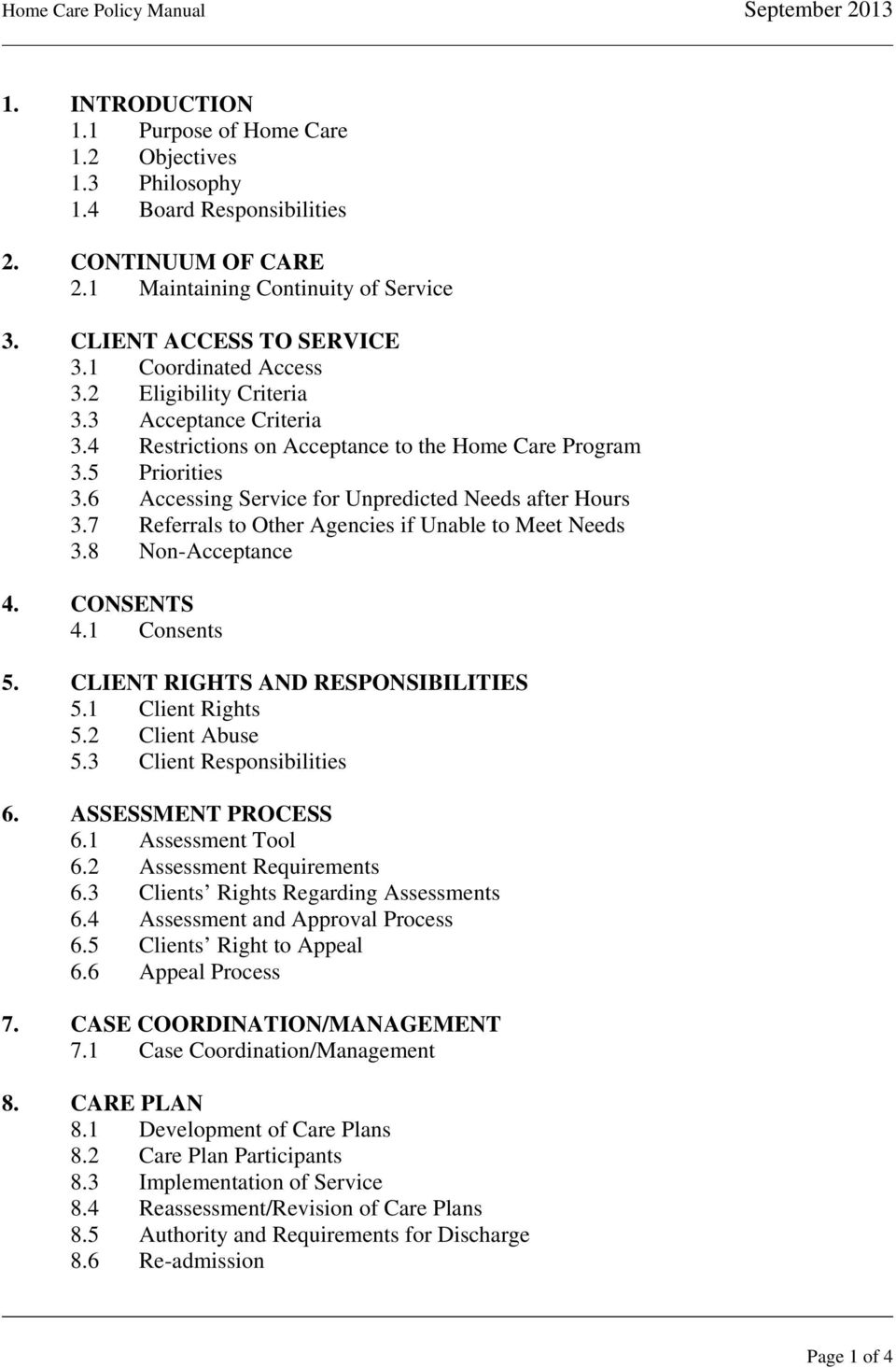
4 Manual September INTRODUCTION 1.1 Purpose of Home Care 1.2 Objectives 1.3 Philosophy 1.4 Board Responsibilities 2. CONTINUUM OF CARE 2.1 Maintaining Continuity of Service 3. CLIENT ACCESS TO SERVICE 3.1 Coordinated Access 3.2 Eligibility Criteria 3.3 Acceptance Criteria 3.4 Restrictions on Acceptance to the Home Care Program 3.5 Priorities 3.6 Accessing Service for Unpredicted Needs after Hours 3.7 Referrals to Other Agencies if Unable to Meet Needs 3.8 Non-Acceptance 4. CONSENTS 4.1 Consents 5. CLIENT RIGHTS AND RESPONSIBILITIES 5.1 Client Rights 5.2 Client Abuse 5.3 Client Responsibilities 6. ASSESSMENT PROCESS 6.1 Assessment Tool 6.2 Assessment Requirements 6.3 Clients Rights Regarding Assessments 6.4 Assessment and Approval Process 6.5 Clients Right to Appeal 6.6 Appeal Process 7. CASE COORDINATION/MANAGEMENT 7.1 Case Coordination/Management 8. CARE PLAN 8.1 Development of Care Plans 8.2 Care Plan Participants 8.3 Implementation of Service 8.4 Reassessment/Revision of Care Plans 8.5 Authority and Requirements for Discharge 8.6 Re-admission Page 1 of 4
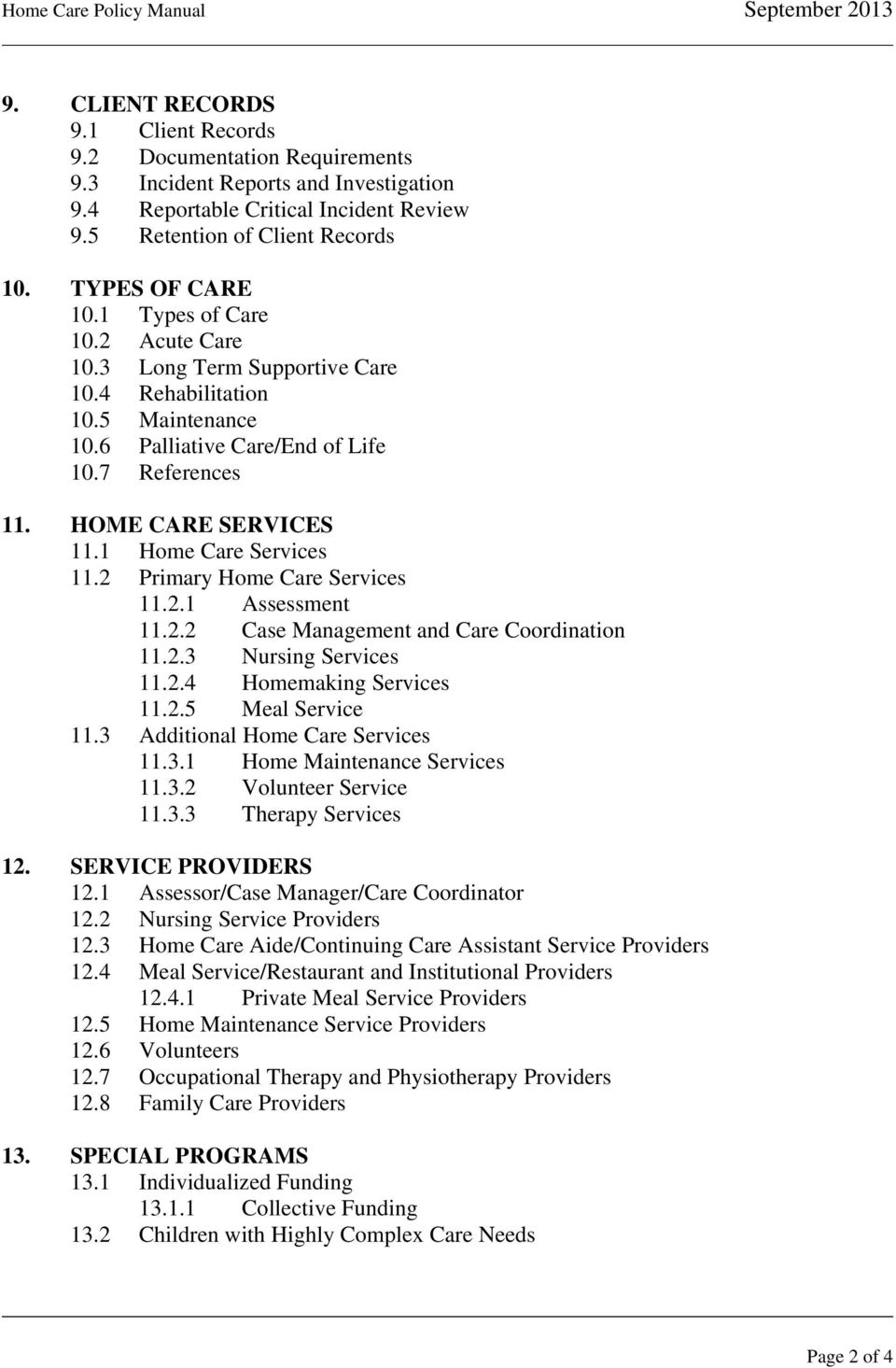
5 Manual September CLIENT RECORDS 9.1 Client Records 9.2 Documentation Requirements 9.3 Incident Reports and Investigation 9.4 Reportable Critical Incident Review 9.5 Retention of Client Records 10. TYPES OF CARE 10.1 Types of Care 10.2 Acute Care 10.3 Long Term Supportive Care 10.4 Rehabilitation 10.5 Maintenance 10.6 Palliative Care/End of Life 10.7 References 11. HOME CARE SERVICES 11.1 Home Care Services 11.2 Primary Home Care Services Assessment Case Management and Care Coordination Nursing Services Homemaking Services Meal Service 11.3 Additional Home Care Services Home Maintenance Services Volunteer Service Therapy Services 12. SERVICE PROVIDERS 12.1 Assessor/Case Manager/Care Coordinator 12.2 Nursing Service Providers 12.3 Home Care Aide/Continuing Care Assistant Service Providers 12.4 Meal Service/Restaurant and Institutional Providers Private Meal Service Providers 12.5 Home Maintenance Service Providers 12.6 Volunteers 12.7 Occupational Therapy and Physiotherapy Providers 12.8 Family Care Providers 13. SPECIAL PROGRAMS 13.1 Individualized Funding Collective Funding 13.2 Children with Highly Complex Care Needs Page 2 of 4
6 Manual September NURSING PRACTICE 14.1 Nursing Practice 14.2 Nursing Procedures by Transfer of Medical Functions 14.3 Special Nursing Procedures 14.4 Licensure of Nurses 14.5 Delegation of Nursing Procedures 14.6 Evidence-Based Practices and Outcomes 15. HOME CARE CLIENT FEES AND CHARGES 15.1 Basic Home Care Client Fee Policy Short-term Acute Home Care 15.2 Calculation of Client Fees for Regional Health Authorities 15.3 Charges to Temporary Residents 15.4 Third Party Payers 15.5 Home Care Nursing Supplies 15.6 Home Parenteral Medication Program Coverage 15.7 Programs Covering Drug and Supply Costs 15.8 Palliative Care Supplies and Charges 15.9 Benefits/Payment Policy for Saskatchewan Residents Out of Province (OOP) 16. QUALITY MONITORING AND IMPROVEMENT 16.0 Quality Monitoring and Improvement 16.1 Assessment and Care Coordination Standards Assessment and Care Coordination: Structure Standards Assessment and Care Coordination: Process Standards Assessment and Care Coordination: Outcome Standards 16.2 Nursing Service Standards Nursing Service: Structure Standards Nursing Service: Process Standards Nursing Service: Outcome Standards 16.3 Homemaking Service Standards Home Care Aide/Continuing Care Assistant: Structure Standards Home Care Aide/Continuing Care Assistant: Process Standards Home Care Aide/Continuing Care Assistant: Outcome Standards 16.4 Meal Service Standards Meal Service: Structure Standards Meal Service: Process Standards Meal Service: Outcome Standards 16.5 Home Maintenance Service Standards Home Maintenance Service: Structure Standards Home Maintenance Service: Process Standards Home Maintenance Service: Outcome Standards Page 3 of 4

7 Manual September Volunteer Service Standards Volunteer Service Standards: Structure Standards Volunteer Service Standards: Process Standards Volunteer Service Standards: Outcome Standards 16.7 Home Care Standards Home Care Outcome Standards 17. REPORTING REQUIREMENTS 17.1 Reporting Requirements for Regional Health Authorities 18. OCCUPATIONAL HEALTH and SAFETY 18.0 Occupational Health and Safety 18.1 Safety Hazards 18.2 Infection Control 18.3 Lifting and Moving 18.4 Client Transportation Page 4 of 4

8 Introduction Purpose of Home Care Index Ref: 1.1 Page 1 Revised September PURPOSE OF HOME CARE Home care helps people who need acute, end-of-life, rehabilitation, maintenance and long-term care to remain independent at home. Home care encourages and supports assistance provided by the family and/or community.

9 Introduction Objectives Index Ref: 1.2 Page 1 Revised September OBJECTIVES 1. To help people maintain independence and well being at home by: a) determining needs and abilities, developing and coordinating plans of care; b) teaching self-care and coping skills; c) improving, maintaining or delaying loss of functional abilities; d) promoting and supporting family and community responsibility for care; and, e) supporting acute, end-of-life, rehabilitation, maintenance and long-term care provided by family, friends and neighbours. 2. To facilitate appropriate use of health and community services by: a) preventing or delaying the need for admission to long-term care facilities and assisting on discharge; b) supporting people waiting for long-term care admission; c) preventing the need for hospital admission, making earlier discharge from hospital possible, and reducing the frequency of re-admission; d) helping individuals and families access needed services; e) promoting volunteer participation; f) educating the public about home care; and, g) participating in local service planning and coordination. 3. To make the best use of home care resources by: a) serving people with the greatest need first; and, b) operating economically and efficiently. 4. To meet client needs and optimize client independence within available home care financial resources while working cooperatively with other community agencies, organizations and individuals.
10 Introduction Philosophy Index Ref: 1.3 Page 1 Revised September PHILOSOPHY Home care is guided by the following principles: 1. People can usually retain greater independence and control over their lives in their own homes; 2. Most people prefer to remain at home and receive required services at home; 3. Support provided by families and friends should be encouraged and preserved and, if necessary, supplemented; 4. Service should assist individuals and families to retain maximum independence and avoid unnecessary dependencies; 5. Home care should assist people to access needed health and community services; 6. Home care should preserve and promote volunteer involvement; 7. Service decisions in home care should be based on assessed client need and the risk to the client if service is not provided; 8. Individuals and their supporters should help identify their needs, establish goals, and develop plans to meet goals; 9. People with the greatest need for home care should receive priority for service; 10. Individuals have the right to be treated with kindness, dignity and respect; 11. A person s right to live at risk to one s self and to accept or refuse services is respected; 12. Home care services should be provided respecting the client s cultural values and, whenever possible, by staff who are of the client s language and culture; 13. Regional Health Authorities should have significant responsibility for planning and delivering home care services; 14. Home care involves the planning and coordinating of local health and community services; and, 15. Home care does not usually provide services to allow caregivers to work at a long-term job. Home care is not normally provided to relieve parents from routine childcare.
11 Introduction Board Responsibilities Index Ref: 1.4 Page 1 Revised September BOARD RESPONSIBILITIES 1. The Regional Health Authority is the governing body of the health region, which includes the home care program. The board is vested with full legal authority and responsibility for the home care program. Though not limited to the following, the board is responsible for the observance of, and compliance with, The Regional Health Services Act and Regulations and provincial policy pertaining to the delivery of home care The Regional Health Authority is accountable: a) through the Minister of Health to the Legislature for the proper expenditure of public funds to provide home care services; b) for planning, administrating and delivering home care services in the region; and, c) for adhering to program policies established by the Community Care Branch of the Saskatchewan Ministry of Health. 1 The exception to this is the Athabasca Health Authority, which is responsible for the observance of, and compliance with, the Service Agreement between the Athabasca Health Authority and the Minister of Health and any policies pertaining to the delivery of home care.

12 Continuum of Care Maintaining Continuity of Service Index Ref: 2.1 Page 1 Date of Issue Revised September MAINTAINING CONTINUITY OF SERVICE GUIDELINES Maintaining continuity of service includes: a) providing the same home care service providers to clients where feasible; b) educating organizations and providers about home care services; c) identifying major referral sources and establishing communication links; d) liaising with other organizations or Regional Health Authority services involved with clients (e.g. adult day program); e) developing an awareness of and integrating complementary services provided by other organizations and agencies; f) working collaboratively with other organizations providing service; g) referring appropriately to other organizations; h) ensuring relevant information is communicated in a timely manner; and, i) working with families/supporters to achieve continuity of service.
13 Client Access to Service Coordinated Access Index Ref: 3.1 Page 1 Revised September COORDINATED ACCESS POLICY Regional Health Authorities, as a minimum, will provide coordinated access to long-term care, respite, adult day programs and home care. Other services may be included, as appropriate. GUIDELINES 1. Coordinated access to long-term care, home care, adult day programs and respite services ensures that clients are prioritized based on greatest need. 2. Coordinated access enables the Regional Health Authority to identify gaps in programming and the need for new initiatives, and to effectively use resources within the region. 3. Coordinated access includes a case management approach, avoids duplication of service and ensures that appropriate service is provided.
14 Client Access to Service Eligibility Criteria Index Ref: 3.2 Page 1 Revised September ELIGIBILITY CRITERIA POLICY 1. Applicants for home care must meet one of the following eligibility criteria in order to have their applications considered: a) hold a valid Saskatchewan Health Services card; b) be in the process of establishing permanent residence in Saskatchewan and have applied for a Saskatchewan Health Services card; or, c) be a resident of Manitoba or Alberta in a border area where contractual arrangements have been approved by the Saskatchewan Ministry of Health. 2. Regional Health Authorities must consider applications for home care from any Saskatchewan resident. Indian Bands may enter into contractual service agreements with Regional Health Authorities to request services for Registered Status Indians living on reserve. 3. Non-residents must apply for a Saskatchewan Health Services card in order to receive subsidized home care services beyond three months. This three-month period corresponds with the waiting period for coverage under Saskatchewan hospital, medical, and other health plans. Non-residents who are not required to apply for a Saskatchewan Health Services card in order to access home care services include: a) students (who are in the province for less than 12 consecutive months); b) individuals who have employment contracts for a maximum of 12 months; c) interim refugees who are covered by Health Canada; d) refugees intending to remain in Saskatchewan who receive coverage upon application for a Saskatchewan Health Services card; e) RCMP who are covered under Health Canada; and, f) individuals of Military and Corrections Canada. 4. Saskatchewan residents who are out of province and are eligible for home care services may receive services in another province. The Saskatchewan Ministry of Health will pay for this service based on the fee structure established by the Ministry. Prior approval from the Saskatchewan Ministry of Health is required.

15 Client Access to Service Eligibility Criteria Index Ref: 3.2 Page 2 Revised September 2013 GUIDELINES 1. Saskatchewan home care programs may accept applications from non-saskatchewan residents staying temporarily in the province. Non-residents are liable for the full costs of all services provided, including assessment and coordination costs, but not administration costs. 2. In exceptional circumstances, where the charge for services provided imposes a serious financial hardship for the non-resident client, the Regional Health Authority may charge less than the full cost of service defined above. The Regional Health Authority should not charge less than the amount a Saskatchewan resident with the same income would be charged for the same service if she/he applied for an income-tested subsidy.
16 Client Access to Service Acceptance Criteria Index Ref: 3.3 Page 1 Revised September ACCEPTANCE CRITERIA POLICY 1. The Regional Health Authority shall set acceptance priorities based on assessed need and level of risk. 2. Individuals requiring a single service shall be assessed to determine need and risk if the service is not provided. 3. The provision of a single service shall not be linked to the requirement of an additional service (e.g. Regional Health Authorities are not to link homemaking to another service). 4. When an applicant is accepted to the program and there are serious reservations about safety, either for the individual requiring care or the home care provider, home care must: a) set any conditions it believes are necessary to make service arrangements workable; b) ensure that any conditions for admission are clearly explained to the applicant and to involved family members and supporters; c) ensure ongoing documentation of client needs and circumstances, factors affecting service arrangements, and all discussions and agreements with clients and supporters regarding service arrangements; and, d) ensure that the service arrangements are reviewed at least once a month. GUIDELINES 1. Home care services may be provided to any person based on assessed need where: a) the person requires care and support while living in the community; and, b) the services to be provided do not replace the assistance usually provided by the family or community, unless necessary. 2. Home care services may be provided to: a) determine a person s needs and develop appropriate plans for care; b) improve a person s ability to function independently by teaching self-care; c) prevent or delay the functional deterioration of a person; d) provide needed assistance and relief to the family and others who are providing care to a person; e) assist a person with a disability to function as independently as possible; f) eliminate or delay the need for a person s admission to a special-care home, hospital or other care-giving institution;
17 Client Access to Service Acceptance Criteria Index Ref: 3.3 Page 2 Revised September 2013 g) maintain a person in the community pending placement in a special-care home or other care-giving institution; h) allow a terminally ill person to remain at home as long as possible; and, i) permit earlier discharge of a person from hospital or reducing the frequency of re-admissions. 3. The provision of home care may be reconsidered if: a) staff have serious reservations about the safety and/or benefits of providing services to the applicant; b) the required help is available from others who are willing and able to provide the applicant s care; c) the applicant is unwilling to accept the assessment process or care plan, or to cooperate with plans for delivering services; d) the applicant s safety between service visits cannot reasonably be assured because of inadequate home support; e) a life-threatening situation exists and the program cannot guarantee delivery of the required services; f) the services required cannot be safely provided because of the applicant s home situation; or, g) the program has inadequate resources (personnel or financial) to serve the needs of the applicant. When serious reservations about the applicant s safety are involved, consideration must be given to whether or not the applicant will be better off with or without the service being offered. The right of the individual to knowingly take risks must be considered. A written agreement with the applicant should be considered. 4. Accepting Clients with Difficult Behaviours Procedures should be developed for accepting clients when there are serious reservations about safety for the client or home care provider. Procedures must include: a) A definition of what home care is willing to provide and the conditions under which it will do so. These must be fully explained to the applicant, family members and supporters who are involved. What home care will do and what the individual and informal supporters will be responsible for should be clearly identified;
18 Client Access to Service Acceptance Criteria Index Ref: 3.3 Page 3 Revised September 2013 b) Documenting the agreement and all relevant aspects of the case on an ongoing basis. Documentation for decisions, actions and their rationales is the best evidence that the provider acted in good faith and in accordance with acceptable standards; and, c) Close monitoring of the situation. If the Regional Health Authority finds it necessary to impose additional requirements to those in the initial agreement, they must be documented and communicated to the client. If the client chooses not to accept these requirements, it may be necessary to discontinue services. The Regional Health Authority has the obligation to find service alternatives for the client and must not leave the client in an unsafe situation.

19 Client Access to Service Restrictions on Acceptance to the Home Care Program Index Ref: 3.4 Page 1 Revised September RESTRICTIONS ON ADMISSION TO THE HOME CARE PROGRAM POLICY 1. No applicant shall be accepted to the home care program if: a) required services are the legal responsibility of the operator of the applicant s place of residence; or, b) required services are not services the home care program is authorized to provide. 2. Professional Home care services (nursing, therapies, assessment and case management/coordination) may be provided to residents of personal care homes, group homes or special-care homes which provide supervision, programming and/or personal care and treatment to the residents. Some examples of homes, which fall into this category, are: a) personal care homes licensed under The Personal Care Home Act where residents pay a fee to the operator in exchange for care. The care may range from minimal supervision to intensive personal care and nursing; b) group homes under The Residential Services Act; c) residential alcohol and drug treatment homes under The Housing and Special-care Homes Act; d) special care homes under The Housing and Special-care Homes Act, (intravenous therapy in a special-care home may be administered by a home care nurse); or, e) approved homes with a certificate issued under The Mental Health Services Act for the accommodation of patients who are discharged from an in-patient facility or who require the accommodation and supervision that may be provided in the home. In such situations, there may be questions about the responsibilities of the operator and those of the home care program which need clarification. 3. Home care should not provide any service which is understood to be part of the care provided to the residents by the operator. There may be a written contract specifying the operator s responsibilities. If the contract is verbal, the home care program will have to attempt to determine what care has been promised in exchange for the fee charged.

20 Client Access to Service Restrictions on Acceptance to the Home Care Program Index Ref: 3.4 Page 2 Revised September Under no circumstances should home care assume responsibility for providing home maintenance, meals, or homemaking to a resident of one of these care homes. Assessment, case management, therapies and nursing care may be provided if the home care program has reason to believe that the operator does not have responsibility for providing such care. Any potential clients in the home would be subject to all home care assessment, admission, review and discharge procedures. GUIDELINE When it is not clear whether or not the service required is the responsibility of the operator, the Regional Health Authority should proceed carefully before reaching a decision about providing care. The problem should be discussed with the operator and other parties concerned, including the client and the client s family. The Regional Health Authority should not unilaterally withdraw services that have been previously provided without consulting the parties concerned.
21 Client Access to Service Priorities Index Ref: 3.5 Page 1 Revised September PRIORITIES POLICY 1. The Regional Health Authority must give priority to admitting and serving people with the greatest need for home care service. 2. The Regional Health Authority shall determine need through an assessment process, which provides a comprehensive multi-dimensional account of the individual s situation, including the person s functional abilities and home environment. 3. The Regional Health Authority will explore alternative ways of meeting the individual s needs as part of its assessment and care coordination process. 4. The Regional Health Authority must consider and balance the following criteria to determine the degree of need: a) the more serious and immediate the consequences to the individual if service is not provided, the higher the priority; and, b) if more appropriate alternatives are available to the individual, the lower the priority. 5. The Regional Health Authority shall consider the relative cost effectiveness of other appropriate alternatives available to the individual.
22 Client Access to Service Accessing Services for Unpredicted Needs After Hours Index Ref: 3.6 Page 1 Revised September ACCESSING SERVICE FOR UNPREDICTED NEEDS AFTER HOURS DEFINITION Accessing service after hours for unpredicted needs means, at a minimum, telephone contact with a person knowledgeable about the home care program. Appropriate action may include: a) coordinating arrangements to meet the client s needs; and, b) referring to a home care staff member, if required. POLICY 1. Planned and predictable service based on an assessed need is available at any time (i.e. weekends, evenings, and nights). 2. Regional Health Authorities shall make 24-hour access to home care available to address unpredictable and variable client needs for existing clients. 3. Policies and procedures must address the following expectations: a) clients must be able to access the Regional Health Authority home care program at any time of the day or night; and, b) clients must be able to speak to a person at any time. Telephone contact allows the person taking the call to assess the service response required. GUIDELINES 1. Access to home care after hours may not be with the home care program itself, but rather the request may be received through staff at the health centre, special-care home or hospital. The staff must be sufficiently familiar with the home care program to be able to respond in a knowledgeable way and to be able to assess the client s situation appropriately. 2. Some individuals may be able to wait until morning for service. Some situations may require a home visit to address the need, while others may require an alternative service response such as calling an ambulance. 3. HealthLine, a free, confidential 24-hour health advice telephone line staffed by registered nurses, may be able to assist some individuals. HealthLine can provide individuals with immediate, professional health advice or information, and direct the individual to the most appropriate care. This can include issues regarding mental health and addictions.
23 Client Access to Service Referrals to Other Agencies if Unable to Meet Needs Index Ref: 3.7 Page 1 Revised September REFERRALS TO OTHER AGENCIES IF UNABLE TO MEET NEEDS POLICY 1. Regional Health Authorities must have a process in place to refer applicants to another more appropriate organization or another Regional Health Authority service when home care is unable to meet an applicant s needs.
24 Client Access to Service Non-Acceptance Index Ref: 3.8 Page 1 Revised September NON-ACCEPTANCE POLICY 1. Regional Health Authorities must have a process in place to monitor all referrals and non-acceptance situations. The process must communicate the reason(s) for the referral and/or non-acceptance of the client. 2. All referrals and non-acceptance situations must be documented.
25 Consents Consents Index Ref: 4.1 Page 1 Revised September CONSENTS POLICY 1. All information concerning an individual client is confidential. 2. Home care staff, regional assessment staff and Saskatchewan Ministry of Health staff have access to confidential information for program purposes only (i.e. on a need to know basis). 3. The Regional Health Authority must obtain and document informed verbal or informed written consent from the client as follows: a) to assess the client; b) to release the client s personal health information to anyone other than regional staff and Saskatchewan Ministry of Health personnel; and, c) to provide service to the client. 4. The Regional Health Authority must obtain and document informed verbal consent. To obtain informed verbal consent, the Regional Health Authority must ensure that the client has full knowledge of the specific actions for which the consent has been requested. 5. To obtain informed written consent, the Regional Health Authority must ensure that the client has full knowledge of the specific actions for which the consent has been requested, and that those actions are specified in the consent document signed by the client. A witness must certify the client s signature. 6. When applicable, the Regional Health Authority shall discuss Health Care Directives and communicate this to appropriate team members. 7. The Regional Health Authority must have a policy regarding disclosure of health information with consent or as otherwise specifically authorized in The Health Information Protection Act 1. 1 Government of Saskatchewan. (2004). The Health Information Protection Act. Regina, SK:
26 Client Rights and Responsibilities Client Rights Index Ref: 5.1 Page 1 Revised September CLIENT RIGHTS POLICY 1. The Regional Health Authority must establish written policies and procedures regarding the rights of home care clients. This includes the promotion and protection of each client s right to receive necessary information, to be given reasonable choices and to be treated with dignity. 2. The Regional Health Authority will ensure that processes are in place to: a) ensure that clients understand their rights; b) help clients exercise their rights; and, c) investigate and resolve claims regarding a violation of client s rights. 3. Clients have the right to refuse service. 4. Clients have the right to live at risk. 5. Clients have the right to fully participate in the assessment process. 6. Clients have the right to participate in the service delivery and make personal choices within the parameters of services available. 7. Clients have the right to appeal service plan decisions. 8. Clients have the right to receive safe, appropriate and timely service. 9. Clients have the right to be referred to other appropriate services. 10. Clients have the right to participate in team conferences. Clients must be treated with consideration, respect and full recognition of their dignity and individuality. 11. Clients have the right to freedom from abuse, neglect or exploitation from home care staff. 12. Clients have the right to be assured of confidential treatment of their care records and personal information. 13. Clients, or the persons authorized to make health care decisions on behalf of the clients, have the right to have their concerns heard, reviewed and where possible, resolved.
27 Client Rights and Responsibilities Client Rights Index Ref: 5.1 Page 2 Revised September 2013 GUIDELINES Advising Clients of Possible Consequences when Exercising their Rights 1. In some cases, exercising a right may affect the ability to serve a client s needs. 2. The assessor is always responsible for ensuring that the client, or advocate, understands the possible effects of exercising a particular right and for documenting the discussion with the client/family/supporter. 3. For example, if a person refuses to undergo any part of an assessment interview, it would be very difficult for the assessment process to reach rational decisions about needs and services. 4. Similarly, refusal to allow the assessor to seek the views of a third party, such as a physician, might also affect the assessor s ability to make the best possible decision about needs and services. 5. If a client with impaired judgement makes decisions that could seriously compromise health/safety, the assessor must communicate this to appropriate others (e.g. family/supporter, physician and those involved with the assessment process).
28 Client Rights and Responsibilities Client Abuse Index Ref: 5.2 Page 1 Revised September CLIENT ABUSE DEFINITION Abuse is considered any activity that causes physical, mental, financial or emotional injury to a client. Abuse is a violation of a client s civil and human rights. POLICY 1. Regional Health Authorities have a duty to protect clients from abuse. A zero-tolerance approach to client abuse must be enforced without exception. 2. The Regional Health Authority shall develop appropriate policies and procedures to ensure a zero-tolerance approach to client abuse. 3. Regional Health Authority policies and procedures related to client abuse must be clearly communicated to all management, staff and union representatives. 4. Client abuse is a reportable serious incident. Failure to report an incident or suspicion of abuse shall be cause for disciplinary action. Anyone who mistreats a client may be prosecuted under the law. GUIDELINES Client abuse may be defined as: 1. Physical Abuse: use of physical force that may result in bodily injury, physical pain, or impairment including, but not limited to, slapping, pinching, pushing, striking, shoving, shaking, choking, kicking, burning and other rough handling; force-feeding; inappropriate use of medication; and, forced confinement.
29 Client Rights and Responsibilities Client Abuse Index Ref: 5.2 Page 2 Revised September Emotional/Psychological Abuse: the infliction of anguish, pain or distress through verbal or non-verbal acts; verbal assaults including, but not limited to, yelling, swearing, threats, derogatory comments, humiliation, intimidation; denial of rights including, but not limited to, denying client participation with respect to his/her life; and, social isolation including, but not limited to, giving the silent treatment, treating like a child/infant, isolating from family/friends/regular activities. 3. Financial Abuse: misuse of client s funds, property or assets including, but not limited to: forcing a client to sell his/her personal belongings or property; stealing a client s money, pension cheques, or possessions; and withholding a client s money that is needed for daily living; and, fraud, forgery, extortion. 4. Sexual Abuse: molestation; sexual assault; and, sexual harassment. 5. Neglect: abandonment of the client by the caregiver; and, failure or refusal to provide with life necessities including, but not limited to, withholding of food/water, personal care or health care services, etc. The Regional Health Authority s solicitor should be consulted as needed when developing regional policies and procedures.
30 Client Rights and Responsibilities Client Responsibilities Index Ref: 5.3 Page 1 Revised September CLIENT RESPONSIBILITIES POLICY 1. The Regional Health Authority will ensure that clients understand their responsibility to: a) participate in developing and carrying out the service plan; b) be available at a given time for service, as agreed; c) notify the organization of any changes that may affect the provision of service; d) respect the human rights of the service provider (e.g. freedom from abuse, exploitation, and racism); e) maintain a safe working environment for the service provider; f) use equipment, which is necessary for staff/client safety, in a safe and proper manner; g) agree to using equipment as determined through the assessment process to ensure client/home care worker safety; and, h) ensure client/worker safety for equipment they have obtained privately by meeting the safety requirements of the manufacturer, maintaining the equipment and documenting preventive maintenance as required. 2. In situations where clients do not carry out their responsibilities, the Regional Health Authority will: a) communicate client responsibilities (as indicated in 1. above) to clients and staff; b) eliminate or minimize factors that contribute to inappropriate behaviour; c) teach positive or desirable behaviour; d) use restrictive actions only when all positive processes have failed; e) integrate these actions into the plan of service as necessary; and, f) document the situation and actions taken.
31 Assessment Process Assessment Tool Index Ref: 6.1 Page 1 Revised September ASSESSMENT TOOL POLICY 1. All assessments must be conducted using standard assessment tools, which have been approved by the Saskatchewan Ministry of Health. The standard provincial assessment tool is MDS-Home Care*. Additional tools from the suite of interrai instruments may also be used**. * with the exception of the Athabasca Health Authority. ** Future implementation of additional screening tools may be introduced, e.g. Emergency Department screening tool. 2. All assessment and care coordination staff must complete assessment training.
32 Assessment Process Assessment Requirements Index Ref: 6.2 Page 1 Revised September ASSESSMENT REQUIREMENTS POLICY 1. The Regional Health Authority must ensure that all applicants are assessed prior to the provision of home care services. 2. Risk factors will determine the urgency of service provision or the decision that service is not required. GUIDELINES 1. A comprehensive assessment should be completed for applicants who: a) require one or more services; b) require palliative care; c) require case management; d) have a progressive illness; e) are high risk; or, f) receive services from another agency. 2. When an eligible applicant requires immediate assistance, the Regional Health Authority may arrange services before an assessment is completed. The Regional Health Authority must establish procedures for initiating services in these circumstances. A full standard assessment must be completed as soon as possible. 3. The comprehensive assessment may be waived when: a) only a nursing service is required (e.g. if the person only requires foot care). A nursing assessment must be completed in lieu of a full standard assessment; or, b) only a single therapy service is required (e.g. if physiotherapy is required for a short period). A physiotherapy assessment must be completed in lieu of a full standard assessment. 4. The comprehensive assessment may be waived but a shortened assessment is used for: a) meals on wheels for short term; b) volunteer services; or, c) home management or home maintenance for short term.
33 Assessment Process Clients Rights Regarding Assessments Index Ref: 6.3 Page 1 Revised September CLIENTS RIGHTS REGARDING ASSESSMENTS POLICY Clients are major participants in the assessment process, not simply the subjects of assessment. 1. Assessors must ensure that the client, or the persons authorized to make health care decisions on behalf of the client (i.e. the advocate), are informed of their rights prior to the assessment interview. 2. Assessors are responsible for advising clients or their advocates of any foreseeable consequences of their decisions. 3. Assessors must inform the client or their advocates of their rights regarding their personal health information including: a) when a trustee is collecting personal health information from the client, the trustee must take reasonable steps to inform the client of the anticipated use and disclosure of the information by the trustee; and, b) a trustee must establish policies and procedures to promote knowledge and awareness of the rights extended to individuals by The Health Information Protection Act, including the right to request access to their personal health information and to request amendment of that personal health information. GUIDELINES 1. In some cases, the exercise of a right might affect the ability of the program to serve client s needs (e.g. if a person refuses to undergo any part of an assessment interview, it would be very difficult to reach rational decisions about needs and services). Similarly, refusal to allow the management of the Regional Health Authority to seek the views of a third party, such as a physician, might also affect ability to make the best possible decision about needs and services. The assessor is always responsible for ensuring that the applicant, or advocate, understands the possible effects of exercising a particular right. 2. No applicant should be automatically refused admission to the program because he or she is unwilling to cooperate fully in the assessment process. A decision should be made on each case based on available information.
34 Assessment Process Clients Rights Regarding Assessments Index Ref: 6.3 Page 2 Revised September During the assessment process all clients have the right to: a) have their views and desires recorded during the assessment interview; b) choose whether a family member/supporter is present during the assessment interview; c) be present if an advocate or translator is required for the assessment interview; d) refuse to answer any question or refuse to participate in any or all of the assessment; e) view the assessment record on request and request amendments to the record (The Health Information Protection Act); f) be consulted before the views of third parties are sought, and to approve, restrict or deny such access; g) be fully informed of the program s service decisions and participate in care planning; and, h) give their consent for any collection, use and disclosure of their personal health information, and the right to restrict release to third parties for the use of information.
35 Assessment Process Assessment and Approval Process Index Ref: 6.4 Page 1 Revised September ASSESSMENT AND APPROVAL PROCESS POLICY 1. The Regional Health Authority must ensure that an assessment and approval process is in place to make decisions regarding care. 2. The Regional Health Authority must guarantee consistency in the determination of client s need for service. 3. The process must ensure the following critical elements: a) the coordinated entry to home care and long-term care services and placement; b) an equitable and consistent service across the Regional Health Authority; c) a mechanism to monitor the assessment process; and, d) the use of a consistent assessment tool. 4. The assessment process must: a) ensure that the assessment tool and related manuals approved by Saskatchewan Health are used to conduct assessments; b) review all assessment data to determine if an applicant meets all the eligibility and acceptance criteria; c) evaluate the need for services and match the need with available resources as much as possible; d) explore alternatives to meet identified needs, including referrals to other agencies and/or other Regional Health Authority services; e) develop a care plan and a service delivery schedule; f) name a person to coordinate the care plan and establish reporting relationships with service providers; g) review the progress of clients at regular intervals to ensure that the services are still required and that they meet the needs of clients and their families; h) ensure that appropriate plans are established for the care of clients upon discharge; and, i) ensure that decisions are communicated to the relevant parties. 5. Clients must be major participants in the assessment process, not simply the subjects of the assessment. 6. A nurse must be included in the decision making process when nursing issues are being discussed.
36 Assessment Process Assessment and Approval Process Index Ref: 6.4 Page 2 Revised September 2013 GUIDELINES Those attending the assessment and approval process meetings may include: client and/or advocate; other regional staff; supervisors of contracting agencies; medical consultants; therapists, social workers or other available professionals in the community; and, any other available person with knowledge or expertise that could benefit the decision making process.
37 Assessment Process Client s Right to Appeal Index Ref: 6.5 Page 1 Revised September CLIENTS RIGHT TO APPEAL POLICY 1. Clients have the right to appeal decisions made by Regional Health Authority staff. 2. Assessors must ensure that the client, or the person authorized to make health care decisions on behalf of the client, is informed of their right and the process to appeal when dissatisfied with: the care being provided; or, decisions about acceptance, service schedule or discharge.
38 Assessment Process Appeal Process Index Ref: 6.6 Page 1 Revised September APPEAL PROCESS POLICY 1. The Regional Health Authority must develop a policy that clearly outlines the appeal process. 2. The Regional Health Authority must have two levels of appeal: a) the first level of appeal is to the respective program manager in the Regional Health Authority who is responsible for appeal assessment. The appeal assessor must not have been involved with the initial assessment; and, b) the second level of appeal is through a Regional Appeals Committee as determined by the Regional Health Authority. Clients and/or families may request the Quality of Care Coordinator to assist them through the stages of appeal. 3. The appeal assessor must reassess the client whenever significant assessment information is in question. 4. A thorough review of the case must be conducted within two weeks of receiving an appeal. 5. The appeal assessor must provide a written statement and explanation of his/her decision to the client and/or advocate. If this decision is appealed, the appeal assessor must then provide a copy of the written statement and explanation to the Regional Appeals Committee. 6. The Regional Appeals Committee must hear an appeal within two weeks of receiving an appeal. 7. The Regional Appeals Committee must hear from representatives of the regional assessment personnel and from the client and/or advocate, and may invite opinions from others as appropriate. 8. The Regional Appeals Committee must provide a copy of the appeal decision, including the rationale for the decision, to the regional assessment personnel and to the client and/or advocate. 9. The decision of the Regional Appeals Committee is final.
39 Case Management Case Coordination/Management Index Ref: 7.1 Page 1 Revised September CASE COORDINATION/MANAGEMENT DEFINITION 1. Case coordination/management includes assessment, planning, coordinating, implementing, monitoring and evaluating health-related services. 2. It is a collaborative, client-centred process that is continuous across provider and agency lines. 3. Case coordination/management promotes quality care and cost effective outcomes while addressing the health and well being of clients. POLICY 1. The Regional Health Authority must have a structure in place for case coordination/management. 2. Case coordination/management must be implemented in the following circumstances: a) high risk clients; b) complex home care clients; c) palliative care; d) home care clients receiving services from other agencies; or, e) client receiving more than one home care service. GUIDELINES 1. Case Manager s Role: In collaboration with clients/families, the case manager facilitates and coordinates services by linking clients with service providers and community resources. The case manager works with families, friends, other caregivers and communities associated with the client. The case manager is familiar with the client s goals and is continually involved in monitoring and ongoing reassessment. The role and skills of the case manager are essential to an effective assessment. The assessment tool provides direction to the case manager about the type and amount of information that should be collected from individuals. The assessment tool also provides a place to document information.
40 Case Management Case Coordination/Management Index Ref: 7.1 Page 2 Revised September Purpose of Case Management is to develop an approach that improves access to coordinated and integrated health services that are client-centred, community-based and meet the client s health needs. 3. Principles of Case Management: a) respects clients dignity, responsibility and self-determination; b) recognizes and responds to clients and caregivers needs and expectations; c) ensures clients are informed, are provided with options, and participate in making decisions; d) respects the role of families, other caregivers and community resources in planning and implementing care for clients; e) promotes easy access to timely and appropriate services (not only traditional health services); f) respects the importance of confidentiality (Sharing of information should be client-directed on a need-to-know basis); g) protects the rights of others as well as clients; h) promotes coordination of services through a multi-disciplinary team approach; i) fosters good communication, cooperation and collaboration among service providers, clients and communities; j) promotes early interaction aimed at identifying people at risk; k) emphasizes the support of independence and community-based living; l) promotes and provides opportunities for education; m) supports staff strengths and skills to deal with complex human issues; n) promotes efficient, effective and equitable use of resources, focused on achieving positive health outcomes; and, o) provides opportunity and information to collaboratively plan the health system and for the clients.
41 Case Management Case Coordination/Management Index Ref: 7.1 Page 3 Revised September 2013 Diagram: Integrated Case Management Process and Components 1 Beginning the Case Management Process Exit Identifying a Lead Case Manager Assessment Gather and Pool Information Planning Identify Strengths, Needs and Supports Documentation occurs throughout the process. Develop Goals Coordination/ Implementation of Care Plan Plan Interventions Assistance may be required of non-team members at any point Monitoring and Evaluation Transfer or Discharge 1 Government of Saskatchewan (1998) Saskatchewan Human Services: Integrated Case Management. Regina, SK.
42 Care Plan Development of Care Plans Index Ref: 8.1 Page 1 Revised September DEVELOPMENT OF CARE PLANS POLICY 1. The care plan must specify: a) the type and frequency of service the client needs and will receive; b) the client-centered goals of the service with a target date; c) goals that should be individualized, measurable and achievable; d) the date that service will commence; e) referrals to be made; f) the role of the client in self-care; g) services to be carried out by: informal caregivers support network; other organizations or agencies; and the home care program; and, h) service review date. 2. The plan should include: a) health promotion; b) illness prevention; c) emotional support and counseling; d) education to promote self care and independence; and, e) transition/discharge. 3. The care plan must be updated on an ongoing basis to reflect changing needs, met or changed goals, altered service or support.
43 Care Plan Care Plan Participants Index Ref: 8.2 Page 1 Revised September CARE PLAN PARTICIPANTS POLICY 1. Clients and/or persons authorized to make health care decisions on behalf of clients, are participants in the development of the care plan. GUIDELINES 1. Appropriate team members, clients and/or supporters collaborate in the development of care plans. 2. Care plans should be communicated to appropriate persons.
44 Care Plan Implementation of Service Index Ref: 8.3 Page 1 Revised September IMPLEMENTATION OF SERVICE POLICY 1. Appropriate team members must implement care plans in a timely manner and document the service. 2. Services must be implemented according to accepted standards of practice and the Regional Health Authority s policies. GUIDELINES 1. Continuity of implementing service is promoted by: a) assigning the same individual(s) to provide service over time when feasible; b) orientating replacement staff and volunteers to their assigned responsibilities and to the individual needs of clients; c) having regular team discussions of clients progress; and, d) communicating appropriately with other agencies or other Regional Health Authority services involved in care.
45 Care Plan Reassessment/Revision of Care Plans Index Ref: 8.4 Page 1 Revised September REASSESSMENT/REVISION OF CARE PLANS POLICY 1. The Regional Health Authority must have established procedures for changing care plans. 2. There must be a process for the case manager to approve all major changes to care plans. 3. A thorough review or reassessment of every client within ninety (90) days of the client s admission, and at least once annually thereafter, must be conducted to ensure the changing needs of the client are continuously met. 4. Additional case reviews or reassessments as warranted by the condition or situation of clients must be conducted. 5. All relevant information must be considered in conducting a review. 6. Reassessment must be conducted using an assessment tool approved by Saskatchewan Health. 7. Consents must be reviewed and documented with each reassessment. 8. Prior to making any major changes to clients care arrangements, Regional Health Authority staff must notify clients and explain the basis for the proposed changes.
46 Care Plan Authority and Requirements for Discharge Index Ref: 8.5 Page 1 Revised September AUTHORITY AND REQUIREMENTS FOR DISCHARGE POLICY 1. Clients must be discharged from the program at any time when home care services are no longer appropriate or required. 2. Clients who have not received a home care service for twelve (12) consecutive months must be discharged from the program unless they are living in a Personal Care Home. 3. Clients shall participate in planning for discharge from the program. 4. Appropriate and necessary contacts or referrals must be made. 5. Discharge plans, referrals, and discharge data must be documented on clients care plans. GUIDELINES 1. The Regional Health Authority will ensure that support is available for clients, informal caregivers, their support network, staff and volunteers following discharge, transfer or death of a client. 2. The support offered by the Regional Heath Authority in the event of death may include: a) individual or group counseling; b) pastoral visits; c) referral to other groups; d) memorial services; or, e) debriefing.
47 Care Plan Re-admission Index Ref: 8.6 Page 1 Revised September RE-ADMISSION POLICY 1. When a previously discharged client is re-admitted into the home care program for service, the decision for re-admission is based on one or more of the following: a) progress summary notes; or, b) completion of the standard assessment tool approved by the Saskatchewan Ministry of Health. 2. The updated client care plan must reflect new or revised goals and interventions and must indicate a timeline for evaluation/follow-up.
48 Client Records Client Records Index Ref: 9.1 Page 1 Revised September CLIENT RECORDS POLICY 1. The Regional Health Authority must maintain complete records on all clients receiving home care services. 2. Client records are to be kept confidential. 3. All records must be securely stored. 4. RHAs must have policies to ensure security and integrity of client records at all times. GUIDELINES 1. There should be written policies and procedures indicating how the various forms are to be completed and used. Documentation should: a) provide pertinent information on the condition of clients; b) provide client care plans with specific goals and time frames; c) outline various interventions by physicians, nurses and other persons who are involved in the care of clients; d) communicate the response of clients to various interventions; and, e) record actual care provided to clients. 2. All home care providers should be familiar with standard charting requirements. 3. Home care providers who are inexperienced in documenting client care records should be given the preparation necessary to perform the recording functions. 4. Client care records should: a) contain sufficient information to: identify clients clearly; justify the reasons for admission; identify problems including, where applicable, diagnosis of disease and subsequent treatment; and, document the results of treatment. b) document the care provided (the client s physical condition, problems, psychological status and goals, and client progress (or lack of progress) should be evident).
49 Client Records Client Records Index Ref: 9.1 Page 2 Revised September All records should contain at least the following: a) identifying data (i.e. surname, given names, birth date, Saskatchewan Health Services card number, address, etc); b) assessment form; c) care plan, including goals and time frames; d) social histories and, if indicated, a nursing history; e) records of medications, therapeutic treatments and care provided; f) the reason for any decision made and documented (i.e. signed on behalf of a client by any person other than the client); g) physician s orders; h) progress notes, flow sheets; i) any record of action taken to arrange alternate care if the client is discharged; and, j) a discharge summary, indicating the date and time of discharge, reason for discharge or cause of death, circumstances of discharge and person notified. 6. All data listed above should be maintained in a single client record.
50 Client Records Documentation Requirements Index Ref: 9.2 Page 1 Revised September DOCUMENTATION REQUIREMENTS POLICY 1. Proper charting is an essential component of ensuring the provision of quality client care. In evaluating the quality of that care, it is not possible to effectively determine what has been done for a client, how well it has been done, or what should be done in the future unless adequate documentation has been completed. It is important then, that: a) anyone who is involved in the care of the client has access to the client care record; and, b) irrespective of who provides care to a client, that person shall record the service provided and as necessary, the client s response to the service (i.e. charting by exception) Client care records are a legal document; therefore, care providers shall be familiar with charting requirements. 3. Client care records shall contain: a) sufficient information to: clearly identify the client; justify the reasons for admission; identify problems including, where applicable, the diagnosis of disease and subsequent treatment(s); and, document results of treatment. b) documentation of the care rendered and an indication of the clients physical condition, problems, psychological status and goals, and client progress (or lack of progress) shall be evident. GUIDELINES Home care providers may use the following charting requirements when recording and documenting in client care records. 1 charting by exception infers that all standards for care have been met and the client responded as expected. Longhand charting is required when there is a change in client response, significant findings and/or when unusual events occur.
51 Client Records Documentation Requirements Index Ref: 9.2 Page 2 Revised September Identification of Client The name of the client, the current date and page number should be recorded on each sheet of the client care record. 2. Permanency of Record Client care records are permanent documents. Therefore, every precaution should be taken to ensure permanency. All entries must be made either in ink or another permanent medium. 3. Correction of Entry a) Written Copy The writer should then indicate that it is an incorrect entry and initial beside the incorrect entry. The newly documented page may be labeled as corrected copy and placed in front of the original page. b) Electronic Documentation Follows similar rules as paper based documentation. Electronic document should have accessible audit trail which captures date, time, person for every entry. When there is correction, the original should be available with a time stamp and the new correct entry saved in the appropriate location and/or chart. This is done in various methods: Electronic software can mimic this correction by showing a correction by putting a line through the previous entry and having correct entry as a new update or could overwrite with the corrected entry; however, the original is still available. Some software allows a deletion of the entry (cut and paste functions) but does maintain the legal record of changes in the audit trail functions in case the clinician has made a decision based on the previous documentation. Some software provides an alert function for corrections to the primary provider of the patient/client record (this is usually for lab result corrections). Flow sheet changes can also be charted and accepted with a corrected notation. Either process is acceptable for electronic charting. 4. Timeliness It is recommended that home care staff chart on a daily basis and immediately after a particular event(s) rather than waiting for an established charting time.
52 Client Records Documentation Requirements Index Ref: 9.2 Page 3 Revised September Individual Recording The home care provider should only document the specific care provided to a client. Only the care provider who observed or performed the action being recorded should complete the recording. 6. Chronological Order Information should be recorded in chronological order. This means events should be recorded in the order or sequence in which they occurred. If an entry is made out of chronological sequence, a notation should be made to that effect (i.e. in the nursing/progress notes, the writer should record the current date and time of documentation and then record the date and time of when the event/actions had originally occurred; an arrow may be placed indicating where the entry should be placed within the sequence). All notations should be dated and signed by the writer. 7. Abbreviations and Codes Abbreviations in client care records should be kept to a minimum. Only those abbreviations recognized by all members of the home care staff should be used in the client care records. 8. Accuracy The client care record must be accurate in all aspects. All home care providers must accurately record what is observed or heard and any relevant statements made by the client. Accurate charting of medication administration and treatment given is as important as the administration itself. 9. Conciseness The wording in the client care record should be short and concise in order to avoid misinterpretation. Forms should be designed in a fashion so as to eliminate unnecessary searches throughout the entire record and to save time in recording. If flow sheets are used, there is no need to record on the progress notes unless something unusual has happened, or a change in the client s health status has occurred. 10. Legibility All entries must be legible. 11. Uniformity The system of recording information should be uniform throughout the home care program. No individual should, on his or her own initiative, add or omit items, which are not in accordance with home care policies or practices. Routine events should always be recorded on the form. An event that is routine to one client, might not be routine to another.
53 Client Records Documentation Requirements Index Ref: 9.2 Page 4 Revised September Date, Signature and Initials All entries must include the date, time, and signature of the care provider. When signing entries, home care staff should always identify themselves with their first initial and full last name, followed by their professional designation (e.g. RN, LPN, HCA, RD, OT/PT and RSW). Unless the policy of the Regional Health Authority home care program states differently, initials may also be used. It must, however, be immediately apparent who initialed the entry. 13. Master Signature List The master signature list should contain the names of all home care providers. The list should display the full name (printed), signature, initials and professional designation of each care provider. A copy of the master signature list may be kept on file in the client care records. All entries to the client care records must be signed in a clearly identifiable manner.
54 Client Records Incident Reports and Investigation Index Ref: 9.3 Page 1 Revised September INCIDENT REPORTS AND INVESTIGATION POLICY 1. The Regional Health Authority shall have a system to report and record incidents that have the potential to injure or result in actual injury to clients, staff or volunteers. This system shall also include the investigation of incidents and the development of recommendations to prevent future incidents of a similar nature. 2. A report shall be completed at the time of the event, or as soon as possible thereafter, of any unusual occurrence involving clients, staff or volunteers. 3. When an incident meets the threshold for a critical incident as per the Saskatchewan Critical Incident Reporting Guideline 2004, please refer to Policy 9.4. GUIDELINES 1. Incidents should be reported on an Incident Report form. 2. Situations requiring the completion of an Incident Report form include: a) accidents involving clients, staff, or volunteers; b) unusual incidents where care staff are involved (e.g. adverse drug reactions, incorrect performance of procedures by staff affecting the care given to clients); c) loss of, or damage to, personal belongings of clients, staff or volunteers; d) damage to equipment or furniture as a result of an unusual circumstance; and, e) medication errors (errors in the actual administration of the drug or errors of judgment). 3. Where there has been an accident involving a client, staff, or volunteer in the client s home, an Incident Report should be initiated at the time of the incident by the witness or staff member with primary involvement. Information contained in the Incident Report should: a) be objective, clearly written and concise. The witness should report what she/he actually experienced (saw or heard) not what others have experienced (e.g. rather than report client fell out of bed report client found on floor unless client was actually observed falling out of bed; b) give the reader a clear picture of the event. Use precise and descriptive language in recording observations (e.g. if the client fell out of bed, the witness should record such items as the location and position of the client on discovery, the location, size and color of any wound or bruise);
55 Client Records Incident Reports and Investigation Index Ref: 9.3 Page 2 Revised September 2013 c) include observations of the client (e.g. colour, vital signs, level of consciousness, emotional state); d) record any nursing actions taken at the time of the incident, the name of the physician notified and time, the physician s response to the notification, and time of his/her response; and, e) relevant details of any action by the individual involved in the accident. 4. Where there has been a medication error: a) an Incident Report should be initiated as soon as the error is recognized; b) information in the report should be factual. Documentation should include identification of the actual error as it occurred and as well as the action taken by the care provider once the error was recognized; c) additional information that should be recorded in the incident report may include: the name of the physician notified, the time the physician was notified and the response of the physician notified; and, d) the care provider involved in the incident should provide an explanation and a rationale as to why the incident occurred. 5. The filing of an Incident Report does not lessen the care provider s responsibility for recording the event on the nursing report and on the client care record. 6. The nursing notes should contain relevant clinical information so that those involved with the client s care will be aware of the incident, the medical and nursing action taken and the client s response to both the incident and the intervention. 7. The Regional Health Authority should ensure that there is a policy concerning the filing of Incident Reports. 8. Regular reviews and evaluations should be done to determine whether particular occurrences were preventable. The Incident Report should be thought of as one method of assessing the quality of care that is provided. Recommendations and follow-up action should be documented. All incidents should be investigated with the aim of developing recommendations to prevent the recurrence of similar incidents.
56 Client Records Reportable Critical Incident Review Index Ref: 9.4 Page 1 Revised September REPORTABLE CRITICAL INCIDENT REVIEW POLICY 1. The Director of Community Services/Home Care Manager shall notify the Saskatchewan Ministry of Health as soon as possible of any critical incident that has affected clients, staff or volunteers. Verbal notification should be followed by a written report. 2. Refer to section 58 of The Regional Health Services Act for guidance regarding the steps to be taken when investigating and reporting a critical incident. GUIDELINES 1. The intent of the policy is to inform the Saskatchewan Ministry of Health of the circumstances surrounding a critical incident. 2. Events or circumstances that should be considered reportable include: a) any serious problem affecting clients; b) an outbreak of infectious disease reportable to the local Medical Health Officer as per Communicable Disease Control Guidelines; c) any client death which results in a coroner s inquest; d) any serious incident, accident or injury to clients that are potentially disabling or life threatening; e) any harm or suspected harm suffered by clients as a result of unlawful conduct, improper treatment or care, harassment or neglect (i.e. any incident of client abuse); f) any incident which has been reported to law enforcement officers; and, g) other incidents or events as determined by the management of home care.
57 Client Records Retention of Client Records Index Ref: 9.5 Page 1 Revised September RETENTION OF CLIENT RECORDS POLICY 1. Records for an adult client must be kept for a minimum of six (6) years after the date that service is last provided. 2. Records for a child must be kept until the child reaches 18 years of age, plus two (2) years. GUIDELINES 1. The suggested retention periods are minimums and intended only to be general guidelines. 2. In any particular case where litigation seems to be a possibility, all records relevant to the case should be maintained until it is clear that the difficulties have been resolved. 3. When in doubt about whether a particular document or record should be destroyed, the Regional Health Authority s solicitor should be consulted. 4. For further information, refer to The Health Information Protection Act:
58 Types of Care Types of Care Index Ref: 10.1 Page 1 Revised September TYPES OF CARE POLICY 1. All home care programs within the Regional Health Authorities must provide acute care, end-of-life, rehabilitation, maintenance and long-term care to remain independent at home.
59 Types of Care Acute Care Index Ref: 10.2 Page 1 Revised September ACUTE CARE POLICY 1. A client who needs immediate or urgent time limited (up to three (3) months or less) intervention to improve or stabilize a medical or post-surgical condition. 2. This category is designed to identify situations (other than palliative care) in which the home care program provides a service that might otherwise be provided in a hospital or health centre. In many cases, the services will be provided to a person recently discharged from hospital. This may include persons with mental illness or mental health disorders. 3. Clients who are discharged early from hospital or who are receiving services to avoid/prevent re-admission and to avoid/prevent imminent admission (Policy short term acute) will not be charged fees for personal care services (up to 14 days). (Policy 15.1) GUIDELINES 1. A person in the acute care category will usually receive nursing/therapy services but may also receive support services (e.g. meals, home management). 2. The client s care plan will usually indicate a definite time frame of acute care. 3. Once the client has been stabilized and indefinite home care involvement is indicated, the category should be changed to a more appropriate type. 4. This category also includes situations in which the family is providing all or some of the nursing/personal care that might otherwise have to be provided in hospital, and where home care is providing other services (e.g. meals, home management, some nursing/personal care) to help the family cope during an acute episode.
60 Types of Care Long-Term Supportive Care Index Ref: 10.3 Page 1 Revised September LONG-TERM SUPPORTIVE CARE POLICY 1. A client is at significant risk of institutionalization due to unstable, chronic health conditions, and/or living condition(s) and/or personal resources. 2. This is a category which applies when neither acute, rehabilitation, maintenance or palliative care apply. Clients may be considered to be long term supportive care when: a) home care services are provided on an indefinite basis for the primary purpose of assisting clients to remain in the community (and/or to avoid admission to long-term care facilities); b) home care services are providing respite to the clients supporters; or, c) any other situation in which the type of care does not fall into either the acute, rehabilitation, maintenance or palliative care categories.
61 Types of Care Rehabilitation Index Ref: 10.4 Page 1 Revised September REHABILITATION POLICY 1. This category applies to a client with a stable health condition that is expected to improve with a time-limited focus on goal-oriented, function rehabilitation. The rehabilitation plan specifies goals and expected duration of therapy.
62 Types of Care Maintenance Index Ref: 10.5 Page 1 Revised September MAINTENANCE POLICY 1. This category applies to a client with stable, chronic health conditions, stable living conditions and person resources, who needs ongoing support in order to remain living at home.
63 Types of Care Palliative Care/End of Life Index Ref: 10.6 Page 1 Revised September PALLIATIVE CARE/END OF LIFE In one s best clinical judgment, a client with any end-stage disease who is expected to live less than six months. Judgment should be substantiated by well-documented disease diagnosis and deteriorating clinical course. DEFINITION Palliative care refers to interdisciplinary services that provide active compassionate care to the client who is terminally ill at home, in hospital or in another care facility. It is a service made available to terminally ill persons and their supporters who have determined that treatment for cure or prolongation of life is no longer the primary goal. POLICY 1. This category applies to clients who are dying and who have chosen to spend as much time as possible in their own homes. Clients may be considered palliative when: a) their condition has been diagnosed by a physician as terminal with life expectancy of weeks or months; b) active treatment to prolong life is no longer the goal of care; or, c) the case management process in the Regional Health Authority has determined through assessment that the individual requires palliative care. GUIDELINES 1. Key Elements of the Palliative Care Process include: a) the individual s disease is not curable and the individual and/or family have been informed of this. This is a period when goals must be redefined and when it is appropriate to discontinue certain treatments. New symptoms may arise or existing symptoms worsen, necessitating modification of management or the initiation of new measures to ensure the comfort of the person; b) the individual and/or family may have determined that palliative care will improve the quality of remaining life and that cure and prolongation of life may no longer be appropriate; and, c) there are three (3) stages in the palliative process: early; intermediate; and, end stage or dying stage.
64 Types of Care Palliative Care/End Of Life Index Ref: 10.6 Page 2 Revised September Early and Intermediate Stage Palliative Care Individuals in the early and intermediate stage of the palliative process normally would be considered stable, where deterioration is proceeding at a slower pace, and minimal or occasional assistance is required due to terminal illness. 3. End Stage Palliative Care The following parameters may be used to help determine whether terminally ill individuals are in the end stage of the palliative process and are dealing with end of life (dying) issues: a) the time frame for the end stage may be measured in terms of days or weeks of dying. Time frames are difficult to determine, however, and in some cases, this end stage may be longer than a few weeks or as short as one (1) or two (2) days; b) there are typically day-to-day changes with deterioration proceeding at a dramatic pace. There may also be a sudden drop in the Palliative Performance Rating according to the Palliative Performance Scale developed by the Victoria Hospice Society and the Capital Region Home Nursing Care in British Columbia; c) end stage may be characterized by: increasing intensity of need; increasing assistance required for physical and psychological need and family exhaustion; and/or, a requirement for social work, pastoral care, and therapies (e.g. pet and music). d) there is documented clinical progression of disease, which may include a combination of the following symptoms: dyspnea; increased pain (crescendo pain); increased nausea; profound weakness; being essentially bed bound; drowsy for extended periods; disorientation as to time; severely limited attention span; increasing disinterest in food and fluid; difficulty swallowing medication; dependence in activities of daily living (bathing, dressing, feeding, transfers, continence of urine and stool, ability to ambulate independently to bathroom); social withdrawal; restlessness; ascites; lymphedema; and, anxiety.
65 Types of Care Palliative Care/End of Life Index Ref: 10.6 Page 3 Revised September 2013 e) the end stage terminally ill individual is assessed and given a Palliative Performance Rating of 30% or lower according to the Palliative Performance Scale developed by the Victoria Hospice Society and the Capital Region Home Nursing Care in British Columbia. 1
66 Types of Care References Index Ref: 10.7 Page 1 Revised September REFERENCES Saskatchewan Health. (1994). Guidelines for developing an integrated palliative care service. Regina, Saskatchewan. Canadian Hospice Palliative Care Association (2002). A model to guide hospice palliative care: Based on national principles and norms of practice. Ottawa, Ontario. Palliative Performance Scale (PPSv2) version 2 PPS Ambulation Activity & Evidence of Self-Care Intake Conscious Level Level Disease 100% Full Normal activity & work Full Normal Full No evidence of disease 90% Full Normal activity & work Full Normal Full Some evidence of disease 80% Full Normal activity with Effort Full Normal or Full Some evidence of disease reduced 70% Reduced Unable Normal Job/Work Full Normal or Full Significant disease reduced 60% Reduced Unable hobby/house work Significant disease Occasional assistance necessary Normal or reduced Full or Confusion 50% Mainly Sit/Lie Unable to do any work Extensive disease Considerable assistance required Normal or reduced Full or Confusion 40% Mainly in Bed Unable to do most activity Extensive disease Mainly assistance Normal or reduced Full or Drowsy +/- Confusion 30% Totally Bed Bound Unable to do any activity Extensive disease Total Care Normal or reduced Full or Drowsy +/- Confusion 20% Totally Bed Bound Unable to do any activity Extensive disease Total Care Minimal to sips Full or Drowsy +/- Confusion 10% Totally Bed Bound Unable to do any activity Extensive disease Total Care Mouth care only Drowsy or Coma +/- Confusion 0% Death
67 Types of Care References Index Ref: 10.7 Page 2 Revised September 2013 Instructions for Use of PPS (see also definition of terms) 1. PPS scores are determined by reading horizontally at each level to find a best fit for the patient which is then assigned as the PPS% score. 2. Begin at the left column and read downwards until the appropriate ambulation level is reached, then read across to the next column and downwards again until the activity/evidence of disease is located. These steps are repeated until all five columns are covered before assigning the actual PPS for that patient. In this way, leftward columns (columns to the left of any specific column) are stronger determinants and generally take precedence over others. Example 1: A patient who spends the majority of the day sitting or lying down due to fatigue from advanced disease and requires considerable assistance to walk even for short distances but who is otherwise fully conscious level with good intake would be scored at PPS 50%. Example 2: A patient who has become paralyzed and quadriplegic requiring total care would be PPS 30%. Although this patient may be placed in a wheelchair (and perhaps seem initially to be at 50%), the score is 30% because he or she would be otherwise totally bed bound due to the disease or complication if it were not for caregivers providing total care including lift/transfer. The patient may have normal intake and full conscious level. Example 3: However, if the patient in example 2 was paraplegic and bed bound but still able to do some self-care such as feed themselves, then the PPS would be higher at 40 or 50% since he or she is not total care. 3. PPS scores are in 10% increments only. Sometimes, there are several columns easily placed at one level but one or two which seem better at a higher or lower level. One then needs to make a best fit decision. Choosing a half-fit value of PPS 45%, for example, is not correct. The combination of clinical judgment and leftward precedence is used to determine whether 40% or 50% is the more accurate score for that patient. 4. PPS may be used for several purposes. First, it is an excellent communication tool for quickly describing a patient s current functional level. Second, it may have value in criteria for workload assessment or other measurements and comparisons. Finally, it appears to have prognostic value. Copyright 2001 Victoria Hospice Society
68 Types of Care References Index Ref: 10.7 Page 3 Revised September 2013 Definition of Terms for PPS As noted below, some of the terms have similar meanings with the differences being more readily apparent as one reads horizontally across each row to find an overall best fit using all five columns. 1. Ambulation The items mainly sit/lie, mainly in bed, and totally bed bound are clearly similar. The subtle differences are related to items in the self-care column. For example, totally bed bound at PPS 30% is due to either profound weakness or paralysis such that the patient not only can t get out of bed but is also unable to do any self-care. The difference between sit/lie and bed is proportionate to the amount of time the patient is able to sit up vs need to lie down. Reduced ambulation is located at the PPS 70% and PPS 60% level. By using the adjacent column, the reduction of ambulation is tied to inability to carry out their normal job, work occupation or some hobbies or housework activities. The person is still able to walk and transfer on their own but at PPS 60% needs occasional assistance. 2. Activity and Extent of Disease Some, significant, and extensive disease refer to physical and investigative evidence which shows degrees of progression. For example in breast cancer, a local recurrence would imply some disease, one or two metastases in the lung or bone would imply significant disease, whereas multiple metastases in lung, bone, liver, brain, hypercalcemia or other major complications would be extensive disease. The extent may also refer to progression of disease despite active treatments. Using PPS in AIDS, some may mean the shift from HIV to AIDS, significant implies progression in physical decline, new or difficult symptoms and laboratory findings with low counts. Extensive refers to one or more serious complications with or without continuation of active antiretrovirals, antibiotics, etc. The above extent of disease is also judged in context with the ability to maintain one s work and hobbies or activities. Decline in activity may mean the person still plays golf but reduces from playing 18 holes to 9 holes, or just a par 3, or to backyard putting. People who enjoy walking will gradually reduce the distance covered, although they may continue trying, sometimes even close to death (eg. trying to walk the halls). 3. Self-Care Occasional assistance means that most of the time patients are able to transfer out of bed, walk, wash, toilet and eat by their own means, but that on occasion (perhaps once daily or a few times weekly) they require minor assistance. Considerable assistance means that regularly every day the patient needs help, usually by one person, to do some of the activities noted above. For example, the person needs help to get to the bathroom but is then able to brush his or her teeth or wash at least hands and face. Food will often need to be cut into edible sizes but the patient is then able to eat of his or her own accord. Mainly assistance is a further extension of considerable. Using the above example, the patient now needs help getting up but also needs assistance washing his face and shaving, but can usually eat with minimal or no help. This may fluctuate according to fatigue during the day.
69 Types of Care References Index Ref: 10.7 Page 4 Revised September 2013 Total care means that the patient is completely unable to eat without help, toilet or do any self-care. Depending on the clinical situation, the patient may or may not be able to chew and swallow food once prepared and fed to him or her. 4. Intake Changes in intake are quite obvious with normal intake referring to the person s usual eating habits while healthy. Reduced means any reduction from that and is highly variable according to the unique individual circumstances. Minimal refers to very small amounts, usually pureed or liquid, which are well below nutritional sustenance. 5. Conscious Level Full consciousness implies full alertness and orientation with good cognitive abilities in various domains of thinking, memory, etc. Confusion is used to denote presence of either delirium or dementia and is a reduced level of consciousness. It may be mild, moderate or severe with multiple possible etiologies. Drowsiness implies either fatigue, drug side effects, delirium or closeness to death and is sometimes included in the term stupor. Coma in this context is the absence of response to verbal or physical stimuli; some reflexes may or may not remain. The depth of coma may fluctuate throughout a 24 hour period. Copyright Notice. The Palliative Performance Scale version 2 (PPSv2) tool is copyright to Victoria Hospice Society and replaces the first PPS published in 1996 [J Pall Care 9(4): 26-32]. It cannot be altered or used in any way other than as intended and described here. Programs may use PPSv2 with appropriate recognition. Available in electronic Word format by request to [email protected] Correspondence should be sent to Medical Director, Victoria Hospice Society, 1952 Bay Street, Victoria, BC, V8R 1J8, Canada
70 Home Care Services Home Care Services Index Ref: 11.1 Page 1 Revised September HOME CARE SERVICES POLICY 1. All home care services must be provided in accordance with relevant home care policies, procedures and standards included in the Saskatchewan Ministry of Health Home Care Policy Manual.
71 Home Care Services Primary Home Care Services Index Ref: 11.2 Page 1 Revised September PRIMARY HOME CARE SERVICES DEFINITION Primary home care services are services for which funding is authorized by the Saskatchewan Ministry of Health. POLICY 1. Every Regional Health Authority must offer the primary home care services. 2. Primary home care services include: a) assessment; b) case management and care coordination; c) nursing; d) homemaking that includes personal care, respite and home management; and, e) meal service. 3. Primary home care services are provided through paid personnel.
72 Home Care Services Assessment Index Ref: Page 1 Revised September ASSESSMENT See Section 6.
73 Home Care Services Case Management and Care Coordination Index Ref: Page 1 Revised September CASE MANAGEMENT AND CARE COORDINATION See Section 7.
74 Home Care Services Nursing Services Index Ref: Page 1 Revised September NURSING SERVICES POLICY 1. Home Care nursing services includes: a) teaching and supervising self-care to clients receiving personal care or nursing services; b) teaching personal care and nursing procedures to family members and other supporters; c) performing nursing assessments; d) performing nursing treatments and procedures as outlined in a home care nursing textbook approved by Community Care Branch; e) providing personal care when the assessment process specifies that it is warranted by the condition of the client; f) teaching and supervising home care aides/continuing care assistants providing personal care and performing delegated nursing tasks; and, g) initiating referrals to other health professionals and agencies. GUIDELINES 1. Home Care nursing services are performed using evidence-based best practice. 1 1 Evidence Informed/Evidence-Based Practice Practice which is based on successful strategies that improve client outcomes and are derived from a combination of various sources of evidence, including client perspective, research, national guidelines, policies, consensus statements, expert opinion and quality improvement data (CHSRF, 2005). Saskatchewan Registered Nurses Association, Standards and Foundations Competencies for the Practice of Registered Nurses March 1, 2007,
75 Home Care Services Homemaking Services Index Ref: Page 1 Revised September HOMEMAKING SERVICES POLICY 1. Homemaking Services have three components: a) personal care; b) respite; and, c) home management. 2. Homemaking services are provided by Home Care Aides/Continuing Care Assistants. Policy for the Delegation, Supervision and Evaluation of Tasks to Home Care Aides: 1. A practicing member of the Saskatchewan Registered Nurses Association, the Registered Psychiatric Nurses Association of Saskatchewan, or the Saskatchewan Association of Licensed Practical Nurses must teach, evaluate and supervise the performance of Home Care Aides when tasks are delegated in providing: a) personal care; b) activities of daily living for persons who cannot safely be left on their own due to confusion, frailty or some other functional disability; c) specific assistance to a client when the informal care provider is present. In order to evaluate this situation the informal care provider must be prepared to assist the person as necessary; and, d) activities of daily living when the home care aide/continuing care assistant is providing respite for family members or other primary caregivers. GUIDELINES Personal Care Component 1. Personal care component may include: a) assisting with/or supervising activities of daily living, such as bathing, grooming, dressing, medication assists, feeding, toileting and transferring;
76 Home Care Services Homemaking Services Index Ref: Page 2 Revised September 2013 Respite Component 1. Respite is any combination of services provided specifically for the purpose of giving relief to the family or other caregivers of a dependent person who lives at home. 2. Objectives of respite care are to: a) relieve primary caregivers from the constant responsibility of providing care; b) give primary caregivers the security of knowing that temporary relief is available if a personal crisis arises, and provide that relief if necessary; c) support and strengthen families or other support systems to enable dependent persons to remain at home; and, d) delay or prevent placement of dependent persons in long-term care facilities. 3. In home care, respite may mean providing relief for time periods ranging from a few hours to a few days. Time periods will depend on the needs of families and other caregivers in addition to regional resources and other options available for respite. 4. Respite may be provided occasionally, or periodically on a regular basis, to allow primary caregivers time to perform everyday tasks. Respite does not usually include home care services provided to allow caregivers to work at a long-term job. Respite is not normally provided to relieve parents from routine childcare; however, the region may make exceptions for complex care children when no other resources are available to the family. 5. Home care may provide crisis relief to allow the primary caregivers, and their families, the opportunity to deal with stressful events such as an illness, hospitalization or a death in the family. 6. An assessment determines if respite is needed to relieve caregivers, and a care plan is developed to meet that objective. The content of the respite care plan will depend on the needs of the dependent person and their supporters. At a minimum, the care plan will include supervision of activities of daily living, but may also include other aspects of personal care, a meal or home management. The care provider in a respite situation is temporarily taking the place of the primary caregiver and must provide whatever assistance the dependent person needs.
77 Home Care Services Homemaking Services Index Ref: Page 3 Revised September 2013 Home Management Component 1. Home management may include: a) general household cleaning; b) menu planning; c) meal preparation; d) laundry; e) changing linen; f) teaching self care; and, g) other aspects of operating a household as determined by the assessment process. 2. Additional home management components for Mamawetan Churchill River and Keewatin Yatthé Regional Health Authorities, and the Athabasca Health Authority may include: a) providing transportation; b) escorting clients for medical appointments, grocery shopping, etc.; c) interpreting for clients and other health staff; d) assisting clients in attending community events scheduled by the home care program, (i.e. friendship days, elders lunch, etc.); and/or, e) home maintenance tasks specific to northern residents.
78 Home Care Services Meal Service Index Ref: Page 1 Revised September MEAL SERVICE Meals-on-Wheels and Wheels-to-Meals POLICY 1. Meal service is provided to improve and/or maintain the nutritional status and general health of clients. 2. Every effort must be made to assist clients to become as self-reliant as possible in meal preparation. 3. The home care meal service includes: a) meals-on-wheels, in which meals are delivered from an institution, restaurant or private meal provider to clients at home; and/or, b) wheels-to-meals, in which meals are prepared and provided to clients at a central location where a meal is served. (e.g., Senior Citizens Activity Centre). The local Public Health Inspector should be informed. 4. Volunteers should deliver meals whenever possible. GUIDELINES 1. Guiding Principles for the Provision of Meal Services: a) meal service should be provided to maintain the client s health and independence; b) meal service should support self-reliance in meal preparation and good nutrition; c) meals should be provided until the clients strengths, abilities and/or motivation enable them to become self-reliant; d) meals may be part of a respite component when the primary caregiver is not available; and, e) clients or their supporter should be taught to prepare meals independently. 2. Source of Meals: The Regional Health Authority may contract the preparation of home care meals to: a) an affiliate as defined in The Regional Health Authority Act; b) any public eating establishment licensed by the Regional Health Authority, pursuant to the Technical Guideline #154 administered by the Regional Health Authority; and, c) a private meal provider when no other option is available. Canada s Food Guide to Healthy Eating should be followed.
79 Home Care Services Meal Service Index Ref: Page 2 Revised September 2013 Meals-on-wheels is not required to include a serving from the Grain Products group or the Milk Products group. It is anticipated that the client will be able to supply these items to complete the meal. Wheels-to-meals; however, must provide servings from each of the four (4) food groups (Meat & Alternates, Vegetables & Fruit, Grain Products, and Milk Products). 3. Content of the Meal: The meal should provide the following to ensure it is acceptable to the client: a) variety in food selection and preparation; b) variety in taste and appearance; c) consideration of the client s special needs, such as therapeutic diets, dental soft foods, foods in bite size pieces, food allergies and food intolerances; d) consideration of the client s background, including ethnic food preferences, religious, and cultural food preferences; and, e) consideration of foods suitable for the client; for example pizza, although nutritious, may not be an appropriate choice for some elderly people. 4. Menu Planning: The Regional Health Authority dietitian should provide advice about menu planning. 5. Therapeutic Diets: Therapeutic diets must be provided as directed by the client s physician in consultation with a dietitian (Physician s Instruction Form H ). The decision to determine whether a specific meal provider has the capacity to prepare therapeutic diets rests with the consulting dietitian. If the meal provider lacks the capacity to prepare a particular therapeutic diet other options to allow for the provision of meals to this client must be explored. The following therapeutic diet meals, prepared in accordance with the most recent Manual of Clinical Dietetics, may be provided without the supervision of a dietitian on site: a) diabetic; b) modified in sodium (salt) content; c) modified in fat content; d) bland; e) weight reducing; and, f) modified in fiber content.
80 Home Care Services Meal Service Index Ref: Page 3 Revised September 2013 A dietitian or physician must provide written diet instructions to the meal provider for all therapeutic diets. It is advisable that clients on therapeutic diets be given diet counseling and written information by a dietitian, nutritionist or physician prior to acceptance to the meal service program. If the client does not understand the diet, the case manager should refer the client to the home care nurse or community dietitian for appropriate instruction. 6. Packaging of Food Items for Each Meal: Only disposable containers appropriate for hot foods should be used to package hot food items. The following materials are recommended: a) disposable aluminum plates covered with aluminum foil or foil-backed cardboard lids; b) disposable Styrofoam cups, plates and/or bowls covered with plastic or Styrofoam lids; and/or, c) disposable plastic cups and/or bowls covered with plastic lids. Only disposable containers appropriate for cold foods shall be used to package cold food items. The following materials are recommended: a) disposable Styrofoam plates, bowls, or cups covered with Styrofoam or plastic lids; b) disposable plastic plates, bowls or cups covered with plastic lids; c) disposable plastic-coated paper plates, cups or bowls covered with aluminum foil; and, d) plastic wrap or paper envelopes (for breadstuffs, if served). DISPOSABLE MATERIALS SHALL BE USED ONLY ONCE Hot and cold foods must be kept separate. Food shall be served into the disposable containers just prior to meal delivery unless the containers can be promptly refrigerated and/or heated until delivery. Prepared foods must be held at a temperature less than 4 C (40 F) or greater than 60 C (140 F) in order to limit the risk of bacterial growth that can lead to food poisoning.
81 Home Care Services Meal Service Index Ref: Page 4 Revised September Packaging the Meals for Delivery: Meals must be packed in insulated carrying cases which adequately retain the temperature of the food. 8. Transportation of the Meal: Meals should be transported by a volunteer whenever it is practical to do so. Transportation time must be kept to a minimum in order to limit the growth of bacteria that can occur if food is held at temperatures between 4 C (40 F) 60 C (140 F). 9. Private Meal Service Provider: a) Safe Food Service Since individual meal service providers are not formally regulated to the same extent as institutions and restaurants, the following will provide guidance for the preparation of safe food by individual meal service providers: all food and drink used in the preparation of meals shall be clean, safe, and free from spoilage and prepared for safe human consumption; all precautions shall be taken to ensure food remains free from contamination and spoilage during its preparation, storage and delivery; milk products served or used in food preparation must have been processed in an approved pasteurization plant; shell eggs must be clean and free from cracks and odors; all food and drink must be obtained from sources approved by a Medical Health Officer or Public Health Inspector; the use of home-canned food is prohibited because of the possible risk of botulism food poisoning from consumption of inadequately or improperly canned food; and No wild game shall be served. 2 2 Exception to be made to the Northern Home Care Services. The reason for an amendment is based upon the cultural backgrounds of the people; the consideration of financial costs associated with the transportation of goods into the isolated regions and that wild game is a staple diet for many of the inhabitants in Mamawetan Churchill River and Keewatin Yatthé Region, and Athabasca Health Authority. Wild game is to be processed in accordance with the guidelines set out by the Saskatchewan Ministry of Health and the Federal Government food safety regulations.
82 Home Care Services Meal Service Index Ref: Page 5 Revised September 2013 Water safe for human consumption shall be used in the preparation of food or drink: water softened by the sodium ion exchange process shall not be used in the preparation of food or drink for clients requiring restricted sodium diets; water from sources not subject to routine bacteriological examination must be tested as required by the Medical Health Officer or Public Health Inspector or as often as necessary to ensure safety and be of a quality compatible with provincial standards 3 ; the meal provider must have a new or temporary water supply tested and approved before it is used; and, containers or receptacles in which water is stored must be clean and covered. A person shall draw the water from the container by means of a tap or other approved dispensing service. b) Environment floors, walls, and ceilings of all rooms in which food or drink is stored or prepared, or in which utensils are washed, must be clean and in good repair. floors must not be swept when food or drink is exposed. the premises must be free of any animal or insect detrimental to the operation of a food service. This includes rats, mice, cockroaches, flies and other vermin. the local Public Health Inspector must approve all material and equipment used for vermin control. pets or birds must not be kept or permitted in food storage or preparation areas unless approved by the Medical Health Officer or Public Health Inspector. all garbage must be placed in a covered, nonabsorbent, leak proof container and be disposed of as necessary. Garbage must not remain in a food preparation or storage area in excess of twenty-four (24) hours. 3 Samples for bacteriological examination are to be placed in containers available from the local regional health office. The Saskatchewan Ministry of Health Provincial Laboratories will provide the required bacteriological examination.
83 Home Care Services Meal Service Index Ref: Page 6 Revised September 2013 c) Cleaning Supplies Toxic and poisonous substances, including cleaning supplies, must be: kept in an area separate from food, food equipment, and food contact surfaces; kept in containers that bear a label on which the contents of the container are clearly identified; and, used only in such conditions that the substances do not contaminate food or endanger the health of any person. d) Equipment The equipment necessary to prepare and store all food must be available (e.g. freezer, refrigerator, stove, accurate thermometers, etc.) All equipment, utensils, and food contact surfaces which may come in contact with food or drink during storage, preparation or delivery (serving) must be: clean; kept in good repair; corrosion resistant; washed and sanitized as required if of a reusable type; and, constructed of an approved material. All equipment and utensils, including single service utensils for meal delivery, must be handled and stored so that surfaces coming in contact with the food or the user s mouth have not been contaminated. Cups, glasses or dishes that are chipped or cracked must not be used in the preparation, service or storage of food. e) Storage All food must be protected by means of enclosed cases or cabinets or other enclosure and must be stored in such a manner that odors and flavors are not transferred from one type of food to another. Food must not be stored on the floor. Food shall be stored in an appropriate container and placed on a pallet or shelf.
84 Home Care Services Meal Service Index Ref: Page 7 Revised September 2013 f) Food Handling Potentially hazardous food that is being stored prior to preparation or held prior to delivery for human consumption, must be kept at either: 4 o C (40 o F) or less; or, 60 o C (140 o F) or greater, which ever is appropriate depending on the food. Potentially hazardous food means any raw or prepared food that consists, in whole or in part, of milk or milk products, eggs, meat, poultry, fish, shellfish, or edible crustacea, in a form capable of supporting rapid and progressive growth of infectious or toxigenic microorganisms. When it is necessary for potentially hazardous food to remain at temperatures between 4 o C and 60 o C (40 o F and 140 o F) it must be for as short a time as possible but never longer than two hours after preparation. Food should be tasted for acceptability before it is served. Sampling of food with fingers is not permitted. Using the same spoon more than once for tasting is not permitted because of the potential danger of food contamination. A sanitized thermometer should be used frequently to indicate temperature of food prior to service. Temperature of food should be checked periodically by the Regional Health Authority at delivery. Potentially hazardous foods shall be cooked to the appropriate minimum internal temperature described in the following chart: Hazardous Food Internal Temperature C F Poultry Ground Beef Beef, lamb, pork, and veal Boiled Eggs (Boil for 9 minutes minimum) Fish (flesh is opaque, flakes easily) Alternatives for cooking Fish at least 2 minutes minutes a few seconds
85 Home Care Services Meal Service Index Ref: Page 8 Revised September 2013 g) Cleaning and Sanitizing Both a detergent and a sanitizer must be used to accomplish a thorough cleaning of utensils, equipment, and work areas. A detergent is a chemical substance used to facilitate cleaning through removal of all visible, physical debris. A sanitizer is a heat or chemical method used to destroy all disease-causing bacteria. In summary, detergents first help remove physical debris, then sanitizers kill the remaining micro-organisms. All utensils, equipment and work areas are to be thoroughly cleaned and sanitized after each use. An ample supply of hot and cold water for washing and sanitizing utensils, equipment and tableware must be available. All utensils and equipment used for food preparation must be cleansed by the three-step method: 4 Washed with an effective detergent where the wash water temperature is not lower than 44 o C (111 o F); Rinsed in clean water at a temperature not lower than 44 o C (111 o F); Sanitized using one of the following bactericidal treatments: use of the saniwash or sanitize feature on a household dishwasher as approved by the Regional Health Authority; immersion for at least two minutes in clean water at a temperature of at least 82 o C (180 o F) (a suitable thermometer must be provided); immersion for at least two minutes in a lukewarm chlorine solution of not less than one hundred parts per million available chlorine when freshly prepared and not less than fifty parts per million at any time; 5 or, immersion for at least two minutes in a lukewarm solution containing a quaternary ammonium compound having a strength of at least two hundred parts per million. Air dried to prevent recontamination through use of drying towels. 6 Cutting boards, chopping blocks, table grinders, slicers and other utensils must be thoroughly cleaned and sanitized after each use. 4 The three-step method consists of wash, rinse and sanitize and requires a three compartment sink (a dishpan may be utilized as the third sink in some situations) 5 Facilities (test kit) for determining the concentration of the sanitizing solution shall be available. 6 Cloths and towels used for washing, drying, polishing utensils, equipment, tables or counters must be clean and used for one purpose only.
86 Home Care Services Meal Service Index Ref: Page 9 Revised September 2013 h) Personnel Every individual meal provider shall practice good personal hygiene. Every person who handles or comes in contact with food or any utensil used in the preparation or service of food must: be clean; wear clean garments; keep hair confined; and, wash hands before commencing work, after use of toilet facilities, after smoking or any other time hands are soiled or contaminated. Meal providers must not smoke while preparing food. A meal provider with a communicable disease shall not prepare food when the meal provider s condition may jeopardize the safety of the food being prepared. A meal provider shall not prepare or serve food when experiencing any of the following symptoms: diarrhea; vomiting; fever; or, severe abdominal discomfort. A meal provider must wear disposable gloves when preparing food if she/he has a cut or opening on the hand. If the cut is infected, the meal provider must not be involved in food preparation. The home care program does not require meal providers to have a medical examination as a condition of employment. However, the Medical Health Officer or management may, at any time, order a medical examination if circumstances warrant. Meals from a meal-providing household must be discontinued if there is a risk of spreading an illness in the household to meal recipients. Whenever a meal provider is aware of a situation where a communicable disease may be transmitted to a meal recipient, the meal provider shall notify the Medical Health Officer or a Public Health Inspector.
87 Home Care Services Additional Home Care Services Index Ref: 11.3 Page 1 Revised September ADDITIONAL HOME CARE SERVICES POLICY Additional home care services may include: 1. home maintenance; 2. volunteer programs; 3. therapies when available i.e. physiotherapy and occupational therapy; and, 4. any other service that the Regional Health Authority deems appropriate. GUIDELINES 1. Procedure for approval of additional home care services. A regional home care program wishing to provide services in addition to those indicated in 11.2, should seek specific approval from the Regional Health Authority senior management. The approval for proposed services beyond the primary services will be reviewed on an individual basis considering traditional service patterns, assessed need and availability of resources and cost.
88 Home Care Services Home Maintenance Services Index Ref: Page 1 Revised September HOME MAINTENANCE SERVICE POLICY 1. Home maintenance services are provided only when the safety of the individual is at risk, the individual s physical abilities are less than optimal and no reasonable alternative is available. 2. Home care does not provide home maintenance services when the same or similar services are available from another source. 3. Home care is not responsible for the costs of any materials or supplies needed to perform a home maintenance service. 4. Home maintenance may be provided by a volunteer program service if volunteers are available. 5. If Regional Health Authorities do not provide home maintenance services, care managers should attempt to refer the client to an agency that can provide the services. GUIDELINES 1. Home maintenance service may include: a) performing minor outdoor tasks essential for the safety of clients; b) performing minor home maintenance repairs essential for the safety of client; c) installing and maintaining equipment aids for independent living; and, d) installing handrails and non-skid surfaces. 2. Home Maintenance services in the North 7 may also include: a) splitting and hauling wood into the client s home; b) hauling water into the client s home, as required; c) transporting clients for appointments, grocery shopping, berry picking, monthly home care events; and/or, d) deliveries related to the home care program. 7 Mamawetan Churchill River, Keewatin Yatthé Regions and Athabasca Health Authority.
89 Home Care Services Volunteer Service Index Ref: Page 1 Revised September VOLUNTEER SERVICE POLICY 1. The Regional Health Authority promotes the participation of volunteers. 2. The Regional Health Authority must ensure that policies are in place to address responsibility for coordination of volunteer activities, their orientation, training and supervision. GUIDELINES 1. A Regional Health Authority may organize and provide any volunteer service consistent with the home care philosophy and objectives provided that: a) the Regional Health Authority s role is limited to administrative support; and, b) the administration of volunteer services does not detract from the management of the primary services. 2. Every Regional Health Authority should define clearly what services are to be provided by volunteers. 3. Volunteer services provided by Regional Health Authorities to home care clients may include: a) surveillance; b) delivering meals; c) friendly visiting; d) attendant service; e) errands and shopping; f) transportation; and, g) home maintenance services. 4. Services classed as volunteer service may be provided by paid personnel if volunteers are unavailable and: a) provision of a primary service is dependent upon the volunteer service (e.g. delivery of meals); b) the volunteer service is judged to be essential for the client s wellbeing on the basis of the assessment process (e.g. supervising a client who cannot be left alone); or, c) when the provision of the service by paid personnel does not result in an incremental cost to the program (e.g. surveillance by salaried staff).
90 Home Care Services Volunteer Service Index Ref: Page 2 Revised September Regional Health Authorities may provide a stipend for volunteers or provide volunteers with a charitable tax receipt to offset transportation costs. 6. Surveillance by Volunteers a) Every Regional Health Authority should ensure that surveillance services are available to residents of the region, though it may not be necessary for the Regional Health Authority to organize and provide surveillance directly. b) Regional Health Authorities should attempt to preserve existing informal surveillance arrangements and volunteer services whenever possible. c) A Regional Health Authority may provide surveillance to any person, regardless of whether or not that person is receiving other home care services. d) Surveillance should be delivered in combination with other services received by the client whenever possible (e.g. meal deliverers can also perform a surveillance function).
91 Home Care Services Therapy Services Index Ref: Page 1 Revised September THERAPY SERVICES POLICY 1. Therapy services support the overall goal of home care services by assisting individuals to achieve or maintain maximum independence in their home in the community. 2. Therapy services are consistent with current effective practice guidelines. GUIDELINES 1. Therapy services include occupational therapy, physical therapy, respiratory therapy, dietetics and speech language pathology services and may be provided by home care directly or provided through other programs in the Regional Health Authority. 2. Therapy services may include initial and ongoing client assessment, intervention, consultation, recommendation of equipment/adaptive aids, acquisition and training of these aids, health promotion, and education. 3. Therapists may delegate appropriate duties to support personnel and other members of the team; however, therapists retain responsibility for assessment, treatment planning and review, and discontinuation of therapy services. 4. Client records shall be maintained as per home care standards.
92 Service Providers Assessor/Case Manager/Care Coordinator Index Ref: 12.1 Page 1 Revised September ASSESSOR/CASE MANAGER/CARE COORDINATOR POLICY 1. The Regional Health Authority shall ensure that appropriate management staff is in place who are responsible for selecting and arranging appropriate supervision of assessors, case managers and care coordinators. 2. The minimum qualifications for assessment and care coordination staff hired after September 1, 1988 are: a) a degree or diploma in health services, social services, education or a related area; or, b) several years experience in assessment and care coordination in a home care program, with significant training in assessment and interviewing techniques. GUIDELINES 1. The Regional Health Authority may hire a person with less than the minimum qualifications for assessments if it is unable to find an appropriate person with those qualifications. In this case, the Regional Health Authority must assess the individual s knowledge and skills, and specify any in-service training required prior to providing service.
93 Service Providers Nursing Service Providers Index Ref: 12.2 Page 1 Revised September NURSING SERVICE PROVIDERS POLICY 1. Home care (Professional) nursing services shall be provided by: a) RNs registered as practicing members of the Saskatchewan Registered Nurses Association (SRNA); b) RPNs registered as practicing members of the Registered Psychiatric Nurses Association of Saskatchewan (RPNAS); or, c) LPNs registered as practicing members with the Saskatchewan Association of Licensed Practical Nurses (SALPN). GUIDELINES 1 1. RNs, RPNs and LPNs provide care directed first and foremost toward the health and well being of the client. Nurses work collaboratively and cooperatively with clients, families, each other, and other care providers in order to provide safe, quality care that maximizes benefits to the client. 2. RNs, RPNs and LPNs act in a manner consistent with their professional responsibilities, ethical and legal guidelines and standards of practice. 3. The regulatory bodies (SRNA, RPNAS and SALPN) have the legislated responsibility to articulate scopes of practice for their respective members, to establish practice and ethical standards and to review respective members who do not meet the standards. 4. RNs, RPNs and LPNs, practice within their own individual level of competence. They may seek additional information and/or the guidance of an experienced nurse when aspects of the care required are beyond their current skill level or competence. 5. RNs, RPNs and LPNs must recognize that within the nursing team there are areas of shared competencies and overlapping roles, and that scopes of practice evolve over time in response to changing health care needs. In some care situations, several team members may possess the necessary knowledge, skills and judgment to provide specific nursing care. In other situations the knowledge, skills and judgment required may be unique to one team member. 1 Guiding principles from the Registered Psychiatric Nurses Association, Saskatchewan Association of Licensed Practical Nurses, Saskatchewan Registered Nurses Association. (2000). Nursing in collaborative environments. Regina, SK: Authors.
94 Service Providers Nursing Service Providers Index Ref: 12.2 Page 2 Updated September Employers have a responsibility to ensure that job descriptions, policies and procedures for all employees providing nursing care are developed in keeping with relevant legislation and competencies, professional standards and scopes of practice for the nurses. Employer documents should identify the roles and responsibilities of RNs, RPNs, and LPNs within the various practice settings and address how collaborative practice is carried out.
95 Service Providers Homemaking Service Providers Index Ref: 12.3 Page 1 Revised September HOMEMAKING SERVICE PROVIDERS Personal Care and Respite POLICY 1. Personal care and respite is provided by home care aides/continuing care assistants who have successfully completed the personal care course, and have completed or are in the process of completing the other courses of a training program approved by the Saskatchewan Ministry of Health. 2. All home care aides/continuing care assistants must complete a training program approved by the Saskatchewan Ministry of Health within two years of initial employment. 3. Employers must ensure that home care aides/continuing care assistants who have not completed the training have the skills to perform the tasks. 4. Persons who have successfully completed a program as a registered nurse, a registered psychiatric nurse or a licensed practical nurse may be hired as a home care aide/ continuing care assistant without the need to complete the approved training program, unless the employer deems it appropriate. 5. The Regional Health Authority is responsible for ensuring all staff have the training and skills to do the work, and work within the parameters of the continuing care assistant scope of practice and job description. Home Management POLICY 1. Home management services are provided by home care aides/continuing care assistants who have completed, or are in the process of completing a training program approved by the Saskatchewan Ministry of Health. 2. All home care aides/continuing care assistants must complete a training program approved by the Saskatchewan Ministry of Health within two years of initial employment.
96 Service Providers Homemaking Service Providers Index Ref: 12.3 Page 2 Updated September 2013 GUIDELINES 1. Exceptions to Formal Training for Personal Care and Home Management Persons who believe they have the required knowledge and skills or have previous formal equivalent training may request to challenge one or more courses of a training program approved by the Saskatchewan Ministry of Health. The person will not be required to complete those sections that have been successfully challenged.
97 Service Providers Meal Service/Restaurant and Institutional Providers Index Ref: 12.4 Page 1 Revised September MEAL SERVICE/RESTAURANT AND INSTITUTIONAL PROVIDERS POLICY 1. Restaurants and institutional providers must prepare meals in accordance with Policy Meal Service guidelines and Policy 16.4 Meal Service standards of the Saskatchewan Ministry of Health Manual. GUIDELINES 1. The Regional Health Authority may contract the preparation of home care meals to: a) an affiliate as defined in The Regional Health Authority Act; or, b) any public eating establishment licensed by the Regional Health Authority, pursuant to the Technical Guideline #154 administered by the Regional Health Authority. 2 2 May be obtained from local Regional Health Authority administration office and/or Regional Health Authority s Public Health Inspector.
98 Service Providers Private Meal Service Providers Index Ref: Page 1 Revised September PRIVATE MEAL SERVICE PROVIDERS POLICY 1. If the Regional Health Authority contracts with individuals, the Regional Health Authority must ensure the individual meal provider has: a) completed, or agree to complete by the earliest possible date as determined by the board, the food safe course of a continuing care assistant training program approved by the Saskatchewan Ministry of Health; or, b) successfully completed the public health Sanitation Training Program for Food Handlers or the Food Safe food handler s course. 2. Individual meal providers must prepare meals in accordance with Meal Service Policy and Guidelines and Policy 16.4 Meal Service standards of the Saskatchewan Ministry of Health Manual. GUIDELINES 1. Individual meal providers who believe they have the required knowledge and skills or have previous formal training may challenge the food safe and/or nutrition course(s) of an approved continuing care assistant training program. The Individual meal providers will not be required to complete the course(s) that have been successfully challenged. 2. A contract with an individual meal provider should contain the same basic elements as a contract with an agency. However, a contract with an individual meal provider involves only one service provider and a relatively small amount of service. This difference in scale has some implications: a) some specific contract requirements, such as the requirement for an annual audited financial statement, do not apply to contracts with individual meal providers; b) verbal contracts are acceptable with existing individual meal providers. All new individual meal providers should sign a written contract (a written contract is preferred because it confirms the agreement and helps to prevent misunderstandings); and, c) a written contract may be in the form of a letter, if signed and returned by the individual meal provider.
99 Service Providers Home Maintenance Service Providers Index Ref: 12.5 Page 1 Revised September HOME MAINTENANCE SERVICE PROVIDERS POLICY 1. The Regional Health Authority must require staff providing home maintenance services to have or take training appropriate for the home maintenance tasks performed.
100 Service Providers Volunteers Index Ref: 12.6 Page 1 Revised September VOLUNTEERS POLICY 1. Volunteers may perform the volunteer services designated by the Regional Health Authority under the Definition of Volunteer Services (Policy ). 2. The Regional Health Authority must ensure that adequate supervision is provided for volunteers (Policy ). GUIDELINES 1. Regional Health Authorities may require volunteers to take specific instructions or on-the-job training which, in the judgment of the senior staff member responsible for volunteer services, is appropriate. 2. Volunteers may perform administrative or other tasks as deemed appropriate.
101 Service Providers Therapies Index Ref: 12.7 Page 1 Revised September THERAPIES POLICY 1. Home care occupational therapy, physiotherapy, social work, respiratory therapy and dietetics shall be provided by therapists licensed as practicing members of the Saskatchewan College of Occupational Therapists, Saskatchewan College of Respiratory Therapists, Saskatchewan Dietetic Association, the Saskatchewan College of Physical Therapists and Saskatchewan Association of Social Workers. GUIDELINES 1. Therapists may delegate appropriate tasks and functions to trained (formally or on-the-job) support personnel, other members of the team, and client family members.
102 Service Providers Family Care Providers Index Ref: 12.8 Page 1 Revised September FAMILY CARE PROVIDERS POLICY 1. Regional Health Authorities may not compensate a family care provider for assisting a member of his/her family unless both of the following circumstances apply: a) no practical alternative exists (e.g. a remote rural area with no resident home care providers in reasonable proximity); and, b) the care provider holds the qualifications and training required of a home care provider. GUIDELINES 1. The general intent of the policy on payment to family members is that family members should not be compensated by home care for caring for a family member. However, the policy allows Regional Health Authorities some discretion to enable them to cope with exceptional situations. 2. Regional Health Authorities may choose to define guidelines that reflect the characteristics of the region and types of problems faced by the Regional Health Authority staff. These guidelines should assist staff to come to practical decisions when assessing particular cases. For example, a Regional Health Authority might specify that no exceptions will be made if: a) the care provider is a member of the nuclear family (the client s parents, children and siblings); b) the care provider lives with the client; c) the care provider has given care in the past without receiving payment; or, d) the care provider is not willing to serve other home care clients in addition to their family member.
103 Service Providers Volunteers Index Ref: 12.9 Page 1 Revised September VOLUNTEERS POLICY 1. The Regional Health Authorities will determine how a volunteer program achieves the purpose and mission of the regional health authority. RESOURCES Resources for the Regional Health Authorities may include The Canadian Code for Volunteer Involvement, Volunteer Canada 2006.
104 Special Programs Individualized Funding Index Ref: 13.1 Page 1 Revised September INDIVIDUALIZED FUNDING POLICY 1. Regional Health Authorities shall offer Individualized Funding (IF) as an option of the home care program. Individualized Funding allows the consumer, or their guardian, to accept responsibility to manage and direct supportive service. The Regional Health Authority is authorized to provide funding to an individual to arrange and manage his/her own supportive care services. The level of funding is based on assessed need and used for approved services only. These services may include personal care, home management and other supportive services. The Regional Health Authority shall inform the Saskatchewan Ministry of Health of new clients and discontinuance of clients to the IF program (See Appendix A and B). 2. To be Eligible for Individualized Funding, the Consumer: a) meets the eligibility requirements to receive home care supportive services; b) requires long term supportive services for at least 6 12 months; c) has relatively stable supportive service needs; d) has indicated the desire and ability to manage the required care and the willingness to assume the responsibilities and risks associated with Individualized Funding, or has a guardian who will do so; e) has no other party (e.g. SGI, WCB, other agency, etc.) which may be responsible for the cost of the required services; and, f) is accepted as an employer eligible for coverage under The Workers Compensation Act. Where a guardian is entering an Individualized Funding Agreement, the guardian must be eligible for coverage under The Workers Compensation Act. 3. Needs Assessment and Review: a) A needs assessment will be done jointly by the Regional Health Authority staff and the consumer to determine the need for supportive care services, and the level and type of services that are required; b) An individualized plan will be developed; c) Professional services such as registered nursing or therapies are excluded from Individualized Funding and will continue to be available as required through the regional home care program;
105 Special Programs Individualized Funding Index Ref: 13.1 Page 2 Revised September 2013 d) A needs review will be done annually or more frequently if required; e) The Regional Health Authority will remain in contact with the consumer as required for the duration of the Agreement; and, f) The consumer will not be eligible to receive home care supportive services directly from the home care program, if those services have been funded for and defined in the Individualized Funding Agreement. 4. Funding Level: a) The funding level for supportive services will be based on assessed need and calculated at a per unit of service rate as determined by the Saskatchewan Ministry of Health. One unit of service equals one hour (See Schedule A Services and Payment Schedule, and Amendment to Schedule A); b) A monthly administrative allowance is provided in addition to the calculated funding level. The administrative allowance can be used for payroll services or other costs of managing the agreement. (See Schedule D); c) The annual insurance premium for WCB coverage is included in the calculated funding level; d) The total maximum monthly client care cost to the home care program will not exceed the amount paid by the Saskatchewan Ministry of Health for long term care funding for the same period. (See Schedule D). This will be reviewed by the Saskatchewan Ministry of Health and updated for implementation on October 1 st yearly; e) The maximum monthly level is based on the provincial average publicly funded contribution to the cost of institutional long-term care per resident using the most recent data available. This maximum will be reviewed annually; f) Consumers will continue to be subject to applicable home care fees. Charges for home care fees will be calculated based on the number of actual hours of service that the consumer employs staff (but not greater than the assessed hours); and, g) Home care fees will be invoiced to the consumer. However, in exceptional circumstances, as requested by the consumer, the fee may be deducted from the payment made to the consumer from the Regional Health Authority. 5. Use of Individualized Funding: a) Funding will be used by the consumer/guardian to hire workers to provide those supportive services described in the individualized plan; b) Funds may not be used to hire family members such as the consumer s spouse, parent, child, sibling, grandparent, or grandchild, related directly or through marriage or common law;
106 Special Programs Individualized Funding Index Ref: 13.1 Page 3 Revised September 2013 c) Regional Health Authority conflict of interest guidelines may prohibit Regional Health Authority employees from also being employed under an Individualized Funding agreement; d) Funds may not be used to hire workers on a contract basis who would be considered self employed (i.e. service providers are to be considered employees who receive benefits, etc.) except as a short term emergency backup. (The client must be made aware that their purchasing power is reduced); e) Funds may not be used to purchase services from a person or organization when that person or organization owns, leases, rents, or otherwise manages or provides care in the residence in which the consumer lives (e.g. personal care home, licensed group home); f) Funds may not be used by the consumer/guardian to pay for services provided in any hospital or long-term care facility, or for services related to any other health program funded by the Regional Health Authority; g) Funds may not be used for any product or service not usually provided by home care (e.g. food allowances for service providers), or for any other item not identified in the care plan or Agreement; and, h) A consumer/guardian who wishes to use funds to pay for needed services outside of Saskatchewan must obtain written approval from the Regional Health Authority in advance. Approval may be granted at the discretion of the case manager to a maximum of 30 cumulative days during any calendar year. The Regional Health Authority may consider requests for approval of periods beyond 30 cumulative days per year, if supported by the home care manager. 6. The Consumer/Guardian is Responsible for: a) recruiting, hiring, training, scheduling, paying, managing the performance of, and terminating their workers; b) negotiating reasonable and fair salary and benefits for their workers; c) making deductions at source such as Income Tax, Canada Pension Plan, Employment Insurance and any other benefits (the consumer/guardian may use funding to purchase payroll and accounting services); d) applying for coverage under Section 12 of The Workers Compensation Act. If WCB coverage is not available, individualized funding will not be an option; e) complying with all applicable legislation such as The Labour Standards Act, The Occupational Health and Safety Act, The Income Tax Act, The Employment Insurance Act, etc.; f) establishing an emergency back up plan for supportive services that does not rely on the home care program, in the event their scheduled care provider is absent;
107 Special Programs Individualized Funding Index Ref: 13.1 Page 4 Revised September 2013 g) submitting a copy of their employee time sheets to the Regional Health Authority on a monthly basis as determined by the Regional Health Authority (See Employee Time Sheet, Schedule B.); and, h) Upon the death of the client funding for the workers may continue for two (2) weeks. 7. Agreement: a) The consumer or their guardian will enter into an Individualized Funding Agreement with the Regional Health Authority; b) The consumer/guardian is legally responsible for compliance with the Agreement and will be responsible for all specified duties; c) The Agreement will describe the types of services that funding can be used for, the amount of funding, the duration of the Agreement, and other terms; d) The Agreement expiry date shall be no later than one year from the date of signing; and, e) A needs review will be completed thirty (30) days prior to the expiry of the Agreement and a revised Agreement negotiated if the consumer continues to meet the program criteria. 8. Financial Management: a) The consumer/guardian will open a bank account specifically for Individualized Funding that provides monthly statements and cancelled cheques, and allows for direct deposit; b) A quarterly financial report will be submitted to the Regional Health Authority, including monthly banking statements (see Quarterly Financial Statement, Schedule C); and, c) Any funding surplus accumulated by the consumer/guardian in excess of one month s payment will be returned quarterly to the Regional Health Authority. 9. Financial Accountability: a) The Regional Health Authority will undertake a financial review with all consumers/guardians in the first year of an Individualized Funding Agreement; and, b) The Regional Health Authority may undertake a random financial review as part of the accountability process (see Financial Audit).
108 Special Programs Individualized Funding Index Ref: 13.1 Page 5 Revised September Temporary Stoppage of Payment: a) The consumer/guardian will notify the case manager of any circumstances in which funds are not required for a period of two (2) weeks or more; b) Recovery of overpayments will made on quarterly basis; and, c) The case manager will notify the appropriate Regional Health Authority personnel of the temporary stoppage of payment, and also the date that payment will be resumed. 11. Termination of the Agreement: a) The term of the Agreement will be for a maximum period of one year. It will be reviewed and renewed annually if the consumer continues to meet the eligibility criteria; b) The Regional Health Authority or the consumer/guardian may terminate the Agreement for any reason with 30 days notice; c) The Regional Health Authority may terminate the Agreement immediately if the consumer/guardian is: not managing the funds appropriately; no longer eligible for Individualized Funding; or, in breach of the Agreement. d) Following termination of the Agreement, the consumer may be eligible to receive direct home care services; e) The Regional Health Authority may undertake a review within 30 days of termination of the Agreement, regardless of the reason for termination. 12. Review Process: a) The consumer/guardian may use the Regional Health Authority client representative to review decisions. FINANCIAL AUDIT 1. The Regional Health Authority will audit each consumer or guardian s financial records relating to the Individualized Funding Agreement once within the first year of participating in the Individualized Funding option of the home care program. Thereafter, the frequency will be at the discretion of the Regional Health Authority. 2. The Regional Health Authority will contact the consumer to set up a mutually agreeable time to meet.
109 Special Programs Individualized Funding Index Ref: 13.1 Page 6 Revised September The purpose of the audit is to: a) review the financial records for accuracy and compliance with the requirements of the Individualized Funding Agreement; b) verify the financial positions as reported on each Quarterly Financial Report; and, c) confirm that funds are being spent in accordance with the terms of the Individualized Funding Agreement. 4. For the audit, the consumer or guardian is expected to have the following records available: a) Cheque Register; b) Receipts Journal; c) Payroll Register; d) Employee Time Sheets; e) All bank statements; f) All cancelled cheques; g) All receipts/invoices substantiating the use of the funds; and, h) All copies of remittances to Canada Customs and Revenue Agency. 5. This audit is strictly a review of financial records. It is independent of care needs reviews conducted by the Regional Health Authority.
110 Special Programs Collective Funding Index Ref: Page 1 Revised September COLLECTIVE FUNDING POLICY Collective funding is intended to simplify the managing, funding and accounting process for groups of people living together that are eligible for individualized funding through the home care program. This group of individuals is referred to as the collective group. This policy is an addendum to the Saskatchewan Ministry of Health 13.1, titled Individualized Funding. 1. Collective funding is an option of the Regional Health Authority s home care program. 2. The principles and intent of the Individualized Funding Policy apply to the Collective Funding Policy. 3. Collective funding may not be used to purchase services from a person or organization when that person or organization owns, leases, rents or otherwise manages the residence and provides care in which the individual lives (e.g. personal care home, licensed group home, etc). 4. The representative of the collective group, acting in the best interest of the individuals, accepts the responsibility of arranging and managing the support services for the individuals, and reporting to the Regional Health Authority. 5. The needs of each eligible individual will be assessed using the current needs assessment process. The assessment will identify unmet needs of the individual for supportive care services. These services will be consistent with services normally provided by the home care program. 6. Efficiencies in the care plan for the collective group may be gained when the congregate setting of the individuals is considered. 7. The monthly funding level will be calculated by multiplying the hours of care required by the collective group per month, by a per hour rate as determined by the Saskatchewan Ministry of Health (See Schedule D). 8. The home care fee of the collective group will be calculated based on individual assessed need and adjusted monthly income of the individual. The invoice for the home care fee will be sent to the representative of the collective group, who will be responsible for payment.
111 Special Programs Collective Funding Index Ref: Page 2 Revised September The Regional Health Authority will determine the need for the administrative allowance and Workers Compensation Board premium. 10. The group representative will be responsible for accounting for the monthly funding level, plus funding provided for the Workers Compensation Board premium and administrative allowance, if applicable. 11. An agreement is entered into between the Regional Health Authority and the representative of the collective group, and includes (but is not limited to): a) names of the individuals receiving support services; b) support service amount for each individual; c) monthly funding level; d) home care fee; e) reporting requirements, which may include utilization, change in service need, change in individual status, audited financial statement, etc.; f) duration of the agreement; g) renewal notice; and, h) termination notice. 12. The Regional Health Authority shall inform the Saskatchewan Ministry of Health of Collective Funding agreements and provide information regarding clients served through this funding arrangement, upon commencement of the agreement and then every February 15 th and September 15 th (See Appendix C). FINANCIAL AUDIT 1. The Regional Health Authority will audit each consumer or guardian s financial records relating to the Collective Funding Agreement once within the first year of participating in the Collective Funding option of the home care program. Thereafter, the frequency will be at the discretion of the Regional Health Authority. 2. The Regional Health Authority will contact the consumer to set up a mutually agreeable time to meet. 3. The purpose of the audit is to: a) review the financial records for accuracy and compliance with the requirements of the Collective Funding Agreement; b) verify the financial positions as reported on each Quarterly Financial Report; and, c) confirm that funds are being spent in accordance with the terms of the Collective Funding Agreement.
112 Special Programs Collective Funding Index Ref: Page 3 Revised September For the audit, the group representative is expected to have the following records available: a) Cheque Register; b) Receipts Journal; c) Payroll Register; d) Employee Time Sheets; e) All bank statements; f) All cancelled cheques; g) All receipts/invoices substantiating the use of the funds; and, h) All copies of remittances to Canada Customs and Revenue Agency. 5. This audit is strictly a review of financial records. It is independent of care needs reviews conducted by the Regional Health Authority.
113 Special Programs Collective Funding Index Ref: Page 4 Revised September 2013 FORMS Note: While the forms have been primarily designed for Individualized Funding they can be used for Collective Funding as well. See the following pages for: Appendix A, Individualized Funding Utilization New Client Appendix B, Individualized Funding Utilization Discontinued Clients Appendix C, Collective Funding Utilization Schedule A (Consumer Version), Services and Payment Schedule Schedule A (Guardian Version), Services and Payment Schedule Amendment to Schedule A (Consumer Version) Amendment to Schedule A (Guardian Version) Schedule B, Time Sheet Schedule C, Quarterly Financial Report Schedule D, Funding Levels
114 Appendix A Individualized Funding Utilization New Client The Saskatchewan Ministry of Health is interested in knowing about Individualized Funding Utilization. For any individualized funding (IF) agreements signed after January 1, 2003, please fill out this form and mail or fax to: Home Care Consultant Community Care Branch Saskatchewan Ministry of Health 1 st Floor, 3475 Albert Street REGINA SK S4S 6X6 Fax: (306) Thank you. 1. Health Region: 2. Client Saskatchewan Health number: 3. Client date of birth: (d/m/y) 4. Date IF agreement started: (d/m/y) 5. Reason for choosing IF: 6. Home care client immediately prior to IF? Yes No 7. Total assessed hours of support service needed by client per month:
115 8. Funding level per month: 9. Are other home care services (eg. Nursing) being provided? Yes No If yes, what kind? 10. Agreement signed by consumer or guardian? 11. Relationship of guardian to consumer (if applicable): 12. Estimated case management time spent prior to signing agreement: Information provided by Phone Date Revised September 2013
116 Appendix B Individualized Funding Utilization Discontinued Clients The Saskatchewan Ministry of Health is interested in knowing about Individualized Funding utilization. For any Individualized Funding clients, whose agreements have been discontinued or not renewed, please fill out this form and mail or fax to: Home Care Consultant Community Care Branch Saskatchewan Ministry of Health 1 st Floor, 3475 Albert Street Regina SK S4S 6X6 Fax: (306) Thank you. 1. Health Region: 2. Client Saskatchewan Health Number: 3. Date IF agreement discontinued: (d/m/y) 4. Reason for discontinuing IF: Information provided by Phone Date
117 APPENDIX C COLLECTIVE FUNDING UTILIZATION 1. Regional Health Authority 2. Date Collective Funding Agreement started (d/m/y) 3. Funding level per month 4. Agreement signed by 5. Estimated case management time spent prior to signing agreement 6. Information provided by Phone Date The Saskatchewan Ministry of Health is interested in knowing about collective funding utilization. For any Collective Funding Agreements signed please fill out this form and mail or fax to: Saskatchewan Ministry of Health Community Care Branch Director of Program Support (Continuing Care and Rehabilitation) 1 st Floor, 3475 Albert Street REGINA SK S4S 6X6 Fax (306) Thank-you
118 CLIENTS SERVED THROUGH COLLECTIVE FUNDING 1. Number Client ID# Date of Birth (d/m/y) Home Care Client Prior Yes No Other Home Care Services Used Total Hours Needed Per Week Total
119 Schedule A (Consumer Version) Services and Payment Schedule Note: Provide a copy of Schedule A (and any Amendments) to the Consumer. Section A: Consumer Information Name: Address: Telephone: (H) (W) Section B: Purpose (check one only) Initial establishment of Individualized Funding payment Renewal of Agreement Adjustment of regular monthly payment Section C: Calculation of Monthly Payment (round to nearest dollar) Approved Services: Personal care services hours per month Home management services hours per month Total hours per month $23.66 (includes benefits) $ PLUS Monthly Administrative Allowance + $42.08 Total Monthly Payable $ Section D: Calculation of Worker s Compensation Premium The annual premium is based on the current WCB rate per $ of gross payroll (Industry code G22-04). Section E: Bank Account A void cheque (for automatic deposit) must be provided for the first Agreement and whenever the bank account is changed. Name of Bank: Account Number: Bank Address:
120 Section F: Declaration of Consumer I understand that this Schedule is issued pursuant to the Individualized Funding Agreement and that: The assessment of services as shown above in Section C provides the basis for my monthly payment; The payment includes consideration of employee benefit costs, administrative costs, and Workers Compensation premiums; The amount indicated as Total Payable Each Month shall be the amount paid to me every month; and This schedule is effective as of and replaces any previous schedule on that date. Consumer Signature Section G: Regional Health Authority Approval Case Manager: Signature: Home Care Manager: Signature: Date:
121 Schedule A (Guardian Version) Services and Payment Schedule Note: Provide a copy of Schedule A (and any Amendments) to the Guardian. Section A: Guardian Information Name: Address: Telephone: (H) (W) Section B: Purpose (check one only) Initial establishment of Individualized Funding payment Renewal of Agreement Adjustment of regular monthly payment Section C: Calculation of Monthly Payment (round to nearest dollar) Approved Services: Personal care services hours per month Home management services hours per month Total hours per month $23.66 (includes benefits) $ PLUS Monthly Administrative Allowance + $42.08 Total Monthly Payable $ Section D: Calculation of Worker s Compensation Premium The annual premium is based on the current WCB rate per $ of gross payroll (Industry code G22-04). Section E: Bank Account A void cheque (for automatic deposit) must be provided for the first Agreement and whenever the bank account is changed. Name of Bank: Account Number: Bank Address:
122 Section F: Declaration of Guardian I understand that this Schedule is issued pursuant to the Individualized Funding Agreement and that: The assessment of services as shown above in Section C provides the basis for my monthly payment; The payment includes consideration of employee benefit costs, administrative costs, and Workers Compensation premiums; The amount indicated as Total Payable Each Month shall be the amount paid to me every month; and This schedule is effective as of and replaces any previous schedule on that date. Guardian Signature Section G: Regional Health Authority Approval Case Manager: Signature: Home Care Manager: Signature: Date:
123 Amendment to Schedule A (Consumer Version) Date forwarded by Case Manager: Note: Complete applicable sections. Provide a copy to the consumer. Section A: Consumer Information Name: Address: Telephone: (H) (W) Section B: Stop Payment Advice Consumer will move/has moved out of district Consumer is deceased Consumer will move/has moved into an alternate care facility Consumer is in hospital Date of admission Initiated by case manger for other reasons Please specify: Stop payment as of: (month/day/ year) Comments Termination of agreement Case manager signature Date: Section C: Resume Payment Advice Resume payment as of Comments Case manager signature Date:
124 Section D: Special Payment Amount: $ Required for month of, 20 Reason: Section E: Regional Health Authority Approval Case Manager: Signature: Home Care Manager: Signature: Date:
125 Amendment to Schedule A (Guardian version) Date forwarded by Case Manager: Note: Complete applicable sections. Provide a copy to the guardian. Section A: Guardian Information Name: Address: Telephone: (H) (W) Name of consumer: Section B: Stop Payment Advice Consumer will move/has moved out of district Consumer is deceased Consumer will move/has moved into an alternate care facility Consumer is in hospital Date of admission Initiated by case manger for other reasons Please specify: Stop payment as of: (month/day/ year) Comments Termination of agreement Case manager signature Date: Section C: Resume Payment Advice Resume payment as of Comments Case manager signature Date:
126 Section D: Special Payment Amount: $ Required for month of, 20 Reason: Section E: Regional Health Authority Approval Case Manager: Signature: Home Care Manager: Signature: Date:
127 Schedule B Time Sheet Employee Employer Month of Year Day Start Time End Time Hours Day Start Time End Time Hours Total Hours I certify that the above hours are correct. Employee Employer
128 Schedule C Quarterly Financial Report Please complete and return this Quarterly Report to the Regional Health Authority within 15 days of the indicated reporting period. This Quarterly Report is for the period ending (check one): January 31 April 30 July 31 October 31 Termination Consumer/guardian name: Address: Telephone: (H) (W) Please enclose a copy of your bank statement. Bank statement balance for the last month of the reporting period. $ A (e.g. send a statement with an April date for the April 30 report) MINUS: Cheques written on the account to the end of the $ B reporting period that have not yet cleared the bank. MINUS: Vacation pay held in trust for employee(s) if not paid out $ C on every cheque. EQUALS: Unused funds. (A minus B minus C) $ D MINUS: One month s payment from the regional health authority. $ E EQUALS: Money to be returned to the Regional Health Authority. $ F (D minus E). If negative, enter 0.
129 Please make cheque or money order payable to the Regional Health Authority and remit the amount shown on line F along with this form to: Name Address I,, Consumer/guardian under this Individualized Funding Agreement, certify that I have: 1. Retained all funds received pursuant to the Individualized Funding Agreement in a separate chequing account, and 2. In my possession all records, cancelled cheques, bank statements, receipts and invoices establishing all expenses, wages, deductions and remittances and any other information regarding the supportive services provided for under the Individualized Funding Agreement. Consumer/guardian(signature) Date
130 Schedule D INDIVIDUALIZED FUNDING LEVELS: EFFECTIVE OCTOBER 1, A. Maximum Monthly Amount:. Maximum monthly amount for is $5,543.00, based on March 31, 2012, average provincial costs for institutional supportive care. B. Monthly Administration Allowance: Allowance for is $ C. Home Care Aide/ Continuing Care Assistant Rates: Rates for are $23.66, which includes 15% for benefits. (Workers Compensation, Employment Insurance, Canada Pension Plan)
131 Special Programs Children with Highly Complex Care Needs Index Ref: 13.2 Page 1 Revised September CHILDREN WITH HIGHLY COMPLEX CARE NEEDS POLICY 1. Children with complex, life-threatening conditions benefit from living with their family in their own community. Regional Health Authorities shall provide support to family caregivers to allow these children to live safely at home. The Saskatchewan Ministry of Health will assist the Regional Health Authorities in funding the direct care costs of children with very exceptional home care needs both in terms of complexity and intensity, and where the alternative would be the child living in specialized institutional care. This funding does not cover the costs of equipment or supplies. 2. To be eligible for the program the following conditions must be met: a) the child s needs can be safely met at home; b) the family accepts the role as primary care giver; c) the cost of the child s assessed direct care needs exceeds the average provincial monthly amount paid by the Saskatchewan Ministry of Health for Institutional Supportive Care (See Schedule D, Individualized Funding Level Section); d) the child requires ongoing care for a period of time greater than three (3) months; and, e) the child is younger than 22 years of age. 3. Access to the program will typically be achieved through the following steps: a) the Regional Health Authority staff identify a child with complex care needs as being potentially suitable for care at home. The Saskatchewan Ministry of Health is advised of the situation; b) the assessment process is completed jointly by the discharging Regional Health Authority and the family in consultation with the receiving Regional Health Authority; the results of the needs assessment are used to jointly develop a care plan by the discharging Regional Health Authority, the receiving Regional Health Authority, and the family; c) a funding request form is submitted to: Director of Program Support (Continuing Care and Rehabilitation) Community Care Branch Saskatchewan Ministry of Health 1 st Floor, 3475 Albert Street REGINA SK S4S 6X6
132 Special Programs Children with Highly Complex Care Needs Index Ref: 13.2 Page 2 Revised September 2013 d) the funding request will be forwarded to the Executive Director, Community Care Branch for final approval. e) following approval from the Saskatchewan Ministry of Health and subject to the availability of funds, funding will be allocated for that fiscal year and provided on a bi-weekly basis to the RHAs; and, f) if the funding need continues into the next fiscal year, the Regional Health Authority must submit a subsequent funding request. 4. Care needs will be reviewed as follows: a) the child s and family s care needs, including assessment of the appropriateness of the level of care that has been provided and the level of training of the care provider, will be reviewed and re-assessed as necessary, at least every six (6) months; b) these re-assessed needs will be used to determine the level of care that will subsequently be provided; c) a summary of all re-assessments, including changes in care needs and budget implications, will be submitted to the Saskatchewan Ministry of Health; and, d) a service summary will be submitted from the Regional Health Authority to the Saskatchewan Ministry of Health on February 15 th, and September 15 th of each year (See Appendix 3). 5. The child s care needs will be funded as follows: a) the Regional Health Authority providing the care will assume responsibility for the equivalent average provincial amount paid per month by the Saskatchewan Ministry of Health for Institutional Supportive Care funding (See Schedule D, Individualized Funding Levels). b) the family will be responsible for home care fees as per the provincial fee schedule; c) when possible, third party settlements will be accessed prior to additional funding from the Saskatchewan Ministry of Health; d) the Saskatchewan Ministry of Health will assume responsibility for the balance of the direct care costs, provided provincial funds are available; e) funding will be based on average hourly rates for staff as established by the Saskatchewan Ministry of Health; and, f) quarterly reports of service provided and costs associated with the care of the client will be provided to the Saskatchewan Ministry of Health.
133 Special Programs Children with Highly Complex Care Needs Index Ref: 13.2 Page 3 Revised September Since this program is only available for individuals younger than 22 years of age, the Regional Health Authority will initiate transition planning with the client and the client s family well in advance of the individual s 22 nd birthday. Options for the individual, and the family and the Regional Health Authority to consider may include regular home care services, Individualized Funding or alternate living arrangements such as special-care homes. GUIDELINES 1. Client Selection a) The family is willing to care for their child at home as an alternative to facility based care. b) The family accepts the role of primary care provider for their child. c) The home care program can safely meet the child s needs without undue risk to the child, family or care provider (i.e. the child is medically stable). 2. Assessment and Care Plan Development a) An interdisciplinary team, including the client and family, home care coordinator, nurses, physicians, social workers, therapists (occupational, physical, respiratory, speech-language therapists), educators and others, should be involved in the assessment and care plan development. b) A case manager should be identified. c) The assessment and care plan should consider the short-term and long-term physical, emotional, psychosocial, spiritual and educational needs of the child and family. d) The family should be integrally involved in the development and direction of the care plan. e) The care plan should promote the greatest level of independence possible for the child and family. f) The most appropriate care provider should be used depending on the child s needs. For example, a registered nurse may develop a care plan that is delegated to a home care aide/continuing care assistant to implement. g) Recognized standards of care should be used. 3. Discharge Planning from Hospital a) The family and other care providers must receive training in the provision of necessary care and the operation of any equipment in the home. Outreach training may be required if the child is transferring to another Regional Health Authority. b) The family should provide as much of the child s care as possible prior to discharge.
134 Special Programs Children with Highly Complex Care Needs Index Ref: 13.2 Page 4 Revised September 2013 c) The necessary equipment and supplies (e.g. ventilators, feeding pumps, wheel chairs, tracheostomy supplies, etc.) will be obtained from the appropriate source (e.g. SAIL, Regional Health Authority, private supplier, etc). d) The home will be modified to accommodate the child s needs. The Regional Health Authority staff will assist the family to determine how to make the modifications. e) Step down units, day trips, and weekend passes may be used to ease the transition from facility to home. f) An emergency plan will be established to guide the response to potential catastrophic events. Care providers will be aware of this plan. g) Arrangements for schooling should be made where appropriate. 4. Needs Review a) The child s care needs will be reviewed at least every six (6) months. b) The review should include input from the child and family, the care providers and other agencies involved. c) The review will acknowledge the child s changing needs and the family s ability to provide for those needs. 5. The rates will be reviewed by the Saskatchewan Ministry of Health on a regular basis. In the case of Home Health Aides, rates are taken from the most representative and current collective agreement. The rates include 15% for benefits (See Appendix 1).
135 Appendix 1 HOURLY RATES (Effective October 1, 2013) The following rates will be used to calculate the care costs on the Funding Request Form. The rates will be reviewed by the Saskatchewan Ministry of Health on a regular basis. Job Classification Hourly Rate Registered Nurse $49.13 Licensed Practical Nurse Home Care Aide/Continuing Care Assistant (effective October 1/13) $31.38 (effective October 1/13) $23.66 (effective October 1/13)
136 Appendix 2 Funding Request Form for Children with Complex Care Needs Initial request Subsequent request Child s name Date of birth Child s address Saskatchewan Health Number Other funding agency Diagnosis Care needs per week. (See Hourly Staffing Rates) Direct Care (per week) Respite Care (per week) Job Classification Hours Rate Cost Hours Rate Cost Registered Nurse (RN) Licensed Practical Nurse (LPN) Home Care Aide (HCA) or equivalent Sub-total TOTAL COST (direct + respite) 8. Funding Request per month: = (Total cost per week 52) 12 $5,543 = ($ 52) 12 $5,543 $ $5,543 $
137 Number of months this funding will be required: 6 months 12 months Other Start date if known: Care provided by the family (please describe): Comments from Pediatric Advisory Team (if applicable): Comments: Date of next care needs review: Submitted by: Title: Telephone Number: Date: Please forward this form and a copy of the assessment to: Saskatchewan Ministry of Health Community Care Branch Director of Program Support (Continuing Care and Rehabilitation) 1 st Floor, 3475 Albert Street REGINA SK S4S 6X6 Phone: (306) Fax. (306)
138 Health Region: Client Name: Service April May June July August September Provider Units Cost Units Cost Units Cost Units Cost Units Cost Units HHA $0.00 $0.00 $0.00 $0.00 $0.00 LPN $0.00 $0.00 $0.00 $0.00 $0.00 RN $0.00 $0.00 $0.00 $0.00 $0.00 Total $0.00 $0.00 $0.00 $0.00 $0.00 Minus $5,543. -$5, $5, $5, $5, $5, Average YTD -$5, $5, $5, $5, $5, Service October November December January February Provider Units Cost Units Cost Units Cost Units Cost Units Cost Units HHA $0.00 $0.00 $0.00 $0.00 $0.00 LPN $0.00 $0.00 $0.00 $0.00 $0.00 RN $0.00 $0.00 $0.00 $0.00 $0.00 Total $0.00 $0.00 $0.00 $0.00 $0.00 Minus $5,543. -$5, $5, $5, $5, $5, Average YTD -$5, $5, $5, $5, $5, Comments: Note: As per the Children with Highly Complex Care Needs policy, hourly staff rates are: Job Classification Registered Nurse Licensed Practical Nurse Home Care Aide October 1, 2013 $49.13 October 1, 2013 $31.38 October 1, 2013 $23.66
139 Nursing Practice Nursing Practice Index Ref: 14.1 Page 1 Revised September NURSING PRACTICE POLICY 1. The professional nurse has the legal and ethical responsibility for assessing the nursing needs of clients and for planning and giving nursing care. While selected activities or tasks may be delegated to others (employees), the (RN, RPN, LPN) retains responsibility for the quality of care given. 2. The parts of a client care plan that involve nursing treatments should be carried out by a qualified nurse only after receipt of orders from the client s physician or registered nurse (nurse practitioner) [RN(NP)]. A signed physician s or RN(NP) s order should be kept in the client s file. GUIDELINES 1. In providing client care, nurses carry out a variety of interventions in many different settings. Client safety demands that nurses perform only those procedures for which they have had appropriate educational preparation. 2. Nurses should not perform any procedure for which they do not feel competent. 3. Before developing a nursing care plan, the professional nurse should be fully cognizant of the findings of the assessment process. Using this information and any additional information as deemed necessary, i.e. collated in collaboration with the client and other professionals concerned with the client s care (e.g. physician, community health nurse, physical therapist, social worker), the nurse will identify the client s care needs and determine appropriate nursing intervention. 4. Nursing assessments and nursing services may be initiated without a physician s referral or orders if a client care plan is defined during the assessment process as personal care only. 5. The measures and methods of nursing interventions are based on the knowledge and skills required to implement the preventive, supportive, restorative, and rehabilitative functions.
140 Nursing Practice Nursing Procedures by Transfer of Medical Functions Index Ref: 14.2 Page 1 Revised September NURSING PROCEDURES BY TRANSFER OF MEDICAL FUNCTIONS DEFINITION Nursing procedures by transfer of medical functions are those medical functions performed primarily by physicians that are outside the usual scope of nursing practice, but which may be transferred to specific nurses in the interests of client care. POLICY 1. The Regional Health Authority must establish written policies and procedures in accordance with the criteria and standards developed by the Saskatchewan Registered Nurses Association (SRNA), Registered Psychiatric Nurses Association of Saskatchewan (RPNAS) and Saskatchewan Association of Licensed Practical Nurses (SALPN). 2. The Regional Health Authority must identify nursing procedures by transfer of medical function and ensure the procedures are reasonable, appropriate and consistent with nursing practice in Saskatchewan (as defined by the SRNA, RPNAS and SALPN). 3. The Regional Health Authority s nursing administration and medical authorities, as well as individual physicians, will exercise judgment in developing policies transferring the performance of specific medical functions to nurses. GUIDELINES 1. The Regional Health Authority must consider the appropriateness of the region s ability to provide resources for instruction, supervision, in-service, and continuing certification for the nurse accepting the transfer of medical function. 2. The Regional Health Authority must consider the accessibility of a physician, range of support services and client population when determining the need to transfer a medical function to nursing. 3. The Regional Health Authority should contact the College of Physicians and Surgeons of Saskatchewan, Saskatchewan Registered Nurses Association, Registered Psychiatric Nurses Association of Saskatchewan or Saskatchewan Association of Licensed Practical Nurses for assistance when determining the appropriateness of the transfer of medical function.
141 Nursing Practice Nursing Procedures by Transfer of Medical Functions Index Ref: 14.2 Page 2 Revised September The nurse is responsible and accountable for competent performance. The nurse should not perform any procedure in which she/he does not feel competent. 5. Regional Health Authority policies and procedures must be based upon the criteria for safe client care as outlined in the SRNA document, The registered nurse scope of practice: Special nursing procedures and nursing procedures by transfer of medical functions (1993). 6. The Regional Health Authority may access and refer to the following position statements: Further information is available on the following websites:
142 Nursing Practice Special Nursing Procedures Index Ref: 14.3 Page 1 Revised September SPECIAL NURSING PROCEDURES DEFINITION Special nursing procedures are those procedures in the practice of nursing for which the basic nursing education programs provide neither specific theory nor clinical practice. These procedures are not taught in basic nursing education programs, either because many clients do not need them or because they are required only in specialty areas of practice. POLICY 1. The Regional Health Authority must establish written policies and procedures in accordance with the criteria and standards developed by the Saskatchewan Registered Nurses Association (SRNA), Registered Psychiatric Nurses Association of Saskatchewan (RPNAS) and Saskatchewan Association of Licensed Practical Nurses (SALPN). 2. The Regional Health Authority is responsible for providing the nurse with the education and the experience needed to perform special nursing procedures. 3. Special nursing procedures are to be performed only by a nurse with practicing membership under the SRNA, RPNAS and SALPN. Each specific nurse must be certified for each specific special nursing procedure. 4. The Regional Health Authority must identify the special nursing procedure and its implementation ensuring it is reasonable, appropriate and consistent with the nursing practice in Saskatchewan (as defined by SRNA, RPNAS and SALPN). GUIDELINES 1. Regional Health Authority policies and procedures must be based upon the criteria for safe client care as outlined in the SRNA, RPNAS and SALPN documents, The registered nurse scope of practice: Special nursing procedures and nursing procedures by transfer of medical functions (1993). 2. A nurse should only perform special nursing procedures after the successful completion of an educational program of specific theory and practice. 3. The nurse should not perform any procedures in which s/he does not feel competent.
143 Nursing Practice Special Nursing Procedures Index Ref: 14.3 Page 2 Revised September The Regional Health Authority may access and refer to the following position statements: Further information is available on the following websites:
144 Nursing Practice Licensure of Nurses Index Ref: 14.4 Page 1 Revised September LICENSURE OF NURSES POLICY 1. Employers are responsible for complying with relevant nursing legislation with respect to licensing and registration and for reporting professional misconduct or incompetence resulting in termination. 2. All nurses are responsible for maintaining current practicing membership with their respective regulatory professional bodies such as the Saskatchewan Registered Nurses Association, the Registered Psychiatric Nurses Association of Saskatchewan, and the Saskatchewan Association of Licensed Practical Nurses. GUIDELINES 1. Employers should retain on file a current copy of the employees License to Practice as verified by annual documentation issued by the employee s respective regulatory professional body (i.e. SRNA, RPNAS, SALPN).
145 Nursing Practice Delegation of Nursing Procedures Index Ref: 14.5 Page 1 Revised September DELEGATION OF NURSING PROCEDURES POLICY 1. All decisions related to delegation of nursing activities must be based upon the fundamental principle of public protection. 2. Registered Nurses, Registered Psychiatric Nurses and Licensed Practical Nurses have ultimate accountability for the management and provision of nursing care, including all delegation decisions. GUIDELINES 1. Each RN, RPN and LPN is accountable for his/her own practice 1. However, the provision of safe client care is a shared responsibility. All organizations and health care providers involved in the delivery of nursing services have a responsibility to provide safe care. 2. The RN, RPN, LPN who assigns a task or procedure to an unregulated health care provider is responsible for ensuring appropriate support is provided 1. The nurse must consider the client s status and requirements for care, the competence of the care provider and the practice environment. 3. The Regional Health Authority must take into consideration that a single nurse is seldom accountable for all aspects of the decision-making process for delegation, its implementation, supervision and evaluation RN, RPN and LPN may delegate a task only, not the decision making tool The Regional Health Authority must have formal processes in place to support the delegator and delegatee. 1 Registered Psychiatric Nurses Association, Saskatchewan Association of Licensed Practical Nurses, Saskatchewan Registered Nurses Association. (2000). Nursing in collaborative environments. Regina, SK: Authors.
146 Nursing Practice Delegation of Nursing Procedures Index Ref: 14.5 Page 2 Revised September The Regional Health Authority may consider accessing and referring to the following additional resources in clarifying specific issues of delegation: a) The Practice of Nursing: RN Assignment and Delegation (2004); b) The Registered Psychiatric Nurses Association, Saskatchewan Association of Licensed Practical Nurses, Saskatchewan Registered Nurses Association. (2000). Nursing in Collaborative Environments; c) Registered Psychiatric Nurses Association of Saskatchewan (RPNAS), d) Saskatchewan Association of Licensed Practical Nurses (SALPN), or, e) Canadian Practical Nurses Association (CPNA), f) Saskatchewan Registered Nurses Association (SRNA),
147 Nursing Practice Evidence-Based Practices and Outcomes Index Ref: 14.6 Page 1 Revised September EVIDENCE-BASED PRACTICES AND OUTCOMES DEFINITION Evidence-based practice is a process of using current evidence to guide nursing practice and decision-making through the application of consistent, scientific research that demonstrate interventions which improve client care, outcomes and quality of life. POLICY 1. The Regional Health Authority shall have available written nursing policies and procedures based on current best practice guidelines and other recent evidence-based practice and outcomes. GUIDELINES 1. The Regional Health Authority nursing policies and procedures should be based upon existing and emerging statements of recommended best practice guidelines. 2. The design and development of regional policies and procedures should provide guidance to and act as a resource for home care staff. 3. Best practice guidelines will: a) improve client care; b) improve client satisfaction; c) provide accessible and available services; d) reduce variation in care; e) transfer research evidence into practice; f) promote nursing knowledge base; g) assist with clinical decision making; h) identify gaps in research; i) stop interventions that have little effect or cause harm; and, j) reduce cost. 4. Best practice guidelines should facilitate and support evidence-based practice. 5. Regional Health Authority home care nursing staff should use the most recent scientific evidence in their practice.
148 Nursing Practice Evidence-Based Practices and Outcomes Index Ref: 14.6 Page 2 Revised September Regional Health Authorities have the responsibility to create practice environments that foster critical thinking, allow questioning of current practice and have systems to support and encourage home care nursing staff to access and/or implement research evidence in the delivery of care. 7. Examples of nursing treatments requiring established nursing policy and procedures include: wound management; home IV therapy; negative pressure wound therapy (Vac Therapy), etc.
149 Home Care Client Fees and Charges Home Care Client Fees and Charges Index Ref: 15.0 Page 1 Revised September HOME CARE CLIENT FEES AND CHARGES POLICY 1. Regional Health Authorities shall charge fees as outlined in the Saskatchewan Ministry of Health Manual and any subsequent policies established by the Saskatchewan Ministry of Health.
150 Home Care Client Fees and Charges Basic Home Care Client Fee Policy Index Ref: 15.1 Page 1 Revised September BASIC HOME CARE CLIENT FEE POLICY POLICY 1. Regional Health Authorities shall charge fees for homemaking (including personal care and respite provided by an aide), home maintenance and meal service, except for services provided to end stage palliative clients, a palliative client requiring acute care management of palliative symptoms, and except for personal care services (up to 14 days) provided to short term acute clients. 2. Regional Health Authorities may not charge Saskatchewan residents for assessment and care coordination, nursing services provided by a nurse (including personal care and respite provided by a nurse) or for therapy provided by an occupational or physical therapist. 3. Home care clients must be informed on admission about the right to apply at any time for an income-tested subsidy to reduce charges for homemaking, home maintenance and meal services. 4. Clients receiving an income-tested subsidy must re-apply annually.
151 Home Care Client Fees and Charges Short-term Acute Home Care Index Ref: Page 1 Revised September SHORT-TERM ACUTE HOME CARE POLICY 1. Regional Health Authorities shall support the acute care system by providing the capacity for early hospital discharge to avoid/prevent re-admission and to avoid/prevent imminent admission. Short-term acute home care includes case management, nursing, personal care and home IV without fees for up to 14 days.
152 Home Care Client Fees and Charges Calculation of Client Fees for Regional Health Authorities 15.2 CALCULATION OF CLIENT FEES FOR REGIONAL HEALTH AUTHORITIES POLICY 1. The billing period for home care services is one calendar month. Index Ref: 15.2 Page 1 Revised September A unit of chargeable service is a meal, an hour of homemaking or an hour of home maintenance calculated rounded either up or down to ¼ hour increments (See exceptions in 4 and 5 below). 3. There are no fees for services provided by a case manager, nurse, physical therapist, or occupational therapist. 4. There are no fees for services provided to palliative clients who are assessed as end stage or as requiring acute care management of palliative symptoms, regardless of the palliative stage. 5. For short-term acute home care clients in addition to the services normally provided without charge (e.g. case management, nursing, home IV), there is no fee for personal care for up to 14 days in order to aid in early discharge from hospital and to avoid or prevent re-admission to hospital, as well as to avoid or prevent imminent admission to hospital. Acute home care clients include clients with mental health issues. 6. All clients are charged a flat rate per unit for the first 10 units of chargeable service in the month. The unit charge will be determined annually and become effective October 1 st. (See Appendix A1 for the current rate) The following clients will only be charged for the first 10 chargeable units of service that they access within the month: a) clients receiving Saskatchewan Assistance Plan (SAP) or Saskatchewan Employment Supplement (SES); b) clients receiving Saskatchewan Income Plan (SIP) and not receiving a War Veteran s Allowance; or, c) clients with an adjusted monthly income equal to or less than the cost of 10 home care units.
153 Home Care Client Fees and Charges Calculation of Client Fees for Regional Health Authorities Index Ref: 15.2 Page 2 Revised September For other clients who access more than 10 chargeable units per month, home care charges will be based on the current fee schedule (See Appendix A2): a) clients who do not apply for an income-tested subsidy, or who apply but do not qualify, are charged the highest rate on the fee schedule; and, b) clients who apply and qualify for an income-tested subsidy are charged a rate from the following fee schedule based on their Adjusted Monthly Income (AMI) as determined by the Calculation of Income Tested Subsidy that follows the fee schedule (See Appendix B1). 9. The Saskatchewan Ministry of Health will annually adjust the cost per unit of home care to reflect the percentage increases to Old Age Security (OAS)/Guaranteed Income Supplement (GIS) benefit rates. 10. The Saskatchewan Ministry of Health will annually adjust the basic exemption levels used to determine the adjusted monthly income of home care clients. POLICY Instructions for Calculation of Income Tested Subsidy (See Appendix B1). Home Care Subsidy Application (See Appendix B2).
154 Home Care Client Fees and Charges Charges to Temporary Residents Index Ref: 15.3 Page 1 Revised September CHARGES TO TEMPORARY RESIDENTS GUIDELINES 1. For Canadian Citizens who are not Saskatchewan Residents: a) Regional Health Authorities should charge non-saskatchewan residents staying temporarily in the province for all services, including assessment and care coordination, nursing and therapies; b) Regional Health Authorities should charge non-saskatchewan residents staying temporarily in the province the direct cost of providing a unit of service, including all service costs, but not administration costs; and, c) In exceptional circumstances, where the charge for services provided imposes a serious financial hardship for the non-resident client, Regional Health Authorities may charge less than the full cost of service. A Regional Health Authority, however, should not charge less than the amount a Saskatchewan resident with the same income would be charged for the same service if she/he applied for an income-tested subsidy. 2. For Non-Canadian Citizens: a) Out-of-country residents staying temporarily in the province should be charged full cost of service including administrative costs.
155 Home Care Client Fees and Charges Third Party Payers Index Ref: 15.4 Page 1 Revised September THIRD PARTY PAYERS GUIDELINES 1. A third party payer is an agency or program that is responsible for paying the costs of services provided to a client. The major third party payers in Saskatchewan are: a) Saskatchewan Government Insurance (SGI); b) Workers Compensation Board (WCB); and, c) Veterans Affairs Canada (VAC); 2. These guidelines outline the key factors for determining eligibility and the benefits that may be provided for each of the major third party payers. The program descriptions are simplified to highlight aspects of interest to home care programs and are not comprehensive. 3. The guidelines also recommend basic procedures for Regional Health Authorities to follow when dealing with each of the major third party agencies and provide contact information for other agencies. Saskatchewan Government Insurance (SGI) Eligibility Benefits Based on the insurance policy and, in liability cases, the judgment of a court. SGI will pay the Regional Health Authority the client fee portion of providing the home care service. Recommendations When a home care client has established a valid claim with SGI, the Regional Health Authority should bill SGI directly for the client fee portion of providing the following home care service: Home Management Meals on Wheels; and, Home Maintenance. Notes The Regional Health Authority will continue to be the key agent in collecting SGI payment for the provision of home care services to a client.
156 Home Care Client Fees and Charges Third Party Payers Index Ref: 15.4 Page 2 Revised September 2013 Workers Compensation Board (WCB) Eligibility Benefits Workers injured on the job excluding teachers, domestics, out-workers, employees of farmers and ranchers, and workers exempted by regulations. Some of the above may be covered through voluntary action of their employer. The WCB pays costs incurred as a direct result of a compensable injury. Each case is assessed by the WCB on its own merits, and a range of benefits may be available. Some types of benefits relevant to home care include: costs of personal care services (for current payment rates contact WCB); nursing services prescribed by a doctor; and, other services, such as home modification, are sometimes approved. The level of benefits provided is based on individual circumstances. Normally payment is made directly to the care provider or care-providing agency. Prior approval of services is required. Recommendations In the case of a service that is directly related to an injury incurred on the job, the Regional Health Authority should: seek immediate approval from WCB; Notes Contact begin providing the service; and, charge unit costs, including administration and assessment and coordination costs, to the WCB if and when the service is approved. Regional Health Authorities may have to subsidize the cost of services provided before approval is received. Workers Compensation Board 1881 Scarth Street REGINA SK S4P 4L1 Telephone: Toll Free:
157 Home Care Client Fees and Charges Third Party Payers Index Ref: 15.4 Page 3 Revised September 2013 Veterans Affairs Canada (VAC) Veterans Affairs Canada has three programs that may be of significance to Regional Health Authorities: War Veterans Allowance Recommendations Veterans Affairs covers costs to the client only (e.g. client fees). The Regional Health Authority should advise the client to contact the nearest Veterans Affairs district office (Regina or Saskatoon) directly. Canadian Pension Commission Recommendations This program does not generally cover home care services. The Regional Health Authority should advise the qualified individual requiring benefits to contact the nearest Veterans Affairs district office (Saskatoon or Regina) directly. Veterans Independence Program Recommendations Veterans Affairs covers costs to the client only (e.g. client fees). The Regional Health Authority should advise the client to contact the nearest Veterans Affairs district office (Saskatoon or Regina) directly. In a case where an eligible client needs more services than the Regional Health Authority can provide, or services not offered by home care, the client may be able to obtain financial assistance from the Veterans Independence Program. When a Regional Health Authority identifies such needs, it may be able to facilitate the coverage for the client by contacting the nearest Veterans Affairs district office directly. Veterans Affairs may request home care assessment information to support the client s application. Regional Health Authorities may provide this assessment information with the consent of the client.
158 Home Care Client Fees and Charges Third Party Payers Index Ref: 15.4 Page 4 Revised September 2013 Veterans Affairs may also ask the Regional Health Authority to conduct an additional nursing assessment of the client using its own form. The Regional Health Authority may agree to do the requested nursing assessments but should charge for it. Veterans Affairs Canada has agreed to pay the customary professional fee for nursing assessments conducted on its behalf. Note that occasionally Veterans Affairs Canada may ask a Regional Health Authority to perform a nursing assessment (using its form) of a person who is not a home care client. Again, the Regional Health Authority may agree to perform the assessment, but should charge costs to Veterans Affairs Canada. Contacts Chief of Client Services Veterans Affairs Canada Albert Street REGINA SK S4P 2T8 Telephone: Chief of Client Services Veterans Affairs Canada Room 501, 5 th Floor nd Street East SASKATOON SK S7K 0E6 Telephone:
159 Home Care Client Fees and Charges Third Party Payers Index Ref: 15.4 Page 5 Revised September 2013 Others Agencies Indian and Northern Affairs Canada (INAC) The INAC-Saskatchewan Region comprises of a regional office in Regina, a district office in Prince Albert (North Central District), and budget centers in Regina (North West Budget Centre) and Fort Qu Appelle (South Budget Centre). These offices provide a variety of services to approximately 120,000 Registered First Nations people in Saskatchewan. Contacts Regional Office Room 200, 1 First Nations Way REGINA SK S4S 7K5 Telephone: Fax: North Central District office th Avenue East PRINCE ALBERT SK S6V 7V6 Telephone: Fax: South Budget Centre PO Box nd Floor, Room 210 Treaty Four Governance Centre, Sioux Avenue FORT QU APPELLE SK S0G 1S0 Telephone: Fax: INAC Website:
160 Home Care Client Fees and Charges Third Party Payers Index Ref: 15.4 Page 6 Revised September 2013 First Nations and Inuit Health Branch (FNIHB) - Health Canada Contacts Regional Director First Nations and Inuit Health Branch Health Canada 18 th Floor Broad Street REGINA SK S4P 3V2 Telephone: Fax: (306) Regional Home Care Coordinator Saskatchewan Region First Nations and Inuit Health Branch 18 th Floor Broad Street REGINA SK S4P 3V2 Telephone: Fax: IHB Website:
161 Home Care Client Fees and Charges Home Care Nursing Supplies Index Ref: 15.5 Page 1 Revised September HOME CARE NURSING SUPPLIES POLICY 1. Regional Health Authorities shall provide the following nursing supplies to home care clients, if required (nursing supplies are available at no charge to the client): a) Wound Care Supplies: i. Standard gauze (2x2, 4x4), klingwrap, abdominal pads; ii. bandages (e.g. conform); iii. medical tape (e.g. standard tape, mefix, hypafix); iv. absorbent under pads; v. saline and antimicrobial solutions (e.g. salvodil); vi. gloves, sterile dressing trays, suture removal sets, staple removal sets, sterile cotton tipped applicators; and, vii. dressings and substances that facilitate wound healing, and reduce the number and frequency of dressing changes. b) Urinary Supplies: i. Catheters; ii. catheter trays; iii. irrigation trays; iv. urinary drainage bags (bedside bags &/or leg bags); v. gloves; and, vi. water-soluble lubricant (supply list does not include adult incontinent products e.g. Attends). c) Bowel supplies: i. enema bags; ii. rectal tubes; iii. gloves; and, iv. water-soluble lubricant (supply list does not include Fleet enemas). 2. These supplies are in addition to any other supplies that home care clients would be eligible for, without charge (Policies 15.6 and 15.8 of the Saskatchewan Ministry of Health Manual).
162 Home Care Client Fees and Charges Home Parenteral Medication Program Coverage Index Ref: 15.6 Page 1 Revised September HOME PARENTERAL MEDICATION PROGRAM COVERAGE POLICY 1. Regional Health Authorities will cover home/nursing home administration of approved parenteral medications when they are prescribed as an acute care replacement measure. The Saskatchewan Drug Plan will cover approved parenteral medications administered for maintenance therapy of life long or chronic conditions except when the patient is a registered inpatient in an acute care facility. Drugs administered parenterally include sub-cutaneous or intramuscular injections as well as intravenous medications. 2. The Regional Health Authorities will cover supply costs for medications listed below in both the acute and chronic therapy categories. These are purchased through hospital contracts and would have significant cost implications if purchased outside of these contracts. The supplies to be provided to the client without charge include but are not limited to, intravenous solutions, tubing, cathlons, heparin locks and caps, pump cassettes, syringes and needles. 3. Eligibility of drugs for coverage will be subject to the Hospital Benefit Drug List, Saskatchewan Formulary, and/or Regional Health Authority protocols. 4. These policies apply to residents of special care homes as well as community residents. GUIDELINES 1. Acute Care Replacement medications are parenteral medications that enable early discharge from the acute care site, or that prevent admission to the acute care site: a) Medications are to be provided by the Regional Health Authority without charge to the individual; b) Eligible drugs are listed in the Hospital Benefit Drug List (Supplementary Information Section) of the Saskatchewan Health Drug Plan Formulary; c) Changes to the Hospital Benefit Drug List are through recommendations of the Saskatchewan drug review process and the Advisory Committee on Institutional Pharmacy Practice; d) Regional Health Authorities shall establish appropriate guidelines for home parenteral therapy and an appropriate screening mechanism for the services; and,
163 Home Care Client Fees and Charges Home Parenteral Medication Program Coverage Index Ref: 15.6 Page 2 Revised September 2013 e) Considerations when determining if parenteral therapy at home or in a special-care home is appropriate for a particular individual shall include the: i. ability to coordinate and plan the care with the physician, home care program/special-care home program, hospital/health centre and pharmacist; ii. practicality and safety of administering the drug at home or in a special-care home; iii. ability and motivation of the individual and/or the availability of family support, when therapy is delivered at home; iv. availability of more appropriate oral alternatives; and, v. cost-effectiveness of providing the drug at home or in a special-care home. 2. Chronic Condition Medications are injectable drugs used in the treatment of chronic conditions administered in the community or in hospitals to hospital outpatients where the only purpose in entering a hospital is to receive the drug. Cost of these injectable drugs will be covered under the Saskatchewan Drug Plan and subject to a co-payment and deductible where applicable: a) eligible drugs are listed in the Saskatchewan Health Drug Plan Formulary; b) maintenance of the Formulary is through the formulary approval process via the Saskatchewan drug review process; c) where applicable, these medications are subject to Exception Drug Status approval, co-pay, and family deductible; d) drugs that have not been approved by the Saskatchewan review process will not be considered benefit drugs under the Drug Plan; e) certain drugs require Exception Drug Status (EDS) approval (see Appendix A of the Saskatchewan Health Drug Plan Formulary for EDS Program information, as well as a complete list of EDS drugs); and, f) benefits provided prior to this policy will be grandfathered (e.g. pulse therapy, IV iron, Eprex).
164 Home Care Client Fees and Charges Programs Covering Drug and Supply Costs Index Ref: 15.7 Page 1 Revised September PROGRAMS COVERING DRUG AND SUPPLY COSTS POLICY 1. All patients receive coverage of most drug and medical supply costs while they are in the hospital. People who are not in hospital may have their costs covered by a variety of programs, depending on factors such as the nature of their condition, the type of drug or supply needed and their own financial need. 2. This section outlines some of the major programs that may cover the costs of drugs and/or supplies for persons outside hospitals. Regional Health Authorities should inform clients about relevant programs and encourage them to pursue the options available to them. 3. All references in regards to the provision of nursing supplies to clients are described under Policies 15.5, 15.6, and 15.8 of the Saskatchewan Ministry of Health Home Care Policy Manual. GUIDELINES 1. Hospital Services a) The Saskatchewan Ministry of Health funds Regional Health Authorities to pay for most services provided by hospitals to inpatients; b) For outpatient beneficiaries, coverage extends only to those services administered on hospital premises; and, c) In practice, some hospitals do provide a two or three-day supply of approved medications or required supplies to patients leaving the hospital if the patient does not have immediate access to those medications or supplies (this procedure of emergency dispensing is intended to assist the patient only until he or she can have a prescription filled or purchase supplies through a retail pharmacy). 2. Saskatchewan Prescription Drug Plan a) Coverage of Drugs Listed in the Formulary: i. the Drug Plan provides benefits to eligible beneficiaries to assist with the acquisition of drugs, which are listed in the Saskatchewan Formulary and prescribed by a licensed physician, registered nurse(nurse practitioner), dentist or duly qualified Optometrist; ii. insulin and urine testing agents, which may be obtained without a prescription, are also covered;
165 Home Care Client Fees and Charges Programs Covering Drug and Supply Costs Index Ref: 15.7 Page 2 Revised September 2013 iii. the range of drugs listed in the formulary enables physicians to select appropriate courses of therapy for most patients; iv. the Plan does not cover drugs that are covered by other government agencies (e.g. drugs administered in hospitals, anti-tuberculosis drugs, antineoplastic agents, blood derivatives, vaccines and sera); and, v. the Plan also does not normally cover over-the-counter preparations that are available without a prescription at reasonable cost. b) Standard Beneficiaries (See Appendix C for Current Rates); c) Income Supplement Beneficiaries (See Appendix C for Current Rates); d) Non-Standard Beneficiaries i. Certain categories of beneficiaries are entitled to Prescription Drug Plan benefits that entail the payment of a minimal prescription charge, or are exempted from the charge when they receive certain drugs: Saskatchewan Social Assistance Plan recipients are entitled to receive the following prescribed drugs without charge: (a) insulin preparations; (b) oral hypoglycemics; (c) injectable Vitamin B12; (d) oral contraceptives; (e) allergenic extracts; and, (f) products used in megavitamin therapy. Saskatchewan Social Assistance Plan recipients are entitled to receive other formulary drugs at a reduced prescription charge (a maximum of $2.00); Saskatchewan Social Assistance Plan recipients, who are granted additional coverage on the basis of drug need, and persons 18 years of age or under who are dependants of Saskatchewan Social Assistance Plan beneficiaries, are entitled to obtain all formulary drugs without charge; and, Cystic fibrosis patients, paraplegics and chronic renal disease patients are entitled to receive all prescribed formulary drugs at no cost (Saskatchewan Aids to Independent Living also covers the cost of certain non-formulary disease-related drugs prescribed for these beneficiaries). Palliative Care clients receive formulary drugs at no cost.
166 Home Care Client Fees and Charges Programs Covering Drug and Supply Costs Index Ref: 15.7 Page 3 Revised September 2013 e) Exception Drug Status (EDS) i. these drugs are listed in the formulary as exception drug status Exception Drug Status (EDS) drugs (refer to Appendix A of the Formulary); and, ii. the prescribing physician, registered nurse(nurse practitioner), dentist, or pharmacist must make requests for exception drug status to the Saskatchewan Prescription Drug Plan; Regional Health Authorities may call the Saskatchewan Prescription Drug Plan inquiry line at (press 3) when in doubt about what to advise a client regarding coverage of drugs. f) Saskatchewan Aids to Independent Living (SAIL) i. One of the SAIL programs may provide the following types of equipment, appliances and supplies to persons with physical disabilities in the community: ii. iii. iv. prosthetic and orthotic appliances (no charge); mobility aids, such as conventional, manual and electric power wheelchairs, positioning devices and specialized walking aids, walkers (free loan); environmental adaptations, such as commodes, hydraulic patient lifts, hospital beds and accessories (free loan); oxygen funding when prescribed by a physician and oximetry or blood gas criteria are met; and, respirators and suction machines for oral and tracheal suctioning when prescribed by a physician. SAIL provides some other special appliances, equipment and/or medical supplies through the Parapelgia Program, Compression Garment Program, Hemophlia Program and Ostomy program (50% coverage for Ostomy supplies) for paraplegics, disabled children, hemophiliacs, persons who need special telephone appliances and persons requiring ostomy supplies (50% cost coverage for ostomy supplies) as special benefits; SAIL also covers the costs of non-formulary disease-related drugs, including prescription fees, for patients with cystic fibrosis, paraplegia and chronic renal disease; Physicians, registered nurse (nurse practitioners), physical and occupational therapists, public health nurses and approved home care nursing coordinators each have authority to requisition some types of SAIL equipment; and,
167 Home Care Client Fees and Charges Programs Covering Drug and Supply Costs Index Ref: 15.7 Page 4 Revised September 2013 v. The Special Needs Equipment Program provides repair services for loaned equipment. For more information contact: Saskatchewan Aids to Independent Living 3475 Albert Street REGINA SK S4S 6X6 Telephone (306) g) Supplemental Health Program i. Persons who are nominated through Social Services including beneficiaries of the Saskatchewan Social Assistance Plan, Family Health Benefits or Saskatchewan Income Plan may be eligible for Supplementary Health Program benefits; and, ii. The Supplementary Health benefits include the costs of most medical supplies and appliances that are prescribed by the appropriate health care professional and loans low cost aids such as environmental aids such as: bath seats and benches; wall bars; tub clamps and toilet arm rests; and, ambulatory aids such as crutches and canes. See the section above on the Saskatchewan Prescription Drug Plan (Non-standard beneficiaries) for information on coverage of drugs for Social Assistance Plan recipients. 3. Saskatchewan Cancer Agency Cancer treatment drugs included on the Saskatchewan Cancer Agency s formulary, or approved for coverage through its exception drug status program, are provided to cancer patients at no charge. In addition to the two tertiary cancer centres, chemotherapy is also provided for cancer patients in community oncology centres across the province.
168 Home Care Client Fees and Charges Programs Covering Drug and Supply Costs Index Ref: 15.7 Page 5 Revised September Local Resources a) Regional Health Authorities should investigate resources that are available locally; b) Many organizations, such as the Canadian Cancer Society and the Multiple Sclerosis Society of Canada, have local chapters that may be able to provide information on sources of supplies for their client groups; and, Local service clubs may be willing to donate money for medical supplies, as some have done in the past.
169 Home Care Client Fees and Charges Palliative Care Supplies and Charges Index Ref: 15.8 Page 1 Revised September PALLIATIVE CARE SUPPLIES AND CHARGES POLICY 1. Individuals who have been designated as end stage palliative, or assessed as requiring management of acute palliative symptoms, through the Regional Health Authority s assessment and case management process, are exempt of: a) home care fees for home care services; b) resident charges when in the hospital; c) resident charges when admitted specifically for end stage palliative purposes in special-care (nursing) homes and health centres; and, d) resident charges when admitted specifically for management of acute palliative symptoms in hospital, in special-care (nursing) homes and health centres (i.e. are exempted from charges regardless of the care setting). 2. Individuals assessed as stable and requiring long term care or respite services by the Regional Health Authority s assessment and case management process are responsible for: a) home care fees when receiving home care; and, b) resident charges when in hospital, special-care (nursing) homes and health centres (i.e. are assessed charges regardless of the care setting). 3. Dietary Supplements and Basic Supplies a) Individuals (who may be receiving care in their own homes, in hospitals, in special-care homes or in health centres) who have been designated as palliative (regardless of stage) by the Regional Health Authority s assessment and case management process are provided without charge: i. required dietary supplements/meals replacements and all accompanying supplies; ii. dressing supplies, in addition to those currently available without charge to cancer patients; iii. ambulatory infusion pumps and equipment, including cassettes, solutions, iv. tubing and supplies and other approved pain control delivery technologies; intravenous (IV) and hypodermoclysis equipment, including minibag IV solutions, tubing, cathlons, heparin/saline locks and caps, syringes and needles; v. urinary catheter equipment, including catheter bags, connectors and catheter trays; and,
170 Home Care Client Fees and Charges Palliative Care Supplies and Charges Index Ref: 15.8 Page 2 Revised September 2013 vi. incontinence briefs and pads with the exception that in special care homes and health centers, incontinent briefs and pads are provided without charge only to individuals who are admitted specifically to those facilities for end stage palliative purposes or specifically for management of acute palliative symptoms. 4. Oxygen Coverage 1 a) The full cost of approved oxygen and corresponding equipment prescribed by a physician and required at home, in special-care homes, or in health centres is covered by Saskatchewan Aids to Independent Living (individuals must be designated as end stage palliative through the Regional Health Authority s assessment and case management process); and, b) Blood gas and oximetry criteria are waived for those clients designated end stage palliative and considered eligible for additional benefits through the Regional Health Authority s assessment and case management process. 5. Drug Coverage a) Physicians have the authority to designate individuals as palliative and therefore eligible for drug plan coverage for regular formulary and exception drug status drugs; and b) Individuals in the later stages of their illness, for whom care consists primarily of managing symptoms such as pain, nausea and stress, may be eligible for full coverage of benefit drugs under the Saskatchewan Prescription Drug Plan. 2 1 Required oxygen in a hospital setting is supplied by the Regional Health Authority. 2 Drug Plan coverage does not depend on the Regional Health Authority s designation of the individual as palliative, but rather on the physician s designation. As well, drug coverage is not restricted to the end stage of the palliative process.
171 Home Care Client Fees and Charges Benefits/Payment Policy for Saskatchewan Residents Out Of Province within Canada Index Ref: 15.9 Page 1 Revised September BENEFITS/PAYMENT POLICY FOR SASKATCHEWAN RESIDENTS OUT OF PROVINCE WITHIN CANADA POLICY 1. The Saskatchewan Ministry of Health will provide out-of-province (OOP) home care benefits for eligible Saskatchewan residents in other provinces within Canada, as follows: a) Home-based services and supplies, and intravenous drugs and supplies, required for: i. acute-care discharge; ii. palliative home care for a maximum of three months, until the individual is eligible for health benefits in their new home province; and, iii. short-term OOP vacations (maximum of 30 days/year) accompanied by a family member, or to visit family members who will provide the client with support while the client is OOP (services provided during the OOP vacations may include respite care for the primary caregivers, including day programs if appropriate). GUIDELINES 1. Approval Process a) the client or his/her advocate (which may include an OOP or Regional Health Authority case manager) will request, and receive approval from the Saskatchewan Ministry of Health before OOP services commences; and, b) a case-specific written agreement will be negotiated between the Saskatchewan Ministry of Health and the OOP agency providing the services prior to the provision of services, including the following terms and conditions: i. identification of the parties of the agreement (i.e., the OOP service agency and the Saskatchewan Ministry of Health) and the name, permanent address, sex, birth date and Saskatchewan personal health number of the client; ii. iii. term of the agreement; type of services, equipment, supplies, and drugs required by the client as assessed by the Saskatchewan Ministry of Health and/or the OOP agency, and the cost of each; iv. specific services, equipment, supplies, and drugs that will be covered by the Saskatchewan Ministry of Health; and, v. charges for which the OOP agency will bill the client, if any.
172 Home Care Client Fees and Charges Benefits/Payment Policy for Saskatchewan Residents Out Of Province within Canada Index Ref: 15.9 Page 2 Revised September Limitations a) Available benefits are subject to the following limitations: i. approval for OOP benefits must be applied for and received prior to the commencement of services (in exceptional cases, and at the Saskatchewan Ministry of Health s discretion, retroactive approval may be given); ii. daily costs for the OOP home-based acute care substitution services iii. cannot exceed the per diem rate paid in the out-of-province hospital; costs for other services covered by this policy must be less than or comparable to costs for those services in Saskatchewan; and, b) fees paid by the client for OOP home-based services and supplies and intravenous drugs and supplies will be consistent with Saskatchewan provincial policy regarding fees and supplies (the client will be charged fees by the out-of-province agency as if the client were receiving services in Saskatchewan). 3. Administration of the Policy a) Requests for OOP services for Saskatchewan residents will be received, reviewed and negotiated by the Community Care Branch, in consultation with Drug Plan and Extended Benefits Branch when appropriate. Requests will be approved or denied based on the preceding policy criteria. b) During negotiations, arrangements will be made to link the OOP agency and client to a case manager in the Saskatchewan Regional Health Authority where the client normally resides (if a case manager is not already involved), in order to facilitate the client s return to Saskatchewan and resumption of services in Saskatchewan if required. c) For exceptional cases, a letter will be provided to the client/or family and to the client s Regional Health Authority explaining decisions regarding the approval or denial of coverage. 4. Definitions a) Home Care Services services covered by this policy include case management/assessment, nursing, personal care, respite and related supplies. Home management (e.g., housework), meals, and home maintenance are not included. b) Acute Care Substitution acute care substitution services are those services which home care is providing that might otherwise have to be provided in hospital, to a person recently discharged from hospital; or services provided by home care which eliminate the need for hospital care. The client s care plan will usually indicate a definite term of acute care.
173 Home Care Client Fees and Charges Benefits/Payment Policy for Saskatchewan Residents Out Of Province within Canada Index Ref: 15.9 Page 3 Revised September 2013 c) Palliative Care a client is considered to be requiring palliative care when: i. the client has a condition which has been diagnosed by a physician as terminal with life expectancy of weeks or months (usually not longer than six (6) months); and, ii. active treatment to prolong life is no longer the goal of the treatment and care of the client.
174 Appendix A1 Rate for First 10 Units of Service All clients are charged a flat rate per unit for the first 10 units of chargeable service in the month. As of October 1, 2013, the unit charge is $7.68 for each unit for the first 10 units. For Mamawetan Churchill River and Keewatin Yatthé Regional Health Authorities and Athabasca Health Authority, the client fee is $2.50 per unit of service to a maximum of $75.00 (or 30 units) per month per client for chargeable services.
175 Appendix A2 CLIENT FEE INSTRUCTION Calculation of Client Charges (effective October 1, 2013) 1. There is no fee for services provided by a nurse, physical therapist, or occupational therapist. There is no fee for services provided to palliative clients who are assessed as end stage or as requiring acute care management of palliative symptoms regardless of palliative stage. In addition, there is no fee for personal care services for up to 14 calendar days for short-term acute clients, including clients with mental health issues, in order to aid in early discharge from hospital and to avoid or prevent readmission to hospital, as well as to avoid or prevent imminent admission to hospital. 2. For chargeable services, all clients pay $7.68 for each unit for the first 10 units in a month. After 10 units in a month, the client will be charged a unit rate corresponding to the client's adjusted monthly income. A unit is an hour or a meal. 3. The maximum monthly charge is $76.80 for: clients receiving S.A.P. or S.E.S.; clients receiving S.I.P. and not receiving a War Veteran's Allowance; and, any other client with an adjusted monthly income of $76.80 or less. 4. For all other clients, the maximum charge is the lesser of: The rate indicated below corresponding to the client s adjusted monthly income, or $465 per month.
176 Appendix A2 Rate after 10 Units of Service HOME CARE FEE SCHEDULE (Effective October 1, 2013) Adjusted Monthly Income* Unit Charge After 10 Units Maximum Monthly Charge $0 - $76.80 $0.00 $76.80 $ $99 $1.84 $ $99 $100 - $149 $2.32 $100 - $149 $150 - $199 $2.96 $150 - $199 $200 - $249 $3.40 $200 - $249 $250 - $299 $4.20 $250 - $299 $300 - $349 $4.68 $300 - $349 $350 - $399 $5.48 $350 - $399 $400 - $449 $5.92 $400 - $449 $450 - $499 $6.68 $459 - $465 $500 - $549 $7.20 $465 $550 - $599 $7.68 $465 $600 + or no subsidy $8.32 Maximum Monthly Charge: $465 *Adjusted monthly income equals total monthly income less total monthly deductions and exemptions.
177 Appendix B1 POLICY Instructions for Calculation of Income Tested Subsidy GENERAL The subsidy application is usually administered to the applicant in person by an employee of the Regional Health Authority s home care program or the region s assessment and case management unit. Only the income of the applicant and spouse (if residing with the applicant) should be included. In some circumstances, the client may choose to forward the completed subsidy application to the regional home care program office. If the client is under 18 years of age, the income of the parents or guardians should be used for the subsidy application. I. Annual Income Net Annual Income - Enter the amount from line 236 of the Canada Revenue Agency Notice of Assessment for both the applicant and spouse. II. III. IV. Deductions Total Payable Enter the amount from line 435 of the Canada Revenue Agency Notice of Assessment for both the applicant and spouse. Exemptions Basic Exemption levels are established periodically for the applicant, spouse, and dependent children. Effective October 1, 2013, the monthly rates are: (a) $1,468 for the applicant; (b) $935 for the spouse; (c) $421 for each dependent under 18 years of age; and (d) $935 for the first dependent child under 18 years of age in a single parent family. Note that if a single parent claims a spousal exemption for one child, that child cannot also receive a dependent exemption. Calculation of Adjusted Monthly Income The applicants adjusted monthly income is calculated by subtracting the total annual deductions from total annual income, and dividing the remainder by 12 months to arrive at the Total Monthly Income. Monthly exemption amounts are then subtracted from the Total Monthly Income to arrive at the Adjusted Monthly Income. V. Declaration Regional Health Authorities have the authority to require evidence that the applicant's income declaration is accurate. Be sure that the applicant and spouse read and understand the declaration before signing.
178 Saskatchewan Appendix B2 Calculation of the Income Tested Subsidy Home Care Subsidy Application Applicant s name Spouse s Name Date of Birth: Day Month Year HSN SAP/SES/SIP? Yes (full subsidy) No If yes, move to Section V I. Annual Income: Annual Income (Line 236) Spousal Annual Income (Line 236) 1. Total Annual Income II. Deductions: Total Payable (Line 435) Spousal Total Payable (Line 435) 2. Total Annual Deductions III. Exemptions: Basic Monthly Exemption Spousal Monthly Exemption (single parent can claim spousal deduction for one child) Dependent Monthly Exemptions 3. Total monthly deductions IV. Calculation of adjusted monthly income: Annual Income (enter amount from line 1) Less: Total Deductions (enter amount from line 2) Equals: Applicable Annual Income Applicable Annual Income divide by 12 months = Total Monthly Income Less: Total Monthly Exemptions (enter amount from line 3) Equals: Adjusted monthly income (AMI) V. Declaration: I hereby declare that, to the best of my knowledge, the information given in this application is true and complete. I understand that I may be required to provide records to verify the contents of this application. Signature of applicant Signature of regional employee completing the application Date / / Signature of spouse Day Month Year
179 Appendix C Standard Beneficiaries i. effective July 1 st, 2002, the $850 semi-annual deductible was eliminated; ii. families who previously relied on the $850 deductible must apply to the Drug Plan for Special Support coverage if they wish to be assessed for this program: the Special Support program is designed to assist those with benefit drug costs that are high in relation to their income; benefits are determined using family income (adjusted by $3,500 for each dependent under 18 years of age) and actual benefit drug costs; and, the deductible and co-payment percentage are calculated based on 3.4% of the adjusted income and the drug costs that are on the Drug Plan records. iii. individuals with the following coverage continue to be covered in the same manner as they have in the past: Supplementary Health (Plan 1,2,3) Saskatchewan Aids to Independent Living (Chronic Renal Disease, Cystic Fibrosis, Paraplegics) Palliative Care Income Supplement Beneficiaries i. Family Health Benefits adults have a $100 semi-annual deductible. Once the deductible is reached, they pay 35% of the actual cost (no charge for benefit drugs for children under 18 years of age); ii. Seniors on Guaranteed Income Supplement (GIS) $100 (if in a nursing home) and $200 semi-annual deductible. Once the deductible is reached, they pay 35% of the actual cost; and, iii. Seniors on Saskatchewan Income Plan (SIP) $100 semi-annual deductible. Once the deductible is reached, they pay 35% of the actual cost.
180 Appendix D Effective July 1, 2008, an income test component was introduced to the Seniors Drug Plan. Saskatchewan residents who are 65 years of age and older with a reported income (Line 236) that is less that $76,541 for 2011 (or $75,480 for 2010) will be eligible; he/she must submit a complete application (Form A) to be approved for benefits. This program ensures that Saskatchewan seniors pay $20* per prescription for drugs listed in the Saskatchewan Formulary or approved under Exception Drug Status. The Seniors Drug Plan does not include seniors who are covered under federal government programs, such as the federal Non-Insured Health Benefits Program or Veteran Affairs Canada. Seniors with Guaranteed Income Supplement (G.I.S.) or Seniors Income Plan (S.I.P.) will continue to have a $200 or $100 semi-annual deductible. Individual prescriptions under these two programs will be $20. Seniors with Special Support coverage will pay the lesser of the Special Support co-payment or the $20 per prescription. Patients with the following coverage WILL NOT be affected and will continue to be covered in the same manner as they in the past: Saskatchewan Aids to Independent Living (SAIL) Palliative Care Seniors receiving S.I.P. and residing in a long term facility Which prescriptions are covered? Prescription drugs listed on the Saskatchewan Formulary and approved under Exception Drug Status. How does someone apply? Application forms are available: online at at your pharmacy by contacting the Drug Plan and Extended Benefits Branch toll free at or in Regina at Form A CRA Application/Consent One-Time Application Form To apply for the Seniors Drug Plan program, each eligible senior must complete and sign an application and consent form. By using Form A, he/she gives the Drug Plan and Extended Benefits Branch permission to update coverage annually. Form B Annual Application To apply for the Seniors Drug Plan, this form can be completed and submitted with income information each year.
181 1 Quality Improvement Program Quality Improvement Program Index Ref: 16.0 Page 1 Revised September QUALITY IMPROVEMENT PROGRAM POLICY 1. The Regional Health Authority shall deliver optimal client care that is goal-directed, within the resources available. This may be done through the development and implementation of a quality improvement program. 2. Each Regional Health Authority shall develop and implement an effective mechanism for evaluating the home care program. 3. This guide was developed to: a) improve each Regional Health Authority s home care program; and, b) ensure that the objectives of the Saskatchewan Home Care Program are being met. GUIDELINES 1. The development of a quality improvement program should be done through the Quality Improvement Coordinator of the Regional Health Authority. The Regional Health Authority board, on advice from its management, professional and other staff, may determine the overall plan for the quality improvement program. The goals of each home care service s quality improvement program should be consistent with the overall goals of the program. 2. Within the quality improvement program there should be a: a) system to evaluate human and financial resources; b) system to identify actual and potential problems; c) mechanism for assessment and investigation of problems; d) process to monitor activities to ensure that the desired results have been achieved and are sustained; e) system for documenting the effectiveness of the plan in improving client care; and, f) process to measure outcomes of the home care service as they relate to the philosophy, mission and goals of the Regional Health Authority.
182 1 Quality Improvement Program Quality Improvement Program Index Ref: 16.0 Page 2 Revised September Quality improvement activities should: a) manage human resources; b) manage risk and incident reporting; c) review program utilization; d) review processes; and, e) educate staff and volunteers in quality improvement. 4. The effectiveness of the home care quality improvement program should be reviewed on an annual basis. The review should identify components of the program that should be expanded, altered or deleted. 5. The quality improvement program evaluation should ensure that it is ongoing, comprehensive and effective in improving client care as well as being cost-effective and program-efficient.
183 2 Quality Improvement Program Assessment and Care Coordination Standards Index Ref: 16.1 Page 1 Revised September ASSESSMENT AND CARE COORDINATION STANDARDS Assessment and Care Coordination Structure Standards are determined in the following areas: 1. General Structure of the System 2. Structures for Initial Screening, Providing Information and Referring 3. Approving Assessment Tool 4. Assessment/Care Planning 5. Confidentiality Procedures 6. Appeal Mechanisms 7. Safe Working Conditions 8. Performance Reviews Assessment and Care Coordination Process Standards are determined in the following areas: 1. Client Centred Process 2. Screening, Information Provision and Referral 3. Assessment Requirements 4. Assessment Rights 5. Assessment Approach 6. Assessment Interview 7. Assessment Summary 8. Consultations 9. Admissions 10. Care Planning 11. Ongoing Care Planning and Coordination 12. Re-assessment / Revision of Care Plan 13. Discharge 14. Re-admission 15. Appeal Process 16. Consents Assessment and Care Coordination Outcome Standards are determined in the following areas: 1. Screening and Referral Outcomes 2. Outcomes of the Assessment and Care Coordination Process 3. Appeal Outcomes
184 3 Quality Improvement Program Assessment and Care Coordination Structure Standards Index Ref: Page 1 Revised September ASSESSMENT AND CARE COORDINATION: STRUCTURE STANDARDS Standard Measure/Indicator Methods 1. General Structure of the System The assessment and care coordination system is organized to balance: Factors reflected in rationale for system Review of system organization. home care program objectives and priorities; design. the unique needs of the Regional Health Authority; the quality of assessment and care coordination; and, the cost of assessment and care coordination. Regional Health Authorities re-evaluate their assessment and care coordination system periodically to ensure that the structures in place continue to be appropriate. Evidence of periodic re-evaluation. 2. Structures for Initial Screening, Providing Information and Referring Regional Health Authorities have a defined screening process to ensure appropriate responses and response time to inquiries, and to prevent unnecessary assessments. The screening process includes: criteria for identifying whether inquiries should lead to provision of information, referral or assessment; criteria for identifying urgent situations; a policy on when and how to document inquiries; procedures for handling inquiries; and, response time for handling inquiries. Regional Health Authorities assign responsibilities for screening to staff. Regional Health Authorities train staff for screening and referral responsibilities. Existence of written criteria, policies and procedures. Employees handling inquiries can define criteria, policies and screening procedures. Responsibility for screening is included in job description for staff. Screening is included in Regional Health Authority training for staff. Review of system organization. Interview staff. Examine documents. Interview staff. Examine job descriptions. Interview staff.
185 3 Quality Improvement Program Index Ref: Page 2 Revised September 2013 Assessment Care and Coordination Structure Standards Standard Measure/Indicator Methods The Regional Health Authority home care program has procedures for providing immediate service in urgent situations. Existence of written procedures. Staff are aware of procedures. Examine Regional Health Authority procedures. Interview staff. 3. Approving Assessment Tool The Regional Health Authority ensures the use of the assessment tool as approved by the Saskatchewan Ministry of Health. 4. Assessment/Care Planning The Regional Health Authority home care program has procedures to ensure that decisions are appropriate to the home care client s needs. The Regional Health Authority home care program has procedures for changing care plans. 5. Confidentiality Procedures Regional Health Authorities have procedures to ensure that all information concerning clients is kept confidential. Regional Health Authorities have procedures to ensure that all client files in the office and in the homes of assessment and care coordination staff are kept secure. 6. Appeal Mechanisms The Regional Health Authority home care program has procedures in place to ensure that clients may appeal decisions. 7. Safe Working Conditions Regional Health Authorities must have policies and procedures to ensure working conditions are as safe as possible in the office and in the field. Evidence of approval. Existence of procedures. Existence of procedures. Evidence of policies and procedures in compliance with Heath Information Protection Act. Evidence of policies and procedures in compliance with Health Information Protection Act. Evidence of an appeal procedure. Existence of written policies and procedures. Review documentation. Interview staff members. Review procedures. Interview staff. Interview staff. Interview staff. Review procedure. Review policies and procedures
186 3 Quality Improvement Program Index Ref: Page 3 Revised September 2013 Assessment and Care Coordination Structure Standards Standard Measure/Indicator Methods 8. Performance Review Regional Health Authorities must ensure that assessment and care coordination personnel receive annual performance reviews. Performance reviews should determine whether staff are able to; meet responsibilities as defined in their job descriptions; and set realistic goals and achieve them. Evidence that performance appraisals have been done. Interview Staff.
187 4 Quality Improvement Program Assessment and Care Coordination Process Standards Index Ref: Page 1 Revised September ASSESSMENT AND CARE COORDINATION: PROCESS STANDARDS Standard Measure/Indicator Methods 1. Client Centred Process Clients are encouraged to participate in all phases of the assessment and care coordination process, including defining needs, setting goals, Evidence of client input. Review of client records. Observe process. developing and revising the care plan. 2. Screening, Information Provision and Referral Regional Health Authorities screen all applicants prior to assessing them. The screening process includes information on: types of problem(s); relevance of home care; and, urgency of need. The screening process includes providing information or arranging service from another agency or program when a request is not appropriate to home care. 3. Assessment Requirements Regional Health Authorities assess all applicants prior to providing any primary service other than assessment and care coordination to them (the only exceptions are urgent situations and situations identified in Policy 6.2). Each Regional Health Authority develops policies and procedures to provide an assessment in urgent situations. (Policy 6.2) Evidence of screening procedures. Evidence in screening records. Evidence in screening and referral records. Evidence of assessments conducted when required by policy. Evidence that the Regional Health Authority has policy and procedures in place. Records indicate that assessments are conducted within a reasonable time. Review assessments resulting in no service. Review of screening procedures. Review of screening and referral records. Review of screening and referral records. Review of client records. Review of client records.
188 7 Index Ref: Page 2 Quality Improvement Program Revised September 2013 Assessment Care and Coordination Process Standards Standard Measure/Indicator Methods Regional Health Authorities conduct a shortened assessment only when appropriate (Policy 6.2). Evidence of shortened assessment when appropriate. Review of client records. 4. Assessment Rights Assessors inform all applicants or their advocates of the following rights prior to the assessment interview. (Policy 6.3) The right to: have their views and desires recorded during the assessment interview; choose whether a third party is present during the assessment interview; be present if an advocate or translator is required for the assessment interview; refuse to answer any question; refuse to undergo any or all of the assessment; view the assessment record on request; be consulted before the views of third parties are sought, and to approve, restrict, or deny such access; and, be fully informed of the program s service decisions and to participate in care planning. Assessor ensures that the applicant or advocate understands the possible effects of exercising the right to not participate fully in the assessment and care coordination process. 5. Assessment Approach The assessor conducts the assessment in a manner that is meaningful, relevant and acceptable to the client. Evidence that assessors inform clients. Evidence that clients are aware of their rights. Evidence that assessors inform clients. Evidence that applicants who refuse to participate are aware of the implications. Client feedback about the quality and relevance of the assessment. Observation of assessment. Client interviews or questionnaires. Supervisor interviews or questionnaires. Observation of assessment. Client interview or questionnaire. Interview clients.
189 4 Quality Improvement Program Assessment and Care Coordination Process Standards Index Ref: Page 3 Revised September 2013 Standard Measure/Indicator Methods The assessor is objective when interviewing the client. Evidence questions are asked in a neutral manner. Evidence client s responses are accurately recorded. Evidence of inappropriate or unnecessary subjective comments on the assessment record. Observation of assessment process, and/or interview clients. Review of client records. 6. Assessment Interview The assessor uses SCIP or MDS-Home Care assessment tool. The assessor conducts the assessment in the applicant s home, if possible. The assessor obtains and records all details about the following factors that may be relevant to preparing a care plan: the client s physical health; the client s mental health; the client s home environment; the client s support system; the client s functional needs; and, any other factors that have a bearing on unmet needs for service. The assessor obtains and records the client s views of his or her needs and what the goals for service should be. The assessor obtains and records the views of other persons consulted. Assessments are recorded on appropriate forms. Rationale for assessments done elsewhere. Completeness of assessment records in each of these areas. Evidence in assessment records. Evidence in assessment records. Review of client records. Review of client records. Review of client records. Review of client records. Review of client records.
190 7 Index Ref: Page 4 Quality Improvement Program Revised September 2013 Assessment Care and Coordination Process Standards Standard Measure/Indicator Methods 7. Assessment Summary The assessor records his/her own summary of the Evidence in assessment Review of client client s situation, including: records. records. the needs and strengths of the client, the potential for self care, learning and motivation; the needs and strengths of the family and informal support system, and their current and potential role in teaching, motivating and caring for the client; and, the need for assistance from home care and/or other agencies. The assessor s summary is based on objective evidence from the interview, observation of the home situation, and when appropriate from other sources (e.g. physician s referral). The assessor records his/her own recommendation of what the short term and long term goals for service should be. Goals should be as specific as possible and stated in measurable terms. 8. Consultations Regional Health Authority staff obtains the client s specific consent to consult with other persons concerning the client s needs. Regional Health Authority staff consults with the main supporter whenever his/her support is or could be an important factor in the client s care. Evidence in assessment records. Evidence in assessment records. Consent is noted on the assessment and other client records. Supporter interview sections are complete on the assessment tool. Other consultations with supporter are noted. Evidence that decisions are based on knowledge of support. Review of client records. Review of client records. Review of client records. Review of client records.
191 4 Quality Improvement Program Assessment and Care Coordination Process Standards Index Ref: Page 5 Revised September 2013 Standard Measure/Indicator Methods Regional Health Authority staff may consult with other care providers when their support is an important factor in the client s care. Regional Health Authority staff may consult with the client s physician whenever the physician s input may help to define the client s needs. 9. Admissions All admission, discharge and re-admission decisions, except in urgent situations where an immediate decision must be made, are made by an assessment and care coordination staff member and approved by the process established by the Regional Health Authority. If the assessor has serious reservations about the safety and/or benefits of providing services to a client, the assessor considers as part of the decision making process: whether the applicant will be better off with or without the service that can be offered; and, the right of the individual to knowingly accept risks. Supporter interview sections are complete on the assessment tool. Other consultations with supporter are noted. Evidence that decisions are based on knowledge of support. Consultations noted on assessment and other client records. Evidence assessment and care coordination staff makes the decisions except in urgent situations, and approvals occur. Evidence that difficult situations are assessed and considered rather than screened out. Evidence of factors considered in difficult cases. Review of client records. Review of client records. Review of client records. Interview assessment and care coordination staff. Review of client records. Interview assessment staff.
192 7 Index Ref: Page 6 Quality Improvement Program Revised September 2013 Assessment Care and Coordination Process Standards When an applicant is admitted to the program despite serious reservations about the person s safety between service visits, the assessment process must: Standard Measure/Indicator Methods Evidence that conditions Review of records. are established and agreed to when needed. Evidence of complete documentation. Evidence of monthly case reviews. set the conditions for the admission; ensure that the conditions for the admission are clearly explained to the applicant and to involved family members and supporters; consider entering into a written agreement with the applicant; and, ensure ongoing documentation of client needs and circumstances, factors affecting service arrangements, and all discussions and agreements with the client and his/her supporters regarding service arrangements. No applicant is automatically refused admission to the program because he or she is unwilling to cooperate fully in the assessment process. The assessor decides each case based on available information. 10. Care Planning Except in urgent situations, service begins after the development of the care plan. The assessor reviews all assessment information and seeks other information if required to develop the care plan. During the care planning process consultation occurs as required. Evidence that efforts were made to accommodate clients who refused to cooperate. Evidence service is not normally started until a care plan is developed. Evidence of review. Evidence that the care plan is based on adequate information. Evidence of consultation as needed. Review of client records. Interview assessor, client and/or supporters. Review of records. Observation of assessment process. Review of records. Interview assessors.
193 4 Quality Improvement Program Assessment and Care Coordination Process Standards Index Ref: Page 7 Revised September 2013 Standard Measure/Indicator Methods All alternatives to meet identified needs are explored: Evidence of consideration. Evidence of appropriate Observation of process. Review records. teaching and self care; use of resources. mobilizing family and friends; volunteer services; home care services; referrals to other agencies; and, providing support and assistance to families or friends providing care. The goals of service are defined and specified in the care plan. The goals should be as specific as possible so that their accomplishment can be assessed. The type and frequency of service to be provided are defined and specified in the care plan. All major changes to the care plan are approved by the case manager and dated. The client is fully informed of and has the opportunity to help formulate and comment on all goals and service decisions. A person is assigned to coordinate the care plan and establish reporting relationships with care providers. 11. Ongoing Care Planning and Coordination There is ongoing communication between the home care program and the client, family, and supporters regarding the client s needs and whether the services provided are meeting those needs and fulfilling the goals specified in the care plan. Individuals and agencies involved in assisting the client are consulted when changes to the client s needs or services occur that may affect the role of the individuals or agencies. Goals are defined in the plan. Goals are as specific as possible. Type and frequency of service are recorded in the care plan. Evidence that changes are approved. Evidence that information is provided. Evidence that clients are knowledgeable. Evidence that coordination has been assigned. Notation in client records. Notation in client records. Review records. Review records. Review client records. Client interview or questionnaire. Review client records. Review client records. Review client records.
194 7 Index Ref: Page 8 Quality Improvement Program Revised September 2013 Assessment Care and Coordination Process Standards Standard Measure/Indicator Methods Case conferences with family, care providers and Notation of case Review client records. involved staff are held whenever significant changes to the client s needs or services occur. conferences in client records. Case conferences may include staff from other agencies (who are providing care to the client), particularly when the role of the agency is affected by a change in the client s needs or service. Notation in client records. Review client records. 12. Re-assessment/Revision of Care Plan A thorough case review or a re-assessment of every case is conducted within 90 days of the client s admission and at least once annually thereafter (Policy 8.4). Additional case reviews or re-assessments are conducted as warranted by the condition or situation of the client. A thorough case review includes compiling and examining all relevant information from the client s file and people involved in providing care to the client. A thorough case review evaluates identified changes to the client s needs and/or support in relation to the goals of the care plan and the services provided to meet those goals. Before conducting a reassessment, the assessor reviews the relevant information selected from the client s file. The assessor uses an approved assessment tool and follows the relevant re-assessment instructions. Existence of reviews. Evidence of additional reviews in difficult situations. Evidence client s files are thoroughly reviewed. Evidence goals and services are adjusted in response to change. Evidence that these items are reviewed. Reassessments are recorded on appropriate forms. Evidence assessors follow re-assessment instructions. Review client records. Review client records. Review case review records. Review case review records. Review client records. Interview with assessors. Observation of process. Review client records. Interview assessor or supervisors. Observe re-assessments.
195 4 Quality Improvement Program Assessment and Care Coordination Process Standards Index Ref: Page 9 Revised September 2013 Standard Measure/Indicator Methods 13. Discharge Clients are discharged when service is no longer Evidence that inactive Review client records. necessary or appropriate. clients no longer have an ongoing need for home care. The determination that service is no longer necessary or appropriate is based on a case review or a re-assessment. Evidence of basis for discharge decisions. Review client records. Any client who has not received service for 24 consecutive months is discharged from the program (Policy 8.5) unless residing in a personal care home. (12 months) The home care program is responsible for taking reasonable measures to ensure that appropriate plans and referrals are established for the care of clients who have substantial need for assistance when they are discharged. 14. Re-admission The decision to re-admit a discharged client is based on: a progress summary or completion of the standard assessment tool (Policy 8.6). 15. Appeal Process The Regional Health Authority has a policy that outlines the appeal process (Policy 6.6): the client s first level of appeal is to the respective Program Manager; and, the client s second level of appeal is through a Regional Appeals Committee as determined by the Regional Health Authority. The client and/or the family may request the Quality of Care Coordinator (QCC) to assist them through the stages of appeal. Clients who have not received service in previous 12 months and are not living in a personal care home. Evidence the home care program knows clients with substantial needs will be cared for upon discharge. Evidence of basis for re-admission decisions. Evidence procedures are followed when appeals arise. Evidence that the QCC assisted the client and/or the family as required. Review client records. Review client records. Review client records. Review any records of appeals. Interview staff. Review appeal records. Interview client and/or family.
196 7 Quality Improvement Program Assessment Care and Coordination Process Standards Index Ref: Page 10 Revised September 2013 Standard Measure/Indicator Methods 16. Consents The Regional Health Authority obtains and documents informed written or verbal consent from the client before releasing information to anyone other than Regional Health Authority staff and Saskatchewan Health personnel (Policy 4.1). Assessor documentation or written consent for any release of confidential information. Review client records. Informed verbal consent requires that the client has full knowledge of the specific actions for which the consent has been requested. Informed written consent requires: client to have full knowledge of the specific action; the specific actions are identified in the consent document; and, the consent document is signed by the client and certified by a witness. Evidence client has been given full knowledge. Evidence client has been given full knowledge. Consent document complete. Observation of consent process. Review of consent documents. Observation of consent process. Review consent documents.
197 5 Quality Improvement Program Assessment and Care Coordination Outcome Standards Index Ref: Page 1 Revised September ASSESSMENT AND CARE COORDINATION: OUTCOME STANDARDS Standard Measure/Indicator Methods 1. Screening and Referral Outcomes Applicants are always assessed and considered for admission when a need for home care service is indicated. Applicants and clients who need services other than home care services are given appropriate advice and/or assistance to obtain them. Evidence that difficult cases are not screened out. Evidence that both persons who inquire and existing clients receive appropriate advice or referrals. 2. Outcomes of the Assessment and Care Coordination Process All persons admitted to the program meet the criteria for provision of services specified as follows: the person requires care and support while living in the community; and, the services to be provided do not necessarily replace the assistance provided by the family or community. Evidence in assessment record. Review screening procedures. Review assessment records. Review client records. Interview staff. Review screening procedures. Review client records. Interview staff. Interview clients and supporters (obtain client consent). Review client records.
198 7 Quality Improvement Program Assessment Care and Coordination Outcome Standards Index Ref: Page 2 Revised September 2013 Standard Measure/Indicator Methods All persons admitted to the program require Evidence in assessment Review client records. services for the purpose of: record and care plan. determining a person s needs and developing appropriate plans for care; improving a person s ability to function independently by teaching self care; delaying or preventing the functional deterioration of a person; providing needed assistance and relief to the family and others who are providing care to a person; assisting a person with a disability to function as independently as possible; delaying or eliminating the need for a person s admission to a special-care home or other care-giving institution; maintaining a person in the community pending placement in a special-care home or other care-giving institution; allowing a terminally ill person to remain at home as long as possible; or, permitting earlier discharge of a person from hospital or reducing the frequency of re-admissions. All requests for home care services are handled without undue delay according to the urgency rating and response time policy. Time from initial contact to initiation of service is minimal given available resources. Urgent situations are handled immediately. Review client records. All care plans are appropriate to the needs of the individual client and maximize the independence and autonomy of the client in accordance with the purpose, philosophy and objectives of the home care program. Evidence that care plans meet current needs. Evidence that the care provided promotes independence, and does not unnecessarily replace informal support. Evidence that informal support is mobilized and supported. Review client records.
199 5 Quality Improvement Program Index Ref: Page 3 Revised September 2013 Assessment and Care Coordination Outcome Standards Standard Measure/Indicator Methods Clients and their families/supporters feel they have adequate influence on care decisions that affect their lives. 3. Appeal Outcomes Clients appealing decisions believe that appeals are conducted as fairly as possible. Evidence of client satisfaction. No evidence of justifiable client complaints about the appeal process. Interview clients and supporters. Review of client complaints about appeal process.
200 6 Quality Improvement Program Nursing Service Standards Index Ref: 16.2 Page 1 Revised September NURSING SERVICE STANDARDS Nursing Service Structure Standards are determined in the following areas: 1. Philosophy, Goals and Objectives 2. Organization of the Nursing Service 3. Scope of Nursing Service 4. Qualifications of Nurses 5. Special Nursing Procedures and Nursing Procedures by Transfer of Medical Functions 6. Nursing Supplies and Equipment 7. Resource Material 8. Safe Working Conditions Nursing Service Process Standards are determined in the following areas: 1. Service Guidelines 2. Nursing Process 3. Records 4. Confidentiality 5. Nursing Decisions 6. Supervision of Nursing Staff 7. Personal Care 8. Orientation 9. Staff Development 10. Performance Appraisals 11. Safe Working Conditions Nursing Service Outcome Standards are determined in the following areas: 1. Client Care
201 7 Quality Improvement Program Nursing Service Structure Standards Index Ref: Page 1 Revised September NURSING SERVICE: STRUCTURE STANDARDS Standard Measure/Indicator Method 1. Philosophy, Goals and Objectives The Regional Health Authority should have clearly stated philosophy, goals and objectives for the provision of nursing services that are consistent with those outlined in the Saskatchewan Ministry of Health Home Care Policy Manual (Policy 1.1, & 1.1.2). 2. Organization of the Nursing Service The nursing service should be organized to balance the following considerations: home care program objectives and priorities; home care nursing needs of the Regional Health Authority; service provided by other health agencies in the Regional Health Authority; quality of nursing care; cost of nursing service; appropriate use of nursing staff to ensure competency; and, need to ensure and promote team effort. Authorities should evaluate the organization of the nursing service annually to ensure that the structures in place continue to be appropriate. 3. Scope of Nursing Service Regional Health Authorities should provide policies and procedures to nursing personnel with clear direction about the scope and limitations of their functions and responsibilities for client care (Policy 12.2). Written philosophy, goals and objectives are clear and consistent with those included in the Saskatchewan Ministry of Health Manual. Factors are reflected in the rationale for system design. Evidence of annual evaluation. Existence of written policies and procedures that reflect the Regional Health Authority s practice. Review document. Interview staff. Review the organization of the system. Interview staff. Review system organization. Interview staff. Review policies and procedures. Interview staff.
202 7 Quality Improvement Program Nursing Service Structure Standards Index Ref: Page 2 Revised September 2013 Standard Measure/Indicator Method 4. Qualifications of Nurses Each nurse employed/contracted in the home care Evidence of current Review documentation. program must possess current practicing practicing registration for registration with the Saskatchewan Registered each nurse. Nurses Association, Registered Psychiatric Nurses Association of Saskatchewan or Saskatchewan Association of Licensed Practical Nurses (Policy 14.4). 5. Special Nursing Procedures and Nursing Procedures by Transfer of Medical Functions Regional Health Authorities must have specific policies and procedures for Special Nursing Procedures and Nursing Procedures by Transfer of Medical Functions prior to their implementation (Policy 14.2 and 14.3). 6. Nursing Supplies and Equipment Regional Health Authorities should provide nursing personnel with supplies and equipment necessary to perform nursing duties. Equipment provided to nursing personnel must be properly maintained, clean and safe for use. The Regional Health Authority will provide without charge to home care clients, the nursing supplies outlined in Policy Resource Material Nursing personnel have access to resource material appropriate to the scope of nursing service. 8. Safe Working Conditions Regional Health Authorities must have policies and procedures to ensure working conditions are as safe as possible in the office and in the field. Existence of specific written policies and procedures for Special Nursing Procedures and Nursing Procedures by Transfer of Medical Functions. Inventory of available supplies and equipment and their distribution. Existence of a system for cleaning, repairing and maintaining equipment. Existence of written policies and procedures that reflect the Regional Health Authority s practice. Existence of resource material. Existence of written policies and procedures. Review specific policies and procedures. Review inventory. Interview staff. Review system. Review policies and procedures. Review resource material. Interview staff. Review policies and procedures.
203 8 Quality Improvement Program Index Ref: Page 1 Revised September 2013 Nursing Service Process Standards NURSING SERVICE: PROCESS STANDARDS Standard Measure/Indicator Method 1. Service Guidelines Nursing service must be provided in accordance Evidence that service Review of client record. with the purpose, philosophy and objectives of the home care program. provided relates to purpose, philosophy and objectives. 2. Nursing Process Home care nurses must follow established nursing practice. 3. Records Home care nurses must initiate, maintain and update nursing records for all clients receiving nursing care. 4. Confidentiality Information in a client s nursing record must be kept confidential. Nursing records that are maintained outside of the office are kept in a manner that ensures confidentiality. 5. Nursing Decisions The staff member responsible for the nursing service must have input for all decisions that directly or indirectly affect the nursing service. Evidence of data about the client s health status is on record. Existence of a care plan with nursing diagnoses, care goals and interventions. Evidence that nursing actions have been based on the plan. Evidence of systematic re-evaluation. Evidence of records on all nursing clients. Evidence of policies and procedures in compliance with Health Information Protection Act. Evidence confidentiality is maintained. Evidence of appropriate involvement. Review of client record. Review of client record. Review procedures. Interview senior staff.
204 7 Quality Improvement Program Index Ref: Page 2 Revised September 2013 Nursing Service Process Standards Standard Measure/Indicator Method 6. Supervision of Nursing Staff Regional Health Authorities must ensure that there is supervision for all nursing staff. Evidence of direct supervision and indirect supervision on an ongoing basis. Interview staff. Review supervision arrangement. 7. Personal Care Regional Health Authorities must ensure that Home Care Aides/Continuing Care Assistants providing personal care are effectively supervised by a Registered Nurse, Registered Psychiatric Nurse or a Licensed Practical Nurse. (Policy ) 8. Orientation Regional Health Authorities should provide orientation for nursing personnel. 9. Staff Development Regional Health Authorities should provide ongoing staff development for all nursing personnel. Staff development should respond to the needs of the staff. Evidence assigned tasks are appropriate. Evidence that supervision is provided by the appropriate person. Evidence of appropriate orientation is provided. Evidence of the content of the orientation. Evidence staff development is provided. Evidence staff development is appropriate to staff needs. Interview staff. Review work assignments. Review policies on supervision. Review documentation. Interview staff. Review orientation procedure and documentation. Interview Staff. Review orientation procedure and documentation.
205 8 Quality Improvement Program Nursing Service Process Standards Index Ref: Page 3 Revised September 2013 Standard Measure/Indicator Method 10. Performance Reviews Regional Health Authorities must ensure that Evidence that performance Interview staff. nursing personnel receive annual performance reviews. Performance reviews should determine whether staff are able to: practice nursing in accordance with the Saskatchewan Registered Nurses Association, the Registered Psychiatric Nurses Association of Saskatchewan or the Saskatchewan Association of Licensed Practical Nurses nursing standards and competencies, and scope of practice; meet responsibilities as defined in their job descriptions; and set realistic goals and achieve them. appraisals have been done. 11. Safe Working Conditions The staff member responsible for the nursing services must ensure that nursing personnel adhere to the policies and procedures for safe working conditions. Evidence that staff adhere to policies and procedures. Interview staff.
206 9 Quality Improvement Program Nursing Service Outcome Standards Index Ref: Page 1 Revised September NURSING SERVICE: OUTCOME STANDARDS Standard Measure/Indicator Method 1. Client Care The nursing assessment and care planning process ensures that nursing care provided is appropriate to the needs of the individual and/or family. Evidence that the care plan is appropriate to the needs of the client. Review client record. Client questionnaire or interview. The nursing services provided to each client contribute to accomplishing the mutually agreed upon goals established in the care plan. Clients and their families/supporters are full participants in the nursing assessment and care planning process. Evidence that nursing services contribute to the identified goals. Evidence of client/supporter input. Review client record. Review goals and care plan. Review client record. Interview client.
207 10 Quality Improvement Program Homemaking Service Standards Index Ref: 16.3 Page 1 Revised September HOMEMAKING SERVICE STANDARDS Homemaking Service Structure Standards are determined in the following areas: 1. Goals and Objectives 2. Organization of the Service 2.1 Organization of Care Providers 2.2 Service to Family Members 3. Scope and Limitations of Service 4. Job Descriptions 5. Training 5.1 Training Policy 5.2 Exemptions From Training 6. Supervision 7. Confidentiality 8. Safe Working Conditions Homemaking Process Standards are determined in the following areas: 1. Orientation, Training and Staff Development 1.1 Orientation 1.2 Training 1.3 Staff Development 2. Care Planning and Coordination 2.1 Assignment of Home Care Aides 2.2 The Home Care Aides/Continuing Care Assistants Role as a Team Member 3. Safe Environment 4. Supervision of Home Care Aides Homemaking Service Outcome Standards are determined in the following areas: 1. Contribution of Homemaking Services 2. Achievement of Goals
208 11 Quality Improvement Program Homemaking Service Structure Standards Index Ref: Page 1 Revised September HOMEMAKING SERVICE: STRUCTURE STANDARDS Standard Measure/Indicators Method 1. Goals and Objectives The Regional Health Authority has goals and objectives for the provision of homemaking services that are consistent with the purpose, philosophy and objectives as stated in the Saskatchewan Ministry of Health Home Care Policy Manual (Policy 1.1, and 1.1.2). 2. Organization of the Service 2.1. Organization of Homemaking The Homemaking service is organized to facilitate efficient and effective use of Home Care Aides, taking into consideration the: need for service and its distribution in the region; need to maintain Home Care Aides skills; cost of providing service; and, quality of service provided Service to Family Members Home Care Aides are not employed to provide service to their own families unless all of the criteria of Policy 12.8 apply. 3. Scope and Limitations of Service Regional Health Authority policies provide clear direction on the scope and limitations of the homemaking service. 4. Job Descriptions The Regional Health Authority has a written job description for Home Care Aides. Written goals and objectives are clear and consistent with the purpose and philosophy in the Saskatchewan Ministry of Health Home Care Policy Manual. These factors are reflected in the organization of the service. No Home Care Aides is assigned to work for a family member unless all the criteria of Policy 12.8 apply. The Regional Health Authority s policy manual outlines the scope and limitations of functions. Evidence of job descriptions for Home Care Aides. Determine if written statements exist and examine them for consistency. Review organization. Review staff assignments. Interview staff. Review Regional Health Authority policy manual. Review job descriptions.
209 7 Quality Improvement Program Homemaking Service Structure Standards Index Ref: Page 2 Revised September 2013 Standard Measure/Indicators Method 5. Training 5.1. Training Policy The Regional Health Authority policies provide Home Care Aide personnel with clear direction about the requirements of a training program approved by Saskatchewan Health Exemptions from Training The Regional Health Authority has policies and procedures to provide direction regarding exemptions from the requirements for training of Home Care Aides/continuing care assistants (Policy 12.3). 6. Supervision The Regional Health Authority has policies and procedures to provide Home Care Aide personnel with clear directions about the role and frequency of supervision. 7. Confidentiality The Regional Health Authority has policies and procedures to ensure that information is kept confidential by Home Care Aides. 8. Safe Working Conditions The Regional Health Authority must have policies and procedures to ensure working conditions are as safe as possible in the office and in the field. Evidence that Home Care Aides have the training as required. Documentation of the exemptions from the requirements for training of Home Care Aides. Existence of specific written policies and procedures. Home Care Aides/evidence of policies and procedures in compliance with The Health Information Protection Act. Evidence of written policies and procedures. Review documentation of training. Review documentation. Review Regional Health Authority policy and procedures. Review Regional Health Authority policies and procedures. Review Regional Health Authority policies and procedures.
210 12 Quality Improvement Program Homemaking Service Process Standards Index Ref: Page 1 Revised September HOMEMAKING SERVICE: PROCESS STANDARDS Standard Measure/Indicators Method 1. Orientation, Training and Staff Development 1.1. Orientation The Regional Health Authority provides orientation for new employees Training The Regional Health Authority ensures that persons who have completed, or are in the process of completing, a training program approved by the Saskatchewan Ministry of Health provide home management services Staff Development The Regional Health Authority provides staff development opportunities for all Home Care Aide personnel. Evidence that orientation is given to new employees. Evidence that Home Care Aides have the training required. Evidence that all Home Care Aides have an opportunity for staff development. 2. Care Planning and Coordination 2.1. Assignment of Home Care Aides/Continuing Care Assistants The Regional Health Authority considers the following factors when assigning Home Care Aides to a client: needs of the client; knowledge and skills of the Home Care Aides; and, compatibility of Home Care Aides and client. Evidence that these factors are considered. Interview staff. Review orientation procedures and documentation. Review documentation. Interview staff. Review documentation. Interview staff. Interview staff. Interview client.
211 7 Quality Improvement Program Homemaking Service Process Standards Index Ref: Page 2 Revised September 2013 Standard Measure/Indicators Method 2.2. The Home Care Aide s Role as a Team Member The Home Care Aide as a team member, is: Evidence that the Home given the opportunity to have direct input in the development of care plans and goals; Care Aide participates as a member of the team. kept informed of any significant changes to the client, situation and the care plan; involved in care planning/case conferences; and, given the responsibility to keep his/her supervisor informed of changes in the client situation. Interview staff. Review documentation. 3. Safe Environment The Regional Health Authority ensures that the Home Care Aide performs work in a manner that promotes a safe working and living environment. 4. Supervision of Home Care Aides The Regional Health Authority ensures that Home Care Aides providing service are supervised directly and indirectly as required. 5. Performance Review Regional Health Authorities must ensure that Home Care Aides receive annual performance reviews. Performance reviews should determine whether staff are able to: meet responsibilities as defined in their job descriptions; and set realistic goals and achieve them. Home Care Aides promote and maintain a safe working and living environment as indicated in: incident reports; and, low incidence of Worker Compensation claims. Documentation of supervision. Evidence that supervision is provided. Evidence that performance appraisals have been done. Interview staff and clients. Review incident reports and worker injury reports. Review documentation. Interview Staff.
212 13 Quality Improvement Program Index Ref: Page 1 Revised September 2013 Homemaking Service Outcome Standards HOMEMAKING SERVICE: OUTCOME STANDARDS Standard Measure/Indicators Method 1. Contribution of Homemaking Services Homemaking services that are provided contribute to the autonomy, independence and well being of the client. 2. Achievement of Goals Homemaking services that are provided contribute to the achievement of the goals specified in the care plan. Evidence in progress summaries and re-assessments. Evidence in progress summaries and re-assessments. Review progress summaries and re-assessments. Interview client. Review progress summaries and re-assessments. Interview client.
213 14 Quality Improvement Program Meal Service Standards Index Ref: 16.4 Page 1 Revised September MEAL SERVICE STANDARDS Meal Service Structure Standards are determined in the following areas: 1. Goals and Objectives 2. Organization of the Service 2.1 Meal Service 2.2 Volunteer Delivery 2.3 Review of Organization 3. Contractor/provider Requirements 3.1 Meal Service Providers 3.2 Written Contract Meal Service Process Standards are determined in the following areas: 1. Training 1.1 Sanitation Training Program 2. Preparation of Food (for Private Meal Providers) 3. Diets 3.1 Canada s Food Guide to Healthy Eating 3.2 Physicians Instructions for Therapeutic Diets 3.3 References for Therapeutic Diets 3.4 Therapeutic Diets Not Requiring Professional Supervision 3.5 Diet Instructions to Meal Providers 3.6 Diet Instructions to Client 4. Packaging of Foods 4.1 Hot Food Containers 4.2 Cold Food Containers 4.3 Packaging 5. Delivery of Meals 5.1 Maintenance of Proper Food Temperatures 5.2 Client Care of Meals 5.3 Volunteers Meal Service Outcome Standards are determined in the following areas: 1. Meal Preparations and Delivery 2. Contribution of Meal Service 3. Achievement of Goals
214 15 Quality Improvement Program Meal Service Structure Standards Index Ref: Page 1 Revised September MEAL SERVICE STRUCTURE STANDARDS Standard Measures/Indicators Method 1. Goals and Objectives The Regional Health Authority has clearly stated goals and objectives for provision of meal services consistent with the purpose, philosophy and objectives as stated in the Saskatchewan Ministry of Health Manual (Policy 1.1, and 1.1.2). 2. Organization of the Service 2.1. Meal Service The meal service is organized to balance the following considerations: provincial and regional program objectives, priorities and policies; the need for meals and service distribution in the region; the availability of meal providers and deliverers, and their distribution in the region; the quality and safety of meals provided to clients; and, the cost of providing meals Volunteer Delivery The delivery of meals is organized to make use of volunteers whenever practical to do so, taking into consideration: the number and distribution of meal providers and clients receiving meals in the region; the need to ensure that meals are delivered quickly and safely; and, the availability and distribution of volunteers and volunteer time in the region. The Regional Health Authority policy manual has written goals and objectives. Evidence that these factors are reflected in the organization of the service. These factors are reflected in the organization of the service. Review Regional Health Authority policy manual. Review organization. Review organization.
215 Quality Improvement Program Meal Service Structure Standards Index Ref: Page 2 Revised September 2013 Standard Measures/Indicators Method 2.3. Review of Organization The organization of the meal service, including delivery, is reviewed at least annually to ensure that the structures in place continue to be appropriate. Evidence that the service is reviewed every year. Review organization. Interview staff. 3. Contractor/Provider Requirements 3.1. Meal Service Providers The Regional Health Authority may contract the preparation of home care meals to: a) an affiliate as defined in The Regional Health Authority Act; or, b) any public eating establishment licensed by the Regional Health Authority, pursuant to the Technical Guideline #154 administered by the Regional Health Authority. Restaurants and institutional providers must prepare meals in accordance with Policies and of the Saskatchewan Ministry of Health Manual Written Contract The contract(s) between the Regional Health Authority and each restaurant, institution, agency or individual that serve as meal providers, conform to Policies 12.4 and , if applicable. Evidence that the service is reviewed every year. A signed, dated current contract is on file. Review contract. Review file. Interview staff.
216 16 Quality Improvement Program Meal Service Process Standards Index Ref: Page 1 Revised September MEAL SERVICE PROCESS STANDARDS
217 17 Quality Improvement Program Meal Service Outcome Standards Index Ref: Page 1 Revised September MEAL SERVICE: OUTCOME STANDARDS Standard Measures/Indicators Method 1. Meal Preparation and Delivery The meal preparation and delivery process ensures that the meal provided is appropriate to the needs of the client and is in accordance with the standards and guidelines for meal service as set out in the Saskatchewan Ministry of Health Manual. 2. Contribution of Meal Service Meal services provided contribute to the autonomy, independence and well being of the client. 3. Achievement of Goals Meal services provided contribute to the achievement of the goals specified in the care plan. Evidence that the meal is appropriate to the client s needs and is in accordance with the standards and guidelines. Evidence in progress summaries and re-assessments. Evidence in progress summaries and re-assessments. Review client records. Review meal preparation and delivery process. Review progress summaries and re-assessments. Interview clients. Review progress summaries and re-assessments. Interview client.
218 18 Quality Improvement Program Home Maintenance Service Standards Index Ref: 16.5 Page 1 Revised September HOME MAINTENANCE SERVICE STANDARDS Home Maintenance Service Structure Standards are determined in the following areas: 1. Goals and Objectives 2. Education Requirements 3. Scope and Limitations of Service 4. Safe Working Conditions 5. Confidentiality Home Maintenance Service Process Standards are determined in the following areas: 1. Care Planning 2. Service Provision 3. Staff Supervision 4. Reporting Home Maintenance Service Outcome Standards are determined in the following areas: 1. Appropriateness of Service 2. Achievement of Goals
219 19 Quality Improvement Program Index Ref: Page 1 Revised September 2013 Home Maintenance Service Structure Standards HOME MAINTENANCE SERVICE STRUCTURE STANDARDS Standard Measures/Indicators Method 1. Goals and Objectives The Regional Health Authority has clearly stated goals and objectives for the provision of home maintenance services that are consistent with the purpose, philosophy and objectives as stated in the Saskatchewan Ministry of Health Home Care Policy Manual (Policy 1.1, 1.1.1, and 1.1.2). 2. Education Requirements Regional Health Authority staff who install SAIL equipment, non-skid surfaces and handrails are appropriately trained. 3. Scope and Limitations of Service Regional Health Authority policies provide clear direction on the scope and limitations of the home maintenance service. 4. Safe Working Conditions The Regional Health Authority must have policies and procedures to ensure working conditions are as safe as possible in the office and in the field. 5. Confidentiality The Regional Health Authority has policies and procedures to ensure that information is kept confidential by Home Maintenance staff. The Regional Health Authority policy manual has written goals and objectives. The training program is outlined and implemented. The Regional Health Authority s policy manual outlines the scope and limitations of functions. Evidence of written policies and procedures. The Regional Health Authority policy manual defines the parameters of confidentiality for home maintenance staff. Evidence policies and procedures are in compliance with Health Information Protection Act. Review Regional Health Authority policy manual. Review training program. Review Regional Health Authority policy manual. Review Regional Health Authority policies and procedures. Review Regional Health Authority polices and procedures.
220 20 Quality Improvement Program Home Maintenance Service Process Standards HOME MAINTENANCE SERVICE: PROCESS STANDARDS Index Ref: Page 1 Revised September 2013 Standard Measures/Indicators Method 1. Care Planning Home maintenance workers are given clear Evidence that instruction is Interview staff, clients direction in performing assigned tasks taking into given to home and supervisors. consideration: maintenance workers the goals and objectives of the care plan; before they begin assigned the client situation; tasks. the nature and extent of the work to be done; and, the work schedule. 2. Service Provision Home maintenance workers ensure that work is done in a manner that promotes and maintains a safe working environment. 3. Staff Supervision Home maintenance workers are supervised directly and indirectly during the probationary period and on an ongoing basis. Low number of incident reports. Low report of worker injury. Documentation of supervision. Review documentation and reports. Review documentation. The supervisor is responsible for ensuring that the work is done: properly; in accordance with the care plan; and, safely. 4. Reporting Home maintenance workers should indicate that work was done in accordance with the care plan. Service reports indicate that work was done according to care plan. Review care plan and service reports.
221 21 Quality Improvement Program Index Ref: Page 1 Revised September 2013 Home Maintenance Service Outcome Standards HOME MAINTENANCE SERVICE: OUTCOME STANDARDS Standard Measures/Indicators Method 1. Appropriateness of Service Home maintenance services are provided only when the safety of the individual is at risk and no reasonable alternative can be found. 2. Achievement of Goals Home maintenance services contribute to the achievement of the goals specified in the care plan. Evidence in care planning and coordination. Evidence in progress summaries and re-assessments. Review assessments and care plans. Interview staff. Review progress summaries and re-assessments. Interview client.
222 24 Quality Improvement Program Volunteer Service Process Standards Index Ref: 16.6 Page 1 Revised September Volunteer Service Standards Volunteer Service Standards are determined in the following areas: 1. Goals and Objectives 2. Organization of the Service 3. Scope and Limitations 4. Safe Working Conditions 5. Confidentiality Volunteer Service Process Standards are determined in the following areas: 1. Orientation 2. Care Planning 3. Service Provision 4. Staff Supervision 5. Preparation of Food (for Private Meal Providers) Volunteer Service Outcome Standards are determined in the following areas: 1. Achievement of Goals
223 Volunteers Service: Structure Standards Standard Measures/Indicators Method 1. Goals and Objectives The Regional Health Authority has goals and objectives for the provision of volunteer services that are consistent with the purpose, philosophy and objectives as stated in the Saskatchewan Health Manual (Policy 1.1, and 1.1.2) 2. Organization of the Service The Volunteer service should be organized to balance the following considerations: home care program objectives and priorities; home care volunteer needs of the Regional Health Authority; quality of volunteer service; and, appropriate use of volunteers. 3. Scope and Limitations Regional Health Authorities should provide policies and procedures to volunteers with clear direction about the scope and limitations of their functions and responsibilities. 4. Safe Working Conditions Regional Health Authorities must have policies and procedures to ensure conditions are as safe as possible in the office and in the field. 5. Confidentiality The Regional Health Authorities has policies and procedures to ensure that information is kept confidential by Volunteers Volunteer Service Process Standards Written goals and objectives are clear and consistent with the purpose and philosophy in the Saskatchewan Ministry of Health Home Care Manual. Factors are reflected in the rationale for system design. Existence of written policies and procedures that reflect the Regional Health Authority s practice. Existence of written policies and procedures. The Regional Health Authority policy manual defines the parameters of confidentiality for volunteers. Evidence policies are in compliance with Health Information Protection Act. Determine if written statements exist and examine them for consistency. Review the organization of the system. Review policies and procedures. Interview staff. Review policies and procedures. Review Regional Health Authority policies and procedures. 1. Orientation Standard Measures/Indicators Method
224 Quality Monitoring and Improvement Volunteer Service Standards: Process Standards Index Ref: Page 1 Updated September 2009 The Regional Health Authority should provide orientation for nursing personnel. 2. Care Planning The Regional Health Authority considers the following factors when assigning Volunteers to a client: needs of the client; knowledge and skills of the Volunteer; and, compatibility of the volunteer and client. 3. Supervision Regional Health Authority ensures that Volunteers providing services are supervised directly and indirectly as required. Evidence of appropriate orientation is provided. Evidence of the content of the orientation. Evidence that these factors are considered. Documentation of supervision. Evidence that supervision is provided. Interview staff. Review orientation procedure and documentation. Interview staff. Interview client. Review documentation.
225 25 Quality Improvement Program Index Ref: Page 1 Revised September 2013 Volunteer Service Standards: Outcome Standards Volunteer Service: Outcome Standards Standard Measures/Indicators Method 1. Achievement of Goals Volunteer services that are provided contribute to the achievement of the goals specified in the care plan. Evidence in progress summaries and re-assessments. The Regional Health Authority s policy manual outlines the scope and limitations of functions. Review progress summaries and re-assessments. Interview client. Review the Regional Health Authority policy manual.
226 26 Quality Improvement Program Home Care Standards Index Ref: 16.7 Page 1 Revised September HOME CARE STANDARDS Home Care Outcome Standards are determined in the following areas: 1. Maintaining Independence and Well Being 1.1 Assessing Clients and Coordinating Care 1.2 Teaching Self-Care and Coping Skills 1.3 Maintaining, Improving or Delaying Loss of Functional Abilities 1.4 Promoting and Supporting Family and Community Responsible for Care 1.5 Provide Acute, Palliative and Supportive Care that Family, Friends and Neighbors Cannot Provide 2. Facilitating Appropriate Use of Health and Social Services 2.1 Delaying or Preventing Long Term Care Admission and Facilitating Discharge 2.2 Supporting People Waiting for Long Term Care Admission 2.3 Preventing Unnecessary Hospital Admissions and Facilitating Earlier Discharge 2.4 Helping Access Service 2.5 Promoting Volunteers 2.6 Educating the Public 2.7 Participating in Service Planning Coordination 3. Prioritizing 3.1 Operating Economically and Efficiently 4. Using Resources to Meet Client Needs
227 27 Quality Improvement Program Home Care Outcome Standards Index Ref: Page 1 Revised September HOME CARE OUTCOME STANDARDS Standard Measures/Indicators Method 1. Maintaining Independence and Well Being Individuals are assisted to maintain independence and well being at home. Functional abilities and strengths, needs and limitations are assessed and used in planning care. Clients are encouraged and supported to do what they can for themselves. Clients rights to accept risks and refuse services are respected. Clients are involved in defining needs, setting goals, developing and revising care plans. Goals that are set with clients contribute to well being and independence, and are achievable. Clients rights to maintain dignity and control of their own lives are respected. Clients believe home care: helps maintain their independence and well being; helps them and their supporters to manage; helps them maintain control over their lives; informs and involves them in assessment and care planning; allows them to influence service decisions; and, respects their privacy and treats them appropriately. Review screening records and client records. Interview: staff; clients; supporters; and, other health and social service providers. Observe service delivery.
228 27 Quality Improvement Program Index Ref: Page 2 Revised September 2013 Home Care Outcome Standards Standard Measures/Indicators Method 1.1. Assessing Clients and Coordinating Care Needs and abilities are determined and plans for care are developed and coordinated. People who might need home care are not screened out prior to assessment. Client and supporter abilities and unmet needs are consistently defined. Goals incorporate abilities of client and supporters and address unmet needs. All options (e.g. teaching, informal support, volunteers, services referral, support to family) are explored in developing care plans. All support is coordinated to achieve goals. All cases are reviewed when situations change and goals are amended as required Teaching Self-Care and Coping Skills Teaching self-care and coping skills are facilitated. Client potential to learn self-care and coping skills is always thoroughly explored in assessments. Whenever learning potential is identified, responsibilities and goals are defined in the care plan Maintain, Improve or Delay Loss of Functional Abilities Clients maintain, improve, or delay loss of functional abilities. Potential to maintain, improve, or delay loss of functional abilities is consistently and thoroughly explored in assessments. Goals and responsibilities are defined in care plans Promoting and Supporting Family and Community Responsible for Care Family and community responsible for care are promoted and supported. Family and/or community assistance to clients is encouraged and supported. Family and supporters strengths and needs are consistently and thoroughly explored in
229 27 Quality Improvement Program Home Care Outcome Standards Index Ref: Page 3 Revised September 2013 Standard Measures/Indicators Method assessments and responsibilities are defined in care plans. When family or other support is provided, or has the potential to be provided, the supporter is interviewed and the interview is documented. Goals are established to promote and support the role of family and other supporters. No activities are performed for clients that supporters are willing and able to perform. Families/supporters are: responsible and involved in the client s care; able to manage care giving without undue stress; and, accepting of care provided Providing Acute, Palliative and Supportive Care that Family, Friends and Neighbours Cannot Provide Direct care is provided only when needed to supplement informal support. Home care does not replace help usually provided by families and communities or provide care that clients can manage independently. The Regional Health Authority provides the following types of service when needed: night and weekend service; respite appropriate to the supporter s needs; and, special nursing procedures and nursing procedures by transfer of medical functions when appropriately transferred to a home care nurse. All direct care contributes to achievement of goals. Cases are reviewed and clients discharged when services are no longer needed.
230 27 Quality Improvement Program Home Care Outcome Standards Index Ref: Page 4 Revised September 2013 Standard Measures/Indicators Method 2. Facilitating Appropriate Use of Health and Social Services Appropriate use of health and social services is facilitated. People who need home care are not screened out, refused admission, offered unduly restricted service levels or discharged. The Regional Health Authority refers or involves other agencies and health and social service providers when appropriate. Review screening and client records. Interview: staff; clients; families, supporters and consumer representatives; people who have been screened out; and, other health and social service providers Delaying or Preventing Long Term Care Admission and Facilitating Discharge Admission to Regional Health Authorities inform clients, Interview: institutional longterm care is delayed or prevented and families and other agencies about the full extent of the program s ability to provide support at home as their needs increase. staff; health and social service providers; assistance on consumer representatives; discharge is provided. Home care provides care to delay or prevent and, admission to long term institutional care clients and supporters. whenever the opportunity arises. Home care does not refuse admission or refer clients for institutional care when needs can be met in the community. Home care facilitates discharges from long term care institutions whenever there is an opportunity. Review records of clients who are discharged to institutional care, screened out or refused admission Supporting People Waiting for Long Term Care Admission Support to people waiting for admission to long-term care facilities is provided. Support is provided to people awaiting placement whenever this is the most appropriate option available. Interview: staff; other health and social service providers; and, people recently placed on waiting list.
231 27 Quality Improvement Program Home Care Outcome Standards Index Ref: Page 5 Revised September 2013 Standard Measures/Indicators Method 2.3. Preventing Unnecessary Hospital Admissions and Facilitating Earlier Discharge Unnecessary admissions to Home care provides care to prevent hospital admissions and facilitate earlier discharges Interview staff. Review records: hospitals are whenever appropriate. screening; prevented and earlier refusals of admission; and, discharges are The Regional Health Authority receives and possible. responds to referrals for: discharges. special nursing procedures; and, Interview: nursing procedures by transfer of medical physicians; functions. Medical functions transferable clients; and, to nursing personnel when needed to hospital representatives. prevent hospital admission or to facilitate discharge Helping Access Service Individuals and families are assisted in accessing services. Applicants, clients, families and supporters are assisted to access other services when appropriate and desired. The Regional Health Authority receives referrals consistent with program objectives and acts according to priority of need. The Regional Health Authority coordinates its services with others Promoting Volunteers The participation of volunteers is promoted. The volunteer option is explored and used whenever volunteer services could contribute to the achievement of care plan goals. Review client records. Interview: staff; clients; family and supporters; and, other health and social service providers. Examine assessments and care plans. Review volunteer programming. Interview: volunteers; staff; clients; and, other health and social service providers.
232 27 Quality Improvement Program Home Care Outcome Standards Index Ref: Page 6 Revised September 2013 Standard Measures/Indicators Method 2.6. Educating the Public The public is educated about home care. The general public, interest groups and agencies understand the program well enough to make appropriate referrals and contacts with home care Participating in Service Planning Coordination Home care contributes to the planning and coordination of services in the Regional Health Authority. 3. Prioritizing The Regional Health Authority makes the best use of home care resources by serving people with the greatest need first. Home care encourages and contributes in planning services. Cases with high priority needs are not screened out, refused admission, offered unduly restricted service levels or discharged Operating Economically and Efficiently Home Care operates economically and efficiently. The Regional Health Authority uses the least costly staff (e.g. RN, RPN, LPN) that is qualified and competent to address the needs of the clients. The Regional Health Authority provides only the kind, quality and frequency of service Review educational materials. Interview: staff; Regional Health Authority board; other health and social service providers; consumer groups; agencies; and, supporters. Interview: staff; and, other health and social service providers. Review complaints. Review discharges and non-admissions. Interview: staff; consumer groups; and, health and social service providers. Check for absence of restrictive policies that may deter people with greatest need. Interview: staff; clients; supporters; and, other health and social providers. Review client records.
233 27 Quality Improvement Program Home Care Outcome Standards Index Ref: Page 7 Revised September 2013 Standard Measures/Indicators Method necessary to meet client needs. 4. Using Resources to Meet Client Needs The Regional Health The Regional Health Authority identifies and Interview: Authority is able to admits people who need home care services. staff; meet client needs and clients; optimize client The Regional Health Authority defines needs supporters; and, independence within and goals to address those needs with each other health and social available financial client. service providers. resources while Review client records. working Client goals contribute to optimizing cooperatively with independence. other community agencies, Client goals are realistic and achievable. organizations, and individuals. Service is provided which encourages and supports clients to do what they can for themselves. Regional Health Authority staff considers priorities and resources when developing care plans. The Regional Health Authority provides only the kind, quality and frequency of services necessary to achieve client goals. The Regional Health Authority refers, receives referrals and involves other health and social service providers when appropriate. The Regional Health Authority participates cooperatively in care coordination and health planning groups.
234 Reporting Requirements Index Ref: 17.1 Page 1 September 2013 Reporting Requirements for Regional Health Authorities 17.1 REPORTING REQUIREMENTS FOR REGIONAL HEALTH AUTHORITIES POLICY 1. Regional Health Authorities shall submit all required home care data to Saskatchewan Health, including: a) Admission/Discharge information; b) Service Summary information; c) Management Information System Provincial Chart of Accounts information; and d) RHA Accountability Indicator information. GUIDELINES 1. Admission Information Region PHN Out of province code Birth Date Sex Date Referred to Home Care Regional Health Authority providing service Client s health services number Province of residence if not Sask. resident 1. Male 2. Female 1. The date the client becomes known to home care or is referred for home care services and it is determined a home care service may be required.
235 Reporting Requirements Index Ref: 17.1 Page 2 September 2013 Reporting Requirements for Regional Health Authorities Reason For Referral Type of admission Reason for Assessment/Reassessment Hospital discharge information 1. Post Hospital Care Referral to assess any necessary care requirements following a stay of any length in hospital or clinic. 2. Community Chronic Care Referral to assess the specific needs for rehabilitative, restorative, or long term care in a community setting. The initial need for community care has already been established. The referral is to determine exactly what the needs are. 3. Home Placement Screen Referral to assess proper placement of the client in any institutional LTC facility. 4. Eligibility for Home Care Referral to assess the client s appropriateness for home care. This is different than Community Chronic Care in that the need for any home care has not been established. 5. Daycare Referral to assess the client s appropriateness for an Adult Day Care setting. 6. Other: All 3 rd party requests such as DVA, WCB, SGI, competency assessments. 1. Regular all clients admitted to the home care program and receiving a comprehensive assessment. 2. Short-term nursing clients admitted to home care and most likely will not receive case management. 1. Initial Assessment. 2. Follow-up Assessment. 3. Routine Assessment at fixed intervals. 4. Review within 30-day period prior to discharge from the program. 5. Review at return from hospital. 6. Change in status. 7. Other (Quality assurance, clinical research, confirmation of current care plan appeal, development of acuity scale, community needs assessment, inter rater reliability). 1. Yes directly to home care. 2. Yes within previous 30 days. 3. No.
236 Reporting Requirements Index Ref: 17.1 Page 3 September 2013 Reporting Requirements for Regional Health Authorities Marital status Living arrangements Where Lived at Time of Referral Place of residence 1. Never married. 2. Married (includes common law). 3. Widowed. 4. Separated. 5. Divorced. 1. Lives alone. 2. With spouse only. 3. With spouse and others. 4. With other family members. 5. With others. 1. Private home/apartment with no home care services. 2. Private home/apartment with home care services. 3. Board and care/assisted living/group home. 3.1.Personal Care Home. 3.2.Assisted Living. 3.3.Group Home A non institutional community residential setting-shared living environment with varying degrees of supportive services. 3.4.Residential Care facility (LTC). 3.5.Hospital. 3.6.Other (Homeless, hotel etc). 1. Farm / rural. 2. Village / hamlet. 3. Town. 4. City.
237 Reporting Requirements Index Ref: 17.1 Page 4 September 2013 Reporting Requirements for Regional Health Authorities Type of Care 1. Acute A client who needs immediate or urgent time limited (up to three months or less) intervention to improve or stabilize a medical or post surgical condition. 2. Long Term Supportive Care A client who is at significant risk of institutionalization due to unstable, chronic health conditions, and/or living condition(s) and/or personal resources. 3. Rehabilitation A client with a stable health condition that is expected to improve with a timelimited focus on goal oriented, functional rehabilitation. The rehabilitation plan specifies goals and expected duration therapy. 4. Maintenance A client with stable, chronic health conditions, stable living conditions, and personal resources, who needs ongoing support in order to remain living at home. 5. Palliative/End of Life In one s best clinical judgment, a client with any end-stage disease who is expected to live less than six months. Judgment should be substantiated by well documented disease diagnosis and deteriorating clinical course. Level of Care 1. Level 1 2. Level 2 3. Level 3 4. Level 4 Income category I I Number living on income I I Subsidy requested 1. Yes 2. No Income plans 1. Sask. Assistance Plan (SAP). 2. Saskatchewan Employment Supplement. 3. Sask. Income Plan (SIP). 4. DVA Pension. 5. None. 6. Unknown. TMI Total monthly income.
238 Reporting Requirements Index Ref: 17.1 Page 5 September 2013 Reporting Requirements for Regional Health Authorities AMI Admission date Adjusted monthly income. The date the client becomes known to home care and it is determined that a home care service may be required. 2. Discharge Information Discharge Discharge date Reason for discharge The administrative process by which a health region records the cessation of all home care services being delivered to the client. All home care clients to be discharged if they have not received home care services within a 12 month period unless they are living in a personal care home where regular assessments will be completed every 24 months. Date of discharge is the day following the actual date of last service. (Date there is no longer a need to keep the client file open). 1. Client no longer requires service. 2. Client referred to other health services: 2.1.Hospital. 2.2.LTC Facility. 2.3.Hospital based ambulatory care. 2.4.Assisted Living setting (includes group home, supportive housing, congregate living setting). 2.5.Community-based health service/program. 3. Client no longer eligible for service (funding). 4. Client withdrew/ended services. 5. Client moved out of area. 6. Deceased. 7. Agency unable to contact/reach client. 8. Physical environment unsuitable for service delivery. 9. Services ended due to Occupational Health and Safety reasons.
239 Reporting Requirements Index Ref: 17.1 Page 6 September 2013 Reporting Requirements for Regional Health Authorities Alternative arrangements 1. Acute care hospital stay. 2. Special care home or level 4 in hospital. 2.1.Special Care Home. 2.2.Level 4 in Hospital. 3. Other care home (approved, private, group, etc.). 4. Self / family care. 5. Other. Blank if deceased or not discharged. 3. Service Summary Information Region # Region name Regional Health Authority providing service. HSN Client s health services number. Name Last, First. Service date Month and year service(s) received. Units of Service: Personal care - nursing Hours of service received in the month. Other - nursing Hours of service received in the month. Physiotherapy Hours of service received in the month. Meals Number of meals received in the month. Home Maintenance Hours of service received in the month. Personal care homemaking Hours of service received in the month. Home management Hours of service received in the month. homemaking Services Fee Total amount billed in the month. Supplies Fees Total cost provided in the month. 4. Data Definitions Type of Care Acute A client who needs immediate or urgent limited (up to three months or less) intervention to improve or stabilize a medical or post surgical condition. Long Term Supportive Care Services provided to clients for the purpose of living independently in the community; respite services provided to client s supporters; or services provided to clients that don t fit into the other two categories.
240 Reporting Requirements Index Ref: 17.1 Page 7 September 2013 Reporting Requirements for Regional Health Authorities Rehabilitation Maintenance Palliative/End of Life A client with a stable health condition that is expected to improve with a time limited focus on goal oriented, functional rehabilitation. The rehabilitation plan specifies goals and expected duration of therapy. A client with stable, chronic health conditions, stable living conditions and personal resources, who needs ongoing support in order to remain living at home. In ones best clinical judgment, a client with any end-stage disease who is expected to live less than 6 months. Judgment should be substantiated by well-documented disease diagnosis and deteriorating clinical course. Level of Care (applies to condition of client, not services received or services provided) Level 1 Supervisory Care needs no or minimal assistance with personal care needs assistance with heavier tasks, may need meal preparation frail or minor physical limitations independent mobility or uses aid occasional forgetfulness no behavior problems Level 2 Limited Personal Care needs supervision or assistance with personal care help needed with heavier tasks and some lighter tasks limitations due to chronic ailments or advanced age independently mobile or uses aid or wheel chair mildly confused minor behavior problems Level 3 Intensive Care significant help with personal care, incontinence needs assistance with all household tasks significant disabilities due to disease and/or aging significant restrictions on mobility; may be bed fast moderately confused, some behavior problems that can be managed Level 4 Extended Care severe disability needs continuous supervision and high level of assistance usually bed fast significant behavior problems
241 Reporting Requirements Index Ref: 17.1 Page 8 September 2013 Reporting Requirements for Regional Health Authorities Type of Service Nursing Assessments, treatments, and procedures; teaching and promoting self-care to clients and others; personal care; collaboration with other care providers and agencies. Case Management Assessment Assessment Type Pertains to services provided to support and make effective and efficient se and management of available Home Care/community resources in order to meet the client s service goals and expected outcomes. Key elements of case management include: Assessment to determine client needs, wants and service goals Care and service planning and coordination of services. This includes the location, establishment and maintenance of services and the maintenance of communication and liaison across services Care implementation Monitoring, coordinating and evaluating client outcomes Reassessment and subsequent revisions of care plans Service completion and discharge Assessment refers to a formal, comprehensive process for the purpose of evaluating the need for services, assessing an individual s physical, psychosocial, emotional and cognitive health status, identification of service recipient goals and expected outcome, identification of diagnosis and consequences of health conditions and the extent of services required. 1. Home Care (includes Assisted Living) 2. Individualized Funding/Collective Funding 3. LTC Placement 4. Discharge Planning (Acute/LTC) Case coordination/management activities which facilitate the discharge from institutional acute care or LTC to home care services/ltc service or Personal Care Home. 5. PCH 6. Quick Response 7. Institutional Respite 8. Day Program 9. Convalescent/Transition Care Homemaking Personal care, such as assistance with bathing and grooming, care of bed-bound clients, activation, and routine foot and nail care; home management services, such as household cleaning, meal preparation, laundry, and other aspects of operating a household; attendant care in order to provide respite for the primary caregiver. Direct client services are reported under personal homemaking; indirect client services, under other homemaking.
242 Reporting Requirements Index Ref: 17.1 Page 9 September 2013 Reporting Requirements for Regional Health Authorities Meals Home Maintenance Direct Service Indirect Service Face to Face Visit Telephone Visit Meals-on-wheels and wheels-to-meals. Installing Saskatchewan Aids to Independent Living Program equipment, handrails, and non-skid surfaces; some outdoor tasks essential to the safety of the client. Units/hours provided in the delivery of home care services to or on behalf of the home care client. Includes client assessments, provision of services aimed at health promotion, improving/maintaining health status or minimizing the impact of deterioration on function, quality of life, consultation/communication with other service providers regarding the status and/or needs of the specific client, client/caregiver education and clinical documentation related to services provided. Hours/units spent in activities not directly related to client care which includes: Travel time to and from a client s home Attendance at educational sessions or in-services Case conferences to discuss a number of clients Non clinical documentation Compiling statistical data Occasions during which home care services were provided face to face to a client for longer than 5 minutes, and where the service was documented by the service provider. These include visits for client assessment and the provision of home health support services. The number of occasions, captured retrospectively, during which home care services were provided over the telephone to a home care client in lieu of a face to face visit. These services are documented by the service provider and are provided longer than five minutes. Includes client assessment and the provision of home health and home support services. (Any electronic visits including , telemonitoring or Skype)
243 Reporting Requirements Index Ref: 17.1 Page 10 September 2013 Reporting Requirements for Regional Health Authorities 5. Home Care Information in the Management Information System Provincial Chart of Accounts Information Summary of Revenues: Patient Fees: Home Care Fees Summary of Expenditures by Functional Centre: Home Based Services - Supportive Care: Nursing Homemaking / Other Meals Case Management Facilities / Administration Individualized Care Home Based Services - Community (Acute Care Substitution & Palliative Care): Nursing Homemaking / Other Meals Case Management Facilities / Administration
244 Occupational Health and Safety Occupational Health and Safety Index Ref: 18.0 Page 1 Revised September OCCUPATIONAL HEALTH AND SAFETY POLICY 1. The Regional Health Authority shall have policies in place to ensure the provision of a safe work environment for home care employees. 2. Copies of the most recent Occupational Health and Safety Act and the associated Regulations of Saskatchewan Labour must be readily available to home care employees. GUIDELINES 1. The prevention of accidents and provision of a safe work environment is the responsibility of every individual who works in home care. 2. The Occupational Health and Safety Committee will oversee the identification of existing and potential risks to the health or safety of workers and the measures that must be taken to reduce, eliminate or control those risks. 3. All accidents should be reported to the home care supervisor and recorded on an incident form. 4. The cause of every accident should be determined so preventative action can be taken. Reference: Saskatchewan Association of Health Organizations. (1998). Occupational health and safety guidelines for home care/community services. Regina, SK: Author.
245 Occupational Health and Safety Safety Hazards Index Ref: 18.1 Page 1 Revised September SAFETY HAZARDS POLICY 1. The Regional Health Authority shall have policies in place to reduce the risk of injury to home care employees as a result of exposure to safety hazards that commonly occur in the work environment. Common safety hazards may include not being able to communicate with the home care office, faulty electrical equipment, poorly maintained equipment, lack of fire protection devices, and exposure to cleaning products. GUIDELINES 1. Mechanisms to ensure that home care workers have contact with the home care office at all times are required. 2. The Regional Health Authority should ensure that all equipment used by the home care staff is in safe working condition. Even if the client maintains the equipment the employer has a responsibility to ensure its safety. 3. Home care staff should be aware of the fire safety plan and the availability of fire protection devices for each home where service is provided. 4. Any chemical product used in the home by staff must come from clearly marked manufacturer s containers. The home care office shall maintain material safety data sheets (MSDS) on each product used by home care staff. Reference: Saskatchewan Association of Health Organizations. (1996). Home Care MSDS Information. Regina, SK.
246 Occupational Health and Safety Infection Control Index Ref: 18.2 Page 1 Revised September INFECTION CONTROL POLICY 1. The Regional Health Authority shall have an Infection Control Policy and Program in place to prevent, control and monitor the spread of infectious organisms between clients, home care staff and home care equipment that is in accordance with the Saskatchewan Health Communicable Disease Control Regulations and the Public Health Act. GUIDELINES 1. The Regional Health Authority should develop and implement policies and procedures related to standard precautions and transmission-based precautions to guard against the spread of pathogens through airborne, droplet, and contact means. 2. The Regional Health Authority should provide regular updated information to home care staff on infection control (i.e. continuing education workshops, in-services, newsletters and other media). 3. All home care staff should be familiar with the policies and procedures specific to their role in infection control. 4. All home care staff should be advised to be immunized against commonly communicable diseases that may occur in the client group they are serving. Immunizations may include Hepatitis A, Hepatitis B, Influenza, Measles, Mumps, Pneumococcal, Polio, Rubella, Diphtheria and Tetanus Home Care staff should have provisions in place for personal protective clothing and/or equipment relevant to the health and safety of their workplace All reusable home care equipment should be disinfected through an approved method between uses on the same or different clients. Depending on the type of equipment, this may be accomplished by submerging the instrument in boiling water for 10 to 20 minutes or by submerging the instrument in a chemical disinfectant for the time period 1 MMR immunization is limited, i.e., if health care worker is born before 1970, they do not require immunization. 2 Safety glasses/shields, masks, latex/latex-free gloves, disposable moisture-proof pads/aprons, mouth-to-mouth ventilation devices, alcohol based waterless agent, etc.
247 Occupational Health and Safety Infection Control Index Ref: 18.2 Page 2 Revised September 2013 recommended by the manufacturer. Home microwaves cannot be used to safely disinfect equipment. 7. The Regional Health Authority should have a policy and procedure to deal with exposure to infectious materials/organisms that includes: a) the identification of workers who may be exposed; b) a description of ways infectious materials or organisms can enter the body of a worker; c) a description of signs and symptoms of disease that may arise from exposure; d) appropriate first aid treatment to the exposure site; e) indications for prompt medical evaluation, counseling, and prophylactic treatment; f) appropriate work restrictions for specific infections; g) infection control measures including the limitations of such measures; h) the reporting of cases of communicable diseases as mandated by the Saskatchewan Health Communicable Disease Control Regulations and the Public Health Act; and, i) annual infection control education and evaluation. 8. Biomedical waste should be disposed of in accordance with the Saskatchewan Biomedical Waste Management Guidelines. References: Chinnes, L.F., Dillon, A.M., & Fauerbach, L.L. (2002). Home care handbook of infection control. Washington, DC: Association for Professionals in Infection Control and Epidemiology. Health Canada. (2002). Canadian immunization guidelines. (6 th ed.). Ottawa, ON: National Advisory Committee on Immunization. Health Canada. (2004). Population and public health and branch guidelines. Retrieved June 14, 2004 from Saskatchewan Health. (1990). Communicable disease control manual. Regina, SK: Author. Saskatchewan Health. (1998). Saskatchewan biomedical waste management guidelines. Regina, SK: Author.
248 Occupational Health and Safety Lifting and Moving Index Ref: 18.3 Page 1 Revised September LIFTING AND MOVING POLICY 1. The Regional Health Authority shall have a policy and procedure in place concerning any lifting or moving that a home care worker must do in the course of their work. The policy and procedure should aim to reduce the incidence and the potential risks of musculoskeletal injuries among home care staff. 2. The Regional Health Authority will have in place policies and procedures which are compliant with The Occupational Health and Safety Act and regulations regarding lifting and moving. GUIDELINES 1. The Regional Health Authority should provide the home care workers with instruction and information on: a) assessment of load; b) equipment available to assist workers in their tasks; and, c) procedures to obtain mechanical equipment or assistance by another person. 2. When risk is identified, workers must be informed regarding the risk and common symptoms of musculoskeletal injuries, and be protected from the risk by: a) providing equipment designed to reduce the effects of the activity, i.e., mechanical lifts; and, b) implementing appropriate work practices and procedures to reduce harmful effects of an activity (e.g. always wash floors with a mop and pail, rather than washing floors on hands and knees).
249 Occupational Health and Safety Client Transportation Index Ref: 18.4 Page 1 Revised September CLIENT TRANSPORTATION POLICY 1. The Regional Health Authority shall have a policy in place concerning the transportation of clients in home care staff vehicles. 2. Given that the provision of such transportation is a legal issue that involves the consideration of liability concerns, Regional Health Authorities should seek legal consultation when developing their policy. 3. The following guidelines are only suggestions if the Regional Health Authority allows staff to provide transportation to clients. GUIDELINES 1. Home Care Staff must possess a valid Saskatchewan Driver s licence. 2. The Regional Health Authority should consult with SGI regarding proper insurance and registration procedures. 3. Assistance to transfer a client in and out of a vehicle should be provided according to the care plan. 4. Clients with a history of violent or harassing behaviour should not be transported in a staff vehicle.
The LTCA sets out the case management function of the CCAC for community services:
 6.1 Introduction to Case Management The Long-Term Care Act, 1994 (LTCA) assigns specific duties to agencies approved to provide community services. In regulation 33/02 under the Community Care Access Corporations
Home and Community Care. A Guide to Your Care
 Home and Community Care A Guide to Your Care August 2007 For information on any of these services, contact the home and community care program at the local health authority. For contact information on
Rights for Individuals in Mental Health Facilities
 HANDBOOK Rights for Individuals in Mental Health Facilities Admitted Under the Lanterman-Petris-Short Act C A L I F O R N I A D E P A R T M E N T O F Mental Health How to Reach Your Patients Rights Advocate
Elder Abuse. Together We Can Make This My World..Your World..Our World, Free of Elder Abuse!
 Elder Abuse Together We Can Make This My World..Your World..Our World, Free of Elder Abuse! What is Elder Abuse? Elder abuse is a term referring to any knowing, intentional, or negligent act by a caregiver,
To ensure compliance with State and Federal mandated reporting requirements. To ensure appropriate documentation of significant events.
 Vermont State Hospital Policy Mandatory Reporting Policy Replaces version dated: 1/20/10 Updated X Effective Date: 3/04/10 Approved by the Commissioner of the Department of Mental Health: Date: 1/20/10
An Overview of Elder Abuse 1
 Chapter Two: An Overview of Elder Abuse 1 What s In This Chapter: Definition of Elder Abuse and Neglect Types of Elder Abuse Who Is Being Abused? Who Are the Abusers? Ch.2: An Overview of Elder Abuse 7
Protection for Persons in Care Act
 DEPARTMENT OF COMMUNITY SERVICES Protection for Persons in Care Act Policy Manual 8/16/2013 Table of Contents Terms Used in this Manual Section 1: Introduction and Authority 2 4 Policy 1.1: Authorization
OREGON LAWS 2014 Chap. 104 CHAPTER 104
 OREGON LAWS 2014 Chap. 104 CHAPTER 104 AN ACT HB 4151 Relating to vulnerable persons; creating new provisions; amending ORS 124.050, 441.373, 441.677, 441.715 and 443.455 and section 23, chapter 70, Oregon
ARTICLE 8. ASSISTED LIVING FACILITIES
 Section R9-10-801. R9-10-802. R9-10-803. R9-10-804. R9-10-805. R9-10-806. R9-10-807. R9-10-808. R9-10-809. R9-10-810. R9-10-811. R9-10-812. R9-10-813. R9-10-814. R9-10-815. R9-10-816. R9-10-817. R9-10-818.
Nursing / Clinical Care Management Departments
 Nursing / Clinical Care Management Departments Experts suggest that 10% of all older adults are victims of abuse. Authorities believe that the reported cases are just the tip of the iceberg and that for
MINIMUM STANDARDS FOR CERTIFIED NURSE AIDS
 MINIMUM STANDARDS FOR CERTIFIED NURSE AIDS Title 15: Mississippi State Department of Health Part 3: Office of Health Protection Subpart 1: Health Facilities Licensure and Certification Post Office Box
OFFICE OF MENTAL HEALTH AND SUBSTANCE ABUSE SERVICES BULLETIN
 OFFICE OF MENTAL HEALTH AND SUBSTANCE ABUSE SERVICES BULLETIN ISSUE DATE April 15, 2015 EFFECTIVE DATE: April 1, 2015 NUMBER: OMHSAS-15-01 SUBJECT: BY: Community Incident Management & Reporting System
Chapter I PATIENT BILL OF RIGHTS: ADMINISTRATIVE POLICIES AND PROCEDURES
 Chapter I PATIENT BILL OF RIGHTS: ADMINISTRATIVE POLICIES AND PROCEDURES Section 1. Authority. The Board of Charities and Reform, Pursuant to W.S. 25-10-120, is authorized to promulgate rules creating
Minnesota Patients Bill of Rights Legislative Intent
 Minnesota Patients Bill of Rights Legislative Intent It is the intent of the Legislature and the purpose of this statement to promote the interests and well-being of the patients of health care facilities.
Resident Rights for Florida CNAs
 Resident Rights for Florida CNAs This course has been awarded one (1.0) contact hour. This course expires on November 28, 2015 Copyright 2005 by RN.com. All Rights Reserved. Reproduction and distribution
IMPORTANT DEFINATIONS FROM THE ILLINOIS DEPARTMENT ON AGING S ELDER ABUSE AND NEGLECT PROGRAM STANDARDS AND PROCEDURES MANUAL
 IMPORTANT DEFINATIONS FROM THE ILLINOIS DEPARTMENT ON AGING S ELDER ABUSE AND NEGLECT PROGRAM STANDARDS AND PROCEDURES MANUAL A complete copy of the Illinois Department on Aging's Elder Abuse and Neglect
105 CMR 155.000: PATIENT AND RESIDENT ABUSE PREVENTION, REPORTING, INVESTIGATION, PENALTIES AND REGISTRY
 105 CMR 155.000: PATIENT AND RESIDENT ABUSE PREVENTION, REPORTING, INVESTIGATION, PENALTIES AND REGISTRY Section 155.001: Purpose 155.002: Scope 155.003: Definitions 155.004: Procedure for Reporting of
What Everyone Needs to Know About Elder Abuse 1 Rebecca C. Morgan Stetson University College of Law
 What Everyone Needs to Know About Elder Abuse 1 Rebecca C. Morgan Stetson University College of Law I. WHAT IS ELDER ABUSE? A. Although abuse, neglect and exploitation are separate problems with separate
Minnesota Patients Bill of Rights
 Minnesota Patients Bill of Rights Legislative Intent It is the intent of the Legislature and the purpose of this statement to promote the interests and well-being of the patients of health care facilities.
CHAPTER 33-07-06 NURSE AIDE TRAINING, COMPETENCY EVALUATION, AND REGISTRY
 CHAPTER 33-07-06 NURSE AIDE TRAINING, COMPETENCY EVALUATION, AND REGISTRY Section 33-07-06-01 Definitions 33-07-06-02 NurseAideTraining 33-07-06-03 Nurse Aide Competency Evaluation Programs 33-07-06-04
SCHOOL DISTRICT NO. 53 (Okanagan Similkameen) POLICY
 SCHOOL DISTRICT NO. 53 (Okanagan Similkameen) POLICY No. F-12 Adopted: June 20, 2012 CHILD PROTECTION Preamble: The Board of Education believes that the health and welfare of a child is an important element
* Use tag F224 for deficiencies concerning mistreatment, neglect, or misappropriation of resident property.
 F223 483.13(b) Abuse The resident has the right to be free from verbal, sexual, physical, and mental abuse, corporal punishment, and involuntary seclusion. Intent 483.13(b) Each resident has the right
CHILDREN AND YOUNG PEOPLE SERVICE ALCOHOL, DRUG OR OTHER SUBSTANCE MISUSE OR ABUSE POLICY
 CHILDREN AND YOUNG PEOPLE SERVICE ALCOHOL, DRUG OR OTHER SUBSTANCE MISUSE OR ABUSE POLICY KirkleesEdnet/Management/HumanResources APRIL 2008 Prepared by: Human Resources Strategy Unit Revised: November
MONTANA STATE HOSPITAL POLICY AND PROCEDURE ALLEGATIONS OF ABUSE OR NEGLECT
 MONTANA STATE HOSPITAL POLICY AND PROCEDURE ALLEGATIONS OF ABUSE OR NEGLECT Effective Date: December 1, 2015 Policy #: TX-17 Page 1 of 10 I. PURPOSE: A. To provide procedures for reporting, investigating,
NOTICE OF PATIENT RIGHTS AND PRIVACY PRACTICES
 1303 NE Cushing Dr. Suite 200 Bend, Oregon 97701 Phone (541) 318-0858 Fax (541) 318-6740 NOTICE OF PATIENT RIGHTS AND PRIVACY PRACTICES THIS INFORMATION IS PROVIDED TO YOU BY BEND SURGERY CENTER THIS NOTICE
Long Term Service and Supports (LTSS)
 Long Term Service and Supports (LTSS) Long Term Service and Supports (LTSS) Program Overview Eligibility Community Care Alliance of Illinois (CCAI) does not determine your eligibility into the Waiver or
Unum Life Insurance Company of America 2211 Congress Street Portland, Maine 04122 (207) 575-2211
 Unum Life Insurance Company of America 2211 Congress Street Portland, Maine 04122 (207) 575-2211 QUALIFIED LONG TERM CARE INSURANCE OUTLINE OF COVERAGE FOR THE EMPLOYEES OF MULTNOMAH COUNTY OREGON - #094319
Policy for the Protection of Elders and Dependent Adults
 Called to Right Relationship Policy for the Protection of Elders and Dependent Adults The Episcopal Diocese of California www.diocal.org/safechurch Policy for the Protection of Elders and Dependent Adults
NM Counseling and Therapy Practice Board Code of Ethics
 TITLE 16 CHAPTER 27 PART 18 OCCUPATIONAL AND PROFESSIONAL LICENSING COUNSELORS AND THERAPISTS CODE OF ETHICS 16.27.18.1 ISSUING AGENCY: Regulation and Licensing Department Counseling and Therapy Practice
16.27.18.1 ISSUING AGENCY: Regulation and Licensing Department Counseling and Therapy Practice Board [16.27.18.1 NMAC- Rp 16 NMAC 27.14.
 TITLE 16 CHAPTER 27 PART 18 OCCUPATIONAL AND PROFESSIONAL LICENSING COUNSELORS AND THERAPISTS CODE OF ETHICS 16.27.18.1 ISSUING AGENCY: Regulation and Licensing Department Counseling and Therapy Practice
THE PHYSICIAN S ROLE IN HELPING PATIENTS RETURN TO WORK AFTER AN ILLNESS OR INJURY (UPDATE 2000)
 CMA POLICY THE PHYSICIAN S ROLE IN HELPING PATIENTS RETURN TO WORK AFTER AN ILLNESS OR INJURY (UPDATE 2000) This policy addresses the role of attending physicians in assisting their patients to return
YOUR RIGHTS IN RESIDENTIAL CARE FACILITIES
 5025.01 YOUR RIGHTS IN RESIDENTIAL CARE FACILITIES You have the right to receive information about your legal and human rights in a way you can understand. This includes the right to have this manual read
STATE OF NEW YORK DEPARTMENT OF HEALTH
 STATE OF NEW YORK DEPARTMENT OF HEALTH 161 Delaware Avenue Delmar, NY 12054-1393 Antonia C. Novello, M.D., M.P.H., Dr. P.H. Dennis P. Whalen Commissioner Executive Deputy Commissioner October 20, 2005
Garland s Christian Counseling Center
 Garland s Christian Counseling Center : PERSONAL DATA Name: Email: Home Phone: Address: Cell Phone: Work Phone: (Street, City, Zip Code) DL #, ST & Exp : SS#: DOB: Sex: Please circle where we may leave
Section 6. Medical Management Program
 Section 6. Medical Management Program Introduction Molina Healthcare maintains a medical management program to ensure patient safety as well as detect and prevent fraud, waste and abuse in its programs.
Safeguarding Children, Young People and Vulnerable Adults Policy
 Safeguarding Children, Young People and Vulnerable Adults Policy Issue Date: August 2012 Author: Head of Student Services Approval Body: Senior Leadership Team Next Review Date: May 2016 Safeguarding Children,
Standards of Practice & Scope of Services. for Health Care Delivery System Case Management and Transitions of Care (TOC) Professionals
 A M E R I C A N C A S E M A N A G E M E N T A S S O C I A T I O N Standards of Practice & Scope of Services for Health Care Delivery System Case Management and Transitions of Care (TOC) Professionals O
DIVISION OF DEVELOPMENTAL DISABILITIES Olympia, Washington TITLE: RHC INCIDENT INVESTIGATIONS POLICY 12.02
 DIVISION OF DEVELOPMENTAL DISABILITIES Olympia, Washington TITLE: RHC INCIDENT INVESTIGATIONS POLICY 12.02 Authority: 42 CFR 483.13 and 483.420 Chapter 26.44 RCW - Abuse of Children Chapter 43.20A RCW
Long Term Service and Supports (LTSS) Program Overview
 Long Term Service and Supports (LTSS) Program Overview Eligibility Meridian Health Plan does not determine your eligibility into the Waiver or Nursing Home programs. Eligibility determination is under
WELCOME TO STRAITH HOSPITAL FOR SPECIAL SURGERY OUR PHILOSOPHY JOINT NOTICE OF PRIVACY PRACTICES
 WELCOME TO STRAITH HOSPITAL FOR SPECIAL SURGERY During your stay with us, our goal is to make your hospital experience as favorable as possible by providing information and open channels of communication.
Performance Standards
 Performance Standards Outpatient Performance Standards are intended to provide a foundation and serve as a tool to promote continuous quality improvement and progression toward best practice performances,
What You Need to Know About Elder Abuse
 What You Need to Know About Elder Abuse What is Elder Abuse? Elder abuse, or the abuse of older adults, is often defined as any act or omission that harms a senior or jeopardizes his or her health or welfare.
Hospice care services
 Hospice care services Summary of change: Effective February 1, 2015, hospice services will be a covered benefit covered by Amerigroup Louisiana, Inc. Amerigroup Louisiana, Inc. recognizes the importance
Technical Assistance Document 5
 Technical Assistance Document 5 Information Sharing with Family Members of Adult Behavioral Health Recipients Developed by the Arizona Department of Health Services Division of Behavioral Health Services
N.Y.S. PROTECTION OF PEOPLE WITH SPECIAL NEEDS ACT NOTICE TO MANDATED REPORTERS. Justice Center Guidance June 11, 2013
 N.Y.S. PROTECTION OF PEOPLE WITH SPECIAL NEEDS ACT NOTICE TO MANDATED REPORTERS Justice Center Guidance June 11, 2013 This Notice provides Mandated Reporters with an overview of their legal duties under
Resident Rights in Nursing Homes
 Resident Rights in Nursing Homes Nursing home residents have patient rights and certain protections under the law. The nursing home must list and give all new residents a copy of these rights. Resident
NC WORKERS COMPENSATION: BASIC INFORMATION FOR MEDICAL PROVIDERS
 NC WORKERS COMPENSATION: BASIC INFORMATION FOR MEDICAL PROVIDERS CURRENT AS OF APRIL 1, 2010 I. INFORMATION SOURCES Where is information available for medical providers treating patients with injuries/conditions
ARTICLE I: GENERAL ADMINISTRATION
 ARTICLE I: GENERAL ADMINISTRATION Table of Contents 5-1.1 Personnel Policies-Goals 5-1.2 Equal Employment Opportunity/Sexual Harassment 5-1.3 Board-Staff Communications 5-1.4 Definitions 5-1.5 Personnel
A Guide to. Nursing Home Care. Massachusetts Department of Public HeaLth
 A Guide to Nursing Home Care Important Questions That Residents and Families Often Ask Massachusetts Department of Public HeaLth About This Guide As you and your family become part of a nursing home community,
Abuse and Neglect of Vulnerable Adults
 RIGHTS & REALITY II Abuse and Neglect of Vulnerable Adults Kristin Kerschensteiner, Attorney Wisconsin Coalition for Advocacy Scope of the problem Introduction Elder abuse is a very serious problem in
DEPARTMENT OF COMMUNITY SERVICES Disability Support Program. Level of Support Policy
 DEPARTMENT OF COMMUNITY SERVICES Disability Support Program Effective: May 2014 TABLE OF CONTENTS 1.0 POLICY STATEMENT 2.0 POLICY OBJECTIVE 3.0 DEFINITIONS 4.0 LEVEL OF SUPPORT OVERVIEW 5.0 FUNCTIONAL
Title 10 DEPARTMENT OF HEALTH AND MENTAL HYGIENE
 Title 10 DEPARTMENT OF HEALTH AND MENTAL HYGIENE Subtitle 21 MENTAL HYGIENE REGULATIONS Chapter 26 Community Mental Health Programs Residential Crisis Services Authority: Health-General Article, 10-901
Abuse Prohibition Review
 Abuse Prohibition Review Gregg Brandush RN, JD Jean Parr RN, JD January 23. 2013 The F-tags Conditions of Participation for long term care facilities are found under 42 CFR 483. Regulations are broken
CCAC Client Services Policy Manual Chapter 11 Admission to Long-Term Care Homes
 11.1 Introduction Community Care Access Centres (CCACs) are the designated placement co-ordinators under the Nursing Homes Act (NHA), Charitable Institutions Act (CIA) and Homes for the Aged and Rest Homes
COMMUNITY RESOURCES. Winnipeg Region: Geriatric Program Assessment Team and Geriatric Mental Health Team Central Intake Line - 982-0140
 FACT sheet COMMUNITY RESOURCES When caring for a person with Alzheimer s disease or another dementia, it is important to be knowledgeable about the resources that are available. To assist you, we have
Safeguarding adults from neglect and abuse
 Safeguarding adults from neglect and abuse This leaflet explains what adult abuse is and tells you where to go in Leeds for advice and support. Introduction The Leeds Safeguarding Adults Partnership includes
Policy and Procedure. Managing Attendance. Policy and Procedure
 Managing Attendance Policy and Procedure Agreed at CNG on 25 th April 2007 Managing Attendance Policy and Procedure Table of contents: TABLE OF CONTENTS Section 1 The Policy 3 Aim of the Process 3 Key
Standards for the Provision of Early Childhood Special Education
 Standards for the Provision of Early Childhood Special Education September 2006 ACCESS APPROPRIATENESS ACCOUNTABILITY APPEALS ALBERTA EDUCATION CATALOGUING IN PUBLICATION DATA Alberta. Alberta Education.
Management Information. Chief Social Work Officer
 Management Information Lead Officer Name: Paul Woolrich Designation: Service Improvement Manager Tel: 58462 (0131 553 8462) Lead Service Area Support to Children & Young People Last Review Date December
THE CORPORATION OF THE CITY OF WINDSOR POLICY
 THE CORPORATION OF THE CITY OF WINDSOR POLICY Policy No.: HRHSPRO-00026(a) Department: Human Resources Approval Date: June 7, 2010 Division: Occupational Health & Safety Services Approved By: City Council
A GUIDE TO THE SUBSTITUTE DECISIONS ACT
 A GUIDE TO THE SUBSTITUTE DECISIONS ACT 0-7794-2147-7 Queen s Printer for Ontario, 2000 Introduction to the Guide 03 The Subsitute Decisions Act 06 Some Important Definitions 08 Decisions About Property
Stand Up for Standards. A companion resource to the CARNA Nursing Practice Standards
 1 2 Stand Up for Standards 3 4 A companion resource to the CARNA Nursing Practice Standards The purpose of this document is to increase awareness and understanding among registered nurses of the CARNA
Unum Life Insurance Company of America 2211 Congress Street Portland, Maine 04122 (207) 575-2211
 Unum Life Insurance Company of America 2211 Congress Street Portland, Maine 04122 (207) 575-2211 QUALIFIED LONG TERM CARE INSURANCE OUTLINE OF COVERAGE FOR THE EMPLOYEES OF OREGON EDUCATORS BENEFIT BOARD
First Unum Life Insurance Company 666 Third Avenue New York, New York 10017 (212) 953-1130 LONG TERM CARE INSURANCE REQUIRED DISCLOSURE STATE
 First Unum Life Insurance Company 666 Third Avenue New York, New York 10017 (212) 953-1130 LONG TERM CARE INSURANCE REQUIRED DISCLOSURE STATE FOR THE EMPLOYEES OF NEW YORK MEDICAL COLLEGE #222373 Group
Optum By United Behavioral Health. 2015 Florida Medicaid Managed Medical Assistance (MMA) Level of Care Guidelines
 Optum By United Behavioral Health 2015 Florida Medicaid Managed Medical Assistance (MMA) Level of Care Guidelines Statewide Inpatient Psychiatric Program Services (SIPP) Statewide Inpatient Psychiatric
Elder Abuse. Annual Compliance Education. This course contains annual compliance education necessary to meet compliance and regulatory requirements.
 Annual Compliance Education This course contains annual compliance education necessary to meet compliance and regulatory requirements. Instructions: To receive credit for completion: 1. Read the content
WHAT HAPPENS NEXT? A guide to the NORTH DAKOTA CHILD PROTECTION SERVICES. This guide is made available by
 WHAT HAPPENS NEXT? A guide to the NORTH DAKOTA CHILD PROTECTION SERVICES This guide is made available by NORTH DAKOTA CHILD PROTECTION SERVICES CHILDREN AND FAMILY SERVICES North Dakota Department of Human
Montana Elder and Persons With Developmental Disabilities Abuse Prevention Act
 Montana Elder and Persons With Developmental Disabilities Abuse Prevention Act 52-3-801. Short title. This part may be cited as the "Montana Elder and Persons With Developmental Disabilities Abuse Prevention
Child Abuse, Child Neglect:
 Child Abuse, Child Neglect: What Out of Home Caregivers Should Know if They Are Investigated Written by South Carolina Appleseed Legal Justice Center With editing and assistance from the Children s Law
Ryan White Program Services Definitions
 Ryan White Program Services Definitions CORE SERVICES Service categories: a. Outpatient/Ambulatory medical care (health services) is the provision of professional diagnostic and therapeutic services rendered
i n s e r v i c e Resident Rights
 i n s e r v i c e Resident Rights The term resident rights refers to legislation that protects nursing home residents and provides for certain freedoms. Resident rights are extremely important and are
3.1 TWELVE CORE FUNCTIONS OF THE CERTIFIED COUNSELLOR
 3.1 TWELVE CORE FUNCTIONS OF THE CERTIFIED COUNSELLOR The Case Presentation Method is based on the Twelve Core Functions. Scores on the CPM are based on the for each core function. The counsellor must
P. O. Box 1520 Columbia, South Carolina 29202. Effective date of implementation: January 1, 2005. Domestic Violence
 SOUTH CAROLINA DEPARTMENT OF SOCIAL SERVICES P. O. Box 1520 Columbia, South Carolina 29202 STANDARDS OF CARE FOR BATTERERS TREATMENT Effective date of implementation: January 1, 2005 Domestic Violence
Floyd Healthcare Management, Inc. Notice of Privacy Practices
 Floyd Healthcare Management, Inc. Notice of Privacy Practices THIS NOTICE DESCRIBES HOW MEDICAL INFORMATION ABOUT YOU MAY BE USED AND DISCLOSED AND HOW YOU CAN GET ACCESS TO THIS INFORMATION. PLEASE REVIEW
Patient Bill of Rights and Responsibilities
 Patient Bill of Rights and Responsibilities The patient or the patient s legal representative has the right to be informed of the patient s rights and responsibilities as a patient through effective means
NURSING HOMES GENERAL REGULATION
 Province of Alberta NURSING HOMES ACT NURSING HOMES GENERAL REGULATION Alberta Regulation 232/1985 With amendments up to and including Alberta Regulation 170/2012 Office Consolidation Published by Alberta
Q: Rehabilitation Nursing
 Q: Rehabilitation Nursing Alberta Licensed Practical Nurses Competency Profile 163 Priority: One Competency: Q-1 Apply the Rehabilitation Process Q-1-1 Q-1-2 Q-1-3 Q-1-4 Q-1-5 Q-1-6 Demonstrate knowledge
MAIN PAGE PROGRAM POLICY FINANCIAL ELIGIBILITY POLICY BASIC AND SPECIAL NEEDS POLICY GLOSSARY. APPENDIX A Basic and Special Needs Rates
 MAIN PAGE PROGRAM POLICY FINANCIAL ELIGIBILITY POLICY BASIC AND SPECIAL NEEDS POLICY GLOSSARY APPENDIX A Basic and Special Needs Rates APPENDIX B Dental Rate Guidelines APPENDIX C Special Diet Rate Guidelines
CODE OF ETHICS FOR COGNITIVE REHABILITATION THERAPISTS
 The Society for Cognitive Rehabilitation, Inc. PO BOX 928 St. Augustine, FL 32085 www.societyforcognitiverehab.org CODE OF ETHICS FOR COGNITIVE REHABILITATION THERAPISTS 1. Preamble 2. Definition of Terms
Attendant Services Program. Employer Handbook. Revised February 2009
 Attendant Services Program Employer Handbook Revised February 2009 Vermont Agency of Human Services Department of Disabilities, Aging, and Independent Living Division of Disability and Aging Services 103
SUPPORT AND ASSISTANCE FOR ABUSED AND NEGLECTED ADULTS - ONTARIO
 SUPPORT AND ASSISTANCE FOR ABUSED AND NEGLECTED ADULTS - ONTARIO Advocacy Centre for the Elderly February, 2001 In Ontario, support and assistance for abused and neglected adults is reflected in a variety
Rule 32 Detoxification - Self Monitoring - POLICY, PROCEDURE, AND PRACTICES - 20090211. Policy & Procedure Book
 245A.04, Subd. 14,(a) Rule 32 Detoxification - Self Monitoring - POLICY, PROCEDURE, AND PRACTICES - 20090211 The license holder shall develop program policies and procedures necessary to maintain compliance
MANDATORY REPORTING LAWS & RULES
 Janet Napolitano Governor Joey Ridenour Executive Director Arizona State Board of Nursing 4747 North 7th Street, Suite 200 Phoenix AZ 85014-3653 Phone (602) 889-5150 Fax (602) 889-5155 E-Mail: [email protected]
Client Rights Handbook. Your rights and responsibilities as a consumer of Access Family Services, Inc.
 Client Rights Handbook Your rights and responsibilities as a consumer of Access Family Services, Inc. Key Contacts Chief Executive Officer 704 521 4977 Chief Operating Officer 704 521 4977 President Southeastern
Bruce W. Carter VAMC 1201 NW 16 Street Miami, FL 33132. Giovanna Delgado, Psy D
 Bruce W. Carter VAMC 1201 NW 16 Street Miami, FL 33132 Giovanna Delgado, Psy D What is Elder Abuse? Elder Abuse is the infliction of physical, emotional, or psychological harm on an older adult. Elder
TIVERTON PSYCHOLOGICAL SERVICES 2128 MAIN ROAD TIVERTON, RI 02878 www.tivertonpsych.com Phone: 401-624-9972; Fax: 401-624-1452
 TIVERTON PSYCHOLOGICAL SERVICES 2128 MAIN ROAD TIVERTON, RI 02878 www.tivertonpsych.com Phone: 401-624-9972; Fax: 401-624-1452 Dorothy B. Brown, Ph.D. Anne Davidge, Ph.D. Dennis J. Rog, Ed.D. Licensed
Level of Care Tip Sheet MANAGING CONTINUOUS HOME CARE FOR SYMPTOM MANAGEMENT TIPS FOR PROVIDERS WHAT IS CONTINUOUS HOME CARE?
 Level of Care Tip Sheet National Hospice and Palliative Care Organization www.nhpco.org/regulatory MANAGING CONTINUOUS HOME CARE FOR SYMPTOM MANAGEMENT WHAT IS CONTINUOUS HOME CARE? TIPS FOR PROVIDERS
TIMEFRAME STANDARDS FOR UTILIZATION MANAGEMENT (UM) INITIAL DECISIONS
 ADMINISTRATIVE POLICY TIMEFRAME STANDARDS FOR UTILIZATION MANAGEMENT (UM) INITIAL DECISIONS Policy Number: ADMINISTRATIVE 088.15 T0 Effective Date: November 1, 2015 Table of Contents APPLICABLE LINES OF