
Graduate Nursing Student Handbook
|
|
|
- Jeremy Alvin Newman
- 10 years ago
- Views:
Transcription

1 Graduate Nursing Student Handbook
2 TABLE OF CONTENTS INTRODUCTION... 1 PHILOSOPHY... 2 GENERAL INFORMATION... 4 NURSING MAJORS... 4 ADMISSION REQUIREMENTS: MSN... 4 ADMISSION REQUIREMENTS: POST-MASTERS... 5 ADMISSION REQUIREMENTS: RN-MSN (ADN-MSN)... 6 CATEGORIES OF ADMISSION... 7 READMISSION... 7 TRANSFER CREDIT... 8 EXAMINATION INFORMATION... 8 PROGRESSION THROUGH NURSING PROGRAM... 9 SATISFACTORY PROGRESS... 9 RESIDENCY REQUIREMENT... 9 GRADING SYSTEM... 9 TEMPORARY GRADES PROBATION/SUSPENSION WITHDRAWAL GRADUATION CLINICAL INFORMATION NURSING PRACTICUM CLINICAL REQUIREMENTS STUDENT CLINICAL DRESS CODE PRACITICUM GUIDELINES PRECEPTOR AGREEMENT AND EVALUATION FORMS TEXTBOOKS/RESOURCES REFERENCE FORMAT STUDENT MEMBERSHIP ON COMMITTEES NURSING GRADUATE STUDENT AWARDS SIGMA THETA TAU INTERNATIONAL RHO MU CHAPTER TRANSPORTATION GUIDANCE HEALTH LIBRARY COMPUTER USE RIGHTS AND RESPONSIBILITIES ABSENTEE POLICY CLASSROOM ETIQUETTE TARDINESS POLICY CELL PHONE POLICY MAKEUP TESTS ACADEMIC HONESTY IN NURSING EQUIPMENT USE NEW POLICIES GRIEVANCE PROCEDURE STUDENTS WITH DISABILITIES PRACTICE OF PROFESSIONAL NURSING GUIDELINES TO AVOID UNPROFESSIONAL CONDUCT... 37

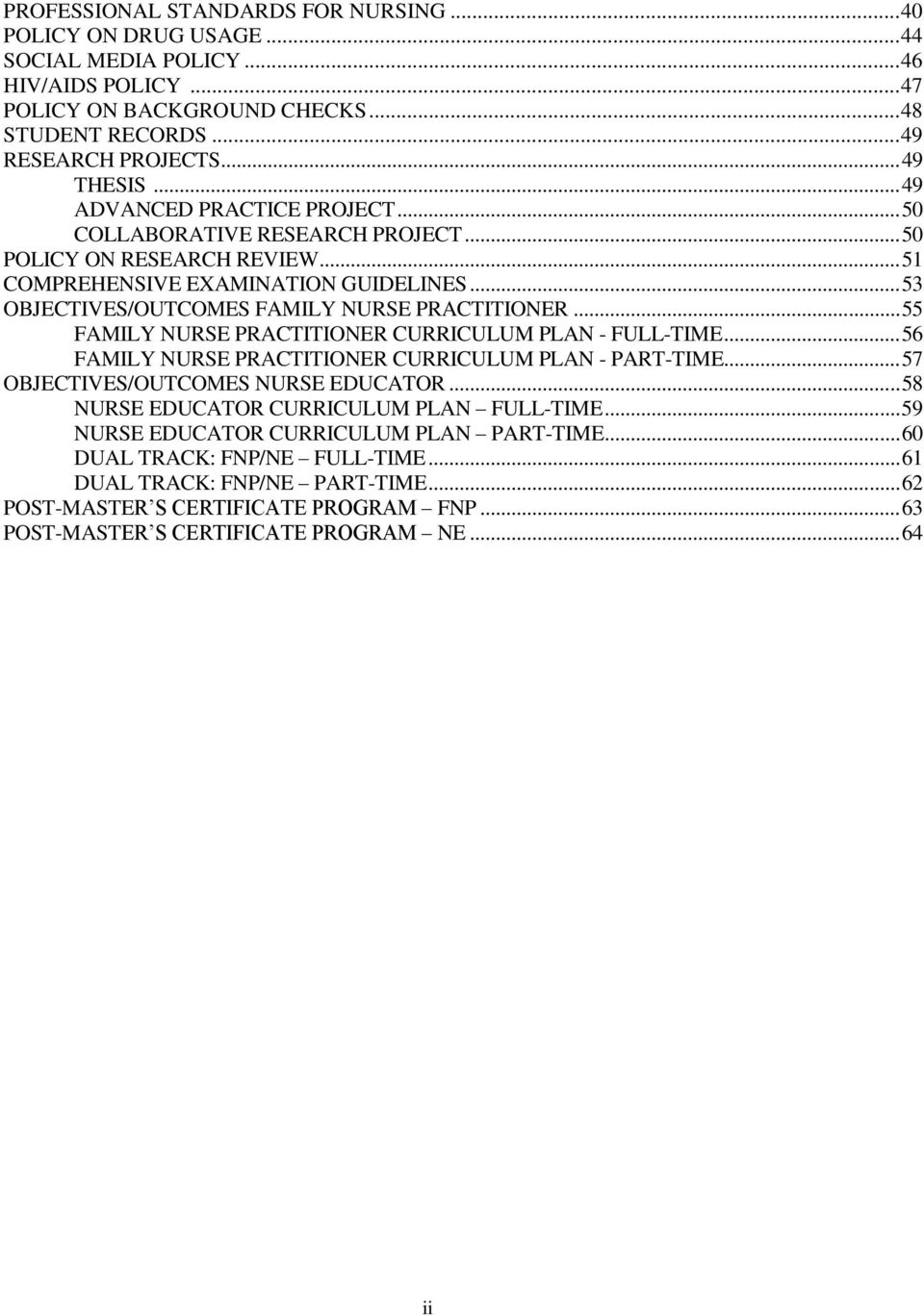
3 PROFESSIONAL STANDARDS FOR NURSING POLICY ON DRUG USAGE SOCIAL MEDIA POLICY HIV/AIDS POLICY POLICY ON BACKGROUND CHECKS STUDENT RECORDS RESEARCH PROJECTS THESIS ADVANCED PRACTICE PROJECT COLLABORATIVE RESEARCH PROJECT POLICY ON RESEARCH REVIEW COMPREHENSIVE EXAMINATION GUIDELINES OBJECTIVES/OUTCOMES FAMILY NURSE PRACTITIONER FAMILY NURSE PRACTITIONER CURRICULUM PLAN - FULL-TIME FAMILY NURSE PRACTITIONER CURRICULUM PLAN - PART-TIME OBJECTIVES/OUTCOMES NURSE EDUCATOR NURSE EDUCATOR CURRICULUM PLAN FULL-TIME NURSE EDUCATOR CURRICULUM PLAN PART-TIME DUAL TRACK: FNP/NE FULL-TIME DUAL TRACK: FNP/NE PART-TIME POST-MASTER S CERTIFICATE PROGRAM FNP POST-MASTER S CERTIFICATE PROGRAM NE ii
4 INTRODUCTION The overall goal of the Master of Science in Nursing program is to prepare the registered nurse for an advanced practice role in nursing within the context of Christian beliefs, values, and behaviors. All specialty tracks meet the necessary requirements of eligibility for the graduate of the MSN program to write the national certification examination as appropriate. The goal for the Post Master s Certificate program is to prepare those with a master s degree in nursing for an additional area of advanced nurse practice within the orientation of Christian beliefs, values, and behaviors. An individual course of study is designed for the applicant to complete the requirements to write the national certification examination in the area of specialty. GRADUATE NURSING STUDENT HANDBOOK Revised, Approved: 5/21/97 Reviewed, Revised, Approved: 7/97, 8/98, 11/98, 6/99, 4/00, 3/01, 9/01, 11/01, 1/02, 4/02, 7/04, 7/05, 1/06, 4/06, 12/06, 4/07, 7/07, 7/08, 7/09, 7/10, 8/11, 7/12, 8/13 1
5 PHILOSOPHY The philosophy of the Department of Nursing at Carson-Newman University affirms the institutional mission to prepare, through its bachelor s and master s degree programs, educated men and women as servant leaders and world citizens. As an institution, Carson-Newman emphasizes academic excellence and Christian commitment within a caring community. The faculty affirms the liberal arts foundation with its emphasis on the intrinsic value of each person, Christian caring in human relationships, logical understanding of life, appreciation of truth and beauty, and practical solutions for human problems. This philosophy characterizes the faculty s beliefs about nursing education and practice as understood through the nursing metaparadigm of person, environment, health, and nursing. Each person is a unique being created by God. Each person possesses intrinsic value, worth, dignity, and freedom of choice as an individual and as a member of the local and world-wide community. The environment in which the individual develops is both ever- changing and often unpredictable. This environment is both collectively experienced and individually perceived and interpreted according to the person s cultural experiences. Health is a dynamic state that is uniquely perceived and defined. Health is influenced by physical, psychosocial, emotional, and spiritual factors within the individual and by factors within the greater economic, social, and physical environment. Health is facilitated by the caring interaction between two or more individuals. Nursing is a learned discipline whose focus is the promotion and maintenance of health of individuals, families, communities, and populations. Nursing practice is an on-going humanistic process using critical thinking and decision making skills. Nursing is sensitive to each person s culture, values, and perceptions of health. Nursing, as a profession, is grounded in the domains of education, research, and practice. The scope and diversity of nursing necessitate the synthesis of concepts from nursing, the psychosocial and biophysical sciences, and the liberal arts. This knowledge, supported by nursing theories and research findings, constitutes the foundation for evidence-based nursing practice and empowers the profession to apply nursing ethics as it advocates for social justice and health care reforms. The baccalaureate level of nursing education has been defined as the entry level to professional nursing practice. The baccalaureate nurse provides direct and indirect care; designs, coordinates and manages care; and functions as a member of the profession. The graduate level of nursing education prepares an advanced practice nurse with the substantive knowledge, competence, and skills needed to practice in an area of specialization. An integral part of graduate nursing education is the development of scholarly investigation and leadership skills that contribute to the discipline of nursing and improvement of health care. 2

6 Learners at both undergraduate and graduate level are responsible for their own learning. Learners bring their unique potential for growth and development to the learning environment. Faculty act as catalysts to facilitate learning in a caring relationship. Faculty encourage independent thinking and a sense of inquiry. Faculty model professional behaviors which reflect a commitment to ethical and legal standards of practice. Reviewed, revised and approved: 8/16/95, 1/27/97, 8/17/11, 4/3/13 Reviewed and revised: 10/24/95, Approved: 10/27/95 Revised and approved: 5/8/96, 7/8/96 Reviewed, 1/25/99, 8/16/06 3

7 GENERAL INFORMATION Nursing Majors All nursing majors are assigned a graduate advisor who will closely follow the student's academic progress. Students are required to meet with their advisor each semester during the posted preregistration and registration times. Transfer students from other schools must have their previous work evaluated before being admitted to the program. Transcripts of students with prior university credit will be evaluated on an individual basis. Final approval of transfer credit for required nursing courses must be signed by the Dean or designated representative. Admission Requirements MSN Degree A bachelor or associate degree in nursing from a NLN or CCNE accredited nursing degree program. Grade point average of 3.00 or higher on a 4.00 point scale for undergraduate work. Graduate Record Examination taken within 10 years of application. Application and $50.00 nonrefundable application fee. One official transcript from all previous undergraduate and graduate university or university course work. A recommendation form from each of the following areas: academic, employment, and character. Current active unencumbered registered nurse licensure in the state of Tennessee or compact state. Completion of criminal background check within 90 days of admission. Letter of personal goals and aspirations. Interview with graduate faculty including a written component. All students will be required to submit a random drug screen during the course of study. Completion of drug screen prior to enrollment of first clinical course. 4

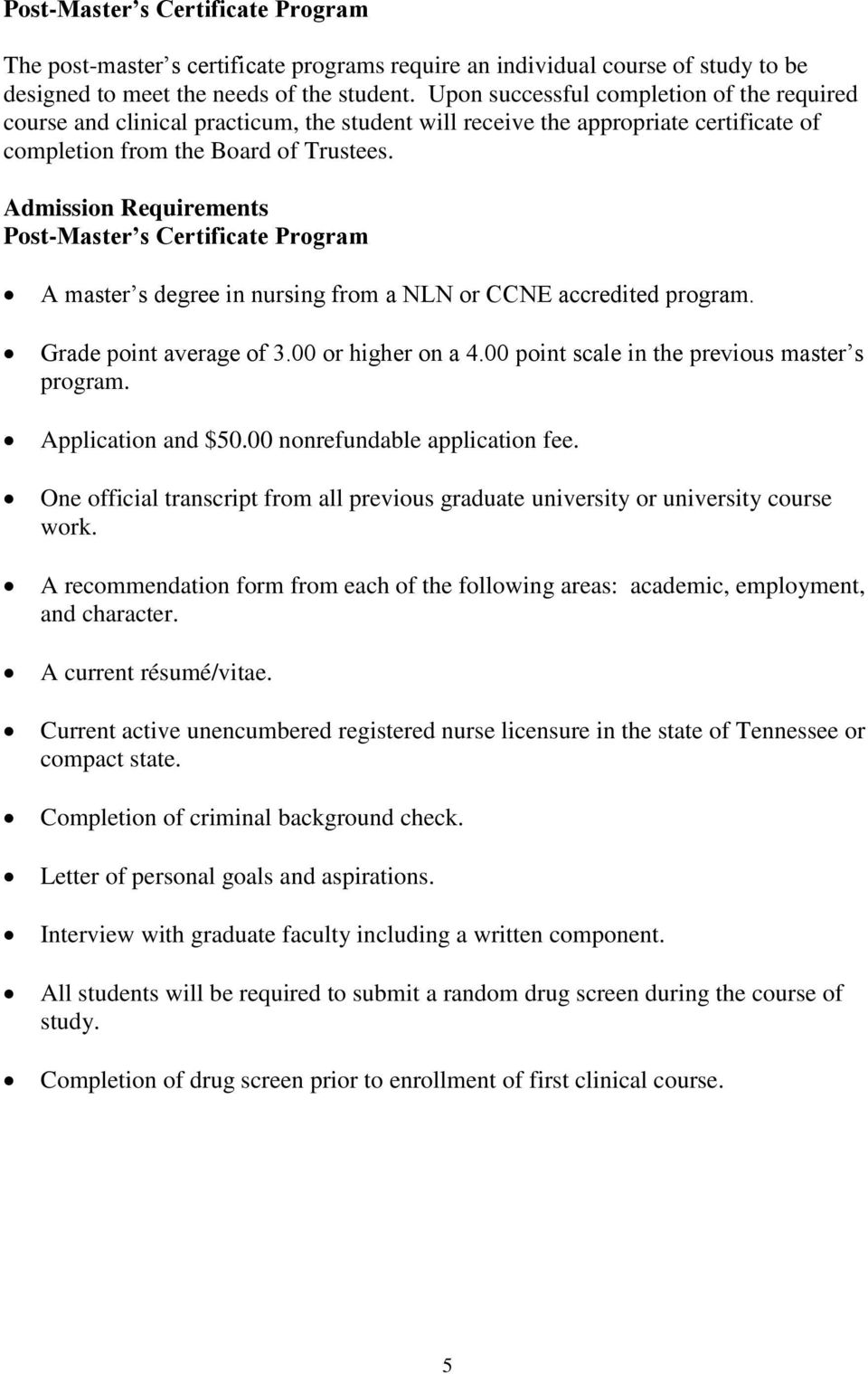
8 Post-Master s Certificate Program The post-master s certificate programs require an individual course of study to be designed to meet the needs of the student. Upon successful completion of the required course and clinical practicum, the student will receive the appropriate certificate of completion from the Board of Trustees. Admission Requirements Post-Master s Certificate Program A master s degree in nursing from a NLN or CCNE accredited program. Grade point average of 3.00 or higher on a 4.00 point scale in the previous master s program. Application and $50.00 nonrefundable application fee. One official transcript from all previous graduate university or university course work. A recommendation form from each of the following areas: academic, employment, and character. A current résumé/vitae. Current active unencumbered registered nurse licensure in the state of Tennessee or compact state. Completion of criminal background check. Letter of personal goals and aspirations. Interview with graduate faculty including a written component. All students will be required to submit a random drug screen during the course of study. Completion of drug screen prior to enrollment of first clinical course. 5
9 Admission Requirements RN-MSN (ADN-MSN) Registered nurses, with an Associate Degree in Nursing, may apply for admission to the MSN program directly. This program is designed for those interested nurses to move into a Family Nurse Practitioner or Nurse Educator role. A Bachelor of Science in Nursing (BSN) is not awarded with this MSN. Admission Registered nurses are required to complete the liberal arts core requirements, as described in the undergraduate catalog for Carson-Newman University, for acceptance into the RN-MSN program. Additionally, they must meet the Graduate nursing admission requirements. 6
10 Categories of Admission 1. Admitted Degree Seeking Student - This category means that the candidate has met all the specified requirements for admission into the degree program and that the candidate may take all the course work leading to the degree program to which he/she was admitted. 2. Provisionally Admitted - This category is for those who have not met all specified requirements but have been permitted to begin taking courses in a degree program. The provisionally admitted candidate will be sent a letter outlining what must be completed before being fully admitted. In order to be eligible for full admission into the Master of Science in Nursing program the candidate must have a minimum overall GPA of 3.00 prior to the first clinical course excluding Nursing 507. Once the candidate has met the requirements necessary for full admission, the application will be re-evaluated, and the student will be notified of his/her new classification. A maximum of nine graduate hours with C grades or better, taken before being fully admitted, may be applied toward the Master of Science in Nursing degree. 3. Admitted Non-Degree Seeking - This category is for those individuals who want to take courses in the graduate studies program but who are not working toward an MSN degree at Carson-Newman University. A copy of an official transcript showing graduation from a regionally accredited four-year baccalaureate and/or master s program is also required before graduate credit can be issued. The transcript must be from the institution that granted the baccalaureate or master s degree. These individuals will be admitted on a space available basis. 4. Admitted Non-Degree Certificate-Seeking Student - This category is for those individuals who want to take courses in a graduate studies program to earn a certificate rather than a graduate degree at Carson-Newman University. Admission would be determined by individual graduate program and the nature of the certificate. 5. Not Admitted - This category means that the Graduate Admissions and Appeals Board has reviewed the completed application and has found reason to deny admission. The applicant will be notified in writing of the Board's decision and the reason(s) for the decision. Readmission Students accepted into Master of Science in Nursing program must begin course work during the semester of acceptance or apply for readmission to the program. Students withdrawing from the program must apply for readmission before being allowed to continue their course of study. Application for readmission may be requested from the Department of Nursing office or the Graduate Admissions office. 7

11 Transfer Credit Nine (9) semester hours of graduate credit from a recognized nationally accredited nursing program at a regionally accredited college or university may be transferred to Carson-Newman for advanced health assessment, graduate statistics, nursing theory, or pharmacology. Clinical courses (excluding Nursing 507) will not be accepted for transfer credit. Any transfer course must have been completed with a grade of A or B within three (3) years prior to the semester of enrollment. No correspondence courses will be transferred. If a student wishes to transfer additional graduate hours, the course must be comparable to that offered at Carson-Newman and will be assessed on an individual basis by the course faculty. Evaluation may include (but not be limited to) syllabi, written papers, examination. Written request for transfer credit after enrollment should be submitted to the chair of the Graduate Nursing Curriculum Committee. The request should include the university offering the course, course name, course number, and a catalog description. Examination Information Graduate Record Examination (GRE) The Graduate Record Examination (GRE) is required to meet admission testing requirements for certain programs. Phone: GRE-CALL for information and scheduling. The GRE code for Carson-Newman University is Test booklets and information are available in the Graduate Studies Office & Academic Support Center. For students provisionally admitted to Department of Graduate Studies in Nursing, the GRE must be completed and results must be received during the first semester of enrollment. 8
12 PROGRESSION THROUGH THE PROGRAM Satisfactory Progress A minimum overall GPA of 3.00 is required to remain in academic good standing. A grade of C or better must be made in all courses applying to the Master's degree. A maximum of 9 credit hours with C grades may be applied toward the Master of Science in Nursing. Residency Requirement All but six semester hours of course work in the MSN degree must be taken at Carson- Newman University. Courses taken on the Carson-Newman University campus, independent studies, thesis, other research, and clinical practica meet residency requirements. Grading System Grade Points Per Department Grade Performance Semester Hour of Credit Grading Scale A Superior B Good C Average F Failing 0 Below 78 WF Withdraw Failing 0 WP Withdraw Passing 0 AU Audit 0 *I Incomplete 0 *IP In Progress 0 * See Temporary Grades for explanation Repetition of Courses: The last grade with no additional hours attempted will be used in calculating grade averages for only those courses repeated at Carson-Newman University. MSN students may not repeat courses with a failing grade. Any MSN student who receives a grade of F will be dismissed from the program. For MSN students who are placed on academic probation, a grade of "C" may be repeated once to regain academic good standing. 9

13 Temporary Grades: I (Incomplete): The student has failed to complete the course in the allowed time due to illness or some justifiable delay. The I will carry no grade points and will not be included in the GPA computation. A grade of F will be assigned if the Incomplete is not removed by the deadline determined by the instructor which can be no later than the end of the next semester regardless of whether or not the student is enrolled at Carson-Newman (the deadline for removing an incomplete grade earned during any summer term is no later than the end of fall semester). No student can graduate with an I on their transcript. IP (In Progress): To be used for graduate projects or practica that extend beyond one semester. An IP will carry no grade points, will remain on the final transcript, and will not be included in the GPA computation. Probation/Suspension When a student fails to maintain academic good standing (see Satisfactory Progress), he/she will be placed on academic probation for one semester. Written notification of probation will be sent to the student. During the semester on probation, the student must work with his/her academic advisor to devise a plan to regain good standing. Within Graduate Studies in Nursing, any student on academic probation has an opportunity to complete nine additional semester hours of graduate study in order to raise the student's cumulate GPA to 3.0. The student will be dismissed from the program if the cumulative GPA is not raised to 3.0 upon the completion of these nine graduate semester hours. Withdrawal Any graduate student voluntarily leaving the university before the close of the term must withdraw officially. The graduate student initiates the withdrawal procedure in the Financial Aid Office. Graduation Graduate students are required to complete an application for graduation and submit it with program evaluation to the appropriate department chair by the appropriate deadline. The application for graduation may be found on the Office of the Registrar website and the program evaluation may be completed through C-N connect. Deadlines are as follows: December graduation: September 1 May graduation: December 1 Commencement ceremonies are held in December and May. Students are expected to participate in the commencement ceremonies. 10
14 CLINICAL INFORMATION Nursing Practicum Each clinical course requires a supervised practicum with a program-approved preceptor under the direction of the course faculty. The student can not be paid for participation in the practicum. Nurse malpractice insurance must be obtained through Carson-Newman University in the fall of the year if the student is to be enrolled in a clinical practicum for that academic year. Clinical Requirements Prior to enrolling in clinical courses (including advanced health assessment), students must provide proof that the following criteria are valid throughout the semester of each clinical course. The criteria are: a. current malpractice insurance (minimum of $1,000,000/3,000,000 required) through Carson-Newman University b. current American Heart Association CPR certification (infant and adult) c. yearly negative tuberculin test or, if positive, appropriate follow-up as recommended by the American Lung Association or completion of Annual Tuberculosis Assessment form in times of short of testing material (TUBERSOL) d. rubella titers or MMR series if no immunity e. hepatitis B vaccine series or acceptable titer or waiver f. current RN licensure in Tennessee g. completion of criminal background check h. completion of drug screen i. other requirements as specified by any clinical agency 11
15 STUDENT CLINICAL DRESS CODE Clothing is to be appropriate for professional appearance. Scrubs may be worn in the clinical setting if requested to do so by the clinical preceptor. The following apparel will not be acceptable: jeans, sweatpants, shorts, T-shirts as outer garments, midriff tops. Dress length and pant length is expected to present a professional image at all times; comfortable shoes should be worn (remember you will be standing long hours). Shoes must be clean and kept in good repair (tennis shoes, crocks, open-toe or open heel shoes, etc., are not acceptable). Nails must be short and clean. Nail polish if worn should be free of chips, cracks, and peeling. No artificial nails are allowed. Nail decals and nail piercing are not acceptable. Mustaches and beards must be clean and neatly trimmed. Hair must be clean and neatly combed. If dyed, it must be a natural color. Extreme hairstyles are not acceptable. Perfumes, colognes, after shaves, or any strong scent are not permitted in the clinical area. Appropriate jewelry includes nursing school pins, watch, wedding sets or a small ring (one per hand), one wrist bracelet, one set of earrings. Large or multiple earrings, ear clips, or cuffs are not appropriate for the professional area. Piercings in other body parts must be covered by clothing or removed. Tattoos, if present, must be covered. The following is required: White lab coat with two (2) large pockets The identification name pins will be ordered as a group once you are enrolled in NURS 507 (Health Assessment) and cost approximately $8.00. The name pin will have the following wording: First name and last name, RN Carson-Newman MSN Student Stethoscope good quality model (FNP students) Reflex Hammer (FNP students) Mobile Electronic Device (student s choice) with a minimum of 16 megs of memory with required drug reference Epocrates Essentials. 12
16 PRACTICUM GUIDELINES RESPONSIBILITIES OF THE STUDENT 1. The student should contact faculty during the semester preceding the practicum if specific practicum locations are desired. 2. Prior to the first day of clinical, the student will: a. discuss and receive faculty approval of clinical outcomes prior to meeting with the preceptor or attending clinical, b. meet with the preceptor to arrange the practicum schedule which will remain in effect for the entire semester unless approved by the course faculty, c. discuss clinical outcomes to be achieved by completion of the practicum experience, d. provide the faculty member and preceptor with a copy of the practicum schedule, and e. complete the preceptor/student agreement form. 3. Throughout the semester, the student will: a. meet with the faculty for evaluation of clinical performance, b. evaluate his/her own clinical outcomes and provide a copy to the faculty member, and c. complete clinical hours weekly. 13
17 PRACTICUM GUIDELINES RESPONSIBILITIES OF THE PRECEPTOR 1. The preceptor will meet with the student to arrange the practicum schedule and discuss clinical outcomes to be achieved by the student. 2. The preceptor will: a. assist with orientation to the agency, b. communicate with the student on a regular basis to discuss practicum performance and progress toward meeting the clinical outcomes, c. provide feedback to the faculty member concerning the practicum experience when appropriate, d. provide a written evaluation of the student to the faculty member during the middle and final weeks of the practicum, e. meet with the faculty member to discuss practicum performance and attainment of clinical outcomes by the student, and f. provide verification of completion of practicum requirements. 14
18 PRACTICUM GUIDELINES RESPONSIBILITIES OF THE FACULTY MEMBER 1. The faculty member will be available the semester preceding the practicum to discuss possible practicum sites. 2. The faculty member will: a. be available to the student to discuss, approve, and sign clinical outcomes developed by the student prior to clinical, b. meet with the student to approve the practicum schedule, c. act as a resource person to both the student and the preceptor, d. provide feedback to the preceptor and student concerning the practicum experience when appropriate, e. meet with the student to discuss practicum performance and attainment of clinical outcomes, and f. meet with the preceptor to discuss the student's practicum performance and attainment of clinical outcomes. 3. Decisions regarding clinical performance will be based on student, preceptor, and faculty evaluations. The final decision regarding clinical evaluation will be made by the faculty member. 15
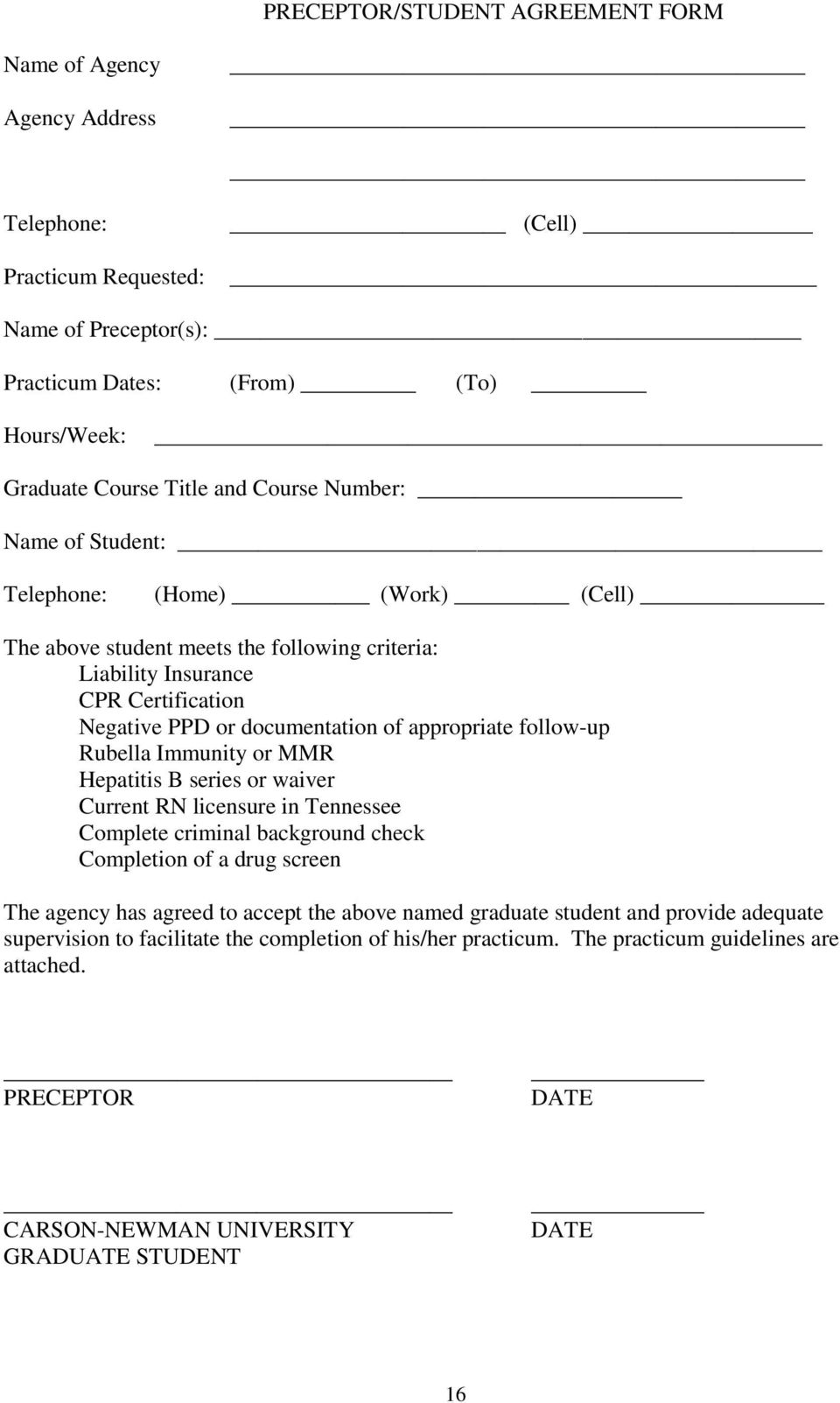
19 PRECEPTOR/STUDENT AGREEMENT FORM Name of Agency Agency Address Telephone: Practicum Requested: (Cell) Name of Preceptor(s): Practicum Dates: (From) (To) Hours/Week: Graduate Course Title and Course Number: Name of Student: Telephone: (Home) (Work) (Cell) The above student meets the following criteria: Liability Insurance CPR Certification Negative PPD or documentation of appropriate follow-up Rubella Immunity or MMR Hepatitis B series or waiver Current RN licensure in Tennessee Complete criminal background check Completion of a drug screen The agency has agreed to accept the above named graduate student and provide adequate supervision to facilitate the completion of his/her practicum. The practicum guidelines are attached. PRECEPTOR DATE CARSON-NEWMAN UNIVERSITY GRADUATE STUDENT DATE 16
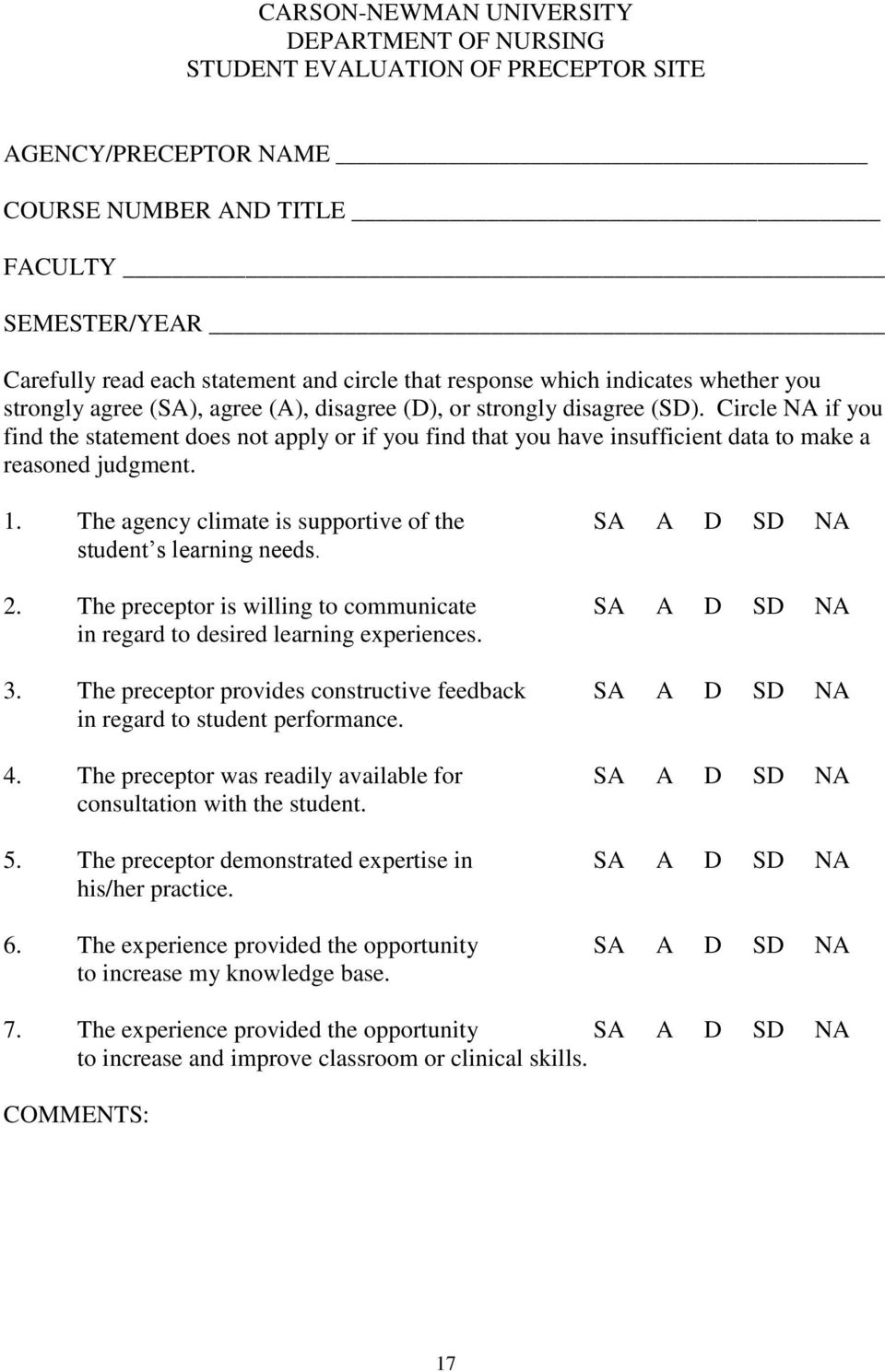
20 CARSON-NEWMAN UNIVERSITY DEPARTMENT OF NURSING STUDENT EVALUATION OF PRECEPTOR SITE AGENCY/PRECEPTOR NAME COURSE NUMBER AND TITLE FACULTY SEMESTER/YEAR Carefully read each statement and circle that response which indicates whether you strongly agree (SA), agree (A), disagree (D), or strongly disagree (SD). Circle NA if you find the statement does not apply or if you find that you have insufficient data to make a reasoned judgment. 1. The agency climate is supportive of the SA A D SD NA student s learning needs. 2. The preceptor is willing to communicate SA A D SD NA in regard to desired learning experiences. 3. The preceptor provides constructive feedback SA A D SD NA in regard to student performance. 4. The preceptor was readily available for SA A D SD NA consultation with the student. 5. The preceptor demonstrated expertise in SA A D SD NA his/her practice. 6. The experience provided the opportunity SA A D SD NA to increase my knowledge base. 7. The experience provided the opportunity SA A D SD NA to increase and improve classroom or clinical skills. COMMENTS: 17
21 CARSON-NEWMAN UNIVERSITY GRADUATE STUDIES IN NURSING PRECEPTOR/FACULTY EVALUATION FAMILY NURSE PRACTITIONER MIDTERM Student Name: Course Number and Title: Semester, Year: Please complete the evaluation of the nurse practitioner student you have precepted. Your input is valuable in the evaluation process. Thank you for your assistance Please use the following rating scale to assess understanding and performance: U unsatisfactory; NI needs improvement; S satisfactory You may add a plus (+) or a minus ( ) behind any of the above descriptors. The student demonstrates the following competencies of advanced practice: Midterm 1. obtain a complete history 2. complete the necessary physical examination 3. report data elicited 4. recognize normal/abnormal findings and values 5. analyze the problem accurately 6. develop a plan of care 7. evaluate outcomes 8. provide appropriate patient education 9. communicate effectively 10. document appropriately 11. establish rapport with the client and staff 12. exhibits Christian leadership in teaching 13. consults appropriately Comments: PRECEPTOR/AGENCY STUDENT FACULTY DATE DATE DATE 18
22 CARSON-NEWMAN UNIVERSITY GRADUATE STUDIES IN NURSING PRECEPTOR/FACULTY EVALUATION FAMILY NURSE PRACTITIONER FINAL Student Name: Course Number and Title: Semester, Year: Please complete the evaluation of the nurse practitioner student you have precepted. Your input is valuable in the evaluation process. Thank you for your assistance Please use the following rating scale to assess understanding and performance: U unsatisfactory; NI needs improvement; S satisfactory You may add a plus (+) or a minus ( ) behind any of the above descriptors. The student demonstrates the following competencies of advanced practice: Final 1. obtain a complete history 2. complete the necessary physical examination 3. report data elicited 4. recognize normal/abnormal findings and values 5. analyze the problem accurately 6. develop a plan of care 7. evaluate outcomes 8. provide appropriate patient education 9. communicate effectively 10. documents appropriately 11. establish rapport with the client and staff 12. exhibits Christian leadership in teaching 13. consults appropriately Comments: PRECEPTOR/AGENCY STUDENT FACULTY DATE DATE DATE Total number of completed student hours 19
23 CARSON-NEWMAN UNIVERSITY GRADUATE STUDIES IN NURSING PRECEPTOR/FACULTY EVALUATION NURSE EDUCATOR MIDTERM Student Name: Course Number and Title: Semester, Year: Please complete the evaluation of the nurse educator student you have precepted. Your input is valuable in the evaluation process. Thank you for your assistance Please use the following rating scale to assess understanding and performance: U unsatisfactory; NI needs improvement; S satisfactory You may add a plus (+) or a minus ( ) behind any of the above descriptors. The student demonstrates the following competencies of advanced practice for the nurse educator role: Midterm 1. ensure patient safety 2. make patient assignments appropriate to meet the learning needs of students 3. observe and collects data for evaluation of students 4. provide students feedback to enhance learning 5. contract with students regarding areas of weakness 6. provide summative evaluation of students 7. communicate consistently and effectively with students 8. facilitate clinical conferences with students 9. document, evaluate, and provide actions indicated regarding student s performance 10. establish rapport with students, faculty, and clinical staff 11. demonstrate Christian values and ethical conduct in nursing education 12. seek consultation when appropriate Comments: PRECEPTOR/AGENCY STUDENT FACULTY DATE DATE DATE 20
24 CARSON-NEWMAN UNIVERSITY GRADUATE STUDIES IN NURSING PRECEPTOR/FACULTY EVALUATION NURSE EDUCATOR FINAL Student Name: Course Number and Title: Semester, Year: Please complete the evaluation of the nurse educator student you have precepted. Your input is valuable in the evaluation process. Thank you for your assistance Please use the following rating scale to assess understanding and performance: U unsatisfactory; NI needs improvement; S satisfactory You may add a plus (+) or a minus ( ) behind any of the above descriptors. The student demonstrates the following competencies of advanced practice for the nurse educator role: Final 1. ensure patient safety 2. make patient assignments appropriate to meet the learning needs of students 3. observe and collects data for evaluation of students 4. provide students feedback to enhance learning 5. contract with students regarding areas of weakness 6. provide summative evaluation of students 7. communicate consistently and effectively with students 8. facilitate clinical conferences with students 9. document, evaluate, and provide actions indicated regarding student s performance 10. establish rapport with students, faculty, and clinical staff 11. demonstrate Christian values and ethical conduct in nursing education 12. seek consultation when appropriate Comments: PRECEPTOR/AGENCY STUDENT FACULTY DATE DATE DATE Total number of completed student hours 21
25 CARSON-NEWMAN UNIVERSITY DEPARTMENT OF GRADUATE STUDIES PROGRAM EVALUATION BY PRECEPTORS PRECEPTOR NAME DATE AGENCY Please complete the following evaluation regarding your experience with Carson- Newman University. Your input is valuable in the evaluation process of our students, faculty, and program. Thank you for your assistance. Please use the following rating scale: (1) very poor (2) poor (3) average (4) very good (5) excellent 1. Students demonstrate competence in the following areas: a. Client education b. Consultation/collaboration c. Current knowledge base d. Students function in a moral, ethical manner e. Critical thinking skills f. Assessment g. Diagnosis h. Management of clients Faculty are available and supportive of students Faculty are available and supportive to you Program strengths: Areas for program improvement: Other: Thank you for your assistance. Responses should be addressed to the following: Kimberly S. Bolton, PhD, RN, WHNP-BC Program Director of Graduate Studies in Nursing Carson-Newman University C-N Box Jefferson City, TN
26 CARSON-NEWMAN UNIVERSITY GRADUATE STUDIES IN NURSING MID-PROGRAM EVALUATION FORM What factors made you select Carson-Newman University? Check all that apply. reputation scheduling location quality of teaching cost size of school philosophy of school alumnus How did you learn about Carson-Newman University? newsletter mailing flyer from work CNC student employer college fair internet or web site List your most positive experiences at Carson-Newman University. List your concerns as you continue in the program. Check ways you are financing your education. personal funds parents employer reimbursement loan(s) scholarship(s) Have you found financial aid from a source other students could use? Yes No If yes, please list source Would you recommend Carson-Newman University to a friend? Yes No Please explain your answer to the above. 23
27 CARSON-NEWMAN UNIVERSITY DEPARTMENT OF NURSING GRADUATE STUDIES OF NURSING STUDENT INFORMATION/EXIT INTERVIEW Name Last First Middle Maiden Nickname Date of Birth Sex Permanent Address Phone (non C-N) Cell Phone Other It is important for us to stay in touch with you. Please help by giving additional information. Anticipated Name Change When do you anticipate you will take the certification exam? Which certification exam? I have accepted a position at Would you be interested in being a preceptor for our graduate program? Other plans for after graduation? Long Term Goals (5 years)? 24
28 CARSON-NEWMAN UNIVERSITY GRADUATE STUDIES IN NURSING PROGRAM EVALUATION FOR MASTER OF SCIENCE IN NURSING EXIT INTERVIEW FAMILY NURSE PRACTITIONER Carefully consider each of the following statements and rate your answer according to the following scale: 1 Poor, 2 Fair, 3 Good, 4 Very good, 5 Excellent, N/A Not Applicable The program provided me with the ability to: N/A 1. Demonstrate competence in advanced practice nursing skills within existing or emerging health care delivery systems. 2. Demonstrate Christian leadership in guiding and teaching clients and families, and facilitating the development of community systems, in collaboration with other providers, in provision and management of client care. 3. Provide consultation and care to individuals, families, and communities within the contexts of cultural awareness, social concern, aesthetic sensitivity and personal responsibility for health. 4. Use current research activities and scholarly works to improve and evaluate nursing practices and client outcomes. 5. Demonstrate Christian values and ethical conduct in the exercise of clinical practice and professional leadership. 6. Serve, through collaboration and informed leadership, as a change agent within the profession. 7. Demonstrate the use of independent decision making and critical thinking skills in the advanced practice of nursing and health care delivery. 25
29 The strengths of the Master of Science in Nursing at Carson-Newman University were: The limitations of the Master of Science in Nursing at Carson-Newman University were: Comments: 26
30 CARSON-NEWMAN UNIVERSITY GRADUATE STUDIES IN NURSING PROGRAM EVALUATION FOR MASTER OF SCIENCE IN NURSING EXIT INTERVIEW NURSE EDUCATOR Carefully consider each of the following statements and rate your answer according to the following scale: 1 Poor, 2 Fair, 3 Good, 4 Very good, 5 Excellent, N/A Not Applicable The program provided me with the ability to: N/A 1. Establish an academic and clinical environment that provides leadership in curriculum, instruction, and evaluation within the contexts of cultural awareness, social concern, aesthetic sensitivity, nursing education, and personal responsibility for the learning of students 2. Demonstrate Christian values and ethical conduct in the exercise of nursing education and professional leadership 3. Use current research findings and scholarly work to improve and evaluate the science of nursing and nursing education 4. Serve, through collaboration and informal leadership as a change agent within the profession of nursing and education 5. Demonstrate the use of independent decision making and critical thinking skills in the development of curricula based on the mission of the program and institution in the advanced practice of nursing and education 6. Demonstrate a collaborative approach to improve societal and health care needs through nursing education to facilitate the enactment of best practices 27
31 The strengths of the Master of Science in Nursing at Carson-Newman University were: The limitations of the Master of Science in Nursing at Carson-Newman University were: Comments: 28
32 TEXTBOOKS/RESOURCES Textbooks should be purchased as soon as possible following the first class meeting. All non-purchased nursing textbooks will be returned to the publisher two (2) weeks after the semester begins. If unable to purchase books at this time, arrangements should be made with the bookstore to hold a textbook. FNP students are required to purchase a mobile electronic device of their choice (minimum of 16 megs of memory). The electronic drug reference called Epocrates Essentials is required. REFERENCE FORMAT All written assignments excluding the thesis will use the APA Format for writing style, formatting, and referencing style. The most recent edition of the Publication Manual of the American Psychological Association will be followed. APA manuals are available in the Campus Bookstore. The thesis uses a combination of the Thesis Manual and APA Manual for writing style, formatting, and referencing style. The Thesis/Advanced Practice Project Manual can be found on C-N Online/Edvance 360 under Communities Graduate Nursing Students. STUDENT MEMBERSHIP ON COMMITTEES Students may be nominated to University and departmental committees in which they have an interest and are willing to serve. Acceptance of students on committees rests with each committee. The role of the student is to represent the ideas and perspectives of their peers in departmental committees, to participate in the general work of the committee, and to act as a liaison between students and faculty. Nursing The Nursing Curriculum Committee and Nursing Student Affairs Committee shall each have representatives from the undergraduate and graduate programs. The representatives from the undergraduate program will include one student from each of the following levels: sophomore, junior, and senior. The representatives for the graduate program will include one first-year and one second-year student. Student representatives will be elected by their respective class in September of each year and will serve during that academic year. The junior, senior, first-year, and second-year graduate student members shall have voting privileges; each student s vote will count as ½ vote. The sophomore student shall be a non-voting member. The senior student and the second-year graduate student from the Nursing Student Affairs Committee will serve on an ad hoc committee for the purpose of planning and organizing the annual Celebration of Excellence program. Students shall not serve in activities of the committee which include review of student records or discussion of a specific student. 29
33 Nursing Curriculum Committee Functions: 1. Formulate, review, and revise the outcomes, purposes, and organization of the curriculum in keeping with the philosophy of the university and of the programs of nursing 2. Establish, review, and recommend format for course syllabus 3. Approve all new course proposals 4. Formulate, review, and revise the methods and forms for evaluation of student progress and performance 5. Implement program evaluation as outlined in the Systematic Plan of Evaluation 6. Perform other functions as determined by the department chair or program faculty Nursing Student Affairs Committee Functions: 1. Coordinate recruitment efforts for the undergraduate and graduate programs with those of the university recruitment office and Office of Admissions 2. Work collaboratively with the Office of Admissions, Office of Financial Assistance, and Office of the Registrar 3. Review and recommend revisions of the undergraduate and graduate university catalogs 4. Plan and implement Celebration of Excellence and other activities recommended by department chair, program faculty, or students 5. Maintain a current Undergraduate and Graduate Student Handbook 6. Provide for periodic student-faculty information/discussion sessions 7. Perform other functions as determined by the department chair, program faculty, or students GRADUATE STUDENT AWARDS MSN Achievement Award: Family Nurse Practitioner This award is presented by graduate nursing program faculty to the graduate student showing consistently high quality clinical performance in all clinical areas. The student must have a minimum cumulative GPA of The award represents high achievement in nursing and is presented at the annual Celebration of Excellence Ceremony. MSN Achievement Award: Nurse Educator This award is presented by graduate nursing program faculty to the graduate student showing consistently high quality in development and implementation in the teaching role. The student must have a minimum cumulative GPA of The award represents high achievement in nursing and is presented at the annual Celebration of Excellence Ceremony. Contribution to Nursing Science Award This award is given yearly to a graduate student to recognize work that has made a significant contribution to the science of nursing. The recipient of the award will be selected by the graduate nursing program faculty based on the following criteria: 1. The finished thesis/project has the potential to make a significant improvement to patient outcome. 30
34 2. The thesis/project is scholarly, focusing on a nursing concept or problem. 3. The student is able to articulate an understanding of the significance of the thesis/project, findings from the work done on the thesis/project, and implications of the thesis/project findings. 4. The student has a plan for dissemination of the knowledge. The award, consisting of a plaque, will be awarded at the annual Celebration of Excellence ceremony. SIGMA THETA TAU INTERNATIONAL RHO MU-AT-LARGE CHAPTER The Carson-Newman University Honor Society of Nursing was established in 1998 to recognize and further the scholarship of Carson-Newman nursing students, alumni, and appropriate community nursing leaders. The Rho Mu chapter of Sigma Theta Tau (the international nursing honor society) at Carson-Newman University was established in April, In November 2006, Rho Mu Chapter at Carson-Newman University and the Nursing Honor Society at Tennessee Wesleyan College united to form Rho Mu-at-Large Chapter. The purpose of this honor society shall be to: 1. Recognize superior achievement 2. Recognize the development of leadership qualities 3. Foster high professional standards 4. Encourage creative work 5. Strengthen commitment to the ideals and purposes of the profession. Invitations to join Sigma Theta Tau will be extended to master s students who have a GPA of 3.5 on a 4.0 scale and have completed one-fourth of the program of study. The membership committee recommends potential candidates to the full membership of the organization for a decision. TRANSPORTATION All students are required to have access to a car for transportation in clinical courses. GUIDANCE Counseling Services: If personal, academic, or vocational concerns arise, Counseling Services (located in the Wellness Center) can help you prioritize and/or learn new ways of dealing with developmental issues. Life Directions Center: This office is located on third floor of Baker Building and can assist you with problems dealing with advising, tutoring, academic problems, study skills, and difficulties which seem not to fall into any particular category. This office will attempt to help you find out who needs to know about your individual problem. Students who have been determined to have or feel they may have a learning disability should contact Mr. David Humphrey in the Kathleen Manley Wellness Center at
35 HEALTH Refer to the Eagle Handbook for information about health care and insurance. LIBRARY Nursing students are expected to utilize library facilities in preparation for both classroom and clinical experiences. Refer to the Eagle Handbook and the Library Handbook for specific services offered. CINAHL, PUBMED, First Search, Sigma Theta Tau nursing research, and other databases are available. COMPUTER USE All hardware, software, and documentation contained in any computer lab at C-N are either owned or licensed by Carson-Newman University. Any unauthorized removal, duplication, or reproduction is unlawful and prohibited. University: All students are eligible to use the computer labs across campus when they are available for general use. Check schedules on the door or the computer network menu for available times. Student monitors are available for limited help during these times. All computers located in these labs are connected to the network. Department: Use of the computer lab located in Heritage Hall South is available 8:00 a.m. 4:30 p.m., unless otherwise reserved. Computers in this lab are connected to the network. The PASW statistical program is available in this lab. NO FOOD OR DRINK is permitted in the computer laboratory. NO CELL PHONE USAGE is permitted in the computer lab. Absentee Policy RIGHTS AND RESPONSIBILITIES There are no free absences within the department of nursing for either classroom or clinical instruction. All clinical absences will require a make-up day. The student will be responsible for making up any work missed during the classroom instruction. The following guidelines will be used for determining what constitutes an absence: 1. Not attending class or clinical 2. Leaving class after a test or after the class break 3. Receiving three tardies 4. Leaving early for an appointment Students who are absent from a class two times the number of times that class meets in a two-week period will receive a full letter grade reduction of the student s final grade. 32
36 Absences related to documented unforeseen circumstances such as prolonged illnesses, hospitalizations, or family crises will be evaluated on an individual basis by the course instructors. The amount of clinical absences that will result in a clinical failure for the semester will be up to the individual course coordinator. Classroom Etiquette Nursing students are expected to adhere to the codes of professionalism as set forth by the Tennessee Nurse Practice Act in both the classroom and clinical settings. In addition to the Tennessee Nurse Practice Act, the following are additional guidelines and expectations for the classroom setting: 1. Be on time to class; this includes being in your seat and ready to take notes. 2. Be respectful of other students and faculty during discussions and lectures. 3. Be polite to others. 4. Do not leave the classroom or clinical setting unless so directed by the instructor of the course. 5. All cell phones must be in the off position and put away. 6. Students are not to schedule any appointments of any kind during scheduled class or clinical days. 7. Personal computer use during class must be course related/specific. Tardiness Policy All students are expected to be on time and prepared for all scheduled classes. Students who are late to class will be issued a tardy. Receiving a tardy three times will result in an absence (see absentee policy). All students are expected to be on time and be prepared for all clinical. Tardiness to clinical will not be tolerated. The first time a student is late he/she will receive a warning. The second time a student is late he/she will be sent home for that clinical day and will have to make up that day at a later time. The third time a student is late he/she will receive a clinical failure for the semester. Cell Phone Policy NO CELL PHONES permitted in the classroom. Use of the cell phone during class or clinical will result in the following: 1. Use of cell phone during classroom time or leaving the classroom to answer the cell phone will result in the student being asked to leave the class for the day and will count as an absence. 2. Use of the cell phone during clinical will result in a clinical failure for the semester (zero tolerance). 33
37 3. Use of Epocrates Pro on cell phones will be allowed in the clinical area, but the cell phone must be silenced. Make Up Exams All make up exams will be provided to the student only on Reading and Study day. Academic Honesty in Nursing The profession of Nursing requires a high level of personal integrity and ethical behaviors. At Carson-Newman University, the nursing faculty believe that the values of personal integrity and ethical behavior are consistent with the Christian worldview. Academic honesty is an integral part of personal integrity and ethical behaviors and is an expectation of all students completing professional nursing education at Carson-Newman University. Faculty, students, and staff share the responsibility for ensuring that personal integrity and ethical behaviors are not compromised. The following are examples of compromised academic integrity. The list is not all inclusive. 1. Cheating a. Giving or receiving aid on tests, assignments, or book reviews b. Removing and/or copying test questions c. Unauthorized collaboration with other students on any academic work 2. Fabrication a. Inventing or falsifying information, data, or citations b. Altering documents that are a part of academic records c. Falsifying or altering clinical documentation 3. Plagiarism a. Literal repetition of another author s or person s work without acknowledgement of that author or person. b. Borrowing another s ideas and representing them as your ideas. c. Using another person or organization to prepare your academic work. Violation of academic honesty will be addressed by the course faculty. After hearing the student and considering all of the evidence, sanctions will be assessed if guilt is determined. These sanctions are as follows: 1. First offense a. A grade of F on just the suspect course work or b. A grade of F in the course or c. Dismissal from the program. 34
38 2. Second offense a. Dismissal from the program and b. Ineligibility for readmission Any finding of violation of academic honesty and the sanction applied or recommended shall be reported to the Provost who shall assess any sanction more severe than loss of credit for the course. A student may appeal a finding and/or a sanction assessed to the Life Directions Center as directed in the nursing student handbook. Otherwise, no appeal shall be allowed. A note regarding the charge and the sanction will be placed in the student s academic file. Equipment Use Anyone borrowing lab equipment must sign for the specific piece of equipment on a form maintained in the Health Assessment or Clinical Skills Laboratory. A graduate faculty member must obtain the equipment and ensure that the form is signed when the equipment is borrowed and when it is returned. A grade of incomplete will be issued if equipment is not returned. The incomplete will be changed to the earned grade when equipment is returned or is replaced. In the event of equipment breakage due to accidents or misuse, the borrowing person is responsible for paying for the replacement of the equipment. New Policies New policies and changes in policies will be published annually in the Graduate Nursing Student Handbook. Students are responsible for knowledge of and compliance with policies published in the Graduate Nursing Student Handbook, Eagle Student Handbook, and C-N Graduate Catalog. All three documents may be accessed from the Carson- Newman website ( Students will receive notification of any policies approved between issues of the Graduate Nursing Student Handbook. Students will sign a form stating that they are aware of the location and the significance of the Graduate Nursing Student Handbook. This form will be placed in the student s folder. GRIEVANCE PROCEDURE The purpose of the grievance procedure is to protect the student s rights in academic and other matters if the student feels that he/she have been treated unfairly. Grievances related to policies must pertain to the implementation of policies and may not contest the substance of these policies. If the incident is non-academic, then the student should follow the procedure outlined in the Eagle Student Handbook. Any student with an academic-related incident, who feels that he/she have been treated unfairly, should follow the steps listed below: 35
39 1. Notify the appropriate faculty person (person named in the grievance) and submit a letter describing the formal complaint (an incident of unfairness and/or how the policy implementation was inappropriate) within five working days of the incidence. a. After the formal complaint has been received by the appropriate faculty person, a conference will be scheduled with the student, his/her advisor (unless the advisor is named in the grievance), and the faculty person named in the grievance. If the student s advisor is named in the grievance, the student may select an available faculty member or his/her choice to attend the meeting. b. A record of the conference will be written by faculty person with whom the grievance was against. A copy will be placed in the student file, and a copy will be given to the student. 2. If the grievance was not rectified by the conference between the student and the faculty member, then a. The student must send a formal letter to the appropriate Program Director and Chair of the Department of Nursing describing the complaint and the result of the meeting between in the student and the faculty member. b. This must be completed with 48 hours of the conclusion of the conference. c. The Program Coordinator/Director and Department Chair will review all of the documents and will either send a written response to the student or schedule a conference with the student within five working days. d. A copy of the formal complaint and the written response will be placed in the student s file. e. If a meeting was scheduled, then a record of the conference will be placed in the student file, and a copy will be given to the student. 3. If the student is not satisfied with results at this point, then a. A formal letter describing the incident should be sent to the Provost of the University if the matter is related to academics. b. The Provost will review all documents related to the incident and schedule a conference with the student. STUDENTS WITH DISABILITIES Any student with a special documented disability (learning, sight, hearing, mobility, etc.) which may affect class activities should contact Mr. David Humphrey, [email protected] or , Kathleen Manley Wellness Center. Students will be required to provide appropriate documentation of disability. 36
40 PRACTICE OF PROFESSIONAL NURSING Carson-Newman University graduate students are enrolled in a nursing program approved by the Tennessee Board of Nursing and therefore may practice professional nursing at the graduate level only while under the supervision of the nursing faculty. "Professional Nursing" is defined as the practice of professional nursing meaning the performance for compensation of any act requiring substantial specialized judgment and skill based on knowledge of the natural, behavioral, and nursing sciences, and the humanities as the basis for application of the nursing process in wellness and illness care. Professional nursing includes: (1) responsible supervision of a patient requiring skills and observation of symptoms and reactions and accurate recording of the facts; (2) promotion, restoration, and maintenance of health or prevention of illness of others; (3) counseling, managing, supervising, and teaching of others; (4) administration of medications and treatments as prescribed by a licensed physician, dentist, podiatrist, or nurse authorized to prescribe pursuant to TCA Section ; (5) application of such nursing procedures as involve understanding of cause and effect; and (6) nursing management of illness, injury, or infirmity including identification of patient problems. GUIDELINES TO AVOID UNPROFESSIONAL CONDUCT Students are expected to conduct themselves in a manner appropriate to the nursing profession. Therefore, they are expected to avoid behaviors identified in the Guidelines for Unprofessional Conduct as identified by the Tennessee Board of Nursing. A copy follows. Documentation of any of these behaviors can result in course failure. Unprofessional conduct, unfitness, or incompetency by reasons of negligence, habits or other causes, as those terms are used in the statute, is defined as, but not limited to, the following: a. Intentionally or negligently causing physical or emotional injury to a patient; b. Failure to maintain a record for each patient which accurately reflects the nursing problems and interventions for the patient and/or failure to 37
41 maintain a record for each patient which accurately reflects the name and title of the nurse providing care; c. Abandoning or neglecting a patient requiring nursing care; d. Making false or materially incorrect, inconsistent, or unintelligible entries in any patient records or in the records of any health care facility, school, institution, or other work place location pertaining to the obtaining, possessing or administration of any controlled substances as defined in the Federal Controlled Substances Act; e. Unauthorized use or removal of narcotics, drugs, supplies, or equipment from any health care facility, school, institution or other work place location; f. The use of any intoxicating beverage or the illegal use of any narcotic or dangerous drug while on duty in any health care facility, school, institution or other work place location; g. Being under the influence of alcoholic beverages, or under the influence of drugs which impair judgment while on duty in any health care facility, school, institution or other work place location; h. Impersonating another licensed practitioner; i. Permitting or allowing another person to use his or her license for the purpose of nursing the sick or afflicted for compensation; j. Revocation, suspension, probation, or other discipline of a license to practice nursing by another state or territory of the United States for any act or omission which would constitute grounds for the revocation, suspension, probation, or other discipline of a license in this state; k. Practicing professional nursing in this state on a lapsed (state) license or beyond the period of a valid temporary permit; l. Assigning unqualified persons to perform functions of licensed persons or delegating nursing care functions and tasks and/or responsibilities to others contrary to the Nurse Practice Act or rules and regulations to the detriment of patient safety; m. Failing to supervise persons to whom nursing functions are delegated or assigned; n. Aiding, abetting, assisting or hiring an individual to violate or circumvent any law or duly promulgated rule intended to guide the conduct of a nurse or any other licensed health care provider; o. Exercising undue influence on the patient including the promotion or sale of services, goods, appliances, or drugs in such a manner as to exploit the patient for financial gain of the nurse or of a third party; p. Discriminating in the rendering of nursing services as it relates to race, age, sex, religion, national origin, or the condition of the patient; q. Violating confidentiality of information or knowledge concerning the patient, except when required to do so by a court of law; r. Failing to take appropriate action in safeguarding the patient from incompetent health care practices; 38
42 s. Failing to report, through proper channels, facts known to the individual regarding incompetent, unethical or illegal practice of any health care provider; t. Over-prescribing, or prescribing in a manner inconsistent with and Rules of Tennessee Board of Nursing; u. Practicing professional nursing in a manner inconsistent with T.C.A v. Performing nursing techniques or procedures without proper education and practice; w. Engaging in acts of dishonesty which relate to the practice of nursing. 39
43 PROFESSIONAL STANDARDS FOR NURSING The profession of nursing requires a high level of personal integrity and ethical behaviors. At Carson-Newman University, the undergraduate and graduate departments of nursing believe that the values of personal integrity and ethical behaviors are consistent with the Christian worldview. Professionalism is the consistent demonstration of these values and behaviors in all interactions and includes the individual s accountability for the actions. Truthfulness Adherence to ethical principles Adherence to standards of practice HONESTY/INTEGRITY Inappropriate Too Little Appropriate Inappropriate Too Much Untruthful; Exhibits Truthful to the point misrepresents forthrightness and of blatant position/status; truthfulness; insensitivity; tactless misuses resources; trustworthy; identifies falsifies data, cheats, status/position plagiarizes appropriately; displays honesty at all Engages in unethical behavior (e.g., acceptance of inappropriate gifts, violating professional boundaries, theft, fraud, plagiarizes) Unaware of resources, requirements or position/status of professional nurse times Models ethical behavior Functions within the scope and standards of practice for nursing Sanctimonious; intolerant Inflexible; overly dependent on rules Punctuality Compliance Prioritization RESPONSIBILITY/RELIABILITY/DEPENDABILITY Inappropriate Too Little Appropriate Inappropriate Too Much Exhibits a consistent Punctual; meets Values timeliness lack of punctuality deadlines over quality (comes late or leaves early); does not adhere to deadlines Does not comply with policies, rules, regulations and/or laws; does not attend required classes/clinical Personal affairs take priority over professional activities Complies with policies, rules, regulations and laws; attends required classes/clinical Shows appropriate balance between personal and professional life Inflexible; overly reliant on rules; rulebound to the point of obstructionism Professional activities compromise personal and/or family life 40
44 Accountability Overlooks inappropriate behaviors; avoids responsibility and work Confront or reports inappropriate behaviors; assumes responsibility for own actions Above the law ; not accountable to anyone; controlling; excessive faultfinding; selfrighteous; selfaggrandizing ALTRUISM: CONCERN FOR THE WELFARE AND WELL-BEING OF OTHERS Inappropriate Too Little Appropriate Inappropriate Too Much Concern for others Concern for self supersedes concern for others; selfcentered; selfish; unwilling to extend self Shows appropriate concern for others; goes the extra mile without thought of reward; able to listen therapeutically Selfless to the point of taking needless risks; overextends self to own detriment RESPECT FOR OTHERS (peers, faculty, hospital and administrative staff) Inappropriate Too Little Appropriate Inappropriate Too Much Appearance Poor hygiene; sloppy/dirty clothing Appropriately groomed and clean Extremes of dress; provocative Interactions/attitudes Arrogant; overcritical of others; demeans those in subordinate roles Respects authority and other professionals Obsequious; goes overboard to please Teamwork Non-participatory; not adequately contributing to teams Works well with others and team members Dominant and authoritarian; uncooperative; overbearing Relationships Autonomy RESPECT FOR PATIENTS Inappropriate Too Little Appropriate Inappropriate Too Much Disrespectful to Demonstrates Accepting of all patients and/or sensitivity to patients patient and family families; insensitive to beliefs, opinions, members behaviors their beliefs, opinions, gender, race, culture, regardless of their gender, race, culture, religion, sexual effect religion, sexual preference, and status orientation, and/or status Disregard for patient autonomy, i.e. patient s right to choose Respects patients autonomy and right to choose Unable to provide for patients choice 41
45 Confidentiality Disregards patient confidentiality Demonstrates and maintains sensitivity to confidential patient information Inappropriately upholds patients right to confidentiality, thereby putting them and others at risk for adverse consequences (e.g., suicide, sexual assault, child abuse) Compassion Goal setting Motivation and drive Preparation COMMITMENT TO COMPETENCE AND EXCELLENCE Inappropriate Too Little Appropriate Inappropriate Too Much Emotionally Is empathetic and Objectivity is clouded unresponsive; exhibits sensitive to others; by desire to help little compassion for perceptive; can put others; emotionally others; at times self in others over-responsive and appears cold, shoes ; maintains unduly empathetic, indifferent, and objectivity resulting in inability heartless to be objective or effective; gives misleading information in effort Aimless; educationally adrift Has low standards of achievement in class and for clinical; satisfied to pass or make do ; aspires to minimum standards Is not prepared for class and/or clinical; does not have a plan for success as a nursing student Sets and achieves realistic goals; reflective Routinely seeks to develop additional knowledge and skills; conscientious; strives for excellence Attains knowledge and competent skills prior to class/clinical to console Set unachievable goals Overly competitive; perfectionist; answers for others when others are questioned Overly driven to obtain knowledge and skills to the exclusion of classmates Responsibility Feedback SELF ASSESSMENT/SELF IMPROVEMENT Inappropriate Too Little Appropriate Inappropriate Too Much Makes excuses; displaces blame Resists feedbackpositive or negative; defensive Admits errors; accepts responsibility for actions Seeks feedback; implements change Afraid to act for fear of making errors; assumes blame inappropriately; overly obsessive Requires constant reassurance and feedback 42
46 Self-confidence Professional practice Always insecure; unable to act independently Does not engage in following guidelines; statutes, rules and regulations Appropriately confident; asks for help when necessary Evaluates own practice in relation to guidelines, statutes, rules and regulations Overconfident; does not recognize own limitations Overly obsessive in following guidelines, statutes, rules and regulations Adapted from: American Association of Colleges of Nursing. (2008). The essentials of baccalaureate education for professional nursing practice. Washington, DC: Author; American Nurses Association. (2004). Nursing: Scope and standards of practice. Silver Spring, MD: Nursebooks.org; and, American Nurses Association. (2001). Code of ethics for nurses with interpretive statements. Silver Spring, MD: Nursesbooks.org. 43
47 POLICY ON DRUG USAGE Purpose Carson-Newman University is concerned with the safety of its students and wants to promote an atmosphere that allows every student to be as productive and safe as possible. We believe the use of drugs in a way that affects performance poses a significant safety risk to everyone and is a significant health risk for the individual. This policy explains the program we have adopted to deter illegal use of controlled substances. Consequences of violating this policy may include discharge from the program. The only way to completely comply with this policy is to avoid use of all nonprescribed controlled substances. This policy applies to all students in the MSN program at Carson-Newman University. Prohibitions No student shall manufacture, distribute, possess or use any unlawful drug. The use of legally prescribed medications is not prohibited, but the student may be required to get a statement from the medical practitioner that the use of the drug will not affect his/her performance. If there is any question, the Graduate Nursing Department may choose not to allow the student to work while taking the medication in question. No student shall report for work or remain on duty while retaining a detectable amount illegal controlled substance in his/her system. A drug test verified as positive, adulterated, or substituted by the Medical Review Officer shall be considered a violation of this policy. Testing Drug testing will be conducted on each graduate nursing student prior to first clinical course and randomly if student behavior warrants a retest. Drug screens are verified through Verified Credentials. The Graduate Nursing Faculty will decide who will be retested based on criteria it deems reasonable and will include reasonable suspicion, significant behavioral change, and post-accident testing. Failure to comply with the request will be considered a refusal to test and will result in dismissal from the program. In addition, the student will be referred to the Tennessee Nurses Peer Assistance Program (TNPAP) and must participate fully. Refusal to participate in TNPAP will result in immediate discharge from the MSN program. Procedure 1. Enter code for the program you will be attending located above the Get Started! button on the right side of the page 44
48 Drug Test Only - Nursing Division - MSN Program BBTVP Create an account 3. Enter all required information 4. Provide supporting documentation 5. Track your progress 6. Information will automatically be shared with your school **If your first order includes a drug test after you process payment and submit your order check your for 3 separate s, two from QualifiedFirst and one from Client Services 1. A Congratulations once you have registered with VCI through QualifiedFirst 2. A Track Your Order receipt once you have completed payment through QualifiedFirst - These two from [email protected] 3. A Donor Registration and an Order Reference number for your Drug Screen at LabCorp - This one from [email protected] Print and take the Donor Registration Number to one of the approved LabCorp collection sites in your to initiate the Drug Screen. If you have already created a QualifiedFirst account and are returning user, you will need to login with your User Name and Password and if you order contains a Drug Test, there will be only 2 s 1) a Track Your Order and 2) your LabCorp registration information. The LabCorp can take 2-24 hours to be delivered. Please check your inbox, junk and spam folders. If you have any questions, our Client Services Team is ready to assist you. Please call us at or us at [email protected]. Consequences Any violation of this policy will result in disciplinary action up to and including discharge from the program. A referral for TNPAP may be obtained from the program director. If found in violation of this policy: 1. The student will be referred to TNPAP and will be expected to participate fully in the program. 2. Failure to register and participate in the program sponsored by TNPAP will result in immediate discharge from the MSN program. 3. Any student who violates this policy, but participates in the TNPAP program, and documents treatment for this problem may be considered for a leave of absence from the program. The student may be considered for readmission to the program at a later date. This explanation is not intended to cover every circumstance that may arise in administering this program. The Department of Nursing reserves the right to modify any portion that seems reasonable without advance notice. 45
49 POLICY FOR THE USE OF SOCIAL MEDIA Purpose Carson-Newman Undergraduate and Graduate Programs of Nursing (hereafter, referred to as Programs of Nursing) support the use of social media as it relates to reaching current and prospective students and faculty/staff regarding school activities. However, the Programs of Nursing are dedicated to keeping students and faculty aware of the considerations in the use of social media as it relates to professional behavior. Social media has become a common mechanism of communication in our society. Examples of social media and social networking are Wikipedia, blogs, podcasts, Allnurses.com, Twitter, Facebook, MySpace, YouTube, LinkedIn, as well as many others. Social media is public information and can be tracked. Individuals posting on social media have very little control over the use of the information. Nurses must keep professional boundaries with patients served. However, social media crosses those traditional boundaries. Students have an obligation to maintain professional boundaries. In addition, the reputation of Carson-Newman and the Programs of Nursing must be protected. Guidelines for Use of Social Media Guidelines for the use of social media at Programs of Nursing are based upon the following documents. The student is expected to read them (links have been provided). Additionally, the student is expected to watch the video on the use of social media on the National Council of State Boards of Nursing website ( A Nurse s Guide to the Use of Social Media from the National Council of State Boards of Nursing (November, 2011) White Paper: A Nurse s Guide to the Use of Social Media from the National Council of State boards of Nursing (August, 2011) ANA s Principles for Social Networking and the Nurse published by the American Nurses Association. (September, 2011) Consequences Students are expected to conduct themselves in a manner appropriate to the nursing profession. In addition to following the guidelines above, students are expected to avoid behaviors identified in the Guidelines for Unprofessional Conduct as identified by the Tennessee Board of Nursing in the Rules and Regulations of Registered Nurses. Violating confidentiality of information or knowledge concerning the patient, except when required to do so by a court of law, is a violation of these guidelines. Violations of social media policy may result in course failure and/or dismissal from the program. Each student is legally responsible for individual postings. Postings that are harassing, defamatory, or in violations of state and federal laws may lead to additional liability for the student. HIPPA regulatory consequences apply to violations of patient privacy with an electronic device. 46
50 HIV/AIDS POLICY Communicable disease information for the Carson-Newman University department of nursing HIV/AIDS policy is based on current available information from the Centers for Disease Control (CDC) and the Tennessee Department of Health (TDH). The current assessment of the risk that infected health care workers will transmit HIV to patients during invasive procedures does not justify mandatory testing of health care workers (TDH). Students diagnosed as HIV-positive will meet the current requirements for admission into the appropriate program and for progression in the major. If a student is unwilling or unable to comply with standard/universal precautions or has functional impairments that interfere with completion of course requirements, admission, or progression decisions would be made on a case-by-case basis. Standard/universal precautions are an approach to infection control in which all human blood and certain human body fluids are to be treated as if known to be infectious for HIV, HBV, and/or other blood-borne pathogens. The proper application of standard/universal precautions will minimize any risk of transmission of Human Immunodeficiency Virus (HIV) and Hepatitis B Virus (HBV) from a health care worker to patient, patient to health care worker, or patient to patient. The department of nursing requires all students to abide by the CDC Universal Precautions in all client contacts. The following measures for preventing HIV transmission in health care settings are recommended by the CDC: 1. Wear protective barriers appropriate for the procedure being performed when anticipating exposure to any body fluid. 2. Wear gloves and surgical masks for all invasive procedures. Wear eyewear and face shields when exposure to droplets, blood, or body fluid splashing, or generation of bone chips is possible. 3. Remove glove if torn or a needle stick occurs and apply a new glove as promptly as patient safety permits. 4. Wash hands and other skin surfaces before and immediately after contact with body fluids. 5. Do not recap or manipulate needles or sharps in any way! Place immediately in puncture resistant container after use. 6. Use available mouthpieces, resuscitation bags, and other ventilation devices when resuscitation is needed to prevent mouth to mouth contact. 7. Maintain equipment and handle specimens in accordance with hospital/institutional guidelines that reflect CDC recommendations. 8. Refrain from direct patient care and contact with patient care equipment if suffering from exudative lesions or weeping dermatitis. 9. Exercise judgment at all times as it is impossible to specify the type of barrier needed for every clinical situation. Students who experience a needle-stick or body fluid exposure incident must report this to their faculty immediately and follow the agency protocol for exposure/injury. Students are advised to contact their own personal health care provider or local health department 47
51 following the incident and are responsible for maintaining their own health care coverage. Students have a fundamental responsibility to provide care to all patients assigned to them. Currently, only four medical conditions exist that exempt students from caring for known HIV-positive clients. These include the following health care provider conditions: 1. a known infection that can be transmitted to the client 2. an immunosuppressed condition 3. pregnancy 4. open lesions or weeping dermatitis. Refusal to care for HIV-positive clients is contrary to the ethical standards of the nursing profession. Faculty exemplify standards of ethical behavior and compassion and serve as positive role models when assigning HIV-positive clients to students for care. Students who refuse to care for these clients will be counseled by their faculty in regard to HIV/AIDS transmission, personal fears, and use of universal precautions. If refusal persists, disciplinary action may be taken. Purpose POLICY ON BACKGROUND CHECKS The graduate nursing faculty of Carson-Newman University believe that client safety is of the utmost importance, and that clients should have confidence that any individual providing health care does not have a criminal history of mistreatment, neglect, violence, or defrauding the public in any manner. Procedure All students in the MSN program at Carson-Newman University are required to have a background check completed prior to or within 90 days of admission into the program. 1. Enter code for the program you will be attending located above the Get Started! button on the right side of the page Background Check Only - Nursing Division - MSN Program GGCYT Background Check Update Only - Nursing Division - MSN Program CCXYP Create an account 3. Enter all required information 4. Provide supporting documentation 5. Track your progress 6. Information will automatically be shared with your school 48
52 If you have already created a QualifiedFirst account and are returning user, you will need to login with your User Name and Password. If you have any questions, our Client Services Team is ready to assist you. Please call us at or us at [email protected]. You are responsible for the cost which can be paid by credit card, debit card, or e-check. If there are any questions, please contact the administrative assistant at STUDENT RECORDS Advising records of all students declaring nursing as a major are maintained by nursing faculty and staff. Access These records are available only to nursing faculty, administrative assistant, and to the individual student concerned. Accuracy To maintain accuracy of these records, students are asked to: 1. report a change of name, telephone number, and/or address to the administrative assistant 2. discuss any considered withdrawal or change of major with his/her adviser. RESEARCH PROJECTS Prior to taking the research project courses within the Graduate Studies in Nursing, a student must have completed: NURS Advanced Statistics; NURS Theories of Nursing; and NURS Research Methods and Design in Nursing. Students may choose between three different options for their research project: thesis, advanced practice project, and the collaborative research project. Regardless of the type of research project chosen by the student, comprehensive examinations will be required for all Master of Science in Nursing degree students. Thesis Before registering for NURS Master's Thesis, a student must have selected an area for study and a doctorally prepared faculty member to chair the research. The thesis committee shall have three members. The chairperson and the second member of the thesis committee must be Carson-Newman nursing faculty members. The third member may be selected from outside the student s degree program if desired. The thesis committee approval form must be submitted to the chair of graduate studies in nursing prior to beginning NURS 660. Continuous NURS 660 registration (Fall, Spring, and Summer) is required until the thesis is 49
53 approved by the thesis committee. A seminar presentation must be completed prior to grade assignment. Advanced Practice Project The advanced practice project is a scholarly project designed to be completed by an individual student. The goal of this project is to submit an article for publication to a peer-reviewed journal of the student s choice. The student decides on a topic of interest during NURS 516 Research Methods and Design in Nursing, and then develops the topic into a publishable article. The article can be developed in many different ways but should include something related to the role of the nurse practitioner as that role pertains to the student s topic of interest. The advanced practice project requires a committee of two faculty members from the department of nursing. The advanced practice project committee approval form must be submitted to the chair of graduate studies in nursing prior to beginning NURS 600. In addition, the student completes an additional 30 hours of clinical at a site that is congruent with topic choice. The clinical hours may be completed prior to the beginning of the spring semester so as not to interfere with the clinical hours required in the final semester and to assist the student in writing the article. The goal of the clinical hours is to give the student some practical experience within their topic of interest. A seminar presentation must be completed prior to grade assignment. Collaborative Research Project A collaborative research project is a written research project related to program of study that meets institutional requirements for a thesis. This project is completed by two students working collaboratively. In addition to a completed and bound thesis, a scholarly article for publication is required at completion of project. Before registering for NURS 630 Master s Research Project, a student must have selected an area for study, a collaborating partner, and doctorally prepared faculty member to chair the research. The committee must have four members. The chairperson and the second member of the committee must be a Carson- Newman nursing faculty members. The third and fourth members may be selected from outside the student s degree program if desired. The collaborative research project committee approval form must be submitted to the chair of graduate studies in nursing prior to beginning NURS 630. Continuous NURS 630 registration (Fall, Spring, and Summer) is required until the Collaborative Research Project is approved by the committee. A seminar presentation must be completed prior to grade assignment. 50
54 CARSON-NEWMAN UNIVERSITY UNDERGRADUATE AND GRADUATE STUDIES IN NURSING POLICY ON RESEARCH REVIEW I. STUDENT RESEARCH This pertains to all students currently enrolled at Carson-Newman (C-N) in the departments of Nursing who are involved in research either in the undergraduate or graduate program. A. Before submitting completed Institutional Review Board (IRB) proposals to the Nursing Research Committee, the student will meet with the thesis chairperson or honors project advisor for help in developing the IRB proposal. B. After working with the chairperson or advisor, students will submit the completed proposal electronically to the chair of the Nursing Research Committee. C. Deadline for IRB proposal submission is as follows: Fall Semester 1 st and 3 rd Mondays in October and November, 1 st Monday in December Spring Semester 1 st and 3 rd Mondays in January and February No IRB proposals will be reviewed after the last day of class in any semester or over any holiday period. D. Please allow 2 weeks for review. The completed proposal will be reviewed by each Nursing Research Committee member. E. If the project/thesis chair is on the Nursing Research Committee, an additional nursing faculty member will be asked to review the student forms. F. The student will be notified in writing of approval, disapproval, or approval with modifications. G. If approved, the Nursing Research Committee chair will forward a message of committee approval and an electronic copy to the program director/department chair. The program director/department chair will then forward the electronic copy to the university IRB committee for review and approval. At this point the student must submit to the chair of the Nursing Research Committee a hard copy of a signed signature page. H. In order to facilitate information availability to all concerned in this process, the signature page will be kept separately in a central file in the program director/department chair s office until the final approval of the IRB proposal is received. The signature sheet will then be attached to the approved IRB proposal (hard copy). The IRB Subcommittee Chairperson is responsible for maintaining completed IRB s. I. Research that is not approved or approved with changes should be resubmitted to the Nursing Research Committee after the deficiencies have been addressed. J. Students will not be permitted to proceed with any part of their proposed study until final approval from the C-N IRB Subcommittee Chair is obtained. K. Research conducted in another institution (hospital, university, or medical center) may require additional approval through that institution s IRB. Students are responsible for obtaining this approval. 51
55 II. Research conducted on C-N Department of Nursing student population A. Proposals for research to be conducted with students currently enrolled in the Department of Nursing must be submitted, along with the IRB forms, to the Nursing Research Committee. Allow 4 weeks for review of the project. B. The proposal and the IRB forms will be reviewed by each committee member. C. The principle investigator will be notified in writing of approval, disapproval, or approval with modifications. D. Once approved, a copy of the proposal and the Nursing Research Committee recommendation will be forwarded to the program director/department chair then to the chair of the IRB subcommittee of the Graduate Committee for final approval. E. Research that is not approved or approved with modifications should be resubmitted to the Nursing Research Committee when the deficiencies have been corrected. III. Review of Faculty Research A. Proposals for research from nursing faculty must be submitted to the Nursing Research Committee along with completed IRB forms for review. Allow 4 weeks for review. B. Proposals and IRB forms will be reviewed by each Nursing Research Committee member. C. If the primary investigator is a member on the Nursing Research Committee, an alternate nursing faculty member will be asked to review the proposal. D. The faculty members will be notified in writing of approval, disapproval, or approval with modifications. E. Once approved, a copy of the proposal and the Nursing Research Committee recommendation will be forwarded to the program director/department chair then to the chair of the IRB subcommittee of the Graduate Committee for final approval. F. Research that is not approved or is approved with modifications should be resubmitted to the Nursing Research Committee after the deficiencies have been corrected. G. Additional approvals from other institutions where the study will be conducted, if applicable, will be responsibility of the investigator(s). 52
56 CARSON-NEWMAN UNIVERSITY DEPARTMENT OF NURSING GRADUATE STUDIES IN NURSING COMPREHENSIVE EXAM GUIDELINES General Guidelines 1. Comprehensive exams are schedule over a period of two days. 2. The exams will be given in 2 two-hour blocks each day. 3. There will be a thirty-minute break between each exam block. 4. Students will use a word processing program. Answers must be double spaced. 5. A health assessment book, a pathophysiology book, and a drug book will be provided for the students. 6. Students are allowed to bring a comprehensive exam book to the test (see below for guidelines concerning the comprehensive exam book). 7. Students will adhere to a strict time limit of 2 two-hour blocks. 8. Direct quotes must be referenced in the body of the paper utilizing the current APA manual; however, no reference list will be required. 9. Flash drives will be provided for you. YOU MAY NOT BRING ANY FLASH DRIVES WITH YOU. 10. Students are not permitted to talk during the exam but may leave the room for breaks at their discretion. 11. A faculty member will distribute the test, clarify issues as needed, and serve as the official time keeper. The faculty member will also collect the flash drive or the written exam from the students at the end of exam time. Comprehensive exam book guidelines 1. The comprehensive exam book may contain the following: power-point lectures, lecture notes, handouts, tables, or algorithms from articles you were assigned to read. 2. Access to the comprehensive exam book is allowed only during the last thirty minutes of each two-hour exam block. Scheduled dates for 2014 Comprehensive Examination: March 27, 2014 March 28, 2014 Administration of Part I Administration of Part II 53
57 Content for all MSN tracks FNP track Nurse Educator track Dual track Day One 1) Adult health + theory Curriculum development + educational theory Same as FNP 2) Accountability Accountability Accountability Day Two 1) Pediatrics or Women s Health Teaching Methods and Strategies/Research Curriculum Development/ Design and Research 2) Research Relevance of core courses to nurse educator role Teaching methods and strategies Guidelines for grading comprehensive exams 1. All degree seeking students will take a written comprehensive exam. 2. All parts of the examination will be graded satisfactory or unsatisfactory. No letter or numeric grade will be assigned. 3. If the answer to one or more question is deemed to be unsatisfactory, the student will be given the opportunity to further expand and/or clarify his/her answer in an oral examination. 4. Faculty members who are involved in the grading of the comprehensive examination will be present for the oral examination. 5. Following the oral examination, the student will be asked to wait in another room while the faculty members reach consensus concerning the final grade. The student will be immediately informed of the faculty decision. 6. If a student should fail the oral examination, the student will have a second written examination over only the failed content with no further oral examination. 7. If the second written exam is failed, the student will be allowed to repeat the course containing the content addressed in the failure. 8. Following repetition of the required course(s), the student will be allowed to take another comprehensive examination. 9. If the student fails the second comprehensive examination, the student will not be able to graduate from this program. 54
58 OBJECTIVES/OUTCOMES: FAMILY NURSE PRACTITIONER 1. Demonstrate competent advanced clinical practice nursing skills within existing or emerging health care delivery systems. 2. Demonstrate Christian leadership in guiding and teaching clients and families, and facilitating the development of community systems, in collaboration with other providers, in the provision and management of client care. 3. Provide consultation and care to individuals, families, and communities within the contexts of cultural awareness, social concern, aesthetic sensitivity, and personal responsibility for health. 4. Use current research activities and scholarly work to improve and evaluate nursing practices and client outcomes. 5. Demonstrate Christian values and ethical conduct in the exercise of clinical practice and professional leadership. 6. Serve, through collaboration and informed leadership, as a change agent within the profession. 7. Demonstrate the use of independent decision-making and critical thinking skills in the advanced practice of nursing and health care delivery. 55
59 CURRICULUM PLAN FOR MSN FAMILY NURSE PRACTITIONER TRACK FULL TIME COURSE TITLE HOURS Fall Semester NURS 501 Advanced Pathophysiology 3 NURS 503 Advanced Pharmacology 3 NURS 507 Advanced Health Assessment 3 9 Spring Semester NURS 513 Theories of Nursing 3 NURS 531 Advanced Primary Nursing Care for Women 6 9 Summer Semester NURS 510 Advanced Statistics 3 ELECTIVE 3 6 Fall Semester NURS 516 Research Methods and Design in Nursing 3 NURS 535 Advanced Primary Nursing Care for Children and Adolescents 6 9 Spring Semester NURS 537 Advanced Primary Nursing Care for Adults 7 NURS 540 Accountability for Advanced Nursing Practice 3 NURS 600 Advanced Practice Project (2) or NURS 630 Collaborative Research Project (2) or NURS 660 Master's Thesis (2) 2 12 Total Hours 45 Clinical practicums include seminar and have a credit/clinical ratio of 1:4 hours. 56
60 CURRICULUM PLAN FOR MSN FAMILY NURSE PRACTITIONER TRACK PART TIME OPTIONS FALL SPRING SUMMER SCHEDULE A - 3-YEAR PLAN Year 1 NURS 501 NURS 513 NURS 510 NURS NURS 507 NURS 531 ELECTIVE NURS NURS 535 NURS 537 NURS 600/630/660 NURS 540 SCHEDULE B - 4-YEAR PLAN Year 1 NURS 501 NURS 513 NURS NURS 503 ELECTIVE NURS NURS 507 NURS NURS 600/630/660 4 NURS 535 NURS 537 NURS 540 SCHEDULE C - 5-YEAR PLAN Year 1 * NURS 501 NURS * NURS 503 NURS NURS 507 ELECTIVE 4 NURS 516 NURS NURS 535 NURS 537 NURS 540 NURS 600/630/660 * NURS 501 and NURS 503 MAY BE TAKEN IN ANY ORDER + MAY BE TAKEN ANY SEMESTER AFTER NURS 516 Clinical practicums include a seminar and have a credit/clinical ratio of 1:4 hours. 57
61 OBJECTIVES/OUTCOMES: NURSE EDUCATOR 1. Establish an academic and clinical environment that provides leadership in curriculum, instruction, and evaluation within the contexts of cultural awareness, social concern, aesthetic sensitivity, nursing education, and personal responsibility for the learning of students. 2. Demonstrate Christian values and ethical conduct in the exercise of nursing education and professional leadership. 3. Utilize current research findings and scholarly work to improve and evaluate the science of nursing and nursing education. 4. Serve, through collaboration and informal leadership, as a change agent within the profession of nursing and education. 5. Demonstrate the use of independent decision-making and critical thinking skills in the development of curricula based on the mission of the program and institution in the advanced practice of nursing and education. 6. Demonstrate a collaborative approach to improve societal and health care needs through nursing education to facilitate the enactment of best practices. 58
62 CURRICULUM PLAN NURSE EDUCATOR TRACK COURSE TITLE HOURS Fall Semester NURS 501 Advanced Pathophysiology 3 NURS 503 Advanced Pharmacology 3 NURS 507 Advanced Health Assessment 3 9 Spring Semester NURS 513 Theories of Nursing 3 NURS 517 Curriculum & Instructional Design in Nursing Education 3 NURS 518 Teaching Methods and Strategies 3 9 Summer Semester NURS 510 Advanced Statistics 3 NURS 528 Nursing Education Internship 3 6 Fall Semester NURS 516 Research Methods and Design in Nursing 3 NURS 532 Nursing Education Practicum 2 NURS 538 Nursing Education Seminar 1 6 Spring Semester NURS 540 Accountability for Advanced Practice 3 NURS 600 Advanced Practice Project (2) or NURS 630 Collaborative Research Project (2) or NURS 660 Master's Thesis (2) 2 5 Total Hours 35 59
63 CURRICULUM PLAN NURSE EDUCATOR TRACK PART - TIME FALL SPRING SUMMER Year 1 NURS 501 NURS 513 NURS 510 NURS 503 NURS NURS 507 NURS 518 NURS 528 NURS 516 NURS NURS 538 NURS 600/630/660 NURS
64 CURRICULUM PLAN FNP/NE DUAL TRACK FULL TIME Summer Semester NURS 510 Advanced Statistics 3 NURS 518 Teaching Methods and Strategies 3 6 Fall Semester NURS 501 Advanced Pathophysiology 3 NURS 503 Advanced Pharmacology 3 NURS 507 Advanced Health Assessment 3 9 Spring Semester NURS 513 Theories of Nursing 3 NURS 531 Advanced Primary Nursing Care for Women 6 NURS 517 Curriculum and Instructional Design 3 12 Summer Semester NURS 528 Nursing Education Internship 3 NURS 532 Nursing Education Practicum 2 NURS 538 Nursing Education Seminar 1 6 Fall Semester NURS 516 Research Methods and Design 3 NURS 535 Advanced Primary Nursing Care for Children and Adolescents 6 9 Spring Semester NURS 537 Advanced Primary Nursing Care for Adults 7 NURS 540 Accountability 3 NURS 600/630/660 Advanced Project/Collaborative Research Project/ Thesis 2 12 Total Hours 54 61
65 CURRICULUM PLAN NURSE EDUCATOR/FNP DUAL THREE YEAR PART TIME FALL SPRING SUMMER Year 1 NURS 501 NURS 513 NURS 510 NURS 503 NURS 517 NURS NURS 507 NURS 531 NURS 528 NURS 516 NURS 532 NURS NURS 535 NURS 537 NURS 600/630/660 NURS
66 CURRICULUM PLAN FOR POST-MASTER S CERTIFICATE FAMILY NURSE PRACTITIONER TRACK The following course work is required if it has not been successfully completed in a previous master's program: COURSE TITLE HOURS Fall Semester NURS 501 Advanced Pathophysiology 3 NURS 503 Advanced Pharmacology 3 NURS 507 Advanced Health Assessment 3 9 Spring Semester NURS 531 Advanced Primary Nursing Care for Women 6 NURS 535 Fall Semester Advanced Primary Nursing Care for Children and Adolescents 6 Spring Semester NURS 537 Advanced Primary Nursing Care for Adults 7 NURS 540 Accountability for Advanced Nursing Practice 3 10 Total Hours 31* * All non-practitioner post-master's students are required to complete a minimum of 500 clock hours of supervised clinical practice as part of their program. Clinical practicums include a seminar and have a credit/clinical ratio of 1:4 hours. Please note: All students either degree seeking or certificate seeking admitted into the Graduate Studies of Nursing Program who are actively pursuing coursework will be given priority over new admissions or inactive students for placement into clinical courses. If there is no room in the program to allow the student to complete the program within the time allotted, then the applicant is not accepted. Tuition and fees for the graduate program in nursing will be the same for all students. The student must complete the certificate program within (5) years from time of admission to Carson-Newman University. 63
67 CURRICULUM PLAN FOR POST-MASTER S CERTIFICATE NURSE EDUCATOR TRACK The following course work is required if it has not been successfully completed in a previous master's program: COURSE TITLE HOURS Spring Semester NURS 517 Curriculum & Instructional Design in Nursing Education 3 NURS 518 Teaching Methods and Strategies 3 NURS 540 Accountability for Advanced Practice 3 9 Summer Semester NURS 528 Nursing Education Internship 3 3 Fall Semester NURS 532 Nursing Education Practicum 2 NURS 538 Nursing Education Seminar 1 3 Total Hours 15* Courses are listed by the semester they are taught. Individual plans of study will be developed for qualified applicants. * All post-master's students are required to complete a minimum of 120 clock hours of supervised clinical practice as part of their program. Nursing education practicums include a seminar. Please note: All students either degree seeking or certificate seeking admitted into the Graduate Studies of Nursing Program who are actively pursuing coursework will be given priority over new admissions or inactive students for placement into clinical courses. If there is no room in the program to allow the student to complete the program within the time allotted, then the applicant is not accepted. Tuition and fees for the graduate program in nursing will be the same for all students. The student must complete the certificate program within (5) years from time of admission to Carson-Newman University. 64
MASTER OF SCIENCE IN NURSING
 MASTER OF SCIENCE IN SCHOOL OF Available on the Jackson, Hendersonville, and Germantown Campuses Mission Statement To prepare graduates for advanced professional nursing practice with specific functional
HANDBOOK FOR GRADUATE NURSING STUDENTS Supplement to the Ferris State University Code of Student Community Standards
 FERRIS STATE UNIVERSITY COLLEGE OF HEALTH PROFESSIONS SCHOOL OF NURSING HANDBOOK FOR GRADUATE NURSING STUDENTS Supplement to the Ferris State University Code of Student Community Standards JULY 2015 TABLE
FREQUENTLY ASKED QUESTIONS ABOUT THE NURSING PROGRAM. 2. Is it possible to be admitted to the Nursing Program with advanced standing?
 FREQUENTLY ASKED QUESTIONS ABOUT THE NURSING PROGRAM 1. How do I apply to the Nursing Program? You must contact the Admissions Office. Information sessions are scheduled on a regular basis. Applicants
BAKER COLLEGE SCHOOL OF NURSING
 BAKER COLLEGE SCHOOL OF NURSING Graduate Nursing Handbook OVERVIEW MISSION, PHILOSOPHY AND PROGRAM OUTCOMES School of Nursing Mission The mission of the Baker College School of Nursing is to prepare graduates
UNDERGRADUATE NURSING STUDENT HANDBOOK 2015-2016
 UNDERGRADUATE NURSING STUDENT HANDBOOK 2015-2016 TABLE OF CONTENTS INTRODUCTION... 1 PHILOSOPHY... 2 LEVEL OUTCOMES... 4 ADMISSION TO THE NURSING PROGRAM... 6 Criteria to Begin Nursing Courses... 6 Nursing
COPPIN STATE COLLEGE REHABILITATION COUNSELING PROGRAM STUDENT HANDBOOK
 COPPIN STATE COLLEGE REHABILITATION COUNSELING PROGRAM STUDENT HANDBOOK Available in Alternative Formats 2500 West North Avenue, Baltimore, Maryland 21216-9978 (410) 951-3510 (Voice/TTY) * (410) 951-3511
COLLEGE OF HEALTH & HUMAN SERVICES
 COLLEGE OF HEALTH AND HUMAN SERVICES 195 COLLEGE OF HEALTH & HUMAN SERVICES The College of Health and Human Services provides quality education for professional practice in a variety of areas associated
STUDENT PROGRAM HANDBOOK. Medical Assistant Administrative Medical Assistant. Advanced Training Associates WELCOMES YOU
 STUDENT PROGRAM HANDBOOK Medical Assistant Administrative Medical Assistant Advanced Training Associates WELCOMES YOU PROGRAM REQUIREMENTS The purpose of these requirements is to provide you with a clear
DNP STUDENT HANDBOOK 2013-2014 Academic Year
 Touro University Nevada DNP Policies DNP STUDENT HANDBOOK 2013-2014 Academic Year INTRODUCTION This handbook is a reference intended to provide accurate information to students and others regarding the
HANDBOOK FOR GRADUATE NURSING STUDENTS Supplement to the Ferris State University Code of Student Community Standards
 FERRIS STATE UNIVERSITY COLLEGE OF HEALTH PROFESSIONS SCHOOL OF NURSING HANDBOOK FOR GRADUATE NURSING STUDENTS Supplement to the Ferris State University Code of Student Community Standards JULY 2012 TABLE
Bradley University Department of Nursing Graduate Student Handbook
 Bradley University Department of Nursing Graduate Student Handbook Welcome Graduate Nursing Students! The Graduate Student Handbook has been developed to provide guidelines to foster your success. Throughout
Calendar. Program Mission and Outcomes. Class Dates. Deadlines for Intent to Graduate Card Fall 2015... September 10 Spring 2016...
 43 Mercy College of Nursing and Health Sciences Master of Science in Nursing Dean: Kezia Lilly Director: Cozi Bagley Faculty: Dana Hunt Office: 4431 S. Fremont St. Springfield, MO 65804 (417) 820-2069
COLLEGE OF HEALTH & HUMAN SERVICES
 COLLEGE OF HEALTH AND HUMAN SERVICES 159 COLLEGE OF HEALTH & HUMAN SERVICES Degree Program Dothan Campus Montgomery Campus The College of Health and Human Services provides quality education for professional
MARSHALL UNIVERSITY HONORS COLLEGE POLICY HANDBOOK
 MARSHALL UNIVERSITY HONORS COLLEGE POLICY HANDBOOK PURPOSE This handbook offers basic information about the procedures and practices of the Honors College at Marshall University. The information presented
COLLEGE OF HEALTH & HUMAN SERVICES
 COLLEGE OF HEALTH AND HUMAN SERVICES 187 COLLEGE OF HEALTH & HUMAN SERVICES The College of Health and Human Services provides quality education for professional practice in a variety of areas associated
ADMISSION REQUIREMENTS BY PROGRAM
 ADMISSION REQUIREMENTS BY PROGRAM MASTER OF ARTS IN COUNSELING Candidates for admission to the Master of Arts in Counseling program must meet the following criteria: 1. Have earned an undergraduate degree
Calendar. Program Mission and Outcomes
 Mercy College of Nursing and Health Sciences 31 Mercy College of Nursing and Health Sciences Master of Science in Nursing Dean: Kezia Lilly Faculty: Dana Hunt Office: 4431 S. Fremont St. Springfield, MO
Graduate Programs Manual Shawnee State University
 Graduate Programs Manual Shawnee State University INTRODUCTION The following is a guide to graduate programs at Shawnee State University (SSU). SSU retains the right to change its course offerings, academic
Chipola College. The RN to BSN Online Nursing Program Handbook 2013-2014. A Higher Degree Of Success
 Chipola College The RN to BSN Online Nursing Program Handbook 2013-2014 A Higher Degree Of Success January, 2014 Welcome The Health Sciences faculty welcomes you to the online Bachelor of Science in Nursing
UNIVERSITY OF NORTH DAKOTA COLLEGE OF NURSING INFORMATION AND APPLICATION TO THE COLLEGE OF NURSING DISTANCE DELIVERY RN TO BSN PROGRAM
 UNIVERSITY OF NORTH DAKOTA COLLEGE OF NURSING INFORMATION AND APPLICATION TO THE COLLEGE OF NURSING DISTANCE DELIVERY RN TO BSN PROGRAM INTRODUCTION The RN/BSN Option is an upper division completion program
Masters Program Handbook
 Masters Program Handbook Last Edited: November, 2014 Table of Contents I. Overview and VCU Graduate Bulletin 1 II. Mandatory Orientation 2 III. Registration 2 A. VCU e-services 2 B. Advising Requirements
New Student Orientation Master of Arts in Clinical Mental Health Counseling
 Master of Arts in Clinical Mental Health Counseling Page 1 New Student Orientation Master of Arts in Clinical Mental Health Counseling Contents: Welcome Academic Catalog, Courses, Registration Attendance,
RESPIRATORY THERAPIST PROGRAM WALLACE COMMUNITY COLLEGE STUDENT HANDBOOK. Class of 2013. Linda Moore, BS, RRT Program Director H-110, 334-556-2457
 RESPIRATORY THERAPIST PROGRAM WALLACE COMMUNITY COLLEGE STUDENT HANDBOOK Class of 2013 Linda Moore, BS, RRT Program Director H-110, 334-556-2457 Judith Harrell, BS, RRT Clinical Coordinator H-110, 334-556-2291
RN - BSN Student Handbook
 Department of Nursing RN - BSN Student Handbook August 2015 Dear R.N. Student: Your enrollment in the nursing program at Wheeling Jesuit University Department of Nursing affirms your choice to participate
NURSING COLLEGE OF NURSING AND HEALTH SCIENCES LEADING TO THE DEGREE OF MASTER OF SCIENCE IN NURSING (M.S.N
 NURSING COLLEGE OF NURSING AND HEALTH SCIENCES LEADING TO THE DEGREE OF MASTER OF SCIENCE IN NURSING (M.S.N.) INTERCOLLEGIATE CONSORTIUM FOR A MASTER OF SCIENCE IN NURSING DESCRIPTION OF THE PROGRAM The
Department of Computer Science Academic Policies
 Department of Computer Science Academic Policies Version 4 August 2008 This manual describes the academic policies for the Master of Science Degree in Computer Science, Master of Science Degree in Computer
Department of Health Sciences Moss School of Nursing. Master of Science Degree in Nursing (MSN)
 Department of Health Sciences Moss School of Nursing Master of Science Degree in Nursing (MSN) MSN Program Information Packet The Master of Science in Nursing degree will provide graduates with a foundation
ADDENDUM 11/30/15 FAMILY NURSE PRACTITIONER PROGRAM POLICIES
 ADDENDUM 11/30/15 FAMILY NURSE PRACTITIONER PROGRAM POLICIES Family Nurse Practitioner students are responsible for review of and compliance with all published policies and procedures, in particular those
DEPARTMENT OF NURSING C.W.POST CAMPUS LONG ISLAND UNIVERSITY GRADUATE STUDENT HANDBOOK
 DEPARTMENT OF NURSING C.W.POST CAMPUS LONG ISLAND UNIVERSITY GRADUATE STUDENT HANDBOOK C.W. POST CAMPUS DEPARTMENT OF NURSING GRADUATE STUDENT HANDBOOK TABLE OF CONTENTS PAGE MISSION STATEMENT FOR C.W.
Graduate School. Nursing
 Graduate School Nursing [Admission Requirements] [Retention and Progression Requirements] [Admission Procedures] [Registration Procedures] [Graduation Requirements] [Residence Requirements] [Requirements
ROCKLAND COMMUNITY COLLEGE NURSING REGISTRATION, PROGRESSION, GRADING AND TESTING POLICIES FOR CORE NURSING PROCESS COURSES
 ROCKLAND COMMUNITY COLLEGE NURSING REGISTRATION, PROGRESSION, GRADING AND TESTING POLICIES FOR CORE NURSING PROCESS COURSES All students enrolled in courses at Rockland Community College are required to
Sciences Center New Orleans
 Louisiana State University Health Catalog/Bulletin 2013 2014 Sciences Center New Orleans [ARCHIVED CATALOG] Nursing, MN Delete this section RN to MN and MSN Track 1. Submit a completed application. 2.
Accreditation Standards and Rules and Regulations for Mississippi Nursing Degree Programs
 Accreditation Standards and Rules and Regulations for Mississippi Nursing Degree Programs Revised July 1, 1992 Revised July 1, 1993 Amended April 1995 Amended June 1998 Amended July 1999 Revised November
Adapted with permission from the University of Texas at Austin School of Social Work Standards for Social Work Education. Revised 10/12/2013.
 STANDARDS FOR SOCIAL WORK EDUCATION Adapted with permission from the University of Texas at Austin School of Social Work Standards for Social Work Education. Revised 10/12/2013. Criteria for Evaluating
DEPARTMENT OF NURSING C.W.POST CAMPUS LONG ISLAND UNIVERSITY UNDERGRADUATE STUDENT HANDBOOK
 DEPARTMENT OF NURSING C.W.POST CAMPUS LONG ISLAND UNIVERSITY UNDERGRADUATE STUDENT HANDBOOK C.W. POST CAMPUS DEPARTMENT OF NURSING UNDERGRADUATE STUDENT HANDBOOK TABLE OF CONTENTS MISSION STATEMENT FOR
CARSON-NEWMAN COLLEGE Jefferson City, Tennessee
 CARSON-NEWMAN COLLEGE Jefferson City, Tennessee APPLYING FOR ADMISSION TO GRADUATE STUDIES INFORMATION AND INSTRUCTIONS: CARSON-NEWMAN COLLEGE operates under a semester calendar. The fall term begins in
Department of Computer Science Academic Policies
 Department of Computer Science Academic Policies January 2012 This manual describes the academic policies for the Master of Science Degree in Computer Science, Master of Science Degree in Computer Information
Center for Medicine, Nursing and Health Sciences North Haven Campus
 School of Nursing School and Program Information..................................................168 Mission Statement.............................................................. 169 Values.........................................................................
SCHOOL OF NURSING BACCALAUREATE IN NURSING DEGREE (BSN) Nursing. Nursing. Julie Luetschwager, Ph.D., Dean
 105 SCHOOL OF NURSING Julie Luetschwager, Ph.D., Dean Regina Hall, Room 118 (920) 923-8094 Excellence in education is at the forefront of Marian s commitment to students. Graduates of our programs in nursing
COLLEGE OF BUSINESS GRADUATE PROGRAMS MBA STUDENT HANDBOOK
 COLLEGE OF BUSINESS GRADUATE PROGRAMS MBA STUDENT HANDBOOK Hattiesburg Campus College of Business The University of Southern Mississippi 118 College Drive, # 5021 Hattiesburg, MS 39406 P: 601.266.4659
Purpose of Practicum/Internship. The purpose of the College s criminal justice practicum is to provide community and
 Purpose of Practicum/Internship The purpose of the College s criminal justice practicum is to provide community and professional based learning opportunities for criminal justice students through exposure
Florida Gulf Coast University General Graduate Academic Policies
 I. Graduate Admission Policies Florida Gulf Coast University General Graduate Academic Policies A. Graduate Admission Requirements Applicants to graduate degree programs or post-baccalaureate professional
Graduate Academic Policies and Procedures
 Graduate Academic Policies and Procedures Graduate Programs Sarah Lawrence offers 11 distinctive master s degree programs in the arts, humanities, and sciences: The Art of Teaching (Master of Science in
How To Become A Doctor Of Nursing Practice
 Department of Health Sciences Moss School of Nursing Doctor of Nursing Practice: Family Nurse Practitioner (DNP) DNP Program Information Packet The Doctor of Nursing Practice (DNP) degree is designed for
Oregon Coast Community College. Medical Assistant Program Handbook
 Oregon Coast Community College Medical Assistant Program Handbook 2014-2015 Table of Contents I. Medical Assistant Training Program Objectives/Outcomes Policy 2 II. Program Description and Prerequisites
How To Become A Diabetic Nurse
 School of Nursing Doctor of Nursing Practice DNP Program Coordinator: R. Morgan The Doctor of Nursing Practice (DNP) degree at King is designed for nurses seeking a terminal degree in nursing practice.
Dear Applicant: Sincerely, Grant Wilson Surgical Technology Program Director Calhoun Community College
 Dear Applicant: Thank you for your interest in the surgical technology program. Please complete your application and return it to the Allied Health Department on the third floor of the Health Sciences
the polytechnic school
 the polytechnic school graduate student handbook make your ideas happen at the polytechnic school table of contents introduction about the polytechnic school graduate programs purpose of this handbook
DEPARTMENT OF NURSING M.S.N. PROGRAM. Student Handbook
 1 DEPARTMENT OF NURSING M.S.N. PROGRAM Student Handbook Dear Graduate Student, Your enrollment in the nursing program at Wheeling Jesuit University Department of Nursing affirms your choice to participate
COLLEGE OF HEALTH SCIENCES
 COLLEGE OF HEALTH SCIENCES Dr. Katherine Pasour, Dean Dr. Kerry Thompson, Chair SCHOOL OF NURSING NURSING FACULTY: Professors Judith Hilton, Kerry Thompson Associate Professors Sylvia Bradshaw, Kathryn
College of the Redwoods
 College of the Redwoods Health Occupations (707) 476-4214 Revised November 2003 7351 Tompkins Hill Road (707) 476-4419 (Fax) Eureka, CA 95501-9300 www.redwoods.edu/departments/ho/index.htm LVN to RN Career
Please review current Graduate College policies and procedures.
 Ph.D. Degree Requirements and Procedures Summary of Procedures for Ph.D. Students Complete every deficiency course with a grade of B or higher within the first two terms File an approved tentative program
Master of Library and Information Science (MLIS)
 St. Catherine University 1 Master of Library and Information Science (MLIS) Mission The Master of Library and Information Science (MLIS) program at St. Catherine educates students in the principles, practices
DOCTOR OF EDUCATION IN EDUCATIONAL LEADERSHIP AND CERTIFICATION OPTIONS FOR PRINCIPAL K 12 AND SUPERINTENDENT S LETTER OF ELIGIBILITY
 DOCTOR OF EDUCATION IN EDUCATIONAL LEADERSHIP AND CERTIFICATION OPTIONS FOR PRINCIPAL K 12 AND SUPERINTENDENT S LETTER OF ELIGIBILITY Overview The Doctor of Education (Ed.D.) in Educational Leadership
University of Connecticut School of Nursing. Policy on Course Syllabi
 University of Connecticut School of Nursing Policy on Course Syllabi It is the responsibility of the Instructor of Record (IOR) in each nursing course taught each semester to develop a course syllabus.
NURSING AIDE INFORMATION PACKET
 1 NURSING AIDE INFORMATION PACKET Program Director: Dr. Antionique Jones, RN., DNAP. Program Contact Information Phone: 804-874-0814 Email: [email protected] Website: RoyalCareerEducation.com
Bachelor of Science Degree In Nursing
 Bachelor of Science Degree In Nursing Option for Registered Nurses 2013/2014 Student Handbook On Blackboard at UT Martin Campus and UT Martin Ripley Center Campus Accredited by the Accreditation Commission
Interdisciplinary Studies Doctorate. Graduate Student Handbook
 Interdisciplinary Studies Doctorate Graduate Student Handbook Graduate College April 2015 Introduction The Interdisciplinary Studies Doctorate at Western Michigan University is a unique degree that offers
ACADEMIC REGULATIONS FOR MASTER'S DEGREE PROGRAMS
 Additional Requirements 1. At least six hours of electives must be completed to present a minimum total of 120 semester hours. 2. A cumulative grade point average of 2.0, including a minimum of 2.0 in
Student Policy Handbook
 Master of Arts in Educational Leadership and Administration (Focus on Community College & University Administration) Student Policy Handbook Department of Educational Leadership and Administration New
Retention in the Athletic Training Major
 Retention in the Athletic Training Major To continue in the athletic training major, students must meet program academic, conduct, and technical standards, described in this section of the athletic training
COLLEGE OF NURSING Anita G. Hufft, Ph.D., R.N., Dean Room 224, S. Walter Martin Hall
 COLLEGE OF NURSING Anita G. Hufft, Ph.D., R.N., Dean Room 224, S. Walter Martin Hall The College of Nursing offers a program that leads to a Master of Science in Nursing (M.S.N.) degree. Master s nursing
SUFFOLK COUNTY COMMUNITY COLLEGE SCHOOL OF NURSING
 SUFFOLK COUNTY COMMUNITY COLLEGE SCHOOL OF NURSING Student Policy Manual 1/13/15, 3/23/15, 4/17/15 P a g e 1 Suffolk County Community School of Nursing Student Policy Manual The School of Nursing Student
Computer competency includes word processing skills and the ability to communicate electronically.
 College of Nursing Graduate Programs The College of Nursing at the University of Toledo offers several graduate-level degree and certificate programs. DNP and MS degrees and academic certificates are offered.
Sterile Processing Technician
 BAKER COLLEGE Waiver Form - Office Copy Sterile Processing Technician Certificate Acknowledgment Form - Open Enrollment Programs I have received the Health Sciences Program Information and understand each/all
Table of Contents. Department and University Contacts 1
 Table of Contents Department and University Contacts 1 The M.A. Program in Advertising 2 Introduction to the M.A. Program in Advertising 2 Admission Status 2 Program Prerequisites 2 Basic Program Requirements
Graduate Student Handbook
 Graduate Student Handbook Department of Sociology College of Arts and Science American University Latest revision: August 2011 The Graduate Student Handbook was originally created by the Graduate Student
University of Massachusetts Amherst School of Nursing Vision
 University of Massachusetts Amherst School of Nursing Vision The School of Nursing is a force for innovation, learning and discovery in preparing culturally proficient nurses for leadership in health for
College of Nursing Catalog 2015-2016
 College of Nursing Catalog 2015-2016 Graduate The College of Nursing at the University of Toledo offers several graduate-level degree and certificate programs. Doctor of Nursing Practice (DNP) and Master
EFFECTIVE NEBRASKA HEALTH AND HUMAN SERVICES 172 NAC 97 12/9/06 REGULATION AND LICENSURE
 TITLE 172 CHAPTER 97 PROFESSIONAL AND OCCUPATIONAL LICENSURE APPROVAL OF BASIC NURSING PROGRAMS IN NEBRASKA TABLE OF CONTENTS SUBJECT SECTION PAGE Accreditation of Controlling Institution 004 4 Administration
To demonstrate satisfactory performance, graduate students pursuing the M.A. degree will be expected to:
 ACADEMIC REQUIREMENTS The master s program in Speech-Language Pathology is accredited by the Council on Academic Accreditation (CAA) of the ASHA. The Master of Arts is awarded in Speech-Language Pathology.
IAC 7/2/08 Nursing Board[655] Ch 2, p.1. CHAPTER 2 NURSING EDUCATION PROGRAMS [Prior to 8/26/87, Nursing Board[590] Ch 2]
![IAC 7/2/08 Nursing Board[655] Ch 2, p.1. CHAPTER 2 NURSING EDUCATION PROGRAMS [Prior to 8/26/87, Nursing Board[590] Ch 2]](/thumbs/26/9126685.jpg "IAC 7/2/08 Nursing Board[655] Ch 2, p.1. CHAPTER 2 NURSING EDUCATION PROGRAMS [Prior to 8/26/87, Nursing Board[590] Ch 2]") IAC 7/2/08 Nursing Board[655] Ch 2, p.1 CHAPTER 2 NURSING EDUCATION PROGRAMS [Prior to 8/26/87, Nursing Board[590] Ch 2] 655 2.1(152) Definitions. Approval means recognition status given to nursing education
IAC 7/2/08 Nursing Board[655] Ch 2, p.1 CHAPTER 2 NURSING EDUCATION PROGRAMS [Prior to 8/26/87, Nursing Board[590] Ch 2] 655 2.1(152) Definitions. Approval means recognition status given to nursing education
COLLEGE OF NURSING Anita G. Hufft, Ph.D., R.N., Dean Room 224, S. Walter Martin Hall
 COLLEGE OF NURSING Anita G. Hufft, Ph.D., R.N., Dean Room 224, S. Walter Martin Hall The College of Nursing offers a program that leads to a Master of Science in Nursing (M.S.N.) degree. Master s nursing
Doctor of Nursing Practice (DNP)
 2014-2015 Creighton University Catalog 1 Doctor of Nursing Practice (DNP) Creighton University College of Nursing offers a program of study in nursing leading to the degree of Doctor of Nursing Practice
Nursing Certificate Programs
 Nursing Certificate Programs UAB offers two certificate programs designed to provide registered nurses with a bachelor s degree or higher with additional training in the specialty areas of education or
SUNY Downstate Medical Center College of Nursing Graduate Program. MS and Advanced Certificate Nurse Practitioner (NP) Degree Programs
 1 SUNY Downstate Medical Center College of Nursing Graduate Program MS and Advanced Certificate Nurse Practitioner (NP) Degree Programs Clinical Requirements Accepted applicants into the Women s Health
GRADUATE PROGRAMS PURPOSE STATEMENT AMERICAN COUNCIL ON EDUCATION DEGREE PROGRAMS DISTANCE LEARNING TRANSFER COURSES GRADING SYSTEM
 GRADUATE PROGRAMS PURPOSE STATEMENT Graduate education in the School of Adult and Continuing Education (ACE) is grounded in the mission of Barry University. Students educational experiences contribute
graduate academic policies and procedures
 graduate academic policies and procedures These pages contain information on policies, procedures, and regulations that are specific to graduate study at Columbia College Chicago. Students should check
Graduate School Policies and Procedures
 Graduate School Policies and Procedures Mission Statement: The mission of the Graduate School is to promote excellence in graduate education and to facilitate educational opportunities for graduate students.
SCHOOL OF NURSING GRADUATE ADMISSIONS SUPPLEMENTAL APPLICATION
 SCHOOL OF NURSING GRADUATE ADMISSIONS SUPPLEMENTAL APPLICATION Shenandoah University does not discriminate on the basis of sex, race, color, religion, national or ethnic origin, age, physical or mental
GUIDE TO GRADUATE STUDIES DEPARTMENT OF SOCIOLOGY. Terminal (one-year) MA Program UNIVERSITY OF CINCINNATI 2014-2015
 GUIDE TO GRADUATE STUDIES DEPARTMENT OF SOCIOLOGY Terminal (one-year) MA Program UNIVERSITY OF CINCINNATI 2014-2015 GRADUATE STUDY IN THE DEPARTMENT OF SOCIOLOGY In addition to the PhD program, the department
ASSOCIATE OF SCIENCE IN NURSING PROGRAM
 A LEADING AMERICAN UNIVERSITY WITH INTERNATIONAL REACH ASSOCIATE OF SCIENCE IN NURSING PROGRAM Dear Preceptor, The faculty members of the Associate of Science in Nursing Program of Western Kentucky University
ESSENTIAL DUTIES AND RESPONSIBILITIES. Program Duties and Responsibilities:
 An Invitation to Apply: Simmons College School of Nursing and Health Sciences: Department of Nursing Director of the Doctor of Nursing Practice (DNP) Program THE SEARCH Simmons College School of Nursing
Mississippi Nursing Degree Programs Accreditation Standards Effective June 1, 2015
 Mississippi Nursing Degree Programs Accreditation Standards Effective June 1, 2015 Office of Academic and Student Affairs 3825 Ridgewood Road Jackson, Mississippi 39211 662.432.6501 http://www.mississippi.edu/nursing/
SCHOOL OF SOCIAL WORK MISSION SCHOOL OF SOCIAL WORK GOALS: Teaching:
 Southern University at New Orleans School of Social Work Master of Social Work Degree Program 6400 Press Drive, Room 211 New Science Building New Orleans, Louisiana 70126 (504) 286-5376 FAX (504) 286-5387