
Part 1 THE FORMATION OF A CONTRACT
|
|
|
- Trevor Lee
- 10 years ago
- Views:
Transcription
1 Part 1 THE FORMATION OF A CONTRACT There are five basic requirements that need to be satisfied in order to make a contract: An agreement between the parties (which is usually shown by the fact that one has made an offer and the other has accepted it). An intention to be legally bound by that agreement (often called intent to create legal relations). Certainty as to the terms of the agreement. Capacity to contract. Consideration provided by each of the parties put simply, this means that there must be some kind of exchange between the parties. If I say I will give you my car, and you simply agree to have it, I have voluntarily made you a promise (often called a gratuitous promise), which you cannot enforce in law if I change my mind. If, however, I promise to hand over my car and you promise to pay me a sum of money in return, we have each provided consideration. In addition, in some cases, the parties must comply with certain formalities. Remember that, with a few exceptions, it is not necessary for a contract to be in writing a contract is an agreement, not a piece of paper. In this part of the book we will consider these different requirements for the creation of a contract.
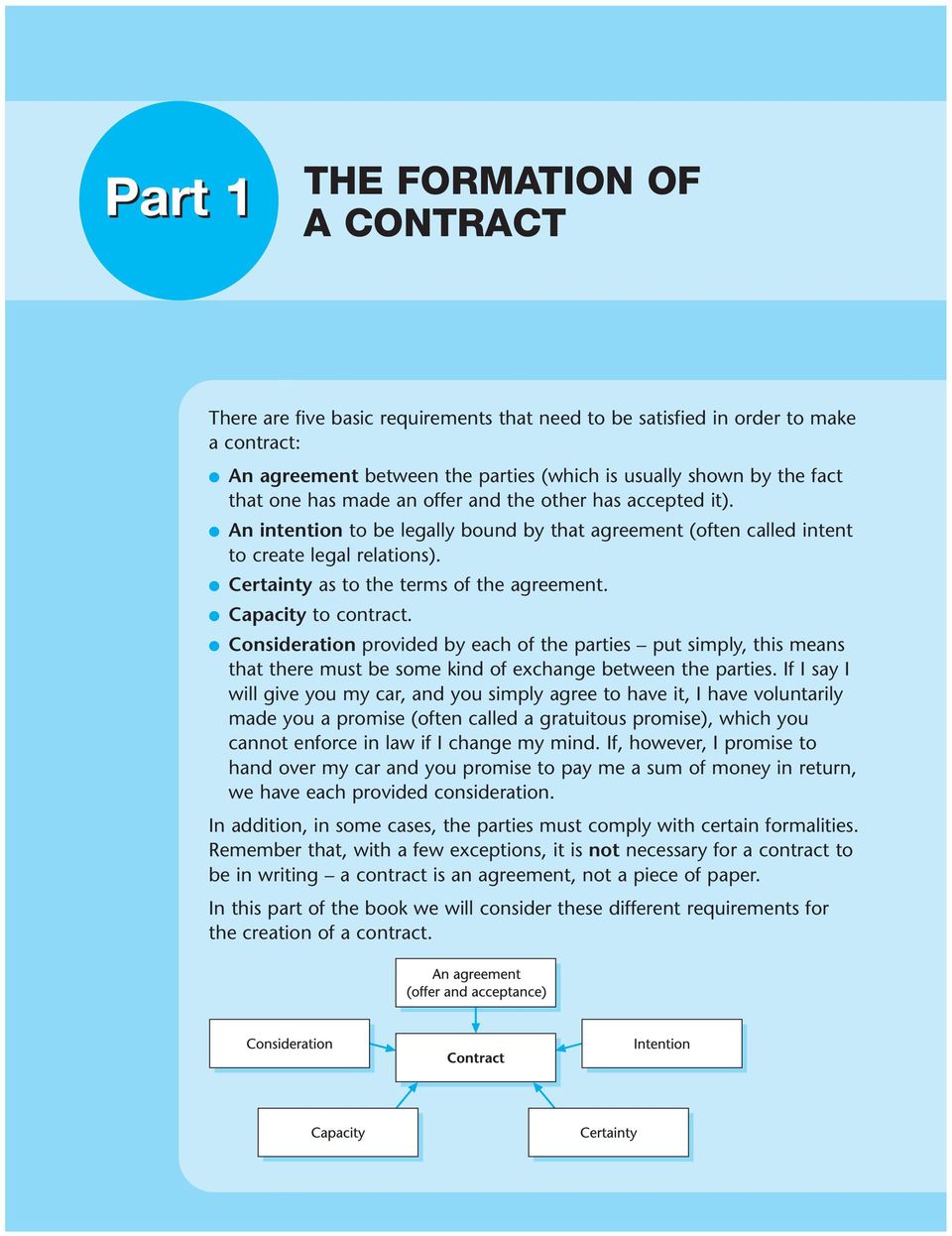
2

3 1 Offer and acceptance This chapter discusses: the formation of a contract by one party making an offer which is accepted by another party; the distinction between unilateral and bilateral contracts; the distinction between an offer and an invitation to treat; how long an offer lasts; what amounts to a valid acceptance; and the requirement that an acceptance must be communicated along with the postal rule exception.
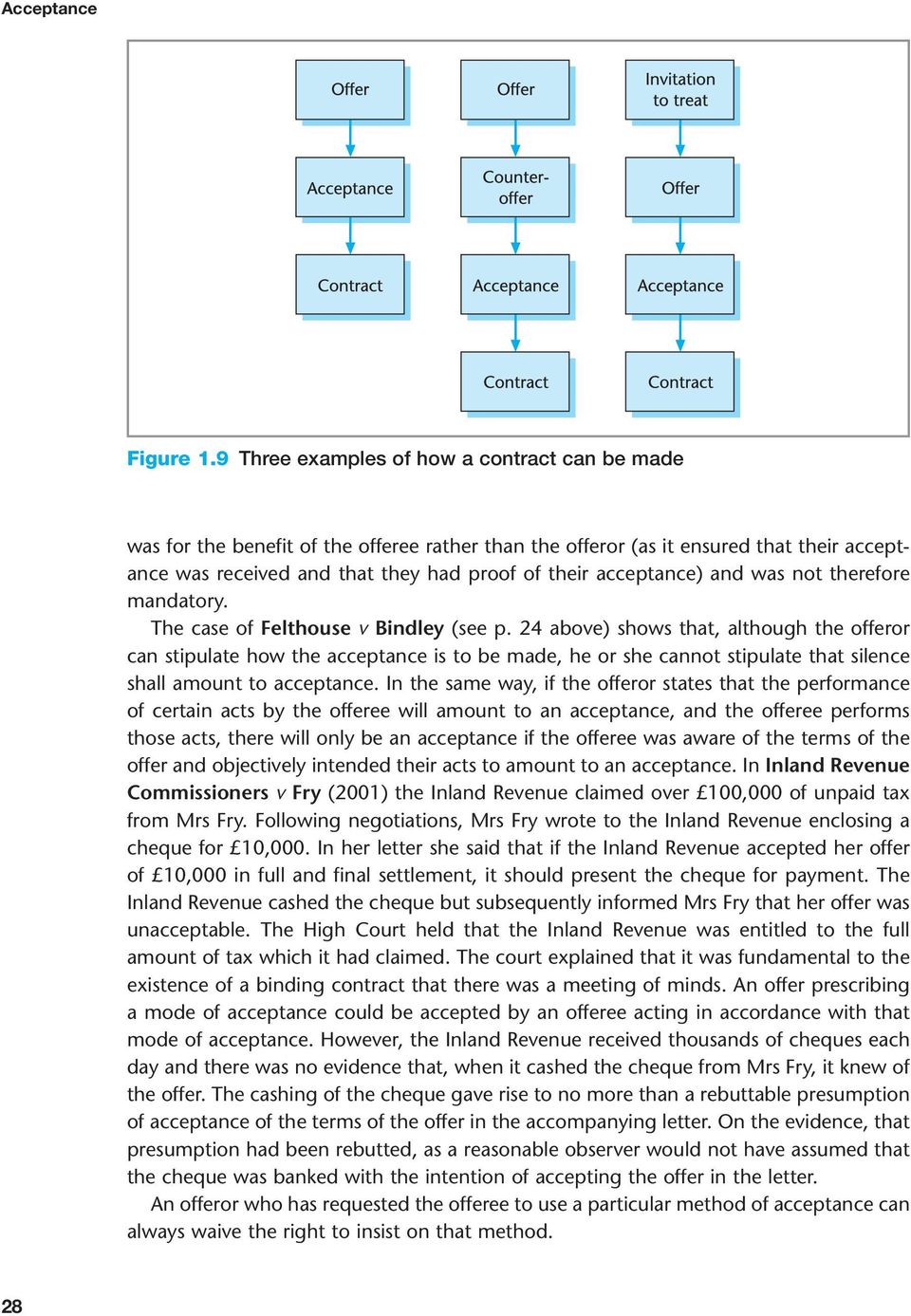
4 Offer For a contract to exist, usually one party must have made an offer, and the other must have accepted it. Once acceptance takes effect, a contract will usually be binding on both parties, and the rules of offer and acceptance are typically used to pinpoint when a series of negotiations has passed that point, in order to decide whether the parties are obliged to fulfil their promises. There is generally no halfway house negotiations have either crystallised into a binding contract, or they are not binding at all. Unilateral and bilateral contracts In order to understand the law on offer and acceptance, you need to understand the concepts of unilateral and bilateral contracts. Most contracts are bilateral. This means that each party takes on an obligation, usually by promising the other something for example, Ann promises to sell something and Ben to buy it. (Although contracts where there are mutual obligations are always called bilateral, there may in fact be more than two parties to such a contract.) By contrast, a unilateral contract arises where only one party assumes an obligation under the contract. Examples might be promising to give your mother 50 if she gives up smoking for a year, or to pay a 100 reward to anyone who finds your lost purse, or, as the court suggested in Great Northern Railway Co v Witham (1873), to pay someone 100 to walk from London to York. What makes these situations unilateral contracts is that only one party has assumed an obligation you are obliged to pay your mother if she gives up smoking, but she has not promised in turn to give up smoking. Similarly, you are obliged to pay the reward to anyone who finds your purse, but nobody need actually have undertaken to do so. A common example of a unilateral contract is that between estate agents and people trying to sell their houses the seller promises to pay a specified percentage of the house price to the estate agent if the house is sold, but the estate agent is not required to promise in return to sell the house, or even to try to do so. Figure 1.1 Bilateral and unilateral contracts Offer The person making an offer is called the offeror, and the person to whom the offer is made is called the offeree. A communication will be treated as an offer if it indicates the terms on which the offeror is prepared to make a contract (such as the price of the goods for sale), and gives a clear indication that the offeror intends to be bound by those terms if they are accepted by the offeree. 12

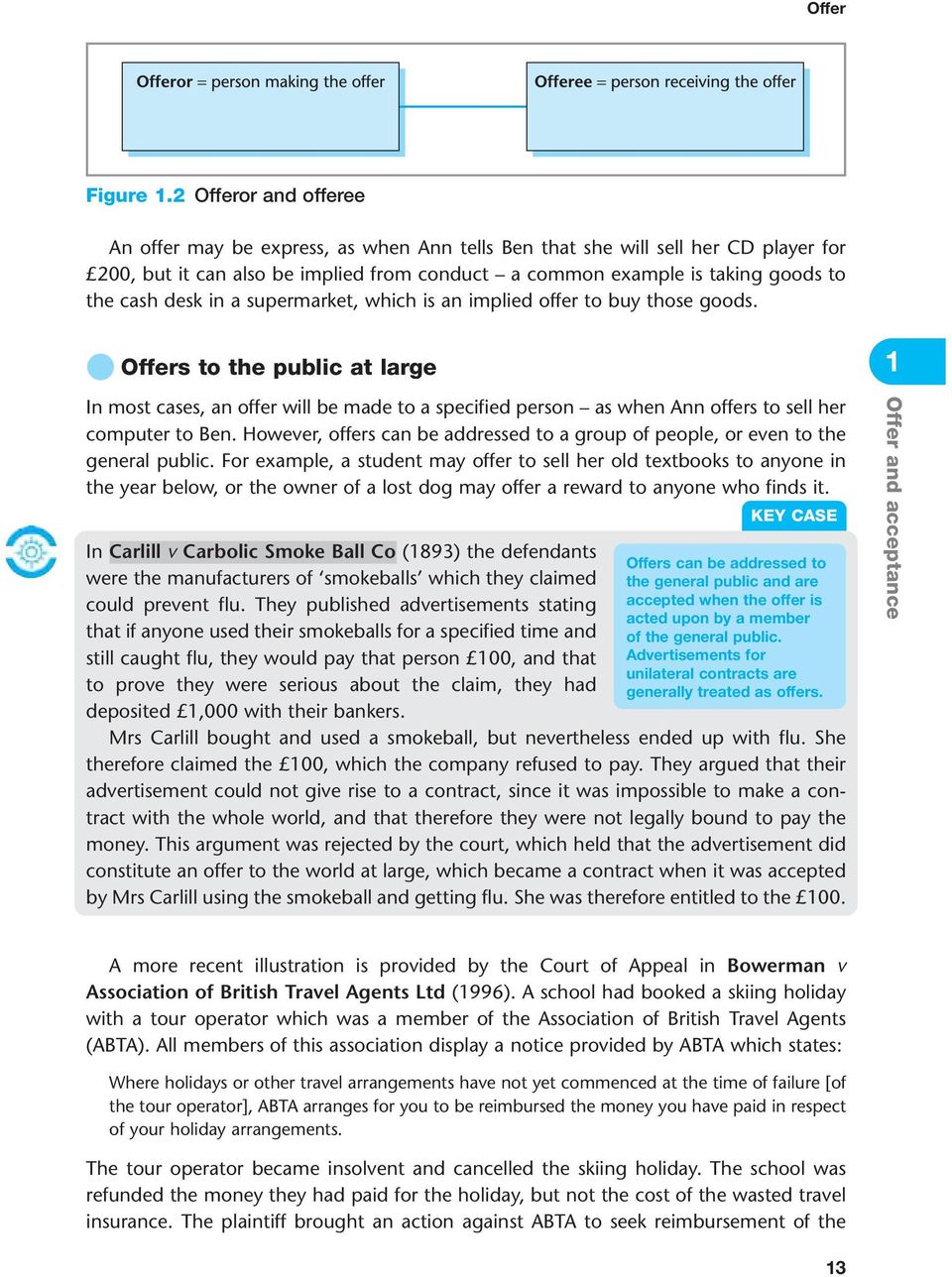
5 Offer Figure 1.2 Offeror and offeree An offer may be express, as when Ann tells Ben that she will sell her CD player for 200, but it can also be implied from conduct a common example is taking goods to the cash desk in a supermarket, which is an implied offer to buy those goods. Offers to the public at large In most cases, an offer will be made to a specified person as when Ann offers to sell her computer to Ben. However, offers can be addressed to a group of people, or even to the general public. For example, a student may offer to sell her old textbooks to anyone in the year below, or the owner of a lost dog may offer a reward to anyone who finds it. In Carlill v Carbolic Smoke Ball Co (1893) the defendants were the manufacturers of smokeballs which they claimed could prevent flu. They published advertisements stating that if anyone used their smokeballs for a specified time and still caught flu, they would pay that person 100, and that to prove they were serious about the claim, they had deposited 1,000 with their bankers. KEY CASE Offers can be addressed to the general public and are accepted when the offer is acted upon by a member of the general public. Advertisements for unilateral contracts are generally treated as offers. Mrs Carlill bought and used a smokeball, but nevertheless ended up with flu. She therefore claimed the 100, which the company refused to pay. They argued that their advertisement could not give rise to a contract, since it was impossible to make a contract with the whole world, and that therefore they were not legally bound to pay the money. This argument was rejected by the court, which held that the advertisement did constitute an offer to the world at large, which became a contract when it was accepted by Mrs Carlill using the smokeball and getting flu. She was therefore entitled to the Offer and acceptance A more recent illustration is provided by the Court of Appeal in Bowerman v Association of British Travel Agents Ltd (1996). A school had booked a skiing holiday with a tour operator which was a member of the Association of British Travel Agents (ABTA). All members of this association display a notice provided by ABTA which states: Where holidays or other travel arrangements have not yet commenced at the time of failure [of the tour operator], ABTA arranges for you to be reimbursed the money you have paid in respect of your holiday arrangements. The tour operator became insolvent and cancelled the skiing holiday. The school was refunded the money they had paid for the holiday, but not the cost of the wasted travel insurance. The plaintiff brought an action against ABTA to seek reimbursement of the 13
6 Invitations to treat cost of this insurance. He argued, and the Court of Appeal agreed, that the ABTA notice constituted an offer which the customer accepted by contracting with an ABTA member. A contract arising from an offer to the public at large, like that in Carlill, is usually a unilateral contract. Invitations to treat Some kinds of transaction involve a preliminary stage in which one party invites the other to make an offer. This stage is called an invitation to treat. In Gibson v Manchester City Council (1979) a council tenant was interested in buying his house. He completed an application form and received a letter from the Council stating that it may be prepared to sell the house to you for KEY CASE Negotiations to enter into a contract can amount to an invitation to treat but not an offer. 2,180. Mr Gibson initially queried the purchase price, pointing out that the path to the house was in a bad condition. The Council refused to change the price, saying that the price had been fixed taking into account the condition of the property. Mr Gibson then wrote on 18 March 1971 asking the Council to carry on with the purchase as per my application. Following a change in political control of the Council in May 1971, it decided to stop selling Council houses to tenants, and Mr Gibson was informed that the Council would not proceed with the sale of the house. Mr Gibson brought legal proceedings claiming that the letter he had received stating the purchase price was an offer which he had accepted on 18 March The House of Lords, however, ruled that the Council had not made an offer; the letter giving the purchase price was merely one step in the negotiations for a contract and amounted only to an invitation to treat. Its purpose was simply to invite the making of a formal application, amounting to an offer, from the tenant. Confusion can sometimes arise when what would appear, in the everyday sense of the word, to be an offer is held by the law to be only an invitation to treat. This issue arises particularly in the following areas. Advertisements A distinction is generally made between advertisements for a unilateral contract, and those for a bilateral contract. Advertisements for unilateral contracts These include advertisements such as the one in Carlill v Carbolic Smoke Ball Co, or those offering rewards for the return of lost property, or for information leading to the arrest or conviction of a criminal. They are usually treated as offers, on the basis that the 14

7 Invitations to treat Figure 1.3 Gibson v Manchester City Council (1979) 1 contract can normally be accepted without any need for further negotiations between the parties, and the person making the advertisement intends to be bound by it. Advertisements for a bilateral contract These are the type of advertisements which advertise specified goods at a certain price, such as those found at the back of newspapers and magazines. They are usually considered invitations to treat, on the grounds that they may lead to further bargaining potential buyers might want to negotiate about the price, for example and that since stocks could run out, it would be unreasonable to expect the advertisers to sell to everybody who applied. In Partridge v Crittenden (1968), an advertisement in a magazine stated Bramblefinch cocks and hens, 25s each. As the Bramblefinch was a protected species, the person who placed the advertisement was charged with unlawfully offering for sale a wild bird contrary to the Protection of Birds Act 1954, but his conviction was quashed on the grounds that the advertisement was not an offer but an invitation to treat. It was held in Grainger & Sons v Gough (1896) that the circulation of a price-list by a wine merchant was not an offer to sell at those prices but merely an invitation to treat. Offer and acceptance Shopping Price-marked goods on display on the shelves or in the windows of shops are generally regarded as invitations to treat, rather than offers to sell goods at that price. In Fisher v Bell (1960) the defendant had displayed flick knives in his shop window, and was convicted of the criminal offence of offering such knives for sale. On appeal, Lord Parker CJ stated that the display of an article with a price on it in a shop window was only an invitation to treat and not an offer, and the conviction was overturned. Where goods are sold on a self-service basis, the customer makes an offer to buy when presenting the goods at the cash desk, and the shopkeeper may accept or reject that offer. 15

8 Invitations to treat In Pharmaceutical Society of Great Britain v Boots Cash Chemists (Southern) Ltd (1953) Boots were charged with an offence concerning the sale of certain medicines which could only be sold by or under the supervision of a qualified pharmacist. Two customers in a self-service shop selected KEY CASE Where goods are sold on a self-service basis, the customer makes an offer to buy when presenting the goods at the cash desk. the medicines, which were price-marked, from the open shelves, and placed them in the shop s wire baskets. The shelves were not supervised by a pharmacist, but a pharmacist had been instructed to supervise the transaction at the cash desk. The issue was therefore whether the sale had taken place at the shelves or at the cash desk. The Court of Appeal decided the shelf display was like an advertisement for a bilateral contract, and was therefore merely an invitation to treat. The offer was made by the customer when medicines were placed in the basket and presented at the cash desk, and was only accepted by the shop at the cash desk. Since a pharmacist was supervising at that point no offence had been committed. There are two main practical consequences of this principle. First, shops do not have to sell goods at the marked price so if a shop assistant wrongly marks a CD at 2.99 rather than 12.99, for example, you cannot insist on buying it at that price (though the shop may be committing an offence under the Trade Descriptions Act 1968 see Chapter 16 on consumer contracts). Secondly, a customer cannot insist on buying a particular item on display so you cannot make a shopkeeper sell you the sweater in the window even if there are none left inside the shop. Displaying the goods is not an offer, so a customer cannot accept it and thereby make a binding contract. Timetables and tickets for transport The legal position here is rather unclear. Is a bus timetable an offer to run services at those times, or just an invitation to treat? Does the bus pulling up at a stop constitute an offer to carry you, which you accept by boarding the bus? Or, again, is even this stage just an invitation to treat, so that the offer is actually made by you getting on the bus or by handing over money for the ticket? These points may seem academic, but they become important when something goes wrong. If, for example, the bus crashes and you are injured, your ability to sue for breach of contract will depend on whether the contract had actually been completed when the accident occurred. Although there have been many cases in this area, no single reliable rule has emerged, and it seems that the exact point at which a contract is made depends in each case on the particular facts. For example, in Denton v GN Railway (1856) it was said that railway company advertisements detailing the times at and conditions under which trains would run were offers. But in Wilkie v London Passenger Transport Board (1947) Lord Greene thought that a contract between bus company and passenger was made when a person intending to travel puts himself either on the platform or inside the bus. The opinion was obiter but, if correct, it implies that the company makes an offer of carriage by running the bus or train and the passenger accepts when he or she gets properly on board, completing the contract. Therefore if the bus crashed, an injured passenger could 16

9 How long does an offer last? have a claim against the bus company for breach of contract despite not having yet paid the fare or been given a ticket. However, in Thornton v Shoe Lane Parking Ltd (1971) it was suggested that the contract may be formed rather later. If the legal principles laid down in Thornton are applied to this factual situation, it would appear that passengers asking for a ticket to their destination are making an invitation to treat. The bus company makes an offer by issuing the tickets, and the passengers accept the offer by keeping the tickets without objection. Fortunately, these questions are not governed solely by the law of contract as some legislation relevant to the field of public transport has since been passed. There are other less common situations in which the courts will have to decide whether a communication is an offer or merely an invitation to treat. The test used is whether a person watching the proceedings would have thought the party concerned was making an offer or not (the objective approach discussed at p. 5). 1 How long does an offer last? An offer may cease to exist under any of the following circumstances. Specified time Where an offeror states that an offer will remain open for a specific length of time, it lapses when that time is up (though it can be revoked before that see p. 19 below). Offer and acceptance Reasonable length of time Where the offeror has not specified how long the offer will remain open, it will lapse after a reasonable length of time has passed. Exactly how long this is will depend upon whether the means of communicating the offer were fast or slow and on its subject matter for example, offers to buy perishable goods, or a commodity whose price fluctuates daily, will lapse quite quickly. Offers to buy shares on the stock market may last only seconds. In Ramsgate Victoria Hotel v Montefiore (1866) the defendant applied for shares in the plaintiff company, paying a deposit into their bank. After hearing nothing from them for five months, he was then informed that the shares had been allotted to him, and asked to pay the balance due on them. He refused to do so, and the court upheld his argument that five months was not a reasonable length of time for acceptance of an offer to buy shares, which are a commodity with a rapidly fluctuating price. Therefore the offer had lapsed before the company tried to accept it, and there was no contract between them. Failure of a precondition Some offers are made subject to certain conditions, and if such conditions are not in place, the offer may lapse. For example, a person might offer to sell their bike for 50 if 17
10 How long does an offer last? they manage to buy a car at the weekend. In Financings Ltd v Stimson (1962) the defendant saw a car for sale at 350 by a second-hand car dealer on 16 March. He decided to buy it on hire-purchase terms. The way that hire purchase works in such cases is that the finance company buys the car outright from the dealer, and then sells it to the buyer, who pays in instalments. The defendant would therefore be buying the car from the finance company (the plaintiffs), rather than from the dealer. The defendant signed the plaintiffs form, which stated that the agreement would be binding on the finance company only when signed on their behalf. The car dealer did not have the authority to do this, so it had to be sent to the plaintiffs for signing. On 18 March the defendant paid the first instalment of 70. On 24 March the car was stolen from the dealer s premises. It was later found, badly damaged and the defendant no longer wanted to buy it. Not knowing this, on 25 March the plaintiffs signed the written agreement. They subsequently sued the defendant for failure to pay the instalments. The Court of Appeal ruled in favour of the defendant, as the so-called agreement was really an offer to make a contract with the plaintiffs, which was subject to the implied condition that the car remained in much the same state as it was in when the offer was made, until that offer was accepted. The plaintiffs were claiming that they had accepted the offer by signing the document on 25 March. As the implied condition had been broken by then, the offer was no longer open so no contract had been concluded. Rejection An offer lapses when the offeree rejects it. If Ann offers to sell Ben her car on Tuesday, and Ben says no, Ben cannot come back on Wednesday and insist on accepting the offer. Counter-offer A counter-offer terminates the original offer. KEY CASE In Hyde v Wrench (1840) the defendant offered to sell his farm for 1,000, and the plaintiff responded by offering to buy it at 950 this is called making a counter-offer. The A counter-offer terminates the original offer. farm owner refused to sell at that price, and when the plaintiff later tried to accept the offer to buy at 1,000, it was held that this offer was no longer available; it had been terminated by the counter-offer. In this situation the offeror can make a new offer on exactly the same terms, but is not obliged to do so. Requests for information A request for information about an offer (such as whether delivery could be earlier than suggested) does not amount to a counter-offer, so the original offer remains open. In Stevenson Jaques & Co v McLean (1880) the defendant made an offer on a Saturday to sell iron to the plaintiffs at a cash-on-delivery price of 40 shillings, and stated that the offer would remain available until the following Monday. The plaintiffs replied by asking if they could buy the goods on credit. They received no answer. On Monday afternoon 18

11 How long does an offer last? they contacted the defendant to accept the offer, but the iron had already been sold to someone else. When the plaintiffs sued for breach of contract, it was held that their reply to the offer had been merely a request for information, not a counter-offer, so the original offer still stood and there was a binding contract. Death of the offeror The position is not entirely clear, but it appears that if the offeree knows that the offeror has died, the offer will lapse; if the offeree is unaware of the offeror s death, it probably will not (Bradbury v Morgan (1862)). So if, for example, A promises to sell her video recorder to B, then dies soon after, and B writes to accept the offer not knowing that A is dead, it seems that the people responsible for A s affairs after death would be obliged to sell the video recorder to B, and B would be obliged to pay the price to the executors. However, where an offer requires personal performance by the offeror (such as painting a picture, or appearing in a film) it will usually lapse on the offeror s death. Death of the offeree There is no English case on this point, but it seems probable that the offer lapses and cannot be accepted after the offeree s death by the offeree s representatives. Withdrawal of offer The withdrawal of an offer is sometimes described as the revocation of an offer. The old case of Payne v Cave (1789) establishes the principle that an offer may be withdrawn at any time up until it is accepted. In Routledge v Grant (1828) the defendant made a provisional offer to buy the plaintiff s house at a specified price, a definite answer to be given within six weeks from date. It was held that, regardless of this provision, the defendant still had the right to withdraw the offer at any moment before acceptance, even though the time limit had not expired. A number of rules apply in relation to the withdrawal of offers. 1 Offer and acceptance Withdrawal must be communicated It is not enough for offerors simply to change their mind about an offer; they must notify the offeree that it is being revoked. In Byrne & Co v Leon Van Tienhoven (1880) the defendants were a company based in Cardiff. On 1 October they posted a letter to New York offering to sell the plaintiffs 1,000 boxes of tinplates. Having received the letter on 11 An offer can only be withdrawn if it is communicated. KEY CASE October, the plaintiffs immediately accepted by telegram. Acceptances sent by telegram take effect as soon as they are sent (see p. 30 below for details of the postal rule). In the meantime, on 8 October, the defendants had written to revoke their offer, and this letter reached the plaintiffs on 20 October. It was held that there was a binding contract, because revocation could only take effect on communication, but the acceptance 19
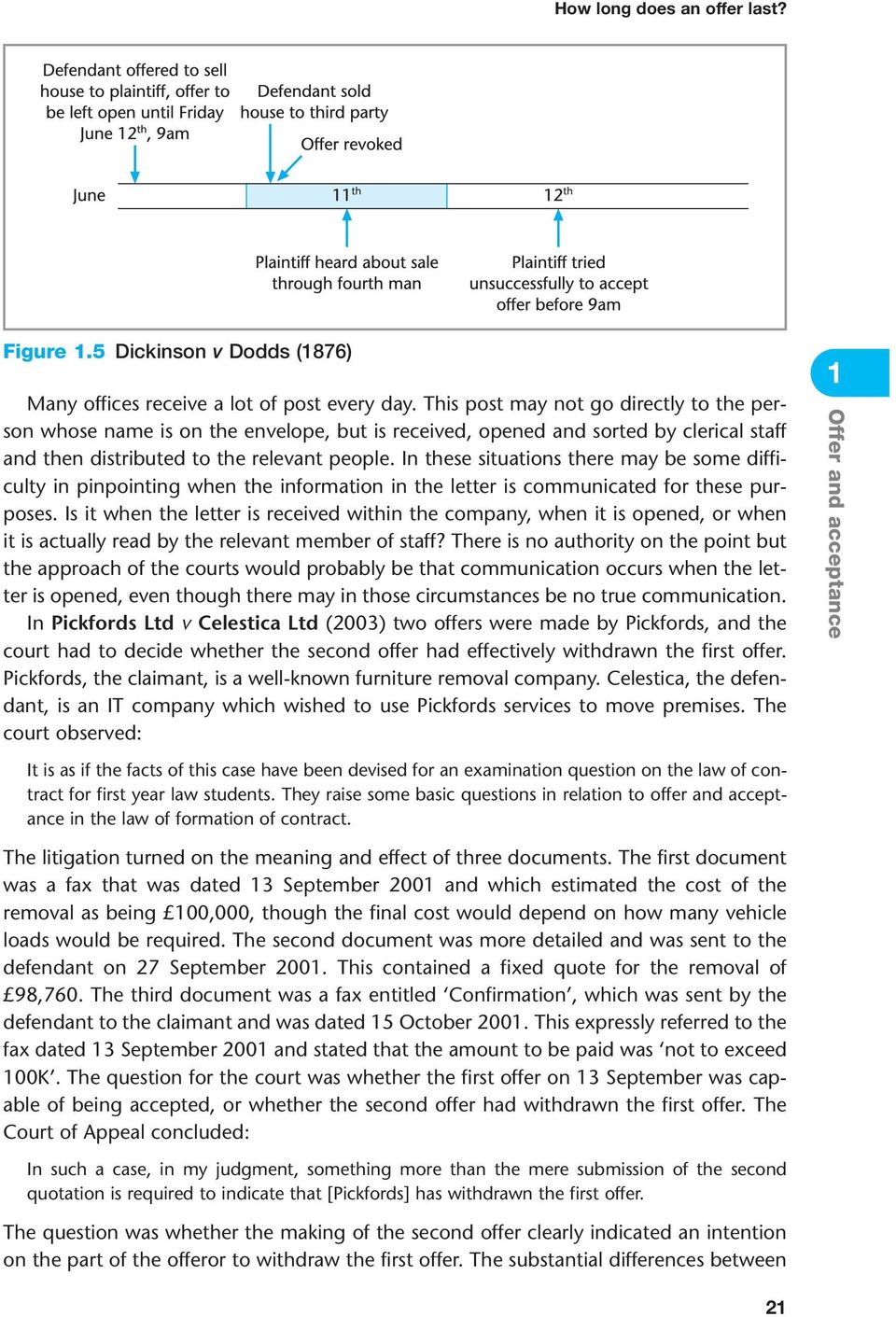
12 How long does an offer last? by telegram took effect as soon as it was sent in this case nine days before the revocation was received. By the time the second letter reached the plaintiffs, a contract had already been made. The revocation of an offer does not have to be communicated by the offeror; the communication can be made by some other reliable source. In Dickinson v Dodds (1876) the defendant offered to sell a house to the plaintiff, the offer to be left open until Friday, June 12, 9 am. On 11 June the defendant sold the house to a third party, Allan, and the plaintiff heard about the sale through a fourth man. Before 9 am on 12 June, the KEY CASE The revocation of an offer can be made by the offeror or some other reliable source. plaintiff handed the defendant a letter in which he said he was accepting the offer. It was held by the Court of Appeal that the offer had already been revoked by the communication from the fourth man, so there was no contract. By hearing the news from the fourth man, Dickinson knew that Dodds was no longer minded to sell the property to him as plainly and clearly as if Dodds had told him in so many words. An offeror who promises to keep an offer open for a specified period may still revoke that offer at any time before it is accepted, unless the promise to keep it open is supported by some consideration from the other party (by providing consideration the parties make a separate contract called an option). An exception to the rule that the withdrawal must be communicated to the offeree exists where an offeree moves to a new address without notifying the offeror. In these circumstances, a withdrawal which is delivered to the offeree s last known address will be effective on delivery to that address. In the same way, where a withdrawal reaches the offeree, but the offeree simply fails to read it, the withdrawal probably still takes effect on reaching the offeree (see The Brimnes (1975) p. 30 below). This would be the position where a withdrawal by telex or fax reached the offeror s office during normal business hours, but was not actually seen or read by the offeree or by any of their staff until some time afterwards. 20 Figure 1.4 Byrne v Van Tienhoven (1880)

13 How long does an offer last? Figure 1.5 Dickinson v Dodds (1876) Many offices receive a lot of post every day. This post may not go directly to the person whose name is on the envelope, but is received, opened and sorted by clerical staff and then distributed to the relevant people. In these situations there may be some difficulty in pinpointing when the information in the letter is communicated for these purposes. Is it when the letter is received within the company, when it is opened, or when it is actually read by the relevant member of staff? There is no authority on the point but the approach of the courts would probably be that communication occurs when the letter is opened, even though there may in those circumstances be no true communication. In Pickfords Ltd v Celestica Ltd (2003) two offers were made by Pickfords, and the court had to decide whether the second offer had effectively withdrawn the first offer. Pickfords, the claimant, is a well-known furniture removal company. Celestica, the defendant, is an IT company which wished to use Pickfords services to move premises. The court observed: 1 Offer and acceptance It is as if the facts of this case have been devised for an examination question on the law of contract for first year law students. They raise some basic questions in relation to offer and acceptance in the law of formation of contract. The litigation turned on the meaning and effect of three documents. The first document was a fax that was dated 13 September 2001 and which estimated the cost of the removal as being 100,000, though the final cost would depend on how many vehicle loads would be required. The second document was more detailed and was sent to the defendant on 27 September This contained a fixed quote for the removal of 98,760. The third document was a fax entitled Confirmation, which was sent by the defendant to the claimant and was dated 15 October This expressly referred to the fax dated 13 September 2001 and stated that the amount to be paid was not to exceed 100K. The question for the court was whether the first offer on 13 September was capable of being accepted, or whether the second offer had withdrawn the first offer. The Court of Appeal concluded: In such a case, in my judgment, something more than the mere submission of the second quotation is required to indicate that [Pickfords] has withdrawn the first offer. The question was whether the making of the second offer clearly indicated an intention on the part of the offeror to withdraw the first offer. The substantial differences between 21
14 How long does an offer last? the two offers in this case went far beyond a mere difference in price which could have been explained as consistent with two alternative offers both being on the table for the defendant to choose which to accept. In the absence of any findings of fact as to the circumstances which gave rise to the second offer, the second offer superseded and revoked the first offer. The fax was intended to be an acceptance of the first offer. Since the first offer had been revoked, the purported acceptance could not give rise to a contract. It was in law a counter-offer to accept the services offered by the claimant on the terms of the first offer, subject to the cap of 100,000. Since the work was carried out, this counter-offer must have been accepted by the claimant s conduct in carrying out the work. Withdrawal of an offer to enter into a unilateral contract There are a number of special rules that apply in relation to the revocation of an offer to enter into a unilateral contract. An offer to enter into a unilateral contract cannot be revoked once the offeree has commenced performance. In Errington v Errington (1952) a father bought a house in his own name for 750, borrowing 500 of the price by means of a mortgage from a building society. He bought the house for his son and daughter-in-law to live in, and told them that if they met the mortgage repayments, the KEY CASE An offer for a unilateral contract cannot be revoked once the offeree has commenced performance. house would be signed over to them once the mortgage was paid off. The couple moved in, and began to pay the mortgage instalments, but they never in fact made a promise to continue with the payments until the mortgage was paid off, which meant that the contract was unilateral. When the father later died, the people in charge of his financial affairs sought to withdraw the offer. The Court of Appeal held that it was too late to do so. The part performance by the son and daughter-in-law prevented the offer from being withdrawn. The offer could only be withdrawn if the son and daughter-in-law ceased to make the payments. 22 In Daulia Ltd v Four Millbank Nominees Ltd (1978) the Court of Appeal stated that once an offeree had started to perform on a unilateral contract, it was too late for the offeror to revoke the offer. It should be noted that this statement was obiter, since the court found that the offeree in the case had in fact completed his performance before the supposed revocation. There is an exception to this rule that part performance following an offer to enter into a unilateral contract prevents revocation of the offer. This exception applies in the context of unilateral offers to enter into a contract with an estate agent to pay commission for the sale of a property. In Luxor (Eastborne) Ltd v Cooper (1941) an owner of land had promised to pay an estate agent 10,000 in commission if the agent was able to find a buyer willing to pay 175,000 for the land. The arrangement was on the terms that are usual between estate agents and their clients, whereby the agent is paid commission if a buyer is found, and nothing if not. The House of Lords held that the owner in the case
15 Acceptance 1 Figure 1.6 Termination of an offer could revoke his promise at any time before the sale was completed, even after the estate agents had made extensive efforts to find a buyer or had stopped trying to do so. Where a unilateral offer is made to the world at large, to be accepted by conduct, it can probably be revoked without the need for communication if the revocation takes place before performance has begun. For example, if you place a newspaper advertisement offering a reward for the return of something you have lost, and then decide you might actually be better off spending that money on replacing the item, it would probably be impossible for you to make sure that everyone who knew about the offer knows you are withdrawing it even if you place a notice of withdrawal in the newspaper, you cannot guarantee that everyone concerned will see it. It seems to be enough for an offeror to take reasonable steps to bring the withdrawal to the attention of such persons, even though it may not be possible to ensure that they all know about it. Thus, in the American case of Shuey v United States (1875) it was held that an offer made by advertisement in a newspaper could be revoked by a similar advertisement, even though the second advertisement was not read by all the offerees. Offer and acceptance Acceptance Acceptance of an offer means unconditional agreement to all the terms of that offer. Acceptance will often be oral or in writing, but in some cases an offeree may accept an offer by doing something, such as delivering goods in response to an offer to buy. The courts will only interpret conduct as indicating acceptance if it seems reasonable to infer that the offeree acted with the intention of accepting the offer. In Brogden v Metropolitan Rail Co (1877) Brogden had supplied the railway company with coal for several years without any formal agreement. The parties then decided to make things official, so the rail company sent Brogden a draft agreement, which left 23

16 Acceptance a blank space for Brogden to insert the name of an arbitrator. After doing so and signing the document, Brogden returned it, marked approved. The company s employee put the draft away in a desk drawer, where it stayed for the next two years, without any further steps being taken regarding it. Brogden continued to supply coal under the terms of the contract, and the railway company to pay for it. Eventually a dispute arose between them, and Brogden denied that any binding contract existed. The courts held that by inserting the arbitrator s name, Brogden added a new term to the potential contract, and therefore, in returning it to the railway company, he was offering (in fact counter-offering) to supply coal under the contract. But when was that offer accepted? The House of Lords decided that an acceptance by conduct could be inferred from the parties behaviour, and a valid contract was completed either when the company first ordered coal after receiving the draft agreement from Brogden, or at the latest when he supplied the first lot of coal. Merely remaining silent cannot amount to an acceptance, unless it is absolutely clear that acceptance was intended. KEY CASE In Felthouse v Bindley (1862) an uncle and his nephew had talked about the possible sale of the nephew s horse to the uncle, but there had been some confusion about the price. The uncle subsequently wrote to the nephew, offering to pay 30 and 15 shillings and saying, If I hear no more Merely remaining silent cannot amount to an acceptance, unless it is absolutely clear that acceptance was intended. about him, I consider the horse mine at that price. The nephew was on the point of selling off some of his property in an auction. He did not reply to the uncle s letter, but did tell the auctioneer to keep the horse out of the sale. The auctioneer forgot to do this, and the horse was sold. It was held that there was no contract between the uncle and the nephew. The court felt that the nephew s conduct in trying to keep the horse out of the sale did not necessarily imply that he intended to accept his uncle s offer even though the nephew actually wrote afterwards to apologise for the mistake and so it was not clear that his silence in response to the offer was intended to constitute acceptance. This can be criticised in that it is hard to see how there could have been clearer evidence that the nephew did actually intend to sell, but, on the other hand, there are many situations in which it would be undesirable and confusing for silence to amount to acceptance. It has been pointed out by the Court of Appeal in Re Selectmove Ltd (1995) that an acceptance by silence could be sufficient if it was the offeree who suggested that their silence would be sufficient. Thus in Felthouse, if the nephew had been the one to say that if his uncle heard nothing more he could treat the offer as accepted, there would have been a contract. Acceptance of an offer to enter into a unilateral contract Unilateral contracts are usually accepted by conduct. If I offer 100 to anyone who finds my lost dog, finding the dog will be an acceptance of the offer, making my promise 24
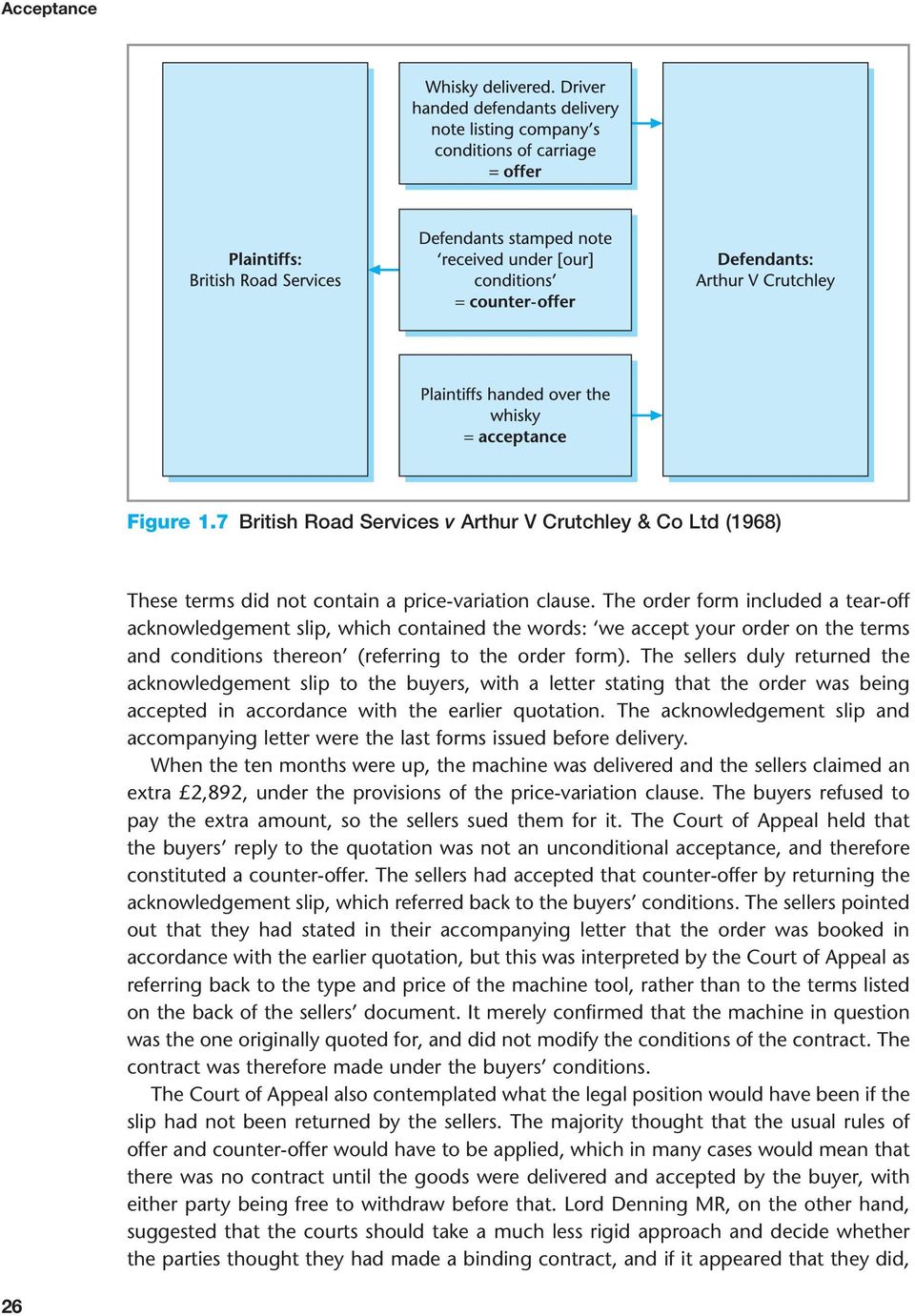
17 Acceptance binding it is not necessary for anyone to contact me and say that they intend to take up my offer and find the dog. There is no acceptance until the relevant act has been completely performed so if Ann says to Ben that she will give Ben 5 if Ben washes her car, Ben would not be entitled to the money until the job is finished, and could not wash half the car and ask for Acceptance must be unconditional An acceptance must accept the precise terms of an offer. In Tinn v Hoffman (1873) one party offered to sell the other 1,200 tons of iron. It was held that the other party s order for 800 tons was not an acceptance. 1 Negotiation and the battle of the forms Where parties carry on a long process of negotiation, it may be difficult to pinpoint exactly when an offer has been made and accepted. In such cases the courts will look at the whole course of negotiations to decide whether the parties have in fact reached agreement at all and, if so, when. This process can be particularly difficult where the so-called battle of the forms arises. Rather than negotiating terms each time a contract is made, many businesses try to save time and money by contracting on standard terms, which will be printed on company stationery such as order forms and delivery notes. The battle of the forms occurs where one party sends a form stating that the contract is on their standard terms of business, and the other party responds by returning their own form and stating that the contract is on their terms. The general rule in such cases is that the last shot wins the battle. Each new form issued is treated as a counter-offer, so that when one party performs its obligation under the contract (by delivering goods for example), that action will be seen as acceptance by conduct of the offer in the last form. In British Road Services v Arthur V Crutchley & Co Ltd (1968) the plaintiffs delivered some whisky to the defendants for storage. The BRS driver handed the defendants a delivery note, which listed his company s conditions of carriage. Crutchley s employee stamped the note Received under [our] conditions and handed it back to the driver. The court held that stamping the delivery note in this way amounted to a counter-offer, which BRS accepted by handing over the goods. The contract therefore incorporated Crutchley s conditions, rather than those of BRS. However, a more recent case shows that the last shot will not always succeed. In Butler Machine Tool Ltd v Ex-Cell-O Corp (England) Ltd (1979) the defendants wanted to buy a machine from the plaintiffs, to be delivered ten months after the order. The plaintiffs supplied a quotation (which was taken to be an offer), and on this document were printed their standard terms, including a clause allowing them to increase the price of the goods if the costs had risen by the date of delivery (known as a price-variation clause). The document also stated that their terms would prevail over any terms and conditions in the buyers order. The buyers responded by placing an order, which was stated to be on their own terms and conditions, and these were listed on the order form. Offer and acceptance 25

18 Acceptance Figure 1.7 British Road Services v Arthur V Crutchley & Co Ltd (1968) These terms did not contain a price-variation clause. The order form included a tear-off acknowledgement slip, which contained the words: we accept your order on the terms and conditions thereon (referring to the order form). The sellers duly returned the acknowledgement slip to the buyers, with a letter stating that the order was being accepted in accordance with the earlier quotation. The acknowledgement slip and accompanying letter were the last forms issued before delivery. When the ten months were up, the machine was delivered and the sellers claimed an extra 2,892, under the provisions of the price-variation clause. The buyers refused to pay the extra amount, so the sellers sued them for it. The Court of Appeal held that the buyers reply to the quotation was not an unconditional acceptance, and therefore constituted a counter-offer. The sellers had accepted that counter-offer by returning the acknowledgement slip, which referred back to the buyers conditions. The sellers pointed out that they had stated in their accompanying letter that the order was booked in accordance with the earlier quotation, but this was interpreted by the Court of Appeal as referring back to the type and price of the machine tool, rather than to the terms listed on the back of the sellers document. It merely confirmed that the machine in question was the one originally quoted for, and did not modify the conditions of the contract. The contract was therefore made under the buyers conditions. The Court of Appeal also contemplated what the legal position would have been if the slip had not been returned by the sellers. The majority thought that the usual rules of offer and counter-offer would have to be applied, which in many cases would mean that there was no contract until the goods were delivered and accepted by the buyer, with either party being free to withdraw before that. Lord Denning MR, on the other hand, suggested that the courts should take a much less rigid approach and decide whether the parties thought they had made a binding contract, and if it appeared that they did, 26
19 Acceptance 1 Offer and acceptance Figure 1.8 Butler Machine Tool Ltd v Ex-Cell-O Corp (England) Ltd (1979) the court should go on to examine the documents as a whole to find out what the content of their agreement might be. This approach has not been adopted by the courts. Specified methods of acceptance If an offeror states that his or her offer must be accepted in a particular way, then only acceptance by that method or an equally effective one will be binding. To be considered equally effective, a mode of acceptance should not be slower than the method specified in the offer, nor have any disadvantages for the offeror. It was stated in Tinn v Hoffman (1873) that where the offeree was asked to reply by return of post, any method which would arrive before return of post would be sufficient. Where a specified method of acceptance has been included for the offeree s own benefit, however, the offeree is not obliged to accept in that way. In Yates Building Co Ltd v R J Pulleyn & Sons (York) Ltd (1975) the sellers stated that the option they were offering should be accepted by notice in writing... to be sent registered or recorded delivery. The purchaser sent his acceptance by ordinary letter post, but the court held that the acceptance was still effective. The requirement of registered or recorded delivery 27

20 Acceptance Figure 1.9 Three examples of how a contract can be made was for the benefit of the offeree rather than the offeror (as it ensured that their acceptance was received and that they had proof of their acceptance) and was not therefore mandatory. The case of Felthouse v Bindley (see p. 24 above) shows that, although the offeror can stipulate how the acceptance is to be made, he or she cannot stipulate that silence shall amount to acceptance. In the same way, if the offeror states that the performance of certain acts by the offeree will amount to an acceptance, and the offeree performs those acts, there will only be an acceptance if the offeree was aware of the terms of the offer and objectively intended their acts to amount to an acceptance. In Inland Revenue Commissioners v Fry (2001) the Inland Revenue claimed over 100,000 of unpaid tax from Mrs Fry. Following negotiations, Mrs Fry wrote to the Inland Revenue enclosing a cheque for 10,000. In her letter she said that if the Inland Revenue accepted her offer of 10,000 in full and final settlement, it should present the cheque for payment. The Inland Revenue cashed the cheque but subsequently informed Mrs Fry that her offer was unacceptable. The High Court held that the Inland Revenue was entitled to the full amount of tax which it had claimed. The court explained that it was fundamental to the existence of a binding contract that there was a meeting of minds. An offer prescribing a mode of acceptance could be accepted by an offeree acting in accordance with that mode of acceptance. However, the Inland Revenue received thousands of cheques each day and there was no evidence that, when it cashed the cheque from Mrs Fry, it knew of the offer. The cashing of the cheque gave rise to no more than a rebuttable presumption of acceptance of the terms of the offer in the accompanying letter. On the evidence, that presumption had been rebutted, as a reasonable observer would not have assumed that the cheque was banked with the intention of accepting the offer in the letter. An offeror who has requested the offeree to use a particular method of acceptance can always waive the right to insist on that method. 28
21 Exceptions to the communication rule Acceptance must be communicated An acceptance does not usually take effect until it is communicated to the offeror. As Lord Denning explained in Entores Ltd v Miles Far East Corporation (1955), if A shouts an offer to B across a river but, just as B yells back an acceptance, a noisy aircraft flies over, preventing A from hearing B s reply, no contract has been made. A must be able to hear B s acceptance before it can take effect. The same would apply if the contract was made by telephone, and A failed to catch what B said because of interference on the line; there is no contract until A knows that B is accepting the offer. The principal reason for this rule is that, without it, people might be bound by a contract without knowing that their offers had been accepted, which could obviously create difficulties in all kinds of situations. Where parties negotiate face to face, communication of the acceptance is unlikely to be a problem; any difficulties tend to arise where the parties are communicating at a distance, for example by post, telephone, telegram, telex, fax or messenger. Exceptions to the communication rule There are some circumstances in which an acceptance may take effect without being communicated to the offeror. 1 Offer and acceptance Terms of the offer An offer may state or imply that acceptance need not be communicated to the offeror, although, as Felthouse v Bindley shows, it is not possible to state that the offeree will be bound unless he or she indicates that the offer is not accepted (in other words that silence will be taken as acceptance). This means that offerors are free to expose themselves to the risk of unknowingly incurring an obligation, but may not impose that risk on someone else. It seems to follow from this that if the horse in Felthouse v Bindley had been kept out of the sale for the uncle, and the uncle had then refused to buy it, the nephew could have sued his uncle, who would have been unable to rely on the fact that acceptance was not communicated to him. Unilateral contracts do not usually require acceptance to be communicated to the offeror. In Carlill v Carbolic Smoke Ball Co (1893) the defendants argued that the plaintiff should have notified them that she was accepting their offer, but the court held that such a unilateral offer implied that performance of the terms of the offer would be enough to amount to acceptance. Conduct of the offeror An offeror who fails to receive an acceptance through their own fault may be prevented from claiming that the non-communication means they should not be bound by the contract. In the Entores case (1955) it was suggested that this principle could apply where 29
22 Exceptions to the communication rule an offer was accepted by telephone, and the offeror did not catch the words of acceptance, but failed to ask for them to be repeated; and in The Brimnes (1975), where the acceptance is sent by telex during business hours, but is simply not read by anyone in the offeror s office. The postal rule The general rule for acceptances by post is that they take effect when they are posted, rather than when they are communicated. The main reason for this rule is historical, since it dates from a time when communication through the post was even slower and less reliable than it is today. Even now, there is some practical purpose for the rule, in that it is easier to prove that a letter has been posted than to prove that it has been received or brought to the attention of the offeror. The postal rule was laid down in Adams v Lindsell (1818). On 2 September 1817, the defendants wrote to the plaintiffs, who processed wool, offering to sell them a quantity of sheep fleeces, and stating that they required an answer in course of post. Unfortunately, the defendants did not KEY CASE An acceptance by post takes effect when it is posted, rather than when it is communicated. address the letter correctly, and as a result it did not reach the plaintiffs until the evening of 5 September. The plaintiffs posted their acceptance the same evening, and it reached the defendants on 9 September. It appeared that if the original letter had been correctly addressed, the defendants could have expected a reply in course of post by 7 September. That date came and went, and they had heard nothing from the plaintiffs, so on 8 September they sold the wool to a third party. The issue in the case was whether a contract had been made before the sale to the third party on 8 September. The court held that a contract was concluded as soon as the acceptance was posted, so that the defendants were bound from the evening of 5 September, and had therefore breached the contract by selling the wool to the third party. (Under current law there would have been a contract even without the postal rule, because the revocation of the offer could only take effect if it was communicated to the offeree selling the wool to a third party without notifying the plaintiffs would not amount to revocation. However, in 1818 the rules on revocation were not fully developed, so the court may well have considered that the sale was sufficient to revoke the offer, which was why an effective acceptance would have to take place before 8 September.) 30 Application of the postal rule The traditional title postal rule has become slightly misleading because the rule does not only apply to the post but could also potentially apply to certain other non-instantaneous modes of communication. The postal rule was applied to acceptance by telegram in Cowan v O Connor (1888), where it was held that an acceptance came into effect when the telegram was placed with the Post Office. These days the Post Office in England no
23 Exceptions to the communication rule Figure 1.10 Adams v Lindsell (1818) longer offers a telegram service, but the same rule will apply to the telemessage service which replaced it. It is not yet clear whether the postal rule applies to faxes, s and text messages. Professor Treitel suggests that the rule s application should depend on the circumstances of each case. He considers that the postal rule should only apply where the person accepting the offer is not in a position to know that their communication has been ineffective: Fax messages seem to occupy an intermediate position. The sender will know at once if his message has not been received at all, and where this is the position the message should not amount to an effective acceptance. But if the message is received in such a form that it is wholly or partly illegible, the sender is unlikely to know this at once, and it is suggested an acceptance sent by fax might well be effective in such circumstances. The same principles should apply to other forms of electronic communication such as or website trading... 1 Offer and acceptance Use of the postal service must be reasonable. Only when it is reasonable to use the post to indicate acceptance can the postal rule apply. If the offer does not dictate a method of acceptance, appropriate methods can be inferred from the means used to make the offer. An offer made by post may generally be accepted by post, but it may be reasonable to accept by post even though the offer was delivered in some other way. In Henthorn v Fraser (1892) the defendant was based in Liverpool and the plaintiff lived in Birkenhead. The defendant gave the plaintiff in Liverpool a document containing an offer in Liverpool, and the plaintiff accepted it by posting a letter from Birkenhead. It was held that, despite the offer having been handed over in person, acceptance by post was reasonable because the parties were based in different towns. Where an offer is made by an instant method of communication, such as telex, fax or telephone, an acceptance by post would not usually be reasonable. Exceptions to the postal rule Offers requiring communication of acceptance An offeror may avoid the postal rule by making it a term of their offer that acceptance will only take effect when it is communicated to them. In Holwell Securities Ltd v Hughes (1974) the defendants offered to sell some freehold property to the plaintiffs but the offer stated that the acceptance had to be by notice in writing. The plaintiffs posted their acceptance, but it never reached the defendants, despite being properly addressed. 31
24 Exceptions to the communication rule Figure 1.11 The postal rule The court held that notice meant communication, and therefore it would not be appropriate to apply the postal rule. Instant methods of communication When an acceptance is made by an instant mode of communication, such as telephone or telex, the postal rule does not apply. In such cases the acceptor will usually know at once that they have not managed to communicate with the offeror, and will need to try again. In Entores v Miles Far East Corporation (1955) the plaintiffs were a London company and the defendants were an American corporation with agents in Amsterdam. Both the London company and the defendants agents in Amsterdam had telex machines, which allow users to type in a message, and have it almost immediately received and printed out by the recipient s machine. The plaintiffs in London telexed the defendants Amsterdam agents offering to buy goods from them, and the agents accepted, again by telex. The court case arose when the plaintiffs alleged that the defendants had broken their contract and wanted to bring an action against them. The rules of civil litigation stated that they could only bring this action in England if the contract had been made in England. The Court of Appeal held that because telex allows almost instant communication, the parties were in the same position as if they had negotiated in each other s presence or over the telephone, so the postal rule did not apply and an acceptance did not take effect until it had been received by the plaintiffs. Because the acceptance had been received in London, the contract was deemed to have been made there, and so the legal action could go ahead. This approach was approved by the House of Lords in Brinkibon v Stahag Stahl GmbH (1983). The facts here were similar, except that the offer was made by telex from Vienna to London, and accepted by a telex from London to Vienna. The House of Lords held that the contract was therefore made in Vienna. In both cases the telex machines were in the offices of the parties, and the messages were received inside normal working hours. In Brinkibon the House of Lords said that a telex message sent outside working hours would not be considered instantaneous, so the 32
25 Exceptions to the communication rule time and place in which the contract was completed would be determined by the intentions of the parties, standard business practice and, if possible, by analysing where the risk should most fairly lie. Misdirected acceptance Where a letter of acceptance is lost or delayed because the offeree has wrongly or incompletely addressed it through their own carelessness, it seems reasonable that the postal rule should not apply, although there is no precise authority to this effect. Treitel, a leading contract law academic, suggests that a better rule might be that if a badly addressed acceptance takes effect at all, it should do so at the time which is least advantageous to the party responsible for the misdirection. Effect of the postal rule The postal rule has three main practical consequences: 1 A postal acceptance can take effect when it is posted, even if it gets lost in the post and never reaches the offeror. In Household Fire Insurance v Grant (1879) Grant had applied for (and therefore offered to buy) shares in the plaintiff company. The shares were allotted to him and his name was put on the register of shareholders. The company did write to say that the shares had been allotted to Grant, but the letter was lost in the post and he never received it. Some time later the company went into liquidation, and the liquidator claimed from Grant the balance owing on the price of his shares. It was held that Grant was bound to pay the balance, because the contract had been completed when the company s letter was posted. It is likely that the same rule applies where the letter eventually arrives, but is delayed by postal problems. 2 Where an acceptance is posted after the offeror posts a revocation of the offer, but before that revocation has been received, the acceptance will be binding (posted acceptances take effect on posting, posted revocations on communication). This point is illustrated by the cases of Byrne v Van Tienhoven (1880) and Henthorn v Fraser (1892). 3 Where the postal rule applies, it seems unlikely that an offeree could revoke a postal acceptance by phone (or some other instant means of communication) before it arrives, though there is no English case on the point. A Scottish case, Dunmore v Alexander (1830), does appear to allow such a revocation, but the court s views were only obiter on this point. 1 Offer and acceptance Figure 1.12 Exceptions to the communication rule 33
26 Cross offers Ignorance of the offer It is generally thought that a person cannot accept an offer of which they are unaware, because in order to create a binding contract, the parties must reach agreement. If their wishes merely happen to coincide, that may be very convenient for both, but it does not constitute a contract and cannot legally bind them. Thus, if Ann advertises a reward for the return of a lost cat and Ben, not having seen or heard of the advertisement, comes across the cat, reads Ann s address on its collar and takes it back to Ann, is Ann bound to pay Ben the reward? No English case has clearly decided this point, and the cases abroad conflict with the main English case. On general principles Ben is probably unable to claim the reward. In the American case of Williams v Carwardine (1833) the defendant offered a $20 reward for information leading to the discovery of the murderer of Walter Carwardine, and leaflets concerning the reward were distributed in the area where the plaintiff lived. The plaintiff apparently knew about the reward, but when she gave the information it was not in order to receive the money. She believed she had only a short time to live, and thought that giving the information might ease her conscience. The court held that she was entitled to the reward: she was aware of the offer and had complied with its terms, and her motive for doing so was irrelevant. A second US case, Fitch v Snedaker (1868), stated that a person who gives information without knowledge of the offer of a reward cannot claim the reward. The main English case on this topic is Gibbons v Proctor (1891). A reward had been advertised for information leading to the arrest or conviction of the perpetrator of a particular crime and the plaintiff attempted to claim the reward, even though he had not originally known of the offer. He was allowed to receive the money, but the result does not shed much light on the problem because the plaintiff did know of the offer of reward by the time the information was given on his behalf to the person named in the advertisement. Following the Australian case of R v Clarke (1927), it would appear that if the offeree knew of the offer in the past but has completely forgotten about it, they are treated as never having known about it. In that case a reward was offered by the Australian Government for information leading to the conviction of the murderers of two policemen. The Government also promised that an accomplice giving such information would receive a free pardon. Clarke was such an accomplice, who panicked and provided the information required in order to obtain the pardon, forgetting, at the time, about the reward. He remembered it later, but it was held that he was not entitled to the money. Cross offers These present a similar problem. If Ann writes to Ben offering to sell her television for 50, and by coincidence Ben happens to write offering to buy the television for 50, the two letters crossing in the post, do the letters create a contract between them? On the principles of offer and acceptance it appears not, since the offeree does not know about the offer at the time of the potential acceptance. The point has never been decided in a 34
27 Offer and acceptance implied by the court case but there are obiter dicta in Tinn v Hoffman (1873) which suggest there would be no contract. Time of the formation of the contract Normally a contract is formed when an effective acceptance has been communicated to the offeror. An exception to this is the postal rule, where the contract is formed at the time the acceptance is posted and there is no need for communication. A further exception to the general rule has been created by s. 11 of the Electronic Communications Act This establishes the precise time at which an electronic contract is made. Electronic contracts are concluded when the customer has both received an acknowledgement that their acceptance has been received, and confirmed their receipt of that acknowledgement. These communications are taken to be effective when the receiving party is able to access them. Section 11 applies unless the parties agree otherwise. Thus electronic contracts will normally be formed at a later stage than other contracts. Offer and acceptance implied by the court Sometimes the parties may be in dispute as to whether a contract existed between them. They may never have signed any written agreement but one party may argue that the offer and acceptance had been made orally or through their conduct. Thus, in Baird Textile Holdings Ltd v Marks & Spencer plc (2001) Marks & Spencer had been in a business relationship with Baird Textile Holdings (BTH) for 30 years. BTH were based in the United Kingdom and had been a major supplier of clothes to Marks & Spencer over the years. In October 1999, Marks & Spencer advised BTH that it was ending all supply arrangements between them with effect from the end of the current production season. BTH brought a legal action against Marks & Spencer alleging that they had a contract with the company, and that a term of this contract had been breached by Marks & Spencer s terminating their supply arrangements in this way. The Court of Appeal held that there was no contract governing the relationship between the two litigants and that therefore Marks & Spencer were not in breach of a contract. It held that a contract should only be implied if it was necessary to do so to give business reality to a transaction and to create enforceable obligations between parties who are dealing with one another in circumstances in which one would expect that business reality and those enforceable obligations to exist. It would not be necessary to imply such a contract if the parties might have acted in just the same way as they did without a contract. Marks & Spencer had preferred not to be bound by a contract so that they had maximum flexibility. For business reasons BTH had accepted this state of affairs. In West Bromwich Albion Football Club Ltd v El-Safty (2006) the court held that there was no necessity to imply a contract between a football club and a doctor. In that case a footballer, Michael Appleton (known by his fans as Appy ), was signed by West 1 Offer and acceptance 35
28 Auctions, tenders and the sale of land Bromwich Albion Football Club for 750,000. Unfortunately, Appleton suffered a knee injury while training. The football club s physiotherapist said that he needed to see a surgeon. The football club telephoned the surgeon, El-Safty, who saw Appleton and recommended he undergo surgery. Appleton was unable to play football again after the surgery. It subsequently came to light that El-Safty s advice had been negligent and that the injury had only required minor treatment which would have allowed Appleton to be back on the football pitch within four months. The football club sued El-Safty. One argument put forward by the club was that the surgeon had been in breach of a contract with the football club. But the High Court held that, while there was a contract between the surgeon and the private insurance company BUPA which paid him, there was no contract between the football club and the surgeon. Such a contract could not be implied because the necessity test laid down in Baird Textile Holdings Ltd v Marks & Spencer Plc had not been satisfied. Consumer s right to cancel TOPICAL ISSUE Usually, once an offer has been accepted the contract is binding, and the acceptor cannot withdraw their acceptance. An exception to this general rule has been created for certain consumers entering into contracts made at a distance. Under the Consumer Protection (Distance Selling) Regulations 2000 a consumer entering into a contract at a distance has a cooling-off period after the formation of the contract, during which they can change their mind and withdraw from the contract. The relevant contract must have been made under an organised distance-selling arrangement, and there must have been no face-to-face contact between the consumer and the seller, for example in a shop. The contract is therefore likely to have been made over the telephone, through the post, on the internet or by using a catalogue. The cooling-off period allows the consumer to cancel the contract within seven working days of receiving the goods or concluding a contract for services. A large number of consumer contracts are excluded from this provision. Excluded contracts include those relating to financial services and the sale of land, vending machines, contracts for transport and leisure, and contracts to supply food for everyday consumption. Thus, if I buy an airplane ticket online or purchase some fast food from my local takeaway these contracts will not incorporate a cooling-off period during which I could withdraw from the contract. Auctions, tenders and the sale of land The above rules of offer and acceptance apply to the sale of land and to sales by tender and auction, but it is useful to know how those rules apply in practice in these fairly common situations. Auction sales The parties to an auction sale are the bidder and the owner of the goods. The auctioneer simply provides a service, and is not a party to the contract between buyer and seller. Under the Sale of Goods Act 1979 (s. 57(2)), the general rule is that the auctioneer s request for bids is an invitation to treat, and each bid is an offer. Each bidder s offer lapses 36
29 Auctions, tenders and the sale of land as soon as a higher bid is made, and an offer is accepted by the auctioneer (on behalf of the seller) on the fall of the hammer. Any bidder may therefore withdraw a bid before the hammer falls, and the auctioneer may also withdraw the goods on behalf of the seller before that point. Advertisement of an auction An advertisement that an auction is to take place at a certain time is a mere declaration of intention and is not an offer which those who attend at the specified time thereby accept. This was decided in Harris v Nickerson (1873), where the plaintiff failed to recover damages for travelling to an auction which was subsequently cancelled. Auction without reserve In many cases, sellers at an auction specify reserve prices the lowest prices they will accept for their goods. If nobody bids at least that amount, the goods are not sold. An auction without reserve, on the other hand, means that the goods will be sold to the highest bidder, however low their bid. We have seen that an advertisement announcing that an auction will be held is an invitation to treat and not an offer, but in Warlow v Harrison (1859) it was held that if such an advertisement includes the words without reserve, it becomes an offer, from the auctioneers to the public at large, that if the auction is held they will sell to the highest bidder (though it does not oblige the auctioneers to hold the sale in the first place). The offer is accepted when a person makes a bid and when doing so assumes that there is no reserve. That acceptance completes a contract, which is separate from any contract that might be made between the highest bidder and the owner of the property being sold. An auctioneer who then puts a reserve price on any of the lots breaches this separate contract. In Barry v Davies (2000) the defendant auctioneers were instructed to sell two engine analysers, which were specialist machines used in the motor trade. The claimant had been told the sale would be without reserve. New machines would cost 14,000 each. The auctioneer attempted to start the bidding at 5,000, then 3,000, but the claimant was the only person interested in the machines and placed a bid of just 200 for each machine. The auctioneer refused to accept that bid and withdrew the machines from the sale. The claimant sought damages for breach of contract and he was awarded 27,600. The defendants appeal was dismissed and the case of Warlow v Harrison was followed. A contract existed between the auctioneer and the bidder that the auction would be without reserve, and that contract had been breached. 1 Offer and acceptance Tenders When a large organisation, such as a company, hospital, local council or government ministry, needs to find a supplier of goods or services, it will often advertise for tenders. Companies wishing to secure the business then reply to the advertisement, detailing the price at which they are willing to supply the goods or services, and the advertiser chooses whichever is the more favourable quotation. Tenders can also be invited for the sale of goods, in much the same way as bids are made at an auction. As a general rule, a request for tenders is regarded as an invitation to treat (Spencer v Harding (1870)), so there is no obligation to accept any of the tenders put forward. 37
30 Auctions, tenders and the sale of land The tenders themselves are offers, and a contract comes into existence when one of them is accepted. In exceptional cases, however, an invitation for tenders may itself be an offer, and submission of a tender then becomes acceptance of that offer. The main example of this is where the invitation to tender makes it clear that the lowest tender (or the highest in the case of tenders to buy) will be accepted. In Harvela Investments Ltd v Royal Trust Co of Canada (CI) Ltd (1985) the defendants telexed two parties inviting them to submit tenders for the purchase of some shares, stating in the invitation we bind ourselves to accept the [highest] offer. The House of Lords said that the telex was a unilateral offer to accept the highest bid, which would be followed by a bilateral contract with the highest bidder. An invitation to tender may also be regarded as an offer to consider all tenders correctly submitted, even if it is not an undertaking actually to accept one. In Blackpool and Fylde Aero Club Ltd v Blackpool Borough Council (1990) the Council invited tenders from people wishing to operate leisure flights from the local airport. Those who wished to submit a tender were to reply to the Town Hall, in envelopes provided, by a certain deadline. The plaintiff returned his bid before the deadline was up, but the Council mistakenly thought it had arrived late. They therefore refused to consider it, and accepted one of the other tenders. The plaintiff s claim for breach of contract was upheld by the Court of Appeal. Although the Council was not obliged to accept any of the tenders, the terms of their invitation to tender constituted an offer at least to consider any tender which was submitted in accordance with their rules. That offer was accepted by anyone who put forward a tender in the correct manner, and their acceptance would create a unilateral contract, obliging the Council to consider the tender. The Council was in breach of this unilateral contract. In some cases a tenderer makes what is called a referential tender, offering to top anyone else s bid by a specified amount. This occurred in Harvela Investments Ltd v Royal Trust Co of Canada (CI) Ltd (1985). Some shares were for sale, and the plaintiffs offered C$2,175,000 for them. Another party offered to pay C$2,100,000, or if this was not the highest bid, to pay C$101,000 in excess of any other offer. The House of Lords made it clear that the type of referential tender made by the second party was not legally an offer, and was not permissible in such a transaction. Therefore the first defendants were bound to accept the plaintiffs bid. Their Lordships explained their decision on the grounds that the purpose of a sale by fixed bidding is to provoke the best price from purchasers regardless of what others might be prepared to pay, and that referential bids worked against this. Such bids would also present practical problems if allowed: if everyone made referential bids it would be impossible to define exactly what offer was being made, and if only some parties made bids in that way, the others would not have a valid opportunity to have their offers accepted. Selection of tenders The implications of choosing to accept a tender depend on what sort of tender is involved. 38
31 Auctions, tenders and the sale of land Specific tenders Where an invitation to tender specifies that a particular quantity of goods is required on a particular date, or between certain dates, agreeing to one of the tenders submitted will constitute acceptance of an offer (the tender), creating a contract. This is the case even if delivery is to be in instalments as and when requested. If a company tenders to supply 100 wheelchairs to a hospital between 1 January and 1 June, their contract is completed when the hospital chooses the company s tender, and delivery must be made between those dates. Non-specific tenders Some invitations to tender are not specific, and may simply state that certain goods may be required, up to a particular maximum quantity, with deliveries to be made if and when requested. For example, an invitation to tender made by a hospital may ask for tenders to supply up to 1,000 test tubes, if and when required. In such a case, taking up one of the tenders submitted does not amount to acceptance of an offer in the contractual sense, and there is no contract. Once the tender is approved, it becomes what is called a standing offer. The hospital may order no test tubes at all, may spread delivery over several instalments, or may take the whole 1,000 test tubes at once. If the hospital does buy the test tubes or some of them, whether in instalments or all at once, then each time it places an order it accepts the test tube manufacturer s offer, and a separate contract for the amount required is made on each occasion. The result is that when the hospital places an order, the company is bound to supply within the terms of the offer as required, but the company can revoke the offer to supply at any time, and will then only be bound by orders already placed. This kind of situation would not oblige the hospital to order its test tubes only from the company whose tender it approved. In Percival v LCC (1918) Percival submitted a tender to the LCC for the supply of certain goods in such quantities and at such times and in such manner as the Committee required. The tender was approved, but the LCC eventually placed its orders with other suppliers. Percival claimed damages for breach of contract, but the court held that acceptance of the non-specific tender did not constitute a contract, and the LCC were not obliged to order goods although Percival was obliged to supply goods which were ordered under the terms of the standing offer, so long as the offer had not been revoked. The nature of a standing offer was considered in Great Northern Railway Co v Witham (1873). The plaintiffs had invited tenders for the supply of stores, and the defendant made a tender in these words: I undertake to supply the Company for twelve months with such quantities of [the specified articles] as the Company may order from time to time. The railway company accepted this tender, and later placed some orders, which were met by the defendant. The court case arose when the railway company placed an order for goods within the scope of the tender, and the defendant refused to supply them. The court found that the supplying company was in breach of contract because the tender was a standing offer, which the railway company could accept each time it placed an order, thereby creating a contract each time. The standing offer could be revoked at any time, but the tenderer was bound by 1 Offer and acceptance 39
32 Auctions, tenders and the sale of land Figure 1.13 Tenders orders already made, since these were acceptances of his offer and thereby completed a contract. 40 Sale of land The standard rules of contract apply to the sale of land (which includes the sale of buildings such as houses), but the courts apply those rules fairly strictly, tending to require very clear evidence of an intention to be bound before they will state that an offer has definitely been made. The main reason for this is simply that land is expensive, and specific areas of land are unique and irreplaceable; damages are therefore often inadequate as a remedy for breach of contract in a sale of land, and it is better to avoid problems beforehand than put them right after a contract is made. In Harvey v Facey (1893) the plaintiffs sent the defendants a telegram asking: Will you sell us Bumper Hall Pen? Telegraph lowest cash price. The reply arrived, stating: Lowest price for Bumper Hall Pen, 900. The plaintiffs then sent a telegram back saying: We agree to buy Bumper Hall Pen for 900 asked by you. Please send us your title deeds. On these facts, the Privy Council held that there was no contract. They regarded the telegram from the defendants as merely a statement of what the minimum price would be if the defendants eventually decided to sell. It was therefore not an offer which could be accepted by the third telegram. In practice, the normal procedure for sales involving land is as follows. Sale subject to contract First, parties agree on the sale, often through an estate agent. At this stage their agreement may be described as subject to contract, and although the effect of these words depends on the intention of the parties, there is a strong presumption against there being a contract at this stage (Tiverton Estates Ltd v Wearwell Ltd (1975)). If the parties sign a document at this point, it will usually be an agreement to make a more formal contract in the future, rather than a contract to go through with the sale. It was held in Alpenstow Ltd v Regalian Properties plc (1985) that there were some circumstances in which the courts may infer that the parties intended to be legally bound when signing the original document, even though it was said to be subject to contract, but such cases would arise only rarely.
33 How important are offer and acceptance? The idea of making an agreement subject to contract is to allow the buyers to check thoroughly all the details of the land (to make sure, for example, that there are no plans to build a new airport just behind the house they are thinking of buying, or that the house is not affected by subsidence). Exchange of contracts The next stage is that the buyer and seller agree on the terms of the formal contract (usually through their solicitors, though there is no legal reason why the parties cannot make all the arrangements themselves). Both parties then sign a copy of the contract, and agree on a date on which the contracts will be exchanged, at which point the buyer usually pays a deposit of around 10 per cent of the sale price. Once the contracts are exchanged, a binding contract exists (though it is difficult to see this transaction in terms of offer and acceptance). However, if the contract is breached at this point the buyer can only claim damages the buyer has no rights in the property itself. After exchanging contracts, the parties may make further inquiries (checking, for example, that the seller really does own the property), and then the ownership of the land and house is transferred to the buyer, usually by means of a document known as a transfer. At this stage the buyer pays the balance of the purchase price to the seller. The buyer then has rights in the property in the event of the seller breaching the contract, the buyer can have his or her property rights enforced in court, rather than just claiming damages. These principles are illustrated by Eccles v Bryant (1947). After signing an agreement subject to contract, the parties consulted their solicitors, who agreed a draft contract. Each party signed the contract, and the buyer forwarded his copy to the seller s solicitor so that contracts could be exchanged. However, the seller changed his mind about the sale, and his solicitor informed the buyer s solicitor that the property had been sold to another buyer. The buyer tried to sue for breach of contract, but the Court of Appeal held that the negotiations were subject to formal contract, and the parties had not intended to be bound until they exchanged contracts. No binding obligations could arise before this took place. The court did not say when the exchange would be deemed to have taken place that is, whether it was effective on posting of the contracts, or on receipt. In many cases a contract will specify when an exchange will be considered complete, by stating, for example, that the contract will be binding when the contracts are actually delivered. 1 Offer and acceptance How important are offer and acceptance? Although offer and acceptance can provide the courts with a useful technique for assessing at what point an agreement should be binding, what the courts are really looking to judge is whether the parties have come to an agreement, and there are some cases in which the rules on offer and acceptance give little help. An example of this type of situation is Clarke v Dunraven (1897), which concerned two yacht owners who had entered for a yacht race. The paperwork they completed in order to enter included an undertaking to obey the club rules, and these rules contained an obligation to pay for all damages caused by fouling. During the manoeuvring at the 41
34 Problems with offer and acceptance start of the race, one yacht, the Satanita, fouled another, the Valkyrie, which sank as a result. The owner of the Valkyrie sued the owner of the Satanita for the cost of the lost yacht, but the defendant claimed that he was under no obligation to pay the whole cost, and was only liable to pay the lesser damages laid down by a statute which limited liability to 8 for every ton of the yacht. The plaintiff claimed that entering the competition in accordance with the rules had created a contract between the competitors, and this contract obliged the defendant to pay all damages. Clearly it was difficult to see how there could be an offer by one competitor and acceptance by the other, since their relations had been with the yacht club and not with each other. There was obviously an offer and an acceptance between each competitor and the club, but was there a contract between the competitors? The House of Lords held that there was, on the basis that a contract is concluded when one party has communicated to another an offer and that other has accepted it or when the parties have united in a concurrent expression of intention to create a legal obligation. Therefore responsibility for accidents was governed by the race rules, and the defendant had to pay the full cost of the yacht. There are problems in analysing the contract between the entrants to the race in terms of offer and acceptance. It seems rather far-fetched to imagine that, on starting the race, each competitor was making an offer to all the other competitors and simultaneously accepting their offers and in any case, since the offers and acceptances would all occur at the same moment, they would be cross offers and would technically not create a contract. As we have seen, contracts for the sale of land are also examples of agreements that do not usually fall neatly into concepts of offer and acceptance. We will also see later that the problems arising from the offer and acceptance analysis are sometimes avoided by the courts using the device of collateral contracts (see p. 284). Problems with offer and acceptance Artificiality Clearly there are situations in which the concepts of offer and acceptance have to be stretched, and interpreted rather artificially, even though it is obvious that the parties have reached an agreement. In Gibson v Manchester City Council (1979) Lord Denning made it clear that he was in favour of looking at negotiations as a whole, in order to determine whether there was a contract, rather than trying to impose offer and acceptance on the facts, but his method has largely been rejected by the courts as being too uncertain and allowing too wide a discretion. 42 Revocation of unilateral offers The problem of whether a unilateral offer can be accepted by part-performance has caused difficulties for the courts. It can be argued that since the offeree has not promised to complete performance, they are free to stop at any time, so the offeror should be
35 Problems with offer and acceptance equally free to revoke the offer at any time. But this would mean, for example, that if A says to B, I ll pay you 100 if you paint my living room, A could withdraw the offer even though B had painted all but one square foot of the room, and pay nothing. This is generally considered unjust, and various academics have expressed the view that in fact an offer cannot be withdrawn once there has been substantial performance. American academics have contended that the offeror can be seen as making two offers: the main offer that the price will be paid when the act is performed, and an implied accompanying offer that the main offer will not be revoked once performance has begun. On this assumption, the act of starting performance is both acceptance of the implied offer, and consideration for the secondary promise that the offer will not be withdrawn once performance begins. An offeror who does attempt to revoke the offer after performance has started may be sued for the breach of the secondary promise. In England this approach has been considered rather artificial. Sir Frederick Pollock has reasoned that it might be more realistic to say that the main offer itself is accepted by beginning rather than completing performance, on the basis that acceptance simply means agreement to the terms of the offer, and there are many circumstances in which beginning performance will mean just that. Whether an act counts as beginning performance, and therefore accepting the offer, or whether it is just preparation for performing will depend on the facts of the case so, for example, an offer of a reward for the return of lost property could still be revoked after someone had spent time looking for the property without success, but not after they had actually found it and taken steps towards returning it to the owner. This principle was adopted in 1937 by the Law Revision Committee. 1 Offer and acceptance Revocation of offers for specific periods The rule that an offer can be revoked at any time before acceptance even if the offeror has said it will remain open for a specified time could be considered unfairly biased in favour of the offeror, and makes it difficult for the offeree to plan their affairs with certainty. In a Working Paper published in 1975, the Law Commission recommended that where an offeror promises not to revoke the offer for a specified time, that promise should be binding, without the need for consideration, and if it is broken the offeree should be able to sue for damages. An all or nothing approach The all or nothing approach of offer and acceptance is not helpful in cases where there is clearly not a binding contract under that approach, and yet going back on agreements made would cause great hardship or inconvenience to one party. The problems associated with house-buying are well known the buyer may go to all the expense of a survey and solicitor s fees, and may even have sold their own house, only to find that the seller withdraws the house from sale, sells it to someone else, or demands a higher price generally known as gazumping. So long as all this takes place before contracts are exchanged, the buyer has no remedy at all (though the Government is proposing to legislate to deal with some of these specific problems). Similarly, in a commercial situation, 43
36 Answering questions pressure of time may mean that a company starts work on a potential project before a contract is drawn up and signed. They will be at a disadvantage if in the end the other party decides not to contract. Objectivity The courts claim that they are concerned with following the intention of the parties in deciding whether there is a contract, yet they make it quite clear that they are not actually seeking to discover what was intended, but what, looking at the parties behaviour, an officious bystander might assume they intended. This can mean that even though the parties were actually in agreement, no contract results, as was the case in Felthouse v Bindley the nephew had asked for the horse to be kept out of the sale because he was going to sell it to his uncle, but because he did not actually communicate his acceptance, there was no contract.? Answering questions 1 Alexander has four pet white rats which have been trained to dance together as a group. They escape from their cage. Alexander places an advertisement in the local newspaper describing the rats and promises to pay 1,000 for each rat to anyone who returns the rats to him. Beatrice, Alexander s neighbour, finds one of the rats. She keeps it warm and well fed in a shoe box overnight and then takes it to Alexander s house. Before she can reach the house, the rat escapes from the shoe box, runs away from her, and then wriggles through a hole back into Alexander s house. Charles searches diligently for the rats for two days. He spends 10 on bus fares travelling to different parts of the city. When he finds one of the rats, he takes it home with him and does not immediately return it. David finds another rat. Unfortunately, it has been savaged by a fox and is now dead. David takes the corpse to Alexander, who refuses to pay him anything. Ethel, Alexander s sister, finds another rat in her room. She gives the rat to Alexander, who refuses to pay her anything. Alexander decides that, as one of the rats is dead, there is no point in reassembling them as a dancing group. Accordingly, he places leaflets about the city cancelling the promise of a reward. Charles does not see the leaflets and returns the rat he found to Alexander later that day. Alexander refuses to pay him anything. Advise Alexander. London External LL.B Alexander has made an offer to enter into a unilateral contract: Carlill v Carbolic Smoke Ball Co. Has this offer been accepted by Beatrice, Charles, David or Ethel? Beatrice Beatrice has failed to accept the offer because the rat ran away before she could return it to Alexander in accordance with the terms of his offer. Charles Before Charles returns the rat, Alexander purports to withdraw his offer. Following the cases of Daulia Ltd v Four Millbank Nominees Ltd (1978) and Errington v Errington (1952), 44
37 Answering questions once an offeree has started to perform the act of acceptance, the offeror cannot withdraw their offer. It is a question of fact whether Charles has done enough to amount to starting to perform the act of acceptance. It will depend on whether this required Charles to have started to return the rat (which he had not done) or simply find the rat. In addition, in order for Alexander to effectively withdraw the offer, the withdrawal must be made by a method which reaches substantially the same audience as the original offer (Shuey v United States). Again, this will be a question of fact whether the leaflets satisfy this requirement, when the original offer was made by an advertisement in a local newspaper. David David returns a dead rat. The advert makes no express statement that the rat had to be alive, but a court might be prepared to imply such a term (see p. 131). Ethel Ethel returns the rat before the offer is withdrawn. But Ethel is a family member, and there will therefore be an issue as to whether Alexander had an intention to contract with Ethel: this is discussed at p. 60. On the facts, the court might be prepared to rebut the presumption against an intention to create legal relations between members of the family, because this was an offer to the world at large, with a general intention to create legal relations. In which case, Alexander would have to pay the reward to Ethel. 2 At 9.00 am on Monday 13 August, Maurice, a car dealer, sends a telex to Austin offering to sell him a rare vintage car for 50,000. Austin receives the telex at 9.15 am and telexes his acceptance at 1.00 pm. Austin is aware that Maurice s office is closed for lunch between 1.00 and 2.00 pm. On his return to the office, Maurice does not bother to check whether he has received a telex from Austin and at 2.30 pm receives an offer for the car from Ford, which he accepts. At 4.00 pm Austin hears from another car dealer that Maurice has sold the car to Ford. He is advised that it will cost him an additional 2,000 to buy a similar car and he immediately sends Maurice another telex demanding that the original car be sold to him. Maurice receives this telex at 5.00 pm, at the same time as he reads the acceptance telex. Advise Austin of his legal position and what remedies, if any, are open to him. Oxford Austin clearly wishes to establish that, at some point, he made a binding contract with Maurice; your task is to pinpoint when, if at all, that contract was made, using the rules of offer and acceptance. The clearest way to do this is to take each communication in turn, and consider its legal effect. Maurice s first telex is clearly an offer; does Austin validly accept it? The general rule is that acceptance takes effect on communication; the application of this rule to telexed acceptances is contained in the cases of Entores and Brinkibon. Considering that the telex was sent outside working hours, when should it take effect, and considering the factors mentioned in Brinkibon intentions of the parties, standard business practice where should the risk lie? Obviously there is no clear answer, but in assessing where the risk should lie, you might take into account the fact that it seems reasonable for Austin to assume the telex would be read shortly after the lunch hour was finished, and to expect Maurice to check whether any reply had been received. This is relevant because in other cases on communication, the courts seem reluctant to bail out parties who fail to receive messages through their own fault (such as the requirement that telephone callers should ask for clarification if they cannot hear the other party Entores). If Austin s telex acceptance is 1 Offer and acceptance 45
38 Answering questions deemed to take effect when the telex is sent, a binding contract exists between them at that point, and this will take priority over the contract made with Ford. You should then consider the position if the rule that acceptance only takes effect on communication is strictly applied. The next relevant communication is the other car dealer telling Austin that the car has been sold; Dickinson v Dodds makes it plain that information from a third party can amount to a revocation, and if this is the case, the offer ceases to be available and there is no contract between Austin and Maurice. However, in Dickinson v Dodds the message from the third party was such that the revocation was as clear as if the offeror had said it himself; if for any reason this was not the case here (if the dealer was known to be untrustworthy, for example), there would be no revocation, and the offer would still be available for acceptance at 5 pm, at which point the contract would be made. The issue of remedies is discussed fully in Chapter 15, but, assuming a contract was made, Austin is likely to be limited to claiming damages. Maurice could only be forced to sell the car if the courts granted specific performance, and this is only done when damages would be an inadequate way of putting the plaintiff in the position they should have enjoyed if the contract had been performed as agreed. Here this could be done by allowing Austin to claim the difference between the car s price and the cost of a replacement. 3 Peter s car has been stolen. He places an advertisement in the Morriston Evening News stating that a reward of 1,000 will be given to any person who provides information leading to the recovery of the car provided the reward is claimed by 1 January. Andrew, a policeman, finds the car, which has suffered severe accident damage. His best friend Kelvin tells him about the reward and Andrew applies for it by a letter posted on 30 December. The letter arrives at Peter s house on 2 January. Advise Andrew whether he has a contractual right to the reward. WJEC This question concerns the issue of offer and acceptance and consideration in unilateral contracts. You first need to consider whether Peter s advertisement is an offer. It is worth pointing out that not all advertisements are seen as offers, although in this case the issue is fairly straightforward as there are several cases in which advertisements proposing unilateral contracts, and specifically involving rewards, have been recognised as offers. The fact that Andrew did not see the advertisement but was told about it by a friend seems to raise the issue of whether an offer can be accepted by someone who does not know about it. The cases on this matter are inconclusive, but the fact that Andrew does know about the reward by the time he applies for it would seem to avoid the problem. The next issue is whether Andrew applies for the reward in time. As you know, acceptance does not usually take effect until it is communicated, but acceptances sent by post may take effect on posting the postal rule. The postal rule will apply so long as it is reasonable to submit the application by post, and here there seems no reason why it should not be. This means that the offer is accepted in time, even though the letter arrives after the specified closing date. However, there is another important issue to examine: consideration (discussed in Chapter 6). Since Andrew is a policeman, it could be argued that finding the car and informing the owner of its whereabouts is no more than his public duty. In order to have provided consideration for the reward, he would need to have gone beyond this, as 46
39 Summary of Chapter 1 explained in cases such as Glasbrook Brothers v Glamorgan County Council (1925) and Harris v Sheffield United (see p. 96). 4 Critically evaluate what in law will amount to an offer. OCR Your introduction could start with a definition of an offer, which is stated at p. 12 to be a communication which indicates the terms on which the offeror is prepared to make a contract, and gives a clear indication that the offeror intends to be bound by those terms if they are accepted by the offeree. Your introduction could also put the concept of an offer into the wider context of the principle of freedom of contract. Contract law s emphasis on the requirement of an offer is an example of the belief that the parties should be free to make contracts on any terms they choose. You could then move on to distinguishing the concept of an offer from an invitation to treat. You might start by looking at bilateral contracts and examine the approach of the courts to the specific scenarios of advertisements, shopping, timetables and tickets for transport, tenders (p. 37), auctions (p. 36) and the sale of land (p. 40). Offers for unilateral contracts could then be considered, and in particular the case of Carlill v Carbolic Smoke Ball Co. The next stage of your answer could contain an examination of how long an offer lasts (p. 17). The question requires you to critically evaluate and it will therefore not be enough simply to describe the law. One of the problem areas has been the battle of the forms (p. 25), and you could look closely at cases such as Butler Machine Tool Ltd v Ex-Cell-O Corp. The case of Clarke v Dunraven (p. 41) provides an example of the type of scenario which does not fit comfortably within the concept of offer (and acceptance). Other criticisms of the law on offers can be found at p. 42 under the subheading Problems with offer and acceptance. 1 Offer and acceptance Summary of Chapter 1 For a contract to exist, usually one party must have made an offer, and the other must have accepted it. Once acceptance takes effect, a contract will usually be binding on both parties. Unilateral and bilateral contracts Most contracts are bilateral. This means that each party takes on an obligation, usually by promising the other something. By contrast, a unilateral contract arises where only one party assumes an obligation under the contract. Offer The person making an offer is called the offeror, and the person to whom the offer is made is called the offeree. A communication will be treated as an offer if it indicates the terms on which the offeror is prepared to make a contract, and gives a clear indication that the offeror intends to be bound by those terms if they are accepted by the offeree. An offer may be express or implied. Offers to the public at large In most cases, an offer will be made to a specified person, though offers can be addressed to a group of people, or even to the general public. A contract arising from an offer to 47
40 Summary of Chapter 1 48 the public at large, like that in Carlill v Carbolic Smoke Ball Co (1893), is usually a unilateral contract. Invitations to treat Some kinds of transaction involve a preliminary stage in which one party invites the other to make an offer. This stage is called an invitation to treat. Confusion can sometimes arise when what would appear, in the everyday sense of the word, to be an offer is held by the law to be only an invitation to treat. This issue arises particularly in the following areas. Advertisements Advertisements for unilateral contracts are usually treated as offers. Advertisements for a bilateral contract are generally considered invitations to treat. Shopping Price-marked goods displayed on the shelves or in the windows of shops are generally regarded as invitations to treat, rather than offers to sell goods at that price: Pharmaceutical Society of Great Britain v Boots Cash Chemists (Southern) Ltd (1953). Timetables and tickets for transport The legal position here is rather unclear; no single reliable rule has emerged, and it seems that the exact point at which a contract is made depends in each case on the particular facts. How long does an offer last? An offer may cease to exist under any of the following circumstances. Specified time Where an offeror states that an offer will remain open for a specific length of time, it lapses when that time is up. Reasonable length of time Where the offeror has not specified how long the offer will remain open, it will lapse after a reasonable length of time has passed. Failure of a precondition Some offers are made subject to certain conditions, and if such conditions are not in place, the offer may lapse. Rejection An offer lapses when the offeree rejects it. Counter-offer A counter-offer terminates the original offer: Hyde v Wrench (1840). Requests for information A request for information about an offer (such as whether delivery could be earlier than suggested) does not amount to a counter offer, so the original offer remains open. Death of the offeror The position is not entirely clear, but it appears that if the offeree knows that the offeror has died, the offer will lapse; if the offeree is unaware of the offeror s death, it probably will not.
41 Summary of Chapter 1 Death of the offeree There is no English case on this point, but it seems probable that the offer lapses and cannot be accepted after the offeree s death by the offeree s representatives. Withdrawal of offer The withdrawal of an offer is sometimes described as the revocation of an offer. The old case of Payne v Cave (1789) establishes the principle that an offer may be withdrawn at any time up until it is accepted. A number of rules apply in relation to the withdrawal of offers. Withdrawal must be communicated It is not enough for offerors simply to change their mind about an offer; they must notify the offeree that it is being revoked: Byrne v Van Tienhoven (1880). The revocation of an offer does not have to be communicated by the offeror; the communication can be made by some other reliable source: Dickinson v Dodds (1876). Withdrawal of an offer to enter into a unilateral contract There are a number of special rules that apply in relation to the revocation of an offer to enter into a unilateral contract. An offer to enter into such a contract cannot be revoked once the offeree has commenced performance: Errington v Errington (1952). Acceptance Acceptance of an offer means unconditional agreement to all the terms of that offer. Merely remaining silent cannot amount to an acceptance, unless it is absolutely clear that acceptance was intended: Felthouse v Bindley (1862). Acceptance of an offer to enter into a unilateral contract Unilateral contracts are usually accepted by conduct. There is no acceptance until the relevant act has been completely performed. Acceptance must be unconditional An acceptance must accept the precise terms of an offer. Negotiation and the battle of the forms Where parties carry on a long process of negotiation, it may be difficult to pinpoint exactly when an offer has been made and accepted. In such cases the courts will look at the whole course of negotiations to decide whether the parties have in fact reached agreement at all and, if so, when. This process can be particularly difficult where the socalled battle of the forms arises. The general rule in such cases is that the last shot wins the battle. Each new form issued is treated as a counter-offer, so that when one party performs its obligation under the contract (by delivering goods, for example), that action will be seen as acceptance by conduct of the offer in the last form. Specified methods of acceptance If an offeror states that his or her offer must be accepted in a particular way, then only acceptance by that method or an equally effective one will be binding. Where a specified method of acceptance has been included for the offeree s own benefit, however, the offeree is not obliged to accept in that way. Acceptance must be communicated An acceptance does not usually take effect until it is communicated to the offeror. 1 Offer and acceptance 49
42 Reading list Exceptions to the communication rule There are some circumstances in which an acceptance may take effect without being communicated to the offeror. Terms of the offer An offer may state or imply that acceptance need not be communicated to the offeror. Conduct of the offeror An offeror who fails to receive an acceptance through their own fault may be prevented from claiming that the non-communication means they should not be bound by the contract. The postal rule The general rule for acceptances by post is that they take effect when they are posted, rather than when they are communicated: Adams v Lindsell (1818). The traditional title postal rule has become slightly misleading because the rule does not only apply to the post but could also potentially apply to certain other non-instantaneous modes of communication. There are certain exceptions to the postal rule: offers requiring communication of acceptance; instant methods of communication; misdirected acceptance. Ignorance of the offer It is generally thought that a person cannot accept an offer of which they are unaware, because in order to create a binding contract, the parties must reach agreement. If their wishes merely happen to coincide, that may be very convenient for both, but it does not constitute a contract and cannot legally bind them. Time of the formation of the contract Normally, a contract is formed when an effective acceptance has been communicated to the offeree. Reading list Beale and Dugdale, Contracts between businessmen (1975) 2 British Journal of Law and Society 45 Evans, The Anglo-American mailing rule: some problems of offer and acceptance in contracts by correspondence (1966) 15 International and Comparative Law Quarterly 553 Gardner, Trashing with Trollope: a deconstruction of the postal rules in contract (1992) 12 Oxford Journal of Legal Studies 170 Graw, Puff, Pepsi and That Plane the John Leonard Saga (2000) 15 Journal of Contract Law 281 Rawlings, The battle of the forms (1979) 42 Modern Law Review
43 Reading on the internet Reading on the internet The Consumer Protection (Distance Selling) Regulations 2000 are available on the website of the Office of Public Sector Information at: The Office of Fair Trading provides a helpful guide to the distance-selling regulations on its website at: Visit to access the property law glossary, weblinks and live updates, to test yourself on this chapter. Use Case Navigator to read in full some of the key cases referenced in this chapter: Brinkibon Ltd v Stahag Stahl und Stahlwarenhandelsgesellschaft mbh [1982] 1 All ER 293 Butler Machine Tool Co. Ltd v Ex-Cell-O Corpn (England) Ltd [1979] 1 All ER 965 Byrne & Co. v Leon Van Tienhoven & Co. (1880) 5 CPD 344 Carlill v Carbolic Smoke Ball Co. [1893] 1 QB 256 Entores Ltd v Miles Far East Corporation [1955] 2 QB 327 Gibson v Manchester City Council [1978] 1 WLR 520 Henthorn v Fraster [1892] 2 Ch 27 Pharmaceutical Society of Great Britain v Boots Cash Chemists (Southern) Ltd [1953] 1 All ER Offer and acceptance 51
English Law of Contract: Introduction to course; Element of agreement; Offer
 English Law of Contract: Introduction to course; Element of agreement; Offer Emily M. Weitzenböck February 2012 Introduction (1) Overview of the course Lectures, Guest lecture, mock exam Syllabus and extensive
Clarification of Rules of Acceptance in Making Business Contracts
 Clarification of Rules of Acceptance in Making Business Contracts Dr. Md. Abdul Jalil Associate Professor of Law Department of Business Administration, Faculty of Economics and Management International
I. Understanding the Roles of Offer and Acceptance in the Formation of a Contract *
 I. Understanding the Roles of Offer and Acceptance in the Formation of a Contract * What is an Acceptance? An acceptance is a manifestation of assent to the terms [of the offer] made by the offeree in
JAMAICA THE HON MR JUSTICE MORRISON JA THE HON MR JUSTICE BROOKS JA THE HON MS JUSTICE LAWRENCE-BESWICK JA (AG) BETWEEN GODFREY THOMPSON APPELLANT
 [2014] JMCA Civ 37 JAMAICA IN THE COURT OF APPEAL SUPREME COURT CIVIL APPEAL NO 41/2007 BEFORE: THE HON MR JUSTICE MORRISON JA THE HON MR JUSTICE BROOKS JA THE HON MS JUSTICE LAWRENCE-BESWICK JA (AG) BETWEEN
contracts consumer protector
 western cape office of the consumer protector What you should know about contracts The purpose of this guide is to give ordinary South African consumers a very basic guide to contracts and what they mean
UNITED NATIONS CONVENTION ON CONTRACTS FOR THE INTERNATIONAL SALE OF GOODS (1980) [CISG]
![UNITED NATIONS CONVENTION ON CONTRACTS FOR THE INTERNATIONAL SALE OF GOODS (1980) [CISG]](/thumbs/40/21551316.jpg "UNITED NATIONS CONVENTION ON CONTRACTS FOR THE INTERNATIONAL SALE OF GOODS (1980) [CISG]") UNITED NATIONS CONVENTION ON CONTRACTS FOR THE INTERNATIONAL SALE OF GOODS (1980) [CISG] For U.S. citation purposes, the UN certified English text is published in 52 Federal Register 6262, 6264 6280 (March
UNITED NATIONS CONVENTION ON CONTRACTS FOR THE INTERNATIONAL SALE OF GOODS (1980) [CISG] For U.S. citation purposes, the UN certified English text is published in 52 Federal Register 6262, 6264 6280 (March
Bank of Scotland Private Banking Savings Accounts
 Bank of Scotland Private Banking Savings Accounts Terms and Conditions Applicable to: Premier Investment Account Premier Reserve Account (for Personal Customers) Premier Reserve Account (for Trusts) 3
Buying on Hire Purchase
 Buying on Hire Purchase A Guide for Consumers The information in this booklet applies only to contracts entered into BEFORE 1 April 2005. For contracts entered into on or after 1 April 2005, see our booklet
MABS Guide to the Personal Insolvency Act, 2012
 MABS Guide to the Personal Insolvency Act, 2012 DISCLAIMER: This Guide is for general information purposes only and does not constitute legal, financial or other professional advice. Specific advice should
Common traps people fall into when renting commercial property ( and how to avoid them)
 Common traps people fall into when renting commercial property ( and how to avoid them) For most businesses, the renting of a commercial property represents a major financial decision. Whether you are
The Court of Protection Rules 2007
 STATUTORY INSTRUMENTS 2007 No. 1744 (L. 12) MENTAL CAPACITY, ENGLAND AND WALES The Court of Protection Rules 2007 Made - - - - - 25th June 2007 Laid before Parliament 4th July 2007 Coming into force -
How To Write A Ticket For A Plane
 CONVENTION FOR THE UNIFICATION OF CERTAIN RULES RELATING TO INTERNATIONAL CARRIAGE BY AIR, SIGNED AT WARSAW ON 12 OCTOBER 1929 ( WARSAW CONVENTION) CHAPTER I SCOPE - DEFINITIONS Article 1 1. This Convention
Security Service Federal Credit Union Power MasterCard Business Credit Card. These APRs will vary with the market based on Prime Rate.
 Security Service Federal Credit Union Power MasterCard Business Credit Card Interest Rates and Interest Charges Purchase Annual 6.74% to 8.74% based on your creditworthiness. Percentage Rate (APR) These
Countrywide Conveyancing Services. Purchase handbook. Your purchase questions answered. www.cwpl.com
 Countrywide Conveyancing Services Purchase handbook Your purchase questions answered www.cwpl.com Purchase handbook Your purchase questions answered General information to which we will draw your attention
MIB Uninsured Agreement
 MIB Uninsured Agreement THIS AGREEMENT is made on the 3rd July 2015 between the SECRETARY OF STATE ( the Secretary of State ) and the MOTOR INSURERS BUREAU ( MIB ), whose registered office is for the time
Countrywide Conveyancing Services. Sale handbook. Your sale questions answered. www.cwpl.com
 Countrywide Conveyancing Services Sale handbook Your sale questions answered www.cwpl.com Sale handbook Your sale questions answered General information to which we will draw your attention during the
Formation of a Valid Contract
 Significant contracts should be recorded for future certainty C H A P T E R 3 Formation of a Valid Contract ASK A LAWYER Chemical Products Co. produces a line of complex chemical products. Production requires
Sale of Goods (Vienna Convention) Act 1986
 Version: 1.4.1989 South Australia Sale of Goods (Vienna Convention) Act 1986 An Act to give effect within South Australia to the United Nations Convention on Contracts for the International Sale of Goods;
This document contains important details about the compensation scheme. Explanatory Statement
 This document contains important details about the compensation scheme Explanatory Statement This document contains further details about the compensation scheme mentioned in the letter enclosed with this
YOUR GUIDE TO. A checklist for buying a
 YOUR GUIDE TO A checklist for buying a house or apartment in NSW. Do I really need a solicitor to make an offer on a house? The answer is that buying a home is often the biggest financial decision we ll
THE LAW OF CONTRACT MALDIVES
 Law No: 4/91 THE LAW OF CONTRACT MALDIVES Title Definition Parties must consent freely and voluntarily Form When concluded Offer Invitation to treat not an offer To whom offer is made When offer is complete
LEGAL SCHEME REGULATIONS
 LEGAL SCHEME REGULATIONS These Regulations came into force on 1 July 2014. 1 Introduction 1.1 These Regulations govern the Union s legal Scheme. The Rules of the Union set out your other rights and entitlements.
The estate agency guide. What you need to know if you are engaged in estate agency work
 The estate agency guide What you need to know if you are engaged in estate agency work This booklet is for people who are engaged in estate agency work. Even if you are not called an estate agent, you
YOUR BANKING RELATIONSHIP WITH US. Personal Banking terms and conditions
 YOUR BANKING RELATIONSHIP WITH US Personal Banking terms and conditions July 2015 Changes to your Bank Account or Savings Account Conditions We are making some changes to the conditions that apply to our
Terms And Conditions Governing HDB Home Loan
 Oversea-Chinese Banking Corporation Limited 65 Chulia Street OCBC Centre Singapore 049513 Tel: +65 6363 3333 FAX: +65 6533 7955 www.ocbc.com Terms And Conditions Governing HDB Home Loan 1. Definitions
Open, Calderbank and Part 36 offers considerations and tactics
 Open, Calderbank and Part 36 offers considerations and tactics PJ Kirby QC 1. Introduction 1.1 In detailed assessment proceedings there will, as in all disputes, be advantages in settling the matter in
CONTRACTS MID-TERM EXAM SANTA BARBARA/VENTURA COLLEGES OF LAW C. SMITH PAGE 1 QUESTION 1
 PAGE 1 QUESTION 1 Sesame School was preparing to move its school to a new campus. At its old campus, Sesame School operated its school out of portable classrooms. Bert is exclusively engaged in the business
CONTRACT BASICS. This Fact Sheet has been made possible by the funding received by the Creative People s Centre from the New Zealand Law Foundation.
 CONTRACT BASICS What is a contract? How is a contract formed? What is Offer and Acceptance? Why is Intention to create legal relations important? How does uncertainty arise in the context of a contract?
PERSONAL INJURY CLAIMS
 PERSONAL INJURY CLAIMS Frequently Asked Questions 1. Can I make a claim? If you have been injured because of the fault of someone else, you can claim financial compensation through the courts. The dependants
Information for Worker s Compensation Clients
 Information for Worker s Compensation Clients Overview of the Worker s Compensation Act Indiana Worker s Compensation cases are governed by a State law known as the Worker s Compensation Act. The legislature
Insolvency Act, 2063 (2006)
 Insolvency Act, 2063 (2006) Date of authentication and publication: 4 Mangsir 2063 (20 November 2006) Act number 20 of the year 2063 (2006) An Act Made to Provide for Insolvency Proceedings Preamble: Whereas,
STITT & C Ọ SOLICITORS 11 Gough Square, London EC4A 3DE Tel: 020 7832 0840 Fax: 020 7832 0865 email: [email protected]
 STITT & C Ọ SOLICITORS 11 Gough Square, London EC4A 3DE Tel: 020 7832 0840 Fax: 020 7832 0865 email: [email protected] TERMS OF ENGAGEMENT 1. Service Commitment We aim to offer our clients quality legal
Chapter 19. Georgia Law for the Real Estate Sales Contract INTRODUCTION
 Chapter 19 Georgia Law for the Real Estate Sales Contract INTRODUCTION As discussed in the previous chapter, one of the most important requirements of a real estate sales contract is that it must be "definite
NAB Equity Lending. Facility Terms
 NAB Equity Lending Facility Terms This document contains important information regarding the terms and conditions which will apply to your NAB Equity Lending Facility. You should read this document carefully
Clients Copy. Terms and Conditions of Business
 Terms and Conditions of Business Our aim at Refresh Debt Services is to help you on your way to financial recovery. We aim to be transparent in all our dealings with you so that you understand every aspect
FLORIDA LEMON LAW SUMMARY
 EXECUTIVE SUMMARY TIME PERIOD FOR FILING CLAIMS ELIGIBLE VEHICLE ELIGIBLE CONSUMER For certified procedure, Lemon Law Rights Period (24 months from original delivery) plus 60 days. For state Board, Lemon
Words defined in the Trading Platform Terms and Conditions have the same meaning in this Acceptance form. The same rules of interpretation apply.
 Acceptance form for Black People This Acceptance form is part of the Welkom Yizani Trading Platform Terms Conditions. If you want to trade on the Welkom Yizani trading platform, you must sign this document
BELIZE LIMITED LIABILITY PARTNERSHIP ACT CHAPTER 258 REVISED EDITION 2003 SHOWING THE SUBSTANTIVE LAWS AS AT 31ST MAY, 2003
 BELIZE LIMITED LIABILITY PARTNERSHIP ACT CHAPTER 258 REVISED EDITION 2003 SHOWING THE SUBSTANTIVE LAWS AS AT 31ST MAY, 2003 This is a revised edition of the Substantive Laws, prepared by the Law Revision
Visa Credit Card Cardmember Agreement
 Visa Credit Card Cardmember Agreement In this Agreement the words You, Your and Yourself mean each and all of those who apply for the card or who sign this Agreement. Card means the Visa Credit Card and
PARTNERSHIPS ACT LAWS OF KENYA. No. 16 of 2012
 LAWS OF KENYA PARTNERSHIPS ACT No. 16 of 2012 Revised Edition 2012 Published by the National Council for Law Reporting with the Authority of the Attorney-General www.kenyalaw.org [Rev. 2012] No. 16 of
REPUBLIC OF SOUTH AFRICA
 REPUBLIC OF SOUTH AFRICA IN THE HIGH COURT OF SOUTH AFRICA GAUTENG LOCAL DIVISION, JOHANNESBURG CASE NO: 13/33469 (1) REPORTABLE: YES / NO (2) OF INTEREST TO OTHER JUDGES: YES/NO (3) REVISED... DATE...
Terms and Conditions. Your questions answered
 Terms and Conditions Your questions answered Your agreement with us is made up of the following: 1. This document it explains how your account operates. 2. Our Rates and fees leaflet we may charge you
The Limited Partnership Bill, 2010 THE LIMITED LIABILITY PARTNERSHIP BILL 2010 ARRANGEMENT OF CLAUSES PART I PRELIMINARY. Clause
 THE LIMITED LIABILITY PARTNERSHIP BILL 2010 ARRANGEMENT OF CLAUSES 1 Short title and commencement. 2 Interpretation. PART I PRELIMINARY Clause PART II REGISTRAR AND REGISTRAR OF LIMITED LIABILITY PARTNERSHIPS
INSURANCE (MOTOR VEHICLES THIRD PARTY RISKS) ACT
 LAWS OF KENYA INSURANCE (MOTOR VEHICLES THIRD PARTY RISKS) ACT CHAPTER 405 Revised Edition 2012 [1989] Published by the National Council for Law Reporting with the Authority of the Attorney-General www.kenyalaw.org
Bank Account Conditions.
 Personal Banking Bank Account Conditions. Applicable from 30 July 2015. Bank Account Conditions. This booklet contains the general conditions that apply to our personal bank accounts and some related services.
JUDGMENT. JMMB Merchant Bank Limited (Formerly Capital and Credit Merchant Bank Limited) (Appellant) v The Real Estate Board (Respondent) (Jamaica)
 Easter Term [2015] UKPC 16 Privy Council Appeal No 0067 of 2014 JUDGMENT JMMB Merchant Bank Limited (Formerly Capital and Credit Merchant Bank Limited) (Appellant) v The Real Estate Board (Respondent)
Missouri Small Claims Court Handbook. The Missouri Bar Young Lawyers' Section
 Missouri Small Claims Court Handbook The Missouri Bar Young Lawyers' Section TABLE OF CONTENTS I. INTRODUCTION TO THE SMALL CLAIMS COURT...1 Page II. THINGS TO CONSIDER BEFORE BRINGING A CLAIM...1 A. WHO
YOUR BANKING RELATIONSHIP WITH US. Personal Banking terms and conditions
 YOUR BANKING RELATIONSHIP WITH US Personal Banking terms and conditions April 2014 This booklet contains the general conditions that apply to our personal bank accounts and some related services. Please
Canadian Law 15. Elements of 90 a Contract
 Canadian Law 15 Elements of 90 a Contract What is a Contract? A contract is an agreement between two or more parties that is enforceable by law. In order for a contract to be considered valid, there must
Penalty Fares Rules. 55 VICTORIA STREET, LONDON SW1H 0EU TEL 020 7654 6000 www.sra.gov.uk. May 2002
 Penalty Fares Rules 55 VICTORIA STREET, LONDON SW1H 0EU TEL 020 7654 6000 www.sra.gov.uk May 2002 1 Contents Page 1 The rules 2 2 Definitions 2 3 Setting up a penalty fares scheme 4 4 Displaying warning
Personal and Private Banking Accounts. Terms and Conditions
 Personal and Private Banking Accounts Terms and Conditions Personal and Private Banking Accounts Contents Part One Universal Conditions 1. Introduction 3 2. Eligibility for an Account 3 3. Giving us instructions
Code of Practice for Commercial & Business Agents
 Code of Practice for Commercial & Business Agents Effective from 1 September 2009 Contents: 1. General 2. Instructions 3. For Sale Boards 4. Published Material 5. Offers 6. Access to Premises 7. Clients'
Get smart before buying and selling property
 Get smart before buying and selling property About the Real Estate Agents Authority (REAA) If you have a problem with an agent please let us know. We re independent and we re here to help buyers and sellers
Steen & Co Employment Solicitors
 Steen & Co Employment Solicitors COMPROMISE AGREEMENTS This is a note about some of the issues involved in Compromise Agreements. It is not a substitute for individual advice that, of course, we will give
MAKING A WILL A guide to help you
 MAKING A WILL A guide to help you Death is not something we like to think about or plan for and of course no amount of planning can prevent the pain your loved ones will experience when you die. However,
SMALL CLAIMS COURT IN ARKANSAS
 SMALL CLAIMS COURT IN ARKANSAS Note: The information contained in this publication is designed as a useful guide to remind you of your rights as a citizen of this state. You should not rely totally on
FAIRWINDS CASH REWARDS VARIABLE RATE CREDIT CARD AGREEMENT AND DISCLOSURE
 FAIRWINDS CASH REWARDS VARIABLE RATE CREDIT CARD AGREEMENT AND DISCLOSURE DEFINITIONS: Card means the FAIRWINDS Cash Rewards Credit Card, which we issue to you under this agreement, including any duplicates
Saffron Building Society Mortgages Savings Investments Insurance Loans. Residential mortgage conditions. www.saffronbs.co.
 Saffron Building Society Mortgages Savings Investments Insurance Loans Residential mortgage conditions www.saffronbs.co.uk 0800 072 1100 Saffron Building Society Residential Mortgage Conditions (England
Mistake in Fact, Duress, and Undue Influence. Minors, Intoxicated Persons, and Insane Persons
 Topic 7 CONTRACTS Offers and Acceptances Consideration Fraud Mistake in Fact, Duress, and Undue Influence Minors, Intoxicated Persons, and Insane Persons The Statute of Frauds The Parol Evidence Rule Discharge
HALIFAX CASH ISA. Conditions and information
 HALIFAX CASH ISA. Conditions and information Welcome to Halifax 3 Section 1 How these conditions work 5 Section 2 Special Conditions 7 ISA Saver Variable 12 ISA Saver Online 13 ISA Saver Fixed 14 Junior
Being a Guarantor. Financial Series. in Alberta. What is a Guarantor? June 2011. Has someone you know asked you to be a Guarantor?
 Financial Series June 2011 Being a Guarantor in Alberta Has someone you know asked you to be a Guarantor? Are you already a Guarantor and worried about what comes next, or what is already occurring? This
Guide to Texas Law * Texas Contract Law. Contract Law. Texas Contract Law
 Guide to Texas Law * Texas Contract Law Contract Law Contract Components Offer Acceptance Consideration Defenses to Contract Legality of the Contract Capacity of the Parties Agency Mistake, Duress, and
Mortgage LOAN TERMS.
 Mortgage LOAN TERMS. 2011 These financial and other terms are part of the legal arrangements of your loan with the mortgage deed/standard security, your Offer and the Mortgage Conditions. Please note that
OFFER BY WPP GROUP PLC ("WPP")
 THE TAKEOVER PANEL 2001/15 OFFER BY WPP GROUP PLC ("WPP") FOR TEMPUS GROUP PLC ("TEMPUS") 1. The Takeover Panel met on 31 October to hear an appeal by WPP against the Panel Executive's refusal to allow
TERMS AND CONDITIONS OF THE BILL PAYMENT SERVICE
 TERMS AND CONDITIONS OF THE BILL PAYMENT SERVICE SERVICE DEFINITIONS "Service" means the Bill Payment Service offered by your financial institution. "Agreement" means these Terms and Conditions of the
Common Law: Trespass, Nuisance and Negligence
 Common Law: Trespass, Nuisance and Negligence Fact Sheet 02 Updated December 2010 An Introduction to Common Law: Trespass, Nuisance and Negligence Mostly, the environmental law that we rely on to protect
THE QUEEN ON THE APPLICATION OF BETTING SHOP SERVICES LIMITED Claimant v SOUTHEND-ON-SEA BOROUGH COUNCIL Defendant
 Page 1 of 8 Neutral Citation Number: [2008] EWHC 105 (Admin) CO/9266/2007 IN THE HIGH COURT OF JUSTICE QUEEN'S BENCH DIVISION THE ADMINISTRATIVE COURT Royal Courts of Justice Strand London WC2A 2LL 14
Distance selling: sale of consumer goods over the internet or telephone etc
 Distance selling: sale of consumer goods over the internet or telephone etc Standard Note: SN/HA/5761 Last updated: 23 February 2012 Author: Section Lorraine Conway Home Affairs Section Many people shop
Can an automotive dealership void your warranty?
 Can an automotive dealership void your warranty? Understanding the Magnuson-Moss Warranty Act of 1975. Nearly everyone has heard about someone who has taken a vehicle that has been modified with aftermarket
9.90% CHIROPRACTIC FEDERAL CREDIT UNION VISA GOLD CREDIT CARD AGREEMENT AND DISCLOSURES Credit Limit: $ Account-Opening Credit Disclosures
 CHIROPRACTIC FEDERAL CREDIT UNION VISA GOLD CREDIT CARD AGREEMENT AND DISCLOSURES Credit Limit: $ Interest Rates and Interest Charges Annual Percentage Rate 9.90% (APR) for Purchases APR for Balance Transfers
Biller is the person or entity to which you wish a bill payment to be directed or from which you receive electronic bills, as the case may be.
 SERVICE DEFINITIONS Service means the Bill Payment Service offered by Edward Jones through Fiserv, Inc.. Agreement means the Terms and Conditions of the bill payment service. Biller is the person or entity
Bugaboo International BV Spare Parts Web Shop Online Terms and Conditions of Sale
 Bugaboo International BV Spare Parts Web Shop Online Terms and Conditions of Sale This page (together with the documents referred to on it) outlines the terms and conditions on which we supply any of the
Adviceguide Advice that makes a difference
 Package holidays Package holidays - what the law says When you buy a package holiday, the law requires the tour operator to use reasonable care and skill in arranging the holiday. Also, the holiday must:
Leasing Business Premises: Occupier Guide
 Leasing Business Premises: Occupier Guide This document is one of three component parts of the Code for Leasing Business Premises Copyright The Joint Working Group on Commercial Leases, 2007. Any of the
Tenancy deposit protection: Enforcement pack
 Tenancy deposit protection: Enforcement pack CONTENTS Page 1. The Essentials 2 An outline of what this pack is about 2. Who can claim? 3 Easy checklist to find out if you are eligible to claim 3. Who is
DRIVING RELATED ISSUES. Student Legal Service University of Illinois at Urbana-Champaign
 DRIVING RELATED ISSUES Student Legal Service University of Illinois at Urbana-Champaign License Issues You are not required to obtain an Illinois Driver s license while you are enrolled as a student in
Debt Solution Overview 2
 Contents Debt Solution Overview 2 Debt Management What is a Debt Management Plan? 3 What are the benefits of a Debt Management Plan? 3 How does it work? 3 What debts can be included in a plan? 4 What debts
ON THE ROAD. License. Automobile Insurance
 ON THE ROAD License The minimum age, to obtain a driver s license in New Hampshire, is 18 years old. Individuals between the ages of 16 and 18 may obtain a drivers license, with permission from their parent
Adviceguide Advice that makes a difference
 Buying at auction What the law says In most circumstances when you buy goods, the law would require that they: match their description. This means they must be as described by the seller. This includes
Durable Power of Attorney For Finances
 Durable Power of Attorney For Finances Choosing Someone to Handle Your Property And Finances in Case of Disability Washtenaw County Probate Court Shared/Social/Resources/DPOA for Finances FOREWORD We all
Beattie v Secretary of State for Social Security,
 CASE ANALYSIS Income Support Capital to be treated as income - Structured settlement of damages for personal injury - Whether periodical payments that arise from the annuity are to be treated as income
What Is Small Claims Court? What Types Of Cases Can Be Filed In Small Claims Court? Should I Sue? Do I Have the Defendant s Address?
 SMALL CLAIMS COURT What Is Small Claims Court? Nebraska law requires that every county court in the state have a division known as Small Claims Court (Nebraska Revised Statute 25-2801). Small Claims Court
LETTING ROOMS IN YOUR HOME: A GUIDE FOR RESIDENT LANDLORDS. 1. Introduction to letting rooms some important principles
 Resident landlords LETTING ROOMS IN YOUR HOME: A GUIDE FOR RESIDENT LANDLORDS 1. Introduction to letting rooms some important principles 1.1 What types of letting does this booklet cover? This booklet
BASIC PRINCIPLES OF ENGLISH CONTRACT LAW
 ADVOCATES FOR INTERNATIONAL DEVELOPMENT AT A GLANCE GUIDE TO BASIC PRINCIPLES OF ENGLISH CONTRACT LAW Prepared by lawyers from www.a4id.org TABLE OF CONTENTS I II III VI FORMATION OF A CONTRACT A. OFFER
CREDIT CARD AGREEMENT
 CREDIT CARD AGREEMENT (Personal Accounts) By requesting or accepting any Standard MasterCard, Standard Visa, Platinum MasterCard, Platinum Visa, Platinum Rewards MasterCard, or Platinum Rewards Visa account
Loan Contract Terms and Conditions booklet with:
 Loan Contract Terms and Conditions booklet with: Mortgage conditions; and Direct Debit Request Service Agreement This booklet contains some of the terms and conditions that apply to a loan we offer Borrower(s)
INJURY LAW ALERT WINTER 2006/2007 ISSUE WHAT IS MEDICAL MALPRACTICE?
 INJURY LAW ALERT WINTER 2006/2007 ISSUE WHAT IS MEDICAL MALPRACTICE? Medical malpractice is a broad term used to describe a number of different kinds of lawsuits brought against doctors and hospitals.
Raising and Defending Ordinary Actions in the Court of Session. A Guide for Party Litigants
 Raising and Defending Ordinary Actions in the Court of Session A Guide for Party Litigants Updated August 2012 Contents Background... 3 (i) Using this guide... 3 (ii) Introduction... 3 (iii) The Offices
Your rights when buying on credit
 Your rights when buying on credit Anyone who offers you credit must be licensed by the Office of Fair Trading (OFT). Most consumer credit agreements are covered by the Consumer Credit Act 1974 and the
EX306. The small claims track in the civil courts. About this leaflet. If your dispute has gone to court. Important information about this leaflet
 EX306 The small claims track in the civil courts If your dispute has gone to court About this leaflet This leaflet is for people involved in a dispute that has gone to court and the claim has been allocated
Creditor Lawsuits Handbook
 Creditor Lawsuits Handbook In Magisterial District Court A Handbook for people dealing with creditor lawsuits, including information on such suits and common defenses. Revised July 2009 Introduction This
Buying and Selling Properties A Guide to Conveyancing
 Buying and Selling Properties A Guide to Conveyancing Introduction This is a short guide to explain the work that my firm will be doing for you. We set out the work undertaken in respect of a sale and
Business Loan. This document sets out your loan s terms and conditions. Contents of these terms and conditions. Terms and Conditions
 Business Loan Terms and Conditions This document sets out your loan s terms and conditions In this document we ve explained the terms and conditions applying to your ANZ Business Loan. It includes key
FREE SPECIAL REPORT WANT TO PROTECT YOUR FAMILY? WHAT YOU ABSOLUTELY, POSITIVELY HAVE TO KNOW WHEN BUYING CAR INSURANCE.
 FREE SPECIAL REPORT WANT TO PROTECT YOUR FAMILY? WHAT YOU ABSOLUTELY, POSITIVELY HAVE TO KNOW WHEN BUYING CAR INSURANCE. Keep reading to learn What are your chances of having an accident in Kentucky with
General Mortgage Conditions
 General Mortgage Conditions 2015 (England and Wales) 0800 298 5714 precisemortgages-customers.co.uk Contents Condition Number Page Number Part 1: Understanding These Conditions 4 1 Definitions 4 Part 2:
Consumer Rights Act 2015
 Consumer Rights Act 2015 CONSUMER RIGHTS ACT 2015 CHAPTER 15 Explanatory Notes have been produced to assist in the understanding of this Act and are available separately Published by TSO (The Stationery