
AUTOMATIC TRANSMISSION - 45RFE/545RFE
|
|
|
- Jeremy Hines
- 10 years ago
- Views:
Transcription
1 AUTOMATIC TRANSMISSION - 45RFE/545RFE DR OIL PUMP FRONT SEAL REMOVAL INSTALLATION OUTPUT SPEED SENSOR DESCRIPTION OPERATION REMOVAL INSTALLATION TOW/HAUL OVERDRIVE SWITCH DESCRIPTION OPERATION REMOVAL INSTALLATION PISTONS DESCRIPTION OPERATION PLANETARY GEARTRAIN DESCRIPTION OPERATION DISASSEMBLY CLEANING INSPECTION ASSEMBLY SHIFT MECHANISM DESCRIPTION OPERATION SOLENOID SWITCH VALVE DESCRIPTION OPERATION SOLENOIDS DESCRIPTION AUTOMATIC TRANSMISSION - 45RFE/545RFE DESCRIPTION The 45RFE/545RFE automatic transmissions is a sophisticated, multi-range, electronically controlled transmission which combines optimized gear ratios for responsive performance, state of the art efficiency features and low NVH. Other features include driver adaptive shifting and three planetary gear sets to provide wide ratio capability with precise ratio steps for optimum driveability. The three planetary gear sets also make available a unique alternate second gear ratio. The primary 2nd gear ratio fits between 1st and 3rd gears for normal through-gear accelerations. The alternate second gear ratio (2prime) allows smoother 4-2 kickdowns at high speeds to provide 2nd gear passing performance over a wider highway cruising range. OPERATION TORQUE CONVERTER DESCRIPTION OPERATION REMOVAL INSTALLATION TRANSMISSION CONTROL RELAY DESCRIPTION OPERATION TRANSMISSION RANGE SENSOR DESCRIPTION OPERATION TRANSMISSION SOLENOID/TRS ASSEMBLY DESCRIPTION OPERATION REMOVAL INSTALLATION TRANSMISSION TEMPERATURE SENSOR DESCRIPTION OPERATION VALVE BODY DESCRIPTION OPERATION REMOVAL DISASSEMBLY CLEANING INSPECTION ASSEMBLY INSTALLATION The hydraulic portion of the transmission consists of the transmission fluid, fluid passages, hydraulic valves, and various line pressure control components. The primary mechanical components of the transmission consist of the following: Three multiple disc input clutches Three multiple disc holding clutches Five hydraulic accumulators Three planetary gear sets Dual Stage Hydraulic oil pump Valve body Solenoid pack The TCM is the heart or brain of the electronic control system and relies on information from various direct and indirect inputs (sensors, switches, etc.) to determine driver demand and vehicle operating conditions. With this information, the TCM can calculate and perform timely and quality shifts through various output or control devices (solenoid pack, transmission control relay, etc.).

2 DR AUTOMATIC TRANSMISSION - 45RFE/545RFE AUTOMATIC TRANSMISSION - 45RFE/545RFE (Continued) TRANSMISSION IDENTIFICATION Transmission identification numbers are stamped on the left side of the case just above the oil pan sealing surface (Fig. 1). Refer to this information when ordering replacement parts. A label is attached to the transmission case above the stamped numbers. The label gives additional information which may also be necessary for identification purposes. Fig. 1 Transmission Part And Serial Number Location 1 - IDENTIFICATION NUMBERS (STAMPED) GEAR RATIOS The 45RFE gear ratios are: 1st :1 2nd :1 2nd Prime :1 3rd :1 4th :1 Reverse :1 GEAR RATIOS The 545RFE gear ratios are: 1st :1 2nd :1 2nd Prime :1 3rd :1 4th :1 5th :1 Reverse :1 OPERATION The 45RFE/545RFE offers full electronic control of all automatic up and downshifts, and features realtime adaptive closed-loop shift and pressure control. Electronic shift and torque converter clutch controls help protect the transmission from damage due to high temperatures, which can occur under severe operating conditions. By altering shift schedules, line pressure, and converter clutch control, these controls reduce heat generation and increase transmission cooling. To help reduce efficiency-robbing parasitic losses, the transmissions includes a dual-stage transmission fluid pump with electronic output pressure control. Under most driving conditions, pump output pressure greatly exceeds that which is needed to keep the clutches applied. The 45RFE/545RFE pump-pressure control system monitors input torque and adjusts the pump pressure accordingly. The primary stage of the pump works continuously; the second stage is bypassed when demand is low. The control system also monitors input and output speed and, if incipient clutch slip is observed, the pressure control solenoid duty cycle is varied, increasing pressure in proportion to demand. A high-travel torque converter damper assembly allows earlier torque converter clutch engagement to reduce slippage. Needle-type thrust bearings reduce internal friction. The 45RFE/545RFE is packaged in a one-piece die-cast aluminum case. To reduce NVH, the case has high lateral, vertical and torsional stiffness. It is also designed to maximize the benefit of the structural dust cover that connects the bottom of the bell housing to the engine bedplate, enhancing overall power train stiffness. Dual filters protect the pump and other components. A pump return filter is added to the customary main sump filter. Independent lubrication and cooler circuits assure ample pressure for normal transmission operation even if the cooler is obstructed or the fluid cannot flow due to extremely low temperatures. The hydraulic control system design (without electronic assist) provides the transmission with PARK, REVERSE, NEUTRAL, SECOND, and THIRD gears, based solely on driver shift lever selection. This design allows the vehicle to be driven (in limp-in mode) in the event of a electronic control system failure, or a situation that the Transmission Control Module (TCM) recognizes as potentially damaging to the transmission. The TCM also performs certain self-diagnostic functions and provides comprehensive information (sensor data, DTC s, etc.) which is helpful in proper diagnosis and repair. This information can be viewed with the DRB scan tool.

3 AUTOMATIC TRANSMISSION - 45RFE/545RFE DR AUTOMATIC TRANSMISSION - 45RFE/545RFE (Continued) DIAGNOSIS AND TESTING DIAGNOSIS AND TESTING - AUTOMATIC TRANSMISSION CAUTION: Before attempting any repair on a RFE automatic transmission, check for Diagnostic Trouble Codes with the DRB scan tool. Transmission malfunctions may be caused by these general conditions: Poor engine performance Improper adjustments Hydraulic malfunctions Mechanical malfunctions Electronic malfunctions Diagnosis of these problems should always begin by checking the easily accessible variables: fluid level and condition, gearshift cable adjustment. Then perform a road test to determine if the problem has been corrected or if more diagnosis is necessary. If the problem persists after the preliminary tests and corrections are completed, hydraulic pressure checks should be performed. DIAGNOSIS AND TESTING - PRELIMINARY Two basic procedures are required. One procedure for vehicles that are drivable and an alternate procedure for disabled vehicles (will not back up or move forward). VEHICLE IS DRIVABLE (1) Check for transmission fault codes using DRB scan tool. (2) Check fluid level and condition. (3) Adjust gearshift cable if complaint was based on delayed, erratic, or harsh shifts. (4) Road test and note how transmission upshifts, downshifts, and engages. (5) Perform hydraulic pressure test if shift problems were noted during road test. (6) Perform air-pressure test to check clutch operation. VEHICLE IS DISABLED (1) Check fluid level and condition. (2) Check for broken or disconnected gearshift cable. (3) Check for cracked, leaking cooler lines, or loose or missing pressure-port plugs. (4) Raise and support vehicle on safety stands, start engine, shift transmission into gear, and note following: (a) If propeller shaft turns but wheels do not, problem is with differential or axle shafts. (b) If propeller shaft does not turn and transmission is noisy, stop engine. Remove oil pan, and check for debris. If pan is clear, remove transmission and check for damaged driveplate, converter, oil pump, or input shaft. (c) If propeller shaft does not turn and transmission is not noisy, perform hydraulic-pressure test to determine if problem is hydraulic or mechanical. DIAGNOSIS AND TESTING - ROAD TESTING Before road testing, be sure the fluid level and control cable adjustments have been checked and adjusted if necessary. Verify that all diagnostic trouble codes have been resolved. Observe engine performance during the road test. A poorly tuned engine will not allow accurate analysis of transmission operation. Operate the transmission in all gear ranges. Check for shift variations and engine flare which indicates slippage. Note if shifts are harsh, spongy, delayed, early, or if part throttle downshifts are sensitive. Slippage indicated by engine flare, usually means clutch, overrunning clutch, or line pressure problems. A slipping clutch can often be determined by comparing which internal units are applied in the various gear ranges. The Clutch Application charts provide a basis for analyzing road test results.

4 DR AUTOMATIC TRANSMISSION - 45RFE/545RFE AUTOMATIC TRANSMISSION - 45RFE/545RFE (Continued) 45RFE CLUTCH APPLICATION CHART SLP UD OD R 2C 4C L/R OVERRUNNING P PARK ON R REVERSE ON ON N-NEUTRAL ON D OVERDRIVE FIRST ON ON* ON SECOND ON ON SECOND PRIME ON ON THIRD ON ON FOURTH ON ON LIMP-IN ON ON 2 FIRST ON ON* ON SECOND ON ON LIMP-IN ON ON 1 LOW ON ON ON *L/R clutch is on only with the output shaft speed below 150 rpm. 545RFE CLUTCH APPLICATION CHART SLP UD OD R 2C 4C L/R OVERRUNNING P PARK ON R REVERSE ON ON N-NEUTRAL ON D OVERDRIVE FIRST ON ON* ON SECOND ON ON SECOND PRIME ON ON THIRD ON ON FOURTH ON ON FIFTH ON ON LIMP-IN ON ON 2 FIRST ON ON* ON SECOND ON ON LIMP-IN ON ON 1 LOW ON ON ON *L/R clutch is on only with the output shaft speed below 150 rpm.

5 AUTOMATIC TRANSMISSION - 45RFE/545RFE DR AUTOMATIC TRANSMISSION - 45RFE/545RFE (Continued) DIAGNOSIS AND TESTING - HYDRAULIC PRESSURE TEST An accurate tachometer and pressure test gauges are required. Test Gauge C-3293-SP has a 300 psi range and is used at all locations where pressures exceed 100 psi. Pressure Test Port Locations Only two pressure ports are supplied on the transmission case. The torque converter clutch apply and release ports are located on the right side of the transmission case (Fig. 2). Fig. 3 Pressure Tap Locations Fig. 2 Torque Converter Pressure Locations 1 - TCC RELEASE 2 - TO COOLER 3 - TCC APPLY 4 - FROM COOLER 5 - LINE PRESSURE SENSOR To determine the line pressure, there are two available methods. The DRB scan tool can be used to read line pressure from the line pressure sensor. The second method is to install Line Pressure Adapter 8259 (Fig. 4) into the transmission case and then install the pressure gauge and the original sensor into the adapter. This will allow a comparison of the DRB readings and the gauge reading to determine the accuracy of the line pressure sensor. The DRB line pressure reading should match the gauge reading within ±10 psi. In order to access any other pressure tap locations, the transmission oil pan must be removed, the pressure port plugs removed and Valve Body Pressure Tap Adapter 8258-A (Fig. 5) installed. The extensions supplied with Adapter 8258-A will allow the installation of pressure gauges to the valve body. Refer to (Fig. 3) for correct pressure tap location identification. Fig. 4 Line Pressure Adapter LINE PRESSURE SENSOR PORT 2 - LINE PRESSURE SENSOR 3 - TOOL PRESSURE TAP

6 DR AUTOMATIC TRANSMISSION - 45RFE/545RFE AUTOMATIC TRANSMISSION - 45RFE/545RFE (Continued) 1500 rpm. Check the transmission for proper operation in each gear position that is in question or if a specific element is in question, check the pressure readings in at least two gear positions that employ that element. Refer to the Hydraulic Schematics at the rear of this section to determine the correct pressures for each element in a given gear position. NOTE: The 45RFE/545RFE utilizes closed loop control of pump line pressure. The pressure readings may therefore vary greatly but should always follow line pressure. Fig. 5 Valve Body Pressure Tap Adapter 8258-A 1 - RFE TRANSMISSION 2 - TOOL 8258-A TEST PROCEDURE All pressure readings should be taken with the transmission fluid level full, transmission oil at the normal operating temperature, and the engine at Some common pressures that can be measured to evaluate pump and clutch performance are the upshift/downshift pressures, garage shift pressures, and TCC pressure. The upshift/downshift pressure for all shifts are shown in UPSHIFT PRESSURES and DOWNSHIFT PRESSURES. In-gear maximum pressure for each gear position is shown in IN-GEAR PRESSURES. The garage shift pressure when performing a N-R shift is 220 psi for 3.7L/4.7L equipped vehicles and 250 psi for 5.7L equipped vehicles. The garage shift pressure for the R-N shift is 120 psi. The garage shift pressure for the N-1 shift is 135 psi for 3.7L/4.7L equipped vehicles and 165 psi for 5.7L equipped vehicles. Torque converter lock-up pressure is 120 psi for 3.7L/4.7L equipped vehicles and 125 psi for 5.7L equipped vehicles. UPSHIFT PRESSURES ENGINE prime prime L L/4.7L DOWNSHIFT PRESSURES ENGINE prime prime 2prime L L/ L IN-GEAR PRESSURES ENGINE 1 2 2prime NEUTRAL REVERSE 5.7L L/4.7L

7 AUTOMATIC TRANSMISSION - 45RFE/545RFE DR AUTOMATIC TRANSMISSION - 45RFE/545RFE (Continued) DIAGNOSIS AND TESTING - AIR CHECKING TRANSMISSION CLUTCH OPERATION fluid spilled during factory fill or fill after repair. Converter housing leaks have several potential sources. Through careful observation, a leak source can be identified before removing the transmission for repair. Torque converter seal leaks tend to move along the drive hub and onto the rear of the converter. Pump cover seal tend to run down the cover and the inside surface of the bellhousing. Some leaks, or suspected leaks, may be particularly difficult to locate. If necessary, a Mopar approved dye may be used to locate a leak. TORQUE CONVERTER LEAK POINTS Fig. 6 Air Pressure Test Passages 1 - LOW REVERSE CLUTCH 2-4TH CLUTCH 3-2ND CLUTCH 4 - OVERDRIVE CLUTCH 5 - UNDERDRIVE CLUTCH 6 - REVERSE CLUTCH Air-pressure testing can be used to check transmission clutch operation. The test can be conducted with the transmission either in the vehicle or on the work bench, as a final check. Air-pressure testing requires that the oil pan and valve body be removed from the transmission. The clutch apply passages are shown in the Air Pressure Test Passages graphic (Fig. 6). NOTE: The air supply which is used must be free of moisture and dirt. Use a pressure of 30 psi to test clutch operation. Apply air pressure at each port. If the clutch is functioning, a soft thump will be heard as the clutch is applied. The clutch application can also be felt by touching the appropriate element while applying air pressure. As the air pressure is released, the clutch should also release. DIAGNOSIS AND TESTING - CONVERTER HOUSING FLUID LEAK When diagnosing converter housing fluid leaks, two items must be established before repair. (1) Verify that a leak condition actually exists. (2) Determined the true source of the leak. Some suspected converter housing fluid leaks may not be leaks at all. They may only be the result of residual fluid in the converter housing, or excess Fig. 7 Torque Converter Assembly 1 - TURBINE ASSEMBLY 2-STATOR 3 - CONVERTER HUB 4 - O-RING 5 - IMPELLER ASSEMBLY 6 - CONVERTER CLUTCH PISTON 7 - TURBINE HUB Possible sources of converter leaks are: (1) Leaks at the weld joint around the outside diameter weld (Fig. 7). (2) Leaks at the converter hub weld (Fig. 7). STANDARD PROCEDURE - ALUMINUM THREAD REPAIR Damaged or worn threads in the aluminum transmission case and valve body can be repaired by the use of Heli-Coils, or equivalent. This repair consists of drilling out the worn-out damaged threads. Then tap the hole with a special Heli-Coil tap, or equivalent, and installing a Heli-Coil insert, or equivalent, into the hole. This brings the hole back to its original thread size. Heli-Coil, or equivalent, tools and inserts are readily available from most automotive parts suppliers.

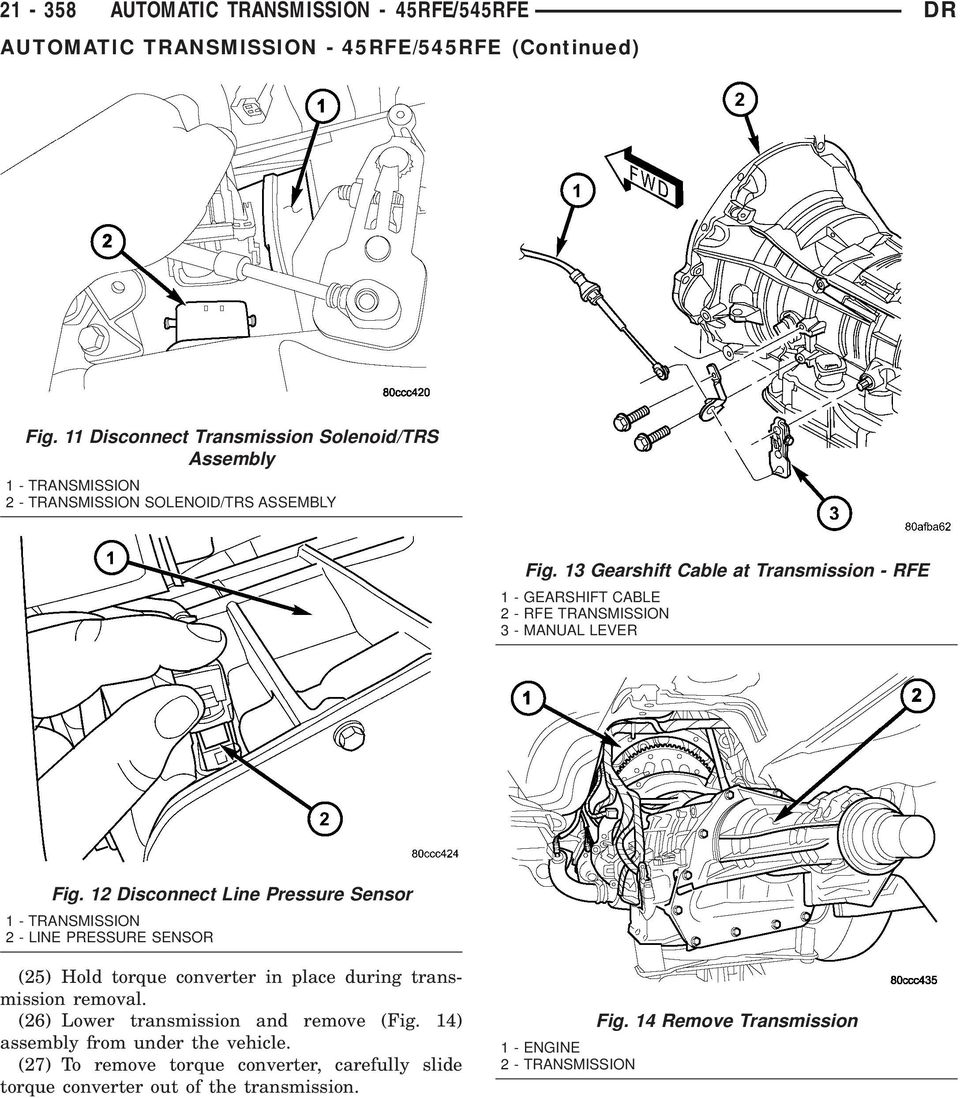
8 DR AUTOMATIC TRANSMISSION - 45RFE/545RFE AUTOMATIC TRANSMISSION - 45RFE/545RFE (Continued) REMOVAL (1) Disconnect the negative battery cable. (2) Raise and support the vehicle (3) Remove any necessary skid plates. (Refer to 13 - FRAMES & BUMPERS/FRAME/TRANSFER CASE SKID PLATE - REMOVAL) (4) Mark propeller shaft and axle companion flanges for assembly alignment. (5) Remove the rear propeller shaft (6) Remove the front propeller shaft, if necessary. (7) Remove the engine to transmission collar (Fig. 8). Fig. 9 Disconnect Output Speed Sensor 1 - TRANSMISSION 2 - OUTPUT SPEED SENSOR Fig. 8 Transmission Collar 1 - ENGINE 2 - STRUCTURAL DUST COVER 3 - TRANSMISSION (8) Remove the exhaust support bracket from the rear of the transmission. (9) Disconnect and lower or remove any necessary exhaust components. (10) Remove the starter motor. (11) Rotate crankshaft in clockwise direction until converter bolts are accessible. Then remove bolts one at a time. Rotate crankshaft with socket wrench on dampener bolt. (12) Disengage the output speed sensor connector from the output speed sensor (Fig. 9). (13) Disengage the input speed sensor connector from the input speed sensor (Fig. 10). (14) Disengage the transmission solenoid/trs assembly connector from the transmission solenoid/ TRS assembly (Fig. 11). (15) Disengage the line pressure sensor connector from the line pressure sensor (Fig. 12). Fig. 10 Disconnect Input Speed Sensor 1 - TRANSMISSION 2 - INPUT SPEED SENSOR (16) Disconnect gearshift cable from transmission manual valve lever (Fig. 13). (17) Disconnect the transmission vent hose from the transmission. (18) Support rear of engine with safety stand or jack. (19) Raise transmission slightly with service jack to relieve load on crossmember and supports. (20) Remove bolts securing rear support and cushion to transmission and crossmember. (21) Remove transfer case, if necessary. (22) Disconnect transmission fluid cooler lines at transmission fittings and clips. (23) Remove all remaining converter housing bolts. (24) Carefully work transmission and torque converter assembly rearward off engine block dowels.

9 AUTOMATIC TRANSMISSION - 45RFE/545RFE DR AUTOMATIC TRANSMISSION - 45RFE/545RFE (Continued) Fig. 11 Disconnect Transmission Solenoid/TRS Assembly 1 - TRANSMISSION 2 - TRANSMISSION SOLENOID/TRS ASSEMBLY Fig. 13 Gearshift Cable at Transmission - RFE 1 - GEARSHIFT CABLE 2 - RFE TRANSMISSION 3 - MANUAL LEVER Fig. 12 Disconnect Line Pressure Sensor 1 - TRANSMISSION 2 - LINE PRESSURE SENSOR (25) Hold torque converter in place during transmission removal. (26) Lower transmission and remove (Fig. 14) assembly from under the vehicle. (27) To remove torque converter, carefully slide torque converter out of the transmission. 1 - ENGINE 2 - TRANSMISSION Fig. 14 Remove Transmission
10 DR AUTOMATIC TRANSMISSION - 45RFE/545RFE AUTOMATIC TRANSMISSION - 45RFE/545RFE (Continued) DISASSEMBLY (6) Inspect the ends of the sensors for debris, which may indicate the nature of the transmission failure. Fig. 15 Remove the Manual Shaft Lever 1 - MANUAL SHAFT LEVER (1) Drain fluid from transmission. (2) Clean exterior of transmission with suitable solvent or pressure washer. (3) Remove the torque converter from the transmission. (4) Remove the manual shift lever (1) (Fig. 15) from the transmission. Fig. 17 Install Support Stand - Tool TOOL 8257 (7) Install Support Stand 8257 (1) onto the transmission case. (Fig. 17) 1 - TOOL TOOL C-3339 Fig. 18 Measure Input Shaft End Play Fig. 16 Remove Input, Output, and Line Pressure Sensors 1 - OUTPUT SPEED SENSOR 2 - LINE PRESSURE SENSOR 3 - INPUT SPEED SENSOR (8) Using Adapter from End-Play Tool Set 8266 (1) and Dial Indicator C-3339 (2), measure and record the input shaft end-play. (Fig. 18) (5) Remove the input (3), output (1), and line pressure sensors (2) from the transmission case. (Fig. 16)

11 AUTOMATIC TRANSMISSION - 45RFE/545RFE DR AUTOMATIC TRANSMISSION - 45RFE/545RFE (Continued) NOTE: When measuring the input shaft end-play, two stops will be felt. When the input shaft is pushed inward and the dial indicator zeroed, the first stop felt when the input shaft is pulled outward is the movement of the input shaft in the input clutch housing hub. This value should not be included in the end-play measured value and therefore must be recorded and subtracted from the dial indicator reading. Fig. 20 Remove Primary Oil and Cooler Filters 1 - PRIMARY OIL FILTER 2 - COOLER RETURN FILTER 3 - COOLER RETURN FILTER BYPASS VALVE 4 - VALVE BODY Fig. 19 Measure Output Shaft End Play 1 - TOOL TOOL TOOL C-3339 (9) Remove the bolts holding the transmission extension/adapter housing to the transmission case. (10) Remove the extension/adapter housing from the transmission case. (11) Using Alignment Plate 8261 (1), Adapter from End-Play Tool Set 8266 (2) and Dial Indicator C-3339 (3), measure and record the output shaft end-play. (Fig. 19) (12) Remove the bolts holding the transmission oil pan to the transmission case. (13) Remove the transmission oil pan from the transmission case. (14) Remove the primary oil filter (1) and the oil cooler return filter (2). (Fig. 20) (15) Remove the cooler return filter bypass valve (3). (16) Remove the bolts (1) holding the valve body to the transmission case. (Fig. 21) Fig. 21 Remove Valve Body Assembly 1 - VALVE BODY TO CASE BOLT (6)

12 DR AUTOMATIC TRANSMISSION - 45RFE/545RFE AUTOMATIC TRANSMISSION - 45RFE/545RFE (Continued) (17) Remove the valve body from the transmission case. (21) Remove the bolts (1) holding the oil pump into the transmission case. (Fig. 23) (22) Remove the oil pump (2). Hold inward on the input shaft to prevent pulling the input clutch assembly with the oil pump. (Fig. 23) CAUTION: If the input shaft is not held during oil pump removal, the input clutch assembly will attempt to move forward with the oil pump and the numbers 2, 3, or 4 bearings inside the input clutch assembly may become dislodged. Fig. 22 Remove Transmission Front Cover 1 - INNER SNAP-RING 2 - TRANSMISSION FRONT COVER 3 - OUTER SNAP-RING (18) Remove the outer snap-ring (3) securing the transmission front cover (2) into the transmission case. (Fig. 22) (19) Remove the inner snap-ring (1) securing the transmission front cover to the oil pump. (Fig. 22) (20) Reaching through a case opening in the valve body area with a long blunted tool, remove the transmission front cover from the transmission case. Fig. 24 Remove Input Clutch Assembly 1 - THRUST BEARING NUMBER THRUST PLATE (SELECT) 3 - INPUT CLUTCH ASSEMBLY 4 - THRUST BEARING NUMBER 1 (23) Remove the number 1 thrust bearing (4) from the input clutch assembly. (Fig. 24) (24) Remove the input clutch assembly (3) from the transmission case. (Fig. 24) (25) Remove the number 5 thrust bearing (1) and selective thrust plate (2) from the input clutch assembly (3) (Fig. 24), or the 4C clutch retainer/bulkhead. Fig. 23 Remove Oil Pump 1 - OIL PUMP TO CASE BOLT (6) 2 - OIL PUMP

13 AUTOMATIC TRANSMISSION - 45RFE/545RFE DR AUTOMATIC TRANSMISSION - 45RFE/545RFE (Continued) (30) Remove the rear selective plate (6) and number 6 thrust bearing (7) from the reaction annulus (8). (Fig. 27) (31) Remove the reaction annulus (8) from the reaction planetary carrier (3). (Fig. 27) (32) Remove the number 7 thrust bearing (5). (Fig. 27) (33) Remove the reaction sun gear (4). (Fig. 27) (34) Remove the number 8 thrust bearing (1) from the reaction planetary carrier (3). (Fig. 27) (35) Remove the reaction planetary carrier (3) (Fig. 27). Note that this planetary gear set has three pinion gears. (36) Remove the number 9 thrust bearing (2) from the reverse planetary gear set. (Fig. 27) Fig. 25 Remove 4C Clutch Retainer/Bulkhead 1 - SNAP-RING 2-4C CLUTCH RETAINER/BULKHEAD (26) Remove the 4C clutch retainer/bulkhead tapered snap-ring (1) from the transmission case. (Fig. 25) (27) Remove the 4C clutch retainer/bulkhead (2) from the transmission case. (Fig. 25) 1 - SNAP-RING 2 - PLATE 3 - DISC 4 - REACTION PLATE Fig. 26 Remove 2C Clutch Pack (28) Remove the front 2C clutch pack snap-ring (1) from the transmission case. (Fig. 26) (29) Remove the 2C clutch pack (2, 3, 4) from the transmission case. (Fig. 26)

14 DR AUTOMATIC TRANSMISSION - 45RFE/545RFE AUTOMATIC TRANSMISSION - 45RFE/545RFE (Continued) Fig. 27 Remove Reaction Annulus and Carrier 1 - THRUST BEARING NUMBER THRUST BEARING NUMBER THRUST BEARING NUMBER THRUST PLATE (SELECT) 3 - REACTION PLANETARY CARRIER 7 - THRUST BEARING NUMBER REACTION SUN GEAR 8 - REACTION ANNULUS

15 AUTOMATIC TRANSMISSION - 45RFE/545RFE DR AUTOMATIC TRANSMISSION - 45RFE/545RFE (Continued) 1 - SNAP-RING Fig. 28 Remove Park Sprag Snap-Ring Fig. 30 Remove Input/Reverse Planetary Assembly 1 - INPUT/REVERSE PLANETARY ASSEMBLY 2 - BEARING NUMBER BEARING NUMBER 12 (37) Remove the snap-ring (1) holding the park sprag gear onto the output shaft. (Fig. 28) Fig. 31 Remove Low/Reverse Clutch Retainer 1 - LOW/REVERSE OVERRUNNING CLUTCH ASSEMBLY 2 - SNAP-RING Fig. 29 Remove Park Sprag Gear 1 - PARK SPRAG GEAR (42) Remove the low/reverse clutch retainer (1) from the transmission case. (Fig. 31) (38) Remove the park sprag gear (1) from the output shaft. (Fig. 29) (39) Remove the input/reverse planetary assembly (1). (Fig. 30) (40) Remove the number 12 thrust bearing (3) from the input/reverse planetary assembly (1). (Fig. 30) (41) Remove the snap-ring (2) holding the low/reverse clutch retainer (1) into the transmission case. (Fig. 31)

16 DR AUTOMATIC TRANSMISSION - 45RFE/545RFE AUTOMATIC TRANSMISSION - 45RFE/545RFE (Continued) Clean the case in a solvent tank. Flush the case bores and fluid passages thoroughly with solvent. Dry the case and all fluid passages with compressed air. Be sure all solvent is removed from the case and that all fluid passages are clear. NOTE: Do not use shop towels or rags to dry the case (or any other transmission component) unless they are made from lint-free materials. Lint will stick to case surfaces and transmission components and circulate throughout the transmission after assembly. A sufficient quantity of lint can block fluid passages and interfere with valve body operation. INSPECTION Inspect the case for cracks, porous spots, worn bores, or damaged threads. Damaged threads can be repaired with Helicoil thread inserts. However, the case will have to be replaced if it exhibits any type of damage or wear. Fig. 32 Manual Shaft/Park Lock Components 1 - GUIDE 2 - SNAP-RING 3 - SHAFT 4 - SPRING 5 - PARK PAWL 6 - MANUAL SHAFT/LEVER 7 - PARK ROD ASSEMBLY NOTE: Clean and inspect all components. Replace any components which show evidence of excessive wear or scoring. (43) Remove the park rod (7) and e-clip. (Fig. 32) (44) Remove the park rod guide snap-ring (2). (Fig. 32) (45) Remove the park rod guide (1). (Fig. 32) (46) Remove the park pawl pivot shaft (3), park pawl (5), and spring (4). (Fig. 32) (47) Remove the manual selector shaft (6). (Fig. 32) (48) Remove the manual selector shaft seal. (49) Remove the dipstick tube seal. CLEANING The use of crocus cloth is permissible where necessary, providing it is used carefully. When used on shafts, or valves, use extreme care to avoid rounding off sharp edges. Sharp edges are vital as they prevent foreign matter from getting between the valve and valve bore. Do not reuse oil seals, gaskets, seal rings, or O-rings during overhaul. Replace these parts as a matter of course. Also do not reuse snap rings or E-clips that are bent or distorted. Replace these parts as well. Lubricate transmission parts with Mopar ATF +4, Automatic Transmission Fluid, during overhaul and assembly. Use petroleum jelly, Mopar Door Ease, or Ru-Glyde to prelubricate seals, O-rings, and thrust washers. Petroleum jelly can also be used to hold parts in place during reassembly. 1 - SEAL 2 - TOOL 8253 Fig. 33 Install Selector Shaft Seal (1) Install the cooler filter bypass valve. Torque the bypass valve to specification. The valve uses a tapered pipe thread and excessive torque can damage the transmission case. Tighten the cooler filter bypass valve to 4.5 N m (40 in.lbs.). (2) Install a new selector shaft seal (1) using Seal Installer 8253 (2). (Fig. 33)

17 AUTOMATIC TRANSMISSION - 45RFE/545RFE DR AUTOMATIC TRANSMISSION - 45RFE/545RFE (Continued) Fig. 34 Remove the Manual Shaft Lever 1 - MANUAL SHAFT LEVER (3) Install the manual selector shaft and retaining screw. Tighten the manual selector shaft retaining screw to 28 N m (250 in.lbs.). (4) Install the manual shift lever (1) (Fig. 34) onto the manual selector shaft. Torque the retaining crossbolt to 16 N m (140 in.lbs.). (5) Install the park pawl (5), spring (4), and shaft (3). (Fig. 35) (6) Install the park rod (7) and e-clip. (Fig. 35) (7) Install the park rod guide (1) and snap-ring (2). (Fig. 35) (8) Install a new dipstick tube seal (2) using Seal Installer 8254 (1). (Fig. 36) Fig. 35 Manual Shaft/Park Lock Components 1 - GUIDE 2 - SNAP-RING 3 - SHAFT 4 - SPRING 5 - PARK PAWL 6 - MANUAL SHAFT/LEVER 7 - PARK ROD NOTE: Before final assembly of transmission centerline, the 2C/4C clutch components should be installed into position and measured as follows: (9) Install the 2C reaction plate (4) into the transmission case. (Fig. 37) Fig. 36 Install Dipstick Tube Seal Using Tool TOOL SEAL

18 DR AUTOMATIC TRANSMISSION - 45RFE/545RFE AUTOMATIC TRANSMISSION - 45RFE/545RFE (Continued) that the open ends of the snap-ring are located in the case opening toward the valve body area. (14) Using a feeler gauge through the opening in the rear of the transmission case, measure the 2C clutch pack clearance between the 2C reaction plate and the transmission case at four different points. The average of these measurements is the 2C clutch pack clearance. The correct clutch clearance is mm ( in.). The reaction plate is not selective. If the clutch pack clearance is not within specification, the reaction plate, all the friction discs, and steels must be replaced. (15) Remove the 4C retainer/bulkhead and all of the 2C clutch components from the transmission case. 1 - SNAP-RING 2 - PLATE 3 - DISC 4 - REACTION PLATE Fig. 37 Install 2C Clutch Pack (10) Install the 2C clutch pack (2, 3) into the transmission case. (Fig. 37) (11) Install the flat 2C clutch snap-ring (1) into the transmission case. (Fig. 37) Fig. 39 Install Low/Reverse Clutch Retainer 1 - LOW/REVERSE OVERRUNNING CLUTCH ASSEMBLY 2 - SNAP-RING Fig. 38 Install 4C Clutch Retainer/Bulkhead 1 - SNAP-RING 2-4C CLUTCH RETAINER/BULKHEAD (16) Install the low/reverse clutch assembly (1) (Fig. 39). Make sure that the oil feed hole points toward the valve body area and that the bleed orifice is aligned with the notch in the rear of the transmission case. (17) Install the snap-ring (2) (Fig. 39) to hold the low/reverse clutch retainer into the transmission case. The snap-ring is tapered and must be installed with the tapered side forward. Once installed, verify that the snap-ring is fully seated in the snap-ring groove. (18) Air check the low/reverse clutch and verify correct overrunning clutch operation. (12) Install the 4C retainer/bulkhead (2) (Fig. 38) into the transmission case. Make sure that the oil feed holes are pointing toward the valve body area. (13) Install the 4C retainer/bulkhead tapered snap-ring (1) into the transmission case. Make sure

19 AUTOMATIC TRANSMISSION - 45RFE/545RFE DR AUTOMATIC TRANSMISSION - 45RFE/545RFE (Continued) Fig. 40 Install Input/Reverse Planetary Assembly 1 - INPUT/REVERSE PLANETARY ASSEMBLY 2 - BEARING NUMBER BEARING NUMBER SNAP-RING Fig. 42 Install Park Sprag Snap-Ring (19) Install the number 12 thrust bearing (3) over the output shaft and against the rear planetary gear set. The flat side of the bearing goes toward the planetary gearset and the raised tabs on the inner race should face the rear of the transmission. (20) Install the reverse/input planetary assembly (1) through the low/reverse clutch assembly. (Fig. 40) 1 - SNAP-RING 2 - PLATE 3 - DISC 4 - REACTION PLATE Fig. 43 Install 2C Clutch Pack 1 - PARK SPRAG GEAR Fig. 41 Install Park Sprag Gear (21) Install the park sprag gear (1) onto the output shaft. (Fig. 41) (22) Install the snap-ring (1) to hold the park sprag onto the output shaft. (Fig. 42) (23) Install the 2C reaction plate (4) into the transmission case. (Fig. 43) (24) Install the 2C clutch pack (2, 3, 4) into the transmission case. (Fig. 43) (25) Install the number 8 thrust bearing (1) inside the reaction carrier with the outer race against the reaction planetary carrier (3). (26) Install the reaction planetary gear set and the number 9 thrust bearing (2), with the inner race against the reaction planetary carrier (3), into the transmission case. (Fig. 44)

20 DR AUTOMATIC TRANSMISSION - 45RFE/545RFE AUTOMATIC TRANSMISSION - 45RFE/545RFE (Continued) Fig. 44 Install Reaction Annulus and Carrier 1 - THRUST BEARING NUMBER THRUST BEARING NUMBER THRUST BEARING NUMBER THRUST PLATE (SELECT) 3 - REACTION PLANETARY CARRIER 7 - THRUST BEARING NUMBER REACTION SUN GEAR 8 - REACTION ANNULUS (27) Install the flat 2C clutch snap-ring into the transmission case. (Fig. 43) (28) Install the reaction sun gear (4) into the reaction planetary gear set. Make sure the small shoulder is facing the front of the transmission. (Fig. 44) (29) Install the number 7 thrust bearing (5) onto the reaction sun gear (4) with the inner race against the sun gear. (Fig. 44) (30) Install the output shaft selective thrust plate (2) onto the reaction annulus with the oil grooves facing the annulus gear and the lugs (1) and notches aligned as shown. (Fig. 45) (31) Install the number 6 thrust bearing (7) against the output shaft selective thrust plate (6) with the flat side against the thrust plate (Fig. 44) and the raised tabs on the inner race facing the front of the transmission. (32) Install the reaction annulus (8) into the reaction planetary gear set. (Fig. 44) (33) Install the 4C retainer/bulkhead (2) into the transmission case. Make sure that the oil feed holes are pointing toward the valve body area. Rotate the reaction annulus during the installation of the 4C retainer/bulkhead to ease installation. (34) Install the 4C retainer/bulkhead tapered snap-ring (1) into the transmission case (Fig. 46) with the taper toward the front of the case. Make sure that the open ends of the snap-ring are located in the case opening toward the valve body area. (35) Air check the 2C and 4C clutch operation. (36) Using Alignment Plate 8261 (1), Adapter from End-Play Tool Set 8266 (2) and Dial Indicator C-3339 (3), measure (Fig. 47) and record the output shaft end-play. The correct output shaft end-play is mm ( in.). Adjust as necessary. Install the chosen output shaft selective thrust plate and re-measure end-play to verify selection.

21 AUTOMATIC TRANSMISSION - 45RFE/545RFE DR AUTOMATIC TRANSMISSION - 45RFE/545RFE (Continued) 1 - LOCATING LUG (3) 2 - THRUST PLATE Fig. 45 Thrust Plate Alignment Fig. 47 Measure Output Shaft End Play 1 - TOOL TOOL TOOL C-3339 Fig. 46 Install 4C Clutch Retainer/Bulkhead 1 - SNAP-RING 2-4C CLUTCH RETAINER/BULKHEAD (37) Apply a bead of RTV silicone and install the extension/adapter housing onto the transmission case. (38) Install and torque the bolts to hold the extension/adapter housing onto the transmission case. The correct torque is 54 N m (40 ft.lbs.). (39) Install the number 5 thrust bearing (1) (Fig. 48) and selective thrust plate (2) onto the 4C retainer/bulkhead. Be sure that the outer race of the bearing is against the thrust plate. Fig. 48 Install Input Clutch Assembly 1 - THRUST BEARING NUMBER THRUST PLATE (SELECT) 3 - INPUT CLUTCH ASSEMBLY 4 - THRUST BEARING NUMBER 1 (40) Install the input clutch assembly (3) (Fig. 48) into the transmission case. Make sure that the input clutch assembly is fully installed by performing a visual inspection through the input speed sensor hole. If the tone wheel teeth on the input clutch assembly are centered in the hole, the assembly is fully installed. (41) Install the number 1 thrust bearing (4) with the outer race up in the pocket of the input clutch assembly. (Fig. 48)
22 DR AUTOMATIC TRANSMISSION - 45RFE/545RFE AUTOMATIC TRANSMISSION - 45RFE/545RFE (Continued) number 5 thrust bearing and re-measure end-play to verify selection. NOTE: When measuring the input shaft end-play, two stops will be felt. When the input shaft is pushed inward and the dial indicator zeroed, the first stop felt when the input shaft is pulled outward is the movement of the input shaft in the input clutch housing hub. This value should not be included in the end-play measured value and therefore must be recorded and subtracted from the dial indicator reading. Fig. 49 Install Oil Pump 1 - OIL PUMP TO CASE BOLT (6) 2 - OIL PUMP (42) Install the oil pump (2) into the transmission case. (Fig. 49) (43) Install the bolts (1) to hold the oil pump into the transmission case. Tighten the oil pump bolts to 28 N m (250 in.lbs.). Fig. 51 Install the Transmission Front Cover 1 - INNER SNAP-RING 2 - TRANSMISSION FRONT COVER 3 - OUTER SNAP-RING 1 - TOOL TOOL C-3339 Fig. 50 Measure Input Shaft End Play (44) Using Adapter from End-Play Tool Set 8266 (1) and Dial Indicator C-3339 (2), measure (Fig. 50) and record the input shaft end-play. The correct end-play is mm ( in.). Adjust as necessary. Install the chosen thrust plate on the (45) Install the transmission front cover (2) into the transmission case. (Fig. 51) (46) Install the outer snap-ring (3) to hold the transmission front cover (2) into the transmission case. (Fig. 51) (47) Partially install the inner transmission front cover snap-ring (1) onto the oil pump. (Fig. 51) (48) Using Installer 8255 (1), install the inner transmission front cover snap-ring (2) the remainder of the way onto the oil pump. (Fig. 52) (49) Install the valve body. Verify that the pin on the manual lever has properly engaged the TRS selector plate. Tighten the valve body to transmission case bolts (1) (Fig. 53) to 12 N m (105 in.lbs.). CAUTION: The primary oil filter seal MUST be fully installed flush against the oil pump body. DO NOT install the seal onto the filter neck and attempt to install the filter and seal as an assembly. Damage to the transmission will result.
23 AUTOMATIC TRANSMISSION - 45RFE/545RFE DR AUTOMATIC TRANSMISSION - 45RFE/545RFE (Continued) Fig. 52 Seat Snap-Ring Using Tool TOOL SNAP-RING Fig. 54 Install Primary Oil and Cooler Filters 1 - PRIMARY OIL FILTER 2 - COOLER RETURN FILTER 3 - COOLER RETURN FILTER BYPASS VALVE 4 - VALVE BODY Fig. 53 Install Valve Body Assembly 1 - VALVE BODY TO CASE BOLT (6) (50) Install a new primary oil filter seal in the oil pump inlet bore. Seat the seal in the bore with the butt end of a hammer, or other suitable tool. (51) Install the primary oil filter (1) (Fig. 54) and the oil cooler return filter (2). Tighten the screw to hold the primary oil filter to the valve body to 4.5 N m (40 in.lbs.). Using Oil Filter Wrench 8321, tighten the cooler return oil filter to the transmission case to 14 N m (125 in.lbs.). (52) Apply RTV silicone to the oil pan and install the transmission oil pan. Tighten the bolts to 12 N m (105 in.lbs.). Fig. 55 Install Input, Output, and Line Pressure Sensors 1 - OUTPUT SPEED SENSOR 2 - LINE PRESSURE SENSOR 3 - INPUT SPEED SENSOR (53) Install the input (3), output (1), and line pressure sensors (2) (Fig. 55). Tighten the bolts to 12 N m (105 in.lbs.). INSTALLATION (1) Check torque converter hub and hub drive flats for sharp edges burrs, scratches, or nicks. Polish the hub and flats with 320/400 grit paper and crocus cloth if necessary. Verify that the converter hub o-ring is properly installed and is free of any debris. The hub must be smooth to avoid damaging pump seal at installation.
24 DR AUTOMATIC TRANSMISSION - 45RFE/545RFE AUTOMATIC TRANSMISSION - 45RFE/545RFE (Continued) (2) If a replacement transmission is being installed, transfer any components necessary, such as the manual shift lever and shift cable bracket, from the original transmission onto the replacement transmission. (3) Lubricate oil pump seal lip with transmission fluid. (4) Align converter and oil pump. (5) Carefully insert converter in oil pump. Then rotate converter back and forth until fully seated in pump gears. (6) Check converter seating with steel scale and straightedge (Fig. 56). Surface of converter lugs should be at least 13mm (1/2 in.) to rear of straightedge when converter is fully seated. (7) Temporarily secure converter with C-clamp. Fig. 56 Checking Torque Converter Seating - Typical 1 - SCALE 2 - STRAIGHTEDGE (8) Position transmission on jack and secure it with chains. (9) Check condition of converter driveplate. Replace the plate if cracked, distorted or damaged. Also be sure transmission dowel pins are seated in engine block and protrude far enough to hold transmission in alignment. (10) Apply a light coating of Mopar High Temp Grease to the torque converter hub pocket in the rear pocket of the engine s crankshaft. (11) Raise transmission (Fig. 57) and align the torque converter with the drive plate and transmission converter housing with the engine block. (12) Move transmission forward. Then raise, lower or tilt transmission to align the converter housing with engine block dowels. 1 - ENGINE 2 - TRANSMISSION Fig. 57 Install Transmission (13) Carefully work transmission forward and over engine block dowels until converter hub is seated in crankshaft. Verify that no wires, or the transmission vent hose, have become trapped between the engine block and the transmission. (14) Install two bolts to attach the transmission to the engine. (15) Install remaining torque converter housing to engine bolts. Tighten to 68 N m (50 ft.lbs.). (16) Install transfer case, if equipped. Tighten transfer case nuts to 35 N m (26 ft.lbs.). (17) Install rear support to transmission. Tighten bolts to 47 N m (35 ft.lbs.). (18) Lower transmission onto crossmember and install bolts attaching transmission mount to crossmember. Tighten clevis bracket to crossmember bolts to 47 N m (35 ft.lbs.). Tighten the clevis bracket to rear support bolt to 68 N m (50 ft.lbs.). (19) Remove engine support fixture. (20) Connect gearshift cable to transmission. (21) Connect wires to solenoid and pressure switch assembly (Fig. 58) connector, input (Fig. 59) and output (Fig. 60) speed sensors, and line pressure sensor (Fig. 61). Be sure transmission harnesses are properly routed. CAUTION: It is essential that correct length bolts be used to attach the converter to the driveplate. Bolts that are too long will damage the clutch surface inside the converter. (22) Install torque converter-to-driveplate bolts. Tighten bolts to 31 N m (270 in. lbs.). (23) Install starter motor and cooler line bracket. (24) Connect cooler lines to transmission. (25) Install transmission fill tube. (26) Install exhaust components, if necessary.
25 AUTOMATIC TRANSMISSION - 45RFE/545RFE DR AUTOMATIC TRANSMISSION - 45RFE/545RFE (Continued) Fig. 58 Connect Transmission Solenoid 1 - TRANSMISSION 2 - TRANSMISSION SOLENOID/TRS ASSEMBLY Fig. 61 Connect Line Pressure Sensor 1 - TRANSMISSION 2 - LINE PRESSURE SENSOR (27) Install the structural dust cover (Fig. 62) (Refer to 9 - ENGINE/ENGINE BLOCK/STRUC- TURAL COVER - INSTALLATION) onto the transmission and the engine. (28) Align and connect propeller shaft(s). (29) Adjust gearshift cable if necessary. (30) Install any skid plates removed previously. (Refer to 13 - FRAMES & BUMPERS/FRAME/ TRANSFER CASE SKID PLATE - INSTALLATION) (31) Lower vehicle. (32) Fill transmission with Mopar ATF +4, Automatic Transmission Fluid. Fig. 59 Connect Input Speed Sensor 1 - TRANSMISSION 2 - INPUT SPEED SENSOR Fig. 60 Connect Output Speed Sensor 1 - TRANSMISSION 2 - OUTPUT SPEED SENSOR Fig. 62 Transmission Collar 1 - ENGINE 2 - STRUCTURAL DUST COVER 3 - TRANSMISSION
26 DR AUTOMATIC TRANSMISSION - 45RFE/545RFE AUTOMATIC TRANSMISSION - 45RFE/545RFE (Continued) SCHEMATICS AND DIAGRAMS HYDRAULIC SCHEMATICS HYDRAULIC FLOW IN PARK/NEUTRAL
27 AUTOMATIC TRANSMISSION - 45RFE/545RFE DR AUTOMATIC TRANSMISSION - 45RFE/545RFE (Continued) HYDRAULIC FLOW IN NEUTRAL OVER 8MPH
28 DR AUTOMATIC TRANSMISSION - 45RFE/545RFE AUTOMATIC TRANSMISSION - 45RFE/545RFE (Continued) HYDRAULIC FLOW IN REVERSE
29 AUTOMATIC TRANSMISSION - 45RFE/545RFE DR AUTOMATIC TRANSMISSION - 45RFE/545RFE (Continued) HYDRAULIC FLOW IN REVERSE BLOCK
30 DR AUTOMATIC TRANSMISSION - 45RFE/545RFE AUTOMATIC TRANSMISSION - 45RFE/545RFE (Continued) HYDRAULIC FLOW IN FIRST GEAR (FROM N OR OD)
31 AUTOMATIC TRANSMISSION - 45RFE/545RFE DR AUTOMATIC TRANSMISSION - 45RFE/545RFE (Continued) HYDRAULIC FLOW IN FIRST GEAR (AFTER LAUNCH FROM REST)
32 DR AUTOMATIC TRANSMISSION - 45RFE/545RFE AUTOMATIC TRANSMISSION - 45RFE/545RFE (Continued) HYDRAULIC FLOW IN FIRST GEAR (FROM K/D)
33 AUTOMATIC TRANSMISSION - 45RFE/545RFE DR AUTOMATIC TRANSMISSION - 45RFE/545RFE (Continued) HYDRAULIC FLOW IN SECOND GEAR
34 DR AUTOMATIC TRANSMISSION - 45RFE/545RFE AUTOMATIC TRANSMISSION - 45RFE/545RFE (Continued) HYDRAULIC FLOW IN SECOND GEAR EMCC
35 AUTOMATIC TRANSMISSION - 45RFE/545RFE DR AUTOMATIC TRANSMISSION - 45RFE/545RFE (Continued) HYDRAULIC FLOW IN SECOND PRIME GEAR
36 DR AUTOMATIC TRANSMISSION - 45RFE/545RFE AUTOMATIC TRANSMISSION - 45RFE/545RFE (Continued) HYDRAULIC FLOW IN SECOND PRIME GEAR EMCC
37 AUTOMATIC TRANSMISSION - 45RFE/545RFE DR AUTOMATIC TRANSMISSION - 45RFE/545RFE (Continued) HYDRAULIC FLOW IN DIRECT GEAR
38 DR AUTOMATIC TRANSMISSION - 45RFE/545RFE AUTOMATIC TRANSMISSION - 45RFE/545RFE (Continued) HYDRAULIC FLOW IN DIRECT GEAR (FAILSAFE)
39 AUTOMATIC TRANSMISSION - 45RFE/545RFE DR AUTOMATIC TRANSMISSION - 45RFE/545RFE (Continued) HYDRAULIC FLOW IN DIRECT GEAR EMCC
40 DR AUTOMATIC TRANSMISSION - 45RFE/545RFE AUTOMATIC TRANSMISSION - 45RFE/545RFE (Continued) HYDRAULIC FLOW IN FOURTH
41 AUTOMATIC TRANSMISSION - 45RFE/545RFE DR AUTOMATIC TRANSMISSION - 45RFE/545RFE (Continued) HYDRAULIC FLOW IN FOURTH EMCC
42 DR AUTOMATIC TRANSMISSION - 45RFE/545RFE AUTOMATIC TRANSMISSION - 45RFE/545RFE (Continued) HYDRAULIC FLOW IN FIFTH
43 AUTOMATIC TRANSMISSION - 45RFE/545RFE DR AUTOMATIC TRANSMISSION - 45RFE/545RFE (Continued) HYDRAULIC FLOW IN FIFTH EMCC
44 DR AUTOMATIC TRANSMISSION - 45RFE/545RFE AUTOMATIC TRANSMISSION - 45RFE/545RFE (Continued) HYDRAULIC FLOW IN MANUAL LOW OR AUTOSTICK 1ST
45 AUTOMATIC TRANSMISSION - 45RFE/545RFE DR AUTOMATIC TRANSMISSION - 45RFE/545RFE (Continued) HYDRAULIC FLOW IN MANUAL SECOND
46 DR AUTOMATIC TRANSMISSION - 45RFE/545RFE AUTOMATIC TRANSMISSION - 45RFE/545RFE (Continued) HYDRAULIC FLOW IN MANUAL SECOND (FAILSAFE)
47 AUTOMATIC TRANSMISSION - 45RFE/545RFE DR AUTOMATIC TRANSMISSION - 45RFE/545RFE (Continued) SPECIFICATIONS TRANSMISSION GENERAL Component Metric Inch Output Shaft End Play mm Input Shaft End Play mm 2C Clutch Pack Clearance 4C Clutch Pack Clearance L/R Clutch Pack Clearance OD Clutch Pack Clearance mm mm mm mm in in in in in in. Component Metric Inch UD Clutch Pack Clearance Reverse Clutch Pack Clearance mm mm Recommended fluid Mopar ATF +4 GEAR RATIOS 1ST 3.00:1 2ND 1.67:1 2ND Prime 1.50:1 3RD 1.0:1 4TH 0.75:1 5TH 0.67:1 REVERSE 3.00: in in. TORQUE SPECIFICATIONS DESCRIPTION N m Ft. Lbs. In. Lbs. Fitting, cooler line at trans Bolt, torque convertor Bolt/nut, crossmember Bolt, driveplate to crankshaft Bolt, oil pan Screw, primary fluid filter Bolt, oil pump Bolt, oil pump body to cover Screw, plate to oil pump body Bolt, valve body to case Plug, pressure test port Bolt, reaction shaft support Screw, valve body to transfer plate Screw, solenoid module to transfer plate Screw, accumulator cover 7-60 Screw, detent spring Bolt, input speed sensor Bolt, output speed sensor Bolt, line pressure sensor Bolt, extension housing Valve, cooler return filter bypass Screw, manual valve cam retaining Bolt, manual lever
48 DR AUTOMATIC TRANSMISSION - 45RFE/545RFE AUTOMATIC TRANSMISSION - 45RFE/545RFE (Continued) SPECIAL TOOLS RFE TRANSMISSION Gauge, Oil Pressure - C-3292 Compressor, Spring Gauge, Oil Pressure - C-3293SP Compressor, Spring Dial Indicator - C-3339 Compressor, Spring Installer, Seal - C-3860-A Installer, Piston
49 AUTOMATIC TRANSMISSION - 45RFE/545RFE DR AUTOMATIC TRANSMISSION - 45RFE/545RFE (Continued) Installer, Seal Adapter, Pressure Tap A Installer, Seal Adapter, Line Pressure Installer, Snap-ring Fixture, Input Clutch Pressure Stand, Support Plate, Alignment
50 DR AUTOMATIC TRANSMISSION - 45RFE/545RFE AUTOMATIC TRANSMISSION - 45RFE/545RFE (Continued) End Play Set Installer, Piston Compressor, Spring Installer, Bearing Wrench, Filter
51 AUTOMATIC TRANSMISSION - 45RFE/545RFE DR RETAINER/BULKHEAD-4C DISASSEMBLY (1) Remove the 2C piston Belleville spring snapring (6) from the 4C retainer /bulkhead (13). (Fig. 63) (2) Remove the 2C piston Belleville spring (5) from the retainer/bulkhead (13). (Fig. 63) (3) Remove the 2C piston (2) from the retainer/ bulkhead (13). Use 20 psi of air pressure to remove the piston if necessary. (4) Remove the 4C clutch snap-ring (7) from the retainer/bulkhead (13). (Fig. 63) (5) Remove the 4C clutch pack (3, 4, 8) from the retainer/bulkhead (13). (Fig. 63) (6) Using Spring Compressor 8250 (2) (Fig. 64) and a suitable shop press (1), compress the 4C piston return spring (10) and remove the snap-ring (9). (Fig. 63) (7) Remove the 4C piston return spring (10) (Fig. 63) and piston (12) from the retainer/bulkhead (13). Use 20 psi of air pressure to remove the piston if necessary. Fig. 63 4C Retainer/Bulkhead Components 1 - SEAL 8 - REACTION PLATE 2-2C PISTON 9 - SNAP-RING 3 - PLATE 10 - RETURN SPRING 4 - DISC 11 - SEAL 5-2C BELLEVILLE SPRING 12-4C PISTON 6 - SNAP-RING 13-4C RETAINER/BULKHEAD 7 - SNAP-RING (SELECT)
52 DR AUTOMATIC TRANSMISSION - 45RFE/545RFE RETAINER/BULKHEAD-4C (Continued) (6) Assemble and install the 4C clutch pack (3, 4) into the retainer/bulkhead (13) (Fig. 65) with the steel separator plate against the piston. (7) Install the 4C reaction plate (8) (Fig. 65) and snap-ring (7) into the retainer/bulkhead (13). The 4C reaction plate is non-directional. (8) Measure the 4C clutch clearance. The correct clutch clearance is mm ( in.). The snap-ring (7) is selectable. Install the chosen snap-ring and re-measure to verify the selection. (9) Install the 2C piston (2) into the retainer/bulkhead (13). (Fig. 65) (10) Position the 2C Belleville spring (5) onto the 2C piston (2). (11) Position the 2C Belleville spring snap-ring (6) onto the 2C Belleville spring (5). (Fig. 65) Fig. 64 Compress 4C Piston Return Spring Using Tool PRESS 2 - TOOL 8250 ASSEMBLY NOTE: Clean and inspect all components. Replace any components which show evidence of excessive wear or scoring. (1) Install new seals (1, 11) on the 2C and 4C pistons. (Fig. 65) (2) Lubricate all seals with Mopar ATF +4 prior to installation. (3) Install the 4C piston (12) into the 4C retainer/ bulkhead (13). (Fig. 65) (4) Position the 4C piston return spring (10) onto the 4C piston (12). (5) Using Spring Compressor 8250 (2) and a suitable shop press (1), compress the 4C piston return spring and install the snap-ring. (Fig. 66)
53 AUTOMATIC TRANSMISSION - 45RFE/545RFE DR RETAINER/BULKHEAD-4C (Continued) Fig. 65 4C Retainer/Bulkhead Components 1 - SEAL 8 - REACTION PLATE 2-2C PISTON 9 - SNAP-RING 3 - PLATE 10 - RETURN SPRING 4 - DISC 11 - SEAL 5-2C BELLEVILLE SPRING 12-4C PISTON 6 - SNAP-RING 13-4C RETAINER/BULKHEAD 7 - SNAP-RING (SELECT)
54 DR AUTOMATIC TRANSMISSION - 45RFE/545RFE RETAINER/BULKHEAD-4C (Continued) ADAPTER HOUSING SEAL REMOVAL (1) Remove the transfer case from the transmission. (2) Using a screw mounted on a slide hammer, remove the adapter housing seal. INSTALLATION Fig. 66 Compress 4C Piston Return Spring Using Tool PRESS 2 - TOOL 8250 Fig. 68 Adapter Housing Seal Installation 1 - TOOL C-3860-A (1) Clean the adapter seal bore in the adapter housing of any residue or particles remaining from the original seal. (2) Install new oil seal in the adapter housing using Seal Installer C-3860-A (1) (Fig. 68). A properly installed seal is flush to the face of the seal bore. (3) Install the transfer case onto the transmission. Fig. 67 Compress 2C Belleville Spring Using Tool PRESS 2 - TOOL 8249 (12) Using Spring Compressor 8249 (2) (Fig. 67) and a suitable shop press (1), compress the Belleville spring (5) until the snap-ring (6) is engaged with the snap-ring groove in the retainer/bulkhead.
55 AUTOMATIC TRANSMISSION - 45RFE/545RFE DR BRAKE TRANSMISSION SHIFT INTERLOCK SYSTEM DESCRIPTION Fig. 69 Brake Transmission Interlock Mechanism 1 - STEERING COLUMN 2 - GEARSHIFT CABLE 3 - GEARSHIFT CABLE LOCK TAB 4 - BTSI SOLENOID LOCK TAB 5 - BTSI CONNECTOR LOCK. When the shifter is in any other gear or neutral position, the ignition key cylinder should not rotate to the LOCK position. (3) Shifting out of PARK should not be possible when the ignition key cylinder is in the OFF position. (4) Shifting out of PARK should not be possible while applying normal pushbutton force and ignition key cylinder is in the RUN or START positions unless the foot brake pedal is depressed approximately 1/2 inch (12mm). (5) Shifting out of PARK should not be possible when the ignition key cylinder is in the ACCESSORY or LOCK positions. (6) Shifting between any gears, NEUTRAL or into PARK may be done without depressing foot brake pedal with ignition switch in RUN or START positions. ADJUSTMENTS - BRAKE TRANSMISSION SHIFT INTERLOCK Correct cable adjustment is important to proper interlock operation. The gearshift cable must be correctly adjusted in order to shift out of PARK. ADJUSTMENT PROCEDURE The Brake Transmission Shifter Interlock (BTSI) (Fig. 69), is a solenoid operated system. It consists of a solenoid permanently mounted on the gearshift cable. OPERATION The system locks the shifter into the PARK position. The interlock system is engaged whenever the ignition switch is in the LOCK or ACCESSORY position. An additional electrically activated feature will prevent shifting out of the PARK position unless the brake pedal is depressed approximately one-half an inch. A magnetic holding device in line with the park lock cable is energized when the ignition is in the RUN position. When the key is in the RUN position and the brake pedal is depressed, the shifter is unlocked and will move into any position. The interlock system also prevents the ignition switch from being turned to the LOCK or ACCESSORY position, unless the shifter is fully locked into the PARK position. DIAGNOSIS AND TESTING - BRAKE TRANSMISSION SHIFT INTERLOCK (1) Verify that the key can only be removed in the PARK position. (2) When the shift lever is in PARK And the shift handle pushbutton is in the OUT position, the ignition key cylinder should rotate freely from OFF to Fig. 70 Brake Transmission Interlock Mechanism 1 - STEERING COLUMN 2 - GEARSHIFT CABLE 3 - GEARSHIFT CABLE LOCK TAB 4 - BTSI SOLENOID LOCK TAB 5 - BTSI CONNECTOR (1) Remove the steering column trim as necessary for access to the brake transmission shift interlock. (2) Shift the transmission into the PARK position. (3) Pull upward on both the BTSI lock tab (4) and the gearshift cable lock tab (3). (Fig. 70) (4) Verify that the shift lever is in the PARK position.
56 DR AUTOMATIC TRANSMISSION - 45RFE/545RFE BRAKE TRANSMISSION SHIFT INTERLOCK SYSTEM (Continued) (5) Verify positive engagement of the transmission park lock by attempting to rotate the propeller shaft. The shaft will not rotate when the park lock is engaged. (6) Turn ignition switch to LOCK position. Be sure ignition key cylinder is in the LOCK position. Cable will not adjust correctly in any other position. (7) Ensure that the cable is free to self-adjust by pushing cable rearward and releasing. (8) Push the gearshift cable lock tab (3) down until it snaps in place. (9) Locate the BTSI alignment hole in the bottom of the BTSI mechanism between the BTSI lock tab and the BTSI connector. (10) Move the BTSI assembly up or down on the gearshift cable until an appropriate size drill bit can be inserted into the alignment hole and through the assembly. (11) Push the BTSI lock tab (4) down until it snaps into place and remove the drill bit. (12) Install any steering column trim previously removed. BTSI FUNCTION CHECK (1) Verify removal of ignition key allowed in PARK position only. (2) When the shift lever is in PARK, the ignition key cylinder should rotate freely from off to lock. When the shifter is in any other position, the ignition key should not rotate from off to lock. (3) Shifting out of PARK should be possible when the ignition key cylinder is in the off position. (4) Shifting out of PARK should not be possible while applying normal force, and ignition key cylinder is in the run or start positions, unless the foot brake pedal is depressed approximately 1/2 inch (12mm). (5) Shifting out of PARK should not be possible when the ignition key cylinder is in the accessory or lock position. (6) Shifting between any gear and NEUTRAL, or PARK, may be done without depressing foot brake with ignition switch in run or start positions. (7) Engine starts must be possible with shifter lever in PARK or NEUTRAL positions only. Engine starts must not be possible in any position other than PARK or NEUTRAL. (8) With shifter lever in the: PARK position - Apply upward force on the shift arm and remove pressure. Engine starts must be possible. PARK position - Apply downward force on the shift arm and remove pressure. Engine starts must be possible. NEUTRAL position - Normal position. Engine starts must be possible. NEUTRAL position - Engine running and brakes applied, apply upward force on the shift arm. Transmission shall not be able to shift from neutral to reverse. FLUID AND FILTER DIAGNOSIS AND TESTING DIAGNOSIS AND TESTING - EFFECTS OF INCORRECT FLUID LEVEL A low fluid level allows the pump to take in air along with the fluid. Air in the fluid will cause fluid pressures to be low and develop slower than normal. If the transmission is overfilled, the gears churn the fluid into foam. This aerates the fluid and causing the same conditions occurring with a low level. In either case, air bubbles cause fluid overheating, oxidation, and varnish buildup which interferes with valve and clutch operation. Foaming also causes fluid expansion which can result in fluid overflow from the transmission vent or fill tube. Fluid overflow can easily be mistaken for a leak if inspection is not careful. DIAGNOSIS AND TESTING - CAUSES OF BURNT FLUID Burnt, discolored fluid is a result of overheating which has three primary causes. (1) Internal clutch slippage, usually caused by low line pressure, inadequate clutch apply pressure, or clutch seal failure. (2) A result of restricted fluid flow through the main and/or auxiliary cooler. This condition is usually the result of a faulty or improperly installed drainback valve, a damaged oil cooler, or severe restrictions in the coolers and lines caused by debris or kinked lines. (3) Heavy duty operation with a vehicle not properly equipped for this type of operation. Trailer towing or similar high load operation will overheat the transmission fluid if the vehicle is improperly equipped. Such vehicles should have an auxiliary transmission fluid cooler, a heavy duty cooling system, and the engine/axle ratio combination needed to handle heavy loads. DIAGNOSIS AND TESTING - FLUID CONTAMINATION Transmission fluid contamination is generally a result of: adding incorrect fluid
57 AUTOMATIC TRANSMISSION - 45RFE/545RFE DR FLUID AND FILTER (Continued) failure to clean dipstick and fill tube when checking level engine coolant entering the fluid internal failure that generates debris overheat that generates sludge (fluid breakdown) failure to replace contaminated converter after repair The use of non-recommended fluids can result in transmission failure. The usual results are erratic shifts, slippage, abnormal wear and eventual failure due to fluid breakdown and sludge formation. Avoid this condition by using recommended fluids only. The dipstick cap and fill tube should be wiped clean before checking fluid level. Dirt, grease and other foreign material on the cap and tube could fall into the tube if not removed beforehand. Take the time to wipe the cap and tube clean before withdrawing the dipstick. Engine coolant in the transmission fluid is generally caused by a cooler malfunction. The only remedy is to replace the radiator as the cooler in the radiator is not a serviceable part. If coolant has circulated through the transmission, an overhaul is necessary. The torque converter should also be replaced whenever a failure generates sludge and debris. This is necessary because normal converter flushing procedures will not remove all contaminants. STANDARD PROCEDURE STANDARD PROCEDURE - FLUID LEVEL CHECK Low fluid level can cause a variety of conditions because it allows the pump to take in air along with the fluid. As in any hydraulic system, air bubbles make the fluid spongy, therefore, pressures will be low and build up slowly. Improper filling can also raise the fluid level too high. When the transmssion has too much fluid, the geartrain churns up foam and cause the same conditions which occur with a low fluid level. In either case, air bubbles can cause overheating and/or fluid oxidation, and varnishing. This can interfere with normal valve, clutch, and accumulator operation. Foaming can also result in fluid escaping from the transmission vent where it may be mistaken for a leak. After the fluid has been checked, seat the dipstick fully to seal out water and dirt. The transmission has a dipstick to check oil level. It is located on the right side of the engine. Be sure to wipe all dirt from dipstick handle before removing. The torque converter fills in both the P (PARK) and N (NEUTRAL) positions. Place the selector lever in P (PARK) to be sure that the fluid level check is accurate. The engine should be running at idle speed for at least one minute, with the vehicle on level ground. At normal operating temperature (approximately 82 C. or 180 F.), the fluid level is correct if it is in the HOT region (cross-hatched area) on the oil level indicator. The fluid level will be approximately at the upper COLD hole of the dipstick at 70 F fluid temperature. NOTE: Engine and Transmission should be at normal operating temperature before performing this procedure. (1) Start engine and apply parking brake. (2) Shift the transmission into DRIVE for approximately 2 seconds. (3) Shift the transmission into REVERSE for approximately 2 seconds. (4) Shift the transmission into PARK. (5) Hook up DRB scan tool and select transmission. (6) Select sensors. (7) Read the transmission temperature value. (8) Compare the fluid temperature value with the chart. (Fig. 71) (9) Adjust transmission fluid level shown on the dipstick according to the Transmission Fluid Temperature Chart. NOTE: After adding any fluid to the transmission, wait a minimum of 2 minutes for the oil to fully drain from the fill tube into the transmission before rechecking the fluid level. (10) Check transmission for leaks. STANDARD PROCEDURE - FLUID AND FILTER REPLACEMENT For proper service intervals (Refer to LUBRICA- TION & MAINTENANCE/MAINTENANCE SCHED- ULES - DESCRIPTION). REMOVAL (1) Hoist and support vehicle on safety stands. (2) Place a large diameter shallow drain pan beneath the transmission pan. (3) Remove bolts holding front and sides of pan to transmission. (4) Loosen bolts holding rear of pan to transmission. (5) Slowly separate front of pan away from transmission allowing the fluid to drain into drain pan. (6) Hold up pan and remove remaining bolts holding pan to transmission. (7) While holding pan level, lower pan away from transmission.
58 DR AUTOMATIC TRANSMISSION - 45RFE/545RFE FLUID AND FILTER (Continued) (8) Pour remaining fluid in pan into drain pan. Fig. 71 Transmission Fluid Temperature Chart (11) Remove and discard the oil filter seal from the bottom of the oil pump. (12) If replacing the cooler return filter (2), use Oil Filter Wrench 8321 to remove the filter from the transmission. (13) Dispose of used trans fluid and filter(s) properly. INSPECTION Inspect bottom of pan and magnet for excessive amounts of metal. A light coating of clutch material on the bottom of the pan does not indicate a problem unless accompanied by a slipping condition or shift lag. If fluid and pan are contaminated with excessive amounts of debris, refer to the diagnosis section of this group. Fig. 72 Transmission Filters - 4X4 Shown 1 - PRIMARY OIL FILTER 2 - COOLER RETURN FILTER 3 - COOLER RETURN FILTER BYPASS VALVE 4 - VALVE BODY (9) Remove the screw holding the primary oil filter (1) to valve body. (Fig. 72) (10) Separate filter from valve body and oil pump and pour fluid in filter into drain pan. CLEANING (1) Using a suitable solvent, clean pan and magnet. (2) Using a suitable gasket scraper, clean original sealing material from surface of transmission case and the transmission pan.
59 AUTOMATIC TRANSMISSION - 45RFE/545RFE DR FLUID AND FILTER (Continued) INSTALLATION CAUTION: The primary oil filter seal MUST be fully installed flush against the oil pump body. DO NOT install the seal onto the filter neck and attempt to install the filter and seal as an assembly. Damage to the transmission will result. (1) Install a new primary oil filter seal in the oil pump inlet bore. Seat the seal in the bore with the butt end of a hammer, or other suitable tool. (2) Place replacement filter in position on valve body and into the oil pump. (3) Install screw to hold the primary oil filter (1) (Fig. 72) to valve body. Tighten screw to 4.5 N m (40 in. lbs.) torque. (4) Install new cooler return filter (2) onto the transmission, if necessary. Torque the filter to N m (125 in.lbs.). (5) Place bead of Mopar RTV sealant onto the transmission case sealing surface. (6) Place pan in position on transmission. (7) Install bolts to hold pan to transmission. Tighten bolts to 11.8 N m (105 in. lbs.) torque. (8) Lower vehicle and fill transmission with Mopar ATF +4. STANDARD PROCEDURE - TRANSMISSION FILL To avoid overfilling transmission after a fluid change or overhaul, perform the following procedure: (1) Remove dipstick and insert clean funnel in transmission fill tube. (2) Add following initial quantity of Mopar ATF +4 to transmission: (a) If only fluid and filter were changed, add 10 pints (5 quarts) of ATF +4 to transmission. (b) If transmission was completely overhauled and the torque converter was replaced or drained, add 24 pints (12 quarts) of ATF +4 to transmission. (3) Check the transmission fluid (Refer to 21 - TRANSMISSION/AUTOMATIC - RFE/FLUID - STANDARD PROCEDURE) and adjust as required. GEARSHIFT CABLE DIAGNOSIS AND TESTING - GEARSHIFT CABLE (1) Engine starts must be possible with shift lever in PARK or NEUTRAL positions only. Engine starts must not be possible in any other gear position. (2) With the shift lever in the: (a) PARK position - Apply upward force on the shift arm and remove pressure. Engine starts must be possible. (b) PARK position - Apply downward force on the shift arm and remove pressure. Engine starts must be possible. (c) NEUTRAL position - Normal position. Engine starts must be possible. (d) NEUTRAL position - Engine running and brakes applied, apply upward force on the shift arm. Transmission shall not be able to shift from neutral to reverse. REMOVAL Fig. 73 Gearshift Cable at Transmission - RFE 1 - GEARSHIFT CABLE 2 - RFE TRANSMISSION 3 - MANUAL LEVER (1) Shift transmission into PARK. (2) Raise vehicle. (3) Disengage cable (1) eyelet at transmission manual shift lever (3) and pull cable adjuster out of mounting bracket. (Fig. 73) (4) Lower the vehicle.
60 DR AUTOMATIC TRANSMISSION - 45RFE/545RFE GEARSHIFT CABLE (Continued) INSTALLATION Fig. 74 Gearshift Cable at the Dash Panel 1 - GEARSHIFT CABLE 2 - GROMMET (5) Remove the dash panel insulation pad as necessary to access the gearshift cable grommet (2). (Fig. 74) (6) Remove grommet (2) from the dash panel. Fig. 76 Gearshift Cable at the Dash Panel 1 - GEARSHIFT CABLE 2 - GROMMET (1) Route the transmission end of the gearshift cable (1) through the opening in the dash panel. (Fig. 76) (2) Seat the cable grommet (2) into the dash panel opening. Fig. 75 Gearshift Cable at Steering Column 1 - STEERING COLUMN 2 - GEARSHIFT CABLE 3 - GEARSHIFT CABLE LOCK TAB 4 - BTSI SOLENOID LOCK TAB 5 - BTSI CONNECTOR (7) Remove any steering column (1) trim necessary to access the gearshift cable (2) and BTSI mechanism. (8) Disconnect the BTSI wiring connector (5). (9) Disconnect cable at lower column bracket and shift lever pin and pull the cable through the dash panel opening into the vehicle. (Fig. 75) (10) Remove gearshift cable (2) from vehicle. Fig. 77 Gearshift Cable at Steering Column 1 - STEERING COLUMN 2 - GEARSHIFT CABLE 3 - GEARSHIFT CABLE LOCK TAB 4 - BTSI SOLENOID LOCK TAB 5 - BTSI CONNECTOR (3) Snap the cable into the steering column (1) bracket so the retaining ears (Fig. 77) are engaged and snap the cable eyelet onto the shift lever ball stud. (4) Raise the vehicle. (5) Place the transmission manual shift lever in the PARK detent (rearmost) position and rotate prop shaft to ensure transmission is in PARK.
61 AUTOMATIC TRANSMISSION - 45RFE/545RFE DR GEARSHIFT CABLE (Continued) (6) Route the gearshift cable through the transmission mounting bracket and secure the cable by snapping the cable retaining ears into the transmission bracket and snapping the cable eyelet on the manual shift lever ball stud. (7) Lower vehicle. (8) Lock the shift cable adjustment by pressing the cable adjuster lock tab (3) downward until it snaps into place. (9) Check for proper operation of the transmission range sensor. (10) Adjust the gearshift cable (Refer to 21 - TRANSMISSION/AUTOMATIC/GEAR SHIFT CABLE - ADJUSTMENTS) and BTSI mechanism (Refer to 21 - TRANSMISSION/AUTOMATIC/ BRAKE TRANSMISSION SHIFT INTERLOCK SYS- TEM - ADJUSTMENTS) as necessary. ADJUSTMENTS - GEARSHIFT CABLE Check adjustment by starting the engine in PARK and NEUTRAL. Adjustment is CORRECT if the engine starts only in these positions. Adjustment is INCORRECT if the engine starts in one but not both positions. If the engine starts in any position other than PARK or NEUTRAL, or if the engine will not start at all, the transmission range sensor may be faulty. Gearshift Adjustment Procedure (1) Shift transmission into PARK. (2) Release cable adjuster lock tab (3) (underneath the steering column) (Fig. 78) to unlock cable. (3) Raise vehicle. (4) Disengage the cable eyelet from the transmission manual shift lever. Fig. 78 Gearshift Cable at Steering Column 1 - STEERING COLUMN 2 - GEARSHIFT CABLE 3 - GEARSHIFT CABLE LOCK TAB 4 - BTSI SOLENOID LOCK TAB 5 - BTSI CONNECTOR (5) Verify transmission shift lever is in PARK detent by moving lever fully rearward. Last rearward detent is PARK position. (6) Verify positive engagement of transmission park lock by attempting to rotate propeller shaft. Shaft will not rotate when park lock is engaged. (7) Snap the cable eyelet onto the transmission manual shift lever. (8) Lower vehicle. (9) Lock shift cable by pressing cable adjuster lock tab (3) downward until it snaps into place. (10) Check engine starting. Engine should start only in PARK and NEUTRAL.
62 DR AUTOMATIC TRANSMISSION - 45RFE/545RFE HOLDING CLUTCHES DESCRIPTION Three hydraulically applied multi-disc clutches are used to hold some planetary geartrain components stationary while the input clutches drive others. The 2C, 4C, and Low/Reverse clutches are considered holding clutches. The 2C and 4C clutches are located in the 4C retainer/bulkhead (13). (Fig. 79) The Low/Reverse clutch is located at the rear of the transmission case. (Fig. 80) piston. When the 2C clutch is applied, the reverse sun gear assembly is held or grounded to the transmission case by holding the reaction planetary carrier. 4C CLUTCH The 4C clutch is hydraulically applied in second prime and fourth gear by pressurized fluid against the 4C clutch piston. When the 4C clutch is applied, the reaction annulus gear is held or grounded to the transmission case. OPERATION 2C CLUTCH The 2C clutch is hydraulically applied in second and fifth gear by pressurized fluid against the 2C Fig. 79 2C and 4C Clutches 1 - SEAL 8 - REACTION PLATE 2-2C PISTON 9 - SNAP-RING 3 - PLATE 10 - RETURN SPRING 4 - DISC 11 - SEAL 5-2C BELLEVILLE SPRING 12-4C PISTON 6 - SNAP-RING 13-4C RETAINER/BULKHEAD 7 - SNAP-RING (SELECT)
63 AUTOMATIC TRANSMISSION - 45RFE/545RFE DR HOLDING CLUTCHES (Continued) Fig. 80 Low/Reverse Clutch 1 - SNAP-RING (SELECT) 8 - SEAL 2 - REACTION PLATE 9 - BELLEVILLE SPRING 3 - DISC 10 - RETAINER 4 - PLATE 11 - SNAP-RING 5 - L/R CLUTCH RETAINER 12 - OVERRUNNING CLUTCH 6 - SEAL 13 - SNAP-RING 7 - PISTON LOW/REVERSE CLUTCH The Low/Reverse clutch is hydraulically applied in park, reverse, neutral, and first gear, only at low speeds, by pressurized fluid against the Low/Reverse clutch piston. When the Low/Reverse clutch is applied, the input annulus assembly is held or grounded to the transmission case.
64 DR AUTOMATIC TRANSMISSION - 45RFE/545RFE INPUT CLUTCH ASSEMBLY DESCRIPTION Three hydraulically applied input clutches are used to drive planetary components. The underdrive, overdrive, and reverse clutches are considered input clutches and are contained within the input clutch assembly. (Fig. 81) (Fig. 82) The input clutch assembly also contains: Input shaft Input hub Clutch retainer Underdrive piston Overdrive/reverse piston Overdrive hub Underdrive hub OPERATION The three input clutches are responsible for driving different components of the planetary geartrain. UNDERDRIVE CLUTCH The underdrive clutch is hydraulically applied in first, second, second prime, and third (direct) gears by pressurized fluid against the underdrive piston. When the underdrive clutch is applied, the underdrive hub drives the input sun gear. Fig. 81 Input Clutch Assembly - Part INPUT CLUTCH HUB 11 - UD CLUTCH 2 - O-RING SEALS 12 - PLATE 3 - SEAL 13 - CLUTCH RETAINER 4 - SNAP-RING 14 - SEAL 5 - SNAP-RING 15 - OD/REV PISTON 6 - UD BALANCE PISTON 16 - BELLEVILLE SPRING 7 - SNAP-RING 17 - SNAP-RING 8 - UD PISTON 18 - SEAL RINGS 9 - SPRING 19 - INPUT SHAFT 10 - DISC 20 - LUBRICATION CHECK VALVE AND SNAP-RING
65 AUTOMATIC TRANSMISSION - 45RFE/545RFE DR INPUT CLUTCH ASSEMBLY (Continued) Fig. 82 Input Clutch Assembly - Part THRUST BEARING NUMBER SNAP-RING (SELECT) 2 - OD HUB/SHAFT 11 - PLATE 3 - SNAP-RING (WAVE) 12 - DISC 4 - REV/OD REACTION PLATE 13 - OD CLUTCH 5 - THRUST BEARING NUMBER SNAP-RING (TAPERED) 6 - SNAP-RING (FLAT) 15 - UD/OD REACTION PLATE 7 - REVERSE HUB/SHAFT 16 - SNAP-RING (FLAT) 8 - REVERSE CLUTCH 17 - UD HUB/SHAFT 9 - REVERSE REACTION PLATE 18 - THRUST BEARING NUMBER 2 OVERDRIVE CLUTCH The overdrive clutch is hydraulically applied in third (direct), fourth, and fifth gears by pressurized fluid against the overdrive/reverse piston. When the overdrive clutch is applied, the overdrive hub drives the reverse carrier/input annulus assembly. REVERSE CLUTCH The reverse clutch is hydraulically applied in reverse gear by pressurized fluid against the overdrive/reverse piston. When the reverse clutch is applied, the reaction annulus gear is driven. DISASSEMBLY (1) Remove the reverse reaction plate selective snap-ring (10) from the input clutch retainer (13). (Fig. 83) (2) Remove the reverse reaction plate (9) from the input clutch retainer (13). (3) Remove the reverse hub (7) and reverse clutch pack (8) from the input clutch retainer (13). (4) Remove the number 4 thrust bearing (5) from the overdrive hub (2). (5) Remove the overdrive hub (2) from the input clutch retainer (13). (Fig. 83)
66 DR AUTOMATIC TRANSMISSION - 45RFE/545RFE INPUT CLUTCH ASSEMBLY (Continued) Fig. 83 Input Clutch Assembly - Part THRUST BEARING NUMBER SNAP-RING (SELECT) 2 - OD HUB/SHAFT 11 - PLATE 3 - SNAP-RING (WAVE) 12 - DISC 4 - REV/OD REACTION PLATE 13 - OD CLUTCH 5 - THRUST BEARING NUMBER SNAP-RING (TAPERED) 6 - SNAP-RING (FLAT) 15 - UD/OD REACTION PLATE 7 - REVERSE HUB/SHAFT 16 - SNAP-RING (FLAT) 8 - REVERSE CLUTCH 17 - UD HUB/SHAFT 9 - REVERSE REACTION PLATE 18 - THRUST BEARING NUMBER 2 (6) Remove the number 3 thrust bearing (1) from the underdrive hub (17). (7) Remove the OD/reverse reaction plate snapring (6) from the input clutch retainer (13). (8) Remove the underdrive hub (17), overdrive clutch (13), and overdrive reaction plate (15) from the input clutch retainer (13). (Fig. 83) NOTE: The overdrive friction discs and steel discs are thicker than the matching components in the underdrive and reverse clutches.
67 AUTOMATIC TRANSMISSION - 45RFE/545RFE DR INPUT CLUTCH ASSEMBLY (Continued) Fig. 84 Input Clutch Assembly - Part INPUT CLUTCH HUB 11 - UD CLUTCH 2 - O-RING SEALS 12 - PLATE 3 - SEAL 13 - CLUTCH RETAINER 4 - SNAP-RING 14 - SEAL 5 - SNAP-RING 15 - OD/REV PISTON 6 - UD BALANCE PISTON 16 - BELLEVILLE SPRING 7 - SNAP-RING 17 - SNAP-RING 8 - UD PISTON 18 - SEAL RINGS 9 - SPRING 19 - INPUT SHAFT 10 - DISC 20 - LUBRICATION CHECK VALVE AND SNAP-RING (9) Remove the number 2 thrust bearing (18) from the input clutch hub (1). (10) Remove the overdrive clutch wave snap-ring (3) from the input clutch retainer (13). (11) Remove the UD/OD reaction plate tapered snap-ring (14) from the input clutch retainer (13). (12) Remove the UD/OD reaction plate (15) from the input clutch retainer (13). (13) Remove the UD/OD reaction plate flat snapring (16) from the input clutch retainer (13). (Fig. 83) (14) Remove the underdrive clutch pack (11) from the input clutch retainer (13). (Fig. 84) (15) Using Spring Compressor 8251 (2), compress the UD/OD balance piston (3) and remove the snapring from the input clutch hub (1). (Fig. 85) (16) Remove the UD/OD balance piston (6) and piston return spring (9) from the input clutch retainer (13). (Fig. 84) (17) Remove the underdrive piston (8) from the input clutch retainer (13). (Fig. 84) NOTE: Both the UD/OD balance piston and the underdrive piston have seals molded onto them. If the seal is damaged, do not attempt to install a new seal onto the piston. The piston/seal must be replaced as an assembly.
68 DR AUTOMATIC TRANSMISSION - 45RFE/545RFE INPUT CLUTCH ASSEMBLY (Continued) ASSEMBLY NOTE: Install all new seals and o-rings onto the input shaft and input hub. The o-rings on the input hub are color coded. Be sure to install the correct o-ring in the correct location. Fig. 85 Compressing UD/OD Balance Piston Using Tool PRESS 2 - TOOL BALANCE PISTON (1) Check the transmission lubrication check valve (20) located in the input shaft using shop air. The valve should only allow air flow in one direction. If the valve allows no air flow, or air flow in both directions, the valve will need to be replaced. (2) Lubricate all seals with Mopar ATF +4, Automatic Transmission Fluid, prior to installation. (3) Assemble the OD/reverse piston (15) onto the input clutch hub (1). (Fig. 86) (4) Assemble the input clutch retainer (13) onto the input clutch hub (1). (5) Install the input clutch retainer tapered snapring (5) with tapered side up onto the input clutch hub (1). (18) Remove the input clutch retainer tapered snap-ring (5). (19) Separate input clutch retainer (13) from input clutch hub (1). (20) Separate OD/reverse piston (15) from input clutch hub retainer (13). (Fig. 84) (21) Remove all seals and o-rings from the input shaft and input hub. The o-rings on the input hub are color coded. Be sure to make note of which o-ring belongs in which location.
69 AUTOMATIC TRANSMISSION - 45RFE/545RFE DR INPUT CLUTCH ASSEMBLY (Continued) Fig. 86 Input Clutch Assembly - Part INPUT CLUTCH HUB 11 - UD CLUTCH 2 - O-RING SEALS 12 - PLATE 3 - SEAL 13 - CLUTCH RETAINER 4 - SNAP-RING 14 - SEAL 5 - SNAP-RING 15 - OD/REV PISTON 6 - UD BALANCE PISTON 16 - BELLEVILLE SPRING 7 - SNAP-RING 17 - SNAP-RING 8 - UD PISTON 18 - SEAL RINGS 9 - SPRING 19 - INPUT SHAFT 10 - DISC 20 - LUBRICATION CHECK VALVE AND SNAP-RING
70 DR AUTOMATIC TRANSMISSION - 45RFE/545RFE INPUT CLUTCH ASSEMBLY (Continued) Fig. 87 Install Underdrive Piston Using Tool TOOL 8504 (6) Install Piston Guides 8504 (1) into the input clutch retainer (13) (Fig. 87) and onto the input clutch hub (1) to guide the inner and outer underdrive piston (8) seals into position. (7) Install the underdrive piston (8) into the input clutch retainer (13) and over the input clutch hub (1). (Fig. 86) Fig. 88 Install Balance Piston Using Tool TOOL 8252 (8) Install the UD/OD balance piston return spring pack (9) into the input clutch retainer (13). (9) Install Piston Guide 8252 (1) into the input clutch retainer (13) (Fig. 88) to guide the UD/OD balance piston (6) seal into position inside the underdrive piston (8). Fig. 89 Compressing UD/OD Balance Piston Using Tool PRESS 2 - TOOL BALANCE PISTON (10) Install the UD/OD balance piston (3) into the input clutch retainer and the underdrive piston. (11) Using Spring Compressor 8251 (2), compress the UD/OD return spring pack and secure the piston in place with the snap-ring. (Fig. 89) (12) Install the underdrive clutch pack (11) into the input clutch retainer. (Fig. 86) (13) Install the UD/OD reaction plate lower flat snap-ring (16) (Fig. 90). The correct snap-ring can be identified by the two tabbed ears. (14) Install the UD/OD reaction plate (15) into the input clutch retainer. The reaction plate is to be installed with the big step down. (15) Install the UD/OD reaction plate upper tapered snap-ring (14) with tapered side up. (16) Install the input clutch assembly into Input Clutch Pressure Fixture 8260 (2). (Fig. 91) (17) Mount a dial indicator to the assembly, push down on the clutch discs and zero the indicator against the underdrive clutch discs (Fig. 92). Apply 20 psi of air pressure to the underdrive clutch and record the dial indicator reading. Measure and record UD clutch pack measurement in four (4) places, 90 apart. Take average of four measurements and compare with UD clutch pack clearance specification. The correct clutch clearance is mm ( in.). The reaction plate is not selective. If the clutch clearance is not within specification, replace the reaction plate along with all the friction and steel discs. (18) Install the overdrive clutch pack (13) into the input clutch retainer (Fig. 90). The overdrive steel
71 AUTOMATIC TRANSMISSION - 45RFE/545RFE DR INPUT CLUTCH ASSEMBLY (Continued) Fig. 90 Input Clutch Assembly - Part THRUST BEARING NUMBER SNAP-RING (SELECT) 2 - OD HUB/SHAFT 11 - PLATE 3 - SNAP-RING (WAVE) 12 - DISC 4 - REV/OD REACTION PLATE 13 - OD CLUTCH 5 - THRUST BEARING NUMBER SNAP-RING (TAPERED) 6 - SNAP-RING (FLAT) 15 - UD/OD REACTION PLATE 7 - REVERSE HUB/SHAFT 16 - SNAP-RING (FLAT) 8 - REVERSE CLUTCH 17 - UD HUB/SHAFT 9 - REVERSE REACTION PLATE 18 - THRUST BEARING NUMBER 2 separator plates can be identified by the lack of the half-moon cuts in the locating tabs. (19) Install the overdrive clutch wavy snap-ring (3) with the two tabbed ears into the input clutch retainer. (20) Install the OD/reverse reaction plate (4) into the input clutch retainer. The reaction plate is nondirectional. (Fig. 90) (21) Install the OD/reverse reaction plate flat snap-ring (6) into the input clutch retainer. (22) Mount a dial indicator to the assembly and zero the indicator against the OD/reverse reaction plate (2) (Fig. 93). Apply 20 psi of air pressure to the overdrive clutch and record the dial indicator reading. Measure and record OD clutch pack measurement in four (4) places, 90 apart. Take average of four measurements and compare with OD clutch pack clearance specification.verify that the clutch clearance is mm ( in.). The reaction plate is not selective. If the clutch clearance is not within specification, replace the reaction plate along with all the friction and steel discs. (23) Install the reverse clutch pack (8) into the input clutch retainer. (Fig. 90)
72 DR AUTOMATIC TRANSMISSION - 45RFE/545RFE INPUT CLUTCH ASSEMBLY (Continued) Fig. 91 Input Clutch Assembly Mounted on Tool INPUT CLUTCH ASSEMBLY 2 - TOOL 8260 Fig. 93 Measuring OD Clutch Clearance 1 - TOOL C OD/REV REACTION PLATE Fig. 92 Measuring UD Clutch Clearance 1 - TOOL C UNDERDRIVE CLUTCH PACK (24) Install the reverse reaction plate(9) into the input clutch retainer. (25) Install the reverse reaction plate selective snap-ring (10) into the input clutch retainer. (26) Mount a dial indicator to the assembly, push down on the clutch discs, pull up on the reaction plate to ensure the plate is properly seated and zero the indicator against the reverse clutch discs (2) (Fig. Fig. 94 Measuring Reverse Clutch Clearance 1 - TOOL C REVERSE CLUTCH PACK 94). Apply 20 psi of air pressure to the reverse clutch and record the dial indicator reading. Measure and record Reverse clutch pack measurement in four (4) places, 90 apart. Take average of four measurements and compare with Reverse clutch pack clearance specification. The correct clutch clearance is mm ( in.). Adjust as necessary. Install the chosen snap-ring and re-measure to verify selection. (27) Remove the reverse clutch pack (8) from the input clutch retainer.
73 AUTOMATIC TRANSMISSION - 45RFE/545RFE DR INPUT CLUTCH ASSEMBLY (Continued) (28) Install the number 2 thrust bearing (18) onto the underdrive hub (17) with outer race against the hub with petroleum jelly. (29) Install the underdrive hub (17) into the input clutch retainer. (30) Install the number 3 thrust bearing (1) into the overdrive hub (2) with the outer race against the hub with petroleum jelly. (31) Install the overdrive hub (2) into the input clutch retainer. (32) Install the number 4 thrust bearing (5) into the reverse hub with outer race against the hub with petroleum jelly. (33) Install the reverse hub (7) into the input clutch retainer. (34) Install the complete reverse clutch pack (8). (35) Install the reverse reaction plate (9) and snapring (10). (36) Push up on reaction plate to allow reverse clutch to move freely. INPUT SPEED SENSOR DESCRIPTION The Input and Output Speed Sensors are two-wire magnetic pickup devices that generate AC signals as rotation occurs. They are mounted in the left side of the transmission case and are considered primary inputs to the Transmission Control Module (TCM). OPERATION The Input Speed Sensor provides information on how fast the input shaft is rotating. As the teeth of the input clutch hub pass by the sensor coil, an AC voltage is generated and sent to the TCM. The TCM interprets this information as input shaft rpm. The Output Speed Sensor generates an AC signal in a similar fashion, though its coil is excited by rotation of the rear planetary carrier lugs. The TCM interprets this information as output shaft rpm. The TCM compares the input and output speed signals to determine the following: Transmission gear ratio Speed ratio error detection CVI calculation The TCM also compares the input speed signal and the engine speed signal to determine the following: Torque converter clutch slippage Torque converter element speed ratio REMOVAL (1) Raise vehicle. (2) Place a suitable fluid catch pan under the transmission. 1 - OUTPUT SPEED SENSOR 2 - LINE PRESSURE SENSOR 3 - INPUT SPEED SENSOR (3) Remove the wiring connector from the input speed sensor (3). (Fig. 95) (4) Remove the bolt holding the input speed sensor to the transmission case. (5) Remove the input speed sensor (3) from the transmission case. INSTALLATION 1 - OUTPUT SPEED SENSOR 2 - LINE PRESSURE SENSOR 3 - INPUT SPEED SENSOR Fig. 95 Input Speed Sensor Fig. 96 Input Speed Sensor (1) Install the input speed sensor (3) (Fig. 96) into the transmission case.
74 DR AUTOMATIC TRANSMISSION - 45RFE/545RFE INPUT SPEED SENSOR (Continued) (2) Install the bolt to hold the input speed sensor (3) into the transmission case. Tighten the bolt to 11.9 N m (105 in.lbs.). (3) Install the wiring connector onto the input speed sensor. (4) Verify the transmission fluid level. Add fluid as necessary. (5) Lower vehicle. LINE PRESSURE (LP) SENSOR DESCRIPTION The TCM utilizes a closed-loop system to control transmission line pressure. The system contains a variable force style solenoid, the Pressure Control Solenoid, mounted on the side of the solenoid and pressure switch assembly. The solenoid is duty cycle controlled by the TCM to vent the unnecessary line pressure supplied by the oil pump back to the sump. The system also contains a variable pressure style sensor, the Line Pressure Sensor, which is a direct input to the TCM. The line pressure solenoid monitors the transmission line pressure and completes the feedback loop to the TCM. The TCM uses this information to adjust its control of the pressure control solenoid to achieve the desired line pressure. OPERATION The TCM calculates the desired line pressure based upon inputs from the transmission and engine. The TCM calculates the torque input to the transmission and uses that information as the primary input to the calculation. The line pressure is set to a predetermined value during shifts and when the transmission is in the PARK and NEUTRAL positions. This is done to ensure consistent shift quality. During all other operation, the actual line pressure is compared to the desired line pressure and adjustments are made to the pressure control solenoid duty cycle. REMOVAL (1) Raise vehicle. (2) Place a suitable fluid catch pan under the transmission. (3) Remove the wiring connector from the line pressure sensor (2). (Fig. 97) (4) Remove the bolt holding the line pressure sensor (2) to the transmission case. (5) Remove the line pressure sensor (2) from the transmission case. INSTALLATION (1) Install the line pressure sensor (2) (Fig. 98) into the transmission case. Fig. 97 Line Pressure Sensor 1 - OUTPUT SPEED SENSOR 2 - LINE PRESSURE SENSOR 3 - INPUT SPEED SENSOR Fig. 98 Line Pressure Sensor 1 - OUTPUT SPEED SENSOR 2 - LINE PRESSURE SENSOR 3 - INPUT SPEED SENSOR (2) Install the bolt to hold the line pressure sensor (2) into the transmission case. Tighten the bolt to 11.9 N m (105 in.lbs.). (3) Install the wiring connector onto the line pressure sensor (2). (4) Verify the transmission fluid level. Add fluid as necessary. (5) Lower vehicle.
75 AUTOMATIC TRANSMISSION - 45RFE/545RFE DR LOW/REVERSE CLUTCH DISASSEMBLY (1) Remove the inner overrunning clutch snap-ring (13) from the low/reverse clutch retainer (5). (Fig. 99) (2) Remove the outer low/reverse reaction plate flat snap-ring (1. (Fig. 99) (3) Remove the low/reverse clutch (3, 4) and the overrunning clutch (12) from the low/reverse clutch retainer (5) as an assembly. (Fig. 99) (4) Separate the low/reverse clutch (3, 4) from the overrunning clutch (12). Fig. 99 Low/Reverse Clutch Assembly 1 - SNAP-RING (SELECT) 8 - SEAL 2 - REACTION PLATE 9 - BELLEVILLE SPRING 3 - DISC 10 - RETAINER 4 - PLATE 11 - SNAP-RING 5 - L/R CLUTCH RETAINER 12 - OVERRUNNING CLUTCH 6 - SEAL 13 - SNAP-RING 7 - PISTON
76 DR AUTOMATIC TRANSMISSION - 45RFE/545RFE LOW/REVERSE CLUTCH (Continued) (9) Using Spring Compressor 8285 (2) (Fig. 101) and a suitable shop press (1), compress the low/reverse piston Belleville spring (3) and remove the split retaining ring holding the Belleville spring into the low/reverse clutch retainer. (10) Remove the low/reverse clutch Belleville spring (3) and piston from the low/reverse clutch retainer. Use 20 psi of air pressure to remove the piston if necessary. CLEANING Clean the overrunning clutch assembly, clutch cam, and low-reverse clutch retainer. Dry them with compressed air after cleaning. 1 - SNAP-RING 2 - OUTER RACE 3 - OVERRUNNING CLUTCH 4 - SPACER Fig. 100 Overrunning Clutch (5) Remove the overrunning clutch snap-ring (1). (Fig. 100) (6) Remove the spacer (4) from the overrunning clutch (3). (Fig. 100) (7) Separate the inner and outer races (2) of the overrunning clutch (3). (Fig. 100) (8) Remove the overrunning clutch lower snapring. (Fig. 100) INSPECTION Inspect condition of each clutch part after cleaning. Replace the overrunning clutch roller and spring assembly if any rollers or springs are worn or damaged, or if the roller cage is distorted, or damaged. Replace the cam if worn, cracked or damaged. Replace the low-reverse clutch retainer if the clutch race, roller surface or inside diameter is scored, worn or damaged. ASSEMBLY Fig. 102 Compress Low/Reverse Belleville Spring Using Tool PRESS 2 - TOOL BELLEVILLE SPRING Fig. 101 Compress Low/Reverse Belleville Spring Using Tool PRESS 2 - TOOL BELLEVILLE SPRING (1) Check the bleed orifice to ensure that it is not plugged or restricted. (2) Install a new seal on the low/reverse piston. Lubricate the seal with Mopar ATF +4, Automatic Transmission Fluid, prior to installation.
77 AUTOMATIC TRANSMISSION - 45RFE/545RFE DR LOW/REVERSE CLUTCH (Continued) (3) Install the low/reverse piston into the low/reverse clutch retainer. (4) Position the low/reverse piston Belleville spring (3) on the low/reverse piston. (5) Using Spring Compressor 8285 (2) and a suitable shop press (1) (Fig. 102), compress the low/reverse piston Belleville spring (3) and install the split retaining ring to hold the Belleville spring into the low/reverse clutch retainer. (6) Install the lower overrunning clutch snap-ring. (Fig. 103) (7) Assemble the inner and outer races (2) of the overrunning clutch (3). (Fig. 103) (8) Position the overrunning clutch spacer (4) on the overrunning clutch (3). (9) Install the upper overrunning clutch snap-ring (1). (Fig. 103) (10) Assemble and install the low/reverse clutch pack (3, 4) into the low/reverse clutch retainer (5). (Fig. 104) (11) Install the low/reverse reaction plate (2) into the low/reverse clutch retainer (5) (Fig. 104). The reaction plate is directional and must be installed with the flat side down. (12) Install the low/reverse clutch pack snap-ring (1) (Fig. 104). The snap-ring is selectable and should be chosen to give the correct clutch pack clearance. (13) Measure the low/reverse clutch pack clearance and adjust as necessary. The correct clutch clearance is mm ( in.). (14) Install the overrunning clutch (12) into the low/reverse clutch retainer (5) making sure that the index splines are aligned with the retainer. (15) Install the overrunning clutch inner snap-ring (13). 1 - SNAP-RING 2 - OUTER RACE 3 - OVERRUNNING CLUTCH 4 - SPACER Fig. 103 Overrunning Clutch
78 DR AUTOMATIC TRANSMISSION - 45RFE/545RFE LOW/REVERSE CLUTCH (Continued) Fig. 104 Low/Reverse Clutch Assembly 1 - SNAP-RING (SELECT) 8 - SEAL 2 - REACTION PLATE 9 - BELLEVILLE SPRING 3 - DISC 10 - RETAINER 4 - PLATE 11 - SNAP-RING 5 - L/R CLUTCH RETAINER 12 - OVERRUNNING CLUTCH 6 - SEAL 13 - SNAP-RING 7 - PISTON
79 AUTOMATIC TRANSMISSION - 45RFE/545RFE DR OIL PUMP DESCRIPTION Fig. 107 Oil Pump Valves 1 - TORQUE CONVERTER CLUTCH ACCUMULATOR VALVE 2 - TORQUE CONVERTER CLUTCH CONTROL VALVE 3 - TORQUE CONVERTER CLUTCH SWITCH VALVE 4 - PUMP VALVE BODY 5 - PRESSURE REGULATOR VALVE 6 - TORQUE CONVERTER CLUTCH LIMIT VALVE Fig. 105 Oil Pump 1 - OIL PUMP TO CASE BOLT (6) 2 - OIL PUMP The oil pump (2) (Fig. 105) is located at the front of the transmission inside the bell housing and behind the transmission front cover. 1 - PUMP HOUSING 2 - DRIVE GEAR 3 - DRIVEN GEARS Fig. 106 Oil Pump Gears The oil pump consists of two independent pumps. (Fig. 106) The oil pump also contains a number of valves. The converter clutch switch (3) (Fig. 107) and control valves (2), pressure regulator valve (5), and converter pressure limit valve (6) are all located in the oil pump valve body. A front seal (2) (Fig. 108), and a bolt on reaction shaft (5) complete the oil pump assembly. OPERATION As the torque converter rotates, the converter hub rotates the oil pump drive gear. As the drive gear rotates both driven gears, a vacuum is created when the gear teeth come out of mesh. This suction draws fluid through the pump inlet from the oil pan. As the gear teeth come back into mesh, pressurized fluid is forced into the pump outlet and to the oil pump valves. At low speeds, both sides of the pump supply fluid to the transmission. As the speed of the torque converter increases, the flow from both sides increases until the flow from the primary side alone is sufficient to meet system demands. At this point, the check valve located between the two pumps closes. The secondary side is shut down and the primary side supplies all the fluid to the transmission. CONVERTER CLUTCH SWITCH VALVE The converter clutch switch valve is used to control the hydraulic pressure supplied to the front (OFF) side of the torque converter clutch. CONVERTER CLUTCH REGULATOR VALVE The converter clutch regulator valve is used to control the hydraulic pressure supplied to the back (ON) side of the torque converter clutch. TORQUE CONVERTER LIMIT VALVE The torque converter limit valve serves to limit the available line pressure to the torque converter clutch.
80 DR AUTOMATIC TRANSMISSION - 45RFE/545RFE OIL PUMP (Continued) Fig. 108 Oil Pump Reaction Shaft 1 - PUMP HOUSING 4 - SEAL RING (5) 2 - SEAL 5 - REACTION SHAFT SUPPORT 3 - OIL FILTER SEAL 6 - PUMP VALVE BODY STANDARD PROCEDURE - OIL PUMP VOLUME CHECK Measuring the oil pump output volume will determine if sufficient oil flow to the transmission oil cooler exists, and whether or not an internal transmission failure is present. Verify that the transmission fluid is at the proper level. Refer to the Fluid Level Check procedure in this section. If necessary, fill the transmission to the proper level with Mopar ATF +4, Automatic Transmission Fluid. (1) Disconnect the To cooler line at the cooler inlet and place a collecting container under the disconnected line. CAUTION: With the fluid set at the proper level, fluid collection should not exceed (1) quart or internal damage to the transmission may occur. (2) Run the engine at 1800 rpm, with the shift selector in neutral. Verify that the transmission fluid temperature is below C (220 F) for this test. (3) If one quart of transmission fluid is collected in the container in 30 seconds or less, oil pump flow volume is within acceptable limits. If fluid flow is intermittent, or it takes more than 30 seconds to collect one quart of fluid, refer to the Hydraulic Pressure tests in this section for further diagnosis. (4) Re-connect the To cooler line to the transmission cooler inlet. (5) Refill the transmission to proper level.
81 AUTOMATIC TRANSMISSION - 45RFE/545RFE DR OIL PUMP (Continued) DISASSEMBLY (1) Remove the bolts holding the reaction shaft support (5) to the oil pump. (Fig. 109) (2) Remove the reaction shaft support (5) from the oil pump. (Fig. 109) (3) Remove all bolts holding the oil pump halves together. (Fig. 109) (4) Using suitable prying tools, separate the oil pump sections by inserting the tools in the supplied areas and prying the halves apart. NOTE: The oil pump halves are aligned to each other through the use of two dowels. Be sure to pry upward evenly to prevent damage to the oil pump components. Fig. 109 Oil Pump Assembly 1 - PUMP HOUSING 4 - SEAL RING (5) 2 - SEAL 5 - REACTION SHAFT SUPPORT 3 - OIL FILTER SEAL 6 - PUMP VALVE BODY
82 DR AUTOMATIC TRANSMISSION - 45RFE/545RFE OIL PUMP (Continued) Fig. 110 Oil Pump Housing and Gears 1 - SEPARATOR PLATE 5 - DOWEL (2) 2 - DRIVEN GEAR (2) 6 - DRIVE GEAR 3 - CHECK VALVE 7 - SCREW 4 - PUMP HOUSING (5) Remove the screws (7) holding the separator plate (1) onto the oil pump housing (4). (Fig. 110) (6) Remove the separator plate (1) from the oil pump housing (4). (Fig. 110) (7) Mark all gears for location. The gears are select fit and if the oil pump is to be reused, the gears must be returned to their original locations. (8) Remove the oil pump gears (2, 6) from the oil pump housing (4). (Fig. 110)
83 AUTOMATIC TRANSMISSION - 45RFE/545RFE DR OIL PUMP (Continued) 1 - T/C REGULATOR VALVE 2 - T/C LIMIT VALVE 3 - REGULATOR VALVE 4 - OIL PUMP VALVE BODY Fig. 111 Oil Pump Valve Body (9) Remove the oil pump valve retainers (1) and associated valve (2) and spring one at a time. (Fig. 111) (Fig. 112) Mark the combination of components as a group and tag them as to the location from which they were removed. CLEANING Clean pump and support components with solvent and dry them with compressed air. INSPECTION Check condition of the seal rings and thrust washer on the reaction shaft support. The seal rings do not need to be replaced unless cracked, broken, or severely worn. Inspect the pump and support components. Replace the pump or support if the seal ring grooves or machined surfaces are worn, scored, pitted, or damaged. Replace the pump gears if pitted, worn chipped, or damaged. Inspect the pump reaction shaft support bushings. Replace either bushing only if heavily worn, scored or damaged. It is not necessary to replace the bushings unless they are actually damaged. Inspect the valves and plugs for scratches, burrs, nicks, or scores. Minor surface scratches on steel 1 - RETAINER 2 - T/C SWITCH VALVE 3 - OIL PUMP VALVE BODY valves and plugs can be removed with crocus cloth but do not round off the edges of the valve or plug lands. Maintaining sharpness of these edges is vitally important. The edges prevent foreign matter from lodging between the valves and plugs and the bore. Inspect all the valve and plug bores in the oil pump cover. Use a penlight to view the bore interiors. Replace the oil pump if any bores are distorted or scored. Inspect all of the valve springs. The springs must be free of distortion, warpage or broken coils. Trial fit each valve and plug in its bore to check freedom of operation. When clean and dry, the valves and plugs should drop freely into the bores. ASSEMBLY Fig. 112 T/C Switch Valve NOTE: Clean and inspect all components. Make sure that all passages are thoroughly cleaned and are free from dirt or debris. Make sure that all valves move freely in their proper bore. Make sure that all gear pockets and bushings are free from excessive wear and scoring. Replace the oil pump if any excessive wear or scoring is found.
84 DR AUTOMATIC TRANSMISSION - 45RFE/545RFE OIL PUMP (Continued) Fig. 113 Oil Pump Valve Body 1 - T/C REGULATOR VALVE 2 - T/C LIMIT VALVE 3 - REGULATOR VALVE 4 - OIL PUMP VALVE BODY (1) Lubricate the oil pump valves with Mopar ATF +4 and install the valve, spring and retainer into the appropriate oil pump valve body (4) bore. (Fig. 113) (Fig. 114) (2) Coat the gears (2, 6) with Mopar ATF+4and install into their original locations. (3) Place the separator plate (1) onto the oil pump housing (4). (Fig. 115) (4) Install the screws(7) (Fig. 115) to hold the separator plate (1) onto the oil pump housing (4). Tighten the screws to 4.5 N m (40 in.lbs.). 1 - RETAINER 2 - T/C SWITCH VALVE 3 - OIL PUMP VALVE BODY Fig. 114 T/C Switch Valve (5) Position the oil pump valve body (6) onto the locating dowels. (Fig. 116) (6) Seat the two oil pump halves together and install all bolts finger tight. (7) Torque all bolts down slowly starting in the center and working outward. The correct torque is 4.5 N m (40 in.lbs.). (8) Verify that the oil pump gears rotate freely and smoothly. (9) Position the reaction shaft support (5) onto the oil pump valve body (6). (Fig. 116) (10) Install and torque the bolts (Fig. 116) to hold the reaction shaft support (5) to the oil pump valve body (6). The correct torque is 12 N m (105 in.lbs.).
85 AUTOMATIC TRANSMISSION - 45RFE/545RFE DR OIL PUMP (Continued) Fig. 115 Oil Pump Housing and Gears 1 - SEPARATOR PLATE 5 - DOWEL (2) 2 - DRIVEN GEAR (2) 6 - DRIVE GEAR 3 - CHECK VALVE 7 - SCREW 4 - PUMP HOUSING
86 DR AUTOMATIC TRANSMISSION - 45RFE/545RFE OIL PUMP (Continued) Fig. 116 Oil Pump Assembly 1 - PUMP HOUSING 4 - SEAL RING (5) 2 - SEAL 5 - REACTION SHAFT SUPPORT 3 - OIL FILTER SEAL 6 - PUMP VALVE BODY
87 AUTOMATIC TRANSMISSION - 45RFE/545RFE DR OIL PUMP FRONT SEAL REMOVAL (1) Remove transmission from the vehicle. (2) Remove the torque converter from the transmission. (3) Using a screw mounted in a slide hammer, remove the oil pump front seal. INSTALLATION OPERATION The Input Speed Sensor provides information on how fast the input shaft is rotating. As the teeth of the input clutch hub pass by the sensor coil, an AC voltage is generated and sent to the TCM. The TCM interprets this information as input shaft rpm. The Output Speed Sensor generates an AC signal in a similar fashion, though its coil is excited by rotation of the rear planetary carrier lugs. The TCM interprets this information as output shaft rpm. The TCM compares the input and output speed signals to determine the following: Transmission gear ratio Speed ratio error detection CVI calculation The TCM also compares the input speed signal and the engine speed signal to determine the following: Torque converter clutch slippage Torque converter element speed ratio REMOVAL 1 - TOOL C-3860-A Fig. 117 Install Oil Pump Front Seal (1) Clean seal bore of the oil pump of any residue or particles from the original seal. (2) Install new oil seal in the oil pump housing using Seal Installer C-3860-A (1) (Fig. 117). OUTPUT SPEED SENSOR DESCRIPTION The Input and Output Speed Sensors are two-wire magnetic pickup devices that generate AC signals as rotation occurs. They are mounted in the left side of the transmission case and are considered primary inputs to the Transmission Control Module (TCM). Fig. 118 Output Speed Sensor 1 - OUTPUT SPEED SENSOR 2 - LINE PRESSURE SENSOR 3 - INPUT SPEED SENSOR (1) Raise vehicle. (2) Place a suitable fluid catch pan under the transmission. (3) Remove the wiring connector from the output speed sensor (1) (Fig. 118). (4) Remove the bolt holding the output speed sensor (1) to the transmission case. (5) Remove the output speed sensor (1) from the transmission case.
88 DR AUTOMATIC TRANSMISSION - 45RFE/545RFE OUTPUT SPEED SENSOR (Continued) INSTALLATION Fig. 119 Output Speed Sensor 1 - OUTPUT SPEED SENSOR 2 - LINE PRESSURE SENSOR 3 - INPUT SPEED SENSOR (1) Install the output speed sensor (1) (Fig. 119) into the transmission case. (2) Install the bolt to hold the output speed sensor (1) into the transmission case. Tighten the bolt to 11.9 N m (105 in.lbs.). (3) Install the wiring connector onto the output speed sensor (1). (4) Verify the transmission fluid level. Add fluid as necessary. (5) Lower vehicle. must be in this position to energize the solenoid and allow a 3-4 upshift. The control switch indicator light illuminates only when the tow/haul overdrive switch is turned to the OFF position, or when illuminated by the transmission control module. REMOVAL Fig. 120 Tow/Haul Overdrive Off Switch TOW/HAUL OVERDRIVE SWITCH DESCRIPTION The tow/haul overdrive OFF (control) switch is located in the shift lever arm (Fig. 120). The switch is a momentary contact device that signals the PCM to toggle current status of the overdrive function. OPERATION At key-on, overdrive operation is allowed. Pressing the switch once causes the tow/haul overdrive OFF mode to be entered and the Tow/Haul lamp to be illuminated. Pressing the switch a second time causes normal overdrive operation to be restored and the tow/haul lamp to be turned off. The tow/haul overdrive OFF mode defaults to ON after the ignition switch is cycled OFF and ON. The normal position for the control switch is the ON position. The switch Fig. 121 Tow/Haul Overdrive Off Switch Retainer 1 - GEAR SHIFT LEVER 2 - SWITCH RETAINER 3 - PLASTIC TRIM TOOL (1) Using a plastic trim tool, remove the tow/haul overdrive off switch retainer (2) from the shift lever (1) (Fig. 121).
89 AUTOMATIC TRANSMISSION - 45RFE/545RFE DR TOW/HAUL OVERDRIVE SWITCH (Continued) (3) Push the tow/haul overdrive off switch (3) and wiring into the shift lever (1). (4) Install the tow/haul overdrive off switch retainer onto the shift lever. PISTONS Fig. 122 Remove the Tow/Haul Overdrive Off Switch 1 - GEAR SHIFT LEVER 2 - SWITCH (2) Pull the switch (2) outwards to release it from the connector in the lever (1) (Fig. 122) INSTALLATION NOTE: There is enough slack in the wire to pull out the connector from the lever. DESCRIPTION There are several sizes and types of pistons used in an automatic transmission. Some pistons are used to apply clutches, while others are used to apply bands. They all have in common the fact that they are round or circular in shape, located within a smooth walled cylinder, which is closed at one end and converts fluid pressure into mechanical movement. The fluid pressure exerted on the piston is contained within the system through the use of piston rings or seals. OPERATION The principal which makes this operation possible is known as Pascal s Law. Pascal s Law can be stated as: Pressure on a confined fluid is transmitted equally in all directions and acts with equal force on equal areas. PRESSURE Pressure (Fig. 124) is nothing more than force (lbs.) divided by area (in or ft.), or force per unit area. Given a 100 lb. block and an area of 100 sq. in. on the floor, the pressure exerted by the block is: 100 lbs. 100 in or 1 pound per square inch, or PSI as it is commonly referred to. Fig. 123 Install the Tow/Haul Overdrive Off Switch 1 - GEAR SHIFT LEVER 2 - OVERDRIVE OFF SWITCH WIRING CONNECTOR 3 - OVERDRIVE OFF SWITCH (1) Pull the connector (2) out of the lever (1) just enough to grasp it. CAUTION: Be careful not to bend the pins on the tow/haul overdrive off switch. Use care when installing the switch, as it is not indexed, and can be accidentally installed incorrectly. (2) Install the tow/haul overdrive off switch (3) into the connector (2) (Fig. 123) Fig. 124 Force and Pressure Relationship
90 DR AUTOMATIC TRANSMISSION - 45RFE/545RFE PISTONS (Continued) PRESSURE ON A CONFINED FLUID Pressure is exerted on a confined fluid (Fig. 125) by applying a force to some given area in contact with the fluid. A good example of this is a cylinder filled with fluid and equipped with a piston that is closely fitted to the cylinder wall. If a force is applied to the piston, pressure will be developed in the fluid. Of course, no pressure will be created if the fluid is not confined. It will simply leak past the piston. There must be a resistance to flow in order to create pressure. Piston sealing is extremely important in hydraulic operation. Several kinds of seals are used to accomplish this within a transmission. These include but are not limited to O-rings, D-rings, lip seals, sealing rings, or extremely close tolerances between the piston and the cylinder wall. The force exerted is downward (gravity), however, the principle remains the same no matter which direction is taken. The pressure created in the fluid is equal to the force applied, divided by the piston area. If the force is 100 lbs., and the piston area is 10 sq. in., then the pressure created equals 10 PSI. Another interpretation of Pascal s Law is that regardless of container shape or size, the pressure will be maintained throughout, as long as the fluid is confined. In other words, the pressure in the fluid is the same everywhere within the container. FORCE MULTIPLICATION Using the 10 PSI example used in the illustration (Fig. 126), a force of 1000 lbs. can be moved with a force of only 100 lbs. The secret of force multiplication in hydraulic systems is the total fluid contact area employed. The illustration, (Fig. 126), shows an area that is ten times larger than the original area. The pressure created with the smaller 100 lb. input is 10 PSI. The concept pressure is the same everywhere means that the pressure underneath the larger piston is also 10 PSI. Pressure is equal to the force applied divided by the contact area. Therefore, by means of simple algebra, the output force may be found. This concept is extremely important, as it is also used in the design and operation of all shift valves and limiting valves in the valve body, as well as the pistons, of the transmission, which activate the clutches and bands. It is nothing more than using a difference of area to create a difference in pressure to move an object. Fig. 126 Force Multiplication Fig. 125 Pressure on a Confined Fluid
91 AUTOMATIC TRANSMISSION - 45RFE/545RFE DR PISTONS (Continued) PISTON TRAVEL The relationship between hydraulic lever and a mechanical lever is the same. With a mechanical lever it s a weight-to-distance output rather than a pressure-toarea output. Using the same forces and areas as in the previous example, the smaller piston (Fig. 127) has to move ten times the distance required to move the larger piston one inch. Therefore, for every inch the larger piston moves, the smaller piston moves ten inches. This principle is true in other instances also. A common garage floor jack is a good example. To raise a car weighing 2000 lbs., an effort of only 100 lbs. may be required. For every inch the car moves upward, the input piston at the jack handle must move 20 inches downward. PLANETARY GEARTRAIN DESCRIPTION The planetary geartrain is located behind the 4C retainer/bulkhead, toward the rear of the transmission. The planetary geartrain consists of three primary assemblies: Fig. 127 Piston Travel Reaction (3, 4, 8) (Fig. 128). Reverse (7) (Fig. 129). Input (4, 5, 6) (Fig. 129). Fig. 128 Reaction Planetary Geartrain 1 - THRUST BEARING NUMBER THRUST BEARING NUMBER THRUST BEARING NUMBER THRUST PLATE (SELECT) 3 - REACTION PLANETARY CARRIER 7 - THRUST BEARING NUMBER REACTION SUN GEAR 8 - REACTION ANNULUS
92 DR AUTOMATIC TRANSMISSION - 45RFE/545RFE PLANETARY GEARTRAIN (Continued) Fig. 129 Reverse/Input Planetary Geartrain 1 - SNAP-RING 5 - INPUT PLANETARY CARRIER 2 - THRUST BEARING NUMBER INPUT SUN GEAR 3 - THRUST BEARING NUMBER REVERSE PLANETARY CARRIER 4 - INPUT ANNULUS OPERATION REACTION PLANETARY GEARTRAIN The reaction planetary carrier and reverse sun gear of the reaction planetary geartrain are a single component which is held by the 2C clutch when required. The reaction annulus gear is a stand alone component that can be driven by the reverse clutch or held by the 4C clutch. The reaction sun gear is driven by the overdrive clutch. REVERSE PLANETARY GEARTRAIN The reverse planetary geartrain is the middle of the three planetary sets. The reverse planetary carrier can be driven by the overdrive clutch as required. The reverse planetary carrier is also splined to the input annulus gear, which can be held by the low/reverse clutch. The reverse planetary annulus, input planetary carrier, and output shaft are all one piece. INPUT PLANETARY GEARTRAIN The input sun gear of the input planetary geartrain is driven by the underdrive clutch.
93 AUTOMATIC TRANSMISSION - 45RFE/545RFE DR PLANETARY GEARTRAIN (Continued) Fig. 130 Reverse/Input Planetary Carrier Assembly 1 - SNAP-RING 5 - INPUT PLANETARY CARRIER 2 - THRUST BEARING NUMBER INPUT SUN GEAR 3 - THRUST BEARING NUMBER REVERSE PLANETARY CARRIER 4 - INPUT ANNULUS DISASSEMBLY (1) Remove the snap-ring (1) holding the input annulus (4) into the input carrier (5) (Fig. 130). (2) Remove the input annulus (4) from the input carrier (5) (Fig. 130). (3) Remove the number 9 thrust bearing from the reverse planetary carrier. Note that this planetary carrier has four pinion gears. (4) Remove the reverse planetary gear carrier (7) (Fig. 130). (5) Remove the number 10 thrust bearing (2) from the input sun gear (6) (Fig. 130). (6) Remove the input sun gear (6) from the input carrier (5) (Fig. 130). (7) Remove the number 11 thrust bearing (3) from the input carrier (5) (Fig. 130). INSPECTION Check sun gear and driving shell condition. Replace the gear if damaged or if the bushings are scored or worn. The bushings are not serviceable. Replace the driving shell if worn, cracked or damaged. Replace planetary gear sets if gears, pinion pins, or carrier are damaged in any way. Replace the annulus gears and supports if either component is worn or damaged. Replace the output shaft if the machined surfaces are scored, pitted, or damaged in any way. Also replace the shaft if the splines are damaged, or exhibits cracks at any location. CLEANING Clean the planetary components in solvent and dry them with compressed air.
94 DR AUTOMATIC TRANSMISSION - 45RFE/545RFE PLANETARY GEARTRAIN (Continued) Fig. 131 Reverse/Input Planetary Carrier Assembly 1 - SNAP-RING 5 - INPUT PLANETARY CARRIER 2 - THRUST BEARING NUMBER INPUT SUN GEAR 3 - THRUST BEARING NUMBER REVERSE PLANETARY CARRIER 4 - INPUT ANNULUS ASSEMBLY NOTE: Clean and inspect all components. Replace any components which show evidence of excessive wear or scoring. (1) Install the number 11 thrust bearing (3) into the input planetary carrier (5) so that the inner race will be toward the front of the transmission (Fig. 131). (2) Install the input sun gear (6) into the input carrier (5) (Fig. 131). (3) Install the number 10 thrust bearing (2) onto the rear of the reverse planetary carrier (7) with the inner race toward the carrier (Fig. 131). (4) Install the number 9 thrust bearing onto the front of the reverse planetary carrier (7) with the outer race toward the carrier and the inner race facing upward (Fig. 131). (5) Install the reverse planetary gear carrier (7) into the input carrier (5) (Fig. 131). (6) Install the input annulus gear (4) into the input carrier (5) (Fig. 131). (7) Install the snap-ring (1) to hold the input annulus gear (4) into the input carrier (5) (Fig. 131).
95 AUTOMATIC TRANSMISSION - 45RFE/545RFE DR SHIFT MECHANISM DESCRIPTION The gear shift mechanism provides six shift positions which are: Park (P) Reverse (R) Neutral (N) Drive (D) Manual second (2) Manual low (1) OPERATION MANUAL LOW (1) range provides first gear only. Overrun braking is also provided in this range. MANUAL SECOND (2) range provides first and second gear only. DRIVE range provides FIRST, SECOND, THIRD, OVERDRIVE FOURTH, and OVERDRIVE FIFTH (if applicable) gear ranges. The shift into OVERDRIVE FOURTH and FIFTH (if applicable) gear ranges occurs only after the transmission has completed the shift into D THIRD gear range. No further movement of the shift mechanism is required to complete the 3-4 or 4-5 (if applicable) shifts. The FOURTH and FIFTH (if applicable) gear upshifts occur automatically when the overdrive selector switch is in the ON position. No upshift to FOURTH or FIFTH (if applicable) gears will occur if any of the following are true: The transmission fluid temperature is below 10 C (50 F) or above 121 C (250 F). The shift to THIRD is not yet complete. Vehicle speed is too low for the 3-4 or 4-5 (if applicable) shifts to occur. Upshifts into FOURTH or FIFTH (if applicable) will be delayed when the transmission fluid temperature is below 4.5 C (40 F) or above C (240 F). SOLENOID SWITCH VALVE DESCRIPTION The Solenoid Switch Valve (SSV) is located in the valve body and controls the direction of the transmission fluid when the L/R-TCC solenoid is energized. OPERATION The Solenoid Switch Valve controls line pressure from the LR-TCC solenoid. In 1st gear, the SSV will be in the downshifted position, thus directing fluid to the L/R clutch circuit. In 2nd, 3rd, 4th, and 5th (if applicable) gears, the solenoid switch valve will be in the upshifted position and directs the fluid into the torque converter clutch (TCC) circuit. When shifting into 1st gear, a special hydraulic sequence is performed to ensure SSV movement into the downshifted position. The L/R pressure switch is monitored to confirm SSV movement. If the movement is not confirmed (the L/R pressure switch does not close), 2nd gear is substituted for 1st. A DTC will be set after three unsuccessful attempts are made to get into 1st gear in one given key start. SOLENOIDS DESCRIPTION The typical electrical solenoid used in automotive applications is a linear actuator. It is a device that produces motion in a straight line. This straight line motion can be either forward or backward in direction, and short or long distance. A solenoid is an electromechanical device that uses a magnetic force to perform work. It consists of a coil of wire, wrapped around a magnetic core made from steel or iron, and a spring loaded, movable plunger, which performs the work, or straight line motion. The solenoids used in transmission applications are attached to valves which can be classified as normally open or normally closed. The normally open solenoid valve is defined as a valve which allows hydraulic flow when no current or voltage is applied to the solenoid. The normally closed solenoid valve is defined as a valve which does not allow hydraulic flow when no current or voltage is applied to the solenoid. These valves perform hydraulic control functions for the transmission and must therefore be durable and tolerant of dirt particles. For these reasons, the valves have hardened steel poppets and ball valves. The solenoids operate the valves directly, which means that the solenoids must have very high outputs to close the valves against the sizable flow areas and line pressures found in current transmissions. Fast response time is also necessary to ensure accurate control of the transmission. The strength of the magnetic field is the primary force that determines the speed of operation in a particular solenoid design. A stronger magnetic field will cause the plunger to move at a greater speed than a weaker one. There are basically two ways to increase the force of the magnetic field: 1. Increase the amount of current applied to the coil or 2. Increase the number of turns of wire in the coil. The most common practice is to increase the number of turns by using thin wire that can completely fill the available space within the solenoid housing. The strength of the spring and the length of the plunger also contribute to the response speed possible by a particular solenoid design.
96 DR AUTOMATIC TRANSMISSION - 45RFE/545RFE SOLENOIDS (Continued) A solenoid can also be described by the method by which it is controlled. Some of the possibilities include variable force, pulse-width modulated, constant ON, or duty cycle. The variable force and pulsewidth modulated versions utilize similar methods to control the current flow through the solenoid to position the solenoid plunger at a desired position somewhere between full ON and full OFF. The constant ON and duty cycled versions control the voltage across the solenoid to allow either full flow or no flow through the solenoid s valve. OPERATION When an electrical current is applied to the solenoid coil, a magnetic field is created which produces an attraction to the plunger, causing the plunger to move and work against the spring pressure and the load applied by the fluid the valve is controlling. The plunger is normally directly attached to the valve which it is to operate. When the current is removed from the coil, the attraction is removed and the plunger will return to its original position due to spring pressure. The plunger is made of a conductive material and accomplishes this movement by providing a path for the magnetic field to flow. By keeping the air gap between the plunger and the coil to the minimum necessary to allow free movement of the plunger, the magnetic field is maximized. TORQUE CONVERTER DESCRIPTION The torque converter (Fig. 132) is a hydraulic device that couples the engine crankshaft to the transmission. The torque converter consists of an outer shell with an internal turbine (1), a stator (2), Fig. 132 Torque Converter Assembly 1 - TURBINE ASSEMBLY 2-STATOR 3 - CONVERTER HUB 4 - O-RING 5 - IMPELLER ASSEMBLY 6 - CONVERTER CLUTCH PISTON 7 - TURBINE HUB an overrunning clutch, an impeller (5), and an electronically applied converter clutch (6). The converter clutch provides reduced engine speed and greater fuel economy when engaged. Clutch engagement also provides reduced transmission fluid temperatures. The torque converter hub (3) drives the transmission oil (fluid) pump and contains an o-ring seal (4) to better control oil flow. The torque converter is a sealed, welded unit that is not repairable and is serviced as an assembly. CAUTION: The torque converter must be replaced if a transmission failure resulted in large amounts of metal or fiber contamination in the fluid.
97 AUTOMATIC TRANSMISSION - 45RFE/545RFE DR TORQUE CONVERTER (Continued) Fig. 133 Impeller 1 - ENGINE FLEXPLATE 4 - ENGINE ROTATION 2 - OIL FLOW FROM IMPELLER SECTION INTO TURBINE 5 - ENGINE ROTATION SECTION 3 - IMPELLER VANES AND COVER ARE INTEGRAL IMPELLER The impeller (Fig. 133) is an integral part of the converter housing. The impeller consists of curved blades placed radially along the inside of the housing on the transmission side of the converter. As the converter housing is rotated by the engine, so is the impeller, because they are one and the same and are the driving members of the system.
98 DR AUTOMATIC TRANSMISSION - 45RFE/545RFE TORQUE CONVERTER (Continued) Fig. 134 Turbine 1 - TURBINE VANE 4 - PORTION OF TORQUE CONVERTER COVER 2 - ENGINE ROTATION 5 - ENGINE ROTATION 3 - INPUT SHAFT 6 - OIL FLOW WITHIN TURBINE SECTION TURBINE The turbine (Fig. 134) is the output, or driven, member of the converter. The turbine is mounted within the housing opposite the impeller, but is not attached to the housing. The input shaft is inserted through the center of the impeller and splined into the turbine. The design of the turbine is similar to the impeller, except the blades of the turbine are curved in the opposite direction.
99 AUTOMATIC TRANSMISSION - 45RFE/545RFE DR TORQUE CONVERTER (Continued) STATOR the over-running clutch, the torque multiplication feature of the torque converter is operational. TORQUE CONVERTER CLUTCH (TCC) 1-STATOR 2 - IMPELLER 3 - FLUID FLOW 4 - TURBINE Fig. 135 Stator Location The stator assembly (Fig. 135) is mounted on a stationary shaft which is an integral part of the oil pump. The stator (1) is located between the impeller (2) and the turbine (4) within the torque converter case. 1 - CAM (OUTER RACE) 2 - ROLLER 3 - SPRING 4 - INNER RACE Fig. 136 Stator Components The stator contains an over-running clutch (1-4) (Fig. 136), which allows the stator to rotate only in a clockwise direction. When the stator is locked against Fig. 137 Torque Converter Clutch (TCC) 1 - IMPELLER FRONT COVER 2 - THRUST WASHER ASSEMBLY 3 - IMPELLER 4-STATOR 5 - TURBINE 6 - PISTON 7 - FRICTION DISC The TCC (Fig. 137) was installed to improve the efficiency of the torque converter that is lost to the slippage of the fluid coupling. Although the fluid coupling provides smooth, shock-free power transfer, it is natural for all fluid couplings to slip. If the impeller (3) and turbine (5) were mechanically locked together, a zero slippage condition could be obtained. A hydraulic piston (6) with friction material (7) was added to the turbine assembly (5) to provide this mechanical lock-up. In order to reduce heat build-up in the transmission and buffer the powertrain against torsional vibrations, the TCM can duty cycle the L/R-CC Solenoid to achieve a smooth application of the torque converter clutch. This function, referred to as Electronically Modulated Converter Clutch (EMCC) can occur at various times depending on the following variables: Shift lever position Current gear range Transmission fluid temperature Engine coolant temperature Input speed Throttle angle Engine speed
100 DR AUTOMATIC TRANSMISSION - 45RFE/545RFE TORQUE CONVERTER (Continued) OPERATION The converter impeller (Fig. 138) (driving member), which is integral to the converter housing and bolted to the engine drive plate, rotates at engine speed. The converter turbine (driven member), which reacts from fluid pressure generated by the impeller, rotates and turns the transmission input shaft. TURBINE As the fluid that was put into motion by the impeller blades strikes the blades of the turbine, some of the energy and rotational force is transferred into the turbine and the input shaft. This causes both of them (turbine and input shaft) to rotate in a clockwise direction following the impeller. As the fluid is leaving the trailing edges of the turbine s blades it continues in a hindering direction back toward the impeller. If the fluid is not redirected before it strikes the impeller, it will strike the impeller in such a direction that it would tend to slow it down. Fig. 138 Torque Converter Fluid Operation - Typical 1 - APPLY PRESSURE 3 - RELEASE PRESSURE 2 - THE PISTON MOVES SLIGHTLY FORWARD 4 - THE PISTON MOVES SLIGHTLY REARWARD
101 AUTOMATIC TRANSMISSION - 45RFE/545RFE DR TORQUE CONVERTER (Continued) STATOR Torque multiplication is achieved by locking the stator s over-running clutch to its shaft (Fig. 139). Under stall conditions (the turbine is stationary), the oil leaving the turbine blades strikes the face of the stator blades and tries to rotate them in a counterclockwise direction. When this happens the over-running clutch of the stator locks and holds the stator from rotating. With the stator locked, the oil strikes the stator blades and is redirected into a helping direction before it enters the impeller. This circulation of oil from impeller to turbine, turbine to stator, and stator to impeller, can produce a maximum torque multiplication of about 2.4:1. As the turbine begins to match the speed of the impeller, the fluid that was hitting the stator in such as way as to cause it to lock-up is no longer doing so. In this condition of operation, the stator begins to free wheel and the converter acts as a fluid coupling. control switch is in the OFF position, the clutch will engage after the shift to third gear. The TCM controls the torque converter by way of internal logic software. The programming of the software provides the TCM with control over the L/R-CC Solenoid. There are four output logic states that can be applied as follows: No EMCC Partial EMCC Full EMCC Gradual-to-no EMCC NO EMCC Under No EMCC conditions, the L/R Solenoid is OFF. There are several conditions that can result in NO EMCC operations. No EMCC can be initiated due to a fault in the transmission or because the TCM does not see the need for EMCC under current driving conditions. PARTIAL EMCC Partial EMCC operation modulates the L/R Solenoid (duty cycle) to obtain partial torque converter clutch application. Partial EMCC operation is maintained until Full EMCC is called for and actuated. During Partial EMCC some slip does occur. Partial EMCC will usually occur at low speeds, low load and light throttle situations. Fig. 139 Stator Operation 1 - DIRECTION STATOR WILL FREE WHEEL DUE TO OIL PUSHING ON BACKSIDE OF VANES 2 - FRONT OF ENGINE 3 - INCREASED ANGLE AS OIL STRIKES VANES 4 - DIRECTION STATOR IS LOCKED UP DUE TO OIL PUSHING AGAINST STATOR VANES TORQUE CONVERTER CLUTCH (TCC) In a standard torque converter, the impeller and turbine are rotating at about the same speed and the stator is freewheeling, providing no torque multiplication. By applying the turbine s piston and friction material to the front cover, a total converter engagement can be obtained. The result of this engagement is a direct 1:1 mechanical link between the engine and the transmission. The clutch can be engaged in second, third, fourth, and fifth (if appicable) gear ranges depending on overdrive control switch position. If the overdrive control switch is in the normal ON position, the clutch will engage after the shift to fourth gear. If the FULL EMCC During Full EMCC operation, the TCM increases the L/R Solenoid duty cycle to full ON after Partial EMCC control brings the engine speed within the desired slip range of transmission input speed relative to engine rpm. GRADUAL-TO-NO EMCC This operation is to soften the change from Full or Partial EMCC to No EMCC. This is done at midthrottle by decreasing the L/R Solenoid duty cycle. REMOVAL (1) Remove transmission and torque converter from vehicle.(refer to 21 - TRANSMISSION/AUTO- MATIC - 45RFE/545RFE - REMOVAL) (2) Place a suitable drain pan under the converter housing end of the transmission. CAUTION: Verify that transmission is secure on the lifting device or work surface, the center of gravity of the transmission will shift when the torque converter is removed creating an unstable condition. The torque converter is a heavy unit. Use caution when separating the torque converter from the transmission.
102 DR AUTOMATIC TRANSMISSION - 45RFE/545RFE TORQUE CONVERTER (Continued) (3) Pull the torque converter forward until the center hub clears the oil pump seal. (4) Separate the torque converter from the transmission. INSTALLATION NOTE: Check converter hub and drive flats for sharp edges, burrs, scratches, or nicks. Polish the hub and flats with 320/400 grit paper or crocus cloth if necessary. Verify that the converter hub o-ring is properly installed and is free from debris. The hub must be smooth to avoid damaging the pump seal at installation. (7) If necessary, temporarily secure converter with C-clamp attached to the converter housing. (8) Install the transmission in the vehicle. (9) Fill the transmission with the recommended fluid. TRANSMISSION CONTROL RELAY DESCRIPTION The relay is supplied fused B+ voltage, energized by the TCM, and is used to supply power to the solenoid pack when the transmission is in normal operating mode. OPERATION When the relay is off, no power is supplied to the solenoid pack and the transmission is in limp-in mode. After a controller reset, the TCM energizes the relay. Prior to this, the TCM verifies that the contacts are open by checking for no voltage at the switched battery terminals. After this is verified, the voltage at the solenoid pack pressure switches is checked. After the relay is energized, the TCM monitors the terminals to verify that the voltage is greater than 3 volts. TRANSMISSION RANGE SENSOR Fig. 140 Checking Torque Converter Seating-Typical 1 - SCALE 2 - STRAIGHTEDGE (1) Lubricate oil pump seal lip with transmission fluid. (2) Place torque converter in position on transmission. CAUTION: Do not damage oil pump seal or converter hub o-ring while inserting torque converter into the front of the transmission. (3) Align torque converter to oil pump seal opening. (4) Insert torque converter hub into oil pump. (5) While pushing torque converter inward, rotate converter until converter is fully seated in the oil pump gears. (6) Check converter seating with a scale (1) and straightedge (2) (Fig. 140). Surface of converter lugs should be at least 13 mm (1/2 in.) to rear of straightedge when converter is fully seated. DESCRIPTION The Transmission Range Sensor (TRS) is part of the solenoid module, which is mounted to the top of the valve body inside the transmission. The Transmission Range Sensor (TRS) has five switch contact pins that: Determine shift lever position Supply ground to the Starter Relay in Park and Neutral only. Supply +12 V to the backup lamps in Reverse only. The TRS also has an integrated temperature sensor (thermistor) that communicates transmission temperature to the TCM and PCM. OPERATION The Transmission Range Sensor (TRS) communicates shift lever position to the TCM as a combination of open and closed switches. Each shift lever position has an assigned combination of switch states (open/closed) that the TCM receives from four sense circuits. The TCM interprets this information and
103 AUTOMATIC TRANSMISSION - 45RFE/545RFE DR TRANSMISSION RANGE SENSOR (Continued) determines the appropriate transmission gear position and shift schedule. There are many possible combinations of open and closed switches (codes). Seven of these possible codes are related to gear position and five are recognized as between gear codes. This results in many codes which should never occur. These are called invalid codes. An invalid code will result in a DTC, and the TCM will then determine the shift lever position based on pressure switch data. This allows reasonably normal transmission operation with a TRS failure. GEAR C5 C4 C3 C2 C1 Park CL OP OP CL CL Temp 1 CL OP OP CL OP Reverse OP OP OP CL OP Temp 2 OP OP CL CL OP Neutral 1 OP OP CL CL CL Neutral 2 OP CL CL CL CL Temp 3 OP CL CL CL OP Drive OP CL CL OP OP Temp 4 OP CL OP OP OP Manual 2 CL CL OP OP OP Temp 5 CL OP OP OP OP Manual 1 CL OP CL OP OP TRANSMISSION SOLENOID/ TRS ASSEMBLY DESCRIPTION The transmission solenoid/trs assembly is internal to the transmission and mounted on the valve body assembly (Fig. 141). The assembly consists of six solenoids that control hydraulic pressure to the six friction elements (transmission clutches), and the torque converter clutch. The pressure control solenoid is located on the side of the solenoid/trs assembly. The solenoid/trs assembly also contains five pressure switches that feed information to the TCM. OPERATION Fig. 141 Transmission Solenoid/TRS Assembly 1 - PRESSURE CONTROL SOLENOID 2 - TRANSMISSION RANGE SELECTOR PLATE 3-23-WAY CONNECTOR 4 - SOLENOID PACK 5 - TRANSMISSION RANGE SENSOR 6 - VALVE BODY which serves primarily to provide 2nd and 3rd gear limp-in operation. The solenoids receive electrical power from the Transmission Control Relay through a single wire. The TCM energizes or operates the solenoids individually by grounding the return wire of the solenoid as necessary. When a solenoid is energized, the solenoid valve shifts, and a fluid passage is opened or closed (vented or applied), depending on its default operating state. The result is an apply or release of a frictional element. The MS and UD solenoids are normally applied to allow transmission limp-in in the event of an electrical failure. The continuity of the solenoids and circuits are periodically tested. Each solenoid is turned on or off depending on its current state. An inductive spike should be detected by the TCM during this test. If no spike is detected, the circuit is tested again to verify the failure. In addition to the periodic testing, the solenoid circuits are tested if a speed ratio or pressure switch error occurs. SOLENOIDS Solenoids are used to control the L/R, 2C, 4C, OD, and UD friction elements. The reverse clutch is controlled by line pressure and the position of the manual valve in the valve body. All the solenoids are contained within the Solenoid and Pressure Switch Assembly. The solenoid and pressure switch assembly contains one additional solenoid, Multi-Select (MS),
104 DR AUTOMATIC TRANSMISSION - 45RFE/545RFE TRANSMISSION SOLENOID/TRS ASSEMBLY (Continued) PRESSURE SWITCHES The TCM relies on five pressure switches to monitor fluid pressure in the L/R, 2C, 4C, UD, and OD hydraulic circuits. The primary purpose of these switches is to help the TCM detect when clutch circuit hydraulic failures occur. The switches close at 23 psi and open at 11 psi, and simply indicate whether or not pressure exists. The switches are continuously monitored by the TCM for the correct states (open or closed) in each gear as shown in the following charts 45RFE PRESSURE SWITCH STATES and 545RFE PRESSURE SWITCH STATES : 45RFE PRESSURE SWITCH STATES REMOVAL GEAR L/R 2C 4C UD OD R OP OP OP OP OP P/N CL OP OP OP OP 1ST CL* OP OP CL OP 2ND OP CL OP CL OP 2ND PRIME OP OP CL CL OP D OP OP OP CL CL FOURTH OP OP CL OP CL *L/R is closed if output speed is below 100 rpm in Drive and Manual 2. L/R is open in Manual 1. Fig. 142 Valve Body Bolts 1 - VALVE BODY TO CASE BOLT (6) (1) Remove the valve body from the transmission (Fig. 142).(Refer to 21 - TRANSMISSION/AUTO- MATIC - 45RFE/545RFE/VALVE BODY - REMOVAL) 545RFE PRESSURE SWITCH STATES GEAR L/R 2C 4C UD OD R OP OP OP OP OP P/N CL OP OP OP OP 1ST CL* OP OP CL OP 2ND OP CL OP CL OP 2ND PRIME OP OP CL CL OP D OP OP OP CL CL 4TH OP OP CL OP CL 5TH OP CL OP OP CL *L/R is closed if output speed is below 100 rpm in Drive and Manual 2. L/R is open in Manual 1. A Diagnostic Trouble Code (DTC) will set if the TCM senses any switch open or closed at the wrong time in a given gear. Fig. 143 Transmission Solenoid/TRS Assembly Screws 1 - SOLENOID PACK BOLTS (15) (2) Remove the bolts (1) holding the transmission solenoid/trs assembly onto the valve body (Fig. 143). (3) Separate the transmission solenoid/trs assembly from the valve body.
105 AUTOMATIC TRANSMISSION - 45RFE/545RFE DR TRANSMISSION SOLENOID/TRS ASSEMBLY (Continued) INSTALLATION Calculated Temperature A failure in the temperature sensor or circuit will result in calculated temperature being substituted for actual temperature. Calculated temperature is a predicted fluid temperature which is calculated from a combination of inputs: Battery (ambient) temperature Engine coolant temperature In-gear run time since start-up VALVE BODY Fig. 144 Transmission Solenoid/TRS Assembly Screws 1 - SOLENOID PACK BOLTS (15) (1) Place TRS selector plate in the PARK position. (2) Position the transmission solenoid/trs assembly onto the valve body. Be sure that both alignment dowels are fully seated in the valve body and that the TRS switch contacts are properly positioned in the selector plate (3) Install the bolts (1) (Fig. 144) to hold the transmission solenoid/trs assembly onto the valve body. (4) Tighten the solenoid assembly screws adjacent to the arrows cast into the bottom of the valve body first. Tighten the screws to 5.7 N m (50 in.lbs.). (5) Tighten the remainder of the solenoid assembly screws to 5.7 N m (50 in.lbs.). (6) Install the valve body into the transmission. TRANSMISSION TEMPERATURE SENSOR DESCRIPTION The transmission temperature sensor is a thermistor that is integral to the Transmission Range Sensor (TRS). DESCRIPTION The valve body consists of a cast aluminum valve body, a separator plate, and a transfer plate. The valve body contains valves and check balls that control fluid delivery to the torque converter clutch, bands, and frictional clutches. The valve body contains the following components (Fig. 145): Solenoid switch valve Manual valve Low/reverse switch valve 5 Accumulators 7 check balls (Fig. 146) OPERATION NOTE: Refer to the Hydraulic Schematics for a visual aid in determining valve location, operation and design. SOLENOID SWITCH VALVE The Solenoid Switch Valve (SSV) controls the direction of the transmission fluid when the L/R-TCC solenoid is energized. When shifting into 1st gear, a special hydraulic sequence is performed to ensure SSV movement into the downshifted position. The L/R pressure switch is monitored to confirm SSV movement. If the movement is not confirmed (the L/R pressure switch does not close), 2nd gear is substituted for 1st. A DTC will be set after three unsuccessful attempts are made to get into 1st gear in one given key start. OPERATION The transmission temperature sensor is used by the TCM to sense the temperature of the fluid in the sump. Since fluid temperature can affect transmission shift quality and convertor lock up, the TCM requires this information to determine which shift schedule to operate in.
106 DR AUTOMATIC TRANSMISSION - 45RFE/545RFE VALVE BODY (Continued) Fig. 145 Valve Body Components 1 - LOW/REVERSE ACCUMULATOR 6 - OVERDRIVE ACCUMULATOR 2 - LOW/REVERSE SWITCH VALVE 7 - UNDERDRIVE ACCUMULATOR 3 - UPPER VALVE BODY 8-4C ACCUMULATOR 4 - MANUAL VALVE 9-2C ACCUMULATOR 5 - SOLENOID SWITCH VALVE Fig. 146 Check Ball Locations
107 AUTOMATIC TRANSMISSION - 45RFE/545RFE DR VALVE BODY (Continued) MANUAL VALVE The manual valve is a relay valve. The purpose of the manual valve is to direct fluid to the correct circuit needed for a specific gear or driving range. The manual valve, as the name implies, is manually operated by the driver with a lever located on the top of the valve body. The valve is connected mechanically by a cable to the gearshift mechanism. The valve is held in each of its positions by a roller detent spring (Fig. 147) that engages the roostercomb of the TRS selector plate. Fig. 148 Remove Primary Oil Filter 1 - PRIMARY OIL FILTER 2 - COOLER RETURN FILTER 3 - COOLER RETURN FILTER BYPASS VALVE 4 - VALVE BODY (6) Remove the primary oil filter (1) from valve body. (Fig. 148) Fig. 147 TRS Selector Plate and Detent Spring 1 - TRS SELECTOR PLATE 2 - DETENT SPRING 3 - CLUTCH PASSAGE SEALS LOW/REVERSE SWITCH VALVE The low/reverse switch valve allows the low/reverse clutch to be operated by either the LR/CC solenoid or the MS solenoid. REMOVAL NOTE: The valve body can be removed for service without having to remove the transmission assembly. The valve body can be disassembled for cleaning and inspection of the individual components. (Refer to 21 - TRANSMISSION/AUTOMATIC - 45RFE/ VALVE BODY - DISASSEMBLY) (1) Shift transmission into PARK. (2) Raise vehicle. (3) Disconnect wires at the solenoid and pressure switch assembly connector. (4) Position drain pan under transmission oil pan. (5) Remove transmission oil pan. Fig. 149 Valve Body Bolts 1 - VALVE BODY TO CASE BOLT (6) (7) Remove bolts (1) attaching valve body to transmission case. (Fig. 149) (8) Lower the valve body and work the electrical connector out of transmission case. (9) Separate the valve body from the transmission.
108 DR AUTOMATIC TRANSMISSION - 45RFE/545RFE VALVE BODY (Continued) DISASSEMBLY (2) Separate the solenoid and pressure switch assembly from the valve body. Fig. 150 Solenoid and Pressure Switch Assembly Screws 1 - SOLENOID PACK BOLTS (15) (1) Remove the bolts (1) holding the solenoid and pressure switch assembly (Fig. 150) to the valve body. Do not remove the screws on the top of the solenoid and pressure switch assembly. Fig. 151 Valve Body External Components 1 - TRS SELECTOR PLATE 2 - DETENT SPRING 3 - CLUTCH PASSAGE SEALS (3) Remove the screw holding the detent spring (2) (Fig. 151) onto the valve body. (4) Remove the detent spring (2) from the valve body. (5) Remove the TRS selector plate (1) from the valve body and the manual valve. (6) Remove the clutch passage seals (3) from the valve body, if necessary.
109 AUTOMATIC TRANSMISSION - 45RFE/545RFE DR VALVE BODY (Continued) Fig. 152 Valve Body Components 1 - LOW/REVERSE ACCUMULATOR 6 - OVERDRIVE ACCUMULATOR 2 - LOW/REVERSE SWITCH VALVE 7 - UNDERDRIVE ACCUMULATOR 3 - UPPER VALVE BODY 8-4C ACCUMULATOR 4 - MANUAL VALVE 9-2C ACCUMULATOR 5 - SOLENOID SWITCH VALVE (7) Remove the screws holding the accumulator cover onto the valve body (Fig. 152). (8) Remove the accumulator springs and pistons (1, 6-9) from the valve body. Note which accumulator piston and spring belong in each location. (9) Place the valve body on the bench with the transfer plate upward. NOTE: The valve body contains seven check balls. The transfer plate must be placed upward to prevent losing the check balls when the transfer plate is removed from the valve body. (10) Remove the screws holding the valve body to the valve body transfer plate. (11) Remove the transfer plate from the valve body. Note the location of all check balls (Fig. 153). (12) Remove the check balls from the valve body. Fig. 153 Check Ball Locations
110 DR AUTOMATIC TRANSMISSION - 45RFE/545RFE VALVE BODY (Continued) Fig. 154 Valve Body Components 1 - SOLENOID SWITCH VALVE 2 - MANUAL VALVE 3 - LOW REVERSE SWITCH VALVE 4 - LOW REVERSE ACCUMULATOR 5-2ND CLUTCH ACCUMULATOR 6 - UNDERDRIVE ACCUMULATOR 7 - OVERDRIVE ACCUMULATOR 8-4TH CLUTCH ACCUMULATOR 9 - CHECK BALLS (7) (13) Remove the retainers securing the solenoid switch valve (1), manual valve (2), and the low/reverse switch valve (3) from the valve body and remove the associated valve and spring. Tag each valve and spring combination with location information to aid in assembly. (Fig. 154) CLEANING Clean the valve housings, valves, plugs, springs, and separator plates with a standard parts cleaning solution only. Do not use gasoline, kerosene, or any type of caustic solution. (Fig. 155) Fig. 155 Valve Body Components 1 - SOLENOID SWITCH VALVE 2 - MANUAL VALVE 3 - LOW REVERSE SWITCH VALVE 4 - LOW REVERSE ACCUMULATOR 5-2ND CLUTCH ACCUMULATOR 6 - UNDERDRIVE ACCUMULATOR 7 - OVERDRIVE ACCUMULATOR 8-4TH CLUTCH ACCUMULATOR 9 - CHECK BALLS (7) Do not immerse any of the electrical components in cleaning solution. Clean the electrical components by wiping them off with dry shop towels only. Dry all except the electrical parts with compressed air. Make sure all passages are clean and free from obstructions. Do not use rags or shop towels to dry or wipe off valve body components. Lint from these materials can stick to valve body parts, interfere with valve operation, and clog filters and fluid passages.
111 AUTOMATIC TRANSMISSION - 45RFE/545RFE DR VALVE BODY (Continued) INSPECTION foreign matter from lodging between the valves and plugs and the bore. Inspect all the valve and plug bores in the valve body. Use a penlight to view the bore interiors. Replace the valve body if any bores are distorted or scored. Inspect all of the valve body springs. The springs must be free of distortion, warpage or broken coils. Trial fit each valve and plug in its bore to check freedom of operation. When clean and dry, the valves and plugs should drop freely into the bores. Valve body bores do not change dimensionally with use. If the valve body functioned correctly when new, it will continue to operate properly after cleaning and inspection. It should not be necessary to replace a valve body assembly unless it is damaged in handling. Inspect all the accumulator bores in the valve body. Use a penlight to view the bore interiors. Replace the valve body if any bores are distorted or scored. Inspect all of the accumulator springs. The springs must be free of distortion, warpage or broken coils. Fig. 156 Valve Body Components 1 - SOLENOID SWITCH VALVE 2 - MANUAL VALVE 3 - LOW REVERSE SWITCH VALVE 4 - LOW REVERSE ACCUMULATOR 5-2ND CLUTCH ACCUMULATOR 6 - UNDERDRIVE ACCUMULATOR 7 - OVERDRIVE ACCUMULATOR 8-4TH CLUTCH ACCUMULATOR 9 - CHECK BALLS (7) Inspect all of the valve body mating surfaces for scratches, nicks, burrs, or distortion. Use a straightedge to check surface flatness. Minor scratches may be removed with crocus cloth using only very light pressure. Minor distortion of a valve body mating surface may be corrected by smoothing the surface with a sheet of crocus cloth. Position the crocus cloth on a surface plate, sheet of plate glass or equally flat surface. If distortion is severe or any surfaces are heavily scored, the valve body will have to be replaced. Inspect the valves and plugs (Fig. 156) for scratches, burrs, nicks, or scores. Minor surface scratches on steel valves and plugs can be removed with crocus cloth but do not round off the edges of the valve or plug lands. Maintaining sharpness of these edges is vitally important. The edges prevent Fig. 157 Valve Body Seals 1 - UNDERDRIVE ACCUMULATOR (2 SPRINGS) 2-4TH CLUTCH ACCUMULATOR (2 SPRINGS) 3-2ND CLUTCH ACCUMULATOR (2 SPRINGS) 4 - LOW REVERSE ACCUMULATOR (2 SPRINGS) 5 - LOW/REVERSE PASSAGE SEAL 6-2ND CLUTCH PASSAGE SEAL 7-4TH CLUTCH PASSAGE SEAL 8 - OVERDRIVE ACCUMULATOR (1 SPRING) Inspect all the fluid seals (Fig. 157) on the valve body. Replace any seals that are cracked, distorted, or damaged in any way. These seals pass fluid pressure directly to the clutches. Any pressure leak at these points, may cause transmission performance problems.
112 DR AUTOMATIC TRANSMISSION - 45RFE/545RFE VALVE BODY (Continued) ASSEMBLY Fig. 158 Valve Body Components 1 - SOLENOID SWITCH VALVE 2 - MANUAL VALVE 3 - LOW REVERSE SWITCH VALVE 4 - LOW REVERSE ACCUMULATOR 5-2ND CLUTCH ACCUMULATOR 6 - UNDERDRIVE ACCUMULATOR 7 - OVERDRIVE ACCUMULATOR 8-4TH CLUTCH ACCUMULATOR 9 - CHECK BALLS (7) Fig. 159 Check Ball Locations (4) Install the valve body check balls (Fig. 159) into their proper locations. (5) Position the transfer plate onto the valve body. (6) Install the screws to hold the transfer plate to the valve body. Tighten the screws to 5.6 N m (50 in. lbs.). (7) Install the accumulator pistons (1, 6-9) and springs (Fig. 160) into the valve body in the location from which they were removed. Note that all accumulators except the overdrive have two springs. The overdrive accumulator piston (6) has only one spring. (8) Position the accumulator cover onto the valve body. (9) Install the screws to hold the accumulator cover onto the valve body. Tighten the screws to 7 N m (60 in. lbs.). (1) Lubricate valves, springs, and the housing valve bores with clean transmission fluid. (2) Install solenoid switch valve (1) (Fig. 158), manual valve (2), and the low/reverse switch valve (3) into the valve body. (3) Install the retainers to hold each valve into the valve body.
113 AUTOMATIC TRANSMISSION - 45RFE/545RFE DR VALVE BODY (Continued) Fig. 160 Valve Body Components 1 - LOW/REVERSE ACCUMULATOR 6 - OVERDRIVE ACCUMULATOR 2 - LOW/REVERSE SWITCH VALVE 7 - UNDERDRIVE ACCUMULATOR 3 - UPPER VALVE BODY 8-4C ACCUMULATOR 4 - MANUAL VALVE 9-2C ACCUMULATOR 5 - SOLENOID SWITCH VALVE
114 DR AUTOMATIC TRANSMISSION - 45RFE/545RFE VALVE BODY (Continued) (14) Install the solenoid and pressure switch assembly onto the valve body. (15) Install the bolts (1) (Fig. 162) to hold the solenoid and pressure switch assembly onto the valve body. Tighten the bolts to 5.7 N m (50 in. lbs.). Tighten the bolts adjacent to the arrows cast into the bottom of the transfer plate first. INSTALLATION Fig. 161 Valve Body External Components 1 - TRS SELECTOR PLATE 2 - DETENT SPRING 3 - CLUTCH PASSAGE SEALS (10) Install the TRS selector plate (1) (Fig. 161) onto the valve body and the manual valve. (11) Position the detent spring (2) onto the valve body. (12) Install the screw to hold the detent spring (2) onto the valve body. Tighten the screw to 4.5 N m (40 in. lbs.). (13) Install new clutch passage seals (3) onto the valve body, if necessary. Fig. 163 Valve Body Bolts 1 - VALVE BODY TO CASE BOLT (6) (1) Check condition of seals on valve body and the solenoid and pressure switch assembly. Replace seals if cut or worn. (2) Place TRS selector plate in the PARK position. (3) Place the transmission in the PARK position. (4) Lubricate seal on the solenoid and pressure switch assembly connector with petroleum jelly. (5) Position valve body in transmission (Fig. 163) and align the manual lever on the valve body to the pin on the transmission manual shift lever. (6) Seat valve body in case and install one or two bolts to hold valve body in place. (7) Tighten valve body bolts alternately and evenly to 12 N m (105 in. lbs.) torque. CAUTION: The primary oil filter seal MUST be fully installed flush against the oil pump body. DO NOT install the seal onto the filter neck and attempt to install the filter and seal as an assembly. Damage to the transmission will result. Fig. 162 Solenoid and Pressure Switch Assembly Screws 1 - SOLENOID PACK BOLTS (15)
ARTICLE BEGINNING APPLICATION & LABOR TIMES IDENTIFICATION DESCRIPTION & OPERATION. AUTOMATIC TRANSMISSIONS Volkswagen Type 01M
 Article Text ARTICLE BEGINNING AUTOMATIC TRANSMISSIONS Volkswagen Type 01M Cabrio, Golf, Golf III, GTI Jetta, Jetta III, Passat APPLICATION & LABOR TIMES APPLICATION & LABOR TIMES ÄÄÄÄÄÄÄÄÄÄÄÄÄÄÄÄÄÄÄÄÄÄÄÄÄÄÄÄÄÄÄÄÄÄÄÄÄÄÄÄÄÄÄÄÄÄÄÄÄÄÄÄÄÄÄÄÄÄÄÄ
Rebuild Instructions for 70001 and 70010 Transmission
 Rebuild Instructions for 70001 and 70010 Transmission Brinn, Incorporated 1615 Tech Drive Bay City, MI 48706 Telephone 989.686.8920 Fax 989.686.6520 www.brinninc.com Notice Read all instructions before
AUTOMATIC TRANSMISSION
 23E-0-1 AUTOMATIC TRANSMISSION V5A51 CONTENTS GENERAL INFORMATION... 23E-0-3 1. SPECIFICATIONS... 23E-1-1 TRANSMISSION MODEL TABLE... 23E-1-1 GENERAL SPECIFICATIONS... 23E-1-2 SERVICE SPECIFICATIONS...
This is the civilian transfer case with the cooling loop only found in the driven gear half of the front case.
 INTRODUCTION The Transfer case used in the AMG Hummer is a New Venture Gear, model 242. This case has been in use for the H-1/Hummer since the early 1990 s. There have been modifications to the internal
Char-Lynn Hydraulic Motor. Repair Information. 10 000 Series. October, 1997
 Char-Lynn Hydraulic Motor October, 1997 Repair Information Geroler Motor Two Speed 001 27 Retainer inside bore of valve plate bearingless motors only 4 15 16 3 6 35 Parts Drawing 25 2 2 1 19 17 36 40 47
Diagnosing Hydraulic Problems
 Diagnosing Hydraulic Problems 1 Problems A pressure test is a key check when you need to determine if a problem is caused by something that is inside or outside of the transmission. Low automatic transmission
Volkswagen B3 Passat Manual Transmission 02A 34 Manual Transmission - Controls, Assembly (Page GR-34) 02A 5-speed. Gearshift cable/lever installing
 34 Manual Transmission - Controls, Assembly (Page GR-34) 02A 5-speed Gearshift cable/lever installing Gearshift housing repairing Gearshift lever repairing lever/relay lever, installing Gearshift mechanism
TOYOTA ELECTRONIC TRANSMISSION CHECKS & DIAGNOSIS
 Checks and Adjustments The transmission requires regular maintenance intervals if it is to continue to operate without failure. As we discussed in previous sections, transmission fluid loses certain properties
Pallet Jack. OWNER S MANUAL Model MH1230. Important Safety Instructions Assembly Instructions Parts and Hardware Identification
 OWNER S MANUAL Model MH1230 Important Safety Instructions Assembly Instructions Parts and Hardware Identification Pallet Jack CAUTION: Read, understand and follow ALL instructions before using this product
Automatic Transmission Basics
 Automatic Transmission Basics Lesson Objectives 1. Describe the function of the torque converter. 2. Identify the three major components of the torque converter that contribute to the multiplication of
Turbocharger system components, servicing
 21-1 Turbocharger system components, servicing Engine codes: AAZ, 1Z, AHU Observe rules of cleanliness Page 21-10 Turbocharger hoses and lines, connecting Page 21-11 WARNING! Do not re-use any fasteners
STEERING SYSTEM - POWER
 STEERING SYSTEM - POWER 1990 Nissan 240SX 1990 STEERING Nissan - Power Rack & Pinion Axxess, Maxima, Pulsar NX, Sentra, Stanza, 240SX, 300ZX DESCRIPTION The power steering system consists of a rack and
STEERING HANDLEBAR/FRONT WHEEL/ FRONT SHOCK ABSORBER
 14 14 STEERING HANDLEBAR/FRONT WHEEL/ SCHEMATIC DRAWING ------------------------------------------------- 14-1 SERVICE INFORMATION------------------------------------------------ 14-2 TROUBLESHOOTING-----------------------------------------------------
ARTICLE BEGINNING APPLICATION IDENTIFICATION DESCRIPTION LUBRICATION & ADJUSTMENT TROUBLE SHOOTING. MANUAL TRANSMISSIONS Saab 5-Speed Transaxle
 Article Text ARTICLE BEGINNING MANUAL TRANSMISSIONS Saab 5-Speed Transaxle APPLICATION TRANSMISSION APPLICATION ÄÄÄÄÄÄÄÄÄÄÄÄÄÄÄÄÄÄÄÄÄÄÄÄÄÄÄÄÄÄÄÄÄÄÄÄÄÄÄÄÄÄÄÄÄÄÄÄÄÄÄÄÄÄÄÄÄÄÄÄ Vehicle Application Transmission
Volkswagen Jetta, Golf, GTI 1999, 2000 Brake System 47 Brakes - Hydraulic Components (Page GR-47)
 47 Brakes - Hydraulic Components (Page GR-47) FS III front brake calipers, servicing Front brake caliper piston, removing and installing FN 3 front brake calipers, servicing Front caliper piston, removing
Table of Contents. Overview 1. Pump Disassembly 2. Control Disassembly / Reassembly 7. Pump Reassembly 13. Adjustment Procedures DR Control 19
 Table of Contents Overview 1 Pump Disassembly 2 Control Disassembly / Reassembly 7 Pump Reassembly 13 Adjustment Procedures DR Control 19 Adjustment Procedures DRG Control 20 Adjustment Procedures DFR
AXLE SHAFTS - FRONT. 1998 Pontiac Bonneville MODEL IDENTIFICATION DESCRIPTION & OPERATION TROUBLE SHOOTING REMOVAL & INSTALLATION
 AXLE SHAFTS - FRONT 1998 Pontiac Bonneville 1998-99 DRIVE AXLES FWD Axle Shafts - Cars - "C", "G" & "H" Bodies GM Aurora, Bonneville, Eighty Eight, LeSabre, LSS, Park Avenue, Regency, Riviera MODEL IDENTIFICATION
DiscPlus DX195 and DX225 Air Disc Brakes
 Revised 11-04 Technical Bulletin Revised 1 Technical 11-04 Bulletin DiscPlus DX195 and DX225 Air Disc Brakes Inspection, Installation and Diagnostics Air Disc Brake Inspection Intervals and Procedures
REMOVAL AND INSTALLATION
 303-01C-1 REMOVAL AND INSTALLATION Engine Body On Special Tool(s) Adapter For 303-D043 303-D043-02 or equivalent Special Tool(s) 303-01C-1 Turbocharger Lifting Bracket 303-1266 Wrench, Fan Clutch Nut 303-214
1/29/2008 DR70. Baja Motorsports Inc. P.O. Box 61150 Phoenix, AZ 85082 Toll Free: 888-863-2252 PART NUMBERS PRICES ARE SUBJECT TO CHANGE 1 of 43
 DR70 Toll Free: 888-863-2252 PART NUMBERS PRICES ARE SUBJECT TO CHANGE 1 of 43 CYLINDER & CYLINDER HEAD 1 DR70-001 883099044472 CYLINDER 1 1 2 DR70-002 883099044489 GASKET, CYLINDER 1 1 3 DR70-003 883099044496
2005 MINI Cooper. 2002-05 MANUAL TRANSMISSIONS On-Vehicle Servicing. Cooper S Getrag 285
 2002-05 MANUAL TRANSMISSIONS On-Vehicle Servicing APPLICATION MANUAL TRANSMISSION APPLICATIONS Application Transmission Model Cooper R65 Cooper S Getrag 285 LUBRICATION SERVICE INTERVALS Inspect fluid
Parts#MB003-003 Reverse Gear MAMBA (Monoblock for Cable operated) For 5 speed Trans., '87 to '06 Big Twin models (except '06 Dyna)
 Installation Instructions Reverse Gear MAMBA (Monoblock for Cable operated) Read and become familiar with these installation instructions before start. Two Piece for H-D 5 Speed Trans., Cable operated
13. REAR WHEEL/BRAKE/SUSPENSION
 13. REAR WHEEL/BRAKE/SUSPENSION 13 3.5~4.5kg-m 8.0~10.0kg-m 0.8~1.2kg-m 3.0~4.0kg-m 2.4~3.0kg-m 3.5~4.5kg-m 6.0~8.0kg-m 13-0 13. REAR WHEEL/BRAKE/SUSPENSION 13 REAR WHEEL/BRAKE/SUSPENSION SERVICE INFORMATION...
Fuel Injection Pump, Rotary (005-014)
 Fuel Injection Pump, Rotary View Related Topic Page 1 of 30 Fuel Injection Pump, Rotary (005-014) Table of Contents Summary General Information Preparatory Steps Remove Front Gear Train Rear Gear Train
Repair of Hyd-ro-ac Actuators
 Repair of Hyd-ro-ac Actuators OVERHAUL INSTRUCTIONS SS-.2A-1V SS-.5A-1V SS-.5A-2V Read the entire contents of these instructions before installing the actuator and before making any connections to the
AUTOMATIC TRANSMISSION IN-CAR DIAGNOSTICS
 Learning Guide CHASSIS ELECTRICAL SPECIALIST AUTOMATIC TRANSMISSION IN-CAR DIAGNOSTICS COURSE NUMBER: C050-01 Notice Due to the wide range of vehicles makes and models, the information given during the
Oregon Fuel Injection
 Corporate Office: P.O. Box 21121, VE Pump Removal and Installation Cummins Lock Timed Applications Removal Clean the exterior of the injection pump and mounting surfaces. 1. Disconnect the fuel return
Volkswagen Jetta, Golf, GTI 1999, 2000 Brake System 46 Brakes - Mechanical Components (Page GR-46)
 46 Brakes - Mechanical Components (Page GR-46) Front brakes Brake pads, removing and installing Brake pads, removing and installing FN 3 brake caliper, servicing FS III brake caliper, servicing Rear wheel
TRANS-05, Torque Tube Removal, Rebuilding, and Installation
 TRANS-05, Torque Tube Removal, Rebuilding, and Installation Tools Metric Wrench Set Metric Socket Set Jack Stands (6 minimum) Floor Jack 8mm Cheesehead socket (also referred to as 12 point internal socket
DO NOT attempt to repair hub and wheel bearing assembly.
 Page 1 of 6 HUB & WHEEL BEARINGS (WITH PULSE VACUUM HUBLOCK) DO NOT attempt to repair hub and wheel bearing assembly. Removal DO NOT remove hub lock assembly by prying on hub lock legs. This can crack
TRANSMISSION INSTALLATION CONTENTS
 A Regal Beloit Company TRANSMISSION INSTALLATION CONTENTS RICHMOND 6-SPEED AND SUPER STREET 5-SPEED WITH OVER DRIVE TRANS AM, CAMARO, CHEVELLE, GTO, CUTLASS, WITH T-10/MUNCIE....2 RICHMOND 6-SPEED 1963
Chapter 7 Hydraulic System Troubleshooting
 Chapter 7 Hydraulic System Troubleshooting General The following troubleshooting information is provided as a general guide to identify, locate and correct problems that may be experienced with the hydraulic
Volkswagen New Beetle 2.0 Liter 4-cyl General, Engine (Engine Code AEG) 17 Engine-Lubrication system (Page GR-17)
 17 Engine-Lubrication system (Page GR-17) Lubrication system components, removing and installing Oil pan, removing and installing Oil pressure and oil pressure switch, checking Dynamic oil pressure warning
1/29/2008 DR50. Baja Motorsports Inc. P.O. Box 61150 Phoenix, AZ 85082 Toll Free: 888-863-2252 PART NUMBERS PRICES ARE SUBJECT TO CHANGE 1 of 45
 DR50 Toll Free: 888-863-2252 PART NUMBERS PRICES ARE SUBJECT TO CHANGE 1 of 45 CYLINDER & CYLINDER HEAD Part UPC Number Description Baja Description 1 DR50-001 842645074424 CYLINDER 1 1 2 DR50-002 842645074431
DR90. Baja Motorsports Inc. P.O. Box 61150 Phoenix, AZ 85082 Toll Free: 888-863-2252 PART NUMBERS AND PRICES ARE SUBJECT TO CHANGE 1 of 51
 DR90 Toll Free: 888-863-2252 PART NUMBERS AND PRICES ARE SUBJECT TO CHANGE 1 of 51 CYLINDER & CYLINDER HEAD 1 DR90-001 842645048166 CYLINDER 1 1 2 DR90-002 842645048173 GASKET, CYLINDER 1 1 3 DR90-003
TOYOTA ELECTRONIC CONTROL TRANSMISSION
 Electronic Control Transmission (ECT) The Electronic Control Transmission is an automatic transmission which uses modern electronic control technologies to control the transmission. The transmission itself,
P7100 PUMP INSTALLATION INSTRUCTIONS Diesel Care & Performance Inc
 P7100 PUMP INSTALLATION INSTRUCTIONS Diesel Care & Performance Inc Installation Timing Pin Location CAUTION: Before installing the injection pump, be sure that number 1 cylinder is at the Top Dead Center
DR50 Hensim Dirt Runner 49cc Dirt Bike (VIN PREFIX LLCH or LUAH)
 Page 1 of 21 Product Information Baja Web > Product Information > Parts Lists > DIRTBIKE > DR50 Hensim Dirt Runner 49cc Dirt Bike (VIN PREFIX LLCH or LUAH) DR50 Hensim Dirt Runner 49cc Dirt Bike (VIN PREFIX
AUTO TRANS DIAGNOSIS Article Text 1998 Volkswagen Passat This file passed thru Volkswagen Technical Site - http://volkswagen.msk.
 AUTO TRANS DIAGNOSIS Article Text 1998 Volkswagen Passat This file passed thru Volkswagen Technical Site - http://volkswagen.msk.ru ARTICLE BEGINNING 1997-98 AUTOMATIC TRANSMISSIONS Volkswagen Shift Interlock
2007 Hummer H3. 2007 BRAKES Disc Brakes - H3. Fastener Tightening Specifications Specification Application
 2007 BRAKES Disc Brakes - H3 SPECIFICATIONS FASTENER TIGHTENING SPECIFICATIONS Fastener Tightening Specifications Specification Application Metric English Backing Plate Bolts 135 N.m 100 lb ft Brake Hose
Slide the new steering column shaft through the steering column from the driver compartment.
 Slide the new steering column shaft through the steering column from the driver compartment. Push the column shaft through the steering column until the machined end is out past the column lower bushing.
AUTOMATIC OF TRANSMISSION
 AT-1 AUTOMATIC TRANSMISSION DESCRIPTION OPERATION TROUBLESHOOTING General Notes General Troubleshooting Preliminary Check Mechanical System Tests Automatic Shift Schedule Neutral Start Switch O/D Solenoid
ARVINMERITOR UNITIZED FRONT WHEEL HUB INSPECTION AND MAINTENANCE
 SERVICE BULLETIN (Also applies to Mack Trucks Australia) NUMBER: SB-423-002 DATE: 8/23/02 MODEL: All with FF981 Front Axle ARVINMERITOR UNITIZED FRONT WHEEL HUB INSPECTION AND MAINTENANCE The ArvinMeritor
Char-Lynn Spool Valve Hydraulic Motors. Repair Information. W Series Geroler Motors
 Char-Lynn Spool Valve Hydraulic Motors Repair Information W Series Geroler Motors with Parking Brake 004 Nut Key Ring, Retaining Bearing Ring, Retaining Ring, Retaining Washer (Thick), Pressure Washer,
2008 ACCORD - Front Knuckle/Hub/Wheel Bearing Replacement (page 18-13)
 2008 ACCORD - Front Knuckle/Hub/Wheel Bearing Replacement (page 18-13) Exploded View Special Tools Required Ball joint remover, 28 mm 07MAC-SL0A202 Hub dis/assembly tool 07GAF-SD40100 Bearing driver attachment,
For exploded diagram and part number information, refer to the Spare Parts Catalog available on our website at www.rockshox.com.
 For exploded diagram and part number information, refer to the Spare Parts Catalog available on our website at www.rockshox.com. Information contained in this publication is subject to change at anytime
2003 ACCORD - Automatic Transmission Removal
 2003 ACCORD - Automatic Transmission Removal Special Tools Required Engine support hanger, A and Reds AAR-T-12566 Engine hanger balancer bar VSB02C000019 Front subframe adapter VSB02C000016 These special
Round Housing with Side Ports
 Power Steering Steering Control Unit (SCU) Parts and Repair Information 5 Series Steering Control Units 001 Square Housing with Side Ports Round Housing with Side Ports T E L RP Round Housing with End
3. SEISCO PARTS & SERVICE REMOVAL AND REPAIR GUIDE
 4 3. SEISCO PARTS & SERVICE REMOVAL AND REPAIR GUIDE A. Changing the Control Board B. Replacing a Heating Element C. Thermistor Replacement D. High Limit Switch Replacement E. Level Detector Replacement
1/29/2008 DR125 / DR150. Baja Motorsports Inc. P.O. Box 61150 Phoenix, AZ 85082 Toll Free: 888-863-2252 PARTS AND PRICES ARE SUBJECT TO CHANGE 1 of 55
 DR125 / DR150 Toll Free: 888-863-2252 PARTS AND PRICES ARE SUBJECT TO CHANGE 1 of 55 CYLINDER HEAD ASSY. 1 125-001 883099006937 CYLINDER HEAD COVER 1 1 2 125-002 883099006944 BOLT M6X28 2 3 3 125-003 883099006951
Rebuilding Automatic Transmissions and Transaxles
 This sample chapter is for review purposes only. Copyright The Goodheart-Willcox Co., Inc. ll rights reserved. Chapter 17 Rebuilding utomatic Transmissions and Transaxles fter studying this chapter, you
SERVICE PARTS LIST PAGE 1 OF 6 BASE ASSEMBLY SPECIFY CATALOG NO. AND SERIAL NO. WHEN ORDERING PARTS 12" DUAL BEVEL COMPOUND MITER SAW B27A
 PAGE 1 OF 6 BASE ASSEMBLY 00 0 EXAMPLE: Component Parts (Small #) Are Included When Ordering The Assembly (Large #). SPECIFY CATALOG NO. AND NO. WHEN ORDERING PARTS 1 02-80-0050 Thrust Bearing (1) 2 05-80-0510
Unit: mm(in) Item Standard value Service limit Axle shaft run out - 0.2(0.008)
 Rear Wheel/Brake/Suspension 13. Rear Wheel/Brake/Suspension Service Information 13-1 Troubleshooting 13-2 Rear Wheel 13-3 Rear Cushion 13-4 Rear Swing Arm 13-7 Service Information General Safety If the
This instruction is valid for all ACD pump models shown on page 2
 Screw pumps ACD Maintenance and Service Instruction This instruction is valid for all ACD pump models shown on page 2 Contents Page List of components 2 Exploded view/ordering code 3 Service intervals
ALLDATA Online - 2006 Dodge Truck RAM 2500 Truck 2WD L6-5.9L DSL Turbo VI... Service and Repair
 Page 1 of 15 Home Account Contact ALLDATA Log Out Help PAUL REDEHOFT Select Vehicle New TSBs Technician's Reference Component Search: OK 2006 Dodge Truck RAM 2500 Truck 2WD L6-5.9L DSL Turbo VIN C Conversion
FOR ANY QUESTIONS, PLEASE CALL US @ 727.347.9915 M-F 8:00a.m.-8:00p.m. EST. REAR BRAKES 1 AEROSPACE COMPONENTS 727.347.9915
 REAR BRAKES 1 AEROSPACE COMPONENTS 727.347.9915 REAR BRAKES Before getting started, remove all stock braking components. Pre-assembly of parts: Clean the bolts and the threads in the hat with acetone.
Cooling system components, removing and installing
 Page 1 of 34 19-1 Cooling system components, removing and installing WARNING! The cooling system is pressurized when the engine is warm. When opening the expansion tank, wear gloves and other appropriate
How To Fix A 2000 Dually Ram 2000-04 Dually Dually 2.4 (Dodge Ram)
 21-Jun-02 ValveBody #1030418/419 1 DODGE RAM 47RE TRANSMISSION (#1030418) 48RE TRANSMISSION (#1030419) BD VALVE BODY INSTALLATION MANUAL IMPORTANT READ ALL INSTRUCTIONS BEFORE INSTALLATION 21-Jun-02 ValveBody
Automatic Transmission/Transaxle. Course Final Review
 Automatic Transmission/Transaxle Course Final Review An automatic transmission s torque converter connects and disconnects the engine and transmission. Pistons and servos, planetary gearsets & transmission
DRIVE AND DRIVEN PULLEY
 11 DRIVE AND DRIVEN PULLEY SCHEMATIC DRAWING ------------------------------------------------- 11-1 SERVICE INFORMATION------------------------------------------------ 11-2 TROUBLESHOOTING-----------------------------------------------------
VEHICLE SPEED CONTROL SYSTEM
 PL VEHICLE SPEED CONTROL SYSTEM 8H - 1 VEHICLE SPEED CONTROL SYSTEM TABLE OF CONTENTS page DESCRIPTION AND SPEED CONTROL SYSTEM...1 SPEED CONTROL SERVO-PCM OUTPUT....2 SPEED CONTROL SWITCHES PCM INPUT...2
CHROME FRONT BRAKE MASTER CYLINDER KIT
 -J075 REV. 009-0-0 CHROME FRONT BRAKE MASTER CYLINDER KIT GENERAL Kit Number 5-99D, 5-99D Models These Chrome Master Cylinder Kits are designed to replace the original equipment front brake master cylinder
FLORIDA STATE COLLEGE AT JACKSONVILLE COLLEGE CREDIT COURSE OUTLINE. Automatic Transmissions and Transaxles
 Form 2A, Page 1 FLORIDA STATE COLLEGE AT JACKSONVILLE COLLEGE CREDIT COURSE OUTLINE COURSE NUMBER: AER 1291 COURSE TITLE: PREREQUISITE(S): COREQUISITE(S): Automatic Transmissions and Transaxles AER 1081C,
DANA 30 MANUAL HUB CONVERSION KIT
 DANA 30 MANUAL HUB CONVERSION KIT 12194 PLEASE READ AND UNDERSTAND ALL INSTRUCTIONS BEFORE YOU BEGIN Your safety and the safety of other motorists is very important. Your Jeep is an off road capable vehicle
Volkswagen Jetta, Golf, GTI 1999, 2000 2.8 Liter VR6 2V Engine Mechanical, Engine Code(s): AFP 17 Engine-Lubrication (Page GR-17)
 17 Engine-Lubrication (Page GR-17) Lubrication system components, removing and installing Oil filter housing, disassembling and assembling Oil pan, removing and installing Oil pressure and oil pressure
Front axle components, overview
 just a test. Front axle components, overview 40-1 General Information Load bearing components and parts of the suspension must not be welded or straightened. Vehicles without drive axle must not be moved,
12. REAR WHEEL/BRAKE/SUSPENSION
 12 12 12-0 SERVICE INFORMATION... 12-1 REAR BRAKE... 12-5 TROUBLESHOOTING... 12-2 REAR SHOCK ABSORBER... 12-8 REAR WHEEL... 12-3 REAR FORK... 12-9 SERVICE INFORMATION GENERAL INSTRUCTIONS When installing
For exploded diagram and part number information, refer to the Spare Parts Catalog available on our website at www.rockshox.com.
 For exploded diagram and part number information, refer to the Spare Parts Catalog available on our website at www.rockshox.com. 2 0 0 5 D U K E A I R X C / S L / R A C E S E R V I C E G U I D E Information
TYPE E Main Valve Sizes 3 /8 through 12
 SD 3001F PRINTED IN U.S.A. SD 3001F/0707 A B TYPE E MAIN VALVE C D E TYPE E Main Valve Sizes 3 /8 through 12 The Spence Type E Main Valve is of normally closed, single seat design featuring packless construction,
2006 HEADSHOK Service Video #1
 LEFTY SPEED DLR DAMPING CARTRIDGE This document explains how to properly remove, disassemble, inspect, reassemble and reinstall the Lefty Speed DLR2 damping cartridge. It is a document to be used in conjunction
ASSEMBLY DIAGRAM AND ASSEMBLY REFERENCE ULTIMA OLD SCHOOL 2 EVO & TC BELT DRIVE UNITS
 ASSEMBLY DIAGRAM AND ASSEMBLY REFERENCE ULTIMA OLD SCHOOL 2 EVO & TC BELT DRIVE UNITS BELT DRIVE ASSEMBLIES Part# 58-850 2 Old School Belt Drive Assembly - Polished Part# 58-851 2 Old School Belt Drive
The 01V and 01L Automatic Transmissions
 The 01V and 01L Automatic Transmissions Design and Function Self-Study Program Course Number 951903 Audi of America, Inc. Service Training Printed in U.S.A. Printed in 6/2000 Course Number 951903 All rights
PRODUCT: WASHER / WASHER-DRYER COMBO MODEL: AW 120 / AW 122 / AW 125 AWD 120 / AWD 121 / AWD 129
 PRODUCT: WASHER / WASHER-DRYER COMBO MODEL: The information included in this Splendide Repair Manual may change without notice. Please see our web site www.splendide.com/service/docs.html for updates,
1.8 CRANKSHAFT OIL SEALS
 SERIES 60 SERVICE MANUAL 1.8 CRANKSHAFT OIL SEALS An oil seal is fitted between each end of the crankshaft and the bores of the flywheel housing and gear case cover to retain the lubricating oil in the
6-Speed 6F35. Transmission. Figure 1
 Introducing the 6-Speed 6F35 Transmission by David Skora Valvebody Pro Tech Director Starting in 2009, Ford Escape, Mercury Mariner, and Mazda Tribute will be equipped with a new 6F35 6-speed transaxle.
Trouble Shooting Tech Tips Operation
 Steering Components TroubleShooting Tech Tips Table of Contents Basic Steering System Operation 2 Sector Shaft Adjustments 4 Drag Link Adjustment 5 Relief Valve/Unloading Valve Adjustment 6 Ross TAS Automatic
AUTO TRANS DIAGNOSIS - W4A020 & W4A040 Article Text
 AUTO TRANS DIAGNOSIS - W4A020 & W4A040 Article Text 1994 Mercedes-Benz S320 For 1 Copyright 1998 Mitchell Repair Information Company, LLC Thursday, November 20, 2008 02:08PM ARTICLE BEGINNING AUTOMATIC
MANUAL TRANSMISSION CONTENTS ...
 22D-0-1 MANUAL TRANSMISSION CONTENTS GENERAL INFORMATION... 22D-0-3 1. SPECIFICATIONS... 22D-1-1 TRANSMISSION MODEL TABLE GENERAL SPECIFICATIONS SERVICE SPECIFICATIONS TORQUE SPECIFICATIONS............
BRAKE DRUM AND ROTOR SERVICE INFORMATION
 SERVICE INFORMATION To achieve maximum drum life and optimum performance, proper brake maintenance and brake balance are essential. Consult your truck or trailer manufacturer s maintenance manual for proper
11. COOLING SYSTEM 11-0 COOLING SYSTEM BET & WIN 50
 11 COOLING SYSTEM SERVICE INFORMATION------------------------------------------------ 11-1 TROUBLESHOOTING----------------------------------------------------- 11-1 RADIATOR ------------------------------------------------------------------
2100 AD 015 0009 Mirror Elevator Ball Nut Replacement Procedure
 2100 AD 015 0009 Mirror Elevator Ball Nut Replacement Procedure Derek Guenther 1/28/2015 Rev. Purpose The purpose of this document is to describe the procedure necessary to replace one of the ball nuts
Mercedes 722.3 722.4
 96 Mercedes 7. 7. 5 6 7 8 - Clutch K - Brake Band B - Disc Brake B - Wide Planet Pinion 5 - One-Way Clutch F 6 - Clutch K 7 - Brake Band B 8 - Narrow Planet Pinion Int. Band Fwd. Band Rev. Clutch Direct
Rear wheel brakes, servicing. Стр. 1 из 45. Note:
 Volkswagen Touareg - Rear wheel brakes, servicing Стр. 1 из 45 46-2 Rear wheel brakes, servicing Rear brakes, FN 44 brake caliper, servicing Note: After replacing brake pads, depress brake pedal firmly
Drive shaft, servicing
 Volkswagen Passat B6 - Drive shaft, servicing Стр. 1 из 41 40-7 Drive shaft, servicing Drive shafts, overview I - Assembly overview: Drive axle with CV joint VL100 40-7, Drive axle with CV joint VL100,
DR90. Baja Motorsports Inc. P.O. Box 61150 Phoenix, AZ 85082 Toll Free: 888-863-2252 PART NUMBERS AND PRICES ARE SUBJECT TO CHANGE 1 of 51
 DR90 Toll Free: 888-863-2252 PART NUMBERS AND PRICES ARE SUBJECT TO CHANGE 1 of 51 CYLINDER & CYLINDER HEAD Part UPC Number Description Baja Description 1 DR90-001 842645048166 CYLINDER 1 1 2 DR90-002
DR125 and DR150 Hensim Dirt Runner 125cc and 150cc Dirt Bike (VIN PREFIX LLCH or LUAH)
 Parts Lists - DR125 and DR150 Hensim Dirt Runner 125cc and 150cc Dirt Bike (VIN PR... Page 1 of 25 Product Information Baja Web > Product Information > Parts Lists > DIRTBIKE > DR125 and DR150 Hensim Dirt
M A N U A L 13-10-05
 Documentation The following information sheets illustrate the description below: 12-WW01-4G-E Sectional view of the lance with main dimensions 12-W101-6G-E Sectional view of the head of the lance with
RAM 618, 47RH, 47RE TRANSMISSION
 Oct-03 Valve Body #1030416/1030417 1 RAM 618, 47RH, 47RE TRANSMISSION BD VALVE BODY INSTALLATION MANUAL READ ALL INSTRUCTIONS BEFORE INSTALLATION Oct-03 Valve Body #1030416/1030417 2 1994-1999 Dodge Ram
System Saver 318 Air Compressor for Mack E-Tech and ASET Engines
 Maintenance Manual 31 System Saver 318 Air Compressor for Mack E-Tech and ASET Engines Revised 08-05 NON-THROUGH DRIVE THROUGH DRIVE Service Notes About This Manual This manual provides service and repair
Class 5 to 7 Truck and Bus Hydraulic Brake System
 Class 5 to 7 Truck and Bus Hydraulic Brake System Diagnostic Guide 1st Edition * 5+0 Important Service tes The information in this publication was current at the time of printing. The information presented
300 SERIES 331, 332, 333, 344, 356 AND 367 MODELS
 Section: MOYNO 500 PUMPS Page: 1 of 8 Date: March 1, 1998 SERVICE MANUAL MOYNO 500 PUMPS 300 SERIES 331, 332, 333, 344, 356 AND 367 MODELS Mechanical Seal Models Packing Gland Models MODELS DESIGN FEATURES
Installation Guide for the TJ LCG PRO Suspension System (Low Center of Gravity) Available 4 or 5
 INSTALLATION GUIDE Installation Guide for the TJ LCG PRO Suspension System (Low Center of Gravity) Available 4 or 5 Take every precaution to make this installation a safe procedure. Make safety the number
Spicer Axles & Brakes ABIB-0302
 Information Bulletin Bulletin Type: Parts / Service Information Topic: Dana LMS Hub Assembly Procedure Steer and Drive Axles Spicer Axles & Brakes ABIB-0302 Note: Bulletin ABIB-0302 replaces the original
REPAIR INSTRUCTIONS UNDER BODY CYLINDER (UM, UL)
 Table of contents 1. Introduction... 3 1.1. Scope of use... 3 1.2. General remarks... 3 1.3. Contact Hyva... 3 1.4. Precautions... 4 1.5. Spare parts... 4 1.5.1. Prior to use... 4 1.6. Recycling and Reuse
BOWIE PUMPS OPERATION - MAINTENANCE
 BOWIE PUMPS OPERATION - MAINTENANCE PUMPING PRINCIPLE: The meshing owieeof the gears cause a slight depression, with the resulting enmeshing of the gears causing a vacuum drawing the fluid being pumped
ADVANCE ADAPTERS INC. Fixed Yoke kit (S.Y.E. Kit)
 ADVANCE ADAPTERS INC. Fixed Yoke kit (S.Y.E. Kit) Instruction Sheet P/N: 50-7905 & 50-7906 KIT CONSISTS OF: No. Qty Part No. Description 1. 1 51-7906 TAILHOUSING, DIECAST 2. 1 52-7905 SHAFT, MAIN OUTPUT
Front brakes (FN- 3), servicing
 j a t Front brakes (FN- 3), servicing 46-1 Front brakes, servicing Note: Install complete repair kit. After replacing brake pads and before moving vehicle, depress brake pedal several times firmly to properly
Section 6 Brake Drum Failure Analysis. Brake Drum Wear Conditions. What is Normal Wear? What is Deep or Excessive Wear? WARNING. Deep, Uniform Wear
 Section Brake Drum 6 Failure Analysis WARNING To prevent serious eye injury, always wear safe eye protection when you perform vehicle maintenance or service. Figure 6.1 ASBESTOS AND NON-ASBESTOS FIBERS
2003 Audi A4. AUDI' '3.0L V6 - AVK Engine - A4 & A6
 Installation (A4) CAUTION: Before installation, ensure camshafts are aligned, crankshaft is locked in place and camshaft gear bolts are loose as described in removal procedures. When turning camshaft,
WHAT YOU DON T KNOW ABOUT ACCUMULATORS CAN KILL YOU!
 WHAT YOU DON T KNOW ABOUT ACCUMULATORS CAN KILL YOU! Atlanta (Monroe) GA 770-267-3787 [email protected] www.gpmhydraulic.com What You Don t Know About Hydraulic Accumulators Can Kill You TABLE OF CONTENTS