
STANDING OPERATING PROCEDURE PURCHASE CARD AND CONVENIENCE CHECKS
|
|
|
- William Ramsey
- 10 years ago
- Views:
Transcription
1 U.S. ARMY NONAPPROPRIATED FUND INSTRUMENTALITIES STANDING OPERATING PROCEDURE PURCHASE CARD AND CONVENIENCE CHECKS 22 June 2004
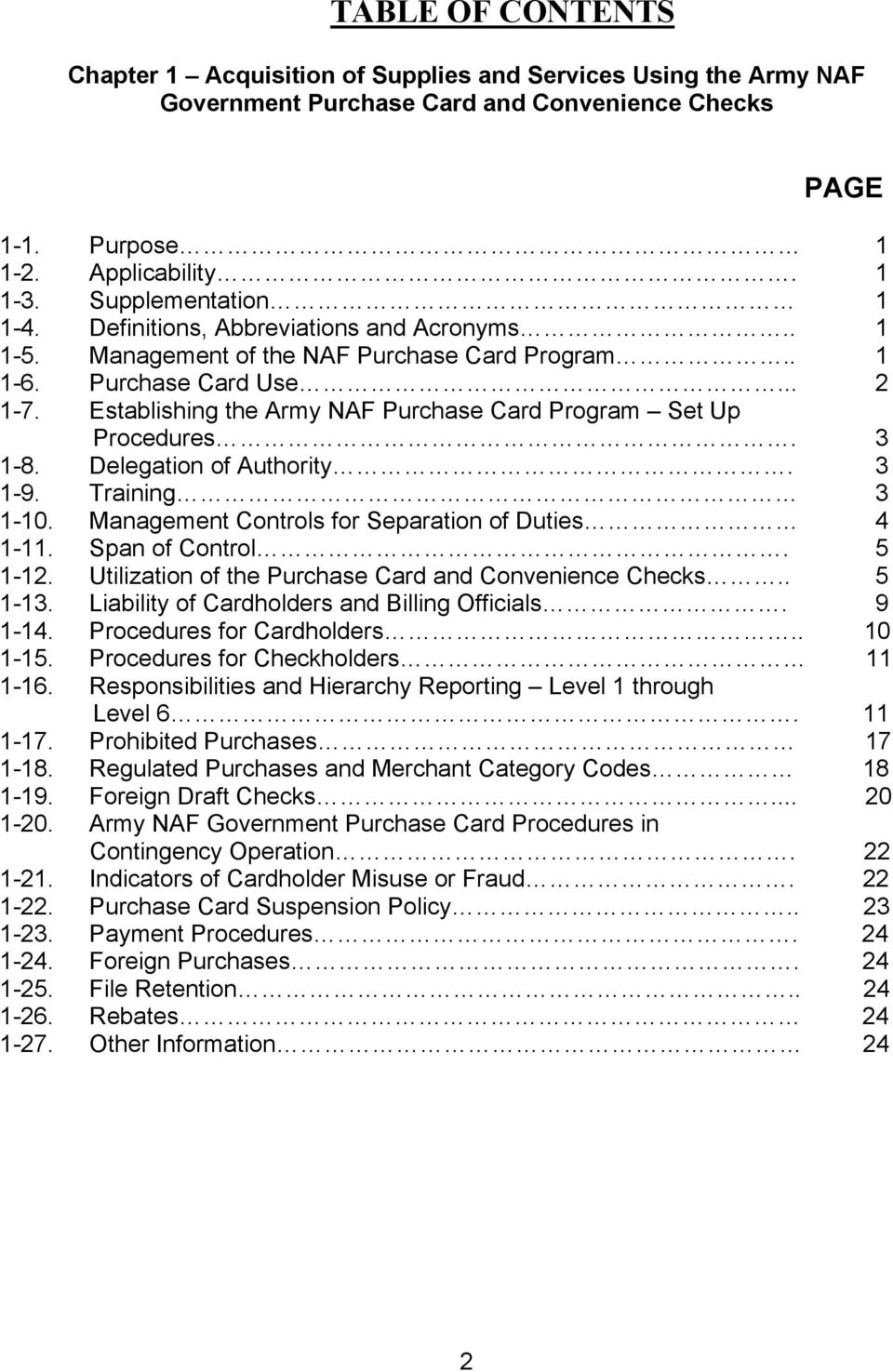
2 TABLE OF CONTENTS Chapter 1 Acquisition of Supplies and Services Using the Army NAF Government Purchase Card and Convenience Checks PAGE 1-1. Purpose Applicability Supplementation Definitions, Abbreviations and Acronyms Management of the NAF Purchase Card Program Purchase Card Use Establishing the Army NAF Purchase Card Program Set Up Procedures Delegation of Authority Training Management Controls for Separation of Duties Span of Control Utilization of the Purchase Card and Convenience Checks Liability of Cardholders and Billing Officials Procedures for Cardholders Procedures for Checkholders Responsibilities and Hierarchy Reporting Level 1 through Level Prohibited Purchases Regulated Purchases and Merchant Category Codes Foreign Draft Checks Army NAF Government Purchase Card Procedures in Contingency Operation Indicators of Cardholder Misuse or Fraud Purchase Card Suspension Policy Payment Procedures Foreign Purchases File Retention Rebates Other Information 24 2
3 TABLE OF CONTENTS CHAPTER 2 - Customer Automation and Reporting Environment Electronic Data Interchange Information (C.A.R.E. EDI) Policy and Procedures 2-1. Customer Automation and Reporting Environment (C.A.R.E.) Electronic Data Interchange Information- Transaction Management Accessing C.A.R.E. EDI Procedures in C.A.R.E. EDI Processing For Financial Managers Procedures in Operating C.A.R.E. EDI Processing System for Billing Officials Approving Transactions in C.A.R.E. EDI Transaction Management Acting on Behalf of Cardholder Procedures In Operating C.A.R.E. EDI Processing System for 2-9. Cardholders Reallocating a Cardholder Transaction to an Alternate Account Code Transaction Log Capturing End of Cycle Transactions for Accruals-NAFFIS Accounts E-Link in C.A.R.E.. 37 Appendices Appendix A Definitions 38 Appendix B Abbreviations and/or Acronyms 42 Appendix C Sample Appointment Letter for Billing Officials.. 44 Appendix D Sample Appointment Letter for Cardholder. 46 Appendix E Fixed Assets Guidelines Appendix F DFAS 1099 Tax Reporting Program 49 Appendix G Cardholder Purchase Log.. 50 Appendix H Army NAF Crosswalk (FA2).. 51 Appendix I Resource Material 52 3

4 CHAPTER 1 U.S. ARMY NONAPPROPRIATED FUND INSTRUMENTALITIES ACQUISITION OF SUPPLIES AND SERVICES USING THE ARMY NAF GOVERNMENT PURCHASE CARD AND CONVENIENCE CHECKS 1-1. PURPOSE: To establish and prescribe procedures for acquiring supplies and services using the Army NAF Government Purchase Card (GPC) and convenience checks. The purchase card may be used as a method of purchase for goods and services up to $100,000 and convenience checks may be used as a method of purchase for goods and services up to $2, APPLICABILITY: This Standing Operating Procedure (SOP) applies to all purchases being made with U.S. Army Nonappropriated Fund (NAF) dollars, and to those Level 4 individuals that participate in the GSA Smart Pay Purchase Card Program under the Army Level 3, 0021 hierarchy. (See Section 1-16, Responsibilities and Hierarchy Reporting Level 1 through Level 6) SUPPLEMENTATION: This SOP may be supplemented at the local level to the extent that it does not give authority beyond the guidelines established by the General Services Administration (GSA), the Department of Defense (DoD), the DoD Purchase Card Joint Program Management Office (PMO), and this SOP DEFINITIONS, ABBREVIATIONS AND ACROYMNS: Terms used in this SOP are defined in Appendix A. Abbreviations and Acronyms use in the SOP are set forth in Appendix B MANAGEMENT OF THE ARMY NAF PURCHASE CARD PROGRAM: a. The Director, NAF Contracting, U. S. Army Community and Family Support Center, (USACFSC) or designee, has overall responsibility for the NAF Purchase Card Program. The Level 3, Agency Program Coordinator, NAF Contracting Policy Division, has day-to-day responsibility for the management and oversight of the NAF Purchase Card Program worldwide. The Level 3 also serves as a liaison with the Army Program Management Office and Army NAF Level 4, Agency/Organization Program Coordinators (A/OPC). b. The responsibility for establishment and operation of this program is delegated to the IMA Regional MWR Chief. The Regional MWR Chief will designate Agency/Organization Program coordinators and alternates as appropriate in their regions. These individuals shall not redelegate their authority. The A/OPC and alternate A/OPC may be delegated to an appropriate authority without power of re-delegation. The Regional MWR Chiefs will ensure adequate resources are dedicated to the Army NAF Government Purchase Card Program to ensure successful management of the 1

5 program. The A/OPC and all alternates shall receive training in the purchase card program as well as in general contracting subjects. APC at all levels will be assigned to NAF 1102, contracting specialist and 1105, purchasing agent series. c. Authority is further delegated to the Chiefs of Contracting Offices. They will ensure that adequate resources are dedicated to the purchase card program for their location to allow for adequate administration. They will also coordinate with the local personnel office(s) to ensure procedures are established that will require individuals involved in the purchase card program to process through the A/OPC when they outprocess from the installation activity. Chiefs of Contracting Offices will ensure that the A/OPC receives training in the purchase card program as well as general contracting subjects. d. Activity directors and division chiefs or designees shall nominate individuals from their organizations as billing officials and cardholders. The A/OPC shall issue the delegation of authority by formal appointments to the certifying officer for purposes of certifying payments to the payment office for purchase card invoices. A sample appointment letter for a certifying officer is at Appendix C. It is the activity directors, division chiefs or designees responsibility to ensure that procedures are in place so individuals who are retiring or departing the organization will notify the A/OPC to turn in their cards and close their accounts PURCHASE CARD USE: a. Since 1989 the General Services Administration (GSA) has been contracting for purchase card services for Federal offices and agencies. The purchase card may be used to: (1) Make authorized NAF purchases (2) Place a task order or delivery order (if authorized in the basic contract, basic ordering agreement, or blanket purchase agreement) (3) Make payments against an existing contract when the contractor agrees to accept payment by the card (4) Fund training requirements b. See paragraph 1-12, Utilizations of the Purchase Card and Convenience Checks for information on the requirements for using the card and check as a purchasing tool and method of payment. 2
6 1-7. ESTABLISHING THE ARMY NAF PURCHASE CARD PROGRAM: a. To establish the purchase card program, send the name, address, telephone, e- mail address, and fax number to the Level 3 A/OPC. (1) The Level 3 A/OPC will set the hierarchy reporting levels and fax the account set-up forms to the U.S. Bank Relationship Manager for processing. (2) Account setup forms with specific instructions will also be sent to U.S. Bank by the Level 3 A/OPC. Forms may be downloaded from the Training and Marketing Web site, b. After the NAF Purchase Card Program is established, the Level 4 A/OPC is responsible for the account set-up and/or account maintenance administration to U.S. Bank. For additional information on implementing and setting up purchase card and/or check accounts, contact the Regional or Installation Level 4 A/OPC or the Level 3 A/OPC for information. In addition, the U.S. Bank A/OPC guide provides additional information for setting up accounts. The A/OPC guide located on the U.S. Bank s C.A.R.E. web site is at A login is required and may be obtained thru the U. S. Bank s Army Account Coordinator. User password will change every days DELEGATION OF AUTHORITY: Prior to receiving a purchase card account, the billing official will receive a written Delegation of Authority and cardholders will receive a written Letter of Appointment issued by the local A/OPC. The billing official s letter will outline the responsibilities and the monthly office limit. The Cardholder Letter of Appointment will outline responsibilities of the individual and indicate the maximum dollar amount allowed for each single purchase as well as the cardholder s monthly limit. (See samples at Appendices C and D) TRAINING: a. Training is required, prior to the appointment for all cardholders and billing officials. All new cardholders and billing officials are required to take the Defense Acquisition University (DAU) web-based on-line course entitled DOD Government Purchase CardTutorial (DAU/GPC). The course can be accessed through the following web link at Each A/OPC must ensure that cardholders and billing officials receive training. The DAU training course may be supplemented with training information germane to a particular location. As a minimum, training for cardholders and billing officials will cover the following areas: (1) Army NAF Government Purchase card program policies and procedures (2) Cardholder s and billing official s duties and responsibilities (3) Cardholder s and billing official s guides developed by U.S. Bank 3

7 (4) Funding, billing, payment, and file documentation requirements (5) Procedures and techniques for utilization of C.A.R.E./EDI (6) Property accountability procedures (7) Ethics (8) Mandatory sources of supply (9) Requirements for records retention (10) Prohibited items and items that require pre-approvals (11) Disputes (12) Cancellation, lost or stolen card procedures b. Refresher Training is mandatory for all cardholders and billing officials every year. This training will cover the changes that have taken place which affect the GPC program as well as special requests or needs of the group being trained. The DAU web-based training may be used for this training. c. A/OPCs should notify all participants in the GPC program of changes as they occur through the most efficient means, , newsletter, etc. Do not post C.A.R.E. security information on an unsecured web site. d. Each cardholder, billing official and financial manager will receive a copy of this SOP. This SOP is located on the Army NAF Government Purchase Card web page at: < e. Attendance at the annual GSA Smart Pay Conference is recommended for all A/OPCs and alternates. For information pertaining to this conference, go to the GSA website at f. All Level 4 A/OPCs shall establish and maintain training records that capture all GPC-related training that has been successfully completed by cardholders and approving/billing officials. Training records should include the type and date of successful completion of training, the mandatory DAU/GPC course, as well as other GPC-related training as determined by the A/OPC MANAGEMENT CONTROLS FOR SEPARATION OF DUTIES: a. Proper separation of duties shall be maintained for the NAF Purchase Card Program. Key duties such as making purchases (Cardholders), authorizing payments (Billing Officials), certification of funding (Financial Managers), reviewing and auditing 4
8 functions (A/OPC and Property Book Officers) will be assigned to different individuals to ensure proper management controls. If a cardholder is also a hand receipt holder, he/she should not be allowed to make purchases for him/herself. b. The exception to the requirements in paragraph a, is when a valid long-standing separation of duties cannot be achieved. A written waiver is required for any deviation to the separation of duties described in Para 1-10a. The waiver should include justification for the unique conditions and shall specify effective oversight management controls that will be put in place. The billing official or the financial manager, thru the Level 4 A/OPC, must prepare requests for waiver to policy thru the Level 3 A/OPC to the Director of NAF Contracting, USACFSC (or designee), for final approval. c. The A/OPC shall review, as part of his/her annual inspections, activities that are operating under a waiver for internal management controls. d. The A/OPC shall ensure that the petty cash custodian is not a cardholder SPAN OF CONTROL: The Army, in accordance with DoD policy, has adopted a span of control related to Level 4 A/OPCs and Level 5 billing officials. a. Level 4 A/OPC - The Army standard for the number of cardholders and billing officials that can be assigned to a Level 4 A/OPC is 300 accounts. In the event that there is a need to exceed the Army standard, approval is required by the Director of NAF Contracting, USACFSC or his designee. A formal written request must be submitted by the Level 4 A/OPC to the Level 3 A/OPC, stating the reasons for exceeding the Army standard and a detailed description of the oversight and management by the Level 4 to ensure adequate program administration and surveillance. b. Level 5 Billing Official The Army standard for the number of cardholders that can be assigned to one billing official is seven (7). Commanders, Directors, General Managers, and Contracting Chiefs will ensure the unit A/OPC function is adequately staffed to meet purchase card requirements and realign/cancel accounts to ensure billing officials are responsible for oversight of no more than seven (7) cardholders. Exceptions may be requested through the Level 3 A/OPC to DOD for approval. c. A total number of transactions as well as the number of assigned cardholders must be considered when determining an acceptable cardholder to billing official ratio UTILIZATION OF THE PURCHASE CARD AND CONVENIENCE CHECKS: a. Cardholders are authorized to use the purchase card to purchase authorized supplies, equipment and nonpersonal services for official use in support of the activity mission as follows: (1) $5,000 for supplies, equipment and resale items 5

9 (2) $2,500 for nonpersonal services (3) $2,000 for construction b. When using the card as a purchasing tool, items purchased shall not require technical inspection, extended service warranties or maintenance agreements. Purchase cards may not be used to pay salaries, wages, and monetary awards for direct-hire personnel and personnel hired during off-duty hours under a contract such as sports officials. c. Authorized overseas cardholders may use their cards as a purchasing method for commercial items up to $25,000 when the purchase is made outside the United States for use outside the United States. These orders must be the result of competition. The supply or service must be immediately available with one delivery and one payment being made according to policy. Documentation requirements set forth in AR must be accomplished. d. When the purchase card is being used as a method of payment against a written contract or purchase order, all applicable clauses and provisions shall be included in the contract document. These contracts must be awarded and documented IAW the requirements of AR e. Contracting personnel and other designated personnel may use the purchase card in conjunction with a contractual instrument for payment up to their warrant limit or ordering officer appointment authority. Ordering officer authority for purchase cardholders outside the contracting office shall not exceed $25,000. Purchases by ordering officers shall only be made in accordance with paragraph f below. When using the card in conjunction with another contractual instrument, the contract must specify the use of the card. f. If authorized to make purchases above limits set forth in paragraph a. above, cardholders not in the contracting organization will use the purchase card only to obtain items from pre-priced, competitively awarded contracts and agreements (e.g., Federal Supply Schedules (FSS), Blanket Purchase Agreements (BPAs), Indefinite Delivery/Indefinite Quantity (IDIQ) contracts, etc.) Orders placed under this method shall be accomplished in the Standard NAF Contracting System (SNACS). A/OPC should ensure that cardholders using the card IAW this paragraph are set up in SNACS under the security group entitled Purchase Cardholder. Orders placed against consolidated or IDIQ contracts issued by NAF contracting offices should, if possible, be furnished through SNACS to the Contracting Officer. Files for audit by the local A/OPC must be maintained by the cardholders on these actions. g. Purchases shall not be split into smaller buys to avoid the competition threshold. Splitting is the intentional breaking down of a known requirement to stay within a threshold (e.g., the cardholder s single or monthly purchase limit) or to avoid having to send the requirement to the contracting officer. Cardholder shall not split a 6

10 requirement into multiple transactions or split a requirement between cardholders to stay within the established threshold. This is known as splitting requirements and is prohibited. All requirements over a cardholder s competition threshold will be accomplished by the servicing NAF Contracting Office. h. Accountable supply items purchased with the purchase card are documented and reported to the property control officer. Accountable items will be physically marked and entered into the property control book (Reference AR 215-1, Chapter 12, Property Management (MWR/NAF)). Billing officials at each activity will work with the property book office to ensure that the accounting office has information concerning the purchase of supply items required to be recorded on financial statements. Please see sample memorandum at Appendix E, which should be sent to the servicing accounting office. i. When purchasing items by phone, over-the-counter or on-line via the internet, the cardholder should inform the merchant that the purchase is for official U.S. Government/NAFI purposes and, therefore, is not subject to state or local sales tax. For additional clarification each purchase card has the words US Government Tax Exempt printed on the face. Cardholders shall ensure that the web-site is secured. These web sites can be identified by the URL prefix j. Enhanced Authorizations (EAs). All items purchased over the phone or by mail for $25,000 and over must be approved through the Level 4 s U.S. Bank Army Account Coordinator prior to the purchase. An must be sent to include the account number (first 8 digits masked) and cardholder s name along with the following thresholds: (1) Number of transactions per day (2) Single purchase limit (3) Total spent per day (4) Mail Order/Phone Order/Internet Orders Amount, per transaction k. When the Army NAF Government Purchase Card is used as a payment tool in conjunction with a written delivery order issued against an existing contract, agreement or a purchase order, the statement "Payment to be made by Army NAF Government Purchase Card" shall be inserted in the appropriate block of the contract form prior to payment. Do not include specific information from the purchase card on the delivery order, purchase order or contract form (i.e., the account number). l. Certain commodities/services must be purchased through mandatory sources of supply. The local A/OPC will notify activities of the commodities and services requiring purchasing through these sources. These sources include: (1) NAF Consolidated Contracts 7

11 (2) Certain items on AFNAFPO Essential Products Program (3) Items from nonprofit agencies employing people who are blind or have other severe disabilities (e.g., Javits-Wagner-O Day, (JWOD) Program, (4) Agency/installation supply warehouses, (e.g., Defense Supply Centers) m. The purchase card may be used for official purchases at the Army and Air Force Exchange Service (AAFES) and the Defense Commissary Agency (DCA). n. Cardholders shall use the purchase card as the method of payment for all commercial training (government or nongovernmental sources) not to exceed $25,000 and shall use the Form DD 1556 (Request Authorization Agreement, Certification of Training and Reimbursement), in accordance with USC 41 for civilians along with any additional local forms and/or procedures for requesting training. o. Disputes for purchases made with the purchase card shall be handled IAW paragraph 1-16a(6)(n). p. The convenience check is issued to merchants that do not accept the purchase card. The amount of any single check will not exceed $2,500 per transaction. Splitting amounts across more than one check to keep below the $2,500 limit is prohibited. The fee for check writing is 1.7% of the face value of the check written. Checks should not be used to avoid the normal card payment process. Before a check is issued, the paying agency must make every effort to use the purchase card. (1) Convenience checks shall not be issued as an exchange-for-cash vehicle to establish cash funds. If merchants issue credits or refunds by cash or check, funds must be immediately credited back to the account from which they were originally made. See paragraph 1-15(e). (2) Convenience checks are negotiable instruments and must be stored in a locked container, such as a safe or locking filing cabinet. Convenience checks will be accounted for appropriately to prevent loss, theft or potential forgery. Convenience checking accounts must be audited by a disinterested third party under the guidance of the local Internal Review (IR) activity. Convenience check requirements must be added to the management control checklist for the Army NAF Government Purchase Card. Convenience checks will be reconciled just as other purchase card transactions, as a part of the monthly statement billing cycle. Copies of checks must be retained as a part of the account holder's original documentation file. (3) The issuing organization is responsible for all administrative costs associated with the use of these checks. The total purchase amount plus the program fee must be accounted for in the check writer s log and deducted from the funding document balance on the log sheet. 8
12 (4) Ensure all checks have cleared before closing the account. Convenience checks presented after an account has been closed will be returned to the merchant with an account-closed reason code. (5) Convenience checks may be mailed as long as internal controls, including the use of the check purchase log, are in place to avoid duplicate payments to payees. Lost checks are the responsibility of the check writer and the check writer must immediately notify U.S. Bank, the billing official and the A/OPC. (6) Convenience check writers are responsible for obtaining 1099 data for services paid by convenience check. The Defense Finance and Accounting Service (DFAS) has developed a tax reporting application system to allow check writers to enter the data from their convenience checks directly into the tax reporting package via the internet. Detailed instructions on use of this system can be found at Appendix F. (7) The dispute process is not available with convenience checks. Any concerns over a purchase made with a check must be resolved directly with the merchant. The check writer is solely responsible for obtaining a refund. Cardholder's Statement of Questioned Items (CSQI) form will not be accepted by U.S. Bank for purchases made by check. Each organization is responsible for checks written on an account unless it has been determined that fraud is involved. In some cases, payment can be stopped on a convenience check that has been written if the check has not yet been posted to an account. To stop payment on a check, call U.S. Bank Customer Service to receive instructions on processing the action. The stop payment will be in place for 6 months and U.S. Bank will charge a fee to the account. (The check writer must account for the fee on his/her purchase log.) If the check has already posted to the account, a request to stop payment cannot be honored LIABILITY OF CARDHOLDERS AND BILLING OFFICIALS: a. Intentional use of the purchase card for other than official government business may be considered an attempt to commit fraud against the U.S. Government/NAFI. Misuse may result in immediate cancellation of an individual s card, pecuniary liability, and negative administrative and/or disciplinary action against the cardholder and, if warranted, against the billing official. b. The cardholder shall be held personally liable to the Government/NAFI for any non-governmental transactions. Under 18 U.S.C. 287, misuse of the purchase card could result in a fine of not more than $10,000, imprisonment for not more than five years, or both. c. A billing official is pecuniarily liable for improper payments resulting from misuse/abuse of the purchase card in accordance with provisions of 31 U.S.C Billing officials are liable for an illegal, improper, or incorrect payment due to an inaccurate or misleading certification. If a billing official is unsure about certification, he/she should contact the supporting A/OPC for guidance and/or assistance. 9

13 1-14. PROCEDURES FOR CARDHOLDERS: a. Upon receipt of cards, cardholders must be sure to call the telephone number shown on the sticker attached to the purchase card to activate the accounts. Cardholders must know the single purchase limit assigned to them by their agency in order to activate their accounts. b. Funds Availability. Cardholders shall ensure that funds are available prior to making purchases. c. Price Reasonableness. Cardholders should ensure that a reasonable price is obtained by comparing prices offered by other merchants for the same or similar item or service. d. Documentation. Cardholders shall enter all transactions made by using the purchase card/check on a purchase log through C.A.R.E. EDI or manually (see sample at Appendix G if not EDI enabled.) Cardholders will submit to their billing official, monthly, all receipts regardless of the method for rendering payment. For cardholders not EDI enabled, a copy of the log, including all receipts, will be sent with the monthly billing statement submission to the billing official. All documentation shall be written in English. e. Administration and follow-up. (1) Cardholders, who are not C.A.R.E. EDI enabled, and whose payments are being made by NAF Financial Services, Texarkana, TX, shall provide (on a weekly basis) the purchase log with all pertinent information of purchases made in any given week. Cardholders may the weekly purchase log to NAF Financial Services(NFS), at [email protected], or fax it to , ATTN: Chief of Finance. (2) Cardholders must capture end of cycle transactions for accruals. Transactions made in a given month, but not appearing on the current billing statement, should be highlighted and noted on the transaction log prior to sending it to NFS in Texarkana. The cycle date ends on the 23 rd of each month. (Items purchased and received from the 24 th of the month through the end of the month must be provided to NAF Financial Services). f. Tax Exempt Status. At the time that the purchase is made, the cardholder shall advise the merchant that the transaction is for official Government/NAFI purposes, and is not subject to state or local tax. If a tax identification number is requested, the cardholder may obtain it from the A/OPC. g. Compliance with Laws and Regulations. Comply with all applicable laws and regulations including AR 215-4, NAF Contracting. 10

14 1-15. PROCEDURES FOR CHECKHOLDERS: a. Convenience check accounts must be established separate from the purchase card accounts. b. Convenience checks are subject to the same restrictions as the purchase card. For example, they cannot be used to pay salaries, wages, and monetary awards. c. Checks are limited to $2,500 per transaction. d. The purchase log for checks will show the name of the person who received the supply or service. e. Installations (Level 4) shall implement internal controls for check refunds in instances where merchandise purchased by check was later returned to the merchant. f. The number of checkbooks per installation must be kept to a minimum. g. Checks should be used at a minimum. Before a check is issued make every effort to locate a vendor that will accept the purchase card RESPONSIBILITIES AND HIERARCHY REPORTING LEVEL 1 THROUGH LEVEL 6: a. The Army NAF Government Purchase Card (GPC) Program is based on a sixlevel reporting hierarchy. (1) Level 1 DoD Purchase Card Joint Program Management Office (PMO). The first level of the reporting hierarchy represents the Department of Defense as a whole. The DoD Government Purchase Card Program is managed by Office of the Under Secretary of Defense (Acquisition, Technology and Logistics) and its Purchase Card Program Management Office (PMO). The PMO establishes annual training and documentation requirements for cardholders and other officials and oversees the Purchase Card Program. The PMO serves as the Level 1 reporting agency for DoD. (2) Level 2 Army Program Manager. The second reporting level identifies the military service. The Army Headquarters Agency/Organization Program Coordinator (A/OPC) is the level 2 reporting agency for the Army. This individual is located in the PMO and is designated as the focal point for the GPC Program and serves as a liaison between Army organizations, U.S. Bank, the DoD Purchase Card Joint Program Management Office, and the General Services Administration (GSA). (3) Level 3 Army NAF Agency/Organization Program Coordinator. The third reporting level representing the Army NAFI is located in the United States Army Community and Family Support Center (USACFSC), NAF Contracting Directorate, Summit Center, 4700 King Street, Fifth Floor, Alexandria, VA The Level 3 A/OPC is the liaison between the Army PMO, U.S. Bank, GSA and the 11
15 installation/region A/OPC. This individual has overall responsibility for managing the Army NAF Government Purchase Card Program for NAFIs worldwide. The A/OPC performance standards must reflect specific and measurable purchase card program objectives as part of their primary duties.the A/OPC s duties include but are not limited to the following: issues. (a) Serves as the point of contact for all Army NAF purchase card (b) Receives and issues guidance from higher-level authorities. (c) Establishes and maintains program-wide communication to include dissemination of program policies and procedures. (d) Reviews delinquent reports from U.S. Bank and assists in resolving delinquent accounts as required. (e) Maintains oversight of Level 4 A/OPC. (4) Level 4 - Agency/Organization Program Coordinator. The fourth reporting level identifies the region/ installation/organization. The NAF Procurement Office appoints an A/OPC responsible for the administration of the Army NAF Government Purchase Card Program at their location. The A/OPC is designated at the Level 4. A/OPCs are normally within the 1102/1105 contracting series; however, with the proper justification and approval by the Level 3, an A/OPC may be appointed from outside the contracting series. The A/OPC serves as the focal point for overseeing the program at his/her region/installation and is the primary contact for cardholders, billing officials and related purchase card services. The A/OPC performance standards must reflect specific and measurable purchase card program objectives as part of their primary duties. The A/OPC primary duties include, but are not limited to: (a) Processing purchase card applications; maintaining a current listing of all cardholders and approving officials under their jurisdiction; closing accounts upon abuse or misuse of card privileges, compromise of account information, card loss, or cardholder departure; and annually determining each cardholder s continuing need to maintain an account. (b) Issuing letters of appointment to billing official and cardholders. (c) Ensuring that initial and refresher training is conducted for all cardholders, billing officials and alternate billing officials, and that appropriate training records are maintained. (d) Maintaining proper span of control between billing officials and cardholders. 12

16 (e) Maximizing the use of the Army NAF Government Purchase Card for purchase and payment. (f) Monitoring cards issued by U.S. Bank s transaction reports during the billing cycle to disclose potential or improper use, and taking immediate action to address suspected legal or policy violations. (g) Maintaining all administrative changes such as addresses, spending controls and Merchant Activity Type (MAT) code blocking. (h) Managing purchase card account profiles to properly reflect transaction, line of accounting information and cycle spending limits, and merchant category code limitations. (i) Developing and implement local procedures to include local command prohibited items. (j) (k) Reviewing convenience check transactions. Processing requests for C.A.R.E. user IDs and passwords. (l) Processing written change requests and increases from cardholder that are approved by cardholder s billing official for single/monthly dollar limitations. required. (m) Assisting in resolving delinquent accounts or billing disputes when (n) billing invoices. (o) official accounts. Working with financial managers to correct and process rejected EDI Maintaining oversight and management of the cardholder/billing (p) Providing 100% inspection of billing official accounts annually. Hands-on inspections are preferred, but alternative methods are allowable. As part of this procedure, A/OPCs will review an adequate number of randomly selected transactions to verify that the cardholders are following correct procedures and processes. A/OPCs are encouraged to include participation from representatives of the local financial management office as well as any other local oversight in their surveillance programs. As a minimum, these reviews will address compliance with formal GPC purchase and payment procedures, validation of spending limits and span of control. In addition, Convenience Check Accounts and Foreign Draft Accounts will be audited quarterly. (5) Level 5 - Billing Official (BO)/Approving Official (AO). The fifth level identifies the Billing Official/Approving Official. The BO should be in the cardholder s chain of command. A cardholder cannot be appointed his/her own BO. The billing 13

17 official performance standards must reflect specific and measurable purchase card program objectives as part of their duties. The billing official shall be held accountable and pecuniarily liable for any illegal, improper, or incorrect payment processed by the NAFI as a result of an inaccurate or misleading certification. Sample appointment letter can be found at Appendix C. The billing official s primary duties include, but are not limited to: (a) Recommending purchase card dollar limits to the A/OPC for cardholders under their purview. Maintaining records of budget and approving and certifying purchases made under the program. (b) Verifying all transactions to ensure that they were necessary purchases in accordance with purchase card policy and guidance and all other Government/NAFI policy and procedures. (c) Ensuring the cardholder provides the NAF Financial Services (NFS) accounting office a copy of the purchase log to document purchases made between the 24 th of the month and the end of the month for only those NAFIs serviced by NFS, Texarkana. Cardholders will submit the purchase log whether EDI enabled or not EDI enabled. This log will allow the accounting office to accrue expenses to the proper accounting month. The log should identify the accounting data for items purchased. This log may be provided by sending to NFS the Cardholder Detail Transaction Report in C.A.R.E. (d) Reviewing, verifying, and reconciling cardholder statements (and approving the statements in the absence of the cardholder) for accuracy and completeness within five (5) business days of receipt of cardholder statement or within two (2) business days if EDI enabled. After review of the cardholder s monthly statement, billing officials will certify that the statement is correct and proper for payment and forward the coded (Location Code/Department Code/General Ledger Accounting Code [LC/DC/GLAC]) cardholder statement and billing official invoice to the appropriate payment office, including disputed charges. If there is a disputed charge, a copy of the CSQI shall be attached to the statement. (e) If non-c.a.r.e./edi enabled, the cardholders will forward complete documentation for their monthly purchases. Billing officials must have complete information from all cardholders at the time they submit their package to the payment office. Partial payments will not be made to U.S. Bank. Billing officials must ensure that information is received by the payment office in a timely manner. This will facilitate payment to U.S. Bank and increase rebates to the NAF (f) Retaining paper or electronic copies of billing statements and maintaining all original supporting documentation (e.g., receipts, logs, invoices, delivery orders, and approvals, etc.). (g) Receiving and date stamping receipt of the consolidated monthly billing statement for prompt payment. 14
18 (h) Monitoring payments and reviewing balance information on the monthly statements to ensure delinquencies do not exist. Billing officials shall resolve delinquencies with the paying office and U.S. Bank. In addition, billing officials shall retain all account files for a minimum of six years and three months after completion of payments. (i) Verifying, at least semiannually, that cardholders are in possession of their purchase cards. (j) A billing official may not transfer his/her cardholder s account to another billing official s account. The account must be closed by the APC under the originating billing official account and reopened under the new billing official. (k) Notifying the A/OPC of any lost/stolen cards (in addition to cardholder notifying U.S. Bank). The billing official must submit a written report to the A/OPC within five (5) business days detailing the circumstances of the lost or stolen card. (l) Reporting suspected cases of fraudulent, improper, abusive, or questionable purchases to the A/OPC. (m) Appointing an alternate billing official to serve for temporary absences through the A/OPC. (n) Notifying the A/OPC to terminate or reassign the billing official account prior to reassignment to other duties and/or departure from the installation/activity. For temporary absences, the alternate billing official shall be designated to perform the same duties as the billing official. (6) Level 6 - Cardholder. The sixth reporting level identifies the individual cardholder, the individual who is designated by an activity/organization to be a cardholder. The purchase card/check bears the card/checkholder s name and may only be used by the named card/checkholder to pay for authorized NAFI purchases. A cardholder s primary duties include, but are not limited to: (a) Completing required initial training and refresher training. (b) Screening for mandatory sources (i.e., JWOD) and rotate merchants. (c) Obtaining all required pre-purchase approvals. Ensuring funds are available to pay for the purchase. (d) Using the card to purchase and/or pay for official supplies and services in accordance with agency/installation policies. (e) Accomplishing purchases in accordance with local A/OPC training and guidance as outlined in this SOP. 15
19 (f) Staying within the purchase limits established for his/her account. A total single purchase may be comprised of multiple items, but the total may not exceed the authorized single purchase limit. Purchases will be denied if the authorized single purchase limit is exceeded. (g) Ensuring purchases are not split in order to stay within the single purchase limit and to avoid competition. Purchases that would exceed the single purchase limit must be forwarded through the proper channels to the Contracting Office for action. (h) Maintaining a purchase log in C.A.R.E. throughout billing cycle if EDI enabled. For activities not presently EDI enabled, a purchase log must be maintained. An example of a purchase log can be found at Appendix G. (i) Ensuring all purchases are allocated to the proper accounting code. The cardholder shall enter the Location Code (LC), Department Code (DC), and General Ledger Accounting Code (GLAC) on the purchase log as it applies to each purchase to ensure proper accountability. Contact the financial manager when lines of accounting codes are not displayed in C.A.R.E. (j) Ensuring the NFS accounting office receives a copy of the purchase log to document purchases made between the 24 th of the month and the end of the month for only those NAFIs serviced by NFS, Texarkana. (Cardholders will submit the purchase log whether EDI enabled or not EDI enabled.)this log will allow the accounting office to accrue expenses to the proper accounting month. The log should identify the accounting data for items purchased. See paragraph 1-14d(1)(2). (k) Verifying receipt/acceptance of goods or services. Resolving invalid transactions with merchants and tracking any purchases billed but not received. (l) Maintaining receipts and other supporting documentation. Cardholders should be able to provide documentation of purchases, i.e., invoices, receipts, etc., when requested by the billing official, A/OPC or auditors. In addition, cardholders shall maintain supporting documents for a minimum of three years after final payment. (m) Reviewing and reconciling all transactions and approved statements within five (5) business days of receipt or within three (3) business days if EDI enabled. If not EDI enabled, the cardholder's statement will be signed on the last page of the statement. If the statement contains multiple pages then the cardholder should sign both the first and last page. A cardholder should request a duplicate copy of his/her statement of account from U.S. Bank, customer service department if he/she has not received a statement within ten (10) business days of the cycle date. If EDI enabled, a copy of the statement may be accessed via C.A.R.E. transaction management. (n) Billing discrepancies that cannot be resolved with the merchant shall be handled as a dispute. The cardholder must either initiate a dispute through 16

20 C.A.R.E., or complete and submit a Cardholder Statement of Questioned Items (CSQI) form within 60 days from the date the cardholder statement of account is received. The cardholder must notify the billing official for all disputable transactions. (o) Reporting lost, stolen, or compromised cards immediately to U.S. Bank and notify billing officials immediately but not later than one (1) business day upon the discovery. The account numbers should not be released to other than the merchant processing the transaction. (p) Notify the A/OPC to terminate the card upon reassignment to other duties and/or departure from the installation/activity. b. Financial Managers (FM). The financial manager primary duties include, but are not limited to: (1) Coordinating funding and spending limits with billing officials and the A/OPC and providing billing officials/cardholders official notification of funding. (2) Building and maintaining the child rule set, assigning default and alternate lines of accounting as appropriate and in coordination with A/OPC, and entering them into C.A.R.E. (3) If responsible for non-c.a.r.e. EDI accounts, ensuring that obligations are posted prior to submittal of invoice. (4) Receiving and correcting C.A.R.E. EDI rejects with the A/OPC s assistance. (5) Assisting with resolving accounts in a delinquent status and provide payment information when requested. (6) The financial manager shall not be the billing official responsible for his or her own funding PROHIBITED PURCHASES: a. Prohibited purchases using the purchase card include: (1) Personal purchases (2) Travel advances or any other advances to include foreign currency (3) Payment of travel claims (4) Purchases from contractors or contractor s agents who are military personnel or civilian employees of the Government/NAFI 17
21 (5) Repetitive purchases from the same contractor when another method of purchase, such as a purchase order or blanket purchase agreement, would be appropriate (6) Payment of on-the-spot cash awards (7) Payment of salaries and wages (8) Cash advances, savings bonds or wire transfers (9) Long-term rental or lease of land or buildings (10) Fuel to include aviation, diesel, gasoline or oil for aircraft (11) Repair of leased vehicles (12) Purchase of major telephone services (i.e. FTS or DSN) s (13) Dating & escort services (14) Betting, casino gaming chips, off-track betting (15) Transactions with political organizations (16) Court costs, fines, alimony, child support (17) Bail and bond payments, pawn shops (18) Tax payments (19) Jewelry stores, antique shops/reproductions (20) Timeshares, saving bonds, security broker/dealers (21) Direct marketing insurance, financial institutions automatic cash advance, manual cash advance (22) Non-financial institutions foreign currency, money orders, travelers checks (23) Untreated wood (wood used for packaging and crating cannot be procured after 1 Oct 02 unless it is treated for parasites REGULATED PURCHASES AND MERCHANT CATEGORY CODES (MCC): a. The A/OPC may authorize the purchase of regulated items or items listed by preset MCC blocks in accordance with agency/installation policy. (See 1-18a(2),below) 18
22 Cardholders shall follow the following guidelines prior to purchasing any item requiring special approvals. (1) Regulated Purchases Cardholders shall contact their Level 5 Billing Official through the Level 4 A/OPC for approval prior to purchasing any of the following regulated items: (a) Hazardous/dangerous material must be approved by the local authority. (b) Personal clothing or footwear used as uniforms in conjunction with official duty. (c) Telephone equipment (e.g., cellular telephones, pocket pagers, answering machines, facsimile machines). Approval may require coordination through the activity s information management/technology office. Local guidance on this matter prevails. (d) Emergency airline, bus, train, car rental or other transportation services. The purchase card is not intended for use as a travel card when there are other programs or contracts for official travel. (e) Hotel lodging (this does not apply to conference and meeting spaces). (f) Purchases where a written contract should be used in order to protect the NAFI, or where the cardholder is required to sign the contractor s contract or agreement. Requirements for supplies and services requiring contract enforcement by means of a written contract shall be forwarded to the applicable NAF Contracting Office for execution. (2) Merchant Category Code Blocks If a cardholder determines that he/she must make a purchase from a source that has been blocked by DOD policy, the following procedures shall be followed: (a) The request to override DOD blocked Merchant Category Codes must be prepared by the billing official of the cardholder wanting to make the purchase. It must contain the name and masked account number (i.e., XXXXXXXX ) of the cardholder, a description of the item(s), merchant s exact name and address, estimated dollar amount of the purchase, estimated date of the purchase, efforts to locate a source other than merchant with a blocked MCC, and specify the need for this particular requirement (i.e., "a special magnifying glass to assist in detail circuit card wiring bought from a jewelry store ), and the merchant s MCC that must be overridden. (b) These requests will be routed through the Level 5 Billing Official through the Level 4 A/OPC to the Level 3 A/OPC for approval. If approved, the Level 3 will contact U.S. Bank to have this specific transaction approved from the restricted merchant. (Approvals will be granted on a transaction-by-transaction basis. This process will not open a restricted merchant.) After approval, the cardholder will have 5 19
23 days to make the purchase. Cardholder will advise the merchant at time of purchase that they will have to call the U.S. Bank Customer Service Department ( ) and provide the following information: (1) Purchase card number, Cardholder name and Cardholder billing address, and Purchase card Expiration date (2) Amount of the Purchase A/OPC. (3) Advise that this transaction has been coordinated through the Army (c) Blocked Merchant Category Codes are listed as follows: (1) Wire Transfer-Money Orders (2) Antique Shops (3) Pawn Shops (4) Jewelry Stores (5) Direct Marketing Insurance (6) Financial Institutions Manual (7) Financial Institutions, Automatic Cash Advance (8) Non-Financial Institution, Foreign Currency, Money Orders, Travelers Checks (8) Security Brokers/Dealers (9) Savings Bonds (10) Betting, Casino Gaming, Track Betting (11) Political Organizations (12) Court Costs, Alimony, Child Support (13) Fines (14) Bail and Bond Payment (15) Tax Payments FOREIGN DRAFT CHECKS: a. Foreign Draft Checks (FDC) provide an alternative for overseas requirements only when the purchase card cannot be used for payment, or when vendors/merchants do not accept the Army NAF Government Purchase Card. Foreign drafts provide the flexibility to issue low volume, low dollar payments for supplies and services in foreign currencies. All administrative costs associated with use of the foreign draft checks will be the responsibility of the activity paying for these costs. Foreign draft checks must be safeguarded by the activity when not in use. Lost or stolen checks must be immediately reported to U.S. Bank, the billing official and the Level 4 A/OPC. Issuance of a foreign draft check must be the most advantageous purchase method after evaluating all alternatives. Checks should not be used to avoid the normal card payment process. b. Foreign Draft Accounts should be located in the contracting office. Customer activities desiring accounts outside the contracting office must justify in writing to the 20
24 Chief of the Contracting Office why an account is necessary. Accounts will be authorized when appropriate and necessary to support mission requirements. The foreign draft check writers responsibilities include, but are not limited to: (1) Maintaining a separate purchase log for recording written checks in addition to a check register. (2) Receiving standard purchase card training prior to being issued an active foreign draft checking account. (3) Ordering, receiving, storing, issuing, inventorying, reconciling and disposing of check stock. He/she shall not be responsible for approving and processing requirements for check writing. c. Requests for establishing foreign draft accounts shall be sent to U.S. Bank, ATTN: Global Connections Help Desk, (800) or (612) , or requests to iboss@u. S. Bank.com. Available hours are from 8:00AM - 5:00 PM, Monday - Friday, U.S. CST. A U.S. Bank representative will provide instructions on the implementation process (e.g., information required from users, how to set up the system, how to install Global Connections software, and how to set up security codes to create foreign draft authorizations) to the requestor. d. Foreign draft convenience checks shall not be written for more than the foreign currency equivalent of $2,500 per check for the exact purchase amount, including the administrative processing fee. e. The account holder is the only person who has the authority to issue and sign foreign draft checks. Account holders may also hold a purchase card account as long as separate accounts are maintained. f. The billing official will review and authorize drafts prior to releasing them to the account holder. The account holder is responsible for presenting the draft to the merchant, and reconciling drafts on his/her account (cardholder statement) at the end of the billing period. In order to maintain effective internal controls, the approving billing official may not perform check-writing functions. g. Billing/certifying officials for foreign draft accounts accept pecuniary liability for payments made using the checking account. h. Splitting payment amounts across more than one foreign draft check to keep below the $2,500 limit is prohibited. Foreign draft checks shall not be issued as an exchange for cash or any other hard currency. i. Prohibited and regulated purchase card purchases apply to foreign draft checks. 21
25 j. Foreign draft checking accounts must be audited at least quarterly. The foreign checks are pre-numbered. Automated reports are available for U.S. Bank to assist checking oversight ARMY NAF GOVERNMENT PURCHASE CARD (GPC) PROCEDURES IN CONTINGENCY OPERATION Military or Government/NAFI civilians deployed in support of contingency operation should take their locally issued purchase card with them to use while deployed. The following actions will be taken prior to deployment. a. Coordinate with the contracting activity that has contracting authority in the contingency area to see if there are special requirements for using the GPC while deployed. b. The A/OPC is responsible for ensuring that the following tasks are completed: (1) Ensure EDI flags and routers have been enabled. (2) Ensure that the default line of accounting are set for the cards with the accounting data provided to support the contingency. (3) Ensure that the reallocation option is set to none. (4) Ensure and determine what additional information must be entered in the C.A.R.E. purchase log. (5) Ensure that an alternate billing official is established as necessary. c. If, after coordination with the contracting authority and A/OPC for the deployed area, it is determined that the deploying personnel shall not take their cards, these accounts should be temporarily suspended during the period of deployment INDICATORS OF CARDHOLDER MISUSE OR FRAUD: All instances of suspected fraud or misuse must be reported. Various channels of reporting are through the local chain of command, the A/OPC, the local procurement fraud advisor or other local policy guidelines. The following listing contains various indicators to assist you in determining suspected cases of possible fraud: a. Repetitive buys from the same commercial merchant. b. Lack of documentation to make the purchase. c. Purchase cards and account numbers are not safeguarded. d. Unsuitable merchant name or merchant address. 22
26 e. Cardholders authorizing someone else to use the card or cardholder s statement of account are approved by someone other than the cardholder or billing official (alternate). f. Inadequate oversight by billing officials and agencies. g. Unauthorized purchases, weekend activity, repeated declines, excessive disputes or accounts closed multiple times. h. Payment made for items not received, no receipts or proof of purchase. i. Split purchases to avoid credit card limitations. j. Cardholders returning merchandise to merchants for store credit vouchers instead of having credits issued back to the NAFI purchase card account PURCHASE CARD SUSPENSION POLICY: a. The Army goal is that all accounts will be paid on time. U.S. Bank s Army Account Coordinator will automatically suspend accounts that go over 60 days past due (90 days after the billing date). When a billing official account is suspended, none of his/her cardholders may use their cards until the delinquent payment posts at U.S. Bank. b. A billing official account that goes over 180 days past due (210 days after the billing date) will result in suspension of all accounts that are assigned to the respective Level 4 A/OPC. This usually will cause an entire activity GPC program to be suspended. c. U.S. Bank will normally notify the billing official and A/OPC of the pending suspension. Once an account becomes suspended, it will remain as such until the delinquent payment posts at U.S. Bank. Before an account can be reopened, the Level 3 A/OPC will have to document that payments have been made to U.S. Bank that clear the prior delinquencies. d. Accounts will be closed permanently if more than two suspensions occur within a 12-month period. e. Only the Army Level 2 A/OPC can approve waivers to the Army Purchase Card Account Suspension Policy. f. A/OPCs are strongly encouraged to work delinquencies expeditiously to avoid a major disruption in their card program. 23
27 1-23. PAYMENT PROCEDURES: NAF Purchase Card Program payment procedures are Pay and Confirm. Payments shall be paid in accordance with the Prompt Payment Act FOREIGN PURCHASES: Transactions initiated in a foreign currency will post to your account in U.S. dollars and may differ from the amount quoted by the merchant. The difference incorporates the currency conversion rate in effect for that purchase period and may be higher or lower than the rate in effect on the date of actual purchase. A currency fee of 1% may also apply to the transaction amount FILE RETENTION: Billing officials shall retain all account files for a minimum of six (6) years and three (3) months after final payment. Cardholders shall retain copies of receipts and statements for a minimum of three (3) years after final payment. If the C.A.R.E. EDI system is used he/she may use U.S. Bank s recordkeeping electronic statement. U.S. Bank will maintain the statements for seven (7) years for auditing purposes REBATES: a. Rebates are agency refunds based on the average number of days U.S. Bank must fund transactions. The optimum file turn time is 23 days (e.g., the number of days from the date of purchase to payment posting at U. S. Bank). The Army standard is 28 days. b. Rebates are calculated based on the average file turn time (the number of days from the date of purchase to payment posting at U.S. Bank) of the billing official s account. c. Rebates are paid every quarter based on calendar fiscal year. Rebates will appear on the billing statement as a payment. d. Rebates can be increased by increasing purchasing volume; card usage and file turn time. e. The more rapidly the payment is received and processed at the U.S. Bank card center, the greater the rebate OTHER INFORMATION: a. Other questions regarding your account or specific U.S. Bank procedures should be directed to U.S. Bank Customer Service Department at Outside the United States call (701)
28 b. Questions regarding your account involving fraudulent activity or further prevention guidelines should be directed to U.S. Bank Investigations Department at Outside the United States call (701)
29 CHAPTER 2 CUSTOMER AUTOMATION AND REPORTING ENVIRONMENT/ELECTRONIC DATA INTERCHANGE INFORMATION (C.A.R.E. EDI) POLICY AND PROCEDURES 2-1. CUSTOMER AUTOMATION AND REPORTING ENVIRONMENT (C.A.R.E.) a. The use of U.S. Bank s Customer Automated Reports Environment (C.A.R.E.) electronic access system is mandatory for all Army accounts including NAFIs. This electronic access system will be used to open, administer, perform surveillance, and process payments. b. Level 4 A/OPCs will use this system to establish and maintain all accounts. Instructions on the operation of C.A.R.E. for the A/OPCs, billing officials, and cardholders can be found on the U.S. Bank s training website ( Billing officials and A/OPCs should use the Transaction Management Module (TMM) features of C.A.R.E. to perform surveillance and oversight of all cardholder accounts. Transaction data is available in accounts that have not been C.A.R.E. EDI enabled. c. The use of the Purchase Card Log in C.A.R.E. EDI is mandatory for users that are EDI enabled. This documentation of transactions information should provide an audit trail supporting the decision to use the card and any required special approvals that were obtained. At a minimum, the log will contain the date the item or service was ordered, the merchant name, the dollar amount of the transaction, a description of the item or service ordered and an indication on whether or not the item was received. NAF activities may add to this list of required entries as required. Cardholders should make their log entries immediately after completing the purchase. d. Billing officials will ensure that the cardholders have reconciled all transactions with the appropriate log entries before certifying the billing statement. The proper sequence to approve transactions in C.A.R.E. is to reconcile first, then reallocate if appropriate. e. Cardholders and billing officials will also utilize the Electronic Data Interchange (EDI) features of C.A.R.E. to reconcile and approve cardholder statements and to approve and certify invoices. 26
30 2-2. ELECTRONIC DATA INTERCHANGE INFORMATION TRANSACTION MANAGEMENT: a. Electronic Data Interchange provides real-time online quality accounting and financial management information. The online process will allow cardholders, billing officials and financial managers the full electronics capabilities of a paperless environment which helps organizations transmit information and carry out transactions with its trading partners electronically. b. The message standards that U.S. Bank uses to transmit data are: - The invoice (810) - The credit invoice (820) - The obligation file (821) - The cost transfer file (821CT) for Pay and Confirm payment c. Transactions Management allows C.A.R.E. users access to review, approve, dispute, reallocate transactions and/or create or reconcile transaction log entries ACCESSING C.A.R.E EDI: a. To access C.A.R.E., a user must have a user ID and a password. The A/OPC, level 4 will obtain the User ID and password from U.S. Bank Techsupport for billing officials. Cardholders will use on-line registration. b. Passwords must be 8-12 characters long with at least one (1) alpha and one (1) numeric character. A new password is good only for an initial login, and then the user is prompted to change the user s password. c. The login password will automatically expire when not used for six (6) months. If this should happen, a new UserID and password must be established by the A/OPC. d. After three (3) unsuccessful logon attempts, C.A.R.E. will automatically inactivate the User ID/password and will not allow the user to log into the system. If this happens, the cardholder or billing official will have to contact U.S. Bank Customer Service at to reset User ID/password. e. A/OPCs will contact U.S. Bank Techsupport-Help Desk to reset User ID/password. f. For security purposes, while users are in C.A.R.E., the Back tab in the user s web browser does not work. Using the Back tab logs the user out of C.A.R.E.; if this happens the user must restart the C.A.R.E. session and go through the login process again. 27
31 2-4. PROCEDURES IN C.A.R.E. EDI PROCESSING FOR FINANCIAL MANAGERS: a. Financial Managers are responsible for entering and maintaining the Child rule set data, setting the flag and routers, and creating and editing default/alternate lines of accounting. (The Parent rule set is built by the U.S. Bank Team.) b. Procedures set forth below will apply to those Army installations serviced by NAF Financial Services for accounting. Procedure may vary in those NAF organizations serviced by other accounting entities. Log into the C.A.R.E. Website; ( Logon with User ID/password c. Creating and entering data in Child Rule Set. (1) Cost Allocation. Cost allocation rule sets are defined when an organization is going to use Transaction Management or default accounting codes. Cost allocation is where you can build and maintain Child rule set(s) and Alternate accounting codes. Child rule set(s) and Alternate accounting codes lay the foundation for allocation methods used in Transaction Management. (2) Click Cost Allocation from left side of screen. (3) Click Child Rule Set from options. (4) Enter name for rule set, up to 25 characters, and hierarchy node (level four number) information. (5) Click on Set-Up Rule Set. (6) Choose ARMY NAF and click OK. Since all NAF fields are required and validated, SKIP TO ITEM 11. (7) Go into Accounting Code Structure tab at top of screen. (8) Segment names and lengths appear in box below. Decide whether each segment should be required or validated. (See Appendix H - FA2 Army NAF Crosswalk for requirements.) (9) Click Submit. set. (10) Continue with this screen until you have added all segments for that rule (11) Go into Accounting Code Values tab at top of screen. (12) Choose segment from drop-down box. 28
32 (13) Click on Show available. If values are available, select appropriate value by clicking on the value. Click on Add value. Value will now appear in work area. (14) If NULL appears, there are too many values to display. In order to display a value, type an appropriate value in the Valid values box and click on search. If value is valid it will now appear in available value box. Click on Add value. Value will now appear in work area. (15) Multiple values can be added for each segment. The Work Area window will hold all selections. (16) After all segments are built, click Submit on left side bar to save the new Child Rule Set. It will validate against pre-loaded information. Do this entire procedure for each Child Rule Set established. d. Establishing Alternate Lines of Accounting Alternate lines of accounting are used for transaction reallocation which is similar to a default accounting code. Alternate accounting codes allow cardholders to define a valid accounting code as a needed reallocation. (1) Click Cost Allocation, Click Child Rule Set Option, and Enter Child Rule Set Name, and the hierarchy node. (2) On right side of screen, click the Alternate Accounting Codes tab. (3) Type in identifying name (i.e. name of activity). Click Add. (4) Add values to each segment (same as Child Rule Set building screen), and then Submit. e. Establishing Managing Account Flags and Routers The flags and routes are the behind the scenes actions that tell the system where the electronically certified files are to be sent. (1) Click on Account Maintenance. (2) Choose a Managing Account and enter accounting number. (3) Go into Account Information tab. (4) This screen is used to set the EDI flags. Select routing number from dropdown list. Select NAFTST 810 for invoice route and NAFTST 821 for obligation. Click on OK. 29
33 f. Establishing Managing Account Allocation Method. Setting this gives the functionality for Cardholder s to change accounting codes. (1) Go to Financial Control tab. (2) Attach Managing Account to a child rule set from list. Codes. (3) Select Reallocation method. Push tab marked Alternate Accounting (4) Choose the Alternate Lines of Accounting that are applicable to that account, based on the cardholder attached to this managing account from list that was already established in Step 2. (5) Then Submit to save. g. Establishing Managing Account Default Lines of Accounting. Although no transactions are ever charged to the managing account this is a required step. (1) Click on Account Maintenance. (2) Go to Managing tab and enter account number. (3) Select Financial Control tab. (4) Click the Create/Edit default accounting code button. (5) Scroll through all required segments in accordance with FA2 Cross-walk (see Appendix H), and populate with only one valid value. (6) Once all segments are populated click OK. (7) This will bring you back to the previous page and you will click on the Submit tab to save. h. Establishing Cardholder Default Lines of Accounting. (1) Click on Account Maintenance. (2) Go to Cardholder and enter account number. button. (3) Select Financial Control tab click the Create/Edit default accounting code (4) Scroll through all required segments in accordance with FA2 Cross-walk (see Appendix H) and populate with only one valid value. 30
34 (5) Once all segments are populated, click OK. (6) This will bring you back to the previous page and you will click on the Submit tab to save PROCEDURES IN OPERATING C.A.R.E. EDI PROCESSING SYSTEM FOR BILLING OFFICIALS a. Billing officials are responsible for reviewing, approving, certifying and reallocating cardholders purchase card transactions in C.A.R.E s Transaction Management. (Once all cardholders under a billing official have approved, reallocated or disputed all of the transactions, the billing official will verify that the transactions and disputes are valid and concur in accordance with EDI procedures). b. Billing officials may act in the behalf of the cardholder by using the Act on Behalf of Cardholder Option. (If the Cardholder is out of the office for an extended time, the billing official may approve, dispute or reallocate the cardholders transactions.) 2-6. APPROVING TRANSACTIONS IN C.A.R.E EDI TRANSACTION MANAGEMENT Log into the C.A.R.E. Website: ( Logon with User ID/password a. The first screen you ll encounter is the License Agreement. It states the acknowledgement and acceptance of C.A.R.E. terms and conditions. Click on I agree. b. The second screen is the C.A.R.E. log in screen. The user ID provided by U.S. Bank is your User name. You will be required to change your password every 60 days. The system will prompt you when it s time. Enter user name and password and click the Login tab. (If you should forget your password, click the Click here link, which details the process of resetting the password online.) c. Once you successfully log on to C.A.R.E, The third screen (displayed in the center of the screen) is the Welcome to C.A.R.E. screen. (In the center of this screen is important information about C.A.R.E update). d. On the left hand side of the screen, you can navigate to the task on which you wish to work. (1) Click Transaction Management and the Transaction Management applet loads. (Do not click the tab as the tab is inactive). If you don t have Java Script and MSVM enabled on your computer, your account information will not load when you make this choice. You will be told to wait while your account information loads. (2) Once Transaction Management loads, select the account by highlighting the name of the person who is managing account holder. This will cause the dates on 31
35 the right hand side of the screen to become active. Click the Cycle Date of the current billing cycle (i.e., 01/23/2002, 02/22/2002). (3) Once you select a cycle date, the Cardholder Accounts tab becomes active. Click the date to produce information at the bottom of the screen reflecting the status of accounts under the managing account. If all cardholder accounts within a cycle are approved, the Certify Invoice tab will be highlighted. The managing official could certify the statements at this time; however, the official must first review the individual cardholder accounts to ensure the information is valid. (4) To review the cardholder account information: (a) Click on Cardholder Account tab at the top of the screen. This will display all cardholder accounts under the managing account. (b) Select and click Cardholder Account. When you select a cardholder account number, account summary information displays at the lower portion of the screen. (Selecting a cardholder account also activates the Transactions and Transaction Log tabs). (c) To review individual transactions, click on the Transactions tab. This will display all transactions for the selected cycle. To review transaction details, use the three transaction tabs located below the list of transactions. (5) To review the transaction log: (a) Click the Transaction Log tab at the top of the screen. (The log must be maintained by the cardholder.) The log will provide necessary information to support the charge on the billing statement. (b) Once cardholder accounts are reviewed and approved, click on the Managing Account tab. This will bring you to the screen to certify the invoice for payment. To certify the bill, click the Certify Invoice button to complete the certification. (This action will certify the invoice and you are through.) (c) After the invoice is certified, you can view transactions but no further actions can be performed on the transactions. (d) To exit the system, click on the File tab (close) to close the screen. This will bring you to the original sign on screen. If you are finished, click on the Logoff tab to log out of C.A.R.E. 32
36 2-7. ACTING ON BEHALF OF CARDHOLDER This choice allows the billing official to take all actions a cardholder would make regarding transactions. The account is marked to reflect the billing official and not the cardholder performed functions. After 15 days beyond the close of the billing cycle, the cardholder is automatically locked out from performing functions. Once the lock out occurs, the billing official must act on behalf of the cardholder. (1) Select a Managing Account and a Cycle Date (2) On the Cardholder Accounts tab, locate the Acting on behalf of cardholder drop down menu. (Located on the top right-hand side of the screen) (3) Change the menu option to Yes. If the option is left as No, the actions taken for individual transaction are dependent on regular billing official functionality. (4) Select Cardholder Account and start working with the transactions as described above. The billing official can now act on behalf on the cardholder PROCEDURES IN OPERATING C.A.R.E. EDI PROCESSING SYSTEM FOR CARDHOLDERS Approving transactions in C.A.R.E. EDI transactions management - Log into the C.A.R.E. Website: ( Logon with User ID/password a. The first screen you ll encounter is the License Agreement. It states the acknowledgement and acceptance of C.A.R.E. terms and conditions. Click on I agree. b. The second screen is the C.A.R.E. log in screen. The User ID provided by U.S. Bank is your Username. You will be required to change your password every 60 days. The system will prompt you when it s time. Enter Username and Password and click the Login tab. (If you should forget your password, click the Click here, link, which details the process of resetting the password online. c. Once you successfully log on to C.A.R.E, The third screen (displayed in the center of the screen) is the Welcome to C.A.R.E. screen. (In the center of this screen is important information about C.A.R.E update). d. On the left-hand side of the screen, you can navigate to the task on which you wish to work. (1) Click Transaction Management. The Transaction Management applet loads. (Do not click the tab as the tab is inactive). If you don t have Java Script and MSVM enabled on your computer, your account information will not load when you make this choice. You will be told to wait while your account information loads. 33
37 (2) Once Transaction Management loads, select the account by highlighting the name of the person who is managing account holder. This will cause the dates on the right hand side of the screen to become active. Click the Cycle Date of the current billing cycle (i.e. 01/23/2002, 02/22/2002). (3) Once you select a cycle date, the Cardholder Accounts tab become active. (4) When you select the cardholder account number, account summary information displays in the lower portion of the screen. By default, the first transaction is highlighted and its transaction detail displays in lower portion of the screen. (Lower portion includes individual purchase and the accounting code). (5) If the purchase is correct, you will click on the Approve tab. This will change your status from Pending to Approve. You will need to do this for every purchase that you have made. You also have to approve any and all credits/rebates appearing in this section. This is also the area to reallocate your funds or dispute an item. (6) Once all your transactions have been approved, you will click Back one tab to Cardholder Accounts. If this is the end of the billing cycle, the Approve tab will now be active and you can click it to approve your entire statement. NOTE: Remember that you cannot approve the entire statement until all individual transactions have been approved first. Although you can approve purchases anytime after the beginning of the billing cycle, you cannot approve the entire bill until the end of the cycle REALLOCATING A CARDHOLDER TRANSACTION TO AN ALTERNATE ACCOUNTING CODE a. The Transaction Management Screen will allow you to reallocate funds to other than the default accounting code. The reallocation method that will be used by cardholders and billing officials is Reallocation by Alternate Accounting Codes (Financial Management has established the available alternate accounting codes). All transactions are automatically applied to the default accounting code. (1) Once you have selected a cardholder, click the Transactions tab. (2) Select the transaction you want to reallocate. (3) When reallocating a transaction, you can reallocate by dollar amount or percentage. The system automatically calculates the amount of the transaction you still need to reallocate. You are not allowed to submit a transaction until the entire amount is reconciled. You can reallocate funds to a single alternate accounting code or multiple reallocating to multiple codes. (4) Click Reallocate, located on the Transaction Detail tab. 34
38 (5) The Reallocate Transaction window opens in a new browser window. b. Reallocating half of a transaction to an Alternate Accounting Code, and leaving half at the default accounting code. (1) Click on the Reallocate tab and click Default under the Accounting Code, you will need to click Default to allocate the first half of the payment to the Default Accounting Code heading. (2) Enter the dollar amount or percent to be allocated to that particular accounting code. (The transaction will automatically be populated in the amount area and the percent will be 100%. Since half of our payment is going to go to the Default Accounting Code, you ll need to change the 100% to 50% (or you can do it by dollar amount if you prefer). (3) Click the Update tab. (4) Select an Alternate Accounting Code under the Accounting Code heading. (5) Enter the amount or percent to be allocated to that particular Alternate Account Code. (Accounting Code will now show the Default as 50% with the appropriate dollar amount). In the Accounting Code area, you must now click New Entry. At the top of the screen will be the Alternate Accounting Code drop-down box. (6) Click on the Arrow and pick the appropriate Alternate Accounting Code for your reallocation. (If you click the drop-down box and nothing appears you ll need to contact your Financial Manager to get these codes set up.) (7) Repeat this process until the entire transaction is relocated. (Populate the amount or percent box with the remaining amount of money and click Add. Once 100% of the transaction is reallocated, the Submit tab becomes active.) (8) Click Submit.. Once a transaction is successfully reallocated, the Status (on the Transactions tab) display changes from Pending to Approve. You must follow the above procedure for any transactions that need reallocation. NOTE: If you are going to reallocate 100% of the transaction to a single alternate accounting code, you must first zero out or delete (recommended) the default accounting code before applying the money to an alternate accounting code TRANSACTION LOG a. Every time a purchase is made an entry must be made in the electronic transaction log. (1) Click the Transaction Log tab at the top of the screen to access the log. 35
39 (2) Enter detailed data as necessary. (Data should be in enough detail to support an audit of the transaction). When the transaction is reconciled with the transaction log, the data in the log will be appended to the transaction data to complete the detail file. (3) When the purchased item appears on the transaction file, it can be reconciled with the log. This can be accomplished by highlighting a transaction and activating the Log Detail tab at the bottom of the list of transactions. To complete the reconciliation, click the Reconcile button. (4) The program will attempt to match the selected transaction with the closest transaction in the log entry. (5) If the system does not select the desired log entry, remove the incorrect entry by using the Remove and manually select the correct log entry from the list and by using the Add button. (6) Once you select the desired log entry for the transaction you want to reconcile, click the Reconcile button to complete the reconciliation. (7) After a transaction has been updated the transaction status will change to Approved. (8) Once the transaction has been successfully reconciled, all the log information will be posted to the Log Detail and Log Line Item Detail tabs. The process will not overwrite any transaction information passed by the merchant CAPTURING END OF CYCLE TRANSACTIONS FOR ACCRUALS-NAFFIS ACCOUNTS a. In order to reflect proper accounting cost transactions for items purchased and received between the 24th of the month through the end of the month must be provided to NAF Financial Services. (Cardholders whose payments are being made by NAF Financial Service, Texarkana, TX). b. This data resides in the Cardholder Full Transaction Detail Report. To access the data, click the Reports tab. Select Cardholder Full Transaction Detail Report from list of available reports. On the next screen, select a date range of 24th to the first day of the following month (the date of 24 may be adjusted if the cycle closes earlier), select Cardholder and type cardholder account number, and select output to Excel. c. Once the data is in Excel delete unnecessary data fields. Save the amount, date, and accounting data. Also delete any transaction that has not been received or has a submitted receiving report. This file can be electronically forwarded via to NAF Financial Services. 36
40 2.12. E-Link in C.A.R.E. a. At the top of every page in C.A.R.E there is an e-link that will assist in understanding C.A.R.E: The tab is labeled E- Services b. The E-Services link takes you to the following C.A.R.E. information: Contact information (phone numbers for the help desk and customer service) Additional C.A.R.E. documentation C.A.R.E. s web-based training 37
41 APPENDIX A DEFINITIONS The following definitions are for terms commonly used in these procedures. Other definitions that are not detailed below are contained in the training manuals provided by the U.S. Bank. 1. Agency/Organization Program Coordinator (A/OPC). A Government/NAFI employee responsible for the overall administration of the activity/organization s purchase card program, to include developing and implementing policy, establishing and making changes to accounts, as well as training for cardholders and billing officials. This individual shall have overall responsibility for the card program within their agency/organization. Multiple levels of Agency/Organization Program Coordinators exist at different hierarchical levels within the program for each agency/organization. 2. Alternate Accounting Code. A process used to ensure that the cardholder identifies and reallocates to a valid accounting code. 3. Billing Cycle. The billing cycle ends on the 23 rd of each month for a 30-day billing period. 4. Billing Cycle Purchase Limit. The spending limit assigned to each cardholder s cumulative purchase and transactions within a billing cycle. 5. Billing Invoice. The billing invoice identifies all of the purchase card transactions, made by cardholders assigned to a particular Billing official, which are posted during a billing cycle. The invoice can be paper based or presented through the Electronic Access System of the issuing bank. 6. Billing Official. (Approving Official) A Government/NAFI employee, who has been nominated by his/her activity/organization s and appointed by the A/OPC, to have oversight responsibility over the cardholders assigned to his/her managing account. Reviews transactions and certifies monthly invoices (billing statements) for payment processing. Is also appointed as the Certifying Official. In U.S. Bank hierarchical terms, is considered a Managing Account and is the Level 5 reporting level. 7. Bulk Funding Method. The bulk funding method requires posting specific funds to the official accounting records prior to payment of a cardholder's account. Bulk funding may be made as appropriate to the funding environment of the activity. 8. Cardholder. An individual designated by an agency to be issued a card. The card bears the individual s name and can be used by that individual for official 38
42 purchases in compliance with agency internal procedures. Also applies to convenience check account. 9. Cardholder Monthly Purchase Limit. The monthly cardholder purchase limit is a budgetary limit assigned by the BO for the total value of purchases that a cardholder may make in one month. 10. Cardholder Single Purchase Limit (SPL). The maximum dollar amount allowed for each transaction by the cardholder. 11. Cardholder Statement of Account. The statement of charges provided to a cardholder detailing all of the transactions posted to his/her account during a billing cycle. 12. Cardholder Statement of Questioned Item (CSQI) Form. The document used by the cardholder to dispute an item that is in question. The original is sent to U.S Bank Government Services and a copy is sent to the billing official 13. C.A.R.E.-EDI. The DOD mandated method in which cardholders (CH) and managing officials (billing officials - BO) can view, reallocate, approve, and certify all purchase card transactions via the Internet without the need for paper statements. ( 14. Child Rule Sets. The foundation for the allocation methods used in Transaction Management. Child rule sets are used to further control or restrict the values for each segment of the rule set. 15. Convenience Checks. Third party drafts issued using the government-wide purchase card account. Third party drafts may be used to acquire and to pay for supplies or services. Policies and regulations concerning the establishment of and accounting third party drafts, including the responsibilities of designated cashiers and alternates, are contained in Part IV of the Treasury Financial Manual for Guidance of Departments and Agencies, Title 7 of the General Accounting Office Policy 16. Cost Allocation. Where you can build and maintain Child Rule Set(s) and Alternate Accounting Codes. Child Rule Set(s) and Alternate Accounting Codes lay the foundation for allocation methods used in Transaction Management. 17. Customer Automation and Reporting Environment (C.A.R.E.). The U.S. Bank s electronic access system to provide functional capabilities in reporting, account setup and maintenance, review of transactions and electronic payment. 18. Disputed Transaction. A questionable transaction posted to the Cardholder s statement of account. For reporting questionable transaction use Cardholder Statement of Questioned Item (CSQI) Form. Disputed Transaction may also be disputed via C.A.R.E. EDI. 39
43 19. Electronic Access System (EAS). A web-based computer system required by the task order with the issuing bank for account set-up, maintenance, reporting and electronic bill presentment and certification. 20. Electronic Data Interchange (EDI). The automated, paperless bill paying features in C.A.R.E. 21. Federal Information Processing Standards (FIP). Accounting code used in the C.A.R.E. account setup. FIP for DOD NAF Army is Complete information of FIP can be found on the web at File Turn. Average number of calendar days between the time a charge is posted and the time a payment is received. 23. Financial Manager. Responsible for building and maintaining child rule set, alternate and default lines of accounting. 24. Fraud. Any intentional deception designed to deprive the Government/NAFI unlawfully of something of value or to secure from the Government/NAFI for an individual a benefit, privilege, allowance, or consideration to which he or she is not entitled. 25. General Services Administration (GSA). The agency that established the Government-wide purchase card program and is responsible for administering the contract with U.S. Bank. 26. International Merchant Purchase Authorization Card (IMPAC). A registered trademark provided by U.S. Bank to identify the Army s VISA purchase card. All purchase cards issued are now referred to as Government Purchase Cards. 27. Javits-Wagner-O'Day (JWOD). A law, which establishes mandatory sources for supplies and services, administered by the Committee for Purchase from People Who Are Blind or Severely Disabled. Two national, independent organizations, National Industries for the Blind (NIB) and National Industries for the Severely Handicapped (NISH), help state and private nonprofit agencies participate in the JWOD Program. 28. Merchant Activity Type (MAT). When a merchant becomes VISA-capable, they are assigned a Merchant Category Classification (MCC) or Standard Industrial Classification Code (SIC) code by their processing bank according to their industry type. U.S. Bank Government Services has group the codes into categories, which are called Merchant Activity Type (MAT) codes. 40
44 29. Merchant Category Code (MCC). A code used by the issuing bank to categorize each merchant according to the type of business the merchant is engaged in and the kinds of goods and services provided. These codes are used as an authorized transaction type code on a card/account to identify those types of businesses who provide goods and/or services that are authorized. The DoD Purchase Card Program Management Office will maintain the list of DoD-wide blocked codes. It will be the responsibility of the Army Level A/OPCs to administer and record any waiver requests to these blocks. 30. NAF Purchase Card Log. A manual or automated log in which the Cardholder records each purchase transaction. 31. Parent Rule Set. Provide a common platform on which to define accounting code structures consistent with an organization s general ledger system. The rule set (built by the U.S. Bank team) defines the structure, validation rules, and master list of valid values for each segment of the rule set. Parent Rule Sets are typically built without many constraints. 32. Pre-Purchase Approval. When required and identified by Army or local procedures, documentation showing authority has been obtained to purchase special use items (hazardous material, Information Technology, etc.). 33. Prompt Payment Act. Public Law (96 Stat 85, 31 USC ) requires prompt Payment of invoices (billing statement) within 30 days of receipt (See specific Prompt Payment Clauses). 34. Rebate. A refund earned by the agency based upon dollars spent and timeliness of payment to U.S. Bank. 35. Reconciliation. The process of verifying the transaction on a statement against receipts or records representing all monthly purchases a Cardholder has made. 36. Split Purchase. Splitting is the intentional breaking down of a known requirement to stay within a threshold (e.g., the cardholder s single or monthly purchase limit) or to avoid having to send the requirement to the contracting officer. Cardholder shall not split a requirement into multiple transactions or split a requirement between cardholders to stay within the established threshold. 37. Tax Exemption. All purchases are exempt from state and local taxes to the extent permitted by law. The phrase US Government Tax Exempt is embossed on the front of each purchase card. 41
45 APPENDIX B ABBREVIATIONS AND/OR ACRONYMS AO Approving Official A/OPC Agency/Organization Program Coordinator AFARS Army Federal Acquisition Regulation Supplement AR Army Regulation BO Billing Official BPA Blanket Purchase Agreement CARE Customer Automation and Reporting Environment USACFSC United States Army Community and Family Support Center USACFSC-NCP United States Army Community and Family Support Center, NAF Contracting Policy CSQI Cardholder Statement of Questioned Item DA Department of Army DC Department Code DCAA Defense Contract Audit Agency DLA Defense Logistics Agency DoD Department of Defense EAS Electronic Access System EDI Electronic Data Interchange FIP Federal Information Processing Standards FDC Foreign Draft Checks GAO General Accounting Office GLAC General Ledger Accounting Code 42
46 GPC Government Purchase Card GSA General Services Administration IDIQ Indefinite Delivery Indefinite Quantity IMPAC International Merchants Purchase Authorization Card JWOD Javits-Wagner-O Day LC Location Code MAT Merchant Activity Type MCC Merchant Category Codes MWR Morale, Welfare and Recreation NAF Nonappropriated Fund NAFI Nonappropriated Fund Instrumentality NFS NAF Financial Services PMO Program Management Office SF Standard Form SOP Standard Operating Procedure SPL Single Purchase Limit 43
47 APPENDIX C SAMPLE APPOINTMENT LETTER FOR BILLING OFFICIAL MEMORANDUM FOR: (Name, Office Symbol) Date SUBJECT: Designation of Billing Official (or Alternate Billing official) 1. You are hereby designated as a Billing official for the cardholders assigned to your activity under the administration of (Name), the Agency/Organization Program Coordinator (A/OPC). Your appointment is effective as of the above date and shall remain in effect until: You are reassigned, Your employment is terminated, Your appointment is otherwise canceled or revoked. 2. Authority, Limitations, and Requirements. You are responsible for the verification only authorized official purchases are made by Army NAF Government Purchase Card cardholder(s) assigned to you. Only nonappropriated funds (NAF) may be committed through this delegation. You shall verify that all Cardholders follow regulations and policies applicable to the Army NAF Government Purchase Card Program in accordance with the Army-wide NAF SOP. You shall review, verify and reconcile Cardholder monthly statements within five (5) business days of receipt of cardholder statement or within two (2) business days if EDI enabled. You will insure that all accountable property purchased with the GPC is identified to the Property Book Officer. Your monthly office spending limit is ($ ). 3. Government Ethics Training and Acquisition Reporting Requirements. You must receive yearly, Government Ethics training and certify that such training has taken place, in accordance with local policy and guidance. 44
48 You shall furnish information required for acquisition reporting purposes in the manner and time specified in accordance with local guidance. You will report to the A/OPC when any Cardholder assigned to you departs or otherwise no longer needs his/her card. 4. As someone involved in certifying the spending of NAFI funds, you are held to high standards of responsibility and accountability. You are cautioned that you shall be held accountable and pecuniarily liable for any illegal, improper, or incorrect payment processed by the NAFI as a result of an inaccurate or misleading certification. 5. Termination of Appointment. Your appointment may be revoked at any time by the undersigned authority or successor. Should you be reassigned from your present position or should your employment be terminated while this appointment is in effect, you shall promptly notify the A/OPC in writing so that your appointment may be canceled. 6. Acknowledgment. The undersigned will acknowledge acceptance of this appointment by returning a signed copy of this memorandum to (fill-in name of A/OPC and office symbol). Designation of Authority, Level 4 A/OPC Acknowledgment of Billing Official, Office Symbol and Date 45
49 APPENDIX D SAMPLE APPOINTMENT LETTER FOR CARDHOLDER MEMORANDUM FOR (Cardholder s Name and Title) SUBJECT: Designation of Contracting Authority for Army NAF Government Purchase Card Use 1. You are hereby designated as an Army NAF Government Purchase Card Program cardholder. You have successfully completed the mandatory Army NAF Government Purchase Card training program and are authorized to obtain supplies and non-personal services and to pay for them using the Government-wide Purchase Card for only nonappropriated fund (NAF) purchases. Your single purchase limit has been established at, and your monthly spending limit is. You cannot exceed either of these limits without approval of the A/OPC. Your billing official is. 2. The supplies and non-personal services you obtain with the purchase card must be for official Government/NAFI requirements and be consistent with your assigned responsibilities and your card purchase limits, including commodity restrictions, set by your billing official. This authorization does not exempt you from the requirement to obtain certain supplies from required sources of supply or from other organizations, which have been given exclusive contracting authority for that commodity or service. 3. You are responsible for all transactions made with this card. All purchases using the purchase card shall comply with applicable laws and regulations, including but not limited to AR and the Army NAF Government Purchase Card SOP. 4. You are required to obtain any pre-purchase approvals required by Army or your activity policy and also insure that all accountable property is reported to your Property Book Officer. 5. You must notify your billing official when you separate from (insert name of activity), through dismissal, retirement, transfer, or for any other reason. If it is determined that you no longer will be required to use the card, this delegation is automatically terminated and the purchase card must be returned to your billing official for destruction. 6. This delegation is valid until formally modified, suspended, or cancelled. This delegation of authority cannot be re-delegated. Designation Authority, Level 4 A/OPC Acknowledgment of Cardholder, Office Symbol and Date 46
50 APPENDIX E Fixed Asset Guidelines Reference: DOD R, Nonappropriated Fund Policy and Procedures, August Nonappropriated fund fixed assets are defined as tangible properties purchased by or donated to a NAFI that have an expected life of two or more years and cost $1000 or more. Examples are land improvements, buildings, building alterations, renovations, and improvements; maintenance and repair of facilities in excess of $2500 (such as roof repair or replacement, heating and cooling repair or replacement, and paint, wallpaper or carpeting); furniture, fixtures, and equipment; vehicles, aircraft, and boats; and breeding livestock. Unless otherwise stated, fixed assets are recorded at cost plus any expenditures necessary to place those assets into readiness for use, i.e., installation, freight, testing, legal fees to establish title, and any other costs of putting the asset in the condition and location for use. Purchase discounts should be applied to reduce the costs; however, interest charges should not be capitalized. Paragraph A040402B of reference provides that quantity/bulk purchases with unit cost of less than $1000 but a total cost greater than $1000 and that otherwise meet the criteria for capitalization may be capitalized at the discretion of the fund manager. This paragraph is clarified in Defense Finance and Accounting Service Memo, subject: Fixed Asset Capitalization Criteria, as follows: Bulk purchases of like items (two or more) with the equivalent purpose of a unit cost of $100 or more and a total cost of at least $1,000 may qualify for capitalization. 47
51 NAF FIXED ASSET REPORTING FORM ADD NEW ASSET CHANGE ASSET MOVE ASSET DELETE ASSET FROM: LOC/DEPT TO: LOC/DEPT INSTALL CODE FUND CODE LOCATION CODE SUBLEDGER CODE ASSET NUMBER NOMENCLATURE DEPARTMENT CODE PHYSICAL LOCATION ACQUISITION COST MONTHS TO DEPR DATE OF RECEIPT QTY (2 spaces) (3 spaces) (2 spaces) (1 space) (4 spaces) (14 spaces) (2 spaces) (8 spaces) (3 spaces) (5 spaces) NFS use only JV REF or VOUCHER REF DATE ENTERED IN FA SUB ENTRY TO GL (IF NEEDED) DATE: DESCRIPTION B line (64 spaces) C line (64 spaces) D line (64 spaces) CPMC # REMARKS: SIGNATURE: DATE: SUBLEDGER GLAC CODE FIXED ASSET SUGGESTED LIFE EXPECTANCY B 161 MINIMUM PURCHASE $1, YEARS C 179 BUILDINGS 15 to 40 YEARS F 163 CONSTRUCTION IN PROGRESS G 177 FURNTURE, FIXTURES, EQUIPMENT 2 to 10 YEARS H 175 OTHER GOVT TITLED FIXED ASSETS I 180 FIXED ASSETS IN TRANSIT K 173 BUILDING MAINT & REPAIRS L 171 LAND IMPROVEMENTS 15 to 25 YEARS M 167 LIVESTOCK (REVENUE PRODUCING) 5 to 10 YEARS N 181 APF AUTHORIZED FIXED ASSETS R 169 BUILDING IMPROVEMENTS 10 to 30 YEARS S COMPUTER SOFTWARE T 163 COMPUTER HARDWARE V 163 VEHICLES, AIRCRAFT, BOATS 2 to 7 YEARS E NO GLAC EXPENDABLE U NO GLAC USA/UFM EXPENDABLE X NOT GLAC APF PROPERTY 48
52 APPENDIX F DFAS 1099 TAX REPORTING PROGRAM The 1099 Tax Reporting Process (1099-TRP) was developed to collect Convenience Checks written for services, rent, medical and health C.A.R.E. services and other IRS requirements. This data will be used to process IRS 1099-Misc forms. All users must complete system access forms to obtain a User ID and password. To obtain access, users must complete a System Access Request Form. Carefully follow the instructions for completing the forms. All Checkwriters and Agency Program Coordinators must complete both forms. Prior to accessing the 1099-Tax Reporting Program, all users should read the Convenience Check User s Manual. These forms can be found on the DFAS4DOD home page address listed below. The web site address is Please ensure you add the s on http and the s on systems to accurately access the site. If you experience an access problem and can t get to the forms, please send an to DFAS at [email protected] and request the access forms. Payments that should be reported are for services, rent and medical payments. If the payment was for goods and services combined, report it. Before you enter data you must have at a minimum the following data available: Payee s Name, Address and Phone number, accurate federal tax identification number which could be their social security number or their employer identification number, check number, amount of check and the date of the check. Your personal bank account number as a checkwriter is located on the bottom of each check, not the account number that is shown on the monthly billing statements. All data must be entered into the 1099 Tax Reporting System no later than the first of the new calendar year. (January 1, 200X) You are strongly encouraged to enter data throughout the year. All data will be instantly captured and retained for processing at year end. The 1099 Tax Reporting Program is restricted to authorize users only. Your point of contact at DFAS is Gayla Vincent at the Tax Compliance Office and her phone number is: (614) You can also send a fax to her requesting these forms. Her fax number is (614) DFAS Electronic Service will minimize your tax reporting concerns. 49
53 APPENDIX G Cardholder Purchase Log 30 DAY LIMIT: SINGLE PURCHASE LIMIT: DATE: ITEM DESCRIPTION: LOC CODE GLAC CODE DEPT CODE MERCHANT TOTAL COST OF PURCHASE DATE REC D DA MO STAT 50
54 APPENDIX H Army NAF Crosswalk FA2 Cross Walk to Parent - Child Rule Set FA2 Acrn A1-A6 Appropriations Army NAF (21) Y DA-FY-Fund NAFISS 821 Parent (1) Required Validated Yes Yes Child (2) Data Values (3) DA B1 OAC Y Macom B2 ASN Y Inst Code B3 UIC Y UIC C1 PEC Y Prog Cd C2 ORG Y Dept Cd D1 D4 D6 D7 WCR Y Loc E1 E2 E3 F1 OC Y GLAC F3 G2 I1 J1 L1 M1 N1 P5 Yes Yes Yes Yes Yes Yes Yes Yes Yes Yes Yes Yes (1) All Possible Values & Selected Data Fields T V NAF000 LQ G1 FS 726 (2) Limited Values (3) One Example Required segments in the U.S. Bank database for Army NAF are: 1. Appropriations 2. OAC 3. ASN 4. UIC 5. PEC 6. ORG 7. WCR 8. OC 9. All segments must be populated with data to process a transaction. 51
55 APPENDIX I Resource Material Defense Acquisition University (DAU) DOD Purchase Card Program Management Army Knowledge On-Line (AKO) U. S. Bank Training and Marketing Javits-Wagner-O Day (JWOD) Program Customer Automation and Reporting Environment (C.A.R.E.) 52
Department of Veterans Affairs VA HANDBOOK 4090 GOVERNMENT FLEET CARD PROCEDURES
 Department of Veterans Affairs VA HANDBOOK 4090 Washington, DC 20420 Transmittal Sheet January 12, 2010 GOVERNMENT FLEET CARD PROCEDURES 1. REASON FOR ISSUE: This handbook prescribes procedures for use
Government Purchase Card Responsibilities Page 1 of 22 Welcome to Government Purchase Card Responsibilities
 Government Purchase Card Responsibilities Page 1 of 22 Welcome to Government Purchase Card Responsibilities In this topic you will review the roles and responsibilities of various players involved in the
VOLUME 10, CHAPTER 23: PURCHASE CARD PAYMENTS SUMMARY OF MAJOR CHANGES. All changes are denoted by blue font.
 VOLUME 10, CHAPTER 23: PURCHASE CARD PAYMENTS SUMMARY OF MAJOR CHANGES All changes are denoted by blue font. Substantive revisions are denoted by an * symbol preceding the section, paragraph, table, or
PURCHASING CARD POLICY AND PROCEDURES
 PURCHASING CARD POLICY AND PROCEDURES 1. PURPOSE To establish policies and procedures for procuring goods and/or services using a Purchasing Card. Purchasing Cards are referred to throughout this policy
Procurement Card. Procedures Manual
 Procurement Card Procedures Manual By: Cindy Lambeth, Purchasing Agent Purchasing Department Santa Rosa County School District (850)983-5130 Updated 09/28/15 1 General Guidelines.....................................3
Travel Card Policy and Procedure Manual
 Policy and Procedure Manual Table of contents 1. Introduction... 3 2. Reason for Policies and Procedures... 3 3. Who Needs To Know the Policies and Procedures... 3 4. Definitions... 3 5. Contact Information...
Purchasing Card Program
 Purchasing Card Program User Guidelines University of North Alabama Procurement Department Created: March 2008 / Updated 7/16/2015 University of North Alabama Purchasing Card Program 1 Table of Contents
Purchasing Card Policy and Procedure Manual
 Policy and Procedure Manual Table of contents 1. Introduction 3 2. Reason for Policies and Procedures...3 3. Who Needs to Know the Policies and procedures.3 4. Definitions..3 5. Contact Information...4
Purchasing Card Procedure Manual
 Purchasing Card Procedure Manual Draft 05/26/11 Table of Contents PURCHASING CARD PROGRAM... 3 ACQUIRING A PURCHASING CARD... 3 TRAINING... 4 ACTIVATION AND RENEWAL... 4 CARDHOLDER ROLES & RESPONSIBILITIES...
Unauthorized Use of the GPC Page 1 of 29 Welcome to Unauthorized Use of the GPC
 Unauthorized Use of the GPC Page 1 of 29 Welcome to Unauthorized Use of the GPC In this topic you will be introduced to the many possible misuses of the Government Purchase Card (GPC), including the definition
Governmentwide. Purchase Card. Guidelines
 Governmentwide Purchase Card Guidelines March 2010 Table of Contents Introduction 1 Chapter 1 Key Roles and Responsibilities 3 Executive Director, DHRA 3 Director, Procurement Support Office, DHRA 3 Acquisition
Department of Veterans Affairs November 2011 Government Fleet Charge Card Volume XVI- Chapter 3 0301 OVERVIEW... 2 0302 POLICIES...
 Department of Veterans Affairs November 2011 Government Fleet Charge Card Volume XVI- Chapter 3 VA Financial Policies and Procedures Government Fleet Charge Card CHAPTER 3 0301 OVERVIEW... 2 0302 POLICIES...
cardholder USER GUIDE Purchasing
 cardholder Purchasing Table of Contents Published by: J.P. Morgan 2008 JPMorgan Chase & Co. All rights reserved. PaymentNet is a registered trademark of JPMorgan Chase & Co., registered in the United States.
FORSCOM Employees Use of Government Travel Charge Card (GTCC) to Pay for Permanent Change of Station (PCS) Expenses
 FORSCOM Employees Use of Government Travel Charge Card (GTCC) to Pay for Permanent Change of Station (PCS) Expenses Purpose and Applicability: To establish a series of management controls that will provide
Travel Charge Card Training Course
 Travel Charge Card Training Course The policy governing the Travel Card Program provides that all Travel Cardholders must complete a mandatory annual training course focused on the Travel Card Program
Tulane Purchasing Card Policies and Procedures
 Tulane Purchasing Card Policies and Procedures I. Purpose The Purchasing Card program was established to provide a more efficient and cost-effective method for purchasing and paying for small dollar transactions,
WHITMAN COLLEGE PURCHASING and TRAVEL CARD PROGRAM POLICIES and PROCEDURES
 WHITMAN COLLEGE PURCHASING and TRAVEL CARD PROGRAM POLICIES and PROCEDURES INTRODUCTION Welcome to Whitman College s implementation of the Purchasing and Travel Card Program. The program is designed generally
Citibank Purchase Card Cardholder Guide. Citibank Commercial Cards Government Services
 Citibank Purchase Card Cardholder Guide Citibank Commercial Cards Government Services Welcome to the Citibank Government Purchase Card program Official Government purchasing has just become easier with
Travel and Fleet Charge Card Agency Program Coordinator Service Delivery Guide
 NASA SHARED SERVICES CENTER Travel and Fleet Charge Card Agency Program Coordinator Service Delivery Guide Revision: Basic June 4, 2007 Approved by /s/ Kenneth L. Newton (for) Joyce M. Short Deputy Director
DEPARTMENT OF HEALTH AND HUMAN SERVICES
 DEPARTMENT OF HEALTH AND HUMAN SERVICES PURCHASE CARD PROGRAM GUIDE Version 6.0 - July 2010 Office of the Assistant Secretary for Financial Resources Office of Grants and Acquisition Policy and Accountability
SmartPay 2. Agency/Organization Program Coordinator Guide Purchase
 SmartPay 2 Agency/Organization Program Coordinator Guide Purchase Table of Contents Introduction...3 U.S. Bank Government Services Contacts...3 The U.S. Bank Team...3 Additional U.S. Bank Resources...
Management, Budget & Accounting Department Accounting & Control Bureau Section 412.3
 412.3 SUBJECT: PROCUREMENT CARD :1 OBJECTIVE: To ensure that the purchasing of goods and services with a procurement card is accomplished in accordance with the City's ordinances and policies, establishing
Purchasing Card Information
 Purchasing Card Information Model cardholder instructions for agency and campus internal procedures May 2006 Introduction Welcome to the State of Wisconsin s Purchasing Card Program. This user manual is
UNITED STATES OFFICE OF PERSONNEL MANAGEMENT Washington, DC 20415
 UNITED STATES OFFICE OF PERSONNEL MANAGEMENT Washington, DC 20415 Management Services Division Contracting Policy 13.301 OPM Purchase Card Program Revision 2 Purpose: This policy provides cardholders with
WVU FOUNDATION & UNIVERSITY PURCHASING CARD PROGRAM POLICIES & PROCEDURES. Updated October 2012
 WVU FOUNDATION & UNIVERSITY PURCHASING CARD PROGRAM POLICIES & PROCEDURES Updated October 2012 Introduction This document contains the guidelines applicable to the WVU Foundation, Inc. Purchasing Card
Purchasing Card (P-Card) JP Morgan Chase VISA. Procedure and Reference Manual
 Purchasing Card (P-Card) JP Morgan Chase VISA Procedure and Reference Manual July 2013 1 Contents 1. INTRODUCTION... 2 2. DEFINITIONS... 3 3. ISSUANCE OF CARDS... 3 3.1 Authorization... 3 3.2 Issuance
CASH MANAGEMENT POLICIES AND PROCEDURES HANDBOOK
 F-1 CASH MANAGEMENT POLICIES AND PROCEDURES HANDBOOK APPENDIX F. PROMPT PAYMENT REQUIREMENTS Section 1.0 General This appendix to the Handbook establishes Department of Commerce policies and procedures
The purpose of Mohawk College s Purchasing Card Policy ( policy ) is to:
 Policy Number: CS-1002-2009 Policy Title: Purchasing Card Policy Policy Owner: Chief Financial Officer Effective Date: December 2, 2009 Revision Date: April 17, 2013 1. PURPOSE The purpose of Mohawk College
DEBIT CARD & ELECTRONIC FUNDS TRANSFER DISCLOSURE
 DEBIT CARD & ELECTRONIC FUNDS TRANSFER DISCLOSURE The purpose of this Disclosure Statement is to make you aware of your rights and responsibilities when using our Debit Card and Electronic Funds Transfer
Anthony ISD Bank of America and American Express Card Program Policy and Procedures Manual
 P a g e 1 Anthony ISD Bank of America and American Express Card Program Policy and Procedures Manual Table of Contents: PURPOSE. 1.1 CARD DESCRIPTION 1.2 BILLING CYCLE 1.3 POLICY 2.1 PROCEDURES 3.1 P a
COMPLIANCE WITH THIS PUBLICATION IS MANDATORY
 BY ORDER OF THE SECRETARY OF THE AIR FORCE AIR FORCE INSTRUCTION 64-117 20 SEPTEMBER 2011 Acquisition AIR FORCE GOVERNMENT-WIDE PURCHASE CARD (GPC) PROGRAM COMPLIANCE WITH THIS PUBLICATION IS MANDATORY
Frequently Asked Questions Citibank Government Travel Charge Card (GTCC)
 Frequently Asked Questions Citibank Government Travel Charge Card (GTCC) Q. Should I use my government credit card during my PCS move? A. According to Army policy use of the GTCC to pay for PCS expenses
U.S. NUCLEAR REGULATORY COMMISSION CHARGE CARD MANAGEMENT PLAN TRAVEL CARDS / PURCHASE CARDS / FLEET CARDS
 U.S. NUCLEAR REGULATORY COMMISSION CHARGE CARD MANAGEMENT PLAN TRAVEL CARDS / PURCHASE CARDS / FLEET CARDS Version 3 April 17, 2006 U. S. Nuclear Regulatory Commission Charge Card Management Plan Table
Electronic Funds Transfer Disclosure Agreement
 Electronic Funds Transfer Disclosure Agreement Your use of any EFT service offered by the Bank will be governed by this Disclosure and by any separate agreement or disclosure that also applies to the EFT
Visa Credit Card Cardmember Agreement
 Visa Credit Card Cardmember Agreement In this Agreement the words You, Your and Yourself mean each and all of those who apply for the card or who sign this Agreement. Card means the Visa Credit Card and
AP 571 PURCHASING CARD COMMERCIAL CREDIT CARD PROGRAM
 AP 571 PURCHASING CARD COMMERCIAL CREDIT CARD PROGRAM BACKGROUND This procedure is for the use and control of purchasing cards (a commercial credit card) for the purpose of obtaining goods and services
SmartPay 2. Approving/Billing Official Guide Purchase
 Approving/Billing Official Guide Purchase Table of Contents Introduction...3 U.S. Bank Government Services Contacts...3 The U.S. Bank Team...3 Additional U.S. Bank Resources... 5 Contacts at the Agency/Organization...
SmartPay 2. Fleet Program Coordinator Guide
 SmartPay 2 Fleet Program Coordinator Guide Table of Contents Table of Contents...2 Introduction...3 U.S. Bank Government Services Contacts...3 The U.S. Bank Team...3 Additional U.S. Bank Resources...7
PURCHASE CARD POLICIES AND PROCEDURES MANUAL
 PURCHASE CARD POLICIES AND PROCEDURES MANUAL Effective July 1, 2010 Alma College Purchase Card Policies and Procedures Manual 1.0 INTRODUCTION Alma College has established a Purchase Card (PCARD) Program
VOLUME 5, CHAPTER 33: CERTIFYING OFFICERS, DEPARTMENTAL ACCOUNTABLE OFFICIALS, AND REVIEW OFFICIALS SUMMARY OF MAJOR CHANGES
 VOLUME 5, CHAPTER 33: CERTIFYING OFFICERS, DEPARTMENTAL ACCOUNTABLE OFFICIALS, AND REVIEW OFFICIALS SUMMARY OF MAJOR CHANGES All changes are in blue font. Substantive revisions are denoted by an * symbol
OFFICE OF INSPECTOR GENERAL
 NATIONAL CREDIT UNION ADMINISTRATION OFFICE OF INSPECTOR GENERAL REVIEW OF NATIONAL CREDIT UNION ADMINISTRATION S PURCHASE AND TRAVEL CARD PROGRAMS Report #OIG-15-07 March 31, 2015 James W. Hagen Inspector
The Government Travel Charge Card
 The Government Travel Charge Card FREE Federal Handbooks Every week, feddesk.com brings you the latest FREE handbooks published by the Federal Government. Written specifically for Federal Employees, these
Recommendations for Improving Purchasing Card Procedures
 Recommendations for Improving Purchasing Card Procedures I. Cardholder Issues: 1. Receipts are not provided for all card charges. A. Current Policy Statement: The Cardholder must: Obtain all sales slips,
Xavier University. Policy and Procedure Purchasing Card Program. Purchasing Card Program Policy and Procedure
 Xavier University Policy and Procedure Purchasing Card Program Table of Contents 1.0 Introduction 1.1 Purpose of this Policy and Procedure 1.2 Program Vision 1.3 University Credit Card Partner 1.4 Constituents
COLORADO SCHOOL OF MINES CONTROLLER S OFFICE PROCUREMENT CARD HANDBOOK
 COLORADO SCHOOL OF MINES CONTROLLER S OFFICE PROCUREMENT CARD HANDBOOK Revised November 2014 Table of Contents Introduction... 3 Who Can Participate in the Procurement Card Program?... 3 Responsibilities...
Purchasing Card Procedures
 Purchasing Card Procedures City of Clermont, Florida Table of Content A. Purpose... 3 B. Scope... 3 C. Responsibility... 3 D. Card Issuance... 3 E. Card Training... 4 F. Card Usage... 4 G. Spending Limits...
Standard Operating Procedure (SOP)
 VOYAGER FLEET CARD Standard Operating Procedure (SOP) FOR THE UNITED STATES POSTAL SERVICE U.S. Postal Service 1234567 Last Updated: May 4, 2009 Page 2 of 17 Contents PART 1 PART 2 PART 3 PART 4 PART 5
Liberty County School District Purchasing Card Procedures
 PURCHASING CARD POLICY All purchases made using the Purchasing Card must be for official school business and in accordance with the District procurement code. The card must not be used for personal expenditures
Charge Card Management Plan and Annual Narrative Statement United States Department of the Interior Date: 1/31/2015 Version: 3.0
 Charge Card Mana agement Plan and Annual Narra ative Statement United States Depart tmentt of the Interior Date: Version: 3..0 Version History Version Date Author 1.0 03/31/2002-2011 1.0 12/31/2012-2013
Administrative Policies and Procedures Manual 801 PURCHASING GOODS AND SERVICES
 VER: 1.0 CSA Review Date: 12/2008 Revised: 12/2008 Administrative Policies and Procedures Manual 801 PURCHASING GOODS AND SERVICES POLICY Purchases shall be made by: a purchase order issued by the Administrative
Knox College PNC BANK PNC PURCHASING CARD. Policy and Procedures Manual
 Knox College PNC BANK PNC PURCHASING CARD Policy and Procedures Manual March 1, 2014 Table of Contents Introduction General Guidelines..Page 4-5 - Card Issuance - Account Maintenance - Card Usage - Preferred
Policy Contact: Zags Travel & Expense Credit Card Administrator, Controller s Office
 Effective Date: April 28, 2014 Prepared by: Controller s Office Last Revision: April 28, 2015 Approved by: VP for Finance Policy Contact: Zags Travel & Expense Credit Card Administrator, Controller s Office
Arkansas Tech University Procurement Card (P-Card) Program Policies and Guidelines Manual
 Arkansas Tech University Procurement Card (P-Card) Program Policies and Guidelines Manual March 5, 2013 (revised) Policies and guidelines will be changed to meet the needs of the Procurement Card (P-Card)
WASHINGTON STATE UNIVERSITY MERCHANT ACCOUNT AGREEMENT FOR UNIVERSITY DEPARTMENTS
 WASHINGTON STATE UNIVERSITY MERCHANT ACCOUNT AGREEMENT FOR UNIVERSITY DEPARTMENTS I. Introduction, Background and Purpose This Merchant Account Agreement (the Merchant Agreement or Agreement ) is entered
W Y O M I N G D E P A R T M E N T O F CORRECTIONS Policy and Procedure #1.107 Purchasing Card
 W Y O M I N G D E P A R T M E N T O F Page 1 of 8 Authority: Effective Date: September 15, 2015 Wyoming Statute(s): 9-1-403 (c); 25-1-104; 25-1-105 Revision/Review History: 09/01/14 06/15/13 06/15/12 ACA
Frequently Asked Questions (FAQs)
 Frequently Asked Questions (FAQs) The University of Maryland College Park has established a VISA credit card purchasing program. This program has been developed in coordination with the State of Maryland
TO THE HEADS OF EXECUTIVE DEPARTMENTS AND ESTABLISHMENTS. SUBJECT: Improving the Management of Government Charge Card Programs
 EXECUTIVE OFFICE OF THE PRESIDENT OFFICE OF MANAGEMENT AND BUDGET WASHINGTON, D.C. 20503 THE DIRECTOR January 15, 2009 CIRCULAR NO. A-123, Revised TO THE HEADS OF EXECUTIVE DEPARTMENTS AND ESTABLISHMENTS
Purchasing Card (P-Card)Training
 Purchasing Card (P-Card)Training D E P A R T M E N T O F G E N E R A L S E R V I C E S B U R E A U O F P R O C U R E M E N T J U L Y 2 0 1 5 Course Navigation This course is presented on a series of slides.
Travel and Purchasing Card (TAP Card) Program Guidelines
 Travel and Purchasing Card (TAP Card) Program Guidelines The University Travel and Purchasing Card (TAP Card) offers an efficient and cost effective method to pay for goods and services required for University
Transaction Dispute Office
 Transaction Dispute Office Help Guide SmartPay 2 Version 1.0 August 2008 Confidentiality Clause and Disclaimer This Guide contains information that is confidential and proprietary to JPMorgan Chase Bank,
Miami University Purchasing Card Policy & Procedure
 Miami University Purchasing Card Policy & Procedure MAY 22, 2015 1 Table of Contents Program Purpose... 3 Overview... 3 Advantages... 4 Getting Started- Card Application & Activation... 4 Capabilities,
Internal Control Guidelines
 Internal Control Guidelines The four basic functions of management are usually described as planning, organizing, directing, and controlling. Internal control is what we mean when we discuss the fourth
State of Georgia Purchasing Card Program Policy Department of Administrative Services State Purchasing Division
 State of Georgia Purchasing Card Program Policy Department of Administrative Services State Purchasing Division I. State of Georgia Purchasing Card Program The purpose of this policy is to define the State
THE EVERGREEN STATE COLLEGE
 The Evergreen State College Procurement Card Guide JP Morgan Chase VISA THE EVERGREEN STATE COLLEGE PROCUREMENT CARD HANDBOOK For Cardholders & Authorized Users Card Custodians Approving Officials Rev
OFFICIAL GOVERNMENT TRAVEL CREDIT CARD
 Court Services and Offender Supervision Agency for the District of Columbia POLICY STATEMENT OFFICIAL GOVERNMENT TRAVEL CREDIT CARD I. COVERAGE This Policy Statement applies to all Court Services and Offender
How To Manage A Corporation
 Western Climate Initiative, Inc. Accounting Policies and Procedures Adopted May 8, 2013 WESTERN CLIMATE INITIATIVE, INC ACCOUNTING POLICIES AND PROCEDURES Adopted May 8, 2013 Table of Contents I. Introduction...
Wheaton College. Updated November 2012. Park Hall, Room 205 Park Hall, Room 202 Phone: 3433/3438 Phone: 3439
 Wheaton College Corporate Credit Card User Guide Updated November 2012 For General Information Contact: For Accounting/Reconciliation Info Contact: Business Services Office Accounts Payable Office Park
Use of Business Cards Procedure
 Use of Business Cards Procedure Related Policy General Purchasing Policy Responsible Officer Senior Manager Financial Operations Approved by Chief Financial Officer Approved and commenced December, 2014
THE UNIVERSITY OF AKRON VISA PROCUREMENT CARD PROGRAM USER S MANUAL
 THE UNIVERSITY OF AKRON VISA PROCUREMENT CARD PROGRAM USER S MANUAL PURPOSE The Visa Procurement Card Program has been established as a service to campus departments. This program allows departments the
CENTENARY COLLEGE OF LOUISIANA Credit Card Policy and Cardholder Agreement
 CENTENARY COLLEGE OF LOUISIANA Credit Card Policy and Cardholder Agreement Introduction: Centenary College of Louisiana ( College ) has entered into an agreement with Capital One ( Bank ) that provides
VISA CLASSIC CONSUMER CREDIT CARD AGREEMENT
 VISA CLASSIC CONSUMER CREDIT CARD AGREEMENT In this Agreement, Agreement means this Consumer Credit Card Agreement. Disclosure means the Credit Card Account Opening Disclosure. The Account Opening Disclosure
VISA PLATINUM/VISA GOLD/VISA CLASSIC CONSUMER CREDIT CARD AGREEMENT
 VISA PLATINUM/VISA GOLD/VISA CLASSIC CONSUMER CREDIT CARD AGREEMENT In this Agreement, Agreement means this Consumer Credit Card Agreement. Disclosure means the Credit Card Account Opening Disclosure.
Internal Control Review of the Government Purchase Card Program
 Internal Control Review of the Government Purchase Card Program September 18, 2008 Report No. 440 UNITED STATES SECURITIES AND EXCHANGE COMMISSION WASHINGTON, D.C. 20549 OFFICE OF INSPECTOR GENERAL September
WINONA STATE UNIVERSITY TRAVEL CREDIT CARD PROGRAM USERS GUIDE
 WINONA STATE UNIVERSITY TRAVEL CREDIT CARD PROGRAM USERS GUIDE 1 WSU TRAVEL CARD PROGRAM Part 1. Authority MnSCU System Procedure 7.3.3 Credit Cards, provides authority for a college, university or office
WPI Procurement Card Guide
 WPI Procurement Card Guide Introduction The Procurement Card Guide provides cardholders information about the WPI Procurement Card ( P-Card ) program and is intended to familiarize them with their responsibilities
Home State Bank Online Access Agreement
 Home State Bank Online Access Agreement Introduction Before you begin using this service, please read these terms and conditions carefully. By selecting the "I Agree" button below and through the continued
Department of Defense Education Activity. Government Purchase Card Users Manual
 Department of Defense Education Activity Government Purchase Card Users Manual 15 August 2005 Contents Introduction... Purpose... Chapter 1 Operating Rules for the Purchase Card Program Processes...1 Program
CAESAR S TOTAL REWARDS PROMOTIONAL CARD TERMS & CONDITIONS FEES ASSOCIATED WITH YOUR GIFT CARD
 CAESAR S TOTAL REWARDS PROMOTIONAL CARD TERMS & CONDITIONS FEES ASSOCIATED WITH YOUR GIFT CARD Lost/Stolen/Damaged Replacement Card Fee Subject to applicable law, if your Card is lost or stolen or damaged,
Pitt County Schools Individual School Accounting. Internal Controls and Responsibilities Fiscal Year 2009-10
 Individual School Accounting Internal Controls and Responsibilities Fiscal Year 2009-10 Individual School Accounting Internal Controls and Responsibilities Fiscal Year 2009-10 Contents Page Principal Statement
Travel Card Guidelines and Procedures
 Travel Card Guidelines and Procedures A. Purpose To establish the limits and define the usage of the Kutztown University/East Stroudsburg University (ESU/KU) Shared Services Travel Card (TRAVEL CARD).
1. STATEMENT OF POLICY:
 LOYOLA MARYMOUNT UNIVERSITY POLICIES AND PROCEDURES MANUAL DEPARTMENT: CONTROLLER S OFFICE SUBJECT: UNIVERSITY PURCHASING CARD (P-CARD) POLICY Page 1 of 6 Policy Number: B&F Supersedes: April 2005 Effective
KAREN E. RUSHING. Audit of Purchasing Card Program
 KAREN E. RUSHING Clerk of the Circuit Court and County Comptroller Audit of Purchasing Card Program Audit Services Jeanette L. Phillips, CPA, CGFO, CIG Director of Internal Audit and Inspector General
MANUAL OF PROCEDURE. Miami Dade College Purchasing Card Program. VI-2 Bidding for Commodities and Services VI-3A Minority Business Enterprises
 MANUAL OF PROCEDURE PROCEDURE NUMBER: 6520 PAGE 1 of 12 PROCEDURE TITLE: Miami Dade College Purchasing Card Program STATUTORY REFERENCE: FLORIDA STATUTES 1001.65(1) AND 1010.04(2) BASED ON POLICY: VI-2
MANSFIELD UNIVERSITY PURCHASING CARD POLICIES AND PROCEDURES GUIDE FOR CARDHOLDERS
 MANSFIELD UNIVERSITY PURCHASING CARD POLICIES AND PROCEDURES GUIDE FOR CARDHOLDERS Updated July, 2015 A. General Overview Mansfield University s Purchasing Card is an internationally accepted Mastercard
Charleston County. Procurement Card Program. Policies and Procedures Manual
 Charleston County Procurement Card Program Policies and Procedures Manual September 2014 PARTIES INVOLVED Card Program Administrator - The central Administrator located in the County of Charleston's Procurement
Department of Defense DIRECTIVE
 Department of Defense DIRECTIVE NUMBER 5118.05 April 20, 2012 DA&M SUBJECT: Defense Finance and Accounting Service (DFAS) References: See Enclosure 1 1. PURPOSE. Pursuant to the authority vested in the
Audit Report OFFICE OF INSPECTOR GENERAL. Farm Credit Administration s Purchase Card Program A-14-02. Auditor-in-Charge Sonya Cerne.
 OFFICE OF INSPECTOR GENERAL Audit Report Farm Credit Administration s Purchase Card Program A-14-02 Auditor-in-Charge Sonya Cerne Issued September 5, 2014 FARM CREDIT ADMINISTRATION Farm Credit Administration
VISA BUSINESS CHECK CARD APPLICATION
 Card Services VISA BUSINESS CHECK CARD APPLICATION BUSINESS INFORMATION (please type or print) Business Legal Business Address City, State Zip Federal Tax ID Primary Checking Account Business Phone Number