
Plan Disclosure Document September 2013
|
|
|
- Ezra Barrie Page
- 10 years ago
- Views:
Transcription
1 Plan Disclosure Document September :529PDD FOR USE BY ACCOUNT HOLDERS INVESTING WITH A FINANCIAL CONSULTANT
2 John Hancock Freedom 529 A National Plan Offered by the EDUCATION TRUST of ALASKA IMPORTANT UPDATE TO THE JOHN HANCOCK FREEDOM 529 PLAN DISCLOSURE DOCUMENT PLEASE READ CAREFULLY This supplement, dated June 9, 2014, amends the John Hancock Freedom 529 Plan Disclosure Document, dated September You should review this information carefully and keep it with your current copy of the Plan Disclosure Document. JH Money Market Portfolio Effective September 2, 2014, John Hancock Freedom 529 will begin offering JH Money Market Portfolio Class A and Class C2 units. The last day that new accounts may be established in the existing JH Money Market Portfolio is August 29, Thereafter, John Hancock Freedom 529 will no longer accept investments from new investors in the existing JH Money Market Portfolio, and all new investors in the JH Money Market Portfolio must invest either in Class A or Class C2 units. Existing Account Holders in JH Money Market Portfolio as of August 29, 2014, will still be permitted to invest in the existing JH Money Market Portfolio. Existing Account Holders will also continue to have the ability to redeem units and make beneficiary, Account Holder and service option changes. Account Holders who own units in the existing JH Money Market Portfolio as of August 29, 2014, will be permitted to continue to exchange into the existing JH Money Market Portfolio. Account Holders who wish to make an exchange and who do not already own units in the existing JH Money Market Portfolio as of August 29, 2014, must exchange into either Class A or Class C2 units of the JH Money Market Portfolio. The fees for Class A and Class C2 of the JH Money Market Portfolio will be the same as for the existing JH Money Market Portfolio: the Program Management Fee will be 0.25% and the Trust and Distribution and Service Fees will be 0.00%, provided however, the Trustee has authorized the Program Manager to waive all or a portion of the annual program management fee for Class A and Class C2 of the JH Money Market Portfolio, to the extent necessary to maintain the net yield at 0.0% or above. The following updates Section IV, The Plan s Investment Options, Investment Risks and Performance beginning with the last paragraph on page 14: The following target allocations for each portfolio represent a single point in time, as of June 9, Allocations for other portfolios not reflected in this supplement may be found in the Plan Disclosure Document dated September For more current target allocations as well as actual allocations, please call or visit For more detailed information on each underlying mutual fund please refer to Appendix: Underlying Mutual Funds on page 22 of this supplement. 1
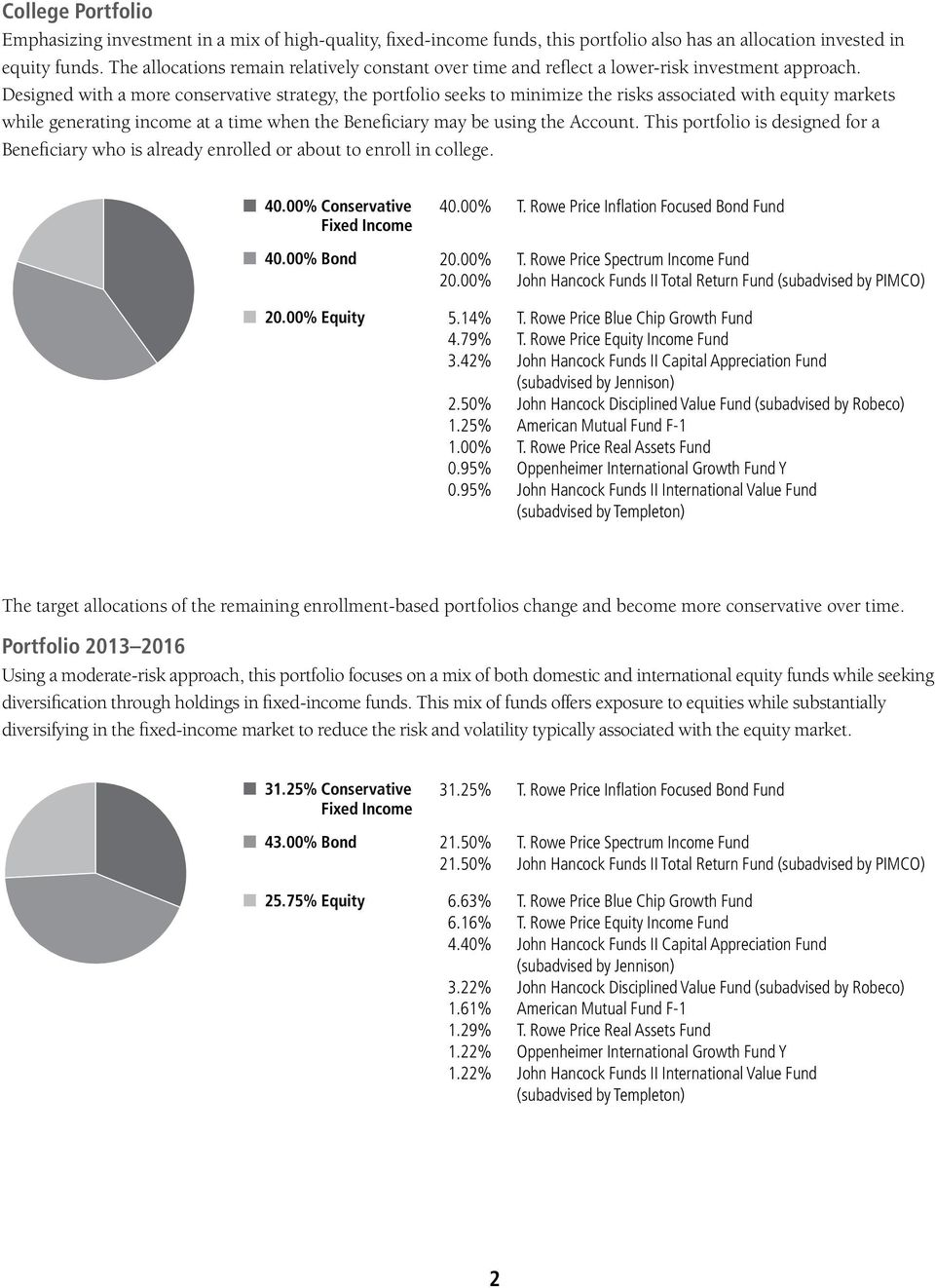
3 College Portfolio Emphasizing investment in a mix of high-quality, fixed-income funds, this portfolio also has an allocation invested in equity funds. The allocations remain relatively constant over time and reflect a lower-risk investment approach. Designed with a more conservative strategy, the portfolio seeks to minimize the risks associated with equity markets while generating income at a time when the Beneficiary may be using the Account. This portfolio is designed for a Beneficiary who is already enrolled or about to enroll in college % Conservative Fixed Income 40.00% T. Rowe Price Inflation Focused Bond Fund 40.00% Bond 20.00% T. Rowe Price Spectrum Income Fund 20.00% John Hancock Funds II Total Return Fund (subadvised by PIMCO) 20.00% Equity 5.14% T. Rowe Price Blue Chip Growth Fund 4.79% T. Rowe Price Equity Income Fund 3.42% John Hancock Funds II Capital Appreciation Fund (subadvised by Jennison) 2.50% John Hancock Disciplined Value Fund (subadvised by Robeco) 1.25% American Mutual Fund F % T. Rowe Price Real Assets Fund 0.95% Oppenheimer International Growth Fund Y 0.95% John Hancock Funds II International Value Fund (subadvised by Templeton) The target allocations of the remaining enrollment-based portfolios change and become more conservative over time. Portfolio Using a moderate-risk approach, this portfolio focuses on a mix of both domestic and international equity funds while seeking diversification through holdings in fixed-income funds. This mix of funds offers exposure to equities while substantially diversifying in the fixed-income market to reduce the risk and volatility typically associated with the equity market % Conservative Fixed Income 31.25% T. Rowe Price Inflation Focused Bond Fund 43.00% Bond 21.50% T. Rowe Price Spectrum Income Fund 21.50% John Hancock Funds II Total Return Fund (subadvised by PIMCO) 25.75% Equity 6.63% T. Rowe Price Blue Chip Growth Fund 6.16% T. Rowe Price Equity Income Fund 4.40% John Hancock Funds II Capital Appreciation Fund (subadvised by Jennison) 3.22% John Hancock Disciplined Value Fund (subadvised by Robeco) 1.61% American Mutual Fund F % T. Rowe Price Real Assets Fund 1.22% Oppenheimer International Growth Fund Y 1.22% John Hancock Funds II International Value Fund (subadvised by Templeton) 2
4 Portfolio This predominantly equity portfolio focuses on a mix of both domestic and international equity funds while seeking diversification through holdings in fixed-income funds. The portfolio s strategy is based on accepting the risks associated with stocks that have the potential to provide high returns in the equity markets, and cushioning the effects of volatility through diversification. 1.50% Conservative Fixed Income 1.50% T. Rowe Price Inflation Focused Bond Fund 50.00% Bond 25.00% T. Rowe Price Spectrum Income Fund 25.00% John Hancock Funds II Total Return Fund (subadvised by PIMCO) 48.50% Equity 8.35% T. Rowe Price Blue Chip Growth Fund 7.79% T. Rowe Price Equity Income Fund 5.56% John Hancock Funds II Capital Appreciation Fund (subadvised by Jennison) 5.27% Oppenheimer International Growth Fund Y 5.27% John Hancock Funds II International Value Fund (subadvised by Templeton) 4.08% John Hancock Disciplined Value Fund (subadvised by Robeco) 3.27% T. Rowe Price Mid Cap Value Fund 3.00% T. Rowe Price New Horizons Fund 2.43% T. Rowe Price Real Assets Fund 2.04% American Mutual Fund F % John Hancock Funds II Emerging Markets Fund (subadvised by DFA) Portfolio This predominantly equity portfolio seeks long-term capital appreciation by broadly investing in mutual funds primarily focused on both domestic and international equity markets. The strategy is based on the understanding that the volatility associated with equity markets is accompanied by the greatest potential for long-term capital appreciation % Bond 15.13% T. Rowe Price Spectrum Income Fund 15.13% John Hancock Funds II Total Return Fund (subadvised by PIMCO) 69.74% Equity 10.70% T. Rowe Price Blue Chip Growth Fund 10.00% T. Rowe Price Equity Income Fund 8.45% Oppenheimer International Growth Fund Y 8.45% John Hancock Funds II International Value Fund (subadvised by Templeton) 7.14% John Hancock Funds II Capital Appreciation Fund (subadvised by Jennison) 5.57% T. Rowe Price Mid Cap Value Fund 5.24% John Hancock Disciplined Value Fund (subadvised by Robeco) 5.10% T. Rowe Price New Horizons Fund 3.49% T. Rowe Price Real Assets Fund 2.98% John Hancock Funds II Emerging Markets Fund (subadvised by DFA) 2.62% American Mutual Fund F-1 3

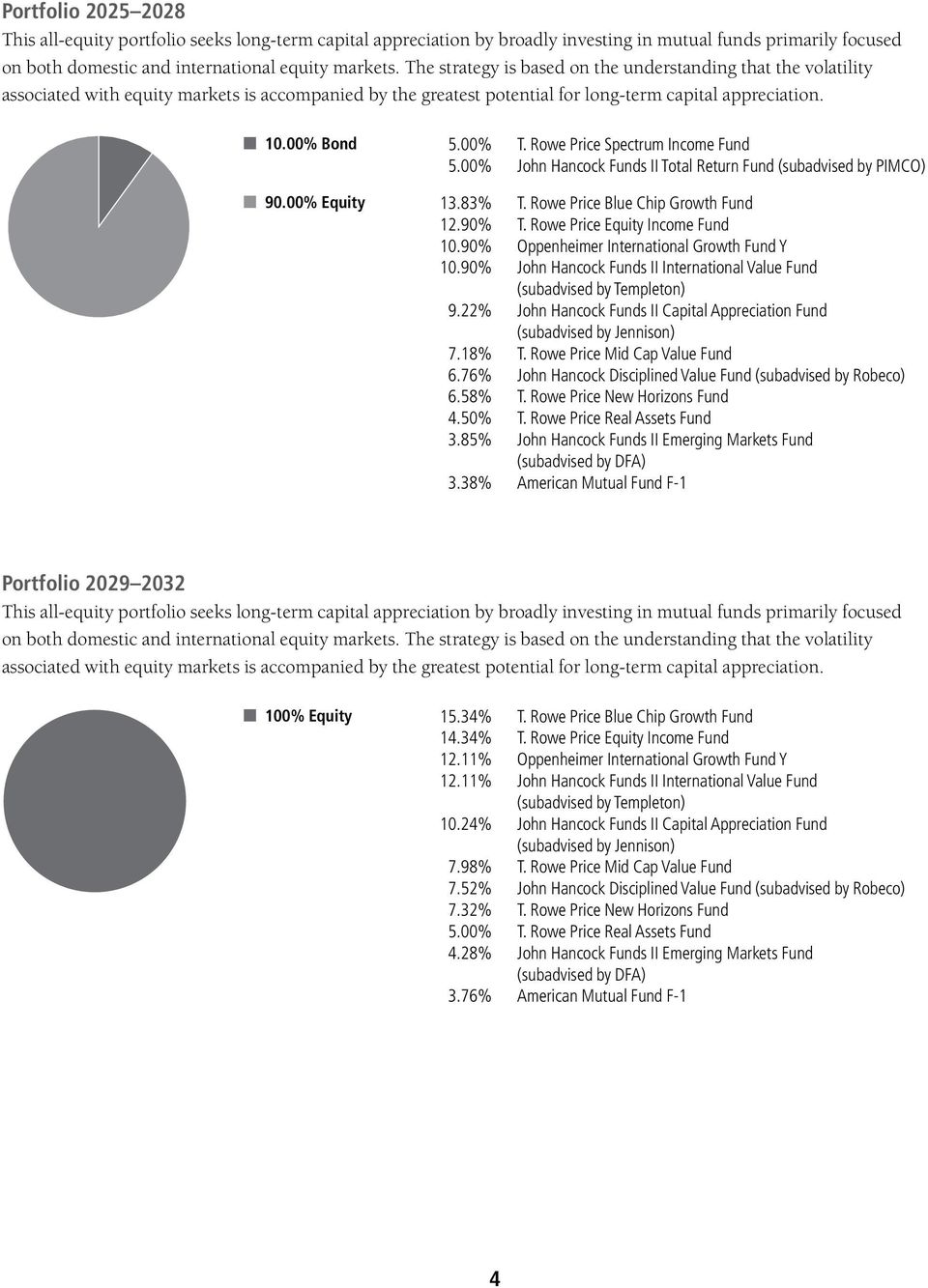
5 Portfolio This all-equity portfolio seeks long-term capital appreciation by broadly investing in mutual funds primarily focused on both domestic and international equity markets. The strategy is based on the understanding that the volatility associated with equity markets is accompanied by the greatest potential for long-term capital appreciation % Bond 5.00% T. Rowe Price Spectrum Income Fund 5.00% John Hancock Funds II Total Return Fund (subadvised by PIMCO) 90.00% Equity 13.83% T. Rowe Price Blue Chip Growth Fund 12.90% T. Rowe Price Equity Income Fund 10.90% Oppenheimer International Growth Fund Y 10.90% John Hancock Funds II International Value Fund (subadvised by Templeton) 9.22% John Hancock Funds II Capital Appreciation Fund (subadvised by Jennison) 7.18% T. Rowe Price Mid Cap Value Fund 6.76% John Hancock Disciplined Value Fund (subadvised by Robeco) 6.58% T. Rowe Price New Horizons Fund 4.50% T. Rowe Price Real Assets Fund 3.85% John Hancock Funds II Emerging Markets Fund (subadvised by DFA) 3.38% American Mutual Fund F-1 Portfolio This all-equity portfolio seeks long-term capital appreciation by broadly investing in mutual funds primarily focused on both domestic and international equity markets. The strategy is based on the understanding that the volatility associated with equity markets is accompanied by the greatest potential for long-term capital appreciation. 100% Equity 15.34% T. Rowe Price Blue Chip Growth Fund 14.34% T. Rowe Price Equity Income Fund 12.11% Oppenheimer International Growth Fund Y 12.11% John Hancock Funds II International Value Fund (subadvised by Templeton) 10.24% John Hancock Funds II Capital Appreciation Fund (subadvised by Jennison) 7.98% T. Rowe Price Mid Cap Value Fund 7.52% John Hancock Disciplined Value Fund (subadvised by Robeco) 7.32% T. Rowe Price New Horizons Fund 5.00% T. Rowe Price Real Assets Fund 4.28% John Hancock Funds II Emerging Markets Fund (subadvised by DFA) 3.76% American Mutual Fund F-1 4
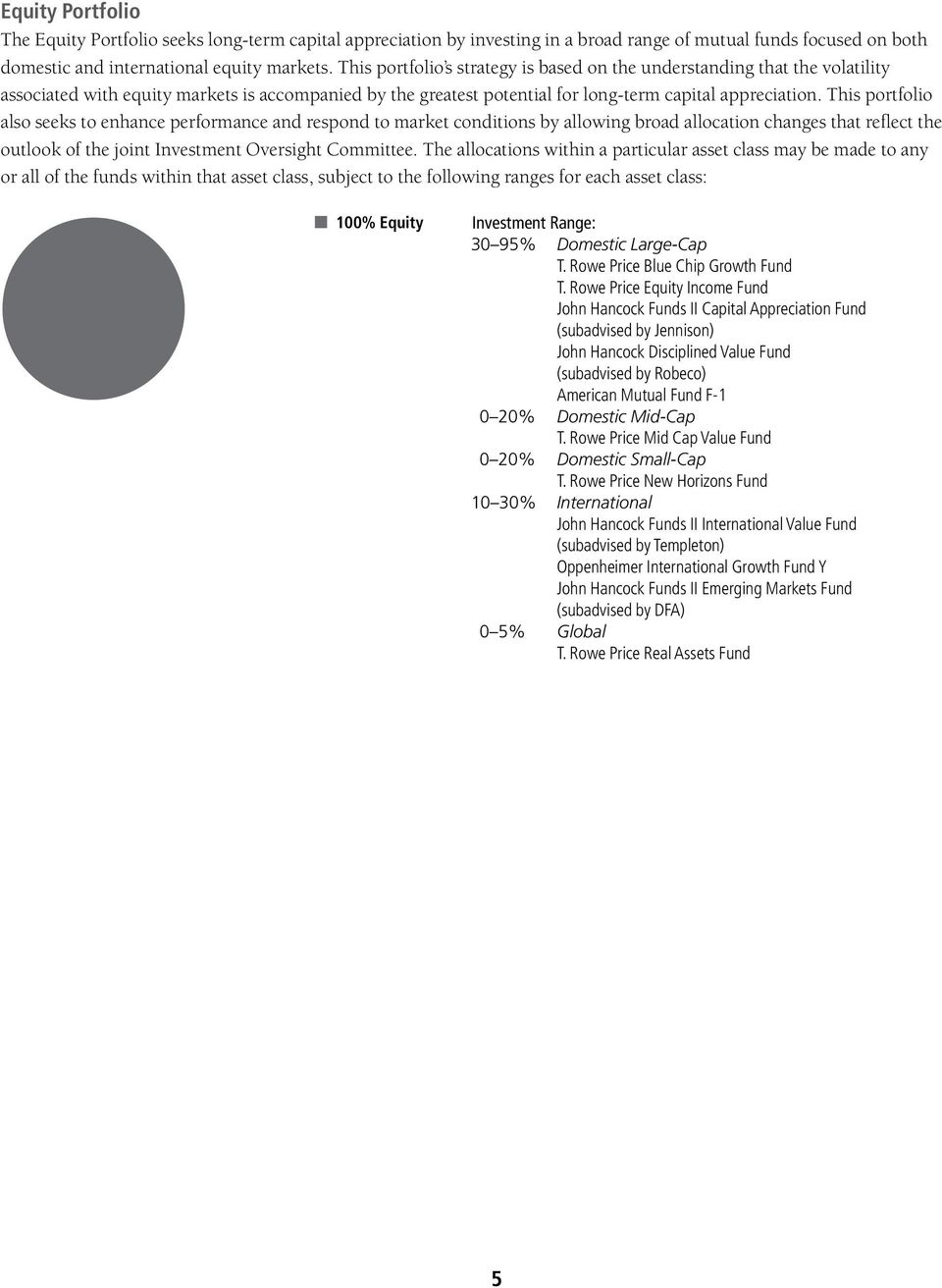
6 Equity Portfolio The Equity Portfolio seeks long-term capital appreciation by investing in a broad range of mutual funds focused on both domestic and international equity markets. This portfolio s strategy is based on the understanding that the volatility associated with equity markets is accompanied by the greatest potential for long-term capital appreciation. This portfolio also seeks to enhance performance and respond to market conditions by allowing broad allocation changes that reflect the outlook of the joint Investment Oversight Committee. The allocations within a particular asset class may be made to any or all of the funds within that asset class, subject to the following ranges for each asset class: 100% Equity Investment Range: 30 95% Domestic Large-Cap T. Rowe Price Blue Chip Growth Fund T. Rowe Price Equity Income Fund John Hancock Funds II Capital Appreciation Fund (subadvised by Jennison) John Hancock Disciplined Value Fund (subadvised by Robeco) American Mutual Fund F % Domestic Mid-Cap T. Rowe Price Mid Cap Value Fund 0 20% Domestic Small-Cap T. Rowe Price New Horizons Fund 10 30% International John Hancock Funds II International Value Fund (subadvised by Templeton) Oppenheimer International Growth Fund Y John Hancock Funds II Emerging Markets Fund (subadvised by DFA) 0 5% Global T. Rowe Price Real Assets Fund 5
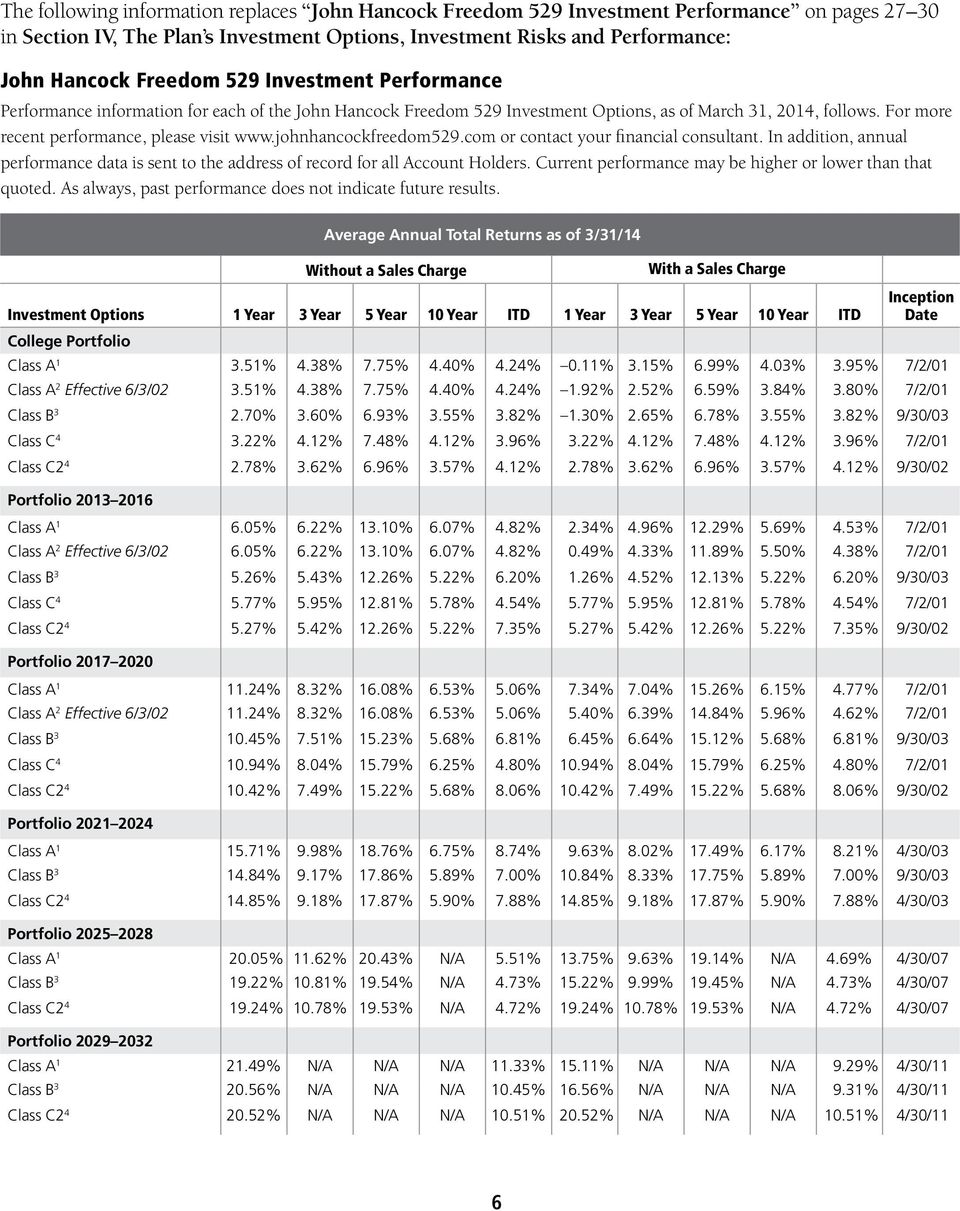
7 The following information replaces John Hancock Freedom 529 Investment Performance on pages in Section IV, The Plan s Investment Options, Investment Risks and Performance: John Hancock Freedom 529 Investment Performance Performance information for each of the John Hancock Freedom 529 Investment Options, as of March 31, 2014, follows. For more recent performance, please visit or contact your financial consultant. In addition, annual performance data is sent to the address of record for all Account Holders. Current performance may be higher or lower than that quoted. As always, past performance does not indicate future results. Average Annual Total Returns as of 3/31/14 Without a Sales Charge With a Sales Charge Investment Options 1 Year 3 Year 5 Year 10 Year ITD 1 Year 3 Year 5 Year 10 Year ITD Inception Date College Portfolio Class A % 4.38% 7.75% 4.40% 4.24% 0.11% 3.15% 6.99% 4.03% 3.95% 7/2/01 Class A 2 Effective 6/3/ % 4.38% 7.75% 4.40% 4.24% 1.92% 2.52% 6.59% 3.84% 3.80% 7/2/01 Class B % 3.60% 6.93% 3.55% 3.82% 1.30% 2.65% 6.78% 3.55% 3.82% 9/30/03 Class C % 4.12% 7.48% 4.12% 3.96% 3.22% 4.12% 7.48% 4.12% 3.96% 7/2/01 Class C % 3.62% 6.96% 3.57% 4.12% 2.78% 3.62% 6.96% 3.57% 4.12% 9/30/02 Portfolio Class A % 6.22% 13.10% 6.07% 4.82% 2.34% 4.96% 12.29% 5.69% 4.53% 7/2/01 Class A 2 Effective 6/3/ % 6.22% 13.10% 6.07% 4.82% 0.49% 4.33% 11.89% 5.50% 4.38% 7/2/01 Class B % 5.43% 12.26% 5.22% 6.20% 1.26% 4.52% 12.13% 5.22% 6.20% 9/30/03 Class C % 5.95% 12.81% 5.78% 4.54% 5.77% 5.95% 12.81% 5.78% 4.54% 7/2/01 Class C % 5.42% 12.26% 5.22% 7.35% 5.27% 5.42% 12.26% 5.22% 7.35% 9/30/02 Portfolio Class A % 8.32% 16.08% 6.53% 5.06% 7.34% 7.04% 15.26% 6.15% 4.77% 7/2/01 Class A 2 Effective 6/3/ % 8.32% 16.08% 6.53% 5.06% 5.40% 6.39% 14.84% 5.96% 4.62% 7/2/01 Class B % 7.51% 15.23% 5.68% 6.81% 6.45% 6.64% 15.12% 5.68% 6.81% 9/30/03 Class C % 8.04% 15.79% 6.25% 4.80% 10.94% 8.04% 15.79% 6.25% 4.80% 7/2/01 Class C % 7.49% 15.22% 5.68% 8.06% 10.42% 7.49% 15.22% 5.68% 8.06% 9/30/02 Portfolio Class A % 9.98% 18.76% 6.75% 8.74% 9.63% 8.02% 17.49% 6.17% 8.21% 4/30/03 Class B % 9.17% 17.86% 5.89% 7.00% 10.84% 8.33% 17.75% 5.89% 7.00% 9/30/03 Class C % 9.18% 17.87% 5.90% 7.88% 14.85% 9.18% 17.87% 5.90% 7.88% 4/30/03 Portfolio Class A % 11.62% 20.43% N/A 5.51% 13.75% 9.63% 19.14% N/A 4.69% 4/30/07 Class B % 10.81% 19.54% N/A 4.73% 15.22% 9.99% 19.45% N/A 4.73% 4/30/07 Class C % 10.78% 19.53% N/A 4.72% 19.24% 10.78% 19.53% N/A 4.72% 4/30/07 Portfolio Class A % N/A N/A N/A 11.33% 15.11% N/A N/A N/A 9.29% 4/30/11 Class B % N/A N/A N/A 10.45% 16.56% N/A N/A N/A 9.31% 4/30/11 Class C % N/A N/A N/A 10.51% 20.52% N/A N/A N/A 10.51% 4/30/11 6
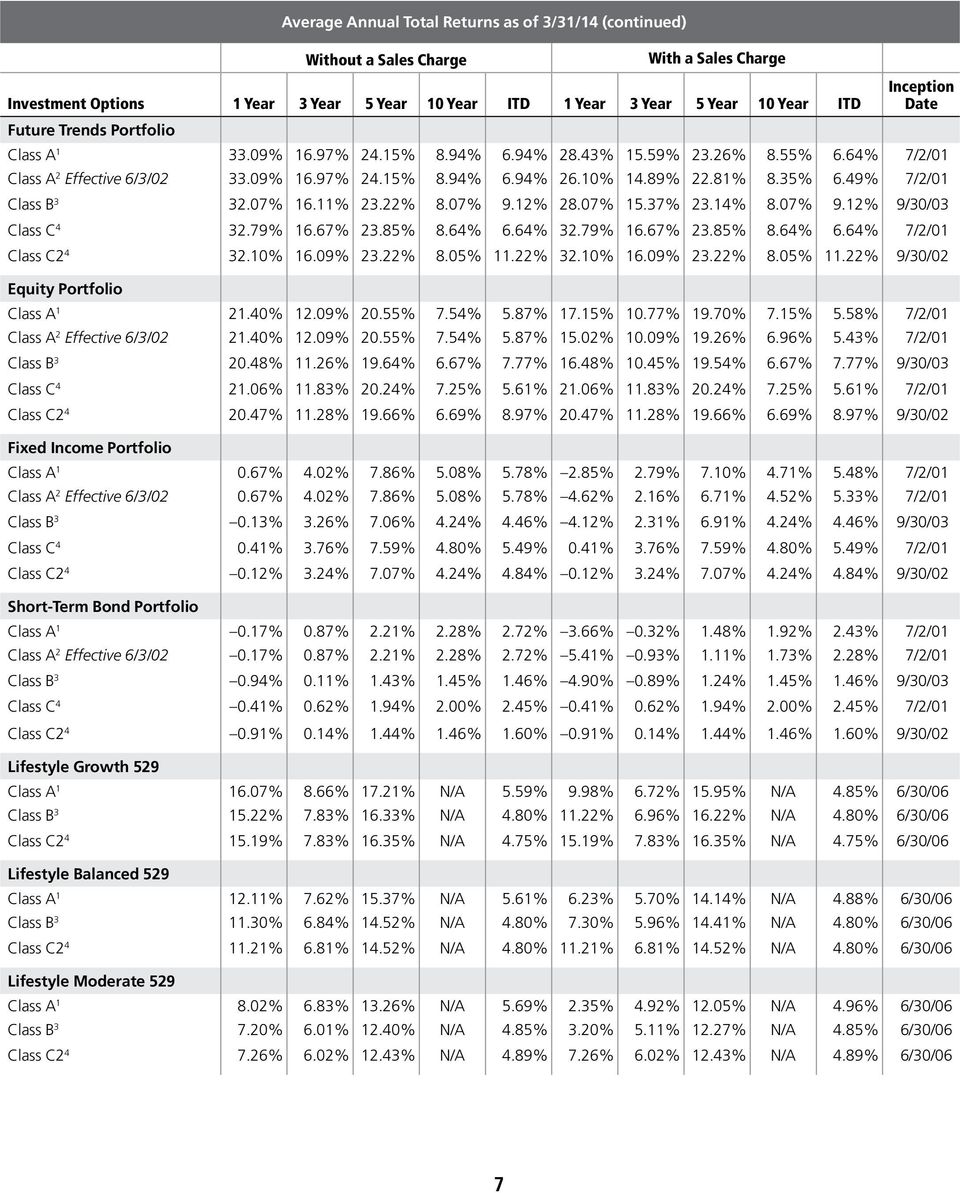
8 Average Annual Total Returns as of 3/31/14 (continued) Without a Sales Charge With a Sales Charge Investment Options 1 Year 3 Year 5 Year 10 Year ITD 1 Year 3 Year 5 Year 10 Year ITD Inception Date Future Trends Portfolio Class A % 16.97% 24.15% 8.94% 6.94% 28.43% 15.59% 23.26% 8.55% 6.64% 7/2/01 Class A 2 Effective 6/3/ % 16.97% 24.15% 8.94% 6.94% 26.10% 14.89% 22.81% 8.35% 6.49% 7/2/01 Class B % 16.11% 23.22% 8.07% 9.12% 28.07% 15.37% 23.14% 8.07% 9.12% 9/30/03 Class C % 16.67% 23.85% 8.64% 6.64% 32.79% 16.67% 23.85% 8.64% 6.64% 7/2/01 Class C % 16.09% 23.22% 8.05% 11.22% 32.10% 16.09% 23.22% 8.05% 11.22% 9/30/02 Equity Portfolio Class A % 12.09% 20.55% 7.54% 5.87% 17.15% 10.77% 19.70% 7.15% 5.58% 7/2/01 Class A 2 Effective 6/3/ % 12.09% 20.55% 7.54% 5.87% 15.02% 10.09% 19.26% 6.96% 5.43% 7/2/01 Class B % 11.26% 19.64% 6.67% 7.77% 16.48% 10.45% 19.54% 6.67% 7.77% 9/30/03 Class C % 11.83% 20.24% 7.25% 5.61% 21.06% 11.83% 20.24% 7.25% 5.61% 7/2/01 Class C % 11.28% 19.66% 6.69% 8.97% 20.47% 11.28% 19.66% 6.69% 8.97% 9/30/02 Fixed Income Portfolio Class A % 4.02% 7.86% 5.08% 5.78% 2.85% 2.79% 7.10% 4.71% 5.48% 7/2/01 Class A 2 Effective 6/3/ % 4.02% 7.86% 5.08% 5.78% 4.62% 2.16% 6.71% 4.52% 5.33% 7/2/01 Class B % 3.26% 7.06% 4.24% 4.46% 4.12% 2.31% 6.91% 4.24% 4.46% 9/30/03 Class C % 3.76% 7.59% 4.80% 5.49% 0.41% 3.76% 7.59% 4.80% 5.49% 7/2/01 Class C % 3.24% 7.07% 4.24% 4.84% 0.12% 3.24% 7.07% 4.24% 4.84% 9/30/02 Short-Term Bond Portfolio Class A % 0.87% 2.21% 2.28% 2.72% 3.66% 0.32% 1.48% 1.92% 2.43% 7/2/01 Class A 2 Effective 6/3/ % 0.87% 2.21% 2.28% 2.72% 5.41% 0.93% 1.11% 1.73% 2.28% 7/2/01 Class B % 0.11% 1.43% 1.45% 1.46% 4.90% 0.89% 1.24% 1.45% 1.46% 9/30/03 Class C % 0.62% 1.94% 2.00% 2.45% 0.41% 0.62% 1.94% 2.00% 2.45% 7/2/01 Class C % 0.14% 1.44% 1.46% 1.60% 0.91% 0.14% 1.44% 1.46% 1.60% 9/30/02 Lifestyle Growth 529 Class A % 8.66% 17.21% N/A 5.59% 9.98% 6.72% 15.95% N/A 4.85% 6/30/06 Class B % 7.83% 16.33% N/A 4.80% 11.22% 6.96% 16.22% N/A 4.80% 6/30/06 Class C % 7.83% 16.35% N/A 4.75% 15.19% 7.83% 16.35% N/A 4.75% 6/30/06 Lifestyle Balanced 529 Class A % 7.62% 15.37% N/A 5.61% 6.23% 5.70% 14.14% N/A 4.88% 6/30/06 Class B % 6.84% 14.52% N/A 4.80% 7.30% 5.96% 14.41% N/A 4.80% 6/30/06 Class C % 6.81% 14.52% N/A 4.80% 11.21% 6.81% 14.52% N/A 4.80% 6/30/06 Lifestyle Moderate 529 Class A % 6.83% 13.26% N/A 5.69% 2.35% 4.92% 12.05% N/A 4.96% 6/30/06 Class B % 6.01% 12.40% N/A 4.85% 3.20% 5.11% 12.27% N/A 4.85% 6/30/06 Class C % 6.02% 12.43% N/A 4.89% 7.26% 6.02% 12.43% N/A 4.89% 6/30/06 7
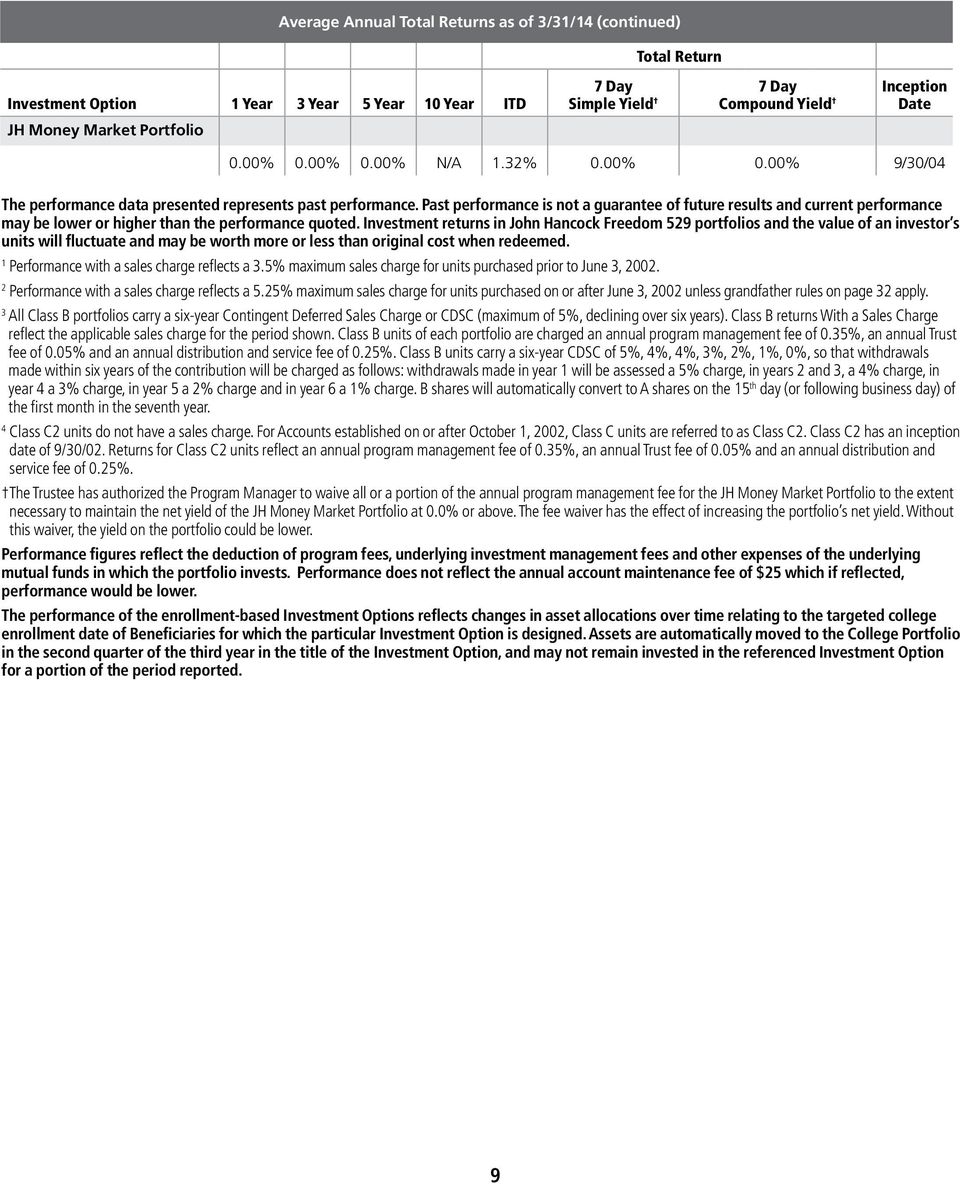
9 Average Annual Total Returns as of 3/31/14 (continued) Without a Sales Charge With a Sales Charge Investment Options 1 Year 3 Year 5 Year 10 Year ITD 1 Year 3 Year 5 Year 10 Year ITD Inception Date TRP New Horizons 529 Class A % 18.69% 29.71% N/A 12.48% 25.91% 16.58% 28.32% N/A 11.84% 9/30/04 Class B % 17.82% 28.72% N/A 11.58% 27.86% 17.09% 28.65% N/A 11.58% 9/30/04 Class C % 17.80% 28.72% N/A 11.61% 31.88% 17.80% 28.72% N/A 11.61% 9/30/04 Templeton Int l Value 529 Class A % 6.82% 16.38% N/A 0.97% 17.80% 4.92% 15.13% N/A 0.11% 11/30/07 Class B % 6.04% 15.51% N/A 0.25% 19.30% 5.15% 15.40% N/A 0.25% 11/30/07 Class C % 6.01% 15.49% N/A 0.24% 23.33% 6.01% 15.49% N/A 0.24% 11/30/07 TRP Small-Cap Stock 529 Class A % 14.17% 26.61% 9.95% 12.11% 17.52% 12.14% 25.25% 9.36% 11.56% 4/30/03 Class B % 13.34% 25.65% 9.08% 10.37% 19.13% 12.56% 25.57% 9.08% 10.37% 9/30/03 Class C % 13.34% 25.64% 9.06% 11.18% 23.15% 13.34% 25.64% 9.06% 11.18% 4/30/03 TRP Mid-Cap Value 529 Class A % 12.93% 22.69% 9.31% 12.34% 14.60% 10.92% 21.37% 8.72% 11.82% 9/30/02 Class B % 12.09% 21.77% 8.42% 10.03% 16.07% 11.29% 21.68% 8.42% 10.03% 9/30/03 Class C % 12.09% 21.75% 8.43% 11.42% 20.05% 12.09% 21.75% 8.43% 11.42% 9/30/02 Jennison Capital Appreciation 529 Class A % 14.40% 19.78% N/A 6.72% 21.06% 12.36% 18.50% N/A 5.81% 11/30/07 Class B % 13.52% 18.92% N/A 5.94% 22.74% 12.74% 18.82% N/A 5.94% 11/30/07 Class C % 13.51% 18.89% N/A 5.95% 26.82% 13.51% 18.89% N/A 5.95% 11/30/07 TRP Blue Chip Growth 529 Class A % 16.01% 22.23% 7.75% 9.93% 21.86% 13.94% 20.92% 7.17% 9.42% 9/30/02 Class B % 15.15% 21.32% 6.89% 7.79% 23.66% 14.39% 21.23% 6.89% 7.79% 9/30/03 Class C % 15.16% 21.31% 6.89% 9.05% 27.66% 15.16% 21.31% 6.89% 9.05% 9/30/02 TRP Equity Income 529 Class A % 12.51% 20.48% 6.80% 8.37% 11.60% 10.50% 19.19% 6.23% 7.83% 4/30/03 Class B % 11.67% 19.58% 5.93% 6.97% 12.95% 10.86% 19.48% 5.93% 6.97% 9/30/03 Class C % 11.67% 19.58% 5.94% 7.47% 16.87% 11.67% 19.58% 5.94% 7.47% 4/30/03 American Mutual 529 Class A % 12.75% 17.92% 6.80% 8.09% 10.92% 10.74% 16.65% 6.23% 7.56% 4/30/03 Class B % 11.89% 17.03% 5.94% 6.77% 12.18% 11.08% 16.92% 5.94% 6.77% 9/30/03 Class C % 11.91% 17.04% 5.95% 7.24% 16.25% 11.91% 17.04% 5.95% 7.24% 4/30/03 8

10 Average Annual Total Returns as of 3/31/14 (continued) Total Return Investment Option 1 Year 3 Year 5 Year 10 Year ITD JH Money Market Portfolio 7 Day Simple Yield 7 Day Compound Yield Inception Date 0.00% 0.00% 0.00% N/A 1.32% 0.00% 0.00% 9/30/04 The performance data presented represents past performance. Past performance is not a guarantee of future results and current performance may be lower or higher than the performance quoted. Investment returns in John Hancock Freedom 529 portfolios and the value of an investor s units will fluctuate and may be worth more or less than original cost when redeemed. 1 Performance with a sales charge reflects a 3.5% maximum sales charge for units purchased prior to June 3, Performance with a sales charge reflects a 5.25% maximum sales charge for units purchased on or after June 3, 2002 unless grandfather rules on page 32 apply. 3 All Class B portfolios carry a six-year Contingent Deferred Sales Charge or CDSC (maximum of 5%, declining over six years). Class B returns With a Sales Charge reflect the applicable sales charge for the period shown. Class B units of each portfolio are charged an annual program management fee of 0.35%, an annual Trust fee of 0.05% and an annual distribution and service fee of 0.25%. Class B units carry a six-year CDSC of 5%, 4%, 4%, 3%, 2%, 1%, 0%, so that withdrawals made within six years of the contribution will be charged as follows: withdrawals made in year 1 will be assessed a 5% charge, in years 2 and 3, a 4% charge, in year 4 a 3% charge, in year 5 a 2% charge and in year 6 a 1% charge. B shares will automatically convert to A shares on the 15 th day (or following business day) of the first month in the seventh year. 4 Class C2 units do not have a sales charge. For Accounts established on or after October 1, 2002, Class C units are referred to as Class C2. Class C2 has an inception date of 9/30/02. Returns for Class C2 units reflect an annual program management fee of 0.35%, an annual Trust fee of 0.05% and an annual distribution and service fee of 0.25%. The Trustee has authorized the Program Manager to waive all or a portion of the annual program management fee for the JH Money Market Portfolio to the extent necessary to maintain the net yield of the JH Money Market Portfolio at 0.0% or above. The fee waiver has the effect of increasing the portfolio s net yield. Without this waiver, the yield on the portfolio could be lower. Performance figures reflect the deduction of program fees, underlying investment management fees and other expenses of the underlying mutual funds in which the portfolio invests. Performance does not reflect the annual account maintenance fee of $25 which if reflected, performance would be lower. The performance of the enrollment-based Investment Options reflects changes in asset allocations over time relating to the targeted college enrollment date of Beneficiaries for which the particular Investment Option is designed. Assets are automatically moved to the College Portfolio in the second quarter of the third year in the title of the Investment Option, and may not remain invested in the referenced Investment Option for a portion of the period reported. 9
11 The following replaces similar information in Section V. Fees and Expenses, Choosing a Class of Units beginning on page 31: Choosing a Class of Units Interests in the Plan are referred to as units. There are two classes of units, Class A and Class C2 ( classes ), available to new investors for each of the Investment Options. Each class has a different cost structure determined by the sales charge and the annual distribution and service fee. (The annual program management fee is the same for all classes of units.) The different classes allow you to select the cost structure that best suits your needs. There are different underlying mutual fund expenses associated with each Investment Option, although these underlying mutual fund expenses are the same for Class A and Class C2 within a particular Investment Option. Estimated expenses for each class, including the class-specific sales charge and the annual distribution and service fee, as well as the annual program management fee and the annual Trust fee are provided in the Summary of Fees/Expenses tables that begin on page 14 of the Supplement. Generally, the class of units you choose will be determined by the amount you invest as well as the length of time between your investment and the Beneficiary s expected use of the Account. Exchanges between classes are not permitted. You should work with your financial consultant to determine the class of units appropriate for you. The cost structure for each class of units currently available to new investors is: All portfolios, except Short-Term Bond & Fixed Income Portfolios: Class A Initial sales charge of up to 5.25% % effective 9/2/2014 Annual program management fee of 0.25% Annual distribution and service fee of 0.25% Annual Trust fee of 0.05% Class C2 No initial sales charge; all your money goes to work for you right away Annual program management fee of 0.25% Annual distribution and service fee of 1.00% Annual Trust fee of 0.05% No Contingent Deferred Sales Charge No automatic conversion to Class A units, so annual expenses continue at the Class C2 level throughout the life of the investment Class B (CLOSED) No initial sales charge; all your money goes to work for you right away Annual program management fee of 0.25% Annual distribution and service fee of 1.00% Annual Trust fee of 0.05% A Contingent Deferred Sales Charge of up to 5.0% for assets redeemed within the first six years Automatically converts to Class A units in year seven, thus reducing the annual distribution and service fee to 0.25% Short-Term Bond & Fixed Income Portfolios: Class A Initial sales charge of up to 5.25% % effective 9/2/2014 Annual program management fee of 0.25% Annual distribution and service fee of 0.15% Annual Trust fee of 0.05% Class C2 No initial sales charge; all your money goes to work for you right away Annual program management fee of 0.25% Annual distribution and service fee of 0.90% Annual Trust fee of 0.05% No Contingent Deferred Sales Charge No automatic conversion to Class A units, so annual expenses continue at the Class C2 level throughout the life of the investment Class B (CLOSED) No initial sales charge; all your money goes to work for you right away Annual program management fee of 0.25% Annual distribution and service fee of 0.90% Annual Trust fee of 0.05% A Contingent Deferred Sales Charge of up to 5.0% for assets redeemed within the first six years Automatically converts to Class A units in year seven, thus reducing the annual distribution and service fee to 0.25% 10
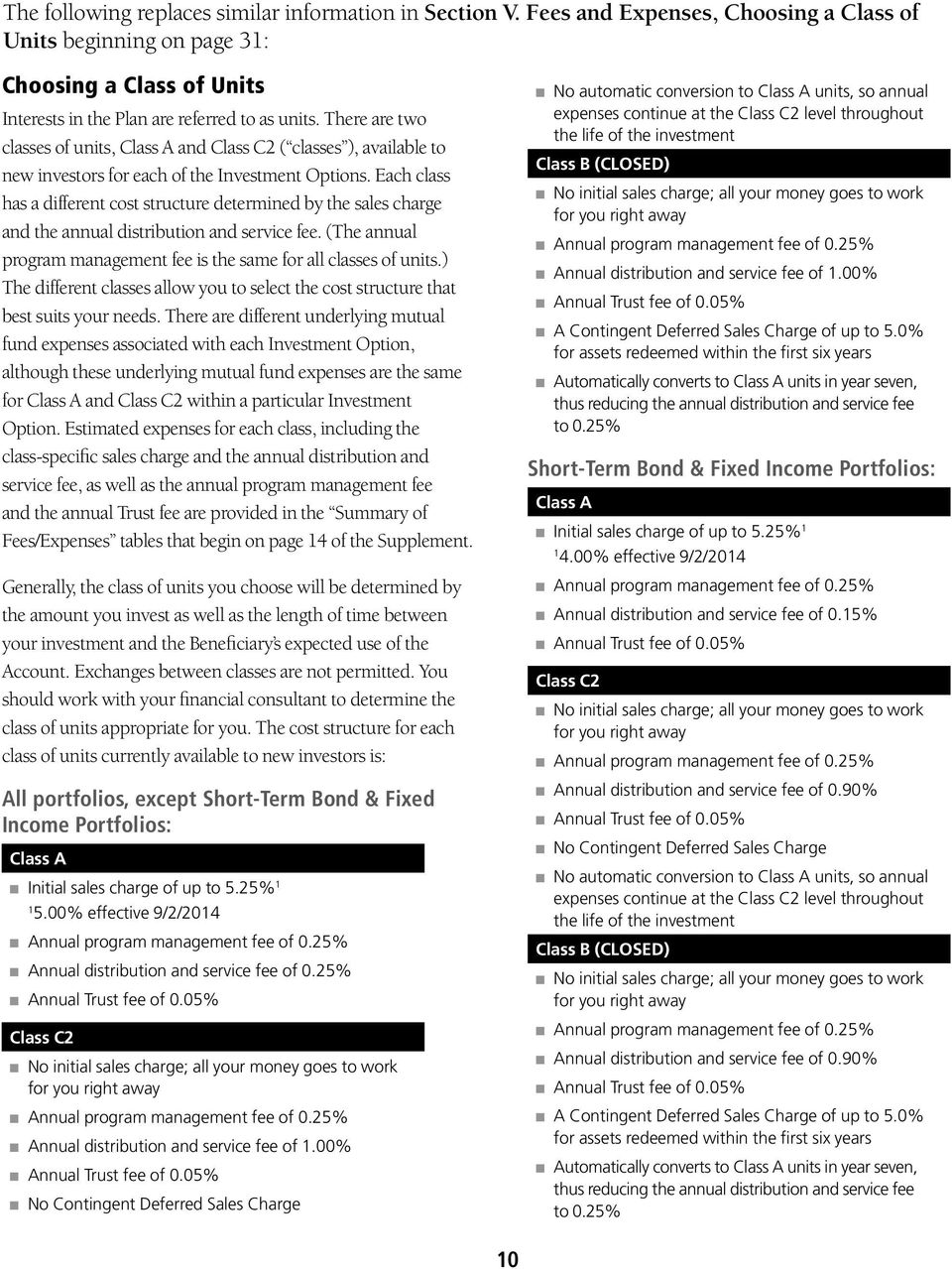
12 There is a $100,000 limit per Account Holder for investments in Class B units. This maximum will be applied across all Accounts with the same Account Holder and shall be based upon the contribution amount as well as the aggregate Account balance(s) for individual Account Holders. Breakpoint pricing and Rights of Accumulation offered by Class A units may be more appropriate for Account Holders with larger aggregate Account balances. Your financial consultant can provide you with additional information. Effective as of June 24, 2013, John Hancock Freedom 529 no longer allows the establishment of new Accounts in Class B units. Effective as of September 3, 2013, Class B units are closed and John Hancock Freedom 529 will no longer accept any investments in Class B units. Any contributions to B Class units that are received after September 3, 2013, will be directed to a different share class as designated by the Account Holder and if no new share class is designated, the contribution will be rejected. After September 3, 2013, an Account Holder may continue to hold Class B units until those units automatically convert to Class A units pursuant to the conversion schedule outlined in the Plan Disclosure Document or redeem such Class B units, subject to any applicable contingent deferred sales charge (CDSC). Existing Account Holders will continue to have exchange privileges with Class B units of other John Hancock Freedom 529 portfolios. Note: The JH Money Market Portfolio, including the existing portfolio, Class A and Class C2 (see JH Money Market Portfolio section of this Supplement) has an annual program management fee of 0.25%, no annual distribution and service fee and no Trust fee. Sales Charges The sales charges applicable to each class of units of all portfolios (except Short-Term Bond & Fixed Income) which are paid by the Account Holder, are summarized as follows: Class A Class B* Class C2 Initial Sales Charge Up to 5.25% % effective 9/2/2014 None None Contingent Deferred Sales Charge None 5% declining to 0 after six years** None The sales charges applicable to each class of units of Short-Term Bond & Fixed Income Portfolios, which are paid by the Account Holder, are summarized as follows: Class A Class B* Class C2 Initial Sales Charge Up to 5.25% % effective 9/2/2014 None None Contingent Deferred Sales Charge None 5% declining to 0 after six years** None * Class B units automatically convert to Class A in the first month after six years. ** Distributions taken within six years of each contribution will typically pay a CDSC based on a declining scale as described on page

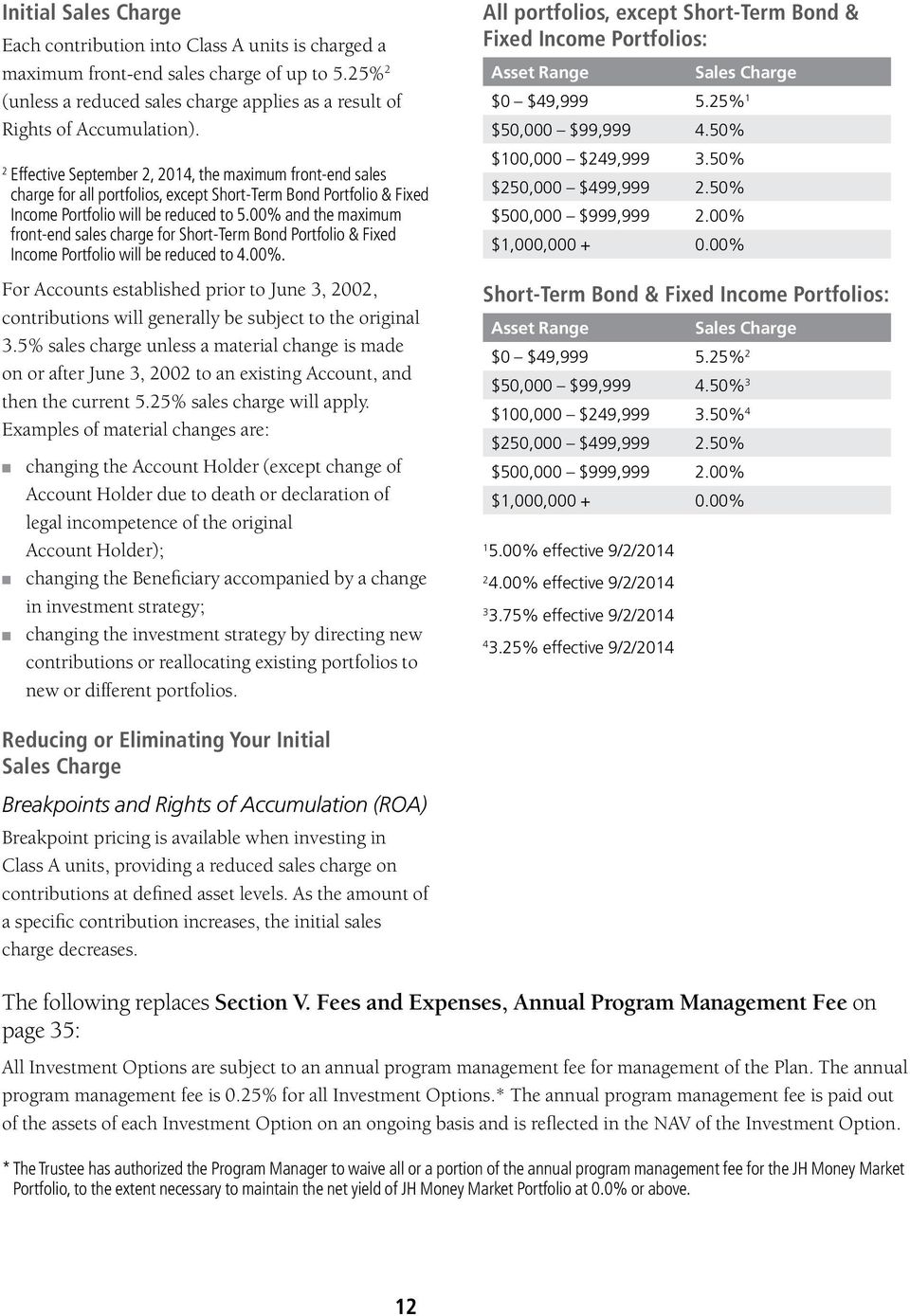
13 Initial Sales Charge Each contribution into Class A units is charged a maximum front-end sales charge of up to 5.25% 2 (unless a reduced sales charge applies as a result of Rights of Accumulation). 2 Effective September 2, 2014, the maximum front-end sales charge for all portfolios, except Short-Term Bond Portfolio & Fixed Income Portfolio will be reduced to 5.00% and the maximum front-end sales charge for Short-Term Bond Portfolio & Fixed Income Portfolio will be reduced to 4.00%. For Accounts established prior to June 3, 2002, contributions will generally be subject to the original 3.5% sales charge unless a material change is made on or after June 3, 2002 to an existing Account, and then the current 5.25% sales charge will apply. Examples of material changes are: changing the Account Holder (except change of Account Holder due to death or declaration of legal incompetence of the original Account Holder); changing the Beneficiary accompanied by a change in investment strategy; changing the investment strategy by directing new contributions or reallocating existing portfolios to new or different portfolios. All portfolios, except Short-Term Bond & Fixed Income Portfolios: Asset Range Sales Charge $0 $49, % 1 $50,000 $99, % $100,000 $249, % $250,000 $499, % $500,000 $999, % $1,000, % Short-Term Bond & Fixed Income Portfolios: Asset Range Sales Charge $0 $49, % 2 $50,000 $99, % 3 $100,000 $249, % 4 $250,000 $499, % $500,000 $999, % $1,000, % % effective 9/2/ % effective 9/2/ % effective 9/2/ % effective 9/2/2014 Reducing or Eliminating Your Initial Sales Charge Breakpoints and Rights of Accumulation (ROA) Breakpoint pricing is available when investing in Class A units, providing a reduced sales charge on contributions at defined asset levels. As the amount of a specific contribution increases, the initial sales charge decreases. The following replaces Section V. Fees and Expenses, Annual Program Management Fee on page 35: All Investment Options are subject to an annual program management fee for management of the Plan. The annual program management fee is 0.25% for all Investment Options.* The annual program management fee is paid out of the assets of each Investment Option on an ongoing basis and is reflected in the NAV of the Investment Option. * The Trustee has authorized the Program Manager to waive all or a portion of the annual program management fee for the JH Money Market Portfolio, to the extent necessary to maintain the net yield of JH Money Market Portfolio at 0.0% or above. 12
14 The Summary of annual distribution and service fee table in Section V. Fees and Expenses, Annual Distribution and Service Fee on page 35 is deleted and replaced with the following: Summary of annual distribution and service fee: All portfolios, except of Short-Term Bond Portfolio, Fixed Income Portfolio and JH Money Market Portfolio: Class Annual Distribution and Service Fee A 0.25% B % 2 C % C2 1.00% Short-Term Bond Portfolio & Fixed Income Portfolio: Class Annual Distribution and Service Fee A 0.15% B % 4 C % C2 0.90% JH Money Market Portfolio: Class Annual Distribution and Service Fee Existing Money Market 0.00% Portfolio 5 A 0.00% C2 0.00% 1 Closed to new Accounts as of October 1, Reduced to 0.25% in the 7th year when Class B units convert to Class A units. 3 Closed to new Accounts (see Choosing a Class of Units section of this Plan Disclosure Document for details) 4 Reduced to 0.15% in the 7th year when Class B units convert to Class A units. 5 Closed to new Accounts as of September 2, 2014 (see JH Money Market Portfolio section of this Supplement for details). The following additional bullets are added to Section V. Fees and Expenses, Annual Account Maintenance Fee on page 36: elects to receive electronic delivery of account statements, transaction confirmations, and other documents as they become available for electronic delivery invests through a financial intermediary and that intermediary maintains all of the Account Holder s Accounts in an omnibus account with the Plan (please refer to the Section entitled Contributions and Distributions through Third Parties on pages for more information on omnibus accounts) 13
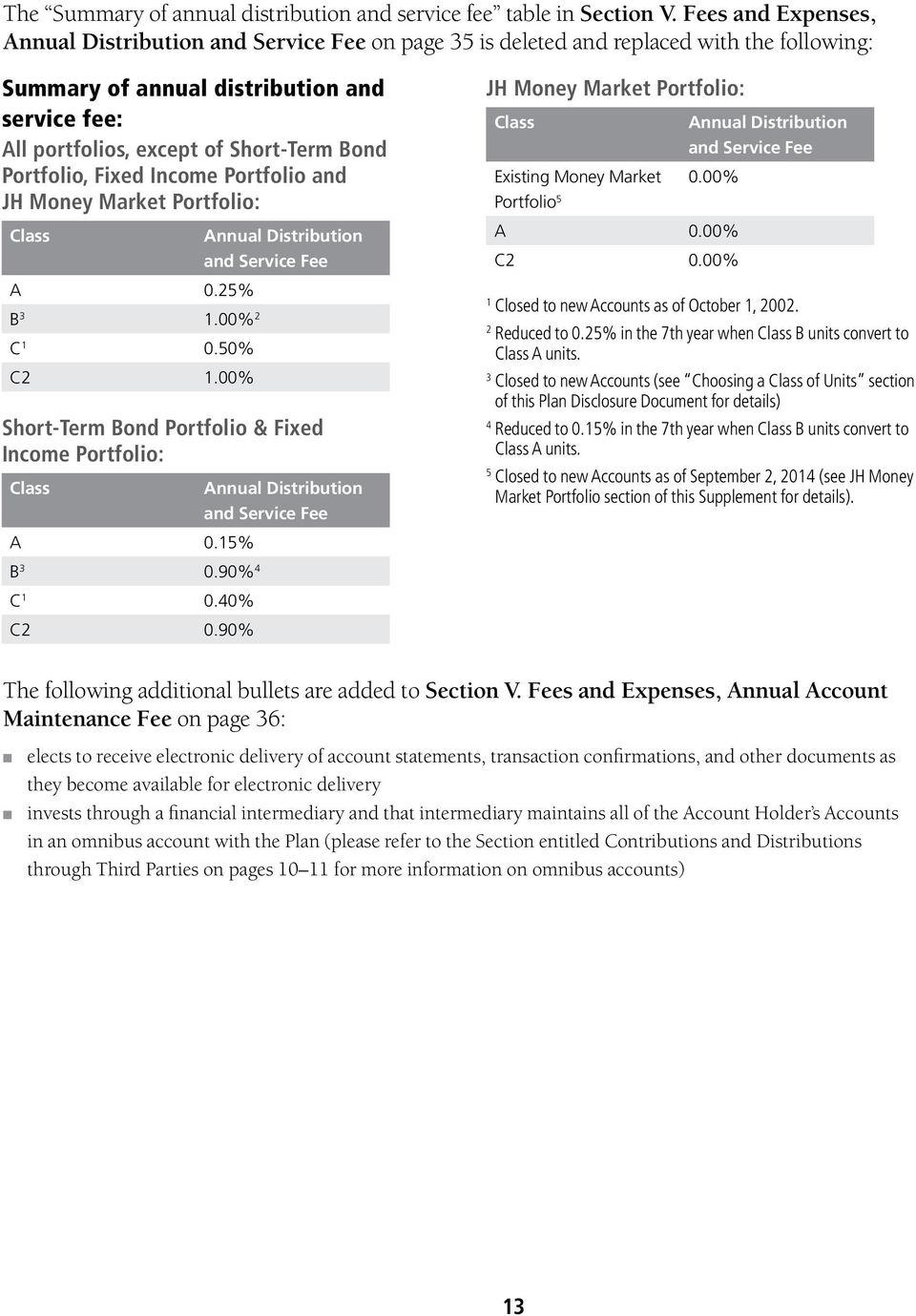
15 The following information updates Section V, Fees and Expenses and replaces the Summary of Fees/Expenses on pages and the Hypothetical Cost of a $10,000 Investment on pages 43 44: Summary of Fees/Expenses Fees and expenses vary based on the class of units chosen and the amount invested. A summary of fees, inclusive of Plan Fees and underlying fund expenses payable by class and assessed to each Account, is provided on the following charts. Class A Cost Structure Investment Options Estimated Underlying Fund Expenses 1 Annual Asset-Based Fees Program Management Fee Trust Fee Distribution and Service Fee Total Annual Asset-Based Fees 2 Additional Investor Expenses Maximum Initial Sales Charge 3 Annual Account Maintenance Fee 4 Portfolio % 0.25% 0.05% 0.25% 1.35% 5.25% $25 Portfolio % 0.25% 0.05% 0.25% 1.34% 5.25% $25 Portfolio % 0.25% 0.05% 0.25% 1.32% 5.25% $25 Portfolio % 0.25% 0.05% 0.25% 1.30% 5.25% $25 Portfolio % 0.25% 0.05% 0.25% 1.20% 5.25% $25 College Portfolio 0.63% 0.25% 0.05% 0.25% 1.18% 5.25% $25 Short-Term Bond Portfolio 0.51% 0.25% 0.05% 0.15% 0.96% 5.25% $25 Fixed Income Portfolio % 0.25% 0.05% 0.15% 1.17% 5.25% $25 Equity Portfolio 0.80% 0.25% 0.05% 0.25% 1.35% 5.25% $25 Future Trends Portfolio 0.84% 0.25% 0.05% 0.25% 1.39% 5.25% $25 Lifestyle Growth % 0.25% 0.05% 0.25% 1.49% 5.25% $25 Lifestyle Balanced % 0.25% 0.05% 0.25% 1.45% 5.25% $25 Lifestyle Moderate % 0.25% 0.05% 0.25% 1.39% 5.25% $25 TRP New Horizons % 0.25% 0.05% 0.25% 1.35% 5.25% $25 TRP Blue Chip Growth % 0.25% 0.05% 0.25% 1.29% 5.25% $25 TRP Mid-Cap Value % 0.25% 0.05% 0.25% 1.35% 5.25% $25 Templeton International Value % 0.25% 0.05% 0.25% 1.46% 5.25% $25 TRP Equity Income % 0.25% 0.05% 0.25% 1.22% 5.25% $25 TRP Small Cap Stock % 0.25% 0.05% 0.25% 1.46% 5.25% $25 Jennison Capital Appreciation % 0.25% 0.05% 0.25% 1.29% 5.25% $25 American Mutual % 0.25% 0.05% 0.25% 1.23% 5.25% $25 1 Estimated Underlying Fund Expenses reflect a weighted average of the underlying mutual fund expenses using the target allocations of the underlying mutual funds effective 6/9/14 and the actual expense ratios of the underlying funds as of each fund s most recent published fiscal year end. Future underlying fund and/or Investment Option expenses may be higher or lower than those reflected. 2 The Total Annual Asset-Based Fees is the sum of the Annual Estimated Underlying Fund Expenses, the Annual Program Management Fee, the Annual Trust Fee, and the Annual Distribution and Service Fee. The Total Annual Asset-Based Fee is assessed over the course of the year and does not include sales charges or the Annual Account Maintenance Fee. For an illustration of the total investment cost of a $10,000 investment over 1-, 3-, 5-, and 10-year periods, please refer to the chart that begins on page 43 titled Hypothetical Cost of a $10,000 Investment. Future annual asset-based fees may be higher or lower than those reflected. 3 Class A units will be subject to an initial sales charge of 5.25% (effective 9/2/2014 the initial sales charge for all portfolios, except Short-Term Bond Portfolio & Fixed Income Portfolio will be reduced to 5.00% and the initial sales charge for Short-Term Bond Portfolio & Fixed Income Portfolio will be reduced to 4.00%) unless the Account was established prior to June 3, 2002, and no material changes have been made to the Account. Certain contributions may be eligible for breakpoint pricing, thereby reducing the sales charge (see page 33, Breakpoints and Rights of Accumulation and Statement of Intention) or a sales charge waiver as described on page 36 under Initial Sales Charge/Fee Waivers. 4 The maximum Annual Account Maintenance Fee is $25. As described on page 36, for Account Holders investing through their employer, investing systematically, or who maintain certain Account balances, the Annual Account Maintenance Fee may be reduced or waived. + The Program Manager has voluntarily capped the Total Annual Asset-Based Fee for the Fixed Income Portfolio Class A at 1.34%. This cap may be withdrawn or amended at any time. 14
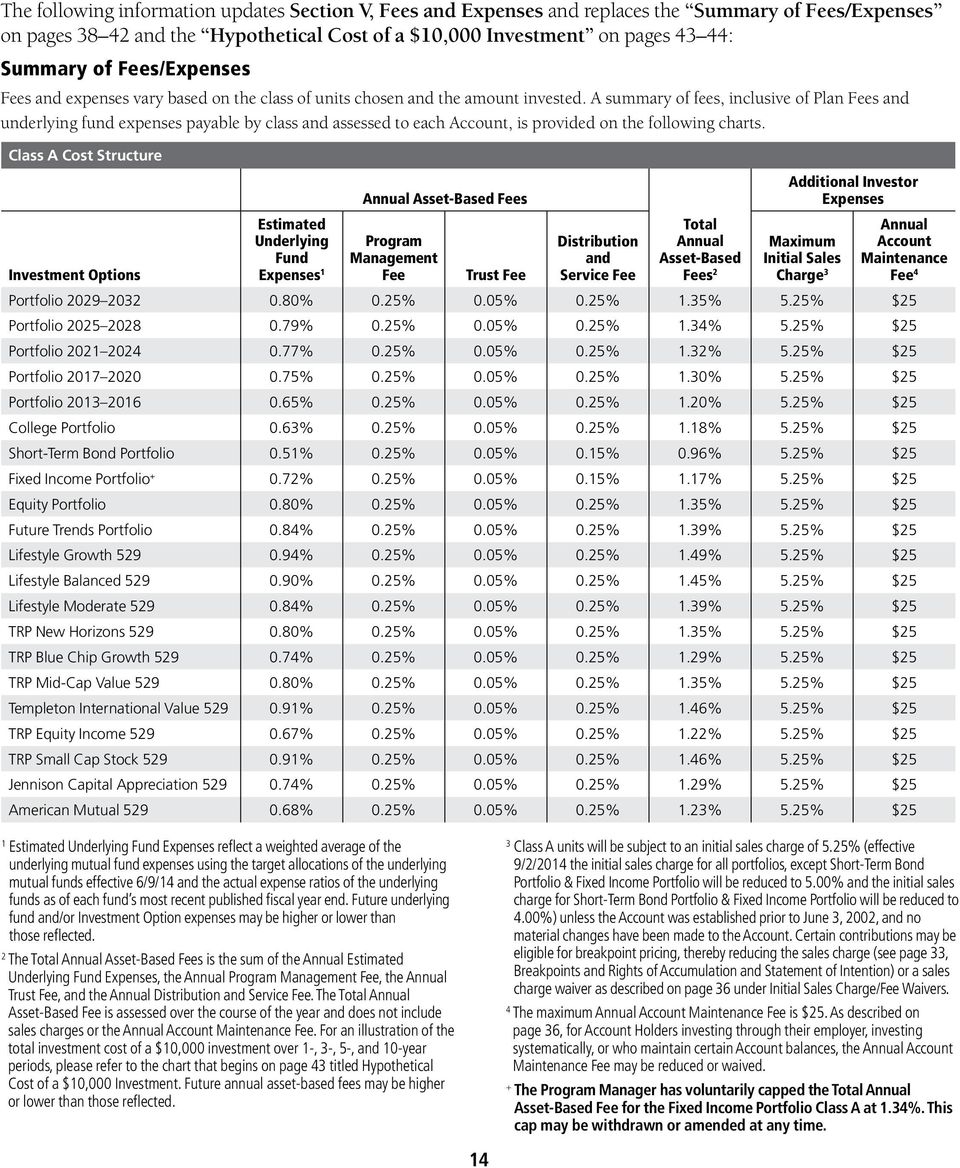
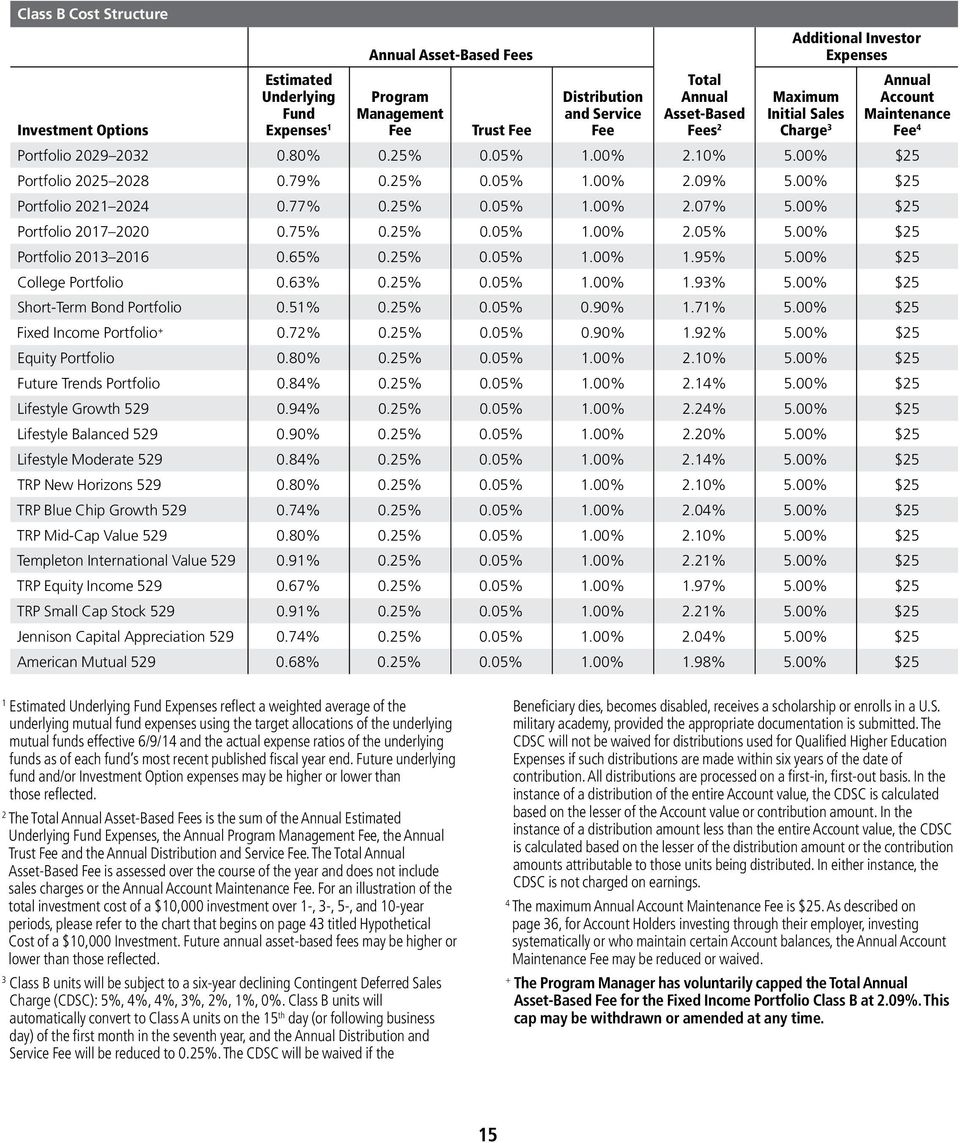
16 Class B Cost Structure Investment Options Estimated Underlying Fund Expenses 1 Annual Asset-Based Fees Program Management Fee Trust Fee Distribution and Service Fee Total Annual Asset-Based Fees 2 Additional Investor Expenses Maximum Initial Sales Charge 3 Annual Account Maintenance Fee 4 Portfolio % 0.25% 0.05% 1.00% 2.10% 5.00% $25 Portfolio % 0.25% 0.05% 1.00% 2.09% 5.00% $25 Portfolio % 0.25% 0.05% 1.00% 2.07% 5.00% $25 Portfolio % 0.25% 0.05% 1.00% 2.05% 5.00% $25 Portfolio % 0.25% 0.05% 1.00% 1.95% 5.00% $25 College Portfolio 0.63% 0.25% 0.05% 1.00% 1.93% 5.00% $25 Short-Term Bond Portfolio 0.51% 0.25% 0.05% 0.90% 1.71% 5.00% $25 Fixed Income Portfolio % 0.25% 0.05% 0.90% 1.92% 5.00% $25 Equity Portfolio 0.80% 0.25% 0.05% 1.00% 2.10% 5.00% $25 Future Trends Portfolio 0.84% 0.25% 0.05% 1.00% 2.14% 5.00% $25 Lifestyle Growth % 0.25% 0.05% 1.00% 2.24% 5.00% $25 Lifestyle Balanced % 0.25% 0.05% 1.00% 2.20% 5.00% $25 Lifestyle Moderate % 0.25% 0.05% 1.00% 2.14% 5.00% $25 TRP New Horizons % 0.25% 0.05% 1.00% 2.10% 5.00% $25 TRP Blue Chip Growth % 0.25% 0.05% 1.00% 2.04% 5.00% $25 TRP Mid-Cap Value % 0.25% 0.05% 1.00% 2.10% 5.00% $25 Templeton International Value % 0.25% 0.05% 1.00% 2.21% 5.00% $25 TRP Equity Income % 0.25% 0.05% 1.00% 1.97% 5.00% $25 TRP Small Cap Stock % 0.25% 0.05% 1.00% 2.21% 5.00% $25 Jennison Capital Appreciation % 0.25% 0.05% 1.00% 2.04% 5.00% $25 American Mutual % 0.25% 0.05% 1.00% 1.98% 5.00% $25 1 Estimated Underlying Fund Expenses reflect a weighted average of the underlying mutual fund expenses using the target allocations of the underlying mutual funds effective 6/9/14 and the actual expense ratios of the underlying funds as of each fund s most recent published fiscal year end. Future underlying fund and/or Investment Option expenses may be higher or lower than those reflected. 2 The Total Annual Asset-Based Fees is the sum of the Annual Estimated Underlying Fund Expenses, the Annual Program Management Fee, the Annual Trust Fee and the Annual Distribution and Service Fee. The Total Annual Asset-Based Fee is assessed over the course of the year and does not include sales charges or the Annual Account Maintenance Fee. For an illustration of the total investment cost of a $10,000 investment over 1-, 3-, 5-, and 10-year periods, please refer to the chart that begins on page 43 titled Hypothetical Cost of a $10,000 Investment. Future annual asset-based fees may be higher or lower than those reflected. 3 Class B units will be subject to a six-year declining Contingent Deferred Sales Charge (CDSC): 5%, 4%, 4%, 3%, 2%, 1%, 0%. Class B units will automatically convert to Class A units on the 15 th day (or following business day) of the first month in the seventh year, and the Annual Distribution and Service Fee will be reduced to 0.25%. The CDSC will be waived if the Beneficiary dies, becomes disabled, receives a scholarship or enrolls in a U.S. military academy, provided the appropriate documentation is submitted. The CDSC will not be waived for distributions used for Qualified Higher Education Expenses if such distributions are made within six years of the date of contribution. All distributions are processed on a first-in, first-out basis. In the instance of a distribution of the entire Account value, the CDSC is calculated based on the lesser of the Account value or contribution amount. In the instance of a distribution amount less than the entire Account value, the CDSC is calculated based on the lesser of the distribution amount or the contribution amounts attributable to those units being distributed. In either instance, the CDSC is not charged on earnings. 4 The maximum Annual Account Maintenance Fee is $25. As described on page 36, for Account Holders investing through their employer, investing systematically or who maintain certain Account balances, the Annual Account Maintenance Fee may be reduced or waived. + The Program Manager has voluntarily capped the Total Annual Asset-Based Fee for the Fixed Income Portfolio Class B at 2.09%. This cap may be withdrawn or amended at any time. 15
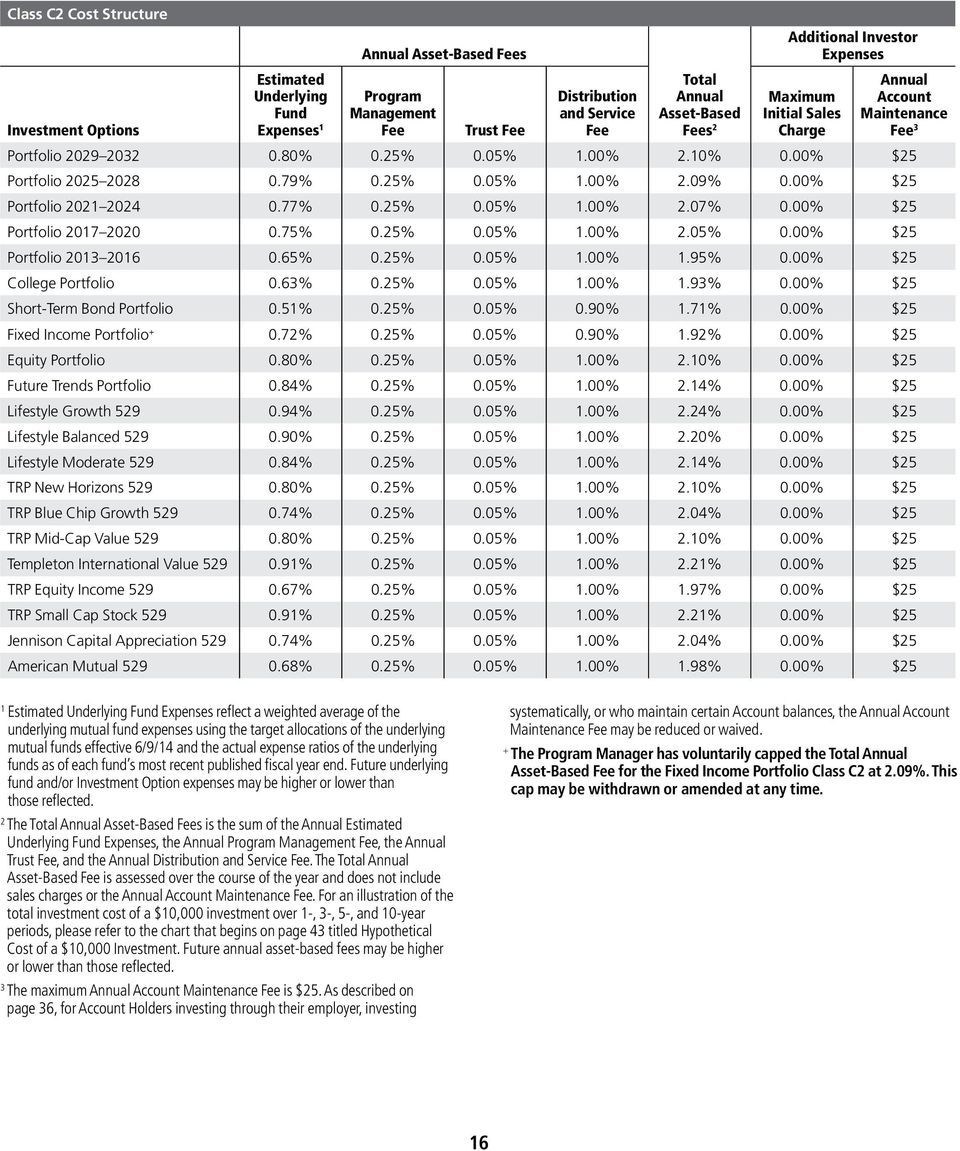
17 Class C2 Cost Structure Investment Options Estimated Underlying Fund Expenses 1 Annual Asset-Based Fees Program Management Fee Trust Fee Distribution and Service Fee Total Annual Asset-Based Fees 2 Additional Investor Expenses Maximum Initial Sales Charge Annual Account Maintenance Fee 3 Portfolio % 0.25% 0.05% 1.00% 2.10% 0.00% $25 Portfolio % 0.25% 0.05% 1.00% 2.09% 0.00% $25 Portfolio % 0.25% 0.05% 1.00% 2.07% 0.00% $25 Portfolio % 0.25% 0.05% 1.00% 2.05% 0.00% $25 Portfolio % 0.25% 0.05% 1.00% 1.95% 0.00% $25 College Portfolio 0.63% 0.25% 0.05% 1.00% 1.93% 0.00% $25 Short-Term Bond Portfolio 0.51% 0.25% 0.05% 0.90% 1.71% 0.00% $25 Fixed Income Portfolio % 0.25% 0.05% 0.90% 1.92% 0.00% $25 Equity Portfolio 0.80% 0.25% 0.05% 1.00% 2.10% 0.00% $25 Future Trends Portfolio 0.84% 0.25% 0.05% 1.00% 2.14% 0.00% $25 Lifestyle Growth % 0.25% 0.05% 1.00% 2.24% 0.00% $25 Lifestyle Balanced % 0.25% 0.05% 1.00% 2.20% 0.00% $25 Lifestyle Moderate % 0.25% 0.05% 1.00% 2.14% 0.00% $25 TRP New Horizons % 0.25% 0.05% 1.00% 2.10% 0.00% $25 TRP Blue Chip Growth % 0.25% 0.05% 1.00% 2.04% 0.00% $25 TRP Mid-Cap Value % 0.25% 0.05% 1.00% 2.10% 0.00% $25 Templeton International Value % 0.25% 0.05% 1.00% 2.21% 0.00% $25 TRP Equity Income % 0.25% 0.05% 1.00% 1.97% 0.00% $25 TRP Small Cap Stock % 0.25% 0.05% 1.00% 2.21% 0.00% $25 Jennison Capital Appreciation % 0.25% 0.05% 1.00% 2.04% 0.00% $25 American Mutual % 0.25% 0.05% 1.00% 1.98% 0.00% $25 1 Estimated Underlying Fund Expenses reflect a weighted average of the underlying mutual fund expenses using the target allocations of the underlying mutual funds effective 6/9/14 and the actual expense ratios of the underlying funds as of each fund s most recent published fiscal year end. Future underlying fund and/or Investment Option expenses may be higher or lower than those reflected. 2 The Total Annual Asset-Based Fees is the sum of the Annual Estimated Underlying Fund Expenses, the Annual Program Management Fee, the Annual Trust Fee, and the Annual Distribution and Service Fee. The Total Annual Asset-Based Fee is assessed over the course of the year and does not include sales charges or the Annual Account Maintenance Fee. For an illustration of the total investment cost of a $10,000 investment over 1-, 3-, 5-, and 10-year periods, please refer to the chart that begins on page 43 titled Hypothetical Cost of a $10,000 Investment. Future annual asset-based fees may be higher or lower than those reflected. 3 The maximum Annual Account Maintenance Fee is $25. As described on page 36, for Account Holders investing through their employer, investing systematically, or who maintain certain Account balances, the Annual Account Maintenance Fee may be reduced or waived. + The Program Manager has voluntarily capped the Total Annual Asset-Based Fee for the Fixed Income Portfolio Class C2 at 2.09%. This cap may be withdrawn or amended at any time. 16
18 Class C Cost Structure* Investment Options Estimated Underlying Fund Expenses 1 Annual Asset-Based Fees Program Management Fee Trust Fee Distribution and Service Fee Total Annual Asset-Based Fees 2 Additional Investor Expenses Maximum Initial Sales Charge Annual Account Maintenance Fee 3 Portfolio % 0.25% 0.05% 0.50% 1.55% 0.00% $25 Portfolio % 0.25% 0.05% 0.50% 1.45% 0.00% $25 College Portfolio 0.63% 0.25% 0.05% 0.50% 1.43% 0.00% $25 Short-Term Bond Portfolio 0.51% 0.25% 0.05% 0.40% 1.21% 0.00% $25 Fixed Income Portfolio % 0.25% 0.05% 0.40% 1.42% 0.00% $25 Equity Portfolio 0.80% 0.25% 0.05% 0.50% 1.60% 0.00% $25 Future Trends Portfolio 0.84% 0.25% 0.05% 0.50% 1.64% 0.00% $25 * Class C is only available in a limited number of Investment Options and was closed to new Accounts as of October 1, Contributions to Accounts established in Class C prior to October 1, 2002 will be subject to the original annual distribution and service fee unless a material change is made to the Account as described on page Estimated Underlying Fund Expenses reflect a weighted average of the underlying mutual fund expenses using the target allocations of the underlying mutual funds effective 6/9/14 and the actual expense ratios of the underlying funds as of each fund s most recent published fiscal year end. Future underlying fund and/or Investment Option expenses may be higher or lower than those reflected. 2 The Total Annual Asset-Based Fees is the sum of the Annual Estimated Underlying Fund Expenses, the Annual Program Management Fee, the Annual Trust Fee and the Annual Distribution and Service Fee. The Total Annual Asset-Based Fee is assessed over the course of the year and does not include sales charges or the Annual Account Maintenance Fee. For an illustration of the total investment cost of a $10,000 investment over 1-, 3-, 5-, and 10-year periods, please refer to the chart that begins on page 43 titled Hypothetical Cost of a $10,000 Investment. Future annual asset-based fees may be higher or lower than those reflected. 3 The maximum Annual Account Maintenance Fee is $25. As described on page 36, for Account Holders investing through their employer, investing systematically, or who maintain certain Account balances, the Annual Account Maintenance Fee may be reduced or waived. + The Program Manager has voluntarily capped the Total Annual Asset-Based Fee for the Fixed Income Portfolio Class C at 1.59%. This cap may be withdrawn or amended at any time. 17

19 JH Money Market Portfolio Cost Structure (not offered in multiple classes) Investment Options Estimated Underlying Fund Expenses 1 Annual Asset-Based Fees Program Management Fee Trust Fee Distribution and Service Fee Total Annual Asset-Based Fees 2 Additional Investor Expenses Maximum Initial Sales Charge Annual Account Maintenance Fee 3 JH Money Market Portfolio 0.19% 0.25% 0.00% 0.00% 0.44% 0.00% $25 1 Estimated Underlying Fund Expenses reflect a weighted average of the underlying mutual fund expenses using the target allocations of the underlying mutual funds effective 6/9/14 and the actual expense ratios of the underlying funds as of each fund s most recent published fiscal year end. Future underlying fund and/or Investment Option expenses may be higher or lower than those reflected. 2 The Total Annual Asset-Based Fees is the sum of the Annual Estimated Underlying Fund Expenses, the Annual Program Management Fee, and if applicable, the Annual Trust Fee, and the Annual Distribution and Service Fee. The Total Annual Asset-Based Fee is assessed over the course of the year and does not include sales charges or the Annual Account Maintenance Fee. For an illustration of the total investment cost of a $10,000 investment over 1-, 3-, 5-, and 10-year periods, please refer to the chart that begins on page 43 titled Hypothetical Cost of a $10,000 Investment. Future annual asset-based fees may be higher or lower than those reflected. 3 The maximum Annual Account Maintenance Fee is $25. As described on page 36, for Account Holders investing through their employer, investing systematically or who maintain certain Account balances, the Annual Account Maintenance Fee may be reduced or waived. Note: The Trustee has authorized the Program Manager to waive all or a portion of the annual program management fee for the JH Money Market Portfolio, to the extent necessary to maintain the net yield of the JH Money Market Portfolio at 0.0% or above. 18

20 The following information replaces similar information beginning on page 43 of the document. Hypothetical Cost of a $10,000 Investment The following table compares the approximate cost of investing in the various classes of units offered by John Hancock Freedom 529 over different periods of time. Your actual cost may be higher or lower. The table is based on the following assumptions: A $10,000 investment for the time periods shown. A 5% annually compounded rate of return on the net amount invested throughout the period. The imposition of the maximum initial sales charge as of September 2, 2014 (without regard to possible breakpoints in Class A units) and any CDSC applicable to units invested for the applicable periods in Class B units. All units are redeemed at the end of the period shown for Qualified Higher Education Expenses, and therefore the table does not consider the impact, if any, of federal or state taxes. One Year Three Years Cost Structure A B 1 B 2 C2 C 3 A B 1 B 2 C2 C 3 Investment Options Portfolio N/A 980 1, N/A Portfolio N/A 977 1, N/A Portfolio N/A 971 1, N/A Portfolio , Portfolio , College Portfolio , Short-Term Bond Portfolio , Fixed Income Portfolio , Equity Portfolio , Future Trends Portfolio , Lifestyle Growth N/A 1,021 1, N/A Lifestyle Balanced N/A 1,010 1, N/A Lifestyle Moderate N/A 992 1, N/A TRP New Horizons N/A 980 1, N/A TRP Blue Chip Growth N/A 963 1, N/A TRP Mid Cap Value N/A 980 1, N/A Templeton Int'l Value N/A 1,013 1, N/A TRP Equity Income N/A 942 1, N/A TRP Small-Cap Stock N/A 1,013 1, N/A Jennison Capital Appreciation N/A 963 1, N/A American Mutual N/A 945 1, N/A 1 Assumes redemption at the end of the period. 2 Assumes no redemption at the end of the period. 3 Class C is only available in a limited number of Investment Options and was closed to new Accounts as of October 1, Contributions to Accounts established in Class C prior to October 1, 2002 will be subject to the original annual distribution and service fee unless a material change is made to the Account as described on page

21 Total Annual Asset-Based Fees for each Investment Option are the same as those shown in the previous Summary of Fees/Expenses tables except for the Fixed Income Portfolio, which assumes the capped Total Annual Asset-Based Fees applicable to each class of units (as described in the footnotes to the Summary of Fees/Expenses tables). Expenses for each Investment Option include the entire annual Account maintenance fee of $25. In the case of the 10-year investment period, the annual costs shown for the Class B assume the units are converted to Class A in the first month of the seventh year. Cost Structure One Year Three Years Five Years Ten Years JH Money Market Portfolio Five Years Ten Years A B 1 B 2 C2 C 3 A B 1 B 2 C2 C 3 1,324 1,448 1,248 1,248 N/A 2,276 2,294 2,294 2,655 N/A 1,319 1,443 1,243 1,243 N/A 2,265 2,284 2,284 2,645 N/A 1,309 1,433 1,233 1,233 N/A 2,244 2,262 2,262 2,624 N/A 1,299 1,423 1,223 1, ,223 2,241 2,241 2,604 2,076 1,249 1,372 1,172 1, ,117 2,134 2,134 2,501 1,967 1,238 1,362 1,162 1, ,095 2,113 2,113 2,480 1,945 1,032 1,249 1,049 1, ,769 1,873 1,873 2,248 1,701 1,140 1,357 1,157 1, ,999 2,102 2,102 2,469 1,934 1,324 1,448 1,248 1, ,276 2,294 2,294 2,655 2,130 1,344 1,469 1,269 1,269 1,012 2,318 2,336 2,336 2,696 2,173 1,394 1,519 1,319 1,319 N/A 2,422 2,441 2,441 2,797 N/A 1,374 1,499 1,299 1,299 N/A 2,380 2,399 2,399 2,757 N/A 1,344 1,469 1,269 1,269 N/A 2,318 2,336 2,336 2,696 N/A 1,324 1,448 1,248 1,248 N/A 2,276 2,294 2,294 2,655 N/A 1,294 1,418 1,218 1,218 N/A 2,212 2,230 2,230 2,594 N/A 1,324 1,448 1,248 1,248 N/A 2,276 2,294 2,294 2,655 N/A 1,379 1,504 1,304 1,304 N/A 2,391 2,410 2,410 2,767 N/A 1,259 1,382 1,182 1,182 N/A 2,138 2,156 2,156 2,521 N/A 1,379 1,504 1,304 1,304 N/A 2,391 2,410 2,410 2,767 N/A 1,294 1,418 1,218 1,218 N/A 2,212 2,230 2,230 2,594 N/A 1,264 1,387 1,187 1,187 N/A 2,149 2,166 2,166 2,532 N/A 1 Assumes redemption at the end of the period. 2 Assumes no redemption at the end of the period. 3 Class C is only available in a limited number of Investment Options and was closed to new Accounts as of October 1, Contributions to Accounts established in Class C prior to October 1, 2002 will be subject to the original annual distribution and service fee unless a material change is made to the Account as described on page
22 The Commission Paid and Distribution & Service Fee table in Section V. Fees and Expenses, Fees Paid by John Hancock Distributors LLC to Broker-Dealers and their Financial Consultants for Distribution on page 45 is deleted and replaced with the following: All portfolios, except Short-Term Bond & Fixed Income Portfolios: Asset Range Commission Paid Distribution & Service Fee Class A $0 $49, % % $50,000 $99, % 0.25% $100,000 $249, % 0.25% $250,000 $499, % 0.25% $500,000 $999, % 0.25% $1,000, % 0.25% Class B 4.00% 0.25% Class C 1.00% 0.50% in year 2 Class C2 1.00% 1.00% in year 2 JH Money Market Portfolio (Existing Portfolio, Class A & Class C2) 14.25% effective 9/2/ % 0.00% Short-Term Bond & Fixed Income Portfolios: Asset Range Commission Paid Distribution & Service Fee Class A $0 $49, % % $50,000 $99, % % $100,000 $249, % % $250,000 $499, % 0.15% $500,000 $999, % 0.15% $1,000, % 0.15% Class B 4.00% 0.15% Class C 1.00% 0.40% in year 2 Class C2 1.00% 0.90% in year % effective 9/2/ % effective 9/2/ % effective 9/2/
23 The following replaces the second sentence of the second paragraph in Section VIII. Tax Considerations, Taxation of All Distributions on page 55: Form 1099-Q will be mailed to the tax reportable party s address of record for an Account at the time the Form is issued. Appendix: Underlying Mutual Funds The following information replaces the chart on page 68: Underlying Mutual Funds Expense Ratios (as of each fund s most recent published fiscal year end as of June 9, 2014) American Mutual Fund F % John Hancock Disciplined Value Fund, subadvised by Robeco 0.74% John Hancock Funds II Capital Appreciation Fund, subadvised by Jennison 0.74% John Hancock Funds II Emerging Markets Fund, subadvised by DFA 1.08% John Hancock Funds II International Value Fund, subadvised by Templeton 0.91% John Hancock Funds II Lifestyle Growth Portfolio Class % John Hancock Funds II Lifestyle Balanced Portfolio Class % John Hancock Funds II Lifestyle Moderate Portfolio Class % John Hancock Funds II Total Return Fund, subadvised by PIMCO 0.74% Oppenheimer International Growth Fund Y 0.90% T. Rowe Price Blue Chip Growth Fund 0.74% T. Rowe Price Equity Income Fund 0.67% T. Rowe Price Financial Services Fund 0.88% T. Rowe Price Health Science Fund 0.79% T. Rowe Price Inflation Focused Bond Fund 0.50% T. Rowe Price Mid Cap Value Fund 0.80% T. Rowe Price New Horizons Fund 0.80% T. Rowe Price Real Assets Fund 0.85% T. Rowe Price Science & Technology Fund 0.86% T. Rowe Price Short Term Bond Fund 0.51% T. Rowe Price Small Cap Stock Fund 0.91% T. Rowe Price Spectrum Income Fund 0.69% 1 T. Rowe Price Summit Cash Reserves Fund 0.45% 2 1 Since the T. Rowe Price Spectrum Income Fund bears a pro rata share of expenses of the other funds in which it invests, the number shown is a weighted average. 2 Expense caps: Due to voluntary expense reimbursement or fee waivers, actual total operating expenses for the T. Rowe Price Summit Cash Reserves Fund are 0.19%. This waiver may be amended or withdrawn in the future. 22
24 John Hancock Funds II Lifestyle Growth Portfolio Class 5 As of April 1, 2014, the allocations to the various funds were as follows: Bond 3.1% WAMCO Floating Rate Income 1.7% JHAM Strategic Income Opportunities 1.4% Stone Harbor Short Duration Credit Opportunities 1.3% Declaration/JHAM Active Bond 1.3% PIMCO Total Return 1.1% T. Rowe Price Spectrum Income 1.1% JHAM JHF Focused High Yield 1.0% WAMCO High Yield 0.9% Wells Capital U.S. High Yield Bond 0.7% Stone Harbor Global Income 0.6% JHAM Asia Pacific Total Return Bond 0.5% PIMCO Real Return Bond 0.4% PIMCO Global Bond 0.4% JHAM JHF Global Short Duration Credit Fund Class Equity Income 5.0% Wellington Alpha Opportunities 4.1% T. Rowe Price Capital Appreciation Value 3.5% T. Rowe Price Equity-Income 2.6% Davis Fundamental Value 2.2% First Quadrant Absolute Return Currency 2.2% GMO U.S. Equity 1.6% Robecco Boston Partners Disciplined Value Fund Class 1.2% Franklin Templeton Mutual Shares 1.2% Standard Life Investments Global Absolute Return 1.0% JHAM Fundamental Global Franchise 0.8% JHAM Global Equity 0.7% Allianz Redwood Equity 4.2% T. Rowe Price Blue Chip Growth 3.6% Jennison Capital Appreciation 3.2% JHAM Strategic Growth 2.7% T. Rowe Price Mid Value 2.7% JHAM Fundamental Large Cap Value 2.5% Wellington Technical Opportunities 2.4% QS Investors All Cap Core 1.3% Rainier Rainier Growth 1.1% Invesco Advisors Value 1.1% JHAM International Value Equity 0.7% T. Rowe Price Small Company Value 0.5% Wellington Small Cap Value 0.3% Wellington JHF Seaport Aggressive Growth 4.9% Dimensional Emerging Markets 3.9% Templeton International Value 3.4% Wellington Mid Cap Stock 2.5% Allianz/T.Rowe Price Science & Technology 2.0% GMO International Core 1.7% Invesco Advisors International Growth Stock 1.6% Ballie Gifford International Growth Opportunities 1.5% Wellington Natural Resources 1.5% T. Rowe Price Health Sciences 1.4% Epoch Global Shareholder Yield 1.4% Dimensional International Small Company 1.3% Franklin Templeton International Small Cap 1.3% JHAM JHF Financial Industries 0.7% Dimensional China Emerging Leaders 0.6% DeAM Global Real Estate 0.5% Wellington Wellington Small Cap Growth 0.5% T. Rowe Price Real Estate Equity 0.5% Invesco Advisors Small Company Growth 0.4% Dimensional/Invesco Advisors Small Cap Opportunities 0.3% JHAM Emerging Markets Debt 0.3% JHAM JHF Small Cap Intrinsic Value 0.3% JHAM JHF Small Cap Core Fund Class 23
25 John Hancock Funds II Lifestyle Balanced Portfolio Class 5 As of April 1, 2014, the allocations to the various funds were as follows: Bond 6.0% WAMCO Floating Rate Income 3.7% Declaration/JHAM Active Bond 3.6% JHAM Strategic Income Opportunities 3.6% PIMCO Total Return 3.3% Stone Harbor Short Duration Credit Opportunities 3.1% T. Rowe Price Spectrum Income 1.7% JHAM JHF Focused High Yield 1.7% WAMCO High Yield 1.5% Wells Capital U.S. High Yield Bond 1.2% Stone Harbor Global Income 1.2% Wells Capital Core Bond 1.2% PIMCO Global Bond 1.0% JHAM Asia Pacific Total Return Bond 1.0% PIMCO Real Return Bond 0.7% Wellington Investment Quality Bond 0.4% JHAM JHF Global Short Duration Credit Fund Class Equity Income 3.8% T. Rowe Price Capital Appreciation Value 3.1% Wellington Alpha Opportunities 2.6% T. Rowe Price Equity-Income 2.4% First Quadrant Absolute Return Currency 2.0% GMO U.S. Equity 1.7% Davis Fundamental Value 1.3% Standard Life Investments Global Absolute Return 1.2% Robecco Boston Partners Disciplined Value Fund Class 0.9% JHAM Fundamental Global Franchise 0.9% Franklin Templeton Mutual Shares 0.8% JHAM Global Equity 0.7% Allianz Redwood Equity 3.1% T. Rowe Price Blue Chip Growth 2.7% Jennison Capital Appreciation 2.3% JHAM Strategic Growth 2.0% JHAM Fundamental Large Cap Value 1.8% T. Rowe Price Mid Value 1.5% Wellington Technical Opportunities 1.2% QS Investors All Cap Core 1.0% Rainier Rainier Growth 0.9% JHAM International Value Equity 0.8% Invesco Advisors Value 0.5% T. Rowe Price Small Company Value 0.4% Wellington Small Cap Value 0.2% Wellington JHF Seaport Aggressive Growth 3.2% Dimensional Emerging Markets 3.1% Templeton International Value 2.3% Wellington Mid Cap Stock 2.0% Allianz/T.Rowe Price Science & Technology 1.6% GMO International Core 1.4% Wellington Natural Resources 1.4% Epoch Global Shareholder Yield 1.4% Invesco Advisors International Growth Stock 1.2% T. Rowe Price Health Sciences 1.2% Ballie Gifford International Growth Opportunities 1.0% Dimensional International Small Company 1.0% JHAM JHF Financial Industries 1.0% Franklin Templeton International Small Cap 0.7% DeAM Global Real Estate 0.5% Dimensional China Emerging Leaders 0.5% T. Rowe Price Real Estate Equity 0.5% JHAM Emerging Markets Debt 0.4% Wellington Wellington Small Cap Growth 0.4% Invesco Advisors Small Company Growth 0.3% Dimensional/Invesco Advisors Small Cap Opportunities 0.2% JHAM JHF Small Cap Intrinsic Value 0.2% JHAM JHF Small Cap Core Fund Class 24
26 John Hancock Funds II Lifestyle Moderate Portfolio Class 5 As of April 1, 2014, the allocations to the various funds were as follows: Bond 9.1% WAMCO Floating Rate Income 7.7% Declaration/JHAM Active Bond 7.6% PIMCO Total Return 4.7% JHAM Strategic Income Opportunities 4.1% Stone Harbor Short Duration Credit Opportunities 3.9% T. Rowe Price Spectrum Income 2.6% Wells Capital Core Bond 2.4% PIMCO Global Bond 2.1% JHAM JHF Focused High Yield 2.1% WAMCO High Yield 1.8% Wells Capital U.S. High Yield Bond 1.8% Wellington Investment Quality Bond 1.6% Stone Harbor Global Income 1.5% JHAM Asia Pacific Total Return Bond 1.3% PIMCO Real Return Bond 0.3% JHAM JHF Global Short Duration Credit Fund Class Equity Income 3.5% T. Rowe Price Capital Appreciation Value 3.0% T. Rowe Price Equity-Income 2.4% First Quadrant Absolute Return Currency 2.0% GMO U.S. Equity 1.9% Wellington Alpha Opportunities 1.6% Standard Life Investments Global Absolute Return 1.5% Davis Fundamental Value 0.9% Allianz Redwood 0.7% JHAM Fundamental Global Franchise 0.6% JHAM Global Equity 0.5% Wellington JHF Enduring Equity Fund Class Equity 2.4% JHAM Fundamental Large Cap Value 2.4% T. Rowe Price Blue Chip Growth 2.0% Jennison Capital Appreciation 1.7% T. Rowe Price Mid Value 1.5% JHAM Strategic Growth 0.8% Rainier Rainier Growth 0.6% JHAM International Value Equity 0.5% T. Rowe Price Small Company Value 0.3% Wellington Small Cap Value 0.2% Wellington JHF Seaport Aggressive Growth 2.2% Dimensional Emerging Markets 2.1% Templeton International Value 1.5% Wellington Mid Cap Stock 1.1% Epoch Global Shareholder Yield 1.0% Wellington Natural Resources 1.0% GMO International Core 0.9% Invesco Advisors International Growth Stock 0.8% JHAM Emerging Markets Debt 0.7% Ballie Gifford International Growth Opportunities 0.7% Franklin Templeton International Small Cap 0.7% Dimensional International Small Company 0.5% DeAM Global Real Estate 0.5% T. Rowe Price Real Estate Equity 0.3% Wellington Wellington Small Cap Growth 0.3% Invesco Advisors Small Company Growth The following fund and investment objective is added to Funds Focusing on Domestic and Foreign Equities (Stocks) : T. Rowe Price Real Assets Fund Seeks to provide long-term capital growth. The fund normally invests at least 80% of net assets in real assets and securities of companies that derive at least 50% of their profits or revenues from, or commit at least 50% of assets to real assets and activities related to, real assets. Real assets are defined broadly by the fund and are considered to include any assets that have physical properties, such as energy and natural resources, real estate, basic materials, equipment, utilities and infrastructure, and commodities. The fund will invest in companies located throughout the world and there is no limit on the fund s investments in foreign markets. 25
27 The following change applies to the Funds Focusing on Domestic and Foreign Equities (Stocks) : The reference to John Hancock Disciplined Value Fund I is changed to John Hancock Disciplined Value Fund The following fund and corresponding investment objective is deleted from Funds Focusing on Domestic and Foreign Equities (Stocks) : John Hancock Funds II Fundamental Value Fund The following funds and investment objectives are added to Objectives and Strategies of Lifestyle Portfolios Underlying Funds : Dimensional China Emerging Leaders Fund The fund will invest directly and indirectly (e.g., through derivatives and other synthetic instruments) at least 80% of its net assets, plus borrowings for investment purposes, in a portfolio of equities, including equityrelated instruments (such as fixed or floating-rate convertible bonds issued by corporate, sovereign or institutional issuers of above or below investment grade, preference shares, warrants or participatory notes (p-notes)), tied economically to The People s Republic of China (China). John Hancock Asset Management Financial Industries Fund Seeks capital appreciation. Under normal market conditions, the fund invests at least 80% of its net assets (plus any borrowings for investment purposes) in stocks of U.S. and foreign financial services companies of any size. These companies include banks, thrifts, finance companies, brokerage and advisory firms, real estate related firms, insurance companies, and financial holding companies. John Hancock Asset Management Fundamental Large Cap Value Fund Seek long-term capital appreciation. Under normal market conditions, the fund invests at least 80% of its net assets in equity securities of large-capitalization companies. The fund considers large-capitalization companies to be those that at the time of purchase have a market capitalization equal to or greater than that of the top 80% of the companies that compose the Russell 1000 Index. Equity securities include common, convertible, and preferred securities and their equivalents. John Hancock Asset Management Global Short Duration Credit Fund Seeks to maximize total return consisting of current income and capital appreciation. The fund normally invests at least 80% of its net assets (plus any borrowings for investment purposes) in bonds. These bonds may include investment grade and below-investment-grade (i.e., high-yield or junk) bonds issued by U.S. and foreign corporations and U.S. and foreign governments and their agencies and instrumentalities. Under normal circumstances, the fund will invest at least 40% of its net assets in foreign securities. The fund may also invest in preferred securities and other types of debt securities. 26
28 John Hancock Asset Management Small Cap Core Fund Seeks long-term capital appreciation. Under normal market conditions, the fund invests at least 80% of its net assets (plus any borrowings for investment purposes) in equity securities of small-capitalization companies. The fund considers small-capitalization companies to be those companies that, at the time of investment, are in the capitalization range of the Russell 2000 Index. The fund generally will not invest in companies that, at the time of purchase, have market capitalizations of $5 billion or more. Equity securities include common and preferred stocks, rights, warrants, and depositary receipts (including American Depositary Receipts (ADRs), American Depositary Shares, European Depositary Receipts, and Global Depositary Receipts). Robeco Disciplined Value Fund Seeks long-term growth of capital by investing, under normal conditions, at least 80% of its net assets in a diversified portfolio consisting primarily of equity securities, such as common stocks of issuers with a market capitalization of $1 billion or greater and identified by the sub adviser as having value characteristics, including price-to-book value ratios and price-to-earnings ratios. These value characteristics are examined in the context of the issuer s operating and financial fundamentals, such as return on equity and earnings growth and cash flow. The fund may also invest up to 20% of its total assets in non-u.s. dollar-denominated securities. Wellington Enduring Equity Fund Seeks total return from capital appreciation and income, with an emphasis on absolute returns over a full market cycle by investing, under normal circumstances, at least 80% of its net assets (plus borrowings for investment purposes) in global equity securities. The fund typically invests in companies with long-lived physical assets. The fund also seeks to mitigate losses during periods of unfavorable equity market conditions through a portfolio that will generally exhibit lower beta, or volatility, relative to the broader universe of global equity securities. While not managed explicitly for yield, the securities in which the fund invests may often provide higher dividend yields than the broader equity market. Wellington Seaport Fund Seeks capital appreciation by allocating its assets to a number of investment strategies (Strategies), through which the fund will take both long and short positions in a variety of equity instruments. The fund may hold significant short positions. The fund will generally invest in smaller, medium, and larger company stocks but generally will not invest in companies with a market capitalization below $500 million. The fund expects to maintain significant short positions, primarily in: exchange-traded pooled investment vehicles (e.g., ETFs) or derivative instruments. The fund also may invest in high-yield debt securities (i.e., junk bonds) and master limited partnerships. 27
29 The following changes apply to the Objectives and Strategies of Lifestyle Portfolios Underlying Funds : First Quadrant Currency Strategies Fund changed its name to First Quadrant Absolute Return Fund John Hancock Asset Management Asia Total Return Bond Fund changed its name to John Hancock Asset Management Asia Pacific Total Return Bond Fund John Hancock Asset Management High Income Fund changed its name to John Hancock Asset Management Focused High Yield Fund Stone Harbor Global High Yield Fund changed its name to Stone Harbor Global Income Fund The reference to Wellington/RS Investments Natural Resources Fund is changed to Wellington Natural Resources Fund The following funds and corresponding investment objectives are deleted from Objectives and Strategies of Lifestyle Portfolios Underlying Funds : American Century Heritage Fund Atlantis China Emerging Leaders Fund Columbia Mid Cap Value Equity Fund Lord Abbett All Cap Value Fund John Hancock Asset Mgt, Frontier, Perimeter Smaller Company Growth Fund PDDPS1 06/14
30 In this booklet What to Know Before You Get Started An introductory section that answers some frequently asked questions. Table of Contents for the Plan Disclosure Document Plan Disclosure Document a detailed explanation of the Plan s structure, operations, investments, and other characteristics. WHERE TO FIND IMPORTANT INFORMATION Account Holder and Beneficiary Requirements 5, 7 Contribution and Distribution Limitations and Penalties 7, 50 Federal and State Tax Information 53 Fees and Classes of Units 31 Information on the Education Trust of Alaska, the Program Manager and John Hancock 60 Investment Options and Underlying Fund Descriptions 12, 14, 68 Investment Performance 27 Risk Factors 25 Accounts in John Hancock Freedom 529 (the Plan ) and units in the Trust are not registered as securities with the U.S. Securities and Exchange Commission (the SEC ) under the Securities Act of 1933, nor are the Plan s portfolios registered as investment companies under the Investment Company Act of Relevant sections of both statutes exempt state instrumentalities such as the Trust and interests in such instrumentalities from registration. Depending upon the laws of the home state of the Account Holder or Beneficiary, favorable state tax treatment or other benefits offered by that home state may be available only for investments in the home state s 529 college savings plan. Any state-based benefit offered with respect to a particular 529 college savings plan should be one of many appropriately weighted factors to be considered in making an investment decision. You should consult with your financial, tax, or other adviser to learn more about how state-based benefits (including any limitations) would apply to your specific circumstances. You may also wish to contact your or your Beneficiary s home state or any other 529 college savings plan to learn more about the features, benefits, and limitations of that state s 529 college savings plan. The information in the Plan Disclosure Document is believed to be accurate as of the cover date but is subject to change without notice. No one is authorized to provide information that is different from the information in the most current form of the Plan Disclosure Document. An investment in the Plan is not insured by the FDIC or any other government agency, may lose value, and is not guaranteed by the Federal Reserve, a bank, the Trust, the University of Alaska, T. Rowe Price, John Hancock, or any state. The Plan Disclosure Document intends to comply with the Disclosure Principles, Statement No. 5, adopted by the College Savings Plans Network, an affiliate of the National Association of State Treasurers, on May 3, The information in the current Plan Disclosure Document, together with the New Account Agreement, portfolio performance information found beginning on page 27, and performance information found on the Plan s website, constitute the John Hancock Freedom 529 Offering Materials. The Plan is intended to be used only to save for qualified higher education expenses. The Plan is not intended to be used, nor should it be used, by any taxpayer for the purpose of evading federal or state taxes or tax penalties. Taxpayers may wish to seek tax advice from an independent tax advisor based on their own particular circumstances.
31 This page has been intentionally left blank.
32 What To Know Before You Get Started This section is intended to introduce some of the features and answer frequently asked questions concerning John Hancock Freedom 529 (the Plan ). This is not part of the Plan Disclosure Document that follows in this booklet. What are 529 college savings plans? Named for Section 529 of the Internal Revenue Code, these plans help individuals and families save for college in a tax-advantaged way. What is John Hancock Freedom 529? John Hancock Freedom 529, formerly marketed as Manulife College Savings, is a 529 savings plan offered by the Education Trust of Alaska, managed by T. Rowe Price Associates, Inc., and distributed by John Hancock Distributors LLC, through other broker-dealers with whom John Hancock Distributors LLC has entered into a selling agreement. It is intended to be a qualified tuition program under Section 529 of the Internal Revenue Code. What are some of the Plan s major benefits? A multi-managed platform; Diversification by asset class and investment style; Any account growth is tax-deferred; Distributions for qualified educational expenses are federal tax-free; Account holder maintains control over assets and distributions; and Gift and estate tax benefits. Who can participate in the Plan? Any U.S. citizen or resident alien can open an account, as can trusts, corporations, and other organizations. You are not restricted by age, income, or state of residence. How are accounts structured? Only one person the account holder can open and control an account. If the account holder is a minor, the account must have a custodian to act on behalf of the minor. Each account may have only one beneficiary (future student), but you may open as many accounts for as many different beneficiaries as you want. Can my spouse and I set up a joint account? Joint accounts are not permitted in this plan. However, you and your spouse may each establish separate accounts for the same beneficiary or you may both contribute to the same account. Who can be a beneficiary? Any U.S. citizen or resident alien including the account holder can be the beneficiary. Can I change the beneficiary? Yes, the account holder can change the beneficiary at any time. If the beneficiary is changed, the new beneficiary must be a member of the family of the current beneficiary, as defined by the Internal Revenue Code. Can the account holder be changed? Generally, yes. However, special rules may apply to accounts with custodians. You may also name a successor account holder who takes over for you in the event of your death or legal incompetence. Since a change of account holder could have tax consequences, you may want to check with a tax adviser. How much money do I need to open an account? The minimum initial contribution is $1,000 per portfolio. If you are participating in the automatic purchase or payroll deduction programs, the minimum is $50 per portfolio, per month. The minimum subsequent contribution for any portfolio is $50.
33 Who can contribute to an account? Anyone can contribute, not just the account holder. How much can I invest? You can invest until the combined account balances for a beneficiary reach $400,000. It is acceptable for earnings (but not contributions) to cause the total account value to go over this amount. This maximum may or may not cover all of your beneficiary s college expenses. Are contributions tax-deductible? Not at the federal level; state income tax treatment varies. How do I contribute to my account? Check or money order; Electronic fund transfer from your financial institution account; By investing systematically through the automatic purchase program or, if applicable, payroll deduction program; By rollover from another qualified tuition program (529 plan), Coverdell Education Savings Account, or qualified U.S. Savings Bond; and/or By moving money from UGMA/UTMA accounts. What are my investment choices? The Plan offers 22 portfolios representing four investment strategies. Enrollment-Based Portfolios Static Portfolios Lifestyle Portfolios Individual Portfolios Where can I receive performance information on the portfolios? You can receive performance information on our website at or you can call You can also find performance information as of the most recent quarter end in the Investor Quarterly Update, which you can obtain from your financial consultant. Are any of the portfolios guaranteed? Your account value is never guaranteed, so you could lose money (including your contributions) or not make money by investing in the Plan. The JH Money Market Portfolio is not guaranteed, however, it is managed to preserve your investment principal. Can I change my portfolio selection? Each time you make a contribution you may select a different portfolio. In addition, changes to your existing investments for a particular beneficiary are permitted only once per calendar year and any time upon a change in the beneficiary. If you are contributing via payroll deduction and wish to change the direction of your contributions or add an investment option after an account has been set up, please contact John Hancock Freedom 529 at How can I use the money in my account? Your account balance can be used for any purpose. However, to receive the full federal tax benefit, the money must be used for qualified education expenses of the beneficiary at an eligible educational institution, as defined by the IRS. Can the account be used to pay for any college? The account can be used for the beneficiary s attendance at any eligible institution of higher education that meets specific federal accreditation standards. These institutions include most four-year colleges and universities (both for undergraduate and graduate degrees), certain two-year institutions, and proprietary and vocational schools, and some foreign schools that are eligible to participate in Financial Aid programs under Title IV of the Higher Education Act of 1965.
34 Will participation in the Plan affect my beneficiary s eligibility for financial aid? The treatment of investments in a 529 savings plan, such as this one, varies from school to school, but assets are typically not treated as assets of the student. However, any investment in a 529 plan may still affect a student s eligibility to get financial aid based on need. You should check with the schools you are considering regarding this issue. When can I take a distribution from my account? You can request a distribution at any time. What if I do not use the money in my account for qualified education expenses? If a distribution is not used for qualified expenses, any investment earnings will be subject to federal, and possibly state, income taxes at the rate of whoever receives the distribution. The distribution may also be assessed a 10% federal penalty tax on any earnings. Is paying off a student loan a qualified expense? No. Repayment of student loans is not considered a qualified education expense. What if my beneficiary receives a scholarship? There are a number of options for your account if your beneficiary earns a scholarship. You may use the account to pay for education expenses that are not covered by the scholarship. You may take a distribution from your account in an amount up to the amount of the scholarship without incurring a penalty tax; however, you may be subject to federal and state income taxes. You may leave the money in the account for use at a future date, such as for an advanced degree. You may change the beneficiary to another member of the beneficiary s family. What if my beneficiary does not go to college? If your planned beneficiary does not go to college, you have three options: Leave the money in the account in case the beneficiary subsequently decides to attend college; Select a new beneficiary; or Take a distribution from your account, and pay both the 10% federal penalty and income taxes on any earnings. What if I move to another state? There are no residency requirements for the Plan, so you can maintain your account and continue to make contributions. What are the fees? There are asset-based fees and an annual account maintenance fee. The annual asset-based fees are determined by share class, as well as expense ratios of the underlying mutual funds in which each investment option invests. For additional information on the annual asset-based fees refer to Section V, Fees and Expenses. The annual account maintenance fee is $25. It is waived if, as of the date the fee is assessed: You are contributing through the automatic purchase program; The combined account balance for a beneficiary is $25,000 or more; The combined account holder s total balance (regardless of beneficiary) is $75,000 or more; or You are contributing through payroll deduction.
35 If you have more than one account for the same beneficiary, the annual account maintenance fee will be prorated across all of these accounts. What are the federal income tax advantages? Any earnings on the money you invest in your account can grow tax-deferred until they are distributed. All qualified distributions for education expenses will be exempt from federal income tax. Please note that state income taxes may continue to apply. Depending upon the laws of the home state of the account holder or beneficiary, favorable state tax treatment or other benefits offered by that home state may be available only for investments in the home state s 529 college savings plan. If your state or your beneficiary s state offers a 529 plan, you should consider any state income tax or other benefits it offers before investing. What are the gift and estate tax benefits to an account? Generally, gifts to an individual that exceed $14,000 in a single year are subject to the federal gift tax. However, for 529 plans, gifts of up to $70,000 ($140,000 for a married couple) can be made in a single year for a beneficiary and averaged over five years to qualify for exclusion from the federal gift tax.* I own a UGMA/UTMA account. Can I move those assets into a 529 savings plan? You can redeem assets from Uniform Gift to Minors Act/Uniform Transfers to Minors Act ( UGMA/ UTMA ) accounts, but you may be liable for income taxes on any gains upon redemption. Once the UGMA/UTMA proceeds are used to contribute to a 529 plan, the minor of the UGMA/UTMA account must be named both the account holder and the beneficiary of the 529 account and cannot be changed. For more information, please consult your financial consultant. Before you make contributions to the Plan, please read and understand the Plan Disclosure Document. It gives you important information about the Plan and discusses the risks and benefits of investing through the Plan. The Plan Disclosure Document incorporates by reference the Declaration of Trust, the College Savings Program and the Plan s most recent Annual Report, and summarizes the terms and conditions in those documents. For a copy of these documents, please call If you die with money remaining in your account, it will not be included in your taxable estate for federal estate tax purposes. (However, there are exceptions should you die within five years of making the contributions that were gifts using the five-year rule noted above.) * In future years, the amount of the federal gift tax exclusion will be increased as required by a cost-of-living increase.
36 This page has been intentionally left blank.
37 Plan Disclosure Document John Hancock Freedom 529: A national plan offered by the Education Trust of Alaska Please retain this Plan Disclosure Document for your records. The Education Trust of Alaska (the Trust ) may make modifications to John Hancock Freedom 529 (the Plan ) in the future. Should material modifications be made to the Plan, a revised Plan Disclosure Document will be mailed to your address of record. Under such circumstances, the new Plan Disclosure Document will supersede all prior versions. Effective September 2013 FOR USE BY ACCOUNT HOLDERS INVESTING WITH A FINANCIAL CONSULTANT
38 TABLE OF CONTENTS Definitions of Frequently Used Terms 1 I. Plan Overview 5 II. Opening and Contributing to an Account 5 Who May Open an Account... 5 Account Holder Responsibilities... 5 How to Open an Account... 5 Need for a Custodian... 6 Identity Verification of Individuals Opening Accounts... 6 Death of Account Holder/Appointing a Successor... 6 Naming a Beneficiary... 7 Contributing to an Account... 7 Funding Details... 8 Choosing an Investment Option Minimum Contributions Maximum Contributions Nonpayment Temporary Distribution Restriction Contributions and Distributions through Third Parties III. General Information on the Plan s Investment Options 12 Separate Accounts Investment Guidelines and Management Investment Option Changes Treatment of Dividends/Capital Gains Composition of Investment Options Investment Selections and Default Investment Direction Restriction on Investment Direction IV. The Plan s Investment Options, Investment Risks and Performance 14 Enrollment-Based Portfolios Static Portfolios Lifestyle Portfolios Individual Portfolios General Risks of Investing in the Plan Principal Risks Associated with Domestic and Foreign Stock Funds Principal Risks Associated with Aggressive Stock Funds Principal Risks Associated with Fixed-Income Funds John Hancock Freedom 529 Investment Performance i
39 V. Fees and Expenses 31 Choosing a Class of Units Sales Charges Annual Program Management Fee Annual Distribution and Service Fee Trust Fee Underlying Fund Expenses Annual Account Maintenance Fee Other Fees Initial Sales Charge/Fee Waivers Reinstatement Privilege Summary of Fees/Expenses Hypothetical Cost of a $10,000 Investment Fees Paid by John Hancock Distributors LLC to Broker-Dealers and.their Financial Consultants for Distribution VI. Maintaining and Modifying Your Account 47 Changing an Account Holder Payroll Deduction Accounts: Changing an Account Holder or Termination of Employment Changing or Removing a Custodian Changing a Beneficiary Simultaneous Death Changing Investment Direction Changing or Terminating Contribution Amounts through Payroll Deduction Changing or Terminating Contributions through Automatic Purchase Systematic Exchange/Dollar Cost Averaging JH Money Market Portfolio and Exchanges Keeping Track of Your Account VII. Taking Distributions and Closing an Account 50 Uses of a Distribution Requesting a Distribution Distribution Payment Methods and Eligible Payees Determining Net Asset Values (NAV) Types of Qualified Distributions Qualified Expenses Scholarship Death of a Beneficiary Disability Military Academy Rollover Distribution ii
40 Types of Eligible Educational Institutions Restrictions on Distributions Unused Account Assets Non-Qualified Distributions Closing an Account The Trust s Ability to Terminate an Account Suspension of an Account Right to Freeze an Account VIII. Tax Considerations 53 Tax-Deferred Earnings Tax-Advantaged Treatment for Qualified Expenses Federal Gift Tax Federal Estate Tax Generation Skipping Taxation of All Distributions Calculation of Earnings; Aggregation of Accounts for Tax Reporting Substantiation of Qualified Expenses Taxation of Other Qualified Distributions Rollovers Taxation of Non-Qualified Distributions Disclaimer Regarding Written Tax Advice Tax Benefits Not Intended for Abuse IX. Other Considerations Related to Investing in the Plan 58 Assets Held in Trust Effect of Future Law Changes Future Enhancements Relationship of Your Account to Financial Aid Programs Relationship of Your Account to Medicaid Programs Creditor Protection Coverdell Education Savings Accounts Coordination with the Hope and Lifetime Learning Tax Credits Interaction with Other Saving Options X. The Plan s Administrative and Legal Framework 60 Plan Establishment Declaration of Trust Program Manager Contract Plans Offered by the Trust iii
41 Plan Service Providers Investment and Program Management Services Distribution Services Account Record Keeping Services Services Provided by John Hancock Obligation to Act Prudently Suspension of Responsibilities Trustee s Ability to Amend, Modify, Suspend, or Terminate Trust Termination Governing Law Precedence Securities Laws Continuing Disclosure Correction of Errors General Dispute Resolution Claims Dispute Resolution Investigation of Claims Appeal Process Reliance Upon Information Provided by Account Holder Account Holder s Representations and Acknowledgments Account Holder s Indemnity Nonliability of the Trust, Program Manager, John Hancock and their Related Entities Appendix: Underlying Mutual Funds 68 Information About Underlying Funds and Investments Underlying Fund Fees Underlying Mutual Funds Expense Ratios Funds May Not Meet Objectives; Accounts Are Not Insured Funds Focusing on Domestic and Foreign Equities (Stocks) Aggressive Stock Funds Funds Focusing on Fixed-Income Securities Objectives and Strategies of Lifestyle Portfolios Underlying Funds John Hancock Freedom 529 Privacy Policy 86 iv
42 Definitions of Frequently Used Terms Capitalized terms used in this Plan Disclosure Document have the following meanings: Account: an account established in the Trust by an Account Holder that is invested in a specific Investment Option. Account Holder: an individual, corporation, partnership, association, trust, or estate who/that establishes an Account in the Trust, referred to in the Alaska College Savings Act, Declaration, and the College Savings Program as Participant. Administrative Accounts: accounts or sub-accounts established in the Trust for the purpose of administering, managing, and operating the Trust. Alaska College Savings Act: AS , as may be amended from time to time, establishing the Alaska Advance College Tuition Savings Fund and the Alaska Higher Education Savings Trust in the University. Authorized Plans: the respective plans established by the Trust, pursuant to the Declaration, to implement the College Savings Program, including John Hancock Freedom 529. Automatic Purchase: a program wherein a contributor authorizes the transfer of money, on a regular and predetermined basis, from a bank or other financial institution, or investment account to an Account. Beneficiary: the individual designated by an Account Holder, or as otherwise provided in the Declaration and this Plan, to receive the benefit of an Account. Code: Internal Revenue Code of 1986, as amended. There are references to various sections of the Code throughout the document, including Section 529 as it exists and may subsequently be amended, and regulations adopted under it. College Savings Program: the post-secondary education savings program, which is operated by the University, as Trustee, in accordance with the Alaska College Savings Act and the Declaration, as such currently exists or may hereafter be amended. Contingent Deferred Sales Charge ( CDSC ): Class B units do not have an initial sales charge. A CDSC is a sales charge applicable to distributions on Class B units if such distributions are made within six years of the date of contribution. The CDSC is as follows: distributions made in year 1 will be assessed a 5% charge; in years 2 and 3, a 4% charge; in year 4, a 3% charge; in year 5, a 2% charge and in year 6, a 1% charge. On the first month of the seventh year, Class B units will automatically convert to Class A units. In the instance of a distribution of the entire Account value, the CDSC is calculated based on the lesser of the Account value or contribution amount. In the instance of a distribution amount less than the entire Account value, the CDSC is calculated based on the lesser of the amount of the distribution or the contribution amounts attributable to those units being distributed. In either instance, the CDSC is not charged on earnings. The CDSC will be waived in certain circumstances as described more fully in this Plan Disclosure Document. Custodian: an individual who has executed a New Account Agreement or a notice of intent to participate in the College Savings Program where, (1) the Account Holder is a minor, or (2) the Account is funded from a UGMA or UTMA account, provided the Custodian is required to act under the terms of the UGMA or UTMA. The Custodian will be required to perform all duties of the Account Holder 1
43 (unless indicated otherwise in the College Savings Program or this Plan Disclosure Document). Declaration: the Declaration of Trust for the Education Trust of Alaska (formerly known as the Alaska College Savings Trust), initially effective as of April 20, 2001, and as amended and restated, effective January 1, 2002, including appendices to it, and as may be amended from time to time. Eligible Educational Institution: an institution as defined in the Code. Generally, the term includes accredited post-secondary educational institutions offering credit toward a bachelor s degree, an associate s degree, a graduate level or professional degree, or another recognized postsecondary credential. Certain proprietary institutions and post-secondary vocational institutions are also Eligible Educational Institutions. The institution must be described in Section 481 of the Higher Education Act of 1965 (20 U.S.C. Section 1088) and must be eligible to participate in a student financial aid program under Title IV of such Act. Family Member or Member of the Family: an individual among a Beneficiary s immediate family members as defined in the Code, related to the Beneficiary as follows: A son or daughter, or a descendant of either; A stepson or stepdaughter; A brother, sister, stepbrother, or stepsister; A father or mother, or an ancestor of either; A stepfather or stepmother; A son or daughter of a brother or sister; A brother or sister of the father or mother; A son-in-law, daughter-in-law, father-in-law, mother-in-law, brother-in-law, or sister-in-law; The spouse of the designated Beneficiary or the spouse of any individual described above; or A first cousin of the Beneficiary. For purposes of determining who is a Family Member, a legally adopted child of an individual shall be treated as the child of such individual by blood. The terms brother and sister include half-brothers and half-sisters. Fees: administrative, investment, and other program fees, costs, and charges, including those customarily charged by mutual funds and trusts. Investment Options: the investment portfolios available to Account Holders through John Hancock Freedom 529; also referred to as portfolios. John Hancock Distributors LLC: a brokerdealer registered with the Financial Industry Regulatory Authority ( FINRA, formerly known as the NASD ) and listed with the Municipal Securities Rulemaking Board ( MSRB ), and appointed by the Program Manager to distribute John Hancock Freedom 529 nationally through financial consultants of Broker-Dealers with which John Hancock Distributors LLC has entered into selling agreements. Manulife Financial Securities LLC changed its name to John Hancock Distributors LLC effective January 1, Net Asset Value ( NAV ): NAVs are calculated for each portfolio after the New York Stock Exchange ( NYSE ) closes (usually 4 p.m. Eastern Time) on each day the NYSE is open for business. The NAV is calculated by dividing the value of a portfolio s net assets (total assets minus liabilities) by the number of outstanding units or shares in the portfolio. New Account Agreement: a participation agreement between an Account Holder and the Trust, affirming the Account Holder s agreement to participate in the College Savings Program in accordance with the provisions of the Alaska College Savings Act, the Declaration, and this Plan. The New Account Agreement is referred to in the Alaska 2
44 College Savings Act, the Declaration, and the College Savings Program as Account Agreement. Non-Qualified Distribution: a distribution that is not a Qualified Distribution. Penalty: an additional tax required by the Code that is equal to 10% of the earnings portion of a Non-Qualified Distribution. Plan: John Hancock Freedom 529 or John Hancock Freedom 529 with Payroll Deduction. Plan Disclosure Document: this document, which is prepared by the Program Manager and discloses all material facts relating to an offer of Accounts in the Trust as made through the Plan. Program Management Services: investment, management and other services that are provided to the Trust and the Trustee by the Program Manager. Program Manager: T. Rowe Price Associates, Inc., engaged by the Trust to provide the Program Management Services, as an independent contractor, on behalf of the Trust. Qualified Distributions: Distributions used to pay Qualified Expenses of a Beneficiary; Distributions because the Beneficiary received a scholarship or educational assistance, provided that the scholarship or educational assistance amount is greater than or equal to the amount distributed; Distributions because the Beneficiary attends a U.S. military academy; Distributions as a result of the Beneficiary s disability; Distributions as a result of the Beneficiary s death; or, Rollover Distributions. Qualified Expenses or Qualified Higher Education Expenses: qualified higher education expenses are defined in the Code. Generally, these include the following: Tuition, all mandatory fees, and the costs of textbooks, supplies, and equipment required for the enrollment or attendance of a designated Beneficiary at an Eligible Educational Institution; The costs of room and board of a designated Beneficiary during any academic period during which the designated Beneficiary is enrolled at least half time in a degree, certificate, or other program that leads to a recognized educational credential awarded by an Eligible Educational Institution; and Expenses for a special-needs student that are necessary in connection with his or her enrollment and attendance at an Eligible Educational Institution. Rights of Accumulation ( ROA ): ability to link multiple Accounts with the same Social Security or tax identification number and, upon request, those of a spouse or any child, or those with the same Custodian, in order to aggregate overall Plan assets to achieve an asset level required to make the Account Holder or contributor eligible for a lower front-end sales charge. Rollover Distribution: a distribution that is (within 60 days of the distribution date): Placed in another qualified tuition program account for the same Beneficiary; or Placed in another Account or another qualified tuition program account for a different Beneficiary who is a Member of the Family of the previous Beneficiary. 3
45 Statement of Intention: an agreement by an Account Holder to contribute a specified sum of money, equal to or greater than $50,000, over a 13-month period to his or her John Hancock Freedom 529 Account. In return, the Account Holder is entitled to a reduction of the front-end sales charge. Suspended Account Reserve: an Administrative Account containing Accounts that were suspended. Systematic Exchange: also known as Dollar Cost Averaging, a program that allows the Account Holder to exchange fixed amounts from one investment option to another at regular predetermined intervals in an effort to reduce the risk of investing at the top of a market cycle. Over time, the investor buys more units when the price is low and fewer units when the price is high. If Systematic Exchange is established at the time the Account is opened, it will be considered the investment strategy for that Account. The establishment of Systematic Exchange on existing Accounts, or any changes to a Systematic Exchange program already in place, will be considered the one allowable investment change for that Beneficiary for the calendar year. Trust: the Education Trust of Alaska, the trust declared by the University pursuant to the Alaska College Savings Act and through the Declaration. Trustee: the University of Alaska, when acting in its capacity as trustee for the Trust. UGMA/UTMA: an account created under the Uniform Gifts to Minors Act or the Uniform Transfers to Minors Act of any state. University: the University of Alaska. 4
46 I. Plan Overview John Hancock Freedom 529 is a 529 savings plan offered by the Education Trust of Alaska established under the Alaska College Savings Act to allow persons who open an Account to save for college expenses for themselves or a Beneficiary on a tax-advantaged basis. The Plan is intended to be a qualified tuition program under Section 529 of the Internal Revenue Code. To benefit fully from the Plan, the Beneficiary must attend an Eligible Educational Institution and use an Account for Qualified Expenses. The Plan is managed by T. Rowe Price Associates, Inc., a well-known financial services provider that handles the investment, record keeping, and other administrative services for the Plan. The Plan is distributed by John Hancock Distributors LLC, through broker-dealers that have selling agreements with John Hancock Distributors LLC. In addition, John Hancock Freedom 529 with Payroll Deduction is a voluntary benefit that employers may make available to their employees. John Hancock, together with T. Rowe Price, has assembled some of the nation s leading asset managers to provide a multi-managed investment approach to the Plan. The John Hancock companies are subsidiaries of Manulife Financial, a leading provider of financial protection and wealth management products in the United States, Canada, and Asia. For additional information on the Plan s legal structure, you may refer to Section X, The Plan s Administrative and Legal Framework. Defined Terms Capitalized terms used in this Plan Disclosure Document generally have the meanings specified in the previous section, Definitions of Frequently Used Terms. In addition, you is used to mean the Account Holder or the Custodian opening an Account and acting on behalf of the Account Holder. II. Opening and Contributing to an Account Who May Open an Account Any individual (including a resident alien), partnership, corporation, trust, estate, or association with a valid Social Security or taxpayer identification number that resides, or is organized, in the United States may open an Account. Account Holders are not restricted by age, income, or state of residence. Each Account may have only one Account Holder, but a successor may be named. Account Holder Responsibilities You maintain and control the Account, including selecting investments, authorizing distributions, and making any changes to Beneficiaries and addresses. How to Open an Account To open an Account, you are required to complete a New Account Agreement, which is a contract between you, the Account Holder, and the Trust. The agreement establishes the obligations of both you and the Trust. 5
47 Contact your financial consultant for a New Account Agreement. If your employer offers John Hancock Freedom 529 with Payroll Deduction, please contact your human resources department for a New Account Agreement. You may open as many Accounts for as many different Beneficiaries as you wish. A separate New Account Agreement is not required when you open an identically registered Account (a new Investment Option for the same Beneficiary) in the same share class or if you are changing the Beneficiary of an Account. An Account Holder that is a partnership, corporation, trust, estate, or association must submit appropriate documentation when an Account is opened to show who can act on the Account s behalf. Documentation may include a partnership agreement, corporate resolution or by-laws, trust agreement, appointment of executor or letters testamentary, or a determination letter. Need for a Custodian If the Account Holder is a minor or if the Account is funded from UGMA/UTMA proceeds, the New Account Agreement must be completed by a Custodian typically a parent or legal guardian on the minor s behalf. The Custodian is responsible for performing all duties of the Account Holder until replaced or released. However, if the Account is funded from UGMA/UTMA proceeds, the Custodian may not change the Account Holder or Beneficiary. Each Account may have only one Custodian, but a successor Custodian may be named. Identity Verification of Individuals Opening Accounts To help the government fight the funding of terrorism and money laundering activities, federal law requires all financial institutions to obtain, verify, and record information that identifies each person who opens an Account. When you complete a New Account Agreement, we will ask you for the name, street address, date of birth, and Social Security or tax identification number for the Account Holder (and any person(s) opening an Account on behalf of the Account Holder, such as a Custodian, agent under Power of Attorney, conservator, trustees, or corporate officers). If we do not receive all of the required information, we may not be able to open your Account or there could be a delay in establishing the Account. We will use this information to verify the identity of the Account Holder and any individual opening an Account on behalf of the Account Holder. If, after making reasonable efforts, we are unable to verify the Account Holder s or other individual s identity, the USA PATRIOT Act requires us to take certain actions including closing the Account and redeeming the Account at the Net Asset Value ( NAV ) calculated the day the Account is closed. If the Account must be closed because we cannot verify your identity, then no sales charges or loads will apply to the cancelled contribution or the distribution. However, a distribution made under these circumstances may be considered a Non-Qualified Distribution. Death of Account Holder/Appointing a Successor In the New Account Agreement or later in writing, you may designate a successor to take over the Account should you die or if you are declared legally incompetent (or, in the case of an entity, if it is dissolved). All identically registered Accounts must have the same successor Account Holder. For a designation or change of successor Account Holder to be valid, it must be received and accepted by the Plan prior to an Account Holder s death, legal declaration of incompetence, or dissolution. 6
48 If death or dissolution occurs and no successor has been named, the Beneficiary (or person legally authorized to act on behalf of the Beneficiary, if applicable) has the exclusive right to name a new Account Holder. The Beneficiary cannot name him or herself as the new Account Holder. For Payroll Deduction Accounts, you may name a successor Account Holder, but a change to a new (non-employee) Account Holder could subject your Account to the $25 annual Account maintenance fee. It could also trigger a sales charge for subsequent contributions to the Account for Class A units or revert to the original deferred sales charge for Class B units. Naming a Beneficiary The New Account Agreement requires you to name an individual as the Beneficiary (the intended future student). The Beneficiary may be you or any individual with a valid Social Security number or U.S. taxpayer identification number. Each Account may have one Account Holder and one Beneficiary at any one time, although there may be multiple Accounts for the same Beneficiary. for business is processed based on that day s NAV for the Investment Options you selected. Contributions received after market close, or on a day that the NYSE is closed will be processed based upon the next NAV to be calculated. The Plan cannot accept wire contributions on days when the Federal Reserve Wire System is closed. There are five primary ways to fund an Account: 1. Check or money order; 2. Electronic transfers from your financial institution account; 3. Investing systematically through Automatic Purchase or, if applicable, payroll deduction; 4. A rollover from another qualified tuition program (529 plan), Coverdell Education Savings Account, or qualified U.S. Savings Bond; and 5. Moving money from a UGMA/UTMA account to the Account. All contributions must be made in U.S. dollars; all checks must be drawn on U.S. banks. Exception: An agency or instrumentality of a state or local government, or a tax-exempt organization as described in Section 501(c)(3) of the Code, may establish an Account as part of a scholarship program without naming a Beneficiary at that time. Contributing to an Account Contributions to an Account may come from anyone, not just the Account Holder. A contribution received in good order before market close (typically 4 p.m. Eastern Time) on any day the New York Stock Exchange ( NYSE ) is open 7
49 Funding Details Method Checks and Money Orders Details Make your check or money order payable to John Hancock Freedom 529. Send it with your New Account Agreement if you are contributing for a Beneficiary for the first time. If the Account is funded with proceeds from UGMA/UTMA accounts, the check may be payable to the minor or the custodian, or both, but must be properly endorsed to John Hancock Freedom 529. In some instances, the Plan may accept checks payable to a broker-dealer and properly endorsed to John Hancock Freedom 529. For subsequent contributions by check or money order, please write the Account number on the memo line. For subsequent contributions, the check may be payable to the Account Holder or Beneficiary, but must be properly endorsed to John Hancock Freedom 529. Checks and money orders should be mailed to: John Hancock Freedom 529 P.O. Box Baltimore, MD For courier services requiring a street address, or for registered or certified mail, send to: John Hancock Freedom 529 c/o T. Rowe Price 4515 Painters Mill Rd. Mail Code OM Owings Mills, MD Electronic Funds Transfer This service allows the Plan to debit an account at your financial institution and electronically move money to your Plan Accounts. Transfers are made either through the Automated Clearing House ( ACH ) network or by wire and occur only when you initiate them. For wiring instructions, please call Your bank may charge a fee for wiring funds. Automatic Purchase This service allows you to have a predetermined amount of money invested systematically in your Plan Account from your financial institution account via the ACH network on one or more days each month. Payroll Deduction Money is deducted from your paycheck and invested in your Account via direct deposit on your employer s pay schedule. Payroll deduction is only available to employees of companies who have agreed to make John Hancock Freedom 529 with Payroll Deduction available to their employees. 8
50 Method Rollovers Details Rollovers between 529 plans for the same Beneficiary are limited to once per 12 months. This 12-month rule applies per Beneficiary, not per Account or Account Holder. Therefore, if there are multiple 529 Plan Accounts for the the same Beneficiary and one is rolled over, a rollover of any other 529 Account for the same Beneficiary within the following 12 months is considered a Non-Qualified Distribution. There is no limit if you change the Beneficiary to another Family Member. Rollovers are generally tax-free, but you may wish to check with your tax adviser. Direct rollover from another 529 Plan. You may authorize a distribution from your current 529 plan and instruct the current program manager to send the distribution directly to your John Hancock Freedom 529 Account. You should check with your current program manager to see if they require additional paperwork to complete the rollover. Indirect rollover from another 529 Plan. If you take possession of the distribution proceeds from another 529 plan you must contribute that amount to the Plan within 60 days of the distribution date in order to avoid taxes and possibly Penalties. Coverdell Education Savings Accounts (formerly Education IRAs) and qualified U.S. Savings Bonds (which include series EE and series I bonds). If your Account has the same Beneficiary as the Coverdell Education Savings Account, then the rollover is generally taxfree. If your Account is for the benefit of the qualified U.S. Savings bondholder (or his or her spouse or dependents) and the bondholder meets certain income limits, then the rollover is generally tax-free. If you wish to move such assets, please speak with your financial consultant. Important Note: A rollover contribution must be treated entirely as earnings unless and until the Plan is provided with appropriate documentation showing the earnings portion of the contribution. In the case of a direct rollover, the distributing program must provide the Plan with a statement detailing the earnings portion of the rollover within 30 days after the distribution or by January 10 th of the year following the calendar year in which the rollover occurred, whichever is earlier. Appropriate documentation for a Coverdell Education Savings Account includes an account statement issued by the trustee or custodian that shows the contribution and earnings in the account. Proper documentation for a qualified U.S. Savings Bond includes an account statement or Form 1099-INT issued by the financial institution that redeemed the bonds. UGMA/UTMA You may use UGMA/UTMA proceeds to fund your Account, but keep in mind that redeeming assets from UGMA/UTMA accounts may be a taxable event, resulting in taxes on gains. Consult your tax adviser for more details. If you indicate that the contribution originated from UGMA/UTMA proceeds, then a special registration will be established so that the Account s Beneficiary and Account Holder cannot be changed. The minor on the UGMA/UTMA account must be named as both Account Holder and Beneficiary, and a Custodian must be designated. If additional contributions are made for the Beneficiary that did not originate from the UGMA/UTMA account, it is important to set up a different Account to retain the ability to change the Beneficiary for those contributions and their earnings. 9
51 Choosing an Investment Option You may select one or more Investment Options when you complete a New Account Agreement and when you make additional contributions. Your Investment Option selection applies to all subsequent contributions until you indicate otherwise. Federal tax law provides that once per calendar year you may direct the transfer of some or all of your assets for the same Beneficiary to different Investment Options within the Plan. Minimum Contributions The minimum contribution to open an Account is $1,000 per Investment Option. If you are participating in the Automatic Purchase or a payroll deduction program, the minimum contribution to open an Account is $50 per Investment Option, per month. The minimum for subsequent contributions is $50 per Investment Option. The Program Manager may, in its discretion, accept contributions that do not meet minimum contribution amounts. Maximum Contributions Contributions for each Beneficiary can be made up to a maximum aggregate Account balance of $400,000, whether the contributions are made to one or several Accounts. No contributions can be made to an Account that will cause the aggregate balance of all Accounts for that Beneficiary to exceed $400,000. It is permissible for earnings (but not contributions) to cause total Account values to exceed $400,000. The maximum may be increased by the Plan. If this happens, additional contributions up to the new aggregated balance per Beneficiary will be accepted. This limit does not apply when the Account Holder is an agency or instrumentality of a state or local government, or a tax-exempt organization as described in Section 501(c)(3) of the Code, holding an Account for scholarships. Any contributions received in excess of the maximum Account balance level will be returned to the contributor, without adjustment for gains or losses. Nonpayment If you pay with a check or electronic transfer that does not clear or if your payment is not received, your contribution may be canceled. You will be responsible for any losses or expenses incurred by the Investment Options or the Plan due to your nonpayment. The Plan has the right to reject or cancel any contribution due to nonpayment. Temporary Distribution Restriction When your contribution is received by check, money order, or electronic funds transfer (assuming it is in good order), John Hancock Freedom 529 reserves the right, subject to applicable laws, to restrict distributions from your Account for up to ten days after such deposit. Contributions and Distributions through Third Parties John Hancock Freedom 529 is distributed by financial Intermediaries who enter into a selling agreement with John Hancock Distributors, LLC. Certain financial intermediaries perform customer Account recordkeeping services such as accepting and processing initial and subsequent Account contributions; delivering financial reports, statements and other information; and accepting and processing distribution requests. Typically, in such a situation, the financial intermediary maintains one single account held with John Hancock Freedom 529 in the financial intermediary s name for the exclusive benefit of its customers. Underlying Account Holder information is held on the financial 10
52 intermediary s books and trades are typically aggregated for transmission to the Plan. These accounts are referred to as omnibus accounts. When you invest through a financial intermediary that maintains an omnibus account with a portfolio for trading on behalf of its customers, different guidelines, conditions, services and restrictions may apply that vary from those discussed in the Plan Disclosure Document than if you had held units of the portfolio directly with John Hancock Freedom 529. Depending on a particular intermediary firm s policies, these differences may include, but are not limited to: (i) eligibility standards to purchase, exchange, and sell units; (ii) availability of sales charge waivers and fees; (iii) difference in minimum initial and subsequent purchase amounts; and (iv) availability of Statement of Intention privileges. Additionally, if you invest through a financial intermediary that maintains an omnibus account and have additional Plan Accounts with John Hancock Freedom 529, you must notify your financial advisor and John Hancock Freedom 529, in advance, about your other accounts so that the availability of sales charge waivers, Letter of Intent or other Rights of Accumulation privileges, and/or other Plan features are properly applied to your Accounts. You may be asked to provide additional information. Additional conditions may apply to your investment in John Hancock Freedom 529 portfolios and the financial intermediary may charge you a transactionbased, administrative or other fee for its services. These conditions and fees are in addition to those imposed by John Hancock Freedom
53 III. General Information on the Plan s Investment Options Separate Accounts One Account is established for each Investment Option you select for a specific Beneficiary. If you have more than one Account, the amounts you contribute to the Plan are allocated according to your instructions. Investment Guidelines and Management The Trustee established investment guidelines, including the number of Investment Options and their general character and composition. Based on the Trustee s guidelines, the Program Manager recommended the Investment Options asset allocations and selected the underlying investments for each Investment Option. The Investment Options are managed by a joint Investment Oversight Committee consisting of T. Rowe Price and John Hancock professionals. All of the Investment Oversight Committee s actions are subject to approval by the T. Rowe Price Asset Allocation Committee and subject to the input and review of the Trustee. The Trust provides oversight of the Plan, which includes an independent annual audit and investment review. Investment Option Changes The asset allocations, policies, objectives, and guidelines of the Investment Options may be changed from time to time, as may the selection of underlying investments for each Investment Option. Treatment of Dividends/Capital Gains Mutual funds distribute dividends and capital gains because they are required by the IRS to do so in order to maintain their tax status as regulated investment companies. Each Plan Investment Option, which is an offering through the Trust, is considered a municipal security and not a mutual fund. Therefore, the Investment Options are not required to comply with IRS mutual fund distribution requirements. Any reinvested dividends and capital gains from the underlying mutual funds will become income to the Investment Options. The dividends and capital gains of the underlying mutual funds are not distributed as earnings (except for the JH Money Market Portfolio) and are reflected in the NAV of the Investment Options. The JH Money Market Portfolio, by contrast, declares a dividend daily in order to maintain a stable NAV of $1.00. Composition of Investment Options For any Investment Options that invest in more than one broad asset class (i.e., equity, bond or conservative fixed income), the joint Investment Oversight Committee may adjust the predetermined allocations by making tactical decisions to overweight or underweight a particular asset class or fund based on market conditions and outlook. The adjusted target allocation to a broad asset class is not expected to vary from its predetermined target allocation by more than plus or minus 5%. Any variance of the target allocation for a broad asset class may be applied to any combination of funds, or to any single fund, within that broad asset class. The investment policies and restrictions of all Investment Options, such as a required minimum or maximum investment in a particular asset class or fund, apply at the time of purchase by the Investment Option. There may be short-term variances from adjusted target allocations to allow for changing conditions such as market fluctuations and cash flows. Investment Selections and Default Investment Direction For each new contribution, you, as the Account Holder, may select one or more of the Investment 12
54 Options and share classes at the time the contribution is made. The different share classes of units for the Investment Options are discussed in Section V, Fees and Expenses. Unless you advise John Hancock Freedom 529 in writing, your investment selection and share class for your most recent contribution remains in effect for all future contributions to the Plan. Restriction on Investment Direction You may move all or a portion of an Account balance to a different Investment Option. However, all changes in investments for identically registered Accounts (same Account Holder and Beneficiary) are restricted by federal tax law to once per calendar year. You may also select a different Investment Option any time that you change the Beneficiary. However, neither the Account Holder, nor the Beneficiary, nor a Custodian has any further right to change, control, or direct the underlying investments of the Account. The Plan also offers a Systematic Exchange program (also known as Dollar Cost Averaging) which could be impacted by these restrictions. For additional information concerning Systematic Exchanges, see in Section VI, Maintaining and Modifying Your Account: Systematic Exchange/ Dollar Cost Averaging. 13
55 IV. The Plan s Investment Options, Investment Risks and Performance John Hancock Freedom 529 offers four types of Investment Options: Enrollment-Based Portfolios, Static Portfolios, Lifestyle Portfolios and Individual Portfolios. Enrollment-Based Portfolios Each of the six portfolios is targeted to the expected college enrollment of the Beneficiary (e.g., an Account with a very young portfolio would be invested in a portfolio focused on stock investments for growth). In general, once a portfolio is within 15 years of its target college enrollment date, the portfolio s assets will be shifted every quarter to more conservative allocations to reflect the need for reduced investment risks and lower volatility. (For this purpose, a Beneficiary s expected college enrollment date is assumed to be the midpoint of the four-year range of the particular enrollment-based portfolio.) Assets are automatically moved to the College Portfolio in the second quarter of the third year in the title of the portfolio (e.g., the Portfolio moves to the College Portfolio in the second quarter of 2015), at which point the asset mix of the portfolio generally stops becoming more conservative over time. Although the College Portfolio is designed for Beneficiaries who are about to enroll in college, or already enrolled, its equity exposure is approximately 20% and there is no guarantee that your principal will be preserved. As a result, you may want to consider a more conservative Investment Option. The enrollment-based portfolios invest in mutual funds managed by Capital Research and Management Company ( American Funds ), John Hancock Investment Management Services, LLC (subadvised by Davis Selected Advisors, L.P. ( Davis ), Dimensional Fund Advisors, Inc. ( DFA ), Jennison Associates LLC ( Jennison ), Pacific Investment Management Company LLC ( PIMCO ), Robeco Investment Management, Inc. ( Robeco ), Templeton Investment Counsel LLC ( Templeton )), Oppenheimer Funds, Inc. ( Oppenheimer ), and T. Rowe Price Associates, Inc. ( T. Rowe Price ). You may elect a more aggressive or conservative approach by investing in a portfolio that differs from the one corresponding to the Beneficiary s expected college enrollment date. The following target allocations for all portfolios represent a single point in time, as of September 3, For more current target allocations as well as actual allocations, please call or visit For more detailed information on each underlying mutual fund please refer to Appendix: Underlying Mutual Funds. 14
56 College Portfolio Emphasizing investment in a mix of high-quality, fixed-income funds, this portfolio also has an allocation invested in equity funds. The allocations remain relatively constant over time and reflect a lower-risk investment approach. Designed with a more conservative strategy, the portfolio seeks to minimize the risks associated with equity markets while generating income at a time when the Beneficiary may be using the Account. This portfolio is designed for a Beneficiary who is already enrolled or about to enroll in college % Conservative Fixed Income 40.00% T. Rowe Price Inflation-Focused Bond Fund 40.00% Bond 20.00% T. Rowe Price Spectrum Income Fund 20.00% John Hancock Funds II Total Return Fund (subadvised by PIMCO) 20.00% Equity 5.14% T. Rowe Price Blue Chip Growth Fund 4.79% T. Rowe Price Equity Income Fund 3.42% John Hancock Funds II Capital Appreciation Fund (subadvised by Jennison) 1.25% American Mutual Fund F % John Hancock Funds II Fundamental Value Fund (subadvised by Davis) 1.25% John Hancock Disciplined Value Fund I (subadvised by Robeco) 1.00% T. Rowe Price Real Assets Fund 0.95% Oppenheimer International Growth Fund Y 0.95% John Hancock Funds II International Value Fund (subadvised by Templeton) The target allocations of the remaining enrollment-based portfolios change and become more conservative over time. Portfolio Using a moderate-risk approach, this portfolio focuses on a mix of both domestic and international equity funds while seeking diversification through holdings in fixed-income funds. This mix of funds offers exposure to equities while substantially diversifying in the fixed-income market to reduce the risk and volatility typically associated with the equity market % Conservative Fixed Income 24.00% T. Rowe Price Inflation-Focused Bond Fund 46.00% Bond 23.00% T. Rowe Price Spectrum Income Fund 23.00% John Hancock Funds II Total Return Fund (subadvised by PIMCO) 30.00% Equity 7.17% T. Rowe Price Blue Chip Growth Fund 6.70% T. Rowe Price Equity Income Fund 4.79% John Hancock Funds II Capital Appreciation Fund (subadvised by Jennison) 1.85% Oppenheimer International Growth Fund Y 1.85% John Hancock Funds II International Value Fund (subadvised by Templeton) 1.76% American Mutual Fund F % John Hancock Funds II Fundamental Value Fund (subadvised by Davis) 1.76% John Hancock Disciplined Value Fund I (subadvised by Robeco) 1.50% T. Rowe Price Real Assets Fund 0.45% T. Rowe Price Mid-Cap Value Fund 0.41% T. Rowe Price New Horizons Fund 15
57 Portfolio This predominantly equity portfolio focuses on a mix of both domestic and international equity funds while seeking diversification through holdings in fixed-income funds. The portfolio s strategy is based on accepting the risks associated with stocks that have the potential to provide high returns in the equity markets, and cushioning the effects of volatility through diversification % Bond 23.75% T. Rowe Price Spectrum Income Fund 23.75% John Hancock Funds II Total Return Fund (subadvised by PIMCO) 52.50% Equity 8.30% T. Rowe Price Blue Chip Growth Fund 7.75% T. Rowe Price Equity Income Fund 6.20% Oppenheimer International Growth Fund Y 6.20% John Hancock Funds II International Value Fund (subadvised by Templeton) 5.53% John Hancock Funds II Capital Appreciation Fund (subadvised by Jennison) 4.04% T. Rowe Price Mid-Cap Value Fund 3.70% T. Rowe Price New Horizons Fund 2.63% T. Rowe Price Real Assets Fund 2.06% John Hancock Funds II Emerging Markets Value Fund (subadvised by Dimensional Fund Advisors) 2.03% American Mutual Fund F % John Hancock Funds II Fundamental Value Fund (subadvised by Davis) 2.03% John Hancock Disciplined Value Fund I (subadvised by Robeco) Portfolio This predominantly equity portfolio seeks long-term capital appreciation by broadly investing in mutual funds primarily focused on both domestic and international equity markets. The strategy is based on the understanding that the volatility associated with equity markets is accompanied by the greatest potential for long-term capital appreciation % Bond 13.13% T. Rowe Price Spectrum Income Fund 13.13% John Hancock Funds II Total Return Fund (subadvised by PIMCO) 73.74% Equity 11.33% T. Rowe Price Blue Chip Growth Fund 10.57% T. Rowe Price Equity Income Fund 8.93% Oppenheimer International Growth Fund Y 8.93% John Hancock Funds II International Value Fund (subadvised by Templeton) 7.55% John Hancock Funds II Capital Appreciation Fund (subadvised by Jennison) 5.89% T. Rowe Price Mid-Cap Value Fund 5.39% T. Rowe Price New Horizons Fund 3.69% T. Rowe Price Real Assets Fund 3.15% John Hancock Funds II Emerging Markets Value Fund (subadvised by Dimensional Fund Advisors) 2.77% American Mutual Fund F % John Hancock Funds II Fundamental Value Fund (subadvised by Davis) 2.77% John Hancock Disciplined Value Fund I (subadvised by Robeco) 16
58 Portfolio This all-equity portfolio seeks long-term capital appreciation by broadly investing in mutual funds primarily focused on both domestic and international equity markets. The strategy is based on the understanding that the volatility associated with equity markets is accompanied by the greatest potential for long-term capital appreciation. 6.26% Bond 3.13% T. Rowe Price Spectrum Income Fund 3.13% John Hancock Funds II Total Return Fund (subadvised by PIMCO) 93.74% Equity 14.38% T. Rowe Price Blue Chip Growth Fund 13.44% T. Rowe Price Equity Income Fund 11.36% Oppenheimer International Growth Fund Y 11.36% John Hancock Funds II International Value Fund (subadvised by Templeton) 9.60% John Hancock Funds II Capital Appreciation Fund (subadvised by Jennison) 7.48% T. Rowe Price Mid-Cap Value Fund 6.86% T. Rowe Price New Horizons Fund 4.69% T. Rowe Price Real Assets Fund 4.01% John Hancock Funds II Emerging Markets Value Fund (subadvised by Dimensional Fund Advisors) 3.52% American Mutual Fund F % John Hancock Funds II Fundamental Value Fund (subadvised by Davis) 3.52% John Hancock Disciplined Value Fund I (subadvised by Robeco) Portfolio This all-equity portfolio seeks long-term capital appreciation by broadly investing in mutual funds primarily focused on both domestic and international equity markets. The strategy is based on the understanding that the volatility associated with equity markets is accompanied by the greatest potential for long-term capital appreciation. 100% Equity 15.34% T. Rowe Price Blue Chip Growth Fund 14.34% T. Rowe Price Equity Income Fund 12.11% Oppenheimer International Growth Fund Y 12.11% John Hancock Funds II International Value Fund (subadvised by Templeton) 10.24% John Hancock Funds II Capital Appreciation Fund (subadvised by Jennison) 7.98% T. Rowe Price Mid-Cap Value Fund 7.32% T. Rowe Price New Horizons Fund 5.00% T. Rowe Price Real Assets Fund 4.28% John Hancock Funds II Emerging Markets Value Fund (subadvised by Dimensional Fund Advisors) 3.76% American Mutual Fund F % John Hancock Funds II Fundamental Value Fund (subadvised by Davis) 3.76% John Hancock Disciplined Value Fund I (subadvised by Robeco) 17
59 Static Portfolios You may choose one or more of the five static portfolios. The static portfolio investment strategy enables you to select an approach where the allocation to a particular broad asset class remains constant for the entire term of the investment. You can find more detailed information on each underlying mutual fund in Appendix: Underlying Mutual Funds. Future Trends Portfolio The most aggressive of the static portfolios, the Future Trends Portfolio invests in sector funds and is intended for investors with a long investing horizon and a high risk tolerance. This portfolio also seeks to enhance performance by allowing allocation changes to its underlying funds, within the ranges defined below, to reflect the investment manager s outlook. 100% Equity Investment Range: % T. Rowe Price Science and Technology Fund % T. Rowe Price Health Sciences Fund % T. Rowe Price Financial Services Fund Equity Portfolio The Equity Portfolio seeks long-term capital appreciation by investing in a broad range of mutual funds focused on both domestic and international equity markets. This portfolio s strategy is based on the understanding that the volatility associated with equity markets is accompanied by the greatest potential for long-term capital appreciation. This portfolio also seeks to enhance performance and respond to market conditions by allowing broad allocation changes that reflect the outlook of the joint Investment Oversight Committee. The allocations within a particular asset class may be made to any or all of the funds within that asset class, subject to the following ranges for each asset class: 100% Equity Investment Range: 30 95% Domestic Large-Cap T. Rowe Price Blue Chip Growth Fund T. Rowe Price Equity Income Fund American Mutual Fund F-1 John Hancock Disciplined Value Fund I (subadvised by Robeco) John Hancock Funds II Fundamental Value Fund (subadvised by Davis) John Hancock Funds II Capital Appreciation Fund (subadvised by Jennison) 0 20% Domestic Mid-Cap T. Rowe Price Mid-Cap Value Fund 0 20% Domestic Small-Cap T. Rowe Price New Horizons Fund 10 30% International Oppenheimer International Growth Fund Y John Hancock Funds II Emerging Markets Value Fund (subadvised by Dimensional Fund Advisors) John Hancock Funds II International Value Fund (subadvised by Templeton) 0 5% Global T. Rowe Price Real Assets Fund 18
60 Fixed Income Portfolio Fixed Income Portfolio This portfolio emphasizes investments in a highly diversified mix of fixed-income securities to reflect the broad fixedincome market. Through its allocation to its underlying mutual funds, this portfolio reflects a lower risk investment approach and seeks safety of principal by minimizing the risk associated with equity markets. The portfolio s primary objective is to minimize principal fluctuation while generating a reasonable level of return. The portfolio s target allocation to its underlying funds remains constant. 100% Bond 50.0% John Hancock Funds II Total Return Fund (subadvised by PIMCO) 50.0% T. Rowe Price Spectrum Income Fund JH Money Market Portfolio The JH Money Market Portfolio invests exclusively in the T. Rowe Price Summit Cash Reserves Fund, which seeks preservation of capital and liquidity and, consistent with these objectives, the highest possible income. 100% Conservative Fixed Income 100% T. Rowe Price Summit Cash Reserves Fund Given its investment objective, this portfolio may be a suitable investment choice for Account Holders who are conservative investors, who have a Beneficiary nearing college enrollment, or who wish to Dollar Cost Average contributions into a different Investment Option over time. The JH Money Market Portfolio is not designed to keep pace with tuition inflation. Money market funds such as the T. Rowe Price Summit Cash Reserves Fund seek to furnish preservation of principal by maintaining a constant share price of $1.00 through investments in high-quality, U.S. dollar denominated money market securities of U.S. and foreign issuers. An investment in the JH Money Market Portfolio is neither insured nor guaranteed by the FDIC or any other government agency, and although the JH Money Market Portfolio seeks to preserve the value of your investment at $1.00 per share, it is possible to lose money by investing in this Portfolio. The yield on the JH Money Market Portfolio will be calculated based on the yield of the underlying T. Rowe Price Summit Cash Reserves Fund less a 0.30% annual program management fee 1. For additional information, particularly in a low interest rate environment, please seek the advice of your financial consultant. 1 When market conditions warrant, the Trustee has authorized the Program Manager to waive all or a portion of the annual program management fee for the JH Money Market Portfolio to the extent necessary to maintain the net yield of the JH Money Market Portfolio at 0.0% or above. 19
61 Short-Term Bond Portfolio This portfolio emphasizes investments in high-income, short-term bonds. The portfolio s characteristics reflect a lowerrisk investment approach, with the goal of preserving capital. This fund is designed to have lower volatility than the Fixed Income Portfolio. 100% Bond 100% T. Rowe Price Short-Term Bond Fund Lifestyle Portfolios You may choose one or more of the three Lifestyle 529 Portfolios: Growth, Balanced, and Moderate. Each Lifestyle Portfolio invests in a single mutual fund which in turn invests in a number of underlying funds. The Lifestyle 529 Portfolios offer three distinct, comprehensive investment programs designed for differing risk tolerances. For information on the underlying funds and the target allocations associated with the Lifestyle 529 Portfolios, please refer to Appendix: Underlying Mutual Funds. Lifestyle Growth 529 Portfolio This portfolio invests 100% in the John Hancock Funds II Lifestyle Growth Portfolio Class 5 which seeks long-term growth of capital. Current income is also a consideration. To pursue this goal, the fund invests in other underlying mutual funds. Normally, the fund invests approximately 80% of its assets in underlying funds which invest primarily in equity securities and approximately 20% in underlying funds which invest primarily in fixed-income securities. 20% Bond 100% John Hancock Funds II Lifestyle Growth Portfolio Class 5 80% Equity 20
62 Lifestyle Balanced 529 Portfolio This portfolio invests 100% in the John Hancock Funds II Lifestyle Balanced Portfolio Class 5 which seeks to provide a balance between a high level of current income and growth of capital, with a greater emphasis on growth of capital. To pursue this goal, the fund invests in other underlying mutual funds. Normally, the fund invests approximately 60% of its assets in underlying funds which invest primarily in equity securities, and approximately 40% in underlying funds which invest primarily in fixed-income securities. 40% Bond 100% John Hancock Funds II Lifestyle Balanced Portfolio Class 5 60% Equity Lifestyle Moderate 529 Portfolio This portfolio invests 100% in the John Hancock Funds II Lifestyle Moderate Portfolio Class 5 which seeks to provide a balance between a high level of current income and growth of capital, with a greater emphasis on income. To pursue this goal, the fund invests in other underlying mutual funds. Normally, the fund invests approximately 40% of its assets in underlying funds which invest primarily in equity securities and approximately 60% in underlying funds which invest primarily in fixed-income securities. 60% Bond 100% John Hancock Funds II Lifestyle Moderate Portfolio Class 5 40% Equity 21
63 Individual Portfolios You may choose among eight individual portfolios. You can find more detailed information on each underlying mutual fund in Appendix: Underlying Mutual Funds. T. Rowe Price New Horizons 529 Portfolio This portfolio invests exclusively in the T. Rowe Price New Horizons Fund which seeks to achieve long-term growth of capital by investing primarily in common stocks of small, rapidly growing companies, preferably early in the corporate life cycle before a company becomes widely recognized. The fund may also invest in companies that offer the possibility of accelerated earnings growth due to rejuvenated management, new products, or structural changes in the economy. While most assets will be invested in U.S. stocks, the New Horizons Fund may also invest in foreign stocks, futures and options in keeping with the fund s investment objective. 100% T. Rowe Price New Horizons Fund Templeton International Value 529 Portfolio This portfolio invests exclusively in the John Hancock Funds II International Value Fund (subadvised by Templeton) which seeks to achieve long-term capital growth by investing at least 65% of its net assets in equity securities of companies located outside the United States, including in emerging markets. 100% John Hancock Funds II International Value Fund (subadvised by Templeton) 22
64 T. Rowe Price Small-Cap Stock 529 Portfolio This portfolio invests exclusively in the T. Rowe Price Small-Cap Stock Fund which seeks to provide long-term capital growth by investing at least 80% of net assets in stocks and equity-related securities of small companies. A small company is defined as having a market capitalization that falls (i) within the range of companies in the Russell 2000 Index or (ii) below the three-year average maximum market cap of companies in the index as of December 31 for the three preceding years. The Russell 2000 Index is a widely used benchmark for small-cap stock performance. Stock selection may reflect either a growth or value investment approach. 100% T. Rowe Price Small-Cap Stock Fund T. Rowe Price Mid-Cap Value 529 Portfolio This portfolio invests exclusively in the T. Rowe Price Mid-Cap Value Fund which seeks to provide long-term capital appreciation by investing in mid-sized companies that appear to be undervalued. The fund will invest at least 80% of net assets in companies whose market capitalization (number of shares outstanding multiplied by share price) falls within the range of the companies in the S&P Mid-Cap 400 Index or the Russell Mid-Cap Value Index. In taking a value approach to investment selection, the fund seeks to identify companies whose stock prices do not appear to reflect their underlying values. 100% T. Rowe Price Mid-Cap Value Fund Jennison Capital Appreciation 529 Portfolio This portfolio invests exclusively in the John Hancock Funds II Capital Appreciation Fund (subadvised by Jennison) which seeks long-term growth of capital by investing, under normal market conditions, at least 65% of its total assets in equity and equity-related securities of companies, at the time of investment, that exceed $1 billion in market capitalization and that the subadviser believes have above-average growth prospects. These companies are generally medium- to large-capitalization companies. 100% John Hancock Funds II Capital Appreciation Funds (subadvised by Jennison) 23
65 T. Rowe Price Blue Chip Growth 529 Portfolio This portfolio invests exclusively in the T. Rowe Price Blue Chip Growth Fund which seeks to provide long-term capital growth. Income is a secondary objective. Its principal investment strategy is to invest at least 80% of net assets in the common stocks of large and medium-sized blue chip growth companies. These are firms that, in T. Rowe Price s view, are well-established in their industries and have the potential for above-average earnings growth. 100% T. Rowe Price Blue Chip Growth Fund T. Rowe Price Equity Income 529 Portfolio This portfolio invests exclusively in the T. Rowe Price Equity Income Fund which seeks to provide substantial dividend income as well as long-term capital appreciation through investments in common stocks of established companies. The fund s strategy is to invest at least 80% of net assets in common stocks, with 65% in the common stocks of well-established companies paying above-average dividends, with favorable prospects for both increasing dividends and capital appreciation. 100% T. Rowe Price Equity Income Fund American Mutual 529 Portfolio This portfolio invests exclusively in the American Mutual Fund F-1 which seeks to provide current income, capital growth and conservation of principal. The fund invests primarily in common stocks of larger, more established companies that have long records of increasing earnings and dividends, but may also invest in securities convertible into common stocks, nonconvertible preferred stocks, U.S. government securities, or bonds rated A or better. The fund does not own securities of companies that derive the majority of their revenues from tobacco and/or alcohol. 100% American Mutual Fund F-1 24
66 General Risks of Investing in the Plan Your principal and any Investment Options returns are not guaranteed. Neither the assets you contribute to an Account nor any investment return earned on your contributions is guaranteed by the Trust, the State of Alaska, the University of Alaska, John Hancock or any of its affiliates, T. Rowe Price or any of its affiliates, or by the federal government or any of its agencies. You could lose money (including your contributions) by investing in the Plan. Meeting college expenses is not guaranteed. Even if you contribute the maximum amount, there is no assurance that the money in your Account will be sufficient to cover all the education expenses your Beneficiary may incur, or that the rate of return on your investment will match or exceed the rate at which higher education expenses may rise each year. The impact of inflation on education expenses is uncertain and could exceed the return on your investments in your Account. The Investment Options are subject to the investment risks associated with the underlying investments. There is no assurance that returns provided by these investments in the past will continue in the future. Principal Risks Associated with Domestic and Foreign Stock Funds General risk: As with all equity funds, the share prices of these funds can fall because of weakness in the broad market, a particular industry, or specific holdings. The market as a whole can decline for many reasons, including adverse political or economic developments here or abroad, changes in investor psychology, or heavy institutional selling. The prospects for an industry or company may deteriorate because of a variety of factors, including disappointing earnings or changes in the competitive environment. Finally, a fund s investment approach could fall out of favor with the investing public, resulting in lagging performance versus other types of stock funds. Small- and mid-cap stock risk: The stocks of small- and mid-cap companies entail greater risk and are usually more volatile than those of larger companies. Stocks of smaller companies are subject to more abrupt or erratic price movements than stocks of larger companies. Small companies often have limited product lines or markets, less access to financial resources and trading markets, and their management may lack depth and experience. Growth and value approach risk: Even well-established growth stocks can be volatile. Stocks of growth companies may lack dividends that can help to cushion share prices in a down market. In addition, earnings disappointments often result in sharp price declines. The value approach to stock selection carries the risk that the market will not recognize a security s intrinsic value for a long time, or that a stock judged to be undervalued may be appropriately priced. International risks: Funds that invest overseas generally carry more risk than funds that invest strictly in United States assets. Even investments in countries with highly developed economies are subject to significant risks, including the following: Currency risk: This refers to a decline in the value of a foreign currency versus the United States dollar, which reduces the dollar value of securities denominated in that currency. Other risks of foreign investing: Other risks include potentially adverse political and economic developments overseas, and accounting, settlement, and regulatory practices that differ from United States standards. Emerging market risk: To the extent a fund invests in emerging markets, it is subject to greater risk than a fund investing only in developed markets. The economic and political structures of developing nations, in most cases, do not compare favorably with the United States or other developed countries in terms of wealth and stability, and their financial markets often lack liquidity. 25
67 Principal Risks Associated with Aggressive Stock Funds Funds that focus their investments in a particular industry can be less diversified than stock funds investing in a broader range of industries and, therefore, could experience significant volatility. In addition, these sectors historically have experienced unusually wide price swings, both up and down. The potential for wide variation in performance reflects the special risks common to companies in these sectors, although the dividends paid by financial services companies moderate the risk of that sector to some extent. There is also exposure to the risks of international investing (see International Risks in previous section on stock investing). Finally, to the extent that the T. Rowe Price Spectrum Income Fund invests in stocks through the T. Rowe Price Equity Income Fund, its share price could be hurt by stock market declines. Principal Risks Associated with Fixed-Income Funds The funds chosen to represent the fixed-income allocations have broad diversification designed to cushion severe losses in any one investment sector and moderate the fund s overall price swings. However, as with all broad-market fixed-income funds, these funds share prices will rise or fall with changing market conditions. Particular risks associated with these predominately fixed-income funds include: The funds share prices will typically move in the opposite direction of United States interest rates, so a rise in rates, or interest rate risk, represents the most important source of risk. There is also exposure to credit risk: corporate bond holdings in the underlying funds may have their credit ratings downgraded or may default (fail to make scheduled interest or principal payments), or the perceived creditworthiness of the bond issuer may deteriorate, any of which could reduce the funds income levels and share prices. Credit risk for the funds increases to the extent they invest in high-yield junk bonds. 26
68 John Hancock Freedom 529 Investment Performance Performance information for each of the John Hancock Freedom 529 Investment Options as of June 30, 2013, follows. For more recent performance, please visit or contact your financial consultant. In addition, annual performance data is sent to the address of record for all Account Holders. Current performance may be higher or lower than that quoted. As always, past performance does not indicate future results. Average Annual Total Returns as of 6/30/13 Without a Sales Charge With a Sales Charge Investment Options 1 Year 3 Year 5 Year 10 Year ITD 1 Year 3 Year 5 Year 10 Year ITD Inception Date College Portfolio Class A % 5.42% 4.56% 4.43% 4.06% 0.08% 4.17% 3.82% 4.06% 3.75% 7/2/01 Class A 2 Effective 6/3/ % 5.42% 4.56% 4.43% 4.06% 1.74% 3.54% 3.44% 3.87% 3.59% 7/2/01 Class B % 4.64% 3.78% N/A 3.63% 1.02% 3.71% 3.61% N/A 3.63% 9/30/03 Class C % 5.15% 4.32% 4.15% 3.78% 3.45% 5.15% 4.32% 4.15% 3.78% 7/2/01 Class C % 4.64% 3.80% 3.58% 3.96% 2.92% 4.64% 3.80% 3.58% 3.96% 9/30/02 Portfolio Class A % 9.29% 5.64% 7.00% 4.51% 3.06% 7.99% 4.90% 6.62% 4.20% 7/2/01 Class A 2 Effective 6/3/ % 9.29% 5.64% 7.00% 4.51% 1.19% 7.34% 4.51% 6.42% 4.04% 7/2/01 Class B % 8.47% 4.85% N/A 5.98% 2.02% 7.61% 4.68% N/A 5.98% 9/30/03 Class C % 9.01% 5.38% 6.71% 4.22% 6.54% 9.01% 5.38% 6.71% 4.22% 7/2/01 Class C % 8.47% 4.86% 6.13% 7.22% 6.02% 8.47% 4.86% 6.13% 7.22% 9/30/02 Portfolio Class A % 11.61% 5.54% 7.24% 4.40% 7.09% 10.30% 4.79% 6.86% 4.09% 7/2/01 Class A 2 Effective 6/3/ % 11.61% 5.54% 7.24% 4.40% 5.14% 9.63% 4.41% 6.66% 3.93% 7/2/01 Class B % 10.78% 4.75% N/A 6.17% 6.14% 9.96% 4.58% N/A 6.17% 9/30/03 Class C % 11.33% 5.28% 6.95% 4.13% 10.68% 11.33% 5.28% 6.95% 4.13% 7/2/01 Class C % 10.79% 4.76% 6.38% 7.56% 10.12% 10.79% 4.76% 6.38% 7.56% 9/30/02 27
69 Average Annual Total Returns as of 6/30/13 (continued) Without a Sales Charge With a Sales Charge Investment Options 1 Year 3 Year 5 Year 10 Year ITD 1 Year 3 Year 5 Year 10 Year ITD Inception Date Portfolio Class A % 13.84% 5.53% 7.12% 7.88% 8.49% 11.82% 4.39% 6.55% 7.31% 4/30/03 Class B % 12.99% 4.73% N/A 6.05% 9.65% 12.20% 4.57% N/A 6.05% 9/30/03 Class C % 12.98% 4.74% 6.28% 7.02% 13.56% 12.98% 4.74% 6.28% 7.02% 4/30/03 Portfolio Class A % 15.39% 6.32% N/A 3.28% 11.69% 13.34% 5.18% N/A 2.38% 4/30/07 Class B % 14.59% 5.53% N/A 2.52% 13.07% 13.82% 5.37% N/A 2.52% 4/30/07 Class C % 14.55% 5.49% N/A 2.51% 17.09% 14.55% 5.49% N/A 2.51% 4/30/07 Portfolio Class A % N/A N/A N/A 6.27% 12.15% N/A N/A N/A 3.66% N/A Class B % N/A N/A N/A 5.45% 13.61% N/A N/A N/A 3.70% N/A Class C % N/A N/A N/A 5.49% 17.59% N/A N/A N/A 5.49% N/A Future Trends Portfolio Class A % 18.64% 9.99% 8.47% 5.30% 20.13% 17.24% 9.21% 8.09% 4.99% 7/2/01 Class A 2 Effective 6/3/ % 18.64% 9.99% 8.47% 5.30% 17.96% 16.53% 8.81% 7.89% 4.83% 7/2/01 Class B % 17.78% 9.18% N/A 7.30% 19.49% 17.06% 9.04% N/A 7.30% 9/30/03 Class C % 18.37% 9.72% 8.17% 5.00% 24.18% 18.37% 9.72% 8.17% 5.00% 7/2/01 Class C % 17.75% 9.15% 7.57% 9.67% 23.49% 17.75% 9.15% 7.57% 9.67% 9/30/02 Equity Portfolio Class A % 15.51% 6.22% 7.54% 4.66% 14.04% 14.14% 5.46% 7.15% 4.35% 7/2/01 Class A 2 Effective 6/3/ % 15.51% 6.22% 7.54% 4.66% 11.97% 13.45% 5.08% 6.96% 4.19% 7/2/01 Class B % 14.64% 5.42% N/A 6.46% 13.34% 13.87% 5.26% N/A 6.46% 9/30/03 Class C % 15.23% 5.96% 7.26% 4.40% 17.95% 15.23% 5.96% 7.26% 4.40% 7/2/01 Class C % 14.66% 5.43% 6.68% 7.85% 17.29% 14.66% 5.43% 6.68% 7.85% 9/30/02 Fixed Income Portfolio Class A % 4.71% 6.02% 5.20% 5.82% 1.42% 3.48% 5.27% 4.82% 5.51% 7/2/01 Class A 2 Effective 6/3/ % 4.71% 6.02% 5.20% 5.82% 3.21% 2.85% 4.89% 4.63% 5.35% 7/2/01 Class B % 3.95% 5.22% N/A 4.47% 2.68% 3.01% 5.05% N/A 4.47% 9/30/03 Class C % 4.45% 5.75% 4.91% 5.53% 1.88% 4.45% 5.75% 4.91% 5.53% 7/2/01 Class C % 3.95% 5.23% 4.35% 4.88% 1.40% 3.95% 5.23% 4.35% 4.88% 9/30/02 Short-Term Bond Portfolio Class A % 0.99% 2.35% 2.33% 2.84% 3.44% 0.20% 1.63% 1.97% 2.53% 7/2/01 Class A 2 Effective 6/3/ % 0.99% 2.35% 2.33% 2.84% 5.2% 0.81% 1.26% 1.78% 2.37% 7/2/01 Class B % 0.26% 1.58% N/A 1.57% 4.66% 0.75% 1.40% N/A 1.57% 9/30/03 Class C % 0.74% 2.10% 2.06% 2.57% 0.18% 0.74% 2.10% 2.06% 2.57% 7/2/01 Class C % 0.25% 1.59% 1.50% 1.70% 0.66% 0.25% 1.59% 1.50% 1.70% 9/30/02 28
70 Average Annual Total Returns as of 6/30/13 (continued) Without a Sales Charge With a Sales Charge Investment Options 1 Year 3 Year 5 Year 10 Year ITD 1 Year 3 Year 5 Year 10 Year ITD Inception Date Lifestyle Growth 529 Class A % 11.90% 4.36% N/A 4.01% 8.70% 9.90% 3.24% N/A 3.21% 6/30/06 Class B % 11.04% 3.57% N/A 3.24% 9.84% 10.22% 3.39% N/A 3.24% 6/30/06 Class C % 11.05% 3.56% N/A 3.18% 13.91% 11.05% 3.56% N/A 3.18% 6/30/06 Lifestyle Balanced 529 Class A % 10.30% 4.84% N/A 4.47% 5.73% 8.33% 3.72% N/A 3.67% 6/30/06 Class B % 9.51% 4.10% N/A 3.67% 6.85% 8.67% 3.92% N/A 3.67% 6/30/06 Class C % 9.51% 4.10% N/A 3.67% 10.76% 9.51% 4.10% N/A 3.67% 6/30/06 Lifestyle Moderate 529 Class A % 8.97% 5.64% N/A 5.02% 2.85% 7.03% 4.51% N/A 4.21% 6/30/06 Class B % 8.12% 4.81% N/A 4.18% 3.77% 7.25% 4.65% N/A 4.18% 6/30/06 Class C % 8.13% 4.84% N/A 4.21% 7.75% 8.13% 4.84% N/A 4.21% 6/30/06 TRP New Horizons 529 Class A % 25.36% 13.88% N/A 10.68% 17.42% 23.13% 12.66% N/A 10.00% 9/30/04 Class B % 24.42% 13.00% N/A 9.78% 18.99% 23.77% 12.88% N/A 9.78% 9/30/04 Class C % 24.42% 13.01% N/A 9.82% 22.98% 24.42% 13.01% N/A 9.82% 9/30/04 Templeton Int l Value 529 Class A % 8.82% 0.49% N/A 2.54% 13.49% 6.88% 0.59% N/A 3.48% 11/30/07 Class B % 7.97% 0.22% N/A 3.24% 14.86% 7.11% 0.42% N/A 3.42% 11/30/07 Class C % 7.98% 0.24% N/A 3.26% 18.88% 7.98% 0.24% N/A 3.26% 11/30/07 TRP Small-Cap Stock 529 Class A % 21.05% 12.46% 10.27% 10.98% 16.38% 18.89% 11.26% 9.68% 10.39% 4/30/03 Class B % 20.16% 11.58% N/A 9.13% 17.89% 19.47% 11.46% N/A 9.13% 9/30/03 Class C % 20.15% 11.57% 9.35% 10.05% 21.87% 20.15% 11.57% 9.35% 10.05% 4/30/03 TRP Mid-Cap Value 529 Class A % 15.53% 8.75% 10.04% 11.37% 18.36% 13.48% 7.58% 9.45% 10.82% 9/30/02 Class B % 14.66% 7.91% N/A 8.88% 19.97% 13.89% 7.76% N/A 8.88% 9/30/03 Class C % 14.66% 7.92% 9.13% 10.46% 23.97% 14.66% 7.92% 9.13% 10.46% 9/30/02 Jennison Capital Appreciation 529 Class A % 15.90% 6.11% N/A 3.44% 7.47% 13.83% 4.97% N/A 2.45% 11/30/07 Class B % 15.04% 5.35% N/A 2.69% 8.62% 14.28% 5.18% N/A 2.54% 11/30/07 Class C % 15.02% 5.37% N/A 2.71% 12.61% 15.02% 5.37% N/A 2.71% 11/30/07 TRP Blue Chip Growth 529 Class A % 18.94% 6.85% 6.94% 8.45% 11.33% 16.82% 5.70% 6.37% 7.91% 9/30/02 Class B % 18.08% 6.09% N/A 6.08% 12.67% 17.36% 5.93% N/A 6.08% 9/30/03 Class C % 18.03% 6.08% 6.08% 7.57% 16.60% 18.03% 6.08% 6.08% 7.57% 9/30/02 29
71 Average Annual Total Returns as of 6/30/13 (continued) Without a Sales Charge With a Sales Charge Investment Options 1 Year 3 Year 5 Year 10 Year ITD 1 Year 3 Year 5 Year 10 Year ITD Inception Date TRP Equity Income 529 Class A % 16.75% 6.67% 6.91% 7.53% 16.41% 14.67% 5.53% 6.33% 6.96% 4/30/03 Class B % 15.87% 5.88% N/A 6.06% 17.99% 15.12% 5.72% N/A 6.06% 9/30/03 Class C % 15.89% 5.89% 6.04% 6.64% 21.95% 15.89% 5.89% 6.04% 6.64% 4/30/03 American Mutual 529 Class A % 15.45% 6.71% 6.71% 7.20% 10.94% 13.39% 5.56% 6.14% 6.64% 4/30/03 Class B % 14.59% 5.91% N/A 5.81% 12.29% 13.83% 5.75% N/A 5.81% 9/30/03 Class C % 14.60% 5.91% 5.85% 6.36% 16.28% 14.60% 5.91% 5.85% 6.36% 4/30/03 Average Annual Total Returns as of 6/30/13 Total Return Investment Option 1 Year 3 Year 5 Year 10 Year ITD JH Money Market Portfolio 7 Day Simple Yield 7 Day Compound Yield Inception Date 0% 0% 0.19% N/A 1.43% 0.00% 0.00% 9/30/04 The performance data presented represents past performance. Past performance is not a guarantee of future results and current performance may be lower or higher than the performance quoted. Investment returns in John Hancock Freedom 529 portfolios and the value of an investor s units will fluctuate and may be worth more or less than original cost when redeemed. 1 Performance with a sales charge reflects a 3.5% maximum sales charge for units purchased prior to June 3, Performance with a sales charge reflects a 5.25% maximum sales charge for units purchased on or after June 3, 2002 unless grandfather rules on page 32 apply. 3 All Class B portfolios carry a six-year Contingent Deferred Sales Charge or CDSC (maximum of 5%, declining over six years). Class B returns With a Sales Charge reflect the applicable sales charge for the period shown. Class B units of each portfolio are charged an annual program management fee of 0.35%, an annual Trust fee of 0.05% and an annual distribution and service fee of 0.25%. Class B units carry a six-year CDSC of 5%, 4%, 4%, 3%, 2%, 1%, 0%, so that withdrawals made within six years of the contribution will be charged as follows: withdrawals made in year 1 will be assessed a 5% charge, in years 2 and 3, a 4% charge, in year 4 a 3% charge, in year 5 a 2% charge and in year 6 a 1% charge. B shares will automatically convert to A shares on the 15 th day (or following business day) of the first month in the seventh year. 4 Class C2 units do not have a sales charge. For Accounts established on or after October 1, 2002, Class C units are referred to as Class C2. Class C2 has an inception date of 9/30/02. Returns for Class C2 units reflect an annual program management fee of 0.35%, an annual Trust fee of 0.05% and an annual distribution and service fee of 0.25%. The Trustee has authorized the Program Manager to waive all or a portion of the annual program management fee for the JH Money Market Portfolio to the extent necessary to maintain the net yield of the JH Money Market Portfolio at 0.0% or above. The fee waiver has the effect of increasing the portfolio s net yield. Without this waiver, the yield on the portfolio could be lower. Performance figures reflect the deduction of program fees, underlying investment management fees and other expenses of the underlying mutual funds in which the portfolio invests. Performance does not reflect the annual account maintenance fee of $25 which if reflected, performance would be lower. The performance of the enrollment-based Investment Options reflects changes in asset allocations over time relating to the targeted college enrollment date of Beneficiaries for which the particular Investment Option is designed. Assets are automatically moved to the College Portfolio in the second quarter of the third year in the title of the Investment Option, and may not remain invested in the referenced Investment Option for a portion of the period reported. 30
72 V. Fees and Expenses There are various types of Fees and expenses associated with the Plan: sales charges; annual asset-based fees and expenses, including the annual program management fee, the annual distribution and service fee, the Trust fee and the underlying mutual fund expenses; and an annual Account maintenance fee. The Fees differ based on the share class you select and may be deducted from an Investment Option s assets, charged directly to Accounts or paid directly by the Account Holder. The Trustee has sole discretion to establish, change or waive Fees, and the Trustee reserves the right to modify Fees and implement Fees currently waived at any time. In the future, Fees could be higher or lower than those discussed below. Choosing a Class of Units Interests in the Plan are referred to as units. There are two classes of units, Class A and Class C2 ( classes ), available to new investors for each of the Investment Options. Each class has a different cost structure determined by the sales charge and the annual distribution and service fee. (The annual program management fee is the same for all classes of units.) The different classes allow you to select the cost structure that best suits your needs. There are different underlying mutual fund expenses associated with each Investment Option, although these underlying mutual fund expenses are the same for Class A and Class C2 within a particular Investment Option. Estimated expenses for each class, including the class-specific sales charge and the annual distribution and service fee, as well as the annual program management fee and the annual Trust fee are provided in the Summary of Fees/ Expenses tables that begin on page 38. Generally, the class of units you choose will be determined by the amount you invest as well as the length of time between your investment and the Beneficiary s expected use of the Account. Exchanges between classes are not permitted. You should work with your financial consultant to determine the class of units appropriate for you. The cost structure for each class of units currently available to new investors is: Class A Initial sales charge of up to 5.25% Annual program management fee of 0.35% Annual distribution and service fee of 0.25% Annual Trust fee of 0.05% Class C2 No initial sales charge; all your money goes to work for you right away Annual program management fee of 0.35% Annual distribution and service fee of 1.00% Annual Trust fee of 0.05% No Contingent Deferred Sales Charge No automatic conversion to Class A units, so annual expenses continue at the Class C2 level throughout the life of the investment Class B (CLOSED) No initial sales charge; all your money goes to work for you right away Annual program management fee of 0.35% Annual distribution and service fee of 1.00% Annual Trust fee of 0.05% A Contingent Deferred Sales Charge of up to 5.0% for assets redeemed within the first six years Automatically converts to Class A units in year seven, thus reducing the annual distribution and service fee to 0.25% There is a $100,000 limit per Account Holder for investments in Class B units. This maximum will be applied across all Accounts with the same Account Holder and shall be based upon the contribution amount as well as the aggregate Account balance(s) for individual Account Holders. Breakpoint pricing and Rights of Accumulation offered by Class A units may be more appropriate for Account Holders with larger aggregate Account balances. Your financial consultant can provide you with additional information. Effective June 24, 2013, John Hancock Freedom 529 will no longer allow the establishment of new Accounts in Class B units. Subsequent contributions to Class B units in Accounts that existed prior to June 24, 2013 will be accepted until September 3, 2013 as described below. 31
73 Effective September 3, 2013, Class B units will close and John Hancock Freedom 529 will no longer accept investments in Class B. Any contributions to B Class units that are received after September 3, 2013, will be directed to a different share class as designated by the Account Holder and if no new share class is designated, the contribution will be rejected. After September 3, 2013, an Account Holder may continue to hold Class B units until those units automatically convert to Class A units pursuant to the conversion schedule outlined in the Plan Disclosure Document or redeem such Class B units, subject to any applicable contingent deferred sales charge (CDSC). Existing Account Holders will continue to have exchange privileges with Class B units of other John Hancock Freedom 529 portfolios. Note: The JH Money Market Portfolio has no separate classes, an annual program management fee of 0.30%, no annual distribution and service fee and no Trust fee. Sales Charges The sales charges applicable to each class of units, which are paid by the Account Holder, are summarized as follows: Class A Class B* Class C2 Initial Sales Charge Up to 5.25% None None Contingent Deferred Sales Charge None 5% declining to 0 after six years** None * Class B units automatically convert to Class A in the first month after six years. ** Distributions taken within six years of each contribution will typically pay a CDSC based on a declining scale as described on page 34. Initial Sales Charge Each contribution into Class A units is charged a maximum front-end sales charge of up to 5.25% (unless a reduced sales charge applies as a result of Rights of Accumulation). For Accounts established prior to June 3, 2002, contributions will generally be subject to the original 3.5% sales charge unless a material change is made on or after June 3, 2002 to an existing Account, and then the current 5.25% sales charge will apply. Examples of material changes are: changing the Account Holder (except change of Account Holder due to death or declaration of legal incompetence of the original Account Holder); changing the Beneficiary accompanied by a change in investment strategy; changing the investment strategy by directing new contributions or reallocating existing portfolios to new or different portfolios. 32
74 Reducing or Eliminating Your Initial Sales Charge Breakpoints and Rights of Accumulation (ROA) Breakpoint pricing is available when investing in Class A units, providing a reduced sales charge on contributions at defined asset levels. As the amount of a specific contribution increases, the initial sales charge decreases as follows: Asset Range Sales Charge $0 $49, % $50,000 $99, % $100,000 $249, % $250,000 $499, % $500,000 $999, % $1,000, % The breakpoints schedule is the same for Enrollment- Based, Static, Lifestyle and Individual Portfolios. Breakpoints are not available for contributions to the JH Money Market Portfolio because it is offered without a sales charge. Similarly, assets in the JH Money Market Portfolio will not be counted toward ROA unless you have already paid a sales charge on those assets. Breakpoints will only be offered to Account Holders investing in Class A units. With ROA, an Account Holder s existing John Hancock Freedom 529 assets (across all classes of units), except JH Money Market Portfolio assets that have not paid a sales charge are pooled with the current contribution amount to reach the next breakpoint, potentially reducing the initial sales charge on the current contribution. Excluding assets in the JH Money Market Portfolio that have not paid a sales charge, ROA will be based on the higher of (a) contribution amounts less distributions or (b) total market value at the time of contribution. Aggregating assets may enable the Account Holder to obtain a reduced initial sales charge on subsequent investments. All eligible contributions across all John Hancock Freedom 529 Accounts for the same Account Holder will automatically be taken into consideration for ROA by aggregating Accounts by the Account Holder s Social Security or taxpayer identification number. Certain other Accounts or contributions may be aggregated for purposes of ROA. The following are not automatically considered for ROA but may be upon specific request: any Accounts where the Account Holder is the Custodian; any Accounts where the Account Holder s spouse or child is the Account Holder; any contributions made by a non-account Holder to your Account(s); all Accounts with the same Custodian. Statement of Intention A Statement of Intention (the Statement ) allows you to combine contributions that you intend to make over a 13-month time frame to determine and potentially reduce the applicable initial sales charge. A minimum total investment of $50,000, over the 13 months, is required. The 13-month period will begin on the date the Statement is received in good order, and at your request, contributions made within the 90 days prior to the receipt of the Statement may also be included toward the intended total contribution amount, however, the original sales charge will not be recalculated for the contributions made prior to the receipt of the Statement. The calculation of the Statement amount would include the current value of your current holdings of all classes of John Hancock Freedom 529 portfolios however, contributions to the JH Money Market Portfolio will be excluded unless a sales charge has already been paid on those contributions. All contributions will be invested according to your instructions. However, units in your Accounts representing 5% of the total amount reflected in the 33
75 Statement must be held in escrow. This begins with the initial contribution and any subsequent contributions, if necessary, to maintain 5%. The escrow amount is to ensure that any additional initial sales charges are paid. Once units having a value of 5% of the total amount reflected in the Statement are held in escrow, additional contributions made during the 13-month period will be invested without restriction. If, at the end of the 13 months, the amount of the Statement is not invested, you will be responsible for the difference between the initial sales charge that was actually paid and the initial sales charge that would otherwise have been due had no Statement been in effect. Once the full amount of the Statement has been invested (either at or prior to the end of the 13-month period), any escrowed amounts will be released. Escrowed unit balances are adjusted weekly. If the escrow amount does not cover all initial sales charges due as a result of failing to fulfill the Statement, you will be responsible for the balance. Contingent Deferred Sales Charge There is no initial sales charge in connection with Class B units, but a Contingent Deferred Sales Charge ( CDSC ) will apply to distributions taken within six years of each contribution as follows: Year of Withdrawal CDSC Assessed Year 1 5% Year 2 4% Year 3 4% Year 4 3% Year 5 2% Year 6 1% Year 7 and beyond 0% attributable to that distribution. In the instance of a partial distribution, the CDSC is calculated based on the lesser of the amount of the distribution or the contribution amounts attributable to those units being distributed. The CDSC is not charged on earnings. The CDSC will automatically be deducted from the gross proceeds of the distribution unless you otherwise instruct the Program Manager to deduct the CDSC from the net proceeds of the distribution. All distributions are processed on a first-in, first-out basis. John Hancock Freedom 529 will track each contribution separately for purposes of assessing the CDSC. The CDSC is waived if the Beneficiary dies, becomes disabled, receives a scholarship, or enrolls in a U.S. military academy, as long as you provide the appropriate documentation to the Plan. The CDSC will not be waived for distributions used for Qualified Higher Education Expenses if such distributions are made within six years of the date of contribution. Therefore, if you have a Beneficiary age 13 or older, contributions in Class B units may not be appropriate for you. If you take a distribution from Class B and decide to reinvest the proceeds within 60 days of the distribution date, you may be permitted to contribute the net amount of the distribution into the corresponding Class A Investment Option with a waiver of the initial sales charge. For additional information, please speak with your financial consultant. Class C and Class C2 Accounts established prior to October 1, 2002, are referred to as Class C. (Class C is no longer available for new Accounts.) Class C and Class C2 units are not charged an initial sales charge or assessed a CDSC. For each distribution, the CDSC is calculated based on the lesser of the Account value or contribution amount 34
76 JH Money Market Portfolio Contributions into the JH Money Market Portfolio will not be charged an initial sales charge or assessed a CDSC. Annual Program Management Fee All Investment Options are subject to an annual program management fee for management of the Plan. The annual program management fee is 0.35% for all Investment Options except the JH Money Market Portfolio, which is 0.30%.* The annual program management fee is paid out of the assets of each Investment Option on an ongoing basis and is reflected in the NAV of the Investment Option. * The Trustee has authorized the Program Manager to waive all or a portion of the annual program management fee for the JH Money Market Portfolio, to the extent necessary to maintain the net yield of JH Money Market Portfolio at 0.0% or above. Annual Distribution and Service Fee All Investment Options, except the JH Money Market Portfolio, are also subject to an annual distribution and service fee for administration of the Plan. The annual distribution and service fee, like the sales charge, depends on the class of units you choose and is generally higher for Class B, Class C and Class C2 units than it is for Class A units, as reflected in the chart that follows. Although Class B and Class C2 units are assessed the same distribution fee, because Class B units convert to Class A units in the 7th year, Class C2 units may cost you more over time than Class B units. The annual distribution and service fee is paid out of the assets of each Investment Option, which is subject to the fee on an ongoing monthly basis and is reflected in the NAV of the Investment Option. Payment begins immediately for Classes A and B. For Classes C2 and C, payment begins in the 13 th month after each contribution to the Plan. Summary of annual distribution and service fee: Annual Distribution Class and Service Fee A 0.25% B % ++ C % C2 1.00% JH Money Market Portfolio 0.00% +Closed to new Accounts as of October 1, Reduced to 0.25% in the 7 th year when Class B units convert to Class A units. +++ Closed to new Accounts (see Choosing a Class of Units section of this Plan Disclosure Document for details). Note: For Accounts established prior to October 1, 2002, Class C units of each Investment Option will be charged an annual distribution and service fee of 0.50% unless one of the following events listed below occurs, in which case the Account converts to Class C2 units and the annual distribution and service fee will be 1.00%: directing new contributions to a new Investment Option transferring existing balances to any Individual Portfolio or to any Investment Option introduced to the Plan after March 10, 2003 changing the Account Holder (except for a change of Account Holder due to the death or declaration of legal incompetence of the original Account Holder) Effective October 1, 2003, all Individual Portfolios are only available in Class C2 units. Trust Fee All Investment Options, except the JH Money Market Portfolio, are also subject to an annual Trust fee of 0.05% that is paid to an administrative account of the Education Trust of Alaska to be used for administrative and other purposes of the College Savings Program. 35
77 Underlying Fund Expenses Each John Hancock Freedom 529 Investment Option will indirectly bear its pro rata share of the fees and expenses of the underlying mutual funds in which it invests. The expenses of the underlying mutual funds are reflected in the NAVs of the underlying mutual funds and also reflected in the NAV of each Investment Option. For information on the estimated expenses for the funds which underlie each Investment Option please refer to the column titled Estimated Underlying Fund Expenses in the Summary of Fees/Expenses tables, presented by share class, that begin on page 38. For information on the total expense ratios of the specific mutual funds that underlie each Investment Option as of each fund s most recent published fiscal year, please refer to the Appendix: Underlying Mutual Funds. Detailed information on the underlying funds, including fees, expenses and fund performance, is available in each fund s prospectus, which is available by calling a John Hancock Freedom 529 Customer Service Representative at or by contacting your financial consultant. Total expenses for each Investment Option are available quarterly and may be obtained by calling Annual Account Maintenance Fee The annual Account maintenance fee is $25. The fee is waived if, as of the date the fee is assessed, an Account Holder: maintains one or more Accounts with the same Beneficiary with an aggregated market value of $25,000 or more; maintains multiple Accounts (without regard to Beneficiary), with an aggregated market value of $75,000 or more; invests through Automatic Purchase; or invests in John Hancock Freedom 529 with Payroll Deduction. If you are the Account Holder (or Custodian) for multiple Accounts with the same Beneficiary, only one annual Account maintenance fee will be charged and prorated across the Accounts. If you invest in at least one Account through Automatic Purchase, the fee will be waived for that Account and for other Accounts with the same Account Holder/Beneficiary relationship. The annual Account maintenance fee is typically assessed in November of each year. However, if you open an Account on or after October 1 st, you will not be assessed the annual Account maintenance fee for that year. The annual Account maintenance fee will be deducted from Account assets unless paid in advance. John Hancock Freedom 529 with Payroll Deduction If your Account was established through payroll deduction and if you terminate employment or change the Account Holder to a non-employee, your Account will be transferred to non-employee Account status and may be subject to the $25 annual Account maintenance fee. Other Fees John Hancock Freedom 529 does not assess any additional fees such as an application fee, cancellation fee, change in Beneficiary fee, change in Investment Options fee or other service-based fees. The Trustee reserves the right to charge such fees as it determines to be reasonable. Initial Sales Charge/Fee Waivers Employees of Manulife Financial (including John Hancock companies) and certain defined family members, and retired employees who are domiciled in the United States shall be eligible to invest in Class A with a waiver of the initial sales charge, a waiver of the annual Account maintenance fee and a lower initial investment minimum of $50 per Investment Option. 36
78 In addition, the following groups shall be eligible to invest in Class A with a waiver of the initial sales charge. All other Fees and investment minimums remain unchanged. For purposes of the fee waiver, family member shall be defined as the employee s parents, stepparents, spouse, domestic partner, in-laws, siblings, children, and stepchildren. Members of the Boards of Trustees of the John Hancock affiliated mutual funds and eligible family members; Registered representatives and other employees of broker-dealers with whom John Hancock Distributors LLC has entered into a Selling Agreement and certain defined family members; Employees of investment management firms whose mutual funds underlie the John Hancock Freedom 529 Investment Options; Account Holders who contribute to an Account utilizing the services of registered investment advisors or fee-based advisors who charge a flat percentage fee for their services; Employees of certain companies (based on the companies total number of employees or average 401(k) plan account balances with any provider) or employees of companies that sponsor a 401(k) program offered by a Manulife Financial or John Hancock company; Participants of membership organizations or affinity groups (for example, alumni, professional, or civic associations, etc.); and Account Holders rolling over assets directly from another qualified 529 Plan into John Hancock Freedom 529 Class A. This sales charge waiver is only available through certain broker-dealers and, therefore, you should check with your financial consultant to see if you are eligible for the waiver before initiating the rollover. The waiver is only applicable to the assets being rolled over; additional contributions will be assessed the applicable sales charge. Eligibility for the waiver is limited to rollover assets received by John Hancock Freedom 529 directly from another qualified 529 plan. Reinstatement Privilege If an Account Holder takes a distribution from Class A Units, and within 60 days after such distribution makes an additional contribution into Class A Units of the same Account, which is equal to all or a portion of the prior distribution amount, the sales charge attributable to the additional contribution may be waived as described below. The reinstatement privilege and associated sales charge waiver described above only applies if the Program Manager is notified at the time of the additional contribution that the additional contribution qualifies for a sales charge waiver. The sales charge waiver will be granted upon confirmation that an initial sale charge was paid in connection with the distribution amount. The reinstatement privilege must be exercised within 60 days of the distribution date. A distribution of a portfolio s units may be a taxable transaction for federal income tax purposes even if the reinvestment privilege is exercised, and any gain or loss realized by an Account Holder on the distribution of a portfolio s units will be treated for tax purposes as described in section VIII Tax Considerations. 37
79 Summary of Fees/Expenses Fees and expenses vary based on the class of units chosen and the amount invested. A summary of Fees, inclusive of Plan Fees and underlying fund expenses payable by class and assessed to each Account, is provided on the following charts. Class A Cost Structure Investment Options Estimated Underlying Fund Expenses 1 Annual Asset-Based Fees Program Management Fee Trust Fee Distribution and Service Fee Total Annual Asset-Based Fees 2 Additional Investor Expenses Maximum Initial Sales Charge 3 Annual Account Maintenance Fee 4 Portfolio % 0.35% 0.05% 0.25% 1.46% 5.25% $25 Portfolio % 0.35% 0.05% 0.25% 1.46% 5.25% $25 Portfolio % 0.35% 0.05% 0.25% 1.44% 5.25% $25 Portfolio % 0.35% 0.05% 0.25% 1.41% 5.25% $25 Portfolio % 0.35% 0.05% 0.25% 1.33% 5.25% $25 College Portfolio 0.64% 0.35% 0.05% 0.25% 1.29% 5.25% $25 Short-Term Bond Portfolio 0.53% 0.35% 0.05% 0.25% 1.18% 5.25% $25 Fixed Income Portfolio+ 0.71% 0.35% 0.05% 0.25% 1.36% 5.25% $25 Equity Portfolio 0.81% 0.35% 0.05% 0.25% 1.46% 5.25% $25 Future Trends Portfolio 0.87% 0.35% 0.05% 0.25% 1.52% 5.25% $25 Lifestyle Growth % 0.35% 0.05% 0.25% 1.59% 5.25% $25 Lifestyle Balanced % 0.35% 0.05% 0.25% 1.56% 5.25% $25 Lifestyle Moderate % 0.35% 0.05% 0.25% 1.51% 5.25% $25 TRP New Horizons % 0.35% 0.05% 0.25% 1.45% 5.25% $25 TRP Blue Chip Growth % 0.35% 0.05% 0.25% 1.41% 5.25% $25 TRP Mid-Cap Value % 0.35% 0.05% 0.25% 1.46% 5.25% $25 Templeton International Value % 0.35% 0.05% 0.25% 1.57% 5.25% $25 TRP Equity Income % 0.35% 0.05% 0.25% 1.33% 5.25% $25 TRP Small-Cap Stock % 0.35% 0.05% 0.25% 1.57% 5.25% $25 Jennison Capital Appreciation % 0.35% 0.05% 0.25% 1.38% 5.25% $25 American Mutual % 0.35% 0.05% 0.25% 1.32% 5.25% $25 1 Estimated Underlying Fund Expenses reflect a weighted average of the underlying mutual fund expenses using the target allocations of the underlying mutual funds effective 9/1/13 and the actual expense ratios of the underlying funds as of each fund s most recent published fiscal year end. Future underlying fund and/or Investment Option expenses may be higher or lower than those reflected. 2 The Total Annual Asset-Based Fees is the sum of the Annual Estimated Underlying Fund Expenses, the Annual Program Management Fee, the Annual Trust Fee, and the Annual Distribution and Service Fee. The Total Annual Asset-Based Fee is assessed over the course of the year and does not include sales charges or the Annual Account Maintenance Fee. For an illustration of the total investment cost of a $10,000 investment over 1-, 3-, 5-, and 10-year periods, please refer to the chart that begins on page 43 titled Hypothetical Cost of a $10,000 Investment. Future annual asset-based fees may be higher or lower than those reflected. 3 Class A units will be subject to an initial sales charge of 5.25% unless the Account was established prior to June 3, 2002, and no material changes have been made to the Account. Certain contributions may be eligible for breakpoint pricing, thereby reducing the sales charge (see page 33, Breakpoints and Rights of Accumulation and Statement of Intention) or a sales charge waiver as described on page 36 under Initial Sales Charge/Fee Waivers. 4 The maximum Annual Account Maintenance Fee is $25. As described on page 36, for Account Holders investing through their employer, investing systematically, or who maintain certain Account balances, the Annual Account Maintenance Fee may be reduced or waived. + the Program Manager has voluntarily capped the Total Annual Asset-Based Fee for the Fixed Income Portfolio Class A at 1.34%. This cap may be withdrawn or amended at any time. 38
80 Class B Cost Structure Investment Options Estimated Underlying Fund Expenses 1 Annual Asset-Based Fees Program Management Fee Trust Fee Distribution and Service Fee Total Annual Asset-Based Fees 2 Additional Investor Expenses Maximum Deferred Sales Charge 3 Annual Account Maintenance Fee 4 Portfolio % 0.35% 0.05% 1.00% 2.21% 5.00% $25 Portfolio % 0.35% 0.05% 1.00% 2.21% 5.00% $25 Portfolio % 0.35% 0.05% 1.00% 2.19% 5.00% $25 Portfolio % 0.35% 0.05% 1.00% 2.16% 5.00% $25 Portfolio % 0.35% 0.05% 1.00% 2.08% 5.00% $25 College Portfolio 0.64% 0.35% 0.05% 1.00% 2.04% 5.00% $25 Short-Term Bond Portfolio 0.53% 0.35% 0.05% 1.00% 1.93% 5.00% $25 Fixed Income Portfolio+ 0.71% 0.35% 0.05% 1.00% 2.11% 5.00% $25 Equity Portfolio 0.81% 0.35% 0.05% 1.00% 2.21% 5.00% $25 Future Trends Portfolio 0.87% 0.35% 0.05% 1.00% 2.27% 5.00% $25 Lifestyle Growth % 0.35% 0.05% 1.00% 2.34% 5.00% $25 Lifestyle Balanced % 0.35% 0.05% 1.00% 2.31% 5.00% $25 Lifestyle Moderate % 0.35% 0.05% 1.00% 2.26% 5.00% $25 TRP New Horizons % 0.35% 0.05% 1.00% 2.20% 5.00% $25 TRP Blue Chip Growth % 0.35% 0.05% 1.00% 2.16% 5.00% $25 TRP Mid-Cap Value % 0.35% 0.05% 1.00% 2.21% 5.00% $25 Templeton International Value % 0.35% 0.05% 1.00% 2.32% 5.00% $25 TRP Equity Income % 0.35% 0.05% 1.00% 2.08% 5.00% $25 TRP Small-Cap Stock % 0.35% 0.05% 1.00% 2.32% 5.00% $25 Jennison Capital Appreciation % 0.35% 0.05% 1.00% 2.13% 5.00% $25 American Mutual % 0.35% 0.05% 1.00% 2.07% 5.00% $25 1 Estimated Underlying Fund Expenses reflect a weighted average of the underlying mutual fund expenses using the target allocations of the underlying mutual funds effective 9/1/13 and the actual expense ratios of the underlying funds as of each fund s most recent published fiscal year end. Future underlying fund and/or Investment Option expenses may be higher or lower than those reflected. 2 The Total Annual Asset-Based Fees is the sum of the Annual Estimated Underlying Fund Expenses, the Annual Program Management Fee, the Annual Trust Fee and the Annual Distribution and Service Fee. The Total Annual Asset-Based Fee is assessed over the course of the year and does not include sales charges or the Annual Account Maintenance Fee. For an illustration of the total investment cost of a $10,000 investment over 1-, 3-, 5-, and 10-year periods, please refer to the chart that begins on page 43 titled Hypothetical Cost of a $10,000 Investment. Future annual asset-based fees may be higher or lower than those reflected. 3 Class B units will be subject to a six-year declining Contingent Deferred Sales Charge (CDSC): 5%, 4%, 4%, 3%, 2%, 1%, 0%. Class B units will automatically convert to Class A units on the 15 th day (or following business day) of the first month in the seventh year, and the Annual Distribution and Service Fee will be reduced to 0.25%. The CDSC will be waived if the Beneficiary dies, becomes disabled, receives a scholarship or enrolls in a U.S. military academy, provided the appropriate documentation is submitted. The CDSC will not be waived for distributions used for Qualified Higher Education Expenses if such distributions are made within six years of the date of contribution. All distributions are processed on a first-in, first-out basis. In the instance of a distribution of the entire Account value, the CDSC is calculated based on the lesser of the Account value or contribution amount. In the instance of a distribution amount less than the entire Account value, the CDSC is calculated based on the lesser of the distribution amount or the contribution amounts attributable to those units being distributed. In either instance, the CDSC is not charged on earnings. 4 The maximum Annual Account Maintenance Fee is $25. As described on page 36, for Account Holders investing through their employer, investing systematically or who maintain certain Account balances, the Annual Account Maintenance Fee may be reduced or waived. + the Program Manager has voluntarily capped the Total Annual Asset-Based Fee for the Fixed Income Portfolio Class B at 2.09%. This cap may be withdrawn or amended at any time. 39
81 Class C2 Cost Structure Investment Options Estimated Underlying Fund Expenses 1 Annual Asset-Based Fees Program Management Fee Trust Fee Distribution and Service Fee (commences in Year 2) Total Annual Asset-Based Fees 2 Additional Investor Expenses Maximum Sales Charge Annual Account Maintenance Fee 3 Portfolio % 0.35% 0.05% 1.00% 2.21% 0.00% $25 Portfolio % 0.35% 0.05% 1.00% 2.21% 0.00% $25 Portfolio % 0.35% 0.05% 1.00% 2.19% 0.00% $25 Portfolio % 0.35% 0.05% 1.00% 2.16% 0.00% $25 Portfolio % 0.35% 0.05% 1.00% 2.08% 0.00% $25 College Portfolio 0.64% 0.35% 0.05% 1.00% 2.04% 0.00% $25 Short-Term Bond Portfolio 0.53% 0.35% 0.05% 1.00% 1.93% 0.00% $25 Fixed Income Portfolio+ 0.71% 0.35% 0.05% 1.00% 2.11% 0.00% $25 Equity Portfolio 0.81% 0.35% 0.05% 1.00% 2.21% 0.00% $25 Future Trends Portfolio 0.87% 0.35% 0.05% 1.00% 2.27% 0.00% $25 Lifestyle Growth % 0.35% 0.05% 1.00% 2.34% 0.00% $25 Lifestyle Balanced % 0.35% 0.05% 1.00% 2.31% 0.00% $25 Lifestyle Moderate % 0.35% 0.05% 1.00% 2.26% 0.00% $25 TRP New Horizons % 0.35% 0.05% 1.00% 2.20% 0.00% $25 TRP Blue Chip Growth % 0.35% 0.05% 1.00% 2.16% 0.00% $25 TRP Mid-Cap Value % 0.35% 0.05% 1.00% 2.21% 0.00% $25 Templeton International Value % 0.35% 0.05% 1.00% 2.32% 0.00% $25 TRP Equity Income % 0.35% 0.05% 1.00% 2.08% 0.00% $25 TRP Small-Cap Stock % 0.35% 0.05% 1.00% 2.32% 0.00% $25 Jennison Capital Appreciation % 0.35% 0.05% 1.00% 2.13% 0.00% $25 American Mutual % 0.35% 0.05% 1.00% 2.07% 0.00% $25 1 Estimated Underlying Fund Expenses reflect a weighted average of the underlying mutual fund expenses using the target allocations of the underlying mutual funds effective 9/1/13 and the actual expense ratios of the underlying funds as of each fund s most recent published fiscal year end. Future underlying fund and/or Investment Option expenses may be higher or lower than those reflected. 2 The Total Annual Asset-Based Fees is the sum of the Annual Estimated Underlying Fund Expenses, the Annual Program Management Fee, the Annual Trust Fee, and the Annual Distribution and Service Fee. The Total Annual Asset-Based Fee is assessed over the course of the year and does not include sales charges or the Annual Account Maintenance Fee. For an illustration of the total investment cost of a $10,000 investment over 1-, 3-, 5-, and 10-year periods, please refer to the chart that begins on page 43 titled Hypothetical Cost of a $10,000 Investment. Future annual asset-based fees may be higher or lower than those reflected. 3 The maximum Annual Account Maintenance Fee is $25. As described on page 36, for Account Holders investing through their employer, investing systematically, or who maintain certain Account balances, the Annual Account Maintenance Fee may be reduced or waived. + the Program Manager has voluntarily capped the Total Annual Asset-Based Fee for the Fixed Income Portfolio Class C2 at 2.09%. This cap may be withdrawn or amended at any time. 40
82 Class C Cost Structure* Investment Options Estimated Underlying Fund Expenses 1 Annual Asset-Based Fees Program Management Fee Trust Fee Distribution and Service Fee (commences in Year 2) Total Annual Asset-Based Fees 2 Additional Investor Expenses Maximum Sales Charge Annual Account Maintenance Fee 3 Portfolio % 0.35% 0.05% 0.50% 1.66% 0.00% $25 Portfolio % 0.35% 0.05% 0.50% 1.58% 0.00% $25 College Portfolio 0.64% 0.35% 0.05% 0.50% 1.54% 0.00% $25 Short-Term Bond Portfolio 0.53% 0.35% 0.05% 0.50% 1.43% 0.00% $25 Fixed Income Portfolio+ 0.71% 0.35% 0.05% 0.50% 1.61% 0.00% $25 Equity Portfolio 0.81% 0.35% 0.05% 0.50% 1.71% 0.00% $25 Future Trends Portfolio 0.87% 0.35% 0.05% 0.50% 1.77% 0.00% $25 * class C is only available in a limited number of Investment Options and was closed to new Accounts as of October 1, Contributions to Accounts established in Class C prior to October 1, 2002 will be subject to the original annual distribution and service fee unless a material change is made to the Account as described on page Estimated Underlying Fund Expenses reflect a weighted average of the underlying mutual fund expenses using the target allocations of the underlying mutual funds effective 9/1/13 and the actual expense ratios of the underlying funds as of each fund s most recent published fiscal year end. Future underlying fund and/or Investment Option expenses may be higher or lower than those reflected. 2 The Total Annual Asset-Based Fees is the sum of the Annual Estimated Underlying Fund Expenses, the Annual Program Management Fee, the Annual Trust Fee and the Annual Distribution and Service Fee. The Total Annual Asset-Based Fee is assessed over the course of the year and does not include sales charges or the Annual Account Maintenance Fee. For an illustration of the total investment cost of a $10,000 investment over 1-, 3-, 5-, and 10-year periods, please refer to the chart that begins on page 43 titled Hypothetical Cost of a $10,000 Investment. Future annual asset-based fees may be higher or lower than those reflected. 3 The maximum Annual Account Maintenance Fee is $25. As described on page 36, for Account Holders investing through their employer, investing systematically, or who maintain certain Account balances, the Annual Account Maintenance Fee may be reduced or waived. + the Program Manager has voluntarily capped the Total Annual Asset-Based Fee for the Fixed Income Portfolio Class C at 1.59%. This cap may be withdrawn or amended at any time. 41
83 JH Money Market Portfolio Cost Structure (not offered in multiple classes) Investment Options Estimated Underlying Fund Expenses 1 Annual Asset-Based Fees Program Management Fee Trust Fee Distribution and Service Fee Total Annual Asset-Based Fees 2 Additional Investor Expenses Maximum Sales Charge Annual Account Maintenance Fee 3 JH Money Market Portfolio 0.28% 0.30% 0.00% 0.00% 0.58% 0.00% $25 1 Estimated Underlying Fund Expenses reflect a weighted average of the underlying mutual fund expenses using the target allocations of the underlying mutual funds effective 9/1/13 and the actual expense ratios of the underlying funds as of each fund s most recent published fiscal year end. Future underlying fund and/or Investment Option expenses may be higher or lower than those reflected. 2 The Total Annual Asset-Based Fees is the sum of the Annual Estimated Underlying Fund Expenses, the Annual Program Management Fee, and if applicable, the Annual Trust Fee, and the Annual Distribution and Service Fee. The Total Annual Asset-Based Fee is assessed over the course of the year and does not include sales charges or the Annual Account Maintenance Fee. For an illustration of the total investment cost of a $10,000 investment over 1-, 3-, 5-, and 10-year periods, please refer to the chart that begins on page 43 titled Hypothetical Cost of a $10,000 Investment. Future annual asset-based fees may be higher or lower than those reflected. 3 The maximum Annual Account Maintenance Fee is $25. As described on page 36, for Account Holders investing through their employer, investing systematically or who maintain certain Account balances, the Annual Account Maintenance Fee may be reduced or waived. Note: The Trustee has authorized the Program Manager to waive all or a portion of the annual program management fee for the JH Money Market Portfolio, to the extent necessary to maintain the net yield of the JH Money Market Portfolio at 0.0% or above. 42
84 Hypothetical Cost of a $10,000 Investment The following table compares the approximate cost of investing in the various classes of units offered by John Hancock Freedom 529 over different periods of time. Your actual cost may be higher or lower. The table is based on the following assumptions: A $10,000 investment for the time periods shown. A 5% annually compounded rate of return on the net amount invested throughout the period. The imposition of the maximum initial sales charge (without regard to possible breakpoints in Class A units) and any CDSC applicable to units invested for the applicable periods in Class B units. All units are redeemed at the end of the period shown for Qualified Higher Education Expenses, and therefore the table does not consider the impact, if any, of federal or state taxes. One Year Three Years Cost Structure A B 1 B 2 C2 C 3 A B 1 B 2 C2 C 3 Investment Options Portfolio N/A 1,037 1, N/A Portfolio N/A 1,035 1, N/A Portfolio N/A 1,029 1, N/A Portfolio ,022 1, Portfolio , College Portfolio , Short-Term Bond Portfolio , Fixed Income Portfolio ,001 1, Equity Portfolio ,037 1, Future Trends Portfolio ,054 1, Lifestyle Growth N/A 1,074 1, N/A Lifestyle Balanced N/A 1,066 1, N/A Lifestyle Moderate N/A 1,051 1, N/A TRP New Horizons N/A 1,033 1, N/A TRP Blue Chip Growth N/A 1,022 1, N/A TRP Mid Cap Value N/A 1,036 1, N/A Templeton Int'l Value N/A 1,068 1, N/A TRP Equity Income N/A 998 1, N/A TRP Small-Cap Stock N/A 1,068 1, N/A Jennison Capital Appreciation N/A 1,013 1, N/A American Mutual Fund N/A 995 1, N/A 1 Assumes redemption at the end of the period. 2 Assumes no redemption at the end of the period. 3 Class C is only available in a limited number of Investment Options and was closed to new Accounts as of October 1, Contributions to Accounts established in Class C prior to October 1, 2002 will be subject to the original annual distribution and service fee unless a material change is made to the Account as described on page
85 Total Annual Asset-Based Fees for each Investment Option are the same as those shown in the previous Summary of Fees/Expenses tables except for the Fixed Income Portfolio, which assumes the capped Total Annual Asset-Based Fees applicable to each class of units (as described in the footnotes to the Summary of Fees/Expenses tables). Expenses for each Investment Option include the entire annual Account maintenance fee of $25. In the case of the 10-year investment period, the annual costs shown for the Class B assume the units are converted to Class A in the first month of the seventh year. Cost Structure One Year Three Years Five Years Ten Years JH Money Market Portfolio Five Years Ten Years A B 1 B 2 C2 C 3 A B 1 B 2 C2 C 3 1,403 1,505 1,305 1,305 N/A 2,413 2,412 2,412 2,769 N/A 1,400 1,502 1,302 1,302 N/A 2,407 2,405 2,405 2,763 N/A 1,389 1,491 1,291 1,291 N/A 2,386 2,384 2,384 2,742 N/A 1,378 1,480 1,280 1,280 1,024 2,362 2,360 2,360 2,719 2,197 1,335 1,436 1,236 1, ,272 2,269 2,269 2,631 2,105 1,315 1,416 1,216 1, ,229 2,226 2,226 2,589 2,061 1,262 1,362 1,162 1, ,117 2,113 2,113 2,480 1,945 1,342 1,443 1,243 1, ,286 2,284 2,284 2,645 2,119 1,403 1,505 1,305 1,305 1,050 2,414 2,412 2,412 2,769 2,250 1,431 1,534 1,334 1,334 1,080 2,473 2,473 2,473 2,828 2,312 1,466 1,569 1,369 1,369 N/A 2,545 2,545 2,545 2,897 N/A 1,451 1,554 1,354 1,354 N/A 2,514 2,514 2,514 2,867 N/A 1,426 1,529 1,329 1,329 N/A 2,463 2,462 2,462 2,817 N/A 1,397 1,499 1,299 1,299 N/A 2,401 2,399 2,399 2,757 N/A 1,377 1,479 1,279 1,279 N/A 2,359 2,357 2,357 2,716 N/A 1,402 1,504 1,304 1,304 N/A 2,411 2,410 2,410 2,767 N/A 1,456 1,559 1,359 1,359 N/A 2,525 2,524 2,524 2,877 N/A 1,337 1,438 1,238 1,238 N/A 2,276 2,273 2,273 2,635 N/A 1,456 1,559 1,359 1,359 N/A 2,525 2,524 2,524 2,877 N/A 1,362 1,464 1,264 1,264 N/A 2,328 2,326 2,326 2,686 N/A 1,332 1,433 1,233 1,233 N/A 2,265 2,262 2,262 2,624 N/A 1 Assumes redemption at the end of the period. 2 Assumes no redemption at the end of the period. 3 Class C is only available in a limited number of Investment Options and was closed to new Accounts as of October 1, Contributions to Accounts established in Class C prior to October 1, 2002 will be subject to the original annual distribution and service fee unless a material change is made to the Account as described on page
86 Fees Paid by John Hancock Distributors LLC to Broker-Dealers and their Financial Consultants for Distribution John Hancock Distributors LLC has entered into selling agreements with participating broker-dealers for distribution of the Plan. These participating broker-dealers and their registered sales representatives are compensated by John Hancock Distributors LLC for providing distribution services. Generally, and in accordance with the Selling Agreement, where an initial sales charge is paid by you as the Account Holder for Class A units, John Hancock Distributors LLC will pay a portion or all of that amount received from you to the applicable broker-dealer as distribution compensation. Where no initial sales charge is paid (Class B and C and C2 units), John Hancock Distributors LLC will compensate the applicable broker-dealer from its own assets. Participating broker-dealers also receive an annual distribution and service fee, which is calculated monthly as a percentage of the Account value. Payment of this fee for Class C and Class C2 units commences in the thirteenth month following the contribution. Asset Range Commission Paid Distribution & Service Fee Class A $0 $49, % 0.25% $50,000 $99, % 0.25% $100,000 $249, % 0.25% $250,000 $499, % 0.25% $500,000 $999, % 0.25% $1,000, % 0.25% Class B 4.00% 0.25% Class C 1.00% 0.50% in year 2 Class C2 1.00% 1.00% in year 2 JH Money Market Portfolio 0.00% 0.00% In addition, John Hancock Distributors LLC may from time to time, from its own assets, and not from the assets of the Trust or the Plan, make additional cash payments to participating broker-dealers for providing marketing support for the sale of the Plan. These payments are sometimes referred to as revenue sharing and assist in the John Hancock Distributors efforts to promote the sale of the Plan. John Hancock Distributors determines which firms to support and the extent of the payments it is willing to make. John Hancock Distributors generally chooses to compensate firms that have a strong capability to distribute the Plan and that are willing to cooperate with John Hancock Distributors promotional efforts. John Hancock Distributors does not make an independent assessment of the cost of providing such services. Revenue sharing payments are made as incentive to certain firms to promote and sell the Plan to their clients. In consideration for revenue sharing, a selling firm may feature the Plan within its system, or give John Hancock Distributors additional access to members of its sales force or management. In addition, a broker-dealer firm may agree to participate in the marketing efforts of John Hancock Distributors by 45
87 allowing it to participate in conferences, seminars or other programs attended by the broker-dealer s sales force. Although a broker-dealer may seek revenue sharing payments to offset costs incurred by the broker-dealer in servicing its clients that have invested in the Plan, the broker-dealer may earn a profit on these payments. Revenue sharing payments may provide a broker-dealer with an incentive to favor the Plan. John Hancock Distributors agrees with the brokerdealer firm on the methods for calculating any additional compensation, which may include the level of sales or assets attributable to the firm. Not all broker-dealer firms receive additional compensation, and the amount of compensation varies. These payments could be significant to a firm. Sales- and Asset-Based Payments. The revenue sharing payments John Hancock Distributors makes may be calculated based on sales of Plan units ( Sales-Based Payments ). Such payments also may be calculated on the average daily net assets of Plan units attributable to that particular broker-dealer firm ( Asset-Based Payments ). Sales-Based Payments primarily create incentives to make new sales of the Plan and Asset-Based Payments primarily create incentives to retain previously sold Accounts in the Plan. John Hancock Distributors may pay a firm either or both Sales-Based Payments and Asset-Based Payments. such as setting up portfolios on a firm s mutual fund/529 trading system. Other Cash Payments. From time to time, John Hancock Distributors may provide, from its own resources, additional compensation to firms that sell or arrange for the sale of units of the Plan. Such compensation provided by John Hancock Distributors may include financial assistance to firms that enable John Hancock Distributors to participate in and/or present at conferences or seminars, sales or training programs for invited registered representatives and other employees, client entertainment, client and investor events, and other firm-sponsored events, and travel expenses, including lodging incurred by registered representatives and other employees in connection with client prospecting, retention and due diligence trips. Other compensation may be offered to the extent not prohibited by federal or state laws or any self-regulatory agency, such as FINRA. John Hancock Distributors makes payments for entertainment events it deems appropriate, subject to John Hancock Distributors guidelines and applicable law. These payments may vary depending upon the nature of the event or the relationship. Administrative and Processing Support Payments. John Hancock Distributors also may make payments for certain administrative services to firms that sell the Plan. The types of payments that John Hancock Distributors may make under this category include, among others, payment of networking fees in connection with certain mutual fund/529 trading systems, or one-time payments for ancillary services 46
88 VI. Maintaining and Modifying Your Account Changing an Account Holder You may name a new Account Holder to replace you. The change becomes effective when an Account Holder Change Form and Agreement is received in good order and is accepted by the Plan. A Medallion Signature Guarantee is required if the value of the Account(s) is $50,000 or greater, although the Plan reserves the right to require a Medallion Signature Guarantee at any time for a lesser amount or for other changes to your Account(s). Custodians of Accounts funded from UGMA/UTMA proceeds may not change the Account Holder. A change of Account Holder could have tax consequences. Please check with your tax adviser. Payroll Deduction Accounts: Changing an Account Holder or Termination of Employment If you want to change the Account Holder or if you terminate employment with your employer, please notify John Hancock Freedom 529. Upon termination of employment or change of Account Holder, your Account will be transferred to non-employee Account status. A non-employee Account is subject to a $25 annual Account maintenance fee. Even though contributions through payroll deduction will cease, you may continue to make contributions to the Plan using a check, money order, or Automatic Purchase. Changing or Removing a Custodian Removal of Custodian (Accounts not funded from an UGMA/UTMA) The Custodian will no longer have the authority to act on an Account once the Account Holder reaches the age of majority under Alaska law (currently 18 years old). Upon reaching age of majority, the Account Holder must complete an Account Agreement, and may be required to provide proof of age, before being able to act on the Account. Change of Custodian (Accounts not funded from an UGMA/UTMA) Prior to the Account Holder reaching age of majority, the Custodian may be changed at any time. The new Custodian must complete an Account Agreement. The notice to change the Custodian must be in writing from the current Custodian or be a valid court order appointing another person as Custodian. If the current Custodian dies or is declared legally incompetent prior to the Account Holder reaching the age of majority, then the successor Custodian becomes the new Custodian. If there is no named successor Custodian, then the person legally authorized to act on behalf of the minor Account Holder must appoint a new Custodian. Removal of Custodian (Accounts funded from an UGMA/UTMA) The Custodian retains the authority to act on an Account until the Account Holder reaches the applicable age of majority under the terms and conditions of the original UGMA/UTMA account. Notice to the Plan to remove the Custodian must be in writing from the current Custodian (stating that the Account Holder has reached the applicable age of majority) or be a valid court order stipulating removal of the Custodian. Once the Custodian is removed, the Account Holder will be able to act on the Account after completing an Account Agreement. Change of Custodian (Accounts funded from an UGMA/UTMA) The Custodian may be changed at any time upon written notice to the Plan. The new Custodian must complete an Account Agreement. The notice must be from the current Custodian or be a valid court order appointing another person as Custodian. If the current Custodian dies or is declared legally incompetent, then the successor Custodian becomes the new Custodian. If there is no named successor Custodian, then the person legally authorized to act on behalf of 47
89 the Account Holder must appoint a new Custodian or authorize relinquishing control of the Account to the Account Holder (if the Account Holder has reached the applicable age of majority). Changing a Beneficiary You may change a Beneficiary at any time, but only to a Member of the Family of the current Beneficiary. When changing a Beneficiary, you may transfer all or a portion of an Account to another portfolio offered by the Plan. The right to change a Beneficiary or to transfer assets to another Account may be denied or limited if it will cause one or more Accounts to exceed the maximum contribution limit. Custodians of Accounts funded from UGMA/UTMA proceeds may not change a Beneficiary. Simultaneous Death If the Account Holder and Beneficiary of an Account both die and there is no evidence to verify that one died before the other, any appointed successor Account Holder will become the Account Holder. If no successor Account Holder was appointed, the person legally authorized to act on behalf of the deceased Beneficiary s estate must designate the new Account Holder. The new Account Holder may request a distribution or designate a new Beneficiary who is a Family Member of the deceased Beneficiary. Changing Investment Direction You can change investment strategy for a Beneficiary once per calendar year. You may also change investment strategy at any time upon changing the Account s Beneficiary. You can do this by redirecting the investment of the Account to another portfolio in the Plan. If you have multiple Accounts for one Beneficiary, all investment changes requested together on the same day will count as one investment strategy change. If you are contributing via payroll deduction and wish to change the direction of your contributions or add an Investment Option after an Account has been set up, please contact John Hancock Freedom 529 at Changing or Terminating Contribution Amounts through Payroll Deduction If you wish to change or terminate the dollar amount that is deducted from your paycheck and contributed to the Plan, you should contact your human resources department, which will work with your payroll provider. Changing or Terminating Contributions through Automatic Purchase If you wish to change or terminate Automatic Purchase contribution amounts, please obtain the appropriate form from your financial consultant or call John Hancock Freedom 529 at Mail completed forms to John Hancock Freedom 529 at the address provided on the form. Systematic Exchange/Dollar Cost Averaging Systematic Exchange, also known as Dollar Cost Averaging, is an investment strategy designed to reduce volatility by allowing you to contribute the same fixed amount of money at regularly scheduled intervals to purchase units of the Plan s Investment Options. By doing so, over time, you will buy more units when the price is low and fewer units when the price is high. Systematic Exchange does not ensure a profit or protect against loss in a declining market and involves continuous investment in securities regardless of fluctuating prices, so you should 48
90 carefully consider your ability to continue investing through periods of low price levels. You may Dollar Cost Average a new contribution or decide to Dollar Cost Average assets out of a current Portfolio into another one of the same class of units using the Systematic Exchange program. If Systematic Exchange is established at the time the Account is opened, it will be considered the initial investment strategy for that Account. Setting up Systematic Exchange on existing Accounts or any changes (e.g., changes to date, amount or Investment Option) to a current Systematic Exchange program will be considered the one allowable investment change for that Beneficiary for the calendar year. JH Money Market Portfolio and Exchanges Generally, exchanges between classes of units are not permitted. Because the JH Money Market Portfolio is not offered in multiple classes of units, you may exchange units of the JH Money Market Portfolio for Class A, Class C, or Class C2 units of any portfolio. Exchanges from the JH Money Market Portfolio into any of the portfolios will be treated as a new contribution for purposes of initial (Class A) sales charges. In addition, you may exchange Class A and Class C (including Class C2) units of any portfolio for units of the JH Money Market Portfolio. You may not exchange Class B units of any portfolio for units of the JH Money Market Portfolio. Assets in the JH Money Market Portfolio that were originally exchanged from Class A units may not be exchanged for Class B or Class C (including Class C2) units. Assets in the JH Money Market Portfolio that were originally exchanged from Class C or Class C2 units may not be exchanged for Class A or Class B units at a later date. Keeping Track of Your Account John Hancock Freedom 529 will send you a confirmation statement when: You contribute to your Account (unless it is a systematic contribution through payroll deduction or Automatic Purchase); You change Account information, such as your address or Beneficiary. You will also receive a quarterly Account statement that details your contributions, distributions, total Account value, and current investments. Confirmations of contributions made through payroll deduction and Automatic Purchase are reported on your quarterly statement. Confirmations and Account statements are sent to the Account Holder or Custodian. Contributors other than the Account Holder or Custodian will not receive confirmations or Account statements unless specifically requested by the Account Holder. Other sources of Account information include: 24-hour telephone access by calling ; and/or Our website at 49
91 VII. Taking Distributions and Closing an Account Uses of a Distribution You may request a distribution for any purpose, but it is your responsibility to substantiate to the IRS that it was a Qualified Distribution (defined below). Non-Qualified Distributions may be subject to income taxes and Penalty. Requesting a Distribution Only you as the Account Holder or the financial consultant on record for your Account may request a distribution. Distributions may be requested at any time by telephone or by completing a distribution request form and providing the required documentation. Please send the original distribution request form to the Plan. A fax is not acceptable. Subject to certain limitations, distributions also may be requested through our website at All distributions require the recipient s Social Security or taxpayer identification number. A Medallion Signature Guarantee is required for any distribution request of $50,000 or more and for electronic transfers to financial institution accounts that are not already on file with John Hancock Freedom 529, although the Plan reserves the right to require a Medallion Signature Guarantee at any time for other distribution requests. For Accounts where the Account Holder is a partnership, corporation, trust, estate, or association, there must be appropriate documentation submitted when the Account is opened to show who can act on the Account s behalf. If the authorization to act has changed, new documentation must be submitted with the distribution request. Distribution Payment Methods and Eligible Payees Distributions are typically paid by check, although wire transfers and Automated Clearing House ( ACH ) network transfers may be available in some cases. Proceeds may only be sent electronically to a financial institution account registered to the Account Holder and/or Beneficiary. You may instruct John Hancock Freedom 529 to make a check payable to one or more of the following: The Account Holder; The Beneficiary; The Beneficiary and an Eligible Educational Institution jointly; An Eligible Educational Institution for the benefit of (FBO) Beneficiary; or The Beneficiary s estate. For distributions payable to an Eligible Educational Institution FBO Beneficiary, you may be required to provide a student identification number for the Beneficiary. For distributions payable to the Beneficiary s estate, you may be required to provide a certified copy of a death certificate for the Beneficiary. Determining Net Asset Values (NAVs) Distribution requests received in good order before the New York Stock Exchange ( NYSE ) closes (typically 4 p.m. Eastern Time) on any day it is open for business are processed that day based on the NAVs of the Investment Options. Requests received after the close of the NYSE or on a day that it is closed are processed the next business day using the NAVs on that day. 50
92 If you are taking a distribution from a B class Investment Option, and you are subject to a Contingent Deferred Sales Charge ( CDSC ), the CDSC will automatically be deducted from the gross proceeds, unless you indicate otherwise. Types of Qualified Distributions Distributions from your Account will be deemed either Qualified or Non-Qualified by the IRS. There are six types of Qualified Distributions: Used to pay Qualified Expenses for a Beneficiary; Due to a Beneficiary s receipt of a scholarship; Due to a Beneficiary s death; Due to a Beneficiary s disability; Due to a Beneficiary s attendance at a U.S. military academy; and Rollover Distributions. Qualified Expenses Distributions for qualified educational expenses are exempt from federal income tax and are not subject to a Penalty. Qualified Expenses generally include: Tuition, mandatory fees, costs of books, supplies and equipment required by the Eligible Educational Institution for enrollment or attendance of a Beneficiary; The costs of room and board for a Beneficiary during any academic period in which he or she is enrolled at least half-time; and Expenses for a special needs student that are necessary in connection with enrollment or attendance at an Eligible Educational Institution. A special needs student is generally an individual who because of a physical, mental or emotional condition (including a learning disability) requires certain services or equipment to complete his or her education. Consult a tax adviser or the IRS to determine how these provisions may apply to your situation. Scholarship If the Beneficiary receives a scholarship or educational assistance as described in the Code, a Qualified Distribution is allowed up to the amount of the scholarship or educational assistance. Death of a Beneficiary If a Beneficiary dies, you may: Request a distribution to the Beneficiary s estate; Request a distribution to yourself; or Request a change in the Beneficiary to a Member of the Family of the deceased Beneficiary. A distribution of assets as a result of the Account Holder s death is a Non-Qualified Distribution. Disability If a Beneficiary becomes disabled you may: Request a distribution to the Beneficiary; Request a distribution to yourself; or Request a change in Beneficiary to a Member of the Family of the disabled Beneficiary. Military Academy If the Beneficiary attends the U.S. Military, Naval, Air Force, Coast Guard or Merchant Marine Academies, a Qualified Distribution is allowed up to the amount of the costs of advanced education (as defined in Section 2005(e)(3) of Title X of the U.S. Code) attributable to such attendance. Important note: Distributions due to scholarship, death, disability or attendance at a U.S. military academy may be exempt from Penalty, but any earnings attributable to the actual distribution to the Account Holder or the Beneficiary are subject to income taxes. Rollover Distribution A distribution is considered a Rollover Distribution when: 51
93 It is contributed to another 529 plan for the same Beneficiary (rollovers for the same Beneficiary are limited to once per 12 months), or It is contributed to another Account or another 529 plan for a different Beneficiary who is a Member of the Family of the current Beneficiary (there is no limit to the number of such rollovers). A properly executed Rollover is exempt from federal income taxes and Penalty. To qualify as a Rollover Distribution, the distribution must be reinvested in another 529 plan within 60 days of the withdrawal date. Section VIII, Tax Considerations has additional information on the tax treatment of Rollover Distributions. Types of Eligible Educational Institutions Eligible Educational Institutions include public and private colleges and universities, graduate and post-graduate programs, community colleges, and certain proprietary and vocational schools. Eligible Educational Institutions include most U.S. schools and some schools located abroad. The institution must be eligible to participate in U.S. Department of Education student aid programs. You can generally determine if a school is an Eligible Educational Institution by searching for its Federal School Code (identification number for schools eligible for Title IV financial aid programs) at You can also usually locate a school s published cost of attendance at Participation in the Plan does not guarantee that a Beneficiary will be accepted by any Eligible Educational Institution. Restrictions on Distributions John Hancock Freedom 529 reserves the right to limit the number of distributions in a single month and to suspend the right to distributions. There is no specified waiting period before a contribution is eligible for distribution. Unused Account Assets For any number of reasons there may be unused Account assets. Your Beneficiary may not attend an Eligible Educational Institution or may finish his or her education, including any advanced degrees, without using all the money in the Account. In either case, you may name a new Beneficiary. If you do not wish to name a new Beneficiary, you may request a distribution of your Account assets to you or the Beneficiary, but it may be treated as a Non-Qualified Distribution, subject to income taxes and Penalties. Non-Qualified Distributions A distribution that does not meet the requirements for a Qualified Distribution will be considered Non-Qualified by the IRS and subject to Penalty and income taxes. Closing an Account You may close your Account by having all of the money distributed. Please call John Hancock Freedom 529 or contact your financial consultant to request the proper form. Naming another Beneficiary also results in closing of the Account and opening a new one. The Trust s Ability to Terminate an Account The Trust may close an Account if the Trustee determines, in its sole discretion, that such action is in the best interests of the Trust. If this happens, the Plan will give written notice to the Account Holder and will distribute money in the Account to the Account Holder, less any fees or other required amounts in the opinion of the Trust. If an Account is closed because false or misleading information was provided by the Account Holder or Beneficiary, the Trust may retain any accrued earnings in the Account. 52
94 Suspension of an Account The Trust may classify an Account as suspended if: An Account remains inactive for any consecutive seven-year period following the Beneficiary s 20 th birthday, and The Program Manager has not been able to contact the Account Holder. If an Account is suspended, its current market value will be transferred to the Trust s Suspended Account Reserve. The Trust will invest the money, and all subsequent earnings, if any, will be used for purposes of the Trust. The Account Holder or authorized representative may request that the suspended amount be reclassified as active. If the request is approved, the Account will be considered active as of the approval date, and the market value at the time of suspension will be returned to the Account. The Trust will retain any earnings obtained during the suspension period. Right to Freeze an Account The Plan and its agents reserve the right to freeze any Account and suspend Account services when notice has been received of a dispute involving the Account Holder, Beneficiary or Custodian, or there is reason to believe a fraudulent transaction may occur. These actions will be taken when they are deemed to be in the best interests of the Plan. If such actions are taken, the Trust, University, Program Manager (including its affiliates and agents), and John Hancock (including its affiliates and agents) will not be liable for any resulting losses. VIII. Tax Considerations This discussion of tax considerations is not exhaustive and is not meant as tax advice. Federal and state tax consequences associated with an investment in the Plan can be complex. You may want to consult a tax adviser regarding the application of tax laws to your particular situation. Depending upon the laws of the home state of the Account Holder or Beneficiary, favorable state tax treatment or other benefits offered by that home state may be available only for investments in the home state s 529 college savings plan. Any state-based benefit offered with respect to a particular 529 college savings plan should be one of many appropriately weighted factors to be considered in making an investment decision. You should consult your financial, tax or other adviser to learn more about how state-based benefits (including any limitations) would apply to your specific circumstances. You may also wish to contact your or your Beneficiary s home state or any other 529 college savings plan to learn more about the features, benefits and limitations of that state s 529 college savings plan. Please keep in mind that although the IRS has issued proposed regulations under Section 529 of the Code, these regulations and associated guidance are not final. Final regulations or other guidance could affect the tax considerations mentioned in this section or require the terms of the Plan to change. In addition, although the Trust has applied to the IRS for a private letter ruling with regard to the status of the Trust or its Plans under Section 529 of the Code, the IRS has indicated that it will not issue rulings on qualified tuition plans until there are final regulations under Section
95 The discussion that follows reflects federal tax laws and guidance currently in effect as of the date of this Plan Disclosure Document. Please consult your tax adviser or estate planning attorney regarding the tax implications of investing in John Hancock Freedom 529. Tax-Deferred Earnings Any earnings on contributions are tax-deferred, which means your Account assets can grow free of current federal income tax. State tax-deferral may be available as well. Check with your tax adviser for more information. Tax-Advantaged Treatment for Qualified Expenses Distributions used to pay for Qualified Expenses are exempt from federal income tax. They still may be subject to state income tax. (Non-Qualified Distributions are not federally tax-exempt and are subject to a Penalty.) Federal Gift Tax Contributions to Accounts are considered completed gifts and, therefore, qualify for federal gift tax exclusions. Generally, a gift of up to $14,000* from a single person ($28,000 for a married couple) in one year is excluded from federal gift tax. For 529 plans, gifts of up to a maximum of $70,000* ($140,000 for a married couple) can be made to a single Beneficiary in a single year and averaged over five years. To take advantage of the five-year accelerated gifting provision, you must file IRS Form 709 with your federal tax return for the year the contribution was made. The limits refer to total gifts, including those made outside the Plan, given to the Beneficiary by the same person during the five-year period. Federal Estate Tax Generally, money in an Account is not included in the Account Holder s estate. If, however, the Account Holder treated the contribution as a gift over a five-year period and dies within that period, the portion of the gift that would have been allocated to the remaining years (beginning in the year following the Account Holder s death) will be included in the Account Holder s estate. Any investment gains on the includible amount would not be subject to estate tax. If the Beneficiary dies, the value of the Account will be included in the Beneficiary s estate for federal tax purposes. State tax laws may vary. Generation Skipping A change of Beneficiary is not a taxable gift if the new Beneficiary is a Family Member of the previous one and belongs to the same generation. If, however, the new Beneficiary belongs to a lower generation, the transfer would be a taxable gift from the old Beneficiary to the new one. If the new Beneficiary belongs to a generation two or more levels below the previous one, the transfer may also be subject to the generation-skipping transfer tax. Further rules regarding estate and gift taxes and the generation-skipping transfer tax may apply and are subject to change. When considering a change in Beneficiary or transfers to another Account with a different Beneficiary, you should consult a tax adviser or the IRS regarding the impact of these complex rules on your situation. * In future years, the amount of the federal gift tax exclusion will be increased by a cost-of-living adjustment. 54
96 Taxation of All Distributions If a distribution is subject to federal or state income taxes, its principal and earnings components are usually treated differently. Principal, consisting of all your contributions, is generally not taxable. Earnings, if any, may be subject to federal and possibly state income taxation (check with a tax adviser about applicable state income tax rules). The principal and earnings portion of any distribution will be determined based on IRS rules and will be reported to the IRS and the Account Holder on Form 1099-Q (or other required forms). Form 1099-Q will be mailed to the Account Holder s address of record for an Account at the time the Form is issued. Distributions made payable to the Account Holder will be reported on Form 1099-Q under the Account Holder s Social Security or taxpayer identification number. For all other distributions, the Beneficiary s Social Security or taxpayer identification number will be reported on Form 1099-Q. Calculation of Earnings; Aggregation of Accounts for Tax Reporting The Plan s calculation of earnings is based on IRS guidance as of the date of this Plan Disclosure Document. First, all Accounts for the same Account Holder and Beneficiary are aggregated and treated as one Account. Next, to determine principal and earnings portions for federal tax purposes, a formula is used that calculates the proportion of all the contributions in relation to the aggregated Accounts overall market value. A distribution from a specific Account may have a larger or smaller portion of taxable earnings allocated to it than would have been the case without the required aggregation. Substantiation of Qualified Expenses It is the taxpayer s responsibility to substantiate distributions as may be required by the IRS. Therefore, it is important to maintain accurate records and save all receipts related to educational expenses. Consult your tax adviser or the IRS for current documentation requirements. State tax treatment may vary. Taxation of Other Qualified Distributions No part of a distribution that is used to pay for Qualified Expenses is subject to federal income taxes. Qualified Distributions that are not used for Qualified Expenses will be subject to ordinary income tax but will not be subject to the 10% Penalty. Distributions receiving this treatment are those: Made to the estate of the Beneficiary, after the death of the Beneficiary; Attributable to the Beneficiary becoming disabled; Made for a scholarship or educational assistance to the extent the amount does not exceed the amount of the scholarship; Made for attendance at a U.S. military academy to the extent the distribution does not exceed the costs of advanced education (as defined in section 2005(e)(3) of Title X of the U.S. Code) attributable to such attendance; or Includible in gross income because the taxpayer elected to waive the application of the provision allowing for the non-taxation of Qualified Expenses. Such distributions will be taxed at the Account Holder or Beneficiary s rates (depending upon who receives the distribution) for the tax year in which the distribution is made. 55
97 Rollovers Certain rollovers among 529 plans can be made without incurring income tax consequences or a Penalty. Certain conditions apply to such rollovers: The distribution must be placed in another Account or an account of another 529 plan within 60 days of the distribution date; If the rollover is to another 529 plan for the benefit of the same Beneficiary, such rollover may not occur within 12 months from the date of a previous rollover to another 529 plan for the benefit of the same Beneficiary. Where the same Beneficiary is named on multiple Accounts with different Account Holders, the 12-month limitation applies and only one rollover is permitted for that Beneficiary; and If there is a new Beneficiary, he or she must be a Member of the Family of the prior Beneficiary. Rollovers for the benefit of a new Beneficiary may occur at any time and are not subject to the 12-month limitation described above. (If the new Beneficiary belongs to a lower generation than that of the prior Beneficiary, the rollover may be subject to federal gift taxes. If the new Beneficiary belongs to a generation that is two or more levels lower, the trans fer may also be subject to the generationskipping transfer tax. Please check with your tax adviser.) Amounts can also be moved from a Coverdell Education Savings Account or a qualified U.S. Savings Bond into a 529 plan without adverse tax consequences. Such distributed amounts are treated as higher education expenses in certain cases when determining the taxation of Coverdell Education Savings Accounts and U.S. Savings Bonds. Rollover contributions from a Coverdell Education Savings Account, a qualified U.S. Savings Bond, or another Section 529 qualified tuition program must be properly documented so that the Plan can record the appropriate amount of earnings that are attributable to the rolled over contribution. For this purpose, the correct documentation is: Coverdell Education Savings Account: An account statement issued by the financial institution that acted as a trustee or custodian of the savings account that shows basis and earnings on the account. Qualified U.S. Savings Bond: An account statement or Form 1099-INT issued by the financial institution that redeemed the bonds showing interest from the redemption. 529 Plan: A statement issued by the distributing plan that shows the earnings portion of the distribution. In the case of a direct trustee-to-trustee rollover from one 529 plan to another, the distributing program is required to provide the receiving program with a statement identifying the earnings portion of the amount transferred within 30 days after the distribution or by January 10 of the year following the calendar year in which the rollover occurred, whichever is earlier. Important Note: Until the Plan receives the appropriate documentation showing the earnings portion of the contribution, the Plan must treat the entire amount of the rollover contribution as consisting entirely of earnings. Taxation of Non-Qualified Distributions All distributions other than Qualified Distributions will be considered Non-Qualified Distributions by the IRS. The earnings portion of a Non-Qualified Distribution is generally subject to federal and possibly state income taxes and also to a Penalty. Any taxes and Penalties are paid by the Account Holder or Beneficiary, depending on who received the distribution. The Penalty is currently 10% of the earnings portion of the distribution. Although the Plan reports the earnings portion of all distributions to the IRS and taxpayer (Account Holder or Beneficiary), the taxpayer is responsible for calculating and paying the Penalty. The Plan will not withhold the Penalty from 56
98 distributions or deduct it from any remaining money in an Account unless directed otherwise by the IRS. A distribution paid to the Account Holder will be reported under the Account Holder s Social Security or taxpayer identification number and any taxes on earnings owed at the Account Holder s income tax rate. Any other distributions will be reported under the Beneficiary s Social Security number and any taxes on earnings owed at the Beneficiary s income tax rate. Disclaimer Regarding Written Tax Advice To the extent that any tax advice is given in this Plan Disclosure Document, it has not been written to be used, and cannot be used, by any taxpayer for the purpose of avoiding penalties that may be imposed on the taxpayer. You should consult a tax adviser regarding the application of federal tax laws to your particular circumstances. Tax Benefits Not Intended for Abuse The Plan is intended to be used only to save for Qualified Expenses. The Plan is not intended to be used, nor should it be used, by any taxpayer for the purpose of evading federal or state taxes or tax penalties. Taxpayers may wish to seek tax advice from an independent tax advisor based on their own particular circumstances. 57
99 IX. Other Considerations Related to Investing in the Plan Assets Held in Trust Account assets are held in the Trust established under the laws of the State of Alaska. The University of Alaska is Trustee of the Trust. Accounts are held for the exclusive benefit of Account Holders and their Beneficiaries and may not be transferred or used by John Hancock, T. Rowe Price, the State of Alaska, or the University for any purpose other than those of the Trust. (For a complete copy of the Declaration, please call John Hancock Freedom 529 at ) Effect of Future Law Changes It is possible that future changes in federal or state laws or court rulings could adversely affect the terms and conditions of the Plan or the value of your Account, even retroactively. The Plan is intended to be a qualified tuition program under Section 529 of the Code, and, therefore, it is vulnerable to tax law changes or court rulings that might alter the tax considerations described in this Plan Disclosure Document. As of the date of this document, the IRS has issued neither final tax regulations regarding qualified tuition programs nor a final ruling regarding this Plan and has indicated that it will not issue rulings on qualified tuition plans until there are final regulations under Section 529. The Trust is not obligated to continue the Plan if a change in federal or state tax laws would adversely affect it. In addition, John Hancock, T. Rowe Price, and the Trustee have the right to end their involvement with the Plan, subject to the Declaration and their contracts. Future Enhancements The Plan may offer future enhancements, such as additional Investment Options, education incentives, or enhancements to take advantage of tax law changes. Relationship of Your Account to Financial Aid Programs A Beneficiary may wish to participate in federal, state, or institutional loan, grant, or other programs for funding higher education. An investment in a 529 savings plan may or may not have an adverse impact on the Beneficiary s eligibility to participate in needs-based financial aid programs. Assets in a 529 plan are generally not considered an asset of the student and are typically included on the Free Application for Federal Student Aid (FAFSA) form as a parental asset, which is assessed at a lower rate than a student s asset would be when determining a family s expected contribution. Since the treatment of 529 plan assets may affect your Beneficiary s eligibility to receive valuable benefits under financial aid programs, you or your Beneficiary will need to check the applicable laws or regulations and check with the financial aid office of an Eligible Educational Institution regarding the impact of an investment in this Plan on needs-based financial aid. Relationship of Your Account to Medicaid Programs It is unclear how local and state government agencies will treat qualified tuition program assets when determining Medicaid eligibility. Although there are federal guidelines, each state administers its own Medicaid program, so the rules can vary greatly. The Trust was established in Alaska and is to be interpreted in accordance with Alaska law. The Alaska College Savings Act provides that an Account is not an asset or property of either the Account Holder or Beneficiary. The Code provides that Qualified Distributions used for Qualified Expenses of a Beneficiary are not included in the gross income of a Beneficiary. As of the date of this Plan Disclosure 58
100 Document, there is no court ruling on matters relating to the treatment of assets in qualified tuition programs as they may relate to Medicaid eligibility. You should check with an attorney, tax adviser, your financial consultant, or your local Medicaid administrator about your situation. Creditor Protection The Bankruptcy Abuse and Prevention Act of 2005 created federal guidelines regarding creditor protection for Section 529 college savings plans. Federal law now provides limited creditor protections based on the timing of contributions and the debtor s relationship to the Beneficiary. Generally, contributions made to a debtor s 529 plan account less than one year before the filing of a bankruptcy petition are included in the debtor s bankruptcy estate and are not protected from creditors. Contributions made by a debtor more than one year before the filing of a bankruptcy petition are generally not part of a debtor s bankruptcy estate, provided that the contributions are not deemed excess contributions or extensions of credit and the Beneficiary of the 529 plan account is the debtor s child, stepchild, grandchild, or step grandchild. However, for contributions made between one and two years prior to the filing of a bankruptcy petition, a maximum of $5,000 in contributions may be excluded from the debtor s bankruptcy estate. Although the Bankruptcy Abuse and Prevention Act of 2005 set federal standards for bankruptcy proceedings, certain bankruptcy and creditor protection laws rest with each state and a state is generally permitted to adopt more stringent laws in this area. The Trust was established in Alaska and is to be interpreted in accordance with the laws of Alaska. Each Account is conclusively presumed to be a spendthrift trust. Alaska law is designed to protect Accounts from claims by creditors of the Account Holder or Beneficiary by making them exempt from such claims, except for contributions made after being in default of child support obligations for 30 days. As of the date of this Plan Disclosure Document, no court has ruled on matters involving this interpretation. The Trust, the University, T. Rowe Price, and John Hancock make no representations or warranties regarding protection from creditors. You should consult a legal adviser regarding the application of this specific law to your particular circumstances and to determine how this protection may apply to your situation. Coverdell Education Savings Accounts Contributions may currently be made to both Section 529 qualified tuition programs and to Coverdell Education Savings Accounts in the same year for the same Beneficiary. However, the ability to do so may expire after 2012 unless extended by Congress. Coordination with the Hope and Lifetime Learning Tax Credits The Account Holder or the Beneficiary, if eligible, can take advantage of the Hope and Lifetime Learning Tax Credits as long as the total amount of the Qualified Expenses is reduced by the amount of the credit taken. Interaction with Other Saving Options If total distributions from the Plan, other 529 qualified tuition programs, Coverdell Education Savings Accounts, or U.S. Savings Bonds exceed the total Qualified Expenses in a year, you may lose some of the potential tax advantages on the excess distributions. Interest on certain education loans, which might otherwise be deductible, and deductions for qualified tuition and related expenses could be affected when you take a distribution from the Plan. Consult your tax adviser for more information. 59
101 X. The Plan s Administrative and Legal Framework Plan Establishment The Plan and the Trust were established under the Alaska College Savings Act, which authorizes the University of Alaska, through its Board of Regents, to serve as Trustee for the Trust. The document establishing the Education Trust of Alaska and detailing the duties and responsibilities of the Trustee is the Declaration dated April 20, The Trust was established April 20, 2001, and amended and restated effective January 1, Declaration of Trust The Declaration requires the Trustee to, among other things: (i) hold the Trust s assets in the name of the Trustee or another person it may designate; (ii) maintain the Trust in compliance with the requirements of a qualified tuition program sponsored by a State; (iii) set investment guidelines and consult with the Program Manager regarding the Investment Options; and (iv) ensure that the Trust and its assets are audited at least annually by a certified public accountant. The Declaration also gives the Trustee the authority to, among other things: (i) engage independent contractors to perform services necessary for the administration and management of the Plan; (ii) compensate such contractors; (iii) compensate itself for costs and expenses incurred in administering the Plan; (iv) enter into New Account Agreements with Account Holders and comply with their instructions regarding their investment selection; (v) establish Administrative Accounts within the Trust as necessary for the day-to-day operation and administration of the Plan; (vi) make all final interpretations of the terms and conditions of the Declaration; and (vii) enter into any investment that is not prohibited by law. To contact the Trustee: Education Trust of Alaska P.O. Box Fairbanks, AK Program Manager Contract As a result of a competitive procurement process, the Trust engaged T. Rowe Price in 2001 to serve as Program Manager through December 31, After that time, the parties may extend the term, subject to the terms of the Management Agreement between the Trust and T. Rowe Price (the Management Agreement ). Acting within its power to engage independent contractors, the Trust has contracted with T. Rowe Price as Program Manager to provide certain services, as described in the Declaration and Management Agreement, including, but not limited to (i) assistance in developing the Plan; (ii) administration, accounting, and record keeping; (iii) distribution, marketing, and customer relations; (iv) investment management; and (v) Account servicing. Under the terms of the Management Agreement, both the Trust and Program Manager have the right to terminate the Management Agreement if, among other reasons, subsequent legislation, regulation, or interpretive ruling, whether State of Alaska, federal, or otherwise: (i) makes the continued operation of the College Savings Program uneconomical; (ii) materially increases the risk or potential liability of the Trustee or the Trust; or (iii) makes the continued operation of the College Savings Program not in the best interest of the Trust, Account Holders, or Beneficiaries. Depending on the reason for the termination of the Program Manager s services, T. Rowe Price may have the right to solicit Account Holders or Beneficiaries and to attempt to continue the Program Manager s relationship with those Account Holders or Beneficiaries. However, if for whatever reason, a successor program manager is 60
102 selected by the Trust, it may charge fees and achieve performance results which are different from those of T. Rowe Price. Plans Offered by the Trust The Trust offers three separately marketed Section 529 college savings plans: The University of Alaska College Savings Plan, marketed directly to investors within Alaska ( The T. Rowe Price College Savings Plan, nationally marketed directly to investors ( and John Hancock Freedom 529, nationally marketed through financial consultants ( Each Plan is open to any person who is a resident of, or organized in, a state, territory, district, or commonwealth of the United States or a resident alien subject to the Code, as amended. In addition each Plan offered by the Trust has different investment options and fee structures that should be considered before investing. Plan Service Providers T. Rowe Price Associates, Inc. is the Program Manager for each of the college savings plans offered by the Trust and has selected John Hancock to distribute John Hancock Freedom 529 through financial consultants. T. Rowe Price is a well-known financial services provider that manages the investment, record keeping, and other services for the Plan. Founded in 1937, T. Rowe Price manages over 105 funds as well as retirement programs for individuals and institutions. T. Rowe Price has a principal business address at 100 East Pratt St., Baltimore, MD The Plan is designed for national distribution through financial consultants who will provide investment advice and recommendations for their client, the Account Holder. T. Rowe Price engaged John Hancock and its affiliates to provide marketing, selling, and wholesaling services for the Plan. The John Hancock companies are subsidiaries of Manulife Financial, a leading provider of financial protection and wealth management products in the United States, Canada, and Asia. Its principal place of business in the United States is 601 Congress Street, Boston, MA Together, T. Rowe Price and John Hancock have assembled some of the top asset managers in the nation to provide a multi-managed investment approach to the Plan. Investment and Program Management Services T. Rowe Price Associates, Inc. is the investment advisor and Program Manager for the Plan. The Plan s underlying investments are managed by T. Rowe Price or by the third-party investment managers with whom T. Rowe Price has entered into agreements for the purchase of shares offered by such third-party managers. The Trust has established the Plan s investment guidelines and has delegated the day-to-day decision-making authority to T. Rowe Price Associates, Inc. Although decision-making authority resides with the investment advisor, John Hancock will provide input on decisions regarding selection, oversight and changes to the Plan s underlying investments or managers. All mail for the Plan should be sent to: John Hancock Freedom 529 P.O. Box Baltimore, MD
103 Distribution Services T. Rowe Price Investment Services, Inc., a Maryland corporation formed in 1980 as a wholly owned subsidiary of T. Rowe Price Associates, Inc., is the Plan s underwriter. This subsidiary is registered as a broker-dealer under the Securities Exchange Act of 1934 and is a member of Financial Industry Regulatory Authority (FINRA), formerly NASD. Wholesaling and marketing services are provided by John Hancock Distributors LLC, formerly known as Manulife Financial Securities LLC, a Delaware limited liability company and member of the Manulife Financial family of companies. John Hancock Distributors LLC is registered as a broker-dealer under the Securities Exchange Act of 1934, is a member of FINRA, formerly NASD, and is listed with the Municipal Securities Rulemaking Board ( MSRB ). Account Record Keeping Services T. Rowe Price Services, Inc., a wholly owned subsidiary of T. Rowe Price Associates, Inc., provides record keeping services to the Plan including: Manulife Financial Securities LLC), will secure selling agreements with various broker-dealer organizations and/or financial institutions, and provide wholesaling services to the registered representatives or selling agents associated with these organizations. Additionally, John Hancock shall assist with the design and branding of the Plan. T. Rowe Price selected John Hancock to perform these services, recognizing John Hancock s expertise in the design and distribution of third-party sold financial savings vehicles. Obligation to Act Prudently In carrying out its duties, the Trustee must act with the care, skill, and diligence of a prudent person. The Trustee may not enter into any investment that is prohibited under the Alaska College Savings Act, the Code, or the Declaration. As discretionary investment manager of John Hancock Freedom 529 and its Investment Options, T. Rowe Price, and any of its investment subcontractors, is held to the same standard. Accepting and processing initial and subsequent Account contributions; Maintaining adequate records in connection with Accounts in the Plan; Compiling, preparing, and delivering financial reports, statements, and other information; Accepting and processing distribution requests; Responding to inquiries; Tax reporting; and, Maintaining certain records and data bases. Suspension of Responsibilities The Declaration and the Marketing and Wholesaling Agreement between John Hancock and the Program Manager, including any amendments or restatements to the Marketing and Wholesaling Agreement, each generally provide that the responsibilities of the Trust or the Program Manager shall be excused where performance is prevented by any unforeseeable cause beyond the Trust s, the Program Manager s, or John Hancock s respective reasonable control. Services Provided by John Hancock In its capacity as Program Manager, T. Rowe Price has engaged John Hancock for distribution of the Plan, by providing marketing, selling, and wholesaling services on behalf of the Plan. John Hancock, through its broker-dealer, John Hancock Distributors LLC (formerly known as Neither the Trust, the Trustee, the Program Manager, nor John Hancock shall be liable for any loss or expense resulting from a failure or delay in fulfilling its responsibilities regarding the Plan where the failure or delay arises from such occurrences, including, but not limited to, fire, flood, terrorism, earthquake, or any other similar events or circumstances beyond the reasonable control of the Trust, 62
104 the Program Manager, or John Hancock. See the Declaration for additional details. Trustee s Ability to Amend, Modify, Suspend, or Terminate The Trust may at any time, including retroactively, amend, modify, or suspend the Declaration or the Plan to comply with the Code or to ensure the Trust s efficient operation. At any time, including retroactively, the Trust may terminate a portion or all of the Declaration or the Plan if it determines, in its sole discretion, that the disadvantages of the Plan or a portion of it outweigh its benefits. Unless terminated, the Plan shall continue indefinitely. Account Holders will be notified in writing if the Declaration or Plan is suspended or terminated and will be notified of material amendments or modifications. Trust Termination If the Trust is terminated, certain terms and conditions of the Declaration survive, including, but not limited to the following: (i) a final accounting and audit by the Trust of all Accounts; (ii) confidentiality of Account Holder and Beneficiary information; (iii) indemnification provided by Account Holders; (iv) final determination of any disputes; (v) the Program Manager s obligation to perform transition services under the Management Agreement; (vi) distribution of Accounts; and (vii) provisions of Section 12.5 of the Declaration. Governing Law This Plan is created under Alaska law. It shall be governed by, construed, and administered in accordance with the laws of the State of Alaska. The venue for disputes and all matters relating to the Plan will only be in the Superior Court, Fourth Judicial District, in Fairbanks, Alaska. Precedence In the event inconsistencies are found to exist in the documents governing the Plan, the order of precedence from most governing to least governing will be as follows unless provisions in the Declaration expressly state otherwise: (i) the Code; (ii) the Alaska Statutes and the Board of Regents of the University of Alaska policy; (iii) the Declaration; (iv) the General Conditions and the Plan; (v) the New Account Agreement; (vi) the Management Agreement between the Trust and the Program Manager; and (vii) the Wholesaling Agreement between John Hancock and the Program Manager. See the Declaration for additional details. Securities Laws Units of the Trust are not registered with the U.S. Securities Exchange Commission (the SEC ). They are exempt from registration by Section 3(a)(2) of the Securities Act of 1933, as amended, and by Section 304(a)(4)(A) of the Trust Indenture Act of 1939, in reliance of an opinion on counsel. The SEC has advised the Trustee that it will not recommend enforcement action if the Trust offers or sells units in accordance with these statutes. Similarly, the units have not been registered with the securities commission of any state pursuant to an exemption from registration available for obligations issued by a state instrumentality. Continuing Disclosure The Trustee will submit any continuing disclosure documents and related information as required by Rule 15c2-12(b)(5) promulgated under the Securities Exchange Act of 1934, as amended. Correction of Errors Recovery of Incorrect Amounts: If an incorrect amount is paid to or on behalf of an Account Holder or Beneficiary, the amount may be recovered from the recipient or any remaining balances or payments 63
105 may be adjusted to correct the error. If the involved amounts are minimal, the Trust may waive the adjustments process at its discretion. 120-Day Period for Making Corrections: Statements and confirmations are considered correct and binding on the Account Holder and Beneficiary if neither reports any errors in writing to John Hancock Freedom 529 within 120 days after the confirmation or Account statement was issued. After this period, there will be no further right to object. General Dispute Resolution All disputes between an Account Holder and the Trust, John Hancock or the Program Manager pertaining to an Account or arising out of alleged adverse actions by the Trust, John Hancock or the Program Manager shall be subject to the Plan s Dispute Resolution procedures as set forth in the General Conditions of the College Savings Program and the Trust, summarized below: The Dispute Resolution Procedures shall be carried out by the Program Manager and the Trustee; the Trustee has the authority to make final interpretations of provisions in the Declaration and the Plan. Liability of the Trust, the Trustee, the Program Manager, and John Hancock shall be limited to direct actual damages incurred after an Account was opened, and specifically shall not include other damages, including, but not limited to, consequential or indirect damages. Damages cannot be claimed by an Account Holder or Beneficiary in excess of the available unencumbered assets (assets not contractually committed to third parties) in the Administrative Accounts. Disputes regarding a Beneficiary shall be addressed only through the Account Holder. The Trustee has full authority to make final decisions in disputes with an Account Holder or Beneficiary. Claims Dispute Resolution The dispute must be submitted to the Program Manager no later than 120 days following the event, determination, challenge, interpretation, or action giving rise to the claim. The Account Holder must present the basis for the claim, all pertinent facts, and the proposed remedy. Investigation of Claims The Program Manager will investigate and forward the issue to the Trustee. Within 30 days after receiving notice of the dispute, the Program Manager will notify the Account Holder of the Trustee s decision. The Program Manager and Trustee may take longer than 30 days if additional information is needed. The notice will explain the basis for the decision or interpretation and give instructions, if any, for requesting further review. The Account Holder, or an authorized representative, may examine all non-privileged documents pertinent to the dispute. Appeal Process An Account Holder who has received an adverse decision may appeal to the Trust for a final administrative decision by the Trustee. The request must be submitted in writing to the Program Manager within 30 days after being notified of the adverse decision; the Program Manager will forward it to the Trustee. The request must include the basis for the dispute, all pertinent facts, the proposed remedy, and copies of all relevant documents. The Trustee may accept the appeal or deny it without further review, conduct further reviews, or ask the Program Manager to do so, or take other action it considers appropriate. 64
106 If a written request for final review is not received by the Program Manager within the 30-day period, the Account Holder will be deemed to have waived all rights to further review, and the Trustee s decision shall be final and binding. If an Account Holder disagrees with a final decision, he or she has the right to appeal in accordance with Alaska Appellate Rule 602. Reliance Upon Information Provided by Account Holder When Accounts are established, the Trustee, Program Manager and John Hancock rely on the Account Holder s or Custodian s statements, agreements, representations, warranties and covenants, as set forth in the Declaration, New Account Agreement and this Plan Disclosure Document. Account Holder s Representations and Acknowledgments All statements, representations, warranties and covenants of the Account Holder or Custodian will survive the termination of the Account. The Account Holder represents and warrants to, and acknowledges and agrees with, the Trust regarding the matters set forth in this Plan Disclosure Document, and all certifications on the New Account Agreement, including but not limited to: Receiving, reading and understanding the terms and conditions of this Plan Disclosure Document; Carefully reviewing all information provided by John Hancock Freedom 529 with respect to the Trust; Receiving an opportunity to ask questions about the terms and conditions of the Declaration and the Plan Disclosure Document, and to obtain such additional information necessary to verify the accuracy of any answers received; If investing through payroll deduction, acknowledging that the Plan is a voluntary benefit made available to the employee Account Holder by his or her employer and that a financial consultant is available to answer questions concerning the Plan, to assist with the establishment of the Account, investment allocation decisions, and any other questions that may arise in connection with maintaining the Account. The employer assumes no liability or accountability for the operation or design of the Plan or the Plan s suitability to individual employees financial or other circumstances; Understanding that the value of the Account at any time may be more or less than the amount he or she contributed; Understanding that all or part of an Account balance may be moved to another Investment Option only once per calendar year and upon the change of the Beneficiary; Understanding that no Account can be used as collateral for a loan and that any attempt to do so would be void. The Trust is prohibited from lending any assets to an Account Holder or Beneficiary. The Account Holder may not assign or transfer any interest in an Account except as provided in the Declaration, and any attempt to assign or transfer such an interest shall be void; and, Acknowledging that the Alaska College Savings Act requires that the name, address, and other information identifying a person as an Account Holder or Beneficiary in the Plan are confidential and must not be released by the Trust, the University, John Hancock Freedom 529, or the Program Manager to other persons except as specified in the Declaration, such as in connection with servicing or maintaining the Account, as may be permitted or required by law or in accordance with the Account Holder s consent. By participating in the Plan, the Account Holder authorizes the Trust, the University, the Program Manager, and John Hancock Freedom 529 to disclose such 65
107 information in accordance with the Privacy Policy of the Plan, as may be amended from time to time, including to regulatory agencies and authorized auditors and compliance personnel for regulatory, audit, or compliance agency purposes, and to third parties for performance of administrative and marketing services provided by or relating to the Trust. The Account Holder certifies that any future contributions that are rollovers from a Coverdell Education Savings Account, a qualified U.S. Savings Bond, or a prior Section 529 program distribution will be disclosed as such and the applicable earnings provided. The Account Holder acknowledges that the USA PATRIOT Act requires all financial institutions to obtain, verify and record information that identifies each person who opens an Account (and any person opening an Account on behalf of the Account Holder, such as a Custodian, agent, trustee or officer). The Account Holder acknowledges and authorizes the Trust, and/or the Program Manager to verify the identity of the Account Holder, and if applicable, the identity of any person opening an Account on behalf of the Account Holder using the name, street address, date of birth, Social Security number or taxpayer identification number and other identifying information supplied in the New Account Agreement. Account Holder s Indemnity The Account Holder, through the New Account Agreement and the Declaration, indemnifies and holds harmless the Trust, the University, the Trustee, the State of Alaska, the Program Manager (including its affiliates or agents), John Hancock (including its affiliates or agents), and any other counsel, adviser, or consultant retained by those entities and any employee, official, officer or agent of those entities, from and against any and all loss, damage, liability, penalty, tax, or expense, including costs of reasonable attorneys fees, to which they shall be put or that they shall incur by reason of, or in connection with, any misstatement or misrepresentation that shall be made by the Account Holder or the Beneficiary, any breach by the Account Holder of the acknowledgments, representations or warranties in the New Account Agreement, the Declaration, or this Plan Disclosure Document, or any failure of the Account Holder to fulfill any covenants or agreements set forth in the New Account Agreement, the Declaration, or this Plan Disclosure Document. All statements, representations, warranties or covenants of the Account Holder or Custodian shall survive the termination of the Account. Nonliability of the Trust, Program Manager, John Hancock, and their Related Entities Neither the Trustee, the University, the University s Board of Regents, the Trust, any other agency of the State of Alaska, the Program Manager (including its affiliates or agents), John Hancock (including its affiliates or agents), any other counsel, adviser or consultant retained by, or on behalf of, the Trust, nor any employee, officer, or official of any of those entities: a) guarantees or indicates in any way that a Beneficiary (i) will be accepted as a student by any institution of higher education or post-secondary education, or, if accepted, will be permitted to continue as a student; (ii) will be treated as a resident of any particular state for tuition purposes; (iii) will graduate from any institution of higher education or post-secondary education; or (iv) will achieve any particular treatment under any applicable state or federal financial aid program; 66
108 b) is liable for any loss of funds invested through the Trust or for the denial of any perceived tax or other benefit under the Declaration or the College Savings Program; c) guarantees any rate of return or benefit for contributions to an Account any risk of loss in Account value or other benefit rests exclusively with the Account Holder and Beneficiary; or d) is liable for a failure of the College Savings Program to qualify or to remain a qualified tuition program established and maintained by a state under the Code, including, but not limited to, loss of favorable tax treatment under state or federal law. 67
109 Appendix: Underlying Mutual Funds Information About Underlying Funds and Investments The Investment Options in the Plan are more likely to meet their goals if the underlying funds achieve their investment objectives. This section provides basic information about the underlying funds. Detailed information on the Investment Options underlying funds, including fees, expenses and fund performance is available in each fund s prospectus, which is available by calling a John Hancock Freedom 529 Customer Service Representative at or by contacting your financial consultant. Underlying Fund Fees In addition to the Plan fees and expenses, each Investment Option will indirectly bear its pro rata share of the fees and expenses of the underlying mutual funds in which it invests. The total expense ratios of the underlying mutual funds as of each fund s most recent published fiscal year are listed in the chart that follows. Total expenses for each Investment Option based on the weighted average of the underlying fund allocations are available quarterly and may be obtained by calling Underlying Mutual Funds Expense Ratios (as of each fund s most recent published fiscal year end as of September 1, 2013) American Mutual Fund F % John Hancock Disciplined Value Fund I, subadvised by Robeco 0.87% John Hancock Funds II Capital Appreciation Fund, subadvised by Jennison 0.73% John Hancock Funds II Emerging Markets Fund, subadvised by DFA 1.07% John Hancock Funds II Fundamental Value Fund, subadvised by Davis 0.78% John Hancock Funds II International Value Fund, subadvised by Templeton 0.92% John Hancock Funds II Lifestyle Growth Portfolio Class % John Hancock Funds II Lifestyle Balanced Portfolio Class % John Hancock Funds II Lifestyle Moderate Portfolio Class % John Hancock Funds II Total Return Fund, subadvised by PIMCO 0.73% Oppenheimer International Growth Fund Y 0.93% T. Rowe Price Summit Cash Reserves Fund 0.45% 1 T. Rowe Price Short-Term Bond Fund 0.53% T. Rowe Price Spectrum Income Fund 0.69% 2 T. Rowe Price Equity Income Fund 0.68% T. Rowe Price Blue Chip Growth Fund 0.76% T. Rowe Price Mid-Cap Value Fund 0.81% T. Rowe Price New Horizons Fund 0.80% T. Rowe Price Inflation Focused Bond Fund 0.51% 1 T. Rowe Price Small-Cap Stock Fund 0.92% T. Rowe Price Science & Technology Fund 0.88% T. Rowe Price Health Sciences Fund 0.79% T. Rowe Price Financial Services Fund 0.94% 1 Expense caps: Due to voluntary expense reimbursement or fee waivers, actual total operating expenses for the T. Rowe Price Summit Cash Reserves Fund are 0.28% and actual total operating expenses of T. Rowe Price Inflation Focused Bond Fund are 0.50%. These waivers may be amended or withdrawn in the future. 2 Since the T. Rowe Price Spectrum Income Fund bears a pro rata share of expenses of the other funds in which it invests, the number shown is a weighted average. 68
110 Funds May Not Meet Objectives; Accounts Are Not Insured As with many investments, there is no guarantee that the underlying funds will meet their objectives. Keep in mind also that the underlying investments (including any mutual fund shares) are not deposits or obligations of, or guaranteed by, any depository institution. Investments in the investment options are not insured by the FDIC, Federal Reserve, or any other government agency, and are subject to investment risks, including possible loss of the principal amount invested. The descriptions of the investment objective and strategies of each underlying mutual fund are organized alphabetically by fund name within the following categories: domestic and foreign stock funds, aggressive stock funds, fixed-income funds and the lifestyle portfolios underlying funds. Funds Focusing on Domestic and Foreign Equities (Stocks) American Mutual Fund F-1 Seeks to provide current income, capital growth and conservation of principal. The fund is conservatively managed to reduce volatility and risk. It has historically produced income well above that of the S&P 500 Index. The fund does not own securities of companies that derive the majority of their revenues from tobacco and/or alcohol. The fund invests primarily in common stocks of larger, more established companies that have long records of increasing earnings and dividends, but may also invest in securities convertible into common stocks, non-convertible preferred stocks, U.S. government securities or bonds rated A or better and cash. John Hancock Disciplined Value Fund I, subadvised by Robeco Seeks long-term growth of capital by investing, under normal conditions, at least 80% of its net assets in a diversified portfolio consisting primarily of equity securities, such as common stocks of issuers with a market capitalization of $1 billion or greater and identified by the subadviser as having value characteristics, including price-to-book value ratios and price-to-earnings ratios. These value characteristics are examined in the context of the issuer s operating and financial fundamentals, such as return on equity and earnings growth and cash flow. The fund may also invest up to 20% of its total assets in non-u.s. dollar-denominated securities. John Hancock Funds II Capital Appreciation Fund, subadvised by Jennison Seeks to achieve long-term growth of capital by investing, under normal market conditions, at least 65% of the fund s total assets in equity-related securities of companies, at the time of investment, that exceed $1 billion in market capitalization and that the subadviser believes have above-average growth prospects. These companies are generally medium- to large-capitalization companies. John Hancock Funds II Emerging Markets Fund, subadvised by Dimensional Fund Advisors Seeks long-term capital appreciation. Under normal circumstances, the fund will invest at least 80% of its net assets (plus borrowing for investment purposes) in companies associated with emerging markets, as designated from time to time by the Investment Committee of the subadviser, Dimensional Fund Advisers. The fund seeks to achieve its objective by purchasing emerging market equity securities across all market capitalizations that are deemed by the subadviser to be value stocks at the time of purchase. 69
111 John Hancock Funds II Fundamental Value Fund, subadvised by Davis Seeks to achieve growth of capital by investing, under normal market conditions, in common stocks of U.S. companies with market capitalizations of at least $10 billion. The fund may also invest in companies with small capitalizations. The fund s managers seek well-managed companies with durable business models that can be purchased at attractive valuations relative to their intrinsic value. John Hancock Funds II International Value Fund, subadvised by Templeton Seeks to achieve long-term capital growth by investing at least 65% of its total assets at the time of investment in equity securities of companies located outside the United States, including emerging markets. John Hancock Funds II Lifestyle Growth Portfolio Class 5 Seeks long-term growth of capital by normally investing approximately 80% of assets in underlying funds that invest primarily in equity securities and approximately 20% of assets in underlying funds that invest primarily in fixed-income securities. In managing the portfolio, the sub-advisor seeks to identify companies that it believes are currently undervalued relative to market, based on estimated future earnings and cash flow. Under normal market conditions, the fund is almost entirely invested in underlying funds which invest primarily in stocks and may invest in securities of foreign issuers. In abnormal market conditions, or for defensive purposes, the fund may invest exclusively in investment-grade short-term securities, including cash. The variations in the target allocation between underlying funds that invest primarily in equity securities and underlying funds that invest primarily in fixed-income securities are permitted up to 10% in either direction. Thus, the fund may have an equity/fixedincome fund allocation of 90%/10% or 70%/30%. The assets in the fund are rebalanced quarterly to maintain the selected percentage level. As of July 1, 2013, the allocations to the various funds were as follows: Bond 2.8% WAMCO Floating Rate Income 1.8% JHAM Strategic Income Opportunities 1.4% JHAM/Decl Active Bond 1.4% PIMCO Total Return 1.2% T. Rowe Price Spectrum Income 1.2% Stone Harbor Short Duration Credit Opportunities 1.0% JHAM High Income 1.0% WAMCO High Yield 1.0% Wells US High Yield Bond 0.8% Stone Harbor Global High Yield 0.6% JHAM Asia Total Return Bond 0.5% PIMCO Global Bond 0.5% PIMCO Real Return Bond Equity Income 4.7% T. Rowe Price Capital Appreciation Value 4.5% Wellington Alpha Opportunities 3.6% T. Rowe Price Equity Income 3.3% GMO US Equity 2.8% Davis Fundamental Value 2.1% First Quadrant Currency Strategies Fund 1.7% Boston Partners Disciplined Value 1.3% Franklin Templeton Mutual Shares 1.0% JHAM Fundamental Global Franchise 0.9% Standard Life Global Absolute Return Strategies 0.8% AllianzGI US Redwood 0.8% JHAM Global Equity Equity 4.6% T. Rowe Price Blue Chip Growth 3.9% Jennison Capital Appreciation 3.1% JHAM Strategic Growth 2.6% JHAM Fundamental Large Cap Value 2.3% QS Investors All Cap Core 2.1% Wellington Technical Opportunities 2.0% T. Rowe Price Mid Value 1.9% Lord Abbett All Cap Value 1.5% Rainier Rainier Growth 1.1% JHAM International Value Equity 0.6% T. Rowe Price Small Company Value 0.5% Invesco Advisers Value 0.4% Wellington Small Cap Value Aggressive Growth 6.0% DFA Emerging Markets 3.3% Franklin International Value 2.4% Wellington Mid Cap Stock 2.1% T. Rowe Price/AllianzGI US Science & Technology 1.9% GMO International Core 1.7% Invesco Advisers International Growth Stock 1.6% EPOCH Global Shareholder Yield 1.5% Wellington/RS Investments Natural Resources 1.5% T. Rowe Price Health Sciences 1.2% DFA International Small Company 1.2% Franklin Templeton International Small Cap 1.1% Baillie Gifford International Growth Opportunities 1.0% Atlantis China Emerging Leaders 0.8% DeAM Global Real Estate 0.6% JHAM Small Cap Intrinsic Value 0.5% American Century Heritage 0.5% T. Rowe Price Real Estate Equity 0.4% DFA / Invesco Advisers Small Cap Opportunities 0.4% Wellington Small Cap Growth 0.3% Columbia Mid Cap Value Equity 0.3% Invesco Advisers Small Company Growth 0.3% JHAM, Frontier, Perimeter Smaller Company Growth 0.1% JHAM Emerging Markets Debt 70
112 John Hancock Funds II Lifestyle Balanced Portfolio Class 5 Seeks a balance between a high level of current income and growth of capital, with a greater emphasis on growth of capital by normally investing approximately 60% of assets in underlying funds that invest primarily in equity securities and approximately 40% of assets in underlying funds that invest primarily in fixed-income securities. The variations in the target allocation between underlying funds that invest primarily in equity securities and underlying funds that invest primarily in fixed-income securities are permitted up to 10% in either direction. Thus, the fund may have an equity/fixed-income fund allocation of 70%/30% or 50%/50%. The assets in the fund are rebalanced quarterly to maintain the selected percentage level. As of July 1, 2013, the allocations to the various funds were as follows: Bond 5.9% WAMCO Floating Rate Income 3.9% JHAM/Decl Active Bond 3.9% PIMCO Total Return 3.5% JHAM Strategic Income Opportunities 3.2% Stone Harbor Short Duration Credit Opportunities 3.1% T. Rowe Price Spectrum Income 1.7% PIMCO Global Bond 1.6% Wells Core Bond 1.6% WAMCO High Yield 1.6% Wells US High Yield Bond 1.5% JHAM High Income 1.2% Stone Harbor Global High Yield 1.2% PIMCO Real Return Bond 1.1% JHAM Asia Total Return Bond 0.7% Wellington Investment Quality Bond Equity Income 4.1% T. Rowe Price Capital Appreciation Value 2.9% GMO US Equity 2.6% T. Rowe Price Equity Income 2.6% Wellington Alpha Opportunities 2.3% First Quadrant Currency Strategies Fund 1.8% Davis Fundamental Value 1.3% Boston Partners Disciplined Value 1.2% Standard Life Global Absolute Return Strategies 1.0% Franklin Templeton Mutual Shares 0.9% JHAM Fundamental Global Franchise 0.8% AllianzGI US Redwood 0.7% JHAM Global Equity Equity 3.4% T. Rowe Price Blue Chip Growth 2.8% Jennison Capital Appreciation 2.3% JHAM Strategic Growth 2.0% JHAM Fundamental Large Cap Value 1.5% Lord Abbett All Cap Value 1.3% T. Rowe Price Mid Value 1.2% QS Investors All Cap Core 1.1% Rainier Rainier Growth 1.1% Wellington Technical Opportunities 0.9% JHAM International Value Equity 0.5% T. Rowe Price Small Company Value 0.3% Invesco Advisers Value 0.3% Wellington Small Cap Value Aggressive Growth 4.1% DFA Emerging Markets 2.5% Franklin International Value 1.6% EPOCH Global Shareholder Yield 1.5% Wellington Mid Cap Stock 1.5% GMO International Core 1.5% T. Rowe Price/AllianzGI US Science & Technology 1.4% Wellington/RS Investments Natural Resources 1.3% Invesco Advisers International Growth Stock 1.3% T. Rowe Price Health Sciences 0.9% DeAM Global Real Estate 0.8% Baillie Gifford International Growth Opportunities 0.8% DFA International Small Company 0.8% Franklin Templeton International Small Cap 0.6% Atlantis China Emerging Leaders 0.5% JHAM Small Cap Intrinsic Value 0.5% T. Rowe Price Real Estate Equity 0.3% American Century Heritage 0.3% DFA / Invesco Advisers Small Cap Opportunities 0.3% Wellington Small Cap Growth 0.3% Invesco Advisers Small Company Growth 0.3% JHAM, Frontier, Perimeter Smaller Company Growth 0.2% Columbia Mid Cap Value Equity 0.1% JHAM Emerging Markets Debt Oppenheimer International Growth Fund Y Seeks long-term capital appreciation by investing mainly in common stocks of growth companies that are domiciled outside the United States or have their primary operations outside the United States. 71
113 T. Rowe Price Blue Chip Growth Fund Seeks to provide long-term capital growth. Income is a secondary objective. Its principal investment strategy is to invest at least 80% of net assets in the common stocks of large- and medium-size blue chip growth companies. These are firms that, in T. Rowe Price s view, are well-established in their industries and have the potential for above-average earnings growth. T. Rowe Price Equity Income Fund Seeks to provide substantial dividend income as well as long-term capital appreciation by investing at least 80% of net assets in common stocks, with 65% in the common stocks of well-established companies paying aboveaverage dividends, with favorable prospects for both increasing dividends and capital appreciation. A conservative stock fund with the potential for dividend income and some capital appreciation, the fund is lower risk than a fund focusing on growth stocks, but higher risk than a bond fund. T. Rowe Price Mid-Cap Value Fund Seeks to provide long-term capital appreciation by investing primarily in mid-size companies that appear to be undervalued. The fund will normally invest at least 80% of net assets in companies whose market capitalization (number of shares outstanding multiplied by share price) falls within the range of the companies in the S&P MidCap 400 Index or the Russell Midcap Value Index. In taking a value approach to investment selection, the fund seeks to identify companies whose stock prices do not appear to reflect their underlying values. T. Rowe Price New Horizons Fund Seeks to provide long-term growth of capital by investing primarily in common stocks of small, rapidly growing companies, preferably early in the corporate life cycle before a company becomes widely recognized by the investment community. The fund may also invest in companies that offer the possibility of accelerated earnings growth due to rejuvenated management, new products, or structural changes in the economy. While most assets will be invested in U.S. common stocks, other securities may also be purchased, including foreign stocks, futures, and options in keeping with the fund s objective. T. Rowe Price Small-Cap Stock Fund Seeks to provide long-term capital growth by investing at least 80% of net assets in stocks of small companies. A small company is defined as having a market capitalization that falls (i) within or below the range of companies in either the Russell 2000 Index or the S&P SmallCap 600 Index or (ii) below the three-year average maximum market cap of companies in either index as of December 31 for the three preceding years. The Russell 2000 and S&P SmallCap 600 Indexes are widely used benchmarks for small-cap stock performance. Stock selection may reflect either a growth or value investment approach. Aggressive Stock Funds T. Rowe Price Financial Services Fund Seeks long-term capital appreciation and modest current income through investments in financial services companies. The fund will invest at least 80% of assets in the common stocks of companies in the financial services industry. In addition, the fund may invest in companies deriving substantial revenues (at least 50%) from conducting business with the industry, such as providers of financial software. 72
114 T. Rowe Price Health Sciences Fund Seeks long-term capital appreciation. The fund will invest at least 80% of total assets in the common stocks of companies engaged in the research, development, production, or distribution of products or services related to health care, medicine, or the life sciences (collectively termed health sciences ). While the fund can invest in companies of any size, the majority of fund assets are expected to be invested in large- and mid-capitalization companies. T. Rowe Price Science & Technology Fund An aggressive stock fund seeking long-term capital growth. The fund will invest at least 80% of total assets in the common stocks of companies expected to benefit from the development, advancement, and use of science and technology. Funds Focusing on Fixed-Income Securities John Hancock Funds II Lifestyle Moderate Portfolio Class 5 Seeks a balance between a high level of current income and growth of capital, with a greater emphasis on income by normally investing approximately 40% of assets in underlying funds that invest primarily in equity securities and approximately 60% of assets in underlying funds that invest primarily in fixed-income securities. The variations in the target allocation between underlying funds that invest primarily in equity securities and underlying funds that invest primarily in fixed-income securities are permitted up to 10% in either direction. Thus, the fund may have an equity/fixed-income fund allocation of 50%/50% or 30%/70%. The assets in the fund are rebalanced quarterly to maintain the selected percentage level. As of July 1, 2013, the allocations to the various funds were as follows: Bond 8.8% WAMCO Floating Rate Income 7.9% JHAM/Decl Active Bond 7.8% PIMCO Total Return 4.5% JHAM Strategic Income Opportunities 4.0% Stone Harbor Short Duration Credit Opportunities 3.9% T. Rowe Price Spectrum Income 3.1% Wells Core Bond 2.6% PIMCO Global Bond 2.1% Wellington Investment Quality Bond 2.1% WAMCO High Yield 2.1% Wells Us High Yield Bond 2.0% JHAM High Income 1.7% Stone Harbor Global High Yield 1.5% PIMCO Real Return Bond 1.4% JHAM Asia Total Return Bond Equity Income 3.6% T. Rowe Price Capital Appreciation Value 2.7% T. Rowe Price Equity Income 2.5% First Quadrant Currency Strategies Fund 2.4% GMO US Equity 1.9% Wellington Alpha Opportunities 1.7% Standard Life Global Absolute Return Strategies 1.5% Davis Fundamental Value 0.9% AllianzGI US Redwood 0.7% JHAM Fundamental Global Franchise 0.5% JHAM Global Equity Equity 2.5% T. Rowe Price Blue Chip Growth 2.1% Jennison Capital Appreciation 1.8% JHAM Fundamental Large Cap Value 1.6% Lord Abbett All Cap Value 1.6% JHAM Strategic Growth 1.2% T. Rowe Price Mid Value 0.8% Rainier Rainier Growth 0.6% JHAM International Value Equity 0.4% T. Rowe Price Small Company Value 0.3% Wellington Small Cap Value Aggressive Growth 2.4% DFA Emerging Markets 1.7% Franklin International Value 1.2% Wellington Mid Cap Stock 1.2% EPOCH Global Shareholder Yield 1.0% GMO International Core 1.0% Wellington/RS Investments Natural Resources 0.9% Invesco Advisers International Growth Stock 0.7% DeAM Global Real Estate 0.6% Baillie Gifford International Growth Opportunities 0.6% DFA International Small Company 0.6% Franklin Templeton International Small Cap 0.5% T. Rowe Price Real Estate Equity 0.2% Wellington Small Cap Growth 0.2% Invesco Advisers Small Company Growth 0.2% JHAM, Frontier, Perimeter Smaller Company Growth 0.2% JHAM Emerging Markets Debt 73
115 John Hancock Funds II Total Return Fund, subadvised by PIMCO Seeks to achieve maximum total return, consistent with preservation of capital and prudent investment management by investing at least 65% of the fund s total assets in a diversified portfolio of fixed-income securities of varying maturities. The average portfolio duration will normally vary within a three- to six-year time frame based on PIMCO s forecast for interest rates. T. Rowe Price Spectrum Income Fund Seeks a high level of current income with moderate share price fluctuation. The fund, in turn, invests in several T. Rowe Price domestic and international bond funds, a money market fund, and one income-oriented stock fund. The percent of assets allocated to the various funds must conform to the following ranges: Asset Allocation Ranges for T. Rowe Price Spectrum Income Fund: T. Rowe Price Corporate Income Fund 0 10% T. Rowe Price International Bond Fund 5 20% T. Rowe Price Emerging Markets Bond Fund 0 10% T. Rowe Price New Income Fund 10 25% T. Rowe Price Equity Income Fund 10 25% T. Rowe Price Short-Term Bond Fund 0 15% T. Rowe Price GNMA Fund 5 20% T. Rowe Price Summit Cash Reserves Fund 0 25% T. Rowe Price High Yield Fund % T. Rowe Price U.S. Treasury Long-Term Fund 0 15% T. Rowe Price Summit Cash Reserves Fund Seeks preservation of capital and liquidity and, consistent with these, the highest possible current income. The mutual fund invests in high-quality, United States dollar-denominated money market securities of United States and foreign issuers and is managed to provide a stable share price of $1.00. T. Rowe Price Short-Term Bond Fund Seeks a high level of income consistent with minimal fluctuation in principal value and liquidity. The mutual fund normally invests at least 80% of total assets in short- and intermediate-term investment-grade corporate, government, and mortgage-backed securities. It may also invest in bank obligations, collateralized mortgage obligations, foreign securities, and hybrids. Securities purchased will be rated within the four highest credit categories (AAA, AA, A, BBB, or equivalent) by at least one nationally-recognized credit rating agency or, if unrated, deemed to be of comparable quality by T. Rowe Price. The fund s average effective maturity will not exceed three years. T. Rowe Price Inflation Focused Bond Fund Seeks a high level of income consistent with minimal fluctuation in principal value and liquidity. The fund will invest in a diversified portfolio of short- and intermediate-term investment-grade inflation-linked securities, including Treasury Inflation Protected Securities (TIPs), as well as corporate, government, mortgage-backed and asset-backed securities and may also invest in bank obligations, collateralized mortgage obligations, foreign securities and hybrids. The fund will invest at least 20% of its net assets in inflation-linked securities, although normally the fund expects to invest 50% or more of its net assets in inflation-linked securities. The fund s average effective maturity will range between one and seven years. The fund will only invest in securities rated BBB or higher or if unrated, deemed to be of comparable quality by T. Rowe Price. 74
116 Objectives and Strategies of Lifestyle Portfolios Underlying Funds AllianzGI US Redwood Seeks long-term capital appreciation with a high degree of downside protection and reduced volatility relative to the broad U.S. equity market by primarily investing in in-the-money (ITM) options (buy-writes) on U.S. equities and writing out-of-the-money put options on U.S. equities. American Century Heritage Fund Seeks long-term capital growth by investing in stocks of medium-sized and smaller companies the manager believes will increase in value over time. Using a bottom-up approach to stock selection, the manager makes investment decisions based primarily on analysis of individual companies, rather than on broad economic forecasts. The fund may invest in securities of foreign companies, including companies located in emerging markets. The fund may invest a portion of its assets in debt securities, options, preferred stock and equityequivalent securities, such as convertible securities, stock futures contracts or stock index futures contracts. The fund generally limits its purchase of debt securities to investment-grade obligations. In the event of exceptional market or economic conditions, the fund may, as a temporary defensive measure, invest all or a substantial portion of it s assets in cash, cash-equivalent securities or short-term debt securities. To the extent the fund assumes a defensive position it will not be pursuing its objective of long-term capital growth. Atlantis China Emerging Leaders Fund Seeks to achieve long-term capital appreciation by investing directly and indirectly (e.g., through derivatives and other synthetic instruments) at least 80% of its net assets in a portfolio of equities, including equity-related instruments, tied economically to China. An investment is tied economically to China or otherwise considered Chinese if: (i) it is an investment in an issuer or exposed to an issuer that is organized under the laws of China, maintains its principal place of business in China or is located in China; (ii) it is traded principally in China; or (iii) it is an investment in an issuer or exposed to an issuer that derived at least 50% of its revenues or profits from goods produced or sold, investments made, or services performed in China, or has at least 50% of its assets in China. The term China includes Hong Kong and Macau. The fund seeks to invest in companies with a high market share in their industries, strong financial statements and above market average earnings growth (i.e., emerging leaders). Emphasis is placed upon stock selection, with sector or industry selection a secondary consideration. The fund may also invest in initial public offerings (IPOs). The fund is non-diversified, which means that it may invest its assets in a smaller number of issuers than a diversified fund. Baillie Gifford International Growth Opportunities Fund The fund seeks to achieve long-term growth of capital. The fund invests primarily in a diversified portfolio of international securities whose issuers are considered by the fund s Sub-adviser to have strong earnings growth. The fund will, under normal circumstances, invest at least 80% of its net assets (plus any borrowings for investment purposes) in stocks of any market capitalization. Columbia Mid Cap Value Equity Fund Seeks long-term growth of capital by investing at least 80% of net assets in equity securities of medium-sized companies. The portfolio s deep value approach involves identifying companies that are trading at discounts to intrinsic value. Stocks are selected for purchase based on valuations, fundamental analysis and the team s assessment of the stock to outperform in the current economic context. Stocks are generally sold when there is a change in fundamental characteristics and/or when the team no longer expects them to outperform. Specifically, 75
117 sales may occur if a stock s value creation story changes or if a stock becomes priced beyond relative or absolute valuation expectation. Davis Advisors Fundamental Value Fund Seeks growth of capital by normally investing primarily in common stocks of U.S. companies with market capitalizations of at least $5 billion that the sub-advisor believes are undervalued. The fund may also invest in U.S. companies with smaller capitalizations. Deutsche Asset Mgt. Global Real Estate Fund Seeks to achieve a combination of long-term capital appreciation and current income by normally investing at least 80% of its net assets in equity securities of real estate investment trusts ( REITs ) and real estate companies including foreign REITs and real estate companies. Dimensional Fund Advisors/Invesco Advisers Small Cap Opportunities Fund Seeks to achieve long-term capital appreciation. Under normal market conditions, the fund invests at least 80% of its net assets (plus any borrowings for investment purposes) in equity securities of small-capitalization companies. The managers use a multi-factor quantitative model process to narrow the universe of small company stocks to those with inexpensive valuations but strong levels of financial productivity as measured by returns on invested capital. The managers then utilize fundamental analysis focusing on a number of factors, including whether a company possesses a stable or improving earnings record, sound finances, above-average growth prospects or profitability, participation in a fast growing industry, a strategic niche position in a specialized market and adequate capitalization. In terms of portfolio construction, sector exposure is limited to within 4 percentage points of the index weight. Holdings typically are weighted from 1 2% with maximum exposure of 2.5%. Dimensional Fund Advisors, LP Emerging Markets Fund Seeks to achieve long-term capital appreciation by purchasing the stocks of emerging market equity securities that the Advisor determines to be value stocks at the time of purchase. Dimensional Fund Advisors, LP International Small Company Fund Seeks long-term capital by investing its assets in equity securities of non-u.s. small companies of developed countries and may invest up to 20% of its assets in equity securities of small companies in emerging markets. EPOCH Global Shareholder Yield Fund Seeks to provide a high level of income with capital appreciation as a secondary objective. Under normal conditions, the fund will invest at least 80% of its total assets in equity securities of dividend paying companies located throughout the world and may invest up to 20% of its assets in securities issued by companies located in emerging markets. The fund will generally invest in companies with a market capitalization, at the time of purchase, of $250 million or greater. The fund may also invest up to 20% of net assets in debt securities, including junk bonds and high yielding fixed-income securities rated below investment grade. The fund may also invest up to 15% of its net assets in illiquid investments. First Quadrant Currency Strategies Fund The fund seeks to achieve total return from investments in currency markets. Under normal market conditions, at least 80% of the value of the fund s assets will be exposed to currency through currency forwards and other currency transactions. The fund s assets not used to purchase currency forwards and other currency instruments will be invested in investment-grade debt securities. The fund seeks to achieve positive absolute returns through 76
118 the income produced by the debt securities and any net gains resulting from fluctuations in the values of currencies relative to the U.S. dollar. (Net losses on currency transactions will reduce positive absolute returns.) Franklin Templeton International Small-Cap Fund Seeks long-term growth of capital by investing primarily in the common stock of companies located outside the U.S. that have a total stock market capitalization or annual revenues of $1.5 billion or less ( small company securities ). Franklin Templeton International Value Fund Seeks long-term growth of capital by normally investing primarily in equity securities of companies located outside the U.S., including emerging markets. Franklin Templeton Mutual Shares Fund To seek capital appreciation, which may occasionally be short term. Income is a secondary objective. Under normal market conditions, the fund invests primarily in equity securities (including convertible securities or securities the subadviser expects to be exchanged for common or preferred stock) of companies of any nation that the subadviser believes are available at market prices less than their value based on certain recognized or objective criteria (intrinsic value). Grantham, Mayo, Van Otterloo (GMO) International Core Fund Seeks to achieve high total return by outperforming its benchmark, the MSCI EAFE Index. The fund normally invests 80% of its assets in equity securities and typically invests in a diversified mix of equity investments from developed markets other than the U.S. Grantham, Mayo, Van Otterloo (GMO) U.S. Equity Fund Seeks long-term capital appreciation. Under normal market conditions, the fund invests at least 80% of its net assets (plus any borrowings for investment purposes) in equity investments that are tied economically to the U.S. The subadviser seeks to achieve the fund s objective by investing in equity investments or groups of equity investments that the subadviser believes will provide higher returns than the Russell 3000 Index. The fund is non-diversified, which means that it may invest its assets in a smaller number of issuers than a diversified fund. Invesco Advisers International Growth Stock Fund The portfolio seeks to achieve its objective by outperforming its benchmark. The portfolio typically invests in a diversified portfolio of equity investments from the world s developed markets outside the U.S. Invesco Advisers Small Company Growth Fund Seeks long-term growth of capital by normally investing at least 80% of its assets in securities of small-capitalization companies. The sub-advisor seeks to identify those companies that have strong earnings momentum or demonstrate other potential for growth of capital. Invesco Advisers Value Fund Seeks total return. The fund normally invests at least 65% of its assets in common stock that the fund s Adviser believes is undervalued and currently is not being recognized within the marketplace. Jennison Capital Appreciation Fund Seeks long-term capital growth by investing at least 65% of its total assets in equity-related securities of companies that exceed $1 billion in market capitalization and that the sub-advisor believes have above-average growth prospects. These companies are generally medium-to-large-capitalization companies. 77
119 Lord Abbett All Cap Value Fund The fund s investment objective is long-term growth of capital and income without excessive fluctuations in market value. To pursue its objective, the fund primarily purchases equity securities of U.S. and multinational companies that the manager believes are undervalued in all market capitalization ranges. Under normal circumstances, the fund will invest 50% of its net assets in stocks of large, seasoned companies. The fund will invest the remainder of its assets in mid-sized and small company securities. The fund seeks to remain fully invested in accordance with its investment objective. However, in an attempt to respond to adverse economic, market, political or other conditions that are unfavorable for investors, the fund may invest its assets in a temporary defensive manner by holding all or a substantial portion of its assets in cash, cash equivalents or other high quality short-term investments, money market fund shares, and other money market instruments. The fund also may invest in these types of securities or hold cash while looking for suitable investment opportunities or to maintain liquidity. When investing in this manner, the fund may be unable to achieve its investment objective. John Hancock Asset Mgt Asia Total Return Bond + Seeks to maximize total return by investing at least 80% of net assets (plus borrowings for investment purposes) in a diversified portfolio of bonds issued by governments, government agencies, international organizations issuing supranational bonds and corporate issuers in Asia. An issuer is considered to be in Asia if its principal place of business is in Asia or it is incorporated or domiciled in Asia. John Hancock Asset Mgt/Declaration Active Bond Fund + Seeks income and capital appreciation by investing at least 80% of its assets in a diversified mix of debt securities and instruments. John Hancock Asset Mgt Emerging Markets Debt + Seeks total return with an emphasis on current income as well as capital appreciation. Total return, commonly understood as the combination of income and capital appreciation, includes interest, capital gains, dividends and distributions realized over a given period of time. Under normal market conditions, the fund invests at least 80% of its net assets in fixed-income securities and debt instruments of emerging-market issuers. The sub-adviser may consider, but is not limited to, the classifications by the World Bank, the International Finance Corporations or the United Nations and its agencies in determining whether a country is an emerging or a developed country. Examples of emerging-market countries include most African, Central Asian, Eastern European and South and Central American nations. John Hancock Asset Mgt, Frontier, Perimeter Smaller Company Growth Fund + Seeks long-term capital appreciation by investing, under normal market conditions, at least 80% of its assets in small-cap equity securities. The fund currently defines small-cap equity securities as equity securities of companies with market capitalizations not exceeding $5.5 billion at the time of purchase. While the fund s investments will generally consist of U.S.-traded securities, the fund may also invest in foreign securities and, during unusual or unsettled market conditions, for purposes of meeting redemption requests or pending investment of its assets, the fund may invest all or a portion of its assets in (a) high-quality money market instruments such as short-term U.S. government obligations, commercial paper, repurchase agreements or other cash equivalents; and (b) money market funds. The fund employs a multi-manager approach with three subadvisers, each of which + John Hancock Asset Mgt. is a division of Manulife Asset Mgt. (US) LLC (formerly MFC Global U.S.) and a division of Manulife Asset Mgt. (North America) LLC (formerly MFC Global U.S.A.). 78
120 employs its own investment approach and independently manages its portion of the fund. The Adviser may change the allocation of fund assets among the subadvisers at any time. John Hancock Asset Mgt Fundamental Global Franchise + Seeks to provide capital appreciation. The fund will invest at least 80% of its net assets (plus any borrowings for investment purposes) in securities of franchise companies. A franchise company is one whose return on invested capital over a three year period is above its cost of capital. Return on invested capital quantifies how well a company generates cash flow relative to the capital it has invested in its business, while its cost of capital refers to the cost of raising money to fund its business. These companies will have a leading share of industry sales, the ability to generate consistent sales growth over time as their products and services attract a larger customer base and a strong record of return on capital invested in the company with a sustainable competitive advantage, meaning bargaining power with buyers and/or sellers and a unique product or process which is difficult to replicate or substitute and hard for others to compete with. John Hancock Asset Mgt Global Equity + Seeks long-term capital appreciation by investing at least 80% of net assets (plus borrowings for investment purposes) in a diversified portfolio of equity securities. Under normal market conditions, at least 40% of the value of the fund s net assets will be invested in issuers domiciled outside of the United States, which includes securities for which the relevant reference entity is domiciled outside the United States, such as American Depositary Receipts (ADRs) that trade on U.S. exchanges. There are no limits on the market capitalization ranges of the companies in which the fund may invest. The fund may invest in the securities of large, medium or small companies. John Hancock Asset Mgt High Income Fund + Seeks high current income by normally investing at least 80% of its assets in U.S. and foreign fixed-income securities rated BB/Ba or lower and their unrated equivalents. John Hancock Asset Management International Value Equity Fund Seeks long-term capital appreciation. Under normal market conditions, the fund invests at least 80% of its net assets (plus any borrowings for investment purposes) in stocks of foreign companies having a market capitalization of $2 billion or more at the time of purchase. In choosing stocks, the fund focuses on foreign companies that appear to be undervalued relative to the subadviser s view of their real worth or future prospects. John Hancock Asset Mgt Small Cap Intrinsic Value Fund + Seeks to achieve long-term capital appreciation by investing at least 80% of its assets in equity securities of small-capitalization companies in the capitalization range of the Russell 2000 Index.* John Hancock Asset Management Strategic Growth Fund Seeks long-term capital appreciation. Under normal market conditions, the fund invests at least 80% of its net assets (plus any borrowings for investment purposes) in equity securities of large-capitalization companies and up to 20% of its total assets in equity securities of foreign issuers through American Depositary Receipts (ADRs) + John Hancock Asset Mgt. is a division of Manulife Asset Mgt. (US) LLC (formerly MFC Global U.S.) and a division of Manulife Asset Mgt. (North America) LLC (formerly MFC Global U.S.A.). 79
121 and similar investments. The fund focuses on companies whose earnings growth rate and sustainability are underestimated by market consensus. John Hancock Asset Mgt Strategic Income Opportunities Fund + Seeks to maximize total return consisting of current income and capital appreciation by investing at least 80% of its assets in the following types of securities, which may be denominated in U.S. dollars or non-u.s. currencies: foreign government and corporate debt securities from developed and emerging markets, U.S. government and agency securities, domestic high-yield bonds and investment-grade corporate bonds, and currency instruments. PIMCO Global Bond Fund Seeks to realize maximum total return, consistent with preservation of capital and prudent investment management, by investing primarily in fixed-income securities denominated in major foreign currencies, baskets of foreign currencies (such as the ECU) and the U.S. dollar. PIMCO Real Return Bond Fund Seeks maximum return, consistent with preservation of capital and prudent investment management, by normally investing at least 80% of its net assets in inflation-indexed bonds of varying maturities issued by the U.S. and non-u.s. governments and by corporations. PIMCO Total Return Fund Seeks to achieve maximum total return, consistent with preservation of capital and prudent investment management, by investing at least 65% of the fund s total assets in a diversified portfolio of fixed-income securities of varying maturities. The average portfolio duration will normally vary within a 3- to 6-year time frame based on PIMCO s forecast for interest rates. QS Investors All Cap Core Fund To seek to achieve long-term growth of capital. Under normal market conditions, the fund invests in common stocks and other equity securities within all asset classes (small-, mid- and large-cap), primarily those within the Russell 3000 Index. Rainier Growth Seeks long-term capital appreciation by normally investing at least 80% of its net assets in the common stock of large-capitalization growth companies traded in the U.S. Growth company denotes companies with the prospect of strong earnings, revenue or cash flow growth. The fund may invest up to 35% of its total assets in foreign securities. Standard Life Global Absolute Return Strategies Fund Seeks long-term total return. The subadviser employs a global multi-asset strategy and seeks to achieve total return by delivering a diversified global portfolio that makes use of multiple strategies across various asset classes. It aims to exploit market cyclicality and a diverse array of inefficiencies across and within global markets to maximize risk-adjusted absolute return, by investing in listed equity, equity-related and debt securities, and derivatives or other instruments, for both investment and hedging purposes. The fund invests in derivative + John Hancock Asset Mgt. is a division of Manulife Asset Mgt. (US) LLC (formerly MFC Global U.S.) and a division of Manulife Asset Mgt. (North America) LLC (formerly MFC Global U.S.A.). 80
122 instruments (which will be used routinely), including futures, options, swaps (including credit default swaps and variance swaps) and foreign currency forward contracts. Stone Harbor Global High Yield Fund Seeks to provide maximum total return, which consists of income on the fund s investments and capital appreciation. The fund normally invests at least 80% of its net assets in high-yield bonds issued by U.S. and foreign corporations and foreign governments and their agencies and instrumentalities. Under normal circumstances, the fund will invest at least 40% of its net assets in foreign securities. The high-yield bonds in which the fund invests will consist of both high-yield and emerging-market fixed income securities. Stone Harbor Short Duration Credit Opportunities Fund Seeks to provide maximum total return, which consists of income on the fund s investments and capital appreciation. The fund will normally invest in a diverse portfolio of fixed-income securities. Under normal circumstances, the fund will invest at least 80% of its assets in bonds and related investments and maintain an average portfolio duration of three years or less. T. Rowe Price/Allianz GI US Science & Technology Seeks long-term growth of capital. Current income is incidental to the fund s objective. The fund invests at least 80% of its net assets (plus any borrowings for investment purposes) in the common stocks of companies expected to benefit from the development, advancement, and/or use of science and technology. For purposes of satisfying this requirement, common stock may include equity-linked notes and derivatives relating to common stocks, such as options on equity-linked notes. The fund employs a multi-manager approach with two subadvisers, each of which employs its own investment approach and independently manages its portion of the fund. T. Rowe Price Blue Chip Growth Fund Seeks to provide long-term capital growth. Income is a secondary objective. Its principal investment strategy is to invest at least 80% of net assets in the common stocks of large- and medium-size blue chip growth companies. These are firms that, in T. Rowe Price s view, are well-established in their industries and have the potential for above-average earnings growth. T. Rowe Price Capital Appreciation Value Fund The Fund seeks long-term capital appreciation by investing primarily in common stocks. The Fund invests at least 50% of its total assets in common stocks of established U.S. companies that have above-average potential for capital growth. To help preserve principal value, the remaining assets are generally invested in other securities, including convertible securities, corporate and government debt, foreign securities, futures and options. The fund may also invest up to 20% of total assets in foreign securities. T. Rowe Price Equity Income Fund Seeks to provide substantial dividend income as well as long-term capital appreciation by investing at least 80% of net assets in common stocks, with 65% in the common stocks of well-established companies paying aboveaverage dividends, with favorable prospects for both increasing dividends and capital appreciation. A conservative stock fund with the potential for dividend income and some capital appreciation, the fund is lower risk than a fund focusing on growth stocks, but higher risk than a bond fund. 81
123 T. Rowe Price Health Sciences Fund Seeks long-term capital appreciation. The fund will invest at least 80% of total assets in the common stocks of companies engaged in the research, development, production, or distribution of products or services related to health care, medicine, or the life sciences (collectively termed health sciences ). While the fund can invest in companies of any size, the majority of fund assets are expected to be invested in large- and mid-capitalization companies. T. Rowe Price Mid-Cap Value Fund Seeks to provide long-term capital appreciation by investing primarily in mid-size companies that appear to be undervalued. The fund will normally invest at least 80% of net assets in companies whose market capitalization (number of shares outstanding multiplied by share price) falls within the range of the companies in the S&P MidCap 400 Index or the Russell Midcap Value Index. In taking a value approach to investment selection, the fund seeks to identify companies whose stock prices do not appear to reflect their underlying values. T. Rowe Price Real Estate Equity Fund Seeks long-term growth of capital through a combination of capital appreciation and current income by investing at least 80% of its net assets in the equity securities of real estate companies. The fund s definition of real estate companies is broad and includes those with a minimum of 50% of revenues or profits derived from, or assets committed to, real estate activities. Up to 20% of fund assets may be invested in companies deriving a substantial portion of revenues or profits from servicing real estate firms, as well as in companies unrelated to the real estate business. The fund can invest up to 25% of its total assets in foreign securities. T. Rowe Price Small Company Value Fund Seeks long-term growth of capital by investing primarily in small companies whose common stocks are believed to be undervalued. The fund will normally invest at least 80% of its net assets (plus any borrowings for investment purposes) in companies with market capitalizations that do not exceed the maximum market capitalization of any security in the Russell 2000 Index at the time of purchase. T. Rowe Price Spectrum Income Fund Seeks a high level of current income with moderate share price fluctuation. The fund, in turn, invests in several T. Rowe Price domestic and international bond funds, a money market fund, and one income-oriented stock fund. The percent of assets allocated to the various funds must conform to the following ranges: Asset Allocation Ranges For T. Rowe Price Spectrum Income Fund: T. Rowe Price Corporate Income Fund 0 10% T. Rowe Price International Bond Fund 5 20% T. Rowe Price Emerging Markets Bond Fund 0 10% T. Rowe Price New Income Fund 10 25% T. Rowe Price Equity Income Fund 10 25% T. Rowe Price Short-Term Bond Fund 0 15% T. Rowe Price GNMA Fund 5 20% T. Rowe Price Summit Cash Reserves Fund 0 25% T. Rowe Price High Yield Fund 10 25% T. Rowe Price U.S. Treasury Long-Term Fund 0 15% 82
124 Wellington Alpha Opportunities Fund Seeks long-term total returns by employing a multiple sleeve structure, which means the fund has several components that are managed separately in different investment styles. The fund seeks to obtain its investment objective by combining these different objectives into a single fund. For purposes of the fund, total return means growth of capital and investment income. Each sleeve tends to be flexible, opportunistic, and total return-oriented so that the aggregate portfolio represents a wide range of investment philosophies, companies, industries and market capitalizations. Under normal market conditions, the fund invests at least 65% of its total assets in equity and equity-related securities of small, medium and large companies. The fund may invest up to 35% of total assets in securities of foreign issuers and non-dollar securities, including companies that conduct their principal business activities in emerging markets or whose securities are traded principally on exchanges in emerging markets. Wellington Investment Quality Bond Fund Seeks a high level of current income consistent with the maintenance of principal and liquidity by investing in a diversified portfolio of investment-grade bonds, focusing on corporate bonds and U.S. government bonds with intermediate- to longer-term maturities. The fund may also invest up to 20% of its assets in non- investment-grade fixed-income securities. Wellington Mid-Cap Stock Fund Seeks long-term growth of capital by normally investing at least 80% of its net assets (plus any borrowings for investment purposes) in equity securities of medium-sized companies with significant capital appreciation potential. The fund tends to invest in companies having market capitalizations similar to those of companies included in the Russell Midcap Index. Wellington/RS Investments Natural Resources Fund Seeks long-term total return by normally investing primarily in equity and equity-related securities of natural resource-related companies worldwide. Wellington Small Cap Growth Fund Seeks long-term capital appreciation by typically investing at least 80% of its net assets (plus any borrowings for investment purposes) in small-cap companies. For the purposes of the fund, small cap companies are those with market capitalizations, at the time of investment, not exceeding the maximum market capitalization of any company represented in either the Russell 2000 Index or the S&P SmallCap 600 Index. Wellington Small Cap Value Fund The fund seeks long-term capital appreciation. Under normal market conditions, the fund invests at least 80% of its net assets (plus any borrowings for investment purposes) in small-cap companies that are believed to be undervalued by various measures and offer good prospects for capital appreciation. For the purposes of the fund, small-cap companies are those with market capitalizations, at the time of investment, not exceeding the maximum market capitalization of any company represented in either the Russell 2000 Index or the 83
125 S&P SmallCap 600 Index. The fund invests primarily in a diversified mix of common stocks of U.S. small-cap companies. The subadviser employs a value-oriented investment approach in selecting stocks, using proprietary fundamental research to identify stocks the subadviser believes have distinct value characteristics based on industry-specific valuation criteria. The fund may invest in IPOs. The fund may also purchase each of the following types of securities: REITs or other real estate related equity securities, U.S. dollar denominated foreign securities, certain ETFs, and certain derivatives. Wellington Technical Opportunities Fund Seeks to provide long-term capital appreciation. When the subadviser determines that its technical criteria are attractive, the fund will invest in equity and equity-related securities of companies located throughout the world, including the United States and emerging countries, and denominated in any currency. The subadviser employs an unconstrained investment approach driven by technical analysis. The fund is non-diversified, which means that it may invest its assets in a smaller number of issuers than a diversified fund. The fund may invest in cash and other liquid short-term fixed-income securities within a wide range (0% 100% of net assets) when the subadviser believes that the fund could benefit from maintaining a higher cash exposure, including for temporary defensive purposes. Wells Capital Core Bond Fund Seeks total return consisting of income and capital appreciation by normally investing in a broad range of investment-grade debt securities. The sub-advisor invests in debt securities that it believes offer attractive yields and are undervalued relative to issues of similar credit quality and interest-rate sensitivity. From time to time, the fund may also invest in unrated bonds believed to be comparable to investment-grade debt securities. Under normal circumstances, the sub-advisor expects to maintain an overall effective duration range between four and five and a half years. Wells Capital U.S. High Yield Bond Fund Seeks total return with a high level of current income by normally investing primarily in below investment-grade debt securities (commonly known as junk bonds or high-yield securities). The fund also invests in corporate debt securities and may buy preferred and other convertible securities and bank loans. Western Asset Mgt Co. (WAMCO) Floating Rate Income Fund Seeks a high level of current income by normally investing at least 80% of its net assets (plus any borrowings for investment purposes) in floating rate loans, which often include debt securities of domestic and foreign issuers that are rated below investment grade (rated below Baa or BBB by a nationally recognized statistical rating organization such as Moody s Investor Services, ( Moody s ) or Standard & Poor s ( S&P )), at the time of purchase, or are of comparable quality, as determined by the subadviser. 84
126 Western Asset Mgt Co. (WAMCO) High Yield Fund Seeks to realize an above-average total return over a market cycle of three to five years, consistent with reasonable risk, by investing primarily in high-yield debt securities, including corporate bonds and other fixed-income securities. * Standard & Poor s, S&P 500, Standard and Poor s 500, S&P Small Cap 600 and S&P Mid-Cap 400 are trademarks of the McGraw-Hill Companies, Inc. Russell 2000, Russell 2000 Growth, Russell Midcap Value and Russell 3000 are trademarks of Frank Russell Company. Wilshire 5000 is a trademark of Wilshire Associates. MSCI All Country World ex US Index and MSCI EAFE are trademarks of Morgan Stanley & Co. Incorporated. None of the index funds are sponsored, endorsed, managed, advised, sold or promoted by any of these companies, and none of these companies make any representation regarding the advisability of investing in the funds. 85
127 John Hancock Freedom 529 Privacy Policy The Alaska College Savings Act requires that the name, address, and other information identifying a person as an Account Holder or Beneficiary in the Education Trust of Alaska ( Trust ) be confidential. The University of Alaska ( University ) serves as Trustee of the Trust. The Trust selected T. Rowe Price Associates, Inc. and its affiliates ( T. Rowe Price ) as Program Manager to provide investment, recordkeeping, and other administrative services for the Plan.* T. Rowe Price has engaged John Hancock Distributors LLC and its affiliates ( John Hancock ) to market and distribute John Hancock Freedom 529, a national plan offered by the Trust through third party financial consultants.** In this Privacy Policy, the Trust, the University, T. Rowe Price, and your third party financial consultant are referred to as the Parties. The Parties and John Hancock recognize their individual and collective obligations to keep this information secure and confidential. Collection of Information Through your participation in the Plan, the Parties collect various types of confidential information, such as your name and the name of the Beneficiary, Social Security Numbers and addresses, and other information. The Parties also collect confidential information relating to your Plan transactions, such as Account balances, contributions, distributions, and investments. Information may come from you when communicating or transacting with the Parties. On occasion, information may come from third parties providing services to the Parties. Protection of the Information The Parties and John Hancock maintain physical, electronic, contractual and procedural safeguards to protect the information about you. These safeguards include restricting access to those persons who have a need to know the information, such as those who are servicing your Account or informing you of additional products or services where appropriate. Prohibition on Use of the Information The Parties and John Hancock will not sell any information collected about any Account Holders or Beneficiaries to any third parties or disclose such information to third parties except: (1) to regulatory agencies and authorized auditors and compliance personnel for regulatory, compliance, or audit purposes; (2) as may be necessary to process transactions or service Accounts; or (3) in accordance with the Account Holder s consent. In addition, the Parties may share information with third parties that perform administrative or marketing services relating to the Trust. In these circumstances, the applicable contracts restrict the third parties use of your information and prohibit them from sharing or using your information for any purposes other than those for which they were hired. Marketing and Opt-Outs The Parties may, in the future, use information about you to identify and alert you to other savings or investment programs offered by any of them or in conjunction with a third party, or information about higher education at the University that might interest you. If you do not wish to receive such information, call John Hancock Freedom 529 toll-free at This privacy policy, written in accordance with FTC regulations, applies to the Parties and is provided to you even though the Education Trust of Alaska, University of Alaska, and John Hancock Freedom 529 may not be subject to those regulations. * This Privacy Policy applies to the following T. Rowe Price companies directly providing services for the Plan: T. Rowe Price Associates, Inc.; T. Rowe Price Investment Services, Inc.; and T. Rowe Price Services, Inc. ** The John Hancock affiliate directly providing services for the Plan is John Hancock Life Insurance Company (U.S.A.). 86
128 John Hancock Freedom 529 P.O. Box Baltimore, MD johnhancockfreedom529.com If your state or your designated Beneficiary s state offers a 529 plan you may want to consider what, if any, potential state income tax or other benefits it offers, before investing. State tax or other benefits should be one of many factors to be considered prior to making an investment decision. Please consult with your financial, tax or other advisor about how these state benefits, if any, may apply to your specific circumstances. You may also contact your state 529 plan or any other 529 college savings plan to learn more about their features. Please contact your financial consultant or call to obtain a Plan Disclosure Document or prospectus for any of the underlying funds. The Plan Disclosure Document contains complete details on investment objectives, risks, fees, charges and expenses, as well as more information about municipal fund securities and the underlying investment companies that should be considered before investing. Please read the Plan Disclosure Document carefully prior to investing. John Hancock Freedom 529 is a college savings plan offered by the Education Trust of Alaska, managed by T. Rowe Price, and distributed by John Hancock Distributors LLC through other broker-dealers that have a selling agreement with John Hancock Distributors LLC. John Hancock Distributors LLC is a member of Financial Industry Regulatory Authority (FINRA), formerly NASD, and is listed with the Municipal Securities Rulemaking Board (MSRB) John Hancock. All rights reserved. Information included in this material is believed to be accurate as of the September 2013 printing date. 529 plans are not FDIC insured, may lose value and are not bank or state guaranteed. 529PDD 09/13 CS153790
T. Rowe Price Target Retirement 2030 Fund Advisor Class
 T. Rowe Price Target Retirement 2030 Fund Advisor Class Supplement to Summary Prospectus Dated October 1, 2015 Effective February 1, 2016, the T. Rowe Price Mid-Cap Index Fund and the T. Rowe Price Small-Cap
MISSISSIPPI ORP. Net. Gross Fund. Fund. Fund. Inception. Stability of Principal
 P E R F O R M A N C E U P D A T E MISSISSIPPI ORP Average Annual Total Returns as of: 01/31/2016 (shown in percentages) Mutual funds offered through a retirement plan are investments designed for retirement
Retirement Balanced Fund
 SUMMARY PROSPECTUS TRRIX October 1, 2015 T. Rowe Price Retirement Balanced Fund A fund designed for retired investors seeking capital growth and income through investments in a combination of T. Rowe Price
How To Invest In The T.O.A.Aalaska 529 College Savings Plan
 IMPORTANT UPDATE TO THE T. ROWE PRICE COLLEGE SAVINGS PLAN June 2015 The following information updates the T. Rowe Price College Savings Plan Disclosure Document, dated September 2013, and the supplement,
IMPORTANT UPDATE TO THE MARYLAND COLLEGE INVESTMENT PLAN DISCLOSURE STATEMENT
 IMPORTANT UPDATE TO THE MARYLAND COLLEGE INVESTMENT PLAN DISCLOSURE STATEMENT This is an update to the 2014/2015 Maryland College Investment Plan Disclosure Statement. You should review this information
Breakpoint (Volume) Discounts on Class A Share Purchases. What arrangement is best for you?
 Breakpoint (Volume) Discounts on Class A Share Purchases. What arrangement is best for you? Your financial representative should recommend only those arrangements that are suitable for you based on known
Security Life of Denver Insurance Company
 P E R F O R M A N C E U P D A T E Security Life of Denver Insurance Company Asset Portfolio Manager VUL Average Annual Total Returns as of: 05/31/2013 (shown in percentages) The following variable investment
Waddell & Reed Advisors Select Plus Annuity SM Invest in your future
 Investment choices performance report January 31, 2016 Waddell & Reed Advisors Select Plus Annuity SM Invest in your future Answers to frequently asked questions. What you should know about purchasing
PORTFOLIO PERFORMANCE INFORMATION
 Bright Start College Savings Program-Advisor-Sold Plan Supplement dated January 11, 2016 to Program Disclosure Statement dated November 12, 2012 This Supplement amends the Program Disclosure Statement
All Canyon Resources Employees REMINDER ABOUT THE 4O1(K) PLAN AND SUMMARY OF RECENT CHANGES
 TO: RE: All Canyon Resources Employees REMINDER ABOUT THE 4O1(K) PLAN AND SUMMARY OF RECENT CHANGES WHAT IS THE 401(k) PLAN? The 401(k) plan is designed to help you save for your retirement. You decide
Fund Name Class A Class B Class C Class I
 Mutual Funds Prospectus August 31, 2011 Nuveen Municipal Bond Funds Dependable, tax-free income because it s not what you earn, it s what you keep. Class / Ticker Symbol Fund Name Class A Class B Class
The Bright Start College Savings Program Direct-Sold Plan. Supplement dated January 30, 2015 to Program Disclosure Statement dated November 12, 2012
 The Bright Start College Savings Program Direct-Sold Plan Supplement dated January 30, 2015 to Program Disclosure Statement dated November 12, 2012 This supplement amends the Program Disclosure Statement
Understanding mutual fund share classes, fees and certain risk considerations
 Disclosure Understanding mutual fund share classes, fees and certain risk considerations Highlights Mutual funds may offer different share classes most commonly in retail brokerage accounts, Class A, B
Security Life of Denver Insurance Company
 P E R F O R M A N C E U P D A T E Security Life of Denver Insurance Company Voya Variable Universal Life-ECV Average Annual Total Returns as of: 11/30/2015 (shown in percentages) Mutual funds offered through
TD Ameritrade Trust Company Collective Investment Funds for Employee Benefit Plans Inceptus Funds. Financial Reports May 31, 2015
 TD Ameritrade Trust Company Collective Investment s for Employee Benefit Plans s Financial Reports May 31, 2015 Contents Independent Auditor s Report 1-2 Financial Statements Statements of Financial Condition
TIAA-CREF NOVA SOUTHEASTERN UNIVERSITY 401(K) PLAN. Summary of Plan Services and Costs
 NOVA SOUTHEASTERN UNIVERSITY 401(K) PLAN Summary of Plan Services and Costs July 11, 2013 This summary provides important information to assist you in making decisions related to your participation in
Payroll Deduction Roth IRA
 Payroll Deduction Roth IRA Date: Oct. 30, 2006 Presented by: WENDELL KRISTOFAK, RETIREMENT PLANS SPECIALIST AC: 0606-791 Agenda ICMA-RC Overview Payroll Deduction Roth IRA Investments Summary 2 Corporate
Investment Expenses and Indirect Compensation
 Investment s and Indirect Compensation The chart below shows the components of the investment expenses for the non-fixed interest funds available under your plan as well as the revenue paid to Voya Financial,
SUPPLEMENT DATED JULY 2015 TO THE SSgA UPROMISE 529 PLAN PLAN DESCRIPTION AND PARTICIPATION AGREEMENT DATED APRIL 16, 2012, as supplemented
 SUPPLEMENT DATED JULY 2015 TO THE SSgA UPROMISE 529 PLAN PLAN DESCRIPTION AND PARTICIPATION AGREEMENT DATED APRIL 16, 2012, as supplemented This Supplement describes important changes affecting the SSgA
SHARE CLASS AND SALES CHARGE INFORMATION IVY FUNDS
 SHARE CLASS AND SALES CHARGE INFORMATION IVY FUNDS CHOOSING A SHARE CLASS Each class of shares has its own sales charge, if any, and expense structure. The decision as to which class of shares of a Fund
Breakpoint (Volume) Discounts on Class A Share Purchases. What arrangement is best for you?
 Breakpoint (Volume) Discounts on Class A Share Purchases. What arrangement is best for you? Your financial representative should recommend only those arrangements that are suitable for you based on known
Intelligent Life Variable Universal Life Insurance Intelligent Life Survivorship Variable Universal Life Insurance
 TIAA-CREF Life Insurance Company (TIAA-CREF Life) Intelligent Life Variable Universal Life Insurance Intelligent Life Survivorship Variable Universal Life Insurance Current subaccount performance period
Spectrum of Investment Options
 Kentucky Deferred Comp Spectrum of Investment Options Your guide to available investment options. Tier 1 Target Date Funds, Balanced Fund Target Date Funds Vanguard Target Retirement Funds (in five-year
19801NY 12/01/12 Exp. 01/15/13 '2012 Genworth Financial, Inc. All rights reserved. Page 1 of 13
 as of November 30, 2012 For contracts issued on or after May 1, 2003 RetireReady SM Choice NY 19801NY 12/01/12 Exp. 01/15/13 '2012 Genworth Financial, Inc. All rights reserved. Page 1 of 13 IMPORTANT INFORMATION
No-Load Variable Annuity
 May 1, 2008 P ROSPECTUS T. ROWE PRICE No-Load Variable Annuity ISSUED BY SECURITY BENEFIT LIFE INSURANCE COMPANY VARIABLE ANNUITY PROSPECTUS T. Rowe Price No-Load Variable Annuity An Individual Flexible
Changes to the MI 529 Advisor Plan 00169121 CAPDNMI_STKBKLT_063016
 Supplement dated June 30, 2016 to MI 529 Advisor Plan Disclosure Statement and Participation Agreement for Investors Using a Financial Advisor (Classes A and C) Dated March 14, 2013 This Supplement amends
PORTFOLIO OPTIMIZATION FUNDS
 PORTFOLIO OPTIMIZATION FUNDS DIVERSIFIED ASSET ALLOCATION SOLUTIONS UPDATED AS OF 6/30/15 7/15 30382-15C PORTFOLIO OPTIMIZATION FUNDS With thousands of mutual funds on the market today, creating a portfolio
TD Ameritrade Trust Company Collective Investment Funds for Employee Benefit Plans Managed Retirement Funds. Financial Reports May 31, 2015
 TD Ameritrade Trust Company Collective Investment s for Employee Benefit Plans s Financial Reports May 31, 2015 Contents Independent Auditor s Report 1-2 Financial Statements Statements of Financial Condition
Advisor s Edge Variable Annuity Product Guide
 Advisor s Edge Variable Annuity Product Guide Advisor s Edge Product Guide Annuities issued by: Monumental Life Insurance Company Cedar Rapids, IA Underwritten and distributed by Transamerica Capital,
TD Ameritrade Trust Company Collective Investment Funds for Employee Benefit Plans Sunrise Retirement Funds
 TD Ameritrade Trust Company Collective Investment Funds for Employee Benefit Plans Financial Reports May 31, 2014 (Liquidation Date) Contents Independent Auditor s Report 1-2 Financial Statements Statements
Target Retirement Funds
 Prospectus March 1, 2015 Target Retirement Funds Institutional Class Administrative Class Investor Class Harbor Target Retirement Income Fund HARAX HARBX HARCX Harbor Target Retirement 2015 Fund HARGX
OklahomaDream 529 Plan
 OklahomaDream 529 Plan Annual Report OklahomaDream 529 Plan is a Section 529 Tuition Savings Plan Sponsored by the State of Oklahoma Managed by TIAA-CREF Tuition Financing, Inc. Administered and Distributed
STATEMENT YOUR RETIREMENT YOUR RETIREMENT YOUR WAY ACCOUNT INFORMATION. Your Contribution Allocation. Your Account Allocation. Your Account Balance
 SAMPLE ASSOCIATES 123 SAMPLE AVENUE SUITE 987 SAMPLE CITY, ZZ 12345-6789 YOUR RETIREMENT STATEMENT Period: January 01, 2013 through March 31, 2013 JOHN Q. PARTICIPANT 123 SAMPLE WAY SAMPLETOWN, ZZ 12345
RetireReady SM Selections NY a variable annuity issued by Genworth Life Insurance Company of New York
 as of November 30, 2012 RetireReady SM Selections NY 19807NY 12/01/12 Exp. 01/15/13 '2012 Genworth Financial, Inc. All rights reserved. Page 1 of 14 IMPORTANT INFORMATION The following information is designed
Louisiana Optional Retirement Plan Louisiana Optional Retirement Plan
 TIAA-CREF Quarterly Performance Louisiana Optional Retirement Plan Louisiana Optional Retirement Plan Performance as of 03/31/2016 Before making your investment choices and completing your enrollment form,
Nuveen Intelligent Risk Conservative Allocation Fund will be liquidated after the close of business on June 24, 2016.
 NUVEEN INTELLIGENT RISK CONSERVATIVE ALLOCATION FUND SUPPLEMENT DATED APRIL 18, 2016 TO THE SUMMARY PROSPECTUS DATED DECEMBER 31, 2015 Nuveen Intelligent Risk Conservative Allocation Fund will be liquidated
Nuveen Real Estate Securities Fund
 Nuveen Real Estate Securities Fund Summary Prospectus April 30, 2015 Ticker: Class A FREAX, Class C FRLCX, Class R3 FRSSX, Class R6 FREGX, Class I FARCX This summary prospectus is designed to provide investors
Nuveen NWQ Global Equity Income Fund
 Nuveen NWQ Global Equity Income Fund Summary Prospectus October 30, 2015, as supplemented June 1, 2016 Ticker: Class A NQGAX, Class C NQGCX, Class I NQGIX This summary prospectus is designed to provide
Annuity Death Benefit Summary and Explanation of Options
 Variable Annuity May 26, 2011 2 General Contract Information 3 Optional Benefit Descriptions 5 Special Features & Annuitization 6 Withdrawal & Transfer 7 Investment Options 10 Historical Benefit Summary
AFMAXX 457(b) Group Variable Annuity - American Fidelity Separate Account C * May 31, 2016 Monthly Performance
 May 3, 206 Monthly Performance Annuities can provide an effective and systematic method of saving for retirement. Variable annuities offer growth potential which can help build wealth by keeping up with
Voya Retirement Insurance and Annuity Company
 P E R F O R M A N C E U P D A T E Voya Retirement Insurance and Annuity Company SEPTA DEFERRED COMPENSATION Separate Account D, Group Annuity Contract Average Annual Total Returns as of: 01/31/2016 (shown
COMMUNITY ACTION PARTNERSHIP OF KERN DEFINED CONTRIBUTION PENSION PLAN FINANCIAL STATEMENTS WITH INDEPENDENT AUDITOR S REPORT
 COMMUNITY ACTION PARTNERSHIP OF KERN DEFINED CONTRIBUTION PENSION PLAN FINANCIAL STATEMENTS WITH INDEPENDENT AUDITOR S REPORT FEBRUARY 28, 2014 AND 2013 COMMUNITY ACTION PARTNERSHIP OF KERN DEFINED CONTRIBUTION
YOUR GUIDE TO GETTING STARTED
 George Mason University Cash Match Plan (#72170) Invest in your retirement and yourself today, with help from The George Mason 401(a) Match Plan and Fidelity. YOUR GUIDE TO GETTING STARTED Invest some
EXPLORE. Investment Planning Planning for Financial Security SAVING : INVESTING : PLANNING
 EXPLORE Investment Planning Planning for Financial Security SAVING : INVESTING : PLANNING About this seminar Presentation > Provides comprehensive education > Includes action steps > Provides opportunity
Wells Fargo Advantage Dow Jones Target Date Funds SM
 Wells Fargo Advantage Dow Jones Target Date Funds SM Annual Report February 28, 2015 Wells Fargo Advantage Dow Jones Target Today Fund SM Wells Fargo Advantage Dow Jones Target 2010 Fund SM Wells Fargo
May 1, 2015 as amended June 1, 2015
 INSTITUTIONAL INVESTOR May 1, 2015 as amended June 1, 2015 DATE TARGET FUNDS MyDestination 2005 Fund MyDestination 2015 Fund MyDestination 2025 Fund MyDestination 2035 Fund MyDestination 2045 Fund MyDestination
A guide to investing in 529 savings plans
 A guide to investing in 529 savings plans What you should know before you buy Wells Fargo Advisors wants to ensure that you are investing in the 529 plan that best suits your investment objectives, risk
KANSAS CITY LIFE INSURANCE COMPANY. Kansas City Life Variable Life Separate Account
 KANSAS CITY LIFE INSURANCE COMPANY Kansas City Life Variable Life Separate Account Supplement dated May 1, 2015 to the Prospectus dated May 1, 2015 for the Century II Variable Universal Life Insurance
Dow Jones Target Date Funds
 Wells Fargo Advantage Funds July 1, 2015 Dow Jones Target Date Funds Prospectus Classes A, B, C Target Today Fund Class A STWRX, Class B WFOKX, Class C WFODX Target 2010 Fund Class A STNRX, Class B SPTBX,
MOTOROLA SOLUTIONS 401(k) PLAN ANNUAL FEE DISCLOSURE - APRIL 2015
 MOTOROLA SOLUTIONS 401(k) PLAN ANNUAL FEE DISCLOSURE - APRIL 2015 THIS NOTICE INCLUDES IMPORTANT INFORMATION ABOUT OPTIONS, FEES AND OTHER EXPENSES IN THE MOTOROLA SOLUTIONS 401(k) PLAN (THE PLAN ). The
ALLOCATION STRATEGIES A, C, & I SHARES PROSPECTUS August 1, 2015
 ALLOCATION STRATEGIES A, C, & I SHARES PROSPECTUS August 1, 2015 Investment Adviser: RidgeWorth Investments A Shares C Shares I Shares Aggressive Growth Allocation Strategy SLAAX CLVLX CVMGX Conservative
Variable Annuity Prospectus
 Allianz Index Advantage New York Variable Annuity Allianz Life Insurance Company of New York www.allianzlife.com/newyork/ Allianz Index Advantage New York Variable Annuity Prospectus Individual flexible-payment
Active U.S. Equity Management THE T. ROWE PRICE APPROACH
 PRICE PERSPECTIVE October 2015 Active U.S. Equity Management THE T. ROWE PRICE APPROACH In-depth analysis and insights to inform your decision-making. EXECUTIVE SUMMARY T. Rowe Price believes that skilled
Mutual Fund Guide. Mutual Fund Terminology
 Mutual Funds offer the benefits of diversification, professional management, liquidity, choice and convenience. Before you invest, it is important to have a general understanding of mutual funds and to
A GUIDE TO MUTUAL FUND INVESTING
 Many investors turn to mutual funds to meet their long-term financial goals. They offer the benefits of diversification and professional management and are seen as an easy and efficient way to invest.
CENTURY II VARIABLE UNIVERSAL LIFE PROSPECTUS INDIVIDUAL FLEXIBLE PREMIUM VARIABLE LIFE INSURANCE CONTRACT
 CENTURY II VARIABLE UNIVERSAL LIFE PROSPECTUS INDIVIDUAL FLEXIBLE PREMIUM VARIABLE LIFE INSURANCE CONTRACT KANSAS CITY LIFE VARIABLE LIFE SEPARATE ACCOUNT OF KANSAS CITY LIFE INSURANCE COMPANY Street Address:
ROOSEVELT UNIVERSITY DEFINED CONTRIBUTION PLAN-CLERICAL UNION
 ROOSEVELT UNIVERSITY DEFINED CONTRIBUTION PLAN-CLERICAL UNION Summary of Plan Services and Costs This summary provides important information to assist you in making decisions related to your participation
Important Information on Your Investment Options, Fees, and Other Expenses for the JPMorgan Chase 401(k) Savings Plan: Fee Disclosure Notice
 November 2014 Important Information on Your Investment Options, Fees, and Other Expenses for the JPMorgan Chase 401(k) Savings Plan: Fee Disclosure Notice Important: This notice refers to the 401(k) Savings
Sentinel Advantage Variable Annuity P R O S P E C T U S Dated May 1, 2011
 Sentinel Advantage Variable Annuity P R O S P E C T U S Dated May 1, 2011 National Life Insurance Company Home Office: National Life Drive, Montpelier, Vermont 05604 1-800-732-8939 The Contracts described
Allianz Vision SM Prospectus
 Allianz Life Insurance Company of New York www.allianzlife.com/newyork/ Allianz Vision New York Variable Annuity Allianz Vision SM Prospectus New York Variable Annuity Individual flexible-payment deferred
RetireReady SM Variable Income Provider an immediate variable annuity issued by Genworth Life and Annuity Insurance Company
 as of November 30, 2012 RetireReady SM Variable Income Provider an immediate variable annuity issued by 41781 12/01/12 Exp. 01/15/13 '2012 Genworth Financial, Inc. All rights reserved. Page 1 of 10 IMPORTANT
Pioneer Funds. Supplement to the Summary Prospectuses, as in effect and as may be amended from time to time, for: May 1, 2015
 Pioneer Funds May 1, 2015 Supplement to the Summary Prospectuses, as in effect and as may be amended from time to time, for: Fund Pioneer Absolute Return Bond Fund Pioneer AMT-Free Municipal Fund Pioneer
Variable Deferred Annuity
 May 1, 2015 State Farm Life Insurance Company P R O S P E C T U S Variable Deferred Annuity profile Profile Dated May 1, 2015 STATE FARM VARIABLE DEFERRED ANNUITY POLICY STATE FARM LIFE INSURANCE COMPANY
The Guardian Investor Variable Annuities SM
 The Guardian Investor Variable Annuities SM Four Options to Choose From Guardian Target Now SM Guardian Target Future SM Guardian Target 200 SM Guardian Target 250 SM Designed to help you grow. guarantee.
Spectrum Growth Fund Spectrum Income Fund Spectrum International Fund
 PROSPECTUS PRSGX RPSIX PSILX T. Rowe Price Spectrum Growth Fund Spectrum Income Fund Spectrum International Fund May 1, 2016 Three broadly diversified growth, income, and international funds that invest
OPPENHEIMER Capital Appreciation Fund/VA
 OPPENHEIMER Capital Appreciation Fund/VA A series of Oppenheimer Variable Account Funds Prospectus dated April 30, 2015* Share Classes: Non-Service Shares Service Shares Oppenheimer Capital Appreciation
THE METROPOLITAN ST. LOUIS SEWER DISTRICT DEFERRED COMPENSATION PLAN AND TRUST FINANCIAL STATEMENTS DECEMBER 31, 2012 AND 2011
 THE METROPOLITAN ST. LOUIS SEWER DISTRICT DEFERRED COMPENSATION PLAN AND TRUST FINANCIAL STATEMENTS DECEMBER 31, 2012 AND 2011 Contents Page Independent Auditors Report...1-2 Management s Discussion And
August 26, 2015. Re: Important information about your retirement plan
 MANHATTANVILLE COLLEGE 2900 PURCHASE STREET PURCHASE, NY 105772131 August 26, 2015 SECTION1 Re: Important information about your retirement plan The enclosed information is being provided to help you make
Principal Funds, Inc. R-1 Class R-2 Class R-3 Class R-4 Class R-5 Class Prospectus
 Principal Funds, Inc. R-1 Class R-2 Class R-3 Class R-4 Class R-5 Class Prospectus March 1, 2011 PRINCIPAL FUNDS, INC. R-1 CLASS SHARES R-3 CLASS SHARES R-5 CLASS SHARES R-2 CLASS SHARES R-4 CLASS SHARES
Sample Glossary Of Investment-Related Terms For Disclosures To Retirement Plan Participants
 Sample Glossary Of Investment-Related Terms For Disclosures To Retirement Plan Participants Version 1.01 April 26, 2012 PART 1 General Investment-Related Terms 12b-1 Fee: A fee assessed on certain mutual
Overview of Your TIAA-CREF Investment Solutions SM Accounts
 Overview of Your TIAA-CREF Investment Solutions SM Accounts TIAA-CREF Investment Solutions SM now offers you nine mutual funds in addition to our fixed and variable annuity accounts. TIAA-CREF Investment
Fund Name Class A Class B Class C Class I. Nuveen Arizona Municipal Bond Fund FAZTX FAZBX FAZCX NMARX
 Mutual Funds Prospectus September 30, 2011 Nuveen Municipal Bond Funds Dependable, tax-free income because it s not what you earn, it s what you keep. Class / Ticker Symbol Fund Name Class A Class B Class
Class / Ticker Symbol Fund Name Class A Class C Class C1 Class I
 Mutual Funds Prospectus August 31, 2011 Nuveen Municipal Bond Funds Dependable, tax-free income because it s not what you earn, it s what you keep. Class / Ticker Symbol Fund Name Class A Class C Class
Transamerica Landmark SM ML Variable Annuity
 Transamerica Landmark SM ML Variable Annuity The performance quoted represents past performance and does not guarantee future results; and current performance may be lower or higher than the performance
Mutual Fund Share Classes and Compensation
 July 2015 Mutual Fund Share Classes and Compensation summary You have many funds to choose from when it comes to investing your money. Once you choose a fund, you may also need to choose among the fund
Allianz Life Insurance Company of North America www.allianzlife.com. A flexible-payment deferred variable annuity: Allianz Life Variable Account B
 Allianz Life Insurance Company of North America www.allianzlife.com Allianz Vision Variable Annuity Allianz Vision SM Prospectus Variable Annuity A flexible-payment deferred variable annuity: Allianz Life
Janus Investment Fund
 February 27, 2009 Growth & Core Janus Balanced Fund Janus Contrarian Fund Janus Enterprise Fund Janus Fund Janus Growth and Income Fund Janus Orion Fund Janus Research Core Fund (formerly named Janus Fundamental
Brown Advisory Strategic Bond Fund Class/Ticker: Institutional Shares / (Not Available for Sale)
 Summary Prospectus October 30, 2015 Brown Advisory Strategic Bond Fund Class/Ticker: Institutional Shares / (Not Available for Sale) Before you invest, you may want to review the Fund s Prospectus, which
EP Asia Small Companies Fund EP Latin America Fund EP China Fund Each a series of Investment Managers Series Trust
 EP Asia Small Companies Fund EP Latin America Fund EP China Fund Each a series of Investment Managers Series Trust Supplement dated June 30, 2015, to the Summary Prospectus dated March 5, 2015, and the
The USCM Deferred Compensation Program
 The USCM Deferred Compensation Program Average Annualized Total Return: Non-STANDARDIZED (For the Non-Standardized report, denotes that the underlying investment option has not been in existence for the
Nuveen Tactical Market Opportunities Fund
 Nuveen Tactical Market Opportunities Fund Summary Prospectus January 29, 2016 Ticker: Class A NTMAX, Class C NTMCX, Class I FGTYX This summary prospectus is designed to provide investors with key Fund
www.mnsaves.org ENROLLMENT MATERIALS
 ENROLLMENT MATERIALS www.mnsaves.org Why should you save for college? What you might need. Paying for a college education can be one of the most pressing family financial challenges. Although it may seem
1. Online by visiting tiaa-cref.org 2. By phone at 800 842-2252 available Monday Friday, 8 a.m. to 10 p.m. and Saturday, 9 a.m. to 6 p.m.
 SWEET BRIAR COLLEGE DEFINED CONTRIBUTION RETIREMENT PLAN Summary of Plan Services and Costs This summary provides important information to assist you in making decisions related to your participation in