
Presenter: Darrell D. Knapp, FSA, MAAA
|
|
|
- Milton Shields
- 10 years ago
- Views:
Transcription
1 Presenter: Darrell D. Knapp, FSA, MAAA


2 Valuation Boot Camp for Health Actuaries SESSION 2C Darrell Knapp November 3, 2015

3 Valuation Issues from ACA Premium stabilization programs Transitional Reinsurance Risk Adjustment Risk Corridor Minimum medical loss ratio requirements Commercial By state By individual, small group, large group Medicare Advantage By contract

4 Transitional Reinsurance Starting in 2014, issuers offering products in the individual market can no longer deny coverage based on preexisting conditions Individual risk pool expected to include larger proportion of people with chronic conditions, which will result in increased incidence and large claims Intended to reduce premiums in the individual market due to pent up demand of the uninsured and unknowns concerning the individual marketplace under ACA Transitional 2014 through 2016 or when funding expires Funded by contributions on a per member basis from commercial insurance and self funded plans
5 Transitional Reinsurance cont d Reinsurance claims based on individual claims between $45,000 and $250,000 for 2014 and 2015 and between $90,000 and $250,000 for Targeted reimbursement percentage was 80% for 2014 and is 50% for 2015 and 2016 Reinsurance program applies to ACA individual business Reinsurance payment notifications are to be made in July of year following. Payments in 2014 were be subject to 7.3% reduction for sequestration which were to be released at beginning of next government fiscal year (October 1, 2015). CMS has indicated they will make an early partial payment in 2016.

6 Transitional Reinsurance cont d Accounting for transitional reinsurance Contributions to be accounted for as taxes/assessments for small group, large group, self-funded and non-aca individual. For ACA individual, reinsurance accounting applies Contributions treated as reinsurance premiums (offset to premiums) but need to split out portion of assessment going to treasury and count as taxes/assessments Payments treated as reinsurance claims (offset to claims) Payment receivables should be recorded as either reinsurance receivable or as offset to unpaid claim liability Magnitude of receivable is significant
7 Transitional Reinsurance cont d 2014 hindsight CMS will collect $9.7 billion out of $12 billion target Target was $10 billion to reinsurance pool and $2 billion to treasury Reinsurance pool is funded out of collections prior to payment to treasury so reinsurance pool was $9.7 billion $9.7 billion based on approximate 154 million assessed lives Total claims submitted were $7.9 billion CMS reimbursement rate was raised to 100% At December 31, 2014, many carriers had recorded transitional reinsurance receivable at 80% reimbursement so very favorable development (about $2 billion for industry) No significant reduction in review of submitted claims

8 Transitional Reinsurance cont d 2015 Outlook CMS target collection is $6 billion for reinsurance pool and $2 billion for treasury At contribution rate, would require about 182 million assessed lives but only need 136 million assessed lives to fund $6 billion reinsurance pool Reinsurance pool also carries over $1.8 billion not used from 2014 Carriers have difficult issue on selecting reimbursement rate

9 Transitional Reinsurance cont d 2015 Outlook cont d Considerations in reimbursement rate Pool size CMS may change rules Volume of submitted claims $7.9 billion in 2014 More covered member months in 2015 Late enrollees in 2014 covered for full year in 2015 Some 2014 transitional policies changed to ACA in 2015 Change in severity of claims and trends Need to have supportable analysis for selected reimbursement rate Expect to see rates from 50% to??? Estimate has gone from essentially an either/or decision in 2014 with a 125% range to a continuum with a 100% range

10 Risk Adjustment Designed to allow a health insurer to price and offer individual and small-group products without consideration of the underlying relative health status of individuals purchasing the products. Closed system at the state, market, and risk-pool levels States can operate their own risk-adjustment program Magnitude and direction of the risk-adjustment settlement is dependent on the relative measured risk of the issuer s enrollees compared to all enrollees in the market Risk adjustment applies to all ACA individual and small group business

11 Risk Adjustment cont d Similar to risk-adjustment mechanism that has been in place in Medicare Advantage (MA), however, differences exist including: MA risk adjustment is based on a retrospective model, in which demographic and diagnosis information from the prior calendar year is used to develop risk scores in the current calendar year MA risk adjustment is performed as a single national program, instead of multiple programs based on state/market/risk pool combinations With many MA plans, the issuer expects to have a high level of stability in membership from year to year For the MA program, the majority of enrollees are administered by the federal government Data is distributed model instead of centralized model
12 Risk Adjustment cont d Carriers will be notified of risk adjustment settlements in July of following year. Amount will be due in 30 days with payments to carriers presumably rapidly following receipts payments were subject to 7.3% sequestration which will then be paid following end of government fiscal year (October) Concurrent claim based risk adjustment can have some incongruent behavioral incentives: Curing people reduces income Need to get people treated every year

13 Risk Adjustment cont d Accounting for risk adjustment Need to determine if estimable may be different accounting hurdles for receivable and payable Receivable is retrospective rating receivable Payable is experience rating liability Actuarial opinion scope? Payable definitely with scope of actuarial opinion (on a specified line) By extension, seems like receivable would be included as an actuarially determined receivable

14 Risk Adjustment cont d 2014 hindsight Risk adjustment was very difficult to estimate for 2014 No knowledge of market risk score or average premium Uncertainties around own risk score Concern about how other pieces of formula may effect estimate Carriers used a variety of methods to estimate receivable payable Consultant analysis (Wakely) Other analysis internal and external Market control approach Challenge for auditors to get comfortable with ability to estimate Overall industry recorded about $400 million more receivables than payables

15 Risk Adjustment cont d 2015 outlook Similar uncertainties to 2014 Know 2014 market average risk score and average premium but significant changes Rate change activity and competitor changes Effect of short year enrollments in 2014 late enrollees and transition members Effect of short year enrollments in 2015 Carriers indicating plans to use similar mechanisms as prior year and same challenges will exist May need to consider effect of insolvencies

16 Risk Corridor The risk-corridor program was designed to provide some aggregate protection against variability for issuers in the individual and small-group markets from 2014 through 2016 The program pertains only to qualified health plans both on and off the exchange Risk-corridor calculation is to be performed at the plan level but allowable claim costs are to allocated from the state/market level Risk-corridor calculation is to be performed after considering any amounts transferred to or from the issuer as a result of the risk-adjustment and reinsurance programs
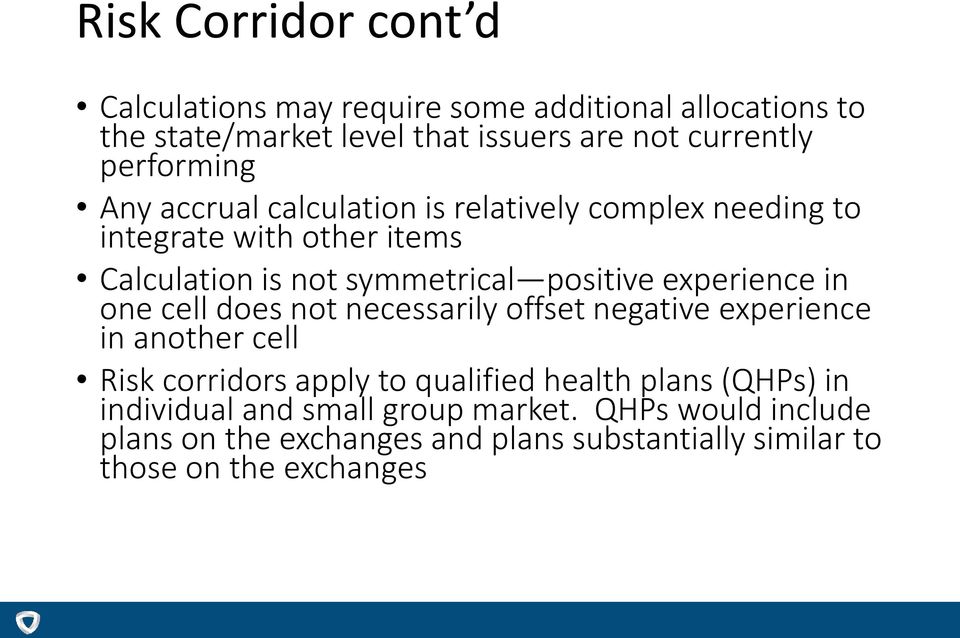
17 Risk Corridor cont d Calculations may require some additional allocations to the state/market level that issuers are not currently performing Any accrual calculation is relatively complex needing to integrate with other items Calculation is not symmetrical positive experience in one cell does not necessarily offset negative experience in another cell Risk corridors apply to qualified health plans (QHPs) in individual and small group market. QHPs would include plans on the exchanges and plans substantially similar to those on the exchanges
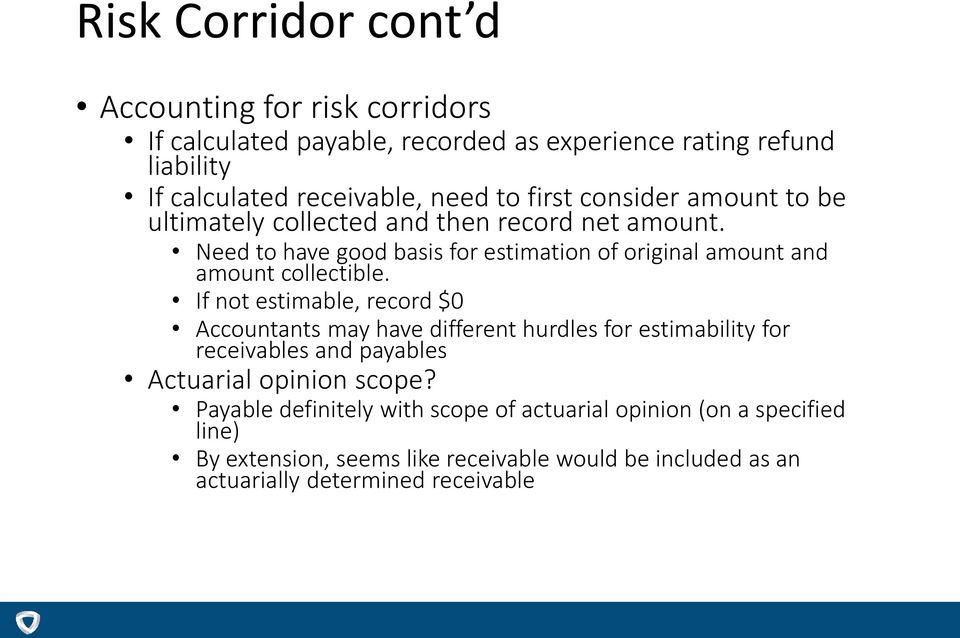
18 Risk Corridor cont d Accounting for risk corridors If calculated payable, recorded as experience rating refund liability If calculated receivable, need to first consider amount to be ultimately collected and then record net amount. Need to have good basis for estimation of original amount and amount collectible. If not estimable, record $0 Accountants may have different hurdles for estimability for receivables and payables Actuarial opinion scope? Payable definitely with scope of actuarial opinion (on a specified line) By extension, seems like receivable would be included as an actuarially determined receivable
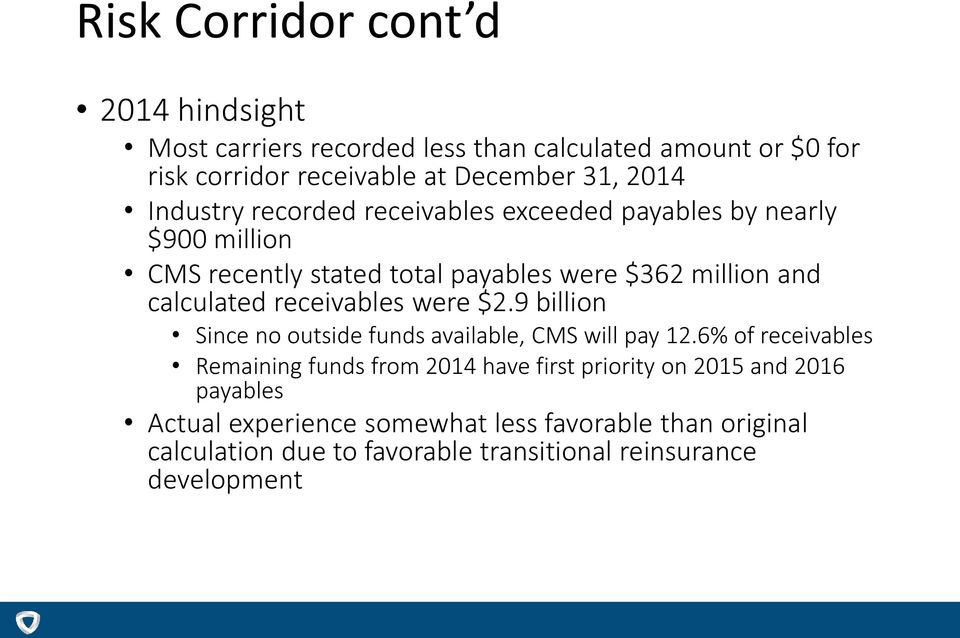
19 Risk Corridor cont d 2014 hindsight Most carriers recorded less than calculated amount or $0 for risk corridor receivable at December 31, 2014 Industry recorded receivables exceeded payables by nearly $900 million CMS recently stated total payables were $362 million and calculated receivables were $2.9 billion Since no outside funds available, CMS will pay 12.6% of receivables Remaining funds from 2014 have first priority on 2015 and 2016 payables Actual experience somewhat less favorable than original calculation due to favorable transitional reinsurance development
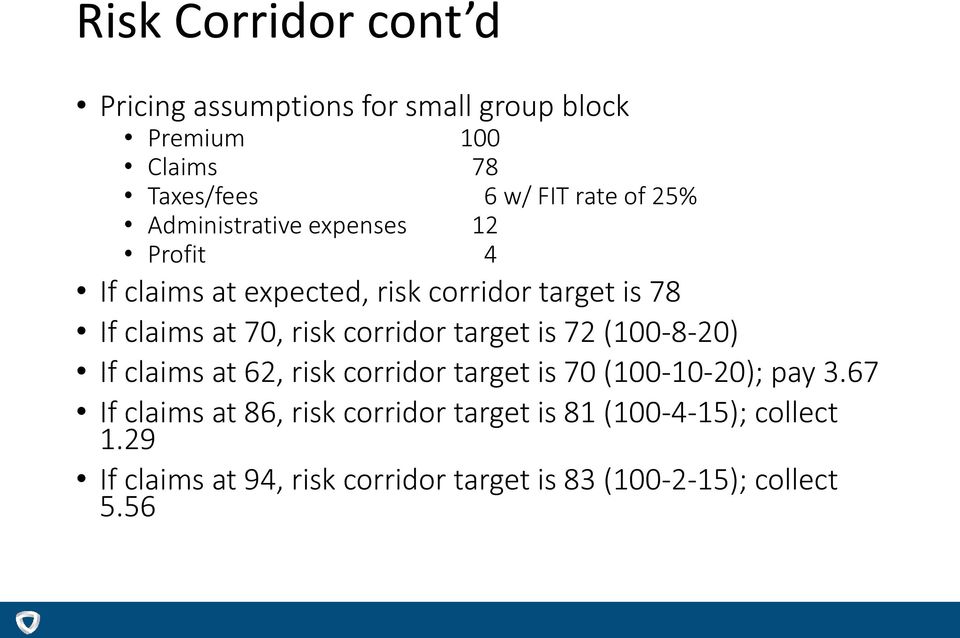
20 Risk Corridor cont d Pricing assumptions for small group block Premium 100 Claims 78 Taxes/fees 6 w/ FIT rate of 25% Administrative expenses 12 Profit 4 If claims at expected, risk corridor target is 78 If claims at 70, risk corridor target is 72 ( ) If claims at 62, risk corridor target is 70 ( ); pay 3.67 If claims at 86, risk corridor target is 81 ( ); collect 1.29 If claims at 94, risk corridor target is 83 ( ); collect 5.56
21 Risk Corridor cont d 2015 outlook If payable, need to record If receivable, carriers have two significant decisions for 2015 financial statements: Amount of uncollected 2014 receivable to be collected from 2015 and 2016 payables Amount of 2015 receivable to be collected from 2015 and 2016 payables 2014 payable not necessarily a good proxy for future payables Favorable development on reinsurance Pricing and experience changes
22 Minimum Medical Loss Ratio ACA created minimum medical loss ratio requirements Individual, small group and large group by state Medicare Advantage by contract Numerator includes: Claims and capitations (adjusted) Health care quality improvement expenses Health information technology expenses Fraud expenses (limited to amounts recovered) Adjustment for experience rating refunds Reduction for pharmacy rebates Adjustment for premium stabilization programs
23 Minimum Medical Loss Ratio cont d Denominator includes: Premiums Adjustment for taxes/fees or charitable activities in lieu of taxes Adjustment for experience rating refunds Required loss ratio is 80% for individual and small group and 85% for large group and Medicare Advantage
24 Minimum Medical Loss Ratio cont d Accounting for MLR Treated as experience rating refund liability and within scope of actuarial opinion Estimation difficulties due to granularity of calculation Since claims are based on runout, need to consider effect of any margins in claims Interim amounts recorded can be either year-to-date calculation or proration of expected annual payment
25 Conclusions Premium stabilization programs were very challenging for health actuaries in 2014 with significant restatements 2015 not expected to be much easier Significant unknown as retrospective audits of these programs are performed Potential RADV type adjustments on risk adjustment MLR has had limited regulatory reviews without significant findings
Washington State Health Insurance Pool - Board Education March 2012
 - Board Education March 2012 What are the new 3 R s? The 3 R s are the risk leveling programs required by the Affordable Care Act (ACA) to help protect insurers in the individual and small group markets
North Carolina Department of Insurance
 North Carolina Department of Insurance North Carolina Actuarial Memorandum Requirements for Rate Submissions Effective 1/1/2016 and Later Small Group Market Non grandfathered Business These actuarial memorandum
How To Determine The Impact Of The Health Care Law On Insurance In Indiana
 ACA Impact on Premium Rates in the Individual and Small Group Markets Paul R. Houchens, FSA, MAAA BACKGROUND The Patient Protection and Affordable Care Act (ACA) introduces significant changes in covered
Oxford Health Plans (CT), Inc.
 Oxford Health Plans (CT), Inc. Statutory Basis Financial Statements as of and for the Years Ended December 31, 2014 and 2013, Supplemental Schedules as of and for the Year Ended December 31, 2014, Independent
New Hampshire Health Insurance Market Analysis
 New Hampshire Health Insurance Market Analysis PHASE II REPORT PREPARED FOR NEW HAMPSHIRE INSURANCE DEPARTMENT BY JULIA LERCHE, FSA, MAAA, MSPH KARAN RUSTAGI, ASA, MAAA BRITTNEY PHILLIPS JANUARY 27, 2015
Proposed changes to 2014 Medicare Advantage payment methodology and the effect on Medicare Advantage organizations and beneficiaries
 Proposed changes to 2014 Medicare Advantage payment methodology and the effect on Medicare Advantage organizations and beneficiaries February 26, 2013 GLENN GIESE FSA, MAAA CHRIS CARLSON FSA, MAAA CONSIDERATIONS
Transitional reinsurance program results in significant new costs for group health plans
 Transitional reinsurance program results in significant new costs for group health plans The Department of Health and Human Services (HHS) has issued additional guidance on the three-year transitional
In preparing the February 2014 baseline budget
 APPENDIX B Updated Estimates of the Insurance Coverage Provisions of the Affordable Care Act In preparing the February 2014 baseline budget projections, the Congressional Budget Office () and the staff
How To Calculate Revenue From A Medicare Plan
 December 17, 2013 Kelly Backes, FSA, MAAA 1. Introduction Whether a Medicare Advantage (MA) plan is just beginning operations or has participated in the market for years, it is critically important to
New Hampshire Health Insurance Market Analysis
 New Hampshire Health Insurance Market Analysis REPORT PREPARED FOR NEW HAMPSHIRE INSURANCE DEPARTMENT BY JULIA LERCHE, FSA, MAAA, MSPH CHIA YI CHIN BRITTNEY PHILLIPS AUGUST 18, 2014 TABLE OF CONTENTS 1.
ACA Premium Impact Variability of Individual Market Premium Rate Changes Robert M. Damler, FSA, MAAA Paul R. Houchens, FSA, MAAA
 ACA Premium Impact Variability of Individual Market Premium Rate Changes Robert M. Damler, FSA, MAAA Paul R. Houchens, FSA, MAAA BACKGROUND The Patient Protection and Affordable Care Act (ACA) introduces
Risk adjustment and shared savings agreements
 Risk adjustment and shared savings agreements Hans K. Leida, PhD, FSA, MAAA Leigh M. Wachenheim, FSA, MAAA In a typical shared savings arrangement, claim costs during the measurement or experience period
ACAP Guide to ACA Fees and Taxes for Health Insurers
 Introduction ACAP Guide to ACA Fees and Taxes for Health Insurers Since being signed into law in March of 2010, the Patient Protection and Affordable Care Act (ACA) has introduced a wide range of health
Reinsurance, Risk Corridors, and Risk Adjustment Final Rule
 Reinsurance, Risk Corridors, and Risk Adjustment Final Rule Center for Consumer Information and Insurance Oversight Centers for Medicare & Medicaid Services Department of Health and Human Services March
ESTIMATED PREMIUM IMPACTS OF ANNUAL FEES ASSESSED ON HEALTH INSURANCE PLANS OCTOBER 31, 2011 CHRIS CARLSON, FSA, MAAA
 ESTIMATED PREMIUM IMPACTS OF ANNUAL FEES ASSESSED ON HEALTH INSURANCE PLANS OCTOBER 31, 2011 CHRIS CARLSON, FSA, MAAA CONTENTS 1. Executive summary... 1 2. Background... 2 3. Data... 4 Base premiums...
Freedom Life Insurance Company of America Actuarial Memorandum for Policy Forms
 Freedom Life Insurance Company of America Actuarial Memorandum for Policy Forms EHB-2016-IP-KY-FLIC with EHB-2016-SCH-KY-FLIC, EHBC-2016-IP-KY-FLIC with EHBC-2016-SCH-KY-FLIC I. GENERAL INFORMATION Insurance
Health Care Receivables Follow-up Study
 Health Annual Statement New Exhibit 3A Health Care Receivables Follow-up Study F. Kevin Russell, FSA, MAAA Chairperson, Health Care Receivables Factors Work Group Susan Mateja, FSA, MAAA Member, Health
Medicare Part D Accounting Practice Note
 A Public Policy Practice Note Medicare Part D Accounting Practice Note April 2008 American Academy of Actuaries Medicare Part D Accounting Practice Note Subgroup of the Health Practice Financial Reporting
Partial Self Funding and Population Health Management. Facts, Concepts, and Strategies
 Partial Self Funding and Population Health Management Facts, Concepts, and Strategies Spring-Summer 2016 Agenda Framing the Conversation Opportunity provided by the ACA How do Fully Insured / Self Funded
How To Implement The Health Insurance And Reinsurance Programs In New York
 Risk Adjustment and Reinsurance under the ACA New York State Recommendations Prepared by Wakely Consulting Group Ross Winkelman, FSA, MAAA and Syed Mehmud, ASA, MAAA With contributions from: Mary Hegemann,
The Necessary Requirements of a Comprehensive Medical Plan
 Medical Loss Ratios Implementing Reporting Rebates Presentation by Russ Willard SEAC - New Orleans November 16, 2011 The Patient Protection and Affordable Care Act (PPACA - enacted March, 23 2010) mandates
Valuation Actuary Symposium September 23-24, 2013 Indianapolis, IN. 29 PD, New Health Care Receivables Exhibit. Moderator: F Kevin Russell FSA,MAAA
 Valuation Actuary Symposium September 23-24, 2013 Indianapolis, IN 29 PD, New Health Care Receivables Exhibit Moderator: F Kevin Russell FSA,MAAA Presenters: Susan Lynn Mateja FSA,MAAA,FCA Session 29PD
Self-funded Employer s Guide. Transitional Reinsurance Fee and Patient-Centered Outcomes Research Institute Fee
 Self-funded Employer s Guide Transitional Reinsurance Fee and Patient-Centered Outcomes Research Institute Fee To fund some of the changes mandated by the Affordable Care Act (ACA), several new taxes and
UNIVERSITY OF FLORIDA SELF-INSURANCE PROGRAM AND HEALTHCARE EDUCATION INSURANCE COMPANY COMBINING FINANCIAL STATEMENTS JUNE 30, 2013
 UNIVERSITY OF FLORIDA SELF-INSURANCE PROGRAM AND HEALTHCARE COMBINING FINANCIAL STATEMENTS UNIVERSITY OF FLORIDA SELF-INSURANCE PROGRAM AND HEALTHCARE TABLE OF CONTENTS Page(s) Independent Auditors Report
Sec. A-4. 24-A MRSA 2736-C, sub- 2, H, as enacted by PL 2007, c. 629, Pt. A, 6, is repealed. Sec. A-5. 24-A MRSA 2736-C, sub- 2, I is enacted to read:
 PLEASE NOTE: Legislative Information cannot perform research, provide legal advice, or interpret Maine law. For legal assistance, please contact a qualified attorney. Be it enacted by the People of the
Ohio Health Insurance Rate Filing Checklist
 These guidelines apply to all contractual periodic prepayment (CPP) / premium rate filings for Group, Non-Group and Medicare / Medicaid / Federal Employee Coverage. The CPP / premium rate portions of Certificates
RISK ADJUSTMENT ARRIVES FOR COMMERCIAL HEALTH INSURANCE
 POINT OF VIEW RISK ADJUSTMENT ARRIVES FOR COMMERCIAL HEALTH INSURANCE HHS s risk adjustment program for the small group and individual markets will reduce some of the effects of adverse selection but it
Basics of Health Care Reform. What You Should Know
 Basics of Health Care Reform What You Should Know The Affordable Care Act (ACA) has resulted in major across the U.S. health care system. This brochure provides an overview and timeline of the that have
Key Features of Risk Adjustment Models
 Key Features of Risk Adjustment Models Richard Lieberman Chief Data Scientist Mile High Healthcare Analytics Bio for Richard Lieberman One of the nation's leading experts on financial modeling and risk
KAISER FOUNDATION HEALTH PLAN, INC. AND SUBSIDIARIES AND KAISER FOUNDATION HOSPITALS AND SUBSIDIARIES. Combined Financial Statements
 Combined Financial Statements (With Independent Auditors Report Thereon) Table of Contents Independent Auditors Report 1 Financial Statements: Kaiser Foundation Health Plan, Inc. and Subsidiaries and Kaiser
Self Funded Health Insurance To be or not to be?
 Self Funded Health Insurance To be or not to be? Janet S. Spencer A.S.A, M.A.A.A., C.P.A. Self Funded Insurance To be or not to be? BlueCross BlueShield of SC (BCBSSC) Self Funded To be or not to be? Important
KAISER FOUNDATION HEALTH PLAN, INC. AND SUBSIDIARIES AND KAISER FOUNDATION HOSPITALS AND SUBSIDIARIES. Combined Financial Statements.
 Combined Financial Statements (Unaudited) Table of Contents Financial Statements (Unaudited): Kaiser Foundation Health Plan, Inc. and Subsidiaries and Kaiser Foundation Hospitals and Subsidiaries: Combined
Federal exchange auto-enrollment: Emerging data and new proposals
 Federal exchange auto-enrollment: Emerging data and new proposals Jason A. Clarkson, FSA, MAAA William A. Gibula, ASA, MAAA Paul R. Houchens, FSA, MAAA EXECUTIVE SUMMARY The U.S. Department of Health and
Valuation Issues in Medicare Part D
 Valuation Issues in Medicare Part D Society of Actuaries Valuation Actuary Symposium September 18, 2007 Topics Introduction/overview Ramifications of uneven cash flow Risk Protection and related issues
Report on Health Insurance Rate Review Process and Information Provided to Consumers
 Report on Health Insurance Rate Review Process and Information Provided to Consumers August 17, 2011 EXECUTIVE SUMMARY Last year, pursuant to Section 1003 of the Patient Protection and Affordable Care
Health Spring Meeting June 2009. Session # 27 TS: Medicare Advantage: Revenue Payments + Part D Accounting
 Health Spring Meeting June 2009 Session # 27 TS: Medicare Advantage: Revenue Payments + Part D Accounting Brian M. Collender, FSA, MAAA Judah Z. Rabinowitz, FSA, MAAA, FCA Moderator: Judah Z. Rabinowitz,
CHIA METHODOLOGY PAPER MASSACHUSETTS TOTAL HEALTH CARE EXPENDITURES AUGUST 2015. center for health information and analysis
 CENTER FOR HEALTH INFORMATION AND ANALYSIS METHODOLOGY PAPER MASSACHUSETTS TOTAL HEALTH CARE EXPENDITURES AUGUST 2015 CHIA INTRODUCTION Total Health Care Expenditures (THCE) is a measure that represents
How To Determine The Health Insurance Market In North Carolina
 North Carolina Department of Insurance MEDICAL LOSS RATIO ADJUSTMENT REQUEST North Carolina Individual Health Insurance Market September 6, 2011 BACKGROUND The Patient Protection and Affordable Care Act
Global Health Care Update
 Global Health Care Update March/April 2013 This bimonthly Update summarizes recent legislative developments and trends related to health care and highlights recently passed and pending legislation that
FINAL BILL REPORT ESHB 1947
 FINAL BILL REPORT C 6 L 13 E2 Synopsis as Enacted Brief Description: Concerning the operating expenses of the Washington health benefit exchange. Sponsors: House Committee on Appropriations (originally
Large Group Medical Insurance Reserves, Liabilities and Actuarial Assets
 A PUBLIC POLICY PRACTICE NOTE Large Group Medical Insurance Reserves, Liabilities and Actuarial Assets Exposure Draft January 2013 Developed by the Large Group Medical Business Practice Note Work Group
The Affordable Care Act: What You Need to Know for 2015 And Beyond. Presented by: Jennifer Zando Director, Account Management, POMCO Group
 The Affordable Care Act: What You Need to Know for 2015 And Beyond Presented by: Jennifer Zando Director, Account Management, POMCO Group 2 Agenda The ACA: Where We ve Been Health Plan Identifiers Transitional
Risk Adjustment and Reinsurance Preliminary Workplan for the State of Illinois
 Risk Adjustment and Reinsurance Preliminary Workplan for the State of Illinois Prepared by Wakely Consulting Group - Mary Hegemann, FSA, MAAA and Syed Mehmud, ASA, MAAA with contributions from Ross Winkelman,
Medicare: Humana s Strategic Actuarial Positioning John M. Bertko, F.S.A., M.A.A.A.
 Medicare: Humana s Strategic Actuarial Positioning John M. Bertko, F.S.A., M.A.A.A. Vice President and Chief Actuary Humana Inc. 1 Cautionary Statement This presentation is intended for instructional purposes
The Affordable Care Act (ACA) introduces many new. The Affordable Care Act in Brief: A Look Into January 2014 Changes. Health Care Reform
 Health Care Reform The Affordable Care Act in Brief: A Look Into January 2014 Changes The Affordable Care Act (ACA) introduces many new mechanisms into the insurance marketplace that significantly impact
CCIIO Technical Guidance (CCIIO 2012 002): Questions and Answers Regarding the Medical Loss Ratio Regulation
 DEPARTMENT OF HEALTH & HUMAN SERVICES Centers for Medicare & Medicaid Services 7500 Security Boulevard, Mail Stop C2-21-15 Baltimore, Maryland 21244-1850 Date: April 20, 2012 From: Title: Subject: Gary
2016 Medicaid Managed Care Rate Development Guide
 DEPARTMENT OF HEALTH & HUMAN SERVICES Centers for Medicare & Medicaid Services 7500 Security Boulevard, Mail Stop S2-26-12 Baltimore, Maryland 21244-1850 Disabled and Elderly Health Programs Group Introduction
North Carolina Insurance Underwriting Association
 North Carolina Insurance Underwriting Association Statutory Financial Statements and Supplemental Schedules (With Independent Auditor s Report Thereon) December 31, 2014 and 2013 Contents Independent Auditor
The 10 percent problem: Future health insurance marketplace premium increases likely to reach double digits
 The 10 percent problem: Future health insurance marketplace premium increases likely to reach double digits Executive summary Health plans setting their premiums for the public health insurance marketplaces
N E W S R E L E A S E
 N E W S R E L E A S E Investors: Brett Manderfeld John S. Penshorn Media: Don Nathan Tyler Mason Vice President Senior Vice President Senior Vice President Vice President 952-936-7216 952-936-7214 952-936-1885
Valuation Actuary Symposium September 25-26, 2008. Session # 30 PD: Premium Deficiency Reserves for Health Insurance
 Valuation Actuary Symposium September 25-26, 2008 Session # 30 PD: Premium Deficiency Reserves for Health Insurance Michael Weilant Norman Zwitter Moderator: Larry Pfannerstill Premium Deficiency Reserves
Impact of the Health Insurance Annual Fee Tax
 Impact of the Health Insurance Annual Fee Tax Robert A. Book, Ph.D. February 20, 2014 Executive Summary The Affordable Care Act's "annual fee on health insurance is a unique tax levied on health insurance
Quality health plans & benefits Healthier living Financial well-being Intelligent solutions
 Quality health plans & benefits Healthier living Financial well-being Intelligent solutions Understanding how the health insurance providers fee and transitional reinsurance contribution will affect you
Health Policy Essentials: Private Health Insurance. Bernadette Fernandez, Annie Mach, & Namrata Uberoi February 13, 2015
 Health Policy Essentials: Private Health Insurance Bernadette Fernandez, Annie Mach, & Namrata Uberoi February 13, 2015 Briefing Agenda What is the purpose of private health insurance (PHI)? How is PHI
N E W S R E L E A S E
 N E W S R E L E A S E Investors: Brett Manderfeld John S. Penshorn Media: Don Nathan Tyler Mason Vice President Senior Vice President Senior Vice President Vice President 952-936-7216 952-936-7214 952-936-1885
IC 27-8-15 Chapter 15. Small Employer Group Health Insurance
 IC 27-8-15 Chapter 15. Small Employer Group Health Insurance IC 27-8-15-0.1 Application of certain amendments to chapter Sec. 0.1. The following amendments to this chapter apply as follows: (1) The addition