
Product Description and Underwriting Guide
|
|
|
- Thomasina Clarke
- 10 years ago
- Views:
Transcription
1 FOR PRODUCERS Individual Disability Insurance Series 700 Product Description and Underwriting Guide

2 Disability Solutions Series 700 Product Description and Underwriting Guide Disability Income Overhead Expense Disability Buy-Out Key Person Replacement In today s competitive sales market, you need a disability insurance provider who understands your challenges in getting business pitched, sold, processed and issued. Principal Life Insurance Company is that provider. We have one goal in mind to help you sell more. The product descriptions in this underwriting guide highlight some of the provisions and optional riders of Principal Life Insurance Company s Individual Disability Insurance policies. Policy provisions may vary in certain respects from the descriptions herein because of state laws and regulations. Please make sure that you are familiar with the policy provisions as they apply in your state since all rights and obligations will be governed by the actual policy language. State-specific sample policies are available on Principal efinancial Professional SM (Principal efp).

3 Why Principal Life? Financial Strength and Integrity The Principal Financial Group is a member of the FORTUNE 500. Principal Life Insurance Company is the flagship member of the Principal Financial Group. Competitive Products Principal Life s broad, competitive product portfolio offers comprehensive disability insurance solutions for all your clients individual and business needs. Support Before, During and After the Sale An experienced and committed staff of individuals that is committed to helping you succeed. Customizable Case Design Whether for single or multi-life case design, these high-quality products can be packaged and customized to help meet your clients unique needs and budgets. Marketing and Sales Tools We provide creative sales concepts, educational tools and marketing materials for individual and business clients, as well as an array of electronic tools, such as pre-approved s and PowerPoint presentations. Attractive Compensation Competitive first-year commissions, strong renewal percentages and additional bonus programs can provide a lifetime of financial rewards.* Bottom Line Your success is our success. You benefit from our commitment to customer service, our spirit of teamwork and proactive producer relationships, and the added convenience of seamless service from start to finish. * Please remember to abide by the company s policy on disclosure of compensation. You can obtain more information as well as a sample disclosure form at

4 Table of Contents Section 1 Disability Income (HH750) Section 2 Overhead Expense (HH789 and HH702) Section 3 Disability Buy-Out (HH703) Section 4 Key Person Replacement (HH772) Section 5 Sales Programs and Discounts Section 6 Federal Income Tax Guide Section 7 General Underwriting Section 8 Occupational Underwriting Section 9 Occupational Class Schedule Section 10 Medical Underwriting

5 NOTES

6 DISABILITY INCOME HH750 Section 1 Disability Income (HH750) This section provides detailed information on the features, riders and underwriting of our Disability Income (DI) policy. Our illustration system will calculate rates for you. Overview Occupation Classes/Policy Forms Premium Rates and Illustrations Issue Ages Proposed Insured Over Age Benefit Period Charts Elimination Periods Benefit Periods Your Occupation Periods Policy Description Benefit Riders Benefit Update Rider Capital Sum Benefit Rider Catastrophic Disability Benefit Rider Conditionally Renewable Policy Rider Cost of Living Adjustment Rider Extended Total Disability Benefit Rider Future Benefit Increase Rider Limitations of Benefits for Mental/Nervous and Substance Abuse Disorders Rider Presumptive Disability Benefit Rider Recovery Benefit Rider Regular Occupation Rider Residual Disability and Recovery Benefit Rider Residual Disability Benefit Rider Short-Term Residual Disability Benefit Rider Supplemental Health Benefit Rider Transitional Occupation Rider

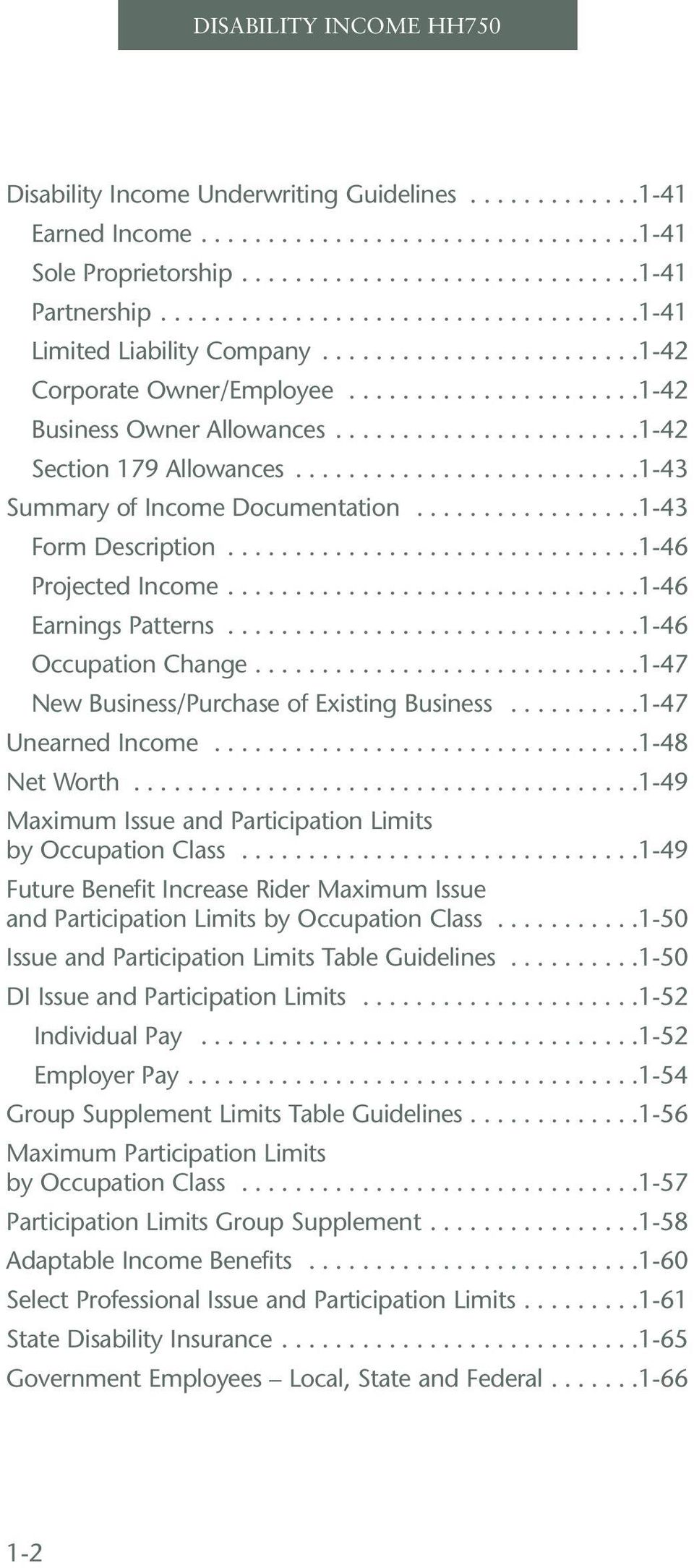
7 DISABILITY INCOME HH750 Disability Income Underwriting Guidelines Earned Income Sole Proprietorship Partnership Limited Liability Company Corporate Owner/Employee Business Owner Allowances Section 179 Allowances Summary of Income Documentation Form Description Projected Income Earnings Patterns Occupation Change New Business/Purchase of Existing Business Unearned Income Net Worth Maximum Issue and Participation Limits by Occupation Class Future Benefit Increase Rider Maximum Issue and Participation Limits by Occupation Class Issue and Participation Limits Table Guidelines DI Issue and Participation Limits Individual Pay Employer Pay Group Supplement Limits Table Guidelines Maximum Participation Limits by Occupation Class Participation Limits Group Supplement Adaptable Income Benefits Select Professional Issue and Participation Limits State Disability Insurance Government Employees Local, State and Federal
8 DISABILITY INCOME HH750 HH750 Disability Income Overview The objective of individual disability income (DI) insurance is to replace a portion of earned income lost due to a disability. Our policies are designed to provide monthly benefits to help pay for personal living expenses incurred during disability, such as mortgage or rent payments, car payments, utilities, food, etc. Not all benefits, features and riders are available in all states or to all occupation classes. Occupation classes/policy forms Each client is classified according to their occupation. There are eight occupation classes for DI: 5A, 5A-M, 4A, 4A-M, 3A, 3A-M, 2A and A. Note: The rates for the 5A and 5A-M occupation classes are the same. The rates for the 4A and the 4A-M occupation class are the same. The rates for the 3A and the 3A- M occupation class are the same. The M subcategory (5A-M, 4A-M, 3A-M) is being used to cap the Maximum Issue and Participation Limit and may have additional requirements for optional riders. Premiums, benefits, policy forms and the availability of riders vary by occupation class. The premium class may be standard or an extra percentage of standard. Policy Form Disability Income HH750 Premium rates and illustrations Premiums are dependent on many factors: age, occupation class, state of residence, smoking status, benefit period, elimination period, riders and others. Because of these many factors, providing and maintaining a detailed rate book is no longer practical. Premium quotes are available through the DI illustration system. Sex-Distinct and Unisex Rates Sex distinct rates charge males and females different rates. Unisex rates are blended rates, 1-3

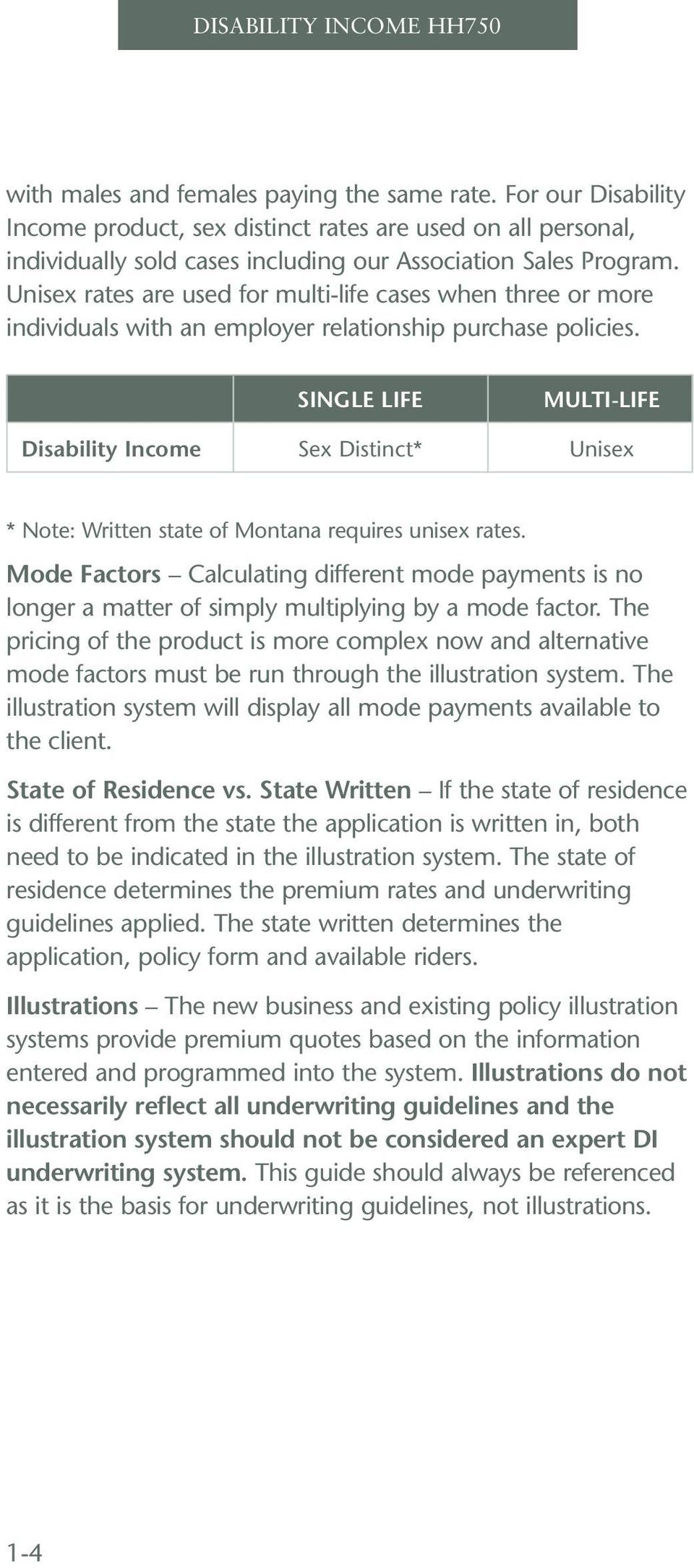
9 DISABILITY INCOME HH750 with males and females paying the same rate. For our Disability Income product, sex distinct rates are used on all personal, individually sold cases including our Association Sales Program. Unisex rates are used for multi-life cases when three or more individuals with an employer relationship purchase policies. SINGLE LIFE MULTI-LIFE Disability Income Sex Distinct* Unisex * Note: Written state of Montana requires unisex rates. Mode Factors Calculating different mode payments is no longer a matter of simply multiplying by a mode factor. The pricing of the product is more complex now and alternative mode factors must be run through the illustration system. The illustration system will display all mode payments available to the client. State of Residence vs. State Written If the state of residence is different from the state the application is written in, both need to be indicated in the illustration system. The state of residence determines the premium rates and underwriting guidelines applied. The state written determines the application, policy form and available riders. Illustrations The new business and existing policy illustration systems provide premium quotes based on the information entered and programmed into the system. Illustrations do not necessarily reflect all underwriting guidelines and the illustration system should not be considered an expert DI underwriting system. This guide should always be referenced as it is the basis for underwriting guidelines, not illustrations. 1-4
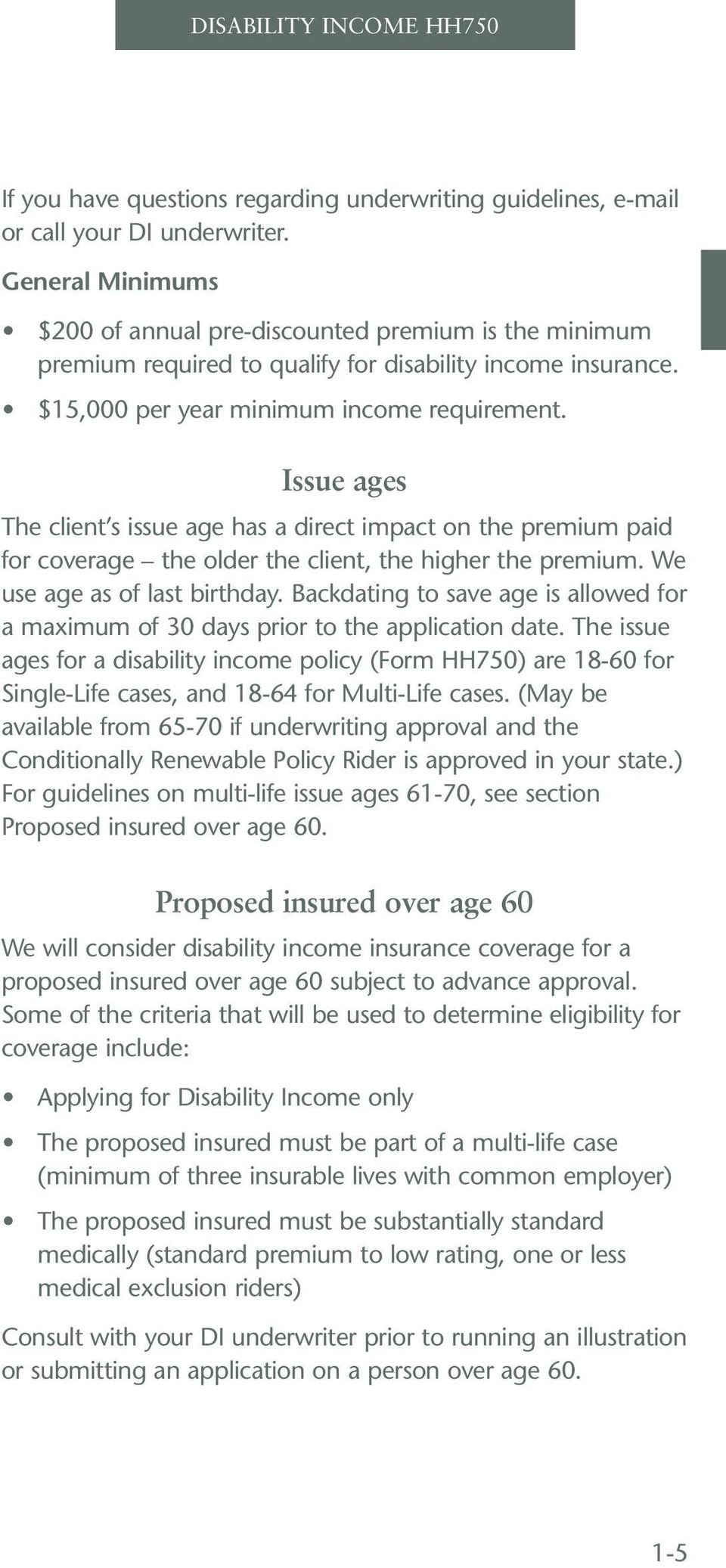
10 DISABILITY INCOME HH750 If you have questions regarding underwriting guidelines, or call your DI underwriter. General Minimums $200 of annual pre-discounted premium is the minimum premium required to qualify for disability income insurance. $15,000 per year minimum income requirement. Issue ages The client s issue age has a direct impact on the premium paid for coverage the older the client, the higher the premium. We use age as of last birthday. Backdating to save age is allowed for a maximum of 30 days prior to the application date. The issue ages for a disability income policy (Form HH750) are for Single-Life cases, and for Multi-Life cases. (May be available from if underwriting approval and the Conditionally Renewable Policy Rider is approved in your state.) For guidelines on multi-life issue ages 61-70, see section Proposed insured over age 60. Proposed insured over age 60 We will consider disability income insurance coverage for a proposed insured over age 60 subject to advance approval. Some of the criteria that will be used to determine eligibility for coverage include: Applying for Disability Income only The proposed insured must be part of a multi-life case (minimum of three insurable lives with common employer) The proposed insured must be substantially standard medically (standard premium to low rating, one or less medical exclusion riders) Consult with your DI underwriter prior to running an illustration or submitting an application on a person over age
11 DISABILITY INCOME HH750 Available benefit periods: ISSUE AGE BENEFIT PERIOD(S) 2 years, 5 years, To Age 65, To Age 67 and To Age years Benefit period charts: A 2 year Benefit Period pays for 24 months regardless of the client s age at disability. If you select a Benefit Period of 5 years, To Age 65, To Age 67 or To Age 70, the length of time the maximum monthly benefit amount will be paid could be different based on the client s age at the time of disability. The benefit charts below show how long the benefit will be paid: 5 year benefit period (issued from ages 18-60) DISABILITY BEGINS: Prior to Age 61 Policy Anniversary On or After Age 61 Policy Anniversary but prior to Age 62 Policy Anniversary On or After Age 62 Policy Anniversary but prior to Age 63 Policy Anniversary On or After Age 63 Policy Anniversary but prior to Age 64 Policy Anniversary On or After Age 64 Policy Anniversary but prior to Age 65 Policy Anniversary On or After Age 65 Policy Anniversary MAXIMUM BENEFIT PERIOD IS: 5 Years 48 Months 42 Months 36 Months 30 Months No benefits are payable unless renewed* * If this policy is renewed as described in the Conditionally Renewable section of the policy, the Maximum Benefit Period and Your Occupation Period are two years. 1-6

12 DISABILITY INCOME HH750 To Age 65 benefit period (issued from ages 18-60) DISABILITY BEGINS: Prior to Age 61 Policy Anniversary On or After Age 61 Policy Anniversary but prior to Age 62 Policy Anniversary On or After Age 62 Policy Anniversary but prior to Age 63 Policy Anniversary On or After Age 63 Policy Anniversary but prior to Age 64 Policy Anniversary On or After Age 64 Policy Anniversary but prior to Age 65 Policy Anniversary On or After Age 65 Policy Anniversary MAXIMUM BENEFIT PERIOD IS: To Age 65 Policy Anniversary 48 Months 42 Months 36 Months 30 Months No benefits are payable unless renewed* To Age 67 benefit period (issued from ages 18-60) DISABILITY BEGINS: Prior to Age 64 Policy Anniversary On or After Age 64 Policy Anniversary and prior to Age 65 Policy Anniversary On or After Age 65 Policy Anniversary MAXIMUM BENEFIT PERIOD IS: To Age 67 Policy Anniversary 36 Months No benefits are payable unless renewed* To Age 70 benefit period (issued from ages 18-60) DISABILITY BEGINS: MAXIMUM BENEFIT PERIOD IS: Prior to Age 65 Policy Anniversary To Age 70 Policy Anniversary On or After Age 65 No benefits are payable unless Policy Anniversary renewed* 1-7

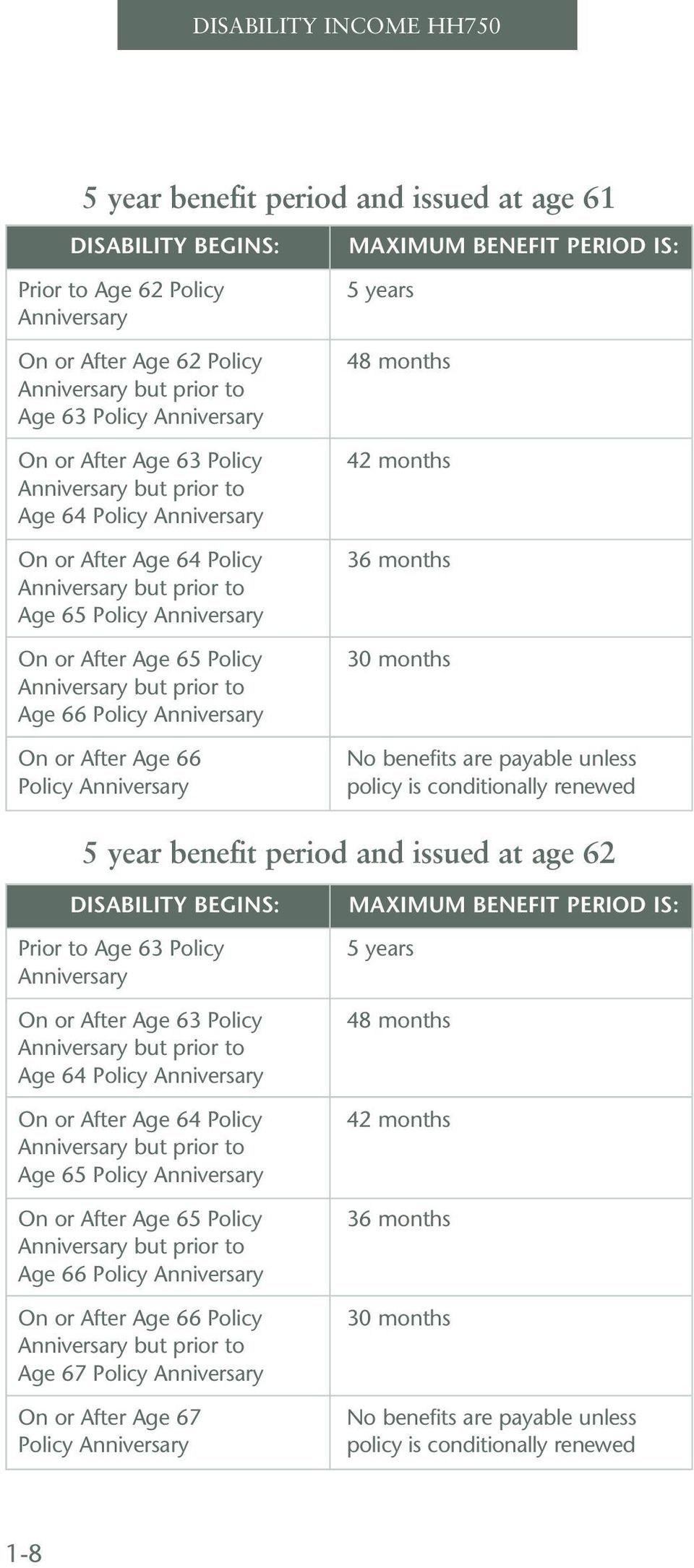
13 DISABILITY INCOME HH750 5 year benefit period and issued at age 61 DISABILITY BEGINS: Prior to Age 62 Policy Anniversary On or After Age 62 Policy Anniversary but prior to Age 63 Policy Anniversary On or After Age 63 Policy Anniversary but prior to Age 64 Policy Anniversary On or After Age 64 Policy Anniversary but prior to Age 65 Policy Anniversary On or After Age 65 Policy Anniversary but prior to Age 66 Policy Anniversary On or After Age 66 Policy Anniversary MAXIMUM BENEFIT PERIOD IS: 5 years 48 months 42 months 36 months 30 months No benefits are payable unless policy is conditionally renewed 5 year benefit period and issued at age 62 DISABILITY BEGINS: Prior to Age 63 Policy Anniversary On or After Age 63 Policy Anniversary but prior to Age 64 Policy Anniversary On or After Age 64 Policy Anniversary but prior to Age 65 Policy Anniversary On or After Age 65 Policy Anniversary but prior to Age 66 Policy Anniversary On or After Age 66 Policy Anniversary but prior to Age 67 Policy Anniversary On or After Age 67 Policy Anniversary MAXIMUM BENEFIT PERIOD IS: 5 years 48 months 42 months 36 months 30 months No benefits are payable unless policy is conditionally renewed 1-8
14 DISABILITY INCOME HH750 5 year benefit period and issued at age 63 DISABILITY BEGINS: Prior to Age 64 Policy Anniversary On or After Age 64 Policy Anniversary but prior to Age 65 Policy Anniversary On or After Age 65 Policy Anniversary but prior to Age 66 Policy Anniversary On or After Age 66 Policy Anniversary but prior to Age 67 Policy Anniversary On or After Age 67 Policy Anniversary but prior to Age 68 Policy Anniversary On or After Age 68 Policy Anniversary MAXIMUM BENEFIT PERIOD IS: 5 years 48 months 42 months 36 months 30 months No benefits are payable unless policy is conditionally renewed 5 year benefit period and issued at age 64 DISABILITY BEGINS: Prior to Age 65 Policy Anniversary On or After Age 65 Policy Anniversary but prior to Age 66 Policy Anniversary On or After Age 66 Policy Anniversary but prior to Age 67 Policy Anniversary On or After Age 67 Policy Anniversary but prior to Age 68 Policy Anniversary On or After Age 68 Policy Anniversary but prior to Age 69 Policy Anniversary On or After Age 69 Policy Anniversary MAXIMUM BENEFIT PERIOD IS: 5 years 48 months 42 months 36 months 30 months No benefits are payable unless policy is conditionally renewed 1-9

15 DISABILITY INCOME HH750 Elimination periods The elimination period (EP) is the number of days the insured must wait before benefits begin to accrue. No benefits are paid for this period. Once disabled, the insured will receive benefits one month after the elimination period is satisfied. The shorter the elimination period, the higher the premium. The following are our available elimination periods: 30, 60, 90, 180 and 365 days (365 is not available with 2 year benefit period) NOTE: 30 day elimination period is not available for California residents or on any policy written in California. 365 day elimination period on Social Insurance Substitute (SIS) is available with a 2 year benefit period in California. Benefit periods The benefit period (BP) is the length of time the insured will receive benefits after satisfying the elimination period. The following benefit periods are available to any occupation class: 2 years To Age 67 5 years To Age 70 To Age 65 Note: For policies issued between ages 65-70, the maximum benefit period available is 2 years. 1-10

16 DISABILITY INCOME HH750 Your occupation periods Your Occupation Period is the period of time insureds are protected in their Your Occupation (the profession(s) or occupation(s) insureds were actively working in at the start of their disability). Your Occupation Periods are available for the following: All occupation classes 2 year (built into base policy) 5 year 5A, 5A-M, 4A, 4A-M, 3A and 3A-M To Age 65 To Age 67 To Age 70 Your Occupation Period availability is as follows: If base BP is Then available Your Occupation Benefit Periods are 2 Year 2 Year 5 Year 2 Year or 5 Year To Age 65 2 Year, 5 Year or To Age 65 To Age 67 2 Year, 5 Year or To Age 67 To Age 70 2 Year, 5 Year or To Age

17 DISABILITY INCOME HH750 Policy Description Note: This policy description is a general summary. All features, provisions and riders may not be available in all states and may be subject to state variations. Refer to your state policy and rider forms for the full definition of all policy provisions, benefits, limitations and exclusions. Renewability The policy is non-cancelable and guaranteed renewable to age 65*. This means we can t change or cancel the policy (except for nonpayment of premiums) or increase the premiums before age 65, regardless of changes in the insured s income, occupation or health. After age 65, the policies are conditionally renewable for life annually if the insured is working full-time, subject to rates then in effect based on the insured s attained age. * On a policy with a To Age 67 or To Age 70 Maximum Benefit Period, the policy will terminate on the Age 65 Policy Anniversary, unless the insured is Disabled under the terms of the policy. Definition of Total Disability: means solely due to Injury or Sickness: 1. During Your Occupation Period: a. You are unable to perform the substantial and material duties of Your Occupation; and b.you are not Working. 2. After Your Occupation Period, you are unable to work in any occupation you are reasonably suited to by your education, training and experience. 3. Both during and after Your Occupation Period, you must satisfy the requirements of the Claim Information Section of the policy. If you are Retired, Total Disability means, solely due to Injury or Sickness, you are unable to perform any of the normal activities of a retired person in good health and of like age and you satisfy the requirements of the Claim Information section. 1-12

18 DISABILITY INCOME HH750 If you are Unemployed, Total Disability means, solely due to Injury or Sickness, you are prevented from obtaining a job that you are reasonably suited to by your education, training and experience and you satisfy the requirements of the Claim Information section. State variation of provision CA, FL, LA, NJ, NY, TN, VA, VT Definition of Your Occupation means the profession(s) or occupation(s), not a specific job(s) or a job with a certain employer(s), you were actively working in (and not Retired or Unemployed from) at the start of your disability. State variation of provision CA, MD, NJ Earnings If you are an employee with no ownership interest in a business entity, Earnings include the amounts as reported for Federal Income Tax purposes of: 1. Your salary, wages, fees, draw, commissions, bonuses; PLUS 2. Any other income or compensation You earn; PLUS 3. Amounts You earned which would have resulted in current taxable employee compensation but instead were contributed by You to a benefit plan (e.g., Flexible Spending Accounts, etc.), or qualified tax-deferred retirement plan (e.g., 401(k), 403(b), 457, etc.); LESS 4. Unreimbursed employee business expenses. If you are a business owner, such as an owner of a sole proprietorship, a partner in a partnership, a shareholder of a corporation or subchapter S-corporation, or a member of a limited liability company or limited liability partnership; and You perform the duties or activities of Your Occupation or another occupation within the scope of a legal business entity, Earnings include the amounts as reported for Federal Income Tax purposes of: 1. Your share (based on ownership or contractual agreement) of the gross revenue or income earned by all such business entities including income earned by You and others under Your supervision or direction; LESS 1-13

19 DISABILITY INCOME HH Your share (based on ownership or contractual agreement) of the usual and customary unreimbursed business expenses of those entities which are incurred on a regular basis, are essential to the established business operation of the entity, are deductible for Federal Income Tax purposes, and do not exceed expenses before Disability began. Such expenses do not include salaries, benefits and other forms of compensation which are payable to You, or to any person related by blood or marriage to You unless such person was a full-time employee of such business working at least 30 hours per week for at least 60 days prior to the start of Your period of Disability; PLUS 3. Any contributions to a pension or profit sharing plan made on Your behalf by all such business entities and not waived by contract during Disability. Earnings do not include any form of unearned income such as dividends, rents, interest, capital gains, income received from any form of deferred compensation, retirement, pension plan, income from royalties or disability benefits. Disability Benefit We will pay benefits for your Continuous Disability that begins on or after the policy date and while the policy is in-force. Benefits start to accrue at the end of the Elimination Period. Benefits will continue during your Continuous Disability, but not beyond the Maximum Benefit Period. Social Insurance Substitute (SIS) Benefit This benefit is provided only if amounts for it are shown on the current Data Page. To receive this benefit, you must meet all the requirements of this section and of the Additional Proof of Loss for Social Insurance Substitute Benefit section, and benefits must be payable under the Disability Benefit section. This section s Maximum Monthly Benefit is: 1. As shown on the Data Page when no Social Security, Workers Compensation or Railroad Retirement Benefits are paid. 1-14

20 DISABILITY INCOME HH One-third of this section s Maximum Monthly Benefit if the only Social Insurance paid for your disability is any one of either the Primary Insurance Amount under Social Security, Workers Compensation or Railroad Retirement. 3. No benefits are paid for any period: a. During which two or more of the Social Insurances are paid b. After your Age 65 policy anniversary, unless Your Maximum Benefit Period is longer and you are receiving benefits under the Disability Benefit section c. After you are eligible to receive full retirement benefits from Social Security or Railroad Retirement d. For which you receive retirement benefits from Social Security or Railroad Retirement Benefits start to accrue at the later of this section s elimination period, or when the Social Insurance paid for your disability reduces to only one of either the Primary Insurance Amount from Social Security, Workers Compensation, or Railroad Retirement. State variation of provision CA, NJ, NY, VA Adjustment Options This provision gives the policyowner an adjustable policy. Changes may be made to the Elimination Period, benefit amount, Your Occupation Period, Benefit Period, occupation class and riders based on our then current underwriting guidelines. Policy and rider availability are also considered underwriting guidelines applied to the underwriting of adjustments. Some adjustments require evidence of insurability. Based on current underwriting guidelines, some adjustments may result in a second policy. See the General Underwriting Guidelines Adjustments section for underwriting information. 1-15

21 DISABILITY INCOME HH750 Transplant Surgery Benefit We will pay benefits under the Disability Benefit section and the Social Insurance Substitute Benefit section (subject to those sections terms and conditions) if a disability results from surgery involving a transplant of a part of the insured s body to another person. Interrupted Elimination Period This provision allows the combination of separate periods of disability to satisfy the elimination period. These periods of disability must occur within a period of time that is up to twice as long as the elimination period but less than one year. The disabilities can be from the same or different causes. Military Suspension This provision suspends the policy if the insured enters the military service on a full-time basis. The policy may be restored if active duty ends within five years of the suspension. The owner must request this within 180 days of the end of service. No premium is due during the service and no policy benefits are provided during that time. The policy restored is the same as before the suspension. Only a Disability from a sickness which first manifests itself or an injury which occurs after the policy is restored is covered. Recurring Disability Benefit Means a continuation of a prior Disability when: 1. The disability results from the same or a related cause as a prior period of Disability for which we paid benefits or provided the Waiver of Premium Benefit; unless 2. After the prior disability ends you return to work at least 40 hours per week in any occupation for at least six consecutive months. A Recurring Disability is a continuation of the prior Disability. No new Elimination Period is required. Benefits will be payable for the remainder of the Maximum Benefit Period, if any. State variation of provision UT, VA 1-16
22 DISABILITY INCOME HH750 Rehabilitation Benefit This benefit provides additional benefits if the insured takes part in a rehabilitation program which is mutually agreed upon in writing while disabled. There is no specific dollar limit on the benefits which may be paid. The company has a staff of rehabilitation specialists to work with claimants to assist them in returning to appropriate work. State variation of provision CA, CT, MD Reinstatement This provision allows the policy to be reinstated any time within one year after termination and subject to our then current underwriting guidelines. A formal reinstatement application may be required. A reinstated policy covers disabilities from a sickness that first manifests itself more than 10 days after reinstatement date or an injury occurring after the reinstatement date. A reinstated policy is subject to any provisions or changes attached to the reinstated policy. Death Benefit This benefit pays a lump-sum benefit of three times the Disability Benefit and SIS Benefit if the insured dies after satisfying the elimination period while benefits are being paid. It is payable in addition to any other policy benefit. This benefit is restricted in some states. State variation of provision FL, GA, MD, MN, NY, SC Not available IL, NJ Waiver of Premium Benefit If Insured is Disabled, after the lesser of 90 days or the Elimination Period, we will: 1. Refund the monthly pro-rata portion of any premium paid for coverage after the date a Continuous Disability began; and 2. Waive the payment of premiums which come due during the Continuous Disability. Premium payments will begin on the next premium due date after the insured is no longer receiving benefits under this policy or the disability ends. 1-17
23 DISABILITY INCOME HH750 Exclusions and Limitations This policy does not pay benefits for Injury or Sickness which in whole or in part is caused by, contributed by, or which results from: 1. Intentional, self-inflicted injury; or 2. Your commission of or your attempt to commit a criminal act, or your involvement in an illegal occupation or activity; or 3. The suspension, revocation or surrender of your professional or occupational license or certification; or 4. Active military service during a military action or conflict. 5. Loss we have excluded by name or specific description in any attached rider or endorsement. No benefits are payable for any period of Your Continuous Disability in which you are incarcerated in a penal or correctional institution for a period of 30 consecutive days or longer. A sickness resulting from pregnancy will be covered if the Elimination Period is equal to or greater than 90 days. Benefits will be limited to 12 months during Your Continuous Disability unless you reside in the United States or Canada for at least six consecutive months in each calendar year. There may be other exclusions or limitations in the policy in addition to those stated above. Any additional exclusions or limitations (if any) will be described in riders or endorsements attached to the policy. Examples include, but are not limited to: Modified Coverage rider, Additional Exception riders, etc. State variation of provision CA, CT, DC, IA, ID, IL, KS, MA, MD, MO, MT, NC, ND, NE, NJ, NY, NM, OK, PA, SC, TX, UT, VA, VT, WA, WI 1-18
24 DISABILITY INCOME HH750 Pre-existing Condition Limitation We will not pay any claim for a Disability or loss which: 1. Begins within two years after the effective date of coverage(s); and 2. Results from a pre-existing condition which was not disclosed or was misrepresented in the policy s application. Pre-existing condition means a condition: 1. For which medical treatment, testing or medication was recommended by a Doctor or received from a Doctor within the two year period prior to the effective date of coverage(s); or 2. Which has caused symptoms within the two year period prior to the effective date of coverage(s) which would cause an ordinarily prudent person to seek diagnosis, care or treatment. State variation of provision CA, DC, ID, IL, MT, NJ, NM, NY, NC, ND, PA, SC, SD, VA 1-19
25 BENEFIT RIDERS HH750 HH750 Benefit Riders Not all riders are available in all states and may be subject to state variations. Benefit Update (BU) Rider The BU rider is a truly unique feature to Principal Life. For no additional premium, this rider is automatically added to all standard premium policies for all occupation classes, if at least 75 percent of eligible coverage is purchased at issue. Issue ages are This feature allows the policyowner to increase policy benefits every three years without evidence of medical insurability. It s important to note the client maintains one policy and all definitions, provisions, current rates (at the attained age) and discounts of the original policy apply. At three-year intervals beginning with the policy date, Principal Life sends the insured correspondence regarding the opportunity for a BU review. The client must return a completed application and in some cases provide financial documentation. Financial documentation is only required if the insured s income has increased more than 10 percent and other inforce disability coverage has changed since the last BU review. Depending on the information provided, we may offer to increase the coverage up to the maximum issue and participation limits for which they qualify there is no cap (or age restrictions). The no cap feature is a competitive advantage over most companies future insurability options, which usually have pre-set benefit caps. At each BU option, the client must accept a minimum of 50 percent of the additional DI benefit offered or the rider will be removed from the policy. Advance Option: The insured can even request an advanced update once every three years, in place of the next scheduled review, in the event the insured: Loses group long-term disability insurance because of a change in employment, or the insured s employer discontinues or reduces group long-term disability insurance and does not plan to offer such insurance in the next 36 months. 1-20
26 BENEFIT RIDERS HH750 Has at least a 50 percent increase in earnings since their last adjustment to increase their total disability benefits. The increase in income must be permanent and sustainable. A sudden, unsustainable increase in income that is the result of a one-time bonus, commission or extraordinary financial event will not be considered as the basis to exercise an advance option. Within 90 days of one of the above occurring, the insured must elect to take the next scheduled BU option early. If the insured elects to take the option early, the next scheduled BU review will not take place. The advance option can occur one time during the three years prior to each scheduled review. The advance option is not available on or after age 52. You are kept up-to-date with client correspondence through the IDI Benefit Update Activity Report available on Principal efp ( You will receive a weekly notification (prompting you to login) when you have any BU activity on your inforce book of business. Confirm your address at Note: A CDB offer will not be made as part of a BU Advance Option. If BU is issued after age 52, only one increase may be offered. BU will be removed if insured is not eligible for increase. The Benefit Update rider is available in conjunction with the Future Benefit Increase rider. This rider also has an Option Anniversary available. See FBI Rider description for availability. State variation of provision CA, MD, NY, VA Capital Sum Benefit Rider Provides a one-time, lump-sum benefit if an Injury or Sickness results in a total loss of use for any and every purpose or activity without any possibility of recovery of: 1. The use of a hand or foot; or 2. The sight of an eye. 1-21
27 BENEFIT RIDERS HH750 This benefit is equal to 12 times the ultimate Maximum Monthly Disability Benefit and the Social Insurance Substitute Benefit. There is a limit of one Capital Sum Benefit payment in your lifetime. It is paid in addition to any other benefits payable under the policy. In order for this benefit to be paid, you must survive the loss for 30 days and the policy must be in force. If the policy is not in force, the loss must occur within 90 days after the Injury or Sickness which caused it, and the Injury or Sickness must occur while the policy is in force. State variation of provision NJ, TN, VA Catastrophic Disability Benefit (CDB)* Rider This rider may be added to the policy for an additional premium and is available to all occupation classes. The CDB rider provides benefits if the Insured is catastrophically disabled. By definition, this means the Insured cannot perform two or more of the following Activities of Daily Living (ADL); or is Cognitively Impaired; or is Presumptively Disabled. The Activities of Daily Living (ADL) are: Bathing which means the ability to wash in the tub, shower or by sponge bath, with or without adaptive devices. Continence which means the ability to voluntarily control bowel and bladder function, or in the event of incontinence, the ability to maintain a reasonable level of personal hygiene (including caring for catheter or colostomy bag). Dressing which means the ability to put on and take off clothing and any medically necessary braces or artificial limbs. Eating/Feeding which means the ability to feed oneself by mouth, feeding tube or intravenously. Toileting which means the ability to get to and from and on and off the toilet and to maintain a reasonable level of personal hygiene. 1-22
28 BENEFIT BENEFIT RIDERS RIDERS HH750 HH750 Transferring which means the ability to move in and out of a chair, bed or wheelchair with or without assistive devices such as canes, walkers, crutches, grab bars or mechanical or motorized devices. * Catastrophic Impairment Benefit (CIB) Rider is issued in the written state of New Hampshire. The Benefit Period for the CDB rider must be equal to or less than the Base Benefit Period. The available Benefit Periods are: If base BP is Then available CDB Benefit Periods are 2 Year 2 Year 5 Year 2 Year or 5 Year To Age 65 2 Year, 5 Year or To Age 65 To Age 67 2 Year, 5 Year or To Age 67 To Age 70 2 Year, 5 Year or To Age 70 The Elimination Period for the CDB rider must be equal to or greater than the Base Elimination Period. The available Elimination Periods are 90 days, 180 days or 365 days. The CDB monthly amount: Has a maximum issue and participation limit of $8,000/ month and a minimum issue limit of $500/month. Cannot exceed five times (5x) the sum of the Base Benefit Amount plus Social Insurance Substitute (SIS) of all Principal Life coverage. Note: CDB on California and New Jersey policies cannot exceed the sum of the Base Benefit Amount plus SIS. Added to the Base Benefit Amount plus SIS plus other coverage in-force, cannot exceed 100 percent of Earned Income. Note: When working with taxable benefits, divide the Earned Income by 0.75 to account for taxation. In-force policies containing the CDB rider require a minimum increase to the CDB monthly benefit amount of $1,000 on adjustments. 1-23
29 BENEFIT RIDERS HH750 CDB and Benefit Update (BU): If the policy contains the CDB rider and the insured is eligible for at least a $1,000/month CDB increase, we will offer the CDB increase as part of the BU option (up to a maximum of $2,000/month CDB increase on any one BU option exercise). The insured is not obligated to accept a minimum of 50 percent of the additional CDB benefit to maintain the BU rider on this policy. State variation of provision CA, MD, NJ, NH, TX, VT Not available CT Conditionally Renewable Policy Rider Issued for ages 65-70, this rider changes the policy from Non-Cancelable and Guaranteed Renewable to Conditionally Renewable. During the conditionally renewable period, Principal Life cannot change or cancel the insured s policy except for nonpayment of premiums. The insured may conditionally renew the policy annually for the rest of their life, as long as they are working full time and meet the requirements. To renew the policy for one year, all of the following conditions must be satisfied: 1. The insured is not receiving a benefit under this policy or any attached rider. 2. The insured must be actively working at least 30 hours each week for the 12 consecutive months preceding the renewal. 3. The insured is working at least 30 hours each week at the time of renewal. 4. The policy is in force with no premium in default. 5. We receive the Owner s renewal request in writing by the Policy Anniversary for any one-year renewal. 6. The renewal policy premium is paid. The renewal policy premium will be based on those rates in effect for the insured s age at the time of renewal. 1-24
30 BENEFIT RIDERS HH750 This rider is only available with a 2 year Benefit and Your Occupation Periods. The available Elimination Periods are 30,* 60, 90 and 180 days. The SIS benefit and all other riders will not be available, with the exception of the Limitations of Benefits for Mental/Nervous and Substance Abuse Disorders rider. (Note: All standard Underwriting Guidelines will follow for this rider.) *30 day EP not available in CA State variation of provision MD, NJ, NY, TX, VA Not available MA, NH Cost of Living Adjustment (COLA) Rider The COLA rider may be added to the policy for an additional premium and is available to 5A, 5A-M, 4A, 4A-M, 3A, 3A-M and 2A occupation classes. This rider provides a cost of living adjustment in the Monthly Benefit (plus the Catastrophic Disability Benefit, if attached to the policy) during a Disability. Each year following the start of a Disability, an adjustment will be made to the Monthly Benefit (plus the Catastrophic Disability Benefit, if attached to the policy). The benefit is increased on a compound basis based on the change in the Consumer Price Index for all Urban Consumers (CPI - U) over the past year of disability. A 3 or 6 percent COLA maximum may be selected. The Insured may, upon returning to work full time, keep any increased Disability Benefit without evidence of good health by paying the required increased premium. The COLA rider is not available when a 2 year Benefit Period is selected. State variation of provision MD, NJ, NY Extended Total Disability Benefit (ETDB) Rider This uniquely designed rider allows the base monthly benefit to continue to be paid beyond the Maximum Benefit Period, subject to policy provisions. The ETDB rider may be added to the policy for an additional premium and is available to 5A, 5A-M, 4A, 4A-M, 3A, 3A-M and 2A occupation classes. Issue ages are
31 BENEFIT RIDERS HH The insured chooses a Benefit Factor to achieve one of three different levels of coverage (i.e. Maximum Aggregate Benefit). The Maximum Aggregate Benefit amount is determined by multiplying the Maximum Monthly Benefit (base + SIS) times a Benefit Factor (Benefit Factor choices = 50, 75 or 100). For example: $4,000 base + $1,000 SIS = $5,000 maximum monthly benefit. $5,000 times 50 (Benefit Factor) = $250,000 (Maximum Aggregate Benefit). $5,000 times 75 (Benefit Factor) = $375,000 (Maximum Aggregate Benefit). $5,000 times 100 (Benefit Factor) = $500,000 (Maximum Aggregate Benefit). Note: The Benefit Factor is selected at issue, but can be changed by an underwritten adjustment subject to our underwriting guidelines. FBI, BU and underwritten adjustments resulting in a change in the Maximum Monthly Benefit will effectively change the Maximum Aggregate Benefit. When the insured becomes disabled between the ages of 18 and 55, and remains Continuously Totally Disabled through the end of the Maximum Benefit Period, this rider pays the base benefit (no SIS benefit) at the same level being paid at the end of the Maximum Benefit Period (including COLA increases, if any) until the Maximum Aggregate Benefit amount has been exhausted. Monthly benefits continue to be paid beyond the Maximum Benefit Period as long as the insured is unable to work in any occupation he/she is reasonably suited by his/her education, training and experience. The ETDB rider is only available with To Age 65, To Age 67 or To Age 70 Benefit Periods. The insured will not be eligible for benefits under this rider if they are retired or unemployed at the start of their Continuous Disability or if they are receiving benefits under the terms of the Presumptive Disability Benefit Rider. State variation of provision FL, MD, NC, NJ, NY, VA Not available CA
32 BENEFIT RIDERS HH750 Future Benefit Increase (FBI) Rider For no additional premium, this rider is issued automatically for all standard premium policies. Issues ages are This rider provides an automatic increase in Disability Benefit amount without evidence of insurability, on the six FBI Option Anniversaries following the option date, providing the insured is not disabled. The increase is based on the change in the Consumer Price Index for All Urban Consumers (CPI-U), with a minimum guaranteed increase of 4 percent compounded and a maximum of 10 percent compounded. Premiums for FBI increases are based on the insured s attained age and the rates in effect at the time of the increase. The rider is renewable every six years with evidence of financial insurability. It is terminated after two increase offers are declined within a renewal period. In addition to the automatic increase, the insured may also be eligible for an additional maximum benefit increase, up to $500 total, when combined with the CPI-U increase, subject to our current underwriting guidelines. Prior to the insured s Option Anniversary, Principal Life will provide the insured with an application that must be completed and returned within 30 days of Our request to be considered for the additional increase. Option Anniversary In multi-life cases, an employer now has the opportunity to elect a date for future benefit increases (BU and FBI) that is different than the original policy effective date. Policy increases will coincide with potential salary increases. See the FBI Maximum Issue and Participation Limits Table. The FBI rider is not available on policies exceeding the benefit amounts indicated in the table. The FBI rider is available in conjunction with the Benefit Update rider on the same policy. State variation of provision CA, CT, MD, NJ, NY, VA 1-27
33 BENEFIT RIDERS HH750 Limitation of Benefits for Mental/Nervous and Substance Abuse Disorders Rider (MNR) This rider is mandatory for residents of, or applications written in: SINGLE-LIFE California Florida Louisiana Nevada MULTI-LIFE California Optional in all other states for employer-sponsored cases. This rider limits the Benefit Period for Mental/Nervous and Substance Abuse claims to a 24-month lifetime benefit (including the Catastrophic Disability Benefit rider). However, benefits could be extended beyond the 24 months up to the Maximum Benefit Period if the Insured is continuously hospitalized as an inpatient.* The existence of this rider on a policy will reduce premiums based on the Benefit Period: To Age 65 or greater = 10 percent discount; 5 and 2 years = 5 percent discount; 5 percent and 3 percent, respectively, in written state of Texas. The MNR rider cannot be issued on policies in the written state of Vermont. This rider is required on all DI policies written under the Association Sales Program (except in VT) or if the Regular Occupation rider is selected on a 5A-M or 4A-M policy. State variation of provision CA, IL, MO, NY, OK, TX, UT Not available VT * In Texas this rider limits the Benefit Period for Mental/Nervous and Substance Abuse claims to 24 months during each Continuous Disability. The Texas MNR rider is not available with a 2 Year Benefit Period. Presumptive Disability Benefit Rider Is an Injury or Sickness resulting in total loss of use without any possibility of recovery of: 1. Power of speech; or 2. Hearing in both ears; or 1-28
34 BENEFIT RIDERS HH Sight of both eyes; or 4. The use of both hands, both feet, or one hand and one foot. We will consider you Disabled and pay benefits for Total Disability under the Disability Benefit section and Social Insurance Substitute Benefit section (subject to those sections terms and conditions), regardless of your ability to work or earn an income if you incur a Presumptive Disability. You will be considered Disabled as long as your Presumptive Disability continues. You are not required to be under the regular care of a doctor. No new Elimination Period is required and the benefit will start to accrue on the date of loss. Monthly Benefits are paid as long as the loss continues, but no longer than the Maximum Benefit Period. If the Maximum Benefit Period is To Age 65, To Age 67 or To Age 70 and the loss occurs prior to that, the Maximum Benefit Period will be extended to Lifetime for benefits payable under the Disability Benefit section. If the policy is written within a Guaranteed Standard Issue/Standard Issue case, benefits may be paid to the Maximum Benefit Period available on the policy. State variation of provision for HH755 IA, NJ State variation of provision for HH770 IA, MD, NJ Recovery Benefit Rider Only available in written states of California and Florida. This rider may be added to the policy for an additional premium. We will provide a benefit if: 1. You are no longer Disabled; and 2. You are not receiving benefits under the Disability Benefit section; and 3. You have a Loss of Earnings equal to or greater than 20 percent of your Prior Earnings; and 4. You return to full-time work immediately after a Continuous Disability for which benefits were payable under the Disability Benefit Section; and 1-29
35 BENEFIT RIDERS HH Your Loss of Earnings is solely due to the prior Injury or Sickness that caused Disability; and 6. You satisfy the requirements of the Claim Information section. The amount of benefit payable will be based on the Insured s Loss of Earnings divided by Prior Earnings. Benefits are payable for a period not to exceed the Recovery Benefit Period, but not beyond the policy s Maximum Benefit Period. The Insured is no longer eligible for Recovery Benefits if they are able to earn more than 80 percent of Prior Earnings. Recovery Benefit Period Options: 1 year and 3 years. 1 year Benefit Period available to 5A, 5A-M, 4A, 4A-M, 3A, 3A-M and 2A occupation classes. The 1-year Recovery Benefit rider is not available when the Short-Term Residual Disability Benefit rider is selected. 3 year Benefit Period available to 5A, 5A-M, 4A, 4A-M, 3A and 3A-M occupation classes. The 3 year Recovery Benefit rider is not available with the Short-Term Residual Disability Benefit rider or a 2 year Benefit Period. If the Recovery Benefit rider is purchased, the Residual Disability Benefit rider is required. If the Cost of Living Adjustment rider is a part of the policy, the proportionate benefit is calculated on the benefit amount being paid when the insured recovered from the disability. There are no additional COLA increases under this rider. However, premiums will continue to be waived under the Waiver of Premium benefit in the policy while benefits are paid under this rider. Not available once the Residual Disability and Recovery Benefit rider is approved in your state. State variation of provision CA 1-30
36 BENEFIT RIDERS HH750 Regular Occupation Rider This rider may be added to the policy for an additional premium and is available to 5A, 5A-M, 4A and 4A-M occupation classes. It is designed for those professionals and select executives who wish to insure their ability to work in their highly specialized regular occupations. If this rider is attached to the policy, Total Disability means during the Your Occupation Period, solely due to Injury or Sickness: 1. You are unable to perform the substantial and material duties of Your Occupation and are not Working in Your Occupation; and 2. You are Working in another occupation; and 3. You satisfy the requirement of the Claim Information section. Benefits payable for Total Disability is the Maximum Monthly Benefit from the Disability Benefit section and the Social Insurance Substitute Benefit section, if included, to the end of the Maximum Benefit Period. However, no Social Insurance Substitute Benefit will be payable for any period you are eligible to receive full retirement benefits from Social Security or Railroad Retirement. When the Regular Occupation rider is added to 5A-M or 4A-M occupation classes, the Limitations of Benefits for Mental/Nervous and Substance Abuse Disorder rider is required on the policy. The Regular Occupation rider is not available in VT for the 5A-M and 4A-M occupation classes. This rider is not available on 4A and 4A-M in CA and FL. If the Regular Occupation rider is issued on a policy, the Transitional Occupation rider is not available. A To Age 65, To Age 67 or To Age 70 Benefit Period and Your Occupation Period is required. State variation of provision CA, MD, NJ, NY, OR, VA 1-31
37 BENEFIT RIDERS HH750 Residual Disability and Recovery Benefit Rider This rider may be added to the policy for an additional premium and is available to 5A, 5A-M, 4A, 4A-M, 3A, 3A-M and 2A occupation classes. Residual Disability means: 1. You are not Totally Disabled; and 2. Solely due to Injury or Sickness You have a Loss of Earnings equal to or greater than 20% of Your Prior Earnings and: a) You are able to perform some, but not all, of the substantial and material duties of Your Occupation or You are unable to work Full Time in Your Occupation; or b) You are working in another occupation; and 3. You satisfy the requirements of the Claim Information section of the policy. For Residual Disability, we will pay a percentage of the Maximum Monthly Benefit under the Disability Benefit section and Social Insurance Substitute Benefit section (subject to those sections terms and conditions). The amount we will pay is equal to the Loss of Earnings divided by the Prior Earnings. Income earned can be determined by either the cash or accrual accounting method; however the same method must be used throughout the disability. 100 percent of the Maximum Monthly Benefit is paid if the percentage of Earnings lost exceeds 75 percent. A minimum of 50 percent of the Maximum Monthly Benefit will be paid for the first six months of a Residual Disability. If the insured is Retired or Unemployed, 50 percent of the Maximum Monthly Benefit will be paid for a residual disability. 1-32
38 BENEFIT RIDERS HH750 We will provide a Recovery Benefit if: 1. You are no longer Disabled; and 2. You are not receiving benefits under the Disability Benefit section of the policy; and 3. You return to Full Time Work immediately after a Continuous Disability for which benefits were payable under the Disability Benefit section; and 4. You have a Recovery Loss of Earnings equal to or greater than 20% of Your Recovery Prior Earnings; and 5. It can be validated that Your Recovery Loss of Earnings is directly and solely due to the prior Injury or Sickness that caused Disability; and 6. You satisfy the requirements of the Claim Information section of the policy. If the insured were Retired or Unemployed prior to Disability, no recovery benefits will be payable. If Residual Disability Benefits were payable just prior to eligibility to the Recovery Benefit, then the same accounting method that was used to calculate the Residual Disability Benefit will be used to calculate the Recovery Benefit. If the Cost of Living Adjustment Rider is a part of the policy, then the Recovery Benefit will be calculated based on the Adjusted Maximum Monthly Benefit being paid when the insured recovered from Disability. There will be no additional increases under the Cost of Living Adjustment Rider while Recovery Benefits are payable under this rider. There will be no Indexing of Recovery Prior Earnings while Recovery Benefits are payable under this rider. The Waiver of Premium benefit in the policy will be provided while Recovery Benefits are payable under this rider. 1-33
39 BENEFIT RIDERS HH750 Recovery Benefits end when the insured no longer has a Recovery Loss of Earnings greater than 20 percent for any two consecutive months. Recovery Benefits may not be paid beyond the policy Maximum Benefit Period. The Residual Disability and Recovery Benefit rider is not available when the Short-Term Residual Disability Benefit rider is selected. State variation of provision IA, MD, MA, NJ, NY, NC, VT, VA Not available CA, FL Residual Disability Benefit Rider Only available in written states of California and Florida. This rider may be added to the policy for an additional premium and is available to 5A, 5A-M, 4A, 4A-M, 3A, 3A-M and 2A occupation classes. Residual Disability means: 1. You are not Totally Disabled; and 2. Solely due to Injury or Sickness you have Loss of Earnings equal to or greater than 20% of your Prior Earnings and: a. You are able to perform some, but not all, of the substantial and material duties of Your Occupation or you are unable to work full time in Your Occupation; or b. You are working in another occupation; and 3. You satisfy the requirements of the Claim Information section. For Residual Disability, we will pay a percentage of the Maximum Monthly Benefit under the Disability Benefit section and Social Insurance Substitute Benefit section (subject to those sections terms and conditions). The amount we will pay is equal to the Loss of Earnings divided by the Prior Earnings. Income earned can be determined by either the cash or accrual accounting method; however, the same method must be used throughout the disability. 1-34
40 BENEFIT RIDERS HH percent of the Maximum Monthly Benefit is paid if the percentage of Earnings lost exceeds 75 percent. A minimum of 50 percent of the Maximum Monthly Benefit will be paid for the first six months of a Residual Disability. If the insured is Retired or Unemployed, 50 percent of the Maximum Monthly Benefit will be paid for Residual Disability. The Residual Disability Benefit rider is not available when the Short-Term Residual Disability Benefit rider is selected. Not available once the Residual Disability and Recovery Benefit rider is approved in your state. State variation of provision CA, FL Short-Term Residual Disability Benefit (STRDB) Rider This rider may be added to the policy for an additional premium and is available to all occupation classes. Residual Disability means: 1. You are not Totally Disabled; and 2. Solely due to Injury or Sickness You have a Loss of Earnings equal to or greater than 20% of Your Prior Earnings and: a) You are able to perform some, but not all, of the substantial and material duties of Your Occupation or You are unable to work Full Time in Your Occupation; or b) You are working in another occupation; and 3. You satisfy the requirements of the Claim Information section of the policy. For Residual Disability, we will pay a percentage of the Maximum Monthly Benefit under the Disability Benefit section and Social Insurance Substitute Benefit section (subject to those sections terms and conditions). The amount we will pay is equal to the Loss of Earnings divided by the Prior Earnings. Income earned can be determined by either the cash or accrual accounting method; however, the same method must be used throughout the disability. 1-35
41 BENEFIT RIDERS HH percent of the Maximum Monthly Benefit is paid if the percentage of Earnings lost exceeds 75 percent. If the insured is Retired or Unemployed, 50 percent of the Maximum Monthly Benefit will be paid for Residual Disability. Short-Term Residual Disability Benefit Period options: 6 months or 12 months. The Short-Term Residual Disability Benefit rider is not available when the Residual Disability Benefit rider, the Recovery Benefit rider 1 & 3 BP or the Residual Disability and Recovery Benefit rider is selected. State variation of provision CA, FL, MD, NJ, NY, VA Supplemental Health Benefit (SHB) Rider For no additional premium, this rider provides a one-time, lump-sum benefit that is equal to six times the ultimate Maximum Monthly Disability Benefit and the SIS Benefit, if disabled under the policy and diagnosed with Coronary Artery Bypass Graft Surgery, Cancer or Stroke. These are defined as: Coronary Artery Bypass Graft Surgery - means the operative procedure for the correction of two or more blocked arteries of the heart. This does not include angioplasty and/or any other intra-arterial procedures. Cancer - The presence of a malignant tumor characterized by the uncontrolled growth and metastasis of malignant cells, and the invasion of tissue. Includes: leukemia and malignant disease of the lymphatic system, such as Hodgkin's lymphoma Stage III and IV and invasive malignant melanoma. The following diagnoses are not covered: any non-invasive cancer in-situ, Hodgkin's disease Stage I, prostate cancer Stage A, papillary cancer of the bladder, all skin cancers except invasive malignant melanoma (starting with Clark Level III). Stroke - any cerebrovascular incident producing neurological deficit lasting more than 24 hours and including infarction of brain tissue or hemorrhage into brain tissue. Evidence of neurological deficit for at least 90 days must be produced. 1-36
42 BENEFIT RIDERS HH750 This benefit is in addition to any other benefit provided by the policy or any other attached riders and is payable one time in the insured s lifetime. In order for this benefit to be paid the insured must be: 1. Diagnosed by a Doctor with one or more of conditions as defined in the Definitions section of this rider; and 2. The diagnosis of one or more of the conditions must be after the effective date of this rider; and 3. Disabled; and 4. Must be under Regular Care By A Doctor for the condition; and 5. Survive the loss for 90 days from the date of diagnosis of the condition or from the date of Disability, whichever is later. Issue age is for single life and 18 to 64 for multi-life. Rider terminates on age 65 policy anniversary. Not renewable after age 65 or end of 5 year coverage period if issued between ages Eligible benefit amount will adjust if policy benefit amount changes. State variation of provision IA, MA, NC, NH, VA Not available CA, CT, FL, GA, MD, NJ, NY, PA, TN 1-37
43 BENEFIT RIDERS HH750 Transitional Occupation Rider Available for an additional premium, this rider allows the insured to continue receiving disability benefits in the event of becoming totally disabled in their Your Occupation, but are working in another occupation. This is available to 5A, 5A-M, 4A, 4A-M, 3A and 3A-M occupation classes. Benefits will be based on replacement of up to 100 percent of prior earnings, but will not exceed the Maximum Monthly Benefit plus any Social Insurance Substitute (SIS) Benefit. Benefits are payable until the end of the Transitional Occupation Period. The monthly benefit will be equal to the lesser of: 1. Prior Earnings MINUS Current Earnings MINUS other Disability Coverage; or 2. The Maximum Monthly Benefit PLUS any Social Insurance Substitute Benefit. If the amount in option 1 is equal to or less than zero, no monthly benefit will be paid. A minimum of 50 percent of the Maximum Monthly and SIS Benefit will be paid for the first six months of a Transitional Occupation disability. If the elimination period for the SIS benefit is longer than the Disability Benefit, the SIS Benefit will be paid at the 50 percent level until the end of the six-month period for the disability benefit. The Transitional Occupation Period must be equal to or less than the Base Benefit Period and the Your Occupation Benefit Period. The Base Benefit Period and the Your Occupation Period must be the same. 1-38
44 BENEFIT RIDERS HH750 The available Transitional Occupation Periods are: If Base & Your Occupation BP is Transitional Occupation Periods are 2 Year 2 Year 5 Year 2 Year or 5 Year To Age 65 2 Year, 5 Year or To Age 65 To Age 67 2 Year, 5 Year or To Age 67 To Age 70 2 Year, 5 Year or To Age 70 If a policy has the Residual Disability and Recovery Benefit or Residual Disability Benefit rider and the Transitional Occupation rider, benefits will not be paid out under both riders at the same time. If the insured meets the definitions and terms of both riders, the insured will receive the greater benefit amount available. If the Transitional Occupation rider is issued on a policy, the Regular Occupation rider is not available. State variation of provision CA, CT, MD, NY, VA Not available NJ 1-39
45 BENEFIT RIDERS HH750 Disability Income Underwriting Guidelines Earned income The amount of benefit issued is based on the client s actual annual earned income as reported on the U.S Federal tax return. Earned income is dependent upon the client s ability to work and is received for services performed by the client in his or her occupation. To be eligible for disability income insurance, earned income must be at least $15,000/year as reported on U.S. Federal tax return. Earned income is critical in determining the amount of disability benefit the client is eligible for. The following are guidelines for determining what is earned income and the documentation required. Sole Proprietorship A business owned by one individual. The business is not a separate tax entity, and the sole proprietor has unlimited personal liability. Earned income is the net profit of the business or profession, after expenses, but before taxes. While it is common for a sole proprietor to include some personal expenses with business expenses on the Schedule C, those personal expenses cannot be added back to net income to produce a higher earned income. Also, even though depreciation is a non-cash expense, it cannot be added back to net income to produce a higher earned income. The following Federal tax forms need to be submitted: 1040 pages 1 & 2 Schedule C (or F if client is a farmer) Schedule E if filed with the return Partnership An association of two or more persons in business for profit as co-owners. The partnership is not a separate tax entity, and each partner has unlimited personal liability. A partner s proportionate share of the net profit/net loss of the business or profession is considered earned income. 1-40
46 UNDERWRITING GUIDELINES HH750 The guidelines for personal expenses and depreciation apply to the earned income of a partner the same as a sole proprietor (see Sole Proprietorship). The following Federal tax forms need to be submitted: 1040 pages 1 & 2 Schedule E Limited Liability Company (LLC) Similar to a partnership, LLCs are generally not separate tax entities. However, owners of an LLC may have limited personal liability. Earned income is the owner s proportionate share of the net profit/net loss of the business or profession plus any salary, wages, regular overtime, bonus and commissions (less expenses). The following Federal tax forms need to be submitted: 1040 pages 1 & 2 Schedule E W-2 form if spouse is employed outside the home Corporate Owner/Employee For clients with an ownership interest in a corporation (S- or C-Corporation) and working as a full-time employee of that corporation, earned income is salary, wages, regular overtime, bonus and commissions (less expenses) and their proportionate share of business earnings. Example: A 50 percent owner/employee of XYZ Corporation receives a salary of $50,000. The corporation earns $30,000. The client is eligible for disability income benefits based on $50,000 salary plus 1 2 of $30,000, for a total of $65,000. An owner/employee of a corporation can also consider as earned income up to 25 percent of salary, but not more than $49,000, for contributions made to a pension or profit sharing plan. However, if the pension and/or profit sharing contribution continues when the owner/employee is disabled, the contribution is not included in earned income. Verification of the contribution is required. Business Owner Allowance The business owner allowance is available if the client is at least a 20 percent active working owner. This allowance may be used to increase earned income by 20 percent. The DI benefit can be increased up to an extra $2,000/month. This allowance does not apply to the DI Retirement Security Sales Program. 1-41
47 UNDERWRITING GUIDELINES HH750 Example: A client earns $120,000/year, which qualifies for $5,750/month of DI. The allowance increases the income to $144,000 and the DI benefit to $6,650/month. Section 179 Allowance S-Corp owners and partners can qualify for up to $1,000 additional DI coverage by adding back to earned income 20 percent of their Section 179 Expense Deduction from Schedule E of their individual tax return. Two years of tax returns will be required to qualify for this additional benefit. Example: A client earns $120,000/year and has $50,000 in Section 179 expense. As indicated above, the Business Owner s Allowance will be used to increase eligible benefits from $5,750/month of DI to $6,650/month of DI. Then the Section 179 allowance would be used to increase the income from $144,000 to $154,000 and the DI benefit to $7,100. Summary of income documentation Income documentation* is required: For any application not using TeleApp For all ages and all benefit amounts applied for, if annual income is greater than $150,000 If benefit amount applied for is over $3,000/month (single life case) or if over age 50 for all benefit amounts applied for If benefit amount applied for is over $5,000/month (multi life case) or if over age 64 for all benefit amounts applied for * Income documentation could include:1040-pages 1 and 2; W-2 if spouse is employed outside the home; Schedule C (or F if client is a farmer) or Schedule E if filed with the return. C-Corporation A separate and distinct legal entity with perpetual existence. It is a separate entity for legal and tax purposes, and shareholders of a corporation have limited liability: 1040 pages 1 & 2 W-2 form if spouse is employed outside the home Schedule E if filed with the return 1120 C-Corporation return, pages 1 &
48 UNDERWRITING GUIDELINES HH750 Note: For corporations showing a net loss, we may reduce earned income by the loss. Note: C-Corporation owners with less than 20 percent ownership or applying for $4,000 or less monthly benefit are not required to provide a copy of the 1120 C-Corporation return. S-Corporation A separate and distinct legal entity with perpetual existence. All profits and losses of the business are divided and distributed to the individual shareholders and are reportable on the shareholders individual tax returns pages 1 & 2 W-2 form if spouse is employed outside the home Schedule E 1120S S-Corporation return, page 1, if including contributions to pension or profit sharing plans as earned income Note: For corporations showing a net loss, we may reduce earned income by the loss. Non-Owner Employee Earned income includes salary, wages, regular overtime, bonus and commissions (less expenses). Employer contributions to 401(k) or 403(b) qualified retirement plans can be included as earned income up to $5,000/year. The following Federal tax forms need to be submitted: 1040 pages 1 & 2 W-2 form for income verification (versus full tax return) if the employee s income is less than $150,000/year. Schedule E if filed with the return DI Retirement Security (DIRS) No financial documentation is needed. Only Part A of the application, DIRS Supplement, and the trust agreement are needed. If applying for DI along with DIRS, the amount of DIRS benefit should be added to the DI benefit for a total monthly benefit that should be used to determine if additional financials are required. 1-43
49 UNDERWRITING GUIDELINES HH750 Summary of income documentation ENTITY TYPE INCOME SOURCE TAX FORMS (Non Owner) Salary/Bonus Form 1040, Line 7 Employee (Wages) and Form W-2 (Employer pay Pension/Profit Pre-tax 401(k), 457, 403(b), limits allowed if Sharing or similar plans contributions applicable) Box 13 on W-2 Sole Proprietor Business Income Form 1040, Schedule C, (Employer pay Line 31 (Net Profit or Loss) limits not available) Pension/Profit Not applicable, as Keogh/ Sharing SEP not deducted on Schedule C Partner in a Salary (if wages Form 1040, Line 7 Partnership, paid) (Wages) and Form W-2 Member of a Ordinary Income Form 1040, Schedule E, Limited (loss) from Part II Nonpassive Income Liability partnership/llc and Loss Company Pension/Profit Not applicable, as retirement (Employer pay Sharing contribution not deductible limits not available) for partner or LLC member on tax return Owner of an Salary/Bonus (if Form 1040, Line 7 S-Corporation wages paid) (Wages) and Form W-2 (Employer pay Ordinary Income Form 1040, Schedule E, limits allowed only (loss) from Part II Nonpassive Income if 2% or less ownership share) S-Corporation and Loss Pension/Profit Form 1120S, Line 17, Sharing (Pension, profit sharing) (CAUTION: This reflects contributions for all employees; must determine owner s share). Also, any before-tax 401(k) contribution could be verified on W-2, box 13 ( D ). Owner of a Salary Form 1040, Line 7 C-Corporation (Wages) and Form W-2 (Employer pay Bonus Form 1040, Line 7 (Wages) limits allowed and form W-2; occasionally if applicable) on 1040, Line 21 Miscellaneous income Income (loss) Form 1120, Line 28 from Corporation (Taxable income before net operating loss deduction) (CAUTION: Must determine owner s share for multiple owner situations.) Example: percent ownership multiplied by Line (continued on next page)
50 UNDERWRITING GUIDELINES HH750 Summary of income documentation ENTITY TYPE INCOME SOURCE TAX FORMS Pension/Profit Form 1120, Line 24, Sharing (Pension, profit sharing) (CAUTION: This reflects contributions for all employees; must determine owner s share.) Also, any before-tax 401(k) contribution must be verified on W-2, box 13 ( D ). Not required for less than 20% ownership or applying for benefits of $4,000 or less. Form Description Form 1040 Individual Income Tax Return Schedule C Profit or Loss from Business Schedule E Supplemental Income and Loss Form 1120 U.S. Corporation Income Tax Return Form 1120S U.S. Income Tax Return for an S-Corporation Form W-2 Wage and Tax Statement Projected Income Because of its uncertainty, projected income should not be used. Benefit amounts should be applied for based on past annual earnings, not future projections. Federal tax returns are used as the basis for verifying all income. Since tax returns are filed on an annual basis, income should always be considered annually, rather than monthly. Do not project monthly income into an annual income. Earnings Patterns If the income pattern shows a decrease in income from one year to the next, base the benefit amount applied for on the lower, more recent income. 1-45
51 UNDERWRITING GUIDELINES HH750 If there has been a significant increase in income from one year to the next, or over a several-year time period, apply for the coverage based on an average earned income rather than the highest, most recent earned income. An average of three years income should be used to determine the amount of DI benefits. If the income pattern swings dramatically up and down, an average of three years income should be used to determine the amount of DI benefits. In these cases, however, it s very important to understand the reasons behind the income changes. It s a good idea to submit a cover letter explaining the circumstances surrounding unstable income patterns. Occupation Change Generally, a client s prior job earnings can be used on a current basis if new job earnings cannot yet be documented. Actual earnings can be used after new job earnings have been established for two years. Projections of earnings in the new job which exceed earnings from the prior job are not considered. Prior earnings are not used on a current basis if the occupation change was made to one with lower earnings, dissimilar duties, or to a different industry (i.e., changing from an attorney to a real estate agent). If your client was an employee and has recently started a new business or purchased an existing business, see New Business/Purchase of Existing Business. New Business/Purchase of Existing Business The income potential of a new business or an existing business under new management and ownership is difficult to predict. Factors affecting the financial success of the business include: Experience and expertise of the owners Compatibility of the owners if there are more than one Ability to manage expenses Financial resources available to support the business if revenues are not adequate to do so General economic conditions Competitiveness of the particular line of business Ability to find qualified employees 1-46
52 UNDERWRITING GUIDELINES HH750 The success rate for start-up small businesses is generally very low. Because of the possibility the new or recently purchased business may have a difficult time financially in the early months of operation, coverage within the first year of ownership will be considered on an individual case basis. After the business has been in operation for a year under the ownership of the client, we will consider coverage based on income verification for the year of operation. Coverage will not be considered based on projected earnings of the business. Unearned income Unearned income is received from sources not directly related to actively working in an occupation. Because it is received even if the client is not able to perform any occupational duties, it is viewed as a form of self insurance. Significant unearned income results in overinsurance and is factored into the overall amount of coverage offered. Examples of unearned income are: capital gains, interest, net rentals, pension benefits, passive dividends, income from family trusts, alimony and royalties. Unearned income will reduce the benefit amount available to the client only to the extent that it exceeds (a) 10 percent of earned income or (b) $30,000 annually, whichever is less. Fifty percent (50 percent) of the monthly unearned income in excess of (a) or (b) above will be deducted from the maximum total benefit available to the client. Earned Income Up to $300,000 If unearned income is less than 10 percent of earned income, do not reduce the benefit amount available to the client. If unearned income exceeds 10 percent of earned income, calculate the monthly average of the amount over the 10 percent allowance. Reduce the maximum total benefit available to the client by 50 percent of this amount. Earned Income Over $300,000 If unearned income is less than $30,000, do not reduce the benefit amount available to the client. If unearned income exceeds $30,000, calculate the monthly average of the amount over $30,000. Reduce the benefit amount available to the client by 50 percent of this amount. 1-47
53 UNDERWRITING GUIDELINES HH750 Net worth Net worth may be significant to the underwriting of disability income insurance. Disability income coverage is not available to clients with a net worth exceeding $6,000,000 (excluding their primary residence). Substantial net worth can result in overinsurance either from the unearned income generated by the underlying assets, or from the income that may be generated from the sale of the assets during disability. Substantial net worth provides the client with a means to self-insure when disabled. Maximum Issue and Participation Limits by occupation class 1 The maximum monthly benefit amount (Disability Benefit and SIS) issued or participated with other companies (excluding Key Person Replacement, DI Retirement Security, Disability Buy-Out and Overhead Expense) is: DI MAXIMUM MONTHLY ISSUE AND PARTICIPATION LIMITS OCCUPATION CLASS ISSUE LIMIT PARTICIPATION WITH OTHER IDI 5A, 4A, 3A $20,000 $30,000 5A-M, 4A-M 2, 3A-M 2 $15,000 $25,000 2A $8,000 $10,000 A $6,000 $8,000 Note: These limits do not include Catastrophic Disability Benefit rider amounts or DI Retirement Security. 1 See page 1-61 for Select Professional Limits and page 1-66 for Government Employee limits. 2 Issue limit remains at $10,000/month and the participation limit with other IDI coverage at $20,000/month for policies written prior to the 700 Policy Series. 1-48
54 UNDERWRITING GUIDELINES HH750 Future Benefit Increase (FBI) rider Maximum Issue and Participation Limits by occupation class The FBI rider is available on disability income policies according to the following issue and participation limit guidelines: OCCUPATION CLASS FBI MAXIMUM ISSUE AND PARTICIPATION LIMIT 5A, 4A, 3A, $17,000/month 5A-M, 4A-M, 3A-M $13,000/month* 2A $6,000/month A $4,000/month * Limits are $8,000/month for 4A-M and 3A-M policies written prior to the 700 policy series. Maximum Issue and Participation Limits are also the basis for renewal of the FBI rider. If in force and applied for coverage with all companies exceeds the FBI Maximum Issue and Participation Limit, the FBI rider will not be renewed. Issue and participation limits table guidelines 5A, 5A-M, 4A, 4A-M, 3A, 3A-M and multi-life 2A clients may apply for the total benefit amount as all base, or a combination of base and SIS. (SIS cannot exceed the SIS maximum.) Singlelife 2A or all A clients must apply for a combination of base and SIS benefits to receive the maximum benefit available. They are not eligible to apply for the total benefit amount as all base. To be eligible for SIS single-life and multi-life, the client must be contributing to Social Security. 2A single-life or A single-life or multi-life clients who have opted out of Social Security are eligible for the base amount plus one-half the SIS amount, all issued as base. Sole proprietors, partners and owner/employees of S-Corporations or Limited Liability Companies are eligible for Individual Pay limits only. For details, refer to the Federal Income Tax Guide. 1-49
55 UNDERWRITING GUIDELINES HH750 When programming around non-integrated coverage (i.e., coverage that is not offset by benefits payable by other plans), reduce the Disability Benefit by the amount of non-integrated benefits in force. Example: Income $3,000/month Non-integrated coverage in force $1,000 Maximum monthly benefit $1,250 base, $900 SIS Maximum base benefit $1,250 Less coverage in force -1,000 Eligible base benefit $250* * The $250 base benefit is in addition to the full SIS benefit available (i.e., $900). 1-50
56 UNDERWRITING GUIDELINES HH750 DI Issue and Participation Limits Individual Pay Annual Maximum Earned Disability Maximum Total Income Benefit SIS Benefit $15,000 $300 $700 $1,000 16, ,050 18, ,150 20, ,275 24, ,500 30,000 1, ,900 36,000 1, ,150 40,000 1, ,450 48,000 1,725 1,025 2,800 52,000 1,875 1,125 3,000 60,000 2,225 1,175 3,400 70,000 2,550 1,250 3,800 80,000 2,850 1,350 4,200 90,000 3,350 1,400 4, ,000 3,600 1,400 5, ,000 3,975 1,400 5, ,000 4,350 1,400 5, ,000 4,700 1,400 6, ,000 5,050 1,400 6, ,000 5,500 1,400 6, ,000 5,950 1,400 7, ,000 6,400 1,400 7, ,000 6,650 1,400 8, ,000 7,300 1,400 8, ,000 7,750 1,400 9, ,000 8,250 1,400 9, ,000 8,700 1,400 10, ,000 9,150 1,400 10, ,000 9,600 1,400 11, ,000 10,050 1,400 11, ,000 10,500 1,400 11, ,000 10,600 1,400 12, ,000 10,850 1,400 12, ,000 11,100 1,400 12, ,000 11,350 1,400 12, ,000 11,600 1,400 13, ,000 11,850 1,400 13, ,000 12,250 1,400 13, ,000 12,600 1,400 14, ,000 13,050 1,400 14, ,000 13,450 1,400 14, ,000 13,850 1,400 15, ,000 14,150 1,400 15, ,000 14,300 1,400 15, ,000 14,450 1,400 15,
57 UNDERWRITING GUIDELINES HH750 DI Issue and Participation Limits Individual Pay cont. Annual Maximum Earned Disability Maximum Total Income Benefit SIS Benefit $420,000 $14,600 $1,400 $16, ,000 14,800 1,400 16, ,000 14,950 1,400 16, ,000 15,100 1,400 16, ,000 15,200 1,400 16, ,000 15,850 1,400 17, ,000 16,600 1,400 18, ,000 17,100 1,400 18, ,000 17,600 1,400 19, ,000 18,150 1,400 19, ,000 18,600 1,400 20, ,000 19,100 1,400 20, ,000 19,600 1,400 21, ,000 20,100 1,400 21, ,000 20,500 1,400 21, ,000 20,900 1,400 22, ,000 21,300 1,400 22, ,000 21,700 1,400 23, ,000 22,000 1,400 23, ,000 22,300 1,400 23, ,000 22,600 1,400 24, ,000 22,900 1,400 24, ,000 23,200 1,400 24, ,000 23,500 1,400 24, ,000 23,800 1,400 25, ,000 24,100 1,400 25, ,000 24,400 1,400 25, ,000 24,700 1,400 26, ,000 25,000 1,400 26,400 1,000,000 25,300 1,400 26,700 1,020,000 25,600 1,400 27,000 1,040,000 25,900 1,400 27,300 1,060,000 26,200 1,400 27,600 1,080,000 26,500 1,400 27,900 1,100,000 26,800 1,400 28,200 1,120,000 27,100 1,400 28,500 1,140,000 27,400 1,400 28,800 1,160,000 27,700 1,400 29,100 1,180,000 28,000 1,400 29,400 1,200,000 28,300 1,400 29,700 1,220,000 28,600 1,400 30,
58 UNDERWRITING GUIDELINES HH750 DI Issue and Participation Limits Employer Pay Annual Maximum Earned Disability Maximum Total Income Benefit SIS Benefit $15,000 $450 $700 $1,150 16, ,200 18, ,350 20, ,475 24, ,750 30,000 1,150 1,000 2,150 36,000 1,575 1,000 2,575 40,000 1,800 1,050 2,850 48,000 2,325 1,075 3,400 52,000 2,575 1,125 3,700 60,000 3,000 1,250 4,250 70,000 3,500 1,400 4,950 80,000 4,075 1,575 5,650 90,000 4,350 1,650 6, ,000 4,800 1,650 6, ,000 5,300 1,650 6, ,000 5,850 1,650 7, ,000 6,250 1,650 7, ,000 6,700 1,650 8, ,000 7,100 1,650 8, ,000 7,700 1,650 9, ,000 8,250 1,650 9, ,000 8,850 1,650 10, ,000 9,450 1,650 11, ,000 10,000 1,650 11, ,000 10,600 1,650 12, ,000 11,200 1,650 12, ,000 11,750 1,650 13, ,000 12,350 1,650 14, ,000 12,950 1,650 14, ,000 13,100 1,650 14, ,000 13,350 1,650 15, ,000 13,550 1,650 15, ,000 13,700 1,650 15, ,000 13,850 1,650 15, ,000 14,050 1,650 15, ,000 14,350 1,650 16, ,000 14,850 1,650 16, ,000 14,350 1,650 17, ,000 15,750 1,650 17, ,000 16,200 1,650 17, ,000 16,700 1,650 18, ,000 17,200 1,650 18, ,000 17,700 1,650 19, ,000 18,200 1,650 19, ,000 18,700 1,650 20, ,000 19,150 1,650 20, ,000 19,550 1,650 21, ,000 19,950 1,650 21,
59 UNDERWRITING GUIDELINES HH750 DI Issue and Participation Limits, cont. Employer Pay Annual Maximum Earned Disability Maximum Total Income Benefit SIS Benefit $500,000 $20,350 $1,650 $22, ,000 20,750 1,650 22, ,000 21,150 1,650 22, ,000 21,550 1,650 23, ,000 21,950 1,650 23, ,000 22,350 1,650 24, ,000 22,750 1,650 24, ,000 23,150 1,650 24, ,000 23,550 1,650 25, ,000 23,950 1,650 25, ,000 24,350 1,650 26, ,000 24,750 1,650 26, ,000 25,150 1,650 26, ,000 25,550 1,650 27, ,000 25,950 1,650 27, ,000 26,350 1,650 28, ,000 26,750 1,650 28, ,000 27,150 1,650 28, ,000 27,550 1,650 29, ,000 27,950 1,650 29, ,000 28,350 1,650 30,
60 UNDERWRITING GUIDELINES HH750 Group Supplement Limits Table Guidelines Many employees have group long-term disability (LTD) or salary continuation plans available through their employer. If the employee is disabled, these benefits are almost always taxable to the employee and integrated with social insurance programs. Because of this, we offer Group Supplement Limits that allow a higher individual DI policy to be issued as a supplement to the taxable LTD benefit. Group Supplement Limits may only be used when the client has LTD in force or will be eligible for LTD within three years of the application. Group Supplement Limits are available to all occupation classes 5A, 5A-M, 4A, 4A-M, 3A, 3A-M, 2A and A. The DI illustration system will automatically calculate the maximum benefit available when the existing group LTD plan, state of residence and occupation class are entered. The calculation is: If applying for Individual Pay DI: 1. Use the Individual Pay-Group Supplement Limits table to determine the maximum benefit available based on the client s earned income. 2. Multiply the LTD benefit by.75 and subtract from the answer above. Example: Income $10,000/mo.; LTD $6,000/mo. 1. Individual Pay with LTD column for $10,000/mo. income = $6, Individual Pay with LTD $6,800 Less $6,000 LTD x.75-4,500 Eligible Income Tax-free Benefit $2,
61 UNDERWRITING GUIDELINES HH750 If applying for Employer Pay DI: 1. Use the Employer Pay-Group Supplement Limits table to determine the maximum benefit available based on the client s earned income. 2. Subtract the entire LTD benefit from the answer above. Example: Income $10,000/mo.; LTD $6,000/mo. 1. Employer Pay with LTD column for $10,000/mo. income = $8, Employer Pay with LTD $8,350 Less $6,000 LTD -6,000 Eligible Taxable Benefit $2,350 SIS is not available if the LTD benefit is greater than the SIS issue limit. Maximum Participation Limits by occupation class DI MAXIMUM PARTICIPATION LIMITS WITH GROUP LTD OCCUPATION CLASS PARTICIPATION LIMIT 5A, 4A, 3A $30,000 5A-M, 4A-M 1, 3A-M 1 $25,000 2A $10,000 A $8,000 Note: These limits do not include Catastrophic Disability Benefit rider amounts. 1 Participation limit at $20,000/month for policies written prior to the 700 Policy Series. 1-56
62 UNDERWRITING GUIDELINES HH750 Participation Limits Group Supplement INDIVIDUAL PAY EMPLOYER PAY Annual Earned Benefit Annual Earned Benefit Income Amount Income Amount $15,000 $1,000/mo $15,000 $1,100/mo 16,000 $1,050 16,000 $1,175 18,000 $1,150 18,000 $1,300 20,000 $1,275 20,000 $1,450 24,000 $1,500 24,000 $1,725 30,000 $1,850 30,000 $2,150 36,000 $2,200 36,000 $2,575 40,000 $2,450 40,000 $2,850 48,000 $2,900 48,000 $3,400 50,000 $3,050 50,000 $3,550 52,000 $3,150 52,000 $3,700 60,000 $3,600 60,000 $4,250 70,000 $4,300 70,000 $4,950 80,000 $4,500 80,000 $5,650 90,000 $5,000 90,000 $6, ,000 $5, ,000 $6, ,000 $6, ,000 $7, ,000 $6, ,000 $8, ,000 $7, ,000 $9, ,000 $8, ,000 $9, ,000 $8, ,000 $10, ,000 $9, ,000 $11, ,000 $9, ,000 $11, ,000 $10, ,000 $12, ,000 $10, ,000 $13, ,000 $10, ,000 $13, ,000 $11, ,000 $14, ,000 $12, ,000 $15, ,000 $12, ,000 $15, ,000 $13, ,000 $16,
63 UNDERWRITING GUIDELINES HH750 Participation Limits Group Supplement INDIVIDUAL PAY EMPLOYER PAY Annual Earned Benefit Annual Earned Benefit Income Amount Income Amount 240,000 $13, ,000 $16, ,000 $13, ,000 $17, ,000 $14, ,000 $17, ,000 $14, ,000 $18, ,000 $15, ,000 $19, ,000 $15, ,000 $20, ,000 $16, ,000 $20, ,000 $16, ,000 $21, ,000 $17, ,000 $21, ,000 $17, ,000 $22, ,000 $18, ,000 $22, ,000 $18, ,000 $23, ,000 $19, ,000 $24, ,000 $19, ,000 $24, ,000 $20, ,000 $25, ,000 $21, ,000 $25, ,000 $21, ,000 $26, ,000 $22, ,000 $26, ,000 $23, ,000 $27, ,000 $24, ,000 $28, ,000 $25, ,000 $30, ,000 $26, ,000 $30, ,000 $27, ,000 $30, ,000 $28, ,000 $30, ,000 $29, ,000 $30, ,000 $30, ,000 $30, ,000 $30, ,000 $30, ,000 $30, ,000 $30, ,000 $30, ,000 $30, ,000 $30, ,000 $30,
64 UNDERWRITING GUIDELINES HH750 Adaptable Income Benefits (AIBs) The primary purpose of an AIB is to program benefits around other in-force coverage. Up to two AIBs are available on the Disability Benefit and one on the SIS benefit. The AIB allows the initial Disability Benefit amount to be higher or lower than the ultimate Disability Benefit amount. The SIS AIB initial amount must be lower than the ultimate amount. For occupation classes 5A, 5A-M, 4A, 4A-M, 3A or 3A-M, the Disability Benefit AIB may equal the total column of the Issue and Participation Limits table less any SIS benefit applied for that covers the same period. Neither the SIS AIB or the ultimate SIS benefit may exceed the maximum SIS listed in the Issue and Participation Limits table. Example: Income $5,000/mo LTD 60 percent with a 180-day elimination period, 5 year benefit period Client requests maximum benefit with a 90-day elimination period with benefits to age 65 AIB = $1,350 AIB = DI = $3,400 LTD = $3,000 $3, yrs 65 For occupation classes 2A or A, the Disability Benefit AIB may equal the base amount plus one-half of the SIS benefit less any SIS benefit applied for that covers the same period. Neither the SIS AIB or the ultimate SIS benefit may exceed the maximum SIS listed in the issue and participation limits table. Example: Income $2,000/mo LTD 50 percent with a 180-day elimination period, 2 year benefit period 1-59
65 UNDERWRITING GUIDELINES HH750 Client requests maximum benefit with a 90-day elimination period with a 5 year benefit period AIB = $750 AIB = DI = $1,500 LTD = $1,000 $1, yrs 5 yrs Select Professional Issue and Participation Limits Select Professional limits are for professionals in their first two years of practice, participating in a residency/fellowship program or professional student. It is expected they will quickly attain the top earnings needed to qualify for higher benefit amounts. These limits apply to Individual Pay or Employer Pay benefit amounts, and are offset by any individual, group* or association coverage in force or applied for. Coverage may be applied for as all base or base and SIS. We do not offset for State Disability Insurance (SDI) benefits. If a Select Professional is near completion of residency/fellowship and has a signed employment contract confirming employment to start within six months, additional benefits may be available depending on salary and group benefits available from the future employer. A copy of the signed employment agreement must be submitted. Select Professionals are eligible for $1,000/month in DI Retirement Security benefit. See The Overhead Expense (OE) Section for OE Select Professional guidelines. NOTE: If the Catastrophic Disability Benefit (CDB) is desired, the proposed insured may apply for CDB and DI coverage using a 1:1 ratio, up to the maximum limit available for that professional. * Group coverage will not be taken into consideration for doctor, dentist or veterinarian residents, interns or medical, dental, law or doctor of pharmacy students, or for doctors or dentists during their first two years in practice. 1-60
66 UNDERWRITING GUIDELINES HH750 Architect, Degreed First two years as business owner...$4,000 Attorney - First two years in practice...$4,000 - Law student third or fourth year...$2,000 Certified Public Accountant (CPA) - First two years as business owner...$4,000 Certified Registered Nurse Anesthetist (CRNA) - First two years in practice...$2,500 Dentist - D.D.S. Specialists 1 - first two years in practice...$6,000 - D.D.S. Specialist 1 - Residents/Interns/Fellows: Within 180 days of completing their residency program...$6,000 First through last year...$4,000 - General D.D.S. First two years in practice...$5,000 - Dental Students: Doctor 2 Within 180 days of entering private practice...$5,000 Third or fourth year...$2,500 - Specialists 1 first two years in practice...$7,500 - Specialist 1 Residents/Interns/Fellows: Within 180 days of completing their residency program...$7,500 First through last year...$5,000 - Other M.D., D.O. - first two years in practice...$6,
67 UNDERWRITING GUIDELINES HH750 - Other M.D., D.O. Residents/Interns/Fellows: Within 180 days of completing their residency program...$6,500 First through last year...$5,000 - Medical Students - third or fourth year...$2,500 Engineer, Degreed - First two years as business owner...$4,000 Nurse Practitioner - First two years in practice...$3,000 Optometrist - First two years in practice...$4,000 Pharmacist - First two years in practice...$4,000 - First through last year resident/intern...$1,500 - Pharmacy Student last two years of Doctor of Pharmacy program...$1,500 Ph.D. Psychologist - First two years as business owner...$3,000 Physician Assistant - First two years in practice...$3,000 Podiatrist - First two years in practice...$2,500 - First through last year resident/intern...$1,500 Veterinarian - First two years in practice...$4,000 - First through last year resident/intern...$2,000 - Student - third and fourth year...$2,000 1 Specialists include: Gastroenterologist, Oncologist, Otolaryngologist, Cardiologist, Neonatologist, Urologist, Radiologist, Orthopedic Surgeon, Neurosurgeon 2 The occupation class for medical students, residents and interns is based on the declared medical specialty of the client. If a medical specialty has not been declared, coverage will be considered at a 4A-M occupation class. 1-62
68 UNDERWRITING GUIDELINES HH750 Since income verification is not necessary to be considered for coverage under the Select Professional Limits, tax returns are not required. A blood profile and urinalysis are now required for all medical, dental, and fellowship students and residents if the BU rider is desired. A blood profile and urinalysis are not required for physicians in their first two years of practice unless the amount of coverage requested requires it. For cases not requiring routine medical requirements, if application is written in ME, then Urine-HIV test is required. The formula for obtaining the BU rider for all Select Professionals will be: 75% of the select professional limit; or 75% of the maximum benefit amount based on earned income and other in-force coverage. Select Professionals do not need to submit income verification to qualify for the BU rider. Note: If using these guidelines as a part of a medical resident or fellowship multi-life group, see the Guidelines for Multi-Life Discount Medical Residents and Fellows under the Sales Programs and Discounts section. 1-63
69 UNDERWRITING GUIDELINES HH750 State Disability Insurance (SDI) Five states have state disability income programs. The following table shows the benefits payable in these states: % of Monthly Maximum Benefit State Income Monthly Benefit Period California 55% $3, months Hawaii 58% 2,200 6 months New Jersey 66% 2,425 6 months New York 50% months Rhode Island 60% 2,625 6 months Since SDI is not taxable, Group Supplement Limits are not used. Instead, the calculated state disability amount is subtracted from the SIS benefit. Any remaining state disability benefit is then subtracted from the base benefit. Example for Class 2A: Income $5,000/month State CA 55% x $5,000 = $2,750 (max = $3,975) Maximum monthly benefit $2,225 base, $1,175 SIS SIS amount $1,175 Less SDI -2,750 Excess $-1,575 Base amount $2,225 Less excess -1,575 Base benefit $650 (from day 90 to 365) Note: In California, Hawaii, New Jersey, New York and Rhode Island, SDI can be ignored at all income levels for 5A, 5A-M, 4A, 4A-M, 3A and 3A-M occupation classes when a policy is issued with a 90-day or longer elimination period. Note: The Catastrophic Disability Benefit (CDB) amount is not impacted by SDI. Select Professional limits are not impacted by SDI. 1-64
70 UNDERWRITING NOTES GUIDELINES HH750 Government Employees Local, State & Federal Occupation Classes: 5A, 5A-M, 4A, 4A-M, 3A or 3A-M Issue Ages: Elimination Periods: 90, 180 or 365 day Minimum annual income: $30,000 Maximum Issue Limits (Group Supplemental Limits available): 5A, 4A, or 3A - $3,000/month (all base benefit) 5A-M, 4A-M, or 3A-M - $10,000/month (all base benefit) Available Riders: Benefit Update, Capital Sum Benefit, Catastrophic Disability Benefit, Cost of Living Adjustment, Extended Total Disability Benefit, Presumptive Disability Benefit, Residual Disability and Recovery Benefit, Residual Disability Benefit*, Recovery Benefit*, Regular Occupation, Short-Term Residual Disability Benefit, Supplemental Health Benefit, and Transitional Occupation. Riders and Benefits Not Available: Future Benefit Increase Rider and Social Insurance Substitute Benefit Years of service (federal employees only) No more than 10 years (including years served in the military) Assume civil service FERS (Federal Employee Retirement System) disability coverage on federal employees of 40% of salary. Copy of employee benefit booklet (local/state employees only) is required. * No longer available once the Residual Disability and Recovery Benefit rider has been approved. 1-65
71 1-66 NOTES
72 NOTES 1-67
73 1-68 NOTES
74 OVERHEAD EXPENSE HH789 Section 2 Overhead Expense (HH789 and HH702) This section provides detailed information on the features, riders and underwriting of our Overhead Expense (OE) policy. Our illustration system will calculate rates for you. Overview of HH Occupation Classes/Policy Forms Premium Rates Issue Ages Elimination Periods Benefit Factors Policy Description Benefit Riders Automatic Increase Option Rider Benefit Update Rider Business Loan Protection Rider Residual Disability Benefit Rider Overhead Expense Underwriting Guidelines Maximum Issue and Participation Limits by Occupation Class Automatic Increase Option (AIO) Rider Maximum Issue and Participation Limits by Occupation Class Number of Owners Income-Producing, Non-Owner Employees Expense and BLP Verification Requirements Covered Overhead Expenses Select Professional Issue and Participation Limits Overview of HH
75 OVERHEAD EXPENSE HH789 Overview The objective of Overhead Expense (OE) insurance is to reimburse a business owner for business expenses incurred during a disability. Our policy is designed for owners of smalland medium-sized businesses, whose personal service is key to the continued earning of business income. Unlike DI policies, OE policies are reimbursement policies which pay an amount of monthly benefit based on actual expenses incurred, less earned income. Overhead Expense coverage is not a substitute for personal disability income coverage. It is important to have adequate disability income insurance to meet personal needs. Overhead Expense insurance is only available to business owners. Exception is a non-owner who has a legal written document stating responsibility for a percentage of the business expenses. The percentage of total business expenses covered per owner equals the percentage of the owner s interest in the business. Not all benefits, features and riders are available in all states or to all occupation classes. Occupation classes/policy forms Each client is classified according to their occupation. There are eight occupation classes for OE: 5A, 5A-M, 4A, 4A-M, 3A, 3A-M, 2A and A. Premiums, benefits and the availability of riders vary by occupation class. The premium class may be standard or an extra percentage of standard. Policy Form Overhead Expense HH789 Premium rates Premiums are dependent on many factors: age, occupation class, smoking status, benefit factor, elimination period, riders and others. All Overhead Expense policies are issued with male and female rates. SINGLE LIFE MULTI-LIFE Overhead Expense Sex Distinct* Sex Distinct* * Note: Written state of Montana requires unisex rates. 2-2
76 OVERHEAD EXPENSE HH789 Two hundred dollars of annual pre-discounted premium is the minimum premium required to qualify for overhead expense insurance. Premium quotes are available through the DI illustration system. Issue ages The client s issue age has a direct impact on the premium paid for coverage the older the client, the higher the premium. We use age as of last birthday. Backdating to save age is allowed for a maximum of 30 days prior to the application date. Our issue ages are Elimination periods The elimination period (EP) is the number of days the insured must wait before benefits begin to accrue. No benefits are paid for this period. Once disabled, the insured will receive benefits one month after the elimination period is satisfied. The shorter the elimination period, the higher the premium. The following are our available elimination periods: 30, 60, 90 days For Business Loan Protection rider elimination periods, see Business Loan Protection rider section. Benefit factors The benefit factor multiplied by the maximum monthly benefit equals the maximum aggregate benefit. The maximum aggregate benefit is the maximum amount payable for any one continuous disability. The following are our available benefit factors: 12, 15, 18, 24 and 30 times. 2-3
77 OVERHEAD EXPENSE HH789 Policy Description Note: This policy description is a general summary. All features, provisions and riders may not be available in all states and may be subject to state variations. Refer to your state policy and rider forms for the full definition of all policy provisions, benefits, limitations and exclusions. Renewability The policies are non-cancelable and guaranteed renewable to Age 65 Policy Anniversary or five years from the policy date. This means we can't change or cancel the policy (except for nonpayment of premiums) or increase the premiums before the Age 65 Policy Anniversary or five years from the policy date if later, regardless of changes in the insured's expenses, occupation or health. The Owner may renew the policy each year thereafter for life if: 1. The insured is not receiving a benefit under the policy or any rider at the time of renewal 2. The Insured has been actively Working an average of 30 hours a week at the time of renewal and for the year preceding renewal; and responsible for business expenses at the time of renewal; and 3. The policy is in force with no premium in default; and 4. We receive the Owner s renewal request in writing by the Age 65 Policy Anniversary or, if applicable by the end of the five years from the policy date, and by each Policy Anniversary thereafter for any subsequent one-year renewals; 5. You pay the renewal policy premium, which will be based on those rates in effect for Your age at the time of renewal. State variation of provision GA, TX 2-4
78 OVERHEAD EXPENSE HH789 Definition of Total Disability Total Disability means solely due to Injury or Sickness: 1. You are unable to perform the substantial and material duties of Your Occupation; and 2. You satisfy the requirements of the Claim Information section of the policy. State variation of provision LA, NJ Advanced Benefit We will pay the first Maximum Monthly Benefit when due without receipt of the required documentation of the insured's Covered Overhead Expense for that month. Once the required documentation is received, any necessary adjustments in benefits will be made, as described in the Carry Forward of Benefits provision, Carry Forward of Expenses provision or the Overpayment of Benefits provision. An Advanced Benefit will only be paid one time per claim and will reduce the Maximum Aggregate Benefit. Benefit Payable We will reimburse the Insured for their Covered Overhead Expenses for their Continuous Disability that begins on or after the Policy Date and while the policy is inforce and subject to the policy provisions. Benefits start to accrue at the end of the Elimination Period. Benefits will continue during the Insured's Continuous Disability, but not beyond the Maximum Aggregate Benefit. For Total Disability, we will pay an amount equal to the Covered Overhead Expenses the Insured incurs each month up to the Maximum Monthly Benefit, but not to exceed the Maximum Aggregate Benefit. Carry Forward Feature The Insured s Covered Overhead Expenses in any one month of Disability may be less than the Maximum Monthly Benefit. If so, any unused benefit will be carried forward and applied to the Insured's Covered Overhead Expenses in a later month for the same continuous disability when the Insured's Covered Overhead Expenses exceed the Maximum Monthly Benefit. 2-5
79 OVERHEAD EXPENSE HH789 Carry Forward of Expenses The Insured s Covered Overhead Expenses in any one month of Disability may be greater than the Maximum Monthly Benefit. If so, any excess Covered Overhead Expenses will be carried forward and reimbursed in a later month for the same continuous disability when the Insured's Covered Overhead Expenses are greater than the Maximum Monthly Benefit. Covered Overhead Expenses Insured s share, based on their percentage of ownership or contractual agreement, of the usual and customary monthly Business expenses they are responsible for in the operation of the Business. These expenses must be incurred during Your Disability. Covered Overhead Expenses must be deductible for Federal Income Tax purposes and each expense cannot exceed what it was in the 12 consecutive months just prior to Disability. Expenses will be considered when recorded using the client s accounting method (cash versus accrual), and those expenses paid other than monthly are considered on a pro-rata basis as if paid monthly. Covered Overhead Expenses include, but are not limited to: 1. Lease or principal and interest payments for space which the insured occupies and uses in the operation of their Business for which they are obligated to make payments prior to disability 2. Premiums for medical, malpractice, property or liability insurance 3. Utilities and telephone 4. Accounting, billing, legal and collection fees 5. Janitorial, security and maintenance services 6. Professional and trade dues and subscriptions 7. Leasing costs or principal and interest payments on loans for furniture and equipment used in the operation of the insured's business for which they were obligated to make payments prior to Disability 8. Employee salaries and benefits which are not excluded by number 1 in the list of Overhead Expenses NOT Covered (See below) 2-6
80 OVERHEAD EXPENSE HH Miscellaneous office supplies and postage 10. Real estate taxes 11. Replacement Salary Expense State variation of provision GA Overhead Expenses NOT Covered: 1. Salaries, wages, fees, drawing accounts, advances, bonuses, and other compensation, including benefits and pension and profit sharing contributions, for: a. The insured, b. Any other owner of the Business, c. Any person sharing Business expenses with the insured, d. Any person responsible for the generation of income in the Business not including the insured's replacement, and e. Any person related to the insured by blood or marriage who was not a full-time paid employee, working at least 30 hours per week, in Your Business for at least 60 days before the insured's Disability began. 2. Overhead expenses, including business loan payments, which are covered under another policy for the insured's disability 3. The cost of medical/dental supplies, lab fees, x-ray fees and expenses passed on directly to a client 4. The cost of goods, inventory, merchandise, products and services 5. Depreciation, insurance premiums waived during Disability or any expense that does not require a cash payment 6. Any ongoing expenses after the sale of the Business, excluding lease agreements or mortgage payments, that are not terminated with the sale of the Business 7. Any expense the insured is not liable for in the normal course of their Business prior to a Disability State variation of provision NE 2-7
81 OVERHEAD EXPENSE HH789 Death Benefit If the Insured dies after satisfying the Elimination Period and while benefits are being paid, we will pay benefits during the three-month period immediately following the Insured's death for his or her portion of any Covered Overhead Expenses. Benefits will be paid as if the Insured was Totally Disabled with no Monthly Gross Income, subject to the Maximum Aggregate Benefit. State variation of provision GA, KS Not available IL, NJ Exchange Privilege Prior to age 60 Policy Anniversary, the Insured may exchange the policy for an individual disability income policy that we have available based on our then current underwriting guidelines without medical evidence of insurability if: The insured is not Disabled; and The policy is in force; and No premiums are in default; and The insured (and owner if different) complete an application The premium will be based on our then current rates, the Insured s attained age and occupation. The new policy will contain any exclusions, ratings and limitations contained in the current OE policy. The new policy s Maximum Benefit Period will not be more than two years and the Elimination Period will be 90 days or greater. Its Maximum Monthly Benefit will be the lesser of $2,500 or the maximum amount we are willing to offer under our current underwriting guidelines. Interrupted Elimination Period This provision allows the combination of separate periods of disability to satisfy the elimination period. These periods of disability must occur within a period of time that is up to twice as long as the elimination period and less than one year. The disabilities can be from the same or different causes. Legal/Accounting Fee Benefit If legal and accounting fees are incurred in the termination of the business due to disability, we will reimburse to the loss payee such fees up to a maximum of $3,000. This benefit is paid in addition to the maximum monthly benefit and maximum aggregate benefit. 2-8
82 OVERHEAD EXPENSE HH789 Military Suspension This provision suspends the policy if the insured enters the military service on a full-time active-duty basis. The policy may be restored if active duty ends within five years of the suspension. The owner must request this within 180 days of the end of service. No premium is due during the service and no policy benefits are provided during that time. The policy restored is the same as before the suspension. Monthly Gross Income The insured s share based on their percentage of ownership or contractual agreement of the monthly gross receipts and other income generated for the business, including the monthly gross income generated by the insured's replacement, during the Insured s Disability, less the cost of goods, merchandise, products or services. At the time a claim begins, the Insured can choose either the cash or accrual accounting method to determine Monthly Gross Income during Disability. In either case, gross receipts or other income received during Disability for work performed prior to the start of Disability will not be included as Monthly Gross Income during Disability. Only that portion of monthly gross income generated by the Insured, his or her replacement, or income generated by others under the insured s supervision, management, or direction will be considered in determining monthly gross income. Presumptive Disability Benefit Is an Injury or Sickness resulting in total loss of use for any and every purpose or activity without any possibility of recovery of: 1. Power of speech; or 2. Hearing in both ears; or 3. Sight of both eyes; or 4. The use of both hands, both feet, or one hand and one foot. We will consider the insured disabled and will reimburse covered overhead expense for Total Disability under the Benefit section, regardless of their ability to work or earn an income if they incur a Presumptive Disability. You will be considered Disabled as long as your Presumptive Disability continues. 2-9
83 OVERHEAD EXPENSE HH789 You are not required to be under the regular care of a doctor. No new Elimination Period is required and the benefit will start to accrue on the date of loss. Monthly Benefits are paid as long as the loss continues, subject to the policy's Maximum Aggregate Benefit. State variation of provision NJ Recovery Benefit We will provide a benefit if: 1. The insured is no longer Disabled; and 2. The insured is not receiving benefits under the Benefit Section; 3. The insured returns to full-time work in their Occupation immediately after a Continuous Disability for which benefits were payable under the Benefit Section; 4. The insured has a Loss of Net Income; 5. The Loss of Net Income is solely due to the prior Injury or Sickness that caused disability; and 6. The insured satisfies the requirements of the Claim Information section of the policy. The amount of benefit payable will be 50 percent of the Maximum Monthly Benefit for a maximum three-month period, but not to exceed the Maximum Aggregate Benefit or the insured s Age 65 Policy Anniversary or five years from the policy date, if later. Recurring Disability Benefit Means a continuation of a prior Disability when: 1. The recurrence of disability occurs while this policy is in force and results from the same or a related cause as a prior period of Disability for which we paid benefits or provided the Waiver of Premium Benefit; unless 2. After the prior disability ends you return to work at least 40 hours per week in any occupation for at least six consecutive months. 2-10
84 OVERHEAD EXPENSE HH789 A Recurring Disability is a continuation of the prior Disability. No new Elimination Period is required. Benefits will be paid for the remainder of the Maximum Aggregate Benefit, if any. Reinstatement This provision allows the policy to be reinstated any time within one year after its termination, subject to our then current underwriting guidelines. A formal reinstatement application will also be required. A reinstated policy covers disabilities from a sickness that first manifests itself more than 10 days after reinstatement date, or an injury occurring after the reinstatement date. Transplant Surgery Benefit We will pay benefits under the Benefit Section if your disability results from surgery involving a transplant of a part of your body to another person. Waiver of Premium Benefit If Insured is Disabled, for the lesser of 90 days or the Elimination Period, we will: 1. Refund the monthly pro rata portion of any premium paid for coverage after the date a continuous Disability began; and 2. Waive the payment of premiums which come due during the continuous Disability. Premium payments will begin on the next premium due date after the insured is no longer receiving benefits under this policy or the disability ends, whichever is later. Exclusions and Limitations This policy does not pay benefits for Injury or Sickness which in whole or in part is caused by, contributed by, or which results from: 1. Intentional, self-inflicted injury; or 2. The insured s commission of or their attempt to commit a criminal act, or their involvement in an illegal occupation or activity; or 3. The suspension, revocation or surrender of their professional or occupational license or certification; or 4. Active military service during a military action or conflict, or 5. Loss we have excluded by name or specific description in any attached rider or endorsement. 2-11
85 OVERHEAD EXPENSE HH789 No benefits are payable for any period of Disability in which you are incarcerated in a penal or correctional institution for a period of 30 consecutive days or longer. A sickness resulting from normal pregnancy and normal childbirth will be covered if the Elimination Period is equal to or greater than 90 days subject to the definition of disability. There may be other exclusions or limitations in the policy in addition to those stated above. Any additional exclusions or limitations (if any) will be described in riders or endorsements attached to the policy. Examples include, but are not limited to: Modified Coverage rider, Additional Exception riders, etc. Limitation when Outside the United States or Canada Benefits will be limited to 12 months during the insured's Continuous Disability unless they reside in the United States or Canada for at least six consecutive months in each calendar year. State variation of provision GA, IA, ID, IL, KS, LA, MA, MO, MT, ND, NE, NJ, OK, SD, TX, UT, WA, WI Pre-Existing Condition Limitation We will not pay any claim for a Disability or loss which: 1. Begins within 12 months after the effective date of coverage(s); and 2. Results from a pre-existing condition which was not disclosed or was misrepresented in this policy's application. Pre-existing condition means a condition: 1. For which medical treatment, testing or medication was recommended by a Doctor or received from a Doctor within the 12 month period prior to the effective date of coverage(s); or 2. Which has caused symptoms within the 12 month period prior to the effective date of coverage(s) which would cause an ordinarily prudent person to seek diagnosis, care or treatment. State variation of provision GA, IA, ID, KY, MT, ND, NH, NJ, NM, SD, WY 2-12
86 OVERHEAD EXPENSE HH789 HH789 Benefit Riders Automatic Increase Option (AIO) Rider The AIO rider automatically increases base policy benefits subject to the maximum issue and participation limit on each policy anniversary for six years, based on the change in the CPI-U. Evidence of insurability is not required for the annual increases. The minimum guaranteed increase is four percent compounded, and the maximum is 10 percent compounded. There is no additional premium required for this rider. The AIO rider is issued automatically on all standard-premium policies for all occupation classes. Issue ages are The rider may be renewed every six years, by submitting financial evidence of insurability. Premiums for AIO increases are based on the insured s attained age and the rates in effect at the time of the increase. See the AIO Maximum Issue and Participation Limits Table. The AIO rider is not available on policies exceeding the benefit amounts indicated in the table. The AIO rider does not apply to the Business Loan Protection rider. The AIO rider is available in conjunction with Benefit Update. State variation of provision GA Benefit Update (BU) Rider The BU rider is a truly unique feature to Principal Life. For no additional premium this rider is automatically added to all standard premium policies for all occupation classes if at least 75 percent of eligible coverage is purchased at issue. Issue ages are This feature allows the policyowner to increase policy benefits every three years without medical evidence of insurability. It s important to note the client maintains one policy and all definitions, provisions, current rates (at the attained age) and discounts of the original policy apply. At three year intervals beginning with the policy date, Principal Life sends the insured correspondence regarding the opportunity for a BU review. The client must return a completed application and financial documentation. 2-13
87 OVERHEAD EXPENSE HH789 Depending on the information submitted, we may offer to increase the coverage up to the maximum issue and participation limits for which they qualify there is no cap (or age restriction). The no cap feature is a competitive advantage over most companies future insurability options which usually have pre-set benefit caps. At each BU option, the client must accept a minimum of 50 percent of the additional OE benefit offered or the rider will be removed from the policy. You are kept up-to-date with client correspondence through the IDI Benefit Update Activity Report available on Principal efp ( You will receive a weekly notification (prompting you to login) when you have any BU activity on your inforce book of business. Confirm your address at Business Loan Protection (BLP) Rider This rider may be added to the policy for an additional premium and is available to all occupation classes (3A and above preferred). The BLP rider provides reimbursement for a monthly business loan obligation in the event of the insured s Total Disability. The maximum monthly disability benefit for this rider is based on the amount of the monthly loan payment, rounded up to the nearest dollar amount. BLP Issue and Participation Limits BLP MAXIMUM MONTHLY AND AGGREGRATE BENEFIT & PARTICIPATION LIMITS Maximum Monthly Benefit Issue Limit $10,000 Maximum Monthly Participation Limit Maximum Aggregrate Benefit Issue Limit $1,000,000 The amount of the monthly loan obligation Maximum Aggregrate Participation Limit The total aggregrate loan obligation 2-14
88 OVERHEAD EXPENSE HH789 Example 1: A client has a total aggregrate loan obligation (including principal and interest) of $1,000,000 and the loan has monthly loan payments of $20,000 payable over 50 months. The client would be eligible for: $10,000/month BLP and $10,000/month with another carrier. Example 2: If the total aggregate loan obligation (including principal and interest) is $3,000,000 and the loan has monthly loan obligations of $15,000 payable over 200 months, clients could choose to have their BLP rider have either a: $10,000/month for 100 months (total payout of $1,000,000) or $5,000/month for 200 months (total payout of $1,000,000) The balance of the monthly loan obligation or the total aggregate loan obligation could be funded with another carrier. There must also be no reasonable job or work site modifications which would allow you to work. This rider is not renewable beyond age 65. The available Elimination Periods are 30, 60, 90, 180 and 365 days. The BLP Termination Date will be based on the end of the financial obligation, with a minimum of three years and a maximum of 30 years, but may not exceed the loan termination date or the age 65 Policy Anniversary of the Overhead Expense Policy. This rider provides reimbursement coverage for a variety of business-related financial loan obligations, such as: Purchase of a practice or existing business Purchase of a large piece of equipment Expansion of the business or practice Facility renovations and improvements Purchase of a building used solely for the business 2-15
89 OVERHEAD EXPENSE HH789 We will consider covering the following types of loan obligations in the event of a total disability: Balloon 1 Commercial mortgage Term Lease financing Variable rate 2 Loans for working capital or increase in inventory Types of loans not covered: Investment 3 Line of credit Credit card NOTE: Client can purchase an Overhead Expense insurance policy with a zero dollar benefit to obtain loan coverage with the BLP rider. No additional riders will be available. State variation of provision IL, NJ, TN Not available CA, CO, FL, MD, NY Revolving line of credit Interest only 1 Balloon loans are written for a specific number of years, with a balloon payment at the end of the period. These loans may be amortized over a longer period of time. The BLP rider covers the amount of the payment for the contractual time period as started in the loan agreement (minimum of three years) rather than the amortized payment over the longer time period. 2 Variable interest rate loans can result in fluctuations in the monthly loan payment. The eligible monthly BLP amount is calculated using the lowest interest rate stipulated in the loan agreement. 3 Investment loans are loans that are taken out solely to finance an investment. They are not eligible loans because the proposed insured is not actively working on a full-time basis in the business. 2-16
90 OVERHEAD EXPENSE HH789 Residual Disability Benefit Rider This rider may be added to the policy for an additional premium and is available to 5A, 5A-M, 4A, 4A-M, 3A, 3A-M and 2A occupation classes. Residual Disability means: 1. Insured is not Totally Disabled; and 2. Solely due to Injury or Sickness: a. They are able to perform some, but not all, of the substantial and material duties of Your Occupation or they are unable to perform full-time work in their occupation; and b. They incur a monthly Loss of Net Income; and 3. Satisfy the requirements of the Claim Information section. We will pay an amount equal to the Loss of Net Income the Insured incurs each month up to the Maximum Monthly Benefit, but not to exceed the Maximum Aggregate Benefit. For the first six months of a Residual Disability following the elimination period, the benefit payable will not be less than 50 percent of the Maximum Monthly Benefit. State variation of provision NJ 2-17
91 UNDERWRITING OVERHEAD EXPENSE GUIDELINES HH702 HH789 Overhead Expense Underwriting Guidelines Maximum Issue and Participation (I&P) Limits by occupation class The maximum monthly benefit issued with other companies (excluding key person replacement, disability buy-out, business loan protection and disability income insurance) is: OCCUPATION CLASS 5A-5A-M 4A-4A-M 3A-3A-M ELIMINATION PERIOD 12- MONTH BENEFIT FACTOR 15- MONTH BENEFIT FACTOR 18- MONTH BENEFIT FACTOR 30 Days $30,000/month 24- MONTH BENEFIT FACTOR 30- MONTH BENEFIT FACTOR 5A-5A-M 4A-4A-M 3A-3A-M 60/90 Days $50,000/ month $40,000/ month $30,000/ month 2A-A 30/60/90 Days $10,000/month 2-18
92 OVERHEAD EXPENSE HH789 Automatic Increase Option (AIO) rider Maximum Issue and Participation Limits by occupation class The AIO rider is available on Overhead Expense policies (excluding any Business Loan Protection rider coverage) according to the following issue and participation limit guidelines: OCCUPATION CLASS 5A-5A-M 4A-4A-M 3A-3A-M ELIMINATION PERIOD 12- MONTH BENEFIT FACTOR 15- MONTH BENEFIT FACTOR 18- MONTH BENEFIT FACTOR 30 Days $28,000/month 24- MONTH BENEFIT FACTOR 30- MONTH BENEFIT FACTOR 5A-5A-M 4A-4A-M 3A-3A-M 60/90 Days $46,000/ month $37,000/ month $28,000/ month 2A-A 30/60/90 Days $8,000/month These AIO Maximum Issue and Participation Limits are also the basis for renewal of the AIO rider. If in force and applied for coverage with all companies exceeds the AIO Maximum Issue and Participation Limit, the AIO rider will not be renewed. Number of owners Overhead Expense is available to professional fee-for-service businesses if there are eight or less owners. Other businesses are eligible for Overhead Expense if there are four or less owners. 2-19
93 OVERHEAD EXPENSE HH789 Income-producing, non-owner employees Overhead Expense insurance reimburses the business owner for eligible business expenses when the owner is unable to work, resulting in a loss of income to the business. If there are other non-owner employees that are able to continue to generate income in the absence of the owner, there may not be a need for overhead expense insurance. For example: If the owner of a florist shop became disabled and there were other employees capable of arranging and selling flowers, there would be little loss of income to the business, and little need for overhead expense insurance. The real test is whether or not the business would incur a significant, and reasonably immediate, loss of income in the event of the disability of the owner. Contact your DI underwriter if you have questions about the eligibility of your client for Overhead Expense insurance. Expense and BLP verification requirements Minimum earned income is $15,000/year as indicated on federal tax returns. Verification of personal earned income is not required for overhead expense unless requested by your DI underwriter. If the proposed insured is overinsured for personal disability income insurance, Overhead Expense coverage and/or any Business Loan Protection coverage is not available. A proposed insured that is overinsured for individual disability income insurance will have less incentive to return to work. This results in the DI claim and the OE claim being for a longer duration than might otherwise be expected. The Overhead Expense Statement must be submitted with all OE applications, as it is made part of the policy. If total Overhead Expense insurance and/or Business Loan Protection rider in force and applied for with all companies exceeds $10,000 per month, expense verification is required. In addition, expense verification may be requested to clarify or justify the benefit applied for. 2-20
94 OVERHEAD EXPENSE HH789 Expense verification, when required, needs the following forms submitted: Sole Proprietorship Schedule C (including all supplemental schedules) or Profit and Loss (Income) Statement for the last 12 months. Partnership 1065 Partnership return (including all supplemental schedules), or Profit and Loss (Income) Statement for the last 12 months. Limited Liability Company If Partnership: 1065 Partnership return (including all supplemental schedules), or Profit and Loss (Income) Statement for the last 12 months. If S-Corporation: 1120S S-Corporation return (including all supplemental schedules), or Profit and Loss (Income) Statement for the last 12 months. C-Corporation 1120 C-Corporation return (including all supplemental schedules), or Profit and Loss (Income) Statement for the last 12 months. S-Corporation 1120S S-Corporation return (including all supplemental schedules), or Profit and Loss (Income) Statement for the last 12 months. Loan Documentation When applying for the BLP rider, loan documentation must be submitted. The following will serve as loan documentation: Loan has closed: - Copy of executed loan agreement that has been dated, signed by all parties and includes the name of the borrower, name of lender, loan number, loan amount, amount of the monthly loan payment, date of the initial loan payment, duration of the loan and purpose of the loan Loan has not closed: - Either of the following may be submitted commitment letter, promissory note or letter or from bank personnel 2-21
95 OVERHEAD EXPENSE HH789 - Commitment letters and promissory notes should be dated and appropriately signed by all parties. - A letter or from bank personnel should be dated, signed and contain the title of the bank personnel. - All should include the name of the borrower, name of the lender, amount of the loan, amount of monthly loan payment, projected initial loan payment due, duration of the loan, purpose of the loan and expiration date of the letter, note or offer. - If the expiration date has been reached the document is no longer valid and updates will be required. - If the loan has closed, a copy of the loan agreement should be submitted. If the loan has not yet closed, updated documents could be included with an updated commitment letter, promissory note or a letter/ from bank personnel providing updated details. - If there are any conditions listed in the document that must be met before the loan can be made, there needs to be a realistic expectation that the conditions can be met. Covered overhead expenses A business owner has many business expenses; however, not all of them may be covered by an OE policy. The amount of benefit issued is based on the owner s share of the usual and customary monthly business overhead expenses the owner is responsible for in the operation of the business/practice. OE coverage is based on percent ownership in the business. The expenses must be deductible for federal income tax purposes. Covered overhead expenses include, but are not limited to: Accountant or Accounting Services Covered if a recurrent and ongoing expense. See Professional Fees for further guidance. 2-22
96 OVERHEAD EXPENSE HH789 Advertising Covered if an ongoing, contracted expense. Answering Service/Beeper Generally covered since usually on a fixed monthly basis. Car Insurance Sometimes covered to the extent vehicle is used for business purposes and is necessary for continuation of the business, this item is covered on a pro-rata basis. Personal use is not covered. Car Loan Sometimes covered to the extent vehicle is used for business purposes, this item is covered on a pro-rata basis. Interest expense is only covered if vehicle is necessary for continuation of the business. Car Rental Sometimes covered expense is only covered if vehicle is necessary for continuation of the business. Conventions Not covered. Cost of Goods Sold, Merchandise or Products Not covered. Credit Bureau Collection Generally not covered because if the insured is disabled, there should not be any current services being performed to warrant any current collection activities. This expense would normally only relate to income earned prior to disability (1-2 years from date of service). Depreciation Not covered. EKG Service Not covered expense is usually passed on to the patient. Electricity Covered. Employee Benefits Sometimes covered medical, life, LTD, etc., on eligible employees only. Benefits for the client or members of the same profession are not covered. Entertainment Not covered. Equipment Loans Covered. Heat Covered. Insurance Premiums (Malpractice, Liability, Property) Covered if premiums are not waived during disability. 2-23
97 OVERHEAD EXPENSE HH789 Janitorial/Maintenance/Security Services Covered. Lab Fees Not covered expenses are usually passed on to the patient. Laundry Covered. Leased Equipment Covered if necessary for continuation of the business. Legal Fees Sometimes covered need to know purpose of the fee. If nonrecurrent, expense not covered. Liability Insurance Covered. Life and Medical Insurance Sometimes covered on eligible employees only. Loan to Buy a Business Not covered* this is a capital asset that is appreciating in value. Where business acquisition loans include equipment and other depreciable assets which are generally covered expenses, give the breakdown as to the percentage of the loan payment that applies. * May be considered under the Business Loan Protection rider. Loan to Purchase Business-Related Equipment and Real Estate Covered Interest and principal are covered expenses. Covered assets: examples: medical/dental equipment, office furniture and equipment, building (to the extent owned and occupied by the firm.) Not covered assets: insured s personal vehicle, airplane, investment real estate. Malpractice Insurance Covered. Medical Supplies/X-Ray Supplies Not covered. Mortgage/Rent Covered both rent and mortgage interest and principal are covered; however, generally not together. If the business owns and occupies the building, then only mortgage interest and principal is covered (cannot rent from itself). If there are two locations which are occupied by the business, it is possible to have both rent and mortgage interest (owns one building and rents the other). Moving Expenses Not covered. OE Premium Not covered. 2-24
98 OVERHEAD EXPENSE HH789 Office Supplies Covered examples: paper, writing utensils, etc. Supplies directly related to the insured s work are NOT covered. Parking Fees Not covered. Past Due Bills Not covered bills for expenses that were incurred prior to disability are not covered. The OE policy is to reimburse expenses incurred while disabled, not to help liquidate prior obligations. Payroll Taxes Covered use 10 percent of payroll expense as a reasonable rule of thumb for payroll tax expense. This covers: FICA Expense 7.65 percent; Federal Unemployment.8 percent; and State Unemployment 1.6 percent. Personal Taxes Not covered. Professional Dues and Memberships Covered generally covered since continued membership in professional organizations is necessary to maintain an insured s professional level of knowledge. Dues and membership to private clubs, country clubs, etc., would not be covered. Professional Fees Sometimes covered Covered: fees to professional organizations. Legal and accounting fees subject to comments noted for specific expense account. Not covered: services performed by individual organizations of same or similar profession, or supporting professions. Real Estate Taxes Covered only if building is owned by the business, houses the business, and is not a real estate investment of the business. Rent/Mortgage Covered both rent and mortgage interest and principal are covered; however, generally not together. If business owns and occupies the building, then only mortgage interest and principal is covered (cannot rent from itself). If there are two locations which are occupied by the business, it is possible to have both rent and mortgage interest (owns one building and rents the other). Rental Equipment Covered if necessary for continuation of the business. 2-25
99 OVERHEAD EXPENSE HH789 Repairs Sometimes covered equipment repairs would be covered. Replacement Expense Covered the compensation to employ a replacement must be reasonable in relation to the duties performed and should not exceed a maximum of 50 percent of the client s earned income. Salaries Sometimes covered generally, salaries and benefits for administrative non-income producing employees are covered. Not covered salary expenses include: salaries, wages, fees, drawing accounts, advances, bonuses and other remuneration, including benefits for: The client, Any person sharing business expenses with the client, Any member of the client s profession, Any individual hired to perform the client s duties during disability* may be covered under Replacement Expense as noted above, Any person responsible for the generation of income in the business, and Any member of the client s immediate family who was not a full-time paid employee of the business for at least 60 days before disability began. * This includes any person capable of performing the same duties as the client. For example, a legal assistant is not considered to be in the same profession as an attorney. Note, however, that a legal assistant may be included as any person responsible for the generation of income in the business. School Loans Not covered this is a personal obligation, not a business expense. Subscriptions Sometimes covered the maintenance and renewal of professional materials are covered (i.e., subscriptions for medical, legal or accounting journals and research texts). 2-26
100 OVERHEAD EXPENSE HH789 Telephone Covered. Travel Not covered. Utilities Covered. Water Covered. Workers Compensation Insurance Covered for eligible employees only. 2-27
101 OVERHEAD EXPENSE HH789 Select Professional Issue and Participation Limits Select Professional Overhead Expense and BLP limits are for professionals in their first two years of practice who have business ownership. The following occupations qualify for up to $10,000/month of combined Overhead Expense and BLP rider coverage: Architect, Degreed Attorney Certified Public Accountant (CPA) Certified Registered Nurse Anesthetist (CRNA) Dentist - DDS Doctor - M.D., D.O Nurse Practitioner Optometrist Pharmacist Ph.D. Psychologist Physician Assistant Podiatrist Veterinarian Engineer, Degreed Tax returns are not required. A fully competed Overhead Expense Statement is required, and if applying for the BLP rider loan documentation is required. 2-28
102 OVERHEAD EXPENSE HH702 HH702 Overview The objective of Overhead Expense (OE) insurance is to reimburse a business owner for business expenses incurred during a disability. Our policy is designed for owners of smalland medium-sized businesses, whose personal service is key to the continued earning of business income. Unlike DI policies, OE policies are reimbursement policies which pay an amount of monthly benefit based on actual expenses incurred, less earned income. Overhead Expense coverage is not a substitute for personal disability income coverage. It is important to have adequate disability income insurance to meet personal needs. Overhead Expense insurance is only available to business owners. Exception is a non-owner who has a legal written document stating responsibility for a percentage of the business expenses. The percentage of total business expenses covered per owner equals the percentage of the owner s interest in the business. Not all benefits, features and riders are available in all states or to all occupation classes. Occupation classes/policy forms Each client is classified according to their occupation. There are eight occupation classes for OE: 5A, 5A-M, 4A, 4A-M, 3A, 3A-M, 2A and A. Premiums, benefits and the availability of riders vary by occupation class. The premium class may be standard or an extra percentage of standard. Policy Form Overhead Expense HH702 Premium rates Premiums are dependent on many factors: age, occupation class, smoking status, benefit factor, elimination period, riders and others. All Overhead Expense policies are issued with male and female rates. SINGLE LIFE MULTI-LIFE Overhead Expense Sex Distinct* Sex Distinct* * Note: Written state of Montana requires unisex rates. 2-29
103 OVERHEAD EXPENSE HH702 HH702 Two hundred dollars of annual pre-discounted premium is the minimum premium required to qualify for overhead expense insurance. Premium quotes are available through the DI illustration system. Issue ages The client s issue age has a direct impact on the premium paid for coverage the older the client, the higher the premium. We use age as of last birthday. Backdating to save age is allowed for a maximum of 30 days prior to the application date. Our issue ages are Elimination periods The elimination period (EP) is the number of days the insured must wait before benefits begin to accrue. No benefits are paid for this period. Once disabled, the insured will receive benefits one month after the elimination period is satisfied. The shorter the elimination period, the higher the premium. The following are our available elimination periods: 30, 60, 90 days For Business Loan Protection rider elimination periods, see Business Loan Protection rider section. Benefit factors The benefit factor multiplied by the maximum monthly benefit equals the maximum aggregate benefit. The maximum aggregate benefit is the maximum amount payable for any one continuous disability. The following are our available benefit factors: 12, 18 and 24 times. 2-30
104 OVERHEAD EXPENSE HH702 HH702 Policy Description Note: This policy description is a general summary. All features, provisions and riders may not be available in all states and may be subject to state variations. Refer to your state policy and rider forms for the full definition of all policy provisions, benefits, limitations and exclusions. Renewability The policies are non-cancelable and guaranteed renewable to age 65. This means we can t change or cancel the policy (except for nonpayment of premiums) or increase the premiums before age 65, regardless of changes in the insured s expenses, occupation or health. The Owner may renew the policy on a year-to-year basis after the Insured s Age 65 Policy Anniversary if: 1. The Insured has been actively Working an average of 30 hours a week for the year preceding renewal; and 2. The Insured is Working at least 30 hours a week at the time of renewal; and 3. The policy is in force with no premium in default; and 4. You pay the renewal policy premium, which will be based on those rates in effect for Your age at the time of renewal. For Disabilities beginning on or after the Insured s Age 65 Policy Anniversary, the Maximum Monthly Benefit and Maximum Aggregate Benefit will be the same. State variation of provision TX Definition of Total Disability Total Disability means solely due to Injury or Sickness: 1. You are unable to perform the substantial and material duties of Your Occupation; and 2. You are not Working; and 3. You satisfy the requirements of the Claim Information section of the policy. State variation of provision MD, UT, VA 2-31
105 OVERHEAD EXPENSE HH702 HH702 Benefit Payable For Total Disability, we will pay an amount equal to the Covered Overhead Expenses the Insured incurs each month up to the Maximum Monthly Benefit, but not to exceed the Maximum Aggregate Benefit. Benefits start to accrue at the end of the Elimination Period and will continue during the Insured s Disability. Benefits will not be paid for more than three months beyond the Insured s Age 65 Policy Anniversary except as described under the Renewal After Age 65 section. State variation of provision MD, NY Carry Forward Feature The Insured s Covered Overhead Expenses in any one month of Disability may be less than the Maximum Monthly Benefit. If so, any unused benefit will be carried forward and applied to the Insured s Covered Overhead Expenses in a later month for the same continuous disability when the Insured s Covered Overhead Expenses exceed the Maximum Monthly Benefit. The Insured s Covered Overhead Expenses in any one month of Disability may be greater than the Maximum Monthly Benefit. If so, any excess Covered Overhead Expenses will be carried forward and reimbursed in a later month for the same continuous disability when the Insured s Covered Overhead Expenses are greater than the Maximum Monthly Benefit. State variation of provision MD Covered Overhead Expenses Your share, based on Your percentage of ownership or contractual agreement, of the usual and customary monthly Business expenses You are responsible for in the operation of the Business. These expenses must be incurred during Your Disability. Covered Overhead Expenses must be deductible for Federal Income Tax purposes and each expense cannot exceed what it was prior to Disability. Expenses paid other than monthly are considered on a pro-rata basis as if paid monthly. 2-32
106 OVERHEAD EXPENSE HH702 HH702 Covered Overhead Expenses include, but are not limited to: 1. Lease or principal and interest payments for space which You occupy and use in the operation of Your Business 2. Premiums for malpractice, property or liability insurance 3. Utilities and telephone 4. Accounting, billing, legal and collection fees 5. Janitorial, security and maintenance services 6. Professional and trade dues and subscriptions 7. Leasing costs or principal and interest payments on loans for furniture and equipment used in the operation of Your Business for which You were obligated to make payments prior to Disability 8. Employee salaries and benefits which are not excluded by number 1 in the list of Overhead Expenses NOT Covered (See below.) 9. Miscellaneous office supplies and postage 10.Real estate taxes 11. Replacement Salary Expense Overhead Expenses NOT Covered: 1. Salaries, wages, fees, drawing accounts, advances, bonuses, and other compensation, including benefits and pension and profit sharing contributions, for: a. You, b. Any other owner of the Business, c. Any person sharing Business expenses with You, d. Any person responsible for the generation of income in Your Business, and e. Any person related to You by blood or marriage who was not a full-time paid employee, working at least 30 hours per week, in Your Business for at least 60 days before Your Disability began. 2. Overhead expenses which are covered under another overhead expense policy 2-33
107 OVERHEAD EXPENSE HH702 HH The cost of medical/dental supplies, lab fees, x-ray fees and expenses passed on directly to a client 4. The cost of goods, inventory, merchandise, products and services 5. Depreciation, insurance premiums waived during Disability or any expense that does not require a cash payment 6. Any ongoing expenses after the sale of Your Business, excluding lease agreements or mortgage payments, that are not terminated with the sale of the Business 7. Any expense You were not liable for in the normal course of Your Business prior to a Disability Death Benefit If the Insured dies after satisfying the Elimination Period and while benefits are being paid, we will pay benefits during the three-month period immediately following the Insured s death for his or her portion of any Covered Overhead Expenses. Benefits will be paid as if the Insured was Totally Disabled with no Monthly Gross Income, subject to the Maximum Aggregate Benefit. State variation of provision GA, MD, MN, SC Not available IL, NJ Exchange Privilege Prior to age 60, the Insured may exchange the policy for an individual disability income policy without medical evidence of insurability. The premium will be based on our then current rates, the Insured s attained age and occupation. The new policy s Maximum Benefit Period will not be more than two years and the Elimination Period will be 90 days or greater. Its Maximum Monthly Benefit will be the lesser of $2,500 or the maximum amount we are willing to offer under our current underwriting guidelines. Not available NY Interrupted Elimination Period This provision allows the combination of separate periods of disability to satisfy the elimination period. These periods of disability must occur within a period of time that is up to twice as long as the elimination period and less than one year. The disabilities can be from the same or different causes. 2-34
108 OVERHEAD EXPENSE HH702 HH702 Legal/Accounting Fee Benefit If legal and accounting fees are incurred in the termination of the business due to disability, we will reimburse to the loss payee such fees up to a maximum of $3,000. This benefit is paid in addition to the maximum monthly benefit and maximum aggregate benefit. Military Suspension This provision suspends the policy if the insured enters the military service on a full-time basis. The policy may be restored if active duty ends within five years of the suspension. The owner must request this within 180 days of the end of service. No premium is due during the service and no policy benefits are provided during that time. The policy restored is the same as before the suspension. Monthly Gross Income The insured s share of the monthly gross receipts and other income of the business during the Insured s Disability, less the cost of goods, merchandise, products or services. This includes income generated by the Insured, his or her replacement, or income attributed to the Insured. If totally disabled, monthly gross income is not considered. At the time a claim begins, the Insured can choose either the cash or accrual accounting method to determine Monthly Gross Income during Disability. In either case, gross receipts or other income received during Disability for work performed prior to the start of Disability will not be included as Monthly Gross Income during Disability. Presumptive Disability Benefit Is an Injury or Sickness resulting in total loss of use for any and every purpose or activity without any possibility of recovery of: 1. Power of speech; or 2. Hearing in both ears; or 3. Sight of both eyes; or 4. The use of both hands, both feet, or one hand and one foot. We will consider you disabled and pay benefits for Total Disability under the Benefit section, regardless of your ability to work or earn an income if you incur a Presumptive Disability. You will be considered Disabled as long as your Presumptive Disability continues. 2-35
109 OVERHEAD EXPENSE HH702 HH702 You are not required to be under the regular care of a doctor. No new Elimination Period is required and the benefit will start to accrue on the date of loss. Monthly Benefits are paid as long as the loss continues, subject to the policy s Maximum Aggregate Benefit. State variation of provision IA, NJ Recovery Benefit We will provide a benefit if: 1. You are no longer Disabled; and 2. You are not receiving benefits under the Benefit Section; 3. You return to Full-Time Work in Your Occupation immediately after a Continuous Disability for which benefits were payable under the Benefit Section; 4. You have a Loss of Net Income; 5. Your Loss of Net Income is solely due to the prior Injury or Sickness that caused disability; and 6. You satisfy the requirements of the Claim Information section of the policy. The amount of benefit payable will be 50 percent of the Maximum Monthly Benefit for a maximum three-month period, but not to exceed the Maximum Aggregate Benefit or the insured s Age 65 Policy Anniversary. Recurring Disability Benefit Means a continuation of a prior Disability when: 1. The disability results from the same or a related cause as a prior period of Disability for which we paid benefits or provided the Waiver of Premium Benefit; unless 2. After the prior disability ends you return to work at least 40 hours per week in any occupation for at least six consecutive months. 2-36
110 OVERHEAD EXPENSE HH702 HH702 A Recurring Disability is a continuation of the prior Disability. No new Elimination Period is required. Benefits will be paid for the remainder of the Maximum Aggregate Benefit, if any. State variation of provision UT, VA Reinstatement This provision allows the policy to be reinstated any time within one year after its termination, subject to our then current underwriting guidelines. A formal reinstatement application will also be required. A reinstated policy covers disabilities from a sickness that first manifests itself more than 10 days after reinstatement date, or an injury occurring after the reinstatement date. Transplant Surgery Benefit We will pay benefits under the Benefit Section if your disability results from surgery involving a transplant of a part of your body to another person. Waiver of Premium Benefit If Insured is Disabled, after the lesser of 90 days or the Elimination Period, we will: 1. Refund the monthly pro rata portion of any premium paid for coverage after the date a continuous Disability began; and 2. Waive the payment of premiums which come due during the continuous Disability. Premium payments will begin on the next premium due date after the insured is no longer receiving benefits under this policy or the disability ends. 2-37
111 OVERHEAD EXPENSE HH702 HH702 Exclusions and Limitations This policy does not pay benefits for Injury or Sickness which in whole or in part is caused by, contributed by, or which results from: 1. Intentional, self-inflicted injury; or 2. Your commission of or your attempt to commit a criminal act, or your involvement in an illegal occupation or activity; or 3. The suspension, revocation or surrender of your professional or occupational license or certification; or 4. Active military service during a military action or conflict. No benefits are payable for any period of Disability in which you are incarcerated in a penal or correctional institution for a period of 30 consecutive days or longer. A sickness resulting from pregnancy will be covered if the Elimination Period is equal to or greater than 90 days. There may be other exclusions or limitations in the policy in addition to those stated above. Any additional exclusions or limitations (if any) will be described in riders or endorsements attached to the policy. Examples include, but are not limited to: Modified Coverage rider, Additional Exception riders, etc. State variation of provision GA, IA, ID, MD, MN, MO, MT, NE, NJ, NY, PA, SC, TX, UT, VA, VT, WA 2-38
112 BENEFIT OVERHEAD RIDERS EXPENSE HH702 HH702 HH702 Benefit Riders Automatic Increase Option (AIO) Rider The AIO rider automatically increases base policy benefits subject to the maximum issue and participation limit on each policy anniversary for six years, based on the change in the CPI-U. Evidence of insurability is not required for the annual increases. The minimum guaranteed increase is four percent compounded, and the maximum is 10 percent compounded. There is no additional premium required for this rider. The AIO rider is issued automatically on all standard-premium policies for all occupation classes. Issue ages are The rider may be renewed every six years, by submitting financial evidence of insurability. Premiums for AIO increases are based on the insured s attained age and the rates in effect at the time of the increase. See the AIO Maximum Issue and Participation Limits Table. The AIO rider is not available on policies exceeding the benefit amounts indicated in the table. The AIO rider does not apply to the Business Loan Protection rider. The AIO rider is available in conjunction with Benefit Update. State variation of provision GA, MD, NC, NY Benefit Update (BU) Rider The BU rider is a truly unique feature to Principal Life. For no additional premium this rider is automatically added to all standard premium policies for all occupation classes if at least 75 percent of eligible coverage is purchased at issue. Issue ages are This feature allows the policyowner to increase policy benefits every three years without medical evidence of insurability. It s important to note the client maintains one policy and all definitions, provisions, current rates (at the attained age) and discounts of the original policy apply. At three year intervals beginning with the policy date, Principal Life sends the insured correspondence regarding the opportunity for a BU review. The client must return a completed application and financial documentation. 2-39
113 OVERHEAD BENEFIT EXPENSE RIDERS HH702 Depending on the information submitted, we may offer to increase the coverage up to the maximum issue and participation limits for which they qualify there is no cap (or age restriction). The no cap feature is a competitive advantage over most companies future insurability options which usually have pre-set benefit caps. At each BU option, the client must accept a minimum of 50 percent of the additional OE benefit offered or the rider will be removed from the policy. You are kept up-to-date with client correspondence through the IDI Benefit Update Activity Report available on Principal efp ( You will receive a weekly notification (prompting you to login) when you have any BU activity on your inforce book of business. Confirm your address at Business Loan Protection (BLP) Rider This rider may be added to the policy for an additional premium and is available to all occupation classes (3A and above preferred). The BLP rider provides reimbursement for a monthly business loan obligation in the event of the insured s Total Disability. The maximum monthly disability benefit for this rider is based on the amount of the monthly loan payment, rounded up to the nearest dollar amount. BLP Issue and Participation Limits BLP MAXIMUM MONTHLY AND AGGREGRATE BENEFIT & PARTICIPATION LIMITS Maximum Monthly Benefit Issue Limit $10,000 Maximum Monthly Participation Limit Maximum Aggregrate Benefit Issue Limit $1,000,000 The amount of the monthly loan obligation Maximum Aggregrate Participation Limit The total aggregrate loan obligation 2-40
114 BENEFIT OVERHEAD RIDERS EXPENSE HH702 HH702 Example 1: A client has a total aggregrate loan obligation (including principal and interest) of $1,000,000 and the loan has monthly loan payments of $20,000 payable over 50 months. The client would be eligible for: $10,000/month BLP and $10,000/month with another carrier. Example 2: If the total aggregate loan obligation (including principal and interest) is $3,000,000 and the loan has monthly loan obligations of $15,000 payable over 200 months, clients could choose to have their BLP rider have either a: $10,000/month for 100 months (total payout of $1,000,000) or $5,000/month for 200 months (total payout of $1,000,000) The balance of the monthly loan obligation or the total aggregate loan obligation could be funded with another carrier. Total Disability means solely due to Injury or Sickness: 1. You are unable to perform the substantial and material duties of Your Occupation; and 2. You are not Working, and 3. You satisfy the requirements of the Claim Information Section. There must also be no reasonable job or work site modifications which would allow you to work. This rider is not renewable beyond age 65. The available Elimination Periods are 30, 60, 90, 180 and 365 days. The BLP Termination Date will be based on the end of the financial obligation, with a minimum of three years and a maximum of 30 years, but may not exceed the loan termination date or the age 65 Policy Anniversary of the Overhead Expense Policy. 2-41
115 UNDERWRITING OVERHEAD EXPENSE GUIDELINES HH702 HH702 This rider provides reimbursement coverage for a variety of business-related financial loan obligations, such as: Purchase of a practice or existing business Purchase of a large piece of equipment Expansion of the business or practice Facility renovations and improvements Purchase of a building used solely for the business We will consider covering the following types of loan obligations in the event of a total disability: Balloon 1 Commercial mortgage Term Lease financing Variable rate 2 Loans for working capital or increase in inventory Types of loans not covered: Investment 3 Line of credit Credit card Revolving line of credit Interest only NOTE: Client can purchase an Overhead Expense insurance policy with a zero dollar benefit to obtain loan coverage with the BLP rider. No additional riders will be available. State variation of provision IL, MA, NJ, PA, TN, VA Not available CA, FL, LA, MD, NY, UT 1 Balloon loans are written for a specific number of years, with a balloon payment at the end of the period. These loans may be amortized over a longer period of time. The BLP rider covers the amount of the payment for the contractual time period as started in the loan agreement (minimum of three years) rather than the amortized payment over the longer time period. 2 Variable interest rate loans can result in fluctuations in the monthly loan payment. The eligible monthly BLP amount is calculated using the lowest interest rate stipulated in the loan agreement. 3 Investment loans are loans that are taken out solely to finance an investment. They are not eligible loans because the proposed insured is not actively working on a full-time basis in the business. 2-42
116 UNDERWRITING OVERHEAD GUIDELINES EXPENSE HH702 Residual Disability Benefit Rider This rider may be added to the policy for an additional premium and is available to 5A, 5A-M, 4A, 4A-M, 3A, 3A-M and 2A occupation classes. Residual Disability means: 1. You are not Totally Disabled; and 2. Solely due to Injury or Sickness: a. You are able to perform some, but not all, of the substantial and material duties of Your Occupation; and b. You incur a monthly Loss of Net Income; and 3. You satisfy the requirements of the Claim Information section. We will pay an amount equal to the Loss of Net Income the Insured incurs each month up to the Maximum Monthly Benefit, but not to exceed the Maximum Aggregate Benefit. Loss of net income is the amount by which monthly gross income is less than covered overhead expenses. For the first six months of a Residual Disability following the elimination period, the benefit payable will not be less than 50 percent of the Maximum Monthly Benefit. The Residual Disability Benefit does not apply to the Business Loan Protection rider. State variation of provision MD, NC, NJ, NY, VA 2-43
117 UNDERWRITING OVERHEAD GUIDELINES EXPENSE HH702 HH702 Overhead Expense Underwriting Guidelines Maximum Issue and Participation (I&P) Limits by occupation class The maximum monthly benefit issued with other companies (excluding key person replacement, disability buy-out, business loan protection and disability income insurance) is: OCCUPATION CLASS 5A-5A-M 4A-4A-M 3A-3A-M ELIMINATION PERIOD 12-MONTH BENEFIT FACTOR 18-MONTH BENEFIT FACTOR 30 Days $30,000/month 24-MONTH BENEFIT FACTOR 5A-5A-M 4A-4A-M 3A-3A-M 60/90 Days $50,000/ month $40,000/ month $30,000/ month 2A-A 30/60/90 Days $10,000/month 2-44
118 UNDERWRITING OVERHEAD GUIDELINES EXPENSE HH702 Automatic Increase Option (AIO) rider Maximum Issue and Participation Limits by occupation class The AIO rider is available on Overhead Expense policies (excluding any Business Loan Protection rider coverage) according to the following issue and participation limit guidelines: OCCUPATION CLASS 5A-5A-M 4A-4A-M 3A-3A-M ELIMINATION PERIOD 12-MONTH BENEFIT FACTOR 18-MONTH BENEFIT FACTOR 30 Days $28,000/month 24-MONTH BENEFIT FACTOR 5A-5A-M 4A-4A-M 3A-3A-M 60/90 Days $46,000/month $37,000/month $28,000/month 2A-A 30/60/90 Days $8,000/month These AIO Maximum Issue and Participation Limits are also the basis for renewal of the AIO rider. If in force and applied for coverage with all companies exceeds the AIO Maximum Issue and Participation Limit, the AIO rider will not be renewed. Number of owners Overhead Expense is available to professional fee-for-service businesses if there are eight or less owners. Other businesses are eligible for Overhead Expense if there are four or less owners 2-45
119 UNDERWRITING OVERHEAD EXPENSE GUIDELINES HH702 HH702 Income-producing, non-owner employees Overhead Expense insurance reimburses the business owner for eligible business expenses when the owner is unable to work, resulting in a loss of income to the business. If there are other non-owner employees that are able to continue to generate income in the absence of the owner, there may not be a need for overhead expense insurance. For example: If the owner of a florist shop became disabled and there were other employees capable of arranging and selling flowers, there would be little loss of income to the business, and little need for overhead expense insurance. The real test is whether or not the business would incur a significant, and reasonably immediate, loss of income in the event of the disability of the owner. Contact your DI underwriter if you have questions about the eligibility of your client for Overhead Expense insurance. Expense and BLP verification requirements Minimum earned income is $15,000/year as indicated on federal tax returns. Verification of personal earned income is not required for overhead expense unless requested by your DI underwriter. If the proposed insured is overinsured for personal disability income insurance, Overhead Expense coverage and/or any Business Loan Protection coverage is not available. A proposed insured that is overinsured for individual disability income insurance will have less incentive to return to work. This results in the DI claim and the OE claim being for a longer duration than might otherwise be expected. The Overhead Expense Statement must be submitted with all OE applications, as it is made part of the policy. If total Overhead Expense insurance and/or Business Loan Protection rider in force and applied for with all companies exceeds $10,000 per month, expense verification is required. In addition, expense verification may be requested to clarify or justify the benefit applied for. 2-46
120 UNDERWRITING OVERHEAD GUIDELINES EXPENSE HH702 Expense verification, when required, needs the following forms submitted: Sole Proprietorship Schedule C (including all supplemental schedules) or Profit and Loss (Income) Statement for the last 12 months. Partnership 1065 Partnership return (including all supplemental schedules), or Profit and Loss (Income) Statement for the last 12 months. Limited Liability Company If Partnership: 1065 Partnership return (including all supplemental schedules), or Profit and Loss (Income) Statement for the last 12 months. If S-Corporation: 1120S S-Corporation return (including all supplemental schedules), or Profit and Loss (Income) Statement for the last 12 months. C-Corporation 1120 C-Corporation return (including all supplemental schedules), or Profit and Loss (Income) Statement for the last 12 months. S-Corporation 1120S S-Corporation return (including all supplemental schedules), or Profit and Loss (Income) Statement for the last 12 months. Loan Documentation When applying for the BLP rider, loan documentation must be submitted. The following will serve as loan documentation: Loan has closed: - Copy of executed loan agreement that has been dated, signed by all parties and includes the name of the borrower, name of lender, loan number, loan amount, amount of the monthly loan payment, date of the initial loan payment, duration of the loan and purpose of the loan Loan has not closed: - Either of the following may be submitted commitment letter, promissory note or letter or from bank personnel 2-47
121 UNDERWRITING OVERHEAD EXPENSE GUIDELINES HH702 HH702 - Commitment letters and promissory notes should be dated and appropriately signed by all parties. - A letter or from bank personnel should be dated, signed and contain the title of the bank personnel. - All should include the name of the borrower, name of the lender, amount of the loan, amount of monthly loan payment, projected initial loan payment due, duration of the loan, purpose of the loan and expiration date of the letter, note or offer. - If the expiration date has been reached the document is no longer valid and updates will be required. - If the loan has closed, a copy of the loan agreement should be submitted. If the loan has not yet closed, updated documents could be included with an updated commitment letter, promissory note or a letter/ from bank personnel providing updated details. - If there are any conditions listed in the document that must be met before the loan can be made, there needs to be a realistic expectation that the conditions can be met. Covered overhead expenses A business owner has many business expenses; however, not all of them may be covered by an OE policy. The amount of benefit issued is based on the owner s share of the usual and customary monthly business overhead expenses the owner is responsible for in the operation of the business/practice. OE coverage is based on percent ownership in the business. The expenses must be deductible for federal income tax purposes. Covered overhead expenses include, but are not limited to: Accountant or Accounting Services Covered if a recurrent and ongoing expense. See Professional Fees for further guidance. 2-48
122 UNDERWRITING OVERHEAD GUIDELINES EXPENSE HH702 Advertising Covered if an ongoing, contracted expense. Answering Service/Beeper Generally covered since usually on a fixed monthly basis. Car Insurance Sometimes covered to the extent vehicle is used for business purposes and is necessary for continuation of the business, this item is covered on a pro-rata basis. Personal use is not covered. Car Loan Sometimes covered to the extent vehicle is used for business purposes, this item is covered on a pro-rata basis. Interest expense is only covered if vehicle is necessary for continuation of the business. Car Rental Sometimes covered expense is only covered if vehicle is necessary for continuation of the business. Conventions Not covered. Cost of Goods Sold, Merchandise or Products Not covered. Credit Bureau Collection Generally not covered because if the insured is disabled, there should not be any current services being performed to warrant any current collection activities. This expense would normally only relate to income earned prior to disability (1-2 years from date of service). Depreciation Not covered. EKG Service Not covered expense is usually passed on to the patient. Electricity Covered. Employee Benefits Sometimes covered medical, life, LTD, etc., on eligible employees only. Benefits for the client or members of the same profession are not covered. Entertainment Not covered. Equipment Loans Covered. Heat Covered. Insurance Premiums (Malpractice, Liability, Property) Covered if premiums are not waived during disability. 2-49
123 UNDERWRITING OVERHEAD EXPENSE GUIDELINES HH702 HH702 Janitorial/Maintenance/Security Services Covered. Lab Fees Not covered expenses are usually passed on to the patient. Laundry Covered. Leased Equipment Covered if necessary for continuation of the business. Legal Fees Sometimes covered need to know purpose of the fee. If nonrecurrent, expense not covered. Liability Insurance Covered. Life and Medical Insurance Sometimes covered on eligible employees only. Loan to Buy a Business Not covered* this is a capital asset that is appreciating in value. Where business acquisition loans include equipment and other depreciable assets which are generally covered expenses, give the breakdown as to the percentage of the loan payment that applies. * May be considered under the Business Loan Protection rider. Loan to Purchase Business-Related Equipment and Real Estate Covered Interest and principal are covered expenses. Covered assets: examples: medical/dental equipment, office furniture and equipment, building (to the extent owned and occupied by the firm.) Not covered assets: insured s personal vehicle, airplane, investment real estate. Malpractice Insurance Covered. Medical Supplies/X-Ray Supplies Not covered. Mortgage/Rent Covered both rent and mortgage interest and principal are covered; however, generally not together. If the business owns and occupies the building, then only mortgage interest and principal is covered (cannot rent from itself). If there are two locations which are occupied by the business, it is possible to have both rent and mortgage interest (owns one building and rents the other). Moving Expenses Not covered. OE Premium Not covered. 2-50
124 UNDERWRITING OVERHEAD GUIDELINES EXPENSE HH702 Office Supplies Covered examples: paper, writing utensils, etc. Supplies directly related to the insured s work are NOT covered. Parking Fees Not covered. Past Due Bills Not covered bills for expenses that were incurred prior to disability are not covered. The OE policy is to reimburse expenses incurred while disabled, not to help liquidate prior obligations. Payroll Taxes Covered use 10 percent of payroll expense as a reasonable rule of thumb for payroll tax expense. This covers: FICA Expense 7.65 percent; Federal Unemployment.8 percent; and State Unemployment 1.6 percent. Personal Taxes Not covered. Professional Dues and Memberships Covered generally covered since continued membership in professional organizations is necessary to maintain an insured s professional level of knowledge. Dues and membership to private clubs, country clubs, etc., would not be covered. Professional Fees Sometimes covered Covered: fees to professional organizations. Legal and accounting fees subject to comments noted for specific expense account. Not covered: services performed by individual organizations of same or similar profession, or supporting professions. Real Estate Taxes Covered only if building is owned by the business, houses the business, and is not a real estate investment of the business. Rent/Mortgage Covered both rent and mortgage interest and principal are covered; however, generally not together. If business owns and occupies the building, then only mortgage interest and principal is covered (cannot rent from itself). If there are two locations which are occupied by the business, it is possible to have both rent and mortgage interest (owns one building and rents the other). Rental Equipment Covered if necessary for continuation of the business. 2-51
125 UNDERWRITING OVERHEAD EXPENSE GUIDELINES HH702 HH702 Repairs Sometimes covered equipment repairs would be covered. Replacement Expense Covered the net expense incurred to employ a replacement. The net expense is the replacement s compensation minus the monthly gross income of the replacement. The maximum Replacement Expense is 50 percent of the client s earned income. This expense is included in the total amount of eligible overhead expenses. Examples of Replacement Expense Calculations Example 1: Compensation of Replacement $5,000/month Gross Income Generated by Replacement Replacement Expense 4,000/month $1,000/month Example 2: Compensation of Replacement $5,000/month Gross Income Generated by Replacement Replacement Expense 5,500/month None Salaries Sometimes covered generally, salaries and benefits for administrative non-income producing employees are covered. Not covered salary expenses include: salaries, wages, fees, drawing accounts, advances, bonuses and other remuneration, including benefits for: The client, Any person sharing business expenses with the client, Any member of the client s profession, Any individual hired to perform the client s duties during disability* may be covered under Replacement Expense as noted above, 2-52
126 UNDERWRITING OVERHEAD GUIDELINES EXPENSE HH702 Any person responsible for the generation of income in the business, and Any member of the client s immediate family who was not a full-time paid employee of the business for at least 60 days before disability began. * This includes any person capable of performing the same duties as the client. For example, a legal assistant is not considered to be in the same profession as an attorney. Note, however, that a legal assistant may be included as any person responsible for the generation of income in the business. State variation of provision GA, NE, NJ, NY, TX School Loans Not covered this is a personal obligation, not a business expense. Subscriptions Sometimes covered the maintenance and renewal of professional materials are covered (i.e., subscriptions for medical, legal or accounting journals and research texts). Telephone Covered. Travel Not covered. Utilities Covered. Water Covered. Workers Compensation Insurance Covered for eligible employees only. 2-53
127 UNDERWRITING OVERHEAD EXPENSE GUIDELINES HH702 HH702 Select Professional Issue and Participation Limits Select Professional Overhead Expense and BLP limits are for professionals in their first two years of practice who have business ownership. The following occupations qualify for up to $10,000/month of combined Overhead Expense and BLP rider coverage: Architect, Degreed Attorney Certified Public Accountant (CPA) Certified Registered Nurse Anesthetist (CRNA) Dentist - DDS Doctor - M.D., D.O Nurse Practitioner Optometrist Pharmacist Ph.D. Psychologist Physician Assistant Podiatrist Veterinarian Engineer, Degreed Tax returns are not required. A fully competed Overhead Expense Statement is required, and if applying for the BLP rider loan documentation is required. 2-54
128 OVERHEAD NOTES EXPENSE HH
129 DISABILITY BUY-OUT HH703 Section 3 Disability Buy-Out (HH703) This section provides detailed information on the features, riders and underwriting of our Disability Buy-Out (DBO) policy. Our illustration system will calculate rates for you. Overview Occupation Classes/Policy Forms Premium Rates Issue Ages Elimination Periods Payment Methods Policy Description Benefit Riders Benefit Update Rider Disability Buy-Out Underwriting Guidelines Maximum Issue and Participation Limits by Occupation Class Financial Verification Requirements General Guidelines Business Valuation Definitions Valuation Methods
130 DISABILITY BUY-OUT HH703 Overview The objective of Disability Buy-Out (DBO) insurance is to reimburse the purchase of a business owner s interest under a buy-sell agreement, by one or more other owners in the same firm, in the event of a long-term total disability. The policy is designed for full-time professionals and owners of small- and medium-sized companies. Not all benefits, features and riders are available in all states or to all occupation classes. The best prospects for DBO are two or more business owners who are full-time, active and key to the continuation of the business. A one person or single owner DBO is not considered. DBO works best for small businesses rather than large ones, where the principals can more easily fill in if another principal becomes disabled. A three-person professional partnership, with equal ownership, is an example of an ideal DBO situation. Other types of businesses are eligible, too. However, the ownership details and objectives of the buy-out must be looked at more closely. Where these factors are favorable, DBO cases between two or more non-related principals are generally good risks. There are additional guidelines when the buy-out is between close relatives. Because of possible anti-selection, familial cases (spouses, parent-child) generally are not considered. Other family relationships (siblings, cousins, etc.) may be considered. Business owners with large differences in age may represent an uninsurable disability buy-out risk. Contact your DI underwriter for details. Cross purchase, stock redemption and trusteed buy-sell agreements are all eligible. Trusteed buy-sell arrangements are also available for C corp owners. The client s attorney and/or financial advisor should assist the client in determining the appropriate buy-out method. The number of owners, their ages and desired tax results will all affect the decision on the structure of the agreement. Sample buy-sell agreements are available on Principal efp. 3-2
131 DISABILITY BUY-OUT HH703 A buy-sell agreement is not required in order to purchase DBO insurance, but one must be in place at the time of a disability claim. In the state of New York, the buy-sell agreement must be in place before purchasing DBO insurance. Occupation classes/policy forms Each client is classified according to their occupation. There are eight occupation classes for DBO: 5A, 5A-M, 4A, 4A-M, 3A, 3A-M, 2A and A. Premiums, benefits and the availability of optional riders vary by occupation class. The premium class may be standard or an extra percentage of standard. Policy Form: Disability Buy-Out HH703 (HH735 in NY) Premium rates Premiums are dependent on many factors: age, occupation class, smoking status, elimination period, benefit amount, riders and others. All Disability Buy-Out policies are issued with male and female rates. Premium quotes are available through the DI Illustration system. SINGLE LIFE MULTI-LIFE Disability Buy-Out Sex Distinct* Sex Distinct* * Note: Written state of Montana requires unisex rates. $200 of annual pre-discounted premium is the minimum premium required to qualify for Disability Buy-Out insurance. Issue ages The client s issue age has a direct impact on the premium paid for coverage the older the client, the higher the premium. We use age as of last birthday. Backdating to save age is allowed for a maximum of 30 days prior to the application date. Our issue ages for disability buy-out policies are
132 DISABILITY BUY-OUT HH703 Elimination periods The elimination period (EP) is the number of days the insured must wait before benefits begin to accrue. No benefits are paid for this period. Once disabled, the insured will receive benefits one month after the elimination period is satisfied. The shorter the elimination period, the higher the premium. The following are our available elimination periods: 365, 540, 730 days Payment methods There are three payment methods available: lump sum monthly installment combination of lump sum and monthly installment Benefit factors available on the monthly installment and combination payment methods are 24, 36 and 60 times. The benefit factor multiplied by the maximum monthly benefit equals the maximum aggregate benefit. The maximum aggregate benefit is the maximum amount payable for any total disability. 3-4
133 DISABILITY BUY-OUT HH703 Disability Buy-Out Policy Description Note: This policy description is a general summary. All features, provisions and riders may not be available in all states and may be subject to state variations. Refer to your state policy and rider forms for the full definition of all policy provisions, benefits, limitations and exclusions. Renewability The policy is renewable to age 65. During the term of the policy, and while this policy is in force, we cannot change the policy or change the premium rate. The term of the policy continues until the earliest of the: 1. Insured s Age 65 Policy Anniversary; or 2. Date the Insured terminates Active Full-time Employment with the Firm for any reason other than Total Disability; or 3. Date the Buy-Sell Agreement is terminated; or 4. Date the maximum Aggregate Benefit or the final Buy-Out Expense payment is paid; or 5. Date of the owner s written request to terminate the policy; or 6. End of the grace period; or 7. Death of Insured. State variation of provision NY Definition of Total Disability The insured is considered totally disabled when due to Injury or Sickness, he or she: 1. Is unable to perform the substantial and material duties of his or her Occupation, 2. Is not Working in any other occupation for the firm, and 3. The requirements of the Claim Information section are satisfied. State variation of provision MD 3-5
134 DISABILITY BUY-OUT HH703 Benefit Payable The Buy-Out Expense benefit will become payable to the Owner the later of the end of the Elimination Period or the date a Buy-Out Expense is incurred if: 1. The Insured incurs a Total Disability while engaged in Active Full-Time Employment in the Firm; 2. The Insured has an ownership interest in the Firm when the Buy-Out Expense is incurred; 3. The Owner incurs a Buy-Out Expense in performance of the terms of the Buy-Sell Agreement that is in force at the time the Total Disability begins; and 4. The requirements of the Claim Information section are satisfied. We will refund any excess premium paid for the 12 months prior to the date of Total Disability if the total Buy-Out Expense amount incurred is less than the benefits shown on the current Data Pages. We will waive the requirements of Total Disability during the Insured s lifetime after a payment of a Buy-Out Expense benefit has been made. If the Insured has Buy-Out Expense coverage with another company in effect at the time of Total Disability, the benefits of this policy will be adjusted to a proportion equal to the percentage this policy s benefits bears to the total amount of Buy-Out Expense coverage. The total benefits provided by this policy and any other Buy-Out Expense coverage in effect at the time of Total Disability will not exceed the total Buy-Out Expense incurred. After age 61, benefits are reduced as follows: Age When Disabled Maximum Benefit 3-6 Under % % % % % Over 65 0% State variation of provision GA, NJ, NY
135 DISABILITY BUY-OUT HH703 Death Benefit This benefit pays a lump sum benefit of two times the maximum monthly benefit if the insured dies after satisfying the elimination period while monthly benefits are being paid. This benefit is payable in addition to any other policy benefits. This benefit is not available with the lump sum payment method and is restricted in some states. State variation of provision GA, MD, MN, SC Not available IL, NJ Exchange Privilege On or before age 60, the Insured may exchange the policy for any individual disability income policy based on our then current underwriting guidelines, without medical evidence of insurability. The new policy s Maximum Benefit Period will not be more than two years and the Elimination Period will be 90 days or greater. The Maximum Monthly Benefit will be the lesser of $2,500 or the maximum amount we are willing to offer under our then current underwriting guidelines. Not available NY Legal/Accounting Fee Benefit This benefit reimburses the Owner up to a maximum of $3,000 in legal and accounting fees if such fees are incurred in performance of the buy-sell agreement as a result of the Insured s Total Disability. This benefit is paid in addition to the Maximum Aggregate Benefit. Military Suspension This provision suspends the policy if the insured enters the military service on a full-time basis. The policy may be restored if active duty ends within five years of the suspension. The owner must request this within 180 days of the end of service. No premium is due during the service and no policy benefits are provided during that time. The policy restored is the same as before the suspension. Reinstatement This provision allows the policy to be reinstated anytime within one year after its termination, subject to our then current underwriting guidelines. A formal reinstatement application may be required. A reinstated policy covers disabilities from a sickness that first manifests itself more than 10 days after reinstatement date, or an injury occurring after the reinstatement date. 3-7
136 DISABILITY BUY-OUT HH703 Transfer Privilege On or before age 60, the Insured may become the Insured under any form of buy-out policy available without medical evidence of insurability if: 1. The policy has been in force for at least two years and; 2. The policy terminates because the Insured ends Active Full- Time Employment with the Firm and; 3. The Insured starts Active Full-Time Employment for another Firm in which the Insured has an ownership interest; and 4. The Insured is not Totally Disabled and is not receiving benefits under the policy. Underwriting requirements, other than medical, must be met. The benefit limits of the new policy cannot be greater than those provided by the current policy. Not available NY Waiver of Premium Benefit If Insured is Disabled, after the lesser of 90 days or the Elimination Period, we will: 1. Refund the monthly pro-rata portion of any premium paid for coverage after the date a continuous Disability began; and 2. Waive the payment of premiums which come due during the continuous Disability. Premium payments will begin on the next premium due date after the insured is no longer receiving benefits under this policy or the disability ends. 3-8
137 DISABILITY BUY-OUT HH703 Exclusions and Limitations This policy does not pay benefits for Injury or Sickness which in whole or in part is caused by, contributed by, or which results from: 1. Intentional, self-inflicted injury; or 2. Your commission of or your attempt to commit a criminal act, or your involvement in an illegal occupation or activity; or 3. The suspension, revocation or surrender of your professional or occupational license or certification; or 4. Active military service during a military action or conflict. No benefits are payable for any period of Disability in which you are incarcerated in a penal or correctional institution for a period of 30 consecutive days or longer. A sickness resulting from pregnancy will be covered if the Elimination Period is equal to or greater than 90 days. There may be other exclusions or limitations in the policy in addition to those stated above. Any additional exclusions or limitations (if any) will be described in riders or endorsements attached to the policy. Examples include, but are not limited to: Modified Coverage rider, Additional Exception riders, etc. State variation of provision GA, IA, ID, MD, MN, MO, MT, NE, NJ, NY, PA, SC, TX, UT, VA, VT, WA 3-9
138 BENEFIT RIDER HH703 HH703 Benefit Rider Benefit Update (BU) Rider The BU rider is a truly unique feature to Principal Life. For no additional premium this rider is automatically added to all standard premium policies for all occupation classes, if at least 75 percent of eligible coverage is purchased at issue. Issue ages are This feature allows the policyowner to increase policy benefits every three years without medical evidence of insurability. It s important to note the client maintains one policy and all definitions, provisions, current rates (at the attained age) and discounts of the original policy apply. At three year intervals beginning with the policy date, Principal Life sends the insured correspondence regarding the opportunity for a BU review. The client must return a complete application and financial documentation. Depending on the information submitted, we may offer to increase the coverage up to the maximum issue and participation limit for which they qualify there is no cap (or age restrictions)! The no cap feature is a competitive advantage over most companies future insurability options which usually have pre-set benefit caps. At each BU option, the client must accept a minimum of 50 percent of the additional DBO benefit offered or the rider will be removed from the policy. You are kept up-to-date with client correspondence through the IDI Benefit Update Activity Report available on Principal efp ( You will receive a weekly notification (prompting you to login) when you have any BU activity on your inforce book of business. Confirm your address at
139 UNDERWRITING GUIDELINES HH703 Disability Buy-Out Underwriting Guidelines Maximum Issue and Participation Limits by occupation class ELIMI- NATION PERIOD 5A, 4A, 3A 5A-M 4A-M 3A-M 2A A Lump Sum 365 day 540 day 730 day 365 day 540 day 730 day $1,500,000 1,750,000 2,000,000 $1,250,000 1,500,000 1,500,000 $1,250,000 1,500,000 1,500,000 Monthly Benefit Factors 24 and 36 1,750,000 2,000,000 2,500,000 1,500,000 1,500,000 1,500,000 1,250,000 1,500,000 1,500,000 Monthly Benefit Factor 60 $750,000 1,000,000 1,250,000 1,250,000 1,500,000 1,750,000 $250, , , , ,000 1,000, day 540 day 730 day 2,000,000 2,500,000 3,000,000 1,500,000 1,500,000 1,500,000 1,250,000 1,500,000 1,500,000 1,500,000 1,750,000 2,000, , ,000 1,000,000 NOTE: When a combination of lump sum and monthly payments is desired, the aggregate benefit limit (lump sum plus monthly payments) is the maximum issue and participation limit for the monthly benefit factor selected. The lump sum amount of the combination cannot exceed the lump sum limit for the selected elimination period and occupation class. Example: A combination of lump sum with a 365 day elimination period and a benefit factor of 24 is desired by two optometrists (5A) with an aggregate benefit of $1,750,000 each (the business valuation equals $4,000,000). 3-11
140 UNDERWRITING GUIDELINES HH703 The maximum issue and participation limit (per the table) is $1,750,000. Of this amount, each optometrist may have any number of combinations, as long as the lump-sum amount does not exceed $1,500,000. For Benefit Update offers, the Maximum Issue and Participation Limit is based on the current limit of the insured s current occupation. Financial verification requirements Documentation for business valuation is required for: Any application not using TeleApp If over age 50 If benefit amount applied for is more than $360,000 total aggregrate benefit, regardless of age The required documentation is: Profit and Loss (Income) Statement year-to-date Past two years business federal income tax return Current Balance Sheet General guidelines Minimum earned income is $15,000/year as indicated on federal tax returns. Verification of personal earned income is not required for disability buy-out unless requested by your DI underwriter. If the proposed insured is overinsured for personal disability income insurance, disability buy-out coverage is not available. A proposed insured that is overinsured for individual disability income insurance will have less incentive to return to work. This results in the DI claim and the DBO claim being for a longer duration than might otherwise be expected. 3-12
141 UNDERWRITING GUIDELINES HH703 A business valued at over $20 million may not be an acceptable risk for DBO. There are often underwriting concerns relating to the value of the business and the division of ownership. Contact your DI Underwriter before submitting an application when the total of business value is above $10 million. Minimum number of business owners: The minimum number of business owners for DBO is two, in all cases. Single person or sole business owners are not eligible. Businesses which have more than one owner, but which desire DBO on only one owner, are not eligible. Insurable DBO cases need to represent an arms-length transaction between two or more current, full-time, active owners of the business. In a oneperson DBO situation, there is an increased element of antiselection. The single insured client may be using DBO coverage to easily transfer ownership of the business to another person, and it ceases to be an arms-length transaction. Maximum number of business owners: Occupation classes 5A, 5A-M, 4A and 4A-M = 10 Occupation classes 3A, 3A-M and 2A = 8 Occupation class A = 6 Business owners with at least 5 percent ownership interest in the business are eligible if there are at least four active owners and no one owner has more than 80 percent ownership interest; otherwise, 10 percent ownership is required. Business owners must be actively working on a full-time basis for the business named in the application. All eligible owners of the business must apply for coverage in the same proportion as their business ownership. Minimum number of years in the business: Service professionals (i.e., M.D., CPA, attorney) 1 year Other business owners 3 years The insured may not be the owner of the policy. 3-13
142 UNDERWRITING GUIDELINES HH703 DISABILITY BUY-OUT GUIDELINES HH703 A copy of the Buy-Sell agreement is not required at the time of application. (New York requires the Buy-Sell agreement to be in effect at the time of application.) However, policy provisions require an agreement to be in effect at the start of disability. Closely-held family businesses involving siblings or cousins are eligible for DBO. However, due to the increased risk of antiselection associated with family relationships, husband-wife and parent-child businesses are not considered. Business valuation The underwriter s purpose in evaluating the DBO risk is to determine if the amounts applied for are reasonable in relation to the value of the business. This is the most important process of underwriting disability buy-out coverage. The process of business valuations is not an exact science. It is based on the underwriter s assessment of economic and financial conditions, industry and market data, financial condition of the business being insured and common sense. The underwriter is not acting as a business appraiser or attempting to establish a true market value or sale price for the business. The process is comparable to the valuation conducted by a bank during a mortgage application. As part of the mortgage process, the bank conducts an appraisal (valuation) of the property involved. The bank is not looking to set a sale price for the property but simply to determine a reasonable value in the event of a forced sale during a foreclosure. The disability buy-out valuation follows a similar course by attempting to assess a reasonable value for the business in the event of a forced sale resulting from the disability of a shareholder. Definitions Valuation A multiple of the earned income of all of the owners plus book value. To determine the value of a business, it is important to have an understanding of the following definitions: 3-14
143 UNDERWRITING GUIDELINES HH703 Book Value (Net Worth) Total assets minus total liabilities at the beginning of the year underwriting reviews. This information is found on the Balance Sheet. Goodwill An intangible asset of a business (i.e., customer list, location, reputation) which is generally not carried on the balance sheet but is a factor in the business valuation. The factor typically ranges from 1-5. The majority of businesses use a factor of 2-3. Valuation methods The following method is used to determine business valuation for DBO insurance purposes. 100% owner s salary plus business profit x goodwill multiplier* + book value = DBO business value. Example: Manufacturing company with two owners and total owner compensation of $200,000; business profit of $100,000 and book value of 150,000 (200, ,000) x 3* + 150,000 = $1,050,000 $1,050,000/2 owners = $525,000 of DBO insurance * The multiplier selected in all scenarios should be based on the overall factors of the case, i.e., earnings trends, number of years in the business and the nature of the business. 3-15
144 3-16 NOTES
145 NOTES 3-17
146 3-18 NOTES
147 KEY PERSON REPLACEMENT HH772 Section 4 Key Person Replacement (HH772) This section provides detailed information on the features, riders and underwriting of our Key Person Replacement (KPR) policy. Our illustration system will calculate rates for you. Overview Occupation Classes/Policy Forms Premium Rates Issue Ages Elimination Periods Payment Methods Policy Description Key Person Replacement Policy Description Renewability Definition of Disability Benefit Payable Military Suspension Reinstatement Waiver of Premium Benefit Exclusions and Limitation Pre-existing Condition Limitation Key Person Replacement Underwriting Guidelines Maximum Issue and Participation Limits Combination of Monthly and Lump Sum Financial Verification Requirements General Guidelines Ownership Change of Ownership Payment of Benefit
148 KEY PERSON REPLACEMENT HH772 Overview The objective of Key Person Replacement (KPR) insurance is to provide a benefit to the Owner (employer) if the Key Person (insured) becomes totally disabled. The policy is designed for minority or non-owner employees who earn $30,000 or more a year and who are critical to the success of the business. Key Person coverage provides a lump-sum benefit with the ability to add on a monthly benefit for a period of time before the lump sum is paid. Not all benefits or features are available in all states or to all occupation classes. Not available CA, FL, MT, NY, ND, VT Occupation classes/policy forms Each client is classified according to his/her occupation. There are seven occupation classes for KPR: 5A, 5A-M, 4A, 4A-M, 3A and 3A-M. Premiums and benefits vary by occupation class. The premium class may be standard or an extra percentage of standard. Policy Form: Key Person Replacement HH772 Premium rates Premiums are dependent on many factors: age, occupation class, smoking status, elimination period, benefit amount and others. All Key Person Replacement policies are issued with male and female rates. Premium quotes are available through the DI Illustration system. SINGLE LIFE * Note: Written state of Montana requires unisex rates. MULTI-LIFE Key Person Sex Distinct* Sex Distinct* Replacement $200 of annual pre-discounted premium is minimum premium required to qualify for Key Person Replacement. 4-2
149 KEY PERSON REPLACEMENT HH772 Issue ages The client s issue age has a direct impact on the premium paid for coverage the older the client, the higher the premium. We use age as of last birthday. (Backdating to save age is allowed for a maximum of 30 days prior to the application date.) Our issue ages for Key Person Replacement policies are Elimination periods The elimination period (EP) is the number of days the insured must be disabled and the owner waits before benefits begin to accrue. No benefits are paid for this period. The owner will receive benefits one month after the elimination period is satisfied. The lump-sum benefit is payable after the elimination period is satisfied. The shorter the elimination period, the higher the premium. The following are our available elimination periods: Monthly benefit - 90 and 180 days* Lump sum benefit - 180, 365 and 730 days * If applying for both monthly and lump-sum payouts, the elimination period on the monthly benefit must be less than the elimination period on the lump-sum benefit. Payment methods There are two payment methods available: Lump sum Combination of monthly installments and lump sum If the combination of monthly installments and lump sum is chosen, the monthly benefit will be paid for the period between the monthly elimination period and the lump-sum elimination period. 4-3
150 KEY PERSON REPLACEMENT HH772 Key Person Replacement Policy Description Note: This policy description is a general summary. All features and provisions may not be available in all states and may be subject to state variations. Refer to your state policy form for the full definition of all policy provisions, benefits, limitations and exclusions. The term of the policy continues until the earliest of the: 1. Insured s Age 65 Policy Anniversary; or 2. Date the Insured terminates the Key Person Occupation or Actively Working Full-Time for any reason other than Disability; or 3. Date the Maximum Lump-Sum Benefit is paid; or 4. Date of the owner s written request to terminate the policy; or 5. End of the grace period; or 6. Death of Insured. Renewability The policy is continuable to age 65. The policy may be terminated based on the Termination Provision. During the term of the policy and while this policy is in force, we cannot change the policy or the premium rate. Definition of Total Disability The insured is considered totally disabled when due to Injury or Sickness, he or she: 1. Is unable to perform the substantial and material duties of his or her Key Person Occupation, 2. Is not Working in any other occupation which is comparable by duties and/or earnings for the firm, and 3. The requirements of the Claim Information section are satisfied. There must also be no reasonable job or work site modifications which would allow the Insured to work in the Key Person Occupation. State variation of provision MO, NJ, VA 4-4
151 KEY PERSON REPLACEMENT HH772 Benefit Payable The Key Person Replacement benefit will become payable to the Owner at the end of the Lump-Sum Elimination Period and the Maximum Monthly Benefit will start to accrue at the end of the Monthly Elimination Period if applicable, providing: 1. A disability occurs while the Insured is Actively Working Full Time for the Owner of the policy; and 2. A Disability begins on or after the effective date of the policy and while the policy is in force and subject to the policy provisions; and 3. The requirements of the Claim Information section are satisfied. Military Suspension This provision suspends the policy if the insured enters the military service on a full-time basis. The policy may be restored if active duty ends within five years of the suspension. The owner must request this and pay premiums within 180 days of the end of service. No premium is due during the service and no policy benefits are provided during that time. The policy restored is the same as before the suspension. State variation of provision IN, MD, NJ, PA, TN Reinstatement This provision allows the policy to be reinstated anytime within one year after its termination. We may require an application and evidence of insurability under our then current underwriting guidelines. State variation of provision LA, MN, NH, NJ, NM, PA, SC, SD, TN, VA, WI Waiver of Premium Benefit If Insured is Disabled for the Elimination Period, and the requirements of the Claim Information Section are satisfied, we will: 1. Refund the monthly pro-rata portion of any premium paid for coverage after the date Disability began; and 2. Waive the payment of premiums which come due during the Disability. 4-5
152 KEY PERSON REPLACEMENT HH772 The Waiver of Premium Benefit will end when the Insured is no longer Disabled or the policy is terminated under the Termination Provision of the policy. Exclusions and Limitations This policy does not pay benefits for Injury or Sickness which in whole or in part is caused by, contributed to by, or which results from: 1. The suspension, revocation or surrender of your professional or occupational license or certification; or 2. Active military service during a military action or conflict; or 3. Loss we have excluded by name or specific description in any attached rider or endorsement. There may be other exclusions or limitations in the policy in addition to those stated above. Any additional exclusions or limitations (if any) will be described in riders or endorsements attached to the policy. Examples include, but are not limited to: Modified Coverage rider, Additional Exception riders, etc. State variation of provision ID, NJ, SC, VA Pre-Existing Condition Limitation We will not pay any claim for a Disability or loss which: 1. Begins within two years after the effective date of coverage(s); and 2. Results from a pre-existing condition which was not disclosed or was misrepresented in the policy s application. Pre-existing condition means a condition: 1. For which medical treatment, testing or medication was recommended by a Doctor or received from a Doctor within the two-year period prior to the effective date of coverage(s); or 2. Which has caused symptoms within the two-year period prior to the effective date of coverage(s) that would cause an ordinarily prudent person to seek diagnosis, care or treatment. State variation of provision DC, ID, KY, MA, NJ, NM, NC, PA, SC, SD, VA 4-6
153 KEY PERSON REPLACEMENT HH772 Key Person Replacement Underwriting Guidelines Maximum Issue and Participation Limits Maximum Issue and Participation limit for monthly payout, all occupation classes, is $20,000. Combination of Monthly and Lump Sum 1. The maximum monthly benefit allowed is based on the insured s earned income, using the same rules and calculations and issue limits used when applying for individual disability income, based on the DI Issue and Participation (I&P) Limit Individual Pay table (see page 1-49) times two, not to exceed $20,000/month. 2. Lump-Sum amount will be calculated by taking salary plus bonus times two minus maximum monthly benefit times the benefit period. 3. Total of lump sum and monthly benefits not to exceed $500,000. Example: A combination of lump sum and monthly benefit is desired with an annual salary of $200, $200,000 times two equals $400, day elimination period on monthly benefit and 180-day elimination period on lump sum equals 90 days (or three months) 3. DI I&P-Individual Pay amount is $9,150/month times two equals $18,300/month 4. $400,000 minus $54,900 ($18,300 times three months) equals $345, Benefits would be $345,000 lump sum and $18,300/month 4-7
154 KEY PERSON REPLACEMENT HH772 Lump Sum only 1. Salary plus bonus times two. 2. Not to exceed the maximum limit of $500,000. Example: A lump sum benefit is desired with: Annual salary of $200, $200,000 times two equals $400,000, which is less than the $500,000 maximum benefit, so use $400,000 Annual salary of $400, $400,000 times two equals $800,000, which is greater than the $500,000 maximum benefit, so use $500,000. Financial verification requirements Minimum earned income is $30,000/year as indicated on federal tax returns. Verification of personal earned income is: 1. Employee Same documentation as required for individual disability income a. Will accept third party verification of salary and bonus, but not a letter from the employer. (May include a payroll census or letter from Human Resources or Payroll department.) 2. Owner Same as required for individual disability income; see pages 1-41 through 1-44 for requirements based on business entity owned. Key Person coverage will not impact the Insured s Issue and Participation limits for personal disability coverage issued with us, unless he/she is overinsured for Key Person coverage or is using an individual DI policy to fulfill a key person need. If the insured Key Person is significantly over-insured for any other disability product, he/she is not eligible for the requested Key Person coverage. Monthly and lump-sum benefits will be directly offset, dollar for dollar, with other inforce key person coverage. 4-8
155 KEY PERSON REPLACEMENT HH772 General guidelines To be eligible, the insured: Must have an employee relationship or be an actively working owner Cannot own more than 50 percent of the business Can only be insured as a Key Person under one business entity Cannot be a government employee Cannot be in seasonal employment Must be actively working full time in the key person position (at least 30 hours per week) Must be a business in operation one year for fee-for-service and three years for others (if insured is an owner) Must be employed in the Key Person position for 12 months Ownership The owner of the policy must be the business and only one owner is allowed. The owner may not be the Insured. Change of Ownership: The owner cannot be changed to an Individual or the Insured. Payment of Benefit: The benefit will be paid to the Owner (business) and may not be assigned to the Insured. 4-9
156 4-10 NOTES
157 NOTES 4-11
158 4-12 NOTES
159 SALES PROGRAMS AND DISCOUNTS Section 5 Sales Programs and Discounts This section provides detailed information on the Sales Programs and Discounts available. Overview Association Sales Program Association Target Market Association Program Guidelines Other Sales Programs Available Approved States DI Retirement Security (DIRS) Sales Program How DIRS Works DIRS Program Guidelines Taxability Calculating the DIRS Benefit Other Sales Programs Available Guaranteed Standard Issue (GSI)/ Standard Issue (SI) Sales Programs GSI/SI Program Guidelines Fully Underwritten Simplified Sales Programs Simplified DI Single-Life Simplified DI Multi-Life Simplified OE Simplified DBO Medical Requirements Guidelines for Sales Programs Discounts Guidelines for Mental/Nervous and Substance Abuse (MNSA) Guidelines for Select Occupation Discount Guidelines for Multi-Life Discount Guidelines for Multi-Life Discount on Medical Residents and Fellows Stacking Discounts
160 SALES PROGRAMS AND DISCOUNTS Overview Principal Life offers a variety of sales programs and discounts to help you market our complete line of disability insurance products. Our goal is simple: to be easy to do business with. That's why we offer such a comprehensive array of programs to help you meet the needs of both personal and business clients. Association sales program The Association sales program allows you to offer quality Individual Disability Insurance products and a 10 percent discount to qualifying members on Disability Income, Overhead Expense and Disability Buy-Out insurance. Association target market Associations with at least 100 or more active members with 3A or higher occupation classes preferred. Occupations that are homogeneous in nature for example: CPAs Architects Engineers Some target occupations are: Accountants Advertising Executives Architects Engineers Funeral Directors Graphic Designers Hospital Administrators Manufacturing Reps Opticians Optometrists Paralegal/Legal Assistants Pharmacists Public Relations Consultants Sales/Marketing Executives Veterinarians Association program guidelines The association must be a dues-paying local, county, state, professional or trade association that must have been in existence for at least two years and formed for the purpose of promoting the interest of the 5-2
161 SALES PROGRAMS AND DISCOUNTS profession (not for the sole purpose of obtaining insurance for members). It must have a constitution or by-laws (regardless of whether incorporated) and have an obtainable membership roster. We also require pre-approval by Principal Life before marketing to the association. Products Available Issue Ages Number of Lives Occupation Class Rates Discount 10% Disability Income (DI) HH750 Overhead Expense (OE) HH702 Disability Buy-Out (DBO) HH703 Subject to state approval eligible lives preferred 3A and above preferred Sex distinct (except MT) Discounts Available* Select Occupation 10% Mental/Nervous Substance Abuse (MNSA) Disorder Limitation* 10% (Required for DI only) Required Rider Available Riders MNSA rider required on all association disability income policies (except in Vermont). All riders are available based on current underwriting guidelines. * See Discount Section for guidelines. 5-3
162 SALES PROGRAMS AND DISCOUNTS Other sales programs available to Associations You can combine the Association sales programs with other sales programs we offer. See each Sales Program Section for guidelines: Fully Underwritten Simplified DI, OE and DBO DI Retirement Security Approved States Not all products are approved in each State. For a current listing of approvals, go to: DI Retirement Security (DIRS) sales program This program is designed for business owners and individuals in the executive/professional market who have maxed out their traditional DI coverage and are committed to saving for retirement. DIRS is not available to government workers. How DIRS works Before a disability, the insured pays DI insurance premiums to Principal Life. Insured Principal Life At the end of the benefit period, trust assets are distributed. Irrevocable Trust The trust invests the benefits on the insured s behalf (after a risk assessment is conducted). Upon a qualifying disability, Principal Life pays DI insurance benefits to an Irrevocable Trust. 5-4
163 SALES PROGRAMS AND DISCOUNTS Benefit Amounts as of January 2011 Occupation Classes DIRS program guidelines Minimum: $1,000/month Maximums: Individual Pay (non-taxable) $4,125/month; Employer Pay (taxable) $5,325/month (these amounts include the $50 trust administration fee). These maximum amounts may be adjusted when IRS contribution guidelines are increased. Select Professionals are eligible for $1,000/month in DIRS benefit. All Issue Ages Benefit and Your Benefit Periods: To Age 65 Occupation Periods or To Age 67 Elimination Periods Riders Available Your Occupation Periods: 2 year, 5 year, To Age 65 or To Age or 365 days Future Benefit Increase Cost of Living Adjustment Mental/Nervous Substance Abuse Disorder Limitation* Discounts Available* Select Occupation 10% Multi-Life 20% Association 10% Mental/Nervous Substance Abuse Disorder Limitation 10% * See Discount Section for guidelines. (continued on next page) 5-5
164 SALES PROGRAMS AND DISCOUNTS DIRS program guidelines (cont d.) Medical Underwriting Financial Underwriting If DIRS is written as a standalone policy with no other coverage applied for or in force with Principal Life, the underwriting decision will be based on the TeleApp and Application. No other medical underwriting requirements will be requested. If applying for other Principal Life DI policy along with the DIRS policy, then full medical underwriting will apply. If DIRS only Part A of the Application will be the only requirement no financials required. If disability income plus DIRS, full financial underwriting will apply (including all income documentation). Be sure to complete the DIRS Supplemental Application. Taxability The tax rules for our DIRS program are the same as for regular DI. Schedule C business owners would not be able to deduct the premiums as a business expense. Benefits received under the policy would be tax-free. Partners or more than two percent shareholders in S-Corps are required to bonus the premiums to the owners, so their benefits would be tax-free. Owners of C-Corps can do either salary continuation (deduct the premiums without including them in the owner s income, thus taxable benefits at claim time) or executive bonus (include the premiums in their income, thus non-taxable benefits at claim time). 5-6
165 SALES PROGRAMS AND DISCOUNTS Trust earnings are taxable annually to the client and declared on their tax return each year, unless benefits are invested in a tax-deferred annuity option. Once the insured is eligible to receive disability benefits and money has been deposited into the Trust, the Trustee/Trust Administrator will send a 1099 to the Grantor for all interest, dividends and capital gain distributions each year. Any increase in market value is not taxable until the funds are sold and the Grantor recognizes the gain. The value of the Trust will be included in the Trust grantor/insured s estate regardless of when the insured dies since the grantor/insured has a retained interest in the Trust. In some cases, this could create estate tax liability but should not be seen as a negative. Virtually any retirement income savings product is going to be included in the plan participant s estate. The use of irrevocable designations is often used to get property out of the estate of the individual making the designation and this is not the case for the DI Retirement Security program. Since the value of the Trust will be included in the estate of the Trust grantor/insured, there should be a step-up in basis for the Trust property. The only exception that may apply would be investment property that generates untaxed ordinary income. The earnings in a deferred annuity, for example, would be subject to income tax. Also, interest earnings for the year of death would be taxable. Unrealized capital gain, however, would receive a step-up in basis. 5-7
166 SALES PROGRAMS AND DISCOUNTS PREMIUMS PAID BY Employee with after-tax dollars Employer Employer, but bonused to employee TAX CONSIDERATIONS* Benefits received are income tax-free; trust earnings are taxable annually and declared on the insured s tax return unless benefits are invested in a tax-deferred annuity. Benefits received are taxable; trust earnings are taxable annually and declared on the insured s tax return unless benefits are invested in a tax- deferred annuity. Benefits received are income tax-free; trust earnings are taxable annually and declared on the insured s tax return unless benefits are invested in a tax- deferred annuity. * Upon a qualifying disability, benefits are paid to the irrevocable trust. 5-8
167 SALES PROGRAMS AND DISCOUNTS Calculating the DIRS Benefit Calculating the amount of eligible DIRS benefit is done using the following formulas: Non-Taxable (Individual Pay) Non-Business Owner Earned Income plus any employer-qualified retirement contributions (up to $5,000/yr.) times 15 percent. Not to exceed maximum contributions. Example: Earned Income $230,000 with $1,000 employer contributions for total of $231,000. $231,000 x 15 percent = $34, months = $2,888 + $50/mo. trust administration fee = $2,938 (round to $2,925). $2,925 < $4,125 (maximum benefit allowed) so you would apply for $2,925 a month. Business Owner Earned Income plus any qualified retirement contributions (up to $44,000/yr.) times 15 percent. Not to exceed maximum contributions. Example: Earned Income $300,000 with $41,000/yr. qualified retirement contributions for a total of $341,000. $341,000 x 15 percent = $51, months = $4,263 + $50/mo. trust administration fee = $4,313/mo. (round to $4,325). $4,325 > $4,125 (maximum benefit allowed) so you apply for $4,125 a month. 5-9
168 SALES PROGRAMS AND DISCOUNTS Taxable (Employer Pay) Non-Business Owner Earned Income plus any employer-qualified retirement contributions (up to $5,000/yr.) times 19 percent (not to exceed maximum contributions allowed). Example: Earned Income $230,000 with $1,000/yr. employer contributions for a total of $231,000. $231,000 x 19 percent = $43, months = $3,658 + $50/mo. trust administration fee = $3,708/mo. (round to $3,700). $3,700 < $5,325 (maximum benefit allowed) so you apply for $3,700 a month. Business Owner (C-Corp Owner Only*) Earned Income plus any qualified retirement contributions (up to $44,000/yr.) times 19 percent (not to exceed maximum contributions allowed). Example: Earned Income $300,000 with $41,000/yr. qualified retirement contributions for a total of $341,000. $341,000 x 19 percent = $64, months = $5,399 + $50/mo. trust administration fee = $5,449/mo. (round to $5,450). $5,450 > $5,325 (maximum benefit allowed) so you apply for $5,325 a month. * S Corp Owners, LLC or Sole Proprietor do not qualify for employer pay limits. 5-10
169 SALES PROGRAMS AND DISCOUNTS Once you have calculated the benefit available, you will need to subtract any existing retirement protection coverage the client has. This calculation is: If applying for Individual Pay DIRS: If the existing retirement protection coverage benefit is nontaxable, use 100 percent of benefit; if taxable, multiply by.75 and subtract from the answer above. Example Non-Taxable: Income $300,000 Annual; Available Non-Taxable (Individual) Pay DIRS Benefit of $4,125/month and existing non-taxable retirement coverage of $2,000/month. Maximum DIRS Benefit $4,125 Less $2,000 Retirement Protection -2,000 Eligible Benefit $2,125 Example Taxable: Income $300,000 Annual; Available Non-Taxable (Individual) Pay DIRS Benefit of $4,125/month and existing taxable retirement coverage of $2,000/month. Maximum DIRS Benefit $4,125 Less $2,000 Retirement Protection x.75-1,500 Eligible Benefit $2,625 If applying for Employer Pay DIRS: Subtract the entire existing taxable retirement protection coverage benefit from the answer above. Example: Income $430,000 Annual; Available Taxable (Employer Pay) DIRS Benefit of $5,000/month and existing taxable retirement coverage of $2,000/month. Maximum DIRS Benefit $5,325 Less $2,000 Retirement Protection -2,000 Eligible Benefit $3,325 The DI illustration system will automatically calculate the maximum benefit available when entering existing retirement coverage if you check the Retirement Security check box on the Existing Coverage tab. 5-11
170 SALES PROGRAMS AND DISCOUNTS Other sales programs available We offer various sales programs for you to best meet your clients needs: PROGRAM: Association Multi-Life GSI GUIDELINES: Available to approved Associations with 10% Association discount available Available on Multi-life with a 20% discount* With underwriting approval available with 20% or greater discount * See Discount Section for guidelines. Guaranteed Standard Issue (GSI)/Standard Issue (SI) sales programs (requires home office approval) Whether employer-paid (GSI) or employee-paid (SI), this program is designed to handle large cases with ease. It provides standard coverage for the entire group with virtually no medical underwriting, and discounts are offered based on the number of participating lives up to 30 percent for 100+ (20 percent in CA). Eligible employees are able to obtain an individuallyowned income protection policy with a discount that continues even if they leave their employer. 5-12
171 SALES PROGRAMS AND DISCOUNTS Products Available Issue Age Occupation Class Rates Multi-Life Discounts Available 3A and above Unisex 20% for lives 25% for lives 30% for 100+ lives (20% maximum discount on OE in CA) Additional Discounts* Select Occupation 10% Mental/Nervous Substance Abuse Disorder Limitation rider. up to 10% Riders Available Renewability of Program First-Year Case Commissions GSI/SI program guidelines * See Discount Section for guidelines. Disability Income (DI) Key Person Replacement (KPR) Overhead Expense (OE) DI KPR (not available in CA) OE (18-57 in CA) Number of Lives Minimum participation % employer pay or our Standard Issue voluntary program, available with 30% participation of eligible group. Cost of Living Agreement and Conditionally Renewable Policy. Other riders may be available based on Underwriting approval. Program renewals available annually at employer request and Principal Life approval. Percentage determined at time of submission. 5-13
172 SALES PROGRAMS AND DISCOUNTS Fully underwritten Fully underwritten cases are evaluated according to required medical and financial criteria. Maximum Issue and Participation (I&P) limits All riders available based on current underwriting guidelines and state availability Single Life: Sex-distinct rate (except MT) for DI, OE, DBO and KPR Issue ages for DI, OE & DBO; for KPR 10% Select Occupation and/or 10% or 5% Mental/Nervous and Substance Abuse discounts* may be available. Multi-Life: Unisex rate for DI Sex-distinct rate (except MT) for OE, DBO and KPR Issue ages for DI Issue ages may be available with underwriting approval, and the Conditionally Renewable Policy rider is approved in your state. Issue ages for OE and DBO Issue ages for KPR 20% multi-life discount* 10% Select Occupation and/or 10% or 5% Mental/Nervous and Substance Abuse discounts* may be available and stacked. Can be voluntary or employer-paid. DI policies and discounts are portable should the insured leave the employer; for information regarding portability of OE and DBO policies, please see your DI Underwriter. KPR policies are not portable. * See Discount Section for guidelines. 5-14
173 SALES PROGRAMS AND DISCOUNTS Simplified sales program This program can help you meet your clients disability insurance needs faster and easier than ever before. Your job is less complicated because of the streamlined underwriting - no blood, urine, EKGs or APSs required. 1 The Simplified Sales Program applies to DI, OE and DBO insurance and is available for single- or multi-life. This program is not available for KPR. Key highlights: Full commissions are paid. All riders are available. No income verification required when client s age is under 50 and their income is less than $150,000/year 2 (for Simplified DI and Simplified Multi-Life). 48-hour turnaround time once the application and TeleApp interviews are completed and received. 3 1 Unless a significant medical condition is reported by MIB, significant medical information is obtained from the TeleApp or other available information, or any other disability coverage has been issued or applied for on a non-medical basis. Applications could be rated, ridered or declined based on all underwriting information available; this is not a guaranteed issue program. Urine/HIV test is required in Maine. Subject to Issue & Participation limits and minimum premium requirement. Combined Simplified DI and Simplified OE benefits cannot exceed $10,000/month. 2 Financial documentation will be required for the following occupations (regardless of income): stockbroker/bond trader (not on trading floor), mutual fund manager, real estate agent/broker, mortgage loan originator/broker, investment banker/analyst, private equity firms, venture capitalist, attorney specializing in real estate and residential construction. 3 OE and DBO supplements must also be completed and received. 5-15
174 SALES PROGRAMS AND DISCOUNTS Simplified DI single-life and Simplified DI multi-life FEATURE Maximum Benefit Amount SINGLE-LIFE (SERIES 700 $3,000/month $5,000 MULTI-LIFE (SERIES 700) Standard Number of Lives N/A 3+ lives Maximum Issue Age Occupation Class All Elimination Periods All (30 day not available in CA) Benefits Periods All All Your Occupation Periods All All All (30 day not available in CA) All Rates Sex Distinct (except in MT) Unisex Riders Available All All Discounts Association 10% Available 1 MNSA up to 10% Select Occupation 10% Multi-Life 20% MNSA up to 10% Select Occupation 10% 1 See Discount Section for guidelines. 5-16
175 SALES PROGRAMS AND DISCOUNTS FEATURE ALL STATES CALIFORNIA (SERIES 700) (SOLUTIONS II) Maximum $10,000/month 1 Same Monthly Benefit Amount Maximum 50 Same Issue Age Occupation All All (except A) Classes Elimination All Same Periods Benefit Factors All Same Rates Riders Available Sex Distinct (Unisex in MT) All Simplified OE Unisex Same Discounts Association -10% N/A Available 2 Select Occupation 10% Multi- Life 20% Same Same 3 1 Combined Simplified DI and Simplified OE benefits cannot exceed $10,000/month 2 See Discount Section for guidelines. 3 Discount percentage may vary based on elimination period. 5-17
176 SALES PROGRAMS AND DISCOUNTS Simplified DBO FEATURE ALL STATES CALIFORNIA (SERIES 700) (SOLUTIONS II) Maximum $360,000 Same Aggregate Benefit Maximum 50 Issue Age Occupation All Classes Elimination All Periods Benefit Factors All Rates Riders Available Sex Distinct (Unisex in MT) All Association 10% Discounts Multi-Life 20% Available 2 Select Occupation 10% Same Same Same Same Unisex Same N/A Same Same 5-18
177 SALES PROGRAMS AND DISCOUNTS Also, Underwriting can request medical requirements if the existing policy indicates a rating based on information we have received. Examples: If a Simplified DI Multi-Life policy for $1,500/month and a DIRS policy for $1,500/month are sold to the same client, medical requirements are not required. ($1,500 of Simplified DI plus $1,500 of DIRS is less than the DIRS maximum of $4,125/month.) If a DI policy for $2,500/month and a DIRS policy for $1,050/month are sold to the same client, medical requirements are not required. ($2,500 of DI plus $1,050 of DIRS is less than the DIRS maximum of $4,125/month.) If that same insured had $15,000/month inforce and had a blood profile, exam and EKG done originally, he would not be eligible for any DI coverage since he is at our Maximum Issue Limit of $15,000. He would be eligible for $4,125/ month DIRS since DIRS coverage is above our I&P limits. If a Simplified DI policy for $3,000/month and a Simplified OE for $7,000/month are sold to the same client, medical requirements are not required. ($3,000 of DI plus $7,000 of OE is less than the $10,000/month maximum for DI and OE). If an existing client wanted a DBO lump sum of $250,000, he would not need medical requirements for this coverage, as DBO limit stands alone from the other limits and is under the $360,000 aggregate benefit. All of the above guidelines apply assuming inforce coverage from all sources and does not exceed our current Issue and Participation limits. See Section 9 for complete Medical Underwriting Guidelines. 5-19
178 SALES PROGRAMS AND DISCOUNTS Medical requirements guidelines for sales programs We have created these sales programs and underwriting guidelines to help when selling Individual Disability Insurance (IDI). These programs and guidelines include determining when you should order medical requirements. Here is an overview of these guidelines: No medical requirements needed 1 if your client is applying for: 1. Up to $3,000/month benefit for single-life Disability Income (DI) (between ages 18-50) 2. Up to $5,000/month benefit multi-life DI (between ages 18-64) 3. Up to $10,000/month 2 benefit for Overhead Expense (between ages 18-50) 4. Up to $360,000 aggregate benefit for Disability Buy-Out (between ages 18-50) 5. Guaranteed Standard Issue or Standard Issue Offer made is the maximum limit; 6. Up to $4,125/month benefit for DI Retirement Security (DIRS) (Employee Paid) Sales Program 7. Up to $5,325/month benefit for DIRS (Employer Paid) Sales Program 1 If application is written in ME and the TeleApp process is used, then a Urine-HIV test is required. 2 Combined Simplified DI and Simplified OE benefits cannot exceed $10,000/month. A client may own or apply for more than one of these IDI products and sales programs or may have bought one in the past and wants to apply for an additional policy. To determine if the medical requirements are needed, the limits (amount applied for and inforce coverage with us) for each program must be added together. If this total exceeds the program with the highest limit, medical requirements are required. 5-20
179 SALES PROGRAMS AND DISCOUNTS Discounts These discounts are only available to disability policies with form numbers HH750, HH702, HH703 and HH772. Previous policies remain eligible for the discount programs (if any) in effect when they were originally issued. All discounts are available on standard, rated and ridered policies. Guidelines for Mental/Nervous and Substance Abuse (MNSA) This rider is mandatory on DI for residents of, or applications written in: Single-Life California Florida Louisiana Nevada Multi-Life California Optional in all other states for employersponsored cases. The existence of this rider on the policy will reduce premiums based on the Benefit Period: To Age 65 or greater = 10% (5% in TX) 2 Year or 5 Year = 5% (3% in TX; not available on 2 Year BP) This rider is also required on all DI policies written under the Association Sales Program or if the Regular Occupation rider is selected on a 5A-M or 4A-M policy. MNSA is not available in the written state of VT. Guidelines for Select Occupation Discount The Select Occupation Discount is a 10 percent discount that is available for all products (DI, OE, DBO and KPR). The occupations are marked as Select 5A in the Occupational Class Schedule section. This discount is available for the following occupations: Actuary CPA Judges Architect Engineer Pharmacists Attorney Executive (earning over $60,000) 5-21
180 SALES PROGRAMS AND DISCOUNTS Guidelines for Multi-life Discount The Multi-life discount is a 20% discount that is available on DI, OE, DBO and KPR: Qualification for the discount is three or more employees with a common employer who purchase any combination of individual disability insurance policies.* Eligibility for this discount requires the proposed insured still be employed by the company/organization on the day the policy is issued and placed inforce. This includes the completion and submission of any amendments, exclusion riders, money or any other delivery requirement. NOTE: The Multi-Life Discount is not available for Key Person Replacement, Overhead Expense and Disability Buy-Out policies written in Ohio. This includes any Multi-Life Discount given for fully underwritten, Simplified Multi-Life and Guaranteed Standard Issue cases. Policies taken on these products will not count towards the three lives qualification for multi-life in Ohio. Guidelines for Multi-Life Discount on Medical Residents and Fellows The following are the guidelines to follow when adding the multi-life discount to an approved medical resident/fellowship: The multi-life discount will apply if the application for coverage is signed while an active member of the resident/fellowship program. If a member of the resident/fellowship program has entered into an employment contract, we will give consideration to the income outlined in the contract. We will program around any group or other IDI the insured may have inforce or be eligible for under the new employment agreement. A copy of the employment contract is needed. If a member of the resident/fellowship program applies for coverage and during underwriting completes the program, but has not entered into an employment contract or obtained employment, we will still extend the resident/fellowship limits and program discount. * If a single life case is submitted and during the following year applications for at least two additional employees from the same employer group are submitted, all three would be eligible for the Multilife discount. The first policy issued would be rewritten and the discount and unisex rates would be effective as of the original issue date. 5-22
181 SALES PROGRAMS AND DISCOUNTS MULTI-LIFE 1,2 ASSOCIATION 3 MENTAL/NERVOUS SELECT OCCUPATION SUBSTANCE ABUSE (MNSA) Products Available DI, OE, DBO, KPR 3 DI, OE, DBO DI DI, OE, DBO, KPR Minimum Three employees 100+ eligible lives One One Group Size with common preferred employer Eligible All Occupation All Occupation Classes All Occupation Classes Actuaries, Architects, Attorneys, Occupations Classes (3A and above preferred) (3A and above preferred) CPAs, Engineers, Executives earning over $60,000, Judges and Pharmacists Restrictions None Requires the MNSA Required in some states, optional None rider in multi-life for all states (except CA), and required on all DI and DIRS casessold under the Association Sales Program. 4 Discount 20%, 10% 10% To Age 65, To Age 67 or To 10% Percentage 25%, Age 70 Benefit Periods (5% in TX) 30% 5% 2 or 5 Year Benefit Periods (3% on 5 Year in TX) 1 All policies must be issued within one year. 2 Not available on KPR, OE and DBO in OH 3 Not available in all states. 4 See Discount Section for guidelines. 5-23
182 SALES PROGRAMS AND DISCOUNTS Stacking discounts for Series 700 DISCOUNT PERCENTAGE 1 MULTI-LIFE 20% ASSOCIATION 10% 2 SELECT OCCUPATION 10% With 10% Select 30% 20% N/A Occupation With 10% / 5% MNSA 3 30% / 25% 20% / 15% 20% / 15% (To age 70, 67 or 65 / 2 or 5 yr. BP) With 10% Select 40% / 35% 30% / 25% N/A Occupation and 10% / 5% MNSA 3 (To age 70, 67 or 65 / 2 or 5 yr. BP) BP=Benefit Period 1 See Discount Section for guidelines. 2 Not available in all states. 3 Not available in VT. 5-24
183 NOTES 5-25
184 5-26 NOTES
185 FEDERAL INCOME TAX GUIDE Section 6 Federal Income Tax Guide The type of disability income plan chosen greatly affects the amount of federal income taxes payable. This section shows the effects of various federal income tax laws on the premiums and benefits of individual disability income insurance. While this Federal Income Tax Guide may be used to promote or market a transaction or an idea that is discussed in the publication, it is intended to provide general information about the subject matter covered and is provided with the understanding that The Principal is not rendering legal, accounting, or tax advice. It is not a marketed opinion and may not be used to avoid penalties under the Internal Revenue Code. Your clients should consult with appropriate counsel or other advisors on all matters pertaining to legal, tax, or accounting obligations and requirements. Personal Insurance Business Insurance Salary Continuation Plans Where No Formal Plan Exists A Formal Plan Must Be Tax Effects Tax Credit Disability Tax Guide Tables
186 FEDERAL INCOME TAX GUIDE The type of disability income plan chosen greatly affects the amount of federal income taxes payable. This guide shows the effects of various FEDERAL income tax laws on the premiums and benefits of individual disability income insurance. While an understanding of tax fundamentals will help identify the right insurance plan, individuals should consult with their own tax or legal counsel. This guide is not intended to be, nor should it be interpreted to be, formal tax advice. Personal insurance Most individual disability income policies are set up with the insured as the owner, premium payor and receiver of the benefits. Under these circumstances, premiums are not deductible, and benefits are received income tax-free. Business insurance There are at least three business uses for disability insurance: salary continuation, reimbursement of overhead expenses, funding of disability buy-sell agreements and replacement of a key employee lost due to a disability. The federal income tax effects on all of these uses are shown in the Tax Guide Table. Under a traditional employer-pay-all salary continuation plan, benefits are taxable to the insured. To offset this taxation, higher issue limits are available. Under a bonus plan where premiums are included in the taxable income of the insured, benefits are received income tax-free. Whether to use a salary continuation plan or an executive bonus program is a matter for the insured and their legal and/or tax counsels. Insureds who have an ownership interest in a sole proprietorship, partnership, S-corporation or Limited Liability Company may not participate in a salary continuation plan provided by that business. Because of its complexity, more information follows for insured salary continuation plans. 6-2
187 FEDERAL INCOME TAX GUIDE Salary continuation plans Special requirements must be met to minimize federal income taxes on salary continuation plans. Court decisions make it clear that a formal plan must exist for favorable income tax treatment. Where no formal plan exists Tax effect on premiums: Premiums may be reported as taxable income to the employee. The value of the coverage for a stockholder-employee may be taxed as informal dividends. Tax effect on benefits: The employee may not qualify for a tax credit. Benefits could be subject to Social Security tax on both the employer and employee after the first six months of disability. Benefits paid directly by the employer may be considered additional compensation to the employee which is deductible by the employer as a business expense, but is taxable to the employee. Benefits paid to stockholder-employees may be taxed as informal dividends to the employee, but they are not deductible by the employer. In effect prior to a disability. A formal plan must be Detailed and known to the employee. Court rulings imply that a plan must be in writing. 6-3
188 FEDERAL INCOME TAX GUIDE For the benefit of the employee. However, different plans may be offered to different levels of employees. Stockholders can be protected if they are identified as a separate class of employees. That class must, however, serve a function other than solely being a stockholder. Reasonable in amount of benefit considering the employee s salary and other compensation. Tax effects The employer may deduct premiums paid from company funds under a formal plan. These premiums are considered ordinary and necessary business expenses. Employer-paid premiums are not included in the employee s income. Disability benefits are taxable to the employee, but not subject to Social Security taxes after the first six months of disability. Tax credit Effective January 1, 1984, employees retired on disability who are under age 65 may be eligible for a tax credit. The tax credit is based on a formula that considers age, adjusted gross income, benefits not subject to tax and federal tax filing status. In essence, if the disabled employee s reportable income from all sources exceeds certain amounts, some or all of the credit will be lost. Benefit amounts received from Social Security which are not taxed would also reduce the possible tax credit. Employees whose income during total disability would be above $25,000 per calendar year would not be eligible for any tax credit. Also, certain other employees with different tax filing statuses and incomes may not be eligible for the tax credit. Employees retired on disability should consult with appropriate tax counsel. 6-4
189 FEDERAL INCOME TAX GUIDE Disability tax guide table POLICY PREMIUM BENEFITS PAYABLE TAX RESULTS OWNER PAYER TO (Loss Payee) PREMIUMS BENEFITS Individual Disability Income Individual Individual Individual Non-deductible (IRC 213, ). Tax free (IRC 104 (a)(3)). Formal salary continuation plan using disability policies Sole Proprietor Sole Proprietor Sole Proprietor Partner, Limited Partnership/Limited Partner/Limited Liability Company Liability Company Liability Company (LLC)/Member (LLC) (LLC) Member S-Corporation S-Corporation S-Corporation owner owner a (more than 2% Ownership) Any form of business entity may establish a plan. However, since sole proprietors, partners and owners with greater than 2% interest in S-corporations are not considered employees (IRC 1372), they cannot participate in the plan. (They can, however, establish a plan for their employees.) On the other hand, owners of C-corporations are considered owner employees and may participate in the plan. N/A C-Corporation C-Corporation C-Corporation owner/employee owner/employee Deductible by employer (IRC 162) and non-taxable to employee (IRC 106). Taxable (IRC 105 (a)) with tax credit possible (IRC 22). (continued on next page) 6-5
190 FEDERAL INCOME TAX GUIDE POLICY PREMIUM BENEFITS PAYABLE TAX RESULTS OWNER PAYER TO (Loss Payee) PREMIUMS BENEFITS Employee with no Any business entity Employee Deductible by employer (IRC 162) and Taxable (IRC 105(a)) with tax ownership non-taxable to employee (IRC 106). credit possible (IRC 22). Employee with no Any business entity Employee Employer share deductible to employer Employer share taxable (IRC 105(a)) ownership shared by employer (IRC 162) and non-taxable to employee with tax credit possible (IRC 22). and employee (IRC 106). Employee share non-deductible Employee share tax free (IRC 104(a)(3)). (IRC 213). Executive bonus plan using disability policies Sole Proprietor Sole Proprietor Sole Proprietor Non-deductible (IRC 213, 262 & 265). Tax free (IRC 104(a)(3)). Partner/LLC Member Partnership/LLC Partner/LLC Member Deductible by Partnership; includible in Tax free (IRC 104(a)(3)). income of partner as guaranteed payments (Rev. Rul ). S-Corporation Owner S-Corporation S-Corporation owner Deductible by S-Corporation; includible Tax free (IRC 104(a)(3)). (more than 2% in W-2 income of Shareholder/Employee ownership) (Rev. Rul ). C-Corporation C-Corporation C-Corporation Deductible by C-Corporation as regular Tax free (IRC 104(a)(3)). Owner/Employee Owner/Employee compensation (IRC 162); taxable as income to Employee. 6-6
191 FEDERAL INCOME TAX GUIDE Disability tax guide table POLICY PREMIUM BENEFITS PAYABLE TAX RESULTS OWNER PAYER TO (Loss Payee) PREMIUMS BENEFITS Employee with no Any entity Employee Deductible by business as regular Tax free (IRC 104(a)(3)). ownership compensation (IRC 162); taxable as income to Employee. Premium only plan using disability policies Employee Employee Employee Non-deductible by Employer. However Taxable (IRC 104 (a)(3)). premiums are paid by the employee with before-tax dollars, resulting in federal, state and FICA tax savings for the employee and FICA tax savings for the employer (IRC 105(5)). Overhead Expense Sole Proprietorship Sole Proprietorship Sole Proprietorship Deductible (Rev. Rul , Reportable as income (Rev. Rul , C.B. 11) C.B. 11). Although the benefits Partnership/LLC Partnership/LLC Partnership/LLC are taxable as income, the actual business expenses are deductible. Corporation Corporation Corporation (continued on next page) 6-7
192 FEDERAL INCOME TAX GUIDE POLICY PREMIUM BENEFITS PAYABLE TAX RESULTS OWNER PAYER TO (Loss Payee) PREMIUMS BENEFITS Disability Buy-Out and Key Person Replacement The insured may not be the policyowner Partnership/Limited Partnership/Limited Partnership/Limited Non-deductible (IRC 265;Rev. Rul. Tax free (IRC 104 (a)(3); Rev. Rul. Liability Company Liability Company Liability Company , C.B. 105) , C.B. 105). (LLC) (LLC) Entity Purchase (LLC) The disabled owner is taxed only on Partner/LLC Partner/LLC Member Partner/LLC Member the gain from the sale of the business. Member Cross Purchase The gain may be considered an installment sale if at least one payment Corporation Corporation Entity Corporation is to be received after the close of the Purchase tax year in which the sale was made. Please consult your tax advisor for Individual Individual Shareholder Individual Shareholder details. Shareholder Cross Purchase 6-8
193 NOTES 6-9
194 6-10 NOTES
195 GENERAL UNDERWRITING Section 7 General Underwriting This section provides general underwriting guidelines for all three of our disability insurance products (DI, OE and DBO). Adjustments Aviation Avocations Bankruptcy Home-Based Workers Conditional Receipt Criminal/Illegal Offenses Difference Between Life and Disability Insurance Underwriting Driving Foreign Nationals Foreign Travel Full-Time and Part-Time Employment Impaired Risks Reconsideration of a Modified Policy Reinstatements Responsibility of Producer Seasonal Employment Smoker/Non-Smoker Guidelines
196 GENERAL UNDERWRITING The following guidelines apply to all disability insurance products: Disability Income (DI), Overhead Expense (OE), Disability Buy-Out (DBO) and Key Person Replacement (KPR): Adjustments All current series DI, OE, DBO and KPR policies are adjustable through age 64. Adjustments are underwritten based on the current underwriting requirements and guidelines in effect at the time the adjustment is requested. Contract and rider availability are also considered underwriting guidelines applied to the underwriting of adjustments. An adjustment application is required to adjust a policy. Other underwriting requirements may also be requested by the underwriter. Adjustments resulting in an increase in liability require evidence of insurability and are underwritten based on the underwriting guidelines, including product and rider availability, in effect at the time of the requested adjustment. Based on current underwriting guidelines, some adjustments may result in a second policy. To change a policy from smoker to non-smoker, the client must not have smoked within 12 months of the adjustment application date, and not had a change in health, such as a heart attack, which was related to their smoking history. To change the occupation class on a policy, the client must have a change in their occupation, such as going from a Registered Nurse to a Physician Assistant. This change will be considered an underwritten adjustment and the appropriate application will still be required. Aviation Commercial airline and company pilots and crew are not eligible for disability insurance. Strict medical standards set by the Federal Aviation Administration prevent pilots and crew members from working due to medical conditions which would not be considered disabling in most other occupations (i.e., inner ear disorder). Clients who are engaged in full-time occupations, but fly as a pilot or crew member for business and/or pleasure, usually are considered standard, without an aviation exclusion. If medical factors or type of flying make the 7-2
197 GENERAL UNDERWRITING risk uncertain, coverage may be considered with an aviation exclusion. When the TeleApp process is not used, the Aviation Statement must be completed when the client answers yes to the aviation question on the application. Avocations Non-hazardous recreational activities are acceptable risks for disability insurance. However, some recreational activities (i.e., scuba diving, sky diving, auto racing) present additional risk and may require an exclusion rider. Similar activities that are an inherent part of a client s work, or are completed for pay, are typically uninsurable risks for disability insurance. When the TeleApp process is not used, the Sports Statement must be completed when the client answers yes to the sports activity question on the application. Bankruptcy Guidelines are: Years from date of discharge or dismissal, whichever is later* Over 5 years Decision Offer for coverage will not be made. Individual consideration with possible monthly benefit up to $10,000/month. If unfavorable factors are present, the benefit period may be limited to 5 years. No adverse action needed. * If bankruptcy is filed but not discharged or dismissed, no offer for coverage will be made. 7-3
198 GENERAL UNDERWRITING The following information and documentation will be required at the time of application: The type, chapter and circumstances of bankruptcy 2 years personal tax returns on all cases 2 years business tax returns, if an owner of a C-Corporation Documentation of bankruptcy discharge or dismissal An offer for coverage will not be made if the proposed insured has a history of more than one bankruptcy filed or any evidence of fraud. Favorable Factors: Unfavorable Factors: Medically Standard Stable Job and Income History Employee of a Business Honest Debtor (partner caused bankruptcy) Bankruptcy Discharged Adverse Health History (especially history of mental nervous disorder) Unstable Job and Income History Business Owner (especially one showing negative income) Working From Home Home-Based Workers Individuals whose occupations do not require them to leave their residence for a substantial percentage of their working time are eligible for a DI policy. Due to the potential problems inherent in separating residence and business expenses for administration of a claim, Overhead Expense insurance coverage is not available in a home-based working situation. The following considerations may apply: Individuals who are W-2 income, employed by an outside firm, will generally have no restrictions on coverage. Self-employed business owner or contractor working greater than 75 percent of the time in their residence for less than two years, with prior stable employment, can be considered with a maximum five-year benefit period, no Residual rider, and a two-year Your Occupation rider. 7-4
199 GENERAL UNDERWRITING Coverage would be based on income level at 60 percent of the income level prior to working in the home. If the individual has been doing this for more than two years, with two years of income documentation available, they would be eligible for unrestricted benefit amount, benefit period and option riders. Self-employed individuals who are working 50 percent to 75 percent of their time in the home would be eligible for the Short-Term Residual Disability Benefit rider. If working at that arrangement for over two years with two years of income documentation available, the client would be eligible for unrestricted coverage. Self-employed individuals working 50 percent or less in the home would be eligible for unrestricted coverage. A minimum 90 day elimination period will be required on coverage for individuals working in the home, with two years of financial documentation requested. Note: Individuals whose office has a separate entrance accessible to the public, or whose office is in a separate building on the property, would not be subject to the above limitations. For more information, contact your DI underwriter. Conditional Receipt The maximum coverage for Disability Income (DI), Overhead Expense (OE), and Business Loan Protection rider (available on OE) provided by our conditional receipt is $5,000/month. If you are submitting an application for DI, OE or BLP rider in excess of $5,000/month, do not submit premium with the application and do not give the insured the Conditional Receipt. The maximum coverage for Disability Buy-Out (DBO), provided by our conditional receipt, is $500,000 aggregate benefit. If you are submitting an application for DBO in excess of $500,000 aggregate benefit, do not submit premium with the application and do not give the insured the Conditional Receipt. 7-5
200 GENERAL UNDERWRITING The maximum coverage for Key Person Replacement (KPR) insurance, provided by our conditional receipt, is $2,500/month and $200,000 lump-sum benefit. If you are submitting an application for KPR in excess of $2,500/month and $200,000 lump-sum benefit, do not submit premium with the application and do not give the insured the Conditional Receipt. The best way to provide some conditional receipt coverage for your client is to apply for $5,000/month, submit the premium based on $5,000/month (or $500,000 Aggregate Benefit for DBO), submit the premium based on that amount, and request an alternate C.O.D. policy for the higher benefit actually desired. In select multi-life cases, Conditional Receipt coverage may be provided even when no premium check is submitted with the application. In these special situations, we offer the ability to obtain Conditional Receipt coverage by using a Payroll Deduction form instead of a premium check. The use of this form to obtain Conditional Receipt coverage requires preapproval by a multi-life underwriter. Criminal/Illegal Offenses Clients who are currently on parole or probation are not eligible for disability insurance. If a client has been arrested without legal resolution, coverage will not be available until the outcome of the legal action has been determined. Upon completion of parole or probation, we will require complete details of the illegal or criminal history before considering offering coverage. Difference Between Life and Disability Insurance Underwriting It is important to understand the differences between the underwriting of life insurance and disability insurance because realistic underwriting expectations will avoid frustration later. Disability insurance and life insurance are very different products, each with its own set of risks. Therefore, attempting to compare life and disability underwriting decisions leads to unrealistic expectations. The following risk factors are of primary importance in the underwriting of disability insurance cases, but of less concern in the majority of life insurance cases: 7-6
201 GENERAL UNDERWRITING Income For disability insurance, an in-depth evaluation of income is necessary on every application. For life insurance, income typically is a significant risk factor only for large amount cases. Occupation For disability insurance, classifying the client in the correct occupation class is critical in determining the proper premium rate. Occupation, unless extremely hazardous, has little impact on life insurance. Medical Impairments Potentially disabling medical impairments, which may be of little concern for life insurance, require a thorough evaluation for disability insurance (i.e., back pain, psychological history). These are in addition to impairments which can be significant to the underwriting of life insurance (i.e., cancer, diabetes, heart attack). The fact a client has qualified for life insurance does not imply a satisfactory risk for disability insurance. If a client has been issued a life insurance policy by any company, it should not be assumed he or she can qualify for disability insurance. The client should never be advised regarding insurability for disability insurance based on life insurance underwriting action. Driving Injuries sustained in motor vehicle accidents account for a major portion of disability claims. Accident rates increase in relation to the number of driving violations. Age, medical history/impairments, medications, alcohol or drug abuse, participation in aviation/avocations and occupation are factors taken into consideration when determining if a client with a poor driving record is eligible for disability insurance. Any person convicted of driving under the influence of alcohol or drugs within one year of the date of the application is not eligible for disability insurance. Other driving offenses may result in a variety of underwriting decisions, including an extra premium, extended elimination period, reduced benefit period and/or the denial of optional benefit riders. 7-7
202 GENERAL UNDERWRITING Foreign Nationals Foreign nationals, who are Permanent Residents of the United States (also known as Green Card holders) and have lived in the U.S. for at least one year, are eligible for the same unrestricted coverage as a U.S. citizen. Foreign nationals who currently hold a H1B, L1 or J1 temporary visa will be considered for disability coverage. Consideration for foreign nationals who currently hold these types of temporary visas will be reviewed on a case-by-case basis and will require completion of a Non-U.S. Citizen Questionnaire. Foreign Travel Clients traveling outside of the United States for pleasure or business for less than three months are usually considered on a standard basis. For clients traveling more than three months out of the year, a Foreign Travel Exclusion* rider may be added to the policy. Traveling abroad may be a poor disability insurance risk factor for the following reasons: Lower-quality medical care in the foreign country Standard of living in the foreign country is not as good as in the United States Difficulty in administering a claim Clients traveling outside of the United States more than six months out of the year are usually not eligible for coverage, but may be considered on a case-by-case basis depending on the country visited. (Contact your disability underwriter.) Consideration is not given to any client who plans to travel to an area where a state of war or armed conflict exists, or to an area that is remote or unsettled. Other clients living and working abroad will be given individual consideration. *The Foreign Travel Exclusion rider states that benefits are not payable for an injury occurring or sickness beginning while the insured is in the excluded location, and for any period he/she is in the excluded location. Not available in FL and VT. 7-8
203 GENERAL UNDERWRITING Full-Time and Part-Time Employment Clients are eligible for disability insurance only if working a minimum of 30 hours per week in one job. If there is a second job, it may affect the occupation class and coverage available. The underwriter considers the entire range of occupational activity. Specific action depends on the facts. Full details should be provided with the application. Impaired Risks Policies are issued to select impaired risks on an extra premium basis, exclusion rider basis and/or modified coverage rider basis. Extra Premium Basis Policies written solely on the extra premium basis usually provide the same coverage as standard policies (except for Benefit Update). Moderate to high extra premium classes, however, may be approved with a shortened benefit period, a lengthened elimination period and/or denial of optional benefit riders. Exclusion Rider Basis The Exclusion rider states no coverage is provided for disability resulting from a specified impairment or condition. The use of an exclusion rider provides coverage to a client who would otherwise be declined because of an existing impairment or medical history. Policies written on the exclusion rider basis usually are issued at standard premium rates. Sometimes both an exclusion rider and an extra premium may be required to fully offset the high risk presented by certain medical conditions. Modified Coverage Rider Basis Policies written on this basis usually are issued at standard premium rates, but provide coverage for a specified impairment or condition with a limited benefit period and/or extended elimination period. As with the exclusion rider, the modified coverage rider may be approved with an extra premium in some situations. The following is an example of a modified coverage rider: Any injury to/disease or disorder of the cervical spine, its muscles, ligaments, discs or nerve roots, including any treatment or operation therefore, or complication thereof. Elimination Period for named condition days. Benefit Period for named condition two years. 7-9
204 GENERAL UNDERWRITING Multiple Policy Owners Principal Life will not issue DI, OE, DBO or KPR policies with multiple owners, as there are complications that can result when there are multiple owners on one policy. Ownership rights can be sacrificed if all owners are not available to sign any policy transaction that requires the owner s signature. Reconsideration of a Modified Policy Sometimes coverage is issued on a modified basis (i.e., exclusion rider, modified coverage rider, extra premium, reduced benefit period, longer elimination period). At the time the policy is issued, the underwriter indicates when the modification can be reconsidered. After a reasonable period of time, we may be able to remove or reduce the modification. This does not mean the modification will automatically drop off the policy at the end of the reconsideration period. The reconsideration action is solely dependent on the insurability status of the client at the time of reconsideration, including any medical condition which may have developed since the issue date of the policy. Examples of reconsideration periods include: The first policy anniversary (one year) The second policy anniversary (two years) Modification appears permanent (the nature of the medical history is such that the modification might never be removed) A fully completed adjustment application is required to begin the reconsideration process. Other underwriting requirements also may be requested by the underwriter. 7-10
205 GENERAL UNDERWRITING Reinstatements Any disability insurance policy that has lapsed may be reinstated within one year of the date of lapse. Reinstatements requested more than one year from the date of lapse are not considered. Those clients must apply for coverage using a new business application. All reinstatements are underwritten based on the then current underwriting requirements, guidelines, products and riders in effect at the time the reinstatement is requested. A reinstatement application is required to reinstate a policy. Other underwriting requirements also may be requested by the underwriter. Responsibility of Producer The producer plays an important role in the selection of risks for Principal Life; therefore, great care should be exercised in selecting disability insurance business. If timely service is to be provided by the company with satisfactory morbidity results, the producer must: Be as familiar as possible with the company s underwriting requirements and avoid soliciting applications from persons who obviously do not satisfy those requirements Guard against overinsurance, which may lead to an increased incidence or duration of claims Use extreme care in completing the application. It is a legal document and will be attached to and become part of the contract of insurance. All questions on the application must be answered completely and legibly in the presence of the proposed insured. When an application is completed, the proposed insured and owner, if other than the proposed insured, must review all questions and answers as recorded, before signing. Any additions or deletions must be initialized by the proposed insured and owner, if other than the proposed insured. White out should not be used to correct mistakes on the application. Under no circumstances should a blank application be signed or should applications be taken by phone or mail. Typed applications are not permitted. 7-11
206 GENERAL UNDERWRITING Seasonal Employment Unstable or short-term seasonal occupations are not eligible for disability insurance. Occupations such as snow plowers and lifeguards do not provide long-term job stability or strong potential for a consistent earned income. Many seasonal jobs at parks and resorts are dependent on the weather, which creates even greater job instability. Smoker/Non-Smoker Guidelines Clients are classified as a smoker according to the following guidelines: Cigarette use within the past 12 months. Use of a nicotine patch, prescription drugs, gum, inhaler or other nicotine cessation product within the past 12 months. Use of chewing tobacco, cigars or pipes is considered to be a non-smoker classification. 7-12
207 NOTES 7-13
208 7-14 NOTES
209 OCCUPATIONAL UNDERWRITING Section 8 Occupational Underwriting This section provides occupational underwriting guidelines for all three of our disability insurance products (DI, OE and DBO). General Guidelines Factors Affecting the Occupation Class Select Occupations M Occupation Class How to Classify a Business Owner The Enhancer Table
210 OCCUPATIONAL UNDERWRITING General guidelines Occupation is the primary factor in determining the client s policy features and the premium rate. The occupation classes are 5A, 5A-M, 4A, 4A-M, 3A, 3A-M, 2A and A. Factors affecting the occupation class The following factors are considered in determining the appropriate occupation class: Duties Specific duties are an important factor. Clients are placed in an occupation class based on their most physically demanding and hazardous duties. If a proposed insured is employed in a job which includes physical and manual duties, along with some administrative responsibility, the occupation class should be based on the physical and manual duties. For example, the manager of a business machine repair and service company, with managerial and administrative duties only, would be a 3A occupation class. However, if that manager actually spent time repairing and servicing machines, the appropriate occupation class would be A. Education Typically, the higher the level of education, the higher the occupation class. Formal education is recognized as a favorable factor when considering occupation classification. Clients with graduate degrees and specialty designations are considered to be generally more motivated than clients that have not invested as much in their chosen occupation or profession. A higher level of education also enhances the probability of a disabled client being able to return to work as it broadens their employment opportunities. Environment Higher occupation classes apply to occupations which are in favorable physical environments. A contractor with office duties only is a more favorable risk than a contractor working out of a trailer at the job sight, even if neither one ever does any physical or manual labor. Financial Stable income levels affect occupation class. Consistently high income generally indicates long-term job stability and a greater motivation to return to work. 8-2
211 OCCUPATIONAL UNDERWRITING Occupations which are subject to volatile income changes (i.e., real estate) are generally not considered to be as favorable a risk as those with more even and consistent earning patterns. Select Occupations Certain occupations have been designated as Select Occupations. This is based on overall favorable claims experience in the disability insurance industry. All of these occupations are classified at 5A occupation class. In addition, they are all given a 10 percent premium discount known as the Select Occupation Discount. The discount will be applied to the following 5A occupations: Actuary* Architect Attorney CPA Engineer* Executive* Judge Pharmacist * See the occupation schedule for additional qualifying criteria. The Select Occupation Discount is available for DI, DIRS, OE, DBO and KPR policies. M occupation class Certain occupations have been designated as 5A-M, 4A-M or 3A-M. These occupations are limited to: OCC CLASS ISSUE AND PARTICIPATION LIMITS PARTICIPATION LIMIT W/GROUP INSURANCE 5A-M, 4A-M* $15,000/month $25,000/month & 3A-M* * Issue Limit will remain $10,000/month and participation limit with other coverage at $20,000/month for all policies written prior to the 700 Policy Series. Note: The rates for the 5A and the 5A-M occupation class are the same. The rates for the 4A and the 4A-M occupation class are the same. The rates for the 3A and the 3A-M occupation class are the same. 8-3
212 OCCUPATIONAL UNDERWRITING 8-4 How to classify a business owner The Enhancer The Enhancer (business owner grid) has been specifically designed to classify your business owner client in a fair, precise and progressive manner. Eligibility Guidelines At least 25% ownership interest Duties to include sales, administration and management, but no more than 20% physical or manual duties Other business owners with less than 25% ownership interest or with more than 20% physical or manual duties should be classified according to the general occupation schedule. Three variables affect the occupation class of a business owner: 1. Occupation 2. Years owning current business 3. Annual earned income To determine the class for the business owner: Verify at least 25% ownership interest. Verify less than 20% physical or manual duties. Obtain the occupation class from the Occupation Schedule. If an asterisk (*) appears next to the occupation, your client is eligible to use the Enhancer; otherwise, use the occupation class indicated. Using the two factors indicated in the Enhancer, determine if the initial occupation class is to stay the same or move up (one or two classes). Same means occupation class stays the same. +1 means raise occupation by one (3A + 1 = 4A). +2 means raise occupation class by two (A + 2 = 3A).
213 OCCUPATIONAL UNDERWRITING Unique situations As with any classification, all of the unique situations which may occur cannot be anticipated. It is possible other circumstances exist that may alter the Enhancer criteria. Those situations include: Years of owning a similar business Years of experience (not owning) in the same type of business These situations should be covered and expressed in a cover memo, letter or in the Remarks Section of the application. YEARS OWNING THE BUSINESS The Enhancer ANNUAL INCOME $60, ,000 GREATER THAN $100, Years Same Same More than 2 years See page 8-4 for Eligibility Guidelines. 8-5
214 8-6 NOTES
215 NOTES 8-7
216 8-8 NOTES
217 OCCUPATIONAL CLASS SCHEDULE Section 9 Occupational Class Schedule This section will help you determine accurate occupational classifications for your applicants. Occupational classes are assigned based on the requirements of the job and the risks that job poses to the applicant s health. The key to easy reference in this schedule is to first look for the specific title of the client s occupation. If the job title is not listed, refer to the industry in which the client s job belongs. Job title should not be the sole basis for selection of occupation class. In some instances, titles can be very misleading. Titles such as optometrist or CPA, for example, give the correct class (5A) automatically. Titles like owner, supervisor, president and manager are less helpful, since duties could range from 100 percent administrative to 100 percent manual labor. It is appropriate for clients to be classified by job title if the title is representative of their actual duties. If job title does not truly reflect job duties, the occupation class should be based on the day-to-day duties, financial stability, environment, education, training and experience of the client. In Michigan, for any occupation listed as a no, please contact your DI underwriter for issue consideration. If you are unable to find or unsure how to classify an occupation, call your DI underwriter. 9-1
218 OCCUPATIONAL CLASS SCHEDULE *ABSTRACTOR A *ACCOUNTANT CPA Select 5A With 4 year accounting degree A Other A ACTOR, ACTRESS No ACTUARY FSA, FCAS, ASA, ACAS Select 5A Other A *ACUPUNCTURIST A ADMINISTRATIVE ASSISTANT A ADVERTISING Executive (See Executive) Sales A *AIR CONDITIONING INSTALLER, SERVICER A AIRLINE INDUSTRY (See Transportation) AIR TRAFFIC CONTROLLER No ALARM INSTALLER, SERVICER A AMBULANCE DRIVER No ANESTHETIST (See Health Care) *ANTIQUE DEALER A *APPRAISER A ARCHITECT Select 5A ARMED FORCES PERSONNEL No *ART GALLERY MANAGER A *ARTIST Commercial artist, graphic designer A Other artists No 9-2 *Eligible for the Enhancer
219 OCCUPATIONAL CLASS SCHEDULE ASSESSOR (if government employee, see Government Services) A ATHLETE No ATHLETIC INDUSTRY (See Sports) ATTORNEY Select 5A *AUCTIONEER A *AUDIOLOGIST A *AUDITOR (if government employee, see Government Services) A AUTHOR No *AUTO BODY REPAIRER, PAINTER, CUSTOMIZER, PINSTRIPER A AUTOMOBILE INDUSTRY (See Transportation) BAGGAGE HANDLER No *BAIL BONDSMAN A BAILIFF No *BAKER A *BANKING INDUSTRY Executive, officer or manager (See Executive) Teller A Guard or armored car driver No BARBER A BARTENDER No BEAUTICIAN A BELLBOY, BELLHOP, BELL CAPTAIN No *BILL COLLECTOR Office duties only A Field duties No BIOCHEMIST (See Scientist) BIOLOGIST (See Scientist) *Eligible for the Enhancer 9-3
220 OCCUPATIONAL CLASS SCHEDULE BLACKSMITH No BOND TRADER (no floor trading) A *BOOKKEEPER A BOTANIST (See Scientist) BOWLING ALLEY WORKER (See Sports) *BRICKLAYER A BUILDING INSPECTOR, SUPERINTENDENT A BUS DRIVER No *BUSINESS MACHINE REPAIRER A BUTCHER No BUYER A CAB DRIVER No *CABINET MAKER A *CABLE INSTALLER, SERVICER (telephone, TV) A CAMERA OPERATOR (See Entertainment) CAR WASH ATTENDANT No *CARPENTER A *CARPET CLEANER, LAYER, INSTALLER A CASHIER A CASINO WORKER No *CATERER A CHAPLAIN A CHAUFFEUR No CHEF (See Restaurant) CHEMIST (See Scientist) *CHILD CARE, DAY CARE PROVIDER (not operating out of residence) A CHIMNEY SWEEP No 9-4 *Eligible for the Enhancer
221 OCCUPATIONAL CLASS SCHEDULE CHIROPRACTOR No *CLAIMS ADJUSTOR, EXAMINER Office duties only A Other A *CLEANING SERVICE WORKER (commercial, residential) Manager, no cleaning duties A Worker No CLERGY A CLERK Medical records (See Office Worker) Parts A Postal No Retail sales Merchandise A Liquor A Shipping and receiving A Stock A *CLOCK, WATCH MAKER OR REPAIRER A *COACH (amateur athletics only) Public school No Other A *COMMERCIAL ARTIST A COMMODITY BROKER OR FLOOR TRADER No *Eligible for the Enhancer 9-5
222 OCCUPATIONAL CLASS SCHEDULE COMMUNICATION INDUSTRY *Printing and Publishing magazine and newspaper manager, publisher, writer, copy writer, editor office duties only A Photographer, reporter, proofreader, distribution manager (no delivery), foreman, compositor, electrotyper, jobber, typesetter, lithographer, engraver, etcher, finisher, stripper A Press worker, printer, router, bookbinder A Foreign correspondent, newsstand proprietor or attendant, delivery person No *Printing, copy shop or franchise manager office duties only A Other manager, worker A *Telephone Manager, switchboard operator, dispatcher, tester A Exchange and residence wirer, installer and repair person, foreman, groundworker, cable placer, splicer, lineman, tree trimmer A Tower erector, pole-setter, trench machine operator, heavy equipment operator No COMPTROLLER (See Executive) COMPUTER INDUSTRY Director of information systems Select 5A Computer engineer (4-year degree required) Select 5A Systems analyst, programmer, consultant (earning over $70,000) A Other systems analyst, programmer, consultant A Computer operator A Key punch, repairs, services A 9-6 *Eligible for the Enhancer
223 OCCUPATIONAL CLASS SCHEDULE CONSTRUCTION INDUSTRY *Contractor, general contractor Office duties and supervising on the job site, no manual labor A Other (See specific occupation) *Surveyor A Foreman A *Asphalt paver, bricklayer, cabinet maker, carpenter, carpet layer or installer, concrete finisher, drywall installer, electrician, elevator installer or repairer, floor finisher or sander, heating and air conditioning installer, mason, painter, paper hanger, pipe fitter, plasterer, plumber, sheet metal worker, steam fitter, swimming pool installer or maintenance person, sprinkler installer, stone setter, stucco worker, tile setter, welder A Air hammer operator, antenna worker, crane operator, driver, explosives handler, heavy equipment operator, iron worker, laborer, roofer, steeplejack, sandblaster... No CONSULTANT *Financial, management, public relations A Computer A If at least 25 percent ownership, classify as business owner. If executive, classify as executive. CONTRACTOR (See Construction) CONTROLLER (See Executive) CONVENIENCE STORE *Manager A Other employee No COOK A *COPYWRITER A COPYING SERVICES (See Communication) *Eligible for the Enhancer 9-7
224 OCCUPATIONAL CLASS SCHEDULE CORONER No CORRECTION OFFICER No COSMETOLOGIST A COUNSELOR (See Health Care) COURIER No COURT CLERK No COURT REPORTER A CRANE OPERATOR No CUSTODIAN No DANCER No *DAY CARE PROVIDER (not operating out of residence)..... A DEAN OF COLLEGE OR UNIVERSITY (if government employee, see Government Services) A DELIVERY PERSON No DENTAL ASSISTANT A DENTAL HYGIENIST A *DENTAL LAB TECHNICIAN A DENTIST A-M DETECTIVE No *DIETICIAN (See Health Care) DIRECTOR Entertainment (motion picture, TV, radio) (See Entertainment) Other (See Executive) DISC JOCKEY A DISPATCHER (if government employee, see Government Services) A DISTRICT ATTORNEY (see Government Services) Select 5A DOCTOR (See Health Care) 9-8 *Eligible for the Enhancer
225 OCCUPATIONAL CLASS SCHEDULE DOG CATCHER, GROOMER, HANDLER, TRAINER No *DRAFTSMAN A *DRESSMAKER (not working from residence) A DRIVER (armored car, bus, cab, chauffeur, truck) No *DRY CLEANING WORKER (no delivery) A EDITOR A EDUCATION (if public school employee, see Government Services) Full college professor, superintendent, principal, department head, (with graduate degree and earning over $50,000 for the last 2 years) A Other education administrator, teacher of academic or commercial subjects, guidance counselor, special education, driver education, private music instructor, choir director A *Dance, vocational, trade, physical education A ELECTROLOGIST A *ELEVATOR INSTALLER, REPAIRER A EMBALMER A EMERGENCY MEDICAL TECHNICIAN No *EMPLOYMENT RECRUITER A ENDODONTIST A-M ENERGY INDUSTRY (electric, nuclear, solar, oil, gas) Superintendent, foreman, other worker A Any worker with exposure to radiation or radiation monitoring duties No Any offshore worker No ENGINEER (i.e., chemical, mechanical, electrical) Office and consulting (4 year engineering degree) Select 5A Field or lab duties A *Eligible for the Enhancer 9-9
226 OCCUPATIONAL CLASS SCHEDULE *ENGRAVER A ENTERTAINMENT INDUSTRY General entertainment, motion picture, audio-visual production, infomercial Talent agent, producer, director (not self employed)... 3A Management (office only) A Writer/editor (not self employed) A Film editor A Camera operator, projectionist, make-up artist A All performers live or recorded; manager, promoter, scout, other administrative personnel, including composer, and all non-management support employees No Television, cable, radio Announcer A Producer/director (not self employed) A Writer/editor (not self employed) A Reporter (studio/field) A Camera operator, make-up artist A All performers, on-air personalities, live or recorded; self-employed or under contract, and clients who work away from a station or studio; all other reporters No Property manager, wardrobe or make-up, worker stagehand No Not syndicated, not national, not out of residence, salaried, station manager, executive, in present job 3 years, no royalties or residuals A Administrative employee, audio or visual mixer, engineer, controller, scheduler A Theater-local only, not national All performers, live or recorded; agent, scout, writer (self employed, composer, stagehand) No 9-10 *Eligible for the Enhancer
227 OCCUPATIONAL CLASS SCHEDULE Director, producer (salaried, no royalties or residuals) A Property handler, wardrobe or make-up personnel A Stage manager, writer/editor (not self employed) A Other theater employee No EQUESTRIAN SCHOOL OWNER/WORKER No EXECUTIVE A managerial, technical, administrative, full-time employee of a well-established firm whose occupation is not classified elsewhere in this Occupation Schedule. Daily duties are office, managerial, sales, administrative, technical or supervisory No physical or manual duties Earning over $30,000 for last 2 years OR 4-year college degree A Daily duties are office, managerial, administrative or supervisory No physical or manual duties No technical duties More than 10 full-time, year-round employees in the business Earning over $45,000 for the last 2 years A Daily duties are office, managerial, administrative or supervisory No physical or manual duties No technical duties More than 10 full-time, year-round employees in the business Earning over $60,000 for the last 2 years Select 5A *Eligible for the Enhancer 9-11
228 OCCUPATIONAL CLASS SCHEDULE EXPLOSIVES HANDLER No *EXPORTER/IMPORTER A *EXTERMINATOR A FACTORY WORKER (See Manufacturing) *FARMING INDUSTRY (grain, dairy, livestock, orchard, ranch or hatchery) Farmer or manager A Other worker or hired hand No *FASHION DESIGNER A FEDERAL MARSHALL No *FILM DEVELOPER, PROCESSOR A FINANCIAL PLANNER Full-time, active in the business for 5 years, earning over $75,000 for the last 2 years A Earning over $30,000 for the last 2 years A Other A FIRE DEPARTMENT PERSONNEL No FISH AND GAME WARDEN No FISHERMAN No FLIGHT ATTENDANT, FLIGHT INSTRUCTOR No FLOOR TRADER (Commodities, stocks or bonds) No *FLORIST A FOOD PROCESSING PLANT WORKER..... (See Packing Plant) FOREST RANGER No FOSTER HOME PARENT No FUNERAL DIRECTOR *Not embalming A Embalmer A *FURNACE INSTALLER, SERVICER A FURNITURE MOVER No 9-12 *Eligible for the Enhancer
229 OCCUPATIONAL CLASS SCHEDULE *FURNITURE RESTORER/UPHOLSTERER A GAME WARDEN No *GAS STATION MANAGER, EMPLOYEE A GEOLOGIST (See Scientist) *GOLDSMITH A *GOLF COURSE MANAGER (year-round work only no instruction) A GOLF INSTRUCTOR, PRO (year-round work only) A GOVERNMENT SERVICES (see Government Employees Guidelines) District attorney Select 5A Dean of college or university A Judge Select 5A Teacher Full college professor, superintendent, principal, department head, (with graduate degree and earning over $50,000 for the last 2 years) A Other education administrators, teacher of academic or commercial subjects, guidance counselor, special education, driver education, private music instructor, choir director A Dance, vocational, trade, physical education No Auditor, interpreter, librarian, tax agent/auditor A Immigration official Office duties only earning over $75,000 for the last 2 years A Other No Office worker (secretary, bookkeeper, receptionist, stenographer, typist or other office worker) No *Eligible for the Enhancer 9-13
230 OCCUPATIONAL CLASS SCHEDULE Social worker Office duties only and MSW A Other No Armed forces personnel, assessor, bailiff, coroner, correction officer, court clerk, dispatcher, elected and appointed official, federal marshall, fire department personnel, fish and game warden, forest ranger, harbor master or pilot, military personnel, park superintendent, ranger or other worker, parole officer, police department personnel, postal service worker, prison warden, probation officer, sheriff, trash collector No *GRAPHIC DESIGNER A GROUNDSKEEPER A GUARD No GUIDE Tour A Hunting, fishing No GUNSMITH A HAIRDRESSER A HARBOR MASTER OR PILOT No HEALTH CARE INDUSTRY *Acupuncturist A Ambulance driver No Anesthetist A *Audiologist A Certified medical aide No Certified nurse s aide No Chiropractor No Counselor MSW degree A Other A Dental assistant A 9-14 *Eligible for the Enhancer
231 OCCUPATIONAL CLASS SCHEDULE Dental hygienist A *Dental lab technician A Dentist A-M Dermatologist (MD or DO only) A-M *Dietician Not preparing food A Other A Doctor (See Physician) Emergency Medical Technician (EMT) No Home health care No Hospital administrator (See Executive) Hospital attendant, orderly, aide No Medical assistant A Medical records clerk A Naturopathic doctor a-m Nurse Nursing director or instructor A RN A LPN A Midwife A Home health care nurse, aide No Nurse anesthetist A Nurse practitioner (not functioning as RN) A *Nutritionist Not preparing food A Other A *Ocularist A *Optician Not grinding lenses A Grinding lenses A *Eligible for the Enhancer 9-15
232 OCCUPATIONAL CLASS SCHEDULE Optometrist A Oral hygienist A Orderly No Otologist A-M Paramedical examiner A Emergency Medical Technician (EMT) No Perfusionist A Pharmacist Select 5A Physician (M.D. or D.O. only) Anesthesiologist A-M Emergency room A-M Obstetrician/gynecologist A-M Ophthalmologist A-M Otolaryngologist A-M Pathologist A-M Surgeon A-M Urologist A-M Other A-M Physician assistant A Podiatrist A-M *Prosthetist A Psychiatrist A-M Psychologist Ph.D. degree A-M Other graduate degree A-M *Technician Dental or medical A Dialysis A Emergency Medical Technician (EMT) No Surgical A 9-16 *Eligible for the Enhancer
233 OCCUPATIONAL CLASS SCHEDULE X-Ray A *Therapist Occupation A Physical A Rehabilitation A Respiratory A Speech A *HEALTH CLUB WORKER (See Sports) HEAVY EQUIPMENT OPERATOR No HEDGE FUND MANAGER A HOME HEALTH CARE No HORSE TRAINER No HOSPITAL ADMINISTRATOR (See Executive) HOSPITAL ATTENDANT, ORDERLY, AIDE No HOTEL, MOTEL WORKER *Manager A Desk clerk A Housekeeper, cleaner, porter, bellhop, elevator operator, service employee No IMMIGRATION OFFICIAL (See Government Services) *IMPORTER, EXPORTER A INSURANCE ADJUSTOR, EXAMINER *Office and consulting duties A Other A INSURANCE AGENT (See Sales) *INTERIOR DECORATOR A *INTERIOR DESIGNER (4-year interior design degree) Office and consulting duties A Other A INTERPRETER (if government employee, see Government Services) A *Eligible for the Enhancer 9-17
234 OCCUPATIONAL CLASS SCHEDULE INVESTMENT ANALYST A INVESTMENT BANKING Investment banker (earning over $75,000) A Other A JANITOR No *JEWELER Sales/administration only A Other A KENNEL OPERATOR, EMPLOYEE No *LANDSCAPE ARCHITECT No manual labor, 4-year professional degree, less than 20 percent in field A Other A *LANDSCAPE, NURSERY AND HORTICULTURE WORKER Manager, office duties only A Other manager or worker A Heavy-equipment operator No LAUNDRY WORKER No LAWYER Select 5A LEGAL ASSISTANT A LEGAL SECRETARY A LIBRARIAN (if government employee, see Government Services) A LIGHTING DESIGNER/ TECHNICIAN (See Entertainment) LINEMAN telephone, telegraph or electrical A LIQUOR INDUSTRY *Retail sales/liquor store worker Manager A Sales person/cashier A 9-18 *Eligible for the Enhancer
235 OCCUPATIONAL CLASS SCHEDULE *Distributorship manager A Tavern, bar, lounge, nightclub worker No LITHOGRAPHER A LOAN OFFICER (See Executive) LOBBYIST A *LOCKSMITH A *LOGGING, LUMBERYARD WORKER Computer control operator A Foreman, inspector, sealer, tallyman, grader, machinist, millwright, machine operator, buffer, grinder, polisher... A Trucker, loader, piler, heavy-equipment operator, other worker No *MACHINIST A MAIL CARRIER, MAIL CLERK No MAKEUP ARTIST (See Entertainment) MANICURIST No MANUFACTURER S REPRESENTATIVE (See Sales) *MANUFACTURING INDUSTRY Designer, draftsman A Manager, superintendent, foreman (office duties only), lab technician, timekeeper, computer control operator A Assembly worker, cutter, fabricator, fireman, foreman (any manual duties), glazier, grinder, installer, inspector, machine operator, molder, sheet metal worker, tool and die maker, welder A Laborer, cleaner, sweeper, yardman, unskilled worker, heavy-equipment operator No MARINE INDUSTRY (See Transportation) *MARKET RESEARCH ANALYST A *MASON A MASSEUR, MASSEUSE No *Eligible for the Enhancer 9-19
236 OCCUPATIONAL CLASS SCHEDULE MEAT PACKING PLANT WORKER (See Packing Plant) *MECHANIC (i.e., aircraft, auto, boat, truck) A MEDICAL CARE INDUSTRY (See Health Care) MEDICAL LAB TECHNICIAN A MILITARY PERSONNEL No *MINING, QUARRYING WORKER Office duties only A Outside foreman (not underground) A Other workers No MINISTER A MODEL No *MORTGAGE LOAN ORIGINATOR A MORTICIAN *Not embalming A Embalmer A MOTEL WORKER (See Hotel) MOTION PICTURE INDUSTRY (See Entertainment) MUSICAL INSTRUMENT REPAIRER A MUTUAL FUND MANAGER A MUSICIAN No NATUROPATHIC DOCTOR (See Health Care) NAVIGATOR No NURSE (See Health Care) NURSE ANESTHETIST (See Health Care) NURSE PRACTITIONER (See Health Care) NURSERY WORKER (See Landscape) NUTRITIONIST (See Health Care) *OFFICE MACHINE REPAIRER A 9-20 *Eligible for the Enhancer
237 OCCUPATIONAL CLASS SCHEDULE OFFICE WORKER (if earning over $30,000) A Others A *OPERATOR (telephone, answering service) A *OPTICIAN Not grinding lenses A Grinding lenses A OPHTHALMOLOGIST A-M OPTOMETRIST A ORAL HYGIENIST A ORAL SURGEON A-M ORDERLY No ORTHODONTIST A-M OTOLOGIST A-M *PACKING PLANT WORKER Manager, superintendent, foreman office duties only A Other manager, superintendent, foreman, inspector A Process worker, dressing operation worker, butcher, sticker, packer, other worker No *PAINTER A *PAPERHANGER A PARALEGAL A PARAMEDIC No PARK SUPERINTENDENT, RANGER, OTHER WORKER No PARKING LOT, GARAGE ATTENDANT No PAROLE OFFICER No PASTOR A PATHOLOGIST A-M PAWNBROKER No *Eligible for the Enhancer 9-21
238 OCCUPATIONAL CLASS SCHEDULE PERFUSIONIST A PERIODONTIST A-M PHARMACIST Select 5A PHOTOENGRAVER A *PHOTOGRAPHER A PHYSICIAN (See Health Care) PHYSICIAN ASSISTANT (See Health Care) PHYSICIST (See Scientist) *PIANO TUNER, RESTORER A PILOT (aviation) No *PIPE FITTER A *PLASTERER A *PLUMBER A PODIATRIST A-M POLICE DEPARTMENT PERSONNEL No PRINCIPAL (See Education) PRINTING AND PUBLISHING (See Communication) PRISON WARDEN No PRIVATE EQUITY FIRM MANAGER A PRIVATE INVESTIGATOR, DETECTIVE No PROBATION OFFICER No PROCESS SERVER No PRODUCER (See Entertainment) PROFESSOR (if government employee, see Government Services) (See Education) PROGRAM DIRECTOR, MANAGER (See Entertainment) *PROSTHETIST A PSYCHIATRIST (See Health Care) 9-22 *Eligible for the Enhancer
239 OCCUPATIONAL CLASS SCHEDULE PSYCHOLOGIST (See Health Care) PURCHASING AGENT A QUARRY WORKER (See Mining) RABBI Synagogue only A Food processing No RADIOLOGIST A-M RADIO INDUSTRY (See Entertainment) RAILROAD INDUSTRY (See Transportation) RANCHER (See Farming) *REAL ESTATE APPRAISER A REAL ESTATE PROPERTY MANAGER (no manual or maintenance duties) Earning over $50,000 for the last 2 years A Others A Manual or maintenance duties A REAL ESTATE DEVELOPER No REAL ESTATE SALES (commercial, residential) (See Sales) RECEPTIONIST A *RECRUITER (employment) A REPORTER (See Communications and Entertainment) RESTAURANT INDUSTRY (liquor sales secondary) Manager, fast food manager A Chef, cook A Waiter, waitress No Lunch wagon operator No ROOFER No SALES Agricultural (feed, grain, livestock, chemical, produce, implement) A *Eligible for the Enhancer 9-23
240 OCCUPATIONAL CLASS SCHEDULE *Automobile A Commodities, futures No Door to door No Floor trader, broker No In-home (i.e., cosmetic, kitchenware) No Insurance agent, broker, financial planner Full-time, active in the business for 5 years, earning over $75,000 for the last 2 years A Earning over $30,000 for the last 2 years A Other A Manufacturer s representative Earning over $75, A Other A Real estate agent, broker Full-time, active in the business for 4 years, earning over $75,000 for the last 2 years A Other full-time agent A Retail merchandise (if liquor, see Liquor Industry) A Route (i.e., tools, bread, beverages) No Stocks, bonds (not on floor of Exchange) (See Stockbroker) SALES MANAGER Earning over $75, A Other A SCIENTIST (biochemist, biologist, botanist, chemist, geologist, physicist) Office and consulting A Field or lab duties A SCULPTOR No SECRETARY A SECURITY GUARD No 9-24 *Eligible for the Enhancer
241 OCCUPATIONAL CLASS SCHEDULE *SERVICE STATION MANAGER, EMPLOYEE A *SHEET METAL WORKER A SHERIFF No *SHOE REPAIRER A *SILVERSMITH A SINGER No SOCIAL WORKER (if government employee, see Government Services) Office duties only and MSW A Other A SPORTS INDUSTRY Athlete No *Bowling alley Manager, cashier A Other worker No *Coach (amateur athletics only) Public school No Other A Fishing guide No *Golf course (year-round work only) Manager (no instruction) A Instructor, pro A Greenskeeper, maintenance worker A *Health, fitness club Manager (no instruction, training) A Instructor, trainer A Horse trainer No Hunting guide No Masseuse, masseur No *Eligible for the Enhancer 9-25
242 OCCUPATIONAL CLASS SCHEDULE Tennis club (year-round work only) Manager (no instruction) A Instructor, pro A *STEAMFITTER A STEEPLEJACK No STENOGRAPHER A STOCKBROKER Floor trader No Active in the business for 5 years, earning over $75,000 for the last 2 years A Earning over $30,000 for the last 2 years A Other A Day trader No STUDENT (if law, medical, dental, pharmacy, veterinary or podiatry, see Select Professional Limits) No *SURVEYOR A *SWIMMING POOL INSTALLER, maintenance worker A *TAILOR (not working from residence) A TATTOO ARTIST No TAX AGENT, AUDITOR (if government employee, see Government Services) A TAXIDERMIST A TEACHER (See Education) TELEPHONE INDUSTRY (See Communication) TELEVISION INDUSTRY (See Entertainment) TELLER A TENNIS CLUB WORKER (See Sports) THEATRICAL INDUSTRY (See Entertainment) THERAPIST (See Health Care) *TILE SETTER A 9-26 *Eligible for the Enhancer
243 OCCUPATIONAL CLASS SCHEDULE TRANSPORTATION INDUSTRY *Automobile, agricultural implement, trailer, truck, motorcycle, boat Salesperson A Gas or service station manager/employee, auto painter, mechanic, body repairer, tire retreader, customizer, pinstriper A Washer, polisher, cleaner, parking lot attendant No *Airline Manager, supervisor, ticket agent, freight solicitor, dispatcher office duties only A Foreman, inspector, weigher A Baggage handler, freight checker, ground crew maintenance, other skilled worker (not flight testing) No Pilot, flight attendant, flight instructor, air traffic controller, crop duster No *Marine Marina manager A Other worker No Land or in harbor All personnel No Ocean-going ship, tug, barge All personnel No *Railroad Manager, supervisor, ticket agent, freight solicitor, dispatcher, tower watchman office duties only A Engineer, foreman, inspector, weigher, conductor, yardmaster, instructor, signalman A Other worker No *Eligible for the Enhancer 9-27
244 OCCUPATIONAL CLASS SCHEDULE *Taxicab Manager, dispatcher office duties only A Driver No *Trucking Manager, dispatcher office duties only A Loader, warehouse worker No Driver, heavy-equipment operator No TRASH COLLECTOR No *TRAVEL AGENT A *TOUR GUIDE A *TREE SURGEON, PRUNER, TRIMMER A TRUCK DRIVER No *TYPESETTER A *TYPIST A *UPHOLSTERER A VENTURE CAPITALIST A VETERINARIAN Small animal in clinic A Other A WAITER, WAITRESS No WAREHOUSE WORKER *Manager A Other worker No *WELDER A *WINDOW DECORATOR A WINDOW WASHER No WRITER (not freelance or working from residence) A *X-RAY TECHNICIAN A 9-28 *Eligible for the Enhancer
245 NOTES 9-29
246 9-30 NOTES
247 NOTES 9-31
248 9-32 NOTES
249 MEDICAL UNDERWRITING Section 10 Medical Underwriting This section includes all of our medical underwriting requirements as well as a glossary of medical conditions and abbreviations and the likely underwriting decision associated with each condition. DI/OE/BLP Routine Requirements DBO/Key Person Replacement Routine Requirements TeleApp Non-Medical Limits General Medical Requirements Routine APS Guidelines Exam Requirements Based on Height/Weight Medical Underwriting Guide Medical Impairments
250 MEDICAL UNDERWRITING DI/OE/BLP routine requirements The proposed insured s state of residence, age, benefit amount and application type (TeleApp or traditional handwritten Part B) determine the medical requirements. A paramedical exam, physical measurements, home office blood profile (HOBP), Urine-HIV test, home office urine specimen and/or EKG are required for disability income and overhead expense if the monthly benefit exceeds the limits stated in the table. Use an authorized paramedical company. For all medical exams and studies, the monthly benefit includes the total DI (Disability Benefit and SIS), OE (including any Business Loan Protection [BLP] rider benefit) coverage issued and applied for with all companies within six months of the application date and all in-force coverage with The Principal issued on a non-medical basis within the last five years. Note: The following benefit amounts do not impact the monthly benefit amount when determining routine medical underwriting requirements. Catastrophic Disability Benefit (CDB) DI Retirement Security (DIRS) - if written as a stand-alone policy (No other coverage applied for or in force with Principal Life) Medical requirements of Disability Income (DI) and Multi-Life DI Medical requirements for Overhead Expense/Business Loan Protection rider 10-2
251 MEDICAL UNDERWRITING DBO/KPR routine requirements For Disability Buy-Out (DBO) or Key Person Replacement (KPR) coverage, a paramedical exam, physical measurements, home office blood profile (HOBP), Urine-HIV test, home office urine specimen and/or EKG are required if the maximum aggregate benefit exceeds the limits stated in the table. This includes coverage issued and applied for with all companies within six months of the application date and all in-force coverage with Principal Life issued on a non-medical basis within the last five years. If the applicant is applying for both Disability Buy-Out and Key Person, the total of the two maximum aggregrate benefit amounts will be used to determine the medical requirements. The maximum aggregrate benefit is determined as follows: Disability Buy-Out For the Monthly Payment Method, the maximum aggregate benefit is the monthly benefit amount multiplied by the benefit factor (24, 36 or 60). For example, a $4,000/month benefit multiplied by 24 times benefit factor equals a maximum aggregate benefit of $96,000. For the Lump-Sum Payment Method, the maximum aggregate benefit equals the lump-sum payment amount. For example, a $1,000,000 lump-sum benefit equals a maximum aggregate benefit of $1,000,000. For the Combination Payment Method, the maximum aggregate benefit equals the lump-sum amount plus the monthly benefit amount multiplied by the benefit factor (24, 36 or 60). For example, a monthly payment aggregrate of $96,000 plus a lump-sum aggregate of $1,000,000 equals a maximum aggregrate of $1,096,000. Key Person Replacement For the Lump-Sum Payment Method, the maximum benefit equals the lump-sum payment amount. For example, a $500,000 lump-sum benefit equals a maximum benefit of $500,000. For the Combination Lump-Sum plus monthly payout, the maximum benefit equals the lump-sum amount plus the monthly benefit amount multiplied by the number of months of the payout. For example, on a policy that has a $10,000 monthly payment amount with a 90-day elimination period and a $400,000 lump-sum benefit with a 180-day elimination period, the maximum benefit amount would be $430,000: $10,000 times three months equals $30,000 plus $400,000 lump-sum equals $430,
252 MEDICAL UNDERWRITING Medical requirements for Disability Buy-Out and Key Person Replacement TeleApp non-medical limits When using the TeleApp process, physical measurements can be used instead of a paramedical exam. When scheduling the TeleApp interview, you can request the TeleApp counselor to arrange your client s medical requirements. Please make sure the Teleapp counselor is aware of all DI coverage applied for with all companies within six months of the application date and all in-force coverage with Principal Life issued as non-medical within the last five years. General medical requirements Paramedical exam, physical measurements, blood profiles and urine specimens are acceptable for up to one year after the date of completion. Your underwriter may request new studies on an individual consideration basis. State required blood authorization forms should be completed at the time of application and must accompany the application. The correct form is based on the state where the blood is actually drawn. Routine APS Guidelines Medical records should be requested from the attending physician based on proposed insured s age, disability benefit (does not include Catastrophic Disability Benefit amount) requested, and recentness of the physician examination. This includes annual physicals, executive physicals or comprehensive physician exams. Routine office visits or follow-up visits do not pertain to these guidelines. 10-4
253 MEDICAL UNDERWRITING The following charts show when you should request an APS. To Age 65, to Age 67 or to Age 70 benefit periods AGES OVER $6,000/mo. OVER $10,000/mo months 1 year year 2 years years 3 years Within 3 years, all benefit amounts 2 or 5 year benefit periods AGES OVER $6,000/mo. OVER $10,000/mo None 1 year year 2 years year 2 years Within 3 years, all benefit amounts Overhead Expense/Business Loan Protection Rider* AGES OVER $6,000/mo. OVER $10,000/mo. OVER $15,000/mo None 1 year 2 years year 2 years 3 years year 2 years 3 years Within 3 years, all benefit amounts * Maximum issue age for BLP is 60. Disability Buy-Out/Key Person Replacement* OVER OVER OVER AGES $500,000 $1,000,000 $1,500, None 1 year 3 years year 2 years 3 years year 2 years 3 years Within 3 years, all benefit amounts * Maximum issue age for KPR is
254 MEDICAL UNDERWRITING Exam Requirements Based On Height/Weight Use this chart to determine if your client s height/weight requires physical measurements or a rating. A weight that is greater than the weights listed under the 100 percent column will be considered uninsurable. In order for weight loss to be included in the total weight, it must be kept off for 12 months; otherwise, you will need to add half of the weight loss back into the total weight. WEIGHT PHYSICAL RATING PERCENTAGE INCREASE HEIGHT MEASUREMENTS REQUIRED 25% 50% 75% 100% 5'0" '1" '2" '3" '4" '5" '6" '7" '8" '9" '10" '11" '0" '1" " '3" '4" '5" '6"
255 MEDICAL UNDERWRITING Medical Underwriting Guide Here s a listing of medical conditions often seen on applications for disability insurance. Keep this guide handy, so you can easily see what requirements are necessary and what the underwriting decision is likely to be. This will help you pre-sell your client and prepare him or her for possible adverse action. Eliminating a potentially unpleasant surprise could be the difference between a closed sale and a lost sale! Remember, this is only a guide. The underwriting requirements and action will be based on the complete information developed during the underwriting process. NOTE: This Medical Underwriting Guide does not apply to residents of New York. If you desire medical underwriting information on a resident of New York, refer to the New York Medical Underwriting Guide. This guide is available from your DI Underwriting Team. You may also call or your DI Underwriting Team for help on any medical questions relating to residents of New York. Medical impairments The following is a list of medical impairments, a short definition and the risk they create for DI. It also states the type of underwriting requirements and what a possible underwriting action might be. These actions are guidelines only and final underwriting action will be based on actual facts obtained during underwriting. Contact your DI underwriter if you have any questions. 10-7
256 MEDICAL UNDERWRITING Adjustment disorder Emotional reaction to a single defined stressor. Usually occurs within 3 months of onset of the stressor and persists no longer than six months. Amputation Complete or partial loss of a limb due to trauma, infection or disease. Anemia Disorder where there is a lower than normal number of red blood cells in the blood. Aneurysm A localized blood-filled dilation of a blood vessel caused by disease or weakening of the vessel wall. Association with stress, anxiety, reduced concentration or ability to focus on tasks at hand. If persists may evolve to another type of mental/nervous disorder. Phantom pain or grief over loss of limb. Physical demands of the job. If removed due to a medical condition, risks associated with that condition may continue (e.g. diabetes). Associated symptoms include fatigue, chest pain, shortness of breath, or the underlying disease actually causing the anemia. The bulge in a blood vessel can burst leading to death or significant disability. TeleApp with complete details and an APS. TeleApp with complete details and an APS may also be required. TeleApp with complete details and an APS may also be required. TeleApp with complete details and an APS. If controlled - Exclusion with some restriction in benefits Others - Decline First two years - Decline After first two years - Possible consideration with exclusion due to capital sum and presumptive disability benefits. If due to disease or there is loss of both extremities - Likely decline Within two years, mild cases - Often standard Severe cases - Declined If present or medical treatment only - Decline If operated on, with full recovery for one year - Rating and reduced benefits 10-8
257 MEDICAL UNDERWRITING Anxiety A normal reaction to stress. There is a wide variety of symptoms associated with anxiety disorders, all of which can range from mild to severe. If anxiety is excessive, symptoms can be disabling. Arteriosclerosis Hardening of the medium and large arteries associated with arterial plaque leading to decreased blood flow to major organs. Heart attack, stroke, peripheral vascular disease, congestive heart failure and aneurysm. Arthritis Joint inflammation. Deformity and destruction of joints resulting in impairment to function. TeleApp with complete details and an APS may also be required. Not applicable, see Probable Action. TeleApp with complete details and an APS may also be required. Depending on severity, date of last symptoms and treatment - Standard to decline Mild cases controlled for 3 years or more - Exclusion rider Mild to moderate - Exclusion, limited benefits, and possible rating Symptoms within a year or severe - Decline Decline Depending on type and severity - Standard to decline Without symptoms and discovered by testing - Standard Mild symptoms - Exclusion rider Rheumatoid, psoriatic, or any type if severe or on steroid medication - Decline 10-9
258 MEDICAL UNDERWRITING Asthma Disease in which inside walls of the airways are narrowed due to inflammation. Back strain/sprain Acute muscle or ligament injury. Barrett s Esophagus Pre-cancerous condition of the esophagus. Attacks may be prolonged and are often disabling if severe. Continuous symptoms can cause scarring of the lungs and decreased pulmonary function. Occupational considerations include stress levels, exposure to allergens or environmental pollutants. Pain severe enough to affect daily activities and the ability to work. Increased risk of developing esophageal cancer. TeleApp with complete details and an APS may also be required. TeleApp with complete details and an APS may also be required. TeleApp with complete details and an APS may also be required. Often standard If moderate or severe symptoms - Rating and/or limited benefits Single acute episode - Exclusion for 1 year, then standard Recurrent episodes - Exclusion for 3-5 years depending on frequency, severity and job duties With good response to therapy and an esophagoscopy completed the past 2 years - Possible with exclusion, rating and reduced benefits All other - Decline 10-10
259 MEDICAL UNDERWRITING Blindness Visual impairment/loss of vision. Breast Implants Surgical placement of mammary implants Bronchitis Inflammation of the bronchi in the lungs. Loss of visual acuity required to perform job tasks. Structural failure with rupture and leakage, displacement of the implants. Hardening and discomfort of surrounding breast tissue. Breast cancer risk, if implanted due to this history. If chronic is associated with chronic obstructive pulmonary disease. Risk may be increased if smoker or with certain occupational exposures. TeleApp with complete details and an APS may also be required. TeleApp with complete details and an APS may also be required. TeleApp with complete details and an APS may also be required. In all instances applicant must be fully functioning in their occupation. One eye, due to trauma - Exclusion on the affected eye One eye due to disease, or both eyes due to trauma or disease - Exclusion on both eyes If silicone implants - Exclusion If saline implants - Exclusion until 1 year after implantation, then usually standard If implanted due to breast cancer history, underwriting decision will also include action for the cancer history Acute and fully recovered - Standard Chronic - Rating and limited benefits to decline 10-11
260 MEDICAL UNDERWRITING Bursitis Inflammation of bursa between tendons and muscles Cancer (carcinoma/ sarcoma) Abnormal cell growth that invades and destroys adjacent tissue. Carpal Tunnel Syndrome Compression of the median nerve at the wrist. Pain severe enough to affect daily activities and the ability to work. May be increased in occupations with manual duties. Pain, weight loss, anemia, fatigue, complications of treatment or progression to an incurable state. Risk of recurrence and metastasis (spread). Pain, numbness, diminished grip strength decreasing one s ability to perform repetitive action duties. Occupational considerations include jobs with repetitive action duties or if hands are required to carry out normal duties. TeleApp with complete details and an APS may also be required. TeleApp with complete details and an APS may also be required. TeleApp with complete details and an APS may also be required. Single acute episode - Exclusion for one year, then standard Recurrent episodes - Exclusion for two years, then standard If diagnosed as Rheumatic - Likely decline All cases Postpone for 1 year, thereafter possible offer if carcinoma in situ Other types within 5 years - Usually decline Other types after 5 years depending on location, type and stage/grade - Possible exclusion and rating Symptoms within one year - Exclusion rider If operated, or if two or more episodes - Permanent exclusion 10-12
261 MEDICAL UNDERWRITING Carcinoma In-situ An early form of carcinoma defined by the absence of invasion of surrounding tissue. Progression to invasive cancer. A TeleApp with complete details and an APS. Cataracts A clouding of the lens of the eye. Vision loss and/or complications from surgery. A TeleApp with complete details and an APS may also be required. Cerebral Hemorrhage A bleed into the cranial cavity Loss of speech, motor activity, senses. It can also affect behavioral and thought patterns. A TeleApp with complete details and an APS. Cerebral Palsy A group of non-progressive conditions that cause physical disability in human development. Varies widely depending on extent of disability in human development. Wear and tear on joints and muscles resulting in development of arthritis at a younger age. A TeleApp with complete details and an APS. If removed and no personal or family history of cancer - Standard If present - Exclusion If operated, completely recovered with no visual impairment - Standard. Usually - Decline After 5 years - if a single episode, complete recovery with no other medical concerns - Limited consideration for rated and limited benefits If minimal involvement, working full-time, normal intellect, self-supporting and no seizures - Rating and limited benefit period Otherwise - Decline 10-13
262 MEDICAL UNDERWRITING Cirrhosis Replacement of liver tissue by scar tissue and regenerative nodules. Immune system dysfunction decreased cerebral function, esophageal bleeding, weakness, fatigue, anorexia, renal failure, shortness of breath, progressive liver failure. Colitis Inflammation of the colon. Severe diarrhea, abdominal pain, anemia, or fatigue. Increased risk of cancer if ulcerative colitis. Non-compliance with routine follow-up colonoscopies. Complications of steroid treatment. Concussion Injury to the brain that results in temporary loss of normal brain function. May be associated with loss of consciousness. Ongoing headaches, cognitive problems or dizziness. If longterm symptoms, increased risk of psychiatric conditions. Development of post-traumatic epilepsy. Not applicable, see Probable Action TeleApp with complete details and an APS may also be required. TeleApp with complete details and an APS may also be required. Decline Spastic colitis - Usually standard to rider Mild-moderate ulcerative - Decline for 2 years from last episode; then exclusion, rating, and limited benefits Severe or non-compliant with follow-up - Decline. After three months, if no loss of consciousness and no residual symptoms - Standard All others, depending on length of unconsciousness and severity of residuals - Rating and limited benefits to decline 10-14
263 MEDICAL UNDERWRITING Coronary Artery Disease (CAD) Narrowing or hardening of the coronary arteries. Curvature of the Spine There are three types: Lordosis a backward curving, Kyphosis a hunchback, and Scoliosis a bending of the spine to the side. Cyst A fluid-filled sac which can be located anywhere in the body. Cystitis Inflammation of the urinary bladder. Chest pain, shortness of breath, heart attack, disability due to heart damage. Pain severe enough to affect daily activities and ability to work, if moderate to severe, could affect respiratory system. Depending on size and location, pain or swelling may interfere with one s ability to work. Rare association to malignant cancers or serious infections. Frequent and painful urination; may be secondary to obstruction of urinary flow or indicative of a problem with the prostate. TeleApp with complete details and an APS and EKG will also be required. TeleApp with complete details and an APS may also be required. A TeleApp with complete details and an APS may also be required. A TeleApp with complete details and an APS may also be required. Depending on location, type and stage/grade - Standard to decline With surgery - Decline If mild Standard Moderate or severe - Decline. If operated, full recovery - Will consider with an exclusion after 5 years If benign and without symptoms - Standard Depending on type, location, size and symptoms - Exclusion to decline Usually standard 10-15
264 MEDICAL UNDERWRITING Deafness Reduced ability or inability to hear. Depression A mental illness characterized by sadness, apathy, loss of self-esteem, and feelings of guilt. Loss of hearing affecting one s ability to perform job tasks. TeleApp with complete details and an APS may also be required. If severe can be disabling. TeleApp with complete details and an APS. In all instances, applicant must be fully functioning in their occupation. One ear due to trauma - Exclusion of the affected ear One ear due to disease or both ears due to trauma - Exclusion of both ears If mild to moderate - Exclusion and limited benefits If symptoms within a year, severe symptoms, or diagnosed as Major Depression Decline 10-16
265 MEDICAL UNDERWRITING Diabetes A metabolism disorder resulting from insulin deficiency. Association with retinopathy, kidney failure, neuropathy, cardiovascular conditions, peripheral vascular disease, seizure and coma. Dislocation Displacement of a joint. Destruction of a joint resulting in impairment to function; occupation considerations include manual labor and prolonged standing; chronic cases often require surgery. Diverticulitis Inflamed diverticula which are pouches that form outside the colon. Pain, bleeding, perforation and/or intestinal obstruction. TeleApp with complete details and blood profile and an APS may also be required. A TeleApp with complete details and an APS may also be required. A TeleApp with complete details and an APS may also be required. Newly diagnosed - Decline for 1 year Type 1 (also known as juvenile onset or insulin dependent) - Decline Type II (also known as adult onset or non-insulin dependent) depending on age of applicant, duration and control - Rating and reduced benefit period to decline Single acute episodes, complete recovery - Exclusion for one year, then standard. Recurrent episodes mild to moderate residuals - Exclusion rider. Severe deformity with restriction of activity - Decline. In history - Decline for six months After 6 months - Standard if no complications If complications present - Exclusion to a decline 10-17
266 MEDICAL UNDERWRITING Elevated Prostate Specific Antigen (PSA) A serum protein produced by the prostate gland. Typically, results over 4.0 are considered elevated. Emphysema A type of chronic obstructive pulmonary disease involving damage to the air sacs in the lungs. Epilepsy A disorder of the central nervous system characterized by seizures. Increased risk of prostate cancer. A TeleApp with complete details and an APS may also be required. Shortness of breath with minimal exertion. Occupational considerations include stress levels, exposure to allergens or environmental pollutants. The progressive and irreversible nature of this disease. TeleApp with complete details and an APS may also be required. Seizures may be difficult to control and may come without warning. TeleApp with complete details and an APS may also be required. Depending on cause and level - Standard to decline Mild - Rating may apply Moderate - Rating with reduced benefits Severe or with continued exposure to dust, toxic air or other irritants - Decline Still smoking - Decline Depending on type and severity - Standard to decline First two years from date of diagnosis - No consideration (Substandard offers usually are in the form of a rating and limited benefits.) 10-18
267 MEDICAL UNDERWRITING Fibrocystic Breast Disease Cysts in the breast, causing lumpiness. Gallbladder Disease Diseases of the gallbladder including but not limited to biliary pain, acute or chronic cholecystitis and choledocholithiasis. Disease may be with or without stone formation. Glaucoma Eye disease characterized by increased intraocular pressure. Constant pain and tenderness in severe cases, elevated risk of developing breast cancer in some cases. Severe abdominal pain, chronic diarrhea, and risks associated with surgery. Damage to the optic nerve leading to visual loss. A TeleApp with complete details and an APS may also be required. A TeleApp with complete details and an APS may also be required. TeleApp with complete details and an APS may also be required. If breast cancer history in a first degree family member - Exclusion to decline Without family history of breast cancer - Standard to decline Presence and size of nodules, severity of symptoms, biopsy results and follow-up are important underwriting factors Depending on severity, number of occurrences, time since last - Standard to exclusion If surgery is anticipated in the future - Decline with reconsideration a few months after surgery Operated with unimpaired vision, - Exclusion of the eyes Others - Exclusion plus possible rating 10-19
268 MEDICAL UNDERWRITING Gout A disease created by the buildup of uric acid, provoking inflammatory reaction in tissues. Headaches May be primary (migraine, tension, cluster) or secondary (due to an underlying condition such as brain tumor or bleeding). Heart Murmur An abnormal heart sound that is produced as a result of turbulent blood in or near the heart. Chronic joint changes, pain, formation of kidney stones or impairment to kidney function. Increased morbidity when associated with vascular disease and hypertension. Physical demands of the occupation. Association with stress, anxiety, chronic pain, visual difficulties, reduced concentration or ability to focus on tasks at hand. The possibility of a significant underlying cause if they are of new onset, present for an extended period, or increasing in frequency or severity. May indicate underlying heart disease. A TeleApp with complete details and an APS may also be required. TeleApp with complete details and an APS if new onset or moderate to severe in nature. TeleApp with complete details and an APS. If single attack and completely recovered for 3 yrs - Standard If associated with renal or cardiovascular disease or if severe or chronic - Decline All others - Rating or exclusion, with possibility of limited benefits Primary and mild - Standard Severe or secondary - Decline Moderate - Exclusion rider or rating If innocent (or functional) - Likely standard All others - Rating and limited benefits to decline 10-20
269 MEDICAL UNDERWRITING Hemophilia A bleeding disorder where blood does not clot normally. Bleeding may occur more easily or last longer than normal. If internal bleeding, may lead to damage of organs, joints, muscles, tissues. Hepatitis Inflammation of the liver. Progression to cirrhosis or liver cancer. Herniated Disc Abnormal protrusion of disc, which may impinge on nerve roots or the spinal cord. Pain, numbness, tingling and motor weakness. Occupational considerations include amount of manual labor and prolonged sitting. Hodgkin s Disease A cancer of the lymphatic system. Compromised ability to fight infections. Painful swelling of lymph nodes and fatigue. A TeleApp with complete details and an APS. TeleApp with complete details and an APS may also be required. TeleApp with complete details and an APS may also be required. A TeleApp with complete details and an APS if appears insurable. Usually decline In history completely recovered, depending on type, treatment, current use of alcohol - Standard to decline If present - Decline Unoperated - Exclusion to decline Single episode, no continued therapy, fully recovered, without surgery - Exclusion for two years than standard Recurrent episodes - Exclusion Operated, complete recovery - Exclusion for six years then standard. For highly rated, limited benefits with an exclusion rider 9 years after treatment depending on Stage - Possible consideration Higher Stages - Decline 10-21
270 MEDICAL UNDERWRITING Hypertension Increased pressure of circulating blood within the arterial walls. Hyperthyroidism A disease caused by excessive production of the thyroid hormone. Hypothyroidism A disease caused by insufficient production of the thyroid hormone. Kidney Stones Small mass or lesion found in the kidney or urinary tract. Association with headaches, visual defects, kidney failure, coronary artery disease, heart attack, aneurysm and stroke, if uncontrolled. Associated symptoms include nervousness, problems sleeping, excessive sweating, weight loss, tachycardia and muscle weakness. Associated symptoms include fatigue, cold intolerance, weight gain, muscle cramps and joint pain. Can block the flow of urine causing infections, kidney damage and even kidney failure. A TeleApp with complete details and an APS or physical measurements may also be required. A TeleApp with complete details and an APS may also be required. A TeleApp with complete details and an APS may also be required. A TeleApp with complete details and an APS may also be required. Controlled by diet or medication - Standard If elevated - Rating with possible limitation in benefits to decline If treated and under good control - Consider with an exclusion for the first two years from diagnosis then likely standard. Under poor control - Decline If treated and under satisfactory control - Standard If untreated, minimal symptoms - Consider with rating Others - Likely decline Usually standard If abnormal kidney function, urinalysis, elevated blood pressure or history of renal or ureteral problems Possible decline 10-22
271 MEDICAL UNDERWRITING Knee Disorders Injury to the ligaments, tendons or cartilage. Labyrinthitis Inflammation of the inner ear. Meniere s An inner ear disorder which causes episodes of vertigo, ringing in the ears (tinnitus), a feeling of fullness or pressure in the ear, and fluctuating hearing loss. Multiple Sclerosis A chronic disease that affects the central nervous system. Pain severe enough to affect daily activity and ability to work. Occupational considerations include manual labor or prolonged standing. Increased risk of accident due to dizziness or vertigo, and the possibility of hearing loss. Increased risk of accident due to dizziness or vertigo, and the possibility of hearing loss. Fatigue, neuropathy, blurred vision, weakness in limbs and loss of balance. A TeleApp with complete details and an APS may also be required. TeleApp with complete details and an APS may also be required. A TeleApp with complete details and an APS. None, see Probable Action section. Single acute injury and/or surgery - Exclusion for 1 year; then standard Recurrent episodes - Exclusion for 2 years depending on frequency, severity and job duties Multiple surgeries - Permanent exclusion Present or symptoms within six months - Decline Single episode or recurrent episodes with resolving trend - Standard after six months. Recurrent stable and not disabling symptoms, - Decline for 3 years from diagnosis. Thereafter - Possible rating and/or exclusion Present or symptoms within the past three years - Decline If resolved after three years - Consider with rating Decline 10-23
272 MEDICAL UNDERWRITING Narcolepsy A neurological disorder characterized by excessive daytime sleepiness. Daytime drowsiness, fatigue and/or reduced concentration, accidents. Nephrectomy The surgical removal of a kidney. Complications of surgery, kidney failure in remaining kidney, and risk associated with any underlying condition. Nephritis Inflammation of the kidney. Possible association with autoimmune disorders. Complications of impaired kidney function. TeleApp with complete details and an APS. TeleApp with complete details and an APS may also be required. A TeleApp with complete details and an APS may also be required. Mild attacks, good response to medication with no occupational hazards or driving criticism - Decline for the three years After 3 years - Rating and reduced benefits. If donor - Consideration is given after 6 months. If single kidney removed due to a congenital or benign non-progressive disease, and remaining kidney is normal, with stable renal function - Exclusion and reduced benefits for the first two years Thereafter - Standard Depending on type, number of occurrences, current results of kidney function tests, association with underlying disease processes, treatment and control - Standard to decline 10-24
273 MEDICAL UNDERWRITING Osteomyelitis Inflammatory process of the bone, usually due to infection. Phlebitis Inflammation of a vein s vessel wall often accompanied with the formation of blood clots. Pleurisy Inflammation of the pleura that covers the lung surface and inner chest wall. Intense pain and in extreme cases death of an area of bone. Severe pain and swelling of the arms and legs. Pulmonary embolism, heart attack, stroke and decreased kidney function in some cases. Shortness of breath and chest pain. A TeleApp with complete details and an APS may also be required. A TeleApp with complete details and an APS may also be required. TeleApp with complete details and an APS may also be required. Single bone and one episode - Possible standard one year after recovery After recovery depending on number of bones and number of recurrences - Exclusion for 1-5 years If present, if multiple bones and last episode is within 2 years, or if residual impairment - Decline If single episode, no residual swelling, and over 1 year from event - Usually standard If moderate or severe residual swelling or if more than one episode with any residual swelling - Decline Others - May be considered with exclusion Single attack over six months ago - Standard More than one attack - Standard to decline 10-25
274 MEDICAL UNDERWRITING Pregnancy The state of being pregnant from conception to birth. The time period is divided into three trimesters. Age, health and habits have a significant role in potential complications such as gestational diabetes, hypertension, eclampsia & toxemia. Prostatitis An inflammation of the prostate. Pain severe enough to affect daily activities and the ability to work. Psoriasis A lifelong skin disease. Social factors depending on location, severity and occupation. Development of psoriatic arthritis. A TeleApp with complete details and an APS may also be required. TeleApp with complete details and an APS may also be required. Teleapp with complete details and an APS may also be required. Currently pregnant, up to the 6th month - Exclusion Third trimester - Postpone Past complications or fertility treatment - Exclusion Single attack, completely recovered Standard Chronic attacks - Exclusion Mild to moderate - Usually standard Severe or treated with methotrexate - Exclusion to decline Associated with arthritis - Probable decline 10-26
275 MEDICAL UNDERWRITING Restless Leg Syndrome (RLS) Retinal Detachment Rheumatic Heart Disease/ Rheumatic Fever A neurological condition that is characterized by an irresistible urge to move one s legs at rest. Partial or complete separation of inner layers of the retina. A condition in which the heart valves are damaged by rheumatic fever. Disruption of sleep leading to daytime drowsiness, fatigue or reduced concentration. TeleApp with complete details and an APS. Partial or complete loss of vision. TeleApp with complete details and an APS may also be required. Permanent damage to heart valves resulting in stenosis and valve replacement in severe cases. A TeleApp with complete details and an APS may also be required. Depending on frequency, severity and response to treatment - Rating and reduced benefits to decline Fully recovered without symptoms or treatment for 2 years - Possibly standard Operated and recovered - Standard Unoperated or with vision deterioration after surgery - Exclusion Fully recovered with no valvular damage or arrhythmia - Possible standard after 1 year Multiple episodes, with no valvular damage or arrhythmia - Rating one to three years from last attack. If active - Decline If valvular damage - Likely decline 10-27
276 MEDICAL UNDERWRITING Sciatica Sciatic nerve pain often radiating into the lower back, buttock, leg or foot. Skin Cancer Abnormal cells of the skin that grow and divide without respect to normal limits. Sleep Apnea A sleep disorder where people stop breathing repeatedly while asleep. Pain severe enough to affect daily activities and the ability to work. Unsightly lesions and complications of treatment. Associated with obesity, cardiovascular disease, stroke, and alcohol excess. Sufferers remain fatigued throughout the day. TeleApp with complete details and an APS may also be required. TeleApp with complete details and an APS. TeleApp with complete details and an APS. Single acute episode - Exclusion for 1 year, then standard Recurrent episodes - Exclusion for at least 3 years and depending on frequency, severity and job duties, possible permanent exclusion Depending on type, stage/grade, personal and family history - Standard to decline Substandard risks - Usually offered with an exclusion and possible rating Two years from date of diagnosis or if severe Decline After two years from diagnosis - Mild to moderate rating and limited benefits 10-28
277 MEDICAL UNDERWRITING Syncope Fainting, a sudden loss of consciousness. Tumor An abnormal mass of tissue which may be benign or malignant. Ulcer Open sore on the lining of the digestive track. Most common locations are esophagus, stomach (gastric), duodenum and intestines, with the most common being duodenal ulcers. Increased risks of falls or accidents. Cancer risk associated with malignancy. Pain, perforation, anemia/fatigue due to bleeding, possible cause being gastric cancer. A TeleApp with complete details and an APS. TeleApp with complete details and an APS including pathology report. TeleApp with complete details and an APS may also be required. Single episode fully evaluated - Likely standard after one year Recurrent episodes - Decline for three years from last episode Thereafter - Consider with rating and reduced benefits Benign brain tumor - Decline Others, unoperated or within one year of operation - Usually decline Others, operated - Standard to rider, possible rating one year after surgery if fully recovered Malignant, see Cancer Depending on type, location, number of occurrences, frequency, severity and results of biopsy if one were completed - Standard to decline Moderate or new onset risks - Consideration with an exclusion rider 10-29
278 MEDICAL UNDERWRITING Urethral Stricture A narrowing of the urethra cased by injury or disease. May cause urinary obstruction and require dilatation or surgery. May be caused by a sexually transmitted disease. Urethritis Inflammation of the urethra due to infection or nonspecific causes. May be due to a sexually transmitted disease (STD). Varicose Veins Enlarged and twisted veins. Painful ulcers, swelling of the legs, difficulty standing or walking for long periods of time. A TeleApp with complete details and an APS may also be required. A TeleApp with complete details and an APS may also be required. A TeleApp with complete details and an APS may also be required. Present - Exclusion Fully resolved - Usually standard. Usually standard If due to a STD - Possible decline If mild, without ulcers or edema - Standard If moderate to severe without complications or if with swelling - Rating or exclusion and limited benefits If location is other than legs or if legs and with ulceration - Decline If surgically removed - Standard to exclusion 10-30
279 MEDICAL UNDERWRITING Vertigo A sensation of spinning or swaying, dizziness. Increased risk of falls or accidents. A TeleApp with complete details and an APS. Single episode fully evaluated and recovered - Likely standard Recurrent episodes - Decline for three years from last episode Thereafter - Consider with a rating
280 10-32 NOTES
281 NOTES 10-33
282 10-34 NOTES
283 WE LL GIVE YOU AN EDGE Principal Life Insurance Company, Des Moines, Iowa For producer information only. Not for use in sales situations. JJ /2011 t p Principal Financial Services, Inc.
Principal Life s Disability Income Insurance HH 750. Portfolio Summary Updated 06/28/2013
 Principal Life s Disability Income Insurance HH 750 Portfolio Summary Updated 06/28/2013 NOTE: This is a general summary. All features, provisions and riders may not be available in all states and may
Policy Features and Key Differences
 ProVider Plus & ProVider Plus Limited Comparison Insurance Proposal Policy Features and Key Differences Male, age 30, Rhode Island Proposed Coverage Details ProVider Plus ProVider Plus Limited Base Policy
The ProVider Plus Competitive Advantage
 The ProVider Plus Competitive Advantage Here are some noteworthy product features to distinguish Berkshire s ProVider Plus flagship product offering when in competition with These competitive advantages
Group Catastrophic Disability Insurance Underwritten by Unimerica Insurance Company
 Your Guide to Group Catastrophic Disability Insurance Underwritten by Unimerica Insurance Company Why Purchase Catastrophic Disability Insurance Through the ASCE? ASCE s Group Catastrophic Disability Insurance
Disability Income Insurance Product Portfolio
 A Guide for Financial Professionals Disability Income Insurance Product Portfolio Help protect your clients greatest asset their ability to generate an income Insurance Strategies Product comparison Target
Unit 9. Berkshire Personal Disability Insurance Products
 Unit 9 Berkshire Personal Disability Insurance Products Let s take a close look 1 Personal DI Products High quality markets require high quality products Berkshire s individual disability income products
DInamic Foundation. Agent Guide. Disability Income Insurance. For Producer use only. Not for use with clients. DI 1228 3/11
 DInamic Foundation Agent Guide Disability Income Insurance DI 1228 3/11 For Producer use only. Not for use with clients. Table Of Contents Foreword............................. 1 Products and Features
Protector AT A GLANCE
 CRITICAL INDIVIDUAL ILLNESS DISABILITY INSURANCE INSURANCE AT A GLANCE Protector AT A GLANCE Table of Contents Table of Contents Protector...1 Built-in Protector features...1...2 Basic policy........................
INDIVIDUAL DISABILITY INSURANCE. Individual critical illness insurance AT A GLANCE
 INDIVIDUAL DISABILITY INSURANCE Professional Oasis Individual critical illness insurance AT A GLANCE Table of Contents Professional......................................1 Built-in features.................................
Disability Income Insurance Product Portfolio
 A Product Portfolio Guide for Financial Professionals Disability Income Insurance Product Portfolio Help protect your clients greatest asset their ability to generate an income Insurance Strategies For
Protect your clients greatest asset...
 Protect your clients greatest asset... their ability to earn an income to help ensure their financial security. insure invest retire FOR PRODUCER USE ONLY. NOT FOR USE WITH THE PUBLIC. Disability Income
JACKSON NATIONAL LIFE INSURANCE COMPANY (the Policyholder)
 UNUM Life Insurance Company of America 2211 Congress Street Portland, Maine 04122 (207) 575-2211 LONG TERM CARE INSURANCE SUMMARY OF COVERAGE FOR THE EMPLOYEES OF JACKSON NATIONAL LIFE INSURANCE COMPANY
ContinuON Income SolutionsSM
 Disability Income Insurance ContinuON Income SolutionsSM Marketing Guide ecause life doesn t stop SM at disability Headline Introduction... 4 Products & Features Individual Non Cancellable, Classes: 5M,,,
Short-Term Disability
 MUTUAL of OMAHA INSURANCE COMPANY THAT WORKS FOR ME. Disability Insurance Choice Portfolio Short-Term Disability Prepared for: Presented by: DOVETAIL SHORT & LONG TERM DI Home Office none 402-351-0000
ProVider Plus Individual Disability Income Insurance
 ProVider Plus Individual Disability Income Insurance Keeping income strong Table of Contents Your income is your most valuable asset. Protect it!...........1 Disability Could it happen to you?........................2
Berkshire Life Insurance Company of America 700 South Street Pittsfield, Massachusetts 01201 1-800-819-2468
 Berkshire Life Insurance Company of America 700 South Street Pittsfield, Massachusetts 01201 1-800-819-2468 DISABILITY INCOME PROTECTION COVERAGE REQUIRED OUTLINE OF COVERAGE Policy Form 1500 1. READ YOUR
Protective Preserver PROTECTIVE LIFE S. Outline of Coverage for Comprehensive Long Term Care Accelerated Death Benefit Endorsement
 PROTECTIVE LIFE S Protective Preserver Outline of Coverage for Comprehensive Long Term Care Accelerated Death Benefit Endorsement Must be given to the Applicant at the time of purchase For Use in FL Only.
4. TERMS UNDER WHICH THE POLICY MAY BE CONTINUED IN FORCE OR DISCONTINUED.
 METROPOLITAN LIFE INSURANCE COMPANY ( METLIFE ) P.O. Box 937, Westport, CT 06881-0937 1-888-565-3761 INDIVIDUAL FRANCHISE COMPREHENSIVE LONG-TERM CARE INSURANCE OUTLINE OF COVERAGE POLICY FORM LTC2007-ML-PA
PROTECTIVE LIFE INSURANCE COMPANY / P. O. BOX 2606 / BIRMINGHAM, ALABAMA 35202
 PROTECTIVE LIFE INSURANCE COMPANY / P. O. BOX 2606 / BIRMINGHAM, ALABAMA 35202 OUTLINE OF COVERAGE FOR COMPREHENSIVE LONG-TERM CARE ACCELERATED DEATH BENEFIT RIDER Rider Form: L575-IL 2-04 CAUTION: The
Disability Income Insurance
 Disability Income Insurance Non-Cancellable and Guaranteed Renewable RR DI Series Disability Income Sample Policy with: Additional Purchase Benefit (APB) Deferred Disability Benefit (DDB) Future Increase
Benefits of Selling WorkLife 65
 PruTerm WorkLife 65 SM LEARN ABOUT THE PRODUCT AND MARKET Benefits of Selling WorkLife 65 Pru s new and innovative term product will resonate with your clients. WorkLife 65 is a new and innovative term
Protective Preserver PROTECTIVE LIFE S. Outline of Coverage for Comprehensive Long Term Care Accelerated Death Benefit Rider
 PROTECTIVE LIFE S Protective Preserver Outline of Coverage for Comprehensive Long Term Care Accelerated Death Benefit Rider Must be given to the Applicant at the time of purchase For Use In AZ Only L575-OC-AZ
Continental Casualty Company
 Continental Casualty Company 333 S. Wabash Avenue A Stock Company Chicago, Illinois 60604 Continental Casualty Company Group Long-term Care 333 S. Wabash Avenue Chicago, IL 60604 1-(800)-528-4582 LONG-TERM
UNITED TEACHERS LOS ANGELES (the Policyholder)
 Unum Life Insurance Company of America 2211 Congress Street Portland, Maine 04122 (207) 575-2211 LONG TERM CARE INSURANCE - OUTLINE OF COVERAGE FOR THE EMPLOYEES OF UNITED TEACHERS LOS ANGELES (the Policyholder)
Accumulation Period A period of months that begins on the first day of disability and during which the Elimination period must be satisfied.
 Accumulation of Days of Disability In better disability policies, the Elimination Period days do not need to be consecutive. They may be accumulated, assuming each period of disability is not separated
PRODUCT GUIDE. AssurityBalance Century+ Individual Disability Income Insurance
 AssurityBalance Century+ Individual Disability Income Insurance PRODUCT GUIDE FOR AGENT USE ONLY. Not for use with consumers. Product availability, features and rates may vary by state. 16-103-02201 (Rev.
Continental Casualty Company
 Continental Casualty Company CNA A Stock Company 333 South Wabash Avenue Chicago, Illinois 60604 Continental Casualty Company Group Long Term Care 333 South Wabash Avenue Chicago, IL 60604 1-(800)-528-4582
MetLife Income Guard Compared to Guardian Provider Plus 1400
 DISABILITY INSURANCE SM MetLife Income Guard Compared to 1400 MetLife Income Guard is a noncancelable and guaranteed renewable individual disability insurance (IDI) product that offers a variety of competitive
3. TERMS UNDER WHICH THE POLICY MAY BE RETURNED AND PREMIUM REFUNDED.
 METROPOLITAN LIFE INSURANCE COMPANY ( METLIFE ) P.O. Box 937, Westport, CT 06881-0937 1-888-565-3761 LONG-TERM CARE INSURANCE OUTLINE OF COVERAGE POLICY FORM LTC2007-TX CAUTION: Our issuance of the long-term
LONG TERM DISABILITY INSURANCE PLAN
 A benefit of your membership! INSURANCE SPECIALISTS, INC. LONG TERM DISABILITY INSURANCE PLAN Long Term Disability coverage endorsed by your association as a benefit of your membership. Help protect your
INDIVIDUAL DISABILITY INSURANCE
 Disability Insurance Crash Course 1 AN INTRO TO INDIVIDUAL DISABILITY INSURANCE Disability Insurance Crash Course 2 AN INTRODUCTORY GUIDE TO HOW INDIVIDUAL DISABILITY INSURANCE POLICIES WORK, AND WHY YOU
The Intelligent Choice for Basic Disability Income Protection. Keeping Income. strong
 The Intelligent Choice for Basic Disability Income Protection ProVider Plus Limited Keeping Income strong We purposefully engineer our basic disability income product to provide benefit-rich features delivering
FIUL. Fixed Indexed Universal Life Insurance CONSUMER BROCHURE. Wise Financial Thinking for Life
 FIUL Fixed Indexed Universal Life Insurance CONSUMER BROCHURE Wise Financial Thinking for Life The future starts today not tomorrow. FIUL Consumer Brochure Wise Financial Thinking for Life Sagicor Life
Product Guide for AssurityBalance Business Overhead Expense Disability Income Protection
 Product Guide for AssurityBalance Disability Income Protection 16105-02211 (11/15/05) For Agent use only. Product availability and features may vary by state. Product Guide for AssurityBalance Disability
This Policy is intended to be a qualified long-term care insurance contract under section 7702B(b) of the Internal Revenue Code.
 Administrative Offices: 165 Court Street Rochester, NY 14647 1-800-544-0327 GROUP LONG-TERM CARE INSURANCE CERTIFICATE OUTLINE OF COVERAGE State of Tennessee Employee and Retiree Long-Term Care Insurance
Final Expense Life Insurance
 Dignified Choice - Classic Series Final Expense Life Insurance Columbian Mutual Life Insurance Company Home Office: Binghamton, NY Administrative Service Office: Norcross, GA Columbian Life Insurance Company
Sage Term - Product Guide PRODUCT GUIDE. Sage Term. SagicorLifeUSA.com
 PRODUCT GUIDE Sage Term SagicorLifeUSA.com Table of Contents 3-4 4 5 Sage Term Product Information Accelerated Benefit Rider (Inherent) Optional Riders - Accidental Death Benefit Rider Children s Term
Allianz Life Insurance Company of North America MasterDex X Annuity PFG Marketing Group, Inc.
 A Fixed Indexed Annuity with a 10-year surrender period. This product is not available in CT NY PR VI Ratings A.M. Best : A Moody's: A2 Standard & Poor's: AA Rates Current Rates 01/06/2015 Guaranteed Minimum
LONG TERM CARE INSURANCE OUTLINE OF COVERAGE THIS OUTLINE OF COVERAGE IS A QUALIFIED LONG TERM CARE INSURANCE PLAN UNDER THE FEDERAL TAX CODE
 Page 1 of 8 LONG TERM CARE INSURANCE OUTLINE OF COVERAGE THIS OUTLINE OF COVERAGE IS A QUALIFIED LONG TERM CARE INSURANCE PLAN UNDER THE FEDERAL TAX CODE Continental Casualty Company P.O. Box 946760 Maitland,
Contract Profile. MEMBERS Long-Term Care Insurance. Move confidently into the future TM 015-0015 REV 1108
 Contract Profile MEMBERS Long-Term Care Insurance Move confidently into the future TM 05-005 REV 08 Preserve your independence MEMBERS Care Choice Plan is a comprehensive long-term care insurance policy
Protector Platinum SM Guarantee Issue Individual Disability Income Insurance
 February 2011 Protector Platinum SM Guarantee Issue Individual Disability Income Insurance Protector x Platinum SM GI Form For 15397PPT 2010 producer Standard (Rev training Insurance 2/11) only. Company
An Educational Guide for Individuals. Radius. Our Premier Disability Income Insurance Protection. Insurance Strategies NOT FOR USE IN CALIFORNIA.
 An Educational Guide for Individuals Radius Our Premier Disability Income Insurance Protection Insurance Strategies NOT FOR USE IN CALIFORNIA. Do you need your paycheck? Almost everyone does. In fact,
Distribution Request for Payment of Qualified Health and Long-Term Care Insurance Premiums THE CITY OF SEATTLE VOLUNTARY DEFERRED COMPENSATION PLAN
 Instructions Distribution Request for Payment of Qualified Health and Long-Term Care Insurance Premiums THE CITY OF SEATTLE VOLUNTARY DEFERRED COMPENSATION PLAN Retired Public Safety Officers can use this
Long Term Disability Insurance
 Benefits Description Page 1 of 6 Long Term Disability Insurance Definitions Disability Due to a sickness, pregnancy or accidental injury, the employee is receiving appropriate care and treatment from a
Sun Retirement Health Assist
 Sun Retirement Health Assist product FEATURE SHEET Sun Retirement Health Assist provides an income-style benefit if you become unable to care for yourself due to aging, an accident, illness or deteriorated
CHAPTER 5 LIFE INSURANCE POLICY OPTIONS AND RIDERS
 CHAPTER 5 LIFE INSURANCE POLICY OPTIONS AND RIDERS There are a number of policy options and riders that the purchasers of insurance need to understand. Obviously, life and disability agents need to have
Long-Term Disability Insurance
 Long-Term Disability Insurance Developed for the employees of Pennsylvania State System of Higher Education Protecting Your Family Securing Your Future If you re physically healthy, you can work, play,
Guaranteed. Death Benefit UL Products. ING Guaranteed Death Benefit Universal Life II. ING Guaranteed Death Benefit Universal Life II NY
 Lifetime Guaranteed Death Benefit UL Products ING Guaranteed Death Benefit Universal Life II ING Guaranteed Death Benefit Universal Life II NY Producer Guide Life insurance issued by: Security Life of
YOUR GROUP TERM LIFE BENEFITS
 Release 12.1.0 YOUR GROUP TERM LIFE BENEFITS FOR EMPLOYEES OF: Roanoke College CLASS(ES): All Eligible Employees REVISION EFFECTIVE DATE: January 1, 2014 PUBLICATION DATE: March 25, 2014 NOTICE(S) THIS
Long-Term Disability Insurance
 Long-Term Disability Insurance 817763 a 06/12 Developed for the Employees of Pennsylvania State System of Higher Education Protecting Your Family Securing Your Future As long as you've got your health.
Variable Universal Life Permanent Life Insurance. Flexible premiums and potential cash value
 Variable Universal Life Permanent Life Insurance Flexible premiums and potential cash value Why consider a Variable Universal Life Policy? Permanent life insurance protection, plus potential cash value
Sage Term. 10/15/20 Year Term Life Insurance CONSUMER BROCHURE. Wise Financial Thinking for Life
 Sage Term 10/15/20 Year Term Life Insurance CONSUMER BROCHURE Wise Financial Thinking for Life We don t always know what the future brings. Sage TERM Consumer Brochure Wise Financial Thinking for Life
Principal Benefit Update Rider Enhancements
 October 2014 Principal Benefit Update Rider Enhancements Principal has enhanced their Benefit Update rider with the following: An advance update will be available when clients are able to demonstrate a
Long-Term Disability Insurance
 Long-Term Disability Insurance Developed for the Employees of City of Colorado Springs (Employees with less than 5 years of PERA Service) (City Council Members) How This Program Protects You If you suffer
Understanding the insurance changes to your Asgard Employee Super Account
 Understanding the insurance changes to your Asgard Employee Super Account Effective 1 May 2015 In conjunction with AIA Australia Limited (AIA), we are making changes to the insurance premium rates and
Disability Income Protection. Business. Keeping income strong
 Disability Income Protection Business P r o d u c t s Keeping income strong Contents Your Most Valuable Asset 1 Disability Could it Happen to You? 2 The Leading Causes of Disability 3 ProVider Plus Disability
AmGUARD Insurance Company EastGUARD Insurance Company NorGUARD Insurance Company WestGUARD Insurance Company GUARD
 About Us For over 30 years, we have protected the interests of the small- to mid-sized businesses that insure with us. At Berkshire Hathaway Insurance Companies, we dedicate our efforts in the areas that
FISPWL. Fixed Indexed Single Premium Whole Life Insurance CONSUMER BROCHURE. Wise Financial Thinking for Life
 FISPWL Fixed Indexed Single Premium Whole Life Insurance CONSUMER BROCHURE Wise Financial Thinking for Life Every goal reached is the launching point for another. FISPWL Consumer Brochure Wise Financial
LONG TERM CARE INSURANCE OUTLINE OF COVERAGE POLICY P148 NOTICE TO BUYER:
 Physicians Mutual Insurance Company 2600 Dodge Street Omaha, Nebraska 68131 800-645-4300 LONG TERM CARE INSURANCE OUTLINE OF COVERAGE POLICY P148 NOTICE TO BUYER: This policy may not cover all of the costs
Sun Long Term Care Insurance
 Sun Long Term Care Insurance Policy number: LI-1234,567-8 Owner: Mary Doe Additional options included in this sample policy: - Inflation protection (IP 2-3%) - Return of premium on death (ROPD) The following
Lifestyle Protection Plan for Executives
 Chris is 36 years old and earns $90,000 per year. He is about to suffer a massive heart attack that will put him out of work permanently...... and cost him over $4 million. Lifestyle Protection Plan for
ISSPWL. Interest Sensitive Single Premium Whole Life Insurance CONSUMER BROCHURE. Wise Financial Thinking for Life
 ISSPWL Interest Sensitive Single Premium Whole Life Insurance CONSUMER BROCHURE Wise Financial Thinking for Life Vision is the art of seeing what s invisible to others. FISPWL Consumer Brochure Wise Financial
Long-Term Disability Insurance
 Long-Term Disability Insurance Developed for the class 1 Employees of Research Triangle Institute Protecting Your Family Securing Your Future As long as you've got your health. If you're physically healthy,
Long-Term Disability Insurance
 Long-Term Disability Insurance Developed for the Employees of Lake County Board of County Commissioners 817763 a 06/12 Protecting Your Family Securing Your Future As long as you've got your health. If
Physician Disability Insurance Guide
 Physician Disability Insurance Guide This guide will educate you about definitions of disability, policy provisions, types of policies, how insurance companies determine the amount of disability coverage
1. Full Name of Assured: 2. Address (MUST be a Physical Address): (City) (State) (Zip) Phone Number: ( ) Fax Number: ( ) Email Address:
 ARBITRATORS, HEARING OFFICERS AND MEDIATORS PROFESSIONAL LIABILITY INSURANCE issued to the NATIONAL ASSOCIATION OF SALARIED PROFESSIONALS PURCHASING GROUP, INC. and specified members of the AMERICAN BAR
Long Term Care Rider. Table of Contents FREQUENTLY ASKED QUESTIONS OVERVIEW
 FREQUENTLY ASKED QUESTIONS Long Term Care Rider Table of Contents Overview The Long Term Care (LTC) Rider Benefits Eligibility Long Term Care Benefits Agency Licensing and Contracting Illustrations Underwriting
Long-Term Disability Insurance
 Long-Term Disability Insurance Developed for Full-time Employees of Our Lady of Lourdes, Camden Protecting Your Family Securing Your Future As long as you've got your health. If you're physically healthy,
BANKERS LIFE AND CASUALTY COMPANY 111 East Wacker Drive, Suite 2100, Chicago, Illinois 60601-4508 Telephone 1-312-396-6000
 BANKERS LIFE AND CASUALTY COMPANY 111 East Wacker Drive, Suite 2100, Chicago, Illinois 60601-4508 Telephone 1-312-396-6000 COMPREHENSIVE LONG-TERM CARE INSURANCE POLICY OUTLINE OF COVERAGE Policy Form
DISABILITY PLAN. Table of Contents
 July 2004 Table of Contents Overview...2 Summary of Disability Insurance Benefits...3 Glossary of Terms...4 Employees Eligible for Disability Insurance Coverage...9 Disability Coverage... 10 Effective
THE LINCOLN NATIONAL LIFE INSURANCE COMPANY. Lincoln ChoicePlus Assurance SM C Share. Supplement dated May 1, 2011 to the Prospectus dated May 1, 2011
 THE LINCOLN NATIONAL LIFE INSURANCE COMPANY LINCOLN LIFE VARIABLE ANNUITY ACCOUNT N Lincoln ChoicePlus Assurance SM C Share Supplement dated May 1, 2011 to the Prospectus dated May 1, 2011 This Supplement
ACCIDENT INSURANCE. Quick Reference Guide
 ACCIDENT INSURANCE Quick Reference Guide Accident Insurance UnumProvident s supplemental accident insurance provides benefi ts for covered injuries 1 and accidentrelated expenses for an individual or family.
The Professional Series
 The Professional Series INSURANCE ADVISOR GUIDE For advisor use only. PLAN CODE 964 level; 965 step rate PRODUCT TYPE Individual disability income protection SALES TIP Consider offering your client the
Required Minimum Distribution Election Form for IRA s, 403(b)/TSA and other Qualified Plans
 Required Minimum Distribution Election Form for IRA s, 403(b)/TSA and other Qualified Plans For Policyholders who have not annuitized their deferred annuity contracts Zurich American Life Insurance Company
AAD Group Disability Income Insurance Plan. Frequently Asked Questions
 Frequently Asked Questions 1. What is Disability Income Insurance and why would I need it? Disability Income Insurance can help pay the bills after your short-term benefits are depleted. Many times you
Long-Term Care Insurance OUTLINES OF COVERAGE
 Long-Term Care Insurance OUTLINES OF COVERAGE For Residents of the State of California You can feel secure today with your plan in place... for tomorrow Metropolitan Life Insurance Company, New York, NY