
PowerNet Management Information Base (MIB)
|
|
|
- Phebe Carr
- 10 years ago
- Views:
Transcription
1 PowerNet Management Information Base (MIB) Version Reference Guide

2 REFERENCE GUIDE: POWERNET MANAGEMENT INFORMATION BASE (MIB), VERSION AMERICAN POWER CONVERSION CORPORATION - SOFTWARE LICENSE AGREEMENT This software license agreement (the agreement ) is a legal agreement between American Power Conversion Corporation as the licensor (hereafter referred to as APC) and you (hereafter referred to as the customer ) for the APC software accompanying this agreement. By downloading, installing, loading, copying, or otherwise using the software, you represent that one of the following is true: You have been authorized to accept these terms on behalf of the customer (the entity on whose behalf you represent that you are authorized to act). You intend to be personally bound to the terms of this agreement as the customer. If you accept these terms as a representative of an entity on whose behalf you are authorized to act, you may use the software only on behalf of such entity. If you intend to be personally bound, use of the software is limited to your personal use. If you are not authorized to accept these terms on behalf of a company or other entity, and you do not intend to be personally bound, APC will not license the software. Installation or use of the software in violation of the terms of this agreement is a violation of U.S. and international copyright laws and conventions. If third-party software is provided with the APC software, that third-party software is not subject to the terms of this license agreement. The license agreement of that third-party software defines the responsibilities of the customer and licensor with regard to that software. 1. GRANT OF LICENSE APC hereby agrees to grant and customer agrees to accept a non-exclusive and non-transferable license to use the software, subject to the terms and conditions of this agreement. The software is owned and copyrighted by American Power Conversion Corporation or its suppliers. As a customer, your license confers no ownership of or title to the software and does not constitute a sale of any right in the software. APC retains all proprietary rights and title to the software and any modifications. The customer is not permitted to rent, lease, grant a security interest in, or otherwise transfer rights to the software, or remove or alter any trademark, logo, copyright or other proprietary notices, legends, symbols or labels in the software. 2. RIGHT TO USE The software is licensed for use only by the number of users and/or on the number of servers or workstations described in this Right to Use section of this agreement or in any related invoice. The customer may use this software in one of the following ways, whichever is applicable to this software: On a single file server powered by an APC UPS for serving any computer and related peripheral devices connected with that single file server On one or more computers powered by the same APC UPS To support a web server, which may be connected to a varying but unlimited number of workstations or computers on one or more networks. To support any licensed copy of the PowerNet Agent. 3. RIGHT TO COPY The customer may make copies of the software for the following purposes only: The customer may make one copy of the software for archival or backup purposes. The customer may make additional copies of the software and documentation only when essential for the authorized and intended use of the software as described in this agreement and/or in the documentation accompanying the software. Any and all copies, including any archival copy, must include the APC copyright notice and any other proprietary notices that are included with the licensed software, and are fully subject to the terms of this agreement. The customer may not redistribute the software or make copies with the intent to redistribute. ii

3 4. RESTRICTIONS The customer is not permitted to do any of the following: Reverse assemble, reverse compile, or otherwise attempt to create the source code from the software. Create derivative works of the software or any portion thereof. Localize or translate the software or its documentation, without the prior written consent of APC. Publish or provide any results of benchmark tests run on the software to a third party without the prior written consent of APC. 5. DURATION AND TERMINATION OF THIS AGREEMENT This license shall continue so long as the customer uses the software in compliance with the agreement. If the customer breaches any of its obligations, this license shall terminate, and the customer agrees to destroy or return all copies of the software and all materials provided for or with the software upon notification and demand by APC. The customer can terminate the agreement at any time by destroying or returning to APC all copies of the software and documentation. 6. LIMITED WARRANTY The APC limited warranty is for a period of ninety (90) days from the time the customer receives the software. APC warrants during the limited warranty period that the software will function materially as described in the accompanying software user documentation and that any medium upon which the software is delivered will be free from defects in material and workmanship when given normal, proper and intended usage. This warranty does not apply in any of the following circumstances: If the software is used on a machine or operating system other than the machines and versions of operating systems specified in the documentation. If the software is subjected to misuse, neglect, accident, or exposure to environmental conditions beyond those specified in the documentation. If a version of the software is used that does not include all updates available from APC. If the software has been modified. APC does not warrant that use of the software will be uninterrupted or error free, nor that program errors will be corrected. APC s sole responsibility and customer s sole remedy under this warranty is, at APC s option, to repair or replace all or any portions of the software, or to refund any license fee paid. This limited warranty is valid only if APC receives written notice within the ninety-day warranty period. 7. LIMITATION OF WARRANTIES AND LIABILITY EXCEPT AS EXPRESSLY SET FORTH IN SECTION 6 HEREIN ENTITLED LIMITED WARRANTY, (i) APC SHALL HAVE NO LIABILITY TO THE CUSTOMER OR ANY THIRD PARTY FOR THE SOFTWARE, INCLUDING ANY LIABILITY FOR NEGLIGENCE; (ii) APC MAKES AND THE CUSTOMER RECEIVES NO WARRANTIES, EXPRESS, IMPLIED, STATUTORY, OR IN ANY OTHER PROVISION OF THIS AGREEMENT OR ANY OTHER COMMUNICATION; AND (iii) APC SPECIFICALLY DISCLAIMS ANY WARRANTY OF MERCHANTABILITY, FITNESS FOR A PARTICULAR PURPOSE, TITLE AND NON-INFRINGEMENT. IN NO EVENT SHALL APC BE LIABLE TO THE CUSTOMER FOR ANY CONSEQUENTIAL, INDIRECT, SPECIAL, MULTIPLE OR INCIDENTAL DAMAGES, EVEN IF APC HAS BEEN ADVISED OF THE POSSIBILITY OF SUCH POTENTIAL LOSS OR DAMAGE. SOME STATES OR JURISDICTIONS DO NOT ALLOW THE EXCLUSION OF IMPLIED WARRANTIES OR LIMITATION OF INCIDENTAL OR CONSEQUENTIAL DAMAGES, SO THE ABOVE LIMITATION OR EXCLUSION MIGHT NOT APPLY TO YOU. HOWEVER, TO THE FULL EXTENT PERMITTED BY APPLICABLE LAW, THE DURATION OF STATUTORILY REQUIRED WARRANTIES, IF ANY, SHALL BE LIMITED TO THE WARRANTY PERIOD OF 90 DAYS. NO DEALER, AGENT, EMPLOYEE, OR CUSTOMER OF APC IS AUTHORIZED TO MAKE ANY MODIFICATIONS, EXTENSIONS, OR ADDITIONS TO THIS LIMITED WARRANTY. The cumulative liability of APC to the customer for all claims relating to the software shall not exceed the total amount of any and all license fees paid to APC by the customer for the software or, if no license fee was required, the replacement of the software. iii
4 8. NO WARRANTY UNDER HAZARDOUS, HIGH-RISK, OR LIFE-THREATENING CONDITIONS The software is not fault-tolerant and is not designed, manufactured or intended for use or resale as control equipment in hazardous environments requiring fail-safe performance, such as in the operation of nuclear facilities, aircraft navigation or communication systems, air traffic control, direct life support machines, or weapons systems, in which the failure of the software could lead directly to death, personal injury, or severe physical or environmental damage. Accordingly, APC and its suppliers specifically disclaim any express or implied warranty of fitness for such hazardous, high-risk, or life-threatening activities. 9. USE OF TECHNICAL INFORMATION RELATED TO CUSTOMER SUPPORT The customer agrees that APC may use technical information that the customer provides while receiving technical/ customer support services. APC may use such information for its own business purposes, including product support and development, but agrees not to use such information in any form that might identify the customer. 10. TRANSFER RESTRICTIONS This agreement, the license granted hereunder, the software and any modifications thereto may not be assigned or in any way transferred without the prior written consent of APC. 11. LANGUAGE AND JURISDICTION OF THE AGREEMENT The original of this agreement has been written in English. The parties hereto waive any statute, law, or regulation that might provide an alternative law or forum or to have this agreement written in any language other than English. Any translation of this agreement to a language other than English is provided only for the convenience of the customer and is not the legally binding version of the agreement. The terms of this agreement shall be construed in accordance with the substantive laws of the Commonwealth of Massachusetts, United States of America, without giving effect to the principles of conflict or choice of law of such commonwealth. APC and Customer exclude the United Nations Convention on Contracts for the International Sale of Goods from this agreement. 12. U.S. GOVERNMENT RESTRICTED RIGHTS LEGEND The software and documentation are commercial items as that term is defined in 48 C.F.R (October 1995) consisting of commercial computer software and commercial computer software documentation as such terms are used in 48 C.F.R , and (June 1995). If the customer is the U.S. Government or any agency or department thereof, the software and documentation are licensed only as a commercial item, and with only those rights as are granted to all other end users pursuant to the terms and conditions of this agreement. Licensor is American Power Conversion Corporation, P.0. Box 278, 132 Fairgrounds Rd., West Kingston, RI 02892, U.S.A. 13. EXPORT CONTROLS None of the software or underlying information or technology may be downloaded or otherwise exported or reexported to any of the following: Into (or to a national or resident of) any country to which the U.S. has embargoed goods. To anyone on the U.S. Treasury Department s list of Specially Designated Nationals. To anyone on the U.S. Commerce Department s Table of Denial Orders. By downloading or using the software, the customer agrees to the foregoing and represents and warrants that it is not located in, under the control of, or a national or resident of any such country or on any such list. The customer is responsible for complying with any local laws in its jurisdiction that might impact its right to import, export or use the software, and represents that it has complied with any regulations or registration procedures required by applicable law to make this license enforceable AMERICAN POWER CONVERSION CORPORATION CORPORATE HEADQUARTERS: 132 Fairgrounds Road P.O. Box 278 West Kingston, RI United States of America Telephone: Toll Free (US and Canada): iv

5 Contents About This Guide 1 Guide Purpose Guide Structure Related Documents Terms Used in This Guide Chapter 1: PowerNet MIB Structure 3 PowerNet MIB Traps PowerNet MIB s SNMP Access Controls 4 SNMP Browser Structure 4 PowerNet MIB s Structure 4 Tabled s 5 Chapter 2: How to Manage Agents and Management Cards 6 How to Monitor a PowerNet Agent [powernetsoftwaresystem] 7 [powernetsoftwareconfig] 7 How to Manage the SNMP Agent at a Hardware Device [mcontrol] 8 [mconfig] 8 [mtrapargs] 9 [mfiletransfer] 9 [mfiletransferstatus] 9 [mfiletransferconfig] 10 [mfiletransfercontrol] 10 Chapter 3: How to Manage a UPS 11 How to Monitor a UPS [upsident] UPS Identification s 12 [upsbasicident] 12 [upsadvident] 13 [upsbattery] UPS Battery s 13 [upsbasicbattery] 13 [upsadvbattery] 14 [upscomm] UPS Communication 14 [upsinput] UPS Input s 14 [upsbasicinput] 14 [upsadvinput] 15 [upsoutput] UPS Output S 16 [upsbasicoutput] 16 [upsadvoutput] 17 v

6 How to Control a UPS [upscontrol] s 17 [upsbasiccontrol] 17 [upsadvcontrol] 18 How to Configure a UPS [upsconfig] 20 [upsbasicconfig] 20 [upsadvconfig] 21 How to Test a UPS [upstest] 23 [upsadvtest] 23 How to Use s for 3-Phase UPS Models [upsphaseresetvalues] 25 [upsphaseinput] 26 [upsphaseoutput] 27 Chapter 4: How to Manage an Environmental Monitor 28 External Environmental Monitor (em) s [emident] 28 [emconfig] s 29 [emconfigprobes] s 29 [emconfigcontacts] s 30 [emstatus] s 30 [emstatuscommstatus] 30 [emstatusprobes] s 31 [emstatuscontacts] s 31 Integrated Environmental Monitor (iem) s (AP9618 or AP9619 Network Management Card Only) [iemident] 32 [iemconfig] s 32 [iemconfigprobes] s 33 [iemconfigcontacts] s 33 [iemstatus] s 34 [iemstatusprobes] s 34 [iemstatuscontacts] s 35 [iemstatusrelays] s 35 Measure-UPS (mups) s [mupsenviron] Environment s 36 [mupscontact] Contact S 36 Chapter 5: How to Manage a MasterSwitch Unit 37 [spduident] Identification S [spdumastercontrol] Master Control s [spdumasterconfig] Master Configuration s [spduoutletcontrol] Outlet Control s [spduoutletconfig] Outlet Configuration s vi
![..................................... 25 [upsphaseresetvalues] 25 [upsphaseinput] 26 [upsphaseoutput] 27 Chapter 4: How to Manage an Environmental Monitor 28 External Environmental Monitor (em) s.](/docs-images/40/1265229/images/page_6.jpg "..................................... 28 [emident] 28 [emconfig] s 29 [emconfigprobes] s 29 [emconfigcontacts] s 30 [emstatus] s 30 [emstatuscommstatus] 30 [emstatusprobes] s 31 [emstatuscontacts] s")
7 Chapter 6: How to Manage a MasterSwitch VM Unit 43 [spduidentvm] Identification s [spdumastercontrolvm] Master Control s [spdumasterconfigvm] Master Configuration s [spdumasterstatusvm] Master Status s [spduoutletcontrolvm] Outlet Control s [spduoutletconfigvm] Outlet Configuration s [spduoutletstatusvm] Outlet Status s Chapter 7: How to Manage a MasterSwitch Plus Unit 51 [spduidentmsp] Identification s [spdumastercontrolmsp] Master Control s [spdumasterconfigmsp] Master Configuration s [spdumasterstatusmsp] Master Status s [spduoutletcontrolmsp] Outlet Control s [spduoutletconfigmspall] Outlet Configuration s [spduoutconfigmspgs] Outlet Configuration S Example of a Load-Shedding Configuration 58 [spduoutconfigmspannun] Outlet Configuration S [spduoutconfigmspmups] Outlet Configuration s [spduoutletstatusmsp] Outlet Status s Chapter 8: How to Manage an Automatic Transfer Switch 64 [atsident] Identification s [atscalibration] Calibration s [atscontrol] Control s [atsconfig] Configuration s [atsstatus] Status s [atsstatusinput] Input s [atsstatusoutput] Output s Chapter 9: PowerNet MIB Traps 74 Trap Severity Levels How To Define Trap Receivers PowerNet MIB Trap Definitions Symmetra UPS Subtraps vii
![.................................... 48 [spduoutletconfigvm] Outlet Configuration s................................ 49 [spduoutletstatusvm] Outlet Status s.](/docs-images/40/1265229/images/page_7.jpg "..................................... 50 Chapter 7: How to Manage a MasterSwitch Plus Unit 51 [spduidentmsp] Identification s........................................... 52 [spdumastercontrolmsp] Master Control s.")
8 About This Guide This introduction provides the following information to help you use this guide. Guide Purpose Guide Structure Related Documents Terms Used in This Guide For assistance with this or any other APC product, contact APC Worldwide Customer Support as described at the end of this manual. Guide Purpose This guide describes how to use the PowerNet management information base (MIB), version 3.4.4, to manage APC products that allow or enable using simple network management protocol (SNMP) for management: MIB version management of a Management Card, UPS, and an Environmental Monitor MIB version 2.2-compatible management of a version 2.2 Agent, its UPS, and an Environmental Monitor MIB version management of an APC MasterSwitch AC Power Controller, a MasterSwitch VM AC remote control PDU, or a MasterSwitch Plus AC remote control PDU MIB version management of an APC Automatic Transfer Switch and its embedded Network Management Card. Guide Structure This guide s chapters describe how to use the PowerNet MIB: Chapter 1, PowerNet MIB Structure Provides an overview of the PowerNet MIB, its Object Identifications (s) and its traps (messages that alert a network management station [NMS] about specific conditions). Chapter 2 through Chapter 8 Describe how to use PowerNet MIB s to manage specific products: - Chapter 2, How to Manage Agents and Management Cards - Chapter 3, How to Manage a UPS - Chapter 4, How to Manage an Environmental Monitor - Chapter 5, How to Manage a MasterSwitch Unit - Chapter 6, How to Manage a MasterSwitch VM Unit - Chapter 7, How to Manage a MasterSwitch Plus Unit 1

9 About This Guide Related Documents - Chapter 8, How to Manage an Automatic Transfer Switch Chapter 9, PowerNet MIB Traps Describes the PowerNet MIB traps and how to define which NMSs can receive those traps. Related Documents This guide describes how to use the PowerNet MIB only. For information about an APC product that you manage using the PowerNet MIB, see the user s guide or owner s manual for that product. See your network management system (NMS) documentation for information about your NMS. Terms Used in This Guide Terms used in this guide have the following definitions: Term Used in This Guide Management Card PowerNet Agent, or Agent Environmental Monitor MasterSwitch unit Network management station or NMS Definition Unless otherwise stated, Management Card refers to any of the following devices: Any PowerNet Adapter with model number AP9205, AP9605, or AP9603 Any Web/SNMP Management Card Any Network Management Card Any PowerNet Agent Unless otherwise stated, Environmental Monitor refers to any of the following devices: Measure-UPS Measure-UPS II Environmental Monitoring Card Environmental Monitoring Device Integrated Environmental Monitor (AP9618 and AP9619 Network Management Cards only) In Chapter 5, How to Manage a MasterSwitch Unit, MasterSwitch unit refers to model numbers AP9210(i), AP9211, and AP9212. In the rest of this guide, MasterSwitch unit is used collectively to refer to any MasterSwitch unit, MasterSwitch VM unit, or MasterSwitch Plus unit. Any network component capable of using the PowerNet MIB 2

10 Chapter 1: PowerNet MIB Structure This chapter categorizes the PowerNet MIB into its major and trap components as follows: PowerNet MIB Traps PowerNet MIB s PowerNet MIB Traps Any Management Card, PowerNet Agent, or MasterSwitch unit can send traps to an NMS when specific events occur. The NMS does not need the PowerNet MIB to receive the trap, but it does need the MIB to interpret the trap s meaning. Also, the trap receiver definitions that a particular device or Agent uses determines which NMSs can receive traps. For more information on traps, see Chapter 9, PowerNet MIB Traps. PowerNet MIB s The PowerNet MIB s allow an NMS to use its SNMP browser to manage any of the following: A Management Card, its UPS and an Environmental Monitor A PowerNet Agent, its UPS and Environmental Monitor A MasterSwitch unit However, the NMS can manage a device only if the SNMP access controls of that device allow the NMS to have SNMP access. (A PowerNet Agent, which has limited control over a UPS, does not use SNMP access controls.) The following sections further explain how to use s: SNMP Access Controls SNMP Browser Structure PowerNet MIB s Structure Tabled s 3
11 Chapter 1: PowerNet MIB s SNMP Access Controls A Management Card or MasterSwitch unit has a console programs that you can use to define specific SNMP access values for up to four SNMP channels. Action Disable SNMP access completely Use an NMS IP Address as a SNMP channel value Define a non-default password for an SNMP channel Select the type of access used by an SNMP channel Result Prevent SNMP access by any NMS. Limit channel access to only the defined NMS. Limit channel access to an NMS that knows the password. Allow an NMS to have write access, read access, or no access. For more information on SNMP access controls, see the User s Guide for your Management Card. SNMP Browser Structure The PowerNet MIB fits into a hierarchical structure within the SNMP browser s categories. For example, when you use an HP OpenView for Windows SNMP browser, PowerNet MIB s fit into the browser s structure, as follows: [iso] (for International Standards Organization) at the top [org] (for organization) under [iso] [dod] (for Department of Defense) under [org] [internet] under [dod] [private] under [internet] [enterprises] under [private] [apc] (for American Power Conversion) under [enterprises] PowerNet MIB s Structure The PowerNet MIB s also are categorized into a hierarchical structure, with [apc] at the top and individual s under specific categories or within specific tables. (See Tabled s.) For example, under [apc] there are two categories: [products], which provides the s that you use to manage specific products, and [apcmgmt], which provides s that you use to affect the operation of hardware-based SNMP agents (Management Cards and MasterSwitch units). For more information on how to use the [apcmgmt] s, see Chapter 2, How to Manage Agents and Management Cards. 4

12 Chapter 1: PowerNet MIB s Under [products], there are three categories, two of which ([hardware] and [software]) provide s that you use to manage specific products. [hardware] This category contains sub-categories for each type of hardware product that you can manage using PowerNet MIB s. The following chapters describe how to use the s in those sub-categories: For [ups], see Chapter 3, How to Manage a UPS. For [measureups], see Chapter 4, How to Manage an Environmental Monitor. For [minisnmp adapter], see Chapter 2, How to Manage Agents and Management Cards. For [masterswitch], see Chapter 5, How to Manage a MasterSwitch Unit. For [masterswitchvm], see Chapter 6, How to Manage a MasterSwitch VM Unit. For [masterswitchmsp], see Chapter 7, How to Manage a MasterSwitch Plus Unit. [software] This category includes read-only s that you can use to monitor a software PowerNet Agent only (as described in Chapter 2, How to Manage Agents and Management Cards) and contains the one sub-category [powernetsubagent] The third listing, [system], does not provide s that you can use for SNMP management. The readonly s that this category contains identify models of UPSs, Environmental Monitors, and MasterSwitch units by unique numbers that other s can reference. For example, the MIB-II system s (listed under [internet], [mgmt], [mib-2], and [system]) use a PowerNet MIB [system] number for the MIB-II s [sysobjectid] value. Tabled s For any PowerNet MIB category listed in the SNMP browser, you can access a list of the current values for all s in that category and in all sub-categories below it in the hierarchy. For example, you can select [apc] to list the current values for all PowerNet MIB s, or [ups] to list the current values for all PowerNet MIB UPS s. However, s grouped together in a table will not appear in such a list. You can access an table s values only by selecting that table in the SNMP browser. (An table appears enclosed in braces {}.) For example, to access the s that define all four trap receivers for a device, select {mconfigtrapreceivertable} in the SNMP browser. For more information on how to define trap receivers, see Chapter 9, PowerNet MIB Traps. 5
![The following chapters describe how to use the s in those sub-categories: For [ups], see Chapter 3, How to Manage a UPS. For [measureups], see Chapter 4, How to Manage an Environmental Monitor.](/docs-images/40/1265229/images/page_12.jpg "For [minisnmp adapter], see Chapter 2, How to Manage Agents and Management Cards. For [masterswitch], see Chapter 5, How to Manage a MasterSwitch Unit.")
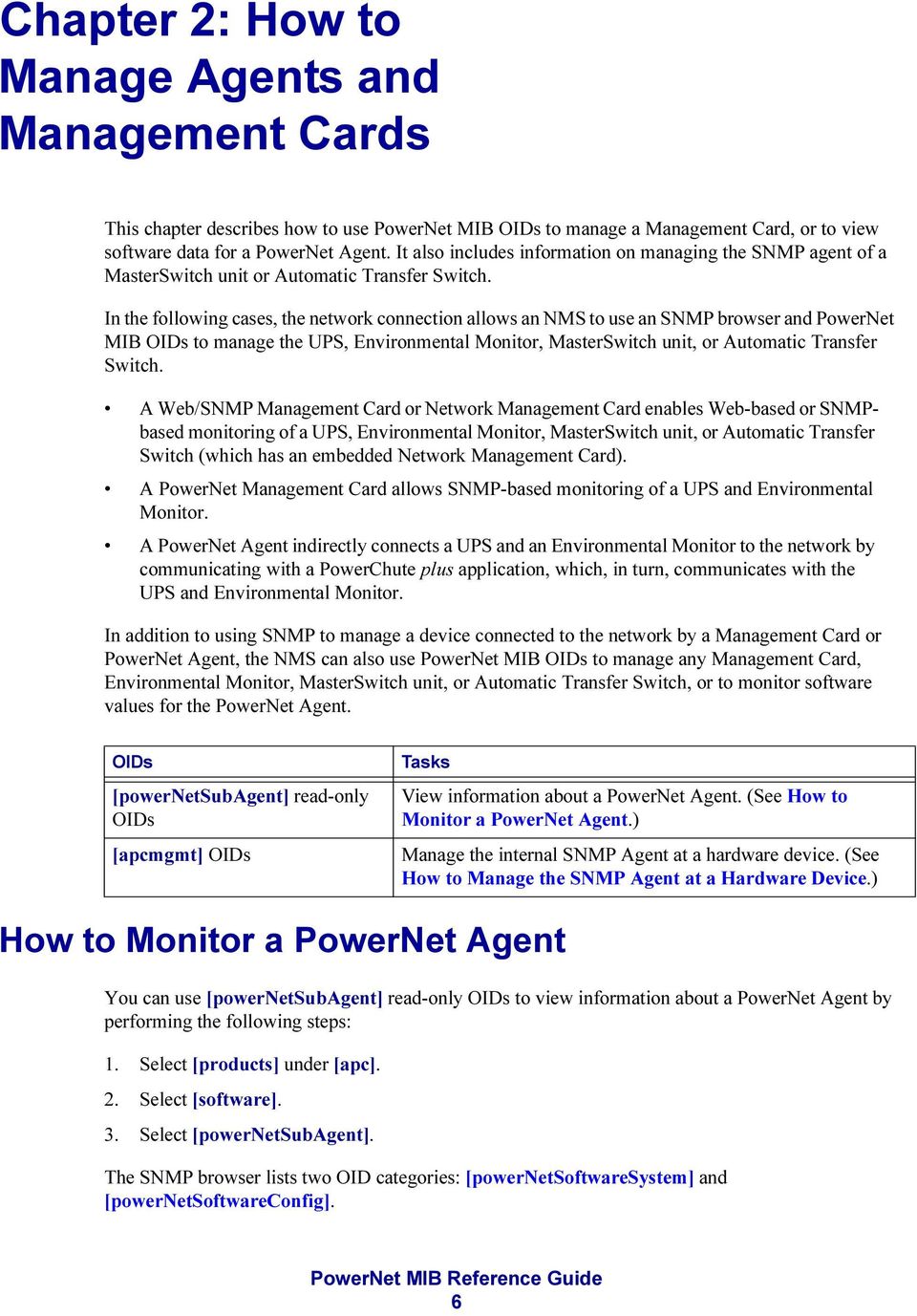
13 Chapter 2: How to Manage Agents and Management Cards This chapter describes how to use PowerNet MIB s to manage a Management Card, or to view software data for a PowerNet Agent. It also includes information on managing the SNMP agent of a MasterSwitch unit or Automatic Transfer Switch. In the following cases, the network connection allows an NMS to use an SNMP browser and PowerNet MIB s to manage the UPS, Environmental Monitor, MasterSwitch unit, or Automatic Transfer Switch. A Web/SNMP Management Card or Network Management Card enables Web-based or SNMPbased monitoring of a UPS, Environmental Monitor, MasterSwitch unit, or Automatic Transfer Switch (which has an embedded Network Management Card). A PowerNet Management Card allows SNMP-based monitoring of a UPS and Environmental Monitor. A PowerNet Agent indirectly connects a UPS and an Environmental Monitor to the network by communicating with a PowerChute plus application, which, in turn, communicates with the UPS and Environmental Monitor. In addition to using SNMP to manage a device connected to the network by a Management Card or PowerNet Agent, the NMS can also use PowerNet MIB s to manage any Management Card, Environmental Monitor, MasterSwitch unit, or Automatic Transfer Switch, or to monitor software values for the PowerNet Agent. s [powernetsubagent] read-only s [apcmgmt] s Tasks View information about a PowerNet Agent. (See How to Monitor a PowerNet Agent.) Manage the internal SNMP Agent at a hardware device. (See How to Manage the SNMP Agent at a Hardware Device.) How to Monitor a PowerNet Agent You can use [powernetsubagent] read-only s to view information about a PowerNet Agent by performing the following steps: 1. Select [products] under [apc]. 2. Select [software]. 3. Select [powernetsubagent]. The SNMP browser lists two categories: [powernetsoftwaresystem] and [powernetsoftwareconfig]. 6
14 Chapter 2: How to Manage the SNMP Agent at a Hardware Device [powernetsoftwaresystem] The following table describes the [powernetsoftwaresystem] s. powernetsoftwaresystemdescription powernetsoftwareoid powernetsoftwaresystemuptime Information Provided Information about an Agent, including its version number. The technology that the Agent uses to implement the PowerNet MIB. The length of time that the Agent has been continuously running on the network. [powernetsoftwareconfig] The following table describes the [powernetsoftwareconfig] s. powernetsoftwaretablesize {powernetsoftwaretable} {powernetsoftwareentry} modulenumber modulename moduleversion moduledate Information Reported The number of distinct software modules that an Agent has. A tabled set of s that define each module by these module characteristics: Table row number Name Version number Installation date, in the format mm-dd-yy How to Manage the SNMP Agent at a Hardware Device When you select [apcmgmt] under [apc], the SNMP browser lists four categories: [mcontrol], [mconfig], [mtrapargs], and [mfiletransfer]. In these categories, you can use the s documented in this guide to manage the SNMP Agent at a hardware device (ManagementCard, Environmental Monitor, MasterSwitch unit, or Automatic Transfer Switch). 7

15 Chapter 2: How to Manage the SNMP Agent at a Hardware Device [mcontrol] The following table describes the one in the [mcontrol] category. Value (3), not documented, is obsolete. mcontrolrestartagent Values You Can SET restartcurrentagent (1): Reboots the SNMP Agent. continuecurrentagent (2): Continues the Agent without rebooting. restartwithoutagent (4): Restarts the system without starting the Agent. The next time the system restarts, the Agent also restarts. [mconfig] The following table describes the [mconfig] s. mconfigbootpenabled mconfignumtrapreceivers {mconfigtrapreceivertable} {mconfigtrapreceiverentry} trapindex receiveraddr communitystring severity acceptthisreceiver receivetraptype mconfigclock Task Identify the current BOOTP setting. A GET to this returns one of the following: yes (1): Enable BOOTP. The hardware device will obtain its IP configuration parameters from a BOOTP server. no (2): Disable BOOTP. The hardware device will use the IP configuration parameters stored in its EPROM. Identify how many NMSs can receive traps from the Agent. A GET to this returns a value from 0 to 4. Use this tabled set of s to define up to four NMSs as trap receivers. See How To Define Trap Receivers in Chapter 9, PowerNet MIB Traps for information on the s in this table. Configure the date and time on a Web/SNMP Management Card, Network Management Card, or MasterSwitch unit. mconfigclockdate in mm/dd/yyyy format mconfigclocktime in hh:mm:ss am/pm format See How To Define Trap Receivers in Chapter 9, PowerNet MIB Traps for information on how to define trap receivers. 8
![restartwithoutagent (4): Restarts the system without starting the Agent. The next time the system restarts, the Agent also restarts. [mconfig] The following table describes the [mconfig] s.](/docs-images/40/1265229/images/page_15.jpg "mconfigbootpenabled mconfignumtrapreceivers {mconfigtrapreceivertable} {mconfigtrapreceiverentry} trapindex receiveraddr communitystring severity acceptthisreceiver receivetraptype mconfigclock Task")
16 Chapter 2: How to Manage the SNMP Agent at a Hardware Device [mtrapargs] The following table describes the [mtrapargs] s, which enable APC traps to use a specific type of argument, which, in each case, may not be defined as part of the APC MIB. mtrapsapargsinteger mtrapsapargsipaddress mtrapsapargsstring mtrapsapargsgauge mtrapsapargstimeticks Argument That APC Traps Are Alowed to Use An integer argument. An IP address argument. An octet string argument. A Gauge argument. A TimeTicks argument. [mfiletransfer] The [mfiletransfer] s, which are supported only by a PowerNet Management Card, allow transfers of any type of file that the card can recognize. For more information, see the User s Guide for your PowerNet Management Card. The categories under the [mfiletransfer] category are [mfiletransferstatus], [mfiletransferconfig], and [mfiletransfercontrol]. [mfiletransferstatus] The following table describes the one in the [mfiletransferstatus] category. mfiletransferstatuslastfiletransferresult Information Provided One of the following results of the last attempted file transfer: lastfiletransferresultsuccessful (1) lastfiletransferresultnotavailable (2): If this value is returned, there have been no previous file transfers. lastfiletransferresultfailureunknown (3) lastfiletransferresultfailureserverinaccessible (4) lastfiletransferresultfailureserveraccessdenied (5) lastfiletransferresultfailurefilenotfound (6) lastfiletransferresultfailurefiletypeunknown (7) lastfiletransferresultfailurefilecorrupted (8) 9

17 Chapter 2: How to Manage the SNMP Agent at a Hardware Device [mfiletransferconfig] The following table describes the three sub-categories in the [mfiletransferconfig] category and the s in each of those sub-categories. Sub-category [mfiletransferconfigsettings] [mfiletransferconfigtftp] [mfiletransferconfigftp] s in Each Sub-category mfiletransferconfigsettingsfilename: The name and path of the file to be transferred. mfiletransferconfigtftpserveraddress: The IP Address of the remote TFTP Server. mfiletransferconfigftpserveraddress: The IP Address, in decimal notation, of the remote FTP Server involved in the file transfer. mfiletransferconfigftpserveruser: The FTP Server User Name. mfiletransferconfigftpserverpassword: The FTP Server Password. [mfiletransfercontrol] The following table describes the one in the [mfiletransfercontrol] category. mfiletransfercontrolinitiatefiletransfer Task donotinitiatefiletransfer (1): Do nothing. initiatefiletransferdownloadviatftp (2): Download file from the TFTP Server. initiatefiletransferdownloadviaftp (3): Download file from the FTP Server. 10
![Sub-category [mfiletransferconfigsettings] [mfiletransferconfigtftp] [mfiletransferconfigftp] s in Each Sub-category mfiletransferconfigsettingsfilename: The name and path of the file to be](/docs-images/40/1265229/images/page_17.jpg "transferred. mfiletransferconfigtftpserveraddress: The IP Address of the remote TFTP Server.")
18 Chapter 3: How to Manage a UPS This chapter describes how to use PowerNet MIB s to manage a UPS through its Management Card or its PowerNet Agent. ThePowerNet MIB s that you can use to manage (monitor, configure, control and test) a UPS are in nine categories under the heading [ups]. To list the nine categories, perform the following steps: 1. Select [products] under [apc]. 2. Select [hardware]. 3. Select [ups]. Categories [upsident] [upsbattery] [upsinput] [upsoutput] [upscomm] [upsconfig] [upscontrol] [upstest] [upsphase] Tasks View information about the UPS and its overall operation. (See How to Monitor a UPS.) Modify parameters that affect the overall operation of the UPS. (See How to Configure a UPS.) Directly affect the current operation of the UPS. (See How to Control a UPS.) Verify that the UPS can operate correctly during a power failure. (See How to Test a UPS.) Provide s directly related to 3-phase UPS models. (See How to Use s for 3-Phase UPS Models.) The following factors determine which s in the [ups] categories can be used to manage a UPS: The manner in which the UPS connects to the network. For a PowerNet Agent, the type of signalling used for the connection between the Agent and the UPS: basic (simple-signalling) and advanced (smart-signalling). Management Card You can use all s listed under the [ups] category of the PowerNet MIB. PowerNet Agent You cannot use the following: Any [ups] s not originally supported for PowerNet Agents in PowerNet MIB version 2.2. Smart-signalling (advanced) s, if the Agent- to-ups communication uses simple-signalling. 11
![Select [products] under [apc]. 2. Select [hardware]. 3. Select [ups].](/docs-images/40/1265229/images/page_18.jpg "Categories [upsident] [upsbattery] [upsinput] [upsoutput] [upscomm] [upsconfig] [upscontrol] [upstest] [upsphase] Tasks View information about the UPS and its overall operation.")
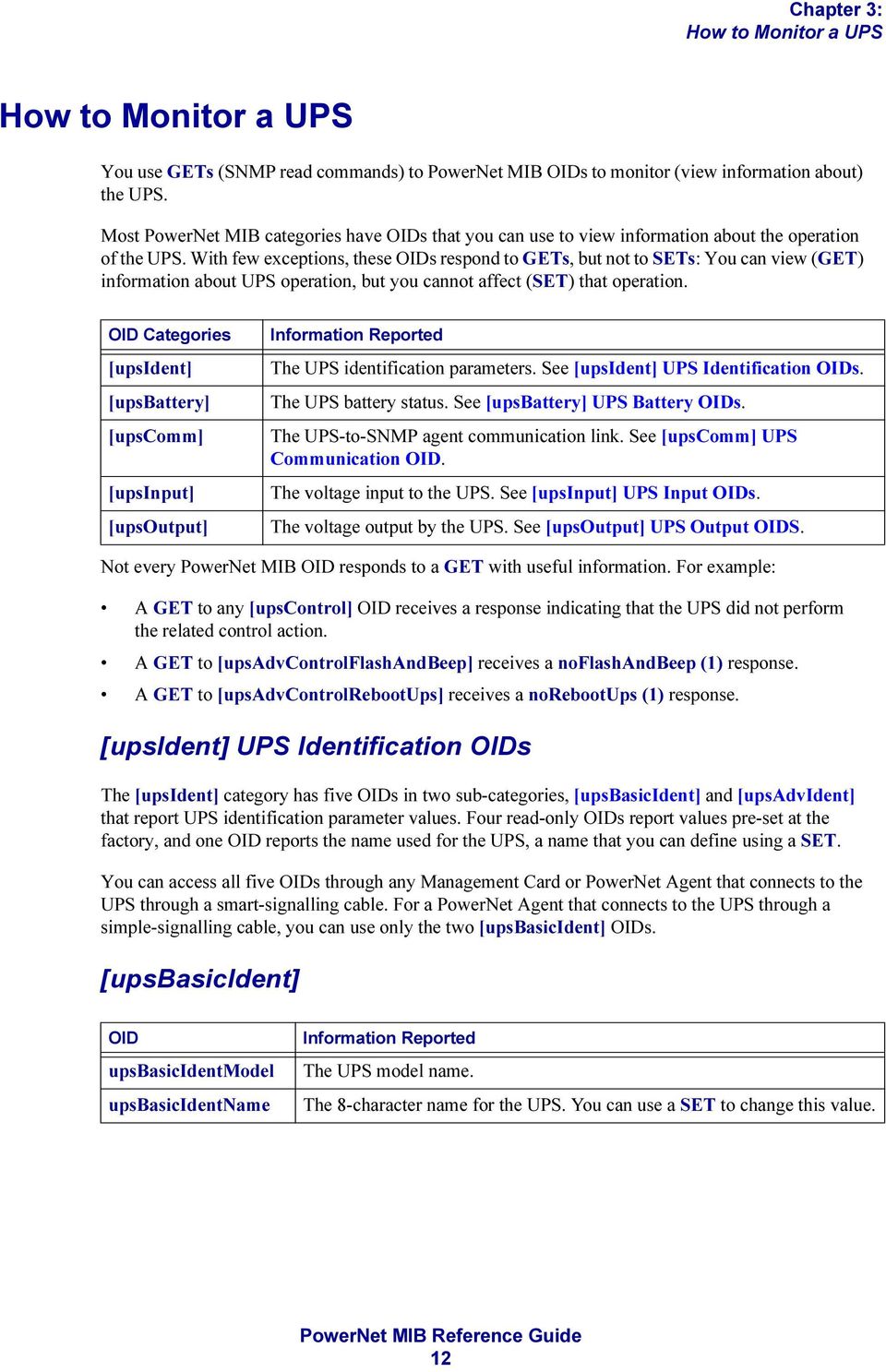
19 Chapter 3: How to Monitor a UPS How to Monitor a UPS You use GETs (SNMP read commands) to PowerNet MIB s to monitor (view information about) the UPS. Most PowerNet MIB categories have s that you can use to view information about the operation of the UPS. With few exceptions, these s respond to GETs, but not to SETs: You can view (GET) information about UPS operation, but you cannot affect (SET) that operation. Categories [upsident] [upsbattery] [upscomm] [upsinput] [upsoutput] Information Reported The UPS identification parameters. See [upsident] UPS Identification s. The UPS battery status. See [upsbattery] UPS Battery s. The UPS-to-SNMP agent communication link. See [upscomm] UPS Communication. The voltage input to the UPS. See [upsinput] UPS Input s. The voltage output by the UPS. See [upsoutput] UPS Output S. Not every PowerNet MIB responds to a GET with useful information. For example: A GET to any [upscontrol] receives a response indicating that the UPS did not perform the related control action. A GET to [upsadvcontrolflashandbeep] receives a noflashandbeep (1) response. A GET to [upsadvcontrolrebootups] receives a norebootups (1) response. [upsident] UPS Identification s The [upsident] category has five s in two sub-categories, [upsbasicident] and [upsadvident] that report UPS identification parameter values. Four read-only s report values pre-set at the factory, and one reports the name used for the UPS, a name that you can define using a SET. You can access all five s through any Management Card or PowerNet Agent that connects to the UPS through a smart-signalling cable. For a PowerNet Agent that connects to the UPS through a simple-signalling cable, you can use only the two [upsbasicident] s. [upsbasicident] upsbasicidentmodel upsbasicidentname Information Reported The UPS model name. The 8-character name for the UPS. You can use a SET to change this value. 12
20 Chapter 3: How to Monitor a UPS [upsadvident] upsadvidentfirmwarerevision upsadvidentdateofmanufacture upsadvidentserialnumber Information Reported The UPS firmware version. The date on which the UPS completed the manufacturing process. The UPS serial number. [upsbattery] UPS Battery s The [upsbattery] category has nine s in two sub-categories, [upsbasicbattery] and [upsadvbattery] that provide UPS battery status information. Eight are read-only s, and one reports when the battery was replaced last, a value that you can define by using a SET. You can access all nine s through any Management Card or through a PowerNet Agent that connects to the UPS through a smart-signalling cable. For a PowerNet Agent that connects to the UPS through a simple-signalling cable, you can use only the three [upsbasicbattery] s. [upsbasicbattery] upsbasicbatterystatus upsbasictimeonbattery upsbasicbatterylastreplacedate Information Reported The current UPS battery status: unknown (1): The Management Card or PowerNet Agent cannot report the status. batterynormal (2): Within normal operating parameters. batterylow (3): Insufficient battery capacity to support the UPS equipment load. The amount of time since the UPS switched to battery power. The date on which the battery was last replaced, a value you can change by using a SET. The format is mm/dd/yy or mm/dd/yyyy. 13
![[upsbattery] UPS Battery s The [upsbattery] category has nine s in two sub-categories, [upsbasicbattery] and [upsadvbattery] that provide UPS battery status information.](/docs-images/40/1265229/images/page_20.jpg "Eight are read-only s, and one reports when the battery was replaced last, a value that you can define by using a SET.")
21 Chapter 3: How to Monitor a UPS [upsadvbattery] upsadvbatterycapacity upsadvbatterytemperature upsadvbatteryruntimeremaining upsadvbatteryreplaceindicator upsadvbatterynumofbattpacks upsadvbatterynumofbadbattpacks Information Reported The battery s remaining capacity as a percentage of full battery capacity. The internal temperature of the UPS, in Celsius. How long the UPS battery can provide output voltage. Whether a UPS battery needs replacement: nobatteryneedsreplacing (1) batteryneedsreplacing (2) The number of external battery packs a Matrix-UPS or Smart-UPS XL has. The number of defective external battery packs that a Matrix-UPS or Smart-UPS XL has. [upscomm] UPS Communication This category has a single read-only that you can access through any Management Card but not through a PowerNet Agent. upscommstatus Information Reported The status of the Management Card s SNMP agent-to-ups communication link: ok (1) nocomm (2) [upsinput] UPS Input s The [upsinput] category has six read-only s in two sub-categories, [upsbasicinput] and [upsadvinput], that provide information about the UPS input (utility line) voltage. You can access all six s through any Management Card or through a PowerNet Agent that connects to the UPS through a smart-signalling cable. For a PowerNet Agent that connects to the UPS through a simple-signalling cable, you can use only the upsbasicinputphase. [upsbasicinput] upsbasicinputphase Information Reported The current AC input voltage phase. 14
22 Chapter 3: How to Monitor a UPS [upsadvinput] upsadvinputlinevoltage upsadvinputmaxlinevoltage upsadvinputminlinevoltage upsadvinputfrequency upsadvlinefailcause Information Reported The current input voltage in VAC. The maximum input voltage, in VAC, sensed by the UPS during the last minute. The minimum input voltage, in VAC, sensed by the UPS during the last minute. The current input voltage frequency in Hertz. The reason for the most recent transfer to battery. Any Management Card or smart-signalling PowerNet Agent can report the following: - notransfer (1): No transfer has occurred. - highlinevoltage (2): Voltage exceeded the high-transfer voltage value. - brownout (3): For more than 5 seconds, the voltage level was between 40% of the UPS rated output voltage and the lowtransfer voltage value. - blackout (4): For more than 5 seconds, the voltage level was between 40% of the UPS rated output voltage and ground [0 volts]. - smallmomentarysag (5): A brownout existed for 5 seconds or less. - deepmomentarysag (6): A blackout existed for 5 seconds or less. - smallmomentaryspike (7): Less than 10 volts per cycle voltage increase. - largemomentaryspike (8): More than 10 volts per cycle voltage increase. A Management Card can also report the occurrence of a UPS self-test, self-test (9), and the rate of changes in the line voltage level, rateofvoltagechange (10). See How to Configure a UPS for information about the following values mentioned in the descriptions of [upsadvlinefailcause] values in the preceding table: Rated output of the UPS The high-transfer voltage value The low-transfer voltage value 15
23 Chapter 3: How to Monitor a UPS [upsoutput] UPS Output S The [upsoutput] category has six read-only s in two subcategories, [upsbasicoutput] and [upsadvoutput], that provide information about the UPS output voltage. You can access all six s through any Management Card. A PowerNet Agent that connects to the UPS through a smart-signalling cable can use all the s except upsadvoutputcurrent. A PowerNet Agent that connects to the UPS through a simple-signalling cable can use only the two [upsbasicoutput] s. [upsbasicoutput] upsbasicoutputstatus upsbasicoutputphase Information Reported The current UPS operational status: unknown (1): The Management Card or PowerNet Agent cannot determine the state of the UPS. online (2): The UPS is using acceptable input voltage to provide output voltage. onbattery (3): The UPS is using battery power to provide output voltage. onsmartboost (4): The UPS is using its AVR Boost feature with a low input voltage to provide sufficient output voltage without switching to battery operation. timedsleeping (5): The UPS is waiting a defined period of time before supplying output power to its supported equipment. softwarebypass (6): The Matrix-UPS or Symmetra UPS was placed into bypass mode using SNMP, PowerChute plus or PowerNet Manager. off (7): The UPS is turned off. rebooting (8): The UPS is resetting its supported equipment by turning off its output power and then turning it back on. switchedbypass (9): The Matrix-UPS or Symmetra UPS was placed into bypass mode using the switch at the UPS. hardwarefailurebypass (10): The Matrix-UPS or Symmetra UPS placed itself into bypass mode in response to a hardware problem. sleepinguntilpowerreturn (11): The UPS is waiting for input power to return to an acceptable level before it provides output power to its supported equipment. onsmarttrim (12): The UPS is using its AVR Trim feature with a high input voltage to provide output voltage without switching to battery operation. The current output phase. 16
24 Chapter 3: How to Control a UPS [upsadvoutput] upsadvoutputvoltage upsadvoutputfrequency upsadvoutputload upsadvoutputcurrent Information Reported The output voltage of the UPS in VAC. The output voltage frequency of the UPS in Hertz. The equipment load placed on the UPS by its supported equipment as a percentage of rated load capacity. The output voltage current in Amperes How to Control a UPS You can use SETs (SNMP write commands) to the [upscontrol] s to directly affect the current operation of the UPS [upscontrol] s Which [upscontrol] s you can use depends on how the UPS connects to the network. The [upscontrol] category has two subcategories [upsbasiccontrol] for simple-signalling connections. [upsadvcontrol] for smart-signalling connections. [upsbasiccontrol] The [upsbasiccontrol] category has one, which any Management Card or PowerNet Agent can use to put a UPS that is running on battery into sleep mode. upsbasiccontrolconservebattery Task Cause a UPS running on battery to turn off its outlets to conserve battery runtime and then wait in sleep mode until acceptable input power returns. noturnoffups (1): The value always returned for a GET. Setting this value has no effect. turnoffupstoconservebattery (2): The UPS, if running on battery, waits in sleep mode until acceptable input power returns. If the UPS is not on battery, a badvalue error is returned. 17
25 Chapter 3: How to Control a UPS [upsadvcontrol] Management Cards and PowerNet Agents that use smart-signalling to connect with the UPS can use SETs to the s in the [upsadvcontrol] category, with the following exceptions: Three s each have a value that you can use only with a Management Card. - The upsadvcontrolupsoff s value of turnupsoffgracefully (3). - The upsadvcontrolrebootups s value of rebootupsgracefully (3). - The upsadvcontrolupssleep s value of putupstosleepgracefully (3). Task (page 1 of 2) upsadvcontrolupsoff Cause the UPS to turn off. How the UPS turns off depends on what SET value is used and how the UPS connects to the network: noturnupsoff (1): The value always returned for a GET. Setting this value has no effect. turnupsoff (2): All Management Cards turn off the UPS immediately. turnupsoffgracefully (3): - A PowerNet Agent performs an orderly shutdown of the UPS server, then turns off the UPS. - A Management Card turns off a UPS after the delay defined by upsadvconfigshutoffdelay, a UPS configuration. (See How to Configure a UPS.) Note: When you use the upsadvcontrolupsoff with a PowerNet Agent, you can turn on the UPS again only by using the UPS on/off switch. For all Management Cards, you can turn on the UPS again by using a SET value of turnonups (2) for the upsadvcontrolturnonups. upsadvcontrolrebootups Cause the UPS to reset its supported equipment by turning power off and then back on: norebootups (1): The value always returned for a GET. Setting this value has no effect. rebootups (2): All Management Cards reboot the UPS immediately. rebootupsgracefully (3): A Management Card reboots a UPS, using a delay before it turns off the UPS. The UPS uses the delay value defined by upsadvconfigshutoffdelay, a UPS configuration. (See How to Configure a UPS.) 18
26 Chapter 3: How to Control a UPS Task (page 2 of 2) upsadvcontrolupssleep upsadvcontrolsimulatepowerfail upsadvcontrolflashandbeep upsadvcontrolturnonups upsadvcontrolbypassswitch Cause the UPS to turn off its outlets and wait in sleep mode for the period of time defined by upsadvconfigupssleeptime, a UPS configuration (See How to Configure a UPS.) noputupstosleep (1): The value always returned for a GET. Setting this value has no effect. putupstosleep (2): All Management Cards turn off UPS power immediately. putupstosleepgracefully (3): A Management Card turns off UPS power after a delay defined by upsadvconfigshutoffdelay, a UPS configuration. (See How to Configure a UPS.) Cause the UPS to test its ability to switch to battery operation as it would in a power failure: nosimulatepowerfailure (1): The value always returned for a GET. Setting this value has no effect. simulatepowerfailure (2): The UPS performs this test. Cause the UPS to test its front panel lights (if any) and its audible alarm: noflashand Beep (1): The value always returned for a GET. Setting this value has no effect. flashandbeep (2): The UPS performs this test. Cause a Management Card s UPS to turn on: noturnonups (1): The value always returned for a GET. Setting this value has no effect. turnonups (2): The UPS turns on, if that UPS was turned off using the upsadvcontrolupsoff. Switch a Matrix-UPS or Symmetra UPS to or from software bypass mode: nobypassswitch (1): The value always returned for a GET. Setting this value has no effect. switchtobypass (2): The UPS switches to bypass mode. switchoutofbypass (3): The UPS switches from bypass mode to normal operation. 19
27 Chapter 3: How to Configure a UPS How to Configure a UPS You can use the S in the [upsconfig] category to define how the UPS responds to specific operating conditions. [upsconfig] Which [upsconfig] s you can use depends on how the Management Card or PowerNet Agent connects to the UPS. The [upsconfig] category has two subcategories: [upsbasicconfig] for simple-signalling connections, which provide basic power management and protection but offer few additional configuration and monitoring options. (A Back-UPS supports only simple-signalling.) [upsadvconfig] for smart-signalling connections, which provide full support for the advanced configuration and monitoring options available on all APC UPSs except Back-UPS. [upsbasicconfig] The [upsbasicconfig] category has one read-only and a tabled set of s that you can use to view or define information about the equipment supported by the UPS. upsbasicconfignumdevices {upsbasicconfigdevicetable} {upsbasicconfigdeviceentry} deviceindex devicename varating acceptthisdevice Task Identify the number of devices specified in the tabled set of S {upsbasicconfigdevicetable}, i.e. the number of devices plugged into the UPS. View or define information about the equipment supported by each UPS outlet: View read-only value that identifies the specific outlet. Define a 16-character name for the device at this outlet. Define the VA rating of the device this outlet supports Add a device entry to the table or delete and existing device entry: yes (1): Add an entry. no (2): Delete an entry. 20
28 Chapter 3: How to Configure a UPS [upsadvconfig] The s in the [upsadvconfig] category enable you to view or configure operating and shutdown parameters for a UPS connected in smart-signalling mode. A Management Card can use all the S in this category. A PowerNet Agent can use all but four of the s, as noted in the following table. Task (page 1 of 3) upsadvconfigratedoutputvoltage 1 upsadvconfighightransfervolt 1 upsadvconfiglowtransfervolt 2 upsadvconfigalarm upsadvconfigalarmtimer upsadvconfigminreturncapacity 2 Define the UPS nominal VAC output voltage. This value is read-only for most 120 VAC UPSs. Define the input voltage at which the UPS will switch to its AVR Boost feature. If the UPS does not support AVR Boost, it switches to battery operation instead. (A Matrix-UPS, for example, does not support AVR Boost.) Define the input voltage at which the UPS will switch to its AVR Trim feature. If the UPS does not support AVR Trim, it switches to battery operation instead. (A Matrix-UPS, for example, does not support AVR Trim.) Define when the UPS will generate an audible alarm for a line-fail condition: timed (1): After the UPS switches to battery operation and waits the delay defined by the upsadvconfigalarmtimer. atlowbattery (2): When a low-battery condition occurs. never (3): No alarm occurs Define how long in seconds the UPS must wait after switching to battery operation before it can generate an alarm when timed (1) is the value for the upsadvconfigalarm. The only allowed values are 0 and 30. If you use any value of 1 second or more, the value is set to 30. If you use any value less than 1 second, the value is set to 0. Define the battery capacity (as a percentage of full capacity) required before the UPS can return from a low-battery shutdown. 1 If a SET specifies an unsupported value, the UPS interprets the value as the next lower allowed value, as defined by the apcupsconfigfieldvaluerange in the tabled set of s {upsadvconfigallowedsettable}. If the value is less than the lowest allowable value, the lowest allowed value is used. 2 If a SET specifies an unsupported value, the UPS interprets the value as the next higher allowed value, as defined by the apcupsconfigfieldvaluerange in the tabled set of s {upsadvconfigallowedsettable}. If the value is higher than the highest allowable value, the highest allowed value is used. 21
29 Chapter 3: How to Configure a UPS Task (page 2 of 3) upsadvconfigsensitivity upsadvconfiglowbatteryruntime 2 upsadvconfigreturndelay 2 upsadvconfigshutoffdelay 2 upsadvconfigupssleeptime upsadvconfigseteepromdefaults upsadvconfigpassword Define the sensitivity of the UPS to input line abnormalities or noise. auto (1): The only setting recognized by UPSs with automatic voltage regulators, e.g Matrix-UPS and Symmetra UPS. low (2) medium (3) high (4) Define when a low-battery condition will occur, based on how much battery runtime remains, in seconds. Define the time in seconds that a UPS in sleep mode will wait after input power returns before turning on its power outlets. (In sleep mode, a UPS waits, with its power outlets turned off, for input power to return.) Define the delay time, in seconds, used for graceful turnoff, reboot, and sleep-control options. (See How to Control a UPS.) Only Management Cards can use this. Define how long the UPS will remain in timed sleep, specified as a multiple of 360 seconds (6 minutes). If a SET provides a value that is not a multiple of 360, the UPS rounds the value to the nearest multiple of 360, except that any value from 1 through 540 is rounded to 360. Only Management Cards can use this. Reset the UPS configuration values to the values set at the factory. Only Management Cards can use this. noseteepromdefaults (1): The value always returned by a GET. Setting this value has no effect. seteepromdefaults (2): Resets the values. Define the 4-byte password used for front-panel access to a Matrix-UPS or Symmetra UPS. Only Management Cards can use this. 1 If a SET specifies an unsupported value, the UPS interprets the value as the next lower allowed value, as defined by the apcupsconfigfieldvaluerange in the tabled set of s {upsadvconfigallowedsettable}. If the value is less than the lowest allowable value, the lowest allowed value is used. 2 If a SET specifies an unsupported value, the UPS interprets the value as the next higher allowed value, as defined by the apcupsconfigfieldvaluerange in the tabled set of s {upsadvconfigallowedsettable}. If the value is higher than the highest allowable value, the highest allowed value is used. 22
30 Chapter 3: How to Test a UPS Task (page 3 of 3) {upsadvconfigallowedsettable} {apcupsconfigentry} apcupsconfigfieldindex apcupsconfigfield apcupsconfigfieldvaluerange Obtain the allowed values for all settable s in the [upsadvconfig] group. The index to an EEPROM field entry. The of the current configurable value. A comma-delimited list of allowed values for the 1 If a SET specifies an unsupported value, the UPS interprets the value as the next lower allowed value, as defined by the apcupsconfigfieldvaluerange in the tabled set of s {upsadvconfigallowedsettable}. If the value is less than the lowest allowable value, the lowest allowed value is used. 2 If a SET specifies an unsupported value, the UPS interprets the value as the next higher allowed value, as defined by the apcupsconfigfieldvaluerange in the tabled set of s {upsadvconfigallowedsettable}. If the value is higher than the highest allowable value, the highest allowed value is used. How to Test a UPS This section contains information on using s to perform UPS self-tests and runtime calibrations. [upstest] The [upstest] category contains the [upsadvtest] sub-category for use by smart-signalling Management Cards or PowerNet Agents. There are no s in the [upstest] category for performing self-tests and calibrations for UPSs connected in simple-signalling mode because simple-signalling does not support those functions. [upsadvtest] You can use the S in the [upsadvtest] sub-category to schedule or initiate UPS self-tests and runtime calibrations and to view the results of UPS self-tests. The s in this sub-category have the following limitations on their use: A Management Card can use all these S except upsadvtestlastdiagnosticsdate, which can be used only by a PowerNet Agent. A PowerNet Agent can use all these s except upsadvtestruntimecalibration, which can be used only by a Management Card 23
31 Chapter 3: How to Test a UPS upsadvtestdiagnosticschedule upsadvtestdiagnostics upsadvtestdiagnosticsresults upsadvtestlastdiagnosticdate upsadvtestruntimecalibration upsadvtestcalibrationresults upsadvtestcalibrationdate Task Define the self-test schedule for the UPS: unknown (1): The Management Card or Agent cannot determine the setting. biweekly (2): Self-tests will occur bi-weekly. weekly (3): A self-test will occur once every week. atturnon (4): A self-test will occur whenever the UPS turns on. never (5): No self-test will be performed. Cause the UPS to perform an immediate self-test. notestdiagnostics (1): The value always returned by a GET. Setting this value has no effect. testdiagnostics (2): Perform the test. View the result of the last self-test: ok (1): failed (2): invalidtest (3): testinprogress (4): View the date (in dd/mm/yy format) of the last UPS self-test. Only smart-signalling PowerNet Agents use this. Control a runtime calibration: noperformcalibration (1): The value always returned by a GET. Setting this value has no effect. performcalibration (2): Starts a runtime calibration, if the UPS battery is at 100% capacity. If the battery capacity is not at 100%, a SET of this value results in an invalidcalibration setting for the upsadvtestcalibrationresults. cancelcurrentcalibration (3): Cancels a runtime calibration. Only a Management Card can use this. View the result of the last runtime calibration: ok (1): The runtime calibration was successful. invalidcalibration (2): The last calibration requested did not take place because battery capacity was less than 100%. calibrationinprogress (3): A calibration is occurring now. View the date (in dd/mm/yy format) of the last runtime calibration. Only smart-signalling PowerNet Agents use this. 24
32 Chapter 3: How to Use s for 3-Phase UPS Models How to Use s for 3-Phase UPS Models The [upsphase] category has s in three subcategories [upsphaseresetvalues]: Set of s you use to reset the counters for the corresponding in the [upsphaseinput] and [upsphaseoutput] groups that report minimum and maximum values. [upsphaseinput]: Set of s you use to obtain information about the input phases. [upsphaseoutput]: Set of s you use to obtain information about the ouput phases. To access the values of s in a table, select the table in the SNMP browser. (An table appears enclosed in braces {}.) For example, to access the s that provide information on all input phases for a device, select {upsphaseinputphasetable} in the SNMP browser, and then select [upsphaseinputentry] to see each in the table. [upsphaseresetvalues] Use an in the [upsphasereset Values] group to reset the counters for the corresponding in the [upsphaseinput] and [upsphaseoutput] groups that report minimum and maximum values. upsbasiccontrolconservebattery upsphaseinputmaxvoltage upsphaseinputminvoltage upsphaseinputmaxcurrent upsphaseinputmincurrent upsphaseinputmaxpower upsphaseinputminpower upsphaseoutputmaxcurrent upsphaseoutputmincurrent upsphaseoutputmaxload upsphaseoutputminload upsphaseoutputmaxpercentload upsphaseoutputminpercentload upsphaseoutputmaxpower upsphaseoutputminpower upsphaseoutputmaxpercentpower upsphaseoutputminpercentpower Task Resets the counter for the corresponding in the [upsphaseinput] and [upsphaseoutput] groups. For example, to reset the counter for the in the [upsphaseinput] category that reports the maximum input current (upsphaseinputmaxcurrent), SET to the with that name in this [upsphaseresetvalues] category. 25
33 Chapter 3: How to Use s for 3-Phase UPS Models [upsphaseinput] All of the s in this category are read-only except for the upsphaseinputname, a {upsphaseinputentry} in the {upsphaseinputtable}. upsphasenuminputs {upsphaseinputtable} {upsphaseinputentry} upsphaseinputtableindex upsphasenuminputphases upsphaseinputvoltageorientation upsphaseinputfrequency upsphaseinputtype upsphaseinputname (upsphaseinputphasetable) {upsphaseinputphaseentry} upsphaseinputphasetableindex upsphaseinputphaseindex upsphaseinputvoltage upsphaseinputmaxvoltage upsphaseinputminvoltage upsphaseinputcurrent upsphaseinputmaxcurrent upsphaseinputmincurrent upsphaseinputpower upsphaseinputmaxpower upsphaseinputminpower Task Use these read-only s to obtain information about the number of input feeds to the UPS, and information about each of those feeds. Use the read-only s to obtain the following information for each input phase: The input voltage, input current, and input power now. The minimum and maximum value recorded for the input voltage, input current, and input power since the corresponding counters were reset by the s in the [upsphaseresetvalues] group. The number of entries in the table depends on the sum of the values reported for upsphasenuminputphases in the {upsphaseinputtable} described above. 26
34 Chapter 3: How to Use s for 3-Phase UPS Models [upsphaseoutput] All of the s in this category are read-only except for the upsphaseoutputname, a {upsphaseoutputentry} in the {upsphaseoutputtable}. upsphasenumoutputs {upsphaseoutputtable} {upsphaseoutputentry} upsphaseoutputtableindex upsphasenumoutputphases upsphaseoutputvoltageorientation upsphaseoutputfrequency upsphaseoutputname (upsphaseinputphasetable) {upsphaseinputphaseentry} upsphaseinputphasetableindex upsphaseinputphaseindex upsphaseinputvoltage upsphaseinputmaxvoltage upsphaseinputminvoltage upsphaseinputcurrent upsphaseinputmaxcurrent upsphaseinputmincurrent upsphaseinputpower upsphaseinputmaxpower upsphaseinputminpower Task Use these read-only s to obtain information about the number of output feeds to the UPS, and information about each of those feeds. Use the read-only s to obtain the following information for each input phase: The output voltage, output current, output load and output power now. The minimum and maximum value recorded for the output voltage, output current, output load and output power since the corresponding counters were reset by the s in the [upsphaseresetvalues] group. The number of entries in the table depends on the sum of the values reported for upsphasenumoutputphases in the {upsphaseoutputtable} above. 27
35 Chapter 4: How to Manage an Environmental Monitor This chapter describes how to use the following PowerNet MIB s to manage (monitor, configure, and control) an Environmental Monitor through its Management Card or PowerNet Agent. External Environmental Monitor (em) s Integrated Environmental Monitor (iem) s (AP9618 or AP9619 Network Management Card Only) Measure-UPS (mups) s Note: The external Environmental Monitor (em) s expand on the management capabilities provided by the mups s. The mups S have been kept in the MIB for compatability with previous versions of the PowerNet MIB. External Environmental Monitor (em) s Three categories of em s provide for managing external Environmental Monitors. [emident] [emconfig] s [emstatus] s To access these em s in the PowerNet MIB, do the following: 1. Select [products] under [apc]. 2. Select [hardware]. 3. Select [environmentalmonitor]. 4. Select [external]. [emident] A single [emident], emidentfirmwarerevision, identifes the firmware used by the Environmental Monitor. 28
36 Chapter 4: External Environmental Monitor (em) s [emconfig] s Two sets of [emconfig] s are available to configure an external Environmental Monitor: [emconfigprobes] s [emconfigcontacts] s [emconfigprobes] s You use the following [emconfigprobes] s to view and change values used by the temperature and humidity probes at an external Environmental Monitor. emconfigprobesnumprobes {emconfigprobestable} {emconfigprobesentry} emconfigprobenumber emconfigprobename emconfigprobehightempthreshold emconfigprobelowtempthreshold emconfigprobetempunits Task View how many probes are available (read-only). Access the set of s for each probe and perform the following: View the number of the probe to which this set of s applies (read-only). Define a descriptive name for the probe. Set the high-temperature threshold. Set the low-temperature threshold. View whether the probe uses Celsius (1) or Fahrenheit (2) temperature values (read-only). emconfigprobehighhumidthreshold emconfigprobelowhumidthreshold emconfigprobehightempenable emconfigprobelowtempenable emconfigprobehighhumidenable emconfigprobelowhumidenable Note: The temperature unit is defined by a system preferences setting at the agent. Set the high-humidity threshold. Set the low-humidity threshold. Enable or disable the following alarms: - High-temperature threshold alarm - Low-temperature threshold alarm - High-humidity threshold alarm - Low-humidity threshold alarm 29
37 Chapter 4: External Environmental Monitor (em) s [emconfigcontacts] s You use the following [emconfigcontacts] s to view and change values used by the input contacts at an external Environmental Monitor. emconfigcontactsnumcontacts {emconfigcontactstable} {emconfigcontactsentry} emconfigcontactnumber emconfigcontactname emconfigcontactenable Task View how many contacts are available (read-only). Access the set of s for each input contact and perform the following: Identify the contact to which this set of s applies (read-only). Define a descriptive name for the contact. Enable or disable the contact alarm. [emstatus] s Three types of [emstatus] read-only s are available to view the status at an external Environmental Monitor: [emstatuscommstatus] [emstatusprobes] s [emstatusprobes] s [emstatuscommstatus] You use this read-only to view the status of the communication between the agent and the external Environmental Monitor. Status nocomm (1) comm (2) commlost (3) Description Communication has not been established. Communication has been established. Communication was lost after it had been established. 30
38 Chapter 4: External Environmental Monitor (em) s [emstatusprobes] s You use the following [emstatusprobes] read-only s to view information about the temperature and humidity probes at an external Environmental Monitor. emstatusprobesnumprobes {emstatusprobestable} {emstatusprobesentry} emstatusprobenumber emstatusprobename emstatusprobestatus emstatusprobecurrenttemp emstatusprobetempunits Information Reported The number of available probes Access the set of s for each input contact and view the following information: The number of the probe The name of the probe The disconnected (1) or connected (2) status of the probe The current temperature reading at the probe Whether Celsius (1) or Fahrenheit (2) temperature values are used by the probe emstatusprobecurrenthumid emstatusprobehightempviolation emstatusprobelowtempviolation emstatusprobehighhumidviolation emstatusprobelowhumidviolation Note: The temperature unit is defined by a system preferences setting at the agent. The current humidity reading at the probe The noviolation (1), hightempviolation (2), or disabled (3) status of the high-temperature alarm The noviolation (1), lowtempviolation (2), or disabled (3) status of the low-temperature alarm The noviolation (1), highhumidviolation (2), or disabled (3) status of the high-humidity alarm The noviolation (1), lowhumidviolation (2), or disabled (3) status of the low-humidity alarm [emstatuscontacts] s You use the following [emstatuscontacts] read-only s to view information about the input contacts at an external Environmental Monitor. emstatuscontactsnumcontacts {emstatuscontactstable} {emstatuscontactsentry} emstatuscontactnumber emstatuscontactname emstatuscontactstatus Information Reported The number of available contacts Access the set of s for each input contact and view the following information: The number of the contact The name of the contact The nofault (1), fault (2), or disabled (3) status of the contact alarm 31
39 Chapter 4: Integrated Environmental Monitor (iem) s (AP9618 or AP9619 Network Management Card Only) Integrated Environmental Monitor (iem) s (AP9618 or AP9619 Network Management Card Only) Three categories of iem s provide for managing the Integrated Environmental Monitor at an AP9618 or AP9619 Network Management Card. [iemident] [iemconfig] s [iemstatus] s Note: The Integrated Environmental Monitor has one probe, two input contacts, and an output relay available. To access these iem s in the PowerNet MIB, do the following: 1. Select [products] under [apc]. 2. Select [hardware]. 3. Select [environmentalmonitor]. 4. Select [integrated]. [iemident] A single [iemident], iemidenthardwarerevision, identifes the hardware version for the Integrated Environmental Monitor. [iemconfig] s Two sets of [iemconfig] s are available to configure an Integrated Environmental Monitor: [emconfigprobes] s [emconfigcontacts] s 32
40 Chapter 4: Integrated Environmental Monitor (iem) s (AP9618 or AP9619 Network Management Card Only) [iemconfigprobes] s You use the following [iemconfigprobes] s to view and change values used by the temperature and humidity probe at an Integrated Environmental Monitor. iemconfigprobesnumprobes {iemconfigprobestable} {iemconfigprobesentry} iemconfigprobenumber iemconfigprobename iemconfigprobehightempthreshold iemconfigprobelowtempthreshold iemconfigprobetempunits Task View whether the single probe is available (read-only). Access the set of s for the probe and perform the following: View the number of the probe (read only). Define a descriptive name for the probe. Set the high-temperature threshold. Set the low-temperature threshold. View whether the probe uses Celsius (1) or Fahrenheit (2) temperature values (read-only). iemconfigprobehighhumidthreshold iemconfigprobelowhumidthreshold iemconfigprobehightempenable iemconfigprobelowtempenable iemconfigprobehighhumidenable iemconfigprobelowhumidenable Note: The temperature unit is defined by a system preferences setting at the agent. Set the high-humidity threshold. Set the low-humidity threshold. Enable or disable the following alarms: - High-temperature threshold alarm - Low-temperature threshold alarm - High-humidity threshold alarm - Low-humidity threshold alarm [iemconfigcontacts] s You use the following [iemconfigcontacts] s to view and change values used by the input contacts at an Integrated Environmental Monitor. iemconfigcontactsnumcontacts {iemconfigcontactstable} {iemconfigcontactsentry} iemconfigcontactnumber iemconfigcontactname iemconfigcontactenable Task View how many contacts are available (read-only). Access the set of s for each input contact and perform the following: Identify the contact to which this set of s applies (read-only). Define a descriptive name for the contact. Enable or disable the contact alarm. 33
41 Chapter 4: Integrated Environmental Monitor (iem) s (AP9618 or AP9619 Network Management Card Only) [iemstatus] s Three types of [iemstatus] read-only s are available to view the status at an external Environmental Monitor: [iemstatusprobes] s [iemstatuscontacts] s [iemstatusrelays] s [iemstatusprobes] s You use the following [iemstatusprobes] read-only s to view information about the temperature and humidity probes at an Integrated Environmental Monitor. iemstatusprobesnumprobes {iemstatusprobestable} {iemstatusprobesentry} iemstatusprobenumber iemstatusprobename iemstatusprobestatus iemstatusprobecurrenttemp iemstatusprobetempunits Information Reported The number of available probes Access the set of s for each input contact and view the following information: The number of the probe The name of the probe The disconnected (1) or connected (2) status of the probe The current temperature reading at the probe Whether Celsius (1) or Fahrenheit (2) temperature values are used by the probe iemstatusprobecurrenthumid iemstatusprobehightempviolation iemstatusprobelowtempviolation iemstatusprobehighhumidviolation iemstatusprobelowhumidviolation Note: The temperature unit used is defined by a system preferences setting at the agent. The current humidity reading at the probe The noviolation (1), hightempviolation (2), or disabled (3) status of the high-temperature alarm The noviolation (1), lowtempviolation (2), or disabled (3) status of the low-temperature alarm The noviolation (1), highhumidviolation (2), or disabled (3) status of the high-humidity alarm The noviolation (1), lowhumidviolation (2), or disabled (3) status of the low-humidity alarm 34
42 Chapter 4: Measure-UPS (mups) s [iemstatuscontacts] s You use the following [iemstatuscontacts] read-only s to view information about the input contacts at an Integrated Environmental Monitor. iemstatuscontactsnumcontacts {iemstatuscontactstable} {iemstatuscontactsentry} iemstatuscontactnumber iemstatuscontactname iemstatuscontactstatus Information Reported The number of available contacts Access the set of s for each input contact and view the following information: The number of the contact The name of the contact The nofault (1), fault (2), or disabled (3) status [iemstatusrelays] s You use the following [iemstatusrelays] read-only s to view information about the output relay associated with the Integrated Environmental Monitor. iemstatusrelaysnumrelays {iemstatusrelaystable} {iemstatusrelaysentry} iemstatusrelaynumber iemstatusrelayname iemstatusrelaytstatus Information Reported The number of available output relays Access the set of s for each output relay and view the following information: The number of the output relay The name of the output relay The faultstate (1) or normalstate (2) status Measure-UPS (mups) s Two categories of mups s provide for managing external Environmental Monitors through a Management Card or PowerNet Agent that uses a previous version of the PowerNet MIB. [mupsenviron] Environment s [mupscontact] Contact S To access these mups s in the PowerNet MIB, do the following: 1. Select [products] under [apc]. 2. Select [hardware]. 3. Select [measureups]. 35
43 Chapter 4: Measure-UPS (mups) s [mupsenviron] Environment s An Environmental Monitor can monitor an environment s ambient temperature and relative humidity. You use two read-only [mupsenviron] s to view those temperature and humidity values. mupsenvironambienttemperature mupsenvironrelativehumidity Information Reported The ambient temperature, in Celsius or Farrenheit, depending on the configuration, sensed by the Environmental Monitor. The relative humidity (as a percentage) sensed by the Environmental Monitor. [mupscontact] Contact S An Environmental Monitor or Measure-UPS can have up to four input contacts in use. Each sensor provides an open contact condition and a closed contact condition. You use the following [mupscontact] s to view and change input contact values for a an Environmental Monitor or Measure-UPS. However, with an Environmental Monitor you cannot use an to set or view the normal status of the contacts. mupscontactnumcontacts {mupscontacttable} {mupscontactentry} contactnumber normalstate Task Determine how may input contacts the Environmental Monitor or Measure-UPS is using. Access the set of s for each input contact and perform the following: Identify the input contact to which this set of s applies. Define the input contact s normal condition for a Measure-UPS: open (2) or closed (3). Caution: An Environmental Monitor always report unknown (1) because the normal condition is not detectable via software. description monitoringstatus currentstatus Define a brief description of the input contact s purpose. Define whether the Measure-UPS will monitor the input contact. - unknown (1): The monitoring status cannot be determined. - enabled (2): The input contact will be monitored. - disabled (3): The input contact will not be monitored. Identify the current condition of the input contact: unknown (1), nofault (2) or fault (3). 36
44 Chapter 5: How to Manage a MasterSwitch Unit This chapter describes how to use PowerNet MIB s to manage a MasterSwitch unit, MasterSwitch VM unit, or MasterSwitch Plus unit. For information on how to manage the Agent that these units use, see How to Manage the SNMP Agent at a Hardware Device in Chapter 2. To list the five categories that you use to manage a MasterSwitch unit, perform the following steps: 1. Select [products] under [apc]. 2. Select [hardware]. 3. Select [masterswitch]. Categories [spduident] [spdumastercontrol] [spdumasterconfig] [spduoutletcontrol] [spduoutletconfig] Tasks Identify the MasterSwitch unit by its identification parameter values. See [spduident] Identification S. Directly affect the overall operation of the MasterSwitch unit. See [spdumastercontrol] Master Control s. Modify parameters that affect the overall operation of the MasterSwitch unit. See [spdumasterconfig] Master Configuration s. Directly affect the current operation of an outlet at a MasterSwitch unit. See [spduoutletcontrol] Outlet Control s. Modify parameters that affect the operation of an outlet at a MasterSwitch unit. See [spduoutletconfig] Outlet Configuration s. 37
45 Chapter 5: [spduident] Identification S [spduident] Identification S The [spduident] category has five read-only s that report MasterSwitch unit identification parameter values. Note: MasterSwitch unit version 2.x identification parameters reflect the values of the Web/SNMP Management Card (AP9606) spduidenthardwarerev spduidentfirmwarerev spduidentdateofmanufacture spduidentmodelnumber spduidentserialnumber Information Reported The MasterSwitch unit s hardware version The MasterSwitch unit s firmware version The date on which the MasterSwitch unit completed the manufacturing process, in mm/dd/yyyy format The MasterSwitch unit s model number The MasterSwitch unit s serial number 38
46 Chapter 5: [spdumastercontrol] Master Control s [spdumastercontrol] Master Control s The [spdumastercontrol] category has two s that respond to GETs with information about all eight outlets and a third that uses SETs to directly affect the operation of all outlets simultaneously. spdumastercontrolswitch Task Affect the operation of all outlets. turnallonnow (1): Immediately turn on all outlets. turnallonsequence (2): Turn on all outlets by using the spduoutletpowerontime value for each outlet. turnalloffnow (3): Immediately turn off all outlets. rebootallnow (4): Immediately reboot all outlets by turning off power and then turning on power based on the master power s spdumasterconfigreboot configuration value. rebootallsequence (5): - For firmware version 2.x: Turn off all outlets as described for turnalloffsequence, wait the delay time specified as spdumasterconfigreboot, and then turn on all outlets as described for turnallonsequence. - For firmware version 1.x: Reboot all outlets as described for turnallonsequence. nocommand (6): The value returned for a GET. turnalloffsequence (7): Turn off all outlets by using each outlet s spduoutletpowerofftime configuration value. Note: The turnalloffsequence (7) setting has no effect when used with firmware version 1.x. spdumasterstate spdumasterpending Identify the on or off status of the eight outlets. Identify whether any outlet has a command pending (yes or no). For information on [spdumasterconfigreboot] and [spdumasterconfigpoweron], see [spdumasterconfig] Master Configuration s; for information on [spdumasterconfigreboot] and [spduoutletpowerontime] s, see [spduoutletconfig] Outlet Configuration s. 39
47 Chapter 5: [spdumasterconfig] Master Configuration s [spdumasterconfig] Master Configuration s The [spdumasterconfig] category has three s that allow you to use SETs to define two overall operational values and a name for the MasterSwitch unit. If the MasterSwitch unit uses firmware version 2.x, the spdumasterconfigreboot is read-only. spdumasterconfigpoweron Task Define how long a delay will occur after power is applied to the MasterSwitch unit until it supplies power to the outlets. -1: Never apply power automatically; you must turn on outlets manually. 0: Apply power immediately, with no delay. 15: 15-second delay. 30: 30-second delay. 45: 45-second delay. 60: 1-minute delay. 120: 2-minute delay. 300: 5-minute delay. Note: Each outlet's spduoutletconfigpoweron Time configuration also affects the time it takes for an outlet to provide power. See [spduoutletconfig] Outlet Configuration s. spdumasterconfigreboot Define how long a delay after master power is turned off during a reboot sequence until master power is turned on again. This checks the delay that is set for each outlet and reports the longest of these delays. This is read-only for firmware version 2.x. 5: 5-second delay. 10: 10-second delay. 15: 15-second delay. 20: 20-second delay. 30: 30-second delay. 45: 45-second delay. 60: 1-minute delay. Note: Each outlet's spduoutletconfigpowerontime configuration also affects the time it takes for an outlet to provide power. See [spduoutletconfig] Outlet Configuration s. spdumasterconfigpduname Define a name (of up to 20 characters) for the MasterSwitch unit. 40
48 Chapter 5: [spduoutletcontrol] Outlet Control s [spduoutletcontrol] Outlet Control s The [spduoutletcontrol] category has a read-only and a tabled set of s. Task spduoutletcontroltablesize Identify the number of MasterSwitch unit outlets (always 8) {spduoutletcontroltable} {spduoutletcontrolentry} spduoutletcontrolindex spduoutletpending spduoutletctl spduoutletctlname View and control each outlet individually: The outlet number (read-only). Identify whether the outlet has a command pending: - commandpending (1): A command is pending. - nocommandpending (2): There is no pending command. - commandpendingunknown (3): This is an error condition. To clear the condition, shut down all devices powered by the MasterSwitch unit, and turn power off and then on to the MasterSwitch unit. Affect the outlet s current operation. - outleton (1): Turn on the outlet s power. - outletoff (2): Turn off the outlet s power. - outletreboot (3): Turn off and then turn on the outlet s power. - outletunknown (4): This is an error condition. Shut down all devices powered by the MasterSwitch unit, then turn power off and on to the MasterSwitch unit to clear the condition. - outletonwithdelay (5): Not valid for firmware version 1.x. Turn on the outlet s power after the delay specified as spduoutletpowerontime. - outletoffwithdelay (6): Not valid for firmware version 1.x. Turn off the outlet s power after the delay specified as spduoutletpowerofftime. - outletrebootwithdelay (7): Not valid for firmware version 1.x. After the delay specified as spduoutletpowerofftime, turn off the outlet s power, wait the time specified as spduoutletrebootduration, and turn on the outlet s power. Identify the outlet s name (20 characters or less) as defined by spduoutletname. See [spduoutletconfig] Outlet Configuration s. 41
49 Chapter 5: [spduoutletconfig] Outlet Configuration s [spduoutletconfig] Outlet Configuration s The [spduoutletconfig] category has a read-only and a tabled set of s. Task spduoutletconfigtablesize Identify the number of MasterSwitch unit outlets (always 8). {spduoutletconfigtable} {spduoutletconfigentry} spduoutletconfigindex spduoutletpowerontime spduoutletname spduoutletpowerofftime spduoutletrebootduration View and configure each outlet individually. The outlet number (read-only). Define how long the outlet will wait to provide output power after the MasterSwitch unit is turned on. - -1: Never start providing output power automatically. - 0: Begin providing output power immediately. - 15: 15-second delay - 30: 30-second delay - 45: 45-second delay - 60: 1-minute delay - 120: 2-minute delay - 300: 5-minute delay Define a name of up to 20 characters for the outlet. Not valid for Firmware version 1.x. Define the time that the outlet will wait after being commanded to turn off its output power until it does turn off its output power - -1: Never stop providing output power automatically - 0: Stop providing output power immediately. - 15: 15-second delay - 30: 30-second delay - 45: 45-second delay - 60: 1-minute delay - 120: 2-minute delay - 300: 5-minute delay Not valid for Firmware version 1.x. Define how long a delay will occur after power is turned off during a reboot sequence until power is turned on again. - 5: 5-second delay - 10: 10-second delay - 15: 15-second delay - 20: 20-second delay - 30: 30-second delay - 45: 45-second delay - 60: 1-minute delay 42
50 Chapter 6: How to Manage a MasterSwitch VM Unit This chapter describes how to use PowerNet MIB s to manage (monitor, configure, control and test) a MasterSwitch VM unit. The MasterSwitch VM unit has its own SNMP agent that allows you to use SNMP to manage the MasterSwitch VM unit or any of its eight relay-controlled outlets. A maximum of four MasterSwitch VM units can be connected in a daisy chain and managed via SNMP. For more information on how to manage the SNMP agent, see How to Manage the SNMP Agent at a Hardware Device in Chapter 2. To list the seven categories of PowerNet MIB s that you use to manage a MasterSwitch VM unit, perform the following steps: 1. Select [products] under [apc]. 2. Select [hardware]. 3. Select [masterswitchvm]. Categories [spduidentvm] [spdumastercontrolvm] [spdumasterconfigvm] [spdumasterstatusvm] [spduoutletcontrolvm] [spduoutletconfigvm] [spduoutletstatusvm] Tasks Identify the MasterSwitch VM unit by its identification parameter values. See [spduidentvm] Identification s. Directly affect the overall operation of the MasterSwitch VM unit. See [spdumastercontrolvm] Master Control s. Modify parameters that affect the overall operation of the MasterSwitch VM unit. See [spdumasterconfigvm] Master Configuration s. Identify the status of MasterSwitch VM unit. See [spdumasterstatusvm] Master Status s. Directly affect the operation of an outlet at a MasterSwitch VM unit. See [spduoutletcontrolvm] Outlet Control s. Modify parameters that affect the operation of an outlet at a MasterSwitch VM unit. See [spduoutletconfigvm] Outlet Configuration s. Identify the status of the outlets of the MasterSwitch VM unit. See [spduoutletstatusvm] Outlet Status s. 43
51 Chapter 6: [spduidentvm] Identification s [spduidentvm] Identification s The [spduidentvm] category has a read-only and a tabled set of read-only s that return values for MasterSwitch VM unit s identification parameters. Note: The last five s in the following table are set at the factory. spuidentvmtablesize {spduidentvmtable} {spduidentvmentry} spduidentvmindex spduidentnamevm spduidenthardwarerevvm spduidentfirmwarerevvm spduidentdateofmanufacturevm spduidentmodelnumbervm spduidentserialnumbervm Information Reported The number of MasterSwitch VM units. View the following information about a specified MasterSwitch VM unit. The index to the MasterSwitch VM unit s entry. The name of the MasterSwitch VM unit. (You use the spdumasterconfigvmname to define this name.) The MasterSwitch VM unit s hardware version. The MasterSwitch VM unit s firmware version. The date on which the MasterSwitch VM unit completed the manufacturing process, in mm/dd/yyyy format. The MasterSwitch VM unit s model number. The MasterSwitch VM unit s serial number. 44
52 Chapter 6: [spdumastercontrolvm] Master Control s [spdumastercontrolvm] Master Control s The [spdumastercontrolvm] category has a read-only and a tabled set of S that provide information on the MasterSwitch VM unit and commands to control it. spdumastercontrolvmtablesize {spdumastercontrolvmtable} {spdumastercontrolvmentry} spdumastercontrolvmindex spdumastercontrolvmname spdumastercontrolvmcommand Task The number of MasterSwitch VM units. View and control a specified MasterSwitch VM unit. The index to the MasterSwitch VM unit s entry (read-only). The name for the MasterSwitch VM unit (read-only). (You use the spdumasterconfigvmname to define this name.) Affect the current outlet state. - nocommandallvm (1): The value returned by an SNMP GET of this. - immediateallonvm (2): Turn on all outlets immediately. - immediatealloffvm (3): Turn off all outlets immediately. - immediateallrebootvm (4): Reboot all outlets immediately. - delayedallonvm (5): Turn on all outlets as defined by the value of the spduoutletconfigvmpowerontime for each outlet. - delayedalloffvm (6): Turn off all outlets as defined by the value of the spduoutletconfigvmpowerofftime for each outlet. - sequencedallrebootvm (7): Perform the command immediatealloffvm, wait the time specified for the spdumasterstatusvmrebootduration, then perform the command delayedallonvm. - delayedallrebootvm (8): Perform the command immediatealloffvm, then cause each outlet to wait the time specified by its spduoutletconfigvmrebootduration before it provides power. - delayedsequenceallrebootvm (9): Perform the command delayedalloffvm; when all outlets are off, wait the time specified by the spdumasterstatusvmrebootduration, then perform the command delayedallonvm. - cancelallpendingcommandsvm (10): Cancel all pending commands on the MasterSwitch VM unit. - audioalarmmute (11): Disable the audible alarm for the duration of the current overload condition. The alarm will be activated for subsequent overload alarm conditions. [spdumasterconfigvm] Master Configuration s The [spdumasterconfigvm] category has a read-only and a tabled set of s that provide commands to configure the MasterSwitch VM unit. 45
53 Chapter 6: [spdumasterconfigvm] Master Configuration s spdumasterconfigvmtablesize {spdumasterconfigvmtable} {spdumasterconfigvmentry} spdumasterconfigvmindex spdumasterconfigvmname spdumasterconfigvmcoldstartdelay spdumasterconfigvmaudioalarmactivated spdumasterconfigvmhighloadwarningthreshold spdumasterconfigvmlowloadwarningthreshold spdumasterconfigvmoverloadrestriction Task The number of MasterSwitch VM units. View and configure a specified MasterSwitch VM unit. The index to the MasterSwitch VM unit s entry (read-only). Define a name (up to 23 characters) for the MasterSwitch VM unit. Define the delay that will occur from the time that power is applied to the MasterSwitch VM unit until it supplies power to its outlets: - -1: Never start providing output power automatically. - 0: Begin providing output power immediately. - 15: 15-second delay - 20: 20-second delay - 30: 30-second delay - 45: 45-second delay - 60: 1-minute delay - 120: 2-minute delay - 300: 5-minute delay Define the following by using a SET: - audioalarmactivenever (1): Disable the audio alarm. - audioalarmactiveonoverload (2): Cause the audio alarm to sound when an overload condition occurs. - audioalarmactiveonoverloadimminent (3): Cause the audio alarm to sound when the load on the MasterSwitch VM unit exceeds the high load warning threshold, as defined by the spdumasterconfigvmhighloadwarningthreshold. Define the threshold that indicates when the power consumption of the load is approaching an overload condition. The value is specified as a percentage of a full load. Define the threshold that indicates when the power consumption of the load is approaching a low-consumption condition. The value is specified as a percentage of a full load. Control the behavior of the MasterSwitch VM unit when an overload condition is imminent and a request has been made to turn on additional outlets. - alwaysallowturnon (1): Always allow the outlets to turn on. - restrictonwarning (2): Do not allow outlets to turn on if the value specified for the High Load Warning Threshold is exceeded. - restrictonoverload (3): Do not allow outlets to turn on if the MasterSwitch VM unit is in an overload condition 46
54 Chapter 6: [spdumasterstatusvm] Master Status s [spdumasterstatusvm] Master Status s The [spdumasterstatusvm] category has a read-only and a tabled set of read-only s that provide information on the status of the MasterSwitch VM unit. spdumasterstatusvmtablesize {spdumasterstatusvmtable} {spdumasterstatusvmentry} spdumasterstatusvmindex spdumasterstatusvmname spdumasterstatusvmcommandpending spdumasterstatusvmoverloadcondition spdumasterstatusvmlowloadcondition spdumasterstatusvmcurrentload spdumasterstatusvmmaxload spdumasterstatusvmoutletcount spdumasterstatusvmrebootduration Information Reported The number of MasterSwitch VM units. Information about the status of a specified MasterSwitch VM unit. The index to the MasterSwitch VM unit s entry (read-only). The name of the MasterSwitch VM unit (read-only). (You use the spdumasterconfigvmname to define this name.) One of the following: - commandpendingmastertruevm (1) if the MasterSwitch VM unit has a pending command on any of its outlets. - commandpendingmasterfalsevm (2) if there are no pending commands. One of the following: - overloadconditiontruevm (1) if the spdumasterconfigvmhighloadwarningthreshold is violated. - overloadconditionfalsevm (2) if the spdumasterconfigvmhighloadwarningthreshold is not violated. One of the following: - lowloadconditiontruevm (1) if the spdumasterconfigvmlowloadwarningthreshold is violated. - lowloadconditionfalsevm (2) if the spdumasterconfigvmlowloadwarningthreshold is not violated. The total power being used by the attached equipment as a percentage of full load. The total power, in Amperes, that the MasterSwitch VM unit can provide. The number of controllable outlets for the MasterSwitch VM unit. The largest spduoutletconfigvmrebootduration time for the MasterSwitch VM unit 47
55 Chapter 6: [spduoutletcontrolvm] Outlet Control s [spduoutletcontrolvm] Outlet Control s The [spduoutletcontrolvm] category has a tabled set of s that provide information on MasterSwitch VM unit s outlets and provide commands to control individual outlets. {spduoutletcontrolvmtable} {spduoutletcontrolvmentry} spduoutletcontrolvmindex spduoutletcontrolvmname spduoutletcontrolvmoutletindex spduoutletcontrolvmoutletname spduoutletcontrolvmoutletcommand Task Control a specified outlet. (The spdumasterstatusvmoutletcount identifies the number of table entries.) The index to the MasterSwitch VM unit s entry (read-only). The name of the MasterSwitch VM unit (read-only). (You use the spdumasterconfigvmname to define this name.) The outlet number (read-only). The name of the outlet (read-only). (You use the spduoutletconfigvmoutletname to define this name.) Obtain the outlet state by using a GET: - immediateonvm (1) if the outlet is on. - immediateoffvm (2) if the outlet is off. Perform any of the following by using a GET. - immediateonvm (1): Immediately turn on outlet. - immediateoffvm (2): Immediately turn off the outlet. - immediaterebootvm (3): immediately reboot the outlet. - delayedonvm (4): Turn on the outlet after the time specified by the spduoutletconfigvmpowerontime. - delayedoffvm (5): Turn off the outlet after the time specified by the spduoutletconfigvmpowerofftime. - delayedrebootvm (6): Perform the command delayedoffvm, wait the time specified by the spduoutletconfigvmrebootduration, and then perform the command immediateonvm. - cancelpendingcommandvm (7): Cancel any pending command to the outlet. 48
56 Chapter 6: [spduoutletconfigvm] Outlet Configuration s [spduoutletconfigvm] Outlet Configuration s The [spduoutletconfigvm] category has a tabled set of s that provide information on outlets at the MasterSwitch VM unit and allow you to configure outlet values. {spduoutletconfigvmtable} {spduoutletconfigvmentry} spduoutletconfigvmindex spduoutletconfigvmname spduoutletconfigvmoutletindex spduoutletconfigvmoutletname spduoutletconfigvmpowerontime spduoutletconfigvmpowerofftime spduoutletconfigvmrebootduration Task Configure a specified outlet. (The spdumasterstatusvmoutletcount identifies the number of table entries.) The index to the MasterSwitch VM unit s entry (read-only. The name of the MasterSwitch VM unit (read-only). (You use the spdumasterconfigvmname to define this name.) The outlet number (read-only). Define the name (up to 23 characters) of the outlet. Define how long the outlet will delay providing power when the MasterSwitch VM unit turns on or after a command that requires a turnon delay is issued: - -1: Never start providing output power automatically. - 0: Begin providing output power immediately. - 15: 15-second delay - 20: 20-second delay - 30: 30-second delay - 45: 45-second delay - 60: 1-minute delay - 120: 2-minute delay - 300: 5-minute delay Define how long the outlet will delay turning off power when the MasterSwitch VM unit turns off or after a command that requires a turnoff delay is issued: - -1: Never start providing output power automatically. - 0: Stop providing output power immediately. - 15: 15-second delay - 20: 20-second delay - 30: 30-second delay - 45: 45-second delay - 60: 1-minute delay - 120: 2-minute delay - 300: 5-minute delay Define the time the outlet will wait during a reboot sequence after turning off its power until it turns its power on again. - 5: 5-second delay - 10: 10-second delay - 15: 15-second delay - 20: 20-second delay - 30: 30-second delay - 45: 45-second delay - 60: 1-minute delay 49
57 Chapter 6: [spduoutletstatusvm] Outlet Status s [spduoutletstatusvm] Outlet Status s The [spduoutletstatusvm] category has a tabled set of s that provide information on the status of the outlets for a MasterSwitch VM unit. {spduoutletstatusvmtable} {spduoutletstatusvmentry} spduoutletstatusvmindex spduoutletstatusvmname spduoutletstatusvmoutletindex spduoutletstatusvmoutletname spduoutletstatusvmoutletstate spduoutletstatusvmcommandpending Information Provided View the status of a specified outlet. (The spdumasterstatusvmoutletcount identifies the number of table entries.) Index to the MasterSwitch VM unit s entry (read only). The name of the MasterSwitch VM unit (read-only). (You use the spdumasterconfigvmname to define this name.) The outlet number (read only). The name of the outlet (read-only). (You use the spduoutletconfigvmoutletname to define this name.) One of the following: - outletstatusonvm (1) if the outlet is on - outletstatusoffvm (2) if the outlet is off One of the following: - outletstatusvmcommandpending (1) if a command is pending on the outlet. - outletstatusvmnocommandpending (2) if no command is pending on the outlet. 50
58 Chapter 7: How to Manage a MasterSwitch Plus Unit This chapter describes how to use PowerNet MIB s to manage (monitor, configure, control and test) a MasterSwitch Plus unit. The MasterSwitch Plus unit has its own SNMP agent that allows you to use SNMP to manage the MasterSwitch Plus unit or any of its eight relay-controlled outlets. A maximum of four MasterSwitch Plus units can be connected in a daisy chain and managed via SNMP. For more information on how to manage the SNMP agent, see How to Manage the SNMP Agent at a Hardware Device in Chapter 2. To list the seven categories of PowerNet MIB s that you use to manage a MasterSwitch Plus unit, perform the following steps: 1. Select [products] under [apc]. 2. Select [hardware]. 3. Select [masterswitchmsp]. Categories [spduidentmsp] [spdumastercontrolmsp] [spdumasterconfigmsp] [spdumasterstatusmsp] [spduoutletcontrolmsp] [spduoutletconfigmspall] [spduoutconfigmspgs] [spduoutletconfigmspannun] [spduoutletconfigmspmups] [spduoutletstatusmsp] Tasks Identify the MasterSwitch Plus unit by its identification parameter values. See [spduidentmsp] Identification s. Directly affect the overall operation of the MasterSwitch Plus unit. See [spdumastercontrolmsp] Master Control s. Modify parameters that affect the overall operation of the MasterSwitch Plus unit. See [spdumasterconfigmsp] Master Configuration s. View the status of MasterSwitch Plus unit. See [spdumasterstatusmsp] Master Status s. Directly affect the operation of an outlet at a MasterSwitch Plus unit. See [spduoutletcontrolmsp] Outlet Control s. Modify parameters that affect how an outlat at a MasterSwitch Plus unit operates. See [spduoutletconfigmspall] Outlet Configuration s. Configure individual outlets in relation to Graceful Shutdown mode. See [spduoutconfigmspgs] Outlet Configuration S. Configure individual outlets in relation to Annunciator mode. See [spduoutconfigmspannun] Outlet Configuration S. Configure individual outlets to turn off in response to the state of the alarm conditions of the Environmental Monitor or to ignore those alarm conditions. See [spduoutconfigmspmups] Outlet Configuration s. View the status of the outlets of the MasterSwitch Plus unit. See [spduoutletstatusmsp] Outlet Status s. 51
59 Chapter 7: [spduidentmsp] Identification s [spduidentmsp] Identification s The [spduidentmsp] category has a read-only and a tabled set of read-only S that return values for MasterSwitch Plus unit identification parameters. Note: The last five s in the following table are set at the factory. spuidentmsptablesize {spduidentmsptable} {spduidentmspentry} spduidentmspindex spduidentnamemsp spduidenthardwarerevmsp spduidentfirmwarerevmsp spduidentdateofmanufacturemsp spduidentmodelnumbermsp spduidentserialnumbermsp Information Reported The number of MasterSwitch Plus units. View the following information about a specified MasterSwitch Plus unit. The index to the MasterSwitch Plus unit s entry. The name of the MasterSwitch Plus unit (read only) (You use the spdumasterconfigmspname to define this name). The MasterSwitch Plus unit s hardware version. The MasterSwitch Plus unit s firmware version. The date on which the MasterSwitch Plus unit completed the manufacturing process, in mm/dd/yyyy format. The MasterSwitch Plus unit s model number. The MasterSwitch Plus unit s serial number. 52
60 Chapter 7: [spdumastercontrolmsp] Master Control s [spdumastercontrolmsp] Master Control s The [spdumastercontrolmsp] category has a read-only and a tabled set of S that provide information on the MasterSwitch Plus unit and commands to control it. spdumastercontrolmsptablesize {spdumastercontrolmsptable} {spdumastercontrolmspentry} spdumastercontrolmspindex spdumastercontrolmspname spdumastercontrolmspcommand Task The number of MasterSwitch Plus units. View and control a specified MasterSwitch Plus unit. The index to the MasterSwitch Plus unit s entry (read only). The name of the MasterSwitch Plus unit (read only) (You use the spdumasterconfigmspname to define this name). Affect the current outlet state. - nocommandallmsp (1): The value returned by an SNMP GET of this. - immediateallonmsp (2): Turn on all outlets immediately. - sequencedallonmsp (3): Turn on all outlets as defined by the spduoutletconfigmspgspowerondelay for each outlet. - immediatealloffmsp (4): Turn off all outlets immediately. - gracefulallrebootmsp (5): After the device running PowerChute plus confirms shutdown, reboot all outlets as defined by the time value of the spduoutletconfigmspgsrebootduration for each outlet. - immediateallrebootmsp (6): Reboot all outlets immediately. - gracefulallshutdownmsp (7): After the device running PowerChute plus confirms shutdown, shut down all outlets as defined by the time value of the spduoutletconfigmspgspoweroffdelay for each outlet. Turn each outlet back on after waiting for two consecutive delay periods: The time defined by the value of the spduoutletconfigmspgsrestartdelay for the outlet The time defined by the value of the spduoutletconfigmspgspowerondelay for the outlet. - overrideallbatcapthreshmsp (8): Ignore the battery capacity threshold, and turn on each outlet after the delay defined by the spduoutletconfigmspgspowerondelay for that outlet. - cancelallpendingcommandsmsp (9): Cancel all pending commands on the MasterSwitch Plus unit. - restorefactorydefaultsmsp (10): Reset the settings for the MasterSwitch Plus unit to the defaults originally set at the factory. 53
61 Chapter 7: [spdumasterconfigmsp] Master Configuration s [spdumasterconfigmsp] Master Configuration s The [spdumasterconfigmsp] category has a read-only and a tabled set of S that provide commands to configure the MasterSwitch Plus unit. spdumasterconfigmsptablesize {spdumasterconfigmsptable} {spdumasterconfigmspentry} spdumasterconfigmspindex spdumasterconfigmspname spdumasterconfigmsppowerontimedelay spdumasterconfigmspmanualbutton Task The number of MasterSwitch Plus units. View and configure a specified MasterSwitch Plus unit. The index to the MasterSwitch Plus unit s entry ( read-only). Define a name (up to 23 characters) for the MasterSwitch Plus unit. Define the delay that will occur from the time that power is applied to the MasterSwitch Plus unit until the it supplies basic master power to its outlets: - 0: Begin providing output power immediately. - 1 throug 9999 seconds (2 hours, 46 minutes, 39 seconds): Provide output power after the specified delay. Disable (manualbuttondisabled (1)) or enable manualbuttonenabled (2) the manual button on the MasterSwitch Plus unit. [spdumasterstatusmsp] Master Status s The [spdumasterstatusmsp] category has one read-only and a tabled set of read-only s that provide information on the status of the MasterSwitch Plus unit. spdumasterstatusmsptablesize {spdumasterstatusmsptable} {spdumasterstatusmspentry} spdumasterstatusmspindex spdumasterstatusmspname spdumasterstatusmspoutletcount Information Reported The number of MasterSwitch Plus units. View identification information about a specified MasterSwitch Plus unit. The index to the MasterSwitch Plus unit s entry (read only). The name of the MasterSwitch Plus unit (read only) (You use the spdumasterconfigmspname to define this name). The number of MasterSwitch Plus outlets. 54
62 Chapter 7: [spduoutletcontrolmsp] Outlet Control s [spduoutletcontrolmsp] Outlet Control s The [spduoutletcontrolmsp] category has a tabled set of S that provide information on the outlets at a MasterSwitch Plus unit and provide commands to control individual outlets. {spduoutletcontrolmsptable} {spduoutletcontrolmspentry} spduoutletcontrolmspindex spduoutletcontrolmspname spduoutletcontrolmspoutletindex spduoutletcontrolmspoutletname spduoutletcontrolmspoutletcommand Task Control a specified outlet. (The spdumasterstatusmspoutletcount identifies the number of table entries.) The index to the MasterSwitch Plus unit s entry (read only). The name of the MasterSwitch Plus unit (read only) (You use the spdumasterconfigmspname to define this name). The outlet number (read only). The name of the MasterSwitch Plus unit (read only) (You use the spduoutletconfigmspalloutletname to define this name). Use a GET to obtain the outlet state. - immediateonmsp (1) if the outlet is on. - immediateoffmsp (3) if the outlet is off. Use a SET to perform any of the following. - immediateonmsp (1): Immediately turn on the outlet. - delayedonmsp (2): Turn on the outlet after the time specified by the spduoutletconfigmspgspowerondelay. - immediateoffmsp (3): Immediately turn off the outlet. - gracefulrebootmsp (4): Cause the outlet to wait for device confirmation (if applicable), then turn off after the time specified by the spduoutletconfigmspgspoweroffdelay, and then turn on after the time specified by the spduoutletconfigmspgsrebootduration - immediaterebootmsp (5): Immediately reboot the outlet. - gracefulshutdownmsp (6): Cause the outlet to wait for device confirmation (if applicable), then turn off after the time specified by the spduoutletconfigmspgspoweroffdelay. The outlet will turn on again after waiting both the time specified by the spduoutletconfigmspgsrestartdelay and the time specified by the spduoutletconfigmspgspowerondelay - overridebatcapthreshmsp (7): Cause the outlet to ignore the battery capacity threshold and turn on after the time specified by the spduoutletconfigmspgspowerondelay. - cancelpendingcommandmsp (8): Cancel any pending command on the outlet. 55
63 Chapter 7: [spduoutletconfigmspall] Outlet Configuration s [spduoutletconfigmspall] Outlet Configuration s The [spduoutletconfigmspall] category contains a tabled set of S that provide information on the outlets at a MasterSwitch Plus unit and allow you to configure values for individual outlets. {spduoutletconfigmspalltable} {spduoutletconfigmspallentry} spduoutletconfigmspallindex spduoutletconfigmspallname spduoutletconfigmspalloutletindex spduoutletconfigmspalloutletname spduoutletconfigmspalloutletctrlmode Task Configure individual MasterSwitch Plus outlets. (The spdumasterstatusmspoutletcount identifies the number of table entries.) The index to the MasterSwitch Plus unit s entry (read only). The name of the MasterSwitch Plus unit (read only) (You use the spdumasterconfigmspname to define this name). The outlet number (read only) Define the name (up to 23 characters) of the outlet. Use a SET to do one of the following: - modegracefulshutdown (1): Put this outlet into Graceful Shutdown control mode. See [spduoutconfigmspgs] Outlet Configuration S for options you can set for this mode. - modeannunciator (2): Put this outlet in Annunciator control mode. [spduoutconfigmspgs] Outlet Configuration S The [spduoutletconfigmspgs] category has a tabled set of S that provide commands to configure individual outlets in relation to Graceful Shutdown mode. 56
64 Chapter 7: [spduoutconfigmspgs] Outlet Configuration S {spduoutletconfigmspgstable} {spduoutletconfigmspgsentry} spduoutletconfigmspgsindex spduoutletconfigmspgsname spduoutletconfigmspgsoutletindex spduoutletconfigmspgsoutletname spduoutletconfigmspgsoutletctrlmode spduoutletconfigmspgsdeviceconfirm spduoutletconfigmspgslowbattwarning spduoutletconfigmspgslowbattmult spduoutletconfigmspgsrestartdelay spduoutletconfigmspgspowerondelay spduoutletconfigmspgspoweroffdelay spduoutletconfigmspgsbattcapthresh spduoutletconfigmspgsrebootduration Task View and configure a specified outlet for Graceful Shutdown mode. (The spdumasterstatusmspoutletcount identifies the number of table entries.) The index to the MasterSwitch Plus unit s entry (read only). The name of the MasterSwitch Plus unit (read only). (You use the spdumasterconfigmspname to define this name). The outlet number (read only) The name of the outlet (read only). (You use the spduoutletconfigmspalloutletname to define this name). The control mode of the outlet, as defined by the spduoutletconfigmspalloutletctrlmode : - modegracefulshutdown: (1): In Graceful Shutdown Control Mode. - modeannunciator (2): In Annunciator Mode. Define whether the outlet waits for shutdown confirmation before turning off. - deviceconfirmno (1): Do not wait for confirmation. - deviceconfirmyes (2): Wait for confirmation. Define how long this outlet will wait before beginning its turn-off sequence after the UPS switches to battery operation. - -2: Do not turn off the outlet. - -1: Begin the turn-off sequence based on remaining runtime. - 0: Begin the turn-off sequence at low battery warning. - 1 to 9999 intervals of 6 seconds each. Begin the turn-off sequence after the specified number of intervals (e.g = 1 hour, 39 minutes, 54 seconds). Define a multiplier value for this outlet that enables load shedding, i.e. as UPS battery runtime decreases, outlets turn off in stages, so that power is maintained to your most important equipment for as long as possible. - 1 to 7: Unless the spduoutletconfigmspgslowbattwarning is -2, turn off this outlet when the remaining UPS battery runtime is less than this value multiplied by the low battery warning time received from the UPS. See Example of a Load-Shedding Configuration (next page). - When the spduoutletconfigmspgslowbattwarning is set to -2, any value specified for this is ignored. Define how long the outlet will wait between turning off and turning on after graceful shutdown. - -1: The outlet never turns on after a graceful shutdown. - 0 to 9999 intervals of 6 minutes each. Begin the outlet s turn-on sequence after the specified number of intervals (e.g = 999 hours, 54 minutes. Define the number of seconds the outlet will wait before turning on after the UPS returns to online operation. - -1: Never turn on the outlet after the UPS returns to online operation. - 0 to 9999 seconds (0 seconds to 2 hours, 46 minutes, 39 seconds). Define the number of seconds the outlet will wait after the server shuts down until the outlet begins its turn-off sequence. Allowed values are 0 to Define the percentage of full battery capacity needed before the outlet is allowed to turn on. Define the number of seconds the outlet will wait after the it turns off until it turns on during a reboot. Allowed values are 0 to
65 Chapter 7: [spduoutconfigmspgs] Outlet Configuration S Example of a Load-Shedding Configuration You can configure the eight outlets of the MasterSwitch Plus unit to turn off in up to seven stages during a power outage so that devices attached to those outlets shut down in an ordered sequence based on the importance you assign to them. Such load shedding allows you to extend UPS runtime to more important equipment by eliminating less significant equipment in stages from the UPS load as a power outage continues to reduce available battery runtime. In the following table, which shows a sample load-shedding configuration, the following values are referenced: Low Battery Warning is the value of the spduoutletconfigmspgslowbattwarning. Low Battery Multiplier is the value of the spduoutletconfigmspgslowbattmult. UPS Parameters MasterSwitch Plus Unit Parameters Low Battery Signal Time Runtime Remaining UPS State Outlet Low Battery Warning Low Battery Multiplier Low Battery Multiplier x the Low Battery Signal Time of the UPS 25 minutes 60 minutes On battery 1 60 six-second intervals (60 x 6 seconds = 6 minutes) 2 60 six-second intervals (60 x 6 seconds = 6 minutes) six-second intervals (120 x 6 seconds = 12 minutes) 4 70 six-second intervals (70 x 6 seconds = 7 minutes) 5-1: (Turn off the outlet based on runtime remaining.) 6-1: (Turn off the outlet based on runtime remaining.) 7-1: (Turn off the outlet based on runtime remaining.) 8-2: (Do not turn off the outlet.) 7 7 x 25 = 175 minutes 6 6 x 25 = 150 minutes 2 2 x 25 = 50 minutes 2 2 x 25 = 50 minutes 3 3 x 25 = 75 minutes 2 2 x 25 = 50 minutes 1 1 x 25 = 25 minutes 3 3 x 25 = 75 minutes 58
66 Chapter 7: [spduoutconfigmspgs] Outlet Configuration S If the UPS s Low Battery Signal Time is set to 25 minutes, and the UPS switches to battery operation with 60 minutes of Runtime Remaining, the outlets will turn off as follows: Outlet 1 will begin its turn-off sequence immediately, without waiting the 6-minute Low Battery Warning, because the Runtime Remaining of 60 minutes is already less than 175 minutes (Low Battery Multiplier x the Low Battery Signal Time of the UPS). Outlet 2 will begin its turn-off sequence immediately, without waiting the 6-minute Low Battery Warning, because the Runtime Remaining of 60 minutes is already less than 150 minutes (Low Battery Multiplier x the Low Battery Signal Time of the UPS). Outlet 3 will begin its turn-off sequence after 10 minutes, when the Runtime Remaining is depleted to less 50 minutes (Low Battery Multiplier x the Low Battery Signal Time of the UPS). The full 12-minute Low Battery Warning will not yet have expired. Outlet 4 will begin its turn-off sequence when the 7-minute Low Battery Warning expires, instead of waiting until after 10 minutes when the Runtime Remaining would be depleted to less than 50 minutes (Low Battery Multiplier x the Low Battery Signal Time of the UPS). Outlet 5 will begin its turn-off sequence immediately because the 60-minute Runtime Remaining is already less than 75 minutes (Low Battery Multiplier x the Low Battery Signal Time of the UPS). Outlet 6 will begin its turn-off sequence after 10 minutes, when the Runtime Remaining is depleted to less than 50 minutes (Low Battery Multiplier x the Low Battery Signal Time of the UPS). Outlet 7 will begin its turn-off sequence after 35 minutes, when the Runtime Remaining is depleted to less than 25 minutes (Low Battery Multiplier x the Low Battery Signal Time of the UPS). Outlet 8 will not begin a turn-off sequence because the value defined for the Low Battery Warning indicates that the outlet should never turn off. The 75 minutes calculated as Low Battery Multiplier x the Low Battery Signal Time of the UPS is ignored. 59
67 Chapter 7: [spduoutconfigmspannun] Outlet Configuration S [spduoutconfigmspannun] Outlet Configuration S The [spduoutconfigmspannun] category has a has a tabled set of S to configure individual outlets in Annunciator mode. {spduoutletconfigmspannuntable} {spduoutletconfigmspannunentry} spduoutletconfigmspannunindex spduoutletconfigmspannunname spduoutletconfigmspannunoutletindex spduoutletconfigmspannunoutletname spduoutletconfigmspannunoutletctrlmode spduoutletconfigmspannuninitialstate spduoutletconfigmspannunalarmactiondly Task View and configure individual outlets in Annunciator Mode. The spdumasterstatusmspoutletcount contains the number of entries in this table. The index to the MasterSwitch Plus unit s entry (read only). The name of the MasterSwitch Plus unit (read only). (You use the spdumasterconfigmspname to define this name). The outlet number (read only) The name of the outlet (read only). (You use the spduoutletconfigmspalloutletname to define this name). The control mode of the outlet, as defined by the spduoutletconfigmspalloutletctrlmode: - modegracefulshutdown: (1): The outlet is in Graceful Shutdown control mode. - modeannunciator (2): The outlet is in Annunciator control mode. Define the initial (default) state of the outlet: - initialstateoff (1): The outlet defaults to off when in the non-alarmed condition. - initialstateon (2): The outlet defaults to on when in the non-alarmed condition. Define the time in seconds that an alarm from an Environmental Monitor must continue before it causes an alarm condition. Allowed values are 0 to 9999 seconds (2 hours, 46 minutes, 38 seconds) If the alarm is disabled for the outlet, as described in [spduoutconfigmspmups] Outlet Configuration s, this s value is ignored. 60
68 Chapter 7: [spduoutconfigmspmups] Outlet Configuration s [spduoutconfigmspmups] Outlet Configuration s The [spduoutconfigmspmups] category has a has a tabled set of S to configure individual outlets to begin their turn-off sequence in response to alarm conditions from the Environmental Monitor or to ignore those alarm conditions. 61
69 Chapter 7: [spduoutconfigmspmups] Outlet Configuration s {spduoutletconfigmspmupstable} {spduoutletconfigmspmupsentry} spduoutletconfigmspmupsindex spduoutletconfigmspmupsname spduoutletconfigmspmupsoutletindex spduoutletconfigmspmupsoutletname spduoutletconfigmspmupszone1 spduoutletconfigmspmupszone2 spduoutletconfigmspmupszone3 spduoutletconfigmspmupszone4 spduoutletconfigmspmupsp1lowhum spduoutletconfigmspmupsp1hihum spduoutletconfigmspmupsp1lowtemp spduoutletconfigmspmupsp1hitemp spduoutletconfigmspmupsp2lowhum spduoutletconfigmspmupsp2hihum spduoutletconfigmspmupsp2lowtemp spduoutletconfigmspmupsp2hitemp Task View and configuration a spcifived outlet. (The spdumasterstatusmspoutletcount identifies the number of table entries.) The index to the MasterSwitch Plus unit s entry (read only). The name of the MasterSwitch Plus unit (read only). (You use the spdumasterconfigmspname to define this name). The outlet number (read only) The name of the outlet (read only). (You use the spduoutletconfigmspalloutletname to define this name). For this outlet, enable or disable any of the alarms for zone 1, 2, 3, or 4 that the Environmental Monitor is monitoring. - disablealarm (1): Disable the alarm for the zone number in the name, e.g. to disable the alarm for zone 3, set this value for the spduoutletconfigmspmupszone3. - enablealarm (2): Enable the alarm for the zone number in the name. Enable or disable the Probe 1 low humidity alarm for the outlet. - disablealarm (1): Disable the alarm. - enablealarm (2): Enable the alarm. Enable or disable the Probe 1 high humidity alarm for the outlet. - disablealarm (1): Disable the alarm. - enablealarm (2): Enable the alarm. Enable or disable the Probe 1 low temperature alarm for the outlet. - disablealarm (1): Disable the alarm. - enablealarm (2): Enable the alarm. Enable or disable the Probe 1 high temperature alarm for the outlet. - disablealarm (1): Disable the alarm. - enablealarm (2): Enable the alarm. For this outlet, enable or disable the Probe 2 low humidity alarm. - disablealarm (1): Disable the alarm. - enablealarm (2): Enable the alarm. Enable or disable the Probe 2 high humidity alarm for the outlet. - disablealarm (1): Disable the alarm. - enablealarm (2): Enable the alarm. Enable or disable the Probe 2 low temperature alarm for the outlet. - disablealarm (1): Disable the alarm. - enablealarm (2): Enable the alarm. Enable or disable the Probe 2 high temperature alarm for the outlet. - disablealarm (1): Disable the alarm. - enablealarm (2): Enable the alarm. 62
70 Chapter 7: [spduoutletstatusmsp] Outlet Status s [spduoutletstatusmsp] Outlet Status s The [spduoutletstatusmsp] category has a tabled set of S that provides information on the status of the outlets for MasterSwitch Plus unit. {spduoutletstatusmsptable} {spduoutletstatusmspentry} spduoutletstatusmspindex spduoutletstatusmspname spduoutletstatusmspoutletindex spduoutletstatusmspoutletname spduoutletstatusmspoutletstate spduoutletstatusmspcommandpending spduoutletstatusmspoutletctrlmode Information Provided View status information for a specified outlet. (The spdumasterstatusmspoutletcount identifies the number of table entries.) The index to the MasterSwitch Plus unit s entry (read only). The name of the MasterSwitch Plus unit (read only). (You use the spdumasterconfigmspname to define this name). The outlet number (read only) The name of the outlet (read only). (You use the spduoutletconfigmspalloutletname to define this name). One of the following: - outletstatusonmsp (1) if the outlet is on - outletstatusoffmsp (2) if the outlet is off One of the following: - outletstatusmspcommandpending (1) if a command is pending on the outlet. - outletstatusmspnocommandpending (2) if no command is pending on the outlet. The control mode of the outlet, as defined by the spduoutletconfigmspalloutletctrlmode: - modegracefulshutdown: (1): In Graceful Shutdown control mode, the outlet turns off after a server supported by the UPS has completed a graceful shutdown. - modeannunciator (2): In Annunciator control mode, the outlet turns off in response to an environmental alarm from an Environmental Monitor and turns on when the cause is resolved. 63
71 Chapter 8: How to Manage an Automatic Transfer Switch This chapter describes how to use PowerNet MIB s to manage (monitor, configure, control and test) an Automatic Transfer Switch. The Automatic Transfer Switch also has an embedded Network Management Card. To manage that management card, see Chapter 2, How to Manage Agents and Management Cards. To list the seven categories of PowerNet MIB s that you use to manage an Automatic Transfer Switch, perform the following steps: 1. Select [products] under [apc]. 2. Select [hardware]. 3. Select [automatictransferswitch]. Categories [atsident] [atscalibration] [atscontrol] [atsconfig] [atsstatus] [atsstatusinput] [atsstatusouput] Tasks Identify the Automatic Transfer Switch by its identification parameter values. See [atsident] Identification s. View information about the Automatic Transfer Switch s input and output lines, their phases, and their calibration factors. See [atscalibration] Calibration s. Directly affect the overall operation of the Automatic Transfer Switch. See [atscontrol] Control s. Modify parameters that affect the overall operation of the Automatic Transfer Switch. See [atsconfig] Configuration s. View the status of the Automatic Transfer Switch, and reset the recording of minimum and maximum values that occurred for various operational parameters. See [atsstatus] Status s. View the status of the input feeds of the Automatic Transfer Switch and their phases, including, for each phase, information on voltage, current, and power. Also view or change the configured name for each input feed. See [atsstatusinput] Input s. View the status of the output feeds of the Automatic Transfer Switch and their phases, including, for each phase, information on voltage, current, power, load, and percentage of load capacity being used. See [atsstatusoutput] Output s. 64
72 Chapter 8: [atsident] Identification s [atsident] Identification s The [atsident] category has eight read-only s that return values for Automatic Transfer Switch identification parameters. Note: The first six s in the following table are set at the factory. atsidenthardwarerev atsidentfirmwarerev atsidentfirmwaredate atsidentdateofmanufacture atsidentmodelnumber atsidentserialnumber atsidentnominallinevoltage atsidentnominallinefrequency Information Reported The hardware version of the Automatic Transfer Switch. The firmware version of the Automatic Transfer Switch. The date of release for this Automatic Transfer Switch firmware version. The date on which the Automatic Transfer Switch unit completed the manufacturing process, in mm/dd/yyyy format. The model number of the Automatic Transfer Switch. The serial number of the Automatic Transfer Switch. The RMS utility voltage in volts. The utility power frequency in Hz. 65
73 Chapter 8: [atscalibration] Calibration s [atscalibration] Calibration s The [atscalibration] category has five read-only s and three tabled sets of read-only S that return values related to the Automatic Transfer Switch s input lines and output lines, including information on their phases and calibration factors. The s also identify the number, type, and calibration factors of power supplies supported. atscalibrationnuminputs atscalibrationnuminputphases {atscalibrationinputtable} {atscalibrationinputphaseentry} atscalibrationinputtableindex atscalibrationinputphasetableindex atslinevoltagecalibrationfactor atscalibrationpowersupplyvoltages {atscalibrationpowersupplyvoltagetable} {atscalibrationpowersupplyvoltageentry} atscalibrationpowersupplyvoltagetableindex atscalibrationpowersupplyvoltage atspowersupplyvoltagecalibrationfactor atscalibrationnumoutputs atscalibrationnumoutputphases {atscalibrationoutputtable} {atscalibrationoutputentry} atscalibrationoutputtableindex atscalibrationoutputphasestableindex atsoutputcurrentcalibrationfactor Information Reported The number of input lines to this device. The number of phases per input line for this device. A tabled set of s providing the following information for each phase of an input line: The input identifier. The input phase identifier. The Line Voltage Calibration factor (set at the factory). The number of power supply voltages that this device supports, which defines the number of rows in atscalibrationpowersupplyvoltagetable (one entry per supported voltage: 24V, 12V and 5V). A tabled set of s providing the following information for each power supply voltage supported by this device: The power supply voltage identifier: 24 V (1), 12 V (2), or 5 V (3). A description of the power supply voltage: powersupply24v (1), powersupply12v (2), or powersupply (3). The Line Voltage Calibration factor (set at the factory). The number of output lines from this device. This number defines the number of rows in atscalibrationoutputtable. The number of output phases used in this device. A tabled set of s providing the following information for each output line: The output identifier. Description of each calibration factor for each output phase used in this device and one for neutral: phase 1 (1), phase 2 (2), phase 3 (3), and neutral (4). The output current calibration factor measured in Amps. 66
74 Chapter 8: [atscontrol] Control s [atscontrol] Control s The [atscontrol] category has two read-write s that provide commands to control the resetting of the Automatic Transfer Switch and the clearing of all its alarms. atscontrolresetats atscontrolclearallalarms Task Setting this variable determines whether the Automatic Transfer Switch performs a reset when power is applied. none (1): Does not perform a reset. reset (2): Performs a power-on reset. Setting this variable determines whether all alarms in the Automatic Transfer Switch are cleared. none (1): Does not clear alarms. clear (2): Clears all alarms. [atsconfig] Configuration s The [atsconfig] category has seven read-write s that provide commands to configure the Automatic Transfer Switch. atsconfigproductname atsconfigpreferredsource atsconfigfrontpanellockout atsconfigvoltagesensitivity Task A character string that names the Automatic Transfer Switch. The preferred source of power when both sources are functioning properly: source A (1), source B (2), or none (3) Determines whether you can set source preference from the Automatic Transfer Switch s front panel: disablefrontpanel (1): Disables the capability to set source preference for the Automatic Transfer Switch from its Front Panel. To re-enable this capability, you must use the serial interface of the Automatic Transfer Switch. enablefrontpanel (2): Allows setting source preference for the Automatic Transfer Switch from its Front Panel. Defines the sensitivity of the Automatic Transfer Switch to changes in voltage: high (1): Provides the best protection low (2): Allows the Automatic Transfer Switch to tolerate frequent small line voltage changes. atsconfigtransfervoltagerange Defines the range of acceptable voltage from a power source: wide (1), medium (2), or narrow (3). If the voltage from the selected input source is not within this range, the Automatic Transfer Switch switches to the alternate power source. atsconfigcurrentlimit atsconfigresetvalues The threshold (in Amps) at which an Over Current Alarm is generated. Resets the configuration of the Automatic Transfer Switch to its default values. do not reset (1) or reset (2). 67
75 Chapter 8: [atsstatus] Status s [atsstatus] Status s The [atsstatus] category has six read-only s that report the status of Automatic Transfer Switch components and operation and one read-write that you can use to restart the recording of minimum and maximum values that occurred for various operational parameters of the Automatic Transfer Switch. atsstatuscommstatus atsstatusselectedsource atsstatusredundancystate atsstatusovercurrentstate atsstatus5vpowersupply atsstatus24vpowersupply Information Reported The current communication status of the Automatic Transfer Switch: atsneverdiscovered (1), atscommestablished (2), or atscommlost (3). The current source of power to the Automatic Transfer Switch: source A (1) or source B (2). The Automatic Transfer Switch s current state of redundancy: atsredundancylost (1): The Automatic Transfer Switch cannot switch to the alternate power source if the power source that it is using fails. atsfullyredundant (2): The Automatic Transfer Switch can switch to the alternate power source if the power source that it is using fails. The state of the output current of the Automatic Transfer Switch: atsovercurrent (1): The Automatic Transfer Switch has exceeded the output current threshold and cannot switch to the alternate power source if the source that it is using fails. atscurrentok (2): The output current is below the output current threshold. The current state of the Automatic Transfer Switch s 5-volt power supply: atspowersupplyfailure (1): The power supply has failed, and the Automatic Transfer Switch s internal Configuration menu, which you access through a serial port connection, is not accessible. atspowersupplyok (2): The power supply is operating correctly (within tolerance). The current state of the Automatic Transfer Switch s 24-volt power supply: atspowersupplyfailure (1): The power supply has failed and the Automatic Transfer Switch cannot switch to the alternate power source if the source that it is using fails. atspowersupplyok (2): The power supply is operating correctly (within tolerance). 68
76 Chapter 8: [atsstatus] Status s atsstatusresetmaxminvalues Information Reported Resets the following maximum and minimum Automatic Transfer Switch values, which are the maximum and minimum Automatic Transfer Switch values recorded since the last time they were read or reset by atsstatusresetmaxminvalues. none (1): Do not reset the values. reset (2): Reset the values. Parameters that are unsupported by your model of the Automatic Transfer Switch return 1. atsinputmaxvoltage atsinputminvoltage atsinputmaxcurrent atsinputmincurrent atsinputmaxpower atsinputminpower atsoutputmaxcurrent atsoutputmincurrent atsoutputmaxload atsoutputminload atsoutputmaxpercentload atsoutputminpercentload atsoutputmaxpower atsoutputminpower atsoutputmaxpercentpower atsoutputminpercentpower You can set this to either of the following values: none (1): Do not reset the minimum and maximum values. reset (2): Reset the minimum and maximum values. Parameters that are unsupported by your model of the Automatic Transfer Switch return 1. 69
77 Chapter 8: [atsstatusinput] Input s [atsstatusinput] Input s The [atsstatusinput] category has an and two tabled set of S that provide information on the Automatic Transfer Switch s input feeds and their phases. All s in this category are read-only except atsinputname, which is read-write. atsnuminputs {atsinputtable} {atsinputentry} atsinputtableindex atsnuminputphases atsinputvoltageorientation atsinputfrequency atsinputtype atsinputname Information Reported The number of input feeds to this device. This number defines the number of rows in atsinputtable. A tabled set of s providing the following information for each input feed: The input feed identifier. The number of input phases used in this device. This number defines the number of rows in atsinputphasetable. The input voltage orientation: unknown (1): Unknown for this source. singlephase (2): Phase 1 voltage is between Phase 1 and neutral. splitphase (3): Phase 1 voltage is between Phase 1 and Neutral; phase 2 voltage is between Phase 2 and Neutral; and phase 3 voltage is between Phase 1 and Phase 2. threephasephasetoneutral (4): Phase 1 voltage is between Phase 1 and Neutral; phase 2 voltage is between Phase 2 and Neutral; and phase 3 voltage is between Phase3 and Neutral. threephasephasetophase (5): Phase 1 voltage is between Phase 1 and Phase 2; phase 2 voltage is between Phase 2 and Phase 3; and phase 3 voltage is between Phase 3 and Phase 1. The input frequency in Hz, or -1 if it is unsupported by this source. The input type. The name given to this input. This value is read-write. 70
78 Chapter 8: [atsstatusinput] Input s {atsinputphasetable} {atsinputphaseentry} atsinputphasetableindex atsinputphaseindex atsinputvoltage atsinputmaxvoltage atsinputminvoltage atsinputcurrent atsinputmaxcurrent atsinputmincurrent atsinputpower atsinputmaxpower atsinputminpower Information Reported A tabled set of s providing the following information for each input phase. Parameters that are unsupported by your model of the Automatic Transfer Switch return 1. The input identifier. The input phase identifier. The input voltage in VAC. The maximum input voltage in VAC recorded since the last time this value was read or reset by atsstatusresetmaxminvalues. The minimum input voltage in VAC recorded since the last time this value was read or reset by atsstatusresetmaxminvalues. The input current in Amps. The maximum input current in Amps recorded since the last time this value was read or reset by atsstatusresetmaxminvalues. The minimum input current in Amps recorded since the last time this value was read or reset by atsstatusresetmaxminvalues. The input power in Watts. The maximum input power in Watts recorded since the last time this value was read or reset by atsstatusresetmaxminvalues. The minimum input power in Watts recorded since the last time this value was read or reset by atsstatusresetmaxminvalues 71
79 Chapter 8: [atsstatusoutput] Output s [atsstatusoutput] Output s The [atsstatusoutput] category has a read-only and two tabled set of read-only S that provide information on the Automatic Transfer Switch s output feeds and their phases. atsnumoutputs {atsoutputtable} {atsoutputentry} {atsphaseoutputentry} atsoutputtableindex atsnumoutputphases atsoutputvoltageorientation atsoutputfrequency Information Reported The number of output feeds to this device.this number defines the number of rows in atsoutputtable. A tabled set of s providing the following information for each output. The output identifier. The number of output phases used in this device. This number defines the number of rows in atsoutputphasetable. The output voltage orientation: unknown (1): Unknown for this Automatic Transfer Switch. singlephase (2): Phase 1 voltage is between Phase 1 and neutral. splitphase (3): Phase 1 voltage is between Phase 1 and Neutral; phase 2 voltage is between Phase 2 and Neutral; and phase 3 voltage is between Phase 1 and Phase 2. threephasephasetoneutral (4): Phase 1 voltage is between Phase 1 and Neutral; phase 2 voltage is between Phase 2 and Neutral; and phase 3 voltage is between Phase3 and Neutral. threephasephasetophase (5): Phase 1 voltage is between Phase 1 and Phase 2; phase 2 voltage is between Phase 2 and Phase 3; and phase 3 voltage is between Phase 3 and Phase 1. The output frequency in Hertz, or 1 if it is unsupported by this Automatic Transfer Switch. 72
80 Chapter 8: [atsstatusoutput] Output s {atsoutputphasetable} {atsoutputphaseentry} atsoutputphasetableindex atsoutputphaseindex atsoutputvoltage atsoutputcurrent atsoutputmaxcurrent atsoutputmincurrent atsoutputload atsoutputmaxload atsoutputminload atsoutputpercentload atsoutputmaxpercentload atsoutputminpercentload atsoutputpower atsoutputmaxpower atsoutputminpower atsoutputpercentpower atsoutputmaxpercentpower atsoutputminpercentpower Information Reported A tabled set of s providing the following information for each output phase: Parameters that are unsupported by your model of the Automatic Transfer Switch return 1. The output identifier. Description of each output phase used in this device and one for neutral: phase 1 (1), phase 2 (2), phase 3 (3), and neutral (4). The output voltage in VAC. The output current, in 0.1 Amps, drawn by the load on the Automatic Transfer Switch The maximum output current in 0.1 Amps recorded since the last time this value was read or reset by atsstatusresetmaxminvalues The minimum output current in 0.1 Amps recorded since the last time this value was read or reset by atsstatusresetmaxminvalues. The output load in VA. The maximum output load in VA recorded since the last time this value was read or reset by atsstatusresetmaxminvalues. The minimum output load in VA recorded since the last time this value was read or reset by atsstatusresetmaxminvalues. The percentage of the Automatic Transfer Switch s load capacity being used on this output phase at a redundancy of (n + x). The maximum percentage of the Automatic Transfer Switch s load capacity being used on this output phase at a redundancy of (n + x) that has been recorded since the last time this value was read or reset by atsstatusresetmaxminvalues. The minimum percentage of the Automatic Transfer Switch s load capacity being used on this output phase at a redundancy of (n + x) that has been recorded since the last time this value was read or reset by atsstatusresetmaxminvalues. The output power in Watts. The maximum output power in Watts recorded since the last time this value was read or reset by atsstatusresetmaxminvalues. The minimum output power in Watts recorded since the last time this value was read or reset by atsstatusresetmaxminvalues. The percentage of the Automatic Transfer Switch s power capacity being used on this output phase at a redundancy of (n + x). The maximum percentage of the Automatic Transfer Switch s power capacity being used on this output phase at a redundancy of (n + x) that has been recorded since the last time this value was read or reset by atsstatusresetmaxminvalues. The minimum percentage of the Automatic Transfer Switch s power capacity being used on this output phase at a redundancy of (n + x) that has been recorded since the last time this value was read or reset by atsstatusresetmaxminvalues. 73
81 Chapter 9: Chapter 9: PowerNet MIB Traps This chapter describes the PowerNet MIB traps that a Management Card, PowerNet Agent, MasterSwitch unit, or Automatic Transfer Switch can send to an NMS to alert the NMS that a specific event has occurred and describes how to define which NMSs can receive those traps. (See How To Define Trap Receivers.) Devices and Agents and the Traps They Can Generate Management Card PowerNet Agent MasterSwitch Models All UPS traps All external Environmental Monitor traps All Integrated Environmental Monitor traps (AP9618 and AP9619 only) Traps related to restarting the SNMP agent or downloading new code All DC Power Plant traps (Traps 110 through 120, and Traps 136 through 162) All Automatic Transfer Switch traps Traps (126 through 135) Only UPS traps supported for an Agent by the PowerNet MIB 2.2 The two traps supported for an Environmental Monitor by the PowerNet MIB 2.2 Traps specific to the MasterSwitch model Traps 41 through 48 for a MasterSwitch unit Traps 85 through 97 for MasterSwitch VM unit Traps 98 to 103 for a MasterSwitch Plus unit Traps related to restarting the internal SNMP agent. The PowerNet MIB supports sending 175 APC enterprise-specific traps (numbered 1 through 176, with number 40 unused). The PowerNet MIB 2.2 supported only 32 traps. No device can generate all 175 traps. For example, some traps report only events related to a MasterSwitch unit, which has its own SNMP agent. Even if a device can send a trap, no NMS can receive the trap until at least one of the four trap receiver definitions exists for the device. By default, all Management Cards, Agents, MasterSwitch units, and Automatic Transfer Switches have no trap receivers defined. (See How To Define Trap Receivers.) 74
82 Chapter 9: Trap Severity Levels Trap Severity Levels Each trap has one of the following severity levels. Severe Warning Informational Alerts a trap receiver of an event that requires immediate corrective action. Alerts a trap receiver of an event that can adversely affect a device s operation if the situation worsens. Alerts a trap receiver of an event that can not adversely affect a device s operation. How To Define Trap Receivers Each Management Card, PowerNet Agent, MasterSwitch unit, and Automatic Transfer Switch can send traps to as many as four trap receivers. You define an NMS as a trap receiver using that NMS s IP address. You can also define other values for each trap receiver, such as the password (community string) that traps must use when they are sent to a specific trap receiver. To access the PowerNet MIB s that you can use to define a trap receiver, perform these steps: 1. Select [apcmgmt] under [apc]. 2. Select [mconfig]. Task mconfignumtrapreceivers Identify the number of NMSs to receive traps (always 4). {mconfigtrapreceivertable} {mconfigtrapreceiverentry} trapindex receiveraddr communitystring severity acceptthisreceiver receivetraptype Use this tabled set of s to define parameters for each trap receiver: Identify the trap receiver s number (i.e. the read-only index to the trap receiver entry). Define the NMS as a trap receiver by the NMS s IP address. The default value, , means that no NMS can receive traps. Define the password (community name) a trap must use. Identify the severity of traps to send to this NMS. Only traps of a severity equal to or greater than this value are sent. See Trap Severity Levels for definitions of the following severity levels: -information (1) -warning (2) -severe (3) Enable or disable sending traps to this NMS. -yes (1): Enable sending traps. -no (2): Disable sending traps. Define the type of traps this NMS will receive. You must use powernet (1) with a Management Card. 75
83 Chapter 9: PowerNet MIB Trap Definitions PowerNet MIB Trap Definitions APC devices can generate the traps defined in the following table: Trap Severity Number and Description (Sheet 1 of 9) communicationlost Severe 1: The Management Card s SNMP Agent lost communication with the UPS. upsoverload Severe 2: The UPS sensed a load greater than the ratedload capacity. upsdiagnosticsfailed Severe 3: The UPS failed a self-test. upsdischarged Severe 4: A low-battery condition exists; runtime may not be sufficient if input power fails. upsonbattery Warning 5: The UPS switched to battery power. smartbooston Warning 6: UPS enabled its AVR Boost feature. lowbattery Severe 7: The UPS batteries will be exhausted soon if power is not restored communicationestablished Informational 8: The Management Card s SNMP Agent established communication with the UPS. powerrestored Informational 9: Utility power restored. upsdiagnosticspassed returnfromlowbattery Informational 10: The UPS passed a self-test. Informational 11: The UPS returned from a low battery condition. upsturnedoff Warning 12: The UPS was turned off. upssleeping Warning 13: The UPS entered sleep mode. upswokeup Informational 14: The UPS exited sleep mode. upsrebootstarted Warning 15: The UPS started a reboot sequence. upsdipswitchchanged Warning 16: A DIP switch setting has changed and could alter UPS performance. upsbatteryneedsreplacement Severe 17: A UPS battery needs replacement. contactfault Severe 18: The Environmental Monitor contact x has changed from its normal position. contactfaultresolved Informational 19: The Environmental Monitor contact x has returned to its normal position. hardwarefailurebypass Severe 20: The Matrix-UPS switched to bypass due to a hardware failure. softwarebypass Warning 21: The Matrix-UPS was put on bypass by software or by the UPS front panel. switchedbypass Warning 22: The Matrix-UPS was put on bypass by the switch at the UPS. 76
84 Chapter 9: PowerNet MIB Trap Definitions Trap Severity Number and Description (Sheet 2 of 9) returnfrombypass Informational 23: The Matrix-UPS returned from bypass mode. bypasspowersupplyfailure Severe 24: The Matrix-UPS base module bypass power supply needs repair. basefanfailure Severe 25: The Matrix-UPS base module fan needs repair batterypackcommlost Severe 26: Communication with external battery packs was lost (Matrix-UPS or Smart-UPS XL). batterypackcommestablished calibrationstart restartagent upsturnedon Informational 27: Communication with external battery packs was regained (Matrix-UPS or Smart-UPS XL). Informational 28: A runtime calibration has started. Informational 29: The Management Card s SNMP agent is restarting as commanded by the NMS Informational 30: The UPS is turned on. smarttrimon Warning 31: The UPS enabled its AVR Trim feature. codeauthenticationdone upsoverloadcleared smartboostoff smartavrreducingoff upsbatteryreplaced calibrationend dischargecleared gracefullshutdown Informational 32: Authentication of TFTP agent file code image is done. Informational 33: The UPS overload condition is corrected. Informational 34: The Smart-UPS returned from using its AVR Boost feature. Informational 35: The Matrix-UPS returned from using AVR Trim feature. Informational 36: Bad battery replaced. Informational 37: Runtime calibration ended. Informational 38: UPS discharge condition ended. Informational 39: Graceful shutdown started. Not currently used. none 40: No value. outleton outletoff outletreboot Informational 41: The MasterSwitch outlet specified by spduoutletcontrolindex is turned on or, if that value is 0, all outlets are turned on. Informational 42: The MasterSwitch outlet specified by spduoutletcontrolindex is turned off or, if that value is 0, all outlets are turned off. Informational 43: The MasterSwitch outlet specified by spduoutletcontrolindex was rebooted or, if that value is 0, all outlets were rebooted. configchange Warning 44: The MasterSwitch SNMP configuration changed. 77
85 Chapter 9: PowerNet MIB Trap Definitions Trap Severity Number and Description (Sheet 3 of 9) configchangeoutlet Warning 45: The configuration of the MasterSwitch outlet specified by spduoutletconfigindex changed, or if that value is 0, the master outlet configuration changed. accessviolationconsole Warning 46: Three unsuccessful MasterSwitch console login attempts occurred. accessviolationhttp Warning 47: An unsuccessful MasterSwitch HTTP login attempt occurred. passwordchange Warning 48: The MasterSwitch console password has changed. badvoltage Warning 49: The UPS output voltage is not within the acceptable range. badvoltagecleared Informational 50: The UPS output voltage is again within the acceptable range. chargerfailure Warning 51: The UPS battery charger has failed. chargerfailurecleared Informational 52: The UPS battery charger has returned to normal operation. batteryovertemperature Warning 53: The UPS battery temperature exceeded the temperature threshold. batteryovertemperaturecleared Informational 54: The UPS battery temperature no longer exceeds the temperature threshold. smartrelayfault Warning 55: The AVR Boost or AVR Trim relay failed. smartrelayfaultcleared Informational 56: The AVR Boost or AVR Trim relay failure is corrected humiditythresholdviolation1 Warning 57: The Environmental Monitor probe 1 humidity threshold violated. humiditythresholdviolationcleared1 Informational 58: The Environmental Monitor probe 1 humidity threshold is no longer violated. TemperatureThresholdViolation1 Warning 59: The Environmental Monitor probe 1 temperature threshold violated. TemperatureThresholdViolationCleared1 Informational 60: The Environmental Monitor probe 1 temperature threshold is no longer violated humiditythresholdviolation2 Warning 61: The Environmental Monitor probe 2 humidity threshold violated. humiditythresholdviolationcleared2 Informational 62: The Environmental Monitor probe 2 humidity threshold is no longer violated. TemperatureThresholdViolation2 Warning 63: The Environmental Monitor probe 2 temperature threshold violated. TemperatureThresholdViolationCleared2 Informational 64: The Environmental Monitor probe 2 temperature threshold is no longer violated 78
86 Chapter 9: PowerNet MIB Trap Definitions Trap Severity Number and Description (Sheet 4 of 9) mupscommunicationestablished Informational 65: Communication with the Environmental Monitor has been established. mupscommunicationlost Warning 66: Communication with the Environmental Monitor was lost. batteryincrease batterydecrease powermoduleincrease powermoduledecrease intelligencemoduleinserted intelligencemoduleremoved rintelligencemoduleinserted rintelligencemoduleremoved extbatteryframeincrease extbatteryframedecrease Informational 67: The number of Symmetra UPS batteries was increased. Informational 68: The number of Symmetra UPS batteries was decreased. Informational 69: The number of Symmetra UPS power modules was increased. Informational 70: The number of Symmetra UPS power modules was decreased. Informational 71: An intelligence module was inserted into the Symmetra UPS. Informational 72: An intelligence module was removed from the Symmetra UPS. Informational 73: A redundant intelligence module was inserted into the Symmetra UPS. Informational 74: A redundant intelligence module was removed from the Symmetra UPS. Informational 75: An external battery frame was added to the Symmetra UPS. Informational 76: An external battery frame was removed from the Symmetra UPS. abnormalcondition Severe 77: The Symmetra UPS has an abnormal condition. See Symmetra UPS Subtraps for the subtraps that identify which abnormal condition has occurred. abnormalconditioncleared devicestatuschange Informational 78: The Symmetra UPS abnormal condition is corrected. See Symmetra UPS Subtraps for the subtraps that identify which abnormal condition has been corrected. Informational 79: The status of the device being monitored has changed. nobatteries Warning 80: The UPS has no batteries attached. nobatteriescleared useradded userdeleted usermodified Informational 81: Batteries have been attached to the UPS Informational 82: A new user has been added. Informational 83: A user has been deleted. Informational 84: A user has been modified. 79
87 Chapter 9: PowerNet MIB Trap Definitions Trap Severity Number and Description (Sheet 5 of 9) msvmcommunicationestablished Informational 85: Communication with the MasterSwitch VM unit has been established. msvmcommunicationlost Severe 86: Communication with the MasterSwitch VM unit has been lost. msvmoverload Severe 87: The MasterSwitch VM unit is near or at an overload condition. msvmoverloadcleared msvmoutleton msvmoutletoff msvmdeviceconfigchange msvmoutletconfigchange msvmlowload msvmlowloadcleared Informational 88: The overload condition on the MasterSwitch VM unit has been cleared. Informational 89: An outlet on the MasterSwitch VM unit has turned on. Informational 90: An outlet on the MasterSwitch VM unit has turned off. Informational 91: A device configuration change was made on the MasterSwitch VM unit. Informational 92: An outlet configuration change was made on the MasterSwitch VM unit. Informational 93: The MasterSwitch VM unit has violated the low load threshold Informational 94: The low load condition on the MasterSwitch VM unit has been corrected. msvmnearoverload Severe 95: The MasterSwitch VM unit is near or at an overload condition msvmnearoverloadcleared msvmpowersupplystatuschange mspcommunicationestablished mspcommunicationlost mspoutleton mspoutletoff mspdeviceconfigchange mspoutletconfigchange Informational 96: The overload condition on the MasterSwitch VM unit has been corrected. Informational 97: The status of the power supply on the MasterSwitch VM unit has changed. Informational 98: Communication with the MasterSwitch Plus unit has been established. Informational 99: Communication with the MasterSwitch Plus unit has been lost. Informational 100: An outlet on the MasterSwitch Plus unit has turned on. Informational 101: An outlet on the MasterSwitch Plus unit has turned off. Informational 102: A device configuration change was made on the MasterSwitch Plus unit. Informational 103: An outlet configuration change was made on the MasterSwitch Plus unit. 80
88 Chapter 9: PowerNet MIB Trap Definitions Trap Severity Number and Description (Sheet 6 of 9) rssourceswitched Informational 104: The Redundant Switch has switched source. -The first variable represents the current source: 0 for A, 1 for B. -The second variable is the 32-character name of the source. -The third variable represents the transfer cause: 0: no transfers recorded 1: user action or preferred switching 3: line notch or spike 5: low line voltage 7: high line voltage 9: frequency out of range -The fourth variable is a character string listing the transfer cause. rslostredundancy Severe 105: The Redundant Switch has lost redundancy. The variables identify the source that is no longer available: -The first variable represents the current source: 0 for A, 1 for B. -The second variable is the 32-character name of the source. rsredundancyrestored rsconfigchange rscommunicationestablished Informational 106: Redundancy has been restored to the source. The variables identify the source to which power has been restored: -The first variable represents the current source: 0 for A, 1 for B. -The second variable is the 32-character name of the source. Informational 107: A configuration change was made on a Redundant Switch. Informational 108: Communications with the Redundant Switch is established. rscommunicationlost Severe 109: Communications with the Redundant Switch has been lost. dccommunicationestablished Informational 110: Communications with the DC power plant has been established. dccommunicationlost Severe 111: Communications with the DC power plant has been lost. dcactivepinchanged Informational 112: The active PIN on the DC controller has been changed. 81
89 Chapter 9: PowerNet MIB Trap Definitions Trap Severity Number and Description (Sheet 7 of 9) dcmajoralarm Severe 113: A Major alarm is active in the DC power plant. dcmajoralarmcleared Informational 114: A Major alarm is no longer active in the DC power plant. dcminoralarm Severe 115: A Minor alarm is active in the DC power plant. dcminoralarmcleared Informational 116: A Minor alarm is no longer active in the DC power plant. dcoutputrelayon Warning 117: An output relay has gone on in the DC power plant. dcoutputrelayoff Informational 118: An input relay has gone off in the DC power plant. dcintputrelayon Warning 119: An input relay has gone on in the DC power plant. dcintputrelayoff logicpowersuppliesincreased logicpowersuppliesdecreased externalswitchgearclosed externalswitchgearopened generaldeviceevent atssourceswitched Informational 120: An output relay has gone off in the DC power plant. Informational 121: The number of logic power supplies has increased at the Symmetra 3-Phase UPS. Informational 122: The number of logic power supplies has decreased at the Symmetra 3-Phase UPS. Informational 123: The identified external switch gear at the Symmetra 3-Phase UPS is closed. Informational 124: The identified external switch gear at the Symmetra 3-Phase UPS is open Informational 125: The identified general event occurred at the Symmetra 3-Phase UPS. Informational 126: The Automatic Transfer Switch has switched source. atslostredundancy Severe 127: The Automatic Transfer Switch has lost redundancy. atsredundancyrestored atsconfigchange atscommunicationestablished Informational 128: Redundancy has been restored to the Automatic Transfer Switch. Informational 129: A configuration change has been made on a Automatic Transfer Switch. Informational 130: Communications with the Automatic Transfer Switch has been established. atscommunicationlost Severe 131: Communications with the Automatic Transfer Switch has been lost. atsovercurrent Severe 132: Output Current of the Automatic Transfer Switch has exceeded threshold. 82
90 Chapter 9: PowerNet MIB Trap Definitions Trap Severity Number and Description (Sheet 8 of 9) atsovercurrentcleared Informational 133: Output Current of the Automatic Transfer Switch has returned below threshold. atspowersupplyfailure Severe 134: The Automatic Transfer Switch Power Supply has failed. atspowersupplyfailurecleared Informational 135: The Automatic Transfer Switch Power Supply failure cleared. dcmainsfailalarm Warning 136: A Mains Fail alarm is active in the DC power plant. dcmainsfailalarmcleared Informational 137: Mains Fail alarm is no longer active in the DC power plant. dcfanfailalarm Warning 138: A Fan Fail alarm is active in the DC power plant. dcfanfailalarmcleared Informational 139: A Fan Fail alarm is no longer active in the DC power plant. dcrectifierovertempalarm Warning 140: Rectifier Overtemp alarm is active in the DC power plant. dcrectifierovertempalarmcleared Informational 141: Rectifier Overtmp alarm is no longer active in the DC power plant. dccurrentlimitalarm Warning 142: A Current Limit alarm is active in the DC power plant. dccurrentlimitalarmcleared Informational 143: Current Limit alarm is no longer active in the DC power plant. dcrectifierfailalarm Warning 144: A Rectifier Fail alarm is active in the DC power plant. dcrectifierfailalarmcleared Informational 145: Rectifier Fail alarm is no longer active in the DC power plant. dcmultrectfailalarm Warning 146: Multiple Rectifier Fail alarm is active in the DC power plant. dcmultrectfailalarmcleared Informational 147: Multiple Rectifier Fail alarm is no longer active in thedc power plant. dcbatterybreakeralarm Warning 148: Battery Breaker alarm is active in thedc power plant. dcbatterybreakeralarmcleared Informational 149: Battery Breaker alarm is no longer active in the DC power plant. dcrectifierovpalarm Warning 150: A Rectifier OVP alarm is active in the DC power plant. dcrectifierovpalarmcleared Informational 151: A Rectifier OVP alarm is no longer active in the DC power plant. dclvdimminentalarm Warning 152: An LVD Imminent alarm is active in the DC power plant. 83
91 Chapter 9: PowerNet MIB Trap Definitions Trap Severity Number and Description (Sheet 9 of 9) dclvdimminentalarmcleared Informational 153: An LVD Imminent alarm is no longer active in the DC power plant. dcfusecbalarm Warning 154: A Fuse/CB alarm is active in the DC power plant. dcfusecbalarmcleared Informational 155: A Fuse/CB alarm is no longer active in the DC power plant. dcbatterytestfail Warning 156: A Battery Test failed in the DC power plant. dctemperaturealarm Warning 157: A Temperature alarm is active in the DC power plant. dctemperaturealarmcleared Informational 158: A Temperature alarm is no longer active in the DC power plant. dchumidityalarm Warning 159: A Humidity alarm is active in the DC power plant. dchumidityalarmcleared dcbbcommunicationestablished Informational 160: A Humidity alarm is no longer active in the DC power plant. Informational 161: DC Power plant bridging board communications established. dcbbcommunicationlost Severe 162: DC Power plant bridging board communications lost. iemhightempthresholdviolation Severe 163: High temperature threshold violation. iemhightempthresholdviolationcleared Informational 164: High temperature threshold violation has been cleared. iemlowtempthresholdviolation Severe 165: Low temperature threshold violation. iemlowtempthresholdviolationcleared Informational 166: Low temperature threshold violation has been cleared. iemhighhumidthresholdviolation Severe 167: High humidity threshold violation. iemhighhumidthresholdviolationcleared Informational 168: High humidity threshold violation has been cleared. iemlowhumidthresholdviolation Severe 169: Low humidity threshold violation. iemlowhumidthresholdviolationcleared Informational 170: Low humidity threshold violation has been cleared. iemprobedisconnected Warning 171: Probe has been disconnected. iemprobeconnected Informational 172: Probe has been connected. iemcontactfault Severe 173: Contact fault. iemcontactfaultcleared Informational 174: Contact fault cleared. iemrelayfault Warning 175: Output relay has faulted. iemrelayfaultcleared Informational 176: Output relay fault cleared. 84
92 Chapter 9: Symmetra UPS Subtraps Symmetra UPS Subtraps The abnormalcondition and abnormalconditioncleared traps for the Symmetra UPS have the following subtraps that identify the abnormal condition. Note: To make the MIB forward-compatible with future UPS models, subtraps 41 through 64 are defined but unused at the time this manual is being published. If you use a new UPS model that was released after the publication of this manual, you could receive a subtrap for one of these subtrap numbers even if you have not upgraded the firmware for your Management Card. If this occurs, contact APC to obtain the latest MIB and TDF files, which will describe the newly defined bit. Subtrap Description (Sheet 1 of 3) SYMtrapstr1 SYMtrapstr2 SYMtrapstr3 SYMtrapstr4 SYMtrapstr5 SYMtrapstr6 SYMtrapstr7 SYMtrapstr8 SYMtrapstr9 SYMtrapstr10 SYMtrapstr11 SYMtrapstr12 SYMtrapstr13 SYMtrapstr14 SYMtrapstr15 SYMtrapstr16 SYMtrapstr17 SYMtrapstr18 SYMtrapstr19 An installed power module has failed. A failed power module condition has been corrected. An installed intelligence module has failed. A failed intelligence module condition has been corrected. An installed redundant intelligence module has failed. A failed redundant intelligence module condition has been corrected. An installed battery has failed. A failed battery condition has been corrected. The load is above the alarm threshold. The violation of the load alarm threshold has been corrected. The UPS has lost its redundancy. The loss of redundancy has been corrected. The redundancy of the UPS is at or below the alarm threshold. The redundancy of the UPS is above the alarm threshold again. The UPS is on bypass because input voltage and frequency were out of range. Input voltage and frequency are back in range. so the UPS returned from bypass. The bypass contactor is stuck in bypass position. The bypass contactor is no longer stuck in bypass position. The bypass contactor is stuck in the on-line position. 85
93 Chapter 9: Symmetra UPS Subtraps Subtrap Description (Sheet 2 of 3) SYMtrapstr20 SYMtrapstr21 SYMtrapstr22 SYMtrapstr23 SYMtrapstr24 SYMtrapstr25 SYMtrapstr26 SYMtrapstr27 SYMtrapstr28 SYMtrapstr29 SYMtrapstr30 SYMtrapstr31 SYMtrapstr32 SYMtrapstr33 SYMtrapstr34 SYMtrapstr35 SYMtrapstr36 SYMtrapstr37 SYMtrapstr38 SYMtrapstr39 SYMtrapstr40 SYMtrapstr41 SYMtrapstr42 SYMtrapstr43 SYMtrapstr44 SYMtrapstr45 SYMtrapstr46 SYMtrapstr47 SYMtrapstr48 The bypass contactor is no longer stuck in the on-line position condition. The UPS is in bypass mode due to an internal fault. The internal fault condition that put the UPS into bypass mode has been corrected. The UPS is in bypass mode due to an overload. The overload condition that put the UPS in bypass mode has been cleared. The UPS is in maintenance bypass mode. The UPS is no longer in maintenance bypass mode. The input circuit breaker has been tripped to the open position. The tripped input circuit breaker has been reset. A system level fan failure has occurred. The system level fan failure has been corrected. The redundant intelligence module is in control. The redundant intelligence module is no longer in control. A I2C failure occurred. (The UPS has an internal communication problem.) The I2C failure condition (the internal communication problem) has been corrected. A UPS battery is overheated. The overheated battery condition has been corrected. Load shutdown. AC input was lost while the UPS was in bypass. The load shutdown condition has been corrected. Remaining runtime is below alarm threshold. Remaining runtime is above the alarm threshold again. Bit 20 of the Abnormal Condition register is set. Bit 20 of the Abnormal Condition register has been reset. Bit 21 of the Abnormal Condition register is set. Bit 21 of the Abnormal Condition register has been reset. Bit 22 of the Abnormal Condition register is set. Bit 22 of the Abnormal Condition register has been reset. Bit 23 of the Abnormal Condition register is set. Bit 23 of the Abnormal Condition register has been reset. 86
94 Chapter 9: Symmetra UPS Subtraps Subtrap Description (Sheet 3 of 3) SYMtrapstr49 SYMtrapstr50 SYMtrapstr51 SYMtrapstr52 SYMtrapstr53 SYMtrapstr54 SYMtrapstr55 SYMtrapstr56 SYMtrapstr57 SYMtrapstr58 SYMtrapstr59 SYMtrapstr60 SYMtrapstr61 SYMtrapstr62 SYMtrapstr63 SYMtrapstr64 Bit 24 of the Abnormal Condition register is set. Bit 24 of the Abnormal Condition register has been reset. Bit 25 of the Abnormal Condition register is set. Bit 25 of the Abnormal Condition register has been reset. Bit 26 of the Abnormal Condition register is set. Bit 26 of the Abnormal Condition register has been reset. Bit 27 of the Abnormal Condition register is set. Bit 27 of the Abnormal Condition register has been reset. Bit 28 of the Abnormal Condition register is set. Bit 28 of the Abnormal Condition register has been reset. Bit 29 of the Abnormal Condition register is set. Bit 29 of the Abnormal Condition register has been reset. Bit 30of the Abnormal Condition register is set. Bit 30 of the Abnormal Condition register has been reset. Bit 31 of the Abnormal Condition register is set. Bit 31 of the Abnormal Condition register has been reset. 87
95 APC Worldwide Customer Support Customer support for this or any other APC product is available at no charge in any of the following ways: Visit the APC Web site to find answers to frequently asked questions (FAQs), to access documents in the APC Knowledge Base, and to submit customer support requests. (Corporate Headquarters) Connect to localized APC Web sites for specific countries, each of which provides customer support information. Global support with FAQs, knowledge base, and e-support. Contact an APC Customer Support center by telephone or . Regional centers: APC headquarters U.S., Canada Latin America Europe, Middle East, Africa (1)(800) (toll free) (1)(401) (USA) (353)(91) (Ireland) Japan (03) Guidance 3 Local, country-specific centers: go to for contact information. Contact the APC representative or other distributor from whom you purchased your APC product for information on how to obtain local customer support. Entire contents copyright 2002 American Power Conversion. All rights reserved. Reproduction in whole or in part without permission is prohibited. APC, the APC logo, Back- UPS, MasterSwitch, Matrix-UPS, PowerNet, PowerChute, Smart-UPS, and Symmetra are trademarks of American Power Conversion Corporation and may be registered in some jurisdictions. All other trademarks, product names, and corporate names are the property of their respective owners and are used for informational purposes only C 09/2002
PowerNet SNMP Management Information Base (MIB)
 TitlePage PowerNet SNMP Management Information Base (MIB) Version 3.2.0 REFERENCE GUIDE: POWERNET SNMP MANAGEMENT INFORMATION BASE (MIB) MIB VERSION 3.2.0 AMERICAN POWER CONVERSION CORPORATION - SOFTWARE
PowerNet SNMP. Management Information Base (MIB) v3.0.0. Reference Guide. Title Page
 PowerNet SNMP Title Page Management Information Base (MIB) v3.0.0 Reference Guide PowerNet SNMP Management Information Base (MIB) v3.0.0: Reference Guide POWERNET MIB V3.0.0 2 PowerNet SNMP Management
Pervasive Software Inc. Pervasive PSQL v11 Insurance License Agreement
 Pervasive Software Inc. Pervasive PSQL v11 Insurance License Agreement IMPORTANT: DO NOT INSTALL THE ENCLOSED OR DOWNLOADED SOFTWARE UNTIL YOU HAVE READ THIS PERVASIVE PSQL LICENSE AGREEMENT ( AGREEMENT
MDM Zinc 3.0 End User License Agreement (EULA)
 MDM Zinc 3.0 End User License Agreement (EULA) THIS AGREEMENT (or "EULA") IS A LEGAL AGREEMENT BETWEEN THE PERSON, COMPANY, OR ORGANIZATION THAT HAS LICENSED THIS SOFTWARE ("YOU" OR "CUSTOMER") AND MULTIDMEDIA
FILEMAKER PRO ADVANCED SOFTWARE LICENSE
 FILEMAKER PRO ADVANCED SOFTWARE LICENSE IMPORTANT -- READ CAREFULLY: BY INSTALLING, COPYING, DOWNLOADING, ACCESSING OR OTHERWISE USING THE SOFTWARE, YOU AGREE TO BE BOUND BY THE TERMS OF THIS LICENSE.
BROCADE COMMUNICATIONS SYSTEMS, INC. END USER SOFTWARE LICENSE AGREEMENT FOR BROCADE IP ANALYTICS PACK FOR VMWARE VREALIZE OPERATIONS
 BROCADE COMMUNICATIONS SYSTEMS, INC. END USER SOFTWARE LICENSE AGREEMENT FOR BROCADE IP ANALYTICS PACK FOR VMWARE VREALIZE OPERATIONS IMPORTANT: READ THIS CAREFULLY BEFORE INSTALLING, USING OR ELECTRONICALLY
Addendum: PowerNet SNMP Management Information Base (MIB)
 Reference Guide TitlePage Addendum: PowerNet SNMP Management Information Base (MIB) for Version 3.3.0 ADDENDUM TO REFERENCE GUIDE: POWERNET SNMP MANAGEMENT INFORMATION BASE (MIB) MIB VERSION 3.3.0 AMERICAN
CITRIX SYSTEMS, INC. SOFTWARE LICENSE AGREEMENT
 CITRIX SYSTEMS, INC. SOFTWARE LICENSE AGREEMENT PLEASE READ THIS SOFTWARE LICENSE AGREEMENT CAREFULLY BEFORE DOWNLOADING, INSTALLING OR USING CITRIX OR CITRIX-SUPPLIED SOFTWARE. BY DOWNLOADING OR INSTALLING
C. System Requirements. Apple Software is supported only on Apple-branded hardware that meets specified system requirements as indicated by Apple.
 ENGLISH APPLE INC. SOFTWARE LICENSE AGREEMENT FOR APPLE STORE APPLICATION PLEASE READ THIS SOFTWARE LICENSE AGREEMENT ("LICENSE") CAREFULLY BEFORE USING THE APPLE SOFTWARE. BY USING THE APPLE SOFTWARE,
PowerNet SNMP Manager
 PowerNet SNMP Manager for ManageWise User s Guide 2 PowerNet SNMP Manager for ManageWise - User s Guide 2 POWERNET MANAGER LICENSE STATEMENT The PowerNet Manager software is protected by both United States
SOLARWINDS, INC. ipmonitor 8.0 MANAGER END USER LICENSE AGREEMENT REDISTRIBUTION NOT PERMITTED
 SOLARWINDS, INC ipmonitor 8.0 MANAGER END USER LICENSE AGREEMENT REDISTRIBUTION NOT PERMITTED IMPORTANT -- READ CAREFULLY BEFORE USING THIS SOFTWARE: THIS IS A LEGAL AGREEMENT BETWEEN YOU (EITHER AN INDIVIDUAL
Flobo Hard Disk Repair User guide
 Flobo Hard Disk Repair User guide by Flobo Recovery www.floborecovery.biz Data Recovery as Art! Legal Notices Disclaimer The information contained in this publication is subject to change without notice.
Mobile Banking and Mobile Deposit Terms & Conditions
 Mobile Banking and Mobile Deposit Terms & Conditions PLEASE CAREFULLY REVIEW THESE TERMS AND CONDITIONS BEFORE PROCEEDING: This Mobile Banking and Mobile Deposit Addendum ( Addendum ) to the Old National
End-User Software License Agreement
 End-User Software License Agreement This End-User Software License Agreement (the Agreement ) is a license agreement between you (the Licensee ) and IMSWorkX, Inc. ( IMSWorkX ), a Delaware corporation
Title Page Web/SNMP Management SmartSlot Card
 Title Page Web/SNMP Management SmartSlot Card AP9606 User s Guide Thank You! Thank you for selecting the APC Web/SNMP Management SmartSlot Card. It has been designed for many years of reliable, maintenance-free
END USER LICENSE AGREEMENT FOR SLICKEDIT(R) CORE SOFTWARE IMPORTANT
 END USER LICENSE AGREEMENT FOR SLICKEDIT(R) CORE SOFTWARE IMPORTANT THIS IS A LEGAL AGREEMENT BETWEEN YOU ("You" or "Your") AND SLICKEDIT INC. ("SlickEdit"). SLICKEDIT IS WILLING TO (1) LICENSE THE SLICKEDIT
Partners in Care Welch Allyn Connex Software Development Kit License Agreement
 This Software Development Kit End User ( Agreement ) is between Welch Allyn, Inc. ( Welch Allyn ) and the Customer identified in the purchase order ( Customer or You ), and it governs the Software Development
If you do not wish to agree to these terms, please click DO NOT ACCEPT and obtain a refund of the purchase price as follows:
 IMPORTANT: READ THIS AGREEMENT CAREFULLY. THIS IS A LEGAL AGREEMENT BETWEEN AVG TECHNOLOGIES CY, Ltd. ( AVG TECHNOLOGIES ) AND YOU (ACTING AS AN INDIVIDUAL OR, IF APPLICABLE, ON BEHALF OF THE INDIVIDUAL
AB SCIEX LLC END USER SOFTWARE LICENSE AGREEMENT and LIMITED PRODUCT WARRANTY MarkerView Software, version 1.2.1
 AB SCIEX LLC END USER SOFTWARE LICENSE AGREEMENT and LIMITED PRODUCT WARRANTY MarkerView Software, version 1.2.1 NOTICE TO USER: PLEASE READ THIS DOCUMENT CAREFULLY. THIS IS THE CONTRACT BETWEEN YOU AND
APPLIED BIOSYSTEMS END USER SOFTWARE LICENSE AGREEMENT FOR INSTRUMENT OPERATING AND ASSOCIATED BUNDLED SOFTWARE AND LIMITED PRODUCT WARRANTY
 APPLIED BIOSYSTEMS END USER SOFTWARE LICENSE AGREEMENT FOR INSTRUMENT OPERATING AND ASSOCIATED BUNDLED SOFTWARE AND LIMITED PRODUCT WARRANTY Applied Biosystems StepOne Real-Time PCR System Applied Biosystems
PLEASE READ THIS AGREEMENT CAREFULLY. BY INSTALLING, DOWNLOADING OR OTHERWISE USING THE SOFTWARE, YOU AGREE TO THE TERMS OF THIS AGREEMENT.
 Access Governance Suite 6 Lifecycle Manager 6 Compliance Manager 6 Software License Agreement PLEASE READ THIS AGREEMENT CAREFULLY. BY INSTALLING, DOWNLOADING OR OTHERWISE USING THE SOFTWARE, YOU AGREE
SUBSCRIPTION SERVICES.
 SUSE Manager Server SUSE Manager Server with Database SUSE Software License Agreement PLEASE READ THIS AGREEMENT CAREFULLY. BY PURCHASING, INSTALLING AND/OR USING THE SOFTWARE (INCLUDING ITS COMPONENTS),
XANGATI END USER SOFTWARE LICENSE TERMS AND CONDITIONS
 XANGATI END USER SOFTWARE LICENSE TERMS AND CONDITIONS IMPORTANT: PLEASE READ BEFORE DOWNLOADING, INSTALLING OR USING THE XANGATI, INC. ("LICENSOR") SOFTWARE YOU HAVE LICENSED ("SOFTWARE"). BY EXECUTING
ALL WEATHER, INC. SOFTWARE END USER LICENSE AGREEMENT
 ALL WEATHER, INC. SOFTWARE END USER LICENSE AGREEMENT THIS SOFTWARE END USER LICENSE AGREEMENT (THIS AGREEMENT ) IS DATED FOR REFERENCE PURPOSES ONLY AS OF MARCH 26, 2009, AND IS BY AND BETWEEN ALL WEATHER,
END USER LICENSE AGREEMENT ( EULA )
 END USER LICENSE AGREEMENT ( EULA ) PLEASE READ CAREFULLY THIS EULA IS A LEGAL AGREEMENT BETWEEN YOU, EITHER AS AN INDIVIDUAL, COMPANY OR OTHER LEGAL ENTITY (IN ANY CAPACITY REFERRED TO HEREIN AS END USER,
ZENworks Patch Management. Your license to use ZENworks Patch Management is also subject to the terms and conditions in the attached Appendix.
 Novell Endpoint Lifecycle Management Suite Novell ZENworks Configuration Management Advanced Edition Novell ZENworks Configuration Management Enterprise Edition Novell ZENworks Configuration Management
Service Description: Cisco Prime Home Hosted Services. This document describes the Cisco Prime Home Hosted Services.
 Service Description: Cisco Prime Home Hosted Services This document describes the Cisco Prime Home Hosted Services. Related Documents: The following documents also posted at www.cisco.com/go/servicedescriptions/
C-DAC Medical Informatics Software Development Kit End User License Agreement
 C-DAC Medical Informatics Software Development Kit End User License Agreement BY DOWNLOADING AND INSTALLING, COPYING OR OTHERWISE USING THE CENTRE FOR DEVELOPMENT OF ADVANCED COMPUTING ( C-DAC ) MEDICAL
jchartfx Plus End User License Agreement (EULA)
 jchartfx Plus End User License Agreement (EULA) READ CAREFULLY BEFORE INSTALLING THE SOFTWARE. By installing jchartfx Plus (hereinafter the Software or Software ), you are accepting the following License
Mobile Banking Service Agreement (Addendum to your Primary Online Banking Service Agreement)
 Mobile Banking Service Agreement (Addendum to your Primary Online Banking Service Agreement) I. INTRODUCTION PARTIES AND DEFINITIONS This Mobile Banking Service Agreement (as amended from time to time,
SPYDERS END USER LICENSE AGREEMENT TERMS AND CONDITIONS
 SPYDERS END USER LICENSE AGREEMENT TERMS AND CONDITIONS 1. IMPORTANT NOTICE PLEASE READ THE TERMS AND CONDITIONS OF THIS LICENSE AGREEMENT (THE AGREEMENT ) CAREFULLY BEFORE PROCEEDING TO USE THE ENCLOSED
Title Page. Installation Guide. PowerChute plus Version 5.0.1. for Windows 95
 Title Page PowerChute plus Version 5.0.1 for Windows 95 Notice Page : PowerChute plus for Windows 95 version 5.0.1 PowerChute plus License Statement This software is protected by both United States copyright
FME SOFTWARE LICENSE AGREEMENT
 FME SOFTWARE LICENSE AGREEMENT IMPORTANT READ CAREFULLY: This FME Software License Agreement ("Agreement") is a legal agreement between You (either an individual or a single legal entity) and Safe Software
HYBRID SOLUTIONS INDEPENDENT SOFTWARE VENDOR AGREEMENT
 HYBRID SOLUTIONS INDEPENDENT SOFTWARE VENDOR AGREEMENT THE VERTEXFX TRADER API (THE SOFTWARE ) AND THE ACCOMPANYING DOCUMENTATION (THE RELATED MATERIALS ) (COLLECTIVELY, THE PRODUCT ) ARE PROTECTED BY
ecopy Business Automation Services Software License Agreement
 This ecopy Business Automation Services (this License ) is a legal agreement between you (either an individual or an entity) and Nuance Communications, Inc. It applies to ecopy Business Automation Services
General Terms and Conditions for Online Sales of TomTom Inc ( TomTom )
 General Terms and Conditions for Online Sales of TomTom Inc ( TomTom ) 1) Scope a) These Terms and Conditions shall apply to all purchase orders submitted or to be submitted by you for any item, service
INTEL SOFTWARE LICENSE AGREEMENT (OEM / IHV / ISV Distribution & Single User)
 INTEL SOFTWARE LICENSE AGREEMENT (OEM / IHV / ISV Distribution & Single User) By clicking the Accept button, I signify that I have read and accept the terms below. IMPORTANT - READ BEFORE COPYING, INSTALLING
Canon USA, Inc. WEBVIEW LIVESCOPE SOFTWARE DEVELOPMENT KIT DEVELOPER LICENSE AGREEMENT
 Canon USA, Inc. WEBVIEW LIVESCOPE SOFTWARE DEVELOPMENT KIT DEVELOPER LICENSE AGREEMENT This Webview Livescope Software Development Kit Developer License ("Agreement") between you, the "Developer" and the
Sun Microsystems, Inc. ("Sun") ENTITLEMENT for SOFTWARE. Licensee/Company: Entity receiving Software.
 Sun Microsystems, Inc. ("Sun") ENTITLEMENT for SOFTWARE Licensee/Company: Entity receiving Software. Effective Date: Date of delivery of the Software to You. Software: JavaFX 1.2 Software Development Kit
1. IMPORTANT NOTICE 2. LICENSE OF SOFTWARE PROGRAMS. 2.1. License Grant
 RAPID FOCUS SECURITY, INC. DBA PWNIE EXPRESS END USER LICENSE AGREEMENT FOR ENTERPRISE PENTESTING APPLIANCE (EPA), PWN PLUG, PWN PLUG WIRELESS, PWN PLUG 3G, PWN PLUG ELITE, PWN PHONE, PWN PAD, PWN PLUG
InnoCaption TM Service Terms of Use
 PRIOR TO USING THE INNOCAPTION SERVICE YOU MUST REVIEW AND AGREE TO THE TERMS AND CONDITIONS OF THIS SERVICE AGREEMENT ( AGREEMENT ) BY COMPLETING YOUR REGISTRATION ( SIGN UP ) FOR INNOCAPTION SERVICE.
RockWare Click-Wrap Software License Agreement ( License )
 RockWare, Inc. ( RockWare ) 2221 East Street, Suite 101 Golden CO 80401 USA RockWare Click-Wrap Software License Agreement ( License ) IMPORTANT - READ ALL OF THE TERMS AND CONDITIONS IN THIS LICENSE CAREFULLY
System Requirements. Installation. Microsoft SQL Express 2008 R2 Installation
 Contents System Requirements... 3 Installation... 3 Microsoft SQL Express 2008 R2 Installation... 3 Microsoft.NET Framework 4.0 Installation... 7 InFocus Management Tool Installation... 8 Log In... 10
Extension Module (XMOD): Batch Order Management (BOM)
 Extension Module (XMOD): Batch Order Management (BOM) 1999-Present Kryptronic, Inc. All rights reserved worldwide. Kryptronic, the Kryptronic logo and all Kryptronic software names and logos are trademarks
Specific Program Document ( License SPD )
 Specific Program Document ( License SPD ) 1. CA Europe s.a.r.l. ( CA ) licenses to Customer the CA software program(s) listed below under the following terms and conditions. By using the CA Software, Customer
Tower Software License Agreement
 fournova Software GmbH Tower Software License Agreement PLEASE READ THIS SOFTWARE LICENSE AGREEMENT CAREFULLY BEFORE USING THE SOFTWARE. BY USING THE SOFTWARE, YOU ARE AGREEING TO BE BOUND BY THE TERMS
Infineon Technologies North America Corp. Terms and Conditions of Sale
 Infineon Technologies North America Corp. Terms and Conditions of Sale 1. GENERAL 1.1 Contract Terms. These Terms and Conditions of Sale (the Agreement ) shall apply to any offer made by Infineon Technologies
Affiliate means a legal entity that is owned by or under common ownership with Stratus Technologies Ireland Limited.
 STRATUS TECHNOLOGIES IRELAND LIMITED ( STRATUS ) END-USER LICENSE AGREEMENT AND SOFTWARE SUPPORT TERMS AND CONDITIONS FOR STRATUS everrun SOFTWARE PRODUCTS Please read this end user license agreement ("EULA")
Specific Program Documentation ( License SPD )
 Specific Program Documentation ( License SPD ) 1. CA Europe sarl ( CA ) licenses to Customer the CA software program(s) listed below under the following terms and conditions. By using the CA Software,
How To Use Hp Bsm Integration For Bmbsm (Bms) On A Pc Or Macbook (Bmb) With A Microsoft Powerbook (Mmb) On An Ipa (Bsm) With An Ipam
 Software License and Support Terms IMPORTANT! UPON DOWNLOADING OF THE SOFTWARE, USE OF THE SOFTWARE IS SUBJECT TO THE ComTrade SOFTWARE LICENSE AND SUPPORT TERMS AND CONDITIONS ( TERMS ) SET FORTH BELOW.
APP SOFTWARE LICENSE AGREEMENT
 APP SOFTWARE LICENSE AGREEMENT This App Software License Agreement (the Agreement ) is made by and between AvePoint, Inc., a Delaware company, with offices at Harborside Financial Center, Plaza 10, 3 Second
Network Management Card. Installation and Quick Start Manual
 Network Management Card Installation and Quick Start Manual Radio frequency interference Changes or modifications to this unit not expressly approved by the party responsible for compliance could void
CORE TECHNOLOGIES CONSULTING, LLC SOFTWARE UNLIMITED ENTERPRISE LICENSE AGREEMENT
 CORE TECHNOLOGIES CONSULTING, LLC SOFTWARE UNLIMITED ENTERPRISE LICENSE AGREEMENT IMPORTANT-READ CAREFULLY: This license agreement is a legal agreement between you and Core Technologies Consulting, LLC,
Licensor: Deveo Oy Customer: [address line 2] LICENSE NUMBER:
![Licensor: Deveo Oy Customer: [address line 2] LICENSE NUMBER:](/thumbs/25/6742085.jpg "Licensor: Deveo Oy Customer: [address line 2] LICENSE NUMBER:") 1/8 DEVEO SOFTWARE LICENSE AGREEMENT COVER PAGE LICENSE CERTIFICATE AND LICENSE NUMBER Licensor: Deveo Oy Customer: [address line 1] [address line 2] Product Deveo on-premises Software version License
1/8 DEVEO SOFTWARE LICENSE AGREEMENT COVER PAGE LICENSE CERTIFICATE AND LICENSE NUMBER Licensor: Deveo Oy Customer: [address line 1] [address line 2] Product Deveo on-premises Software version License
EXEDE (R) ANALYTICS APPLICATION END USER LICENSE AGREEMENT
 EXEDE (R) ANALYTICS APPLICATION END USER LICENSE AGREEMENT This Application End User License Agreement ( License ) is an agreement between you and ViaSat, Inc., with its principal place of business at
ELECTRONIC ARTS SOFTWARE END USER LICENSE AGREEMENT
 ELECTRONIC ARTS SOFTWARE END USER LICENSE AGREEMENT This End User License Agreement ( License ) is an agreement between you and Electronic Arts Inc., its subsidiaries and affiliates ( EA ). This License
TOLEDOTEL INTERNET SERVICE AGREEMENT (As of July, 2014)
 TOLEDOTEL INTERNET SERVICE AGREEMENT (As of July, 2014) This agreement sets forth the terms and conditions under which ToledoTel will provide Internet service to you at your home or business. 1. The Service
Temperature & Humidity SMS Alert Controller
 Temperature & Humidity SMS Alert Controller Version 7 [Windows XP/Vista/7] GSMS THR / GSMS THP Revision 110507 [Version 2.2.14A] ~ 1 ~ SMS Alarm Messenger Version 7 [Windows XP/Vista/7] SMS Pro series
TATUKGIS SOFWARE LICENSE AGREEMENT
 TATUKGIS SOFWARE LICENSE AGREEMENT READ THE FOLLOWING TERMS AND CONDITIONS CAREFULLY BEFORE INSTALLING THE TATUKGIS, SOFTWARE PROVIDED WITH THIS AGREEMENT (THE SOFTWARE ). USE OF THE SOFTWARE CONSTITUTES
SOFTWARE DISTRIBUTION AGREEMENT
 SOFTWARE DISTRIBUTION AGREEMENT APPLE COMPUTER, INC. Software Licensing Department 12545 Riata Vista Circle MS 198 3-SWL Austin, TX 78727 E-Mail Address: [email protected] Licensee Individual to Contact
Software License Agreement for Beckhoff Software Products
 1 Scope of this Agreement (1) Licensor has agreed with Licensee to grant Licensee a license to use and exploit the software set out in the License Certificate ("Licensed Software") subject to the terms
"You" and "Your" refers to any person or entity that acquires or uses the Software or Documentation.
 END USER LICENSE AGREEMENT-MiVOICE ENTERPRISE MANAGER CAREFULLY READ THE FOLLOWING AGREEMENT. INSTALLATION AND USE OF THE SOFTWARE CONSTITUTES YOUR ACCEPTANCE OF THIS AGREEMENT. IF YOU DO NOT AGREE TO
Licensed software: DayPilot Pro for ASP.NET WebForms, including source and binary form and documentation ( the Work ).
 THIS AGREEMENT IS A LEGAL AGREEMENT CONCLUDED BETWEEN ANNPOINT, S.R.O., WITH ITS REGISTERED ADDRESS AT U KRIZKU 588, 26101 PRIBRAM, CZECH REPUBLIC (THE "LICENSOR"), AND THE LICENSEE OF THE WORK (THE "CUSTOMER").
REPAIRING THE "ORACLE VM VIRTUALBOX" VIRTUAL MACHINE PROGRAM
 REPAIRING THE "ORACLE VM VIRTUALBOX" VIRTUAL MACHINE PROGRAM Objective: If one or more of the features of the "Oracle VM VirtualBox" program fail, you can usually repair it by starting the installation
We suggest you retain a copy of these End User Terms of Use for your records.
 END USER TERMS OF USE The use of Incident Response Technologies Inc. s ("IRT") Software is offered to you upon your acceptance of these End User Terms of Use. By using IRT s software (the Software ), you
ZIMPERIUM, INC. END USER LICENSE TERMS
 ZIMPERIUM, INC. END USER LICENSE TERMS THIS DOCUMENT IS A LEGAL CONTRACT. PLEASE READ IT CAREFULLY. These End User License Terms ( Terms ) govern your access to and use of the zanti and zips client- side
ALPHA TEST LICENSE AGREEMENT
 ALPHA TEST LICENSE AGREEMENT IMPORTANT NOTICE! PLEASE READ THIS STATEMENT AND THE ALPHA TEST LICENSE AGREEMENT COMPLETELY BEFORE USING THIS ALPHA SOFTWARE. BY CLICKING ON THE BUTTON MARKED YES BELOW OR
Crestron VMK-WIN TouchPoint Virtual Mouse & Keyboard Software for Windows Installation Guide
 Crestron VMK-WIN TouchPoint Virtual Mouse & Keyboard Software for Windows Installation Guide This document was prepared and written by the Technical Documentation department at: Crestron Electronics, Inc.
Mayfair EULA for Journal Office
 Mayfair EULA for Journal Office 9-April-2014 Page 1 of 9 Mayfair EULA for Journal Office Mayfair Software End User License Agreement Software programs which you received either installed on on the device
Vivax Storage Server
 VIVAX TECHNOLOGY Reliable Data Storage for Small Businesses Vivax Storage Server Administration Guide VSS Administration Guide REVISION ONE Vivax Technology LLC 2466 S. Bascom Ave, Suite 11 Campbell, CA
DISTRIBUTOR AGREEMENT
 DISTRIBUTOR AGREEMENT This Distributor Agreement (the "Agreement") is entered into as of, 20 ("Effective Date"), by Absoft Corporation ("Absoft"), 2781 Bond Street, Rochester Hills, Michigan 48309, U.S.A.,
Oracle Binary Code License Agreement for the Java SE Platform Products and JavaFX
 Oracle Binary Code License Agreement for the Java SE Platform Products and JavaFX ORACLE AMERICA, INC. ("ORACLE"), FOR AND ON BEHALF OF ITSELF AND ITS SUBSIDIARIES AND AFFILIATES UNDER COMMON CONTROL,
SYMPHONY LEARNING LICENSE AND REMOTE HOSTED SERVICES AGREEMENT
 SYMPHONY LEARNING LICENSE AND REMOTE HOSTED SERVICES AGREEMENT PLEASE READ THIS LICENSE AND REMOTE HOSTED SERVICES AGREEMENT CAREFULLY BEFORE USING THIS WEB SITE BY CHOOSING THE ACCEPT BUTTON YOU ARE (1)
EXHIBIT A SOFTWARE LICENSE TERMS AND CONDITIONS
 EXHIBIT A SOFTWARE LICENSE TERMS AND CONDITIONS These Software License Terms and Conditions ( Terms and Conditions ) govern the grant of a software license by ( Licensor ), a component of the University
THOMSON REUTERS (TAX & ACCOUNTING) INC. FOREIGN NATIONAL INFORMATION SYSTEM TERMS OF USE
 THOMSON REUTERS (TAX & ACCOUNTING) INC. FOREIGN NATIONAL INFORMATION SYSTEM TERMS OF USE 1. License and Permitted Use The Foreign National Information System (FNIS) is licensed, not sold. Subject to the
IPInfoDB Web Service Agreement
 IPInfoDB Web Service Agreement PLEASE READ THIS WEB SERVICE AGREEMENT CAREFULLY BEFORE DOWNLOADING, INSTALLING OR USING IPINFODB SERVICES. BY CHECKING THE I HAVE READ, UNDERSTAND AND AGREE WITH THE SERVICE
MOBILE BANKING SERVICES INCLUDING TEXT MESSAGING AND REMOTE DEPOSIT SERVICE ENROLLMENT TERMS AND CONDITIONS ( END USER TERMS )
 MOBILE BANKING SERVICES INCLUDING TEXT MESSAGING AND REMOTE DEPOSIT SERVICE ENROLLMENT TERMS AND CONDITIONS ( END USER TERMS ) The Mobile Banking Services including Text Messaging and Remote Deposit Service
Geomant Americas Inc. END USER SOFTWARE LICENSE AGREEMENT
 Geomant Americas Inc. END USER SOFTWARE LICENSE AGREEMENT 1.Definitions. The following terms are defined for the purposes of this Agreement as follows: (a) Client shall mean any Reseller provided client
Autodesk EMEA Campus License Agreement
 IMPORTANT. BY SIGNING THIS LICENSE AGREEMENT, INSTITUTION AGREES TO BE BOUND BY THE TERMS AND CONDITIONS OF THIS EMEA CAMPUS LICENSE AGREEMENT ( LICENSE AGREEMENT ). THESE ARE THE ONLY TERMS UPON WHICH
1. GRANT OF LICENSE. Formdocs LLC grants you the following rights provided that you comply with all terms and conditions of this EULA:
 END-USER LICENSE AGREEMENT FOR FORMDOCS SOFTWARE IMPORTANT-READ CAREFULLY: This End-User License Agreement ("EULA") is a legal agreement between you (either an individual or a single entity) and Formdocs
AcroTime Workforce Management Time & Labor Human Resources Payroll Service Terms and Conditions
 Terms of Agreement Acroprint Time Recorder Company (referred as Acroprint ) grants you access to use its web hosted time and attendance solution AcroTime (referred as Service ), subject to your agreement
TRIAL AGREEMENT FOR QUALIANCE
 TRIAL AGREEMENT FOR QUALIANCE PLEASE READ THE TERMS OF THIS TRIAL AGREEMENT (THIS AGREEMENT ) CAREFULLY BEFORE SUBMITTING YOUR TRIAL REGISTRATION REQUEST THIS AGREEMENT GOVERNS ACCESS TO AND USE BY THE
PointCentral Subscription Agreement v.9.2
 PointCentral Subscription Agreement v.9.2 READ THIS SUBSCRIPTION AGREEMENT ( AGREEMENT ) CAREFULLY BEFORE INSTALLING THIS SOFTWARE. THIS AGREEMENT, BETWEEN CALYX TECHNOLOGY, INC., DBA CALYX SOFTWARE (
DME-N Network Driver Installation Guide for LS9
 DME-N Network Driver Installation Guide for LS9 ATTENTION SOFTWARE LICENSE AGREEMENT PLEASE READ THIS SOFTWARE LICENSE AGREEMENT ( AGREEMENT ) CAREFULLY BEFORE USING THIS SOFTWARE. YOU ARE ONLY PERMITTED
PLEASE READ THIS AGREEMENT CAREFULLY. BY INSTALLING, DOWNLOADING OR OTHERWISE USING THE SOFTWARE, YOU AGREE TO THE TERMS OF THIS AGREEMENT.
 Novell ZENworks Mobile Management Novell ZENworks Mobile Management Enterprise App Software License Agreement PLEASE READ THIS AGREEMENT CAREFULLY. BY INSTALLING, DOWNLOADING OR OTHERWISE USING THE SOFTWARE,
SSL-Manager (SNMP-SSL Management Software)
 SSL-Manager (SNMP-SSL Management Software) User s Manual Table of Contents Chapter 1 Introduction... 3 Chapter 2 Installation... 4 Chapter 3 SSL-Manager Menus... 8 Chapter 4 Setup... 11 Chapter 5 Operation...
NetSuite End User License Agreement for Mobile Applications
 Last Revision: October 30, 2015 NetSuite End User License Agreement for Mobile Applications This NetSuite End User License Agreement for Mobile Applications, including without limitation, all attachments
IBM FlashSystem. SNMP Guide
 IBM FlashSystem SNMP Guide IBM FlashSystem SNMP Guide Note Before using this information and the product it supports, read the information in Notices on page 9. This edition applies to IBM FlashSystem
MyShortcut. Administrator's Guide
 MyShortcut Administrator's Guide January 2011 www.lexmark.com Lexmark and Lexmark with diamond design are trademarks of Lexmark International, Inc., registered in the United States and/or other countries.
SMARTDRAW SOFTWARE LICENSE AGREEMENT
 SMARTDRAW SOFTWARE LICENSE AGREEMENT PLEASE READ CAREFULLY: SMARTDRAW SOFTWARE, LLC ("SMARTDRAW") IS WILLING TO LICENSE THE SMARTDRAW SOFTWARE ONLY UPON THE CONDITION THAT YOU ACCEPT ALL OF THE TERMS CONTAINED
SOFTWARE AS A SERVICE AGREEMENT
 SOFTWARE AS A SERVICE AGREEMENT YOU SHOULD READ CAREFULLY THE FOLLOWING TERMS AND CONDITIONS BEFORE UTILIZING THE SOFTWARE This is an agreement to remotely provide you with access to the functionality
END USER LICENSE AGREEMENT FOR BENTLEY SOFTWARE
 EULA version 2010-09-15-en END USER LICENSE AGREEMENT FOR BENTLEY SOFTWARE IMPORTANT READ CAREFULLY: This End-User License Agreement ( EULA ) is a legal agreement between you (either an individual or a
ENTERPRISE LICENSE AGREEMENT
 ENTERPRISE LICENSE AGREEMENT This Enterprise License Agreement ("Agreement") is a contract between Rosetta Stone ( Licensor ) and the enterprise end user licensee organization listed as the Customer (for
DME-N Network Driver Installation Guide for M7CL/LS9/DSP5D
 DME-N Network Driver Installation Guide for M7CL/LS9/DSP5D ATTENTION SOFTWARE LICENSE AGREEMENT PLEASE READ THIS SOFTWARE LICENSE AGREEMENT ( AGREEMENT ) CAREFULLY BEFORE USING THIS SOFTWARE. YOU ARE ONLY
THE SOFTWARE MAY NOT BE SOLD, TRANSFERRED, OR FURTHER DISTRIBUTED EXCEPT AS AUTHORIZED BY LICENSOR.
 Novell ZENworks Suite 11 (SP4) Novell ZENworks Configuration Management 11 Novell ZENworks Asset Management 11 Novell ZENworks Full Disk Encryption 11 Novell ZENworks Patch Management 11 Novell Endpoint