
AMERICAN INDIAN CIVIL RIGHTS HANDBOOK
|
|
|
- Gerald Fox
- 10 years ago
- Views:
Transcription
1 7- Thurgood Marshall Law Library The University of Maryland School of Law AMERICAN INDIAN CIVIL RIGHTS HANDBOOK Clearinghouse Publication No. 33 United States Commission on Civil Rights March 1972
2 U.S. COMMISSION ON CIVIL RIGHTS The U.S. Commission on Civil Rights is a temporary, independent, bipartisan agency established by Congress in 1957 and directed to: Investigate complaints alleging that citizens are being deprived of their right to vote by reason of their race, color, religion, or national origin or by reason of fraudulent practices; Study and collect information concerning legal developments constituting a denial of equal protection of the laws under the Constitution ; Appraise Federal laws and policies with respect to equal protection of the laws; Serve as a national clearinghouse for information in respect to denials of equal protection of the laws; and Submit reports, endings, and recommendations to the President and the Congress. Members of the Commission Rev. Theodore M. Hesburgh, C.S.C., Chairman Stephen Horn, Vice Chairman Frankie M. Freeman Maurice B. Mitchell Robert S. Rankin Manuel Ruiz, Jr. John A. Buggs, Staff Director-designate
3 AMERICAN INDIAN CIVIL RIGHTS HANDBOOK March 1972 United States Commission on Civil Rights Clearinghouse Publication No. 33

4

5 TABLE OF CONTENTS Page ACKNOWLEDGMENT 7 PREFATORY NOTE 7 INTRODUCTION 9 Indian Bill of Rights 9 Rights Discussed in this Handbook 11 I. FREEDOMS OF BELIEF AND EXPRESSION 13 Freedom of Religion 13 Separation of Church and State 13 Free Exercise of Religion 13 Use of Peyote 14 Freedom of Religion on the Reservation 16 Freedoms of Speech, Press, Assembly, and Petition. 16 Freedoms of Speech and Press 16 Freedoms of Assembly and Protest 17 Freedom of Expression in the Tribal Setting What to Do About Violations of Freedom of Religion and Freedom of Speech 18 II. RIGHTS OF THE ACCUSED AND DUE PROCESS OF LAW Due Process 21 Searches and Seizures 21 Freedom from Abusive Police Conduct 23 Right to Legal Counsel 24 In State and Federal Courts 24 In Tribal Courts 26 Where to Get a Lawyer 27 Criminal Cases 27 Civil Cases 27 Representation by the U.S. Government. 28 Privilege Against Self-Incrimination 28 Rights upon Arraignment 29 Right to Reasonable Bail 29 Indictment by a Grand Jury 32 The Rights to a Speedy and Public Trial, the Confrontation of Witnesses, and the Compulsory Attendance of Witnesses 33 Continued
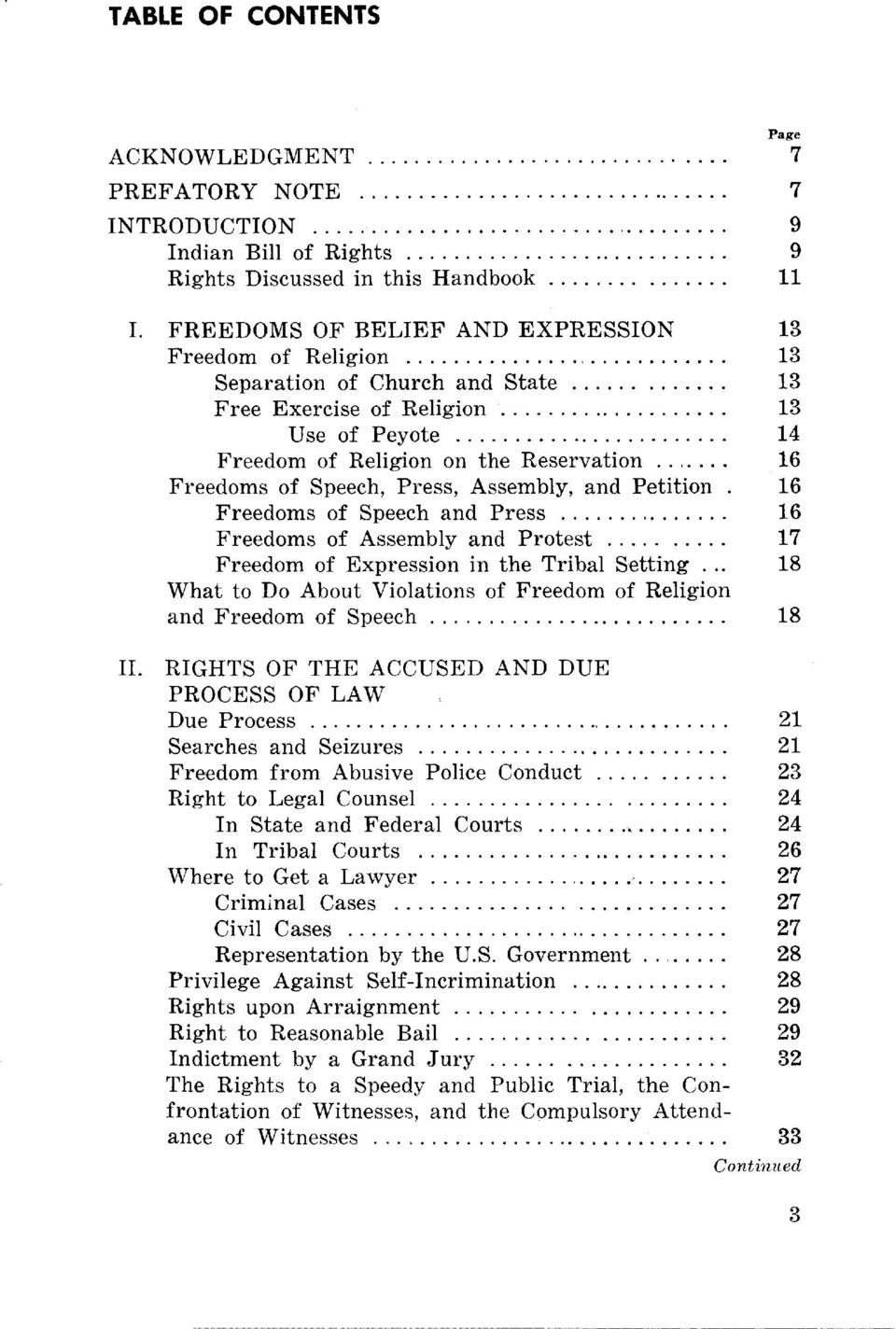
6 Page Right to Trial by Jury 34 Protection Against Excessive Fines and "Cruel and Unusual Punishment" 36 Double Jeopardy 37 Bills of Attainder and Ex Post Facto Laws 37 Bills of Attainder 37 Ex Post Facto Laws 38 Due Process in Juvenile Proceedings 38 What to Do about Due Process Violations 39 Raising Due Process Issues during Trial 39 Private Suits Against State and Tribal Officials 39 Police Misconduct 40 Habeas Corpus 41 Civil (Noncriminal) Due Process of Law 42 The Taking of Private Property 42 III. EQUAL PROTECTION OF THE LAW 44 Discrimination in the Operation of Public Facilities and Federal Programs 46 Equal Employment Opportunities 46 Discrimination in Government Employment Indian Preference in Public Employment 47 Employment Discrimination by Private Companies Having Federal Contracts 48 Private Employment Discrimination under the Civil Rights Act of Equal Employment Opportunity Commission Private Employment Discrimination under State and Local Laws 49 Fair Housing 50 Federal Fair Housing Law. 50 Discrimination in Places of Public Accommodation. 51 Equal Education Opportunities 52 Federal Education Programs 53 Title I 53 Johnson-O'Malley 54 National School Lunch Program 54 Parents' Right to Information Regarding Federal Education Programs 55 Indian Involvement and Control 56 Voting 57 Federal, State, and Local Elections.. 57 Absentee Voting 58 "One Man, One Vote" 59 Continued

7 Page Tribal Voting Rights 59 What to Do about Tribal Voting Rights Violations. 60 What to Do about Equal Protection Violations 61 Challenging Tribal Ordinances Violating the Indian Bill of Rights or Tribal Constitution 61 DIRECTORY: Information on Filing Complaints 63 How to File a Complaint 64 Where to Get a Lawyer 64 Police Misconduct 64 How to File a Habeas Corpus Application 64 Discrimination in the Operation of Federally Assisted Programs 66 Welfare, Education, or Health Programs 66 State or Local Facilities 66 Farm Programs 66 Poverty Programs 66 Employment Discrimination 67 State Employment Programs 67 Federal Employment Discrimination 67 Discrimination by Private Companies with Federal Contracts 67 Private Employment Discrimination 68 Fair Housing 68 Public Accommodations 68 Education 68 Voting Rights Violations 69 Administrative Appeal of Tribal Ordinance 70 APPENDICES 71 Legal Services Programs of Importance to American Indians Alaska 72 Arizona 73 California 76 Colorado 78 Florida 79 Idaho 79 Illinois 79 Kansas 80 Maine 81 Michigan 81 Minnesota 82 Mississippi 83 Continued

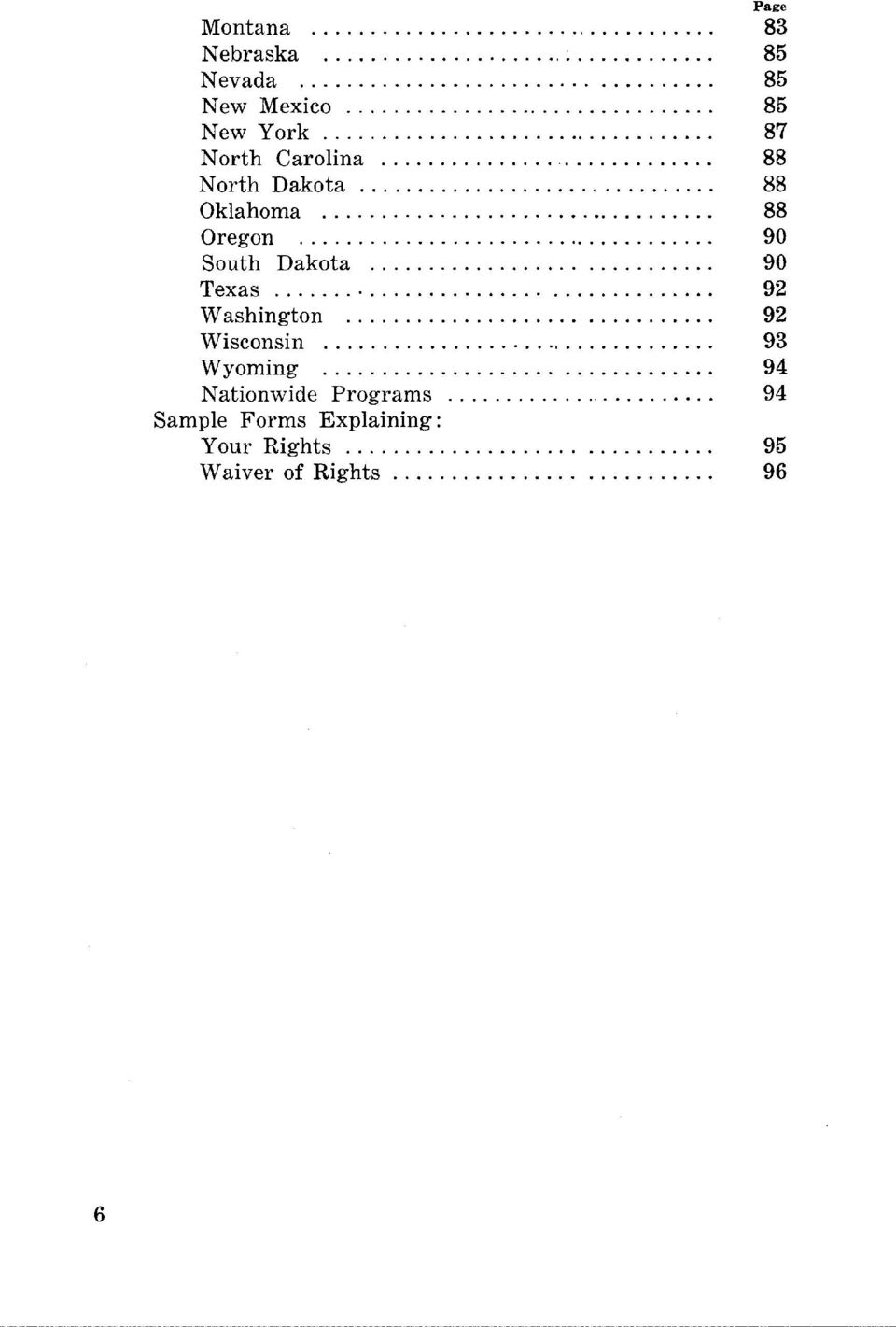
8 Page Montana 83 Nebraska 85 Nevada 85 New Mexico 85 New York 87 North Carolina 88 North Dakota 88 Oklahoma 88 Oregon 90 South Dakota 90 Texas 92 Washington 92 Wisconsin 93 Wyoming 94 Nationwide Programs 94 Sample Forms Explaining: Your Rights 95 Waiver of Rights 96
9 ACKNOWLEDGMENTS The Commission is indebted to Michael R. Smith, Staff Attorney in the Office of the General Counsel, who wrote this report under the supervision of John H. Powell, Jr., General Counsel. It is also indebted to Miss Eugenia B. Cook,* of the Office of Information and Publications, who prepared the manuscript for publication under the supervision of Carlos D. Conde, Director of that Office. Illustrations by Magarita Sauer McCombs (In private life, wife of Solomon McCombs). *No longer member of Commission Staff. PREFATORY NOTE As part of its mandate to investigate the denial of equal opportunity to all minority groups, the U.S. Commission on Civil Rights has recently met with American Indians from various parts of the country to discuss their civil rights problems. One of the most frequently voiced complaints has been that the majority of American Indians have never been adequately informed about their civil rights. Consequently, it was suggested that the Commission prepare an explanation of the basic rights that Indians, both on and off reservations, share under Federal law with all other American citizens. That is the purpose of this Handbook.
10

11 INTRODUCTION All Americans are entitled to certain basic constitutional rights. This handbook explains the civil rights and liberties guaranteed to all American Indians and Alaskan Natives living on or off reservations. The rights of nonreservation Indians are guaranteed under the Federal Constitution; those of reservation Indians are guaranteed under the 1968 Indian Bill of Rights. Most of these constitutional rights protect persons against unfair or discriminatory acts of Federal and State government officials. American Indians as citizens of the United States, as well as the States in which they live, are entitled to the same protections against Federal and State officials. But, because Indian tribes traditionally have been considered separate sovereign governing bodies, the courts have tended to hold that the Federal Constitution does not protect tribal members against the acts of tribal officials. As a result, Indians living on reservations have been denied certain rights under the Constitution guaranteed to those living off reservations. THE INDIAN BILL OF RIGHTS The Indian Bill of Rights (sometimes called the Indian Civil Rights Act) was passed by Congress in 1968 to correct what was felt to be a double standard of justice. It guarantees to reservation residents many of the same civil rights and liberties in relation to tribal authorities that the Federal Constitution guarantees to all persons in relation to Federal and State authorities: The Indian Bill of Rights states: No Indian tribe in exercising powers of self-government shall: (1) make or enforce any law prohibiting the free exercise of religion, or abridging the freedom of speech, or of the press, or the right of the people peaceably to assemble and to petition for a redress of grievances; (2) violate the right of the people to be secure in their persons, houses, papers, and effects against unreasonable search and seizures, nor issue warrants but upon probable cause, supported by oath or affirmation, and particularly describing the place to be searched and the person or thing to be seized; (3) subject any person for the same offense to be twice put in jeopardy; 9

12 (4) compel any person in any criminal case to be a witness against himself; (5) take any private property for a public use without just compensation; (6) deny to any person in a criminal proceeding the right to a speedy and public trial, to be informed of the nature and cause of the accusation, to be confronted with the witnesses against him, to have compulsory process for obtaining witnesses in his favor, and at his own expense to have the assistance of counsel for his defense; (7) require excessive bail, impose excessive fines, inflict cruel and unusual punishments, and in no event impose for conviction of any one offense any penalty or punishment greater than imprisonment for a term of 6 months or a fine of $500, or both; (8) deny to any person within its jurisdiction the equal protection of its laws or deprive any person of liberty or property without due process of law; (9) pass any bill of attainder or ex post facto law; or (10) deny to any person accused of an offense punishable by imprisonment the right, upon request, to a trial by jury of not less than six persons. The privilege of the writ of habeas corpus shall be available to any person, in a court of the United States, to test the legality of his detention by order of an Indian tribe. The Indian Bill of Rights covers all federally recognized Indian, Eskimo, and Aleut tribes, bands, Pueblos, communities, villages, and rancherias which carry on any self-government functions. These include all native groups that have been organized under Federal statute, as well as those formally recognized by the Federal Government through treaty or Executive order. Although its language is unclear, the act probably does not protect Indians on State reservations which have no formal trust relationship with the Federal Government. The act places responsibilities on tribal officials in much the same way that the Federal Constitution places responsibilities on Federal and State officials. It covers all tribal officials, including tribal chairmen and governors, tribal council members, tribal judges, prosecutors, and police, officials of special tribal agencies such as housing authorities and development corporations. All Indian courts are covered by the act, whether they are traditional or nontraditional, tribal courts [administered by the tribe] or Courts of Indian Offenses [administered by the Bureau of Indian Affairs]. All persons, Indian and non-indian who come under the authority of the tribe, are protected by the act. 10
13 One crucial question in the interpretation of the Indian Bill of Rights is whether it requires that the leaders of all Indian governments be chosen by popular elections. Such an interpretation of the act would be disastrous to those traditional tribal governments which choose their leaders through nondemocratic means. One Federal court of appeals has ruled that the act does not require that tribes select their leaders by elections. The court pointed out that even the Constitution of the United States does not require that- State leaders be chosen by elections. The Supreme Court has held that it is permissible for a State Governor to be selected by the legislature rather than by a majority of the State's voters. The passage of the act has caused widespread reaction and concern among many native Americans. Some Indians see the new law as an attempt to force national standards on tribal internal affairs in violation of tribal sovereignty. To these critics the act poses a threat to traditional Indian ways of life. Others complain that it was improper for Congress to impose new requirements on tribal governments without also providing the funds to meet them. Other Indians, however, have welcomed these new rights as long overdue and say: "We are tired of being the first Americans, with secondclass citizenship." They see the granting of fundamental rights to reservation residents as an effort to strengthen tribal institutions. In passing the act, Congress attempted to guarantee individual rights to reservation Indians without severely disrupting traditional tribal culture. In enforcing the act, the courts will have the serious responsibility of drawing a balance between respect for individual rights and respect for Indian custom and tradition. Many important questions raised in this Handbook about the act's effect will not be answered until the courts have settled them. RIGHTS DISCUSSED IN THIS HANDBOOK Three different kinds of rights are discussed in this Handbook: (1) The freedoms of religion, speech, press, and assembly, discussed on pp , are the fundamental rights of a free people to believe what they choose and say and write what they think. (2) The right to due process of law, which exists primarily to protect the freedoms of criminal defendants, receives the greatest attention under the Indian Bill of Rights. Essential to the fair administration of justice, due process sets limits on the methods which officials may use in enforcing the law and bringing accused persons to trial. (These are discussed on pp ) (3) The guarantee of equal protection of the laws, or freedom from improper discrimination, is discussed on pp
14 In addition, all States and many tribes have similar constitutional provisions. This Handbook discusses only some of the basic rights and freedoms of American Indians. Many other important Indian rights are not covered here as, for example, the critical area of treaty rights, including land and water rights and hunting and fishing rights. Future publications in this series will cover some of these. Unfortunately, the standards set by the Constitution are not always met. Widespread misunderstanding among State and local officials about the legal relationship between tribal Indians and the Federal Government has often led these officials to the wrong conclusion that Indians are not entitled to the same rights, services, and benefits as other State residents. It has taken long and difficult court battles to begin to overcome some of these misunderstandings, many of which still exist. Evidence has also been found that the Indian Bill of Rights is sometimes violated by tribal officials simply because they do not understand what the law demands. Protection and preservation of basic personal freedoms depend both on well informed Government officials and on a well informed public. (See Director, pp , for how and where to file a complaint.) 12
15 FREEDOMS OF BELIEF AND EXPRESSION FREEDOM OF RELIGION The first amendment to the Constitution provides that "Congress shall make no law respecting an establishment of religion, or prohibit the free exercise thereof." The 1968 Indian Bill of Rights provides that "No Indian tribe... shall make or enforce any law prohibiting the free exercise of religion." The religious protections of the Constitution are divided into two parts. Separation of Church and State The first part, prohibiting the establishment of religion, is sometimes called the "separation of church and state". It means that the Federal and State governments may not set up a church or pass laws favoring one religion over another. The Government may not promote religion by denying privileges or services to people who do not hold religious beliefs. The Government may not use public funds or public facilities to assist religious causes. Religious services may not be held in public schools and school children may not be forced to attend religious services, either in Bureau of Indian Affairs (BIA) schools or in public schools. A law would not be unconstitutional merely because it happens to benefit a religious cause, however. A State law providing free bus transportation and free textbooks to all school children would be valid even though it might benefit children in private religious schools as well as those in public schools. The separation of church and state guarantee does not apply to tribal governments. It was not included in the Indian Bill of Rights because Congress wanted to avoid the disruption that it might cause to traditional Pueblo systems. Other religious freedoms, however, do apply to tribal members. Although tribal government and tribal religion may be closely identified, as will be seen in the next section, tribes may not interfere with the right of members to hold and practice differing religious beliefs. Free Exercise of Religion The second clause of the religious protections of the Constitution prohibits the Government from interfering with the "free exercise" 13

16 of religion. Any person may believe in any religion he chooses, or not believe in any religion at all. The right to worship according to one's personal belief is a fundamental right with which the Government cannot interfere. This freedom applies to all faiths. No one religion is more important than another under the Constitution. Members of Indian religious groups such as the Native American Church, are entitled to the same protections as members of any other church. Freedom of religion also means the right to practice one's religious beliefs without Government interference as long as such practice does not injure others and does not violate valid criminal laws. The Government may not prohibit members of certain religions from preaching or distributing literature about their religion. But it may place reasonable restrictions on these activities. For example, although it cannot prohibit religious discussions in public parks, it may, within reason, regulate the hours during which parks may be used or restrict the use of loud speakers so other people are not disturbed. Prisoners also have religious rights which the courts will protect. Although reasonable restrictions can be placed on religious practices, prison authorities may not stop religious practice altogether or discriminate against one religion by denying its members freedoms which are granted to members of other faiths. The courts have held, for example, that prisoners are entitled to worship according* to their faith and to receive religious literature, except under extraordinary circumstances. Use of Peyote Freedom of religion normally does not protect activities which are considered dangerous or harmful. In limited situations, however, the law will permit activities for religious purposes that it would otherwise prohibit. Although all States have laws against the use and possession of drugs, in some areas peyote may be used for religious purposes. Peyote has been used by Indians in religious ceremonies for many centuries. In 1918 the Native American Church was organized, based in part on the ancient ceremony of peyotism. A few years ago some members of the Native American Church were arrested in California during a religious ceremony and convicted of unlawful possession of peyote. They appealed their conviction on the grounds that the law violated their religious freedom. The California Supreme Court agreed and their convictions were reversed. Besides California, the use of peyote in religious ceremonies by native Americans is permitted in Arizona, New Mexico, Oklahoma, 14

17
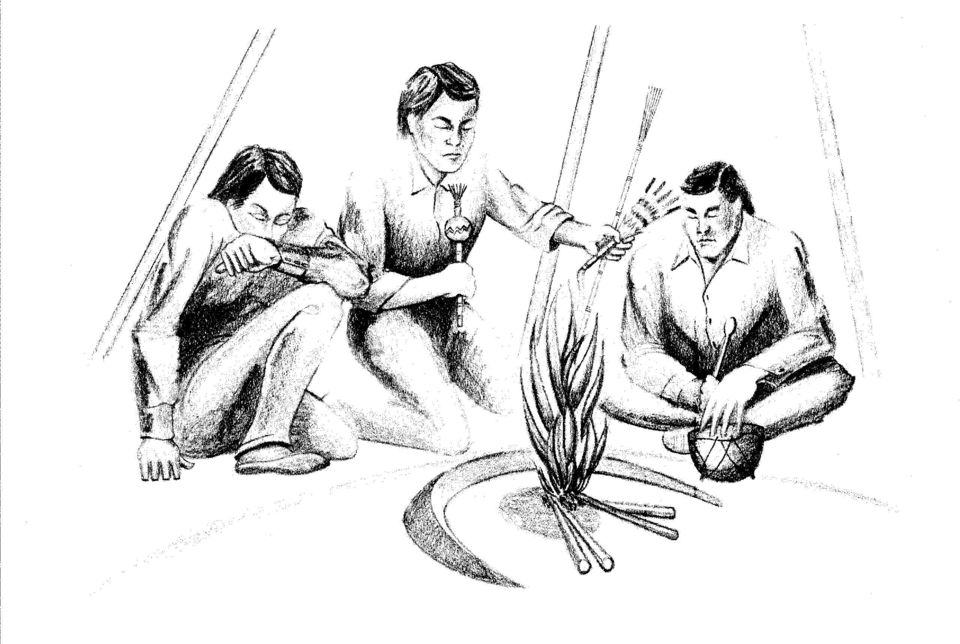
18 Montana, Wisconsin, Iowa, Minnesota, South Dakota, and Texas. Federal laws regulating the use of drugs specifically allow the use of peyote during religious ceremonies of the Native American Church. The U.S. Supreme Court, however, has not decided whether the religious use of peyote is protected by the United States Constitution and in many States (including Washington, Utah, North Carolina, North Dakota, and New York) its possession, even for religious purposes, is outlawed and may result in severe punishment. In the past, several tribes have prohibited the use of peyote. Whether or not its use is protected today under the freedom of religion section of the Indian Bill of Rights will not be certain until the courts interpret the act. (See following section.) Freedom of Religion on the Reservation The Indian Bill of Rights also protects the free exercise of religion against acts of tribal governments. A reservation resident, within reasonable limits, is entitled to worship and practice his religion in the way he chooses. Tribal governments may not punish a person or deprive him of any of his tribal rights because of his religious beliefs- In a case which arose before the passage of the 1968 Act, it was charged that a tribal council had prevented some members of the tribe from building a church on communal land and had denied them tribal privileges, including communal grazing rights, because their religious beliefs differed from those of the rest of the tribe. Such religious discrimination has been prohibited under the Indian Bill of Rights. FREEDOMS OF SPEECH, PRESS, ASSEMBLY, AND PETITION The Constitution of the United States says that neither the Federal nor State governments shall make any law "abridging the freedom of speech, or of the press; or the right of the people peaceably to assemble, and to petition the Government for a redress of grievances". The Indian Bill of Rights contains identical protections. Freedoms of Speech and Press All persons have the right to believe as they wish and to express their opinions openly and freely. The right to influence others through discussions and speeches and in print is a basic freedom. The right to hold, express, teach, and advocate ideas also includes 16

19 the right to join peacefully with others for the same purpose. Freedom of the press protects not only newspapers, magazines, and books, but it also protects all other forms of printed matter as well as movies, radio, and television. All citizens have the right to criticize any government official, no matter how important. A person is entitled to support peaceful changes in the administration and form of government. This freedom is essential to self-government. In order that people be able to govern themselves, they must be able to listen to the ideas of others and also express their own opinions freely. The freedoms of speech and press are not limited to governmental matters but allow discussion of all issues. Nor are these freedoms limited to opinions that are popular or that others consider to be true or acceptable. Their primary purpose is to protect beliefs that are unpopular, including those which can cause strong disagreement and dispute. The U.S. Supreme Court has stated: "A function of free speech under our system of government is to invite dispute. It may indeed best serve its high purpose when it induces a condition of unrest, creates dissatisfaction with conditions as they are, or even stirs people to anger." Freedoms of Assembly and Protest The right of assembly includes the right to meet with other people or to join organizations for political, religious, social, or any other lawful purpose. The privacy of one's associations is protected by this provision; except under extraordinary circumstances, the Government may not make a person tell what organizations he belongs to or force an organization to reveal the names of its members. Nor can the Government deprive a person of a privilege, such as holding a job, because of his associations. People also have the right to "petition the [Government] for redress of grievances." This is designed to allow individuals to communicate freely with their Government. This is usually done through letters or petitions addressed to Congressmen, Tribal Councilmen, and other leaders. The Constitution protects the peaceful expression of ideas through marches, parades, picketing, rallies, and other forms of demonstration. Recently, some courts have held that the right of a person to express his culture or his tastes through his dress and appearance is also constitutionally protected. For instance, some courts (but not all) have held that a person may not be dismissed from a Government job or from school because of his appearance. This recent application of the Constitution is of particular importance to Indian students who take pride in their culture by wearing long hair and traditional clothing. Unfortunately, some 17
20 school authorities have shown disrespect by attempting to force Indian students to conform to conventional standards. A California Indian student recently was awarded $3,500 in damages in a civil rights suit against a teacher who had publicly humiliated him by cutting his hair in front of his class. Freedoms of expression are not absolute. Reasonable limitations may be placed on the exercise of speech, press, protest, and assembly. Obscenity, libel, and slander are not constitutionally protected. Criminal conduct is not protected merely because it involves speech. A person does not have the right to use speech to cause violence or persuade others to do so. Free speech does not allow persons to force their beliefs on others. Use of streets and other public places can be subject to reasonable limitations so that those using them do not interrupt traffic, make excessive noise, or in other ways interfere with the rights of others. But official restrictions on speech and the press must be limited to what is necessary to protect the public welfare. Freedom of Expression in the Tribal Setting The inclusion of free speech, press, and assembly in the Indian Bill of Rights has caused many tribal spokesmen to complain that these principles are not part of traditional Indian culture and should not be applied to Indian society. They have argued that tribes are not ordinary governments, but are close-knit, family-like groups, and that the exercise of free speech in this atmosphere would lead to the disruption of discipline and the breakdown of tribal life. Congress concluded, however, that tribal Indians should be entitled to the same freedoms of expression as other American citizens. Although the courts will, hopefully, demonstrate respect for Indian heritage while applying these freedoms, they will not tolerate acts by tribal governments which completely ban freedoms of expression. A tribal council, for instance, cannot prohibit members from distributing a newspaper on the reservation merely because it is critical of the tribal government. Nor can it prevent members from assembling peacefully in order to express their ideas and listen to the opinions of others. WHAT TO DO ABOUT VIOLATIONS OF FREEDOM OF RELIGION AND FREEDOM OF SPEECH Two basic methods exist to challenge violations by public officials of the rights discussed in the preceding sections. If a person is charged under a law which interferes with his constitutional 18

21 rights, those rights may be raised in his defense. If those rights have been violated in some other manner, he may sue the official responsible under State law or under Federal civil rights laws. Such suits may result in money damages to compensate the victim for violation of his rights, a court order prohibiting the officials from interfering with his rights in the future, or both. Each of these remedies is discussed on pp
22
23 II RIGHTS OF THE ACCUSED AND DUE PROCESS OF LAW DUE PROCESS Many persons first come into contact with the law when they are accused, rightly or wrongly, of a crime. The most important protection such persons have is "due process of law"; the United States Constitution says that neither the Federal nor State governments shall deprive a person of "life, liberty or property without due process of law". Similarly, the Indian Bill of Rights places due process limitations on tribal governments. The due process clause requires that the government act in a manner which is fair and just when it does anything that directly affects a person or his property. Laws which are discriminatory, unreasonable, unfair, or which unnecessarily interfere with personal freedoms are prohibited by the due process clause. Due process also requires that procedures used by the Government in enforcing the law meet certain basic standards of fairness. Thus, the following discussion of important due process guarantees covers Federal, State, and Tribal court standards. They are not always the same since Federal and State courts are bound by the Constitution and Tribal courts by the Indian Bill of Rights. Constitutional standards which were considered fair 5 years ago might be considered a violation of due process today; what is constitutionally acceptable in one setting might be unacceptable in another. Due process does not always require that governments employ identical methods and procedures. Under the Constitution, States are often permitted to use methods different from those of the Federal Government and those of other States, so long as they are not unreasonable nor unfair. Similarly, due process of law will not mean exactly the same thing for tribal governments as it does for nontribal governments. Congress intended that under the Indian Bill of Rights, tribal governments would be permitted the freedom to retain traditional customs and procedures so long as they do not violate the specific protections contained in the act and so long as those procedures render substantial fairness and justice- SEARCHES AND SEIZURES Most cases involving a person accused of a crime begin with his arrest. In order to protect the accused at this stage of the proceed- 21
24 ing the fourth amendment to the Constitution provides that "the right of the people to be secure in their persons, houses, papers and effects, against unreasonable searches and seizures, shall not be violated, and no warrants shall issue, but upon probable cause, supported by oath or affirmation, and particularly describing the place to be searched, and the persons or things to be seized." The same protections apply to all reservation residents under the Indian Bill of Rights. The fourth amendment limits the right of police to search a person, his home, car, or other property in order to seize stolen items or evidence to be used against him in connection with a crime. As a general rule (see exceptions below), the police may not search the home or property of an individual, seize any of his property, or arrest him without first obtaining a warrant. A search warrant is an order by a judge directing police officers to search for items bearing on the case. It must specifically describe the place to be searched and the things to be seized. It would not be sufficient for a warrant merely to state the name of a hotel as the place to be searched, because a hotel has many rooms and innocent people would be unnecessarily deprived of their right to privacy. A judge should not issue a warrant until he has been convinced that there is "probable cause" [or good reason] to believe that a crime has been committed and that the search will reveal evidence of it. If an officer has a warrant he must be permitted to search the place described in the warrant. If he is not allowed to enter he may use reasonable force to gain entry. Even if the policeman does not have proper authority to enter, no attempt should be made to stop him. In many States it is a serious crime to interfere with a police officer even though he is acting illegally. If the officer has no proper warrant or if he conducts the search without proper authority or with unreasonable force, he may be sued for damages and, in some cases, criminally punished. (See discussion on pp ) Any evidence obtained during the unlawful search cannot be used in court as evidence against the accused. This is called the "exclusionary rule". It applies in Federal and State courts; it probably will also be applied to tribal proceedings under the Indian Bill of Rights. In some situations it is permissible for the police to arrest a man or conduct a search without a warrant. If an officer sees a person commit a crime or if he has strong reason to believe that someone has committed a serious crime, he may arrest that person without waiting to get an arrest warrant. If the police lawfully arrest a person they can search the suspect and the immediate surrounding area, even though they do not have a search warrant. 22
25 If a person is arrested for a traffic violation an officer may search the car for weapons if he has good reason to believe that his life is in danger. Or he may search for drugs or alcohol if the driver was arrested for driving under their influence. However, if the arrest is later determined to have been unlawful, any evidence seized cannot be used against the accused. A person may choose to give up his fourth amendment constitutional rights by inviting an officer into his home or granting a request by the officer to search his property. This is called "waiving" one's constitutional rights. This waiver must be knowing and voluntary not the result of ignorance or fear. The police must explain to a person his constitutional rights and he must understand them before he can effectively waive them. If the court decides that permission was not voluntary then the rights will not have been lost. This applies equally to the waiver of all other constitutional rights. FREEDOM FROM ABUSIVE POLICE CONDUCT Insulting and threatening language and physical violence by police are among the most distressing kinds of official misconduct. Such abusive treatment is a violation of a citizen's legal rights. Police have the duty to enforce the law but they are entitled to use only the minimum amount of force needed to make an arrest or carry out their duty. They may not inflict physical injury or pain in order to punish the victim or "teach him a lesson". The duty of the police is to arrest the accused; it is the court's duty to determine guilt and impose punishment. When more force than necessary is used, the officer is acting illegally and will be responsible for any injury he may cause. Even if an accused resists arrest or acts in some other improper manner the police may only use the amount of force needed to carry out their duty. Prisoners also have similar rights. Physical abuse by jail or prison officials, failure to protect a prisoner from harm by other prisoners, or failure to provide needed medical care are all violations of the prisoner's rights. Prisoners may be punished for violating prison rules but the punishment may not be excessive. For example, solitary confinement may not be imposed for an unreasonably long period of time. One court recently held that solitary confinement for more than 15 days would be excessive and unconstitutional. Prison and jail officials must provide prisoners with decent sanitary facilities, proper lighting and heating, adequate clothing, food and bedding, as well as the opportunity for physical exercise. 23
26 RIGHT TO LEGAL COUNSEL The Constitution guarantees that in State and Federal criminal proceedings defendants shall have the right to a lawyer. The Indian Bill of Rights also guarantees this. It says no Indian tribe shall deny to any person in a criminal proceeding the right "at his own expense to have the assistance of counsel for his defense". Thus, all persons charged with a crime have the right to hire a lawyer. As will be seen later, in serious State and Federal criminal cases a defendant has the right to a free lawyer if he cannot afford to pay for one. This is not the rule in tribal courts. The right to counsel includes right to have the lawyer of one's choice and to consult with him freely and privately. Exercise of this right is often essential to the protection of other civil rights. Right to Counsel in State and Federal Courts The Supreme Court has held that a person's right to counsel exists during every critical part of the criminal process: it starts at the time he is first suspected and questioned; includes preliminary hearings, arraignments, and line-ups; covers the trial, sentencing, appeal efforts, and proceedings to revoke probation. A police officer may not question a suspect unless he first advises him of his right to have a lawyer present and his right to remain silent. (In serious cases the officer must tell the suspect that a free lawyer will be provided if he cannot afford to hire one.) If an officer does not provide this information no statement or confession made by the defendant may be used against him in court. In most States, defendants have the right to free counsel only in serious cases where the penalty may be imprisonment for more than a year or a heavy fine. A few States guarantee this right in all criminal cases. Some States and large cities have set up public defender systems to provide assistance to defendants who cannot afford a lawyer. Public defenders are lawyers employed by the government to represent criminal defendants. Elsewhere other systems are used. In some places, the judge will appoint a member in good standing of the local bar association to represent the defendant. In any case, it is important that a defendant secure good legal representation. Although a person may have the right to defend himself, in all but the most minor cases this would be a serious mistake. (See p. 27 for information on where to find a lawyer.) In Federal courts a defendant without money not only has the right to have a free lawyer but also has the right to investigative, expert, and other services necessary for an effective defense. To receive such aid the defendant's attorney must apply to the Federal 24
27
28 court. The request will be granted where it can be proven that the services are necessary and that the defendant is unable to pay for them. Right to Counsel in Tribal Courts The Indian Bill of Rights guarantees the right of a tribal defendant to hire a lawyer "at his own expense". Some tribal codes flatly prohibit all professional lawyers from practicing in tribal courts. Under the new act, these rules are no longer valid. (The Secretary of the Interior had forbidden the appearance of professional attorneys in Courts of Indian Offenses until 1961 when the regulation was repealed on the grounds that it might be unconstitutional). However, the act does not prohibit tribes from regulating attorneys who practice before their courts. In the same sense that States do, tribes can adopt rules which demand appropriate conduct from outside attorneys and which require that they meet certain qualifications in order to practice before tribal courts. Such rules, however, must be reasonable. One qualification which would most likely be acceptable under the act would be a requirement that attorneys have an adequate understanding of tribal law. For instance, the Blackfeet Tribal Code places the following limitations on representation of defendants: "In criminal proceedings, the defendant may be represented by lay Counsel who is a member of the Blackfeet Tribe, or non-member lay persons, or by attorneys at law admitted to practice before the Blackfeet Tribal Court upon satisfactory demonstration to the court of knowledge of this Code and proficiency in its application." In adopting this provision the tribal council revoked an earlier provision requiring that attorneys be "fluent in the Peigan language or a dialect thereof". The tribe determined that the language requirement was discriminatory. Its effect would have been to prohibit outside attorneys altogether and it would most likely have been impermissible under the act. Unlike Federal and State trials, a free lawyer is not guaranteed in tribal trials. The Indian Bill of Rights states that a tribal member has the right to counsel "at his own expense". This means that the defendant has the right to hire a lawyer but that the tribe does not have to hire one for him. (The right of a defendant to have the assistance of counsel "at his own expense" undoubtedly includes the right to be represented by free legal services attorneys. See following section.) On many reservations no lawyers are available which is a primary reason why the act does not require all tribes to provide free legal assistance. Even where lawyers are available many tribes can- 26
29 not afford to hire them for defendants. Furthermore, tribal courts cannot impose a sentence greater than 6 months in jail and a $500 fine for any single offense and they, therefore, do not hear serious cases. Since the right to counsel in Federal and State courts does not ordinarily guarantee the right to have a free lawyer appointed in minor cases, tribal courts are not really very different in this regard. Like Federal and State officers, tribal police must advise a tribal defendant of his right to hire a lawyer. If a tribal officer fails to do so, any statement or confession made by the accused will probably be inadmissible as evidence against him in tribal court. WHERE TO GET A LAWYER Criminal Cases A person charged with a crime in Federal or State court who cannot afford a lawyer should, at the earliest possible moment, request that a lawyer be appointed. As stated on p. 24, the court will appoint one in serious cases. There may be times, however, when a defendant will need an attorney and be unable to get one. For example, he may need assistance in a misdemeanor case, or he may be in jail and need help in filing an application for a writ of habeas corpus. (See p. 41). Throughout the Nation, there are public and private criminal defender programs set up to provide free criminal legal assistance to those who cannot afford it. The nearest legal defender office may be located by checking the telephone directory; contacting the clerk of the local criminal court; contacting the local bar association; or by writing to the National Legal Aid and Defender Association. (See Directory, p. 64.) Civil Cases A wide area of civil [noncriminal] legal matters exists where everyone, from time to time, may need legal assistance to secure his rights. These may include welfare problems, family matters, juvenile problems, landlord-tenant matters, accident and personal injury cases, unemployment and workmen's compensation cases, sales contract, and auto repossession cases. For American Indians they may also include special problems such as securing treaty rights (hunting and fishing rights), protecting resources (land and water rights), and similar problems which require a special knowledge of Indian law. Throughout the country legal services programs are available to provide free civil legal assistance to members of low-income families. Among these are a number of programs 27
30 specializing in Indian legal problems which have proven very useful in helping individual Indians and Indian groups secure their rights. Special Indian programs as well as general legal programs which are located in areas of high Indian population are listed in the Appendices, pp Persons who cannot find an appropriate program on this list should use the method discussed above with regard to locating criminal defender programs. Representation by the United States Government In certain situations involving the legal status of American Indians, United States attorneys are obligated by Federal law to represent individual Indians or Indian groups. For example, Government attorneys may bring suits to enforce contracts regarding restricted property or represent Indians in suits involving Federal or State taxes. Unfortunately, Government attorneys have been very reluctant to carry out this duty. Normally, the United States Government will not represent Indians in criminal matters. A very limited exception may exist when the case raises important questions about the defendant's special legal status as an Indian, such as cases involving State laws which violate Indian treaty rights. An example is a recent suit filed by the Federal Government to prevent the State of Washington from enforcng its fishing laws against Indians in violation of their treaty rights. Indians or Indian groups wishing to call upon the Federal Government to defend their treaty rights and other federally guaranteed interests should contact the office of the nearest United States attorney or the U.S. Department of Justice. (See Directory, p. 64.) PRIVILEGE AGAINST SELF-INCRIMINATION The privilege against self-incrimination is another important right a suspect should be aware of at the time of arrest. Under the Constitution and the Indian Bill of Rights no person can be forced to be a witness against himself. This means that one does not have to answer questions or provide information to any Federal, State, or Tribal official which would tend to convict that person of a crime. When a person is in custody of the police he has the right to remain silent. And during his trial he cannot be required to take the witness stand and testify. His refusal to testify cannot be used as evidence of his guilt. But if he voluntarily testifies in his own behalf, then he loses his constitutional right to be silent and must answer all questions that are asked of him. The 28
31 privilege against self-incrimination is not limited to criminal cases; it also applies to any governmental body or agency which may compel information or testimony from a person. Information or a confession obtained through the use of pressure or force may not be used against the individual- The defendant may, of course, voluntarily answer questions and waive his right to remain silent. But this waiver will not be effective unless it is clear that the defendant fully understood his rights before he spoke. As with other rights. Federal, State, and Tribal police have the responsibility to explain this right to the suspect. Any information or confession obtained before this warning has been given cannot be used in court as evidence against the defendant. In many instances when a person is arrested the police will request him to sign a form containing a statement of his rights. This form will be used by the police later if the defendant claims that his rights were never explained to him. (Two examples of forms used by tribal police for this purpose appear on pp of the Appendices.) Thus, the Colorado Supreme Court recently reversed the conviction of a Navajo Indian that had been based on a statement he made to the police. The court decided that his "waiver" of the right to remain silent was not a "knowing and intelligent waiver". The court tcok into consideration the facts that he had had only a few years of schooling and that he did not adequately understand English, the criminal process, or his constitutional rights. RIGHTS UPON ARRAIGNMENT Generally, after arrest for a serious offense the accused must be brought before a judge to be informed of the charges against him and given an opportunity to plead. This process is called an arraignment. At an arraignment a judge will inform the defendant of his constitutional rights, including the right to counsel. A reasonable time must be allowed for the defendant to obtain a lawyer, or, if he cannot afford one, for the court to appoint one on his behalf. The arraignment must be held without unreasonable delay; usually a period of not more than 24 hours. Any statement or confession made by a defendant who has not been taken before a judge within a reasonable amount of time will be excluded from evidence at the trial. RIGHT TO REASONABLE BAIL The right to reasonable bail is basic to the American system of law. Once a person has been arrested, the eighth amendment to 29
32 the Constitution provides that "excessive bail shall not be required". Similarly, the Indian Bill of Rights prohibits Indian tribes from imposing excessive bail. When a person is charged with a capital crime (punishable by death or life imprisonment) or when his past conduct, such as an attempted escape, indicate a strong possibility that he will not appear at his trial, he may be required to remain in custody until his trial. But in most cases a person has a right to go free before his trial because he is presumed innocent until proven guilty. In some States, where the charge is minor and where there is little reason to believe that the defendant will fail to appear for trial, he may be released on "his own recognizance". Under this procedure the defendant is released after he has promised to return for trial; no cash bail is required. Some States are more lenient than others in granting release without bail. Bail procedures in Federal courts are governed by the Federal Bail Reform Act passed "to assure that all persons, regardless of their financial status, shall not needlessly be detained pending their appearance to answer charges...". Under this law every person charged with a noncapital offense (one punishable by less than life imprisonment) in a Federal court must be released without bail unless the judge feels that there is good reason to believe that the defendant will not appear for trial. In most serious cases a defendant will be required to put up bail (a specified amount of money) to ensure that he will appear for trial. When the defendant appears for his trial he will get the money back. If he fails to appear, the money will be lost and a warrant will be issued for his arrest. In cases where the defendant cannot afford bail he can usually arrange to have it posted for him by a bail bondsman. A bail bondsman is a person who pays the bail for the defendant and charges the defendant interest, usually about 10 percent of the amount put up. The amount of such interest is usually regulated by State law. The Constitution and the Indian Bill of Rights require that bail not be excessive. This means that it must be set at a reasonable amount. However, what is reasonable in one case may not be reasonable in another. In setting bail the court may take into consideration such things as the seriousness of the charge, the weight of the evidence against the defendant, the defendant's past record, and his ties to his family and the community. Bail is excessive and unconstitutional if it is more than the amount necessary to ensure that the defendant will appear at his trial. Bail set at a high amount may be reasonable for a wealthy defendant but unreasonable and unconstitutional for a poor defendant. In serious cases bail will normally be set at a court hearing 30
33 f
34 during which the defendant's lawyer will argue why the bail should be low or why the defendant should be released without bail. This hearing must be provided within a reasonable length of time so as not to deprive the accused of his right to bail. The decision of the court regarding bail can normally be appealed. If a defendant before a tribal court feels that bail has been improperly denied or set at an excessive amount and tribal appellate procedures are nonexistent or inadequate, he may seek release by applying for a writ of habeas corpus under the Indian Bill of Rights. (See discussion of habeas corpus on p. 41.) INDICTMENT BY A GRAND JURY Indictment by a grand jury is a crucial step in serious cases. A grand jury is a body of people who, after an investigation, decides whether the evidence against a person is strong enough to justify trying him. If the grand jury feels that the evidence is sufficient, the defendant will be indicted and made to stand trial; if it feels that the evidence is weak and insufficient, he will be released. The purpose of a grand jury is to make sure that a person is not forced to stand trial on mere rumor. (A grand jury, therefore, differs from a regular jury, which tries a person and decides whether or not he is guilty.) The right to a grand jury is only guaranteed to defendants charged with serious crimes in Federal courts. These include crimes punishable by death, imprisonment for over a year, or a heavy fine which are usually called "felonies". Although some States do provide for grand juries, they are not required to do so by the Constitution. Similarly, tribal governments are not required by the Indian Bill of Rights to provide for the right to a grand jury. States and tribes must, however, provide procedures which are fair and ensure justice. Grand juries must be selected by a process which draws from a fair cross section of the community and does not discriminate against any racial group. A criminal suspect may not be indicted by a grand jury from which members of his own race have been intentionally excluded. This does not mean that an Indian has a constitutional right to have Indians on the particular grand jury which indicts him. But it would be a violation of his rights if the absence of Indian jurors were intentional or the result of a discriminatory selection process. In this instance the defendant's indictment and possible conviction would be set aside. Since it is hard to prove an actual intent to discriminate by officials, the courts have relied heavily on statistics of racial 32
35 make-up of juries and communities as evidence of discrimination. Indian representation on grand juries has always been, and continues to be, quite low. For example, a recent study indicated that in Lake County, California, where Indians make up more than 4 percent of the population, not one Indian served on the county grand jury over a 10-year period. In some areas, however, lawsuits have corrected such situations. Fair representation by Indians on grand juries is of great significance not only to Indian criminal defendants but to all residents of Indian communities. Besides the responsibility of bringing indictments, grand juries in many States also have the power to inquire into the conduct and administration of local government. Thus, grand juries might look into such things as discrimination in local government hiring; failure to grant public services and facilities (housing projects, welfare programs, sewer and water lines, sidewalks, street lights, and roads) to all citizens equally; and misconduct by public officials ranging from discourtesy to physical brutality. Grand juries may bring criminal indictments where criminal misconduct is found; they also have the power to expose injustices by releasing reports. Because this is one of the few situations in which average citizens have the opportunity to participate actively in the administration of government, it is important that grand juries reflect the interests of the Indian community. THE RIGHTS TO A SPEEDY AND PUBLIC TRIAL, THE CONFRONTATION OF WITNESSES, AND THE COMPULSORY ATTENDANCE OF WITNESSES The Indian Bill of Rights provides that no Indian tribe shall deny a defendant the "right to a speedy and public trial, to be informed of the nature and cause of the accusation, to be confronted with the witnesses against him, and to have compulsory process for obtaining witnesses in his favor." These rights are considered essential to due process of law, and also apply under the Constitution to both Federal and State courts. In order to ensure a fair and impartial trial, a defendant must be told the nature of the charges against him and given advance notice of the time and place of his trial. (In juvenile court proceedings notice must be given to the youth's parents or guardian as well as to the defendant.) He has the right to be present at his trial; he may be excluded from the courtroom only under excep- 33
36 tional circumstances (for example, if he is entirely unruly or disruptive). The trial must be open and public. The defendant's relatives and friends, as well as other persons, are entitled to attend the proceedings. A defendant is entitled to a reasonable amount of time in which to prepare his defense before his case is brought to trial. On the other hand, he has the right to a speedy trial. This means that the government cannot delay a long time before trial. Many State laws require that criminal cases be brought to trial within a specified period of time. A defendant, or his attorney, may confront all witnesses who testified against him and question them under oath in order to disprove their testimony. A defendant also has the right to have witnesses testify in his own behalf. He has the right to "compulsory process". This means that, at the request of himself or his lawyer, the court (whether Federal, State, or Tribal) will issue an order requiring the attendance of witnesses necessary to the defense. If a defendant before a Federal or State court does not understand English, the court must provide an interpreter or in some other way ensure that he understands the proceedings and the testimony against him. RIGHT TO TRIAL BY JURY In addition to a speedy and public trial, the Constitution guarantees criminal defendants in Federal and State courts the right to a trial by jury for serious offenses. The Indian Bill of Rights also guarantees this right in tribal courts; no Indian tribe may "deny to any person accused of an offense punishable by imprisonment the right, upon request, to a trial by jury of not less than six persons". The right to a jury is also guaranteed in Federal and some State civil [noncriminal] cases for example, where a person is sued on a debt. It is not guaranteed in civil trials in tribal courts under the Indian Bill of Rights. Under the Indian Bill of Rights tribal juries must be made up of six or more persons, but individual tribal codes may require a larger number. Juries in Courts of Indian Offenses are made up of six persons; juries in Federal courts must have 12 members; States usually provide for a jury of 12, although there is no constitutional reason why States may not provide for a different number. In Federal courts the verdict of the jury must be "unanimous": a person cannot be convicted unless all the jurors agree he is 34
37
38 guilty. Although many States also require a unanimous verdict, in some State courts a person can be convicted by a majority verdict. This is also the rule in tribal courts; the Indian Bill of Rights does not require a unanimous verdict. Individual tribal codes determine whether tribal juries must be unanimous. The Oglala Sioux Tribal Code, for example, states that "if the jury is unable to reach a unanimous verdict, verdict may be rendered by a majority vote". Under Federal Regulation, verdicts in Courts of Indian Offenses may only be reached by unanimous verdict. Like grand juries (see pp ) trial juries must be made up of a true cross section of the surrounding community. Discrimination on juries against any racial, economic, or religious group is forbidden. No Indian can be tried by a trial jury from which Indians have been excluded. In order to assure that the jury will be fair, the defendant or his attorney is usually allowed to "challenge" a certain number of jurors. This means that if he believes there are people on the jury who for some reason would not be fair and reasonable in his case, he may demand their removal. The number of challenges to which a defendant is entitled depends on the various Federal, State, and Tribal laws. Jury service is a duty as well as a right. All States have ways of choosing citizens to serve on juries and provide penalties for those who refuse without a valid excuse. Payment is often provided for persons who perform jury service in amounts differing according to Federal, State, and Tribal laws. Jurors in Courts of Indian Offenses receive only 500 per day although some tribal courts provide fees of up to $5 per day plus travel expenses. PROTECTION AGAINST EXCESSIVE FINES AND "CRUEL AND UNUSUAL PUNISHMENT" The Constitution forbids excessive fines and "cruel and unusual punishment". The Indian Bill of Rights contains the same protections. Whether or not a sentence is reasonable depends upon the circumstances of each case- Some forms of punishment which were common in the past may be considered cruel and unusual now. Torture, for example, is a form of punishment which would not be permitted under the Constitution today. For any single offense a tribe cannot impose a penalty "greater than imprisonment for a term of six months or a fine of $500, or both". Even within these limits a sentence might be considered 36
39 cruel and unusual if it does not fit the crime. It has not been decided whether or not this limitation means that tribal courts may impose no punishment other than fines or imprisonment. It may be that traditional forms of punishment, like banishment, will not be permitted under the act. DOUBLE JEOPARDY Once a trial has ended, the defendant, whether he was found guilty or not guilty, may not be tried again for the same crime even if the government discovers new evidence against him. However, if a person appeals a conviction and the appellate court reverses the decision, it may order that the person be tried again. This protection does not mean that a person cannot be tried in different jurisdictions for different crimes arising from the same act. For instance, an act may be a crime under both State and Federal law. If a person is tried under Federal law and found not guilty he could be tried again in State courts for the same act if it also constitutes a State offense. Furthermore, some acts may constitute more than one criminal offense. For instance, if a person attacks two different individuals at the same time and place he may be charged for each assault separately since they constitute separate offenses. BILLS OF ATTAINDER AND EX POST FACTO LAWS Under the Indian Bill of Rights Indian tribes are prohibited from passing "any bill of attainder or ex post facto law". The same prohibitions apply to the State and Federal Government under the Constitution. Bills of Attainder A bill of attainder is any law which declares that a person or group of persons is guilty of a crime and sets punishment without the right to a trial. In an important case arising under the Indian Bill of Rights, a Federal court dealt with a situation in which a tribal council had ordered the exclusion of a nonmember from the reservation. The court held that the order did not come under grounds for exclusion contained in the tribal code and amounted to punishment without a trial. It was, therefore, a bill of attainder in violation of the Indian Bill of Rights. This decision raises important questions about the treatment of nonmembers by tribal governments. Tribal courts normally exercise 37
40 criminal jurisdiction only over tribal members, leaving tribal authority over such things as the exclusion of nonmembers to rest with the tribal council. In exercising this power, tribal councils must grant nonmembers due process of law and act fairly- Where tribal courts exist, the tribal council cannot punish a tribal member without the right to a formal trial. Even in those Pueblo systems where there are no separate tribal courts, and tribal rules are enforced by the Governor and tribal council, the bill of sittainder protection would still apply. It would require, at least, that a tribal member cannot be declared guilty and sentenced without a fair proceeding. Ex Post Facto Laws A criminal law can only apply to acts which happen while the law is in effect. An "ex post facto" law is one which attempts to declare an act illegal which occurred before the law was passed. For example, if a tribal member gambles and the tribal council later passes a law against gambling, he cannot be prosecuted under that law. The prohibition against ex post facto laws also forbids increasing a penalty for a crime after it was committed. DUE PROCESS IN JUVENILE PROCEEDINGS Due process guarantees apply to children as well as to adults. Although in the past, many of the rights granted to adults have been withheld from juveniles, this situation is rapidly changing. The U.S. Supreme Court recently ruled that a juvenile court proceeding which may lead to the child's commitment to a State institution must grant many of the basic procedural guarantees discussed in this Handbook. This does not mean that a juvenile court proceeding must meet all the due process requirements of an adult criminal trial; it does mean that the hearing must "measure up to the essentials of due process and fair treatment". The child and his parents must be given notice of the charges brought and they must be advised of the child's right to a lawyer. If the family cannot afford a lawyer, the court must appoint one. The proceeding must provide for the opportunity to confront and cross examine the witnesses against the juvenile. The protection against self-incrimination also applies to juveniles. A juvenile court cannot reach a decision on the basis of an involuntary confession. On the other hand, those protective aspects of juvenile court proceedings which are meant to safeguard and benefit youthful of- 38
41 fenders may still be applied, as for instance, treating them separately from adult offenders and keeping their records confidential. WHAT TO DO ABOUT DUE PROCESS VIOLATIONS Violations of a defendant's rights may occur under a variety of circumstances and the remedies will vary accordingly. It is important that the accused know what his rights are so that he can protest when they are violated. Since civil rights law is often complex, it is also essential that, whenever possible, the person involved have a lawyer. (See p. 64 of Directory for where to get a lawyer.) It is also important that civil rights violations be raised at the earliest possible time, whether during a criminal trial or before civil rights boards, commissions, or agencies. RAISING DUE PROCESS ISSUES DURING TRIAL If a criminal defendant feels that his due process protections have been violated (for example, if illegally seized evidence is used against him or if he is denied the right to counsel or a speedy trial), these issues should be raised in the trial court. In Federal and State courts a person can assert his rights under the Federal and State constitutions; in tribal courts he can assert his rights under the Indian Bill of Rights as well as under his tribal constitution. If the trial court disagrees, the issue may be challenged on appeal in the appellate courts, a right granted by all States as well as all Courts of Indian Offenses. This right is not guaranteed by all tribal judicial systems, however, and it is not clear whether or not the Indian Bill of Rights requires all tribes to provide for appeals. Tribes which do not grant the right to appeal trial court decisions may be required under the act to provide some other means to challenge them. Private Suits Against State and Tribal Officials In appropriate situations, private civil suits may be brought in Federal court under the Federal Civil Rights Acts against State and local officials who interfere with an individual's civil rights. These suits may result in a court order enforcing the complainant's rights, money damages to compensate him for the violation of his rights, or both. Private suits may also be brought in Federal court under the Indian Bill of Rights to correct civil rights violations by tribal 39
42 officials. In one private suit brought under the act a person claimed that a tribal council had ordered his exclusion from the reservation in violation of his civil rights. The Federal court agreed and issued an order prohibiting the tribal officials and BIA officials from enforcing the exclusion order. Other suits have been brought to force tribal officials to grant defendants the right to counsel. Although suits under the Indian Bill of Rights will most often be brought in Federal court, in at least one instance a tribal court assumed jurisdiction under the act and ordered the tribal council to correct an injustice. Civil rights suits of this sort can be veryeffective but often require extensive legal work. Police Misconduct One of the most common kinds of civil rights complaints regards improper police practices including illegal searches and seizures, police brutality, verbal insults, and other forms of harassment. Some cities have established human rights commissions and boards especially to investigate complaints of this sort. Persons should be familiar with such local agencies. One who is mistreated by the police may also sue the officer under State law for money damages. Even though the victim may be guilty of the crime for which he was arrested, he may still sue the police officer for physical abuse or other kinds of misconduct. The police may not mistreat people whether or not they are guilty of a crime. Although suits of this nature against the police are seldom successful, they can serve as a warning and cause some police officers to treat citizens courteously. Furthermore, in some States officials who violate citizens' civil rights may be subject to State criminal penalties. Like private suits, this remedy is seldom successful. Federal civil rights laws provide that victims may privately sue State or tribal police officers for violations of their civil rights. The United States Attorney General may also file criminal charges in Federal court against police officers who violate citizens' civil rights. (See Directory, p. 64, for how to file a complaint about police misconduct.) Many police departments, especially those in larger cities, have special committees or boards set up to hear charges of police misconduct. In some cities it is the policy of the police department to uphold constitutional principles and to discipline disobedient officers. In most cases, however, internal police review procedures are inadequate and do not impose effective discipline. And even the better police review boards do not have the power to grant money damages to injured parties. 40
43 Habeas Corpus A writ of habeas corpus is an order by a court commanding that a prisoner be brought before the court to determine whether his imprisonment is legal. It is the only remedy specifically provided under the Indian Bill of Rights. The act says: "The privilege of the writ of habeas corpus shall be available to any person, in a court of the United States, to test the legality of his detention by order of an Indian tribe." The writ of habeas corpus is also available to test the legality of a conviction by State and Federal courts. In some situations the writ may be used to challenge the conviction of a defendant even thought he may not be in jail. For example, it may be available when a person has been punished by a fine rather than imprisonment or where he is on probation or parole. In petitions by defendants in State courts, habeas corpus is available only where it is claimed that a fundamental violation of the prisoner's rights has taken place; for example, a basic due process violation such as the denial of the right to counsel or the right to bail. Habeas corpus is not available if the defendant merely feels that the court was wrong in convicting him. The Federal courts will probably apply this rule less strictly with regard to petitions from tribal defendants. Habeas corpus is to be used as a last resort and not if other methods for raising fundamental issues still exist. As a general rule, before applying for a writ of habeas corpus a person should take advantage of all other Federal, State, or Tribal procedures available. This rule is sometimes called the requirement of "exhaustion of remedies". A defendant, for example, normally cannot use habeas corpus before his trial to challenge the constitutionality of the law under which he will be tried. The issue must first be raised during his trial. Similarly, a defendant must use any appeal procedures which are available before applying for a writ. Failure to meet the requirement of exhaustion of remedies may be excused, however, if the defendant is unaware of the available remedies or if the remedies are ineffective or inadequate. Obviously, a tribal defendant will not have to appeal his conviction where no tribal appeal procedure exists. Recent decisions indicate that even where tribal appeal systems do exist, Federal courts will not require strict exhaustion of tribal remedies before seeking habeas corpus under the 1968 Indian Bill of Rights. Anyone who feels he is being illegally held may apply for a writ of habeas corpus. (See Directory, pp , for how to apply for a writ) A person may also apply for a writ on behalf of a close friend or relative whom he feels is being held illegally. Although it would be helpful to have a lawyer, it is not essential to have 41
44 one to apply for a writ. A defendant who can afford it will be required to pay a fee for the habeas corpus proceeding. If he cannot afford the fee, he will be allowed to make the application without having to pay the costs (known as in forma pauperis). He will, however, be required to fill out a form giving information which establishes his inability to pay. If the court feels that the application indicates there may have been an important violation of the prisoner's legal rights, a hearing will be held to determine the truth of the claim. If the prisoner cannot afford an attorney the court will usually appoint one to represent him at this hearing. Unlike a criminal trial in which the defendant is presumed to be innocent, it is presumed in a habeas corpus hearing that the individual's imprisonment is proper. If the court decides that he was denied his basic rights, it can reverse the decision of the trial court and order that he be tried again. Only a small portion of habeas corpus petitions are successful. And even in these cases only in rare instances will the court order that a person be released without another trial. CIVIL [NONCRIMINAL] DUE PROCESS OF LAW Due process protections are not limited to criminal matters. Governments must act fairly and reasonably in all matters affecting personal freedoms or property rights. Welfare rights is an example of an area in which the courts are currently placing due process limitations on the procedures of government agencies. Courts have held that before a welfare department can cut off assistance, due process of law requires that it give the recipient adequate notice, the right to an informal hearing where he can be represented by a lawyer, and the right to examine documents used against him and to question the welfare department's witnesses. Under the Indian Bill of Rights, civil due process guarantees must also be observed by tribal governments. A case was brought recently under the act against a tribal housing authority because it had not granted a hearing nor observed other procedures before evicting tenants. THE TAKING OF PRIVATE PROPERTY Due process protections also apply when the government takes private property. Under certain circumstances, Federal, State, local, or Tribal governments may take property owned by private individuals for public use. The taking of private property for a public 42
45 purpose is called "eminent domain". Property may be taken under this power only for purposes which benefit the public, such as building a road or developing an irrigation project. Under no circumstances may property be taken to benefit private persons or groups. Under both the Constitution and the Indian Bill of Rights where the Federal, State, or Tribal government takes private property for public use the owner must be paid "just compensation" or the fair value of the property at the time that it was taken. Under some circumstances, even though property is not actually taken, the government may use or devalue it in such a manner that the owner is entitled to compensation. Tribal land and allotted land, like other property, are subject to the Federal eminent domain power. They are subject to State power, however, only where the Federal Government has given such permission to the State. Congress has provided in specific, limited situations for the condemnation by States, towns, and cities of allotted and tribal land. It has provided, more generally, that a State may condemn allotted land for public purposes in the same manner that it condemns other land "and the money awarded as damages shall be paid to the allottee". 43
46 Ill EQUAL PROTECTION OF THE LAW The Constitution prohibits the Federal and State governments from denying to any person "equal protection of the laws". The Indian Bill of Rights also offers this protection. Like due process of law, the equal protection clause is both hard to define and fundamental. It guarantees the rights of all citizens to equal and fair treatment under the law. Laws which unreasonably discriminate on the basis of race, sex, religion, financial status, or any other classification, are invalid. Even where a law is impartial and nondiscriminatory there will be a violation of the Constitution if it is applied in a discriminatory way; for example, only against minority group members. Many of the laws enacted by both the Federal and State governments during the last century for the "protection" of Indians would be of doubtful legality under current interpretations of the equal protection clause. Federal restrictions on the sale of Indian land and requirements for Federal approval of Indian contracts raise important constitutional questions. Many State laws, such as those requiring separate Indian schools, restricting the Indian right to vote, limiting Indian marriages, preventing Indians from sitting on juries, and prohibiting Indians from buying liquor or firearms, are clearly unconstitutional and have either been repealed, overruled, or are no longer enforced. The application of the equal protection clause in the tribal setting involves particularly delicate decisions. Tribal governments commonly grant numerous rights and privileges to members which are not granted to nonmembers living on the reservation. Where tribal officials are elected, voting is normally restricted to tribal membership. Privileges such as communal grazing rights and access to tribally run housing projects are usually granted only to members or to members on a preferential basis. Even though tribal membership is defined partly in terms of race, these distinctions would not violate the equal protection clause of the Indian Bill of Rights where they are considered essential to the preservation of the tribe. On the other hand, unreasonable or arbitrary discrimination among tribal members would not be permitted under the act. A tribe could not deny certain privileges to mixed blood members which are available to full blood members. 44
47
48 The equal protection clause does not prevent governments from doing thing's which benefit members of racial minority groups. States may attempt to overcome the effects of past discrimination by giving special treatment to a particular minority group. A special effort may be made, for example, to employ, train, and upgrade members of minority groups in public employment. As will be seen on pp , Federal law requires that the BIA and the Indian Health Service (IHS) give special preference to Indian employment applicants without regard to civil service restrictions which normally affect Federal employment- From time to time, the Federal Government has passed civil rights laws to provide additional guarantees of nondiscrimination. Unlike the equal protection clause (which applies only in relation to public officials) many of these laws also forbid racial discrimination by private parties. Some of the more important areas covered by Federal civil rights laws federally assisted programs, employment, housing, public accommodations, education, and voting are discussed in the following sections. DISCRIMINATION IN THE OPERATION OF PUBLIC FACILITIES AND FEDERAL PROGRAMS Federal law guarantees equal treatment in all governmental operated facilities and programs as well as programs which receive any form of Federal assistance. Public facilities such as courthouses, jails, hospitals, parks, and transportation systems may not be operated in a discriminatory way. Federal programs, as well as State and local programs and agencies which receive Federal funds, must provide services and benefits in a nondiscrimmatory wayr (Discrimination in the employment practices of such programs is discussed on pp ) (See Directory, p. 66, for where to file a complaint regarding discrimination in public facilities and in the operation of Federal programs including health, welfare, farm, and poverty programs,) EQUAL EMPLOYMENT OPPORTUNITIES Equal opportunity in employment, regardless of race, is guaranteed by Federal law, many State laws, court decisions interpreting the Constitution, and Presidential Executive orders. These guarantees ban discrimination in all Federal, State, and local government employment, as well as most private employment. Almost all acts 46
49 of employment discrimination violate some aspect of Federal or State law. Discrimination in Government Employment Federal, State, and local governments are required by the Constitution to provide equal employment opportunities to all qualified persons regardless of race, color, sex, religion, or national origin. A person cannot be discriminated against in hiring, promotion, firing, salaries, or placed in segregated working conditions by any public agency or body. (An important exception to this rule exists with regard to Indian preference requirements, discussed below.) There are special procedures to correct discriminatory practices in Federal employment. (See below.) As a general rule, similar procedures are not available to correct employment discrimination on the State and local level. Usually a private lawsuit is the only adequate way to enforce this basic constitutional right. (See Directory, p. 67, for complaints regarding discrimination by any State unemployment service, unemployment compensation office, or work training program.) Equal employment opportunities in Federal employment are required by Presidential order and Civil Service regulations. Each Federal agency and department is required to take necessary steps to assure that all persons, regardless of race, color, religion, sex or national origin, have equal opportunity to be employed, to develop their skills, and to advance. Each Federal agency has a person designated "equal employment opportunity officer" and an established set of procedures for dealing with complaints of discrimination. A Federal employee or an applicant for Federal employment who has a complaint about discrimination in hiring, firing, promotion, training, salaries, or working conditions in a Federal agency should direct his complaint, orally or in writing, to the equal employment officer of the agency in question. (See Directory, p. 67, for what to do if the complaint is not promptly investigated or if the agency's final decision is not acceptable.) Indian Preference in Public Employment Aside from the basic duty of all Federal agencies to provide equal employment opportunities, the BIA and the IHS have a special responsibility. They are required by Federal law to give employment preference to Indian applicants. This means that qualified Indians are entitled to a hiring preference over non-indians for BIA and IHS jobs at all levels. There is widespread disagreement over whether or not Indian 47
50 preference also applies to promotion opportunities. Many Indian spokesmen feel that it does. The Department of the Interior, however, has taken the position that it applies only to initial hiring, and the BIA Manual states: An Indian has preference, by lato, in an initial appointment provided the candidate has established proof that he is one-fourth or more Indian and meets the minimum qualifications. At the very least, Indians are entitled to hiring preference by the BIA and IHS and, once hired, are entitled to full and equal opportunities in training and promotion. There has been deep concern about the Bureau's employment record: although a large number of Bureau employees are Indian, relatively few Indians hold upper level positions. Indian groups have begun to use civil rights suits against Federal agencies to enforce their employment rights. Employment Discrimination by Private Companies Having Federal Contracts Private employers who have contracts with agencies or departments of the Federal Government are prohibited from employment discrimination by Presidential order (as well as the Civil Rights Act of 1964, discussed below). For example, a construction contractor working on a reservation for the BIA would be prohibited by this order from discriminating against Indians in his employment practices. In addition, BIA labor contracts with private employers usually contain clauses guaranteeing preferential employment rights for Indians. (See Directory, p. 67, for complaints regarding discriminatory employment practices by employers under contract with Federal agencies.) When a complaint is received the Government agency responsible for the contract will investigate the charges. If discrimination is found and the situation is not corrected by the employer the contract may be cancelled and the contractor barred from further Government contracts. Unfortunately, this remedy is rarely used. The Government agency may also recommend that the Attorney General file suit to force the employer to fulfill his equal employment opportunity obligations. Finally, the applicant or employee may also seek a private remedy under the Civil Rights Act of Private Employment Discrimination Under The Civil Rights Act of 1964 Federal law prohibits employment discrimination by private employers. Under the Civil Rights Act of 1964 it is unlawful for employers to refuse to hire an individual, to segregate employees, to 48
51 pay employees different salaries for the same work, or to discriminate against applicants or employees in any other way on the basis of race, color, religion, sex, or national origin. The act also prohibits unions or employment agencies from discriminating against union members or applicants for employment on these grounds. The act covers all employers with 25 or more employees, all labor unions with 25 or more members or which operate a hiring hall, and most employment agencies. Indian tribes are not covered and may hire Indians exclusively for tribal jobs without violating the act. A special exemption is also provided under this law which allows businesses on or near reservations to offer preferential employment opportunities to Indians living on or near reservations (after first announcing the policy publicly). This provision enables tribes to require special Indian employment opportunities from private industry locating on tribal land. The prohibitions of the act are not limited to intentional discrimination. In some cases an employer will be expected to take corrective steps to overcome past discrimination. He may, for example, be required to sponsor special programs for recruitment, training, or promotion of minority persons to ensure that the effects of past discrimination are removed. Equal Employment Opportunity Commission The Equal Employment Opportunity Commission (EEOC), a Federal agency, was set up under the Civil Rights Act of 1964 to investigate private employment discrimination complaints. The agency does not have direct enforcement power. Where it finds evidence of discrimination it will attempt to correct the situation through informal, voluntary methods. If the Commission is unsuccessful in this attempt the person who was discriminated against can file suit in Federal court. If he cannot afford an attorney for this purpose, the court can appoint one to represent him. If the court finds that the employer's practices violated the Civil Rights Act of 1964 it can order an appropriate remedy, including reinstatement or hiring with back pay. (See Directory, p. 68, for where to file employment complaints against private employers.) Private Employment Discrimination Under State and Local Laws Most States and many cities also have laws prohibiting discrimination by employers, labor unions, and employment agencies- The powers and procedures of State equal employment agencies differ from State to State but often include the same powers as 49
52 the Federal EEOC plus the power to hold hearings, make findings, and issue cease and desist orders which are enforceable in the courts. In most situations the Federal EEOC sends copies of complaints to appropriate State agencies because Federal law provides that State agencies have an opportunity to deal with a matter for at least 60 days before the Federal Government takes over. If an individual wants his complaint to be considered by a city agency, he must file directly with that agency. After a complaint has been filed with the State or local commission, the charge is investigated. If evidence of discrimination is found the commission will attempt to correct the situation voluntarily and informally concluding with a signed agreement. If it id unsuccessful it will then hold a public hearing to determine the facts. If the commission finds in favor of the complainant, it may issue an order requiring the employer, labor union, or employment agency to end the discrimination and to eliminate the effects of its past discrimination. Its order may also include back pay to the complainant or to an entire group of persons who have experienced discrimination. FAIR HOUSING The right of all people to equal housing opportunity known as "fair housing" is a broadly protected right. Discrimination in the sale or rental of private housing is prohibited by Federal law (see below) as well as by many State laws. Although it is still common today to find leases and deeds which restrict property (especially in middle and upper class neighborhoods) to whites, these restrictions are absolutely invalid and are not enforceable in courts of law. It would be a violation of Federal or State law for a renter or seller to comply with such restrictions. Fair housing rights also apply to public housing and all federally assisted housing. Discrimination in the sale, rental, or administration of public housing violates the equal protection clause of the Constitution. In addition, a Presidential order prohibits all racial discrimination in housing financed or insured under any Federal program such as FHA and Veterans Administration loan assistance programs. The order also applies to housing built on land cleared through Federal urban renewal programs. Federal Fair Housing Law The Federal Fair Housing Act of 1968 forbids private discrimination based on race, religion, or national origin in the sale, rental, 50
53 financing, and advertising of real estate and housing. It covers all housing except rental housing with fewer than five units, one of which the owner lives in, and single family, privately owned houses sold without a real estate broker. About 80 percent of all housing is covered by the act. This law prohibits refusal to sell or rent a house or discrimination in terms or conditions of sale or rental because of a person's race, religion, or national origin. The methods of enforcement under the Fair Housing Act are similar to those provided under the equal employment opportunity provisions of the 1964 Civil Rights Act. (See Directory, p. 68, for how to file a housing complaint.) Housing complaints will be investigated and, if a violation of the act is found, an attempt will be made to correct the situation through informal persuasion. If this attempt is unsuccessful after 30 days, the person who filed the complaint may bring a civil action in Federal court against the seller or landlord. If he cannot afford an attorney the court may appoint one for him. If the court decides, after a trial, that the law has been violated, it may order that the property be rented or sold to the complainant and it may award the complainant money damages. A complainant may also bring a private suit without first filing a fair housing complaint. (Of course, this would require the assistance of a lawyer.) The Attorney General of the United States may bring a public fair housing suit in those cases where the discrimination affects a large number of people or for some other reason is of special public importance. (See Directory, p. 68.) DISCRIMINATION IN PLACES OF PUBLIC ACCOMMODATION The Constitution outlaws discrimination in the operation of any facility that is owned, run, or managed by Federal, State, county, or city government. Courthouses, jails, hospitals, parks, swimming pools, and transportation systems, are all facilities which must grant equal treatment to all citizens. Although discrimination in privately owned and operated public accommodation facilities is not directly covered by the Constitution, it has been outlawed by Federal law. Most States have also enacted laws of varying effectiveness against such kinds of discrimination. The Public Accommodations Section of the Civil Rights Act of 1964 forbids discrimination or segregation in most establishments open to the public. Virtually all hotels and restaurants are covered 51
54 by the act. Gasoline stations, theaters, sports stadiums, and similar facilities are also covered. Any person discriminated against in violation of this act may bring a civil suit in Federal court to enforce it. If the person bringing the complaint cannot afford a lawyer, the court may appoint one for him. The act also provides that the Attorney General of the United States may bring a suit to enforce its provisions. (See Directory, p. 68, for complaints about discrimination in places of public accommodation.) EQUAL EDUCATION OPPORTUNITIES Under the Constitution all children have the right to full and equal public educational opportunities. States may not discriminate against Indian children on the basis of their race, the economic status of their parents, or the tax-exempt status of their land. Indian children may not be barred from public schools on the grounds that they are a "Federal responsibility" or that BIA schools are available. States may not require Indian children to attend separate schools or segregate Indian children from white children within individual schools. Nor may States constitutionally provide Indian children with a second-class quality of education. The right of all students to equal educational opportunities includes equality in facilities, supplies, teachers, and staff. Expenditures from a general education budget must be spent on behalf of all students equally. Recent studies have shown that in those school districts with a large Indian enrollment there is typically a vast difference in the quality of education received in those schools which are predominantly white as compared to those which are predominantly Indian. For example, according to one report, the predominantly non-indian school in one system had new, uncrowded facilities including a carpeted music room and library, a gymnasium and a separate cafeteria and even a closed circuit TV. The predominantly Indian school, only 5 miles away, was found to be a "barrack-like structure surrounded by mounds of sand that drift through cracks in doors and windows from the unpaved courtyard. The all-purpose assembly hall serves as a cafeteria, gymnasium and assembly hall. The classrooms are dark and crowded, the furniture is old and worn." This kind of double standard in educational quality violates the equal protection clause of the Constitution. Two basic remedies are available to correct the failure of public schools to provide equal educational opportunities. Private lawsuits 52
55 are the most widely used method. In many instances parents have successfully brought suits under the Constitution's equal protection clause to challenge discriminatory educational practices. A public remedy is also available under Federal law. Under the Civil Rights Act of 1964 public schools and colleges receiving any Federal financial assistance (which includes practically all public schools), will lose that financial assistance if they continue to operate in a discriminatory manner. The act also authorizes the United States Attorney General to bring lawsuits to end discrimination in public schools. (See Directory, pp , for complaints regarding discrimination in public education.) The Constitution, however, is not the only basis for the rights of Indian children to full education.opportunities: the Indian's right to an education is often a treaty right- Through numerous treaties ceding almost a billion acres of land to the Federal Government, Indians were guaranteed, among other things, public services such as education, medical care, and technical and agricultural training. As a result of these treaty commitments, the Federal Government has financed Indian education in Federal boarding schools, mission schools, and State public schools. Today, Federal funds (through special programs discussed below) which support Indian education in State-administered public schools often amount to a significant part of a local school district's budget. In many areas, however, Indian parents have been prevented from taking part in school matters. It is sometimes claimed that Indians do not contribute to the school's budget because of the tax-free status of their land. This is inaccurate as well as unconstitutional. Because of the various Federal education programs, Indian children are often responsible for bringing in up to twice as much of their school districts' budget as non-indian children. Federal Education Programs Three important education programs of particular importance to Indian children are Title I of the Elementary and Secondary Education Act of 1965 (compensatory education funds), the Johnson-O'Malley Program, and the National School Lunch Program. Title I Title I is the Federal program that provides money to school districts with large numbers of children from low-income families. Title I money must be used for the education of academically deprived children. Money provided under this program must 53
56 not be spent with the school's general expenditures for the benefit of all children. It must be used, instead, to provide special educational services to poor and educationally deprived students in addition to those services normally provided from State and local funds. Such services might include bilingual education and remedial reading programs. In many instances, however, it has been found that Title I funds have been misspent on such things as raising teachers' salaries and buying equipment for general use. These expenditures violate the law. (See Directory, p. 69, for complaints regarding the misuse of Title I funds.) Johnson-O'Malley Under the Johnson-O'Malley program, funds are provided to the States, and in some cases to individual school districts, to help meet the special educational needs of Indian children in public schools. These funds are usually given to States by the BIA. The States, in turn, contract with local school districts regarding the money's use. Although it has seldom done so, the Federal Government also has authority to provide Johnson-O'Malley funds directly to incorporated tribes and Indian organizations. The BIA has indicated that this authority will be exercised more frequently in the future. Under current practice, eligibility for Johnson-O'Malley funds is limited to students of at least one-quarter Indian ancestry whose parents live "on or near" a Federal Indian reservation. This requirement has been challenged by many Indian parents who feel that it neglects urban Indians, off-reservation Indians, and Indians living on State reservations. Johnson-O'Malley funds are supposed to be used only for special Indian educational needs. Like Title I funds, they are not to be used for general expenditures which benefit all children in the district. State plans ordinarily provide that these funds may also be used to meet family expenses for education which the Indian child's parents cannot afford. For example, school districts may provide books, supplies, transportation, and hot lunches to Indian children. Special programs like remedial reading and special courses in tribal history, language, and culture, may also be provided from Johnson- O'Malley funds. As with Title I funds, there is widespread evidence that these funds are commonly misspent. (See Directory, p. 69, for complaints regarding the misuse of Johnson-O'Malley funds.) National School Lunch Program Federal law declares that "under no circumstances shall those unable to pay be charged for their lunches". The National School 54
57 Lunch Program establishes the right to free or reduced price meals (not to exceed 20 cents) for every school child whose family cannot afford to pay. Almost eight million children in about 80,000 participating schools are eligible for this program. Participating schools must send a notice to each parent describing the program and stating its income eligibility standards. The income eligibility standards must meet the minimum national guidelines set by the United States Department of Agriculture. Under these standards children of a family of four are eligible if the family's annual income is not more than $3,720. The school must also provide parents with a clear and simple application form requesting information about family size and income. If the family meets the eligibility requirements on the form, the children will be entitled to free lunch. In order to deny this right to families who declare themselves eligible, the school district must prove through a "fair hearing" that the child is not eligible. The burden of proof in such a hearing is on the school district and the family has the right to be assisted by a lawyer or friend and to receive a written decision. Children participating in free lunch programs cannot be required to work for their meals. They cannot be required to eat a different meal than other children; eat at different times; use a separate lunchroom, serving line, or entrance. Nor may they have their names announced or posted, or be required to use tokens or tickets which identify them as needy children. States are required by law to withhold Federal school lunch funds from schools that violate these provisions. (See Directory, p. 69, for complaints regarding discrimination in school lunch programs.) Parents' Right to Information Regarding Federal Education Programs All citizens have the right to see or obtain copies of public documents and related information regarding the administration of all Federal programs. Information regarding Federal education programs is of particular importance to Indian parents. There is widespread concern among Indians that these programs are not meeting the educational needs of their children. Only through learning what their rights are, what the law demands of their school district, and how these programs are actually being administered, can Indians document failure and demand changes in the way the programs are administered. In order for local school districts to participate in Federal programs, school officials are usually required to present a plan stating how the money will be spent. After this plan is approved the 55
58 school district must spend the money the way it said it would. Any interested citizen has a legal right to see, or receive copies of, these plans as well as any other official documents submitted regarding Federal programs. Title I Project Applications, Program Budgets, lists of Title I personnel. Title I Program evaluations, Johnson- O'Malley reports, copies of the school districts' Free School Lunch Policy, and any other records, documents, or reports regarding Federal school programs must be made available by the school district superintendent to parents on request. Copies must be provided at a reasonable expense, no greater than the actual cost of copying. In some cases school officials have been courteous and cooperative with Indian parents seeking such information. In many cases, however, Indians have found that local school authorities are hostile and either deny them public information or make it difficult to obtain. There have been instances where parents have been flatly told that they could not have the information; in other instances they have been charged unreasonably high copying charges or other means were used to discourage their requests. Parents who fail to receive cooperation from school officials when seeking access to public information should remember that they are not asking a favor; they have a legal right to this information. (See Directory, p. 69, for where to write if denied this information.) Indian Involvement and Control Indian parents have increasingly attempted to bring about improvements in the educational system through direct involvement and, in some cases, control. By demanding a greater voice Indian parents have begun to give meaning to President Nixon's words in his 1970 "Statement on American Indians" that "every Indian community wishing to do so should be able to control its own Indian schools." The Navajo Rough Rock School and the Rocky Boys School in Montana are two examples of the favorable effect of Indian control. Special means exist for Indian participation in the administration of individual Federal education programs. Title I regulations, for example, require the creation of parent advisory councils to give parents the opportunity to evaluate and monitor Title I programs. A parent council is required in each district receiving Title I funds. Similarly, under the Johnson-O'Malley programs, BIA regulations provide that local school districts "shall, through local Indian representation, provide opportunity for Indian people to be consulted on matters pertaining to school curriculum, special programs, and other matters related to the education of their chil- 56
59 dren." Unfortunately, these provisions seldom have been effectively implemented. Today many Indians are seeking to improve their voice in educational affairs: they are demanding equal voting rights, establishing polling places in Indian communities, and registering Indian voters. Indians traditionally have had no representation on school boards, even in school districts with heavy Indian populations. They have often been told that they cannot vote for or run for school board positions because of the tax-exempt status of their land. This is not correct. The right to vote in school board and other local elections is constitutionally protected regardless of the status of the voter's land. In some cases Indian parents have been denied the right to vote in school bond elections because they do not "own property within the school district". This prohibition also is unconstitutional. Another means used to discourage Indians from voting in school board and other elections is the threat of losing Federal services. The rights to vote and to receive the benefits of Federal programs are both federally protected: one cannot be withdrawn because the other is exercised. Federal law also prohibits the use of literacy tests in school board and school bond elections as well as in all other public elections. VOTING Federal, State, and Local Elections The 15th amendment to the Constitution states that "the right of citizens of the United States to vote shall not be denied or abridged by the United States or by any State on account of race, color, or previous condition of servitude." The 19th amendment provides that the right to vote shall not be denied because of a person's sex. Under these amendments, as well as the equal protection clause and Federal legislation, the right of all citizens to vote in Federal, State, and local elections is guaranteed. As citizens of the United States and the States in which they live, Indians are equally entitled to these rights. As with the other minority groups, however, States have attempted to prevent Indians from voting in the past. Common excuses for excluding Indians have been: that reservation residents are not residents of the States in which the reservation is located; that Indians are "wards" of the Federal Government; or that because Indians are "not taxed", they are not entitled to a voice in State or county politics. Although some States still have such limitations in their laws or constitutions, these provisions are in- 57
60 valid and their enforcement violates the Constitution and Federal law. Indians from a New York reservation recently brought a lawsuit against the State charging they had been denied their right to vote. Persons living on the reservation were not considered county residents for the purpose of voting in a school board election. As a result of the suit, the law was changed to ensure the voting rights of reservation residents. The right to vote includes the right to register, the right to be active in political parties, the right to cast ballots in primary and regular elections, the right to have one's vote counted honestly and equally, and the right to do anything else necessary in order to vote effectively. Election regulations and voter qualifications must be fair and reasonable. Procedures making it more difficult for some people to vote than others (for example, the intentional placing of voting booths so as to make voting harder for some groups than others) are not permissible under the Constitution. No tax of any kind may be required of a person in order for him to vote in any Federal, State, or local election. Furthermore, the use of all literacy tests for such elections is banned by Federal law. A person cannot be denied the right to vote because he or she cannot read or write English. Although States may have reasonable residency requirements for voting, they may not require a residency of more than 30 days for voting in presidential elections. Under the recently passed 26th amendment, all persons over 18 may vote in Federal, State, and local elections. Absentee Voting Federal law and many State and tribal laws permit absentee voting. These laws allow persons who are temporarily absent from the voting district or who cannot get to the polls because of illness or because of great distances to vote by mail. Federal law guarantees the right to vote in presidential elections to persons who apply for an absentee ballot at least 7 days before the election and return it by the time the polls close. The procedures for absentee voting in State and local elections differ from State to State. They usually require that an application for an absentee ballot be made by a specific date in advance of the election and that the ballot be returned by a deadline. Tribal absentee voting procedures differ greatly. Some tribes do not allow absentee voting at all. Others permit absentee voting only by members temporarily absent from the reservation and still others allow absentee voting by members living permanently off the reservation. In some cases 58
61 nonresident tribal members may vote by mail; in others they are required to come to the reservation in person in order to vote. "One Man, One Vote" The right to vote includes the right to political equality. Equal protection of the laws requires that once a person has met the basic voter qualifications he has a right to have his vote weighed equally with those of every other voter. This is sometimes called the "one man, one vote" rule. No person's vote should count more heavily than another's. Voting districts must have approximately equal populations to ensure this right. This rule is probably also applicable to tribal elections. (See discussion below.) Under Federal law, it is a criminal offense for any person, official or private, to interfere with the voting rights of others. If, while trying to register to vote or take part in any political party activity or meeting, campaign for office, or participate in a voter education drive, or to serve as an election official or poll watcher, a person has been discriminated against or threatened or injured in any way for example, a beating or loss of job he should file a complaint with the U.S. Department of Justice. (See Directory, p. 69.) Tribal Voting Rights Unlike elections for Federal, State, and local officials, tribal elections are not covered directly by the Constitution or Federal Voting Rights laws. For example, the Federal law prohibiting the use of literacy tests does not apply to tribal elections. Although the Indian Bill of Rights does not specifically mention the right to vote, in tribes which have popular elections tribal voting is covered by the equal protection and due process clauses of the act. The equal protection clause requires that in tribal elections full and equal voting rights must be granted to all eligible tribal members. Residence requirements may, however, be established as a qualification for voting in tribal elections. One crucial question is whether or not the act will be applied to require that the leaders of all Indian governments be chosen by popular elections. Such an interpretation would be disastrous for those Pueblo systems which continue to choose their leaders through traditional nondemocratic means. It is unlikely that the courts will take this position. Tribal election procedures and qualifications must be reasonable and nondiscriminatory. A provision, for example, which would prevent members of a certain blood quantum from voting or decrease the weight of their vote, would appear to be a violation of equal 59
62 protection of the laws. The equal protection clause requires that the "one man, one vote" rule be obeyed in tribal elections. If voting districts are used they must contain approximately equal numbers of voters. Established election procedures must be followed. The failure of an election official to follow an election ordinance, thereby preventing a tribal member from voting, would be a violation of due process of law. What to do About Tribal Voting Rights Violations If a person has a complaint regarding tribal elections or feels that he has been improperly denied his right to vote he should first pursue any remedies available to him under tribal law, through the tribal court or election committee. Tribal constitutions do not provide for an appeal to the BIA regarding election disputes. The Bureau has no legal authority to declare tribal elections invalid or to settle election disputes. On the whole, the Bureau considers such problems to be internal tribal matters and will not become involved. The Bureau does, however, have the authority to refuse to recognize the results of an election where evidence indicates that the election was not conducted ac- 60
63 cording to established tribal procedure or where it violates the equal protection or due process clauses of the Indian Bill of Rights. Although the denial of Bureau recognition does not make a tribal election invalid, it does have important consequences when the elected officers request BIA assistance or submit a budget for Bureau approval. Bureau recognition is shown by sending a letter to the newly elected council. This decision can be appealed administratively or challenged in court. (See p. 62.) A remedy for the violation of voting rights in tribal elections may be available by way of a lawsuit under the Indian Bill of Rights. (See the procedure discussed on p. 39.) Recently, a successful suit was brought under the act challenging a violation of the "one man, one vote" rule. Tribal voters claimed that their tribal voting districts were so uneven in population that some votes weighed three times as much as others. The court decided that the equal protection clause was being violated. It issued an order preventing the tribe from holding elections under the unequal system and requiring that the tribe either submit a new district plan for approval by the court, or that future elections be held at large (without the use of voting districts). WHAT TO DO ABOUT EQUAL PROTECTION VIOLATIONS The remedies here are substantially the same as those discussed in the due process section. Where the law empowers an agency or official to enforce civil rights laws persons discriminated against should, among other things, address complaints to the proper agency or official. Such persons might also want to explore the possibility of bringing a private lawsuit to enforce their rights or to receive compensation for the violation of those rights. (See p. 39, for a discussion of private lawsuits under Federal civil rights laws and the Indian Bill of Rights as well as an explanation of how to secure a lawyer.) And, as stated earlier (p. 39), persons tried for a crime which violates their equal protection rights can assert these rights in their defense. In Federal and State courts, these rights can be raised under the Constitution; in tribal courts they can be asserted under the Indian Bill of Rights. CHALLENGING A TRIBAL ORDINANCE WHICH VIOLATES THE INDIAN BILL OF RIGHTS OR TRIBAL CONSTITUTION One additional remedy available to tribal Indians is administrative challenge to acts passed by tribal governments. If a tribal 61
64 member feels his council has passed a law which violates civil rights guarantees he may, in some cases, protest it immediately without waiting for it to be enforced. Nearly all tribal constitutions provide that certain resolutions and ordinances shall be reviewed by the Secretary of the Interior. Normally, this review is initiated by the reservation superintendent, acting on the Secretary's behalf. In deciding whether to approve a tribal ordinance the superintendent has power to decide whether the ordinance violates Federal law including the Indian Bill of Rights, or the tribal constitution. If a tribal member believes that his tribal council has passed an ordinance which violates due process of law, equal protection of the law, or any other civil rights protection, he should write a letter to the reservation superintendent stating his reasons for believing that the ordinance is invalid and requesting the superintendent to withhold approval. The decision of a superintendent to approve a tribal ordinance or resolution may be appealed to the area director of the BIA. If the area director upholds the ordinance, his decision may be appealed to the Commissioner of Indian Affairs and ultimately to the Secretary of the Interior. The decisions of Bureau officials should be appealed in the following manner: Within 20 days after the decision has been made a letter stating the reasons why the ordinance or resolution in question violates civil rights guarantees, and requesting that the decision approving it be reversed, should be sent to the official who made the decision. For instance, in order to appeal a decision of the superintendent to the area director, the letter should be sent to the superintendent. He will add his comments and forward it to the area director. A copy of all appeals should be sent to: Commissioner Bureau of Indian Affairs Department of the Interior Washington, D.C If an individual has difficulty preparing an appeal the law requires that the superintendent provide him with assistance. Although legal assistance will be helpful in many cases, it is not essential to a successful appeal. If an appeal is taken all the way up to the Secretary of the Interior without success, the Secretary's decision may be challenged in the Federal courts. This process, however, is lengthy, complex, and expensive, and will usually require the assistance of a lawyer. 62
65 DIRECTORY 63
66 HOW TO FILE A COMPLAINT Any complaint should be in writing and should include the following information: the complainant's name the complainant's address the name and address (or other identifying information) of whom the complaint is against description of the act or acts of discrimination the date or dates; place or places; and names of persons present who can help describe or support the complaint If you have doubt about where to file, send the complaint to: Office of General Counsel U.S. Commission on Civil Rights Washington, D.C The complaint will be forwarded to the appropriate agency or official. WHERE TO GET A LAWYER If you cannot locate a legal assistance project in your area (see the back of this Handbook) write, describing the type of assistance needed, to: National Legal Aid and Defender Association American Bar Center 1155 East 60th Street Chicago, Illinois Indians wishing to get the Federal Government to defend treaty and other federally guaranteed rights should contact the office of the nearest U.S. attorney, or write: The Assistant Attorney General Civil Division U.S. Department of Justice Washington, D.C POLICE MISCONDUCT For complaints about police brutality by State or tribal police, failure of police to give assistance, or any other interference with civil rights, write to : Assistant Attorney General Civil Rights Division U.S. Department of Justice Washington, D.C HOW TO FILE A HABEAS CORPUS APPLICATION The application should: (1) be typed or in legible handwriting; 64
67 (2) be addressed to the nearest Federal district court judge; (3) give the prisoner's name; (4) give the location of his imprisonment or under whose jurisdiction he is on probation or on parole; (5) include a detailed statement of facts showing in what way he was denied his basic civil rights. If the applicant cannot afford the filing fee and desires to have the fee waived (see p. 42), he will be required to fill out a form provided by the court. A sample form appears below: APPLICATION FOR WRIT OF HABEAS CORPUS UNITED STATES DISTRICT COURT Full name and prison number (if any) of petitioner Name of respondent I,, the above named (state your full name and prison number, if any) petitioner am being held in custody illegally or contrary to the Constitution or laws of the United States by (state name of warden, sheriff, at marshal or chief of police) (state place of detention) because (state why you think you are being held illegally) WHEREFORE, petitioner prays for issuance of the writ of habeas corpus and release as provided by Law. ) ) as ) Signature of Petitioner being first sworn under oath, presents that he has subscribed to the above and does state that the information therein is true and correct to the best of his knowledge and belief. Signature of Affiant (petitioner) SUBSCRIBED AND SWORN to before me this day of, 19 Notary Public My Commission expires 65
68 DISCRIMINATION IN THE OPERATION OF FEDERALLY ASSISTED PROGRAMS Welfare, Education, or Health Programs (1) For complaints regarding welfare programs, public schools, social security, health programs (including IHS) and similar programs, write to: Director Office for Civil Rights Department of Health, Education, and Welfare Washington, D.C State or Local Facilities (2) For complaints about the operation of State, county, or city facilities, write to: Assistant Attorney General Civil Rights Division U.S. Department of Justice Washington, D.C Farm Programs (3) For complaints concerning discrimination in farm programs such as agriculture conservation programs, extension programs, rural loans, food stamps, surplus commodities, and school lunch programs, write to: Assistant to the Secretary for Civil Rights Department of Agriculture Washington, D.C Poverty Programs (4) For complaints about discrimination in antipoverty programs, such as community organization programs, direct employment projects, and neighborhood services, write to: Assistant Director for Civil Rights Office of Economic Opportunity Washington, D.C
69 EMPLOYMENT DISCRIMINATION State Employment Programs Complaints about discrimination by any State employment service, unemployment compensation office, or work training program should be sent to: Coordinator of Civil Rights Activities Department of Labor Washington, D.C Federal Employment Discrimination To complain about discrimination or segregation in hiring, promotion, dismissal, work opportunities, or working conditions with agencies of the Federal Government, direct the complaint to the Equal Employment Opportunity Officer of that agency. If the complaint is not directly investigated, or if the final decision of the agency is not satisfactory, an appeal may be addressed to: Board of Appeals and Review U. S. Civil Service Commission Washington, D.C Employment Discrimination by Private Companies with Federal Contracts Private employers who have contracted with agencies or departments of the Federal Government are prohibited from employment discrimination by Presidential order and the 1964 Civil Rights Act. Complaints about discrimination by such companies should be addressed to: Director, Office of Federal Contract Compliance U.S. Department of Labor Washington, D.C When the complaint involves discrimination by a private employer under Federal contract on an Indian reservation, a copy should also be sent to: Commissioner Bureau of Indian Affairs U.S. Department of the Interior Washington, D.C
70 Private Employment Discrimination Anyone who believes he has been discriminated against by a private employer because of race, religion, or national origin, should address his complaint to: Equal Employment Opportunity Commission 1800 G Street, N.W. Washington, D.C (If you wish to file with a State or local agency, you must file directly with that agency.) FAIR HOUSING Complaints regarding discrimination in the sale or rental of houses or apartments should be filed within 180 days of the act of discrimination, with: Director of Equal Housing Opportunity Department of Housing and Urban Development Washington, D.C The Attorney General of the United States may bring a housing suit in cases where the discrimination affects a large number of persons, or is otherwise of special public importance. Complaints of this nature should be addressed to: Assistant Attorney General Civil Rights Division U.S. Department of Justice Washington, D.C PUBLIC ACCOMMODATIONS Complaints about discrimination by hotels, restaurants, theaters, and similar places open to the public should be sent to: Assistant Attorney General Civil Rights Division U.S. Department of Justice Washington, D.C EDUCATION Complaints regarding discrimination in public education should be addressed to: Director Office for Civil Rights Department of Health, Education, and Welfare Washington, D.C
71 and to: Assistant Attorney General Civil Rights Division Department of Justice Washington, D.C Title I funds: Complaints regarding the misuse of Title I funds (see p. 53) should be addressed to: Office of Programs for the Disadvantaged U.S. Office of Education Washington, D.C Johnson-O'Malley: Complaints regarding the misuse of Johnson-O'Malley funds, or denial of access to public information about this program, should be addressed to the State Director of Indian Education, and to: Commissioner Bureau of Indian Affairs Department of the Interior Washington, D.C National School Lunch Program: Complaints regarding discrimination in the operation of a school lunch program should be addressed to: Assistant to the Secretary for Civil Rights Department of Agriculture Washington, D.C Parents denied information about Title I and school lunch programs should write to their State Department of Education, and to: Office of Programs for the Disadvantaged U.S. Office of Education Washington, D.C VOTING VIOLATIONS Persons who feel their right to vote has been interfered with should address complaints to: Assistant Attorney General Civil Rights Division Department of Justice Washington, D.C
72 ADMINISTRATIVE APPEAL OF TRIBAL ORDINANCES When complaining about Bureau approval of tribal ordinances (pp ) a letter stating the reasons why the ordinance or resolution violates civil rights guarantees, and requesting that the decision approving it be reversed should be sent to the official who made the decision. For instance, in order to appeal a decision of the superintendent to the area director the letter should be sent to the superintendent. He will add his comments and forward the complaint to the area director. In addition, a copy of all appeals should be sent to : Commissioner Bureau of Indian Affairs Department of the Interior Washington, D.C If an individual has difficulty preparing an appeal, the law requires that the superintendent provide him with assistance. 70
73 APPENDICES 71
74 LEGAL SERVICES PROGRAMS OF SPECIAL IMPORTANCE TO AMERICAN INDIANS The following list contains selected programs providing free civil legal assistance. These programs are of special importance to American Indians because they specialize in Indian legal problems or because they are located in areas of heavy Indian population. Most of these programs are available only to members of lowincome families. Many of them follow "income eligibility guidelines" set by the Federal Government. This means that in order to be eligible for the program's services a person's income must not exceed a set amount. Most of these programs cannot provide direct legal representation in: (1) criminal matters (some programs can provide assistance in misdemeanor cases) ; or (2) cases from which a fee could be raised. However, even when they cannot directly handle a person's problem, lawyers in these offices will provide advice and explain where appropriate legal assistance can be obtained. ALASKA Alaska Legal Services Corporation Alaska Legal Services Corporation provides legal assistance to Alaskan Natives throughout the State. General civil legal assistance is provided, with special emphasis on Native land rights problems. 72 Central Office: 308 G Street, Suite 313 Anchorage, Alaska (907) or (907) (An attorney working through this office is stationed in Bethel one week per month. For information regarding legal assistance in Bethel phone (907) or (907) ) Fairbanks Office: 510 Second Avenue, Suite 226 Fairbanks, Alaska (Attorneys from this office serve the northern half of the State with regular visits to Fort Yukon, Barrow, and Galena). (907) Juneau Office: 111 Fourth Street Juneau, Alaska (907) (Serving northern half of southeast Alaska)
75 Ketchikan Office: 107 Stedman Street, Room 1 Ketchikan, Alaska (907) (Serving Ketchikan area) Kodiak Office: P.O. Box 354 Kodiak, Alaska (907) (Serving Kodiak area) Nome Office: P.O. Box 40 Nome, Alaska (907) (Serving Seward Peninsula) Sitka Office: Box 131 Sitka, Alaska (907) (Serving Sitka area) ARIZONA Dinebeiina Nahiilna Be Agaditahe (DNA) DNA has six offices with 18 attorneys and 29 tribal advocates serving the Navajo Reservation in Arizona, New Mexico, and Utah. All Indians, whether or not they are Navajo and whether or not they live on or near the reservation, will be served by DNA. DNA attorneys provide assistance in all kinds of civil matters, including divorce, paternity, child custody, auto repossession, welfare problems, sales contracts, minor automobile accidents, administrative matters with government agencies, and civil rights. No representation in major criminal matters is provided, but misdemeanor cases (such as drunk driving), habeas corpus, and parole matters are handled. Chinle Office: P.O. Box 767 Chinle, Arizona (602) Fort Defiance Office: P.O. Box 460 Window Rock, Arizona (602)
76 Tuba City Office: P.O. Box 765 Tuba City, Arizona (602) Window Rock Office: P.O. Box 306 Window Rock, Arizona (602) Papago Legal Services This program has two attorneys and two lay counsel serving Indians living on and off the Papago Reservation. Legal assistance is provided in all noncriminal matters as well as criminal matters in Tribal court and non-tribal misdemeanor cases. Papago Legal Services P.O. Box 246 Sells, Arizona (602) Navajo Legal Aid Service Three attorneys and three tribal advocates handle all types of legal problems, criminal and civil, in Tribal and non-tribal courts. All enrolled Navajo Tribal members, living on and off the reservation, are eligible for this program's services. Navajo Legal Aid Service P.O. Box 662 Window Rock, Arizona (602) Maricopa County Legal Aid Society Maricopa County Legal Aid Society has 13 attorneys serving all residents of Maricopa County, including Indians living on and off the Gila River and Salt River Reservations. General civil legal assistance is provided. The program's attorneys do not practice in Tribal courts. 74 Phoenix Central Office: 132 South Central Avenue, Room 231 Phoenix, Arizona (602) Mohave Street Office: 1204 East Mohave Street Phoenix, Arizona (602)
77 LEAP Service Center # South Central Avenue Phoenix, Arizona (602) Ext. 34 LEAP Service Center # South 7th Avenue Phoenix, Arizona (602) Ext. 36 Glendale Branch Office: 6835 North 58th Avenue Phoenix, Arizona (602) Mesa Branch Office: 500 West Tenth Place, Room 233 Mesa, Arizona (602) Tempe Branch Office: Arizona University College of Law McAllister Avenue and Orange Dr. P.O. Box 3076 Tempe, Arizona (602) Pima County Legal Aid Society Fifteen attorneys in this program provide general civil legal assistance to Pima County residents. Administrative Office: 55 West Congress Street Tucson, Arizona (602) Downtown Office: 30 North Church Avenue Tucson, Arizona (602) Southside Office: 2519 South Fourth Avenue Tucson, Arizona (602)
78 Coconino County Legal Aid Serves all residents of Coconino County, living on and off the Navajo Reservation, in general civil legal matters. No matters are handled in the Navajo Tribal courts. Monthly visits are also made by a staff attorney to Fredonia and Page. Coconino County Legal Aid Burrus Professional Bldg. 121 East Aspen Flagstaff, Arizona (602) Final County Legal Aid Society Three attorneys provide general civil legal assistance to residents of Pinal County. Part-time office hours are maintained in Eloy, Casagrande, Sacaton, and Casa Blanca. Legal representation is not provided in Tribal court. Pinal County Legal Aid Society P.O. Box Pinal Street Florence, Arizona (602) CALIFORNIA California Indian Legal Services CILS attorneys, located in four offices throughout the State, will represent all California Indians. Their practice emphasizes group representation and legal matters of particular importance to Indians. In all but exceptional circumstances criminal cases are*not handled. 76 Berkeley (Main) Office: 2527 Dwight Way Berkeley, California (415) Bishop Office: P.O. Box 993 Bishop, California (Serving Alpine, Mono, and Inyo Counties.) (714)
79 Escondido Office: P.O. Box 1868 Escondido, Calilornia (714) (Serving all Southern California Counties; an attorney is assigned out of this office on a part-time basis to the tribal office of the Fort Yuma Reservation to represent clients from the Quechan Tribe.) Eureka Office: th Street Eureka, California (707) (Serving Humboldt, Del Norte, Trinity, and Siskiyou Counties.) San Francisco Neighborhood Legal Assistance Foundation This program provides general civil legal assistance to residents of San Francisco City and County. Mission District Office: 2701 Folsom San Francisco, California (415) Central City Office: 532 Natoma San Francisco, California (415) Legal Aid Foundation of Los Angeles This program provides general civil legal assistance to all residents of the Los Angeles downtown area. Legal Aid Foundation of Los Angeles 106 W. Third Street Los Angeles, California (213) The Indian Center, Inc., Los Angeles The Indian Center on a part-time basis provides general civil legal assistance and advice to all Indian residents of the Los Angeles area. The Indian Center 600 S. New Hampshire Los Angeles, California (213)
80 Law Off ices of Merdler and Gabourie This private law firm is available, under contract with the Bureau of Indian Affairs in Los Angeles, to represent Indians who are in the Los Angeles area under one of the BIA employment assistance programs in all civil and criminal legal matters. Law Offices of Merdler and Gabourie 4419 Van Nuys Boulevard, Suite 201 Sherman Oaks, California (213) COLORADO Colorado Rural Legal Services This program provides general civil legal assistance, specializing in legal problems of migratory farm workers. Grand Junction Office: 523i/ 2 Main Street Grand Junction, Colorado (Serving Mesa, Montrose, Delta, and Garfield Counties.) (303) Alamosa Office: 4121/2 San Juan Avenue Alamosa, Colorado (Serving Alamosa, Rio Grande, Costilla, Conejas, Saguache, and Mineral Counties.) (303) Legal Aid Society of Metropolitan Denver This program provides general civil legal assistance to residents of the Denver area. Legal Aid Society of Metropolitan Denver 1375 Delaware Street, Suite 601 Denver, Colorado (303) Pueblo County Legal Services Four attorneys in this program provide general civil legal assistance. The program is available to all residents of Pueblo County. Pueblo County Legal Services 319 Bon Durant Bldg. Pueblo, Colorado (303)
81 FLORIDA Florida Rural Legal Services Florida Rural Legal Services provides general legal advice and assistance in civil matters including such things as consumer and health problems. No criminal assistance is provided except in municipal court. IDAHO Belle Glade Branch: 132 S.W. Avenue "B" Belle Glade, Florida (Serves Lake Okeechobee area of Palm Beach County.) (305) Immokalee Branch: 219 N. First Street Immokalee, Florida (Serves Collier County.) (813) Lewis-Clark Legal Services This program provides general civil legal assistance to residents of the Nez Perce Reservation and Nez Perce, Lewis, Idaho, Clearwater, and Latah Counties. An attorney is available through this program at Lapwai (in the Community Action Program office) on Wednesdays from 2 until 4 p.m. Lewis-Clark Legal Services 310 Main Street P.O. Box 973 Lewiston, Idaho (208) ILLINOIS Saint Augustine's Center for American Indians The Center does not provide direct legal assistance but will refer Indians with legal problems to an appropriate source for legal help. Saint Augustine's Center for American Indians 4512 N. Sheridan Road Chicago, Illinois (312)
82 American Indian Center On Wednesday evenings from 7 p.m. to 10 p.m. a volunteer attorney is available at this center to provide general legal counseling and advice to American Indians. American Indian Center 1630 W. Wilson Avenue Chicago, Illinois (312) Bureau of Indian Affairs The Chicago BIA Office has a contract with a local attorney to provide the full range of civil and criminal legal assistance to Indians who have come to Chicago through the BIA's employment assistance program. Bureau of Indian Affairs Branch of Employment Assistance 433 W. Van Buren Street, Room 929 Chicago, Illinois (312) KANSAS Indian Center of Topeka Mondays from 2 :30 until 8 p.m. law students from Washburn University are available at this Center to provide free legal advice and counseling. Indian Center of Topeka 1001 N. Kansas Avenue Topeka, Kansas (913) Legal Aid Society of Wichita This program provides general civil legal assistance to residents of Sedgwick County. Legal Aid Society of Wichita 827 Beacon Bldg. Wichita, Kansas (316)
83 MAINE Pine Tree Legal Assistance Pine Tree Legal Assistance attorneys provide general civil legal services. The Calais office has an Indian Legal Services Unit which specializes in Indian legal problems. Calais Branch Office: 173 Main Street P.O. Box 388 Calais, Maine (Serving Washington County) (207) Bangor Branch Office: 194 Exchange Street Bangor, Maine (Serving Hancock and Penobscot Counties) (207) Presque Isle Branch Office: 154 State Street P.O. Box 1207 Presque Isle, Maine (Serving Aroostoock County) (207) MICHIGAN Upper Peninsula Legal Services This program offers general advice and assistance in all types of civil legal matters. Sault Ste. Marie Office: 213 West Spruce Street Sault Ste. Marie, Michigan (Serving residents of Chippewa, Luce, and Mackinac Counties) (906) Escanaba Office: 118 North 22nd Street Escanaba, Michigan (Serving residents of Delta and Schoolcraft Counties) (906)
84 Houghton Office: 416 Shelden Avenue P.O. Box 363 Houghton, Michigan (Serving residents of Baraga, Houghton, and Keewenaw Counties) (906) MINNESOTA Leech Lake Reservation Legal Services This program provides general civil and misdemeanor criminal legal assistance to residents of the Leech Lake Reservation. Leech Lake Reservation Legal Services P.O. Box 425 Cass Lake, Minnesota (218) Legal Aid Society of Minneapolis Legal Aid Society of Minneapolis has 17 attorneys providing general civil legal assistance and advice. Main Office: 501 Park Avenue Minneapolis, Minnesota (612) Southside Office: 507 East Lake Minneapolis, Minnesota (612) Legal Rights Center Legal Rights Center is a private organization which provides legal assistance in all criminal matters to residents of Hennepin County. 82 Legal Rights Center 808 East Franklin Minneapolis, Minnesota (612)
85 Legal Assistance of Ramsey County This program provides general civil legal services to residents of Ramsey County. Through this program a volunteer attorney is available from 8:30 a.m. to 5 p.m. 5 days a week at 624*4 Selby Avenue (612) ; an attorney is also available evenings from 7 p.m. until 9 p.m. at the Selby Office and in the West 7th area at 357 Oneida Street. Legal Assistance of Ramsey County 20 West 6th Street St. Paul, Minnesota (612) MISSISSIPPI Choctaw Legal Service This program provides general civil and misdemeanor criminal legal advice and assistance to the East Central portion of the State, including the Choctaw Reservation and Neshoba, Leake, and Newton Counties. A lay counselor is available under the program to provide assistance in Choctaw Tribal Court. Choctaw Legal Services 461 Evergreen Avenue Philadelphia, Mississippi (601) MONTANA Montana Legal Services Association Montana Legal Services has about 20 attorneys providing legal assistance in offices throughout the State. General noncriminal legal matters are handled in tribal and nontribal courts. Criminal sases are handled in tribal courts. Helena Office: Professional Bldg., Room Fuller Avenue Helena, Montana (406) Billings Office: Yellowstone County Legal Services 202 Fratt Bldg. Billings, Montana (406)
86 Butte Office: Silver Bow County Legal Services Civic Center P.O. Box 3209 Butte, Montana (406) Cut Bank Office: Western District Circuit Rider 9 First Avenue, S.W. P.O. Box 342 Cut Bank, Montana (406) Great Falls Office: Cascade County Legal Services Association th Street N., Room 325 P.O. Box 2532 Great Falls, Montana (406) Hardin Office: Legal Services of Big Horn and Rosebud Counties Big Horn County Courthouse P.O. Box 393 Hardin, Montana (406) Havre Office: North Central Montana Circuit Rider 740 2nd Street P.O. Box 548 Havre, Montana (406) Missoula Office: Missoula-Mineral County Legal Services 127 East Main Street Missoula, Montana (406) Wolf Point Office: Fort Peck Legal Services Huxsol Bldg. P.O. Box 368 Wolf Point, Montana (406)
87 NEBRASKA Lincoln Legal Service Society This program provides general civil legal services to residents of Lancaster County. Lincoln Legal Service Society 409 Lincoln Center Bldg., 15th & N Streets Lincoln, Nebraska (402) Legal Aid Society of Omaha This program provides general civil legal services to residents of Douglas and Sarpy Counties. Legal Aid Society of Omaha 3024 N. 24th Street Omaha, Nebraska (402) NEVADA Washoe County Legal Aid Society This program provides general civil legal advice and assistance to residents of Washoe County, including the Pyramid Lake Reservation. Washoe County Legal Aid Society 150 North Center Street Reno, Nevada (702) NEW MEXICO Zuni Legal Aid and Defender Society Two attorneys are available to all enrolled members of the Zuni Pueblo in all types of civil cases as well as in misdemeanor criminal cases where a free lawyer is not provided by the State. A lay counsel program is being established. Zuni Legal Aid and Defender Society Pueblo of Zuni P.O. Box 368 Zuni, New Mexico (505)
88 Dinebeiina Nahiilna Be Agaditahe See description of DNA under Arizona heading. Dinebeiina Nahiilna Be Agaditahe Ship Rock Office: P.O. Box 967 Ship Rock, New Mexico (505) Crown Point Office: P.O. Box 116 Crown Point, New Mexico (505) Sandoval County Legal Services This program provides general civil legal advice and assistance to the residents of Sandoval County, including Santa Domingo, Jemez, San Felipe, Cochiti, Zia, Sandia, and Santa Ana Pueblos and parts of the Navajo and Jicarilla Apache Reservations. An attorney from his office services Cuba 2 days per month. Sandoval County Legal Services 602 Camino del Pueblo P.O. Box 746 Bernalillo, New Mexico (505) Legal Aid Society of Albuquerque This program provides general legal services to residents of Bernalillo County including Isleta Pueblo and the Canoncito section of the Navajo Reservation. Special emphasis is placed on welfare, consumer, and Indian education problems. Legal Aid Society of Albuquerque 1015 Tijeras, N.W. Albuquerque, New Mexico (505) Santa Fe Legal Aid Society Provides general civil legal assistance to all residents of Santa Fe County, including San Ildefonso, Pojoaque, Nambe, and Tesuque Pueblos and part of Santa Clara Pueblo. 86 Santa Fe Legal Aid Society 825 Baca Street Santa Fe, New Mexico (505)
89 NEW YORK Niagara County Legal Aid Society This program provides general civil legal assistance to residents of Niagara County. Niagara County Legal Aid Society Niagara County Bldg., P.O. Box 844 Niagara Falls, New York (716) Onondaga Neighborhood Legal Services This program provides general civil legal assistance to residents of Onondaga County. Branch offices provide legal assistance and advice during evening hours. Onondaga Neighborhood Legal Services 827 East Genesee Syracuse, New York (315) Legal Aid Bureau of Buffalo This program provides general civil and criminal legal assistance to residents of Erie County and to residents of the Cattauraugus Reservation. Legal Aid Bureau of Buffalo 310 Walbridge Bldg. 43 Court Street Buffalo, New York (716) Chautauqua County Legal Services Provides general civil legal assistance to residents of Chautauqua County. Chautauqua County Legal Services 307 Central Avenue Dunkirk, New York (716)
90 NORTH CAROLINA Center on Law and Poverty This program provides group legal assistance in major economic problems affecting low-income people throughout the State. Day to day legal problems are not handled but advice will be provided and persons in need will be referred to an appropriate attorney. This is the only North Carolina legal services program with jurisdiction over Lumbee Indians of Robeson County. Center on Law and Poverty Duke University Law School Durham, North Carolina (919) NORTH DAKOTA This office provides general civil legal assistance (as well as criminal legal assitance in tribal court) to residents of the Forth Berthold Reservation and enrolled tribal members living off the Reservation. North Dakota (Fort Berthold) Indian Legal Services P.O. Box 4 New Town, North Dakota (701) OKLAHOMA Southwest Oklahoma Legal Aid Council This program provides general civil legal assistance to residents of Greer, Harmon, and Jackson Counties. Southwest Oklahoma Legal Aid Council 118 South Lee Altus, Oklahoma (405) Delaware-Adair County Legal Services Program This program, serving Delaware and Adair Counties, provides assistance in all general civil legal matters and in misdemeanor criminal cases. 88 Jay Office: Courthouse Annex P.O. Box 390 Jay, Oklahoma (918)
91 Stillwell Office: 116 South First Street P.O. Box 126 Stillwell, Oklahoma (918) Oklahomans for Indian Opportunity Oklahomans for Indian Opportunity provides legal advice and assistance on all legal matters, civil and criminal, to Indians throughout the State. From time to time the organization holds legal seminars to inform Indians of their rights in various areas of the law. Oklahomans for Indian Opportunity 555 Constitution Street Norman, Oklahoma (405) Oklahoma Indian Rights Association This Association provides civil and criminal legal services and counseling to Indian residents of Oklahoma as well as to Indian bands, tribes, and nations located in Oklahoma. Oklahoma Indian Rights Association 106 East Constitution Street Norman, Oklahoma (405) The Legal Aid Society of Oklahoma County This program provides general civil legal advice and assistance to residents of Oklahoma County. Oklahoma City Central Office: 601 Mercantile Bldg. Oklahoma City, Oklahoma (405) Oklahoma City-Northwest Neighborhood Office: 1433 N.W. 5th Oklahoma City, Oklahoma (405) Oklahoma City-Westwood Neighborhood Office: 1455 Westwood Avenue Oklahoma City, Oklahoma (405)
92 Osage County Legal Aid Society This program provides general civil legal assistance to residents of Osage County. Osage County Legal Aid Society 1801 Lynn Avenue Pawhuska, Oklahoma (An attorney from this program is also available one day a week on Fridays at 503 West Newton, Tulsa (Osage County)). (918) Tulsa County Legal Aid Society This program provides general civil legal assistance to residents of Tulsa County. Five circuit offices in Sand Springs, Bixby, Apache Manor Housing Project, Commanche Park Housing Project, and Reed Park Community Center are staffed by an attorney Vfc day each week. Main Office: 630 West 7th Street, Room 515 Tulsa, Oklahoma (918) Guadalupe Neighborhood Branch: 2521 East 1st Street Tulsa, Oklahoma (918) OREGON Legal Aid Service This program provides general civil legal assistance to residents of Multnomah County. Legal Aid Service Room 402, Senator Bldg. 732 S.W. Third Street Portland, Oregon (503) SOUTH DAKOTA Community Legal Service Center (Cheyenne River) This center provides representation and advice in general civil legal matters. Community Legal Service Center Cheyenne River Sioux Reservation Eagle Butte, South Dakota (605)
93 The Pennington County Bar Association Legal Assistance Program Through this program members of the county bar association provide free legal advice and assistance in civil matters. Misdemeanor criminal cases are referred to local attorneys who will represent clients for either a small fee or without fee. The Pennington County Bar Association Legal Assistance Program 308 West Blvd. Rapid City, South Dakota (605) Rosebud Legal Aid Seven attorneys and one lay counselor serving in the three offices of Rosebud Legal Aid provide the full range of general legal advice and assistance. They also provide criminal assistance on an appointment basis from the court. The main office is open 7 days a week until 10 p.m. Main Office: P.O. Box 227 Rosebud, South Dakota (Serving the Rosebud Reservation and Todd, Tripp, Gregory, Lyman, Mellette, Jones, Jackson, and Bennett Counties). (605) Yankton Office: Yankton Legal Services Care of Public Health Service Wagner, South Dakota (Serving the Yankton Reservation as well as Charles Mix and Yankton Counties). (605) Lower Brule and Crow Creek Office: Fort Thompson Legal Services Fort Thompson, South Dakota (Serving the Lower Brule and Crow Creek Reservations as well as Buffalo, Lyman, Brule, Stanley, and Hughes Counties). (605)
94 TEXAS American Indian Center of Dallas The Center does not provide direct legal assistance but provides guidance on legal matters and will refer Dallas Indians to attorneys who can provide legal representation. American Indian Center of Dallas 722 North Beacon Dallas, Texas (214) Southern Methodist University Law School Legal Clinic This legal clinic provides general civil legal assistance to residents of the Dallas area. Southern Methodist University Law School Legal Clinic 3315 Daniel Dallas, Texas (214) Ext. 576 WASHINGTON Seattle-King County Legal Services This program provides general civil legal assistance to residents of King County. One attorney is assigned full-time to the Muckleshoot Reservation. The program also works with members of the small tribes of Western Washington and Indian groups on fishing rights and other important Indian legal matters. Seattle-King County Legal Services 1041/2 Cherry Street Seattle, Washington (206) Spokane County Legal Services This program provides general civil legal assistance to residents of Spokane County. Spokane County Legal Services 318 West Sprague Avenue Spokane, Washington (509) Pierce County Legal Assistance Foundation This program provides general civil legal assistance to residents of Pierce County. Pierce County Legal Assistance Foundation 1501 South M Street Tacoma, Washington (206)
95 WISCONSIN Wisconsin Judicare This program provides assistance in all civil legal matters to residents of the 28 northern Wisconsin counties. All 10 bands and tribes throughout the State are also represented as are the Menomonee who have been terminated by Congress. The program also provides civil legal assistance to inmates of all of the State's correctional institutions. Wisconsin Judicare 520 University Avenue Madison, Wisconsin (608) Legal Aid Society of Milwaukee This office provides general legal assistance, civil and criminal, to residents of the surrounding area. Legal Aid Society of Milwaukee 1204 West Wisconsin Avenue Milwaukee, Wisconsin (414) Milwaukee Legal Services Milwaukee Legal Services provides general civil legal assistance to Milwaukee County residents. Central Office: 135 West Wells Street, Suite 400 Milwaukee, Wisconsin (414) South Office: 1322 South 16th Street Milwaukee, Wisconsin (414) North Office: 2200 North 3rd Street, Room 514 Milwaukee, Wisconsin (414)
96 WYOMING Legal Aid Services This program provides general civil legal advice and assistance to residents of Natrona County. Residents of the Wind River Reservation will also be serviced by the Casper office. Legal Aid Services 202 Con Roy Bldg. Casper, Wyoming (307) Wind River Indian Legal Services P.O. Box 247 Fort Washakie, Wyoming (307) This program provides general civil legal assistance to residents of the Wind River Reservation and the surrounding area. NATIONWIDE PROGRAMS Native American Rights Fund The Native American Rights Fund represents individual Indians and tribes in matters which affect large numbers of Indian people or which raise important issues of Indian law. Native American Rights Fund 1506 Broadway Boulder, Colorado (303) Native American Legal Defense and Education Fund This program was recently organized for the purposes of conducting litigation important to the Indian people and monitoring all relevant Federal Government activity. Native American Legal Defense and Education Fund 1820 Jefferson Place, N.W. Washington, D.C (202) Following are samples of forms used by two tribes to explain rights to their members: EXPLANATION OF RIGHTS You have been arrested because you are accused of a crime. If you are found guilty, you may have to serve a jail sentence, pay a fine, or both. During the time you are awaiting trial, you may be released on 94
97 bail. You will not be tried on the date of your first appearance before the Tribal Court. When you are first brought before a Tribal Judge he will ask you if you are guilty or not guilty of the offense and take care of other matters that have to be taken care of prior to trial. If you plead not guilty at your first appearance your case will be set for trial at a later date. You are advised that you have these rights: (1) Presumption of innocence. The charge against you must be proven. (2) Representation. You may have any member of the Yakima Nation meeting the requirements of the Law and Order Code or any professional attorney admitted to practice before this court represent you. You will have an opportunity to hire any such person at any time after arrest upon request. He can be present at any contact with the court or prosecuting authorities if you make such provisions with him. (3) Right to make or not make a statement. You may make or not make a statement to prosecuting authorities prior to trial. This statement can be used for or against you at the time of trial. (4) To bail. Bail is provided to assure your presence at trial. (5) To testify or not to testify before the court. Failure to testify will not be considered as evidence against you. (6) To trial by jury pursuant to the Law and Order Code. Written demand must be made at or prior to first court appearance. I HAVE READ AND UNDERSTAND MY RIGHTS, This.. day of, DEFENDANT'S SIGNATURE Place Date Time YOUR RIGHTS Before we ask you any questions, you must understand your rights. You have the right to remain silent. Anything you say can be used against you in court. You have the right to talk to a lawyer for advice before we ask you any questions and to have him with you during questioning. 95
98 If you cannot afford a lawyer, one will be appointed for you before any questioning if you wish. If you decide to answer questions now without a lawyer present, you will still have the right to stop answering at any time. You also have the right to stop answering at any time until you talk to a lawyer. WAIVER OF RIGHTS I have read this statement of my rights and I understand what my rights are. I am willing to make a statement and answer questions. I do not want a lawyer at this time. I understand and know what I am doing. No promises or threats have been made to me and no pressure or coercion of any kind has been used against me. Witness Witness Time.. K<* U.S. GOVERNMENT PRINTING OFFICE: 1972 O 44O
99
100
General District Courts
 General District Courts To Understand Your Visit to Court You Should Know: It is the courts wish that you know your rights and duties. We want every person who comes here to receive fair treatment in accordance
Glossary. To seize a person under authority of the law. Police officers can make arrests
 Criminal Law Glossary Arrest Charge Convicted Court Crime/Offence Crown Attorney or Prosecutor Criminal Custody Guilty Illegal Innocent Lawyer To seize a person under authority of the law. Police officers
CONSTITUTIONAL RIGHTS
 RIGHTS OF THE CRIMINALLY ACCUSED GENERAL LEGAL RIGHTS CHAPTER 10 INTRODUCTION Constitutional rights relating to American criminal law are the same for all adult persons, whether they have a disability
DESCRIPTION OF THE FEDERAL CRIMINAL JUSTICE SYSTEM FOR DEFENDANTS
 DESCRIPTION OF THE FEDERAL CRIMINAL JUSTICE SYSTEM FOR DEFENDANTS DESCRIPTION OF THE FEDERAL CRIMINAL JUSTICE SYSTEM FOR DEFENDANTS This pamphlet has been provided to help you better understand the federal
An Introduction to the Federal Public Defender=s Office and the Federal Court System
 Some Things You Should Know An Introduction to the Federal Public Defender=s Office and the Federal Court System Office of the Federal Public Defender Southern District of West Virginia 300 Virginia Street
APPEARANCE, PLEA AND WAIVER
 Guide to Municipal Court What Types of Cases Are Heard in Municipal Court? Cases heard in municipal court are divided into four general categories: Violations of motor vehicle and traffic laws Violations
Information for Crime Victims and Witnesses
 Office of the Attorney General Information for Crime Victims and Witnesses MARCH 2009 LAWRENCE WASDEN Attorney General Criminal Law Division Special Prosecutions Unit Telephone: (208) 332-3096 Fax: (208)
The Legal System in the United States
 The Legal System in the United States At the conclusion of this chapter, students will be able to: 1. Understand how the legal system works; 2. Explain why laws are necessary; 3. Discuss how cases proceed
Glossary of Court-related Terms
 Glossary of Court-related Terms Acquittal Adjudication Appeal Arraignment Arrest Bail Bailiff Beyond a reasonable doubt Burden of proof Capital offense Certification Charge Circumstantial evidence Citation
Criminal Justice System Commonly Used Terms & Definitions
 Criminal Justice System Commonly Used Terms & Definitions A B C D E F G H I J K L M N O P Q R S T U V W X Y Z Accused: Acquittal: Adjudication: Admissible Evidence: Affidavit: Alford Doctrine: Appeal:
The Circuit Court. Judges and Clerks. Jurisdiction
 The Circuit Court The circuit court is the trial court of general jurisdiction in Virginia, and the court has authority to try a full range of both civil and criminal cases. Civil cases involve disputes
SUPERIOR COURT OF CALIFORNIA, COUNTY OF SANTA CRUZ STREET ADDRESS: MAILING ADDRESS: CITY AND ZIP CODE: BRANCH NAME:
 SUPERIOR COURT OF CALIFORNIA, COUNTY OF SANTA CRUZ STREET ADDRESS: MAILING ADDRESS: CITY AND ZIP CODE: BRANCH NAME: : PEOPLE OF THE STATE OF CALIFORNIA v. DUI ADVISEMENT OF RIGHTS, WAIVER, AND PLEA FORM
Law & The Courts Resource Guide
 Law & The Courts Resource Guide - what to do in case of an auto accident - your rights in traffic court - your rights if arrested table of contents What To Do In Case Of An Auto Accident...1 Your Rights
HOW A TYPICAL CRIMINAL CASE IS PROSECUTED IN ALASKA
 HOW A TYPICAL CRIMINAL CASE IS PROSECUTED IN ALASKA The Office of Victims Rights receives many inquiries from victims about how a criminal case in Alaska is investigated by police and then prosecuted by
Morgan County Prosecuting Attorney Debra MH McLaughlin
 Morgan County Prosecuting Attorney Debra MH McLaughlin Directions: From Fairfax Street Entrance, Enter Main Door, turn Right through door, up the narrow staircase. Office is at top of steps. (Old Circuit
The Federal Criminal Process
 Federal Public Defender W.D. Michigan The Federal Criminal Process INTRODUCTION The following summary of the federal criminal process is intended to provide you with a general overview of how your case
APPLICATION QUESTIONNAIRE FOR THE VAWA PILOT PROJECT ON TRIBAL CRIMINAL JURISDICTION
 APPENDIX APPLICATION QUESTIONNAIRE FOR THE VAWA PILOT PROJECT ON TRIBAL CRIMINAL JURISDICTION Instructions Completing this Application Questionnaire is a necessary step for any Indian tribe that wishes
UNITED STATES DISTRICT COURT FOR THE MIDDLE DISTRICT OF TENNESSEE DIVISION. UNITED STATES OF AMERICA ) ) ) v. ) No. ) (Judge ) ) )
 UNITED STATES DISTRICT COURT FOR THE MIDDLE DISTRICT OF TENNESSEE DIVISION UNITED STATES OF AMERICA ) ) ) v. ) No. ) (Judge ) ) ) PETITION TO ENTER A PLEA OF GUILTY (Misdemeanor) I,, respectfully represent
BASIC CRIMINAL LAW. Joe Bodiford. Overview of a criminal case Presented by: Board Certified Criminal Trial Lawyer
 BASIC CRIMINAL LAW Overview of a criminal case Presented by: Joe Bodiford Board Certified Criminal Trial Lawyer www.floridacriminaldefense.com www.blawgger.com THE FLORIDA CRIMINAL PROCESS Source: http://www.fsu.edu/~crimdo/cj-flowchart.html
INFORMATION FOR CRIME VICTIMS AND WITNESSES CHARLES I. WADAMS PROSECUTING ATTORNEY
 INFORMATION FOR CRIME VICTIMS AND WITNESSES CHARLES I. WADAMS PROSECUTING ATTORNEY Garden City, Idaho 6015 Glenwood St., Garden City, ID 83714 (208) 472-2900 www.gardencityidaho.org A MESSAGE Garden City
RULES OF SUPREME COURT OF VIRGINIA PART THREE A CRIMINAL PRACTICE AND PROCEDURE APPENDIX
 RULES OF SUPREME COURT OF VIRGINIA PART THREE A CRIMINAL PRACTICE AND PROCEDURE APPENDIX Form 6. Suggested Questions to Be Put by the Court to an Accused Who Has Pleaded Guilty (Rule 3A:8). Before accepting
Chapter 3. Justice Process at the County Level. Brooks County Courthouse
 Chapter 3 Justice Process at the County Level Brooks County Courthouse Chapter Three: Judice Process at the County Level Developmental Assets: Life Skills: TEKS: Objectives: 10. Safety 30. Responsibility
A Citizen s Guide to the Criminal Justice System: From Arraignment to Appeal
 A Citizen s Guide to the Criminal Justice System: From Arraignment to Appeal Presented by the Office of the Richmond County District Attorney Acting District Attorney Daniel L. Master, Jr. 130 Stuyvesant
The Witness and the Justice System in Alberta
 The Witness and the Justice System in Alberta Introduction This booklet provides basic information about appearing as a witness in the courts of Alberta. It is designed to explain your role as a witness,
IN THE IOWA DISTRICT COURT FOR WOODBURY COUNTY. WRITTEN PLEA OF GUILTY AND WAIVER OF RIGHTS (OWI First Offense)
 IN THE IOWA DISTRICT COURT FOR WOODBURY COUNTY THE STATE OF IOWA, Plaintiff, vs. Defendant. CRIMINAL NO. WRITTEN PLEA OF GUILTY AND WAIVER OF RIGHTS (OWI First Offense) COMES NOW the above-named Defendant
Facts for. Federal Criminal Defendants
 Facts for Federal Criminal Defendants FACTS FOR FEDERAL CRIMINAL DEFENDANTS I. INTRODUCTION The following is a short summary of what will happen to you if you are charged in a federal criminal case. This
Glossary of Terms Acquittal Affidavit Allegation Appeal Arraignment Arrest Warrant Assistant District Attorney General Attachment Bail Bailiff Bench
 Glossary of Terms The Glossary of Terms defines some of the most common legal terms in easy-tounderstand language. Terms are listed in alphabetical order. A B C D E F G H I J K L M N O P Q R S T U V W
SUPERIOR COURT OF CALIFORNIA, COUNTY OF IMPERIAL. People v. Case No. Advisement of Rights, Waiver, and Plea Form
 SUPERIOR COURT OF CALIFORNIA, COUNTY OF IMPERIAL People v. Case No. Advisement of Rights, Waiver, and Plea Form Vehicle Code 23152 Fill out this form if you wish to plead guilty or no contest to the charges
CRIMINAL LAW AND VICTIMS RIGHTS
 Chapter Five CRIMINAL LAW AND VICTIMS RIGHTS In a criminal case, a prosecuting attorney (working for the city, state, or federal government) decides if charges should be brought against the perpetrator.
Information about the Criminal Justice System**
 1 Victim s Guide to the Nebraska Criminal Justice System Information about the Criminal Justice System** ** Please note that the information contained in this booklet is only in relationship to felony
TYPE OF OFFENSE(S) AND SECTION NUMBER(S) LIST OFFENSE(S), CASE NUMBER(S) AND DATE(S) CASE NUMBER(S) AND DATE(S)
 SUPERIOR COURT OF CALIFORNIA Reserved for Clerk s File Stamp COUNTY: COUNTY OF EL DORADO PLAINTIFF: PEOPLE OF THE STATE OF CALIFORNIA DEFENDANT: DUI ADVISEMENT OF RIGHTS, WAIVER, AND PLEA FORM (Vehicle
BRYCE A. FETTER ORLANDO JUVENILE CHARGES ATTORNEY
 BRYCE A. FETTER ORLANDO JUVENILE CHARGES ATTORNEY People make mistakes, especially young people. Juvenile lawyer Bryce Fetter believes children should get a second chance through rehabilitation rather
What you don t know can hurt you.
 What you don t know can hurt you. Why you need a defense lawyer if you are charged with a misdemeanor. A misdemeanor conviction is SERIOUS A misdemeanor is not a minor crime. If you are convicted of a
A Federal Criminal Case Timeline
 A Federal Criminal Case Timeline The following timeline is a very broad overview of the progress of a federal felony case. Many variables can change the speed or course of the case, including settlement
Your Guide to Illinois Traffic Courts
 Consumer Legal Guide Your Guide to Illinois Traffic Courts Presented by the Illinois Judges Association and the Illinois State Bar Association Illinois Judges Association Traffic courts hear more cases
4. There are three qualifications from becoming a member of the House of Representatives
 Article I Legislative Branch 1. The job of the legislative branch is to Make laws Name Period Federal Constitution Study Guide 2. The legislative branch is divided into two parts or two houses which are
UNDERSTANDING THE CRIMINAL JUSTICE SYSTEM Anne Benson
 UNDERSTANDING THE CRIMINAL JUSTICE SYSTEM Anne Benson What is the Criminal Justice System? The criminal justice system is the system we have in the United States for addressing situations where it is believed
Subchapter 6.600 Criminal Procedure in District Court
 Subchapter 6.600 Criminal Procedure in District Court Rule 6.610 Criminal Procedure Generally (A) Precedence. Criminal cases have precedence over civil actions. (B) Pretrial. The court, on its own initiative
The Juvenile and Domestic Relations District Court
 The Juvenile and Domestic Relations District Court I. General Information The juvenile and domestic relations district court handles cases involving: Juveniles accused of delinquent acts, traffic infractions
INTRODUCTION DO YOU NEED A LAWYER?
 INTRODUCTION The purpose of this handbook is to provide answers to some very basic questions that inmates or inmates families might have regarding the processes of the criminal justice system. In no way
You Have the Right. What You & Your Family Should Know In Case You Are Arrested in Illinois
 You Have the Right What You & Your Family Should Know In Case You Are Arrested in Illinois Table of Contents Foreword................................. 2 What to Do if Arrested...........................
Stages in a Capital Case from http://deathpenaltyinfo.msu.edu/
 Stages in a Capital Case from http://deathpenaltyinfo.msu.edu/ Note that not every case goes through all of the steps outlined here. Some states have different procedures. I. Pre-Trial Crimes that would
AN OVERVIEW OF THE JUVENILE JUSTICE SYSTEM
 2006 AN OVERVIEW OF THE JUVENILE JUSTICE SYSTEM OUTCOMES As a result of this lesson, students will be able to: Summarize juvenile court process and procedures Define legal terms used in the juvenile justice
C RIMINAL LAW O V E RVIEW OF T H E T E XAS C RIMINAL J USTICE P ROCESS
 T E X A S Y O U N G L A W Y E R S A S S O C I A T I O N A N D S T A T E B A R O F T E X A S C RIMINAL LAW 1 0 1 : O V E RVIEW OF T H E T E XAS C RIMINAL J USTICE P ROCESS A C RIMINAL LAW 1 0 1 Prepared
Senate Bill No. 86 Committee on Transportation and Homeland Security
 Senate Bill No. 86 Committee on Transportation and Homeland Security CHAPTER... AN ACT relating to offenses; providing that counseling and evaluations required for certain offenses may be conducted in
Rights for Individuals in Mental Health Facilities
 HANDBOOK Rights for Individuals in Mental Health Facilities Admitted Under the Lanterman-Petris-Short Act C A L I F O R N I A D E P A R T M E N T O F Mental Health How to Reach Your Patients Rights Advocate
Maricopa County Attorney s Office Adult Criminal Case Process
 The following is a brief description of the process to prosecute an adult accused of committing a felony offense. Most misdemeanor offenses are handled by municipal prosecutors; cases involving minors
SUN PRAIRIE AREA SCHOOL DISTRICT COURSE SYLLABUS. Curriculum Area: Social Studies Course Length: Semester
 SUN PRAIRIE AREA SCHOOL DISTRICT COURSE SYLLABUS Course Title: Legal Studies Curriculum Area: Social Studies Course Length: Semester Credit Status: Elective Date submitted: 2/07 District Adopted Texts/Materials/Resources:
UNITED STATES DISTRICT COURT DISTRICT OF MINNESOTA CRIMINAL JUSTICE ACT PLAN
 UNITED STATES DISTRICT COURT DISTRICT OF MINNESOTA CRIMINAL JUSTICE ACT PLAN I. AUTHORITY Under the Criminal Justice Act of 1964, as amended, (CJA), 18 U.S.C. 3006A and the Guidelines for Administering
CAUSE NO. THE STATE OF TEXAS IN THE 49th DISTRICT COURT ZAPATA COUNTY, TEXAS
 CAUSE NO. STATE S EXHIBIT #1 THE STATE OF TEXAS IN THE 49th DISTRICT COURT VS. OF ZAPATA COUNTY, TEXAS PLEA OF GUILTY, ADMONISHMENTS, VOLUNTARY STATEMENTS, WAIVERS, STIPULATION & JUDICIAL CONFESSION (Defendant
Restoration of Civil Rights. Helping People regain their Civil Liberties
 Restoration of Civil Rights Helping People regain their Civil Liberties Consequences of a Felony Food Stamps and social security benefits: People convicted of a felony for possession or sell of controlled
PARENT AND CHILD. Chapter Twelve
 Chapter Twelve PARENT AND CHILD Every person under the age of 18 is considered a minor in the State of Alaska. Upon your 18th birthday, you reach the age of majority. [AS 25.20.010.] Parents have certain
GUILTY PLEA and PLEA AGREEMENT United States Attorney Northern District of Georgia
 Case 1:11-cr-00326-SCJ-JFK Document 119-1 Filed 01/20/12 Page 1 of 16 GUILTY PLEA and PLEA AGREEMENT United States Attorney Northern District of Georgia UNITED STATES DISTRICT COURT NORTHERN DISTRICT OF
CITY OF MARYLAND HEIGHTS OFFICE OF THE CHIEF OF POLICE
 CITY OF MARYLAND HEIGHTS OFFICE OF THE CHIEF OF POLICE GENERAL ORDER 409.00 Cancels: 409.00 Index as: May 1, 2002 Constitutional Rights, Law Violators Detention, Miranda Field Interrogation, Miranda Form
Chapter 15 Criminal Law and Procedures
 Chapter 15 Criminal Law and Procedures Chapter Outline 1. Introduction 2. What Is a Crime? 3. Elements of Criminal Liability 4. Types of Crimes 5. Cyber Crime 6. Constitutional Safeguards 7. Criminal Procedures
Criminal Law. Month Content Skills August. Define the term jurisprudence. Introduction to law. What is law? Explain several reasons for having laws.
 Criminal Law Month Content Skills August Introduction to law Define the term jurisprudence. What is law? Explain several reasons for having laws. Discuss the relationship between laws and values. Give
New Mexico Criminal Justice System NEW MEXICO CRIMINAL JUSTICE SYSTEM. Instructor Guide. New Mexico Department Page: 1 of 11 Of Public Safety
 NEW MEXICO CRIMINAL JUSTICE SYSTEM New Mexico Department Page: 1 of 11 INSTRUCTOR NOTES New Mexico Department Page: 2 of 11 COURSE TITLE: NEW MEXICO CRIMINAL JUSTICE SYSTEM BLOCK: 2.4 DPS ACCREDITATION
AN INTRODUCTION COURT. Victim Services Department of Justice
 AN INTRODUCTION TO COURT Victim Services Department of Justice TABE OF CONTENTS 1. INTRODUCTION......1 2. FIING A POICE REPORT...1 3. COURT PROCESS......2 4. TESTIFYING IN COURT...5 5. COMMONY ASKED QUESTIONS...6
New Zealand Bill of Rights Act 1990
 Reprint as at 1 July 2013 New Zealand Bill of Rights Act 1990 Public Act 1990 No 109 Date of assent 28 August 1990 Commencement see section 1(2) Contents Page Title 2 1 Short Title and commencement 3 Part
Decades of Successful Sex Crimes Defense Contact the Innocence Legal Team Now
 Criminal Court Felonies The U.S. has the highest rate of felony conviction and imprisonment of any industrialized nation. A felony crime is more serious than a misdemeanor, but the same offense can be
A Jailhouse Lawyer s Manual
 A Jailhouse Lawyer s Manual Chapter 5: Choosing a Court and a Lawsuit: An Overview of the Options Columbia Human Rights Law Review 8th Edition 2009 LEGAL DISCLAIMER A Jailhouse Lawyer s Manual is written
GLOSSARY OF SELECTED LEGAL TERMS
 GLOSSARY OF SELECTED LEGAL TERMS Sources: US Courts : http://www.uscourts.gov/library/glossary.html New York State Unified Court System: http://www.nycourts.gov/lawlibraries/glossary.shtml Acquittal A
ARREST! What Happens Now?
 Personal Injury Wrongful Death Slip & Fall Automobile Accidents Trucking Accidents Motorcycle Accidents Medical Malpractice Criminal Defense You re Under ARREST! What Happens Now? Do NOT Speak to Police
Free Legal Consumer Guide Series www.southernmarylandlaw.com
 Free Legal Consumer Guide Series Brought To You By Meeting All Your Legal Needs For 50 Years 2 What You Need To Know About Criminal Law & Juvenile Charges HOW TO USE THIS GUIDE If you read this guide,
Purpose, origin, and content of the Bill of Rights and other important Amendments to the Constitution
 LESSON OVERVIEW BILL OF RIGHTS: YOU MEAN I VE GOT RIGHTS? GOAL TIME NUTSHELL CONCEPTS Students will be introduced to the rights guaranteed by the Bill of Rights and other important constitutional amendments.
State of Nature v. Government
 State of Nature v. Government Overview In this lesson, students will discuss what they think life would be like in a state of nature and examine reasons why there is a need for government. They will explore
NOT ACTUAL PROTECTION: ACTUAL INNOCENCE STANDARD FOR CRIMINAL DEFENSE ATTORNEYS IN CALIFORNIA DOES NOT ELIMINATE ACTUAL LAWSUITS AND ACTUAL PAYMENTS
 NOT ACTUAL PROTECTION: ACTUAL INNOCENCE STANDARD FOR CRIMINAL DEFENSE ATTORNEYS IN CALIFORNIA DOES NOT ELIMINATE ACTUAL LAWSUITS AND ACTUAL PAYMENTS By Celeste King, JD and Barrett Breitung, JD* In 1998
GETTING TO KNOW THE CRIMINAL JUSTICE SYSTEM
 Patricia A. DeAngelis District Attorney GETTING TO KNOW THE CRIMINAL JUSTICE SYSTEM AN OFFENSE IS COMMITTED There are three types of offenses that can be committed in New York State: VIOLATION MISDEMEANOR
Title 34-A: CORRECTIONS
 Title 34-A: CORRECTIONS Chapter 5: PROBATION AND PAROLE Table of Contents Subchapter 1. GENERAL PROVISIONS... 3 Section 5001. DEFINITIONS... 3 Section 5002. PARDONS BY THE GOVERNOR... 4 Section 5003. PROHIBITED
Criminal Justice 101 (Part II) Grand Jury, Trial, & Sentencing. The Charging Decision. Grand Jury 5/22/2014. Misdemeanors v.
 Criminal Justice 101 (Part II) Grand Jury, Trial, & Sentencing Presented at: Office of the Attorney General 2014 Texas Crime Victim s Services Conference Transformations: Building Community Networks Grand
GETTING THROUGH THE CRIMINAL JUSTICE SYSTEM
 GETTING THROUGH THE CRIMINAL JUSTICE SYSTEM ARREST An ARREST starts the criminal justice process. It is called an arrest whether the police officer hands you a summons or puts handcuffs on you and takes
CHAPTER SIX: CRIMINAL PROCEDURE
 CHAPTER SIX: CRIMINAL PROCEDURE By Gino L. DiVito, Retired Justice, Illinois Appellate Court, Partner, Quinlan & Crisham, Ltd.; Chicago Commencement of Prosecution In Illinois, the prosecution of a criminal
A JAILHOUSE LAWYER S MANUAL
 A JAILHOUSE LAWYER S MANUAL Chapter 5: Choosing a Court and a Lawsuit: An Overview of the Options Columbia Human Rights Law Review Ninth Edition 2011 LEGAL DISCLAIMER A Jailhouse Lawyer s Manual is written
A Victim s Guide to the Capital Case Process
 A Victim s Guide to the Capital Case Process Office of Victims Services California Attorney General s Office A Victim s Guide to the Capital Case Process Office of Victims Services California Attorney
From the law office of. Rufus Alldredge. Gulfport, MS 228-863-0123. Mississippi Gulf Coast Criminal and DUI Defense Lawyer
 From the law office of Rufus Alldredge Gulfport, MS 228-863-0123 Mississippi Gulf Coast Criminal and DUI Defense Lawyer Former Felony Prosecutor Helping People in Trouble Court Guide CITIZEN - POLICE CONTACT
Purpose of the Victim/Witness Unit
 Purpose of the Victim/Witness Unit The Victim/Witness Assistance Division of the Lake County State s Attorney s Office was formed to serve the needs of people like you. The division is meant to ensure
The Court Process. Understanding the criminal justice process
 Understanding the criminal justice process Introduction Missouri law establishes certain guarantees to crime victims, including participation in the criminal justice system. Victims can empower themselves
Chapter 153. Violations and Fines 2013 EDITION. Related Laws Page 571 (2013 Edition)
 Chapter 153 2013 EDITION Violations and Fines VIOLATIONS (Generally) 153.005 Definitions 153.008 Violations described 153.012 Violation categories 153.015 Unclassified and specific fine violations 153.018
CRIMINAL LAW & YOUR RIGHTS MARCH 2008
 CRIMINAL LAW & YOUR RIGHTS MARCH 2008 1 What are your rights? As a human being and as a citizen you automatically have certain rights. These rights are not a gift from anyone, including the state. In fact,
Office of the Attorney General Washington, D.C. 20530
 Office of the Attorney General Washington, D.C. 20530 DEPARTMENT OF JUSTICE POLICY ON INDIAN SOVEREIGNTY AND GOVERNMENT-TO-GOVERNMENT RELATIONS WITH INDIAN TRIBES PURPOSE: To reaffirm the Department's
Youth and the Law. Presented by The Crime Prevention Unit
 Youth and the Law Presented by The Crime Prevention Unit Objectives Explaining the juvenile justice system and the differences between it and the adult system. Discussing juveniles rights and responsibilities
UNITED STATES DISTRICT COURT FOR THE WESTERN DISTRICT OF TEXAS AUSTIN DIVISION ) ) ) ) ) ) ) ) ) ) ORIGINAL COMPLAINT
 UNITED STATES DISTRICT COURT FOR THE WESTERN DISTRICT OF TEXAS AUSTIN DIVISION WALTER ALLEN ROTHGERY, v. Plaintiff, GILLESPIE COUNTY, TEXAS, Defendant. Cause No. ORIGINAL COMPLAINT Plaintiff Walter Allen
Naime Ahmeti A DEFENDANT RIGHTS OF THE DEFENDANT IN CRIMINAL PROCEEDINGS
 Naime Ahmeti A DEFENDANT RIGHTS OF THE DEFENDANT IN CRIMINAL PROCEEDINGS ABSTRACT Rights of the defendant in criminal proceedings are guaranteed by the Constitution and the Criminal Procedure Code of Kosovo,
court. However, without your testimony the defendant might go unpunished.
 Office of State Attorney Michael J. Satz VICTIM RIGHTS BROCHURE YOUR RIGHTS AS A VICTIM OR WITNESS: CRIMINAL JUSTICE PROCESS The stages of the criminal justice system are as follows: We realize that for
Courtroom Terminology
 Courtroom Terminology A Accused: formally charged but not yet tried for committing a crime; the person who has been charged may also be called the defendant. Acquittal: a judgment of court, based on the
Using Arrest, Conviction, and Misdemeanor Information in the Hiring Process
 Summary It is a common belief that the Equal Employment Opportunity Commission (EEOC) prohibits the use of arrest and misdemeanor information in the hiring process. As is discussed below, this is not the
Judge Sissy Hernandez Justice of The Peace Precinct Two 4641 Cohen Suite A El Paso, Texas 79924 (915) 751-7575. Traffic Offenses
 Judge Sissy Hernandez Justice of The Peace Precinct Two 4641 Cohen Suite A El Paso, Texas 79924 (915) 751-7575 Traffic Offenses The information contained in this packet is not offered as legal advice.
INFORMATION FOR FEDERAL CRIMINAL DEFENDANTS
 INFORMATION FOR FEDERAL CRIMINAL DEFENDANTS TABLE OF CONTENTS INTRODUCTION............................................................................ 1 SILENCE...................................................................................
Guide to Criminal procedure
 Guide to Criminal procedure This free guide gives a general idea to members of the public as to what you may expect to encounter if you or someone you know is charged with a criminal offence. The overriding
Secretary of the Commonwealth Commonwealth of Virginia 2011
 Virginia Extradition Manual Secretary of the Commonwealth Commonwealth of Virginia 2011 The Virginia Extradition Manual is available from the Secretary of the Commonwealth, Post Office Box 2454, Richmond,
Criminal Justice (Scotland) Bill [AS INTRODUCED]
![Criminal Justice (Scotland) Bill [AS INTRODUCED]](/thumbs/26/8940436.jpg "Criminal Justice (Scotland) Bill [AS INTRODUCED]") Criminal Justice (Scotland) Bill [AS INTRODUCED] CONTENTS Section PART 1 ARREST AND CUSTODY CHAPTER 1 ARREST BY POLICE 1 Power of a constable 2 Exercise of the power Arrest without warrant Procedure following
Criminal Justice (Scotland) Bill [AS INTRODUCED] CONTENTS Section PART 1 ARREST AND CUSTODY CHAPTER 1 ARREST BY POLICE 1 Power of a constable 2 Exercise of the power Arrest without warrant Procedure following
DRINKING AND DRIVING OFFENCE
 What to do if you are charged with a DRINKING AND DRIVING OFFENCE This booklet is not about provincial Motor Vehicle Act penalties for drinking and driving. This guide explains what normally happens when
Walking Through a Trial
 Lesson Overview Overview: This lesson will teach students how the legal system works and how a case progresses through the state courts. Objectives: Students will be able to Define key terms related to
7. MY RIGHTS IN DEALING WITH CRIMINAL LAW AND THE GARDAÍ
 7. MY RIGHTS IN DEALING WITH CRIMINAL LAW AND THE GARDAÍ 7.1 Victim of a crime What are my rights if I have been the victim of a crime? As a victim of crime, you have the right to report that crime to
Community Legal Information Association of Prince Edward Island, Inc.
 Community Legal Information Association of Prince Edward Island, Inc. Going to Court: Criminal Trial Procedure If you've been charged with a crime and your case has not been diverted from the courts system,
Title 5: ADMINISTRATIVE PROCEDURES AND SERVICES
 Title 5: ADMINISTRATIVE PROCEDURES AND SERVICES Chapter 337-A: PROTECTION FROM HARASSMENT Table of Contents Part 12. HUMAN RIGHTS... Section 4651. DEFINITIONS... 3 Section 4652. FILING OF COMPLAINT; JURISDICTION...
Your Criminal Justice System
 Your Criminal Justice System Helpful Information for the Victims and Witnesses of Crime Provided by Kansas Attorney General Derek Schmidt Victims Services Division 120 SW 10th Ave, 2nd Floor Topeka, KS
SENATE BILL 1486 AN ACT
 Senate Engrossed State of Arizona Senate Forty-fifth Legislature First Regular Session 0 SENATE BILL AN ACT AMENDING SECTION -, ARIZONA REVISED STATUTES, AS AMENDED BY LAWS 00, CHAPTER, SECTION ; AMENDING
Recording Telephone Calls with Parties in Different Jurisdictions
 United States Telephone Recording Laws Legal Aspects of Recording Telephone Conversations: A Practical Guide The federal Omnibus Crime Control and Safe Streets Act of 1968, 18 U.S.C. Sec. 2510 et seq.,
Do You Have A Criminal Conviction History? A GUIDE TO YOUR EMPLOYMENT RIGHTS IN NEW YORK
 Do You Have A Criminal Conviction History? A GUIDE TO YOUR EMPLOYMENT RIGHTS IN NEW YORK Introduction Searching for the right job can be difficult. It can be harder if you have a criminal conviction history,