
CIVIL SOCIETY INVOLVEMENT IN DRAFTING, IMPLEMENTING AND ASSESSING ANTICORRUPTION POLICIES
|
|
|
- Morgan Snow
- 10 years ago
- Views:
Transcription
1 CIVIL SOCIETY INVOLVEMENT IN DRAFTING, IMPLEMENTING AND ASSESSING ANTICORRUPTION POLICIES Best Practices Manual HOME/2011/ISEC/AG/FINEC/ Development of the civil society involvement in drafting, implementing and assessing anticorruption policies With the financial support of the Prevention of and Fight against Crime Programme European Commission - Directorate-General Home Affairs
2 Civil Society Involvement in Drafting, Implementing and Assessing Anticorruption Policies Best Practices Manual
3 Acknowledgements This Manual presents promising examples of CSOs involvement in drafting, implementing and monitoring anticorruption policies in cooperation with government institutions. The Manual can be used by any person or organization interested in the topic of cooperation between CSOs and public institutions in anticorruption. Its main focus is on good practices of cooperation found in Romania, Bulgaria, The Netherlands and other EU and non-eu countries. The Manual is based on the findings of several workshops held in Bucharest, Deventer and Sofia between 2012 and Experts participating in these workshops exchanged ideas and shared examples on anticorruption cooperation. The authors would like to thank our project partners from Romania for their contribution to the preparation of this publication: Anticorruption General Directorate, Pro Democracy Association, Freedom House, Center for Independent Journalism, Association for Implementing Democracy, and the Institute for Public Policies. Contributors: Willeke Slingerland, SAXION University of Applied Sciences, Enschede, the Netherlands Johan Wempe, SAXION University of Applied Sciences, Enschede, the Netherlands Michel van Hulten, SAXION University of Applied Sciences, Enschede, the Netherlands Maurits Beltgens, Center for the Study of Democracy, Sofia, Bulgaria Stefan Karaboev, Center for the Study of Democracy, Sofia, Bulgaria Septimius Parvu, Expert Forum, Bucharest, Romania This project has been funded with support from the European Commission. This publication reflects the views only of the author, and the European Commission cannot be held responsible for any use which may be made of the information contained therein. This report has been published within project HOME/ISEC/AG/FINEC/ Development of the civil society involvement in drafting, implementing and assessing anticorruption policies, with the financial support of the Prevention of and Fight against Crime Programme European Commission Directorate-General Home Affairs ISBN All rights reserved.
4 TABLE OF CONTENTS Acknowledgements... 2 List of Tables... 5 List of Boxes... 5 List of Abbreviations... 6 Main Message for Executives... 7 CHAPTER I. OPENING THE DOORS Introduction Open attitude as an essential prerequisite for cooperation Opening up to those who report misconduct Difficulties with replicating best practices in other contexts Basic requirements for effective cooperation Formal framework governing the cooperation Informal networks to support the cooperation of CSOs and public institutions Sustainable Sources of Funding Investigative journalism and the use of new technologies CHAPTER II. CAPACITY BUILDING Background Capacity building/training initiatives need to be renewable Smoother transition process Keys to successful capacity building CHAPTER III. ADVOCACY CAMPAIGNS & COALITION BUILDING Background Keys to Successful Advocacy Campaigns and Coalition Building CHAPTER IV. WATCHDOG AND MONITORING ACTIVITIES Background Watchdog Activities in Public Procurement CHAPTER V. RAISING PUBLIC AWARENESS ON CORRUPTION (INCLUDING EDUCATION) Background Keys to Successful public awareness raising... 40

5 CHAPTER VI. REGIONAL ACTIVITIES AND LOCAL GOVERNMENT INTEGRITY Background Coherent anticorruption efforts Local integrity systems Keys to Successful regional activities and local integrity ANNEXES BEST PRACTICE I. The development, implementation and evaluation of the National Anticorruption Strategy (Romania) BEST PRACTICE II. Platform for Corruption Prevention (the Netherlands) BEST PRACTICE III. Centre for Information Service, Co-operation and Development of NGOs (Slovenia) BEST PRACTICE IV. Coalition 2000 (Bulgaria) BEST PRACTICE V. Anticorruption measures at the Naturalization Board in the process of acquisition of citizenship (Latvia) BEST PRACTICE VI. Romania s Clean Coalitions (Romania) BEST PRACTICE VII. Summer School for Democracy (Romania) BEST PRACTICE VIII. The project Young People against Corruption / Pay ZERO for what is yours! (Romania) BEST PRACTICE IX. Local Integrity System of the City of Amsterdam and Bureau Integrity Amsterdam (the Netherlands) BEST PRACTICE X. Rahvakogu online platform for civic participation (Estonia) BEST PRACTICE XI. National Office for Promoting Ethics & Integrity in the Public Sector (The Netherlands) BEST PRACTICE XII. Citywide Public Integrity Strategy Hamburg (Germany) BEST PRACTICE XIII. Public Procurement Files Platform (Romania) BEST PRACTICE XIV. SAXION. Chair on Corruption and Integrity (The Netherlands) BEST PRACTICE XV. Argentine Dialogue (Argentina) BEST PRACTICE XVI. Reform of the public procurement system in Croatia BEST PRACTICE XVII. ENIPIAD Capacity Building within the Internal Affairs Department of the police BEST PRACTICE XVIII. The SELDI Network (Western Balkans and Turkey) BEST PRACTICE XIX. Supporting Investigative Journalism in Romania Bibliography
6 Civil Society Involvement in Drafting, Implementing and Assessing Anticorruption Policies 5 List of Tables Table 1. List of Best Practices... 9 Table 2. Types of formal cooperation between government bodies and CSOs Table 3. Risks CSOs may experience while carrying out joint capacity building initiatives with government institutions Table 4. Benefits of joining/participating in Coalition 2000, CCP & CCU Table 5. Advantages and disadvantages for NGOs cooperating with government institutions on monitoring/watchdog activities Table 6. University ranking scale List of Boxes Box 1. Recommendations of Chapter IV of the Assessment Report... 8 Box 2. PIDA s key provisions for workers who blow the whistle on corruption Box 3. Excerpt from an Interview with representative from Providus, Latvia

7 6 Introduction: United Stance Against Corruption List of Abbreviations AMR ANI BAK BIOS CAR CCP CCU Magistrate s associations, Romania National Integrity Agency, Romania Austrian Federal Bureau of Anti-Corruption National Office for Promoting Ethics & Integrity in the Public Sector, the Netherlands Corruption Assessment Report Coalition for a Clean Parliament Coalition for Clean Universities CEE Trust Trust for Civil Society in Central and Eastern Europe CMS CNVOS CSD CSM Corruption Monitoring System Centre for Information Service, Co-operation and Development of NGOs Center for the Study of Democracy Superior Council of Magistracy, Romania CSOs DGA DII EFOR EU FES ICJ KAS LIS NACS Civil Society Organizations Anticorruption General Directorate, Romania Ministry of Internal Affairs Department of Internal Investigation, Germany Expert Forum, Romania European Union Friedrich-Ebert-Stiftung Initiative for a Clean Justice Konrad-Adenauer-Stiftung` Local Integrity Systems National Anticorruption Strategy NGOs OCRC OECD PCaW PIAD Non-Governmental Organizations Belgian Central Office for the Repression of Corruption Organisation for Economic Co-operation and Development Public Concern at Work Police Internal Affairs Departments PIDA Public Interest Disclosure Act 1998 PP PSD SELDI SOCA UK UNACC UNDP UNJR VIS VNG VVOJ Public procurement Partnership for Social Development Southeast European Leadership for Development and Integrity UK Serious Organised Crime Agency The United Kingdom United Nations Convention against Corruption United Nations Development Program National Union of the Romanian Judges Visual Investigative Scenarios Association of Dutch Municipalities The Dutch-Flemish Association for Investigative Journalism
8 Civil Society Involvement in Drafting, Implementing and Assessing Anticorruption Policies 7 Main Message for Executives The Best Practices Manual is specifically aimed at strengthening the cooperation between civil society organizations (CSOs) and public institutions with regard to preventing and fighting corruption. Strengthening the role of CSOs with regard to anticorrutpion means thinking in terms of a system - how can a corruption system be broken and how is it possible to develop and improve national and local integrity systems (LIS). The Manual describes good practices of cooperation which can be found in Romania, Bulgaria, The Netherlands and other European Union (EU) and non-eu countries. It is a continuation of the Assessment Report 1 published at the beginning of this project in which different aspects of the cooperation between CSOs and public institutions were analyzed. The Assessment Report describes five important characteristics that improve the role of CSOs in the integrity system and will lead to a better cooperation between CSOs and public institutions: Capacity building; Advocacy campaigns and coalition building; Watchdog and monitoring activities; Raising public awareness on corruption (including education); Regional activities and local integrity. The selected best practices described in the Annex are all good examples of the practical implementation of the five characteristics. The applicability of these practices depends on the characteristics of the society in which the (national and local) integrity systems function. Nevertheless, it is possible to draw a number of valuable generic lessons: It is all about trust. Cooperation in the field of anticorruption starts with building trust. The various organizations have to take on an open attitude which allows trust to grow. It is better to start with small steps, with a restricted number of people or organizations. It is important to make use of the networks and structures which are already there. 1 Dzhekova, R., Parvu, S., van Hulten, M., Slingerland, W., Beltgens, M. (2013). Assessment Report Civil society organisations involvement in drafting, implementing and monitoring anticorruption policies in Romania, Bucharest, September 2013 (Accessed 12/02/2014)
9 8 Introduction: United Stance Against Corruption Do not rule out any sector or institution; instead consider how the public organizations, CSOs, media, the business sector, schools and universities play an important role in anticorruption activities. Dare to experiment and learn by exchanging ideas and experiences with others. Structure of the Best Practices Manual The publication begins by providing important background information on the idea of cooperation and best practices, which is necessary to take into account before continuing to the specific chapters. Chapters II through VI provide a theoretical background on the importance of the specific types of cooperation. A comprehensive account of the selected best practices, including their structure, impact, sustainability and lessons learned, can be found in the Annex of the Best Practices Manual. During the entire process of discussing promising examples and selecting some for this publication, not only the effectiveness of the cooperation was considered an important selection criterion but also the extent to which the example was in line with the recommendations from the Assessment Report. Box 1. Recommendations of Chapter IV of the Assessment Report 2 The role of the National Anticorruption Strategy should be further enhanced. The Romanian government should help with the development of both private and public financing schemes for CSOs involved in the fight against corruption. The funding should not harm their operational independence and be developed in a strategic way so that it would ensure the sustainability of beneficiaries over a longer period (up to three-four years of financing). Public organizations and non-governmental organizations (NGOs) should set-up a functional collaboration mechanism and a coherent framework. NGOs need to develop a common platform that can be used to aggregate common statements, as well as communicate and cooperate with public institutions involved in the fight against corruption. Public organizations and NGOs should build their capacity for long term collaborations. Anticorruption projects should meet quality and efficiency standards. CSOs and public institutions should increase their own level of transparency. Local media should receive further support. Adequate whistleblower protection should be designed and implemented. Stakeholders (i.e. the general public, CSOs and media) should be educated. Take on a community-focus and work at the local level. Use innovative tools for involving the general public in the fight against corruption. Enhance the involvement of academia and business environment in preventing corruption. 2 Ibid.
10 Civil Society Involvement in Drafting, Implementing and Assessing Anticorruption Policies 9 The activities from the Assessment Report were clustered into various categories of cooperation. The structure of the Best Practices Manual is based on the following five categories of cooperation between CSOs and public institutions: Capacity building; Advocacy campaigns and coalition building; Watchdog and monitoring activities; Raising public awareness on corruption (including education); Regional activities and local integrity. Each discussed project below was selected as a best practice following a review of available literature on anticorruption initiatives, which fall within the categories of cooperation between CSOs and public institutions, and which are in line with the recommendations of the Assessment Report. As the scope of the study does not allow for a comprehensive in-depth assessment of the entire spectrum of implemented anticorruption initiatives, secondary literature was used for gathering the necessary information to select the best practices. In response to these limitations, the chosen initiatives have already been pre-evaluated as successful during past evaluations or studies. In addition, some of the practices were selected based on the authors own practical experiences and involvement. Table 1. List of Best Practices No. Name of best practice Issue it addresses I II III The development, implementation and evaluation of the Romanian National Anticorruption Strategy ( ) (Romania) Platform for Corruption Prevention (the Netherlands) Centre for Information Service, Cooperation and Development of NGOs (CNVOS - Slovenia) Strategic level policy development IV Coalition 2000 (Bulgaria) Coalition building V VI Anticorruption measures at the Naturalization Board of Latvia in the process of acquisition of citizenship (Latvia) Coalition for a Clean Parliament (Romania) Coalition building and participation in the drafting and monitoring of the National Anticorruption Strategy Capacity building and coalition building Capacity building Watchdog and monitoring activities

11 10 Introduction: United Stance Against Corruption Table 1. List of Best Practices (Continued) No. Name of best practice Issue it addresses VII VIII IX X XI XII XIII XIV Summer School for Democracy (Romania) The project Young People against Corruption (Romania) Local Integrity System of the City of Amsterdam and Bureau Integrity Amsterdam (the Netherlands) Rahvakogu online platform for civic participation (Estonia) National Office for Promoting Ethics & Integrity in the Public Sector (the Netherlands) Citywide Public Integrity Strategy Hamburg (Germany) Public Procurement Files Platform (Romania) SAXION Chair on Corruption and Integrity (The Netherlands) Raising public awareness on corruption Raising public awareness on corruption and coalition building Regional-level activities and local integrity Awareness raising and coalition building Coalition building, public awareness raising and local integrity Watchdog activities, coalition building and local integrity Watchdog and Monitoring Activities, Capacity Building, Awareness Raising Enhancing the involvement of academia and business environment in preventing corruption and Education and awareness training. XV Argentine Dialogue (Argentina) Coalition building, enhancing the involvement of academia and business environment in preventing corruption and education and awareness training. XVI XVII XVIII Reform of the public procurement system (Croatia) ENIPIAD Capacity Building within the Internal Affairs Department of the police (Bulgaria & Romania) The SELDI Network (Western Balkans and Turkey) Watchdog activity in public procurement and coalition building (including innovative techniques) Capacity building Regional Anti-Corruption Coalition Building XIX Supporting Investigative Journalism Investigative Journalism

12 Civil Society Involvement in Drafting, Implementing and Assessing Anticorruption Policies 11 Chapter I. Opening the Doors Introduction The chapter considers the importance of an open and engaging attitude of all actors in society trying to take a stand against corruption. This correct attitude is a precondition for any of the activities described in the report and for the best practices to have a chance to be successful. The chapter also highlight the issues of context-dependency of best practices and sustainability in funding cooperation, before turning to the promising examples on anticorruption cooperation Open attitude as an essential prerequisite for cooperation This manual is specifically aimed at strengthening the cooperation between CSOs and public institutions and therefore its main focus is on good practices of cooperation found in Romania, Bulgaria, the Netherlands and other EU and non-eu countries. Cooperation between public organizations and CSOs is essential for any successful anticorruption strategy. The starting point of every anticorruption instrument, project, policy or cooperation is that the doors should be open. Transparency and access to information is widely seen as the key to promote greater public sector efficiency and reducing corruption because the information can be monitored by citizens and watchdog organizations. In many EU Member States innovative technologies are used to present open data for instance on asset declarations, public procurement (PP) procedures and the networks in which public officials are a member. Although this provides an important safeguard in trying to reduce corruption, the corresponding approach seen in most states is rather technocratic and instrumental while in fact transparency should be the guiding principle reflected in individuals and organizations overall attitude. First of all, the approach of opening up is not only a means to be monitored by external parties (external correction mechanism) but also a way to oversee one s own organization and address any internal issues (internal correction mechanism). Secondly, opening up is not solely monitoring and correcting deficiencies, it is also a chance to communicate your activities and vision and thereby reach out to other(s) organizations for joint initiatives. Thirdly, by opening up, individual(s) organizations set an example for others, thus changing the norm. When discussing a complex problem such as corruption, the parties involved might have very different viewpoints, which can lead to the polarization of the
13 12 Chapter I. Opening the Doors discourse. CSOs, public institutions, academia, businesses and journalists often discuss corruption and their vision on how to curb it. In the meantime, however they often become narrow-minded and fail to consider external opinion. The psychology behind such a behavior suggests that people are inclined to think that propositions by others have already been tried in the past or are not applicable in the given context. Consequently, individuals (and the organization they represent) tend to become isolated by holding on tightly to their beliefs, identities and truths. 3 When discussing corruption and potential approaches to solve it, organizations often consider to take a step back, study it objectively and control it mechanically. This attitude further limits their ability to assess the situation realistically. Common opinions about traditional roles in this context will be gradually replaced by different considerations regarding the role that organizations and individuals are likely to play in the process. This way CSOs would not only be viewed as watchdogs, keeping an eye on public institutions conduct. For instance, CSOs could set an example by being open and transparent, while public institutions can be open about corruption related dilemmas they are struggling with. There are abundant opportunities to do this in practice. The Argentine Dialogue (Best Practice XV) is a good example of how opening up can lead to a successful and long-term cooperation between various actors to curb corruption. This process is needed in order for trust to grow Opening up to those who report misconduct One concrete example which shows that organizations and individuals across the EU struggle with openness is the way in which they deal with misconduct within their own organizations. The best way is to tackle wrongdoings before it becomes too late and this can best be done by creating an open organizational culture where staff members speak openly about theirs and other people s integrity, and where they call each other out about any potentially unethical behavior. 4 One way to do is, is by looking at the organization as a subsystem within the larger societal system, as was described above. An open organization allows its employees to raise concerns via an easy route. A silent workforce poses a potentially serious risk to integrity, thus speaking up should be rewarded instead of punished. One way to ensure lively discussions is to hire people who appear to have different, even opposing perspectives. Willful blindness, refers to the possibility to know something and a responsibility to be informed, which is often being avoided due to the fact that human beings have a tendency to build relationships that reaffirm their values, make them feel comfortable, thus blinding them to alternatives. 5 Scientific research illustrated how this form of negligence led to environmental disasters, accidents, the financial crisis, as well as several notable corruption cases. 6 It is therefore advisable to welcome different or even initially conflicting views into any anticorruption activity. 3 Kahane A. (2004) Solving tough problems: an open way of talking, listening, and creating new realities. Berrett- Koehler Publishers: San Francisco p.4 4 Slingerland, W., Eijkelhof, F., Van Hulten, M., Popovych, O. Wempe, J. (2012), National Integrity System Assessment Netherlands, Transparency International Netherlands: The Hague 5 Heffernan, M. (2011) Willful Blindness. New York: Walker Publishing Company pp Ibid.

14 Civil Society Involvement in Drafting, Implementing and Assessing Anticorruption Policies 13 United Kingdom s Public Concern at Work In an ideal world employees share their ideas and opinions both, in a constructive way and face-to-face (including to management). Alternatively, speaking up can be done anonymously, for which various commercial firms offer technologies and services ensuring an easy and safe way to report internally. 7 The United Kingdom (UK) has a unique whistleblowing charity called Public Concern at Work (PCaW) 8, which encourages workplace whistleblowing. The advice service offered by PCaW includes free, confidential advice for workers across all sectors who wish to raise a whistleblowing concern but are unsure whether or how to do it. PCaW advisors have legal training and no discussions are revealed without the whistleblower s express consent. They help individuals consider the options available to them, and, if asked to do so, could also raise the concern on behalf of the individual. From they had dealt with over 22,000 cases, of which approximately 14,000 were whistleblowing cases. The majority of callers (70%) raised their concerns about their managers. The role of independent and confidential advice is essential in empowering potential whistleblowers to speak up and building trust and confidence. 9 If employees feel unable to raise concerns about a possible misconduct in their workplace, they should be able to fall back on a legal provision on the basis of which they can report the misconduct externally. In such cases employees have to be ensured to receive protection from detrimental treatment from their employer if they have reported wrongdoing in the public interest. If an employee is dismissed because he or she highlighted any wrongdoing, it is up to a legal assessment to determine whether or not it is a case of unfair dismissal. According to the Organisation for Economic Co-operation and Development (OECD), Romania and the United Kingdom are among the countries that have passed comprehensive and dedicated legislation to protect public sector whistleblowers. 10 The United Kingdom is considered to have one of the most developed legal systems in this respect. It has a single disclosure regime for both the private and public sector whistleblowing protection, which also covers the public sector functions which are outsourced to private contractors. The UK s Public Interest Disclosure Act 1998 (PIDA) offers strong and comprehensive protection for workplace whistleblowing but is believed to suffer from a lack of promotion and support by the UK government For instance the Speak Up system provided by People Intouch. More information available from: (Accessed 24/05/14) 8 Public Concern at Work. More informational available from its website: uk/ 9 Public Concern at Work. (2012). Providing an Alternative to Silence: Towards Greater Protection and Support for Whistleblowers in the EU. COUNTRY REPORT: UNITED KINGDOM published by Transparency International in November Available from: transparency.org.uk/our-work/publications/10-publications/780-public-concern-at-work-uksubmission-to-ti-whistleblower-protection-project (Accessed 25/05/15) 10 OECD (2012). Whistleblower protection: encouraging reporting. Available from: oecd.org/cleangovbiz/toolkit/ pdf p.8 (Accessed 25/05/14) 11 Public Concern at Work. (2012). Providing an Alternative to Silence: Towards Greater Protection and Support for Whistleblowers in the EU. COUNTRY REPORT: UNITED KINGDOM published by Transparency International in November Available from: uk/our-work/publications/10-publications/780-public-concern-at-work-uk-submission-to-tiwhistleblower-protection-project (Accessed 25/05/15)
15 14 Chapter I. Opening the Doors In the Whistleblower Country Report published in 2013 PCaW presented a Quick Guide to the PIDA s key provisions for workers who blow the whistle on corruption: Box 2. PIDA s key provisions for workers who blow the whistle on corruption Covers most UK workers, including employees, contractors, trainees and agency workers, police officers, and every worker in the National Health Service (NHS) Defines wrongdoing broadly to include disclosures about corruption or any other crime, civil offences (including negligence, breach of contract or administrative law), miscarriages of justice, dangers to health and safety or the environment, and, importantly, a cover-up of any of these; the worker does not have to prove the wrongdoing, nor does it matter if the persons to whom the wrongdoing is reported are already aware of it Protects concerns raised internally with an employer (or to the Minister responsible in appropriate cases), and externally, to one of the many listed regulatory bodies, to the police in serious cases, and, importantly, to the media in certain circumstances, particularly if the other routes have been tried and failed and the wrongdoing is on-going Compensates for detriment (i.e. victimization) short of dismissal, including injury to feelings, and those who are dismissed can seek interim relief within 7 days to continue in employment; those found to have been unfairly dismissed for blowing the whistle are compensated for their full financial losses (uncapped) which recognizes that blacklisting can occur and that high wage earners can also be whistleblowers. Source: Public Concern at Work. (2012). Providing an Alternative to Silence: Towards Greater Protection and Support for Whistleblowers in the EU. COUNTRY REPORT: UNITED KINGDOM published by Transparency International in November pp Difficulties with replicating best practices in other contexts Academics specializing in anticorruption generally agree that there is no clear-cut solution or universal key to eradicate corruption. Whether corruption emerges and what form or size it takes on, is entirely dependent on the specific circumstances of the environment (time, place, etc.). What is considered a successful practice against corruption in one country might fail in another as the environment or system in which the corruption emerged is totally different. Therefore, careful consideration must be given to the specific factors, which have contributed to the successful application of a given anticorruption practice. What caused the environment to become supportive so that the anticorruption initiative succeeded? Were all actors simply doing their utmost or other developments aided the process? Here one can think of a recent change in government, serious pressure from external donors or a recent high profile corruption scandal. To put things in perspective, best practices are therefore to be interpreted as promising practices. They are examples of cooperation between CSOs and public institutions which have been appreciated by the parties involved and

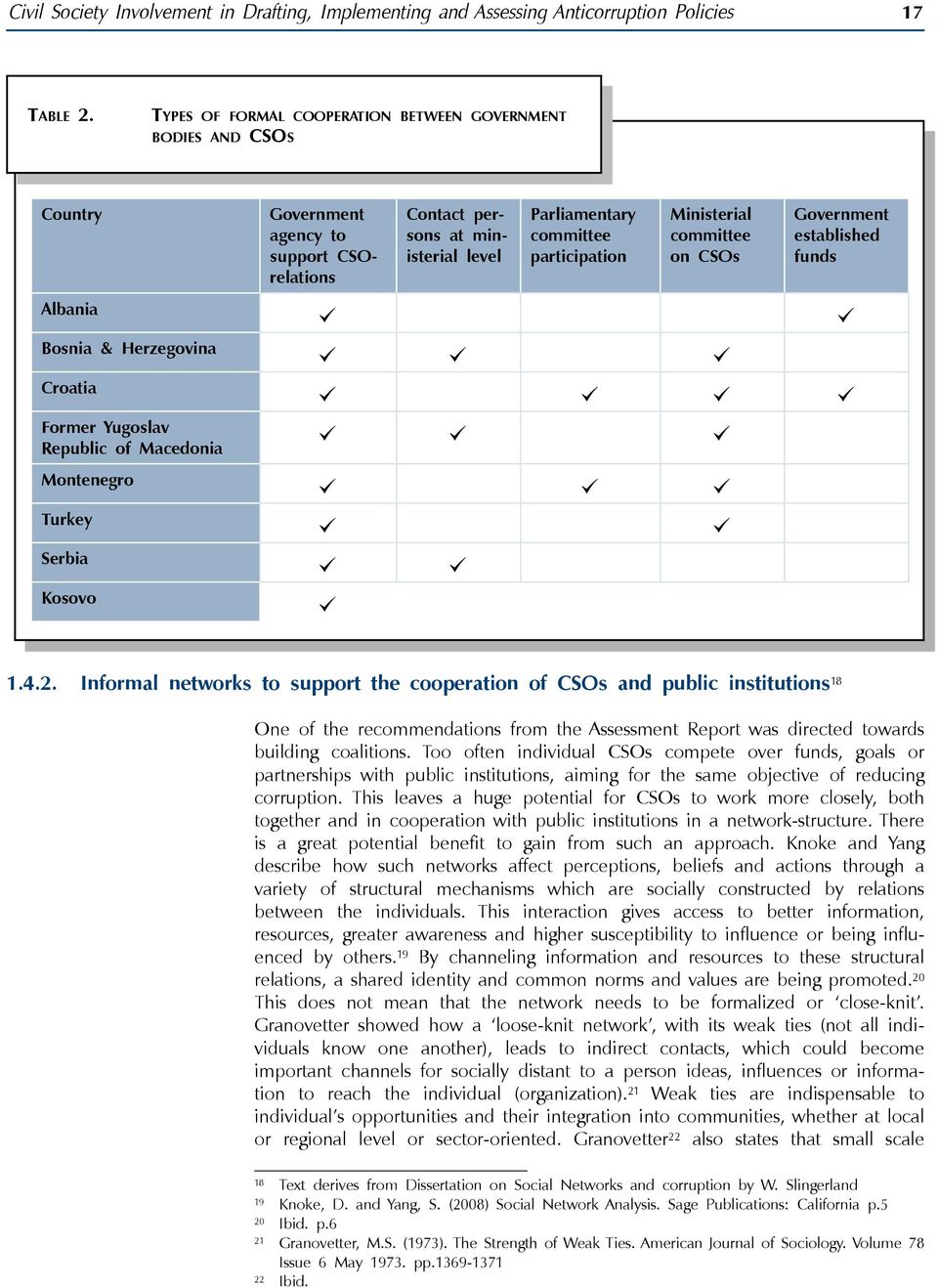
16 Civil Society Involvement in Drafting, Implementing and Assessing Anticorruption Policies 15 which have been positively evaluated by third parties (e.g. citizens or other institutions). The aim of this manual is not to copy these practices, but to take notice of them and assess whether the practice or some of its elements can be customized or translated to a different national context. In doing this, one easily tends to look at how corruption could emerge while the formal structures are in place. Equally, these formal structures are seen as the environment in which the cooperation between CSOs and public institutions must be established and strengthened. However, corruption is a complex phenomenon because it takes place in the more informal structures or social networks, which exist across formal institutions. Johnston described corruption in Romania to be that of the oligarchs and clan s type, in which there has been an accelerated process of economic and political liberalization, but with institutions remaining weak thereby allowing strong clientelistic networks to thrive. 12 The counter reaction should also come from a strong collective of anticorruption organizations. Therefore, the role of CSOs in collaborating with public institutions should be strengthened; as such they should themselves form an anticorruption network, to which all stakeholders are members Basic requirements for effective cooperation Formal framework governing the cooperation Rules on cooperation between CSOS and public institutions Although most states have left the cooperation of CSO/public institutions unregulated, others have formalized certain aspects by introducing cooperation mechanisms which determine the formal environment in which the collaboration is to be established. Some countries (e.g. Bosnia and Herzegovina, the Former Yugoslav Republic of Macedonia, Montenegro and Serbia) have appointed specific contact persons at the ministerial level responsible for handling cooperation between CSOs and the specific ministry. Cooperation at this level usually entails activities such as: consultations with CSOs prior to the adoption of new laws and policies; including CSO representatives in various working groups; involving CSOs in the development and implementation of joint projects; the direct funding of CSOs through each respective ministry; and various other educational events, announcements etc. In addition to establishing dedicated contact persons at the ministerial level, there might also be dedicated contact persons for cooperation with the Parliament. Furthermore, cooperation at the parliamentary level in some countries (e.g. Croatia and Montenegro) is guaranteed by allowing CSOs to elect 12 Buşoi, S. Interest groups and corruption in Romania a public choice approach. The Bucharest Academy of Economic Studies. Available from: pdf (Accessed 18/03/14) p. 104
17 16 Chapter I. Opening the Doors specific CSOs to represent them on a specific issue. 13 In an attempt to express government s willingness to publicly consult with businesses, CSOs and citizens, while ensuring transparency, laws have been enacted which oblige public (internet) consultation on selected law proposals (e.g. the Netherlands). Participation in the drafting and monitoring of the National Anticorruption Strategy (NACS) Active involvement by CSOs in the drafting and monitoring of the National Anticorruption Strategies facilitates to a great extend successful anticorruption cooperation. All national (and regional) policies and activities to fight corruption for a given period derive from this formal document. A good strategy reflects a realistic and comprehensive view with concrete measures and corresponding responsibilities. It is essential that CSOs join the policy makers in drafting the separate chapters of such a strategy. CSOs have their own sources of information and views on what can be considered to be effective measures. The development, implementation and evaluation of the National Anticorruption Strategy in Romania (Best Practice I) is a promising practice. The Strategy ( ) 14, which focused on prevention of corruption, defined civil society as an important stakeholder. More than 30 NGOs have sent contributions to the Ministry of Justice in the development phase of the Strategy 15 while some of them participated in the thematic cooperation platforms in 2011 and Several public debates were organized in this early phase, as some involved cooperation with CSOs. 16 Moreover, CSOs take part in the implementation and evaluation of the process, through the collaboration platforms, amongst which one is dedicated to the civil society. CSOs can also actively take part in the monitoring of those institutions, which are partners within the strategy. Another example from Romania is the Strategic Committee within the Anticorruption General Directorate (DGA) which serves as a steering consultative body, supporting and evaluating the work of the DGA. The Strategic Committee is made up of permanent members including, among others, secretaries of state, heads of central directorates within the Ministry of Internal Affairs, the head of National Policeman Body and one representative for three NGOs. 17 Additionally, representatives of the European Commission and the embassies of some EU-countries are invited for further consultation. The Platform for Corruption Prevention of the Netherlands (Best Practice II) provides an example of how various stakeholders, including CSOs, can be involved in implementing an Anticorruption Strategy, as well as their participation in designing future strategies. 13 For a more detailed overview of how this is done in other countries please see: Nuredinovska & Hadzi-Miceva Ewans, (2011) CRITERIA AND PROCEDURES FOR SELECTION OF CIVIL SOCIETY ORGANIZATIONS IN CROSS-SECTORAL BODIES National Anticorruption Strategy ( ), Available from: See for example the debate organized by the Clean Justice Initiative: concluzii-ale-dezbaterii-publice-privind-noua-strategie-anticoruptie/2011/10/07/ 17 Ministry of Internal Affairs, Anticorruption General Directorate, Official webpage available at:

18 Civil Society Involvement in Drafting, Implementing and Assessing Anticorruption Policies 17 Table 2. Types of formal cooperation between government bodies and CSOs Country Government agency to support CSOrelations Contact persons at ministerial level Parliamentary committee participation Ministerial committee on CSOs Government established funds Albania Bosnia & Herzegovina Croatia Former Yugoslav Republic of Macedonia Montenegro Turkey Serbia Kosovo Informal networks to support the cooperation of CSOs and public institutions 18 One of the recommendations from the Assessment Report was directed towards building coalitions. Too often individual CSOs compete over funds, goals or partnerships with public institutions, aiming for the same objective of reducing corruption. This leaves a huge potential for CSOs to work more closely, both together and in cooperation with public institutions in a network-structure. There is a great potential benefit to gain from such an approach. Knoke and Yang describe how such networks affect perceptions, beliefs and actions through a variety of structural mechanisms which are socially constructed by relations between the individuals. This interaction gives access to better information, resources, greater awareness and higher susceptibility to influence or being influenced by others. 19 By channeling information and resources to these structural relations, a shared identity and common norms and values are being promoted. 20 This does not mean that the network needs to be formalized or close-knit. Granovetter showed how a loose-knit network, with its weak ties (not all individuals know one another), leads to indirect contacts, which could become important channels for socially distant to a person ideas, influences or information to reach the individual (organization). 21 Weak ties are indispensable to individual s opportunities and their integration into communities, whether at local or regional level or sector-oriented. Granovetter 22 also states that small scale 18 Text derives from Dissertation on Social Networks and corruption by W. Slingerland 19 Knoke, D. and Yang, S. (2008) Social Network Analysis. Sage Publications: California p.5 20 Ibid. p.6 21 Granovetter, M.S. (1973). The Strength of Weak Ties. American Journal of Sociology. Volume 78 Issue 6 May pp Ibid.
19 18 Chapter I. Opening the Doors interaction the strength of interpersonal ties affects large scale patterns (influencing macro phenomena such as corruption) which in turn feed back into the small scale interaction. Cooperation of CSOs and public institutions can be much more effective if the network approach is the starting point for different forms of bilateral and multilateral collaboration. It is therefore essential that each party in the network is aware of the bigger system in which the anticorruption activities take place and in which each party takes on its unique role to contribute to the overall cause. Some of the best practices present concrete examples of projects arising out of such a network approach e.g. Platform for Corruption Prevention (the Netherlands) (Best Practice II), ENIPIAD Capacity Building within the Internal Affairs Department of the police (Best Practice XVII) and The SELDI Network (Western Balkans and Turkey) (Best Practice XVIII) Sustainable Sources of Funding Another essential aspect, which is a recurring issue in the discussions on cooperation between public institutions and CSOs, is the need for sustainable sources of project funding. The NACS ( ) (Best Practice I The development, implementation and evaluation of the National Anticorruption Strategy ) and the data about the resources available for the implementation of proposed actions and indicatives show that too often N/A is put under the Resources heading. The NACS ( ) is one of the best across all EU Member states but lacks strength with regard to identifying the required resources, in man power and available budget, foreseen to be invested. Financing by donors is mostly done for a limited duration of one to three years (i.e. on a project basis). Once a cooperation project is fully established and operational, the time for evaluation of its effectiveness is often too limited for any kind of adequate assessment, let alone amendments. Regularly, there is also no follow-up of successful projects because the financing had already ceased. A good example of continuity of financing by the state budget can be found in the Center for Information Service, Co-operation and Development of NGOs (Slovenia) (Best Practice III) where the fixed costs of the CNVO, has been an important factor in its stability and growth of membership. In addition, it is important to realize that CSOs in developing and EU candidate countries are heavily reliant on outside donors (such as USAID, EU Funds and The Open Society Foundation) for funding their anticorruption initiatives. In the case of Romania, some of the financing ceased once it became member of the EU and the focus of foreign donors shifted to other countries. EU funding is still available but it is now more competitive. It is also worth noting that in Romania there is hardly any anticorruption CSOs which fall in the category of membership-organization with grassroots support, making their dependence on outside donors even bigger.

20 Civil Society Involvement in Drafting, Implementing and Assessing Anticorruption Policies 19 Government funds One way to provide sustainable sources of funding that is not overly reliant on foreign donors is by setting up a national fund to finance the activities of CSOs within a country. Such a fund could be used to strengthen the CSO sector as a whole or support certain projects that are considered to be a priority (in this case reducing corruption). 23 According to a report by the International Center for Not-for-Profit Law, government funding of CSOs through a national fund is an important way for the government to support the development of civil society and to strengthen the relationship between the government and CSOs. 24 As a general best practice, such a fund should be established following active participation of the beneficiaries (i.e. CSOs) in drafting the structure or functioning of the fund. Hungary could be considered as good example because it established such fund after having consulted CSOs leaders during series of country-wide meetings. This allowed for circulation of the draft law and opportunity for providing comments and suggestions before the final submission of the legislation to the Parliament. Sources of funding Similar to funds from international donors, governmental financing generally provides support to CSOs in the form of grants. The latter may cover up to a hundred percent of the value but generally require some kind of co-financing or cost share from the receiving organization. 25 The key to the long term success of such funds is the ability to obtain both significant as well as reliable funding which can be secured from various sources. Some of these are discussed below. State Budget As with any governmental program, the use of the state budget is the most common way to provide financing for state-sponsored activities. Generally, the amount of funding is determined every year and is part of the national annual budget plan. The risk of this approach is that there is the potential for large fluctuations in the amount of funds that will be allocated each year to support the activities of CSOs. The reasons for these fluctuations can vary from general austerity measures to changes in political priorities. Alternatively some countries such as Romania have implemented mechanisms, enabling citizens to directly specify which CSOs they would like to direct a portion of their income taxes to. Statistics shows that in Romania the so called 2% 23 It must be noted that while such foundations are responsible for funding a large portion of the civil society activities in the country, government funding of CSO activities might still occur outside the scope of the foundation for example funding might still occur through the individual Ministries. 24 NATIONAL FUNDS TO SUPPORT CIVIL SOCIETY ORGANIZATIONS. Rep. July The International Center for Not-for-Profit Law (ICNL). p Such co-financing often requires organizations to contribute 10-20% of the funding themselves. This is done for a number of reasons reducing costs as well as ensuring that there is support for the activity outside of the resources of the fund such as grass roots support.

21 20 Chapter I. Opening the Doors mechanism provides CSOs with just under EUR 60 million a year in funding. 26 While the overall concept might be good, CSOs indicate that in practice this funding is not very useful as the amount provided to individual organizations is too low. Therefore, a number of examples of alternative sources of funding are presented below, which if implemented correctly, should be less susceptible to these types of issues. Membership Organizations and donations Some CSOs receive a substantial portion of their funding through donations. Another way to ensure sustainable financing is to become a membership-cso. By becoming a nonprofit membership association to which members pay at least their annual membership costs, the CSO not only becomes more independent of donations but also means that individuals affiliated with the organization may feel a strong sense of ownership in the overall success of the nonprofit s mission if they are members, which has a huge potential of citizens active involvement for the cause. 27 The importance of establishing grassroots support has also been reinstated by the UNDP and the Huairou Commission, a global network of grassroots women s organizations. Recent projects in Brazil and the Philippines, for example, involved women who promoted good governance at the community level and were involved in designing and implementing anticorruption strategies. This type of citizen s involvement turned out to be highly effective to reduce corruption (and poverty). 28 An entirely different membership is seen in Citywide Public Integrity Strategy Hamburg (Best Practice XII) where an association promotes integrity in the business sector and as such cooperates with public institutions, offers membership to businesses and citizens. Hamburg receives its funding though membership fees and donations. Proceeds generated from games of chance/national lottery An entirely different but popular means of funding is by using national lotteries and other state-run games of chance. One reason this method is particularly popular is that in many cases the source of funding already exists and using it to fund CSOs merely requires the redirection of a portion of the proceeds into the civil society fund. Other donations In addition to the mechanisms listed above, some government funds have obtained funding or supplementary funding from other sources. For example supplementary funding may come from other foundations, corporations and 26 See: Romania Non-governmental Sector: Profile, Tendencies, Challenges. Rep. Civil Society Development Foundation, n.d. Web. < engleza_final.pdf>. 27 Foundation Center. (2014). Establishing a Nonprofit Organization. Available from: foundationcenter.org/getstarted/tutorials/establish/inc.html (Accessed 24/04/14) 28 UNDP. (2014) Grassroots women: Game changers in the fight against corruption. Available from: grassroots-women-game-changers-in-the-fight-against-corruption/ (Accessed 24/04/14) and Huairou Commission (2014). Available from: Transparency_Initiative_Summary_Final.pdf (Accessed 24/04/14)
22 Civil Society Involvement in Drafting, Implementing and Assessing Anticorruption Policies 21 other private entities as well as bilateral/multilateral donations. While these sources can provide much needed increases in funding, one must be careful that these donors do not exert excessive control over how the funds are spent, especially if their objectives are not in line with the goals of the foundation or fund. In the case of financing CSO activities in the anticorruption sphere, funding could come from court judgments, penalties/fines or government seizures involving corruption cases. An example of such a fund can be found in Siemens integrity initiative which was launched in 2010 and is set to run for 15 years. The $100 million fund was set up following a settlement with the World Bank involving a significant corruption case. As part of the settlement Siemens agreed to co-operate in changing corrupt practices within industry, such as those found in public procurement, and engage in Collective Action with the World Bank Group to fight fraud and corruption. 29 The legitimacy of the allocation of project funding is ensured by allowing the World Bank Group to have veto rights over the selection of project as well as the ability to audit the use of the funds. Ensuring Transparency and Independence Non-governmental organizations in general, and in particular CSOs involved in fighting corruption, gain their legitimacy from implementing activities, which are considered independent from government interference or influences. As a result, it is extremely important to ensure that the funds that CSOs receive from the government are obtained with the upmost transparency, avoiding any partisanrelated activity. One of the first steps that must be carried out to ensure the transparency and independence of such funds/foundations is to make sure that the fund is set up in such a way that allows it to operate independently from the government. This can be achieved by establishing a well thought-out governing body. Governing Body The structure of the governing body of the governmental fund can have a significant impact on ensuring its independence of the state. Sound rules and regulations must be put in place to ensure that independence can be guaranteed. As we have seen in countries like Bulgaria politicians and other government officials can try to use these funds for their own benefit by setting up so called PONGOs (politically owned or politician s NGOs). 30 In some cases public officials have been known to carry out work for such NGOs during their office hours, before ultimately moving to the NGO fulltime once funds have been awarded, thus enabling the civil servant/politician to receive a higher salary. In order to avoid such blatant conflict of interests the awarding body of publicly financed 29 The aim of these Collective Action projects is for industry to partner with the public sector, international organizations and civil society. Collective Action describes various methods of combating corruption. It is a matter of acting collectively and forming alliances against corruption. Collective Action calls for cooperation on the part of participants from the worlds of politics, business and society at large. 30 Before 2009 Bulgarian experts estimated that PONGOs made up between 9-13 percent of all NGOs in the Country. However the passing of the Prevention and Disclosure of Conflict of Interest Act in 2009 reduced this number by making it illegal for elected officials and public employees to serve in the managing boards of NGOs and required them to declare possible conflicts of interest regarding their involvement with NGOs. For more information see Civil Society in Bulgaria Trends and Risks (2010).
23 22 Chapter I. Opening the Doors fund needs to be made up of various stakeholders, limiting the possibility for such egregious forms of conflict of interests to take place. Overall, the composition of governing bodies of similar funds elsewhere was evaluated positively: in most cases, the government chooses to appoint a mixed group of civil society representatives or leaders and public officials to the managing board or council of the fund. 31 However, the amount of control the government can exert over who is appointed in the governing board differs in each country. In Croatia for example, five out of nine board members are CSOs or experts in specific fields of civil society development. The rest of the board consists of three representatives from various ministries (the Ministry of Education, the Ministry of Finance and the Ministry of Foreign Affairs/European Integration). The decision on the allocation of funds is made by the entire management board. The fairness of this decision-making is further supported by involving professional evaluators in the assessment of grant applications. Specific rules on conflict of interests are also applicable Investigative journalism and the use of new technologies For every country that wants to be effective in anticorruption, it is essential that the media are independent and strong enough to report corruption scandals, inefficient anticorruption policies or any other topic of public interest. Besides the general daily news, more in depth, long-term and critical investigations by the media are essential to report complex topics. As a result, investigative journalists fulfil an important role as the overall watchdog. The Dutch-Flemish Association for Investigative Journalism (VVOJ) 33 defines investigative journalism to be: Critical and in depth journalism. Journalism that does not merely pass on news that is already there, but creates news that would not have been there without the journalist s intervention. This may happen by creating new facts, but also by interpreting or connecting already known information in a new way. In depth means a substantial journalistic effort was made, either in a quantitative sense e.g. time spent on research, number of sources consulted or in a qualitative sense e.g. sharp questions formulated, new approaches taken up or a combination of both. As such well-trained, responsible and independent investigative journalists with adequate resources to investigate and report, form an essential actor in an anticorruption network in any given country. Corruption is a crime that prefers to remain hidden and concealed but independent media can shine their light on 31 National funds to support civil society organizations. Rep. July The International Center for Not-for-Profit Law (ICNL). 32 For example according to Article 19 of Foundations National Statute: A member of the Management Board or other body of the Foundation may not vote, or decide on issues in which he/she, his/her marriage partner, his/her adopted parent or child, his/her direct blood relative or indirect relative to the fourth degree, or one related by marriage to the second degree, has material interest, nor on issues related to a legal entity of which he/she is a member, in whose management he/she is involved, or in which he/she has any material interest. 33 (2014). About VVOJ. Available from: (Accessed 13/08/14)
24 Civil Society Involvement in Drafting, Implementing and Assessing Anticorruption Policies 23 those who have been involved in corruption. 34 Because of the complex nature of corruption, it is important that these journalists are trained by corruption experts (e.g. CSOs or law enforcement officials) to learn how they can discover and trace back corrupt behavior. One example of such a training is Best Practice XIX- Supporting Investigative Journalism, aimed to provide the best journalists in Romania access to networking, training and using of nonconventional sources in getting information on corruption (such as data mining ). When thinking about anticorruption cooperation between public institutions and CSOs one immediately has to consider the possibilities which new ways of communicating offer. Mobile phone devices, the internet and social media have made it easier to report, raise awareness to and fight corruption. The Estonian Rahvakogu online platform for civic participation (Best Practice X) is a good example of new best practices in anticorruption cooperation. The Public Procurement monitoring database in Croatia (Best Practice XVI) which has been set up illustrates how increasing transparency in decision making can strengthen watchdog activities of CSOs. Another example which is particularly interesting when considering the network character of corruption is the cost-free Visual Investigative Scenarios (VIS) 35 a data visualization platform designed to assist investigative journalists, activists and others in mapping complex business or crime networks. This website is funded by the International Press Institute and the website s aim is to help investigators understand and explain corruption and to translate complex and interrelated cases into simple, universal visual language. There are also low-key initiatives, such as Ipaidabribe 36 where those who experience any form of bribery can report it online, so that media and law enforcement agencies are informed. Additionally, larger data on the nature, number, pattern, types, location, frequency and values of actual corrupt acts becomes available. This information allows for anticorruption to become much more effective because interventions are based on a better understanding of the environment in which the corruption occurs. Besides reporting individual bribe paying, whistle-blower websites (e.g. Balkanleaks or Publeaks) allow anyone to upload official documents as evidence of a corrupt conduct. Thus, corrupt practices are made public and it is up to the media, the organizations involved and the law enforcement agencies to take action. New technologies have made it possible to organize, on short notice, anticorruption demonstrations and online petitions. Recent examples are the civic involvement against corrupt government officials and politicians in Ukraine, Turkey, Bulgaria and Romania. Mass demonstrations were quickly organized because of the speed with which communications can take by using social media. However, a warning should also be in place, because these same technologies can also be misused. For example as with other communication means, information can be wrongfully exchanged and illegal payments can be transferred more quickly using these technologies. Nevertheless any form of cooperation between public institutions, CSOs and other actors could benefit from these new technologies. As such, it is not a separate form of cooperation but a support to all activities. 34 Transparency International (2012). World Press Freedom Day Available from: transparency.org/news/feature/world_press_freedom_day_2012 (Accessed 13/08/14) 35 Visual Investigative Scenarios Available from: (Accessed 12/03/14) 36 I paid a bribe (2014). Available from: (Accessed 20/02/14)
25 24 Chapter II. Capacity Building
26 Civil Society Involvement in Drafting, Implementing and Assessing Anticorruption Policies 25 Chapter II. Capacity Building 2.1. Background Capacity building is viewed as the process of strengthening an institution or organization in order to increase its effectiveness and ability to reach its full potential. In the anticorruption realm capacity building initiatives can benefit both CSOs and public institutions. As demonstrated in Chapter I, many countries have established dedicated government departments and agencies which also have a responsibility for increasing the capacity of CSOs within their country. Furthermore, CSOs can play an important role in increasing the capacity of public institutions ability to respond to corruption related issues. In Latvia a promising example is the integration of Anticorruption measures at the Naturalization Board of Latvia in the process of acquisition of citizenship (Best Practice V). Significant obstacle to successful capacity building initiatives could be the lack of institutional memory, in particular in societies with low levels of institutional capacity and high levels of corruption. Several alternatives could be identified in such cases Capacity building/training initiatives need to be renewable All too often internal training exercises, international trainings/exchanges or CSOled capacity building activities are isolated events which fail to reach a wider audience. 37 The cascade or train the trainer approach has been one of the most common methods to try and ensure the sustainability of training activities. While this approach is often considered cost effective and is capable of providing some form of sustainability, it must be noted that it can lead to diluted trainings which lose effectiveness over time (each newly trained group receives a more diluted form of the original training as information is lost with each passing training exercise). As a result, some argue that training a permanent cadre of trainers is more effective at ensuring that the training activities remain at their best By wider audience we are not only referring to other stakeholders for which these training activities might be useful such as other departments, ministries etc. but also newcomers/the next generation of civil servants and government officials. 38 UNFPA, 1994.
27 26 Chapter II. Capacity Building 2.3. Smoother transition process Improving the transition process when promoting (or changing the post) civil servants is also becoming increasingly important. In some of the more corrupt societies, even the mid-to-lower level managerial positions within government bodies and ministries are exposed to strong political influence and pressure. As such, when new governments are formed, many of the key stakeholders in capacity building initiatives are relieved from their duties. Having not benefited from these past initiatives, their replacements often refuse to continue with the established practices, thus breaking the pattern of sustainability, which is essential for effective capacity building process. Therefore, specific steps should be taken to guide the transition process for newly appointed civil servants and officials. One recommendation for smoothing this process includes the use of handover documents/packs when leaving or starting a new post. While creating in-depth work handover packets might be common practice, the countries which lack institutional capacity and experience high levels of corruption often do not have sound procedures in place to ease the transition process when someone is assigned to a new post. From a practical perspective this approach would help guarantee that the knowhow from one cohort of civil servants is passed on to the next, thus ensuring that capacity building improvements remain effective over longer time periods. Ultimately, the responsibility for overseeing the practical implementation of such recommendations lies with the relevant human resources departments, which should be actively involved in training/capacity building activities. In countries where high levels of corruption is prevalent, CSOs might naturally have gained more experience in fighting corruption as the previous regimes did not allocate the necessary resources to effectively combat the problem themselves. In such cases, CSOs can provide government institutions with their valuable knowledge and expertise on how to best address the issue of corruption within government institutions. For example, prior to or in the early stages of development of specialized anticorruption agencies, CSOs can be involved in a number of capacity building activities including: Drafting/providing input to anticorruption strategies; Training civil servants and other government officials; Establishing anticorruption protocols; Implementing international standards/best practices etc. An example of how a CSO provided their expertise in capacity building can be seen in the example from Latvia (Best Practice V). At the time of the initiative, the Latvian authorities lacked the expertise necessary to address corruption problems with the Latvian Naturalization Board.
28 Civil Society Involvement in Drafting, Implementing and Assessing Anticorruption Policies 27 Box 3. Excerpt from an Interview with representative from Providus, Latvia. We had the reputation of being experts on corruption in Latvia and there are not that many organizations in Latvia with that expertise outside the Government and inside the Government at that time the specialized anticorruption agency was only recently established a couple earlier and that body had still not built up [enough] expertise at that time. I think nowadays they would not go for the foreign NGO, nowadays they would ask the Corruption Prevention and Combating Bureau which is a specialized state authority to do analysis of this kind but at that time this anticorruption bureau was not yet so developed and so they found that we have the best outside sort of expertise on prevention of corruption. Source: Phone interview conducted on 5 March 2014 Table 3. Risks CSOs may experience while carrying out joint capacity building initiatives with government institutions Risks Not getting full access the information needed to carry out the capacity building initiative successfully Different motives Resistance/confrontation from the insiders Possible ways of overcoming such risks Establish clear guidelines regarding access to information in the working agreements prior to initiating the project. Involve/update media throughout the entire duration of the capacity building initiative instead of only during initiatives launch. Ensure the full support of activities by senior management of the participating institution. Involve insiders in the design of the capacity building activities Keys to successful capacity building Sustainable training and ensuring collective knowledge is essential. When developing a training exercise, there are do s and don ts. The United Nations Population Fund lists good practices for establishing effective training activities: The different objectives of training and awareness creation should be recognized in a project s design; Needs assessments are required for designing effective trainings; The criteria for selecting trainees should be clearly defined and applied consistently;
29 28 Chapter II. Capacity Building Training content should be relevant to the job description, when applicable; Training a permanent cadre of trainers is more effective than the training in cascade train the trainer approach; Impact evaluation should be included in the project design from the outset and implemented more frequently in order to benefit subsequent training activities United Nations Population Fund. Office of Oversight and Evaluation. Evaluation Findings: Issues in Training Program. UNFPA, Mar Web.
30 Civil Society Involvement in Drafting, Implementing and Assessing Anticorruption Policies 29 Chapter III. Advocacy Campaigns & Coalition Building 3.1. Background Advocacy campaigns are among the most applied instruments by NGOs active in the anticorruption domain as they are used to intervene when public policy does not coincide with good governance and transparent practices or when decisions do not correspond to the public interest. In this context, advocacy campaigns refer to the planned, deliberate and sustained efforts in raising awareness on (anti)corruption and related issues. This is usually achieved through a variety of activities including lobbying, media campaigns and setting up information centers to name a few. 40 Although some organizations have the capacity to independently perform advocacy campaigns, most successful initiatives in drafting and improving key legislation are undertaken by coalitions or alliances. Therefore, the latter types of initiatives will be examined together throughout this chapter. While there is no one-size-fits-all solution for constructing an anticorruption coalition, due to varying social and political circumstances as well as the changing nature of the corruption challenges that each society faces, there are a number of factors marking the most successful anticorruption coalitions. For example, according to (Johnston & Kpundeh, 2004) some of the factors that facilitate and enable the mobilization of anticorruption coalitions include: A functioning state with leaders who have a genuine intent to govern well; Basic civil liberties (freedom to organize, assemble and voice) and a reasonably free media; A crisis of opportunity making action imperative; Outside support providing essential resources, expertise and moral support. In addition there are a number of key characteristics that can be found in most of the effective anticorruption advocacy campaigns. These include: (a) a strong identity; (b) clear message; (c) effective partnerships; (d) strong evidence; and (e) timing. 40 Dzhekova, R., Parvu, S., van Hulten, M., Slingerland, W., Beltgens, M. (2013). Assessment Report Civil society organisations involvement in drafting, implementing and monitoring anticorruption policies in Romania, Bucharest, September 2013 (Accessed 12/02/2014)
31 30 Chapter III. Advocacy Campaigns & Coalition Building 3.2. Keys to Successful Advocacy Campaigns and Coalition Building Strong Identity It is important for both national and local level anticorruption advocacy campaigns to be highly visible and easily identifiable. When an advocacy campaign is driven by a coalition that can add credibility or visibility, it is important that the coalition s identity remains independent of the characteristics and objectives of its members. In order to increase the legitimacy of the coalition/campaign, initiatives should generally be open to include a wide variety of stakeholders; however one must be careful to avoid including coalition members whose integrity is questionable, as this could seriously jeopardize the credibility and legitimacy of the campaign. This approach was effectively demonstrated by Coalition 2000 (Best practice IV), which kept the identity of the initiative separate from that of the participating NGOs. Coalition 2000 was able to achieve this by providing open membership criteria (incl. NGOs, government agencies, business associations and international organizations that took on the identity of the coalition). As a result, the initiative has turned into a pioneering success of the anti-corruption efforts of the Bulgarian civil society. It introduced an innovative public-private coalition format for cooperation among NGOs, governmental institutions and individuals for delivering anti-corruption awareness raising and policy advocacy. It consisted of three pillars: The Corruption Monitoring System (CMS), allowing to measure the level of corruption victimization in the country, as well as to identify related public perceptions, opinions, and expectations. The CSM is based on regular victimization surveys among the population and the business community, which benchmark corruption dynamics. Annual Corruption Assessment Reports (CAR), providing overview of the Bulgarian legislative and institutional reforms and evaluating the anticorruption potential of government policies, as well as highlighting the contributions of civil society and the role of the media; Annual high-level anti-corruption Policy Forums, attended by ministers, ambassadors and academia, thus rendering them an effective advocacy tool Clear Message In general the purpose of an advocacy campaign is to try and persuade elected officials to act on its message. However, politicians are only inclined to take action when their constituencies actively voices their support for the advocacy campaigns message as they are reliant on the support of their electorate to remain in office. As such, the message must be clear and easily understood by the target audience (i.e. the voters). A large part of having a clear message corresponds with having clear and catchy name for the campaign. For example, in Romania some of the most effective advocacy campaigns had names that clearly identified the purpose of the campaign (i.e. Coalition for a Clean Parliament (CCP), Coalition for Clean Universities etc.)
32 Civil Society Involvement in Drafting, Implementing and Assessing Anticorruption Policies Effective Partnerships While the use of coalitions is often considered to be an effective tool for increasing the likelihood of carrying out a successful anticorruption advocacy campaign, these initiatives are only effective when good cooperation exists between the coalition s members. Effective partnerships can be promoted by clearly stating the benefits of joining the coalition in order to entice new members to join (See table 4 below). Table 4. Benefits of joining/participating in Coalition 2000, CCP & CCU Benefits for CSOs and society at large Benefits for Government Institutions/ public bodies Shared/Mutual Benefits Benefits of Joining/Participating in Coalition 2000, CCP & CCU Increased opportunity to participate in the development of new legislation (Coalition 2000). Enable the general public to make more informed decisions (CCP, CCU). Increased capacity to hold government institutions/officials accountable then would be possible single-handedly (Coalition 2000, CCP, CCU). Take advantage of the knowledge and resources of specialists working outside of the government (Coalition 2000, CCP, CCU). Favourable public image by being seen as a promoter of integrity (Coalition 2000, CCP, CCU). Increased monitoring of public procurement within universities means less wasteful spending of government funds (Coalition 2000, CCU). Increase quality, integrity and reputation of Romanian higher education system/political parties (CCU, CCP). One of the reasons the Clean Justice initiative (Best Practice VI Romania s Clean Coalitions ) worked was that its members were already aware of the benefits of participating in such alliance, as the coalition was partially a direct development of a previous initiative (CCP). As a result, the coalition was easy to establish with its members already able to recognize that they shared common values and with the understanding that working together would be more effective. In the case of advocacy campaigns, effective partnerships must also exist between the advocacy campaigners and the public officials which they are trying to persuade. In the case of the CPP, the Coalition was able to successfully approach the leadership of the different political parties which were represented in parliament and get them to agree to publicly support them. 41 One of the characteristics making the partnership more effective was the fact that each of the black-listed candidates was given the opportunity to appeal the Coalition s initial findings. 41 These parties included: the Social Democratic Party/Humanist Party of Romania coalition (PSD/PUR), the Justice and Truth Alliance (DA), and the Hungarian Democratic Union of Romania (UDMR)
33 32 Chapter III. Advocacy Campaigns & Coalition Building The experience of the Southeast European Leadership for Development and Integrity (SELDI) 42 (Best Practice XVIII The SELDI Network ) is an additional example of how strong partnerships can also effectively operate on a regional level. The project has demonstrated how 19 like-minded civil society organizations from Southeast Europe can work together with the mission to contribute to a dynamic civil society in the region, capable of participating in public debate and influencing policy and decision-making process in the area of anti-corruption and good governance Strong Evidence Arguments are more convincing when they are based on strong evidence. Such evidence is most effective when it comes from comprehensive and rigorous research. In the case of the CCP, strong evidence was provided in the form of verified information indicating that a candidate had done one or more of the following: Having repeatedly shifted from one political party to another in search of personal benefit; Having been accused of corruption on the basis of published and verifiable evidence; Having been exposed as an agent of Ceausescu s former secret service (Securitate); Being the owner of a private company with a sizable sum of back taxes; Being unable to account for the discrepancy between a candidate s officially stated assets and income; Having profited from a conflict of interest involving their position within government. The SELDI network (Best Practice XVIII) is another confirmation that coalitions, which advocacy efforts are founded upon detailed and systematic research provide greater reliability in pursuance of their common objectives. SELDI carried out its first unified regional corruption monitoring exercise, employing the state of the art Corruption Monitoring System back in and repeated this exercise in , which has provided the coalition with a distinctive opportunity for data-driven anti-corruption policy-advocacy and outreach. This approach allowed the network`s partners to collect comparable data, which serves not only for the production of national CARs, but also as the foundation for an comprehensive Regional CAR, to be published in the second part of SELDI official webpage available at:
34 Civil Society Involvement in Drafting, Implementing and Assessing Anticorruption Policies Timing One of the key factors to the success of the advocacy campaigns and coalitions that have been discussed in this chapter and that cannot be overlooked is timing. While good anticorruption campaigners remain active all the time, the decision of when to push forward with an advocacy campaign can be crucial to its success. Timing plays an important role for a number of reasons. Firstly, the general public s memory tends to be short - what might be considered an important issue today, might be of no concern tomorrow. It is therefore essential that an advocacy campaign starts or coalition is created as soon as the crisis of opportunity unfolds. Another reason why timing plays an important role for the success of any advocacy campaign is that the existence of a favorable environment is essential in order for the message to influence the political agenda. For example, one of the reasons that the CCP was able to be successful was because it was initiated during a time in which the political climate was more receptive to act on the advocacy campaigns message. More specifically, in the case of the CCP the right timing was twofold. Firstly, the campaign was timed shortly before the 2004 elections, which meant that the initiative could have a direct impact on the forthcoming election. 43 Secondly, the campaign was initiated during a time when the leading opposition party was in a strong position to seriously challenge the ruling party; which in this case meant fighting corruption. CCP members have stated that the political environment of that time was the key to their campaigns success and would not have been able to gain the support needed from politicians or achieve such a positive result under different political conditions. An additional good example is the Argentine Dialogue (Best Practice XV) experience. It illustrates how after years of failed attempts to solve serious nation-wide problems, the citizens, supported by CSOs and the United Nations Development Program (UNDP), were successful in building anti-corruption coalitions. And they succeeded at the peak of the crisis, when people were willing to try and do things in a different way. The citizens changed the setting in which they normally met with political leaders. By using an informal approach everybody was able to see their individual role in the context of the bigger system Sustainability Even successful anticorruption coalitions such as Coalition 2000 (Best practice IV), the CCP (Best Practice VI), etc. are susceptible to sustainability issues. As put by Johnston, M. & Kpundeh, S. J.: coalition-building drives often begin with much fanfare, and in some places they thrive; too often, however, they prove difficult to 43 The electoral moments can have perverse effects, as the candidates/parties that are interested in their image can promise publicly to support a certain cause, but after the elections no action is taken. Therefore, solid alternatives plans must be ensured, including name and shame campaings. 44 Executive Board of the United Nations Development Program and of the United Nations Population Fund (2002). Second country cooperation framework for Argentina ( ). Available from: Cooperation-Framework/CCFARGENTINA (ENG).pdf and Kahane A. (2004) Solving tough problems: an open way of talking, listening, and creating new realities. Berrett- Koehler Publishers: San Francisco p.96
35 34 Chapter III. Advocacy Campaigns & Coalition Building sustain particularly where they are needed most. 45 Furthermore, sustainability plays an essential role in advocacy campaigns pointed towards influencing key legislations. In one such example, a coalition advocacy campaign worked towards the adoption of an ombudsman law. The accomplishment of this mission required considerable prolonged persistence as the campaign advocated with three successive governments before the law was adopted. Furthermore it took an additional 2-3 years before the first ombudsman was appointed and could begin carrying out his duties. If the coalition s advocacy campaign had not been sustainable enough to continue pursuing the objective, the adoption of the law might have never occurred. 46 This reiterates that progress in the fight against corruption can be slow and requires persistence and sustainable diligence. The strong partnership within the SELDI coalition (Best Practice XVIII) is a good example for sustainability. The initiative relies on pooling together the resources of its partner CSOs who share similar values and are deeply involved in good governance and anticorruption at national level. In addition, the SELDI strategy rests upon, and partially replicates, the successful best practices of Bulgaria s anti-corruption initiative Coalition 2000 as well as the regional CSO capacity building initiative Southeast European Legal Development Initiative. The core CSO coalition partners have worked together in the past in the area of good governance and anti-corruption and have proven track record and experience in the area. The complementary institutional and regional approach to advocacy and stakeholder consultations, and SELDI`s open governance structure further ensure the sustainability of the initiative. 45 Johnston, M., & Kpundeh, S. J. (2004). Building a clean machine: anticorruption coalitions and sustainable reform (Vol. 3466). World Bank Publications. 46 Stakeholder interview on coalition advocacy campaign to adopt an ombudsman law.
36 Civil Society Involvement in Drafting, Implementing and Assessing Anticorruption Policies 35 Chapter IV. Watchdog And Monitoring Activities 4.1. Background Watchdog and monitoring activities play a critical role in the fight against corruption. According to the World Bank, an effective anticorruption strategy should increase accountability by encouraging public oversight through Parliament and a vibrant civil society. 47 These activities provide a number of benefits including helping assess the functioning of accountability systems, identifying areas which are vulnerable to corruption and identifying corrupt practices. Moreover, effective monitoring can establish a constructive two-way dialogue between communities and government bodies. 48 In an ideal situation (i.e. in countries where the political will to fight corruption exists) corruption monitoring within the public sector should be conducted by independent state-funded agencies. However, there are a number of reasons why one should be cautious of solely relying on the public sector. Firstly, governments have inherited incentives to adjust the findings of their monitoring activities, especially when these activities uncover controversial facts. 49 In the absence of strong political will, NGOs can take the lead in monitoring and watchdog activities or serve as allies to the government monitoring agencies. Particularly at the local level NGOs have the potential to exploit their insight knowledge, experience and contacts to aid their monitoring efforts. Using similar reasoning, Coalition 2000 (Best Practice IV) chose to focus much of its attention on local anticorruption initiatives towards organizing educational and awareness activities to help promote the use civic monitoring at the local level. While watchdog and monitoring activities are often carried out independently by CSOs, there are opportunities for civil society and governmental institutions to cooperate in this type of activity. Cooperation of this kind usually requires a written partnership agreement which outlines the extent of cooperation and what kind of information the CSO will have access to in their monitoring activities. As Holloway points out, poorly negotiated partnership agreements can result in significant negative consequences to the monitoring activities from the earliest stages of cooperation. Recommendations for establishing an effective cooperation agreement on the part of CSOs include the need for provisions which include, detailed specifications of protocols of publications with deadlines and right to 47 World Bank (2000): Helping countries combat corruption. Progress at the World Bank since 1997, Operational Core Services & Poverty Reduction and Economic Management Network. Washington DC.: World Bank. 48 Richards, K (2006) What works and why in community-based anticorruption programs 49 This can be particularly the case when the information that has been uncovered has the potential to damage the reputation make the current government in the eyes of the voters.
37 36 Chapter IV. Watchdog And Monitoring Activities publish without consultation within so many days if this deadline is breached by the subject (i.e. government institution), right of access to information, protocol and deadlines to obtain document etc Figure 1. Goals of monitoring & watchdog activities by CSOs 51 Goals of Monitoring & Watchdog Activities by SCOs To demonstrate that a system, pocess or law is not effective or being implemented correctly To identify points of failure To ascertain the mechanism within which corruption operstes To formulate clear recomendation on how to best tackle the corruption that has been indefied The monitoring and watchdog activities undertaken during Coalition 2000 (Best Practice IV) aimed at realizing these four goals. For example, the CMS which was developed by the Center for the Study of Democracy (CSD) through the Coalition became an effective instrument for analyzing the corrupt practices within the country (Goals 2 & 3) and assessing the progress that was made through various anticorruption initiatives (Goal 1). Furthermore, the Coalition 2000`s CAR intended to assess the progress that had been made in line with the Corruption Action Plan (Goal 1). The CAR proved to be useful in that it provided an overview of the Bulgarian legislative and institutional reforms and evaluated the anticorruption potential of government policies as well as providing overviews of the contributions of civil society and the role of the media. In addition, the CAR was able to promote effective collaboration between the CSOs within the Coalition and government institutions by enabling government officials to provide their own comments and suggestions to the CAR, while drafts of the report were being circulated within the appropriate government institutions and in fact some of their comments and suggestions ended up in the final report. 52 The initiative`s neutral stance was the key to effective cooperation, enabling the Coalition to work closely with successive governments, irrespective of their 50 Holloway (2006) p Cite these 4 examples as described in Chapter 6 Corruption Fighters Resource Book 52 Similarly another best practice Romania s Coalition for a Clean Parliament provided the political parties with the opportunity to review their findings from the monitoring activities which were carried out on their candidates for parliament and provide evidence to counteract any disagreements.
38 Civil Society Involvement in Drafting, Implementing and Assessing Anticorruption Policies 37 political affiliation. Its reach, both national and regional, was additionally fostered by the annual presentation of the CAR. The report was presented during a highlevel Policy Forum, attended by ministers, ambassadors and academia, making it an effective advocacy tool. Another area where Coalition 2000 demonstrated effective cooperation with the government in their watchdog and monitoring activities can be seen in its role in the formation of Bulgaria s Civil Council. The Civil Council which was established by three CSOs 53 with the main objective being the implementation of an ongoing independent monitoring system to follow fund raising and expenditures during the presidential election campaign. The Civil Council had been invited by the Committee nominating the president and vice president to carry out the Table 5. Advantages and disadvantages for NGOs cooperating with government institutions on monitoring/ watchdog activities For cooperating with government institutions Not cooperating with government institutions Advantages The subject is engaged in the process and you have their attention The partnership could provide greater access to information for the monitoring NGO It may be easier to work with reform minded people within the government If the subject is willing to cooperate other significant institutions may also come to the table. Partnership generates the possibility for capacity building and experience sharing The NGO is free to devise the monitoring plan and strategy without negotiation i.e. no political compromise There will be a greater appearance of independence from the perspective of other civil society groups Reduced needs for coordination mean the monitoring NGO will be more flexible in their day-to-day operations The monitoring NGO is less vulnerable to manipulation or co-option by the subject Covert investigations can be used more easily The NGO can be more flexible and focus its monitoring activities according to findings and events Disadvantages The subject will get more information from the NGO about activities and may be able to counter them more effectively The partnership may lend credibility to the subject while no reform takes place There is a danger of co-option of the monitoring NGO by the subject in the press and media Maintaining relations with the subject will consume considerable resources if the going gets tough The monitoring NGO may be under pressure not to act or the subject may threaten the partnership It may be difficult to form open alliances with representatives of the international community if the government is not involved There will be no agreement with the partner against which to hold them accountable, thereby removing a powerful monitoring tool The danger of intimidation from the subject may be greater and a monitoring framework less effective to mitigate it It may be more difficult to access any official documentation Sources of information may be more reluctant to come forward Funding may be more difficult to secure. Many funders prefer partnerships and encourage them. 53 The three CSOs were Coalition 2000, the Bulgarian chapter of Transparency International and Civil Society against corruption
39 38 Chapter IV. Watchdog And Monitoring Activities monitoring activities. The Romanian Coalition for a Clean Parliament (Best Practice VI) is another good example of a thorough monitoring. In this sense Goal No.4 (formulating clear recommendations on how to best tackle the corruption that has been identified) provides an excellent opportunity to work closely with the government s own anticorruption monitoring body Watchdog Activities in Public Procurement Public procurement is one of the most important sectors for both the anticorruption institutions and CSOs, as states spend up to 25% of the GDP on procurement procedures. In 2010 the procurement procedures in EU amounted to a total of EUR 2,046 billion (20% of the GDP), while the cost of corruption and fraud was estimated to be between EUR 1.4 and EUR 2.2 billion in eight selected EU Member States 54. The new 2014 PP Directive aims to increase the transparency and ensure the useful spending of public funds. Taking these developments into consideration, public procurement seems to be a practical area for collaboration between public institutions and civil society working on anticorruption and good governance. Croatia seems to be a good example in this sense. (Best Practice XVI Reform of the public procurement system in Croatia). In 2013, the country became the 28th member of the EU. As for all the candidate member states, conditions have been negotiated with the EU officials in order to impose standards in governance and society. One of the targets of Croatian officials and civil society became the reform of the public procurement system. In this project, CSOs and public institutions were successful in increasing transparency in public procurement by launching a Web portal and database in which all projects and tenders can be monitored. The 2012 EU report on Croatia 55 stated that the country was meeting the accession requirements, even if further investments must be done at the local level, regarding the remedies system and improving the administrative capacity of bodies involved in PP procedures. This project was continued in partnership with the Bucharest based think tank Expert Forum with the purpose of sharing the Croatian experience. The current project, Cross-Country Legal and Institutional Framework for Suppression of Fraud in Public Procurement is on-going and includes the publication of two policy papers on the future Romanian legal and institutional framework (in the context of the new PP Directives), meetings and conferences with the stakeholders and an advocacy campaign. The project also envisages to set the premises for the implementation of a similar PP Database in Romania. 56 The hope is for this initiative to learn from the Croatian experience and build upon other successful monitoring activities in public procurement which have already been carried out such as Best Practice XIII Public Procurement Files Platform in Romania. 54 OLAF (2013). Public Procurement: costs we pay for corruption. Identifying and Reducing Corruption in Public Procurement in the EU. Available from: documents/anti-fraud-policy/research-and-studies/pwc_olaf_study_en.pdf 55 European Commission, Comprehensive Monitoring Report on Croatia s state of preparedness for EU membership, SWD(2012) 338 final, Brussels. Available from: enlargement/pdf/key_documents/2012/package/hr_analytical_2012_en.pdf 56 For more details please consult
40 Civil Society Involvement in Drafting, Implementing and Assessing Anticorruption Policies 39 Chapter V. Raising Public Awareness оn Corruption (INCLUDING EDUCATION) 5.1. Background This chapter s focus is on the best practices with regard to the raising of public awareness about corruption. More specifically, it describes the way CSOs and public institutions may work together to raise the corruption awareness of the larger public. Any anticorruption strategy is doomed to fail without sufficient public awareness. (Chapter III deals with National Anticorruption Strategies) Therefore, the Serbian anticorruption agency started in 2013 a multi-media campaign to raise public awareness. The previous anticorruption strategy failed due to a lack of public awareness. 57 Public awareness of corruption with regard to the general public concerns: the recognition of the different manifestations of corruption; the recognition of the objectionable character of corruption and the willingness to formulate an opinion on this in (public) debates; and an understanding of the activities, which can be undertaken when confronted with corruption incidents. In promoting public awareness on corruption the simple transfer of information is seen as insufficient. In the organizational literature the insight arose that the ways people actually work usually differ fundamentally from the ways organizations describe that work in manuals, training programs, organizational charts and job descriptions 58. Learning theorists therefore have rejected transfer models which isolate knowledge from practice. Within the modern organizational learning theories, learning is seen as social construction, putting knowledge back into the contexts in which it has meaning. 59 Based upon these lessons from academics it is possible to distinguish four levels of raising public awareness of corruption 60 : 57 SETimes.com: Serbia launches anticorruption public awareness campaign. Available from: feature-03. (Accessed 27/04/14). 58 Brown J.S. and Duguid, P. (1991), Organizational learning and communities-of-practice: towards unified theory of working, learning and innovation. In: Organizational Science, vol. 2, Feb. 1991, Ibid. p Analogous to the levels of organizational learning. See: Senge, P. (1990) The Fifth Discipline. The Art & Practice of the Learning Organization
41 40 Chapter V. Raising Public Awareness оn Corruption The simplest level of public awareness raising is the disseminating of information, for instance via a mass communication campaign. The idea behind this form of corruption awareness raising is that knowledge about corruption leads to performing actions to fight corruption. As mentioned before, this is not seen as an effective method. However, every anticorruption strategy, and especially each awareness, program needs to start with this. The Serbian anticorruption agency, for example, chose to use an extensive multi-media campaign to raise public awareness. This included posters and advertisements in the media. A second level of public awareness raising of corruption involves asking the general public to report cases of corruption. The Romanian Anticorruption Directorate (AGD) developed an awareness campaign by asking the general public to be aware of corruption and to report cases. This level of awareness raising addresses the own responsibility of the citizens to combat corruption. This dissemination of information can take place via public leaders or school teachers. Through interviews in news media or via speeches they are able to inform the general public about the issue. Teachers on all levels of education are able to address the topic of corruption. This form of public awareness raising goes one step further than the transfer of information. The leader sets a good example and calls on his supporters to promote this vision and to take action. The teacher stimulates his pupils or students to recognize corruption, to recognize the mechanisms behind it and to think about adequate (societal) answers. A leader and a teacher may even translate these lessons to the experience of the students or the context in which the follower of the leader may function and to stimulate to take action. A fourth level of public corruption awareness recognizes the systemic character of corruption. If you want to understand how corruption really works, and want to change it, it is necessary to recognize the way people are, sometimes without realizing, creating structures in and around organizations, and to recognize the coercive character of these social structures. The raising of awareness of corruption should entail the practice as well. It is important to bring people from different segments of society together and develop a common understanding of the way corruption as system functions Keys to Successful public awareness raising With regard to corruption awareness raising of the general public there are various opportunities for cooperation between public institutions and CSOs. Campaigns CSOs and anticorruption agencies can cooperate through public awareness campaigns. The independent character of CSOs is of extreme value for the trust of the general public in the information that is made available by the CSOs. CSOs therefore have to be careful to guarantee their independence. This implies restrictions upon the form of cooperation of the CSOs with the public institutions. Cooperation may involve exchange of information about the way corruption is recognized by the CSOs and the public agencies.
42 Civil Society Involvement in Drafting, Implementing and Assessing Anticorruption Policies 41 Reporting of cases CSOs are, due to their relationship with their supporters, often aware of corruption cases that may be reported to the anticorruption agencies. It is therefore important that CSOs have knowledge of how these anticorruption agencies work. Public leadership CSOs and public institutions may work together and seek cooperation with educational institutions with regard to the development of educational programs. The Summer School for Democracy (Best practice VII) and the project Young People against Corruption / Pay ZERO for what is yours! (Best practice VIII) are examples of this kind. These projects help prepare young people for their role in society, as active citizens. They are able to develop ideas to further a corruption-free society. Later, they are able to find common grounds for cooperation in bringing these ideas into practice. These programs have additional side effect as well. Especially where public institutions and CSO participate in the program (Best practice VIII) it could lead to the development of a joined vision between these organizations. Leaders of CSOs are often public leaders. These CSOs should use their influence to support all the efforts of anticorruption agencies to raise public awareness with regard to corruption. Bringing different segments of society together CSOs and anticorruption agencies are able to cooperate to bring different parties in local communities or in different sectors of the society together to get an understanding of the way corruption structures emerge and to find ways to work on flourishing integrity systems. Best practices VII and VIII are to some extent examples of this. The local Integrity System of the City of Amsterdam and Bureau Integrity Amsterdam (Best practice IX), and the National Office for Promoting Ethics & Integrity in the Public Sector (BIOS- Best practice XI) are promising examples from The Netherlands. BIOS even developed a management game to bring people from different sector of society together to discuss the forms of corruption that exist beyond the borders of public institutions, private organizations. CSOs play an important role in these programs.
43 42 Chapter VI. Regional Activities and Local Government Integrity
44 Civil Society Involvement in Drafting, Implementing and Assessing Anticorruption Policies 43 Chapter VI. Regional Activities and Local Government Integrity 6.1. Background Whenever social concerns such as corruption arise, public institutions focus on eradicating these in the country s capital or other major cities. This is understandable because central government is based there, as are the major businesses and the larger civil society organizations. This concentration makes initiatives for anticorruption cooperation by these parties easier to initiate. Such cooperation can have a great impact now that a relatively large part of a country s population lives in these cities. That being said, however corruption prevention can only be effective if a multilevel governmental approach is considered, in which particular attention is paid to those cities and municipalities which are beyond the immediate vicinity of the capital. These cities and municipalities receive less attention from national policy makers and enforcement agencies but according to the Assessment Report and the EU Anticorruption Report 61 the corruption risk is greater at regional and local level because of the close ties between individuals, all being part of social networks in which conflicts of interests can arise but for which there is less national attention from law makers, enforcement agencies and CSOs Coherent anticorruption efforts The anticorruption cooperation which is the focus of this manual can be looked at from different levels. First of all, it is important that there is a clear National Anticorruption Strategy which is supported by various institutions and actors. (For more information: please refer to Chapter III) Special models have been developed to assess the coherence of national institutions and policies at this macro-level. Jeremy Pope was the first to develop such a model, which has been used by Transparency International ever since. 62 In recent years, international organizations (among which the EU and the UN (UNDP)), journalists and academia regularly called for greater attention to be paid for ensuring integrity at the local (municipal) level. They considered this to be the decision-makers blind spot while municipalities were believed be more sensitive to corruption and conflict of interests. In some countries this led to the establishment of national agencies which could support local and regional authorities in establishing and 61 European Commission (2014). EU Anticorruption Report. 3 February pp Available from: (Accessed 26/03/14) 62 Hoekstra, A. (2012). Integriteitsmanagement en organisaties: het borgen van goede bedoelingen. In Integriteit: Integriteit en integriteitsbeleid in Nederland. Pp Kluwer: Deventer
45 44 Chapter VI. Regional Activities and Local Government Integrity implementing anticorruption measures. One example of such an agency is the National Office for Promoting Ethics & Integrity in the Public Sector of The Netherlands (Best Practice XI). The idea of such agencies is not to prescribe or transfer their knowledge top-down to the local authorities but, together with the other local actors (e.g. the Council, Local Ombudsman and SCOs), to be a their partner in developing anticorruption and integrity measures Local integrity systems Some cities are front runners in their attempts to improve local integrity. Empirical studies showed that the development and implementation of anticorruption and integrity measures resulting in these local integrity systems, were accelerated after a large corruption scandal or crisis occurred. 63 Huberts, Anechiarico, Six and Van der Veer compared seven of these cities with so-called local integrity systems (LIS) (Hong Kong, London, New York, Sydney, Hamburg, Antwerp and Amsterdam) which means these cities have developed measures, instruments and institutions in order to curb corruption and to stimulate the ethics and integrity of government. 64 To analyze these cities, the researchers adapted Pope s model National Integrity System. According to these experts the LIS model is composed of the following eight elements 65 : 1. The formal regulated context in which the LIS is situated (in particular from central government). 2. The central subject of LIS (on whose integrity is the main focus) 3. The definition of integrity. 4. The position and role of the local integrity bureau. 5. The presence of compliance-based and value-based strategies. 6. The presence of internal and external power and counter power. 7. The political and public support for the LIS. 8. Effectiveness and efficiency of the LIS. The model is not prescribing what a LIS should look like but instead that it should be considered as an instrument for analyzing the overall coherence of local actors and policies. In the seven analyzed cities the traditional actors active in the field of fighting corruption and safeguarding integrity were present (e.g. the executive, the Council, police and prosecutor, external accountant, audit office and independent media). Even though these cities are regarded to set the 63 Slingerland, W., Six, F.E. and Huberts, L.W.J.C. (2012). Integriteitssystemen en hun werking. In Integriteit:Integriteit en integriteitsbeleid in Nederland. Pp Kluwer: Deventer 64 Huberts et al. (2008). Local integrity systems analysis and assessment. LIS Book Chapter 16. Available from: Chapter%2016_tcm pdf 65 Huberts, L.W.J.C., Anechiarco, F. and Six, F.E. (eds) (2008). Local integrity systems: World cities fighting corruption and safeguarding integrity. The Hague: BJu Publishers
46 Civil Society Involvement in Drafting, Implementing and Assessing Anticorruption Policies 45 example of well-designed local integrity systems, in the majority of them an active and organized citizen involvement is absent. 66 In this respect, the city of Hamburg stands out. The independent private integrity agency watchdog Pro Honore which sees itself as an external fiduciary liaison body 67 is part of the Citywide Public Integrity Strategy of Hamburg (Best Practice XII). This association is primarily focused at the integrity of the local business sector but it also investigates complaints regarding the conduct of public authorities. If such a report concerns a criminal conduct, the case will be transferred sometimes to the criminal prosecution authorities. Another interesting element can be found in the LIS of New York. There, integrity monitoring is provided by private actors who closely monitor the execution of city contracts by private companies that have had integrity problems in the past. 68 The Integrity Monitor Program 69 permits a city agency to enter into or continue a contract with a company that might otherwise be precluded from doing business with the city due to an integrity issue. The Department of Investigations (DOI) may advise that a contract is awarded or extended if the company agrees to be monitored for the duration of the contract by the independent monitors selected by and reporting directly to DOI but it is paid for by the company. The monitor is given full access to companies records and personnel and makes site visits. The monitor will analyze the bills to ensure that, for instance, the city is not overcharged. Any corrective measures may be required if the integrity issues demonstrate other systemic weaknesses at the company Keys to Successful regional activities and local integrity The next step should be to establish the idea of LIS in smaller cities and municipalities. Based on the analysis of LIS examples and other local integrity initiatives, some keys to successful regional activities and local integrity can be found: In order for local actors to be supportive to the local integrity, they themselves have to uphold clear values. The instruments and polices have to reflect these values and the local leaders (whether of public institutions, CSOs or businesses) have to express these values in their conduct. These values should be translated into norms and the enforcement of these. There should be independent supervisors who are competent to investigate reports, prosecute individuals and punish them (mandate, power and capacity). 66 Ibid. p Ibid. p Ibid. p New York City (2012). Best Practice: Integrity Monitor Program. Available from: nyc.gov/html/unccp/gprb/downloads/pdf/nyc_integrity%20monitor%20program.pdf (Accessed 19/04/14)
47 46 Chapter VI. Regional Activities and Local Government Integrity The independent and free media should have access to public information and be welcomed by all other actors. The (membership) CSOs should ensure for active citizen s involvement and be granted access to public information.
48 Civil Society Involvement in Drafting, Implementing and Assessing Anticorruption Policies 47 ANNEXES BEST PRACTICE I. The development, implementation and evaluation of the National Anticorruption Strategy (Romania) Name of Best Practice: The development, implementation and evaluation of the Romanian National Anticorruption Strategy - NACS ( ) Type of activity it addresses: Participation in National Anticorruption Strategies Brief description: The civil society has been involved in the development and implementation of such strategies from the beginning of 2000s, but with more or less practical contributions. Although recognized in the official documents as an essential pillar of the fight against corruption 70, the relationship between the Government and the NGOs in their management has been sometimes tensed, as in some cases the organizations stepped back, unsatisfied by the superficiality of the process. 71 In the first NACS, the participants declared that the collaboration was shorter and superficial, in the second one it became more active, but still with limitations due to the fragility of the system. The current Strategy ( ) 72 oriented on prevention of corruption - took into consideration the past experiences and defines civil society as a more active stakeholder. It is known that Romania has tens of thousands citizen associations that call themselves NGOs (obviously only a few of them become active, if the subject involves corruption.) More than 30 NGOs have sent contributions to the Ministry of Justice in the development phase of the Strategy 73 and some of them participated in the thematic cooperation platforms in 2011 and Several public debates have been organized in this early phase, among which some in cooperation with CSOs 74. CSOs take part in the implementation and evaluation of the process, through the collaboration platforms. Also, they can actively take part in the monitoring of the institutions that are partners within the strategy. 70 Government decision 1065/ Freedom House, The Anticorruption Policy of the Romanian Government. Assessment report, 2005, SNA/FH_Audit_EN_16_031.pdf 72 National Anticorruption Strategy ( ), doc_download/83-national-anticorruption-strategy annex See for example the debate organized by the Clean Justice Initiative: concluzii-ale-dezbaterii-publice-privind-noua-strategie-anticoruptie/2011/10/07/
49 48 ANNEXES Effectiveness: The National Anticorruption Strategy is the most important public policy of a general nature that applies in Romania related to anticorruption and therefore a participative perspective over its development, implementation and evaluation is essential. The document includes the CSOs as relevant actors among those who contribute to the Strategy, as resources of expertise (e.g. public policy, events, research or training),actors that can monitor the activity of public institutions or partners that can produce input. The Strategy includes transparency as a fundamental value, as the representatives of the public institutions and authorities will assure the free access to public information, the decision-making process and the consultation of the civil society in this process. Moreover, the Strategy encourages the public-private partnerships, therefore recognizing the role of the civil society in concrete activities for implementing preventive measures against corruption. In order to support the development, implementation and monitoring process, a number of five cooperation platforms have been created, to get a mechanism of information exchange, input and feedback. Among the five platforms three are dedicated to public administration, one is for the business environment and one for the civil society. The platforms are convoked by the Secretariat Ministry of Justice at least once every two months and include discussions such as the thematic evaluation process, the implementations reports, evolution in the implementation of the Strategy or information sessions. Civil society representatives can also participate in the meetings of the other platforms. The NGOs also contribute in practice, as they are part of the thematic evaluations that are organized within the institutions that adhere to the Strategy. Mixed teams (public institutions, business and CSOs) evaluate the implementation of the sectorial plans by organizing interviews and writing reports 75. NGOs also pin-point projects that can contribute to the implementation of the Strategy 76 and they organize events under its umbrella. Moreover, the evaluations of the Secretariat recognize the role of CSOs-projects, publications, public policy initiatives in relation to the implementation of the Strategy. Therefore, events related to public integrity, integrity in the business sector or instruments for fighting corruption, as well as educational initiatives are specified as components of the common work. Also, publications on public procurement, conflicts of interests and incompatibilities or the policy making process contributed to the implementation. Do s and Don ts: Consult the stakeholders regularly and keep in touch continuously with them. 75 You can read more about the reports here: aspx 76 Read more about the projects in the Annual Report on the Implementation of the National Anticorruption Strategy , April Available from: Raport%20Anual%20SNA%20%20EN%20FINAL%2022%2005% pdf, p. 15 and pp
50 Civil Society Involvement in Drafting, Implementing and Assessing Anticorruption Policies 49 Be transparent and allow interested factors to get involved in the process; keep an updated website, with the latest information, accessible to a high number of parties. Involve a wide range of stakeholders in the development, implementation and evaluation of the Strategy. Perform intermediary evaluations and adapt to the actual needs of the involved stakeholders; communicate with the internal and external contributors; learn from the past lessons and use them in the development of future strategies. Plan a budget for the actions, so that the implementation of connected events can be fulfilled, countrywide. Further information: Website Anticorruption Strategy : The technical secretariat of NAS is provided by the Ministry of Justice Tel: 0040 (0) Fax: 0040 (0) [email protected]
51 50 ANNEXES BEST PRACTICE II. Platform for Corruption Prevention (the Netherlands) Name of Best Practice: Platform for Corruption Prevention Netherlands Type of activity it addresses: Coalition building and participation in the drafting and monitoring of the National Anticorruption Strategy Brief description: The Dutch government prioritized the fight against corruption and the promotion of integrity in 2005 with its White Paper on Corruption. Based on the corresponding Action Plan a unique Multidisciplinary Platform for Corruption Prevention was established. The White Paper expressed distinctly that a Platform like this one is most effective when a wide variety of parties is invited. Amongst others, the following parties did receive an invitation: representatives from the public sector: the ministries of the Interior, Economic Affairs, and Finance, the Prosecutor-General, the National Police, the financial and economic prosecution offices, the Association of Dutch Municipalities, and the Office of the Association of the Provinces. From the business and civil society sector representatives: private Integrity & Investigation Services, the Corporate Risk & Security Management of multinationals, academia, NGOs, the Association of the Chambers of Commerce and the Association of business enterprises, Transparency International Netherlands, journalists and academia. In a letter, (5 October 2004, /504) the Minister of Justice stated that it was important to take on a multidisciplinary approach to fight corruption therefore together with various governmental departments, representatives of the private sector and of civil society will be invited. The Minister stated that the platform would: prove to be useful for cross-fertilization inside the Platform between the participants from the public and the private sectors helping the multidisciplinary approach in fighting corruption, and make available participants for the development of national and international anticorruption policies from various approaches. The Platform met on average four times a year (in 2005 & 2006). The participants considered the meetings valuable allowing relevant actors to exchange views on the anticorruption developments in the Netherlands and by inviting their complementary expertise and experiences allowing valuable contributions to policy design and implementation, identification of corruption risks, organization of events, research and training. Effectiveness: In spite of the importance attached in this white paper to the Platform (it was presented as one of the five pillars supporting the national anticorruption approach) and regardless of the positive observations with regard to the quality of the work delivered by the Platform, effectively from 5 September
52 Civil Society Involvement in Drafting, Implementing and Assessing Anticorruption Policies (last meeting), the Platform was not called anymore for meetings by its Chair. This cannot be explained easily as according to the minutes of that meeting, the Chair recapitulated as conclusion that the close to full presence of participants each time was an indication that the Platform had proven its value at least for those involved. Since 2011, the ministry of Security and Justice altered the Platform s modus operandi limiting the number of organizations invited to the meetings based on the topic of the agenda. While the ministry considers this change to be beneficial to the net outcome of the Platform, some members (independent academia) consider the Platform to be weakened now that private businesses, academia and NGOs are no longer automatically invited. Do s & Don ts: Make sure all stakeholders in anti-corruption participate (e.g. ministries, law enforcement, judiciary, business sector, NGOs, journalists and academia). Make sure it s setting is informal and open instead of formal with a strict agenda. Further information: Website Ministry of Security and Justice: Ministry of Security and Justice Tel: 0031 (0) Fax: (070)
53 52 ANNEXES BEST PRACTICE III. Centre for Information Service, Co-operation and Development of NGOs (Slovenia) Name of Best Practice: Centre for Information Service, Co-operation and Development of NGOs (CNVOS-Slovenia) Type of activity it addresses: Coalition building and capacity building Brief description: A well-known strategy for building a strong action platform against corruption is to create coalitions of people or organizations with the same overall goal. These initiatives could be made up of private sector trade-unions to strengthen the power of individual powerless people in the labor-force, orders of monks in the church to mutually support each other in the service of God, women s leagues. In addition you have commercial associations of entrepreneurs and/or companies to defend their rights, businesses, privileges and profits. After 1989, the Government of Slovenia realized that as the country had become free from communism the citizens would need to be re-educated in order to adjust to life in a democracy in which citizens are responsible for catering for themselves. International guidelines indicated that this re-education process could best be carried out by associations of citizens, financing to support this development was readily available. As a result by the year 2000 there were some 16,000 NGOs in existence. Of these 16,000 NGOs, 36 responded to a government call to get involved in the changes that would affect the 16,000 NGOs as a result of Slovenia s accession to the European Union. Most of these kitchen-table NGOs were nothing more than one person (often a house-wife) in search of an answer to a local need and in search of sources of funding (mostly foreign). In terms of being able to effectively change the status quo these kitchen-table NGOs did not prove useful. Between , following the initiative of the Department of European Affairs within the Ministry of Foreign Affairs, a program was started to convince these 36 NGOs to enter into a kind of coalition to work together for the benefit of the Slovenian people. Of these 36 NGOs, only 16 agreed. It was obviously a difficult process to get to know and trust each other and to come together on common issues when possible; while respectfully standing alone on others. The most important thing for these NGOs was to remain independent, while the essential matter for the Government was that the NGOs willing to collaborate became more representative of the needs or area of the population they claimed to represent. In a sense this would enable the Government to put some of the governmental tasks directly in the hands of the most appropriate NGO. This was particularly the case with charities including those involved in healthcare, education and the environment. With this work came the finances to implement these tasks (at least in principle). In addition, independence was ensured by making the NGO
54 Civil Society Involvement in Drafting, Implementing and Assessing Anticorruption Policies 53 center to cater to the practical needs of all participating NGOs. For example the center provided a combined bookkeeping system which was useful to the NGOs as it allowed them to have a book keeping system that was required by the foreign embassies and other donors in exchange for their financial support. In addition the center provided common training of basic skills for identifying problems and finding solutions, for how mobilizing volunteers, etc. Effectiveness: A key component to ensuring that such a coalition/center is effective is to ensure that the coalition remains independent from the government and other outside influences. In order to ensure this independence the government was not represented on the Board. However, full financial independence was not guaranteed although the Government agreed and supported the budget by paying for all office-costs (but of course the budget had to be restricted to the needs) and all staff (staff to be appointed by the Board). Independence was also guaranteed by putting a board in charge of managing the center with board members chosen by the participating NGOs. According electronic sources the center is still functioning and has even grown in size with more than 200 member organizations. CNVOS s main objectives: Encourage networking within the NGO sector and support established networks; Ensure communication between the Government and NGOs at the national, regional and local level; Foster cooperation among NGOs at the local, national and international level; Collect and spread relevant information for NGOs; Increase public awareness about the significance of NGOs and civil society in Slovenia; Ensure effective lobbying and improve the legal, financial and societal position of NGOs in Slovenia. The CNVOS aims at achieving these objectives by: Encouraging and supporting the development of NGOs in Slovenia; Advancing cooperation and networking among NGOs; Encouraging cooperation between NGOs and governmental bodies, local authorities, etc.; Promote voluntary work and solidarity; Analyzing and addressing the needs of target groups; Sharing information, knowledge and experiences; Ensuring effective lobbying.
55 54 ANNEXES The center is currently a member of a number of international networks, including: ECAS - European Citizen Action Service; CEDAG - European Council for Non-profit Organizations; Social Platform - Platform of European Social NGOs; Central and Eastern Citizen Network; Balkan Civil Society Development Network. Do s & Don ts: Ensure that the conditions and requirements of collaboration, for all those involved in the coalition-building (i.e. the NGOs as well as the financing institution in the Government), are transparent, accountable, efficiently implemented and effective in their results. Do, for all those involved in the coalition-building i.e. the NGOs as well as the financing institution in the Government machinery, it is helpful if the conditions and requirements of the collaboration are transparent, accountable, efficiently implemented and effective in their results. This helps promote sustainability of the organization and long term planning of the tasks which are to be implemented. Clearly state that that coalition-building among NGOs also strengthens the individual position of each NGO involved in the Coalition vis-à-vis the Government, in case the funding agency is the Government, which was from the beginning the European Office in the Ministry of Foreign Affairs. Ensure equal treatment, condemning special attention (e.g. additional individual financing by the same or any other governmental source of funding) or specific rules for selected coalition members (e.g. women, minority, church, veterans, etc.). Avoid concentrating on costs and profits. Discussion should be about the quality of conception of a service, its implementation, the transparency of costs and profits, and the accountability. Further information: Website CNVOS: CNVOS Tel: 0038 (0) Fax: (0) [email protected]
56 Civil Society Involvement in Drafting, Implementing and Assessing Anticorruption Policies 55 BEST PRACTICE IV. Coalition 2000 (Bulgaria) Name of Best Practice: Coalition 2000 Type of activity it addresses: Anti-Corruption Coalition Building Brief Description: Coalition 2000 is a Bulgarian public-private partnership against corruption. Launched in 1997, the Coalition has been one of the primary agents of change towards improved transparency and integrity in government. Coalition 2000 was established at the initiative of a number of Bulgarian non-governmental organisations to create a cooperative platform of public and private institutions for the development and public endorsement of an Anti-Corruption Action Plan for Bulgaria, and the implementation of a Corruption Monitoring System (CMS) and a public awareness campaign. The Coalition`s ultimate mission was to enhance the awareness, adoption and practical implementation of democratic values such as transparency, trust and integrity. Among the key components of Coalition 2000 was the development of an Anti-Corruption Action Plan for Bulgaria. Its goal was to reform the design and implementation of anti-corruption policies in Bulgaria. It laid out a detailed explanation of the Coalition s approach to reform, focusing on creating a favorable institutional and legal environment, increasing transparency, enhancing civic control, and changing public perceptions. From the beginning, the Anti-Corruption Action Plan was planned and executed in close cooperation with multiple stakeholders (government ministers, ambassadors, heads of NGOs, and members of inter-governmental organizations), which were actively involved throughout the entire spectrum of its preparation from the initial draft versions, to the official public endorsement. Six expert working groups involving different types of stakeholders covered such issues such as reform of the judiciary, public administration, legal reform, curbing corruption in the economy, the role of the media, and international aspects of fighting corruption. Coalition 2000 Monitoring Process Since 1997, Coalition 2000 has been setting the standard in implementing a Corruption Monitoring System, a corruption-diagnostic instrument. The CMS evaluates the spread of corruption in society and public institutions, measures the public trust in government policies in this area, and through its media outreach increases public intolerance of corruption. Relying on both qualitative and quantitative data, the system is based on regular victimization surveys among the population and the business community, which benchmarks corruption dynamics. The CMS has several important advantages, including (i) coherence with the United Nations victimization approach to measuring administrative corruption levels (and included in the United Nations Anti-Corruption Toolkit); (ii) reliance on diverse sources of information and combining quantitative and qualitative
57 56 ANNEXES methods for monitoring and assessment; (iii) use of nationally and internationally established methods and indicators for assessment of the actual spread of corruption and its public perception; and (iv) dynamic comparability of the monitoring findings regarding the scope, areas, and forms of corruption. The data from the CMS implementation, further complemented by rigorous research and cooperation through the Coalition`s process of stakeholder consultations, served as foundation for the annual publication of a Corruption Assessment Report (CAR). The CAR proved to be extremely useful instrument in that it provided an overview of the Bulgarian legislative and institutional reforms and evaluated the anti-corruption potential of government policies as well as providing overviews of the contributions of civil society and the role of the media. The CAR was presented annually during a high-level Policy Forum. The Policy Forum was the Coalition s main public-private platform. The event was a highprofile public event, focusing on the increased cooperation between civil society structures and government institutions in the fight against corruption. The Forum was attended by representatives all institutions involved in countering corruption - politicians, non-governmental organizations, media, the business, diplomats and international partners. Effectiveness: The fundamental achievement of Coalition 2000 has been bringing the anti-corruption topic at the forefront of the Bulgarian political scene. The policy agenda set by the Anti-Corruption Action Plan allowed the coalition to comprehensively address policy areas most vulnerable to corruption. It outlined steps to reform public administration, the judicial system, the privatization process, and regulation of private enterprise. 77 The qualitative and quantitative instruments of the CMS, on the other hand, confirmed that political elites, the business sector and the general public recognize corruption as a major threat to the effective functioning of the free market systems and the democratic process in general. A key part of Coalition 2000 s process was the provision of expertise and networking support for the development of government policies that target various corruption loci. The Coalition provided expert advice through participation in working groups of NGOs and donors organizations, and facilitated the input of Bulgarian and foreign stakeholders in the development of key pieces of legislation with an anti-corruption impact. This included the process of improving the legal framework for political parties in Bulgaria. The Coalition assisted in the development of the Draft Law on Asset Forfeiture for Bulgaria and led the debate in Bulgaria on identifying and developing responses to the linkage between corruption and terrorism. Coalition 2000 provided a public platform for the discussion of the Draft Law on Measures against Financing of Terrorism and was among the first to identify trafficking as a major factor contributing to corruption in Bulgaria. The Coalition initiated and assisted the establishment of the institution of the ombudsman by developing the legal framework, advocating for its adoption by the parliament, raising the public awareness on the role of the institution and consulting the setting up of the office of the first ombudsman. 77 Center for International Private Enterprise (CIPE). Building a Coalition against Corruption. Available from: Corruption.pdf
58 Civil Society Involvement in Drafting, Implementing and Assessing Anticorruption Policies 57 Coalition 2000 contributed significantly to the present status of anti-corruption as an issue of strategic importance for Bulgaria. The government`s first National Anti- Corruption Strategy was largely based on the Coalition`s 1998 Anti-Corruption Action Plan. After the formal completion of Coalition 2000, the Center for the Study of Democracy, which served as secretariat of the initiative, continued its core mission and was the primary institutional participant in the drafting of national strategic policy documents on anti-corruption. This also led to the development of set of indicators for monitoring the progress and impact of anti-corruption policies, based on the Corruption Monitoring System. The experience of Coalition 2000 and its contribution to a dynamic civil society, capable of participating in public debate and influencing policy and decisionmaking process in the area of anti-corruption and good governance, has been successfully transferred to the region of Southeast Europe, serving as the foundation of the Southeast European Legal Development Initiative (created in 1999) and its continuation with the establishment of the Southeast Europe Leadership for Development and Integrity (SELDI) network in Do s & Don ts: Make sure to engage a broad spectrum of public and private stakeholders, including relevant institutional and political actors, non-governmental organizations with diverse expertise, the business sector and the media, as well as international partners. It is essential to ensure the participation of political figures from multiple political parties and formations in light of providing the Coalition with sustainable support for long-term mandate. Make sure to avoid generalizing the coalition`s advocacy efforts. This can be achieved by selecting a limited number of specific issues for intervention, which would increase the initiative`s efficiency and effectiveness. Make sure the provided recommendations are based on rigorous research and analysis, and are supported by evidence. Make sure to establish a constructive dialogue, both internal and external, avoiding confrontations. Make sure that transparency is guaranteed in each step of the coalition building and the advocacy processes. Further information: Centre for the Study of Democracy Websites : Tel: [email protected]
59 58 ANNEXES BEST PRACTICE V. Anticorruption measures at the Naturalization Board in the process of acquisition of citizenship (Latvia) Name of Best Practice: Anticorruption measures at the Naturalization Board of Latvia in the process of acquisition of citizenship Type of activity it addresses: Capacity building Brief description: The implementing organization was required to analyze the components of high corruption risk within the process of citizenship acquisition as well as the possibilities for employees to abuse their authority for selfish motives. The project came into effect as an initiative of the Naturalization Board who at that time was at the front of media attention after several corruption occurrences were uncovered. 78 In addition to this, naturalization is a politically sensitive topic in Latvia and as a result the agencies management was determined to minimize the corruption risks and restore trust in the institution. Funding for this initiative was provided by the Embassy of the United Kingdom in Riga, which had already cooperated with the Naturalization Board within the framework of another project. The main task was to identify the specific corruption risks, the harmful effects it might have on the process of citizenship acquisition as well as evaluate the probability with which corruption might be occurring. This meant that Providius had to develop plausible solutions and propose short and long term recommendations. The project also included components of sensitizing and training the NB staff on the issues relating to corruption risks including how to minimize such risks. In order to develop recommendations to eliminate the risks of corruption experts from Providus got acquainted with the legal documents regulating the work of the Naturalization Board, its anticorruption action plan, security activities pertaining to the examination documents, complaints from clients and other documents that were relevant to the assessment of the risks of corruption. The experts also observed all stages of the acquisition of citizenship process by visiting several regional branches and sub-branches of the naturalization Board. In order to get more precise information several officials of the Board were interviewed and a 78 In October, 2005 a public official of one of the regional sub-branches of the Naturalization Board was detained for accepting bribes. A few days later Director of the regional branch in Valmiera was detained for accepting bribes, while Director of Riga Municipal Police Headquarters was detained for intermediation in bribery. The reason for giving a bribe was to ensure successful naturalization and receiving thereafter citizenship of Latvia. See Corruption Prevention And Combating Bureau (2006), Report Progress and Results in Preventing and Combating Corruption in Latvia, available at (Accessed 24/04/14)
60 Civil Society Involvement in Drafting, Implementing and Assessing Anticorruption Policies 59 survey was made among the employees of the NB (69 or more than a half of all employees responded). On the basis of the acquired information the Providus made an analysis to evaluate the elements of the process of acquisition of the citizenship that had higher risks of corruption as well as to evaluate the possibilities for employees of the Naturalization Board to act maliciously or for their own benefit. The possible solutions were identified and discussed with the management of the agency and elaborated in a final report. The results were presented at a joint press conference between the NB and the NGO. Effectiveness: The agency requested the support of the NGO because at that time there was no specific institutional level anticorruption expertise in the country. Moreover, they considered that bringing in external expertise would provide more legitimacy in the eyes of the public. Given the political sensitivity of citizenship issues in Latvia, it was important for the management of the institution to make sure that an external organization can attest that effective mechanisms to prevent corruption have been put in place. The project was able to be effective since it was focused on assessing the specific corruption risks within the Naturalization Board which allowed the Latvian think tank experts to analyze the particular factors that enable the abuse of authority by the institutions employees. It is a good example of a capacity building project because the trainings of NB officials was developed on the basis of the findings of the research on concrete corruption risks linked to the process of acquisition of citizenship. The success of the project lied in the sincere cooperation on behalf of the leadership of the Naturalization board. The management of the institution was determined to limit the corruption cases and sent a clear message to all of the institution employees that they should assist the work of the Providus. The experts from Providus were thus able to get all the information needed for the analysis and able to develop a quality training program. The experts that implemented the project consider this genuine determination to collaborate the necessary prerequisite for realization of similar projects in other institutions. The experts also consider the training seminars the most useful activity of the project, because they provided an opportunity to sensitize the employees to the specific corruption risks within the agency. There were separate seminars for lower level officials and also for the middle level managers, since the latter had a special role in supervision and control. Thus the tailor-made seminars also addressed the need for improving the internal control mechanisms to counter corruption. The in-depth feedback received from NB officials showed that they consider the project useful. The NB developed a special action plan for the implementation of the recommendations drafted by the external experts. This was also done in close cooperation as the recommendations were extensively discussed with the management of the institution. Practical matters such as costs and time needed for the implementation of each recommendation were taken into account in the evaluation of its possible effects.
61 60 ANNEXES The project focused on prevention and its disseminating activities reached a lot of stakeholders and managed to address the concerns of some Latvian politicians about the transparency of the citizenship acquisition procedures in the country. Do s & Don ts: Make sure that you have the full support of senior stakeholders in the institution in which you are carrying out capacity building activities and have access to all the information you might require to properly carryout your capacity building initiative before your begin the initiative. Make sure to customize trainings/capacity building activities for different type/levels of stakeholders. Further information: Website: KNAB Tel Fax [email protected]
62 Civil Society Involvement in Drafting, Implementing and Assessing Anticorruption Policies 61 BEST PRACTICE VI. Romania s Clean Coalitions (Romania) Name of the Best Practice: (a) The Coalition for a Clean Parliament, (b) Coalition for Clean Universities, (c) Clean Justice Initiative Type of activity it addresses: Watchdog and monitoring Activities (Romania) Brief description of VI (a) The Coalition for a Clean Parliament: The initiative was formed as a result of civil society s frustration with the government s lack of effectiveness in fighting large-scale corruption. The overall aim of the initiative was to remove as many unfit candidates from the ballot as possible by monitoring and identifying integrity vulnerabilities to the candidate profiles. In order to achieve this, the Coalition first had to determine the criteria that would make a candidate unfit for a clean Parliament. These criteria included: Having repeatedly shifted from one political party to another in search of personal benefit. Having been accused of corruption on the basis of published and verifiable evidence. Having been exposed as an agent of Ceausescu s former secret service. Being unable to account for the discrepancy between a candidate s officially stated assets and income. Having profited from a conflict of interest involving their position within government. One of the key aspects that set this initiative apart from other watchdog and monitoring activities that have been initiated by CSOs is the fact that the Coalition was able to successfully approach the leadership of political parties that were represented in Parliament and get them to both agree to the criteria listed above and publicly support them. 79 Once the Coalition s plans had been accepted by the political parties, it began gathering information about the candidates in these parties. As the information had been verified, the Coalition drew up a list of candidates who were considered to be unfit based on inability to meet the criteria listed above. This list was then sent to the political parties with the request that they re-examine each case and decide whether to withdraw the candidate in question. 79 These parties included: the Social Democratic Party/Humanist Party of Romania coalition (PSD/PUR), the Justice and Truth Alliance (DA), and the Hungarian Democratic Union of Romania (UDMR)
63 62 ANNEXES The black-listed candidates were given the opportunity to appeal the findings of the Coalition. The final list of black-listed candidates was distributed to the general public in the form of nearly two million flyers which were distributed in most of the 41 counties in Romania. Effectiveness: The results indicate that the Coalition was able to successfully remove just under 50 percent of the unfit candidates by either forcing them to withdraw as candidates or having them not be re-elected by the voters. The initiative also demonstrated the effective use of grass-roots mobilization by getting more than two thousand people including students and union members to act as volunteers in this campaign. Brief description of VI (b) Coalition for Clean Universities (CCU): Transparency within the education sector is important for a number of reasons including the fact that it consumes large portions of the state s overall budget, employs a large proportion of highly skilled workers and affects a large portion of the population. Moreover the act of bribing in order to obtain a degree significantly reduces the quality of education and can have a significant impact on the labor market as it distorts the process of being able to select qualified individuals. The Coalition for Clean Universities was a watchdog and benchmarking project which was meant to give a comprehensive overview of the academic integrity of higher education institutions in Romania. 80 In addition to receiving support from its coalition members the Coalition received support from other key stakeholders including the Ministry of Education and National Agency for Quality Evaluation in Higher Education. The initiative relied on the naming and shaming strategy which included publicly ranking higher education institutions within the country in terms of their integrity standards. As part of the initiative the coalition looked at a number of types of corrupt practices which take place in higher education institutions including: (a) those affecting administrative procedures and transparency (i.e. proper publication of documents, access to public records etc.); (b) effecting academic fairness (i.e. plagiarism, cheating, conflict of interest, favoritism, intellectual property theft etc.); (c) impacting the staff s academic career (i.e. bribery, discrimination, harassment etc.); (d) concerning the mismanagement of funds (i.e. embezzlement, student loan fraud etc.). In order to collect this data the coalition selected 20 evaluation teams consisting of a student and a teacher. To avoid conflicts of interest the evaluation teams were not allowed to evaluate universities from their own cities. The evaluation teams would then visit each university and to participate in meetings with the institutions leadership, staff, students and other relevant stakeholders. In addition to conducting interviews with stakeholders the evaluation team relied on evaluation tools including: public information requests, analysis of secondary data, media reports and whistle-blower statements. The evaluation team would then 80 The Coalition for Clean Universities was composed of the following organisations: Centre for Independent Journalism (CJI), Pro Democracy Association (APD), Euroregional Centre for Democracy (CED), National Association of Students Organizations from Romania (ANOSR), The Group for Reform in Universities (GRU), Group for Social Dialogue (GDS), Romanian Academic Society (SAR), University Solidarity Association (SU), EduCer Association (EduCer), Ad-Astra Association (Ad Astra), Romanian Society of Political Science (SRSP), FAR Association (FAR), New Europe College Foundation (NEC)
64 Civil Society Involvement in Drafting, Implementing and Assessing Anticorruption Policies 63 produce a report which was reviewed by an external reviewer, with the final ranking being reviewed by both external reviewers as well as the Coalition. In total 42 out of 56 state universities were evaluated over the course of a three month period. The universities were then ranked on a scale of 0-5 stars (see Table 6 below). Table 6. University ranking scale Rank Meaning The university is academically fair (no universities received a score of 5 stars) The university is mostly transparent and fair regarding their administration; it is academically fair and has rules and regulations to combat plagiarism etc. (3 universities awarded 4 stars). The university is semi-transparent and fair regarding their administration. The management of the university is capable of overseeing the institution however there is still room for improvement (18 universities were awarded 3 stars). Requires considerable improvement regarding its transparency and administrative fairness. Management can considerably improve the way it oversees the university by increasing its institutional transparency (10 universities were awarded 2 stars). The university requires a lot of work to improve its institutional fairness and transparency (5 universities awarded 1 star) Zero Stars This category contains universities lacked the basic level of transparency needed for evaluations to be able to take place (6 universities were awarded 0 stars. Effectiveness: The CCU had an overall positive impact on increasing transparency within higher education. Firstly it was able to bring transparency issues within higher education to the front of the public s agenda. Secondly it put pressure on higher education institutions to address their transparency issues by becoming more open in terms of publishing information about their internal procedures on their websites. Thirdly it led to the drafting of a higher education law which was meant to increase accountability within higher education. Brief description of VI (c) Clean Justice Initiative: The Initiative for a Clean Justice (ICJ) is a 2007 program developed with the financial support of the MATRA KAP Fund of the Netherlands Embassy in Bucharest, under the aegis of the Coalition for a Clean Parliament. From 2008 to 2013, the project was carried on with the financial support given by the Trust for Civil Society in Central and Eastern Europe (CEE Trust) and the Embassy in Romania of the United States of America. In this time, ICJ managed to put pressure on the Romanian government to strengthen justice reforms and to continue the fight against corruption. The Initiative is a coalition of seven NGOs: Freedom House Romania, Alianta Civica, Asociatia Societatea pentru Justitie SoJust, Societatea Academica din Romania SAR, Academia de Advocacy, Societatea Timisoara, Grupul pentru Dialog Social GDS. The main aims of the Initiative for a Clean Justice were to: (a)assess the judicial activity and the judicial efficiency regarding organized crime and corruption; (b) to assess the progress of anticorruption and judicial
65 64 ANNEXES reform policies; (c) support magistrates in view of their free associating and creating a proactive attitude among them; (d) to improve the journalists specialization on judicial issues (e) to permanently inform the general public, the responsible institutions and the mass media with respect to judicial efficiency, state of the judiciary and fight against corruption. Furthermore, besides the aforementioned targets, ICJ s activities focused on: monitoring and assessing the track record in cases of organized crime, corruption and corruption related offences; monitoring and assessing the legislative process regarding structures dealing with corruption and organized crime within the Government and the Parliament; monitoring and assessing the judicial reform policies within the Superior Council of Magistracy; organizing capacity building training for magistrates associations; organizing round tables/meetings for the magistrates associations in order to capacitate their actions; organizing training for journalists on criminal jurisprudence, anticorruption policies and judicial reform; organizing debates between journalists, associations of magistrates and top leading magistrates. During numerous seminars, trainings and debates, critical problems have been approached.the seminars tackled important challenges faced by the judicial system such as corruption in the magistracy, pressures within the Romanian judiciary, white collar crime, the serious intimidation and even threat of dismantle of the main anticorruption institution the National Anticorruption Directorate DNA and of the National Integrity Agency (ANI). ICJ had a high important role in reinstalling the National Integrity Agency (ANI) functionality given the NGO s and the media s pressure. It also succeeded in convincing the magistrates to take public positions on the corruption phenomenon within the justice system, which stimulated a proactive attitude among the magistrates; an improvement in the relationship between the magistrates associations and the NGOs was seen, as well as a closer collaboration with the German Foundations Friedrich Ebert Stiftung (FES) and Konrad Adenauer Stifting (KAS), which supported the coalition s fight against corruption. Through its important activities, ICJ became a powerful voice of the civil society and a pillar in the fight against corruption with important international mentions in the foreign media. The seminars gathered judges, chief-prosecutors, prosecutors, NGO representatives and journalists with a relevant background in the field of justice. They approached real problems, not previously identified as negative aspects, which have to be tackled by the system. These seminars opened the way for envisaging proper solutions for the improvement of the judicial activity and efficiency.
66 Civil Society Involvement in Drafting, Implementing and Assessing Anticorruption Policies 65 The coalition gained trust in the public arena and it was highly recognized at international level - the Economist wrote about the special role of the ICJ ( The seminars, trainings and debates divided in various topics (for instance the high level of corruption, individualization of the sentences, and the probation in the criminal system) covered a vast area of interest. Hence, from the training on Media and Justice. Fostering dialogue in 2008, to the seminar Justice and Civil Society from 2010, the ICJ s activities fostered a good cooperation between the media, the civil society and the magistracy. Even more, ICJ organized in partnership with UNJR (The National Union of the Romanian Judges), AMR (Magistrate s associations), KAS and FES several debates and conceived a platform in order to create a proper framework for the transparency of the Superior Council of Magistracy (CSM) elections ( The web portal (also called An Anticorruption portal ) was transformed from a web link between magistrates and associations into a complex, informative website containing not only specific details on the big corruption dossiers, but also judicial and justice linked news. Moreover, ICJ s emphasis for a clean judicial system was very well highlighted through various statements that had the purpose of promoting integrity among magistrates and transparency in different aspects of the judicial system. ICJ together with the Institute for Public Policy and the Center for Independent Journalism announced their disagreement with the election for the Presidency of the CSM in 2010 of a former collaborator of Securitate. In addition, the ICJ s support for magistrates was also visible through the petition Demnitate si Integritate (Dignity and Integrity) in which CSM wanted a proper reaction visà-vis unethical implications in cases where a politician was involved. ICJ expressed its support for the petition With clean robes signed by more than 400 judges and prosecutors and supported by more than 2000 citizens. ICJ released several reports that aimed to draw attention upon serious setbacks of the Romanian justice system s status and created a successful advocacy for continuing the high level anticorruption work of the DNA. It issued numerous early warning reports and also one large biannual report Status report on justice and the fight against corruption. Since 2011, Freedom House Romania and Expert Forum - a think tank created by well-known experts in public policies and good governance - continued the work under the aegis of ICJ by organizing numerous seminars between The seminars focused on a large spectrum of subjects, targeting topics such as: the implementation of the new codes, extended confiscation, public acquisitions, competition, high level corruption, media and justice, vulnerabilities in the utilization of the European funds in Romania. The augmented partnership between Freedom House Romania and Expert Forum was based on prior cooperation between experts from both organizations, such as Laura Ștefan, a reputed expert in anticorruption. The success of IJC was contingent on a series of factors. The first, and arguably the most important, was that the Initiative was a direct development of the Coalition for a Clean Parliament. In this sense, the establishment of a shared set of values, the organizational reach of the coalition, and the structure
67 66 ANNEXES of collaboration already existed, comprising the ideal pillars for developing a new joint initiative. In the same time, the reputation of the initial coalition contributed in the process of attracting donors, securing in this sense essential financial resources. A second relevant factor was the alignment between the financing opportunities orientated towards the region, the priorities of the public agenda, and the objectives of the NGO members. The immediate needs generated by the reform of the justice system, the experience of the organizations involved, and the dedicated financing opportunities made the idea of IJC achievable and greatly contributed to its success. Finally, the activities developed through the initiative, mostly debates and training seminars, benefited from the involvement of qualified and reputed experts, journalists and magistrates. The quality of the participants was an essential determinant for acknowledging the real problems and challenges of the Romanian Justice, in order to identify solutions as well as a more professionalized media which cover justice issues. The success of each event attracted positive results in the following, creating a snow-ball effect that allowed the 2007 program to be continued until this day. Do s & Don ts: Enlarge the coalition with other relevant NGOs, journalists and magistrates associations. Build partnerships with relevant public institutions. Contribute to capacity building of public institutions and improving their relationship with stakeholders, NGOs, media etc. Do not compromise the basic principles and pillars on which ICJ was built. Further information: Website : Expert Forum Laura Ștefan [email protected] Website : Freedom House Romania Cristina GUSETH [email protected]
68 Civil Society Involvement in Drafting, Implementing and Assessing Anticorruption Policies 67 BEST PRACTICE VII. Summer School for Democracy (Romania) Name of Best Practice: Summer School for Democracy Type of activity it addresses: Raising public awareness on corruption (including awareness and education) Brief description: The program was started in 2012 and tackles the lack of activism and lack of knowledge on human rights and rule of law of the youth, in Romania and Republic of Moldova. Taking into consideration the worrying results of recent polls that underline the orientation towards authoritarian behaviors and the lack of interests towards involvement in public affairs, the activities within the program aim to teach the participants in a non-formal and participants manner essential information on active citizenship. If we look at the recent evolutions in the region mostly Ukraine, but also the experiences in Romania, Bulgaria or Moldova the need to grow activism is visible and a multicultural cooperation may be key to successful answers when we speak about getting involved in the public affairs. The Summer School is organized annually in order to educate students (aged between years) and high school teachers on topics such as the fundamental principles of democracy, public participation, transparency in decisionmaking and access to public information. The program has been initiated by Pro Democracy Association, and is currently organized by Expert Forum and British Council. During its implementation, the project had the support of donors such as KAS, FES, etc. and included partnerships with public institutions. Expert Forum (EFOR) follows two main objectives: 1. Developing activism capacities through seminaries for a group of multicultural citizens, capable of understanding the principles of rule of law and preparing them to get involve in the public decision-making process 2. Increasing the capacity of the target group to get involved into practical activities and disseminating the acquired information, techniques and instruments to their communities. EFOR and the partners support the participants to plan projects and helps them to put them into practice, so that the values acquired by them can be disseminated to other beneficiaries. The first edition was dedicated to human rights multiculturalism and gathered a number of 30 students from high schools in seven Romanian cities including Bucharest, Focsani or Cluj Napoca. Taking into consideration that 2012 was an electoral year, the practical projects were dedicated to electoral education. Therefore, several vote simulations, including mock-campaigns were organized in
69 68 ANNEXES Bucharest (Gheorghe Sincai, Mihai Viteazu high-schools) and in the country. More than 750 students participated in the simulations. The second edition was dedicated to human rights, rule of law and fighting bad governance (monitoring clientelism, fighting against corruption etc). A successful project has been implemented in 2013 by a participant that organized a call for volunteers in order to train them and update the website of a city hall. She distributed the posters in a few local buses and with the selected volunteers organized a training on freedom of access to information and public transparency. Together with them she updated the website of the municipality and added valuable information such as information about the mayor and local council, procedures or documents needed for certain activities. For the 2014 edition, Expert Forum provided practical instruments to the Romanian and Moldovan future leaders that allow them to understand deviations from democracy and rule of law (clientelism, populism, extremism, fragile justice etc) in the regional context and monitor and fight such derailments. Professional coming from various policy sectors prepared the participants in order to understand how good governance works, what is the role of justice, how to combat populism, clientelism and extremism, how to develop an investigation and how to monitor and react against the abuse of the government. This edition premiered innovative non-formal methods such as labyrinth theatre. The Schools was supported by US Embassy in Moldova and the Canadian Embassy in Romania. 81 During the School, the participants team up and produce a newspaper called The Democrat, where they write about the activities, public participation experiences or projects. Relevant figures: More 45 participants in the first two editions, including five participants from the Republic of Moldova. More than 200 applications for 20 seats in Effectiveness: the idea was to stimulate student and teacher s awareness on how to become an active citizen (civic education), who can influence the community s development and can cause neighbors and authorities to express and resolve their needs including doing something against corruption. It provided a hands-on and practical approach e.g. by teaching students how to plan and manage a (grant) project. The students were very much involved in the activities and expressed that the summer school changed their life, as it managed to provide with direct, practical tools to solve problems that may seem very difficult to tackle. 81 More details here:
70 Civil Society Involvement in Drafting, Implementing and Assessing Anticorruption Policies 69 Do s & Don ts: Engage participants from different social and professional profiles; ensure inclusion, diversity and wide access to interested participants; aim for regional/international representation in order to exchange good practices; and create a non-formal and friendly environment and make the participants understand that the skills they are about to acquire are more than plain information; provide with a great variety of speakers that offer both theoretical and practical experience (activists, academics, magistrates, journalists etc); make sure to provide with assistance after the seminar is over and continue collaborating with the participants; develop a sense of ownership; ensure both theoretical and practical activities; provide with the technical, logistical and financial support for the participants to implement real projects and encourage their future collaboration with your organization. Further information: Septimius Pârvu Expert Forum School for Democracy manager [email protected] Iuliana Iliescu Pro Democracy Association Project Manager [email protected]
71 70 ANNEXES BEST PRACTICE VIII. The project Young People against Corruption / Pay ZERO for what is yours! (Romania) Name of Best Practice: The project Young People against Corruption ( ) and renamed Pay ZERO for what is yours! ( ) Type of activity it addresses: Raising public awareness on corruption and coalition building Brief description: The importance of educating young people to prevent and combat corruption is visible in the attempts which have been made to renew the political class and the administrative body in hope of a permanent practice of ethics and integrity in the public system in Romania. This belief was the starting point of the project Young People against Corruption which is a civic education project which lasted three years ( ) and involved over 2500 pupils from several Romanian high schools. The partner organizations were: Asociaţia Pro Democraţia (initiator), the Anticorruption General Directorate (AGD), AGD local structure (Bucharest and Ilfov), Bucharest School Inspectorate, students from the University Dimitrie Cantemir and representatives of civil society. Together they proposed to support transparency, integrity, responsibility and good governance. Young people were informed, trained, motivated and guided in the process of cleaning the educational system in Romania. A first step in the direction of effective cleaning of the public system. The project entailed three targets: informing on negative effects of corruption, encouraging an intolerant attitude towards corruption and stimulating the citizens to report corruption to the competent authorities. The project included, amongst others, the following activities: a study was done on the effects of corruption in education; a website on the effects of corruption in education was launched and promoted: The youth s opinion on corruption, corruption cases and the degree of tolerance that young people show towards corruption were measured through a statistical survey. Mentors were trained for the workshop sessions with the young pupils. Information sessions were held at high-schools regarding the phenomenon of corruption in Romania. Each year the activities were followed by celebrating the December 9th International Anticorruption Day together. The young participants made leaflets, t-shirts and questionnaires all aimed at increasing awareness. The pupils best
72 Civil Society Involvement in Drafting, Implementing and Assessing Anticorruption Policies 71 ideas for campaigns on how to prevent corruption were awarded with prizes (including a trip the European Parliament). In 2013 we introduced a new activity ( The Anticorruption Labyrinth ) which is a real construction that we install in public spaces in the cities were the project was implemented. At the entry into the labyrinth each person receives a questionnaire containing questions about corruption the answers to which they can find on posters inside the labyrinth. At the exit from the labyrinth, depending on the number of questions they have answered correctly, people get promotional materials like t-shirts, pens, anti-stress balls etc. and of course every participant will receive a piece of the Anticorruption Cake. We try to expand the project each year by adding more activities and making more partnerships. In 2014 the project will be implemented in 12 towns around the country, so the Anticorruption Labyrinth will take place in all those 12 towns. Effectiveness: Activities were implemented through an interactive methodology (debates, information clubs/ groups and experience exchange, discussions, opinions, suggestions on the website dedicated specifically to young people link: tinericorecti.ro/ and ?fref=ts), so a strong involvement and commitment from young people, teachers and professors is a requirement to ensure the sustainable support. Do s & Don ts: It is important to attract as many participants as possible from different fields. Change the mentors every year so that more students can learn about the implications of corruption. Including different activities in order to attract more peoples, depending on their knowledge. Avoid organizing the information sessions with a very big group of people, in order for people to better assimilate the information. A project should be implemented on long periods of time so that the impact is on a larger scale. The project should not involve the same persons every year, it should attract new people so that the level of public awareness be higher every year. Further information: Website : Asociaţia Pro Democraţia [email protected]
73 72 ANNEXES BEST PRACTICE IX. Local Integrity System of the City of Amsterdam and Bureau Integrity Amsterdam (the Netherlands) Name of Best Practice: Local Integrity System of the City of Amsterdam and Bureau Integrity Amsterdam. 82 Type of activity it addresses: Regional-level activities of civil society and local integrity Brief description: Many institutions and laws have been established to address the various forms of corruption and integrity violations. However, little attention is paid to the way in which they interact. It is therefore necessary to consider all institutions, laws and regulations aimed at ensuring integrity in a society (whether at country, province or municipality level). The 2012 New York summit on Public Integrity highlighted the importance of local integrity systems (LIS) in combating corruption and promoting integrity. 83 Around 30 cities presented their best practices, among which Amsterdam. The Amsterdam system can be characterized by its integral approach and consultation structure. The Amsterdam system complies with all national legal requirements (applying the administrative and criminal laws against corruption and abiding the obligation to have: a code of conduct, a local ombudsman and a local auditor institution/committee). By setting up a core integrity agency in the form of an Integrity Bureau, the city went beyond the national legal requirements. This resulted in a LIS system that is recognized in the Netherlands as the most advanced. 84 The Integrity Bureau assists in promoting the integrity of the local government, the administrative organizations and the civil servants of the city of Amsterdam. 85 It can be contacted by the mayor and alderman, councilors, civil servants, citizens and companies. Its activities include: providing advice on integrity policy; investigating alleged integrity violations; carrying out risk-analysis; 82 A staff member of the Integrity Bureau gave a presentation during the May 2013 workshop in Deventer. 83 New York City (2012). Public Integrity. Available from: html/summit/integrity_summit.shtml (Accessed 02/01/13) 84 Huberts, L and Six, F. (2007). Local Integrity Systems. Towards a framework for comparative analysis and assessment. Paper presented at the fifth workshop of the EGPA Study Group on Ethics and Integrity of Governance Madrid, September 2007 p.5 85 Amsterdam (2013). Integriteit. Available from: (Accessed 02/01/13)
74 Civil Society Involvement in Drafting, Implementing and Assessing Anticorruption Policies 73 providing integrity training; assisting in disciplinary and legal matters. Local integrity deserve special attention because it is the municipal government which often is responsible for decision-making and service delivery in vulnerable sectors (e.g. urban planning, building and construction and licensing). Moreover, citizens and their local politicians and public servants frequently communicate in a rather direct way, which offers temptations to test the integrity of authorities and businesses. 86 Over the past years the City of Amsterdam has built this local integrity system which has been rather successful. The scandals of the early 90s gave the impression that the corruption and fraud within the city administration was endemic. This led to increased attention to integrity management which was led by the mayor. Since then many policies and measures have been introduced. In 2001 the Integrity Bureau was formed with the aim of serving as a participating consultant 87 to line management and it explicitly does not have a controlling role. Integrity should be based on internal motivation and not on external control: if line management does not internalize the need for high integrity, there won t be integrity in reality. It is efficient and more effective to have a central expertise center on integrity than to ask every line manager to be involved in developing integrity policies and management. Bureau Integrity addressed the fragmented approach towards integrity which is typical for many municipalities. Amsterdam now has an integrated approach which includes risk analysis, conducting investigations that show that individual corruption cases are actually system problems and making recommendations to prevent future corruption. 88 A recent example of this integrated approach concerned the case of endemic corruption involving market supervisors and stall holders at the Amsterdam market. The Bureau was involved in surveillance and together with the local police it carried out interviews with suspects and victims to assess the problem and to identify gaps in regulation and/or enforcement (2009). Previous individual investigations and punishments had not been successful and therefore it was necessary to investigate why these had not had a deterrent effect. Important was the fact that now the individual cases were seen as being connected. The risk analysis (discovering the type of temptations) turned out to be the most important tool in discovering the patterns of corruption. The dual role (overseeing stall placement and assessing penalties) and far-reaching powers of market supervisors led to the systemic corruption. 89 In January 2010 five supervisors were taken into custody and the bribes were seized. In March 2012 two additional supervisors were suspended after the Bureau Integrity investigation had revealed their corruption. In July 2012 a new law was adopted in the Amsterdam City Council that limits the powers of market supervisors. In December 2013 seven market supervisors have been convicted of accepting bribes from market stallholders in 86 Huberts, L and Six, F. (2007). Local Integrity Systems. Paper presented at the fifth workshop of the EGP A Study Group on Ethics and Integrity of Governance Madrid, September 2007 Tow ards a framework for comparative analysis and assessment 87 A msterdam (2013). Integriteit. Available from: (Accessed 03/01/14) 88 Amsterdam Municipal Authority (2012). Best Practice: Corruption Case Study in Street Markets. 18 September Available from: 89 Ibid. p.2
75 74 ANNEXES return for a better location at the Amsterdam markets. 90 The bribe taking lasted ten years and the bribes itself varied from 2-20 amounting to a total of for each market supervisor. Effectiveness: This example shows how various institutions work together and form coalitions (Bureau Integrity, Mayor and Aldermen, City Council, police and citizens). There is a clear focus on communities and work at the local level. The integrity system and the use of risk analysis has led to the conviction of seven corrupt market supervisors (repression) and prevention for the near future. There are no anticorruption CSOs in Amsterdam but citizen s involvement in ensured by other means e.g. by interviewing them about corruption related topics. The Bureau has not taken on a formal approach but strives to increase the corruption awareness of authorities, citizens and civil servants. Do s & Don ts: Make sure the Integrity Bureau is independent and can be asked to investigate any issue or take the initiative itself. Make sure that all organizations part of the Local Integrity Systems look beyond the borders of their organization to see what role they fulfil other than the formal tasks assigned to them. This way risks can be detected early. Ensure that an Integrity Bureau can be contacted by citizens regarding any suspected integrity related issue. Further information: Website: Amsterdam Integriteit Tel Fax [email protected] 90 Rechtbank Amsterdam (2013). ECLI:NL:RBAMS:2013:7622. Zaaknummer: 13/ November Available from: RBAMS:2013:7622&keyword=corruptie (Accessed 01/01/14); Algemeen Dagblad (2013). Marktmeesters krijgen celstraf. 19 November Available from: nl/1012/nederland/article/detail/ /2013/11/19/marktmeesters-krijgen-celstraf.dhtml (Accessed 01/01/14)
76 Civil Society Involvement in Drafting, Implementing and Assessing Anticorruption Policies 75 BEST PRACTICE X. Rahvakogu online platform for civic participation (Estonia) Name of Best Practice: Rahvakogu online platform for civic participation Type of activity it addresses: Awareness raising and coalition building Brief description: The Rahvakogu online platform was listed in the first edition of the EU Anti-Corruption Report (published in February 2014). The People s Assembly Rahvakogu ( is an online platform for crowd-sourcing ideas and proposals to amend Estonia s electoral laws, political party law, and other issues related to the future of democracy in Estonia. The Assembly focuses specifically on five questions: the electoral system, political parties, competition between the political parties and their internal democracy, financing of the political parties, strengthening the role of civic society in politics between the elections, and stopping the politicization of public offices. The Assembly combines modern communication tools with traditional face-toface discussions. During the first stage (until the end of January 2013) proposals and comments were submitted, commented, supported or criticized online. Formation/Funding A working group of CSOs and representatives from political parties gathered in November Five weeks later a website ( was opened where everyone could propose ideas for improving elections, public participation, as well as political parties and their funding. Many different individuals and groups helped organize this event: the Estonian Cooperation Assembly, the Praxis Centre for Policy Studies, the Network of Estonian Nonprofit Organizations, the e- Governance Academy, the Open Estonia Foundation, as well as political parties, IT and communications professionals, and others. Core funding for the project came from the Estonian Cooperation Assembly, a state sponsored nonpartisan think tank, while the organizational costs of the Deliberation Day event were primarily covered by a grant from the Open Estonia Foundation. However, most of the work on the project has been done by volunteers. Participant Selection The website was open to anyone who wished to participate in the process. Within the first three weeks the website gained 60,000 visitors. 1,800 registered users posted nearly 6,000 ideas and comments. The Rahvakogu also engaged a group of 314 people in a day-long, face-to-face deliberative event. Organizers used the national database to randomly select 500 individuals according to the socio-demographic profile of Estonia. Of the 500 who were invited, 314 individuals took part in the Deliberation Day event. This group broadly reflected the Estonia population in terms of age, ethnicity, occupation, and gender. While
77 76 ANNEXES this approach does not utilize the grass roots approach that was severely lacking in Romania and other new Member States, it does present a good way to incorporate the ideas of everyday citizens in the policy making process rather than relying solely on the ideas/beliefs of NGOs/Think Tanks who are composed of experts. Deliberation, Decisions, and Public Interaction During the first stage of the process, the public interacted with policy makers and other citizens through the website. The website accepted suggestions, recommendations, and comments, but it also provided forums where individuals could discuss issues and post arguments in favor or against specific proposals. This part of the process was open to anyone, including elected politicians and other political actors. The results of the online comments and discussions were compiled by a team of analysts and organized into themes. Based on these analyses, several scenarios or alternative policy options were identified. The team of analysts also conducted assessments of the likely impacts and effectiveness of each scenario. The results of the online phase of the project were sent to the Deliberation Day event where participants discussed the pros and cons of each scenario, and identified their priorities. At this event, participants were divided up into small deliberative groups of approximately 10 individuals. Each group was led by a trained moderator. After these deliberations, each participant completed written survey as a record of his or her preferences. The preferences of the group, as a whole, were aggregated using electronic voting tablets. The outcome and recommendations of the Deliberation Day phase of the project were formally presented to the Parliament. The Parliament, for their part, will set a timetable during which legislative changes will be discussed in formal parliamentary procedures. Effectiveness: It is too early to tell what sort of impact the Rahvakogu or People s Assembly will have on the political system in Estonia. None of the recommended legislative changes have been implemented at this time. Nevertheless, the Rahvakogu process clearly proved that when the right conditions are created, many people are willing and capable of participating in the policy making process. Do s & Don ts: Crowd-sourcing mechanisms provide a useful tool for engaging large numbers of individuals in public decision-making processes. Face-to-face deliberative events, like the Deliberation Day component of this project, provide a smaller number of individuals with opportunities to closely examine legislative recommendations in an information rich environment. Overall, crowd-sourcing mechanisms combined with smaller face-to-face deliberations can provide a valuable tool for implementing the principles of open government and bridging the gap between government and the public.
78 Civil Society Involvement in Drafting, Implementing and Assessing Anticorruption Policies 77 It is important to emphasize that the Rahvakogu model is the starting point of a much larger policy-making process. Any legislative changes that might result from this process must be made by Parliament itself, and this can take time. Concerns have been expressed that the preferences and recommendations produced in the Rahvakogu process may be reworded or even watered down in the legislative process. Further information: Website: People s Assembly Rahvakogu Tel: Fax: [email protected]
79 78 ANNEXES BEST PRACTICE XI. National Office for Promoting Ethics & Integrity in the Public Sector (The Netherlands) Name of Best Practice: National Office for Promoting Ethics & Integrity in the Public Sector (The Netherlands). 91 The National Office for Promoting Ethics & Integrity in the Public Sector (BIOS- Bureau Integriteitsbevordering Openbare Sector) is an initiative of the Dutch Ministry of the Interior and Kingdom Relations. BIOS is situated within the knowledge and service center for the labor market and labor relations within the public domain in the Netherlands (CAOP) to increase its independent position. BIOS has the lead in ethics and integrity promotion and regularly works together with public institutions (central, regional and local), civil society and academia) Type of activity it addresses: Coalition building, public awareness raising and local integrity. Brief description: BIOS is foremost involved in the promotion and support of ethics and integrity policies. Hereby it has a focus of working together with local authorities which cooperate with CSOs. The various (national, regional and local) government organizations are supported by BIOS in setting up and implementing ethics and integrity policies via manuals and guidelines (provided for free), workshops and conferences. BIOS also functions as a knowledge institution. It collects, disseminates and exchanges (national and international) knowledge on corruption prevention and integrity promotion to public organizations. BIOS participates in research projects, carries out academic studies and issues publications, among which the annual Integrity Annual Report (provided for free) in which a wide variety of publications and interviews with experts can be found (from BIOS itself, CSOs and academia). 92 A recent example of such cooperation was the study carried out by BIOS and the VU Amsterdam University on the functioning of internal report mechanisms within public organizations. 93 A third important task is the development of integrity instruments. BIOS is constantly developing instruments that can be used to discuss, test or improve integrity within the organization. BIOS (co)develops these instruments and models but also promotes similar initiatives among third parties and participates if required. 91 Bureau Integriteitsbevordering Openbare Sector. (2014) The National Integrity Office: Available from: html (Accessed 26/03/14) 92 Bureau Integriteitsbevordering Openbare Sector (2014). Jaarboeken. Available from: integriteitoverheid.nl/kenniscentrum/kenniscentrum-vervolg/entiteit/jaarboeken-1/details/jaarboeken.html (Accessed 26/03/14) 93 Bureau Integriteitsbevordering Openbare Sector (2014). VU onderzoek meldsystemen. Available from: (Accessed 26/03/14)
80 Civil Society Involvement in Drafting, Implementing and Assessing Anticorruption Policies 79 In the Netherlands there is a greater legal responsibility for local authorities to ensure integrity in the conduct within their municipality. At the same time the municipalities can expect larger responsibilities because of a transfer of tasks from central government to local government (e.g. special health care). This means that to oversee integrity within the public institutions but also within its partners (companies and CSOs) will become an extra challenge. BIOS and the Association of Dutch Municipalities (VNG-Vereniging Nederlandse Gemeenten) have therefore organized a conference on 8th of May 2014 called Integrity at the intersection of government and society. 94 The conference will deal with the topic of how public institutions should ensure local integrity in their relations to citizens, companies and CSOs. Besides organizing such conferences with other partners, BIOS has developed integrity instruments which are to be found on its website. 95 Among which are: Example Code of Conduct; Manual Conflict of Interests; Handbook Integrity Assessment; A survey which can be used to measure employee s perception on the ethical climate of the organization; A workshop by which organizations can be screened on the aspect of integrity risks (SAINT: Self-Assessment INTegriteit). Effectiveness: BIOS was highlighted by the European Commission as a best practice example of active promotion of integrity in the public sector. 96 Do s & Don ts: Ensure the National Office for Promoting Ethics & Integrity is independent from government. Make sure the Office develops example integrity instruments, which are available to the public and/or private organizations which can adapt these to their own situations. Organize an Integrity Day during which all sorts of organizations are challenged to exchange their experiences and receive support on any integrity related issue they are struggling with. Further information: Website : Bureau Integriteitsbevordering Openbare Sector Tel: [email protected] 94 Congres en Studiecentrum VNG (2014). Available from: producten/integriteit-op-snijvlak-overheid-en-samenleving.aspx (Accessed 28/04/14) 95 Bureau Integriteitsbevordering Openbare Sector (2014). Instrumenten. Available from: (Accessed 26/03/14) 96 European Commission (2014). EU Anticorruption Report. 3 February p.10 Available from: (Accessed 26/03/14)
81 80 ANNEXES BEST PRACTICE XII. Citywide Public Integrity Strategy Hamburg (Germany) Name of Best Practice: Citywide Public Integrity Strategy Hamburg 97 Type of activity it addresses: Watchdog activities, coalition building and local integrity Brief description: The city of Hamburg uses a three-pillar multi-faceted approach to fight corruption. 1) The bi-annual Anticorruption Conferences led by the Department of Internal Investigation (DII) 98, in which stakeholders discuss current topics on corruption. These conferences have regularly led to anticorruption regulation applicable to all governments agencies in Hamburg. 2) the establishment of an advice point (Beratungsstelle) to which every public organization, business or citizen can turn to for advice on corruption prevention and repression. Additionally trainings are provided on the theme Recognizing and dealing with corruption. 3) The criminal investigation and prosecution of corruption together with other specialized departments. DII s strategy is to be part of a network. As such it is constantly interacting with other important stakeholders such as the internal auditors (Internal Audit Units) of all the City government s ministries and the Hamburg Chamber of Commerce, but more innovative is collaboratively partners with outside groups such as PRO HONORE e.v. 99, which is a volunteer civil society organization that serves as a liaison between the government and the business community. 100 According to PRO HONORE s website, membership is open to anyone or anybody who considers the liability, trust and fairness of the business sector too be important. Natural persons, legal persons, public organizations and collectives can become a member. 101 A regular membership costs 350. The Senate of Hamburg and the Hamburg business sector set up a project named Cooperation against Business crime and Business espionage Hamburg ( Kooperation gegen Wirtschaftskriminalität und Wirtschaftsspionage Hamburg ) which led to the establishment of an confidentiality bureau (Vertrauensstelle) which employees and companies can turn to get advice on e.g. corruption suspicions. This bureau is 97 New York City (2012). Public Integrity. Available from: downloads/pdf/hamburg_pi_dii.pdf (Accessed 26/03/13) 98 Das Dezernat Interne Ermittlungen (2014). Fachinformationene. Available from: hamburg.de/die (Accessed 26/03/13) 99 PRO HONORE (2014). Über uns. Available from: (Accessed 26/03/13) 100 Das Dezernat Interne Ermittlungen (2014). Informationen zur Korruptionsbekämpfung in Hamburg. Available from: (Accessed 19/04/14) 101 PRO HONORE (2014). Mitgliedshaft. Available from: mitgliedschaft/ (Accessed 21/04/14)
82 Civil Society Involvement in Drafting, Implementing and Assessing Anticorruption Policies 81 aligned to PRO HONORE and is led by one of its lawyers to ensure the legal expertise and confidentiality is being ensured to those who contact the bureau. 102 The bureau s primary aim is business sector integrity but it also investigates and evaluates complaints made concerning public authorities and now and then passes a case on to the criminal prosecution authorities. On average it receives two to three corruption reports a months. Overall one out of four reports is passed on. 103 This bureau can also be appointed as a companies external Ombudsman or Whistleblower-Hotline. 104 Effectiveness: The public/private coordination in Hamburg is considered to be effective. The activities have led to a considerable increase in tips on corruption cases resulting in criminal proceedings. All sorts of recommendations given by the Internal Audit Units and PRO HONORE have been considered and implemented. Hamburg stands out because of this independent private integrity agency watchdog PRO HONORE. 105 This approach is considered to be one of Germany s most innovative and comprehensive public integrity programs. The active, organized, citizen involvement as seen in Hamburg is unique. 106 Do s & Don ts: Make sure that anyone can turn to the independent private integrity watchdog for advice or to report an integrity issue. Make sure this involvement of the private sector is part of the integrity system (whether national or local). Further information: Website: PRO HONORE Tel: (040) Fax: (040) [email protected] 102 Handelskammer Hamburg. Korruptionsbekämpfung und Korruptionsvorbeugung. Available from: (Accessed 24/04/14) 103 PRO HONORE. (2014) Interview Dr. Malte Passarge. Available from: de/uploads/media/interview_10_jahre_vertrauensstelle_hh_wirtschaft.pdf 104 PRO HONORE (2014). Hamburger Vertrauensstelle zum Schutz vor Kriminalität in der Wirtschaft. Available from: (Accessed 19/04/14) 105 Huberts et al. (2008). Local integrity systems analysis and assessment. LIS Book Chapter 16. Available from: Chapter%2016_tcm pdf 106 Ibid. p.274
83 82 ANNEXES BEST PRACTICE XIII. Public Procurement Files Platform (Romania) Name of Best Practice: Fighting Public Procurement Criminality: An Operational Approach Type of activity it addresses: Watchdog and Monitoring Activities, Capacity Building, awareness raising Brief description: The Public Procurement Files platform was the first to attempt to carry watchdog activities of public procurement in Romania, an issue which is considered as one of the main corruption vulnerabilities. The platform is a successful example of a project spin-off. The platform was derived from the EU funded initiative entitled Fighting Public Procurement Criminality: An Operational Approach. Developed under the aegis of this initiative, the platform benefited directly from the powerful public-private consortium of the project, matching the expertise to conduct effective monitoring activities with powerful communication channels, such as hotnews.ro a news platform accessed through the communication partner, Euractiv. The project is a joint effort of a consortium made up of 17 partners, including the Ministry of Justice, Anticorruption Directorate, Integrity Agency, Association of Specialists in Procurement, National Council for solving Complaints and the Public Ministry. The main purpose of the project was to develop the capacities to fight public procurement fraud of judges, prosecutors and judicial police officers by promoting mutual understanding of the roles and communication amongst their institutions, and by increasing their technical and legislative knowledge. During the implementation of the project, participants took notice of an increased interest in public procurement. Various corruption or integrity scandals related to high level officials involved in awarding PP contracts also contributed to this increase in interest. Therefore the consortium decided to extend the communication of procurement related issues from a target group comprised of magistrates, police officers and experts to general public. With the agreement of DG Home Affairs, participants prepared and launched an online platform called Public Procurement Files PP Files (Dosare de Achiziţii). The project established a partnership with HotNews.ro to host the platform on their website, due to its traffic of 1.5 million unique visitors per month. The PP Files platform has been designed to act as a watchdog and to raise awareness on public procurement. The monitoring activities were composed of a number of different fronts. Firstly, 17 important files with charges related to public procurement fraud were used to monitor their evolution in courts. In addition the on-going process of launching important tenders and awarding important PP contracts through SEAP Romanian Electronic Public Procurement
84 Civil Society Involvement in Drafting, Implementing and Assessing Anticorruption Policies 83 System were also monitored. In addition to this, another component with a special focus on controversial procedures and contracts prompted either by our general monitoring of SEAP, or by a major breaking news such as the arrest or the start of an investigation on corruption charges related to a mayor or a county council president was added. In the days following such a major news event, the PP files editorial team would research all the contracts awarded during this period of time one or two years, or during the last mandate of the official involved by the city or local council the official was leading. Effectiveness: The subjects tackled were able to capitalize on the attention of the public on the corruption scandal of the day and to give a larger perspective of the activity and connections of the person involved. In this sense, after the monitoring activity signaled an apparently illegal and restrictive qualification requirement in a tender documentation of the Ministry of Education, the institution was forced to repeal the unreasonable constraint, setting a successful precedent that lays the foundation for a functional and correct system of public procurement. 107 Further information: Website: Freedom House Romania Gelu TRANDAFIR [email protected] 107 Freedom House. (2014). Ministry of Education has eventually conformed with the law the tender for digital textbooks. Available from: watchdog/item/180-digital-textbooks-tender (Accessed 20/07/14)
85 84 ANNEXES BEST PRACTICE XIV. SAXION Chair on Corruption and Integrity (The Netherlands) Name of Best Practice: SAXION Chair on Corruption and Integrity Type of activity it addresses: Enhancing the involvement of academia and business environment in preventing corruption and Education and awareness training. Brief description: A couple of years ago SAXION University of Applied Sciences in the Netherlands established a chair on Governance, with a focuses on the quality improvement of the management of private companies and (semi) public organizations. The chair is part of SAXION Research Centre for Urban & Environmental Development and focuses on the structural improvement in companies and organizations by preventing corruption and stimulate integrity. Key words are fighting corruption, stimulation of integrity, transparency and accountability. The chair has specific expertise regarding management and policy, including the four pillars of management: political science, sociology, economics and law. The chair contributes to making SAXION staff and students corruption-proof and teaching ethics and integrity in life attitude and work circumstances. Two professors and several lecturers participate in international and national research projects on corruption and integrity which are concrete, beneficial and innovative. The experience and insights gained from these researches are used by the organizations involved, but also end up in the educational programs of the School of Governance, Law and Urban Development. In 2011/2012 six Law students participated in the National Integrity Assessment of the Netherlands (assignment by Transparency International). In 2014 three international students (LLB and BBA) participated in a research on how foreign companies do business in Romania. Effectiveness: The knowledge and experience gained through these research activities did end up in the following courses: A course on Ethics and Integrity in the LLB-program in which students are challenged to develop their ideas on morality and lawfulness by providing them with real ethical dilemmas and guidance on various views of philosophers. The lecturers give these interactive training weekly (7 weeks times 3 hours a week) in which the last two weeks are centered around the theme of corruption and integrity. The national policies on anti-corruption are presented and the grey area of what is corrupt and what is morally acceptable is explored. A particular focus is on the risks of corruption in legal field e.g. policy making, law enforcement, public procurement, court proceedings etc. Additionally the LLB-program offers an Action Learning Assignment on Governance and Integrity. In this assignment (groups of) students are asked to pick a sci-
86 Civil Society Involvement in Drafting, Implementing and Assessing Anticorruption Policies 85 entific or academic report related to their studies. The students are challenged to design an analytical framework to test whether the report is reliable and scientific sound. By using this framework, students are asked to evaluate whether the research meets the criteria of validity, objectivity and integrity. The idea it to develop their critical eye to assess whether a research was set up and conducted in such a way that it is sound, objective and reliable or whether choices were made by the researchers which violate the principles of objectivity, integrity and thereby reliability. One aspect they look into is the interests of all parties involved (organization which asked for the research, organization which conducted the research and the individual researchers). In their role as shadow researcher they practice their own research skills and they assess scientific integrity. The Short Degree Program (LLB and BBA) has a course on International Public Law, in which one lecture (3 hours) is entirely about the international anticorruption conventions (United Nations Convention against Corruption (UNCAC), Council of Europe Conventions and OECD Conventions) and their implementation in various states. In class, there is a role play in which students have to take on the position of a government, company or NGO to practice with the international standards in reality. Every year a few students write their bachelor thesis on a corruption or integrity related topic. This means that they participate in a research for six months (36 hours a week). In practice they will do a literature research and they will have interviews with national and international experts and practitioners. SAXION is not the only university active in this field. The University of Twente (The Netherlands) 108 and SAXION organized a Conference on Networking and Integrity in 2013 in which around 200 persons participated. 109 During this conference workshops were led by lecturers on various integrity related topics. The key speakers were asked to reflect upon the topic of conflict of interests and integrity in networks. Key speakers were: the chair of the Netherlands Association of Universities of Applied Sciences, a board member of SAXION, a police commissioner, a former football agent, an integrity officer of an independent research center, an alderman and various academia. The local media (newspapers and radio) reported about the event. In the Netherlands various universities and universities of applied sciences do research in integrity related projects. For instance, the VU University Amsterdam which has a research group Quality of Governance. 110 The Rotterdam School of Management, Erasmus University and Avans University of Applied Sciences are also known for their research and 108 Universiteit Twente. (2014) Faculteit Management en Bestuur. Available from: utwente.nl/mb/onderwijs/onderwijsaanbod/bachelor/bsk/(accessed 21/05/14) 109 SAXION (2013). Conferentie Available from: JuridischPlatformTwente/conferentie2013/ (Accessed 21/05/14) and Universiteit Twente (2013). Conferentie Invloed en integriteit in netwerken Available from: nl/nieuwsevents/2013/5/199851/conferentie-invloed-en-integriteit-in-netwerken (Accessed 21/05/14) 110 VU University Amsterdam. Onderzoeksgroep Quality of Governance (QuGo) vu.nl/nl/onderzoek/onderzoeksprogrammas/bestuurskunde/quality-of-governance/index.asp (Accessed 21/05/14)
87 86 ANNEXES education related to integrity. 111 SAXION s vision is to develop the moral awareness of its students before they become a professional Do s & Don ts: Make sure that both lecturers and students are involved in the research projects. In the first and second year ethics and integrity can best be taught in a generic way making it accessible for all students and disciplines and consider the follow-up courses to be specifically designed for certain professions (lawyers, doctors, managers, teachers etc.). Make sure the courses taught are not only on theories, but make sure students are involved in real case studies. Further information: Websites: and SAXION Research Centre for Urban & Environmental Development Tel: [email protected] 111 Avans (2014). Lectoraat Veiligheid, Openbare orde en Recht. Available from: avans.nl/onderzoek/lectoraten/inleiding/veiligheid/veiligheid-openbare-orde-en-recht (Accessed 21/05/14)
88 Civil Society Involvement in Drafting, Implementing and Assessing Anticorruption Policies 87 BEST PRACTICE XV. Argentine Dialogue (Argentina) Name of Best Practice: Argentine Dialogue Type of activity it addresses: Coalition building, enhancing the involvement of academia and business environment in preventing corruption and education and awareness training. Brief description: In 2002, after years of deepening recession, mass unemployment and government collapses, and a serious lack of public trust towards politicians, Argentina was heading to becoming a failed state. In January of that year, a small group of citizens, supported by the national government, the Catholic Church and the UNDP, launched the process called Argentine Dialogue. 112 They invited hundreds of leaders from all parts of society to talk about the country s crisis in a series of roundtables, one of which focused on the issue of justice. The judicial system was inefficient, politicized, inaccessible and corrupt. This problem was not isolated and reflected the poor situation the country was in. Activists had fought for decades to reform the system but never managed to get agreement among a critical mass of the country s leaders. 113 During a three-day roundtable workshop in a countryside hotel, a diverse and fragmented group of 50 leaders all part of the justice systems were invited: judges, lawyers, citizens rights advocates, government officials, businesspeople, academia, journalists and politicians. Many knew each other from previous encounters (court proceedings) and workshops but this time the workshop was organized in a different way. First of all, no presentations were held or resolutions passed. Secondly, there was no strict agenda or any sort of formalities involved. Instead, small groups and plenary sessions were held in which they informally spoke about the justice system (how it came into existence, what it inherited from the past, certainties and uncertainties about its future, what leverage points would shift the system into the right direction. The next day an even more informal setting was created with comfortable chairs, candles, drinks and food and each person was asked to tell a personal story about why he/she had chosen to participate. This led to participants sharing real personal stories. The third day, the group s conversations and ideas came together quickly and groups formed naturally around initiatives they wanted to be involved in. In the month after the workshop, they executed these plans, convened again and made new plans which were executed well. 112 Executive Board of the United Nations Development Program and of the United Nations Population Fund (2002). Second country cooperation framework for Argentina ( ). Available from: Cooperation-Framework/CCFARGENTINA (ENG).pdf 113 Kahane A. (2004) Solving tough problems: an open way of talking, listening, and creating new realities. Berrett- Koehler Publishers: San Francisco p.96
89 88 ANNEXES Effectiveness: This experiment was unique in Argentine history and illustrates that even though organizations and their representatives have their own perspectives and projects, feel disconnected to the others and in some cases clearly mistrust each other, they can become part of a coalition for change, with new and reoriented projects, grounded in a shared sense of the real system they are part of and what they needed to do about it. According to Adam Kahane, who is an international expert on conflict management and problem solving and who participated in the three day conference, the experiment was successful foremost because there was a shift in the way the team members talked and listened. 114 All participants came to the workshop prepared with clear messages and speeches. They were nervous and cautious, not so much listening but waiting for their moment to deliver their message. As they relaxed and got up in the excitement of the work and the engaging process, they started listening more openly and speaking more spontaneously and honest. The stories enabled the participants to understand their individual and group roles as part of the problem and thereby showing what they needed to do to be part of the solution. Important was that all participants listened intently, with empathy. They listened with and spoke with their hearts. Their stories were the window through which they could see two critical phenomena: each other as fellow humans and actors and beyond the individuals, what was emerging in the situation as a whole and what it demanded of them. 115 This was a reflective and generative dialogue. Do s & Don ts: Allow participants to sense (or remember) what the larger purpose is for their work and why it matters to them individually and as a group (their shared commitment). Instead of forcing change, try to generate change with the multi-stakeholder approach. Do not consider corruption to be a problem out there that can be fixed by our direct response. To the contrary, consider what role you/your organization has played in the coming into existence of the situation and accept that, by including multiple perspectives, the entire situation can change. Engage with and listen to others who have a stake in the system in particular when they have opposing perspectives. Reflect on your/your organizations role in the system. 114 Ibid. pp Ibid. pp
90 Civil Society Involvement in Drafting, Implementing and Assessing Anticorruption Policies 89 Listen with empathy (look at the system with the eyes of the other/other organization). Stop talking repeating your own message and try out new suggestions and notice what happens. Further information: Website: Regional Center in Panamá Tel: +(507) Fax: +(507) Website: Adam Kahane, Reos Partners and Generon Consulting
91 90 ANNEXES BEST PRACTICE XVI. Reform of the public procurement system in Croatia Name of Best Practice: Anticorruption response to implementation of procurement policies (ACRIP) Type of activity it addresses: watchdog activity in public procurement and coalition building (including innovative techniques) Brief description: In 2010, Partnership for Social Development (PSD), an Croatian NGO working on good governance and anticorruption, has started a series of public discussions, in partnership with the Public Procurement Directorate that resulted in the adoption of the new Public Procurement Act that entered into force in January 2012, after being adopted in July The new act brought new provisions on the procurement market, related to integrity, transparency and fair procedures in order to maximize the use of public funds and opening equal access to all the competitors. 116 Also, PSD has implemented Anticorruption response to implementation of procurement policies (ACRIP) 117, a project that had the scope to improve efficiency of the anti-corruption/pro-integrity policies and to build capacities in the public procurement sector at local governance level through multi-sector approach to strengthening of technical capacities of CSOs and relevant public administration bodies, and through increasing transparency, integrity and accountability of local governments in the Republic of Croatia. At the same time, the organization collaborated with the public institutions in order to change the legislative and institutional environment. The project aimed to develop a series of tools that would be used both by the state and by the civil society in order to ensure a higher degree of transparency. The initiative was implemented in partnership with Association of Municipalities and the Association of Towns in the Republic of Croatia and with the support of Dutch experts from the Nicolaas Witsen Foundation and it included the following steps: Public Procurement monitoring and Integrity audit works a two-day workshop in Zagreb for representatives of towns and municipalities; Designing the local Public Procurement Monitoring web portal and database; Establishing Integrity Audit mechanisms in 8 local communities introduction of pilot Integrity Audits in 4 municipalities and 4 towns involving local community staff; 116 A more extended analysis on the new Croatian Act, is available from: en/transnational-network-for-fighting-public-procurement-crimes/ 117 More information about the project is available from:
92 Civil Society Involvement in Drafting, Implementing and Assessing Anticorruption Policies 91 Collecting and cross checking public procurement data - experts ensured accuracy and credibility of data published by local communities; Study trip the Netherlands Mayors from 8 local communities and representatives from Association of Municipalities visited the Netherlands Launching the Web portal and database. 118 The efficiency of the project can be easily proved just by putting together the final outputs and outcomes. For example, even though the implementation team proposed an Integrity Audit Mechanism, an unexpected output was the development of a much more complex Integrity Assessment/Self-Assessment Tool that reached 18 communities instead of 8, as initially provided. Also, although the database was proposed for a number of 8 municipalities, it covered in the end contracting authorities. More than 220 beneficiaries took part in the workshops organized by the partners regarding the Integrity Assessment and the Public Procurement Tool. At the end of the project more than 900 users were registered in the Public Procurement monitoring tools, including more than 200 contracting authorities and the number has permanently increased since then. Four members of the BURA network (Association Zora, Čakovec; Civil Rights Project, Sisak; Women s Association Vukovar and Censorship Plus, Split (associated member) took part in the monitoring activities, including gathering data on the level of municipalities and cities in the targeted communities in Croatia (towns: Split, Sisak, Vukovar, Čakovec; municipalities: Biskupija, Drniš, Krnjak, Ozalj, Vrpolje, Oprisavci, Marija Bistrica, Kumrovec), data analysis (public procurement contracts), collecting legal data (the Commercial Court and other publicly available sources), interviews with local stakeholders, and the filling in the data in the Public Procurement Database. PSD published 10 more monitoring reports that were also published in a few Croatian main media outlets and reached more than users through social media. Effectiveness: The Public Procurement monitoring database The database ( is a revolutionary tool launched in March 2013 that integrates all the data related to the implementation of public procurement (PP) procedures and covers more than 1,437 contracting authorities in Croatia and all contracts in PP as they are signed (in real time). Starting from the provisions of the New PP Act, all public procurement notifications must be published in the Official Gazette in a standardized form which allows the Database to pull out the data in real time and sort them out according to different parameters. It is updated with the latest data every 24 hours. For the first time such information is systematized and collected in real time. This Database is a unique tool for monitoring transparency and for conducting research in the field of PP, thus preventing and detecting fraud in the distribution of public funds by increasing the transparency and understanding of the procurement data and procedures and therefore protecting the financial interest of the State. Public Procurement Database aside from determining the weak spots in the PP procedures can be used for detecting fraud in general contracts at all levels 118
93 92 ANNEXES in Croatia and is able to separately monitor all procurement in Croatia that is related to the EU funds, from agricultural and structural to the cohesion funds. The tool can be used by all the interested parties, such as public institutions, national and local governments, business community, the media, non-governmental organizations, research institutions and the general public, for free. The added value of the tool is that it permits searches according to the names of public officials, meaning that it directly links the public officials with the companies in which they have shares or interests according to the official declaration of assets). This enables monitoring of the profit of these companies from public procurement and discovering of conflict of interest of public officials. The website permits direct search, according to tenderer, public official or contracting authority. Also, four more categories have been created in order to avoid potential statistical errors: Potential errors, Tenderers with the same PIN, Contracting authorities with the same PIN and Framework agreements. Moreover, users can report irregularities. Do s & Don ts: The major opportunity that created the premises for success was the accession process to the EU that included requirements related to the public procurement legislation and institutional framework. This was also an important opportunity, as the changes updated the system to the latest technology and public funds spending good practices. As most countries from the EU will have to include major changes in the legislation, as a new PP Directive has entered into force at the beginning of 2014, Croatia has most mechanisms and provisions put in place. All the partners were involved in the implementation of the project, including strategic partners, such as the Association of the Municipalities of the Republic of Croatia that provided access to the public officials. Also, institutional stakeholders such as MELE Public Procurement Directorate, Ministry of the Administration of the Republic of Croatia, Commission for Suppression of Conflict of Interest, Government Office for Cooperation with NGOs, CFCA and the Delegation of the European Union in Croatia showed their support for the project and its continuation. A few local administrations decided to implement voluntarily the assessment tool. Complex technical knowledge is required to develop such a database. Funding is required for the continuation of this database. Further information: Websites: and Tel: (0) Fax: (0) [email protected]
94 Civil Society Involvement in Drafting, Implementing and Assessing Anticorruption Policies 93 BEST PRACTICE XVII. ENIPIAD Capacity Building within the Internal Affairs Department of the police Name of the Best Practice: Enhancing Police Internal Affairs Departments in EU Member States (ENPIAD) Type of activity it addresses: Capacity Building Brief description: The project aimed at enhancing the analytical and operational capabilities of Police Internal Affairs Departments (PIAD) and similar anticorruption units in Bulgaria (BG) and Romania (RO) that target corruption and other malpractices committed by law enforcement officers. The project was managed by the Center for the Study of Democracy (CSD) in partnership with the Bulgarian Ministry of the Interior, the Anticorruption General Directorate (AGD) at the Romanian Ministry of Administration and Interior, the Belgian Central Office for the Repression of Corruption (OCRC), the General Inspectorate of the Belgian Federal and Local Police (AIG), the Anti-Corruption Unit of the UK Serious Organised Crime Agency (SOCA), and the Austrian Federal Bureau of Anti-Corruption (BAK). Background and objectives Police and other law enforcement agencies are seen as a major factor in combating corruption and are given broad powers in BG and RO. At the same time, the very structures of Interior Ministries are affected by corrupt practices. Police Internal Affairs Departments, whose main mission is to combat police corruption, are relatively new in RO and BG. Therefore, they were still in phase of developing their capacity and introducing new tools from similar units in other EU Member States and the United State. The emphasis of this project was on facilitating institutional learning from foreign experience in relation to the analytical and investigative capacities, including analysis of methods and techniques to identifying and preventing police corruption. The concrete objectives of the project were: To develop training and educational tools and provide practical training session to PIAD officers in BG and RO. To develop and promote efficient investigative techniques and analytical tools for identifying and preventing corruption within law enforcement agencies. To promote and develop coordination, cooperation and mutual understanding among law enforcement agencies. The target groups of the project were current PIAD officers and department managers in BG and RO. Beneficiaries were also trainers and trainees of PIADs
95 94 ANNEXES in BG and RO and, indirectly, in all EU MS that would apply best practices identified through the project and educational materials developed. In the preparation phase, project staff from CSD in cooperation with experts from the Bulgarian and Romanian PIADs studied the operational background and analytical work performed by the PIADs in these countries. The objective was to identify current needs and weak points to be addressed in the training sessions with law-enforcement partners from the United Kingdom (UK), Belgium (BE) and Austria (AT). This was followed by study visits held by key project staff with the institutional partners in the UK, BE and AT aimed at sharing best practices in the field of anti-corruption investigations and prevention, as well as determining the design and content of training sessions and tailoring these to the needs of PIADs in BG and RO. Following the study visits, anti-corruption experts and practitioners from UK, BE and AT delivered a five-day training workshop in Pravets, Bulgaria. The guest trainers presented to Bulgarian and Romanian PIAD officers the roles of various anti-corruption bodies in their countries and their respective powers. Specific practices explored during the workshop included intelligence collection, working with informants and protecting whistle-blowers, applying integrity tests, forming Joint Investigation Teams (JITs) in cross-border cases, implementing case management software-supported tools, analyzing completed investigations. Following the international workshop, the core group of trainees (10 from Bulgaria and 10 from Romania) developed a set of measures and analytical tools to be implemented in Bulgaria and Romania, and delivered two national trainings to reach a wider number of officers: 31 officers in Romania and 30 officers in Bulgaria. Two training manuals were developed and disseminated one with best practices from the UK, BE and AT presented at the workshop in Pravets. A second training manual for initial training of PIAD officers was then developed. This manual drew on legislative practices and case studies from completed investigations by Bulgarian and Romanian PIADs (respectively). This training manual was translated in Romanian and was adopted as an internal training tool by the Anti-corruption General Directorate. In the final stage, CSD project team developed a tool for situational analysis of corruption risks within the police force in Bulgaria. The tool was pilot-tested and improved through interviews with the management of five regional police directorates across Bulgaria. Along with a tool, a methodology for on implementation of the situational analysis was also developed. The tool and the methodology were subsequently adopted in the work of the Bulgaria s Ministry of Interior Internal Security Directorate (recently renamed to Security Directorate ). In order to generate policy-maker will to implement the new investigative and analytical tools envisaged in the trainings and developed in the course of the project, the CSD project team prepared a policy report on EU best practices: Countering Police Corruption: European Perspectives. It reviewed how police anti-corruption departments are structured in a number of European countries, as well as the various investigation and corruption prevention tools used. In addition to general analysis of the EU experience, the report includes dedicated chapters to the police anti-corruption policies and instruments in BE, the UK, AT, BG and RO. The report was published in English, Bulgarian and Romanian
96 Civil Society Involvement in Drafting, Implementing and Assessing Anticorruption Policies 95 languages and reached a large number of relevant stakeholders in several EU MS. Effectiveness: The project resulted in institutional learning through identifying and adapting efficient operational and analytical tools used by PIADs in three EU MS. The project activities contributed directly to establishing a strong working relationship among PIAD officers from between EU Member States on the one hand, and building trust between Bulgarian and Romanian PIADs, on the other. The project contributed to establishing a sustainable training system and analytical capability of PIAD personnel as well as effective channels for exchange of good practices and experience. In the long run, these efforts will guarantee the development of more sustainable, competent and efficient PIADs in BG and RO. Do`s and Don ts: Be realistic. Most of the identified investigative practices were too advanced and complex (e.g. extensive usage of big data) for the available IT infrastructure. This lack of modern IT equipment in BG and RO made them impossible to be transferred within the project`s timespan. In such cases it is recommended to identify low cost solutions with shorter time horizon. When transferring good practices, adapt them to the local realities cultural, institutional specifics, etc. Encourage active participation of managers and officers from the relevant governmental departments, involved in the project. Find a way to stimulate them, including financially, in order to increase their contribution to the project. Allow enough time for NGO partners to familiarize with the specifics of the work of the relevant governmental departments, so that the practice could be sufficiently implemented. A fresh pair of eyes can provide new insights on how anticorruption measures can be implemented with greater effect and efficiency. Further information: Centre for the Study of Democracy Websites : Tel: [email protected]
97 96 ANNEXES BEST PRACTICE XVIII. The SELDI Network (Western Balkans and Turkey) Name of Best Practice: The Southeast Europe Leadership for Development and Integrity (SELDI) Type of activity it addresses: Regional Anti-Corruption Coalition Building Brief description: The Southeast Europe Leadership for Development and Integrity (SELDI) aims to strengthen the capacity of CSOs in the region to collaborate, monitor and impact good governance and corruption in Southeast Europe and Turkey through public-private partnership. The SELDI partners established a strong and fluid partnership coalition of 19 like-minded civil society organizations from Southeast Europe (involving partners from ten countries including Albania, Bosnia and Herzegovina, Bulgaria, Croatia, Kosovo, Republic of Macedonia, Romania, Montenegro, Serbia and Turkey). The partnership targets contributing to a dynamic civil society in the region, capable of participating in public debate and influencing policy and decision-making process in the area of anti-corruption and good governance. SELDI relies on pooling together the resources of its 19 partner CSOs who share similar values and are deeply involved in good governance and anti-corruption at national level. SELDI`s strategy rests upon the successful best practices of Bulgaria s anti-corruption initiative Coalition 2000, and is a continuation of the regional CSO capacity building initiative Southeast European Legal Development Initiative, created in 1999 by leading not-for-profit organizations. Thus SELDI has an unparalleled historical reach and possesses the richest data repository of regional corruption monitoring. SELDI s strength comes from the fact that its core coalition partners have worked together in the past in the area of good governance and anti-corruption and have proven track record and experience in the area. Very importantly, SELDI involved as an associated partner the Regional Anticorruption Initiative, the sole inter-governmental regional body dedicated to tackling corruption in Southeast Europe. The wide institutional (different types of CSOs involved) and regional outreach to advocacy and stakeholder partners, and SELDI`s open governance structure further ensure the sustainability of the initiative. Effectiveness: Established in 2012, in the first two years SELDI managed to become the most recognised CSO anti-corruption initiative in the region form international institutions and national governments. SELDI was included as an institutional partner in the process of consultations of the Governance Pillar of the Southeast Europe 2020 Strategy, the first regional document on EU integration. SELDI carried out a round of regional corruption monitoring based on the state-of-the-art Corruption Monitoring System (designed by the Center for the Study
98 Civil Society Involvement in Drafting, Implementing and Assessing Anticorruption Policies 97 of Democracy 119 ). The CMS would allow SELDI and regional anti-corruption stakeholders to review progress of the different SELDI states in the region across time and vis-a-vis peers. During the first two years of the project, the SELDI coalition created a think and action tank and ecosystem in the area of good governance and anti-corruption at a regional level through the exchange of knowledge and experience among the partners and the key stakeholders. SELDI prepared the first Regional Anti-Corruption Report with specific national and regional advocacy messages. During the next two years ( ), SELDI will focus on more actively communicating its advocacy messages and policy recommendations. Do`s and Don`ts: Maintain an open governance and membership structure, which allows you to include new members and keep competitive pressure and social innovations from flowing into the partnership; Identify and include in the partnership key stakeholders from the public sector even if in only consultative and/or ex officio capacity; Nurture belonging to the partnership by entrusting partners with coordination of parts of the initiative, which best fits their expertise and profile; Design a robust evaluation system and ask for regular external independent evaluation of achievements; Do not go on an all-out confrontation with public authorities in the same area but seek reformist-minded public servants and politicians who can help constructively bring about change. Further information: Centre for the Study of Democracy Websites : Tel: [email protected] 119 Center for the Study of Democracy official webpage is available at
99 98 ANNEXES BEST PRACTICE XIX. Supporting Investigative Journalism in Romania Name of Best Practice: Supporting Investigative Journalism in Romania Type of activity it addresses: Investigative Journalism Brief description of the best practice: The project Supporting Investigative Journalism aimed to give the best journalists from all across the country access to the best trainers in their field, to teach them how to approach a sensitive topic, how to get the information they need from other than the conventional sources (such as data mining ), to give them insights on how the judicial system works and to create opportunities for them to network in other words, to help them become better investigative reporters. The selection of participants was based on an investigation draft proposed by each and every individual who afterwards developed their personal skills under a tutorship activity and accomplished their investigation. After the selection of the participants, training sessions with prosecutors, lawyers and investigative journalists from the United Kingdom took place, the best investigations being awarded either a grant or a three week internship. This programme had three editions in 2010, 2011 and 2012 and it had the following objectives: (1) improving quality and support publication of investigative features; (2) providing training and technical assistance; (3) exposing Romanian journalists to foreign quality-journalism; (4) improving investigative techniques used by journalists; (5) stimulating investigative work. The objectives were met by implementing activities such as: the selection of journalists on the basis of portfolio and interview; in-country two-day training sessions; follow-up evaluation of articles written by participants; a round-table on investigative journalism; the selection of the best work; offering investigation grants; offering three-week internships in the United Kingdom at the Bureau of Investigative Journalism, as well as invitations to international investigative conferences to create their network relations.
100 Civil Society Involvement in Drafting, Implementing and Assessing Anticorruption Policies 99 During its three editions, the programme gathered together over 60 journalists from the local media, as well as from the central media, but it also involved investigative journalists from the Republic of Moldova. Following the same path of investigative journalism, under the aegis of the Initiative for a Clean Justice, a seminar Media and Justice was held at the end of 2012, which brought together investigative journalists and magistrates, opening the way for a professional relationship and trust between them, thus envisaging a better understanding of one another s way of approaching a case, file or issue. Furthermore, the project Grants for Investigative Journalism (GIJ) had the purpose to stimulate the development and independence of investigative journalism in Romania through a series of grants for journalists writing on high level corruption, money laundering and fraud. By this initiative, the project aimed to show to journalists that investigations written from an independent professional perspective can ultimately have a strong impact if they, as a group of professionals, form formal and informal networks of contacts. RISE Project, a community of journalists investigating the organized crime and corruption was involved in the project, playing an important role by providing outstanding trainers, such as Paul Radu. The accurate and professional investigations have a role in increasing the confidence of the public opinion in the media, in these times when ethical standards of the media are low in Romania. Also, the relationship between law enforcement officials and the media improved, reaching a level that highlights cases such as those of officials who started to use the results of some journalistic investigations as starting points for official investigations. The already existing journalistic network between journalists pertaining to different media outlets plays a role in building a peer trust. This might lead (and it already has led) to a common action of ethical professional journalists in the critical moments when the rule of law mechanisms are put in danger. During GIJ programme, there were awarded 12 grants of EUR 800 each. All investigations were published, alongside the project logo and disclaimer. The majority of the awarded journalists would have had no chance to publish these investigations without these grants. Some of them did not have the support of their editor in chief to publish their investigations, but they had the support of the members of the selection board or of their colleagues within the project to publish in other media outlets. The articles were shared amongst the journalists and other media outlets. Additionally, two of the investigations were also published in the printed versions of Adevгrul and Evenimentul Zilei, two of the leading Romanian daily newspapers. Effectiveness: The top journalists from the local press enjoyed national exposure and their work was presented onto the pages of high-circulation national newspapers. Networking and cooperation in investigative work was promoted through these projects, and the quality of work written as part of the programmes received international confirmation an investigation written by Olga Ceaglei and Andrei Aєtefгnesei received funding from Scoop Denmark and was awarded the Eastern Partnership Journalistic Prize.
101 100 ANNEXES The success of the programme led also to the establishment of a partnership with SCOOP, a large network focused on supporting investigative journalism in East and South-East Europe. Their main aim is to develop a network between journalists in and between different areas, supporting the transnational character of the stories and investigations, thus bringing together professional journalists to facilitate the sharing of best practices and production of investigative journalism. A total of were given out to 11 journalists during Supporting Investigative Journalism programme: four 2000 grants to the journalists which wrote the top three investigations, and seven 1000 grants to the runner up investigations writers. This money helped the journalists cover their expenses and continue to write high-quality independent investigations, in spite of the pressure of the financial crisis, which has had a very strong impact on the press. Four winners were sent to the Global Investigative Journalism Conference, in Kyiv. The presence of experienced foreign specialists as trainers played an important role. Also the jury being composed of experienced journalists knew to choose the best participants in order to achieve the expected results of the project. Prosecutors from the National Anticorruption Directorate participated at the activities of the programme, giving important background on their work. Moreover, representatives of the Public Ministry (Prosecutor s Office attached to the High Court of Cassation and Justice) and the Superior Council of Magistracy were invited to take part in project s activities: the seminars and the winner s gala. Speaking about Grants for Investigative Journalism s highlights, 12 investigations focusing on high-level corruption/fraud have been published and the investigative journalism in Romania was reinforced. This grant has stimulated the development of formal and informal networks among the participating journalists. The investigative journalists were encouraged to write independent investigations by giving them the chance to work and ask guidance from three of the experts in the field: Liviu Avram, deputy editor-inchief Adevгrul, Paul Radu, director of RISE Project (who is also executive director of Organized Crime and Corruption Reporting Project OCCRP and member of the International Consortium of Investigative Journalists ICIJ; specialist in transnational investigation, co-founder of Investigative Dashboard) and Valentin Zaschievici, freelancer. The members of the jury have provided guidance and support during the entire period of the investigation to participants by getting relevant information, editing and later, by publishing the articles. For the involved journalists, the program helped them to strengthen a network and gain confidence in each other which is very important especially in a country where corruption is attempting to be involved in every aspect. They managed to improve their investigation skills, their knowledge and to increase their own confidence. An illustrative example of success has been the investigation of Liviu Ghinea: after the investigation, the files in Galaţi concerning the destruction of SNIF, the National Society of Land Improvements, were re-opened, and were investigated by the National Anticorruption Directorate. Other examples can be given as well regarding investigations that have been followed up by prosecutors, or concerning a case where the National Integrity Agency has started an investigation on
102 Civil Society Involvement in Drafting, Implementing and Assessing Anticorruption Policies 101 the asset statements of an official. The investigation of Paul Ciurari concerning the products available for children in schools ended with the removal of coffee machines from schools in the area of Suceava County. Do`s and Don`ts: Building trust through seminars and meetings between prosecutors and journalists. Using various types of financing, a mix between private involvement and contribution from embassies. Maintaining a strong network between the journalists from the local media and those from the central media. Assuring tutorship from reputed and experienced journalists. Do not involve journalists that are used by important oligarchs and parties machineries for political purposes. Further information: Freedom House Romania Cristina GUSETH [email protected]
103 102 Bibliography
104 Civil Society Involvement in Drafting, Implementing and Assessing Anticorruption Policies 103 Bibliography Articles Brown J.S. and Duguid P., Organizational learning and communities-of-practice: towards unified theory of working, learning and innovation. In: Organizational Science, vol. 2, Feb. 1991, 40. Buєoi, S. Interest groups and corruption in Romania a public choice approach. The Bucharest Academy of Economic Studies. Available from: gr/files/romaniaproceedings/12.pdf Granovetter, M.S. (1973). The Strength of Weak Ties. American Journal of Sociology. Volume 78 Issue 6 May pp Books Heffernan, M. (2011) Willful Blindness. New York: Walker Publishing Company Holloway, R (2006). NGO Corruption Fighters Resource Book- How NGOs can use monitoring and advocacy to fight corruption. Huberts, L.W.J.C., Anechiarco, F. and Six, F.E. (eds) (2008). Local integrity systems: World cities fighting corruption and safeguarding integrity. The Hague: BJu Publishers Johnston, M. (2005). Syndromes of Corruption. Wealth, Power, and Democracy. Cambridge University Press Kahane A. (2004) Solving tough problems: an open way of talking, listening, and creating new realities. Berrett- Koehler Publishers: San Francisco Knoke, D. and Yang, S. (2008) Social Network Analysis. Sage Publications: California Senge, P. (1990) The Fifth Discipline. The Art & Practice of the Learning Organization. Crown Publishing Group
105 104 Bibliography Chapters from books Hoekstra, A. (2012). Integriteitsmanagement en organisaties: het borgen van goede bedoelingen. In Integriteit: Integriteit en integriteitsbeleid in Nederland. pp Kluwer: Deventer Huberts et al. (2008). Local integrity systems analysis and assessment. LIS Book Chapter 16. Available from: Integrity%20Systems%20-%20Chapter%2016_tcm pdf Slingerland, W., Six, F.E. and Huberts, L.W.J.C. (2012). Integriteitssystemen en hun werking. In Integriteit: Integriteit en integriteitsbeleid in Nederland. pp Kluwer: Deventer Conference papers Huberts, L. and Six, F. (2007). Local Integrity Systems. Towards a framework for comparative analysis and assessment. Paper presented at the fifth workshop of the EGPA Study Group on Ethics and Integrity of Governance Madrid, September 2007 Reports Anticorruption.bg (2014). Coalition Available from: (Accessed 26/04/14) Bureau Integriteitsbevordering Openbare Sector (2014). Jaarboeken. Available from: entiteit/jaarboeken-1/details/jaarboeken.html (Accessed 26/03/14) Center for International Private Enterprise (CIPE). Building a Coalition against Corruption. Available from: Corruption Prevention and Combating Bureau (2006). Report Progress and Results in Preventing and Combating Corruption in Latvia. Available from: knab.gov.lv/uploads/eng/periodic (Accessed 24/04/14) European Commission (2014). EU Anticorruption Report. Available from: ec.europa.eu/dgs/home-affairs/e-library/documents/policies/organized-crimeand-human-trafficking/corruption/docs/acr_2014_en.pdf European Research Centre for Anticorruption and State-Building. (2005).Romanian Coalition for a Clean Parliament: a Quest for Political Integrity. Working Paper No. 1. POLIROM. Available from: uploads/2012/09/wp-1-romanian-ccp-new.pdf Executive Board of the United Nations Development Program and of the United Nations Population Fund (2002). Second country cooperation framework for Argentina ( ). Available from:
106 Civil Society Involvement in Drafting, Implementing and Assessing Anticorruption Policies 105 tent/dam/rblac/docs/country-cooperation-framework/ccfargentina (eng).pdf Foundation Center. (2014). Establishing a Nonprofit Organization. Available from: (Accessed 24/04/14) Freedom House. (2005) The Anticorruption Policy of the Romanian Government. Assessment report. Available from impotriva%20coruptiei/documente/audit%20sna/fh_audit_en_16_031.pdf Huairou Commission (2014). Available from: files/hc_transparency_initiative_summary_final.pdf Johnston, M., and Kpundeh, S. J. (2004). Building a clean machine: anticorruption coalitions and sustainable reform (Vol. 3466). World Bank Publications. New York City (2012). Best Practice: Integrity Monitor Program. Available from: Monitor%20Program.pdf Nuredinovska, E. and Hadzi-Miceva Ewans, K. (2011) Criteria and procedures for selection of civil society organizations in cross-sectoral bodies. OSCE Mission to Skopje. Available from: and%20procedures_en.pdf Dzhekova, R., Parvu, S., van Hulten, M., Slingerland, W., Beltgens, M. (2013). Assessment Report Civil society organisations involvement in drafting, implementing and monitoring anticorruption policies in Romania, Bucharest, September 2013 (Accessed 12/02/2014) Tzenkov et al (2010). Civil Society in Bulgaria: Trends and Risks. CSD. Available from: (Accessed 13/08/14) OECD (2012). Whistleblower protection: encouraging reporting. Available from: (Accessed 25/05/14) OLAF (2013). Public Procurement: costs we pay for corruption. Identifying and Reducing Corruption in Public Procurement in the EU. Available from: ec.europa.eu/anti_fraud/documents/anti-fraud-policy/research-and-studies/pwc_ olaf_study_en.pdf PRO HONORE. (2014) Interview Dr. Malte Passarge. Available from: pro-honore.de/uploads/media/interview_10_jahre_vertrauensstelle_hh_ Wirtschaft.pdf Public Concern at Work. (2012). Providing an Alternative to Silence: Towards Greater Protection and Support for Whistleblowers in the EU. COUNTRY REPORT: UNITED KINGDOM published by Transparency International in November Available from: publications/10-publications/780-public-concern-at-work-uk-submission-to-tiwhistleblower-protection-project (Accessed 25/05/15)
107 106 Bibliography Romanian Ministry of Justice (2014). National Anticorruption Strategy. Available from: (Accessed 26/04/14) Romanian Ministry of Justice (2013). The Annual Report on the Implementation of the National Anticorruption Strategy Available from: just.ro/portals/0/raport%20anual%20sna%20%20en%20final%2022%20 05% pdf Richards, K. (2006) What works and why in community-based anticorruption programs. Available from: What_works_and_why_FINAL_Report.pdf Slingerland, W., Eijkelhof, F., Van Hulten, M., Popovych, O. Wempe, J. (2012), National Integrity System Assessment Netherlands, Transparency International Netherlands: The Hague The International Center for Not-for-Profit Law (2009). National Funds to Support Civil Society Organizations. Rep. July files/transnational/national%20funds%20paper%20final%20english.pdf UNDP. (2014) Grassroots women: Game changers in the fight against corruption. Available from: (Accessed 24/04/14) United Nations Population Fund. Office of Oversight and Evaluation. Evaluation Findings: Issues in Training Program. UNFPA, Mar Web. World Bank (2000): Helping countries combat corruption. Progress at the World Bank since 1997, Operational Core Services & Poverty Reduction and Economic Management Network. Washington DC.: World Bank. Websites Anti-Corruption General Directorate. Available from: php?l=en&t=39 Amsterdam (2014) Integriteit. Available from: gemeente/organisatie-diensten/integriteit-0/ (Accessed 24/03/14) Bureau Integriteitsbevordering Openbare Sector. (2014) The National Integrity Office: Available from: (Accessed 26/03/14) Bureau Integriteitsbevordering Openbare Sector (2014). VU onderzoek meldsystemen. Available from: (Accessed 26/03/14) Bureau Integriteitsbevordering Openbare Sector (2014). Instrumenten. Available from: (Accessed 26/03/14)
108 Civil Society Involvement in Drafting, Implementing and Assessing Anticorruption Policies 107 InfoLegal: (Accessed 24/04/14) Center for the Study of Democracy. Available from: (Accessed 13/08/14) CNVOS: Available from: (Accessed 12/02/14) Congres en Studiecentrum VNG (2014). Available from: (Accessed 28/04/14) Corruptie website Michel van Hulten: (Accessed 23/05/14) Das Dezernat Interne Ermittlungen (2014). Fachinformationene. Available from: (Accessed 19/04/14) Das Dezernat Interne Ermittlungen (2014). Informationen zur Korruptionsbekämpfung in Hamburg. Available from: data/korruptionsbekaempfung-in-hamburg.pdf (Accessed 19/04/14) Expert Forum (2013). Available from: (Accessed 26/01/14) Freedom House. (2014). Ministry of Education has eventually conformed with the law the tender for digital textbooks. Available from: (Accessed 20/07/14) Handelskammer Hamburg. Korruptionsbekämpfung und Korruptionsvorbeugung. Available from: unternehmenssicherheit/korruption/367752/korruption_2.html (Accessed 24/04/14) I paid a bribe (2014): (Accessed 20/02/14) New York City (2012). Public Integrity. Available from: unccp/gprb/downloads/pdf/hamburg_pi_dii.pdf (Accessed 26/03/13) Non Profit: People Intouch. Speak Up. More information available from: speakup.eu/en/people-intouch/people-intouch-bv (Accessed 24/05/14) PRO HONORE (2014). Hamburger Vertrauensstelle zum Schutz vor Kriminalität in der Wirtschaft. Available from: ueberblick/ (Accessed 19/04/14)
109 108 Bibliography PRO HONORE (2014). Mitgliedshaft. Available from: ueber-uns/mitgliedschaft/ (Accessed 21/04/14) PRO HONORE (2014). Über uns. Available from: ueber-uns/mitgliedschaft/ (Accessed 26/03/14) RAHVAKOGU: Available from: (Accessed 24/05/14) SAXION (2013). Conferentie Available from: menu-1/juridischplatformtwente/conferentie2013/ (Accessed 21/05/14) SAXION Research Centres (2014): research-centres/urban-environmental-development/ (Accessed 23/05/14) SELDI official webpage. Available at: (Accessed 13/08/14) SETimes.com: Serbia launches anticorruption public awareness campaign. Available from: setimes/features/2013/04/25/feature-03. (Accessed 27/04/14). Tinerii Impotriva Coruptei (2014). Available from: and (Accessed 12/08/14) Transparency International (2012). World Press Freedom Day Available from: (Accessed 13/08/14) Universiteit Twente. (2014) Faculteit Management en Bestuur. Available from: 21/05/14) Universiteit Twente (2013). Conferentie Invloed en integriteit in netwerken. Available from: Visual Investigative Scenarios (2014). Available from: (Accessed 12/03/14) VU University Amsterdam. Onderzoeksgroep Quality of Governance (QuGo): (Accessed 21/05/14) VVOJ (2014). About VVOJ. Available from: (Accessed 13/08/14)
110
Joint Declaration. On the Establishment of the Regional Co-operation Council (RCC)
 Joint Declaration On the Establishment of the Regional Co-operation Council (RCC) Representatives of the Participating States of the South East European Co-operation Process (SEECP), the United Nations
THE WESTERN BALKANS LEGAL BASIS OBJECTIVES BACKGROUND INSTRUMENTS
 THE WESTERN BALKANS The EU has developed a policy to support the gradual integration of the Western Balkan countries with the Union. On 1 July 2013, Croatia became the first of the seven countries to join,
Public Administration Reform Process In Macedonia: Between Politics And Good Governance
 Public Administration Reform Process In Macedonia: Between Politics And Good Governance Branko Dimeski Assistant Professor, Department of Administration and Management Information Systems, St. Kliment
UNITED NATIONS CONVENTION AGAINST CORRUPTION Implementation of article 33 in the Romanian legislation
 UNITED NATIONS CONVENTION AGAINST CORRUPTION Implementation of article 33 in the Romanian legislation 1. LEGISLATION In 2004, a specific law on whistleblower protection was passed in Romania. The Whistleblower
Ethical Corporate Management Best Practice Principles
 Ethical Corporate Management Best Practice Principles Article I: Last Updated: 2015/11/06 (Purpose of establishment and scope of application) This set of principles was instituted in accordance with the
In some cases, whistleblowers may bring a case before an employment tribunal, which can award compensation.
 WHISTLEBLOWING Introduction This factsheet has been produced to provide advice on how to negotiate agreements and procedures on whistleblowing for branch officers and stewards. UNISON recognises that employees
Tempus & Bilateral Cooperation with Industrialised Countries
 Education, Audiovisual and Culture Executive Agency Tempus & Bilateral Cooperation with Industrialised Countries Tempus Regional Seminar on Human Resource Management in Public Higher Education in the Western
The European Entrepreneur Exchange Programme
 The European Entrepreneur Exchange Programme Users Guide 2 Contents 1.0 Introduction... 5 2.0 Objectives... 6 3.0 Structure... 7 3.1 Basic elements... 7 3.2 Four phases... 8 4.0 Implementation... 9 4.1
provisions specified by the Preventive Law, the Cabinet of Ministers of Azerbaijan Republic has adopted the following decisions:
 REPORT of the Financial Monitoring Service under the Central Bank of the Republic of Azerbaijan on execution of The 2007-2011 Action Plan for implementation of the National Strategy for Combatting Corruption
Regulation on the implementation of the Norwegian Financial Mechanism 2009-2014
 Regulation on the implementation of the Norwegian Financial Mechanism 2009-2014 adopted by the Norwegian Ministry of Foreign Affairs pursuant to Article 8.8 of the Agreement between the Kingdom of Norway
Rolls Royce s Corporate Governance ADOPTED BY RESOLUTION OF THE BOARD OF ROLLS ROYCE HOLDINGS PLC ON 16 JANUARY 2015
 Rolls Royce s Corporate Governance ADOPTED BY RESOLUTION OF THE BOARD OF ROLLS ROYCE HOLDINGS PLC ON 16 JANUARY 2015 Contents INTRODUCTION 2 THE BOARD 3 ROLE OF THE BOARD 5 TERMS OF REFERENCE OF THE NOMINATIONS
Anti-bribery and Fraud Protection Policy
 Anti-bribery and Fraud Protection Policy Dear Colleagues and Partners, Carbo One Limited is one of the largest coal trading companies in the market and the nature of its business requires interaction with
Draft Plan of Action on Anti-Corruption
 l 2010 Draft Plan of Action on Anti-Corruption Suriname Draft Plan of Action for the Implementation of the Recommendations formulated by the committee of experts of MESICIC for the Inter- American Convention
CEI Know-how Exchange Programme (KEP) KEP AUSTRIA. Call for Proposals 2014
 CEI Know-how Exchange Programme (KEP) KEP AUSTRIA Call for Proposals 2014 Date of publication: 10.04.2014 Deadline for the submission of Expressions of Interest: 30.05.2014 1. CEI Know-how Exchange Programme
LAW. No. 8788, dated May 7, 2001 ON NON-PROFIT ORGANIZATIONS
 LAW No. 8788, dated May 7, 2001 ON NON-PROFIT ORGANIZATIONS In reliance on articles 78 and 83 point 1 of the Constitution, on the proposal of Council of the Ministers, THE ASSEMBLY OF THE REPUBLIC OF ALBANIA
WHISTLEBLOWERS Transparency International: experiences in reporting and protection mechanisms at the local level
 WHISTLEBLOWERS Transparency International: experiences in reporting and protection mechanisms at the local level Dr. Slagjana Taseva, Transparency International Macedonia, Chair Vice Chair of the UNCAC
The Double Democratic Deficit Parliamentary Accountability and the Use of Force under International Auspices
 The Double Democratic Deficit Parliamentary Accountability and the Use of Force under International Auspices Hans Born, Senior Fellow, DCAF Geneva Brussels, 29 April 2004 Presentation given at the Book
PROJECT FICHE 3.2.1.2
 PROJECT FICHE 3.2.1.2 TO ACTION PROGRAMME 2005 FOR THE FORMER YUGOSLAV REPUBLIC OF MACEDONIA Title Combating money laundering (phase II) Total cost EC contribution: 1.5 million (approx) Aid Method Project
Problem analysis: why the EU Battlegroups have not been used so far. Four factors hampering the deployability of the Battlegroups can be identified:
 DISCUSSION PAPER (16 JULY 2014) EU BATTLEGROUPS: USE THEM OR LOSE THEM SUBMITTED BY THE DELEGATION OF THE NETHERLANDS TO THE ITALIAN PRESIDENCY PARLIAMENT OF THE IPC CFSP/CSDP Introduction At the European
RECOMMENDATION CONCERNING THE PROTECTION AND PROMOTION OF MUSEUMS AND COLLECTIONS, THEIR DIVERSITY AND THEIR ROLE IN SOCIETY
 RECOMMENDATION CONCERNING THE PROTECTION AND PROMOTION OF MUSEUMS AND COLLECTIONS, THEIR DIVERSITY AND THEIR ROLE IN SOCIETY Paris, 20 November 2015 UNITED NATIONS EDUCATIONAL, SCIENTIFIC AND CULTURAL
Domagoj Mateković. Zagreb Faculty of Law
 Domagoj Mateković Zagreb Faculty of Law Introduction Definition of whistleblowers Legislation The term whistleblower Types of whistleblowers International solutions The protection of whistleblowers within
Sport and Sports Betting Integrity Action Plan Britain s approach to address risks to the integrity of sport and sports betting
 Sport and Sports Betting Integrity Action Plan Britain s approach to address risks to the integrity of sport and sports betting Version 2.0 September 2015 Page 1 of 10 Sport and sports betting integrity
FOURTH EVALUATION ROUND
 Adoption: 16 October 2015 Publication: 12 November 2015 Public Greco RC-IV (2015) 7E FOURTH EVALUATION ROUND Corruption prevention in respect of members of parliament, judges and prosecutors COMPLIANCE
OFID- UNDP CROSS- REGIONAL GRANTS COMPETITION
 OFIDUNDP CROSSREGIONAL GRANTS COMPETITION The OPEC Fund for International Development (OFID) and the United Nations Development Programme (UNDP) are launching the first joint CrossRegional Grants Competition.
Mental Health Declaration for Europe
 WHO European Ministerial Conference on Mental Health Facing the Challenges, Building Solutions Helsinki, Finland, 12 15 January 2005 EUR/04/5047810/6 14 January 2005 52667 ORIGINAL: ENGLISH Mental Health
DECLARATION ON STRENGTHENING GOOD GOVERNANCE AND COMBATING CORRUPTION, MONEY-LAUNDERING AND THE FINANCING OF TERRORISM
 MC.DOC/2/12 Organization for Security and Co-operation in Europe Ministerial Council Dublin 2012 Original: ENGLISH Second day of the Nineteenth Meeting MC(19) Journal No. 2, Agenda item 7 DECLARATION ON
Project Fiche No. 8 Implementation and follow-up of the Small Business Act (SBA)
 1. Basic information Project Fiche No. 8 Implementation and follow-up of the Small Business Act (SBA) 1.1 CRIS Number: 2010/XXXX 1.2 Title: Implementation and follow-up of the Small Business Act (SBA)
THE BANJA LUKA PLEDGE A DECADE OF ALLIANCE FOR PUBLIC HEALTH IN SOUTH-EASTERN EUROPE
 A DECADE OF ALLIANCE FOR PUBLIC HEALTH IN SOUTH-EASTERN EUROPE THIRD HEALTH MINISTERS FORUM With the special participation of policy-makers from other government sectors and representatives of RCC initiatives
Whistle Blowing Mechanism- A Move towards Better Corporate Governance
 Global Journal of Management and Business Studies. ISSN 2248-9878 Volume 3, Number 8 (2013), pp. 855-860 Research India Publications http://www.ripublication.com/gjmbs.htm Whistle Blowing Mechanism- A
STT ENVIRO CORP. (the Company ) CHARTER OF THE CORPORATE GOVERNANCE AND NOMINATING COMMITTEE. As amended by the Board of Directors on May 10, 2012
 STT ENVIRO CORP. (the Company ) CHARTER OF THE CORPORATE GOVERNANCE AND NOMINATING COMMITTEE PURPOSE AND SCOPE As amended by the Board of Directors on May 10, 2012 The primary function of the Committee
Regulation on the implementation of the European Economic Area (EEA) Financial Mechanism 2009-2014
 the European Economic Area (EEA) Financial Mechanism 2009-2014 adopted by the EEA Financial Mechanism Committee pursuant to Article 8.8 of Protocol 38b to the EEA Agreement on 13 January 2011 and confirmed
INTERNATIONAL DEVELOPMENT COMMITTEE
 INTERNATIONAL DEVELOPMENT COMMITTEE OF THE COUNCIL OF MINISTERS MULTI-YEAR GRANT APPLICATION GUIDANCE External Relations Division Government Office, Bucks Road Douglas, Isle of Man, IM1 3PN January 2015
THE PROCESS OF PLANNING AND INSTITUTIONAL FRAMEWORK FOR POVERTY REDUCTION STRATEGY: THE CASE OF UGANDA.
 THE PROCESS OF PLANNING AND INSTITUTIONAL FRAMEWORK FOR POVERTY REDUCTION STRATEGY: THE CASE OF UGANDA. By Margaret Kakande Poverty Analyst Ministry of Finance, Planning and Economic Development, Government
CEAS ANALYSIS. of the Law on Amendments of the Law on the Security Intelligence Agency
 CEAS ANALYSIS of the Law on Amendments of the Law on the Security Intelligence Agency Belgrade, July 2014. CEAS is supported by the Rockefeller Brother s Fund The views and analysis in this report do not
The IBIS Education for Change strategy states the overall objective
 CONCEPT PAPER: YOUTH EDUCATION & TRAINING 1 Concept Paper youth education & training Photo: Ricardo Ramirez The IBIS Education for Change strategy states the overall objective of IBIS work with education
MULTI ANNUAL WORK PLAN 2013 2015
 MULTI ANNUAL WORK PLAN 2013 2015 Translation into English: Elena Arrebola 1. CONTEXT a) Mandate The Council promotes the principle of equal treatment and non-discrimination of persons on racial or ethnic
College Governance Statement of Principles, Scheme of Delegation and Terms of Reference
 College Governance Statement of Principles, Scheme of Delegation and Terms of Reference 1. Principles: 1.1 Background This document sets out the principles underpinning the College Corporation s work.
International Conference CALL FOR PAPERS THE EUROPEAN UNION AND THE WESTERN BALKANS BETWEEN LESSONS LEARNED AND INNOVATIVE WAYS FORWARD
 International Conference CALL FOR PAPERS THE EUROPEAN UNION AND THE WESTERN BALKANS BETWEEN LESSONS LEARNED AND INNOVATIVE WAYS FORWARD 17.06.2015 Bucharest, Romania On July 15 th 2014 Jean-Claude Juncker
Asset and Income Disclosure for Judges: A Summary Overview and Checklist By Keith E. Henderson*
 Asset and Income Disclosure for Judges: A Summary Overview and Checklist By Keith E. Henderson* Although judges often balk at the invasion of privacy that disclosure of their private finances entails,
Funding priorities for 2013 Annual Work Plan European Union Programme for Employment and Social Solidarity PROGRESS
 Funding priorities for 2013 Annual Work Plan European Union Programme for Employment and Social Solidarity PROGRESS Committee for the implementation of Progress 2007-13 Table of Contents Table of Contents...
The European Commission s strategy on Corporate Social Responsibility (CSR) 2011-2014: achievements, shortcomings and future challenges
 The European Commission s strategy on Corporate Social Responsibility (CSR) 2011-2014: achievements, shortcomings and future challenges Fields marked with are mandatory. 1 Introduction - Background and
Mission Director, USAID/Macedonia, Dick Goldman. Report on the Risk Assessment of USAID/Macedonia (Report No. B-165-04-004-S)
 September 27, 2004 MEMORANDUM FOR: FROM: SUBJECT: Mission Director, USAID/Macedonia, Dick Goldman Regional Inspector General/Budapest, Nancy J. Lawton /s/ Report on the Risk Assessment of USAID/Macedonia
Council of the European Union Brussels, 24 November 2014 (OR. en)
 Council of the European Union Brussels, 24 November 2014 (OR. en) 15701/1/14 REV 1 "I/A" ITEM NOTE From: To: General Secretariat of the Council No. prev. doc.: 11153/2/14 REV 2 Subject: JAI 897 DAPIX 175
BYLAWS OF NAMI Greater Houston A NON-PROFIT CORPORATION ORGANIZED UNDER THE LAWS OF TEXAS. ARTICLE I Organization
 BYLAWS OF NAMI Greater Houston A NON-PROFIT CORPORATION ORGANIZED UNDER THE LAWS OF TEXAS ARTICLE I Organization Section 1. Name The name of the organization is NAMI Greater Houston, which is a nonprofit
2011-2014. Deliverable 1. Input on the EU's role in fighting match-fixing. Expert Group "Good Governance. EU Work Plan for Sport
 EU Work Plan for Sport 2011-2014 Expert Group "Good Governance Deliverable 1 Input on the EU's role in fighting match-fixing J u n e 2012 2 1. INTRODUCTION The EU Work Plan for Sport identifies integrity
Regulatory Impact Assessment (RIA) in Montenegro
 - Towards Better Regulation Regulatory Impact Assessment (RIA) in Montenegro SUMMARY: As a candidate country for joining the European Union, Montenegro has the obligation to harmonize its overall legislation
Practice Note. 10 (Revised) October 2010 AUDIT OF FINANCIAL STATEMENTS OF PUBLIC SECTOR BODIES IN THE UNITED KINGDOM
 October 2010 Practice Note 10 (Revised) AUDIT OF FINANCIAL STATEMENTS OF PUBLIC SECTOR BODIES IN THE UNITED KINGDOM The Auditing Practices Board (APB) is one of the operating bodies of the Financial Reporting
Declaration of the Ministerial Conference of the Khartoum Process
 Declaration of the Ministerial Conference of the Khartoum Process (EU-Horn of Africa Migration Route Initiative) Rome, 28 th November 2014 We, Ministers of the following countries: Austria, Belgium, Bulgaria,
JUSTICE and HOME AFFAIRS COUNCIL Thursday 29 and Friday 30 January in Riga
 BACKGROUND Riga, 27 January, 2015 Informal JUSTICE and HOME AFFAIRS COUNCIL Thursday 29 and Friday 30 January in Riga The Informal Meeting of Ministers for JUSTICE and HOME AFFAIRS (JHA) will be chaired
Global Leaders' Meeting on Gender Equality and Women's Empowerment: A Commitment to Action 27 September 2015, New York
 Global Leaders' Meeting on Gender Equality and Women's Empowerment: A Commitment to Action 27 September 2015, New York EU and its Member States' Commitments to the full, effective and accelerated implementation
Securities markets regulators in transition
 Securities markets regulators in transition Below is a list of the securities regulators, in the EBRD region with summaries of their objectives and competencies (plus links to the website): [Note: If you
I. CONTEXT II. POLITICAL PRIORITIES IDENTIFIED
 SHAPING THE FUTURE OF EQUALITY POLICIES IN THE EU JOINT HIGH LEVEL EVENT ON NON-DISCRIMINATION AND EQUALITY, ROME, 6-7 NOVEMBER 2014 SUMMARY AND MAIN CONCLUSIONS I. CONTEXT The Italian Presidency of the
Private Television in Poland & Slovakia
 Private Television in Poland & Slovakia, March 2003 Matúš Minárik CONCLUSION AND RECOMMENDATIONS The present policy paper and recommendations result from the policy research done in the framework of the
European Disability Stragegy and Europe for Citizens Programme
 European Disability Stragegy and Europe for Citizens Programme Rita Sassu ECP Europe for Citizens Point Rome, 10 May 2013 Europe for Citizens Programme The "Europe for Citizens" i Programme is established
The Role and Function of a Data Protection Officer in the European Commission s Proposed General Data Protection Regulation. Initial Discussion Paper
 The Role and Function of a Data Protection Officer in the European Commission s Proposed General Data Protection Regulation 1. Introduction Initial Discussion Paper The data protection officer ( DPO )
Regional Anti-Corruption Action Plan for Armenia, Azerbaijan, Georgia, the Kyrgyz Republic, the Russian Federation, Tajikistan and Ukraine.
 Anti-Corruption Network for Transition Economies OECD Directorate for Financial, Fiscal and Enterprise Affairs 2, rue André Pascal F-75775 Paris Cedex 16 (France) phone: (+33-1) 45249106, fax: (+33-1)
Corporate Governance Statement
 Corporate Governance Statement The Board of Directors of APN Outdoor Group Limited (APO) is responsible for the overall corporate governance of APO, including establishing the corporate governance framework
Evaluation policy and guidelines for evaluations
 Evaluation policy and guidelines for evaluations IOB October 2009 Policy and Operations Evaluation Department IOB October 2009 Policy and Operations Evaluation Department IOB October 2009 Policy and O
Funding priorities for 2012 Annual Work Plan European Union Programme for Employment and Social Solidarity PROGRESS
 Funding priorities for 2012 Annual Work Plan European Union Programme for Employment and Social Solidarity PROGRESS Committee for the implementation of Progress 2007-13 Table of Contents Introduction...
Assessing anti-corruption policies of non-governmental organisations
 U4 Expert Answer www.transparency.org www.cmi.no Assessing anti-corruption policies of non-governmental organisations Query Can you provide some guidance on how we can assess the anti-corruption policies
The Committee of Seventy s 2015 INTEGRITY AGENDA PHILADELPHIA CITY COUNCIL
 The Committee of Seventy s 2015 INTEGRITY AGENDA PHILADELPHIA CITY COUNCIL City Council At-Large Candidate Dan Tinney The Committee of Seventy is asking you and the other declared candidates for Philadelphia
CABINET OFFICE THE CIVIL SERVICE NATIONALITY RULES
 ANNEX A CABINET OFFICE THE CIVIL SERVICE NATIONALITY RULES Introduction The Civil Service Nationality Rules concern eligibility for employment in the Civil Service on the grounds of nationality and must
of European Municipal Leaders at the Turn of the 21 st Century
 The Hannover Call of European Municipal Leaders at the Turn of the 21 st Century A. PREAMBLE We, 250 municipal leaders from 36 European countries and neighbouring regions, have convened at the Hannover
PUBLIC ADMINISTRATION AND PUBLIC POLICY Vol. II - Ethics in Public Organizations - Kathryn G. Denhardt
 ETHICS IN PUBLIC ORGANIZATIONS Kathryn G. Denhardt University of Delaware, USA Keywords: ethics, government, public servants, public organizations, inspector general, leadership, ombudsman, organizational
PROCLAMATION OF 28 SEPTEMBER AS THE INTERNATIONAL DAY FOR THE UNIVERSAL ACCESS TO INFORMATION OUTLINE
 38th Session, Paris, 2015 38 C 38 C/70 3 November 2015 Original: English Item 4.23 of the provisional agenda PROCLAMATION OF 28 SEPTEMBER AS THE INTERNATIONAL DAY FOR THE UNIVERSAL ACCESS TO INFORMATION
Ten years after Bucharest, 15 April 2014. Bulgaria after accession to the EU
 1 Ten years after Bucharest, 15 April 2014 Bulgaria after accession to the EU 2 Starting with conclusions It is time to celebrate and appreciate fully EU membership Somber assessment the importance of
Policy Brief. Public e-procurement at the local level in Albania. Challenges in the fight against corruption. Mona Xhexhaj
 Policy Brief Public e-procurement at the local level in Albania Challenges in the fight against corruption Mona Xhexhaj This policy brief has been prepared in the frame of the TRAIN Programme 2014 (Think
Breaking the silence united against domestic violence
 Breaking the silence united against domestic violence 29 th Council of Europe Conference of Ministers of Justice Report from Portugal Domestic violence is neither a recent phenomenon nor a problem pertaining
EFFECTIVE LEGAL AND PRACTICAL MEASURES FOR COMBATING CORRUPTION: A CRIMINAL JUSTICE RESPONSE
 EFFECTIVE LEGAL AND PRACTICAL MEASURES FOR COMBATING CORRUPTION: A CRIMINAL JUSTICE RESPONSE Vladimir Georgiev * I. INTRODUCTION Corruption is a global problem and although it appears even in highly developed
NGO self-regulation: enforcing and balancing accountability. Robert Lloyd and Lucy de las Casas
 NGO self-regulation: enforcing and balancing accountability Robert Lloyd and Lucy de las Casas Increasing visibility and increasing criticism, among other factors, have led to growing pressure on NGOs
The Future of the ENP
 Open Europe Programme Warsaw, June 2015 The Future of the ENP Some remarks and recommendations Grzegorz Gromadzki (Stefan Batory Foundation) Bastian Sendhardt (Friedrich-Ebert-Stiftung, Representation
ROADMAP. A. Context and problem definition
 ROADMAP TITLE OF THE INITIATIVE Recommendation on best practices in the prevention and combatting of betting related match fixing LEAD DG RESPONSIBLE UNIT MARKT DATE OF ROADMAP 12/2012 This indicative
List of actions by the Commission to. advance. LGBTI equality #EU4LGBTI. Justice and Consumers
 List of actions by the Commission to advance LGBTI equality #EU4LGBTI Justice and Consumers I II III IV V VI Foreword Vĕra Jourová Commissioner for Justice, Consumers and Gender Equality I magine if you
[email protected]
 JLS Programmes in the area of criminal justice: Martine PARMANTIER Programme Manager for Criminal Justice Acronym JPEN Tel: +32.2.298 93 06 E-mail address: 1 [email protected] 2 Total of
"Building Integrity in Defence NATOInitiative and its Economic Implications"
 NATO PARLIAMENTARY ASSEMBLY Spring Session 27-30 May 2011, Varna "Building Integrity in Defence NATOInitiative and its Economic Implications" Mrs. Avgustina Tzvetkova Deputy Minister of Defence Mr. Chairman,
LAW ON THE CENTRE FOR TRAINING IN JUDICIARY AND STATE PROSECUTION SERVICE
 LAW ON THE CENTRE FOR TRAINING IN JUDICIARY AND STATE PROSECUTION SERVICE I. GENERAL PROVISIONS Scope of the Law Article 1 This Law shall establish the Centre for Training in Judiciary and State Prosecution
The Schools of Political Studies of the Council of Europe
 The Schools of Political Studies of the Council of Europe A Network for emerging democratic leaders in Europe and beyond SCHOOLS OF POLITICAL STUDIES The Schools of Political Studies of the Council of
Ouagadougou Action Plan to Combat Trafficking In Human Beings, Especially Women and Children
 Ouagadougou Action Plan to Combat Trafficking In Human Beings, Especially Women and Children Introduction This booklet contains the Ouagadougou Action Plan to Combat Trafficking in Human Beings, Especially
THE REVOLUTIONARY GOVERNMENT OF ZANZIBAR. NON-GOVERNMENTAL NGOS (NGOs) POLICY
 THE REVOLUTIONARY GOVERNMENT OF ZANZIBAR NON-GOVERNMENTAL NGOS (NGOs) POLICY Issued by Ministry of State (P.O) Constitution and Good Governance P.O.BOX 772 Telephone: 2233454 Fax: 2235428 Email:[email protected]
Ordinary Legislative Procedure
 Annex 4 LIST OF THE ARTICLES COMING UNDER ORDINARY LEGISLATIVE PROCEDURE The Treaty of Lisbon plans for extension of the so-called "codecision" procedure, which is now called "ordinary legislative procedure",
16207/14 AD/cs 1 DGG 2B
 Council of the European Union Brussels, 28 November 2014 (OR. en) 16207/14 NOTE From: To: General Secretariat of the Council Delegations No. prev. doc.: 10154/14, 13374/14 No. Cion doc.: COM(2014) 284
Corporate Policy. Data Protection for Data of Customers & Partners.
 Corporate Policy. Data Protection for Data of Customers & Partners. 02 Preamble Ladies and gentlemen, Dear employees, The electronic processing of virtually all sales procedures, globalization and growing
Counterpart International Afghanistan Afghan Civic Engagement Program (ACEP)
 Counterpart International Afghanistan Afghan Civic Engagement Program (ACEP) Request for Applications (RFA) Key CSO Partner Policy & Advocacy Grants Access to Justice Issuance Date of RFA: April 25, 2016
Board Charter. May 2014
 May 2014 Document History and Version Control Document History Document Title: Board Charter Document Type: Charter Owner: Board [Company Secretary] Description of content: Corporate Governance practices
Labour Market, Social Policy, Social Security System and Migration Policy - Current State and Problems Which Bulgaria Faces
 Labour Market, Social Policy, Social Security System and Migration Policy - Current State and Problems Which Bulgaria Faces February 21, 2003, Bratislava I. Labour market- current state, problems and undertaken
The BMZ initiative for an International Tax Compact. Keynote speech, held at the International Tax Compact Workshop (Brussels, 25-26 January 2010)
 Dr. Ulla Mikota Deputy Director General German Federal Ministry for Economic Cooperation and Development (BMZ) The BMZ initiative for an International Tax Compact Keynote speech, held at the International
For personal use only
 CONTENTS Introduction Objective Scope Standards of Behaviour Work Environment Community Engagement Financial Information and Integrity Company Property and Information Bribery and Corruption Breaches Approval
Anti-corruption and civil society in Germany
 Anti-corruption and civil society in Germany Dr. Sebastian Wolf, University of Konstanz Bishkek, January 2014 1 Contents 1. Anti-corruption policy in Germany: an overview 2. Civil society organizations
ACTION PLAN FOR LITHUANIAN PARTICIPATION IN THE INTERNATIONAL INITIATIVE OPEN GOVERNMENT PARTNERSHIP
 OFFICE OF THE GOVERNMENT OF THE REPUBLIC OF LITHUANIA ACTION PLAN FOR LITHUANIAN PARTICIPATION IN THE INTERNATIONAL INITIATIVE OPEN GOVERNMENT PARTNERSHIP April 2014 Vilnius 1 INTRODUCTION Significance
FERRARI N.V. AUDIT COMMITTEE CHARTER (Effective as of January 3, 2016)
 FERRARI N.V. AUDIT COMMITTEE CHARTER (Effective as of January 3, 2016) For so long as shares of Ferrari N.V. (the Company ) are listed on the New York Stock Exchange ( NYSE ) and the rules of the NYSE