
Monitoring Message Passing Applications in the Grid
|
|
|
- Eugenia Ford
- 10 years ago
- Views:
Transcription
1 Monitoring Message Passing Applications in the Grid with GRM and R-GMA Norbert Podhorszki and Peter Kacsuk MTA SZTAKI, Budapest, H-1528 P.O.Box 63, Hungary Abstract. Although there are several tools for monitoring parallel applications running on clusters and supercomputers they cannot be used in the grid without modifications. GRM, a message-passing parallel application monitoring tool for clusters, is connected to the infrastructure of R-GMA, the information and monitoring system of the EU-DataGrid project in order to collect trace information about message-passing parallel applications executed in the grid. In this paper, their connection is described. 1 Introduction The monitoring of grid applications is a new area for research. Existing tools developed for clusters and supercomputers are not usable without redesign. One of the main reasons is that they cannot be set-up on the grid for monitoring at all. The direct access rights to the resources and the a priori knowledge of the machines where the target application is executed are required for the tools to be set-up on a cluster or supercomputer. Without this knowledge on the grid the tools cannot be started and used for collecting information about the application. This is also the case for GRM [1], a semi-on-line monitor for message-passing parallel applications. To adapt it to the grid, the start-up mechanism as well as the data transfer had to be modified. Within the EU-DataGrid project [2], GRM is connected to R-GMA, the grid information and monitoring system. GRM uses R-GMA as a service to publish trace information about the monitored application and to transfer the trace to the user s site. In this paper, the connection of the two tools is described. First, GRM and R-GMA are shortly introduced. Then their connection is presented. Finally, about a small MPI example show visualised trace information as a result. 2 GRM Application Monitor GRM [3] is an on-line monitoring tool for performance monitoring of message passing parallel applications running in the grid. PROVE is a performance visualisation tool for GRM traces. When requested, GRM collects trace data from all machines where the application is running and transfers it to the machine where the trace is visualised by PROVE.

2 2 To enable monitoring of an application, the user should first instrument the application with trace generation functions. GRM provides an instrumentation API and library for tracing. The instrumentation API is available for C/C++ and Fortran. The basic instrumentation functions are for the start and exit, send and receive, multicast, block begin and end events. However, more general tracing is possible by user defined events. For this purpose, first the format string of a new user event should be defined, similarly to C printf format strings. Then the predefined event format can be used for trace event generation, always passing the arguments only. The instrumentation is explained in detail in [4]. The trace is event record oriented. One record (line) in the trace file represents one trace event of the application. Each record starts with a header containing information about the type of the event, generation time and id of the generating process. The remainder of the record contains the values for that given type of event. PROVE is a trace visualisation tool to present traces of parallel programs (see Fig. 1) collected by GRM. Its main purpose is to show a time-space diagram from the trace but it also generates several statistics from the trace that help to discover the performance problems, e.g. Gannt chart, communication statistics among the processes/hosts and detailed run-time statistics for the different blocks in the application process. Fig. 1. Visualisation of trace and statistics in PROVE These tools have been the basis in the development of a grid application monitor that supports on-line monitoring and visualisation of parallel/distributed applications in the grid. GRM can be used as a stand-alone tool for grid application monitoring, as its architecture is described in [3]. However, the problem of firewalls cannot be overcome

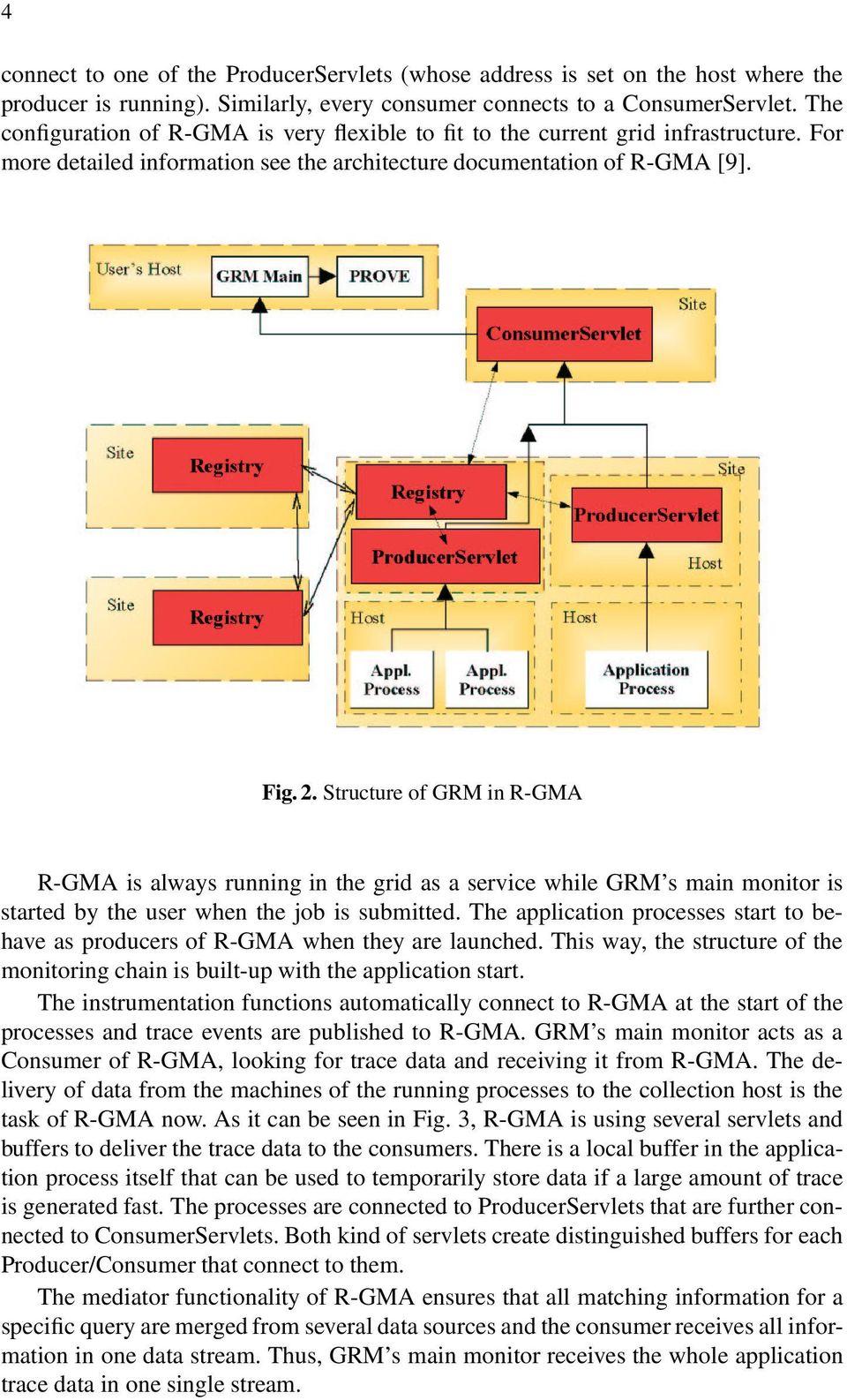
3 3 by GRM itself. If a firewall disables a connection between the components of GRM, the tool is not able to collect trace from the application processes. To solve this problem, a proxy-like solution is needed which enables the connection of two components by making a chain of connections from one of the components towards the other through some hops in the network. Such solution should be a service which is always available in the grid. Instead of creating a new GRM-service, we turned to R-GMA that is a continuously running grid monitoring service and that also can be used to transfer trace data through the network. 3 R-GMA, a Relational Grid Monitoring Architecture R-GMA (Relational Grid Monitoring Architecture, [5]) is being developed as a Grid Information and Monitoring System for both the grid itself and for use by applications. It is based on the GMA concept [6] from Global Grid Forum, which is a simple Consumer-Producer model. The special strength of this implementation comes from the power of the relational model. It offers a global view of the information as if each Virtual Organisation had one large relational database. It provides a number of different Producer types with different characteristics; for example some of them support streaming of information. It also provides combined Consumer/Producers, which are able to combine information and republish it. At the heart of the system is the mediator, which for any query is able to find and connect to the best Producers to do the job. R-GMA is not a general distributed RDBMS but it provides a way of using the relational data model in a Grid environment [7]. All the producers of information are quite independent. It is relational in the sense that Producers announce what they have to publish via an SQL CREATE TABLE statement and publish with an SQL INSERT and that Consumers use an SQL SELECT to collect the information they need. R-GMA is built using servlet technology and is being migrated rapidly to web services and specifically to fit into an OGSA (Open Grid Services Architecture, [8]) framework. It is important to emphasize here that R-GMA is a grid service providing an infrastructure to enable developers to create special producers and consumers for specific tasks and not a tool usable for any purpose (like application monitoring) in itself. 4 Connection of GRM and R-GMA GRM uses R-GMA to deliver trace data from the application process to the machine where the user is running the visualisation tool. The basic structure of the connection can be seen in Fig. 2. The application processes contain the instrumentation library that produces events. The main monitor of GRM is running at the user s host (where PROVE is running as well) and reads trace data from R-GMA. The instrumentation library is a Producer while GRM s main monitor is a Consumer of R-GMA. R-GMA is distributed among several hosts. It consists of servlets: Registry servlets are placed somewhere in the grid providing a fault-tolerant service for publishing information about available producers. Other servlets connect to the registry to find a way to communicate with each other. ProducerServlets are placed on several machines. Any producer of data should

4 4 connect to one of the ProducerServlets (whose address is set on the host where the producer is running). Similarly, every consumer connects to a ConsumerServlet. The configuration of R-GMA is very flexible to fit to the current grid infrastructure. For more detailed information see the architecture documentation of R-GMA [9]. Fig. 2. Structure of GRM in R-GMA R-GMA is always running in the grid as a service while GRM s main monitor is started by the user when the job is submitted. The application processes start to behave as producers of R-GMA when they are launched. This way, the structure of the monitoring chain is built-up with the application start. The instrumentation functions automatically connect to R-GMA at the start of the processes and trace events are published to R-GMA. GRM s main monitor acts as a Consumer of R-GMA, looking for trace data and receiving it from R-GMA. The delivery of data from the machines of the running processes to the collection host is the task of R-GMA now. As it can be seen in Fig. 3, R-GMA is using several servlets and buffers to deliver the trace data to the consumers. There is a local buffer in the application process itself that can be used to temporarily store data if a large amount of trace is generated fast. The processes are connected to ProducerServlets that are further connected to ConsumerServlets. Both kind of servlets create distinguished buffers for each Producer/Consumer that connect to them. The mediator functionality of R-GMA ensures that all matching information for a specific query are merged from several data sources and the consumer receives all information in one data stream. Thus, GRM s main monitor receives the whole application trace data in one single stream.
5 5 Fig. 3. Buffering and delivery of trace data within R-GMA The distinction between the traces of different applications is made by a unique id for each application. This id works as a key in the relational database schema and one instance of GRM is looking for one application with a given id/key. A proper id can be the global job id of the application which is defined by the grid brokering system. Currently, there is no defined way how the instrumentation functions within the application processes can get this id. So, the user should define a unique id for its application in the current version of GRM. After the application is submitted and GRM s main monitor is started, the main monitor connects R-GMA immediately and subscribes for traces with the id of the application. When R-GMA gives a positive response GRM starts continuously reading trace from R-GMA. 4.1 Monitoring of MPI applications As an example, the code of the systest demo application of the MPICH package is instrumented and the generated trace in PROVE is shown. The systest program performs two different tests. In the Hello test each process sends a short message to all the others. In the Ring test, the processes form a ring based on their ranks, the process 0 is connected to process 1 and N-1, where N is the number of processes. Starting from process 0, a messages with ever increasing size are sent around the ring, finally arriving at process 0 again. In the top window of the screenshots in Fig. 4. PROVE presents the full execution. The arrows on the left side of the picture represent the messages of the Hello test while the many arrows in the right side of the picture represent the Ring test. In be-

6 6 tween, the large section with light color represent an artifically inserted sleep statement in the program to make the different phases clearly distinguishable. The bottom left screenshot is the zoom to the left part. In this test each process sent a message to all the others, one by one. The first blocks with light color represent the barrier in the program. Also the triangle symbol representing the start of process P0 can be seen on the left. The blocks with light color on the right are the sleeping section in the processes. The bottom right screenshot shows the right side of the full trace. In this test messages with sizes 1, 2, 4,..., bytes are sent around the processes. The time of the communication is growing with the size of the message. The sending and receiving phases in the processes are distinguished by the alternating lighter and darker blocks. The triangles representing the exit statement in the instrumentation can also be seen on the right side of the picture. Fig. 4. Trace of MPI systest example application 5 Related work R-GMA is deployed within the EU-DataGrid project [2]. Other grid projects are mostly based on MDS [10], the LDAP based information system of Globus but, e.g., the Grid- Lab [11] project is extending the MDS to provide an information system and it is developing a new monitoring system [12]. OGSA [8] specifications and developments also address the issue of information systems and all projects above (including R-GMA)

7 7 will have to redesign their information systems according to OGSA specifications in the future. In the area of application monitoring, the OMIS [13] on-line monitoring interface, developed for clusters and supercomuters (similarly to the case of GRM) is the basis for a grid application monitoring system within the CrossGrid [14] project. Netlogger is used for monitoring distributed applications in the grid rather then for parallel programs. Its time-space visualisation display concept is orthogonal to PROVE. In the vertical axis different types of events are defined while in PROVE the processes of the parallel programs are presented. Netlogger can be used for finding performance/behaviour problems in a communicating group of distributed applications/services while PROVE for a parallel program that is heavily communicating within itself. Netlogger, PROVE and other tools like Network Weather Service and Autopilot has been compared in the beginning of the DataGrid project in detail, see [15]. GRM and R-GMA are the first tools that can be used for on-line monitoring of parallel applications running in the grid. 6 Conclusion R-GMA is a relational Grid Monitoring Architecture delivering the information generated by the resources, services and application processes in the grid. GRM/PROVE is a parallel application monitoring toolset that is now connected to R-GMA. The two systems together can be used for on-line monitoring and performance analysis of messagepassing parallel applications running in the grid environment. 7 Acknowledgement We would like to thank for the efforts of the developers of R-GMA in the EU-DataGrid project helping us to use their system together with GRM to monitor applications. The development of the tools described in this paper has been supported by the following grants: EU DataGrid IST , Hungarian DemoGrid OMFB-01549/2001 and OTKA T References 1. N. Podhorszki. Semi-on-line Monitoring of P-GRADE Applications. PDPC Journal, to appear in EU DataGrid Project Home Page: 3. Z. Balaton, P. Kacsuk, N. Podhorszki, F. Vajda. From Cluster Monitoring to Grid Monitoring based on GRM. Proc. of EuroPar 2001, Manchester, pp GRM User s Manual. Available at 5. S. Fisher et al. R-GMA: A Relational Grid Information and Monitoring System. 2nd Cracow Grid Workshop, Cracow, Poland, B. Tierney, R. Aydt, D. Gunter, W. Smith, V. Taylor, R. Wolski and M. Swany. A grid monitoring architecture. GGF Informational Document, GFD-I.7, GGF, 2001, URL:
![monitoring system within the CrossGrid [14] project. Netlogger is used for monitoring distributed applications in the grid rather then for parallel programs.](/docs-images/45/1240648/images/page_7.jpg "Its time-space visualisation display concept is orthogonal to PROVE. In the vertical axis different types of events are defined while in PROVE the processes of the parallel programs are presented.")
8 8 7. Steve Fisher. Relational Model for Information and Monitoring. GGF Technical Report GWDPerf-7-1, URL: GP-7-1.pdf 8. S. Tuecke, K. Czajkowski, I. Foster, J. Frey, S. Graham, C. Kesselman, and P. Vanderbilt. Grid service specification. GGF Draft Document, 2002, URL: wg papers/draft-ggf-ogsi-gridservice pdf 9. The R-GMA Relational Monitoring Architecture. DataGrid WP3 Report, DataGrid-01-D , 2001, Available at K. Czajkowski, S. Fitzgerald, I. Foster, C. Kesselman. Grid Information Services for Distributed Resource Sharing. Proc. of the Tenth IEEE International Symposium on High- Performance Distributed Computing (HPDC-10), IEEE Press, August GridLab project. URL G. Gombás and Z. Balaton. A Flexible Multi-level Grid Monitoring Architecture. 1st European Across Grids Conference, Universidad de Santiago de Compostela, Spain, Feb T. Ludwig and R. Wismüller. OMIS 2.0 A Universal Interface for Monitoring Systems. In M. Bubak, J. Dongarra, and J. Wasniewski, eds., Recent Advances in Parallel Virtual Machine and Messag Passing Interface, Proc. 4th European PVM/MPI Users Group Meeting, LNCS vol. 1332, pp , Cracow, Poland, Springer Verlag. 14. B. Balis, M. Bubak, W. Funika, T. Szepienic, and R. Wismller. An Infrastructure for Grid Application Monitoring. In D. Kranzlmller, P. Kacsuk, J. Dongarra, and J. Volk ert, editors, Recent Advances in Parallel Virtual Machine and Message Passing Interface, 9th European- PVM/MPI Users Group Meeting, volume 2474 of Lecture Notes in Computer Science, pp , Linz, Austria, September Springer-Verlag. 15. Information and Monitoring: Current Technology. DataGrid Deliverable DataGrid-03-D3.1. URL:

Application Monitoring in the Grid with GRM and PROVE *
 Application Monitoring in the Grid with GRM and PROVE * Zoltán Balaton, Péter Kacsuk and Norbert Podhorszki MTA SZTAKI H-1111 Kende u. 13-17. Budapest, Hungary {balaton, kacsuk, pnorbert}@sztaki.hu Abstract.
SCALEA-G: a Unified Monitoring and Performance Analysis System for the Grid
 SCALEA-G: a Unified Monitoring and Performance Analysis System for the Grid Hong-Linh Truong½and Thomas Fahringer¾ ½Institute for Software Science, University of Vienna [email protected] ¾Institute
Integration of the OCM-G Monitoring System into the MonALISA Infrastructure
 Integration of the OCM-G Monitoring System into the MonALISA Infrastructure W lodzimierz Funika, Bartosz Jakubowski, and Jakub Jaroszewski Institute of Computer Science, AGH, al. Mickiewicza 30, 30-059,
MapCenter: An Open Grid Status Visualization Tool
 MapCenter: An Open Grid Status Visualization Tool Franck Bonnassieux Robert Harakaly Pascale Primet UREC CNRS UREC CNRS RESO INRIA ENS Lyon, France ENS Lyon, France ENS Lyon, France [email protected]
Monitoring and Performance Analysis of Grid Applications
 Monitoring and Performance Analysis of Grid Applications Bartosz Baliś 1, Marian Bubak 1,2,W lodzimierz Funika 1, Tomasz Szepieniec 2, and Roland Wismüller 3,4 1 Institute of Computer Science, AGH, al.
A Survey Study on Monitoring Service for Grid
 A Survey Study on Monitoring Service for Grid Erkang You [email protected] ABSTRACT Grid is a distributed system that integrates heterogeneous systems into a single transparent computer, aiming to provide
Grid environment for on-line application monitoring and performance analysis
 Scientific Programming 12 (2004) 239 251 239 IOS Press Grid environment for on-line application monitoring and performance analysis Bartosz Baliś a, Marian Bubak a,b,, Włodzimierz Funika a, Roland Wismüller
How To Monitor A Grid System
 1. Issues of Grid monitoring Monitoring Grid Services 1.1 What the goals of Grid monitoring Propagate errors to users/management Performance monitoring to - tune the application - use the Grid more efficiently
2. Create (if required) 3. Register. 4.Get policy files for policy enforced by the container or middleware eg: Gridmap file
 Policy Management for OGSA Applications as Grid Services (Work in Progress) Lavanya Ramakrishnan MCNC-RDI Research and Development Institute 3021 Cornwallis Road, P.O. Box 13910, Research Triangle Park,
An approach to grid scheduling by using Condor-G Matchmaking mechanism
 An approach to grid scheduling by using Condor-G Matchmaking mechanism E. Imamagic, B. Radic, D. Dobrenic University Computing Centre, University of Zagreb, Croatia {emir.imamagic, branimir.radic, dobrisa.dobrenic}@srce.hr
Performance Tools for the Grid: State of the Art and Future APART White Paper Version 1.0, 7.01.04
 Performance Tools for the Grid: State of the Art and Future APART White Paper Version 1.0, 7.01.04 Michael Gerndt, Roland Wismüller Institut für Informatik, LRR Technische Universität München Zoltán Balaton,
Collaborative & Integrated Network & Systems Management: Management Using Grid Technologies
 2011 International Conference on Computer Communication and Management Proc.of CSIT vol.5 (2011) (2011) IACSIT Press, Singapore Collaborative & Integrated Network & Systems Management: Management Using
Comparison of Representative Grid Monitoring Tools
 Report of the Laboratory of Parallel and Distributed Systems Computer and Automation Research Institute of the Hungarian Academy of Sciences H-1518 Budapest, P.O.Box 63, Hungary Comparison of Representative
Use of Agent-Based Service Discovery for Resource Management in Metacomputing Environment
 In Proceedings of 7 th International Euro-Par Conference, Manchester, UK, Lecture Notes in Computer Science 2150, Springer Verlag, August 2001, pp. 882-886. Use of Agent-Based Service Discovery for Resource
DiPerF: automated DIstributed PERformance testing Framework
 DiPerF: automated DIstributed PERformance testing Framework Ioan Raicu, Catalin Dumitrescu, Matei Ripeanu Distributed Systems Laboratory Computer Science Department University of Chicago Ian Foster Mathematics
GSiB: PSE Infrastructure for Dynamic Service-oriented Grid Applications
 GSiB: PSE Infrastructure for Dynamic Service-oriented Grid Applications Yan Huang Department of Computer Science Cardiff University PO Box 916 Cardiff CF24 3XF United Kingdom [email protected]
Resource Management on Computational Grids
 Univeristà Ca Foscari, Venezia http://www.dsi.unive.it Resource Management on Computational Grids Paolo Palmerini Dottorato di ricerca di Informatica (anno I, ciclo II) email: [email protected] 1/29
Performance Analysis of Static Load Balancing in Grid
 International Journal of Electrical & Computer Sciences IJECS-IJENS Vol: 11 No: 3 57 Performance Analysis of Static Load Balancing in Grid Sherihan Abu Elenin 1,2 and Masato Kitakami 3 Abstract Monitoring
GAMoSe: An Accurate Monitoring Service For Grid Applications
 GAMoSe: An Accurate ing Service For Grid Applications Thomas Ropars, Emmanuel Jeanvoine, Christine Morin # IRISA/Paris Research group, Université de Rennes 1, EDF R&D, # INRIA {Thomas.Ropars,Emmanuel.Jeanvoine,Christine.Morin}@irisa.fr
CHAPTER 2 GRID MONITORING ARCHITECTURE AND TOOLS USED FOR GRID MONITORING
 10 CHAPTER 2 GRID MONITORING ARCHITECTURE AND TOOLS USED FOR GRID MONITORING This section presents literature survey about Grid computing, Grid standards, Globus Toolkit architecture, Grid monitoring process,
Monitoring Clusters and Grids
 JENNIFER M. SCHOPF AND BEN CLIFFORD Monitoring Clusters and Grids One of the first questions anyone asks when setting up a cluster or a Grid is, How is it running? is inquiry is usually followed by the
MIGRATING DESKTOP AND ROAMING ACCESS. Migrating Desktop and Roaming Access Whitepaper
 Migrating Desktop and Roaming Access Whitepaper Poznan Supercomputing and Networking Center Noskowskiego 12/14 61-704 Poznan, POLAND 2004, April white-paper-md-ras.doc 1/11 1 Product overview In this whitepaper
How To Make A Grid Broker Work With A Grid For A Better Profit
 The evolution of Grid Brokers: union for interoperability ATTILA KERTÉSZ Institute of Informatics, University of Szeged MTA SZTAKI Computer and Automation Research Institute [email protected] Reviewed
Development and Execution of Collaborative Application on the ViroLab Virtual Laboratory
 Development and Execution of Collaborative Application on the ViroLab Virtual Laboratory Marek Kasztelnik 3, Tomasz Guba la 2,3, Maciej Malawski 1, and Marian Bubak 1,3 1 Institute of Computer Science
A System for Monitoring and Management of Computational Grids
 A System for Monitoring and Management of Computational Grids Warren Smith Computer Sciences Corporation NASA Ames Research Center [email protected] Abstract As organizations begin to deploy large computational
Interconnect Efficiency of Tyan PSC T-630 with Microsoft Compute Cluster Server 2003
 Interconnect Efficiency of Tyan PSC T-630 with Microsoft Compute Cluster Server 2003 Josef Pelikán Charles University in Prague, KSVI Department, [email protected] Abstract 1 Interconnect quality
Application of ontologies for the integration of network monitoring platforms
 Application of ontologies for the integration of network monitoring platforms Jorge E. López de Vergara, Javier Aracil, Jesús Martínez, Alfredo Salvador, José Alberto Hernández Networking Research Group,
GENERIC DATA ACCESS AND INTEGRATION SERVICE FOR DISTRIBUTED COMPUTING ENVIRONMENT
 GENERIC DATA ACCESS AND INTEGRATION SERVICE FOR DISTRIBUTED COMPUTING ENVIRONMENT Hemant Mehta 1, Priyesh Kanungo 2 and Manohar Chandwani 3 1 School of Computer Science, Devi Ahilya University, Indore,
CSF4:A WSRF Compliant Meta-Scheduler
 CSF4:A WSRF Compliant Meta-Scheduler Wei Xiaohui 1, Ding Zhaohui 1, Yuan Shutao 2, Hou Chang 1, LI Huizhen 1 (1: The College of Computer Science & Technology, Jilin University, China 2:Platform Computing,
IC2D: Interactive Control and Debugging of Distribution
 IC2D: Interactive Control and Debugging of Distribution Françoise Baude, Alexandre Bergel, Denis Caromel, Fabrice Huet, Olivier Nano, and Julien Vayssière INRIA Sophia Antipolis, CNRS - I3S - Univ. Nice
Developing Scalable Smart Grid Infrastructure to Enable Secure Transmission System Control
 Developing Scalable Smart Grid Infrastructure to Enable Secure Transmission System Control EP/K006487/1 UK PI: Prof Gareth Taylor (BU) China PI: Prof Yong-Hua Song (THU) Consortium UK Members: Brunel University
Enhance UDDI and Design Peer-to-Peer Network for UDDI to Realize Decentralized Web Service Discovery
 Enhance UDDI and Design Peer-to-Peer Network for UDDI to Realize Decentralized Web Service Discovery De-Ke Guo 1, Hong-Hui Chen 1, Xian-Gang Luo 2,Xue-Shan Luo 1, Wei-Ming Zhang 1 1 School of Information
P ERFORMANCE M ONITORING AND A NALYSIS S ERVICES - S TABLE S OFTWARE
 P ERFORMANCE M ONITORING AND A NALYSIS S ERVICES - S TABLE S OFTWARE WP3 Document Filename: Work package: Partner(s): Lead Partner: v1.0-.doc WP3 UIBK, CYFRONET, FIRST UIBK Document classification: PUBLIC
Integrating TAU With Eclipse: A Performance Analysis System in an Integrated Development Environment
 Integrating TAU With Eclipse: A Performance Analysis System in an Integrated Development Environment Wyatt Spear, Allen Malony, Alan Morris, Sameer Shende {wspear, malony, amorris, sameer}@cs.uoregon.edu
Web Service Robust GridFTP
 Web Service Robust GridFTP Sang Lim, Geoffrey Fox, Shrideep Pallickara and Marlon Pierce Community Grid Labs, Indiana University 501 N. Morton St. Suite 224 Bloomington, IN 47404 {sblim, gcf, spallick,
Business Process Management with @enterprise
 Business Process Management with @enterprise March 2014 Groiss Informatics GmbH 1 Introduction Process orientation enables modern organizations to focus on the valueadding core processes and increase
Parallel Processing over Mobile Ad Hoc Networks of Handheld Machines
 Parallel Processing over Mobile Ad Hoc Networks of Handheld Machines Michael J Jipping Department of Computer Science Hope College Holland, MI 49423 [email protected] Gary Lewandowski Department of Mathematics
Web Service Based Data Management for Grid Applications
 Web Service Based Data Management for Grid Applications T. Boehm Zuse-Institute Berlin (ZIB), Berlin, Germany Abstract Web Services play an important role in providing an interface between end user applications
An Open MPI-based Cloud Computing Service Architecture
 An Open MPI-based Cloud Computing Service Architecture WEI-MIN JENG and HSIEH-CHE TSAI Department of Computer Science Information Management Soochow University Taipei, Taiwan {wjeng, 00356001}@csim.scu.edu.tw
A Java proxy for MS SQL Server Reporting Services
 1 of 5 1/10/2005 9:37 PM Advertisement: Support JavaWorld, click here! January 2005 HOME FEATURED TUTORIALS COLUMNS NEWS & REVIEWS FORUM JW RESOURCES ABOUT JW A Java proxy for MS SQL Server Reporting Services
GRIP:Creating Interoperability between Grids
 GRIP:Creating Interoperability between Grids Philipp Wieder, Dietmar Erwin, Roger Menday Research Centre Jülich EuroGrid Workshop Cracow, October 29, 2003 Contents Motivation Software Base at a Glance
A Taxonomy and Survey of Grid Resource Planning and Reservation Systems for Grid Enabled Analysis Environment
 A Taxonomy and Survey of Grid Resource Planning and Reservation Systems for Grid Enabled Analysis Environment Arshad Ali 3, Ashiq Anjum 3, Atif Mehmood 3, Richard McClatchey 2, Ian Willers 2, Julian Bunn
A Performance Study of Load Balancing Strategies for Approximate String Matching on an MPI Heterogeneous System Environment
 A Performance Study of Load Balancing Strategies for Approximate String Matching on an MPI Heterogeneous System Environment Panagiotis D. Michailidis and Konstantinos G. Margaritis Parallel and Distributed
A Model-Based Proxy for Unified IaaS Management
 A Model-Based Proxy for Unified IaaS Management Shixing Yan HP Labs Singapore 1 Fusionopolis Way Singapore 138632 Email: [email protected] Bu Sung Lee HP Labs Singapore, Singapore 138632 & School of Computer
A Contribution to Expert Decision-based Virtual Product Development
 A Contribution to Expert Decision-based Virtual Product Development László Horváth, Imre J. Rudas Institute of Intelligent Engineering Systems, John von Neumann Faculty of Informatics, Óbuda University,
Performance of the NAS Parallel Benchmarks on Grid Enabled Clusters
 Performance of the NAS Parallel Benchmarks on Grid Enabled Clusters Philip J. Sokolowski Dept. of Electrical and Computer Engineering Wayne State University 55 Anthony Wayne Dr., Detroit, MI 4822 [email protected]
2 Transport-level and Message-level Security
 Globus Toolkit Version 4 Grid Security Infrastructure: A Standards Perspective The Globus Security Team 1 Version 4 updated September 12, 2005 Abstract This document provides an overview of the Grid Security
Survey of execution monitoring tools for computer clusters
 Survey of execution monitoring tools for computer clusters Espen S. Johnsen Otto J. Anshus John Markus Bjørndalen Lars Ailo Bongo Department of Computer Science, University of Tromsø September 29, 2003
A SERVICE-ORIENTED APPROACH FOR PERVASIVE LEARNING GRID
 A SERVICE-ORIENTED APPROACH FOR PERVASIVE LEARNING GRID Ching-Jung Liao and Fang-Chuan Ou Yang Department of Management Information Systems Chung Yuan Christian University 22, Pu-Jen, Pu-Chung Li, Chung-Li,
In: Proceedings of RECPAD 2002-12th Portuguese Conference on Pattern Recognition June 27th- 28th, 2002 Aveiro, Portugal
 Paper Title: Generic Framework for Video Analysis Authors: Luís Filipe Tavares INESC Porto [email protected] Luís Teixeira INESC Porto, Universidade Católica Portuguesa [email protected] Luís Corte-Real
AN APPROACH TO DEVELOPING BUSINESS PROCESSES WITH WEB SERVICES IN GRID
 AN APPROACH TO DEVELOPING BUSINESS PROCESSES WITH WEB SERVICES IN GRID R. D. Goranova 1, V. T. Dimitrov 2 Faculty of Mathematics and Informatics, University of Sofia S. Kliment Ohridski, 1164, Sofia, Bulgaria
Grid Technology and Information Management for Command and Control
 Grid Technology and Information Management for Command and Control Dr. Scott E. Spetka Dr. George O. Ramseyer* Dr. Richard W. Linderman* ITT Industries Advanced Engineering and Sciences SUNY Institute
Data Structure Oriented Monitoring for OpenMP Programs
 A Data Structure Oriented Monitoring Environment for Fortran OpenMP Programs Edmond Kereku, Tianchao Li, Michael Gerndt, and Josef Weidendorfer Institut für Informatik, Technische Universität München,
TopoMon: A Monitoring Tool for Grid Network Topology
 TopoMon: A Monitoring Tool for Grid Network Topology Mathijs den Burger, Thilo Kielmann, and Henri E. Bal Division of Mathematics and Computer Science, Vrije Universiteit, De Boelelaan 1081a, 1081HV Amsterdam,
Sisense. Product Highlights. www.sisense.com
 Sisense Product Highlights Introduction Sisense is a business intelligence solution that simplifies analytics for complex data by offering an end-to-end platform that lets users easily prepare and analyze
IBM Business Monitor. BPEL process monitoring
 IBM Business Monitor BPEL process monitoring 2011 IBM Corporation This presentation will give you an understanding of monitoring BPEL processes using IBM Business Monitor. BPM_BusinessMonitor_BPEL_Monitoring.ppt
Analyses on functional capabilities of BizTalk Server, Oracle BPEL Process Manger and WebSphere Process Server for applications in Grid middleware
 Analyses on functional capabilities of BizTalk Server, Oracle BPEL Process Manger and WebSphere Process Server for applications in Grid middleware R. Goranova University of Sofia St. Kliment Ohridski,