
IT'S YOUR MOVE PART I - OUTBOUND
|
|
|
- Stephany McLaughlin
- 10 years ago
- Views:
Transcription
1 out Page 1
2 A. TRAVEL AUTHORIZATION Your post assignment Travel Authorization (TA) contains travel allowances and entitlements for your onward assignment. All telegrams Stay in touch with your regarding your assignment are sent to your post through a HR Technician to specific communication channel of the State Department called encourage prompt the TM (Travel Message) Channel. You will receive a copy from completion of your TA. your HR Technician (Room 4250 SA-3) or your Human Resources Officer (HRO) at post, once your orders are prepared or "cut." An example of a TM Channel communication can be found in Exhibit 1 on page 3. Exhibit 2, on page 6, illustrates a computer generated sample of the TA as received from your HR Technician. A summary of the major areas in the TA is provided below. 1. Assignment Information - The beginning outlines personal information as well as the employee s authorized origin, destination, ETD and ETA- Estimated Time of Departure and Estimated Time of Arrival. 2. Itinerary - The itinerary directs very clearly the order in which the travel is to be performed. These points will be utilized as the basis for any cost construct transportation or travel you desire. The authorized stops will appear as the first few elements in the order to be performed such as: a. Training - This will reflect the dates and location of authorized training as well as whether per diem is authorized. Note that eligible family members (EFM) are only given per diem for certain training such as SOS - the Security Overseas Seminar. b. Consultations - This indicates any consultation points authorized, the number of work days allowed, and whether the employee and EFM are authorized per diem. c. Home Leave - This section indicates if employee is granted home leave. The location authorized will be taken from the employee s most recently approved OF-126, the Foreign Service Residence and Dependency Report. 3. Travel And Effects - This section includes the modes of travel and per diem allowed while in travel status between origin and destination including itinerary stops. It also lists shipment types and weights authorized for this move. 4. Allowances - If employee is eligible for any transfer allowance, they will appear following the travel and effects element. (See Standardized Regulations 240, 250; Page 2

3 EXHIBIT 1 TRAVEL AUTHORIZATION Sample of a TM Channel Communication R Z MAR98 FM SECSTATE WASHDC TO AMEMBASSY ADDIS ABABA AMEMBASSY NAIROBI UNCLAS STATE TM CHANNEL E : N/A TAGS: APER SUBJECT: POST ASSIGNMENT TRAVEL AUTHORIZATION (DOE, JOHN J, FP ) HOME LEAVE/TRANSFER ORDER FROM POST: ADDIS ABABA FROM ORG: TO POST: NAIROBI TO ORG: ETD: 05/1998 ETA: 08/1998 EFM(S): JOHN (SON) (6/12/95) DIPLOMATIC TITLE: ATTACHE TITLE AUTHORIZED FOR THIS POST AND POSITION ONLY EFM AND EMPLOYEE ITINERARY: ADDIS ABABA, ETHIOPIA/ARLINGTON. VA/WASHINGTON, DC/ST. CLOUD, FL/PARIS, FRANCE/NAIROBI, KENYA 1. TRAINING BEGIN DATE: 06/01/1998 END DATE: 06/26/1998 LOCATION: ARLINGTON, VA AUTH DATE: 03/16/1998 EMPLOYEE PER DIEM AUTH DATE: 03/16/1998 TRAVEL MUST BE ARRANGED TO MINIMIZE THE PER DIEM REQUIRED BEFORE AND AFTER AUTHORIZED CONSULTATIONS AND/OR TRAINING. PER DIEM MAY NOT BE PAID FOR MORE THAN TWO CONSECUTIVE NONWORKDAYS IN ORDER TO AVOID TRAVEL ON THE WEEKEND. FOR CONSECUTIVE PERIODS OF CONSULTATION AND TRAINING AUTHORIZED IN THE WASHINGTON, D.C. PER DIEM AREA, CONSULTATIONS MAY EITHER IMMEDIATELY PRECEDE OR FOLLOW AUTHORIZED TRAINING PERIODS, PROVIDED THAT THE COST TO THE GOVERNMENT IS NOT GREATER THAN AS SHOWN. 2. U.S. CONSULTATION LOCATION: WASHINGTON, DC AUTH DATE: 03/16/1998 EMPLOYEE PER DIEM AUTH NO. OF DAYS: 5 WORKDAYS Page 3

4 EXHIBIT 1 TRAVEL AUTHORIZATION Sample of a TM Channel Communication (Cont d) AUTH DATE: 03/16/1998 EFM PER DIEM AUTH DATE: 03/16/1998 EMPLOYEE'S ELIGIBLE FAMILY MEMBERS MUST ACCOMPANY THE EMPLOYEE TO THE AUTHORIZED CONSULTATION AND/OR TRAINING LOCATION IN ORDER TO QUALIFY FOR THE PER DIEM. CONSULTATION MAY BE PERFORMED PRIOR TO, DURING OR AFTER HOME LEAVE ON THE CONDITION THAT THE COST TO THE GOVERNMENT DOES NOT EXCEED THE COST WHICH WOULD HAVE BEEN INCURRED HAD THE CONSULTATION BEEN PERFORMED AS AUTHORIZED ABOVE. PER DIEM IS AUTHORIZED FOR INTERVENING WEEKENDS BETWEEN CONSULTATION AND TRAINING AND/OR BETWEEN TRAINING PERIODS. 3. HOME LEAVE LOCATION: ST. CLOUD. FL AUTH DATE: 03/16/ OVERSEAS CONSULTATION LOCATION: PARIS. FRANCE AUTH NO. OF DAYS: 2 WORKDAYS AUTH DATE: 03/16/ TRANSFER TRAVEL AND EFFECTS AUTH DATE: 03/16/1998 AIR FARE AUTH DATE: 03/16/1998 EMPLOYEE PER DIEM AUTH DATE: 03/16/1998 EFM PER DIEM AUTH DATE: 03/16/1998 SHIPMENT OF UAB AUTH AMOUNT: 450 LBS./204 KGS. AUTH DATE: 03/16/1 998 SHIPMENT OF HHE AUTH AMOUNT: 7200 LBS./3265 KGS. AUTH DATE: 03/16/1998 SHIPMENT OF POV AUTH AMOUNT: 1 UNIT AUTH DATE: 03/16/1998 TEMPORARY STORAGE AUTH DATE: 03/16/1998 PLACEMENT INTO PERMANENT STORAGE STORAGE LOCATION: ANTWERP (ELSO) AUTH DATE: 03/1 6/1 998 IF MORE EFFECTS ARE SHIPPED THAN CAN BE USED IN QUARTERS LEASED, THE DEPARTMENT CANNOT AUTHORIZE CONTINUING STORAGE AFTER SHIPMENT AT GOVERNMENT EXPENSE. IN CONNECTION WITH AIR TRAVEL, RELATED GROUND TRANSPORTATION IS AUTHORIZED IN ACCORDANCE WITH-14 FAM 560/561. THE TOTAL COMBINED NET WEIGHT OF ALL EFFECTS SHIPPED AND STORED MAY NOT EXCEED TOTAL ALLOWANCE OF 18,000 POUNDS OR 8,163 KILOGRAMS. UAB MAY BE SHIPPED TO ANY AUTHORIZED STOP OVER POINT OR DESTINATION. Page 4

5 EXHIBIT 1 TRAVEL AUTHORIZATION Sample of a TM Channel Communication (Cont d) ACCESS TO, SEGREGATION, AND REMOVAL OF A PORTION OF EFFECTS IN CONTINUING STORAGE FOR SHIPMENT TO A NEW DUTY STATION IS AUTHORIZED, NOT TO EXCEED ONE TIME PER STORAGE LOT. REMAINDER OF EFFECTS MUST EXCEED 200 LBS. NET WEIGHT FOR CONTINUING STORAGE AT GOVERNMENT EXPENSE. THE PERSONAL AND HOUSEHOLD EFFECTS OF THIS EMPLOYEE AND MEMBERS OF THE EMPLOYEE'S FAMILY ARE ELIGIBLE FOR DUTY-FREE ENTRY UNDER SUBHEADING HARMONIZED TARIFF SCHEDULE OF THE UNITED STATES (HTSUS), SINCE THE EMPLOYEE HAS COMPLETED AN ASSIGNMENT OF EXTENDED DUTY ABROAD. AUTHORITY FOR TEMPORARY STORAGE AT GOVERNMENT EXPENSE WILL TERMINATE THREE MONTHS AFTER REPORTING FOR DUTY AT STATION OF DESTINATION. 6. FOREIGN TRANSFER ALLOWANCE MISC. EXPENSE AUTH DATE: 03/16/1998 1) REIMBURSEMENTS WILL BE MADE ON A COST CONSTRUCTED BASIS IF THE EMPLOYEE DEVIATES FROM WHAT IS AUTHORIZED ON THIS TRAVEL AUTHORIZATION. REIMBURSEMENTS ARE NOT TO EXCEED THE TOTAL COST OF PER DIEM, TRAVEL. AND INCIDENTAL EXPENSE WHICH WOULD HAVE BEEN INCURRED HAD THE EMPLOYEE PERFORMED HIS/HER TRAVEL IN ACCORDANCE WITH THE AUTHORIZATION. 2) TRAVEL VOUCHER MUST BE SUBMITTED WITHIN SEVEN WORKING DAYS AFTER COMPLETION OF TRAVEL TO FINAL DESTINATION. A COPY OF THIS AUTHORIZATION MUST BE ATTACHED. 3» ALL LIQUIDATIONS AGAINST THIS TRAVEL AUTHORIZATION MUST BE RECORDED USING VALID BUDGET OBJECT CODES INDICATING THE SPECIFIC TYPE OF EXPENSE AS CONTAINED IN THE FINANCIAL MANAGEMENT HANDBOOK (4 FAH). 4> ACTUAL TRAVEL OF THE EMPLOYEE MAY BE PERFORMED IN THE MONTH BEFORE OR AFTER THE OFFICIAL ETD AND ETA, SUBJECT TO THE APPROVAL OF THE LOSING AND GAINING ORGANIZATIONS AND ANY SPECIFIC REQUIREMENTS CONTAINED IN THIS TRAVEL AUTHORIZATION. 5) THE TIME LIMITATION FOR ALL TRAVEL AND TRANSPORTATION SHALL NOT EXCEED ONE YEAR AFTER EMPLOYEE'S ARRIVAL FOR DUTY. TA NO:2025XXXXXX TA DATE: 3/16/98 FUNCTION CODE: POST TO POST WITH HOME LEAVE APPROP: AMOUNT: TRAVEL REGULATION: FAM/FAH ALLOWANCE REGULATION: STANDARDIZED REQUESTOR OFFICE: PER/CDA/ASD APPROVER OFFICE: PER/BUD/PAT AUTH OFFICER: EDWARD W. GNEHM, JR., DIRECTOR GENERAL; ALBRIGHT Page 5

6 EXHIBIT 2 TRAVEL AUTHORIZATION Sample of a Computer Generated TA U. S. Department of State Home Leave/Transfer Order 03/17/1998 Name: John J. Doe SSN: From Post: ADDIS ABABA From ORG: To Post: NAIROBI ToORG: ETD: 05/1998 ETA: 08/1998 EPM(S): James(SON) (6/13/93) DIPLOMATIC TITLE: ATTACHE TITLE AUTHORIZED FOR THIS POST AND POSITION ONLY EFM AND EMPLOYEE ITINERARY: ADDIS ABABA, ETHIOPIA/ARLINGTON, VA/WASHINGTON, DC/ST. CLOUD, FL/PARIS, FRANCE/NAIROBI, KENYA 1. Training Begin Date: 06/01/1998 End Date: 06/26/1998 Location: ARLINGTON, VA Auth Date: 03/16/1998 Employee Per Diem Auth Date: 03/16/1998 Travel must be arranged to minimize the per diem required before and after authorized consultations and/or training. Per diem may not be paid for more than two consecutive non-workdays in order to avoid travel on the weekend. For consecutive periods of consultation and training authorized in the Washington, D.C. per diem area, consultations may either immediately precede or follow authorized training periods, provided that the cost to the government is not greater than as shown. 2. U.S. Consultation Location: WASHINGTON, DC Auth Date: 03/16/1998 Auth No. of Days: 5 Workdays Employee Per Diem Auth Date: 03/16/1998 EFM Per Diem Auth Date: 03/16/1998 Employee's eligible family members must accompany the employee to the authorized consultation and/or training location in order to qualify for the per diem. Page 6

7 EXHIBIT 2 TRAVEL AUTHORIZATION Sample of a Computer Generated TA (Cont d) U. S. Department of State Consultation may be performed prior to, during or after home leave on the condition that the cost to the government does not exceed the cost which would have been incurred had the consultation been performed as authorized above. Per Diem is authorized for intervening weekends between consultation and training and/or between training periods. 1. Home Leave Location: ST. CLOUD FL Auth Date: 03/16/ Overseas Consultation Location: PARIS. FRANCE Auth No. of Days: 2 Workdays Auth Date: 03/16/ Transfer Travel and Effects Auth Date: 03/16/1998 Air Fare Auth Date: 03/16/1998 Employee Per Diem Auth Date: 03/16/1998 EFM Per Diem Auth Date: 03/16/1998 Shipment of UAB Auth Amount: 450 lbs./204 kgs. Auth Date: 03/16/1998 Shipment of HHE Auth Amount: 7200 lbs./3265 kgs. Auth Date: 03/16/1998 Shipment of POV Auth Amount: 1 unit Auth Date: 03/16/1998 Temporary Storage Auth Date: 03/16/1998 Placement into Permanent Storage Storage Location: Antwerp (ELSO) Auth Date: 03/16/1998 If more effects are shipped than can be used in quarters leased, the department cannot authorize continuing storage after shipment at government expense. Page 7

8 EXHIBIT 2 TRAVEL AUTHORIZATION Sample of a Computer Generated TA (Cont d) U. S. Department of State In connection with air travel, related ground transportation is authorized in accordance with 14 FAM 560/561. The total combined net weight of all effects shipped and stored may-not exceed total allowance of 18,000 pounds or 8,163 kilograms. UAB may be shipped to any authorized stop over point or destination. Access to, segregation, and removal of a portion of effects in continuing storage for shipment to a new duty station is authorized, not to exceed one time per storage lot. Remainder of effects must exceed 200 Ibs. net weight for continuing storage at government expense. The personal and household effects of this employee and members of the employee's family are eligible for dutyfree entry under subheading , harmonized tariff schedule of the United States (HTSUS), since the employee has completed an assignment of extended duty abroad. Authority for temporary storage at government expense will terminate three months after reporting for duty at station of destination. 4. Foreign Transfer Allowance Misc. Expense Auth Date: 03/16/1998 1) Reimbursements will be made on a cost constructed basis if the employee deviates from what is authorized on this travel authorization. Reimbursements are not to exceed the total cost of per diem, travel, and incidental expense which would have been incurred had the employee performed his/her travel in accordance with the authorization. 2) Travel Voucher must be submitted within seven working days after completion of travel to final destination. A copy of this authorization must be attached. 3) All liquidations against this travel authorization must be recorded using valid budget object codes indicating the specific type of expense as contained in the Financial Management Handbook (4 FAH). 4) Actual travel of the employee may be performed in the month before or after the official E l D and ETA, subject to the approval of the losing and gaining organizations and any specific requirements contained in this travel authorization. 5) The time limitation for all travel and transportation shall not exceed one year after employee's arrival for duty. TANo: 2025 XXXXXX TA Date: 03/16/1998 Function Code: Post to Post with Home Leave Approp: Amount: $26, Travel Regulation: FAM/FAH Allowance Regulation: Standardized Requester Office: PER/CDA/ASD Approver Office: PER/BUD/PAT Auth Officer: Edward W. Gnehm, Jr., Director General Page 8

9 5. Overall Remarks - Remarks that apply to the entire travel authorization, including the applicable time limitation, appear in this section. 6. Authorization and Fiscal Data - The authorization section provides the fiscal data chargeable, the estimated amount, the authorizing regulations, and authorizing official. The TA number field is ten digits and contains both the allotment (first four numbers) and obligation (last six numbers). Note that the organization code appears with the To Post section in the assignment information at the beginning of the orders. Keep a copy of your TA with you at all times. 1. Plane tickets, travel advances, shipment of effects and POV are all authorized by the Travel Authorization (Orders). B. OUTBOUND TRANSPORTATION 1. Visit the Transportation Division at SA/3 Suite 5100; 2121 Virginia Avenue by the CVS, or at the National Foreign Affairs Training Center (NFATC)-Room E-1113, or your post's Shipping Section to start the process and schedule your move. Or, log on to WEBMOVE. (please see the first page of It s Your Move and Part I page 21.) a. If leaving a post in the U.S., see your Transportation Counselor (TC) in S/A 3 Suite 5100 or telephone your TC at or (Your TC is assigned to you based on the region to which you are posted). If you are leaving a post abroad, make an appointment with your General Services Officer (GSO). You should provide your TC or Book your move as early as possible even before you have orders. Stay in close touch with your Transportation Counselor(TC). 4) Be sure that the TC has your GSO with an extra copy of your orders, and discuss your plans for this move. Specifically bring up the following topics: 1) The date of your pack-out; (Please try not to change the date during the summer season.) 2) The number of shipments you plan to make, and from where (include household effects (HHE), air freight (UAB), consumables, vendor items-if absolutely necessary, and shipments from storage); 3) Your plans for shipping an automobile, and from where; What storage lots you have currently and what you might wish to take out to send overseas. Though neither is guaranteed, you might wish to establish if controlled storage is available and IF it is possible to put anything into storage. 5) Contact information for reaching you before and after pack-out. contact number. b. Your TC will record the information outlined above. Packers will be selected through our computerized allocation system. You Page 9

10 will be notified within a couple of days of the packer who will handle your move. (If a history of difficulties with a particular company has been clearly established, discuss the possibility of using an alternate company.) Overseas, your GSO will usually arrange for packer selection. c. If you are planning to ship a car from the U.S., obtain Form JF-49, the Vehicle Shipment Form ( ), and the Environmental Protection Agency (EPA) letter to enable you to get your catalytic converter removed, if necessary. (The JF- 49 and instructions can be found inserted in this book. The EPA letter is available from Transportation-Suite 5100 SA/3; 2121 Virginia Avenue.) d. If your effects are outside the Washington area, call Transportation at to arrange your pack-out with a TC who will allocate a local packing company to handle your move. Record the name and contact information (telephone/fax/ ) of your Transportation Counselor (TC) or GSO for future reference. 2. Understanding Your Household Effects Shipment a. Once you have been advised of the company performing your move, you should contact them to arrange a convenient time for them to conduct a pre-pack survey. During this survey be sure to discuss any specific concerns you may have such as fragile items. Some packers are reluctant to pack alcohol and some household items cannot be packed for export as they are classified as hazardous materials. You should contact your Transportation Counselor for assistance should you and the packer disagree. At this time, the company will provide weight estimates. b. It is strongly recommended that you arrange for private insurance covering loss, damage and replacement value for your household effects (shipped and stored). You cannot insure anything after it has left your possession. The Overseas Briefing Center at FSI has insurance brochures. Also see Page 65 for names of insurance companies with web addresses for reference. c. Your packing dates will be arranged for you at the time the shipment is allocated. If you need to change the pack-out date, you must contact your TC to make these arrangements. At posts abroad, coordinate your pack-out dates with your GSO who interfaces with the Always get back to the same TC. Before starting to plan your move, find out as much about post as possible. Page 10

11 Unless you schedule very early, it is most difficult to reserve time the last weeks in June, July or August. post's packers. Three days before pack-out, you may need to contact the local police to reserve space for the moving van to park conveniently. d. 1) Schedule a pre-pack survey directly with the packer in the U.S., or through your GSO at post abroad. The estimator will come to your residence and estimate the weight of your air freight, household effects, and storage shipments. This estimate also helps the packer determine what materials will be needed to pack your effects quickly and efficiently. Make sure the estimator is aware of EVERYTHING you are going to ship or store, including items in the attic. Please note that packing companies are not required to remove items from any area that does not have permanent stairs or where they cannot stand erect e.g. attics or crawl spaces. Call to the estimator s attention any items that will need special crating. (Crating must be approved by Transportation or by the GSO.) This will enable the estimator to add the extra weight to his estimate which is not binding. You will ultimately be responsible for any actual overweight in your final shipments. If the estimate is close to your weight allowance limit, you should consider disposing of some items before pack-out day. Expect something to go wrong. Plan extra time to fix it. Do not plan to go directly from pack-out to the airport. 2) Schedule packing dates through your TC or GSO. Try not to schedule your pack-out too close to your departure date to allow for unanticipated problems which might force you to re-schedule. The person(s) who planned the details of the move should be present to supervise the movers and to answer questions. With the permission of your supervisor, you may be authorized 16 hours administrative leave for pack-out. In exceptional circumstances, where the need for additional time can be documented, a supervisor may (not must) grant up to 16 additional work hours for packing according to 3 FAH-1H ( e. Your TC will issue all necessary documentation to the packing company before your scheduled pack-out date provided that the TA and other authorizations have been received by Transportation. Any date changes MUST be made through your Transportation Counselor. If the Travel Authorization (TA) is not issued 5 days prior to your pack-out date, the move will be cancelled until the TA is issued. 3. Air Freight/Unaccompanied Air Baggage (UAB) a. Shipping Air Freight - In addition to the luggage taken on your flight (accompanied baggage), you are also entitled to unaccompanied air baggage (UAB), or "air freight." Air freight is shipped separately from your household effects and storage shipments. You may ship UAB to your home leave point, as well as to TDY and consultation points in some situations. From these points, you may forward it to your authorized destination. (UAB is also authorized for travel on a Separate Maintenance Allowance -14FAM ; ). Page 11

12 b. Pack the essentials - For your UAB shipment, consider clothing, toiletries, and essential light housekeeping items, such as pots, pans, unbreakable dishes, sheets, and blankets that you will need immediately upon arrival. (Keep in mind that due to host country customs regulations, it may actually be several weeks before you see your UAB.) Air freight is not meant to include large To track your UAB, get the household items such as furniture, major appliances or roomsized rugs which will not fit easily into the cargo hold of an Airway Bill of Lading (ABL) number from the packer or your Transportation airplane. (The tri-wall packing carton measures Counselor. approximately 3 x2 x2.) Nor may it include hazardous materials, liquor, ammunition, guns or aerosol cans. However, even if air freight can be damaged by rough loading and unloading, computers, televisions and other electronic equipment may be included in UAB. If possible, these items should be packed in original cartons that protect best. Furthermore, the Department will accept claims through the USG Claims Act for damage to fragile electronic items in UAB. The air freight allowance must be used within 30 days of the last traveler s arrival at post. Authorized air freight allowances for employees and family members are as follows: First person traveling Second person traveling Third person traveling Each additional person traveling Gross Weight 250 lbs 200 lbs 150 lbs 100 lbs If you do not use your entire air freight allowance, you may add the unused weight allowance to your HHE shipment. In UAB, pack a small tool kit and equipment for hanging pictures hooks, nails and braces for various sizes of pictures. NOTE: Allow 15 lbs. per box for wrapping and "banding your UAB. Your allowance is the gross weight which includes packing materials. If you exceed your limit, you must either pay for the excess or remove items. Your UAB will NOT be moved until the excess weight has been dealt with. c. Layette Shipments: - If posted abroad, a separate air freight allowance of up to 250 pounds is available for the layette shipment for the child of an employee assigned to a post where suitable layettes are unavailable. The post of assignment must determine that appropriate items are not available, confirming this by a cable to HR/EX/ASU. This allowance covers shipment of appropriate clothing, blankets, small furnishings and other equipment for the care and feeding of an infant or young child. Foodstuffs, except for milk, formula, and commercial baby food, may not be shipped under this allowance. A layette may be shipped up to 120 days before the expected birth of the child, but no later than 60 days after the birth or adoption of a child up to five years of age. An infant will not be authorized both a layette and an air freight shipment. (14 FAM 613.5; Page 12 Remember that the scales used to weigh UAB cannot be calibrated and thus are not totally

13 EXHIBIT 3 SUGGESTIONS FOR UAB Address book Alarm clock Baby equipment Bath towels Calling cards/business cards Can opener Candles and holders Clothing needed before household effects arrive including hangers Cookbook Corkscrew Computer; laptop; printer Cosmetics Dish draining rack, rubber mat Dish towels and cloths Double boiler Egg beater Extension cords and plugs Flashlight and batteries Funnel Hand towels Iron Kitchen knives, stirring spoons, meat fork, spatula Measuring cups and spoons Napkins Non-breakable plates and glasses Note-sized stationery Paper clips Pet equipment Pillows and pillowcases Placemats Plastic bags Plastic ice cube trays Plastic pitchers, mixing bowls, refrigerator containers Plastic scrub pans Pot holders Pots, pans, cookie sheets Rope/clothesline and pins Rubber gloves Salt and pepper shakers Scotch tape Scouring pads Seasonal decorations: Hallowe en, Thanksgiving, Christmas, etc. Sewing kit and scissors Sheets, blankets Shower curtain and rings Sieve Silverware Small appliances: toaster, coffee pot, blender and transformer Small lamp Small tape recorder, tapes Spices and condiments Sponges Stationary (for personal use) Stapler and staples Tool kit: hammer, pliers, nails, screws, screwdriver Toys, games, books, playing cards Washcloths (Usually, post also has a Welcome Kit from which some items may be borrowed. For other UAB suggestions, see Chapters 11 and 15 of Foreign Service Assignment Notebook: What Do I Do Now? Please see Foreword. Page 13

14 4. Household Effects (HHE) Shipment a. Types of Shipments - Plan your shipment of household effects based on conditions cited in the Post Report, information you receive from other employees assigned to your post, from your own TA and from the TMTHREE from post. You will make decisions on what effects to store or ship according to the type of quarters you will be occupying at your post. Verify through the Post Report and your HR Technician whether you will be occupying furnished or unfurnished housing. The majority of posts are furnished and allow limited shipments of 7,200 lbs. Overall, you are entitled to a combined shipping and storage allowance of 18,000 pounds regardless of family size or employee rank. This is a statutory limit. This allowance is subject to the following criteria: 1) Limited Shipments - If you are being assigned to government furnished quarters, it will already be equipped with sufficient furniture and major appliances to meet U.S. standards of living. Thus, you will be authorized a limited shipment of 7,200 pounds of household effects. If you are coming from a full-shipment post or from the U.S., you may ship to storage the remainder of your effects over 7,200 pounds, up to the 18,000-pound overall limit, at government expense. If you are going from a limited shipment post to a limited shipment post, your total shipping allowance is 7,200 lbs. This may be shipped post-to-post, post to storage, storage to post, or any combination of the three, so long as the shipment from post does not exceed 7,200 lbs. and the total of shipments sent to post does not exceed 7,200 lbs. Less is better. Overseas, dwellings tend to Usually, furnished quarters cannot accommodate 7,200 pounds of effects. Make a first shipment below that have limited or no amount and consider augmenting your effects after storage space. arrival at post, based on your needs and space limitations. Check with the post to be sure host country regulations allow a supplemental shipment. (See page 53 How to Make More than One Shipment. ) If you do ship more than will fit into your new home, and the excess has to be stored at post, that storage will be at your expense. The Government will not pay to store household effects at post when it has already paid to ship them for your use. In addition, if you go on to another limited shipment post after having shipped the entire 7,200 pounds, you may have to offset the weight of goods you acquired at post by disposing of some items originally shipped to post (Exhibit 4 on page 15 gives approximate HHE article weights). Page 14

15 EXHIBIT 4 AVERAGE NET WEIGHT PER ARTICLE 14 FAM Exhibit ; Living Room Stereo Equipment: Bench 35 Cassette Deck 20 Bookcase - Solid Wood 125 CD Player 35 Bookshelves, Sectional 25 Speaker 40 Cabinet 50 Tuner/Amplifier 45 Chair: LP Turntable 25 Arm 50 Table: Occasional 50 Coffee, End or Nest 35 Overstuffed 90 Drop-leaf 85 Rocker 50 Library 150 Straight 20 Occasional 85 Clock, Grandfather 100 Television: Desk: Console 160 Small 100 Portable 40 Secretary 200 Table Model 65 Winthrop 100 Floor Lamp 20 Dining Room Footstool 10 Buffet Chair 35 Piano: Chinaware (per cubic foot) 12 Baby Grand 500 China Cabinet 175 Concert Grand 1,000 Corner Cabinet 140 Upright 650 Rug: Large 70 Radio: Small 20 Portable 10 Rug Pad: Table 15 Large 40 Rug: Small 15 Large 70 Server 100 Small 20 Table, Extension 210 Sofa: Tea Cart Cushion Cushion 200 Bedroom Hide-a-bed 175 Bed, Springs & Mattress: Studio Couch 150 Bunk (set of 2) 150 Page 15

16 EXHIBIT 4 AVERAGE NET WEIGHT PER ARTICLE (Cont d) Bedroom (Cont d) Play Pen 35 Single 125 Rug: Double 150 Large 70 King Size 225 Small 20 Table 35 Bench: Toy Chest 25 Dresser 30 Vanity 25 Kitchen Chair: Cabinet: Boudoir 40 Kitchen 200 Rocker 25 Utility 70 Straight 75 Chair 25 Chaise Longue 75 Ironing Board 15 Chest of Drawers 175 Roaster 35 Chiffonier (tall narrow chest) 175 Stool 10 Dresser 175 Table: Night Table 35 Breakfast 70 Rug: Utility 35 Large 70 Small 20 Appliances (Large) Rug Pad: Air Conditioner, Window 210 Large 40 Dehumidifier 60 Small 15 Dishwasher 140 Vanity 175 Dryer, Electric or Gas 175 Wardrobe: Freezer: Large cubic feet or less 210 Small cubic feet cubic feet and over 420 Nursery Range, Electric or Gas 210 Bathinette 35 Refrigerator: Bed cubic feet or less 210 Chair: 7-10 cubic feet 315 Child's cubic feet and over 420 High 25 Sewing Machine in console 100 Chest of Drawers 85 Sewing Machine, Portable 25 Crib 70 Washing Machine 200 Page 16
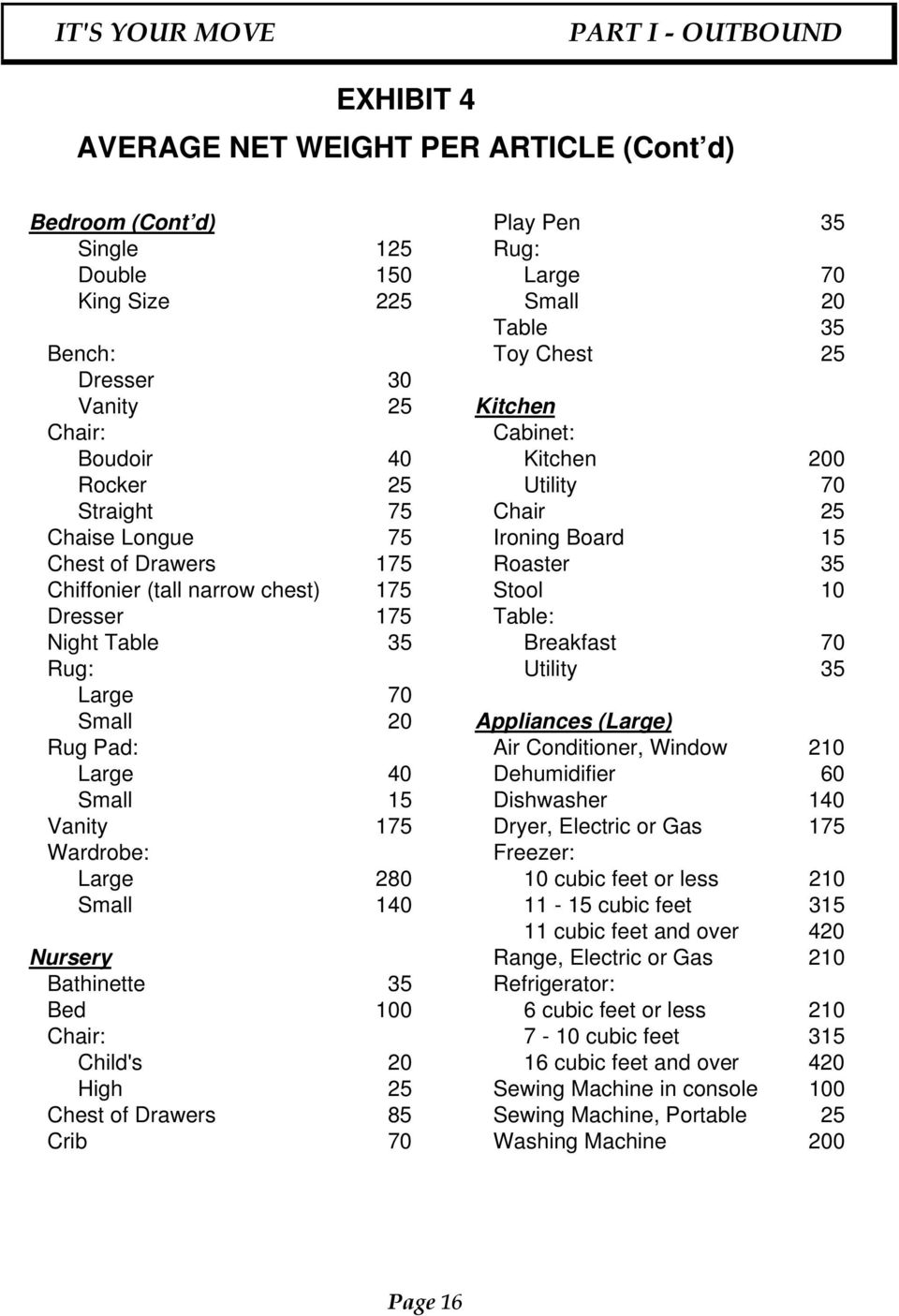
17 EXHIBIT 4 AVERAGE NET WEIGHT PER ARTICLE (Cont d) Porch, Outdoor Furniture Carriage: and Equipment Baby 75 Bench, Picnic 35 Doll or Folding 35 Bird Bath 35 Carton: Chair: Books (per cubic foot) 25 Lawn 20 Clothing 40 Porch 35 Linens 65 Grill or Barbecue 40 Clothes Hamper 10 Gym Set, Outdoor, Child's 140 Electric Fan 35 Rug: Filing Cabinet 140 Large 70 Golf Bags with Clubs 40 Small 20 Heater, Gas or Electric 35 Sand Box 50 Hose, Garden and Tools 70 Settee (sofa w. arms/back) 100 Ladder: Slide, Outdoor, Child's 70 Extension 45 Swing, Outdoor 210 Step 25 Table: Mower: Picnic 140 Hand 35 Utility 70 Power 75 Umbrella, Outdoor 35 Sled 15 Tool Chest 100 Miscellaneous Trash Can 15 Bed: Tricycle 25 Day 135 Vacuum Cleaner 35 Roll away 100 Wagon 35 Bicycle 50 Wheelbarrow 50 Bird Cage and Stand 35 Packing yourself: - Do NOT pack your own personal effects. Due to heightened security concerns, our contracts, tenders and agreements with providers prohibit them from accepting for shipment any boxes or packages labeled packed by owner or contents unknown. A shipping inventory with items so described is an immediate red flag for inspection by U.S. Customs, Department of Agriculture, or foreign governments customs officials who have the authority to delay a shipment pending inspection and determination of a shipment s contents. In addition, the transportation service providers will not accept any liability for loss of or damage to an unknown item. Claims will not be paid for such items. Page 17
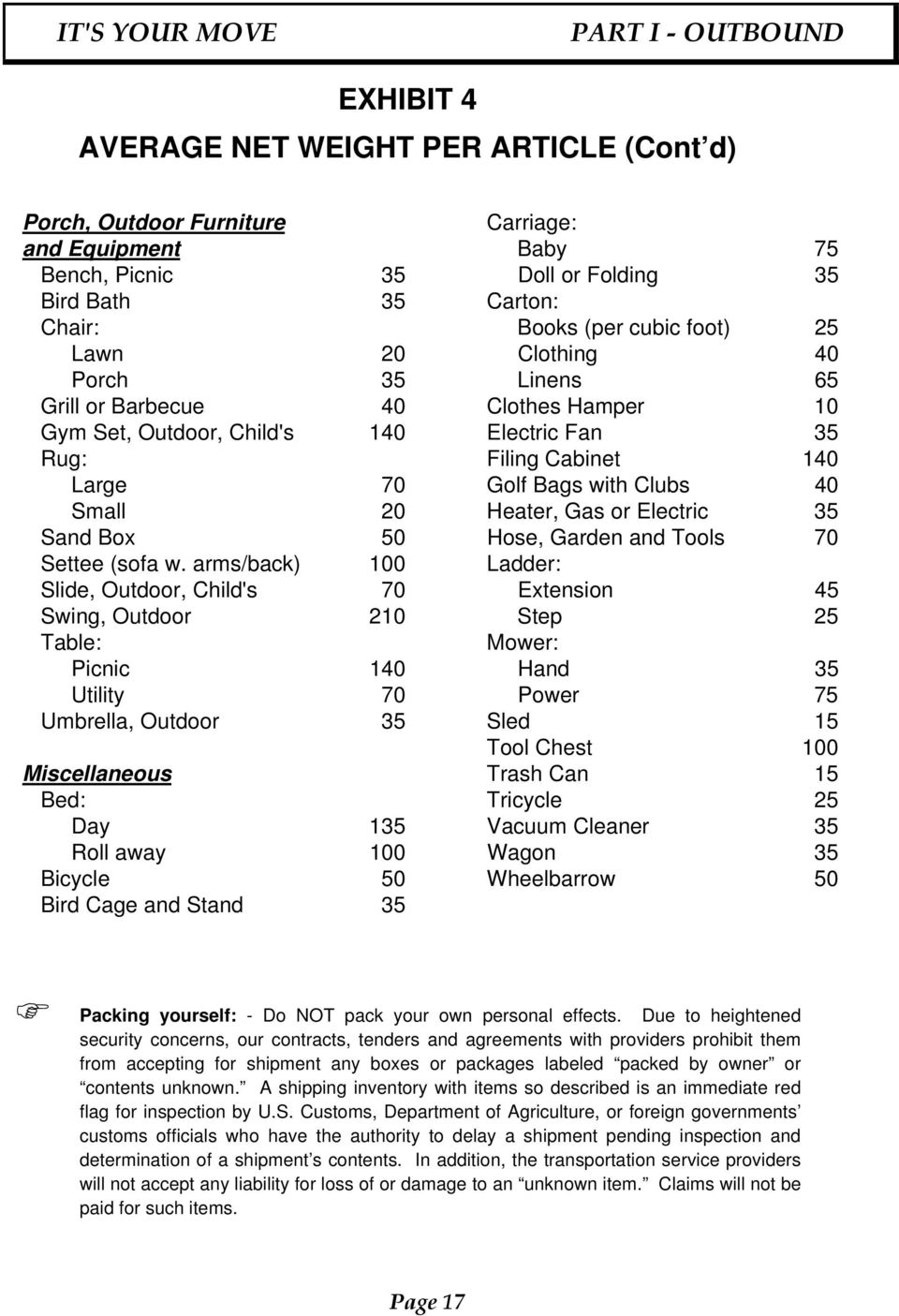
18 2) Full Shipment - If you are being assigned to an unfurnished post, your combined shipping and storage allowance is also 18,000 pounds; however, you may ship as much of your allowance as you require. If, for instance, you require 10,000 pounds of effects at post, you may ship that amount and store up to 8,000 pounds. If you require the full 18,000 pounds at post, you may ship that amount and store nothing. The important thing to remember is that the combined total of what you ship and what you store may not exceed 18,000 pounds. Again, as noted above, in the case of furnished quarters, you are encouraged to ship conservatively and augment your effects after you are settled in your new home to avoid paying storage expenses for excess household goods. You will also avoid living with excess goods since many post do not have commercial storage facilities. DO NOT PACK your HHE, UAB or storage. Movers cannot accept responsibility for cartons labeled Packed by owner or contents unknown. b. Definition of Household Effects (HHE) (14 FAM 611.5); HHE means furniture, and household and personal effects, including automotive spare parts, (tires, tubes, and accessories) for the use of you and your family. HHE does not include boats, boat trailers, aircraft, animals, birds, plants, ammunition, construction material, propane gas tanks even empty and any items in commercial quantities. These are prohibited items and cannot be part of your HHE. Snowmobiles and trailer, jet skis and trailer, ATVs and trailer, motorcycles, moped and golf carts may be included with HHE. Especially for motorcycles and mopeds, start by determining that your new host country permits their importation.. c. High value Items - Separate attention should be given to high value items. A high value item is an article which individually (not as part of a set) is worth more than $1,000. A high value item derives its value from its uniqueness and its quality. Thus, a sofa that is worth $1,000 is not a high value item and does not have to be listed. However, an unusual porcelain plate (value: $1,000) is a high value item. You may include such high value items in your HHE shipment. However, you are encouraged to hand-carry easily pilfered high-value items such as jewelry or coins. Regardless of the manner of shipment/storage, you must declare all high value items in writing at the time of making arrangements for shipment. You should provide a detailed list of your high value items with their estimated values, and attach it to a DS Form 1620 which is available on the INTRANET at: This form may be also be obtained from your GSO or from the State Department Claims Office (A/LM/OPS/TTM/CL) in Suite 5100 S/A 3; 2121 Virginia Avenue by CVS. Fill out the top of the form, and in the space for "Date, Place, Facts " note "High Value Inventory"; attach your list to the DS Send your form and list to A/LM/OPS/TTM/TO or give it to your GSO to forward to A/LM/OPS/TTM/TO-Claims. You may also the list to: Claims Use a video camera to record the existence of valuable items. For safekeeping of pictures, store them in an electronic format. On moving day, keep pilferable valuables out of sight. Page 18
19 Query (on Global ) or video-tape your valuables and provide a voice-over description. Keep a copy for yourself. Unless you provide this declaration, the loss or damage of high value items may be disallowed in the settlement of a claim against the USG. d. Shipment of Firearms: Outbound and Inbound (14 FAM ) 1) If you plan to ship firearms to a post abroad - Review the Post Report for any restrictions on imports and procedures to follow to import your gun(s) into the host country. If the Post Report does not answer this question, check with your future post's Administrative Section especially the Regional Security Officer or the GSO. When departing from the U.S., register any firearms you plan to take abroad with the U.S. Customs and Border Patrol (CBP) using Customs Form 4457 which can be downloaded at The weapon must be taken to an airport Cargo Office for verification of your identification and registration of the weapon s serial number. You may also call Customs at for information on registering your weapons. 2) If you plan to ship firearms to the U.S You may re-import any firearms that you can prove were originally shipped from the United States. Methods of proof are: Bill of sale, receipt or other commercial document showing transfer of ownership in the United States; Clear identification, including serial number if available, on household effects inventory or packing list prepared in the United States for outbound shipment; or Registration on Customs Form 4457 before your departure from the United States. In order to import firearms purchased abroad, you must complete the Bureau of Alcohol, Tobacco and Firearms (ATF) Form 6, Part 1, #5330.3A --"Application and Permit for Importation of Firearms, Ammunitions and Implements of War." This form can be obtained from the ATF at or by calling (only in emergency) The form should be submitted approximately 60 days before the intended importation. A single permit can cover multiple firearms. More information on importing weapons may be obtained at Page 19

20 U.S.-purchased firearms being re-imported should be included in your HHE shipment. They should be labeled clearly on the shipment's inventory with serial number, and packed separately for easy access by Customs inspectors. Foreign-purchased firearms being imported MUST NOT be included with HHE or UAB shipments, although the expenses of shipment may be charged against employee's TA. You must arrange with a custom broker or importer to handle the shipment, which should go separately from your other shipments. Despatch Agents will not handle any shipments of foreign-purchased firearms. NOTE: THE DEPARTMENT OF STATE WILL NOT SHIP OR STORE AMMUNITION AS PART OF YOUR EFFECTS. Ammunition, a Hazardous Cargo, requires special handling and labeling. Neither the contract packer nor the Transportation Division is equipped to deal with these special requirements, the stiff penalties imposed for mistakes, or the consequences of any accident involving an ammunition shipment. Your ammunition must be shipped separately, and consigned to an import handler. Fees may be vouchered. Before any ammunition is exported to any country, check with your new post on local laws and restrictions that are often stringent. e. Shipment of Alcoholic Beverages: Outbound and Inbound 1) Shipping liquor abroad-outbound:- Alcoholic beverages may be included in household effects you send to any post abroad, subject to the restrictions of the host country. You must check the Post Report to determine whether restrictions or special requirements exist for the importation of wine and spirits into the country to which you are assigned (e.g.the Middle East). (14 FAM C) Shipping liquor back-inbound: Wine or spirits shipments should be packed separately and shipped under a separate Ocean Bill of Lading. The cost of packing and shipping can be paid at post at USG expense against the TA fiscal data and within the authorized shipping allowance. You are responsible for the selection of a customs broker to clear the shipment through Customs in the U.S. (Your post will be able to give you the names of brokers.) You are also responsible for the payment of any applicable duties and for the arrangements for delivery and unpacking of the shipment at your home. The Government will reimburse you for all transportation, delivery and unpacking charges (but not for broker's fees, storage, or applicable duties) if you submit a travel voucher and attach valid receipts. Page 20

21 When shipping pets, start to plan very early as many airlines now have embargoes on shipping animals. Country requirements vary and in some cases include lengthy quarantine, microchipping or identity tattoos. REMEMBER to comply with U.S. laws and ensure the earliest possible delivery of your shipments when you are returning to the United States, DO NOT SHIP ALCOHOL IN YOUR HOUSEHOLD EFFECTS! f. Shipment of Pets Restrictions on animals vary greatly from one country to another as do quarantine requirements. You should refer to the web site of the Overseas Briefing Center (OBC) and to post travel cables (TMTHREEs) which are on file at the OBC regarding importation of pets into your country of assignment. The OBC is part of the Transition Center (TC) at the Foreign Service Institute. Please note that STATE (March 28, 2001) expanded the use of the Miscellaneous Portion of the Foreign and Home Transfer Allowances (Standardized Regulations 240 and 250). The actual cost of shipping a pet (This does not include the cost of quarantine or the fees of a veterinarian or of a professional pet shipper.) may be included as an expense under the Miscellaneous Portion of the Transfer Allowance. In the Pet Cable for 2012, reimbursement possibilities under SR 240 Foreign Transfer Allowance-Miscellaneous Portion are further detailed in paragraph #6. On a post to post transfer, the cost of shipping a pet from one post to the other may be reimbursed at least partially under the Miscellaneous Portion. It the employee goes on home leave, R&R or for training, there is no outright entitlement to ship the pet. HOWEVER, the employee can be reimbursed at least partially by means of a cost-construct, using the cost of shipping the pet directly from post to post as the basis. Page 21
22 5. Shipments of Consumables and Vendor Items a. Consumables - At some posts, needed foodstuffs are not readily available. Thus, employees at these posts are entitled to an extra weight allowance for consumables. The weight allowance for consumables is 2,500 pounds for a two-year tour. For each additional year, the allowance increases by 1,250 pounds e.g. 3,750 pounds for a threeyear tour. Consumables are limited to foodstuffs for human consumption (the one exception: pet food) or to items used for personal or household maintenance such as toiletries, paper products or kitty litter. Consumables are used up. They do not wear out. Thus items such as automobile tires or batteries (which wear out) are not acceptable. Consumables shipments may not include household effects; however, household effects shipments may include foodstuffs if you have weight available within your allowance and choose to ship more foodstuffs. The Post Report should tell you if a consumables allowance is authorized for your post or check with Transportation (SA/3 Suite 5100; 2121 Virginia Ave /92.) Finally, your TA must also specifically authorize the consumables allowance if your post qualifies. If your post indeed qualifies and your orders do not authorize consumables, have your orders amended immediately by your Human Resources Technician (Room 4250-SA/3). You must decide how you wish to have your consumables shipped. If you order all of your consumables from a single vendor, you may want to have the consumables shipment picked up by your packer from the vendor. You may also assemble your consumables at your residence to be packed at the same time as your HHE; just make sure that the two shipments are packed and weighed separately. Always let Transportation or your GSO know if you are shipping consumables. Transportation books this separate shipment with the packers and issues appropriate documents. Check with post to determine what items you may need since availability of goods changes. You have some flexibility when it comes to shipping consumables. You are not required to purchase them from your old/losing post. You may always purchase consumables from Washington or from your Home Leave address provided that the latter is on the orders. The cost to ship from locations in the US other than Washington or a Home Leave address (which is on the orders) would have to be cost-constructed against the cost of shipping from Washington. If you are posted to Washington and going out, you cannot ship from even a home-leave address except on a cost construct. b. Vendor Items to Post: - Vendor items are household effects items purchased from a store or wholesaler that you would like to have transported to your new post. If you order furniture, liquor, or other items from a vendor for shipment, you would do best to bring or have the items delivered to your residence for inclusion in your HHE Page 22
23 shipment (exception: do not include liquor in HHE bound for the U.S.). Although it is possible to have them picked up directly from the vendor by the packer, the items will most likely then be shipped separately from your HHE shipment and you have little control over how promptly they are sent. If you decide to have them picked up by the packer, give written instructions both to the packer and to the vendor on what items are to be picked up and what special handling they may require. If your HHE shipment has already departed for post, you may want to have vendor items delivered by the vendor to the packer. Be aware that vendor items, unlike consumables, are included in the total weight of your HHE shipment. There is no separate "allowance" for vendor items. If you are returning to the US, vendor items should always be shipped from your residence (rather than shipped straight from the vendor) This is because household items bound for the U.S. may not be imported duty-free unless they were in your possession at post, and are thus considered used items. You may do cost-construct shipments of vendor items from post to post abroad. Whatever costs exceed the usual costs along the authorized route would be your liability. For shipments to the U.S., though, there can be no cost-constructs from an alternate point of origin (instead of from your last post). Again, in order for household effects to enter the U.S. duty-free, they must have been in your possession at your last official duty post. 6. Controlled Storage 14 FAM (Please see Appendix for details.) Please remember that furniture cannot be placed in controlled storage There are other b. exceptions as well. a. Definition - Controlled storage may be authorized for items of high value in a facility where temperature, humidity and security are controlled. Controlled storage is designed for rugs, tapestries, paintings, silverware, heirlooms, furs, clothes, documents or other NON-FURNITURE items that need special storage. To qualify for controlled storage, a single item must be valued at a minimum of $2,100 or must be part of a set that, as a set, has a value of at least $2,100. A set is a group of items that belong together, are commonly used or displayed together and that derive their value from being a collection or set. Functioning firearms of any value may be stored. Controlled storage is exempt from the 200-pound minimum storage restriction. You may store as little as one piece of clothing or one painting, if need be provided that the value is high enough. b. Authorization - Controlled storage must be specifically authorized in your TA. Submit your request to your Human Resources Technician, along with a memorandum containing a list of items to be stored. The Page 23
24 memorandum must be accompanied by a CERTIFIED appraisal that can be prepared only by an appraiser who is certified by the American Society of Appraisers or a comparable group. Please see 14 FAM for specific requirements which are too numerous to be included here. (Only functioning firearms do not require an appraisal or other proof of value.) A purchase receipt is acceptable only for items acquired during the employee s current tour of duty. Information on appraisals and a reference list of appraisers appears as an Appendix after Part V which is the Index. c. Arranging controlled storage - Many of the Department's contractors do not have controlled storage facilities, so you may have to use noncontractors for this service. Transportation will issue the necessary authorizations for packing and storage for the company you choose, but you should schedule the packing and pick-up of the controlled storage directly with the company. Some of the department stores in Washington also provide cold storage, but they will not bill the Department of State. If you choose to use the services of a department store, you must pay from personal funds and periodically submit a voucher to claim reimbursement. (see Section IV-F for names of storage companies) 7. Automobile Shipment--Export and Import a. Authorization For most posts, you are entitled to ship one privately owned vehicle (POV) to your new post from your old post at U.S. Government expense, subject to the criteria below. Your TA will indicate whether you are authorized this benefit. b. Time Limitation - If you do not ship a car to post at the time of your departure, and later wish to do so, check with your Administrative Section to arrange for shipping your car to you. Keep in mind, however, that your TA is valid for only one year and that you must ship your car within one year from your arrival date at post. Ask your Admin. Section if any host country restrictions apply. Before starting arrangements to ship a POV, check on post requirements and restrictions. c. American-made or American-purchased POV - If you own an American-made or a foreign-made car that you purchased and had delivered to you in the U.S. you may, at government expense, ship your car to post; ship your car later between posts; and ship your car back to the U.S. from post. d. Foreign-made/foreign-purchased (FM/FP) POV A foreign-made POV which you purchased abroad or purchased in the US for delivery abroad is now treated like an American-made car. Provided that shipment of a car is authorized in your orders, a foreign-made car may be shipped to post, from post to post or back to the United States. You are, however, responsible for seeing that the vehicle meets EPA and DOT standards. (14 FAM 615.9); Page 24
25 Do not ship anything in the car, such as tools or tires, which can be removed. e. Preparing your POV for shipment abroad (1) If you are transporting an American-purchased car to a post abroad, you may need to remove the catalytic converter before shipment from the U.S. Obtain the Environmental Protection Agency (EPA) letter from Transportation. Lead-free gasoline is not available at all posts, and you will be forced to use leaded fuel. Leaded gas will cause permanent damage to the catalytic converter. (2)To avoid theft, include as many items as possible (radio, tools, spare tires) in HHE. (3) Your POV must be in working order so that it can be driven from your residence to the port by a drive-away service. Please note that as stipulated in 14 FAM 614.8, transportation at USG expense is limited to vehicles having a gross size for shipping purposes of not more than 15 measurement tons (600 cubic feet/16.8 cubic meters. f. Working with your Transportation Counselor (TC): If shipping your car from the U.S., complete the Vehicle Shipment Form (JF49-04/2009) ( -which along with instructions is inserted in this book. Mail or take it directly to your Transportation Counselor (SA/3 Suite 5100; 2121 Virginia Avenue, Washington, DC 20037) The TC will work with you to schedule an appointment for a drive-away firm to deliver your car to Baltimore for shipment. Some cars will be put into containers for shipment. If your dates for shipment change after you have set up the appointment, contact your TC immediately since you will be responsible for the expense of any second pickup attempt. g. Preparing your POV for shipment to the U.S. -- 1) U.S. Regulations - The Motor Vehicle Safety Act of 1966 and the Clean Air Act of 1968 prohibit the importation of a motor vehicle (or motor vehicle engine) that does not conform to specific U.S. safety and air pollution control standards. Since unleaded gasoline is sometimes unavailable outside of North America and Europe, catalyst-equipped cars driven outside this area will no longer meet U.S. emission standards. The use of more than two full tanks of leaded gasoline will "poison" an installed catalytic converter and render it permanently inoperative. 2) American-Purchased Cars - If you shipped your U.S.-made or U.S.-purchased POV to post, returning it to the U.S. will generally create no problem as long as the catalytic converter and gas inlet are re-installed on the car to meet U.S. Customs and EPA regulations. These adjustments must be made within 7 days of receipt of the car. 3) Foreign-Made, Foreign-Purchased Cars - If you purchased a foreign-made car at post or took delivery at post, you must Page 25
26 be certain that your car meets U.S. standards for safety and anti-pollution control devices before you can bring it back with you to the U.S. Authority to ship a POV must be explicitly stated on your TA. NON-CONFORMING VEHICLES ENTERING THE U.S. MUST BE BROUGHT INTO COMPLIANCE, EXPORTED, OR DESTROYED. UNDER THE CLEAN AIR ACT, IF YOU IMPORT A NON-CONFORMING CAR, YOU ARE LIABLE FOR A CIVIL PENALTY OF UP TO $10,000. Authorization for shipment of a foreign-made, foreign-purchased vehicle on your TA is not a waiver of the safety and clean air requirements. Page 26
27 h. Catalytic Converter For going overseas, removing the catalytic converter is considered an allowable expense under the Miscellaneous Expense Portion (MEP) of the Foreign Transfer Allowance (Standardized Regulations 240; ) if the employee itemizes expenses. For returning to the US, reinstalling the catalytic converter is likewise an allowable expense under the MEP of the Home Service Transfer Allowance if the employee itemizes. In both cases, the cost of auto registration and driver licensing are considered allowable expenses. i. Periodic Replacement of POVs (14 FAM 615.4; You may request that your authorizing officer approve the shipment of a POV at government expense from the United States, as a replacement for your last vehicle shipped at government expense, subject to available funding at the receiving post, and to the following conditions: 1) You have not shipped a POV from the U.S. in the last 4 years; 2) You have been in continuous service outside the U.S. for 4 years (home leave or TDY in the U.S. does not constitute a break in service); 3) You are assigned to a post 200 miles or more from the continental U.S., or the use of sea transportation is required to get the POV to post (Mexico City, Merida, Hermosillo, Guadalajara and Monterey are excepted and qualify for the shipment of a replacement vehicle at U.S. Government expense); 4) You have not shipped a car from the U.S. on a cost-constructed basis in the last 4 years; 5) You have not shipped a POV between foreign posts at government expense in the last year (or the last 9 months, if you have an 18-month tour of duty); and 6) On the date on which a request for periodic replacement authority is made, you are scheduled to remain at post for at least 1 year (9 months for employees with 18-month tour of duty). 7) The host country will allow duty-free import of a second vehicle. Some posts allow only one vehicle and even consider a motorcycle as a second vehicle. Page 27
28 J. Insurance - It is important that you obtain commercial insurance to cover both marine and land transits of your vehicle. It is not advisable to deal with separate companies for these two types of insurance. Disputes sometimes arise between carriers over the exact site of damage or loss and consequently, over liability. Any claim you file may not be paid until the disputes are settled. You also will need Comprehensive and Third Party Liability insurance. 8. Supervise Your Packout a. Suggestions For Your Move - Goods which are to be discarded, given away of sold should be dealt with BEFORE the packers arrive. The remaining contents of the house might be organized into several categories: (1) unaccompanied air baggage (UAB); (2) household goods to be sent to post (HHE); (3) goods to be stored; (4) personal baggage; and perhaps (5) goods to go to boarding school or college. Months before you move, you can begin to organize by using a system of colored dots or labels, one color for each category. (For example, blue might be for UAB, green for HHE, red for storage, yellow for personal baggage and white for college or boarding school shipments.) Color coding has three advantages: (1) employee can quickly indicate the disposition of each item; (2) movers can easily see what is to be sent where; and (3) it facilities grouping items to be handled in the same way. Have rugs, coats, and other items cleaned, particularly if you plan to store them. Remove your clothes from their hangers; hangers will be sent separately from clothes so as not to damage them. Make sure that any item for controlled storage is separated from those items for conventional storage. Have everything ready to go when packers arrive; do not expect packers to remove electrical fixtures, draperies or wall-towall carpeting, or disconnect gas lines. Articles of unusual value or fragility, which require special crating to ensure their safe transit or storage, should have been mentioned at the time of the pre-pack survey. Again, the additional weight of any special crating is chargeable against your net weight allowance. Permission to crate must be obtained from the Transportation Division prior to the packout date. The packing company should measure for crates during the pre-pack survey. Do not rely on verbal assurances. If the packing company promises you any type of special service (e.g., security crating, separation of special shipments, etc.), GET IT IN WRITING. Oral agreements will not help to settle any subsequent problems that might arise during shipment of your household effects. The packing company cannot promise any special services beyond those included in their contract. Page 28 Getting very well organized is the key to a good move. At some point, you must give your move top priority even with all the other demands on your time. Use as many original cartons as possible for packing computers or appliances. For keys or special screws or hinges, note what movers do with them. Provide small plastic bags in which hardware and keys can be placed. Either see that they are taped to the furniture or keep them yourself. This often saves lots of hunting for small but essential items when you unpack.
29 For best results, plan on being present to supervise the entire pack-out. Your personal supervision reduces the potential for items being sent to the wrong place. Do not offer the movers any type of alcoholic beverage including beer Do not let the packers totally control the move. Insist on an adequate, but not overwhelming, number of packers and let them know you are informed about packing requirements and procedures. You may apply for 2 to 4 days Administrative Leave for pack-out. (Please see page 11 and 3 FAH-1H-3465.) If you encounter any problems such as incompetence, rudeness, lateness, no-shows, etc., report this to Transportation at /92 or to your GSO at post IMMEDIATELY while the move is underway. You may find it helpful to keep your own numbered inventory as you go along, including more details about the contents of each carton. This will make it easier to retrieve specific stored boxes or individual items later, as well as to separate things you want unpacked immediately from things that can wait. It also helps ensure that the official inventory is correct. Make extra copies of your inventory when it is completed. If your packer approaches you about purchasing extra insurance on your effects shipments, be aware that the Department will not pay for this extra insurance. Furthermore, better coverage is available through a commercial insurance company. Anything you can do to show the packers some consideration coffee, doughnuts etc. usually pays off in better work. Do not leave money or other valuables uncontrolled on packing day. Put passports and airline tickets in a safe place to avoid having them inadvertently packed in one of your shipments. Do not leave your home on packing day until the packers finish unless a friend or neighbor can stay to act on your behalf. b. Packers' obligations - Packers must individually wrap every article, except for clothing and blankets, for sufficient protection. Every article must also be properly packed in a suitable container. Clothing and blankets must be neatly folded and placed in boxes properly lined with clean Kraft paper. Clothing should be packed in wardrobe boxes or cartons without hangers. Leave space for the packers to work preferably the top of a dining room table. Each carton must be marked on the outside, in general terms, as to its contents (e.g., kitchen utensils, books, dishes, clothing, linens, etc.). Each individually wrapped piece (such as a couch), as well as each carton, must also be identified with a lot and an inventory number. These numbers must be written on the outside of each piece of furniture, article, or carton after it is wrapped or sealed for shipment or storage. This information is vital in the event you wish to retrieve certain articles for shipment to post later. As an extra precaution, you might want to write your name and destination on the outside of each wrapped article. Page 29
30 The official inventory is made later by the packers after the boxes are packed and sealed. As the inventory is based on what is written on the box, you must be sure that the descriptions on the boxes are adequate to differentiate between boxes, so they will be put with the correct shipments. For example, if you are going to take professional books but leave behind your collection of Ellery Queen mysteries, mark the boxes accordingly. Also, although boxes may be marked in a foreign language, the inventory must be written in English. You or your agent will be asked to sign the inventory when it is prepared. Make sure the inventory is complete and correct to prevent future problems in case you are obliged to make a claim later against your insurance company or the Department. Many inventories also contain information on the "condition" of your effects. Make sure that this information is correct before you sign on the dotted line. KEEP COPIES OF THE INVENTORY IN A SAFE PLACE. IT IS YOUR ONLY PROOF THAT THE GOODS ARE YOURS. If you do not unpack all the boxes at your destination immediately, be sure to note Contents subject to further inspection on the receipt before signing. You have 75 days after receipt of a shipment either to file a complete claim for damage/loss or to send in an intent-to-file memorandum to Claims SA/3 Suite 5100; 2121 Virginia Avenue, Washington DC via e- mail ([email protected]), FAX ( ), mail or by hand delivery. If you send in the intent-to-file memorandum, you have two years from the date of delivery of the goods in which to file a complete claim. However, it is to your advantage to file within one year of receiving goods. (See Part III-C for more information on the Claims Act. Also The packing companies will have been notified of your total weight allowances. Contact them once your shipments have been crated and weighed to ascertain whether the gross weight of your UAB, and individual net weights of the HHE, storage, or consumables portions are within your allowances. The weight of the shipping crates, except those specially requested for fragile items, is not counted against your HHE weight allowance. Be sure that the mover s inventory for storage and HHE is accurate. You might prepare your own parallel inventory to have a more complete record of the contents of each carton. If there is loss or damage, send in the intent to file statement within 75 days of the goods delivery. C. TRANSIT TIMES The transit time to a post varies depending on the type of shipment and the location of the post. However, the experience of the Transportation Division allows the following generalizations to be made: Page 30
31 1. Air Freight (UAB) - The Washington area packing contractors are allowed two working days from pickup at the residence to deliver the UAB to the carrier. The freight forwarder and carriers which move the UAB from Washington to post are allowed fifteen days to move the air freight from U.S. airport to the airport that serves the post overseas. 2. Household Effects (HHE) - The Washington area packing contractors are allowed five working days, seven in the summer, to have the HHE or Consumables ready to be moved to the port. This period starts when the effects are taken from the residence or vendor. The process of marking the shipment, moving it to port, putting it into a container and loading it on a ship takes another two weeks. The frequency of sailings varies according to the destination, from weekly to monthly. The Department is further constrained by ship America restrictions. Finally, the transit time to the port of discharge serving your post ranges from 14 to 45 days. The time necessary to clear shipments through customs at post, and any inland transportation time, is not included in these figures. Time required for clearing customs varies greatly. In some cases, the employee must be in-country for the process to start. NOTE: Packers and carriers outside the Washington area are not under contract and the above time frames are not guaranteed. Consult your new post's Administrative section for information on the approximate time needed for shipment, customs clearance, and delivery to you. If a shipment is described as ITGBL -- International thru Government Bill of Lading it is easier to predict time elapsed since specifications for delivery are written into the contract. D. OUTBOUND TRAVEL 1. Understand Your Authorized Itinerary and Responsibilities a. Your TA will spell out your authorized itinerary. Any deviation from your authorized points of origin, home leave, TDY or consultations, and destination must be performed on a cost-construct basis. Such travel is termed indirect travel. You will be responsible for any excess costs incurred because of changes made for personal convenience or indirect travel. Use of city-pair (contract) fares is not authorized for indirect travel. Therefore, your personal costs could be substantial. Page 31
32 b. To the best of your ability, you are responsible for the correct performance of official travel, and for the payment of any substantial charges incurred because you failed to comply with governing regulations, regardless of who may have assisted you in making travel arrangements. c. You are expected to minimize the cost to the Government of the travel performed by you and your dependents, as much as possible. You should use the most direct and expeditious route consistent with economy and reasonable comfort and safety. If you are leaving the U.S., you might consult either Carlson Wagonlit at the State Department ( ) or Post Management to confirm the "usually traveled route." If you are on a post-to-post transfer abroad, and would like advice on the most direct routing, consult the Administrative section at your present post, or contact your bureau's Executive Office or the Transportation Division (ask for Travel Regulations) at , or /92 Remember that you are responsible for doing the right thing, even if you are given faulty information (14 FAM 515) 2. Comply with the Fly America Act (14 FAM 581.4) a. What the Law Requires - The Fly America Act, as amended in 1980, establishes as a legal requirement that all government-financed travel be performed using American-flag airline service where it is available. American service must be used according to law even if foreign-flag carrier service: is comparable and cheaper can be paid for with excess currency may be preferred by agency or traveler is more convenient b. Your Travel Responsibilities - You are expected to be flexible in making travel arrangements that allow you to maximize American-flag airline service. Especially on permanent change-of-station moves, travelers must arrange their schedules around the American carrier schedules as much as possible. TDY travel where travelers can exercise flexibility should also conform to the Fly America Act, unless it meets one of the exceptions below. c. Basic Guidelines for Fly America - 1) Fly into and out of the U.S. on American-flag carriers; (for exceptions see 14 FAM ) 2) A foreign carrier may be used for official travel between two points abroad. This includes travel between two points abroad that is part of a trip to or from the United States (i.e. the foreign leg of a trip to or from the United States); and Page 32
33 EXHIBIT 5 JUSTIFICATION CERTIFICATE FOR USE OF A FOREIGN-FLAG AIR CARRIER OR VESSEL I certify that it (is) (was) necessary for to use between En route from on (Personal effects) (Name of foreign-flag air carrier(s) or vessel(s)) (Freight) and to for the following reasons: (Name of traveler or agency) or to transport (Date) (Date) (Signature of traveler or authorizing officer) (Organization) (NOTE: If this justification is not submitted with the employee s travel re-imbursement voucher, or a justification statement is not in the travel voucher, the employee may be liable for the total cost of the foreign flag air fare segment(s). If this justification is not submitted with freight documentation, the authorizing officer may be liable for the total cost of the foreign flag air segment(s). 14 FAM Exhibit 583.7; Page 33
34 3) Reconfirm with your GSO or travel counselor that there is no American service available for any segment of your ticket that is booked on a foreign-flag carrier. d. Justification for Use of Foreign-Flag Carriers - Whenever a foreign-flag carrier is used on government-financed travel, for any reason, your authorizing officer must prepare a written statement to be attached to your travel voucher. The statement should specify the reasons justifying non-use of American-flag carriers (see Exhibit 5 on page 33 for sample form). If use of foreign-flag carriers was due to an unforeseen situation such as bumping, you may prepare the statement and attach it to your own voucher. e. Your Financial Responsibility - If you fail to use available American carrier service, or if you arrange an indirect route that decreases your use of available American carriers, you will be liable for the loss of revenues suffered by the American companies. You should not be held liable when the differences in distance are relatively small and thus difficult to measure. However, if your deviation from the usual route is significant, you should be aware that the amount disallowed on your voucher may also be significant. You may refer questions to Travel Regulations: /92 or Use City-Pair (Contract) Fares (14 FAM 543; ) a. Just What are City-Pairs? - City-pair fares are contract fares negotiated between the General Services Administration (GSA) and American carriers for city pairings that are frequently used in government-financed travel. These contract rates are renegotiated annually and, once agreed upon, are generally valid for a year. City-pair fares exist for many domestic pairings and a good number of international pairings. The fares are generally much lower than full-fare economy tickets. If city-pair fares exist, USG employees must use them unless travel circumstances preclude their use. b. Where You Can Find City-Pair Fares The Official Airlines Guide (OAG) produces an electronic document called the Official Traveler. It contains data on every published direct and connecting flight for some 800 airlines worldwide. It is updated monthly. It identifies city pairs (and flights which comply with Fly America. ) and is available on Intranet at: If your post cannot access this, contact Transportation via phone or . Page 34
35 4. Make Your Reservations through Your Post or the Department a. Use of Travel Agencies - For travel from the United States, Carlson Wagonlit is now under exclusive contract as the State Department's Federal Travel Management Center (TMC) to provide travel services. All travel from the Washington metropolitan area should be arranged through their offices, to meet legal requirements ( ). Travel from other points in the U.S. may be arranged through Carlson Wagonlit within the Department by calling their number or directly from carriers is answered after business hours , the emergency number, accepts international collect calls 24/7 and domestic collect calls only after hours. This number is also for ticketing in less than 24 hours. Questions about specific travel regulations can be directed to the Transportation Division (ask for Travel Regulations section at /92. When departing from a post abroad, you should consult your GSO to determine whether your post has entered into a contract for provision of travel services; if so, you must use the post's contract travel agency to make your arrangements. b. Procurement of Tickets When traveling from Washington, tickets are provided according to what is required by the Travel Authorization. Government-financed travel is sometimes procured by means of a Government Travel Request (GTR) which is almost totally phased out, or through a government-provided credit card, except in extraordinary circumstances. Personal credit cards or cash should never be used to pay for government-financed travel costing over $100 unless it has been authorized in advance or unless there is a real emergency. There is also an on-line booking tool on the web site. The agent assisted transaction fee has now been increased to $73. c. Accommodations Usually, you are entitled to economy class travel. In accordance with OMB-mandated policy (1/25/08), the use of business class for PCS travel exceeding 14 hours is no longer authorized. For TDY travel, business class for a trip over 14 hours is contingent upon whether or not the employee has to report for work the same or the next day. d. Travel Days/Hours - To the maximum extent practicable, agencies should schedule official travel within the regularly scheduled work week; however, foreign affairs agency employees are expected to be flexible in accomplishing travel to meet the "needs of the service." e. Leave En Route (Interrupted Travel) - In order to take approved leave, travel by a usually traveled route may be interrupted for the convenience of the traveler. The employee is charged annual leave with no per diem for excess time in travel status. Interrupted travel on a direct route does not result in traveler's forfeiture of up to 24 hours' per diem for a rest Page 35
36 stop. Where there is an authorized stop for TDY or consultations, however, the rest stop is not authorized (per diem is payable only for necessary consultations days). Page 36
37 f. Baggage Allowances (14 FAM 568.1; ) The weight and the number of pieces authorized to be transported at USG expense as checked luggage depends upon whether the travel originates on a US flag carrier or on a foreign carrier. When leaving the US, the traveler usually may take two bags each weighing a maximum of 50 lbs. for a total of 100 lbs. If, in conjunction with international travel, the traveler has a separate ticket for the domestic portion of his/her travel (where the luggage allowance is less than two bags each at 50 pounds) or if s/he is required to change to a foreign carrier whose baggage allowance is less than 100 lbs, s/he may be charged an excess baggage fee. In these cases, s/he may claim as a miscellaneous expense on the travel voucher, the charge attributable to the difference between: (1) the domestic flight s baggage allowance and the US carrier s international baggage allowance if there is a difference or (2) the US carrier s international baggage allowance and a foreign carrier s more restrictive allowance. g. The checked luggage allowance for international travel that begins on foreign carriers is usually 44 lbs. (20 kilos) for economy class and 66 lbs. (30 kilos) for first class. When travel on the foreign carrier constitutes the first leg of an international itinerary, the traveler is authorized the first class allowance. If a Government Excess Baggage Authorization Ticket (GEBAT) cannot be issued to pay (The GEBAT is almost totally phased out.) for the first class allowance, the traveler may pay directly and claim the excess weight fee as a miscellaneous expense. In all cases, the receipt for the excess baggage charges must be submitted with the travel voucher. The traveler is also entitled to carry on one piece of small luggage, which must fit under or above his/her seat. Policy varies from airline to airline but you may also be charged a per/bag fee which is reimbursable. g. Travel Allowances - You may be entitled to advances on allowances such as the Foreign Transfer Allowance-FTA (DSSR 240) part of which is the Pre-Departure Subsistence Allowance for costs incurred up to ten days after moving out of permanent quarters after a US assignment. Returning to the US from overseas, you may be entitled to an advance from the Home Service Transfer Allowance Allowance-HSTA (DSSR 250). At post, the Temporary Quarters Subsistence Allowance-TQSA (DSSR 120) is available to pay the cost of temporary quarters (plus meals and laundry) after arrival or upon departure. Check with your Financial Management Officer (FMO) at the post you are leaving, or the Allowances staff in Washington A/OPR/ALS Allowances, Office. Also see Per Diem, Allowances, and Advances on page 47. Consult the Travel Service Center (Room 1258 MS) in person. h. Travel by Mixed Modes - You are encouraged to travel by air. However, mixed modes of travel (air plus train, ship, or POV) may be used subject to the following conditions: Page 37
38 1) General Mixed Modes Guidance - Travel by non-air segment must be on a direct route to authorized points in your TA. Any deviation from the usually traveled route results in indirect travel, and liability to traveler. The cost of travel by alternate mode should not exceed the cost of the authorized air travel. 2) Travel by POV (14 FAM 566) a) Which is advantageous to the Government: Travel by POV must be deemed advantageous to the Government. The POV used must be your property before initiation of the trip, and you must intend to ship/drive your POV to the ultimate destination in your TA. Reimbursement for travel in this situation is limited to actual mileage (at about 23 cents per mile) to authorized points on a direct route plus related per diem, not to exceed 10 days. Foreign Service employees are expected to cover an average of 440 miles/day while traveling in a POV. Involving POV acquisition and transportation: If you have not shipped another POV under your TA, and you wish to acquire a POV at a point on a direct route to your post of assignment, you may be authorized to drive your POV from the point of acquisition onward directly to your final destination. You must have your TA amended to specifically authorize this travel/transportation of a POV. In no case may the cost of driving the vehicle from where it was acquired exceed the cost to the U.S.G. had the vehicle been shipped from the point of origin specified in the travel authorization to the authorized destination. c) Which is for personal convenience of the traveler: When you elect to use your POV for personal convenience (i.e. no perceived advantage to the U.S.G and authorization does not appear in your TA) reimbursement of mileage plus per diem may not exceed the cost of the usual contract airfare on a direct route. d) Reimbursable items: When traveling via POV, other reimbursable items include: parking fees; ferry fares; and bridge, tunnel, and road tolls. Reimbursement is not allowed for a rental car unless travel by POV is determined to be at Government advantage (usually for TDY). Page 38
39 3) Travel by Train (14 FAM 567.1) Train travel may be authorized on a direct route from origin to destination. A seat in the sleeping car or parlor car is authorized for each traveler, except when travel is entirely within the U.S. and the duration of the trip is 5 hours or less. When night travel is involved, one standard lower berth is allowed for each traveler. 4) Travel by Ship (14 FAM ) Travel by ship must be on American-flag vessels where they are available. You may be permitted to travel by ship for medical reasons, or when travel expenses (including per diem, incidental expenses, fare, and travel time) do not exceed expenses which would have been incurred through authorized air travel. Leave is charged for excess travel time. You are allowed the minimum first-class accommodations available on ship travel (first-class means room must provide direct access to washbasin, shower or bath, and toilet). You may elect to use cabin or tourist class. Page 39