
Oracle Access Manager for AS/400
|
|
|
- Emerald Conley
- 10 years ago
- Views:
Transcription
1 Oracle Access Manager for AS/400 Installation and User s Guide 10g Release 2 (10.2) for IBM iseries OS/400 B August 2007

2 Oracle Access Manager for AS/400 Installation and User s Guide, 10g Release 2 (10.2) for IBM iseries OS/400 B Copyright 2002, 2007, Oracle. All rights reserved. Primary Author: Maitreyee Chaliha The Programs (which include both the software and documentation) contain proprietary information; they are provided under a license agreement containing restrictions on use and disclosure and are also protected by copyright, patent, and other intellectual and industrial property laws. Reverse engineering, disassembly, or decompilation of the Programs, except to the extent required to obtain interoperability with other independently created software or as specified by law, is prohibited. The information contained in this document is subject to change without notice. If you find any problems in the documentation, please report them to us in writing. This document is not warranted to be error-free. Except as may be expressly permitted in your license agreement for these Programs, no part of these Programs may be reproduced or transmitted in any form or by any means, electronic or mechanical, for any purpose. If the Programs are delivered to the United States Government or anyone licensing or using the Programs on behalf of the United States Government, the following notice is applicable: U.S. GOVERNMENT RIGHTS Programs, software, databases, and related documentation and technical data delivered to U.S. Government customers are "commercial computer software" or "commercial technical data" pursuant to the applicable Federal Acquisition Regulation and agency-specific supplemental regulations. As such, use, duplication, disclosure, modification, and adaptation of the Programs, including documentation and technical data, shall be subject to the licensing restrictions set forth in the applicable Oracle license agreement, and, to the extent applicable, the additional rights set forth in FAR , Commercial Computer Software--Restricted Rights (June 1987). Oracle USA, Inc., 500 Oracle Parkway, Redwood City, CA The Programs are not intended for use in any nuclear, aviation, mass transit, medical, or other inherently dangerous applications. It shall be the licensee's responsibility to take all appropriate fail-safe, backup, redundancy and other measures to ensure the safe use of such applications if the Programs are used for such purposes, and we disclaim liability for any damages caused by such use of the Programs. Oracle, JD Edwards, PeopleSoft, and Siebel are registered trademarks of Oracle Corporation and/or its affiliates. Other names may be trademarks of their respective owners. The Programs may provide links to Web sites and access to content, products, and services from third parties. Oracle is not responsible for the availability of, or any content provided on, third-party Web sites. You bear all risks associated with the use of such content. If you choose to purchase any products or services from a third party, the relationship is directly between you and the third party. Oracle is not responsible for: (a) the quality of third-party products or services; or (b) fulfilling any of the terms of the agreement with the third party, including delivery of products or services and warranty obligations related to purchased products or services. Oracle is not responsible for any loss or damage of any sort that you may incur from dealing with any third party.
3 Contents Preface... vii Intended Audience... vii Documentation Accessibility... vii Product Name... viii Platform Name... viii Related Documents... viii Conventions... ix Storage Measurements... ix 1 Introduction 1.1 Overview Architecture of Oracle Access Manager for AS/ Components Features Powerful Oracle SQL Language Leverage Existing Applications Universal Access Data Type Conversions Support for Distributed Applications Calling Oracle Access Manager for AS/ IBM Distributed Relational Databases Activation Groups Release Information 2.1 Product Set Changes and Enhancements Release Bugs Fixed for Release Known Problems and Restrictions Known Problems Known Restrictions System Requirements 3.1 Hardware Requirements Processor iii
4 3.1.2 CD-ROM Drive Disk Space Software Requirements Operating System Communications Oracle Server PTF Requirements Additional Software Recommended Documentation Installing Access Manager 4.1 Checklists Installation Checklist Post-Installation Checklist Installation Steps for Installation Step 1: Mount the Product CD-ROM Step 2: Start the Installation Process Step 3: Select the Installation Library Name Step 4: Verify Installation Parameters Step 5: Finish the Installation Post-Installation Steps for Post-Installation Step 1: Add Oracle Access Installation Library to Library List Step 2: Change Password for User Profile Step 3: Configure Oracle Net Step 4: Test Connectivity to Oracle Server Step 5: Configure Access Manager Step 6: Configure Two-Phase Commit (Optional) Step 7: Retest Connectivity to Oracle Server (Optional) Oracle Net 5.1 Oracle Net File Name Structure Connecting to Oracle through Oracle Net Defining the Oracle Server to Oracle Access Manager Remote Database Directory Entry ORA(TNSNAMES) Configuration Entries Oracle Net for TCP/IP AS/400 Configuration Steps for TCP/IP AS/400 Configuration Step 1: Create Relational Database Directory Entry Step 2: Define TNSNAMES Entry Configuring Access Manager 6.1 Access Manager Commands CHGSQLDFLT iv

5 6.3 CHGSQLNET CHGSQLDBG CRTORAPKG CHG2PCPRM Distributed Transaction Coordination 7.1 Two-Phase Commit Overview Terminology Two-Phase Commit and Oracle Access Manager for AS/ Two-Phase Commit Process Phase 1: Prepare Phase 2: Commit In-Doubt Transactions Resolving In-Doubt Transactions Enabling Two-Phase Commit Processing Checklist for Enabling Two-Phase Commit Step 1: Change Access Manager Two-Phase Commit Default Step 2: Change the AM400_RID Options Step 3: Add or Remove AM400_COM Privileged User IDs Step 4: Start the Subsystem that Runs the AM400_RID Program Step 5: Start the AM400_COM Program (Optional) Oracle Required Privileges AM400_COM Program AM400_COM Commands Using Access Manager 8.1 Connecting to the Oracle Server Connecting through the STRSQL (Interactive SQL) Commands Connecting from an AS/400 Precompiled Application Connection Management Describing Tables Stored Procedures Advantages of Stored Procedures Stored Procedure Parameters Declaring Procedures Conversion of Oracle Data Types to DB2/400 Data Types Message and Error Code Processing Error Diagnosis and Reporting 9.1 Trace Files from the Access Manager Trace Files for Oracle Net Contacting Oracle Support Services Error categories Documentation Error Incorrect Output Oracle External Error v

6 9.4.4 Performance Missing Functionality How to Provide Items for Problem Diagnosis A Sample Programs A.1 Sample Access Manager C Program... A-1 A.2 Sample Access Manager COBOL Program... A-3 A.3 Sample Access Manager RPG Program... A-4 B Globalization Support Index B.1 Access Manager Globalization Support... B-1 B.2 Oracle Character Set Names... B-1 B.3 Oracle NLS_LANG Specifications... B-2 vi

7 Preface This manual describes how to install, configure, and use the Oracle Access Manager for AS/400 software on the IBM iseries. Intended Audience Read this guide if you are responsible for performing tasks such as: installing and configuring the Oracle Access Manager gateway administering the Oracle Access Manager gateway using the Oracle Access Manager gateway Understand the fundamentals of both the Oracle Access Manager and OS/400 before using this guide for installation or system administration. Documentation Accessibility Our goal is to make Oracle products, services, and supporting documentation accessible, with good usability, to the disabled community. To that end, our documentation includes features that make information available to users of assistive technology. This documentation is available in HTML format, and contains markup to facilitate access by the disabled community. Accessibility standards will continue to evolve over time, and Oracle is actively engaged with other market-leading technology vendors to address technical obstacles so that our documentation can be accessible to all of our customers. For more information, visit the Oracle Accessibility Program Web site at Accessibility of Code Examples in Documentation Screen readers may not always correctly read the code examples in this document. The conventions for writing code require that closing braces should appear on an otherwise empty line; however, some screen readers may not always read a line of text that consists solely of a bracket or brace. Accessibility of Links to External Web Sites in Documentation This documentation may contain links to Web sites of other companies or organizations that Oracle does not own or control. Oracle neither evaluates nor makes any representations regarding the accessibility of these Web sites. vii

8 TTY Access to Oracle Support Services Oracle provides dedicated Text Telephone (TTY) access to Oracle Support Services within the United States of America 24 hours a day, seven days a week. For TTY support, call Outside the United States, call Product Name Platform Name Related Documents The complete name for this product is Oracle Access Manager for AS/400, and it is also abbreviated in this document as Access Manager, Oracle Access Manager, Oracle Access Manager gateway, or AM4AS/400. In this manual, the platform is called OS/400. The terms AS/400 and OS/400 both refer to the IBM iseries computers and operating system, which are referred to by IBM as IBM eserver iseries servers, and include the IBM i5. For information about Oracle products, refer to the following manuals in 10g Release 1 (10.1): Oracle Database Administrator's Guide Oracle Streams Advanced Queuing User's Guide Oracle Database Advanced Security Administrator's Guide Oracle Database Backup and Recovery User's Guide Oracle Database Backup and Recovery Basics Oracle Database Concepts Oracle Database Error Messages Oracle Database Heterogeneous Connectivity Administrator's Guide Oracle C++ Call Interface Programmer's Guide Oracle Call Interface Programmer's Guide Oracle Database High Availability Architecture and Best Practices Oracle Database Net Services Administrator's Guide Oracle Database Net Services Reference Oracle Database New Features Guide Oracle Secure Backup Reference Oracle Database Performance Tuning Guide Oracle Database Backup and Recovery Quick Start Guide Oracle Database Backup and Recovery Reference Oracle Database Reference Oracle Database SQL Language Quick Reference Oracle Database SQL Language Reference SQL*Plus Quick Reference viii

9 SQL*Plus User's Guide and Reference Oracle Streams Replication Administrator's Guide Oracle Streams Concepts and Administration Oracle Database Upgrade Guide For information about IBM products, refer to the IBM documents for your platform and operating system. Conventions Examples of input and output to the system are shown in a special font: WRKCFGSTS *DEV device_name Output is always shown as it actually appears. For input, the following conventions apply: The use of monospaced uppercase font, such as WRKCFGSTS, indicates a word or phrase that must be entered exactly as spelled. The use of monospaced Italic font, such as device_name, indicates a variable, which is a word or phrase for which you must substitute your own word or phrase, such as an actual device name. [] Square brackets indicate that the enclosed arguments are optional. Do not enter the brackets themselves. <> Angle brackets enclose user-supplied names. Do not enter the brackets themselves. Vertical lines separate choices.... Ellipses indicate that the preceding item can be repeated. You can enter an arbitrary number of similar items. Other punctuation, such as commas and quotes, must be entered as shown unless otherwise specified. A file ID can appear with both uppercase and lowercase text. The use of Italic font indicates that those portions of a file ID that appear in Italic font can vary. Reserved words and keywords must always be entered as is. They have reserved meanings within Oracle software products. Storage Measurements Storage measurements use the following abbreviations: KB for kilobyte, which equals 1024 bytes MB for megabyte, which equals bytes GB for gigabyte, which equals bytes ix

10 x

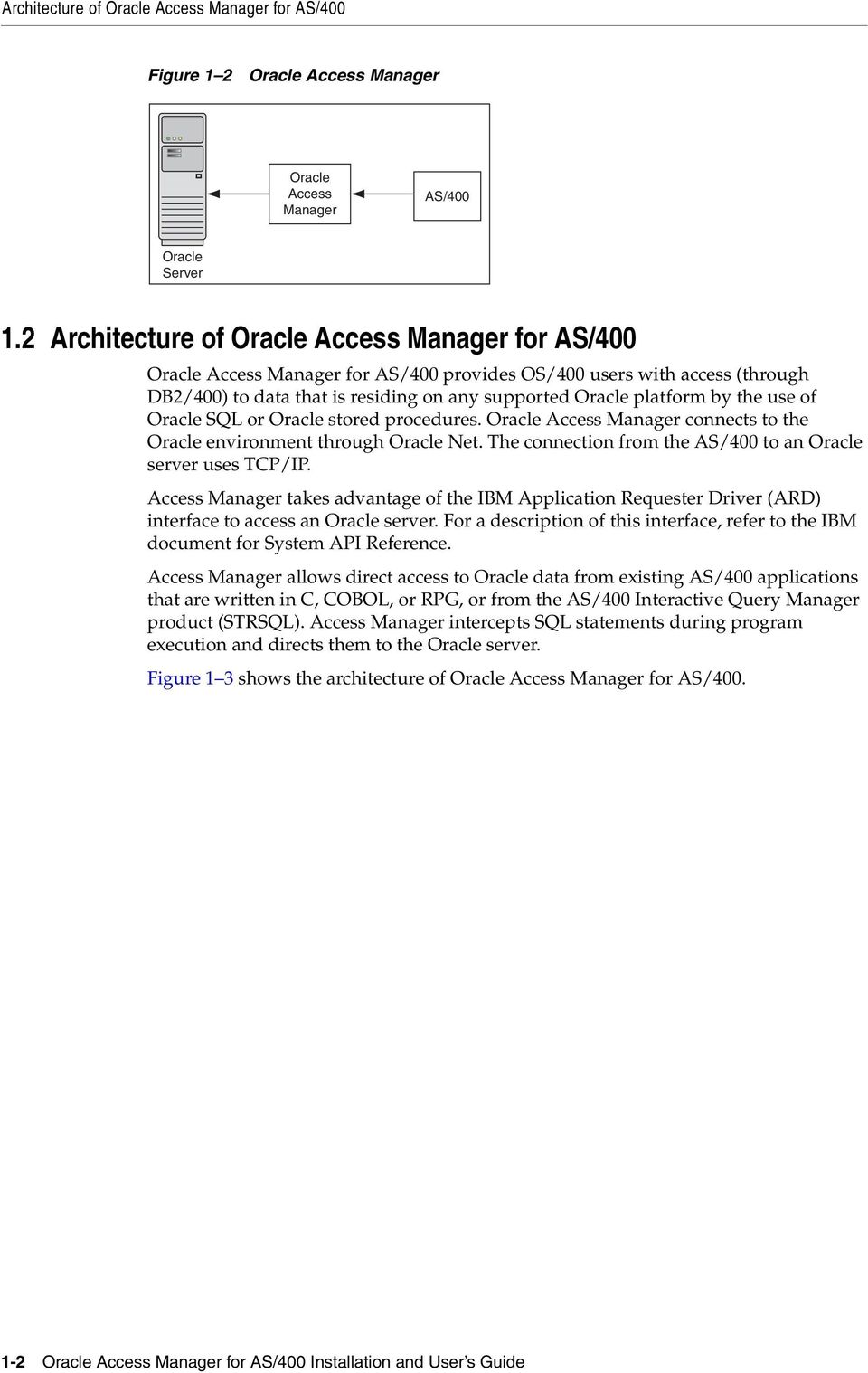
11 1 Introduction Oracle Access Manager for AS/400 enables SQL applications on the IBM iseries to access and modify data in an Oracle database. Read this chapter for information about the architecture and features of Oracle Access Manager for AS/400. It includes the following sections: Overview on page 1-1 Architecture of Oracle Access Manager for AS/400 on page 1-2 Features on page 1-4 Calling Oracle Access Manager for AS/400 on page 1-5 IBM Distributed Relational Databases on page 1-5 Activation Groups on page Overview Oracle Database Gateway technology, combined with Oracle Access Manager products, allows you to fully integrate the AS/400 and Oracle systems. The Oracle Database Gateway for DB2/400 and the Oracle Database Gateway for DRDA provide Oracle users with access to AS/400 data as illustrated in Figure 1 1. Oracle Access Manager provides AS/400 applications with access to Oracle data through SQL statements or stored procedures, as illustrated in Figure 1 2. Figure 1 1 Oracle Database Gateway GUI Oracle Database Gateway AS/400 Data Oracle Server Introduction 1-1

12 Architecture of Oracle Access Manager for AS/400 Figure 1 2 Oracle Access Manager Oracle Access Manager AS/400 Oracle Server 1.2 Architecture of Oracle Access Manager for AS/400 Oracle Access Manager for AS/400 provides OS/400 users with access (through DB2/400) to data that is residing on any supported Oracle platform by the use of Oracle SQL or Oracle stored procedures. Oracle Access Manager connects to the Oracle environment through Oracle Net. The connection from the AS/400 to an Oracle server uses TCP/IP. Access Manager takes advantage of the IBM Application Requester Driver (ARD) interface to access an Oracle server. For a description of this interface, refer to the IBM document for System API Reference. Access Manager allows direct access to Oracle data from existing AS/400 applications that are written in C, COBOL, or RPG, or from the AS/400 Interactive Query Manager product (STRSQL). Access Manager intercepts SQL statements during program execution and directs them to the Oracle server. Figure 1 3 shows the architecture of Oracle Access Manager for AS/ Oracle Access Manager for AS/400 Installation and User s Guide
13 Architecture of Oracle Access Manager for AS/400 Figure 1 3 Oracle Access Manager for AS/400 Architecture AS/400 AS/400 Application SQL Client Manager IBM Application Requester Driver Interface Oracle Access Manager Oracle Net Oracle TCP/IP TCP/IP Oracle Net Oracle Server Oracle Net Oracle Server Oracle Database Gateway Oracle Database Oracle Database DB2 SQL Server Teradata Informix Sybase IMS VSAM Adabas Components The components interact in the following ways: Table 1 1 Component AS/400 application SQL Client Manager ARD Interface Access Manager Oracle server Access Manager Component Interactions Interaction performs processing and invokes embedded SQL to run SQL statements and retrieve results. manages connections, receives requests from the application, calls the ARD interface to process SQL requests if the connection is to Oracle, and returns results to the application. provides an interface between SQL Client Manager and Access Manager. processes procedure calls, submits SQL requests to the Oracle server, and returns results to SQL Client Manager. It also modifies requests, if necessary, so that they conform to Oracle server syntax. receives requests from the network and formats them to access Oracle data, then returns results over the network to the client. Introduction 1-3

14 Features Table 1 1 Component Oracle Net (Cont.) Access Manager Component Interactions Interaction allows databases and their applications to reside on different computers and to communicate as peer applications in a Transparent Networking Substrate (TNS). 1.3 Features The following section describes the features of the Oracle Access Manager for AS/ Powerful Oracle SQL Language AS/400 applications can take advantage of the powerful Oracle SQL language to analyze data that is stored in an Oracle database. Virtually any SQL command can be embedded in an AS/400 application, including INSERT, DELETE, UPDATE, and SELECT, as well as a DDL statement. The SQL commands may contain any functions or clauses that are allowed by Oracle SQL. AS/400 applications also can transparently access procedures and packages that are stored in an Oracle database, thereby leveraging business logic that is centralized in the Oracle server. If you have an existing application that uses the IBM CALL command to execute an AS/400 procedure, then you can redirect this procedure to call an Oracle PL/SQL stored procedure by using the same IBM CALL command. Note: With two-phase commit enabled, only DML statements (SELECT, INSERT, DELETE, and UPDATE) and calls to stored procedures can be used. If two-phase commit is not enabled, then any Oracle DDL or DML SQL command may be used Leverage Existing Applications Universal Access Because Access Manager uses the IBM ARD interface, existing AS/400 applications that are written in C, COBOL, or RPG can directly access Oracle data. Dynamic SQL access to Oracle data is also available through the IBM DB2/400 Interactive Structured Query Language panel (STRSQL). AS/400 applications that are written using ANSI SQL might not require recompilation to access an Oracle server. Access Manager not only allows you to leverage your investment in existing AS/400 products, such as DB2/400 Query Manager and SQL Development Kit, it also provides you the opportunity to redirect AS/400 applications with little or no change to your application. Your application need not write to the proprietary Application Program Interface (API) of a vendor. You embed standard SQL statements in your AS/400 application. AS/400 applications can now benefit from the fully distributed Oracle architecture. Access Manager allows access to data that is stored in any Oracle Database on your network. When used with Oracle Database Gateway technology, AS/400 applications also have access to over 30 non-oracle data stores, including DB2/UDB, DB2/400 and other DB2/400 systems, VSAM, Informix, and Sybase Data Type Conversions Access Manager ensures that the appropriate data type conversions are performed between Oracle and AS/400. This includes support for AS/400-specific data types 1-4 Oracle Access Manager for AS/400 Installation and User s Guide

15 IBM Distributed Relational Databases such as zoned decimal. Access Manager can also translate Oracle date format to the IBM AS/400 default format or to any other date format that you select Support for Distributed Applications Because Access Manager gives the AS/400 application direct access to Oracle data, downloading and uploading large quantities of data to other processors is not necessary. Instead of moving data between computers and thereby risking unsynchronized and inconsistent data, you can access data where it resides. From a single program, the AS/400 application can read AS/400 data and insert it into an Oracle database. You can also read Oracle data and insert it into DB2/400 tables. 1.4 Calling Oracle Access Manager for AS/400 The AS/400 system calls the Oracle Access Manager during the following operations: package creation During package creation, which may be initiated by any of the AS/400 CRTSQLxxx commands (for example, CRTSQLPKG), the AS/400 calls Oracle Access Manager for AS/400 when the RDB parameter matches the RDB name in a relational database directory entry that is associated with the Access Manager. The AS/400 system passes SQL statement information from the user program or package. Oracle Access Manager for AS/400 can use this information to plan SQL access for the program. However, SQL statements that are passed to Oracle Access Manager for AS/400 are currently ignored when the package is being created. If the connection fails, then the package creation also fails. CONNECT processing Oracle Access Manager for AS/400 is called when a CONNECT statement is issued which specifies an RDB name that matches an RDB name in an AS/400 relational database entry (RDBDIRE) and that entry is associated with the Access Manager. Information is passed to Oracle Access Manager so that it can create an environment in which to run the subsequent SQL statements. SQL statement processing Oracle Access Manager for AS/400 is called during SQL processing when the current connection is to an RDB name in the relational database directory entry that is associated with the Access Manager. The AS/400 passes information about the statement being run so that Oracle Access Manager can process the statement. 1.5 IBM Distributed Relational Databases DB2/400 provides support for Distributed Relational Database Architecture (DRDA) to allow an application requester to communicate with IBM application servers. In addition, Oracle application servers can be accessed by using the IBM ARD interface. Access Manager uses this interface to integrate Oracle data into your distributed database environment. DB2/400 supports two levels of distributed databases: remote unit of work distributed unit of work Introduction 1-5

16 Activation Groups 1.6 Activation Groups A unit of work is sometimes called a transaction. A remote unit of work entails preparing and running SQL statements at only one application server during a unit of work. A distributed unit of work entails preparing and running SQL statements at multiple application servers during a unit of work. However, a single SQL statement can refer only to objects that are located at a single application server. Oracle Access Manager supports only a distributed unit of work and extends its functionality by allowing a single statement to refer to objects located on more than one database server. For more information about distributed relational databases, refer to the appropriate IBM documentation. A unit of work is a sequence of SQL commands that the database manager (DB2/400) treats as a single entity. The database manager ensures the consistency of data by verifying that all the data changes that are made during a unit of work are performed, or that none of them are performed. A unit of work is ended by a COMMIT or ROLLBACK operation. An activation group provides the following: run-time data structures to support running programs addressing protection a logical boundary for message creation a logical boundary for application cleanup processing All SQL connections are managed at the activation group level. The activation group and RDB name are used together to uniquely identify a connection. It is not possible to simultaneously have more than one active connection with the same RDB name in the same activation group. However, it is possible to have multiple connections with different RDB names in the same activation group and to have multiple connections with the same Oracle server through different activation groups. The Oracle Access Manager program is created using ACTGRP(*CALLER). It, therefore, runs in the same activation group as the caller when it is invoked. When called from STRSQL or by the CRTSQLxxx commands,oracle Access Manager may run in the default activation group. For more information about connection management and activation groups, refer to the IBM guide for DB2/400 SQL programming. 1-6 Oracle Access Manager for AS/400 Installation and User s Guide
17 2 Release Information This chapter contains release information for Oracle Access Manager for AS/400. It includes the following sections: Product Set on page 2-1 Changes and Enhancements on page 2-1 Known Problems and Restrictions on page Product Set The following products and component versions are included on the product CD-ROM. All components are at production level. Oracle Access Manager for AS/400: Oracle Net, TCP/IP adapter: Changes and Enhancements Release The following changes and enhancements have been made in release of Oracle Access Manager for AS/400. The following changes have been made in this release of the Oracle Access Manager: CURSOR WITH HOLD DECLARE CURSOR statements can now include the WITH HOLD phrase Bugs Fixed for Release The following bugs have been fixed for this release of the Oracle Access Manager for AS/400: Intermittent connection problems using Access Manager; ORA failures Function called once but runs twice and gets errors ORA and ORA Release Information 2-1

18 Known Problems and Restrictions ORA Maximum number of processes exceeded ORA00110, CPF7CFF errors when running CHGSQLNET under some CCSID MCH3601 in AM400_RIDI at Stmt AM400_RID Fails to run after changing system name SQLSTATE 08000, SQLCODE when trying to CONNECT AM400_RIDI job always has ORASRV0001 added to library list but other AM/400 programs use different ice program library COBOL program fails with MCH3402 due to commitment control resource not being released at activation group end Target Oracle Server runs out of processes SQL0969 error when no precision is specified Number format in Oracle, when access via AM is returning exponential format NUMBER fields that Oracle describes as having a precision of 0 and a scale of -127 are now taken as having a precision and scale of Known Problems and Restrictions Known Problems The following problems and restrictions are known to exist in the Oracle Access Manager for AS/400 products on the product CD-ROM. The description of problems includes suggestions for dealing with them, when possible. A current list of problems is available online. Contact your local Oracle Corporation office for information about gaining access to this list. The following problems are known to exist in the Oracle Access Manager for AS/ STRSQL on Columns of Type NUMBER When using STRSQL, an ORA-1457 might occur on columns of type NUMBER where no precision or scale is specified. Access Manager supplies default data types precision and scale, for these situations. Even the use of these data types, however, may not be sufficient, and you could still receive the ORA-1457 error. To check the default data type precision and scale values, use the Oracle Access Manager for AS/400 CHKSQLDFLT command. The AS/400 is shipped with the following default settings: 2-2 Oracle Access Manager for AS/400 Installation and User s Guide

19 Known Problems and Restrictions Known Restrictions Datatype *PKDEC (packed decimal) Precision 7 Scale 2 For example, when using STRSQL with these settings, a column of type NUMBER with a value of results in an ORA-1457 error. This error occurs because the setting of 7 for precision with the setting of 2 for scale allows for only five digits to the left of the decimal point (precision - scale = 7-2 = 5) To avoid this error, you can change the default data type to *FLOAT or keep the data type as *PKDEC and change the precision to 8 while keeping the default scale of 2. This will allow six digits to the left of the decimal point (precision - scale = 8-2 = 6) General Limitations Oracle hints cannot be specified in a SQL statement that is explicitly part of any EXEC SQL statement. The IBM preprocessor strips out the Oracle hints, as if they were comments. If you want Oracle hints in a DELETE, SELECT, or UPDATE statement, then you must: 1. Copy the text of the relevant DELETE, SELECT, or UPDATE statement to a host variable. 2. PREPARE a statement from that host variable. 3. For a SELECT, you must DECLARE a cursor for that prepared statement. Open the cursor, and then FETCH from that cursor. 4. For an UPDATE or DELETE, you must EXECUTE the prepared statement Stored Procedure Limitations The following limitations are known to exist with Oracle stored procedures: The TIMESTAMP and TIME data types return the date only. You must use the DB2/400 DECLARE PROCEDURE statement in preparation to call an Oracle stored procedure from an AS/400 program. The DECLARE PROCEDURE statement must have the same number of arguments as the Oracle PL/SQL procedure. The input and output modes must also be the same. The SIMPLE CALL WITH NULLS phrase is not supported. The SIMPLE CALL phrase is supported. The following restrictions are known to exist in the Oracle Access Manager for AS/ PREPARE with a COMMIT or ROLLBACK Command When using two-phase commit processing, COMMIT or ROLLBACK commands PREPARED as dynamic SQL statements are rejected with the following error: SQL0969: Error occurred while passing request to application requester driver program. The following information is available in the job log: ARDARPS: cannot PREPARE a COMMIT or ROLLBACK Release Information 2-3

20 Known Problems and Restrictions For additional information on two-phase commit processing, refer to Chapter 8, "Using Access Manager" RDBCNNMTH Parameter set to *DUW Access Manager requires that the RDBCNNMTH parameter be set to *DUW for any SQL package that is preprocessed with any of the CRTSQLxxx commands Non-DML SQL Statements When using two-phase commit processing, CONNECT is the only non-data Manipulation Language (DML) SQL statement that is supported by Access Manager. Use of such non-dml statements results in the following error: ORA-2089 COMMIT is not allowed in a subordinate session COMMIT HOLD The HOLD parameter on an EXEC SQL COMMIT HOLD command is not honored. All cursors are closed at each logical unit of work boundary (COMMIT and ROLLBACK) LONG and LONG RAW Data Types Only the first 32,740 bytes in a LONG or LONG RAW column can be retrieved. This is because of the DB2/400 length limit on a LONG VARCHAR column. Also note that the total data length on a SELECTed row is 32,760 bytes. The maximum length for a LONG or LONG RAW column will be further diminished by the amount of data in the OTHER columns that are retrieved in that row Installation into an IASP The Access Manager can not be installed into a library that is part of an independent auxiliary storage pool (IASP). This is an IBM restriction on the placement of exit programs and subsystem descriptions. To get around this, just install the Access Manager in normal libraries on the machines/partitions that will be participating in the IASP. You should modify the user profiles of those users that will be using the Access Manager to retrieve DB2/400 data in an IASP so that the initial program (as defined in the User Profile) sets the current IASP group using the SETASPGRP command. 2-4 Oracle Access Manager for AS/400 Installation and User s Guide
21 3 System Requirements This chapter describes the hardware and software requirements of the Oracle Access Manager for AS/400. It includes the following sections: Hardware Requirements on page 3-1 Software Requirements on page 3-2 Recommended Documentation on page Hardware Requirements Processor CD-ROM Drive Disk Space Oracle Access Manager for AS/400 requires the following hardware: The Oracle Access Manager for AS/400 requires an AS/400 processor that supports any current version of OS/400. Also refer to Section 3.2.1, "Operating System", under Software Requirements. The Oracle Access Manager for AS/400 is distributed on a CD-ROM. Operating System Communications Oracle Server PTF Requirements Additional Software You should have at least 400 MB of free disk space available before beginning the installation of this product. At the end of the installation there will be approximately 52 MB of objects in the install library. There will be another 149 MB of objects in an Oracle Service Program Library which will have a name similar to ORASRVnnnn where the nnnn are numeric digits. Multiple installations of the Access Manager at the same level share a common Oracle Service Program Library. An installation of the Oracle Database Gateway at the same version level as the Access Manager will also share the same Oracle Service Program Library. System Requirements 3-1
22 Software Requirements 3.2 Software Requirements Operating System Communications Oracle Server PTF Requirements Additional Software Oracle Access Manager for AS/400 requires the following software: The Oracle Access Manager for AS/400 runs in OS/400 V5R2 or V5R3. The Oracle Access Manager for AS/400 requires a TCP/IP connection to the target Oracle server. Any supported release of the Oracle server is supported by the Oracle Access Manager for AS/400. To be supported, the Oracle server must be configured with TCP/IP access. For OS/400 V5R2, PTFs SI09769 and SI09772 should be applied. Oracle recommends that you keep up to date with the latest DB2/400 PTF group. You can check your current PTF status using the WRKGRPPTF command. For OS/400 V5R2 use WRKGRPPTF SF99502 and for OS/400 V5R3, use WRKGRPPTF SF You must have the SQL Development Kit (IBM Program Number 5722-ST1) installed in order to run STRSQL and to develop embedded SQL programs. 3.3 Recommended Documentation The following documents might be useful in providing additional information about products that are used with the Oracle Access Manager for AS/400: IBM Guide for DB2/400 SQL Programming Oracle Call Interface Programmer's Guide Oracle C++ Call Interface Programmer's Guide Oracle Database Net Services Administrator's Guide Oracle Database Net Services Reference Oracle Database SQL Language Quick Reference Oracle Database SQL Language Reference SQL*Plus Quick Reference SQL*Plus User's Guide and Reference 3-2 Oracle Access Manager for AS/400 Installation and User s Guide
23 4 Installing Access Manager The installation of the Oracle Access Manager for AS/400 is divided into two parts, installation and postinstallation. Before you begin installation, ensure that you have the required hardware and software that are described in Chapter 3, "System Requirements". This chapter contains the following topics: Checklists on page 4-1 Installation on page 4-2 Post-Installation on page Checklists Installation Checklist Use these checklists when installing the Oracle Access Manager for AS/ Post-Installation Checklist Step 1: Mount the Product CD-ROM Step 2: Start the Installation Process Step 3: Select the Installation Library Name Step 4: Verify Installation Parameters Step 5: Finish the Installation Step 1: Add Oracle Access Installation Library to Library List Step 2: Change Password for User Profile Step 3: Configure Oracle Net Step 4: Test Connectivity to Oracle Server Step 5: Configure Access Manager Step 6: Configure Two-Phase Commit (Optional) Step 7: Retest Connectivity to Oracle Server (Optional) Installing Access Manager 4-1
24 Installation 4.2 Installation Before installing Oracle Access Manager for AS/400, you must log on with a user profile that has the *SECADM and *ALLOBJ special authorities. The user profile QSECOFR usually has that authority. Caution: Oracle recommends that you back up any existing Access Manager library before upgrading to a new release Steps for Installation The panels are shown as they appear when first displayed. The values that are documented in this installation guide are the default values that are provided by Oracle Corporation at the time that you install the Oracle Access Manager for AS/400. The default values are used unless they are manually changed before continuing. Step 1: Mount the Product CD-ROM Step 2: Start the Installation Process Step 3: Select the Installation Library Name Step 4: Verify Installation Parameters Step 5: Finish the Installation Step 1: Mount the Product CD-ROM Insert the product CD-ROM into the AS/400 CD drive Step 2: Start the Installation Process Enter the following command: LODRUN CD_drive where CD_drive is the name of the CD drive where you mounted the product CD-ROM. The default is usually OPT Step 3: Select the Installation Library Name When the Install Access Manager Product Panel is displayed, use the default name of ORAAM400 or enter a name with a length from 1 to 10 characters long. Example 4 1 Install Access Manager Product Panel Install Oracle Access Manager product Type Choices, press Enter. System: HQAS400 Install library name... ORAAM400 Name (up to 10 characters) Auxiliary storage pool id ===> Bottom F1=Help F4=Prompt F9=Retrieve F12=Cancel 4-2 Oracle Access Manager for AS/400 Installation and User s Guide
25 Installation (C) Copyright Oracle Corporation, 2006 The specified library name must denote an existing (but empty) library, or must denote a nonexistent library. The installation procedure will not install into a library with existing objects. The specified library name is also used to create an AS/400 User Profile. The password for that profile is also identical to the User Profile name. The password should be changed after installation using the CHGUSRPRF command. For auxiliary storage pool ID, use the default of 1, or enter another ID. After entering your information on the panel, press Enter to continue Step 4: Verify Installation Parameters The following panel appears: Example 4 2 Verify Access Manager Install Panel Verify Oracle Access Manager Install at V System: HQAS400 Verify that you want to install the product. Once this process has started, it will create a library and other objects. Enter *YES to verify this operation before it is started. New Install Library name... ORAAM400 Enter *YES to verify... *NO *NO, *YES ===> Bottom F1=Help F4=Prompt F9=Retrieve F12=Cancel (C) Copyright Oracle Corporation, 2006 Enter *YES to continue the installation process. Press Enter to continue Step 5: Finish the Installation If you entered *YES, then status messages will be displayed on the bottom of the screen as the installation proceeds. After a few minutes, a screen will appear, stating: Install complete. Press ENTER. Check Job log for any errors. When the installation is finished, use the following command to check the job log for error messages: DSPJOBLOG Installation of Oracle Access Manager for AS/400 is complete. Installing Access Manager 4-3
26 Post-Installation Note: During the installation, an AS/400 User Profile was created with the same name and password as the library in which the Access Manager was installed. You need to use the CHGUSRPRF command to change the password for that User Profile. You need to change the password by using the following command syntax: CHGUSRPRF USRPRF(install_lib) PASSWORD(new_password) where: install_lib new_password is the installation library. The default is ORAAM400. is the new userid password that you want to use. 4.3 Post-Installation This section describes the steps to be performed after the initial installation of Oracle Access Manager for AS/ Steps for Post-Installation Step 1: Add Oracle Access Installation Library to Library List Step 2: Change Password for User Profile Step 3: Configure Oracle Net Step 4: Test Connectivity to Oracle Server Step 5: Configure Access Manager Step 6: Configure Two-Phase Commit (Optional) Step 7: Retest Connectivity to Oracle Server (Optional) Step 1: Add Oracle Access Installation Library to Library List Before attempting to use any of the Access Manager configuration utilities, you must add the Access Manager library to your library list. To do this, enter the following command on any command line: ADDLIBLE library_name where library_name is the name of your Access Manager installation library. The default position is *FIRST. You do not need to manipulate the library list when running the Access Manager itself. Access Manager will determine which libraries need to be added to the library list, and it will add those libraries to the top of the user portion of the library list Step 2: Change Password for User Profile Use the CHGUSRPRF command to change the password for the user profile that was created during the install. The name for that user profile is identical to the name of the library in which the Access Manager objects were installed. So, if you used the default instance name of ORAAM400, then Access Manager objects were placed into library ORAAM400, a user profile with a name of ORAAM400 was created with password ORAAM Oracle Access Manager for AS/400 Installation and User s Guide
27 Post-Installation Step 3: Configure Oracle Net Configure Oracle Net on the Oracle integrating server. Refer to Chapter 5, "Oracle Net" for more information Step 4: Test Connectivity to Oracle Server Refer to "Connecting through the STRSQL (Interactive SQL) Commands" on page 8-1 in Chapter 8, "Using Access Manager" for information about connecting to an Oracle server. Note: You should test the connectivity before changing any configuration parameters Step 5: Configure Access Manager Configure Oracle Access Manager for AS/400. All options have defaults that are used unless you change them. Refer to Chapter 6, "Configuring Access Manager" for more information. Note: Steps 6 and 7 need to be performed only if you will be using two-phase commit Step 6: Configure Two-Phase Commit (Optional) If you want to use two-phase commit processing, then you need to configure it now. Refer to Chapter 7, "Distributed Transaction Coordination" for the steps to use in configuring two-phase commit processing Step 7: Retest Connectivity to Oracle Server (Optional) At this point, you can retest your connectivity to the Oracle server by using two-phase commit processing. Refer to "Connecting through the STRSQL (Interactive SQL) Commands" on page 8-1 for information about connecting to an Oracle server. Installing Access Manager 4-5
28 Post-Installation 4-6 Oracle Access Manager for AS/400 Installation and User s Guide
29 5 Oracle Net In the client-server model, a client application accesses a database server to satisfy database operations that are initiated by an application. The Oracle Access Manager for AS/400 is based upon the client-server model. All application processing, such as the user interface and data presentation, occurs at the client workstation on an AS/400. All Oracle database processing occurs at the Oracle server, which (when using Oracle Access Manager for AS/400) is not on an AS/400 computer. Interaction between the client and server is achieved through a common dialogue or messaging system that is designed for the SQL language. With Oracle Net, databases and their applications can reside on different computers and communicate as peer applications in a Transparent Networking Substrate (TNS) network. Read this chapter to learn how to configure and use Oracle Net with Oracle Access Manager for AS/400. It includes the following sections: Oracle Net File Name Structure on page 5-1 Connecting to Oracle through Oracle Net on page 5-2 Defining the Oracle Server to Oracle Access Manager on page 5-2 Oracle Net for TCP/IP AS/400 Configuration on page Oracle Net File Name Structure Oracle Database Net Services Administrator's Guide and Oracle Database Net Services Reference refer to configuration, trace, and log files: basename.extension where: basename is the base portion of the name extension is the extension portion of the name. An example of this form is tnsnames.ora. On the AS/400, the Oracle Net parameter files are installed in the Access Manager library by using the following file name mapping: The base portion of the file name is mapped to a member in an AS/400 file. The extension portion of the file name is mapped to an AS/400 file. For example, the tnsnames.ora parameter file is mapped to member TNSNAMES in the ORA file that is located in the Access Manager library. Oracle Net 5-1
30 Connecting to Oracle through Oracle Net Member names are referred to as: file(member_name) 5.2 Connecting to Oracle through Oracle Net When an AS/400 application communicates with a remote IBM database server, it uses the IBM DRDA connection that is defined through the AS/400 ADDRDBDIRE command. RDBDIRE means Remote DataBase Directory Entry. Figure 5 1 Native IBM Networking AS/400 SQL Application RDBDIRE Lookup DRDA Network Remote IBM DBMS When an Oracle SQL application communicates with a remote Oracle server, it uses an Oracle Net connection that is defined in the tnsnames.ora file. Figure 5 2 Native Oracle Networking Oracle SQL Application TNSNAMES Lookup Oracle Net Network Remote Oracle Server Connecting through Access Manager involves combining the IBM DRDA connection with the Oracle Net connection. Figure 5 3 Oracle Access Manager Networking Oracle Access Manager for AS/400 SQL Application RDBDIRE Lookup TNSNAMES Lookup Oracle Net Network Remote Oracle Server In Figure 5 3, the remote database name is used as the key for both the RDBDIRE lookup and the TNSNAMES lookup. 5.3 Defining the Oracle Server to Oracle Access Manager To connect to an Oracle server through Oracle Net, you must define an Oracle Net TNSNAMES entry with a name that matches your AS/400 RDBDIRE entry. This section provides a general description of these definitions. To create these definitions, refer to "Oracle Net for TCP/IP AS/400 Configuration" on page 5-4 for specific instructions. Figure 5 4 shows how these matching entries interact: 5-2 Oracle Access Manager for AS/400 Installation and User s Guide
31 Defining the Oracle Server to Oracle Access Manager Figure 5 4 Defining the Oracle Server to Access Manager Oracle Access Manager for AS/400 SQL Application RDBDIRE Lookup TNSNAMES Lookup Oracle Net Network Remote Oracle Server LOCALSRV..: *LOCAL ORA2...:*ARDPGM EXEC SQL CONNECT TO ORA or CRTSQLxxx RDB (ORA2) ORA2=(DESCRIPTION= (ADDRESS=(PROTOCOL=TCP) )) Remote Database Directory Entry ORA(TNSNAMES) Configuration Entries The AS/400 ADDRDBDIRE command is used to define remote database directory entries. The name you use on the ADDRDBDIRE command must be identical with the name of a description entry in your ORA(TNSNAMES) file. And that name is the same as the name used as a connection identifier in your CONNECT command either in your program or in STRSQL. To connect to the target Oracle server through Oracle Net, you must add an entry to the ORA(TNSNAMES) file in the Access Manager installation library. The entry name must match the name used in the RDB parameter when using the ADDRDBDIRE command. That is, the name must match the name of the RDB entry in the AS/400 RDB directory which is maintained by the ADDRDBDIRE command. The following examples show the relationship between the AS/400 TCP/IP configuration and Access Manager. The ORA2 entries (in bold font) are the matching entry names. ORA(TNSNAMES) ORA2 = (DESCRIPTION= (ADDRESS= (PROTOCOL=TCP) (PORT=1521) (HOST=UNIX9) ) (CONNECT_DATA=(SERVICE_NAME=Oracle92) ) ) AS/400 Relational Database Directory Entry (DSPRDBDIRE) Relational database : ORA2 Remote location: Remote location : *ARDPGM Application requester driver: Program : ORAARD Library : ORAAM400 Oracle Net 5-3
32 Oracle Net for TCP/IP AS/400 Configuration Interface level : 1 Text : The TNSNAMES entry may be in any case, but it will be mapped to uppercase by Access Manager. 5.4 Oracle Net for TCP/IP AS/400 Configuration Perform the following steps to configure the client connection between the AS/400 and the Oracle server. These configuration steps are presented here with the assumption that TCP/IP is already installed and configured on the AS/400 with basic connectivity (ping, for example) established between the AS/400 and the server that is hosting the Oracle Database server Steps for TCP/IP AS/400 Configuration Step 1: Create Relational Database Directory Entry Step 2: Define TNSNAMES Entry Step 1: Create Relational Database Directory Entry Using the AS/400 ADDRDBDIRE command, define a relational database directory entry (Panel 1, Example 5 1). Enter the name of the entry on the line titled Relational database. Enter *ARDPGM on the line titled "Name or address". Do not change the data on the line titled Type. You may change the Text parameter to whatever you choose. Press Enter. The screen will change to add a section entitled Application Requester Driver (Panel 2, Example 5 2). Example 5 1 ADDRDBDIRE Panel 1 Add RDB Directory Entry (ADDRDBDIRE) Type Choices, press Enter. Relational database... ORACLETCP Remote location: Name or address... *ARDPGM Type... *SNA *SNA, *IP Text... TCP/IP connection to oracle Bottom F3=Exit F4=Prompt F5=Refresh F12=Cancel F13=How to use this desplay F24=More keys In Panel 2 (Example 5 2), enter ORAARD on the line entitled "Program", and enter the name of the install library for the Access Manager on the line entitled "Library". 5-4 Oracle Access Manager for AS/400 Installation and User s Guide
33 Oracle Net for TCP/IP AS/400 Configuration Example 5 2 ADDRDBDIRE Panel 2 Add RDB Directory Entry (ADDRDBDIRE) Type Choices, press Enter. Relational database... > ORACLETCP Remote location: Name or address... > *ARDPGM Type... *SNA, *IP Text... > TCP/IP connection to oracle Application requester driver: Program... ORAARD Name, *DRDA Library... ORAAM400 Name, *LIBL, *CURLIB Bottom F3=Exit F4=Prompt F5=Refresh F12=Cancel F13=How to use this desplay F24=More keys The following parameters must be entered: Relational database is the name that you are assigning to the Oracle server relative to the AS/400. This must match the entry name of the ORA(TNSNAMES) entry. Remote location must be *ARDPGM for the ARD interface. Program must be ORAARD, the name of the Access Manager executable program. Library must be the name of the Access Manager installation library. You can also change the text parameter to whatever you choose Step 2: Define TNSNAMES Entry Edit member TNSNAMES in the ORA file in the Access Manager installation library using the following command: WRKMBRPDM library_name/ora where library_name is the name of your Access Manager installation library. Enter "2" on the line for TNSNAMES to edit the TNSNAMES member. If you do not have the Program Development Manager, then you can use the EDTF command to edit the member. The TNSNAMES entry name must match the name of the AS/400 RDB directory entry that was defined in the previous step using the ADDRDBDIRE command. server_name = (DESCRIPTION= (ADDRESS= (PROTOCOL=TCP) (PORT=port_number) (HOST=host_name) ) (CONNECT_DATA=(SERVICE_NAME=service_name) Oracle Net 5-5
34 Oracle Net for TCP/IP AS/400 Configuration ) ) where: server_name is the name of a connection to an Oracle server that matches an entry in the RDB directory. An entry in the RDB directory can be added using the ADDRDBDIRE command. TCP is the TCP protocol used for TCP/IP connections. port_number is the port number of the Oracle Net listener. This is usually port number host_name is the name that defines the system where the target Oracle server resides. This name must be in the local host definition on the AS/400 or in a name server on your network. Use option 10 of the CFGTCP command to edit the host table entries for your system. The host name can also be entered as an IP address, for example, service_name is the service name of the Oracle server. Compare the instructions just provided with the following example: ORA2 = (DESCRIPTION= (ADDRESS= (PROTOCOL=TCP) (PORT=1521) (HOST=UNIX9) ) (CONNECT_DATA=(SERVICE_NAME=ORA2) ) ) 5-6 Oracle Access Manager for AS/400 Installation and User s Guide
35 6 Configuring Access Manager After installing Oracle Access Manager, you can: create a SQL package use the STRSQL command to interactively access data in an Oracle server All Oracle Access Manager parameters or system values that require modification can be changed using Access Manager commands or through a menu system. These commands and their menus are described in this chapter. It includes the following sections: Access Manager Commands on page 6-1 CHGSQLDFLT on page 6-2 CHGSQLNET on page 6-5 CHGSQLDBG on page 6-6 CRTORAPKG on page 6-7 CHG2PCPRM on page Access Manager Commands Before attempting to enter any of the Access Manager commands, you must add the Access Manager library to your library list. To do this, enter the following ADDLIBLE command on any command line: Note: If you run the Oracle Access Manager, then it will automatically perform the ADDLIBLE and leave the required library in the library list. If you have not run the Oracle Access Manager, then Oracle Access Manager Commands (listed as the topics included in this chapter) will not run successfully until the library is added to the library list. ADDLIBLE library_name where library_name is the name of your Access Manager installation library. The default position is *FIRST. Then, enter: GO CMDORAAM Configuring Access Manager 6-1
36 CHGSQLDFLT The command displays the Access Manager commands menu. Example 6 1 Access Manager Commands Menu CMDORAAM Oracle Access Manager Commands System: HQAS400 Select one of the following: 1. Change Oracle Access Manager Default settings 2. Change Oracle Access Manager Oracle Database settings 3. Change Oracle Access Manager Debug settings 4. Create an Oracle Access Manager SQL Package 5. Change Oracle Access Manager Two-phase commit parameters Selection or command ===> F3=Exit F4=Prompt F9=Retrieve F12=Cancel (C) Copyright Oracle Corporation, 2006 Each of the options on the Access Manager commands menu can be accessed directly by entering the command name from any command line. The commands are listed in the following table: Table CHGSQLDFLT Access Manager Commands Menu Choice Command Name Purpose 1 CHGSQLDFLT Changes the Access Manager default settings. 2 CHGSQLNET Changes the Oracle Net trace settings. 3 CHGSQLDBG Changes Access Manager debugging parameters. 4 CRTORAPKG Creates a SQL package using the specified source and Oracle server name. 5 CHG2PCPRM Changes Access Manager two-phase commit parameters. After selecting option 1 on the Access Manager commands menu (or after issuing the CHGSQLDFLT command), the first panel that is displayed confirms which library is to be changed. This should match the library where you installed Oracle Access Manager for AS/400. Example 6 2 Access Manager Default Options Panel Oracle Access Manager Default Options System: HQAS Oracle Access Manager for AS/400 Installation and User s Guide
37 CHGSQLDFLT Type choices for default option, press Enter. Existing Install library name...oraam400 Name ===> F3=Exit F4=Prompt F9=Retrieve F12=Cancel (C) Copyright Oracle Corporation, 2006 The next panel displays the default user ID and default password that are needed for the Oracle server to which you are connecting. The defaults supplied on the distribution tape are SCOTT/TIGER. You will probably want to change this default for security reasons. Example 6 3 Access Manager Default Options Panel Oracle Access Manager Default Options System: HQAS400 Type choices for default option, press Enter. Existing Install library name... ORAAM400 Name Access Manager default user id... SCOTT Userid Access Manager default password... ********** Password Access Manager default blocksize Blocksize Access Manager default number format... *PKDEC *FLOAT, *PKDEC Access Manager default precision Access Manager default scale Default precision Access Manager NLS Language... AMERICAN_AMERICA.WE8EBCDIC37 Access Manager Two-Phase Commit... *NO *YES, *NO Commitment-Control Resource Disposition *RELEASE *KEEP, *RELEASE ===> Bottom F1=Help F4=Prompt F9=Retrieve F12=Cancel (C) Copyright Oracle Corporation, 2006 The ten fields on the panel in Example 6 3 are described as follows: Existing Install library name identifies the library that contains the Access Manager program. The default is the Access Manager installation library. Access Manager default user id specifies the default user ID. The default user ID and default password are used if the USER parameter is not specified in a CRTSQLxxx command or if the CONNECT TO statement is issued without the USER or USING options. If you are concerned about security, then you can change this field to BLANK. This forces you to always explicitly enter a user ID and password to CONNECT. If you Configuring Access Manager 6-3
38 CHGSQLDFLT do set the user ID to blank and attempt to CONNECT without specifying a user ID, then you will receive an ORA-1017 error. Access Manager default password specifies the default password for the default user ID. The default user ID and default password are used if the USER or the PASSWORD parameter is not specified in a CRTSQLxxx command, or if the CONNECT TO statement is issued without the USER or USING options. Oracle recommends that you use the default password only for testing, and that in your application, you imbed the user ID and password. A password, if given, will be encoded. Access Manager default blocksize specifies the default block size. The Access Manager uses the block size data area to determine the number of rows to retrieve in a single fetch. The default is 100. A SELECT statement must contain the FOR FETCH ONLY clause in order for block fetching to be performed. Access Manager default number format specifies the DB2/400 data type to use when Oracle describes an Oracle numeric field as being of type NUMBER with a scale and precision of zero. *FLOAT specifies floating point notation. *PKDEC specifies packed decimal notation with precision set to the default precision, and with scale set to the default scale (refer to "Access Manager default scale" in this list). Oracle functions, such as AVG, COUNT(*), MAX, and SUM, return NUMBER values with precision and scale set to zero. For example, using the default precision and scale values of 9 and 2, respectively, the following SQL statements return the values stated here: SELECT AVG(DEPTNO) FROM DEPTNO; if *PKDEC is specified 2.50E+001 if *FLOAT is specified SELECT 1/3 FROM DUAL;.33 if *PKDEC is specified 3.33E-001 if *FLOAT is specified *PKDEC is the default. Access Manager default precision specifies the default precision to be used if *PKDEC is specified for Access Manager default number format. The default is 9. Access Manager default scale specifies the default scale to be used if *PKDEC is specified for Access Manager default number format. The default is 2. Access Manager Globalization Support language specifies the Globalization Support language. Globalization Support enables Oracle applications to interact with users in their native language using their conventions for displaying data. The default Globalization Support language can be changed to any valid value. Refer to Appendix B, "Globalization Support" for a list of valid values. Access Manager Two-Phase Commit specifies whether two-phase commit processing is to be enabled. Two-phase commit processing ensures transactional consistency in a heterogeneous environment. If set to *NO, then data might not be synchronized between the local and remote databases. If set to *NO, then DDL statements, such as CREATE and DROP, may be used. If set to *YES, then DDL statements cannot be used. 6-4 Oracle Access Manager for AS/400 Installation and User s Guide
39 CHGSQLNET 6.3 CHGSQLNET If your application does not change data on either the AS/400 or on the Oracle server, then you can leave this option as *NO. Also, if you use the Oracle server only to get data (not to change data), then you can leave this option as *NO. Commitment-Control Resource Release specifies when the commitment control resource (allocated to perform a job) is released. Oracle Access Manager for AS/400 is required (by IBM Access Requester Driver specifications) to use an AS/400 commitment control resource. If you intend to use Access Manager within the confines of a user-defined commitment control definition, then you need Access Manager to release its commitment control resource when a transactional unit of work ends at a commitment control boundary. You reach a commitment control boundary when a COMMIT or ROLLBACK operation is performed. When Access Manager starts a new unit of work, it then reacquires the required commitment control resource. For this scenario, set Commitment-Control Resource Release to *RELEASE. If you are not planning to use commitment control definitions external to Oracle Access Manager for AS/400, then you can specify *KEEP for this parameter. After selecting option 2 on the Access Manager commands menu (or after issuing the CHGSQLNET command), the first panel that is displayed confirms which library is to be changed. This should match the library where you installed Oracle Access Manager for AS/400. Example 6 4 Access Manager Network Parameters Panel Change Oracle Access Manager Network Parameters System: HQAS400 Type choices for default option, press Enter. Existing Install library name... ORAAM400 Name ===> F3=Exit F4=Prompt F9=Retrieve F12=Cancel (C) Copyright Oracle Corporation, 2006 On the next panel, you can change the settings of the Oracle Net trace options. Because running an Oracle Net trace can adversely affect AS/400 and Access Manager performance, do not change these settings unless you are asked to do so by Oracle Support Services. Example 6 5 Access Manager Network Parameters Panel Change Oracle Access Manager Network Parameters Configuring Access Manager 6-5
40 CHGSQLDBG Type choices, press Enter. Existing Install library name... ORAAM400 Client trace level... *OFF System: HQAS400 Name *OFF, *USER, *ADMIN ===> F1=Help F4=Prompt F9=Retrieve F12=Cancel (C) Copyright Oracle Corporation, CHGSQLDBG The fields on the panel in Example 6 5 are described as follows: Existing Install library name identifies the library that contains the Access Manager program. The default is the Access Manager installation library. Client trace level specifies the tracing level for the AS/400 client. Valid values are *OFF, *USER, *ADMIN, and 16. The number 16 gives full trace information. Additional values can be supplied by Oracle Support Services for debugging purposes. After selecting option 3 on the Access Manager commands menu (or after issuing the CHGSQLDBG command), the first panel that is displayed confirms which library is to be changed. This matches the library where you installed Oracle Access Manager for AS/400. Example 6 6 Access Manager Debugging Options Panel Change Oracle Access Manager Debugging Options System: HQAS400 Type choices for debugging options, press Enter. Existing Install library name... ORAAM400 Name ===> Bottom F1=Help F4=Prompt F9=Retrieve F12=Cancel (C) Copyright Oracle Corporation, 2006 On the next panel, you can change the debugging settings. The debugging function helps diagnose Access Manager problems. Do not change these settings unless you are asked to do so by Oracle Support Services. 6-6 Oracle Access Manager for AS/400 Installation and User s Guide
41 CRTORAPKG Example 6 7 Access Manager Debugging Options Panel Change Oracle Access Manager Debugging Options System: HQAS400 Type choices for debugging options, press Enter. Existing Install library name... ORAAM400 Access Manager debugging control string.. 0 Access Manager trace file... ARDTRACE Access Manager trace library... ORAAM400 Name Debug String File Library ===> Bottom F1=Help F4=Prompt F9=Retrieve F12=Cancel (C) Copyright Oracle Corporation, 2006 The fields on the panel in Example 6 7 are described as follows: Existing Install library name identifies the Access Manager installation library. Access Manager debugging control string specifies the level of tracing. A 0 (zero) turns off all tracing and a 1 turns on full tracing. The trace output always goes to a member in the file that is determined by the Access Manager trace file and the Access Manager trace library. Access Manager trace file specifies the qualified file name for trace output under control of the Access Manager debugging control string. The file needs to be created as a SOURCE PHYSICAL FILE with a maximum record length of 240. Access Manager trace library specifies the library portion of a qualified file name. This field is used along with the Access Manager trace file field to designate a file into which trace members are written. If specified as blank, then a value of QTEMP is used. This field is relevant only if the Access Manager debugging control string field contains a nonzero value. 6.5 CRTORAPKG After selecting option 4 on the Access Manager commands menu (or after issuing the CRTORAPKG command), the Oracle SQL Package panel is displayed. Access Manager provides CRTORAPKG to facilitate the development of distributed applications that are targeted for execution against an Oracle server. Access Manager issues the necessary commands to precompile, compile, and bind your application program. Refer to Chapter 8, "Using Access Manager" for information about sample programs. Configuring Access Manager 6-7
42 CRTORAPKG Example 6 8 Oracle SQL Package Panel Create Oracle SQL Package System: HQAS400 Type choices, press Enter. File... QSQLCSRC Library... ARDQA Member... XI1 Language Type... *C Oracle server... ORACLETCP Activation Group... *New Object Type... *PGM Batch/Terminal Complile... *BATCH Target Release... *CURRENT Additional pre-compile options... name name name *C, *RPG, *COBOL ===> F1=Help F4=Prompt F9=Retrieve F12=Cancel (C) Copyright Oracle Corporation, 2006 The required input fields on the panel in Example 6 8 are as follows: File is the name of a file containing the program source. Library is the name of the library containing the file. Member is the source member in the file. Language type is the language type. Valid values are *C, *COBOL, and *RPG. Oracle server is the name of the target Oracle server. This must match an entry name in ORA(TNSNAMES) and an entry in the RDB directory. After filling in the data, the file, library, and member entries are verified to ensure that they exist. Caution: During compilation, CRTORAPKG attempts to connect to the specified Oracle server. Ensure that your Oracle server and your network connection are active before running CRTORAPKG. You can use STRSQL to check the validity of your connection. After the compile is complete, check the job log to determine if the package creation was completed successfully. Check the output spool file for the compile. Multiple spool files will exist for each compile. If package creation failed, then check for the following problems: syntax errors in the program source missing RDB directory entry missing or incorrect Oracle server entry name in ORA(TNSNAMES) 6-8 Oracle Access Manager for AS/400 Installation and User s Guide
43 CHG2PCPRM unavailable target Oracle server nonfunctional Oracle Net system The CRTORAPKG command uses the relevant IBM CRTSQLxxx command to pre-process your file. Failure will occur only if the severity level of an error is greater than 30. Some severity level 30 messages are issued because the preprocessor does not recognize some Oracle SQL constructs or functions. For this reason, you must examine the spooled output to determine the validity of any errors of severity level 30. The IBM precompiler flags any reference to Oracle server sequence numbers (error SQL5001, severity 30) and any reference to non-ibm functions, such as TO_CHAR and TO_DATE (error SQL0105, severity 30), as errors. After finding and correcting the error, resubmit the job from the CRTORAPKG panel. Ensure that the input information is correct before pressing Enter. 6.6 CHG2PCPRM This command allows you to change Access Manager two-phase commit parameters. The following panel is displayed: Example 6 9 Change RID (Resolve In Doubt) Options Panel Change RID (Resolve In Doubt) Options System: HQAS400 Installation Library: ORAAM920 DataQueue Timeout (in seconds) CleanUp Delay (in seconds) Trace Level Dead Check Counter Type options, press Enter. 1-Add 2=Change 4=Remove Opt Oracle Server Name Description VMS_SRV1 Connect to VMS1X system MVS03 MVS system 3 MVS_92 MVS running Oracle 9.2 PC_GTW_92 WinNT 4.0 server H920_130 SUN running Oracle Bottom F1=Help F4=Prompt F9=Retrieve F10=Switch to PrivID screen F12=Cancel (C) Copyright Oracle Corporation, 2006 For more information about this panel, refer to Chapter 7, "Distributed Transaction Coordination". Configuring Access Manager 6-9
44 CHG2PCPRM 6-10 Oracle Access Manager for AS/400 Installation and User s Guide
45 7 Distributed Transaction Coordination Read this chapter to learn about two-phase commit processing. It includes the following sections: Two-Phase Commit Overview on page 7-1 Two-Phase Commit and Oracle Access Manager for AS/400 on page 7-2 Two-Phase Commit Process on page 7-2 In-Doubt Transactions on page 7-3 Enabling Two-Phase Commit Processing on page 7-4 Oracle Required Privileges on page 7-8 AM400_COM Program on page Two-Phase Commit Overview Oracle Access Manager for AS/400 supports two-phase commit processing to ensure transaction consistency in a heterogeneous environment. Two-phase commit processing is an optional feature in Oracle Access Manager. During installation, the Access Manager parameter for two-phase commit processing defaults to *NO. To enable transaction consistency in a heterogeneous environment, the two-phase commit parameter must be changed to *YES on the Change Access Manager Default Options panel or by using the CHGSQLDFLT command. For additional information, refer to Chapter 6, "Configuring Access Manager". Note: If the two-phase commit parameter is set to *NO, then data might not be synchronized between local and remote databases. Synchronization is needed only when changes in data (changes in files or tables) are being made in a transaction both on the AS/400 and on the remote Oracle server Terminology AM400_RID program automatically resolves in-doubt transactions. This program must be active to enable two-phase commit processing. The AM400_RID program runs in a subsystem which has the same name as the install library. AM400_COM program provides a mechanism for privileged users to dynamically communicate with the AM400_RID program. Distributed Transaction Coordination 7-1
46 Two-Phase Commit and Oracle Access Manager for AS/400 Two-phase commit parameter enables two-phase commit processing in Oracle Access Manager for AS/400. The default setting is *NO. It must be changed to *YES to enable two-phase commit processing. Commit point site is the processing node that initiates a commit or roll back. The AS/400 that is participating in a two-phase commit transaction is always designated as the commit point site. The commit point site is also known as the "coordinator" site. Prepare phase is the phase during which the coordinator asks participants to prepare to commit or to roll back the changes that were made during a transaction. Commit phase is the phase during which the coordinator asks all nodes to commit the transactions, if all participants have responded to the coordinator that they are prepared to do so. If any participants cannot prepare, then the coordinator asks all nodes to roll back the transaction. Implied commit When a program (activation group) ends without error, default behavior for the AS/400 system triggers all pending updates to be committed. This commitment of all pending updates would include updates to Oracle data as part of the AS/400 transactions through the Oracle Access Manager for AS/ Two-Phase Commit and Oracle Access Manager for AS/400 Oracle Access Manager for AS/400 enables AS/400 applications to update data on both the AS/400 and remote Oracle servers during a single transaction. Any time that updates are allowed in a distributed environment, a new level of complexity is introduced. When multiple users are sharing and accessing data that exists at many sites, rather than at a single site, these distributed transactions require careful management. With Oracle Access Manager for AS/400, you now have the option to ensure that all participants (nodes) in a distributed transaction react unanimously to the action to take when a transaction end. That is, they all commit, or they all roll back. For a database to fully participate in a two-phase commit transaction, it must support both a prepare phase and a commit phase for communicating transactions. The prepare phase ensures that all participating nodes that are referenced in a distributed transaction are prepared to commit or to abort the transaction, regardless of intervening failures. The prepare phase is performed when a COMMIT command is issued at the end of a distributed transaction. The commit phase is performed when all transaction participants have responded to the coordinator that they are prepared to commit. The Oracle server supports two-phase commit transactions. Therefore, any number of Oracle servers can participate in a distributed two-phase commit transaction. Note: If the two-phase commit parameter has been set to *YES, and if the AM400_RID program is active, then the prepare phase occurs automatically when an application COMMIT is executed. No other action is necessary. 7.3 Two-Phase Commit Process There are two phases for two-phase commit processing: 1. prepare phase 7-2 Oracle Access Manager for AS/400 Installation and User s Guide
47 In-Doubt Transactions 2. commit phase Phase 1: Prepare Phase 2: Commit When DB2/400 receives a commit request from an application or from STRSQL, it asks all participants in the distributed system to enter a prepared state (to promise to commit or roll back the transaction, even if there is a failure). The participating sites reply either that they are prepared to commit or that they are not prepared to commit. When Access Manager receives such a commit request from DB2/400, it broadcasts an informational message to the AM400_RID program. This communication is one way. The AM400_RID program sends no communication to the Access Manager. If the AS/400 receives a prepared to commit message from all the participating sites, then the AS/400 broadcasts a COMMIT command to all sites. If even one site has replied that it is not prepared to commit, then the AS/400 aborts the transaction and broadcasts a ROLLBACK command. When an Access Manager site has committed, an information message is sent to the AM400_RID program to announce the end of the transaction. Access Manager operates under AS/400 commitment Note: control, including implied commits (defined in section "Implied commit" on page 7-2). Refer to the appropriate IBM AS/400 documentation for additional information. 7.4 In-Doubt Transactions An in-doubt transaction occurs when a program or operation terminates abnormally before committing or rolling back the transaction. This creates an outstanding transaction, which must be resolved in order to free the involved resources and to ensure transaction consistency Resolving In-Doubt Transactions In-doubt transactions can be resolved automatically by Oracle Access Manager for AS/400. Oracle Access Manager uses a separate task to resolve in-doubt transactions. This task runs in its own subsystem and must be active to enable two-phase commit processing. The task runs the AM400_RID program. On the WRKACTJOB display, the AM400_RIDI job will be seen to be active in the "lib" system (where "lib" is the name of the install library). The AM400_RID program controls the automatic resolve-in-doubt processing for Oracle Access Manager for AS/400. This program runs in its own subsystem parallel to user programs. It is not called by user programs. The ability to perform resolve-in-doubt processing is required if two-phase commit was requested on the CHGSQLDFLT command through the "Access Manager Two-Phase Commit" line by specifying *YES to that option. The AM400_RID program performs resolve-in-doubt processing only for those Oracle Servers to which it has a valid connection. The only Oracle Servers to which the AM400_RID program might have a valid connection are those named in the list of Oracle Servers on the first page of the CHG2PCPRM command (the AM400_COM, see later, can actually be used to dynamically add Oracle Servers to that list). When a user attempts to CONNECT, the Access Manager queries the status of the AM400_RID program to see if it has a valid connection to the same Oracle Server Distributed Transaction Coordination 7-3
48 Enabling Two-Phase Commit Processing to which the user is attempting to CONNECT. If it does, then the user connection is allowed. If it does not have a valid connection, then the user CONNECT fails. Note: Resolve-in-doubt processing actually occurs very rarely. It usually occurs due to some catastrophic failure. But it is required in order to keep data in a consistent state among the systems performing a distributed transaction. Informational messages are sent from the Access Manager program to the AM400_RID program every time a transaction changes status. No user data is sent in these messages. The Oracle user ID specified for each connection that AM400_RID has with an Oracle Server must have rather high privileges. User ID (and password) are specified on the second screen of the CHG2PCPRM command when you are adding or modifying a possible connection. See Section 7.6, Oracle required privileges for further information. Figure 7 1 AS/400 In-Doubt Transactions AS/400 AS/400 Application DB2/400 SQL Client Manager Application Requester Driver Interface Oracle Access Manager AM400_RID Oracle Net Oracle Net Oracle Server As a transaction progresses, the Access Manager sends status messages to the AM400_ RID program. The AM400_RID program does not send anything back to the Access Manager. In this manner, the AM400_RID program is kept informed of the status of all Oracle Access Manager transactions. 7.5 Enabling Two-Phase Commit Processing To enable two phase commit processing, perform the following steps Checklist for Enabling Two-Phase Commit Step 1: Change Access Manager Two-Phase Commit Default 7-4 Oracle Access Manager for AS/400 Installation and User s Guide
49 Enabling Two-Phase Commit Processing Step 2: Change the AM400_RID Options Step 3: Add or Remove AM400_COM Privileged User IDs Step 4: Start the Subsystem that Runs the AM400_RID Program Step 5: Start the AM400_COM Program (Optional) Step 1: Change Access Manager Two-Phase Commit Default Change the Access Manager two-phase commit parameter to *YES. For more information about this panel and its settings, refer to Chapter 6, "Configuring Access Manager" Step 2: Change the AM400_RID Options After issuing the CHG2PCPRM command, the first panel that is displayed confirms which library is to be changed and confirms the four resolve-in-doubt (RID) single-valued options that can be manipulated. The library name should match the library where you installed the Oracle Access Manager for AS/400. These four single-valued options are listed in the panel as: "DataQueue Timeout (in seconds)", "CleanUp Delay (in seconds)", "Trace Level", and "Dead Check counter". After these single-valued options, space is available on the panel to describe the Oracle servers to which Oracle Access Manager for AS/400 will connect in response to a connection request in STRSQL or in user applications. Example 7 1 Change Resolve In Doubt (RID) Options Panel Change RID (Resolve In Doubt) Options System: HQAS400 Installation Library: ORAAM130 DataQueue Timeout (in seconds) CleanUp Delay (in seconds) Trace Level Dead Check Counter Type options, press Enter. 1=Add 2=Change 4=Remove Opt Oracle Server Name Description VMS_SRV1 Connect to VMS1X system MVS_920 MVS running Oracle MVS_901 MVS running Oracle PC_GTW_92 WinNt 4.0 server H920_130 SUN running Oracle Bottom F1=Help F4=Prompt F9=Retrieve F10=Switch to PrivID screen F12=Cancel (C) Copyright Oracle Corporation, 2006 Distributed Transaction Coordination 7-5
50 Enabling Two-Phase Commit Processing Caution: The CLEANUP_DELAY, DATAQUEUE_TIMEOUT, and DEAD_CHECK_COUNTER are tuning parameters that are used to govern how often and when the AM400_RID program attempts to perform resolve in-doubt tasks. Do not change these parameters unless directed to do so by Oracle Support Services. Oracle Server Name defines the name of any Oracle server that is to be accessed by Access Manager. If a server is not found in this list of servers, then it cannot be accessed by Access Manager when two-phase commit is enabled. When resolving an in-doubt transaction, the AM400_RID program uses this list to identify the Oracle server to which it must communicate. The Oracle server name is the same as the AS/400 RDB directory name and the TNS entry name. The tuning parameters are described below: DATAQUEUE_TIMEOUT is a tuning parameter that requires a single numeric value (in seconds). With two-phase commit enabled, every Oracle Access Manager user task transmits a status signal to the AM400_RID program for every connect and disconnect and at the beginning and end of every transaction. If a status signal is not received by the AM400_RID program after a specified interval, then a timeout occurs. The AM400_RID program will check the status of all jobs (about which it knows) at least one time in every n seconds, where n is specified by the DATAQUEUE_TIMEOUT parameter. If a connection has already been terminated when the timeout occurs, then the AM400_RID program attempts to perform resolve in-doubt tasks. CLEANUP_DELAY is a tuning parameter that requires a single numeric value (in seconds). It specifies the amount of time that the AM400_RID program waits (after it has determined that resolve-in-doubt processing might be needed) before attempting to perform resolve in-doubt tasks. TRACE_LEVEL determines the trace level for the AM400_RID program. You should change this parameter only when requested to do so by Oracle Support Services. DEAD_CHECK_COUNTER is a tuning parameter that requires a single numeric value. It specifies the minimum (or threshold) number of status signals that will be received by the AM400_RID program before it attempts to perform resolve in-doubt tasks. If the user connection still exists, then no action is taken. Note: The DATAQUEUE_TIMEOUT and DEAD_CHECK_COUNTER together determine how often the AM400_RID program checks to see if an in-doubt transaction might be present. DATAQUEUE_ TIMEOUT specifies a value in time space, and DEAD_CHECK_ COUNTER specifies a value in event-count space. To add a new Oracle server, select option 1. To change the attributes of an existing Oracle server, select option 2. After selecting either option, the following panel is displayed: Example 7 2 Change or Enter New Server Attributes Panel Change or Enter New Server Attributes System: HQAS400 Installation Library ORAAM130 Oracle Server Name VMS_SRV1 7-6 Oracle Access Manager for AS/400 Installation and User s Guide
51 Enabling Two-Phase Commit Processing Privileged Oracle Id VMS1Z Password for Oracle Id zilchnut Startup Parameter startup Description Connect to VMS1X system Dead Check Counter F1=Help F4=Prompt F9=Retrieve F12=Cancel (C) Copyright Oracle Corporation, 2006 The fields in the panel are described as follows: Oracle Server Name defines the name of the Oracle server that is to be accessed by Oracle Access Manager for AS/400. Privileged Oracle Id designates the Oracle user ID that is associated with the defined server name. For additional information, refer to "Oracle Required Privileges" on page 7-8. Password for Oracle Id is the password of the Privileged Oracle Id that is associated with the defined server name. This parameter will be saved in an encrypted form. For additional information, refer to "Oracle Required Privileges" on page 7-8. Startup Parameter specifies when the AM400_RID program can attempt to connect to the designated server. If the STARTUP keyword is specified, then the AM400_RID program attempts to connect to the designated server when the AM400_ RID program is started. If no keyword is specified, then the AM400_RID program attempts to connect to the designated server when any applications tries to connect to the server for the first time. Description is a description of the defined oracle_server Step 3: Add or Remove AM400_COM Privileged User IDs The options found on the panel in Example 7 1, "Change Resolve In Doubt (RID) Options Panel" can also be dynamically changed using the AM400_COM program. Use of the AM400_COM program to change these options is restricted to the set of AS/400 user IDs found in the panel in Example 7 3. The AM400_COM program allows specified AS/400 user profiles to dynamically add or remove Oracle server parameters, to designate AM400_RID connections to Oracle servers, and to shut down connections to those Oracle servers. For example, if an Oracle server is not designated in the "Oracle Server Name" column in the Change RID (Resolve In Doubt) Options panel, then it can be defined dynamically (for the current invocation of the AM400_RID program) with the AM400_COM program. Refer to "AM400_COM Program" on page 7-9 for additional information about the AM400_ COM program. To access the Change RID (Resolve In Doubt) Privileged IDs panel, first issue the CHG2PCPRM command. The first panel that is displayed confirms which library is to be changed and confirms the four single-valued RID options that can be used. Then select PF10 to display the Change RID (Resolve In Doubt) Privileged IDs panel. Distributed Transaction Coordination 7-7
52 Oracle Required Privileges Example 7 3 Change Privileged IDs (Relative to AM400_COM) Panel Change Privileged IDs (Relative to AM400_COM) System: HQAS400 Installation Library: ORAAM130 Time options, press Enter. 1=Add 4=Remove Opt Privileged ID QSECOFR AM400ADMIN Bottom F1=Help F4=Prompt F9=Retrieve F10=Switch to OracleServers screen F12=Cancel (C) Copyright Oracle Corporation, 2006 The user ID in the Privileged ID field has full access to the AM400_COM program. The Change Privileged IDs (Relative to AM400_COM) panel is distributed with the default of QSECOFR in the Privileged ID field. QSECOFR is the AS/400 security administration user ID Step 4: Start the Subsystem that Runs the AM400_RID Program To enable two-phase commit processing, the subsystem that runs the AM400_RID program must be started using the following command: STRSBS install_lib/install_lib where install_lib is the library in which Access Manager is installed Step 5: Start the AM400_COM Program (Optional) You can now start the AM400_COM program to dynamically change the current options for the AM400_RID program. The changes made by the AM400_COM program are not persistent. They are valid only for the current instance of the AM400_ RID program. Refer to "AM400_COM Program" on page 7-9 for more information about starting the AM400_COM program. 7.6 Oracle Required Privileges For the AM400_RID program to be able to perform resolve in-doubt processing, it must be able to connect to any Oracle server to which typical users connect with STRSQL or with a SQL-program package. The AM400_RID program connects to the Oracle server that is designated by Oracle Server Name in the panel in Example 7 2 on page 7-6. The AM400_RID program connects to the Oracle server by using the Oracle user ID and password that are specified for that server on the CHG2PCPRM panel (Example 7 2, "Change or Enter New Server Attributes Panel"). The privileged user ID must have the following privileges: read access to the SYS.PENDING_TRANS$ table 7-8 Oracle Access Manager for AS/400 Installation and User s Guide
53 AM400_COM Program update access to the SYS.PENDING_SESSIONS$ table privileges to COMMIT or ROLLBACK any transaction with the FORCE option. For more information about the FORCE option, refer to the Oracle Database SQL Language Reference. To grant these privileges, the data base administrator (DBA) can issue the following GRANT commands in Oracle by using SQL*Plus. This can be done for every server that is designated in the Oracle Server Name column in the Change RID (Resolve In Doubt) Options panel (Example 7 1). GRANT CREATE SESSIONS, FORCE ANY TRANSACTION TO userid; GRANT SELECT ON SYS.PENDING_TRANS$ TO userid; GRANT UPDATE ON SYS.PENDING_SESSIONS$ TO userid; where userid is the Oracle user ID for the associated server, as set or changed in the Change or Enter New Server Attributes panel. 7.7 AM400_COM Program The AM400_COM program is used to communicate dynamically with the AM400_RID program. The AM400_RID program controls the automatic resolve in-doubt processing of Oracle Access Manager for AS/400. The AM400_COM program can query the AM400_RID program for the following information: the servers to which the AM400_RID program is connected the user tasks connected to the various Oracle servers The AM400_COM program can also be used to dynamically alter the environment of the AM400_RID program during an AS/400 user session. The AM400_COM program can be used to perform the following tasks: add Oracle servers to the list of servers to which normal Access Manager tasks can connect remove Oracle servers from the list of available servers so that no more connections can be made from AS/400 user tasks to those servers change the DATAQUEUE_TIMEOUT parameter change the CLEANUP_DELAY parameter To access the AM400_COM program, type the following on the AS/400 command line: CALL AM400_COM PARM(install_lib) where install_lib is the library in which Access Manager is installed AM400_COM Commands The AM400_COM program recognizes the following commands: STATUS requests global connection status of the AM400_RID program. Examples: Request the status of all servers to which the AM400_RID program has a connection: STATUS SERVERS or Distributed Transaction Coordination 7-9
54 AM400_COM Program STATUS Request the status of the connection between AM400_RID and Oracle server server_name: STATUS SERVER server_name Request the status of what is known about a given job: The numeric_value is the six digit AS/400 job number. STATUS JOB numeric_value ADD adds a server to the list of available servers. For example: ADD SERVER server_name oracle_id oracle_password REMOVE removes a server from the list of available servers. For example: REMOVE SERVER server_name STARTUP starts a connection between the AM400_RID program and an Oracle server. For example: STARTUP SERVER server_name SHUTDOWN shuts down a connection between the AM400_RID program and an Oracle server. For example: SHUTDOWN SERVER server_name [FORCE] MODIFY modifies the Oracle user ID and the password to be used when the AM400_ RID program attempts to connect to a specific Oracle server. For example: MODIFY SERVER server_name oracle_id oracle_password QUERY queries various items within the AM400_RID environment. Examples: 1. Query whether the AM400_RID program knows about a given server or has a connection to a given server. If the STARTUP parameter is given, and if the AM400_RID program knows about the server, but no connection exists from the AM400_RID program to that server, then an attempt is made to start the connection. For example: QUERY SERVER server_name [STARTUP] 2. Query the value that is set for the DATAQUEUE_TIMEOUT parameter. For example: QUERY DATAQUEUE_TIMEOUT 3. Query the value that is set for the CLEANUP_DELAY parameter. For example: QUERY CLEANUP_DELAY 4. Query the value that is set for the DEAD_CHECK_COUNTER parameter. For example: QUERY DEAD_CHECK_COUNTER 7-10 Oracle Access Manager for AS/400 Installation and User s Guide
55 AM400_COM Program 5. Query the value that is set for the TRACE_LEVEL parameter. For example: QUERY TRACE_LEVEL 6. Query the value that is set for the SERVER_STARTUP_TIMEOUT parameter. This value is used by the AS/400 user task when it is attempting to ensure that the AM400_RID program has a connection to the same Oracle server to which the user task is attempting to connect. If the user task does not get a positive response from the AM400_RID program within the timeout value that is set by SERVER_ STARTUP_TIMEOUT, then the user task is unable to CONNECT to the Oracle server. For example: QUERY SERVER_STARTUP_TIMEOUT SET sets various items within the AM400_RID environment. The following items can be set: SET CLEANUP_DELAY numeric_value SET DATAQ_TIMEOUT numeric_value SET DEAD_CHECK_COUNTER numeric_value SET TRACE_LEVEL numeric_value SET SERVER_STARTUP_TIMEOUT numeric_value LIST displays various items in the AM400_RID environment. Examples: 1. A list of all the servers that are known to the AM400_RID program and whether or not a connection exists from the AM400_RID program to that server. For example: LIST AVAILABLE SERVERS 2. A list of various items about the shared data space through which the AM400_ COM program, the AM400_RID program, and the AS/400 user tasks communicate. Use of this command might be requested by Oracle Support Services. An example: LIST DATASPACE HEADER 3. A list of all used entries in the shared data space. Use of this command might be requested by Oracle Support Services. An example: LIST ALL DATASPACE ENTRIES FORCE forces a scan of all AS/400 user jobs that are known to the AM400_RID program and marks any jobs that need to use resolve in-doubt processing. For example: FORCE SCAN Distributed Transaction Coordination 7-11
56 AM400_COM Program 7-12 Oracle Access Manager for AS/400 Installation and User s Guide
57 8 Using Access Manager To use Oracle Access Manager for AS/400, you need to understand the following topics: Connecting to the Oracle Server on page 8-1 Connection Management on page 8-3 Describing Tables on page 8-4 Stored Procedures on page 8-4 Conversion of Oracle Data Types to DB2/400 Data Types on page 8-6 Message and Error Code Processing on page Connecting to the Oracle Server When the network definition is completed, you can connect to an Oracle server from interactive SQL or from the precompiled AS/400 program Connecting through the STRSQL (Interactive SQL) Commands From the AS/400 command line, enter: STRSQL Ensure that your interactive STRSQL session uses the SQL syntax library.file. To ensure this, use STRSQL NAMING(*SQL). Access Manager does not support the AS/400 library/file syntax. Using Access Manager 8-1
58 Connecting to the Oracle Server From the interactive SQL command line, enter the IBM DB2/400 CONNECT TO command in order to connect to the Oracle server: CONNECT TO remote_oracle USER userid USING pw where: remote_oracle is your RDB directory entry that has a matching TNSNAMES entry. userid is a valid Oracle user ID. pw is the password for the Oracle user ID.. If no user ID is specified, then Access Manager uses the default user ID and password. The default user ID and password are SCOTT and TIGER. You can change these with the CHGSQLDFLT command. Refer to Chapter 6, "Configuring Access Manager" for more information. After you are connected, you can issue SQL statements to the remote Oracle server. Note: Interactive SQL sends a CREATE TABLE xxx command to Access Manager for each connection. Consequently, the job log contains the following message, which can be ignored: ORA-00901: invalid CREATE command Connecting from an AS/400 Precompiled Application Three sample programs are distributed with Access Manager. They are SAMP1C, SAMP1CBL, and SAMP1RPG. Use the CRTORAPKG command to precompile, compile, and bind these programs. Refer to Chapter 6, "Configuring Access Manager" for more information about the CRTORAPKG command. After using the CRTORAPKG command, you can execute the sample programs using the CALL command from the AS/400 command line. For example: CALL SAMP1RPG Each program explicitly connects to a server called GENERIC using an Oracle server user name of SCOTT and a password of TIGER. You can edit these sample programs if you want to test them against a different server or if you want to use a different user name or password. After execution, you can issue a SELECT statement for the DEPT table through interactive SQL (STRSQL) to verify that the rows were inserted successfully. These sample programs (included in Appendix A, "Sample Programs") are in the Access Manager installation library in the following files: Table 8 1 Program SAMP1C SAMP1CBL SAMP1RPG Sample Program Files File QSQLCSRC QCBLLESRC QRPGLESRC 8-2 Oracle Access Manager for AS/400 Installation and User s Guide
59 Connection Management 8.2 Connection Management Connection management consists of connecting to and disconnecting from one or more servers, and using COMMIT and ROLLBACK to coordinate transactions. Access Manager connects to an Oracle server using the DB2/400 CONNECT syntax. The Oracle CONNECT syntax is not supported by Access Manager. An application can connect to an Oracle server explicitly or implicitly. Explicit connection occurs when the DB2/400 CONNECT TO statement is issued. Implicit connection occurs when the first SQL statement in an application program is not a CONNECT TO statement. If this occurs, then the connection is made to the server that is specified on the RDB parameter in the IBM CRTSQLxxx command. After a connection is established, the server becomes active, and all SQL statements are processed on that server. Access Manager imposes no restrictions on the number of connections that can be opened at one time. In a single session, you can connect to multiple Oracle servers and multiple IBM DRDA application servers. When multiple servers are connected, you can switch between servers using the DB2/400 SET CONNECTION command. For example: CONNECT TO LOCAL INSERT INTO DEPT VALUES (50, LOCAL, ROW 1 ) CONNECT TO ORACLE1 USER SCOTT USING TIGER INSERT INTO DEPT VALUES (50, ORACLE1, ROW 1 ) CONNECT TO ORACLE2 USER JOHN USING SMITH INSERT INTO DEPT VALUES (50, ORACLE2, ROW 1 ) SET CONNECTION ORACLE1 INSERT INTO DEPT VALUES (50, ORACLE1, ROW 2 ) SET CONNECTION LOCAL INSERT INTO DEPT VALUES (50, LOCAL, ROW 2 ) If multiple connections are open and a COMMIT or ROLLBACK statement is issued, then all database servers are requested to COMMIT or to ROLLBACK. You cannot have multiple connections open to the same RDB name within a single session. For example, the following would be invalid: CONNECT TO ORACLE1 USER X USING PWDX CONNECT TO ORACLE1 USER Y USING PWDY All applications, including interactive SQL (STRSQL), keep all connections open until you do one of the following: sign off from your AS/400 system issue a RELEASE command for each open connection, followed by a COMMIT statement issue a RELEASE ALL command, followed by a COMMIT statement, thereby ending all connections Exiting Interactive SQL (STRSQL) does not affect the status of any connections that were obtained (and are still active) within Interactive SQL. All Oracle server connections that are left open are available on subsequent invocations of Interactive SQL within the same job. However, exiting a program that uses embedded SQL in the EXEC SQL format will cause any Oracle server connection that was created within that program to be released. Using Access Manager 8-3
60 Describing Tables Note: The DB2/400 RELEASE command followed by a ROLLBACK statement does not end the connection. Access Manager connects to an Oracle server using CONNECT type 5 and establishes a protected conversation, as documented in the IBM DB2/400 SQL Programming Guide. Note: Because Access Manager runs as a protected conversation, an attempt to use the DISCONNECT command results in the following message for both TCP/IP and APPC/LU6.2 connections: SQL0858 "Cannot disconnect relational database <server_name> due to LU6.2 protected conversation" 8.3 Describing Tables 8.4 Stored Procedures Interactive SQL (STRSQL) does not allow the DESCRIBE TABLE to be issued interactively. However, column and data type information can be obtained through interactive SQL (STRSQL) by using the prompt option (PF4) when issuing a SELECT from the command line. This information can be used by application programmers to understand how Oracle data types are mapped to AS/400 data types. On the AS/400, you call a stored procedure by using the IBM DB2/400 CALL statement. The CALL statement can be executed interactively from interactive SQL or embedded in an application within the appropriate EXEC-SQL END-EXEC delimiters for the host language. Access Manager allows access from AS/400 applications to Oracle stored procedures or packages by providing mapping from the IBM CALL statement to an Oracle stored procedure. The results of a CALL command can be committed or rolled back. Access Manager always assumes that an invocation of stored procedures has changed something on the Oracle server Advantages of Stored Procedures As defined on the AS/400, a stored procedure is a programming construct that can be called from within the SQL environment to perform a set of operations. The operations can include host language statements, SQL statements, and logic. When connected to an Oracle server, the host language statements are packaged within a PL/SQL stored procedure on the Oracle server. Stored procedures in PL/SQL provide the same benefits as procedures in a host language such as C or COBOL. A PL/SQL procedure that is stored in the Oracle Database can be called from several programs. The use of stored procedures can also enhance the performance of a distributed application. For example, assume that you want to execute several SQL statements at an Oracle server using interactive SQL. If stored procedures are not used, then the AS/400 must send a separate request to the Oracle server for each SQL statement. If the same SQL statements are stored in a stored procedure at the Oracle server, then a single CALL statement on the AS/400 executes the entire block of SQL statements. 8-4 Oracle Access Manager for AS/400 Installation and User s Guide
61 Stored Procedures Stored Procedure Parameters Declaring Procedures Parameters that are used only to pass data to a stored procedure are called IN parameters. Constant values that are used as parameters can be used only as IN parameters. Parameters that are used only to return data from a stored procedure are called OUT parameters. Parameters that can be used in both directions are called IN OUT parameters. You must use a host variable to have data returned from an Oracle stored procedure. Calls to a stored procedure on the Oracle server from within an AS/400 application can use IN, OUT and IN OUT parameters. This enables parameters to be passed to the stored procedure and data to be returned. Calls to a stored procedure from within the interactive SQL environment can use only IN parameters. When using interactive SQL (STRSQL), you can pass constant parameters to the stored procedure on the Oracle server, but no data can be returned. When calling an Oracle stored procedure, you must use the DB2/400 DECLARE PROCEDURE statement. This statement is used to specify the IN, OUT, or IN OUT capability and the data type of each parameter. For example: DECLARE Sample PROCEDURE (IN :arg1 INTEGER, IN OUT :arg2 CHAR(20), OUT :arg3 SMALLINT) (LANGUAGE C SIMPLE CALL) Caution: If a DECLARE PROCEDURE statement is not found for a CALL to a stored procedure, then each parameter defaults to IN OUT, and the data type for each parameter defaults to the data type of the associated host variable. Ensure that the data types that are specified in the DECLARE PROCEDURE statement are compatible with those that are found in the stored procedure specification of the Oracle stored procedure. In addition, the input or output modes of each parameter (specified by IN, OUT, or IN OUT in the DECLARE PROCEDURE statement) and the number of parameters must match those of the Oracle stored procedure. The following example is an extract from an AS/400 C program that calls the Oracle stored procedure GETRESULTS. The data types of parameters match, the input and output modes match, and the number of parameters match (nine parameters are in the DECLARE PROCEDURE statement on the AS/400, in the CALL to the procedure, and in the declaration of the Oracle stored procedure). Example: EXEC SQL BEGIN DECLARE SECTION; char p1[10], p3[10], p5[10]; struct {short len; char value[20];} p1a; /* A VARCHAR */ struct {short len; char value[20];} p3a; /* A VARCHAR */ struct {short len; char value[20];} p5a; /* A VARCHAR */ long p2, p4, p6; EXEC SQL END DECLARE SECTION;..... EXEC SQL DECLARE GETRESULTS PROCEDURE (IN :par1 CHAR(10), IN :par1a VARCHAR(20), IN :par2 INTEGER, INOUT :par3 CHAR(10), INOUT :par3a VARCHAR(20), INOUT :par4 INTEGER, OUT :par5 CHAR(10), OUT :par5a VARCHAR(20), Using Access Manager 8-5
62 Conversion of Oracle Data Types to DB2/400 Data Types OUT :par6 INTEGER) ( LANGUAGE C SIMPLE CALL); EXEC SQL CALL GETRESULTS(:p1, :p1a, :p2, :p3, :p3a, :p4, :p5, :p5a, :p6);..... The following is the file "getresults.sql" on the ORACLE server. create or replace procedure GETRESULTS (A1 IN char := DefA1, A1A IN VARCHAR2, A2 IN NUMBER, A3 IN OUT char, A3A IN OUT VARCHAR2, A4 IN OUT NUMBER, A5 OUT char, A5A OUT VARCHAR2, A6 OUT NUMBER) IS BEGIN A5 := A3; A5A := A3A; A6 := A4; A3 := A1; A3A := A1A; A4 := A2; END; / ~ 8.5 Conversion of Oracle Data Types to DB2/400 Data Types Oracle Access Manager for AS/400 converts Oracle data types to DB2/400 data types to allow application host variables to store and represent the Oracle data that they receive into a format that is native to the AS/400 environment. The following table describes these data type conversions. In the table, p refers to precision, and s refers to scale. On DB2/400, VARCHAR can contain characters at most. Table 8 2 Oracle data types mapped to DB2/400 data types Oracle Server Data Type CHAR DATE LONG LONG RAW DB2/400 Data Type CHAR DATE VARCHAR VARCHAR NUMBER(p,s) SMALLINT 1<=p<=4, s=0 INTEGER 5<=p<=9, s=0 DECIMAL 10<=p<=31, s=0 or RAW ROWID TIMESTAMP VARCHAR2 FLOAT VARCHAR VARCHAR TIMESTAMP VARCHAR s<>0, p<=31 anything else LONG data types or combinations of LONG and LONG RAW data types are limited by the DB2/400 restriction that the entire length of data returned for a row must be less than bytes. This restricts LONG and LONG RAW data types to a maximum of bytes for all the LONG and LONG RAW data types that are returned in a row. 8-6 Oracle Access Manager for AS/400 Installation and User s Guide
63 Message and Error Code Processing 8.6 Message and Error Code Processing Access Manager communicates all error conditions to the AS/400 application program through the SQLCA. Because Oracle error codes differ from DB2/400 error codes, a one-to-one mapping is not possible for all error conditions. Therefore, Access Manager uses the SQLSTATE field of the SQLCA as a mechanism to communicate Oracle errors to DB2/400. When a SQLSTATE other than is returned from Access Manager, DB2/400 attempts to map the SQLSTATE to a DB2/400 SQLCODE and message. If it is unable to recognize the SQLSTATE, then DB2/400 issues the common message for that class code. For a list of SQLSTATE class codes, refer to the IBM DB2/400 SQL programming guide. In some situations, Access Manager translates a SQLSTATE value into a valid DB2/400 SQLCODE. This is called a mapped error code. When mapping occurs, a valid DB2/400 SQLCODE is returned, and all applicable substitution tokens are placed in the SQLERRMC field of the SQLCA. This enables you to see valid text in the replacement variables of the DB2/400 SQL error message. Access Manager currently maps these error codes as indicated in the following table: Table 8 3 Error Code Mapping Oracle Error Code DB2/400 SQLSTATE DB2/400 SQLCODE ORA invalid create command ORA invalid column name ORA invalid character ORA from keyword not found ORA inconsistent datatypes ORA SQL command not properly ended ORA missing expression ORA table or view does not exist ORA DML statement process 0 rows ORA cannot insert NULL into string ORA inserted value too large for column ORA no data found ORA fetched column value is NULL ORA fetched column value was truncated ORA exact fetch returns more than requested number of rows ORA missing or illegal character following the escape character ORA escape character must be character string of length 1 ORA single row subquery returns more than one row Using Access Manager 8-7
64 Message and Error Code Processing Table 8 3 (Cont.) Error Code Mapping Oracle Error Code DB2/400 SQLSTATE DB2/400 SQLCODE ORA value larger than specified precision for this column ORA converting column overflows integer datatype ORA converting column overflows decimal datatype ORA divisor is equal to zero ORA last character in buffer is not NULL ORA trailing null missing from STR bind variable ORA invalid nibble or byte in input data ORA TNS: could not resolve service name ORA TNS: illegal ADDRESS parameters ORA TNS: no listener ORA TNS: could not resolve service name ORA TNS: protocol adapter error If DB2/400 does not recognize a SQLSTATE, then the following message is issued: SQL7940 SQLSTATE class unknown, SQLSTATE xxxxx... Examine the job log for the relevant Oracle error that caused the SQLSTATE xxxxx to be issued. If Access Manager is unable to map an error code, then it returns a SQLCODE of -969 and a SQLSTATE which applies to the class code of the error. For example, all syntax errors have a SQLSTATE class code of 42. Therefore, if Access Manager receives a syntax parsing error from the Oracle server (which it cannot map), then it returns SQLCODE of -969 and SQLSTATE If you are unable to determine the root cause of the error based on the SQLCODE and SQLSTATE that are returned to the application, then check the job log for more details. All Oracle errors and message text are displayed in the job log at the time that the error occurs. 8-8 Oracle Access Manager for AS/400 Installation and User s Guide
65 9 Error Diagnosis and Reporting This chapter discusses error diagnosis and reporting for Oracle Access Manager for AS/400. It includes the following sections: Trace Files from the Access Manager on page 9-1 Trace Files for Oracle Net on page 9-2 Contacting Oracle Support Services on page 9-2 Error categories on page 9-2 How to Provide Items for Problem Diagnosis on page Trace Files from the Access Manager Trace files are emitted by the Access Manager according to parameters set on the CHGSQLDBG screen. To cause a trace file to be written, place a 1 on the line titled "Access Manager debugging control string." Members will be placed in the Access Manager trace file which is designated by the next two lines on the CHGSQLDBG screen. If you need to create a new trace file, then use the following command as a template: CRTPF mylib/mytracefile RCDLEN(240) MAXMBRS(*NOMAX) where mylib is any library and mytracefile is any file name you choose. Update the CHGSQLDBG panel when changing the name and/or library where the trace files are to be written. You should give enough authority to users of the Access Manager so that this file can be written. Members written to the trace file will be named similarly to MBRnnnnnn where nnnnnn will start at for each Access Manager session. One can avoid the resetting of the Trace File member sequence numbers by using the following: 1. Turn on tracing through the CHGSQLDBG command. 2. Start an Access Manager session. 3. Check the QTEMP library for a User Space named ARDTRCSER. 4. Move this object to the Access Manager library. 5. Ensure that you give enough authority to Access Manager users so they can read and write this User Space. Error Diagnosis and Reporting 9-1
66 Trace Files for Oracle Net 9.2 Trace Files for Oracle Net If so specified on the CHGSQLNET command, then Oracle Net trace files will be written to a file named instance/trc where "instance" is the library of the Access Manager install. Members in this file will have names similar to CLNTnnnnnn, where the nnnnnn is the job number of the Access Manager job. 9.3 Contacting Oracle Support Services 9.4 Error categories To maximize the effectiveness of your queries, gather the following information before contacting Oracle Support Services: OS/400 release number Exact Access Manager release number (found in the JobLog) Exact Oracle Net release number (found in the JobLog) Oracle Database Server release number and platform You may be asked to supply a JobLog and trace files for problem diagnosis. See Section 9.5, "How to Provide Items for Problem Diagnosis" for information about how to provide these items. Use the following error categories to describe the error: Documentation Error Incorrect Output Oracle External Error Performance Documentation Error Incorrect Output Missing Functionality When reporting documentation errors, you will be asked to provide the document name document part number document publication date page number Describe the error in detail. Documentation errors can include erroneous documentation and omission of required information. In general, an incorrect output error occurs whenever an Oracle supplied program (such as the Access Manager) produces a result that differs from what would be expected. When describing errors of this type, you need to describe, in detail, exactly what you expect the output to be; any non-obvious reason why you expect different output should be explained in detail. If you think that you have found a software bug, then be prepared to answer the following questions: 9-2 Oracle Access Manager for AS/400 Installation and User s Guide
67 How to Provide Items for Problem Diagnosis What are the exact SQL statements that cause the problem, if it is a data error. What is the full OS/400 Version in which the error occurs; what is the version of the Access Manager, CORE, and Oracle Net (the Oracle information should appear in the JobLog) What exactly is the problem and how is it reproduced Try to pare down the number of steps or the program that causes the error; the simpler the number of steps that Oracle support needs to re-create the problem, the better; the simpler the user program that causes the error, the better Oracle External Error Performance Most Oracle errors (and some warnings) are placed in the JobLog. AS/400 system performance is determined by many factors, most of which are not in the control of Oracle. Considerations such as system load, I/O topology, network topology, and DB2/400 resource availability make documentation of performance errors difficult. Provide detailed information about the state of your environment when reporting a performance problem. Specific documentation might include: CPU type and memory configuration network topology Missing Functionality Oracle workload characteristics query execution plans Enhancement requests can be opened with Oracle Support Services to request the inclusion of functions and features that are not currently available with Oracle products such as the Access Manager. When opening an enhancement request, describe the specific feature or function to be added to the Access Manager, and provide a business case to justify the enhancement. 9.5 How to Provide Items for Problem Diagnosis Here are some of the items that should be provided for problem diagnosis: A JobLog that may show the error. Even if it does not show the error explicitly, Support Services may be able to use the JobLog for problem determination and resolution. The Job Log should be provided as a member of a physical file that has a maximum record length of 133. Use the CPYSPLF command to copy a spooled JobLog to a physical file. Use a member name of JBLGkkkkk where kkkkkk us the Job Number. An Access Manager trace file. This should be provided as an actual physical file. If you want to provide the actual physical file used by the Access Manager, then specify which member contains the trace to be perused. An Oracle Net trace file. This should be provided as an actual physical file. If you want to provide the actual physical file, please tell us the job number of the job that had the problem. Error Diagnosis and Reporting 9-3
68 How to Provide Items for Problem Diagnosis If the error occurs in STRSQL, then use PF13 and then option 2 to print a spooled copy of the session log. Use CPYSPLF to copy this spooled file to the same physical file to which the JobLog was copied. You should use a member named of STRSQLmmmm. If the error occurred in a user program, try to pare down the program to a point where the error still occurs. If possible, try to pare the program down to a point where "include" files are not needed. Provide a physical source file containing the source of the program; include the "include" files if they are needed to compile the program. Any other files that you feel would help Support Services diagnose the problem are appreciated. Add a note as to why these additional files are relevant. Include a README file which exactly specifies the problem. Tell us if the problem was not apparent on previous releases of the Access Manager. Tell us if the problem was not apparent when using previous versions of Oracle. We need to know the version numbers (all five fields as in ). Tell us if the configuration of your AS/400 has recently changed. This includes changing the system name, and reconfiguration of TCP/IP addresses. Note: The "timestamps" on the files provided, especially for the JobLogs and Trace FIles, should be consistent. They should all be produced at about the same time. Including a JobLog from a Sunday run and trace files from a Tuesday run is not a good idea. If you submit files with inconsistent time stamps, then you will most likely be asked to gather the information again. Package up all the files into a Save File. Support services will tell you where to FTP such a Save File. Remember to FTP the Save File in binary mode. Submission of files in PDF or MicroSoft Word format is strongly discouraged. 9-4 Oracle Access Manager for AS/400 Installation and User s Guide
69 A Sample Programs This appendix includes sample Access Manager programs that are written in C, COBOL, and RPG. The following sample programs are included: Sample Access Manager C Program on page A-1 Sample Access Manager COBOL Program on page A-3 Sample Access Manager RPG Program on page A-4 A.1 Sample Access Manager C Program #include <string.h> #include <stdlib.h> #include <stdio.h> /* */ /* */ /* Program Name: SAMP1C */ /* */ /* Function: Insert a sample row into the DEPT table */ /* */ /* Author: Oracle Corporation */ /* Date: 8/25/95 */ /* */ /* */ #ifdef TRUE # undef TRUE #endif #define TRUE 1 EXEC SQL INCLUDE sqlca; struct sqlca *sca; main() { EXEC SQL BEGIN DECLARE SECTION; char server??(10??); char username??(10??); char password??(10??); long int deptno; char dname??(14??); char loc??(13??); char sql_stmt??(80??); Sample Programs A-1
70 Sample Access Manager C Program EXEC SQL END DECLARE SECTION; long int rc; EXEC SQL WHENEVER SQLERROR GOTO big_error; EXEC SQL WHENEVER SQLWARNING GOTO big_warn; printf("entering test SAMP1C...\n"); /* strcpy(server, "GENERIC"); strcpy(username, "SCOTT"); strcpy(password, "TIGER"); EXEC SQL CONNECT TO :server USER :username USING :password; */ printf("after implicit connect.\n"); strcpy(sql_stmt, "INSERT INTO DEPT VALUES (?,?,?)"); EXEC SQL PREPARE S FROM :sql_stmt; printf("after prepare.\n"); deptno = 88; strcpy(dname, "SAMP1 C"); strcpy(loc, "Success"); EXEC SQL EXECUTE S USING :deptno, :dname, :loc; printf("after execute.\n"); EXEC SQL RELEASE CURRENT; printf("after release current.\n"); EXEC SQL COMMIT; printf("after commit.\n"); printf("exiting test SAMP1C...\n"); exit(0); big_warn: EXEC SQL WHENEVER SQLWARNING CONTINUE; printf("big warn\n"); big_error: EXEC SQL WHENEVER SQLERROR CONTINUE; printf("big error!: SQLCA...\n"); printf(" sqlcaid =%0.8s.\n",sqlca.sqlcaid); printf(" sqlcabc =%d.\n",sqlca.sqlcabc); printf(" sqlcode =%d.\n",sqlca.sqlcode); printf(" sqlerrml =%d.\n",sqlca.sqlerrml); printf(" sqlerrmc =%0.70s.\n",sqlca.sqlerrmc); printf(" printf(" printf(" printf(" exit(1); not_found: exit(0); } sqlerrp =%0.8s.\n",sqlca.sqlerrp); sqlerrd =%d %d %d %d %d %d\n",sqlca.sqlerrd??(0??), sqlca.sqlerrd??(1??),sqlca.sqlerrd??(2??), sqlca.sqlerrd??(3??),sqlca.sqlerrd??(4??), sqlca.sqlerrd??(5??)); sqlwarn =%0.11s.\n",sqlca.sqlwarn); sqlstate =%0.5s.\n",sqlca.sqlstate); A-2 Oracle Access Manager for AS/400 Installation and User s Guide
71 A.2 Sample Access Manager COBOL Program IDENTIFICATION DIVISION. PROGRAM-ID. SAMP1CBL. AUTHOR. Oracle. INSTALLATION. Oracle Corporation. DATE-WRITTEN. August 25, DATE-COMPILED. ENVIRONMENT DIVISION. CONFIGURATION SECTION. SOURCE-COMPUTER. IBM-AS400. OBJECT-COMPUTER. IBM-AS400. DATA DIVISION. WORKING-STORAGE SECTION. EXEC SQL BEGIN DECLARE SECTION END-EXEC. 77 SERVER-NAME PIC X(10). 77 USER-NAME PIC X(10). 77 USER-PASSWORD PIC X(10). * Anything going into a NUMERIC, DECIMAL, SMALLINT, INTEGER * column MUST have a sign. * DEPTNO in the following is a four-byte zoned decimal number * with the sign in the "zone" portion of the right hand character 77 DEPNO PIC S9(4). 77 DEPTNAME PIC X(14). 77 MISC PIC X(13). 77 SQQL-STATEMENT PIC X(100). EXEC SQL END DECLARE SECTION END-EXEC. EXEC SQL INCLUDE SQLCA END-EXEC. 77 CONV1 PIC S SIGN IS LEADING SEPARATE. 77 CONV2 PIC S SIGN IS LEADING SEPARATE. 77 CONV3 PIC S SIGN IS LEADING SEPARATE. PROCEDURE DIVISION. P1NTVLE-INIT. MOVE "GENERIC" TO SERVER-NAME. MOVE "SCOTT" TO USER-NAME. MOVE "TIGER" TO USER-PASSWORD. MOVE SPACES TO SQLERRMC. EXEC SQL WHENEVER SQLERROR GO TO BIG-ERROR END-EXEC. EXEC SQL WHENEVER SQLWARNING GO TO BIG-WARNING END-EXEC. P1NTVLE-CONNECT. DISPLAY "Connected implicitly...". P1NTVLE-PREPARE. MOVE "Insert into DEPT VALUES(?,?,?)" to SQQL-STATEMENT. DISPLAY " " SQQL-STATEMENT. EXEC SQL PREPARE S FROM :SQQL-STATEMENT END-EXEC. DISPLAY "Prepared...". P1NTVLE-EXECUTE. MOVE 88 TO DEPNO. MOVE "SAMP1 CBL" TO DEPTNAME. MOVE "Success" to MISC. EXEC SQL EXECUTE S USING :DEPNO, :DEPTNAME, :MISC END-EXEC. DISPLAY "Executed...". P1LE-RELEASE. EXEC SQL RELEASE CURRENT END-EXEC. DISPLAY "Released current...". P1LE-COMMIT. EXEC SQL COMMIT END-EXEC. DISPLAY "Committing...". P1LE-END. DISPLAY "Exiting...". Sample Programs A-3
72 Sample Access Manager RPG Program STOP RUN. BIG-ERROR. Display "SQL Error...". PERFORM DUMP-SQLCA. GO TO P1LE-END. BIG-WARNING. Display "SQL Warning...". PERFORM DUMP-SQLCA. GO TO P1LE-END. DUMP-SQLCA. *Move binary fields to displayable fields for DISPLAY stmt. MOVE SQLCODE TO CONV1. MOVE SQLSTATE TO CONV2. DISPLAY " SQLCODE=" CONV1 ", SQLSTATE=" CONV2. DISPLAY " SQLERRMC on following line...". DISPLAY " " SQLERRMC. DISPLAY " SQLERRP=" SQLERRP. MOVE SQLERRD(1) TO CONV1. MOVE SQLERRD(2) TO CONV2. MOVE SQLERRD(3) TO CONV3" DISPLAY "SQLERRD(1)..SQLERRD(3)=" CONV1 " " CONV2 " " CONV3. MOVE SQLERRD(4) TO CONV1. MOVE SQLERRD(5) TO CONV2. MOVE SQLERRD(6) TO CONV3. DISPLAY "SQLERRD(4)..SQLERRD(6)=" CONV1 " " CONV2 " " CONV3. DISPLAY "SQLWARN=" SQLWARN. A.3 Sample Access Manager RPG Program H F* FILE DECLARATION FOR QPRINT FQPRINT O F 132 PRINTER DVARS DS DDEPTNO 1 4b 0 DHOSTDN 5 8b 0 DSERVER 9 18 DUSERNM DPASSWD DSTMSQL DSTR DIM(80) DSTMT1 C Insert into DEPT - D VALUES(88, SAMP1 RPG, Success ) C MOVE *BLANKS STR C CLEAR SQLCA C*PUT OUT "ENTERING TEST P1..." MESSAGE C MOVEL(P) GENERIC SERVER C MOVEL(P) SCOTT USERNM C MOVEL(P) TIGER PASSWD C MOVEL(P) STMT1 STMSQL C EXCEPT NTRP1 C EXCEPT NTRP2 C/EXEC SQL C+ WHENEVER SQLERROR GOTO BIGERR C/END-EXEC C/EXEC SQL C+ WHENEVER SQLWARNING GOTO BIGWRN C/END-EXEC C*EXEC SQL A-4 Oracle Access Manager for AS/400 Installation and User s Guide
73 C* CONNECT TO :SERVER USER :USERNM USING :PASSWD C* CONNECT C*END-EXEC C* PUT OUT "CONNECTED IMPLICITLY" MESSAGE... C EXCEPT CNCTD C/EXEC SQL PREPARE S FROM :STMSQL C/END-EXEC C* PUT OUT "AFTER PREPARE" MESSAGE C EXCEPT PRPAF C* NOW DO THE EXECUTE OF THE SQL STATEMENT AND PUT OUT MESSAGE C/EXEC SQL EXECUTE S C/END-EXEC C EXCEPT XEQAF C* NOW DO THE RELEASE OF THE SERVER AND PUT OUT MESSAGE C/EXEC SQL RELEASE CURRENT C/END-EXEC C EXCEPT RLSAF C* NOW DO THE COMMIT AND PUT OUT MESSAGE... C/EXEC SQL COMMIT C/END-EXEC C EXCEPT CMTAF C* AND NOW WE ARE GOING TO EXIT... C EXCEPT XITNW C GOTO FINISH C* C BIGWRN TAG C/EXEC SQL WHENEVER SQLWARNING CONTINUE C/END-EXEC C EXCEPT WRNMSG C EXSR PSQLCA C GOTO FINISH C* C BIGERR TAG C/EXEC SQL WHENEVER SQLERROR CONTINUE C/END-EXEC C EXCEPT ERRMSG C EXSR PSQLCA C GOTO FINISH C* C FINISH TAG C SETON LR C* CSR PSQLCA BEGSR C EXCEPT SQLCA1 C EXCEPT SQLCA2 C EXCEPT SQLCA3 C EXCEPT SQLCA4 C EXCEPT SQLCA5 C EXCEPT SQLCA6 CSR ENDSR C* OQPRINT E NTRP1 1 O Entering SAMP1RPG... O E NTRP2 1 O 7 STMSQL= O STMSQL O E CNCTD 1 O CONNECTED IMPLICITLY O E PRPAF 1 O AFTER PREPARE Sample Programs A-5
74 Sample Access Manager RPG Program O E XEQAF 1 O AFTER EXECUTE O E RLSAF 1 O AFTER RELEASE CURRENT O E CMTAF 1 O AFTER COMMIT O E XITNW 1 O EXITING SAMP1 RPG O E WRNMSG 1 O BIG WARN:SQLCA... O E ERRMSG 1 O BIG ERROR:SQLCA... O E SQLCA1 1 O 8 SQLAID= O SQLAID +0 O +0, SQLABC= O SQLABC +0 O +0, SQLCOD= O SQLCOD +0L O +0, SQLERL= O SQLERL +0 O E SQLCA2 1 O 8 SQLERM= O SQLERM +0 O E SQLCA3 1 O 8 SQLERP= O SQLERP +0 O E SQLCA4 1 O 16 SQLER1..SQLER3= O SQLER1 +0L O SQLER2 +1L O SQLER3 +1L O E SQLCA5 1 O 16 SQLER4..SQLER6= O SQLER4 +0L O SQLER5 +1L O SQLER6 +1L O E SQLCA6 1 O 8 SQLWRN= O SQLWRN +0 O +0, SQLSTT= O SQLSTT +0 A-6 Oracle Access Manager for AS/400 Installation and User s Guide
75 B Globalization Support This appendix documents the Globalization Support for the Access Manager. The following topics are included: Access Manager Globalization Support on page B-1 Oracle Character Set Names on page B-1 Oracle NLS_LANG Specifications on page B-2 B.1 Access Manager Globalization Support The Access Manager is designed to support a multitude of single-byte character sets. Source files containing SQL packages can be written in any of the coded character set identifiers (CCSID) that are listed in Table B 1. The Access Manager does not support double-byte character sets as the underlying IBM ARD interface does not support those character sets. B.2 Oracle Character Set Names In the table are the Oracle character set names that can be included as the third part of an Oracle Globalization Support language specification. The Oracle language specification can be explicitly set for an invocation of the Access Manager by having access to a data area named NLS_LANG. Table B 1 CCSID Oracle Character Set Names Oracle Character Set Name 37 WE8EBCDIC D8EBCDIC DKEBCDIC S8EBCDIC I8EBCDIC WE8EBCDIC WE8EBCDIC F8EBCDIC WE8EBCDIC TH8TISEBCDIC Globalization Support B-1
76 Oracle NLS_LANG Specifications Table B 1 (Cont.) Oracle Character Set Names CCSID Oracle Character Set Name 870 EE8EBCDIC EL8EBCDIC WE8EBCDIC D8EBCDIC DK8EBCDIC S8EBCDIC I8EBCDIC WE8EBCDIC WE8EBCDIC F8EBCDIC WE8EBCDIC1148 The NLS_LANG data area that is shipped with the Access Manager defaults to AMERICAN_AMERICA.WE8EBCDIC37. All data emanating from a SQL package is data to be transmitted from the AS/400 to the Oracle Database. This data is translated from the character set that is associated with the CCSID of the package to the character set that is denoted explicitly by NLS_LANG or by the default for NLS_LANG. Data that is returned from the Oracle server to the AS/400 is translated by the IBM Application Requester Driver API. B.3 Oracle NLS_LANG Specifications An Oracle NLS_LANG specification includes three parts: 1. a language 2. a territory 3. a character set For example: language_territory.character set AMERICAN_AMERICA.D8EBCDIC1141 For the Access Manager, the language is AMERICAN, and the territory is AMERICA. The error messages are currently in American English only. The third part is the Oracle character set name from Table B 1. The NLS_LANG values in Table B 2 are currently supported: Table B 2 Language Austrian/German Danish/Norwegian Eastern European Oracle NLS_LANG Values Setting for language_territory.charset AMERICAN_AMERICA.D8EBCDIC273 and AMERICAN_AMERICA.D8EBCDIC1141 AMERICAN_AMERICA.DK8EBCDIC277 and AMERICAN_AMERICA.DK8EBCDIC1142 AMERICAN_AMERICA.EE8EBCDIC870 B-2 Oracle Access Manager for AS/400 Installation and User s Guide
77 Table B 2 Language Finnish/Swedish French Greek Italian Thai Western European Western European (Cont.) Oracle NLS_LANG Values Setting for language_territory.charset AMERICAN_AMERICA.S8EBCDIC278 and AMERICAN_AMERICA S8EBCDIC1143 AMERICAN_AMERICA.F8EBCDIC297 and AMERICAN_AMERICA F8EBCDIC1147 AMERICAN_AMERICA.EL8EBCDIC875 AMERICAN_AMERICA.I8EBCDIC280 and AMERICAN_AMERICA I8EBCDIC1144 AMERICAN_AMERICA.TH8TISEBCDIC AMERICAN_AMERICA.WE8EBCDIC37 and AMERICAN_AMERICA WE8EBCDIC1140 AMERICAN_AMERICA.WE8EBCDIC500 and AMERICAN_AMERICA WE8EBCDIC1148 Each user can have its own NLS_LANG data area. To change the NLS_LANG data area, change the Access Manager Globalization Support language parameter by using the CHGSQLDFLT command as described in Chapter 6, "Configuring Access Manager". Globalization Support B-3
78 Oracle NLS_LANG Specifications B-4 Oracle Access Manager for AS/400 Installation and User s Guide
79 Index Symbols 16, valid AS/400 "Client trace level", 6-6 *ADMIN, valid AS/400 "Client trace level", 6-6 *ARDPGM relational database directory entry in ADDRDBDIRE Panel 1, 5-4 remote location entry in configuration example, 5-3 *BATCH, example "Batch/Terminal Compile" on Oracle SQL Package Panel, 6-8 *C, example "Language Type" on Oracle SQL Package Panel, 6-8 *CALLER, used in ACTGRP(*CALLER), for invoking Access Manager program, 1-6 *COBOL, example "Language Type" on Oracle SQL Package Panel, 6-8 *CURRENT, example "Target Release" on Oracle SQL Package Panel, 6-8 *DUW with ROBCNNMTH parameter, known restriction, 2-4 *FIRST adding Access Manager library to library list, 6-1 with Access Manager installation library, 4-4 *FLOAT known problem with data type, 2-3 specifies floating point notation using default precision and scale values, 6-4 *KEEP, setting Commitment-Control Resource Release, example, 6-5 *New, example "Activation Group" on Oracle SQL Package Panel, 6-8 *OFF, valid AS/400 "Client trace level", 6-6 *PGM, example "Object Type" on Oracle SQL Package Panel, 6-8 *PKDEC known problem with data type, 2-3 specifies packed decimal notation using default precision and scale values, 6-4 *RELEASE, setting Commitment-Control Resource Release, example, 6-5 *RPG, example "Language Type" on Oracle SQL Package Panel, 6-8 *SECADM special authority, logging on before installing Oracle Access Manager, 4-2 *USER, valid AS/400 "Client trace level", 6-6 A Access Manager see Oracle Access Manager Access Manager Commands Menu panel, 6-2 Access Manager Debugging Options Panel Panel (1), 6-6 Panel (2), 6-7 Access Manager Default Options Panel library, 6-2 user ID and password, 6-3 Access Manager Network Parameters Panel Panel (1), 6-5 Panel (2), 6-5 activation groups main topic, description, 1-6 ACTGRP(*CALLER) creates Access Manager, 1-6 commands CRTSQLxxx, 1-6 STRSQL, 1-6 ADD command, adds a server to the list of available servers, 7-10 ADDLIBLE command, add Access Manager library to library list configuration, 6-1 installation, 4-4 ADDRDBDIRE command adding an entry in RDB directory, 5-6 defining IBM DRDA connection, 5-2 ADDRDBDIRE Panel_1, 5-4 ADDRDBDIRE Panel_2, 5-5 addressing protection, provided by an activation group, 1-6 AM400_COM program defined, 7-1 commands main topic, 7-9 ADD, 7-10 FORCE, 7-11 LIST, 7-11 MODIFY, 7-10 QUERY, 7-10 REMOVE, 7-10 SET, 7-11 SHUTDOWN, 7-10 STARTUP, 7-10 Index-1
80 STATUS, 7-9 privileged ID field, 7-8 privileged user IDs, 7-7 with LIST command, 7-11 AM400_RID program defined, 7-1 altering the environment, 7-9 starting the program, 7-8 startup parameter, 7-7 with DATAQUEUE_TIMEOUT parameter, 7-6 with LIST command, 7-11 with resolve-in-doubt transactions, 7-3 with two-phase commit, 7-3 Application Requester Driver (ARD) interface data from Oracle server is translated by IBM ARD API, B-2 Oracle Access Manager architecture, 1-2 Oracle Access Manager component interactions, 1-3 architecture of Oracle Access Manager component interactions, 1-3 main topic, 1-2 ARD, Application Requester Driver Access Manager architecture, 1-2 data from Oracle server is translated by IBM ARD API, B-2 ARD, IBM ARD, distributed database environment, 1-5 AS/400 and OS/400, platform names for IBM eserver iseries servers, viii AS/400 application, Access Manager component interactions, 1-3 AVG function, precision and scale, 6-4 B back up any existing Access Manager library before upgrading to a new release, 4-2 blocksize data area, default block size, 6-4 bugs fixed as of this release, 2-1 C CALL command code example, connecting from an AS/400 precompiled application, 8-2 declaring procedures with call to a stored procedure, 8-5 stored procedures, results can be committed or rolled back, 8-4 CALL statement calling a stored procedure by using IBM DB2/400, 8-4 single CALL statement on AS/400 executes entire block of SQL statements, 8-4 change Change or Enter New Server Attributes - panel, 7-6 Change Privileged IDs (Relative to AM400_COM) - panel, 7-8 Change RID (Resolve In Doubt) Options - panel, 7-5 Change RID (Resolve In Doubt) Options Panel, 6-9 changes and enhancements, 2-1 CHAR data type, Oracle data types mapped to DB2/400 data types, 8-6 checklists enabling two-phase commit, 7-4 installation, 4-2 Oracle Net, TCP/IP AS/400 configuration, 5-4 post-installation, 4-4 CHG2PCPRM command main topic, changing two-phase commit parameters, 6-9 changing AM400_RID Options, 7-5 changing RID (Resolve In Doubt) Privileged IDs - panel, 7-7 purpose of command, 6-2 CHGSQLDBG command main topic, opens Access Manager Debugging Options - panel, 6-6 purpose of command, 6-2 CHGSQLDFLT command changing Access Manager Globalization Support language parameter, B-3 changing Oracle server default user ID and password, when using STRSQL, 8-2 changing two-phase commit parameter, 7-1 opening Access Manager Default Options - panel, 6-2 purpose of command, 6-2 CHGSQLNET command Access Manager commands, 6-2 network parameters panel, 6-5 CHGUSRPRF command changing default password during installation, 4-4 CHKSQLDFLT command, checking STRSQL default data type, precision, and scale values, 2-2 clause, FOR FETCH ONLY, required for block fetching to be performed, 6-4 CLEANUP_DELAY parameter AM400_COM program can be used to dynamically alter environment of AM400_RID program, 7-9 AM400_COM QUERY command can query the value of this parameter, 7-10 description, a tuning parameter requiring a single numeric value (in seconds), 7-6 tuning parameter, Change RID (Resolve In Doubt) Options - panel, 7-6 code example accessing the AM400_COM program, 7-9 adding Access Manager library to your library list Index-2
81 configuring, before using Access Manager commands, 6-1 post installation of Access Manager, 4-4 AM400_COM commands, 7-9 an extract from an AS/400 C program that calls the Oracle stored procedure GETRESULTS, 8-5 changing password after product installation, 4-4 completing installation, 4-3 connecting to the Oracle server with STRSQL, 8-1 declaring procedures when calling an Oracle stored procedure, 8-5 editing member TNSNAMES in the ORA file, 5-5 instance name of Oracle server, 5-6 invalid commands for multiple connections to same RDB name, 8-3 LODRUN command to start installation, 4-2 member names, file name mapping, 5-2 message issued if DB2/400 does not recognize a SQLSTATE, 8-8 precision and scale values from SQL statements, 6-4 relationship between Access Manager and AS/400 TCP/IP configuration, 5-3 sample Access Manager C program (Appendix A), A-1 sample Access Manager COBOL program (Appendix A), A-3 sample Access Manager RPG program (Appendix A), A-4 SQL0858, protected conversation, 8-4 starting a subsystem to enable two-phase commit processing, 7-8 switching between servers using the DB2/400 SET CONNECTION command, 8-3 text format conventions, examples of code input and output, ix using CHKSQLDFLT command to check default data type, precision, and scale values, 2-2 commands activation groups, CRTSQLxxx, 1-6 ADDLIBLE, before using any Access Manager configuration utilities, 4-4 AM400_COM program main topic, 7-9 AM400_COM program, description and code example ADD, 7-10 FORCE, 7-11 LIST, 7-11 MODIFY, 7-10 QUERY, 7-10 REMOVE, 7-10 SET, 7-11 SHUTDOWN, 7-10 STARTUP, 7-10 STATUS, 7-9 CHG2PCPRM before accessing Change RID Privileged IDs - panel, 7-7 changing AM400_RID options, 7-5 CHGSQLDFLT, changing two-phase commit parameter, 7-1 CHGUSRPRF changing default password, 4-4 CHKSQLDFLT, known problems, checking default data type precision and scale values, 2-2 COMMIT ending a unit of work (SQL commands), 1-6 known restriction, 2-3 Oracle required privileges, 7-9 prepare phase of two-phase commit transaction, 7-2 when AS/400 receives a prepared to commit message, 7-3 COMMIT HOLD, known restriction, 2-4 CREATE TABLE, job log message, ORA-00901, 8-2 CRTORAPKG command, failure due to severity level, 6-9 CRTSQLxxx calling and running Access Manager, 1-6 known restriction with RDBCNNMTH parameter, 2-4 DB2/400 CONNECT TO, STRSQL to connect to the Oracle server, 8-2 SET CONNECTION, switching between multiple servers, 8-3 DSPJOBLOG, verifying installation, 4-3 EDTF, defining TNSNAMES entry, 5-5 GO CMDORAAM, displays Access Manager commands menu, 6-2 GRANT, granting privileges to AM400_RID program, 7-9 IBM CALL, redirecting a procedure with Oracle SQL, 1-4 CRTSQL, RDB parameter and connection management, 8-3 LODRUN, starting the installation process, 4-2 menu, Access Manager Commands Menu, 6-2 menu, use GO CMDORAAM to display Access Manager commands menu, 6-2 Oracle Access Manager main topic, 6-1 ADDLIBLE, 6-1 CALL, 8-2, 8-4 CHG2PCPRM, 6-9 CHGSQLDBG, 6-6 CHGSQLDFLT, 6-2, 8-2, B-3 COMMIT, 6-5 CRTORAPKG, 6-7, 8-2 CRTSQLxxx, 6-3 DESCRIBE TABLE, 8-4 DISCONNECT, 8-4 purposes of commands, 6-2 RELEASE ALL, 8-3 ROLLBACK, 6-5 Index-3
82 SELECT, 8-4 RELEASE, connection management, 8-3 ROLLBACK ending a unit of work, 1-6 if one site is not prepared to commit, 7-3 known restriction, 2-3 Oracle required privileges, 7-9 SQL*Net ADDRDBDIRE, adding an entry in the RDB directory, 5-6 ADDRDBDIRE, defines IBM DRDA connection, 5-2 WRKMBRPDM, editing member TNSNAMES in the ORA file, 5-5 STRSBS, enabling two-phase commit processing, 7-8 STRSQL, activation groups, 1-6 COMMIT command commitment control resource, 6-5 ending a unit of work (SQL commands), 1-6 known restriction, 2-3 Oracle required privileges, 7-9 prepare phase of two-phase commit transaction, 7-2 when AS/400 receives a prepared to commit message, 7-3 COMMIT HOLD command, known restriction, 2-4 commit phase, defined, 7-2 commit point site, defined, 7-2 COMMIT statement, connection management, 8-3 commitment control resource, 6-5 components, Oracle Access Manager, table of interactions, 1-3 configuration parameters, test connectivity before changing any configuration parameters, 4-5 configuring Oracle Access Manager, 6-1 SQL*Net TCP/IP configuring your client computers for TCP/IP, 5-4 edit member TNSNAMES in the ORA file, 5-5 CONNECT CONNECT SQL statement, known restriction, 2-4 CONNECT TO command, IBM DB2/400 command to connect to the Oracle server, 8-2 CONNECT TO statement, explicit connection to an Oracle server, 8-3 Oracle CONNECT syntax is not supported by Oracle Access Manager, 8-3 connecting connect processing with Oracle Access Manager, 1-5 connection management, 8-3 multiple connections with different RDB names, 1-6 multiple connections with same Oracle server, 1-6 test connectivity before changing any configuration parameters, 4-5 through Oracle Net, 5-2 through TCP/IP, 5-3 to Oracle server from precompiled application, 8-2 uniquely identifying a connection, 1-6 conventions, text format for examples of code input and output, ix COUNT(*) function, returns NUMBER values with precision and scale set to zero, 6-4 CREATE statement, a DDL statement, if two-phase commit is set to *NO, 6-4 CREATE TABLE command, job log messages, 8-2 CRTORAPKG command caution, ensure that your Oracle server and your network connection are active before running CRTORAPKG, 6-8 displaying the Oracle SQL Package - panel, 6-7 failure due to severity level, 6-9 precompile, compile, and bind sample programs, 8-2 purpose of command, 6-2 CRTSQLxxx command Access Manager default user ID, 6-3 Calling Oracle Access Manager during package creation, 1-5 IBM command for connection management, 8-3 IBM command to pre-process file, 6-9 known restriction with RDBCNNMTH parameter, 2-4 D data areas, blocksize, default block size, 6-4 Data Manipulation Language (DML), known restriction with two-phase commit, 2-4 data types conversion of Oracle to DB2/400, 8-6 default precision and scale, 2-2 LONG and LONG RAW, known restriction, 2-4 Oracle data types mapped to DB2/400 data types, 8-6 TIME, stored procedure limitations, 2-3 TIMESTAMP, stored procedure limitations, 2-3 DATAQUEUE_TIMEOUT parameter AM400_COM program to dynamically alter AM400_RID program, 7-9 description of this tuning parameter, 7-6 query the value of, with code example, 7-10 tuning parameter caution, 7-6 Index-4
83 DATE data type, Oracle data types mapped to DB2/400 data types, 8-6 DB2/400 commands CONNECT TO, 8-2 SET CONNECTION, 8-3 CONNECT syntax, Oracle CONNECT syntax not supported, 8-3 conversion of Oracle data types, 8-6 statements, CONNECT TO, 8-3 statements, DECLARE PROCEDURE example AS/400 C program that calls Oracle stored procedure GETRESULTS, 8-5 must be used when calling an Oracle stored procedure, 8-5 DEAD_CHECK_COUNTER parameter description of this tuning parameter, 7-6 example query, 7-10 tuning parameter caution, 7-6 debugging control string, Debugging Options Panel, 6-7 options Access Manager Debugging Options Panel (1), 6-6 Access Manager Debugging Options Panel (2), 6-7 DECIMAL data type, Oracle data types mapped to DB2/400 data types, 8-6 DECLARE PROCEDURE statement DB2/400 statement, stored procedure limitations, 2-3 example AS/400 C program that calls Oracle stored procedure GETRESULTS, 8-5 must be used when calling an Oracle stored procedure, 8-5 default Access Manager Commands Menu, "Change Oracle Access Manager Default settings" option, 6-2 default blocksize, 6-4 Default Options Panel, 6-2 Default Options Panel, default settings, 6-3 default password, 6-4 default precision, 6-4 default scale, 6-4 default user id, 6-3 Globalization Support language setting, 6-4 activation group, 1-6 auxiliary storage pool ID, Install Access Manager Product Panel, 4-3 CD drive for installation, 4-2 CHGSQLDFLT, changes Access Manager default settings, 6-2 data types, precision and scale, 2-2 declaring procedures, CALL to a stored procedure, parameters default to IN OUT, 8-5 during installation, Access Manager parameter for two-phase commit processing defaults to *NO, 7-1 enabling two-phase commit, 7-5 for NLS_LANG, B-2 installation library name (ORAAM400), 4-2 library containing the Access Manager program, 6-3 options in Access Manager Network Parameters Panel, 6-5 position of Access Manager library name, 4-4 precision and scale, Access Manager default number format, 6-4 QSECOFR in Privileged ID field, AM400_COM Privileged User IDs, 7-8 translating date formats, 1-5 user ID and password with STRSQL commands, 8-2 values provided during product installation, 4-2 defining Oracle Access Manager RDB entry, 5-3 TNSNAMES entry, 5-3 defining Oracle server to Access Manager, main topic, 5-2 DELETE statement, limitation of Oracle hints, 2-3 DESCRIBE TABLE command, not issued interactively, 8-4 describing tables, STRSQL restriction, 8-4 description field, changing AM400_RID options, 7-7 diagnosing problems, Oracle Access Manager changing debugging settings, 6-6 if package creation failed, 6-8 DISCONNECT command, protected conversation, 8-4 distributed database environment, 1-5 distributed unit of work, levels of distributed databases, 1-5 documentation, recommended, 3-2 DROP statement, two-phase commit restriction, 6-4 DSPJOBLOG command, verifying installation, 4-3 E EDTF command, defining TNSNAMES entry, 5-5 Index-5
84 error error code processing, Oracle Access Manager, 8-7 mapped error code, message and error code processing, 8-7 ORA-0090, invalid CREATE command, 8-2 ORA-1017, attempting to CONNECT without user ID, 6-4 ORA-1457, when using STRSQL, 2-2 ORA-2089, known restriction with two-phase commit, 2-4 severity level, CRTORAPKG command failure, 6-9 SQL0105, with CRTORAPKG command, 6-9 SQL0969, known restriction with two-phase commit processing, 2-3 SQL5001, with CRTORAPKG command, 6-9 using SQLCA, message and error code processing, 8-7 eserver, AS/400 and OS/400, platform names for IBM eserver iseries servers, viii examples illustrations or graphics, see "figures" Panel illustrations, see panel name or "panels" samples of code entries, see "code example" text format conventions, examples of code input and output, ix EXEC SQL statement, Oracle hints limitation, 2-3 F features main topic, 1-4 data type conversions, 1-4 distributed applications, 1-5 leveraging existing applications, 1-4 Oracle SQL language, 1-4 universal access, 1-4 fields SQLERRMC, message and error code processing, 8-7 SQLSTATE, message and error code processing, 8-7 figures 1-1, "Oracle Database Gateway", , "Oracle Access Manager", , "Oracle Access Manager for AS/400 Architecture", , "Native IBM Networking", , "Native Oracle Networking", , "Oracle Access Manager Networking", , "Defining Oracle Access Manager to the Oracle Server", 5-3 files ORA(TNSNAMES), connecting to an Oracle server, 5-3 Oracle Access Manager QCBLLESRC, installation library that holds sample program file, 8-2 QRPGLESRC, installation library that holds sample program file, 8-2 QSQLCSRC, installation library that holds sample program file, 8-2 FLOAT data type, Oracle data types mapped to DB2/400 data types, 8-6 FOR FETCH ONLY clause, required for block fetching to be performed, 6-4 FORCE option, Oracle required privileges, 7-9 functions precision and scale AVG, 6-4 COUNT(*), 6-4 MAX, 6-4 SUM, 6-4 TO_CHAR, IBM precompiler flags any reference to non-ibm functions, 6-9 TO_DATE, IBM precompiler flags any reference to non-ibm functions, 6-9 G GETRESULTS procedure, example, declaring procedures, 8-5 Globalization Support default language setting, 6-4 languages, table of Oracle NLS_LANG values, B-2 GO CMDORAAM, command to display Access Manager commands menu, 6-1 GRANT command, granting Oracle required privileges, 7-9 H hardware requirements, 3-1 hints, Oracle hints, general limitations, 2-3 HOLD parameter, known restriction with EXEC SQL COMMIT HOLD command, 2-4 host variable, for Oracle hints (known problem), 2-3 I IBM Application Requester Driver (ARD) interface data from Oracle server is translated by IBM ARD API, B-2 Oracle Access Manager architecture, 1-2 commands CALL, uses of Oracle SQL language, 1-4 CRTSQLxxx, connection management, 8-3 Distributed Relational Databases, 1-5 eserver iseries servers, platform name, also AS/400 and OS/400, viii IBM ARD, distributed database environment, 1-5 identify, uniquely identifying a connection, 1-6 implied commit, defined, 7-2 IN OUT parameter, stored procedure parameters, 8-5 IN parameter, stored procedure parameters, 8-5 Index-6
85 in-doubt automatic processing is controlled by AM400_RID program, 7-9 caution note regarding parameters that govern resolving in-doubt tasks, 7-6 changing AM400_RID options, using CHG2PCPRM command, 7-5 figure 7-1, "AS/400 In-Doubt Transactions", 7-4 FORCE marks jobs, AM400_COM program command, 7-11 required privileges for connecting to any Oracle server, 7-8 transactions main topic, 7-3 resolving, 7-3 use of CLEANUP_DELAY parameter, 7-6 use of DATAQUEUE_TIMEOUT parameter, 7-6 use of DEAD_CHECK_COUNTER parameter, 7-6 Install Oracle Access Manager Product - panel, 4-2 installation checklist, 4-2 choosing the library, 4-2 command to verify successful installation, 4-3 default values, 4-2 finishing installation, 4-3 installation procedure will not install into a library with existing objects, 4-3 logging on to AS/400, 4-2 mounting product CD-ROM, 4-2 selecting installation library name, 4-2 starting install process, 4-2 verifying installation parameters, 4-3 INTEGER data type, Oracle data types mapped to DB2/400 data types, 8-6 introduction, Oracle Access Manager, 1-1 invoking the Oracle Access Manager, 1-6 iseries, AS/400 and OS/400, platform names for IBM eserver iseries servers, viii J job log, checking for error messages after installation of Access Manager, 4-3 K known problems and restrictions, main topic, 2-2 L language default Globalization Support language setting, 6-4 table of Oracle NLS_LANG values, B-2 types, values *C, 6-8 *COBOL, 6-8 *RPG, 6-8 library Oracle Access Manager, adding to library list, 6-1 the installation procedure will not install into a library with existing objects, 4-3 LIST command, AM400_COM commands, description and example, 7-11 LODRUN command, starting Access Manager installation, 4-2 logical boundary for application cleanup processing, provided by an activation group, 1-6 for message creation, provided by an activation group, 1-6 LONG data type known restriction, 2-4 Oracle data types mapped to DB2/400 data types, 8-6 LONG RAW data type known restriction, 2-4 Oracle data types mapped to DB2/400 data types, 8-6 M mapped error code, message and error code processing, 8-7 mapping Oracle data types to DB2/400 data types, 8-6 MAX function, precision and scale of NUMBER values, 6-4 members, name format, mapping file names to members, 5-2 messages, Oracle Access Manager, processing, 8-7 MODIFY command, AM400_COM commands, description and example, 7-10 N network parameters, Access Manager Network Parameters Panel, 6-5 network, requirements, 3-2 NUMBER data type, Oracle data types mapped to DB2/400 data types, 8-6 O operating system requirements, 3-2 options default options in Access Manager Network Parameters Panel, 6-5 FORCE, Oracle required privileges, 7-9 Oracle Access Manager USER, if not included in CONNECT TO statement, 6-3 USING, if not included in CONNECT TO statement, 6-3 ORA(TNSNAMES) file connecting to a remote Oracle server, 5-2 defining Access Manager to Oracle server, 5-3 ORA-0090 error, invalid CREATE command, 8-2 Index-7
86 ORA-1017 error, attempting to CONNECT without user ID, 6-4 ORA-1457 error, when using STRSQL, 2-2 ORA-2089 error, known restriction with two-phase commit, 2-4 Oracle Access Manager architecture, 1-2 back up any existing Access Manager library before upgrading to a new release, 4-2 calling, 1-5 checklist configuring Oracle Net, TCP/IP AS/400, 5-4 enabling two-phase commit, 7-4 installation, 4-2 post-installation, 4-4 commands main topic, 6-1 ADDLIBLE, 6-1 CALL, 8-2, 8-4 CHG2PCPRM, 6-9 CHGSQLDBG, 6-6 CHGSQLDFLT, 6-2, 8-2, B-3 COMMIT, 6-5 CRTORAPKG, 6-7, 8-2 CRTSQLxxx, 6-3 DESCRIBE TABLE, 8-4 DISCONNECT, 8-4 ROLLBACK, 6-5 SELECT, 8-4 Commands Menu, 6-2 commitment control resource, 6-5 configuring, 6-1 connecting connect processing, 1-5 connection management, 8-3 from AS/400 precompiled application, 8-2 to Oracle server, 8-1 conversion of Oracle data types to DB2/400 data types, 8-6 DB2/400 CONNECT syntax, Oracle CONNECT syntax not supported, 8-3 statements, CONNECT TO, 8-3 debugging, 6-6 debugging control string, Debugging Options Panel, 6-7 Debugging Options, 6-6 defining Oracle server to Access Manager, 5-2 describing tables, 8-4 diagnosing problems debugging options panel, 6-6 if package creation failed, 6-8 error code processing, 8-7 explicit connection, 8-3 features, 1-4 files QCBLLESRC, 8-2 QRPGLESRC, 8-2 QSQLCSRC, 8-2 Globalization Support support, B-1 GO CMDORAAM displays commands menu, 6-2 implicit connection, 8-3 installation library add to your library list, 4-4 default position is *FIRST, 6-1 introduction, 1-1 library adding to list, 6-1 name, default position, 4-4 message processing, 8-7 options USER, if not included in CONNECT TO statement, 6-3 USING, if not included in CONNECT TO statement, 6-3 package creation, 1-5 parameters RDB, 8-3 stored procedures, 8-5 stored procedures, IN, 8-5 stored procedures, IN OUT, 8-5 stored procedures, OUT, 8-5 performance, SQL*Net trace, 6-5 programs SAMP1C, 8-2 SAMP1CBL, 8-2 SAMP1RPG, 8-2 sample, C, A-1 sample, COBOL, A-3 sample, RPG, A-4 RELEASE ALL command, 8-3 SQL statement processing, 1-5 statements CALL, advantages of stored procedures, 8-4 CALL, executed interactively or embedded, 8-4 COMMIT, connection management, coordinating transactions, 8-3 COMMIT, connection management, ending all connections, 8-3 COMMIT, with multiple connections open, 8-3 CONNECT TO, Access Manager default user id, 6-3 DDL, CREATE, two-phase commit, 6-4 DDL, DROP, two-phase commit, 6-4 ROLLBACK, connection management, 8-3 ROLLBACK, connection management note, 8-4 ROLLBACK, with multiple connections open, 8-3 SELECT, performing block fetching, 6-4 SELECT, verifying that rows were inserted successfully, 8-2 stored procedures main topic, 8-4 advantages, 8-4 declaring, 8-5 Index-8
87 GETRESULTS, 8-5 table of component interactions, 1-3 trace file, Debugging Options Panel, 6-7 trace library, Debugging Options Panel, 6-7 tracing values *ADMIN, 6-6 *OFF, 6-6 *USER, , 6-6 two-phase commit, default options panel, 6-4 Oracle CONNECT syntax is not supported by Oracle Access Manager, 8-3 Oracle hints, general limitations, 2-3 Oracle Net Access Manager component interactions, 1-4 checklists, TCP/IP AS/400 configuration, 5-4 commands ADDRDBDIRE, adding an entry to the RDB directory, 5-6 ADDRDBDIRE, defining IBM DRDA connection, 5-2 WRKMBRPDM, 5-5 configuration, TCP/IP, 5-4 connecting through Oracle Net, 5-2 file names, 5-1 parameters, TNSNAMES.ORA, 5-1 post-installation configuration, 4-5 trace options, 6-5 Oracle server Access Manager component interactions, 1-3 connecting to, 8-1 defining Oracle server to Access Manager, 5-2 Oracle Server Name field, 7-7 Oracle SQL Package Panel, 6-8 OS/400 and AS/400, platform names for IBM eserver iseries servers, viii OUT parameter, stored procedure parameters, 8-5 P package creation checking problems if package creation fails, 6-8 with Oracle Access Manager, 1-5 panels Access Manager Commands Menu, 6-2 Access Manager Debugging Options Panel (1), 6-6 Access Manager Debugging Options Panel (2), 6-7 Access Manager Default Options Panel, 6-2, 6-3 Access Manager Network Parameters Panel, 6-5 ADDRDBDIRE Panel_1, 5-4 ADDRDBDIRE Panel_2, 5-5 Change or Enter New Server Attributes, 7-6 Change Privileged IDs (Relative to AM400_COM), 7-8 Change RID (Resolve In Doubt) Options, 7-5 Change RID (Resolve In Doubt) Options Panel, 6-9 default values provided during product installation, 4-2 Install Oracle Access Manager Product, 4-2 Oracle SQL Package Panel, 6-8 Verify Oracle Access Manager Install, 4-3 parameters CLEANUP_DELAY caution, changing the AM400_RID options, 7-6 changed by AM400_COM program, 7-9 querying the set value, 7-10 tuning parameter description, 7-6 DATAQUEUE_TIMEOUT caution, changing the AM400_RID options, 7-6 changed by AM400_COM program, 7-9 querying the set value, 7-10 tuning parameter description, 7-6 DEAD_CHECK_COUNTER caution, changing the AM400_RID options, 7-6 querying the set value, 7-10 tuning parameter description, 7-6 HOLD, known restriction with EXEC SQL COMMIT HOLD command, 2-4 Oracle Access Manager PASSWORD, default options, 6-3 RDB, connection management, 8-3 USER, default options, 6-3 ROBCNNMTH, known restriction, 2-4 SERVER_STARTUP_TIMEOUT, querying for resolve-in-doubt transaction, 7-11 SQL*Net, TNSNAMES.ORA, 5-1 STARTUP description, 7-7 uses of query, AM400_COM commands, 7-10 stored procedures main topic, 8-5 IN, 8-5 IN OUT, 8-5 OUT, 8-5 test connectivity before changing any configuration parameters, 4-5 TRACE_LEVEL Index-9
88 determines trace level for AM400_RID program, 7-6 querying the set value, 7-11 verify installation parameters, 4-3 password default user ID and password with STRSQL commands, 8-2 for Oracle IDs field, Change or Enter New Server Attributes Panel, 7-7 phrases SIMPLE CALL WITH NULLS, stored procedure limitations, 2-3 SIMPLE CALL, stored procedure limitations, 2-3 platform, iseries, AS/400 and OS/400, platform names for IBM eserver iseries servers, viii port number of the Oracle Net listener, usually 1521, 5-6 position, default position of Access Manager library name, 4-4 post-installation main topic, 4-4 add Oracle Access install library to library list, 4-4 checklist, 4-4 configure SQL*Net, 4-5 configure two-phase commit (optional), 4-5 retest connectivity to Oracle server, 4-5 test connectivity to Oracle server, 4-5 precision default data type, 2-2 default precision and scale, Access Manager default number format, 6-4 prepare phase, defined, two-phase commit processing terminology, 7-2 PREPARE, with a COMMIT or ROLLBACK command, known restriction, 2-3 privileged Oracle IDs field, Change or Enter New Server Attributes Panel, 7-7 privileges GRANT command, 7-9 required by Oracle, 7-8 procedures CALL, declaring procedures, parameter defaults, 8-5 GETRESULTS, example, extract from an AS/400 C program, 8-5 installation, the installation procedure will not install into a library with existing objects, 4-3 processor, requirements, 3-1 product set, 2-1 program SAMP1C program, 8-2 SAMP1CBL program, 8-2 SAMP1RPG program, 8-2 sample programs Oracle Access Manager, C, 8-2, A-1 Oracle Access Manager, COBOL, 8-2, A-3 Oracle Access Manager, RPG, 8-2, A-4 programs AM400_COM Q main topic, 7-9 dynamically add or remove Oracle server parameters, 7-7 AM400_RID listing servers and connections, 7-11 resolving in-doubt transactions, 7-3 Oracle Access Manager SAMP1C, 8-2 SAMP1CBL, 8-2 SAMP1RG, 8-2 sample C, A-1 COBOL, A-3 RPG, A-4 QCBLLESRC file, sample program files, 8-2 QRPGLESRC file, sample program files, 8-2 QSECOFR security administration user ID, 7-8 user profile, authority for SECADM (before installing Oracle Access Manager), 4-2 QSQLCSRC file, sample program files, 8-2 QTEMP, Access Manager trace library value, 6-7 QUERY command, queries various items within AM400_RID environment, examples provided, 7-10 R RAW data type, Oracle data types mapped to DB2/400 data types, 8-6 RDB directory add entry with ADDRDBDIRE command, 5-6 defining TNSNAMES entry, 5-6 entry, remote database directory entry, 5-3 name, connections and activation groups, 1-6 parameter, connection management, 8-3 recommendation back up any existing Access Manager library before upgrading to a new release, 4-2 keep up to date with the latest DB2/400 PTF group, 3-2 use the default password only for testing, 6-4 RELEASE ALL command, connection management, 8-3 RELEASE command, connection management, 8-3 remote unit of work, levels of distributed databases, 1-5 REMOVE command, description, AM400_COM commands, 7-10 requirements communications, 3-2 hardware CD-ROM drive, 3-1 disk space, 3-1 main topic, 3-1 Index-10
89 processor, 3-1 software additional, 3-2 communications, 3-2 main topic, 3-2 operating system, 3-2 Oracle server, 3-2 PTF, 3-2 RID Change RID (Resolve In Doubt) Options Panel, 6-9 ROBCNNMTH parameter, known restriction, 2-4 ROLLBACK command Access Manager default options, commitment control boundary, 6-5 ending a unit of work (sequence of SQL commands), 1-6 known restriction for two-phase commit processing, 2-3 Oracle required privileges, with FORCE option, 7-9 two-phase commit processing, 7-3 ROLLBACK statement connection management, 8-3 with DB2/400 RELEASE command (a note), 8-4 ROWID data type, Oracle data types mapped to DB2/400 data types, 8-6 runtime data structures, provided by an activation group, 1-6 S SAMP1C program, 8-2 SAMP1CBL program, 8-2 SAMP1RPG program, 8-2 sample programs Oracle Access Manager C, A-1 COBOL, A-3 RPG, A-4 scale default data type, 2-2 default precision and scale, Access Manager default number format, 6-4 SELECT statement describing tables (STRSQL), 8-4 limitation of Oracle hints, 2-3 performing block fetching, 6-4 verifying that rows were inserted successfully, 8-2 SERVER_STARTUP_TIMEOUT parameter, 7-11 SET command, AM400_COM commands, description and example, 7-11 SET CONNECTION command, connection management, 8-3 severity level, CRTORAPKG command failure, 6-9 SHUTDOWN command, description, AM400_COM command, 7-10 SIMPLE CALL phrase is supported, stored procedure limitations, 2-3 SIMPLE CALL WITH NULLS phrase not supported, stored procedure limitations, 2-3 SMALLINT data type, Oracle data types mapped to DB2/400 data types, 8-6 software requirements, 3-2 SQL all SQL connections are managed at the activation group level., 1-6 client manager, Access Manager component interactions, 1-3 Development Kit, required in order to run STRSQL, 3-2 Oracle SQL Package Panel, 6-8 SQL0105 error, with CRTORAPKG command, 6-9 SQL0969 error, known restriction with two-phase commit, 2-3 SQL5001 error, with CRTORAPKG command, 6-9 SQLCA, message and error code processing, 8-7 SQLERRMC field, message and error code processing, 8-7 SQLSTATE field, message and error code processing, 8-7 statements, processing on Oracle Access Manager, 1-5 STARTUP command, description, AM400_COM command, 7-10 STARTUP parameter enabling two-phase commit processing, 7-7 queries, AM400_COM program, 7-10 startup parameter field, enabling two-phase commit processing, 7-7 statements CONNECT, known restriction with two-phase commit, 2-4 DB2/400 CONNECT TO, 8-3 DECLARE PROCEDURE, 8-5 DECLARE PROCEDURE, DB2/400 statement, stored procedure limitations, 2-3 DELETE, 2-3 EXEC SQL, Oracle hints limitation, 2-3 Oracle Access Manager CALL, 8-4 COMMIT, 8-3 CONNECT TO, 6-3 DDL, CREATE, 6-4 DDL, DROP, 6-4 ROLLBACK, 8-3, 8-4 SELECT, 8-2 SELECT, performing block fetching, 6-4 SELECT, 2-3 SQL, processing, 1-5 UPDATE, 2-3 STATUS command, requests global connection status of AM400_RID program, 7-9 status signal, transmitted for every connect and disconnect, and timeout, 7-6 Index-11
90 stored procedures main topic, 8-4 advantages, 8-4 declaring procedures, 8-5 GETRESULTS procedure, 8-5 limitations, 2-3 parameters main topic, 8-5 IN, 8-5 IN OUT, 8-5 OUT, 8-5 STRSBS command, enabling two-phase commit processing, 7-8 STRSQL activation group, calling Access Manager, 1-6 checking connection status, 6-8 connecting to an Oracle server, 8-1 SUM function, precision and scale, 6-4 SYS.PENDING_SESSIONS$ table, 7-9 SYS.PENDING_TRANS$ table, 7-8 system requirements hardware, 3-1 processor, 3-1 software additional software, 3-2 DB2/400 Query Manager, 3-2 network, 3-2 operating system, 3-2 T tables 1-1, Access Manager Component Interactions, , Access Manager Commands, , Sample Program Files, , Oracle data types mapped to DB2/400 data types, , Error Code Mapping, 8-7 B-1, Oracle Character Set Names, B-1 B-2, Oracle NLS_LANG Values, B-2 SYS.PENDING_SESSIONS$, 7-9 SYS.PENDING_TRANS$, 7-8 TCP/IP AS/400 configuration define TNSNAMES entry, 5-5 configuring SQL*Net, 5-4 connecting the AS/400 to an Oracle server, 1-2 terminology, two-phase commit AM400_COM program, 7-1 AM400_RID program, 7-1 commit phase, 7-2 commit point site, 7-2 implied commit, 7-2 prepare phase, 7-2 two-phase commit parameter, 7-2 test connectivity before changing any configuration parameters, 4-5 text format conventions for code input and output, ix TIME data type, stored procedure limitations, 2-3 timeout, DATAQUEUE_TIMEOUT parameter, description, with AM400_RID program and status signal, 7-6 TIMESTAMP data type Oracle data types mapped to DB2/400 data types, 8-6 stored procedure limitations, 2-3 TNS (Transparent Networking Substrate), with Oracle Net, 5-1 TNSNAMES defining for TCP/IP, 5-5 entry, 5-3 TNSNAMES.ORA parameter, 5-1 TO_CHAR function, 6-9 TO_DATE function, 6-9 tracing trace file, Debugging Options Panel, 6-7 trace library, Debugging Options Panel, 6-7 TRACE_LEVEL parameter on Change RID (Resolve In Doubt) Options Panel, 7-6 with QUERY, 7-11 values *ADMIN, 6-6 *OFF, 6-6 *USER, , 6-6 translating date formats, default for IBM AS/400, 1-4 Transparent Networking Substrate (TNS), with Oracle Net, 5-1 tuning parameter, DATAQUEUE_TIMEOUT, description, with AM400_RID program, 7-6 two-phase commit AM400_COM program adding and removing privileged user IDs, 7-7 communicating through a shared data space, 7-11 main topic, 7-9 user ID in the Privileged ID field, 7-8 AM400_RID program altering environment with AM400_COM program, 7-9 commit phase, announcing the end of a transaction, 7-3 communication with AM400_COM program, 7-9 connecting to a designated server, 7-7 connections with servers, 7-11 designate connections to Oracle servers (AM400_COM function), 7-7 prepare phase, 7-3 runs in its own subsystem, 7-3 starting the AM400_RID program subsystem with STRSBS, 7-8 status signal and timeout, 7-6 commands AM400_COM program, main topic, 7-9 AM400_COM program, ADD, 7-10 AM400_COM program, FORCE, 7-11 Index-12
91 AM400_COM program, LIST, 7-11 AM400_COM program, MODIFY, 7-10 AM400_COM program, QUERY, 7-10 AM400_COM program, REMOVE, 7-10 AM400_COM program, SET, 7-11 AM400_COM program, SHUTDOWN, 7-10 AM400_COM program, STARTUP, 7-10 AM400_COM program, STATUS, 7-9 CHG2PCPRM, 7-5, 7-7 CHGSQLDFLT, 7-1 COMMIT, phase 2, commit or abort and roll back, 7-3 COMMIT, prepare phase, 7-2 COMMIT, privileges, 7-9 GRANT, 7-9 ROLLBACK, phase 2, commit or abort and roll back, 7-3 ROLLBACK, privileges, 7-9 STRSBS, 7-8 default options panel, 6-4 enabling main topic, 7-4 add or remove AM400_COM privileged user IDs, 7-7 change Oracle Access Manager commit default, 7-5 change the AM400_RID options, 7-5 checklist, 7-4 start the AM400_COM program (optional), 7-8 start the subsystem that runs AM400_RID program, 7-8 fields description, 7-7 Oracle server name, 7-7 password for Oracle ID, 7-7 privileged Oracle ID, 7-7 startup parameter, 7-7 overview, 7-1 panels Change or Enter New Server Attributes, 7-6 change privileged IDs (Relative to AM400_COM), 7-8 change RID (Resolve In Doubt) Options, 7-5 parameters CLEANUP_DELAY, 7-6, 7-9, 7-10 DATAQUEUE_TIMEOUT, 7-6, 7-9, 7-10 DEAD_CHECK_COUNTER, 7-6, 7-10 parameter, defined, 7-2 SERVER_STARTUP_TIMEOUT, 7-11 STARTUP, 7-7, 7-10 TRACE_LEVEL, 7-6, 7-11 post-installation, configure two-phase commit (optional), 4-5 process main topic, 7-2 commit phase, 7-3 phase 1, 7-3 phase 2, 7-3 U prepare phase, 7-3 resolve in-doubt transactions, 7-3 restrictions with SQL, 1-4 tables SYS.PENDING_SESSIONS$, 7-9 SYS.PENDING_TRANS$, 7-9 terminology main topic, 7-1 AM400_COM program, 7-1 AM400_RID program, 7-1 commit phase, 7-2 commit point site, 7-2 implied commit, 7-2 prepare phase, 7-2 two-phase commit parameter, 7-2 unit of work, defined, 1-6 UPDATE statement, limitation of Oracle hints, 2-3 user ID, default user ID and password with STRSQL commands, 8-2 USER option, if not included in CONNECT TO statement, 6-3 USER parameter, default options, 6-3 V VARCHAR data type, Oracle data types mapped to DB2/400 data types, 8-6 VARCHAR2 data type, Oracle data types mapped to DB2/400 data types, 8-6 Verify Oracle Access Manager Install - panel, 4-3 W WRKMBRPDM command, command to edit member TNSNAMES in ORA file, with example code, 5-5 Index-13
92 Index-14
Oracle Database. How To Get Started. April 2006. 10g Release 2 (10.2) for or IBM z/os (OS/390) B28533-01
 Oracle Database How To Get Started 10g Release 2 (10.2) for or IBM z/os (OS/390) B28533-01 April 2006 Oracle Database How To Get Started, 10g Release 2 (10.2) for or IBM z/os (OS/390) B28533-01 Copyright
Oracle Enterprise Manager. Description. Versions Supported
 Oracle Enterprise Manager System Monitoring Plug-in Installation Guide for Microsoft Active Directory 10g Release 2 (10.2.0.2) B28044-02 June 2006 This document provides a brief description about the Oracle
Oracle Enterprise Manager. Description. Versions Supported. Prerequisites
 Oracle Enterprise Manager System Monitoring Plug-in Installation Guide for Microsoft SQL Server 10g Release 2 (10.2) B28049-01 January 2006 This document provides a brief description about the Oracle System
Installing a Plug-in
 Oracle Enterprise Manager Release Notes for System Monitoring Plug-ins 10g Release 2 (10.2.0.2) B28199-03 July 2006 These release notes list the System Monitoring Plug-ins that are documented, describe
Oracle Application Server
 Oracle Application Server Quick Installation Guide 10g Release 3 (10.1.3) for Microsoft Windows (64-Bit) on Intel Itanium B28114-01 February 2006 Oracle Application Server Quick Installation Guide 10g
Oracle Enterprise Manager. 1 Introduction to SAP Monitoring with Oracle Enterprise Manager Grid Control. 1.1 Overview
 Oracle Enterprise Manager SAP Monitoring Guide 10g Release 4 (10.2.0.4.0) E11037-02 February 2008 This document provides a brief introduction to SAP Monitoring using Oracle Enterprise Manager Grid Control.
Oracle Enterprise Manager. Description. Platforms Supported. Versions Supported
 Oracle Enterprise Manager System Monitoring Plug-in Installation Guide for Check Point Firewall 10g Release 2 (10.2) B28038-02 May 2007 This document provides a brief description about the Oracle System
Deploying Oracle Business Intelligence Publisher in J2EE Application Servers Release 10.1.3.2.0
 Oracle Business Intelligence Publisher Deploying Oracle Business Intelligence Publisher in J2EE Application Servers Release 10.1.3.2.0 Part No. B32481-01 December 2006 Introduction Oracle BI Publisher
Oracle Enterprise Single Sign-on Logon Manager How-To: Configuring ESSO-LM Event Logging with Microsoft SQL Server 2005 Release 11.1.1.2.
 Oracle Enterprise Single Sign-on Logon Manager How-To: Configuring ESSO-LM Event Logging with Microsoft SQL Server 2005 Release 11.1.1.2.0 20413-01 December 2010 8B Oracle Enterprise Single Sign-on Logon
Oracle Enterprise Manager. Description. Versions Supported
 Oracle Enterprise Manager System Monitoring Plug-in Installation Guide for Microsoft.NET Framework 10g Release 2 (10.2) E10749-01 January 2006 This document provides a brief description about the Oracle
Oracle Applications Release Notes Release 12 for Apple Macintosh OS X version 10.4 (Doc ID 402138.1)
 Oracle Applications Release Notes Release 12 for Apple Macintosh OS X version 10.4 (Doc ID 402138.1) Skip to content Modified: 04-Feb-2013 Type: BULLETIN Status: PUBLISHED Priority: 3 Oracle Applications
Oracle Enterprise Manager
 Oracle Enterprise Manager System Monitoring Plug-in for Oracle TimesTen In-Memory Database Installation Guide Release 11.2.1 E13081-02 June 2009 This document was first written and published in November
Oracle Enterprise Manager. Description. Versions Supported. Prerequisites
 Oracle Enterprise Manager System Monitoring Plug-in Installation Guide for Check Point Firewall 10g Release 2 (10.2) B28038-01 January 2006 This document provides a brief description about the Oracle System
Oracle Database. Products Available on the Oracle Database Examples Media. Oracle Database Examples. Examples Installation Guide 11g Release 2 (11.
 Oracle Database Examples Installation Guide 11g Release 2 (11.2) E10846-01 August 2009 This document describes how to install and configure the products available on the Oracle Database Examples media.
Oracle Agile Product Lifecycle Management for Process
 Oracle Agile Product Lifecycle Management for Process Document Reference Library User Guide Release 6.1.0.1 E27854-01 March 2012 Oracle Agile Product Lifecycle Management for Process Document Reference
Oracle Procurement. Punchout and Transparent Punchout Guide for Oracle iprocurement and Oracle Exchange Release 11i. Part No.
 Oracle Procurement Punchout and Transparent Punchout Guide for Oracle iprocurement and Oracle Exchange Release 11i Part No. A92190-03 April 2003 Oracle Procurement Punchout and Transparent Punchout Guide
Oracle Engineering. User s Guide Release 11i Part No. A75090-03
 Oracle Engineering User s Guide Release 11i Part No. A75090-03 December 2004 Oracle Engineering User s Guide, Release 11i Part No. A75090-03 Copyright 2001, 2004, Oracle. All rights reserved. Primary Author:
Oracle Oracle DAM and Conversion Products. 1 What s New. Release Notes 10g Release 3 (10.1.3.3.2)
 Oracle Oracle DAM and Conversion Products Release Notes 10g Release 3 (10.1.3.3.2) October 2007 These release notes outline new and enhanced features for this release of Oracle DAM and Conversion Products.
Secure Configuration Guide
 Secure Configuration Guide Oracle Health Sciences Empirica Healthcare 1.0 Part number: E49242-01 Copyright 2013, Oracle and/or its affiliates. All rights reserved. The Programs (which include both the
Oracle Virtual Desktop Client for ipad. User Guide for Version 1.0
 Oracle Virtual Desktop Client for ipad User Guide for Version 1.0 Oracle Virtual Desktop Client for ipad: User Guide for Version 1.0 Published June 2011 Abstract Part Number: E23350-01 This manual describes
Agile Product Lifecycle Management for Process
 Document Reference Library User Guide Release 6.0.0.3.0 Part No. E18528-01 September 2010 Copyrights and Trademarks Agile Product Lifecycle Management for Process, Release 6.0.0.3.0 E18528-01 Copyright
1 Certification Information
 Oracle Database Release Notes 10g Release 2 (10.2) for Linux Itanium B15673-02 January 2006 This document contains important information that was not included in the platform-specific or product-specific
About Oracle Universal Online Archive (Oracle UOA)
 Oracle Universal Online Archive Release Notes 10g Release 3 (10.2.2.1.0) January 2009 Note: This document is accurate at the time of publication. Oracle will update the documentation periodically after
Oracle Virtual Desktop Client. Release Notes for Version 3.0
 Oracle Virtual Desktop Client Release s for Version 3.0 Oracle Virtual Desktop Client: Release s for Version 3.0 Published August 2011 Abstract Part Number: E23537-01 This manual provides information about
Changes for Release 3.0 from Release 2.1.1
 Oracle SQL Developer Oracle TimesTen In-Memory Database Support Release Notes Release 3.0 E18439-03 February 2011 This document provides late-breaking information as well as information that is not yet
Oracle Database. New Feature in Oracle Database 11g Release 2 (11.2.0.2) Products Available on the Oracle Database Examples Media
 Oracle Database Examples Installation Guide 11g Release 2 (11.2) E17861-03 September 2010 This document describes how to install and configure the products available on the Oracle Database Examples media.
Review Employee Leave Balances
 COPYRIGHT & TRADEMARKS Copyright 1998, 2009, Oracle and/or its affiliates. All rights reserved. Oracle is a registered trademark of Oracle Corporation and/or its affiliates. Other names may be trademarks
JD Edwards World. Database Audit Manager Release A9.3 E21957-02
 JD Edwards World Database Audit Manager Release A9.3 E21957-02 April 2013 JD Edwards World Database Audit Manager, Release A9.3 E21957-02 Copyright 2013, Oracle and/or its affiliates. All rights reserved.
Oracle Retail Item Planning Configured for COE Installation Guide Release 13.0.2. December 2008
 Oracle Retail Item Planning Configured for COE Installation Guide Release 13.0.2 December 2008 Oracle Retail Item Planning Configured for COE Installation Guide, Release 13.0.2 Copyright 2003, 2008, Oracle.
Oracle Enterprise Single Sign-on Logon Manager. Installation and Setup Guide Release 11.1.1.2.0 E15720-02
 Oracle Enterprise Single Sign-on Logon Manager Installation and Setup Guide Release 11.1.1.2.0 E15720-02 November 2010 Oracle Enterprise Single Sign-on Logon Manager, Installation and Setup Guide, Release
Oracle Enterprise Manager
 Oracle Enterprise Manager System Monitoring Plug-in Installation Guide for Microsoft Active Directory Release 12.1.0.1.0 E28548-04 February 2014 Microsoft Active Directory, which is included with Microsoft
Oracle Workflow Builder and Oracle XML Gateway Message Designer Hardware and Software Requirements
 Oracle Workflow Client Installation Guide Release 12.1 Part No. E12779-03 November 2009 Overview This document explains how to install or upgrade the Oracle Workflow and Oracle XML Gateway components that
Downloading Oracle Configuration Manager
 Oracle Configuration Manager Quick Start Guide Release 10.3.2.1 E12481-07 April 2010 This document provides instructions on installing and configuring Oracle Configuration Manager (OCM), and uploading
PeopleSoft Enterprise FSCM 9.1 Mobile Inventory Management Hardware and Software Requirements
 PeopleSoft Enterprise FSCM 9.1 Mobile Inventory Management Hardware and Software Requirements FEBRUARY 2011 PeopleSoft Enterprise FSCM 9.1 Mobile Inventory Hardware and Software Requirements SKU ifscm91hwsw_021011
Oracle OLAP. Describing Data Validation Plug-in for Analytic Workspace Manager. Product Support
 Oracle OLAP Data Validation Plug-in for Analytic Workspace Manager User s Guide E18663-01 January 2011 Data Validation Plug-in for Analytic Workspace Manager provides tests to quickly find conditions in
New Features in Primavera Contract Management 14.1
 New Features in Primavera Contract Management 14.1 July 2014 COPYRIGHT & TRADEMARKS Copyright 2014 Oracle and/or its affiliates. All rights reserved. Oracle is a registered trademark of Oracle Corporation
Universal Content Management Version 10gR3. Security Providers Component Administration Guide
 Universal Content Management Version 10gR3 Security Providers Component Administration Guide Copyright 2008 Oracle. All rights reserved. The Programs (which include both the software and documentation)
Oracle WebCenter Content Service for Microsoft Exchange
 Oracle WebCenter Content Service for Microsoft Exchange Installation and Upgrade Guide 10g Release 3 (10.3) November 2008 Oracle WebCenter Content Service for Microsoft Exchange Installation and Upgrade
Oracle CRM Foundation
 Oracle CRM Foundation Implementation Guide Release 11i November 2000 Part No. A86122-02 Oracle CRM Foundation Implementation Guide, Release 11i Part No. A86122-02 Copyright 1996, 2000, Oracle Corporation.
NetFlow Collection and Processing Cartridge Pack User Guide Release 6.0
 [1]Oracle Communications Offline Mediation Controller NetFlow Collection and Processing Cartridge Pack User Guide Release 6.0 E39478-01 June 2015 Oracle Communications Offline Mediation Controller NetFlow
Oracle Enterprise Single Sign-on Provisioning Gateway. Administrator Guide Release 10.1.4.1.0 E12613-01
 Oracle Enterprise Single Sign-on Provisioning Gateway Administrator Guide Release 10.1.4.1.0 E12613-01 March 2009 Oracle Enterprise Single Sign-on Provisioning Gateway, Administrator Guide, Release 10.1.4.1.0
Reviewing Employee History
 COPYRIGHT & TRADEMARKS Copyright 1998, 2009, Oracle and/or its affiliates. All rights reserved. Oracle is a registered trademark of Oracle Corporation and/or its affiliates. Other names may be trademarks
Oracle Enterprise Manager. Description. Versions Supported
 Oracle Enterprise Manager System Monitoring Plug-in Installation Guide for Microsoft SQL Server Release 10 (4.0.3.1.0) E14811-03 June 2009 This document provides a brief description about the Oracle System
Oracle Business Intelligence Publisher. 1 Oracle Business Intelligence Publisher Certification. Certification Information 10g Release 3 (10.1.3.4.
 Oracle Business Intelligence Publisher Certification Information 10g Release 3 (10.1.3.4.2) E12692-08 September 2011 This document outlines the certified hardware and software configurations for Oracle
ORACLE USER PRODUCTIVITY KIT USAGE TRACKING ADMINISTRATION & REPORTING RELEASE 3.6 PART NO. E17087-01
 ORACLE USER PRODUCTIVITY KIT USAGE TRACKING ADMINISTRATION & REPORTING RELEASE 3.6 PART NO. E17087-01 FEBRUARY 2010 COPYRIGHT Copyright 1998, 2009, Oracle and/or its affiliates. All rights reserved. Part
Application Interface Services Server for Mobile Enterprise Applications Configuration Guide Tools Release 9.2
 [1]JD Edwards EnterpriseOne Application Interface Services Server for Mobile Enterprise Applications Configuration Guide Tools Release 9.2 E61545-01 October 2015 Describes the configuration of the Application
Siebel Installation Guide for Microsoft Windows. Siebel Innovation Pack 2013 Version 8.1/8.2, Rev. A April 2014
 Siebel Installation Guide for Microsoft Windows Siebel Innovation Pack 2013 Version 8.1/8.2, Rev. A April 2014 Copyright 2005, 2014 Oracle and/or its affiliates. All rights reserved. This software and
1 Changes in this release
 Oracle SQL Developer Oracle TimesTen In-Memory Database Support Release Notes Release 4.0 E39883-01 June 2013 This document provides late-breaking information as well as information that is not yet part
JD Edwards EnterpriseOne Tools. 1 Understanding JD Edwards EnterpriseOne Business Intelligence Integration. 1.1 Oracle Business Intelligence
 JD Edwards EnterpriseOne Tools Embedded Business Intelligence for JD Edwards EnterpriseOne Release 8.98 Update 4 E21426-02 March 2011 This document provides instructions for using Form Design Aid to create
Oracle Enterprise Manager
 Oracle Enterprise Manager System Monitoring Plug-in Installation Guide for Microsoft Internet Information Services Release 12.1.0.2.0 E28547-05 February 2014 This document provides a brief description
Oracle Insurance Agent Desktop User Guide. Version 8.0
 Oracle Insurance Agent Desktop User Guide Version 8.0 October 2008 Oracle Insurance Agent Desktop User Guide Version 8.0 Part # E14963-01 Library E14885-01 & E148846-01 Formerly DV-SQV-00-002-1.0 October
StorageTek Library Attach for Window Servers
 StorageTek Library Attach for Window Servers Release Notes Version 1.4.3 Part Number: 316138001 May 2010, Revision AA Submit comments about this document by clicking the Feedback [+] link at: http://docs.sun.com
Revenue/Expenses Balance by Fund
 COPYRIGHT & TRADEMARKS Copyright 1998, 2009, Oracle and/or its affiliates. All rights reserved. Oracle is a registered trademark of Oracle Corporation and/or its affiliates. Other names may be trademarks
Documentation Accessibility
 Oracle Warehouse Builder Release Notes 11g Release 1 (11.1) B40098-02 September 2007 This document contains important information not included in the Oracle Warehouse Builder documentation. This document
Oracle Enterprise Manager. Description. Versions Supported
 Oracle Enterprise Manager System Monitoring Plug-in Installation Guide for Microsoft SQL Server Release 12 (4.1.3.2.0) E18740-01 November 2010 This document provides a brief description about the Oracle
1 What Are Web Services?
 Oracle Fusion Middleware Introducing Web Services 11g Release 1 (11.1.1) E14294-04 January 2011 This document provides an overview of Web services in Oracle Fusion Middleware 11g. Sections include: What
Customer Order Portal Created on 9/24/2009 12:45 PM
 Created on 9/24/2009 12:45 PM COPYRIGHT & TRADEMARKS Copyright 1998, 2009, Oracle and/or its affiliates. All rights reserved. Oracle is a registered trademark of Oracle Corporation and/or its affiliates.
PeopleSoft Customer Relationship Management 9.1 Hardware and Software Requirements Guide
 PeopleSoft Customer Relationship Management 9.1 Hardware and Software Requirements Guide June 2012 PeopleSoft Customer Relationship Management 9.1 Hardware and Software Requirements Guide SKU crm91hwsw
How To Use The Programs Of Ancient.Org
 Oracle s PeopleSoft Enterprise Campus Solutions 9.0 Feature Pack 2: Electronic Payment Integration November 2009 Campus Solutions 9.0 Feature Pack 2: Electronic Payment Integration Copyright 2009, Oracle.
Vendor Performance Summary Report
 COPYRIGHT & TRADEMARKS Copyright 1998, 2009, Oracle and/or its affiliates. All rights reserved. Oracle is a registered trademark of Oracle Corporation and/or its affiliates. Other names may be trademarks
HYPERION DATA RELATIONSHIP MANAGEMENT RELEASE 9.3.1 BATCH CLIENT USER S GUIDE
 HYPERION DATA RELATIONSHIP MANAGEMENT RELEASE 9.3.1 BATCH CLIENT USER S GUIDE Data Relationship Management Batch Client User s Guide, 9.3.1 Copyright 1999, 2007, Oracle and/or its affiliates. All rights
Oracle Audit Vault Administrator s Guide Oracle Audit Vault Auditor s Guide Oracle Enterprise Manager Cloud Control Administrator s Guide
 Oracle Enterprise Manager System Monitoring Plug-in Installation Guide for Oracle Audit Vault Release 12.1 (12.1.0.2.0) E26595-02 September 2012 Oracle Audit Vault is used to transparently collect and
Oracle Retail Point-of-Service with Mobile Point-of-Service
 Oracle Retail Point-of-Service with Mobile Point-of-Service Release Notes Release 13.4.1 September 2012 Oracle Retail Mobile Point-of-Service was previously released as a standalone product. This Release
1 Review Information About this Guide
 Oracle Database Client Quick Installation Guide 11g Release 2 (11.2) for Microsoft Windows x64 (64-Bit) E49700-03 December 2014 This guide describes how to quickly install the Oracle Database Client product
Oracle iprocurement and Oracle Exchange
 Oracle iprocurement and Oracle Exchange Punchout Guide Release 11i September, 2002 Part No. A92190-02 Oracle iprocurement and Oracle Exchange Punchout Guide, Release 11i Part No. A92190-02 Copyright 2001,
H Y P E R I O N F I N A N C I A L D A T A Q U A L I T Y M A N A G E M E N T R E L E A S E 9. 3. 1 R E P O R T S G U I D E
 H Y P E R I O N F I N A N C I A L D A T A Q U A L I T Y M A N A G E M E N T R E L E A S E 9. 3. 1 R E P O R T S G U I D E FDM Reports Guide, 9.3.1 Copyright 1989, 2007, Oracle and/or its affiliates. All
Siebel Installation Guide for UNIX. Siebel Innovation Pack 2013 Version 8.1/8.2, Rev. A April 2014
 Siebel Installation Guide for UNIX Siebel Innovation Pack 2013 Version 8.1/8.2, Rev. A April 2014 Copyright 2005, 2014 Oracle and/or its affiliates. All rights reserved. This software and related documentation
About Contract Management
 Contract Management System Architecture Data Sheet June 2015 About Contract Management Oracle Primavera Contract Management is a multi-user, multi-project Web-based application that manages all aspects
Siebel Correspondence, Proposals, and Presentations Guide. Siebel Innovation Pack 2013 Version 8.1/8.2 September 2013
 Siebel Correspondence, Proposals, and Presentations Guide Siebel Innovation Pack 2013 Version 8.1/8.2 September 2013 Copyright 2005, 2013 Oracle and/or its affiliates. All rights reserved. This software
Oracle Enterprise Manager
 Oracle Enterprise Manager Getting Started with Oracle Change Management Pack Release 9.2.0 March 2002 Part No. A96679-01 Oracle Enterprise Manager Getting Started with Oracle Change Management Pack, Release
PeopleSoft Financials/Supply Chain Management 9.1 FP2 Hardware and Software Requirements
 PeopleSoft Financials/Supply Chain Management 9.1 FP2 Hardware and Software Requirements November 2013 PeopleSoft Financials/Supply Chain Management 9.1 FP2 Hardware and Software Requirements SKU fscm91hwsw_fp2_112013
Oracle WebCenter Sites. Backup and Recovery Guide 11g Release 1 (11.1.1)
 Oracle WebCenter Sites Backup and Recovery Guide 11g Release 1 (11.1.1) April 2012 Oracle WebCenter Sites Backup and Recovery Guide, 11g Release 1 (11.1.1) Copyright 2012 Oracle and/or its affiliates.
Oracle Enterprise Single Sign-on Logon Manager Best Practices: Packaging ESSO-LM for Mass Deployment Release 11.1.1.2.0 E20406-01
 Oracle Enterprise Single Sign-on Logon Manager Best Practices: Packaging ESSO-LM for Mass Deployment Release 11.1.1.2.0 E20406-01 December 2010 Oracle Enterprise Single Sign-on Logon Manager Best Practices:
PeopleSoft Financials/Supply Chain Management 9.2 Hardware/Software Requirements Installation (through update Image 5)
 PeopleSoft Financials/Supply Chain Management 9.2 Hardware/Software Requirements Installation (through update Image 5) March 2014 PeopleSoft Financials/Supply Chain Management 9.2 Hardware/Software Requirements
HYPERION SMART VIEW FOR OFFICE RELEASE 9.3.1.0.0 NEW FEATURES CONTENTS IN BRIEF. General... 2 Essbase... 3 Planning... 4 Reporting and Analysis...
 HYPERION SMART VIEW FOR OFFICE RELEASE 9.3.1.0.0 NEW FEATURES CONTENTS IN BRIEF General... 2 Essbase... 3 Planning... 4 Reporting and Analysis... 4 General Submit Data Without Refreshing the Grid In previous
IBM WebSphere Portal Reference Guide Release 9.2
 [1]JD Edwards EnterpriseOne IBM WebSphere Portal Reference Guide Release 9.2 E53620-03 March 2016 Describes how to use this guide to supplement the use of the IBM WebSphere Portal with Oracle JD Edwards
Integrating Oracle Sales Cloud, Release 9 with JD Edwards EnterpriseOne release 9.1 Implementation Guide
 December 2014 Integrating Oracle Sales Cloud, Release 9 with JD Edwards EnterpriseOne release 9.1 Implementation Guide Doc version 1.0 Copyright 2005, 2014 Oracle and/or its affiliates. All rights reserved.
Siebel HelpDesk Guide. Version 8.0, Rev. C March 2010
 Siebel HelpDesk Guide Version 8.0, Rev. C March 2010 Copyright 2005, 2010 Oracle and/or its affiliates. All rights reserved. The Programs (which include both the software and documentation) contain proprietary
Oracle Agile Engineering Data Management. Oracle Agile Engineering Data Management - MCAD Connector for SolidWorks - Version 2.9.0.
 Oracle Agile Engineering Data Management Oracle Agile Engineering Data Management - MCAD Connector for SolidWorks - Version 2.9.0.0 User Manual Part No. E12437-01 July 2008 5BCopyright and Trademarks Copyright
http://support.oracle.com/
 Contract Management System Architecture Data Sheet October 2012 Legal Notices Copyright 1997, 2012, Oracle and/or its affiliates. All rights reserved. Oracle and Java are registered trademarks of Oracle
Oracle Utilities Meter Data Management Business Intelligence
 Oracle Utilities Meter Data Management Business Intelligence Metric Reference Guide Release 2.3.2 E22567-01 May 2011 Oracle Utilities Meter Data Management Business Intelligence Metric Reference Guide
Agile Product Lifecycle Management
 Agile Product Lifecycle Management Agile PLM Variant Management User Guide V 9.3.0.1 E15464-03 January 2010 Agile PLM Variant Management User Guide Oracle Copyright Copyright 1995, 2010, Oracle and/or
New Features in Primavera P6 Professional 15.1
 New Features in Primavera P6 Professional 15.1 COPYRIGHT & TRADEMARKS Copyright 2015, Oracle and/or its affiliates. All rights reserved. Oracle is a registered trademark of Oracle Corporation and/or its
ORACLE GOLDENGATE BIG DATA ADAPTER FOR HIVE
 ORACLE GOLDENGATE BIG DATA ADAPTER FOR HIVE Version 1.0 Oracle Corporation i Table of Contents TABLE OF CONTENTS... 2 1. INTRODUCTION... 3 1.1. FUNCTIONALITY... 3 1.2. SUPPORTED OPERATIONS... 4 1.3. UNSUPPORTED
Oracle Enterprise Manager
 Oracle Enterprise Manager System Monitoring Plug-in Installation Guide for EMC Symmetrix DMX System Release 12.1.0.2.0 E27543-03 February 2014 This document provides installation and configuration instructions
2 Certification Information
 Oracle Fail Safe Release Notes Release 3.4.1 for Microsoft Windows E10719-04 November 2008 This document describes the new features in this release, software errors fixed, software compatibility, hardware
Oracle s PeopleSoft 9.0 Recruiting and Admissions Changes and Updates for CS Bundle #38
 Oracle s PeopleSoft 9.0 Recruiting and Admissions Changes and Updates for CS Bundle #38 July 2015 Changes and Updates for CS Bundle #38 Copyright 2015, Oracle. All rights reserved. The Programs (which
Oracle Virtual Desktop Client. Release Notes for Release 3.2
 Oracle Virtual Desktop Client Release s for Release 3.2 E36350-03 January 2013 Oracle Virtual Desktop Client: Release s for Release 3.2 Copyright 2013, Oracle and/or its affiliates. All rights reserved.
Siebel Application Deployment Manager Guide. Siebel Innovation Pack 2013 Version 8.1/8.2 September 2013
 Siebel Application Deployment Manager Guide Siebel Innovation Pack 2013 Version 8.1/8.2 September 2013 Copyright 2005, 2013 Oracle and/or its affiliates. All rights reserved. This software and related
USING ORACLE ENTERPRISE MANAGER GRID CONTROL TO MONITOR ORACLE'S HYPERION PRODUCTS
 HYPERION RELEASE 9.3.1 USING ORACLE ENTERPRISE MANAGER GRID CONTROL TO MONITOR ORACLE'S HYPERION PRODUCTS CONTENTS IN BRIEF About this Document... 2 Overview of Oracle Enterprise Manager Grid Control...
Oracle Enterprise Single Sign-on Logon Manager How-To: Using the Trace Controller Utility Release 11.1.1.2.0 20416-01
 Oracle Enterprise Single Sign-on Logon Manager How-To: Using the Trace Controller Utility Release 11.1.1.2.0 20416-01 December 2010 Oracle Enterprise Single Sign-on Logon Manager How-To: Using the Trace
Start Oracle Insurance Policy Administration. Activity Processing. Version 9.2.0.0.0
 Start Oracle Insurance Policy Administration Activity Processing Version 9.2.0.0.0 Part Number: E16287_01 March 2010 Copyright 2009, Oracle and/or its affiliates. All rights reserved. This software and
Human Resources 9.1 Basic Navigation Guide
 Human Resources 9.1 Version Date: July 2012 COPYRIGHT & TRADEMARKS Copyright 1998, 2011, Oracle and/or its affiliates. All rights reserved. Oracle is a registered trademark of Oracle Corporation and/or
Report Writer's Guide Release 14.1
 Prime Report Writer's Guide Release 14.1 March 2014 Contents Understanding and Working With the Reporting User's Schema... 5 Understanding The Reporting User's Schema... 5 Working With the Reporting User's
Oracle Network Logistics
 Oracle Network Logistics Concepts and Procedures Release 11i November, 2000 Part No. A86681_01 Oracle Network Logistics Concepts and Procedures, Release 11i Part No. A86681_01 Copyright 1996, 2000, Oracle
Oracle Cloud. Creating a Business Intelligence Cloud Extract 11.1.1.10.1 E59934 01
 Oracle Cloud Creating a Business Intelligence Cloud Extract 11.1.1.10.1 E59934 01 June 2015 Oracle Cloud Creating a Business Intelligence Cloud Extract, 11.1.1.10.1 E59934 01 Copyright 2014, 2015, Oracle