
Religion In The Public Schools
|
|
|
- Loren O’Connor’
- 10 years ago
- Views:
Transcription
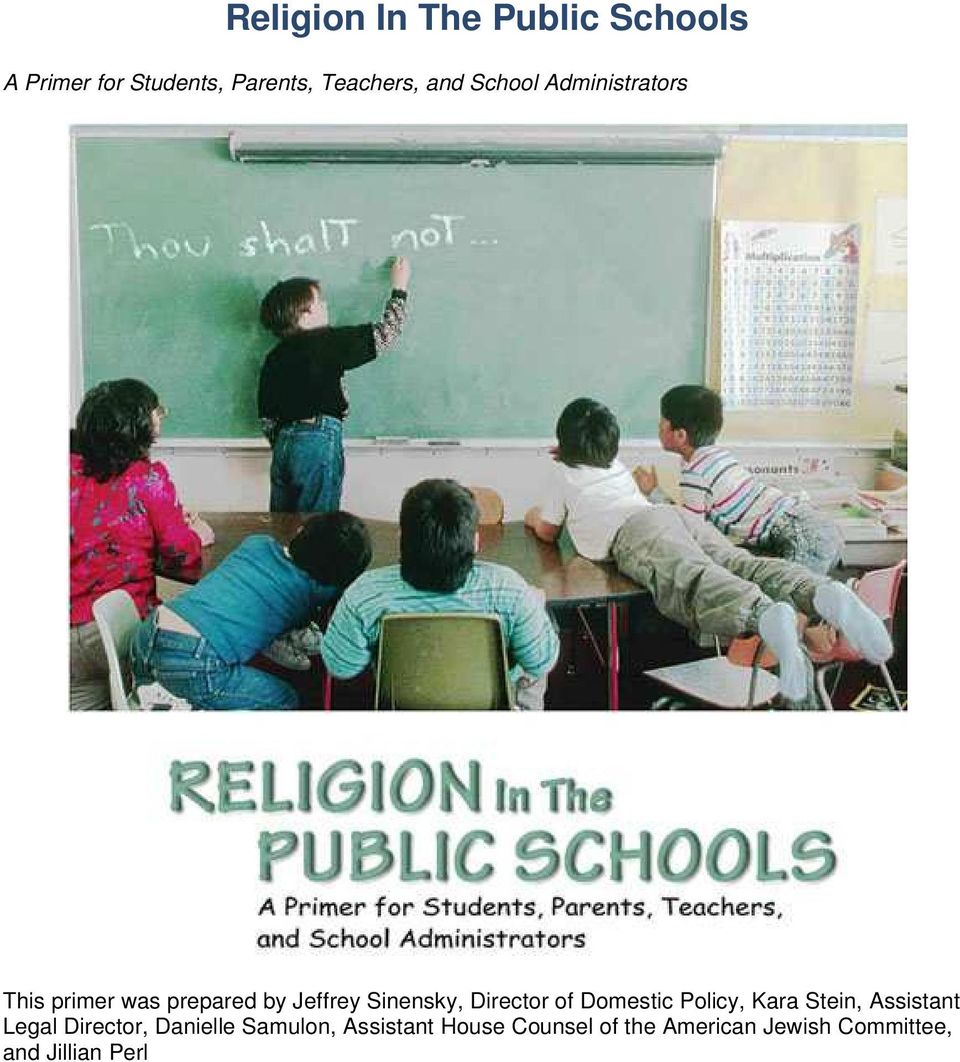
1 Religion In The Public Schools A Primer for Students, Parents, Teachers, and School Administrators This primer was prepared by Jeffrey Sinensky, Director of Domestic Policy, Kara Stein, Assistant Legal Director, Danielle Samulon, Assistant House Counsel of the American Jewish Committee, and Jillian Perl
2 Guiding Principles Because the law in this area is constantly evolving, it may be helpful to keep in mind the following guidelines when thinking about the proper place of religion in the public schools: There is an important difference between teaching about religion in order to educate and the teaching of religion so as to indoctrinate. Schools should not engage in activities that a reasonable person would understand as endorsement of a particular religion, or religion generally. School officials should be guided in their decision-making by sensitivity to the diversity of the student body and a respect for pluralism, which is fundamental to our democracy. Where appropriate, schools should accommodate the religious practices of individual students. In the classroom, children are a captive audience and the younger the child, the less likely he or she will be able to draw distinctions between school endorsement and neutral academic instruction. While it is important to know the law, legal resolution of conflicts may not be the first or best recourse or the only remedy. Many times, dialogue with school officials, PTA members, and civic leaders can be both effective and appropriate. IF YOU NEED HELP... If you need assistance in resolving a dispute in your community about religion in the public schools, the American Jewish Committee would like to help. When necessary, AJC, through its local chapters and national offices in New York and Washington, can respond in several ways. AJC can write letters to relevant school officials, meet with school officials, pursue contacts with local civic leaders, seek legal remedies, advocate legislative change, and write op/ed articles. For more information about these and other options, please contact your local chapter or AJC's national offices. A listing of contact information is provided at the end of this publication. Introduction "Congress shall make no law respecting an establishment of religion or prohibiting the free exercise thereof..." -First Amendment to the Constitution of the United States of America
3 Overview of the controversy The place of religion in our nation's public schools has long been a subject of controversy. The free exercise of religion is, of course, a fundamental right guaranteed by the First Amendment. But when religious observance implicates the state, the possibility is raised of an establishment of religion, which is barred by the First Amendment. The issue of what degree of state participation is constitutionally permissible, if any, is nowhere more heatedly debated than in the context of the public schools. Much confusion remains, even though the United States Supreme Court has decided a number of cases involving religion in the public schools and the United States Department of Education has attempted to translate those decisions into guidelines on the constitutional limits on religious activities in public schools. 1 ENDNOTES 1 To obtain a copy of these guidelines, visit the U.S. Department of Education website at How this publication is organized In this publication, the American Jewish Committee seeks to answer questions that students, parents, teachers, and school administrators may have with regard to the permissibility of various religious activities in public schools. The questions are grouped according to those who may face them. The first section answers questions that students (along with their parents) may have. The second section looks at questions teachers may ask, and the third section is designed to clarify issues for school administrators. Within the sections, each question is addressed in three ways. First, a short answer is given. Second, an illustrative example follows. The example is designed to be sufficient for those who simply require guidance on whether a particular activity is clearly permissible, clearly impermissible, or more complicated. Third, a more comprehensive answer is presented, explaining the legal nuances and underpinnings of current law. This explanation should satisfy those looking for a more complex explanation or more detailed guidance as to how to proceed under a particular set of circumstances. A special acknowledgment must be extended to Martin S. Kaplan, chair, and AJC's Church-State Task Force members for their time and input, along with the fine work of Jeffrey Sinensky, Director of AJC's Domestic Affairs Department, Kara Stein, Assistant Legal Director, Danielle Samulon, Assistant House Counsel, Richard Foltin, Legislative

4 Director, and Jillian Perlberger, that resulted in the preparation of this publication. James O. Freedman, Chair, Domestic Policy Commission, The American Jewish Committee Chapter 1: Questions Students and Parents May Have I. Voluntary Student Prayer at School Is it constitutional for students to engage in voluntary prayer in public school? Short answer: Yes, provided that they are not and do not appear to be doing so with official school endorsement or coercing other students to listen or participate. Example: A group of students may say a benediction before or grace after a meal in the school cafeteria, so long as it is done in a nondisruptive manner. Explanation: Students have a right-subject to reasonable and nondiscriminatory time, place, and manner regulations-to pray while on school grounds. For instance, students may quietly say a prayer in the classroom before taking a test or say grace over a meal in the school cafeteria. 1 However, if teachers or other school officials were to promote or give the appearance of promoting such religious expression by students (by participating in them, for instance), that would amount to unconstitutional state endorsement of religion, a violation of the Establishment Clause of the First Amendment. II. Student-Initiated Vocal Prayer in the Classroom May students initiate vocal prayer as a classroom activity? Short answer: Federal courts have reached different conclusions on this issue. Most courts have concluded that such conduct is not permissible. However, one circuit court has held that it may be permissible. 2 Therefore, the answer depends on the jurisdiction in which the incident occurred. (See Appendix.) Example: A student in New York may not call on other students in the classroom to join in reciting the Lord's Prayer. A student in Alabama may be able to do so.
5 Explanation: While the Supreme Court has held that school-sponsored prayer is unconstitutional, it has yet to decide whether this prohibition extends to student-initiated religious activity in the classroom. Several federal courts have addressed this issue, which brings into focus the conflict between religious expression and the right not to be subject to religious harassment in school. In resolving this tension between the Establishment and Free Exercise Clauses, however, although most courts have found that the right not to be harassed outweighs the right to freedom of religious expression in these circumstances, the courts have not been uniform in reaching such a conclusion. Like a majority of federal courts, the Second Circuit has ruled that a public school may prohibit student-initiated prayer in the classroom. 3 The court indicated that this type of activity violates the Establishment Clause because the voluntariness of student participation is an "illusion" and because "any effective routine requires the active participation of the teachers." 4 The court further held that the school could prevent students from praying aloud in the classroom without impeding their right to free exercise. Conversely, the Eleventh Circuit recently decided that a public school may permit student-initiated religious speech so long as it is subject to the same time, place, and manner restrictions as all other student speech in school, because to prohibit such speech would violate the students' free exercise rights.5 The Eleventh Circuit concluded that allowing such speech in the classroom does not violate the First Amendment's prohibition against government endorsement of religion so long as the school policy governing speech in the classroom is neutral as to the content of permissible speech. 6 Thus, while most federal appellate courts that have considered the issue have barred school prayer, there is not unanimity. Until the Supreme Court offers guidance on the permissibility of voluntary student-initiated prayer in the classroom, it is safe to say that problems are more likely to be avoided if such prayer does not compel a captive audience of other students to listen or participate. III. Proselytization by Students May students discuss their faith with other students in school? Short answer: Yes, so long as it is done in a nonharassing manner and they respect the rights of other students.
6 Example: A public school student may not continue to confront fellow students in an attempt to convert them, once she is aware of their disinterest. Explanation: While the First Amendment grants public school students the right to express their religious beliefs, it does not confer the right to proselytize their fellow students in an harassing manner. To the contrary, parents who enroll their children in public schools have a right to expect that their children will not be bombarded with religious doctrine. 7 Students may invite other students to attend a religious service and may express their own religious beliefs to fellow students; however, they may not harass others with whom they disagree. In other words, the right to engage in voluntary prayer or religious discussion free from discrimination does not include the right to have a captive audience, or compel other students to participate. 8 Thus students may not be subjected to harassment or coercion by others whose religious convictions are so powerful that they feel impelled to thrust these views on those to whom this treatment is unwelcome. 9 IV. Homework Assignments, Curriculum Content, and Religion May students give oral reports in which they express their religious beliefs in the classroom as a fulfillment of their homework assignments? Short answer: Yes, generally, but teachers have the discretion to disallow such reports for legitimate pedagogical reasons. Example: A student may give an oral book report on illicit drug use in America, and state that she believes drug use is wrong because, according to the religion to which she subscribes, drugs are forbidden. Explanation: The Department of Education guidelines, referenced above in the introduction, state that "students may express their beliefs about religion in the form of homework, art-work, and other writing and oral assignments free of discrimination based on the religious content of their submissions." Thus, according to the guidelines, teachers do not have carte blanche to prohibit students from including religious content in their assignments. Nevertheless, there may be circumstances where it would be inappropriate for students to present such assignments to the class, and teachers may prohibit them from doing so if they have reasonably determined that this is the case. 10 The Supreme Court has determined that the First Amendment
7 rights of students in the public schools are not coextensive with the rights of adults in other settings, and must be applied in light of the special characteristics of the school environment. 11 In other words, a school need not permit student speech that is inconsistent with its basic educational mission, even though the government could not censor similar speech outside the school. 12 As such, with regard to student expression of religious views in school assignments, school officials may restrict such activity if the restrictions are reasonably related to "legitimate pedagogical concerns." 13 It should be noted that in limiting students' religious speech, as in limiting their constitutionally guaranteed rights of any kind, the limitations imposed by the school must be the least restrictive possible that will serve the school's legitimate purpose. 14 Do students have the right to be exempted from homework assignments to which they object on religious grounds? Short answer: No, unless students are compelled to engage in conduct that contravenes a fundamental tenet of their religion. Example: A student may not be excused on religious grounds from an English class assignment to read Nathaniel Hawthorne's The Scarlet Letter because the plot features adultery. However, a student may be excused from directly participating in a seminar about contraceptives for a sexual education course in which students are actively engaged in viewing and examining model contraceptive devices. Explanation: While it is true that public schools may be required to exempt students from compulsory attendance beyond the eighth grade if a request for exemption is based on religious reasons, 15 there is no requirement that public school teachers exempt students from specific assignments that they find religiously objectionable. The Supreme Court has yet to rule on whether parents have a right to have their children excused from attending specific courses or using specific course materials that the parents find contrary to their religious beliefs. The lower federal courts have, however, provided some guidance on the issue. Some federal courts have explicitly stated that the Free Exercise Clause does not require a school to excuse students from assignments pertaining to material that they object to on religious grounds. 16 Courts have distinguished between mere exposure to religiously offensive viewpoints, which do not compel students to act according to those viewpoints, and assignments that compel action, concluding that only compulsion to act contrary to religious beliefs is unconstitutional. 17 One court noted that while students may not be compelled "to affirm or deny a religious belief or to
8 engage or refrain from engaging in a practice forbidden or required in the exercise of [their] religion," they may nevertheless be required to at least read and discuss material that they find objectionable. 18 May parents compel a school to remove books from the curriculum that they or their children find religiously offensive? Short answer: No. Schools need not remove such books unless they determine that a reasonable person in the position of the student would perceive a message that the school is promoting or discouraging his or her religion. Example: Parents may not demand that the novel by Chaim Potok, The Chosen, be removed from the curriculum simply because they believe it casts aspersions on the Orthodox Jewish way of life. Explanation: A school board may use its discretion in selecting books for its curriculum, and need not comply with the demands of parents who claim that their religious beliefs or those of their children are offended. As Justice Jackson noted, "if we are to eliminate everything that is objectionable to any of [the religious bodies existing in the United States] or inconsistent with any of their doctrines, we will leave public education in shreds." 19 Furthermore, as one circuit court reasoned, it is the schools' purpose to instill values such as "independent thought [and] tolerance of diverse views..." 20 However, in determining how to respond to a parent's objection, a school must consider whether a reasonable person in the position of a student would perceive a message that the school is promoting or discouraging his or her religion. 21 It should be noted that courts have upheld school boards' discretion in selecting curricular texts in virtually every legal challenge, generally concluding that the texts in question are intended to foster discussion of religions rather than endorse them. 22 V. Religious Holiday Observance Do students have the right to be exempted from attending schoolsponsored activities relating to holiday observances to which they object on religious grounds? Short answer: Yes. Example: An atheist student may be excused from attending a school assembly during which Christmas carols and Hanukkah songs will be sung.

9 Explanation: To avoid a violation of the Establishment and Free Exercise Clauses, student participation in holiday observances must be completely voluntary. Therefore, students from various religious backgrounds may be excused from certain activities related to particular holidays. However, school officials must understand that a policy of excusing students from a specific religious activity or discussion cannot be used as a rationale for school sponsorship of religious celebrations or worship for the remaining students. 23 (See also ch. 2, IV and ch. 3, III.) Do students have the right to be absent in order to observe a religious holiday without being penalized? Short answer: Yes. Example: A student may miss school on the Jewish High Holy Day of Yom Kippur in order to attend synagogue services, or on the Muslim holiday of Eid Al-Fitr, and have the opportunity to take any tests scheduled for that day on another day, without penalty. Explanation: Students should not be adversely affected by their decision to remain away from school on religious holidays of their faith. 24 To penalize them for truancy would violate the Free Exercise Clause, since it would be the equivalent of forcing them to violate their religious beliefs in order to avoid scholastic sanction. 25 (See also ch. 2, IV and ch. 3, III.) VI. Student Garb Do students have the right to wear religious garb or display religious symbols on their persons? Short answer: Yes, unless the school has instituted a dress code for nondiscriminatory purposes that has the incidental effect of prohibiting religious symbols or messages on clothing, and unless there is a compelling state interest (such as health and safety concerns) justifying such a prohibition. Example: A student may not be prohibited from wearing a necklace with a cross on it. However, a student belonging to a violent right-wing group that has adopted a large black cross as its emblem may be prohibited from wearing a T-shirt displaying this emblem to school, if there is a demonstrable link between the wearing of the symbol and disruption in the school, and the school has therefore adopted a dress code prohibiting it. Explanation: In general, a school may enforce dress code prohibitions.

10 The Department of Education guidelines state that schools may prohibit certain types of student garb as long as the rules are religiously neutral and generally applicable. Realizing the difficulties of maintaining security and order, especially in light of gang-related violence, courts have tried not to micromanage such school policies. However, courts that have examined school dress codes that explicitly prohibit religious symbols and messages have held that schools may only impose such a burden on students' right to free speech and free exercise of religion if they can demonstrate that the restriction is absolutely necessary. 26 VII. Distribution of Religious Literature by Students Do students have the right to distribute religious literature in schools? Short answer: Yes, but schools have the right to impose reasonable, content-neutral restrictions on such distribution. Example: A student may distribute pamphlets published by a religious youth group of which he is a member alongside students distributing materials about extracurricular activities outside of the school cafeteria. This may hold true only if the school principal has been consulted and has made the reasonable determination that students will not think the school is endorsing the message in the pamphlets or feel obliged to read them. Explanation: School officials may not enforce a complete prohibition on student distribution of religious materials, but they may impose reasonable, content-neutral restrictions as to the time, place, and manner of such distribution. While the Supreme Court has not squarely addressed the issue of what restrictions are reasonable in the context of religious material distribution by students, one circuit court has held that a public school may require approval of religious materials prior to its distribution in order to meet "legitimate pedagogical concerns" and may insist on the inclusion of a disclaimer indicating that the school does not endorse the content of the material. 27 VIII. Student Religious Clubs Do student religious clubs have the right to meet on school grounds? Short answer: Yes, but only in high schools, and if any other extracurricular club has that right. Example: If a high school allows a student group that performs community service for the homeless to meet during a weekly lunch period in a vacant
11 classroom, it must also allow a Bible study group to meet at such a time and place. Explanation: Under the Equal Access Act, 28 a law Congress enacted in 1984, a public high school that permits at least one noncurriculum-related student group (i.e., not directly relating to a course offered by the school) to meet on school grounds during noninstructional time must permit all student organizations to meet on equal terms regardless of their religious or political views. May students invite outside adults to participate in their religious club meetings at school? Short answer: Yes, but only on an occasional basis, and in the absence of a school policy prohibiting any student group from inviting outside adults to participate. Example: A high school Muslim students' club may invite a local imam to speak to the group on a certain occasion, but such a religious leader may neither initiate the meeting nor sermonize on a weekly basis. Explanation: Under the Equal Access Act, "non-school persons may not direct, conduct, control or regularly attend activities of student groups." Moreover, a public school has the right to prohibit all outside individuals from participating in student club activities as long as the policy is nondiscriminatory. IX. Prayer at Graduation Ceremonies May high school students present a self-initiated invocation or benediction at graduation? Short answer: Federal courts that have considered this issue have reached different conclusions. It therefore depends on what court's jurisdiction the school falls under. Example: A student at a high school in Pennsylvania chosen to deliver a speech at graduation may not call on those attending to join her in prayer. A student in Texas may. Explanation: The U.S. Supreme Court has yet to determine whether student-initiated and student-delivered invocations at graduation ceremonies violate the First Amendment's Establishment Clause. The Court has concluded that a clergyman's benediction at a public school graduation is unconstitutional. 29 However, in the wake of this ruling, several

12 school districts enacted policies that delegated to students the decisionmaking authority over the content of graduation addresses. It is not clear whether these policies effectively circumvent the Supreme Court's ruling regarding prayer at graduation ceremonies, since the prayer in question is not clergy-led. In a number of lawsuits challenging the constitutionality of student-initiated and student-led graduation prayer, schools have argued that under these circumstances there is no government endorsement of religion but rather mere student assertion of their right to free exercise of religion and free speech. Such arguments have not yet reached the Supreme Court directly (although cases addressing similar issues, such as the permissibility of student-initiated prayer at school-sponsored athletic events, have reached the High Court; see discussion in ch. 1, XI, below), but a number of federal appellate courts have ruled on the issue of student-led graduation prayer. These courts have disagreed as to whether such activity violates the Establishment Clause. The Fifth Circuit Court of Appeals has explicitly permitted such a policy, 30 while the Third Circuit has held such a policy to be unconstitutional. 31 The Eleventh Circuit recently came to the same conclusion as the Fifth Circuit. 32 Absent a Supreme Court decision, the interpretation of each appellate court controls in the states of its jurisdiction. X. Prayer at Baccalaureate Programs May students present invocations at baccalaureate ceremonies? Short answer: Yes, so long as there is no endorsement, approval, or facilitation by school officials in such ceremonies. Example: A student may invite other students to a ceremony at a local church the day after high school graduation during which a clergyman will bless the attendees but no school official will participate. Explanation: In reaction to the debate about the constitutionality of student-led prayer at official graduation ceremonies, students in some public schools have chosen to mark the completion of their studies with a religiously oriented ceremony, known as a baccalaureate service, that is separate from and supplemental to the official, school-sponsored graduation ceremony. Such services typically include prayers and religious sermons and are organized primarily by students rather than by school officials.

13 There is case law giving support to the constitutionality of such services. 33 However, while there have been clear pronouncements that school officials may not organize a baccalaureate service, the federal judiciary has issued no equally clear pronouncement as to exactly what factors must be present or absent for a student-organized service to pass constitutional muster. Analysis of the case law, however, indicates that the presence of any of the following factors would be likely to render such a service unconstitutional: (1) endorsement by school officials through official announcements, participation, or attendance; (2) use of school facilities as premises for the ceremony, particularly if such facilities are made available free of charge; and (3) performance by school groups, such as bands or choirs, whose participation is mandatory. XI. Prayer at School Assemblies and Athletic Events May students initiate prayers during school-sponsored assemblies or sporting events with the involvement of the school? Short answer: No. Example: A student may not make an announcement over the school's public address system at the outset of a school football game that all in attendance are invited to pray for the team's victory. Explanation: Courts have generally held for some time that public school students may not conduct prayers at school assemblies, even if attendance at such events is voluntary. 34 A school policy permitting students to initiate such activities, courts have held, is in violation of the Establishment Clause, even if the prayer is nonsectarian and nonproselytizing. 35 With regard to school-sponsored athletic events, school officials may not invite or encourage students to engage in vocal prayer. Furthermore, as the Supreme Court recently decided in the landmark Santa Fe Independent School District v. Doe, 36 group prayer at an athletic activity that is student-initiated and student-led is also not constitutional. The Court in that case stated that even if nonparticipating students are not harassed or coerced and there is no official school participation or supervision, the delivery of a religious message under such circumstances-i.e., on athletic fields that are part of school property, at school-sponsored events, perhaps even over the school's public address system, under the supervision of school faculty, and pursuant to a school policy that either explicitly or implicitly invites prayer by use of the word invocation to describe the type of permissible message (explicitly and implicitly encouraging public
14 prayer)-cannot be properly characterized as private speech and is therefore not constitutionally protected. The Court in Santa Fe also noted that the fact that a school's policy permits prayer at graduation ceremonies only if the majority of students vote in favor of its inclusion does not transform an unconstitutional policy into a constitutional one because, the Court explained, a "student election does nothing to protect minority views but rather places the students who hold such views at the mercy of the majority." 37 Chapter 2: Questions Teachers May Have I. Teaching Religion in the Public Schools Is it permissible to teach about religion in public schools? Short answer: Yes. Teachers may instruct about religion, so long as what is taught is not religious instruction and is age appropriate. Example: A public high school teacher may inform students about the basic tenets of Buddhism, Hinduism, and Islam in a course on Comparative Religions. Explanation: Religious indoctrination is not permissible in public school curricula. Rather, the maintenance and furtherance of religion are the responsibilities of houses of prayer and families, not of the public schools. Yet there is nothing unconstitutional in teaching about religion objectively, including a historical and comparative study of religions. Pertinent references to religion and holy books, even references to doctrinal differences, may be included in the teaching of history, social studies, literature, art, and music. For example, events such as the Crusades, the Inquisition, the Reformation, and the colonization of America, as well as the Holocaust, would be hopelessly distorted if religious motivations and impact were not given proper weight. 1 To avoid constitutional pitfalls when teaching about religion, teachers or other school officials must ensure that any course designed to teach about religion does not have the primary purpose or effect of promoting, inhibiting, or endorsing religion, and does not excessively entangle government with religion. 2 For instance, a course that teaches the Bible as literature should use as a secondary source a neutral text that does not promote the view of any particular religion. 3 While some schools may rely on student and parent complaints to monitor violations and prevent teachers from promoting religion, teachers should be aware that schools are constitutionally permitted-and may choose-to videotape classes as a
15 further safeguard. 4 Teachers who will be teaching about religion should have some background in the academic study of religion, or should receive substantive training from qualified scholars. In addition, any instruction about religion should be conducted in an age-appropriate manner. For example, teachers should be mindful that elementary education is not the place for in-depth treatment of religion. 5 Is it permissible to teach values in public schools? Short answer: Yes. It is permissible to teach democratic and civic values that are broadly shared by people of all faiths or no faith, so long as such values are presented as secular and not having their sole basis in religion. Example: A teacher may initiate a discussion on ethics and civic values in response to a school-wide cheating scandal, during which he urges responsible behavior because of its salutary effect on individuals and society as a whole. Explanation: There is nothing unconstitutional about public schools teaching the core ethical values regarding which there is consensus without reference to religion, such as honesty, decency, sportsmanship, civility, self-discipline, love of country, respect and concern for rights, freedoms and feelings of others. 6 However, teachers must take care not to ground these values in religious orthodoxy. Rather, teachers should make it clear that these values are not necessarily based in religion and should avoid suggesting that those not religiously affiliated are morally suspect or that good citizenship and belief in God are synonymous. What is permissible regarding teaching creationism and evolution? Short answer: Teachers may not present the biblical account of creation as scientific fact. They are free to teach the theory of evolution, even though some religious believers may object. Example: A biology teacher may not refer students to the book of Genesis for an alternative "scientifically valid explanation" for how various species came into existence. Explanation: While teachers may teach "about" the biblical account of creation in an elective course on comparative religion at an ageappropriate level, they may not teach that account as though it were the explanation for the origin of the world, since to do so would be to unconstitutionally promote a particular religious belief. Regarding the teaching of evolution, the debate surrounding which has been ongoing
16 since the Scopes "Monkey Trial" of 1925, 7 the Supreme Court has long since come down squarely on the side of proponents of such teaching. 8 Several states have attempted to circumvent such court decisions by passing laws that require public school textbooks to give "balanced treatment" to the theories of evolution and "creation-science." However, such laws have not withstood legal challenge. 9 In review of one such law, the Supreme Court declared it a violation of the Establishment Clause for a school board to mandate that the teaching of creation science be given "equal time." 10 Similarly, some states have tried to circumvent court decisions by adopting legislation that requires that evolution be taught as an unproven theory. 11 Likewise, these laws have not withstood constitutional challenges. 12 II. Directing and Participating in Student Religious Activities Is it permissible for teachers to direct students to observe a moment of silence in the classroom? Short answer: No, if the purpose is to promote religion. Example: A teacher, in an effort to encourage her students to pray, may not ask them to observe a moment of silence. Explanation: The Supreme Court held in 1985 that an Alabama statute mandating silent prayer in the classroom violated the Establishment Clause because its "sole purpose" was to promote religion in the public schools. 13 Thus a moment of silence that is intended as a means of inducing prayer is not permissible. On the other hand, a recent Fourth Circuit Court of Appeals decision upheld a state statute requiring all Virginia public school students to begin each day with a moment of silence in which they may "meditate, pray, or engage in any other silent activity." 14 The court stated that, although it had religious overtones, the statute did not violate the First Amendment's Establishment Clause because it was intended to "lessen the urges of students to commit violence" and thus had a legitimate secular purpose. 15 In this case, the court concluded, the state requirement accommodates religion without promoting it. Is it permissible for teachers to supervise students in religious activities, as part of school activities/ functions, outside the classroom? Short answer: No.
17 Example: A teacher who coaches the debate team may not ask the team to join him in prayer before a competition. Explanation: Public school teachers may not initiate, lead, or participate in any student religious activities. This prohibition extends beyond the classroom to school assemblies, school-related activities, and schoolsponsored athletic events. As representatives of the state, public school teachers would violate the Establishment Clause by placing their imprimatur on such activities. 16 Of course, this restriction should not be interpreted to limit the right of public school teachers to involve themselves in religious activities with students at functions unrelated to their duties as public school teachers. May teachers participate in student-initiated religious clubs? Short answer: No, but they may monitor or intervene in such meetings for the purpose of guarding against any impermissible activities. Example: A teacher may not participate in a meeting of a noncurricular student religious organization on school premises, but may supervise such a meeting to ensure that no student is being improperly harassed. Explanation: The Equal Access Act, referenced in chapter 1, note 27, specifically prohibits any school official from sponsoring, organizing, or participating in the meetings of noncurricular student religious organizations. 17 Teachers may, however, monitor student religious clubs to ensure that there is no violation of school policies. 18 III. Teachers' Freedom to Express, Observe, and Display Symbols of their Religion May teachers express their religious views to students? Short answer: No. Example: A teacher may not state in front of a classroom that he believes dinosaurs never existed because they are not in the Bible and the Bible is God's word. Explanation: To ensure government neutrality toward religion, teachers should refrain from expressing their religious beliefs to students. The Supreme Court has noted that "[t]he State exerts great authority and coercive power... because of the students' emulation of teachers as role models..." 19 As such, teachers, especially those of impressionable schoolchildren, must take care not to give the appearance of school

18 endorsement of religion. 20 If teachers are asked about their personal religious views, they should state that it would not be appropriate for them to discuss their religious beliefs with their students. Moreover, public schools have a constitutional duty to make "certain... that [publicly] subsidized teachers do not inculcate religion... " 21 Therefore, school administrators may monitor teachers' classroom instruction to ensure that they do not express their religious beliefs. 22 May public school teachers pray in front of a classroom of students? Short answer: No. Example: A teacher supervising a study hall period may not recurrently sit at her desk and openly read the Bible. Explanation: Public school teachers may not pray or read the Bible or a similar religious text to themselves in front of schoolchildren, regardless of their purpose in doing so. Even if teachers have no intention of indoctrination, the message they convey to an objective student observer is one of religious endorsement. Courts have upheld this rule on constitutional grounds. 23 May public school teachers wear religious garb or symbols? Short answer: In general, schools should find ways to allow teachers to reflect their religious identities consistent with the Establishment and Free Exercise Clauses of the Constitution. However, schools may be permitted to have policies restricting what teachers may wear, as long as such policies do not discriminate against any particular religion, are narrowly tailored to the purpose of maintaining an environment free from the appearance of school endorsement of religion, and schools do not provide exemptions to those policies for secular reasons. Example: A Jewish public school teacher may wear a yarmulke in accordance with his religious practices. Explanation: There is some ambiguity in this area of the law. On the one hand, because it is of paramount importance that public schools maintain an environment free from the appearance of any school endorsement of religion, public school teachers may be subject to greater restrictions than private citizens on their right to express their religious beliefs through their dress. 24 Although school policies enforcing such restrictions may force teachers to either compromise their religious beliefs concerning their clothing or face termination of their employment, courts have upheld such
![Moreover, public schools have a constitutional duty to make "certain... that [publicly] subsidized teachers do not inculcate religion.](/docs-images/52/12118454/images/page_18.jpg ".. \" 21 Therefore, school administrators may monitor teachers' classroom instruction to ensure that they do not express their religious beliefs.")
19 policies on the grounds that they are necessary to "avoid the appearance of sectarian influence, favoritism, or official approval in the public school." 25 Such policies must be reasonable and may not discriminate against any particular religion. 26 On the other hand, while not specifically addressing the public school context, courts have held that when government has in place a system of exemptions to policies such as dress codes, it may not refuse to extend that system to cases of religious hardship without a compelling reason. 27 In Fraternal Order of Police Newark Lodge No. 12, the court determined that a police department's decision to provide medical exemptions to its nobeard requirement but not religious exemptions violated the Free Exercise Clause of the Constitution because the court could find no compelling interest for making a distinction between medical and religious exemptions. 28 IV. Religious Holiday Observance Do teachers have the right to be absent in order to observe a religious holiday without being penalized? Short answer: Yes, unless a school demonstrates that a teacher's proposed absence would impose an undue hardship on the school. Example: A teacher may miss school on Good Friday without being penalized professionally in order to attend church services, so long as the absence does not create an undue hardship for the school. Explanation: Teachers should not be adversely affected by a decision to remain away from school on religious holidays of their faith. 29 Federal law requires an employer to "reasonably accommodate" an employee's religious observances, practices, and beliefs unless the employer can show that accommodation would cause "undue hardship" to the employer's business. 30 Thus a school district must attempt to devise a method of allowing teachers to practice their religious beliefs while still maintaining their jobs. 31 In some cases, accommodation may not be possible. However, the school district bears the burden of showing that a serious attempt was made. While a teacher may be required to report for work when his or her absence would impose an undue hardship on his or her employer, such instances are rare, and, barring some real demonstration of undue hardship, teachers should not be penalized for their observance of religious holidays. 32 To penalize them could violate federal civil rights law, as well as the Free Exercise Clause, since it would be the equivalent of
20 forcing teachers to sacrifice their religious beliefs in order to avoid professional sanction. (See also ch. 1, V and ch. 3, III.) Chapter 3: Questions School Administrators May Have I. Vocal Prayer in the Classroom Can a school institute the practice of vocal prayer in the classroom? Short answer: No. Example: A school may not require, or even allow, teachers to lead their classes in morning prayers. Explanation: A school policy instituting vocal devotional activities in the classroom is a violation of the Establishment Clause. The Supreme Court has ruled that a state may not require teachers to lead their classes in morning prayers, whether written by state officials or taken from the Bible, even if student participation is explicitly made optional. 1 Even without direct governmental compulsion, the Court stated, "When the power, prestige and financial support of government is placed behind a particular religious belief, the indirect coercive pressure upon religious minorities to conform to the prevailing officially approved religion is plain." 2 II. Library Books, Curriculum Content, and Religion May school officials remove books from public school libraries for religious reasons? Short answer: No. They may remove only books deemed to be "pervasively vulgar" i.e., obscene or otherwise offensive and without any significant redeeming educational value. Example: The Koran may not be removed from a public school library because it is deemed to carry a religious message. Explanation: Public school officials may assess the "educational suitability" of library books and remove them if they determine the books to be "pervasively vulgar." 3 However, officials may not deny students access to library books "simply because they dislike the ideas contained in those books and seek by their removal to prescribe what shall be orthodox in... religion or other matters of opinion." 4 The Supreme Court has stressed the "unique role of the school library" in facilitating students' ability to "gain new maturity and understanding." 5 As the use of school libraries is voluntary
21 and students choose for themselves which books to read, school officials need not be concerned that merely stocking certain religious texts will constitute state endorsement of religion. May school officials remove books from the classroom or curriculum because of their religious content? Short answer: Yes. School officials have almost total discretion in doing so. Example: School officials may direct the removal of a book telling the biblical story of Moses receiving the Ten Commandments from grade school classrooms and curriculum. Explanation: The Supreme Court has upheld the policy of near total noninterference with the curricular decision-making authority of school districts, granting them nearly absolute discretion in matters pertaining to the "daily operation of school systems." 6 The same strong free exercise and free expression concerns in the context of the availability of books in a school library do not come into play in the teacher's choice of material to teach in the classroom. The primary concerns given weight with regard to this issue have to do with avoiding the appearance of state endorsement of religion. Thus courts have held that school officials may order the removal from the classroom of religiously oriented books that they find to have a religious purpose and/or the primary effect of advancing religion. 7 III. Religious Holiday Observance May a school exhibit religious-holiday displays? Short answer: No, unless such displays consist of symbols of more than one religious tradition or are of a "secular" nature, as courts have categorized Easter bunnies, reindeer, and the like. Example: A school may adorn its walls during December with pictures of both Christmas trees and Hanukkah menorahs. Explanation: The Supreme Court has not definitively determined exactly what is permissible with regard to seasonal holiday decorations in public schools. However, in decisions examining the constitutionality of holiday displays on other public property, the Court has concluded that such displays are constitutional so long as they have a legitimate secular purpose, such as acknowledging aspects of America's cultural heritage 8 or "celebrating the winter-holiday season." 9 Although the Supreme Court has indicated that it might rule differently in a case involving such displays in
22 public schools because of the "special sensitivity" of that context, 10 the Department of Education guidelines state that schools "may celebrate the secular aspects of holidays," suggesting that the display of religious symbols that are arguably imbued with secular meaning is permissible. May a school sponsor ceremonies or productions to recognize religious holidays? Short answer: No, unless the purpose is to provide secular instruction about religious traditions rather than to promote a particular religion or religion in general. Example: An assembly during which both Hanukkah and Christmas songs are sung, and which is introduced by a school official who describes it as an opportunity to learn about some of the traditions that make up our nation's cultural heritage, is permissible. Explanation: The Supreme Court has not issued a comprehensive ruling on the precise boundaries of what is permissible regarding activities in recognition of religious holidays in the schools. However, it has indicated that activities whose purpose is to provide secular instruction about religious traditions rather than to promote the particular religion involved may be constitutional. 11 Must, or may, a school arrange its calendar so as not to conflict with religious holidays? Short answer: Aside from national holidays, a school may make reasonable adjustments to its calendar to accommodate the religious needs of students or teachers where such adjustments serve a practical purpose, but it is not required to do so. Example: A school district with a majority of Jewish students and/or teachers may choose to close for Yom Kippur, a Jewish holiday during which Jewish students would have to miss school in accordance with their beliefs, so as to avoid the wasteful expenditure of operating the school on a day when fewer than half of the students would be in attendance. Explanation: A public school is not required to shut down its operations or reschedule its activities to accommodate the religious needs of students or teachers. However, it is permissible for school administrators to arrange the school calendar (in a nonpreferential manner) so as not to conflict with holiday observances. As the Supreme Court has stated: "When the state... cooperates with religious authorities by adjusting the schedule of public
23 events to sectarian needs, it follows the best of our traditions. For it then respects the religious nature of our people and accommodates the public service to their spiritual needs." 12 However, courts have also emphasized the importance of the existence of a pragmatic reason behind any such adjustments in the school calendar, disallowing, for instance, a school closing for a holiday on which most students would not have felt the need to miss school for religious reasons and where such closing appeared to be for merely symbolic religious reasons not appropriate for a public school to act on. 13 (See also ch. 1, V and ch. 2, IV.) IV. Displaying the Ten Commandments May a public school display copies of the Ten Commandments? Short answer: No. Example: Administrators may not direct that copies of the Ten Commandments be posted on classroom walls so that children may read, meditate upon, venerate and/or obey the Ten Commandments, even if the stated purpose for doing so is to demonstrate secular applications of the Ten Commandments such as the promotion of moral values. Explanation: The U.S. Supreme Court held in Stone v. Graham, that a state statute requiring the posting of a copy of the Ten Commandments, purchased by private contributions, on the wall of each public classroom in the state violated the Establishment Clause of the First Amendment in that the purpose of the statute was clearly not secular. 14 According to the Court, the "preeminent purpose for posting the Ten Commandments on schoolroom walls is plainly religious in nature." 15 The Court explained that "the Ten Commandments are undeniably a sacred text in the Jewish and Christian faiths, and no legislative recitation of a supposed secular purpose can blind us to that fact." 16 Specifically, four of the Ten Commandments, such as the requirements of Sabbath observance and avoidance of idolatry, are statements of faith rather than moral pronouncements. 17 Finally, the Court concluded that while there may be instances in which the study of the Ten Commandments, just as the study of the Bible, may constitutionally be permitted in an appropriate study of history, civilization, ethics, or comparative religion, the "posting of religious texts on the wall serves no such education function." 18 V. Access to School Facilities by Outside Religious Groups Must schools grant outside religious organizations access to the classroom during instructional time?
24 Short answer: No. In fact, schools may not grant such access to outside religious groups. Example: A school may not allow a religious group to proselytize and/or distribute Bibles during instructional time. Explanation: The presentation of religious material by outside religious groups during instructional time is a clear violation of the Establishment Clause, since it cannot help but give the impression of state involvement in, and even coercion of, the religion being advocated to the captive audience of children in their classroom. Accordingly, courts have held that such activities by outside groups in the classroom are impermissible. 19 May schools prohibit outside religious groups from distributing religious materials outside of the classroom but on school grounds? Short answer: Yes. A school may prohibit distribution of materials by outside religious groups on school grounds if it also prohibits the distribution of materials by all other outside groups on school grounds. However, if it allows other outside groups to distribute material on school grounds, it must also allow outside religious groups to do so. Example: A public school that allows the League of Women Voters to distribute literature to willing recipients on school grounds may not prohibit the Gideons from distributing Bibles on school grounds to willing recipients. Explanation: School officials may constitutionally prevent religious groups from gaining access to their facilities only by adopting a general policy applicable to all outside groups. However, even if it must permit access to religious groups, it may impose reasonable time, place, and manner restrictions on all outside groups so as to ensure that schoolchildren are neither coerced nor harassed by them. 20 May schools prohibit outside religious groups from distributing religious materials just outside of school grounds? Short answer: No, unless schools can show that such activity materially disrupts school activities or creates a coercive environment for students. Example: Barring unusual circumstances, a religious group may peacefully and quietly stand on the public sidewalk across from a school offering pamphlets to students who pass by. Explanation: Public schools may not prohibit religious groups from distributing literature in the environs of school grounds, even if such a
25 prohibition is aimed at all outside groups, because courts have held that a public sidewalk in front of a school is a public forum 21 -i.e., a place traditionally dedicated for public discourse and debate, such as a street, park, or town square, where the government, absent a compelling interest, may not prohibit expression, and may only place reasonable restrictions on the time, place, and manner of that expression. 22 As such, it is an unconstitutional violation of free speech to limit the expressive activity of any group wishing to make use of that public forum, whether religious or not. However, public schools may prohibit the distribution of literature by religious organizations if such activity "materially disrupts classwork or involves substantial disorder or invasion of the rights of students." 23 May schools limit or prohibit the use of school facilities by outside religious groups after school hours? Short answer: Yes. A school may impose nondiscriminatory and reasonable time, place, and manner regulations on the use of its facilities by outside groups, religious or otherwise, or even prohibit the use of its facilities by all outside groups; but if a school generally allows outside groups to use its facilities, it must allow religious groups to use them as well. A school may issue disclaimers indicating its nonendorsement of religious activities held on its premises. Example: A school that regularly makes its facilities available to civic groups after school hours cannot refuse to make its facilities available to a church group that wants to hold discussions on political issues on which the church takes a particular position. However, the school may post signs indicating that it does not endorse the positions taken by the church. Explanation: The Supreme Court has held that, although public schools are not required to open their facilities to outside organizations, if they decide to do so, it must be on a nondiscriminatory basis and cannot be to the exclusion of, for example, groups bearing a religious message. 24 Thus, whenever school buildings are regularly made available to civic groups after school hours, religious groups must be accorded the same privileges, on the same terms as those enjoyed by other organizations. 25 Public schools may, however, issue disclaimers indicating their nonendorsement of activities held on their premises after school hours.
26 Appendix: Guide to Circuit Courts of Appeal Circuit States Included in Circuit First Circuit Maine, Massachusetts, New Hampshire, Rhode Island, Puerto Rico Second Circuit Third Circuit Fourth Circuit Fifth Circuit Sixth Circuit Seventh Circuit Eighth Circuit Ninth Circuit Tenth Circuit Eleventh Circuit D.C. Circuit Connecticut, New York, Vermont Delaware, New Jersey, Pennsylvania, Virgin Islands Maryland, North Carolina, South Carolina, Virginia, West Virginia Louisiana, Mississippi, Texas Kentucky, Michigan, Ohio, Tennessee Illinois, Indiana, Wisconsin Arkansas, Iowa, Minnesota, Missouri, Nebraska, North Dakota, South Dakota Alaska, Arizona, California, Hawaii, Idaho, Montana, Nevada, Oregon, Washington, Guam, Northern Mariana Islands Colorado, Kansas, New Mexico, Oklahoma, Utah, Wyoming Alabama, Florida, Georgia District of Columbia Contact Information For further information, please contact your local chapter of the American Jewish Committee or our national office. Endnotes Chapter 1: Questions Students and Parents May Have ENDNOTES 1 The landmark case of Tinker v. Des Moines Independent Community School District, 393 U.S. 503 (1969), set forth this principle most explicitly. In Tinker, the Supreme Court held that a student could wear a black armband to protest the Vietnam war because the First Amendment
27 protects expression, whether it is in the form of prayer or discussion, in the same way as it does for other types of speech. The decision went on to state that a student is free to express himself "if he does so without... colliding with the rights of others." Id. at See Chandler v. Siegelman, 230 F.3d 1313 (11th Cir. 2000), cert. denied, 121 S.Ct (2001). The court in Chandler held that student-initiated vocal religious speech that takes place on school property is subject to the same time, place, and manner restrictions as all other student speech. In this case, the Eleventh Circuit rejected a challenge to a school policy permitting students to engage in vocal prayer on school property in front of others, reasoning that students are not state actors, and their speech is therefore private speech (even when taking place in a public context) as long as the prayer is genuinely student-initiated and not the product of any school policy that actively or surreptitiously encourages it. The court held that where such speech is private, it does not violate the Establishment Clause. 3 The Second Circuit reasoned that "the authorities were entitled to weigh the likely desire of other parents not to have their children present at such prayers... and the wisdom of having public educational institutions stick to education and keep out of religion with all the bickering that intrusion into the latter is likely to produce. The authorities acted well within their powers in concluding that plaintiffs must content themselves with having their children say these prayers before nine or after three...." Stein v. Oshinsky, 348 F.2d 999, 1002 (2nd Cir. 1965), cert. denied, 382 U.S. 957 (1965). 4 Id. at See Chandler, 230 F.3d Chandler went so far as to avereven in light of the Supreme Court's holding in Santa Fe Independent School District v. Doe, 530 U.S. 290 (2000) (see ch. 1, XI, below), that studentinitiated prayers at football games were unconstitutional partly because they were carried over the school's public address system-that there is nothing impermissible about broadcasting prayers over the school's public address system on the same terms as other speech, as long as such broadcasts are student-initiated. This is doubly perplexing in light of the fact that in several decisions, including Lee v. Weisman, 505 U.S. 577 (1992), the Supreme Court has concluded that children in school settings are captive audiences and to compel them to listen to prayer is a violation of their free exercise right. However, until the Supreme Court squarely addresses the issue, the circuit court decisions dictate the law within their jurisdictions.
28 6 See Chandler, 230 F.3d In fact, under certain circumstances, such expression may be restricted. See Gernetzke v. Kenosha Unified School District No. 1, 274 F.3d 464, 466 (7th Cir. 2001), cert. denied, 122 S.Ct (2002), in which the court upheld a high school principal's decision to forbid the display of the cross in a student Bible Club's mural, after inviting all student groups to paint murals in the main hallway, stating that the principal was "not discriminating against religion but merely against displays, religious or secular, that he reasonably believed likely to lead to litigation or disorder." In that case, the court also restricted some displays of non-religious student groups. 8 See Santa Fe Independent School District v. Doe, 530 U.S. 290 (2000), holding unconstitutional student-initiated prayers carried over the school's public address system at football games. (See ch. 1, XI, below). See also Tinker, 393 U.S See Santa Fe Indep. Sch. Dist., 530 U.S See C.H. v. Oliva, 226 F.3d 198 (3rd Cir. 2000), cert. denied, 121 S.Ct (2001), in which the court of appeals held, by equally divided vote, that a teacher could prevent an elementary school student from reading a religious story aloud to classmates. 11 See Hazelwood School District v. Kuhlmeier, 484 U.S. 260 (1988), in which the Supreme Court determined that a high school paper published by students in a journalism class did not qualify as a "public forum," so that school officials retained the right to impose reasonable restrictions on student speech in the paper. The Court concluded that the high school principal's decision to remove two pages from the student newspaper did not violate students' free-speech rights, noting that "a school must be able to take into account the emotional maturity of the intended audience in determining whether to disseminate student speech on potentially sensitive topics, which might range from the existence of Santa Claus in an elementary school setting to the particulars of teenage sexual activity in a high school setting." Id. at Id. at Id. at Id. 15 Wisconsin v. Yoder, 406 U.S. 205 (1972). In this case, the Supreme
29 Court upheld the right of Amish students whose parents objected to compulsory attendance at public school for their children to discontinue attendance beyond the eighth grade, on the grounds that such attendance contravened the teachings of their religion. 16 See Grove v. Mead School District No. 354, 753 F.2d 1528 (9th Cir. 1985), cert. denied, 474 U.S. 826 (1985). The Ninth Circuit held that use of a book about an American subculture that touched briefly on a particular religion in an English literature class did not violate a student's free exercise rights, nor did it violate the Establishment Clause of the First Amendment because the use of the book served a primarily secular educational function. See also Mozert v. Hawkins County Board of Education, 827 F.2d 1058 (6th Cir. 1987), cert. denied, 484 U.S (1988), in which the court held that the requirement that public school students read a basic reader series that mentions mental telepathy did not create an impermissible burden on students' exercise of their religion, notwithstanding students' and their parents' religious objections to the texts, without a showing that students were required to affirm or deny a religious belief or to engage or refrain from engaging in any act either required or forbidden by the students' religious convictions. 17 See Spence v. Bailey, 465 F.2d 797 (6th Cir. 1972). Here, the court held that a student may be exempt from engaging in a school ROTC program if military training is contrary to his religious beliefs. See also Grove, 753 F.2d 1528, and Mozert, 827 F.2d Mozert, 827 F.2d at Illinois ex rel. McCollum v. Board of Education, 333 U.S. 203, 235 (1948) (Jackson, J. concurring). The Supreme Court held that use of public school buildings, during regular school hours, combined with the close cooperation between school authorities and secular groups in promoting religious education, clearly violates the First Amendment's requirement of the separation of church and state. 20 Smith v. Board of School Commissioners of Mobile County, 827 F.2d 684, 692 (11th Cir. 1987). The court of appeals held that use of textbooks did not advance secular humanism or inhibit theistic religion in violation of the Establishment Clause, even assuming humanism was a religion. In addition, use of the textbooks had the appropriate secular effect of attempting to instill in public school children such values as independent thought, tolerance of diverse views, self-respect, maturity, self-reliance, and logical decision making, without precluding the possibility that religion was also a source of moral values.
30 21 In Brown v. Woodland Joint Unified School District, 27 F.3d 1373 (9th Cir. 1994), the court ruled that the school district's use of the Impressions reading series, which discusses witch-craft, did not violate the federal constitutional rights of students in that it was used for a secular purpose as a teaching aid and did not communicate a message of the school's endorsement of the "religion" of witchcraft. 22 See, e.g., Judge Canby's concurrence in Grove v. Mead School District No. 354, 753 F.2d 1528, 1540 (9th Cir. 1985), cert. denied, 474 U.S. 826 (1985), in which he noted, "Luther's 'Ninety-Nine [sic] Theses' are hardly balanced or objective, yet their pronounced and even vehement bias does not prevent their study in a history class's exploration of the Protestant Reformation, nor is Protestantism itself 'advanced' thereby." 23 See School District of Abington Township, Pennsylvania v. Schempp, 374 U.S. 203, (1963). Here, the Supreme Court held that the practice of providing for Bible reading and for recitation of the Lord's Prayer at the beginning of each school day was unconstitutional under the Establishment Clause, despite the fact that students were allowed to excuse themselves. 24 See, e.g., Church of God v. Amarillo Independent School District, 511 F.Supp. 613 (N.D. Tex. 1981), judgment affirmed, 670 F.2d 46 (5th Cir. 1982), holding that the policy of the school district, which limited the number of excused absences for religious holidays to two days each school year and which provided that students be given zeros for days for which they had unexcused absences, violated free exercise of religious beliefs of students who were members of a church that required abstinence from secular activity on seven annual holy days. 25 It should be noted that in Employment Division, Department of Human Resources of Oregon v. Smith, 494 U.S. 872, 879 (1990), the Supreme Court held that the right of free exercise does not relieve an individual of the obligation to comply with a "valid and neutral law of general applicability on the ground that the law proscribes (or prescribes) conduct that his religion prescribes (or proscribes)" (citations omitted). Based on this determination the Court concluded that the Free Exercise Clause of the First Amendment did not exempt religious use of peyote by Native Americans from a state antidrug law. Id. In light of this decision, some fear that a student's right to be absent from school without penalty in order to observe a religious holiday may be hampered if a school's policy regarding student absences is neutral as to religion and generally applicable to all students. As of yet, however, the Smith decision has not been shown to affect this right.
31 26 See, e.g., Chalifoux v. New Caney Independent School District, 976 F.Supp. 659 (S.D. Tex. 1997), in which the court held that the school must be able to prove that a restriction on wearing rosaries is necessary for controlling gang activity. See also Stephenson v. Davenport Community School District, 110 F.3d 1303 (8th Cir. 1997), where the court of appeals held that a school wrongly forced a student to remove a tattoo of a small cross between her thumb and index finger when no other evidence of gang activity was present and the school district's regulation prohibiting gang symbols without providing any definition of "gang" was too vague. 27 See Muller v. Jefferson Lighthouse School, 98 F.3d 1530, (7th Cir. 1996), cert. denied, 520 U.S (1997). In this case, the court of appeals held constitutional a public school's policy limiting the amount and location of distribution of religious material by students when prepared by nonstudents. 28 Equal Access Act, 20 U.S.C (2001). 29 In Lee v. Weisman, 505 U.S. 577, 586 (1992), the Court determined that a policy of school-sponsored prayer at a public school graduation violates the Establishment Clause when state officials direct the performance of formal religious exercise and graduating student attendance is "in a fair and real sense obligatory...." In that case, the inclusion of prayer was held to be an unconstitutional violation of the Establishment Clause, even when the school limited it to "nonsectarian" prayer. 30 In the Fifth Circuit's Jones v. Clear Creek Independent School District decision, 977 F.2d 963 (5th Cir. 1992), cert. denied, 508 U.S. 967 (1993), the written policy in question permitted a student volunteer to give an invocation if the senior class voted in favor of one, but required that any invocation be nonsectarian and nonproselytizing. The court applied the three-part test first articulated in Lemon v. Kurtzman, 403 U.S. 602 (1971), under which a government practice passes constitutional muster only if it (1) has a secular purpose, (2) neither advances nor inhibits religion, and (3) does not result in excessive entanglement of government in religion. Applying that test, the court in Jones found that the policy was constitutional (determining that "solemnization" was a sufficiently secular purpose, and that the policy neither had the effect of advancing religion nor fostered excessive government entanglement with religion). 31 In the Third Circuit ruling of ACLU v. Black Horse Pike Regional Board of Education, 84 F.3d 1471 (3rd Cir. 1996), the school board used the holding of Jones to craft a graduation prayer policy that would pass constitutional muster in the Fifth Circuit. The policy adopted by the school board allowed
32 a vote of the senior class to determine if "prayer, a moment of reflection or nothing at all" would be included in the high school graduation ceremony. However, the Third Circuit rejected the Fifth Circuit's reasoning and held that the school's delegation of decision-making authority did not change the nature of the ceremony or diminish the effect that the prayer had on students of religious beliefs different from the speaker's. As such, it found the policy unconstitutional. 32 After a rehearing en banc, the Eleventh Circuit decided in Adler v. Duval County School Board, 206 F.3d 1070 (11th Cir. 2000) that it is constitutionally permissible for a student volunteer, chosen by the senior class, to present an unrestricted two-minute graduation message, wholly of his or her own choosing, without review by school officials. Three months after that decision was issued, the Supreme Court decided another case, in which it held that a school district policy permitting students to vote upon the delivery by a student of a "statement or invocation" prior to high school football games violated the Establishment Clause. (See discussion in ch. 1, XI, below.) In light of its decision in that case, the Supreme Court vacated the Eleventh Circuit's judgment in Adler and remanded the case to the Eleventh Circuit for further consideration. See Adler v. Duval County School Board, 531 U.S. 801 (2000). Yet, despite the similarities between the two cases, the Eleventh Circuit reinstated its prior en banc judgment, once again upholding the constitutionality of the school board's policy. See Adler v. Duval County School Board, 250 F.3d 1330 (11th Cir. 2001), cert. denied, 2001 WL (U.S.). 33 In Justice Souter's concurrence in Lee v. Weisman, he noted that students may "organize a privately sponsored baccalaureate if they desire the company of like-minded students." 505 U.S. at 629. For an analysis of Supreme Court precedents on the constitutionality of baccalaureate ceremonies, see Shumway v. Albany County School District No. One Board of Education, 826 F.Supp (D. Wyo. 1993). 34 In Collins v. Chandler Unified School District, 644 F.2d 759 (9th Cir. 1981), cert. denied, 454 U.S. 863 (1981), the court struck down a school policy permitting voluntary student prayer at school assemblies. The court noted, "[n]either the fact that the prayer may be denominationally neutral nor the fact that its observance on the part of the students is voluntary can serve to free it from the limitations of the Establishment Clause...." Id. at 761 (quoting Engel v. Vitale, 370 U.S. 421, 430 (1962)). 35 For instance, the court in Ingebretsen v. Jackson Public School District, 88 F.3d 274 (5th Cir. 1996), cert. denied, 519 U.S. 965 (1996) held that the school's policy of explicitly permitting such activities did not have a secular
33 purpose (since its sole purpose was letting students and teachers know how they could organize prayer at assemblies); that it had the primary effect of advancing religion because the policy was, in essence, saying that the state wanted students to pray; and that the policy excessively entangled government with religion because school officials were responsible for reviewing the prayers and determining whether they were nonsectarian and nonproselytizing U.S. 290 (2000). 37 See id. Chapter 2: Questions Teachers May Have ENDNOTES 1 The Supreme Court affirmed the constitutionality of teaching about religion in Abington v. Schemp, where it noted, "[O]ne's education is not complete without a study of comparative religion or the history of religion and its relationship to the advancement of civilization." 374 U.S. 203, 225 (1963). 2 See three-part test announced by the Supreme Court in Lemon v. Kurtzman, 403 U.S. 602 (1971), discussed in ch.1, n In Hall v. Board of School Commissioners of Conecuh County, 656 F.2d 999 (5th Cir. 1981), the court held that a Bible literature course violated the Establishment Clause by using a fundamentalist Christian textbook that had the primary effect of advancing religion rather than teaching about it objectively. 4 In Gibson v. Lee County School Board, the court noted that objecting students could use videotapes and transcripts as evidence in any further litigation since they "clearly and specifically identify when, where, how and why the violations occur." 1 F.Supp. 2d 1426, 1434 (M.D. Fla. 1998). 5 For further discussion of this topic see The Bible & Public Schools-A First Amendment Guide, published by the First Amendment Center and the National Bible Association. The guide has been endorsed by a variety of organizations including the American Jewish Committee. The guide is available at or 6 See, e.g., Smith v. Board of School Commissioners of Mobile County, 827 F.2d 684, (11th Cir. 1987). 7 This historic trial, dramatized in the play and film Inherit the Wind, involved the legendary trial lawyer Clarence Darrow's defense of a smalltown teacher's right to teach the theory of evolution in his classroom. The
34 court found the teacher guilty of violating a state statute that criminalized the teaching of evolution. The decision was later reversed on a technicality. 8 See Epperson v. Arkansas, 393 U.S. 97, 109 (1968), in which the Court held that a statute that criminalized the teaching of evolution violated the Establishment Clause since the purpose behind its enactment was to prohibit the teaching of a theory that "denied the divine creation of man." The Court noted that whereas a state may shape its school's curriculum, it may not "prohibit... the teaching of a scientific theory or doctrine where that prohibition is based upon reasons that violate the First Amendment." Id. at See, e.g., McLean v. Arkansas Board of Education, 529 F.Supp. 1255, 1264 (E.D. Ark. 1982), in which an Arkansas district court held that a law requiring "balanced treatment" of evolution and creation violated the Establishment Clause because "[i]t was simply and purely an effort to introduce the Biblical version of creation into the public school curricula," and "[t]he only inference which can be drawn from these circumstances is that the Act was passed with the specific purpose... of advancing religion." Id. 10 See Edwards v. Aguillard, 482 U.S. 578 (1987). In Edwards, the Supreme Court determined that the purpose of the law was not secular but was, rather, to promote a particular religious belief. 11 In recent years, the legislatures of Alabama, Nebraska, and New Mexico have mandated science curricula that challenge evolutionary theory. For instance, Alabama's legislation required every biology textbook used in the state public school system to include a sticker on the cover asserting that evolution is "a controversial theory.... No one was present when life first appeared on Earth. Therefore, any statement about life's origin should be considered as theory not fact." In Kansas, the State School Board voted in 1999 to reject the science curriculum recommended to it by scientists and educators and to adopt one recommended by a "creationist" organization, which involved removing all references to evolution; however, in February 2001, the board-whose "creationism" proponents had been voted out of office-reversed itself and adopted the curriculum originally recommended to it. 12 See, e.g., Freiler v. Tangipahoa Parish Board of Education, 185 F.3d 337 (5th Cir. 1999), cert. denied, 530 U.S (2000). In this case, the court struck down a school board policy requiring teachers to read a disclaimer immediately before teaching evolution stating the following: The lesson on
35 evolution is intended only "to inform students of the scientific concept and not intended to influence or dissuade the Biblical version of Creation or any other concept." Id. at The court held that this policy was enacted with a religious purpose and had the primary effect of advancing and endorsing the particular religious view of the biblical version of creation in violation of the Establishment Clause. 13 Wallace v. Jaffree, 472 U.S. 38 (1985). 14 Brown v. Gilmore, 258 F. 3d 265 (4th Cir. 2001), cert. denied, 122. S.Ct. 465 (2001). 15 Id. Here, the court distinguished the case from Wallace, 472 U.S. 38 (1985), stating that in the latter case, the state offered no secular purpose for the law, and enacting a law solely for a religious purpose was "quite different from merely protecting every student's right to engage in voluntary prayer during an appropriate moment of silence during the school day." 16 See, e.g., Jager v. Douglas County School District, 862 F.2d 824 (11th Cir. 1989), cert. denied, 490 U.S (1989), in which the Eleventh Circuit concluded that school personnel, including coaches, may not initiate invocations before, during, or after school-sponsored athletic events. 17 See, e.g., Sease v. School District of Philadelphia, 811 F.Supp. 183 (E.D. Pa. 1993), in which the court prohibited a school employee from organizing a school gospel choir whose music was manifestly religious. 18 See, e.g., Board of Education of Westside Community Schools v. Mergens, 496 U.S. 226, (1990), in which the Supreme Court stated that the Equal Access Act permits a teacher, administrator, or other school employee to attend a religious club's meetings for "custodial purposes... to ensure order and good behavior" (citation omitted). In this case, the Supreme Court held that the Equal Access Act does not violate the Establishment Clause, and thus, a high school student Christian Club must be given equal access under the Act, like other "non-curriculum-related" student groups such as the scuba-diving club and chess club. 19 Edwards v. Aguillard, 482 U.S. at Id. 21 Lemon v. Kurtzman, 403 U.S. 602, 619 (1971). 22 The Second Circuit recently upheld a public school's "cease and desist"
36 order prohibiting a teacher from expressing his religious beliefs in his official capacity. Noting that the teacher's references to religion to his students and their parents exposed the school to an Establishment Clause violation, the court concluded that the school has a compelling interest in preventing such a constitutional infraction. Therefore the prohibition of the teacher's conduct does not impermissibly violate his free exercise rights. Marchi v. Board of Cooperative Educational Services of Albany, 173 F.3d 469 (2nd Cir. 1999), cert. denied, 528 U.S. 869 (1999). 23 See, e.g., Roberts v. Madigan, 921 F.2d 1047 (10th Cir. 1990), cert. denied, 505 U.S (1992), in which the court held it constitutional for a school district to prevent a public school teacher from keeping a Bible on his desk and reading it during daily "silent reading periods." 24 See Cooper v. Eugene School District No.4J, 301 Or. 358, 360, 723 P.2d 298, 300 (Or. 1986), appeal dismissed, 480 U.S. 942 (1987), where the court upheld a policy that forbade a public school teacher from "wear[ing] any religious dress while engaged in the performance of duties as a teacher." In this case, a tenured special education teacher donned a white turban and, at times, wore white clothing while teaching sixth and eighth grade classes, in accordance with her religious beliefs as a Sikh. 25 Cooper, 301 Or. at 373, 723 P.2d at 308; see also United States v. Board of Education for the School District of Philadelphia, 911 F.2d 882 (3rd Cir. 1990), in which the court of appeals did not require the school board to accommodate a teacher who wished to wear Muslim dress while teaching, thereby upholding a Pennsylvania statute that banned teachers from donning any religious attire so long as it was enforced in a nondiscriminatory manner. 26 Board of Education, 911 F.2d at See Fraternal Order of Police Newark Lodge No. 12 v. City of Newark, 170 F.3d 359 (3rd Cir. 1999), cert. denied, 528 U.S. 817 (1999), in which the court determined a police department violated the First Amendment by requiring two Sunni Muslim police officers to shave their beards in contravention of their religious beliefs. 28 See Id. 29 See Trans World Airlines, Inc. v. Hardison, 432 U.S. 63 (1977), in which the Supreme Court held that an employer must make reasonable accommodations, short of undue hardship, of the religious practices of its employees.
37 30 Id. at Of course, pursuant to Employment Division v. Smith, 494 U.S. 872, 879 (1990), a school policy that impacts a teacher's right to be absent in order to observe a religious holiday, must be neutral, nondiscriminatory, and generally applicable. (See ch. 1, n.24 for a discussion of this case.) 31 Unpaid leave may be an example of "reasonable accommodation." However, the Supreme Court has held that unpaid leave is not a reasonable accommodation when paid leave is provided for all purposes except religious ones, because "such an arrangement would display a discrimination against religious practices that is the antitheses of reasonableness." Ansonia Board of Education v. Philbrook, 479 U.S. 60, 71 (1986). 32 Hardison, 432 U.S. at (1977). Chapter 3: Questions School Administrators May Have ENDNOTES 1 In its 1962 decision in Engel v. Vitale, 370 U.S. 421 (1962), the Supreme Court declared unconstitutional a New York statute instituting in public schools a nondenominational prayer that had been prepared by the New York Board of Regents. One year later, in Abington v. Schempp, 374 U.S. 203 (1963), the Court held that a Pennsylvania statute mandating that "at least 10 verses from the Holy Bible be read, without comment, at the opening of each public school on each school day" was a violation of the Establishment Clause. 2 Engel, 370 U.S. at See Board of Education, Island Trees Union Free School District No. 26 v. Pico, 457 U.S. 853, 871 (1982). Recognizing the broad discretion of local school boards in the management of school affairs, the Court, nonetheless, concluded that the removal of various books from the school library violated the free speech rights of students. 4 Id. at 872 (emphasis added; citations and quotations omitted). 5 Id. at (citations and quotations omitted). 6 Epperson v. Arkansas, 393 U.S. 97, 104 (1968). 7 See, e.g., Roberts, 921 F.2d 1047, in which the court upheld as constitutional a school district's removal of Christian books from classroom shelves and its requirement that a public school teacher no longer keep a
38 Bible on his desk and read it during daily "silent reading periods." 8 See Lynch v. Donnelly, 465 U.S. 668 (1984), in which the Supreme Court found constitutional a town's inclusion of a nativity scene in its winter holiday display because it had a legitimate secular purpose of depicting the origins of Christmas, and because the display also included such secular symbols as a teddy bear and a clown. 9 County of Allegheny v. ACLU, 492 U.S. 573, 620 (1989). In Allegheny, the Court found that a nativity scene in the county courthouse accompanied by a religious message had no secular purpose and therefore violated the Establishment Clause. The fact that the display clearly had no purpose that was even arguably secular, such as celebrating the winter holiday season, was apparent to the Court from the absence of any accoutrements that had secular meaning or were religiously neutral. 10 Edwards v. Aguillard, 482 U.S. at The Supreme Court declined to review and thereby let stand Florey v. Sioux Falls School District, 619 F.2d 1311, 1314 (8th Cir. 1980), cert. denied, 449 U.S. 987 (1980), a decision in which the court of appeals applied the three-prong Lemon test and concluded that a school's holiday observance that consisted of the use of music, art, literature, and symbols having a religious theme or base, for historical and cultural reasons, was constitutional because it did not have a religious purpose or a primary effect of advancing religion and did not foster excessive government entanglement. 12 Zorach v. Clauson, 343 U.S. 306, 314 (1952). In Zorach, the Court held that a statute providing for the release of public school students from school to attend a religious class was constitutional. 13 See Metzl v. Leininger, 57 F.3d 618, 621 (7th Cir. 1995), in which the Seventh Circuit held that a state law requiring all public schools to close on Good Friday was unconstitutional because it "accorded special recognition to Christianity beyond anything... necessary to accommodate the needs of [Illinois's] Christian majority." Judge Posner noted that the decision might have been decided differently if, for instance, the majority of students in every Illinois public school was Christian and would not go to school on Good Friday, in which case the state would be wasting its educational budget if it decided to remain open. Id. 14 See Stone v. Graham, 449 U.S. 39 (1980), in which the U.S. Supreme
39 Court applied the three-part test announced in Lemon v. Kurtzman, 403 U.S. 602, (1971) to determine that the statute's "avowed" secular purpose was invalid, rendering the statute unconstitutional. (For a more detailed examination of Lemon, see earlier sections of document.) 15 Stone, 449 U.S. 39 at Id. 17 Id. at Id. at See, e.g., Berger v. Rensselaer Central School Corporation, 982 F.2d 1160 (7th Cir. 1993), cert. denied, 508 U.S. 911 (1993). 20 See, e.g., Peck v. Upshur County Board of Education, 155 F.3d 274 (4th Cir. 1998), in which the court upheld as constitutional a school board policy permitting nonstudents to disseminate Bibles and other religious materials in public secondary schools during school hours, pursuant to reasonable time, place, and manner restrictions, because the policy applied neutrally to all outside, nonstudent private groups. 21 See, e.g., Bacon v. Bradley-Bourbonnais High School District No. 307, 707 F.Supp (C.D. Ill. 1989). Here, the Court held that school authorities could not prohibit the distribution of Gideon Bibles on a schoolowned sidewalk in front of a high school, because the walk was considered a public forum for use by the general public. 22 See Perry Education Association v. Perry Local Educators' Association, 460 U.S. 37, 45 (1984). 23 See Bacon, 707 F.Supp. at 1009 (quoting Tinker, 393 U.S. at 513). 24 See Good News Club v. Milford Central School, 533 U.S. 98, 121 S.Ct (2001), in which the Supreme Court held that a school district could not prohibit an evangelical Christian youth organization from using classrooms after school hours because other nonreligious organizations were permitted to use school facilities. In this case, the organization sought to use school facilities, immediately following usual classroom instruction, for weekly adult-led programs, in which elementary school children pray, recite verses, sing the organization's theme song, are instructed in a moral lesson from the Old or New Testament, and are told a Bible story. Id. The Court reasoned that permitting the organization to meet on school premises would not violate the Establishment Clause because its meetings
40 were to be (1) held after school hours, (2) not sponsored by the school, and (3) open to any student who obtained parental consent. Id. See also Lamb's Chapel v. Center Moriches Union Free School District, 508 U.S. 384 (1993), in which the Court concluded that to preclude religious groups from making presentations similar to those of other community organizations because of their religious viewpoint would constitute unconstitutional viewpoint discrimination. 25 See, e.g., Fairfax Covenant Church v. Fairfax County School Board, 17 F.3d 703 (4th Cir. 1994), cert. denied, 511 U.S (1994), in which the court held that a policy that established higher rental rates for churches to use the school's facilities than other community organizations was a violation of the churches' right to free speech and free exercise of religion.
FIRST AMENDMENT TO THE UNITED STATES CONSTITUTION. Religious Holidays in the Public Schools
 FIRST AMENDMENT TO THE UNITED STATES CONSTITUTION 8C H A P T E R 8 the Public Schools the Public Schools: Questions and Answers is sponsored jointly by: American Academy of Religion American Association
RELIGION IN THE PUBLIC SCHOOLS
 RELIGION IN THE PUBLIC SCHOOLS BACKGROUND RELIGIOUS LIBERTY IN AMERICA & OUR PUBLIC SCHOOLS Since its founding in 1913, the Anti-Defamation League (ADL) has been guided by its mandate of combating bigotry,
First Amendment Freedoms
 The First Amendment Congress shall make no law respecting an establishment of religion, or prohibiting the free exercise thereof; or abridging the freedom of speech, or of the press, or the right of the
Religion in the Public Schools
 Religion in the Public Schools Texas Employee Guide Texas Association of School Boards Legal Services 512.467.3610 800.580.5345 [email protected] Religion in the Public Schools Texas Employee Guide First
RELIGION IN THE PUBLIC SCHOOLS
 RELIGION IN THE PUBLIC SCHOOLS TEACHING ABOUT RELIGIOUS HOLIDAYS THE DECEMBER DILEMMA Teachers must be careful not to cross the line between teaching about religious holidays (which is permitted) and celebrating
CHARLES CITY COMMUNITY SCHOOL DISTRICT BASIC INSTRUCTION PROGRAM
 Code No. 603.1 BASIC INSTRUCTION PROGRAM The basic instruction program will include the courses required for each grade level by the State Department of Education. The instructional approach will be gender
Top Ten Rules That Govern School Authority Over Student Cyber Expressions
 11 Top Ten Rules That Govern School Authority Over Student Cyber Expressions Although conflicting court decisions have surfaced and jurisdictional variations exist, the following general principles guiding
A Guide for Catholic Schools
 POLICY: RELIGION AND EDUCATION SEPTEMBER 2003 A Guide for Catholic Schools CONTENTS FOREWORD 1 IMPLICATIONS FOR CATHOLIC SCHOOLS 1 INTRODUCTION TO THE POLICY ON RELIGION AND EDUCATION 1 The Context 1 The
SCHOOL SAFETY & VIOLENCE PREVENTION FOR LESBIAN, GAY, BISEXUAL & TRANSGENDER STUDENTS:
 SCHOOL SAFETY & VIOLENCE PREVENTION FOR LESBIAN, GAY, BISEXUAL & TRANSGENDER STUDENTS: A Question & Answer Guide for California School Officials & Administrators A publication of the California Safe Schools
first amendment A Teacher s Guide to Religion in the Public Schools is published by the First Amendment Center.
 A Teacher s Guide to Religion in the Public Schools is published by the First Amendment Center. A Teacher s Guide to Religion in the Public Schools The guide has been endorsed by the following organizations:
BETHEL SCHOOL DIST. NO. 403 v. FRASER, 478 U.S. 675 (1986)
 BETHEL SCHOOL DIST. NO. 403 v. FRASER, 478 U.S. 675 (1986) Argued March 3, 1986 Decided July 7, 1986 CHIEF JUSTICE BURGER delivered the opinion of the Court. We granted certiorari to decide whether the
Question & Answer Guide On California s Parental Opt-Out Statutes:
 Question & Answer Guide On California s Parental Opt-Out Statutes: Parents and Schools Legal Rights And Responsibilities Regarding Public School Curricula A publication of the California Safe Schools Coalition
Legal Opinion Regarding Constitutionality of the Use of Religious Venues for Public School Events
 A NATIONWIDE PUBLIC INTEREST RELIGIOUS CIVIL LIBERTIES LAW FIRM 1055 Maitland Center Cmns. Second Floor Maitland, Florida 32751 Tel: 800 671 1776 Fax: 407 875 0770 www.lc.org 1015 Fifteenth St. N.W. Suite
Minors First Amendment Rights:
 FEATURE All materials in this journal subject to copyright by the American Library Association Minors First Amendment Rights: CIPA ANd School libraries 16 Knowledge Quest Intellectual Freedom Online Volume
CASE STUDY JAMES TUTTLE VS. LAKELAND COMMUNITY COLLEGE
 CASE STUDY JAMES TUTTLE VS. LAKELAND COMMUNITY COLLEGE Patrick Horn, Claremont Graduate University Ryan Robinson, Utah Valley State College In the case of James Tuttle and Lakeland Community College in
Bible Curriculum in Texas Schools Debate over Bible Curriculum in Public Schools Shines Spotlight on Texas
 Bible Curriculum in Texas Schools Debate over Bible Curriculum in Public Schools Shines Spotlight on Texas Texas Education Code section 28.011 provides that districts may offer an elective course or courses
When Lemons Are Not Enough: An Analysis of the Lemon Test. In Establishment Clause Cases. Mariam Rahman. Education Law and Policy: Dean Kaufman
 When Lemons Are Not Enough: An Analysis of the Lemon Test In Establishment Clause Cases Mariam Rahman Education Law and Policy: Dean Kaufman The Lemon Test, established by Chief Justice Warren Burger in
Charter Schools Program. Title V, Part B Non-Regulatory Guidance
 Charter Schools Program Title V, Part B Non-Regulatory Guidance July, 2004 Non-Regulatory Guidance Title V, Part B Charter Schools Program The Charter Schools Program CSP) was authorized in October 1994,
Campaign Speech During Elections
 Campaign Speech During Elections When campaign season is in full swing, it seems everyone has an opinion. Are there any limits on when and where members of the school community can speak out on election
Religious Education Implementation Procedures
 1 Religious Education Implementation Procedures Department of Education policies and/or procedures should be read in conjunction with all other Department policies. The Special Religious Education Consultative
How To Resolve A Complaint Of Discrimination In The United States
 ANN ARBOR PUBLIC SCHOOLS TITLE IX GRIEVANCE PROCEDURES PURPOSE: The purpose of these procedures is to secure, at the lowest possible level, prompt and equitable resolutions of complaints based on sex discrimination,
SCHOOL LAW STUDY GUIDE CALIFORNIA STATE UNIVERSITY, NORTHRIDGE MICHAEL D. EISNER COLLEGE OF EDUCATION EDUCATIONAL LEADERSHIP & POLICY STUDIES
 SCHOOL LAW STUDY GUIDE CALIFORNIA STATE UNIVERSITY, NORTHRIDGE MICHAEL D. EISNER COLLEGE OF EDUCATION EDUCATIONAL LEADERSHIP & POLICY STUDIES US CONSTITUTION General Welfare Clause is found in the preamble
SCHOOL LAW STUDY GUIDE
 SCHOOL LAW STUDY GUIDE CALIFORNIA STATE UNIVERSITY, NORTHRIDGE MICHAEL D. EISNER COLLEGE OF EDUCATION EDUCATIONAL LEADERSHIP & POLICY STUDIES US CONSTITUTION General Welfare Clause is found in the preamble
Baltimore County Public Schools
 Baltimore County Public Schools Service-Learning Standards & Guidelines 2014-2015 FOREWORD Each county in the State of Maryland has designed a service learning program in accordance with the state servicelearning
Background on the First Amendment
 Background on the First Amendment Congress shall make no law respecting an establishment of religion, or prohibiting the free exercise thereof; or abridging the freedom of speech, or of the press, or the
Fee Waivers INTRODUCTION CONTENTS FEES: THE RATIONALE
 Number 2 Revised March 2009 Fee Waivers CONTENTS Introduction 1 Fees: the rationale 1 How the Act and Regulation apply to fees and fee waivers Assessment of fees 2 Fees for personal information 2 Payment
RUSTENBURG HIGH SCHOOL FOR GIRLS. RELIGION POLICY February 2009
 RUSTENBURG HIGH SCHOOL FOR GIRLS RELIGION POLICY February 2009 PREAMBLE Rustenburg High School for Girls recognises the particular value of the rich and diverse religious heritage of our school community.
STUDENT PROTECTION FROM DISCRIMINATION AND HARASSMENT
 STUDENT PROTECTION FROM DISCRIMINATION AND HARASSMENT The Law School has been embracing diversity and equal opportunity since its founding in 1899. Our founders believed that a legal education should be
State Aid to Private Schools: A Question of Separation of Church and State
 VOLUME 4, NUMBER 1, 2010 State Aid to Private Schools: A Question of Separation of Church and State Fred C. Lunenburg Sam Houston State University ABSTRACT Historically, the Supreme Court generally has
Understanding Secularism. Chapter 2
 Chapter 2 Understanding Secularism Imagine yourself as a Hindu or Muslim living in a part of the United States of America where Christian fundamentalism is very powerful. Suppose that despite being a US
CHAPTER 331. C.45:2D-1 Short title. 1. This act shall be known and may be cited as the "Alcohol and Drug Counselor Licensing and Certification Act.
 CHAPTER 331 AN ACT to license and certify alcohol and drug counselors, creating an Alcohol and Drug Counselor Committee, revising various parts of the statutory law. BE IT ENACTED by the Senate and General
WikiLeaks Document Release
 WikiLeaks Document Release February 2, 2009 Congressional Research Service Report RS21254 Education Vouchers: An Overview of the Supreme Court s Decision in Zelman v. Simmons-Harris Christopher Alan Jennings,
CURRENT FEDERAL LAWS PROTECTING CONSCIENCE RIGHTS
 CURRENT FEDERAL LAWS PROTECTING CONSCIENCE RIGHTS Over the past forty-one years, numerous federal laws and regulations have been enacted to protect rights of conscientious objection. Many of these laws
Edward W. Brooke Charter School Bullying Prevention and Intervention Plan 12.14.2010
 I. LEADERSHIP & PROCESS Priority Statement Edward W. Brooke Charter School has always been and will continue to be a place where students are held to the highest behavioral standards and where we work
Guidelines for Guardians ad Litem for Children in Family Court
 Guidelines for Guardians ad Litem for Children in Family Court Preamble The following are guidelines for attorneys and non-lawyer volunteers appointed as guardians ad litem for children in most family
Diocese of Little Rock Office of Catholic Schools. Policy and Procedure Manual
 Diocese of Little Rock Office of Catholic Schools Policy and Procedure Manual 6.00 CURRICULUM - INSTRUCTION Page 6.08 Arkansas History 3 6.20 Co-Curricular Activities - High School 11 6.19.1 Elective Requirements
NORTH CAROLINA WESLEYAN COLLEGE POLICY ON GENDER DISCRIMINATION AND SEXUAL HARASSMENT
 NORTH CAROLINA WESLEYAN COLLEGE POLICY ON GENDER DISCRIMINATION AND SEXUAL HARASSMENT It is the policy of North Carolina Wesleyan college that unlawful gender discrimination in any form, including sexual
Religious Studies (Short Course) Revision Religion and Young People
 Religious Studies (Short Course) Revision Religion and Young People How to use this presentation The first part of this presentation (blue headings) will give you brief information, religious viewpoints
EXCERPTS OF POLICIES AND REGULATIONS APPLYING TO COLLEGE ACTIVITIES, ORGANIZATIONS AND STUDENTS* ADOPTED BY THE BOARD OF DIRECTORS 6/22/1990
 EXCERPTS OF POLICIES AND REGULATIONS APPLYING TO COLLEGE ACTIVITIES, ORGANIZATIONS AND STUDENTS* ADOPTED BY THE BOARD OF DIRECTORS 6/22/1990 TABLE OF CONTENTS Section 10.00 Introduction 11.00 General Provisions:
PART 425 VOLUNTARY REGISTRATION AND RECOGNITION OF NONPUBLIC SCHOOLS
 ISBE 23 ILLINOIS ADMINISTRATIVE CODE TITLE 23: EDUCATION AND CULTURAL RESOURCES : EDUCATION CHAPTER I: STATE BOARD OF EDUCATION : NONPUBLIC ELEMENTARY AND SECONDARY SCHOOLS PART 425 VOLUNTARY REGISTRATION
HARTFORD PUBLIC SCHOOLS DISTRICT SAFE SCHOOL CLIMATE PLAN
 HARTFORD PUBLIC SCHOOLS DISTRICT SAFE SCHOOL CLIMATE PLAN The Hartford Public Schools Board of Education is committed to creating and maintaining a physically, emotionally, and intellectually safe educational
A Special Section of the Reporter Sponsored by the Education Law Association LET S TAKE THE BAH HUMBUG OUT OF CHRISTMAS: A GUIDE TO
 EDUCATION LAW INTO PRACTICE A Special Section of the Reporter Sponsored by the Education Law Association LET S TAKE THE BAH HUMBUG OUT OF CHRISTMAS: A GUIDE TO PERMISSIBLE ACTIVITIES AT PUBLIC SCHOOLS
Landmark School Bullying Prevention & Intervention Plan
 I. Introduction Landmark School Bullying Prevention & Intervention Plan Landmark School believes that a healthy environment depends upon every student's trust in the safety and integrity of the community.
Chapter 6 The Constitution and Business. Laws that govern business have their origin in the lawmaking authority granted by the federal constitution.
 Chapter 6 The Constitution and Business Laws that govern business have their origin in the lawmaking authority granted by the federal constitution. The Constitutional Powers of Government The Constitution
RELIGION IN THE PUBLIC SCHOOLS
 RELIGION IN THE PUBLIC SCHOOLS RELIGION IN THE CURRICULUM Public schools may not teach religion, although teaching about religion in a secular context is permitted. 1 The Bible may be taught in a school,
Religious education. Programme of study (non-statutory) for key stage 4. (This is an extract from The National Curriculum 2007)
 Religious education Programme of study (non-statutory) for key stage 4 and years 12 and 13 (This is an extract from The National Curriculum 2007) Crown copyright 2007 Qualifications and Curriculum Authority
STUDENTS RIGHTS, FREEDOMS, AND RESPONSIBILITIES
 STUDENTS RIGHTS, FREEDOMS, AND RESPONSIBILITIES The role of the University of Alaska Anchorage is to encourage people of all ages to develop their skills and talents differently, according to individual
Religious education. Programme of study (non-statutory) for key stage 3. (This is an extract from The National Curriculum 2007)
 Religious education Programme of study (non-statutory) for key stage 3 and attainment targets (This is an extract from The National Curriculum 2007) Crown copyright 2007 Qualifications and Curriculum Authority
Archdiocese of Santa Fe s Annual Red Mass By Archbishop Emeritus Joseph A. Fiorenza, Galveston-Houston, Homilist
 Archdiocese of Santa Fe s Annual Red Mass By Archbishop Emeritus Joseph A. Fiorenza, Galveston-Houston, Homilist The annual Red Mass takes place in almost every U.S. diocese as a significant tradition
The Pledge of Allegiance: Under God is Under Scrutiny
 The Pledge of Allegiance: Under God is Under Scrutiny Arsineh Arakel * I. INTRODUCTION: THE "UNDER GOD" PHRASE This article examines whether the phrase under God in the Pledge of Allegiance violates the
Model Code of Conduct for Judicial Employees in the State of Nevada
 Model Code of Conduct for Judicial Employees in the State of Nevada Prepared by: Judicial Council of the State of Nevada Court Administration Committee Model Code of Conduct for Judicial Employees in the
JURY ADMINISTRATION. The Jury System
 JURY ADMINISTRATION The Jury System For countless generations the institution of trial by jury has been the cornerstone of our criminal justice system. Through participation in the jury system, the people
Students: Know Your Rights
 Students: Know Your Rights "Congress shall make no law respecting an establishment of religion, or prohibiting the free exercise thereof; or abridging the freedom of speech, or of the press, or the right
Teaching about controversial issues: guidance for schools
 controversial issues: guidance for schools Conflict and controversy is a fact of life In an age of mass media and electronic communication, children and young people are regularly exposed to the conflicts
Forensic Biology 3318 Syllabus
 #syl-biol3318.501.11s-@anwu-üu7606uj_page 1 of 5 Course Information BIOL 3318-501, Forensic Biology, Spring 2011 Mondays 7:00-9:45 PM, CN1.120 Forensic Biology 3318 Syllabus Instructor Contact Information
Redding Christian School 21945 Old 44 Drive Palo Cedro, CA 96073 (530) 547-5600 (530) 547-5655 Fax
 Redding Christian School 21945 Old 44 Drive Palo Cedro, CA 96073 (530) 547-5600 (530) 547-5655 Fax Instructional Staff Application A. Applicant s Name and Address Last name First name Middle initial Position
THE GEORGIA NON-PROFIT AND LAWS PREVENTING DISCRIMINATION IN EMPLOYMENT
 THE GEORGIA NON-PROFIT AND LAWS PREVENTING DISCRIMINATION IN EMPLOYMENT By: Benjamin D. Briggs Anna C. Curry TROUTMAN SANDERS LLP 600 Peachtree Street NE Bank of America Plaza, Suite 5200 Atlanta, Georgia
SUMMARY OF CHANGES COMMERCIAL ARBITRATION RULES
 SUMMARY OF CHANGES COMMERCIAL ARBITRATION RULES Amended and Effective October 1, 2013 SIGNIFICANT CHANGES: 1. Mediation R-9. Mediation: Mediation is increasingly relied upon and is an accepted part of
Catholic School Recognition by the Roman Catholic Bishop of Manchester
 Page 1 of 5 Catholic School Recognition by the Roman Catholic Bishop of Manchester Introduction Education is integral to the mission of the Church to proclaim the good news. First and foremost, every Catholic
How To Prevent Prohibited Personnel Practices
 Prohibited Personnel Practices Whistleblower Protection Ombudsman SBA Office Of Inspector General Responsibilities of Agency Officials Agency heads and officials with delegated personnel management authority,
4014.2. PERSONNEL All Staff Permanent Personnel Conditions of Employment Equal Employment Opportunity/Anti-Harassment
 PERSONNEL All Staff Permanent Personnel Conditions of Employment Equal Employment Opportunity/Anti-Harassment 4014.2 It is the policy of the Clintonville Public School District that no person may be illegally
2014 Bill 10. Third Session, 28th Legislature, 63 Elizabeth II THE LEGISLATIVE ASSEMBLY OF ALBERTA BILL 10
 2014 Bill 10 Third Session, 28th Legislature, 63 Elizabeth II THE LEGISLATIVE ASSEMBLY OF ALBERTA BILL 10 AN ACT TO AMEND THE ALBERTA BILL OF RIGHTS TO PROTECT OUR CHILDREN MS JANSEN First Reading.......................................................
Conflict of Interest Policy
 Conflict of Interest Policy Article I: Purpose The purpose of this Conflict of Interest Policy is to protect the interests of USA Gymnastics and its tax-exempt status when it is contemplating entering
Annex 1 Primary sources for international standards
 Annex 1 Primary sources for international standards 1. The United Nations The 1948 Universal Declaration of Human Rights Article 20 1. Everyone has the right to freedom of peaceful assembly and association.
Who is eligible to provide home schooling in Virginia?
 Home School Frequently Asked Questions Revised September 2012 Note: This document was adapted from the frequently asked questions developed by the Virginia Department of Education. I want to home school
A FIRST A MENDMENT G UIDE
 A FIRST A MENDMENT G UIDE The Bible and Public Schools: A First Amendment Guide is published by: The Bible Literacy Project, Inc. First Amendment Center Society of Biblical Literature The guide has been
Oklahoma Parents Bill of Rights HB 1384
 Oklahoma Parents Bill of Rights HB 1384 Parents fundamental right to direct the upbringing, education, health care, and mental health of their children is clearly established in Oklahoma. Introduction
B y T o d d C. R e a m
 83 Teaching about Religion in Public Schools B y T o d d C. R e a m Teachers face the challenge of teaching about religion in a manner that respects the diverse religious identities of their students.
Commonwealth of Kentucky Court of Appeals
 RENDERED: MARCH 14, 2008; 2:00 P.M. NOT TO BE PUBLISHED Commonwealth of Kentucky Court of Appeals NO. 2007-CA-001304-MR DONALD T. CHRISTY APPELLANT v. APPEAL FROM MASON CIRCUIT COURT HONORABLE STOCKTON
Model Standards of Practice for Family and Divorce Mediation
 Association of Family and Conciliation Courts Model Standards of Practice for Family and Divorce Mediation 2000 Association of Family and Conciliation Courts Model Standards of Practice for Family and
CHILD PLACING AGENCY RELIG. CONFLICT H.B. 4188 (H-2), 4189, & 4190: ANALYSIS AS REPORTED FROM COMMITTEE
 CHILD PLACING AGENCY RELIG. CONFLICT H.B. 4188 (H-2), 4189, & 4190: ANALYSIS AS REPORTED FROM COMMITTEE House Bill 4188 (Substitute H-2 as reported without amendment) House Bills 4189 and 4190 (as reported
Franklin Technology Center s Code of Conduct
 Franklin Technology Center s Code of Conduct Franklin Technology Center is comprised of students, faculty, staff and administrators. This community recognizes the need to establish a code of conduct that
Scouting In The African Methodist Episcopal Church
 Background The African, A.M.E. for short, was the first church in the United States to be made up entirely of African Americans. o The church began in 1787 in Philadelphia when African Americans refused
BYLAWS of the. TRANSITION SPECIALTIES DIVISION of the NATIONAL REHABILITATION ASSOCIATION. Article I NAME, AFFILIATION, AND DEFINITIONS
 BYLAWS of the TRANSITION SPECIALTIES DIVISION of the NATIONAL REHABILITATION ASSOCIATION Article I NAME, AFFILIATION, AND DEFINITIONS Sec. 1. Organizational name: The name of this division shall be the
Ridgewater College Student-Athlete Handbook and the Policies and Procedures Manual of the Athletic Department.
 Ridgewater College Student-Athlete Handbook and the Policies and Procedures Manual of the Athletic Department. PHILOSOPHY Membership on an athletic team at Ridgewater College is considered a privilege.
Home-Based Private Educational Program (Homeschooling) Frequently Asked Questions September 2015
 Home-Based Private Educational Program (Homeschooling) Frequently Asked Questions September 2015 Tony Evers, PhD, State Superintendent TOPICS I. General Information about Homeschooling... II. Homeschool
Fiscal Policies and Procedures Fraud, Waste & Abuse
 DORCHESTER COUNTY, MARYLAND Fiscal Policies and Procedures Fraud, Waste & Abuse Adopted August 11, 2009 SECTION I - INTRODUCTION The County Council of Dorchester County, Maryland approved on August 11,
OVERVIEW OF RULES PERTAINING TO TRANSACTIONS CODE OF VIRGINIA 2.2-3112 + 2.2-3115 THE VIRGINIA STATE AND LOCAL GOVERNMENT CONFLICT OF INTERESTS ACT
 OVERVIEW OF RULES PERTAINING TO TRANSACTIONS CODE OF VIRGINIA 2.2-3112 + 2.2-3115 THE VIRGINIA STATE AND LOCAL GOVERNMENT CONFLICT OF INTERESTS ACT 1. Introduction. By Kathleen Dooley, Fredericksburg City
PUBLIC AND NON-PUBLIC FUNDS. Public funds - restricted to the same legal requirements as Board funds:
 SECTION 1 Page 1 of 2 PUBLIC AND NON-PUBLIC FUNDS The funds maintained at the local schools can generally be divided into two major categories: public and non-public. Various factors must be considered
SUN PRAIRIE AREA SCHOOL DISTRICT COURSE SYLLABUS. Curriculum Area: Social Studies Course Length: Semester
 SUN PRAIRIE AREA SCHOOL DISTRICT COURSE SYLLABUS Course Title: Legal Studies Curriculum Area: Social Studies Course Length: Semester Credit Status: Elective Date submitted: 2/07 District Adopted Texts/Materials/Resources:
As stated in the Code of Ethics of the Education Profession in Florida (State Board of Education Rule 6B-1.001):
 Permanent Personnel 6Gx13-4A-1.213 CODE OF ETHICS I. INTRODUCTION All members of The School Board of Miami-Dade County, Florida, administrators, teachers and all other employees of Miami-Dade County Public