
LOCAL UNIFORM CIVIL RULES
|
|
|
- Annabel Hunter
- 10 years ago
- Views:
Transcription
1 LOCAL UNIFORM CIVIL RULES of the UNITED STATES DISTRICT COURTS for the NORTHERN DISTRICT OF MISSISSIPPI and the SOUTHERN DISTRICT OF MISSISSIPPI EFFECTIVE APRIL 30, 2013
2 TABLE OF CONTENTS PREAMBLE xi Division Sites And Counties xii Northern District xii Western Division xii Eastern Division xii Delta Division xii Greenville Division xii Southern District xiii Jackson Division xiii Eastern Division xiii Hattiesburg Division xiii Western Division xiii Southern Division xiii Rule 1. SCOPE AND PURPOSES OF RULES Rule 4. CIVIL PROCESS (a) Preparation (b) Service Rule 5. ORIGINAL FILINGS AND REMOVALS (a) Original Filings (1) Civil Cover Sheet (2) Filing Fees (b) Removals (c) Electronic Filings; Signatures and Verification; Administrative Procedures... 2 (d) Non-Filing of Pre-Discovery Disclosures and Discovery Materials (1) Pre-Discovery disclosures (2) Depositions (3) Discovery (4) Filing for use in Relation to Motions (5) Filing for use on Appeal Rule 5.2. PROTECTION OF PERSONAL AND SENSITIVE INFORMATION; PUBLIC ACCESS TO COURT FILES; REDACTED INFORMATION; SEALED INFORMATION Responsibilities of Counsel and Parties Rule 7. MOTIONS AND OTHER PAPERS (a) Trial Briefs (b) Motion Practice (1) Applicability (2) Filing, Deadlines, Proposed Orders
3 (3) Responses (4) Memorandum Briefs; Documents Required with Motions; Time Limits; Failure to Submit Required Documents; Motions Not Reurged (5) Length of Memorandum Briefs (6) Notice and Hearings (7) Priority (8) Urgent or Necessitous Matters (9) Court Reporters (10) Non-Dispositive Motions (11) Untimely Motions (c) Corporate Disclosure Statement Rule 11. SIGNATURES REQUIRED ON PLEADINGS, MOTIONS, AND OTHER PAPERS Rule 16. PRETRIAL CONFERENCES (a) Court Order (b) Exceptions (1) Removed Civil Actions (2) Transferred Civil Actions (3) Immunity Defense or Jurisdictional Defense (4) Civil Asset Forfeiture Actions (c) Submission of Written Proposed Case Management Plan and Scheduling Order (d) Time of Disclosures (e) Case Management Conference (f) Case Management Order (g) Settlement Conference (h) Cases Excluded from Scheduling and Disclosure Requirements (i) Alternative Dispute Resolution Programs (j) Final Pretrial Conferences And Pretrial Orders (1) Cases in Which Conference to be Held; Scheduling; Role of Magistrate Judge (2) When Conference May be Dispensed With; Pretrial Order Still Required; Contents (3) Submission by Magistrate Judge to Trial Judge (4) Duty of Counsel to Confer; Exhibits; Matters to be Considered at Conference; Sanctions (5) Depositions (6) Procedure at Final Pretrial Conference (7) Effect of Pretrial Order (8) Conference Scheduling; Conflicting Settings (9) Discretion of District Judge (k) Conflicting Settings And Requests For Continuances Rule 23. CLASS ACTIONS ii

4 Rule 26. DISCOVERY CONTROL (a) Pre-Discovery Disclosures of Core Information/Other Cooperative Discovery Devices (1) Initial Disclosure (2) Expert Witnesses (3) Failure to Disclose (4) Discovery Before the Case Management Conference (5) Supplementation of Discovery (b) Setting Discovery Deadlines (c) Attorney/Party Signatures for Requests to Extend Discovery Deadlines (d) Limitations on Use of Discovery (e) FED.R.CIV.P. 26(f) Conference of the Parties (1) Principal Issues (2) Disclosure (3) Motions (4) Discovery (5) Jurisdiction by a Magistrate Judge (6) Settlement (7) Preparation of a proposed case management plan and scheduling order (8) Other Orders Rule 30. DEPOSITIONS (a) Audiovisual Recording of Depositions (1) Written Transcript Required (2) Scope of Scene Viewed (3) Witness Approval Not Required (4) Availability to Parties (5) Editing (6) Expenses Recoverable as Cost (b) Depositions of Experts Rule 35. PHYSICAL AND/OR MENTAL EXAMINATION Rule 37. DISCOVERY VIOLATIONS (a) Good Faith Certificate (b) Motions Must Quote Disputed Language (c) Failure to comply (d) L.U.CIV.R. 37 Motion to Limit or Quash a Deposition Rule 38. DEMAND FOR JURY (a) When Due; How Presented (b) Within Discretion of Court (c) Removed Actions; Law and Equity Actions iii

5 Rule 42. CONSOLIDATION OF ACTIONS Rule 45. SUBPOENA (a) Witnesses (b) Witnesses Attendance and Mileage Fees (c) Privileged Information (d) Non-Party ESI (e) Motions Regarding Subpoenas Rule 48. COMMUNICATION WITH JURORS Rule 51. REQUESTS FOR JURY INSTRUCTIONS (a) When Due (b) How Presented (c) Automated Formats (d) Standard Instructions Not Required Rule 52. ORDERS AND JUDGMENTS (a) Manner of Presentation (b) Service Rule 54. JURY COSTS (a) Postponement in Advance of Trial (b) Postponement After the Case is Called (c) Bill of Costs Rule 72. MAGISTRATE JUDGES (a) Procedures before a Magistrate Judge (1) Appeal of Magistrate Judge s Decision (2) Effect of Ruling by a Magistrate Judge (3) Matters Upon Which a Magistrate Judge is Required to Submit a Report and Recommendations (4) Rule Not Applicable to Consent Cases (b) Assignments to a Magistrate Judge (c) Notifying Parties of Non-Automatic Assignment (d) Referral to Magistrate Judge (e) Hearing of Non-dispositive Motions When Assigned Magistrate Judge Is Unavailable Rule 73. PROCEDURES BEFORE A MAGISTRATE JUDGE CIVIL CONSENT CASES (a) Notice of Consent Option (b) Execution of Consent (c) Time for Consent (d) Reference of Civil Consent Action iv
6 (e) Party Added After Consent Occurs Rule 77. COURT ALWAYS OPEN Rule 79. SEALING OF COURT RECORDS (a) Court Records Presumptively in Public Domain (b) Documents Filed with the Court (c) Sealed Orders (d) Stipulations, Confidentiality and Protective Orders Insufficient (e) Procedure for Filing Documents Under Seal (f) Duration of Sealing (g) Non-Filed Documents Rule 81. PRO SE PRISONER CASES Rule 83.1 ATTORNEYS: ADMISSION AND CONDUCT (a) General Admission of Attorneys (b) Appearances (1) Requirement of Local Counsel (2) Designation of Lead Counsel (3) Withdrawal by Attorneys (c) Discipline and Reinstatement (1) Original Discipline (2) Reciprocal Discipline (3) Reinstatement (d) Pro Hac Vice Admission of Attorneys (1) Definitions (2) Authority of the Court to Permit Pro Hac Vice Admissions (3) Association and Duties of a Resident Attorney (4) Pro Hac Vice Application (5) Application Fee (6) Objection to Application (7) Standards for Admission (8) Revocation of Admission (9) Suspension or Disbarment of Resident Attorney (10) Attorneys Representing the United States (e) Authorization to Practice Law in the Northern and Southern Districts of Mississippi Federal Court Rule ASSIGNMENT OF JUDGES Rule EXHIBITS (a) Custody and Disposition of Exhibits (b) Custody of Sensitive Exhibits v

7 Rule PHOTOGRAPHS AND BROADCASTING (a) Photography and Broadcasting Prohibited (b) Electronic Devices Prohibited Rule MISSISSIPPI RULES OF PROFESSIONAL CONDUCT Rule ALTERNATIVE DISPUTE RESOLUTION (a) Introduction and Purpose (b) Administration of ADR Plan (c) Voluntary Use of Other Methods (d) Definitions (e) Cases Appropriate for ADR (1) Discretion of Court (2) Actions Exempted from Consideration for ADR (f) Procedures for ADR (1) Early Conferral Regarding ADR (2) CMO Provision Regarding ADR (3) Report Regarding ADR Required before Final Pretrial Conference (4) Pre-ADR Procedures (g) Authority to Settle (1) Disclosure (2) Appearance at Mediation (3) Attendance of Parties (4) Post-Mediation Report to Court (h) Sanctions (i) Mediators (1) Court Appointed Panels (2) Use of Non-Panel Mediators (3) Immunity (4) Codes of Ethics and Standards of Conduct (5) Disqualification. No person may serve as a mediator: (j) Confidentiality of Proceedings (1) General Rule of Confidentiality (2) No Compelled Disclosure (3) Limitations on Communications with Court (4) Exceptions to the General Rule of Confidentiality Rule RICO CASES ADMIRALTY AND MARITIME RULES, DISTRICT COURTS OF MISSISSIPPI Rule A. SCOPE AND GENERAL PROVISIONS vi

8 (1) Applicability (2) Citation (3) Application of Local Admiralty and Maritime Rules (4) Designation of In Admiralty Proceedings (5) In Rem Admiralty and Maritime Jurisdiction (6) Verification of Pleadings (7) Amendment of Pleadings to Add or Delete Rule 9(h) Designations (8) Issuance of Process (9) Publication of Notices (10) Form and Return of Process in In Personam Actions (11) Taxation of Costs (12) Forms Admiralty and Maritime Rules Rule B. ATTACHMENT AND GARNISHMENT: SPECIAL PROVISIONS (1) Definition of Not Found Within the District (2) Pre-seizure Requirements (a) Judicial Review Before Issuance (b) Certification of Exigent Circumstances (c) Preparation and Issuance of the Process of Attachment and Garnishment (d) United States Marshal s Return of Service (e) Use of Substitute Custodian (3) Notification of Seizure to Defendant (4) Post-attachment Review Proceedings (a) Filing a Required Answer (b) Hearing on the Answer and Claim (5) Procedural Requirement for the Entry of Default (6) Procedural Requirements for the Entry of Default Judgment Rule C. ACTIONS IN REM (1) Verification Requirements (2) Pre-seizure Requirements (a) Judicial Review Before Issuance (b) Certification of Exigent Circumstances (c) Preparation and Issuance of the Warrant for Arrest or Summons (3) Special Requirements for Actions Involving Freight, Proceeds or Intangible Property (a) Instructions to be Contained in the Summons (b) Requirements for Claims to Prevent the Delivery of Freight, (c) Proceeds or Intangible Property to the United States Marshal Delivery or Payment of the Freight, Proceeds or Intangible Property to the United States Marshal (4) Publishing Notice of the Arrest as Required by Supplemental Rule (C)(4) (a) Time for Publication (b) Proof of Publication vii

9 (5) Undertaking in Lieu of Arrest (6) Time for Filing Claim or Answer (7) Post-arrest Proceedings (8) Procedural Requirements for Entry of Default (9) Procedural Requirements for Entry of Default Judgment (a) When No Person has Filed a Claim or Answer (b) When Any Person Has Filed an Appearance, But No Claim or Answer, or has Filed a Claim of Intervention But Has Not Answered Rule D. POSSESSORY, PETITIORY AND PARTITION ACTIONS Rule E. ACTIONS IN REM AND QUASI IN REM; GENERAL PROVISIONS (1) Statement of Damages and Expenses Required (2) Advance Arrangements for Substitute Custodian (3) Requirements and Procedures for Effecting Intervention (a) Intervention of Right When No Sale of the Vessel or Property is Pending, and Where Security Has Not Been Posted but the (b) Vessel is Released Permissive Intervention When the Vessel or Property Has Been Scheduled for Sale by the Court (4) Special Requirements for Salvage Actions (5) Deposit of United States Marshal s Fees and Expenses Required Before Effecting Arrest, Attachment or Garnishment (a) Deposit Required Before Seizure (b) Proration of United States Marshal s or Substitute Custodian s Fees and Expenses upon Intervention (c) Additional Deposit Requirements (d) Judicial Relief from Deposit Requirements (e) Failure to Comply with Additional Deposit Requirements (6) Property in Possession of a United States Officer (7) Process held in Abeyance (a) When Permitted (b) When Intervention Is Subsequently Required (8) Release of Property Under Supplemental Rule (E)(6) (a) Release by Consent or Stipulation (b) Upon the Dismissal or Discontinuance of an Action (c) Release After the Posting of a General Bond (9) Application to Modify Security for Value and Interest (10) Custody and Safekeeping (a) Initial Responsibility (b) Limitations on the Handling, Repairing and Subsequent Movement of Vessels or Property (c) Procedures for Changing Custody Arrangements (d) Insurance Requirements (11) Preservation, Humanitarian and Repatriation Expenses viii
10 (a) Limitations on Reimbursement for Services or Supplies Provided to a Vessel or Property in Custody (b) Preservation Expenses for the Vessel or Property under Seizure (c) Expenses for Care and Maintenance of a Crew (d) Repatriation Expenses (e) Claim by a Supplier for Payment of Charges (12) Property in Incidental Custody and Otherwise not Subject to the Arrest or Attachment (a) Authority to Preserve Cargo in Incidental Custody (b) Separation, Storage and United States Preservation of Property in Incidental Custody (c) Disposal of Unclaimed Property (13) Dismissal (a) By Consent (b) Involuntary Dismissal (14) Judgments (a) Expenses of Sureties as Costs (b) Costs of Arrest or Attachment (15) Stay of Final Order (a) Automatic Stay for Fourteen Days (b) Stays Beyond the 14-Day Period (16) Notice of Sale (a) Publication of Notice (b) Duration of Publication (17) Sale of a Vessel or Property (a) Payment of the Purchase Price (b) Method of Payment (c) Custodial Costs Pending Payment (d) Default for Failure to Pay the Balance (e) United States Marshal s Report of Sale (f) Confirmation of Sale (g) Objections to Confirmation (h) Confirmation of Title (18) Post-sale Claim Rule F. ACTIONS TO LIMIT LIABILITY (1) Security (2) Submission of Proposed Order and Enjoining of Suits (3) Publication of the Notice (4) Proof of Publication Rule G. FORFEITURE ACTIONS IN REM (1) Scope (2) Verification of the Complaint (3) Forfeiture of Real Property ix
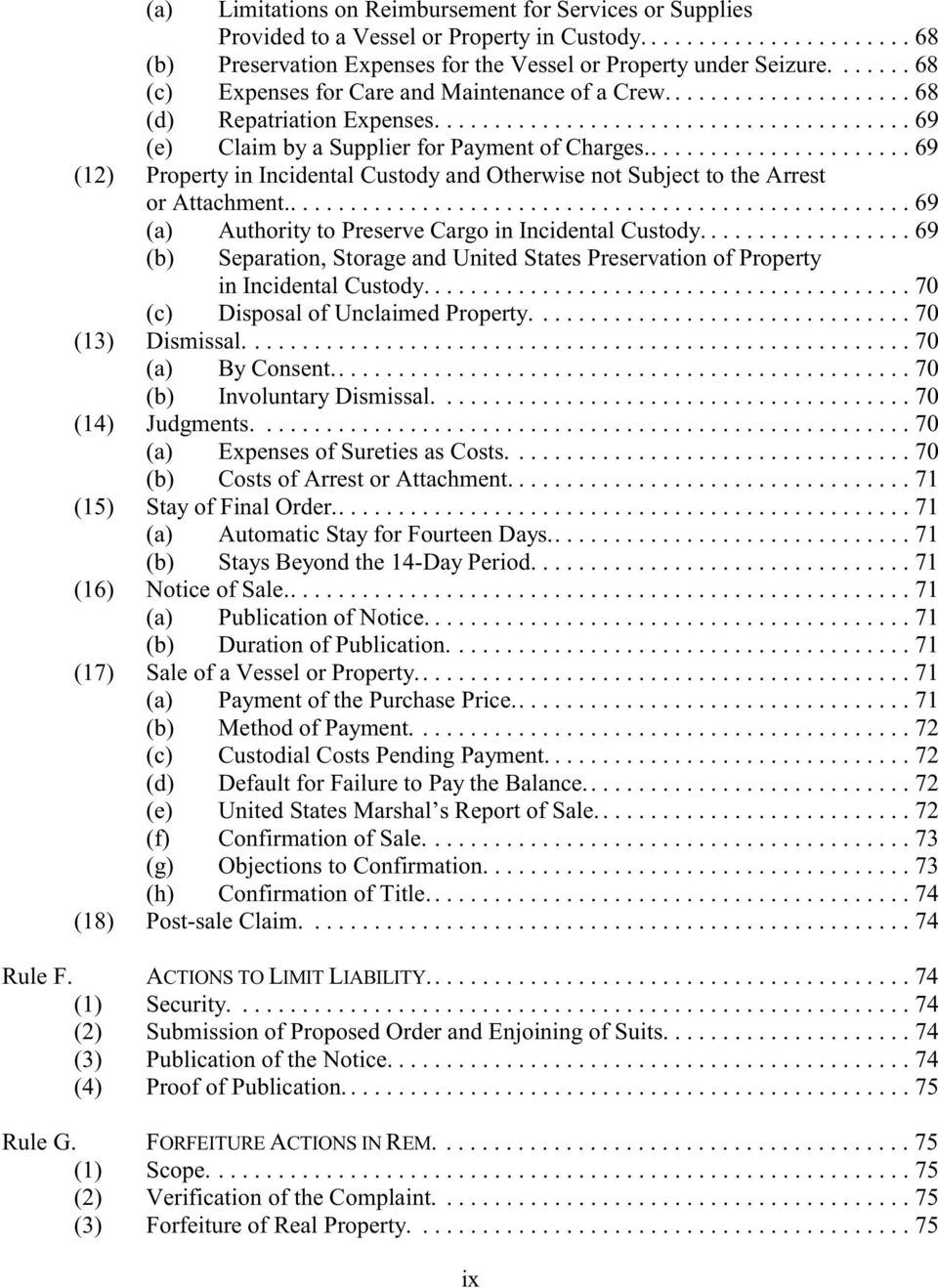
11 (4) Forfeiture of Other Property. Arrest Warrant In Rem (5) Notice (a) Generally (b) Known Potential Claimants (c) Property Valued at Less than $1, (6) Responsive Pleadings (a) Strict Compliance Required (b) Excuse (c) Claim Form (7) Special Interrogatories (8) Default; Default Judgment (a) Entry of Default (b) Default Judgment; Complete or Partial (9) Taxation of Costs Official Forms Form 1: Case Management Order Form 2a: Notice of Receipt of Original Deposition Form 2b: Notice of Service of Interrogatories or Requests for Production of Documents or Responses Thereto Form 2c: Notice of Service of Pre-Discovery Disclosure Information Form 3: Pretrial Order Form 4: Good Faith Certificate Form 5: Reserved N/A Form 6: Application for Admission Pro Hac Vice Form 7: Report of Mediation x
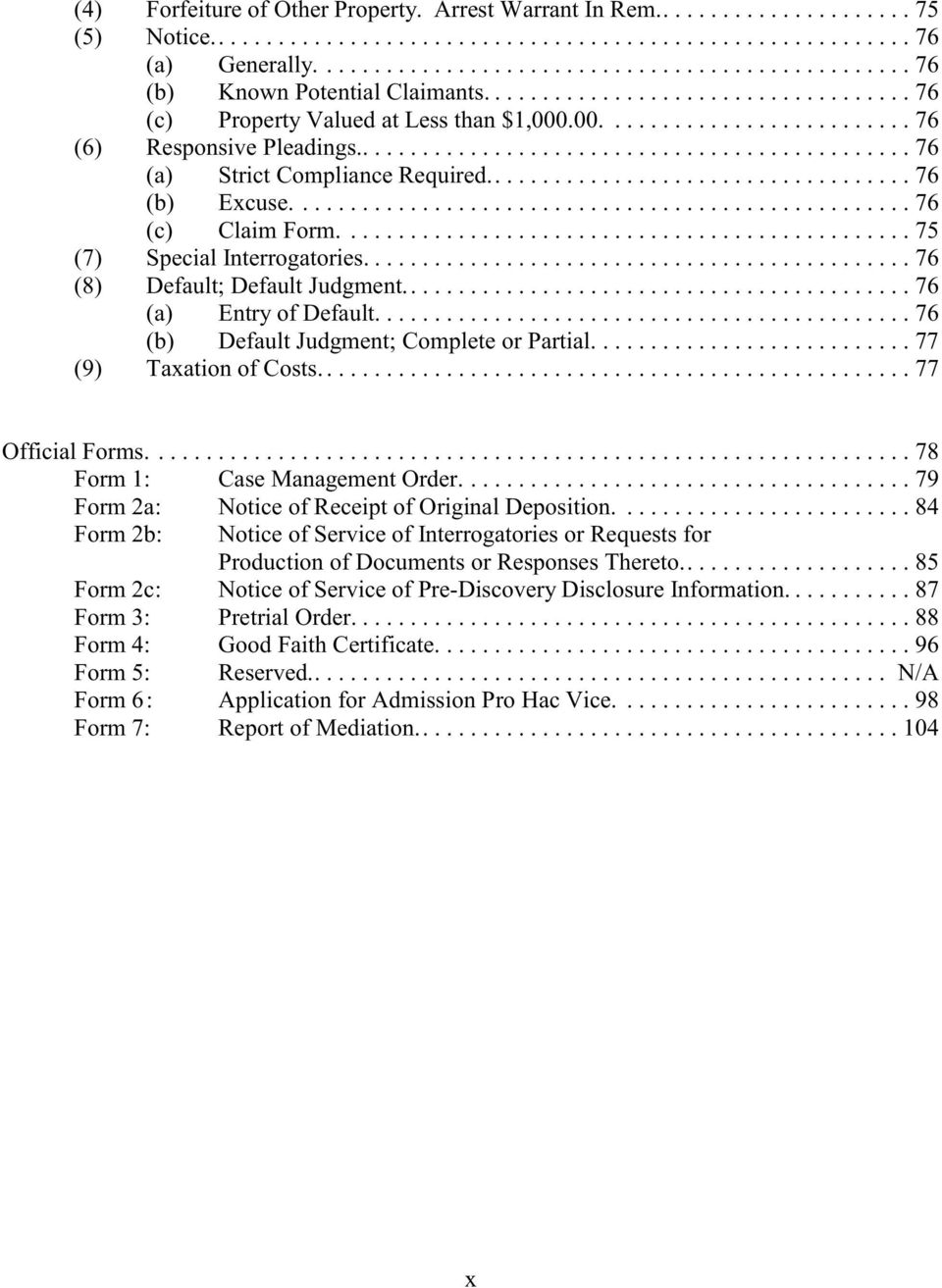
12 PREAMBLE The LOCAL UNIFORM CIVIL RULES OF THE UNITED STATES DISTRICT COURTS FOR THE NORTHERN DISTRICT AND THE SOUTHERN DISTRICT OF MISSISSIPPI [the LOCAL RULES] were first made effective on January 1, The Rules were amended July 1, 1992; July 1, 1996; September 1, 1998; December 1, 2000; November 1, 2004; December 1, 2010; December 1, 2011; December 1, 2012; and April 30, 2013; and they apply to pending civil actions except where injustice would result. They govern all proceedings in the United States District Courts serving the State of Mississippi, and should be cited as L.U.Civ.R. Attorneys practicing before the district courts of Mississippi are charged with the responsibility of knowing the LOCAL RULES, the Administrative Procedures for Electronic Case Filing for both the Northern and Southern Districts of Mississippi, the Internal Operating Procedures and Standing Orders of the court and may be sanctioned for failing to comply with them. Posting of the LOCAL RULES on the Internet Websites maintained by the clerks of the district courts is sufficient delivery of the LOCAL RULES to all attorneys and the public. All prior Local Rules of the United States District Courts for the Northern District and the Southern District of Mississippi relating to civil proceedings are hereby repealed. All amendments to these LOCAL RULES will be by order of the court and require the approval of a majority of the district judges in each federal judicial district in Mississippi. xi
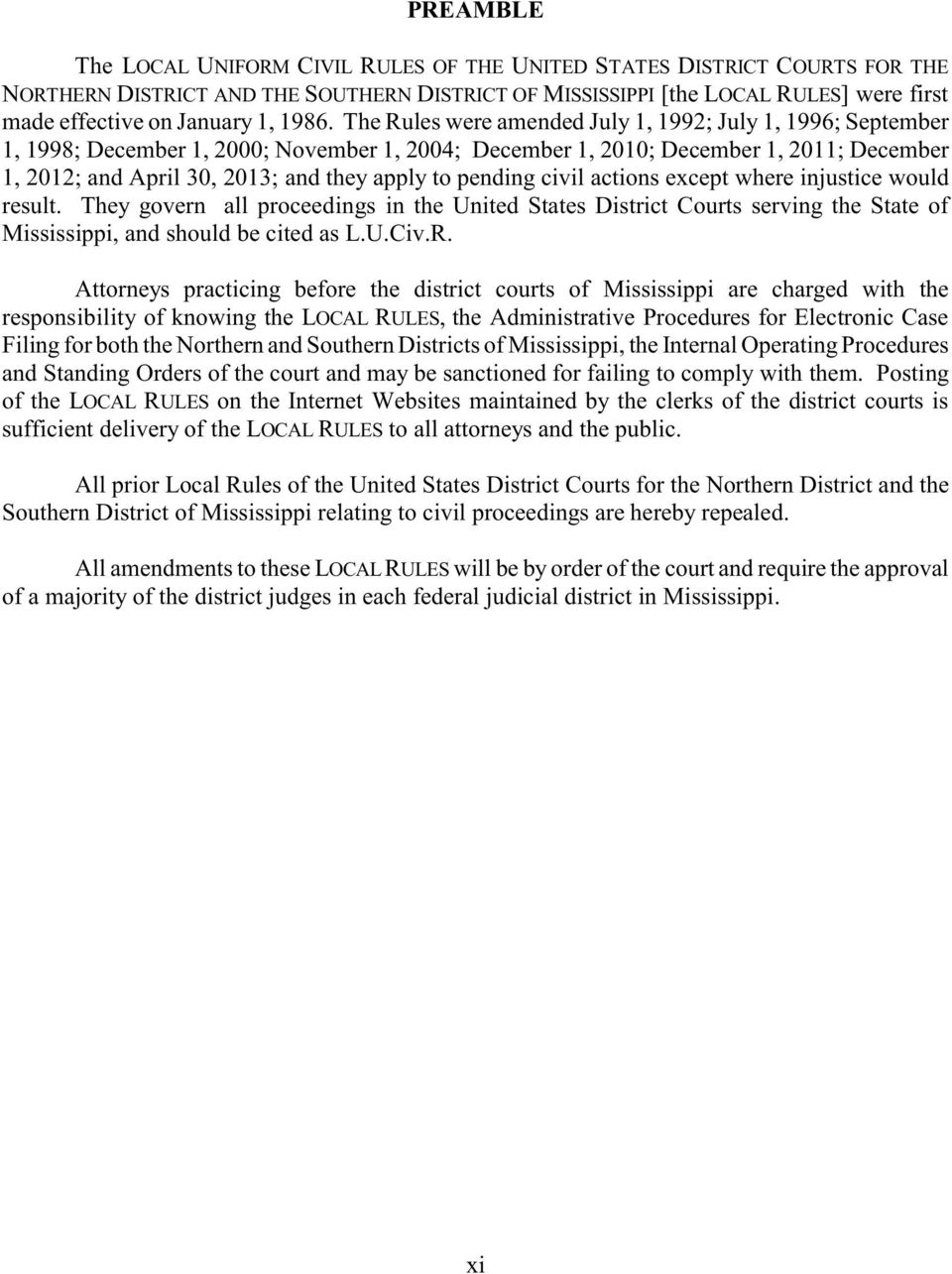
13 NORTHERN DISTRICT JUDICIAL DIVISIONS OXFORD DIVISION Oxford ABERDEEN DIVISION Aberdeen 1. Benton 1. Alcorn 2. Calhoun 2. Chickasaw 3. DeSoto 3. Choctaw 4. Lafayette 4. Clay 5. Marshall 5. Itawamba 6. Panola 6. Lee 7. Pontotoc 7. Lowndes 8. Quitman 8. Monroe 9. Tallahatchie 9. Oktibbeha 10. Tate 10. Prentiss 11. Tippah 11. Tishomingo 12. Tunica 12. Webster 13. Union 13. Winston 14. Yalobusha GREENVILLE DIVISION Greenville 1. Attala 2. Bolivar 3. Carroll 4. Coahoma 5. Grenada 6. Humphreys 7. Leflore 8. Montgomery 9. Sunflower 10. Washington xii
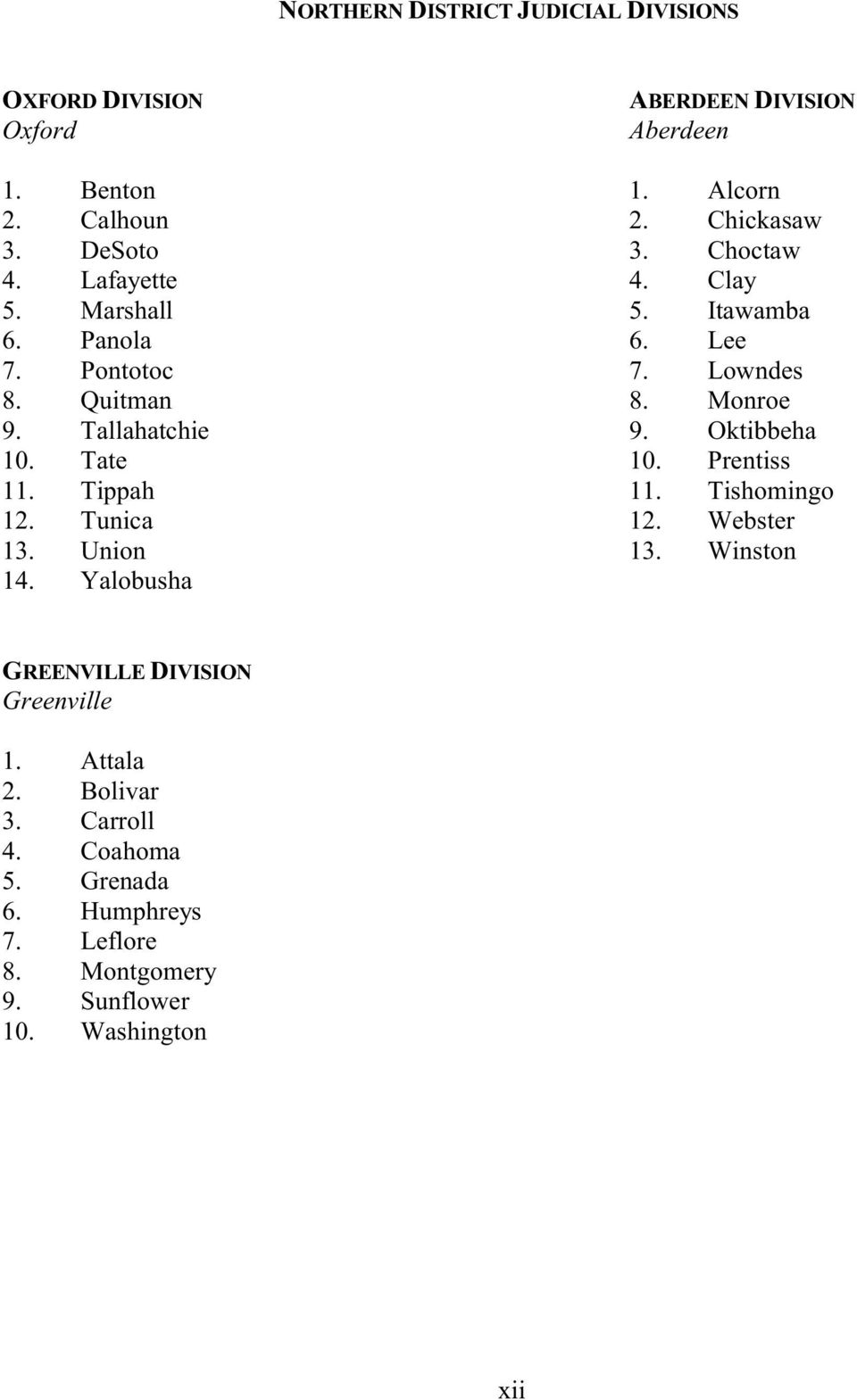
14 SOUTHERN DISTRICT JUDICIAL DIVISIONS JACKSON DIVISION Jackson EASTERN DIVISION Meridian 1. Amite 1. Clarke 2. Copiah 2. Jasper 3. Franklin 3. Kemper 4. Hinds 4. Lauderdale 5. Holmes 5. Neshoba 6. Leake 6. Newton 7. Lincoln 7. Noxubee 8. Madison 8. Wayne 9. Pike 10. Rankin 11. Scott 12. Simpson 13. Smith HATTIESBURG DIVISION Hattiesburg WESTERN DIVISION Natchez 1. Covington 1. Adams 2. Forrest 2. Claiborne 3. Greene 3. Issaquena 4. Jefferson Davis 4. Jefferson 5. Jones 5. Sharkey 6. Lamar 6. Warren 7. Lawrence 7. Wilkinson 8. Marion 8. Yazoo 9. Perry 10. Walthall SOUTHERN DIVISION Gulfport 1. George 2. Hancock 3. Harrison 4. Jackson 5. Pearl River 6. Stone xiii

15 Rule 1. (a) (b) (c) SCOPE AND PURPOSES OF RULES The rules of procedure in any proceeding in this court are those prescribed by the laws of the United States and the Federal Rules of Civil Procedure, along with these local rules and orders entered by the court. These rules may be known and cited as Local Uniform Civil Rule [L.U.Civ.R.]. The underlying principle of the Rules is to make access to a fair and efficient court system available and affordable to all citizens. Rule 4. (a) (b) CIVIL PROCESS Preparation. It is the responsibility of the plaintiff in each original case filed to prepare the summons to be served on each defendant and to present the process to the clerk of court at the time of the filing of the original complaint. The signed process with seal affixed will then be returned to the attorney for service. Service. The United States Marshal does not serve process in civil actions except on behalf of the federal government, in actions proceeding in forma pauperis, on writs of seizure and executions of judgments, and when otherwise ordered by a federal court. Rule 5. (a) ORIGINAL FILINGS AND REMOVALS Original Filings. In all civil actions, the plaintiff must file with the clerk of court the original complaint (1) Civil Cover Sheet. A civil cover sheet (Form JS 44) must be filed with each original complaint or petition filed. A link to all national forms can be found on the courts Websites. (2) Filing Fees. Filing fees must be paid to the clerk of court upon filing of each original complaint or petition in accordance with the fee schedule maintained by the clerk of court. (b) Removals: Required Filing of the Entire State Court Record. In addition to the requirements for removal set forth in 28 U.S.C. 1446, a defendant or defendants desiring to remove any civil action or criminal prosecution from a state court must file as an exhibit to its Notice of Removal a copy of the entire state court record in the format required by the Administrative Procedures for Electronic Case Filing for the district to which it is removed. If the removing defendant or defendants cannot practicably obtain a copy of the entire state court record by the date of removal, then and only then the removing defendant or defendants must obtain and electronically file the complete copy in the format
![with these local rules and orders entered by the court. These rules may be known and cited as Local Uniform Civil Rule [L.U.Civ.R.].](/docs-images/53/12044871/images/page_15.jpg "The underlying principle of the Rules is to make access to a fair and efficient court system available and affordable to all citizens. Rule 4. (a) (b) CIVIL PROCESS Preparation.")
16 required by the Administrative Procedures for Electronic Case Filing for that district no later than fourteen days from the date of removal. (c) Electronic Filings; Signatures and Verification; Administrative Procedures. Rules 5(d)(3) and 83 of the FEDERAL RULES OF CIVIL PROCEDURE and Rule 57 of the FEDERAL RULES OF CRIMINAL PROCEDURE authorize courts to establish practices and procedures for electronically filing, signing and verifying documents. Accordingly, the district courts for the Northern District and the Southern District of Mississippi have implemented Administrative Procedures for Electronic Case Filing prescribing the procedures and standards governing electronically filing, signing and verifying documents. (d) Non-Filing of Pre-Discovery Disclosures and Discovery Materials (1) Pre-Discovery Disclosures. Pre-discovery disclosures of core information under L.U.CIV.R. 26.1(A) should not be filed with the clerk of court until the disclosures are used in a proceeding or the court orders that they be filed. The party serving disclosures must file a notice of service of pre-discovery disclosure of core information [Official Form No. 2(c)]. (2) Depositions. As depositions in civil actions are not filed, the court reporter will forward the original of a deposition to the party responsible for its taking; the party must retain the original and is its custodian. Immediately upon receipt of the original deposition, the party serving as custodian must file a copy of the cover sheet of the deposition and a notice that all parties of record have been notified of its receipt by the custodian [Official Form No. 2(a)]. (3) Discovery. Interrogatories under FED. R. CIV. P. 33, Requests for Production or Inspection under FED. R. CIV. P. 34, and Requests for Admission under FED. R. CIV. P. 36, must be served upon other counsel or parties, but not filed with the court. The party who served the discovery request or the response must retain the original and become the custodian and file a notice of service with the court [Official Form No. 2(b)]. (4) Filing for use in Relation to Motions. If disclosures under FED. R. CIV. P. 26(a)(1) or (2), interrogatories, requests, answers, responses or depositions are necessary to a pretrial motion that might result in an order on any issue, unless already of record and referenced by citation to the docket entry(ies), the moving party must file the portions to be used as an exhibit to the motion. 2
17 (5) Filing for use on Appeal. When documentation of discovery or disclosures not in the record is needed for appeal purposes, a party may apply for a court order directing or the parties may stipulate to the filing of the necessary discovery or disclosure papers. Rule 5.2. (a) (b) (c) PROTECTION OF PERSONAL AND SENSITIVE INFORMATION; PUBLIC ACCESS TO COURT FILES; REDACTED INFORMATION; SEALED INFORMATION. Responsibilities of Counsel and Parties. Counsel should advise clients of the provisions of this rule and Fed.R.Civ.P. 5.2 so that an informed decision may be made about the inclusion of protected information. Counsel and parties must consider that the E-Government Act of 2002 (as amended) and the policies of the Judicial Conference of the United States require federal courts eventually to make all pleadings, orders, judgments, and other filed documents available in electronic formats accessible over the Internet and the courts PACER [Public Access to Court Electronic Records] systems. Consequently, personal and sensitive information and data that formerly were available only by a review of the court s physical case files will be available to the world, openly, publicly, and near-instantaneously. If a redacted document is filed, it is the sole responsibility of counsel and the parties to ensure that all pleadings conform to the redaction-related standards of this rule. Neither the court nor the clerk will review pleadings or other documents for compliance with this rule. Rule 7. (a) (b) MOTIONS AND OTHER PAPERS Trial Briefs. Whether to submit a trial brief is within the discretion of the parties, but any brief must be filed in CM/ECF and simultaneously served on all other parties. Motion Practice. Any written communication with the court that is intended to be an application for relief or other action by the court must be presented by a motion in the form prescribed by this Rule. (1) Applicability. The provisions of this rule apply to all written motions in civil actions. (2) Filing, Deadlines, Proposed Orders. Any motion, response, rebuttal and supporting exhibits, including memorandum briefs in support, must be filed. All affidavits and other supporting documents and exhibits, 3
18 excluding the memorandum brief, must be filed as exhibits to the motion, response or rebuttal to which they relate. The memorandum brief must be filed as a separate docket item from the motion or response and the exhibits. All supporting exhibits must be denominated in the court s electronic filing system by both an exhibit letter or number and a meaningful description. Further, all supporting exhibits not already of record and cited in the motion, response or rebuttal by docket entry, must normally be filed under the same docket entry and denominated separately in the court s electronic filing system as exhibits to the motion, response or rebuttal to which they relate, unless doing so is not practicable, in which case supporting exhibits may be filed as separate docket item attachments, associated by the docket number of the motion, response or rebuttal to which they relate. Counsel must file a memorandum brief as a separate docket item from the motion or response to which it relates and must not make the memorandum brief an exhibit to a motion or response, except in the case of a motion for leave to submit the referenced memorandum brief. (A) (B) (C) (D) (E) Affirmative defenses must be raised by motion. Although the affirmative defenses may be enumerated in the answer, the court will not recognize a motion included within the body of the answer, but only those raised by a separate filing. A party must file a discovery motion sufficiently in advance of the discovery deadline to allow response to the motion, ruling by the court and time to effectuate the court s order before the discovery deadline. Unless otherwise ordered by the Case Management Order, all casedispositive motions and motions challenging an opposing party s expert must be filed no later than fourteen calendar days after the discovery deadline. Motions in limine other than motions challenging another party s expert must be filed no later than fourteen calendar days before the pretrial conference, and all responses must be filed no later than seven calendar days before the pretrial conference. A proposed order must be submitted to the judge for any motion that may be heard ex parte or is to be granted by consent. If the motion is referred to a magistrate judge, the proposed order must be submitted to the magistrate judge. The addresses for the district judges and for the magistrate judges chambers appear in the courts Administrative Procedures for Electronic Case Filings. 4

19 (3) Responses (A) A response to a motion, all affidavits, 28 U.S.C declarations, the response memorandum and other supporting materials, including any objections, must be filed of record. Within the time allowed for response, the opposing party must either respond to the motion or notify the court of its intent not to respond. (B) (C) (D) (E) A separate response must be filed as to each separately docketed motion. A response to a motion may not include a counter-motion in the same document. Any motion must be an item docketed separately from a response. A response to a motion may not be included in the body of a pleading, but rather should be a separately docketed item denominated in the record as a response and should be associated by docket number with the motion to which it responds. If a party fails to respond to any motion, other than a dispositive motion, within the time allotted, the court may grant the motion as unopposed. (4) Memorandum Briefs; Documents Required with Motions; Time Limits Failure to Submit Required Documents; Motions Not Reurged. At the time the motion is served, other than motions or applications that may be heard ex parte or those involving necessitous or urgent matters, counsel for movant must file a memorandum brief in support of the motion. Counsel for respondent must, within fourteen days after service of movant s motion and memorandum brief, file a response and memorandum brief in support of the response. Counsel for movant desiring to file a rebuttal may do so within seven days after the service of the respondent s response and memorandum brief. A party must make any request for an extension of time in writing to the judge who will decide the motion. Failure to timely submit the required motion documents may result in the denial of the motion. A pending nondispositive motion not reurged after discovery has been concluded and before the motion deadline, may be deemed moot and denied by operation of this rule. (5) Length of Memorandum Briefs. Movant s original and rebuttal memorandum briefs together may not exceed a total of thirty-five pages, and respondent s memorandum brief may not exceed thirty-five pages. 5

20 (6) Notice and Hearings (A) (B) The court will decide motions without a hearing or oral argument unless otherwise ordered by the court on its own motion or, in its discretion, upon written request made by counsel in an easily discernible manner on the face of the motion or response. An evidentiary hearing or oral argument, where allowed, will be set at a time and place convenient to the judge. The court may, in its discretion, hear oral argument by electronic means. (7) Priority. The court will give priority to discovery motions, discovery appeals, immunity defense motions, motions to remand, and other jurisdictional motions. (8) Urgent or Necessitous Matters. When the motion relates to an urgent or necessitous matter, counsel for the movant must contact the courtroom deputy, or other staff member designated by the judge, and arrange a definite time and place for the motion to be heard. In such cases, counsel for movant must file a written notice to all other parties of the time and place fixed by the court for the hearing and must serve all documents upon other parties. Upon receipt of the motion, the court in its discretion may direct counsel to submit memorandum briefs for the court s consideration. Unless a party files a motion for a protective order to limit the scope or quash the taking of a deposition within seven days of the date of the notice of deposition, the motion will not be considered urgent or necessitous. (9) Court Reporters. If the hearing of a motion requires the presence of a court reporter, the party requesting a court reporter must obtain prior approval from the office of the district or magistrate judge before whom the motion is noticed. (10) Non-Dispositive Motions. All non-dispositive motions must advise the court whether there is opposition to the motion. (11) Untimely Motions. Any nondispositive motion served beyond the motion deadline imposed in the Case Management Order may be denied solely because the motion is not timely served. (c) Corporate Disclosure Statement. A non-governmental corporate party must file a statement identifying all of its parent corporations and listing any publicly-held company that owns ten percent or more of the party s stock. The Corporate Disclosure Statement must be filed as a separate pleading with the party s initial 6

21 pleading. Each party must supplement the statement within a reasonable time of any change in the disclosure information. Rule 11. (a) (b) SIGNATURES REQUIRED ON PLEADINGS, MOTIONS, AND OTHER PAPERS Consistent with FED. R. CIV. P. 11, the filing of a signed pleading, motion, or other document by any counsel is deemed to signify approval by all co-counsel. All filed, signed documents must contain counsel s name, address, telephone number, fax number, address, and counsel s bar membership identification number. All documents filed and signed by a party not represented by an attorney must contain the party s name, address, telephone number, fax number, and e- mail address. Every attorney and every litigant proceeding without legal counsel has a continuing obligation to notify the clerk of court of address changes. Sanctions Unreasonable Delays. Any delay or continuance occasioned by a party s failure to abide by these rules may result in the imposition of appropriate sanctions, including assessment of costs and attorneys fees. In this regard, counsel must immediately notify the appropriate judge if a pending motion is resolved by the parties or if the civil action is settled. Rule 16. (a) (b) PRETRIAL CONFERENCES Court Order. The court will issue an Initial Order setting the deadline for the attorney conference required by FED. R. CIV. P. 26(f) and a date for a case management conference [CMC] with the magistrate judge. The court will strive to set the case management conference within sixty days of the filing of the first responsive pleading. Exceptions: (1) Removed Civil Actions. (A) (B) In removed civil actions in which no motion to remand or motion to refer the action to the bankruptcy court is filed, the attorneys and unrepresented parties must confer as outlined in L.U.CIV.R. 26(e) within forty days, and all other deadlines will be determined accordingly. A motion to remand or a motion to refer an action to the bankruptcy court will stay the attorney conference and disclosure requirements and all discovery not relevant to the remand or referral issue and will stay the parties obligation to make disclosures pending the court s ruling on the motions. At the time 7
22 the remand motion or referral motion is filed, the movant must submit to the magistrate judge an order granting the stay but permitting discovery concerning only the remand or referral issue. The parties must promptly notify the magistrate judge of any order denying a motion to remand or motion to refer and must promptly submit an order lifting the stay. (C) Within fourteen days of the order lifting the stay, the parties must confer as outlined in L.U.CIV.R. 26() and all other deadlines will be determined accordingly. A scheduling conference will be held within sixty days after the stay is lifted. (2) Transferred Civil Actions. If the attorneys and unrepresented parties have not already conducted the conference required by FED. R. CIV. P. 26(f) in an action transferred to the district, the parties must do so within fourteen days of the action s transfer and all other deadlines will be determined accordingly. (3) Immunity Defense or Jurisdictional Defense (A) (B) (C) (D) A motion to compel arbitration, an immunity defense or a jurisdictional defense must be raised by a separate motion as expeditiously as practicable after service of process. A motion asserting lack of jurisdiction must be filed at least seven days before the Case Management Conference or the movant will be deemed to have waived the stay provision of subsection (B). Filing a motion to compel arbitration, an immunity defense or jurisdictional defense motion stays the attorney conference and disclosure requirements and all discovery not related to the issue pending the court s ruling on the motion, including any appeal. Whether to permit discovery on issues related to a motion asserting an immunity defense or jurisdictional defense is a decision committed to the discretion of the court. At the time the motion to compel arbitration, immunity defense or jurisdictional defense motion is filed, the moving party must submit to the magistrate judge a proposed order granting the stay. In any case that has been removed from state court, the moving party shall, within fourteen days after the Case Management Conference, file as separate docket items any motions that were filed in state court. The motions will be filed in accordance with L.U.CIV.R.7(b). 8
23 (E) (F) The plaintiff must promptly notify the magistrate judge of a decision on the motion and must submit a proposed order lifting the stay. Within fourteen days of the order lifting the stay, the parties must confer in accordance with L.U.CIV.R. 26(c), and all other deadlines will be determined accordingly. A case management conference will be scheduled within sixty days of the order lifting the stay. (4) Civil Asset Forfeiture Actions (A) (B) (C) (D) In civil asset forfeiture actions in which the United States files a motion challenging the claimant s standing, all discovery not relevant to the standing issue will be stayed pending the court s ruling on the standing issue. At the time the motion challenging the claimant s standing is filed, the United States must submit to the magistrate judge a proposed order granting the stay but permitting discovery on the standing issue. The parties must promptly notify the magistrate judge of a decision on the standing issue and must submit a proposed order lifting the stay if it is determined that the claimant has standing. A case management conference will be scheduled within sixty days of the order lifting the stay. (c) (d) Submission of Written Proposed Case Management Plan and Scheduling Order. The magistrate judge may require the parties to submit a proposed case management order no later than fourteen days after the attorney conference. [See Official Form No. 1]. Disagreements with the content of the proposed case management order must be noted on the submitted written plan. Each party must submit to the magistrate judge a confidential memorandum, no longer than three pages, setting forth a brief explanation of the case and a candid appraisal of the prospective positions of the parties, including a candid evaluation of the possibilities for settlement. Time of Disclosures. Unless a different time is set by court order or unless a party objects during the attorney conference and states the objection in the proposed case management order, the parties must make the disclosures required by FED. R. CIV. P. 26(a) [L.U.CIV.R. 26.1(a)(1)], no later than fourteen days after the attorney conference, but in no event may they be made later than seven days before the Case Management Conference. 9
24 (e) (f) Case Management Conference. On the date set by court order, the magistrate judge will hold a case management conference in accordance with FED. R. CIV. P. 16(b) and 26(f). Case Management Order (1) The judicial officer will enter the case management order no more than fourteen calendar days after the case management conference. [Official Form No. 1]. (2) The court will not require the parties to reserve a period in excess of three weeks for trial following the trial date. (g) Settlement Conference (1) The court may schedule an initial settlement conference in the case management plan and scheduling order or by other order as the interests of justice may dictate. (A) (B) (C) Counsel for any party may request at any time that the judicial officer assigned to the case schedule a settlement conference. The court may order mediation in addition to, or in lieu of, a settlement conference. The parties are required to undertake discovery necessary for meaningful settlement discussions before a settlement conference or mediation. (2) Lead counsel for each party, individual parties not represented by legal counsel, and representatives of each corporate party, organization, or similar entity must appear at the conference. If lead counsel has been admitted pro hac vice, local counsel must also appear at the conference. (A) (B) The party representative attending the conference must have full settlement authority to bind the party for settlement purposes. If approved in advance by the court, a party or party representative may, in lieu of attending the conference in person, be immediately available by telephone during the entire settlement conference. The court may also order that a representative of any intervening party with full settlement authority also attend the conference in person or be available by telephone. 10
25 (C) At the request of any party, the court will issue a notification of the settlement conference which the party may then forward to any entity having any type of subrogation lien that would need to be considered during settlement negotiations. The failure of a party to attend a settlement conference, or to have present at the conference a representative with reasonable settlement authority, may result in the assessment of sanctions against the offending party. (3) The notice of a settlement conference will set forth the format of the conference and will include any requirement for information or documents that must be submitted to the court before or at the conference. (4) No statement, oral or written, made by any party to the court or counsel(s) opposite during settlement negotiations under this rule will be admissible or used in any fashion in the trial of the case or any related case. (5) At least seven days before the settlement conference, each party must submit to the court a confidential memorandum, no longer than three pages, setting forth a brief explanation of the case and a candid appraisal of the respective positions of the parties, including the settlement negotiations to date and possible settlement figures. Plaintiff(s) must provide an estimate of damages itemized by category. Counsel must also furnish a good faith estimate of the total expense of carrying the litigation through trial and the appellate processes, if not settled, and must have discussed and must represent to the court that they so discussed these expenses with their clients. The settlement memoranda are not to be exchanged or filed in the record, are to be viewed only by the court, and will be destroyed upon exhaustion of settlement negotiations. (h) (i) (j) Cases Excluded from Scheduling and Disclosure Requirements. Those categories of proceedings appearing in FED. R. CIV. P. 26(a)(1)(B) are exempt from the scheduling and disclosure requirements of these rules. Alternative Dispute Resolution Programs. The courts have adopted a uniform Alternative Dispute Resolution Plan. That plan is appended to these Local Rules. Final Pretrial Conferences And Pretrial Orders (1) Cases in Which Conference to be Held; Scheduling; Role of Magistrate Judge. A final pretrial conference is to be held in all civil actions, subject only to the exceptions hereinafter noted. (A) The judicial officer assigned to try the case will attempt to conduct the pretrial conference. If the judicial officer is unable to schedule 11
26 the pretrial conference in a timely manner, however, then he or she may direct that the conference be held before another judicial officer. This conference will be scheduled not more than fortyfive days prior to trial. (B) Whenever possible, a final pretrial conference will be separately scheduled at a date, place, and hour and for such period of time as the subject matter of the particular civil action may require, but in all events a final pretrial conference will be scheduled in such manner as not to cause undue or inordinate inconvenience to counsel scheduled for final pretrial conferences in other cases. (2) When Conference May be Dispensed With; Pretrial Order Still Required; Contents. The court recognizes that a formal final pretrial conference may not be needed in all cases. The court, either on its own motion or by request of the parties made not later than fourteen days before the scheduled conference, may determine that a final pretrial conference is unnecessary and excuse the parties from attendance, but in that event the jointly agreed pretrial order must be submitted to the judge before whom the conference was to have been held and all requirements of this rule must be complied with at or before the time and date set for the final pretrial conference, unless the judge fixes another date for submission of the pretrial order. If no formal final pretrial conference is held, counsel must submit to the appropriate judge a jointly agreed final pretrial order [Official Form No. 3] which must set forth: (A) (B) (C) (D) (E) (F) (G) Any jurisdictional question. Any questions raised by pending motions, including motions in limine. A concise summary of the ultimate facts claimed by plaintiff(s), by defendant(s), and by all other parties. Facts established by pleadings or by stipulations or admissions of counsel. Contested issues of fact. Contested issues of law. Exhibits (except documents for impeachment only) to be offered in evidence by the parties respectively. If counsel cannot in good 12
27 faith stipulate the authenticity or admissibility of a proposed exhibit, the order must identify the same and state the precise ground of objection. (H) (I) (J) (K) (L) The names of witnesses for all parties, stating who Will Be Called in the absence of reasonable notice to opposing counsel to the contrary and who May Be Called as a possibility only. Neither rebuttal nor impeachment witnesses need be listed. The witness list must state whether the witness will give fact or expert testimony, or both, whether the witness will testify as to liability or damages, or both, and whether the witness will testify in person or by deposition. Any requested amendments to the pleadings. Any additional matters to aid in the disposition of the action. The probable length of the trial. Full name, address, and phone number of all counsel of record for each party. (3) Submission by Magistrate Judge to Trial Judge. If the pretrial conference is held before a magistrate judge who will not try the case, the magistrate judge will submit the agreed, approved pretrial order to the trial judge, with copies to counsel and to the clerk of court. (4) Duty of Counsel to Confer; Exhibits; Matters to be Considered at Conference; Sanctions. The following provisions of this rule apply, regardless of whether the pretrial order is entered by stipulation of the parties or following a formal final pretrial conference: (A) (B) Counsel must resolve by stipulation all relevant facts that are not in good faith controverted and must exchange with counsel for all other parties true copies of all exhibits proposed to be offered in evidence, other than those to be used for impeachment purposes only, and must stipulate the authenticity of each exhibit proposed to be offered in evidence by any party unless the authenticity of any such exhibit is in good faith controverted. All exhibits are to be pre-marked, and lists briefly describing each are to be exchanged among counsel and presented to the court at the beginning of the trial, in quadruplicate, unless otherwise directed by the court. 13
28 (C) At any formal final pretrial conference, the judge will confer with counsel regarding proposed stipulations of facts and contested issues of fact and law, and will inquire as to the reasonableness of any party s failure to stipulate or agree as to the authenticity or admissibility of exhibits. If the court determines that any party or his attorney has failed to comply with this rule, such party or his attorney will be subject to appropriate sanctions. (5) Depositions. Depositions to be introduced in evidence other than for rebuttal or impeachment purposes must be abridged before the pretrial conference or submission of the order, as follows: (A) (B) (C) (D) The offering party must designate by line and page the portions of the deposition it plans to offer. The opposing party or parties must designate by line and page any additional portions of the deposition to be offered and must identify distinctly any portions of the deposition previously designated by any other party to which objection is made. The offering party must thereafter identify distinctly any portions of the deposition previously designated by any other party to which objection is made. Videotaped depositions must be edited before trial as required by the pretrial order. (6) Procedure at Final Pretrial Conference. In addition to the preceding provisions, the following provisions apply to the formulation of a pretrial order by formal conference before the magistrate judge, or in any appropriate case, the district judge. (A) Counsel Must Attend; Sanctions. All scheduled conferences must be attended by counsel of record who will participate in the trial and who have full authority to speak for the party and enter into stipulations and agreements. Counsel must have full authority from their clients with respect to settlement and must be prepared to inform the court regarding the prospects of settlement. The court may require the attendance or availability of the parties, as well as counsel. Should a party or his attorney fail to appear or fail to comply with the directions of this rule, an ex parte hearing may be held and a judgment of dismissal or default or other appropriate judgment entered or sanctions imposed. 14
29 (B) (C) (D) Preparation for the Conference. Counsel must comply with the requirements of subdivisions (j)(4) and (j)(5) of this rule as soon as practicable before the pretrial conference and submit to the court and counsel opposite a proposed pretrial order setting forth his proposals for inclusion in the pretrial order in accordance with subdivision (j)(2) of this rule and any instructions which the court may in its discretion issue. Preparation of the Pretrial Order. After the final pretrial conference has concluded, a pretrial order must be prepared by counsel in conformity with Official Form No. 3 and submitted to the court for entry. Responsibility for preparation of the pretrial order and the deadline for its submission will be fixed by the judicial officer before whom the conference was held. If a magistrate judge has conducted the conference on behalf of a district judge, he or she will require counsel to make such corrections as the magistrate judge deems necessary before transmitting the order to the district judge. Additional Conferences. After the final pretrial conference has been conducted, the court will not hold an additional pretrial conference except in those exceptional situations in which the judicial officer determines that an additional conference would materially benefit disposition of the action. (7) Effect of Pretrial Order. The pretrial order controls the subsequent course of the action unless modified by the trial judge at or before the trial, upon oral or written motion, to prevent manifest injustice. (8) Conference Scheduling; Conflicting Settings. In scheduling all pretrial conferences of any nature, the judge will give due consideration to conflicting settings but not to the mere convenience of counsel. If a scheduling order has been entered in an action, no final pretrial conference will be held until after the discovery deadline has expired. Failure to complete discovery within such deadline is not an excuse for delaying the final pretrial conference nor for securing continuance of a case which has been calendared for trial. (9) Discretion of District Judge. Notwithstanding any of the provisions of this rule to the contrary, a district judge may, in his or her discretion, in any assigned case, conduct any or all pretrial conferences and may enter or modify a scheduling order. 15
30 (k) Conflicting Settings And Requests For Continuances. When the court has set a case for trial, other hearing, or pretrial conference that conflicts with a court appearance of counsel in other courts, the first case having a firm setting will control, whether set by this or some other court, and other courts are expected to yield to the prior firm setting, as this court will do when other cases have prior settings in other courts, consistent with the policy adopted by the State-Federal Judicial Council. When a case has not been reached as scheduled, the court, in resetting the case, will take into account the obligations of counsel on the basis of the first-setting rule. If a conflict develops, it is the absolute duty of counsel to inform the court of the later setting in order that the conflict might be resolved and calendars cleared for other settings. It is essential for counsel and the court or courts involved to resolve potential conflicts at the earliest practical date. Rule 23. CLASS ACTIONS. In all civil actions filed as class actions, the class plaintiff must, at a time directed by the case management order, move for a FED. R. CIV. P. 23 class determination. The plaintiff has the burden of establishing by way of pleadings and evidentiary materials that a class action is appropriate and of defining all relevant classes and subclasses. Although the court may deem it necessary to schedule an evidentiary hearing on the class aspects of a civil action, usually pleadings, affidavits, other evidentiary materials, and legal memoranda submitted by both sides should be adequate bases upon which the court may make a class action determination. Interlocutory procedures, when appropriate, will be tailored to fit each action. Counsel for all parties must be aware of the general time schedule set forth above and must promptly prepare all materials that may be relevant to class action maintainability and class definitions. Until the issue of class certification has been decided, counsel must give priority to discovery directed to the class issue. If additional time is desired for preparation on the L.U.CIV.R. 23 issue(s), a motion stating grounds for the requested delay must be served within the above time period. Delays will be granted only for good cause. Rule 26. (a) DISCOVERY CONTROL Pre-Discovery Disclosures of Core Information/Other Cooperative Discovery Devices (1) Initial Disclosure (A) Within the time designated in the court s initial order setting the FED.R.CIV.P. 16 conference, the parties must make the disclosure 16
31 required by FED.R.CIV.P. 26(a)(1). Disclosures must be made no later than seven days before the Case Management Conference unless a different time is set by court order or unless a party objects during the attorney conference and states the objection in the proposed case management order. At the time of the submission of the proposed case management order, the parties must certify that the conference required by FED.R.CIV.P. 26(f) has taken place and that the initial disclosures have been made. (B) (C) If the documents, electronically stored information, data compilations, and tangible things [collectively items ] required for production are voluminous, or if other circumstances make their production unduly burdensome or expensive, the party may describe by category and location all such items in its possession, custody or control and must provide the opposing party a reasonable opportunity to review all the items at the site they are located or maintained. A party withholding information claimed privileged or otherwise protected must submit a privilege log that contains at least the following information: name of the document, electronically stored information, or tangible thing; description of the document, electronically stored information, or tangible thing, which description must included each requisite element of the privilege or protection asserted; date; author(s); recipient(s); and nature of the privilege. To withhold materials without such notices subjects the withholding party to sanctions under FED.R.CIV.P. 37 and may be viewed as a waiver of the privilege or protection. (2) Expert Witnesses. A party must make full and complete disclosure as required by FED.R.CIV.P. 26(a)(2) and L.U.CIV.R. 26(a)(2)(D) no later than the time specified in the case management order. Absent a finding of just cause, failure to make full expert disclosures by the expert designation deadline is grounds for prohibiting introduction of that evidence at trial. (A) (B) For purposes of this section, a written report is prepared and signed by the expert witness when the witness executes the report after review. An attempt to designate an expert without providing full disclosure information as required by this rule will not be considered a timely expert designation and may be stricken upon proper motion or sua sponte by the court. 17
32 (C) (D) Discovery regarding experts must be completed within the discovery period. The court will allow the subsequent designation or discovery of expert witnesses only upon a showing of good cause. A party must designate physicians and other witnesses who are not retained or specially employed to provide expert testimony but are expected to be called to offer expert opinions at trial. No written report is required from such witnesses, but the party must disclose the subject matter on which the witness is expected to present evidence under FED.R.EVID. 702, 703 or 705, and a summary of the facts and opinions to which the witness is expected to testify. The party must also supplement initial disclosures. (3) Failure to Disclose. If a party fails to make a disclosure required by this section, any other party must move to compel disclosure and for appropriate sanctions under FED.R.CIV.P. 37(a). The failure to take immediate action and seek court intervention when a known fact disclosure violation other than as to expert witnesses occurs will be considered by the court in determining the appropriate sanctions to be imposed regarding a subsequent motion filed under FED.R.CIV.P.37(c). Challenges as to inadequate disclosure of expert witness(es) must be made no later than thirty days before the discovery deadline or will be deemed waived. Daubert motions challenging a designated expert must be filed no later than the deadline for dispositive motions or other deadline for such motions established by the case management order or other order, whichever is later. (4) Discovery Before the Case Management Conference. Discovery before the case management conference is governed by FED.R.CIV.P. 26(f). In removed actions in which written discovery was served prior to removal and has not already been responded to, the responding party(ies) will have the shorter of 30-days from the date of the Case Management Conference, or such other period set by federal court order, to serve responses and objections and to make any requested production or inspection. (5) Supplementation of Discovery. A party is under a duty to supplement disclosures at appropriate intervals under FED.R.CIV.P. 26(e) and in no event later than the discovery deadline established by the case management order. (b) Setting Discovery Deadlines. The Case Management Order will establish a firm discovery deadline. 18
33 (1) The discovery deadline is that date by which all responses to written discovery, including supplementation of responses, required by the Federal Rules of Civil Procedure must be made and by which all depositions must be concluded. Supplementation of disclosures must be concluded by the discovery deadline. (2) Counsel must initiate discovery requests and notice or subpoena depositions sufficiently in advance of the discovery deadline date to comply with this rule, and discovery requests that seek responses or schedule depositions that would otherwise be answerable after the discovery deadline date are not enforceable except by order of the court for good cause shown. (3) The parties may not extend the discovery deadline by stipulation or without the consent of the court. (c) (d) (e) Attorney/Party Signatures for Requests to Extend Discovery Deadlines. The court in its discretion may require the requesting attorney and party to sign requests to extend discovery deadlines. Limitations on Use of Discovery. The court should limit the number of depositions, interrogatories, requests for production and requests for admission to the needs of each particular case. A specific interrogatory/request and its reasonably related subpart will be counted as one interrogatory/request. FED. R. CIV. P. 26(f) Conference of the Parties. Early Meeting of Counsel/Attorney Conference. Except in categories of proceedings exempted from initial disclosures by Fed.R.Civ.P. 26(a)(1)(E), the attorneys and any unrepresented parties must confer by telephone or in person as soon as is practicable and no later than the deadline established by the court and discuss, at a minimum, the following: (1) Principal Issues. (A) (B) (C) Identify the principal factual and legal issues in dispute; Discuss the principal evidentiary basis for claims and defenses; Determine the number of days required for trial and whether the case should be considered for ADR procedures. (2) Disclosure 19
34 (A) (B) Discuss the arrangements for exchanging the disclosures required by FED.R.CIV.P. 26(a)(1) and whether any changes should be made in the timing, form, or requirement for such disclosures. Confer on the following topics relating to electronically stored information [ESI]: (i) (ii) (iii) (iv) (v) (vi) (vii) (viii) (ix) (x) The native format, media, and repositories of discoverable ESI; Steps the parties will take to identify and preserve discoverable ESI to avoid a claim of spoliation; The scope of discovery and any protocol; Whether discoverable deleted ESI still exists, the extent to which restoration of deleted ESI is necessary, and who will bear the burden and cost of restoration; With respect to discoverable ESI, whether embedded data and metadata exist, whether they will be requested or should be produced, and how to address determinations regarding privilege and FED. R. CIV. P. 26(b)(3)-protected ESI; Whether responsive back-up and archival ESI exists, the extent to which back-up and archival ESI is needed and who will bear the burden and costs of obtaining such ESI; The format and media to be used in the production of ESI; The identity of sources and types of potentially discoverable ESI that a party does not intend to subject to discovery; Whether any discoverable ESI is not reasonably accessible and the basis for that contention; If a party intends to seek discovery of ESI from sources or of types identified as not reasonably accessible, the parties should discuss: (i) the burden and cost of accessing and retrieving such ESI; (ii) any putative good cause for requiring production of all or part of such ESI; and (iii) any mitigating conditions such as scope, time, and cost shifting 20
35 that might reduce the burden or cost of producing ESI that is not reasonably accessible; (xi) How to handle inadvertent disclosure of privileged or FED. R. CIV. P. 26(b)(3)-protected ESI considering FED.R.EVID (3) Motions. Identify any motions whose early resolution would have a significant impact on the scope of discovery or other aspects of litigation. (4) Discovery. Determine what discovery is required, when discovery should be completed, whether discovery should be conducted in phases or be limited to or focused upon particular issues, and what limitations should be placed on discovery. (5) Jurisdiction by a Magistrate Judge. Discuss whether all parties consent to jurisdiction by a magistrate judge under 28 U.S.C (6) Settlement. Discuss the possibilities for prompt settlement or resolution of the action and whether it would be helpful to schedule an early settlement conference. (7) Preparation of a proposed case management plan and scheduling order. The proposed order must set forth ADR recommendations, whether all parties consent to trial by a magistrate judge, the date and manner in which disclosures required under FED.R.CIV.P. 26(a) have been made, whether any party objects to the disclosures made and, if so, on what grounds, discovery limitations, deadlines for amendments to pleadings and joinder of additional parties, completion of discovery, designation of experts; filing of motions, including motions for summary judgment, Daubert motions, and other motions in limine. The attorneys of record and all unrepresented parties who have appeared in the action are jointly responsible for arranging the conference and attempting in good faith to agree on the proposed case management plan and scheduling order. (8) Other Orders. Discuss whether any other orders should be entered by the court under FED.R.CIV.P. 16(b) or (c). Rule 30. DEPOSITIONS (a) Audiovisual Recording of Depositions. A deposition may be recorded audiovisually as a matter of course in accordance with Fed.R.Civ.P. 30(b)(2). 21
36 (1) Written Transcript Required. The recorded deposition must also be taken in the usual manner by a qualified shorthand or machine reporter and a written transcript prepared for use in subsequent court proceedings. (2) Scope of Scene Viewed. During the deposition the witness must be recorded in as near to courtroom atmosphere and standards as possible. There will not be any zoom-in procedures to unduly emphasize any portion of the testimony, but zoom-in will be allowed for exhibits and charts to make them visible to a jury. The camera must focus as much as possible on the witness. The attorneys may be shown on introduction, the beginning of examination and during objections. (3) Witness s Approval Not Required. A witness need not view or approve the recording of a deposition. (4) Availability to Parties. Any party may purchase a duplicate original or edited recording from the video operator technician at any time. (5) Editing. Audiovisually recorded depositions must be edited before the trial as required by the pretrial order. (6) Expenses Recoverable as Cost. A prevailing party may claim in its bill of costs the court reporter s expenses for audiovisually recorded depositions necessarily obtained for use in the case. (b) Depositions of Experts. The court encourages audiovisual recording of the testimony of expert witnesses. Rule 35. PHYSICAL AND/OR MENTAL EXAMINATION. Every motion for the physical or mental examination of persons in civil actions which is not accompanied by a consent order setting forth the time, place and scope of the examination and the person selected to perform the examination must be accompanied by a statement executed by counsel for the moving party. Counsel s statement must recite specifically the efforts initiated by counsel to agree upon the details, time, place, and scope of the mental or physical examination and the person proposed to perform the examination, and that the efforts were not successful. Rule 37. (a) DISCOVERY VIOLATIONS Good Faith Certificate. Before service of a discovery motion, counsel must confer in good faith to determine to what extent the issue in question can be 22
37 resolved without court intervention. A Good Faith Certificate [Official Form No. 4] must be filed with all discovery motions. This certificate must specify whether the motion is unopposed, and if opposed, by which party(ies) and the method by which the matter has been submitted to the magistrate judge for resolution. The certificate must bear the signatures/endorsements of all counsel. If a party fails to cooperate in the attempt to resolve a discovery dispute or prepare the Good Faith Certificate, the filed motion must be accompanied by an affidavit or a 28 U.S.C declaration by the moving party detailing the lack of cooperation and requesting appropriate sanctions. (b) Motions Must Quote Disputed Language. Motions raising issues concerning discovery propounded under FED.R.CIV.P. 33, 34, 36, and 37, must quote verbatim each interrogatory, request for production, or request for admission to which the motion is addressed, and must state: (1) the specific objection; (2) the grounds assigned for the objection (if not apparent from the objection itself), and (3) the reasons assigned as supporting the motion. The objections, grounds and reasons must be written in immediate succession to the quoted discovery request. The objections and grounds must be addressed to the specific interrogatory, request for production, or request for admission and may not be general in nature. (c) (d) Failure to comply with subsections (a) or (b) of this rule will result in a denial of the motion without prejudice to the party, who may refile the motion upon conformity with this rule. L.U.CIV.R. 37 Motion to Limit or Quash a Deposition. The filing of a motion for a protective order to limit or quash a deposition does not operate as a stay of the deposition. It is incumbent upon the party seeking the protection of the court to obtain a ruling on the motion before the scheduled deposition. Rule 38. (a) (b) DEMAND FOR JURY When Due; How Presented. In order to exercise the right to jury trial, a party must make a demand for jury trial, including a removed or transferred action, as may be required by FED. R.CIV.P. 38(b) and 81(c)(3)(A). A designation of jury trial on the civil cover sheet is not sufficient for purposes of this rule. Within Discretion of Court. A request for a jury otherwise presented will be addressed to the sound judicial discretion of the court. 23
38 (c) Removed Actions; Law and Equity Actions. A civil action removed to federal district court from a chancery court of the State of Mississippi will be designated for non-jury trial. Rule 42. CONSOLIDATION OF ACTIONS. In civil actions consolidated under FED.R.CIV. P. 42(a), the action bearing the lower or lowest docket number will control the designation of the district or magistrate judge before whom the motion to consolidate is noticed; the docket number will also determine the judge before whom the case or cases will be tried. Consolidation of actions from different divisions of a district court will be controlled by the earliest filing date. A dismissal of the action bearing the lower or lowest number before the hearing on a motion to consolidate will not affect the operation of this rule. The judge initially assigned the lower or lowest numbered action, even if that action has been dismissed, will be the judge before whom the action(s) will be tried. Rule 45. (a) (b) (c) (d) (e) Rule 48. SUBPOENA Witnesses. Witnesses for trial in paupers= cases must be compelled by subpoena or their voluntary attendance procured. Witnesses Attendance and Mileage Fees. Tender of the witness fee and mileage is required even if the party requesting the subpoena (except in habeas corpus cases and proceedings under 28 U.S.C. 2255) has been granted leave to proceed in forma pauperis under 28 U.S.C. 1915, because, with those exceptions, no public funds are available for that purpose. Privileged Information. Information which is claimed to be privileged may be filed under seal under the provisions of L.U.CIV.R. 79. Non-Party ESI. Parties issuing a subpoena duces tecum for electronically stored information from non-parties must attempt to meet and confer with the non-party (or counsel, if represented) and discuss the same issues with regard to requests for ESI as set out in L.U.CIV.R. 26. Motions Regarding Subpoenas. Motions regarding subpoenas will be considered discovery motions and are governed by the procedural requirements that govern discovery motions. COMMUNICATION WITH JURORS. Upon the return of a verdict by the jury in any civil or criminal action, neither the attorneys in the action nor the parties may, in the courtroom or elsewhere, express to the members of the jury their pleasure or displeasure with the verdict. After the jury has been discharged, neither the attorneys in the action nor the parties may at any time or in any manner communicate with any member of the jury regarding the verdict. Provided, however, that if an attorney believes in good faith that the verdict may be subject to 24
39 legal challenge, the attorney may apply ex parte to the trial judge for permission to interview one or more members of the jury regarding the fact or circumstance claimed to support the legal challenge. If satisfied that good cause exists, the judge may grant permission for the attorney to make the requested communication and will prescribe the terms and conditions under which it may be conducted. Rule 51. (a) (b) (c) (d) REQUESTS FOR JURY INSTRUCTIONS When Due. Requests for instructions must be submitted not later than fourteen days before the date for which trial is set; additional and revised instructions may be admitted thereafter as the evidence may justify. How Presented. Each requested instruction must be on a separate document, must be numbered (as P-1, et seq. and D-1, et seq.), and must be supported by citation of authority on papers separate from the requested instruction. Copies must be furnished to opposing counsel when the special requests are submitted to the court. Where good cause is shown to exist, counsel may, with the permission of the court, submit additional written requests during the progress of the trial. Automated Formats. Parties registered on the court s electronic filing system must submit instructions via electronic mail to the chambers of the trial judge. Proposed instructions should not be docketed or filed with the court s CM/ECF system. The addresses for the district judges and for the magistrate judges chambers appear on the courts Internet Websites and in the courts Administrative Procedures for Electronic Case Filing. Standard Instructions Not Required. Counsel should not submit pattern or Aboilerplate@ instructions which are routinely given by the court. This rule is intended to give the court an opportunity to study requests for instructions tailored specifically for a particular trial. Rule 52. (a) ORDERS AND JUDGMENTS Manner of Presentation. All proposed orders and judgments must be submitted directly to the district or magistrate judge assigned to the case via electronic mail, in software format as may be designated by the court. The addresses for the district judges= and for the magistrate judges= chambers appear on the courts= Internet Websites and in the courts= Administrative Procedures for Electronic Case Filings. (b) Service. The attorney providing the order or judgment must also provide a copy to each party. The clerk of court will provide a copy of the executed order or judgment to each party not in default via the court s electronic filing system. 25
40 Rule 54. (a) (b) JURY COSTS Postponement in Advance of Trial. Whenever a civil action scheduled for jury trial is required to be postponed, or is settled, or otherwise is disposed of in advance of trial, then jury costs, including mileage and per diem, may, in the court=s discretion, be assessed equally against the parties and their counsel or otherwise assessed as directed by the court, unless the court is notified at least one full business day before the day on which the action is scheduled for trial so that the jurors can be notified that it will not be necessary for them to attend. Postponement After the Case is Called. Whenever a civil action is postponed, settled, or otherwise disposed of after the case is called and before the verdict of the jury, the court may assess jury costs, as described in subparagraph (a), equally against the parties and their counsel, or against the party responsible for the postponement or late settlement. (c) Bill of Costs. In all civil actions in which costs are allowed under 28 U.S.C. ' 1920 in the final judgment as defined in FED. R. CIV. P. 54(a), the prevailing party to whom costs are awarded must file the bill of costs not later than thirty days after entry of judgment. Unless the court directs otherwise, a motion for review of or objecting to the taxation of costs is subject to the requirements of L.U.CIV.R. 7(b). Except as provided by statute or rule, an appeal of the final judgment does not affect the taxation of costs. Rule 72. (a) MAGISTRATE JUDGES Procedures before a Magistrate Judge (1) Appeal of Magistrate Judge s Decision (A) (B) A party aggrieved by a magistrate judge=s ruling may appeal the ruling to the assigned district judge. The appeal is perfected by serving and filing objections to the ruling within fourteen days after being served with a copy of the ruling, specifying the grounds of error. Objections must be filed and served upon the other party or parties and will be promptly transmitted to the assigned district judge and to the magistrate judge. The opposing party or parties must either file a response to the objection or notify the district judge that they do not intend to respond within fourteen days of service of the objections. No ruling of a magistrate judge in any matter which he or she is empowered to hear and determine will be reversed, vacated, or modified on appeal unless the district judge determines that the magistrate judge=s findings of fact are clearly erroneous, or that the magistrate judge=s ruling is clearly erroneous or contrary to law. 26
41 (2) Effect of Ruling by a Magistrate Judge. A magistrate judge=s ruling or order is the court=s ruling and will remain in effect unless and until reversed, vacated, modified, or stayed. The filing of a motion for reconsideration does not stay the magistrate judge=s ruling or order, and no such stay occurs unless ordered by the magistrate judge or a district judge. A stay application must first be presented to the magistrate judge who issued the ruling or order. If the magistrate judge denies the stay, the applicant may request in writing a stay from the district judge to whom the case is assigned. Counsel for the applicant must append to the application to the district judge for a stay a certification by counsel that an application for the stay was made to and denied by the magistrate judge. (3) Matters Upon Which a Magistrate Judge is Required to Submit a Report and Recommendations. In all matters requiring a full-time magistrate judge to make a report and recommendation to the district court, the magistrate judge must submit the report and recommendation to the district judge and to the clerk of court. After service of a copy of the magistrate judge=s report and recommendations, each party has fourteen days to serve and file written objections to the report and recommendations. A party must file objections with the clerk of court and serve them upon the other parties and submit them to the assigned district judge. Within seven days of service of the objection, the opposing party or parties must either serve and file a response or notify the district judge that they do not intend to respond to the objection. (4) Rule Not Applicable to Consent Cases. Nothing contained in this rule applies to any civil action referred to a magistrate judge by consent of the parties under L.U.CIV.R. 73, for trial and entry of judgment after the date of reference. (b) (c) (d) Assignments to a Magistrate Judge. All United States Magistrate Judges serving within the territorial jurisdiction of the Northern District of Mississippi and the Southern District of Mississippi are referred all the powers and duties granted them by the provisions of 28 U.S.C. ' 636 within their territorial jurisdictions. In an action referred to a magistrate judge, the magistrate judge will perform the duties assigned by the court under court rule, plan, order, or other document. A magistrate judge will perform other duties when those duties are assigned by the court or a district judge under court rule, plan, order, or other document. Notifying Parties of Non-Automatic Assignment. If not effected directly by the clerk of court under court rule, plan, order, or other document, reference of a case or duty to a magistrate judge will be by order signed by a district judge. The clerk of court will notify all parties to the action of each reference by a district judge. Referral to Magistrate Judge. Pretrial motions in civil actions are hereby referred to a magistrate judge for hearing and determination, subject to the following 27
42 exceptions: motions for injunctive relief; motions to remand; motions for judgment on the pleadings; motions for summary judgment; motions to dismiss or to permit maintenance of a class action; motions to dismiss for failure to state a claim upon which relief can be granted; motions to involuntarily dismiss an action; motions in limine regarding evidentiary matters; and motions affecting the rulings on dispositive motions (e.g., motions to amend) pending before a district judge. Upon entry of a pretrial order, all motions thereafter served must be submitted to the assigned trial judge. (e) Hearing of Non-dispositive Motions When Assigned Magistrate Judge Is Unavailable. When the magistrate judge assigned to an action is unavailable because of absence from the district, illness, or other cause, or in a bona fide emergency as the result of which any party would be prejudicially delayed by presenting the matter to that magistrate judge, any other full-time magistrate judge may hear and determine any motion presented by a party, other than a motion enumerated as an exception in 28 U.S.C. ' 636 (b)(1)(a) and L.U.CIV.R. 72(d). Rule 73. (a) PROCEDURES BEFORE A MAGISTRATE JUDGE CIVIL CONSENT CASES Notice of Consent Option. Parties may consent at any time before trial to have a magistrate judge: (1) conduct all further proceedings in the action and order the entry of final judgment; or (2) hear and determine one or more case dispositive motions designated by the parties. Either the assigned district judge or the assigned magistrate judge may discuss the consent option with the parties. The parties are free to withhold consent without adverse substantive consequences, and any notice or other communication from the court under authority of this rule will so advise them. (b) (c) Execution of Consent. If all parties in a civil action consent to a magistrate judge=s exercise of authority described in L.U.CIV.R. 73(a), plaintiff or plaintiff=s counsel must file with the clerk of court a Notice, Consent and Reference of a Civil Action to a Magistrate Judge (Form AO 0085), signed by all parties or their attorneys. A link to this and other national forms is available on the court s website. The notice will not be docketed without all such signatures; neither the notice nor its contents may be made known or available to a judge if the notice lacks any signatures required under this rule. A party=s decision regarding consent must not be communicated to a judge before a fully executed consent notice is filed. Time for Consent. Consent in a civil action under L.U.CIV.R. 73(a) may be entered at any time before trial of the case. 28
43 (d) (e) Reference of Civil Consent Action. An executed notice of consent must be provided to the assigned district judge. The district judge may then refer the case to the magistrate judge for all further proceedings. Party Added After Consent Occurs. A party added to a civil action after reference to a magistrate judge on consent will be given an opportunity to consent to the continued exercise of case-dispositive authority by the magistrate judge. A later-added party electing to consent must, within twenty-one days of its appearance, file a consent, signed by the party or its attorney, with the clerk of court. If a later-added party fails or declines to consent to the magistrate judge s exercise of authority, the action will be returned to the assigned district judge for all further proceedings. Rule 77. COURT ALWAYS OPEN. There are no terms of court in the United States District Courts of Mississippi. Rule 79. (a) (b) (c) (d) (e) SEALING OF COURT RECORDS Court Records Presumptively in Public Domain. Except as otherwise provided by statute, rule, including FED. R. CIV. P. 5.2, or order, all pleadings and other materials filed with the court (Acourt records@) become a part of the public record of the court. Documents Filed with the Court. Every document used by parties moving for or opposing an adjudication by the court, other than trial or hearing exhibits, must be filed with the court. No document may be filed under seal, except upon entry of an order of the court either acting sua sponte or specifically granting a request to seal that document. Any order sealing a document must include particularized findings demonstrating that sealing is supported by clear and compelling reasons and is narrowly tailored to serve those reasons. A statute mandating or permitting the non-disclosure of a class of documents provides sufficient authority to support an order sealing documents. Sealed Orders. A judicial officer may seal a court order, including an order to seal documents and related findings, when sealing a court order meets the standard for sealing a document. Stipulations, Confidentiality and Protective Orders Insufficient. No document may be sealed merely by stipulation of the parties. A confidentiality order or protective order entered by the court to govern discovery will not qualify as an order to seal documents for purposes of this rule. Any document filed under seal in the absence of a court order to seal may be unsealed without prior notice to the parties. Procedure for Filing Documents Under Seal. 29
44 (1) Parties must comply with the Administrative Procedures of the court governing the physical requirements related to filing documents under seal (i.e., format of electronic media, physical versus electronic filing, etc.). (2) A party submitting a document or portion of a document for filing under seal under a governing statute, rule, or order must note on the face of the document that it or a portion of it is filed under seal under that statute, rule, or order (specifying the statute(s), rule(s) or order(s) relied upon). The clerk will provide public notice by stating on the docket that the document contains sealed material. (3) Any document not covered by section (e)(2) and filed with the intention of being sealed must be accompanied by a motion to seal. The clerk will provide public notice by docketing the motion in a way that discloses its nature as a motion to seal. The document and any confidential memoranda will be treated as sealed pending the outcome of the ruling on the motion. Any filing unaccompanied by a motion to seal will be treated as a public record. (4) Any motion to seal must be accompanied by a non-confidential supporting memorandum, a notice that identifies the motion as a sealing motion, and a proposed order. A party may also submit a confidential memorandum for in camera review. The non-confidential memorandum and the proposed order must include: (A) (B) (C) (D) (E) A non-confidential description of what is to be sealed; A statement of why sealing is necessary, and why another procedure will not suffice; References to governing case law; and Unless permanent sealing is sought, a statement of the period of time the party seeks to have the matter maintained under seal and how the matter is to be handled upon unsealing. The proposed order must recite the findings required by governing case law to support the proposed sealing. Any confidential memoranda will be treated as sealed pending the outcome of the ruling on the motion. (f) Duration of Sealing. Court records filed under seal in civil actions will be maintained under seal until otherwise ordered by the court. 30
45 Rule 81. (g) Non-Filed Documents. Nothing in this Local Rule limits the ability of the parties, by agreement, to restrict access to documents which are not filed with the court. CASES EXEMPTED FROM THESE RULES These Local Rules do not apply to petitions or actions brought by a person: (a) (b) (c) who seeks a writ of habeas corpus or otherwise challenges a criminal conviction or sentence; who is proceeding without an attorney and who is in the custody of the United States, a state or a state subdivision and whose claims relate to conditions of confinement; or who is appealing a decision by the Social Security Administration. Such actions are governed by orders entered in the particular case itself. Rule 83.1 (a) ATTORNEYS: ADMISSION AND CONDUCT General Admission of Attorneys (1) Any attorney who is a member of the Mississippi Bar must satisfy the following requirements for admission to this court: (A) (B) (C) the attorney must produce a photocopy of the certification of admission to practice before the Mississippi Supreme Court; the attorney must be sponsored by a member of the bar of this court who must certify that the applicant is a member in good standing in the Mississippi Bar and is familiar with the LOCAL RULES and the MISSISSIPPI RULES OF PROFESSIONAL CONDUCT; and the attorney must be presented to the court only after filing his or her documentation with the clerk of court, paying the admission fee, and signing the oath. An applicant may then be presented to a district or magistrate judge of this court for formal admission, which may be accomplished in open court or in chambers at any time convenient to the judge. An applicant for admission may be presented for formal admission to any district or magistrate judge in either the Northern or Southern District of Mississippi. 31
46 (b) Appearances (1) Requirement of Local Counsel. When a party appears by attorney, every complaint, answer, motion, application, notice of deposition, or other paper on behalf of the represented party must be signed, and every deposition, mediation, conference or hearing must be attended by at least one attorney of record admitted to the general practice of law in the district court in which the action is pending. (2) Designation of Lead Counsel. In any civil action in which a single party is represented by multiple counsel, the initial pleadings filed on behalf of the party must designate at least one attorney as lead counsel. (3) Withdrawal by Attorneys. When an attorney enters an appearance in a civil action, he or she must remain as counsel of record until released by formal order of the court. An attorney may be released only on motion signed by the client(s) or upon a duly noticed motion to all parties, including the client and presented to the judicial officer to whom the case is assigned, together with a proposed order authorizing counsel s withdrawal. (c) Discipline and Reinstatement (1) Original Discipline. The court may, after notice and an opportunity to show cause to the contrary, if requested, censure or reprimand any attorney who practices before it for conduct unbecoming a member of the bar or for failure to comply with these rules, the MISSISSIPPI RULES OF PROFESSIONAL CONDUCT, or any other rule of the court. If the conduct or failure to comply is found to be flagrant, the court may, after notice and opportunity to show cause, revoke or suspend the attorney s admission to practice before the court. Such action by the court will be reported by the clerk of the court to the executive director of the Mississippi Bar, or the appropriate official of the bar of any non-resident attorney admitted to practice before this court. If the court finds that the conduct complained of affords reasonable grounds for more stringent disciplinary action, including suspension or disbarment, the matter will, in the case of a member of the Mississippi Bar, be referred to the Mississippi Bar for appropriate action under MISS. CODE ANN , et seq. (1972) or subsequent amendments. If the attorney is not a member of the Mississippi Bar, the matter will be referred to the appropriate disciplinary authority of the bar of which he or she is a member. Nothing herein may be construed to limit the inherent disciplinary power of the judicial officers of this court, including the power of a district judge 32
47 to immediately suspend a member of the bar convicted of a felony in a case heard before him or her. (2) Reciprocal Discipline. When it is shown to the court that any member of its bar has been suspended or disbarred from practice by any other court of record, the member will be subject to suspension or disbarment by the district court. The disciplinary action is initiated by a show-cause order issued by the court, notifying the attorney that disciplinary proceedings have been commenced, describing the disciplinary proceedings conducted in the other jurisdiction, and requesting that the member appear and show cause why he or she should not be suspended or disbarred from practice before the district court. The member will be afforded thirty days to show cause why he or she should not be suspended or disbarred; the time for response may be extended by the court for proper reason. The member s response to the show-cause order is limited to claims of (A) lack of procedural due process in the original proceedings or (B) lack of substantial evidence to support the factual findings. Lack of procedural due process in the original proceedings, however, does not preclude original disciplinary action by the court as provided in subparagraph 1. Upon response to the show-cause order, and after hearing, if one is requested, or upon expiration of the period allowed for response, if no response is made, the court may enter an appropriate order in which it may impose discipline, including, but not limited to, the same discipline administered by the other jurisdiction. (3) Reinstatement. No application for relief from suspension or reinstatement after disbarment will be considered by this court unless the applicant can show that he or she is an attorney in good standing with the Mississippi Bar or with the jurisdiction in which he or she may have been suspended or disbarred. Any attack upon the denial of readmission or relief from suspension/reinstatement after disbarment is limited to claims of (A) lack of procedural due process in the reinstatement proceeding of the other jurisdiction or (B) lack of substantial evidence to support the factual findings. Upon the applicant s showing of good standing, the court may vacate or continue the disbarment or suspension, or diminish the suspension, as may be appropriate. (d) Pro Hac Vice Admission of Attorneys: (1) Definitions (A) A non-resident attorney is a person not admitted to practice law in this state but who is admitted in another state or territory of the United States or of the District of Columbia and is not disbarred or suspended from practice in any jurisdiction. 33
48 A non-resident attorney is eligible for admission pro hac vice if that lawyer: i. lawfully practices solely on behalf of the lawyer s client and its commonly owned organizational affiliates, regardless of where the lawyer resides or works; or ii iii. iv. neither resides nor is regularly employed at an office in this state; or resides in this state but (a) lawfully practices from offices in one or more other states and (b) practices no more than temporarily in this state, whether by admission pro hac vice or in other lawful ways; or is a government attorney employed on a full time basis and is lawfully admitted to practice in another jurisdiction. (B) (C) (D) A resident attorney is an attorney admitted to practice in either the Northern or Southern District of Mississippi after complying with L.U.CIV.R. 83.1(a). A client is a person for whom or entity for which the nonresident attorney has rendered services or by whom the attorney has been retained before the lawyer performs services in this state. This state refers to Mississippi. This rule governs proceedings before any federal court located in this state. (2) Authority of the Court to Permit Pro Hac Vice Admissions. A federal court of this state may, in its discretion, admit an eligible non-resident attorney retained to appear in a particular civil proceeding pending before that court to appear pro hac vice as counsel in that proceeding. No admission will be effective until all required fees are received by the clerk of the court. This rule provides the only authority under which a nonresident attorney who is not a member of the Mississippi Bar and not admitted to practice before the Mississippi Supreme Court may practice in a United States District Court serving Mississippi. These rules contain no grandfathering provision allowing a non-resident attorney not a member of the Mississippi Bar to practice in a district court other than on a caseby-case pro hac vice admission. (3) Association and Duties of a Resident Attorney. No eligible nonresident attorney may appear pro hac vice unless and until a resident attorney has been associated. The resident attorney remains responsible to 34
49 the client and responsible for the conduct of the proceeding before the court. It is the duty of the resident attorney to advise the client of the resident attorney s independent judgment on contemplated actions in the proceedings if that judgment differs from that of the non-resident attorney. At least one resident attorney must sign every submission filed with the court and must personally appear and participate in all trials, in all pretrial conferences, case management conferences and settlement conferences, hearings and other proceedings conducted in open court, and all depositions or other proceedings in which testimony is given. (4) Pro Hac Vice Application. A non-resident attorney seeking to appear pro hac vice in a proceeding pending in a federal court of this state must submit a verified application, as set out in Form 6, to associated counsel. Local counsel will retain the original application and file it, in the format required by the Administrative Procedures for Electronic Case Filing, in the court where the litigation is filed, accompanied by a certificate of good standing issued within ninety days of the date of the application by the licensing authority for all states, as well as the District of Columbia, where the applicant has been admitted to practice law. The application must be served on all parties who have appeared in the case and must include proof of service. The verified application must contain the following information: (A) (B) (C) (D) (E) the applicant s residence and business address; the name, address, and phone number of each client sought to be represented; the courts before which applicant has been admitted to practice and the respective period(s) of admission; whether the applicant (i) has been denied admission pro hac vice in this state, (ii) has had admission pro hac vice revoked in this state, or (iii) has otherwise formally been disciplined or sanctioned by any court in this state in the last five years. If so, specify the nature of the allegations; the name of the authority bringing such proceedings, the caption of the proceedings, the date filed, what findings were made, and what action was taken in connection with those proceedings; whether any formal, written disciplinary proceeding has ever been brought against the applicant by a disciplinary authority in any other jurisdiction within the last five (5) years and, as to each such proceeding: the nature of the allegations; the name of the person or authority bringing such proceedings; the date the proceedings were 35
50 initiated and finally concluded; the style of the proceedings; and the findings made and actions taken in connection with those proceedings; (F) (G) (H) (I) (J) (K) whether the applicant has been formally held in contempt or otherwise sanctioned by any court in a written order in the last five (5) years for disobedience to its rules or orders, and, if so, the nature of the allegations; the name of the court before which such proceedings were conducted; the date of the contempt order or sanction, the caption of the proceedings, and the substances of the court s rulings (a copy of the written order or transcript of the oral rulings must be attached to the application); the name and address of each court and a full identification of each proceeding in which the applicant has filed an application to appear pro hac vice in this state within the preceding two years; the date of each application; and the outcome of the application; the style and number of each case, including the name of the court, in which the applicant has appeared as counsel pro hac vice within the immediately preceding 12 months, is presently appearing as counsel pro hac vice, or has pending applications for admission to appear pro hac vice; an affirmative statement that the applicant has read and is familiar with the LOCAL RULES OF THE UNITED STATES DISTRICT COURTS FOR THE NORTHERN AND SOUTHERN DISTRICT OF MISSISSIPPI and the ethics, principles, practices, customs and usages of the legal profession in the State of Mississippi, including but not limited to the MISSISSIPPI RULES OF PROFESSIONAL CONDUCT required of the members of the Mississippi Bar as well as the procedures of this court; the name, address, telephone number, address and bar number of the resident attorney whom the applicant has associated in the particular case; and the signature of the resident attorney associated by the applicant certifying the resident attorney s agreement to the association and his/her appearance of record with the non-resident attorney. The non-resident attorney s application may provide the following optional information: 36
51 i. the applicant s prior or continuing representation in other matters of one or more of the clients the applicant proposes to represent and any relationship between those other matter(s) and the proceeding for which the applicant seeks admission; ii. any special experience, expertise, or other factor the applicant believes to make it particularly desirable that the applicant be permitted to represent the client(s) the applicant proposes to represent in the particular case. (5) Application Fee. Simultaneously with the filing of the verified application, the applicant must pay a non-refundable fee in an amount set by the court by general order. An applicant will not be required to pay the fee established by L.U.CIV.R. 83.1(b)(5) if the applicant will not charge an attorney fee to the client(s) and is: (A) (B) employed or associated with a pro bono project or nonprofit legal services organization in a civil case involving the client(s) of such programs; or applying to appear in a habeas corpus proceeding for an indigent defendant. (6) Objection to Application: A party to the proceedings may file an objection to the application or seek the court s imposition of conditions to its being granted. The objecting party must file its written objection by way of a verified affidavit containing or describing information establishing a factual basis for the objection and may seek denial or modification of the application. If the application has already been granted, the objecting party may move that the pro hac vice admission be revoked. The court may grant or deny the application or modification of the application without the necessity of any hearing, at the court s discretion. (7) Standards for Admission. The court has discretion whether to grant applications for admission pro hac vice and to set the terms and conditions of admission. An application ordinarily should be granted unless the court finds reasons to believe that: (A) (B) admission may be detrimental to the prompt, fair and efficient administration of justice; admission may be detrimental to legitimate interests of parties to the proceedings other than the client(s) the applicant proposes to represent; 37
52 (C) (D) (E) one or more of the clients the applicant proposes to represent may be at risk of receiving inadequate representation and cannot adequately appreciate the risk; the applicant has engaged in more than five (5) separate unrelated cases or other matters before the Northern and Southern Districts of the federal courts of this state within the last twelve (12) months immediately preceding the appearance in question; admission should be denied because the applicant had, before the application, filed or appeared in the federal court without having secured approval under these rules. (8) Revocation of Admission. Admission to appear as counsel pro hac vice in a proceeding will be revoked if the attorney is suspended or disbarred by any other court of record during the pendency of the action in which he or she has been granted leave to appear, and lack of due process or lack of substantial evidence to support the factual findings in the original proceeding will not preclude revocation. Admission to appear as counsel pro hac vice in a proceeding may also be revoked for any of the reasons listed in Section 7(a-c) above or just cause determined by the court. (9) Suspension or Disbarment of Resident Attorney. In the event the resident attorney associated by the non-resident attorney in a particular case is suspended, disbarred, or incapacitated by virtue of health or otherwise from the practice of law in the State of Mississippi, the nonresident attorney before further proceeding in the pending case, must associate a new resident attorney who is in good standing to practice law in Mississippi and admitted to practice in the Northern or Southern District federal courts for the State of Mississippi and must file an amendment to the verified application required by L.U.CIV.R. 83.1(4). (10) Attorneys Representing the United States. Attorneys representing the United States or any of its departments, agencies or employees are permitted to appear on behalf of the United States government and to represent its interests in any matter in which the United States government is interested upon proper introduction to the court by the United States Attorney for the district or one of the United States Attorney s assistants (e) Authorization to Practice Law in the Northern and Southern Districts of Mississippi Federal Court. A law student who is enrolled in a legal internship program or a clinical legal education course in an American Bar Association accredited law school of this state and who has been granted limited admission under the Mississippi Limited Practice Act, Miss. Code 38
53 Ann to -211 (1972), may also be authorized to engage in limited practice in this court with the following additional conditions and limitations: (1) The law student who applies for admission to limited practice must certify that the student is familiar with federal procedural and evidentiary rules as well as these Local Rules. The law student must take the oath and be admitted to limited practice by order of a judicial officer of this court. (2) Upon filing the oath and order in the office of the clerk of court, the law student will be authorized to engage in limited practice in any federal court in the state subject to any controls and limitations ordered by the court. (3) The authority for limited practice by a law student will continue during any regular school term during which the law student is enrolled in a legal internship or clinical legal education course, including interim sessions between terms. The court may revoke the authority granted at any time. (4) A law student may not directly represent clients but may only assist the supervising attorney or clinical teacher, who must be admitted to practice in this court and otherwise meet the requirements of Miss. Code Ann , in representing their clients. All pleadings and entries of record in courts must be signed by the supervising attorney or clinical teacher. (5) Law students may appear and participate in trials and hearings in court if the supervising attorney or clinical teacher is present and supervising the student. (6) Law students assigned to prosecuting attorneys may assist the supervising attorney before grand juries subject to the same prohibitions and penalties as to disclosure and secrecy as are members of the grand jury. (7) Law students will be subject to the same standards and rules of professional conduct and ethics and the same rules of discipline as members of the bar of this court, and each must certify in writing that the student has read and is familiar with the Mississippi Rules of Professional Conduct. (8) A law student may not receive compensation for the student s services from the client or from any other source, directly or indirectly, for participation, other than the award of academic credit by the student s law school. This rule does not prevent the court from awarding costs and expenses which may otherwise be authorized by law to any governmental agency, legal assistance program, or law school clinical instruction program for the services provided by the student. As in all other cases, the 39
54 court will determine the propriety and amount of an award of costs, including reasonable attorney s fees.. The judicial officer before whom a student is participating may, at any time and with or without cause and for any reason, revoke the authorization established by this Rule. Rule ASSIGNMENT OF JUDGES. The assignment of judges in civil cases will be in accordance with the internal procedures adopted by each court. Rule (a) (b) EXHIBITS Custody and Disposition of Exhibits. All exhibits, including models, diagrams, or other material items, filed in a proceeding must be physically removed by the parties who filed them, in the event no appeal is perfected, within sixty days from the date of final disposition of the case by this court, or, in the event an appeal is perfected and thereafter disposed of, within thirty days after receipt of the judgment, other process, or certificate disclosing disposition of the case by that court. In the event the exhibits are not removed from the custody of the clerk within the required time, the clerk may destroy or otherwise dispose of the exhibits. Custody of Sensitive Exhibits. Sensitive exhibits include, but are not necessarily limited to, drugs, weapons, currency, pornography, and items of high monetary value. Sensitive exhibits offered or received in evidence will be maintained in the custody of the clerk of court during the hours in which the court is in session. At the conclusion of each daily proceeding and at the noon recess, the clerk will return all sensitive exhibits to the offering counsel or party, who must then be responsible for maintaining custody and the integrity of such exhibits until the next session of court, at which time they must be returned to the clerk, unless otherwise ordered by the court. Following the return of a verdict in a jury case, or the entry of a final order in a non-jury case, sensitive exhibits will be handled or disposed of in the same manner as other exhibits under this rule. Rule (a) PHOTOGRAPHS AND BROADCASTING Photography and Broadcasting Prohibited. Taking photographs, video or audio recordings or broadcasting by radio, television or other means in or from the courtroom or its environs is prohibited, regardless of whether the court is actually in session. The environs of the courtroom extend to all portions of the building in which a courtroom is located, including hallways, stairs, and elevators. 40
55 (b) (c) Electronic Devices Prohibited. Electronic devices capable of transmitting images or messages are prohibited in the courtroom except when such equipment is being utilized by parties, attorneys and support personnel directly involved in the litigation before the Court. Cellular telephones must be turned off or in the vibrate/silent mode in the courtroom. These provisions may be relaxed or modified in the discretion of the presiding judge, unless otherwise prohibited by statute, rule or Judicial Conference policy. Rule MISSISSIPPI RULES OF PROFESSIONAL CONDUCT. An attorney who makes an appearance in any case in the district court is bound by the provisions of the MISSISSIPPI RULES OF PROFESSIONAL CONDUCT and is subject to discipline for violating them. Rule 83.7 (a) (b) (c) (d) ALTERNATIVE DISPUTE RESOLUTION Introduction and Purpose. The United States District Courts for the Northern and Southern Districts of Mississippi developed this alternative dispute resolution ( ADR ) Local Rule to implement the Alternative Dispute Resolution Plan (the Plan ) mandated by the Alternative Dispute Resolution Act of 1998, 28 U.S.C. 651, et seq. The Plan is designed to provide access to effective ADR techniques and to encourage mutually satisfactory resolutions of disputes in all stages of civil litigation. Administration of ADR Plan. The chief judge of each district will designate a judicial officer, knowledgeable in ADR practices, to implement, administer, oversee, and evaluate the ADR Plan. In addition, the court may from time to time solicit recommendations from state and federal bar associations, committees and organizations interested in ADR regarding ADR programs and efficient methods of coordinating ADR resources in the state and federal courts. Voluntary Use of Other Methods. Nothing in this Local Rule prohibits parties from voluntarily engaging in any form of ADR, such as arbitration, mediation, early neutral evaluation, mini-trial or other appropriate ADR processes at any time. Definitions. (1) An ADR Action is any activity in which the parties mutually engage by consent or directive of the court using ADR methods such as mediation or a settlement conference in an effort to resolve issues short of a trial. 41
56 (2) Mediation is a process in which impartial persons assist parties in reaching settlements. Mediators facilitate communications between the parties and assist them in their negotiations. When appropriate, mediators may also offer objective evaluations of cases and may make settlement recommendations. (3) A settlement conference is a mediation conducted by the court. (e) Cases Appropriate for ADR. (1) Discretion of Court. The determination of whether a matter should be referred for ADR is addressed to the sound discretion of the judicial officer assigned to the case. One of the ADR methods set forth in this Local Rule must be used in all cases, unless exempted by this Local Rule or, at the discretion of the court, waived in a particular case for just cause. (2) Actions Exempted from Consideration for ADR. The following categories of proceedings are exempt from consideration for ADR: an action for review on an administrative record; a petition for habeas corpus or other proceeding to challenge a criminal conviction or sentence; and an action brought without counsel by a person in custody of the United States, a state, or a state subdivision. (f) Procedures for ADR. (1) Early Conferral Regarding ADR. In the FED. R. CIV. P. 26(f) Conference, counsel must confer regarding any discovery or other conditions precedent which they believe are needed for a meaningful and effective mediation or settlement conference, as well as the time necessary to complete them. Counsel must inform the magistrate judge in their respective Confidential Settlement Memoranda of any discovery and other conditions precedent which they believe are necessary for meaningful ADR, as well as an estimate of the time necessary to complete them. Any party who believes there is just cause to forego ADR in a case must detail the basis for that belief in the Confidential Settlement Memorandum. (2) Case Management Order Provision Regarding ADR. After considering the parties positions on ADR, the magistrate judge will incorporate an ADR deadline in the Case Management Order. The ADR deadline will be a date no later than the close of the discovery period and preferably sooner, subject to the particularities of the case. The ADR deadline should permit sufficient time for discovery necessary to enable the parties to have an effective mediation or settlement conference, but be sufficiently in advance of the discovery deadline to encourage early 42
57 discovery and the avoidance of unnecessary expense. No later than the ADR deadline, the parties must report to the magistrate judge all ADR efforts the parties have undertaken. (3) Report Regarding ADR Required before Final Pre-Trial Conference. Before the Final Pre-Trial Conference, the parties must report to the magistrate judge all efforts the parties have made to comply with this Local Rule or provide sufficient facts to support a finding of just cause for failure to comply. (4) Pre-ADR Procedures. If the parties elect to mediate a case, the premediation procedures, including those relating to any position statements, will be determined by the mediator selected by the parties. Alternatively, should the parties utilize a settlement conference, the judicial officer conducting the conference will direct the pre-settlement conference procedures at the time the settlement conference is scheduled. At a minimum, the parties must submit new Confidential Settlement Memoranda by a deadline set by the judicial officer. (g) Authority to Settle. (1) Disclosure. Fourteen days before any mediation or settlement conference, the parties will disclose to all other parties and the mediator or the judge conducting the settlement conference the identities of all entities and persons required to be present for meaningful mediation to take place, including those persons or entities having authority to settle the case, as well as non-party persons or entities whose presence would be required in order to fully resolve all issues in the case (such as persons or entities who may hold a subrogated interest in one or more claims). (2) Appearance at Mediation or Settlement Conference. Counsel, including lead trial counsel for all parties, must appear at the mediation or settlement conference unless otherwise ordered by the court. If the case involves attorneys admitted pro hac vice, local counsel must also attend. If there is the potential for insurance coverage for one or more claims, and if the judicial officer has excused their presence, a representative of each insurance company involved, with full authority to settle the case, nevertheless, must be on standby and available by phone for the duration of the entire mediation or settlement conference. (3) Attendance of Parties. All parties, including representatives of corporate parties, organizations or other entities, as well as individual parties, must appear in person at the mediation or settlement conference throughout the entire mediation or settlement conference unless excused in advance by the court. If a judicial officer permits any party or representative of a party 43
58 to participate in the mediation or settlement conference by remote electronic means, that party or representative must be available throughout the entire mediation or settlement conference. Office closings and time zone differences do not excuse a company representative from continued participation under this Local Rule. Each Party representative must have full authority to settle the case. (4) Post-Mediation Report to Court. Within seven days of the completion of a mediation conducted under this Local Rule, counsel must inform the magistrate judge in writing, using Form No. 7, whether or not the case was resolved, and, if settled, any remaining conditions precedent to entry of an agreed order of dismissal. (h) (I) Sanctions. If a party, party representative or attorney fails to appear or be available at a scheduled mediation or settlement conference as required by this Local Rule, or if a party, party representative or attorney is substantially unprepared to participate in the mediation or settlement conference, or if a party, party representative or attorney fails to participate in good faith during a mediation or settlement conference, a judicial officer upon motion or upon the judicial officer s own initiative, may impose appropriate sanctions including reasonable expenses and attorneys fees incurred. Mediators. (1) Court-Appointed Panels. In lieu of a unique federal panel of mediators, the court refers parties to the persons offering their services as mediators who meet the qualifications for inclusion on the List of Mediators provided for in Section X of the Court-Annexed Mediation Rules for Civil Litigation issued by the Mississippi Supreme Court on October 8, 1998 in In Re: Authorization of Court-Annexed Mediation in Chancery, Circuit and County Courts, No. 89-R S. Ct., and the Order of March 22, 1999 establishing minimum qualifications for inclusion on the list. (2) Use of Non-Panel Mediators. Parties may use any person as a mediator, whether or not that person is on the List of Mediators referenced in this Local Rule, unless the mediator is disqualified by this Local Rule, ethical rules or by law. (3) Immunity. Any mediator serving under this Local Rule is performing quasi-judicial functions and is entitled to the immunities and protections that the law accords to persons serving in such capacity. (4) Codes of Ethics and Standards of Conduct. Any mediator serving under this Local Rule is subject to all ethical rules and standards of conduct set by statute, by the Judicial Conference of the United States, and 44
59 by other professional organizations to which the mediator may belong or that may be approved or adopted by the court. If a mediator discovers a circumstance requiring disqualification, then the mediator must promptly inform the parties and the court of those circumstances in writing. (5) Disqualification. No person may serve as a mediator: (A) in violation of the standards set forth in 28 U.S.C. 455; (B) in violation of any applicable standard of professional responsibility or rule of professional conduct; (C) (D) in violation of any additional standards adopted by the court; or if the mediator discovers a circumstance requiring disqualification. (j) Confidentiality of Proceedings. (1) General Rule of Confidentiality. Except as otherwise provided in L.U.Civ.R. 83.7(j)(4) or required by law, all communications made in mediation or settlement conference are confidential. Mediation- and settlement conference-related communications are not subject to disclosure and may not be used as evidence against any party or participant in any judicial or administrative proceeding. (2) No Compelled Disclosure. Except as provided in L.U.Civ.R. 83.7(j)(4) or required by law, no party, party s attorney, party s representative, mediator or judicial officer is subject to process requiring disclosure of confidential information or data related to a mediation or settlement conference conducted under this Local Rule, nor may such persons be compelled to testify in any proceeding related to matters occurring during a mediation or settlement conference. (3) Limitations on Communications with Court. Except as provided in L.U.Civ.R. 83.7(j)(4) or required by law, a person participating in mediation or settlement conference under this Local Rule may not be compelled to disclose to the court any communication made, position taken, or opinion formed by any party or mediator in connection with mediation or settlement conference. (4) Exceptions to the General Rule of Confidentiality. The only circumstances which may make it appropriate for a party, a party s attorney, a party s representative, a mediator or a judicial officer to disclose a confidential communication arising from proceedings governed by this Local Rule is a finding by the court that such testimony or other disclosure is necessary to: 45
60 (A) (B) (C) (D) prevent a manifest injustice; enforce a settlement; help establish a violation of criminal law; or prevent harm to the public health or safety. Rule (a) (b) RICO CASES In all cases in this court in which claims are asserted under the Racketeer Influenced and Corrupt Organization Act ( RICO ), 18 U.S.C. 1961, a RICO Statement, conforming to the requirements of this order, must accompany the filing of the RICO complaint. This Statement must include the facts that the Plaintiff is relying upon to initiate this RICO complaint as a result of the reasonable inquiry required by FED. R. CIV. P. 11. This Statement must be in a form which uses both the numbers and letters as set forth below and must, in detail and with specificity: (1) State whether the alleged unlawful conduct is in violation of 18 U.S.C. 1962(a), (b), (c), and/or (d). (2) List each Defendant and state the alleged misconduct and basis of liability of each Defendant. (3) List the alleged wrongdoers, other than the Defendant(s) listed above, and state the alleged misconduct of each wrongdoer. (4) List the alleged victims and state how each victim was allegedly injured. (5) Describe in detail the pattern of racketeering activity or collection of unlawful debts alleged for each RICO claim. A description of the pattern of racketeering must include the following information: (A) (B) List the alleged predicate acts and the specific statutes which were allegedly violated; Provide the dates of the predicate acts, the participants in the predicate acts, and a description of the facts surrounding the predicate acts; 46
61 (C) (D) (E) (F) (G) If the RICO claim is based on the predicate offenses of wire fraud, mail fraud, or fraud in the sale of securities, the circumstances constituting fraud or mistake shall be stated with particularity. FED. R. CIV. P. 9(b). Identify the time, place, and contents of the alleged misrepresentations, and the identity of persons to whom and by whom the alleged misrepresentations were made; State whether there has been a criminal conviction for violation of the predicate acts; State whether civil litigation has resulted in a judgment in regard to the predicate acts; Describe how the predicate acts form a pattern of racketeering activity ; and, State whether the alleged predicate acts relate to each other as part of a common plan. If so, describe in detail. (6) Describe in detail the alleged enterprise for each RICO claim. A description of each enterprise must include the following information: (A) (B) (C) (D) (E) (F) State the names of the individuals, partnerships, corporations, associations, or other legal entities which allegedly constitute the enterprise; Describe the structure, purpose, function, and course of conduct of the enterprise; State whether any Defendants are employees, officers, or directors of the alleged enterprise; State whether any Defendants are associated with the alleged enterprise; State whether the Plaintiff is alleging that the Defendants are individuals or entities separate from the alleged enterprise, or that the Defendants are the enterprise itself, or are members of the enterprise; and, If any Defendants are alleged to be either the enterprise itself or members of the enterprise, explain whether such Defendants are perpetrators, passive instruments, or victims of the alleged racketeering activity. 47
62 (7) State whether the Plaintiff is alleging that the pattern of racketeering activity and the enterprise are separate or have merged into one entity. In either event, describe in detail. (8) Describe the alleged relationship between the activities of the enterprise and the pattern of racketeering activity. Discuss how the racketeering activity differs from the usual and daily activities of the enterprise, if at all. (9) Describe what benefits, if any, the alleged enterprise receives from the alleged pattern of racketeering. (10) Describe the effect of the activities of the enterprise on interstate or foreign commerce. (11) If the complaint alleges a violation of 18 U.S.C. 1962(a), provide the following information: (A) (B) State who received the income derived from the pattern of racketeering activity or through the collection of an unlawful debt; and, Describe the use, investment, or locus of such income. (12) If the Complaint alleges a violation of 18 U.S.C. 1962(b), describe in detail the acquisition or maintenance of any interest in or control of the alleged enterprise. (13) If the Complaint alleges a violation of 18 U.S.C. 1962(c), provide the following information: (A) (B) State who is employed by or associated with the enterprise; and, State whether the same entity is both the liable person and the enterprise under 1962(c). (14) If the Complaint alleges a violation of 18 U.S.C. 1962(d), describe in detail the alleged conspiracy. (15) Describe the direct causal relationship between the alleged injury and the violation of the RICO statute. (16) List the actual damages for which Defendant is allegedly liable. 48
63 (17) List all other federal causes of action, if any, and provide citations to the relevant statute(s). (18) List all pendent state claims, if any. (19) Provide any additional information that you feel would be helpful to the Court in considering your RICO claim. ADMIRALTY AND MARITIME RULES DISTRICT COURTS OF MISSISSIPPI Rule A. SCOPE AND GENERAL PROVISIONS (1) Applicability. These rules apply to the procedures in admiralty and maritime claims within the meaning of Fed. R. Civ. P. 9(h), which in turn are governed by the Supplemental Rules for Certain Admiralty and Maritime Claims of the Federal Rules of Civil Procedure [Admiralty Supplemental Rules] in the United States District Courts in the State of Mississippi. As used in these Local Admiralty Rules, the term judicial officer or court means either a United States District Judge or a United States Magistrate Judge. (2) Citation Format. (a) (b) The Supplemental Rules for Certain Admiralty and Maritime Claims of the Federal Rules of Civil Procedure should be cited as Supplemental Rule [ ]. The Local Admiralty and Maritime Rules must be cited as Local Admiralty Rule (L.A.R. [ ]). (3) Application of Local Admiralty and Maritime Rules. The Local Admiralty Rules apply to all actions governed by L.A.R. A(1), and to the extent possible should be construed to be consistent with the other local rules of this court. To the extent that a Local Admiralty Rule conflicts with another local rule of this court, the Local Admiralty Rule controls. (4) Designation of In Admiralty Proceedings. All pleadings filed in a Fed. R. Civ. P. 9(h) action should set forth the words, IN ADMIRALTY following the designation of the court. See Admiralty Form 28 on the courts Websites. (5) In Rem Admiralty and Maritime Jurisdiction. In any action brought in rem under the admiralty and maritime jurisdiction of this court, a plaintiff may present a motion and order for the arrest of property to any judicial officer within the district, in the event that the judicial officer assigned to the matter is not readily available to review the pleadings. If a plaintiff has procured a person, firm, or 49
64 corporation to serve as a substitute custodian of seized property, any judicial officer in the district may sign an order, supported by a motion, permitting the United States Marshal to deliver the property seized to the substitute custodian, assuming the motion is joined by all parties or is being submitted before the appearance of any opposing party. In addition to any other supporting reasons, a plaintiff petitioning to transfer seized property to a substitute custodian must show, by means of a Certificate of Insurance or other sufficient proof of insurance, that there is sufficient insurance coverage for the vessel/property while in the possession of the substitute custodian, and must maintain the coverage in place during the pendency of the case. The insurance must comply with the mandates of the United States Marshal and specifically name the substitute custodian as a named insured. (6) Verification of Pleadings. Every complaint or claim made under the Admiralty Supplemental Rules must be verified on oath or affirmation by a party, or an officer of a corporate party. If no party or corporate officer is within the district, verification of a complaint or claim may be made by an agent, attorney-in-fact, or attorney of record, who declares the sources of the signer s knowledge or the contents of the verified document, that the document verified is true to the best of the signer s knowledge, the reason why verification is not made by the party or corporate officer, and that the signer has signatory authority. The verification will be deemed to be that of the party, as if verified personally. Any interested party may move, with or without a request for stay, for a personal oath of a party or all parties, or that of a corporate officer. If required by the court, verification must be procured by commission or as otherwise ordered. (7) Amendment of Pleadings to Add or Delete Rule 9(h) Designations. In any case in which a plaintiff makes a maritime claim within the meaning of Fed. R. Civ. P. 9(h), but the plaintiff could also bring all or a portion of the claims under a different source of jurisdiction and thereby request a trial by jury, the plaintiff s motion to amend the pleadings to either add or delete the Rule 9(h) designation must be made by the general deadline set for amendments to all pleadings. Likewise, in any case in which a plaintiff makes a maritime claim within the meaning of Rule 9(h) and also demands a jury trial, the plaintiff must designate the division of those claims by the deadline set for amendment to pleadings, in the absence of a designation, the entire case will proceed under Rule 9(h) and be set for trial without jury. If a plaintiff elects to drop a Rule 9(h) designation entirely, any vessel or other property previously seized under the Admiralty Supplemental Rules must be immediately released from the custody of the U.S. Marshal or the substitute custodian, upon the motion of any party. (8) Issuance of Process. Except as limited by Supplemental Rules (B)(1) or (C)(3) and L.A.R. B(3) or C(2), or in suits prosecuted in forma pauperis and sought to be filed without pre-payment of fees or costs, or without security, all process will be issued by the court without further notice of the court. 50
65 (9) Publication of Notices. Unless otherwise required by the court or applicable Local Admiralty or Supplemental Rule, whenever a notice is required to be published by any statute of the United States or by any Supplemental Rule or Local Admiralty Rule, the notice must be published in a newspaper of general circulation in the district where the lawsuit is pending, once a week for three consecutive weeks. If the action involves a marine casualty and is pending in a district other than where the marine casualty occurred, then the plaintiff must also publish the required notice in a newspaper of general circulation where the casualty occurred. All plaintiffs must use due diligence to provide direct notice to all known or reasonably anticipated claimants. (10) Form and Return of Process in In Personam Actions. Unless otherwise ordered by the court, Fed. R. Civ. P. 9(h) process must be by civil summons, and must be returnable twenty-one (21) days after service of process; except that process issued in accordance with Supplemental Rule (B) must conform to the requirements of that rule. (11) Taxation of Costs. If costs are awarded to any party, the following may be taxed as costs in the case, in the manner provided for a civil action: (a) (b) (c) (d) The reasonable premium or expenses paid on all bonds or stipulations or other security by the party to whom costs are awarded. Reasonable wharfage or storage charges while in custody of the court. Costs of publication of notices under applicable rules of court. Any other reasonable expenses determined by the court, on motion and after hearing, to have been necessarily incurred and proper as costs. (12) Forms - Admiralty and Maritime Rules. Examples of forms which may be used in admiralty and maritime actions are located on the courts Websites under Admiralty Forms. These forms provide illustrations of format and content, but they are neither mandatory nor exhaustive. Rule B. ATTACHMENT AND GARNISHMENT: SPECIAL PROVISIONS (1) Definition of "Not Found Within the District." In an action in personam filed under Supplemental Rule (B), a defendant will be considered "not found within the district" if the defendant does not have a physical address locatable within the district where the action is filed by means of typical reference sources such as a telephone directory or listing with the Secretary of State or if there is evidence that despite the listing of a physical address within the district, no individual is present at any reasonable time to receive a summons and complaint as contemplated by Fed.R.Civ.P. 4(d). The plaintiff or the plaintiff s attorney must 51
66 sign and file with the complaint an affidavit setting forth the basis for classifying the defendant as not found within the district. See Admiralty Form 28 on the courts Websites. (2) Pre-seizure Requirements. In accordance with Supplemental Rule (B)(1), the process of attachment and garnishment shall issue only after one of the following conditions has been met: (a) Judicial Review Before Issuance. Except as provided in L.A.R. B(3)(b), a judicial officer must review the verified complaint and any other relevant case papers before the clerk issues the requested process of attachment and garnishment. No notice of this pre-arrest judicial review is required to be given to any person or prospective party. If the judicial officer finds that probable cause exists to issue the process of attachment and garnishment, plaintiff must prepare an order that substantially conforms to Admiralty Form 1 on the courts Websites for the judicial officer s signature directing the clerk to issue the process. Upon receipt of the signed order, the clerk will enter the order and issue the summons and process of attachment and garnishment as contemplated by L.A.R. B(3)(c). Thereafter the clerk may issue supplemental process without further order of court. (b) (c) Certification of Exigent Circumstances. If the plaintiff files a written certification that exigent circumstances make review by the court impracticable, the clerk will issue a summons and the process of attachment and garnishment in accordance with L.A.R. B(2)(c). Preparation and Issuance of the Process of Attachment and Garnishment. Plaintiff must prepare the summons and the process of attachment and garnishment and deliver the documents to the clerk for filing and issuance. The process of attachment and garnishment must substantially conform to Admiralty Form 2 on the courts Websites and must give adequate notice of the post-seizure provisions of L.A.R. B(4). (d) United States Marshal's Return of Service. The United States Marshal must file a return of service indicating the date and manner in which service was perfected and, if service was perfected upon a garnishee, the United States Marshal shall indicate on the return the name, address, and telephone number of the garnishee. 52
67 (e) Use of Substitute Custodian. If a substitute custodian is used in an attachment or garnishment proceeding, the plaintiff must follow the same requirements of L.A.R A(5). (3) Notification of Seizure to Defendant. In an in personam action under Supplemental Rule (B), plaintiff or garnishor must initially attempt to perfect service of the notice in accordance with Supplemental Rule (B)(2)(a) or (b). However, when service of the notice cannot be perfected in accordance with Supplemental Rule(B)(2)(a) or (b), plaintiff or garnishor must by affidavit offer proof required by Supplemental Rule (B)(2)(c) that the plaintiff or the garnishor has tried diligently to give notice of the action to the defendant, but has been unable to do so. (4) Post-attachment Review Proceedings. (a) Filing a Required Answer. (i) (ii) By Defendant. In accordance with Supplemental Rule (E)(4)(f), any person who claims an interest in property seized under Supplemental Rule (B) must file an answer and claim against the property within thirty (30) days after service of process has been executed, whether by attachment or service on the garnishee. The answer and claim must describe the nature of the claimant's interest in the property and articulate reasons why the seizure should be vacated. The claimant must serve a copy of the answer and claim upon plaintiff's counsel, the United States Marshal, and any other party to the litigation, along with a Certificate of Service indicating the date and manner in which service of the answer and claim was made. By Garnishee. The garnishee must file an answer to the Complaint and respond to any discovery served with the Complaint within twenty-one days after service. (b) Hearing on the Answer and Claim. The claimant may be heard before a judicial officer not less than three days after the answer and claim has been filed and served on the plaintiff. If the court orders that the seizure be vacated, the judicial officer may also award reasonable attorney's fees, costs and other expenses incurred by any party as a result of the seizure. 53
68 If the seizure was predicated upon a showing of "exigent circumstances" under L.A.R. B(3)(b), and the court finds that exigent circumstances did not exist, the court may award reasonable attorney's fees, costs, and other expenses incurred by any party as a result of the seizure. (5) Procedural Requirement for the Entry of Default. In accordance with Fed.R.Civ.P. Rule 55, a party seeking the entry of default in a Supplemental Rule (B) action must file a motion and supporting legal memorandum and offer other proof sufficient to demonstrate that due notice of the action and seizure have been given in accordance with L.A.R. B(4). Upon review of the motion, memorandum, and other proof, the clerk should, where appropriate, enter the default of a party in accordance with Fed.R.Civ.P. Rule 55(a), and will serve notice of the entry of default upon all parties who have appeared in the action. (6) Procedural Requirements for the Entry of Default Judgment. Not later than thirty days after notice of the entry of default, the party seeking the entry of default judgment must file a motion with appropriate exhibits and supporting legal memorandum sufficient to support the entry of default judgment. The moving party must serve these papers upon every other party to the action and file a Certificate of Service indicating the date and manner in which service was made. A party opposing the entry of default judgment must file written opposition to the motion within seven days of receipt of the motion. Unless otherwise ordered by the court, the motion for the entry of default judgment will be heard without oral argument. Unless a motion to be continued is granted, a default judgment establishes a right on the part of the party or parties in whose favor it is entered and will be considered prior to any claims of the owner of the defendant property against which it is entered and to the remnants and surpluses thereof but does not establish plaintiff s priority of entitlement to possession of defendant property over non-possessory lien claimants. Obtaining a judgment by default shall not preclude the party in whose favor it is entered from contending and proving that all, or any portion, of the claim or claims encompassed within the judgment are entitled to priority over any non-possessory lien claims. 54
69 Rule C. ACTIONS IN REM (1) Verification Requirements. Every complaint and claim filed in an in rem proceeding under Supplemental Rule (C) must be verified in accordance with L.A.R. A(6) and B(2). (2) Pre-seizure Requirements. In accordance with Supplemental Rule (C)(3), the process of arrest in rem may issue only after one of the following conditions has been met: (a) Judicial Review Before Issuance. Except as provided in L.A.R. C(2)(b), no seizure warrant may be issued until a judicial officer has reviewed the verified complaint and any other relevant case papers and entered an order directing the clerk to issue the warrant for arrest or summons in rem. No notice of this pre-seizure judicial review is required to be given to any person or prospective party. The plaintiff must submit a proposed order to the judicial officer directing the clerk to issue a warrant of arrest or summons to be entered in the event that the court finds that probable cause exists for an action in rem. The order must substantially conform to Admiralty Form 3 on the courts Websites. After entry of the signed order, the clerk will issue the warrant for arrest or summons in accordance with L.A.R. C(2)(c). The warrant must conform to Admiralty Form 4 on the courts Websites. Thereafter, the clerk may issue supplemental process without further order of the court. (b) Certification of Exigent Circumstances. If the plaintiff files a written certification that exigent circumstances make review by the court impracticable, the Clerk will issue a warrant of arrest or summons. At any post-arrest proceedings under Supplemental Rule (E)(4)(f) and L.A.R. C(7), plaintiff has the burden of showing that probable cause existed for the issuance of process and that exigent circumstances existed which precluded judicial review in accordance with L.A.R. C(2)(a). (c) Preparation and Issuance of the Warrant for Arrest or Summons. Plaintiff must prepare the warrant for arrest or summons, and deliver them to the clerk for filing and issuance. The warrant for arrest must substantially conform to Admiralty Form 4 on the courts Websites and must give adequate notice of the post-arrest 55
70 provisions of L.A.R. C(7) to all parties including, but not limited to, any person or entity known to plaintiff to have a claim or interest in the vessel or property seized. (3) Special Requirements for Actions Involving Freight, Proceeds or Intangible Property. (a) Instructions to Be Contained in the Summons. Unless otherwise ordered by the court, the summons must order the person having control of the freight, proceeds or intangible property to either: (i) (ii) File a claim within fourteen days after service of the summons in accordance with L.A.R. C(6)(a); or Deliver or pay over to the United States Marshal the freight, proceeds or intangible property, in the form that the property is typically represented, or a part of the property which is sufficient to satisfy plaintiff s claim. The summons must also inform the person having control of the freight, proceeds or intangible property that service of the summons has the effect of arresting the property and prohibiting the release, disposal or other distribution of the property without prior order of the court. (b) Requirements for Claims to Prevent the Delivery of Freight, Proceeds or Intangible Property to the United States Marshal. Any claim filed in accordance with Supplemental Rule (E)(4) and L.A.R. C(6)(a) must describe the nature of claimant's interest in the property and articulate reasons why the seizure should be vacated. The claim, accompanied by a certificate of service, must be served upon the plaintiff, the United States Marshal, and all other parties to the litigation. (c) Delivery or Payment of the Freight, Proceeds or Intangible Property to the United States Marshal. Unless a claim is filed in accordance with Supplemental Rule (E)(4)(f), and L.A.R. C(6)(a), any person served with a summons issued under L.A.R. C(2)(a) or (b) must, within fourteen days after execution of service, deliver or pay over to the United States Marshal all, or part of, the freight, proceeds or intangible property sufficient to satisfy plaintiff's claim. Between the time that the summons is served and the property delivered or the court rules on a motion to prevent the 56
71 delivery of the property, the person served with the summons may not remove the property from the district or otherwise transfer or dispose of it. Unless otherwise ordered by the court, the person tendering control of the freight, proceeds or intangible property shall be excused from any further duty with respect to the property in question. (4) Publishing Notice of the Arrest as Required by Supplemental Rule (C)(4). (a) (b) Time for Publication. If the property is not released within fourteen days after the execution of process, the notice required by Supplemental Rule (C)(4) must be published by the plaintiff in accordance with L.A.R. A(9), and must begin not later than twenty-one days after execution of process. The notice must substantially conform to Admiralty Form 5 on the courts Websites. See also Admiralty Forms 6, 7 and 8. Proof of Publication. Not later than fourteen days after the last day of publication plaintiff must file a copy of the actual notice and proof of publication in the form of a sworn statement by or on behalf of the publisher or editor indicating the dates of publication. (5) Undertaking in Lieu of Arrest. If, before or after the commencement of an action, a party accepts any written undertaking to respond on behalf of the vessel or other property in consideration of plaintiff s refraining from seeking arrest of the vessel or other property, the undertaking will only respond to orders or judgments in favor of the party accepting the undertaking and any parties expressly named in it, and only to the extent of the benefit conferred in the undertaking. See Admiralty Form No. 9 on the courts Websites. (6) Time for Filing Claim or Answer. Unless otherwise ordered by the court, any claimant of property subject to an action in rem must: (a) (b) File the claim within fourteen days after process has been executed. See Admiralty Form Nos. 10 and 11 on the courts Websites; and Serve an answer within twenty-one days after filing the claim. (7) Post-arrest Proceedings. Upon filing a claim, the claimant may also file a motion and proposed order directing plaintiff to show cause why the arrest should not be vacated, and if after a hearing on the motion the court vacates the arrest because the plaintiff did not have a reasonable basis to seize the claimant s property, the court may award attorney's fees, costs, and other expenses incurred by any party as a result of the arrest. 57
72 Additionally, if the seizure was predicated upon a claim of "exigent circumstances" under L.A.R. C(2)(b), and the court finds that exigent circumstances did not exist, the court may award attorneys' fees, costs and other expenses incurred by any party as a result of the seizure. (8) Procedural Requirements for Entry of Default. In accordance with Fed.R.Civ.P. 55(a), a party seeking the entry of default judgment in rem must first move for entry of default and then file its motion and supporting legal memorandum. The party seeking the entry of default must also file proof sufficient to demonstrate that due notice of the action and arrest have been given by: (a) (b) Service upon the master or upon the person having custody of the property; and Delivery, personally or by certified mail, return receipt requested (or international effective equivalent), to every other person, entity, including any known owner, who has not appeared or intervened in the action, and who is known to have, or claims to have, a possessory interest in the property. The party seeking entry of default judgment under Local Rule C(8) may be excused for failing to give notice to such "other person" upon a satisfactory showing that diligent effort was made to give notice without success; and (c) Publication as required by Supplemental Rule (C)(4) and L.A.R. C(4).The clerk may, where appropriate, enter default in accordance with Fed.R.Civ.P. 55(a). The clerk will serve notice of the entry of default upon all parties represented in the action. (9) Procedural Requirements for Entry of Default Judgment. Not later than thirty days after notice of the entry of default, the moving party must file a motion, and supporting legal documents, for the entry of default judgment under Fed.R.Civ.P. 55(b). The moving party may also file as exhibits to the motion such other documentation as may be required to support the entry of default judgment. (a) When No Person Has Filed a Claim or Answer. Unless otherwise ordered by the court, the motion for default judgment will be considered by the court without oral argument. 58
73 (b) When Any Person Has Filed an Appearance, But No Claim or Answer, or Has Filed a Claim or Intervention But Has Not Answered. If any person has filed an appearance, claim or intervention in accordance with L.A.R. C(6), but does not join in the motion for entry of default judgment, the party seeking the entry of default judgment must serve notice of the motion upon the party not joining in the motion, and any opposing party will have seven days from receipt of the notice to file written opposition with the court. A default judgment establishes a right on the part of the party or parties in whose favor it is entered and will be considered prior to any claims of the owner of the defendant property against which it is entered, as to the remnants and surpluses thereof, but does not establish the priority over, or ranking among, non-possessory lien claimants. Ranking in priority may subsequently be established on the motion of any party. Rule D. POSSESSORY, PETITIORY AND PARTITION ACTIONS In possessory actions filed under Supplemental Rule (D), process should issue as provided by L.A.R. A(8), B(3)(c), and C(2)(c). Notice requirements must follow L.A.R. A(9), B(4) and C(4). Likewise, a plaintiff may demonstrate exigent circumstances under L.A.R. B(3)(b) by an affidavit setting out that the vessel or other property is in danger of being lost, taken from the jurisdiction of the court, or that other good cause exists for granting expedited proceedings. A plaintiff who obtains a summons on the basis of exigent circumstances will also be subject to the provisions of L.A.R. C(2)(b) and C(7). Rule E. ACTIONS IN REM AND QUASI IN REM; GENERAL PROVISIONS (1) Statement of Damages and Expenses Required. Every complaint filed in a Supplemental Rule (B) and (C) action must state the known amount of the debt, damages, or salvage for which the action is brought, or in the case of a Rule (D) action, the precise nature of the plaintiff s interest and the percentage of the interest claimed. In addition, the complaint should also specify the amount of any unliquidated claims, including attorney s fees and expenses, as well as the legal basis upon which the plaintiff seeks the unliquidated damages, including the right to recover attorney s fees and expenses. (2) Advance Arrangements for Substitute Custodian. Plaintiffs are admonished to make every reasonable advance effort to secure a substitute custodian and to coordinate issues concerning the appointment of a substitute custodian with the United States Marshal, and to arrange for advance compliance with L.A.R. A(5), 59
74 whenever practical, before filing any complaint which seeks the issuance of warrant for arrest or execution by the United States Marshal. (3) Requirements and Procedures for Effecting Intervention. Whenever a vessel or other property is arrested or attached under a Supplemental Rule, and the vessel or property is in the custody of the United States Marshal or duly authorized substitute custodian, any person with a claim against the vessel or property must present the claim as provided in this rule: (a) Intervention of Right When No Sale of the Vessel or Property is Pending, and Where Security Has Not Been Posted but the Vessel is Released. Except as limited by L.A.R. E(3)(b), any person with a claim against a vessel or property which has been arrested or attached may, as a matter of right, file an intervening complaint at any time before entry of an order scheduling the vessel or property for sale. The intervening party must also prepare and submit to the clerk a supplemental warrant for arrest or a supplemental process of attachment and garnishment. The clerk will file the intervening complaint and issue the supplemental process. The intervening party must deliver a copy of the intervening complaint and the original of the supplemental process to the United States Marshal, who will re-arrest or re-attach the vessel or property in the name of the intervening plaintiff. If the United States Marshal has on deposit sufficient funds to maintain the previous seizure, the intervening plaintiff need not post additional funds. However, any party may subsequently move to pro-rate the costs of maintaining the seizure among all of the intervening plaintiffs, as provided in Subsection 5 of this rule. (b) Permissive Intervention When the Vessel or Property Has Been Scheduled for Sale by the Court. Except as indicated below and subject to any other rule or order of this court, no person has an automatic right to intervene in an action once the court has ordered the sale of the vessel or property, and the sale is scheduled to occur within fifteen (15) days from the date the party moves for permission to intervene under this subsection. In such cases, the person seeking permission to intervene must: (i) (ii) (iii) File a motion to intervene and indicate in the caption of the motion a request for expedited hearing when appropriate; Include a copy of the proposed intervening complaint as an exhibit to the motion to intervene; Submit a supplemental warrant for arrest or a supplemental process of attachment and garnishment; 60
75 (iv) (v) (vi) Serve copies of the motion to intervene, with exhibits and proposed supplemental process, upon every other party to the litigation; Indicate in the motion to intervene whether the intervening party is seeking to delay the sale of the vessel and, if so, the justification for doing so; and File a certificate of service indicating the date and manner of service of the motion and accompanying documents. The court may permit intervention under terms which it deems equitable to the interests of all parties. If the court permits intervention it will direct the clerk to issue the supplemental process. The clerk will enter the order, file the original intervening complaint and issue the supplemental process with a copy of the intervening complaint. The intervening party must deliver a copy of the intervening complaint and the original of the supplemental process to the United States Marshal, who will re-arrest or re-attach the vessel or property in the name of the intervening plaintiff. Counsel for the intervening party must also serve a copy of the intervening complaint, exhibits, and supplemental process upon every other party of record and file a Certificate of Service indicating the manner and date of service. (4) Special Requirements for Salvage Actions. In cases of salvage, the complaint must also state to the extent known the value of the hull, cargo, freight, and other property salvaged, the amount claimed, the names of the principal salvors, and whether the suit is instituted on their behalf and on behalf of all other persons associated with them. Plaintiff must also attach as exhibits to the complaint a list of all known salvors and persons believed entitled to share in the salvage, including any crewmembers who are not parties to the complaint, and a copy of any salvage agreement or other contract previously entered into by the plaintiff in connection with the actions that are being shown as the basis for entitlement to a salvage award 61
76 (5) Deposit of United States Marshal s Fees and Expenses Required Before Effecting Arrest, Attachment or Garnishment (a) (b) Deposit Required Before Seizure. Any party seeking the arrest of a vessel or attachment of property under Supplemental Rule (E) must deposit a sum with the United States Marshal sufficient to cover the United States Marshal's or substituted custodian s estimated fees and expenses of arresting and keeping the property for at least ten (10) days. The United States Marshal is not required to execute process until the deposit is made. Proration of United States Marshal's or Substitute Custodian s Fees and Expenses upon Intervention. When one or more parties intervene under L.A.R. E(3)(a) or (b), the burden of advancing sums to the United States Marshal or substituted custodian sufficient to cover the United States Marshal's or substituted custodian s fees and expenses will be allocated equitably between the original plaintiff and the intervening party or parties as indicated below: (i) (ii) Stipulation for the Allocation and Payment of the United States Marshal's or Substituted Custodian s Fees and Expenses. Immediately upon the filing of an intervening complaint, counsel for the intervening plaintiff must arrange for a conference between all other parties to the action, at which time the parties must make a good faith effort to allocate fees and expenses among the parties. Any resulting stipulation must be filed with the court and a copy served upon the United States Marshal. Allocation of Costs and Expenses in the Event that Parties Cannot Stipulate. The court expects counsel to resolve the allocation of costs and expenses in accordance with the preceding paragraph, but if an arrangement cannot be made, the parties will share in the fees and expenses of the United States Marshal or substitute custodian in proportion to their claims as stated in the original and intervening complaints. To determine each party s proportionate share, counsel for the last intervening plaintiff must determine the total amount claimed by each party from the original or amended complaint and all other intervening complaints filed in accordance with L.A.R. E(3)(a) or (b), then deliver to the United States Marshal a list which summarizes each party's claim and the proportion which each party's claim bears to the aggregate claims asserted in the litigation, determined to the nearest one-tenth of one percent. The 62
77 United States Marshal will then determine the total expenses incurred to date and estimate the expenses to be incurred during the next fourteen days. For the purpose of making this calculation, the total fees and expenses must be calculated from the date when continuous and uninterrupted arrest or attachment of the property began and not from the date a particular party's intervening complaint was filed. The United States Marshal will then apply the percentage determined in the listing compute the amount of each intervening party's initial deposit requirements. The United States Marshal will use this percentage to compute any additional deposit requirements which may be necessary under L.A.R. E(5)(c). After the United States Marshal determines of each party's percentage share of the deposit requirements, the intervening party must either post his deposit with the United States Marshal or substitute custodian or move to set aside that requirement. If the intervenor fails to comply with this requirement within two days, the intervenor's attachment will be vacated. (c) (d) Additional Deposit Requirements. Until the property arrested or attached and garnished has been released or otherwise disposed of in accordance with Supplemental Rule (E), the United States Marshal may require from any party who has caused the arrest or attachment and garnishment to post additional deposits which the United States Marshal determines necessary to cover any additional estimated fees or expenses. Judicial Relief from Deposit Requirements. Any party who contends that the deposit requirements of this rule impose a burden disproportionate to the aggrieved party's potential recovery in light of the relative priorities of the claims asserted against the vessel or other property may apply to the court for relief. Although the judicial officer may adjust the deposit requirements upon motion, the proportion required of an aggrieved party may not be reduced to a percentage less than that imposed upon the claimant whose claim is the smallest among that of claims which the movant stipulates have priority over its claim or, in the absence of a stipulation, the greatest percentage imposed upon any claimant participating in the deposit requirements. (e) Failure to Comply with Additional Deposit Requirements. Any party who fails to make the additional deposit requested by the United States 63
78 Marshal may not participate further in the proceeding, except to seek relief from this rule. The United States Marshal will notify the court in writing whenever any party fails to make additional deposits as required by L.A.R. E(5)(c). If a party questions its obligations to advance monies required by this rule, the United States Marshal may apply to the court for instructions concerning that party s obligation. (6) Property in Possession of a United States Officer. Whenever the property to be arrested or attached is in custody of a United States officer, the United States Marshal must serve the appropriate process either upon the officer or employee or, if the officer or employee is not found within the district, then, the custodian of the property within the district. The United States Marshal must direct the officer, employee or custodian not to relinquish custody of the property until further order of the court. (7) Process held in Abeyance. (a) (b) When Permitted. If a plaintiff asks the clerk to hold issuance of process in abeyance under Supplemental Rule (E)(4)(b), the clerk will docket the request and will not be responsible for ensuring that process is issued at a later date. When Intervention Is Subsequently Required. It is the intention of these rules that a vessel or other property should be arrested or attached by process issued and effected in only one civil action. Therefore, if while process is held in abeyance on one action, the vessel or property is arrested or attached in another action, the plaintiff who originally requested process be held in abeyance in the first action should voluntarily dismiss, without prejudice, the first action, (insofar as that action seeks to proceed against the property arrested or attached in the second action) and promptly intervene in the second action under L.A.R. E(3)(a) or (b). Motions to consolidate in rem actions against the same vessel or property will be granted only in exceptional circumstances to prevent undue hardship or manifest injustice. (8) Release of Property Under Supplemental Rule (E)(6). (a) Release by Consent or Stipulation. Release under Supplemental Rule (E)(6) must be secured by cash, cashier's check, or money order, a surety 64
79 bond issued by an underwriter licensed to issue such bonds in the State of Mississippi, or a Letter of Undertaking submitted on behalf of the parties underwriter which is approved by order of the court. The authorizing instrument must be signed by the party on whose behalf the property is detained or the party's attorney and the attorney-in-fact for a licensed surety. See Admiralty Form Nos. 9, 12, 13 and 14 forth on the courts Websites. The party seeking release must also submit a proposed order substantially conforming to Admiralty Form No. 16 on the courts Websites. Unless otherwise agreed by all parties and approved by court order, the stipulation, bond, or other security must be posted in an amount equal to, or greater than, the amount required for the following types of action: (i) Actions Entirely for a Sum Certain. Actions for a sum certain may be secured by cash, a cashier s check or money order in the amount claimed in the complaint, with interest at six percent (6%) per annum from the date claimed to be due to a date twenty-four (24) months after the date the claim was filed, or by filing an approved stipulation or bond for the amount alleged plus interest as computed in this subsection. The stipulation or bond must be conditioned to abide by all orders of the court, and to pay the amount of any final judgment, with interest. (ii) Actions Other Than Possessory, Petitory or Partition. Unless otherwise ordered by the court, these actions must be secured by the amount of the appraised or agreed value of the property seized, with interest. If the parties cannot agree upon an appraised value, the court will order an appraisal. The stipulation or bond must be conditioned to abide by all orders of the court, and to pay the amount of any final judgment, with interest. The person who consents or stipulates to the release must also file a claim in accordance with L.A.R. E(3)(a) or (b). (iii) Possessory, Petitory or Partition Actions. The United States Marshal may release property in these actions only upon court 65
80 order and upon the subsequent deposit of security and compliance with the terms or conditions that the court deems appropriate. (b) (c) Upon the Dismissal or Discontinuance of an Action. If the complaint is dismissed or discontinued by court order, a plaintiff must coordinate with the United States Marshal to ensure that all costs and charges of the court and its officers have first been paid. Release After the Posting of a General Bond. (i) (ii) (iii) Requirements of a General Bond. General Bonds under Supplemental Rule (E) (6) (b) must identify the vessel by name, nationality, dimensions, official number or registration number, hailing port and port of documentation. Responsibility for Maintaining a Current Listing of General Bonds. The clerk will maintain a current listing of all general bonds in alphabetical order by name of the vessel. The listing will be available for inspection during normal business hours. Execution of Process. Although the subsequent arrest of a vessel for which a general bond already has been posted will be stayed under Supplemental Rule (E) (5) (b), the United States Marshal must still serve a copy of the complaint upon the master or other person in whose charge or custody the vessel is found. If neither the master nor another person in charge of custody is found aboard the vessel, the United States Marshal should make the return accordingly. Plaintiff must promptly advise the owner or designated agent, at the address furnished in the general bond, of (1) the case number, (2) nature of the action and amount claimed; (3) the plaintiff and name and address of plaintiff's attorney; and (4) the return date for the filing of a claim of owner. (9) Application to Modify Security for Value and Interest. At any time, any party who claims an interest in the subject matter of the action may file an application to increase or decrease the security, and any order granting the application may be enforced by attachment or as otherwise provided by law. Supplemental Rule F(7) establishes the procedure to increase the security. (10) Custody and Safekeeping. 66
81 (a) (b) Initial Responsibility. The United States Marshal will initially take custody of any vessel, cargo or other property arrested or attached in accordance with these rules. Thereafter, and until a substitute custodian is authorized in accordance with L.A.R. E(10)(c), the United States Marshal is responsible for providing adequate and necessary security for the safekeeping of the vessel or property. In the discretion of the United States Marshal, adequate and necessary security may include the placing of keepers on or near the vessel or the appointment of a facility or person to serve as a custodian of the vessel or property. Absent exceptional circumstances, the plaintiff should have a substitute custodian appointed by the court at the time of filing the complaint as set forth in L.A.R. E(2). Limitations on the Handling, Repairing and Subsequent Movement of Vessels or Property. After the arrest or attachment of a vessel or property on a vessel, and except as provided in L.A.R. E(10)(a), no person may handle cargo, conduct repairs, or move a vessel without prior order of court. The custodian or substitute custodian must, however, comply with any orders issued by the Captain of the Port, United States Coast Guard, including an order to move the vessel, and must comply with any applicable federal, state, or local laws or regulations pertaining to vessel and port safety, but must not remove the vessel from the District and must report the vessel s movement to the court within twenty-four (24) hours of the movement. (c) Procedures for Changing Custody Arrangements. Any party may apply to the court to dispense with keepers, remove or place the vessel, or other property seized on or about the vessel at a specified facility, designate a substitute custodian for the property, or for other similar relief. The application must substantially conform to Admiralty Form No. 17 on the courts Websites. (i) (ii) Notification of the United States Marshal Required. When an application for change in custody arrangements is filed, either before or after the United States Marshal has taken custody of the vessel or property, the filing party must serve notice of the application on the United States Marshal in sufficient time to permit the United States Marshal to review the indemnification and insurance arrangements proposed by the applicant and substitute custodian. The application must also be served upon all other parties to the litigation. Indemnification Requirements. An application for the appointment of a substitute custodian or facility must include as an exhibit to the motion, a consent and indemnification agreement signed by both the applicant or the applicant s attorney and the proposed substitute custodian. The application 67
82 must substantially conform to Admiralty Form No. 17 on the courts Websites. The consent and indemnification agreement must expressly release the United States Marshal from any and all liability and responsibility for the care and custody of the property while in the hands of the substitute custodian and must expressly hold the United States Marshal harmless from all claims arising from the substitute custodianship. See Admiralty Form No. 18 on the courts Websites. (iii) Court Approval Required. The application to change custody arrangements and indemnification and consent agreement must be submitted to a judicial officer who will determine whether the facility or substitute custodian is capable of safely keeping the seized property. The proposed order granting the application should substantially conform to Admiralty Form No. 19 on the courts Websites. (d) Insurance Requirements. At the time of the arrest or attachment of a vessel or property, the United States Marshal will obtain insurance to protect itself and its custodians from liability arising from the arrest, attachment or custody. The cost of the insurance will be paid by the plaintiff from the funds posted with the Marshal before the seizure, until otherwise taxed as cost. The insurance may be discontinued upon court approval of a consent custodian under L.A.R. A(5). (11) Preservation, Humanitarian and Repatriation Expenses. (a) Limitations on Reimbursement for Services or Supplies Provided to a Vessel or Property in Custody. Except in cases of emergency or undue hardship, no person may claim as an expense of administration the costs of services or supplies furnished to a vessel, seized property unless the services or supplies have been furnished to the United States Marshal or substitute custodian upon order of this court or of the United States Marshal. Any order issued under this subsection should require the person furnishing the services or supplies to file a weekly invoice. (b) (c) Preservation Expenses for the Vessel or Property under Seizure. The United States Marshal or substitute custodian is authorized to incur expenses reasonably deemed necessary to prevent loss or undue deterioration of the vessel, or other property while in custody. Expenses for Care and Maintenance of a Crew. Except in an emergency or upon the authorization of a judicial officer, neither the 68
83 United States Marshal nor substitute custodian may incur expenses for feeding or otherwise maintaining the crew. Emergency applications for providing food, water and necessary medical services for the maintenance of the crew may be submitted and decided ex parte. Thereafter, any party may bring a motion to challenge or modify the court s order, and, unless otherwise provided, the expenses will be taxed as a cost of administration and not as an expense of custody (d) (e) Repatriation Expenses. Absent an order of court expressly ordering the repatriation of the crew or passengers and directing that the expenses be taxed as a cost of administration, no person will be entitled to claim these expenses as expenses of administration. Claim by a Supplier for Payment of Charges. Any person who claims payment for furnishing services or supplies in compliance with L.A.R. E(11) must submit an invoice to the United States Marshal's office for review and approval before the vessel is released. The United States Marshal will review the claim, make adjustments or recommendations to the claim as are appropriate and forward the claim to the court for approval. The court may postpone the hearing on an individual claim until a hearing can be set to consolidate other claims against the property. (12) Property in Incidental Custody and Otherwise not Subject to the Arrest or Attachment. (a) Authority to Preserve Cargo in Incidental Custody. The United States Marshal or an authorized substitute custodian is responsible for securing, maintaining and preserving all property incidentally taken into custody as a result of the arrest or attachment of a vessel or property. Incidental property may include but is not limited to laden cargo not itself the subject of the arrest or attachment. The United States Marshal or substitute custodian must maintain a separate account of all costs and expenses associated with the care and maintenance of property incidentally taken into custody. Any person claiming entitlement to possession of property incidentally taken into custody must, as a precondition of receiving possession, reimburse the United States Marshal or substitute custodian for such 69
84 separately accounted expenses, reserving a right to seek payment of said expenses from any other party. (b) Separation, Storage and United States Preservation of Property in Incidental Custody. Any party, the United States Marshal, or substitute custodian may petition the court to permit the separation and storage of property in incidental custody from the property actually arrested or attached. If the court orders separation of the incidentally seized property to protect it from undue deterioration, to provide for safer storage, to meet an emergency, to reduce the expenses of custody or to facilitate a sale of the vessel or other property under L.A.R. E(17), the costs of that separation will be treated as an expense of preservation and taxed as a cost of custody. (c) Disposal of Unclaimed Property. Property incidentally in custody and not subsequently claimed by any person entitled to possession will be disposed of in accordance with the laws governing the disposition of property abandoned to the United States of America. (13) Dismissal. Except when prohibited by federal statute, the resulting net proceeds associated with the disposition of abandoned property will be applied to offset the expense of administration with the remainder escheating to the United States of America as provided by law. (a) By Consent. An action may not be dismissed under Fed.R.Civ.P. 41(a) unless all costs and expenses of the court and its officials have been paid. In the case of multiple plaintiffs or an intervening plaintiff(s), the plaintiff or intervening plaintiff may not dismiss its claims unless it has paid its proportionate share of costs and expenses in accordance with L.A.R. E(8). (b) Involuntary Dismissal. An order of dismissal under Fed.R.Civ.P.41(b) should also designate the costs and expenses to be paid by the party or parties so dismissed. (14) Judgments. (a) Expenses of Sureties as Costs. If costs are awarded to any party, then all reasonable insurance premiums or expenses previously paid by the 70
85 prevailing party on bonds, stipulations or other security may be taxed as costs in the case. (b) Costs of Arrest or Attachment. If costs are awarded to any party, then all reasonable expenses paid by the prevailing party incidental to or arising from the arrest or attachment of any vessel, property or cargo may be taxed as costs in the case. (15) Stay of Final Order. (a) (b) Automatic Stay for Fourteen Days. In accordance with Fed.R.Civ.P. 62(a), a party may not execute upon a judgment, and seized property may not be released until fourteen days after the entry of the judgment or order of dismissal. Stays Beyond the 14-Day Period. If within the 14-day period established by Fed.R.Civ.P. 62(a) a party files either a motion contemplated in Fed.R.Civ.P. 62(b) or a notice of appeal, then unless otherwise ordered by the court, the stay will be extended for a period not to exceed thirty days from the date of the filing of the motion or notice of appeal to permit the court to consider an application for the establishment of a supersedeas bond, and when this bond must be filed with the court. (16) Notice of Sale. (a) (b) Publication of Notice. In an action in rem or quasi in rem, and except in suits filed on behalf of the United States of America where notice is prescribed by statute, the United States Marshal must publish notice in any of the newspapers approved under L.A.R. Rule A(9). Duration of Publication. Unless otherwise ordered by the court, applicable Supplemental Rule, or Local Admiralty Rule, publication of the notice of sale must be made at least twice; the first publication must be at least one (1) calendar week before the date of the sale, and the second at least three calendar days before the date of the sale. (17) Sale of a Vessel or Property. (a) Payment of the Purchase Price. Unless otherwise provided in the order of sale, the person whose bid is accepted must pay the United States Marshal the purchase price in the manner provided below: 71
86 (i) (ii) If the Bid is Not More Than $ The successful bidder must immediately pay the full purchase price. If the Bid is More than $ The bidder must immediately deposit with the United States Marshal $500.00, or 10% of the bid, whichever sum is greater, and must pay the remaining purchase price within three days. If an objection to the sale is filed within the time permitted by L.A.R. Rule E(17)(g), the successful bidder need not pay the remaining purchase price until three days after the court confirms the sale. (b) (c) Method of Payment. Unless otherwise ordered by the court, payments to the United States Marshal must be made in cash, certified check or cashier's check. Custodial Costs Pending Payment. When a successful bidder fails to pay the balance of the bid within the time allowed by L.A.R. E(17)(a)(2) or within the time permitted by court order, the United States Marshal will charge the successful bidder for the cost of keeping the property from the date payment of the balance was due to the date the bidder takes delivery of the property. The United States Marshal may refuse to release the property until these additional charges have been paid. (d) Default for Failure to Pay the Balance. A person who fails to pay the balance of the bid within the time allowed will be deemed to be in default, and a judicial officer may then either order that the sale be awarded to the second highest bidder or may order a new sale, as appropriate. Any sum deposited by the bidder in default will be forfeited and applied by the United States Marshal to any additional costs incurred because of the forfeiture and default, including costs incident to resale. The balance of the deposit, if any, will be retained in the registry and subject to further order of the court. (e) United States Marshal's Report of Sale. At the conclusion of the sale, the United States Marshal must file a written report of the sale to include the date of the sale, the price obtained, and the name and address of the buyer. 72
87 (f) Confirmation of Sale. Unless an objection is timely filed in accordance with this rule, or the bidder is in default for failing to pay the balance of the purchase price, plaintiff must have the sale confirmed on the day following the last day for filing objections. To confirm the sale, plaintiff's counsel must file a "Request for Confirmation of Sale" on the day following the last day for filing an objection. The "Request for Confirmation of Sale" must substantially conform to Admiralty Form No. 20 on the courts Websites. Plaintiff s counsel must also prepare and offer for filing a "Confirmation of the Sale." The "Confirmation of the Sale" must substantially conform to Admiralty Form No. 21 on the courts Websites. The clerk will file and docket the confirmation and promptly transmit a certified copy of the "Confirmation of Sale" to the United States Marshal's office. Unless otherwise ordered by the court, if the plaintiff fails timely to file the "Request for Confirmation of Sale" and proposed "Confirmation of Sale," the United States Marshal will assess any continuing costs or expenses for custody of the vessel or property against the plaintiff. (g) Objections to Confirmation. (i) Time for Filing Objections. Unless otherwise permitted by the court, an objection must be filed within seven days following the sale. The person who objects must serve a copy of the objection upon the United States Marshal and all other parties to the action, along with a Certificate of Service indicating the date and manner of service. Opposition to the objection must be filed within seven days after receipt of the objection to the sale. The court will consider the objection and any opposition to the objection and confirm the sale, order a new sale, or grant other relief as appropriate. (ii) Deposition of Preservation or Maintenance Costs. Any person who objects to the sale must also deposit with the United States Marshal the cost of keeping the property for at least seven days. Proof of the deposit with the United States Marshal's office must be delivered to the clerk's office for filing. The court will not consider the objection without proof of this deposit. If the objection is sustained, the objector will be reimbursed for the expense of keeping the property from the proceeds of any 73
88 subsequent sale, and any remaining deposit will be returned to the objector upon court order. If the objection is denied, the sum deposited by the objector will be applied to pay the fees and expenses incurred by the United States Marshal in keeping the property from the date the objection was filed until the sale is confirmed. Any remaining deposit will be returned to the objector upon court order. (h) Confirmation of Title. Any claim of failure of a party to give the required notice of an action to arrest of a vessel, or other property or, or failure to give required notice of a sale may afford grounds for objecting to the sale, but does not affect the title of a good faith purchaser. (18) Post-sale Claim. Except for seamen's wages, unless otherwise ordered by the court, any claims filed after the date of the sale will be limited to the remnants and surplus, if any, arising from the sale, will not be admitted on behalf of lienors who file their claims after the sale. Rule F. ACTIONS TO LIMIT LIABILITY (1) Security. Upon filing a complaint, the plaintiff must deposit with the court a sum equal to the amount or value of the plaintiff s interest in the vessel and pending freight, if any (see Admiralty Form No. 22 on the court s website), or approved security for that amount such as a Letter of Undertaking or an Ad Interim Stipulation for Value which substantially conforms to Admiralty Form No. 23 on the courts Websites. (2) Submission of Proposed Order and Enjoining of Suits. After the plaintiff complies with Supplemental Rule F(1), plaintiff may move for an injunction against further prosecution of all claims against the plaintiff or the plaintiff s property. The plaintiff must submit with the motion a proposed order that substantially conforms to Admiralty Form No. 24 on the courts Websites. (3) Publication of the Notice. After entry of an Order Approving Ad Interim Stipulation for and Enjoining Suits, plaintiff must ask the clerk to issue the notice contemplated by Supplemental Rule (F)(4), to be published as required by that Rule. Plaintiff must use diligence to make publication in a manner reasonably calculated to give notice to all known or reasonably anticipated claimants. (See Admiralty Form No. 25 on the courts Websites.) 74
89 (4) Proof of Publication. Plaintiff may make proof of publication by filing a sworn statement by or on behalf of the publisher or editor indicating the dates of publication, along with a copy of the actual publication. Rule G. FORFEITURE ACTIONS IN REM (1) Scope. This rule applies to all civil forfeiture in rem actions arising from a federal statute. To the extent that this rule does not address an issue, Local Admiralty Rules C and E apply. If neither this rule nor L.A.R. C or E address an issue, then Supplemental Rule G applies. (2) Verification of the Complaint. A complaint filed in any civil forfeiture action in rem action arising from a federal statute must be verified by affirmation of a person having knowledge, firsthand or otherwise, of the facts alleged in the complaint. (3) Forfeiture of Real Property. (a) (b) (c) If the defendant in an in rem civil forfeiture action is real property, the government must proceed in accordance with 18 U.S.C After a complaint is filed, and on the request of the government, a judicial officer will issue a writ of entry to allow inspection and inventory of the property. If the court issues a seizure warrant for real property before the entry of an order of forfeiture under 18 U.S.C. 985(d)(1)(B)(ii), it will conduct a prompt post-seizure hearing during which the property owner may contest the basis for the seizure. (4) Forfeiture of Other Property. Arrest Warrant In Rem. (a) (b) (c) If property other than real property is already in the possession, custody, or control of the government when the complaint for forfeiture is filed, the clerk of the court will issue a warrant to arrest the property. If property other than real property is not already in the possession, custody, or control of the government, upon a finding of probable cause by a judicial officer, the court will issue a warrant to arrest the property. A warrant is not necessary if the property is already subject to a judicial restraining order. 75
90 (5) Notice. (a) (b) (c) Generally. The plaintiff must provide notice of any civil forfeiture action in rem in accordance with Supplemental Rule G(4). The government may publish notice on an official government forfeiture website for at least thirty consecutive days. Known Potential Claimants. The government must send notice of the action and a copy of the complaint to any person who reasonably appears to be a potential claimant. Property Valued at Less than $1, Publication is not required as long as direct notice is sent to all known potential claimants under Supplemental Rule G(4)(b). (6) Responsive Pleadings. (a) (b) (c) Strict Compliance Required. All claims and answers must be filed within the filing deadlines established by Supplemental Rule G(5), unless the court, for good cause, grants an extension of time to file a claim or answer before the expiration of those deadlines. Excuse. Failure to file a timely claim or answer will not prevent a claimant from petitioning the court to excuse the failure to strictly comply with Supplemental Rule G(5). Claim Form. A claim form should substantially conform to Admiralty Form 27 on the courts Websites. (7) Special Interrogatories. The number of Special Interrogatories propounded under Rule G(6) will not count toward the limits imposed on interrogatories under Fed.R.Civ.P. 33 or L.U.Civ.R. 26. (8) Default; Default Judgment. (a) Entry of Default. The government may, under Fed. R. Civ. P. 55(a), seek the entry of a default against any person or entity that has failed to plead or otherwise defend against any civil forfeiture action in rem commenced by the government. Any request for entry of a default must be accompanied by proof of publication of notice and proof of all direct notices sent to known potential claimants. 76
91 (b) Default Judgment; Complete or Partial. Not later than thirty days after entry of default, the government must file a motion for entry of a default judgment. The government may request entry of either a complete default judgment or a default judgment against all persons or entities that have failed to file a timely claim and answer within the time stated in any direct or published notice. (9) Taxation of Costs. Costs awarded to a claimant are limited to those costs authorized by 28 U.S.C
92 OFFICIAL FORMS Form 1 Form 2(a) Form 2(b) Form 2(c) Form 3 Form 4 Form 5 Form 6 Form 7 CASE MANAGEMENT ORDER NOTICE OF RECEIPT OF ORIGINAL DEPOSITION NOTICE OF SERVICE OF INTERROGATORIES OR REQUESTS FOR PRODUCTION OF DOCUMENTS OR RESPONSES THERETO NOTICE OF SERVICE OF PRE-DISCOVERY DISCLOSURE INFORMATION PRETRIAL ORDER GOOD FAITH CERTIFICATE [RESERVED] APPLICATION FOR ADMISSION PRO HAC VICE REPORT OF MEDIATION NOTE: These forms are available on the Courts websites in a format that may be downloaded or completed online. In the Southern District, a separate link to the forms appears on the page where these Local Rules are found, titled Southern District of Mississippi Forms. 78
93 FORM 1 (ND/SD MISS. 2011) THIS FORM WILL APPEAR ON THE WEBSITE IN A FILLABLE PDF FORMAT UNITED STATES DISTRICT COURT (CHOOSE DISTRICT) DISTRICT OF MISSISSIPPI (CHOOSE DIVISION) Enter Plaintiff(s) here: CIVIL ACTION NO. Enter Defendant(s) here: CASE MANAGEMENT ORDER This Order, including all deadlines, has been established with the participation of all parties and can be modified only by order of the Court on a showing of good cause supported with affidavits, other evidentiary materials, or reference to portions of the record. IT IS HEREBY ORDERED: 1. ESTIMATED DAYS OF TRIAL: ESTIMATED TOTAL NUMBER OF WITNESSES: EXPERT TESTIMONY EXPECTED: Yes/No NO. OF EXPERTS: Enter explanation (if necessary) here. 2. ALTERNATIVE DISPUTE RESOLUTION [ADR]. (Pick one) (Alternative dispute resolution techniques appear helpful and will be used in the civil action as follows:) 79
94 FORM 1 (ND/SD MISS. 2011) (At the time this Case Management Order is offered it does not appear that alternative dispute resolution techniques will be used in this civil action.) 3. CONSENT TO TRIAL BY UNITED STATES MAGISTRATE JUDGE. (Pick one) (The parties consent to trial by a United States Magistrate Judge.) (The parties do not consent to trial by a United States Magistrate Judge.) 4. DISCLOSURE. (Pick one) (The following additional disclosure is needed and hereby ordered:) (The pre-discovery disclosure requirements of L.U.CIV.R. 26(a)(1) have been complied with fully.) 5. MOTIONS; ISSUE BIFURCATION. (Pick one) (Staged resolution, or bifurcation of the trial issues will assist in the prompt resolution of this action. Accordingly, the Court orders that:) (Staged resolution/bifurcation of the trial issues will not assist in the prompt resolution of this action.) (Pick one) (Early filing of the following motion(s) might significantly affect the scope of discovery or otherwise expedite the resolution of this action:) 80
95 FORM 1 (ND/SD MISS. 2011) (Statement not applicable.) 6. DISCOVERY PROVISIONS AND LIMITATIONS. A. Interrogatories are limited to succinct questions. B. Requests for Production and Requests for Admission are limited to succinct questions. C. Depositions are limited to the parties, experts, and no more than fact witness depositions per party without additional approval of the Court. D. The parties have complied with the requirements of L.U.CIV.R. 26(e)(2)(B) regarding discovery of electronically stored information and have concluded as follows: E. The Court imposes the following further discovery provisions or limitations: (Pick one) (There are no further discovery provisions or limitations.) 1. Defendant may have a FED.R.CIV.P. 35(L.U.CIV.R. 35) medical examination of the plaintiff (within subpoena range of the Court) by a physician who has not examined the plaintiff. The examination mus be completed in time to comply with expert designation discovery deadlines. 2. Pursuant to FED.R.EVID. 502(d), the attorney-client privilege and the work-product protections are not waived by any disclosure connected within this litigation pending before this Court. Further, the disclosures are not waived in any other federal or state proceeding. 3. Plaintiff must execute a waiver of the medical privilege. Additional information: 81
96 FORM 1 (ND/SD MISS. 2011) 7. SCHEDULING DEADLINES. A. Trial. This action is set for (JuryTrial/Non-Jury) during a (term of court/statement not applicable) beginning on:, at, a.m./p.m., in (Choose city), Mississippi, before United States (District/Magistrate) Judge. THE ESTIMATED NUMBER OF DAYS FOR TRIAL IS. ANY CONFLICTS WITH THIS TRIAL DATE MUST BE SUBMITTED IN WRITING TO THE TRIAL JUDGE IMMEDIATELY UPON RECEIPT OF THIS CASE MANAGEMENT ORDER. B. Pretrial. The pretrial conference is set on:, at a.m./p.m., in (choose city) Mississippi, before United States (District/Magistrate) Judge. C. Discovery. All discovery must be completed by:. D. Amendments. Motions for joinder of parties or amendments to the pleadings must be filed by:. E. Experts. The parties experts must be designated by the following dates: 1. Plaintiff(s):. 2. Defendant(s):. 8. MOTIONS. All dispositive motions and Daubert-type motions challenging another party s expert must be filed by. The deadline for motions in limine is fourteen days before the pretrial conference; the deadline for responses is seven days before the pretrial conference. 9. SETTLEMENT CONFERENCE. (Pick one) (No setting at this time.) (Early Settlement Conference.) (Early Settlement Conference and additional Settlement Conference.) (If the parties desire judicial assistance to settle the case after initial discovery, they will contact the Court to request a date for a settlement conference when they have obtained the discovery necessary to make the conference effective.) 82
97 FORM 1 (ND/SD MISS. 2011) 10. REPORT REGARDING ADR. On or before (7 days before the pretrial conference), the parties must report to the undersigned all ADR efforts they have undertaken to comply with the Local Rules or provide sufficient facts to support a finding of just cause for failure to comply. See L.U.CIV.R. 83.7(f)(3). SO ORDERED: DATE UNITED STATES MAGISTRATE JUDGE 83
98 FORM 2(a) (ND/SD MISS. DEC. 2011) UNITED STATES DISTRICT COURT DISTRICT OF MISSISSIPPI Plaintiff v. CIVIL ACTION NO. Defendant NOTICE OF RECEIPT OF ORIGINAL DEPOSITION TO: All Counsel of Record 1. Pursuant to L.U.CIV.R. 5(d)(2), notice is hereby given that I have received, and will retain as the custodian thereof, the original of the following deposition: Deponent: Taken at the instance of: 2. Pursuant to L.U.CIV.R. 5(d)(2), a copy of the cover sheet accompanying this deposition is attached hereto as Exhibit A. Date Signature Typed Name & Bar Number Attorney for: 84
99 FORM 2(b) (ND/SD MISS. DEC. 2011) UNITED STATES DISTRICT COURT DISTRICT OF MISSISSIPPI Plaintiff v. CIVIL ACTION NO. Defendant NOTICE OF SERVICE OF INTERROGATORIES OR REQUESTS FOR PRODUCTION OF DOCUMENTS OR RESPONSES THERETO TO: All Counsel of Record Pursuant to L.U.CIV.R. 5(d)(3), notice is hereby given that on the date entered below I served the following discovery device(s): ( ) Check as appropriate: Interrogatories to: Requests for Production of Documents to: Requests for Admissions to: 85
100 FORM 2(b) (ND/SD MISS. DEC. 2011) Responses to Interrogatories of: Responses to Requests for Production of Documents of: Responses to Requests for Admissions of: Pursuant to L.U.CIV.R. 5(d)(3), I acknowledge my responsibilities as the custodian of the original(s) of the documents(s) identified above. Date Signature Typed Name & Bar Number 86
101 FORM 2(c) (ND/SD MISS. DEC. 2011) UNITED STATES DISTRICT COURT DISTRICT OF MISSISSIPPI Plaintiff v. CIVIL ACTION NO. Defendant NOTICE OF SERVICE OF PRE-DISCOVERY DISCLOSURE INFORMATION TO: All Counsel of Record Notice is hereby given that, on the date entered below, disclosed to, the information required by L.U.CIV.R. 26(a). Date Signature Typed Name & Bar Number Attorney for: 87
102 FORM 3 (ND/SD MISS. DEC. 2011) UNITED STATES DISTRICT COURT DISTRICT OF MISSISSIPPI Plaintiff v. CIVIL ACTION NO. Defendant PRETRIAL ORDER 1. Choose [by a mark] one of the following paragraphs, as is appropriate to the action: If a pretrial conference was held A pretrial conference was held as follows: Date: Time: United States Courthouse at:, Mississippi, before the following judicial officer:. If the pretrial conference was dispensed with by the court pursuant to L.U.Civ.R. 16(j)(2) 88
103 FORM 3 (ND/SD MISS. DEC. 2011) The final pretrial conference having been dispensed with by the judicial officer, the parties have conferred and agree upon the following terms of this pretrial order: 2. The following counsel appeared: a. For the Plaintiff: Postal and Name Addresses Telephone No. b. For the Defendant: Postal and Name Addresses Telephone No. c. For Other Parties: Postal and Name Addresses Telephone No. 3. The pleadings are amended to conform to this pretrial order. 4. The following claims (including claims stated in the complaint, counterclaims, crossclaims, third-party claims, etc.) have been filed: 5. The basis for this court s jurisdiction is: 89
104 FORM 3 (ND/SD MISS. DEC. 2011) 6. The following jurisdictional question(s) remain(s) [If none, enter None ]: 7. The following motions remain pending [If none, enter None ] [Note: Pending motions not noted here may be deemed moot]: 8. The parties accept the following concise summaries of the ultimate facts as claimed by: a. Plaintiff: b. Defendant: c. Other: 9. a. The following facts are established by the pleadings, by stipulation, or by admission: b. The contested issues of fact are as follows: c. The contested issues of law are as follows: 90
105 FORM 3 (ND/SD MISS. DEC. 2011) 10. The following is a list and brief description of all exhibits (except exhibits to be used for impeachment purposes only) to be offered in evidence by the parties. Each exhibit has been marked for identification and examined by counsel. a. To be offered by the Plaintiff: The authenticity and admissibility in evidence of the preceding exhibits are stipulated. If the authenticity or admissibility of any of the preceding exhibits is objected to, the exhibit must be identified below, together with a statement of the specified evidentiary ground(s) for the objection(s): b. To be offered by the Defendant: The authenticity and admissibility in evidence of the preceding exhibits are stipulated. If the authenticity or admissibility of any of the preceding exhibits is objected to, the exhibit must be identified below, together with a statement of the specified evidentiary ground(s) for the objection(s): 11. The following is a list and brief description of charts, graphs, models, schematic diagrams, and similar objects which will be used in opening statements or closing arguments, but which will not be offered in evidence: Objections, if any, to use of the preceding objects are as follows: 91
106 FORM 3 (ND/SD MISS. DEC. 2011) If any other objects are to be used by any party, such objects will be submitted to opposing counsel at least three business days before trial. If there is then any objection to use of the objects, the dispute will be submitted to the court at least one business day before trial. 12. The following is a list of witnesses Plaintiff anticipates calling at trial (excluding witnesses to be used solely for rebuttal or impeachment). All listed witnesses must be present to testify when called by a party unless specific arrangements have been made with the trial judge before commencement of trial. The listing of a WILL CALL witness constitutes a professional representation, upon which opposing counsel may rely, that the witness will be present at trial, absent reasonable written notice to counsel to the contrary. [F]act/ Will/ [E]xpert May [L]iability/ Business Address & Name Call [D]amages Telephone Number Will testify live. Will testify by deposition: 92
107 FORM 3 (ND/SD MISS. DEC. 2011) State whether the entire deposition, or only portions, will be used. Counsel must confer, no later than twenty-one days before the commencement of trial, to resolve all controversies concerning all depositions (electronically recorded or otherwise). All controversies not resolved by the parties must be submitted to the trial judge not later than fourteen days before trial. All objections not submitted within that time are waived. 13. The following is a list of witnesses Defendant anticipates calling at trial (excluding witnesses to be used solely for rebuttal or impeachment). All listed witnesses must be present to testify when called by a party unless specific arrangements have been made with the trial judge before commencement of trial. The listing of a WILL CALL witness constitutes a professional representation, upon which opposing counsel may rely, that the witness will be present at trial, absent reasonable written notice to counsel to the contrary. [F]act/ Will/ [E]xpert May [L]iability/ Business Address & Name Call [D]amages Telephone Number Will testify live. Will testify by deposition: State whether the entire deposition, or only portions, will be used. Counsel must confer, no later than twenty-one days before the commencement of trial, to resolve all controversies concerning all depositions (electronically recorded or otherwise). All 93
108 FORM 3 (ND/SD MISS. DEC. 2011) controversies not resolved by the parties must be submitted to the trial judge not later than fourteen days before trial. All objections not submitted within that time are waived. 14. This ( ) is is not a jury case. 15. Counsel suggests the following additional matters to aid in the disposition of this civil action: 16. Counsel estimates the length of the trial will be days. 17. As stated in paragraph 1, this pretrial order has been formulated (a) at a pretrial conference before a judicial officer, notice of which was duly served on all parties, and at which the parties attended as stated above, or (b) the final pretrial conference having been dispensed with by the judicial officer, as a result of conferences between the parties. Reasonable opportunity has been afforded for corrections or additions prior to signing. This order will control the course of the trial, as provided by FED.R.CIV.P. 16, and it may not be amended except by consent of the parties and the court, or by order of the court to prevent manifest injustice. ORDERED, this the day of, 20. UNITED STATES DISTRICT JUDGE 94
109 FORM 3 (ND/SD MISS. DEC. 2011) Attorney for Plaintiff Attorney for Defendant Entry of the preceding Pretrial Order is recommended by me on this, the day of, 20. UNITED STATES MAGISTRATE JUDGE 95
110 FORM 4 (ND/SD MISS. DEC. 2011) UNITED STATES DISTRICT COURT DISTRICT OF MISSISSIPPI Plaintiff v. CIVIL ACTION NO. Defendant GOOD FAITH CERTIFICATE All counsel certify that they have conferred in good faith to resolve the issues in question and that it is necessary to file the following motion: Counsel further certify that: as appropriate: 1. The motion is unopposed by all parties. 2. The motion is unopposed by: 3. The motion is opposed by: 96
111 FORM 4 (ND/SD MISS. DEC. 2011) 4. The parties agree that replies and rebuttals to the motion will be submitted to the magistrate judge in accordance with the time limitations stated in L.U.Civ.R. 7(b)(4). This the day of 20 Signature of Plaintiff s Attorney Typed Name and Bar Number Signature of Defendant s Attorney Typed Name and Bar Number 97
112 FORM 6 (ND/SD MISS. DEC. 2011) UNITED STATES DISTRICT COURT DISTRICT OF MISSISSIPPI Plaintiff v. CIVIL ACTION NO. Defendant APPLICATION FOR ADMISSION PRO HAC VICE (A) Name: Firm Name: Office Address: City: State Zip Telephone: Fax: (B) Client(s): Address: City: State Zip Telephone: Fax: The following information is optional: 98
113 FORM 6 (ND/SD MISS. DEC. 2011) Has Applicant had a prior or continuing representation in other matters of one or more of the clients Applicant proposes to represent and is there a relationship between those other matter(s) and the proceeding for which Applicant seeks admission? Does Applicant have any special experience, expertise, or other factor that Applicant believes makes it particularly desirable that Applicant be permitted to represent the client(s) Applicant proposes to represent in this case? (C) Applicant is admitted to practice in the: State of District of Columbia and is currently in good standing with that Court. A certificate to that effect, issued within ninety days of the date of this Application, is enclosed; the physical address, telephone number and website/ address for that admitting Court are: All other courts before which Applicant has been admitted to practice: Jurisdiction Period of Admission 99
114 FORM 6 (ND/SD MISS. DEC. 2011) Yes No (D) Has Applicant been denied admission pro hac vice in this state? Has Applicant had admission pro hac vice revoked in this state? Has Applicant been formally disciplined or sanctioned by any court in this state in the last five years? If the answer was yes, describe, as to each such proceeding, the nature of the allegations, the name of the person or authority bringing such proceedings; the dates the proceedings were initiated and finally concluded; the style of the proceedings; and the findings made and actions taken in connection with those proceedings: (E) Yes No Has any formal, written disciplinary proceeding ever been brought against Applicant by a disciplinary authority in any other jurisdiction within the last five years? If the answer was yes, describe, as to each such proceeding, the nature of the allegations; the name of the person or authority bringing such proceedings; the date the proceedings were initiated and finally concluded; the style of the proceedings; and the findings made and actions taken in connection with those proceedings. (F) Has Applicant been formally held in contempt or otherwise sanctioned by any court in a written order in the last five years Yes No 100
115 FORM 6 (ND/SD MISS. DEC. 2011) for disobeying its rules or orders? If the answer was yes, describe, as to each such order, the nature of the allegations, the name of the court before which such proceedings were conducted; the date of the contempt order or sanction, the caption of the proceedings, and the substances of the court s rulings (a copy of the written order or transcript of the oral rulings must be attached to the application). (G) Please identify each proceeding in which Applicant has filed an application to proceed pro hac vice in this state within the preceding two years, as follows: Name and Date of Outcome of Address of Court Application Application (H) Please identify each case in which Applicant has appeared as counsel pro hac vice in this state within the immediately preceding twelve months, is presently appearing as counsel pro hac vice, or has pending applications for admission to appear pro hac vice, as follows: Name and Address of Court Style of Case 101
116 FORM 6 (ND/SD MISS. DEC. 2011) (I) Has Applicant read and become familiar with all the LOCAL UNIFORM CIVIL RULES OF THE UNITED STATES DISTRICT COURTS FOR THE NORTHERN AND SOUTHERN DISTRICTS OF MISSISSIPPI? Yes No Has Applicant read and become familiar with the MISSISSIPPI RULES OF PROFESSIONAL CONDUCT? (J) Please provide the following information about the resident attorney who has been associated for this case: Name and Bar No: Firm Name: Office Address: City: State Zip Telephone: Fax: (K) The undersigned resident attorney certifies that he/she agrees to the association with Applicant in this matter and to the appearance as attorney of record with Applicant. Resident Attorney 102
117 FORM 6 (ND/SD MISS. DEC. 2011) I certify that the information provided in this Application is true and correct. Date Applicant s Signature Unless exempted by Local Rule 83.1(d)(5), the application fee established by this Court must be enclosed with this Application. CERTIFICATE OF SERVICE The undersigned Applicant certifies that a copy of this Application for Admission Pro Hac Vice has been mailed or otherwise served on this date on all parties who have appeared in this case. This the day of, 20. Applicant 103
118 Form 7 (ND/SD MISS. DEC. 2011) IN THE UNITED STATES DISTRICT COURT DISTRICT OF MISSISSIPPI PLAINTIFF VS. CIVIL ACTION NO. DEFENDANT REPORT OF MEDIATION The parties in the above-styled and numbered cause engaged in mediation on the day of, 20. Counsel for the parties report that: ( as appropriate) The parties reached a compromise settlement of all issues and a complete settlement was reached regarding all pending claims. The parties reached a compromise settlement of some issues and a partial settlement was reached regarding the following claims: The parties were unable to reach a settlement of any claims despite engaging in mediation. The mediation progressed, but was not completed and has been recessed with further mediation to be conducted. (a) On the day of, 20, or. (b) Via telephone or other means of communication and the parties will advise the court of the result of those communications no later than the day of, The mediation failed to occur or was suspended because one or more of the parties refused to participate in the mediation. 104
119 Form 7 (ND/SD MISS. DEC. 2011) This the day of, 20. Plaintiff s Counsel Defendant s Counsel 105
Personal Services Contract Review Board
 Personal s Contract Review Board On-site Mobile Shredding s Preapproved Vendor List March 17, 2015 This List Expires March 16, 2018 210 East Capitol Street, Suite 800 Jackson, Mississippi 39201 Phone:
c. Fostering study of the names by which greater skill in the management of land and water can be developed and put into practice.
 MISSISSIPPI CHAPTER SOIL AND WATER CONSERVATION SOCIETY CONSTITUTION AND BYLAWS ARTICLE I Name The name of this chapter shall be the Mississippi Chapter, hereinafter referred to as the CHAPTER, of the
BANKRUPTCY General Information for Hurricane Victims
 BANKRUPTCY General Information for Hurricane Victims Prepared by: Josh Clemons, Research Counsel Mississippi-Alabama Sea Grant Legal Program University of Mississippi (662) 915-7775 [email protected]
Victim Assistance Coordinators District Attorney s Office
 Victim Assistance Coordinators District Attorney s Office 1st Judicial District P.O. Box 7237 Tupelo, MS 38802 Jimmie Hicks Office: 662.432.2800 Fax: 662.432.2831 Email: [email protected] Service
RULE 1. ASSIGNMENT OF CASES
 LOCAL RULES FOR FOURTH CIRCUIT COURT DISTRICT OF MISSISSIPPI [Renumbered and codified by order of the Supreme Court effective May 18, 2006; amended effective April 23, 2009.] RULE 1. ASSIGNMENT OF CASES
MISSISSIPPI HEAD START/EARLY HEAD START AGENCY INFORMATION. Agency Director Service Area Agency Address
 MISSISSIPPI HEAD START/EARLY HEAD START AGENCY INFORMATION Agency Director Service Area Agency Address Mississippi Collaboration Office Holly Spivey Director Jackson, MS P.O. Box 139 Jackson, MS 39205-00139
Case4:12-cv-03288-KAW Document2-1 Filed06/25/12 Page1 of 7 UNITED STATES DISTRICT COURT NORTHERN DISTRICT OF CALIFORNIA, OAKLAND DIVISION
 Case4:12-cv-03288-KAW Document2-1 Filed06/25/12 Page1 of 7 UNITED STATES DISTRICT COURT NORTHERN DISTRICT OF CALIFORNIA, OAKLAND DIVISION STANDING ORDER FOR MAGISTRATE JUDGE KANDIS A. WESTMORE (Revised
Counsel must be fully familiar with the Uniform Civil Rules for the Supreme Court 22 NYCRR Part 202.
 JUSTICE GERALD E. LOEHR, J.S.C. Rockland County Supreme Court 1 South Main Street New City, New York 10956 Courtroom 1 Tel: (845) 483-8343 Fax: (845) 708-7236 Staff Bruce J. Pearl, Principal Law Secretary
: : before this court (the Court Annexed Mediation Program ); and
 UNITED STATES BANKRUPTCY COURT SOUTHERN DISTRICT OF NEW YORK - - - - - - - - - - - - - - - - - - - - - - - - - - - - - - - - - - - - In re: ADOPTION OF PROCEDURES GOVERNING : MEDIATION OF MATTERS AND THE
Table of Contents. LR 3.1 Filing Complaint by Electronic Means... 2. LR 3.2 Filing Complaint on Paper... 2
 LOCAL CIVIL RULES Table of Contents LR 1.1 Definitions.................................................... 1 (a) Court........................................................ 1 (b) Presiding Judge................................................
2013 Amendments to Local Rules and Invitation to Comment
 2013 Amendments to Local Rules and Invitation to Comment D.C.COLO.LCivR 1.1 D.C.COLO.LCivR 1.2 D.C.COLO.LCivR 3.1 D.C.COLO.LCivR 3.2 D.C.COLO.LCivR 3.3 D.C.COLO.LCivR 5.1 D.C.COLO.LCivR 5.2 D.C.COLO.LCivR
Disabilities Service Providers
 Disabilities Service Providers Addie McBride Rehabilitation Center for the Blind P.O. Box 5314 Jackson, MS 39216 Rosie Gibson, Interim Director Office: 601.364.2700 Fax: 601.364.2677 Blake Clinic P.O.
LOCAL CIVIL RULES UNITED STATES DISTRICT COURT DISTRICT OF SOUTH CAROLINA. (with revisions through January 2012)
 LOCAL CIVIL RULES for the UNITED STATES DISTRICT COURT DISTRICT OF SOUTH CAROLINA (with revisions through January 2012) TABLE OF CONTENTS SCOPE AND PURPOSE OF LOCAL CIVIL RULES..................................
UNITED STATES DISTRICT COURT CENTRAL DISTRICT OF CALIFORNIA
 UNITED STATES DISTRICT COURT CENTRAL DISTRICT OF CALIFORNIA IN THE MATTER OF: ) ) GENERAL ORDER No. 10-07 ORDER AUTHORIZING ) ELECTRONIC FILING ) (Supersedes General Order ) Nos. 08-02 and 08-11) ) Table
United States Bankruptcy Court Eastern District of Missouri
 United States Bankruptcy Court Eastern District of Missouri Dana C. McWay Clerk of Court LOCAL RULES OF BANKRUPTCY PROCEDURE December 1, 2011 Adopted by: Honorable Barry S. Schermer, Chief Judge Honorable
SMALL CLAIMS RULES. (d) Record of Proceedings. A record shall be made of all small claims court proceedings.
 SMALL CLAIMS RULES Rule 501. Scope and Purpose (a) How Known and Cited. These rules for the small claims division for the county court are additions to C.R.C.P. and shall be known and cited as the Colorado
TAXES AND CREDITS IN MISSISSIPPI*
 TAXES AND CREDITS IN MISSISSIPPI* All businesses in Mississippi are subject to state taxes. These taxes fall into four basic tax types: Corporate Income Tax Corporate Franchise Tax Sales & Use Tax Property
Friday 31st October, 2008.
 Friday 31st October, 2008. It is ordered that the Rules heretofore adopted and promulgated by this Court and now in effect be and they hereby are amended to become effective January 1, 2009. Amend Rules
Computing and Extending Time; Time. The following rules apply in
 AMENDMENTS TO THE FEDERAL RULES OF CIVIL PROCEDURE Rule 6. Computing and Extending Time; Time for Motion Papers (a) Computing Time. The following rules apply in computing any time period specified in these
INSTRUCTIONS FOR PREPARING CASE MANAGEMENT PLAN
 INSTRUCTIONS FOR PREPARING CASE MANAGEMENT PLAN The following provisions apply to civil cases filed in the United States District Court for the Southern District of Indiana that are not exempt from filing
SUPERIOR COURT OF NEW JERSEY LAW DIVISION: MIDDLESEX COUNTY DOCKET NO. L- IN RE: MIDDLESEX ASBESTOS LITIGATION CIVIL ACTION ASBESTOS LITIGATION
 SUPERIOR COURT OF NEW JERSEY LAW DIVISION: MIDDLESEX COUNTY DOCKET NO. L- IN RE: MIDDLESEX ASBESTOS LITIGATION CIVIL ACTION ASBESTOS LITIGATION GENERAL ORDER I. COMPLAINTS A. All complaints must: 1. Include
GUIDELINES FOR ATTORNEYS TAXATION OF COURT COSTS IN THE SOUTHERN DISTRICT OF OHIO
 GUIDELINES FOR ATTORNEYS TAXATION OF COURT COSTS IN THE SOUTHERN DISTRICT OF OHIO The purpose of these guidelines is to explain the standard and customary practices of the Clerk s Office of the United
the Northern District of lllinois, the present address of which is http ://www. ilnd.uscourts. gov.
 UNITED STATES DISTRICT COURT FOR THE NORTHERN DISTRICT OF ILLINOIS GENERAL ORDER 14.0024 GENERAL ORDER ON ELECTRONIC CASE FILING Meeting in executive session on November 16,2004, the Court approved the
COMMONWEALTH OF MASSACHUSETTS JUVENILE COURT DEPARTMENT JUVENILE COURT RULES
 COMMONWEALTH OF MASSACHUSETTS JUVENILE COURT DEPARTMENT JUVENILE COURT RULES FOR THE CARE AND PROTECTION OF CHILDREN Rule 1. Scope of Rules These rules apply to all actions in the Juvenile Court Department
Rule 6 Adopted at a joint meeting of the District and County Court at Law Judges of Webb County on December 2, 2009
 Rule 6 Adopted at a joint meeting of the District and County Court at Law Judges of Webb County on December 2, 2009 Committee Members Pete Garza Hugo Martinez Richard Gonzalez Fernando Sanchez Eduardo
SUMMARY OF CHANGES COMMERCIAL ARBITRATION RULES
 SUMMARY OF CHANGES COMMERCIAL ARBITRATION RULES Amended and Effective October 1, 2013 SIGNIFICANT CHANGES: 1. Mediation R-9. Mediation: Mediation is increasingly relied upon and is an accepted part of
PRODOC FEDERAL CRIMINAL DEFENSE
 PRODOC FEDERAL CRIMINAL DEFENSE Whether you practice criminal defense in federal court or want to expand in that area, the automated ProDoc Federal Criminal Defense volume is for you. You will find the
County Agency Name Phone Number Address Service Web Address Adams AJFC 601-442- 8681 1038 N. Union St., Bldg- A CSBG, LIHEAP
 County Agency Name Phone Number Address Service Web Address Adams AJFC 601-442- 8681 1038 N. Union St., Bldg- A CSBG, LIHEAP http://www.ajfccommunityaction.org/ Natchez, MS 39120 Alcorn Northeast MS CS
Any civil action exempt from arbitration by action of a presiding judge under ORS 36.405.
 CHAPTER 13 Arbitration 13.010 APPLICATION OF CHAPTER (1) This UTCR chapter applies to arbitration under ORS 36.400 to 36.425 and Acts amendatory thereof but, except as therein provided, does not apply
CIVIL TRIAL RULES. of the COURTS OF ORANGE COUNTY, TEXAS. Table of Contents GENERAL MATTERS. Rule 1.10 Time Standards for the Disposition of Cases...
 CIVIL TRIAL RULES of the COURTS OF ORANGE COUNTY, TEXAS Table of Contents GENERAL MATTERS Addendum to Local Rules Rule 1.10 Time Standards for the Disposition of Cases...2 Rule 1.11 Annual Calendar...3
Rules of the City of New York Title 61 - Office of Collective Bargaining Chapter 1 - Practice and Procedure
 Rules of the City of New York Title 61 - Office of Collective Bargaining Chapter 1 - Practice and Procedure 1-01 Definitions 1-02 Representation Proceedings 1-03 Collective Bargaining 1-04 Mediation 1-05
Mahoning County Criminal Local Rules of Court. Table of Contents. 2 Grand Jury 2. 3 Dismissals.. 3. 4 Appointment of Counsel... 4
 Mahoning County Criminal Local Rules of Court Table of Contents Rule Page 1 Applicability. 1 2 Grand Jury 2 3 Dismissals.. 3 4 Appointment of Counsel...... 4 5 Case Filing and Court Designation. 6 6 Arraignment...
IN THE SUPERIOR COURT FOR THE STATE OF ALASKA THIRD JUDICIAL DISTRICT AT ANCHORAGE
 IN THE SUPERIOR COURT FOR THE STATE OF ALASKA THIRD JUDICIAL DISTRICT AT ANCHORAGE In the Matter of a ) Uniform Pretrial Order ) ) Administrative Order 3AO-03-04 (Amended) UNIFORM PRETRIAL ORDER In order
(2) For production of public records or hospital medical records. Where the subpoena commands any custodian of public records or any custodian of hosp
 Rule 45. Subpoena. (a) Form; Issuance. (1) Every subpoena shall state all of the following: a. The title of the action, the name of the court in which the action is pending, the number of the civil action,
FACT SHEET FOR JUDGE SAM SPARKS
 FACT SHEET FOR JUDGE SAM SPARKS CIVIL CASES Contacting the Court 1. Who should be contacted regarding scheduling matters? Contact Linda Mizell, Judicial Assistant, at (512) 916-5230, and/or the law clerk
Hon. Maria S. Vazquez-Doles, J.S.C. Orange County Supreme Court 285 Main Street Goshen, NY 10924. Part Rules (Effective September 29, 2014)
 Law Clerk: Jane Harrington Secretary: Allison Cappella Part Clerk: Trisha Rittenhouse Phone: (845)476-3449 Fax: (845) 476-3684 APPEARANCES Hon. Maria S. Vazquez-Doles, J.S.C. Orange County Supreme Court
JAMS Dispute Resolution Rules for Surety Bond Disputes
 JAMS Dispute Resolution Rules for Surety Bond Disputes Effective February 2015 JAMS DISPUTE RESOLUTION RULES FOR SURETY BOND DISPUTES JAMS provides arbitration and mediation services worldwide. We resolve
State of Delaware Industrial Accident Board
 State of Delaware Industrial Accident Board Rules Department of Labor Office of Workers Compensation 4425 N. Market street Wilmington, DE 19802 Phone (302)761-8200 Fax (302)761-6601 December 12, 2011 Rule
Case 1:13-cv-00586-AWI-SAB Document 41 Filed 02/20/14 Page 1 of 13
 Case :-cv-00-awi-sab Document Filed 0// Page of 0 DALE L. ALLEN, JR., SBN KEVIN P. ALLEN, SBN 0 ALLEN, GLAESSNER & WERTH, LLP 0 Montgomery Street, Suite 0 San Francisco, California 0 Telephone: () -00
Getting a Trial Date in Cowlitz County
 9950EN 6/2015 Getting a Trial Date in Cowlitz County Is this publication for me? Yes, if You have a civil case in Cowlitz County Superior Court AND The respondent/defendant in the case has filed a response
LOCAL RULES SUPERIOR COURT of CALIFORNIA, COUNTY of ORANGE DIVISION 3 CIVIL RULES
 DIVISION 3 CIVIL RULES Rule Effective Chapter 1. Civil Cases over $25,000 300. Renumbered as Rule 359 07/01/09 301. Classification 07/01/09 302. Renumbered as Rule 361 07/01/09 303. All-Purpose Assignment
COMMONWEALTH OF MASSACHUSETTS THE TRIAL COURT STANDING ORDER NO. 2-86 (AMENDED)
 COMMONWEALTH OF MASSACHUSETTS THE TRIAL COURT SUFFOLK, ss. SUPERIOR COURT DEPARTMENT STANDING ORDER NO. 2-86 (AMENDED) Applicable to All Counties to cases initiated by indictment on or after September
Administrative Procedures for Electronic Case Filing
 UNITED STATES DISTRICT COURT NORTHERN DISTRICT OF MISSISSIPPI Administrative Procedures for Electronic Case Filing Electronic Means for Filing, Signing and Verification of Pleadings and Papers March 2014
7.010 PLEAS, NEGOTIATIONS, DISCOVERY AND TRIAL DATES IN CRIMINAL CASES
 CHAPTER 7 Case Management and Calendaring 7.010 PLEAS, NEGOTIATIONS, DISCOVERY AND TRIAL DATES IN CRIMINAL CASES (1) At the time of arraignment, the court may either accept a not guilty plea and set a
IN THE UNITED STATES DISTRICT COURT FOR THE EASTERN DISTRICT OF NORTH CAROLINA WESTERN DIVISION. Case No. 5:07-CV-231-F
 IN THE UNITED STATES DISTRICT COURT FOR THE EASTERN DISTRICT OF NORTH CAROLINA WESTERN DIVISION Case No. 5:07-CV-231-F PAMELA L. HENSLEY, ) ) Plaintiff, ) ) v. ) ) PROPOSED JOINT JOHNSTON COUNTY BOARD
COMBUSTION ENGINEERING 524(g) ASBESTOS PI TRUST ALTERNATIVE DISPUTE RESOLUTION (ADR) PROCEDURES
 COMBUSTION ENGINEERING 524(g) ASBESTOS PI TRUST ALTERNATIVE DISPUTE RESOLUTION (ADR) PROCEDURES Pursuant to Section 5.10 of the Combustion Engineering 524(g) Asbestos PI Trust Distribution Procedures (
SBA Finance Programs. Rhonda Fisher Supervisory Lender Relations Specialist
 SBA Finance Programs Rhonda Fisher Supervisory Lender Relations Specialist 1 2 SMALL BUSINESS: Discover New Possibilities! 3 SBA & America s Entrepreneurs A Partnership for the 21st Century 7(a) Loan Guaranty
RULE 10 FUNDS HELD BY THE CLERK
 RULE 10 FUNDS HELD BY THE CLERK 10.1 General. A Judge of the District Court may order that any monies in actions pending before the Court be invested in any local financial institution for safe keeping.
2 California Evidence (5th), Discovery
 2 California Evidence (5th), Discovery I. GENERAL PRINCIPLES A. [ 1] Purpose of Discovery. B. [ 2] Modern Discovery Procedures. C. [ 3] Relation to Pretrial Conference. D. Overview of California Discovery
RULES OF THE CIRCUIT COURT OF THE THIRD JUDICIAL CIRCUIT, STATE OF ILLINOIS (BOND AND MADISON COUNTIES)
 RULES OF THE CIRCUIT COURT OF THE THIRD JUDICIAL CIRCUIT, STATE OF ILLINOIS (BOND AND MADISON COUNTIES) Rule No. 2.01: Assignment and Coordination of Cases Involving Custody and Visitation A. Each child
Title 31 MARYLAND INSURANCE ADMINISTRATION
 31.02.01.00 Title 31 MARYLAND INSURANCE ADMINISTRATION Subtitle 02 POWERS AND DUTIES HEARINGS Chapter 01 Hearings Authority: Insurance Article, 2-109 and 2-205 2-215; State Government Article, 10-206;
IN THE SUPREME COURT OF GUAM
 IN THE SUPREME COURT OF GUAM RE: ) Supreme Court Case No. PRM 06-006 ) ) QMENDING PROMULGATION ORDER ) PROMULGATION ORDER NO. YO. 06-006-02 ON THE LOCAL RULES 06-006-10 DF THE SUPERIOR COURT OF GUAM )
Bylaws of the Lawyer-Client Fee Dispute Resolution Committee of the Cleveland Metropolitan Bar Association. Enacted November 18, 2015
 Bylaws of the Lawyer-Client Fee Dispute Resolution Committee of the Cleveland Metropolitan Bar Association Enacted November 18, 2015 Preamble and Purpose 1.) Background. Under Rule V, Section 5 of the
IN THE SUPREME COURT OF THE STATE OF ILLINOIS
 M.R. 3140 IN THE SUPREME COURT OF THE STATE OF ILLINOIS Order entered February 16, 2011. (Deleted material is struck through and new material is underscored.) Effective immediately, Supreme Court Rules
GENERAL ASSEMBLY OF NORTH CAROLINA SESSION 2011 SESSION LAW 2011-199 HOUSE BILL 380
 GENERAL ASSEMBLY OF NORTH CAROLINA SESSION 2011 SESSION LAW 2011-199 HOUSE BILL 380 AN ACT TO CLARIFY THE PROCEDURE FOR DISCOVERY OF ELECTRONICALLY STORED INFORMATION AND TO MAKE CONFORMING CHANGES TO
LOCAL RULES SUPERIOR COURT of CALIFORNIA, COUNTY of ORANGE DIVISION 3 CIVIL RULES
 DIVISION 3 CIVIL RULES Rule Effective Chapter 1. Civil Cases over $25,000 300. Renumbered as Rule 359 07/01/09 301. Classification 07/01/09 302. Renumbered as Rule 361 07/01/09 303. All-Purpose Assignment
IN THE COMMON PLEAS COURT, PREBLE COUNTY, OHIO
 IN THE COMMON PLEAS COURT, PREBLE COUNTY, OHIO IN THE MATTER OF THE CIVIL AND CRIMINAL LOCAL RULES: ENTRY The following local rules are adopted to govern the practice and procedures of this Court, subject
Rule 82.1 Who May Appear as Counsel; Who May Appear Pro Se
 Rule 82.1 Who May Appear as Counsel; Who May Appear Pro Se Only members of the bar of this Court may appear as counsel in civil cases. Only individuals who are parties in civil cases may represent themselves.
Supreme Court Rule 201. General Discovery Provisions. (a) Discovery Methods.
 Supreme Court Rule 201. General Discovery Provisions (a) Discovery Methods. Information is obtainable as provided in these rules through any of the following discovery methods: depositions upon oral examination
How To File A Family Law Case In California
 DIVISION 7 FAMILY LAW Rule Effective 700. Subject Matter of the Family Law Court 07/01/2011 700.5 Attorneys and Self Represented Parties 07/01/2011 700.6 Family Law Filings 01/01/2012 701. Assignment of
LOCAL RULES SUPERIOR COURT of CALIFORNIA, COUNTY of ORANGE DIVISION 7 FAMILY LAW
 DIVISION 7 FAMILY LAW Rule Effective 700. Subject Matter of the Family Law Court 07/01/2011 700.5 Attorneys and Self Represented Parties 07/01/2011 700.6 Family Law Filings 01/01/2012 701. Assignment of
INDIANA FALSE CLAIMS AND WHISTLEBLOWER PROTECTION ACT. IC 5-11-5.5 Chapter 5.5. False Claims and Whistleblower Protection
 As amended by P.L.79-2007. INDIANA FALSE CLAIMS AND WHISTLEBLOWER PROTECTION ACT IC 5-11-5.5 Chapter 5.5. False Claims and Whistleblower Protection IC 5-11-5.5-1 Definitions Sec. 1. The following definitions
I-2 FEDERAL RULES OF CIVIL PROCEDURE FOR THE UNITED STATES DISTRICT COURTS
 INTERNET RESOURCE Time Deadlines Federal Rules of Civil and Criminal Procedure Contents I-1 Introduction I-2 Federal Rules of Civil Procedure for the United States District Courts I-3 Federal Rules of
SUPERIOR COURT OF CALIFORNIA COUNTY OF ORANGE CIVIL MEDIATION PROGRAM GUIDELINES
 SUPERIOR COURT OF CALIFORNIA COUNTY OF ORANGE CIVIL MEDIATION PROGRAM GUIDELINES 1. Description. The Superior Court of California, County of Orange (Court), offers a voluntary civil mediation program for
TRONOX TORT CLAIMS TRUST. Individual Review and Arbitration Procedures for Category A and Category D Personal Injury Claims
 TRONOX TORT CLAIMS TRUST Individual Review and Arbitration Procedures for Category A and Category D Personal Injury Claims Pursuant to Sections 3.4 and 3.5 of the Tronox Tort Claims Trust Distribution
THE UNITED STATES DISTRICT COURT FOR THE EASTERN DISTRICT OF PENNSYLVANIA
 UNITED STATES DISTRICT COURT FOR THE EASTERN DISTRICT OF PENNSYLVANIA CLERK S OFFICE PROCEDURAL HANDBOOK AUGUST, 2015 THE UNITED STATES DISTRICT COURT FOR THE EASTERN DISTRICT OF PENNSYLVANIA Page This
FACT SHEET FOR JUDGE ORLANDO GARCIA
 FACT SHEET FOR JUDGE ORLANDO GARCIA CIVIL CASES Contacting the Court 1. Who should be contacted regarding scheduling matters? Gail Johns, Courtroom Deputy, (210) 472-6550 Ext. 228 or [email protected].
HEARING EXAMINER RULES FOR WHISTLEBLOWER RETALIATION CASES
 City of Seattle OFFICE OF HEARING EXAMINER HEARING EXAMINER RULES FOR WHISTLEBLOWER RETALIATION CASES Adopted May 8, 2014 Office of Hearing Examiner 700 Fifth Avenue, Suite 4000 Mailing: PO Box 94729 Seattle,
Proposed Amendments To Rules of Practice and Procedures-General Division Court of Common Pleas. 7.02 Civil Cases
 Proposed Amendments To Rules of Practice and Procedures-General Division Court of Common Pleas 7.02 Civil Cases There shall be, for case administrative purposes within the Common Pleas Court-General Division,
LOS ANGELES SUPERIOR COURT LOCAL RULES
 LOS ANGELES SUPERIOR COURT LOCAL RULES Effective July 1, 2011 Table of Contents Local Rules Chapters 1-9 Appendices Index Conversion Tables for Old Rules and New Rules CHAPTER ONE DEFINITIONS AND GOVERNANCE.............................................................................
HAWAI`I REVISED STATUTES CHAPTER 672B DESIGN CLAIM CONCILIATION PANEL. Act 207, 2007 Session Laws of Hawai`i
 HAWAI`I REVISED STATUTES CHAPTER 672B DESIGN CLAIM CONCILIATION PANEL Act 207, 2007 Session Laws of Hawai`i Section 672B-1 Definitions 672B-2 Administration of chapter 672B-3 Design claim conciliation
Rule 42. Practice of attorneys not admitted in Nevada. (1) All actions or proceedings pending before a court in this state;
 Rule 42. Practice of attorneys not admitted in Nevada. 1. Application of rule. (a) This rule applies to: (1) All actions or proceedings pending before a court in this state; (2) All actions or proceedings
LOCAL RULES of THE CIVIL COURTS OF DALLAS COUNTY, TEXAS -- including revisions approved by the Texas Supreme Court 12/7/05
 LOCAL RULES of THE CIVIL COURTS OF DALLAS COUNTY, TEXAS -- including revisions approved by the Texas Supreme Court 12/7/05 PART I - FILING, ASSIGNMENT AND TRANSFER 1.01. RANDOM ASSIGNMENT 1.02. COLLATERAL
IN THE SUPREME COURT OF THE STATE OF ALASKA ORDER NO. 1682. Pretrial Conferences; Scheduling; Management.
 IN THE SUPREME COURT OF THE STATE OF ALASKA ORDER NO. 1682 Amending Civil Rules 16, 26, 33, 34, 37, and 45 concerning Discovery of Electronic Information IT IS ORDERED: 1. Civil Rule 16 is amended to read
LR2-400. Case management pilot program for criminal cases. A. Scope; application. This is a special pilot rule governing time limits for criminal
 LR2-400. Case management pilot program for criminal cases. A. Scope; application. This is a special pilot rule governing time limits for criminal proceedings in the Second Judicial District Court. This
RULES OF THE U. S. DISTRICT COURT FOR THE WESTERN DISTRICT OF WASHINGTON
 RULES OF THE U. S. DISTRICT COURT FOR THE WESTERN DISTRICT OF WASHINGTON The following rules, adopted by the judges of the United States District Court for the Western District of Washington, shall bind
Compulsory Arbitration
 Local Rule 1301 Scope. Compulsory Arbitration Local Rule 1301 Scope. (1) The following civil actions shall first be submitted to and heard by a Board of Arbitrators: (a) (b) (c) (d) Civil actions, proceedings
IN THE CIRCUIT COURT THIRD JUDICIAL CIRCUIT MADISON COUNTY, ILLINOIS PART FIVE - LAW DIVISION AMENDED COURT RULES
 IN THE CIRCUIT COURT THIRD JUDICIAL CIRCUIT MADISON COUNTY, ILLINOIS PART FIVE - LAW DIVISION AMENDED COURT RULES RULE 1. MEDIATION IN MALPRACTICE CASES In order to alleviate the burden to the parties
Title 40 LABOR AND EMPLOYMENT Part I. Workers' Compensation Administration Subpart 2. Hearing Rules. Chapter 55. General Provisions
 5501. Purpose; Definitions Title 40 LABOR AND EMPLOYMENT Part I. Workers' Compensation Administration Subpart 2. Hearing Rules Chapter 55. General Provisions Subchapter A. Definitions A. The purpose of
UNIFORM RULES SUPERIOR COURTS OF THE STATE OF GEORGIA COUNCIL OF SUPERIOR COURT JUDGES
 UNIFORM RULES SUPERIOR COURTS OF THE STATE OF GEORGIA COUNCIL OF SUPERIOR COURT JUDGES TABLE OF CONTENTS Rule 1. PREAMBLE... 1 Rule 1.1. Repeal of Local Rules... 1 Rule 1.2. Authority to Enact Rules Which
IN THE SUPERIOR COURT OF FULTON C STATE OF GEORGIA. AMENDED ORDER Il\1PLElVIENTING ELECTRONIC-FILING FOR CIVIL CASES
 IN THE SUPERIOR COURT OF FULTON C STATE OF GEORGIA In re: ) ) CERTAIN LITIGATION ) ) In the Superior Court of Fulton County ) ) DEPUTY CLEr~K SUPERIOR COURT FULTON COUNTY, GA AMENDED ORDER Il\1PLElVIENTING
CIVIL APPEALS PAMPHLET PRO BONO PROJECT FOR THE SPONSORED AND ADMINISTERED BY THE PRO BONO COMMITTEES FOR THE STATE BAR OF TEXAS APPELLATE SECTION
 CIVIL APPEALS PAMPHLET FOR THE PRO BONO PROJECT SPONSORED AND ADMINISTERED BY THE PRO BONO COMMITTEES FOR THE STATE BAR OF TEXAS APPELLATE SECTION AND THE HOUSTON BAR ASSOCIATION APPELLATE SECTION IN THE
IN THE CIRCUIT COURT, SIXTH JUDICIAL CIRCUIT IN AND FOR PASCO AND PINELLAS COUNTIES, FLORIDA ADMINISTRATIVE ORDER NO. 2013-064 PA/PI-CIR
 IN THE CIRCUIT COURT, SIXTH JUDICIAL CIRCUIT IN AND FOR PASCO AND PINELLAS COUNTIES, FLORIDA ADMINISTRATIVE ORDER NO. 2013-064 PA/PI-CIR RE: PRE-TRIAL CONFERENCES Rule 1.200(c) of the Florida Rules of
Local Bankruptcy Rules
 UNITED STATES BANKRUPTCY COURT SOUTHERN DISTRICT OF CALIFORNIA Local Bankruptcy Rules March 1, 2015 Jacob Weinberger United States Courthouse 325 West F Street San Diego, CA 92101-6991 TABLE OF CONTENTS
13-22840-rdd Doc 402 Filed 10/25/13 Entered 10/25/13 16:17:31 Main Document Pg 1 of 10. (Jointly Administered)
 Pg 1 of 10 UNITED STATES BANKRUPTCY COURT SOUTHERN DISTRICT OF NEW YORK -----------------------------------------------------------x In re: SOUND SHORE MEDICAL CENTER OF WESTCHESTER, et al., 1 Debtors.
JUSTICE LINDA S. JAMIESON COMMERCIAL DIVISION RULES
 JUSTICE LINDA S. JAMIESON COMMERCIAL DIVISION RULES Supreme Court of the State of New York Westchester County Courthouse 111 Dr. Martin Luther King, Jr. Boulevard White Plains, New York 10601 Courtroom
NC General Statutes - Chapter 15A Article 48 1
 SUBCHAPTER IX. PRETRIAL PROCEDURE. Article 48. Discovery in the Superior Court. 15A-901. Application of Article. This Article applies to cases within the original jurisdiction of the superior court. (1973,
ORDER. This matter is before the Court, en banc, on the motion to adopt the Rule For Expedited
 Serial: 149640 IN THE SUPREME COURT OF MISSISSIPPI No. 89-R-99025-SCT IN RE: UNIFORM RULES OF CIRCUIT AND COUNTY COURT PRACTICE ORDER This matter is before the Court, en banc, on the motion to adopt the
Mississippi. General. Forms to File. New for 2012. Residency Status. Filing Requirements. The Magnolia State
 The Magnolia State Forms request mailing address General Forms request Tax assistance 601-923-7089 Website www.dor.ms.gov Refund hotline 601-923-7801 Income Tax Division P.O. Box 1033 Jackson MS 39215
MISSISSIPPI DEPARTMENT OF REVENUE. Modernized E-File Guide For Individual Income Tax
 MISSISSIPPI DEPARTMENT OF REVENUE Modernized E-File Guide For Individual Income Tax Revised January 05, 2015 Table of Contents Individual Income Tax Introduction 4 Calendar 5 Changes for Tax Year 2014
GUIDELINES AND PROCEDURES ORANGE COUNTY RESIDENTIAL FORECLOSURE CASES Effective January 6, 2014
 GUIDELINES AND PROCEDURES ORANGE COUNTY RESIDENTIAL FORECLOSURE CASES Effective January 6, 2014 In order to assist counsel, the litigants and the court, the following Guidelines and Procedures are hereby
19:13-2.1 Who may file
 CHAPTER 13 SCOPE OF NEGOTIATIONS PROCEEDINGS Authority N.J.S.A. 34:13A-5.4d, 34:13A-11 and 34:13A-27. SOURCE AND EFFECTIVE DATE R.2011 d.238, effective August 11, 2011. See: 43 N.J.R. 1189(a), 43 N.J.R.
JUDICIAL BRANCH MEMORANDUM. Re: New Hampshire Superior Court Civil Rules Effective October 1, 2013
 JUDICIAL BRANCH MEMORANDUM To: Attorneys; Legal Assistants; Litigants From: Patricia A. Lenz, Superior Court Administrator Julie W. Howard, Strafford Superior Court Clerk Date: Updated December 16, 2013
WYOMING SUPREME COURT ELECTRONIC FILING ADMINISTRATIVE POLICIES AND PROCEDURES MANUAL
 WYOMING SUPREME COURT ELECTRONIC FILING ADMINISTRATIVE POLICIES AND PROCEDURES MANUAL December, 2007 Revised June, 2008 Second Revision September, 2010 Third Revision April, 2015 Table of Contents. 1.
United States District Court Western District of Michigan FILING YOUR LAWSUIT IN FEDERAL COURT
 United States District Court Western District of Michigan FILING YOUR LAWSUIT IN FEDERAL COURT * This handbook is not for use by prisoners * Prepared by the Office of the Clerk United States District Court