
ADULT DEGREE PROGRAM BULLETIN
|
|
|
- Juniper Roberts
- 10 years ago
- Views:
Transcription
1 ADULT DEGREE PROGRAM BULLETIN

2 Welcome to the Warner Pacific College s Adult Degree Program! We are thrilled you have chosen the Adult Degree Program (ADP) to begin or continue your educational goals! We understand the level of sacrifice and commitment adult learners make when choosing to enroll in higher education. Our goal is to not only provide you with a quality academic education in an accelerated format, but equally to provide you the opportunity to grow through a collegial process facilitated by Cohorts and Learning Teams. Please refer to Warner Pacific College s academic catalog as well as this ADP Bulletin for information that will assist you as an ADP student. The ADP Bulletin provides valuable information with regard to all aspects of your role as a student and supersedes and replaces all prior ADP Bulletins. You may access both the catalog and the bulletin via on-line. The ADP Bulletin is also available on the WPC flash drive provided at your orientation. Additionally, if you have any questions please do not hesitate to contact Student Services or your Academic Counselor. Once again, thank you for choosing Warner Pacific College. Sincerely, Chris Turner Chris Turner, Ph.D. Interim Associate Dean, Adult Degree Program

3 TABLE OF CONTENTS Adult Degree Program PAGE History and Mission 7 Accreditation 7 Proviso 8 Programs Offered 8 Campus Locations 8 Associate of Arts in Organizational Dynamics Admission Requirements 10 Requirements for Graduation 10 Cohort Study Curriculum Learning Outcomes Bachelor Degrees Degrees Offered 13 Requirements for the Second Bachelor Degree 14 Admission Requirements Bachelor of Business Administration Cohort Study Curriculum Learning Outcomes Bachelor of Accounting with a second major in Business Administration Cohort Study Curriculum Learning Outcomes Bachelor of Health Care Administration Cohort Study Curriculum Learning Outcomes Bachelor of Science in Human Development Cohort Study Curriculum Learning Outcomes Minors Human Resources Sales and Marketing Bachelor Degree Graduation Requirements Baccalaureate Degree Requirements Core Requirements Residency Requirement 25 Completion of the Bachelor Degree ADP Bulletin 3

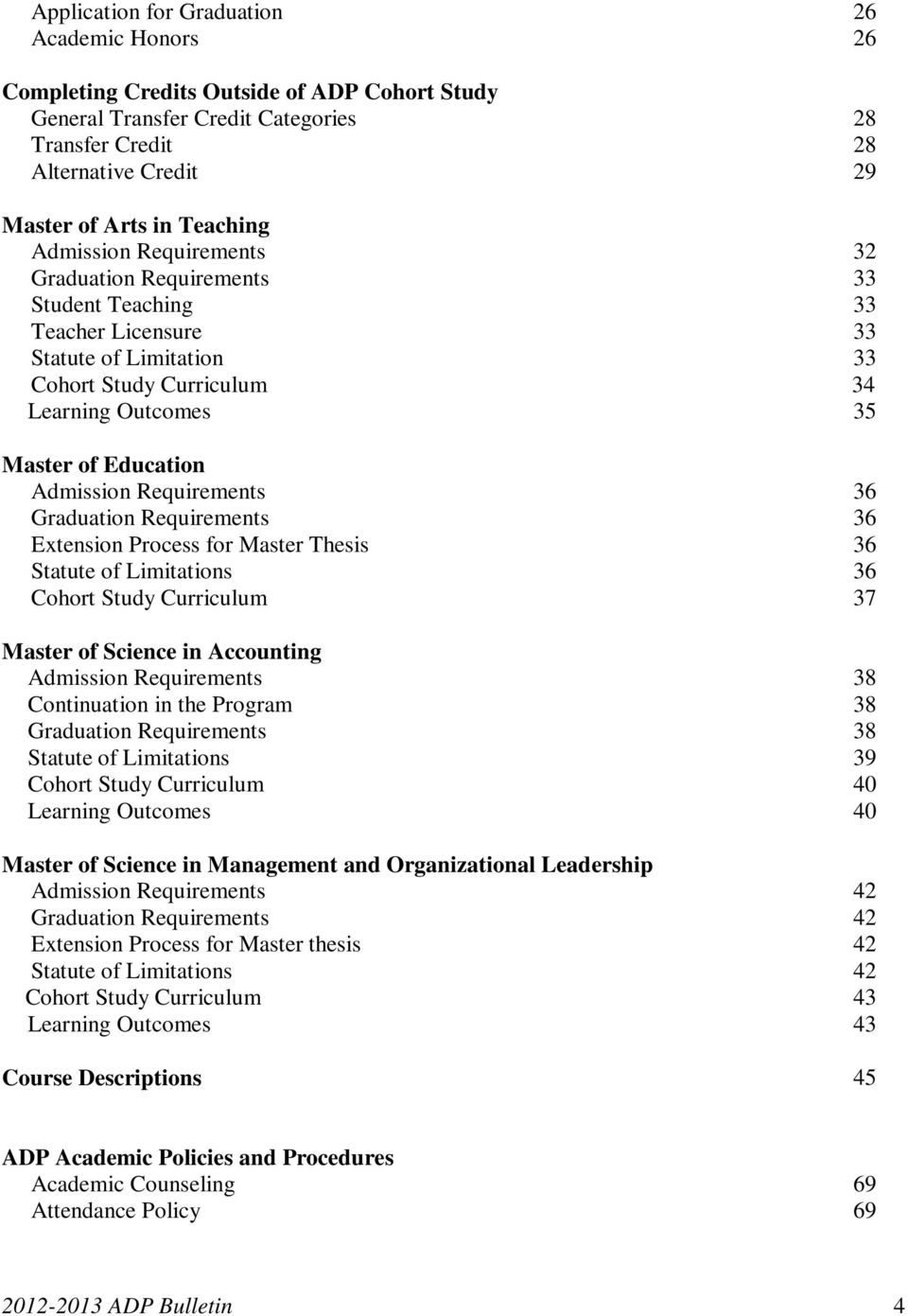
4 Application for Graduation 26 Academic Honors 26 Completing Credits Outside of ADP Cohort Study General Transfer Credit Categories 28 Transfer Credit 28 Alternative Credit 29 Master of Arts in Teaching Admission Requirements 32 Graduation Requirements 33 Student Teaching 33 Teacher Licensure 33 Statute of Limitation 33 Cohort Study Curriculum Learning Outcomes Master of Education Admission Requirements 36 Graduation Requirements 36 Extension Process for Master Thesis 36 Statute of Limitations 36 Cohort Study Curriculum Master of Science in Accounting Admission Requirements Continuation in the Program Graduation Requirements Statute of Limitations Cohort Study Curriculum Learning Outcomes Master of Science in Management and Organizational Leadership Admission Requirements 42 Graduation Requirements 42 Extension Process for Master thesis 42 Statute of Limitations 42 Cohort Study Curriculum Learning Outcomes Course Descriptions ADP Academic Policies and Procedures Academic Counseling 69 Attendance Policy ADP Bulletin 4
5 Learning Teams 70 Assessment Criteria 71 Grading Expectations and Rubrics 71 Credit Hour Definition 73 Academic Appeals and Petitions 74 Concurrent Enrollment 76 Participation in Commencement 76 Academic Integrity 77 Satisfactory Progress Academic Warning 79 Academic Probation 79 Academic Dismissal 80 Appeals for Readmission Returning from Academic Dismissal Change in Student Status Adding/Dropping Courses Administrative Course Withdrawal Approved Leave of Absence (LOA) 82 Program Withdrawal 83 Administrative Withdrawal 83 Vanished Students 84 Program Re-entry 84 Enrollment Status 84 Class Standing 85 Student Records Confidentiality of Records 86 Address/Phone/Name Change 86 Family Educational Rights and Privacy Act (FERPA) 86 Directory Information 87 Nondiscrimination, Accommodation and Grievance Policies 87 Campus Life Standards and ADP Community Agreement 93 Services Available to Students 95 Financial Aid Information Policies and Procedures 96 Important Facts 98 Standards of Academic Progress 99 Appeals 101 Re-establishing Academic Progress and Financial Aid ADP Bulletin 5

6 Return of Financial Aid Funds 101 Tuition and Fees 103 ADP Textbook Policy 104 Student Financial Options 106 Financial Policies and Procedures 108 Adult Degree Program Refund Policy 110 Miscellaneous Information 111 Directory Information ADP Bulletin 6

7 ADULT DEGREE PROGRAM HISTORY AND MISSION Founded in 1937 as Pacific Bible College in Spokane, Washington, a desire for a more central location in the Pacific Northwest led to a move to Portland in In 1959, the name of the institution was changed to Warner Pacific College in honor of one of the early founders of the church as well as to reflect its growing liberal arts emphasis. Warner Pacific College offers a different way of thinking when it comes to education for adults. As a Christian liberal arts college, Warner Pacific starts with a foundation of integrity, ethics and values unlike many other adult programs in the market. Mission: Warner Pacific is a Christ-centered, urban, liberal arts college dedicated to providing students from diverse backgrounds an education that prepares them to engage actively in a constantly changing world. Core Themes: Theme One: Cultivating a Christ-centered Learning Community Theme Two: Collaborating with and for our urban environment Theme Three: Fostering a Liberal Arts Education Theme Four: Investing in the formation and success of students from diverse backgrounds Purpose: Our purpose as a college is to develop persons as change agents characterized by integrity, personal and social transformation, a sense of mutual responsibility and a pursuit of personal excellence. The Adult Degree Program at Warner Pacific College ensures that the student s education has a positive impact on every aspect of life. Administration and faculty are at the center of a dedicated community whose focus is to help adult students achieve their personal and professional goals. Classes meet one course at a time, on the same night and at the same time and place to allow the student to plan in advance. A dedicated faculty delivers a curriculum that integrates theory and practice to ensure that the student s education has a positive impact on every aspect of his or her life career, family, and community. ACCREDITATION Warner Pacific College has been accredited by The Northwest Commission on Colleges and Universities since ADP Bulletin 7

8 Warner Pacific College evaluates credits from regionally accredited institutions for applicability toward Core Studies, major or elective requirements. In addition, Warner Pacific College evaluates coursework from schools and colleges which are accredited by other agencies, provided the institution is listed in the Accredited Institutions of Postsecondary Education, published by the American Council on Education (ACE). Regionally accredited institutions recognize each other s credits, however, it is up to each institution to determine how they receive and apply transfer credits towards their degrees. PROVISO Warner Pacific College is an equal opportunity employer, which seeks faculty and staff who have a personal commitment to Jesus Christ and the educational mission of the college as a Christian liberal arts institution. Warner Pacific College does not discriminate in its student admission and education practices and provides equal opportunity for all students and applicants regardless of race, color, sex, religion, national origin, disability, age, gender, sexual orientation (including gender identity), and any other status protected by applicable laws and regulations. While every effort is made to ensure the accuracy of the information in this Bulletin, Warner Pacific College reserves the right to make changes at any time without prior notice. This Bulletin is not a contract between Warner Pacific College and current or prospective students. Warner Pacific College reserves the discretion to address student issues on a case-by-case basis. Degree requirements are effective according to the student s date of matriculation at Warner Pacific. PROGRAMS OFFERED Associate of Arts in Organizational Dynamics Bachelor of Business Administration Bachelor of Accounting with a second major in Business Administration Bachelor of Health Care Administration Bachelor of Science in Human Development Master of Arts in Teaching Master of Education Master of Science in Accounting Master of Science in Management and Organizational Leadership CAMPUS LOCATIONS The Warner Pacific College Adult Degree Program currently offers programs at multiple sites: WPC Mt. Tabor campus, WPC 205 Centre campus, WPC Cascade campus, the west side of Portland, and Vancouver, Washington. Warner Pacific College is authorized by the Washington Higher Education Coordinating Board (HECB) and meets the requirements and minimum educational standards established for degreegranting institutions under the Degree-Granting Institutions Act. This authorization is subject to periodic review and authorizes Warner Pacific College to offer the following degree programs in ADP Bulletin 8
9 Washington: Associate of Arts in Organizational Dynamics; Bachelor of Business Administration; Bachelor of Science in Human Development; and Master of Science in Management and Organizational Leadership. Authorization by the HECB does not carry with it an endorsement by the board of the institution or its programs. Any person desiring information about the requirements of the act or the applicability of those requirements to the institution may contact the HECB at P.O. Box 43430, Olympia, WA ADP Bulletin 9

10 ASSOCIATE OF ARTS IN ORGANIZATIONAL DYNAMICS (AAOD) ADMISSION REQUIREMENTS Completed Application for Admission High School Graduation (Diploma or GED). Official high school transcripts (required for applicants with fewer than six transferable college credits). Official transcripts from all higher education institutions attended. Unofficial transcripts may be used for initial evaluation purposes. However, official transcripts must be received by the end of the second course in the program. Students who fail to submit official transcripts will be administratively withdrawn. No minimum age requirement, however, successful applicants will have had one year of full-time equivalent work experience and be currently employed, or if temporarily unemployed, able to verify access to a work/organizational environment. English proficiency. Students whose native language is not English may be required to demonstrate English proficiency. The TOFEL (525 Paper Exam or 195 Computer Exam) or other appropriate instrument may be used for this purpose. Graduation from a US high school meets the requirement. If there is a question regarding English language proficiency, either the CLEP exam in English Composition with Essay or the Warner Pacific College EN 101 Proficiency Test may be used. A GPA of 2.0 on prior college coursework. o Associate applicants who have a cumulative entering grade point average below a 2.0, and who have been out of any post-secondary school for a period of at least three years, will be considered for admission with academic forgiveness. o Academic forgiveness may be granted one time. Contact the Associate Registrar for specific policy provisions. REQUIREMENTS FOR GRADUATION The Application for Graduation (Grad Check) must be filed with the Associate Registrar no later than six months before the student intends to graduate The Associate Registrar and the Academic Counselor will review the application to ensure that all requirements for graduation will be met and to notify students in writing of deficiencies. Students completing the Associate of Arts degree must have met the following requirements. 1. Sixty-three semester credits; 51 credits must be completed within residence. (Up to 12 credits of comparable courses may be applied toward degree requirements. The first two courses in the A.A. program may not be waived.) 2. Completion of specific courses and requirements for the Associate of Arts degree set forth in the ADP Bulletin. 3. Cumulative grade point average (GPA) at graduation of at least ADP Bulletin 10

11 ASSOCIATE OF ARTS IN ORGANIZATIONAL DYNAMICS (AAOD) The Associate of Arts in Organizational Dynamics is a degree concentrating on the liberal arts with an emphasis on rapidly changing environments of organizations. The degree is suitable for transfer into bachelor degree programs and meets the needs of students who desire a general twoyear degree. Cohort Study Curriculum 21 COURSES/ 63 SEMESTER CREDITS Residency requirement: 51 credits (All courses are 3 credits and 5 weeks in length) PSY 110A BUS/SOC 100A CMPT 100A EN 102A HIS 200A EN 103A BI 151A SA 200A FA 200A MA 104A BUS/PS 200A HUM 211A BUS/PS 150A PSY 100A BUS 112A PHS 100A EN 120A HHK 151A BUS/REL/SOC 290A BUS/SS 220A BUS/COMM 260A Principles of Adult Learning Team Dynamics Computer/Information Literacy Written Communications I Introduction to History Written Communications II The Bible as Literature Interpersonal Communications Introduction to the Arts Math Concepts and Applications Foundations of the American Legal System Humanities Colloquy: War and Peace Management Fundamentals Foundational Elements of Psychology Principles of Budgeting and Accounting Environmental Studies Introduction to Literature Health and Fitness for Adults Ethics, Social Issues and Responsibility Human Resource Development Organizational Communication Course descriptions start on page ADP Bulletin 11

12 Learning Outcomes: 1. Graduates will demonstrate the ability to integrate knowledge and decision making within the larger framework of the organization and social and cultural contexts. 2. Graduates will demonstrate the ability to apply creativity, innovation, and change. 3. Graduates will demonstrate the ability to develop leadership and interpersonal skills. 4. Graduates will demonstrate the ability to communicate in the functional areas of business. 5. Graduates will demonstrate the human virtues of integrity, humility, compassion, and perseverance. 6. Graduates will demonstrate an increased capacity for conceptualization, strategic thinking, and problem solving. 7. Graduates will demonstrate the ability to act on one s values and ethics as foundational to good management and leadership. Student outcomes are also measured in light of the college s core themes ADP Bulletin 12
13 BACHELOR DEGREES Warner Pacific College s Adult Degree Program offers the following bachelor degrees: Bachelor of Business Administration (BBA) Bachelor of Accounting, with a second major in Business Administration (BAC) Bachelor of Health Care Administration (BHCA) Bachelor of Science in Human Development (BSHD) A bachelor degree consists of several credit components: Core Studies coursework Business Administration, Accounting, Health Care Administration or Human Development major coursework Electives to reach 124 total semester credits The following will be reviewed for general transfer credit to meet the 124 credits required for the bachelor degree: Transfer Credit o Coursework completed at a college or university o AARTS and SMART transcripts o ACE-military credit recommendations o CCRS (formerly ACE/PONSI) professional credit recommendations o Prior Learning Experience credit Documented PLE Essays Documented training (Certificates) Credit by examination: CLEP, DSST, WPC proficiency exams A student seeking to earn the bachelor degree from the Adult Degree Program must complete the required cohort study as prescribed in the program. Identical courses completed within the past five years will count toward the cohort program; the student still needs to fulfill the residency requirements of their individual program (see page 25). The individual student's schedule and financial aid packaging must be factored into the approval process for waived coursework. BUS/SS 300A: Leadership and Supervision, HUM 310A: Ethics, Faith, Living, Learning and REL/SOC 320A: Spirituality, Character and Service may not be waived ADP Bulletin 13

14 Requirements for the Second Bachelor Degree Students holding a bachelor degree from a regionally accredited college or university may earn a second degree at Warner Pacific upon completing an additional minimum of 30 semester credits, subject to these conditions: All credit must be earned subsequent to the granting of the first degree. For the former Warner student who has completed at least 30 semester credits in residence, at least 20 of the 30 credits must be earned at Warner. For the new student, all 30 semester credits must be in residence. At least 15 of the 30 semester credits must be upper division courses. Satisfy all specific requirements for the second bachelor degree. ADMISSION REQUIREMENTS A minimum of 48 semester (72 quarter) college-level credits from an accredited college or university or from CLEP, ACE, or other standardized evaluations. WPC limits non-traditional credits (CLEP, ACE, etc) to a total of 30. Completed Application for Admission Official transcripts from all higher education institutions attended. Unofficial transcripts may be used for initial evaluation purposes. However, official transcripts must be received by the end of the second course in the program. Students who fail to submit official transcripts will be administratively withdrawn. A minimum GPA of 2.0 on previous college coursework. There are no specific course prerequisites and no admissions tests. No minimum age requirement, however, successful applicants will have two years of full-time work experience and be currently employed, or if temporarily unemployed, able to verify access to a work/organizational environment. English proficiency. Students whose native language is not English may be required to demonstrate English proficiency. The TOFEL (525 Paper Exam or 195 Computer Exam) or other appropriate instrument may be used for this purpose. Graduation from a US high school would meet the requirement or, if entering the bachelor program, a two-year degree from a community or other approved two-year college may be used for this purpose. If there is a question regarding proficiency, either the CLEP exam in College Composition or the WPC English 101 Proficiency Test may be used. Bachelor degree applicants who have a cumulative entering grade point average below a 2.0, and who have been out of any post-secondary school for a period of at least three years, will be considered for admission with academic forgiveness. Academic forgiveness may be granted one time. Contact the Associate Registrar for specific policy provisions ADP Bulletin 14
15 BACHELOR OF BUSINESS ADMINISTRATION (BBA) The Business Administration major balances theoretical instruction with practical, hands-on experiences. Warner Pacific Business graduates have gone on to careers in accounting, marketing and management, as well as various graduate programs. COHORT STUDY CURRICULUM 14 COURSES / 43 SEMESTER CREDITS Requirements for the major: 34 credits: 28 credits in residence, 34 credits upper division All courses are three credits and five weeks in length unless noted otherwise. BUS 300A Leadership and Supervision BUS 310A Management Theory and Practice EN 200A College Composition BUS/PSY 321 A Organizational Behavior and Design BUS 401A Quantitative Analysis for Business BUS 306A Economics for Managers HUM 310A Ethics, Faith, Living and Learning BUS 313A Accounting for Managers BUS 461A Corporate Finance BUS 340A Marketing for Managers REL 320A Spirituality, Character and Service BUS 303A Business and Employment Law BUS 453A Operations Management BUS 450A Business Policies 4 credits / 6 weeks Course descriptions begin on page 45. Learning Outcomes: 1. Graduates will demonstrate critical thinking and initiative. 2. Graduates will demonstrate effective leadership and team oriented capabilities. 3. Graduates will demonstrate effective written and oral communication. 4. Graduates will demonstrate the ability to recognize ethical issues as they relate to organizations and their social responsibility. 5. Graduates will demonstrate a basic knowledge of the functional areas of business, to include management, business law, organizational leadership, quantitative reasoning, economics, accounting, operations management, corporate finance, marketing, and strategic planning. 6. Graduates will demonstrate knowledge about the use of information and technologies, and be able to apply basic tools to solve business problems ADP Bulletin 15

16 7. Graduates will demonstrate the ability to analyze and interpret basic quantitative information. 8. Graduates will demonstrate the ability to apply critical thinking skills to basic business situations. 9. Graduates will demonstrate the ability to synthesize and apply knowledge gained from specific business courses and real-world experiences from an organizational perspective. Includes business policies, practica, internships, and experiential learning. Student outcomes are also measured in light of the college s core themes ADP Bulletin 16

17 BACHELOR OF ACCOUNTING with a second major in BUSINESS ADMINISTRATION (BAC) The double major of Accounting and Business Administration combines hands on experience with theoretical instruction and equips students for careers in accounting or serves as the first step toward CPA certification. The program concentrates on generally accepted accounting practices and principles, federal and state tax laws as they relate to individuals and organizations, the importance of accounting controls, and the function of auditing. Emphasis will also be placed on understanding ethics in a world view context and the employment of ethical decision-making in organizations. The student will develop skills and understand the process of assessing, evaluating, and making decisions about the operational and financial management of business and organizations. Accounting courses must be taken in sequence and students must successfully pass BUS 312A before taking any other level accounting courses. COHORT STUDY CURRICULUM 23 COURSES / 70 SEMESTER CREDITS Requirements for the major: 61 credits: 49 credits in residence, 54 credits upper division All courses are three credits and five weeks in length unless noted otherwise. BUS 300A Leadership and Supervision EN 200A College Composition BUS 306A Economics for Managers BUS 211A Principles of Accounting I BUS 212A Principles of Accounting II BUS 303A Business and Employment Law BUS 310A Management Theory and Practice BUS 311A Intermediate Accounting I BUS 312A Intermediate Accounting II HUM 310A Ethics, Faith, Living, and Learning BUS 314A Cost Accounting 3 credits/ 6 weeks BUS/PSY 321A Organizational Behavior and Design BUS 331A Non-Profit Accounting 3 credits/ 6 weeks REL 320A Spirituality, Character and Service BUS 401A Quantitative Analysis for Business BUS 340A Marketing for Managers BUS 411A Advanced Accounting 3 credits/ 6 weeks BUS 453A Operations Management BUS 332A Auditing 3 credits/ 6 weeks BUS 461A Corporate Finance BUS 412A Taxation I 3 credits/ 6 weeks BUS 413A Taxation II BUS 450A Business Policies 4 credits/ 6 weeks ADP Bulletin 17

18 Course descriptions begin on page 45. Learning Outcomes: 1. Graduates will demonstrate the mastery of the basic functional competencies of decision making, risk analysis, measurement, reporting, research, and leveraging technology to enhance functional competencies. 2. Graduates will demonstrate mastery of the basic personal competencies of professional demeanor, problem solving and decision making, interaction, leadership, communication, project management, and leveraging technology to enhance personal competencies. 3. Graduates will demonstrate mastery of the broad business perspective competencies of strategic and critical thinking, industry and sector perspective, international and global perspective, resource management, legal and regulatory perspective, marketing and client forces, and leveraging technology to enhance business competencies. Student outcomes are also measured in light of the college s core themes ADP Bulletin 18
19 BACHELOR OF HEALTH CARE ADMINISTRATION (BHCA) The Health Care Administration program integrates the theoretical foundation of health care administration with practical application. The curriculum is designed to promote the development of high moral character in students as they prepare to utilize ethical decisionmaking practices in positions of leadership and management in health care organizations. COHORT STUDY CURRICULUM 17 COURSES/ 48 SEMESTER CREDITS Requirements for the major: 39 credits: 30 credits in residence, 37 credits upper division All courses are three credits and five weeks unless noted otherwise. SS/BUS 300A Leadership and Supervision HCA 270A The Context and Language of Health Care 2 credits / 4 weeks EN 200A College Composition BUS 310A Management Theory and Practice REL 320A Spirituality, Character and Service BUS 306A Economics for Managers HCA 301A Health Care Organization and Delivery HCA 302A Principles of Managed Care HUM 310A Ethics, Faith, Living and Learning BUS 401A Quantitative Analysis for Business HCA 402A Finances, Budgeting for Health Care Organization 6 weeks HCA 403A Public Policy, the Law and Ethics in Health Care HCA 404A Introduction to Public Health Administration HCA 303A Alternative Health Care HCA 412A Health Care Ethics HCA 450A Critical Issues in Health Care HCA 494A Senior Portfolio 1 credit / 2 weeks Course descriptions begin on page 45. Learning Outcomes: 1. Graduates will demonstrate mastery of the basic concepts, theories, models and vocabulary associated with transformation: achievement orientation, analytical thinking, community orientation, financial skills, information seeking, innovative thinking, and strategic orientation. 2. Graduates will demonstrate mastery of the basic concepts, theories, models and vocabulary associated with execution: accountability, change leadership, collaboration, ADP Bulletin 19

20 communication skills, impact and influence, initiative, information technology management, organizational awareness, performance measurement, process management and organizational design, and project management. 3. Graduates will demonstrate mastery of the basic concepts, theories, models and vocabulary associated with people: human resource management, interpersonal understanding, professionalism, relationship building, self-confidence, self-development, talent development, and team leadership. Student outcomes are also measured in light of the college s core themes ADP Bulletin 20

21 BACHELOR OF SCIENCE IN HUMAN DEVELOPMENT (BSHD) The Human Development major provides a background in human development. Students are prepared for a variety of vocational opportunities in human services and church ministry as well as studies in graduate programs within the social sciences. COHORT STUDY CURRICULUM 14 COURSES / 43 SEMESTER CREDITS Requirements for the major: 34 credits: 28 credits in residence, 34 credits upper division All courses are three credits and five weeks unless noted otherwise. SS 300 A Leadership and Supervision EN 200A College Composition SS 352A Cultural Studies SS 380A Conflict Resolution HD 310A Foundations of Human Development HD 311A Prenatal/Early Childhood Development HD 312A Mid-Child/Adolescent Development HD 313A Adult Development HUM 310A Ethics, Faith, Living and Learning HD 320A Human Sexuality SS 391A Research Design and Applied Statistics REL 320A Spirituality, Character and Service EDPSY 420A Learning Theory PSY 430A Counseling Theory 4 credits / 6 weeks Course descriptions begin on page 45. Learning Outcomes: 1. Graduates will be able to articulate the major theories of development. 2. Graduates will be able to equally substantiate through research data two opposing positions on a contended issue in the field. 3. Graduates will compare favorably in job performance with other entry-level employees in positions applying human development training. 4. Graduates will be able to synthesize concepts learned into a holistic view of persons and their interacting systems ADP Bulletin 21
22 MINORS Minors, in an on-line format, offer students an opportunity to focus their electives on an academic area of study, but without the depth and breadth of a major. Students with sophomore standing or above may take minor courses. If students elect to declare a minor, a grade of C- or better must be achieved in all upper division courses required for the minor. MINOR PROGRAMS Current Warner students may choose to add on a minor to their degree program. All requirements for the minor must be completed in residence. Students are not required to choose a minor for graduation. Human Resource Management 6 COURSES/ 18 SEMESTER CREDITS/ 30 WEEKS (All courses are three credits and five weeks in length.) BUS 322A BUS 323A BUS 324A BUS 325A BUS 326A BUS 327A The Role of Human Resources Staffing: Selection and Placement Employee and Labor Relations Wage and Salary / Benefits Administration Safety and Health Employee Development Sales and Marketing 6 COURSES/ 18 SEMESTER CREDITS/ 30 WEEKS (All courses are three credits and five weeks in length.) BUS 308A BUS 244A BUS 245A BUS 345A BUS 246A BUS 436A Business Ethics Fundamentals of Selling Managing Sales Relationships Psychology of Sales Negotiating Skills in Business Sales Management Course descriptions begin on page ADP Bulletin 22
23 BACHELOR DEGREE GRADUATION REQUIREMENTS Students completing the baccalaureate degree must have met the following requirements. 1. Minimum of 124 semester credits 2. Minimum of 40 semester credits of upper division ( ) level study (satisfied through ADP cohort coursework) 3. Completion of core requirements, major requirements, and residency requirements as set forth in the Bulletin. 4. Cumulative grade point average (GPA) of at least A grade of C- or better in all required courses in the major and EN 200A 6. If a minor is declared, a grade of C- or better in all courses required for the declared minor. Students will graduate under the requirements listed in the Bulletin in effect at the time of enrollment. Students who leave the program for over a year, but subsequently return to the program and complete study, will graduate under the Bulletin in effect at the time of re-entry. CORE STUDIES REQUIREMENTS According to its Mission Statement, Warner Pacific College is a Christ-centered, urban, liberal arts college dedicated to providing students from diverse backgrounds an education that prepares them to engage actively in a constantly changing world. The Core Curriculum at Warner Pacific College supports this Mission Statement by providing students with a broad-based education in an urban Christian context. Below are definitions of the challenges students face and the objectives that students will be able to achieve upon completing the Core Curriculum at Warner Pacific College. Student Objectives for the Core Curriculum In order to gain a foundation that will encourage them to address core curriculum expectations, students at Warner Pacific College will take required courses which will give them the opportunity to demonstrate the following convictions, knowledge, and skills. Convictions The mission of Warner Pacific College rests on the Christian belief that integrity and respect are inherent qualities of the moral life. This life which includes: an awareness of God, of oneself, and of one s actions toward others, the environment, and an understanding of Scripture. The moral life seeks to bridge the disconnect between belief and practices, to maintain a personal ethic consistently, to recognize the greater good in the midst of conflicting voices, and to heal divisions in society. Students will be encouraged and given the opportunity to develop and demonstrate: 1. a worldview that is ethical, respectful, and promotes stewardship through acts of service. 2. self-knowledge, integrity, and awareness of others through responsible decision making ADP Bulletin 23
24 3. sensitivity to and valuing of diversity among and between people. Knowledge A liberal arts education requires that students approach learning in a variety of ways and contexts, embracing a large spectrum of disciplines and areas of study are part of the core studies experience. Contemporary challenges in this area include the prevalence of the commoditization of education and the temptation to be degree focused rather than education focused, balanced with the legitimate concerns of the marketplace on the preparation of graduates for the world of work. The Warner Pacific College Core curriculum is designed to provide students with foundational experiences to support the following goals. Students will be encouraged and given the opportunity to develop and demonstrate: 1. an understanding of the Christian faith. 2. an understanding of the nature and value of the liberal arts. 3. an understanding of historical context across the curriculum. 4. an understanding of one s own culture in relation to global interdependency. 5. an understanding of ethical, environmental, social, and cross-cultural influences in the world. 6. an understanding of the natural world, including: current science and technology and its importance in contemporary society. 7. an understanding of urban contexts across the curriculum, Skills Warner Pacific College equips students with the skills to embark on their educational and professional careers. Through written and verbal discourse, students will bring the voice of an individual worldview into collaborative action with classmates, professors, and members of the urban community. They will have the opportunity to engage with technological, cultural, and intellectual challenges within a liberal arts context integrating knowledge gained from various classes, fields of study, and work experience. Students will be encouraged and given the opportunity to develop and demonstrate: 1. critical and creative thinking processes in order to evaluate the quality of texts, arguments, and other information sources, via an awareness of literary and historical context. 2. the ability to use tools that address social issues. 3. the ability to generate, implement, assess, and critique the result of the execution of a plan. 4. civil verbal discourse to clarify and express themselves effectively. 5. effective written communication relevant to specific audiences. 6. effective leadership and participation in group processes and problem solving skills. 7. the ability to locate, acquire, analyze, synthesize, and structure information. 8. the ability to apply scientific, quantitative, and analytical reasoning skills. 9. the ability to translate current technology used in the major field of study, as well as function in modern society ADP Bulletin 24
25 The core studies outcomes are designed to be demonstrated by students completing their entire program at Warner Pacific College, students that transfer a significant amount of coursework from other accredited institutions may not demonstrate these competencies to the same degree. ADP bachelor degree candidates must complete all Core Studies requirements. These are the general education requirements that may be earned through college coursework, standardized tests or PLE Essays. A course is defined as consisting of a minimum of two semester credits or the equivalent quarter credits with the exception of courses in the area of participatory fine arts or physical education activities where fewer than two semester credits may meet the course definition requirement for Core Studies. In no case will a course consisting of fewer than.67 semester credits (one quarter credit) be acceptable as meeting a Core course requirement. The Core Studies course requirements are: COMMUNICATIONS HUMANITIES MATH Three courses as follows: two courses in College Composition, one within ADP (EN 200A) both to be completed with a grade of C- or better; the third communications course may be any composition, speech, communication (verbal/non-verbal), business and technical writing, or journalism course Four courses. FR/SO: HUM 310A, HUM 211A, and two courses from two different categories; JR/SR: HUM 310A, and three courses from two different categories - History, Humanities, Philosophy, Literature, or Foreign Language One college-level course (college algebra or higher) RELIGION Two courses, one within ADP (REL 320A) SCIENCE SOCIAL SCIENCE FINE ARTS HEALTH AND FITNESS One course from the physical or biological sciences Two courses (study in ADP satisfies this requirement) One cultural/historical course or two participatory courses One course in Personal Health or Nutrition or two PE activity courses RESIDENCY REQUIREMENT Satisfactory completion of the Adult Degree Program coursework (at least 43 credits) will meet Warner Pacific residency requirements. Residency requirements vary, depending upon program length. Below are the residency requirements for each baccalaureate program: BBA: 43 credits BAC: 58 credits BHCA: 43 credits BSHD: 43 credits ADP Bulletin 25
26 Bachelor degree students may transfer in identical courses within the major, but will be required to work with their Academic Counselors to identify and complete additional courses at Warner Pacific to meet the residency requirements of their intended degree program. COMPLETION OF THE BACHELOR DEGREE By definition, an Adult Degree Program bachelor degree seeking student is a student admitted and registered for enrollment in the ADP (see page 14, Admission Requirements ). The student is classified as an ADP student until the degree is completed or two years from the cohort closure session, whichever occurs first. Students completing degree work at WPC after completion of cohort study are subject to the appropriate tuition and fees in effect at the time such courses are taken. Students failing to complete their program within the two-year period after cohort study ends must re-apply for admission, and be subject to the degree requirements in place at the time of re-admittance to the program. ADP students who have been in continuous enrollment at Warner Pacific College and whose program plan requires more than the two-year period to satisfy degree requirements, may petition the ADP Academic Policies Committee for an extension of the completion deadline. Such petitions must be accompanied by a degree plan listing coursework and projected completion date, reason for extension and the signature of the Academic Counselor. APPLICATION FOR GRADUATION The student must file an Application for Graduation with the Associate Registrar for ADP no later than six months before the student intends to graduate. The Associate Registrar and the Academic Counselor will review the Application to ensure that all requirements for graduation will be met and will notify students in writing of deficiencies. ACADEMIC HONORS Dean s List A Dean s List is published each semester in recognition of undergraduate students completing 12 or more letter grade credits and receiving a minimum grade point average (GPA) of 3.5 in all courses attempted that semester. For ADP, the Spring Dean s List is based on credits completed between November 1 and April 30; the Fall Dean s List is based on credits completed between May 1 and October 31. Credits taken P/NP are eliminated from this calculation. Thus, a person taking 12 credits of which three are P/NP, would not be eligible for Dean s List consideration. Master degree candidates are not considered for the Dean s List ADP Bulletin 26
27 Graduating with honors Bachelor degree candidates with qualifying GPAs who have completed at least 45 semester credits at Warner Pacific College receive confirmation of honors at graduation. The "career" (cumulative) GPA appears on the student's transcript at the time of graduation and is used to calculate the GPA for graduation. The career GPA is based on all courses attempted (both at Warner Pacific College and transfer) which are applicable toward graduation at Warner Pacific College. Although academic forgiveness may have enabled the student to be admitted to the program, for the purpose of the graduation GPA and honors, forgiven grades accepted in transfer will be included in the final calculation. Honors at graduation and class rank are determined solely on GPA earned: Cum Laude Magna Cum Laude Summa Cum Laude Associate and Master degree candidates are not eligible for academic honors at graduation ADP Bulletin 27
28 COMPLETING CREDITS OUTSIDE OF ADP General Transfer Credit Categories The following will be reviewed for general transfer credit to meet the 124 credits required for the bachelor degree: Coursework completed at a college or university with regional, national, professional, or specialized accreditation, or with candidacy status. Credits earned through credit by examination: CLEP, DSST, etc. AARTS and SMART transcribed credits. ACE-military credit recommendations. CCRS (formerly ACE/PONSI) professional credit recommendations. Documented learning (Certificate) that occurs outside the college classroom that has been evaluated by ACE, or has been evaluated by the Associate Registrar and has been determined to be comparable to an ACE-evaluated course. Documented prior learning (PLE Essay) that meets Warner Pacific College documentation requirements and the Council for Adult and Experiential Learning s (CAEL s) ten qualitative standards. TRANSFER CREDIT Accredited Colleges and Universities Warner Pacific evaluates credits from regionally accredited colleges and universities for applicability toward Core Studies, major or elective requirements. In addition, Warner Pacific College evaluates coursework from schools and colleges which are accredited by other agencies, provided the institution is listed in Accredited Institutions of Postsecondary Education, published by the American Council on Education (ACE). No more than 40 semester credits may be accepted from vocational-technical fields of study, and these credits will be considered as electives. For Core Studies consideration, credits earned from non-regionally accredited institutions and which receive a grade of C- or higher, are evaluated on a course-by-course basis by faculty in the appropriate academic department. Lower division courses will be counted as lower-division credit (i.e., 100 or 200 level). Upper division and graduate courses taken at a baccalaureate institution may be used to satisfy upper division (i.e., 300 or 400 level) requirements. Lower-division credit may not satisfy upperdivision requirements. In all cases, courses must be transferred from an appropriately accredited institution. A grade of "D" cannot be transferred to satisfy any upper division course in the major or the composition course requirement. In the transcript evaluation process, quarter credits will be converted to semester credits. The formula used is one quarter credit = 0.67 semester credit. Credit for college-level work from accredited community or junior colleges is allowed to a cumulative maximum of 82 semester credits. There is no maximum on the number of credits from accredited four-year institutions that will transfer into the college; however, students must meet a minimum 43-credit residency requirement for bachelor level programs and a minimum 51-credit residency requirement for the ADP Bulletin 28
29 associate level program. Completion of the Adult Degree Program cohort study fulfills the college residency requirement. WPC upper division graduation requirements are met through the Adult Degree Program bachelor degree cohort study. Block Transfer The college accepts the Associate of Arts Transfer Degree (AAOT) from Oregon community colleges and the Direct Transfer Agreement (DTA) from Clark College in Vancouver, Washington as having fulfilled all Core Studies requirements, with the exception of one course in Communications (EN 200A), one course in Humanities (HUM 310A), which is part of the ADP bachelor degree cohort study, and two courses of Religion, one of which (REL 320A) is part of the ADP bachelor degree cohort study. Students with two-year degrees are not exempt from the mathematics competency requirements of the college as described in the Core Studies requirements (see page 25). In addition, Warner Pacific College honors articulated agreements with specified colleges. Students should consult with an academic counselor. Other accredited college associate degrees are transferable and qualify a student for junior status; these will be evaluated for applicability toward Core Studies, major, or electives. If a student wishes to transfer the associate degree, the associate degree must be completed prior to entry at Warner Pacific College. Non-Academic Credit Limit Students may receive limited credit for coursework in nonacademic areas, including vocational coursework, up to 40 semester credits, unless the courses are part of an approved two-year degree in which case more than 40 credits may be accepted. ALTERNATIVE CREDIT Several alternative credit programs are available to the Warner Pacific student. These non-graded credits will be limited to a total of 30. Credits accepted in transfer in these categories are transcribed without charge. A student wishing to take advantage of learning acquired through independent reading and study, job experience, non-credit classes, or exams, should consult an academic counselor. Military Credit may be awarded for some types of military services and certificated courses on the college level as listed in, or comparable to, guidelines provided by the American Council on Education (ACE). Transfer credit may be granted for ACE credit recommendations for basic military training, military schools and courses, occupations specialties (MOS Army; NER Navy), and Army, Navy, Air Force, Reserves, and National Guard commissioned officer training when appropriate documentation is presented and the general transfer policies are met.. A summary assessment policy on ACE military credit recommendations follows: Official AARTS, SMART, or CCAF transcript or military forms DD214 or DD295 must be received before military training can be evaluated. Military credits awarded by a transferring institution must be re-evaluated ADP Bulletin 29
30 If a student has less than an honorable discharge, no military credit may be awarded. Transfer of CCRS (formerly ACE/PONSI) Credit Recommendations Transfer credit may be granted for professional training programs, courses, licenses, and certifications that have been evaluated by, or are comparable to, the American Council on Education s College Credit Recommendation Service (CCRS formerly ACE/PONSI). Students who have completed courses at organizations that are participating in the ACE/CCRS program may obtain a transcript from ACE s Registry of Credit Recommendations. Credit may be granted if the subject matter meets the Adult Degree Program s transfer policies, if the submitted documentation officially verifies successful course completion, and if the information matches, or is comparable to, the ACE Guide s course exhibit. The Adult Degree Program uses ACE s National Guide to Educational Credit for Training Programs and the University of New York, Board of Regents Directory on the National Programs on Non-Collegiate Sponsored Instruction, to determine the amount of transfer credit. Assessment of Documented Prior Learning Documented prior learning through a prior learning experience (PLE) Essay is assessed after enrollment in the Adult Degree Program. The PLE Essay option is available to students who successfully complete EN 200A: College Composition, included in the ADP bachelor degree programs, and a PLE information meeting to be scheduled outside of cohort study. The PLE information meeting includes instruction about preparing, documenting, and writing a PLE essay. Before registering for a PLE information meeting, students should consult with their Academic Counselor to determine if PLE credit should be part of their academic degree plan. The PLE Essay is one of several non-traditional methods available to students who need elective credits outside of ADP cohort study, for graduation. PLE may not be used to satisfy any ADP Program course that is required for that degree. Students are eligible to submit PLE essays after completing EN 200A, throughout their program until two months prior to their intended commencement ceremony. An evaluation fee (see tuition and fees) is due at the time an essay is submitted. Students who plan to complete elective credits after ADP coursework is completed have two years from their program closure to submit PLE essays with the same deadlines prior to their graduation. Credit may be awarded after an essay is evaluated by a trained faculty evaluator in the appropriate academic department. The Council for Adult and Experiential Learning s (CAEL) ten qualitative standards are followed. PLE credit will be transcribed when the evaluation of a PLE essay is completed and an award of credit is indicated by the faculty evaluator. Course equivalency: The student must write a narrative which demonstrates learning outcomes equivalent to a college-level course through the application of Kolb s Model of Experiential ADP Bulletin 30
31 Learning. The learning experience must also be verified through documentation, as specified in the PLE information meeting. Prior Learning Experience credits are transcribed similar to the following examples: CM 220 PLE: Spiritual Formation 3 credits SS 350 PLE: Overseas Study 3 credits CMPT 179 PLE: Word Processing 3 credits AGENCY-SPONSORED LEARNING (CERTIFICATES) Credit may be awarded for some types of courses which are determined to be college-level and which are listed in, or comparable to, guidelines provided by the American Council on Education (ACE). Official documentation of course completion is required. Credit by Examination Students are eligible to take exams throughout their program until two months prior to their intended commencement ceremony. Students who plan to complete elective credits after ADP coursework is completed have two years from their program closure to complete exams with the same deadlines prior to their graduation. COLLEGE-LEVEL EXAMINATION PROGRAM (CLEP) The College Level Examination Program evaluates what a student has learned through nontraditional or independent study (i.e., study for which the student has not received college credit) and determines whether the student has acquired college-level knowledge in a given subject area. CLEP gives the student the opportunity to demonstrate that knowledge by taking an examination for possible credit. These are standardized, multiple-choice tests, one of which also contains an essay portion. Warner Pacific recognizes the American Council on Education guidelines for scoring CLEP tests. Students must wait six months before retaking any exam. DSST STANDARDIZED SUBJECT TESTS Originally developed for the voluntary education programs of the U.S. Armed Forces, the DSST standardized subject tests are now available for civilian use to evaluate what students have learned through non-traditional or independent study (i.e., study for which the student has not received college credit). Warner Pacific College uses the ACE-recommended guidelines to determine passing scores and number of credits awarded for DSST. Students must wait six months before retaking any exam. PROFICIENCY EXAMINATION Students may challenge some WPC courses by demonstrating proficiency in the identified subject or skill. Students should confer with the academic counselor. The appropriate academic Department Chair must approve prior to the student taking the exam. Exams are graded. Proficiency may be demonstrated for a waiver of a requirement (test fee only) or for academic credit (test fee plus a per-credit transcription charge) ADP Bulletin 31
32 MASTER OF ARTS IN TEACHING (MAT) ADMISSION REQUIREMENTS Completed Application for Admission A baccalaureate degree from a regionally accredited college or university A minimum GPA of 3.0 or better Official transcripts from all higher education institutions attended Three recommendations Ten-hour observation experience in a school and a 100-word written description of experience (written by applicant) Academic Paper on current issue in any field of study Fingerprints submitted and cleared by TSPC A goal statement Complete an interview with program faculty Prerequisite courses (course syllabi may be required): o Human Development course covering the targeted age group student desires to teach. A life-span development course is acceptable. o Learning Theory o Computer Competency Exam o Academic Writing Seminar (if academic paper does not meet standard) Documentation showing successful completion of state examinations for the desired authorization(s) and content area(s) (see below). Examinations: Prior to beginning the MAT program, all applicants must have successfully completed the appropriate examinations as described below. o All applicants must have completed the EAS exam, CBEST exam, the PPST Exam, or the WEST-B Exam. o All applicants (with the exception of those concentrating in Physical Education, Music or pursuing High School licensure only) must have completed NES EE, subtests 1 and 2 o All applicants pursuing Middle Level and High School licensure must have completed the NES exams in their subject area prior to beginning the MAT program. Listed below are the exams currently required by the Teachers Standards and Practices Commission (TSPC), the licensing body for the State of Oregon: Biology Biology exam Language Arts English Language Arts exam Math (Advanced) Mathematics exam Math (Basic) Middle Grades Mathematics exam Middle School Language Arts Middle Grades English Language Arts exam Middle School Social Studies Middle Grades Social Science exam Music Music exam Physical Education Physical Education exam ADP Bulletin 32
33 Health Education Health Education exam Social Studies Social Science exam o Civil Rights Exam GRADUATION REQUIREMENTS Students must meet the following requirements to earn a Master of Arts degree in Teaching through the Adult Degree Program: 1. Complete a minimum of 35 credits 2. Complete the approved Master of Arts in Teaching program coursework 3. Achieve a minimum cumulative grade point average of 3.0 with no individual course grade lower than C- 4. Successfully complete a minimum of 15 weeks of student teaching STUDENT TEACHING Students must have completed all other MAT coursework with a cumulative GPA of at least 3.0 before student teaching. Assignments and supervision will be coordinated by the Warner Pacific Education Department. TEACHER LICENSURE At the time of licensure, MAT students must meet all requirements/regulations of TSPC in order to be licensed to teach in Oregon. STATUTE OF LIMITATION FOR MASTER DEGREE COMPLETION All academic work for the MAT degree must be completed within six years from the student s program start date. If the student is unable to finish the degree program in the time allotted, the student must reapply for admission, at which time all previously earned credits will be reevaluated for current relevance. The student will also be subject to any degree requirement changes that apply to the Bulletin in effect at the time of re-admittance ADP Bulletin 33
34 MASTER OF ARTS IN TEACHING (MAT) The Master of Arts in Teaching (MAT) is designed to meet the needs of students with a bachelor degree who wish to become classroom teachers. The program will provide education on current instructional practices as well as an understanding of the complexities of the teaching profession. Candidates who complete the MAT will be eligible for an Initial 1 Teaching License in one or more of the following authorizations: Early Childhood, Elementary, Mid-Level, and/or High School. Candidates must also declare an endorsement area. Warner Pacific supports the following endorsements: Advanced Math, Biology, Language Arts, Music, Multiple Subjects (ECE/Elementary), Physical Education, and Social Studies. COHORT STUDY CURRICULUM 11 COURSES/ 35 SEMESTER CREDITS (Students take six core courses and then split into one of two tracks: Early Childhood/Elementary or Middle Level/High School, in order to assist them in focusing on their intended level of teaching. Courses are 3 credits and 7 weeks in length unless noted otherwise). Education Core Courses: ED 551A Foundations of Education 1 credit / 2 weeks ED 535A Curriculum Planning and Instruction ED 596A Assessment and Evaluation ED 661A Educational Research ED 555A Urban Education and Diverse/Exceptional Learners ED 515A Classroom Management ED 691A Student Teaching 1A with Seminar ED 692A Student Teaching 1B with Seminar 4 credits ED 690A Student Teaching II with Seminar ECE/Elementary Courses ED 571A Art/Physical Education/ Music in PK-8 Classroom ED 572A Teaching Math and Science in the PK-8 Classroom ED 574A Teaching Literacy and Social Studies in the PK-8 Classroom Middle/High Education Courses ED 575A Literacy in the Content Area ED 576A Instructional Methods for the Middle and High School ED 577A Educational Trends in Middle and High School A student seeking to earn the Master of Arts in Teaching must complete the required cohort study as prescribed in the program. In cases where identical courses were completed in the past five years, a waiver of up to two courses may be requested. The request to waive/transfer coursework must be made in writing prior to beginning the program. The individual student s schedule and financial aid packaging must be factored into the approval process for waived coursework. Students may not waive ED 551A, ED 515A, ED 690A, ED 691A, or ED 692A ADP Bulletin 34
35 Course descriptions begin on page 45. Learning Outcomes: 1. Graduates will demonstrate the ability to construct an intellectually, socially, and emotionally stimulating learning environment founded on principles of human development by applying critical and creative thinking and by utilizing analytical, reflective and evaluative strategies. 2. Graduates will exhibit professional behaviors, ethics, and values, by demonstrating professional dedication and personal commitment to service and spiritual development. 3. Graduates will demonstrate the ability to design, implement, observe, and evaluate learning activities and programs based on diverse individual and group needs. 4. Graduates will demonstrate and promote life-long learning through a commitment to ongoing evaluation of current educational practices. 5. Graduates will apply Oregon Content Standards, TSPC Standards, and developmentally appropriate practices for areas of authorization. 6. Graduates will incorporate technology as both a learning tool and an instructional strategy. 7. Graduates will demonstrate an understanding of the historical and philosophical foundations of education ADP Bulletin 35
36 MASTER OF EDUCATION (MED) ADMISSION REQUIREMENTS Completed application for admission A baccalaureate degree from a regionally accredited college of university A minimum cumulative GPA of 2.75 Official transcripts from all higher education institutions attended Two letters of recommendation State-issued teaching certificate One year of teaching experience GRADUATION REQUIREMENTS Students must meet the following requirements to earn a Master of Education through the Adult Degree Program: 1. Complete a minimum of 33 credits 2. Achieve a minimum cumulative grade point average of 3.0 with no individual course grade lower than C- 3. Successful presentation of Capstone project 4. Submit a copy of the Capstone Presentation to the Director of the MED Program EXTENSION PROCESS FOR MASTER THESIS Students who need more time to complete their final project may request one additional six week extension from their ED 595BA instructor. The extension request must be approved before the end of the student s final class. Appropriate fees apply. STATUTE OF LIMITATION FOR MASTER DEGREE COMPLETION All academic work for the MED degree must be completed within six years from the student s program start date. If the student is unable to finish the degree program in the time allotted, the student must reapply for admission, at which time all previously earned credits will be reevaluated for current relevance. The student will also be subject to any degree requirement changes that apply to the Bulletin in effect at the time of re-admittance ADP Bulletin 36
37 MASTER OF EDUCATION The Master of Education (MED) is intended for licensed teachers seeking courses and experiences for professional growth and/or credits for continued renewal of their license. Faculty members strive to guide students from where they are currently toward where they want to be professionally. The coursework is a mix of teaching pedagogy, research, reflection about classroom practice, and current topics in education. COHORT STUDY CURRICULUM 13 COURSES/ 33 SEMESTER CREDITS (All courses are 3 credits each and 8 weeks in length unless otherwise noted) ED 520A Current Issues in Education ED 500A Implementing Best Practices ED 550A Curriculum Design (2 credits / 5 weeks) ED 530A Advanced Teaching Methods ED 560A Research for Teachers (2 credits / 5 weeks) ED 540A Utilizing Instructional Media ED 510A Teaching to Diversity in Today s Classrooms ED 600A Teacher as Mentor ED 660A Research Design ED 595AA Capstone Experience (1 credit / 6 weeks) ED 671A Critical Literacy ED 564A Ethics in Education ED 595BA Capstone Experience (1 credit / 6 weeks) A student seeking to earn the Master of Education must complete the required cohort study as prescribed in the program. In cases where identical coursework was completed in the past five years, a waiver of up to two courses may be requested. The request to waive/transfer coursework must be made in writing prior to beginning the program. The individual student s schedule and financial aid packaging must be factored into the approval process for waived coursework. Students may not waive ED 595A or ED 595BA. Course descriptions begin on page ADP Bulletin 37
38 MASTER OF SCIENCE IN ACCOUNTING (MSAC) ADMISSION REQUIREMENTS Completed application for admission Completion of a baccalaureate degree within the past 5 years from a regionally accredited college of university in one of the following fields of study: o Accounting o Business Administration o Finance o Another baccalaureate degree (requires consent of the Business Department Chair) A minimum cumulative GPA of 3.0 Official transcripts from all higher education institutions attended At least 25 semester credits of accounting courses (principles through advanced accounting, auditing and taxation courses) At least 27 semester credits in the Business discipline (management, organizational behavior, finance, operations, research, marketing, policies and ethics, law, and economics) CONTINUATION IN THE PROGRAM In anticipation of the students ultimate goal to complete (and to assure appropriate preparation for) the CPA and/or CMA exam, there will be four major exams throughout the span of the program. These exams will be scheduled at a specific time outside the normal cohort schedule. Students need to successfully pass each exam to continue uninterrupted in the program. Students who struggle will be presented with options for extra support in learning and applying the material or are provided with the opportunity to reassess their plans. Test ONE would be given after completing BUS 510A, BUS 520A, and BUS 530A. Test TWO would be given after completing BUS 540A, BUS 560A, and BUS 580A. Test THREE would be given after completing BUS 610A, BUS 620A, and BUS 630A. Test FOUR would be given after completing BUS 640A and BUS 660A. GRADUATION REQUIREMENTS Students must meet the following requirements to earn a Master of Science in Accounting through the Adult Degree Program: Complete a minimum of 41 credits Achieve a minimum cumulative grade point average of 3.0 with no individual course grade lower than C ADP Bulletin 38
39 STATUTE OF LIMITATION FOR MASTER DEGREE COMPLETION All academic work for the Master of Science degree must be completed within six years from the student s program start date. If the student is unable to finish the degree program in the time allotted, the student must reapply for admission, at which time all previously earned credits will be re-evaluated for current relevance. The student will also be subject to any degree requirement changes that apply to the Bulletin in effect at the time of re-admittance ADP Bulletin 39
40 MASTER OF SCIENCE IN ACCOUNTING (MSAC) The Master of Science in Accounting (MSAC) program is designed to lead to a Certified Public Accountant (CPA) certificate. The curriculum can also assist the student in obtaining the following accounting certifications/professional designations: Certified Management Accountant (CMA), Certified Financial Manager (CFM), Certified Fraud Examiner (CFE), Certified Financial Planner (CFP), Certified Internal Auditor (CIA), Enrolled Agent (EA), and Certified Government Financial Manager (CGFM). COHORT STUDY CURRICULUM 14 COURSES/ 41 SEMESTER CREDITS (All courses are 3 credits each and 7 weeks in length unless otherwise noted) BUS 500A Introduction to Accelerated Graduate Study (1 credit / 2 weeks) BUS 510A Managerial Accounting (6 weeks) BUS 520A Financial Reporting and Analysis (6 weeks) BUS 530A Financial Statement Analysis (6 weeks) BUS 540A Management Control Systems (6 weeks) BUS 560A Advanced Auditing BUS 580A Accounting Information Systems BUS 610A Mergers and Acquisitions BUS 620A Ethics and Professionalism in Accounting BUS 630A Corporate Responsibility and the Law BUS 640A Forensic Accounting/Auditing BUS 660A International Financial Reporting Standards (IFRS) BUS 680A Seminar: CPA/CMA Exam Review BUS 690A Accounting Internship (4 credits / 52 weeks) Note: BUS 690A will run concurrently with other coursework beginning with BUS 560A. A student seeking to earn the Master of Science in Accounting must complete the entire program in residence. Course descriptions begin on page 45. Learning Outcomes: 1. Graduates will demonstrate the mastery of the basic functional competencies of decision making, risk analysis, measurement, reporting, research, and leveraging technology to enhance functional competencies. 2. Graduates will demonstrate mastery of the basic personal competencies of professional demeanor, problem solving and decision making, interaction, leadership, communication, project management, and leveraging technology to enhance personal competencies ADP Bulletin 40
41 3. Graduates will demonstrate mastery of the broad business perspective competencies of strategic and critical thinking, industry and sector perspective, international and global perspective, resource management, legal and regulatory perspective, marketing and client forces, and leveraging technology to enhance business competencies. Student outcomes are also measured in light of the college s core themes ADP Bulletin 41
42 MASTER OF SCIENCE IN MANAGEMENT AND ORGANIZATIONAL LEADERSHIP (MMOL) ADMISSION REQUIREMENTS Completed Application for Admission Baccalaureate degree from a regionally accredited college/university Official transcripts from all higher education institutions attended Two letters of Recommendation Minimum GPA of 3.0 in the last 60 credits earned toward the degree or an overall minimum undergraduate GPA of 2.5 GRADUATION REQUIREMENTS Students must meet the following requirements to earn a Master of Science degree in Management and Organizational Leadership through the Adult Degree Program: 1. Complete the approved Master of Science in Management and Organizational Leadership program course work 2. Achieve a minimum cumulative grade point average of 3.0 with no individual course grade lower than C- EXTENSION PROCESS FOR MASTER THESIS Students who need more time to complete their final project may request one additional seven week extension from their MOL 612A instructor. The extension request must be approved before the end of the student s final class. Appropriate fees apply. Statute of Limitation for Master Degree Completion All academic work for the Master of Science degree must be completed within six years from the student s program start date. If the student is unable to finish the degree program in the time allotted, the student must reapply for admission, at which time all previously earned credits will be re-evaluated for current relevance. The student will also be subject to any degree requirement changes that apply to the Bulletin in effect at the time of re-admittance ADP Bulletin 42
43 MASTER OF SCIENCE IN MANAGEMENT AND ORGANIZATIONAL LEADERSHIP (MMOL) The Master of Science in Management and Organizational Leadership (MMOL) degree program focuses on the theories, models, research findings, and best practices found in the interdisciplinary, organizational leadership studies field. Although classical leadership theories, models, and case studies are examined, the emphasis of the degree is practical and applied in nature, building cognitive, behavioral, spiritual, interpersonal, and strategic leadership skills that are applicable to the real-world, issues-based experiences of those working adults enrolled in the program. COHORT STUDY CURRICULUM 12 COURSES/ 34 SEMESTER CREDITS (Courses are 3 credits and 6 weeks in length unless noted otherwise) MOL 500A Introduction to Accelerated Graduate Study 1 credit / 2 weeks MOL 501A Organizational Leadership: Theory and Practice MOL 502A Leading, Learning and Communicating in a Technical Society MOL 503A Financial Environments of Organizations 3 credits / 7weeks MOL 504A Systems Thinking and the Learning Organization MOL 600A Organizational Ethics, Values, and the Law MOL 601A Leading Change and Transformation MOL 602A Leading High Performance Teams MOL 604A Legal and Regulatory Environment of Business MOL 610A Coaching, Mentoring, and Conflict Resolution MOL 611A Problem Solving and Decision Making MOL 612A Integrated Organizational Leadership Project 3 credits / 7weeks A student seeking to earn the Master of Science in Management and Organizational Leadership must complete the required cohort study as prescribed in the program. In cases where identical courses were completed in the past five years, a waiver of up to two courses may be requested. The request to waive/transfer coursework must be made in writing prior to beginning the program. The individual student's schedule and financial aid packaging must be factored into the approval process for waived coursework. Students may not waive MOL 500A or MOL 612A. Course descriptions begin on page 45. Learning Outcomes: 1. Graduates will demonstrate the ability to articulate the principles of organizational dynamics relating to systems, culture, and environment ADP Bulletin 43
44 2. Graduates will demonstrate effective communication skills and an understanding of organizational communication processes. 3. Graduates will demonstrate the ability to compare and contrast leadership theories, models, and styles. 4. Graduates will demonstrate insight into personal leadership style. 5. Graduates will demonstrate the ability to identify the dynamics of globalization and the implication for organizational strategy and operations. 6. Graduates will demonstrate a working knowledge of decision-making, finance, and interpersonal and group dynamics. 7. Graduates will demonstrate the analytical and research skills necessary to identify organizational problems and to formulate solutions for those problems. 8. Graduates will demonstrate an understanding of ethics and Christian values and their applications for organizations. Student outcomes are also measured in light of the college s core themes ADP Bulletin 44
45 COURSE DESCRIPTIONS Courses are listed in alphabetical order. The program(s) with which the course is associated is listed in parentheses after the description. AAOD Course List see page 11 MSAC Course List see page 40 BAC Course List see page 17 MAT Course List see page 34 BBA Course List see page 15 MED Course List see page 37 BHCA Course List see page 19 MMOL Course List see page 43 BSHD Course List see page 21 Minors Course List see page 22 BI 151A The Bible as Literature This course involves the study of the Bible as literature and Scripture. Attention is given to the canon and transmission of the English Bible, major literary genres, Scriptural themes, and the performance of Scripture. May not be taken for Pass/No Pass. Meets Religion Core requirement. (AAOD) BUS/SOC 100A Team Dynamics A hands on course, designed to increase the student s knowledge of and applicable skills in the area of team or small group (fewer than 20) dynamics. Topics covered include communication, ethics, diversity, decision-making, conflict resolution, and leadership. Emphasis is placed on improving the effectiveness of all team/small group experiences, regardless of the student s specific role within the team. (AAOD) BUS 112A Principles of Budgeting and Accounting The course focus is on the basic principles of the accounting cycle for service and merchandising companies/organizations including budgeting vocabulary, finance, record keeping, cash management, cash budgeting, capital budgeting and financial statements. (AAOD) BUS/PS 150A Management Fundamentals This is an introductory course that covers the fundamental concepts of management. By investigating these essential principles, the student will begin to build a solid foundation for understanding management theory. Major topics will include the evolution and scope of business management, planning, decision-making, organizing, leading, and controlling. (AAOD) BUS/PS 200A Foundations of the American Legal System Course intent is a consideration of key concepts and terms in the study of the American legal system. Focus is on the historical and political context of major U.S. Supreme Court decisions, constitutional provisions and the shared responsibilities of the legislative, executive and judicial ADP Bulletin 45
46 branches of government, functions of courts and attorneys, and philosophy and nature of law. (AAOD) BUS 211A Principles of Accounting I The fundamentals for recording transactions, including double entry bookkeeping and financial statements. (BAC) BUS 212A Principles of Accounting II A continuation of the fundamentals for recording transactions, including double entry bookkeeping and financial statements. Prerequisite: BUS 211A. (BAC) BUS/SS 220A Human Resource Development This course provides perspectives on important traditional, current, and emerging practices to help the student develop a practical, realistic, and modern view of human resource development and management. Students study the functions of the line executive or supervisor as well as human resource director functions in today s business or human services environment. (AAOD) BUS 244A Fundamentals of Selling This course provides a comprehensive approach to the fundamentals of selling, focusing on effective strategies throughout the sales cycle, including: identifying customer needs; developing relationships; product presentations and qualifying sales; and closing and servicing a sale. Students apply these concepts through preparation of sales proposals and presentations that sell. (Sales Minor) BUS 245A Managing Sales Relationships This course is an introduction to the aspects of professional sales relations that affect sales productivity. Participants are introduced to various patterns for analyzing the dynamics of the personal selling process and customer services, which determine the dynamics of sales relationships. (Sales Minor) BUS 246A Negotiating Skills in Business This course focuses on effective negotiations. Although negotiations are a part of everyday life, this course primarily deals with business negotiations, including employee and labor relations, sales, marketing, mergers and acquisitions, and other business topics. (Sales Minor) BUS/COMM 260A Organizational Communication Development of written and oral communication ability within an organization. Emphasis on team building, networking and synergy of groups. Presents approaches to increasing ADP Bulletin 46
47 effectiveness in the communication process to realize increased value of information to the organization. (AAOD) BUS/REL/SOC 290A Ethics, Social Issues and Responsibility A study of the interactions of individuals with corporate and social institutions. Focus is on the moral dimensions and tensions that exist on personal and organizational levels when applying a moral and ethical decision-making process. (AAOD) BUS/SS 300A Leadership and Supervision This course is designed to empower students to prepare for leadership and supervisory positions, in both the private and public sectors, and improve their leadership and supervisory competencies, by comprehending and applying theory, research, case studies, class exercises, and practical experience to the workplace. Students will explore and discuss relevant concepts and practical applications, producing specific learning outcomes. A strong ethics component is integrated into the course as students confront various types of ethical choices and challenges facing today s leaders and supervisors. (BAC, BBA, BSHD, BHCA) BUS 303A Business and Employment Law This course is designed to enable learners to prepare for leadership and management positions, in both the private and public sectors, by improving their competencies in the areas of employer and employee legal rights in the workplace. By comprehending and applying basic legal concepts and decisions, case studies, class exercises, and practical experiences to the workplace, learners will be much better able to lead and manage their employees and to function as employees themselves. Students will explore and discuss relevant concepts and practical applications, producing specific learning outcomes. A strong ethics component is integrated into the course as students confront various types of ethical choices and challenges facing today s leaders and managers. (BAC, BBA) BUS 306A Economics for Managers The course focus is on the practical application of the following basic economic principles: opportunity cost, demand and supply, elasticity, costs and benefits of decisions, supplier behavior, costs of the firm, types of firms, profit and loss. The main emphasis of the applications will be on how these principles influence business decisions. (BAC, BBA, BHCA) BUS 308A Business Ethics Business Ethics is a course in applied ethics that critically examines the world of business and human values. A brief survey of the foundations of ethics gives way to the study of human conduct in a business context. The course discusses theoretical models, with application to specific cases drawn from the practice of business. (Sales Minor) BUS 310A ADP Bulletin 47
48 Management Theory and Practice This course explores elements of business management. By investigating the principles of planning, organizing, leading, and controlling, the student will be able to describe and apply skills required for successful management. The student will also examine contemporary issues that managers face, such as customer focus, globalism, diversity, ethics, information technology, entrepreneurship, work teams, service economy, and small business management. The goal of this course is to define how managers, working with people, accomplish goals within an ethical environment. (BAC, BBA, BHCA) BUS 311A Intermediate Accounting I Comparative study of generally accepted accounting principles from theoretical foundations to current practices. Prerequisite: BUS 212A. (BAC) BUS 312A Intermediate Accounting II A continuation of the comparative study of generally accepted accounting principles from theoretical foundations to current practices Prerequisite: BUS 311A. (BAC) BUS 313A Accounting for Managers This course emphasizes the major principles and practices of financial accounting, including the accounting cycle and preparation of financial statements. Further emphasis will be placed on analysis and interpretation of those statements leading to an understanding of their use as a managerial tool. The goal of this course is to demonstrate to the adult learner how an organization applies financial accounting to provide practical, timely and accurate information to its users. (BAC, BBA) BUS 314A Cost Accounting Basic principles of cost measurement and reporting for managerial planning, policy, and control. Prerequisite: BUS 312A. (BAC) BUS/PSY 321A Organizational Behavior and Design This course explores the elements of organizational theory. By investigating principles dealing with an organization s purpose, structural design, culture, and politics, the student will gain an understanding of the unique nature of organizational theory. This course will assimilate contemporary thinking with traditional ideas and theories in an interesting manner, while demonstrating to the student the pragmatic applicability of this topic. The goal of this course is to define how an individual and organization are integrated. (BAC, BBA) BUS 322A The Role of Human Resources This course is a study of the many roles the human resources (HR) function fulfills in organizations. The course focuses on integrating HR practices with overall organizational ADP Bulletin 48
49 philosophies, strategies, objectives, and practices in pursuit of organizational effectiveness. (HR MINOR) BUS 323A Staffing: Selection and Placement This course identifies the essential practices and functions of staff selection and placement, including identifying staffing needs, recruiting externally and internally, assessing applicants, making selection and placement decisions, and managing the staffing system. In addition, students examine human resources responsibility for ensuring that employee selection practices meet the organization s long-term strategic plans for staffing requirements. Also addressed are issues related to compliance with labor laws and regulations. (HR MINOR) BUS 324A Employee and Labor Relations This overview course provides human resources professionals with information on the laws and regulations that affect labor and employee relations, discipline, discharge, and grievance/dispute resolution. Students learn the procedures for responding to charges of discrimination and wrongful discharge. (HR MINOR) BUS 325A Wage and Salary/Benefits Administration This course introduces students to organizational approaches to compensation, including base pay, incentive pay, and benefits that assist the organization in attracting, retaining, and motivating employees. Students will examine compensation plan objectives; plan design considerations; the link between pay and performance; legal requirements and constraints on pay programs; and the interplay among financial, communication, and administrative concerns. This course emphasizes a holistic, total compensation approach that focuses on the effectiveness of the entire pay structure in aiding the organization s efforts to attain its goals. Individual components of the compensation system are examined, with an emphasis on how they are integrated into the total compensation system. (HR MINOR) BUS 326A Safety and Health This course introduces students to the basics of safety management, approaching safety management from the perspective of the manager who has had no other formal safety training. Besides focusing on the relationship of safety management to the sciences (behavioral science, physiology, epidemiology, and ergonomics), it alerts students to the legal responsibilities for safety and associated liabilities. Furthermore, it introduces students to the Occupational Safety and Health Administration (OHSA) and ways in which safety managers might be required to interact with this federal agency. In addition, the course deals with workers compensation, the legal requirements of supervisors for safety, and the impact of management systems on safety performance, while alerting students to the many ethical and moral dilemmas in safety management. (HR MINOR) BUS 327A Employee Development ADP Bulletin 49
50 This course focuses on the philosophy and critical organizational practices required for building and sustaining an organizational culture supportive of a learning environment. It provides opportunities to students to explore needs analysis, instructional design, strategic training, educational technology, evaluation methodologies, and career management issues. The role of the human resources professional as an advocate for performance improvement and workforce development is the primary focus area of this course. (HR MINOR) BUS 331A Non-Profit Accounting Study of accounting for governmental bodies and non-profit organizations requiring accounting by funds. Prerequisite BUS 312A. (BAC) BUS 332A Auditing Covers auditing theory, procedures, controls and tests. Preparation of letters, footnotes, responsibilities to the profession, the government and the organization. Prerequisite BUS 312A. (BAC) BUS 340A Marketing for Managers This course concentrates on the fundamentals of marketing emphasizing segmenting and targeting customers, researching the market, market image, uniqueness in marketing, developing the marketing business plan including distribution, location, price structure and promotion. (BAC, BBA) BUS 345A Psychology of Sales This course focuses on the key component of the sales effort "the close." Emphasis is given to consumer objectives, consumer behavior, demonstration strategies and closing techniques. (Sales Minor) BUS 346A Sales Management This course is designed to prepare prospective sales managers for the challenging roles they will face in a corporate sales setting. It deals with the critical impact management has on the sales of a product or service, as well as the effective team-building strategies and leadership skills needed in these key positions within an organization. (Sales Minor) BUS 401A Quantitative Analysis for Business The emphasis is using statistics in business situations concentrating on behavioral research. Students will review descriptive statistics sampling, estimation, and hypothesis testing. Computer applications are integrated into course study. (BAC, BBA, BHCA) BUS 411A Advanced Accounting ADP Bulletin 50
51 Accounting for business combinations. An intensive examination of inter-company relationships pertaining to consolidation theory, techniques, and reporting. Prerequisite BUS 312A. (BAC) BUS 412A Taxation I A study of federal and Oregon tax laws as they relate to individuals. Prerequisite BUS 312A. (BAC) BUS 413A Taxation II A study of federal and Oregon tax laws as they relate to partnerships and corporations. Prerequisite BUS 312A. (BAC) BUS 450A Business Policies (4 credits) A capstone course that helps integrate the approaches, techniques and philosophies learned in functional area courses, and provides the theory and practice of top-level, organization-wide administration. Emphasis is placed on developing an ethical environment in which to work. (BAC, BBA) BUS 453A Operations Management A study of the operations management function, which is responsible for the planning, organizing and controlling of resources in both the manufacturing and service industries. These problems are studied from the managerial, administrative and employee perspective. Emphasis is placed on manufacturing policy, the design of productive systems, operations planning and controls, operations strategy and technology management. (BAC, BBA) BUS 461A Corporate Finance An introductory course in corporate finance. Focuses on the fundamental concepts, techniques and practices of financial management. Emphasis is placed on the basic concepts of managerial finance, important financial concepts (time value of money, risk and return, bond and stock valuation), long-term investment decisions, as well as long-term and short-term financial decisions. (BAC, BBA) BUS/MOL 500A Introduction to Accelerated Graduate Study (1 credit) The intent of this course is to make students aware of graduate education expectations and responsibilities as well as the ethos of the Warner Pacific College community. The focus is on individual performance, goal setting, and time management related to success in higher education. Research methods, plagiarism, and use of APA for all written work will be reviewed. (MMOL, MSAC) BUS 510A Managerial Accounting ADP Bulletin 51
52 This course focuses on techniques for maximizing shareholder value by correctly assessing the financial outcomes of commonly recurring types of operating decisions. Techniques for identifying alternatives, assessing relative costs, and choosing a course of action are discussed, as well as the use of cost data in planning and controlling operations. Techniques of cost measurement are described along with their implications for cost management. The course also provides an introduction to the topic of management control (strategy implementation) in the decentralized organization. Topics include cost behavior, cost-volume-profit relations, cost system design and interpretation, variable costing, activity-based costing, activity-based costs and revenues relevant to decisions. Prerequisites BUS 311, BUS 312. (MSAC) BUS 520A Financial Reporting and Analysis This course focuses on issues relevant to corporate management s ability to analyze financial statements. Topics include deferred taxes, leases, discontinued operations, accounting writeoffs, restructuring charges, off-balance sheet financing, accounting for pensions and postretirement benefits, accounting for stock options and earnings per share. Prerequisite: BUS 311, BUS 312, BUS 411. (MSAC) BUS 530A Financial Statement Analysis This course examines the role of financial statements and financial statement analysis in assessing various characteristics of firms, predicting their future performance and valuing them in acquisition. Specific topics include exposure to fundamental analysis techniques, forecasting pro forma financial statements, valuation in techniques tied to financial statement information and sources of financial information used in capital markets to facilitate critical examination of the topics mentioned. Prerequisite: BUS 520A. (MSAC) BUS 540A Management Control Systems This course focuses on the use and effects of accounting related controls to measure and evaluate an organizations performance. The course explores the critical decisions that must be made in using accounting-related controls, such as choices in responsibility structures, performance measures, performance standards, and the internal controls that help insure measurement reliability. The course also presents situations where accounting controls are not effective. This allows discussion of various forms of non-accounting controls. (MSAC) BUS 560A Advanced Auditing This course focuses on an auditor s decision-making process. The fundamental concepts of auditing and other assurance services are reviewed, including auditing standards and procedures, professional ethics, audit reports, auditor s legal liability, client acceptance and retention decisions, internal control and risk considerations and pronouncements of major authoritative bodies. The course also examines recent events and current issues impacting the auditing and assurance profession. Recent legislation has resulted in significant changes to the structure and responsibilities of audit firms in the United States. Prerequisite: BUS 520A, BUS 530A. (MSAC) ADP Bulletin 52
53 BUS 580A Accounting Information Systems This course will review the strategies, goals, and methodologies for designing, implementing, and evaluating appropriate internal controls and audit trails in integrated accounting systems. This course also examines the effect the Internet has had on business, and its financial implications with regard to accounting information systems. (MSAC) BUS 610A Mergers and Acquisitions The focus of this course is on accounting issues associated with two types of transactions Mergers and Acquisitions (M&A) and Leveraged Buyouts (LBOs). Accounting rules for both these transactions permit managers some discretion and latitude. This course will provide coverage of various advanced topics in accounting and financial reporting for combined entities. These transactions represent significant events for the company, as well as the economy in general. While the transactions are important, the accounting issues associated with them are extremely controversial. Accounting rules for both these transactions permit managers some discretion and latitude. Thus, the addition to understanding the accounting aspects of merger and LBO accounting, the course will discuss how the impact of accounting affects the decision process of managers, as well as analysts and investors. Prerequisite: BUS 510A. (MSAC) BUS 620A Ethics and Professionalism in Accounting The professional role of the Certified Public Accountant is to protect the investing public, yet the CPA s profit is dependent on controlling costs and managing a portfolio of satisfied corporate clients. These realities lead to a conflict of interest that is at the heart of this course. This course will focus on the nature of professions and professionalism. Specific attention will be paid to AICPA s code of ethics, economic and regulatory factors affecting the public accounting profession, and various aspects of the current accounting environment. (MSAC) BUS 630A Corporate Responsibility and the Law The course focuses on today s global business environment. The demand for effective corporate governance and ethical conduct in ensuring reliable financial information is higher than ever before. This course is intended to develop an awareness and understanding of the main themes, perspectives, frameworks, concepts, and issues pertaining to corporate governance and business ethics from historical, global, institutional, commercial, best practices, and regulatory perspectives. (MSAC) BUS 640A Forensic Accounting/Auditing This course familiarizes students in forensic accounting/auditing issues. The course presents traditional areas of fraud: fraudulent financial reporting, and misappropriation of assets. Using a case study format and by studying and reviewing some recent and historical cases of fraud at large companies, relevant issues for all concerned stakeholders (capital market participants) are identified. Additionally, the course prepares students to understand other areas of fraud and ADP Bulletin 53
54 corruption, including cybercrime, money laundering, FCPA violations, securities fraud, and identity theft. Although the emphasis of the course is on prevention, deterrence, detection, and control, it does provide an overview of the investigation and prosecution of fraud as well. Prerequisite: BUS 560A. (MSAC) BUS 660A International Financial Reporting Standards (IFRS) This course is an in-depth analysis of IFRS and their comparison to US GAAP in key areas that have a direct impact on a company s profits and valuation, revenue recognition, inventories, tangible asset impairment and valuation, provisions and contingencies, business combinations, consolidation of investments in joint ventures, and financial instruments. The course covers aspects of recognition, measurement, and disclosures, and the similarities or difference to their US GAAP counterparts. Prerequisite: BUS 530A. (MSAC) BUS 680A Seminar: CPA/CMA Exam Review Open only to students in the M.S. in Accounting Program. The course will focus on the topics/issues contained in the Oregon and Washington State CPA exams. Prerequisite: Successful completion of all program coursework, except BUS 690A. (MSAC) BUS 690A Accounting Internship (4 credits) In accordance with the State of Oregon requirements, the student must complete one year of experience in public accounting or the equivalent as determined by the Oregon State Board of Accountancy. The candidate must be supervised by a licensed CPA or Oregon PA who has been actively licensed at least five years, and must meet seven competencies defined by the board. This course covers the student s one year internship. The student will earn one credit hour for each three months of internship completed. This is a pass/no pass course. Prerequisite: BUS 540A. (MSAC) CMPT 100A Computer/Information Literacy This course focuses on using, enhancing, and integrating computer use and information literacy. It also investigates issues surrounding the use of electronic resources and software. The curriculum is designed to encourage growth and learning experiences for students at a variety of entry levels. (AAOD) ED 500A Implementing Best Practices An advanced course of professional study for teachers that looks realistically and in depth at integrating Best Practices in contemporary classrooms. Current brain research and child development, and the use of developmental knowledge to create supportive learning environments may be examined through classroom observations, research, reading, reflection, and seminar discussions. (MED) ED 510A ADP Bulletin 54
55 Teaching to Diversity in Today s Classroom This course is designed to teach educators how to promote all learners intellectual, social, emotional and moral growth within a classroom that respects, appreciates, and celebrates humanity in all of its diversity. Learning styles will also be addressed. (MED) ED 515A Classroom Management This course will address the skills needed to manage various classroom settings, handle student behaviors, and communicate with families. It will promote the development of a theoretical framework for educational practices that encourage all classroom students intellectual, personal and moral development, develop processes for research-based effective classroom procedures and routines, and organize and manage all aspects of a classroom. (MAT) ED 520A Current Issues in Education This course is an introduction to a range of philosophies, personalities, legislation and pedagogical issues in the field of education. Students will grow in their professional knowledge about a variety of issues impacting education today and methods for an impact on instruction. Students will be involved in reflection, research, reading/writing/speaking about current educational issues. (MED) ED 530A Advanced Teaching Methods This course provides students with research-supported, effective ways to design and deliver content that make efficient use of instructional time. Emphasis is on efficient use of instructional time, lesson design, assessment tools and relevant and current research supporting selected teaching methods. (MED) ED 535A Curriculum Planning and Instruction This course engages students in the design, development and presentation of effective learning experiences in the classroom. Students will learn and practice research-based, differentiated curriculum design, strategies for instruction, and assessment of learning. Attention is given to Oregon standards and curriculum. (MAT) ED 540A Utilizing Instructional Media Materials, devices, techniques and settings are presented in an overview of the field of instructional technology. Lab experiences are provided in the operation of instructional hardware. (MED) ED 550A Curriculum Design (2 credits) This course will focus on designing curriculum units and instructional plans for a standardsbased curriculum while utilizing research-based best practices for teaching and learning. There will also be an emphasis on the development and implementation of an integrated ADP Bulletin 55
56 interdisciplinary unit for specific teaching assignments that utilize concept-based curriculum strategies and instructional techniques to teach beyond the facts. In addition, there may be some group investigations and responses to various contemporary curriculum issues that challenge today s teachers. (MED) ED 551A Foundations of Education (1 credit) This course explores teaching as a career choice and includes an overview of the historical, philosophical, and sociological foundations of education. It includes current issues, practices, roles of school personnel and federal and state laws related to education. (MAT) ED 555A Urban Education and Diverse/Exceptional Learners This course is designed to celebrate a variety of learner characteristics, backgrounds, values, and contributions to the educational environment and to develop models and teaching methods to increase achievement of all students. This course will also address the challenges of and teacher responsibilities toward students with special needs, English language difficulty, and other barriers to school success. (MAT) ED 560A Research for Teachers (2 credits) This course familiarizes teachers with the professional literature that supports and validates how they teach. Participants will locate and critique professional journal articles and/or research studies about methods they use or values they hold. Teachers will begin to refine the habit of teaching from a research-supported base of knowledge. A final exhibition will present a summary of results and identify implications for teaching. The course will enable students to consider the impact research can have on their teaching practice. (MED) ED 564A Ethics in Education A study of the educator s role in relation to student and societal values. Includes theories related to moral development and application. (MED) ED 571A Art/PE/Music in the PK-8 Classroom This is a survey course that will investigate the curriculum and instruction of art, music, and physical education in the PK-8 Classroom. Particular emphasis will be given to current literature and research. Topics to be covered include: lesson planning, scope and sequence, grade level content appropriate for art, music and physical education, time management, technology, state and national standards. (MAT Elementary) ED 572A Teaching Math and Science in the PK-8 Classroom This course will investigate the curriculum and instruction of math and science in the PK 8 classroom. Particular emphasis will be given to current literature and research. Topics to be ADP Bulletin 56
57 covered include lesson planning, scope and sequence, grade level math and science content, time management, technology, and state/national content standards. (MAT Elementary) ED 574A Teaching Literacy and Social Studies in the PK-8 Classroom This course will investigate the curriculum and instruction of literacy in the PK-8 classroom. Particular emphasis will be given to current literature and research. Topics to be covered include: lesson planning, scope and sequence, grade level literacy content, time management, technology, state and national content standards. The course will also investigate the curriculum and instruction of social studies PK 8 classrooms. (MAT Elementary) ED 575A Literacy in the Content Area This course will review current theory and teaching practices on reading and written communication for students in middle and high school classrooms. This course will integrate pedagogical knowledge with literacy development theory for secondary, K-12 physical education (PE), and K-12 music education majors. It will include presentations of effective literacy descriptions, research, and application strategies for integrating literacy throughout the curriculum and for diverse learners. (MAT Secondary) ED 576A Instructional Methods for the Middle and High School This class concentrates on curriculum design, strategies for instruction, methods and materials and assessment of learning in middle and high school content area classes and K-12 PE and K-12 music classes. Attention is given to curriculum as it relates to the Oregon Core Curriculum State Standards. Writing of a unit work sample, teaching one lesson from the unit, and evaluating the teaching are included. Working with students in content classes will be discussed. Evaluation and classroom management strategies will be explored. (MAT Secondary) ED 577A Educational Trends in Middle and High School This class will look at the history, theory, and philosophy of the middle and high school learning environment, as well as the changes that are taking place in both middle and high school. Current status of, in the field, literature sources, and work of leading scholars will be examined. (MAT Secondary) ED 595AA Capstone Experience (1 credit) Activities in this course are for closure to a student s graduate course work. Participants will create artifacts that indicate growth in areas of dispositions, knowledge and skills over the master degree courses completed. (MED) ED 595BA Capstone Experience (1 credit) ADP Bulletin 57
58 Activities in this course are for closure to a student s graduate course work. Participants will create artifacts that indicate growth in areas of dispositions, knowledge and skills over the master degree courses completed. (MED) ED 596A Assessment & Evaluation This course presents the current methods of assessment and evaluating. During this course the learner will develop attitudes and skills necessary to provide sound classroom assessment experiences that yield accurate, usable information for students, parents, and school personnel. Topics will include: summative and formative evaluation, validity, reliability, legal issues, techniques of data gathering and the Oregon Common Core Curriculum. Students will learn how to evaluate data results. There will be ten hours of observation relating to the content of this class. (MAT) ED 600A Teacher as a Mentor Classroom teachers have long known that along with curriculum demands, classroom management, large class sizes, and parent concerns are hidden concerns of a teacher as counselor. This course will explore the fine line that exists between instruction and that of being a counselor. Attention will be paid to the state and district policies, laws, and codes of ethics that affect teachers in responding to, and reporting various physical and mental conditions of their students. (MED) ED 660A Research Design This class will assist students in developing the disposition and ability to engage in teacher research as a way to develop their own practice. It builds upon learning in Research for Teachers such as knowing how to search professional research libraries. Teacher inquiry can help teachers improve instruction and gain insight into their profession and the nature of learning. Data gathering instruments and procedures will be created and piloted. Process for reflecting on research study results, concluding and tying results to existing professional literature will be practiced. The research proposal written in this course is a systematic plan to improve instinctive reflection teachers already engage in as they strive to improve their impact on student learning. (MED) ED 661A Education Research This course is designed to introduce students to the basic techniques of conducting and analyzing educational research. Emphasis will be given to concepts, procedures, vocabulary of quantitative research and the involvement of the PK-12 learner. Students will develop and plan an action research project. ED 671A Critical Literacy ADP Bulletin 58
59 This is a professional development class for teachers seeking successful ways to improve their class activities using informational sources. Methods presented will be ideas and models to get students using strategies for learning from expository sources successfully. (MED) ED 690A Pre-Student Teaching with Seminar This practicum course meets the requirements for adding a second level of authorization to the license. The learner must be in the classroom. Assignments and supervision will be coordinated by the Education Department. This course requires the development, teaching, and completion of one work sample. This is a supervised practicum (observation) The seminar will meet weekly to debrief and help with the development of the work sample. Students must have completed all other M.A.T. coursework with a cumulative GPA of at least 3.0 before student teaching. Offered on a Pass/No Pass basis. ED 691A Student Teaching 1A with Seminar Student teaching is a clinical experience in a supervised setting for five weeks. The assignment will be in the candidate s primary level of authorization. The work sample will be developed with the guidance of the mentor teacher and the college supervisor. The seminar will meet weekly to debrief and help with the development of work sample. Assignments and supervision will be coordinated by the Education Department. Students must have completed all other M.A.T. coursework with a cumulative GPA of at least 3.0 before student teaching. Offered on a Pass/No Pass basis. Prerequisite: ED 690A. ED 692A Student Teaching 1B with Seminar (4 credits) The assignment for this clinical experience will be a continuation of the previous five week placement. Candidates will be in the same classroom and complete all requirements for their primary level of authorization. The candidate will complete the work sample, following the directions in the Work Sample Handbook. The work sample will be developed with the guidance of the mentor teacher and the college supervisor. The seminar will meet weekly to debrief and help with the development of the work sample. Student teacher placements and supervision will be coordinated by the main campus Education Department. Offered on a Pass- No Pass basis. Prerequisite: ED 691A. EDPSY 420A Learning Theory Classical and contemporary theories of learning and instruction applied to a variety of classroom situations. Classroom management techniques will parallel the development of theories. Selfconcept, cognitive and effective potential, lesson planning and learning hierarchies are addressed. (BSHD) EN 102A Written Communication I This course offers intensive review and application of fundamental grammar, mechanical conventions, and organizational patterns of English composition required in academic and ADP Bulletin 59
60 business writing. Its intent is to enable the student to produce grammatical, cohesive expository writing: to combine and punctuate sentences correctly; to produce essays utilizing rhetorical forms such as process description, definition, comparison and contrast, cause and effect, and summary and persuasion; to create clear thesis statements, appropriate examples and explanations, and strong introductions and conclusions; to engage in group research and to incorporate secondary sources into the student s writing. (AAOD) EN 103A Written Communication II This course is a study of the production of an effective and appropriately written research paper utilizing organizational patterns of English composition required in academic writing. While it offers a brief review and application of sentence combining and punctuation, its primary intent is to enable the student to produce an original eight-page research paper defining a controversial social or professional issue, examining its causes, effects, and development, offering a solution to that problem, critically evaluating that solution, and persuading others to adopt that solution through discussion of its advantages. The course will emphasize critical reading of textbook and source articles, proper APA format of paper, citations, and bibliography, clear support of thesis, proper incorporation of outside sources, preparation of outlines, and development of an authoritative and objective academic voice in the student s writing. Intensive focus on editing of students own writing and the writing of others will help students to internalize editing and revising as a basic and essential part of the writing process. EN 103A is required as part of Core Studies and must be completed with a grade of C- or better. (AAOD) EN 120A Introduction to Literature An examination of representative works of literary genres significant in human experience (narrative, drama, poetry) and important in the shaping of literary tradition, focusing on skills necessary for reading serious literature for pleasure and enrichment. Frequent assignments in critical writing. (AAOD) EN 200A College Composition This course is designed to develop critical and reflective thinking. Students develop a conceptual model of argument by analyzing different kinds of persuasive texts and building their own written arguments. Students will demonstrate their ability to access specialized sources, do advanced research, and develop a major academic paper. EN 200A is required as part of Core Studies and must be completed with a grade of C- or better. (BAC, BBA, BHCA, BSHD) FA 200A Introduction to the Arts Designed to introduce the student to the visual and spatial arts, theater, music and architecture by considering subjects, functions, mediums, means of organization, elements and styles of each. Also enables the student to understand the basic assumptions about the arts and encourages the student to arrive at and communicate his/her own artistic judgments based on study, familiarity and experience. (AAOD, AANA) HCA/COMM 270A ADP Bulletin 60
61 The Context and Language of Health Care (2 credits) This course provides an understanding of the philosophy of health care and introduces key words that are crucial to working in the health care environment. Major forms of technological communication will be assessed including social networks. (BHCA) HCA 301A Health Care Organization and Delivery This course provides an overview of the traditional health care system. The organization of clinics and hospitals are explored. Long-term care organizations as well as the businesses that relate to health care are examined. This course will include an experiential component exposing students to issues faced in the workplace. (BHCA) HCA 302A Principles of Managed Care This course provides both an overview of the evolution of managed care in the US and a description of current managed care systems. The fundamental components of all managed care organizations are examined. Infrastructures are studied and the roles of the various participants are explained. (BHCA) HCA 303A Alternative Health Care This course provides an overview of major Complementary and Alternative Medical (CAM) care resources and their management systems. Exploration of local alternative healing practices and institutions will be incorporated. (BHCA) HCA 402A Finances and Budgeting of Health Care Organizations In this course students will study the fundamentals of financial management in health services, with emphasis on the financial environment, payment systems, discounted cash flow analysis, risk, financial statements, capital investments, capital budgeting, and Medicare and Medicaid regulations. These concepts are explicated in the light of decisions made by health care organizations by using accounting and finance theories, principles, and concepts most important to managers in the health care industry. Contemporary case studies will be used to illustrate the relationship between finance theory and organizational policy, including those for non-profit health care institutions. (BHCA) HCA 403A Public Policy, the Law and Ethics in Health Care This course introduces the student to the demands on health care of laws and regulations ranging from patient rights to corporate responsibilities. It covers concepts such as public policy, risk management, fraud and abuse, as well as a discussion of the Healthcare Administrator s role in organizational compliance, licensing, and accreditation. Health care regulatory agencies and state and federal agencies are examined as well as their impact on the operation of health care organizations. (BHCA) HCA 404A Introduction to Public Health Administration This course explores community and public health services in the well-being of a population. Regulatory mandates promoting public and community health are explored. The interface among ADP Bulletin 61
62 community and public health services and the overall health care industry is explored. Legal and ethical imperatives emergent in public health services are discussed. Financing options are explored recognizing the role of categorical fiscal resources. Health care promotion and prevention strategies are explored in concert with the role of health care institutions and the public sector. Health information data is utilized in the planning of a community and/or public health project. This course will include an experiential component exposing students to issues faced in the workplace. (BHCA) HCA 412A Health Care Ethics This course identifies ethical issues in health care. It is designed to encourage the student to clarify their personal ethics in as related to the field of health care. The various responsibilities involving the managing of individuals and groups whose ethics may be divergent are explored. The course encompasses a study of the Christian world view as it is applied to leadership situation. (BHCA) HCA 450A Critical Issues in Health Care This course serves as the capstone course which includes a project that provides the learner the opportunity to explore a self-selected critical issue in health care. The project may be problem focused in which the learner identifies a health care problem or issue and conducts research on the topic culminating in a proposed solution. The students will be expected to incorporate the concepts learned in prior coursework, specifically the health care ethics course, in their final project. (BHCA) HCA 494A Senior Portfolio (1 credit) This course helps prepare the student for presentation to the health care marketplace. A Portfolio of Experience serves as the final project of the program. Crucial components needed to present the student to the health care marketplace are collected and synthesized. Integration of major elements of the program will be offered. Presentation skills of the material will be expected. (BHCA) HD 230A Life Span Development A course for non-majors in Human Development. This course approaches the study of the mental, physical, emotional, interpersonal, and spiritual development of an individual from birth to death. Life stages and transitions include infancy; childhood; adolescence; early, middle, and late adulthood; and death and dying. HD 310A Foundations of Human Development This course is an introduction to the theories of development across the life span from conception to death. The focus is upon providing the bases for the age specific human development courses in the human development major. Included is a consideration of the implications of research for the fields of parenting/family relations, teaching, counseling, and other human service venues. (BSHD) ADP Bulletin 62
63 HD 311A Prenatal-Early Childhood Development This course is a study of human development utilizing developmental theories and current research on the physical, social, emotional, cognitive and spiritual domains from conception through early childhood. Attention is given to socialization in the home and school and to parenting techniques. (BSHD) HD 312A Mid-Childhood to Adolescent Development A study of the physical, cognitive, social, emotional, and spiritual development of school age children through adolescence utilizing current research and developmental theories. Attention is given to cross-cultural and sub-cultural variations in home situations, parenting styles, and peer groups in enhancing social competence and morality. (BSHD) HD 313A Adult Development This course is a study of the physical, mental, social, emotional adjustments of healthy adult life from young adulthood through retirement years. Attention will be given to the variations in selfexpectations rising from physical aging, continuing socialization and environmental change. Anticipation of retirement, loss of friends and loved ones, changing roles in the family, workplace and in social life will be discussed. (BSHD) HD 320A Human Sexuality An in-depth study of human sexuality including aspects of anatomical, physiological, personal and social significance. (BSHD) HHK 151A Health and Fitness for Adults Study of the fitness lifestyle and other major health concerns. The overall goal is that the student adopts a wellness lifestyle. (AAOD) HIS 200A Introduction to History This course identifies and addresses the key components necessary in the development of an historical context and the need for such a framework as a tool for understanding the present. Specifically, this course not only explores a variety of definitions of history, but also examines how historians work, how that work influences contemporary life, the impact of media on historical images, and how values and beliefs are shaped by the historical circumstances in which they occur. Rather than proceeding chronologically through the history of a nation or a civilization, this course focuses on themes related to the study of the past. These themes are universal and can be applied to an analysis of any particular nation, issue, or event. These themes include the nature of historical interpretation, the use and abuse of the past, historical research, common fallacies in historical thinking, and representative philosophies of history. (AAOD) ADP Bulletin 63
64 HUM 211A Humanities Colloquy: War and Peace An interdisciplinary approach to questions about war and peace, human aggression, conflict resolution, and the variety of Christian approaches to these issues. Readings in foundational philosophical perspectives are applied to issues involving war and peace. Discussion of the nature of human life is integral to the course. (AAOD) HUM 310A Ethics, Faith, Living, Learning This course is an interdisciplinary consideration of the relationship of the Christian faith to aspects of the human condition. Students will be challenged to infuse a personal theological perspective into their thinking about the intellectual world of ideas, the self, and society. (BAC, BBA, BSHD) MA 104A Math Concepts and Applications A course devoted to topics for liberal arts students emphasizing problem-solving. Topics covered may be sets and set logic, series and sequences and their application, graph theory, geometry, mathematics of finance, probability and statistics, number theory, or decision theory. Three or four of these topics will be covered during the class. (AAOD) MOL 500A Introduction to Accelerated Graduate Study (1 credit) The intent of this course is to make students aware of graduate education expectations and responsibilities in an accelerated program. The focus is on individual performance, goal setting, time management, communication, and team dynamics as they relate to academic success in higher education. Research methodology and program writing standards will be reviewed. MOL 501A Organizational Leadership: Theory and Practice Drawn from behavioral and social sciences, this course examines leadership theories, research, and models. It includes a 360-degree inventory of leadership behaviors and relationships, a personal assessment of emotional intelligence, an evaluation of what constitutes moral leadership, and the creation of an individual development plan. The Leadership Portfolio is begun in this class; the final version is presented at the concluding MOL 612, Integrated Organizational Leadership Capstone. (MMOL) MOL 502A Leading, Learning and Communicating in a Technical Society This course provides an in-depth look at how technology tools and the Internet are impacting the way organizations and individuals lead, communicate, collaborate, share knowledge, and build ever-expanding communities of learning. The course also addresses the issues of leading organizations through the process of change as new technologies are implemented and people strive to adapt. (MMOL) MOL 503A ADP Bulletin 64
65 Financial Environments of Organizations This course provides a broad overview of the financial environment in which organizations function. It provides leaders with the critical financial interpretation skills needed to understand the impact of financial performance within their organization, as well as the impact of their decisions. Topics covered include: an overview of the general business environment, financial fundamentals, budgetary concepts, project analysis, and assessing the financial well-being of the organization. It will also enable students to utilize financial data for strategic planning. (MMOL) MOL 504A Systems Thinking and the Learning Organization This course examines systems thinking and complexity theory as they relate to the concept of a learning organization. Through the lens of systems thinking, students will focus a study of organizational complexity, problems, and conflicts. The course will articulate the principles, applications, and practices of a learning organization and its competitive advantage in a dynamic, changing, global context. It will also discuss the role leadership plays in allowing an organization to understand itself and to interact effectively while holding firmly to its values. (MMOL) MOL 600A Organizational Ethics, Values, and the Law This course provides an overview of the ethical, legal, and value-based environments in which organizations operate. Course readings and activities encourage the development of a perspective that includes respect for and understanding of the role of values, ethics and diverse legal and regulatory systems in shaping leadership style and organizational performance. Given the increasing globalization of business, issues include also an examination of culture and diversity factors. (MMOL) MOL 601A Leading Change and Transformation This course presents the major theories, models, and best practices related to leading change and transformation, including the context of change, why people seek change and transformation, barriers to organizational change effort, and a variety of change interventions and best leadership practices with attention to the moral and spiritual consequences of responding to change. The leader as change agent is emphasized and techniques such as human process interventions, techno-structural interventions, human resources interventions, and strategic interventions are discussed. (MMOL) MOL 602A Leading High Performance Teams This course explores the research, theories, and models of team performance, including the design and maintenance of high performance leadership in organizations. Using assessments, simulations, case studies, and discussion, the course examines personality type, power and influence, trust, risk-taking, motivational strategies, communication style, and team dynamics. (MMOL) ADP Bulletin 65
66 MOL 604A Legal and Regulatory Environment of Business An examination of the legal environment and its effect on organizational decisions and operations. Contracts, commercial and consumer law, and ethical awareness in corporate life are studied as guidelines for executive actions that produce a moral organizational culture where the spirit of the law is as important as the letter of the law. The role of public policy and governmental regulation is also examined. (MMOL) MOL 610A Coaching, Mentoring, and Conflict Resolution This course surveys the latest theories, models, research, and best practices related to coaching, mentoring, counseling, and conflict resolution including consideration of models based on Christian perspectives. It covers diverse performance models, performance management, performance appraisal, mentoring, power and influence, and negotiation, as well as training and interventions and their effectiveness on performance. Students are provided opportunities for practicing and receiving feedback on their degree of mastery of skill levels in these areas. (MMOL) MOL 611A Problem Solving and Decision Making This course explores various contemporary theories and practices for effective decision making in organizations. Various models and frameworks for analyzing problems, including the major stakeholder model and SWOT analysis, are examined. Strategic planning and analysis will be informed through use of appropriate research methods, building appropriate problem-solving skills through collecting, analyzing, and interpreting data. (MMOL) MOL 612A Integrated Organizational Leadership Project This course concludes an extensive, long-term inquiry and formal study that integrates key learning components into a final paper and report. Students choose a specific problem or change initiative within their own or another organization and examine it in light of the material covered in previous courses. Introduced in MOL 502, this group project is conducted under the guidance of WPC ADP faculty, is formally reviewed half way through the program, and is presented to the cohort as part of this course. (MMOL) PHS 100A Environmental Studies Using a variety of ecological studies the class will examine the relationship between the activities and evolution of humans and the environment. The class will study the impact and influence that the environment has had on human culture. (AAOD) PSY 100A Foundational Elements of Psychology This introductory course in psychology is designed to acquaint the student with psychology s major areas and issues. Included are aspects of human behavior, mental processes, emotional responses, and physiological reactions. The student will receive tools for thinking critically, a ADP Bulletin 66
67 basic vocabulary for the study of psychology, and a foundation for further study in the social sciences. (AAOD) PSY 110A Principles of Adult Learning This course provides an introduction to adult learning theory. Students will explore adult developmental issues and theories of motivation, as well as discover strategies and methodologies for increasing learning. The course goal is to assist students in enhancing their own learning and teaching skills. (AAOD) PSY 430A Counseling Theory (4 credits) The study of the various theoretical approaches to counseling. An emphasis is placed upon the counseling process, establishing and maintaining the counseling relationship, use of diagnosis, testing, referral and other counseling tasks. (BSHD) REL/SOC 320A Spirituality, Character, and Service This class is designed for all students for introduction to Warner Pacific College s convictions of Spirituality, Character, and Service. Learning of spiritual refection happens through metaphor and spiritual exercises. Reflection on character formation will take place through the examination of story, dialogue, and experience. The course will culminate with an introduction to service learning through practice and reflection. (BAC, BBA, HCA, BSHD REL/SOC 350A Religious Themes in American Culture An examination of religious themes found in American culture, through film, television, music and other media. Particular attention is given to their meaning and application in human, family, social service, education and religious organizations. (BAC, BBA, BSHD) SA 200A Interpersonal Communication Communication and relationship education, with focus on speaking and listening skills, and upon conflict management and resolution in a variety of relationships in the home, school, church, and on the job. Each of the relationship skills will be examined in light of the Christian faith. (AAOD) SS 352A Cultural Studies A study of the theories of origin and aims of human society, including comparative examination of cultural patterns, growth and change, through analysis of select primitive and advanced societies with an emphasis on physical environment, social structure, religion and language development. Included are questions of interpretation and meaning in media, art, and cultural objects and activities. Students examine how people use different kids of social texts to understand and organize their experience of the world. (BSHD) ADP Bulletin 67
68 SS 380A Conflict Resolution A course focusing on conflict management theory and practice. Strategies for resolving interpersonal, group and organizational conflicts productively are explored with applications in prevention, effective communication, problem-solving and negotiating. Opportunities for conflict assessment and intervention will also be provided. (BSHD) SS 391A Research Design and Applied Statistics An overview of the major principles of data gathering, statistical analysis, and evaluation. Students will be shown methods for defining, researching, analyzing, and evaluating problems, as well as the skills necessary to critique journal articles containing research. (BSHD) ADP Bulletin 68
69 ADP ACADEMIC POLICIES AND PROCEDURES ACADEMIC COUNSELING Academic counseling will provide students with an understanding of their academic status, the requirements they must satisfy for the completion of their degree program, and various methods by which they can complete the requirements. Each student will be assigned an academic counselor. The role of the academic counselor is to assist the student in developing a degree plan and in making any enrollment changes, and to support and encourage students toward their educational goals. All ADP undergraduate students have opportunities to meet with their academic counselor after they are admitted to the program and throughout their program. Graduate students may also meet with their academic counselor as needed. Undergraduate students are required to develop an academic degree plan with their academic counselor prior to the end of the second course in their program. The purpose of the degree plan is to identify all requirements for a bachelor degree and the means by which the student will fulfill those requirements. ATTENDANCE POLICY Faithful attendance in an accelerated degree program is integral to student success. This educational model includes much more than just an expert or academician distributing his/her knowledge to a class of students. The instructor serves as a facilitator of learning, and small group relationships are developed so that collaboration, participation, and teamwork are key ingredients in the learning process. Therefore, attendance at class meetings and participation in learning team meetings is required. Class Meeting Attendance While the expectation and desire is attendance at all scheduled meetings, students may miss one class session when an absence is unavoidable. Missing two hours or more in any class meeting or combination of class meetings (whether by arriving late or leaving early) is considered one absence. If a second absence occurs, a student will not be eligible to receive a passing grade. Absences must be arranged with the instructor before the class meets. In extreme circumstances (extended illness, surgery, family crises, etc.), a leave of absence may be granted (see Leave of Absence Policy). The student should contact their Academic Counselor as soon as he or she becomes aware of a potential need for a leave of absence. Students who miss workshop one and workshop two of any course, will be administratively withdrawn from that course, charged for the first two workshops, and assigned a grade of W. If students, then subsequently, do not return for their next registered course and do not have contact with their academic counselor, they will be withdrawn from the college under the Vanished Student Policy (see page 84) ADP Bulletin 69
70 Online Attendance For online modules, a class session lasts for one week from Monday through Sunday. During that time period, students must log in and post 4 days out of the 7 days in order to be considered in attendance for that session. Students who do not post the required amount of times are considered absent from the class session in question. If a second absence occurs, a student will not be eligible to receive a passing grade. Students should contact their instructor if an absence cannot be avoided. In extreme circumstances (extended illness, surgery, family crises, etc.), a leave of absence may be granted (see Leave of Absence Policy). The student should contact their Academic Counselor as soon as he or she becomes aware of a potential need for a leave of absence. Students who miss workshop one and workshop two of any course, will be administratively withdrawn from that course, charged for the first two workshops, and assigned a grade of W. If students, then subsequently, do not return for their next registered course and do not have contact with their academic counselor, they will be withdrawn from the college under the Vanished Student Policy (see page 84). Grading Absences from class or learning team meetings will be considered by the instructor in grading. Grade points may also be reduced for students who exhibit a pattern of excessive tardiness, or are non-participative in class or in Learning Teams. The percentage deducted is either notated in the syllabus or is at the discretion of the instructor. Participation points for in-class activities are deducted for ALL absences and tardiness. Participation standards are set by the faculty member for the course. There may be an assigned percentage of the total grade for participation depending upon the design of the course and the need for active classroom discussion. LEARNING TEAMS The foundation of educational philosophy and practice at Warner Pacific College is the recognition of the distinction between the younger college student and the student who has assumed the adult responsibilities of self-determination, financial independence, and professional development. Historically, WPC has successfully used a learning team approach with adult students in the evening programs. Teamwork has been shown to be a best practice in education, and is also used in organizations of all types as a best practice in the workplace. In light of this, WPC s intent is to provide opportunities for student self-direction on individual assignments while also creating opportunities to work cooperatively on team assignments such as papers, projects, and presentations for the enhancement of learning experiences in the ADP. Learning Teams are usually comprised of three to five students. Instructors may adjust team membership as needed to achieve the goals of the course ADP Bulletin 70
71 Learning Teams are expected to make contact weekly both in and out of class beginning with Workshop One in each course. The means of contact can take several forms but is required to meet the objectives of the team assignments. For example, outside of class, contact may take one, or all of the following forms: Before or after class or at break on class night Another agreed upon time and place during the week Telephone conference exchange of work product, questions, discussion Chat room format (set up by group members) Outside of class face-to-face meetings must be held in an open and public place such as the facilities at the WPC East Campus during open hours, the Linn Library at the WPC Tabor Campus, a public library, etc. Team meetings MAY NOT be held in homes of team members or any other venue that would be considered private. The Adult Degree Program realizes that students have different learning styles and time schedules and sometimes it is challenging to conform to the needs of the team to the needs of the assignment. Students are encouraged to work through these challenges together and to positively encourage each other through completion of team assignments. ASSESSMENT CRITERIA % A 90-93% A % B % B 80-83% B % C % C 70-73% C % D % D 60-63% D- 59% or below F GRADING EXPECTATIONS AND RUBRICS Grading Policies The quality of academic work is measured in terms of letter grades and numerical grade points ADP Bulletin 71
72 Grade Description Grade Points A/A- Superior 4.0 B+/B/B- Excellent 3.0 C+/C/C- Satisfactory/Average 2.0 D+/D/D- Minimum Competence 1.0 F Failure 0.0 P Pass 0.0 NP No Pass 0.00 R Registrar received no grade 0.0 W Withdraw 0.0 X No Basis for Grade 0.0 Au Audit 0.0 The faculty member will take into consideration the following criteria when assigning a letter grade for the course: Individual homework Learning Team homework Individual presentation(s) Learning Team presentation(s) Quizzes and examinations Learning Team evaluation(s) Other stated requirements, such as reports, term papers, book reports, and notebooks, as assigned by the faculty member These factors represent the degree of mastery of the course. The specific course requirements are established by the faculty member, along with the weights of each factor for the course. These will be distributed in class session one. Student must earn a C- or better in required courses within their major and in EN 200A. Late Work Policy Students are expected to complete all assignments as scheduled; details to be found in each course syllabus. The instructor determines whether or not late work for the course will be accepted and appropriately communicates that to the students at the beginning of the course. Late work, if accepted, will be reduced by at least 20% per week late. Work will not be accepted if submitted more than one week after the end of the final workshop in the course. As assignment is deemed late if submitted after the deadline for that assignment as specified in the syllabus. Course Assignments The instructor reserves the right to change an assignment or assignment due date if doing so contributes to the achievement of course objectives and outcomes. Students will be notified in advance of any such changes ADP Bulletin 72
73 Pass / No Pass Grades Courses at Warner Pacific College may be taken for a Pass/No Pass (P/NP) under the following stipulations: To earn a P the student must complete the requirements of the course with at least the equivalent of a C letter grade ( B letter grade for graduate students). No more than a total of 12 credits (except courses that are only offered on a P/NP basis), may be taken P/NP to apply toward graduation. Courses in the student s major or minor may not be P/NP Other courses which may not be taken for a P/NP include EN 103A, EN 200A, and BI 151A. (Any exceptions to this list must be approved by the department offering the course.) Students choosing to exercise the P/NP option in a course must process a P/NP form. This form must be completed and on file in the Student Services Office by the add/drop deadline of the course to exercise this option. (Form is available online, through the Academic Counselor, or in Student Services). Submission of Grades and Grade Reports Instructors are required to submit final course grades for each course no later than two weeks after the last class of the course. Students will be able to access their grades through MyWP immediately after submission by the instructor. Once recorded, a grade of A through F can be changed only in the case of clerical or computational error. CREDIT HOUR DEFINITION The term credit hour represents an amount of work corresponding to the learning outcomes of a course rather than a specific amount of time. Given this explanation, there is recognition of a relationship between time spent on task and measurable student achievement. In the traditional 15 week semester program, a credit hour is generally represented by one hour each week of classroom instruction or direct faculty interaction and two hours of outside course work (representing 45 hours spent on course work per credit). In courses that are shorter in duration, similar or equivalent student learning outcomes must be achieved regardless of length of course or actual direct contact hours. This applies to accelerated courses, online courses, internships, practica, and laboratory work. Academic expectations to ensure satisfactory learning outcomes in the Adult Degree Program include: 1. Course content - Each course syllabus is created by a qualified faculty member with appropriate academic credentials and expertise in the course content area. The syllabus must include the following components: a. Course description b. Course outcomes c. Learning activities and assignments ADP Bulletin 73
74 d. Objectives e. Grading rubrics f. Critical ADP policies g. Materials inventory h. ADA statement i. Introductory note to students j. Individual workshop expectations 2. Course length and expectations - Typically each course meets for 5 to 8 weeks depending on the course content and level (undergrad vs. grad) from 6:00 to 10:00pm, one night per week for the duration of the course. Schedules for weekend and online courses vary. Students are expected to come to class prepared; required preparation is outlined in the syllabus which is distributed prior to the first night of the course. Professors are expected to use the class time to build on the preparation done by students. Students should expect to spend hours outside of class each week preparing for class and completing required course assignments. This includes work with Learning Teams. 3. Assessment - Assessing student learning and program outcomes is essential to the academic quality and integrity of any program. Assessment should occur at multiple levels. a. Student assignments - included in the course syllabus are student assignments and grading rubrics for those assignments. Through the use of these grading rubrics faculty should be able to adequately assess the learning of individual students in relationship to the expected learning outcomes. b. Program outcomes - each program has stated program outcomes that are assessed through the institution s annual assessment process. These assessments might include external assessment measures such as standardized testing which allows the institution to evaluation the learning of students based on nationally normed data. c. Core studies assessment - for undergraduate programs, students will also be assessed based on the development that has occurred through the general education core. Theses assessments relate directly to the Core Themes identified as the essential components of the mission of the institution. Assessment at this level will be conducted through the curriculum committee and the office of institutional research. ACADEMIC APPEALS AND PETITIONS Appeals and petitions fall into three general categories: 1) appeals of grades; 2) petitions regarding application of general academic policies; and 3) petitions regarding application of ADP policies. Depending upon the nature of the appeal, it may be reviewed by the College s Academic Policies Committee, the ADP Academic Policies Committee, or the ADP Associate Dean. In all cases, the appeals process begins with the student contacting his or her Academic Counselor, who will direct the student to the appropriate procedure. See section on Grade Appeals for additional information on the grade appeals process. Grade Appeals ADP Bulletin 74
75 Resolution of grade appeals should be handled at the lowest possible level. When disputing a grade, the student must first discuss the situation with the faculty member involved. This discussion must be initiated within 30 days of the posting of the disputed grade. Should discussion with the faculty member not resolve the issue and the student desires to appeal, the following procedure must be followed: 1. The student should consult with his/her Academic Counselor who can assist with the formal appeal. To proceed with an appeal, the student must submit a written statement describing the situation to the Chair of the department in which the course is housed. The statement must include specific information regarding the dispute, a description of the student s attempt to resolve the dispute with the faculty member, and the desired outcome. In the event that the grade dispute is with a Department Chair, the written statement is addressed directly to the Associate Dean of the Adult Degree Program, as described in Step 3 below. This step must be taken within 30 days of the conversation with the faculty member noted above. 2. The Department Chair will meet with the student and the faculty member in an effort to clarify and resolve the issue to the mutual satisfaction of both. The faculty member may be asked to submit documentation for the assignment of the disputed grade to the Department Chair. If the dispute is not resolved to the mutual satisfaction of the student and the faculty member, the Department Chair will issue a decision within two weeks of the meeting(s). Appeals arising between May 15 th and August 15 th may take longer to be addressed. 3. The student or the faculty member may appeal the Department Chair s decision to the Associate Dean of the Adult Degree Program. A formal written appeal must be given to the Associate Dean within two weeks of the issuance of the Department Chair s decision. The Associate Dean will consult with the Department Chair, who will submit all information collected in the previous steps. The Associate Dean may make a judgment at that point or request additional meetings with the student, faculty member and the Department Chair in order to further clarify and seek a mutually agreeable solution. Within two weeks of receiving the formal appeal, the Associate Dean will communicate a decision to the student, the faculty member and the Department Chair. 4. Either the student or the faculty member may appeal the Associate Dean s decision. Further appeal goes to the Academic Policies Committee of the college. The committee will review all of the material collected in each step, as well as the decisions rendered by the Department Chair and the Associate Dean. The committee will hold a hearing on the appeal in which parties to the dispute will be granted an opportunity to present their cases and answer questions from the committee. After deliberation, the committee will render a decision within two weeks. The decision of the committee is final. No further appeal is available. The committee s decision will be conveyed in writing to the student, the faculty member, the Department Chair, and the Associate Dean of the Adult Degree Program. Copies of the decision will also be on file in the Office of Academic Affairs and in the student s official academic record ADP Bulletin 75
76 CONCURRENT ENROLLMENT ( DOUBLING UP ) The accelerated format of the ADP cohort model is specifically designed to maximize the learning potential of working adults. A student wishing to accelerate the degree program even further by concurrent participation in two cohorts should discuss the possibility with his/her academic counselor and develop a degree plan. Students must successfully pass three consecutive courses in their program with a minimum grade of B- to be considered eligible to double up on courses.. In order to be concurrently enrolled at Warner, students must be in good academic standing as well as be financially cleared with the Business Office and the Financial Aid Office. Students may double up on courses no more than twice per academic year. All appeals to this policy are handled by the ADP Academic Appeals Policy Committee. Students should consult with their Academic Counselor for details. PARTICIPATION IN COMMENCEMENT Commencement ceremonies are held four times a year: March, May, August, and December. Students must successfully complete all degree requirements and satisfy financial obligations to the college before participating in the commencement ceremony. Students wishing to walk in a ceremony prior to completing degree requirements or satisfying financial obligations to the college, may petition the ADP Academic Policies Committee in writing at least one month prior to that ceremony. Because graduation is the culmination of one s academic career and provides an opportunity for the recognition of academic achievement, all graduating students are expected to plan their schedules in order to participate in graduation ceremonies. Students who are not able to participate must petition for excuse to the President in writing, and cannot expect to receive their diplomas before the graduation ceremony ADP Bulletin 76
77 ACADEMIC INTEGRITY Warner Pacific College seeks to support and promote qualities of academic honesty and personal integrity. Serious offenses against the college community include cheating, plagiarism, and all forms of academic dishonesty. Any student who knowingly assists another student in dishonest behavior is equally responsible. Academic violations and dishonesty are defined as the deception to others about one's own work or about the work of another. Examples of academic violations include, but are not limited to, the following: 1. Submitting another s work as one s own or allowing another to submit one s work as though it were his or her own. 2. Failure to properly acknowledge authorities quoted, cited, or consulted in the preparation of written work (plagiarism). All work submitted by a learner must represent his or her original work. Outside sources used as references should reveal the name and source and the extent to which the source is used. 3. The use of a textbook or notes during an examination without permission of the faculty member 4. The receiving or giving of unauthorized help on assignments 5. Submitting for credit a borrowed or purchased paper. 6. Unauthorized multiple submissions of papers. 7. Defacing or unauthorized removal of course materials or equipment from the classrooms, offices, or library 8. Signing the roll for someone who is not present in class. 9. Tampering with experimental data to obtain a desired result or creating results for experiments not done 10. Tampering with or destroying the work of others 11. Lying about academic matters 12. Falsifying college records, forms or other documents 13. Unauthorized access of computer systems or files 14. Violating copyright of any form of media ADP Bulletin 77
78 All incidents of willful dishonesty or plagiarism will be reported in writing to the Associate Dean of the Adult Degree Program. Possible actions that may be taken by a faculty member who suspects a student of academic dishonesty (after conversation with the student in order to determine the student s awareness of the problem) are listed below. In order to protect both student and faculty involved, the Associate Dean must be present during any action taken beyond the oral reprimand/counseling stage: 1. An oral reprimand; counseling with the student toward the aim of making the student aware of the gravity of the offense and preventing future occurrences. May also include a requirement that the work be repeated or a substitute examination taken. 2. Assignment of a failing grade or a reduction of the grade earned on the specific work in question. 3. A reduction in the course grade. If a satisfactory resolution is not reached after these actions have been taken, either faculty or student may refer the matter to the ADP-Academic Policies Committee for resolution, which will address the issue using the regularly established procedures for academic appeals. If either faculty or student is not satisfied with the action of the ADP-Academic Policies Committee, in conformity with standard procedure an appeal may be made to the President. At the discretion of the Associate Dean, repeat offenses may result in suspension or administrative dismissal from the college. All of the above procedures must be carried out in accordance with the Warner Pacific College Education Records Policy in compliance with the Family Education Rights and Privacy Act (Public Law ) ADP Bulletin 78
79 SATISFACTORY PROGRESS A student is expected to make satisfactory progress toward a degree by maintaining a minimum 2.0 GPA in WPC program coursework (3.0 in master degree programs), and by earning a C- or better in all major upper division requirements leading toward a baccalaureate degree. Satisfactory progress in the graduate program requires the completion of all coursework with a grade of B- or better. An undergraduate student will be placed on "Academic Warning" when a grade lower than C- is earned and/or when a student s WPC program GPA falls below 2.0. It is suggested that a student on "Academic Warning" meet with the academic counselor within one week of the warning to formulate a plan for improving academic performance. A student in a graduate program will be placed on Academic Warning when a grade lower than B- is earned and/or when a student s cumulative GPA falls below 3.0. Students on Academic Warning are limited to taking only one ADP course at a time. If a student in a bachelor degree program earns below a C- grade in a major upper division course requirement or in EN 200A, the course must be repeated. Students who need to repeat a course should consult with financial aid, since financial aid may be impacted. Disbursement of financial aid funds, after the initial disbursement, will be delayed until all credits in the prior payment period have been completed and grades have been recorded. At the end of the next WPC program course, the Associate Registrar will conduct a status review. If the undergraduate student s WPC program GPA is above 2.0 and the course has been successfully completed with a C- or better, the student's "Academic Warning" will be dropped. If the WPC program GPA remains below 2.0 or if the student fails to earn at least a C- in the next program course, the student will be placed on "Academic Probation. Master degree students will be reviewed similarly: if the course has been successfully repeated with a B- or better and/or if the Warner Pacific cumulative GPA is above 3.0, the student s Academic Warning will be dropped. Failure to maintain satisfactory progress may affect a student's eligibility for financial aid and continuance in the program. In summary, the three stages of unsatisfactory progress are as follows: Warning Occurs when an undergraduate student fails to earn at least a C- ( B- for graduate students) in any course Warning status is removed when the undergraduate student earns at least a C- ( B- for graduate students) in the next WPC course and raises his/her institutional career GPA to a 2.0 or above (3.0 or above for graduate students). Probation Occurs: ADP Bulletin 79
80 o when an undergraduate student on Academic Warning fails to earn at least a C- ( B- for graduate students) in the next WPC program course o during the first three courses for students admitted with academic forgiveness. Probationary status is removed when the undergraduate student earns a grade of at least C- ( B- for graduate students), and the institutional career GPA rises above 2.0 (3.0 for graduate students); or when the student admitted on academic forgiveness completes the first three courses with a WPC program GPA of 2.0 or higher. In all cases, the student will meet with his or her academic counselor to discuss the student's continuation in the program. The student and academic counselor will design a written plan with goals and timelines for improvement which, if not met, may result in academic dismissal from the program. Students on Academic Probation are limited to taking only one ADP course at a time. Academic Dismissal may occur when: an undergraduate student on Academic Probation fails to earn at least a C- ( B- for graduate students) in a third consecutive WPC program course a student admitted under the Academic Forgiveness Policy fails to earn at least a C- in any of the first three courses in the program. Academically dismissed students will be notified in writing after course grades have been submitted by the instructor. Should the student wish to request reconsideration of the dismissal, a written petition must be submitted to the student s academic counselor within one week of the date on the letter of dismissal. The petition will be reviewed by the ADP Academic Policies Committee, and a written decision will be sent to the student. Petition forms may be obtained from the academic counseling department. Appeals for Readmission Those academically dismissed students who do not petition for reconsideration, or whose petitions are denied may appeal for readmission after a period of three months from the date of disqualification. At that time, a petition should be submitted to the Adult Degree Program Academic Policies Committee explaining: the reasons for the academic deficiencies the manner in which the intervening time has been spent how the student intends to improve academic performance if readmitted why the student should be given favorable consideration for readmission Readmission candidates must be in good financial standing at Warner Pacific College and must be clear of any Warner Pacific College registration holds. Petition forms may be obtained from the academic counseling department. Returning from Academic Dismissal Students returning from academic dismissal will be readmitted on probation and must meet all academic standards and adhere to all limitations and requirements for probationary status as described above ADP Bulletin 80
81 CHANGE IN ENROLLMENT STATUS ADDING / DROPPING COURSES All change requests to a student s schedule (adding or dropping courses) must be submitted in writing to the Academic Counseling Department. Students may do so in one of the following ways: Complete form, sign and turn in to the Front Desk at Centre 205 or Cascade campuses. Complete form, sign and fax to (503) Download and complete form, save, and attach it to an sent from a Warner account to a specified Warner address. A student may withdraw from a course (considered a break in enrollment, not a leave-ofabsence), and continue to be registered in the remaining program courses. Dropping a course may impact financial aid. An individual course withdrawal may or may not also be an approved Leave of Absence; in order for a Leave of Absence to be valid, the request must be made prior to the last night of attendance and approved by a member of the financial aid department. See page 82 in the ADP Bulletin for policies and procedures governing the Leave of Absence. The date of determination on the CSC form is the date that the student provided written confirmation of the drop. This date is used in determining if any tuition refund is due (see the Adult Degree Program Refund Policy, page 110). Two-week courses: Students may withdraw from a course before the second hour of the first class session. If the student withdraws from a course prior to the first class meeting, there will be no record on the transcript (called a drop ). After the first class session begins, a W will be entered on the student s transcript. Students may not withdraw from a two-week course after the first class meeting. In order to withdraw from a two-week course, a student must inform the ADP receptionist their intent to withdraw from the course within the first hour of the class session (no later than 7 PM). The ADP receptionist will attempt to contact the student s academic counselor; otherwise, they will write down the name of the student, the course they are withdrawing from and the date and time of contact. The academic counselor will follow up with the student to sign the appropriate paperwork. Four-week courses: Students may withdraw from a course before the second class meeting. If the student withdraws from a course prior to the first class meeting, there will be no record on the transcript (called a drop ). After the first class meeting, a W will be entered on the student s transcript. Students may not withdraw from a four-week course after the beginning of the second class meeting. Five-week courses: Students may withdraw from a course before the third class meeting. If the student withdraws from a course prior to the second class meeting, there will be no record on the transcript (called a drop ). After the second class meeting, a W will be entered on the ADP Bulletin 81
82 student s transcript. Students may not withdraw from a five-week course after the beginning of the third class meeting. Courses lasting six weeks or longer: Students may withdraw from a course up to the fourth class meeting. If the student withdraws from a course prior to the third class meeting, there will be no record on the transcript (called a drop ). After the third class meeting, a W will be entered on the student s transcript. Students may not withdraw after the beginning of the fourth class meeting. Weekend courses: Students may withdraw from a weekend course by informing the site person that they are dropping the course by noon (12 PM) of the first Saturday session. The site person will record the student s name, the course from which they wish to drop, and the date and time of contact. If a student withdraws from a course prior to the beginning of the first Saturday session, there will be no record on the transcript (called a drop ). After the first Saturday morning session begins, a W will be entered on the student s transcript. Students may not withdraw from a weekend course after noon (12 PM) of the first Saturday session. ADMINISTRATIVE COURSE WITHDRAWAL Students who miss workshop one and workshop two of any course, will be administratively withdrawn from that course, charged for the first two workshops, and assigned a grade of W. If students, then subsequently, do not return for their next registered course and do not have contact with their academic counselor, they will be withdrawn from the college under the Vanished Student Policy (see page 84). APPROVED LEAVE OF ABSENCE (LOA) A Leave of Absence is a planned temporary break in a student s attendance, and therefore must meet certain conditions in order to be counted as an interruption in a student s education. If the conditions are not met, the student is considered to have withdrawn and a return of Title IV funds (financial aid funds) calculation must be performed. Students may begin the process to request a Leave of Absence by contacting their academic counselor. In order for a LOA to qualify as an approved LOA, the student must meet with a financial aid counselor, and the following requirements must be met: Requests for leaves of absence must be submitted in writing, signed by the student, dated; specify the reason for a student s leave request and signed by a representative of the financial aid department; Requests for leaves of absence must be made prior to the last night of attendance, unless unforeseen circumstances prevent the student from doing so. There must be reasonable expectation that the student will return from the LOA; The LOA together with any additional periods of non-attendance (including weekends and scheduled breaks) must not exceed a total of 150 days in any 12-month period; ADP Bulletin 82
83 If the student is a Title IV loan recipient, the school must explain to the student, prior to granting the LOA, the effects that the student s failure to return may have on the student s grace period and student s loan repayment terms. This may be completed either in person or via telephone. However, the leave is not considered to be an approved leave until the student has submitted the signed and dated Request for Leave of Absence form. If an LOA does not meet the conditions in listed above, the student is considered to have ceased attendance and to have withdrawn from the school, and the school is required to perform a Return calculation. PROGRAM WITHDRAWAL A student who finds it necessary to withdraw from the program must contact his/her Academic Counselor to complete a Program Withdrawal Form. The date of written notification will determine the exit date. See section on ADP Refund Policy to understand impact of withdrawal. In addition to the federal requirements published in the Warner Pacific Catalog, the following procedures apply in the case of a student withdrawing from an ADP course and/or the Program: If a student will be out of attendance for more than 28 days, a Return of Title IV Funds must be performed, based on the last attendance date. Any unearned funds will be returned to the lender, or in the case of grant money, to the government. If all funds have been earned, the student may have a credit balance that will be paid to him or her directly. Students then have the option to return the money to their lender Any unused funds are added back into the student s aid eligibility for the current academic year. Students wishing to temporarily withdraw from the program must successfully complete all the credits in the current payment period as of the date of withdrawal in order to qualify for additional federal aid. When a temporarily withdrawn student returns to Warner Pacific College within 180 days, any funds that have been sent back can be requested again, and the student must complete the credits that aid was intended to cover before new funds can be disbursed. ADMINISTRATIVE PROGRAM WITHDRAWAL Students may be administratively withdrawn from the program for academic misconduct, student misconduct, non-attendance, non-payment of tuition or fees, failure to remove a condition of exception for regular admission, failure to return from a leave-of absence, or failure to return from an individual course withdrawal. Students may also be withdrawn for being disruptive in class or not participating in their learning teams. Warner Pacific College reserves the right to deny admission, continued enrollment, or readmission to any applicant or student whose personal history and background indicate that his or her presence at Warner Pacific would endanger the health, safety, welfare, or property of the members of the academic community or interfere with the orderly and effective performance of ADP Bulletin 83
84 the college s functions. Appeals should be addressed to the Associate Dean of the Adult Degree Program. VANISHED STUDENTS Vanished students are those students who stop attending classes and do not formally withdraw from the program. When a student stops attending classes, fails to complete a withdrawal form, and fails to communicate or respond to communication from academic counselors, faculty, and/or staff, the student will be administratively withdrawn from the program. The student will be administratively withdrawn after the student has been out of attendance for 28 days or if the student does not return to class on the expected date of return and does not make contact with the academic counselor, whichever occurs first. The student s grade and tuition charges will be calculated appropriately, per the date of the administrative withdrawal. PROGRAM RE-ENTRY Students who have been out of attendance for less than one year and wish to re-enter the program will meet with an academic counselor and complete a new degree plan and re-enroll. Students who have withdrawn or been out of attendance for more than one year who wish to re-enter the program may be re-admitted upon completing an appropriate re-application form. In either case, readmission candidates must be in good standing academically and financially at Warner Pacific College. They also must be clear of any Warner Pacific College registration holds. Applicants not in good standing in any of these categories will be referred to the ADP Admissions Review Committee. Re-entry into a cohort will be based, in part, on available space in the appropriate class. Readmitted students are required to complete the degree requirements specified in the current ADP Bulletin at the time of re-entry. Any Core requirements specific to class standing must be completed at the level at which they originally entered Warner Pacific. At the beginning of re-entry, students wishing to re-enter the program is assessed any tuition and fees in effect. Students who retake a class, for which they have previously received textbooks, are responsible for any curricular changes made during their absence, including new textbooks and materials. Re-entering students will be advised concerning any curriculum changes and will be enrolled in the appropriate course sequence. Prior to re-entry, all official transcripts from other institutions attended must be on file in the Student Services Office. Previously returned federal student aid funds may not be immediately available upon reentry. Please see the Financial Aid Office for details. Any charges not covered by financial aid must be paid according to Business Office policies. ENROLLMENT STATUS Students enrolled in courses through the Adult Degree Program are considered to be full-time students ADP Bulletin 84
85 CLASS STANDING All students who have applied for admission to the college and are working on a degree program are assigned class status: Freshman, those students who have fewer than 24 semester credits Sophomore, those with 24 to 47 credits Junior, those with 48 to 85 credits Senior, those with 86 or more credits Post-Baccalaureate, those who have earned a baccalaureate degree, and are pursuing a second degree, advanced licensure or certification Graduate, those who have earned a baccalaureate degree, and have been accepted into one of the graduate programs ADP Bulletin 85
86 STUDENT RECORDS CONFIDENTIALITY OF STUDENT RECORDS Warner Pacific College adheres to a policy of protecting student rights to restrict release of personal information within their college records. The privacy and confidentiality of all college records shall be preserved. Official student academic records, supporting documents and other records shall be maintained only by members of the Warner Pacific College staff employed for that purpose. Transcripts of educational records which contain information only about academic status are maintained by the ADP Associate Registrar and are transferred to the Registrar in the Records Office at the time of the student's graduation. Access to his/her records is guaranteed to every student. The Registrar or a designee will advise a student of procedures for handling a request for correcting errors in the records. Disclosure of a student's records to faculty or administrative officers shall be for internal educational purposes, routine administrative and statistical purposes, or legitimate inquiries made by instructors in order to guide the student in a specific academic area. Information from a student's records will not be released to anyone outside the institution except with the prior written consent of the student or upon presentation of a court order or subpoena. This includes grades and class assignments. Confidential Release forms requiring the student s signature are available in the Student Services Office. Grade reports are available to students through the MyWP portal (mywp.warnerpacific.edu), as soon as instructors post grades to the system, usually two weeks after a course ends. Students who have questions about their grade records or any of the registration procedures should inquire at the Student Services Office. To maintain confidentiality of student records, only authorized persons presenting identification may review a student's file. Information pertaining to grades or student records, except for directory information, will not be released over the telephone. ADDRESS/PHONE/NAME CHANGE Students making an address, phone, or name change should provide printed documentation to the Student Services Office at the time of the change. FAMILY EDUCATIONAL RIGHTS AND PRIVACY ACT Warner Pacific College abides by the Family Educational Rights and Privacy Act of 1974, Sec. 438, PUB. L90-247, as amended, which sets forth requirements for the protection of students' rights to privacy in their educational records and gives them the right to inspect such records to seek correction of errors. This statement serves as notice to all students of their rights under the law ADP Bulletin 86
87 DIRECTORY INFORMATION The College considers the following items to be student directory information and verifiable to anyone upon request: name photograph date of birth campus address educational institutions previously attended current city of residence status as full or part-time student dates of attendance major field of study degrees and awards received participation in recognized activities and sports Records NOT released include anything personally identifiable such as: address telephone number Social Security Number grades schedule GPA Students who do not wish to have directory information released by the college must file that request in the Student Services Office. Such requests will be maintained for the duration of the student s enrollment at Warner Pacific College. NONDISCRIMINATION, ACCOMMODATION AND GRIEVANCE POLICIES Title IX Compliance Title IX of the Education Amendments of 1972 ( Title IX ), 20 U.S.C. Sec. 1681, et seq., prohibits discrimination on the basis of sex in any federally funded education program or activity. In compliance with this federal policy, Warner Pacific College does not discriminate on the basis of sex in its education programs and activities and has designated the following individual as Title IX compliance officers: 1. Dr. Daymond Glenn, Vice President for Community Life (Senior Title IX Coordinator - handling complaints from students, employees, and faculty), Office Location AF Gray 120A, Office phone number , [email protected] ADP Bulletin 87
88 2. Jared Valentine, Director of Student Life (Deputy Title IX Coordinator - handling complaints from students), Office Location: Smith Hall 211, Office phone number , [email protected]. 3. Steve Stenberg, Vice President for Operations (Deputy Title IX Compliance Coordinator - handling complaints from employees and faculty) Office Location AF Gray 214, Office phone number , [email protected]. 4. Kia Smith, Act Six and Student Programs Coordinator (Deputy Title IX Coordinator handling complaints from students), Office Location Smith Hall 208, Office phone number , [email protected] 5. Bev Fitts, Director of Human Resources (Deputy Title IX Coordinator - handling complaints from employees and faculty), Office Location AF Gray 216, Office phone number , [email protected]. 6. Chris Turner, Interim Associate Dean, Adult Degree Program (Deputy Title IX Coordinator handling complaints from ADP students, faculty and staff), Office Location Centre 205, Office phone , [email protected]. All complaints or inquiries concerning the application of Title IX including inquires about the College s sex discrimination, sexual harassment, or sexual assault policies may be referred to the appropriate Title IX officer. Harassment Policy Warner Pacific College seeks to provide an environment free from harassment for all members of its community. Disparate and unfair treatment of any individual because of his or her race, color, sex, religion, national origin, age, gender, sexual orientation (including gender identity), disability or protected group status as defined by applicable laws is prohibited. This includes harassment and intimidation. Harassment is improper behavior that is unwelcome to the receiver and includes, but is not limited to, the use of verbal and practical jokes, unwelcome touching, offensive remarks or put-downs, displays of objects and materials based on a protected status that create an offensive environment. Actions such as these are prohibited and may also be unlawful. Harassment complaints should be brought to Community Life personnel or the appropriate Title IX Compliance Officer. Complaints against College employees are handled by HR and the administration. Complaints against other students are managed by the Student Judicial Process. Sexual Harassment The College is committed to providing an environment free from sexual harassment of any kind. Instances of sexual harassment are prohibited and are subject to disciplinary action. Sexual harassment includes: unwelcome sexual advances, requests for sexual favors and other verbal or physical conduct when: 1. Submissions to such conduct is made either explicitly or implicitly a term of condition of an individual s employment or education; or 2. Submission to or rejection of such conduct by an individual is used as a basis for employment or education decisions affecting such individuals; or ADP Bulletin 88
89 3. Such conduct has the purpose or effect of unreasonably interfering with an individual s work or educational performance or creating an offensive work or educational environment. Sexual harassment includes a wide range of behaviors including verbal, printed, electronic communication, physical, and visual forms of harassment. Any instances of sexual harassment should be reported to a Title IX Compliance Officer or other college personnel so that an investigation into the matter can be conducted immediately. Effort is made to protect the privacy of the accused individual and of the person bringing the complaint during the investigation. Sexual Assault Sexual assault covers a wide range of behaviors inconsistent with college policies and community standards. Many of these behaviors are also violations of state and federal laws. Sexual assault is any violence, physical or psychological, carried out through sexual means or by targeting sexuality. Sexual assault includes but is not limited to sexual threats, peeping, taking nude photos, unwanted sexual touching and rape. Any act of sexual assault is prohibited and is subject to disciplinary action by the College. The College encourages reporting of all instances of sexual assault. In that effort, the College does not pursue potential policy violations committed in the context of a sexual assault by the alleged survivor or the person reporting a sexual assault. Sexual assault investigations conducted by the College respect the rights of all parties involved. Whenever possible the College obtains the consent of the alleged survivor before investigating a reported sexual assault. However, the safety of the Warner Pacific community requires an appropriate investigation into all cases of sexual assault reported to non-confidential Campus Resources. Confidentiality cannot be assured in all cases. The campus nurse, Caldwell House counseling personnel, and the campus pastoral staff have the legal authority to maintain the confidentiality of a sexual assault survivor s report. Students that are sexually assaulted should seek medical attention and counseling. The following resources are available for any student that has experienced sexual assault, and each can provide advice on where to find medical and emotional support. Campus Resources Confidential Resources: o Director of Career and Life Planning, Dr. Denise Haugen (503) ; Director of Health and Wellness, Donna Johnson (503) ; Director of Campus Ministries, Jess Bielman (503) ; and Director of Spiritual Formation, Stephanie Mathis (503) Title IX Officers: o Vice President of Community Life, Daymond Glenn (503) ; Director of Student Life, Jared Valentine (503) ; Student Life Coordinator, Kaylee Krout (503) ; Interim Associate Dean of ADP, Chris Turner (503) Residence Life Staff Campus Safety (503) ADP Bulletin 89
90 Community Resources: 911 Portland Women s Crisis Line (503) Multnomah County Crisis Line (503) In addition to informing sexual assault survivors of available medical and emotional support options, the campus support staff also provides four reporting options. 1. Report the incident to the Portland Police for possible criminal prosecution. 2. Complete an anonymous police report that gives the police information only. 3. Report the incident anonymously to Judicial Affairs. The report may be made to any judicial officer. This type of report helps the College keep accurate statistics and can provide a confidential listing of names of suspects. 4. If the suspect is a member of the Warner Pacific Community, the survivor may request an investigation into the assault by Judicial Affairs. Choosing this option may result in appropriate judicial sanctions. Investigations of sex discrimination, sexual harassment and sexual assault allegations follow the Student Judicial Process with the following additions and/or alterations: All parties and Complainants under Title IX are encouraged to keep confidential within the community the charges and the fact that an investigation is taking place. Both the Complainant/alleged survivor and the alleged perpetrator receive written notification of no contact, including electronic communication, with each other. No cross examination occurs between the two parties. Either student may request the asking of specific questions through the Judicial Officer, who may ask the questions if deemed appropriate. Either student may refuse to appear or choose to appear outside the presence of the other. Prior sexual history of the students is not be considered as either an aggravating or a mitigating factor in the decision. Changes in living arrangements, course schedules, and other considerations may be necessary after a sexual discrimination, harassment or assault complaint is brought to Judicial Affairs and an investigation begins. Reasonable efforts are made to accommodate the concerns of the student bringing the complaint and the alleged perpetrator. Students bringing the complaint and the students against whom the complaint is brought are entitled to a copy of the outcome and may appeal the decision made and the sanctions assigned. All appeals are to follow the appeals policy outlined in the Student Judicial Process. ADA Policy: Warner Pacific College operates its academic programs in accordance with the Americans with Disabilities Act. Warner Pacific College makes reasonable accommodations for all individuals documented disabilities, unless doing so would pose undue hardship for the institution. All new construction and purchased equipment meets current ADA requirements. Students seeking ADP Bulletin 90
91 reasonable accommodations should contact Dr. Denise Haugen, Office phone (503) , GRIEVANCE POLICY The term grievance is broadly defined to include a dispute about a decision or action reached or taken by a staff or faculty member at Warner Pacific College in the course of their performed job duties. This process may also be used to address issues between students. This policy does not apply towards grade appeals as those are outlined elsewhere (see section on grade appeals, page 74). This process is not intended to apply to complaints or problems related to alleged discrimination and/or harassment based on a status that is protected by applicable nondiscrimination law. Any concern regarding such harassment or discrimination should be handled in accordance with the Discrimination and Harassment Grievance Process described in the student handbook, The Squire, available on the Warner Pacific website. Purpose The purpose of this procedure is to provide in the spirit of Christian charity an orderly method of resolving grievances. Therefore, this grievance procedure calls for a determined effort to settle differences at the lowest possible level in the procedure, and, to the greatest extent possible, to hold meetings or discussions regarding grievances at such time as not to interfere with the student s academic responsibilities. At each juncture, all parties should keep notes, and a written summary of the issues and their resolutions should be prepared by the mediating agent (at each grievance level) and distributed to all concerned parties. This report should include: a description of the agreed upon issue(s) of the conflict; the positions of the parties involved; the points of agreement; the remaining points of conflict, if any; the proposed resolution; and a statement of the next level of appeal available to the aggrieved party. This grievance procedure should be pursued as expeditiously as possible with each necessary step to be completed within thirty (30) calendar days, or longer upon agreement of all parties involved. The aggrieved party(ies) has fourteen (14) calendar days after receiving the mediator s report to appeal the grievance to the next step. Procedure The specific steps of the grievance procedure are listed below. When the grievance involves any of the administrators at the following steps one (1), two (2), three (3), four (4), and five (5), that person shall exempt him/herself from the proceedings. 1. When a member of the student body has a grievance against a member of the staff or faculty, he/she should meet with that person in an attempt to resolve the matter. 2. If there is no satisfactory resolution at the first step or if the dispute involves a policy, the aggrieved party may go to the Interim Associate Dean of the Adult Degree Program with the grievance. At that time the Associate Dean reviews the previous step taken, the grievance at issue, and searches for an amicable settlement of the grievance. This search should involve a meeting with all parties to the grievance whether individually or as a ADP Bulletin 91
92 group. A written statement is the basis for the beginning of step three if that step is necessary. 3. If there is no satisfactory resolution at the second step, the aggrieved party(ies) should contact the Chief Academic Officer to continue the process toward resolution. The written report, along with an interview of the parties to the grievance, is conducted by the Chief Academic Officer who acts as a mediator seeking to determine the facts and to resolve the grievance. 4. If there is not satisfactory resolution at step three, the aggrieved party(ies) may appeal in writing to the President who reviews all the documents of the foregoing stages, conduct his/her own inquiries and render a decision ADP Bulletin 92
93 CAMPUS LIFE STANDARDS AND ADP COMMUNITY AGREEMENT Campus Life Standards Warner Pacific is a college sponsored by the Church of God. Its mission, programs, and campus life are all informed by three basic traditions: Chris-centered, urban, and liberal arts. Campus standards have grown out of the following qualities of campus life valued at Warner Pacific College: Love of God, self and neighbor Respect for others Honesty and integrity Reconciliation Freedom within restraint Health and wellness Spiritual growth and maturity The joy and abundance of life Students coming to this college agree to conduct themselves as responsible citizens and actively contribute to the quality of social, spiritual, intellectual life. Violation of college policies including the Community Agreement, subjects students to disciplinary action that could include warning, probation, or dismissal from the College. One of the primary functions of this Bulletin is to provide notice to each student of the expectations for being a member of our community. These standards are a key part of community life at Warner Pacific College. ADP Community Agreement Community can be achieved, but it requires open, honest, caring communication; sacrifice and loving adjustment in personal liberties; and a positive desire to help others develop their potential. To achieve community, Warner Pacific students willingly commit to the responsibilities and privileges of community life. Commitment is a two-way street. As students commit to the ideal of education within a Christian community, Warner Pacific College makes a commitment to provide a positive model of Christian living. The college makes a commitment within the spirit of Christian concern for others to fairness, justice and equitable treatment of all students. Warner Pacific College s goal is to help students live by biblical standards of moral integrity, social consciousness, and personal health, reflecting positive Christian values. As persons in process, not finished products, and not desiring to disregard individual conscience or legislate moral behavior, responsible Christian choices are encouraged in all decisions as reflected in: ADP Bulletin 93
94 upholding biblical standards of moral behavior in individual and public lives obeying local, state, and federal laws abstaining from use of illegal and non-prescription controlled substances being a positive representative of the Warner Pacific community. While on campus, involved in campus activities, or representing the College in any way, students are required to: abstain from the use of tobacco abstain from the use of alcoholic beverages refrain from gambling refrain from participation in any activity which would disrupt the educational process Use of tobacco anywhere on the Mt. Tabor campus is prohibited as well as within Centre 205 and all other ADP off-site locations. Designated smoking areas at Centre 205 and other off-site locations will be identified during the cohort orientation. Smoking adjacent to the entrance to any ADP site is prohibited. Response By enrolling in the Adult Degree Program, students agree to live out this ADP Community Agreement during their tenure at Warner Pacific College. Students also understand they have a responsibility to their fellow students and to faculty to interact with them on a basis of mutual respect that emanates from a Christian perspective of the worth and dignity of each person in the eyes of God. Students understand that they are expected to adhere to the highest standards of honorable conduct in matters both personal and academic while a student at Warner Pacific College ADP Bulletin 94
95 SERVICES AVAILABLE TO STUDENTS ADP OFFICES AND FACULTY COMMUNICATIONS WPC students have access to the WPC computer network for both and research purposes. At Orientation, the student s account and password are established. Professors communicate via through the WPC system. Faculty office hours vary according to individual assignments. Not all faculty are on campus or in offices each day. However, it is reasonable for a student to expect a response to a voice mail or message Monday through Friday within 48 hours of leaving the message. If it is an emergency, contact the ADP Office at It is the goal of the Adult Degree Program staff and faculty to respond to voice and s as soon as possible but at least within 48 hours Monday through Friday. Problems in this regard can be addressed to the Associate Dean of ADP. If a student encounters problems accessing the WPC network or his or her account from off-campus, the student may contact the WPC Helpdesk at SERVICES ON THE MT TABOR CAMPUS Student Services on the main campus provides assistance in spiritual life, personal counseling, learning skills, student employment, career guidance and health. All counseling and assistance is strictly confidential, and, in most cases, without charge. PARKING All vehicles must be registered with the ADP Student Services Office. Vehicles parked in marked unauthorized areas or vehicles without permits will be ticketed. Students parked in "NO PARKING" zones and Fire Lanes may have their vehicles impounded at their expense ADP Bulletin 95
96 FINANCIAL AID INFORMATION POLICIES AND PROCEDURES Financial Aid at Warner Pacific College complies with all appropriate Department of Education rules and regulations. There are many sources of financial aid for students. Students may contact the Financial Aid Office for information about any of the following: Federal Pell Grant Federal Subsidized Stafford Loan Federal Unsubsidized Stafford Loan Federal TEACH Grant Federal Supplemental Opportunity Grant Federal PLUS Loan for Parents Oregon Opportunity Grant Private Education Loan Outside Scholarship Resources Students who are interested in applying for aid must complete a Free Application for Federal Student Aid ( FAFSA ) and the process for admissions. Determination of the student s financial eligibility is based on family size, the number in college, income, resources, and the cost of the program in which the student is enrolling in. All information contained in these documents is held in strict confidence. The results of the FAFSA determine the eligibility for Federal Pell Grant, Oregon Opportunity Grant and the Federal Direct Stafford Loan Program. Grant Programs Federal Pell Grant: Federally funded grants awarded to financially needy students meeting the program s specific requirements as determined annually by the federal government. Federal Supplemental Educational Opportunity Grant (FSEOG): Federally funded grants awarded to a limited number of students demonstrating exceptional financial need with priority given to Federal Pell Grant recipients. The amount of the grant varies depending on need and available funding. Federal Teacher Education Assistance for College and Higher Education Grant (TEACH): Federal grant available to students who intend to teach in a public or private elementary or secondary school that serves students from low-income families. A cumulative GPA of 3.25 or ACT/SAT/CBEST/ORELA score in the 75 th percentile is required to receive this grant. Please contact the Financial Aid Office for additional information and to apply. Oregon Opportunity Grants: The state uses the Shared Responsibility Model to determine awards. Some of the factors in the calculation are family size, income and the number of family ADP Bulletin 96
97 members attending college. More information is available at the state website The grant is administered by the Oregon Student Access Commission ( OSAC ). Loan Programs Federal Direct Stafford Loans are available for eligible students at a fixed interest rate. Undergraduate Subsidized Stafford Loans have a fixed interest rate of 3.4% while Unsubsidized Stafford Loans have a fixed interest rate of 6.8%. Graduate Subsidized and Unsubsidized Stafford Loans have a fixed interest rate of 6.8%. Generally, undergraduate students may borrow up to $5,500 a year as a freshman, $6,500 a year as a sophomore, and $7,500 a year as a junior or senior. Graduate students may borrow up to $20,500 or the yearly program cost of attendance, whichever is lower. For both Graduate and Undergraduate students, federally mandated annual and aggregate student loans limits apply. A Direct Loan Master Promissory note ( MPN ) and Direct Loan Entrance Counseling must be completed in addition to the FAFSA in order for a student to be eligible for Federal Direct Stafford Loans. There are two forms of the Federal Direct Stafford Loan. The Federal Direct Subsidized Stafford Loan ( SUB ) is based on a student s need, and the government pays the interest while the student is in school. The Federal Direct Unsubsidized Stafford Loan ( UNSUB ) is based on the college cost of attendance. The limit of UNSUB takes into account the amount of SUB received in addition to any additional outside scholarships including employer reimbursement received. The government does not pay interest on the loan while the student is in school. The student can choose to pay interest quarterly or add it to the loan principal. Parent Loans Federal Parent Loans for Dependent Undergraduate Students ( PLUS Loans ) are uniquely different from other Federal Loan Programs regarding the eligibility criteria. Family finances are not a determining factor for PLUS loan eligibility and there is no income restriction. Eligibility is determined through a credit history based application process and is administered by the Department of Education. The amount of funding available is based upon financial aid received by the student and the college s program cost of attendance. Dependent students who have little or no eligibility for the other federal aid programs may find the PLUS loan very beneficial. A PLUS loan may help a student pay the difference between the cost of attendance and other estimated financial aid resources. Repayment begins 60 days after the loan is disbursed, or parents may also defer repayments until their child has graduated or ceased attending at least half-time ADP Bulletin 97
98 Veterans Programs Assistance is available to veterans who have served in the U.S. Armed Forces for more than six months of active duty. Students should check with their regional Veterans Administration Office. Disabled veterans are handled through a separate program by the VA. To assist disabled veterans in receiving additional benefits the VA has established a counseling program. Children of veterans may be eligible for some benefits. The VA office determines individual qualification as a war orphan or as a child of a veteran. In order to receive a financial aid award, students must fulfill the following responsibilities: Admittance as a regular student to Warner Pacific College The correct FAFSA must be filed for each award year and payment period. Complete and submit any additional paperwork to the Financial Aid Office, as required by the Department of Education. Failure to complete the required additional documents may result in a significant delay in the processing of Federal and State aid and may require cash payment towards tuition and books until the financial aid awarding process has been completed. Students must maintain eligibility for future disbursements by complying with the Attendance Policy (page 69) and the Satisfactory Academic Progress Policy (page 99). Important Facts Financial aid should be used for educational expenses only. Doubled Up coursework will result in additional tuition charges. Breaks in attendance of more than 28 days require an approved LOA (Leave of Absence) in accordance with WPC policy. Students who do not have an approved LOA prior to the last night of class will be considered as withdrawn. Satisfactory academic standing must be maintained to receive aid. Course failure delays pending disbursements and may also increase costs. An academic year at minimum consists of: o 24 academic credits and 40 weeks of instructional time for most week night undergraduate programs. o 24 academic credits and 32 weeks of instructional time for weekend undergraduate programs. o 16 academic credits and 33 weeks of instructional time for MMOL programs. o 13 academic credits and 30 weeks of instructional time for MAT programs. Loan and grant funds are applied in two disbursements per academic year. o The first disbursement is requested from the Department of Education after the third night of the first course or when the student has completed all required paperwork whichever comes later. o The second disbursement is requested once a student successfully completes one half the credits and one half the weeks in the academic year ADP Bulletin 98
99 In order to prevent delay in the processing of the students financial aid, it is necessary to reapply for financial aid by filing another FAFSA two months prior to the start of each subsequent academic year. An academic year may be extended as a result of failed or waived courses. This extension delays future aid eligibility and/or disbursements. Standards of Academic Progress Warner Pacific College is mandated by the U.S. Department of Education per federal regulations to qualitatively (grade-based) and quantitatively (time-related) monitor the academic progress of financial aid recipients. The standard is cumulative and includes all periods of enrollment, even those in which the student did not receive financial assistance. Students are expected to maintain satisfactory academic progress each payment period by achieving at least a 2.00 cumulative grade point average (GPA) in undergraduate programs and a 3.00 cumulative GPA in graduate programs, and maintain full time enrollment. Warner Pacific College s cumulative GPA is equivalent to its career GPA. In the event that a student s performance is found to be unsatisfactory, the college notifies the student of their current status and the impact of this unsatisfactory progress on financial aid eligibility. Financial assistance includes federal, state, and institutional assistance, and employee remit. Please note: these policies govern financial aid and do not have any bearing on student academic standing as they are separate policies (pages 79-80). QUALITATIVE STANDARD Minimum Grade Point Average Students are expected to maintain at least a 2.00 cumulative GPA in undergraduate programs and a 3.00 cumulative GPA in graduate programs. A student s GPA is checked at the end of each payment period. The GPA is computed by multiplying the credit hours by the quality points earned for each grade received; the quality points for all courses recorded are totaled and the number is divided by the total number of credits graded. All courses are included in the computation except those in which a grade of W (Withdrawal), P (Pass), NP (No Pass) and AU (Audit) are received. For courses retaken by the student, all grades remain on the transcript, but only the highest grade is counted in the GPA. Financial Aid cannot cover courses retaken to raise the student s grade. QUANTITATIVE STANDARD Maximum Accumulation of Credits Students are expected to complete their program within a maximum time frame. Periodic evaluations will monitor the students pace of progression. Each academic program publishes standard credit loads for completion. Students are eligible to receive financial aid for a ADP Bulletin 99
100 maximum of 150 percent of the standard credit load required to complete the program. Transfer credits accepted by the college toward the program are included in the calculation of attempted and completed credits in determining the total 150% timeframe. Designations such as W (Withdrawal), course grades of I (Incomplete), or IP (In Progress) are not considered satisfactory completion of a course, but are counted toward attempts. Warner Pacific College monitors the student s pace in their program. Once it becomes apparent that the student cannot complete their program within the 150% credit limit, financial aid is Suspended. A student may submit an Appeal (see below). Program Published Program Length in 150% Credit Limit Credits Associates Undergraduate Graduate -MMOL Graduate MAT Graduate MED Minimum Rate of Successful Course Completion Students must earn at least 67% of the credits attempted. Satisfactory academic progress is reviewed at the end of each payment period. Courses taken as Audit are not counted as attempted credits. Credits Attempted Minimum Necessary Credits Earned UNSATISFACTORY ACADEMIC PROGRESS Satisfactory academic progress, as indicated by cumulative GPA and cumulative credits earned, is monitored at the end of each payment period by the Office of Financial Aid. Students failing to meet satisfactory academic progress standards are placed on Financial Aid Warning (Warning) and issued a letter alerting them of the need to correct the deficiency. The Warning status allows the student to maintain financial aid for one additional payment period. At the end of the additional payment period, if the student achieves satisfactory academic progress standards the status is lifted. If the student does not achieve satisfactory academic progress standards at the end of the Warning period, the student is placed on Financial Aid Suspension (Suspension) and is denied further financial aid from Warner Pacific College until the standard is met. Student s whose financial aid has been Suspended may Appeal for reconsideration of financial aid eligibility (see below) ADP Bulletin 100
101 APPEALS A Suspended student may Appeal for reconsideration of financial aid eligibility by providing a letter in writing to the Financial Aid Office. The Appeal must include why the student failed to make satisfactory academic progress and what has changed that will allow the student to make satisfactory academic progress at the next evaluation. Appeals are adjudicated by the Financial Aid Advisory Committee (FAAC). An Appeal may be approved if the FAAC determines that the student will be able to meet satisfactory academic standards after the subsequent payment period. Decisions by the FAAC are final. Students will be notified in writing of Appeal decisions. If the FAAC approves an Appeal the student will be placed on Financial Aid Probation (Probation) for one payment period and is eligible to receive financial aid. At the end of the Probation period, if the student achieves satisfactory academic progress standards by meeting the requirements that the FAAC set forth, the status is lifted. If the student does not achieve satisfactory academic progress standards at the end of the Probation period their financial aid is Suspended. Students may Appeal if Suspended again. Circumstances under which a student would be permitted to submit an Appeal letter include death of a relative, injury or illness of the student, or other special circumstances. RE-ESTABLISHING ACADEMIC PROGRESS AND FINANCIAL AID A Suspended student may reestablish their financial aid eligibility by either Appealing for reconsideration of financial aid eligibility to the FAAC or by completing credits, without the benefit of financial aid from Warner Pacific College, as per the following. An undergraduate student must complete 12 credits, within a 12 month period, with a minimum GPA of 2.00 before requesting reinstatement of financial aid at Warner Pacific College. A graduate student must complete 6 credits, within a 12 month period, with a minimum GPA of 3.00 before requesting reinstatement of financial aid at Warner Pacific College. Following the completion of the credits described above, the student may reapply by written Appeal for financial aid for the following payment period. Incomplete and In-Progress grades affecting financial aid standing may be reviewed through the Appeals process. RETURN OF FINANCIAL AID FUNDS Warner Pacific is mandated by the U.S. Department of Education per federal regulations to perform a Return of Title IV Aid calculation for students who cease attendance during a payment period or period of enrollment and are not placed on an approved Leave of Absence (LOA). Additionally, effective July 1st, 2011, the U.S. Department of Education classified academic programs which provide a course or courses that do not span the entire length of the payment period or period of enrollment as Modular Programs. Warner Pacific s Adult Degree Program is currently offering courses that do not span the entire length of the payment period or period of enrollment and for the purposes of performing a Return of Title IV Aid calculation ( R2T4 ) is considered a modular based program ADP Bulletin 101
102 Also effective July 1, 2011, the U.S. Department of Education changed their definition of Institutions required to take attendance to include institutions who take attendance in their classes voluntarily. Therefore, Warner Pacific s Adult Degree Program falls under the rules for Institutions required to take attendance when determining the Date of Determination and Withdrawal Date for R2T4 calculations. A student is considered to be withdrawn at the point in time he/she begins the official withdrawal process or provides official notification to the institution of his/her intent to withdraw; the date of the institution s determination that he/she withdrew would be the earliest date of the following: the date he/she began the official withdrawal process, the date of his/her notification or 14 days from the last date of attendance (LDA). The Return of Title IV Aid calculation must be completed within 30 days of the institutions date of determination. A student is not considered to be withdrawn if he/she provides written confirmation of his/her intent to begin another course (module) within 45 calendar days from the end of the module he/she ceased attending. Written confirmation of his/her intent to return must be received at the time of withdrawal. He/she may request in writing to change the original expected date of return (EDR) and not be considered withdrawn as long as the revised expected date of return is within the original 45 calendar day period and is made prior to the original expected date of return. A student is considered to be withdrawn if he/she does not return as scheduled. The withdrawal date goes back to the last day of attendance if confirmation of future attendance was never provided. A student who is returning who has previously withdrawn may return to the same program and is considered to return to the same payment period or period of enrollment and is eligible for any Title IV funds for which they were eligible prior to withdrawal. Students returning after 180 days will be considered as starting a new academic year and will have their aid recalculated. Effective July 1st 2011, Warner Pacific s Adult Degree Program is considered a program that is required to take and must use attendance records when performing the R2T4 calculation to determine the student s withdrawal date. The determination and documentation of attendance must be made by the school. A student s self-certification of attendance is not acceptable unless supported by school documentation. Academic attendance includes all days on which the student was scheduled to attend. A period of non-attendance begins the day after the student s last day of attendance. Scheduled breaks of at least 5 consecutive days when the student is not scheduled to attend a course are excluded from the R2T4 calculation. Also, for students who have made schedule changes, days of courses dropped prior to withdrawal from Warner Pacific are not counted in the R2T4 calculation ADP Bulletin 102
103 TUITION AND FEES (For cohorts starting between June 1, 2012 and May 31, 2013) (Tuition effective October 1, 2012) TUITION DEGREE PROGRAM CREDITS TUITION Associate of Arts in Organizational Dynamics (AAOD) 63 $18,270 Bachelor of Business Administration (BBA) 43 $18,275 Bachelor of Science in Human Development (BSHD) 43 $18,275 Bachelor of Accounting with a second major in Business Administration (BAC) Bachelor of Health Care Administration (BHCA) $29,750 $20,400 Master of Science in Management and Organizational Leadership 34 $20,060 (MMOL) Master of Arts in Teaching (MAT) 35 $20,650 Master of Education in Education (MED) Master of Science in Accounting (MSAC) $19,470 $24,190 Additional tuition will be charged for courses needed to meet graduation requirements for the bachelor degree (BAC, BBA, BHCA, BSHD) that are NOT included in the cohort study program. TEXTBOOKS DEGREE PROGRAM COURSES TEXTBOOKS Associate of Arts in Organizational Dynamics (AAOD) 21 $2,195 Bachelor of Business Administration (BBA) 14 $2,315 Bachelor of Science in Human Development (BSHD) 14 $1,568 Bachelor of Accounting with a second major in Business Administration (BAC) Bachelor of Health Care Administration (BHCA) $3,600 $2,448 Master of Science in Management and Organizational Leadership 12 $1,725 (MMOL) Master of Arts in Teaching (MAT) 11 $1,616 Master of Education in Education (MED) Master of Science in Accounting (MSAC) $1,393 $1,980 All textbook costs are estimates only. Students are charged retail price for textbooks at the time they take the course. Textbook prices are listed on the website and are routinely updated for the most recent price. Please visit The link is under the ADP Business Office ADP Bulletin 103
104 FEES FEE TYPE COST Application Fee Undergraduate Programs $25.00 Application Fee Graduate Programs $45.00 Registration Fee --Undergraduate Programs $50.00 Registration Fee -- Graduate Programs $ Graduation Fee Undergraduate* $95.00 Graduation Fee Graduate* $ Official Transcripts Requests made to Main Campus Records Office $7.00 per copy PLE Essay Submittal Fee (if applicable) $75.00 Credit By Examination Fee (if applicable) Transcripting Fee by credit (if applicable) $85.00 $70 per credit DSST Exam Administrative Fee*** DSST Exam Testing Fee**** $30.00 $80.00 CLEP Exam Administrative Fee*** CLEP Exam Testing Fee**** CLEP Exam Optional Essay Fee**** $20.00 $80.00 $10.00 Personal English Tutorial (PET) Fee for students taking EN 102A $ Extension Fee for Master Thesis $ *Graduation Fee subject to change to current rate at time of graduation **See page 55, Adding and Dropping Courses ***CLEP/DSST administrative fees are due at time of registering for the examination and are non-refundable ****Testing Fees subject to change and are non-refundable ADP TEXTBOOK POLICY To assure that the appropriate and correct instructional materials are used by all students in ADP courses, required textbooks and materials must be purchased through the Warner Pacific Adult Degree Program. Textbooks for the upcoming course are delivered to the classroom in the final workshop of the current course. Students who miss the final workshop of the course, are jumping into a course, or taking online or weekend courses will need to pick up their textbooks at the ADP Centre 205 Bookstore or request an individual textbook delivery with the online Textbook Request Form located here: It is strongly recommended that students who register for a course outside their regular cohort mark their calendars for that course start date and make arrangements to pick-up their textbooks or have them delivered ADP Bulletin 104
105 Textbooks costs are charged to student accounts at the beginning of each respective month. Students may pay for textbooks and materials directly or may utilize financial aid funds to acquire materials. No refunds will be made for textbooks if a student has already purchased textbooks outside of the Warner Pacific College ADP (for example at Amazon.com or other bookseller). Textbooks are part of the ADP program cost and are billed to the student s account accordingly. ADP Textbook Return Policy Textbooks may be returned under two circumstances: 1. Students have dropped a course and submitted the appropriate drop form. Students then have 5 days after submission of their DROP form to return their textbooks to the ADP Centre 205 Bookstore. After 5 days, textbooks are no longer eligible for return. 2. If students are retaking a course for which they previously purchased textbooks from the Warner Pacific College ADP they may request a credit for the duplicated textbook charge. Students must have already purchased the exact same edition of the text currently listed in their course syllabus. If the student is sure they have previously purchased the correct textbooks from the Warner Pacific ADP, they should not pick-up or sign for books the final night of class. Students will need to provide the Cohort ID and Date when the textbooks were previously charged to the students account. This information will be verified before any refund is initiated. Regardless of the situation, students will need to fill out a Textbook Credit Request form (available online and at the Centre 205 Campus). Textbooks must be returned in as-new condition. If textbooks are shrink-wrapped, the shrink-wrap must be unopened. Books that have obvious signs of wear or use will not be eligible for a refund. All ADP textbooks are new book purchases. Used books are not available ADP Bulletin 105
106 Student Financial Options A student will select one Primary Payment Option. A Secondary Option is required if the Primary Option selected does not cover 100% of tuition and fees. Cash Plan Payment course by course: a 100% cash payment submitted one week prior to each class start date. If the cash plan is the Secondary Option, all outstanding charges not covered by the Primary Option must be paid one week prior to the start of each class. Corporate Tuition Deferment Plan Participation in this option requires that a copy of a company s tuition reimbursement policy be on file and approved by in the Adult Degree Program Business Office. The portion of company reimbursed tuition and/or books will be deferred 30 days from the last day of each course. An Authorization to Charge Credit Card form must also be on file. If payment is not received the 30th day after the last night of each course, the student s credit card will be charged the owing balance on the 31st day. It is the student s responsibility to notify the Business Office of changes in employment status that will affect payment. Direct Bill Plan Approved company tuition vouchers must be received one week prior to the start of each course. Student must pay tuition not covered by Direct Billing one week prior to the first night of class. One hundred percent (100%) must be paid directly to Warner Pacific College by the employer in order for this option to be considered a Primary Option. Financial Aid Plan Federal Grants and Stafford Loans are available for eligible students. One hundred percent (100%) tuition is deferred with completed financial aid paperwork and a processed FAFSA on file. Student must pay tuition and fees not covered by financial aid on or before each payment due date in accordance with the terms under the Cash Plan. Instructions for Accessing Online Student Accounts To access the student account online: 1. Access the login page at the following Web site: 2. During the initial visit to an online student account, provide the student ID and address to obtain a password. The address will be the one specified on the application for admission. If no was provided on the application, the Warner Pacific address will default. The student ID number is located at the top of the student s degree plan as well as on the credit evaluation, and student ID card (following the 1301) ADP Bulletin 106
107 3. An auto-generated password will be sent to the student s address. Each time the student signs in to access the account information, the password and student ID will be required. Assistance with accessing online student accounts is available by calling the Business Office at (503) ADP Bulletin 107
108 FINANCIAL POLICIES AND PROCEDURES FINANCING THE ADULT DEGREE PROGRAM The following alternatives require a student to file a FAFSA (Free Application for Federal Student Aid). The Financial Aid Office will provide detailed information concerning: GRANTS/LOANS Federal Pell Grant Federal Subsidized Stafford Loans Federal Unsubsidized Stafford Loans Federal Supplemental Opportunity Grants Oregon Opportunity Grant The following alternatives are not based on need and do not require a FAFSA form, however they are considered a financial resource and the Financial Aid Office should be notified. PRIVATE LOANS VETERANS BENEFITS (Veterans should contact the Department of Veterans Affairs at GIBILL-1 for information regarding benefit eligibility.) EMPLOYER-SPONSORED EDUCATION Companies having an employee educational benefit program can be set up on a direct bill basis. This may be arranged with the ADP Accounting Office. If a company does not elect a direct billing option, the tuition is the responsibility of the student. Credit Cards Accepted Visa and MasterCard are accepted if the student is the authorized signer on the card or if someone other than the student is the authorized signer and has completed an Authorization to Charge Credit Card form. Changing Financial Options The Primary Finance Option may be changed while attending the Warner Pacific College Adult Degree Program provided the student is compliant with the current finance option. In order to change plans, the student must contact the Business Office and complete the appropriate financial agreement. All changes must be approved by Warner Pacific College. Late Fees A late fee of $25 will be assessed 24 hours after the due date of an open charge. To avoid late fees, payments must be paid one week prior to the start of each class. This applies to any balance not covered by a Financial Aid, Tuition Deferment, or a Direct Billing plan ADP Bulletin 108
109 Returned Check/Credit Card Fees All returned checks or credit cards are assessed an additional $15.00 processing fee. If the account is delinquent when the check or credit card is returned, a late fee plus a declined credit card or returned check fee will be charged to the student s account. Warner Pacific College reserves the right to charge returned check or credit card fees and late fees at any time. Grade Release Grades are released for paid courses only (exceptions may be made for Tuition Deferred Students), and only if an academic degree plan has been completed with the student s academic counselor before the end of the second course in the student s Program. An official transcript will not be issued until the student s account has been cleared. Withdrawal Withdrawing from a course may result in a student owed balance payable to Warner Pacific College. Please refer to the Attendance Policy in the Adult Degree Program Bulletin and on the course syllabus. Note: Withdrawing from a course or changing the academic calendar may reduce or eliminate a financial aid award. Please consult with an Adult Degree Program academic counselor and financial aid counselor prior to withdrawing from courses. Refund Policy All fees including application fees, registration fees, assessment fees, and resource fees are nonrefundable. Tuition is refundable according to the following schedule: ADP Bulletin 109
110 ADULT DEGREE PROGRAM REFUND POLICY The Refund Policy applies to tuition only. Textbook fees, application fees, registration fees, and assessment fees are non-refundable. Courses that are two weeks in length: If the student withdraws prior to the course start, the refund is 100%. There is no refund after the first course session. Courses of all other lengths: The schedule below applies to each individual course. If the student withdraws prior to the course start, the refund is 100%. If student withdraws after: Refund is: The first (1st) class 80% The second (2nd) class 50% The third (3 rd ) class no refund Weekend Courses: (Courses that consist of 2 Friday night / Saturday day combinations) The schedule below applies to each individual course. If the student withdraws prior to the course start, the refund is 100%. If student withdraws after: Refund is: The 1 st Friday night 80% The 1 st Saturday morning 50% The 1 st Saturday afternoon no refund. In order to withdraw from a course, a student must provide written notification to the college. Official Course Schedule Change Forms may be obtained from the student s academic counselor ADP Bulletin 110
111 MISCELLANEOUS INFORMATION MyWP Student academic and financial aid information may be accessed electronically through MyWP (mywp.warnerpacific.edu) 24 hours a day. Students log in using their assigned Warner Pacific account and password to enter a portal through which the Warner Pacific , blogs, frequently used websites and Web Advisor may be accessed. WEATHER CLOSURES In case of inclement weather and adverse road conditions, the Associate Dean will make a decision about closure. This decision will normally be made by 4:00 PM for evening classes. School closure information is available on the WPC website as well as on the following radio/tv stations: KATU Channel 2 KOIN Channel 6 KGW Channel 8 KINK FM/620 AM KGON 92.3 FM KKSN 97.1 FM KKRZ (Z100) FM KNUZ 94.7 FM KWBY 940 AM KKCW (K103) FM KUPL 98.5 FM/1330 AM KXL 95.5 FM/750 AM KEX 1190 AM KOPB 91.5 FM KWJJ 99.5 FM/1080 AM KXYO (O105) FM KDBX 96.3/107.5 FM KUIK 1360 AM In addition, Warner Pacific College has implemented a messaging system to alert students, faculty and staff of closures due to inclement weather or other emergencies. To receive this notification, students must sign up at the link noted below, which will give the option of receiving this notification via a text message to a cellular phone, or by . Please note that students will receive notification for emergencies and school closures only. In the case of inclement weather, we want everyone to be safe. Even though class may be in session, students should use discretion regarding weather concerns in their area and communicate with their instructors and academic counselors regarding any weather related absence. FAMILY MEMBERS Family members may not accompany students to class or be in the building at classroom sites while students are in class ADP Bulletin 111
112 PETS AND SERVICE ANIMALS Only documented and approved service animals may accompany students to any WPC campus or classroom site. Approval must be obtained in advance from the Academic Support Center. FRATERNIZATION Warner Pacific College strictly prohibits employees from engaging in fraternization and/or personal relationships with students. The definition of fraternizing as it applies to employees is to associate with students outside the scope of their employment. Likewise, students are prohibited from attempting to initiate a personal relationship with employees. WEAPONS POLICY The presence of weapons on campus poses an unacceptable risk to the health and safety of all members and guests of Warner Pacific College community. The possession of weapons is prohibited on the College campus and any sites at which ADP classes are held. For the purposes of this policy, a weapon is defined as any instrument, article, or substance which is specifically designed for and causing death, incapacitation, or serious physical injury. This includes but is not limited to firearms, firearms ammunition, explosive devices (both incendiary and chemical), knives having a blade that swings into position by force of a spring or centrifugal force (commonly known as switchblades) and knives (other than pocket knives) with blades longer than three and one half inches, metal knuckles, straight razors, blackjacks, saps, sap gloves, koshes, bludgeons, martial arts stars and weapons of the type commonly known as nunchakus. Anyone who observes someone on the Warner Pacific College campus (or one of the satellite sites) violating this policy should immediately report the incident to the Campus Safety Office by dialing ext or The complainant should be prepared to provide the Campus Safety Office with any relevant information that caused them to observe the violation. Campus Safety Officers have the right to secure weapons from persons in violation of this policy. These weapons will be secured in the Campus Safety Office. Persons who possess a concealed weapons permit are NOT allowed to carry weapons on the private property of Warner Pacific College s campus (or any of the satellite sites). Possessing a weapon for the purpose of sport, hunting, personal protection, or any other reason does not exempt a person from this policy ADP Bulletin 112
113 DIRECTORY INFORMATION INTERIM ASSOCIATE DEAN OF ADULT DEGREE PROGRAM Chris Turner, Ph.D EXECUTIVE ASSISTANT Sheryl Thompson DIRECTOR OF ENROLLMENT Samantha Nuetzman ASSOCIATE REGISTRAR FOR ADP Erin E. Davis, Ph.D STUDENT SERVICES Karen Banks Tonya Bryan Elizabeth Doenges Charissa Jimenez Rickilyn Schneider DIRECTOR OF ACADEMIC COUNSELING Megan Enos ACADEMIC COUNSELORS Janelle Austen Corey Clay Meg DuMez Jarod Jacobs Cathy Peterson Chris Tokonitz FINANCIAL SERVICES REPRESENTATIVE Juanita Cha Darlene Huntsinger Renee Jimenez Bianca Micu Lisa Tolzman ADP ASSOCIATE DIRECTOR OF FINANCIAL AID Mark Beekman ADP Bulletin 113
114 FINANCIAL AID COUNSELORS Amanda Bartlett Tammy Bloomstrom Lance Chamberlain Deana Dace Tonya Patterson Elizabeth Zabel Financial Aid Department FAX TEXTBOOK COORDINATOR Jeannie Pang ADMINISTRATIVE ASSISTANTS Adrienne Armstrachan Aaron Butler Tabitha Looper FAX MARKETING SUPPORT COORDINATOR Denise Crume CORPORATE EDUCATION LIAISON Kami Price ENROLLMENT MANAGER ENROLLMENT REPRESENTATIVES Enrique Canales Karrie Clarke Danie McClintock Karen Osterberg Denise Tuesta Lorna Williams ENROLLMENT SPECIALISTS Jeff Kerr Cecilia Mains LIBRARY Sue Kopp Front Desk ADP Bulletin 114
Admissions ADMISSION REQUIREMENTS
 Admissions Admission to Northwest University is granted to applicants meeting the University admissions requirements without regard to sex, race, color, age, national or ethnic origin, or physical disability.
Admission to the University
 Admission to the University General Admission Policies and Procedures NHU selects candidates on the basis of educational preparation, intellectual capacity, and motivation. Candidates should show evidence
Admissions. Office of Admissions. Admission. When to Apply. How to Apply. Undergraduate Admission Directly from High School
 Iowa State University 2015-2016 1 Admissions Office of Admissions Director Katharine Johnson Suski Admission When to Apply Applicants for the fall semester are encouraged to apply during the fall of the
TITLE: Prior Learning Assessment Policy and Procedures. Policy Statement
 TITLE: Prior Learning Assessment Policy and Procedures EFFECTIVE DATE: December 12, 2005 LAST REVISION: October 8, 2014 Policy No. 1.4160 Policy Statement Prior Learning Assessment (PLA) is a process that
Graduation Requirements
 Graduation Requirements PROGRAMS OF INSTRUCTION The Lone Star College System offers courses and programs to suit the needs of individual students. In keeping with the mission of a community college, the
Non-Traditional Academic Credit
 I. Policy Statement and Purpose Non-Traditional Academic Credit Policy Number: II.15 In accordance with Athens State University s educational mission, this policy establishes the requirements and standards
Coastal Carolina University Catalog 2004/2005 ADMISSIONS
 ADMISSIONS 25 ADMISSION INFORMATION The Office of Admissions is committed to marketing the University and attracting students who seek to attend a comprehensive liberal arts institution. As a team, we
Bachelor s Degrees. You may earn a maximum of 30 college credits by examination. See page 22 for further information.
 Bachelor s Degrees Maintaining Good Standing You must maintain a minimum cumulative grade-point average of 2.0 for the Bachelor of Applied Science, the Bachelor of Science in Nursing, and the Bachelor
University of Minnesota 2011 13 Catalog. Degree Completion
 University of Minnesota 2011 13 Catalog Degree Completion Bachelor of Arts Degree... 60 Degree Requirements... 60 Specific Provisions... 61 General Education Requirements... 61 Major or Area of Concentration...
Admissions. Campus Visits and Admission Application
 Admissions Campus Visits and Admission Application Several opportunities are available for prospective students to gain a personal view of life on the Hannibal-LaGrange University campus. Tours, entertainment,
POLICY FOR APPLICANTS FOR UNDERGRADUATE ADMISSION: Degree and Non-Degree 11/16/2015. Policy Statement
 OFFICIAL POLICY 12.1.6 POLICY FOR APPLICANTS FOR UNDERGRADUATE ADMISSION: Degree and Non-Degree 11/16/2015 Policy Statement Undergraduate Admissions Policy Statement: In support of the statement of institutional
Academic Information. Academic Credit. Credit Earned at Carl Sandburg College. Credit for Courses Completed at Other Colleges and Universities
 Carl Sandburg College 1 Academic Information Academic Credit Credit Earned at Carl Sandburg College The unit of credit measure is the semester hour which approximates the effort expended in 50 minutes
Undergraduate Admissions Policy
 Undergraduate Admissions Policy STATEMENT OF POLICY: Winston-Salem State University (WSSU) is committed to equality of educational opportunity. Admission to the university is based on merit and there is
These procedures describe the process used to grant the student appropriate academic credit by each of these methods as follows.
 OREGON INSTITUTE OF TECHNOLOGY Credit for Prior Learning Credit for prior learning by a student admitted to OIT may be granted through a number of independent processes. These include: A) Transfer Credit;
Transfer Credit toward Advanced Standing Transcripts from Other Institutions Transcript Submission Requirements Undergraduate students
 Transfer Credit toward Advanced Standing City University of Seattle grants academic credit and advanced standing toward degrees and certificates including: Appropriate courses satisfactorily completed
Art Institute Nationally Accredited Schools Transfer Credit Policy- June 2015
 Art Institute Nationally Accredited Schools Transfer Credit Policy- June 2015 The Policy: Transfer Credit Contact the office of The Dean of Academic Affairs for all matters related to Transfer Credit and
1 P a g e. Art Institute Regionally Accredited Schools Transfer Credit Policy - June 2015. The Policy: TRANSFER OF CREDIT
 Art Institute Regionally Accredited Schools Transfer Credit Policy - June 2015 The Policy: TRANSFER OF CREDIT The sections below describe the various conditions under which credits might be transferred
GRADUATE PROGRAM IN THEOLOGY MASTER OF ARTS IN CATHOLIC THEOLOGY
 GRADUATE PROGRAM IN THEOLOGY MASTER OF ARTS IN CATHOLIC THEOLOGY The Theology Program at Our Lady of Holy Cross College offers a Master of Arts in Catholic Theology (MACT). This degree is designed to be
Undergraduate Transfer Credit Policy
 Undergraduate Transfer Credit Policy I. GENERAL POLICY STATEMENT Mount Aloysius College will consider credits in transfer into associate and bachelor degree programs from coursework taken at regionally-accredited
Credit Transfer Guide
 Credit Transfer Guide What is Credit Transfer? Credit transfer is the process of receiving advanced standing toward a degree program at Northwest University based upon college/university work completed
SOUTH HARDIN HIGH SCHOOL
 SOUTH HARDIN HIGH SCHOOL GRADUATION REQUIREMENTS There are minimum requirements* established by the State of Iowa and the local Board of Education. South Hardin requires a minimum* of 50 credits for graduation.
ADMISSIONS 2 0 1 4-2 0 1 7 A C A D E M I C C ATA L O G
 ADMISSIONS 2 0 1 4-2 0 1 7 A C A D E M I C C ATA L O G ADMISSIONS CBS grants admission to Christians who complete the application process, have at least a high school diploma or equivalent, are generally
Chapter 3 Admissions. Application Deadlines. Admission Standards. Standards for Freshmen. Table 3.1 Idaho College Admission Core
 The Admissions Office responds to prospective and newly admitted students. The primary functions are: To provide information about Boise State To host campus tours and other on-campus events To conduct
GRADUATE SCHOOL OF EDUCATION AND HUMAN DEVELOPMENT
 GRADUATE SCHOOL OF EDUCATION AND HUMAN DEVELOPMENT Dean M.J. Feuer Senior Associate Dean C.A. Kochhar-Bryant Associate Dean for Research and External Relations M.B. Freund Administrative Dean and Chief
University of Toledo Catalog 2013 2014 COLLEGE OF ADULT AND LIFELONG LEARNING Rocket Hall 1300/Dean s Office Rocket Hall 1060, Main Campus
 COLLEGE OF ADULT AND LIFELONG LEARNING Rocket Hall 1300/Dean s Office Rocket Hall 1060, Main Campus Administration Dennis Lettman, Dean 419.530.3072 [email protected] Beth Gerasimiak, Senior Director
ADMISSION POLICIES ENROLLMENT MANAGEMENT
 ADMISSION POLICIES ENROLLMENT MANAGEMENT The Division of Enrollment Management exists to identify, enroll, and retain motivated and qualified students who are committed to leadership, the liberal arts,
Requirements for Admission
 Requirements for Admission 25 Requirements for Admission Admissions Office Cope Administration Building 208 Application Filing Deadlines The deadline for Fall Semester applications is July 1. The deadline
OUTDATED. 1. A completed University of Utah admission application and processing fee.
 Policy 9-6 Rev 12 Date October 14, 2002 Subject: FACULTY REGULATIONS - Chapter VI UNDERGRADUATE ADMISSION SECTION 1. APPLICATION FOR ADMISSION All prospective undergraduate students must apply through
R470, General Education, Common Course Numbering, Lower-Division Pre- Major Requirements, Transfer of Credits, and Credit by Examination
 R470, General Education, Common Course Numbering, Lower-Division Pre- Major Requirements, Transfer of Credits, and Credit by Examination R470-1. Purpose: To assure reciprocity and consistency in the structure
DIXIE STATE UNIVERSITY
 Section: 5-Student Services DIXIE STATE UNIVERSITY POLICIES AND PROCEDURES MANUAL Policy No: 20 Approved: 4/26/96 Revised: 1/31/2014 Policy: GRADUATION 5-20 GRADUATION I. Dixie State University (DSU) has
Center for Medicine, Nursing and Health Sciences North Haven Campus
 School of Nursing School and Program Information..................................................168 Mission Statement.............................................................. 169 Values.........................................................................
General Information Academic Regulations 49
 General Information Academic Regulations 49 Academic Regulations Students are responsible for informing themselves of the academic regulations, requirements and policies set forth in this Bulletin and
DIVISION OF ADULT AND GRADUATE STUDIES GRADUATE STUDIES IN MINISTRY AND THEOLOGY
 HOURS MNUR 613 Information Systems in Nursing 3 MNUR 699 Nursing Thesis in Specialty Area 3 MNUR 699B Thesis Completion 0 Core Hours 21 Nurse Educator Track MNUR 611 Educational Pedagogy 3 MNUR 612 Curriculum
2014-15 PRIOR LEARNING EVALUATION GUIDE
 2014-15 PRIOR LEARNING EVALUATION GUIDE Contents Overview...2 Prior Learning Eligibility...3 How Prior Learning is Evaluated...3 Proficiency Examinations...3 Resources for Standardized Proficiency Exams...4
Dear Parents, We wish your student much success here at Bergen Community College and trust this information is helpful. Sincerely,
 Dear Parents, Making the transition from high school to college may be challenging and sometimes difficult. Students must adjust to new academic standards, make new friends, and make appropriate decisions
Portland State University Graduate Program in Conflict Resolution
 Portland State University Graduate Program in Conflict Resolution MASTER S DEGREE PROGRAM IN CONFLICT RESOLUTION Student Handbook Revised: 2/13/2012 Table of Contents General Information 3 Degree Requirements
Undergraduate Degrees and Degree Requirements. Application to Graduate/ Degree Summary. Degree Requirements. General University Requirements
 POLICIES University Governance 262-595-2384 Undergraduate Degrees and Degree Requirements The University of Wisconsin-Parkside offers the undergraduate degrees of bachelor of arts (B.A.) and bachelor of
Graduate Programs in Education and Human Development
 Graduate Programs in Education and Human Development Department of Curriculum and Instruction Two master s degree options and a doctorate degree are offered in Curriculum and Instruction. The Master of
Policy on Intercollege Transfer and Articulation among Washington Public Colleges and Universities (Umbrella Policy) 1
 Policy on Intercollege Transfer and Articulation among Washington Public Colleges and Universities (Umbrella Policy) 1 Higher Education Coordinating Board, 917 Lakeridge Way, Olympia, WA 98504-3430 The
CURRENT DTA ASSOCIATE DEGREE GUIDELINES
 CURRENT DTA ASSOCIATE DEGREE GUIDELINES Approved by ICRC October 10, 1996 Effective Fall 1998 Proviso Updates through August 2009 For the purpose of these Guidelines, the Direct Transfer Agreement (DTA)
The Masters of Arts Program in Politics The Wilf Family Department of Politics Graduate School of Arts & Science New York University.
 The Masters of Arts Program in Politics The Wilf Family Department of Politics Graduate School of Arts & Science New York University Student Handbook Last Revised August 2014 Welcome to the Wilf Family
Undergraduate Admission
 Undergraduate Admission ADMISSION PHILOSOPHY The Office of Undergraduate Admission and University Registrar supports the mission of the University of Kentucky. Consistent with the University s mission
TRANSFER CREDIT POLICY
 Policy Number: 77-1 Last Revised: 2/23/16 TRANSFER CREDIT POLICY 1. General Regionally accredited colleges and universities in the United States which have been approved by regional accrediting associations
K-12 Teacher Licensure Program: UOTeach College of Education, Department of Education Studies 5277 University of Oregon, Eugene, OR 97403-5277
 K-12 Teacher Licensure Program: UOTeach College of Education, Department of Education Studies 5277 University of Oregon, Eugene, OR 97403-5277 Informational Meetings For Prospective Students A Program
College of Business. Role and Mission. Idaho Falls Programs. EITC/Idaho State University Program. Undergraduate Curriculum Learning Goals.
 2015-16 Idaho State University Undergraduate Catalog 1 College of Business Faculty Dean Thomas Ottaway, Ph.D. Associate Dean for Information Assurance Corey Schou, Ph.D. Associate Dean Joanne Tokle, Ph.D.
SORRELL COLLEGE OF BUSINESS
 61 The Sorrell College of Business supports the Troy University mission by preparing our diverse student body to become ethical professionals equipped to compete in the global business environment. To
Bachelor of Science Degree Completion Program (see description in the Asbury Achieve section of this Bulletin)
 DEGREES OFFERED AND GENERAL REQUIREMENTS Asbury College offers the following degrees: Bachelor of Arts (see description below in this section) Bachelor of Science (see description below in this section)
Assignment of Academic Credit at Indiana Wesleyan University
 Assignment of Academic Credit at Indiana Wesleyan University Background The credit hour is a unit of measure for academic achievement in higher education. The credit hour is foundational to academic credentialing.
UTAH VALLEY UNIVERSITY Policies and Procedures
 Page 1 of 14 Proposed Policy Number and Title: 522 Undergraduate Credit and Degrees Existing Policy Number and Title: 522 Undergraduate Credit and Transcripts Approval Process* X Regular Temporary Emergency
Policies Governing the. Transfer of Academic Credits. to Union University
 Policies Governing the Transfer of Academic Credits to Union University Published by the Office of the Registrar 1994 and most recently revised 2008 1 Table of Contents Introduction...........................................
MA/MS in Education: Educational Leadership & Policy PACE. Postsecondary, Adult & Continuing Education
 MA/MS in Education: Educational Leadership & Policy PACE Postsecondary, Adult & Continuing Education A specialty for those interested in the facilitation of adult learning in college and workplace settings.
GUARANTEED ADMISSION AGREEMENT BETWEEN GEORGE MASON UNIVERSITY AND THE VIRGINIA COMMUNITY COLLEGE SYSTEM
 GUARANTEED ADMISSION AGREEMENT BETWEEN GEORGE MASON UNIVERSITY AND THE VIRGINIA COMMUNITY COLLEGE SYSTEM SECTION I: PURPOSE George Mason University (Mason) will guarantee admission to Virginia Community
Students in the School of Business Administration are responsible for planning their own programs and for meeting degree requirements.
 SCHOOL OF BUSINESS ADMINISTRATION - UNDERGRADUATE www.bus.miami.edu INTRODUCTION The School of Business Administration offers courses leading to the degrees of Bachelor of Business Administration (BBA)
CURRENT DTA ASSOCIATE DEGREE GUIDELINES
 VI. CURRENT DTA ASSOCIATE DEGREE GUIDELINES (Approved by ICRC October 10, 1996 Effective Fall 1998) For the purpose of these Guidelines, the Direct Transfer Agreement (DTA) Associate degree (sometimes
Glossary of College Terms
 Glossary of College Terms Academic Advisor: Member of student services who helps and advises students on what classes to take, what major to pursue, etc. He or she also assists students during the registration
College Vocabulary Handbook
 College Vocabulary Handbook academic concentration See major. academic year Usually this refers to the September-June school year. In some cases it refers to the entire year. accreditation Certification
ADMISSION REQUIREMENTS AND PROCEDURES
 ADMISSION REQUIREMENTS AND PROCEDURES Changes to some admission requirements have occurred, edits are indicated below in red. Santa Fe University of Art and Design is an academically challenging institution
La Roche College ASSOCIATE OF SCIENCE IN NURSING / BACHELOR OF SCIENCE IN NURSING PROGRAM GUIDE
 La Roche College ASSOCIATE OF SCIENCE IN NURSING / BACHELOR OF SCIENCE IN NURSING PROGRAM GUIDE Student Name First-Year Student Transfer I.D. Number Change of Major Readmit This is the (check one) official
The College of Saint Elizabeth Report Narrative
 Program Overview and Mission The College of Saint Elizabeth Report Narrative The College of Saint Elizabeth has been recognized as a leader in teacher education since its founding over 100 years ago. In
The Office of Admissions Sheeler Lawson, Director
 The Office of Admissions Sheeler Lawson, Director Programs of Study The UNCSA college division is accredited by the Commission on Colleges of the Southern Association of Colleges and Schools to award the
GRADUATE PROGRAM CURRICULUM
 GRADUATE PROGRAM CURRICULUM COLLEGE OF EDUCATION & HUMAN SERVICES Dr. Hank Weddington, Dean Dr. Neal Grey, Chair SCHOOL OF COUNSELING & HUMAN SERVICES MASTER OF ARTS IN COUNSELING OFFERED IN HICKORY, ASHEVILLE
College of Liberal Arts. Dr. Christina Murphy, Dean Dr. Samuel L. Dameron, Associate Dean www.marshall.edu/cola [email protected]
 College of Liberal Arts Dr. Christina Murphy, Dean Dr. Samuel L. Dameron, Associate Dean www.marshall.edu/cola [email protected] MISSION OF THE COLLEGE The College of Liberal Arts is committed to excellence
Graduate School. Admission to Graduate School Doctoral Program. Arriving at the Admission Score. Steps for Admission
 Dr. Angela Spaulding, interim dean Killgore Research Center, Room 102 WTAMU Box 60215 (806)651-2730 Fax (806)651-2733 www.wtamu.edu/graduateschool [email protected] Admission to Graduate School
Department of Computer Science Academic Policies
 Department of Computer Science Academic Policies January 2012 This manual describes the academic policies for the Master of Science Degree in Computer Science, Master of Science Degree in Computer Information
Glossary for ASPIRE Advisors, Students and Families
 Glossary for ASPIRE Advisors, Students and Families Academic Records Academic information kept on file by the school. This record includes a transcript of grades, test scores, and related academic materials.
BUFFALO STATE COLLEGE
 BUFFALO STATE COLLEGE DIRECTORY OF POLICY STATEMENTS Policy Number: I:04:01 Date: Updated February 2009 Subject: Alternate Methods of Earning College Credit Advanced Placement Examinations Credit may be
An academic adviser is a member of the college who helps and advises a student solely on academic matters.
 Accredited: Accredited refers to the recognition of an education institution by an official agency or professional associate as maintaining certain quality standards. Academic Adviser: An academic adviser
CLEAN COPY FOR APPROVAL DRAFT DRAFT DRAFT DRAFT FOR IMPLEMENTATION IN 2013-2014 UNIVERSITY CATALOG GRADUATION REQUIREMENTS
 CLEAN COPY FOR APPROVAL DRAFT DRAFT DRAFT DRAFT FOR IMPLEMENTATION IN 2013-2014 UNIVERSITY CATALOG GRADUATION REQUIREMENTS Each candidate for a degree must meet the general requirements for graduation
Part-time. Part-time Undergraduate Studies 175
 Part-time Undergraduate Studies Administrative and Program Information... 176 Part-time Admission Procedures.... 177 Non-Matriculated Students... 177 Changing Status Non-degree to Degree... 177 Financial
Department of Computer Science Academic Policies
 Department of Computer Science Academic Policies Version 4 August 2008 This manual describes the academic policies for the Master of Science Degree in Computer Science, Master of Science Degree in Computer
Chapter 13 Obtaining a Degree at SUU
 Chapter 13 Obtaining a Degree at SUU Table 13.1 lists the types of degrees and certificates offered at Southern Utah University. Chapter 15, Summary of Programs and Courses, lists the degrees, majors,
Transfer Dictionary Academic Advisor Academic Affairs Academic Program Admissions Advanced Placement Courses (AP) Application Applied Degree
 Transfer Dictionary Academic Advisor Academic advisors assist students in defining and reaching their academic and career goals. All degree-seeking, undergraduate students are assigned to an academic advisor.
Board of Trustees Bachelor of Arts Degree Program
 Board of Trustees Bachelor of Arts Degree Program NON-TRADITIONAL PROGRAMS School of Extended Studies Visit us on the web at www.wiu.edu/botdegree BOTBAbooklet-06update.indd 1 6/9/06 1:20:35 PM Is This
Graduation and Degree Requirements
 University Policy The conferring of degrees by the University of Louisville is conditional upon completion of all requirements in the opinion of the Dean/Director and faculty, regardless of the students
Academic Advising Glossary of Terms
 Glossary of Terms Academic Advisor A person who supports students in achieving their academic goals. Services are provided to all prospective, new, current, and transfer students. It is important for all
ACADEMIC REGULATIONS FOR MASTER'S DEGREE PROGRAMS
 Additional Requirements 1. At least six hours of electives must be completed to present a minimum total of 120 semester hours. 2. A cumulative grade point average of 2.0, including a minimum of 2.0 in
R470, General Education, Common Course Numbering, Lower-Division Pre- Major Requirements, Transfer of Credits, and Credit by Examination
 R470, General Education, Common Course Numbering, Lower-Division Pre- Major Requirements, Transfer of Credits, and Credit by Examination R470-1. Purpose: To assure reciprocity and consistency in the structure
AFFIRMATION OF COMMUNITY RESPONSIBILITY
 AFFIRMATION OF COMMUNITY RESPONSIBILITY Illinois College is committed to the development and welfare of every member of our community: students, faculty, staff, and administration. To achieve the working
Business Administration
 Business Administration Neumann University Undergraduate Catalog 2009 2010 The Business Administration major offers career-minded students the opportunity to gain a broad understanding of the primary areas
El Camino College ADN Nursing Program
 El Camino College ADN Nursing Program Upward Mobility Program (LVN-RN and Transfer Applicants) FILING PERIOD: The El Camino College Nursing Program accepts applications twice a year beginning the third
GRADUATE PROGRAMS PURPOSE STATEMENT AMERICAN COUNCIL ON EDUCATION DEGREE PROGRAMS DISTANCE LEARNING TRANSFER COURSES GRADING SYSTEM
 GRADUATE PROGRAMS PURPOSE STATEMENT Graduate education in the School of Adult and Continuing Education (ACE) is grounded in the mission of Barry University. Students educational experiences contribute
Policy Manual. Title: Transfer of Credits from Postsecondary Institutions and Prior Learning Assessments
 1 of 5 GENERAL STATEMENT Any student who transfers among postsecondary institutions that are fully accredited by a regional accrediting body recognized by the United States Department of Education, and
2005-2007. Admission. View from main gate
 Admission View from main gate 23 Wofford College admits, on a competitive basis, men and women of good character who demonstrate the potential for successful academic work at Wofford. The college seeks
Undergraduate Programs. Graduate Programs 244 ANDREWS UNIVERSITY
 244 ANDREWS UNIVERSITY God calls students to live by principles of good health as stewards of His gift of life. God calls students to develop and maintain supportive personal and professional relationships
Master of Arts in Higher Education (both concentrations)
 Higher Education Dickinson Hall, Room 419 (501) 569-3267 Master of Arts and Doctor of Education The Master of Arts in Higher Education is designed for those individuals who are interested in entering or
SORRELL COLLEGE OF BUSINESS
 59 The Sorrell College of Business supports the Troy University mission by preparing our diverse student body to become ethical professionals equipped to compete in the global business environment. To