
National Ocean Council
|
|
|
- Tracy Walters
- 10 years ago
- Views:
Transcription
1 LEGAL AUTHORITIES RELATING TO THE IMPLEMENTATION OF COASTAL AND MARINE SPATIAL PLANNING TABLE OF CONTENTS I. THE LEGAL AUTHORITY FOR COASTAL AND MARINE SPATIAL PLANNING (CMSP)...1 II. OPERATIONAL PROGRAMS...2 A. PLANNING Environmental reviews National Environmental Policy Act (NEPA) Development, use, and efficiencies of Coastal Zone Management Plans Coastal Zone Management Act (CZMA) Marine resource extraction plans Outer Continental Shelf Lands Act (OCSLA) Accounting for historic resources National Historic Preservation Act (NHPA) Aquaculture National Aquaculture Act Nonpoint source management conferences Clean Water Act (CWA)... 6 B. REGULATORY PERMITTING, LICENSING, AUTHORIZATIONS, AND PROHIBITIONS Water quality standards and certifications CWA Discharge permitting CWA Dredge material disposal CWA; Marine Protection, Research, and Sanctuaries Act (MPRSA; Ocean Dumping Act) Water course alterations Rivers and Harbors Act of Listed species consultation and incidental take permits Endangered Species Act (ESA) Marine mammals Marine Mammal Protection Act (MMPA) Invasive species National Invasive Species Act Migratory birds Migratory Bird Treaty Act (MBTA) Hydrolicensing Federal Power Act (FPA) Air quality implementation plans and permits Clean Air Act (CAA) Deepwater port permitting Deepwater Port Act (DWPA) as amended by the Maritime Transportation Security Act of C. RESOURCE MANAGEMENT AND ENERGY Fisheries management Magnuson-Stevens Act (MSA) Effects on recreational fishing and hunting Fish and Wildlife Coordination Act Recovery of species ESA NATIONAL OCEAN COUNCIL i
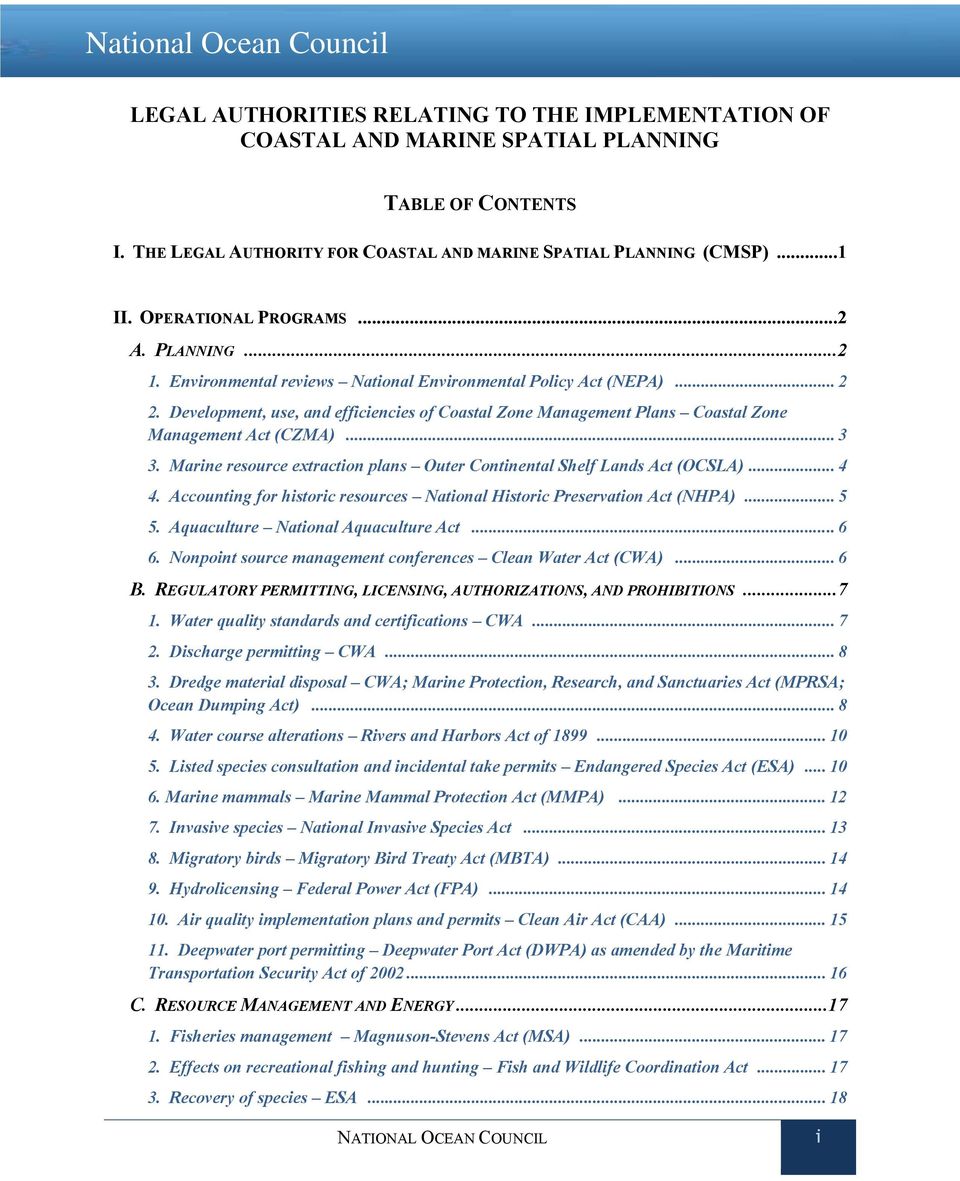
2 4. Estuaries planning CWA National marine sanctuaries National Marine Sanctuaries Act (NMSA) National monuments Antiquities Act National parks National Park Service Organic Act National wildlife refuges National Wildlife Refuge System Administration Act Air quality attainment zones CAA Coastal barrier management Coastal Barrier Resources Act Marine resource extraction and hydrokinetic facilities OCSLA Onshore and coastal natural gas Natural Gas Act (NGA) Ocean thermal energy conversion Ocean Thermal Energy Conversion Act (OTECA) D. SECURITY AND MARITIME TRANSPORTATION Marine highways Energy Independence & Security Act Port promotion Port Development Authority Act Anchorages Rivers and Harbors Act of Maritime Security Program Marine Security Act Lightering zones 46 U.S.C Ports and waterways safety Ports and Waterways Safety Act Security zones and restricted waterfront areas Magnuson Act of Armed Forces at-sea training and military readiness Title 10, Armed Forces composition and function The National Defense Reserve Fleet (NDRF)and Ready Reserve Fleet (RRF) 46 U.S.C ; 50 App. U.S.C E. OTHER Title to submerged lands Submerged Lands Act; Territorial Submerged Lands Act Spill remediation Oil Pollution Act (OPA); Comprehensive Environmental Response, Compensation, and Liability Act (CERCLA) III. MAPPING, MONITORING, SURVEY, AND RESEARCH PROGRAMS Weather forecasts National Weather Service (NWS) Organic Act Coral reefs Coral Reef Conservation Act (CRCA) Methane hydrates National Methane Hydrate Research and Development Act Ocean thermal energy Ocean Thermal Energy Conversion (OTEC) Research, Development, and Demonstration (RD&D) Ocean Act Deep sea corals MSA NATIONAL OCEAN COUNCIL ii
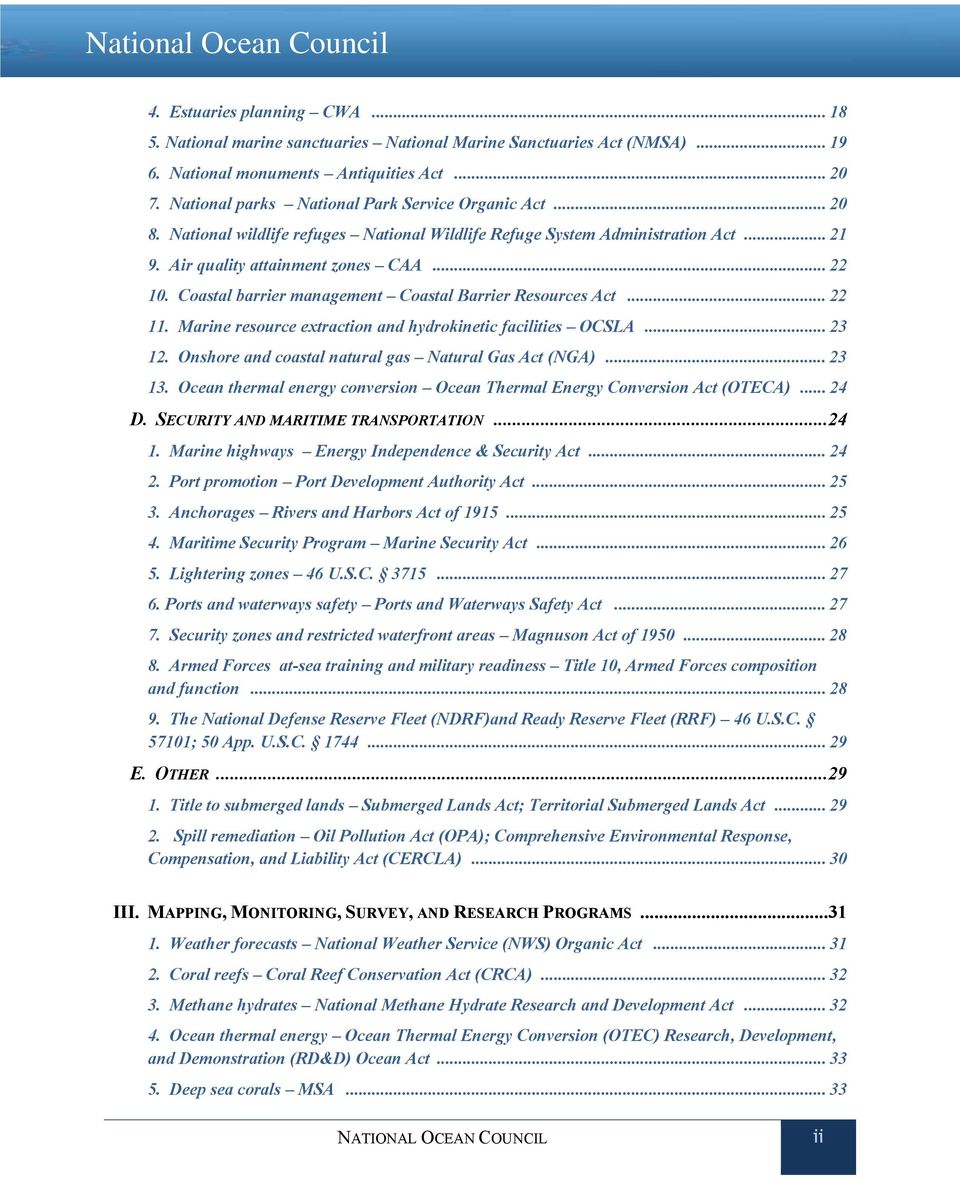
3 6. Marine debris research Marine Plastic Pollution Research and Control Act (MPPRCA) Ocean and coastal mapping Ocean and Coastal Mapping Integration Act Coastal and ocean observation Integrated Coastal and Ocean Observing System Act Hydrographic data, products, and service Hydrographic Service Improvement Act Safe navigation of marine commerce Coast & Geodetic Survey Act of Ocean acidification Federal Ocean Acidification Research and Monitoring Act Ocean exploration and research Ocean Exploration and NOAA Undersea Research Program Act of IV. EDUCATION Environmental curricula National Environmental Education Act Graduate education support for coastal and ocean studies Sea Grant authorizing legislation V. INTERNATIONAL LAW...38 VI. EXECUTIVE ORDERS...39 A. BACKGROUND...39 B. RELEVANT EXECUTIVE ORDERS (E.O. S) E.O Northwestern Hawaiian Islands Coral Reef Ecosystem Reserve, and E.O Final Northwestern Hawaiian Islands Coral Reef Ecosystem Reserve E.O Marine Protected Areas (MPAs) E.O Chesapeake Bay Protection and Restoration E.O Recreational Fisheries, and E.O Amendments to E.O E.O Establishment of Fishery Conservation Zones E.O Protection of Wetlands APPENDIX A: SELECTED TREATIES AND OTHER INTERNATIONAL AGREEMENTS TO WHICH THE UNITED STATES IS A PARTY... A-1 NATIONAL OCEAN COUNCIL iii

4 LEGAL AUTHORITIES RELATING TO THE IMPLEMENTATION OF COASTAL AND MARINE SPATIAL PLANNING I. THE LEGAL AUTHORITY FOR COASTAL AND MARINE SPATIAL PLANNING (CMSP) This compendium identifies various legal authorities which relate to the implementation of CMSP in the United States. First, various statutes are summarized and discussed in lay terms explaining how they relate to CMSP. The discussion addresses how the statute will inform the CMSP process and how coastal and marine spatial plans (CMS Plans) will provide information for consideration in agency decision-making under the statute. The compendium identifies statutory provisions based upon their applicability and focus as they relate to CMSP: (1) operational programs addressing legal requirements for planning; regulatory permitting, licensing, authorizations, and prohibitions; resource management and energy; and security and maritime transportation; (2) mapping, monitoring, survey, and research programs; and (3) education. This organizational approach facilitates the understanding of how CMS Plans could be implemented under existing statutory authority, recognizing that the content of CMS Plans will be determined by regional planning bodies in accordance with the Final Recommendations of the Interagency Ocean Policy Task Force (Final Recommendations). Given that a statute may have more than one focus under this three-part organizational approach, some statutes are discussed more than once. Next, recognizing that CMSP must be implemented in a manner that is consistent with international law, a brief discussion of international law, including the 1982 Law of the Sea Convention, is presented. Lastly, key Executive Orders relating to actions or programs relevant to CMSP are similarly summarized and discussed. The content below is nonexhaustive. It is intended only to convey basic information regarding various existing legal authorities that may be relevant to CMSP. CMSP is a comprehensive, adaptive, integrated, ecosystem-based, and transparent spatial planning process, based on sound science, for analyzing current and anticipated uses of ocean, coastal, and Great Lakes areas. CMSP identifies areas most suitable for various types or classes of activities in order to reduce conflicts among uses, reduce environmental impacts, facilitate compatible uses, and preserve critical ecosystem services to meet economic, environmental, security, and social objectives. In practical terms, CMSP provides a public policy process for society to better determine how the ocean, coasts, and Great Lakes are sustainably used and protected - now and for future generations. Federal statutes often include authorizing language that explicitly gives agencies the responsibility to plan and implement the objectives of the statutes. Moreover, several Federal statutes specifically authorize agency planning with respect to the ocean, coastal, and Great Lakes environments. Federal agencies and departments also administer a range of statutes and authorized programs that provide a legal basis to conduct CMSP. These statutory and regulatory authorities may govern the process for making decisions (e.g., through Administrative Procedure Act rulemaking and adjudications), as well as set forth the factors the agencies must consider in making a final decision. The processes and decision-making CMSP envisions would be carried out consistent with and under the authority of these statutes. State, tribal, and local authorities NATIONAL OCEAN COUNCIL 1

5 also have a range of existing authorities to implement CMSP, although this will vary among and within regions. This framework for CMSP is to provide all Federal agencies with agreed upon principles and goals to guide their actions under these authorities, and to develop mechanisms so that Federal, State, tribal, and local authorities and regional governance structures can proactively and cooperatively work together to exercise their respective authorities. A Federal agency or department s capacity to internalize the elements of any particular regional CMS Plan would vary depending on the nature of applicable statutes. CMSP is intended to provide a better framework for application of these existing laws and agency authorities, but is not intended to supersede them. In and of themselves, CMS Plans, would not be regulatory or constitute final agency decision-making. However, they are intended to guide agency decision-making, and agencies would adhere to the final CMS Plans to the extent possible, consistent with existing authorities. II. OPERATIONAL PROGRAMS A. PLANNING 1. Environmental reviews - National Environmental Policy Act (NEPA) Brief summary: The NEPA process is designed to ensure that Federal agencies evaluate environmental impacts (including related impacts on social, cultural, and economic resources) associated with proposals for Federal agency action, consider alternatives to avoid or mitigate those impacts, and provide information on the effects of those actions to the decision maker and members of the public. With some limited exceptions, all Federal agencies in the executive branch have to comply with NEPA before they make final decisions about Federal actions that could have environmental effects. Thus, NEPA applies to a very wide range of Federal actions that include plans to manage and use Federally-owned lands (including submerged lands) or resources (including fisheries in Federal waters), proposals for Federal infrastructure development projects, and Federal approvals of private activities through Federal grants, licenses, and permits. The environmental review process under NEPA provides a framework for planning with opportunities for other decision-makers and the public to be involved in the Federal agency decision-making process. NEPA documents help the public understand what the Federal agencies are proposing, to offer thoughts on alternative ways to address the purpose and need for action, and to offer comments on agency analysis of the environmental effects of proposed actions and possible mitigation of effects of such actions. NEPA analyses should include a consideration of how environmental policy goals (NEPA Section 101) will be incorporated into the decision to the extent consistent with other considerations of national policy. NEPA does not require the Federal decisionmaker to select the environmentally preferable alternative or prohibit adverse environmental effects. Indeed, decision-makers in Federal agencies often have other concerns and policy considerations to take into account in the decision-making process, NATIONAL OCEAN COUNCIL 2

6 such as social, economic, technical or national security interests. But NEPA does require that decision-makers be informed of the environmental consequences of their decisions. The NEPA process can also serve to meet other environmental review requirements. For instance, actions that require the NEPA process may have an impact on endangered species, historic properties, or low income communities. Domestic implementing authority: National Environmental Policy Act, 42 U.S.C et seq. Relationship to CMSP: The NEPA process can ensure Federal agencies consider environmental impacts on the numerous uses and activities within coastal and marine spatial plans. The NEPA process can be used to integrate ecosystem-based CMSP into a comprehensive consideration of environmental impacts and ensure that CMS Plans are better informed through public involvement. A comprehensive NEPA analysis can facilitate project-specific decisions by providing for tiered environmental impact statements or environmental assessments. Tiered environmental documents allow agencies to apply broad-scale environmental impact statements into programs, plans, or actions that have related impacts. A coordinated decision-making system, based on NEPA analyses that are tiered to a programmatic environmental impact statement, can decrease user conflict, improve planning and regulatory efficiencies, decrease their associated costs and delays, and preserve critical ecosystem functions and services. 2. Development, use, and efficiencies of Coastal Zone Management Programs - Coastal Zone Management Act (CZMA) Brief summary: Congress enacted the CZMA to protect, restore, and enhance coastal resources of the United States. The CZMA allows states to exercise effectively their responsibilities in the coastal zones to achieve wise use of land and water uses and natural resources within the coastal zone, giving full consideration to ecological, cultural, historic, and esthetic values as well as the needs for compatible economic development. Under the CZMA, the states exercise this responsibility through the development of coastal management programs. These state coastal management programs protect natural resources within the coastal zone, manage coastal development, afford priority consideration to costal-dependent uses, preserve public recreational access to the coasts, facilitate consultation and coordination with Federal agencies regarding their activities which may impact coastal uses or resources, and ensure efficient agency decisionmaking. A fundamental element of the CZMA is the Federal Consistency provision, which requires Federal actions that may have reasonable foreseeable effects on any coastal use or resource, either directly or indirectly, be consistent with the enforceable polices of National Oceanic and Atmospheric Administration (NOAA) approved state coastal management programs. Before making a final decision on a proposed Federal agency activity, a Federal agency must submit a CZMA consistency determination to the state for review and the Federal agency activity must be consistent to the maximum extent practicable with a state s enforceable policies. Should a state disagree with the Federal NATIONAL OCEAN COUNCIL 3
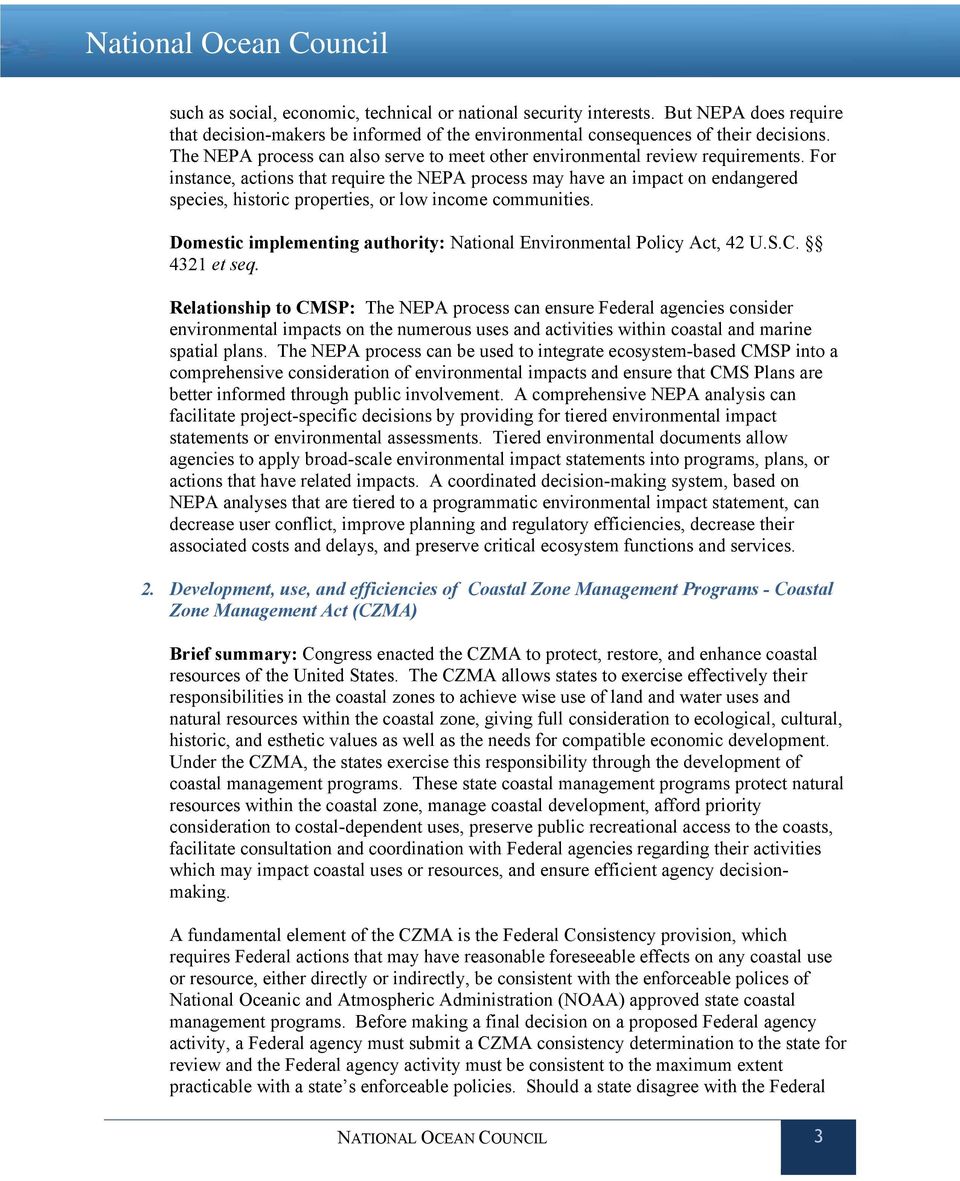
7 agency s determination, the Federal agency may proceed over the state s objection provided that it can demonstrate that full consistency is prohibited by Federal law applicable to the agency. Also, Federal license or permit activities and Federal financial assistance activities that have reasonably foreseeable coastal effects must be fully consistent with the enforceable policies of state coastal management programs. Specifically, non-federal applicants for Federal authorizations must provide a consistency certification to the state and must be fully consistent with a state s enforceable policies. If a state objects to an applicant s certification the licensing Federal agency may not authorize the activity unless the applicant appeals the state s objection to the Secretary of Commerce and the Secretary overrides the state s objection. Thus, the CZMA Federal Consistency provision gives states a powerful tool to address proposed Federal actions which may occur both in and beyond the coastal zone, such as energy projects, which have the potential to impact coastal uses or resources. Domestic implementing authority: Coastal Zone Management Act, 16 U.S.C et seq. Relationship to CMSP: The CZMA enables states to exercise their stewardship responsibilities over the coastal zone, both via the protection and preservation of coastal uses and resources and the responsible management of coastal development. A regional CMS Plan resulting from a CMSP process involving both Federal and state partners will help to minimize Federal-state conflicts arising during the Federal Consistency process. Specifically, a CMS Plan having Federal and state buy-in provides a common frame of reference which will inform Federal agency and state coastal management authority decision-making regarding the application of the state s coastal management program to a proposed Federal action. Decisions so informed are less likely to result in conflict. In addition, states and Federal agencies can include administrative efficiencies in NOAA s regulations in CMS Plans to facilitate and streamline Federal consistency reviews and to use the Federal consistency provision to concur with/buy into a regional CMS plan. 3. Marine resource extraction plans Outer Continental Shelf Lands Act (OCSLA) Brief summary: The OCSLA defines the Outer Continental Shelf (OCS) as all submerged lands lying seaward of state coastal waters which are under U.S. jurisdiction. The limits of state jurisdiction extend 3 nautical miles (approximately 3.45 statute miles) seaward of the baseline from which the breadth of the territorial sea is measured, with exceptions for Texas (9 nautical miles), the Gulf Coast of Florida (9 nautical miles), and Louisiana (3 imperial miles, approximately 3.56 statute miles). Under the OCSLA, the Secretary of the Interior is responsible for the administration of mineral exploration and development of the OCS. The OCSLA empowers the Secretary to grant leases to the highest qualified responsible bidder on the basis of sealed competitive bids and to formulate regulations as necessary to carry out the provisions of the Act. A fundamental aspect of the OCSLA is the 5-year OCS Leasing Program (5-Year program) managed by the Bureau of Ocean Energy Management, Regulation and Enforcement (BOEMRE) A 5-Year Program consists of a schedule of oil and gas lease sales indicating the size, timing, and location of proposed leasing activity the Secretary NATIONAL OCEAN COUNCIL 4

8 determines will best meet national energy needs for the 5-year period following its approval. An area must be included in the current 5-Year Program in order to be offered for leasing. Section 18 of the OCSLA prescribes the major steps involved in developing a 5-Year Program. These must be completed before BOEMRE announces a new 5-Year Program, and include the preparation, and submission for public review and comment, of a draft proposed plan, a proposed plan, and a draft final plan. There is a similar process in planning for a specific lease sale, which requires the preparation, and submission for public comment, of a request for information, definition of the proposed sale area, and proposed notice of sale. Domestic implementing authority: Outer Continental Shelf Lands Act, 43 U.S.C et seq.; Federal Power Act, 16 U.S.C. 791 et seq. Relationship to CMSP: A 5-Year Program is required to balance energy needs and environmental considerations. BOEMRE decisions regarding the preparation of the draft, proposed final, and final 5-Year program will be informed by regional CMS Plans. Specifically, information generated, consolidated, and integrated during the CMSP process will inform BOEMRE decisions regarding the size, timing, and location of proposed leasing activity. BOEMRE decisions regarding the planning for specific lease sales will be similarly informed. Regional CMS Plans resulting from a CMSP process involving Federal and state partners and consideration of public input will help to reduce the potential for conflict during the 5-Year Program development process. 4. Accounting for historic resources National Historic Preservation Act (NHPA) Brief summary: The purpose of the NHPA is to preserve the historical and cultural foundations of the United States. The NHPA directs Federal agencies responsible for a proposed Federal or federally-assisted undertaking in any state, or having authority to license any undertaking, prior to the expenditure of funds or issuance of a license to consider the effect of the proposed undertaking on structures, objects, and locations eligible for inclusion in the National Register. Accounting for historic resources usually occurs at the time of NEPA analysis. Consultation with state or tribal historic preservation officers may be required. Domestic implementing authority: National Historic Preservation Act, 16 U.S.C. 470 et seq. Relationship to CMSP: During the development of regional CMS plans, state and tribal historic preservation offices should be engaged to ensure that historic and cultural resources are accounted for and to facilitate and NHPA consultations that may be needed prior to completing a CMS plan. In addition, actively engaging tribes through the NHPA process will help Federal agencies meet any government-to-government consultations that may be needed prior to finalizing a regional CMS plan. NATIONAL OCEAN COUNCIL 5

9 5. Aquaculture National Aquaculture Act Brief summary: The National Aquaculture Act directs the Department of Commerce/NOAA, along with the Department of Agriculture (USDA) and Department of the Interior (DOI), to develop a National Aquaculture Development Plan and prepare biennial reports to Congress on the status of aquaculture. In implementing the plan, the Secretaries of each department shall provide advisory, educational, and technical assistance, consult with interested persons, encourage the implementation of aquacultural technology in the rehabilitation and enhancement of publicly owned fish and shellfish stock, and promulgate necessary regulations. The Act authorizes implementation through grants and existing authorities. The Act also establishes a Joint Subcommittee on Aquaculture to increase the overall effectiveness and productivity of Federal aquaculture research, transfer and assistance programs. Domestic implementing authority: National Aquaculture Act, 16 U.S.C et seq. Relationship to CMSP: Currently, there is no way to obtain a permit for aquaculture in Federal waters under existing U.S. laws and regulations. Information developed pursuant to the legal requirement of the National Aquaculture Act, however, will inform the CMSP process and may assist in the identification of any areas which would be compatible with future aquaculture activities. CMS Plans could account for any such areas so identified. 6. Nonpoint source management conferences Clean Water Act (CWA) Brief summary: Nonpoint source (NPS) pollution represents the most significant source of water pollution in the country. The CWA does not provide a detailed definition of nonpoint sources; rather, they are defined by exclusion. NPS pollution refers to pollutants that are not from a point source. Examples include stormwater runoff, mining and logging operations, and runoff and leachate from construction, agricultural fields, barnyards, feedlots, lawns, and home gardens. The CWA provides for a Federal grant program to assist states, tribes, and territories in the development and implementation of NPS management programs. An entity receiving such funds must complete and update an NPS management plan every 5 years. NPS management reports and programs identify waters that are impaired or threatened by nonpoint sources of pollution, develop short- and long-term goals to restore and maintain those waters, and identify the best management practices to do so. If any portion of waters in any state implementing an approved program is not meeting applicable water quality standards in whole or in part due to NPS pollution, the state may petition the Environmental Protection Agency (EPA) to convene an interstate management conference of all the states that contribute significant NPS pollution to such portion. The purpose of such management conferences is to develop an agreement among such states to reduce the level of NPS pollution in the portion not meeting water quality standards and to improve that water quality. To the extent participating states reach agreement, such states NPS management programs are revised to reflect the agreement. NATIONAL OCEAN COUNCIL 6

10 Domestic implementing authority: Clean Water Act, 33 U.S.C et seq. Relationship to CMSP: NPS has been identified as the most significant source of water pollution in the country. Polluted rivers flow into the ocean, polluting it. NPS management conferences, particularly the opportunities presented to reach agreements regarding upland sources of water pollution, provide an opportunity for integration into pollution-related goals of CMS Plans resulting from CMSP processes. B. REGULATORY PERMITTING, LICENSING, AUTHORIZATIONS, AND PROHIBITIONS 1. Water quality standards and certifications CWA Brief summary: Section 303(c) of the CWA requires states (as defined in Section 502(3) of the CWA) to adopt water quality standards for waters in their jurisdictions. Section 303(c)(2)(A) provides that water quality standards are to include designated uses for the waters and water quality criteria based on those uses. These standards are used to protect the public health or welfare, enhance the quality of water and serve the purposes of the Act. Standards, including the designation of uses, are to be adopted in consideration of the use and value for public water supplies, propagation of fish and wildlife, recreational purposes, and agriculture, industrial and other purposes, including navigation. Section 401 of the CWA requires state certification (or waiver) of compliance with enumerated provisions of the Act, including state water quality standards, prior to the issuance of a Federal license or permit to conduct any activity that may result in any discharge into the navigable waters. The applicant for the license or permit must provide a certification (or waiver) from the state in which the discharge originates (or, if appropriate, the interstate water pollution control agency) to the licensing or permitting agency before the federal license or permit may be granted. In cases where the state or interstate agency has no authority to issue the certification, such certification shall be from the EPA Administrator. The state waives its right to issue such certification if it fails to act within a reasonable time, not to exceed one year. The state certification may set forth limitations and monitoring requirements necessary to assure compliance with the CWA, state water quality standards, or other appropriate requirements of state law. Any such limitations or requirements shall become conditions on the federal license or permit. Domestic implementing authority: Clean Water Act, 33 U.S.C and 1341 Relationship to CMSP: CMSP processes may provide opportunities for the coordinated state designation of more protective uses of coastal waters determined to be higher priority waters identified in those CMSP processes, at least in coastal waters within three miles from shore (i.e., within states CWA water quality standard setting jurisdiction). NATIONAL OCEAN COUNCIL 7

11 2. Discharge permitting CWA Brief summary: Section 301 of the CWA prohibits the unpermitted discharge of a pollutant for any point source into waters of the United States and for any point source other than a vessel or other floating craft for discharges into the contiguous zone and ocean. The CWA applies to discharges from a vessel into waters of the United States, including the territorial sea. Under the CWA, the territorial seas extend from the baseline seaward only three miles from all states and U.S. territories. National Pollutant Discharge Elimination System (NPDES) permits include permit limits to establish a minimum level of pollutant reduction (technology-based standards) and any more stringent limits necessary to protect water quality. Coastal states and territories authorized by EPA to administer the NPDES permitting program in whole or in part (including all but Massachusetts, New Hampshire, Puerto Rico, the District of Columbia, Guam, and American Samoa) issue permits for discharges into waters measured three miles from the baseline, with the exception of certain discharges from ocean outfalls from land-based municipal sewage treatment plants for which EPA grants a variance from minimum treatment requirements. EPA also issues NPDES permits for discharges beyond three miles from point sources other than vessels or other floating craft being used as a means of transportation, including from: concentrated aquatic animal production facilities (i.e., mariculture); deepwater ports (oil and liquefied natural gas [LNG]); offshore oil and gas exploration and production; and offshore seafood processing (i.e., factory trawlers ). As it relates to vessel discharges, EPA issued a general permit for discharges incidental to the normal operation of a vessel. That permit automatically applied to all vessel discharges that were eligible for authorization when the permit became effective in February Domestic implementing authority: Clean Water Act, 33 U.S.C et seq. Relationship to CMSP: CMS plans that anticipate activities and uses within the planning area provide an opportunity for advance consideration and evaluation of effects associated with discharges authorized under NPDES permits, including considerations and evaluations required for Federal licenses and permits under other Federal statutes (e.g., see statutes identified in Section II(B) above). 3. Dredge material disposal CWA; Marine Protection, Research, and Sanctuaries Act (MPRSA [Ocean Dumping Act]) Brief summary: Under Section 404 of the CWA, the discharge of any dredged or fill material into waters of the United States would require authorization from the U.S. Army Corps of Engineers (USACE). Section 103 of the MPRSA also requires that a permit be obtained from the USACE for the transportation of dredged material for the purpose of disposal in the ocean. (If any of these activities are associated with a Congressionallyauthorized Corps of Engineers civil works operation, no additional permits from the NATIONAL OCEAN COUNCIL 8

12 USACE would be required.) Section 301 of the CWA prohibits the unpermitted discharge of a pollutant, including dredged or fill material, from any point source into waters of the United States, including the territorial seas. Under the CWA, the territorial seas extend from the baseline seaward only three miles from all states and U.S. territories. MPRSA prohibits, unless authorized by an MPRSA permit, (1) transportation of material from the United States for the purpose of ocean dumping; (2) transportation of material from anywhere for the purpose of ocean dumping by Federal agencies or U.S. flagged vessels; and (3) dumping of material transported from outside the United States into the territorial sea of the United States (or into the contiguous zone to the extent such dumping may affect the territorial seas). Except for dredge materials, EPA is the permitting issuance authority under the MPRSA. The definition of dumping excludes the placement of certain materials in ocean waters, or on or in the submerged lands beneath such waters, for a purpose other than disposal when such placement is regulated under another Federal or state law or occurs pursuant to an authorized Federal or state program. Whether under Section 404 of the CWA or Section 103 of the MPRSA, permits for the discharge or ocean dumping of dredged material are issued by the Corps of Engineers. Under Section 404 of the CWA, EPA may prohibit the specification of any defined area as a disposal site. Similarly under the MPRSA, EPA designates ocean dumping sites for dredged materials, and for alternative undesignated ocean disposal sites, EPA has a concurrence role in Corps permitting (and Federal projects) using those disposal sites. The MPRSA defines the ocean waters to mean the open seas lying seaward of the baseline and thus applies to disposal into and beyond the territorial seas (as that term is used in the CWA). Section 401 of the CWA requires state certification (or waiver) of compliance with state water quality standards prior to the issuance of a Federal license or permit to conduct any activity that may result in any discharge into the navigable waters. The 401 Certification can cover both the construction and operation of the proposed project, and the conditions of the 401 Certification become conditions of the Federal l permit. Section 402 established a program requiring permits for point source discharge of pollutants other than dredge or fill material into waters of the U.S. administered by EPA. Section 404 established a program requiring a permit for all discharges of dredged or fill material into waters of the United States administered by the USACE. The EPA may prohibit the specification of a disposal area if there is a determination there will be an unacceptable adverse effect on certain aspects of the aquatic environment. This authority extends to all waters of the United States out to the three mile extent of the territorial sea. All discharges of dredge or fill material must receive a permit from the USACE. Authorization may come in the form of a regional or nationwide permit which is a streamlined permit process for actions which have a minimal impact on the aquatic environment. Nationwide permits are promulgated through notice and comment rulemaking every five years, during which they go through NEPA and other environmental review. For complex projects or those with greater aquatic impacts, a standard individual permit (SIP) or letter of permission (LOP) may be required. For NATIONAL OCEAN COUNCIL 9

13 SIP s and LOP s the USACE must issue a public notice with opportunity for public hearing and prepare a Section 404(b)(1) evaluation using guidelines developed jointly with the USACE and EPA. The permit process can take as little as 45 days or perhaps a year or more. Domestic implementing authority: Clean Water Act, 33 U.S.C. 1311, 1341 and 1344; Marine Protection, Research, and Sanctuaries Act, 33 U.S.C Relationship to CMSP: CMS plans that anticipate activities and uses within the planning area provide an opportunity for advance consideration and evaluation of effects associated with discharges and ocean dumping authorized under the CWA or MPRSA, as well as designation of ocean disposal sites. Some CMS Plans, and resulting analyses, may identify activities or uses with which ocean dumping may be incompatible, or locations where ocean disposal should be restricted under existing statutory authority. CMS Plans may also identify needs and opportunities related to sand and other sediments in a region and help to identify opportunities for beneficially using dredged material. 4. Water course alterations Rivers and Harbors Act of 1899 Brief summary: Sections 9 and 10 of the River and Harbor Act prohibit the unauthorized obstruction or alteration of any navigable water of the United States. This section provides that the construction of any structure in or over any navigable water of the United States, or the accomplishment of any other work affecting the course, location, condition, or physical capacity of such waters is unlawful unless the work has been recommended by the USACE, and in some cases the approval of the United States Congress or a state legislature. Domestic implementing authority: Rivers and Harbors Act of 1899, 33 U.S.C. 401 et seq. Relationship to CMSP: Existing courses, capacities, or conditions of navigable waters within a region will inform the CMSP process. Activities that would propose to alter the course, capacity or condition of any navigable water, would require a Section 10 permit, with the decision whether to grant the permit being informed by the CMSP Plan. 5. Listed species consultation and incidental take permits - Endangered Species Act (ESA) Brief summary: The ESA provides for the conservation of species that are endangered or threatened, and the ecosystems on which they depend. Federal agencies must use their authorities to carry out programs for the conservation of species listed as threatened or endangered pursuant to Section 4 of the Act. Section 7 of the ESA requires each Federal agency to consult with either the U.S. Fish and Wildlife Service (USFWS) or National Marine Fisheries Service (NMFS) (collectively, Services) to ensure that any action authorized, funded or carried out by the agency is not likely to jeopardize the continued existence of a listed species or result in the adverse modification or destruction of critical NATIONAL OCEAN COUNCIL 10
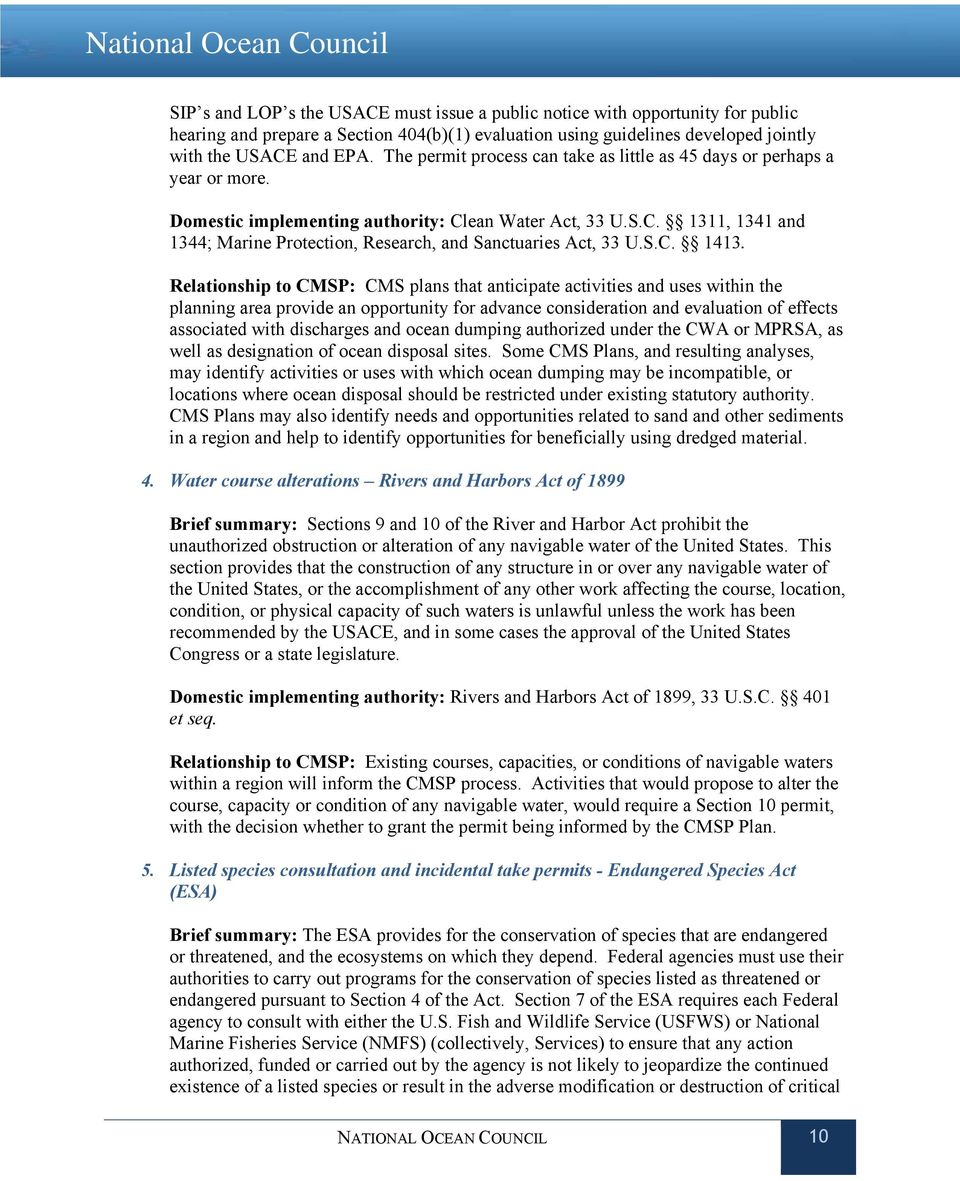
14 habitat designated for such species. Section 7 consultation can be conducted formally or informally. If an action agency determines that a proposed action is not likely to adversely affect a listed species, based on preparation of a Biological Assessment or similar analysis, and the Services concur in writing with that determination, consultation is resolved informally. If the proposed action is likely to adversely affect listed species or critical habitat, the action agency must engage in formal consultation which concludes with the Services issuance of a Biological Opinion (BiOp) determining whether the action is likely to jeopardize a listed species, authorizing otherwise prohibited incidental take of listed species subject to specified terms and conditions, and providing discretionary conservation recommendations. Formal consultation is governed by a 135- day regulatory time-frame, but, depending on the circumstances, can be extended. Section 9 of the ESA prohibits the take of listed endangered species. The USFWS has generally extended by regulation the take prohibition to species listed as threatened. NMFS may do so on case-by-case bases through issuance of special rules under Section 4(d) as species are listed or soon thereafter. Federal agencies receiving a BiOp for a proposed action obtain an Incidental Take Statement allowing the take of listed species incidental to an otherwise lawful activity as long as the activity is implemented in accordance with the specified terms and conditions. In addition, incidental take permits issued by the Services in accordance with Section 10 of the Act are required when non- Federal activities will result in take of endangered species as well as threatened species when the take prohibition has been extended. Take is defined in the ESA as harass, harm, pursue, hunt, shoot, wound, kill, trap, capture, or collect any threatened or endangered species. Harass can mean a temporary, significant impairment of normal behavior patterns, for example, from anthropogenic sound. Harm may include significant habitat modification where it actually kills or injures a listed species through impairment of essential behavior (e.g., nesting or reproduction). A habitat conservation plan (HCP) must accompany an application for an incidental take permit. The purpose of the habitat conservation planning process associated with the permit is to ensure there is adequate minimizing and mitigating of the effects of the authorized incidental take. The purpose of the incidental take permit is to authorize the incidental take of a listed species, not to authorize the activities that result in take. Domestic implementing authority: Endangered Species Act, 16 U.S.C et seq. Relationship to CMSP: Scientific and technical information gleaned from previous Section 7 consultations/ongoing consultations, HCPs, and species recovery plans developed under Section 4(f) will inform CMSP. Federal agencies may be able to streamline CMSP efforts through the use of formal programmatic consultations under Section 7. CMS Plans will account for listed species, designated critical habitat, and HCPs, and in turn will inform Federal agency decision-making during the consultation process. For example, under the Atlantic Strategy for Sea Turtles, NOAA/NMFS has compiled a database of all sea turtle sightings, fisheries interactions, strandings and surveys for the last several decades. NMFS can create visual maps of where sea turtles have been NATIONAL OCEAN COUNCIL 11

15 sighted overlaid with fishing effort. If this information was used together with more recent telemetry and aerial survey information, NMFS could provide marine spatial planners with a better understanding of the time of year when sea turtles are present in near-shore environment. This information would be important to know so that as decisions are being made about alternative energy or protected areas, managers are aware of the impacts these decisions would have on endangered and threatened sea turtles. 6. Marine mammals Marine Mammal Protection Act (MMPA) Brief Summary: All marine mammals are protected under the MMPA. The MMPA prohibits, with certain exceptions, the "take" of marine mammals in U.S. waters and by U.S. citizens on the high seas, and the importation of marine mammals and marine mammal products into the United States. Take is defined under the MMPA as "harass, hunt, capture, kill or collect, or attempt to harass, hunt, capture, kill or collect." The Department of Commerce through NMFS is charged with protecting whales, dolphins, porpoises, seals, and sea lions. Walrus, manatees, otters, and polar bears are protected by DOI through the USFWS. NMFS and USFWS have promulgated joint implementing regulations. Exceptions to the take moratorium can be made pursuant to Section 118 of the (MSA for commercial fishing and by permitting actions for take incidental to other non-fishing activities. The MMPA directs the Secretaries of Commerce and the Interior to allow, upon request, the incidental, but not intentional taking of marine mammals by U.S. citizens who engage in a specified activity (other than commercial fishing) during periods of not more than five consecutive years each if certain findings are made and regulations are issued or, if the taking is limited to harassment, notice of a proposed authorization is provided to the public for review. Authorization shall be granted if NMFS or USFWS finds that the taking will have a negligible impact on the species or stock(s), will not have an unmitigable adverse impact on the availability of the species or stock(s) for subsistence uses, and if the permissible methods of taking and requirements pertaining to the mitigation, monitoring and reporting of such taking are set forth. The joint implementing regulations define negligible impact as an impact resulting from the specified activity that cannot be reasonably expected to, and is not reasonably likely to, adversely affect the species or stock through effects on annual rates of recruitment or survival. Domestic implementing authority: Marine Mammal Protection Act, 16 U.S.C et seq. Relationship to CMSP: CMS Plans will inform both agency decisions regarding incidental take authorization applications and NMFS or USFWS decisions on those applications. NMFS and USFWS in some cases may be able to issue multi-year MMPA regulations that establish a framework for incidental take authorization (e.g., oil and gas development in specified areas). This programmatic approach could provide coastal marine spatial planners and regulated industry with increased certainty regarding NATIONAL OCEAN COUNCIL 12

16 measures that would need to be followed for the duration of their activity in a particular marine spatial area. Furthermore, NMFS maintains an extensive inventory of marine mammal related data and information that could be used to assist coastal marine spatial planners to make determinations about the compatibility of particular activities in various marine spatial areas. For instance, the MMPA requires NMFS to prepare annual stock assessment reports for marine mammal stocks that occur in waters under U.S. jurisdiction. The information contained in these assessments is used to identify and evaluate the status of marine mammal populations and the effects of human activities upon them, and design and conduct appropriate conservation measures. Second, the Authorizations and Permits for Protected Species (APPS) Database allows researchers to apply online and submit reports for permits under the ESA and MMPA. APPS can be searched by geographic area to determine what activities are authorized in a given area. Finally, NMFS manages a marine mammal health and stranding program and database, which responds to and collects information on strandings (both dead and alive) of marine mammals. The health and stranding database compiles information from strandings around the country. It can be used to assess areas where there are an unusual number of strandings (which may lead to the designation of an Unusual Mortality Event). The information in the database may be useful to evaluate areas where there is higher likelihood of marine mammal stranding. 7. Invasive species National Invasive Species Act Brief summary: The National Invasive Species Act authorizes the Secretary of Homeland Security and the U.S. Coast Guard to issue regulations to prevent the introduction and spread of aquatic nuisance species through ballast water. The Act provides for enforcement through civil and criminal penalties and revocation of clearance. It encourages negotiations with foreign governments to develop and implement an international program for preventing such introduction and spread. The Act also authorizes education, technical assistance, and other measures to promote compliance. Furthermore, the National Invasive Species Act mandates studies of lake, river, estuary and bay ecosystems, authorizes appropriations for research grants to develop environmentally sound methods for controlling aquatic nuisance species, and establishes a clearinghouse of national data on ballasting practices. It also mandates a ballast water management program for vessels of the Department of Defense and the U.S. Coast Guard. Organizationally, the Act modified the composition of the Aquatic Nuisance Species Task Force established under the Non-indigenous Aquatic Nuisance Prevention and Control Act of 1990, and requires the Task Force to encourage the development and use of regional panels composed of representatives from Federal, state, and local agencies, environmental organizations, and commercial interests to provide advice about and coordinate efforts devoted to aquatic nuisance species. The Act also provides for interstate (in addition to existing state) aquatic nuisance species management plans, allowing Indian tribes as well as states to participate. NATIONAL OCEAN COUNCIL 13

17 Domestic implementing authority: National Invasive Species Act, 16 U.S.C et seq. Relationship to CMSP: Information, including that developed by regional coordination panels, regarding the presence and potential movement of invasive species through ballast water will inform CMSP. CMS Plans may account for measures necessary to protect against the introduction and spread of such species. 8. Migratory birds Migratory Bird Treaty Act (MBTA) Brief summary: The MBTA was designed to implement the respective conventions between the United States and Great Britain, Japan, Mexico, and Russia. The Act prohibits the take of migratory birds. Take is defined as pursue, hunt, take, capture, kill, attempt to take, capture or kill, possess, offer for sale, sell, offer to purchase, purchase, deliver for shipment, ship, cause to be shipped, deliver for transportation, transport, cause to be transported, carry, or cause to be carried by any means whatever, receive for shipment, transportation or carriage, or export, at any time, or in any manner, any covered migratory bird or any part, nest, or egg of any such bird." The Secretary of the Interior may authorize the otherwise prohibited take of migratory birds through regulations. There are currently regulations which authorize the taking of migratory birds for specific purposes, such as hunting, depredation, and scientific study. Current regulations, however, do not expressly address the incidental take of migratory birds. Domestic implementing authority: Migratory Bird Treaty Act, 16 U.S.C. 703 et seq. Relationship to CMSP: DOI through the USFWS oversees permitting of takes under the MBTA. The location and presence of migratory bird populations will inform CMSP. CMS Plans will account for such populations. USFWS decisions regarding requests for take permits will be informed by CMS Plans. 9. Hydrolicensing Federal Power Act (FPA) Brief summary: Under Section 10(a)(1) of the FPA, the Federal Energy Regulatory Commission (FERC or Commission ) licenses hydropower projects (including related primary transmission lines) on lands and on waters subject to Federal jurisdiction, for non-federal projects determined by the Commission to be best adapted to a comprehensive plan for improving or developing a waterway or waterways. Section 4(e) of the FPA empowers the Commission to issue licenses for projects that: (1) are located on navigable waters; (2) are located on public lands or reservations of the United States (excluding national parks); (3) are located on non-navigable waters over which Congress has jurisdiction, were constructed after 1935, and affect the interests of interstate or foreign commerce; or (4) use surplus water or water power from a Federal dam. The Commission has interpreted this authority to extend to hydrokinetic projects, employing devices using the power of tides, waves and ocean currents to generate electricity, which are located in offshore navigable waters and on submerged lands, including state waters and lands and Federal waters and lands within the territorial sea NATIONAL OCEAN COUNCIL 14

18 and on the OCS. In licensing proceedings the Commission must explore all issues relevant to the public interest, balancing relevant beneficial public uses, such as power generation, navigation, fish and wildlife (including related spawning grounds and habitat), irrigation, flood control, water supply, and recreation. Under the FPA, Part I, the Commission also has the authority to issue preliminary permits for the purpose of securing the data and performing the acts required to determine the feasibility of a hydropower project and to support an application for a license. A preliminary permit is issued for the sole purpose of maintaining priority of application for a license under the FPA, does not authorize any disturbance of or access to lands or waters, and does not authorize any construction activities. Under certain limited circumstances and subject to mandatory conditions of state and Federal fish and wildlife agencies, the Commission may issue exemptions from licensing, including hydropower projects with capacity less than 5 MW and using a natural water feature, but to date this authority has not been exercised for any projects located in offshore waters. Domestic implementing authority: Federal Power Act, 16 U.S.C. 791 et seq. Relationship to CMSP: Section 10(a) of the FPA (providing that project licenses will be best adapted to a comprehensive plan for improving or developing a waterway or waterways ) provides FERC with the authority to take CMS Plans into account in issuing hydropower and hydrokinetic licenses. 10. Air quality implementation plans and permits Clean Air Act (CAA) Brief summary: Under Section 328 of the CAA, EPA s OCS regulations apply to an entity proposing to construct a new source or modify an existing source on the OCS, except that DOI has jurisdiction over sources in the Gulf of Mexico west of longitude In addition, OCS sources in areas subject to EPA jurisdiction located within 25 miles of a state s seaward boundaries are required to comply with air pollution control requirements to protect ambient air quality standards and prevent significant deterioration of air quality that would be applicable to sources in the corresponding onshore area. States may be delegated the authority to implement and enforce the requirements of the OCS program, including the permitting of OCS sources. EPA is the permitting authority, except for in the Gulf of Mexico, if it has not delegated the program to a state. To the extent the OCS action involves action by any Federal entity, the CAA conformity requirements would have to be met. These provisions require Federal entities to ensure conformity to state air quality implementation plans, including ensuring that the Federal action will not cause any new violations of the ambient air quality standards, increase the severity of any existing violations, or delay timely attainment or reasonable further progress towards attainment of any such standards. Domestic implementing authority: Clean Air Act, 42 U.S.C et seq. NATIONAL OCEAN COUNCIL 15

19 Relationship to CMSP: CMS plans that anticipate activities and uses within the CMSP regional planning areas provide an opportunity for advance consideration and evaluation of effects associated with emissions authorized under CAA OCS permits, including considerations and evaluations required for Federal licenses and permits under other Federal statutes (e.g., see statutes identified in Section II(B). above). 11. Deepwater port permitting Deepwater Port Act (DWPA), as amended by the Maritime Transportation Security Act of 2002 Brief summary: Establishes the licensing and permitting system under the Department of Transportation for the ownership, construction, operation and decommissioning of deepwater port structures located beyond the U.S. territorial sea; prescribes conditions for licensees, including minimization of adverse impact on the marine environment and submission of detailed plans for construction, operation and decommissioning of deepwater ports. Numerous deepwater port license applications have been approved in the past few years for the construction and operation of LNG facilities. The large number of LNG applications under the DWPA and the Natural Gas Act (shore-based LNG) was a principal driver for state-led regional ocean governance/marine spatial planning initiatives. The DWPA prescribes a time frame of 330 days from the date of publication for notice of a complete application for approval or denial of the deepwater port license. During this time period, the Maritime Administration must receive and assess specific information from participating agencies and process all licensing documentation. The Department of Transportation, through the Maritime Administration, works closely in coordination with 13 Federal agencies (e.g., Department of Defense, State Department, EPA, NOAA, and USFWS), state agencies, and private entities in issuing deepwater port permits. There is also close collaboration with U.S. Coast Guard in conjunction with environmental review and other technical aspects of the application. The Governor of the adjacent coastal state(s) must also not object to the issuance of a deepwater port license. Domestic implementing authority: Deepwater Port Act, 33 U.S.C et seq.; Maritime Transportation Security Act of 2002, 46 U.S.C et seq. Relationship to CMSP: The DWPA requires the Secretary of Transportation to consider a number of conditions prior to issuing a license to construct and operate a deepwater port. The Secretary has discretion to consider a range of issues related to the siting, construction, and operation of a deepwater port, including the development of measures to protect the marine environment. These measures could provide a degree of predictability and certainty to industry applicants as they consider whether to apply for deepwater port licenses. CMSP will account for deepwater ports and CMS Plans will inform licensing decisions regarding deepwater ports. NATIONAL OCEAN COUNCIL 16

20 Furthermore, CMSP will compliment and inform decision making between Federal and state agencies in planning deepwater ports. First, under the DWPA adjacent states can veto a deepwater project application. Second, applicants for DWPA permits must be fully consistent with the enforceable policies of an affected state s CZMA coastal management program; if a state CZMA agency objects, the DWPA license cannot be authorized unless the Secretary of Commerce overrides the state s objection. Participating Federal agencies coordinate with their respective counterpart offices in each adjacent coastal State. To ensure necessary coordination, there must be at least one public meeting in each adjacent coastal state. C. RESOURCE MANAGEMENT AND ENERGY 1. Fisheries management Magnuson-Stevens Act (MSA) Brief summary: The MSA establishes exclusive Federal management authority over fishery resources of the U.S. Exclusive Economic Zone (EEZ). The U.S. EEZ extends to 200 nautical miles from the low water line as marked on charts officially recognized by the United States. Key goals of the act are to prevent overfishing, rebuild overfished stocks of fish, and achieve and maintain, on a continuing basis, optimum yield from fisheries. The MSA establishes eight regional fishery management councils (FMCs or Councils) that are responsible for preparing fishery management plans (FMPs) for fisheries under their jurisdiction that require conservation and management. These management plans serve to conserve and enhance essential fish habitats. The Secretary of Commerce prepares FMPs for highly migratory species (HMS) (i.e., tunas, marlins, swordfish, and sharks, in the Atlantic Ocean and Caribbean Sea). These FMP processes are ongoing and subject to continuous review. However, decisions such as closing the U.S. EEZ in the Arctic Ocean can typically be made in a period of months. Development of an FMP or FMP amendment typically takes six months or more. Domestic implementing authority: Magnuson-Stevens Act, 16 U.S.C et seq. Relationship to CMSP: Certain planning efforts already undertaken by NOAA/NMFS should assist with CMSP efforts. For example, places where commercial fishing can and should take place have been identified through fisheries regulations, which include time and area restrictions. Moreover, NMFS has already been developing concepts of spatial planning through identification of essential fish habitat and habitat areas of particular concern, and has identified areas that should be off limits to certain activities. 2. Effects on recreational fishing and hunting Fish and Wildlife Coordination Act Brief summary: The Fish and Wildlife Coordination Act provides the Secretary of the Interior broad authority to cooperate with Federal, state, and other public or private agencies and organizations in the development, protection, rearing and stocking of all species of wildlife and their habitats. That Act requires impacts to wildlife be considered equally with all other features in the development of water resource projects. Federal agencies involved with or authorizing such water resource development projects must NATIONAL OCEAN COUNCIL 17

21 consult with the Secretary of the Interior and consider the impacts that such projects might have on fish and wildlife resources. Domestic implementing authority: Fish and Wildlife Coordination Act, 16 U.S.C. 661 et seq. Relationship to CMSP: The Fish and Wildlife Coordination Act requires that Federal projects in coastal waters give equal consideration to impacts on fish and wildlife resources as to other factors, and requires that agencies conducting or approving such projects consult with the Secretary of the Interior as to what the impacts may be on such fish and wildlife resources. Decisions made during the consultation process will be informed by CMS Plans. 3. Recovery of species - ESA Brief summary: The ESA provides for the conservation of species that are endangered or threatened, and the conservation of the ecosystems on which they depend. Section 4(f) of the ESA establishes USFWS and NMFS as the offices in charge of developing and implementing recovery plans for threatened and endangered species. Recovery plans are required for every listed species, unless a plan would not help conserve the species. Recovery plans include a description of the site-specific actions needed for recovery, measurable criteria used to determine when a species is removable from the list, and time and cost estimates. Although recovery plans are mandated by Congress, the plans themselves are guidance documents. Domestic implementing authority: Endangered Species Act, 16 U.S.C et seq. Relationship to CMSP: CMSP should consider recovery plans and the results of consultations addressing the effect of various activities on listed species when determining the appropriate balance of uses in a regional planning area. Recovery plans can be used in CMSP to determine which activities can coexist within a site-specific area and still provide the necessary actions for species recovery. 4. Estuaries planning CWA Brief summary: Under the CWA, Congress established the National Estuary Program to improve the quality of estuaries of national importance. Section 320 of the CWA directs EPA to develop plans for attaining or maintaining water quality in an estuary, including protection of public water supplies and the protection and propagation of a balanced, indigenous population of shellfish, fish, and wildlife; allows recreational activities, in and on water; and requires that control of point and nonpoint sources of pollution supplement existing controls of pollution. The governor of any state may nominate an estuary lying within or adjacent to the state as an estuary of national significance and request a management conference to develop a comprehensive conservation and management plan (CCMP) for the estuary. To date, EPA has convened management conferences for 28 such estuaries for development and implementation of CCMPs that establish priorities for NATIONAL OCEAN COUNCIL 18
22 activities, research, and funding for the estuary. The CCMP serves as a blueprint to guide future decisions and actions and addresses a wide range of environmental protection issues, including for example, water quality, habitat, fish and wildlife, pathogens, land use, and introduced species. The CCMP is based on a scientific characterization of the estuary and is developed and approved by a broad-based coalition of stakeholders. EPA is authorized to provide significant Federal grants to pay for activities necessary for the development and implementation of CCMPs. Research under Section 320 of CWA is coordinated with NOAA/NMFS. Domestic implementing authority: Clean Water Act, 33 U.S.C Relationship to CMSP: The CCMP development and implementation processes are effective, efficient, collaborative, and adaptive community-based programs with which CMSP can seamlessly integrate. The purposes of management conferences include: assessment of trends in water quality, natural resources, and uses of the estuary; development of a plan to recommend priority corrective actions and compliance schedules addressing all sources of pollution to restore and maintain the estuary; development of plans for the coordinated implementation of the plan by states, Federal and local agencies participating in the conference; monitoring of plan effectiveness; and review of all Federal financial assistance programs and Federal development projects to determine whether such assistance programs and projects would be consistent with and further the purposes of the plan. Membership of management conferences include, at a minimum, EPA and representatives of each state and foreign nation located within the estuarine zone; international, interstate, and regional agencies or entities with jurisdiction over all or significant parts of the estuary; interested Federal agencies; local governments; and affected industries, public, and private educational institutions, and the general public. 5. National marine sanctuaries National Marine Sanctuaries Act (NMSA) Brief summary: The NMSA provides the Secretary of Commerce (delegated to NOAA) with the authority for comprehensive conservation and management of areas of the marine environment of special national significance, and activities affecting them. The primary purpose of the NMSA is the protection of the resources of these special areas. NOAA may designate national marine sanctuaries in the marine environment, defined as coastal and ocean waters, the Great Lakes and their connecting waters, and submerged lands, including the Exclusive Economic Zone. Thirteen national marine sanctuaries and four marine national monuments are currently managed as part of this program. National marine sanctuary management plans are developed during the designation process for each national marine sanctuary and may be revised during a management plan review for that national marine sanctuary. Section 304 of the NMSA (16 U.S.C. 1434) lays out the designation process. The designation process typically takes several years to complete. The review/revision of an existing management plan takes about 24 to 36 months to complete. NATIONAL OCEAN COUNCIL 19
23 Domestic implementing authority: National Marine Sanctuaries Act, 16 U.S.C et seq. Relationship to CMSP: CMSP and CMS Plans will account for designated national marine sanctuaries. Sanctuary management decisions will be informed by CMS Plans. The NMSA is unique in that it provides NOAA the authority to comprehensively manage all human activities affecting these areas and the flexibility to tailor the management regime to the particular circumstances of the site and its resources. Using sanctuary advisory councils as a primary vehicle, the NMSA also facilitates active engagement by a diverse cross section of stakeholders to support and inform management and protection of national marine sanctuaries. 6. National monuments Antiquities Act Brief summary: The Antiquities Act provides the President with the discretion to declare by public proclamation historic landmarks, historic and prehistoric structures, and other objects of historic or scientific interest that are situated upon the lands owned or controlled by the government of the United States to be national monuments. Such monuments are to be administered by the Secretary of the Interior, although the President may delegate management responsibilities for a monument to an agency other than DOI if that agency has some independent statutory authority to manage the relevant resource, although DOI must maintain concurrent management of the monument. The U.S. Department of Justice, Office of Legal Counsel has issued an opinion that the President is authorized to establish national monuments under the Antiquities Act which include areas of the territorial sea (3-12 miles seaward of the U.S. baseline) and within the U.S. EEZ. In June 2006, President Bush established the Papāhanaumokuākea Marine National Monument as one of the largest marine conservation areas in the world, encompassing almost 140,000 square miles of the Pacific Ocean in the area of the northern Hawaiian Islands. In 2009, President Bush established three additional marine national monuments: the Marianas Trench Marine National Monument, the Pacific Remote Islands Marine National Monument, and the Rose Atoll Marine National Monument. Together, these three marine national monuments conserve more than 195,000 square miles of the marine environment. Domestic implementing authority: Antiquities Act, 16 U.S.C. 431 et seq. Relationship to CMSP: CMS Plans will comport with all present and future national monuments and the resources therein protected. Agency action with the potential to affect the resources in the current national monuments triggers a consultation requirement, with associated decisions being informed by CMS Plans. 7. National parks National Park Service Organic Act Brief summary: The National Park Service Organic Act of 1916 created the National Park Service to promote and regulate the use of national parks and other such areas, for NATIONAL OCEAN COUNCIL 20
24 their fundamental purpose, which is "to conserve the scenery and the natural and historic objects and the wild life therein and to provide for the enjoyment of the same in such manner and by such means as will leave them unimpaired for the enjoyment of future generations. The 1970 General Authorities Act and its 1978 amendment provided that all such "natural, historic, and recreation areas" form "one national park system preserved and managed for the benefit and inspiration of all the people of the United States," and that "[t]he authorization of activities shall be construed and the protection, management, and administration of these areas shall be conducted in light of the high public value and integrity of the National Park System and shall not be exercised in derogation of the values and purposes for which these various areas have been established, except as may have been or shall be directly and specifically provided by Congress." Domestic implementing authority: National Park Service Organic Act, 16 U.S.C. 1 et seq. Relationship to CMSP: There are numerous coastal and marine areas that are managed by the National Park Service as part of the National Park System. CMSP will account for these areas, and management decisions regarding these areas will be informed by CMS Plans. 8. National wildlife refuges National Wildlife Refuge System Administration Act Brief summary: The National Wildlife Refuge System Administration Act provides for the administration and management of the National Wildlife Refuge System, including wildlife refuges, areas for the protection and conservation of fish and wildlife threatened with extinction, wildlife ranges, game ranges, wildlife management areas, and waterfowl production areas. Such areas within the Refuge System are to be managed by the Secretary of the Interior, through the USFWS. All lands designated by law, or Executive or Secretarial Order, as areas within the System, and lands included by public land withdrawal, donation, purchase, exchange, or pursuant to a cooperative agreement with State or local governments, Federal department or agencies, or other governmental entities, must continue to be part of the System, unless otherwise specified by an Act of Congress. (This prohibition, however, does not preclude the transfer or disposal of acquired lands that are no longer needed for the purpose for which they were acquired, or lands that are exchanged by the Secretary, under the terms of the Act.) The Act requires that the Secretary of the Interior ensure that the biological integrity, diversity and environmental health of the System is maintained for the benefit of present and future generations of Americans. Under System Regulations, areas within the National Wildlife Refuge System are closed to all activities unless approved by the USFWS pursuant to a compatibility determination. Domestic implementing authority: National Wildlife Refuge System Administration Act, 16 U.S.C. 668 et seq. Relationship to CMSP: The USFWS manages numerous national wildlife refuges which include extensive expanses of coastal areas and marine waters and their resources. NATIONAL OCEAN COUNCIL 21
25 Such coastal lands and marine waters are regulated to protect the resources in a manner consistent with the purposes of the National Wildlife Refuge System and the purposes for which a particular refuge was established. Management decisions will be informed by CMS Plans. 9. Air quality attainment zones CAA Brief summary: The CAA defines a "nonattainment area" as a locality where air pollution levels persistently exceed National Ambient Air Quality Standards (NAAQS), or that contributes to ambient air quality in a nearby area that fails to meet standards. Designating an area as nonattainment is a formal rulemaking process, and EPA normally takes this action only after air quality standards have been exceeded for several consecutive years. Nonattainment areas are given a classification based on the severity of the violation and the type of air quality standard they exceed. To date, EPA designations of nonattainment areas have been based on violations of NAAQS for carbon monoxide, lead, ozone (1-hour & 8-hour), particulate matter (PM-10 & PM-2.5), and sulfur dioxide. Currently, there are no nonattainment listings for nitrogen dioxide. Domestic implementing authority: Clean Air Act, 42 U.S.C. 7401, et seq. Relationship to CMSP: Activities or uses that may be the subject of CMS Plans may be restricted under the CAA in designated nonattainment areas, depending on the air pollutant for which the area is designated as a nonattainment area. 10. Coastal barrier management Coastal Barrier Resources Act Brief summary: The Coastal Barrier Resources Act of 1982 (CBRA) established the John H. Chafee Coastal Barrier Resources System (CBRS), comprised of undeveloped coastal barriers along the Atlantic, Gulf, and Great Lakes coasts. The law encourages the conservation of hurricane prone, biologically rich coastal barriers by restricting Federal expenditures that encourage development, such as Federal flood insurance through the National Flood Insurance Program. The CBRA is a free-market approach to conservation. These areas can be developed, but Federal taxpayers do not underwrite the investments, such as insurance for the properties. Domestic implementing authority: Coastal Barrier Resources Act, 16 U.S.C et seq. Relationship to CMSP: The CBRA discourages development in Coastal Barrier areas that are vital to the biological integrity and protection of coastal areas. CMS Plans will account for areas so identified. CMS Plans may also inform the process of approving or denying requests for development. NATIONAL OCEAN COUNCIL 22
26 11. Marine resource extraction and hydrokinetic facilities OCSLA Brief summary: Under the OCSLA, DOI, in consultation with the U.S. Coast Guard, may issue a lease, easement, or right-of-way for oil and gas production facilities in the OCS. Consultation with the U.S. Coast Guard ensures the proposed lease, easement, or right-of-way presents no adverse impact to navigational safety. The CSLA, as it relates to renewable energy facilities, provides that the Secretary of the Interior, in consultation with the Secretary of the Department of Homeland Security and other relevant departments and agencies of the Federal government, may grant a lease, easement, or right-of-way in the OCS for those activities... [that] produce or support production, transportation, or transmission of energy from sources other than oil and gas. This authority applies to submerged lands lying seaward of state jurisdiction (typically three miles from shore, but further in the Gulf of Mexico) to the extent such lands are subject to U.S. jurisdiction and control. For the siting of hydrokinetic facilities (i.e., facilities generating power from waves, tides, and ocean currents), FERC serves as lead agency for the licensing of the facilities under the FPA and BOEMRE serves as lead agency for the lease, easement, or right of-way under the OCSLA. FERC plays a subordinate role in conjunction with DOI to ensure that oil and gas pipelines purchase and transport offshore supplies of oil or natural gas on an open and nondiscriminatory basis and in such proportionate amounts as are reasonable to effect conservation and the prevention of waste. FERC has, but has not to date exercised, limited authority to compel an offshore pipeline to expand its existing capacity. Domestic implementing authority: Outer Continental Shelf Lands Act, 43 U.S.C et seq.; Federal Power Act, 16 U.S.C. 791 et seq. Relationship to CMSP: CMSP will account for existing leases, easements, and rightsof-way for such facilities in the OCS. Agency decisions regarding the issuance of a lease, easement or right-of-way will be informed by CMS Plans. 12. Onshore and coastal natural gas Natural Gas Act (NGA) Brief summary: The NGA applies to the transportation and sale for resale of natural gas in interstate commerce. Under Section 7 of the NGA, FERC authorizes and regulates the routing, construction, and operation of interstate gas pipelines, both onshore and in Federal and State waters offshore. Under Section 3 of the NGA, FERC authorizes and regulates the siting, construction, and operation of gas import and export facilities and LNG terminals that are not subject to the Deepwater Port Act. Under the NGA, FERC has no jurisdiction over activities and facilities dedicated to the exploration, production, and gathering of natural gas. Domestic implementing authority: Natural Gas Act, 15 U.S.C. 717 et seq. NATIONAL OCEAN COUNCIL 23
27 Relationship to CMSP: CMSP will account for existing interstate gas pipelines within the regional planning area. Agency decisions under Section 7 of the NGA regarding the authorization and regulation of the routing, construction, and operation of interstate gas pipelines within the regional planning area will be informed by CMS Plans. Agency decisions under Section 3 of the Act regarding the authorization and regulation of the siting, construction, and operation of gas import and export facilities and LNG terminals that are not the subject to the Deepwater Port Act will be similarly informed by CMS Plans. 13. Ocean thermal energy conversion Ocean Thermal Energy Conversion Act (OTECA) Brief summary: Under OTECA, no person may construct or operate an ocean thermal energy conversion facility located within the territorial sea of the United States, except pursuant to a license issued by the NOAA Administrator. No applications have been received, but NOAA is ramping up an OTEC program since several companies and the Navy is moving forward with OTEC pilot projects and commercial scale projects. NOAA is closely coordinating within NOAA and with DOE and the U.S. Navy. OTEC technology is limited as to its geographic application due to its reliance of the temperature differentials between the surface and deep ocean waters. OTEC is only feasible in tropical portions of the United States. OTEC research and demonstration projects could occur onshore and offshore including far out at sea with plantships. Approvals by at least ten Federal agencies are consolidated in the OTECA permitting and authorization process. The approval of adjacent coastal states is required for the issuance of an OTECA license. Domestic implementing authority: Ocean Thermal Energy Conversion Act, 42 U.S.C et seq. Relationship to CMSP: It is unclear at this time how compatible OTEC plants would be with other marine uses, but CMSP and regional CMS plans for the Pacific Islands and Caribbean should address potential OTEC development. The OTEC permitting and authorization process may also take into account the information set forth in CMS Plans. D. SECURITY AND MARITIME TRANSPORTATION 1. Marine highways Energy Independence & Security Act Brief summary: This Act provides Federal support to both institutionalize and expand the use of America s waterways in order to relieve landside congestion along coastal corridors. The program authority covers U.S. coastal (to include off-shore routes), inland, and intra-coastal waterways, including the Great Lakes and the St. Lawrence Seaway The transportation components of the program involve the designation of Marine Highway corridors in order to integrate the Marine Highway into the surface transportation system and encourage the development of multi-jurisdictional coalitions NATIONAL OCEAN COUNCIL 24
28 and designating Marine Highway projects aimed at mitigating landside congestion by starting new or expanding existing services to provide the greatest benefit in terms of congestion relief, improved air quality, and reduced energy consumption. The program is also to identify incentives and solutions to impediments to encourage utilization of the Marine Highway. Domestic implementing authority: Energy Independence & Security Act, 42 U.S.C et seq. Relationship to CMSP: The CMSP process will account for designated Marine Highways. CMS Plans will inform the decisionmaking and approval process for Marine Highway projects. 2. Port promotion Port Development Authority Act Brief summary: This Act sets forth the objective of the Secretary of Transportation to promote, encourage, and develop ports and transportation facilities in connection with water commerce. The Authority to develop ports extends to the territorial regions and zones tributary to ports, including both land and water transportation routes. The Act focuses on rail carriers. The Secretary of Transportation, in cooperation with the Secretary of the Army, investigates regions and zones tributary to ports, taking into consideration a number of factors to promote and encourage the use of ports. That process requires consultation with local communities and, if applicable, reporting to the Surface Transportation Board. After an investigation of a port development, if the Secretary of Transportation believes that a rail carrier subject to the jurisdiction of the Surface Transportation Board is conducting practices detrimental to port development, the Secretary s findings should be submitted to the Board for action the Board considers appropriate. Domestic implementing authority: Port Development Authority Act, 46 U.S.C Relationship to CMSP: Decisions of the Secretary of Transportation regarding the promotion, development and placement of ports will be informed by applicable CMS Plans. CMSP will account for and CMS Plans will address, as appropriate the necessity of future land-based port development actions in making CMS plans. 3. Anchorages Rivers and Harbors Act of 1915 Brief summary: 33 U.S.C. 471 authorizes the establishment of anchorage grounds for vessels in all harbors, rivers, bays, and other navigable waters of the United States whenever it is manifest to the Secretary of Homeland Security that the maritime or commercial interests of the United States require such anchorage grounds for safe navigation. The authority applies to rivers, harbors, bays, and other near-shore coastal areas. NATIONAL OCEAN COUNCIL 25
29 Section 10 of the Rivers and Harbors Act requires a permit for the alteration of the course, capacity or condition of any navigable water. A permit is required for all activities affecting navigable waters of the United States. Corps authorization under Section 10 of the Rivers and Harbors Act may be in the form of a General Permit or an Individual Standard Permit. For large, complex and/or controversial projects, the public would be notified and provided an opportunity for comment. A Section 404 CWA authorization and a Section 10 Rivers and Harbors Act authorization may be processed and issued concurrently. Domestic implementing authority: Rivers and Harbors Act of 1915, 33 U.S.C. 403 et seq. Relationship to CMSP: Existing courses, capacities, or conditions of navigable waters within a Region will inform the CMSP process. Activities that would propose to alter the course, capacity or condition of any navigable water, would require a Section 10 permit, with the decision whether to grant the permit being informed by the CMS Plan. 4. Maritime Security Program Marine Security Act Brief summary: The Maritime Security Act requires that the Secretary of Transportation, in consultation with the Secretary of Defense, establish a fleet of active, commercially viable, militarily useful, privately-owned vessels to meet national defense and other security requirements. Participating operators are required to make their ships and commercial transportation resources available upon request by the Secretary of Defense during times of war or national emergency. The Maritime Security Program (MSP) established under the Maritime Security Act maintains a modern U.S.-flag fleet providing military access to vessels and vessel capacity, as well as a total global, intermodal transportation network. This network includes not only vessels, but logistics management services, infrastructure, terminals facilities and U.S. citizen merchant mariners to crew the government-owned/controlled and commercial fleets. Domestic implementing authority: Maritime Transportation Security Acts of 1996 and 2003, 46 U.S.C et seq. Relationship to CMSP: CMSP will account for maritime resources needed to ensure national security. CMS Plans must be coordinated and compatible with national and homeland security needs, which include the flexibility necessary to ensure effective operations by MSP ships. Decision makers must ensure an appropriate balance between the need and responsibility to protect the environment with the need to ensure that MSP ships, when operating in support of national defense missions, have the necessary mobility and flexibility to meet national security requirements. NATIONAL OCEAN COUNCIL 26
30 5. Lightering zones 46 U.S.C Brief summary: This statute authorizes the establishment of lightering zones wherein a vessel may transfer oil or hazardous material. It allows for the transfer of liquid cargo from a vessel that is typically too large to enter a particular port to smaller vessels that then discharge the cargo to an on-shore facility. Lightering zones are typically in coastal areas offshore. In evaluating an area for a lightering zone, several factors are evaluated. These factors include the proximity of the zone to shipping lanes; vessel traffic schemes or vessel separation systems; anchorages; fixed structures; designated marine sanctuaries; commercial and recreational fishing areas; environmentally sensitive areas; and designated units of the National Park System, National Wild and Scenic Rivers System, National Wilderness Preservation System, properties included on the National Register of Historic Places and National Registry of Natural Landmarks, and National Wildlife Refuge System. This evaluation can take one year or more to complete. Domestic implementing authority: 46 U.S.C (Lightering) Relationship to CMSP: CMSP will account for established lightering zones. CMS Plans will inform future agency decisions regarding the establishment of lightering zones. 6. Ports and waterways safety Ports and Waterways Safety Act (PWSA) Brief summary: The PWSA authorizes the U.S. Coast Guard to take necessary measures to ensure the safety and security of maritime activities. 33 U.S.C authorizes the Coast Guard captain of the port (COTP) to issue orders directed to a specific vessel, facility, or individual in order to: restrict or stop vessel operations; require specific actions to be taken; deny a vessel further entry to port until a deficiency is corrected; or detain a vessel in port. The U.S. Coast Guard has authority to implement safety measures within the navigable waters of the United States seaward to 12 nautical miles from the baseline as determined in accordance with international law. Safety Zones may be established beyond the territorial sea within the EEZ and on the OCS if the vessel or structure is subject to the jurisdiction of the United States, such as around an off-shore oil platform on the U.S. continental shelf. The process usually takes 1 to 2 years if established by regulation. It can be much faster if security or safety circumstances require immediate action. Domestic implementing authority: Ports and Waterways Safety Act, 33 U.S.C et seq. Relationship to CMSP: CMSP will account for existing authorized measures necessary to ensure the safety and security of maritime activities. Future U.S. Coast Guard NATIONAL OCEAN COUNCIL 27
31 decisions regarding the authorization of such measures under 33 U.S.C will be informed by CMS Plans. 7. Security zones and restricted waterfront areas Magnuson Act of 1950 Brief summary: The Magnuson Act of 1950 authorizes the U.S. Coast Guard in a time of a declared national emergency to establish Security Zones to safeguard vessels, harbors, ports, and waterfront facilities from sabotage or other subversive acts. The Act also authorizes the establishment of the restricted waterfront areas to protect piers, wharves, docks, similar structures, and vessels moored to such from unauthorized individuals. The process of establishing security zones and restricted waterfront areas takes 1 to 2 years if established by regulation, but the process could be completed much faster in an emergency situation. Domestic implementing authority: Magnuson Act of 1950, 50 U.S.C Relationship to CMSP: Through identification of security zones and restricted waterfront facilities, the U.S. Coast Guard will identify areas that should likely be off limits to certain activities. CMSP will need to account for these designations. 8. Armed Forces at-sea training and military readiness Title 10, Armed Forces composition and function The services and agencies comprising the Department of Defense train, operate, and conduct research, development, testing, and evaluation (RDT&E) of new systems and technologies under a wide variety of environmental conditions over large geographic areas. Actions analyzed in various Final EISs/Overseas EISs under NEPA for the Department of Defense s established maritime range complexes and operating areas are required to enable the Armed Forces to meet their Title 10 responsibilities. In addition to planning pursuant to NEPA, many of these activities require consultation (and possibly additional compliance documentation) per the legal requirements of the CZMA, MMPA, ESA, NHPA, NMSA, MSA, Ocean Dumping Act, CWA, and CAA. Domestic implementing authority: 10 U.S. C (U.S. Navy; composition and functions); 10 U.S.C 5063 (U.S. Marine Corps; composition and functions); 10 U.SC (U.S. Army; policy; composition; organized peace establishment); and 10 U.S.C (U.S. Air Force; policy, composition; aircraft authorization) Relationship to CMSP: CMS Plans must be coordinated and compatible with national and homeland security needs, which include the flexibility necessary to ensure effective training to meet current and future, potentially unforeseen, requirements. The decision maker under NEPA must balance appropriately the Armed Force s responsibility and strong commitment to protect the environment and its mission to train its Sailors, Marines, Soldiers, or Airmen to deter aggression and win the nation s wars, and ensure that effective at-sea training complies with applicable environmental laws, regulations, and executive orders. Agency decision-making under NEPA regarding where, when, and NATIONAL OCEAN COUNCIL 28
32 how to conduct effective at-sea training and important RDT&E at-sea activities within the geographic scope for CMSP will be informed by CMS Plans. 9. The National Defense Reserve Fleet (NDRF)and Ready Reserve Fleet (RRF) 46 U.S.C ; 50 App. U.S.C Brief summary: The NDRF and RRF are composed of ships having value for national defense purposes. As provided for in 46 U.S.C and 50 App. U.S.C. 1744, the purpose of the NDRF and RRF is to provide a reserve of ships for use by the Department of Defense for sealift, deployment of U.S. Armed Forces, military and civil contingency operations, storage or transportation of non-defense related cargo, and training purposes. The NDRF and RRF are maintained and managed by the Department of Transportation. NDRF ships that are not part of the RRF are located in U.S. inland and territorial waters; RRF ships operate globally. Domestic implementing authority: 46 U.S.C (Placement of vessels in the National Defense Reserve Fleet); 50 App. U.S.C (National Defense Reserve Fleet) Relationship to CMSP: CMSP will account for NDRF merchant marine and maritime resources needed to ensure national security. CMS Plans must be coordinated and compatible with national and homeland security needs, which include the mobility and flexibility necessary to ensure effective maintenance, training and operations by NDRF ships. Decision makers must ensure an appropriate balance between the need and responsibility to protect the environment with the need to ensure that NDRF ships, operating in support of national defense missions, have the necessary readiness, mobility and flexibility to meet national security requirements. E. OTHER 1. Title to submerged lands Submerged Lands Act (SLA); Territorial Submerged Lands Act (TSLA) Brief summary: Under the SLA, the location of the energy and mineral resources determines whether they fall under state control. Specifically, the SLA granted coastal states title to the natural resources located within three miles of their coast line (or three marine leagues for Texas and the Gulf coast of Florida). The TSLA similarly extends for three miles from the coastline the jurisdiction of Guam, the U.S. Virgin Islands, and American Samoa to include the natural resources of submerged lands. Domestic implementing authority: Submerged Lands Act, 43 U.S.C et seq.; Territorial Submerged Lands Act, 48 U.S.C et seq. Relationship to CMSP: CMSP will account for energy and mineral resources under state control. NATIONAL OCEAN COUNCIL 29
33 2. Spill remediation Oil Pollution Act (OPA); Comprehensive Environmental Response, Compensation, and Liability Act (CERCLA) Brief summary: The OPA created a comprehensive prevention, response, liability, and compensation regime to deal with oil releases in navigable waters of the U.S. OPA increased Federal oversight of maritime oil transportation, and improved the nation s ability to prevent and respond to oil spills, including contingency planning requirements for both government and industry. OPA also created the Oil Spill Liability Trust Fund, which is available to pay response costs and claims for damages resulting from spills. Under OPA, NOAA and other Federal and State agencies and Indian tribes act as Trustees on behalf of the public to assess the injuries to natural resources from spills, scale restoration to compensate for those injuries, and implement restoration. Under OPA, area committees, which are composed of Federal, state, and local government officials, must develop detailed, location-specific Area Contingency Plans (ACPs). Section 4202 of OPA specifically mandates development of response plans for individual tank vessels and certain facilities for responding to a worst-case discharge or a substantial threat of such a discharge. The act applies to U.S. waters, including the EEZ. Spill plans are reviewed by the U.S. Coast Guard and state agencies. These are living documents and are periodically revised and tested through drills and exercises. CERCLA provides broad Federal authority to respond directly to releases or threatened releases of hazardous substances that may endanger public health or the environment. CERCLA provides the basic legal framework for response to chemical spills and cleanup and restoration of the nation s hazardous substances sites. CERCLA also enabled the revision of the National Contingency Plan (NCP), which was initially established under Section 311 of the CWA. The NCP provides the guidelines and procedures needed to respond to releases and threatened releases of hazardous substances, pollutants, or contaminants. The NCP is the Federal Government s blueprint for responding to both oil spills and hazardous substance releases. The NCP is the result of our country s efforts to develop a national response capability and promote overall coordination among the hierarchy of responders and contingency plans. Domestic implementing authority: Oil Pollution Act, 33 U.S.C et seq.; Comprehensive Environmental Response, Compensation, and Liability Act, 42 U.S.C et seq. Relationship to CMSP: Information from ACPs could inform CMSP efforts with regard to areas and resources at higher risk from oil spills. Spill responders may have extensive information on environmentally sensitive areas, but only in rare instances are ship routes modified to avoid sensitive areas. CMSP could use spill response information to help establish sensitive areas where shipping routes or offshore oil development are not advisable. Damage assessment and restoration planning after spills could also benefit from and further CMSP goals. CMSP information could help with mapping and delineation of injuries to natural resources. Assessment and restoration actions could be NATIONAL OCEAN COUNCIL 30
34 improved through better geospatial information on critical habitats, shoreline and bottom types, contaminant footprints, human uses, existing geospatial recovery plans (e.g., ESA recovery plans), and existing protected areas. Information generated through the assessment and restoration process could augment site-specific information in the CMSP. Contaminants data would be a useful consideration for CMSP. Contamination from CERCLA sites may have significant implications for other ocean uses. Commercial and recreational fisheries may be closed or have advisories based on contaminant levels in fish and shellfish tissues. Disturbance of the seabed may be an issue as CERCLA cleanup actions may require capping or dredging bottom sediments. A no-disturbance zone may be required that would preclude other uses, including anchoring and marine construction. III. MAPPING, MONITORING, SURVEY, AND RESEARCH PROGRAMS 1. Weather forecasts National Weather Service (NWS) Organic Act Brief summary: The NWS Organic Act provides the basic authority to forecast the weather, issue storm warnings, collect and transmit marine data such as ice forecasts for the benefit of commerce and navigation, and take such meteorological observations as may be necessary to establish and record the climate conditions of the United States. The NWS National Climate Program (15 U.S.C. 2904) also conducts assessments of the effect of climate on the natural environment, agricultural production, energy supply and demand... These activities are conducted nationally and globally. Domestic implementing authority: National Weather Service Organic Act, 15 U.S.C. 313 et seq. Relationship to CMSP: The NWS provides a wide range of information and tools that apply to many activities in the coastal and marine environment and that will provide substantial information for CMSP efforts: (1) digital products and services (spatial data framework, access to digital data and specialized products, air/land/sea interoperable data); (2) NWS-collaborative efforts in modeling (next generation storm surge system, inundation and total water level; local high resolution wave-tide modeling; short term inundation forecasting for tsunami impact); and (3) decision-support tools and services (maps and models adaptable to hazard mitigation, planning, and integrated coastal area management applications and marine ecosystem objectives; provision of marine spatial data and mapping to support processes and integrated data themes; data and integrated observation efforts to harmonize large numbers of diverse data holdings and increasingly large numbers of initiatives in marine data and ocean observation; primary role in marine navigation and coastal preparedness, water quality and quantity assessment). NATIONAL OCEAN COUNCIL 31
35 2. Coral reefs Coral Reef Conservation Act (CRCA) Brief summary: The conservation of coral reefs includes the use of marine protected areas (MPAs), which serves as replenishment zones. NOAA implements the CRCA through the Coral Reef Conservation Program (CRCP) to address impacts to and the protection and conservation of coral reefs. Coral reefs are one marine ecosystem that will need to be built into marine spatial planning efforts. Domestic implementing authority: Coral Reef Conservation Act, 16 U.S.C et seq. Relationship to CMSP: Because the CRCA does not provide NOAA management authority over coral reef ecosystems, there is no legal provision within the CRCA to implement CMSP. However, the CRCA does provide for the research and monitoring that is necessary for the successful implementation of CMSP. The CRCP provides tools, science and data that are relevant to ocean management/cmsp/energy facility siting. For example, the CRCP provides maps of coral reefs and adjacent habitats; assists coral reef and coastal managers to design networks of marine protected areas based on biogeographic assessments of coral reef ecosystems; identifies coral reef areas that are resilient to climate change; develops human use atlases in coral reef jurisdictions; and performs social science surveys that characterize coral reef communities. All of these types of activities would be directly applicable to broader CMSP efforts. 3. Methane hydrates National Methane Hydrate Research and Development Act Brief summary: Under this Act, the Department of Energy (DOE) is the lead Federal agency and works with NOAA to respond to the Act s emphasis on determining and realizing methane hydrate s energy supply potential, while continuing to address important gas hydrate research questions, such as sea-floor stability, drilling safety, and the environmental issues associated with naturally occurring methane hydrate. Current research activities focus on understanding formation and dissociation of gas hydrates, icelike crystalline structures that encapsulate methane gas molecules. Hydrates are present world-wide in seafloor sediments, may impact seafloor stability and climate change through gas release, and have potential for development as a vast energy resource. NOAA, DOE, and BOEMRE are funding the Seabed Technology Research Center that provides leadership and management for the Gulf of Mexico Hydrates Research Consortium (GMHRC) which is designing and installing a seafloor hydrates research observatory, located in 850 meters of water. Domestic implementing authority: National Methane Hydrate Research and Development Act, 30 U.S.C et seq. Relationship to CMSP: The scientific requirements for the hydrates research observatory were balanced against other uses including the gas and oil industry and fishing interests. This process could be shortened considerably if a thorough CMSP process were in place. Coordination among and between groups of marine resources NATIONAL OCEAN COUNCIL 32
36 users, researchers, and planners would be beneficial at least in the following ways: (1) consistency in permitting and property use; (2) shared (non-redundant) information, such as subbottom surveys and surface and subsurface information (chemistry, multibeam, etc.); (3) improved safety (e.g., minimizing hazards presented by instrumentation to longline fishermen; minimizing unintentional or unknowing damage to seafloor installations from surveys, fishing efforts, or other activities); and (4) improved planning and decision-making 4. Ocean thermal energy Ocean Thermal Energy Conversion (OTEC) Research, Development, and Demonstration (RD&D) Act Brief summary: OTEC works best when the temperature difference between the warmer, top layer of the ocean and the colder, deep ocean water is about 20 C (36 F). These conditions exist in tropical coastal areas, roughly between the Tropic of Capricorn and the Tropic of Cancer. To bring the cold water to the surface, OTEC plants require a large diameter intake pipe, which is submerged a mile or more into the ocean's depths. The OTEC RD&D Act gives DOE authority for approving OTEC pilot and demonstration projects and for supporting OTEC research. The OTEC RD&D Act mandates that DOE consult with NOAA for OTEC pilot and demonstration projects under NOAA s OTECA licensing role. NOAA is working closely with DOE and the Navy on proposed OTEC projects. Domestic implementing authority: Ocean Thermal Energy Conversion Research, Development, and Demonstration Act, 42 U.S.C et seq. Relationship to CMSP: DOE decisions to approve pilot and demonstration projects would be informed by CMS Plans. It is unclear at this time how compatible OTEC plants would be with other marine uses, but regional CMS Plans for the Pacific Islands and Caribbean should address potential OTEC development. 5. Deep sea corals MSA Brief summary: The 2007 amendments to the MSA provide NMFS with additional authority to research and protect Deep Sea Corals (DSC). The 2007 amendments required NMFS to establish a DSC Research and Technology Program (16 U.S.C. 1884(a)). Through this program, NMFS identifies existing information on the locations of deep-sea corals, conducts additional research to locate and map these areas, and provides this information to Regional FMCs. Under the MSA, DSC discretionary authority (18 U.S.C. 1853(b)(2)(B)), Regional FMCs may include measures in FMPs to protect DSC areas from the adverse effects of fishing. Another component of the DSC Research and Technology Program is development of technologies and methods that will assist fishing industry participants with reducing interactions between fishing gear and DSCs. Domestic implementing authority: Magnuson-Stevens Act, 16 U.S.C et seq. NATIONAL OCEAN COUNCIL 33
37 Relationship to CMSP: CMSP will be informed by FMPs, and CMS Plans will account for DCS areas. CMSP can utilize the information within FMPs for identifying current uses that may affect DSCs, and the resulting CMS Plans will inform agency decisionmaking regarding such uses. Further, as energy exploration and development continue in areas where DSCs exist, NOAA will have spatial and ecological data available to leasing agencies and industry for use in marine spatial planning frameworks. 6. Marine debris research Marine Plastic Pollution Research and Control Act (MPPRCA) Brief summary: The MPPRCA requires EPA, in consultation with NOAA, to study the adverse effects of improper disposal of plastics on the environment and on waste disposal, and various methods to reduce or eliminate such adverse effects. MPPRCA also requires EPA, NOAA, and the U.S. Coast Guard to work together to assess the feasibility of using volunteer groups in monitoring floatable debris on the nation's coastlines. Domestic implementing authority: Marine Plastic Pollution Research and Control Act, 33 U.S.C & 1915 Relationship to CMSP: CMS plans may highlight the needs to focus research related to marine debris. Also, marine debris problems should help inform CMS Plans in determining the underlying state of the ocean environment. 7. Ocean and coastal mapping Ocean and Coastal Mapping Integration Act Brief Summary: This new authority signed by President Obama in March 2009 establishes a program to coordinate Federal ocean and coastal mapping programs and activities to enhance ecosystem approaches in decision-making for conservation and management of marine resources and habitats and other research and mapping priorities. It supports the siting of research and other platforms and advances ocean and coastal science. Domestic Implementing Authority: Ocean and Coastal Mapping Integration Act, 33 U.S.C et seq. Relationship to CMSP: Because efforts to implement this law are just being initiated, it provides an excellent vehicle to focus and coordinate ocean and coastal mapping efforts in support of CMSP, which will require science-based, accurate mapping data and services. NATIONAL OCEAN COUNCIL 34
38 8. Coastal and ocean observation Integrated Coastal and Ocean Observing System Act of 2009 Brief Summary: This new authority signed by President Obama in March 2009 establishes the system to coordinate Federal and non-federal ocean and coastal observing activities to enhance ecosystem approaches in decision-making, defense, marine commerce, navigation safety, resource management and science and understanding of marine processes. Domestic Implementing Authority: Integrated Coastal and Ocean Observing System Act of 2009, 33 U.S.C et seq. Relationship to CMSP: Because efforts to implement this law are just being initiated, it provides an excellent vehicle to support implementation of CMSP, which will require science-based, accurate, observing data and services. This Act provides a vehicle for coordinating observing data and services needed to implement CMSP and ecosystembased management within the National Ocean Council governance structure. 9. Hydrographic data, products, and service Hydrographic Service Improvement Act Brief Summary: This act expands upon NOAA s responsibilities under the Coast and Geodetic Survey Act of 1947 (33 U.S.C. 883a et seq.) for collecting and disseminating hydrographic data, products and services. It authorizes NOAA to maintain expertise by operating vessels and testing and evaluating technology; promulgate hydrographic services standards nationally and internationally; ensure adequate coverage of services; support ocean and coastal resource management; and enhance homeland security. Hydrographic data are defined in the act as information acquired through hydrographic or bathymetric surveying, photogrammetry, geodetic, geospatial, or geomagnetic measurements, tide and current observations, or other methods, that is used in providing hydrographic services. The act also authorizes the use of these hydrographic data and services to support the conservation and management of coastal and ocean resources. Domestic Implementing Authority: Hydrographic Services Improvement Act, 33 U.S.C. 892 et seq. Relationship to CMSP: Although the services authorized have historically focused on supporting navigation, e.g., providing nautical charts and tide tables, the act authorizes supporting conservation and management of coastal and ocean resources. 10. Safe navigation of marine commerce Coast & Geodetic Survey Act of 1947 Brief Summary: The purpose of this act is to provide charts and related information for safe navigation of marine commerce, and to provide basic data for engineering and scientific purposes and for other commercial and industrial needs. The Act provides NOAA a permanent authorization of appropriations to acquire hydrographic and other oceanographic data; test and develop new technologies in pursuit of operational NATIONAL OCEAN COUNCIL 35
39 efficiencies, engineering gains and scientific knowledge; conduct geodetic control surveys and research in geophysical sciences; and acquire, construct, maintain, and operate ships, stations, equipment, and facilities as needed to meet the mission. Domestic Implementing Authority: Coast & Geodetic Survey Act of 1947, 33 U.S.C. 883a et seq. Relationship to CMSP: The long-standing programs authorized by this act have created extensive Federal expertise in NOAA in hydrographic surveying, nautical charting, shoreline mapping, tide and water level observations and geodetic/positioning services. 11. Ocean acidification Federal Ocean Acidification Research and Monitoring Act of 2009 Brief Summary: The purpose of this new authority signed by President Obama in March 2009 is to develop and implement a comprehensive interagency plan to monitor and research ocean acidification and its effects, establish an ocean acidification program in NOAA, assess regional and national ecosystem and socio-economic impacts of ocean acidification and propose adaptation strategies and conservation measures to cope with increased acidification. Domestic Implementing Authority: Federal Ocean Acidification Research and Monitoring Act of 2009, 33 U.S.C et seq. Relationship to CMSP: Because efforts to implement this law are just being initiated, it provides a vehicle to support CMSP as it pertain to the need to address ocean acidification from climate change. 12. Ocean exploration and research Ocean Exploration and NOAA Undersea Research Program Act of 2009 Brief Summary: This Act establishes a national ocean exploration program and a national undersea research program within NOAA. Activities authorized by Part I of the Act include conducting scientific voyages to locate, define, and document historic shipwrecks, submerged sites, and other ocean exploration activities that combine archaeology and oceanographic sciences, and enhancing the technical capability of the United States marine science community by promoting the development of improved oceanographic research, communication, navigation, and data collection systems. Activities authorized by Part II of the Act include core scientific research and exploration based on national and regional undersea research priorities, and development of advanced undersea technology to support NOAA s research mission and programs. Domestic Implementing Authority: Ocean Exploration and NOAA National Undersea Research Program Act of 2009, 33 U.S.C et seq. NATIONAL OCEAN COUNCIL 36
40 Relationship to CMSP: The Act will support exploration and undersea research to inform the CMSP process and decisionmaking. The Act will support CMSP efforts by identifying archaeologically significant undersea locations that may need to be identified within CMS plans. The Act will also provide support for CMSP with an abundance of science-based, accurate, undersea observing data and services needed to develop and implement CMS Plans. IV. EDUCATION 1. Environmental curricula National environmental education act Brief summary: The National Environmental Education Act establishes and supports a program of education on the environment, for students and personnel working with students, through activities in schools, including institutions of higher education. It encourages postsecondary students to pursue careers related to the environment. A primary desired outcome of environmental education programs is environmental literacy. A variety of programs funded or led by EPA provide people of all ages and backgrounds with multiple experiences that foster development of the combination of knowledge, skills, and attitudes required to be environmentally literate. Because environmental education is a process, it cannot in itself improve the environment. Instead, environmental education provides the capability and skills over time to analyze environmental issues, engage in problem solving, and take action to sustain and improve the environment. As a result, individuals are more capable of weighing various sides of an environmental issue to make informed and responsible decisions. Environmental education does not advocate a particular viewpoint or course of action. Rather, environmental education teaches individuals how to weigh various sides of an issue through critical thinking and it enhances their own problem-solving and decision-making skills. Domestic implementing authority: National Environmental Education Act, 20 U.S.C et seq. Relationship to CMSP: CMS Plans may highlight the need to improve environmental educational as it relates to coastal and marine environments. Environmental education enhances and focuses: awareness and sensitivity to the environment and environmental challenges; knowledge and understanding of the environment and environmental challenges; attitudes of concern for the environment and motivation to improve or maintain environmental quality; skills to identify and help resolve environmental challenges; and participation in activities that lead to the resolution of environmental challenges. NATIONAL OCEAN COUNCIL 37
41 2. Graduate education support for coastal and ocean studies Sea Grant authorizing legislation Brief summary: NOAA is required to support increased understanding, assessment, development, management, utilization, and conservation of the Nation s ocean, coastal, and Great Lakes resources by providing assistance to promote a strong educational base, responsive research and training activities, broad and prompt dissemination of knowledge and techniques, and multidisciplinary approaches to environmental problems. NOAA s National Sea Grant College Program is a national network of 32 university-based programs dedicated to serving citizens in coastal communities throughout the Nation. Sea Grant is the agency s primary university-based program dedicated to working with coastal communities nationwide to help citizens use scientific information to support a vibrant economy while also ensuring ecological sustainability. Domestic implementing authority: 33 U.S.C. 1121, et seq. (National sea grant college program) Relationship to CMSP: Many of the state Sea Grant Programs have used Sea Grant staff expertise to support coastal and marine spatial planning activities, and staff time and some projects can often be paid for by leveraged funds. Activities related to some aspects of systematic ocean zoning in specific locations include both environmental studies (e.g., observations, measurements, and maps) and human-related studies (e.g., multi-use assessments, stakeholder engagement, and user conflict resolution). As these projects are conceptualized and executed by state programs, they are designed to address local needs often specific habitat preservation and fisheries management issues tied to individual communities. For example, Rhode Island Sea Grant, in partnership with the University of Rhode Island Coastal Resources Center, is leading the Rhode Island Ocean Special Area Management Plan (Ocean SAMP), a project to define use zones for Rhode Island s ocean waters through a state-funded research and planning process that integrates the best available science with open public input and stakeholder involvement. V. INTERNATIONAL LAW CMS Plans would be implemented in accordance with customary international law, including as reflected in the Law of the Sea Convention, and with treaties and other international agreements to which the United States is a party. Seaward of the baseline, development and implementation of CMS Plans are to be consistent with the extent to which the United States exercises its rights and jurisdiction and performs duties in its territorial sea, EEZ, and continental shelf. CMS Plans would not change the rights, duties, and jurisdiction of the United States under international law, including with respect to navigational rights and freedoms. Nothing in CMS Plans developed pursuant to Executive Order 13547, adopting the Final Recommendations, would create private rights of action or other enforceable individual legal rights regarding the meaning and applicability of international law. NATIONAL OCEAN COUNCIL 38
42 Customary law and conventional law are primary sources of international law. Customary international law results from a general and consistent practice of states followed by them from a sense of legal obligation. Conventional international law derives from international agreements and may take any form that the contracting parties agree upon. Various domestic authorities, many of which are described above, implement provisions of applicable international treaties and other agreements. (Appendix A provides a non-exhaustive, concise summary of agreements to which the United States is a party which might be relevant to CMSP.) As noted, the Law of the Sea Convention provides a comprehensive framework with respect to uses of the ocean, balancing the rights and duties of States in conducting activities in, on, over, and under the oceans. Although the United States is not party to the Law of the Sea Convention, the United States has long considered that, with respect to traditional uses of the ocean, the Convention generally reflects customary international law (binding on the United States). The Final Recommendations establish as a guiding principle that CMS Plans will be implemented in accordance with customary international law, including as reflected in the Law of the Sea Convention. Subject matter covered by the Law of the Sea Convention relevant to CMSP includes navigation, passage regimes, living marine resources, protection of the marine environment, marine scientific research, and the legal regimes of the various maritime zones, including the territorial sea, the contiguous zone, the EEZ, and the continental shelf. It has been U.S. policy to abide by the Law of the Sea Convention with respect to traditional uses of the ocean since 1983, when President Reagan issued a Statement on Ocean Policy stating in part that the Convention contains provisions with respect to the traditional uses of the oceans which generally confirm existing maritime law and practice and fairly balance the interests of all states. Contemporaneous with the statement, President Reagan proclaimed a 200-nautical mile EEZ in which the United States would exercise sovereign rights in living and non-living resources off its coasts. By Presidential proclamation, the United States also adopted a 12- nautical mile territorial sea and a 24-nautical mile contiguous zone in 1988 and 1999, respectively. The geographic scope for CMSP in the United States includes these maritime zones, as well as the continental shelf. VI. EXECUTIVE ORDERS A. BACKGROUND President Obama issued Executive Order (E.O.) 13547, Stewardship of the Ocean, our Coasts, and the Great Lakes, by the authority vested in him as President by the Constitution and laws of the United States. The President's source of authority to issue executive orders can be found in Article II, Section 1 of the Constitution which grants to the President the "executive power." Section 3 of Article II further directs the President to "take care that the laws be faithfully executed." Executive orders are used to implement or execute the laws of the land, providing direction and guidance to Executive Branch departments, agencies, and offices. As discussed above in Section I, E.O does not supersede or contravene existing authorities. CMS Plans are intended to guide agency decision-making to the extent possible, consistent with such authorities. The NATIONAL OCEAN COUNCIL 39
43 executive orders summarized below, while not representing an exhaustive list, address ocean and coastal matters which are relevant to the CMSP process. B. RELEVANT EXECUTIVE ORDERS 1. E.O Northwestern Hawaiian Islands Coral Reef Ecosystem Reserve, and E.O Final Northwestern Hawaiian Islands Coral Reef Ecosystem Reserve Summary: E.O. s and establish the Northwestern Hawaiian Islands Coral Reef Ecosystem Reserve, to be managed by NOAA and DOI for the principal purpose of long-term conservation and protection of the coral reef ecosystem and related marine resources and species in the Northwestern Hawaiian Islands. The reserve is approximately 1,200 miles long and 100 miles wide and includes the waters and submerged lands adjacent to and seaward of the seaward boundaries of the State of Hawai i. The E.O s directed the Secretary of Commerce to manage the reserve under the NMSA and initiate the process to designate the reserve as a national marine sanctuary. The E.O. s capped then-current levels of commercial fishing and prohibited a variety of activities. The E.O. s also established a number of highly protected zones in which fishing, touching coral, and discharging any matter (with very limited exceptions) are prohibited. 2. E.O MPAs Summary: E.O directs the Federal government, and specifically the Department of Commerce/NOAA and DOI, to collaborate on the development and support of a comprehensive national system of MPAs meeting multiple conservation goals in U.S. waters in cooperation with state, territorial, and tribal governments. E.O references multiple related legal authorities for marine conservation and charges Federal agencies with specific responsibilities in its implementation. The current draft administration bill reauthorizing the CZMA includes a section that would codify much of E.O into law. NOAA s MPA Center s inventories, GIS-based data-systems, Ocean Use Atlas project and the BOEMRE s Marine Cadastre project will inform and facilitate CMSP efforts, including identification of areas compatible for energy facility siting in coastal and ocean waters. 3. E.O Chesapeake Bay Protection and Restoration Summary: E.O was issued in furtherance of the purposes of the CWA and other laws, and to protect and restore the health, heritage, natural resources, and social and economic value of the Nation s largest estuarine ecosystem and the natural sustainability of its watershed. NOAA has been collaborating with other Federal agencies to draft reports required by section 202 of the order for climate change, conserving lands, ensuring sound science and decision support, and protecting and restoring habitat and living resources, all of which require spatial planning tools. These reports are being incorporated into an implementation strategy required by section 203 of the order. NATIONAL OCEAN COUNCIL 40
44 Efforts undertaken pursuant to E.O will inform the Mid-Atlantic regional CMSP process. 4. E.O Recreational Fisheries, and E.O Amendments to Executive Order Summary: E.O requires Federal agencies to improve the quality, function, sustainable productivity, and distribution of aquatic resources for increased recreational fishing opportunities by taking one or more of an enumerated list of actions. The E.O. further established a National Recreational Fisheries Coordination Council, consisting of seven members designated by the Secretaries of Commerce, the Interior, Agriculture, Energy, Transportation, and Defense, and the Administrator of the EPA. The Council, in cooperation with Federal agencies, States, and Tribes, and after consultation with the federally chartered Sport Fishing and Boating Partnership Council is charged with the development of a comprehensive Recreational Fishery Resources Conservation Plan. The plan is to establish measurable objectives to conserve and restore aquatic ecosystems that support viable and healthy recreational fisheries resources, and must include requirements for Federal agency accountability and establish mechanisms to evaluate success. The Council s overarching role is to ensure that the social and economic values of healthy aquatic systems that support recreational fisheries are considered by Federal agencies in the course of their actions, to assess the implementation of the above-reference Conservation Plan, and to develop a biennial report of the accomplishments of the Plan. Finally, the E.O. requires all Federal agencies to aggressively work to identify and minimize conflicts between recreational fisheries and their respective responsibilities under the [ESA]. In furtherance of that goal, the E.O. further requires the USFWS and NMFS to develop a joint agency policy to promote compatibility and reduce conflicts between the administration of the ESA and recreational fisheries. Both agency and National Recreational Fisheries Coordination Council actions undertaken in accordance with E.O will inform the CMSP process, as will the comprehensive Recreational Fishery Resources Conservation Plan. E.O amends E.O , to ensure that recreational fishing shall be managed as a sustainable activity in national wildlife refuges, national parks, national monuments, national marine sanctuaries, marine protected areas, or any other relevant conservation or management areas or activities under any Federal authority, consistent with applicable law. 5. E.O Establishment of Fishery Conservation Zones Summary: E.O requires the Secretary of State and the Secretary of the Interior to, from time to time jointly recommend the establishment by Executive Orders of fishery conservation zones in areas of the high seas contiguous to the coasts of the United States, pursuant to the proclamation entitled Policy of the United States With Respect to Coastal Fisheries in Certain Areas of the High Seas. Such recommendations are to be accompanied by recommend provisions to be incorporated in such Executive Orders relating to the administration, regulation and control of the fishery resources of and NATIONAL OCEAN COUNCIL 41
45 fishing activities in such [conservation] zones, pursuant to authority of law heretofore or hereafter provided. Efforts undertaken pursuant to E.O will inform the CMSP process. CMS Plans will account for fishery conservation zones. 6. E.O Protection of Wetlands Summary: E.O directs Federal agencies to provide leadership and to take action to minimize the destruction, loss, or degradation of wetlands, and preserve and enhance the natural and beneficial values of wetlands. The E.O. further directs Federal agency heads to avoid direct or indirect support of new construction in wetlands absent a finding that are no practicable alternatives to such construction and the proposed action includes all practicable measures to minimize harm to wetlands. A Federal agency head must take into account economic, environmental, and other pertinent factors in making such a finding. Each Federal agency must provide the opportunity for public review of any plans or proposals for new construction in wetlands. As discussed in the Final Recommendations, coastal wetlands help to protect coastal communities from damaging floods and storms, shelter recreational and commercial fish species, provide critical habitat for migratory birds and mammals, and serve as a natural filter to keep U.S. waters clean. The requirements of E.O will help to inform the regional CMSP process. A regional CMS Plan may provide important information for consideration by a Federal agency in adhering to the requirements of E.O NATIONAL OCEAN COUNCIL 42
46 APPENDIX A: SELECTED TREATIES AND OTHER INTERNATIONAL AGREEMENTS TO WHICH THE UNITED STATES IS A PARTY The following is a non-exhaustive list of treaties and other international agreements to which the United States is a party that may be relevant to CMSP. 1. Convention on the Prevention of Marine Pollution by Dumping of Wastes and Other Matter, 1972 (London Convention) Summary: The London Convention regulates the deliberate disposal of wastes or other matter at sea (other than during the normal operations of a vessel, aircraft, or platform). The London Convention prohibits the dumping of certain material, allows the dumping of other material if a prior special permit is obtained, and allows the dumping of all other material if a prior general permit is obtained. Note: The Convention has a 1996 Protocol, to which the United States is a signatory but not yet a party. Domestic implementing authority: Marine Protection, Research, and Sanctuaries Act of 1972, 33 U.S.C et seq., also known as the Ocean Dumping Act. 2. International Convention for the Prevention of Pollution from Ships, 1973, as modified by the Protocol of 1978 relating thereto (MARPOL 73/78, or simply MARPOL) Summary: MARPOL regulates discharges and emissions from ships during their normal operations. Six annexes set forth detailed provisions to control the following sources of pollution from ships: (I) oil, (II) noxious liquid substances in bulk, (III) harmful substances carried in packaged form, (IV) sewage, (V) garbage, and (VI) air emissions (the United States is not a party to Annex IV). Annexes I and V allow for the designation of special areas, and Annex VI allows for the designation of emission control areas in which more stringent requirements apply. The Wider Caribbean Region, which includes some U.S. waters, has been designated a special area under MARPOL Annex V. A large emission control area has also been established off the Atlantic and Pacific coasts of North America under Annex VI. Domestic implementing authority: Act to Prevent Pollution from Ships (APPS), 33 U.S.C et seq.; Hazardous Materials Transportation Act, 49 U.S.C et seq. 3. International Convention on the Safety of Life at Sea (SOLAS) Brief summary: This treaty deals with a wide variety of safety issues of merchant ships, including construction, fire protection, life saving, radio communications, safety of navigation, carriage of cargo, nuclear ships, and security issues. Through SOLAS and its implementing guidelines (the General Provisions on Ships Routing and the Guidelines and Criteria for Ship Reporting Systems ), ships routing and reporting measures can be established. Ships routing measures include areas to be avoided, recommended tracks, no anchoring areas, and traffic separation schemes. NATIONAL OCEAN COUNCIL A-1
47 The United States has IMO-adopted ships routing systems in several locations off its coasts to protect safety of navigation, any structures that might be in the area, and the marine environment. Such measures can provide an important tool in planning how to protect specific areas from potential adverse impacts from international shipping. Domestic implementing authority: The United States implements SOLAS under a variety of statutes, depending upon the subject matter. Matters relating to the safety of navigation are implemented via 46 U.S.C. Chapters 33 and 37, the PWSA, 33 U.S.C et seq. Matters relating to management for the safe operation of ships are implemented via 46 U.S.C. Chapter 32. Matters relating to special measures to enhance maritime safety are implemented via 46 U.S.C. Chapters 32, 33, and 37, and the PWSA. Matters relating to special measures for maritime security are implemented via 46 U.S.C. Chapter 701, the PWSA, and the Magnuson Act of 1950, 50 U.S.C. 191 et seq. 4. International Convention on Oil Pollution Preparedness, Response and Co-operation, 1990 (OPRC Convention) Summary: The OPRC Convention requires international coordination and co-operation with respect to oil pollution incidents. It is designed to facilitate mutual assistance in preparing for and responding to an oil pollution incident with potential effects on the interests of other countries, and to ensure countries develop and maintain an adequate capability to deal with oil pollution emergencies. (The OPRC Convention also has a protocol concerning hazardous and noxious substances, to which the United States is not a party.) Domestic implementing authority: 33 U.S.C. 1906(b) gives effect to the reporting provisions set out in the OPRC Convention. 5. International Convention for Avoiding Collisions at Sea (COLREGS) Summary: This Convention sets forth regulations for avoiding collisions by ships at sea. In conducting planning in an area or for a resource, account must be taken of the ships that may operate in and near the area or the resource. This Convention and domestic implementing authority provide an important tool which sets forth the rules that shipping will follow to avoid collisions. Domestic implementing authority: International Regulations for Preventing Collisions at Sea, 33 U.S.C et seq. 6. Convention for the Protection and Development of the Marine Environment of the Wider Caribbean Region (Cartagena Convention) and its Protocols Summary: The Cartagena Convention is a wide-ranging framework treaty pertaining to the protection and development of the marine environment of the Wider Caribbean Region. The Convention has three protocols: (1) the Protocol Concerning Co-operation in Combating Oil Spills in the Wider Caribbean Region (Oil Spill Protocol), (2) the Protocol Concerning Specially Protected Areas and Wildlife in the Wider Caribbean Region (SPAW Protocol), NATIONAL OCEAN COUNCIL A-2
48 and (3) the Protocol Concerning Pollution from Land-Based Sources and Activities (LBS Protocol, not yet in force). The United States is a party to the Cartageña Convention and has ratified all three Protocols. Under the Convention, parties are to take all appropriate measures to prevent, reduce, and control pollution of the Convention area and to ensure sound environmental management using the best practical means. Convention area means the marine environment of the Gulf of Mexico, the Caribbean Sea and the areas of the Atlantic Ocean adjacent thereto, south of 30 degrees north latitude and within 200 nautical miles of the Atlantic coasts of the countries in the Region. The SPAW Protocol provides for the establishment of protected areas to protect rare and fragile ecosystems and habitats of endangered and threatened species. The LBS Protocol requires the establishment of regional measures for land-based pollution, such as effluent limitations for domestic wastewater (sewage), and requires specific plans for addressing agricultural non-point sources. Timetables for implementation of these provisions have been established in the Protocol. As relevant to domestic wastewater, EPA administers the relevant U.S. permitting program under the CWA. Finally, the Oil Spill Protocol (similar in many respects to the ORPC Convention, discussed above) requires certain national and regional preparedness and response capabilities, requires international cooperation and coordination, and facilitates mutual assistance within the Region for oil spills. Domestic implementing authority: Clean Water Act, 33 U.S.C et seq. 7. Convention for the Protection and Development of the Natural Resources and Environment of the South Pacific Region, and its protocols (the Noumea Convention, or the SPREP Convention) Summary: The Noumea Convention is a regional framework treaty, pertaining generally to the protection and development of the marine environment of the South Pacific region. The United States has joined two protocols to the Noumea Convention, a dumping protocol and a protocol on pollution emergency preparedness and response. 8. United States--Mexico Agreement of Cooperation Regarding Pollution of the Marine Environment by Discharges of Hydrocarbons and Other Hazardous Substances, with annexes. Summary: This bilateral agreement with Mexico and the implementing MEXUS Plan agreement provide a specific regime and mechanism for cooperation and coordination with respect to marine pollution incidents that may have effects in the other party s area, including the EEZ. NATIONAL OCEAN COUNCIL A-3
49 9. United States--Canada Boundary Waters Treaty (Treaty Between the United States and Great Britain Relating to Boundary Waters, and Questions Arising Between the United States and Canada, 1909) Summary: The Boundary Waters Treaty creates a structure to manage boundary waters and rivers flowing across the U.S.-Canada boundary. The treaty establishes a binational commission called the International Joint Commission, and gives it the authority to approve most obstructions, diversions, and dams that affect the natural level or flow of boundary waters across the boundary. It also provides that boundary waters and waters flowing across the boundary shall not be polluted on either side to the injury of health or property on the other. 10. Great Lakes Water Quality Agreement (Agreement Between Canada and the United States of America on Great Lakes Water, 1978, as amended by Protocol in 1987) Summary: The Agreement is the principal U.S.-Canada framework for cooperation to restore and maintain the chemical, physical, and biological integrity of the waters of the Great Lakes Basin Ecosystem. 11. The United Nations Agreement for the Implementation of the Provisions of the United Nations Convention on the Law of the Sea of 10 December 1982 relating to the Conservation and Management of Straddling Fish Stocks and Highly Migratory Fish Stocks Summary: A global agreement for high seas management of highly migratory fish stocks and other fish stocks that straddle areas under national jurisdiction and the high seas, or between national jurisdictions, including obligations on states regarding managing such fish stocks in areas under their national jurisdiction. Domestic implementing authority: There are a range of statutes that the United States uses to implement its obligations. 12. Pacific Salmon Treaty (1985) Summary: The Agreement is the principal U.S.-Canada framework for cooperation to restore and maintain stocks of salmon originating in rivers on the Pacific coasts of the United States and Canada. Domestic implementing authority: Pacific Salmon Treaty Act, 16 U.S.C et seq. 13. Halibut Convention between the United States and Canada, 1923 (establishing the International Pacific Halibut Commission [IPHC]) Summary: The IPHC manages the halibut fishery shared between the United States and Canada in the Pacific, including reciprocal port access. NATIONAL OCEAN COUNCIL A-4
50 Domestic implementing authority: North Pacific Halibut Act of 1982, 16 U.S.C. 773 et seq. 14. Convention on Great Lakes Fisheries between Canada and United States, 1955 (establishing the Great Lakes Fisheries Commission, [GLFC]) Brief summary: The GLFC conducts scientific studies regarding fisheries in the waters of the Great Lakes, makes recommendations to the respective governments on management measures, and includes collaborative efforts to combat invasive species. Domestic implementing authority: Great Lakes Fisheries Act of 1956, 16 U.S.C. 932 et seq. 15. Convention for the Establishment of an Inter-American Tropical Tuna Commission (IATTC), 1950 Summary: The IATTC oversees conservation and management of fisheries for tunas, and other species taken by tuna-fishing vessels in the eastern Pacific Ocean. There are 16 member countries of IATTC. Domestic implementing authority: Tuna Conventions Act of 1950, as amended, 16 U.S.C. 951 et seq. 16. Convention for the Conservation and Management of Highly Migratory Fish Stocks in the Western and Central Pacific Ocean (WCPF Convention, creating the Western and Central Pacific Fisheries Commission [WCPFC]) Summary: The WCPFC manages the fisheries for tuna and other highly migratory species in the Western Pacific ocean. Domestic implementing authority: Western and Central Pacific Fisheries Convention Implementation Act, 16 U.S.C et seq. 17. Convention on Pacific Coast Albacore Tuna Vessels and Port Privileges (1981) Summary: The Albacore Tuna Treaty between the United States and Canada provides for reciprocal access to albacore tuna vessels into waters under national jurisdiction and port access privileges. Domestic implementing authority: Public Law , 16 U.S.C note. 18. International Convention for the Conservation of Atlantic Tunas (ICCAT) Summary: The Commission established by ICCAT regulates tuna, and tuna-like species, throughout their range in the Atlantic Ocean and adjacent seas. There are currently 48 contracting parties NATIONAL OCEAN COUNCIL A-5
51 Domestic implementing authority: Atlantic Tuna Conventions Act, 16 U.S.C. 971 et seq. 19. International Convention for the Regulation of Whaling (ICRW) Summary: The ICRW established the International Whaling Commission (IWC) to manage whale stocks worldwide. Domestic implementing authority: Whaling Convention Act of 1949, 16 U.S.C. 916 et seq. Domestic regulation of whales, and other marine mammals, is done pursuant to the Marine Mammal Protection Act, 16 U.S.C et seq., which affords much stricter protections than the IWC. 20. Convention on Wetlands of International Importance, Especially as Waterfowl Habitat (Ramsar Convention) Summary: The Ramsar Convention requires the protection and designation of certain wetland areas of international significance, including by establish nature reserves and promoting the conservation of waterfowl. In some cases designated areas can extend to adjacent coastal and marine areas. To date, the United States has designated 27 Wetlands of International Importance, or Ramsar Sites. Domestic Implementing Authority: National Historic Preservation Act, 16 U.S.C. 470 et seq. NATIONAL OCEAN COUNCIL A-6
National Marine Sanctuaries Act
 Please note: This text is from the fourth edition of Federal Historic Preservation Laws, published in 2006 by the National Center for Cultural Resources, National Park Service, Department of the Interior.
Regulating Offshore Renewable Energy Leasing and Development
 Regulating Offshore Renewable Energy Leasing and Development Robert P. LaBelle Acting Associate Director Offshore Energy and Minerals Management Bureau of Ocean Energy Management, Regulation and Enforcement
NOAA s Role in the Licensing of Offshore LNG Terminals
 NOAA s Role in the Licensing of Offshore LNG Terminals Emily Lindow, National Oceanic and Atmospheric Administration Senior Advisor to the Under Secretary of Commerce for Oceans and Atmosphere NOAA and
Ocean Dumping Act: A Summary of the Law
 Claudia Copeland Specialist in Resources and Environmental Policy December 15, 2010 Congressional Research Service CRS Report for Congress Prepared for Members and Committees of Congress 7-5700 www.crs.gov
Environmental Compliance Questionnaire for National Oceanic and Atmospheric Administration Federal Financial Assistance Applicants
 OMB Approval No.: 0648-0538 Environmental Compliance Questionnaire for National Oceanic and Atmospheric Administration Federal Financial Assistance Applicants Instructions The National Environmental Policy
Gulf Coast Restoration & recovery 101 Basic policies, legal processes, and terms relevant to the Deepwater Horizon disaster
 E N V I R O N M E N T A L L A W I N S T I T U T E O C E A N P R O G R A M W W W. E L I - O C E A N. ORG/ G U L F 1 7 3 0 M S T N W, S TE 700, W A S H I N G T O N, DC 2 0 0 3 6 T EL: 2 0 2. 9 3 9. 3 8 4
Environmental Law Primer. Adapted from Vermont Law School s Environmental Law Primer for Journalists
 Environmental Law Primer Adapted from Vermont Law School s Environmental Law Primer for Journalists General Categories Command and Control Liability Disclosure Ecosystem and Place-based Programs Marketable
Chapter 5. Other Accounts 5-1
 Chapter 5 Other Accounts 5-1 Other Discretionary Funds (Dollars in Thousands) FY 2006 FY 2007 Program Changes Total Other Discretionary Funds Coastal Zone Management Fund $0 $0 $0 $0 Fisherman's Contingency
CHAPTER 8. FEDERALLY-LISTED ENDANGERED OR THREATENED SPECIES
 1. INTRODUCTION AND DEFINITIONS. CHAPTER 8. FEDERALLY-LISTED ENDANGERED OR THREATENED SPECIES a. General. The Biotic Resources chapter in Appendix A of Order 1050.1E combines information on Federally-listed
Department of the Interior. Departmental Manual
 Page 1 of 10 Department of the Interior Departmental Manual Effective Date: 10/23/2015 Series: Public Lands Part 600: Public Land Policy Chapter 6: Implementing Mitigation at the Landscape-scale Originating
Chapter 10. Overview of Federal Laws and Regulations Governing Incineration
 Chapter 10 Overview of Federal Laws and Regulations Governing Incineration Contents Land-Based Incineration.......................... Ocean Incineration.............................. Statutes Governing
GAO PIPELINE PERMITTING. Interstate and Intrastate Natural Gas Permitting Processes Include Multiple Steps, and Time Frames Vary
 GAO United States Government Accountability Office Report to Congressional Committees February 2013 PIPELINE PERMITTING Interstate and Intrastate Natural Gas Permitting Processes Include Multiple Steps,
BP Criminal Plea Agreement Fact Sheet
 B P O i l D i s a s t e r : R e s t o r a t i o n & R e c o v e r y BP Criminal Plea Agreement Fact Sheet FEBRUARY 2013 On November 15, 2012, the U.S. Department of Justice (DOJ) announced an agreement
Habitat Conservation Plan Incidental Take License Information Package
 Habitat Conservation Plan Incidental Take License Information Package Hawaiian stilt, a eo, Himantopus mexicanus knudseni - Photo: Garret Lau State of Hawaii Department of Land and Natural Resources Division
Gulf Coast Ecosystem Restoration Council
 Gulf Coast Ecosystem Restoration Council Progress Report August 2013-August 2014 Background In July 2012, The Resources and Ecosystems Sustainability, Tourist Opportunities, and Revived Economies of the
30 DAY PUBLIC NOTICE MAINTENANCE DREDGING OF THE FEDERAL NAVIGATION PROJECT IN COHASSET HARBOR COHASSET AND SCITUATE, MASSACHUSETTS
 .-ro:'j - I US Army Corps of Engineers r& New England District 696 Virginia Road Concord, MA 01742-2751 Public Notice In Reply Refer to: Mr. Craig Martin [email protected] Programs/Project Management
Office of Solid Waste and Emergency Response. ECO Update. The Role Of Natural Resource Trustees In The Superfund Process
 United States Environmental Protection Agency Office of Solid Waste and Emergency Response Publication 9345.0-05I March 1992 ECO Update Office of Emergency and Remedial Response Hazardous Site Evaluation
The Marine Mammal Protection Act of 1972 As Amended
 The Marine Mammal Protection Act of 1972 as Amended The Marine Mammal Protection Act of 1972 As Amended as amended 2007 Compiled and annotated by the Marine Mammal Commission 4340 East-West Highway Bethesda,
Law of Ukraine on the exclusive (marine) economic zone of 16 May 1995
 Page 1 Law of Ukraine on the exclusive (marine) economic zone of 16 May 1995 Taking into consideration the relevant provisions of the 1982 United Nations Convention on the Law of the Sea, Ukraine hereby
Multiple Species Conservation Program County of San Diego. A Case Study in Environmental Planning & The Economic Value of Open Space
 Multiple Species Conservation Program County of San Diego A Case Study in Environmental Planning & The Economic Value of Open Space Amy M. Fox Land Use Law Case Study Autumn Semester, 1999 Multiple Species
Pipeline Regulatory and Environmental Permits
 Chapter 3 Pipeline Regulatory and Environmental Permits William E. Bauer Chapter Outline Introduction 57 3.1 Regulation of Interstate Pipelines 58 3.1.1 FERC-Regulated Natural Gas Pipelines 58 3.1.2 FERC-Regulated
A Functional Classification System for Marine Protected Areas in the United States
 A Functional Classification System for Marine Protected Areas in the United States The U.S. Classification System: An Objective Approach for Understanding the Purpose and Effects of MPAs as an Ecosystem
NATIONAL MARINE FISHERIES SERVICE INSTRUCTION 02-110-17
 Department of Commerce $ National Oceanic & Atmospheric Administration $ National Marine Fisheries Service NATIONAL MARINE FISHERIES SERVICE INSTRUCTION 02-110-17 Protected Resource Management Endangered
Performs the Federal coordination role for supporting the energy requirements associated with National Special Security Events.
 ESF Coordinator: Energy Primary Agency: Energy Support Agencies: Agriculture Commerce Defense Homeland Security the Interior Labor State Transportation Environmental Protection Agency Nuclear Regulatory
FRAMEWORK FOR THE NATIONAL SYSTEM OF MARINE PROTECTED AREAS OF THE UNITED STATES OF AMERICA
 ii FRAMEWORK FOR THE NATIONAL SYSTEM OF MARINE PROTECTED AREAS OF THE UNITED STATES OF AMERICA U.S. United States of America USOAP U.S. Ocean Action Plan (USOAP) USGS US Geological Survey WCPA/IUCN World
Appendix A. The Marine Life Protection Act (MLPA)
 Appendix A. The Marine Life Protection Act (MLPA) THE PEOPLE OF THE STATE OF CALIFORNIA DO ENACT AS FOLLOWS: SECTION 1. Chapter 10.5 (commencing with Section 2850) is added to Division 3 of the Fish and
How To Decide If A Dam Removal Is Safe For Water Quality
 Report Issue Paper: Water Quality Certification Procedures for Klamath River Restoration Project By: Steve Kirk and Debra Sturdevant March 2012 Last Updated: 3/14/12 DEQ 11-WQ-047 This report prepared
PUBLIC NOTICE Application for Permit
 PUBLIC NOTICE Application for Permit 30-Day Notice Issue Date: June 20, 2016 Expiration Date: July 20, 2016 US Army Corps of Engineers No: NWP-2010-535 Oregon Department of State Lands No: 58311-RF Interested
Marine Protected Areas POLICY
 Marine Protected Areas POLICY Canada March 1999 Published by: Canada Marine Ecosystems Conservation Branch Oceans Directorate Ottawa, ON K1A 0E6 DFO / 5870 Minister of Public Works and Government Service
SAMOA MARINE WILDLIFE PROTECTION REGULATIONS 2009
 S.R. 2009/18 SAMOA MARINE WILDLIFE PROTECTION REGULATIONS 2009 Arrangement of Provisions PART I PRELIMINARY 1. Short title and commencement 2. Interpretation 3. Application in the Exclusive Economic Zone
Preliminary Views on the Draft Early Restoration Programmatic Environmental Impact Statement and Phase III Early Restoration Plan
 Preliminary Views on the Draft Early Restoration Programmatic Environmental Impact Statement and Phase III Early Restoration Plan The Deepwater Horizon Natural Resource Damage Assessment Trustees (Trustees)
One Hundred Thirteenth Congress of the United States of America
 H. R. 3080 One Hundred Thirteenth Congress of the United States of America AT THE SECOND SESSION Begun and held at the City of Washington on Friday, the third day of January, two thousand and fourteen
Department of Defense MANUAL
 Department of Defense MANUAL NUMBER 4715.03 November 25, 2013 USD(AT&L) SUBJECT: Integrated Natural Resources Management Plan (INRMP) Implementation Manual References: See Enclosure 1 1. PURPOSE. In accordance
Federal Arctic Policy, Management, and Research Pat Pourchot
 Federal Arctic Policy, Management, and Research Pat Pourchot Special Assistant to the Secretary of the Interior for Alaska Affairs The Federal Players Major Departments/Agencies: Department of the Interior
RE: Docket # COE 2010 0035; ZRIN 0710 ZA05 Submitted via email to [email protected] and Rulemaking Portal at www.regulations.gov.
 April 18, 2011 U.S. Army Corps of Engineers Attn: CECW CO R 441 G Street, N.W. Washington, DC 20314 1000 RE: Docket # COE 2010 0035; ZRIN 0710 ZA05 Submitted via email to [email protected] and Rulemaking
Section 401 Water Quality Certification
 Section 401 Water Quality Certification Department of Health Environmental Management Division Clean Water Branch Voice: (808) 586-4309 Fax: (808) 586-4352 http://www.hawaii.gov/health/environmental/water/cleanwater/index.html
New York Sea Grant Strategic Plan
 New York Sea Grant Strategic Plan Introduction and Process This is the new strategic plan for New York Sea Grant (NYSG) for the years 2010-2013 as requested by the National Sea Grant Office. This plan
CHAPTER 4 Mandatory & Discretionary Funds
 CHAPTER 4 Mandatory & Discretionary Funds Commercial Mussel Farmers in Maine CHAPTER 4 other accounts DISCRETIONARY FUNDS COASTAL ZONE MANAGEMENT FUND The Coastal Zone Management Fund (CZMF), created
Deepwater Horizon Oil Spill Phase I Early Restoration Plan and Environmental Assessment
 Deepwater Horizon Oil Spill Phase I Early Restoration Plan and Environmental Assessment Prepared by the Deepwater Horizon Natural Resource Trustees from State of Alabama State of Florida State of Louisiana
Instructions for the Coastal Zone Management Act Federal Consistency Form
 COMMONWEALTH OF PENNSYLVANIA DEPARTMENT OF ENVIRONMENTAL PROTECTION INTERSTATE WATERS OFFICE BACKGROUND Introduction Remove and recycle these instructions prior to sending the completed form to DEP. for
National Environmental Policy Act/ Clean Water Act Section 404 (NEPA/404) Merger Process and Agreement for Transportation Projects in Colorado
 Background In a May 12, 2003, letter from Mr. James L. Connaughton, Executive Office of the President, Council on Environmental Quality, to Mr. Norman Y. Minneta, Secretary of Transportation, Mr. Connaughton
COMMUNITY CERTIFICATIONS
 National Flood Insurance Program Community Rating System COMMUNITY CERTIFICATIONS Public reporting burden for this form is estimated to average 4 hours for annual recertification, per response. The burden
33 CFR PART 332 COMPENSATORY MITIGATION FOR LOSSES OF AQUATIC RESOURCES. Authority: 33 U.S.C. 401 et seq. ; 33 U.S.C. 1344; and Pub. L. 108 136.
 33 CFR PART 332 COMPENSATORY MITIGATION FOR LOSSES OF AQUATIC RESOURCES Authority: 33 U.S.C. 401 et seq. ; 33 U.S.C. 1344; and Pub. L. 108 136. Source: 73 FR 19670, Apr. 10, 2008, unless otherwise noted.
U.S. Army Corps. of Engineers. A Learning Organization
 U.S. Army Corps A Learning Organization The Corps is committed to the protection of coral reefs and the effective mitigation of any impacts. The Corps believes that there is a need to improve the understanding
Introduction to Natural Resource Damage Assessment NRDA
 Introduction to Natural Resource Damage Assessment NRDA Topics Overview Legal: Laws and Regulations NRDA Process Restoration in the Arctic Summary 2 Top Three Things to Know Three liabilities from oil
Marine Safety and Pollution Prevention Laws and Enforcement Authorities
 A rather large number of existing federal, state and local laws, regulations and ordinances affect the LA/LB Harbor area. The Committee does not have the resources to systematically review them, but has
Introduction to Natural Resource Damage Assessment
 Introduction to Natural Resource Damage Assessment Topics Overview Legal: Laws and Regulations NRDA Process Scaling Injuries and Restoration Restoration in the Arctic Summary 2 1 Top Three Things to Know
White Paper. Ten Points to Rationalize and Revitalize the United States Maritime Industry
 White Paper Ten Points to Rationalize and Revitalize the United States Maritime Industry Cartner & Fiske, LLC 1629 K St., NW Ste. 300 Washington, DC 20006 [email protected] John A C Cartner Managing Member
PUBLIC NOTICE PROJECT: Trans Bay Cable Maintenance Project
 SAN FRANCISCO DISTRICT PUBLIC NOTICE PROJECT: Trans Bay Cable Maintenance Project Regulatory Division 1455 Market Street, 16 th Floor San Francisco, CA 94103-1398 PUBLIC NOTICE NUMBER: 2004-28512S PUBLIC
ENVIRONMENTAL PROTECTION AGENCY
 ENVIRONMENTAL PROTECTION AGENCY Fees Requires application fees for state isolated wetlands permits to be credited to the Surface Water Protection Fund, which is used for the administration of surface water
Beach Management Funding Assistance Program
 FLORIDA DEPARTMENT OF ENVIRONMENTAL PROTECTION DIVISION OF WATER RESOURCE MANAGEMENT Beach Management Funding Assistance Program Local Government Funding Requests: Ranking Criteria for Beach and Inlet
36 CFR PART 800 -- PROTECTION OF HISTORIC PROPERTIES (incorporating amendments effective August 5, 2004)
 1 36 CFR PART 800 -- PROTECTION OF HISTORIC PROPERTIES (incorporating amendments effective August 5, 2004) Subpart A -- Purposes and Participants Sec. 800.1 Purposes. 800.2 Participants in the Section
Claims & Litigation Overview
 B P O i l D i s a s t e r : R e s t o r a t i o n & R e c o v e r y Claims & Litigation Overview DECEMBER 2013 Hundreds of lawsuits have been filed as a result of the Deepwater Horizon disaster. These
J. Template Environmental Checklist for FEMA/HUD Using the Template Environmental Checklist for FEMA and HUD Responsible Entities EHP Reviews
 J. Template Environmental Checklist for FEMA/HUD Using the Template Environmental Checklist for FEMA and HUD Responsible Entities EHP Reviews As discussed in the Unified Federal Review Guidance for EHP
National Standards for a Protected Species Observer and Data Management Program: A Model Using Geological and Geophysical Surveys
 National Standards for a Protected Species Observer and Data Management Program: A Model Using Geological and Geophysical Surveys Prepared by: U.S. Department of Commerce, National Oceanic and Atmospheric
Citizen Suit Provisions. Restoring Hazardous Landscapes! Science, Justice, and Law! Declaration of National Environmental Policy
 Declaration of National Environmental Policy Restoring Hazardous Landscapes! Science, Justice, and Law! Professor John Wargo! PLSC 215b/EVST 255b Environmental Politics and Law Lecture 7: February 4, 2010
SECTION 9 SUMMARY OF COORDINATION, PUBLIC VIEWS AND COMMENTS
 SECTION 9 SUMMARY OF COORDINATION, PUBLIC VIEWS AND COMMENTS This page intentionally left blank. 9.0SUMMARY OF COORDINATION, PUBLIC VIEWS AND COMMENTS 9.1 PUBLIC OUTREACH AND PUBLIC INVOLVEMENT Public
CHAPTER 13: PUBLIC COMMENT ON THE DRAFT PHASE III ERP/PEIS AND RESPONSES... 1 13.1 Introduction... 1 13.2 Organization of this Chapter... 1 13.
 CHAPTER 13: PUBLIC COMMENT ON THE DRAFT PHASE III ERP/PEIS AND RESPONSES... 1 13.1 Introduction... 1 13.2 Organization of this Chapter... 1 13.3 The Comment Analysis Process... 2 13.4 Major Comment Themes...
Submarine Cable Projects and the ONMS Regulations
 NATIONAL OCEANIC AND ATMOSPHERIC ADMINISTRATION OFFICE OF NATIONAL MARINE SANCTUARIES INTERIM POLICY AND PERMIT GUIDANCE FOR SUBMARINE CABLE PROJECTS APRIL 2009 PURPOSE AND APPLICATION The purpose of this
MASSACHUSETTS COASTAL NONPOINT PROGRAM NOAA/EPA DECISIONS ON CONDITIONS OF APPROVAL
 MASSACHUSETTS COASTAL NONPOINT PROGRAM NOAA/EPA DECISIONS ON CONDITIONS OF APPROVAL FOREWORD This document contains the basis for NOAA and EPA s decision to fully approve Massachusetts Coastal Nonpoint
United States Army Corps of Engineers, Civil Works
 United States Army Corps of Engineers, Civil Works Fiscal Year 2013 Federal Program Inventory May 2013 Table of Contents Introduction... 2 Program Inventory... 3 1. Navigation... 3 2. Flood Risk Management...
DECISION DOCUMENT NATIONWIDE PERMIT 27
 DECISION DOCUMENT NATIONWIDE PERMIT 27 This document discusses the factors considered by the Corps of Engineers (Corps) during the issuance process for this Nationwide Permit (NWP). This document contains:
THE LOCAL ROLE IN PERMITTING INTERSTATE NATURAL GAS PIPELINES MASSACHUSETTS ASSOCIATION OF CONSERVATION COMMISSIONS
 THE LOCAL ROLE IN PERMITTING INTERSTATE NATURAL GAS PIPELINES PRESENTATION AT CITIZEN PLANNER TRAINING COLLABORATIVE CONFERENC E BY EUGENE B. BENSON, EXECUTIVE DIRECTOR, MACC MARCH 21, 2015 Massachusetts
Marine Protected Areas: An Overview Kate Smukler New England Regional Coordinator
 Marine Protected Areas: An Overview Kate Smukler New England Regional Coordinator www.mpa.gov MPAs: Many types, many purposes Conservation and sustainable use Important natural and cultural resources
The California Coastal National Monument Logo
 The California Coastal National Monument Logo Designed by Bureau of Land Management illustrator May Wakabayashi in 2000, the logo for the California Coastal National Monument (CCNM) is elegant in its form
Overview of the Division of Water Restoration Assistance
 Overview of the Division of Water Restoration Assistance Presented by Trina Vielhauer Director, Division of Water Restoration Assistance Water Restoration Assistance Trina Vielhauer Director State Revolving
Claims & Litigation Overview
 B P O i l D i s a s t e r : R e s t o r a t i o n & R e c o v e r y Claims & Litigation Overview SEPTEMBER 2014 Thousands of lawsuits have been filed as a result of the Deepwater Horizon disaster. These
SEC. 4001. PURPOSE. SEC. 4002. DEFINITIONS. SEC. 4003. COLLABORATIVE FOREST LANDSCAPE RESTORATION PROGRAM.
 TITLE IV--FOREST LANDSCAPE RESTORATION SEC. 4001. PURPOSE. The purpose of this title is to encourage the collaborative, sciencebased ecosystem restoration of priority forest landscapes through a process
IN THE UNITED STATES DISTRICT COURT FOR THE CENTRAL DISTRICT OF CALIFORNIA. Plaintiff,
 EDMUND G. BROWN JR. Attorne General of the State of California?I - ; F;: ;2: J. MATTHEW RODRIOUEZ L,J Senior Assistant Attorn6 General JAMEE JORDAN PATTERSON, State Bar No. 100967 ---- -. Su ervising Deputy