
UNIMARC, RDA and the Semantic Web
|
|
|
- Felix Bradford
- 10 years ago
- Views:
Transcription
1 Date submitted: 04/06/2009 UNIMARC, and the Semantic Web Gordon Dunsire Depute Director, Centre for Digital Library Research University of Strathclyde Glasgow, Scotland Meeting: 135. UNIMARC WORLD LIBRARY AND INFORMATION CONGRESS: 75TH IFLA GENERAL CONFERENCE AND COUNCIL August 2009, Milan, Italy Abstract: The paper will discuss the application of Resource Description and Access (), the emerging successor to the Anglo-American Cataloguing Rules, as a content standard for metadata encoded in UNIMARC. is designed for international application in a digital environment, and is not aligned with any specific bibliographic record encoding format, although work is ongoing to develop its application to MARC21 and Dublin Core formats. The paper will also discuss the implications of making components of and associated models such as Functional Requirements for Bibliographic Records (FRBR) and Functional Requirements for Authority Data (FRAD) compatible with the Semantic Web. UNIMARC, and the Semantic Web UNIMARC 1 is developed and maintained by the International Federation of Library Associations and Institutions (IFLA) 2. It is a carrier format intended for the exchange of bibliographic metadata between the systems used by national agencies. As such, it does not specify the metadata structure and content to be used within individual systems. The goals of UNIMARC s current strategic plan 3 are: 1. Ensure the maintenance and development of UNIMARC, in alignment with other MARC formats and new bibliographic standards. 2. Enhance the portability of UNIMARC data to the Web environment and the interoperability of UNIMARC with other data standards. 3. Improve the updating and availability of UNIMARC documentation. 1

2 4. Advance knowledge of UNIMARC and its usage and promote mechanisms and actions towards sharing of expertise and improvement in user support. An important element of UNIMARC is its alignment with International Standard Bibliographic Description (ISBD) 4, also developed by IFLA. The primary goal of ISBD is to offer consistency in sharing bibliographic information at international level by specifying the data elements to be used as the basis of metadata records, and a mechanism for identifying and displaying such elements independent of the language of the record. The ISBD elements have been mapped to the entities and relationships 5 defined in Functional Requirements for Bibliographic Records (FRBR) 6, a model for bibliographic data developed by IFLA. These alignments and mappings are shown in this simple diagram: UNIMARC ISBD FRBR The entity-relationship model of FRBR has been extended as an object-oriented model, FRBRoo 7, which is compatible with the CIDOC Conceptual reference model (CRM) 8, initially developed for the museum community. - resource description and access is a new metadata standard for describing the content of information resources to improve identification of, and access to, such content. The standard is designed for the digital environment, but is built on over one hundred years of experience in developing the Anglo-American Cataloguing Rules (AACR). It is intended for international use, and is not constrained by conventions used in English-speaking countries. While is primarily focussed on its application to resources in library collections, it aims to achieve an effective degree of compatibility with metadata approaches used in related communities such as archives, museums, and publishers. 9 An important element of is its alignment with FRBR and the associated Functional Requirements for Authority Date (FRAD) 10, which is a model for authority data developed by IFLA. FRBR FRAD Another significant element of is its independence from any specific structure or format for storing or displaying metadata. It is designed, however, to maximise the integration of -based data with existing data, and specifically that produced using AACR and related standards. Accordingly, Appendix D of the draft contains mappings between elements of and ISBD and and MARC21. 2

3 ISBD MARC21 The ISBD Material Designation Study Group 11 has prepared the proposed new area 0 of ISBD 12 in alignment with the near-final draft of. ISBD area 0 covers content form and media type, and is intended to replace the current expression of general material designation (GMD) while continuing to have utility as an early warning device for catalogue users, placed at the beginning of a record. This indicates that a resource requires a particular human sense or intermediary device to access the resource being described. Content form refers to the fundamental way in which the content of a resource is expressed; for example image. Media type refers to the carrier which conveys the content of the resource; for example audio. This area thus clearly distinguishes the content of the resource from its carrier, which the current GMD approach fails to achieve. The proposal is aligned with. ISBD 0 The media and carrier type categories (carrier type is an extension of media type) and content type categories are themselves based on the /ONIX framework for resource categorisation. 13 This is an ontology for determining high-level content and carrier categories for information resources, and is aligned with the ONIX metadata schema for the publishing community. The framework is intended to meet the needs of any community requiring metadata categories for resource content or carrier 14, although it has so far only been applied in practice to 15. /ONIX framework ONIX A project to extend the /ONIX framework to cover bibliographic roles and relationships will run from June to November 2009, with the provisional title Vocabulary mapping framework (VMF). This will require the addition of agent categories to the framework, in order to express, for example, relationships between FRBR group 1 and group 2 entities. Group 1 entities represent the products of intellectual or artistic endeavour, such as an expression of a work, while group 2 entities represent the agents responsible for various aspects of those products, such as the creator of a work. The extended framework will also go beyond and ONIX, taking into account appropriate areas of CRM, Dublin Core Metadata Initiative (DCMI), FRBR, IEEE Learning object metadata (LOM), and MARC21. It will thus provide alignments between metadata used in the museum, Web, and teaching communities in addition to library and publishing communities. 3
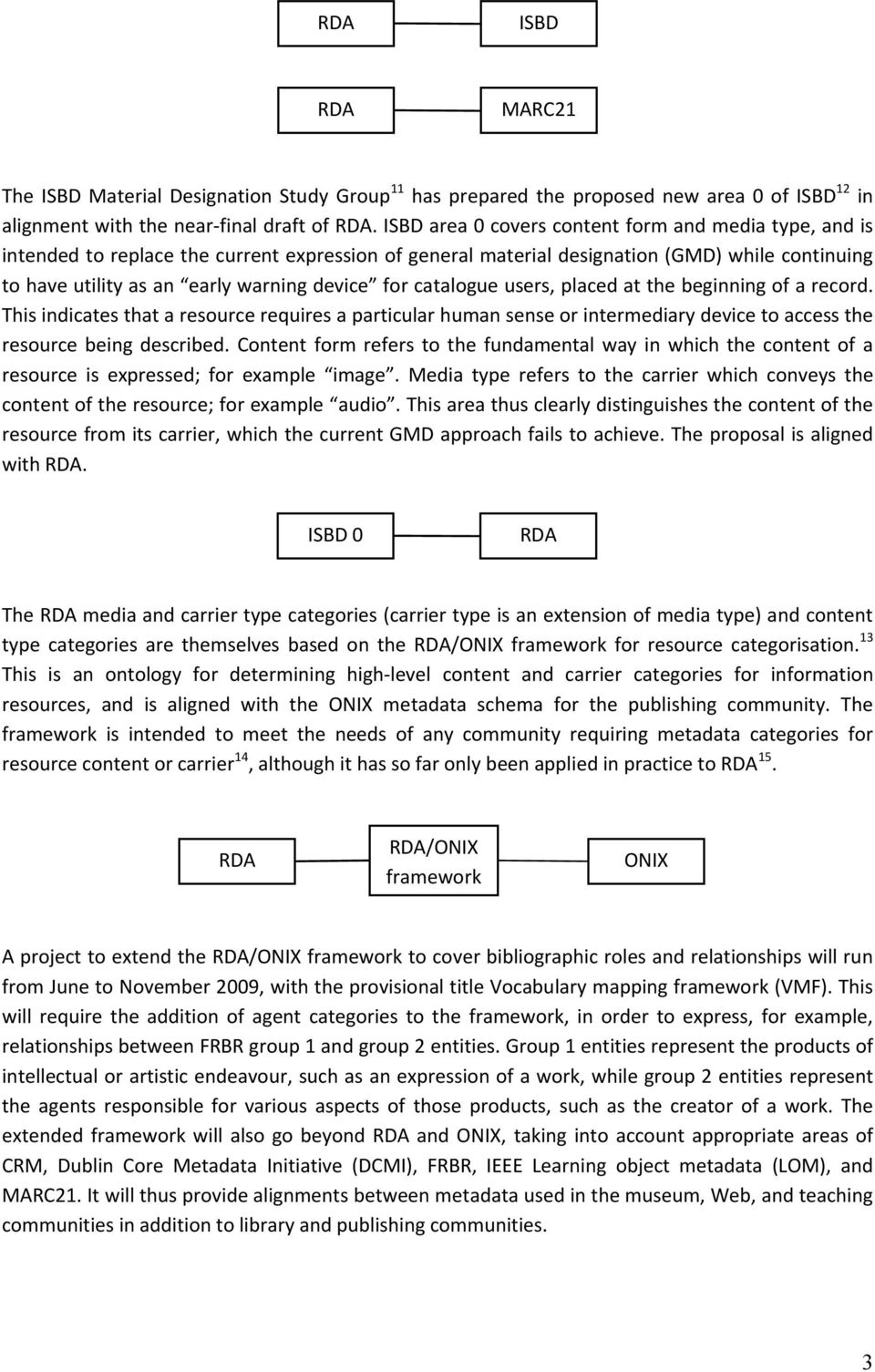
4 CRM MARC21 Vocabulary mapping framework (/ONIX+) LOM ONIX FRBR It should be noted that many of the alignments and mappings described above are not exact, although all improve the interoperability of metadata from different communities and in different formats. Closer alignment may be possible, particularly when specific metadata schemas are undergoing development and refinement. This is, indeed, the case with the alignment of ISBD area 0 and. The development of GMD in ISBD was initiated by the work of the IFLA Meeting of Experts on an International Cataloguing Code (IME ICC) 16, and subsequently took into account the /ONIX framework and itself 17. The development of also suggested potential changes to MARC21 to maintain or improve alignment between them. 18 These include changes to the way that GMD and specific material designation (SMD) are treated in MARC21, including the coded leader fields in MARC21, plus adjustments in specific fields. These range from the fairly trivial, for example the addition of as a value in fields recording which cataloguing rules have been used to create the metadata, to more complex issues such as the subfields used to record publication and distribution metadata. As a result, the /MARC Working Group was set up under the auspices of the British Library, the Library and Archives Canada, and the Library of Congress in 2008, to identify what changes are required to MARC 21 to support compatibility with and ensure effective data exchange into the future. 19 An early output of the group was a discussion paper 20 for the Machine-Readable Bibliographic Information (MARBI) Committee 21. Recommendations and decisions arising from this activity are not yet complete (as of June 2009). For example, distinguishes two modes of issuance for monographs: single unit and multipart monograph. MARC21 has encoding for monograph and multipart resource, and has a choice of either splitting the monograph value into two, or combining both values (which are encoded in different places), to improve the alignment with ; the issue remains under discussion. However, significant changes to MARC21 have already been approved with respect to content and carrier categories. There are three new tags for media type, content type, and carrier type, intended as replacements for the general material designation (GMD) defined in AACR2 1.1C, currently recorded in field 245 (Title statement), subfield $h (Medium). 22 These echo the changes proposed for ISBD. 4

5 The various alignments described above can be linked into a chain or network (this is not a complete picture!): MARC21 UNIMARC ISBD FRBR Vocabulary mapping framework (/ONIX+) FRAD ONIX CRM LOM This connects UNIMARC to, primarily via ISBD. UNIMARC ISBD UNIMARC is also aligned directly with other components linked to. There is a mapping between UNIMARC and MARC This has not been updated since 2001, and requires review because of the changes to MARC21 arising from, let alone other developments. UNIMARC MARC21 This introduces a separate connection between UNIMARC and, via MARC21. UNIMARC MARC21 This suggests that a general review of the alignments, albeit indirect, between UNIMARC and is required if the first and second goals of the current UNIMARC strategic plan are to be met. Trivial examples are the representation of mode of issuance for single part and multipart monographs, and as a new value for UNIMARC appendix H (cataloguing rules and formats codes), discussed above in relation to MARC21. More serious issues may be hidden in the complexity of the network of alignments; minor misalignments in each part of the chain can result in major misalignments in indirect links. 5

6 If national cataloguing rules wish to evolve and benefit from, FRBR, etc., then alignment with UNIMARC can be very important. In fact, there may be many nodes in the network of alignments to which any other cataloguing rules might be linked, even if they are not based on. For example, if the new Italian cataloguing rules (which have not been published at the time of writing) are aligned with FRBR, does alignment of FRBR with and alignment of the current Italian rules with UNIMARC have any significance for the new cataloguing rules? Another example is the French cataloguing rules, which use ISBD directly and specify which options are to be taken. Reviewing the network of alignments with respect to any national cataloguing rules would be justified because of the potential benefit. The network of alignments described so far is incomplete with respect to the second goal of the UNIMARC strategic plan. There is a mapping from UNIMARC to Dublin Core (DC). 24 Although the published version dates from 1997 (and there have been some updates to it since), it remains essentially current because DC has been stable and the mapping is very lossy; that is, changes to UNIMARC are unlikely to affect the alignment. UNIMARC DC There is also a formal representation of UNIMARC rules and associated vocabularies in extensible markup language (XML) 25 and current activity to introduce UNISlim XML Schema as a refinement of UNIMARCXML. These go some way to meet the strategic plan. MARC21 also has a representation in XML 26, and ISBD XML is under consideration. XML is essentially a mechanism for data interchange. However, there is a great deal of activity underway to make various nodes of the network of alignments compatible with the Semantic Web. This requires expression of elements of the various standards using Resource description framework (RDF). 27 More specifically, elements relating to metadata structure, such as tags, fields, and attributes, need to be expressed as classes and properties in RDF schema (RDFS) 28, while elements relating to metadata content, such as codes and controlled vocabularies, need to be expressed in Simple knowledge organization system (SKOS). 29 Complicated semantic relationships in vocabularies can be expressed in Web ontology language (OWL). 30 The DCMI Task Group 31 is engaged in expressing controlled vocabularies, including the content and carrier types, in SKOS, and the metadata structure elements in RDFS. The FRBR Review Group 32 is engaged in expressing FRBR entities and relationships in RDFS. The VMF project is likely to express the extended /ONIX ontology, and the high level vocabularies for categories and relationships based on it, in RDFS and SKOS. The Library of Congress intends to express elements of MARC21 in formats compatible with the Semantic Web: LC has embarked on initiatives to provide SKOS representations for vocabularies and data elements used in and across standards, such as, MARC, PREMIS and METS. 33 The Library of Congress Authorities and Vocabularies service 34 makes Library of Congress Subject Headings (LCSH) available in SKOS, and intends to add MARC geographic area, language, and relator codes, and the Thesaurus of graphic materials. There are numerous benefits to be gained from this work. 6

7 While XML representation of UNIMARC and related standards is essential for compatibility with the Semantic Web, because it allows machine-to-machine interoperability with RDF XML, in which SKOS, RDFS and OWL are implemented, a further essential requirement is that human-readable values can be referenced with a Uniform resource identifier (URI) 37 to allow effective and efficient machineprocessing. These developments are likely to have a significant impact on cataloguing concepts and workflows as a result of evolving from the scenario 2 to scenario 1 implementation of 38 following the FRBRization of the catalogue record and impact of the Semantic Web 39. As an example, the content type value spoken word will be available in a SKOS representation 40 soon after the publication of. The SKOS representation assigns a URI to this term. The Deutsche Nationalbibliothek (DNB) has added the German translation gesprochene Worte to the representation. Any alignment which uses the URI to link to this term will automatically provide human-readable alignments in both English and German, depending only on software and not on content. Any number of translations of this term can be added to the representation, and all that will be required to provide multilingual interoperability of catalogues based on will be minor adjustments to the processing software. This very much meets the primary aim of UNIMARC. References 1 IFLA Universal Bibliographic Control and International MARC Core Programme (UBCIM). UNIMARC manual : bibliographic format Introduction. Available at: 2 International Federation of Library Associations and Institutions (IFLA). Available at: 3 IFLA UNIMARC Core Activity: strategic plan Jul Available at: 4 IFLA. International standard bibliographic description (ISBD). Preliminary consolidated edition. April Available at: 5 Mapping ISBD elements to FRBR entity attributes and relationships. 28 Jul Available at: 6 IFLA Study Group on the Functional Requirements for Bibliographic Records. Functional requirements for bibliographic records. Available at: 7 International Council of Museums. FRBRoo introduction. Available at: 8 International Council of Museums. The CIDOC conceptual reference model. Available at: 9 Joint Steering Committee for Development of. resource description and access: a prospectus. Version of 28 Oct Available at: 10 IFLA Working Group on Functional Requirements and Numbering of Authority Records (FRANAR). Functional requirements for authority data. Available at: 11 IFLA. Material Designations Study Group. Available at: 12 IFLA. ISBD Review Group. Proposed Area 0 for ISBD. Available at: 7

8 13 Joint Steering Committee for Development of. /ONIX framework for resource categorization. Version Aug Available at: 14 Dunsire, G. Distinguishing content from carrier: the /ONIX framework for resource categorization. In: D-Lib magazine, volume 13 number 1/2 (Jan/Feb 2007), ISSN Available at: 15 Delsey, T. Categorization of content and carrier. 8 Aug Available at: 16 IFLA Cataloguing Section. IME-ICC: IFLA Meetings of Experts on an International Cataloguing Code. Available at: 17 Tillett, B. The future of cataloguing codes and systems: IME ICC, FRBR, and. In: UNIMARC & friends: charting the new landscape of library standards. Proceedings of the international conference held in Lisbon, March Edited by Plassard, Marie-France. Berlin, New York (Walter de Gruyter K. G. Saur) Pages ebook ISBN: Print ISBN: Joint Steering Committee for Development of. and MARC Nov Available at: 19 Joint Steering Committee for Development of. /MARC Working Group update. Available at: 20 Library of Congress. Network Development and MARC Standards Office. MARC discussion paper no DP04: Encoding, Resource Description and Access data in MARC Dec Available at: 21 American Library Association. Machine-Readable Bibliographic Information (MARBI) Committee. Available at: 22 Library of Congress. Network Development and MARC Standards Office. MARC proposal no /2: New content designation for elements: Content type, Media Type, Carrier Type. 9 Jan Available at: 23 Library of Congress. Network Development and MARC Standards Office. UNIMARC to MARC 21 conversion specifications. Version 3.0 (August 2001). Available at: 24 Day. M. Mapping Dublin Core to UNIMARC. July Available at: 25 BookMARC. The UNIMARC and MARC21 manual in XML: automating validation, explanation and help systems for bibliographic records Available at: 26 Library of Congress. Network Development and MARC Standards Office. MARCXML: MARC21 XML schema. Available at: 27 W3C. Resource description framework (RDF). Available at: 28 W3C. RDF vocabulary description language 1.0: RDF schema. 10 Feb Available at: 29 W3C. SKOS: Simple knowledge organization system - home page. Available at: 30 W3C. Web ontology language (OWL). Available at: 31 Dublin Core Metadata Initiative. DCMI/ Task Group Wiki. Available at: 32 IFLA. FRBR Review Group. Available at: 33 Marcum, D.B. Response to On the record: report of the Library of Congress Working Group on the Future of Bibliographic Control. I Jun Available at: 34 Library of Congress. Authorities & vocabularies. Available at: 35 Styles, R., Ayers, D., & Shabir, N. Semantic MARC, MARC21 and the Semantic Web. In: Proceedings of the Linked Data on the Web Workshop, Beijing, China, April 22, 2008, CEUR workshop 8

9 proceedings, ISSN Available at: 36 Kruk, S.R., Synak, M., & Zimmermann, K. MarcOnt integration ontology for bibliographic description formats. Presented at DC2005, Madrid. Available at: 37 IETF. Uniform resource identifier: generic syntax. Available at: 38 Delsey, T. implementation scenarios. 14 Jan Available at: 39 Dunsire, G. The Semantic Web and expert metadata : pull apart then bring together: Presented at Archives, Libraries, Museums 12 (AKM12), Poreč, Croatia, Available at: 40 Available at: 9
From FRBR to FRAD: Extending the Model
 Date submitted: 12/08/2009 From FRBR to FRAD: Extending the Model Glenn E. Patton OCLC, Inc. Dublin, OH, USA Meeting: 215. Division IV Bibliographic Control WORLD LIBRARY AND INFORMATION CONGRESS: 75TH
Cataloguing is riding the waves of change Renate Beilharz Teacher Library and Information Studies Box Hill Institute
 Cataloguing is riding the waves of change Renate Beilharz Teacher Library and Information Studies Box Hill Institute Abstract Quality catalogue data is essential for effective resource discovery. Consistent
Joint Steering Committee for Development of RDA
 Page 1 of 11 To: From: Subject: Joint Steering Committee for Development of RDA Gordon Dunsire, Chair, JSC Technical Working Group RDA models for authority data Abstract This paper discusses the models
Encoding Library of Congress Subject Headings in SKOS: Authority Control for the Semantic Web
 Encoding Library of Congress Subject Headings in SKOS: Authority Control for the Semantic Web Corey A Harper University of Oregon Libraries Tel: +1 541 346 1854 Fax:+1 541 346 3485 [email protected]
Renate Gömpel. Germany on Track for International Standards: RDA
 Renate Gömpel Germany on Track for International Standards: RDA 1 Deutsche Nationalbibliothek German National Library 2 EURIG-JSC Seminar on RDA, Copenhagen, August 8, 2010 Cooperative library standardization
LOD2014 Linked Open Data: where are we? 20 th - 21 st Feb. 2014 Archivio Centrale dello Stato. SBN in Linked Open Data
 LOD2014 Linked Open Data: where are we? 20 th - 21 st Feb. 2014 Archivio Centrale dello Stato SBN in Linked Open Data Istituto Centrale per il Catalogo Unico delle biblioteche italiane (ICCU) 20-21/02/2014
From MARC21 and Dublin Core, through CIDOC CRM: First Tenuous Steps towards Representing Library Data in FRBRoo
 From MARC21 and Dublin Core, through CIDOC CRM: First Tenuous Steps towards Representing Library Data in FRBRoo Cezary Mazurek, Krzysztof Sielski, Justyna Walkowska, Marcin Werla Poznań Supercomputing
RDA INTRODUCING A GUIDE TO THE BASICS CHRIS OLIVER. ALA Editions SPECIAL REPORTS. AMERICAN LIBRARY ASSOCIATION Chicago 2010
 ALA Editions SPECIAL REPORTS INTRODUCING RDA A GUIDE TO THE BASICS CHRIS OLIVER AMERICAN LIBRARY ASSOCIATION Chicago 2010 Chris Oliver supervises cataloging at the McGill University Library. She is a member
Facilitating access to cultural heritage content in Czechia: National Authority Files and INTERMI project
 Submitted on: 18.06.2015 Facilitating access to cultural heritage content in Czechia: National Authority Files and INTERMI project Marie Balíková National Library of the Czech Republic, Prague, Czechia
BIBFRAME Pilot (Phase One Sept. 8, 2015 March 31, 2016): Report and Assessment
 BIBFRAME Pilot (Phase One Sept. 8, 2015 March 31, 2016): Report and Assessment Acquisitions & Bibliographic Access Directorate (ABA) Library of Congress (June 16, 2016) The Network Development & MARC Standards
Web NDL Authorities: Authority Data of the National Diet Library, Japan, as Linked Data
 Submitted on: 6/20/2014 Web NDL Authorities: Authority Data of the National Diet Library, Japan, as Linked Data Tadahiko Oshiba Library Support Division, Kansai-kan of the National Diet Library, Kyoto,
Opus: University of Bath Online Publication Store http://opus.bath.ac.uk/
 Chapman, A. (2010) The case of AACR2 versus RDA. Legal Information Management, 10 (3). pp. 210-213. ISSN 1472-6696 Link to official URL (if available): http://dx.doi.org/10.1017/s1472669610000721 Permission
Cataloging and Metadata Education: A Proposal for Preparing Cataloging Professionals of the 21 st Century
 Cataloging and Metadata Education: A Proposal for Preparing Cataloging Professionals of the 21 st Century A response to Action Item 5.1 of the Bibliographic Control of Web Resources: A Library of Congress
Information and documentation The Dublin Core metadata element set
 ISO TC 46/SC 4 N515 Date: 2003-02-26 ISO 15836:2003(E) ISO TC 46/SC 4 Secretariat: ANSI Information and documentation The Dublin Core metadata element set Information et documentation Éléments fondamentaux
Research Objectives and Scope. Understanding FRBR Model. Converting MARC to FRBR. Converting FRBR to Topic Maps
 Presentation Outline Research Objectives and Scope Understanding FRBR Model Converting MARC to FRBR Converting FRBR to Topic Maps Implementing a TM Prototype Enabling FRBR Model 1. Research Objectives
FRBR. object-oriented definition and mapping to FRBR ER (version 1.0)
 FRBR object-oriented definition and mapping to FRBR ER (version 1.0) International Working Group on FRBR and CIDOC CRM Harmonisation supported by Delos NoE Editors: Chryssoula Bekiari Martin Doerr Patrick
FRBR. object-oriented definition and mapping from FRBR ER, FRAD and FRSAD (version 2.2)
 FRBR object-oriented definition and mapping from FRBR ER, FRAD and FRSAD (version 2.2) International Working Group on FRBR and CIDOC CRM Harmonisation Supported by Delos NoE Editors: Chryssoula Bekiari
technische universiteit eindhoven WIS & Engineering Geert-Jan Houben
 WIS & Engineering Geert-Jan Houben Contents Web Information System (WIS) Evolution in Web data WIS Engineering Languages for Web data XML (context only!) RDF XML Querying: XQuery (context only!) RDFS SPARQL
ECM Governance Policies
 ECM Governance Policies Metadata and Information Architecture Policy Document summary Effective date 13 June 2012 Last updated 17 November 2011 Policy owner Library Services, ICTS Approved by Council Reviewed
ProLibis Solutions for Libraries in the Digital Age. Automation of Core Library Business Processes
 ProLibis Solutions for Libraries in the Digital Age Automation of Core Library Business Processes We see a modern library not only as a book repository, but also and most importantly as a state-of-the-art,
EURIG survey on adoption of RDA 2013: report
 EURIG survey on adoption of RDA 2013: report In January 2012 a survey was carried out of EURIG members plans to implement RDA. During 2013, implementation of RDA began in earnest. The French and German
METADATA STANDARDS AND GUIDELINES RELEVANT TO DIGITAL AUDIO
 This chart provides a quick overview of metadata standards and guidelines that are in use with digital audio, including metadata used to describe the content of the files; metadata used to describe properties
EAC-CPF Ontology and Linked Archival Data
 EAC-CPF Ontology and Linked Archival Data Silvia Mazzini 1, Francesca Ricci 2 1 Regesta.exe (Rome, Italy) [email protected] 2 Istituto per i beni artistici culturali e naturali della Regione Emilia-Romagna
How To Change Marc To A Bibbone Model
 BIBFRAME and Cataloging: changing landscapes Sally McCallum [email protected] Library of Congress Frankfurt 13 August 2014 Outline Motivators Why move away from MARC New library cataloging norms Active modeling
Using Dublin Core for DISCOVER: a New Zealand visual art and music resource for schools
 Proc. Int. Conf. on Dublin Core and Metadata for e-communities 2002: 251-255 Firenze University Press Using Dublin Core for DISCOVER: a New Zealand visual art and music resource for schools Karen Rollitt,
Summary Final Report <Indecs> Interoperability of Data in E-commerce Systems
 Putting Metadata to Rights Summary Final Report Interoperability of Data in E-commerce Systems This project is supported under the European Commission INFO 2000 Programme Contents 1. The initiative:
LIBRARY OF CONGRESS RDA Training Plan for 2012 - March 30, 2013 February 27, 2012 (Updated June 15, 2012)
 LIBRARY OF CONGRESS RDA Training Plan for 2012 - March 30, 2013 February 27, 2012 (Updated June 15, 2012) (This training plan is a work in progress and subject to further revisions.) Goal The goal of this
DATA MODEL FOR STORAGE AND RETRIEVAL OF LEGISLATIVE DOCUMENTS IN DIGITAL LIBRARIES USING LINKED DATA
 DATA MODEL FOR STORAGE AND RETRIEVAL OF LEGISLATIVE DOCUMENTS IN DIGITAL LIBRARIES USING LINKED DATA María Hallo 1, Sergio Luján-Mora 2, and Alejandro Mate 3 1 Department of Computer Science, National
Bibliographic Standards
 Bibliographic Standards The INFLIBNET Centre maintains this page as part of its commitment to collaboration with University, College, R & D and National institute libraries in the development, promotion
Implementing RDA in The Netherlands
 Frankfurt, 13 august 2014 Implementing RDA in The Netherlands Lian Wintermans Metadata specialist Royal Library The Netherlands Daniel van Spanje Senior productmanager metadata services OCLC Leiden The
Core Competencies for Visual Resources Management
 Core Competencies for Visual Resources Management Introduction An IMLS Funded Research Project at the University at Albany, SUNY Hemalata Iyer, Associate Professor, University at Albany Visual resources
The FAO Open Archive: Enhancing Access to FAO Publications Using International Standards and Exchange Protocols
 The FAO Open Archive: Enhancing Access to FAO Publications Using International Standards and Exchange Protocols Claudia Nicolai; Imma Subirats; Stephen Katz Food and Agriculture Organization of the United
Report of the Ad Hoc Committee for Development of a Standardized Tool for Encoding Archival Finding Aids
 1. Introduction Report of the Ad Hoc Committee for Development of a Standardized Tool for Encoding Archival Finding Aids Mandate The International Council on Archives has asked the Ad Hoc Committee to
1 Building a metadata schema where to start 1
 1 Building a metadata schema where to start 1 1.1 Introduction Purpose Metadata has been defined as data describing the context, content and structure of records and their management through time 2. It
FRBR Functional Requirements for Bibliographic Records
 FRBR Functional Requirements for Bibliographic Records What is FRBR and why is it important? Chris Oliver McGill University Libraries [email protected] What is FRBR? final report of the IFLA Study
Government of Alberta Metadata Management Glossary
 Government of Alberta Metadata Management Glossary Revision History Version Date Author Description 0.1 March 31, 2014 Colin Lynch Draft glossary 0.2 October 14, 2014 Colin Lynch Revised draft 0.3 October
MERGING ONTOLOGIES AND OBJECT-ORIENTED TECHNOLOGIES FOR SOFTWARE DEVELOPMENT
 23-24 September, 2006, BULGARIA 1 MERGING ONTOLOGIES AND OBJECT-ORIENTED TECHNOLOGIES FOR SOFTWARE DEVELOPMENT Dencho N. Batanov Frederick Institute of Technology Computer Science Department Nicosia, Cyprus
AT&T Global Network Client for Windows Product Support Matrix January 29, 2015
 AT&T Global Network Client for Windows Product Support Matrix January 29, 2015 Product Support Matrix Following is the Product Support Matrix for the AT&T Global Network Client. See the AT&T Global Network
Integration of Polish National Bibliography within the repository platform for science and humanities
 Marcin Roszkowski Integration of Polish National Bibliography within the repository platform for science and humanities The best thing to do to your data will be thought of by somebody else W3C LLD Agenda
Digital Object Identifier (DOI ) System
 Digital Object Identifier (DOI ) System Norman Paskin Tertius Ltd., Oxford, U.K. Abstract The Digital Object Identifier (DOI ) System is a managed system for persistent identification of content on digital
Linked Medieval Data: Semantic Enrichment and Contextualisation to Enhance Understanding and Collaboration
 : Semantic Enrichment and Contextualisation to Enhance Understanding and Collaboration Prof. Dr. Stefan Gradmann Humboldt-Universität zu Berlin / School of Library and Information Science [email protected]
The FRBR Model (Functional Requirements for Bibliographic Records) March 2002
 Workshop on Authority Control among Chinese, Korean and Japanese Languages (CJK Authority 3) March 14 18, 2002, Karuizawa, Tokyo, Kyoto The FRBR Model (Functional Requirements for Bibliographic Records)
Secure Semantic Web Service Using SAML
 Secure Semantic Web Service Using SAML JOO-YOUNG LEE and KI-YOUNG MOON Information Security Department Electronics and Telecommunications Research Institute 161 Gajeong-dong, Yuseong-gu, Daejeon KOREA
Introduction to Service Oriented Architectures (SOA)
 Introduction to Service Oriented Architectures (SOA) Responsible Institutions: ETHZ (Concept) ETHZ (Overall) ETHZ (Revision) http://www.eu-orchestra.org - Version from: 26.10.2007 1 Content 1. Introduction
Semantic Interoperability
 Ivan Herman Semantic Interoperability Olle Olsson Swedish W3C Office Swedish Institute of Computer Science (SICS) Stockholm Apr 27 2011 (2) Background Stockholm Apr 27, 2011 (2) Trends: from
GUIDELINES FOR THE CREATION OF DIGITAL COLLECTIONS
 GUIDELINES FOR THE CREATION OF DIGITAL COLLECTIONS Best Practices for Descriptive Metadata This document sets forth guidelines for creating descriptive metadata for items in CARLI Digital Collections (CDC)
Integrating data from The Perseus Project and Arachne using the CIDOC CRM An Examination from a Software Developer s Perspective
 Integrating data from The Perseus Project and Arachne using the CIDOC CRM An Examination from a Software Developer s Perspective Robert Kummer, Perseus Project at Tufts University and Research Archive
Strategic, Methodological and Technical Solutions for the Creation of Seamless Cultural Heritage Content and Access: Lithuanian Approach
 Strategic, Methodological and Technical Solutions for the Creation of Seamless Cultural Heritage Content and Access: Lithuanian Approach Dr. Regina Varnienė-Janssen Martynas Mažvydas National Library of
BUSINESS VALUE OF SEMANTIC TECHNOLOGY
 BUSINESS VALUE OF SEMANTIC TECHNOLOGY Preliminary Findings Industry Advisory Council Emerging Technology (ET) SIG Information Sharing & Collaboration Committee July 15, 2005 Mills Davis Managing Director
ONTOLOGY-BASED APPROACH TO DEVELOPMENT OF ADJUSTABLE KNOWLEDGE INTERNET PORTAL FOR SUPPORT OF RESEARCH ACTIVITIY
 ONTOLOGY-BASED APPROACH TO DEVELOPMENT OF ADJUSTABLE KNOWLEDGE INTERNET PORTAL FOR SUPPORT OF RESEARCH ACTIVITIY Yu. A. Zagorulko, O. I. Borovikova, S. V. Bulgakov, E. A. Sidorova 1 A.P.Ershov s Institute
dati.culturaitalia.it a Pilot Project of CulturaItalia dedicated to Linked Open Data
 dati.culturaitalia.it a Pilot Project of CulturaItalia dedicated to Linked Open Data www.culturaitalia.it Rosa Caffo, Director of Central Institute for the Union Catalogue of Italian Libraries (MiBACT)
STORRE: Stirling Online Research Repository Policy for etheses
 STORRE: Stirling Online Research Repository Policy for etheses Contents Content and Collection Policies Definition of Repository Structure Content Guidelines Submission Process Copyright and Licenses Metadata
Creating an EAD Finding Aid. Nicole Wilkins. SJSU School of Library and Information Science. Libr 281. Professor Mary Bolin.
 1 Creating an EAD Finding Aid SJSU School of Library and Information Science Libr 281 Professor Mary Bolin November 30, 2009 2 Summary Encoded Archival Description (EAD) is a widely used metadata standard
CHAPTER 1 INTRODUCTION
 CHAPTER 1 INTRODUCTION 1.1 Introduction Nowadays, with the rapid development of the Internet, distance education and e- learning programs are becoming more vital in educational world. E-learning alternatives
Semantic Modeling with RDF. DBTech ExtWorkshop on Database Modeling and Semantic Modeling Lili Aunimo
 DBTech ExtWorkshop on Database Modeling and Semantic Modeling Lili Aunimo Expected Outcomes You will learn: Basic concepts related to ontologies Semantic model Semantic web Basic features of RDF and RDF
COMPARISON OF FIXED & VARIABLE RATES (25 YEARS) CHARTERED BANK ADMINISTERED INTEREST RATES - PRIME BUSINESS*
 COMPARISON OF FIXED & VARIABLE RATES (25 YEARS) 2 Fixed Rates Variable Rates FIXED RATES OF THE PAST 25 YEARS AVERAGE RESIDENTIAL MORTGAGE LENDING RATE - 5 YEAR* (Per cent) Year Jan Feb Mar Apr May Jun
COMPARISON OF FIXED & VARIABLE RATES (25 YEARS) CHARTERED BANK ADMINISTERED INTEREST RATES - PRIME BUSINESS*
 COMPARISON OF FIXED & VARIABLE RATES (25 YEARS) 2 Fixed Rates Variable Rates FIXED RATES OF THE PAST 25 YEARS AVERAGE RESIDENTIAL MORTGAGE LENDING RATE - 5 YEAR* (Per cent) Year Jan Feb Mar Apr May Jun
European Forest Information and Communication Platform
 1 Metadata Model for the European Forest Information and Communication Platform D. Tilsner 1, C. Figueiredo 1, H. Silva 2, B. Chartier 3, J. San-Miguel 4, A. Camia 4, M. Millot 4 1 EDISOFT, S.A., Lisbon,
Mapping of ISBD area 0 vocabularies to RDA/ONIX Framework vocabularies
 Mapping of ISBD area 0 vocabularies to RDA/ONIX Framework vocabularies Gordon Dunsire and IFLA Cataloguing Section, ISBD Review Group s ISBD/XML Study Group, approved by the Cataloguing Section's Standing
Progress Report Template -
 Progress Report Template - Project Name Project Website Report compiled by Kultur, University of Southampton (lead institution) http://kultur.eprints.org Victoria Sheppard Reporting period Oct 07 Apr 08
Scurlock Photographs Cataloging Analysis
 Scurlock Photographs Cataloging Analysis Adam Mathes Administration and Use of Archival Materials - LIS 581A Graduate School of Library and Information Science University of Illinois Urbana-Champaign December
Table of Contents. CHAPTER 1 Web-Based Systems 1. CHAPTER 2 Web Engineering 12. CHAPTER 3 A Web Engineering Process 24
 Table of Contents CHAPTER 1 Web-Based Systems 1 The Web 1 Web Applications 2 Let s Introduce a Case Study 3 Are WebApps Really Computer Software? 4 Are the Attributes of WebApps Different from the Attributes
Network Working Group
 Network Working Group Request for Comments: 2413 Category: Informational S. Weibel OCLC Online Computer Library Center, Inc. J. Kunze University of California, San Francisco C. Lagoze Cornell University
Cataloging for the Future by Barbara B. Tillett 1
 The following was delivered as the 2004 Phineas L. Windsor Lecture at the University of Illinois Graduate School of Library and Information Science, October 13, 2004 Cataloging for the Future by Barbara
A Semantic web approach for e-learning platforms
 A Semantic web approach for e-learning platforms Miguel B. Alves 1 1 Laboratório de Sistemas de Informação, ESTG-IPVC 4900-348 Viana do Castelo. [email protected] Abstract. When lecturers publish contents
Standard Recommended Practice extensible Markup Language (XML) for the Interchange of Document Images and Related Metadata
 Standard for Information and Image Management Standard Recommended Practice extensible Markup Language (XML) for the Interchange of Document Images and Related Metadata Association for Information and