
INVESTIGATION INTO ENERGY PRICES
|
|
|
- Constance Shelton
- 10 years ago
- Views:
Transcription
1 GR: 020/07 INVESTIGATION INTO ENERGY PRICES A REPORT BY THE COUNCIL OF MINISTERS May 2007 Price: 7.20

2 To: The Hon N. Q. Cringle MLC, President of Tynwald, and the Honourable Council and Keys in Tynwald assembled Background In September 2005 the Council of Ministers agreed that the Isle of Man Office of Fair Trading (OFT) should undertake an investigation under Section 19 of the Fair Trading Act 1996 into the prices being charged for energy on the Island. The period of the investigation was 2001 to The relevant part of Section 19 of the Fair Trading Act 1996 states that:- (3) On completion of an investigation under this section the Board shall make a report on the investigation to the Council of Ministers- (a) (b) stating its findings of fact which are material to the information which it provides; and containing such additional observations (if any) as it considers should be brought to the attention of the Council of Ministers as a result of the investigation. Progress to date Due to the extensive nature and complexity of the investigation it was necessary for the OFT to engage consultancy assistance from Oxera Consulting Ltd which was financed by a supplementary vote from Tynwald approved on 14 th December This has been the largest investigation of its kind undertaken by the OFT and due to the amount of information gained it was decided to divide the report into four Chapters, each dealing separately with liquid fuels, gas, electricity and solid fuel respectively. Whilst the Council of Ministers has yet to consider all Chapters in detail, the Fair Trading Act 1996 requires that Section 19 reports to be laid before Tynwald. The Chapters of the report covering liquid fuels and gas were laid before Tynwald in February Council of Ministers has now received the third chapter covering electricity which is appended to this report. The final Chapter on solid fuel is presently being finalised and will be presented to Tynwald in the near future. Chief Minister

3 Investigation into electricity prices in the Isle of Man Isle of Man Office of Fair Trading March 2007

4

5 Contents 1 Introduction Scope of investigation Methodological approach Key trends in the industry 9 2 Structure of the industry Fuel importation Generation Electricity interconnection Transmission and distribution Summary Capital investment programme Non-electricity activities 17 3 Electricity prices and costs Trends in prices Price comparison Evolution of costs 32 4 Profitability analysis Profitability at the MEA level Profitability of the MEA s business divisions Forward-looking profitability Benchmarking returns 62 5 Conclusions Findings Recommendations 67 Appendix 1 Structure of the industry 69 Appendix 2 Comparators and data sources for price comparison 71 Appendix 3 Profitability at the MEA level using IRR 73 A3.1 Asset valuation 73 A3.2 Cash flows to investors 80 Appendix 4 Supporting analysis of asset valuation 82 Appendix 5 Non-electricity businesses 83 A5.1 Retail appliances and telecoms business 83 A5.2 Gas supply business 84 Appendix 6 Benchmarking results 86

6 List of tables Table 2.1 MEA s capital investment programme 17 Table 3.1 MEA electricity tariffs, April 2000 April Table 3.2 Average electricity prices, FYE 2001, FYE 2005 and the first half of FYE Table 3.3 Assumptions for domestic and industrial electricity consumption profiles 26 Table 3.4 Tariffs used for price comparisons (Figures 3.3 to 3.5) 27 Table 3.5 Evolution of the average domestic annual bill, (average from October to September) and January 2006 ( ) 29 Table 3.6 Alternative assumptions for industrial electricity consumption profiles 30 Table 3.7 Evolution of the industrial price of electricity from January 2001 to January 2006 (p/kwh) 31 Table 3.8 Operating costs and electricity generation and importation, Table 3.9 MEA s OPEX by function and volume of electricity, 2001 and Table 3.10 Components of the average wholesale unit costs of electricity, FYE Table 3.11 Unit charge and unit costs of electricity, FYE (p/kwh) 39 Table 3.12 Impact of interconnector 40 Table 3.13 Data used for benchmarking MEA s distribution network, Table 3.14 Transmission and distribution OPEX ( 000) used for benchmarking, Table 3.15 Data used for distribution network benchmarking, Table 3.16 Evolution of electricity price, wholesale cost and margin, 2001 and 2005 (p/kwh) 45 Table 4.1 Average ROS and EBITDA margin at the MEA level (%), Table 4.2 Average ROCE and adjusted ROCE at the MEA level, (%) 51 Table 4.3 Profitability estimates at the MEA level (%) 53 Table 4.4 ROS for the MEA business divisions, (%) 56 Table 4.5 ROS and ROCE of the MEA electricity business, (%) 58 Table 4.6 Average profitability of the MEA s divisions (%) 58 Table 4.7 Summary of assumptions for forward-looking profitability assessment (%) 60 Table 4.8 Average profitability of the MEA electricity business, (%) 61 Table 4.9 Estimated average electricity price growth in real terms necessary to generate ROCE of 5.5% in 2010 (%) 62 Table 4.10 European vertically integrated electricity companies 62 Table 4.11 Returns of the vertically integrated European electricity companies (%) 63 Table 4.12 Comparison of profitability ratios (%) 64 Table 4.13 Comparison of descriptive criteria 64 Table 4.14 The MEA s comparative profitability, 30-company sample 65 Table 4.15 MEA s comparative profitability, 100-company sample 65 Table A2.1 Comparators used for price comparison, time period and information source 71 Table A3.1 MEA generation asset valuation, 2005 ( 000) 74 Table A3.2 MEA generation assets valuation accounting for depreciation, 2005 ( 000) 75 Table A3.3 MEA CCGT assets valuation accounting for depreciation, 2005 ( 000) 75 Table A3.4 The MEA s pipeline networks asset valuation, 2005 ( 000) 76 Table A3.5 MEA distribution network asset valuation, 2005 ( 000) 76 Table A3.6 Depreciated asset valuations ( 000) 76 Table A3.7 Depreciation, Table A3.8 Depreciated asset valuations ( 000) 78 Table A3.9 The MEA s intangible assets, 1999 and 2005 ( 000) 79 Table A3.10 Capital base of the MEA, 1999 and 2005 ( 000) 80 Table A3.11 Cash flows to investors, ( 000) 81 Table A4.1 Distribution network valuation, replacement cost asset values (not depreciated), 2005 ( 000) 82 Table A5.1 Turnover, costs and assets allocated to the retail business, ( 000)83 Table A5.2 Turnover and costs allocated to telecoms business, ( 000) 84 Table A5.3 Shortfall of the gas business, FYE 2005 ( 000) 85 Table A6.1 Profitability measures (%) 86
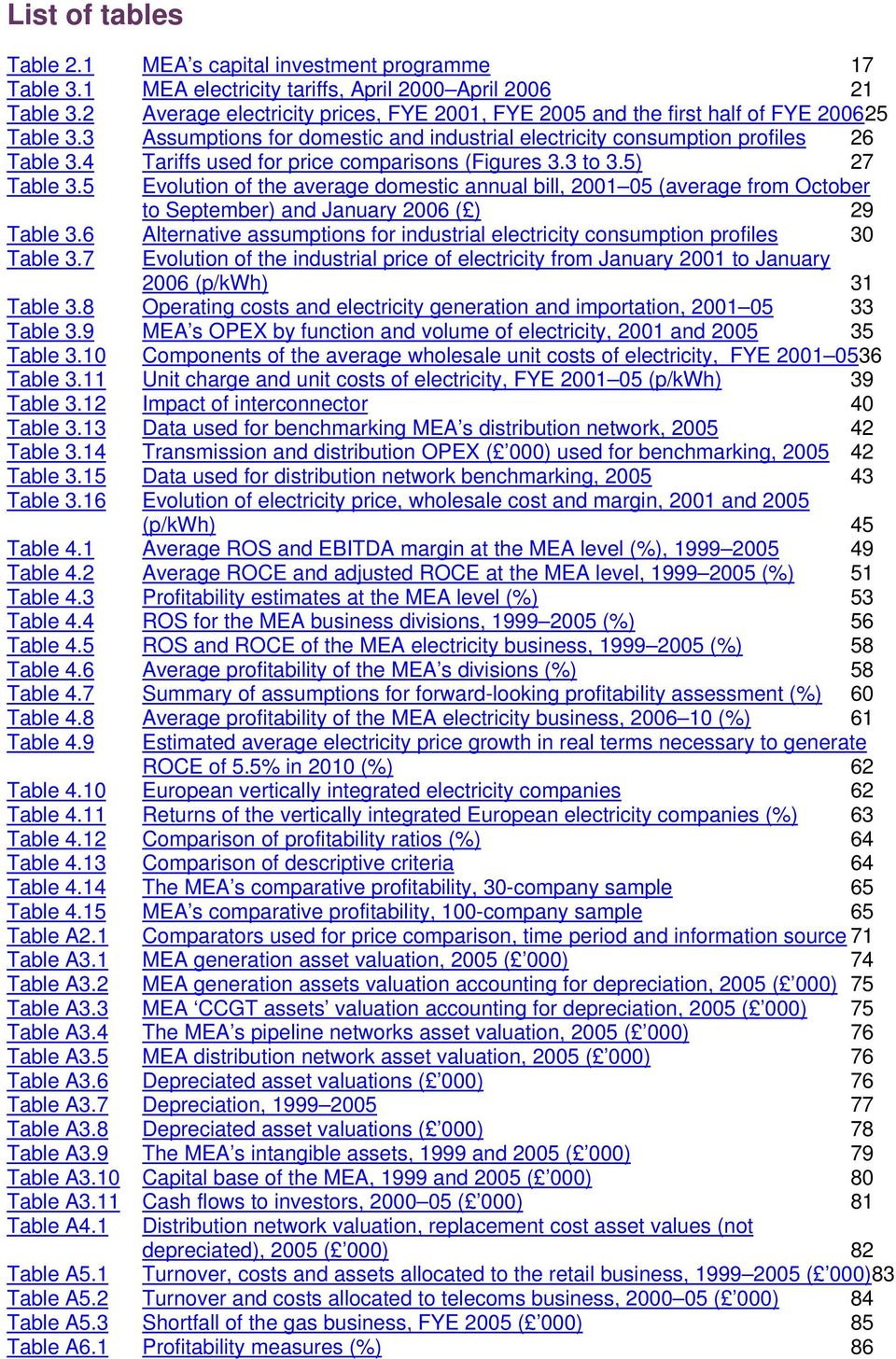
7 Table A6.2 Business characteristics 87 Table A6.3 Results for firms with similar size (30-company sample) 87 Table A6.4 Results for firms with similar size (50-company sample) 88 Table A6.5 Results for firms with similar size (100-company sample) 88 Table A6.6 Results for firms with similar capital intensity (30-company sample) 89 Table A6.7 Results for firms with similar capital intensity (50-company sample) 89 Table A6.8 Results for firms with similar capital intensity (100-company sample) 90 Table A6.9 Results for firms with similar cost structure (30-company sample) 90 Table A6.10 Results for firms with similar cost structure (50-company sample) 91 Table A6.11 Results for firms with similar cost structure (100-company sample) 91 Table A6.12 Results for firms with similar risk (30-company sample) 92 Table A6.13 Results for firms with similar risk (50-company sample) 92 Table A6.14 Results for firms with similar risk (100-company sample) 93 List of figures Figure 2.1 Electricity in the Isle of Man by source, FYE (GWh) 12 Figure 2.2 Overview of MEA divisions and other participants of the electricity industry in the Isle of Man 18 Figure 3.1a Nominal unit charge by customer category (p/kwh), April 2000 to September Figure 3.1b Real unit charge by customer category (p/kwh in January 2001 prices), April 2000 to September Figure 3.2 Annual domestic electricity bill in real terms, April 2000 to September 2005 (January 2000 prices) 24 Figure 3.3 Annual domestic electricity bill, according to tariffs as at the latest available date( ) 27 Figure 3.4 Average price of electricity for industrial customers, according to tariffs as at the latest available date (p/kwh) 28 Figure 3.5 Average annual domestic electricity bill, (average from October to September) and April 2006 ( ) 29 Figure 3.6 Average price of electricity for industrial customers, January 2001 April 2006 (p/kwh) 31 Figure 3.7 Operating costs ( m) and electricity generation and importation (GWh), Figure 3.8 The MEA s electricity supply operating costs by function, Figure 3.9 Unit cost of fuel (p/kwh) and volumes of on-island generation by type of fuel (GWh), Figure 3.10 Unit cost of electricity (p/kwh) and volumes by source (GWh), Figure 3.11 Unit charge and unit costs of electricity, FYE (p/kwh) 39 Figure 3.12 Unit (p/kwh) and total ( m) wholesale costs of electricity, actual and under the assumption of no importation, Figure 3.13 Ratio of the MEA s efficiency measure to the measure of the comparator, Figure 4.1 ROS and EBITDA margin at the MEA level, (%) 48 Figure 4.2 Key drivers of changes to the MEA s ROS, ( 000) 49 Figure 4.3 ROCE at the MEA level, Figure 4.4 Stylised illustration of the MEA business divisions 54 Figure 4.5 MEA turnover by division, Figure 4.6 Forecast ROCE for the MEA electricity business, (%) 61 Figure A1.1 The MEA gas transportation system 69 Figure A1.2 Geographic location of the MEA generation plant 70 Figure A1.3 Geographic location of the AC interconnector cable 70 Figure A3.1 Tangible assets of the MEA by type, net book value, 1999 and 2005 ( 000) 74

8 1 Introduction Oxera Consulting Ltd ( Oxera ) was commissioned by the Isle of Man Office of Fair Trading to investigate the level of energy prices in the Isle of Man. This report presents analysis of the electricity supply market. It looks at the scope of the investigation of the electricity market, before describing the methodological approach adopted, and outlining key trends in the industry. 1.1 Scope of investigation To undertake any price investigation, it is first necessary to define the scope of the analysis. To do this, the relevant product market and time period need to be identified. This report takes the relevant market to be the retail electricity supply market in the Isle of Man. According to this definition, the only provider is the Manx Electricity Authority (MEA), a statutory board of Tynwald. The analysis covers the three elements of the electricity supply chain generation, transmission, and distribution and the MEA is the only provider across all three elements; the exception being generation, which is also provided, under contract to the MEA, by an energy-from-waste (EfW) plant. 1 This implies that focusing on the MEA s electricity tariffs is sufficient for the investigation of retail electricity prices in the Isle of Man, since no other player sells electricity to final consumers. The period of the investigation is , although, where necessary and depending on data availability, this has been extended. In particular, the following are examined: the evolution of costs over the period March 2001 to March 2005; price movements over the period August 2000 to December 2005; profitability over the period March 1999 to March To identify whether prices in the relevant market over the relevant period were reasonable, Oxera adopted the widely accepted methodology discussed below. 1.2 Methodological approach In assessing whether electricity prices are reasonable, it is first necessary to understand the underlying cost structure of electricity supply, how changes in costs are reflected in final prices, and what the returns of the electricity supply business are. The core of the investigation is therefore based on two self-contained, but interdependent, analytical approaches: assessment of the price cost relationship through time, and profitability analysis. Having identified the main cost components of electricity supply, their evolution can be analysed, together with the extent to which cost changes are passed on to consumers through retail electricity tariffs (section 3). A profitability assessment can then be undertaken. The returns of the electricity supplier at the overall company level and for the electricity business alone (ie, excluding non- 1 The EfW plant is an independent entity from the MEA. 2 Where the growth of prices and of costs are shown together, comparable time periods are used. 8

9 electricity activities and gas supply activities) are compared against appropriate benchmarks (section 4). The first element is addressed through a top-down assessment of the relationship between tariff changes and underlying costs. This provides the background and thus assists in the investigation of whether prices are reasonable. Another important outcome of the top-down price cost analysis is that it may aid in the specification of an electricity price monitoring mechanism, if required. In the second stage, the reasonableness of the price cost relationship is examined by analysing profitability. An examination of the MEA s profitability over the last five years provides an understanding of whether the electricity supplier is using its market power to charge excessively high prices. This is examined by: benchmarking margins and returns on capital employed (ROCE) against comparator electricity companies; comparing the return generated by the MEA for its investors against that which investors require for similar investments in a competitive market (ie, the cost of capital). Returns in excess of the relevant competitive benchmark may indicate that prices are too high. In addition, returns of the electricity supply business are calculated after excluding the non-core activities of the electricity supplier. This shows whether electricity consumers are subsidising potentially loss-making, non-core activities of their electricity supplier. Another important aspect of the electricity market is future prospects. Over the last five years, consumers might not have paid unreasonable prices, but the future evolution of prices is also important. The retail electricity tariff in the Isle of Man is fixed in real terms until Scenario analysis provides some insight into whether the future likely evolution of electricity prices will generate normal returns for the electricity supplier. 1.3 Key trends in the industry Over the period , the electricity industry in the Isle of Man can be characterised by four major elements: stable growth in electricity consumption; stable electricity tariffs from 2001 to 2004, followed by significant growth in electricity prices in 2004 (in nominal terms); large-scale capital investment programmes undertaken by the MEA to update the generation plant and to secure sources of fuel supply; an investigation by the Isle of Man Parliament into certain affairs of the MEA. These elements (with the exception of the Parliament investigation) are examined in more detail below. Over the past five years, demand for electricity in the Isle of Man has increased at a reasonably steady rate between 2001 and 2005, average annual growth in on-island consumption was 3.1%. (The cumulative increase in electricity consumption over this period was 13%.) Electricity prices remained relatively stable until a significant increase in The variable component, or unit charge, of domestic and industrial electricity tariffs remained constant in nominal terms from April 2001 to April From April 2004 to December 2005 (a 20-3 Between April 2000 and April 2001, prices fell by 28%. 9
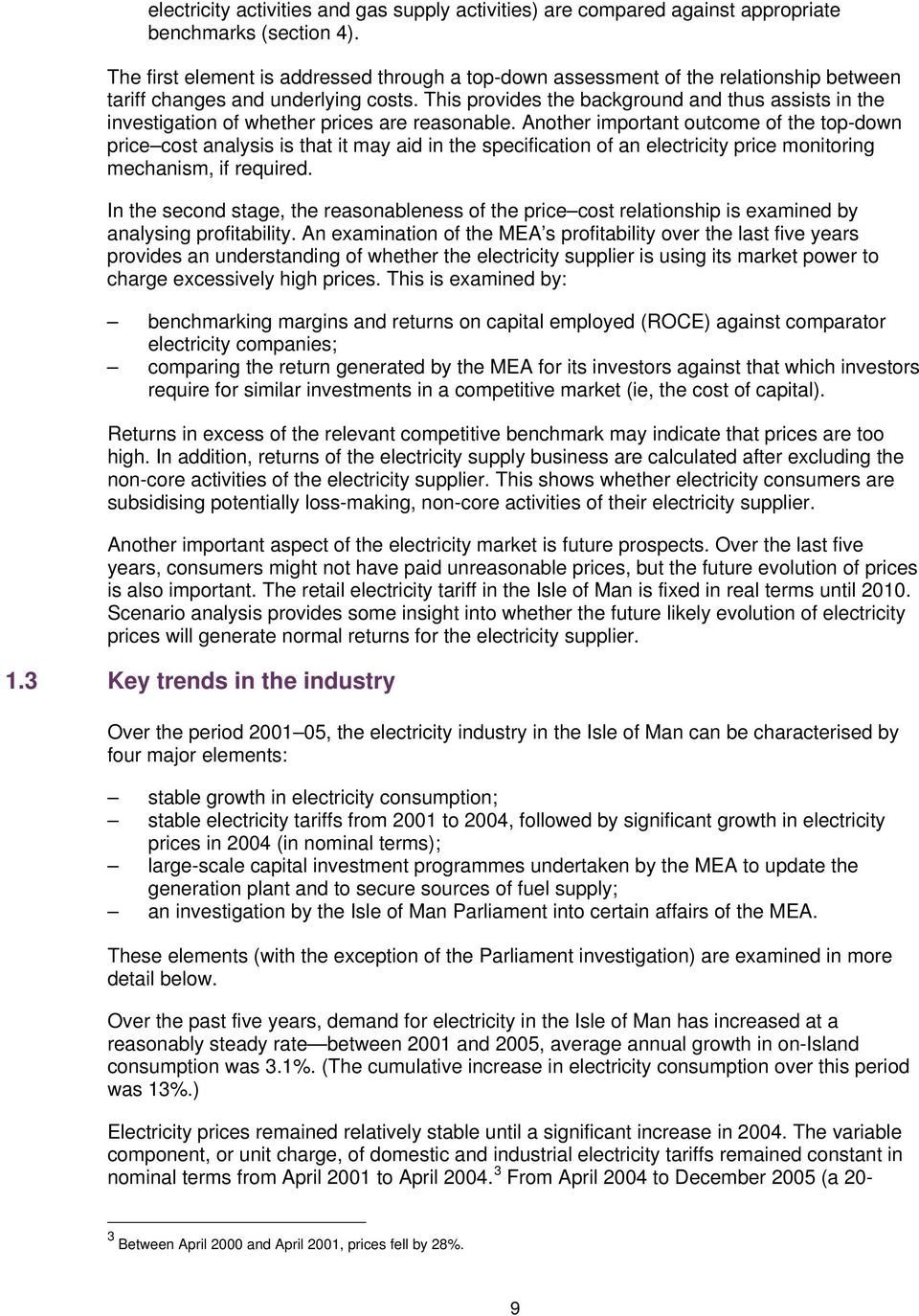
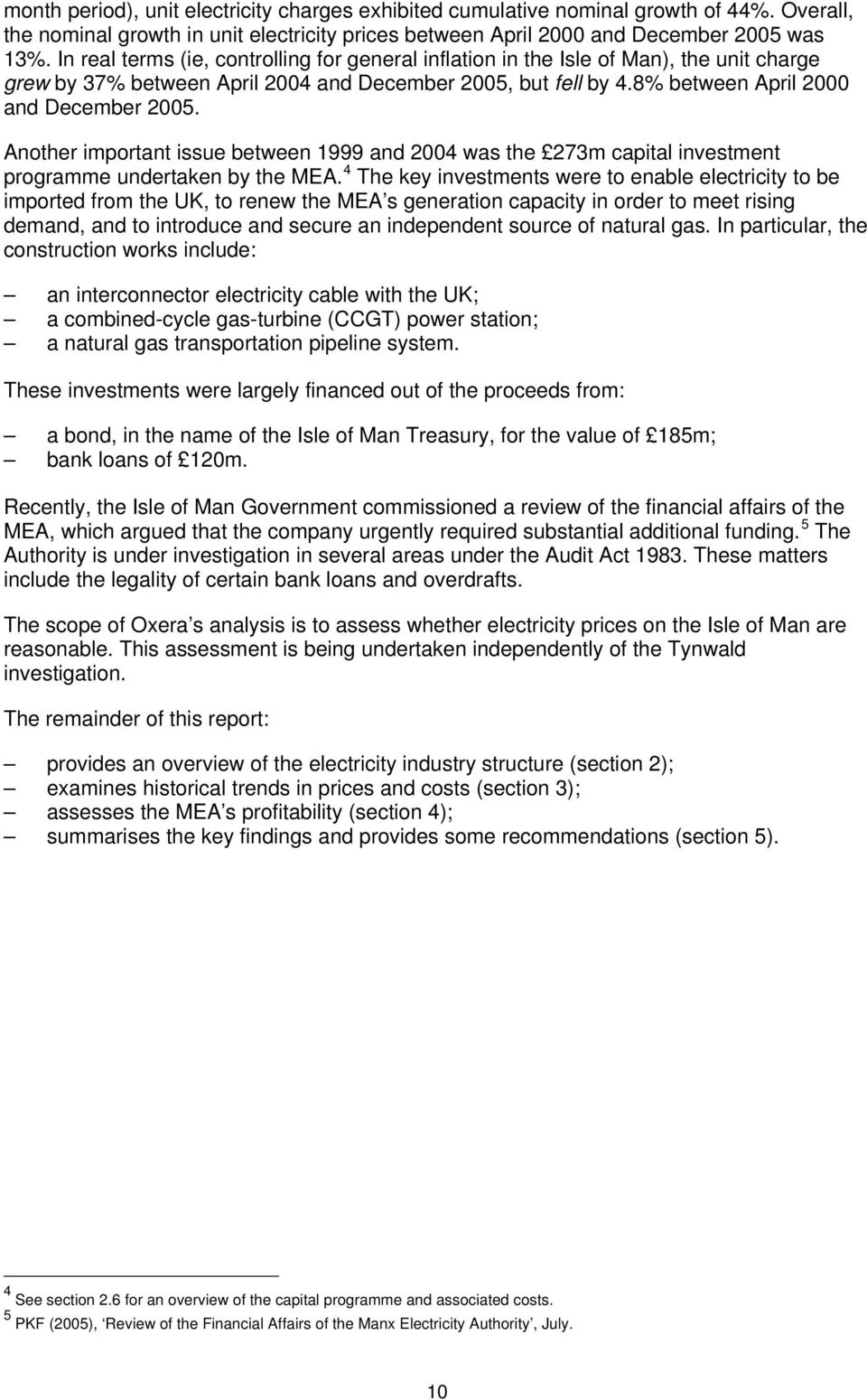
10 month period), unit electricity charges exhibited cumulative nominal growth of 44%. Overall, the nominal growth in unit electricity prices between April 2000 and December 2005 was 13%. In real terms (ie, controlling for general inflation in the Isle of Man), the unit charge grew by 37% between April 2004 and December 2005, but fell by 4.8% between April 2000 and December Another important issue between 1999 and 2004 was the 273m capital investment programme undertaken by the MEA. 4 The key investments were to enable electricity to be imported from the UK, to renew the MEA s generation capacity in order to meet rising demand, and to introduce and secure an independent source of natural gas. In particular, the construction works include: an interconnector electricity cable with the UK; a combined-cycle gas-turbine (CCGT) power station; a natural gas transportation pipeline system. These investments were largely financed out of the proceeds from: a bond, in the name of the Isle of Man Treasury, for the value of 185m; bank loans of 120m. Recently, the Isle of Man Government commissioned a review of the financial affairs of the MEA, which argued that the company urgently required substantial additional funding. 5 The Authority is under investigation in several areas under the Audit Act These matters include the legality of certain bank loans and overdrafts. The scope of Oxera s analysis is to assess whether electricity prices on the Isle of Man are reasonable. This assessment is being undertaken independently of the Tynwald investigation. The remainder of this report: provides an overview of the electricity industry structure (section 2); examines historical trends in prices and costs (section 3); assesses the MEA s profitability (section 4); summarises the key findings and provides some recommendations (section 5). 4 See section 2.6 for an overview of the capital programme and associated costs. 5 PKF (2005), Review of the Financial Affairs of the Manx Electricity Authority, July. 10
11 2 Structure of the industry This section describes the structure of the electricity industry in the Isle of Man, addressing in turn each element of the electricity supply value chain (generation/importation, transmission and distribution). The MEA s capital investment programme is then discussed and its nonelectricity activities outlined. The electricity industry in the Isle of Man is almost exclusively represented by the MEA, a vertically integrated electricity company with responsibility for electricity generation, transmission and distribution. Historically, electricity was generated on the Isle of Man using fuel oil. In 2001, the newly introduced interconnector cable allowed for electricity to be imported from the UK, and, in 2003/04, the completion of a CCGT plant and the introduction of a gas transportation pipeline on the Island made it possible to diversify across input fuel types. Since the end of 2005 the vast majority of on-island generation has shifted to the natural gas-fired CCGT. At the end of 2005, after four years of being a net importer of electricity, the MEA became a net exporter of electricity. From 1999 to 2004, the MEA invested 273m in capital projects to update the generation plant and to secure fuel supply. The MEA undertakes several non-electricity business activities and has associated non-electricity assets. The level of retail electricity prices faced by final customers is conditioned by the structure of the electricity supply industry, which comprises the following in the Isle of Man: the import of fuel to the Isle of Man natural gas, the main type of fuel used for on- Island electricity generation, is imported from the GB market via the spur connection to the Moffat interconnector; on-island generation electricity is almost exclusively generated at the four power stations owned and operated by the MEA. Some capacity is also generated at the Isle of Man (EfW) Incinerator; electricity imports a sub-sea AC cable connecting Bispham at the north end of Blackpool with Douglas in the Isle Man allows for electricity to be imported directly from the UK distribution network; transmission and distribution to final consumers. 2.1 Fuel importation Historically, fuel and lubricant oils were used to generate electricity. Over the period 2001 to 2003, the MEA undertook a significant amount of work to introduce natural gas to the Island, to provide a fuel source for the gas-fired CCGT, completed in 2003, and for on-island domestic, commercial, and industrial use. 11

12 From 2003, when the gas transportation pipeline network was completed and commissioned, the MEA started importing natural gas to the Island. Gas is transported from Moffat in Scotland through a system of pipelines to Pulrose near Douglas. The transportation chain consists of three main elements: the pipeline system (SIPS II) between Moffat, Scotland and Ballough, Ireland (the Moffat distribution system); the Moffat distribution system is connected with the west coast of the Isle of Man by a sub-sea spur (approximately 11km) which ends at Glen Mooar, where a pressure reduction station is located; a cross-island pipeline (approximately 20km) runs from the pressure reduction station at Glen Mooar to Pulrose. The MEA has contractual rights to use capacity on the SIPS II pipeline, until September The reserved capacity of the Authority increases over the contract period, but cannot exceed 15% 6 of the total capacity of the distribution system. As at the end of 2005, the Authority was using 6.29% of the capacity, including 0.78% supplied to Manx Gas. The spur pipeline to Glen Mooar was designed, installed and commissioned by Bord Gais Eireann (BGE) in accordance with the MEA s requirements. The pressure reduction station in Glen Mooar was built by the MEA to reduce pressure from the sub-sea transmission levels to those used to transport gas overland. The final element in the gas transportation network is the cross-island pipeline, which runs from the pressure reduction station to Pulrose near Douglas. A stylised illustration of the gas transportation system is shown in Appendix 1. Having first been brought to the Island in 2003, natural gas has increasingly been used in electricity generation. As shown in Figure 2.1, in 2003/04, 65% of on-island electricity generation (80 out of 125GWh) was based on natural gas, while during the first eight months of financial year-end (FYE) 2006, natural gas accounted for 86% of on-island generation (247 of 286GWh). The increasing utilisation (and therefore importation) of natural gas was accompanied by a decrease in the use of other fuel types. Figure Electricity in the Isle of Man by source, FYE (GWh) (April-Dec 2005) -100 Natural gas (CCGT station) Oil-based and other on-island generation Net import (AC cable) 6 According to the MEA statutory accounts as at March 31st
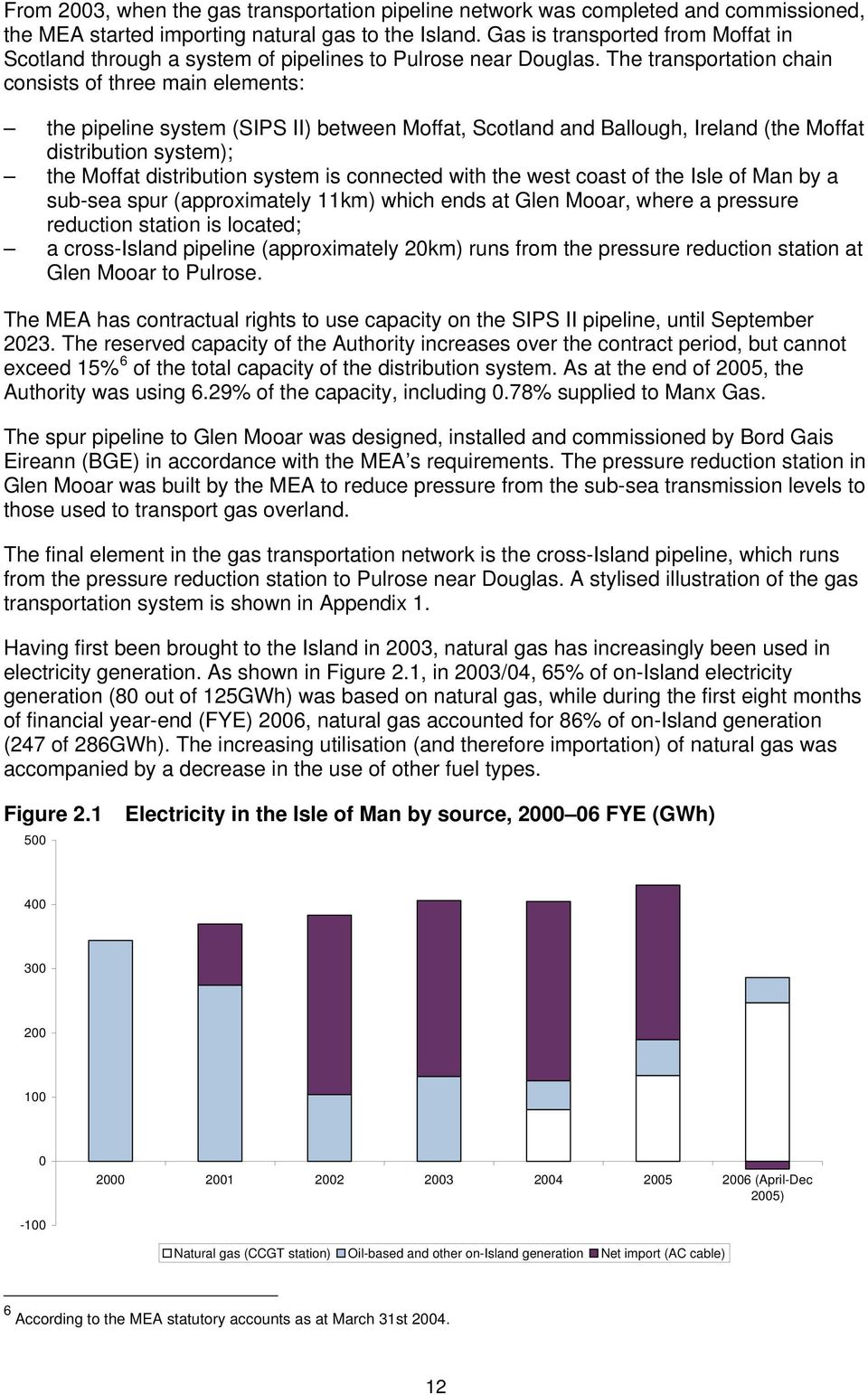
13 Note: The MEA s FY ends on March 31st (eg, FYE 2002 refers to the period from April 1st 2001 to March 31st 2002). For FYE 2006, data is available from April 2005 to December Oil-based and other on-island generation includes fuel oil and gas oil-fired generation (Peel, Ramsey and Pulrose stations), generation at the hydro station (Sulby) and EfW. Source: MEA data and Oxera calculations. 2.2 Generation The MEA s principal generating assets include a CCGT, two diesel-generating stations and a hydro station: the 87MW CCGT at Pulrose was commissioned in 2003, and was the major generating asset at the end of 2005 (see Figure 2.1); a diesel-generating station at Pulrose ( ) with a capacity of 48.5MW; a diesel-generating station at Peel (1994) with a capacity of 38.4MW; a 7MW diesel station at Ramsey ( ) (currently rated at 3MW), previously used to stabilise line voltage across the transmission system in the north and now for emergency use only; and a 1MW hydroelectric plant ( ) fed from the Sulby and Block Eary reservoirs. Additional capacity is obtained from the EfW plant, completed in 2004/05, the output of which is purchased by the MEA. In 2004/05, the EfW plant accounted for 12% of the total on-island generation (22GWh of 189GWh). A stylised illustration of the geographical location of the principal MEA generation facilities on the Isle of Man is shown in Appendix 1 (as well as details on ownership, operation and accounting treatment of different elements of the gas transportation network). 2.3 Electricity interconnection The Island is linked to the UK electricity national grid through a sub-sea interconnector from Lord Street in Douglas, to Bispham, Lancashire, which began operation in November 2000 and is capable of importing or exporting power. Originally rated at 40MW for continuous usage, the cable has since been upgraded to 60MW continuous use. The Manx Interconnector immediately began trading in the England and Wales (E&W) Electricity Pool system in preparation for a major change in the structure of the E&W electricity trading market in the form of the New Electricity Trading Arrangements (NETA), which were scheduled to come into force from March To capitalise on these new trading arrangements, a long-term competitive electricity forward contract was negotiated with Enron Corp. (Enron) in February 2001 following a detailed and comprehensive tendering exercise involving all the main electricity suppliers. However, when Enron went into administration at the end of November 2001, the MEA was obliged to embark on another round of competitive tendering which resulted in an energy supply contract with E.ON UK plc (branded as Powergen) commencing December The latter was again structured to allow electricity to be imported and excess generation output to be exported through the Manx interconnector into the E&W electricity system. During the period of the Powergen contract, cost-effective innovations included a temporary increase in the capacity of the Manx Interconnector from 40MW to 49MW and a load management scheme enabling Powergen to interrupt electricity supplies for a specified number of hours during the winter months. These innovations led to a substantial reduction in MEA s operating costs and established a profitable income stream for future years. 13
14 The commissioning of the CCGT in 2003/04 introduced more flexibility and choice into MEA s generation portfolio and necessitated a further appraisal of electricity suppliers to ensure additional reductions in operating costs and maximisation of the MEA s export-related income streams. Consequently, in December 2003, a new trading agreement was reached with RWE npower plc (RWE npower), which facilitated direct access to RWE s Trading arm and extracted more value for the MEA s procurement and trading activities within the E&W electricity market. Since the start of this new Route-to-Market Agreement (RTMA), the MEA s net operating costs have fallen considerably and a substantial income stream has been developed, capitalising on the excess capacity of the CCGT and the increased capacity of the Manx Interconnector. 7 New revenue streams were developed in terms of standing reserve contracts with National Grid Company (NGC) through an intermediary agent, Gaz de France, and an additional load management scheme, referred to as Triad management, which was agreed with RWE npower to reduce the latter s exposure to the NGC s transportation charges. In addition, the commissioning of the new gas pipeline in November 2002 from Moffat to the Isle of Man necessitated the negotiation of a competitive gas supply for the CCGT in Following a competitive and extensive tendering exercise, Bord Gais Eireann (BGE) Energy Supplies was awarded a gas supply contract and a new RTMA was negotiated which enabled both the MEA and Manx Gas to gain access to competitive gas prices in the UK gas marketplace. Further negotiations with BGE Transportation resulted in a Regulatory Benefit income stream to the MEA, which currently amounts to around 350,000 per annum. From April 2005 gas pipeline trading also enabled the MEA to participate in secondary capacity trading. In FYE 2005/06, this is expected to bring around 285,000 per annum in additional income. In summary, the procurement activities of the MEA Energy Trading team have delivered sustained reductions in the Authority s operating costs and additional external revenues, which have improved its ROCE. 2.4 Transmission and distribution The last two elements in the business supply chain comprise the transmission of electricity from the generation facilities, and its onward distribution to the MEA s customer base. The MEA s Network Services Division controls this element of the business. Network Services manages the UK Isle of Man Interconnector, which provides a parallel connection of two transmission and distribution systems from United Utilities 132/90kV substation at Bispham, near Blackpool, to the 90/33kV power system at Lord Street in Douglas. 8 The Interconnector formed an integral component of the investment programme, which allowed the installation of larger, more efficient generation on the Island. It is a very flexible asset, providing security, stability and commercial flexibility to the Authority s portfolio. 7 From 2003/04 to 2005/06, more than 8m was accumulated in additional revenues and cost savings attributable solely to the MEA s export activities. 8 The sub-sea transmission voltage is 90kV, which facilities the most efficient means of bi-directional power transfer for the size of internal cable conductor installed. The point-to-point route length of the Interconnector is 102km, and this is currently the longest AC power cable operating in the world. 14

15 The MEA s transmission system 9 is designed and installed to specifications similar to those used for the UK s 400kV transmission system, because this provides the mechanism connecting generating stations, and because this system runs in parallel with that in the UK. Dynamic stability is a fundamental requirement of an interconnected mesh network. A transmission system with the varied components found on the Isle of Man must have safeguards in place to ensure that a fault in one major component does not affect the rest of the system. Equally, faults in the UK system could cause instability in the Isle of Man system. Special protection, known as Pole Slipping protection, is therefore installed on the Interconnector and the generation plant. Non-Island distribution network operators (DNOs) are unlikely to need to install equivalent protection systems because they will not have to manage the dynamic stability issues of a diverse interconnected generation and transmission system. The MEA s distribution network operates at 11kV and below, and provides electricity to urban and rural areas Summary Summarising the key issues discussed above, over the period , there were a number of substantial developments in the Isle of Man electricity supply chain: in 2001/02 a significant part of on-island generation was substituted by imports; by the end of 2005, oil was almost completely substituted by gas as the fuel used in the electricity generation process. Oil-based power stations therefore moved down the priority order, and the recently completed CCGT evolved as the major generation facility; independent sources of gas supply, introduced over the period, supported this transition process. All these changes were implemented as part of the large-scale capital investment programme undertaken by the MEA. The major elements of the programme are described below, addressing the timing and value of the investments. The assessment of whether these steps were required and who was responsible for the decision to undertake the whole programme, or any decision in relation to any of its elements, is outside the scope of Oxera s investigation and therefore not examined in this report. 2.6 Capital investment programme To increase security of supply in the Isle of Man, the MEA undertook a large-scale capital investment programme, key elements of which include: the initial step construction of the Interconnector cable with the UK; the key element construction of the 80MW CCGT, which can be run on natural gas and fuel oil; supplementary projects to introduce natural gas into the Island for the CCGT, a pipeline system was constructed partly by the MEA and partly by BGE. Additionally, some capacity was reserved on the existing gas distribution system. 9 The MEA s transmission system operates at 33kV and comprises 94.7km of overhead line and 51.1km of underground cable, with 11 primary substations forming the nodes on the network that interface with the distribution network. 10 The system includes overhead lines, underground cables, substations and switchgear, and transformers, thereby facilitating 52,987 end-user terminations. The distribution system is designed and installed to be highly resilient, with unit protection systems connected between nodes. 15
16 The AC cable was constructed by the Manx Cable Company (MCC), which was established by the MEA and National Grid Isle of Man Ltd, an affiliate of NGC. The MCC s initial financing of 45m comprised 4.5m of equity from each of the shareholders (including the MEA) and a 36m debt facility arranged by HSBC Bank. In March 2002, the MEA acquired MCC and refinanced its debt obligations. Total capital expenditure (CAPEX) incurred in this transaction was 54.6m, which is 4.6m above the original indicative costs, as reported to Tynwald in July 2001, amount of 50m 11 ( 20m NGC shares and 30m refinancing of debt). Contracts for the design and installation of the Interconnector were signed in February 1999, and the cable was fully operational by October The total cost of the cable to the MEA is the sum of the initial investment in the MCC ( 4.5m) and the amount paid during the acquisition and refinancing of the MCC s debt ( 54.6m) ie, 59.1m. Construction of the CCGT began in and it was first commercially operated in November The MEA s original indicative CAPEX for the CCGT was 80m, and total actual expenditure incurred by the MEA was 129m. 13 To secure fuel supply to the Island and allow for natural gas to be used in electricity generation, the MEA has undertaken a series of projects. It contracted with BGE to construct a spur interconnector between the Moffat distribution system and Glenn Mooar in the Isle of Man. According to the agreement with BGE, the MEA is committed to annual payments to recover construction costs incurred by BGE and a finance charge. The MEA has also secured spare capacity on the Moffat distribution system. According to the agreement with BGE, the Authority has obtained a right to use up to 15% of the total capacity on the system. The terms of the contract require the MEA to pay a capacity charge irrespective of the amount of gas pumped through the system. As at the end of 2004, the total amount of future payments to recover construction costs and for secured capacity is valued at 106m in present value terms. 14 Costs associated with payments for reserved capacity and recovery of the capital charge were not budgeted for. Construction of the cross-island pipeline from Glen Mooar to Pulrose, near Douglas. Initiated in February 2002, the pipeline was completed in December Total CAPEX, originally indicated at 20m, 16 was actually 23.5m. 17 Construction of the pressure reduction station. Work started in October 2002 and the station was completed in September Total CAPEX of around 15.1m was incurred. The station construction was not budgeted for, since it was originally supposed to be constructed by BGE as part of the spur interconnector pipeline. The pressure reduction station and the cross-island pipeline were constructed by the MEA. Table 2.1 below summarises the MEA s capital investment programme. 11 As stated in PKF (2005), Manx Electricity Authority Review on behalf of the Isle of Man Government into the Recent Affairs of the Manx Electricity Authority and Subsidiary Companies, p Design and planning works had been ongoing throughout PKF (2005), op. cit 14 According to unaudited draft accounts of the MEA for 2004/ PKF (2005), op. cit., p PKF (2005), op. cit., p PKF (2005), op. cit. 16
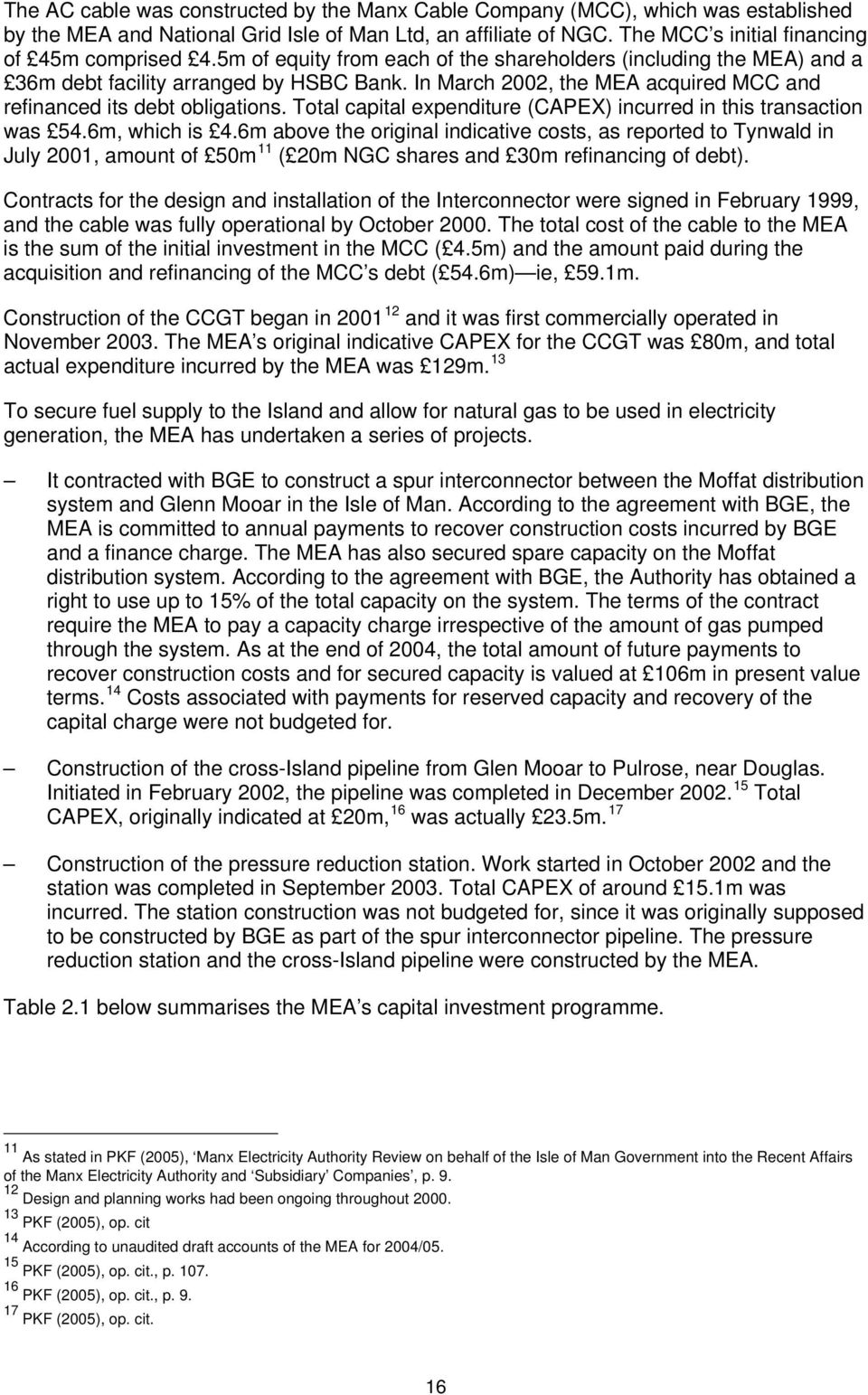
17 Table 2.1 MEA s capital investment programme Interconnector cable with the UK Investment Initial investment in the Manx Cable Company (MCC) Costs ( m) 4.5 Indicative amount to be paid for the acquisition and refinancing of MCC s debt in March 2002 Actual amount paid for the acquisition and refinancing of MCC s debt in March 2002 Total cost incurred by the MEA in constructing the interconnector CCGT power station Indicative expenditure 80 Spur interconnector between the Moffat distribution system and Glen Mooar in the Isle of Man Construction of the cross-island pipeline from Glen Mooar to Pulrose, near Douglas Actual expenditure 129 Future payments required to recover construction costs and for secured capacity 106 (in present-value terms) Indicative CAPEX 20 Actual CAPEX 23.5 Pressure reduction station Total CAPEX (unbudgeted) 15.1 Source: PKF (2005), Manx Electricity Authority Review on behalf of the Isle of Man Government into the Recent Affairs of the Manx Electricity Authority and Subsidiary Companies, p. 9, and the unaudited draft accounts of the MEA for 2004/05. To finance these infrastructure investments, the MEA raised a significant amount of debt capital. The key elements of this financing programme include the following: a bond in the name of the Isle of Man Treasury issued by the MEA in The bond has a maturity date of August 2034, a nominal value of 185m and was issued at an interest rate of 5.375% per annum; the MEA s commitments in relation to the capital payments to BGE for the reserved capacity and constructed spur pipeline represent finance debt, and as at 2004/05 were valued at 106m; 18 in 2004, a 70m long-term loan for five years and a 50m medium-term loan for six months (repaid by the government in September ) were drawn down from Barclays Private Clients International. 2.7 Non-electricity activities The scope of this price investigation covers the electricity supply market on the Isle of Man represented by the only player, the MEA. At the same time, it is important to consider 18 According to unaudited draft accounts of the MEA for 2004/ The MEA has not been released from its obligation to repay both the principal and the interest. 17
18 whether the electricity supplier is active in other businesses. The MEA is engaged in several business activities that do not relate directly to electricity supply (see Figure 2.2). Figure 2.2 Overview of MEA divisions and other participants of the electricity industry in the Isle of Man MEA Energyfrom-waste PGT MCC Appliances Gas supply Electricity supply Telecoms Transmission and distribution Generation Source: Oxera. The MEA partly owns 20 and operates 21 the gas pipeline system. During the construction of certain parts of the system (the pressure reduction station and the cross-island pipeline), the MEA incurred significant CAPEX. It is also committed to make annual payments for reserved capacity on the Moffat distribution system. As at the end of 2005, the net book value of the gas pipeline system was 106m (for the Isle of Man spur and future capital charges for SIPS until 2023). This figure does not include the cost of the cross-island pipeline and pressure reduction station. The MEA also owns a fibre-optic telecommunication cable between the Isle of Man and the UK. The total costs incurred by the Authority in exploring the commercial possibility of delivering telecommunication services in the Isle of Man were 1.1m in 2004 and 0.8m in The Authority also sells appliances. The retail business includes sales of electrical appliances, as well as a certain number of retail products. In 2004/05, the retail business represented 12% of the MEA s total turnover ( 4.9m of 40.4m), and had an average profitability (return on sales) of 27% from 1999 to The EfW plant is an independent generation plant with which the MEA has a purchase contract The MEA owns the cross-island pipeline (including all pressure-reduction stations) and will own the IOM spur under a finance lease to expire in BGE owns SIPS and will continue to do so after BGE operates the sub-sea pipeline systems (IOM spur and SIPS) and the pressure-reduction station at Glen Mooar. The MEA operates the cross-island pipeline system, the power station pressure-reduction station and the domestic pressure-reduction station at Pulrose. Although BGE sub-contracts the operation of Glen Mooar to the MEA gas division, BGE retains control. 22 See section for profitability estimation. 23 The EfW is an independent entity from the MEA and cannot be considered as an MEA asset. 18

19 3 Electricity prices and costs Trends in electricity prices and costs over time are examined in this section. First, the electricity tariffs offered by the MEA, including the agreed Fuel Cost Adjustment (FCA), are discussed. Electricity prices in the Isle of Man are then benchmarked against those in the UK, Jersey, Guernsey and the Republic of Ireland. Finally, the evolution of the costs of electricity supply is described, and the degree of cost pass-through investigated. Electricity prices are analysed over the period from April 2000 to September 2005 (FYE and the first half of FYE 2006); costs are analysed from April 2000 to March 2005 (FYE ). A typical domestic or commercial tariff consists of a variable component (unit charge) and a fixed component (standing charge). Industrial customers are also charged for the maximum connected capacity (capacity charge) and the maximum monthly demand (demand charge). An annual rebate of 42 was given to all MEA customers over the period concerned ( , with the exception of the period from April 1st 2004 to August 31st 2005). The Isle of Man Government financed the rebate via a loan provided to the MEA. The rebate completely offset the standing charge for domestic customers. From April 2000 to September 2005, standing and demand charges remained stable in nominal terms. The unit charge across all tariffs grew by 13% in nominal terms and decreased by 4.6% in real terms. In addition, a capacity charge of 1/kVA was introduced in February 2005 for industrial customers. Over the period from FYE 2001 to 2005, the average 24 unit price of electricity decreased by 3% in nominal terms, while the average unit cost of the MEA 25 grew by 27% in nominal terms. 26 In the period from 2001 to 2005, electricity prices in the Isle of Man, the UK, the Channel Islands and the Republic of Ireland increased, with the largest rise in the Republic of Ireland and the second largest in the Isle of Man. From 2001 to 2005, the MEA s operating costs grew by 49% in nominal terms and 30% in real terms, largely driven by electricity wholesale costs, which accounted for around 60% of the total increase. To a large extent wholesale costs were driven by higher fuel prices. The introduction of the Interconnector cable in 2000, initially aimed at ensuring security of supply and benefiting from the access to the competitive UK market, also allowed significant savings in operating costs, estimated at 7m over the period Calculated as the average unit charge for a given year, where unit charges are weighted by the number of months in which they were applied during this year. 25 Calculated as total MEA operating costs over a given year, divided by the total volume of on-island electricity generation and imports during this year. 26 Non-electricity activities, such as gas transportation, also contributed to the total MEA unit cost increase. 19

20 3.1 Trends in prices This section discusses how electricity prices changed between April 2000 and September Tariff structure There are four main categories of electricity consumer in the Isle of Man: domestic (domestic tariff); commercial (non-domestic tariff); industrial (demand tariff); and public (public lighting tariff). From 2001 to 2005, electricity sales across these categories were as follows: Domestic 43% Commercial 33% Industrial 23% Public customers and exports 1% A typical tariff for commercial and domestic customers comprises a variable component (the unit charge), specified in pence per unit of electricity (p/kwh), and a fixed component (the standing charge), specified in pence per day, which is independent of the amount of electricity consumed. Industrial clients are also charged for their maximum connected capacity and the average actual capacity that they use. Thus, a typical industrial tariff comprises: a unit charge in pence per kwh consumed during a certain period of time; a monthly standing charge irrespective of the amount of capacity provided; a monthly demand charge a monthly payment (in ) equal to the maximum monthly capacity (in kva) multiplied by the monthly demand charge; an agreed capacity charge a one-off annual payment for connected capacity. 27 This charge was introduced by the MEA in February Public lighting is defined in terms of the unit charge, or pence per kwh of consumption. All tariffs are agreed in Tynwald. 28 If fuel prices increase substantially above expectations, the MEA has some flexibility to change the effective price of electricity via the FCA, which does not have to be agreed in Parliament. The FCA is based on the difference between the budgeted and actual average unit cost of fuel Trends in tariffs Electricity prices are examined over the period from April 2000 to September 2005 (FYE and the first half of FYE 2006). Table 3.1 presents key information on the tariffs offered by the MEA to its customers over the period of investigation. 27 In other words, a payment in /kva (1kVA = 0.8kW) for the maximum amount the client is able to consume. 28 Although there is no requirement to obtain formal approval. 20
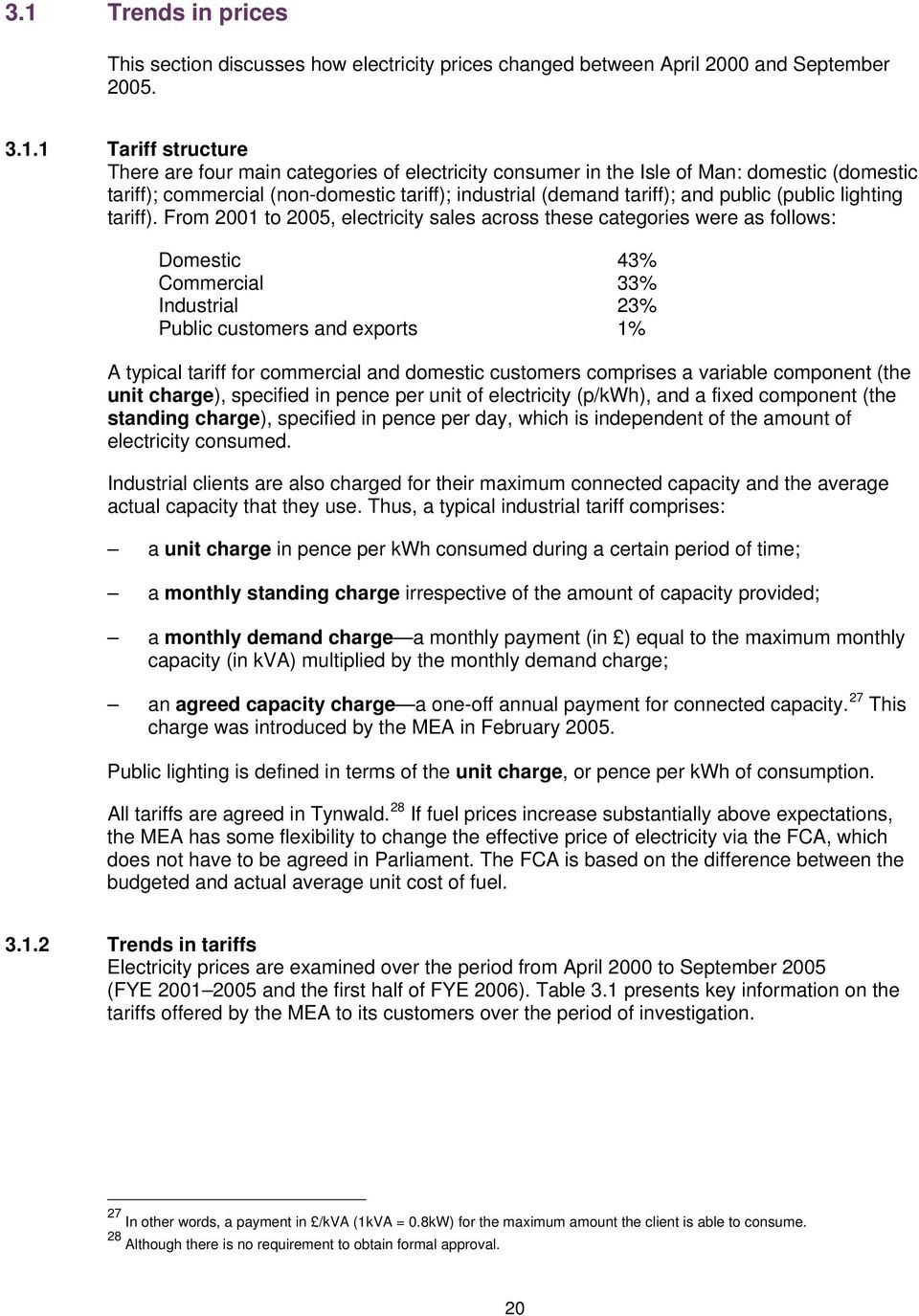
21 Table 3.1 MEA electricity tariffs, April 2000 April 2006 Unit charge including FCA FCA Standing charge Rebate RPI Valid from Domestic and nondomestic Demand Domestic Nondomestic Demand p/kwh p/kwh p/kwh p/day p/day /month p/day index 01/04/ /09/ /04/ /04/ /04/ /08/ /12/ /09/ Note: For the domestic tariff direct, the debit payment method is shown. For demand, the tariff for M1 LV customers is shown. The rebate is applied to standing charges for all tariffs. The Isle of Man RPI with the base period of January 2000 is shown. Tariffs are shown excluding VAT. Direct debit discounts are available for commercial customers. Source: The MEA and the Isle of Man Treasury. From 2000 to 2005, the standing and demand charges on major tariffs remained unchanged. Therefore, all variations in electricity prices were driven by unit charges, the FCA and changes in the rebate to the standing charge. In addition, in February 2005 a capacity charge of 1/kVA connected was introduced for industrial customers. As shown in Figure 3.1, trends in unit charges over the period April 2000 September 2005 were similar for domestic, commercial and industrial customers. A 22% decrease (nominal) in FYE 2001 was followed by more than three years of constant unit charge until the tariff then rose in August 2004, December 2004, and again in September The difference in unit charges for domestic and commercial customers between September 2005 and before the first rise in August 2004 represents a 44% increase in nominal terms and a 37% increase in real terms (43% and 36% for industrial customers). Overall, the nominal growth in domestic and commercial unit charges from April 2000 to September 2005 was 13%; in real terms, over the same period domestic and commercial unit charges decreased by 4.6%. The unit charge for industrial users grew by 12% in nominal terms and fell by 5.7% in real terms over the same period. 21
22 Figure 3.1a Nominal unit charge by customer category (p/kwh), April 2000 to September 2005 p/kwh April 2000 level Isle of Man RPI (Jan 2000 = 100) / / / / / / / / / / / / /2006 Commercial and domestic Commercial and domestic net of FCA Isle of Man RPI (January 2000 base period) Industrial Industrial net of FCA Figure 3.1b Real unit charge by customer category (p/kwh in January 2001 prices), April 2000 to September p/kwh / / / / / / / / / / / / /2006 Commercial and domestic Industrial Commercial and domestic net of FCA Industrial net of FCA Note: The unit charge for the domestic tariff is specified in accordance with the direct debit payment method; for industrial customers the demand M1 LV tariff is shown. Changes in the industrial (demand) tariff declared in December 2004 took effect in February Source: Data from the MEA and the Isle of Man Treasury, and Oxera calculations. To undertake a basic comparison between price and cost evolution, it is informative to examine how the average (within a given year) unit price of electricity changes from FYE 2001 to FYE The average unit price for a given year is weighted by the number of months in which a given unit price was applied during the year. For example, according to Table 3.1, in FYE 2001 (April 2000 March 2001) the unit charge of 9.76p/kWh was applied 22
23 for five months and 8.86p/kWh for seven months. Therefore, the average unit price in FYE 2001 was 9.24p/kWh. From FYE 2001 to FYE 2005, the average unit price for domestic and commercial customers decreased from 9.24p/kWh to 8.96p/kWh a 3% decrease in nominal terms. For industrial users, the average unit price decreased from 7.59p/kWh to 7.36p/kWh, or by the same 3% in nominal terms. Having examined trends in the tariff components across customer categories, trends in annual electricity bills for domestic customers or in the amount customers actually paid for electricity are examined below Trends in annual electricity bills The unit charge is not the only element of the tariff. Electricity bills include a standing charge for domestic, commercial and industrial users, plus demand and capacity charges for industrial users. Over the period examined, the standing and demand charges were constant, while the capacity charge was only introduced at the beginning of Domestic customers pay a monthly standing charge of 3.50 (11.51p/day). From April 2000 to September 2005 (excluding the 17-month period from April 2004 to September 2005) this charge was compensated for in full by a government subsidy, in the form of a rebate (of 42 annually or 3.50 monthly). Commercial customers pay a monthly standing charge of 4 (13.15p/day), or 50p/month (after the government subsidy is included). The monthly standing charge for industrial customers (the demand tariff) was 10 (or 6.50 after the government rebate is included). The demand charge for industrial customers is, on average, 2.08/kVA. The additional capacity charge, introduced in 2004, is 1/kVA. Given stable standing charges, most of the variability in electricity bills is caused by variation in the unit charges. Domestic electricity charges Figure 3.2 shows annual domestic bills in real terms (in January 2000 prices) calculated on the basis of the tariff offered by the MEA. The impacts of the rebated standing charge and the FCA are shown. The underlying data is as presented in Table 3.1 above. 23
24 Figure 3.2 Annual domestic electricity bill in real terms, April 2000 to September 2005 (January 2000 prices) Annual bill, April 2000 (in January 2000 prices) Annualised impact of the FCA (in January 2000 prices) Impact of rebated standing charge (in January 2000 prices) Apr-00 Oct-00 Apr-01 Oct-01 Apr-02 Oct-02 Apr-03 Oct-03 Apr-04 Oct-04 Apr-05 Rebated standing charge, after the FCA is applied (actual bill) Rebated standing charge, before the FCA is applied Non-rebated standing charge, after the FCA is applied Note: Calculated excluding VAT, the annual bill is based on an assumption of annual electricity consumption of 3,300 kwh. Source: MEA data and Oxera calculations. Figure 3.2 indicates that, in real terms, the annual domestic electricity bill fell between April 2000 and April From April to September 2005, the rebate was not given to domestic customers. In August 2004, the higher unit charge and FCA implied an additional increase in the annual bill. From April 2000 to September 2005 in real terms the annual bill (based on annual consumption of 3,300 kwh and assuming direct debit payment) decreased by 4.6% ( compared with in January 2000 prices). This implies that, in real terms, the annual bill was lower in September 2005 (and therefore at present) than in April In nominal terms, the annual bill increased by 13.1% ( compared with 364.3). In addition to the evolution of the annual bill, the effects of the rebated standing charge and FCA are shown in Figure 3.2. The rebate has a constant effect over the period during which it was applied; it lowers the annual tariff by 42 in nominal terms. The standing charge was not rebated over the whole period concerned there was no rebate between April 1st 2004 and August 31st The FCA changed over the period concerned, with the maximum of 2.7p/kWh being applied from December 2004 to September To put these numbers into context, in FYE 2005 (April 2004 March 2005), the average impact of the FCA was % of the average annual bill ( 337.6). This impact is higher for the second half of FYE Commercial electricity charges Electricity prices for commercial and domestic customers are very similar. The trend in unit charges was identical (see Figure 3.1)., with the exception of the standing charge. As discussed above, from April 2000 to December 2005, standing charges across all tariffs remained unchanged. There was a constant difference between standing charges for domestic and commercial customers: the standing charge on the direct debit scheme for the domestic tariff was 1.6p lower than that on the commercial tariff, while the standing charge 29 See Table 3.1, column FCA. 24
25 on the prepayment scheme for the domestic tariff was 3.3p higher than the commercial standing charge. This means that the trend in the annual bill for commercial customers is identical to the trend for domestic customers. Over the period in question, commercial customers electricity bills increased by 13.1% in nominal terms (and decreased by 4.6% in real terms). Over this period, the annual bill for commercial customers was higher than that for domestic customers on the direct debit scheme (by 5.80) 30 and lower than that for domestic customers on the prepayment scheme (by 12). Additional charges for prepayment reflect the fees paid by the Authority to retail outlets and equipment suppliers Summary Over the last few years, electricity prices have changed significantly. Although, in absolute terms, prices were different across different customer categories, the evolution across the customer groups was similar. Price changes were driven by changes in the unit charge, while the standing charge was rebated by the Isle of Man Government over almost the whole period (in full for domestic and in part for commercial and industrial customers). One key issue is that the main price increase took place after the second half of 2004 (ie, during FYE 2004/05), while prices had previously been stable, with a decrease in FYE Table 3.2 summarises the changes in unit charges and annual bills for domestic customers. Table 3.2 Average electricity prices, FYE 2001, FYE 2005 and the first half of FYE 2006 Average unit charge including FCA for domestic and commercial users (p/kwh) Unit charge including FCA for industrial users (p/kwh) Annual bill for domestic (commercial) users ( ) Isle of Man RPI at the end of the period (index) FYE 2001 FYE 2004 FYE 2005 First half FYE 2006 FYE 2004 FYE 2005 (% change) FYE 2001 FYE (310.6) (258.3) (343.4) (385.1) Note: Unit charge is reported for the commercial/domestic tariff. The annual bill is calculated for the commercial/ domestic tariff excluding VAT, based on annual consumption of 3,300kWh. In FYE 2005 the standing charge was not rebated. This drives the difference in increases in the annual bill and unit charges. The average for the year was weighted by the number of months in which the particular tariff was applied. Source: MEA and Isle of Man Treasury data, and Oxera calculations. 3.2 Price comparison According to the analysis reported above, electricity prices have increased substantially over the last two years (from April 2004). To place this recent upward trend into context, the trends in electricity prices in the Isle of Man are now compared with those in other areas. Direct comparison of price levels is difficult due to potential fundamental differences across regions (such as differences in competitiveness, economies of scale, degree of vertical integration, price of labour, regional risks and required returns); however, comparison of changes in prices is informative. 30 Direct debit discounts are also available for commercial customers. 25
26 The benchmarking of electricity prices undertaken in this section focuses on a number of comparators, 31 including, in decreasing order of similarity, the Channel Islands, the UK and the Republic of Ireland. Electricity prices for domestic and industrial users (the annual bill in the case of domestic users) are benchmarked as at April 2006 (or at the most recent date when comparable data is available) and over the last five years. Due to the issue of data availability, different sets of comparators are used for different cases. This is summarised in Appendix Assumptions used in comparisons According to established methodology, domestic electricity price comparisons are undertaken by benchmarking the annual electricity bill (under certain assumptions with regard to consumption pattern). Similarly, the industrial electricity price is traditionally compared in terms of the average unit price or p/kwh of annual consumption. This again requires certain assumptions with regard to the consumer profile. The assumptions used in this study are reported in Table 3.3. Table 3.3 Assumptions for domestic and industrial electricity consumption profiles Domestic Industrial Annual consumption (kwh) 3, ,000 Capacity (kva) n/a 230 Maximum demand (kw) n/a 129 Daytime consumption (% of total) Winter consumption (% of total) n/a 70 Euro pound exchange rate, as at January VAT excluded excluded Climate Change Levy n/a excluded where relevant Note: These assumptions apply to Figures 3.3 to 3.5. For Figure 3.6 a different set of assumptions is used. This allows consistency with the assumptions used to calculate the electricity price/bill for the chosen comparators. Source: Oxera Electricity price comparison For a price snapshot comparison, as at April 2006, the following were chosen: the most geographically close comparators the UK, the Republic of Ireland and Northern Ireland; island economies Jersey and Guernsey. The tariffs chosen for the comparison are summarised in Table One of the most important sources of uncertainty, when the results of benchmarking are considered, is the degree of comparability between the chosen benchmarks. 26
27 Table 3.4 Tariffs used for price comparisons (Figures 3.3 to 3.5) Domestic Industrial Isle of Man Domestic (direct debit) Demand (M1 LV) Jersey Standard domestic Standard maximum demand Northern Ireland Home energy for April 2006 and average bill for 2005 Q3 Maximum demand Guernsey Standard domestic Maximum demand Republic of Ireland Average of domestic urban and rural tariffs Maximum demand low voltage UK Average bill for home suppliers (direct debit) Average price for small consumers Scotland Average bill 1 England and Wales Average bill 1 Source: Oxera. 1 Based on the DTI Quarterly Energy Prices. Domestic electricity charges As shown in Figure 3.3, the annual domestic electricity bill in the Isle of Man (before VAT and assuming the consumption pattern outlined in Table 3.3) is 364, which is the highest among the comparators chosen for the benchmarking. Figure 3.3 Annual domestic electricity bill, according to tariffs as at the latest available date ( ) England and Wales (average October 2004 to September 2005) UK (average October 2004 to September 2005) Scotland (average October 2004 to September 2005) Republic of Ireland (April 2006) Jersey (Aril 2006) Guernsey (April 2006) Northern Ireland (April 2006) Isle of Man (April 2006) Isle of Man (average October 2004 to September 2005) Note: Excluding VAT and based on annual consumption of 3,300kWh. The DTI reports average domestic bills for UK and UK counties annually; therefore the latest available data is for Source: MEA, Jersey Electricity, Northern Ireland Electricity, Guernsey Electricity, Electricity Supply Board (ESB), DTI, European Central Bank, and Oxera calculations. Industrial electricity charges As shown in Figure 3.4 below, the average industrial charge of 9.96p/kWh in the Isle of Man (under the assumptions presented in Table 3.3) is lower than that in Northern Ireland and the Republic of Ireland, but higher than charges in the UK, Jersey and Guernsey. 27
28 Figure 3.4 Average price of electricity for industrial customers, according to tariffs as at the latest available date (p/kwh) UK (average January to March 2006) 6.54 Jersey (April 2006) 8.26 Guernsey (April 2006) 9.10 Isle of Man (April 2006) 9.96 Northern Ireland (April 2006) Republic of Ireland (April 2006) Note: Excluding VAT and based on annual consumption of 400,000kWh. Source: MEA, Jersey Electricity, Northern Ireland Electricity, Guernsey Electricity, ESB, DTI, European Central Bank, and Oxera calculations Comparison of price trends It is particularly important also to compare the evolution of electricity prices across regions. To undertake price comparisons across time, the UK, Channel Islands (Guernsey and Jersey) and Republic of Ireland were chosen. Domestic electricity charges From 2001 to 2005, electricity prices rose across the whole UK, with a particularly clear pattern in Scotland and Northern Ireland. In the Channel Islands, prices remained relatively stable until the beginning of 2006, when there was a sharp increase. Furthermore, until 2004, domestic electricity prices were higher in the Channel Islands than in the Isle of Man. An upward trend can also be observed for the Republic of Ireland. This pattern reflected the general increase in the price of all fuels over this period. 28
29 Figure 3.5 Average annual domestic electricity bill, (average from October to September) 1 and April 2006 ( ) Isle of Man Isle of Man (*) Guernsey Jersey Northern Ireland Republic of Ireland (*) Scotland UK England and Wales Apr-06 Note: Excluding VAT and based on annual consumption of 3,300 kwh. 1 The October September and January December periods are used in order to remain consistent with benchmarks provided by the DTI and International Energy Agency (IEA). The average bill was calculated from January to December and Q1 for 2005 for the countries marked with (*). The average bill for the Isle of Man fell in the last period because the rebate to the standing charge financed by the government was reapplied in September Source: MEA, DTI, IEA, European Central Bank (ECB) and Oxera calculations. The underlying data is shown in Table 3.5. Table 3.5 Evolution of the average domestic annual bill, (average from October to September) and January 2006 ( ) Isle of Man Isle of Man (*) Guernsey Jersey NI Republic of Ireland (*) Scotland UK E&W April n/a n/a n/a Growth, (%) Growth, (%) n/a n/a n/a Note: (*) The average bill was calculated from January to December and Q1 for The only figure available for 2006 was for January. The average bill for the Isle of Man decreased in the last period because the rebate to the standing charge financed by the government was reapplied in September Source: MEA, DTI, IEA, ECB and Oxera calculations. Until 2003, the average domestic electricity bill in the Isle of Man was lower than in the Channel Islands, Northern Ireland and the Republic of Ireland. After the initial tariff increase in the Isle of Man in 2004, domestic electricity prices in the Republic of Ireland were lower than those in the Isle of Man, although prices in Northern Ireland and the Channel Islands were, on average, more expensive. Only in 2005 did domestic electricity prices in the Island become the highest among the selected comparators. 29
30 Therefore, the observation that, as at January 2006, electricity for domestic consumers in the Isle of Man was the most expensive compared with a number of regions has not been a persistent phenomenon. (This pattern has been observed only since the end of 2005). In March 2006 electricity prices increased in the UK. For example, retail supplier, npower, raised its prices, resulting in a 13.4% increase in customers annual domestic bills. This latest price growth adds to the general trend in the UK observed over the last few years cumulative average growth in the annual domestic bill in the UK between 2003 and March 2006 was 44.2%, with the largest increase recorded by British Gas, of 65.4%. 32 In addition to domestic electricity prices, it is informative to compare the evolution of industrial electricity prices. However, due to the limited amount of available data, it was only possible to compare industrial prices in the Isle of Man with those in the UK, Ireland and Guernsey. (The evolution of the average electricity price for industrial consumers by country in the UK was unavailable.) To maintain consistency with the assumptions used for the average industrial price for UK and Ireland, the following alternative assumptions on consumption profile were used. Table 3.6 Alternative assumptions for industrial electricity consumption profiles Annual consumption (kwh) 1,250,000 Capacity (kva) 893 Maximum demand (kw) 500 Daytime consumption (% of total) 0.95 Winter consumption (% of total) 70 Taxes Climate Change Levy excluded excluded where relevant Source: UK and Republic of Ireland data from EC statistics, in Focus and Energy Advice Ltd, Electricity and Gas Price Comparisons. The results of this price comparison are shown in Figure 3.6 below. 32 Source: energywatch press release, March 10th 2006, 30
31 Figure Average price of electricity for industrial customers, January 2001 April 2006 (p/kwh) 2001-Jan 2002-Jan 2003-Jan 2004-Jan 2005-Jan 2006-Apr Guernsey Isle of Man (*) Isle of Man Jersey Republic of Ireland (*) UK (*) Note: To calculate the April 2006 figure for Ireland, ESB s maximum-demand low-voltage tariff was used. (*) Alternative assumptions with respect to consumption (as outlined in Table 3.6) were used; for the remainder, the basic assumptions were used (outlined in Table 3.3). Source: MEA, ESB, DTI, and Oxera calculations. The underlying data is shown in Table 3.7. Table 3.7 Evolution of the industrial price of electricity from January 2001 to January (p/kwh) Guernsey Isle of Man (*) Isle of Man Jersey UK(*) Republic of Ireland (*) January January January January January April Growth, January 2001 April 2006 (%) Note: To calculate the April 2006 figure for the Republic of Ireland, ESB s maximum-demand low-voltage tariff was used. (*) Alternative assumptions with respect to consumption (outlined in Table 3.6) were used; for the remainder, the basic assumptions were used (outlined in Table 3.3). The difference in the industrial electricity prices in the Republic of Ireland as at April 2006, shown in Figure 3.4, is driven by different assumptions with respect to consumption pattern. Source: MEA, ESB, DTI, Guernsey Electricity, Jersey Electricity, ECB, and Oxera calculations. The comparison shows that industrial prices increased over the period for all regions examined. Industrial prices in the Isle of Man were lower than in Guernsey in 2001; in 2005 they increased substantially and became the highest among the selected comparators. In 2006, the Republic of Ireland evolved as the most expensive of the four selected regions in terms of the average industrial price. The trend observed for the Isle of Man is similar to that observed for the UK, with an initial price decrease in 2002 and a subsequent price increase in January 2006 tariffs were also applied as at April
32 3.2.4 Summary Comparison of the price of electricity across a set of regions indicates that: as at April 2006 (or the recent available data), the domestic electricity bill in the Isle of Man was higher than in Guernsey and Jersey, the UK, Northern Ireland, and the Republic of Ireland; the recent available industrial prices were higher than the UK average, Guernsey and Jersey, but lower than in Northern Ireland and the Republic of Ireland; in 2001, the average domestic electricity bill in the Isle of Man was lower than in the Channel Islands and Northern Ireland, and higher than the UK average, and the Republic of Ireland. This remained unchanged in 2005, when prices in the Isle of Man increased and it evolved as the region with the most expensive domestic electricity among the chosen comparators; from 2001 to 2006, industrial electricity bills increased in all selected regions. However, the Isle of Man saw the third-greatest growth (20.2%) after the Republic of Ireland and the UK, where the growth was 145% and 24% correspondingly; 34 in 2001 the price of electricity for industrial customers in the Isle of Man was higher than in Jersey, the UK, and the Republic of Ireland. In 2005, due to price increases, the Isle of Man evolved as the most expensive region among the selected comparators, and in 2006, due to sharp price increase, the Republic of Ireland had the highest price; the evolution of industrial electricity prices in the Isle of Man is similar to that observed in the UK. Price decreases at the beginning of the period are followed by increases in The price increase in 2005/06 can be seen for industrial prices across all regions considered. The result that electricity in the Isle of Man has become more expensive over the last five years and that, as at April 2006, it was the most expensive among the comparators should not be interpreted as evidence that prices are unreasonably high. To consider this issue, it is also necessary to examine the extent to which the growth in electricity tariffs has been driven by higher costs, and whether returns generated by the electricity company have been reasonable. The evolution of the MEA s costs is examined below. (Section 4 then examines the MEA s profitability.) 3.3 Evolution of costs As discussed above: over the last few years, retail electricity prices in the Isle of Man have risen substantially; the MEA has indicated that electricity tariffs are detached from the costs of electricity supply, and that pricing is undertaken on an incremental basis. 35 This may be due to political or social factors (eg, electricity tariffs are set in accordance with the requirements of the Electricity Act 1996) that restrict price movements according to cost. Therefore, it is particularly important to investigate the extent to which this observed trend in prices coincides with, and is driven by, the trend in costs in particular, wholesale costs 34 Only Guernsey and Jersey had a lower increase. These regions might have benefited from the connection to the French electricity grid. 35 Electricity tariffs are set in accordance with the requirements of the Electricity Act
33 (ie, the costs of electricity generation and importation). This section examines the evolution of the MEA s total operating costs and their components Evolution of total operating costs As shown in Figure 3.7, between 2001 and 2005 the growth in total operating costs was 49% in nominal terms and 30% in real terms. The corresponding growth in on-island generation and importation was 12%. Figure 3.7 Operating costs ( m) and electricity generation and importation (GWh), Operating costs ( m) Generation and importation (GWh) m GWh Source: MEA data and Oxera calculations. The underlying data is shown in Table 3.8. Table 3.8 Operating costs and electricity generation and importation, Operating costs ( m) Generation and importation (GWh) Sources: MEA data and Oxera calculations. Given that the MEA is a vertically integrated electricity company, total operating costs comprise costs for each element of the supply chain: generation and importation, transmission, and distribution. Of these, the largest is generation and importation costs, which, as shown in Figure 3.8, accounted in 2005 for 65% of the total operating cost base. This proportion has been relatively stable over the last five years (being 67% in 2001). 33
34 Figure 3.8 The MEA s electricity supply operating costs by function, 2005 Administrative and general (11%) Transmission and distribution (24%) Generation and importation (65%) Sources: MEA data and Oxera calculations Evolution of costs by function The costs of each element of the supply chain have evolved differently (see Table 3.9): administrative and general expenditure the smallest element of total operating costs was relatively constant over the last five years; transmission and distribution costs (the second-smallest cost component) also remained at a constant level until 2004 and 2005, when they increased. The growth in this cost component was partly driven by changes in the workload of the network due to increased electricity generation and imports. In addition, this difference was affected by the fact that, in 2005, certain indirect costs and costs associated with gas transportation activities were recorded against the T&D business division as opposed to 2001, when no such types of cost were included; 36 the main driver of the increase in total operating expenditure (OPEX) was the increase from 2001 to 2005 in the costs of generation and importation (58% of the total increase 7.9m of the total of 13.6m). The increase in generation and importation costs represented 1.1p of the increase in total unit costs, with the remainder a result of rising transmission and distribution costs. 36 Oxera also did not attempt to allocate costs between T&D and generation activities. Only high-level allocation of the key cost components between the electricity and gas business divisions was undertaken for profitability assessment; no allocation between different activities within the electricity business (T&D, generation and admin) was undertaken. 34
35 Table 3.9 MEA s OPEX by function and volume of electricity, 2001 and Increase Generation and importation ( m) Transmission and distribution ( m) Administrative and general ( m) Total operating costs ( m) Generation and importation (GWh) Generation and importation unit costs (p/kwh) Transmission and distribution unit costs (p/kwh) Administrative and general unit costs (p/kwh) Total unit costs (p/kwh) Note: Totals might not sum due to rounding. Source: MEA data and Oxera calculations Evolution of generation and importation costs The costs of the two sources of electricity on the Isle of Man are examined below. First, the costs of generation in the Isle of Man are discussed, with particular attention devoted to the impact of rising fuel prices. Electricity importation is then addressed, looking at its impact on the combined costs of electricity (generation and importation). 37 Apart from the growth in the volume of generated and imported electricity, several other factors influenced the substantial increase in this cost element, primarily higher fuel prices. However, as noted in section 2.5, from 1999 to 2004, the MEA undertook a significant capital investment programme to enable electricity to be imported, to update the generation infrastructure, and to bring natural gas to the Island. The impact of growing energy prices was thus partly offset via: the opportunity to import electricity from the competitive UK market; the change in fuel mix from the more expensive oil to natural gas; the ability to obtain capacity from the relatively low-cost EfW plant. The MEA provided Oxera with data on the monthly costs of different types of energy, including the two fuel types used for MEA generation (fuel and lubricant oil, and natural gas), and electricity importation. Corresponding data on the monthly consumption of fuel and volumes of electricity importation was also provided (see Table 3.10 below). 37 The terminology used in this section is as follows: generation costs relate to the costs of generating electricity in the Isle of Man. Importation costs relate to the costs of importing electricity from the UK. Wholesale costs relate to the costs of importation and generation. 35
36 Table 3.10 Components of the average wholesale unit costs of electricity, FYE Volumes (GWh) Onshore generation (a) = (b+f) MEA generation (b) = (c+d+e) Diesel generation (c) CCGT generation (d) Hydro generation (e) EFW generation (f) Cable import (g) Cable export (h) Costs ( m) 1 Fuel costs (i) = (j+k+l) Fuel oil (j) Natural gas (k) EFW generation (l) Cable import (m) MEA fuel costs (n) = (j+k) Unit costs (p/kwh) Average fuel costs (o) = (i / a)* Average MEA fuel cost (p) = (n / b)* Diesel generation (r) = (j / c)* CCGT generation (s) = (k / d)* EFW generation (t) = (l / f) * Importation (w)= (m / g)* Wholesale (x) = (I+m)/(a+g)* Note: 1 The costs are for on-island fossil-fuel generation, excluding the costs of EfW and Sulby Hydro. Source: MEA. Historically, most generation was oil-based, with natural gas introduced in 2003/04. Figure 3.9 shows the average unit costs of different types of fuel (measured in p/kwh of generated electricity) and the share of on-island generation from gas and fuel oil. 36
37 Figure 3.9 Unit cost of fuel (p/kwh) and volumes of on-island generation by type of fuel (GWh), (GWh) (p/kwh) Oil-based generation (GWh) Natural gas-based generation (GWh) MEA fuel costs (p/kwh) Natural gas-based generation cost (p/kwh) Oil-based generation cost (p/kwh) 0 Sources: MEA. From 2001 to 2003, most electricity on the Island was generated using fuel oil. Over this period, the evolution of the average cost of fuel exactly matched that of the average cost or price of oil. In 2004/05, the price of oil continued to increase, but its impact on fuel costs was partly offset by the introduction of natural gas, which was cheaper. Unit costs of oil continued to increase in 2005, but the share of on-island generation based on cheaper natural gas also grew in this year. This allowed the MEA to lower the average unit cost of fuel in 2005 compared with Figure 3.9 shows that the cost of oil was a major factor influencing fuel costs from 2001 to This factor was, however, mitigated in 2004, and almost completely offset in 2005, as a result of the shift to natural gas. Given that, in 2001, it became possible to import electricity from the UK, the adverse effect of growing energy costs was also partly offset by the availability of cheaper electricity from the UK. From 2002 to 2004, more than 50% of on-island demand was satisfied by imported electricity. As the unit costs of imported electricity are lower than those of fuel, the MEA was able to maintain average unit wholesale costs below those of fuel oil. As shown in Figure 3.10 below, wholesale costs (fuel costs plus importation costs) increased by 5.9% in nominal terms from 2001 to 2005 (or by 0.17p/kWh), while average unit fuel costs remained relatively stable notably, average unit wholesale costs were lower than average unit fuel costs throughout the period. However, a sharp increase in fuel costs in 2003 was mitigated, to a large extent, due to having access to the competitive UK market through imports. 37
38 Figure 3.10 Unit cost of electricity (p/kwh) and volumes by source (GWh), (GWh) (p/kwh) MEA generation (GWh) Importation (GWh) MEA fuel costs (p/kwh) Importation cost (p/kwh) Wholesale cost (p/kwh) 0 Sources: MEA. Over the last few years, the MEA s costs have increased substantially. The largest cost component has been generation and importation, the growth of which was also the main reason for the growth in total operating costs. Oxera examined the evolution of wholesale costs (fuel costs plus importation costs). Controlling for the growth in output (ie, examining costs in unit cost terms), increasing fuel prices have had an impact on wholesale costs. However, as discussed above, their impact was partly offset by the introduction of natural gas-based generation and the possibility of importing electricity from the UK. This allowed the MEA to limit the growth in wholesale costs and, in turn, the growth in the total costs of electricity. Figure 3.11 presents a comparison of the evolution of unit cost, of generation and importation, which in addition to fuel costs and importation costs are influenced by certain capital costs through deprecation and indirect costs, with the domestic unit charge. (The evolution of the unit charges is similar across the different customer categories.) 38
39 Figure 3.11 Unit charge and unit costs of electricity, FYE (p/kwh) Average unit cost of generation and importation (p/kwh) Average domestic tariff unit charge (p/kwh) Average unit total operating cost (p/kwh) Sources: MEA data and Oxera calculations. The underlying data is shown in Table Table 3.11 Unit charge and unit costs of electricity, FYE (p/kwh) Average unit cost of generation and importation Average unit total operating cost Average domestic tariff unit charge Sources: MEA data and Oxera calculations. Figure 3.11 shows that: in 2002 wholesale costs fell, which was reflected in tariff decreases; from 2002 to 2005, wholesale costs (and therefore operating costs) increased, while a corresponding tariff increase did not take place until Impact of the interconnector To assess the effect of the interconnector on generation and importation costs, Oxera has estimated the wholesale costs of electricity (fuel plus importation) under the assumption that there was no opportunity for importation. The actual wholesale costs were compared with costs under the assumption that the cable was not constructed. For the period from 2001 to 2005, it has been assumed that, in the absence of the cable, all importation was replaced by MEA generation. To calculate wholesale costs under the above assumption, generation plus import less export has been multiplied by the average unit fuel costs, summarised in Table
40 Table 3.12 Impact of interconnector Actual wholesale unit costs of electricity (p/kwh ) Average unit fuel costs (p/kwh) MEA generation (GWh) Total onshore generation (GWh) Import (GWh) Export (GWh) Actual wholesale costs ( m) Actual wholesale revenues ( m) Actual net wholesale costs ( m) MEA generation if no interconnector (GWh) Onshore generation (not MEA) if no interconnector (GWh) Wholesale costs if no interconnector ( m) Savings due to interconnector ( m) Total savings ( m) Sources: MEA. As shown in Figure 3.12, the introduction of importation allowed for significant savings. Figure 3.12 Unit (p/kwh) and total ( m) wholesale costs of electricity, actual and under the assumption of no importation, p/kwh Actual net wholesale costs Wholesale costs if no interconnector Actual wholesale unit costs of electricity 0 Note: Unit costs under the assumption of no importation reflect the unit costs of generation. Source: MEA. 40
41 Total estimated savings in operating costs over the period from 2001, when the cable was floated for the first time, to 2005 amounted to 20.2m. This can be compared with total CAPEX incurred on the cable of approximately 54.6m. This implies that approximately 37% of the investments in the interconnector were recovered over the period The analysis in Table 3.12 is necessarily incomplete as it focuses on the most direct benefit of the introduction of the interconnector the ability to lower average purchase costs of generation for consumers in the Isle of Man. There are other benefits that may arise as a result of the establishment of the interconnector, including: revenues from selling wholesale power or reserve contracts into the Great Britain market; a reduction in the volume of spinning required on-island, thereby lowering overall generation costs. These additional opportunities may reinforce the beneficial impact of the interconnector identified above Distribution costs It is important to understand the degree of any potential inefficiency hidden in the MEA distribution network, especially given that growth in operating costs associated with electricity transmission and distribution (hereafter, distribution with respect to MEA) accounted for more than 30% of the growth in total operating costs from 2001 to 2005 and 50% of the growth in unit costs. To do this, the unit costs of distribution as at 2005 were benchmarked. In addition, the efficiency of capital costs associated with the distribution network was assessed. The MEA indicated that certain costs associated with the gas supply business contributed to growth in transmission and distribution operating costs. This raised two important considerations: according to the Gas and Electricity Act, 38 the MEA should prepare separate accounts for the generation, distribution and supply of electricity, and the transportation and supply of gas. In particular, this suggests that costs associated with gas supply are not expected to be recorded against the costs of electricity transmission and distribution. While the current degree of accounting separation may be considered applicable for compliance with the Gas and Electricity Act, it may distort any analysis of the costs of electricity supply; according to the MEA management accounts, the costs of gas supply shown against electricity distribution OPEX represent approximately 4.4% ( 269,000/ 6.155m). 39 This indicates that the impact of gas costs on the total costs of electricity distribution is marginal. For any benchmarking exercise, it is essential to choose relevant comparators. Three sets of comparator were used for this analysis: UK DNOs, 40 five UK DNOs with a similar density of distribution network (measured as the ratio of the number of customers to the length of network), and the Electricity Supply Board (ESB). 41 Even with this selection of comparators, it 38 Gas and Electricity Act , A certain proportion of the remainder of the gas supply costs are recorded against the gas supply division. In addition, Oxera has identified that some costs associated with capacity charges (the right to use capacity on the gas pipeline) are recorded against the costs of generation. 40 DNOs are owners and operators of the network of towers and cables that bring electricity from the high-voltage transmission network to homes and businesses via lower-voltage distribution networks. 41 The purpose of the cost benchmarking undertaken by Oxera is to provide an indication of how MEA compares with the UK. Oxera did not seek to undertake a full-scale comparative efficiency assessment. Given that data for Scotland is publicly 41
42 needs to be borne in mind that differences in unit costs will exist due to differences between companies (eg, in their relative size and thus economies of scale, the degree of vertical integration, the price of labour, and the competitiveness of the market). Therefore, the results of any benchmarking exercise should be interpreted with caution. Data was provided for the MEA network characteristics and distribution costs (see Table 3.13). Table 3.13 Data used for benchmarking MEA s distribution network, 2005 Network operating costs less depreciation ( m) 5.1 Total number of connections 52,987 1 Total length of network (km) 1,971 Units distributed (GWh) 443 Note: 1 This figure assumes that each streetlight is a separate connection and requires the same level of maintenance and service as any other customer. Excluding street lighting, the number of connections would be 43,850. The figures for the comparators do not include any streetlight connections Source: MEA data. It is important to emphasise that, according to MEA financial statements for FYE 2004/05, transmission and distribution OPEX (including depreciation) is 9,8m, while the figure used for benchmarking is 5.1m. Table 3.14 outlines the adjustments applied to arrive at the final figure. Table 3.14 Transmission and distribution OPEX ( 000) used for benchmarking, 2005 Transmission and distribution OPEX per MEA accounts (including depreciation) 9,831 Transmission and distribution OPEX according to MEA management accounts (excluding depreciation) 6,155 Implied depreciation 3,676 Gas division net cost 269 MCC R&M 570 MCC salaries and overheads 100 SCADA Transmission and distribution OPEX used for benchmarking 5,066 Note: 1 SCADA is a computer system for gathering and analysing real-time data. Source: MEA data and Oxera calculations. The MEA also suggested that some additional adjustments should be applied, including certain indirect costs. After careful consideration, these indirect costs have not been removed, in order to ensure consistency in the cost definition for the MEA and that for the DNOs and ESB. For DNOs, the costs used in the benchmarking exercise were defined as follows: available, it was also possible to include it in the set of comparators. Data for certain other regions that might be considered attractive for benchmarking ie, Guernsey, Jersey and Northern Ireland was not available to Oxera at the time of the analysis. 42
43 overall operating costs excluding all pensions, rates, licence fee and depreciation, but including atypicals. 42 For the DNOs, the cost figures include overheads present in the distribution business, while for MEA certain overheads associated with Transmission and Distribution were recorded against Administration & General expenses. This suggests that certain upwards adjustments to MEA s distribution OPEX might be appropriate. For the ESB, costs were defined as follows: total operating costs of the ESB distribution business less depreciation recorded against the distribution business less pensions. (Overheads are included.) Another variable used in the benchmarking is length of network. The MEA suggested that the length of network should include service to the meter position. The figure of 1,971km allows for the service to street lights, but does not include the service to meter position for other connections (this would change the initial estimate from 1,971km to 3,067km). However following the Ofgem s definition of the network for DNOs and data used for ESB, the network used in benchmarking does not include service to the meter position. Ofgem uses the following definition: network length is measured by the length of conductor but with the following clarification: the figures relate to mains only; services (to meters or streetlights) are excluded. Therefore the original figure for MEA of 1,971km was used in the analysis. According to the data provided by the MEA, the number of connections is 52,987 including 9,137 connections for street lighting. Street lighting is not normally included in the other comparator results, but these connections have been allowed for the MEA as it is understood that the nature of their service involvement is different to that of a DNO in the UK. Total units distributed were estimated as the sum of on-island generation, importation and exportation and amounted to 443GWh. Table 3.15 summarises the data used for the comparison. Table 3.15 Data used for distribution network benchmarking, 2005 MEA Average DNO Average DNO (five DNOs with similar network density) ESB Distribution OPEX ( m) Total number of connections 52,987 2,021,621 1,346,772 1,886,347.0 Total length of network (km) 1,971 54,991 46, ,630 Units distributed ( 000 GWh) Note: For DNOs, units distributed refer to 2002/03, which was the latest data available to Oxera at the time of the analysis. Source: MEA, ESB, Ofgem and Oxera calculations. The results of the benchmarking exercise are shown in Figure Ofgem (2005), Electricity Distribution Cost Review 2004/05, December. 43
44 Figure 3.13 Ratio of the MEA s efficiency measure to the measure of the comparator, MEA/Comparator OPEX ( '000)/Units distributed (GWh) OPEX ( '000)/Number of customers ('000) OPEX ( '000)/Length of network (km) Length of network (km)/number of customers ('000) Average DNO Average DNO with similar network sparcity ESB Note: For DNOs, the average efficiency measure across 14 DNOs is used. For DNOs with similar network density, the average across five DNOs is used. A ratio higher than 1 indicates that the relevant measure is higher for the MEA than for the appropriate comparator. Sources: MEA data, Ofgem (2005), Electricity Distribution Cost Review 2004/05, December, ESB Regulatory Accounts, and Oxera calculations. Comparison of distribution unit costs suggests that, on three of the four measures presented, the MEA has a higher unit cost than the comparators. As previously mentioned, there may be legitimate reasons for the higher unit costs. There is no presumption that the MEA should be able to attain the same cost performance as the reported comparators due to lack of economies of scale, differences in the functions of the MEA (the network includes transmission and distribution functions, though at a lower voltage level than on the UK grid), and variations in the required standards of performance on the networks and hence quality of supply. Since there are no formal cost efficiency drivers on the MEA, ongoing performance measurement using such indicators may prove to be a useful means of monitoring efficiency improvements. This will require a more substantive review of relevant comparator companies than was available to Oxera during the course of this study. However, Oxera understands that the MEA is currently taking part in a benchmarking exercise, which should provide a more definitive picture of its relative efficiency Summary The key findings of the analysis of the evolution of costs suggest that: from 2001 to 2005, the operating costs of the MEA s electricity supply business increased significantly; 44
45 historically, electricity generation and importation accounted for the majority of total operating costs, as well having the most significant impact on the evolution of total costs; energy costs increased significantly over the period concerned, although the impact of this was, to a large extent, mitigated by the construction of the cable with the UK, which allowed for electricity to be imported, and the introduction of generation based on cheaper natural gas. The analysis also suggests that, over the last five years, costs in general increased faster than electricity tariffs. As shown in Table 3.16, the difference between the wholesale cost and price (ie, the margin) decreased in 2005 compared with Table 3.16 Evolution of electricity price, wholesale cost and margin, 2001 and 2005 (p/kwh) Increase (%) Average unit generation and importation cost Average domestic tariff unit charge Margin Sources: MEA data, and Oxera calculations. However, there is no direct indication of what this margin should be. Therefore, having investigated changes in margins, it is important to understand whether the level is reasonable or whether the MEA earned high, normal or low returns over the period To examine this, a profitability assessment has been undertaken (see section 4). Benchmarking of distribution costs suggests that there may be some scope for efficiency improvement in the MEA s distribution operating costs. There is also evidence that the MEA s distribution asset value may be higher than the efficient level. Given the indicative nature of benchmarking results, however, these results should not be interpreted as direct evidence of capital overspending. 45
46 4 Profitability analysis This section presents the results and methodological approach of a profitability analysis of the MEA. As the MEA also undertakes a number of non-electricity activities, such as retail appliances and telecoms, profitability is also estimated at a divisional level using data and information provided by the MEA and, where necessary, Oxera s interpretation and assumptions. In particular, the report presents results for the MEA s energy activities (both gas transportation and gas supply to Manx Gas, and electricity generation and supply) and for the electricity supply business alone (which excludes gas assets). It is the results for the electricity supply business that are most relevant when assessing the reasonableness of electricity prices. One approach to assessing the reasonableness of prices is to examine whether they allow the company in question to sustain higher profits than might be expected in a competitive market. 43 This approach has been adopted by the UK Competition Commission in several complex monopoly inquiries under the Fair Trading Act There is a significant difference in the profitability results if a shorter period is chosen, corresponding to and before the acquisition of gas pipeline assets. At the MEA, for example, the average return on sales (ROS) between 1999 and 2003 is 16.1%, but only 4.8% from 1999 to Similarly, the average return on capital employed (ROCE) is 5.7% for the first period and 2.8% for Once non-core retail appliances and telecoms activities are removed, the profitability of the underlying energy business appears to be slightly lower than the MEA as a whole. For example, the average ROS for the whole period examined here was 1.7% and the ROCE 2.2%. The electricity-only business (without the gas assets and revenues of the MEA including its gas pipeline systems) appears to be slightly more profitable than when gas assets and revenues are included. Indeed, while the MEA incurred operating losses before financing costs in 2004 and 2005, this analysis indicates that this is not the case for the electricity-only business (when certain transactions related to gas transportation were reallocated from the electricity business). 46 Losses at the MEA level in this period therefore appear to be driven by the MEA s gas transportation and supply activities. MEA s ROCE and internal rate of return (IRR) are compared with its cost of capital, the returns achieved by European vertically integrated electricity companies, and a large sample of companies with similar business characteristics. In general, these comparisons indicate that the MEA s profitability has been reasonably low. The analysis undertaken indicates that the MEA does not appear to be making excessive returns as assessed against its asset base and operating costs. Forwardlooking modelling provides evidence that returns are not expected to be excessively 43 OFT (1999), Assessment of Individual Agreements and Conduct, OFT Oxera (2003), Assessing Profitability in Competition Policy Analysis, report prepared for the OFT, July, p All years in this section (section 4) refer to financial years eg, 2001 refers to the period from April 1st 2000 to March 31st MEA Group s earnings before interest and tax (EBIT) were 4.2m in 2004 and 7.6m in
47 high in the period of fixed real tariffs. This section is structured as follows. The profitability of the MEA is estimated because, ultimately, the profitability of its electricity-only activities must in some way relate back to its overall profitability (section 4.1). Profitability at the MEA level is therefore the starting point of the analysis. The profitability of the business divisions within the MEA is discussed (section 4.2). The profitability of its electricity supply activities is examined when non-core activities, such as retail appliances, telecoms and its gas business, are removed (section 4.3). The MEA s gas business is defined here as its gas pipeline assets (and liabilities), as well as the revenue and costs of supplying gas to Manx Gas. An illustrative examination is provided of the forward-looking profitability of the electricity supply business (section 4.4). Section 4.5 benchmarks the MEA s profitability against its cost of capital, the returns achieved by other vertically integrated electricity companies, and a large sample of companies with similar business characteristics. 4.1 Profitability at the MEA level Academic literature suggests that the IRR 47 and net present value (NPV) are the conceptually correct measures of profitability. 48 The IRR has the notable advantage that it can be compared with the cost of capital. While both the IRR and the NPV are based on the investment appraisal framework, which requires profitability to be measured over the lifetime of a business or activity, academic literature shows that it is also possible to estimate the IRR over a segment or a truncated part of this lifetime. 49 However, applying the IRR methodology raises measurement issues, in particular with regard to cash flows and asset valuation. 50 Within the IRR methodology, assets are required to be valued according to the value to the owner principle; when looking for the possible presence of excess profitability, this requires assets to be valued according to their modern equivalent asset value (MEAV), or the most efficient configuration of assets using current technology to deliver existing services at their lowest cost. 51 Where poor cash flow or MEAV data exists, other profitability measures may be used, including gross margin, ROS 52 and ROCE. 53 Indeed, measurement problems associated with the IRR methodology help explain why competition authorities in the UK have frequently undertaken profitability assessments using the ROCE and ROS. If profitability estimates require asset or cost allocation, the ROS and gross margins may be particularly useful. 47 The IRR is the discount rate, which, once applied, results in zero NPV of cash flows. 48 Kay, J.A. (1976), Accountants Too Could be Happy in a Golden Age: The Accountant s Rate of Profit and the Internal Rate of Return, Oxford Economic Papers, 28, Edwards, J., Kay, J. and Mayer, C. (1987), The Economic Analysis of Accounting Profitability, Oxford: Clarendon Press. 50 See Oxera (2003) for a practical framework to overcome these measurement issues. 51 Mayer, C. (2005), The Valuation of the Royal Mail: A Statement by Professor Colin Mayer on the Note Written by Professor Martin Cave, Annex 11, Royal Mail consultation response to June 2005 initial proposals, as published on the Postcomm website, p Calculated as the ratio of EBIT and sales over a given period. 53 Calculated as the ratio of EBIT and capital employed. The conventional definition of capital employed is total assets less current liabilities. 47
48 This report estimates and interprets the MEA margin on turnover (in particular, its gross margin, ROS and EBITDA margin 54 ) and return on assets (the ROCE and then the IRR) over the period Gross margins involve calculation of direct costs, the definition of which is far from clear when the MEA s divisional profitability is considered. Therefore, the gross margin is estimated at the MEA level only The MEA s profitability according to margin on turnover Defined as the ratio of EBIT and net revenue, the ROS measures how profitable a business is from an operating perspective, as profit is measured before financing costs (eg, interest expense) and taxation. The MEA s ROS fell over the period (see Figure 4.1). There was a significant fall in the ROS over FYE 2000 and 2001, driven in large part by an increase in operating costs. While it recovered slightly in FYE 2002, it has since seen a lower trend. Indeed, the ROS turned negative in FYE 2003, indicating that the MEA is not generating sufficient turnover to cover operating costs and to recover the current share of capital investments (eg, depreciation). By FYE 2005, the MEA s ROS had reached 18.4% (indicating that in 2003, 2004 and 2005 turnover was insufficient to cover the business s operating needs when depreciation is considered as a cost). Over the whole period , the ROS averaged 4.7%. As construction of the CCGT began in FYE 2002, it is worth examining the average ROS before this large capital investment was incurred. Over the FYE 1999 to 2002, the MEA s ROS averaged 17.5% and 4.9% thereafter. This difference is substantially influenced by depreciation increases in 2004 and 2005 (see Figure 4.2). Figure 4.1 ROS and EBITDA margin at the MEA level, (%) ROS EBITDA margin Sources: MEA data and Oxera calculations. While depreciation is a real cost of operating a business (it is in effect the current cost of long-term investments), it is a non-cash item and is sensitive to the assumptions adopted by a company for the useful economic life of its assets. 55 Therefore, in addition to the ROS, it is informative to examine a measure of margin on turnover before depreciation costs, for example the EBITDA margin. As presented in Figure 4.1 above, the MEA s EBITDA margin from FYE 1999 follows a reasonably similar pattern to that of the ROS, although it remained 54 The ratio of earnings before interest, tax, depreciation and amortisation to net revenue. 55 In particular, if the actual asset life exceeds what had been expected, depreciation would have been overestimated. 48
49 above zero. The EBITDA margin decreased over the period , with a slight increase in FYE 2002 (the year when electricity importation lowered operating costs). Then, in FYE 2005, the EBITDA margin increased to 10.8%, moving in the opposite direction to the ROS due to the impact of depreciation. Table 4.1 presents average ROS and EBITDA margins over the period Table 4.1 Average ROS and EBITDA margin at the MEA level (%), ROS EBITDA margin Sources: MEA data and Oxera calculations. It is informative to analyse what drives the evolution of ROS margins. This can be achieved by breaking down profits into their three main components: turnover, operating costs (excluding depreciation), and depreciation. Indeed, the impact of depreciation has already been highlighted in Table 4.1, with the difference in the average ROS and the EBITDA margin from 1999 to 2005 (16.1% points) being accounted for by depreciation. Figure 4.2 shows annual changes in turnover, OPEX and depreciation from 2000 to This figure can be interpreted as follows: if the increase in OPEX (excluding depreciation) plus the increase in depreciation exceeds the increase in turnover, the ROS would have fallen. Figure 4.2 Key drivers of changes to the MEA s ROS, ( 000) 8,000 6,000 4,000 2, ,000-4, Turnover Operating expenditure before depreciation Depreciation Sources: MEA data and Oxera calculations. An explanation of the key changes to turnover, operating costs (excluding depreciation) and depreciation, illustrated in Figure 4.2, is outlined below. Turnover is driven by volumes and electricity tariffs. Electricity demand in the Island exhibited fairly stable volume growth over the period This suggests that the variability in turnover demonstrated in Figure 4.2 is largely explained by changes to tariffs rather than demand. In particular, turnover fell in FYE 2002 after a 10% reduction 49
50 in tariffs was implemented. Correspondingly, an increase in tariffs in FYE 2005 contributed to the significant growth in turnover in that year. OPEX (before depreciation) comprises generation and importation costs, transmission and distribution costs and general expenses. Figure 4.2 highlights that these costs increased over the period being examined here, except in FYE 2002 when the impact of higher fuel prices was partly offset by the introduction of the interconnector cable. In addition, the MEA was able to diversify its choice of generating fuel in FYE Depreciation increased in particular in FYE 2004 and 2005 as a result of the MEA s investment in the CCGT and gas pipeline systems. While informative about the evolution of prices and costs, margin on turnover measures are not consistent with a risk return framework for examining profitability, which examines profits in relation to the investment undertaken. One measure of profitability more consistent with the risk return framework is the ROCE. Indeed, there is considerable use of the ROCE in regulated utilities, such as water, electricity, gas, airports and rail, where economic regulators periodically set price caps to allow companies to make a normal return on their regulatory asset base (RAB). The MEA s return on assets in particular its ROCE and IRR is therefore discussed below The MEA s profitability according to the ROCE The ROCE is defined as the ratio of EBIT to capital employed, which is the sum of investments by both equity and debt holders. Capital employed is defined as total assets minus current liabilities, as a company would not necessarily expect to achieve a return on its current liabilities (eg, trade creditors). However, current liabilities also include the current portion (eg, payable within one year) of the long-term debt. Where this constitutes a source of financing capital, it should be added back into the traditional definition of capital employed. Therefore, as well as measuring the ROCE, an adjusted ROCE is measured with short-term borrowings included in capital employed. The MEA s asset base grew significantly over the period , while earnings have not experienced a corresponding growth. Figure 4.3 presents the MEA s ROCE (using both definitions of capital employed) and capital employed defined as total assets minus current liabilities. A large increase in capital employed occurred in FYE 2002 when construction of the CCGT began, and in FYE 2004 when the MEA s commitments with respect to capacity payments for the gas pipeline system were recognised, as an asset and liability of 106m. Consistent with the MEA s ROS, the ROCE generally decreased over the period examined here, averaging 2.8% over the entire period. This compares with an Isle of Man Government cost of debt financing for the MEA of 5.5%. 50
51 Figure 4.3 ROCE at the MEA level, , , ,000 (%) , ,000 ( 000) , Capital employed ( m) ROCE (%) Adjusted ROCE (%) -200,000 Sources: MEA data and Oxera calculations. Table 4.2 below presents averages for the MEA s ROCE from 1999 to Overall, there is little difference whether capital employed is measured including or excluding short-term borrowings (which form part of current liabilities). Consistent with the ROS, there is a significant difference when the ROCE is averaged over the period from 1999 to 2001 (ie, before the MEA s large capital investments) compared with the period thereafter. This difference is influenced by increased depreciation in FYE 2004 and 2005 (see Figure 4.2). The MEA s ROS and ROCE are compared against returns achieved by other companies (see section 4.5). Table 4.2 Average ROCE and adjusted ROCE at the MEA level, (%) ROCE Adjusted ROCE Sources: MEA data and Oxera calculations. The results presented above are accounting measures of profitability and are sensitive to particular accounting policies. For example, the ROCE is sensitive to accounting practices over time, and EBIT is affected by accruals and the company s depreciation policy. 56 Depreciation also affects the denominator of the ROCE (the capital employed). Therefore, accounting practices may affect the estimated ROCE even though the underlying performance of the activity may be largely unchanged. However, the IRR is less sensitive to a company s accounting practices as it uses cash-flow data and only requires opening and closing asset values, as discussed below. 56 Accruals, which recognise revenues and costs as they are earned, rather than when cash changes hands, can cause a significant wedge between actual cash inflows and outflows and revenue and costs, and thus profits, assigned to that period. The IRR, however, uses cash flows rather than EBIT. 51
52 4.1.3 The MEA s profitability according to the IRR The IRR is the discount rate that makes the NPV of a series of cash flows from a business or activity equal to zero. While the IRR is most often used in investment appraisal, it is possible to measure profitability over a discrete period of time (eg, a period less than the whole economic life of the investment), by using a truncated IRR. This measures the IRR over a certain period of time by taking the opening asset value as a negative cash outflow, including all the cash flows generated by the asset during that period, and then using the closing asset value as a cash inflow. The overall approach adopted for estimating the IRR comprises the following steps. Identify and value tangible assets accounting values are generally the historical cost of acquisition depreciated and may not accurately reflect the costs of replacing those assets today. Furthermore, some assets may be used on operating leases and may not even appear in the company s asset base. For consistency, these should be identified and valued. Identify and value intangible assets accounting standards may fail to recognise the presence of certain intangible assets, such as investment in increasing the customer base, or in staff training. The MEA may incur certain expenditures (eg, training, marketing) on which it expects to achieve a return for a period longer than one financial year. In such cases, it may be appropriate to reclassify some or all of this operating cost as a capital cost. Calculate opening and closing asset values the IRR only requires opening and closing asset values, which may mean that it is less sensitive to correct asset valuation than the ROCE, which requires assets to be valued in each year. The opening asset value corresponds to the value of capital employed in the first year of the period in question. It can then be considered as the initial investment, which generates ensuing cash flows. The closing asset value corresponds to the terminal value in an IRR calculation. Calculate cash flows there are two equivalent measures of cash flow: cash flow to investors, and cash flow to the firm. While capital employed represents opening and closing values of the investment, cash flows represent benefits (or costs) that investors receive (incur) during the period. Calculate the IRR finally, given the steps undertaken above, it is possible to calculate the IRR. The identification and valuation of tangible and intangible assets, estimation of cash flows, and estimation of the IRR are reported in Appendix 3. The estimated IRR over the period is 3.5%, based on depreciated replacement cost (DRC) 57 asset values. Given the sensitivity of the IRR to asset valuation and the uncertainty around the DRC values (and potential differences between DRC values and the conceptually more appropriate MEAV), this result should be interpreted with care Summary of estimates of the MEA s profitability Profitability estimates for the MEA are summarised in Table 4.3. Depreciation has had a significant impact on the MEA s returns; indeed, without depreciation, the MEA s operating 57 DRC can be defined as the costs that would be incurred if the company s assets were replaced today, less depreciation accrued on those assets. 52
53 performance (eg, its EBITDA margin) has been significantly more successful. If assets outlive their useful economic life assumptions, depreciation would have been overestimated (and the ROS underestimated). Table 4.3 Profitability estimates at the MEA level (%) Average Average ROS EBITDA margin ROCE IRR 3.5 Note: Averages are not weighted. Sources: MEA data and Oxera calculations. At this stage, it is possible to compare the ROCE with the relevant benchmark ie, the cost of capital. Over the last few years, the MEA has undertaken a series of capital investment projects. The investment appraisal necessary to assess the economic attractiveness of these projects required the cost of capital to be estimated. In addition, when calculating the NPV of the finance lease contract, the MEA s auditors (KPMG LLP) required a discount rate. Traditionally, the lessee s cost of capital is the discount rate. According to the MEA, in both cases a nominal rate of 5.5% was used, corresponding to the cost of government borrowing. This compares with an accounting ROCE of 2.8% for the whole period The truncated IRR methodology applied here requires valuation of the assets employed in the activity at the start and end of the truncated period. Without robust estimates of asset values, it would be difficult to obtain meaningful estimates of the IRR. The appropriate valuation for profitability assessments is the MEAV. As the MEA has not been able to provide estimates of this, its DRC estimates have been used, with some adjustments. It is important to emphasise that the operating results of four different business streams generate these high-level returns: electricity supply (generation, transmission, distribution); gas supply (natural gas transportation and sales to Manx Gas and for internal generation); appliance sales; and telecoms activities. Therefore, it is necessary to assess returns earned in the core electricity supply business, to understand whether potential cross-subsidisation in these activities drives these low returns at the MEA level. In addition, returns in the electricity business can be benchmarked against those earned by other vertically integrated electricity companies. 4.2 Profitability of the MEA s business divisions The MEA operates several business divisions, which, apart from the core electricity supply, include natural gas transportation services, sales of electrical appliances and telecoms services (see Figure 4.4). The Manx Cable Company, a wholly owned subsidiary of the MEA, provides telecoms services, while the electricity, gas and appliance businesses are run by the MEA. Another wholly owned subsidiary of the MEA, PGT, was incorporated in December 2001, primarily to construct the Pulrose CCGT power station. 53
54 Figure 4.4 Stylised illustration of the MEA business divisions MEA PGT MCC Appliances Gas supply Electricity supply Telecoms Transmission and distribution Generation Note: Certain activities, the financial results of which are shown under the electricity supply division in the MEA accounts, relate to the operation of the gas assets, as shown by the shaded area. Source: Oxera. Divisional profitability is important for several reasons: the profitability of different divisions may vary significantly from the overall profitability; business divisions may be crosssubsidising each other; and, finally, given that the investigation is focusing on electricity prices, it is the returns of the electricity business that are ultimately of most interest. The remainder of this section describes the four business divisions, and then highlights the operating results of the gas transportation activities. The section ends with a summary of the profitability analysis for each business divisions The MEA s business divisions The MEA s financial statements provide information on its different activities. In particular, revenues and costs are shown separately for each of the divisions (see Figure 4.5). 54
55 Figure 4.5 MEA turnover by division, 2005 Appliances 12% Gas 7% Electricity 81% Source: MEA data. Revenues of the electricity supply business are recorded separately for different customer categories, including domestic, non-domestic (commercial), demand (industrial), exports, and public. The costs of electricity supply are further broken down into generation, importation, distribution network services, and administration and general expenses. Gas supply costs and revenues refer to sales of gas to Manx Gas. The costs of purchasing and transporting natural gas are not recorded in full against the gas supply business. In particular, the costs of purchase and transportation of natural gas used in electricity generation are recorded against the generation costs of electricity supply. In addition, the depreciation of gas transportation pipelines is recorded against the costs of electricity. The gas supply business refers solely to sales of gas to Manx Gas. The MEA is also the largest electrical appliance retailer in the Isle of Man, selling domestic appliances through five specialist outlets located in Douglas, Ramsey, Peel, Port Erin and Castletown. In FYE 2005, the retail business represented 12% of total turnover ( 4.9m out of 40.5m). The MEA s telecoms business comprises activities associated with the telecoms cable laid down during the AC interconnector cable construction in 2000/01. Originally, the MEA planned to offer telecoms services in the Isle of Man, but was unable to obtain the necessary licence. In FYE the cable was rented to the Isle of Man Department of Trade and Industry (Isle of Man DTI). Table 4.4 presents the ROS for electricity supply, gas supply and retail appliances, calculated on the basis of financial statements. It is important to highlight that the costs of the electricity business include certain costs generated by gas transportation activities. Figures presented in the table are therefore indicative. Since 2000, the ROS of the electricity supply business has fallen significantly and, because the ROS on gas supply and retail appliances are positive, is below that of the MEA as a whole. 55
56 Table 4.4 ROS for the MEA business divisions, (%) Average Electricity supply Gas supply Appliances Note: The ROS was calculated on the basis of data reported in accounting statements. Certain transactions that might be attributable to other divisions were recorded against electricity supply. Sources: MEA data and Oxera calculations While turnover and costs are shown separately for each business division, assets and liabilities are not broken down by division. However, it is possible to allocate the key assets across the most asset-intensive businesses electricity and gas supply. In particular, pipeline systems refer to the gas business, while other assets are largely associated with the electricity-only business. This can help to determine the returns of the electricity business having removed the MEA s gas transportation activities (eg, its pipeline systems) Gas transportation activities of the MEA To secure natural gas supply for the Isle of Man and to ensure input for the newly established CCGT the MEA began gas transportation activities in 2003, primarily to bring natural gas to the Island. In addition to the gas used for electricity generation, the MEA also delivers gas to Manx Gas. Several aspects of the gas supply activities are of particular importance for the price investigation: key elements of gas transportation costs; the allocation of transportation costs between the MEA and Manx Gas; the allocation of gas supply costs incurred by the MEA between the gas and electricity divisions. Key elements of gas transportation costs The total costs of natural gas in the Isle of Man consist of purchase and transportation costs, with the latter covering the delivery of gas to the Island. To bring natural gas to the Isle of Man, the MEA commissioned BGE to construct a spur interconnector between the Moffat distribution system and Glenn Mooar. In addition, the MEA secured spare capacity on the former. The transportation charge paid by the MEA to BGE is associated with these two elements of the network. In particular, the MEA pays an operating and maintenance charge (O&M), based on the amount of gas pumped through the system. In addition, it pays a capital charge, covering the payment for reserved capacity on the Moffat distribution system and a payment to recover the construction costs of the spur pipeline. The transportation charge therefore consists of a variable component, which is largely pro rata to gas throughput, and a fixed capital payment. Allocation of transportation costs between MEA and Manx Gas In addition to gas for generation, the MEA transports gas for Manx Gas, the costs of which are allocated as follows: an O&M charge is allocated between the MEA and Manx Gas pro rata according to the amount of gas transported for each company; a capital charge, passed through to Manx Gas, fixed at 4.7p/therm, according to contractual agreements between the MEA and Manx Gas. The charge is defined on a per-therm basis. 56
57 Manx Gas has indicated that it is not aware of how the capital charge it faces has been determined. According to the MEA, the current level of the capital charge was estimated pro rata to gas throughput for each company, under the assumption that the full reserved capacity is used. The total capital charge paid to BGE is largely independent of gas throughput. According to the evidence provided by the MEA, under the assumption of fully utilised capacity, the capital charge in FYE 2005 was 4.7p/therm. Therefore, when only part of the reserved capacity is used, the capital charge increases in unit terms. Given that Manx Gas s contribution is fixed at 4.7p/therm, the capital cost of unused capacity seems to be incurred by the MEA. To reach Pulrose where gas is delivered to Manx Gas gas is also transported through the cross-island pipeline constructed and owned by the MEA. The MEA has indicated that the capital costs of this pipeline are not recovered from Manx Gas, and a charge is only applied for the O&M costs on this third element of the system. Allocation of gas supply costs between the electricity and gas divisions In the MEA s financial accounts, revenues of gas transportation activities refer to sales of gas to Manx Gas. Similarly, only costs associated with purchases and transportation of gas for Manx Gas are shown. Costs of gas used in electricity generation are recorded against the electricity business. This accounting treatment implies that the costs of unused reserved capacity, discussed above, are also recorded against the electricity supply business Profitability of the MEA s electricity business Given that electricity supply is the core business of the MEA, it is important to investigate what returns are generated when the impact of its other activities is removed. To do this, it is necessary to identify the assets, liabilities and costs of the electricity supply business. The following approach has been adopted: remove the costs, revenues and asset base of the retail appliances and telecoms businesses from the overall MEA business; remove gas supply transportation activities this requires the identification, valuation and reallocation of gas-related transactions from the electricity supply business; calculate the profitability of the remaining electricity business. In addition, the profitability of the electricity business, assuming no overspend on the CCGT, is estimated. For details of the calculations of the first two elements, see Appendix 5. Having removed the non-core elements of the MEA s businesses, Table A5.1 presents the ROS and ROCE of only the MEA s electricity business with the cost of unused capacity removed. In FYE 2005, even with the cost of unused capacity removed, both the ROS and ROCE are negative. Therefore, while the returns of the electricity-only business are higher than the energy business of the MEA as a whole (which includes gas activities), average returns are still reasonably low, and, in terms of the ROCE, below the MEA s cost of capital. As previously shown, the MEA s ROS was significantly affected by depreciation of the capital investments it undertook between 1999 and A particular characteristic of some of these investments is that there was an overspend on the original budget for example, for the electricity business, the CCGT was budgeted at 80m, while outturn expenditure was 129m. 58 To assess the impact of the overspend, the returns of the electricity business were estimated using the present value of the electricity assets assuming no overspend. This is 58 PKF (2005), Review of the Financial Affairs of the Manx Electricity Authority, July. 57
58 consistent with assuming that the overspend reflected inefficiency, and should not form part of the company s capital base (or, in the regulatory context, the RAB). The CCGT was commissioned in FYE 2004 and the asset base was reduced in this example by 49m (the amount of the overspend) in that year, and the depreciated value of the overspend in Table 4.5 reports the ROS and ROCE with adjustments for the CCGT overspend. When the overspend is removed, the ROS for 2005 is around 7 percentage points higher, and the ROCE is positive in both 2004 and Table 4.5 ROS and ROCE of the MEA electricity business, (%) ROS Basic case Under the assumption that no overspend on the CCGT station was incurred ROCE Basic case Under the assumption that no overspend on the CCGT station was incurred Sources: MEA data and Oxera analysis Summary of profitability estimates The returns of the MEA have been estimated using a set of different measures. Overall. as the MEA is a capital-intensive business, with low levels of intangible assets, the ROCE and IRR seem to be the most appropriate measures of its profitability. The key findings with regard to core activities of the MEA are summarised in Table 4.6. Table 4.6 Average profitability of the MEA s divisions (%) IRR MEA 3.5 ROCE MEA Energy business Electricity business Electricity business without overspend Note: 1 Depreciated replacement asset values are used for the calculation of IRR. Given that IRR is highly sensitive to the uncertainty around estimates of DRC asset values, it should be interpreted with care. Sources: MEA data and Oxera calculations. 59 The useful economic life of the power station is around 20 years, implying that depreciation of 2.4m should be removed from the operating costs in FYE 2005 and that the asset value in 2005 would be 46.6m. 58
59 The table highlights the following key points: the MEA s retail appliance business generated stable turnover of around 12% of total turnover. The average ROS over the period was 27%; the MEA s electricity supply business is less profitable than the MEA as a whole, according to the ROS calculated using the data reported in financial statements; the MEA s gas supply activities incurred the cost of unused reserved capacity on the transportation network. In the accounting statements, these costs were recorded against electricity supply. 4.3 Forward-looking profitability Retail electricity tariffs are fixed by Tynwald for the period up to It would therefore be informative to investigate what is the expected profitability of the MEA s electricity business from 2006 to The definition of the electricity business in this forward-looking profitability analysis is consistent with that used in section According to this definition, certain costs and assets (eg, the pipeline systems and the costs of unused capacity) recorded under the electricity business in the MEA s accounts were reallocated to its gas business. Higher tariffs in the future would improve forward-looking profitability. Tynwald fixed increases in retail electricity tariffs for the period up to 2010 based on inflation rate plus an adjustment factor, which decreased from 2.5% to 2% over the period. If higher rates of growth were allowed, the true profitability is likely to be overestimated. Forward-looking profitability was estimated using the information initially provided by the MEA, which assumed that tariffs increase with inflation plus 5%. Although this assumption is likely to overestimate the true profitability over the period, even under this assumption the MEA does not appear excessively profitable, as shown below. The MEA notes how its tariffs for will be defined. The allowed annual growth in tariffs is set at RPI + 5% (excluding the FCA). This served as the basis for the assumptions used to assess forward-looking profitability (see Table 4.7). Three illustrative scenarios are examined. 59
60 Table 4.7 Summary of assumptions for forward-looking profitability assessment (%) Annual growth Growth in turnover Turnover ( ) 11.1 of which: demand (GWh) historic ( ) 3.1 price (p/kwh) RPI + 5% 8.0 Growth in unit operating costs (p/kwh) Scenario 1: RPI 2% 1.0 Scenario 2: RPI 3.0 Scenario 3: RPI +5% 8.0 Total generation and importation (GWh) historic growth rate 3.1 Operating costs ( ) Scenario 1: RPI 2% Generation and importation 4.1 Distribution 4.1 Administrative and general 1.0 Scenario 2: RPI Generation and importation 6.2 Distribution 6.2 Administrative and general 3.0 Scenario 3: RPI + 5% Generation and importation 11.3 Distribution 11.3 Administrative and general 8.0 Capital employed RPI 3.0 Source: Oxera calculations. Annual growth in turnover can be broken down into growth in electricity prices and volume growth. Volumes are assumed to grow in accordance with historic growth, while prices are assumed to grow in accordance with tariff requirements (ie, RPI + 5%). The annual growth in operating costs is the result of the growth in unit operating costs and volumes of generated and imported electricity. Unit costs can be affected by inflation, energy prices and efficiency improvements. With respect to the third factor, according to the analysis undertaken in section 3, the MEA appears to be less efficient at present than the UK DNOs and ESB. It may therefore have some scope for efficiency improvements (although Oxera understands that the MEA is currently taking part in a benchmarking exercise, which should provide a more definitive picture of its relative efficiency). However, even if the MEA were deemed relatively efficient, it should still be able to improve its efficiency through the implementation of new practices and technological developments. To account for the uncertainty in the future development of these three factors, three scenarios for the evolution in unit costs were considered. 60
61 Scenario 1 Scenario 2 Scenario 3 Unit costs grow at RPI 2%, where RPI inflation is assumed to be 3% per annum. In this scenario, potential growth in energy prices is more than offset by efficiency improvements Unit costs increase with RPI Unit costs grow at RPI + 5%. Under this scenario, the potential growth in fuel prices more than offsets any efficiency improvements, resulting in additional unit costs growth of 5% Total volumes of generated and imported electricity are assumed to grow in accordance with the historical trend of 3.1% per year. Therefore, the growth in operating cost comprises growth in the unit costs of generation/importation, distribution and administrative, and growth in the volumes of generated, imported and then distributed electricity. Administration and general costs are assumed to remain unaffected by volume growth. 60 Figure 4.6 shows the evolution of ROCE under these assumptions. Figure 4.6 Forecast ROCE for the MEA electricity business, (%) 6 4 Scenario 1 Scenario 2 Scenario Source: Oxera. The average profitability measured for the same period is reported in Table 4.8. Table 4.8 Average profitability of the MEA electricity business, (%) ROS ROCE Scenario Scenario Scenario Source: Oxera analysis. This analysis indicates that only under the two most favourable scenarios, in terms of cost evolution, will the electricity business be expected to generate positive returns. Under scenario 1, the highest return on capital achieved (in 2010) is lower than in the estimate of 60 It is necessary to make assumptions about the evolution of costs of unused capacity and depreciation of the pipeline system in order to reallocate them to the gas supply business. These were assumed to be constant in nominal terms. In addition, the asset base was assumed to remain constant in real terms. 61
62 the MEA s cost of capital (4.41% as opposite to 5.5%). Under the third scenario, growth in operating costs outweighs turnover growth, and the electricity businesses become more lossmaking through time. The unit charge growth was set at RPI + 5%. This condition then feeds into the forecast turnover growth as the increase in average electricity price. It is informative to estimate the level of price increase required for the electricity business to achieve a ROCE that equals the MEA s cost of capital by 2010 under each of the three scenarios. These estimates are shown in Table 4.9. Table 4.9 Estimated average electricity price growth in real terms necessary to generate ROCE of 5.5% in 2010 (%) ROCE in 2010 =5.5% Scenario Scenario Scenario Source: Oxera analysis. 4.4 Benchmarking returns To understand whether the ROCE and ROS earned by the MEA are reasonable, these are benchmarked against comparator electricity companies, and then against the returns achieved by companies with similar business characteristics. The selection of comparator companies is important as ideally the benchmark should reflect competitive conditions. Returns earned at the MEA level and at the level of the electricity supply division were benchmarked against UK and European vertically integrated electricity companies. The MEA s returns were then compared against those generated by FTSE 350 companies Benchmarking against vertically integrated companies Financial information has been collated on a number of vertically integrated electricity companies operating in Europe (see Table 4.10). Table 4.10 European vertically integrated electricity companies Company Country Data available for Jersey Electricity UK Guernsey Electricity UK ESB Republic of Ireland Sources: Company data and Oxera calculations. For each company the average ROS and ROCE were calculated and compared against those of the MEA (see Table 4.11). The Authority s ROS and ROCE appear to be lower than those of the comparator companies, with the exception of Guernsey Electricity (although data for this company was only available for ). 62
63 Table 4.11 Returns of the vertically integrated European electricity companies (%) Company ROS ROCE Jersey Electricity Guernsey Electricity ESB MEA MEA energy business MEA electricity business MEA electricity business without overspend Sources: MEA data and Oxera calculations Benchmarking against a large sample of companies It is also possible to benchmark the MEA s accounting profitability in particular its ROS, EBITDA margin and ROCE against a wider selection of companies. The Authority s profits were compared against those of companies in the UK FTSE 350 (hereafter, the FTSE 350) over the period , using data from Datastream for the FTSE 350 companies. 61 All the results in this section are averages over that period. Where a company is a constituent member of the FTSE 350 for only a part of this period, the averages reported are for this shorter time period. For example, if a company was first included in the FTSE 350 in 2003 and remained in it until 2005, the average is for the period The MEA differs in its characteristics (eg, size, capital intensity) to many of the companies in the FTSE 350. An attempt has been made to control for this by calculating several potential indicators of a company and then comparing MEA s profitability with companies that are most similar for each of these indicators. These indicators and their definitions are as follows. Size the proxy for size is company net sales or revenues. While it would have been possible to use total assets as a proxy, accounting asset values may exclude assets operated on leases and intangible assets. Revenue therefore seems an appropriate proxy for size. This is important because, compared with many of the companies in the FTSE 350, in revenue terms the MEA is relatively small. Cost structure a number of estimates of a company s cost structure exist. For simplicity, cost structure is defined as net revenue minus EBITDA, divided by CAPEX. Other things being equal, firms with larger CAPEX commitments will have a lower cost structure ratio. Capital intensity this indicator is an important control for companies with very low levels of assets employed. These companies may, for example, have high and possibly volatile ROCE that could affect the average ROCE across the FTSE 350. Capital intensity is defined as the ratio of net revenue to fixed assets. Risk business risk can be measured in several ways. For example, the standard deviation of revenue or earnings growth could be an indicator of risk. Each measure will have a slightly different interpretation. For the purposes of this analysis, risk is measured 61 Companies selected were constituent companies of the UK FTSE 350 on the last day of the calendar year. The number of observations for the different measures of profitability and characteristics differs because not all the required data was available for each company. 62 An alternative would have been to keep the sample of companies constant, although this is unlikely to have a material impact on the results. 63
64 according to the standard deviation of the annual growth in EBITDA. It seems unlikely that the results would differ significantly if net revenue were selected instead. These indicators are calculated for the MEA and the sample of FTSE 350 companies. Subsamples are then compiled based on the 15, 25 and 50 companies just above and below the size, cost structure, capital intensity and risk of the MEA respectively. The sub-sample sizes are therefore 30, 50 and 100 companies in total respectively, with 12 sub-samples overall. As an example, the sample of 30 companies based on size therefore constitutes the 30 companies in the FTSE 350 over this time period with average revenue closest to that of the MEA. Likewise, the sample of 100 companies based on cost structure represents a sample of the 100 companies with an average cost structure most close to that of the MEA. The profitability (ROS, EBITDA and ROCE) of each of the companies in the sub-samples is then compiled, ranked and placed into deciles for each profitability measure. Thus, decile for the ROS sub-sample based on 30 companies for the indicator size represents the ROS for the three lowest ROS for companies of similar size to the MEA. It is therefore possible to compare the MEA s profitability while controlling for the selected indicators. Table 4.12 compares the mean and median profitability measures for the FTSE 350 companies with those of the MEA. The MEA has a ROS and ROCE lower than the median for FTSE 350 companies, although the EBITDA margin (which excludes depreciation) is more in line with the sample of companies in the FTSE 350. Table 4.12 Comparison of profitability ratios (%) ROS EBITDA margin ROCE Number of observations Mean (FTSE 350) Median (FTSE 350) MEA (mean) Sources: MEA data, Datastream, and Oxera calculations. Table 4.13 compares the indicators selected for the MEA and the companies appearing in the FTSE 350 index. The MEA is significantly smaller than the mean and median FTSE 350 companies, but is more capital-intensive and has experienced more volatility in its earnings. The mean capital intensity for the FTSE 350 seems to be affected by outliers, but the median of 5.2 appears more reasonable. Table 4.13 Comparison of descriptive criteria Revenue ( 000) Capital intensity (ratio) OPEX/CAPEX (ratio) Volatility of earnings (standard deviation, %) Number of observations Mean (FTSE 350) 3,188, Median (FTSE 350) 625, MEA (mean) 34, Note: Earnings refers to EBITDA. Standard deviation is the standard deviation in growth in earnings. Sources: MEA data, Datastream, and Oxera calculations. Using the dataset discussed above, the MEA s profitability can be compared with the companies most similar to it in terms of size, capital intensity, cost structure and risk. 64
65 Table 4.14 shows the results when the sample size is 30 companies (eg, 15 companies just below and above the MEA for each of these variables). Even when size, capital intensity and cost structure are controlled for, separately, the MEA s profitability appears low, being in relatively low deciles. Table 4.14 The MEA s comparative profitability, 30-company sample Variable ROS EBITDA ROCE Size Capital intensity Cost structure Volatility of earnings Source: Datastream and Oxera calculations. Table 4.15 shows the results for the sample of 100 companies. With the exception of the ROS and EBITDA margin for companies that have experienced similar volatility in earnings, which for the MEA has been significantly higher than in the FTSE 350 (see Table 4.15), comparative profitability also appears relatively low when a larger sample is selected. Table 4.15 MEA s comparative profitability, 100-company sample Variable ROS EBITDA ROCE Size Capital intensity Cost structure Volatility of earnings Sources: Datastream and Oxera calculations. 65
66 5 Conclusions 5.1 Findings The electricity supply tariffs for domestic and retail customers in the Isle of Man were relatively stable between 2000 and mid During this period, electricity prices for domestic customers in the Isle of Man were broadly comparable with, or lower than, those in the UK, while, for industrial customers, electricity prices were higher. These tariffs incorporate a standing charge rebate that amounted to a subsidy of 42 per annum. In 2004, the FCA was increased twice to reflect the rising costs of purchasing fuel for generation. As part of the rescue package adopted in 2005, retail electricity tariffs were capped from 2006 to The allowed increase in unit charges for this period amounts to RPI + 5%. During the period under investigation, the MEA embarked on a major capital investment programme, including: the commissioning of a new electricity interconnector with GB; the construction of a new CCGT power station and associated infrastructure for delivering gas to the Island from the UK. The interconnector has enabled the MEA to purchase electricity more cheaply via the GB market. The impact of the investment programme on the company s financial performance has been to turn it from revenue-generating to loss-making. A large part of this loss is accounted for by the stranded investment in the gas pipeline, and the electricity supply business is profitable on its own. However, reported returns are low, even removing the costs associated with the gas pipeline and the overspend on the CCGT. To earn a normal return going forward (ie, a cost of capital equal to 5.5%), the price increase would need to be 2.7% higher than currently allowed in the rescue package. There are few formal cost-efficiency incentives on the operation of the MEA which may account for some of the performance figures identified, including: while the MEA has internal management incentives linked to cost performance, there is no external review or monitoring of the FCA, which allows fuel costs to be passed through, potentially having an adverse effect on incentives for efficient management and contracting of fuels; the cost of the new gas-fired power station was higher than first budgeted for the final cost was around 130m compared with initial estimates of 80m obtained through the original tendering process; there has been no full comparative benchmarking of the services provided by the MEA. However, the ongoing Eurelectric small-island benchmarking project is a positive development that may provide additional information on performance from systems with a greater similarity to that in the Isle of Man. The Eurelectric project report should be supplied by the MEA to the OFT upon completion of the project. 66
67 The MEA provides several services that are ancillary to, or separate from, electricity supply, and the accounting information makes it difficult to unbundle the costs and revenues associated with these activities. In particular, the gas transportation infrastructure appears to account for a large proportion of the losses incurred by the MEA due to the low utilisation of the pipeline, but this is recovered through electricity tariffs. The MEA has confirmed that the treatment of the non-electricity activities complies with the requirements of the Gas and Electricity Act. The majority of on-island demand is generated by domestic and commercial customers (76%). The evolution of domestic and commercial tariffs was identical. In terms of the levels of the tariffs, the commercial tariff is slightly more expensive than the direct-debit domestic tariff, and cheaper than the prepayment domestic tariff. The evolution of industrial prices in the Isle of Man was different when compared with the UK and Ireland. Industrial prices in the Isle of Man were the highest of the chosen comparators over the five years up to 2005, when prices in Ireland increased substantially and became higher than in the Isle of Man. 5.2 Recommendations The full cost and revenues of the non-electricity supply businesses should be appropriately classified and identified, and accounted for separately from the electricity supply business to make it more transparent where the major costs are and where subsidisation may be best targeted. Although the MEA prepare management accounts which show the separate functions, it might be considered appropriate to prepare separate statutory accounts for separate MEA functions. This is particularly so for the gas pipeline, where: revenues associated with O&M contracts and internal transfer pricing to the power station are not currently reported in the same manner as costs and revenues associated with Manx Gas supplies; and there is likely to be a persistent under-utilisation of the contracted capacity, and hence stranded cost, over the lifetime of the assets. The FCA should include stronger incentives on the MEA to outperform the budgeted fuel cost, or at the very least to minimise cost over-runs. Several aspects need to be considered in this regard: the base fuel cost against which tariff changes will be benchmarked this should continue to be based on costs of supplying Island demand (excluding fuel purchases for export) and should also reflect appropriate import/own-generation mixes; mechanisms such as less than 100% pass-through, only annual reviews, dead-bands where no cost recovery is allowed, ensuring that the mechanism is symmetric, etc, should all be considered. There is a lack of formal cost-efficiency incentives external to the MEA. The closest to this is the FCA, although this provides little real incentive to the MEA to control fuel costs. This is not to say that the MEA is inefficient, but it does suggest that some form of monitoring of the efficiency of the FCA may be appropriate in the medium term and/or changes to the current cost adjustment regime may be worthwhile. Monitoring the MEA s efficiency performance Like-for-like comparisons are difficult given the MEA s size. Benchmarking the MEA with itself over time (eg, examining its cost reduction trends, comparing its plans versus actual performance) avoids this issue and will represent a useful approach to monitoring the MEA s performance. However, considering whether this planned and actual rate of improvement in cost efficiency is appropriate depends on: 67
68 frontier shift (ie, the improvement in best practice over time, through the development of new technology and working practices); catch-up to best practice (ie, if the MEA is relatively inefficient compared to peers it should be able to further reduce costs). The latter is dependent on the degree of MEA s relative efficiency and thus some understanding of it is still important. Detailed process benchmarking may assist but such a task can be a major undertaking (especially for third parties). Thus, the benchmarking analysis against other small economy electricity systems that the MEA is currently undertaking is a useful first step. The results of this exercise should be used to inform future reporting and monitoring of performance. However, there are several important issues that need to be recognised with such benchmarking exercises, including: there is no guarantee that the sample of companies includes efficient companies; even the most efficient companies can improve their efficiency (ie, frontier shift). Thus, monitoring the efficiency performance of the MEA could involve a number of elements. The MEA could be asked to provide plans on its future efficiency improvement. The OFT could review the MEA s plan and seek benchmarks to check its plan, by: considering the robustness of the plan through an examination of the basis of the assumptions; encouraging/requesting the MEA to undertake benchmarking exercises regularly. The MEA should state its targets to catch up to peers if such benchmarking deems the MEA to be inefficient. The OFT could then monitor the MEA s actual performance versus its plan. Although the MEA does present some key performance indicators in its Annual Reports, recent figures have not been provided, due to accounting problems delaying publication. The OFT could become involved in ensuring that the appropriate efficiency parameters are reported on through this, or another appropriate, route. This will enable unit operating costs to be calculated, which can then be tracked over time to monitor the MEA s annual efficiency improvements. 68
69 Appendix 1 Structure of the industry Figure A1.1 The MEA gas transportation system Source: Bord Gais website ( Details on ownership, operation and accounting treatment of different elements of the gas transportation network are described below. Operations BGE operates the sub-sea pipeline systems (IOM spur and SIPS) and the and pressure reduction station at Glen Mooar. The MEA operates the cross-island pipeline system, the power station PRS and the domestic PRS at Pulrose. Although BGE sub-contracts the operation of Glen Mooar to the MEA gas division, BGE retains control. Ownership The MEA owns the cross-island pipeline and pressure reduction stations and will own the IOM spur under a finance lease due to expire in BGE owns SIPS and will continue to do so after
70 Figure A1.2 Geographic location of the MEA generation plant Source: MEA website ( Figure A1.3 Geographic location of the AC interconnector cable 70
71 Appendix 2 Comparators and data sources for price comparison Table A2.1 Comparators used for price comparison, time period and information source Comparator Time period Source Average domestic electricity bill as at January 2006 (or as at date with most recent available data) UK October 2004 to September 2005 average Quarterly Energy Prices March 2006, DTI England and Wales October 2004 to September 2005 average Quarterly Energy Prices March 2006, DTI Scotland October 2004 to September 2005 average Quarterly Energy Prices March 2006, DTI Jersey As at January 2006 Jersey Electricity Northern Ireland As at January 2006 Northern Ireland Electricity Guernsey As at January 2006 Guernsey Electricity Republic of Ireland As at January 2006 ESB Isle of Man As at September 2005 MEA Isle of Man October 2004 to September 2005 average MEA / exchange rate As at January 2006 ECB Average industrial price of electricity as at January 2006 (or as at date with most recent available data) UK January 2006 to March 2006 average Quarterly Energy Prices June 2006, DTI England and Wales No data Scotland No data Jersey As at January 2006 Jersey Electricity Northern Ireland As at January 2006 Northern Ireland Electricity Guernsey As at January 2006 Guernsey Electricity Republic of Ireland As at January 2006 ESB Isle of Man As at September 2005 MEA / exchange rate As at January 2006 ECB Evolution of the average domestic bill over the last five years UK October to September average Quarterly Energy Prices March 2006, DTI England and Wales October to September average Quarterly Energy Prices March 2006, DTI Scotland October to September average Quarterly Energy Prices March 2006, DTI Jersey October to September average Jersey Electricity Northern Ireland October to September average Quarterly Energy Prices March 2006 Guernsey October to September average Guernsey Electricity Republic of Ireland January to September average, and for the first quarter of 2005 Isle of Man October to September average MEA IEA, Energy prices and taxes Quarterly Statistics, second quarter
72 Isle of Man January to September average, and for the first quarter of 2005 MEA / exchange rate As at January 2006 ECB Comparator Time period Source Evolution of the average electricity price over the last five years UK As at given date Quarterly Energy Prices March 2006, DTI England and Wales No data Scotland No data Jersey No data Northern Ireland No data Guernsey As at given date Guernsey Electricity Republic of Ireland As at given date Quarterly Energy Prices March 2006, DTI and ESB Isle of Man As at given date MEA / exchange rate ECB Source: Oxera. 72
73 Appendix 3 Profitability at the MEA level using IRR A3.1 Asset valuation The key principle underlying asset valuation in the context of the IRR methodology is the value-to-the-owner principle. This values assets in terms of the opportunities available to the business from the ownership of a set of assets, with three options being available at any one point in time: replace the assets the company could replace its assets, such that one valuation base is the replacement cost, or, more accurately, the MEAV of using the optimal configuration of assets and current technology to deliver existing services at lowest cost; sell the assets this option provides a valuation base referred to as the net realisable value (NRV); continue to use the assets with the value from this option given by the NPV of future cash flows associated with the continued use of the assets. In particular, the value-to-the-owner principle values assets according to the lower of the MEAV and the economic value, which is itself the higher of the NPV and the NRV. 63 When testing whether excessive returns are being achieved, the relevant asset value is the MEAV, as this would be the lowest cost of entry if excessive returns exist. The MEAV represents the most efficient configuration of assets (not necessarily the existing configuration), and uses current technology. It is not therefore the cost of replacing assets on a like for like basis. The MEA has not estimated the MEAV of its assets, but has instead provided depreciated replacement cost (DRC) valuations. The calculations of the IRR presented below should therefore be treated with a degree of caution, as MEAVs are not used. This underlines the merits of using a range of measures to assess profitability, as has been undertaken here. Total assets comprise tangible and intangible assets. For each of these two asset categories it is necessary to identify particular assets and obtain their MEAV, ideally, or replacement cost asset values. This is because historical cost accounting (HCA) values may, in a practical sense, be out of date, and not correspond to the actual value to the business of possessing these assets. 64 With respect to tangible assets, Figure A3.1 provides a breakdown of the MEA s tangible assets in net book value terms and demonstrates the growth in the MEA s asset value over this period. Its tangible assets have increased significantly. 65 These particular assets may have experienced less technological change than generation and distribution assets, and are significantly smaller in value. It is therefore more important to obtain robust replacement valuations for generation assets, network assets and pipeline systems. 63 The Competition Commission refers to the economic value as the deprival value. 64 Detailed discussion of asset valuation in the framework of profitability assessment is provided in Appendix According to comments provided by the MEA, in statutory accounts certain assets, recorded against generation assets, can be better classified as pipeline systems. These relate to CCGT assets. Therefore, the net book value of generation assets in FYE 2005 was decreased by 64m and that of pipeline system was increased by the similar amount in the same year. 73
74 Figure A3.1 Tangible assets of the MEA by type, net book value, 1999 and 2005 ( 000) 500, , , ,000 Land, equipment and vehicles Pipeline systems Distribution system Generation plant 100, Source: MEA data and Oxera calculations. The MEA, in response to the OFT s questionnaire, provided DRC values as at 2005 for generation, transmission and distribution assets (see Table A3.1). Table A3.1 MEA generation asset valuation, 2005 ( 000) Generation plant Current replacement cost Accumulated depreciation DRC value CCGT ( ) 56, ,562 PGT 1 ( ) 128, ,980 Pulrose ( ) 1, ,909 Pulrose ( ) 28,500 22,591 5,909 Reconstruction and tanker road Sub-total Pulrose 215,994 22, ,403 Peel plant 23,750 11,572 12,178 Peel other Peel consultancy 1, Peel bund Sub-total Peel 25,921 12,859 13,062 Telecontrol ( ) Telecontrol ( ) Fuel system ( ) Hydro ( ) 2,000 1, Sub-total other 3,394 2,097 1,297 Overall total 245,309 37, ,762 Source: MEA data. 74
75 The MEA has assumed that the current replacement cost is the same as the cost of construction and acquisition in relation to certain Pulrose assets, as these investments were undertaken recently. However, as the PGT investment was completed during FYE 2004, it is not clear that the current replacement cost is equal to the historic cost of construction and acquisition. In addition, CCGT ( ) assets recorded among generation assets should be more accurately classified as on-island gas assets. These assets were therefore removed from generation assets. It seems appropriate to adjust depreciation figures on these for the purposes of the analysis. The DRC values of the PGT and Pulrose ( ) generation plant are re-estimated, assuming that they had been in place for one-and-a-half years, with a useful economic life of 40 and 20 years respectively. This results in a total DRC value of 205.9m (see Table A3.2). Table A3.2 MEA generation assets valuation accounting for depreciation, 2005 ( 000) DRC ~ as per the MEA Assumed years in place Assumed asset life Re-estimated DRC PGT ( ) 128, ,143 Pulrose ( ) 1, ,766 Pulrose ( ) 5,909 5,909 Reconstruction and tanker road Total Pulrose (excluding CCGT assets ) 136, ,861 Total Peel 13,062 13,062 Total other 1,297 1,297 Overall total (excluding CCGT assets ) 151, ,220 Note: The figures may not sum because only key items within each sub-category are shown. Source: MEA data and Oxera calculations. The CCGT assets refer to on-island gas transportation assets. Their DRC values are reestimated using a useful economic life assumption of 40 years. They are then analysed as part of the pipeline network. Table A3.3 MEA CCGT assets valuation accounting for depreciation, 2005 ( 000) DRC as per the MEA Assumed years in place Assumed asset life Re-estimated DRC CCGT ( ) 56, ,441 Source: MEA data and Oxera calculations. The total DRC value of the pipeline network therefore comprises the BGE contract and CCGT assets. (The MEA has informed Oxera that the replacement cost of the BGE contract is similar to its HCA value, as these assets were established recently.) 75
76 Table A3.4 The MEA s pipeline networks asset valuation, 2005 ( 000) DRC CCGT ( ) 54,441 BGE contract 105,073 Total pipeline networks 159,514 Source: MEA data and Oxera calculations. Similarly, the MEA provided estimates of the replacement cost of its distribution network (see Table 4.5, and Appendix 4 for detailed calculations). The MEA has informed Oxera that it approximated the DRC by multiplying the replacement cost by the ratio of net book value to gross value of its distribution network, as recorded in the financial accounts. Ideally, replacement cost values would have been depreciated by examining their remaining life and their useful economic life when new, but this information does not appear to be available. It is difficult to determine how significant this is in the overall context of estimating the IRR. Section 3 benchmarked the MEA s distribution network against those of electricity distribution networks in England and Ireland. Table A3.5 MEA distribution network asset valuation, 2005 ( 000) Replacement cost Accumulated depreciation DRC Distribution 285,000 83, ,986 Sub-sea cable 55,000 6,376 48,624 Total 340,000 89, ,610 Source: MEA data. Table A3.6 presents a summary of the depreciated asset values for Table A3.6 Depreciated asset valuations ( 000) DRC value (2005) Generation plant 146,220 Distribution system 250,610 Pipeline systems (including CCGT assets ) 159,514 Land, buildings and vehicles 1 14,525 Total fixed assets 570,869 Note: 1 According to the value in the MEA s financial accounts. Source: MEA data and Oxera calculations. The next issue to consider is how the depreciated fixed asset values for 2005 can be backdated into valuations for Ideally, the depreciated valuations in Table A3.6 for 2005 could be converted into 1999 values by adjusting for depreciation and CAPEX. 66 This requires information on the CAPEX for each of these assets, their useful economic lives and their remaining asset lives in 2005; however, not all of this data has been provided. Therefore, while a total DRC value for 1999 can be estimated, this cannot be broken down 66 In particular, an opening DRC asset value can be determined by adding back depreciation (based on the replacement cost value, not the HCA value) and deducting CAPEX. 76
77 as was done in Table A3.5. Table A3.7 reports an estimate of an opening DRC asset value in The following figures were used to estimate depreciation for generation plant, the distribution system and pipeline systems. Table A3.7 Depreciation, DRC, 2005 ( 000) Asset life 1 (years) Years in place, Remaining asset life, 2005 (years) Years in place, Cumulative depreciation, ( 000) Generation assets PGT 124, ,837 Pulrose plant 1, Other 3 20, ,096 Sub-total 146,220 28,076 Transmission and distribution assets 250,610 n/a n/a ,604 Pipeline system assets BGE contract 105,073 CCGT assets 6 54, ,121 Sub-total 159,514 2,121 Total 556,344 84,801 Notes: 1 Weighted by current replacement cost for each group of assets as provided by the MEA 2 Calculated using gross book values, asset lives and cumulative depreciation as at 2005 provided by the MEA under the assumption of straight-line depreciation. 3 Includes the following asset groups and sub-totals: Pulrose plant ( ) and Reconstruction and Tanker road from sub-total 'Total Pulrose' and sub-totals 'Peel Total ( )' and 'Total Other' as provided by the MEA. 4 The average remaining asset life in 2004, as provided by the MEA, was 29 years. 5 It was assumed that most of the distribution assets were in place from 1999 to Reclassified from generation assets since these are on-island gas assets. Sources: MEA data and Oxera calculations. Using these estimates of depreciation and CAPEX from financial statements, it is possible to estimate DRC asset values in
78 Table A3.8 Depreciated asset valuations ( 000) Generation assets DRC, 2005 Cumulative depreciation, CAPEX, DRC, PGT 124,143 4,837 was not constructed Pulrose plant 1, was not constructed Other 2 20,311 23,096 Sub-total 146,220 28,076 Transmission and distribution assets Pipeline networks assets 250,610 54,604 Pipeline financed by lease 105,073 was not constructed CCGT assets 3 54,441 2,121 was not constructed Sub-total 159,514 2,121 Sub-total CAPEX 4 222,091 Pipeline financed by lease 5 105,073 Total generation, transmission and distribution and pipeline networks 556,344 84, , ,981 Land, buildings and vehicles 6 14,535 n/a n/a 17,414 Total tangible fixed assets 570, ,395 Note: 1 Total DRC 1999 = total DRC depreciation ( ) CAPEX ( ). 2 Includes the following asset groups and sub-totals: Pulrose plant ( ) and Reconstruction and Tanker road from sub-total 'Total Pulrose' and sub-totals 'Peel Total ( )' and 'Total Other' as provided by the MEA. 3 Reclassified from generation assets since these are on-island gas assets. 4 According to the MEA s financial statements. 5 Due to the nature of the transaction (financial lease), asset acquisition was not followed by cash outflow. Therefore, total CAPEX needs to be adjusted. 6 Land, buildings and vehicles are valued according to the value in the MEA s financial accounts. Source: MEA data and Oxera calculations. Tangible assets have therefore been identified and valued. In theory, assets can also be intangible in nature, although this form of asset may be proportionately less significant in the electricity industry than, for example, in the consumer goods sector. If significant costs have been incurred in establishing intangible assets, but are ignored, returns may be overestimated. Accounting standards generally adopt a cautious approach to the measurement of assets. Traditionally, in UK accounting standards, only rights such as licences and patents and recoverable R&D costs are included as intangible assets. The decision to include intangibles in the balance sheet under accounting rules is not always satisfactory from an economics perspective. A profitability assessment therefore needs to consider the scope of intangible assets, beyond those provided for in accounting reports Academic literature outlines three methods for determining asset lifetimes: assets may have a definite lifetime (such as a patent or a contract); qualitative analysis, such as life-cycle analysis, can be used, although this may require judgements as to future technological or marketplace developments; quantitative analysis, such as the use of customer retention data, can be used. There are also a number of approaches to valuing intangible assets, including market-based valuations. The focus here is on capitalising expenditures associated with the identified intangible assets. In theory, it is what a new entrant would spend on 78
79 The main types of intangible asset considered by competition authorities are brand and investment in acquiring customers, IT systems, staff training or know-how. 68 Overall, should the MEA have identifiable intangible assets, these are likely to relate to its brand, IT systems and trained staff. The analysis therefore focuses on these possible intangible assets using details on expenditure incurred by the MEA. With respect to the appropriate lifetime of these assets, this can be conceptualised as either the length of time it takes to establish the asset, or the period of time the asset would maintain a certain value if it received no further investment. Determining this appropriate lifetime requires an element of judgement. In the case of IT software and staff training, regulatory precedent indicates a useful economic life of around five years. 69 With respect to brand, the MEA is a monopoly supplier of electricity on the Isle of Man, and it is not clear whether it would be justifiable to include this as an asset on which the business could legitimately expect a return. Furthermore, not all marketing expenditure should be treated as capital costs simply because it has been recorded as marketing expenditure; for example, some may not be effective. Both these factors imply that a relatively short lifetime assumption for the brand would be appropriate. No conclusions are drawn on the overall merits of including brand as an asset of the MEA; rather, for simplicity, a lifetime for the brand of five years is assumed, in line with IT systems and staff training, and all marketing expenditure is treated as capital costs. As shown in Table A3.9, overall intangible values are low compared with tangible fixed assets (see Table A3.8), and this is unlikely to have a significant effect on the results. Table A3.9 The MEA s intangible assets, 1999 and 2005 ( 000) Training (labour) ,054.0 Marketing (brand) Software (technology) Total 1, ,015.9 Note: Intangible asset values for 1999 were determined by deflating the 2005 valuation by the Isle of Man RPI. This is consistent with CAPEX being equal to depreciation plus the inflation uplift. The intangible asset values for training treat additional training on the CCGT as a new rather than established asset. Source: MEA data and Oxera calculations. Finally, current assets and current liabilities can be added to the tangible assets and intangible assets. Table A3.10 presents the overall capital base of the MEA. establishing intangible assets that is the relevant asset value, rather than what an established company may have spent in the past. However, it may be possible to infer what a new entrant would spend by examining actual expenditures of the company under investigation. 68 See, for example, Competition Commission (2002), The Supply of Banking Services by Clearing Banks to Small and Medium-sized Enterprises: A report on the Supply of Banking Services to Small and Medium-sized Enterprises within the UK, Cm 5319, March 14th. 69 There is one possible exception. In 2004, the MEA invested in staff training for the CCGT and the expenditure was capitalised as it was incurred. 79
80 Table A3.10 Capital base of the MEA, 1999 and 2005 ( 000) Tangible fixed assets (a) 331, ,879 Intangible assets (b) 1,601 2,016 Current assets (c) 11,586 8,618 Current liabilities (d) 11,214 52,165 Short-term debt (e) 7,066 40,613 Capital employed (a + b + c d + e) 340, ,961 Source: MEA data and Oxera calculations. Once opening and closing values of capital employed have been estimated, it is necessary to estimate the costs and benefits that investors were able to obtain from the business from 1999 to A3.2 Cash flows to investors A company generates cash inflows from its operating activities. This cash, net of operating costs (CI), can be put to different uses: paying dividends (D), interest (I) and taxes (T); financing CAPEX and acquisitions, net of disposals (A); and investing in financial assets (FA) ie, current investments. In addition, a company may receive new financing (through new share issues or loans) or reduce its financing by repaying some of its loans and repurchasing shares. The net new financing (NNF) is the difference between new share issues and loans, less loan repayments and share repurchases. At the end of the financial year, therefore, the net increase in cash balances (NIC) held by the company is the difference between the sum of: cash inflows from operating activities and net new financing; and outflows of dividends, interest and taxes paid; net additions to fixed assets through CAPEX and acquisitions (net of disposals); and net additions to current investments. Cash flow to investors is the sum of dividends, interest and tax paid less net new financing. CF = D + I + T NNF An additional complication is introduced by the fact that the MEA has finance lease contracts. The non-cash nature of these transactions means that the MEA, as lessee, obtains additional financing without any associated cash inflow (or NNF in the equation above). Therefore, to maintain consistency, new lease financing should be subtracted from cash flows to investors as if it were a source of financing from debt holders; otherwise, it would be possible for lessees to gain assets without a corresponding cash outflow. Table A3.11 presents estimates of the cash flow to investors. 80
81 Table A3.11 Cash flows to investors, ( 000) Net interests paid (I) ,347 7,994 18,838 14,110 New debt (a) 0 3, , ,000 25,000 Repayment of debt (b) 3, , ,179 0 New lease finance (c) ,086 0 Repayment of lease finance (d) 2,464 1,971 1,466 1,242 1, Net new financing (NNF) (a b + c d) 5,613 1, ,548 1, ,565 24,068 Cash flow to investors 6, ,895 9, ,727 9,958 Note: No dividends or taxation were paid by the MEA. New lease finance in 2004 is associated with capitalised commitments with regard to the off-island pipeline system. Source: MEA data and Oxera calculations. Using capital employed (Table A3.10) and cash-flow data (Table A3.11), the MEA s IRR over the period 1999 to 2005 can be estimated at 3.5%. The asset valuations used reflect DRC values, not the MEAV, which the MEA has not been able to provide. 81
82 Appendix 4 Supporting analysis of asset valuation Table A4.1 Distribution network valuation, replacement cost asset values (not depreciated), 2005 ( 000) Description Length (km) Per-metre replacement ( ) Replacement cost value ( 000) 33kV overhead line ,750 33kV underground cable ,950 11kV overhead line ,120 11kV underground cable , kV overhead line kV underground cable ,743 LV overhead line ,760 LV underground cable ,700 Sub-total 168,353 33/11kV primary sub-stations Lord Street 7,000 Douglas North 6,000 Middle River 6,000 Laxey 3,000 Ramey Milntown power station 5,000 St John s 5,000 Peel power station 4,000 Castletown 5,000 Ballagawne 3,000 Sub-total 44,000 11/3.3kV sub-stations No. Per-unit replacement/ Replacement cost value ( 000) Ground mounted ,000 25,200 Pole mounted 407 6,000 2,442 LV Services 44,000 1,000 44,000 Sub total 71,642 Subsea cable 90kV 55,000 SCADA Control Systems 2,000 Overall total 340,995 Source: MEA data. 82
83 Appendix 5 Non-electricity businesses This appendix considers the costs, revenues and asset bases of the non-core elements of the MEA business so that these elements can be removed to allow analysis of the profitability of the MEA s electricity business alone. A5.1 Retail appliances and telecoms business The MEA s financial statements show turnover and operating costs for each of the four business divisions separately. Therefore, the costs and revenues of the appliance business are easily identifiable. However, the asset base of the appliance business is not shown separately from other assets, and therefore needs to be estimated. This has been done in conjunction with MEA guidance on the asset values in 2005 and assumptions about the asset values in previous years. 70 Table A4.1 summarises the financial information for the retail appliance business and estimates its capital employed. Table A5.1 Turnover, costs and assets allocated to the retail business, ( 000) Turnover 3,294 3,679 4,173 4,712 4,622 4,872 4,860 OPEX 2,667 2,993 2,773 3,175 3,233 3,522 3,473 Capital employed Fixed assets 2,851 2,912 2,993 3,035 3,124 3,220 3,400 Stock HP instalments Trade creditors Total capital employed 1 3,334 3,449 3,772 3,489 3,343 3,558 4,049 Note: Estimates are shown in italics. 1 Total capital employed is the sum of fixed assets, stock and HP instalments, less trade creditors. Totals may not sum due to rounding. Source: MEA data and Oxera calculations. Costs and revenues of the telecoms business are also available from the accounts. The MEA has noted that its financial accounts do not record a value for any telecoms assets. Table A4.2 below summarises the financial information for telecoms activities. These items need to be removed from the MEA accounts to determine the revenues and costs of the electricityonly business. 70 The MEA noted that because retail appliance properties were not investment properties, there was no accounting requirement to revalue these. Therefore, the book value of these assets was likely to underestimate their current value. The MEA estimated the current value of these properties based on a valuation exercise of its Castletown showroom. To determine values for previous years, it is assumed that the real value of retail appliance properties remains constant. Furthermore, the MEA indicated that approximately 600,000 of retail stock in 2005 related to the retail appliance business. To derive estimates for trade creditors for previous years, it is assumed that the ratio of trade creditors to retail appliance costs remains constant. 83
84 Table A5.2 Turnover and costs allocated to telecoms business, ( 000) Turnover Operating costs 0 0 1, Source: MEA data and Oxera calculations. After non-core activities of the MEA have been removed, the only remaining activities are the MEA s energy business. This leaves gas supply, which needs to be separated from the electricity business. A5.2 Gas supply business At the final stage, it is necessary to separate gas transportation activities from the electricity business, by: removing the costs and revenues of gas supply activities recorded against the gas division; identifying and removing those parts of the gas business that were shown as part of the electricity business; identifying and removing the asset base of the gas supply business. The turnover of the gas supply division refers to proceeds from the sale of gas to Manx Gas. Correspondingly, costs refer to the costs of purchasing and delivering gas to Manx Gas. The MEA provided estimates of the costs of the gas business that are recorded against electricity. Table A5.3 presents details of the MEA estimates of income, costs and shortfall for the total gas division business for FYE As discussed in section 4, MEA has not yet been able to provide an estimate for 2004 and an assumption is therefore required for the shortfall in that year. The assumption made is that the shortfall is the same as in After checking alternative methods of deriving this estimate, it seems clear that this assumption does not significantly overestimate the costs of the gas business, and therefore does not overestimate the returns to the electricity supply business. 84
85 Table A5.3 Shortfall of the gas business, FYE 2005 ( 000) Income Sales to Manx Gas 706 Sales to MEA 1,977 BGE contract 210 Total income 2,893 Costs Gas division Direct costs 479 Overhead costs 250 Rental 50 BGE OPEX interconnector 110 OPEX spur 306 Shipping costs 85 Capacity costs 6,216 Depreciation Glen Mooar PRS 378 On-Island pipeline 392 Pulrose PRS 53 BGE initial payment 220 Interest 2,481 Total costs 11,018 Shortfall 8,125 Shortfall before interest payments 5,645 Source: MEA data. 85
86 Appendix 6 Benchmarking results Table A6.1 compares the MEA s profitability with that of the FTSE 350 companies. Table A6.1 Profitability measures (%) MEA (decile) 4.8 ( ) 20.8 ( ) 2.8 ( ) Deciles ROS EBITDA margin ROCE Min Max Note: For each decile, medians are reported. Source: Datastream and Oxera calculations. Table A6.2 presents details on the indicators used for the FTSE 350 sample and the MEA. The result for each decile is the median. The MEA is in the decile (eg, the lowest decile) for size, capital intensity and cost structure, but appears in the highest decile for the volatility in earnings. 86
87 Table A6.2 Business characteristics MEA (decile) 34,119 ( ) 0.25 (0 0.1) 3.8 ( ) 95.3 ( ) Deciles Revenue ( 000) Capital intensity (ratio) OPEX/CAPEX (ratio) Min Volatility of earnings (standard deviation) , , , , , , ,273, ,053, ,757, ,000,000 2, Max. 170,000,000 27, , Note: For each decile, medians are reported. Source: Datastream and Oxera calculations. Size is now controlled for by creating a sub-sample of 15 companies with revenue just above and 15 companies just below that of the MEA. Even though size is now controlled for, the MEA s margin on turnover (ROS and EBITDA measures) appears low, being in the deciles. The results are more mixed for the ROCE, with the MEA being in the deciles. Table A6.3 Results for firms with similar size (30-company sample) MEA return (decile) 4.8 (0 0.1) 20.8 ( ) 2.8 ( ) Decile ROS EBITDA ROCE Min Max Note: There were insufficient observations for the ROCE for deciles , and Source: Datastream and Oxera calculations. 87
88 The following two tables show the results when the sample size is 50 and 100 companies. Table A6.4 Results for firms with similar size (50-company sample) MEA return (decile) 4.8 (0 0.1) 20.8 ( ) 2.8 ( ) Decile ROS EBITDA ROCE Min Max Source: Datastream and Oxera calculations. Table A6.5 Results for firms with similar size (100-company sample) MEA return (decile) 4.8 ( ) 20.8 ( ) 2.8 ( ) Decile ROS EBITDA ROCE Min Max Source: Datastream and Oxera calculations. It is also possible to control for capital intensity by identifying companies with capital intensity similar to that of the MEA (see Table A6.4). When capital intensity is controlled for, the MEA appears in deciles for all three profitability measures. 88
89 Table A6.6 Results for firms with similar capital intensity (30-company sample) MEA return (decile) 4.8 ( ) 20.8 ( ) 2.8 ( ) Decile ROS EBITDA ROCE Min Max Note: Results are medians unless otherwise specified. Source: Datastream and Oxera calculations. The next two tables show the results for the 50- and 100-company samples. Table A6.7 Results for firms with similar capital intensity (50-company sample) MEA return (decile) 4.8 ( ) 20.8 ( ) 2.8 ( ) Decile ROS EBITDA ROCE Min Max Note: Results are medians unless otherwise specified. Source: Datastream and Oxera calculations. 89
90 Table A6.8 Results for firms with similar capital intensity (100-company sample) MEA return (decile) 4.8 ( ) 20.8 ( ) 2.8 ( ) Decile ROS EBITDA ROCE Min Max Note: Results are medians unless otherwise specified. Source: Datastream and Oxera calculations. The results are similar when cost structure is controlled for (see Table A6.9). The MEA s accounting profitability appears low even among companies with similar cost structure. Table A6.9 Results for firms with similar cost structure (30-company sample) MEA return (decile) 4.8 ( ) 20.8 ( ) 2.8 ( ) Decile ROS EBITDA ROCE Min Max Note: Results are medians unless otherwise specified. Source: Datastream and Oxera calculations. The next two tables show the results when the sample size is 50 and 100 companies. 90
91 Table A6.10 Results for firms with similar cost structure (50-company sample) MEA return (decile) 4.8 ( ) 20.8 ( ) 2.8 ( ) Decile ROS EBITDA ROCE Min Max Note: Results are medians unless otherwise specified. Source: Datastream and Oxera calculations. Table A6.11 Results for firms with similar cost structure (100-company sample) MEA return (decile) 4.8 ( ) 20.8 ( ) 2.8 ( ) Decile ROS EBITDA ROCE Min Max Note: Results are medians unless otherwise specified. Source: Datastream and Oxera calculations. Finally, the results when risk is controlled for are presented in Tables A6.12 A
92 Table A6.12 Results for firms with similar risk (30-company sample) MEA (decile) 4.8 ( ) 20.8 ( ) 2.8 ( ) Decile ROS EBITDA ROCE Min Max Note: Results are medians unless otherwise specified. Source: Datastream and Oxera calculations. Table A6.13 Results for firms with similar risk (50-company sample) MEA (decile) 4.8 ( ) 20.8 ( ) 2.8 ( ) Decile ROS EBITDA ROCE Min Max Note: Results are medians unless otherwise specified. Source: Datastream and Oxera calculations. 92
93 Table A6.14 Results for firms with similar risk (100-company sample) MEA (decile) 4.8 ( ) 20.8 ( ) 2.8 ( ) Decile ROS EBITDA ROCE Min Max Note: Results are medians unless otherwise specified. Source: Datastream and Oxera calculations. 93
FURTHER INVESTIGATION INTO GAS PRICES IN THE ISLE OF MAN A REPORT BY THE COUNCIL OF MINISTERS
 GR:009/08 FURTHER INVESTIGATION INTO GAS PRICES IN THE ISLE OF MAN A REPORT BY THE COUNCIL OF MINISTERS March 2008 2.00 Further investigation into gas prices in the Isle of Man Isle of Man Office of Fair
REGULATION OF THE GAS SUPPLY MARKET FREQUENTLY ASKED QUESTIONS
 REGULATION OF THE GAS SUPPLY MARKET FREQUENTLY ASKED QUESTIONS Why is it necessary to regulate gas supply in a free market? Manx Gas has a natural monopoly in the Isle of Man gas supply market. Given the
Preliminary Results for the year ended 31 march 2010
 Preliminary Results for the year ended 31 march 2010 Portsmouth Water Limited, a supplier of water to Hampshire and West Sussex, announced its results for the year to 31 March 2010. Highlights During the
Interim Report 2002/3
 Interim Report 2002/3 Highlights Financial results Turnover increased by 42% to 111.7m (2001: 78.6m) Profit before tax, goodwill and exceptional item increased by 2% to 15.3m (2001: 15.1m) Earnings per
Page 69. Sutton Living Business Plan and Loan Agreement. Mary Morrissey, Strategic Director of Environment, Housing and Regeneration
 Page 69 Agenda Item 5b Report to: Opportunity Sutton Limited Sub- Committee Date: 4 August 2015 Report title: Report from: Ward/Areas affected: Chair of Committee/Lead Member: Author(s)/Contact Number(s):
UTILITY REGULATOR WATER. Water & Sewerage Services Price Control 2015-21
 Water & Sewerage Services Price Control 2015-21 Final Determination Annex A Financing Investment December 2014 Contents Page Water and Sewerage Services Price Control 2015-21 Final Determination Annex
Northern Rock plc: Half Year Results 2011
 Press Release 3 August 2011 Northern Rock plc: Half Year Results 2011 Northern Rock has continued to build momentum during the first half of the year and considerably improved its position over 2010 The
FIXED CHARGE: This is a cost that goes towards making the service available, including
 ELECTRICITY BILL COMPONENTS FIXED CHARGE: This is a cost that goes towards making the service available, including installation and maintenance of poles, power lines and equipment, and 24-hour customer
SP Energy Networks 2015 2023 Business Plan
 Environmental Discretionary Reward Scheme 1 SP Energy Networks 2015 2023 Business Plan Executive summary SP Distribution Ltd SP Manweb plc July 2013 RIIO ED1 Business Plan 2015 to 2023 2 A Message from
Maintained in accordance with Section 15.5 of the Undertakings given to the Competition Commission
 Macquarie UK Broadcast Holdings Group Regulatory Accounting Principles and Methodologies Maintained in accordance with Section 15.5 of the Undertakings given to the Competition Commission Dated: 15 October
Capcon Holdings plc. Interim Report 2011. Unaudited interim results for the six months ended 31 March 2011
 Capcon Holdings plc Interim Report 2011 Unaudited interim results for the six months ended 31 March 2011 Capcon Holdings plc ("Capcon" or the "Group"), the AIM listed investigations and risk management
SHE Transmission. 2015_10_30 Transmission Losses Strategy Rev 2.0 October 2015
 SHE Transmission 2015_10_30 Transmission Losses Strategy Rev 2.0 October 2015 Summary This paper presents SHE Transmission s views and approach on the impact of transmission losses on the transmission
A review of wholesale leased line pricing in the Bailiwick of Guernsey
 A review of wholesale leased line pricing in the Bailiwick of Guernsey A REPORT PREPARED FOR THE OFFICE OF UTILITY REGULATION January 2007 Frontier Economics Ltd, London. i Frontier Economics January 2007
STATEMENT OF CHARGING METHODOLOGY FOR USE OF ELECTRICITY NORTH WEST LIMITED S ELECTRICITY DISTRIBUTION NETWORK
 STATEMENT OF CHARGING METHODOLOGY FOR USE OF ELECTRICITY NORTH WEST LIMITED S ELECTRICITY DISTRIBUTION NETWORK This statement is effective from 1 April 2010 This statement is approved by the Gas and Electricity
EAST AYRSHIRE COUNCIL CABINET 21 OCTOBER 2009 TREASURY MANAGEMENT ANNUAL REPORT FOR 2008/2009 AND UPDATE ON 2009/10 STRATEGY
 EAST AYRSHIRE COUNCIL CABINET 21 OCTOBER 2009 TREASURY MANAGEMENT ANNUAL REPORT FOR 2008/2009 AND UPDATE ON 2009/10 STRATEGY Report by Executive Head of Finance and Asset Management 1 PURPOSE OF REPORT
Committee on the Northern Territory s Energy Future. Electricity Pricing Options. Submission from Power and Water Corporation
 Committee on the Northern Territory s Energy Future Electricity Pricing Options Submission from Power and Water Corporation October 2014 Power and Water Corporation 1. INTRODUCTION On 21 August 2014, the
A new electricity market for Northern Ireland and Ireland from 2016 - Integrated Single Electricity Market (I-SEM)
 A new electricity market for Northern Ireland and Ireland from 2016 - Integrated Single Electricity Market (I-SEM) Non-technical summary High level design Draft Decision Paper SEM -14-047 June 2014 1 INTRODUCTION
GB Electricity Market Summary
 GB Electricity Market Summary SECOND QUARTER 2014 APR TO JUN Recorded Levels of UK Generation by Fuel (based upon DECC Energy Trends & FUELHH data): GAS: 10.8GW WIND: 2.6GW AUGUST 2014 COAL: 10.1GW BIOMASS:
Community and Renewable Energy Scheme Project Development Toolkit
 Community and Renewable Energy Scheme Project Development Toolkit Balance Sheet Equity Investment Community Bond Issues Community Vehicle Crowd Funding Debentures a form of bond Debt Debt Service Cover
Assessing energy supply profitability: does a margins approach make sense?
 Agenda Advancing economics in business Assessing energy supply profitability: does a margins approach make sense? How profitable should a competitive energy supply business be? Companies need to know this
Domestic Customer Tariff Breakdown - RoI Note this is approximate due to tariff and consumption variations
 Guide to Electricity price formation in Ireland and Northern Ireland The numbers The average household consumes 4,300 kwh 1 of electricity per annum in Ireland and 4,100 in Northern Ireland. At an average
Volex Group plc. Transition to International Financial Reporting Standards Supporting document for 2 October 2005 Interim Statement. 1.
 Volex Group plc Transition to International Financial Reporting Standards Supporting document for 2 October 2005 Interim Statement 1. Introduction The consolidated financial statements of Volex Group plc
A Gazprom A Energy Gazprom whitepaper Energy Guide. Energy. What are you paying for?
 A Gazprom A Energy Gazprom whitepaper Energy Guide Energy What are you paying for? 2 Introduction According to government statistics, the cost of buying electricity to businesses in the UK has increased
Smart Metering Systems plc. Interim Results For the half year ended 30 June 2015
 Smart Metering Systems plc Interim Results For the half year ended 2015 Introduction and agenda Business review Alan Foy, CEO SMS story Financial Operational Financial review Glen Murray, CFO Highlights
Power NI: tariff methodology
 Research and Information Service Paper 12/14 23 September 213 NIAR 640-13 Aidan Stennett Power NI: tariff methodology 1 Introduction The following paper supplements Northern Ireland Assembly Research and
Brookfield financial Review q2 2010
 Brookfield financial Review q2 2010 Overview Operating cash flow and gains totalled $327 million in the second quarter or $0.53 per share compared to $294 million in the prior year. This brings operating
9M10 Results Presentation
 9M10 Results Presentation November 5th, 2010 9M10: Highlights of the period EBITDA: 2,651m, +9% YoY EBITDA from Brazil: +28% YoY: 19% of EDP Group EBITDA in 9M10 Electricity distributed +15% YoY EBITDA
A Guide For Preparing The Financial Information Component Of An Asset Management Plan. Licensing, Monitoring and Customer Protection Division
 A Guide For Preparing The Financial Information Component Of An Asset Management Plan Licensing, Monitoring and Customer Protection Division July 2006 Contents 1 Important Notice 2 2 Scope and purpose
UK group update. April 2016
 UK group update April 2016 2 Building the UK business Develop an integrated range of asset finance and management services Establish a market-leading business model to capture the opportunities brought
Completion of Acquisition: New England - New York Cross Sound Cable
 28 February 2006 ASX Announcement Completion of Acquisition: New England - New York Cross Sound Cable Babcock & Brown Infrastructure (ASX: BBI) today announced the completion of the acquisition of the
FINANCIAL MANAGEMENT AND PERFORMANCE ASSESSMENT
 Power Transmission Rehabilitation Project (RRP ARM 46416-002) A. Introduction FINANCIAL MANAGEMENT AND PERFORMANCE ASSESSMENT 1. An assessment on the financial management capacity and financial performance
Western Australia and the Northern Territory are not connected to the NEM, primarily due to the distance between networks.
 Australia has one of the world s longest alternating current (AC) systems, stretching from Port Douglas in Queensland to Port Lincoln in South Australia and across the Bass Strait to Tasmania a distance
SIGNIFICANT GROUP ACCOUNTING POLICIES
 SIGNIFICANT GROUP ACCOUNTING POLICIES Basis of consolidation Subsidiaries Subsidiaries are all entities over which the Group has the sole right to exercise control over the operations and govern the financial
Electricity Supply Board
 Electricity Supply Board Investor Presentation 2012 Interim Results December 2012 Disclaimer Forward looking statements: This presentation contains certain forward-looking statements with respect to ESB
Regulatory Environment and Electricity Tariff Design in Nigeria. Nigerian Electricity Regulatory Commission June, 2013
 Regulatory Environment and Electricity Tariff Design in Nigeria By Nigerian Electricity Regulatory Commission June, 2013 Outline Functions of the Commission Tariff Regulation in Nigeria Methodology of
Rating Research Services
 Rating Research Services Media Release: Ratings On Taiwan Mobile Co. Ltd. Affirmed On Sustainable Market Position; Outlook Stable Primary Credit Analyst: Anne Kuo, CFA; (886) 2 8722-5829; [email protected]
RWE npower Consolidated Segmental Statement for the year ended 31 December 2012. RWE npower Page 1 of 13
 year ended 31 December 2012 RWE npower Page 1 of 13 1. Background to the Consolidated Segmental Statement ( CSS ) On 21 October 2009 the Office of Gas and Electricity Markets (Ofgem) introduced two licence
EXPLANATORY NOTES. 1. Summary of accounting policies
 1. Summary of accounting policies Reporting Entity Taranaki Regional Council is a regional local authority governed by the Local Government Act 2002. The Taranaki Regional Council group (TRC) consists
Coimisiún na Scrúduithe Stáit State Examinations Commission. Leaving Certificate 2014. Marking Scheme. Accounting. Higher Level
 Coimisiún na Scrúduithe Stáit State Examinations Commission Leaving Certificate 2014 Marking Scheme Accounting Higher Level Note to teachers and students on the use of published marking schemes Marking
REVIEW OF DOMESTIC AND SMALL BUSINESS ELECTRICITY SUPPLY PRICE REGULATION
 June 1999 REVIEW OF DOMESTIC AND SMALL BUSINESS ELECTRICITY SUPPLY PRICE REGULATION A Consultation Document Contents Page 1. Introduction 2 Part I - Background 2. Context of the review 4 3. The regulatory
Conference call Fiscal year 2014»
 Conference call Fiscal year» EnBW Energie Baden-Württemberg AG Karlsruhe, 17 March 2015 Frank Mastiaux, Chief Executive Officer Thomas Kusterer, Chief Financial Officer Ingo Peter Voigt, Senior Vice President,
Chapter. Statement of Cash Flows For Single Company
 Chapter 4 Statement of Cash Flows For Single Company 4.1 Single company statement of cash flows Statement of cash flows are primary financial statements and are required along side the income statement
Large Company Limited. Report and Accounts. 31 December 2009
 Registered number 123456 Large Company Limited Report and Accounts 31 December 2009 Report and accounts Contents Page Company information 1 Directors' report 2 Statement of directors' responsibilities
FACT SHEET. NEM fast facts:
 (NEM) operates on one of the world s longest interconnected power systems, stretching from Port Douglas in Queensland to Port Lincoln in South Australia and across the Bass Strait to Tasmania a distance
The consolidated financial statements of
 Our 2014 financial statements The consolidated financial statements of plc and its subsidiaries (the Group) for the year ended 31 December 2014 have been prepared in accordance with International Financial
DISCLOSURE NOTES. How the accounts are presented. Generation
 DISCLOSURE NOTES As a result of changes in SSE s management and reporting structure in 2011/12 and in the interests of improved transparency, SSE s financial statements for the year ending March 2012 were
How To Read The Unitholders Of The Kukon Island Power Station
 E.ON s UK Consolidated Segmental Report for the year ended 31 December 2012 Introduction In accordance with the Electricity Generation Licence Condition 16 - Financial Information Reporting, and the Electricity
Electricity network services. Long-term trends in prices and costs
 Electricity network services Long-term trends in prices and costs Contents Executive summary 3 Background 4 Trends in network prices and service 6 Trends in underlying network costs 11 Executive summary
Financial Performance and Financial Statement Projections
 Financial Performance and Financial Statement Projections A. Introduction and Approach 1. The Georgian State Electrosystem (GSE), EA of the project, is a 100% state owned Limited Liability Company responsible
AEMC Electricity Price Trends report released
 AEMC Electricity Price Trends report released AUSTRALIAN ENERGY MARKET COMMISSION LEVEL 5, 201 ELIZABETH STREET SYDNEY NSW 2000 T: 02 8296 7800 E: [email protected] W: WWW.AEMC.GOV.AU The Australian Energy
Transfer pricing in the Scottish water industry: Scottish Water s compliance with Regulatory Accounting Rule 5
 Transfer pricing in the Scottish water industry: Scottish Water s compliance with Regulatory Accounting Rule 5 A report to the Water Industry Commission for Scotland strategic management consultants ltd
SSE s criteria used for GHG emissions reporting
 SSE s criteria used for reporting 1 Introduction This document details the annual greenhouse gas emissions reporting approach used by SSE Plc to report the tonnes of carbon dioxide equivalent (CO2e) during
DATA GROUP LTD. ANNOUNCES SECOND QUARTER FINANCIAL RESULTS FOR 2015
 For Immediate Release DATA GROUP LTD. ANNOUNCES SECOND QUARTER FINANCIAL RESULTS FOR 2015 SECOND QUARTER HIGHLIGHTS Second quarter 2015 ( Q2 ) Revenues of $73.4 million, a decrease of 4.3% year over year
Note 24 Financial Risk Management
 Note Financial Risk Management Risk management principles and process Stora Enso is exposed to several financial market risks that the Group is responsible for managing under policies approved by the Board
Rating Methodology for Domestic Life Insurance Companies
 Rating Methodology for Domestic Life Insurance Companies Introduction ICRA Lanka s Claim Paying Ability Ratings (CPRs) are opinions on the ability of life insurance companies to pay claims and policyholder
GUIDANCE NOTES for Insurance Business
 GUIDANCE NOTES for Insurance Business INTRODUCTION 1. The Isle of Man Government is fully committed to encouraging the development of insurance business carried on from within the Island provided it is
Profit attributable to: Owners of the parent 116,500 Non-controlling interest (w (ii)) 15,200 131,700
 Answers Fundamentals Level Skills Module, Paper F7 (INT) Financial Reporting (International) June 2014 Answers 1 (a) Penketh Consolidated goodwill as at 1 October 2013 Controlling interest Share exchange
Conference call First half of fiscal year 2014
 Conference call First half of fiscal year EnBW Energie Baden-Württemberg AG Karlsruhe, 1 August Thomas Kusterer, Chief Financial Officer Ingo Peter Voigt, Senior Vice President, Head of Finance / Investor
Review of the electricity market in Jersey Document No: CICRA 12/57 December 2012
 Review of the electricity market in Jersey Document No: CICRA 12/57 December 2012 Guernsey Competition and Regulatory Authority Jersey Competition Regulatory Authority Suites B1 & B2, Hirzel Court, 2nd
Tanzania. Rex Attorneys. Introduction
 Rex Attorneys Introduction Key legislation and regulatory structure s upstream oil and gas sector is currently enjoying a boom experienced elsewhere in East Africa following major discoveries of natural
G2G Guide to Financial Calculations and Valuation Principles G2G GUIDE TO FINANCIAL CALCULATIONS AND VALUATION PRINCIPLES
 G2G GUIDE TO FINANCIAL CALCULATIONS AND VALUATION PRINCIPLES G2G Guide to Financial Calculations and Valuation Principles Introduction... 3 1 Basic Accounting Principles... 3 1.1 Profit & Loss statement...
NERA Analysis of Energy Supplier Margins
 7 December 2009 NERA Analysis of Energy Supplier Margins By Graham Shuttleworth Even though wholesale energy prices have fallen recently, gas and electricity suppliers are earning very little margin on
SAGICOR FINANCIAL CORPORATION
 Interim Financial Statements Nine-months ended September 30, 2015 FINANCIAL RESULTS FOR THE CHAIRMAN S REVIEW The Sagicor Group recorded net income from continuing operations of US $60.4 million for the
Management discussion of financial results for the 6 months ended 31 December 2013
 Management discussion of financial results for the 6 months ended 31 December 2013 Financial results for the 6 months ended 31 December 2013 Key financial information 6 months ended 6 months ended Variance
United Kingdom. From: OECD Banking Statistics: Methodological Country Notes 2010
 From: OECD Banking Statistics: Methodological Country Notes 2010 Access the complete publication at: http://dx.doi.org/10.1787/9789264089907-en United Kingdom Please cite this chapter as: OECD (2011),
How To Make A Profit From Telecolumna.Com
 FY 2015 Q1 Results Presentation Berlin, 12 May 2015 Disclaimer This document has been prepared by Tele Columbus AG(the"Company") solely for informational purposes. This presentation may contain forward-looking
HORNSBY SHIRE COUNCIL LONG TERM FINANCIAL PLAN 2014/15-2023/24 HORNSBY SHIRE COUNCIL LONG TERM FINANCIAL PLAN 2014/15-2023/24 SECTION INTRODUCTION
 HORNSBY SHIRE COUNCIL LONG TERM FINANCIAL PLAN 2014/15-2023/24 HORNSBY SHIRE COUNCIL LONG TERM FINANCIAL PLAN 2014/15-2023/24 SECTION INTRODUCTION P1 P2 CONTENTS Executive Summary Financial Results Future
Presentation to Analysts 2009 Preliminary Results. 16 March 2010
 Presentation to Analysts 2009 Preliminary Results 16 March 2010 Contents Executive Summary Delivering returns 2009 performance overview Business progress Market place Positive outlook The numbers behind
Lodged with the ASX under Listing Rule 4.2A. Results for announcement to the market 2. Directors report 3. Consolidated interim income statement 6
 TPG Telecom Limited ABN 46 093 058 069 and its controlled entities ASX Appendix 4D and Half Year Financial Report 31 January 2012 Lodged with the ASX under Listing Rule 4.2A Contents Page Results for announcement
Recommended Acquisition of Networkers International plc Presentation to Analysts & Investors
 Recommended Acquisition of Networkers International plc Presentation to Analysts & Investors 28 January 2015 Disclaimer THIS PRESENTATION IS NOT AN OFFER OR SOLICITATION OF AN OFFER TO BUY OR SELL SECURITIES.
QUARTERLY REPORT FOR THE PERIOD ENDING 31 MARCH 2015
 QUARTERLY REPORT FOR THE PERIOD ENDING 31 MARCH 2015 HIGHLIGHTS Positive free cashflow (revenue less operating costs and CAPEX) of $191k for the month of March; a first in the history of Lynas Amended
Eutelsat Communications Full Year 2013-2014 Results. July 31, 2014
 Eutelsat Communications Full Year 2013-2014 Results July 31, 2014 1 Agenda FY 2013-2014 highlights Operational performance Financial overview Outlook -2- FY 2013-2014: Key Figures Revenue Revenues of 1,348
Feed in Tariffs for Microgeneration. Jos Mister Energy Saving Trust
 Feed in Tariffs for Microgeneration Jos Mister Energy Saving Trust Funding and Finance Feed in Tariffs Clean Energy Cashback April 2010 Renewable Heat Incentive April 2011 Business support Enhanced Capital
Tasmanian Transmission Revenue Proposal
 Tasmanian Transmission Revenue Proposal An overview for Tasmanian electricity consumers Regulatory control period 1 July 2014 30 June 2019 Tasmanian Networks Pty Ltd About TasNetworks We are Tasmania s
EDF ENERGY S CONSOLIDATED SEGMENTAL STATEMENT YEAR ENDED 31 DECEMBER 2013
 This Consolidated Segmental Statement ( CSS ) satisfies Standard Licence Condition 19A of the Gas and Electricity Supply Licences and Standard Licence Condition 16B of the Electricity Generation Licence.
Financial Results Q1 2014. Jacques Purnode, Chief Finance Officer
 Financial Results 2014 Jacques Purnode, Chief Finance Officer Forward Looking Statements This Presentation may include forward-looking statements. Forward-looking statements are statements regarding or
STELLENBOSCH MUNICIPALITY
 STELLENBOSCH MUNICIPALITY APPENDIX 9 BORROWING POLICY 203/204 TABLE OF CONTENTS. PURPOSE... 3 2. OBJECTIVES... 3 3. DEFINITIONS... 3 4. SCOPE OF THE POLICY... 4 5. LEGISLATIVE FRAMEWORK AND DELEGATION
PIZZAEXPRESS FINANCING 1 PLC. Interim financial report for the 40 weeks ended 3 April 2016
 Interim financial report for the 40 weeks ended 3 April 2016 1 Contents Operating and financial review 3 Condensed consolidated statement of comprehensive income 4 Condensed consolidated statement of financial
TREASURY AND INVESTMENT MANAGEMENT POLICY
 TREASURY AND INVESTMENT MANAGEMENT POLICY 1.0 INTRODUCTION 1.1 This document sets out the policy for the University and its subsidiary companies concerning raising capital finance and investment of surplus
gasnetworks.ie Methodology for forecasting gas demand
 gasnetworks.ie Methodology for forecasting gas demand 1 Contents 1 Introduction 2 1.1 Scope of the report 3 1.2 Use and publication of the forecasts 4 1.3 Structure of the document 5 2 Conceptual background
Gas Transmission Charging Methodology Statement. Gas Year 2015/16
 Gas Transmission Charging Methodology Statement Gas Year 2015/16 Contents 1. Introduction... 3 Part A - POSTALISED CHARGES... 5 2. Process for setting Forecast Postalised Charges... 5 3. Calculation of
Westmoreland Reports First Quarter 2016 Results and Affirms Full-year Guidance
 News Release Westmoreland Reports First Quarter 2016 Results and Affirms Full-year Guidance Englewood, CO May 10, 2016 - Westmoreland Coal Company (NasdaqGM:WLB) today reported financial results for the
AssetCo plc ( AssetCo or the Company ) Results for the six-month period ended 31 March 2012
 Issued on behalf of AssetCo plc Date: Friday 29 June 2012 Immediate Release Statement by the Chairman, Tudor Davies AssetCo plc ( AssetCo or the Company ) Results for the six-month period ended 31 March
Introduction to the UK Electricity Industry
 Introduction to the UK Electricity Industry The structure of the electricity industry The UK electricity industry is at the forefront of energy liberalisation in Europe. The liberalisation process, which
REGUS ANNOUNCES SALE OF STAKE IN UK BUSINESS
 REGUS ANNOUNCES SALE OF STAKE IN UK BUSINESS Group s action is part of plan to improve long-term financial strength and address immediate working capital requirements The Regus Group, the world s largest
Energy consumption forecasts
 Pty Ltd ABN 85 082 464 622 Level 2 / 21 Kirksway Place Hobart TAS 7000 www.auroraenergy.com.au Enquiries regarding this document should be addressed to: Network Regulatory Manager Pty Ltd GPO Box 191 Hobart
The impact on the UK economy of a reduction in fuel duty
 The impact on the UK economy of a reduction in fuel duty Report for Fair Fuel UK March 2012 Centre for Economics and Business Research Ltd. Unit 1, 4 Bath Street, London EC1V 9DX t: 020 7324 2850 f: 020