
NORTH CAROLINA CHARTER SCHOOL APPLICATION
|
|
|
- Kory Watson
- 10 years ago
- Views:
Transcription
1 NORTH CROLIN CHRTER SCHOOL PPLICTION North Carolina Department of Public Instruction NCDPI/Office of Charter Schools 301 N. Wilmington Street Raleigh NC Mailing ddress: 6303 Mail Service Center Raleigh, NC

2 TBLE OF CONTENTS Section I. pplication Contact Information 3 Proposed Grades Served and Total Enrollment Table... 4 Section II. Mission and Purposes... 5 Educational Need and Targeted Student Population. 5 Purposes of Proposed Charter School 6 Goals for the Proposed Charter School... 7 Section III. Education Plan Instructional Program... 8 K-8 Curriculum and Instructional Design High School Curriculum and Instructional Design.. 11 Special Programs and t-risk Students Exceptional Children Student Performance Standards 16 High School Graduation Requirements Student Conduct and Discipline Section IV. Operations and Capacity.. 18 Governance. 18 Organizational Structure of Private Nonprofit Organization Proposed Management Organization (EMO/CMO).. 27 Private School Conversions Charter School Replication Projected Staff Enrollment and Marketing.. 33 Staffing Plans, Hiring, and Management Staff Evaluation and Professional Development 31 Parent and Community Involvement. 34 dmissions Policy. 35 Projected Student Enrollment (Table).. 37 Transportation Plan School Lunch Plan.. 38 Civil Liability and Insurance.. 38 Health and Safety Requirements 39 Facility 40 Section V. Financial Plan Budget Revenue Projections from Each LE (Table).. 43 Total Budget Revenue Projections (Table). 43 Personnel Budget: Expenditures (Table). 44 Operations Budget: Expenditures (Table) 45 Total Budget Projections (Table) Budget Narrative 47 Financial udits. 50 Section VI. LE Impact Statement 51 Section VII. Signature Page 51 Section VIII. ppendices

3 I. PPLICTION CONTCT INFORMTION Name of proposed charter school: Thunderbird Preparatory cademy Has the organization applied for 501(c)(3) non-profit status: Yes No Name of non-profit organization under which charter will be organized or operated: Provide the name of the person who will serve as the primary contact for this pplication. The primary contact should serve as the contact for follow-up, interviews, and notices regarding this pplication. Name of contact person: Michael Babbitt Title/Relationship to nonprofit: Chair Thunderbird Preparatory cademy, Inc. Mailing address: Health Grove Drive Huntersville, NC Primary telephone: (980) address: Name of county and local education agency (LE) in which charter school will reside: County: Mecklenburg LE: Charlotte Mecklenburg Schools Is this application a Conversion from a traditional public school or private school? No: Yes: If so, Public or Private: If yes, please provide the current school or organization web site address: Not pplicable If a private school, give the name of the private school being converted: Not pplicable If a traditional public school, give the name and six-digit identifier of the traditional public school being converted: Not pplicable Is this application being submitted as a replication of a current charter school model? No: Yes: If replication, please provide the name of the charter school and the state that charter school has been authorized to operate in. Not pplicable What is the name of the nonprofit organization that governs this charter school? Thunderbird Preparatory cademy Inc. Grade Levels Served and Total Student Enrollment: 3
4 Projected School Opening: Year 2014 Month ugust Will this school operate on a year round schedule? No: Yes: Proposed Grade Levels Served and Total Student Enrollment (10 Years) cademic School Year Grade Levels Total Projected Student Enrollment First Year K Second Year K Third Year K Fourth Year K Fifth Year K Sixth Year K Seventh Year K Eighth Year K Ninth Year K Tenth Year K The State Board of Education provides funds to charter schools, approves the original members of the boards of directors of the charter schools, has the authority to grant, supervise, and revoke charters, and demands full accountability from charter schools for school finances and student performance. I certify that I have the authority to submit this application and that the founding board members and I were regularly involved in the development of this application. ll information contained herein is complete and accurate. I realize that any misrepresentation could result in disqualification from the application process or revocation after award. I understand that incomplete applications may not be considered. The person named as the contact person for the application is so authorized to serve as the primary contact for this application on behalf of the applicant. Signature Title Printed Name Date 4

5 II. MISSION and PURPOSES (No more than three total pages in this section) Mission Statement: THUNDERBIRD PREPRTORY CDEMY WILL CULTIVTE HIGHLY EFFECTIVE LEDERSHIP ENVIRONMENT THT ENGGES, EMBRCES ND ENRICHES CHILDREN S STRENGTHS, ONE CHILD T TIME. Educational need and Targeted Student Population of the Proposed Charter School: 1. Provide a description of Targeted Population in terms of demographics. In your description, include how this population will reflect the racial and ethnic composition of the school system in which it is located. Describe the rationale for selecting the location and student body. TP believes that each child has individual strengths and that leadership is not unique to one group of people, nations, religion, gender or race. Leadership is in knowing one s strengths and developing them into talents and skills so as to contribute to one s community. Because of this TP will serve all the racial and ethnic composition in the area it is located. The following table is a breakdown of the school demographic. Indian sian Hispanic Black White.09% 2.65% 1.9% 8.72% 86.64% 2. What will be the projected enrollment at the charter school and what percentage of the verage Daily Membership (DM) does that reflect for the local LE(s) that may be impacted? Mecklenburg County s DM for K-8 is 101,101 for the LE. Thunderbird Preparatory cademy will start at 488 and grow to 920 students, which is less than 1% of the LE. 3. Explain how the charter school s education plan will compare to or differ from that of the local LE(s). TP s educational plan will utilize E.D. Hirsch s Core Knowledge Sequence (See ppendix B). Based on our observation, there are no other schools within Charlotte Mecklenburg or the other local Charter Schools within the LE that utilize the full Core Knowledge Sequence. cademy academic strategies will include: 1) use of inquiry based teaching approaches, 2) small learning community environment (small school size), 3) smaller class size, 4) extended time for teacher planning and professional development, 5) Response-to- Intervention (RTI), 6) daily morning class connection time to integrate social and emotional learning with academic learning, 7) frequent physical education 8) adequate time for recess, 9) opportunities for parental involvement and 10) integration into the curriculum of multi-age approaches toward learning. 5

6 In addition TP will utilize the Gallup Path to identify strengths as well as The Leader in Me by Dr. Stephen R. Covey to develop those strengths and create a leadership culture in the school. To our knowledge there are no other schools in the local LE using Gallup and Covey within their schools. 4. In the appendices (ppendix ), you must provide evidence through a narrative or visual of this educational need through survey data, or times and locations of public meetings discussing this proposed charter school. (Please do not provide more than one sample survey form). TP reached out to the community by holding both public meetings and setting up digital forums for discussion on both its own website and Facebook. See ppendix for more details, screenshots and examples of forms and times of public meetings. Through these discussions the community expressed its desire for a leadership school. Purposes of the Proposed Charter School: In one page or less, describe how the proposed charter school will achieve one or more of the six legislated purposes, as specifically addressed in the NC charter school statute GS 115C , and the proposed school s operations. The Six Legislative Purposes of a Charter School are: 1. Hold schools accountable for meeting measurable student achievement results. Thunderbird Preparatory cademy will follow the North Carolina Department of Public Instruction s REDY ccountability model and the Common Core State Standards and the Essential Standards. Required federal programs will also be implemented. ll state mandated testing will be given. Rubrics and other alternative assessment measures will be utilized in performance-based accountability systems. Such rubrics will evaluate a broad view of student learning, as opposed to rule-based grading policies. 2. Provide parents and students with expanded choices in the types of educational opportunities that are available within the public school system. Team-building and creating a safe, nurturing environment will be pivotal at Thunderbird Preparatory cademy. Students will have the exciting opportunity to vary their own educational opportunities based on student-choices. Choice will be an important aspect of our students feeling ownership of their learning. 3. Increasing learning opportunities for all students, with a special emphasis on at-risk or gifted students. Studies show that students with an individualized education plan (IEP), who are capable of participating in a full-inclusion program, benefit from doing so. These identified students will have the advantage of experiencing an innovative educational program with the regular education teacher, as well as having the resource of a special education teacher to help fulfill the mandates of that IEP. Gifted students will be offered enhanced opportunities to develop their academic strengths. It should be noted that TP believes that all students are gifted. 6

7 Goals for the Proposed Charter School: 1. How will the governing board know that the proposed public charter school has attained their mission statement? What metrics will be used to gauge that success, and how often will the metrics be reviewed in your analysis? The governing board will know the charter has attained its mission statement when the following vision statement has been achieved. These metrics will be monitored using Balance Scorecard, a measuring tool used for evaluating the school s mission. Vision Statement: Thunderbird Preparatory cademy envisions that its Leadership Mission will be actively developed and fostered by those academic methods, experiences and resources that: 1) Discover the talents and strengths of each child for their daily benefit, full emotional development and life-long use, 2) Teach children, parents and teachers how to unleash their full potential, 3) Inspire children, parents and teachers to help others develop their talents and strengths through strengths discovery, 4) Engage children, parents and teachers in a leadership environment to encourage their involvement in school and community, 5) Embrace the development of hope, engagement and well-being within each student as important drivers of life success, 6) Enrich the role of parents and family in reaching the full potential of each child. 2. Provide specific and measurable student achievement performance goals for the school s educational program and the method of demonstrating that students have attained the skills and knowledge specified for those goals. These goals should include specific and measurable performance objectives over the first five years of the schools existence. Goals: Thunderbird Preparatory cademy s Mission of leadership will serve our diverse community via four primary goals for the first five years: 1) Establish a leadership oriented learning environment for students. 2) Develop meaningful, engaging student leadership opportunities within the school and the community at large. 3) Facilitate best academic practices in differentiated teaching methods by teachers. 4) Initiate and Sustain an on-going culture of collaborative academic accountability. 7

8 III. EDUCTION PLN (No more than ten total pages in this section) NOTE: ll sections of the Education Plan should align with all other sections of this application. The State Board of Education shall give priority consideration to the applicants who demonstrate potential for significant, meaningful innovation in education. Provide precise and clear explanations. Lack of response to any question or proper documentation could deem the application incomplete. Instructional Program: Provide a detailed description of the overall instructional program of the proposed charter school, including major instructional methods, assessment strategies, and explain how this instructional program and model meet the needs of the targeted student population. NOTE: THIS SECTION HS SOME ROUGH DPTTION OF BEST PRCTICES T.B. COMBS ELEMENTRY ll students at Thunderbird Preparatory cademy will have the opportunity to experience a common curriculum through the Core Knowledge Sequence by E.D. Hirsch. This sequence focuses on a core knowledge that every student should have. To help Teachers and Students build on each other s unique strengths, curriculum mapping will be implemented from the Standard Course of Study at times to facilitate better instruction. Thunderbird Preparatory cademy will use the School Success Pyramid (See ppendix S) which represents evidenced based research of Dr. Donald Clifton and Dr. Stephen Covey. The pyramid is used to establish at its foundation a leadership culture that adheres to timeless principles. The school will be organized around those principles and practices will be established for individual instruction. This will in turn lead to enduring student success. Various strategies will be used to realize the School Success Pyramid, among which is the School House Strategic Process (See ppendix T). The School House Strategic Process is built on the guiding principles of the Gallup Path (ppendix R) and the Covey 7 Habits as measured and assessed via Balanced Scorecard, a measuring tool used to track an organizations mission goals and strategies to fulfillment. The School House Strategic Process represents a synthesis of the research, principles and processes of Dr. Donald Clifton, Dr. Stephen Covey and Muriel Summers that is unique to TP s demographic. s described by Dr. Covey and Muriel Summers, the school house model is a visual blueprint, or strategy for teaching. While the Gallup Path, Covey 7 Habits and Balance Scorecard within the School House Strategic Process are a constant foundation for the School, the door and windows represent current leading practices which are flexible as further research and other proven best practices evolve in the field of education. Thunderbird Preparatory cademy will actively provide an ongoing assessment and evaluation of its goals at the student, class and school levels as listed above via utilization of: 1) The Stanford 10 chievement Test where possible, and 2) the Northwest Evaluation ssociates (NWE) Measures of cademic Progress (MP) at least three times per academic year 8

9 3) all assessment and testing requirements required by the North Carolina State Board of Education under the North Carolina Testing Program (including REDY and YP required testing). Thunderbird Preparatory cademy will be unique in the Mecklenburg County community by this unique synthesis of Gallup, Covey and Core Knowledge. TP will identify each child s unique strengths through the Gallup Path (ppendix R). They will then be taught that they are all leaders because they all have unique gifts through Covey s Leader in Me. Finally, they will share a common knowledge by utilizing E.D. Hirsch s Core Knowledge Sequence helping to serve all students within TP s population. See ppendix -3 and -4 for more details. K-8 Curriculum and Instructional Design: Describe the basic learning environment (e.g., classroom-based, independent study), including class size and structure. Thunderbird Preparatory cademy s learning environment will include: 1) use of inquiry based teaching 2) small learning environment (small school size), 3) smaller class sizes, 4) extended time for teacher preparation and professional development, 5) Response-to-Intervention (RTI), 6) daily morning class connection time to weave social and emotional learning with academic learning, 7) frequent physical activity 8) adequate time for play and recess, 9) opportunities for parental engagement and 10) integration into the curriculum of multi-age approaches for learning. Class sizes start at approximately 19 students in kindergarten and will grow to approximately 25 students in the upper grades, this will allow teachers to better assess each student s needs and help develop each child s strengths. Provide a synopsis of the planned curriculum, including: 1. One sample course scope and sequence (preferably in graph form) in the ppendices (ppendix B) for one core subject (specific to the school s purpose) for each division (elementary, middle) the school would ultimately serve. Thunderbird Preparatory cademy expects to raise leaders in all of its Core Knowledge Sequence e.g. Language rts, History and Geography, Visual rts, Music, Mathematics, and Science. In addition it will help develop leaders in each child s strengths. ppendix B contains the Core Knowledge sequence for each subject and its sequence for K-8. sample course scope is included for Language rts grades 4 and English grade 7 from the Core Knowledge Sequence. 2. Identify how this curriculum aligns with the proposed charter school s mission, targeted student population, and North Carolina ccountability Model. part of Thunderbird s mission is to cultivate a highly effective leadership environment. The Core Knowledge Sequence provides this by offering a rich tapestry in which each student can weave their unique strengths and help them become aware of others students strengths. Core Knowledge will prepare students for end of grade assessments in the REDY accountability model such as Math, English Language rts and Science. These REDY topics are already a basic component of the Core Knowledge Sequence. 9
10 3. Describe the primary instructional strategies that the school will expect teachers to master and explain why these strategies will result in increased academic achievement for the targeted student population. Teachers will be expected to master six instructional strategies for subject areas: integrative units, small group activities, product-based learning, classroom workshop, authentic experience, and reflective assessment. ll units of study will be built around these foundations of successful instruction. In addition, grade levels will consider their scheduling options. They will be encouraged to schedule their year, week, and days according to the subjects being taught. If flexible scheduling options such as Block Scheduling, Rotational Scheduling, or lternate Day Scheduling will best meet the students needs, the teachers will be encouraged to try them. The cademic Director will provide staff training and assistance in curriculum mapping, literature circles, Socratic seminars and writing workshops. Simulations will be experienced at each grade level. The above instructional strategies will help academic achievement by providing students the chance to live the curriculum. Field trip voyages to sites supplementing the school s curriculum and focus will be taken at all grade levels. hands-on, discovery approach will be taken in subjects wherever possible. Literature circles and guided reading will be important parts of the Language rts curriculum, modeling strategies adult readers use in their own reading. Science at all grades will follow a lab format with students completing experiments wherever the curriculum allows. variety of final assessments will be used to reflect student mastery Regular classroom teachers will seek to incorporate the arts into all units of study. 4. Provide a school academic calendar (minimum of 185 instructional days or 1,025 hours) and a brief narrative on how the calendar coincides with the tenets of the proposed mission and education plan. ThunderbirdPreparatorycademyTentativeSchoolCalendar2014<15 NewTeacherOrientation TeacherWorkday FirstDayofSchoolforStudents SchoolHoliday EndofFirstQuarter StudentVacation/TeacherWorkday SchoolHoliday ThanksgivingBreak WinterBreak EndofSecondQuarter SchoolHoliday TeacherWorkday ugust13<15,2014 ugust18<22,2014 ugust25,2014 September1,2014 October28,2014 October31,2014 November11,2014 November26<28,2014 Dec.22<Jan.2,2015 January16,2015 January19,2015 January20,

11 SchoolHoliday EndofThirdQuarter TeacherWorkday SpringBreak SchoolHoliday LastDayofSchoolforStudents TeacherWorkdays February16,2015 March27,2015 March30,2015 pril13<17,2015 May25,2015 June9,2015 June10<12,2015 The calendar helps provide a leadership environment for the Core Knowledge Sequence to aid in building upon prior knowledge. In addition leadership education requires a calendar to develop strengths both inside and outside of the classroom. High School Curriculum and Instructional Design: Describe the basic learning environment (e.g., classroom-based, independent study), including class size and structure. Not pplicable, TP will be K-8. Special Programs and t-risk Students 1. Describe the methods and clear systems of prevention and intervention teachers will utilize to provide assistance to students that are not performing at expected levels: ensuring continued progress and academic student growth. Thunderbird Preparatory cademy will utilize Response to Intervention (RTI). This approach will address behavioral and learning problems and give instruction and intervention to match student needs. It will also aid in frequently monitoring progress to assist in making decisions about changes in instruction or goals. TP will apply child response data to important educational decisions, such as the need for remediation. See ppendix U for more details on Response to Intervention. 2. Explain how the instructional plan and curriculum will meet the needs of English Language Learner (ELL) students, including the following: a) Methods for identifying ELL students. In the first year, students will be screened by a trained specialist, via a Dynamic Indicators of Basic Early Literacy Skills (DIBELS) measure for both reading and literacy as a snapshot to determine surface discrepancies of fundamental content skills. The DIBELS are a set of standardized, individually administered measures of early literacy development. They are designed to be short (one minute) fluency measures used to regularly monitor early reading skills. The measures were developed to assess student development of phonological awareness, alphabetic understanding, and fluency with the code. The DIBELS measure will continue to be administered at the end of each nine week period to only students identified as needing monitoring via the Response to Intervention (RTI) model. (fter the first year of operation DIBELS will be applied to K-3 students and other approaches will be used for assessing the individual needs of older students.) 11

12 b) Specific instructional programs, practices, and strategies the school will employ to ensure academic success and equitable access to the core academic program for these students. Student will be screened and appropriately grouped with learners with similar ability levels. Students who enroll at Thunderbird Preparatory cademy who have either made advanced or below norm scores on the most recent test results will be automatically considered for grade appropriate content to be matched to their ability by means of standardized ability and achievement test measures. For example, K-3 students may be placed in reading, writing, and/or mathematics multi-age groupings most consistent to their ability and achievement levels in an effort to provide the most balanced and fulfilling learning experience possible. Strategies that may be put in place to assist the ELL students are: Provide English language learners access to English speaking peers Ensure teachers do not force production of English before students are ready Utilize various sources of literature to inspire learning and literacy Respect the student s primary language and culture Ensure that teachers utilize a variety of student-centered methodologies with English language learners Encourage the use of content-based sheltered English methodologies in the classroom Utilize a balanced approach to literacy instruction c) Plans for monitoring and evaluating the progress and success of ELL students, including exiting students from ELL services. Thunderbird Preparatory cademy will also implement comprehensive universal screening measures to be determined during the continued planning phase. We will use the NWE Measures of cademic Progress (MP) tool. The assessment program will include benchmark assessments (3 times per year) as well as progress monitoring assessments (conducted either weekly or every 3 weeks, depending on student risk level). The school will gather formative assessment data and the faculty will collaborate to make data-based instructional decisions via the Intervention dvancement Team, IT that meets bi-weekly or monthly. See ppendix U 3. Explain how the school will identify and meet the needs of intellectually gifted students, including the following: a) Specific instructional programs, practices, strategies, and opportunities the school will employ or provide to enhance their abilities. cademically gifted students will experience the same innovative curriculum as the rest of the student body. However, the small class sizes will enable the regular classroom teacher, to specifically address each student s strengths and broaden the curriculum accordingly. Gifted students will be provided opportunities to reach their full potential in our challenging program. 12

13 Thunderbird Preparatory cademy recognizes that gifted students have special educational needs that require specialized programming that goes beyond that ordinarily provided by regular classroom/school programs. In response to the needs of gifted students, the School will establish and maintain a school culture that values, promotes and recognizes excellence; stimulates students to pursue higher level goals and aspirations; provides learning activities at an appropriate level and pace; provides a variety of learning activities that supplement or extend requirements of the curriculum; and fosters on-going professional development to enable school staff to enhance their ability to meet the needs of gifted students. Other strategies used to enhance gifted student abilities include cross-grade or multi-age grouping, course and/or grade advancement, independent study, and seminars and tutorials. b) Plans for monitoring and evaluating the progress and success of intellectually gifted students. Intellectually gifted students will be assessed throughout year and advancement may continue throughout the school year. This will depend upon the student s response to intervention. Information about gifted students by the classroom teacher will be given to the parent and stakeholders concerned. Curriculum may be further altered to match the skills and learning of the intellectually gifted students. Exceptional Children The public charter school cannot deny admission to any child eligible for special education services as identified under the federal legislation Individuals with Disabilities Education Improvement ct (IDE) mendments of 2004 (20 U.S.C et seq.), IDE regulations, and rticle 9 115C of the North Carolina General Statutes, North Carolina Policies Governing Services for Children with Disabilities. ll public schools are responsible for hiring licensed and highly qualified special educators pursuant to law. Public schools are required to provide a full continuum of services to meet the unique needs of LL students with disabilities. Identification and Records 1. Explain how you will identify students who are enrolled within the charter school that have previously been found to be eligible for special education services or are protected under Section 504 of the Rehabilitation ct. ll students identified under IDE or 504 will be referred by the parent or teacher to the cademic Director. team will be compiled of the student s teachers, parent/guardians, student, and cademic Director (IEP / 504 Team). This team will convene to discuss the educational program designed to meet the student s needs. ssessment of current skill levels may include prior test results, grades, portfolio assessments, standardized tests, observations and teacher recommendations. ction plans, including intervention by the school staff will be developed in cooperation with the parents. 2. Provide the process for identifying students who may be eligible for special education services as identified in the federal Child Find mandate. Be sure to include how student evaluations and assessments will be completed. 13

14 Thunderbird Preparatory cademy will use the NWE Measures of cademic Progress (MP) tool. The assessment program will include benchmark assessments (3 times per year) as well as progress monitoring assessments (conducted either weekly or every 3 weeks, depending on student risk level). The school will gather formative assessment data and the faculty will collaborate to make data-based instructional decisions via the Intervention dvancement Team, IT that meets bi-weekly or monthly. See ppendix U. The IT will include, at a minimum, parents, the regular classroom teachers, the Managing Director or the cademic Director, and a representative special education teacher. 3. Provide a plan detailing how the records of students with disabilities and 504 ccommodation plans will be properly managed. a) Requesting Records from previous schools Students that have a 504 will be identified. Parents will be contacted to see if they have a copy of while simultaneously contacting the school district subject to all laws for conveying such information. b) Record Confidentiality (on site) ll student files are confidential. Student records, including IEPs, intervention methods, evaluations, etc. will be secured in the main office of (including filed hard copies and digital copies maintained through secured computers) and only be available to members of the IEP team as identified on IEP forms and others as specified only under the Family Education Rights and Privacy ct. c) Record Compliance (on site) The records of students identified as eligible for services through IDE or 504 will follow federal mandates. These records become a part of the student s permanent file that is maintained in a highly secure and fire proof area. ll records will be maintained as required under the Family Education Rights and Privacy ct (FERP). Exceptional Children s Education Programming 1. Describe the educational programs, strategies, and additional supports the school will provide to ensure a full continuum of services for students with disabilities. s prescribed by Federal and associated State laws, an Individual Educational Plan (IEP) will be developed for each special education student. IDE requires that students by the age of 14 be provided an annual meeting for the purpose of discussing possible transition services. Parents will be invited to attend the IEP meeting by the school for a student of any age with a disability if the purpose of the IEP meeting will be the consideration of transition services. This may include discussion concerning what the student wants for his or her future, what needs or challenges are perceived as barriers to reaching student goals, and what 14

15 accommodations and supports will aid the student s efforts. nnual goals, short term objectives, statement of interagency responsibilities, statement of participation in state and district-wide tests and a list of special education and related services to be provided will be a part of the IEP. The IEP / 504 Team for the student will determine if services outside the school are required for a student. Students at Thunderbird Preparatory cademy with active Individualized Education Plans (IEPs) will automatically be assigned to Tier 2 and Tier 3 interventions. Student who enroll at Thunderbird Preparatory cademy with a score of 3 or below on the most recent REDY test will also automatically be assigned to Tier 2 interventions and monitored for additional needs. (See ppendix U) 2. Describe the methods and support systems that will be in place to ensure students with disabilities receive a Free and ppropriate Public Education (FPE). If such services are deemed appropriate, the IEP / 504 Team and the school administration will make arrangements for additional, supportive services to be secured. Some of these possible services to be secured may include speech, assistive technology, transition services, mental health, and vocational rehabilitation. 3. Describe how implementation of the Individualized Education Plan (IEP) will be monitored and reported to the student, parents and relevant staff. The school will have appropriately trained and licensed teachers to adhere to Federal and State guidelines to make sure all of the IEP services are implemented. It will also participate in the needed compliance reporting and maintenance of data systems. Thunderbird will have a director for exceptional children that will oversee a team of IEP staff or specialists. The IEP staff will coordinate with stakeholders e.g. parents, students, teachers, administrators regarding exceptional children and ensuring requirements are communicated and met. Exceptional children teachers have the immediate responsibility for servicing students needs in class, while still coordinating with the regular teacher to help facilitate exceptional children in activities, lessons and instruction. Each IEP Team will include a parent, special education teacher, a classroom education teacher, an appropriate representative from the LE and a qualified person that can analyze evaluations and to determine eligibility. Placement decisions will be reviewed annually. Parents may examine all records of their children regarding the rights of the students and parents according to Federal and State Law. Parents can request a copy of the evaluation report and other documents used to determine eligibility and assessments. 4. Describe the proposed plan for providing related services. 15

16 IEP mandated services will be obtained by Thunderbird Preparatory cademy through qualified local providers and such mainstream services will be paid for (if any required) by Thunderbird Preparatory cademy. ssistive technology and transition services will be met in accordance with federally mandated laws, Section 504, IDE, and D. Staff Development training will occur, if needed, to assist the student in using his/her assistive technology devices. Student Performance Standards 1. Describe the student performance standards for the school as a whole. Thunderbird Preparatory cademy estimates that our prospective student body will already have approximately 75% proficiency according to NC REDY standards. TP desires an 80% achievement of all state standards within two years for the overall school. 2. Explain the use of any evaluation tool or assessment that the proposed charter school will use in addition to any state or federally mandated tests. Describe how this data will be used to drive instruction and improve the curriculum over time for the benefit of students. In addition to State and Federal mandated tests, TP will measure students through a synthesis of data via: 1) the Gallup Student Path 2) the Measures of cademic Progress (MP) by Northwest Evaluation ssociates and Stanford 10. This data will contribute to the Balanced Scorecard to identify gaps and be able to adapt curriculum to opportunities. 3. Explain the policies and standards for promoting students, including students with special needs, from one grade level to the next. Discuss how and when promotion criteria will be communicated to parents and students. The following is roughly adapted from the student handbook of Lake Norman Charter Kindergarten students are required to have a grade of Outstanding or Satisfactory for the minimum requirements in language arts and mathematics established by the North Carolina Essential Standards for Kindergarten. For grades one to five students need to receive a passing grade, D or higher in Science, Math, Language rts/english, History and Geography. Students not meeting passing levels in Language rts/english after third grade will be retained. Students not meeting passing levels in Mathematics after fifth grade will be retained. Credit recovery options will be provided for students not meeting requirements in fifth grade mathematics. For grades six to eight students need to receive a passing grade, D or higher in Science, Math, Language rts/english, History and Geography. Students not meeting passing levels in Language rts/english and Mathematics after eighth grade will be retained. Credit recovery options will be provided for students not meeting requirements in sixth grade mathematics. 4. Provide the public charter school s exit standards for graduating students. These standards should set forth what students in the last grade served will know and be able to do. 16
17 Not pplicable, TP is K-8. High School Graduation Requirements Not pplicable, TP is K-8. Student Conduct: Provide a brief narrative that disseminates how student conduct will be governed at the proposed charter school and how this plan aligns with the overall mission and proposed Education Plan of the charter school. Thunderbird Preparatory cademy has adopted a description of violations defined as Class I, II, or, III offenses as specifically detailed within the Student Parent Handbook. SEE ppendix C. Students who exhibit any Class I offenses may receive a 1 day in-school suspension. Class II violation will result in temporary suspension from TP for up to 5 days. To re-enter the school, the student must show evidence that indicates that he or she is now focused on academic, motivational, and behavioral aspects of his or her life. ny student accumulating 10 days or more of out-of-school suspension or committing any Class III offenses will be expelled from the school and may not re-apply. Day-to-day application of the discipline code will be the responsibility of the classroom teacher, the Grade Leader, and the Managing Director. Student disciplinary issues, which may be the result of an existing student condition, will be evaluated on a case-by-case basis. procedure for appeal will be available for consideration by the Managing Director and the TP Board. ll Class III offences will be automatically appealed. Provide a draft copy of the student handbook within the appendices (ppendix C). Be sure to include: 1. Practices the school will use to promote effective discipline. 2. preliminary list and definitions of the offenses which may result in suspension or expulsion of students. 3. n explanation of how the school will take into account the rights of students with disabilities in regards to these actions that may or must lead to suspension and expulsion. 4. Policies and procedures disseminating due process rights, including grievance procedures, for when a student is suspended or expelled. 17

18 IV. GOVERNNCE, OPERTIONS and CPCITY (No more than ten total pages in this section) Private Nonprofit Corporation: *The nonprofit corporation must be officially authorized by the NC Secretary of State by the final approval interview date. NOTE: THIS SECTION HS ROUGH DPTIONS OF BEST PRCTICES FROM LKE NORMN CHRTER SCHOOL Name of Private Nonprofit: Thunderbird Preparatory cademy, Inc. Mailing ddress: Torrence Chapel Road, Suite 202, City/State/Zip: Cornelius, NC Phone: (980) Fax: (704) Name of registered agent and address: Michael Babbitt Health Grove Drive Huntersville, NC FEDERL TX ID: Currently applying for Tax ID number Tax-Exempt Status 501 (c)(3) The private nonprofit listed as the responsible organization for the proposed charter school has received 501 (c)(3) status: Yes (copy of letter from federal government attached: ppendix D) No NOTE: If the non-profit organization has yet to obtain the 501(c)(3) status, the tax-exempt status must be obtained from the Internal Revenue Service within twenty-four (24) months of the date the Charter pplication is given final approval. Governance and Organizational Structure of Private Non-Profit Organization: The private nonprofit corporation is the legal entity that has responsibility for all aspects of the proposed charter school. Its members should reflect the ability to operate a charter school from both business and education perspectives. Please complete the table provided depicting founding members of the nonprofit organization. Board Member Name Board Title County/State of Residence Current Occupation Michael Babbitt Chair Mecklenburg, NC Executive Doug Hargett Vice-Chair Mecklenburg, NC Educator Judy Martin cademic Chair Mecklenburg, NC Educator Peter Mojica Secretary Mecklenburg, NC CIO Melissa Wise Treasurer Mecklenburg, NC ccountant

19 1. Please provide the following in this location of the PPLICTION: (Do not include as an appendices.) well-defined organizational chart showing the relationship of the Board of Directors to the parents and staff of the proposed charter school. Green - Direct Operational Responsibilities Blue - Staff or Supportive Responsibilities Board of Directors Educational Consultant dvisory Board Managing Director Operating Committees Grade Level Chairs cademic Director Teachers Parents Students 2. description of the governance structure of the proposed charter school, including the governing board s functions, primary duties, roles and responsibilities as it relates to overseeing the charter school. Include how the board will recruit, hire, and supervise the lead administrator. The Thunderbird Preparatory cademy Board governance structure is as contained in the following graph roughly adapted from Lake Norman Charter School. 19

20 The TP Board will recruit, hire and oversee the Managing Director as lead administrator based on its by-laws in ppendix F. The Board of Directors will not be involved in the day-to-day operations of the School once the School first commences classes in its first year of operations. The School Board of Directors shall retain its Managing Director under a (3) year specific measurable performance based employment agreement (where all performance measurements shall be commensurate with a high performing school) where the Board of Directors shall conduct thorough on-going due diligence to assure a highly stable Managing Director role for the duration of such multiyear employment agreement. 3. Describe the size, current and desired composition, powers, and duties of the governing board. Identify key skills, areas of expertise, and constituencies that will be represented on the governing board. Explain how this governance structure and composition will help ensure that a) the school will be an educational and operational success; b) the board will evaluate the success of the school and school leader; and c) there will be active and effective representation of key stakeholders, including parents. 20
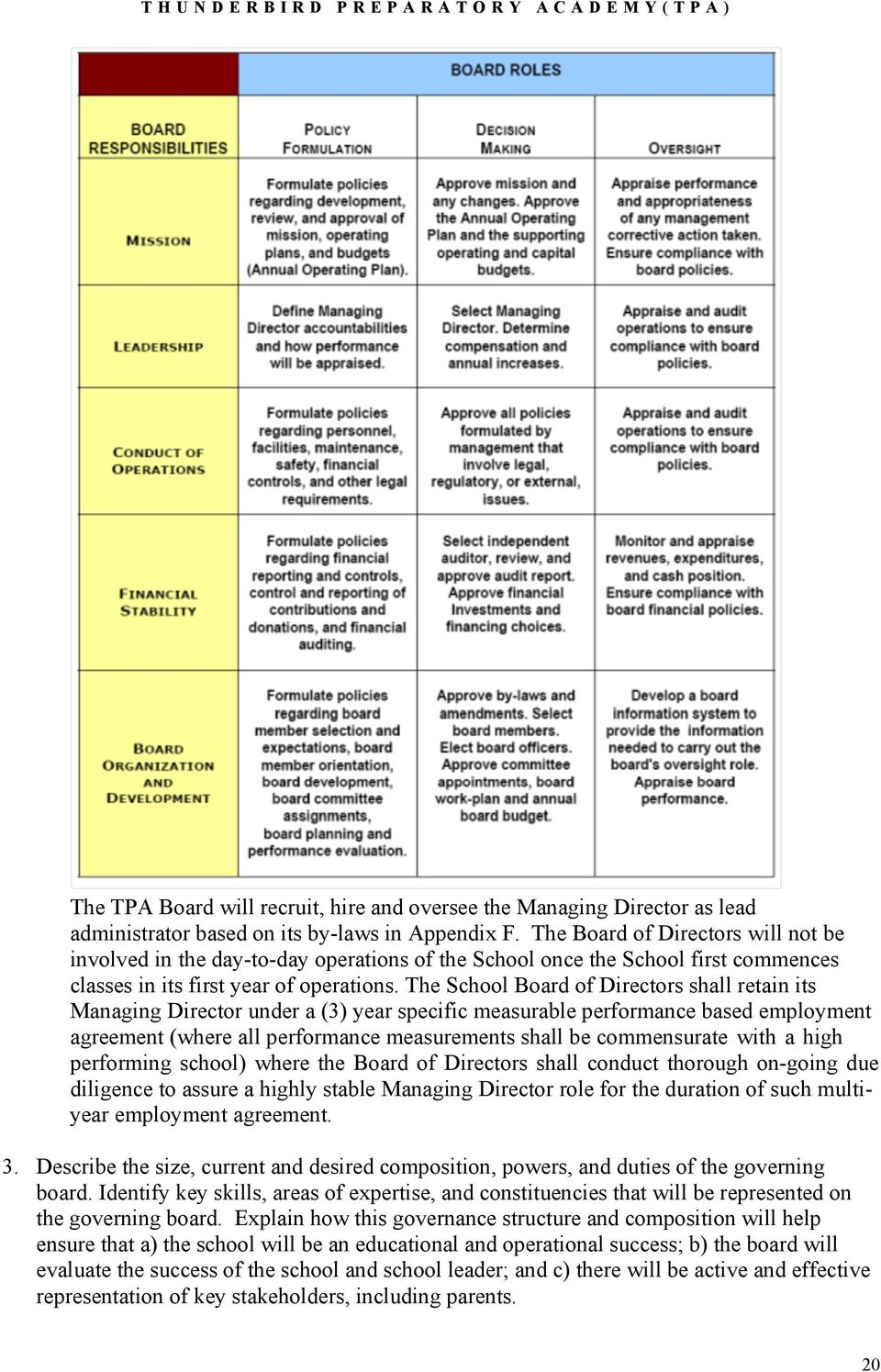
21 The following governance best practices are roughly adapted from Lake Norman Charter School. TP will be governed by a Board of Directors comprised of engaged advocates for the School Mission with diverse academic, leadership and business development backgrounds. The TP Board of Directors will be assisted by an educational consultant in establishing and maintaining an on-going development of the knowledge and skills of the Board of Directors necessary to best fill their respective roles and responsibilities to the School. The Managing Director (as TP head of school) will be responsible for the education, personnel, evaluation and business affairs of the school as specifically delegated by the Board of Directors within the policies and procedures established by the Board of Directors, including staff hiring, student oversight, teacher development and volunteer coordination. The specific duties of the Board of Directors and the Managing Director are provided in the TP By-Laws. The primary key to the success of the TP Board is the focus of the Board on their three primary roles as outlined above. The organizational relationships stated above reflect the legal authority and accountability of the TP Board. The TP Board is accountable to the State of North Carolina as well as the enduring success of its students. The TP Board will anxiously work to primarily identify with and understand school needs at the student level where School management and staff needs are always supportive of enduring student success. ll TP Board members will actively participate in all board development strategies, tactics and team activities so as to best model those constructive, collaborative behaviors expected within the school. The integrity and welfare of TP and its Mission, Vision and Strategy will be ahead of any benefit or convenience of any TP Board member. Thunderbird Preparatory cademy Board Functional Organization Chart TP Board Functional Organization Chart duties detailed above will be compressed into five (5) roles until board is formally expanded to seven (7) members. 21
22 s the school enrollment grows, the Managing Director and cademic Director roles will be supported by a Student Director and Curriculum Coach respectively. These roles together balance out the entire delivery of the School Mission so that the school can benefit from: 1) More ideas from more collaborative sources. 2) More involved and satisfied teachers/leaders in the school strategy and tactics. 3) voidance of over reliance on singular personalities and/or a detached, fragmented organization. 4) Functional staff engagement where the school leaders have to be more visionary and teach others what they are proposing rather than the typical top down vertical organization structure. 5) Flat organizations where people work best in organizations where people are the key resources. School Operating Structure * Grade Leaders represent their respective grade groups (the How and with Who this group has the primary focus on the individual student and teacher) ** Department Chairs represent core curriculum throughout all grade levels (the What and Why this group has the primary focus on pointing out the path and staying on it) assuring continuity, congruency and accountability. Balance Scorecard will be used to monitor the performance of TP in accordance with its mission and objectives. This scorecard will be reviewed quarterly to ensure that the school is true to its purposes. In addition MPS, North Carolina REDY ccountability and Iowa Basic will be used to monitor academic performance. These core metrics will be made available not only to the board but administrators to ensure all are working towards the same end and success of the school. The School Operating Structure illustrated above provides a much higher reliance on collaboration and leadership by TP staff than a more traditional administrator intensive operating structure. The School Operating Structure above has been instrumental in the academic and operational success of Lake Norman Charter School from its onset. 22
23 4. Explain the procedure by which the founding board members have been recruited and selected. If a position is vacant, how and on what timeline will new members be recruited and added to the board? The founding board for Thunderbird Preparatory cademy was formed several years ago. Three of the original five board members are still on the board. Based on the boards needs new board members were proposed, discussed and recruited. This process took place within a month of vacancies. 5. How often will the board meet? Thunderbird Preparatory cademy s By-Laws in ppendix F have established that the board meeting will occur monthly. 6. What kinds of orientation or training will new board members receive, and what kinds of ongoing professional development will existing board members receive? The plan for training and development should include a timetable, specific topics to be addressed, and requirements for participation (Board Policies Draft: ppendix H). TP will orient all board members on its By-Laws ppendix F and Board Policies ppendix H. In addition board members for ongoing professional development will need to go through the Gallup Path in order to discover their own strengths and familiarize themselves with the Leadership Education of the school via Dr. Stephen R. Covey and The Leader in Me. See ppendix F and H for topics and requirements. The board will also need to familiarize itself with the High Bar system for board governance. The following topics will be discussed yearly. 1. Key Board Roles (Oversight, ccountability, Metrics, Evaluation) 2. Review/Evaluate Specific Success Drivers (Mission, Vision, Strategic Goals) 3. Recruitment, Orientation and Retention of Board Members 4. Basic Public Finance Review for Board Members 5. Evaluation Criteria for Managing Director/School dministration 6. Developing Engaging nnual Board Retreats 7. Running Effective Board Meetings/Board Meeting Protocol 8. Board Self-ssessment/Evaluation Criteria 9. Review/Evaluate Special Education Overview, Plans and Success Measures 10. Review Board Committees (Work, Structure and Board Oversight) 11. Measure and Review Ongoing School Constituent Satisfaction 12. Developing Key Board Operating Processes (High Bar Orientation) 13. Review Legal Roles/Responsibilities of Board Members, By-Laws Policies 14. Review Hiring, Training, Professional Development, Employment Law 15. Review Staff Orientation, Development, Satisfaction and Retention 23
24 7. Describe the board s ethical standards and procedures for identifying and addressing conflicts of interest. Identify any existing relationships that could pose actual or perceived conflicts if the application is approved; discuss specific steps that the board will take to avoid any actual conflicts and to mitigate perceived conflicts. The TP Board will adhere to the Board Code of Conduct and Conflict of Interest Policies shown in ppendix H. ny Board member that violates these policies will be removed from the Board where the overall Board is required by fiduciary duty under the By-Laws to remove any offending Board member. ll TP Board Members shall be required to submit a Board Member Compliance Letter affirming their individual compliance with the Code of Conduct and Conflict of Interest Policies prior to their becoming a Board Member as well as each year thereafter. 8. Explain the decision-making processes the board will use to develop school policies. Two primary decision making concepts that the TP board will utilize are summarized below by Eugene Smoley, Jr. and Oak Capital Group. The decision making process that the TP Board will use in developing school policies will follow the following principles (Smoley, Jr., Effective School Boards, 1999):. The Board will access and use relevant information. Relevant information comes from many sources, including school staff and the community. The Board will vet information to ensure it is accurate and balanced and use the information as an efficient guide for action. To be relevant, the information should also address Board concerns such as resolving immediate crises and strengthening longer-term educational results. B. The Board will discuss issues deliberately. Board discussions are systematic, objective and open opportunities for Board members to collaboratively consider the information in context and give the time necessary to avoid forcing decisions prematurely. It also includes Board members being coached to put aside personal differences and hidden agendas and consider the merits of a particular situation or issue without prejudice. It presumes Board members are honest and forthright in their exchange of viewpoints. C. The Board considers alternative actions. This practice shows that the Board has discussed different points of view, has heard from all sides and assessed the positive and negative consequences of various choices. D. The Board works toward consensus. This step requires Board members try to find areas of commonality, tolerate differences and recognize the need for compromise in reaching agreement. The TP Board decision making process will be founded in best practice collaborative decision processes based on having clear Objectives, ctions, Risks and Resources. Each TP Board decision will be based within an effective decision making framework similar to the ORR Checklist illustrated in ppendix R-2. 24
25 9. Describe any advisory bodies, councils, or associations listed in the organization chart or to be formed, including the roles and duties of that body, and the reporting structure as it relates to the school s governing body and leadership. Thunderbird Preparatory cademy Operating Committee Organization/Duties TP BORD Vice Chair BUSINESS COMMITTEE Chair CDEMIC COMMITTEE Chair COMMUNITY RELTIONS COMMITTEE Chair STUDENT SERVICES COMMITTEE Chair COMMITTEES PPROVED BY TP BORD General School Policies General Operating Plan cademic Policies cademic Operating Plan School Marketing Students Recruitment Facilities, Equipment, Development, Maintenance Budget and Finance General Policies Personnel (HR) Curriculum/Library Student Development Evaluation/Innovation School Programs cademic/thletic Gifted/NCLB Community Relations Media Relations Technology Phones/Computers Networks Food Services Bagged Lunch Free Lunches udit and Evaluation Support for udit Committee Teacher Development Ongoing In Service Evaluation pplication/ Lottery Process Transportation Field Trips ctivity Trips 25
26 The TP Operating Committee functions as the day-to-day collaborative body between the TP Board and the TP dministration. The Operating Committee facilitates the leadership development of school administrators, school staff, prospective board members and school students where practical. The Operating Committee is the primary venue where actual leadership talents, skills and knowledge is refined by each respective adult contributor in the School and otherwise modeled for School students. The TP administrative structure will consist of the Managing Director and cademic Director and include instructional support staff to comprise the School Leadership Team. The School Leadership Team will work in collaboration with a group of parents and community members that comprise the Operating Committee. The Operating Committee, as approved by the TP Board, will be comprised of parents and community members that complement with the day-to-day roles of the School Leadership Team and not supplant the role of the School Leadership Team in leading the School day-to-day. The Operating Committee will collegially and constructively assist the Managing Director and his School Leadership Team, under the direction of the TP Board Vice-Chair and the Managing Director in fulfilling the Mission, Vision and Strategy of TP. The collaborative efforts of the School Leadership Team and the Operating Committee will be regularly facilitated each month via the monthly Operating Committee meeting to further develop and enhance the school learning environment and curriculum to further stimulate and motivate all TP students and teachers to reach excellence. The School Leadership Team will take the lead role in all Operating Committee functions required by the TP Charter and/or state law where all non-school Leadership Team members on the Operating Committee shall function in supporting roles wherever deemed appropriate by the Managing Director and the TP Board Vice-Chair. The combined Operating Committee and School Leadership Team s topics of focus will include the following areas: curriculum development selection and organization of materials implementation of research-based instructional strategies horizontal and vertical articulation of curriculum and instruction data analysis for student and school improvement staff development mentoring, coaching of teaching staff media services coordination special education services coordination parental involvement technology integration service learning character education guidance services for students testing coordinator student assessment coordination scheduling See TP By-Laws and By-Law Exhibits in ppendix F. The Operating Committee concepts variously adapted from Lake Norman Charter School and Wells Fargo Corporation. 26
27 Governance and Organizational Structure of Private Non-Profit Organization (continued) Include in the ppendices: 10. one-page resume from each founding board member and responses to the questions found on the Charter School Board Member Form (ppendix E). 11. The proposed by-laws, which must include a Conflict of Interest Policy for board members and a stated commitment to the NC Open Meetings Law (ppendix F). 12. copy of the articles of incorporation, if available. If not available, this document must be available prior to interview by SBE, the applicant must demonstrate that it has been applied for prior to submission of the proposed application. (ppendix G) 13. Copy of any board policies if adopted already (ppendix H). 14. Copies of meeting minutes (if available), relevant to the development of the charter school plan, during the application process (ppendix I). Proposed Management Organization (Educational Management Organization or Charter Management Organization) If the proposed school does not intend to contract with an education service provider, mark Not pplicable and follow the direction #3 in the pplication Specifications. Not pplicable Private School Conversions: complete ONLY if the proposed charter is a private school conversion. Otherwise, mark Not pplicable and follow the direction #3 in the pplication Specifications. Not pplicable Charter School Replication: complete ONLY if the proposed charter is a replication of an existing charter school. Otherwise, mark Not pplicable and follow the direction #3 in the pplication Specifications. Understand that the replication means that a new charter school will be governed separately from the charter school the application is modeled after. Not pplicable Projected Staff: Provide, as ppendix K, a list of positions anticipated for the charter school; (e.g., principal or director; finance officer, administrative support staff; teachers (part-time and full-time); paraprofessionals/teaching assistants, clerical, and maintenance.). Be mindful that your predicted administration and staff match the projected enrollment noted in Section I and align with the proposed budget. Staffing Plans, Hiring, and Management The following is adapted from York Preparatory cademy Include the following information for the proposed charter school: 1. Explain the board s strategy for recruiting and retaining high-performing teachers. 27
28 The Board will utilize the Gallup Path for recruiting and retaining high-performing teachers. High teacher professional development is a primary driver of the academic success model. The Gallup Path is the research based sequence of identifying, developing and reinforcing the talents (strengths) of all individuals within in an organization. The Gallup Path is primarily sequenced as follows: Strength Identification (Teachers and dministrators) Best Fit (Teachers and dministrators) Great dministrators Engaged Teachers Engaged Students Sustainable Teacher/Student Growth Measurable Outcomes Value to the Community The ultimate core outcome of any successful, enduring organization is the active engagement of all its constituents, particularly its staff. ctive engagement is the core objective of all Gallup talent development processes. will actively seek to practically apply all Gallup engagement processes within its professional development of all administrators, teachers and other staff. 2. Provide a description of the relationship that will exist between the charter school employees and the nonprofit board. Provide as ppendix L, a draft of the employment policies to be implemented by the proposed charter school. ll charter school employees will be hired by the Managing Director under the direct approval/oversight of the Board as required by North Carolina law. ll charter school employees will generally be at-will employees except where certain core administrators shall be retained under an employment agreement. 3. Outline the board s procedures for hiring and dismissing school personnel, including conducting criminal background checks. Recruitment and hiring of professional personnel will transpire on the basis of qualifications and merit. The TP Board will establish an effective recruitment program designed to attract, secure, and maintain the highest qualified persons for all positions where TP will be an at-will be an equal opportunity employer. The TP Board will have the ultimate responsibility in assuring that all recruiting, selection, training, and other employment decisions will occur on the basis of individual merit and without discrimination because of race, religion, color, creed, disability, sex, age, or national origin in accordance with applicable state and federal laws. ll TP job announcements and advertisements may also include where applicable such information as job title, major job responsibilities, location of the school, how to apply for the position, minimum qualifications, and deadline for receiving applications. Each TP job applicant will provide an application form, North Carolina teaching credential, and three professional references. The TP Board will ensure that background checks and other investigations required by law are conducted prior to any hiring decision. The TP Board also reserves the right to conduct background checks on all employees or any individuals that have any contact with students. TP will be a drug free 28
29 workplace and in accordance will require pre-employment drug testing of all employees and maintains the right to perform random drug tests according to laws and policy to be set forth by the TP Board. pplications of candidates meeting all local, state, and federal guidelines for public school employment will be given to the Managing Director. ll hiring interviews will be initially conducted by the Managing Director in order to provide recommendations for hiring to the TP Board. The Managing Director will finalize recommendations for employment of the faculty and staff with all final hiring decisions made by the TP Board. The TP Board will have the final approval in any personnel decisions. 4. Outline the school s proposed salary range and employment benefits for all levels of employment. TP anticipates employment salary ranges of $32,000 to $50,000 for teachers, $30,000 to $40,000 for staff and $50,000 to $90,000 for administrators. TP will initially offer health insurance only as employee benefits with life insurance, 403(b) retirement plans, and disability insurance offered as employee funded benefits under group policies where practical. School retirement fund matching will be offered as the school becomes more financially established similar to other new charter school employment offerings. 5. Provide the procedures for employee grievance and/or termination. The following is from ppendix L Employee Handbook for employee grievance. Procedure 1. n aggrieved employee should first take the matter up orally with the Managing Director within three hundred days after the occurrence or the employee s knowledge of the event giving rise to the grievance. Whenever possible, the grievance should be resolved at this level through informal discussions. The Managing Director will give his or her oral decision to the aggrieved employee within ten days of receiving the grievance. 2. If the grievance is not settled as provided for in above, the employee may, within ten working days of receiving the Managing Director s decision, present his/her grievance orally to the Board. Whenever possible, the grievance should be resolved at this level through informal discussions. The Board will give its oral decision to the aggrieved employee within ten days of receiving the grievance. 3. If the grievance is not settled as provided for above, the employee may within ten working days of receiving the Board s decision, present his/her grievance in writing to the Board, explicitly stating the facts, the relief sought, and requesting an opportunity to present his/her case in person, and conduct whatever investigations necessary to aid in resolving the grievance. The Board will make a decision in the matter and advise the employee of such, in writing, within fifteen (15) working days after receiving the written grievance. 4. t each step of the grievance process, if the aggrieved employee does not take his or her grievance forward in the time frame designated, the grievance is considered resolved. t each step of the grievance process, if the aggrieved employee does not 29
30 receive a response in the time frame designated, the grievance be considered denied and the aggrieved employee may proceed to the next step. rbitration In the event a grievance cannot be settled under the procedure outlined above, the employee or the school has the right to take the matter to arbitration. rbitration proceedings must be initiated by filing a written request for arbitration with the other party within ten days after the Board s final decision. Termination TP retains the discretion at all times to immediately terminate an employee or to decide what level or type of discipline is warranted, if any. Employees of TP are at-will employees and can be terminated at any time, without resorting to any type of discipline. TP does not have to use any of the following steps of discipline, and does not have to use them in any particular order, but retains the discretion at all times to determine the nature and severity of discipline and/or termination. 6. Identify any positions that will have dual responsibilities (within or without the organization) and the funding source for each position. The TP Board is not aware of any dual responsibilities at TP. 7. Describe the plans to have qualified staffing adequate for the anticipated special needs population, means for providing qualified staffing for ELL and gifted students. i. TP will comply with the Individuals with Disabilities Education ct, Section 504 of the Rehabilitation ct, and the mericans with Disabilities ct. TP will staff needed certified EC teachers to facilitate the needs of students deemed in need of IEP assistance either via student transfer with an existing IEP or through the RTI process. These teachers will assist in the development, planning, and screening of EC students or prospective EC students. ll students identified as qualifying for services under IDE or 504 will be referred by the parent or teacher to either the Managing Director or cademic Director. team composed of the student s teachers, parent/guardians, student, and Managing Director or cademic Director (IEP / 504 Team) will convene to discuss the educational program designed to meet the individual student s needs. Methods of evaluation of current skill levels may include prior test results, grades, portfolio assessments, standardized tests, observations and teacher recommendations. These possible variances in performance are not limited to academic area, but may include social or emotional factors. Corrective action plans, including intervention by the school staff, will be developed in cooperation with the parents. The team will determine if the student needs to attend mandatory after-school tutoring to remediate the problem, and/or if the student requires the services available under section 504 or IDE. ii. s identified by the legislation, an Individual Educational Plan (IEP) will be developed for each special education student. IDE requires that students by the age of 14 be provided with an annual meeting for the purpose of discussing possible transition services. The school shall invite the parent and a student of any age with a disability to attend the IEP meeting if the purpose of the IEP meeting will be the consideration of 30
31 transition services. This may include discussion concerning what the student wants for his or her future, what needs or challenges are perceived as barriers to reaching student goals, and what accommodations and supports will aid the student s efforts. nnual goals, short term objectives, statement of interagency responsibilities, statement of participation in state and district-wide tests and a list of special education and related services to be provided will be a part of the IEP. The IEP/ 504 Team for the student will determine if services outside the school are required for a student. iii. If such services are deemed appropriate, the IEP / 504 Team and the school administration will make arrangements for the services to be secured. Some of these possible services to be secured may include speech, assistive technology, transition services, mental health, and vocational rehabilitation. Such services will be obtained by TP through qualified local providers and such mainstream services will be paid for (if any) by TP. ssistive technology and transition services will be met in accordance with federally mandated laws, Section 504, IDE, and D. Staff Development training will occur, if needed, to assist the student in using his/her assistive technology devices. The records of students identified as eligible for services through IDE or 504 follow federal mandates. These records become a part of the student s permanent file that is maintained in a highly secure and fire proof area. TP will provide adequate staffing to fulfill the above special needs students. ELL and gifted students will also have adequate staffing respectively based on federal and state mandates for those students. 8. Provide a narrative detailing the roles and responsibilities, qualifications and appropriate licenses that each position must have to be hired by the non-profit organization and effectively perform the job function(s). Classroom and elective teachers need valid North Carolina teaching credentials, nurses shall have LPN or RN licenses, teachers for all special education students shall have all appropriate North Carolina exceptional children credentials, teachers for gifted students shall have all gifted student credentials. Staff Evaluation and Professional Development 1. Identify the positions responsible for maintaining teacher licensure requirements and professional development. The Managing Director and cademic Director both need to be involved with teacher licensure to ensure checks and balances. Professional development oversight will also include the Managing Director and cademic Director to approve scheduling and the development path. 2. Provide a detailed plan noting how the school will mentor, retain, and evaluate staff in a format that matches the school s mission, educational program, and meet the teacher certification and licensure requirements for teachers as prescribed by state law and No Child Left Behind. Be sure this overview matches with the projected staff and funding of the proposed budget section. 31
32 TP shall actively comply with all requirements for highly qualified teachers as provided in The No Child Left Behind ct of 2001 (NCLB). Thunderbird Preparatory cademy will emphasize the importance of teacher quality and their development as a crucial factor in improving student achievement. We understand that NCLB requires that we ensure that public elementary school teachers are highly qualified to teach the basic elementary school curricula, and that middle school teachers are highly qualified to teach each core academic subject teaching assignment. The core academic subjects are defined as the following: English, reading or language arts, mathematics, science, foreign languages, civics and government, economics, history, geography, and fine arts. TP will evaluate teachers by regular classroom visitations. Master Teachers will be paired with newer teachers to help in mentoring and guidance. Recruitment and hiring of professional personnel will transpire on the basis of qualifications and merit. TP will establish an effective recruitment program designed to attract, secure, and maintain the highest qualified persons for all positions at Thunderbird Preparatory cademy. TP will be an equal opportunity employer. Its responsibility will include recruiting, selection, training, and other employment decisions on the basis of individual merit and without discrimination because of race, religion, color, creed, disability, sex, age, or national origin in accordance with applicable state and federal laws. Individuals designated by the TP Board will analyze each required job prior to initiating the recruitment process in order to determine which recruitment strategies will be the most effective for the specific job vacancy. 3. Discuss the core components of professional development plan and how these components will support effective implementation of the educational program. Discuss the extent to which professional development will be conducted internally or externally and will be individualized or uniform. The core components of professional development are extensive strength based Gallup seminars to identify teacher strengths. These trainings will be conducted both internally and externally by experts. The Gallup Student Poll supplies teachers, administrators, and school leaders with an accurate, useful, and holistic picture of their students and the outcomes they desire. Research by The Gallup Organization shows that hope, engagement, and well-being are positioned as actionable targets and indicators of student success, with associated impacts on student grades, achievement scores, retention, and future employment. The Gallup Student StrengthsFinder ssessment is based on the premise that individual student success is the core of any great school. The Gallup strengths-based approach to student development helps educators, leaders, adults, and students understand the unique talents of every child. Rooted in the science of Positive Psychology, strengths-based student development begins with the assumption that every child is talented in his or her own special way. The Gallup Path enables students to develop these natural patterns of thought, feeling, and behavior - their talents - through the StrengthsExplorer and StrengthsQuest tools. Students are given a report of their top themes of talent along with action items to help build their talents into true strengths. 32
33 Measures of cademic Progress (MP) is a state-aligned computerized adaptive assessment program that will provide TP teachers and parents the information needed to improve teaching and learning. TP teachers will use the growth and achievement data from MP to develop targeted instructional strategies and to plan school improvement. With the ability to test students up to three times a year, TP MP test results will enable the teachers to make student-focused, data-driven decisions. Teacher s will also be made familiar with Covey Leadership principles to help turn Teacher s strengths into skills. There will also be ongoing three hour collaborative planning sessions usually on Mondays with other Teachers each week. 4. Provide a schedule and explanation of professional development that will take place prior to school opening. Explain what will be covered during this induction period and how teachers will be prepared to deliver any unique or particularly challenging aspects of the curriculum and instructional methods. There will be a teacher orientation before the beginning of the school year to train teachers in the Mission, Goals and Leadership Culture of the school. They will go through Gallup Path and be taught the Leadership Principles by Covey. Teachers will be required to follow the core curriculum (Core Knowledge Series); however, they will be encouraged to present that curriculum in a variety of ways through differentiated instruction. Six instructional strategies will be utilized throughout all subject areas: integrative units, small group activities, product-based learning, classroom workshop, authentic experience, and reflective assessment. ll units of study will be built around these foundations of successful instruction. 5. Describe the expected number of days/hours for professional development throughout the school year, and explain how the school s calendar, daily schedule, and staffing structure accommodate this plan. Teachers will receive Professional Development at the beginning of the year for three days. In addition they will receive 3 Hours every week to collaborate with colleagues regarding Gallup, Covey s Leadership Skills and Core Knowledge. These best practices will ensure TP will accomplish its mission through its teachers. Enrollment and Marketing: Reaching the full capacity for enrollment will be critical to obtain the necessary financial resources to keep your school viable and operating efficiently. In addition, it is required by law that charter schools provide equal access to all students. Read the charter school state statute regarding admissions GS 115C F(g) (1-7) carefully. Marketing Plan Marketing to potential students and parents is vital to the survival of a charter school. Provide a plan indicating how the school will market to potential students and parents in order to reasonably reflects the racial/ethnic and demographic composition of the district in which the charter school will be located or of the special population the school seeks to serve: (G.S.115C F(g)(5)). 33
34 TP has already begun its marketing plan for its demographic. This marketing plan includes several components that will reach the largest audience possible for the amount of resources it has. This strategy includes Facebook, Websites, Newspaper dvertisements, Public Community Meetings and Word of Mouth referrals. Please see ppendix for some examples of TP s marketing materials. Parent and Community Involvement 1. Describe how you will communicate with and engage parents and community members from the time that the school is approved through opening. Parent, community, and educator involvement will be an essential component of the school. s the influence of the home directly impacts the student s well-being and academic motivation, TP will strive to facilitate, encourage and compliment a high standard of volunteer parental involvement. TP will plan explicit fundamental strategies to actively engage families, community members, and educators from the onset of conditional charter by the North Carolina State Board of Education including: 1. TP will continue to recruit interested students via its website, Facebook presence and public advertisements. ll parents of interested students will receive periodic mailings to keep all informed of the progress of TP through its lottery process, administrator/teacher hiring process and facility announcements. 2. TP will sponsor various public charter approval events that celebrate the approval milestone. Charter approval events may include an outdoor ice cream social, community gatherings, prominent speaker appearance, or any other low cost, high contact events that raise the profile of TP. 2. Describe how you will engage parents in the life of the public charter school. Explain the plan for building engaging partnerships between the family and school that strengthen support for student learning. TP will plan specific strategies (based on TP leadership principles described in this charter application) with its Operating Committee to actively engage families, community members, and educators. key principle of developing collaborative organizations is the manner in which people can provide meaningful contributions to the overall organization. Parental, student and staff engagement grows in direct proportion to how effectively they are allowed to contribute. While there are various proven strategies, activities and processes that can be listed here to describe the what of engagement, the crucial process revolves around the how. For the sake of a concise response and in keeping with the importance of spontaneous collaboration that can take various paths from Operating Committee input, the TP Board will work with the School Leadership Team and the Operating Committee to develop overall parental support guidelines, which will include the following: 1. ll parents will be essential participants in the growth, accountability, and overall success of their children and will therefore be strongly encouraged to contribute volunteer hours along with staff and community members during both regular operational hours as well as special events. 34
35 2. Constructive parental concerns and recommendations will be encouraged for the improvement of TP. 3. Mandatory parent-teacher conferences will include students and will occur on a regular basis. Teachers will be flexible to allow conferences to be held at times and dates convenient for parents. Parents will receive an accurate picture of their child's progress and have a constructive venue to regularly provide their context and input for the overall success of their child. Together, parents, teachers, and students will establish learning goals that help the student achieve at the highest levels. Collaborative goal setting will develop a true partnership and sense of ownership for success. dmissions Policy Roughly dapted from Lake Norman Charter School Provide the school s proposed policies and the procedures for admitting students to the proposed charter school, including: 1. Tentative dates for application period; enrollment deadlines and procedures. TP will begin advertising for student enrollment application on October 15, 2013 and each October 15 thereafter. The enrollment deadline for TP will be February 15, 2013 and each February thereafter. ll enrollment applications may be submitted either paper application (blank forms will be made available at Mecklenburg County public facilities) or by website electronic enrollment. ll student enrollment applications will be received and processed by the Managing Director of TP. Media advertisements and public announcements will clearly state how or where applications are available and the deadline for receipt of completed applications. 2. Clear policies and procedures detailing the open enrollment lottery plan including policies regarding statutory permitted student enrollment preferences. If the number of applicants exceeds the capacity of a program, class, grade level or building, a lottery process will be used to determine enrollment. The lottery will be held no later than March 15 prior to the beginning of the school year. The names of each applicant will be placed on an index card. Each name on the index card will be verified against the application for accuracy. The individual index card will be placed in a box. ll index cards placed in the box will be shuffled. n individual with no professional or business relationship to Thunderbird Preparatory cademy will randomly select index cards from the box. The name of the student will be announced and assigned a lottery number. This number will be recorded on the index card and the application. This information will also be recorded on a ledger. This process will continue until all index cards have been drawn and recorded. The names drawn in lottery number order equaling the enrollment openings will be placed on the class roster. The remaining names will be placed on a waiting list in their lottery order number. The above lottery process will be repeated for all grade levels. 35
36 Class rosters for each grade level will not be finalized until the lottery process for K thru 8 grades is complete. If feasible, after the first year of operations, the lottery will be conducted via an auditable, statistically valid computer program. (Feasibility will be determined by the board on the basis of technical merit of the proposed lottery system and acceptability to the TP community.) TP will give priority enrollment to existing students (after year one), any or all siblings of a pupil already admitted, students of a charter school administrator, teacher or teacher assistant as provided by North Carolina law, and children of a founding board member (first year) as permitted by North Carolina state law. n enrollment spreadsheet will organize all students and siblings assuring a transparent and documented enrollment process to ensure fair and legal entrance to TP. 3. Policies and procedures for student waiting lists, withdrawals, re-enrollment, and transfers. TP will maintain a student wait list for all students not immediately chosen in the lottery process above. Such wait list shall be maintained for the duration of the TP school year based on TP admission policies. If a student chooses to withdraw from the school, a parent/guardian will be asked to fill out a withdrawal form stating the effective date and school where students records should be sent. If a school name is provided, TP will transfer the student s records, otherwise TP will wait until a request for records is received. ny transfers into TP shall be subject to TP enrollment policies, enrollment application process, enrollment lottery and North Carolina law governing inbound transfer students. If a student fails to show during the first 10 days of school, TP will make every effort to contact the parent/guardian to determine if the student is attending a different school. If during the 10 day period a request for records transfer is received, TP will try to contact the parent/guardian to confirm the request before transferring the student s records. 4. Explanation of the purpose of any pre-admission activities (if any) for students or parents. TP will hold orientation meetings for all prospective TP parents and students so as to establish clear expectations and objectives within the TP charter. 5. Clear policies and procedures for student withdrawals and transfers. If a student chooses to withdraw from the school, a parent/guardian will be asked to fill out a withdrawal form stating the effective date and school where students records should be sent. If a school name is provided, TP will transfer the student s records, otherwise TP will wait until a request for records is received. ny transfers into TP shall be subject to TP enrollment policies, enrollment application process, enrollment lottery outcomes, TP student enrollment wait list totals and North Carolina law governing inbound transfer students. If a student fails to show during the first 10 days of school, TP will make every effort to contact the parent/guardian to determine if the student is attending a different school. If during the 10 day period a request for records transfer is received, TP will try to contact the parent/guardian to confirm the request before transferring the student s records. 36
37 IDENTIFY LE FROM WHICH STUDENTS WILL PROBBLY COME LE #1 Mecklenburg (100%) LE #2 N LE #3 N LE 1 THUNDERBIRD PREPRTORY CDEMY(TP) PROJECTED ENROLLMENT through In the following tables, please list for each year and grade level, the numbers of students that the school reasonably expects to enroll. In addition, please indicate any plans to increase the grade levels offered by the school over time and be sure these figures match those on the initial cover page LE LE LE LE LE LE LE LE 1 LE LE LE LE L E 2 LE 3 K 100 N N 100 N 1 st 96 N N 96 N 2 n d 96 N N 96 N 3 r d 96 N N 96 N 4 th 100 N N 100 N 5 th N N N 108 N 6 th N N N N N 7 th N N N N N 8 th N N N N N 9 th N N N N N 10 th N N N N N N 100 N N 96 N N 96 N N 96 N N 100 N N 108 N N 108 N N 108 N N 108 N N N N N N N N 100 N N 100 N N N 96 N N 96 N N N 96 N N 96 N N N 96 N N 96 N N N 100 N N 100 N N N 108 N N 108 N N N 108 N N 108 N N N 108 N N 108 N N N 108 N N 108 N N N N N N N N N N N N 11 th N N N N N 12 th N N N N N N N N N N N N N N N N N N N N N
38 Transportation Plan: THUNDERBIRD PREPRTORY CDEMY(TP) Describe in detail the transportation plan that will ensure that no child is denied access to the school due to lack of transportation. The details of this plan should align with the Mission, identified need for the charter school, targeted student population, and the budget proposal. TP does not anticipate providing route school bus transportation. TP transportation practices will materially mirror those of surrounding north Mecklenburg charter schools (Community School of Davidson and Lake Norman Charter School). TP will actively advertise to parents in the TP enrollment process that TP will facilitate transportation for students not otherwise able to attend TP. Families will provide their own carpool transportation. TP will provide a carpool assistance committee, helping parents arrange carpools to ease transportation needs. Extenuating circumstances preventing carpool transportation will be addressed by the Managing Director and presented to the Board of Directors for their approval. The TP proposed budget includes contingency funds to assure student transportation arrangements are possible in extraordinary situations as approved by the Board of Directors and according to North Carolina state law. Transportation shall not be an obstacle to any child attending this school. School Lunch Plan: Describe in detail the school lunch plan that will ensure that no child is lacking a daily meal. The details of this plan should align with the targeted student population and school budget proposal. The TP lunch program will be created and operated under the auspices of the TP Operating Committee staffed by parent volunteers. TP will not have a cafeteria. Each TP student will bring their own healthy lunch (snack where appropriate) from home. Lunch at TP will be eaten picnic style in school classrooms. Parent volunteers will watch classes at student lunch periods and during student recess after lunch. Students in grade levels K-2 will also have a morning snack break. Lunch will be offered every full school day at the school by school approved outside vendors and must be pre-ordered via parent/teacher orders. Outside lunch vendors will be identified, screened and managed by a designated member of the Operating Committee. Children in economic need will have a lunch provided by the school by the same outside vendor lunch order process described above. TP has budgeted $36,000 in its first operational year for lunches for students in economic need. Civil Liability and Insurance (GS 115C F(c)): The Charter School shall obtain and maintain insurance at a minimum in the following amounts: 1. Errors and omissions: One million dollars ($1,000,000) per claim; 2. General liability: One million dollars ($1,000,000) per occurrence; 3. Boiler and machinery: Replacement cost of the building; 4. Real and personal property: ppraised value of the building and contents; 5. Fidelity bonds: No less than two hundred fifty thousand dollars ($250,000) to cover employee dishonesty; 6. utomobile liability: One million dollars ($1,000,000) per occurrence; and 7. Workers compensation: s specified by Chapter 97 of the General Statutes.
39 rea of proposed coverage Proposed amount of coverage Cost (Quote) Comprehensive General Liability 2,000, Officers and Directors/Errors and Omissions 1,000, Property Insurance 4,000,000 10, Motor Vehicle Liability 1,000, Bonding Minimum/Maximum mount 1,000, , Other 500,000 41, Total Cost 64, *The applicant must provide a quote from an insurance provider as part of this application (as ppendix M) to demonstrate the levels of insurance coverage and projected cost. Health and Safety Requirements: 39
40 Facility: Note that the SBE may approve a charter school prior to the school s obtaining a facility; however, students may not attend school and no funds will be allocated until the school has obtained a valid Certificate of Occupancy for Educational use to the Office of Charter Schools. What is your plan to obtain a building? Identify the steps that the board will take to acquire a facility and obtain the Educational Certificate of Occupancy. If a facility has been identified please fill out the Facility Form (ppendix N). The TP Board has developed the following Building Timeline to summarize all key facility planning and acquisition milestones. The TP Building Timeline provides a key action item list for facility planning typically used by commercial organizations in their facility development and acquisition process. Each action item below will include the entire TP Board in an oversight role where only one Board member will lead the actual day-to-day facility acquisition roles for the benefit of the entire board. Thunderbird*Preparatory* cademy* Building*Timeline* May* 13* June* 13* July* 13* ug* 13* Oct* 13* Feb* 14* Mar* 14* July**** 14* ug* 14* Facility*Financing*Options* O * Land/Lease*DueCDiligence* O ** Land/Use*Plan*Design* O * Land/Lease*Contract* O ** Land*Purchase* O ** Community*nnouncement/PR* O ** Building*Site*Prep* O ** Building*Design* O ** Building*Permitting* O ** Building*Construction*Start* O ** Certificate*of*Occupancy* O ** School*Opening* O ** Facility Contingency Plan: Describe the method of finding a facility if the one the board has identified will not be ready by the time the public charter school will be opening. Include 40
41 information regarding the immediate spatial needs of the school and identify any programs that will not be immediately offered because a permanent facility has yet to open. The TP Board will develop various facility possibilities that are mutually exclusive wherever possible. The TP Board anticipates as many as three viable options can be fully developed based on preliminary due-diligence already completed by the TP Board. Overall TP facility plan may be finalized as early as June 2013 but not later than July The TP Board does not anticipate that any school programs will be affected in the event a permanent facility is not secured. 41
42 VI. FINNCIL PLN In#the#following sections present a detailed description of assumptions and revenue estimates, including but not limited to the basis for revenue projections, staffing levels, and costs. The narrative should specifically address the degree to which the school budget will rely on variable income.# Budget: Revenue Projections from each LE SHOW CLCULTIONS FOR FIGURING STTE ND LOCL DOLLRS FOR THE PROPOSED CHRTER SCHOOL The formula for figuring these allotments can be found in the Resource Manual Finance Section. See Charter School Dollars per DM on the following link for per pupil allotments by county. ll per pupil amounts are from the year and would be approximations for Federal funding is based upon the number of students enrolled who qualify. The applicant should use caution when relying on federal funding in year one to meet budgetary goals. These revenue projection figures do NOT guarantee the charter school would receive this amount of funding in For local funding amounts, applicants will need to contact their local offices or LE. LE #1 ( Mecklenburg - LE 600 ) Revenue Per Pupil Funding Projected LE DM pproximate funding for State Funds 4, ,165,939 Local Funds 2, ,216,879 Federal EC Funds Totals 3, ,145 3,528,961 LE #2 ( N/ ) Revenue Per Pupil Funding Projected LE DM pproximate funding for State Funds N/ N/ N/ Local Funds N/ N/ N/ Federal EC Funds N/ N/ N/ Totals N/ 42
43 Total Budget: Revenue Projections through Thunderbird Prep - Budget Constant Dollars CR Size DM DM DM DM DM Kindergarten First Grade Second Grade Third Grade Fourth Grade Fifth Grade Sixth Grade Seventh Grade Eight Grade Ninth Grade - - Tenth Grade - Eleventh Grade Twelth Grade Number of Students - Total State DM Funds $4, $4, $4, $4, $4, Local Per Pupil Funds $2, $2, $2, $2, $2, Exceptional Children $3, $3, $3, $3, $3, State DM Funds $2,165, $2,645, $4,083, $4,083, $4,083, Local Per Pupil Funds $1,216, $1,486, $2,294, $2,294, $2,294, Exceptional Children 8.0% $146, $178, $275, $275, $275, Total Income 3,528, ,309, ,652, ,652, ,652, ,231 7,231 7,231 7,231 7,231 Working Capital Cash on Hand $336, $578, $950, $1,301, $1,611,
44 Personnel Budget: Expenditure Projections through Expenses: dministrator 1 98,000 98,000 98,000 98,000 98,000 ssistant dministrator(s) 1 65,000 65, , , ,000 Finance 1 80,000 80,000 80,000 80,000 80,000 Office Manager 1 50,000 50,000 50,000 50,000 50,000 Core Teachers 21 36, , ,000 1,332,000 1,332,000 1,332,000 Electives/Specialty Teachers 4 40, , , , , ,000 EC Teachers 3 42, , , , , ,000 Librarian(s) 1 32,000 32,000 85,000 85,000 85,000 Guidance 35,000 70,000 70,000 70,000 Teacher ssistants 5 20, ,000 68,000 68,000 86,000 86,000 Contracted Personnel (Psych, Speech) 2 80, , , , ,000 Custodian 1 30,000 30,000 50,000 50,000 50,000 Maintenance 1 35,000 35,000 60,000 60,000 60,000 Food Service Staff 1 10,000 10,000 25,000 25,000 50,000 Bus Driver 1 23,000 23,000 50,000 50,000 50,000 Staff Supplements/Stipends 18,000 23,000 23,000 23,000 23,000 Professional Development 100, , , , ,000 Other Total Personnel 42 1,763,000 2,197,000 3,183,000 3,283,000 3,350,000 44
45 Operations Budget: Expenditure Projections through Operating Expenses Employee Benefits Health Insurance 163, , , , ,900 Retirement Plan Life Insurance Disability Medicare 16,830 20,970 30,430 31,430 32,100 Social Security 16,830 20,970 30,430 31,430 32,100 Other Payroll Burden 168, , , , ,000 Books and Supplies Instructional Materials 18,000 21,984 33,934 33,934 33,934 Curriculum/Textbooks 80,000 40,000 40,000 50,000 50,000 Copy Paper 36,000 43,967 67,869 67,869 67,869 School Supplies 18,000 21,984 33,934 33,934 33,934 Testing Supplies 25,000 30,000 47,131 47,131 47,131 Other Classroom Supplies 18,000 21,984 33,934 33,934 33,934 Technology Hardware 20,000 10,000 80,000 20,000 20,000 Instructional Software 18,000 5,000 35,000 10,000 10,000 Network/Internet 18,000 18,000 18,000 18,000 18,000 Office Software 6,000 6,000 6,000 6,000 6,000 Other Technology 12,000 12,000 12,000 12,000 12,000 Human Resources Legal Counsel 10,000 25,000 40,000 40,000 40,000 PowerSchool 45,000 45,000 45,000 45,000 45,000 Personnel Software 12,000 15,000 18,000 18,000 18,000 Rents and Debt Service Facility Lease/Mortgage 480, ,000 1,200,000 1,200,000 1,200,000 Equipment Rent 13,000 15,877 24,508 24,508 24,508 Maintenance 26,000 31,754 49,016 49,016 49,016 Security/larm 16,000 16,000 16,000 16,000 16,000 Extermination 6,000 6,000 8,000 8,000 8,000 Custiodial Supplies 24,000 29,311 45,246 45,246 45,246 Utilities Phone 4,000 4,000 5,000 5,000 5,000 Energy (Gas) 18,000 18,000 22,000 22,000 22,000 Electric 24,000 24,000 30,000 30,000 30,000 Water/Sewer/Trash 12,000 12,000 15,000 15,000 15,000 Other 45
46 Insurance 28,000 28,000 36,000 36,000 36,000 Marketing Plan 10,000 10,000 10,000 10,000 10,000 Transportation Plan 24,000 24,000 48,000 48,000 48,000 Food Plan 36,000 43,967 67,869 67,869 67,869 Travel Expense 7,000 7,000 7,000 7,000 7,000 Total Support Expenses 1,429,760 1,628,568 2,724,803 2,669,603 2,681,543 Total Expenses 3,192,760 3,825,568 5,907,803 5,952,603 6,031,543 Net Surplus (Deficit) From Operations 336, , , , ,418 Overall Budget: BUDGET OPERTIONS EXPENDITURE PROJECTIONS TOTL EXPENDITURES (PERSONNEL) TOTL EXPENDITURE (OPERTIONS) TOTL EXPENDITURES TOTL REVENUE NNUL NET PROJECTIONS 1,763,000 2,197,000 3,183,000 3,283,000 3,350,000 1,429,760 1,628,568 2,724,803 2,669,603 2,681,543 3,192,760 3,825,568 5,907,803 5,952,603 6,031,543 3,528,961 4,309,961 6,652,960 6,652,960 6,652, , , , , ,418 46
47 Budget Narrative: (No more than one and a half pages) Best Practices Budget Process dapted From Lake Norman Charter School and York Preparatory cademy Please include additional information that showcases all assumptions for your budgetary calculations. 1. Describe the budgetary projections and explain the analysis utilized to project these specific enrollment figures. If your budget projections are lower than anticipated, how will the school adjust this budget and what is the determined break-even point for student enrollment? TP budget criteria include: 1) classroom sizes smaller than or approximating Mecklenburg County LE, 2) master/apprentice teacher staffing model where proven teachers can excel professionally through extensive professional development and achievement, 3) efficient use of technology/curriculum resources, and 4) budget surplus or contingency always approximates 9-10% annually. The budget surplus serves as a contingency for negative variances in enrollment, exceptional children needs, transportation needs and/or any other school events reasonably beyond normal budgeted programs. The contingency funds stated above may also be needed to augment contract education services which may consist of possible [education] services include[ing] speech, assistive technology, transition services, mental health, and vocational rehabilitation as stated in the Exceptional Children Educational Programming Section Paragraph 2, above. TP has reviewed various charter school start-up cost scenarios within several financially stable charter schools. Those costs have been contemplated and are included in the budget above. The Static Break-Even nalysis calculated below would be a starting point for any right sizing of the overall TP operations in the event of any extraordinary negative enrollment variances. ny viable right sizing analysis is always based more on real time Dynamic Break-Even calculations which take into consideration real revenue components tied to specific costs (actual classroom enrollment relative to teaching staff needed to viably serve those students at that enrollment level). nnual Revenues Required for Static Break-Even on a Cash Flow Basis: Total Fixed Expenses 1,194,738 BE Revenues Contribution Margin 66% = $1,798,762 = 249 Students 2. Describe the systems and processes by which the school will manage accounting, purchasing, payroll, and audits. Specify any administrative services expected to be contracted for the school, and describe the criteria and procedures for the selection of contractors The Board of Directors of TP will explore and implement the best options for managing the business affairs of TP. t a minimum, the TP Board will implement best practice accounting, purchasing, payroll and audit policies and procedures (collectively Business ffairs ) as lead by the Board Treasurer and the outside advice of the prospective TP 47
48 T HUNDERBIRD PREPRTORY CDEMY(TP) auditor until they formally become the auditor of TP. Such best practice Business ffairs will have specific metrics as developed within a Balanced Scorecard process/format that represent the key Business ffairs operations as regularly reported to the TP Board in its monthly board meetings. ll subsequent development and implementation of TP Business ffairs policies and procedures will be carried out by the onsite Financial Officer of TP retained by the TP Board. The TP Board reserves the right to further research and explore all options for fulfilling TP Business ffairs on a best long term value basis. ll Business ffairs options, selection criteria and selection processes will be done on a fully documented, comparative basis so as to assure best outcomes for TP. ll TP financial and related Business ffairs activities will be done via the NC mandated ISIS financial system. In accordance with North Carolina General Statutes, TP will adhere to reporting requirements established by the State Board of Education in the Uniform Education Reporting System by reporting at least annually to the State Board of Education via the Department of Public Instruction. 3. Explain how the spending priorities align with the school s mission, curricular offerings, transportation plans, and professional development needs. Be able to depict in chart format and discuss in a narrative how the school will maintain a small, contingency reserve and operate using sound fiscal practices. s you construct the budget, include any and all documentation about cash on hand, bonds, real estate, or grants as part of this application package. The sole mission of TP is to cultivate a leadership environment that embraces, enriches and engages children s strengths, one child at a time. The leadership emphasis requires a strong institutional focus of high efficiency, collaborative teaching. The limited financial resources available to TP, compared to the surrounding traditional LE s, creates the very impetus for learning to be well thought and efficiently delivered. The primary TP budget expenditures are graphed above in four broad components. The key activity of any school is its teaching process as driven by classroom teachers, specialized teachers and school administrators. The above graph illustrates school personnel (teachers) as the primary school expenditure ranging from 60 62% of all TP expenditures. The Text and Technology as well as Support Costs (ll fixed costs necessary to facilitating the teaching process) are complimentary expenditures that facilitate the teacher driven process yet can rarely supplant the actual classroom teacher experience. Great classroom teachers are the primary success driver of TP and its finances. The Budget Surplus (Contingency) provides a steady 9 10% cash reserve against reasonable negative operational variances. The TP Board has structured the TP budget for TP to be able to fundamentally function on a classic boot-strap basis similar to any other well planned start-up enterprise. s illustrated in the above TP budget, TP has based its financial model on principles of financial self-reliance as much as practically possible for a start-up organization. Outside financing needed by TP will be primarily needed for facility acquisition. 48
49 T HUNDERBIRD PREPRTORY CDEMY(TP) 4. Indicate the amount and sources of funds, property or other resources expected to be available through banks, lending institutions, corporations, foundations, grants, etc. Note which are secured and which are anticipated, and include evidence of commitment for any funds on which the school s core operation depends. TP only needs credit in the form of a lease or purchase of its school facilities. ny other TP funding needs will be driven by absolute school need versus want so as to assure the best economic outcome for TP. 5. Discuss the school s contingency plan to meet financial needs if anticipated revenues are not received or are lower than estimated. What is the school s break-even student enrollment figure for each of the first five years? ny TP financial or operational contingency events (including any negative enrollment variances) will trigger a Dynamic Break-Even nalysis as discussed in the Budget Narrative Paragraph 1 above. ctual right size decisions by the TP Board in such a situation will be based on objective, constructive financial analysis that determines what is best for the overall school without any bias for TP personnel, student or Board personal preferences. ctual Static Break-Even student enrollment figures for FY 2014 through FY 2018 are 249, 318, 502, 502 and 502 respectively. 6. Year one cash flow contingency, in the event that revenue projections are not met in advance of opening. TP will immediately establish and maintain its 9 10% Operating Surplus (Contingency Reserve) as discussed and illustrated above from all funds received by TP. 49
50 T HUNDERBIRD PREPRTORY CDEMY(TP) Financial udits: (No more than a half of a page) Describe the procedure and method for conducting an independent financial audit for the proposed charter school. The Board of Directors of TP will engage an independent auditor to conduct the annual audit of the school s finances, practices, and records. The board will select a licensed North Carolina CP, authorized by the Local Government Commission (LGC), to conduct financial audits for charter schools. The audit will verify the accuracy of the school s financial reporting throughout the year, attendance and enrollment, accounting practices and financial statements. The audit will also review the school s internal protocol. The TP Board of Directors fully recognize that the purpose of the audit is to have an independent test of its financial and legal stewardship and otherwise demonstrate compliance with state law for a nonprofit corporation. The audit will be conducted in a timely manner as required by the LGC. TP anticipates utilizing Potter & Company (contact information below) for its annual audit due to their extensive experience in advising and auditing North Carolina charter schools. Provide the name and contact information of the firm approved by the NC Local Government Commission (LGC) that will conduct the audit. If a firm has yet to be identified please list the firms the board has investigated. Name: Potter & Company, P.. ddress: 434 Copperfield Boulevard NE, Suite Concord, NC Phone Number: Fax Number:
51 VII. GREEMENT PGE THUNDERBIRD PREPRTORY CDEMY(TP) 51
Community Academy Charter Public School
 NORTH CAROLINA CHARTER SCHOOL APPLICATION Community Academy Charter Public School Public charter schools opening the fall of 2016 Due by 5:00 pm EST, September 26, 2014 North Carolina Department of Public
How To Write A Charter School Application
 MODEL FLORIDA CHARTER SCHOOL APPLICATION APPLICATION COVER SHEET NAME OF PROPOSED CHARTER SCHOOL: NAME OF FLORIDA NONPROFIT CORPORATION THAT WILL HOLD THE CHARTER: The Corporation has applied for 501-C3
CALIFORNIA PRELIMINARY ADMINISTRATIVE CREDENTIAL EXAMINATION (CPACE)
 Education Code section 44270.5 allows an examination alternative to the Administrative Services preparation program as long as the examination is aligned with the current Administrative Services Program
State University of New York Charter Renewal Benchmarks Version 5.0, May 2012
 State University of New York Charter Renewal Benchmarks Version 5.0, May 2012 Introduction The State University of New York Charter Renewal Benchmarks 1 (the Benchmarks ) serve two primary functions at
BROOKLAND PUBLIC SCHOOL GIFTED AND TALENTED EDUCATION HANDBOOK
 BROOKLAND PUBLIC SCHOOL GIFTED AND TALENTED EDUCATION HANDBOOK PROGRAM OVERVIEW Philosophy: The Brookland School District believes that within its boundaries are students for whom the regular classroom
2015-2016 Instructional Management Plan
 Greenwood Public School District Dr. Montrell Greene, Superintendent Dr. June Leigh, Director of Curriculum 2015-2016 Instructional Management Plan Greenwood Public School District Academic Education Department
NAAS - inacol Standards for Quality Online Programs
 NAAS - inacol Standards for Quality Online Programs Institutional Standards Institutional standards address the organization's vision, mission, philosophy and beliefs. The institutional standards define
PRO-NET. A Publication of Building Professional Development Partnerships for Adult Educators Project. April 2001
 Management Competencies and Sample Indicators for the Improvement of Adult Education Programs A Publication of Building Professional Development Partnerships for Adult Educators Project PRO-NET April 2001
Louisiana Department of Education 2013 Common District Charter Request for Applications
 Louisiana Department of Education 2013 Common District Charter Request for Applications Table of Contents I. Introduction... 3 II. New and Experienced Operator Application Tracks... 4 III. Charter Application
The Massachusetts Tiered System of Support
 The Massachusetts Tiered System of Support Chapter 1: Massachusetts Tiered System of Support (MTSS) Overview Massachusetts has developed a blueprint outlining a single system of supports that is responsive
BUILDING CURRICULUM ACCOMMODATION PLAN
 BUILDING CURRICULUM ACCOMMODATION PLAN 2014-2015 ERIC STARK, PRINCIPAL KATE PERETZ, ASSISTANT PRINCIPAL Alone we can do so little; together we can do so much. Helen Keller FRANKLIN PUBLIC SCHOOLS VISION
NC TEACHER EVALUATION PROCESS SAMPLE EVIDENCES AND ARTIFACTS
 STANDARD I: ELEMENT A: Teachers demonstrate leadership Teachers lead in their classroom Developing Has assessment data available and refers to it to understand the skills and abilities of students Accesses
MILLIKIN TEACHING STANDARDS
 MILLIKIN TEACHING STANDARDS Millikin Teaching Standards are correlated to and modifications of Illinois Professional Teaching Standards. Modifications reflect Millikin s mission and the education unit
Metropolitan Nashville Public Schools Office of Innovation
 Metropolitan Nashville Public Schools Office of Innovation Charter School Application Recommendation Report Rocketship Education Tennessee Submitted By Rocketship Education Tennessee Evaluation Team Art
Crosswalk of the New Colorado Principal Standards (proposed by State Council on Educator Effectiveness) with the
 Crosswalk of the New Colorado Principal Standards (proposed by State Council on Educator Effectiveness) with the Equivalent in the Performance Based Principal Licensure Standards (current principal standards)
North Carolina Professional Teaching Standards
 North Carolina Professional Teaching Standards For every student in North Carolina, a knowledgeable, skilled compassionate teacher...a star in every classroom. As Approved by the State Board of Education
Teacher Evaluation. Missouri s Educator Evaluation System
 Teacher Evaluation Missouri s Educator Evaluation System Teacher Evaluation Protocol Introduction Missouri s Educator Evaluation System was created and refined by hundreds of educators across the state.
Model for Practitioner Evaluation Manual SCHOOL COUNSELOR. Approved by Board of Education August 28, 2002
 Model for Practitioner Evaluation Manual SCHOOL COUNSELOR Approved by Board of Education August 28, 2002 Revised August 2008 Model for Practitioner Evaluation Guidelines and Process for Traditional Evaluation
... and. Uses data to help schools identify needs for prevention and intervention programs.
 Rubric for Evaluating North Carolina s School Psychologists Standard 1: School psychologists demonstrate leadership. School psychologists demonstrate leadership by promoting and enhancing the overall academic
Horizons on the Hudson Elementary School Newburgh, New York IB, Primary Years Program Special Education Policy
 Horizons on the Hudson Elementary School Newburgh, New York IB, Primary Years Program Special Education Policy Special Education Philosophy At Horizons on the Hudson, we maximize inclusion for all students
School Support System Report and Support Plan. Compass Charter School. October 17-18, 2012
 Rhode Island Department of Education Office of Student, Community and Academic Supports School Support System Report and Support Compass Charter School October 17-18, 2012 1 SCHOOL SUPPORT SYSTEM A Collaborative
Standard 2: The program shall have an explicit philosophical statement and clearly defined knowledge base.
 Council for Standards in Human Service Education National Standards MASTER S DEGREE IN HUMAN SERVICES http://www.cshse.org 2013 (2010, 2009) I. GENERALPROGRAM CHARACTERISTICS A. Institutional Requirements
MARZANO SCHOOL LEADERSHIP EVALUATION MODEL
 TEACHER & LEADERSHIP EVALUATION MARZANO SCHOOL LEADERSHIP EVALUATION MODEL Prepared by Learning Sciences Marzano Center Center for Teacher and Leadership Evaluation April 2012 1 TEACHER & LEADERSHIP EVALUATION
Model for Practitioner Evaluation Manual SCHOOL PSYCHOLOGIST. Approved by Board of Education August 28, 2002
 Model for Practitioner Evaluation Manual SCHOOL PSYCHOLOGIST Approved by Board of Education August 28, 2002 Revised August 2008 Model for Practitioner Evaluation Guidelines and Process for Traditional
The Framework for Gifted Endorsement Guidelines
 The Framework for Gifted Endorsement Guidelines March/2015 COMMONWEALTH OF PENNSYLVANIA DEPARTMENT OF EDUCATION 333 Market Street Harrisburg, PA 17126-0333 www.education.state.pa.us Commonwealth of Pennsylvania
James Rumsey Technical Institute Employee Performance and Effectiveness Evaluation Procedure
 James Rumsey Technical Institute Employee Performance and Effectiveness Evaluation Procedure James Rumsey Technical Institute, a West Virginia state institution, is bound by Policy 5310, Performance Evaluation
Monroe Public Schools English Language Learner Program Description and Guidelines Revised, Fall 2012
 Monroe Public Schools Language Learner Program Description and Guidelines Revised, Fall 2012 It is the policy of Monroe Public Schools not to discriminate on the basis of race, color, national origin,
GRANDVIEW INDEPENDENT SCHOOL DISTRICT ENGLISH AS A SECOND LANGUAGE POLICY AND PROCEDURES
 GRANDVIEW INDEPENDENT SCHOOL DISTRICT ENGLISH AS A SECOND LANGUAGE POLICY AND PROCEDURES ESL PROGRAM GOAL and MISSION The goal of the English as a Second Language (ESL) program in Grandview ISD is to enable
Educational Practices REFERENCE GUIDE. Aligned to the AdvancED Standards for Quality Schools
 Educational Practices REFERENCE GUIDE Aligned to the AdvancED Standards for Quality Schools Table of Contents Introduction... 3 Purpose and Direction... 4 Governance and Leadership... 5 Duties of the Governing
REGULATIONS of the BOARD OF REGENTS FOR ELEMENTARY AND SECONDARY EDUCATION
 REGULATIONS of the BOARD OF REGENTS FOR ELEMENTARY AND SECONDARY EDUCATION K-12 Literacy, Restructuring of the Learning environment at the middle and high school levels, and proficiency based graduation
Section Two: Ohio Standards for the Teaching Profession
 12 Section Two: Ohio Standards for the Teaching Profession 1 Teachers understand student learning and development and respect the diversity of the students they teach. Teachers display knowledge of how
How To Improve Education Planning In Dekalb County Schools
 I. Executive Summary At the request of Superintendent Cheryl Atkinson, Education Planners, LLC (Ed Planners) conducted an evaluation of the curricula-based programs and professional development currently
GUNTER ISD ENGLISH AS A SECOND LANGUAGE (ESL) PROCEDURES MANUAL
 GUNTER ISD ENGLISH AS A SECOND LANGUAGE (ESL) PROCEDURES MANUAL TABLE OF CONTENTS INTRODUCTION OBJECTIVES OF MANUAL PROGRAM DESCRIPTION FUNDING SOURCES LPAC ELIGIBILITY TESTING AND CLASSIFICATION MEETINGS
OPERATING STANDARDS FOR IDENTIFYING AND SERVING GIFTED STUDENTS
 OPERATING STANDARDS FOR IDENTIFYING AND SERVING GIFTED STUDENTS Ohio Administrative Code 3301-51-15 March 2008 3301-51-15 Operating standards for identifying and serving gifted students. (A) Definitions
How To Run A Gifted And Talented Education Program In Deer Creek
 IGBB PROGRAMS FOR GIFTED STUDENTS District Goal for the Gifted and Talented Education Program The goal of the Deer Creek Gifted and Talented Education Program is to provide a wide variety of educational
08X540. School For Community Research and Learning 1980 Lafayette Avenue School Address: Bronx, NY 10473
 NYSED/NYCDOE JOINT INTERVENTION TEAM REPORT AND RECOMMENDATIONS BEDS Code/DBN: 08X540 School Name: School For Community Research and Learning 1980 Lafayette Avenue School Address: Bronx, NY 10473 Principal:
WILMINGTON PUBLIC SCHOOLS Wilmington, Massachusetts. Title I Program District Parent Involvement Plan 2014/2015
 WILMINGTON PUBLIC SCHOOLS Wilmington, Massachusetts Title I Program District Parent Involvement Plan 2014/2015 WILMINGTON PUBLIC SCHOOLS Wilmington, Massachusetts Title I Program District Parent Involvement
Worcester Public Schools
 Worcester Public Schools Worcester Technical High School ADMISSION POLICY Updated April 2010 I. INTRODUCTION An admission process is necessary in vocational technical schools where space is a limiting
Executive Summary. Cleveland Early College High School
 Cleveland County School System Mrs. Holly Robinson, Principal 137 S Post Rd Shelby, NC 28152-6224 Document Generated On December 10, 2013 TABLE OF CONTENTS Introduction 1 Description of the School 2 School's
Colorado Professional Teaching Standards
 Colorado Professional Teaching Standards Standard I: Teachers demonstrate knowledge of the content they teach a. Teachers provide instruction that is aligned with the Colorado Academic Standards and their
Appendix A Components for the Review of Institutions of Higher Education
 Appendix A Components for the Review of Institutions of Higher Education Appendix A: Components for the Review of Institutions of Higher Education The PI 34 requirements for program approval are organized
70-1210.508C Reading Sufficiency Act - Programs of Reading Instruction
 70-1210.508C Reading Sufficiency Act - Programs of Reading Instruction Kindergarten Screening and Assessments A. 1. Each student enrolled in kindergarten in a public school in this state shall be screened
NCNSP Design Principle 1: Ready for College
 College Credit College Ready Skills (High School) Course of Study NCNSP Design Principle 1: Ready for College Students are tracked according to past performance into regular and honors level courses. All
Literacy Education. Master of Science in Education: Program Overview. Program Highlights
 Master of Science in Education: Literacy Education Program Overview The Ralph C. Wilson, Jr., School of Education offers a Master of Science in Literacy Education. The Literacy Education programs lead
MEDFORD VOCATIONAL-TECHNICAL HIGH SCHOOL ADMISSION POLICY. February 2011
 MEDFORD VOCATIONAL-TECHNICAL HIGH SCHOOL ADMISSION POLICY February 2011 INTRODUCTORY STATEMENT Medford Vocational-Technical High School is a vocational technical high school that serves the residents of
SECTION 4: MASTER OF EDUCATION DEGREE
 SECTION 4: MASTER OF EDUCATION DEGREE Beginning with the summer session in 1954, a fifthyear program of teacher education leading to the degree Master of Teaching was instituted at Northwestern Oklahoma
How To Write A Curriculum Framework For The Paterson Public School District
 DEPARTMENT OF CURRICULUM & INSTRUCTION FRAMEWORK PROLOGUE Paterson s Department of Curriculum and Instruction was recreated in 2005-2006 to align the preschool through grade 12 program and to standardize
CHAPTER 77 STANDARDS FOR TEACHER INTERN PREPARATION PROGRAMS
 Ch 77, p.1 CHAPTER 77 STANDARDS FOR TEACHER INTERN PREPARATION PROGRAMS 281 77.1(256) General statement. Programs of teacher intern preparation leading to licensure in Iowa are subject to approval by the
Brooklyn Prospect Charter School Special Educational Needs (SEN) Policy
 Our School Brooklyn Prospect Charter School Special Educational Needs (SEN) Policy Brooklyn Prospect Charter School (BPCS) is committed to supporting all students academic and personal growth, teaching
Arkansas Teaching Standards
 Arkansas Teaching Standards The Arkansas Department of Education has adopted the 2011 Model Core Teaching Standards developed by Interstate Teacher Assessment and Support Consortium (InTASC) to replace
TENNESSEE STATE BOARD OF EDUCATION
 TENNESSEE STATE BOARD OF EDUCATION HIGH SCHOOL POLICY 2.103 ELEMENTS OF SCHOOL-WIDE REFORM The following policy will be effective beginning with the ninth grade class entering high school during the 2009-2010
ILLINOIS PROFESSIONAL TEACHING STANDARDS (2013)
 ILLINOIS PROFESSIONAL TEACHING STANDARDS (2013) Standard 1 - Teaching Diverse Students The competent teacher understands the diverse characteristics and abilities of each student and how individuals develop
TOOL KIT for RESIDENT EDUCATOR and MENT OR MOVES
 Get to Know My RE Observe Collect Evidence Mentor Moments Reflect Review Respond Tailor Support Provide Provide specific feedback specific Feedback What does my RE need? Practice Habits Of Mind Share Data
Illinois Professional Teaching Standards
 Illinois Professional Teaching Standards Preamble: We believe that all students have the potential to learn rigorous content and achieve high standards. A well-educated citizenry is essential for maintaining
*Performance Expectations, Elements and Indicators
 C o m m o n C o r e o f L e a d i n g : Connecticut School Leadership Standards *Performance Expectations, Elements and Indicators *For further information, visit: http://www.sde.ct.gov/sde/cwp/view.asp?a=2641&q=333900
July 1, 2014. Dr. William Keresztes Interim Superintendent Buffalo Public Schools 712 City Hall Buffalo, New York 14202
 July 1, 2014 Dr. William Keresztes Interim Superintendent Buffalo Public Schools 712 City Hall Buffalo, New York 14202 Re: Case No. 02-14-1077 Buffalo Public Schools Dear Dr. Keresztes: This letter is
Settlement Agreement. Between. The United States. And. The Clay County School District
 Settlement Agreement Between The United States And The Clay County School District SETTLEMENT AGREEMENT PURPOSE 1. The Clay County School District, by signature of its Superintendent, agrees to the terms
Framework and Guidelines for Principal Preparation Programs
 THE FRAMEWORK FOR PRINCIPAL PREPARATION PROGRAM GUIDELINES PENNSYLVANIA DEPARTMENT OF EDUCATION 1 Purpose Of all the educational research conducted over the last 30 years in the search to improve student
Alabama Standards for Instructional Leaders
 Alabama Standards for Instructional Leaders To realize the mission of enhancing school leadership among principals and administrators in Alabama resulting in improved academic achievement for all students,
ABHE Commission on Accreditation Manual
 2012 ABHE Commission on Accreditation Manual 2012, Ed.1 EXCERPT All rights reserved, no part of the Manual may be reproduced in any form or by any electronic or mechanical means, including information
WHAT HAPPENS IF MY CHILD IS HAVING TROUBLE LEARNING IN SCHOOL?
 TABLE OF CONTENTS INTRODUCTION... 1 WHAT HAPPENS IF MY CHILD IS HAVING TROUBLE LEARNING IN SCHOOL?... 2 STEPS TO GETTING SERVICES... 3 ANSWERS TO FREQUENTLY ASKED QUESTIONS... 9 REQUEST FOR ASSISTANCE...
The residency school counselor program does not prepare candidates to design, deliver, and
 STANDARD V: KNOWLEDGE AND SKILLS SCHOOL COUNSELORS -Building on the mission to prepare educators who demonstrate a positive impact on student learning based on the Improvement of Student Achievement act
Curriculum Development, Revision, and Evaluation Processes
 Curriculum Development, Revision, and Evaluation Processes Connections Education has substantial resources for curriculum development and instructional support. The company s team of talented, experienced
Technical Assistance Manual
 Operating Standards for Identifying and Serving Gifted Students OAC 3301-51-15 March 2008 Published by Gifted Services Unit Office of Exceptional Children Section A. Definitions Section A: Definitions
Drafted March 2014. This special needs policy will help to ensure that: This policy addresses students in the following categories:
 Peebles Elementary Special Needs Policy Drafted March 2014 Philosophy We believe that all learners have unique needs. We believe that all stakeholders share a responsibility to intervene with effective
NCLB and the Highly Qualified Teacher
 October 2008 NCLB the Highly Qualified Teacher GENERAL 1. Who must meet the highly qualified teacher requirements? All teachers who teach core academic subjects (provide direct instruction, i.e. are the
Educational Leadership Advising Handbook: Addendum to the Graduate Handbook
 Educational Leadership Advising Handbook: Addendum to the Graduate Handbook Educational Leadership Program Overview The program consists of ten (10) courses for thirty (30) credit hours. It is a licensure
N.J.A.C. 6A:13A, ELEMENTS OF HIGH QUALITY PRESCHOOL PROGRAMS TABLE OF CONTENTS
 N.J.A.C. 6A:13A, ELEMENTS OF HIGH QUALITY PRESCHOOL PROGRAMS TABLE OF CONTENTS SUBCHAPTER 1. GENERAL PROVISIONS FOR A HIGH QUALITY PRESCHOOL PROGRAM 6A:13A-1.1 Purpose and applicability of rules 6A:13A-1.2
TENNESSEE STATE BOARD OF EDUCATION
 Policy for Local School Systems To establish early childhood education and parent involvement programs of high quality, the State Board of Education adopts the following policy: 1. Subject to the rules,
North Carolina Academically or Intellectually Gifted Program Standards
 North Carolina Academically or Intellectually Gifted Program Standards State Board of Education Policy GCS-U-000 October 2015 Historical Overview of Academically or Intellectually Gifted (AIG) in NC North
Wendell Smith Elementary School
 Lake Calumet Elementary Network 744 E 103rd St Chicago, IL 60628 ISBE ID: 150162990252768 School ID: 609978 Oracle ID: 23641 Mission Statement Our mission is to provide a safe and respectful environment
English Learner Program Description White Bear Lake Area Schools
 English Learner Program Description White Bear Lake Area Schools March, 2012 Please direct questions to: Kathleen Daniels Director of Special Services [email protected] 1 The purpose of this
Table of Contents. Welcome!... 3. Introduction... 3. Myths About Teacher Assistants... 3. Ethical Considerations for Teacher Assistants...
 Table of Contents Welcome!... 3 Introduction... 3 Myths About Teacher Assistants... 3 Ethical Considerations for Teacher Assistants... 4 A Code of Ethics... 5 Do s and Don ts for Teacher Assistants...
ESL HANDBOOK. CCISD ESL Handbook/01/11/2011/Curr/TBG
 ESL HANDBOOK State Goals Chapter 89.1201 Adaptations for Special Populations Subchapter BB. Commissioner's Rules Concerning State Plan for Educating Limited English Proficient Students The goal of English
Wythe County Public Schools Comprehensive Plan 2013-2019
 Wythe County Public Schools Comprehensive Plan 2013-2019 VISION Educating Students for Success in a Changing World MISSION The mission of Wythe County Public Schools, in partnership with our community,
Annual Report on Curriculum, Instruction, and Student Achievement Independent School District 700, Hermantown Community Schools
 Annual Report on Curriculum, Instruction, and Student Achievement Independent School District 700, Hermantown Community Schools Information for the constituents of the Hermantown School District of curriculum,
Oklahoma City Public Schools. Lau Plan
 Oklahoma City Public Schools Lau Plan Named after the landmark Lau vs Nichols U.S. Supreme Court Decision of 1974, this document describes how OKCPS ensures an equitable education for English Language
Brazos School for Inquiry and Creativity
 English as a Second Language (ESL) January 2013 It is the policy of the Brazos School for Inquiry and Creativity not to discriminate on the basis of race, color, national origin, sex or handicap in its
PINE GROVE AREA SCHOOL DISTRICT ESL PROGRAM
 Pine Grove Area School District ESL Plan 2011-2012 (Revised 10/20/2011) 1 PINE GROVE AREA SCHOOL DISTRICT It is the mission of the Pine Grove Area School District board, faculty and staff to Promote Growth,
Charter School Performance Framework
 Charter School Performance Framework The Regents of the University of the State of New York Office of School Innovation 89 Washington Avenue Albany, New York 12234 www.p12.nysed.gov/psc/ Charter School
Educational Practices Reference Guide. Aligned to the Advance ED Standards for Quality Schools
 Aligned to the Advance ED Standards for Quality Schools February 2010 Table of Contents Page Number Introduction 3 Vision and Purpose 4 Governance and Leadership Duties of the Governing Authority 4 Role
YOUNG FIVES PROGRAM 2009-2012 THREE-YEAR SINGLE PLAN FOR STUDENT ACHIEVEMENT. Palo Alto Unified School District
 YOUNG FIVES PROGRAM THREE-YEAR SINGLE PLAN FOR STUDENT ACHIEVEMENT 2009-2012 Palo Alto Unified School District DISTRICT GOAL: Create an exceptional learning environment that engages, challenges, and supports
There are 4,400 students enrolled in Salem Public Schools. Bentley Elementary, is currently a Level 4 school undergoing a turnaround redesign.
 About the Partnership Blueprint Schools Network (Blueprint) is a nonprofit organization based in Massachusetts. Our work with schools around the country has shown that positive change is possible when
How To Improve Your School
 DETROIT PUBLIC SCHOOLS August 19, 2013 Carver Elementary-Middle School 18701 Paul Street Detroit, Michigan 48228-3868 Annual Education Report (AER) Cover Letter (2012-2013) Dear Parents and Community Members:
District 2854 Ada-Borup Public Schools. Reading Well By Third Grade Plan. For. Ada-Borup Public Schools. Drafted April 2012
 District 2854 Ada-Borup Public Schools Reading Well By Third Grade Plan For Ada-Borup Public Schools Drafted April 2012 Literacy Team: Alayna Wagner- RTI Leader, Second Grade Teacher Jordan Johnson- RTI