
International Development Association
|
|
|
- Norman Morton
- 10 years ago
- Views:
Transcription
1 International Development Association Management s Discussion & Analysis and Financial Statements June 30, 2014

2

3 INTERNATIONAL DEVELOPMENT ASSOCIATION MANAGEMENT S DISCUSSION AND ANALYSIS JUNE 30, 2014 SECTION 1: ORGANIZATIONAL OVERVIEW 4 SECTION 2: FUNDING AND RESOURCE ALLOCATION 5 FUNDING AND APPLICATION OF IDA S RESOURCES 5 THE SEVENTEENTH REPLENISHMENT OF IDA S RESOURCES IDA17 5 PERFORMANCE BASED ALLOCATION (PBA) SYSTEM 7 SECTION 3: RESULTS FOR FY14 AND IDA16 COMMITMENT AUTHORITY 8 BASIS OF REPORTING 8 STATEMENT OF ACTIVITIES 8 BALANCE SHEET 10 IDA16 COMMITMENT 11 SECTION 4: DEVELOPMENT ACTIVITIES, PRODUCTS AND PROGRAMS 11 DEVELOPMENT CREDITS 13 DEVELOPMENT GRANTS 15 OTHER DEVELOPMENT ACTIVITIES AND PROGRAMS 15 DEBT RELIEF 16 TRUST FUNDS ADMINISTRATION 17 SECTION 5: INVESTMENT AND FUNDING ACTIVITIES 17 LIQUIDITY TRANCHING 18 FUNDING ACTIVITIES 19 SECTION 6: RISK MANAGEMENT 20 GOVERNANCE STRUCTURE 20 RISK-BEARING CAPACITY 21 FUNDING RISK 21 LIQUIDITY RISK 22 CREDIT RISK 22 MARKET RISK 24 SECTION 7: REPORTED BASIS RESULTS 25 SECTION 8: CRITICAL ACCOUNTING POLICIES AND THE USE OF ESTIMATES 27 SECTION 9: GOVERNANCE, TRANSPARENCY, ACCOUNTABILITY AND INTERNAL CONTROLS 28 GENERAL GOVERNANCE 28 AUDIT COMMITTEE 28 BUSINESS CONDUCT 29 AUDITOR INDEPENDENCE 29 INTERNAL CONTROLS 30 GLOSSARY OF TERMS 31

4 LIST OF BOXES, TABLES, AND CHARTS Boxes 1 Five-Year Summary of Selected Financial Data 3 2 Financing Principles 12 3 Treatment of Overdue Payments 23 4 Eligibility Criteria for IDA s Investment Securities 23 Tables 1 Sources of Funds for IDA Statement of Activities for the fiscal years ended June 30, 2014 and June 30, Reconciliation of Results from Operating Activities to Reported Basis, Net Loss 9 4 Condensed Balance Sheet 10 5 Results for IDA16 Commitment Authority 11 6 Summary of Repayment Terms for Development Credits, effective July 1, Top Five Borrowers with the Largest Development Credits Outstanding Balance 15 8 Types of Guarantees 16 9 Cash and Investment Assets Held In Trust by IDA Average Balances and Returns by Tranches Short-term Borrowings Commercial Credit Exposure, Net of Collateral Held, by Counterparty Rating Condensed Statement of Income for the fiscal years ended June 30, 2014 and June 30, Net Administrative Expenses for the fiscal years ended June 30, 2014 and June 30, Charts 1 Share of Financing Categories 13 2 Commitments of Development Credits by Region 14 3 Gross Disbursements of Development Credits by Region 14 4 Development Credits Outstanding by Terms 14 5 Commitments of Development Grants by Region 15 6 Gross Disbursements of Development Grants by Region 15 2 IDA MANAGEMENT S DISCUSSION AND ANALYSIS: JUNE 30, 2014

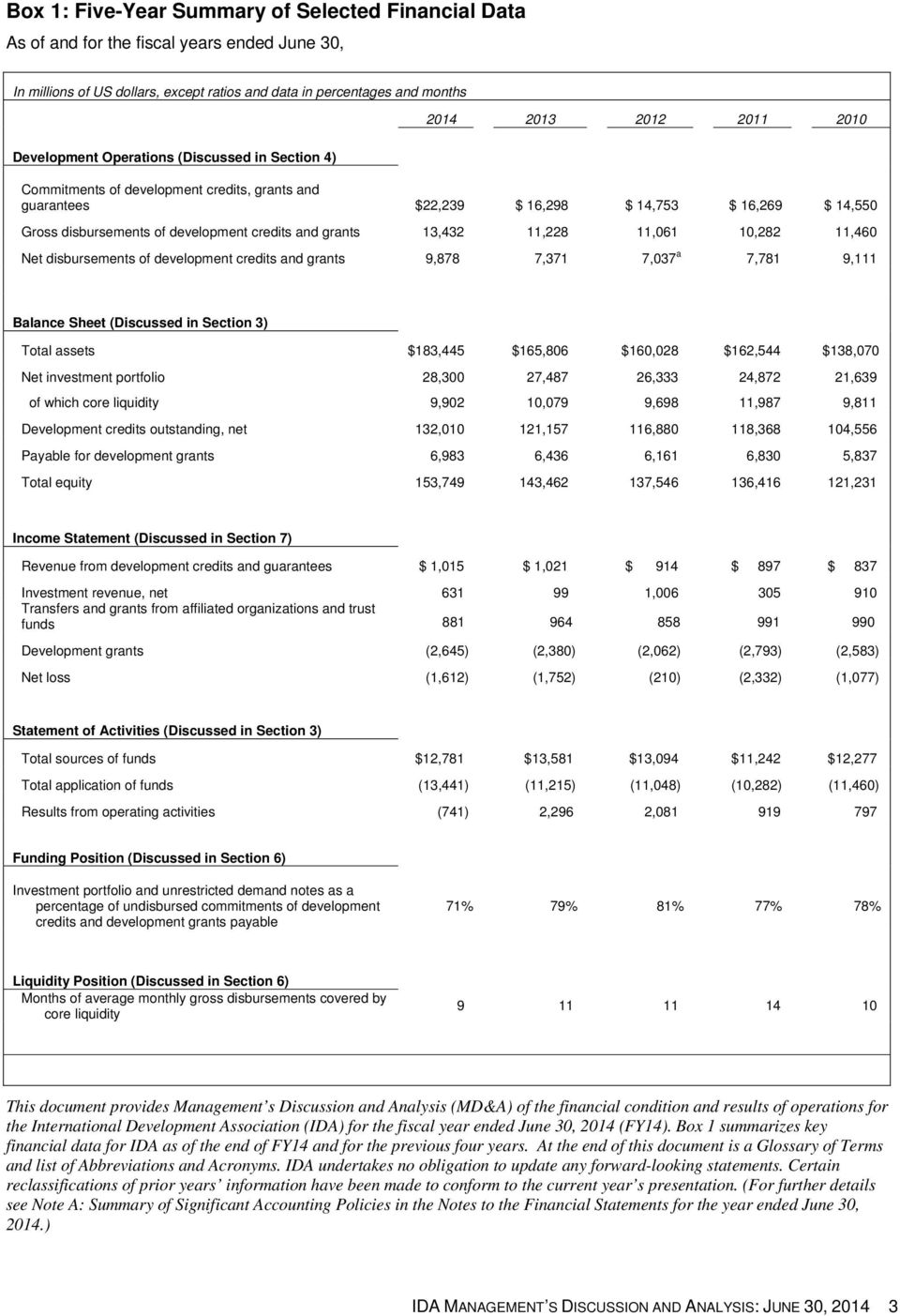
5 Box 1: Five-Year Summary of Selected Financial Data As of and for the fiscal years ended June 30, In millions of US dollars, except ratios and data in percentages and months Development Operations (Discussed in Section 4) Commitments of development credits, grants and guarantees $22,239 $ 16,298 $ 14,753 $ 16,269 $ 14,550 Gross disbursements of development credits and grants 13,432 11,228 11,061 10,282 11,460 Net disbursements of development credits and grants 9,878 7,371 7,037 a 7,781 9,111 Balance Sheet (Discussed in Section 3) Total assets $183,445 $165,806 $160,028 $162,544 $138,070 Net investment portfolio 28,300 27,487 26,333 24,872 21,639 of which core liquidity 9,902 10,079 9,698 11,987 9,811 Development credits outstanding, net 132, , , , ,556 Payable for development grants 6,983 6,436 6,161 6,830 5,837 Total equity 153, , , , ,231 Income Statement (Discussed in Section 7) Revenue from development credits and guarantees $ 1,015 $ 1,021 $ 914 $ 897 $ 837 Investment revenue, net , Transfers and grants from affiliated organizations and trust funds Development grants (2,645) (2,380) (2,062) (2,793) (2,583) Net loss (1,612) (1,752) (210) (2,332) (1,077) Statement of Activities (Discussed in Section 3) Total sources of funds $12,781 $13,581 $13,094 $11,242 $12,277 Total application of funds (13,441) (11,215) (11,048) (10,282) (11,460) Results from operating activities (741) 2,296 2, Funding Position (Discussed in Section 6) Investment portfolio and unrestricted demand notes as a percentage of undisbursed commitments of development credits and development grants payable 71% 79% 81% 77% 78% Liquidity Position (Discussed in Section 6) Months of average monthly gross disbursements covered by core liquidity This document provides Management s Discussion and Analysis (MD&A) of the financial condition and results of operations for the International Development Association (IDA) for the fiscal year ended June 30, 2014 (FY14). Box 1 summarizes key financial data for IDA as of the end of FY14 and for the previous four years. At the end of this document is a Glossary of Terms and list of Abbreviations and Acronyms. IDA undertakes no obligation to update any forward-looking statements. Certain reclassifications of prior years information have been made to conform to the current year s presentation. (For further details see Note A: Summary of Significant Accounting Policies in the Notes to the Financial Statements for the year ended June 30, 2014.) IDA MANAGEMENT S DISCUSSION AND ANALYSIS: JUNE 30,
6 Section 1: Organizational Overview Introduction The International Development Association (IDA) is an international organization established in 1960 and is owned by its 173 member countries. It is the largest multilateral channel for providing concessional financing and knowledge services to the world s poorest countries. IDA complements the other entities within the World Bank Group (WBG 1 ), which share the overarching goals to end extreme poverty and promote shared prosperity. IDA plays a pivotal role in the global aid architecture and pursues these twin goals by providing concessional development credits, grants and guarantees to its recipient member countries for programs and operations that help meet their development needs. IDA provides technical assistance through reimbursable advisory services, policy advice and global knowledge services through economic sector work and country studies. It also supports member countries with disaster risk financing and insurance to help increase tok wheir financial resilience against natural disasters, as part of their broader disaster risk management agenda. In addition, IDA provides or facilitates financing through trust fund partnerships with bilateral and multilateral donors. Over the past decades considerable advancements in poverty reduction have been made. A continuation of these advancements offer an opportunity to end extreme poverty. Given this environment, the WBG has established the ambitious but achievable goals to end extreme poverty (reducing the percentage of people living with less than $1.25 per day to no more than 3% globally by 2030) and to promote shared prosperity in a sustainable manner by fostering income growth for the bottom 40% of the population in every developing country. To assist in achieving these twin goals, the WBG strategy will re-align the WBG s activities and resources, focus its client engagement on the most important challenges to achieving these goals, and work as One World Bank Group by leveraging the strengths of each of the WBG entities. A key institutional change flowing from the new strategy is the the internal re-alignment along "Global Practices" and "Cross-Cutting Solution Areas" which will improve the sharing of technical expertise and knowledge. In terms of IDA s focus for the next three years, IDA partners, which includes members that provide resources as well as IDA recipient countries, selected maximizing development impact as the overarching theme for the Seventeenth Replenishment of IDA s Resources (IDA17), the latest IDA resource replenishment which commenced July 1, 2014, with the largest lending envelope to date of Special Drawing Rights (SDR) 34.6 billion (U.S.dollar equivalent 52.1 billion). Inclusive growth, gender equality, climate change, and fragile and conflicted-affected states (FCS s) were selected as special themes for additional special efforts. The overarching theme encapsulates IDA s proposal to respond to the rapidly evolving global landscape by placing greater emphasis on leveraging knowledge and financial resources. Development Framework IDA s support for the world s poorest countries targets scarce concessional financing where it is most effective through performance-based allocations and country-driven strategies. Throughout its operational cycle from the allocation of resources, through project preparation and implementation, to completion and impact assessment IDA uses a robust framework to maximize the development impact of the programs and activities it supports and to affirm IDA s development framework as an effective and efficient development assistance delivery mechanism. 1 The other institutions of the World Bank Group are the International Bank for Reconstruction and Development (IBRD), the International Finance Corporation (IFC), the Multilateral Investment Guarantee Agency (MIGA), and the International Centre for Settlement of Investment Disputes (ICSID). 4 IDA MANAGEMENT S DISCUSSION AND ANALYSIS: JUNE 30, 2014

7 For details on the key pillars of IDA s development framework, see Section 2: Funding and Resource Allocation, Section 4: Development Activities, Products and Programs, Section 6: Risk Management and Section 9: Governance, Transparency, Accountability and Internal Controls. Section 2: Funding And Resource Allocation Funding and Application of IDA s Resources IDA is funded largely by contributions from developed and middle income partner countries and provides credits, grants and guarantees to the least developed countries. Additional funding comes from internal resources (primarily repayments of earlier IDA credits by recipient countries), as well as transfers from IBRD and IFC. The resources available to IDA for funding its activities constitute its commitment authority. Since IDA s lending is highly concessional, partners meet every three years to replenish IDA s resources and review its policies. The commitment authority ensures that IDA provides lending commitments over a three year period to recipient countries based only on firm commitments from contributing partners, as well as available future reflows (see Internal Resources below for the components of reflows) and transfers. Given that the disbursements of IDA s credits and grants take place over several years, they do not have to be fully funded at the time of approval and this allows partner contributions to be encashed over several years and internal resources to be committed in advance of their expected receipt. The Sixteenth Replenishment (IDA16) ended on June 30, 2014, and the Seventeenth Replenishment (IDA17) commenced on July 1, Sources of Funds Applications of Funds Partner resources Internal resources Transfers and grants from affiliated organizations Disbursement of development credits, grants and guarantees and repayment of concessional partner loans Service and commitment charge income on development credits, complemented by partner compensation for forgone service charges due to debt relief and grant financing Administrative Expenses The Seventeenth Replenishment of IDA s Resources IDA17 On May 5, 2014, the Board of Governors adopted the resolution approving IDA17, under which a global coalition of 46 developed and developing partner countries pledged contributions toward the total IDA17 lending envelope of Special Drawing Rights (SDR) 34.6 billion (USD equivalent $52.1 billion). IDA17 will run from July 1, 2014 to June 30, 2017 and will become effective when Instruments of Commitment (IoC s) and loan agreements for 60 percent of the total of partner grant and concessional loan contributions are received. The targeted effectiveness date is December 15, To avoid disruption to IDA programs prior to effectiveness, members have the option of participating in an advance contribution scheme. This scheme allows IDA to continue making lending commitments without waiting for IDA17 to become effective. The IDA17 commitment authority which will be used to fund IDA s lending, grant financing and guarantee activities, is comprised of the following sources of funding (Table 1): IDA MANAGEMENT S DISCUSSION AND ANALYSIS: JUNE 30,

8 Table 1: Sources of Funds for IDA17 IDA16 Source comparative SDR billion USD equivalent a % of envelope % Partner Contributions - Partner Grant Contributions b Partner Contributions for the MDRI Concessional Partner Loans c Sub total d Internal Resources Transfers & Grants from Affiliated organizations - Transfers from IBRD out of its Net Income Grants from IFC Sub total Total Sources of Funds d a. U.S. dollar amounts are based on IDA 17 foreign exchange reference rate of USD/SDR The USD amounts are provided for illustrative purposes only, as IDA's commitment authority is managed in SDR. b. Includes the grant-element of the concessional loans (SDR 0.6 billion or U.S.dollar equivalent 0.9 billion) c. Excludes the grant-element of the concessional loans (total concessional loans are SDR 2.9 billion or U.S.dollar equivalent 4.4 billion). d.amounts may not add up due to rounding. Sources of Funds Partner Contributions: Partner contributions which convey voting rights, constitute the principal component of IDA s financial resources, at 65% for IDA17 (64% for IDA16). There are three main types of partner contributions: I. Partner Grant Contributions: Grant contributions from partners are typically made in cash or noninterest bearing notes, either in SDR s or in a freely convertible currency, in three equal installments and are encashed on a pro-rata basis in accordance with an agreed upon schedule. IDA17 has a nineyear encashment schedule; however, partners may pay faster and either receive discounts and pay amounts less than their contribution amount, or receive acceleration credits and pay the full contribution amount, but receive additional voting rights. Partners have agreed to provide IDA17 with SDR 17.3 billion (USDEq 26.1 billion) in grant equivalent contributions (IDA billion / USDEq 26.4 billion). II. III. Partner Contributions for the Multilateral Debt Relief Initiative (MDRI): Partners have agreed to compensate IDA on a dollar for dollar basis for forgone credit reflows (principal and service charge repayments) due to debt cancellation under the MDRI, see Section 4: Development Activities, Products and Programs. The value of the compensation is reassessed every three years, normally at the time of regular IDA replenishments. In this context, partners have agreed to provide IDA with additional resources of SDR 3 billion (USDEq 4.5 billion) to cover debt relief costs due to MDRI during the IDA17 disbursement period (IDA16 SDR 3.5 billion /USDEq. 5.3 billion). Concessional Partner Loans: IDA17 is the first time in IDA s history that a replenishment includes concessional partner loans as a source of funding. Exceptional circumstances, including the current low interest rate envirornment, unique resource constraints for a number of contributing partners and the transitional support for eligible new graduating countries during IDA17, have created a case for using a limited amount of concessional debt funding to ensure sufficient commitment authority for IDA17. As a result, while underscoring that grant contributions remain at the core of IDA s financing, IDA s Executive Directors approved the concessional partner loans as a financing mechanism for IDA17. See Section 5: Investment and Funding Activities for further details. Internal Resources: These comprise primarily of contractual principal repayments (including any accelerated repayments and voluntary prepayments), interest income on blend term credits, income from the investment portfolio and any carryover of residual resources from previous replenishments. Internal resources contribute 29% of the total IDA17 envelope (3 0% for IDA16). The internal resources available under both IDA16 and IDA17 include the effects of exercising the contractual acceleration clause. The terms of IDA credits provide for accelerated repayments of credits for countries that have a per capita Gross National Income (GNI) level that exceeds a specific threshold and are IBRD creditworthy. This clause was excercised for IDA graduates, after considering their economic development, in order to have a positive impact on IDA s financial capacity to support recipients in IDA16 and IDA17. In addition, adjustments to the lending terms for blend countries (members who are also eligible to borrow from IBRD) during IDA16 and IDA-only countries (members who are not eligible to borrow from IBRD) during IDA17 also resulted in additional internal resources. 6 IDA MANAGEMENT S DISCUSSION AND ANALYSIS: JUNE 30, 2014

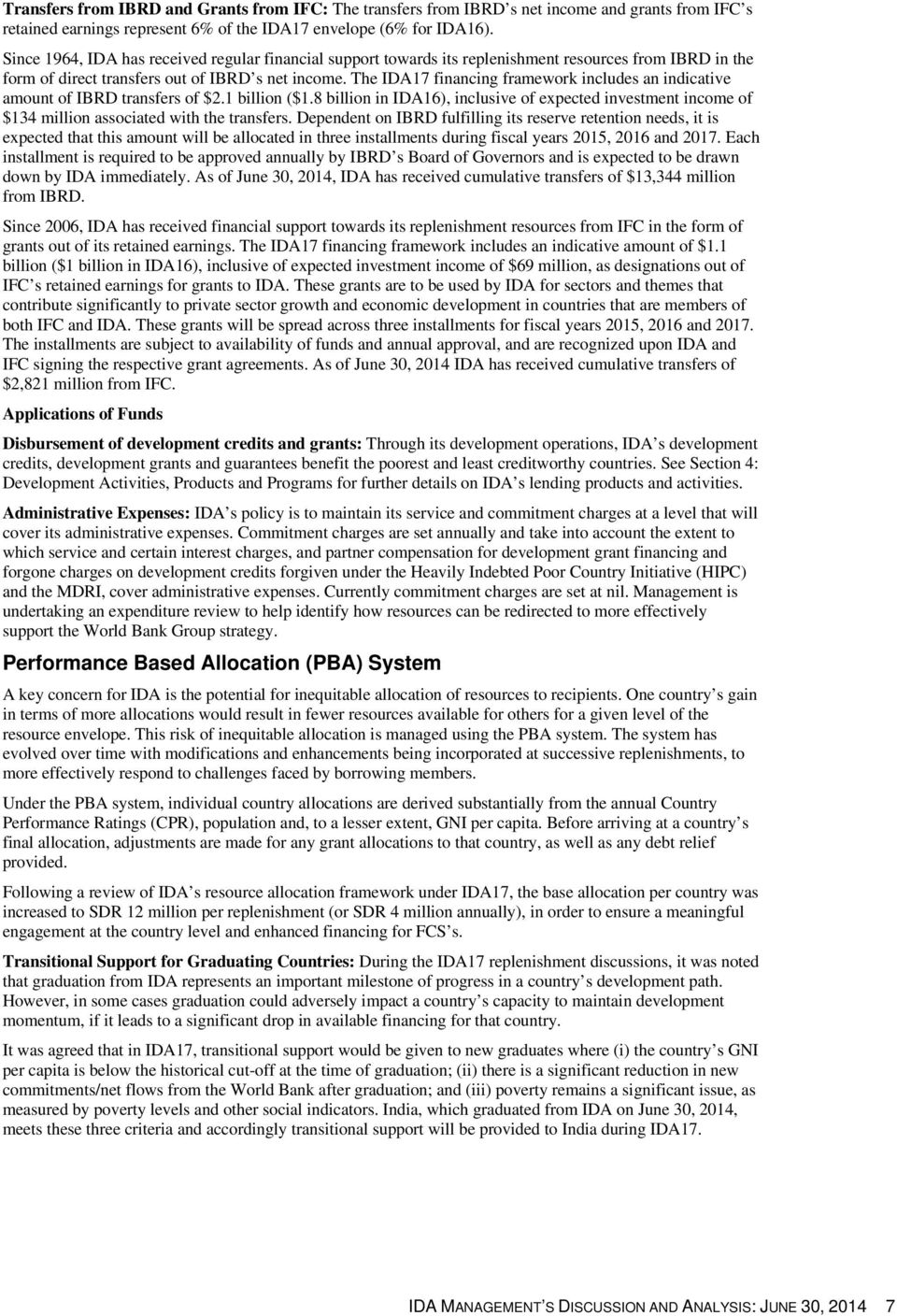
9 Transfers from IBRD and Grants from IFC: The transfers from IBRD s net income and grants from IFC s retained earnings represent 6% of the IDA17 envelope (6% for IDA16). Since 1964, IDA has received regular financial support towards its replenishment resources from IBRD in the form of direct transfers out of IBRD s net income. The IDA17 financing framework includes an indicative amount of IBRD transfers of $2.1 billion ($1.8 billion in IDA16), inclusive of expected investment income of $134 million associated with the transfers. Dependent on IBRD fulfilling its reserve retention needs, it is expected that this amount will be allocated in three installments during fiscal years 2015, 2016 and Each installment is required to be approved annually by IBRD s Board of Governors and is expected to be drawn down by IDA immediately. As of June 30, 2014, IDA has received cumulative transfers of $13,344 million from IBRD. Since 2006, IDA has received financial support towards its replenishment resources from IFC in the form of grants out of its retained earnings. The IDA17 financing framework includes an indicative amount of $1.1 billion ($1 billion in IDA16), inclusive of expected investment income of $69 million, as designations out of IFC s retained earnings for grants to IDA. These grants are to be used by IDA for sectors and themes that contribute significantly to private sector growth and economic development in countries that are members of both IFC and IDA. These grants will be spread across three installments for fiscal years 2015, 2016 and The installments are subject to availability of funds and annual approval, and are recognized upon IDA and IFC signing the respective grant agreements. As of June 30, 2014 IDA has received cumulative transfers of $2,821 million from IFC. Applications of Funds Disbursement of development credits and grants: Through its development operations, IDA s development credits, development grants and guarantees benefit the poorest and least creditworthy countries. See Section 4: Development Activities, Products and Programs for further details on IDA s lending products and activities. Administrative Expenses: IDA s policy is to maintain its service and commitment charges at a level that will cover its administrative expenses. Commitment charges are set annually and take into account the extent to which service and certain interest charges, and partner compensation for development grant financing and forgone charges on development credits forgiven under the Heavily Indebted Poor Country Initiative (HIPC) and the MDRI, cover administrative expenses. Currently commitment charges are set at nil. Management is undertaking an expenditure review to help identify how resources can be redirected to more effectively support the World Bank Group strategy. Performance Based Allocation (PBA) System A key concern for IDA is the potential for inequitable allocation of resources to recipients. One country s gain in terms of more allocations would result in fewer resources available for others for a given level of the resource envelope. This risk of inequitable allocation is managed using the PBA system. The system has evolved over time with modifications and enhancements being incorporated at successive replenishments, to more effectively respond to challenges faced by borrowing members. Under the PBA system, individual country allocations are derived substantially from the annual Country Performance Ratings (CPR), population and, to a lesser extent, GNI per capita. Before arriving at a country s final allocation, adjustments are made for any grant allocations to that country, as well as any debt relief provided. Following a review of IDA s resource allocation framework under IDA17, the base allocation per country was increased to SDR 12 million per replenishment (or SDR 4 million annually), in order to ensure a meaningful engagement at the country level and enhanced financing for FCS s. Transitional Support for Graduating Countries: During the IDA17 replenishment discussions, it was noted that graduation from IDA represents an important milestone of progress in a country s development path. However, in some cases graduation could adversely impact a country s capacity to maintain development momentum, if it leads to a significant drop in available financing for that country. It was agreed that in IDA17, transitional support would be given to new graduates where (i) the country s GNI per capita is below the historical cut-off at the time of graduation; (ii) there is a significant reduction in new commitments/net flows from the World Bank after graduation; and (iii) poverty remains a significant issue, as measured by poverty levels and other social indicators. India, which graduated from IDA on June 30, 2014, meets these three criteria and accordingly transitional support will be provided to India during IDA17. IDA MANAGEMENT S DISCUSSION AND ANALYSIS: JUNE 30,
10 Section 3: RESULTS FOR FY14 AND IDA16 COMMITMENT AUTHORITY Basis of Reporting IDA prepares its financial statements in conformity with accounting principles generally accepted in the United States of America (U.S. GAAP), referred to in this document as the reported basis. The financial statements provide a basis upon which users are able to analyze IDA s sources and uses of resources. Under the reported basis, IDA s Statement of Income does not reflect the true economic results of IDA due to a number of asymmetries, which are explained in detail in Section 7: Reported Basis Results. Statement of Activities The Statement of Activities (Table 2) is designed to reflect how IDA manages its sources and applications of funds in executing its operating activities. The Statement of Activities presents the cash flows associated with IDA s operating activities and the impact of these activities on the net asset value of IDA s investment portfolio. This presentation addresses the majority of the asymmetries embedded in IDA s reported basis results. Table 2 : Statement of Activities for the fiscal years ended June 30, 2014 and June 30, 2013 In millions of U.S. dollars FY 14 FY 13 Variance Sources of Funds Partner Resources Members subscriptions and contributions $7,888 $ 8,306 $ (418) Transfers and Grants from Affiliated Organizations and Trust Funds (83) Internal Resources Principal repayments and prepayments 3,462 3,822 (360) Proceeds from buy-down of development credits Investment interest income (8) 4,012 4,311 (299) Total Sources of Funds 12,781 13,581 (800) Application of Funds Disbursements Development credit disbursements (11,168) (9,161) (2,007) Development grant disbursements (including PPA grant activity) (2,273) (2,054) (219) Total Application of Funds (13,441) (11,215) (2,226) Administrative Activities Administrative expenses, net (1,369) (1,370) 1 Service and interest charges 1,015 1,021 (6) Partner compensation for forgone charges (6) (81) (70) (11) Results from Operating Activities / Net cash from (used in) operating activities $ (741) $ 2,296 $(3,037) Net Asset Value of Investment Portfolio, at beginning of fiscal year $27,487 $26,333 Results from Operating Activities / Net cash from (used in) operating activities (741) 2,296 Effects of exchange rates 668 (389) Net movement in non-operating activities 435 (322) Net movement in non-investment cash 451 (431) Net Asset Value of Investment Portfolio, at end of fiscal year $28,300 $27,487 Results from Operating Activities IDA s operating activities resulted in a net cash outflow of $741 million for FY14. This primarily reflects the $13,441 million of outflows for disbursements, partially offset by $7,888 million of cash receipts relating to members subscriptions and contributions, $3,462 million of cash receipts relating to principal repayments and prepayments and $881 million of transfers and grants from affiliated organizations and trust funds. The main drivers of the $3,037 million variance between the results from operating activities in FY14 as compared to FY13 are: $418 million decrease in inflow from partner resources, $360 million decrease in inflow from repayments and prepayments, $2,007 million increase in outflow for credit disbursements and $219 million increase in grant disbursements. Partner Resources The subscriptions and contributions of $7,888 million represent the cash contributions received from members and the encashment of demand notes. This excludes $273 million of member contributions received to finance forgone charges for debt relief and development grant financing, which is shown as part of administrative activities. The decrease of $418 million as compared to FY13 is primarily due to a decrease in note encashments, the timing of which is driven by the schedule agreed upon for each replenishment. See Section 2, Funding and Resource Allocation. 8 IDA MANAGEMENT S DISCUSSION AND ANALYSIS: JUNE 30, 2014
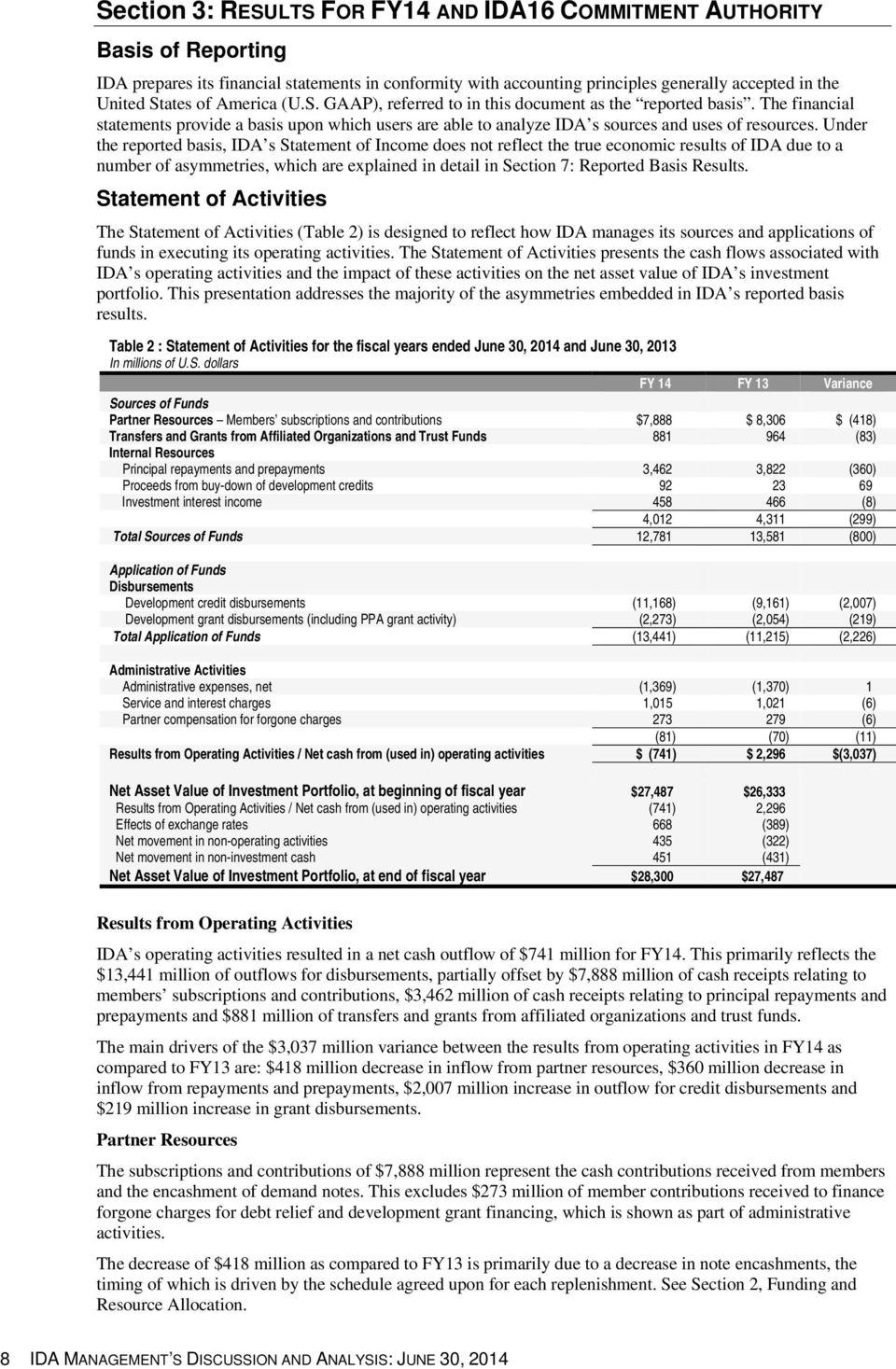
11 Development Credit and Grant Disbursements Gross disbursements of development credits in FY14 were $11,168 million, an increase of $2,007 million. The 22% increase in disbursement activity as compared to FY13, was in line with the increased lending activity in FY14. In terms of regional focus, disbursements to South Asia alone increased by $1,406 million. Africa and South Asia together accounted for 81% of the total gross disbursements during FY14. Of the $11,168 million in development credit disbursements, 51% related to commitments made under IDA16, 36% under IDA15, 12% under IDA14 and the remaining 1% related to commitments made under earlier replenishments. The majority of the $219 million increase in development grants disbursed in FY14 as compared to FY13 was attributable to the Middle East and North Africa and the South Asia regions. This increase corresponds with higher grant commitments, which increased by $265 million during the same period. Administrative Activities Administrative expenses, net, when compared with FY13 remained largely unchanged with a slight decrease of $1 million. Though administrative expenses directly attributable to IDA have increased, consistent with the relative increase in IDA s lending operations and other activities, this was offset by an increase in externally funded revenues and lower pension expenses. See Table 14: Net Administrative Expenses for the fiscal years ended June 30, 2014 and June 30, Service and interest charges are slightly lower by $6 million in FY14 when compared to FY13, despite an increase in the average balance of development credits outstanding. This was primarily due to the impact of the restoration of all development credits to Myanmar to accrual status in January 2013, when Myanmar cleared all of its overdue principal and charges due to IDA. The event resulted in an additional $90 million of service charge income being recognized in FY13. Table 3, provides a reconciliation of the results from operating activities as presented in Table 2, Statement of Activities to the reported basis, net loss. The reconciling items are presented as either (i) items in the reported basis results, but not included in the Statement of Activities, or (ii) items included in the Statement of Activities, but not in the reported basis results. These are further classified as: addressing asymmetries, adjustments to reflect cash and non-cash operating activities, and adjustments for non-operating activities. Table 3: Reconciliation of Results from Operating Activities to Reported Basis, Net Loss In millions of U.S dollars FY 14 FY 13 Results from Operating Activities $ (741) $2,296 (i) Items in reported basis results, not included in Statement of Activities Adjustments to reflect non-cash operating activities: - Development grant expense (2,645) (2,380) - Provision for debt relief and losses on development credits and other exposures, net (39) 53 - Write-off on buy-down of development credits - (26) - Discount on prepaid development credits - (12) Adjustments for non-operating activities: - Non-functional currency translation adjustment losses (51) 1 - Fair value adjustment on asset-liability management portfolio, net (35) (102) - Unrealized MTM gain (loss) on Investment portfolio 173 (367) (ii) Items included in Statement of Activities, not in reported basis results Adjustments addressing asymmetries: - Members subscriptions and contributions (7,888) (8,306) - Partner compensation for forgone charges (273) (279) Adjustments to reflect cash operating activities: - Development credit disbursements 11,168 9,161 - Development grant disbursements 2,273 2,054 - Principal repayments and prepayments (3,462) (3,822) - Proceeds from buy-down of development credits (92) (23) Reported Basis, Net Loss $ (1,612) $(1,752) Liquidity and Funding Ratios Following the results of operating activities, IDA s core liquidity position as of June 30, 2014 is sufficient to cover approximately 9 months of average monthly gross disbursements, slightly lower than the historical range of 10 to 14 months for the fiscal years ending June 30, 2010 through See Section 6: Risk Management for more details on IDA s core liquidity position. IDA s funding position, the extent to which IDA s investment portfolio and demand notes cover any undisbursed development credits and development grants, stood at 71% at June 30, 2014, as compared to 79% at June 30, The 8% decline is driven by the $7,079 million increase in undisbursed development credits as at June 30, 2014 when compared to June 30, 2013 which is in line with the increased commitment activity in FY14 as compared to FY13, see Box 1. The remaining funding gap will be primarily covered by future receipts of cash and demand notes already committed by partners, as well as through repayments on existing IDA MANAGEMENT S DISCUSSION AND ANALYSIS: JUNE 30,

12 credits. At all times, IDA enters into new commitments based on the commitment authority available. See Section 2: Funding and Resource allocation for further details on IDA s commitment authority and See Section 6: Risk Management for more details on IDA s core liquidity position. Balance Sheet Analysis The principal components of IDA s balance sheet are development credits outstanding, investment assets, net of liabilities, and subscriptions and contributions paid-in. Movements in these principal components between June 30, 2014 and June 30, 2013 are discussed further below. Table 4: Condensed Balance Sheet In millions of U.S. dollars As of June 30, Variance Assets Investment assets, including related derivative assets $ 37,548 $ 37,208 $ 340 Derivatives relating to asset-liability management 12,102 5,307 6,795 Receivables and other assets, including non-investment cash 1,811 2,161 (350) Development credits outstanding 136, ,135 10,876 Accumulated provision for debt relief and losses on development credits (4,027) (4,005) (22) Total assets $183,445 $165,806 $17,639 Liabilities and equity Liabilities and derivatives relating to investments $ 9,248 $ 9,721 $ (473) Derivatives relating to asset-liability management 12,222 5,242 6,980 Payables and other liabilities, including maintenance of value 7,990 7, Subscriptions and contributions paid-in 193, ,511 9,236 Demand obligations (10,089) (9,015) (1,074) Accumulated deficit (42,670) (41,058) (1,612) Accumulated other comprehensive income 12,997 9,258 3,739 Total liabilities and equity $183,445 $165,806 $17,639 Development Credits Outstanding and Accumulated Provision for Debt Relief and Losses on Development Credits Development credits outstanding increased by $10,876 million during FY14, primarily due to net positive disbursements of $7,613 million and positive translation adjustments of $3,351 million resulting from the 2.8% appreciation of the SDR against U.S dollar. See Section 4: Development Activities, Products and Programs. Investment Assets, net of Related Liabilities The net investment portfolio increased from $27,487 million as of June 30, 2013 to $28,300 million as of June 30, The increase of $813 million reflects the net results of IDA s cash related operating activities, effects of non-operating items (primarily unrealized mark to market gains/losses), and the effects of movements in exchange rates. See Statement of Activities for variance analysis of operating activities. Derivatives Relating to Asset-Liability Management Forward contracts entered into that economically hedge donor pledges are reflected in the Balance Sheet in the Derivatives relating to asset-liability management in both assets and liabilities. The net increase in the FY14 derivative balances as compared to FY13, were primarily due to the $9 billion of new trades entered into as a result of Management s decision to economically hedge partner contributions pledged under IDA17, this was partially offset by maturities occurring during the year. See Section 6, Risk Management. Subscriptions and Contributions The $9,236 million increase in subscriptions and contributions paid-in is primarily attributable to the receipt from members of $5,605 million of demand notes and $3,201 million of cash contributions along with a positive translation adjustment of $430 million. 10 IDA MANAGEMENT S DISCUSSION AND ANALYSIS: JUNE 30, 2014

13 IDA16 Commitment Authority As of June 30, 2014, IDA completed its sixteenth replenishment period. Table 5 below provides a breakdown of the principal sources making up the total lending envelope under the revised IDA16 Commitment Authority Framework and the extent these sources have been made available and committed for development credits, grants and guarantees through June 30, Table 5: Results for IDA16 Commitment Authority Sources Revised Commitment Authority framework for IDA 16 SDR billion USD equivalent a Partner resources Reflows - Partner compensation for MDRI Internal resources of IDA Transfers - IBRD net income transfer IFC grant Carryovers from IDA Total Commitment Authority Commitment Authority Available and Committed Amount to be Carried-over to IDA a.u.s. dollar amounts are based on IDA16 foreign exchange reference rate of USD/SDR The USD amounts are provided for illustrative purposes only, as IDA's commitment authority is managed in SDR. The revised IDA16 Commitment Authority amounted to SDR 33.8 billion (U.S.dollar equivalent 50.8 billion). All available resources of SDR 31.7 billion (U.S.dollar equivalent 47.6 billion) have been committed and the remaining SDR 2.1 billion (U.S.dollar equivalent 3.2 billion) will be carried over into IDA17. SECTION 4: DEVELOPMENT ACTIVITIES, PRODUCTS AND PROGRAMS IDA has a common framework which extends across all of its development activities. The main elements of this framework are eligibility criteria, financing principles, financing cycles and financing categories. Eligibility Criteria Two basic criteria govern a country s eligibility for IDA resources, namely: (i) relative poverty defined as Gross National Income (GNI) per capita below an established threshold (updated annually), for FY15 the threshold is a GNI in 2013 of $1,215 (for FY14, $1,205 in 2012) (ii) lack of creditworthiness to borrow from both commercial sources and IBRD, and therefore a need for concessional resources. As of July 1, 2014, 77 countries are eligible to borrow from IDA, of these Financing Principles 59 are not considered sufficiently creditworthy to borrow from IBRD and are referred to as IDA only countries and are subject to IDA lending on regular IDA terms. 18 countries are deemed to have limited IBRD creditworthiness and may receive both IDA and IBRD financing and are referred to as blend countries. IDA s operations are required to conform with the general principles derived from its Articles of Agreement. These principles are described in Box 2. Within the scope permitted by the Articles of Agreement, application of these financing principles must be developed and adjusted in light of experience and changing conditions. IDA MANAGEMENT S DISCUSSION AND ANALYSIS: JUNE 30,

14 Box 2: Financing Principles (i) IDA may provide financing for its development operations in the form of development credits, development grants, and guarantees directly to its members, public or private entities and regional or public international organizations. (ii) IDA s financing of its development operations is designed to promote economic development, increase productivity and thus raise standards of living in its member countries. Investment projects financed by IDA are required to meet IDA s standards for technical, economic, financial, institutional and environmental soundness. Specific provisions apply to development policy financing, including the treatment of the macroeconomic framework, poverty and social impact, environment, forests and other natural resources. (iii) Decisions to approve financing are based upon, among other things, studies by IDA of a member country s economic structure, including assessments of its resources and ability to generate sufficient foreign exchange to meet debt-service obligations. (iv) IDA must be satisfied that in the prevailing market conditions (taking into account the member s overall external financing requirements), the recipient would be unable to obtain financing under conditions which, in the opinion of IDA, are reasonable for the recipient. This would include loans made by private sources or IBRD. (v) The use of funds by recipients is supervised. IDA makes arrangements intended to ensure that funds provided are used only for authorized purposes and, where relevant, with due attention to considerations of cost-effectiveness. This policy is enforced primarily by requiring recipients (a) to submit documentation establishing, to IDA s satisfaction, that the expenditures financed with the proceeds of development credits or grants are made in conformity with the applicable financing agreements, and (b) to maximize competition in the procurement of goods and services by using, wherever possible, international competitive bidding procedures or, when it is not appropriate, other procedures that ensure maximum economy and efficiency. In addition, IDA considers the use of recipient country procurement, and environmental and social safeguard systems in selected operations where these systems are assessed by IDA as being equivalent to IDA s systems and where the recipient s policies and procedures, implementation practices, track record, fiduciary and safeguard risks and capacity are considered acceptable to IDA. Financing Cycles The process of identifying and appraising a project and approving and disbursing the funds often extends over several years. However, in response to emergency situations, such as natural disasters and financial crises, IDA is able to accelerate the preparation and approval cycle. After appraisal of a project by staff, with certain exceptions, IDA s Executive Directors must approve each development credit, development grant and guarantee. Disbursements are subject to the fulfillment of conditions set out in the credit or grant agreement. During implementation of IDA-supported operations, staff review progress, monitor compliance with IDA policies, and assist in resolving any problems that may arise. An independent unit, the Independent Evaluations Group, also assesses the extent to which operations have met their major objectives, and these evaluations are reported directly to the Executive Directors. Financing Categories IDA s financing of its development operations in the form of development credits and grants falls into one of three categories investment financing, development policy financing, and program-for-results. (i) Investment financing is generally used to procure goods, works and services in support of economic and social development projects in a broad range of sectors. (ii) Development policy financing provides quick disbursing credits or grants to members with external financing needs to support structural reforms in a sector or the economy as a whole. (iii) Program-for-Results which commenced in FY12, supports member government efforts, especially to strengthen their institutions. It links disbursement of funds directly to the delivery of defined results. These three complementary categories support the policy and institutional changes needed to create an environment conducive to sustained and equitable growth. Chart 1 shows the percentage of IDA credits approved for investment lending, development policy operations and Program-for-Results over the past five years. The share of investment financing has remained stable over the last 5 years, ranging from 83% to 88%. 12 IDA MANAGEMENT S DISCUSSION AND ANALYSIS: JUNE 30, 2014

15 Chart 1: Share of Financing Categories Percentage Share 100% 80% 60% 40% 20% 0% Program-for-Results Investment Development Credits Development Policy FY 10 FY 11 FY 12 FY 13 FY 14 Charges on development credits IDA s policy is to maintain its service and commitment charges at a level that will cover its administrative expenses. Service Charge. A service charge is levied on the principal amount disbursed and outstanding on all development credits, regardless of repayment terms, at 0.75% per annum. Commitment Charge. A commitment charge, which is payable on the undisbursed amount of the development credit, is set by the Executive Directors at the beginning of each fiscal year. From FY09 to FY15, IDA s Executive Directors have maintained the commitment charge on undisbursed development credits at nil. As noted previously, commitment charges are set at a level to ensure that service charges (adjusted to include income forgone from development credits forgiven under HIPC and MDRI and from providing development grant financing) cover administrative expenses. Interest. Interest is charged on all new credits subject to blend terms approved under IDA16 and IDA17 and on all hard-term credits. The interest charged on hard-term credits is more concessional than the fixed-rate equivalent of IBRD s lending rate after taking into account the grace period and repayment terms. The rate is determined annually prior to the start of each fiscal year and is applicable to all such credits approved during a fiscal year. Table 6 shows the applicable rates effective July 1, Repayment Terms Development credits approved through June 30, 1987 have a final maturity of 50 years, including a grace period of 10 years. More recently, differentiation in IDA s lending terms has been introduced to recognize the variation in economic development of broad categories of IDA recipients. Table 6 provides a summary of the repayment terms of development credits based on eligibility, effective July 1, Table 6: Summary of Repayment Terms for Development Credits, effective July 1, 2014 Terms Eligibility Criteria Repayment Terms Service Charge Interest IDA Only Not considered sufficiently creditworthy to borrow from IBRD (or a small island nation). For FY2015, IDA-only recipients with a 2013 GNI per capita of $1,215 or less (the operational cut off ). 38 years including a grace period of 6 years and straight line amortization of principal. a 75 basis points Nil Blend Blend terms apply to both blend borrowers and IDA countries with Gross National Income per capita above the operational cut-off for more than two consecutive years, known previously as "gap" or "hardened term" countries. 25 years including a grace period of 5 years. b 75 basis points 1.25% Hard-terms Transitional support A blend borrower will be eligible for an additional window of IDA lending at hardterms (excluding small island nations receiving credits on IDA-only terms). New IDA graduates will be eligible for transitional support where the GNI per capita is below the cut off at the time of graduation, there would be a significant reduction in new commitments from the World Bank after graduation and poverty levels remain high. 25 years including a grace period of 5 years. 25 years including a grace period of 5 years with straight line amortization 75 basis points 75 basis points 1.83% Rate reset quarterly (2.68% for first quarter of FY15) a. For credits approved during IDA16, as well as countries eligible for the small island state exception during IDA17, 40-year maturity, including a grace period of 10 years. b. Repayment terms remain unchanged from credits approved during IDA16. IDA MANAGEMENT S DISCUSSION AND ANALYSIS: JUNE 30,

16 In addition, since 1987, IDA has included an accelerated repayment clause in the legal agreements of regular, blend and hard-term credits that allows IDA to double the principal repayments of the credit, if the borrower s GNI per capita exceeds a specific threshold and the borrower is IBRD creditworthy. Implemetation is subject to approval by IDA s Executive Directors after considering a borrower s economic development. The borrower would have a choice to either (a) shorten the credit s maturity (principal option), (b) pay interest at a rate that would result in the same net present value (interest option), or a combination of the two options. During IDA 16, the acceleration clause was invoked on the qualifying IDA credits of 8 borrowers with outstanding credits that have graduated from IDA. Of these 8 borrowers, 5 selected the principal option for acceleration and 3 selected the interest option. For IDA 17, effective July 1, 2014, the acceleration clause will be invoked resulting in a total of 8 IDA graduates whose IDA credits have been or will be accelerated under this proposal. Commitments of Development Credits Commitments of development credits in FY14 were $18,542 million, an increase of $4,770 million (35%) over FY13. In terms of regional focus, South Asia accounted for $3,604 million of the increase. Africa and South Asia together accounted for 84% of the FY14 commitments (see Chart 2). Gross Disbursements of Development Credits Gross disbursements of development credits in FY14 reached $11,168 million, an increase of $2,007 million (22%) from FY13. In terms of regional focus, South Asia accounted for $1,406 million of the increase. Africa and South Asia together accounted for 81% of the total FY14 gross disbursements (see Chart 3). Chart 2: Commitments of Development Credits by Region USD Millon FY 13 FY 14 7,000 6,000 5,000 4,000 3,000 2,000 1,000 0 AFR EAP ECA LCR MNA SAR Chart 3: Gross Disbursements of Development Credits by Region USD Million FY 13 FY 14 5,000 4,000 3,000 2,000 1,000 0 AFR EAP ECA LCR MNA SAR Regions: AFR Africa EAP East Asia and Pacific ECA Europe and Central Asia LCR Latin America and the Caribbean MNA Middle East and North Africa SAR South Asia Development Credits Outstanding Development credits outstanding as of June 30, 2014 were $136,011 million. Chart 4 shows the breakdown by term. Of the $10,876 million increase in development credits outstanding as compared to FY13, $6,615 million (61%) are on IDA only terms. See Table 6 for details of IDA s terms. Chart 4: Development Credits Outstanding by Terms USD Millon FY 13 75,810 48, FY 14 82,425 52, ,000 60,000 90, , ,000 IDA Only Blend Hard Terms Table 7 provides details of the top five borrowers with the largest development credits outstanding as at June 30, These borrowers represented 50% of total development credits outstanding as of that date. 14 IDA MANAGEMENT S DISCUSSION AND ANALYSIS: JUNE 30, 2014

17 Table 7: Top Five Borrowers with the Largest Development Credits Outstanding Balance In millions of US dollars, or as otherwise indicated Country India Pakistan Bangladesh Vietnam Nigeria Total Development Credits Outstanding 26,987 12,549 11,954 10,819 5,811 68,120 % of Total Development Credits Outstanding 20% 9% 9% 8% 4% 50% Weighted Average Maturity (Years) Credits outstanding by terms IDA only 6,917 1,295 11,954 8,459 3,847 32,472 Blend 19,948 10,935-2,147 1,964 34,994 Hard terms Undisbursed balance 7,663 2,269 4,639 5,223 4,389 24,183 Development Grants Charges on Development Grants Commitment charges on the undisbursed balances of development grants are set annually by the Executive Directors of IDA. From FY03 through FY15, IDA s commitment charge on the undisbursed balances of development grants has been set at nil. Allocation of Development Grants Development grants under IDA16 are available solely for IDA-only countries. The amount available for each country is a function of the country s performance-based IDA allocation (see Section 2: Funding and Resource allocation), and its eligibility for development grants is based on an assessment of the risk of debt distress. Countries with low risk of debt distress receive 100 percent of their IDA allocation as development credits. Countries with a medium risk of debt distress receive 50 percent of their IDA allocation as development credits, and the remaining as development grants. Countries with a high risk of debt distress will receive 100 percent of their allocation in the form of development grants; however the initial allocation of resources is reduced by 20% as a volume discount. The 20% is then returned to the performance based allocation calculation and is used in part to fund hard term credits. Commitments of Development Grants Commitments of development grants in FY14 were $2,760 million, an increase of $294 million (12%) over FY13. In terms of regional focus, South Asia accounted for $191 million of the increase. Africa and South Asia together accounted for 77% of the total FY14 commitments (see Chart 5). Gross Disbursements Gross disbursements of development grants in FY14 were $2,264 million, an increase of $197 million (10%) from FY13. In terms of regional focus, South Asia accounted for $141 million of the increase. Africa and South Asia together accounted for 79% of the total FY14 gross disbursements (see Chart 6). Chart 5: Commitments of Development Grants by Region USD Million FY 13 FY 14 2,000 Chart 6: Gross Disbursements of Development Grants by Region USD Million FY 13 FY 14 2,000 1,500 1,500 1,000 1, AFR EAP ECA LCR MNA SAR 0 AFR EAP ECA LCR MNA SAR Other Development Activities and Programs IDA has products, services and programs, other than lending, that it offers to its borrowing member countries to help them meet their development goals. These include financial guarantees, debt relief, trust fund administration and externally funded reimbursable advisory services. IDA MANAGEMENT S DISCUSSION AND ANALYSIS: JUNE 30,

18 Guarantees IDA guarantees facilitate the mobilization of private financing for commercial lenders contemplating financial investment in projects in developing countries. IDA guarantees are available to IDA-only countries, as well as to blend countries where IBRD resources are not available. Until June 30, 2014, IDA offered Partial Risk Guarantees (PRG) only, which cover private lenders against the risk of a public entity or a government failing to perform its obligations with respect to a private project. IDA guarantees are partial so that risks covered are shared between IDA and private lenders. When IDA issues a guarantee, it obtains an indemnity agreement from the host government. In December 2013, the World Bank s Board of Executive Directors approved a series of changes to World Bank guarantees that will be effective from July 1, As a result of these changes, IDA members will have access, subject to fiscal and other considerations, to all types of World Bank guarantees, namely Project-based guarantees and Policy-based Guarantees. See Table 8 for the types of guarantees that IDA provides. Table 8: Types of Guarantees Available until June 30, 2014 Partial risk guarantees These cover private lenders against debt service default on loans, normally for a private sector project, when such default is caused by a government s failure to meet specific obligations under project contracts to which it is party. Available from July 1, 2014 Two types of Project-based guarantees will be offered: Project based guarantees Policy-based guarantees 1. Loan guarantees: these cover loan-related debt service defaults caused by the government s failure to meet specific payment and/or performance obligations arising from contract, law or regulation. Loan guarantees include coverage for debt service defaults on: (i) commercial debt, normally for a private sector project; and, (ii) a specific portion of commercial debt irrespective of the cause of such default, normally for a public sector project. 2. Payment guarantees: These cover payment default on non-loan related government payment obligations to private entities and foreign public entities arising from contract, law or regulation. To cover debt service default, irrespective of the cause of such default, on a specific portion of commercial debt owed by government and associated with the supported government s program of policy and institutional actions. Guarantee Exposure IDA s exposure on its guarantees (measured by discounting each guaranteed amount from its first call date was $408 million as of June 30, 2014 ($349 million June 30, 2013). For additional information see the Notes to Financial Statements Note E Development Credits and Other Exposures. Debt Relief Heavily Indebted Poor Countries Debt Initiative The HIPC Debt Initiative is a comprehensive approach to reduce the external debt of the world s poorest, most heavily indebted countries, and it represented an important step forward in placing debt relief within an overall framework of poverty reduction. The countries that qualify for HIPC assistance are the poorest countries that are eligible for highly concessional assistance from IDA and from the International Monetary Fund s (IMF) Poverty Reduction and Growth Facility. The list of countries potentially eligible under the Enhanced HIPC Framework has been limited, whereby no new countries are considered for eligibility unless they meet the income and indebtedness criteria as of the end of calendar year 2004 as specified in the Initiative. Partners compensate IDA on a pay-as-you-go basis to finance IDA s forgone credit reflows under the HIPC Debt Initiative. This means that for the debt relief provided by writing off the principal and charges during a replenishment, the partners compensate IDA for the forgone reflows through additional contributions in the relevant replenishment and these are recorded in IDA s balance sheet as subscriptions and contributions. During FY14, $8 million of development credits and $1 million of charges were written off as debt relief under the partial forgiveness of debt service as it came due. During FY13, the comparable amounts were $5 million and $2 million, respectively. On a cumulative basis, $2,095 million of development credits and $333 million of charges had been written off as of June 30, Multilateral Debt Relief Initiative The MDRI provides additional debt relief through 100 percent cancellation of eligible debt owed to IDA, the African Development Bank and the IMF, by countries that reach the HIPC Completion Point. The objectives of MDRI are twofold: deepening debt relief to HIPC countries while safeguarding the long-term financial capacity of IDA and other participating multilateral institutions; and encouraging the best use of additional 16 IDA MANAGEMENT S DISCUSSION AND ANALYSIS: JUNE 30, 2014

19 partner resources for development, by allocating these resources to low-income countries on the basis of policy performance. During the fiscal year ended June 30, 2014, there was no cancellation of eligible development credits under the MDRI. On a cumulative basis, $39,639 million of development credits have been written off under the MDRI as of June 30, Trust Funds Administration IDA s trust fund portfolio provides flexible and customized development solutions that serve member recipients and donors alike. IDA s roles and responsibilities in managing trust funds depend on the type of fund, outlined as follows: IDA s Trust Funds: IDA, alone or jointly with one or more of its affiliated organizations, implements or supervises the activities financed by trust funds. These funds are held in trust and are not included in IDA s Balance Sheet, except for undisbursed third party contributions to IDA-executed trust funds. IDA-Executed Trust Funds (BETF s) support IDA s work program Recipient-Executed Trust Funds (RETF s) are provided to a third party, normally in the form of project financing, and are supervised by IDA. Financial Intermediary Funds (FIFs): IDA, as a trustee, provides financial management services such as receiving, holding and transferring funds to multiple implementing entities. During FY14, IDA recorded $65 million (versus $68 million in FY13) as revenue for the administration of its trust fund portfolio. IDA, as an executing agency, disbursed $354 million ($316 million in FY13) of trust fund program funds. The cash and investment assets held in trust by IDA as administrator and trustee as of June 30, 2014 and June 30, 2013 are summarized in Table 9. IDA s contribution to these trust funds for the year ended June 30, 2014 and June 30, 2013 was nil. For additional information, see the Notes to Financial Statements-Note G-Trust Funds Administration. Table 9: Cash and Investment Assets Held In Trust by IDA In millions of U.S. dollars Total fiduciary assets June 30, 2014 June 30, 2013 IDA-executed $ 83 $ 73 Jointly administered with affiliated organizations Recipient-executed 2,555 2,697 Financial intermediary funds Execution not yet assigned a 3,186 3,201 Total $6,962 $7,230 a. These represent assets held in trust for which the determination as to the type of execution is yet to be finalized. Externally funded Reimbursable Advisory Services IDA provides technical assistance to its member countries, both in connection with, and independent of, lending operations. There is a growing demand from borrowers for strategic advice, knowledge transfer, and capacity building. Such assistance includes assigning qualified professionals to survey developmental opportunities in member countries, analyzing their fiscal, economic and developmental environment, assisting member countries in devising coordinated development programs, appraising projects suitable for investment, and assisting member countries in improving their asset and liability management techniques. While most of IDA s advisory services are financed by its own budget or donor contributions (Trust Funds), clients may also pay for such services themselves through so called Reimbursable Advisory Services (RAS). RAS allows IDA to provide advisory services that the clients demand, but that IDA cannot fund in full within the existing budget envelope. In FY14 income relating to reimbursable advisory services was $46 million (FY13 - $34 million). SECTION 5: INVESTMENT AND FUNDING ACTIVITIES IDA s primary objective in the management of its investment portfolio is to ensure that funds will be available on a timely basis in the amount needed to meet future cash flow requirements, including disbursements for development credits, grants and administrative expenses. Consistent with the primary objective, IDA also seeks to maximize returns, subject to loss constraints, on investments, which can be added to IDA s internal resources. IDA MANAGEMENT S DISCUSSION AND ANALYSIS: JUNE 30,

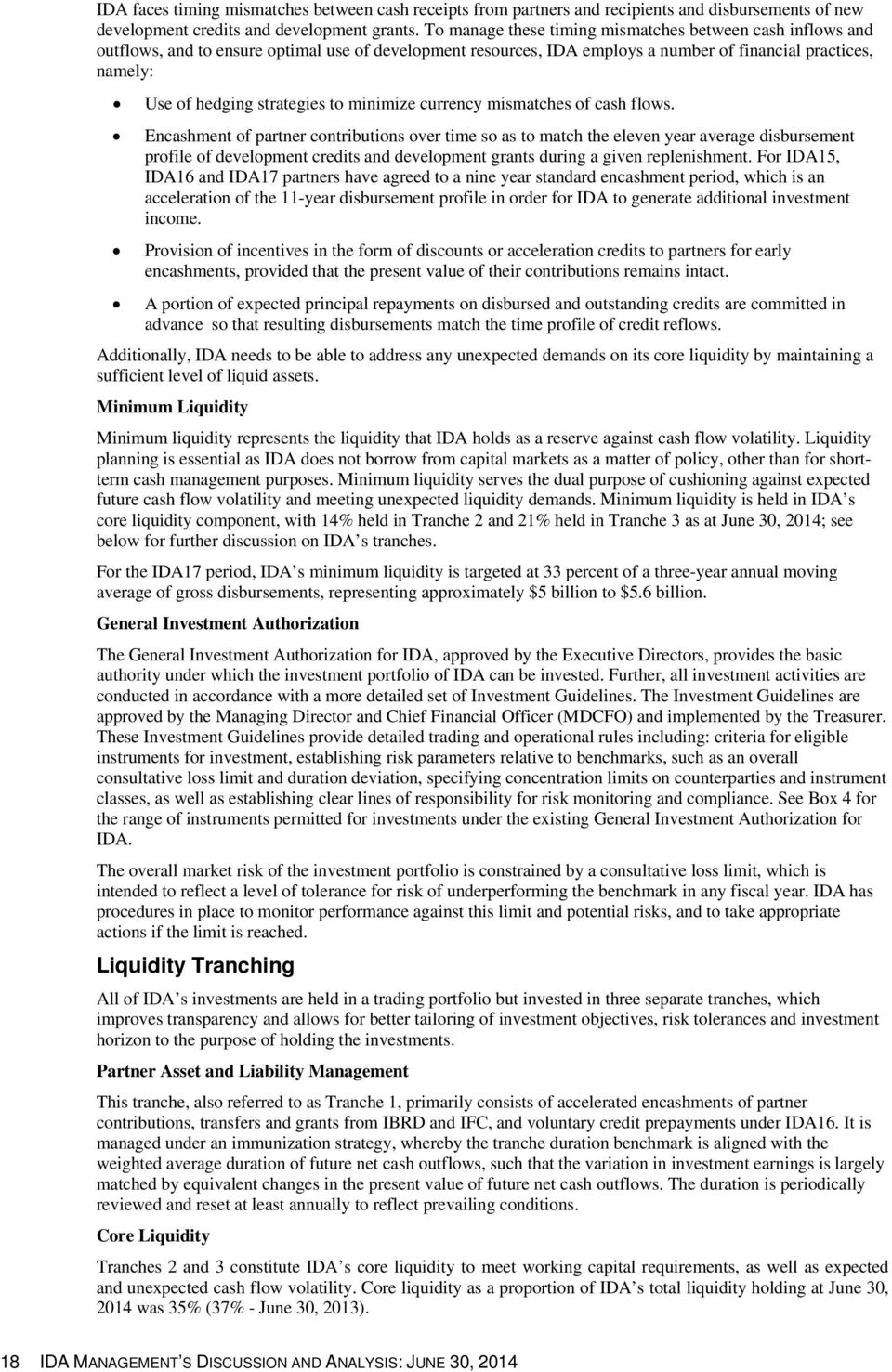
20 IDA faces timing mismatches between cash receipts from partners and recipients and disbursements of new development credits and development grants. To manage these timing mismatches between cash inflows and outflows, and to ensure optimal use of development resources, IDA employs a number of financial practices, namely: Use of hedging strategies to minimize currency mismatches of cash flows. Encashment of partner contributions over time so as to match the eleven year average disbursement profile of development credits and development grants during a given replenishment. For IDA15, IDA16 and IDA17 partners have agreed to a nine year standard encashment period, which is an acceleration of the 11-year disbursement profile in order for IDA to generate additional investment income. Provision of incentives in the form of discounts or acceleration credits to partners for early encashments, provided that the present value of their contributions remains intact. A portion of expected principal repayments on disbursed and outstanding credits are committed in advance so that resulting disbursements match the time profile of credit reflows. Additionally, IDA needs to be able to address any unexpected demands on its core liquidity by maintaining a sufficient level of liquid assets. Minimum Liquidity Minimum liquidity represents the liquidity that IDA holds as a reserve against cash flow volatility. Liquidity planning is essential as IDA does not borrow from capital markets as a matter of policy, other than for shortterm cash management purposes. Minimum liquidity serves the dual purpose of cushioning against expected future cash flow volatility and meeting unexpected liquidity demands. Minimum liquidity is held in IDA s core liquidity component, with 14% held in Tranche 2 and 21% held in Tranche 3 as at June 30, 2014; see below for further discussion on IDA s tranches. For the IDA17 period, IDA s minimum liquidity is targeted at 33 percent of a three-year annual moving average of gross disbursements, representing approximately $5 billion to $5.6 billion. General Investment Authorization The General Investment Authorization for IDA, approved by the Executive Directors, provides the basic authority under which the investment portfolio of IDA can be invested. Further, all investment activities are conducted in accordance with a more detailed set of Investment Guidelines. The Investment Guidelines are approved by the Managing Director and Chief Financial Officer (MDCFO) and implemented by the Treasurer. These Investment Guidelines provide detailed trading and operational rules including: criteria for eligible instruments for investment, establishing risk parameters relative to benchmarks, such as an overall consultative loss limit and duration deviation, specifying concentration limits on counterparties and instrument classes, as well as establishing clear lines of responsibility for risk monitoring and compliance. See Box 4 for the range of instruments permitted for investments under the existing General Investment Authorization for IDA. The overall market risk of the investment portfolio is constrained by a consultative loss limit, which is intended to reflect a level of tolerance for risk of underperforming the benchmark in any fiscal year. IDA has procedures in place to monitor performance against this limit and potential risks, and to take appropriate actions if the limit is reached. Liquidity Tranching All of IDA s investments are held in a trading portfolio but invested in three separate tranches, which improves transparency and allows for better tailoring of investment objectives, risk tolerances and investment horizon to the purpose of holding the investments. Partner Asset and Liability Management This tranche, also referred to as Tranche 1, primarily consists of accelerated encashments of partner contributions, transfers and grants from IBRD and IFC, and voluntary credit prepayments under IDA16. It is managed under an immunization strategy, whereby the tranche duration benchmark is aligned with the weighted average duration of future net cash outflows, such that the variation in investment earnings is largely matched by equivalent changes in the present value of future net cash outflows. The duration is periodically reviewed and reset at least annually to reflect prevailing conditions. Core Liquidity Tranches 2 and 3 constitute IDA s core liquidity to meet working capital requirements, as well as expected and unexpected cash flow volatility. Core liquidity as a proportion of IDA s total liquidity holding at June 30, 2014 was 35% (37% - June 30, 2013). 18 IDA MANAGEMENT S DISCUSSION AND ANALYSIS: JUNE 30, 2014
21 Tranche 2 Medium-term Investment tranche. This tranche includes the core liquidity of IDA which is expected to be available over at least a three year horizon. This tranche is managed in accordance with a return maximization strategy subject to pre-specified risk constraints over a medium-term (three years) investment horizon. Tranche 3 Short-term Investment tranche. This tranche is used for managing the operational liquidity for IDA. The investment objective of this tranche is to ensure liquidity and timely availability of the investment balances when needed, with investment returns being a secondary consideration. The tranche is invested in overnight and very short-term cash investments. Table 10 provides a breakdown of the average balances and returns by tranches of IDA s liquidity portfolio for FY14 and FY13. For an explanation of the increase in financial returns of the total portfolio, refer to Section 7: Reported Basis Results. Table 10: Average Balances and Returns by Tranches In millions of U.S. dollars, except rates in percentages FY 14 FY 13 Tranches Average Balance Financial Return Average Balance Financial Return 1 $17, % $17, % 2 4, % 3, % 3 6, % 6, % Total $28, % $27, % Under its Investment Guidelines, IDA is allowed to enter into short term borrowings in the form of securities sold under repurchase agreements and securities lent under securities lending agreements. These agreements are secured predominantly by high quality collateral, including government issued debt, and are used both to enhance returns and for liquidity management purposes. As of June 30, 2014, securities lent or sold under repurchase agreements totaled $5,011 million, an increase of $1,398 million over June 30, Table 11 provides data on short-term borrowing activities. Table 11: Short-term Borrowings In millions of U.S. dollars, except rates in percentages June 30, 2014 June 30, 2013 June 30, 2012 Securities sold under repurchase agreements and securities lent under securities lending agreements, Balance at year-end $5,011 $3,613 $3,824 Average monthly balance during the year $4,265 $3,920 $3,992 Maximum month-end balance $5,257 $5,154 $4,938 Weighted-average rate at end of fiscal year 0.14% 0.14% 0.28% Weighted-average rate during the fiscal year 0.10% 0.15% 0.26% Funding Activities IDA17 Concessional Partner Loans IDA does not borrow long-term from capital markets, but it is allowed to do so under its Articles. For IDA17, IDA s Executive Directors approved the use of a limited amount of concessional debt funding. It was noted that concessional loan contributions in IDA17 did not imply their continued use in future replenishments. In order for debt funding to be sustainably incorporated into IDA17 s financing framework, the borrowing terms of concessional loans aim to match the concessional features of IDA credits. The prudential debt limit has been set at SDR6.1 billion (US$9.2 billion) and is based on the overall concessionality of IDA s lending terms during IDA17 and the terms on which IDA will borrow. Liquidity and currency risks will be managed within the existing risk management framework. Voting rights will be allocated to providers of concessional loans based on the grant element of the loan. The grant element is a function of the terms of the loan and the discount rate agreed upon during the replenishment discussions. The grant element is effectively the ratio for the present value of the debt service payments to the present value of the loan disbursements. The voting rights associated with the grant element will be allocated following the drawdowns by IDA. The maturities of the loans will be either 25 or 40 years to match the terms of IDA s credits, with a grace period of 5 years for a 25 year loan and 10 years for a 40 year loan. The loans will have an all-in SDR equivalent coupon of up to one percent. IDA MANAGEMENT S DISCUSSION AND ANALYSIS: JUNE 30,
22 SECTION 6: RISK MANAGEMENT IDA s risk management processes and practices continually evolve to reflect changes in activities in response to market, credit, product, operational, and other developments. The Board, particularly Audit Committee members, periodically reviews trends in IDA s risk profiles and performance, and any major developments in risk management policies and controls. Governance Structure Management believes that effective financial risk management is of primary importance to its overall operations. Accordingly, the risk management governance structure has been designed to manage the principal risks IDA assumes in conducting its activities. The risk management governance structure supports senior management in its oversight function, particularly in the coordination of different aspects of risk management and in connection with risks that are common across functional areas. The Vice President and WBG Chief Risk Officer (CRO) is responsible for leading the risk management function at IDA. In addition, the CRO works closely with other institutions of the World Bank Group to review, measure, aggregate, and report on risks, share best practices, and help the WBG use its resources in an effective manner. The CRO also helps increase cooperation between the entities and increase knowledge sharing in the risk management function. There are currently three units that directly report to the CRO: The Credit Risk Department is responsible for determining the adequacy of provisions for losses on credits and other exposures. The Market and Counterparty Risk Department is responsible for market and counterparty credit risk oversight, assessment and reporting. It works with IDA s financial managers, who are responsible for the day-to-day management of market and counterparty risks. The department s responsibilities include establishing and maintaining guidelines, volume limits and risk oversight processes to facilitate effective monitoring and control, and providing reports to the Audit Committee and the Board on the extent and nature of risks, risk management and oversight. The department is also responsible for ensuring effective oversight, which includes: i) maintaining sound credit assessments, ii) addressing transaction and product risk issues, iii) providing an independent review function, iv) monitoring market and counterparty risk in the investment portfolio, and v) implementing the model risk governance framework. The Operational Risk Department was established in May 2014 to assist business units within the finance and technology functions to identify, assess and report their operational risks. The department aggregates and monitors operational risks using an operational risk management framework. In addition, it is responsible for the business continuity management and enterprise risk management functions. IDA has in place a cohesive risk governance structure with the following committees central to risk management in IDA: The Finance and Risk Committee (FRC) directs and oversees the financial integrity, income sustainability, balance sheet strength and risk management activities of IDA and is chaired by the Managing Director and WBG Chief Financial Officer (MDCFO). The Committee is responsible for reviewing, evaluating, and in some cases, deciding on issues with policy implications related to IDA s risks and returns in the areas of finance (including credit, market, liquidity, and operational risks), information technology, information and corporate security, business continuity, and the integrity of IDA s financial reporting and risk management processes. In addition to the FRC, there are risk related committees which work under the authority of the MDCFO and the CRO. These committees provide technical expertise and guidance on strategy, policy, risk management and new initiative issues enabling the group to conduct appropriate oversight of IDA s finance and risk issues. Country Credit Risk Committee monitors the measurement and reporting of country credit risk and reviews the impact on the provision for losses on credits and guarantees for any changes in exposure, risk ratings of borrowing member countries, or movements between the accrual and non-accrual portfolios. Market and Commercial Risk Committee develops and monitors the policies under which market and commercial credit risks faced by IDA are measured, reported and managed. It also monitors compliance with policies governing commercial credit exposure and currency management. Specific areas of activity include reviewing and endorsing guidelines for limiting balance sheet and market risks, the use of derivative instruments, setting investment and counterparty guidelines, and monitoring matches between assets and their funding. It also oversees the development and application of the model risk governance framework. Operational Risk Committee provides a mechanism for integrated review and response across the finance and technology functions on operational risks associated with people, processes, and systems including business continuity, recognizing that the business units continue to be responsible for managing operational risks. 20 IDA MANAGEMENT S DISCUSSION AND ANALYSIS: JUNE 30, 2014
23 Operational Risk Operational risk 2 is defined as the risk of loss resulting from inadequate or failed internal processes, people and systems, or from external events. IDA s operational risk management framework is built on three key principles: (i) business units are responsible for directly managing operational risks in their respective functional areas, (ii) a dedicated central operational risk team assists business units to anticipate, mitigate, and control operational risk, and (iii) oversight is provided by the operational risk committee and independent control functions. IDA s operational risk management framework adopts a structured and uniform approach to identify, assess and monitor key operational risks across business units. A number of tools are used as part of this process including risk assessments, key risk indicators, database of external events and scenario analysis. IDA plans to make use of the operational risk framework to further advance business decision-making. Risk-Bearing Capacity The Development Finance Resource Mobilization Department which reports to the Vice President of Development Finance, manages IDA replenishments. This department discusses policy and funding frameworks with partners, and allocates concessional resources between borrowing member countries based on the agreed performance based allocation system. Responsibility for financial management, including assetliability management and the management of funding, liquidity, currency, interest rate and credit risk, also lies with this department. The risk bearing capacity of IDA falls under four main categories. (i) Funding risk - the extent to which IDA can commit to new financing of development credits, grants and guarantees given its financial position at any point in time and whether there are sufficient resources to meet undisbursed commitments of credits and grants. (ii) Liquidity risk - whether IDA has sufficient core liquidity to meet disbursements of approved credits and grants. (iii) Credit risk - the risk of default by recipient countries and market counterparties. (iv) Market risk - the exposure to currency and interest rate risks.. Funding Risk IDA s capacity to commit to new financing of credits, grants and guarantees at any point in time is defined by the Commitment Authority Framework of the particular replenishment which is effective at that time. See Section 2: Funding and Resource Allocation for further details. Management monitors IDA s funding position as a key indicator to assess IDA s ability to conduct its operations. Funding risk relates to whether there are sufficient resources (investment portfolio and demand notes) to meet undisbursed commitments of credits and grants. Further details on IDA s funding risk management, including details of the three tranches which comprise IDA s investment portfolio, together with a description of the General Investment Authorization are provided in Section 5: Investment and Funding Activities. Funding Position As of June 30, 2014, the investment portfolio and unrestricted demand notes covered 71% of all undisbursed commitments of development credits and grants, compared with 79% as at June 30, The decline of 8% primarily reflecting the 18% increase in undisbursed development credits outstanding in FY14 as compared to FY13. The gap in funding will be met by future inflows. In the last 5 years IDA s funding position has ranged from 71% to 81%. 2 The risk in IDA s lending operations is managed by the Operations Policy and Country Services. This covers risk of non-compliance with its policies, safeguards as well as risk of mis-procurement on behalf of clients, and fraud and corruption in its financed projects. IDA MANAGEMENT S DISCUSSION AND ANALYSIS: JUNE 30,
24 Liquidity Risk Liquidity risk is also a key risk to IDA s operations. It is managed through a combination of IDA s daily cash flow monitoring and management, timing of partner contributions, and prudent investment policies under an established financial framework. A key indicator of liquidity management is the core liquidity position which reflects the number of months of gross disbursements (based on the average for a particular year) that can be met out of the core liquidity (tranches 2 and 3) available at a point in time. Further details on IDA s liquidity risk management, including details of the three tranches which comprise IDA s investment portfolio, together with a description of the General Investment Authorization, are provided in Section 5: Investment and Funding Activities. Liquidity Position As of June 30, 2014, core liquidity amounted to $9,902 million, comprising short-term and medium-term investments. IDA s liquidity position was sufficient to cover approximately nearly 9 months of average monthly gross disbursements based on FY14 volume (11 months in FY13). The two month decline primarily reflects the higher average gross disbursements for FY14. In the last 5 years IDA s liquidity position has ranged from 9 to 14 months of average monthly gross disbursements since FY10. Credit Risk IDA has two types of credit risk: country credit risk and commercial credit risk. Country credit risk is the risk of loss due to a country not meeting its contractual obligations and commercial credit risk is the risk of loss due to a counterparty not honoring its contractual obligations. Country Credit Risk Country credit risk is managed by the Development Finance Resource Mobilization Department, which regularly reviews the credit risk of its recipient countries in terms of the country s debt sustaining capacity. These reviews provide an input into the composition of development credits versus grants for new operations. Section 4: Development Activities, Products and Programs describes how funds are allocated for development grants based on a country s risk of debt distress. Overdue and Non-Performing Development Credits When a borrower fails to make payment on any principal, interest or other charges, IDA has the contractual right to suspend disbursements immediately on all credits and grants. IDA s current policy however, is to exercise this right through a graduated approach as summarized in Box 3. These policies also apply to those member countries who are eligible to borrow from both IBRD and IDA, and whose payments on IBRD loans may become overdue. For borrowers with IDA development credits who become overdue in their debt service payments on IBRD loans, IDA also applies the treatment described in Box 3. As of June 30, 2014, IDA had $136,011 million of development credits outstanding, of which credits in nonaccrual status represent 2.02%. For a summary of countries with development credits or guarantees in nonaccrual status at June 30, 2014, see Notes to Financial Statements Note E Development Credits and Other Exposures. 22 IDA MANAGEMENT S DISCUSSION AND ANALYSIS: JUNE 30, 2014
25 Box 3: Treatment of Overdue Payments Overdue by 30 days Overdue by 45 days Overdue by 60 days Overdue by more than six months Where the borrower is the member country, no new development credits or grants to the member country, or to any other borrower in the country, will be presented to the Executive Directors for approval; nor will any previously approved credits or grants be signed, until payments for all amounts 30 days overdue or longer have been received. Where the borrower is not the member country, no new credits or grants to that borrower will be signed or approved. In addition to the provisions cited above for payments overdue by 30 days, to avoid proceeding further on the notification process leading to suspension of disbursements, the country as borrower or guarantor and all borrowers in the country must pay not only all payments overdue by 30 days or more, but also all payments due regardless of the number of days since they have fallen due. Where the borrower is not the member country, no new development credits or grants to, or guaranteed by, the member country, will be signed or approved. In addition to the suspension of approval for new development credits or grants and signing of previously approved credits or grants, disbursements on all grants or credits to or guaranteed by the member country are suspended until all overdue amounts have been paid. This policy applies even when the borrower is not the member country. Under exceptional circumstances, disbursements could be made to a member country upon approval by the Executive Directors. All development credits made to or guaranteed by a member of IDA are placed in nonaccrual status, unless IDA determines that the overdue amount will be collected in the immediate future. Unpaid service charges and other charges not yet paid on development credits outstanding are deducted from the income of the current period. To the extent that these payments are received, they are included in income. At the time of arrears clearance, a decision is made on the restoration of accrual status on a case-by-case basis; in certain cases that decision may be deferred until after a suitable period of payment performance has passed. Commercial Credit Risk In the normal course of its business, IDA utilizes various derivatives to manage its exposure to fluctuations in interest and currency rates. Derivative and foreign exchange transactions also involve credit risk. The effective management of credit risk is vital to the success of IDA s investment and asset/liability management activities. The monitoring and managing of these risks is a continuous process due to changing market environments. IDA mitigates the counterparty credit risk arising from investments, derivatives and asset/liability management activities through its credit approval process and monitoring procedures. The credit approval process involves evaluating counterparty creditworthiness, assigning credit limits and determining the risk profile of specific transactions. Credit limits are calculated and monitored on the basis of potential exposures taking into consideration current market values and estimates of potential future movements in those values, and collateral agreements with counterparties. If there is a collateral agreement with the counterparty to reduce credit risk, then the amount of collateral obtained is based on the credit rating of the counterparty. Collateral held includes cash and highly liquid investment securities. For derivative products, IDA uses the estimated replacement cost of the derivative as the measure of credit exposure. While the contractual principal amount of derivatives is the most commonly used volume measure in the derivative markets, it is not a measure of credit or market risk. For all securities, IDA limits trading to a list of authorized dealers and counterparties. With the exception of transactions with IBRD, credit risk is managed through application of eligibility criteria, (see Box 4) volume limits and through the use of mark-to-market collateral arrangements for swap transactions. Under the mark-to-market collateral arrangements, when IDA is in a net receivable position higher than the agreed upon collateral threshold allocated to the counterparty, counterparties are required to post collateral with IDA. During FY14, IDA received cash collateral of $0.9 million (FY13 - $9 million). With respect to futures and options, IDA generally closes out most open positions prior to expiration. Futures are settled on a daily basis. Box 4: Eligibility Criteria for IDA s Investment Securities Instrument Securities Description IDA may only invest in obligations issued or unconditionally guaranteed by governments of member countries with a minimum credit rating of AA-. However, if government obligations Sovereigns are denominated in the national currency of the issuer, no rating is required. Agencies Corporates and Asset-Backed Securities (ABS) Commercial Paper IDA may only invest in obligations issued by an agency or instrumentality of a government of a member country, a multilateral organization or any other official entity other than the government of a member country, with a minimum credit rating of AA-. IDA may only invest in securities with a AAA credit rating. IDA may only invest in short-term borrowings (less than 190 days) from commercial banks, corporates and financial institutions. Time deposits a IDA may only invest in time deposits issued or guaranteed by financial institutions, whose senior debt securities are rated at least A-. a. Time deposits include certificates of deposit, bankers acceptances and other obligations issued or unconditionally guaranteed by banks or other financial institutions IDA MANAGEMENT S DISCUSSION AND ANALYSIS: JUNE 30,
26 IDA s commercial counterparty credit risk exposure is concentrated in investments in debt instruments issued by sovereign governments, agencies, corporate entities and banks, as shown in table 12. The credit quality of IDA s investment portfolio remains concentrated in the upper end of the credit spectrum with 94% of the portfolio rated AA or above as at June 30, 2014, reflecting IDA s continued preference for highly rated securities and counterparties across all categories of financial instruments. Total commercial counterparty credit exposure, net of collateral held, was $32,261 million as of June 30, Table 12: Commercial Credit Exposure, Net of Collateral Held, by Counterparty Rating In millions of U.S. dollars At June 30, 2014 At June 30, 2013 Counterparty Rating Sovereigns Agencies, ABS, Commercial paper, Swaps, Corporate and Time Deposits Total % of Total Total % of Total AAA $12,246 $4,175 $16, $16, AA 9,762 4,152 13, , A 507 1,192 1, ,483 8 BBB or below * Total $22,733 $9,528 $32, $30, * Denotes less than 0.5%. For the contractual value, notional amounts and related credit risk exposure amounts by instrument see the Notes to Financial Statements-Note D- Derivative Instruments. Market Risk IDA faces foreign exchange risk with respect to its future partner contributions, which it manages using currency forwards and by rebalancing the currency composition of its investment portfolio, and interest rate risk on its investment portfolio, which is managed by aligning the duration of the investment portfolio with that of the projected net cash requirements. The impact of these strategies is shown on IDA s Statement of Income; however, the economic offset is not reported. Further details on these asymmetries can be seen in Section 7: Reported Basis Results. The analysis below discusses the impact of these activities on IDA s Statement of Income and the corresponding economic offset. Foreign Exchange Risk IDA faces foreign exchange rate risk exposure as a result of the currency mismatch between its commitments for development credits and grants, which are denominated in SDRs; partner contributions, which are typically denominated in national currencies; and the portion of IDA s internal resources and expenditures that is denominated in U.S. dollars. IDA uses currency forward contracts to convert partners encashments provided in national currencies into the four currencies of the SDR basket. These transactions are intermediated by IBRD for efficiency purposes. Under this arrangement, IDA enters into foreign exchange forwards with IBRD, and IBRD simultaneously enters into off-setting foreign exchange forwards with market counterparts. For further details, see Notes to Financial Statements Note D Derivative Instruments. The component currencies of the SDR constitute the functional currencies of IDA, all other currencies are considered non-functional currencies. Any translation adjustments due to exchange rate movements against the U.S. dollar for non-functional currencies and functional currencies are reflected in the Statement of Income and Accumulated Other Comprehensive Income in the Equity section of the Balance Sheet, respectively. For further details, see Notes to Financial Statements Note A Summary of Significant Accounting and Related Policies. The payable leg of the currency forward contracts economically hedging partner pledges are denominated in non-functional currencies. Accordingly, appreciation (depreciation) of these currencies against the U.S. dollar results in exchange rate losses (gains), which are reported in the Statement of Income. The translation adjustment on future inflows from partners is the economic offset to the translation adjustment on non functional currencies of currency forward contracts. The translation adjustment loss on non-functional currencies of $51 million in FY14 was due to the appreciation of majority of the non-functional currencies against the U.S. dollar. This was offset by the translation adjustment on the future inflows from partners, which was a gain of $57 million in FY14. In FY13, the translation adjustment gain of $1 million was a net amount resulting from the offsetting movements of the underlying non-functional currencies against the U.S.dollar. This was offset by translation adjustment loss of $4 million on the flows associated with the economic offset. The differences between the reported translation adjustments and the related translation adjustments on the economic offsets primarily represent the translation adjustments on the partner contributions in non-functional currencies that are not hedged. In addition, IDA also mitigates the currency exchange rate risk by aligning the currency composition of its liquid asset portfolio and the hedges of its non-sdr cash flows with the SDR composition. 24 IDA MANAGEMENT S DISCUSSION AND ANALYSIS: JUNE 30, 2014
27 Interest Rate Risk The primary objective in the management of IDA s investment portfolio is to provide a ready source of liquidity when needed by IDA to meet projected net cash requirements. Accordingly, IDA s assets are invested so that their duration closely matches the duration of these projected net cash requirements. Given IDA s lengthy disbursement profile, the duration for IDA s investment portfolio is therefore relatively long. This long duration, combined with volatility in market interest rates, results in significant year-on-year variability in unrealized mark-to-market gains/losses on the portfolio. The economic offset to the unrealized mark-to-market gains/losses on the investment portfolio would be the change in the present value of the projected net cash outflows. IDA s investment portfolio had a duration of approximately three years as of June 30, 2014, and has two components: core liquidity and partner asset and liability management. During FY14, the investment portfolio experienced unrealized mark-to-market gains of $173 million as a result of the flattening of the yield curves for most of the major currencies. In contrast, in FY13, the investment portfolio experienced unrealized markto-market losses of $367 million due to steepening of the yield curves. The currency forward contracts are also subject to interest rate risk and in FY14, incurred unrealized mark-tomarket losses of $35 million during FY14, as compared to losses of $102 million in FY13, resulting from the more pronounced downward movement of yield curves of the majority of the payable currencies during FY13. SECTION 7: REPORTED BASIS RESULTS Under the reported basis, IDA s Statement of Income does not reflect the true economic results of IDA due to of a number of asymmetries as discussed below. Development grants: Development grants are recorded as expenses in the income statement under U.S. GAAP. In contrast, the significant inflows of resources from IDA s partners, which fund these expenses, are recorded as equity through members subscriptions and contributions and therefore do not flow through the Statement of Income. Currency forward contracts: As part of its currency risk management strategy, IDA uses currency forward contracts at the start of each replenishment to hedge its exposure to potential changes in the value of partner contributions. The translation adjustment on the non-functional currency forward contracts, together with the related unrealized mark-to-market gains/losses, are reported in the income statement. However, the economic offset represented by the change in value of the related partner pledges are not reported in the Statement of Income, since partner pledges do not meet the definition of assets. Investment Income: The investment portfolio is primarily managed whereby its duration is aligned with the average duration of the future net cash outflows. Accordingly, it has a relatively long duration and is sensitive to interest rate movements. An asymmetry arises due to the fact that the significant unrealized mark-to-market gains or losses are reported in the Statement of Income; however, the economic offset, represented by the change in the present value of the associated future net cash outflows is not reported in IDA s financial statements. Administrative expenses: IDA s administrative expenses are expected to be covered by service and interest charge income and the partner compensation for forgone charges on cancelled credits under the HIPC Debt Initiative and MDRI, and for development grants provided. The asymmetry arises due to the fact that under the reported basis, IDA s administrative expenses and service and interest charge income are included in the Statement of Income. However, the additional contributions for forgone charges are recorded as equity. The Statement of Activities addresses the asymmetries associated with the development grants and administrative expenses, see Section 3: Results for FY14 and IDA16 Commitment Authority. The asymmetry related to the currency forward contracts and the economic offset is shown in Section 6: Risk Management. Condensed Statement of Income Analysis Table 13: Condensed Statement of Income provides a comparison of the main sources of income and expenses between FY14 and FY13. The net loss of $1,612 million in FY14 is $140 million lower than the net loss of $1,752 million in FY13. The primary factors contributing to the $140 million increase in the net results are as follows: Investment revenue, net: The $532 million increase was primarily driven by the unrealized mark-to-market gains associated with the flattening of the yield curves of the major currencies experienced during FY14. In contrast, IDA experienced unrealized mark-to-market losses in FY13 due to the steepening of the applicable yield curves. IDA s investment portfolio is sensitive to interest rate movements as a result of having a longer duration to help it immunize interest rate risk. The duration of the portfolio was approximately three years as of June 30, IDA MANAGEMENT S DISCUSSION AND ANALYSIS: JUNE 30,
28 Fair value adjustment on asset-liability management portfolio: The negative fair value adjustment of $35 million in FY14 was primarily due to the effect of the downward shift in the yield curve of the currencies constituting the payable leg of the currency forward contracts used to hedge partner commitments of IDA16 and prior replenishments. In FY13, the effect of the upward shift in the euro yield curve resulted in higher negative fair value adjustment of $102 million. The above were partially offset by : Translation adjustment on the non-functional currencies:the translation adjustment loss on non-functional currencies of $51 million in FY14 was due to the appreciation of majority of the non-functional currencies against the U.S. dollar. These liabilities arise out of the payable leg of currency forwards used to hedge the SDR value of future partner commitments. In FY13, the translation adjustment gain of $1 million was a net amount resulting from the offsetting movements of the underlying non-functional currencies against the U.S.dollar. Development grants: The $265 million higher development grant approvals primarily related to the Africa and South Asia regions, combined, which constituted 77% of the total development grant approvals in FY14. Provision for debt relief and losses on credits and other exposures, net: During FY14, there was an additional charge of $39 million as compared to release of provision amounting to $53 million during FY13. The higher provisioning in FY14 was primarily due to the volume increase in credit exposures. Table 13: Condensed Statement of Income for the fiscal years ended June 30, 2014 and June 30, 2013 Expressed in millions of U.S. dollars FY14 FY13 Variance Revenue Development credits and guarantees $ 1,015 $ 1,021 $ (6) Investment revenue, net Transfers and grants from affiliated organizations and trust funds (83) Other Expenses Administrative expenses (2,004) (1,936) (68) Development grants (2,645) (2,380) (265) Provision for debt relief and losses on credits and other exposures, net (39) 53 (92) Non-functional currency translation adjustment (gains) losses, net (51) 1 (52) Fair value adjustment on asset-liability management portfolio, net (35) (102) 67 Discount on prepaid development credits - (12) 12 Write-off on buy-down of development credits - (26) 26 Project preparation advances (PPA) grants and other expenses Net Loss $ (1,612) $ (1,752) $140 Table 14: Net Administrative Expenses for the fiscal years ended June 30, 2014 and June 30, 2013 Expressed in millions of U.S. dollars FY14 FY13 Variance Administrative expenses: Staff costs $ 847 $ 811 $ 36 Operational travel (7) Consultant fees Pension and other post-retirement benefits (31) Communications and IT Contractual services Equipment and buildings Other expenses Total administrative expenses $2,004 $1,936 $ 68 Revenue from externally funded activities: Reimbursable advisory services $ (46) $ (34) $(12) Reimbursable revenue - IDA executed trust funds (354) (316) (38) Revenue trust funds administration (65) (68) 3 Restricted revenue (27) (26) (1) Other revenue (143) (122) (21) Total revenue $ (635) $ (566) $(69) Total Net Administrative Expenses $1,369 $1,370 $ (1) 26 IDA MANAGEMENT S DISCUSSION AND ANALYSIS: JUNE 30, 2014
29 Condensed Balance Sheet Analysis Variances between June 30, 2014 and June 30, 2013 balances in IDA s condensed balance sheet are discussed in Section 3: Results for FY14 and IDA 16 Commitment Authority. SECTION 8: CRITICAL ACCOUNTING POLICIES AND THE USE OF ESTIMATES Note A of IDA s financial statements contains a summary of IDA s significant accounting policies. These policies, as well as significant estimates made by management, are integral to the presentation of IDA s financial position. While all of these policies require a certain level of management judgment and estimates, this section discusses the significant accounting policies that require management to make judgments that are difficult, complex or subjective and relate to matters that are inherently uncertain. Fair Value of Financial Instruments All fair value adjustments are recognized through the income statement. The fair values of financial instruments are based on a three level hierarchy. For financial instruments classified as Level 1 and 2, inputs are based on observable market data and less judgment is applied in arriving at a fair value measurement. For financial instruments classified as Level 3, significant unobservable inputs are used. These inputs require management to make significant assumptions and judgments in arriving at a fair value measurement. Derivative contracts include currency forward contracts, swaptions, plain vanilla swaps, and structured swaps, and are valued using the standard discounted cash flow methods using market observable inputs such as yield curves, foreign exchange rates and basis spreads. In instances where management relies on instrument valuations supplied by external pricing vendors, there are procedures in place to validate the appropriateness of the models used as well as the inputs applied in determining those values. All of IDA s financial instruments are classified as Level 1 and Level 2 as of June 30, 2014, as the inputs are based on observable market data and less judgment is applied in arriving at fair value measures. On a quarterly basis, the methodology, inputs and assumptions are reviewed to assess the appropriateness of the fair value hierarchy classification of each financial instrument. All the financial models used for input to IDA s financial statements are subject to both internal and periodic external verification and review by qualified personnel. Provision for Losses on Development Credits and Other Exposures IDA s accumulated provision for losses on credits and other exposures reflects the probable losses inherent in its nonaccrual and accrual portfolios after taking into consideration the expected relief under the HIPC Debt Initiative and MDRI and any provision for losses on the buy-down of development credits. The provision required is a function of the expected default frequency and the assumed severity of the loss given default for each of the borrowers. The expected default frequency is based on the borrower s assigned risk rating. The determination of a borrower s risk rating is based on a quantitative framework which relies primarily on considerations of political risk, external debt and liquidity, fiscal policy and public debt burden, balance of payments risks, economic structure and growth prospects, monetary and exchange rate policy, financial sector risks and corporate sector debt and other vulnerabilities. IDA periodically reassesses the adequacy of the accumulated provision for losses on credits and other exposures accordingly. Adjustments to the accumulated provision are recorded as a charge against or addition to income. Actual losses may differ from expected losses due to unforeseen changes in any of the factors that affect borrowers creditworthiness. Additional information on IDA s provisioning policy and the status of nonaccrual loans can be found in the Notes to Financial Statements-Note A-Summary of Significant Accounting and Related Policies and Note E- Development Credits and Other Exposures. Provision for HIPC Debt Initiative and MDRI The adequacy of the accumulated provision for the HIPC Debt Initiative and MDRI is based on both quantitative and qualitative analyses of various factors, including estimates of Decision and Completion Point dates. IDA periodically reviews these factors and reassesses the adequacy of the accumulated provision for the HIPC Debt Initiative and MDRI. Adjustments to the accumulated provision are recorded as a charge against or addition to income. IDA MANAGEMENT S DISCUSSION AND ANALYSIS: JUNE 30,
30 Provision for Losses on Buy-Down of Development Credits The provision for losses on the buy-down of development credits is equivalent to the difference between the carrying amount of the development credits to be bought down and the estimated amount to be received, when all performance goals as well as conditions necessary to effect the buy-down have been completed. The estimated amount to be received is based on quantitative factors including the discount rate. SECTION 9: GOVERNANCE, TRANSPARENCY, ACCOUNTABILITY AND INTERNAL CONTROLS General Governance IDA s decision-making structure consists of the Board of Governors, the Board of Executive Directors, and the President, management and staff. The Board of Governors is the highest decision-making authority. Governors are appointed by their member governments for a five-year term, which is renewable. The Board of Governors may delegate authority to the Board of Executive Directors to exercise any of its powers, except for certain powers enumerated in the IDA Articles. Board of Executive Directors In accordance with the Articles, Executive Directors are appointed or elected every two years by their member governments. The Board currently has 25 Executive Directors who represent all 173 member countries. Executive Directors are neither officers nor staff of IDA. The President is the only member of the Board from management, and he serves as a non-voting member and as Chairman of the Board. The Board has established several committees, including: Audit Committee Budget Committee Committee on Development Effectiveness (CODE) Committee on Governance and Executive Directors Administrative Matters (COGAM) Ethics Committee Human Resources Committee The Board and its committees function in continuous session at the principal offices of the IDA in Washington DC, as business requires. Each committee's terms of reference establishes its respective roles and responsibilities. As committees do not vote on issues, their role is primarily to serve the Board in discharging its responsibilities. The Board is required to consider proposals made by the President on IDA credits, grants and guarantees and on other policies that affect its general operations. The Board is also responsible for presenting to the Board of Governors, at the Annual Meetings, audited accounts, an administrative budget, and an annual report on operations and policies and other matters. Senior Management Changes Effective February 17, 2014, Bernard Lauwers became Vice President and Controller of the WBG, following the retirement of Charles McDonough. Effective February 17, 2014, Lakshmi Shyam-Sunder became Vice President and Chief Risk Officer of the WBG, following the retirement of Robert Kopech. Effective July 30, 2013, Sri Mulyani Indrawati, Managing Director of IDA, also became Chief Operating Officer. Audit Committee Membership The Audit Committee (the Committee) consists of eight Executive Directors. Membership in the Committee is determined by the Board, based on nominations by the Chairman of the Board, following informal consultation with Executive Directors. Key Responsibilities The Committee is appointed by the Board to help it oversee and assess IDA finances and accounting, including the effectiveness of financial policies, the integrity of financial statements, internal controls regarding finance, accounting and ethics (including fraud and corruption), and financial and operational risks. 28 IDA MANAGEMENT S DISCUSSION AND ANALYSIS: JUNE 30, 2014
31 The Committee is also responsible for reviewing the performance and recommending to the Board the appointment of the external auditor--and monitoring the independence of the auditor. The Committee participates in the oversight of the internal audit function and reviews the annual internal audit plan. In carrying out its role, the Committee discusses with management, external auditors, and internal auditors financial issues and policies that affect the IDA s financial position and capital adequacy. It also reviews with the external auditors the financial statements prior to their publication and recommends the annual audited financial statements for approval to the Board. The Committee monitors and reviews developments in corporate governance and its own role on an ongoing basis. The Committee updated its terms of reference in July Executive Sessions Under the Audit Committee's terms of reference, it may convene in executive session at any time, without Management s presence. The Committee meets separately in executive session with the external and internal auditors. Access to Resources and to Management Throughout the year, the Audit Committee receives a large volume of information to enable it to carry out its duties. The Committee meets both formally and informally throughout the year to discuss relevant matters. It has complete access to Management and reviews and discusses with Management topics considered in its terms of reference. The Committee may, under exceptional circumstances, seek advice and assistance from outside legal, accounting, or other advisors as it deems necessary. Business Conduct The WBG promotes a positive work environment where staff members understand their ethical obligations to the institution, which are embodied in its Core Values and Principles of Staff Employment. In support of this commitment, the institution has in place a Code of Conduct, entitled Living our Values (the Code). The Code applies to all staff worldwide and is available on the World Bank s website, Staff, including consultants, are required to complete an acknowledgment that they will abide by the tenets of the Code. The business conduct obligations of staff are articulated in the Staff Manual (Principles of Staff Employment, Staff Rules), Administrative Manual and other guidelines. The Principles and Staff Rules require that all staff avoid or properly manage conflicts of interest. In accordance with the Staff Rules, senior managers must complete a confidential financial disclosure instrument with the Office of Ethics and Business Conduct. The WBG has both an Ethics Help Line and a Fraud and Corruption hotline. A third-party service offers numerous methods of worldwide communication. Other reporting channels include: phone, mail, or through the units respective websites. Callers may also visit the offices in person. IDA has in place procedures for the receipt, retention and handling of recommendations and concerns relating to business conduct identified during accounting, internal control and auditing processes. The WBG s Staff Rules clarify and codify the obligations of staff in reporting suspected fraud, corruption or other misconduct that may threaten its operations or governance. Additionally, these rules offer protection from retaliation. Auditor Independence The appointment of the external auditor for IDA is governed by a set of Board-approved principles. Key features of these principles include: Prohibition of the external auditor from the provision of all non audit-related services. All audit-related services must be pre-approved on a case-by-case basis by the Board, upon recommendation of the Audit Committee. Mandatory rebidding of the external audit contract every five years, with a limitation of two consecutive terms and mandatory rotation thereafter provided however that the Committee may exceptionally recommend that circumstances are such that the incumbent audit firm should be allowed to participate in the re-bidding. The External auditor is appointed to a five year term of service. This is subject to annual reappointment based on the recommendation of the Audit Committee and approval of a resolution by the Executive Directors. In FY14, KPMG llpbegan a second five-year term as IDA s external auditor. Communication between the external auditor and the Audit Committee is ongoing, as frequently as deemed necessary by either party. The Audit Committee meets periodically with the external auditor and individual members of the Audit Committee IDA MANAGEMENT S DISCUSSION AND ANALYSIS: JUNE 30,
32 have independent access to the external auditor. IDA s external auditors follow the communication requirements with audit committees set out under U.S. generally accepted auditing and attestation standards and International Standards on Auditing. Internal Controls Internal Control over Financial Reporting As of June 30 of each fiscal year, Management makes an annual assertion on whether its system of internal control over external financial reporting has met the criteria for effective internal control over external financial reporting, as described in the 1992 Internal Control Integrated Framework by The Committee of Sponsoring Organizations of the Treadway Commission (COSO). Concurrently, IDA s external auditor provides an attestation report on attests to whether Management's assertion statement regarding the effectiveness of internal control over external financial reporting is fairly stated in all material respects. For each fiscal year, Management evaluates the quality of internal controls over external financial reporting to determine whether any changes made in these controls during the fiscal year materially affect, or would be reasonably likely to materially affect, IDA s internal control over external financial reporting. As of June 30, 2014, no such changes had been made. On May 14, 2013, COSO issued the 2013 Internal Control Integrated Framework (2013 Framework). The updated framework is intended to clarify existing internal control concepts and simplify their use and application. The 1992 framework will remain available until December 15, 2014, after which time it will be superseded by the 2013 Framework. IDA is currently evaluating the updated Framework. Disclosure Control and Procedures Disclosure control and procedures are designed to ensure that information required to be disclosed is gathered and communicated to Management as appropriate, to allow timely decisions regarding required disclosure by IDA. Management conducted an evaluation of the effectiveness of such controls and procedures and the President and the MDCFO have concluded that these controls and procedures were effective as of June 30, IDA MANAGEMENT S DISCUSSION AND ANALYSIS: JUNE 30, 2014
33 GLOSSARY OF TERMS Asset-Backed Securities (ABS): Asset-Backed Securities are instruments whose cash flows are based on a pool of underlying assets managed by a trust. Mortgage-backed securities are a type of ABS whose cash flows are based on the repayments of the mortgages. Blend Borrower: IDA Member that is eligible to borrow from IDA on the basis of per capita income and is also eligible to borrow from IBRD on the basis of limited creditworthiness. Given the access to both sources of funds, blend borrowers are expected to limit IDA funding to social sector projects and to use IBRD resources for projects in the other sectors. Commitment Authority: Total value of resources available during a particular replenishment including partner contributions, internal resources, IBRD transfers, IFC grants and other resources. Completion Point: When conditions specified in the legal notification sent to a country are met and the country s other creditors have confirmed their full participation in the HIPC debt relief initiative. When a country reaches its Completion Point, IDA s commitment to provide the total debt relief for which the country is eligible, becomes irrevocable. Committee of Sponsoring Organizations of the Treadway Commission (COSO): Committee of Sponsoring Organizations of the Treadway Commission. COSO was formed in 1985 to sponsor the National Commission on Fraudulent Financial Reporting, an independent private-sector initiative which studied the causal factors that can lead to fraudulent financial reporting. In 1992, COSO issued its Internal Control-Integrated Framework, which provided a common definition of internal control and guidance on judging its effectiveness. Consultative Loss Limit: Reflects a level of IDA tolerance for risk of underperforming the benchmark in any fiscal year. Decision Point: Decision by the Executive Directors of IDA to provide debt relief under the HIPC Initiative. Development Committee: The Development Committee is a forum of the World Bank Group and the International Monetary Fund that facilitates intergovernmental consensus building on development issues. Duration: Duration provides an indication of the interest rate sensitivity of a fixed income security to changes in its underlying yield. Encashment: Draw down (payment in cash) of a promissory note in accordance with a schedule agreed for each replenishment. Graduate Member: A member country that was once only eligible to borrow from IDA, however due to improvements in the member s economic results is no longer eligible to borrow from IDA, and is deemed to have graduated to IBRD. Hedging: Hedging is a risk management technique of entering into offsetting commitments to eliminate or minimize the impact of adverse movements in value or cash flow of the underlying instrument or economic condition. Instrument of Commitment (IoC): The instrument through which a government commits to make a subscription or a subscription and contribution to IDA s resources. Membership votes: Voting rights accorded to IDA members which are based on participation in the initial subscription and subsequent replenishments. All members whether they are Part I or Part II have the same number of membership votes. Net Disbursements: Development Credit and development grant disbursements net of repayments and prepayments. Part I and Part II Members: IDA s Articles distinguish between two categories of original members - Part I and Part II - and provide for a different treatment of the initial subscription payments by each group. Part I members were originally those countries, generally developed countries that contribute to the resources of IDA, whose economic and financial situation justified making the entire amount of their subscriptions available on a freely convertible basis. Part II members are mostly developing countries who subscribe to IDA replenishments for voting rights. Some Part II members also contribute to the resources of IDA. Replenishment: The process of periodic review of the adequacy of IDA resources and authorization of additional subscriptions. Under IDA s Articles, replenishments are required to be approved by IDA s Board of Governors by a two-thirds majority of the total voting power. Special Drawing Rights (SDR): The SDR is an international reserve asset, created by the International Monetary Fund in 1969 to supplement the existing official reserves of member countries. The SDR is defined as a basket of currencies, consisting of the euro, Japanese yen, pound sterling, and U.S. dollar. The basket composition is reviewed every five years to ensure that it reflects the relative importance of currencies in the world s trading and financial systems. Stop-loss limits: Stop-loss limits are levels of mark-to-market losses against the benchmark, at which management will revert to passive management of the portfolio. Subscription votes: Voting rights accorded to IDA members are based on subscriptions. Subscription votes are calculated at a specific cost per vote for each replenishment and are dependent on each member s subscription amount. Additional subscription votes are provided to members who contribute to the replenishment. Voting Rights: IDA s voting rights consist of a combination of membership and subscription votes. World Bank: Refers to IBRD and IDA in this document. IDA MANAGEMENT S DISCUSSION AND ANALYSIS: JUNE 30,
34 This page intentionally left blank 32 IDA MANAGEMENT S DISCUSSION AND ANALYSIS: JUNE 30, 2014
35 I NTERNATIONAL D EVELOPMENT A SSOCIATION F INANCIAL S TATEMENTS AND I NTERNAL C ONTROL R EPORTS J UNE 30, 2014 Management s Report Regarding Effectiveness of Internal Control Over External Financial Reporting 34 Independent Auditors Report on Management s Assertion Regarding Effectiveness of Internal Control Over Financial Reporting 36 Independent Auditors Report 38 Balance Sheet 40 Statement of Income 42 Statement of Comprehensive Income 43 Statement of Changes in Accumulated Deficit 43 Statement of Cash Flows 44 Summary Statement of Development Credits 45 Statement of Voting Power and Subscriptions and Contributions 48 Notes to Financial Statements 51
36 M ANAGEMENT S R EPORT R EGARDING E FFECTIVENESS OF I NTERNAL C ONTROL O VER E XTERNAL F INANCIAL R EPORTING 34 IDA FINANCIAL STATEMENTS: JUNE 30, 2013
37 IDA FINANCIAL STATEMENTS: JUNE 30,
38 36 I NDEPENDENT A UDITORS REPORT ON M ANAGEMENT S A SSERTION R EGARDING E FFECTIVENESS OF I NTERNAL C ONTROL O VER F INANCIAL R EPORTING
39 37
40 38 I NDEPENDENT A UDITORS REPORT
41 39
42 B ALANCE S HEET June 30, 2014 and June 30, 2013 Expressed in millions of U.S. dollars Assets Due from Banks Unrestricted cash $ 120 $ 565 Restricted cash Investments Trading (including securities transferred under repurchase or securities lending agreements of $4,514 million-june 30, 2014; $3,236 million-june 30, 2013) Note C 32,209 30,283 Securities Purchased Under Resale Agreements Note C 1, Derivative Assets Investments Notes C and D 2,719 2,605 Asset-liability management Notes D and F 12,102 5,307 14,821 7,912 Receivable from Affiliated Organization Note F Other Receivables Receivable from investment securities traded Note C 552 3,752 Accrued service and commitment charges ,000 Development Credits Outstanding (Summary Statement of Development Credits, Note E and K) Development credits 182, ,900 Less: Undisbursed balance 46,844 39,765 Development credits outstanding 136, ,135 Less: Accumulated provision for debt relief and losses on development credits 4,027 4,005 Plus: Deferred development credits origination costs Net development credits outstanding 132, ,157 Other Assets Notes G Total Assets $183,445 $165, IDA FINANCIAL STATEMENTS: JUNE 30, 2014
43 Liabilities Securities Sold Under Repurchase Agreements, Securities Lent under Securities Lending Agreements, and Payable for Cash Collateral Received Note C $ 5,012 $ 3,622 Derivative Liabilities Investments Notes C and D 2,785 2,602 Asset-liability management Notes D and F 12,222 5,242 15,007 7,844 Payable for Development Grants Note H 6,983 6,436 Payable to Affiliated Organization Note F Other Liabilities Payable for investment securities purchased Note C 1,451 3,497 Accounts payable and miscellaneous liabilities Notes E and G ,254 4,029 Total Liabilities 29,696 22,344 Equity Members Subscriptions and Contributions (Statement of Voting Power and Subscriptions and Contributions, and Note B) Unrestricted 225, ,981 Restricted Subscriptions and contributions committed 225, ,303 Less: Subscriptions and contributions receivable 29,049 36,933 Cumulative discounts/acceleration credits on subscriptions and contributions 3,004 2,859 Subscriptions and contributions paid-in 193, ,511 Nonnegotiable, Noninterest-bearing Demand Obligations on Account of Members Subscriptions and Contributions Unrestricted (10,035) (8,964) Restricted (54) (51) (10,089) (9,015) Deferred Amounts to Maintain Value of Currency Holdings (236) (234) Accumulated Deficit (Statement of Changes in Accumulated Deficit) (42,670) (41,058) Accumulated Other Comprehensive Income Note I 12,997 9,258 Total Equity 153, ,462 Total Liabilities and Equity $183,445 $165,806 The Notes to Financial Statements are an integral part of these Statements. IDA FINANCIAL STATEMENTS: JUNE 30,
44 S TATEMENT OF I NCOME For the fiscal years ended June 30, 2014, June 30, 2013 and June 30, 2012 Expressed in millions of U.S. dollars Revenue Development credits and guarantees Note E Service and interest charges $ 1,012 $ 1,019 $ 912 Guarantee fee revenue ,015 1, Investments Trading, net Notes C and D ,013 Transfers and grants from affiliated organizations and trust funds Notes F and G Other Notes F and G Total Revenue 3,165 2,656 3,303 Expenses Administrative expenses Notes F, G and J 2,004 1,936 1,674 Development grants Note H 2,645 2,380 2,062 Interest expense on securities sold under repurchase agreements Provision for debt relief and for losses on development credits and other exposures, net charge (release) Note E 39 (53) 66 Non-functional currency translation adjustment losses (gains), net 51 (1) (424) Discount on prepaid development credits Note E Write-off on buy-down of development credits Note E Fair value adjustment on Asset-liability management portfolio, net Note D (39) Project Preparation Advances (PPA) grants and other expenses 9 Total Expenses 4,777 4,408 3,513 Net Loss $(1,612) $(1,752) $ (210) The Notes to Financial Statements are an integral part of these Statements. 42 IDA FINANCIAL STATEMENTS: JUNE 30, 2014
45 S TATEMENT OF C OMPREHENSIVE I NCOME For the fiscal years ended June 30, 2014, June 30, 2013 and June 30, 2012 Expressed in millions of U.S. dollars Net Loss $(1,612) $(1,752) $ (210) Other Comprehensive Income (Loss) Note I Currency translation adjustments on functional currencies 3,739 (919) (7,617) Comprehensive Income (Loss) $ 2,127 $(2,671) $(7,827) STATEMENT OF CHANGES IN ACCUMULATED DEFICIT For the fiscal years ended June 30, 2014, June 30, 2013 and June 30, 2012 Expressed in millions of U.S. dollars Accumulated Deficit at beginning of the fiscal year $(41,058) $(39,306) $(39,096) Net loss for the year (1,612) (1,752) (210) Accumulated Deficit at end of the fiscal year $(42,670) $(41,058) $(39,306) The Notes to Financial Statements are an integral part of these Statements. IDA FINANCIAL STATEMENTS: JUNE 30,
46 S TATEMENT OF C ASH F LOWS For the fiscal years ended June 30, 2014, June 30, 2013 and June 30, 2012 Expressed in millions of U.S. dollars Cash flows from investing activities Development credits Disbursements $(11,168) $(9,161) $(8,650) Principal repayments 3,462 3,524 3,041 Principal prepayments 298 Proceeds from buy-down of development credits Net cash used in investing activities (7,614) (5,316) (5,567) Cash flows from financing activities Members subscriptions and contributions 8,161 8,585 8,958 Cash flows from operating activities Net loss (1,612) (1,752) (210) Adjustments to reconcile net loss to net cash used in operating activities Provision for debt relief and for losses on development credits and other exposures, net charge (release) 39 (53) 66 Non-functional currency translation adjustment losses (gains), net 51 (1) (424) Discount on prepaid development credits Write-off on buy-down of development credits Fair value adjustment on Asset-liability management portfolio, net (39) PPA grants and other expenses 9 Changes in: Investments Trading, net (1,155) (309) (1,964) Net investment securities traded/purchased 1,193 (990) 1,826 Net derivatives Investments (47) (38) 95 Net derivatives Asset/liability management 88 (85) (71) Net securities purchased/sold under resale/repurchase agreements and payable for cash collateral received (139) (159) (2,495) Net receivable from affiliated organizations (4) Payable for development grants (336) Accrued service and commitment charges (26) (17) 8 Other assets (132) (77) 47 Accounts payable and miscellaneous liabilities Net cash used in operating activities (1,000) (2,792) (3,334) Effect of exchange rate changes on unrestricted cash Net (decrease) increase in unrestricted cash (445) Unrestricted cash at beginning of the fiscal year Unrestricted cash at end of the fiscal year $ 120 $ 565 $ 78 Supplemental disclosure Increase (decrease) in ending balances resulting from exchange rate fluctuations: Development credits outstanding $3,351 $(1,067) $(6,175) Investment portfolio 668 (389) (1,128) Derivatives - Asset/liability management (62) 468 (489) Principal repayments written off under Heavily Indebted Poor Countries (HIPC) Debt Initiative (7) (5) (5) Development credits written off under Multilateral Debt Relief Initiative (MDRI) (2,647) Amounts received in prior year relating to current year s development credit prepayments 940 Development credits prepaid-carrying value 310 Buy-down of development credits carrying value The Notes to Financial Statements are an integral part of these Statements. 44 IDA FINANCIAL STATEMENTS: JUNE 30, 2014
47 S UMMARY S TATEMENT OF D EVELOPMENT C REDITS June 30, 2014 Expressed in millions of U.S. dollars Borrower or guarantor Total development credits Undisbursed development credits a Development credits outstanding Percentage of development credits outstanding c Afghanistan $ 425 $ $ % Albania Angola Armenia 1, , Azerbaijan Bangladesh 16,593 4,639 11, Benin Bhutan Bolivia Bosnia and Herzegovina 1, , Botswana 3 3 * Burkina Faso 1, , Burundi Cabo Verde, Republic of Cambodia Cameroon 1, Central African Republic Chad China 5,651 5, Comoros Congo, Democratic Republic of Congo, Republic of Côte d'ivoire Djibouti Dominica Dominican Republic 5 5 * Ecuador 6 6 * Egypt, Arab Republic of 1,135 1, El Salvador 5 5 * Equatorial Guinea Eritrea Ethiopia 7,371 3,179 4, Gambia, The Georgia 1, , Ghana 4,180 1,188 2, Grenada Guinea Guinea-Bissau Guyana Honduras 1, India 34,650 7,663 26, Indonesia 2, , Iraq Jordan Kenya 7,270 3,035 4, Kosovo Kyrgyz Republic Lao People's Democratic Republic Lesotho Liberia Macedonia, former Yugoslav Republic of Madagascar 1, , Malawi Maldives Mali 1, , Mauritania IDA FINANCIAL STATEMENTS: JUNE 30,
48 S UMMARY S TATEMENT OF D EVELOPMENT C REDITS(continued) June 30, 2014 Expressed in millions of U.S. dollars Borrower or guarantor Total development credits Undisbursed development credits a Development credits outstanding Percentage of development credits outstanding c Mauritius $ 5 $ $ 5 * % Moldova Mongolia Montenegro Morocco Mozambique 3, , Myanmar 1, Nepal 2, , Nicaragua Niger 1, Nigeria 10,200 4,389 5, Pakistan 14,818 2,269 12, Papua New Guinea Paraguay Philippines Rwanda Samoa São Tomé and Príncipe Senegal 2, , Serbia Sierra Leone Solomon Islands Somalia South Sudan * Sri Lanka 3, , St. Kitts and Nevis 1 1 * St. Lucia St. Vincent and the Grenadines Sudan 1,293 1, Swaziland 2 2 * Syrian Arab Republic Tajikistan Tanzania 7,036 1,912 5, Timor-Leste * Togo Tonga Tunisia Turkey Uganda 3,943 1,432 2, Uzbekistan 1, Vanuatu Vietnam 16,042 5,223 10, Yemen, Republic of 2, , Zambia 1, Zimbabwe Subtotal Members C 182,631 46, , IDA FINANCIAL STATEMENTS: JUNE 30, 2014
49 S UMMARY S TATEMENT OF D EVELOPMENT C REDITS June 30, 2014 Expressed in millions of U.S. dollars Borrower or guarantor Total development credits Undisbursed development credits a Development credits outstanding Percentage of development credits outstanding c African Trade Insurance Agency b $ 11 $ $ % Bank Of The States Of Central Africa b Caribbean Development Bank b West African Development Bank b Subtotal Regional development banks Total June 30, 2014 c $182,855 $46,844 $136, % Total June 30, 2013 $164,900 $39,765 $125,135 * Indicates amounts less than $0.5 million or percent. NOTES a. Of the undisbursed balance at June 30, 2014, IDA has entered into irrevocable commitments to disburse $543 million ($649 million June 30, 2013). b. The development credits to these regional development banks and agencies are for the benefit of members of IDA or territories of members of IDA. c. May differ from the calculated amounts or sum of individual figures shown due to rounding. The Notes to Financial Statements are an integral part of these Statements. IDA FINANCIAL STATEMENTS: JUNE 30,
50 S TATEMENT OF V OTING P OWER AND S UBSCRIPTIONS AND C ONTRIBUTIONS June 30, 2014 Expressed in millions of U.S. dollars Member a Number of votes Percentage of total votes Subscriptions and contributions committed b Part I Members Australia 293, % 4, Austria 190, , Belgium 258, , Canada 623, , Denmark 218, , Estonia 42, Finland 146, , France 908, , Germany 1,319, , Greece 53, Iceland 52, Ireland 72, Italy 573, , Japan 2,044, , Kuwait 104, Latvia 48, Lithuania 42, Luxembourg 63, Netherlands 464, , New Zealand 65, Norway 242, , Portugal 55, Russian Federation 73, Slovenia 50, South Africa 63, Spain 206, , Sweden 463, , Switzerland 253, , United Arab Emirates 1, United Kingdom 1,409, , United States 2,546, , Subtotal Part I Members b 12,953, % 219, Part II Members Afghanistan 54, % $ 1.48 Albania 51, Algeria 96, Angola 66, Argentina 134, Armenia 54, Azerbaijan 58, Bahamas, The 52, Bangladesh 123, Barbados 52, Belize 13, Benin 54, Bhutan 43, Bolivia, Plurinational State of 63, Bosnia and Herzegovina 51, Botswana 51, Brazil 389, Burkina Faso 54, Burundi 52, Cabo Verde, Republic of 43, Cambodia 61, Cameroon 60, Central African Republic 48, Chad 48, Chile 46, China 495, Colombia 92, IDA FINANCIAL STATEMENTS: JUNE 30, 2014
51 Expressed in millions of U.S. dollars Member a Number of votes Percentage of total votes Subscriptions and contributions committed b Comoros 43, % $ 0.13 Congo, Democratic Republic of 79, Congo, Republic of 48, Costa Rica 18, Côte d Ivoire 54, Croatia 73, Cyprus 58, Czech Republic 104, Djibouti 44, Dominica 49, Dominican Republic 27, Ecuador 50, Egypt, Arab Republic of 108, El Salvador 46, Equatorial Guinea 6, Eritrea 43, Ethiopia 48, Fiji 19, Gabon 2, Gambia, The 51, Georgia 58, Ghana 71, Grenada 26, Guatemala 37, Guinea 33, Guinea-Bissau 44, Guyana 60, Haiti 52, Honduras 52, Hungary 163, India 661, Indonesia 203, Iran, Islamic Republic of 113, Iraq 59, Israel 67, Jordan 24, Kazakhstan 14, Kenya 72, Kiribati 43, Korea, Republic of 189, , Kosovo, Republic of 48, Kyrgyz Republic 54, Lao People s Democratic Republic 48, Lebanon 8, Lesotho 44, Liberia 52, Libya 44, Macedonia, former Yugoslav Republic of 46, Madagascar 54, Malawi 52, Malaysia 83, Maldives 49, Mali 53, Marshall Islands 4, Mauritania 48, Mauritius 60, Mexico 142, Micronesia, Federated States of 18, Moldova 56, Mongolia 45, Montenegro 52, Morocco 98, Mozambique 59, Myanmar 76, Nepal 54, Nicaragua 46, Niger 48, Nigeria 95, IDA FINANCIAL STATEMENTS: JUNE 30,
52 S TATEMENT OF V OTING P OWER AND S UBSCRIPTIONS AND C ONTRIBUTIONS June 30, 2014 Expressed in millions of U.S. dollars Member a Number of votes Percentage of total votes Subscriptions and contributions committed b Oman 52, % $ 1.41 Pakistan 194, Palau 3, Panama 10, Papua New Guinea 55, Paraguay 29, Peru 74, Philippines 119, Poland 474, Romania c 94, Rwanda 52, St.Kitts and Nevis 13, St. Lucia 30, St. Vincent and the Grenadines 40, Samoa 43, São Tomé and Principe 49, Saudi Arabia 772, , Senegal 63, Serbia 79, Sierra Leone 57, Singapore 25, Slovak Republic 76, Solomon Islands 43, Somalia 10, South Sudan 52, Sri Lanka 85, Sudan 54, Swaziland 19, Syrian Arab Republic 11, Tajikistan 53, Tanzania 68, Thailand 90, Timor-Leste 45, Togo 57, Tonga 43, Trinidad and Tobago 59, Tunisia 2, Turkey 140, Tuvalu Uganda 47, Ukraine 115, Uzbekistan 65, Vanuatu 50, Vietnam 61, Yemen, Republic of 68, Zambia 75, Zimbabwe 105, Subtotal Part II Members b 10,850, % $6, Total June 30, 2014 b 23,804, % $225,800 Total June 30, ,981,955 $224,303 * Indicates less than percent. NOTES a. See Notes to Financial Statements Note A for an explanation of the two categories of membership. b. May differ from the calculated amounts or sum of individual figures shown due to rounding. c. Romania became a member of IDA on April 12, The Notes to Financial Statements are an integral part of these Statements. 50 IDA FINANCIAL STATEMENTS: JUNE 30, 2014
53 N OTES TO F INANCIAL S TATEMENTS PURPOSE AND AFFILIATED ORGANIZATIONS The International Development Association (IDA) is an international organization established in IDA s main goal is reducing poverty through promoting sustainable economic development in the less developed countries of the world that are members of IDA, by extending concessionary financing in the form of grants, development credits and guarantees, and by providing related technical assistance. The activities of IDA are complemented by those of three affiliated organizations, the International Bank for Reconstruction and Development (IBRD), the International Finance Corporation (IFC), and the Multilateral Investment Guarantee Agency (MIGA). Each of these organizations is legally and financially independent from IDA, with separate assets and liabilities, and IDA is not liable for their respective obligations. Transactions with these affiliates are disclosed in the notes that follow. The principal purpose of IBRD is to promote sustainable economic development and reduce poverty in its member countries, primarily by providing loans, guarantees and related technical assistance for specific projects and for programs of economic reform in developing member countries. IFC's purpose is to encourage the growth of productive private enterprises in its member countries through loans and equity investments in such enterprises without a member's guarantee. MIGA s purpose is to encourage the flow of investments for productive purposes between member countries and, in particular, to developing member countries by providing guarantees against noncommercial risks for foreign investment in its developing member countries. IDA is immune from taxation pursuant to Article VIII, Section 9, Immunities from Taxation, of IDA s Articles of Agreement. NOTE A SUMMARY OF SIGNIFICANT ACCOUNTING POLICIES IDA s financial statements are prepared in conformity with accounting principles generally accepted in the United States of America (U.S. GAAP). The preparation of financial statements in conformity with U.S. GAAP requires management to make estimates and assumptions that affect the reported amounts of assets and liabilities and disclosure of contingent assets and liabilities at the date of the financial statements and the reported amounts of revenue and expenses during the reporting period. Due to the inherent uncertainty involved in making those estimates, actual results could differ from these estimates. Significant judgment has been used in the valuation of certain financial instruments and the determination of the adequacy of the accumulated provisions for debt relief and losses on development credits and other exposures (irrevocable commitments, guarantees and repaying project preparation facilities). Certain reclassifications of the prior year s information have been made to conform with the current year s presentation. On August [7], 2014, the Executive Directors approved these financial statements for issue, which was also the date through which IDA s management evaluated subsequent events. Translation of Currencies IDA s financial statements are expressed in terms of U.S. dollars for the purpose of summarizing its financial position and the results of its operations for the convenience of its members and other users. IDA conducts its operations in Special Drawing Rights (SDR) and its component currencies of U.S. dollar, euro, Japanese yen and pound sterling. These constitute the functional currencies of IDA. Assets and liabilities are translated at market exchange rates in effect at the end of the accounting period, except for Members Subscriptions and contributions, which are translated in the manner described below. Revenue and expenses are translated at either the market exchange rates in effect on the dates of revenue and expense recognition, or at an average of the exchange rates in effect during each month. Translation adjustments relating to the revaluation of development credits, development grants payable and all other assets and liabilities denominated in either SDR or the component currencies of SDR, are reflected in Accumulated Other Comprehensive Income. Translation adjustments relating to non-functional currencies are reported in the Statement of Income. Members Subscriptions and Contributions Recognition Members Subscriptions and contributions committed for each IDA replenishment are initially recorded both as Subscriptions and contributions committed and, correspondingly, as Subscriptions and contributions receivable. Prior to effectiveness, only a portion of the value of Instruments of Commitment (IoCs) received as specified in the replenishment resolution is recorded as Subscriptions and contributions committed. Upon effectiveness, the remainder of the value of IoCs received is subsequently recorded as Subscriptions and contributions committed. IDA FINANCIAL STATEMENTS: JUNE 30,
54 IoCs can contain unqualified or qualified commitments. Under an unqualified commitment, a contributing member agrees to pay a specified amount of its subscription and contribution without requiring appropriation legislation. A qualified commitment is subject to the contributing member obtaining the necessary appropriation legislation. Subscriptions and contributions made under IoCs become available for commitment for development credits, grants, and guarantees by IDA for a particular replenishment in accordance with the IDA commitment authority framework as approved by the Executive Directors. A replenishment becomes effective when IDA receives IoCs from members whose subscriptions and contributions aggregate to a specified portion of the full replenishment. Amounts not yet paid in at the date of effectiveness, are recorded as Subscriptions and contributions receivable and shown as a reduction of Subscriptions and contributions committed. These receivables become due throughout the replenishment period, generally three years, in accordance with an agreed payment schedule. The actual payment of receivables when they become due may be subject to the budgetary appropriation processes for certain members. The Subscriptions and contributions receivable are settled through payment of cash or deposit of nonnegotiable, noninterest-bearing demand notes. The notes are encashed by IDA on an approximately pro rata basis either as provided in the relevant replenishment resolution over the disbursement period of the development credits and grants committed under the replenishment, or as needed. In certain replenishments, donors receive discounts when they pay amounts less than their contribution amount before the due date, and receive acceleration credits when they pay their full contribution amount before the due date. IDA retains the related revenue on these early payments, with subscriptions and contributions committed being recorded at contribution amounts received grossed up for discounts and acceleration credits. The discounts and acceleration credits are subsequently deducted in arriving at the subscriptions and contributions paid-in. For the purposes of its financial resources, the membership of IDA is divided into two categories: (1) Part I members, which make payments of subscriptions and contributions provided to IDA in convertible currencies that may be freely used or exchanged by IDA in its operations and (2) Part II members, which make payments of ten percent of their initial subscriptions in freely convertible currencies, and the remaining 90 percent of their initial subscriptions, and all additional subscriptions and contributions in their own currencies or in freely convertible currencies. Certain Part II members provide a portion of their subscriptions and contributions in the same manner as mentioned in (1) above. IDA s Articles of Agreement and subsequent replenishment resolutions provide that the currency of any Part II member paid in by it may not be used by IDA for projects financed by IDA and located outside the territory of the member except by agreement between the member and IDA. The national currency portion of subscriptions of Part II members is recorded as restricted under Members subscriptions and contributions unless released under an agreement between the member and IDA or used for administrative expenses. The cash paid and notes deposited in nonconvertible local currencies for the subscriptions of Part II members are recorded either as Restricted cash under Due from Banks, or as restricted notes included under Non-negotiable, Noninterest-bearing Demand Obligations on Account of Member Subscriptions and Contributions. Following adoption by the Board of Governors on April 21, 2006 of a resolution authorizing additions to IDA s resources to finance the MDRI, pledges received in the form of IoCs for financing the MDRI are recorded and accounted for in their entirety. Therefore, the full value of all IoCs received is recorded as Subscriptions and contributions committed. Correspondingly, the IoCs are recorded as Subscriptions and contributions Receivable and deducted from equity. Under IDA s Articles of Agreement, a member may withdraw from membership in IDA at any time. When a government ceases to be a member, it remains liable for all financial obligations undertaken by it to IDA, whether as a member, borrower, guarantor or otherwise. The Articles provide that upon withdrawal, IDA and the government shall proceed to a settlement of accounts. If agreement is not reached within six months, standard arrangements are provided. Under these arrangements, IDA would pay to the government the lower of the member s total paid-in subscriptions and contributions or the member s proportionate share of IDA s net assets. These funds would be paid as a proportionate share of all principal repayments received by IDA on development credits made during the period of the government s membership. 52 IDA FINANCIAL STATEMENTS: JUNE 30, 2014
55 Valuation of Subscriptions and contributions The subscriptions and contributions provided through the Third Replenishment are expressed in terms of U.S. dollars of the weight and fineness in effect on January 1, 1960 (1960 dollars). Following the abolition of gold as a common denominator of the monetary system and the repeal of the provision of the U.S. law defining the par value of the U.S. dollar in terms of gold, the pre-existing basis for translating 1960 dollars into current dollars or any other currency disappeared. The Executive Directors of IDA decided, that until such time as the relevant provisions of the Articles of Agreement are amended, the words U.S. dollars of the weight and fineness in effect on January 1, 1960 in Article II, Section 2(b) of the Articles of Agreement of IDA are interpreted to mean the SDR introduced by the International Monetary Fund as the SDR was valued in terms of U.S. dollars immediately before the introduction of the basket method of valuing the SDR on July 1, 1974, such value being equal to $ for one SDR (the 1974 SDR). The Executive Directors also decided to apply the same standard of value to amounts expressed in 1960 dollars in the relevant resolutions of the Board of Governors. The subscriptions and contributions provided through the Third Replenishment are expressed on the basis of the 1974 SDR. Prior to the decision of the Executive Directors, IDA had valued these subscriptions and contributions on the basis of the SDR at the current market value of the SDR. The subscriptions and contributions provided under the Fourth Replenishment and thereafter are expressed in members currencies or SDRs and are payable in members currencies. Subscriptions and contributions made available for disbursement in cash to IDA are translated at market exchange rates in effect on the dates they were made available. Subscriptions and contributions not yet available for disbursements are translated at market exchange rates in effect at the end of the accounting period. Maintenance of Value Article IV, Section 2(a) and (b) of IDA s Articles of Agreement provides for maintenance of value payments on account of the local currency portion of the initial subscription whenever the par value of the member s currency or its foreign exchange value has depreciated or appreciated to a significant extent, so long as, and to the extent that, such currency shall not have been initially disbursed or exchanged for the currency of another member. The provisions of Article IV, Section 2(a) and (b) have by agreement been extended to cover additional subscriptions and contributions of IDA through the Third Replenishment, but are not applicable to those of the Fourth and subsequent replenishments. The Executive Directors decided on June 30, 1987 that settlements of maintenance of value, which would result from the resolution of the valuation issue on the basis of the 1974 SDR, would be deferred until the Executive Directors decide to resume such settlements. These amounts are shown as Deferred Amounts to Maintain Value of Currency Holdings and deducted from equity; any changes relate solely to translation adjustments. Nonnegotiable, Noninterest-bearing Demand Obligations on Account of Members Subscriptions and contributions Payments on these instruments are due to IDA upon demand and these instruments are held in bank accounts in IDA s name. These instruments are carried and reported at face value as a reduction to equity on the Balance Sheet. Development Credits and other exposures In fulfilling its mission, IDA makes concessional development credits to the poorest countries. These development credits and other exposures (exposures) are made to, or guaranteed by, member governments or to the government of a territory of a member (except for development credits, which have been made to regional development institutions for the benefit of members or territories of members of IDA). In order to qualify for lending on IDA terms, a country s per capita income must be below a certain cut-off level ($1,205 for the fiscal year ended June 30,2014 and $1,195 for the fiscal year ended June 30, 2013) and the country may have only limited or no creditworthiness for IBRD lending. Development credits are carried in the financial statements at amortized cost, less an accumulated provision for debt relief and development credit losses, plus the deferred development credits origination costs. Commitment charges on the undisbursed balance of development credits, when applicable, are recognized in revenue as accrued. Incremental direct costs associated with originating development credits are capitalized and amortized over the life of the development credits. IDA FINANCIAL STATEMENTS: JUNE 30,
56 It is IDA s practice not to reschedule service charge, interest or principal payments on its development credits or participate in debt rescheduling agreements with respect to its development credits. IDA considers all exposures in nonaccrual status to be impaired. It is the policy of IDA to place in nonaccrual status all development credits and other exposures made to, or guaranteed by, a member or to the territory of a member if principal or charges with respect to any such development credit and other exposures are overdue by more than six months, unless IDA s management determines that the overdue amount will be collected in the immediate future. In addition, if loans by IBRD to a member government are placed in nonaccrual status, all development credits and other exposures to that member will also be placed in nonaccrual status by IDA. On the date a member s development credits and other exposures are placed in nonaccrual status, outstanding charges that had accrued on development credits that remained unpaid are deducted from the revenue from development credits of the current period. Revenue on nonaccrual development credits is included in the Statement of Income only to the extent that payments have actually been received by IDA. If collectability risk is considered to be particularly high at the time of arrears clearance, the member s development credits and other exposures may not automatically emerge from nonaccrual status, even though the member s eligibility for new credits may have been restored in such instances. In such instances, a decision on the restoration of accrual status is made on a case-by-case basis after a suitable period of payment or policy performance has passed from the time of arrears clearance. The repayment obligations of development credits funded from resources through the Fifth Replenishment are expressed in the development credit agreements in terms of 1960 dollars. In June 1987, the Executive Directors decided to value those development credits at the rate of $ per 1960 dollar on a permanent basis. Development credits funded from resources provided under the Sixth Replenishment and thereafter are denominated in SDRs; the principal amounts disbursed under such development credits are to be repaid in currency amounts currently equivalent to the SDRs disbursed. Buy-down of Development Credits The Investment Partnership for Polio program to fund the immunization of children in high-risk polio countries has a funding mechanism that allows the purchase of oral vaccines from the proceeds of development credits, which are subsequently converted to grant terms under the buy-down mechanism, upon attainment of agreed performance goals. Pursuant to the applicable buy-down terms, IDA enters into an arrangement with third party donors who make payments on the borrower s service and commitment charges through a trust fund until the borrower reaches agreed performance goals. At that time, the trust fund buys down the related credits for an amount equivalent to the present value of the remaining cash flows of the related credits, based on appropriate discount rates. The trust fund subsequently cancels the purchased credits, thereby converting them to grant terms. IDA records a provision for losses on development credits equivalent to the difference between the carrying amount of the development credits to be bought down and the estimated amount to be received, when all performance goals as well as conditions necessary to effect the buy-down have been completed. The provision is recorded as a reduction of disbursed and outstanding development credits under the accumulated provision for losses on development credits and other exposures, and as a corresponding expense. Upon purchase of the development credits, the applicable portion of the development credits will be written-off and the related accumulated provision for losses on credits and other exposures will be reduced accordingly. Development Grants Development grants are recorded as an expense, and a liability is recognized, upon approval by the Executive Directors. Project Preparation Advances PPAs are advances made to borrowers to finance project preparation costs pending the approval of follow-on development operations. If approved under grant terms, these amounts are charged to expenses upon approval by management. To the extent there are follow-on development credits or grants, these PPAs are refinanced out of the proceeds of the development credits and grants. Accordingly, the PPA grant expenses initially charged to expense are reversed upon approval of the follow-on development grants or development credits. Guarantees IDA provides guarantees for credits issued in support of projects located within a member country that are undertaken by private entities. These financial guarantees are commitments issued by IDA to guarantee payment performance by a borrowing member country to a third party in the event that a member government (or government-owned entity) fails to perform its contractual obligations with respect to a private project. 54 IDA FINANCIAL STATEMENTS: JUNE 30, 2014
57 Guarantees are regarded as outstanding when the underlying financial obligation of the borrower is incurred, and called when a guaranteed party demands payment under the guarantee. IDA would be required to perform under its guarantees if the payments guaranteed are not made by the borrower and the guaranteed party called the guarantee by demanding payment from IDA in accordance with the terms of the guarantee. At inception of the guarantees, IDA records the fair value of the obligation to stand ready and a corresponding asset, included in Accounts payable and miscellaneous liabilities and Other Assets, respectively, on the Balance Sheet. In the event that a guarantee is called, IDA has the contractual right to require payment from the member country that has provided the counter guarantee to IDA, on demand, or as IDA may otherwise direct. Up front guarantee fees received are deferred and amortized over the life of the guarantee. IDA records a contingent liability for the probable losses related to guarantees outstanding. This provision, as well as the unamortized balance of the deferred guarantee fees, and the unamortized balance of the obligation to stand ready, are included in Accounts payable and miscellaneous liabilities on the Balance Sheet. HIPC Debt Initiative The HIPC Debt Initiative was launched in 1996 as a joint effort by bilateral and multilateral creditors to ensure that reform efforts of HIPCs would not be put at risk by unsustainable external debt burdens. Under the Enhanced HIPC Framework, implementation mechanisms include: (i) partial forgiveness of IDA debt service as it comes due, and ii) in the case of countries with a substantial amount of outstanding IBRD debt, partial refinancing with IDA resources (excluding transfers from IBRD) of outstanding IBRD debt. Upon signature by IDA of the country specific legal notification, immediately following the decision by the Executive Directors of IDA to provide debt relief to the country (the Decision Point), the country becomes eligible for debt relief up to the nominal value equivalent of one third of the net present value of the total HIPC debt relief committed to the specific country. A Completion Point is reached when the conditions specified in the legal notification are met and the country s other creditors have confirmed their full participation in the debt relief initiative. When the country reaches its Completion Point, IDA s commitment to provide the total debt relief for which the country is eligible, becomes irrevocable. IDA s provisioning policy for the HIPC Debt Initiative is discussed below. Donors compensate IDA on a pay-as-you-go basis to finance IDA s forgone credit reflows (principal and service charge repayments) under the HIPC Debt Initiative. This means that for the debt relief provided by writing off the principal and charges during a replenishment, the donors compensate IDA for the forgone reflows through additional contributions in the relevant replenishment. MDRI Debt relief provided under the MDRI, which is characterized by the write-off of eligible development credits upon qualifying borrowers reaching the HIPC Completion Point date, is in addition to existing debt relief commitments provided by IDA and other creditors under the HIPC Debt Initiative. Specifically, for forgone repayments under MDRI, donors established a separate MDRI replenishment spanning fiscal years 2007 through 2044 and pledged to compensate IDA for the costs of providing debt relief under MDRI on a dollar-for-dollar basis. These additional resources are accounted for as subscriptions and contributions. Accumulated Provision for Debt Relief and Losses on Development Credits and Other Exposures Accumulated Provision for HIPC Debt Initiative and MDRI The adequacy of the accumulated provision for the HIPC Debt Initiative and MDRI is based on both quantitative and qualitative analyses of various factors, including estimates of decision and completion point dates. IDA periodically reviews these factors and reassesses the adequacy of the accumulated provision for the HIPC Debt Initiative and MDRI. Adjustments to the accumulated provision are recorded as a charge to or release of provision in the Statement of Income. Upon approval by the Executive Directors of IDA of debt relief for a country under the Enhanced HIPC Initiative, the principal component of the estimated debt relief costs is recorded as a reduction of the disbursed and outstanding development credits under the accumulated provision for debt relief, and as a charge to the Statement of Income. This estimate is subject to periodic revision. The accumulated provision for HIPC Debt Initiative is written off as and when debt relief is provided. IDA FINANCIAL STATEMENTS: JUNE 30,
58 Following the Executive Directors' approval of IDA's participation in the MDRI in June 2006, IDA fully provided for the estimated probable write-off of the principal component of debt relief to be delivered under the MDRI for the HIPC eligible countries confirmed by the Executive Directors as eligible for relief at that time. The provision is recorded as a reduction of the disbursed and outstanding development credits under the accumulated provision for debt relief and as a charge to expenses. The applicable development credits are written off when the country reaches the Completion Point and the related provision reduced accordingly. Accumulated Provision for Losses on Development Credits and Other Exposures Delays in receiving development credit payments result in present value losses since IDA does not charge fees or additional interest on any overdue service charges or interest. These present value losses are equal to the difference between the present value of payments of service charges, interest and other charges made according to the related development credit s contractual terms and the present value of its expected future cash flows. Except for debt relief provided under the HIPC Debt Initiative and MDRI, it is IDA s practice not to write off its development credits. To date, no development credits have been written off, other than under the HIPC Debt Initiative and MDRI. Notwithstanding IDA s historical experience, the risk of losses associated with nonpayment of principal amounts due is included in the accumulated provision for losses on development credits and other exposures. Other exposures include irrevocable commitments, guarantees and repaying project preparation facilities. Management determines the appropriate level of accumulated provision for losses, which reflects the probable losses inherent in IDA s exposures. Probable losses comprise estimates of losses arising from default and nonpayment of principal amounts due, as well as present value losses due to delay in receiving payments when compared to the schedule of payments. Several steps are taken to determine the appropriate level of provision. First, the exposures are disaggregated into two groups: exposures in accrual status and exposures in nonaccrual status. In each group, the net exposures for each borrower (defined as the nominal amount of development credits disbursed and outstanding less the accumulated provision for debt relief under the HIPC Debt Relief Initiative and MDRI plus other applicable exposures) are then assigned the credit risk rating of that borrower. With respect to countries with exposures in accrual status, these exposures are grouped according to the assigned borrower risk rating. Second, each risk rating is mapped to an expected default frequency (probability of default) based on historical experience. Finally, the provision required is calculated by multiplying the net exposures by the expected default frequency and by the assumed severity of loss given default. The severity of loss given default, which is assessed periodically, is dependent on the borrower s eligibility, namely: IDA, Blend (IBRD and IDA) and IBRD, with the highest severity associated with IDA. Borrower s eligibility is assessed at least annually. This methodology is also applied to countries with exposures in nonaccrual status. Generally, all exposures in nonaccrual status have the same risk rating. The determination of borrowers' ratings is based on both quantitative and qualitative factors. IDA periodically reviews these factors and reassesses the adequacy of the accumulated provision accordingly. Adjustments to the accumulated provision are recorded as a charge to or release of provision in the Statement of Income. Statement of Cash Flows For the purpose of IDA's Statement of Cash Flows, cash is defined as the amount of unrestricted cash Due from Banks. Investments Investment securities are classified based on management s intention on the date of purchase, their nature, and IDA s policies governing the level and use of such investments. At June 30, 2014 and June 30, 2013, all investment securities were held in a trading portfolio. In line with this, investment securities and related financial instruments held by IDA are carried and reported at fair value. Where available, quoted market prices are used to determine the fair value of trading securities. Examples include most government and agency securities and futures contracts. For instruments for which market quotations are not available, fair values are determined using model-based valuation techniques, whether internally generated or vendor-supplied, that include the standard discounted cash flow method using market observable inputs such as yield curves, credit spreads, and constant prepayment rates. Where applicable, unobservable inputs such as constant prepayment rates, probability of default and loss severity are used. Unless quoted prices are available, time deposits are reported at face value, which approximates fair value, as they are short term in nature. The first-in first-out method is used to determine the cost of securities sold in computing the realized gains and losses on these instruments. Unrealized gains and losses for investment securities and related financial instruments held in the trading portfolio are included in the Statement of Income. Derivative instruments used in liquidity management are not designated as hedging instruments. 56 IDA FINANCIAL STATEMENTS: JUNE 30, 2014
59 Securities Purchased Under Resale Agreements, Securities Lent Under Securities Lending Agreements and Securities Sold Under Repurchase Agreements and Payable for Cash Collateral Received Securities purchased under resale agreements, securities lent under securities lending agreements, and securities sold under repurchase agreements are recorded at face value, which approximates fair value, as they are short term in nature. IDA receives securities purchased under resale agreements, monitors the fair value of the securities and, if necessary, closes out transactions and enters into new repriced transactions. The securities transferred to counterparties under the repurchase and security lending arrangements and the securities transferred to IDA under the resale agreements have not met the accounting criteria for treatment as a sale. Therefore, securities transferred under repurchase agreements and security lending arrangements are retained as assets on the Balance Sheet, and securities received under resale agreements are not recorded on the Balance Sheet. Securities lent under securities lending agreements and sold under securities repurchase agreements as well as securities purchased under resale agreements are presented on a gross basis, which is consistent with the manner in which these instruments are settled. Accounting for Derivatives IDA has elected not to designate any hedging relationships for accounting purposes. Rather, all derivative instruments are marked to fair value on the Balance Sheet, with changes in fair value accounted for through the Statement of Income.The presentation of derivative instruments is consistent with the manner in which these instruments are settled. Currency swaps are settled on a gross basis, while interest rate swaps are settled on a net basis. Derivative contracts include currency forward contracts, TBA securities, swaptions, exchange traded options and futures contracts, currency swaps and interest rate swaps. Currency swaps and interest rate swaps are primarily plain vanilla instruments. Currency forward contracts and currency and interest rate swaps are valued using the standard discounted cash flow methods using market observable inputs such as yield curves, foreign exchange rates, basis spreads and funding spreads. Valuation of Financial Instruments Derivative financial instruments and investment securities are recorded in the financial statements at fair value. IDA has an established and documented process for determining fair values. Fair value is based upon quoted market prices for the same or similar securities, where available. Financial instruments for which quoted market prices are not readily available are valued based on discounted cash flow models and other established valuation models. These models primarily use market-based or independently sourced market parameters such as yield curves, interest rates, volatilities, foreign exchange rates and credit curves, and may incorporate unobservable inputs. Selection of these inputs may involve some judgment. In instances where management relies on instrument valuations supplied by external pricing vendors, there are procedures in place to validate the appropriateness of the models used as well as the inputs applied in determining those values. To ensure that the valuations are appropriate where internally-developed models are used, IDA has various internal controls in place. As of June 30, 2014 and June 30, 2013, IDA had no financial assets or liabilities measured at fair value on a non-recurring basis. Fair Value Hierarchy Financial instruments are categorized based on the priority of the inputs to the valuation technique. The fair value hierarchy gives the highest priority to quoted prices in active markets for identical assets or liabilities (Level 1), the next highest priority to observable market-based inputs or inputs that are corroborated by market data (Level 2) and the lowest priority to unobservable inputs that are not corroborated by market data (Level 3). Financial assets and liabilities recorded at fair value on the Balance Sheet are categorized based on the inputs to the valuation techniques as follows: Level 1: Financial assets and liabilities whose values are based on unadjusted quoted prices for identical assets or liabilities in active markets. Level 2: Financial assets and liabilities whose values are based on quoted prices for similar assets or liabilities in active markets; quoted prices for identical or similar assets or liabilities in non-active markets; or pricing models for which all significant inputs are observable, either directly or indirectly for substantially the full term of the asset or liability. IDA FINANCIAL STATEMENTS: JUNE 30,
60 Level 3: Financial assets and liabilities whose values are based on prices or valuation techniques that require inputs that are both unobservable and significant to the overall fair value measurement. IDA s policy is to recognize transfers in and transfers out of levels as of the end of the reporting period in which they occur. Transfers and Grants Transfers from IBRD s net income and grants made from the retained earnings of IFC to IDA are recorded through the Statement of Income and are receivable upon approval by the Board of Governors of IBRD and upon execution of a grant agreement between IFC and IDA, respectively. In addition, IDA periodically receives transfers from trust funds and private institutions. IDA does not assign any voting rights for these transfers and grants. Temporary restrictions relating to these transfers may arise from the timing of receipt of cash, or donor imposed restrictions as to use. When the cash is received and any other restrictions on the transfers and grants are complied with, the temporary restrictions are removed. Donor Contributions to Trust funds In some trust funds, execution is split between Recipient-executed and IDA-executed portions. Decisions on assignment of funding resources between the two types of execution may be made on an ongoing basis. For those IDA-executed trust funds where IDA acts as an intermediary agent, undisbursed third party donor contributions are recorded as assets held on behalf of the specified beneficiaries, with corresponding liabilities. Amounts disbursed from these trust funds are recorded as expenses with a corresponding amount recognized as revenue. IDA also acts as a financial intermediary to provide specific administrative or financial services with a limited fiduciary or operational role. These arrangements, referred to as Financial Intermediary Funds, include administration of debt service trust funds, financial intermediation and other more specialized limited fund management roles. For these arrangements, funds are held and disbursed in accordance with instructions from donors or, in some cases, an external governance structure or a body operating on behalf of donors. For Financial Intermediary Funds and recipient-executed trust funds, since IDA acts as a trustee, no assets or liabilities relating to these activities are recorded on the Balance Sheet. Accounting and Reporting Developments In July 2010, the Dodd-Frank Wall Street Reform and Consumer Protection Act (the Act) became law. The Act seeks to reform the U.S. financial regulatory system by introducing new regulators and extending regulation over new markets, entities, and activities. The implementation of the Act is dependent on the development of various rules to clarify and interpret its requirements. As the rules are being developed, IDA continues to assess the impact on its business. As of June 30, 2014, IDA believes that the Act has not had any significant effect on its business. In December 2011, the FASB issued ASU , Balance Sheet (Topic 210): Disclosures about Offsetting Assets and Liabilities. The ASU requires entities to disclose both gross information and net information about instruments and transactions eligible for offset in the statement of financial position, and instruments and transactions subject to a master netting agreement and agreements similar to master netting agreements. Subsequently, in January 2013, the FASB issued ASU , Balance Sheet (Topic 210): Clarifying the Scope of Disclosures about Offsetting Assets and Liabilities, which clarified that the scope of ASU applies to derivatives accounted for in accordance with Topic 815, Derivatives and Hedging, including bifurcated embedded derivatives, as well as repurchase agreements and reverse repurchase agreements, and securities borrowing and securities lending transactions that are either offset in accordance with US GAAP or subject to an enforceable master netting arrangement or similar agreement. For IDA, the ASUs were effective from the quarter ended September 30, 2013, and resulted in additional disclosures, which are reflected in Note C-Investments and Note D-Derivative Instruments. In February 2013, the FASB issued ASU Comprehensive Income (Topic 220): Reporting of Amounts Reclassified Out of Accumulated Other Comprehensive Income (AOCI). The ASU introduces new presentation requirements about the amounts reclassified out of AOCI. It requires an entity to present information about the reclassified amounts by component and to provide additional details about such reclassifications. The ASU does not change the current requirements for reporting net income or other comprehensive income in financial statements or which items could be reclassified from other comprehensive income to net income. For IDA, the new requirements will be effective for the fiscal year ending June 30, 2015, with early adoption permitted. As IDA does not reclassify items from other comprehensive income to net income, this ASU does not have an impact on its financial statements. 58 IDA FINANCIAL STATEMENTS: JUNE 30, 2014
61 In May 2014, the FASB issued ASU , Revenue from Contracts with Customers (Topic 606). The ASU provides a common framework for revenue recognition for US GAAP and International Financial Reporting Standards, and supersedes most of the existing revenue recognition guidance in US GAAP. The core principle of the guidance is that an entity recognizes revenue when it transfers control of promised goods and services to customers in an amount that reflects consideration to which the entity expects to be entitled. The ASU also requires additional quantitative and qualitative disclosures to enable financial statement users to understand the nature, amount, timing, and uncertainty of revenue and cash flows arising from contracts with customers. For IDA, the ASU will be effective in the fiscal year ending June 30, 2019, with early adoption permitted. IDA is currently evaluating the impact of this ASU on its financial statements. In June 2014, the FASB issued ASU , Transfers and Servicing (Topic 860) - Repurchase-to-Maturity Transactions, Repurchase Financings, and Disclosures. The ASU requires repurchase-to-maturity transactions and some repurchase financing arrangements to be accounted for as secured borrowings. It also requires additional disclosures about certain transactions accounted for as sales and about the nature of collateral pledged for transactions accounted for as secured borrowings. For IDA, the ASU will be effective during the fiscal year ending June 30, 2016, with early adoption permitted. IDA is currently evaluating the impact of this ASU on its financial statements. NOTE B MEMBERS SUBSCRIPTIONS AND CONTRIBUTIONS Subscriptions and Contributions Paid-In: The movement in Subscriptions and contributions paid-in during the fiscal years ended June 30, 2014 and June 30, 2013 is summarized below: In millions of U.S. dollars June 30, 2014 June 30, 2013 Beginning of the fiscal year $184,511 $175,587 Cash contributions received 3,201 a 1,928 a Demand obligations received 5,605 7,445 Translation adjustment 430 (449) End of the fiscal year $193,747 $184,511 a. Includes restricted cash subscriptions of less than $1 million at June 30, 2014 ($1 million - June 30, 2013) During the fiscal year ended June 30, 2014, IDA encashed demand obligations totaling $4,960 million ($6,658 million fiscal year ended June 30, 2013). Membership: On April 12, 2014, Romania became the 173rd member of IDA. NOTE C INVESTMENTS Overview The investment securities held by IDA are designated as trading and are carried and reported at fair value, or at face value which approximates fair value. As of June 30, 2014, the majority of Investments-Trading is comprised of government and agency obligations (85%), with all the instruments being classified as either Level 1 or Level 2 within the fair value hierarchy. The majority of the instruments in Investments-Trading are denominated in U.S. dollars (43%), Euro (31%), Pounds sterling (10 %) and Japanese yen (10%). IDA uses derivative instruments to align the currency composition of the investment portfolio to the SDR basket of currencies and to manage other currency and interest rate risks in the portfolio. After considering the effects of these derivatives, the investment portfolio has an average repricing of 3.5 years and the following currency composition: U.S. dollars (48%), Euro (32%), Pounds sterling (10%) and Japanese yen (10%). IDA FINANCIAL STATEMENTS: JUNE 30,
62 Investments Trading A summary of IDA s Investments-Trading and the currency composition at June 30, 2014 and June 30, 2013 is as follows: In millions of U.S. dollars June 30, 2014 June 30, 2013 Investments Trading Government and agency obligations $27,380 $23,775 Time deposits 3,630 5,561 ABS 1, Total $32,209 $30,283 In millions of U.S. dollars June 30, 2014 June 30, 2013 Average Repricing Average Repricing Carrying value (years) a Carrying value (years) a Euro $10, $9, Japanese yen 3, , Pounds sterling 3, , U.S. dollars 14, , Other 1, , Total $32, $30, a. The average repricing represents the remaining period to the contractual repricing or maturity date, whichever is earlier. This indicates the average length of time for which interest rates are fixed. Net Investment Portfolio IDA manages its investments on a net portfolio basis. The following tables summarize the net portfolio position and currency composition as of June 30, 2014 and June 30, 2013: In millions of U.S. dollars June 30, 2014 June 30, 2013 Investments Trading $32,209 $30,283 Securities purchased under resale agreements 1, Securities sold under repurchase agreements, securities lent under securities lending agreements, and payable for cash collateral received (5,012) (3,622) Derivatives Assets Currency forward contracts 254 1,066 Currency swaps 2,461 1,534 Interest rate swaps * 1 Swaptions, exchange traded options and futures contracts 2 4 Other a 2 * Total 2,719 2,605 Derivatives Liabilities Currency forward contracts (253) (1,068) Currency swaps (2,522) (1,529) Interest rate swaps (5) (1) Swaptions, exchange traded options and futures contracts (5) (*) Other a (*) (4) Total (2,785) (2,602) Cash held in investment portfolio b Receivable from investment securities traded c 552 3,752 Payable for investment securities purchased d (1,451) (3,497) Net Investment Portfolio $28,300 $27,487 a. These relate to TBA securities. b. This amount is included in Unrestricted cash under Due from Banks on the Balance Sheet. c. This amount is included in Other Receivables on the Balance Sheet. d. This amount is included in Other Liabilities on the Balance Sheet. * Indicates amount less than $0.5 million. 60 IDA FINANCIAL STATEMENTS: JUNE 30, 2014
63 In millions of U.S. dollars June 30, 2014 June 30, 2013 Average Average Carrying value Repricing (years) a Carrying value Repricing (years) a Euro $ 9, $ 8, Japanese yen 2, , Pounds sterling 2, , U.S. dollars 13, , Other (110) Total $28, $27, Indicates amounts not meaningful. a. The average repricing represents the remaining period to the contractual repricing or maturity date, whichever is earlier. This indicates the average length of time for which interest rates are fixed. IDA uses derivative instruments to manage currency and interest rate risk in the investment portfolio. For details regarding these instruments, see Note D Derivative Instruments. As of June 30, 2014 there were short sales totaling $60 million ($134 million June 30, 2013) included in Payable for investment securities purchased on the Balance Sheet. For the fiscal year ended June 30, 2014, IDA s investment revenue included $173 million of net unrealized gains (net unrealized losses of $367 million fiscal year ended June 30, 2013 and net unrealized gains of $534 million fiscal year ended June 30, 2012). Fair Value Disclosures The following tables present IDA s fair value hierarchy for investment assets and liabilities measured at fair value on a recurring basis as of June 30, 2014 and June 30, 2013: In millions of U.S. dollars Fair Value Measurements on a Recurring Basis As of June 30, 2014 Level 1 Level 2 Level 3 Total Assets: Investments Trading Government and agency obligations $6,634 $20,746 $ $27,380 Time deposits 355 3,275 3,630 ABS 1,199 1,199 Total Investments Trading 6,989 25,220 32,209 Securities purchased under resale agreements 1,953 1,953 Derivative assets Currency forward contracts Currency swaps 2,461 2,461 Interest rate swaps * * Swaptions, exchange traded options and futures contracts 2 2 Other b 2 2 2,719 2,719 Total $6,989 $29,892 $ $36,881 Liabilities: Securities sold under repurchase agreements and $102 $4,909 $ $5,011 securities lent under security lending agreements a Derivative liabilities Currency forward contracts Currency swaps 2,522 2,522 Interest rate swaps 5 5 Swaptions, exchange traded options and futures contracts Other b * * 3 2,782 2,785 Total $105 $7,691 $ $7,796 a. Excludes $1 million relating to payable for cash collateral received. b. These relate to TBA securities. * Indicates amount less than $0.5 million. IDA FINANCIAL STATEMENTS: JUNE 30,
64 In millions of U.S. dollars Fair Value Measurements on a Recurring Basis As of June 30, 2013 Level 1 Level 2 Level 3 Total Assets: Investments Trading Government and agency obligations $7,029 $16,746 $ $23,775 Time deposits 881 4,680 5,561 ABS Total Investments Trading 7,910 22,373 30,283 Securities purchased under resale agreements Derivative assets- Currency forward contracts 1,066 1,066 Currency swaps 1,534 1,534 Interest rate swaps 1 1 Swaptions, exchange traded options and futures contracts 4 4 Other b * * 4 2,601 2,605 Total $8,014 $25,332 $ $33,346 Liabilities: Securities sold under repurchase agreements and $133 $3,480 $ $3,613 securities lent under security lending agreements a Derivative liabilities Currency forward contracts 1,068 1,068 Currency swaps 1,529 1,529 Interest rate swaps 1 1 Swaptions, exchange traded options and futures contracts * * Other b 4 4 * 2,602 2,602 Total $133 $6,082 $ $6,215 a. Excludes $9 million relating to payable for cash collateral received. b. These relate to TBA securities. * Indicates amount less than $0.5 million. Commercial Credit Risk For the purpose of risk management, IDA is party to a variety of financial transactions, certain of which involve elements of credit risk. Credit risk exposure represents the maximum potential loss due to possible nonperformance by obligors and counterparties under the terms of the contracts. For all securities, IDA limits trading to a list of authorized dealers and counterparties. In addition, credit limits have been established for counterparties by type of instrument and maturity category. Swap Agreements: Credit risk is mitigated through a credit approval process, volume limits, monitoring procedures and the use of mark-to-market collateral arrangements. IDA may require collateral in the form of cash or other approved liquid securities from individual counterparties to mitigate its credit exposure. IDA has entered into master derivative agreements, which contain legally enforceable close-out netting provisions. These agreements may further reduce the gross credit risk exposure related to the swaps. Credit risk with financial assets subject to a master derivative arrangement is further reduced under these agreements to the extent that payments and receipts with the counterparty are netted at settlement.the reduction in exposure as a result of these netting provisions can vary due to the impact of changes in market conditions on existing and new transactions. The extent of the reduction in exposure may therefore change substantially within a short period of time following the balance sheet date. For more information on netting and offsetting provisions, see Note D Derivative Instruments. Securities Lending: IDA may engage in securities lending and repurchases, against adequate collateral, as well as securities borrowing and reverse repurchases (resales) of government and agency obligations, and ABS. These transactions have been conducted under legally enforceable master netting agreements, which allow IDA to reduce its gross credit exposure related to these transactions. As of June 30, 2014, amounts which could potentially be offset as a result of legally enforceable master netting arrangements were $497 million ($251 million June 30, 2013). 62 IDA FINANCIAL STATEMENTS: JUNE 30, 2014
65 Transfers of securities by IDA to counterparties are not accounted for as sales as the accounting criteria for the treatment as a sale have not been met. Counterparties are permitted to repledge these securities until the repurchase date. The following is a summary of the carrying amount of the securities transferred under repurchase or securities lending agreements, and the related liabilities: In millions of U.S. dollars June 30, 2014 June 30, 2013 Financial Statement Presentation Securities transferred under repurchase or securities lending agreements Liabilities relating to securities transferred under repurchase or securities lending agreements $4,514 $3,236 $4,941 $3,613 Included under Investments Trading on the Balance Sheet Included under Securities Sold Under Repurchase Agreements, Securities Lent under Securities Lending Agreements, and Payable for Cash Collateral Received on the Balance Sheet. At June 30, 2014, the liabilities relating to securities transferred under repurchase or securities lending agreements included $415 million ($344 million June 30, 2013) of repurchase agreement trades that had not settled at that date. Of this amount, $159 million ($344 million June 30, 2013) represented replacement trades entered into in anticipation of maturing trades of a similar amount. In the case of resale agreements, IDA received collateral in the form of liquid securities and is permitted to repledge these securities. While these transactions are legally considered to be true purchases and sales, the securities received are not recorded on IDA s balance sheet as the accounting criteria for treatment as a sale have not been met. As of June 30, 2014, securities purchased under resale agreements included $1,156 million of securities which had not settled on that date. For the remaining purchases, IDA received securities with a fair value of $746 million ($465 million June 30, 2013). Out of this amount, $70 millions of these securities had been transferred under repurchase or securities lending agreements (Nil June 30, 2013). NOTE D DERIVATIVE INSTRUMENTS Overview IDA uses derivative instruments in its investment portfolio to manage currency and interest rate risks, for asset/liability management purposes, and to assist clients in managing risks. The following table summarizes IDA s use of derivatives in its various financial portfolios: Portfolio Derivative instruments used Purpose/Risk being managed Risk management purposes: Investments Trading Other assets/liabilities Other purposes: Interest rate swaps, currency forward contracts, currency swaps, options, swaptions, futures contracts, and TBA securities Currency forward contracts and currency swaps Manage currency and interest rate risk in the portfolio. Manage foreign exchange risks. Client operations Structured swaps Assist clients in managing risks. Under its derivative agreements with IBRD, IDA is not required to post collateral as long as it maintains liquidity holdings at pre-determined levels that are a proxy for a AAA credit rating. As of June 30, 2014, IDA had not posted any collateral with IBRD in accordance with the agreement. The following tables provide information on the fair value amounts and the location of the derivative instruments on the Balance Sheet, as well as the notional amounts and credit risk exposures of those derivative instruments, as of June 30, 2014 and June 30, 2013: IDA FINANCIAL STATEMENTS: JUNE 30,
66 Fair value amounts of the derivative instruments on the Balance Sheet: In millions of U.S. dollars Balance Sheet Location Derivative assets Derivative liabilities June 30, 2014 June 30, 2013 June 30, 2014 June 30, 2013 Derivatives not designated as hedging instruments Swaptions, exchange traded options and futures contracts Investments $ 2 $ 4 $ 5 $ * Interest rate swaps * Currency forward contracts 12,356 6,373 12,475 6,310 Currency swaps 2,461 1,534 2,522 1,529 Other a 2 * * 4 Total Derivatives $14,821 $7,912 $15,007 $7,844 a. These relate to TBA securities. * Indicates amount less than $0.5 million. Notional amounts and credit risk exposure of the derivative instruments: In millions of U.S. dollars Type of contract June 30, 2014 June 30, 2013 Investments Trading Interest rate swaps Notional principal $379 $67 Credit exposure * 1 Currency swaps (including currency forward contracts) Credit exposure Swaptions, exchange traded options and futures contracts a Notional long position 4, Notional short position 14,546 4,597 Credit exposure 2 * Other b Notional long position Notional short position 9 31 Credit exposure 2 * Asset/liability management Currency forward contracts Credit exposure Client Operations Structured swaps Notional principal Credit exposure * * a. Exchange traded instruments are generally subject to daily margin requirements and are deemed to have no material credit risk. All options and futures contracts are interest rate contracts. b These relate to TBA securities. * Indicates amount less than $0.5 million. 64 IDA FINANCIAL STATEMENTS: JUNE 30, 2014
67 Amounts of gains and losses on the Asset-liability management derivative instruments and their location on the Statement of Income for the fiscal years ended June 30, 2014, June 30, 2013 and June 30, 2012 are as follows: In millions of U.S. dollars Derivatives not designated as hedging instruments, and not held in a trading portfolio a Currency forward contracts and currency swaps Gains (Losses) Fiscal Year Ended June 30, Statement of Income Location Fair value adjustment on Asset-liability management portfolio, net $(35) $(102) $39 a. For alternative disclosures about trading derivatives, see the following table. All instruments in IDA's investment portfolio are held for trading purposes. Within the investment portfolio, IDA holds highly rated fixed income instruments as well as derivatives. The investment portfolio is primarily held to ensure the availability of funds to meet future cash flow requirements and for liquidity management purposes. The following table provides information on the amount of gains and losses on the net investment portfolio (derivative and non-derivative instruments), and their location on the Statement of Income for the fiscal years ended June 30, 2014, June 30, 2013 and June 30, 2012: In millions of U.S. dollars Statement of Income Location Investments Trading, Net Gains (Losses) Fiscal Year Ended June 30, Type of instrument Fixed income $173 $(367) $534 Offsetting assets and liabilities IDA enters into International Swaps and Derivatives Association, Inc. (ISDA) master netting agreements with substantially all of its derivative counterparties. These legally enforceable master netting agreements give IDA the right to liquidate securities held as collateral and to offset receivables and payables with the same counterparty, in the event of default by the counterparty. The following tables summarize information on derivative assets and liabilities (before and after netting adjustments) that are reflected on IDA s Balance Sheet as of June 30, 2014 and June 30, Total derivative assets and liabilities are adjusted on an aggregate basis to take into consideration the effects of legally enforceable master netting agreements. The net derivative asset positions have been further reduced by the cash and securities collateral received. IDA FINANCIAL STATEMENTS: JUNE 30,
68 In millions of U.S. dollars Gross Amounts Recognized on the Balance Sheet Derivative Assets Gross Amounts Offset on the Balance Sheet Net Amounts Presented on the Balance Sheet June 30, 2014 Gross Amounts Recognized on the Balance Sheet Derivative Liabilities Gross Amounts Offset on the Balance Sheet Net Amounts Presented on the Balance Sheet Interest rate swaps $ 2 $ (2) $ * $ 101 $(96) $ 5 Currency swaps a 14,817 14,817 14,997 14,997 Other b (1) 5 Total $14,823 $ (2) $14,821 $15,104 $(97) $15,007 Amounts subject to legally enforceable master netting agreements c $(14,817) $(14,817) Net derivatives positions at counterparty level before collateral Less: Cash collateral received d 1 Securities collateral Received Net derivative exposure after collateral $ 3 a. Includes currency forward contracts. b. These include swaptions, exchange traded options, futures contracts and TBA securities. c. Not offset on the Balance Sheet. d. Does not include excess collateral received. * Indicates amount less than $0.5 million. 66 IDA FINANCIAL STATEMENTS: JUNE 30, 2014
69 In millions of U.S. dollars Gross Amounts Recognized on the Balance Sheet Derivative Assets Gross Amounts Offset on the Balance Sheet Net Amounts Presented on the Balance Sheet June 30, 2013 Gross Amounts Recognized on the Balance Sheet Derivative Liabilities Gross Amounts Offset on the Balance Sheet Net Amounts Presented on the Balance Sheet Interest rate swaps $ 5 $(4) $ 1 $ 1 $(*) $ 1 Currency swaps a 7,907 7,907 7,839 7,839 Other b 6 (2) 4 4 (*) 4 Total $7,918 $(6) $7,912 $7,844 $(*) $7,844 Amounts subject to legally enforceable master netting agreements c $(7,835) $(7,832) Net derivatives positions at counterparty level before collateral Less: Cash collateral received d 9 Securities collateral Received Net derivative exposure after collateral $ 68 a. Includes currency forward contracts. b. These include swaptions, exchange traded options, futures contracts and TBA securities. c. Not offset on the Balance Sheet. d. Does not include excess collateral received. * Indicates amount less than $0.5 million. IDA FINANCIAL STATEMENTS: JUNE 30,
70 Fair Value Disclosures IDA s fair value hierarchy for derivative assets and liabilities measured at fair value on a recurring basis as of June 30, 2014 and June 30, 2013 is as follows: In millions of U.S. dollars Fair Value Measurements on a Recurring Basis As of June 30, 2014 Level 1 Level 2 Level 3 Total Derivative assets: Investments Currency forward contracts $ $ 254 $ $ 254 Currency swaps 2,461 2,461 Interest rate swaps * * Swaptions, exchange traded options and futures Contracts 2 2 Other a 2 2 2,719 2,719 Asset-liability management Currency forward contracts 12,102 12,102 Total derivative assets $ $14,821 $ $14,821 Derivative liabilities: Investments Currency forward contracts $ $ 253 $ $ 253 Currency swaps 2,522 2,522 Interest rate swaps 5 5 Swaptions, exchange traded options and futures Contracts Other a * * 3 2,782 2,785 Asset-liability management Currency forward contracts 12,222 12,222 Totalderivative liabilties $3 $15,004 $ $15,007 a.these relate TBA securities. * Indicates amount less than $0.5 million. 68 IDA FINANCIAL STATEMENTS: JUNE 30, 2014
71 In millions of U.S. dollars Derivative assets: Investments Fair Value Measurements on a Recurring Basis As of June 30, 2013 Level 1 Level 2 Level 3 Total Currency forward contracts $ $1,066 $ $1,066 Currency swaps 1,534 1,534 Interest rate swaps 1 1 Swaptions, exchange traded options and futures Contracts 4 4 Other a * * 4 2,601 2,605 Asset-liability management Currency forward contracts 5,307 5,307 Total derivative assets $4 $7,908 $ $7,912 Derivative liabilities: Investments Currency forward contracts $ $1,068 $ $1,068 Currency swaps 1,529 1,529 Interest rate swaps 1 1 Swaptions, exchange traded options and futures Contracts * * Other a 4 4 * 2,602 2,602 Asset-liability management Currency forward contracts 5,242 5,242 Total derivative liabilities $* $7,844 $ $7,844 a.these relate TBA securities. * Indicates amount less than $0.5 million Inter-level transfers During the fiscal years ended June 30, 2014 and June 30, 2013, there were no inter-level transfers in the derivatives portfolio. NOTE E DEVELOPMENT CREDITS AND OTHER EXPOSURES Overview Development credits and other exposures are generally made directly to member countries of IDA. Other exposures include irrevocable commitments, guarantees and repaying project preparation facilities. Development credits are carried and reported at amortized cost. Of the total development credits outstanding as of June 30, 2014, 89% were to the South Asia, Africa, and East Asia and Pacific regions, combined. Based on IDA s internal credit quality indicators, the majority of the development credits outstanding are in the Medium and High risk classes. As of June 30, 2014, IDA s development credits are predominantly denominated in SDR (representing about 96% of the portfolio) and carry a service charge of 75 basis points. As of June 30, 2014, development credits outstanding totaling $2,749 million (representing about 2% of the portfolio) from 5 borrowers were in nonaccrual status. IDA FINANCIAL STATEMENTS: JUNE 30,
72 Maturity Structure The maturity structure of development credits outstanding at June 30, 2014 and June 30, 2013 was as follows: In millions of U.S. dollars June 30, 2014 June 30, 2013 July 1, 2014 through June 30, 2015 $ 5,411 July 1, 2013 through June 30, 2014 $ 4,400 July 1, 2015 through June 30, ,141 July 1, 2014 through June 30, ,937 July 1, 2019 through June 30, ,167 July 1, 2018 through June 30, ,115 Thereafter 78,292 Thereafter 77,683 Total $136,011 Total $125,135 Currency Composition Development credits outstanding had the following currency composition at June 30, 2014 and June 30, 2013: In millions of U.S. dollars June 30, 2014 June 30, 2013 USD-denominated $ 5,660 $ 6,061 SDR-denominated 130, ,074 $136,011 $125,135 Credit Quality of Sovereign Development Credits Based on an evaluation of IDA s development credits, management has determined that IDA has one portfolio segment Sovereign Exposures. Development credits constitute the majority of sovereign exposures. IDA s country risk ratings are an assessment of its borrowers ability and willingness to repay IDA on time and in full.these ratings are internal credit quality indicators. Individual country risk ratings are derived on the basis of both quantitative and qualitative factors. For the purpose of analyzing the risk characteristics of IDA s exposures, exposures are grouped into three classes in accordance with assigned borrower risk ratings which relate to the likelihood of loss: Low, Medium and High risk classes, as well as exposures in nonaccrual status. IDA s borrowers country risk ratings are key determinants in the provisions for development credit losses. IDA considers a development credit to be past due when a borrower fails to make payment on any principal, service, interest or other charges due to IDA, on the dates provided in the contractual development credit agreements. The following tables provide an aging analysis of development credits outstanding as of June 30, 2014 and June 30, 2013: In millions of U.S. dollars June 30, 2014 Days past due Up to Over 180 Total Past Due Current Total Risk Class Low $ $ $ $ $ $ $ 5,672 $ 5,672 Medium 29,790 29,790 High ,794 97,800 Credits in accrual status , ,262 Credits in nonaccrual status ,001 1,748 2,749 Total $19 $2 $5 $23 $958 $1,007 $135,004 $136,011 *Indicates amounts less than $0.5 million. 70 IDA FINANCIAL STATEMENTS: JUNE 30, 2014
73 In millions of U.S. dollars June 30, 2013 Days past due Up to Over 180 Total Past Due Current Total Risk Class Low $ $ $ $ $ $ $ 6,289 $ 6,289 Medium 28,867 28,867 High * 87,289 87,289 Credits in accrual status * 122, ,445 Credits in nonaccrual status ,797 2,690 Total $10 $ 1 $ 5 $22 $855 $893 $124,242 $125,135 *Indicates amounts less than $0.5 million. Accumulated Provision for Losses on Development Credits, Debt Relief (HIPC Debt Initiative and MDRI) and Other Exposures Provision for Losses on Development Credits and Other Exposures Management determines the appropriate level of accumulated provision for losses, which reflects the probable losses inherent in IDA s exposures. Probable losses comprise estimates of losses arising from default and nonpayment of principal amounts due, as well as present value losses. Management reassesses the adequacy of the accumulated provision on a periodic basis and adjustments are recorded as a charge against or addition to revenue. Provision for Debt Relief HIPC Debt Initiative and MDRI provisions are based on quantitative and qualitative analyses of various factors, including estimates of Decision Point and Completion Point dates. These factors are reviewed periodically as part of the reassessment of the adequacy of the accumulated provision for debt relief. Provisions are released as qualifying debt service becomes due and is forgiven under the HIPC Debt Initiative, and are reduced by the amount of the eligible development credits written off when the country reaches Completion Point, and becomes eligible for MDRI debt relief. Changes to the accumulated provision for losses on development credits and other exposures, as well as the debt relief under HIPC Debt Initiative and MDRI for the fiscal years ended June 30, 2014 and June 30, 2013 are summarized below: In millions of U.S. dollars Development credits Other June 30, 2014 June 30, 2013 Debt relief under Development HIPC/MDRI Total credits Other Debt relief under HIPC/MDRI Total Accumulated provision, beginning of the fiscal year $ 1,294 $16 $2,711 $4,021 $ 1,339 $13 $5,384 $6,736 Provision, net charge (release) a 52 (2) (11) 39 (34) 3 (22) (53) Development credits written off under the buy-down mechanism (82) (82) Development credits written off under HIPC (7) (7) (5) (5) Development credits written off under MDRI (2,647) (2,647) Translation adjustment (11) 1 (10) Accumulated provision, end of the fiscal year $ 1,295 $15 $2,732 $4,042 $ 1,294 $16 $2,711 $4,021 Composed of accumulated provision for losses on: Development credits in accrual status $ 1,239 $ 1,243 Development credits in nonaccrual status Total $ 1,295 $ 1,294 Development credits, end of the fiscal year: Development credits in accrual status $133,262 $122,445 Development credits in nonaccrual status 2,749 2,690 Total $136,011 $125,135 a Includes provision of $52 million for the fiscal year ended June 31, 2014 and $30 million for the fiscal year ended June 30, 2013 for development credits expected to be bought down. IDA FINANCIAL STATEMENTS: JUNE 30,
74 Accumulated Provision for Losses on: Development Credits Debt Relief under HIPC/MDRI Other Exposures Balance Sheet Accumulated provision for debt relief and losses on development credits Accumulated provision for debt relief and losses on development credits Other Liabilities-Accounts payable and miscellaneous liabilities Reported as Follows Statement of Income Provision for debt relief and for losses on development credits and other exposures, net Provision for debt relief and for losses on development credits and other exposures, net Provision for debt relief and for losses on development credits and other exposures, net For the fisal year ended June 30, 2014, there were no eligible development credits written off under the MDRI ($2,647 million-june 30, 2013). As of June 30, 2014, there were no principal or charges under development credits in accrual status which were overdue by more than three months. The following tables provide a summary of selected financial information related to development credits in nonaccrual status as of and for the fiscal years ended June 30, 2014 and June 30, 2013: In millions of U.S. dollars Borrower Nonaccrual Since Average Recorded recorded investment a investment b Principal Outstanding Overdue amounts Provision for Provision for debt relief credit losses c Principal Charges Eritrea March 2012 $ 483 $ 479 $ 483 $ 339 $28 $ 26 $ 11 Somalia July Sudan January ,293 1,287 1,293 1, Syrian Arab Republic June * 4 * Zimbabwe October Total June 30, 2014 $2,749 $2,733 $2,749 $1,992 $56 $1,001 $336 Total June 30, 2013 $2,690 $2,714 $2,690 $1,972 $51 $ 893 $310 a. A credit loss provision has been recorded against each of the credits in nonaccrual status. b. Represents the average for the fiscal years. For the fiscal year ended June 30, 2012: $3,206 million. c. Credit loss provisions are determined after taking into account accumulated provision for debt relief. * Indicates amount less than $0.5 million. In millions of U.S. dollars Fiscal Year Ended June 30, Service charge revenue not recognized as a result of development credits being in nonaccrual status $20 $20 $27 During the fiscal years ended June 30, 2014 and June 30, 2013, no development credits were placed into nonaccrual status. On January 25, 2013, Myanmar cleared all of its overdue principal and charges due to IDA and the credits to, or guaranteed by, Myanmar were restored to accrual status on that date. As a result of this event, revenue from development credits, for the fiscal years ended June 30, 2013, increased by $90 million, $87 million of which represented revenue that would have been accrued in previous fiscal years had these credits not been in nonaccrual status. During the fiscal years ended June 30, 2014, service charge revenue recognized on development credits in nonaccrual status was less than $1 million (Nil-fiscal years ended June 30, 2013 and June 30, 2012). Guarantees Guarantees of $424 million were outstanding at June 30, 2014 ($359 million June 30, 2013). This amount represents the maximum potential undiscounted future payments that IDA could be required to make under these guarantees, and is not included on the Balance Sheet. The guarantees issued by IDA have original maturities ranging between 9 and 23 years, and expire in decreasing amounts through At June 30, 2014, liabilities related to IDA s obligations under guarantees of $35 million (June 30, 2013 $30 million), have been included in Accounts payable and miscellaneous liabilities on the Balance Sheet. These include the accumulated provision for guarantee losses of $7 million (June 30, 2013 $9 million). 72 IDA FINANCIAL STATEMENTS: JUNE 30, 2014
75 During the fiscal years ended June 30, 2014 and June 30, 2013, no guarantees provided by IDA were called. Segment Reporting Based on an evaluation of its operations, Management has determined that IDA has only one reportable segment. Charge revenue comprises service charges and interest charges on outstanding development credit balances and guarantee fee revenue. For the fiscal year ended June 30, 2014, charge revenue from two countries was in excess of ten percent of total charge revenue. The charge revenue totaled $206 million and $103 million for the two countries in the current year. The following table presents IDA s development credits outstanding and associated charge revenue as of and for the fiscal years ended June 30, 2014 and June 30, 2013, by geographic region. In millions of U.S. dollars June 30, 2014 June 30, 2013 Development Credits Outstanding Charge Revenue Development Credits Outstanding Charge Revenue Africa $43,430 $288 $ 37,618 $ 249 East Asia and Pacific 21, , Europe and Central Asia 8, , Latin America and the Caribbean 2, , Middle East and North Africa 3, , South Asia 56, , Total $136,011 $1,015 $125,135 $1,021 Buy-down of Development Credits During the fiscal year ended June 30, 2014, three development credits with an outstanding carrying value of $174 million were purchased under the buy-down mechanism by the Global Program to Eradicate Poliomyelitis Trust Funds for a present value equivalent of $92 million. For two development credits, a provision of $52 million was recorded as an expense in the Statement of Income during the fiscal year ended June 30, 2014 and for the remaining development credit, a provision of $30 million was recorded during the fiscal year ended June 30, During the fiscal year ended June 30, 2013, one development credit with an outstanding carrying value of $49 million was purchased for a present value equivalent of $23 million under the buy-down mechanism by the Global Program to Eradicate Poliomyelitis Trust Funds, resulting in a $26 million write-off as an expense in the Statement of Income. In addition, for one development credit with an outstanding carrying value of $55 million, a provision of $30 million was recorded during the fiscal year ended June 30, Discount on Development Credits prepaid under the Sixteenth Replenishment of IDA s Resources (IDA16) During the fiscal year ended June 30, 2014, there were no prepayments of development credits. During the fiscal year ended June 30, 2013, one IDA graduate country prepaid development credits with an outstanding carrying value totaling $310 million as part of IDA16. The total amount prepaid of $298 million reflected the present value of the development credits as on the date of prepayment, resulting in an aggregate discount of $12 million charge to expenses in the Statement of Income. Fair Value Disclosures IDA s development credits are carried and reported at amortized cost. The table below presents the fair value of development credits for disclosure purposes, along with their respective carrying amounts as of June 30, 2014 and June 30, As of June 30, 2014, IDA s development credits would be classified as Level 3 within the fair value hierarchy. In millions of U.S. dollars June 30, 2014 June 30, 2013 Carrying Carrying Value Fair Value Value Fair Value Net Development Credits Outstanding $132,010 $95,992 $121,157 $79,670 IDA FINANCIAL STATEMENTS: JUNE 30,
76 Valuation Methods and Assumptions The fair value of development credits is calculated using market-based methodologies which incorporate the respective borrowers Credit Default Swap (CDS) spreads and, where applicable, proxy CDS spreads. Basis adjustments are applied to market recovery levels to reflect IDA s recovery experience. NOTE F AFFILIATED ORGANIZATIONS IDA transacts with affiliated organizations as a recipient of transfers and grants, administrative and derivative intermediation services as well as through cost sharing of IBRD s sponsored pension and other postretirement plans. Transfers and Grants Cumulative transfers and grants made to IDA as of June 30, 2014 were $16,363 million ($15,482 million June 30, 2013). Details by transferor are as follows; In millions of U.S. dollars Transfers from Beginning of the fiscal year Transfers during the fiscal year End of the fiscal year Total $15,482 $881 $16,363 Of which from: IBRD 12, ,344 IFC 2, ,821 Receivables and Payables At June 30, 2014, and June 30, 2013, the total amounts receivable from or (payable to) affiliated organizations comprised: In millions of U.S. dollars Administrative Services Pension and Other Postretirement Benefits June 30, 2014 Derivative transactions Total Receivable from: IBRD $ $854 $12,102 $12,956 Payable to: IBRD $ (416) a $ $(12,221) $(12,637) a. Includes $24 million receivable from IBRD for IDA s share of investments associated with Post-Retirement Contribution Reserve Fund (PCRF), which is a fund established to stabilize contributions made to the pension plans. In millions of U.S. dollars Administrative Services Pension and Other Postretirement Benefits June 30, 2013 Derivative transactions Total Receivable from: IBRD $ $887 $5,307 $ 6,194 Payable to: IBRD $(413) $ $(5,242) $(5,655) The receivables from (payables to) these affiliated organizations are reported in the Balance Sheet as follows: Receivables / Payables related to: Reported as: Receivable for pension and other postretirement benefits Receivable from affiliated organization Receivables (payables) for derivative transactions Derivative assets/liabilities Asset-liability management Payable for administrative services a Payable to affiliated organization a. Includes amounts receivable from IBRD for IDA s share of investments associated with PCRF. This receivable is included in Receivable from affiliated organization on the Balance Sheet. 74 IDA FINANCIAL STATEMENTS: JUNE 30, 2014
77 Administrative Services: The payable to IBRD represents IDA s share of joint administrative expenses, net of other revenue jointly earned. The allocation of expenses is based upon an agreed cost sharing formula, and amounts are settled quarterly. During the fiscal year ended June 30, 2014, IDA s share of joint administrative expenses totaled $1,650 million ($1,620 million - fiscal year ended June 30, 2013 and $1,365 million - fiscal year ended June 30, 2012). Other revenue: Includes IDA s share of other revenue jointly earned with IBRD during the fiscal year ended June 30, 2014 totaling $281 million (fiscal year ended June 30, 2013 $250 million and fiscal year ended June 30, 2012 $209 million). Other revenue is allocated on the basis consistent with that applied to joint administrative expenses. For the fiscal years ended June 30, 2014, June 30, 2013 and June 30, 2012, the amount of fee revenue associated with services provided to other affiliated organizations is included in Other revenue on the Statement of Income, as follows: In millions of U.S. dollars Fiscal Year Ended June 30, Fees charged to IFC $64 $45 $40 Fees charged to MIGA Pension and Other Postretirement Benefits: The receivable from IBRD represents IDA s net share of prepaid costs for pension and other postretirement benefit plans and Post-Employment Benefits Plan (PEBP) assets.these will be realized over the life of the plan participants. Derivative transactions: These relate to currency forward contracts entered into by IDA with IBRD acting as the intermediary with the market and primarily convert donors expected contributions in national currencies under the Sixteenth and Seventeenth replenishments of IDA s resources into the four currencies of the SDR basket. NOTE G TRUST FUNDS ADMINISTRATION IDA, alone or jointly with one or more of its affiliated organizations, administers on behalf of donors, including members, their agencies and other entities, funds restricted for specific uses in accordance with administration agreements with donors. Specified uses include, for example, co-financing of IDA lending projects, debt reduction operations for IDA members, technical assistance for borrowers including feasibility studies and project preparation, global and regional programs, and research and training programs. These funds are held in trust by IDA and/or IBRD, and are held in a separate investment portfolio which is not commingled with IDA and/or IBRD funds. Trust fund execution may be carried out in one of two ways: Recipient-executed or IDA-executed. Recipient-executed trust funds involve activities carried out by a recipient third-party executing agency. IDA enters into agreements with and disburses funds to such recipients, who then exercise spending authority to meet the objectives and comply with terms stipulated in the agreements. IDA-executed trust funds involve execution of activities by IDA as described in relevant administration agreements with donors, which define the terms and conditions for use of the funds. Spending authority is exercised by IDA, under the terms of the administration agreements. The executing agency services provided by IDA vary and include for example, activity preparation, analytical and advisory activities and project-related activities, including procurement of goods and services. The following table summarizes the expenses pertaining to IDA-executed trust funds during the fiscal years ended June 30, 2014, June 30, 2013 and June 30, 2012: In millions of U.S. dollars Fiscal Year Ended June 30, IDA-executed trust funds expenses $354 $316 $309 These amounts are included in Administrative expenses and the corresponding revenue is included in Other revenue in the Statement of Income. IDA FINANCIAL STATEMENTS: JUNE 30,
78 The following table summarizes undisbursed contributions made by third party donors to IDA-executed trust funds, recognized on the Balance Sheet as of June 30, 2014 and June 30, 2013: In millions of U.S. dollars June 30, 2014 June 30, 2013 IDA-executed trust funds $447 $380 These amounts are included in Other Assets and the corresponding liabilities are included in Accounts payable and miscellaneous liabilities on the Balance Sheet. Revenues During the fiscal year ended June 30, 2014, June 30, 2013 and June 30, 2012, IDA s revenues for the administration of trust fund operations were as follows: In millions of U.S. dollars Fiscal Year Ended June 30, Revenues $65 $68 $68 These amounts are included in Other revenue in the Statement of Income. Revenues collected from donor contributions but not yet earned totaling $83 million at June 30, 2014 ($76 million June 30, 2013 are included in Other Assets and in Accounts payable and miscellaneous liabilities, correspondingly, on the Balance Sheet. Transfers Received Under the agreements governing the administration of certain trust funds, IDA may receive any surplus assets as transfers upon the termination of these trust funds. In addition, as development credits are repaid to trust funds, in certain cases they are transferred to IDA. During the fiscal year ended June 30, 2014, surplus funds recorded as Other revenue under these arrangements totaled $9 million ($15 million fiscal year ended June 30, 2013 and $7 million fiscal year ended June 30, 2012). NOTE H DEVELOPMENT GRANTS A summary of changes to the amounts payable for development grants is presented below: In millions of U.S. dollars June 30, 2014 June 30,2013 Balance, beginning of the fiscal year $ 6,436 $ 6,161 Commitments 2,645 2,380 Disbursements (including PPA grant activity) (2,273) (2,054) Translation adjustment 175 (51) Balance, end of the fiscal year $ 6,983 $ 6,436 For the fiscal years ending June 30, 2014 and June 30, 2013, the commitment charge rate on the undisbursed balances of IDA grants was set at nil percent. NOTE I ACCUMULATED OTHER COMPREHENSIVE INCOME Comprehensive income consists of net income (loss) and other gains and losses affecting equity that, under U.S. GAAP, are excluded from net income (loss). For IDA, comprehensive income (loss) is comprised of net loss and currency translation adjustments on functional currencies. These items are presented in the Statement of Comprehensive Income. The following table presents the changes in Accumulated Other Comprehensive Income balances for the fiscal years ended June 30, 2014, June 30, 2013 and June 30, 2012: In millions of U.S. dollars June 30, Balance, beginning of the fiscal year $ 9,258 $10,177 $ 17,794 Currency translation adjustments on functional currencies 3,739 (919) (7,617) Balance, end of the fiscal year $12,997 $ 9,258 $10, IDA FINANCIAL STATEMENTS: JUNE 30, 2014
79 NOTE J PENSION AND OTHER POSTRETIREMENT BENEFITS The staff of IBRD perform functions for both IBRD and IDA, but all staff compensation is paid directly by IBRD. Accordingly, a portion of IBRD's staff and associated administrative costs is allocated to IDA based on an agreed cost sharing ratio computed every year using various indicators. The methodology for computing this share ratio is approved by the Executive Directors for both institutions. IBRD, along with IFC and MIGA sponsor a Staff Retirement Plan (SRP), a Retired Staff Benefits Plan (RSBP) and a PEBP that cover substantially all of their staff members. The SRP provides regular defined pension benefits and also includes a cash balance component. The RSBP provides certain health and life insurance benefits to eligible retirees. The PEBP provides certain pension benefits administered outside the SRP. June 30 is used as the measurement date for these pension and other postretirement benefit plans. All costs, assets and liabilities associated with these plans are allocated between IBRD, IFC, and MIGA based upon their employees respective participation in the plans. While IDA is not a participating entity to these benefit plans, IDA shares in the costs and reimburses IBRD for its proportionate share of any contributions made to these plans by IBRD, as part of IBRD s allocation of staff and associated administrative costs to IDA based on an agreed cost sharing ratio. During the fiscal year ended June 30, 2014, IDA s share of IBRD s costs relating to all the three plans totaled $296 million ($327 million - fiscal year ended June 30, 2013 and $173 million - fiscal year ended June 30, 2012). The cost of any potential future liability arising from these plans would be shared by IBRD and IDA using the applicable share ratio. As of June 30, 2014, the SRP and the RSBP had negative funded status of $974 million and $700 million, respectively. The funded status of the PEBP, after reflecting IBRD and IDA s share of assets which are included in IBRD s investment portfolio of $627 million, was negative $446 million. NOTE K OTHER FAIR VALUE DISCLOSURES The table below presents IDA s estimates of fair value of its financial assets and liabilities along with their respective carrying amounts as of June 30, 2014 and June 30, In millions of U.S. dollars Carrying Value Carrying Fair Value Value Fair Value Due from Banks $ 150 $ 150 $ 595 $ 595 Investments (including Securities Purchased Under Resale Agreements) 34,162 34,162 30,741 30,741 Net Development Credits Outstanding 132,010 95, ,157 79,670 Derivative Assets Investments 2,719 2,719 2,605 2,605 Other Asset/Liability Management 12,102 12,102 5,307 5,307 Securities sold/lent under repurchase agreements/ securities lending agreements and payable for cash collateral received 5,012 5,012 3,622 3,622 Derivative Liabilities Investments 2,785 2,785 2,602 2,602 Other Asset/Liability Management 12,222 12,222 5,242 5,242 Valuation Methods and Assumptions As of June 30, 2014 and June 30, 2013, IDA had no financial assets or liabilities measured at fair value on a non-recurring basis. For valuation methods and assumptions of the investments, derivative assets and liabilities and development credit outstanding refer to Note A- Summary of Significant Accounting and Related Policies. Due from Banks The carrying amount of unrestricted and restricted cash is considered a reasonable estimate of the fair value of these positions. IDA FINANCIAL STATEMENTS: JUNE 30,
Appendix 5. Heavily Indebted Poor Countries (HIPC) Initiative and
 Appendix 5. Heavily Indebted Poor Countries (HIPC) Initiative and Multilateral Debt Relief Initiative (MDRI) 1 1. The objective of the Heavily Indebted Poor Countries (HIPC) Initiative of the IMF and World
GEF TRUST FUND FINANCIAL REPORT. Summary of Financial Information As of September 30, 2015. (Prepared by the Trustee)
 GEF/C.49/Inf. 08 October 13, 2015 49 th GEF Council Meeting October 20-22, 2015 Washington, D.C. GEF TRUST FUND FINANCIAL REPORT Summary of Financial Information As of September 30, 2015 (Prepared by the
Optimizing World Bank Group Resources and Supporting Infrastructure Financing 1
 Optimizing World Bank Group Resources and Supporting Infrastructure Financing 1 At their meeting in February 2014, G20 Ministers of Finance and Central Bank Governors requested the World Bank Group (WBG)
FROM BILLIONS TO TRILLIONS:
 FROM BILLIONS TO TRILLIONS: MDB Contributions to Financing for Development In 2015, the international community is due to agree on a new set of comprehensive and universal sustainable development goals
F INANCIAL S TATEMENTS. Brazos Student Finance Corporation Year Ended June 30, 2014 With Independent Auditors Report
 F INANCIAL S TATEMENTS Brazos Student Finance Corporation Year Ended June 30, 2014 With Independent Auditors Report Financial Statements Year Ended June 30, 2014 Contents Independent Auditors Report...1
MICROCREDIT ENTERPRISES. Financial Statements For the Year Ended December 31, 2013
 Financial Statements Table of Contents Independent Auditor s Report 1-2 Financial Statements: Statement of Financial Position 3 Statement of Activities 4 Statement of Cash Flows 5 6-18 Page 10900 NE 4th
SUMITOMO DENSETSU CO., LTD. AND SUBSIDIARIES. Consolidated Financial Statements
 SUMITOMO DENSETSU CO., LTD. AND SUBSIDIARIES Consolidated Financial Statements Report of Independent Public Accountants To the Board of Directors of Sumitomo Densetsu Co., Ltd. : We have audited the consolidated
The World Bank Group. World Bank and IMF: Differences. World Bank and IMF: Differences. What Does the World Bank Do?
 The World Bank Group Axel Dreher Konjunkturforschungsstelle Swiss Institute for Business Cycle Research What is the World Bank? Founded in 1944, the Bank is the world s largest source of development assistance
Financial Management. of Donor Funds. Concessional Finance and Global Partnerships (CFP) The World Bank
 Financial Management of Donor Funds Concessional Finance and Global Partnerships (CFP) The World Bank Contents The World Bank s Role in Financial Management of Donor Funds / 1 Financial Management in Practice
Major Terms and Conditions of the IBRD Fixed Spread Loan (FSL) i
 Major Terms and Conditions of the IBRD Fixed Spread Loan (FSL) i The interest rate on FSLs consists of (a) a variable base rate of six-month LIBOR 1 in respect of each interest period for each loan; and
State of Arkansas Construction Assistance Revolving Loan Fund Program
 Independent Auditor s Report and Financial Statements Contents Independent Auditor s Report... 1 Management s Discussion and Analysis... 4 Financial Statements Statements of Net Position... 9 Statements
UNITED STATES SECURITIES AND EXCHANGE COMMISSION WASHINGTON, DC 20549 FORM 10 - Q
 UNITED STATES SECURITIES AND EXCHANGE COMMISSION WASHINGTON, DC 20549 FORM 10 - Q QUARTERLY REPORT PURSUANT TO SECTION 13 or 15(d) OF THE SECURITIES EXCHANGE ACT OF 1934 FOR THE QUARTER ENDED JUNE 30,
Policies and Criteria for IFAD Financing
 Policies and Criteria for IFAD Financing The Lending Policies and Criteria were adopted by the Governing Council at its Second Session on 14 December 1978. They were amended by the Governing Council at
Contact: Ken Bond Deborah Hellinger Oracle Investor Relations Oracle Corporate Communications 1.650.607.0349 1.212.508.7935
 For Immediate Release Contact: Ken Bond Deborah Hellinger Oracle Investor Relations Oracle Corporate Communications 1.650.607.0349 1.212.508.7935 [email protected] [email protected] ORACLE
UNDERSTANDING CANADIAN PUBLIC SECTOR FINANCIAL STATEMENTS
 June 2014 UNDERSTANDING CANADIAN PUBLIC SECTOR FINANCIAL STATEMENTS www.bcauditor.com TABLE OF CONTENTS Who Will Find this Guide Helpful 3 What a Set of Public Sector Financial Statements Includes 5 The
GAAP quarterly net income of $1.9 billion or $0.80 per share including non-cash, non-operating
 Visa Inc. Reports Fiscal First Quarter 2016 Results GAAP quarterly net income of $1.9 billion or $0.80 per share including non-cash, non-operating income related to the revaluation of the Visa Europe put
Debt Reorganization and Related Transactions
 APPENDIX 2 Debt Reorganization and Related Transactions A. Debt Reorganization Reference: IMF and others, External Debt Statistics: Guide for Compilers and Users, Chapter 8, Debt Reorganization. A2.1 This
Min. Investment Class A Units Initial: USD 1,000 Additional: USD 250
 Issuer: PineBridge Investments Ireland Limited Product Key Facts PineBridge Global Funds PineBridge Global Emerging Markets Bond Fund 22 February 2013 This statement provides you with key information about
Basel II, Pillar 3 Disclosure for Sun Life Financial Trust Inc.
 Basel II, Pillar 3 Disclosure for Sun Life Financial Trust Inc. Introduction Basel II is an international framework on capital that applies to deposit taking institutions in many countries, including Canada.
Haiti: An IFAD structure for permanent debt relief
 Document: EB 2010/99/R.8 Agenda: 7 Date: 15 April 2010 Distribution: Public Original: English E Haiti: An IFAD structure for permanent debt relief Executive Board Ninety-ninth Session Rome, 21-22 April
Contact Christopher Mecray D +1 215 255 7970 [email protected]
 Axalta Coating Systems 2001 Market Street Suite 3600 Philadelphia, PA 19103 USA Contact Christopher Mecray D +1 215 255 7970 [email protected] For Immediate Release Axalta Releases Second
Boston College Financial Statements May 31, 2007 and 2006
 Financial Statements Index Page(s) Report of Independent Auditors... 1 Financial Statements Statement of Financial Position... 2 Statement of Activities... 3 Statement of Cash Flows... 4...5-15 PricewaterhouseCoopers
First Quarter Report January 31, 2015
 First Quarter Report January 31, 2015 PWC CAPITAL INC. ANNOUNCES RESULTS FOR ITS FIRST QUARTER ENDED JANUARY 31, 2015 FIRST QUARTER SUMMARY (1) (compared to the same periods in the prior year unless otherwise
Contact: Ken Bond Deborah Hellinger Oracle Investor Relations Oracle Corporate Communications 1.650.607.0349 1.212.508.7935
 For Immediate Release Contact: Ken Bond Deborah Hellinger Oracle Investor Relations Oracle Corporate Communications 1.650.607.0349 1.212.508.7935 [email protected] [email protected] ORACLE
(1.1) (7.3) $250m 6.05% US$ Guaranteed notes 2014 (164.5) Bank and other loans. (0.9) (1.2) Interest accrual
 17 Financial assets Available for sale financial assets include 111.1m (2013: 83.0m) UK government bonds. This investment forms part of the deficit-funding plan agreed with the trustee of one of the principal
Building on International Debt Relief Initiatives. Testimony for the Senate Foreign Relations Committee
 Building on International Debt Relief Initiatives Testimony for the Senate Foreign Relations Committee Nancy Birdsall, President, Center for Global Development April 24, 2008 Introduction Senator Casey,
UNITED STATES SECURITIES AND EXCHANGE COMMISSION WASHINGTON, DC 20549 FORM 10 - Q
 UNITED STATES SECURITIES AND EXCHANGE COMMISSION WASHINGTON, DC 20549 FORM 10 - Q QUARTERLY REPORT PURSUANT TO SECTION 13 or 15(d) OF THE SECURITIES EXCHANGE ACT OF 1934 FOR THE QUARTER ENDED MARCH 31,
BlackBerry Reports 2015 Fiscal First Quarter GAAP Profitability
 NEWS RELEASE FOR IMMEDIATE RELEASE June 19, BlackBerry Reports 2015 Fiscal First Quarter GAAP Profitability Waterloo, ON BlackBerry Limited (NASDAQ: BBRY; TSX: BB), a global leader in mobile communications,
Verifone Reports Results for the Second Quarter of Fiscal 2016
 Verifone Reports Results for the Second Quarter of Fiscal 2016 SAN JOSE, Calif. (BUSINESS WIRE) Verifone (NYSE: PAY), a world leader in payments and commerce solutions, today announced financial results
Independent Auditors Report
 Independent Auditors Report To the Board of Directors of We have audited the accompanying financial statements of Genome British Columbia, which comprise the statement of financial position as at March
As of December 31, 2014. As of December 31, 2015. Assets Current assets:
 Assets Current assets: Alphabet Inc. CONSOLIDATED BALANCE SHEETS (In millions, except share and par value amounts which are reflected in thousands, and par value per share amounts) As of December 31, 2014
SLM CORPORATION SUPPLEMENTAL FINANCIAL INFORMATION FIRST QUARTER 2006 (Dollars in millions, except per share amounts, unless otherwise stated)
 SLM CORPORATION SUPPLEMENTAL FINANCIAL INFORMATION FIRST QUARTER 2006 (Dollars in millions, except per share amounts, unless otherwise stated) The following supplemental information should be read in connection
GENWORTH MI CANADA INC.
 Condensed Consolidated Interim Financial Statements (In Canadian dollars) GENWORTH MI CANADA INC. Three and six months ended June 30, 2015 and 2014 Condensed Consolidated Interim Statements of Financial
MARYLAND ECONOMIC ADJUSTMENT FUND (MEAF) (AN ENTERPRISE FUND OF THE STATE OF MARYLAND) Financial Statements Together with Report of Independent
 (AN ENTERPRISE FUND OF THE STATE OF MARYLAND) Financial Statements Together with Report of Independent Public Accountants For the Years Ended JUNE 30, 2013 AND 2012 CONTENTS REPORT OF INDEPENDENT PUBLIC
Huron University College. Financial Statements April 30, 2012
 Financial Statements April 30, June 27, Independent Auditor s Report To the Executive Board of Huron University College We have audited the accompanying financial statements of Huron University College,
Fannie Mae Reports Comprehensive Income of $84.8 Billion for 2013 and $6.6 Billion for Fourth Quarter 2013
 Resource Center: 1-800-732-6643 Contact: Pete Bakel 202-752-2034 Date: February 21, 2014 Fannie Mae Reports Comprehensive Income of $84.8 Billion for 2013 and $6.6 Billion for Fourth Quarter 2013 Fannie
Case Western Reserve University Consolidated Financial Statements for the Year Ending June 30, 2001
 Contents Report of Independent Accountants 1 Part 1 Consolidated Financial Statements Consolidated Balance Sheet 2 Consolidated Statement of Activities 3 Consolidated Statement of Cash Flows 4 Part 2 Summary
VII. Consolidated financial statements Credit Suisse (Bank) 281 Report of the Group Auditors. 283 Consolidated statements of income
 VII Consolidated financial statements Credit Suisse (Bank) 281 Report of the Group Auditors 283 Consolidated statements of income 284 Consolidated balance sheets 286 Statements of changes in shareholder
Go Further 1Q 2015 FIXED INCOME REVIEW APRIL 28, 2015
 Go Further 1Q 2015 FIXED INCOME REVIEW APRIL 28, 2015 FORD CREDIT 1Q 2015 OPERATING HIGHLIGHTS* Another strong performance with pre-tax profit of $483 million and net income of $306 million Managed receivables
Alphabet Announces Fourth Quarter and Fiscal Year 2015 Results
 Exhibit 99.1 Alphabet Announces Fourth Quarter and Fiscal Year 2015 Results MOUNTAIN VIEW, Calif. February 1, 2016 Alphabet Inc. (NASDAQ: GOOG, GOOGL) today announced financial results for the quarter
Contact: Ken Bond Deborah Hellinger Oracle Investor Relations Oracle Corporate Communications 1.650.607.0349 1.212.508.7935
 For Immediate Release Contact: Ken Bond Deborah Hellinger Oracle Investor Relations Oracle Corporate Communications 1.650.607.0349 1.212.508.7935 [email protected] [email protected] ORACLE
Financial Statements
 Financial Statements 121 REPORT OF INDEPENDENT AUDITORS To the Board of Trustees of The Andrew W. Mellon Foundation: In our opinion, the accompanying balance sheets and the related statements of activities
Contact: Ken Bond Deborah Hellinger Oracle Investor Relations Oracle Corporate Communications 1.650.607.0349 1.212.508.7935
 For Immediate Release Contact: Ken Bond Deborah Hellinger Oracle Investor Relations Oracle Corporate Communications 1.650.607.0349 1.212.508.7935 [email protected] [email protected] ORACLE
REPUBLIC OF KENYA COUNTY GOVERNMENT OF LAIKIPIA MEDIUM TERM DEBT MANAGEMENT STRATEGY 2013/14-2017/18
 REPUBLIC OF KENYA COUNTY GOVERNMENT OF LAIKIPIA MEDIUM TERM DEBT MANAGEMENT STRATEGY 2013/14-2017/18 COUNTY EXECUTIVE MEMBER, FINANCE, PLANNING AND COUNTY DEVELOPMENT LAIKIPIA COUNTY February 2014 i EXECUTIVE
HARMONIC DRIVE SYSTEMS INC. AND CONSOLIDATED SUBSIDIARIES CONSOLIDATED FINANCIAL STATEMENTS MARCH 31, 2013
 HARMONIC DRIVE SYSTEMS INC. AND CONSOLIDATED SUBSIDIARIES CONSOLIDATED FINANCIAL STATEMENTS MARCH 31, 2013 HARMONIC DRIVE SYSTEMS INC. AND CONSOLIDATED SUBSIDIARIES CONSOLIDATED BALANCE SHEETS ASSETS
FMG GLOBAL HEDGE FUND LTD. Financial Statements (With Auditors Report Thereon) March 31, 2010 and 2009
 Financial Statements (With Auditors Report Thereon) and 2009 KPMG Crown House Telephone 441 295-5063 4 Par-la-Ville Road Fax 441 295-9132 Hamilton HM 08, Bermuda www.kpmg.bm Mailing Address: P.O. Box HM
American International Group, Inc.
 Financial Supplement Fourth Quarter 2013 All financial information in this document is unaudited. This report should be read in conjunction with AIG s Annual Report on Form 10-K for the year ended December
FAU Finance Corporation (A component unit of Florida Atlantic University) Financial Report For the Year Ended June 30, 2014
 (A component unit of Florida Atlantic University) Financial Report For the Year Ended Contents Independent Auditor s Report on the Financial Statements 1 2 Management s Discussion and Analysis (unaudited)
GOLDMAN SACHS BANK USA AND SUBSDIARIES
 GOLDMAN SACHS BANK USA AND SUBSDIARIES Consolidated Financial Statements As of and for the years ended December 31, 2014 and December 31, 2013 Financial Statements INDEX Page No. Consolidated Financial
Dumfries Mutual Insurance Company Financial Statements For the year ended December 31, 2010
 Dumfries Mutual Insurance Company Financial Statements For the year ended December 31, 2010 Contents Independent Auditors' Report 2 Financial Statements Balance Sheet 3 Statement of Operations and Unappropriated
Condensed Consolidated Financial Statements March 31, 2014. VIRGIN MEDIA INC. 12300 Liberty Boulevard Englewood, Colorado 80112
 Condensed Consolidated Financial Statements VIRGIN MEDIA INC. 12300 Liberty Boulevard Englewood, Colorado 80112 TABLE OF CONTENTS CONDENSED CONSOLIDATED FINANCIAL STATEMENTS Condensed Consolidated Balance
Product Key Facts. PineBridge Global Funds PineBridge Global Emerging Markets Bond Fund. 22 December 2014
 Issuer: PineBridge Investments Ireland Limited Product Key Facts PineBridge Global Funds PineBridge Global Emerging Markets Bond Fund 22 December 2014 This statement provides you with key information about
LAFE CORPORATION LIMITED Un-audited Q1 2014 Financial Statement and Dividend Announcement (All in US Dollars)
 LAFE CORPORATION LIMITED Un-audited Q1 2014 Financial Statement and Dividend Announcement (All in US Dollars) PART I INFORMATION REQUIRED FOR ANNOUNCEMENTS OF QUARTERLY (Q1, Q2 & Q3), HALF-YEAR AND FULL
Salesforce Announces Fiscal 2016 First Quarter Results Becomes First Enterprise Cloud Computing Company to Reach $6 Billion Revenue Run Rate
 John Cummings Salesforce Investor Relations 415-778-4188 [email protected] Chi Hea Cho Salesforce Public Relations 415-281-5304 [email protected] Salesforce Announces Fiscal 2016 First Quarter
Information on Capital Structure, Liquidity and Leverage Ratios as per Basel III Framework. as at March 31, 2015 PUBLIC
 Information on Capital Structure, Liquidity and Leverage Ratios as per Basel III Framework as at Table of Contents Capital Structure Page Statement of Financial Position - Step 1 (Table 2(b)) 3 Statement
BlackBerry Reports Software and Services Growth of 106 Percent for Q4 and 113 Percent for Fiscal 2016
 April 1, FOR IMMEDIATE RELEASE BlackBerry Reports Software and Services Growth of 106 Percent for Q4 and 113 Percent for Fiscal Company reports positive free cash flow for eighth consecutive quarter and
Citibank Japan, LTD ( CJL ) 2-3-14 Higashi-shinagawa, Shinagawa-ku, Tokyo Representative Director, President & CEO Darren Buckley
 Financial Publication for Fiscal Year Ended March 31, 2009 June 30, 2009 Citibank Japan, LTD ( CJL ) 2-3-14 Higashi-shinagawa, Shinagawa-ku, Tokyo Representative Director, President & CEO Darren Buckley
Financial Status, Operating Results and Risk Management
 Financial Status, Operating Results and Risk Management 87 Financial Status 88 89 90 90 90 95 95 Operating Results Cash Flow Effects of Major Capital Expenditures in the Most Recent Fiscal Year on Financial
RULES AND REGULATIONS FOR FINANCING PROJECTS AND COMMERCIAL ACTIVITIES
 Page 1 of 8 Section 1. Purpose These Rules and Regulations are adopted by the Board of Governors pursuant to Article 13.3. of the Agreement Establishing the Black Sea Trade and Development Bank (Establishing
Consolidated Financial Statements
 Consolidated Financial Statements For the year ended February 20, 2016 Nitori Holdings Co., Ltd. Consolidated Balance Sheet Nitori Holdings Co., Ltd. and consolidated subsidiaries As at February 20, 2016
Preparing Agricultural Financial Statements
 Preparing Agricultural Financial Statements Thoroughly understanding your business financial performance is critical for success in today s increasingly competitive agricultural environment. Accurate records
World Vision Singapore Audited Financial Statements FY2013
 World Vision Singapore Audited Financial Statements FY2013 The financial information set out in pages FS1 to FS19 has been extracted from the financial statements of the Singapore Operations of World Vision
Note 8: Derivative Instruments
 Note 8: Derivative Instruments Derivative instruments are financial contracts that derive their value from underlying changes in interest rates, foreign exchange rates or other financial or commodity prices
The transfer between levels of hierarchy (i.e., from Level 2 to Level 1) in 2010 was due to the listing of the SMC shares in December 2010.
 24 In accordance with this amendment, financial assets and liabilities measured at fair value in the statement of financial position are categorized in accordance with the fair value hierarchy. This hierarchy
1Q 2014 Stockholder Supplement. May 7, 2014
 1Q 2014 Stockholder Supplement May 7, 2014 Safe Harbor Notice This presentation, other written or oral communications and our public documents to which we refer contain or incorporate by reference certain
CITY OF AURORA, ILLINOIS POLICE PENSION FUND ANNUAL FINANCIAL REPORT. For the Year Ended December 31, 2014
 ANNUAL FINANCIAL REPORT For the Year Ended December 31, 2014 TABLE OF CONTENTS Page(s) INDEPENDENT AUDITOR S REPORT... 3-4 MANAGEMENT S DISCUSSION AND ANALYSIS... MD&A 1-5 BASIC FINANCIAL STATEMENTS Statement
Contact: Ken Bond Karen Tillman Oracle Investor Relations Oracle Corporate Communications 1.650.607.0349 1.650.607.0326
 For Immediate Release Contact: Ken Bond Karen Tillman Oracle Investor Relations Oracle Corporate Communications 1.650.607.0349 1.650.607.0326 [email protected] [email protected] ORACLE REPORTS
IFC. Why Trade Finance matters for Trade. World Trade Organization Public Forum 2014
 IFC Why Trade Finance matters for Trade World Trade Organization Public Forum 2014 IFC: a member of the World Bank Group IBRD IDA IFC MIGA ICSID International Bank for Reconstruction and Development International
HEALTHCARE EMPLOYEES BENEFITS PLAN - MANITOBA - THE GROUP LIFE INSURANCE PLAN
 Financial Statements of HEALTHCARE EMPLOYEES BENEFITS PLAN - MANITOBA - THE GROUP LIFE INSURANCE PLAN KPMG LLP Telephone (204) 957-1770 Chartered Accountants Fax (204) 957-0808 Suite 2000 One Lombard Place
Contact: Ken Bond Deborah Hellinger Oracle Investor Relations Oracle Corporate Communications 1.650.607.0349 1.212.508.7935
 For Immediate Release Contact: Ken Bond Deborah Hellinger Oracle Investor Relations Oracle Corporate Communications 1.650.607.0349 1.212.508.7935 [email protected] [email protected] TOTAL
Contact: Ken Bond Deborah Hellinger Oracle Investor Relations Oracle Corporate Communications 1.650.607.0349 1.212.508.7935
 For Immediate Release Contact: Ken Bond Deborah Hellinger Oracle Investor Relations Oracle Corporate Communications 1.650.607.0349 1.212.508.7935 [email protected] [email protected] CLOUD
NOTE ON LOAN CAPITAL MARKETS
 The structure and use of loan products Most businesses use one or more loan products. A company may have a syndicated loan, backstop, line of credit, standby letter of credit, bridge loan, mortgage, or
The Colleges of the Seneca Financial Statements May 31, 2007 and 2006
 Financial Statements PricewaterhouseCoopers LLP 1100 Bausch & Lomb Place Rochester NY 14604-2705 Telephone (585) 232 4000 Facsimile (585) 454 6594 Report of Independent Auditors To the Board of Trustees
Notes to Consolidated Balance Sheet
 Notes to Consolidated Balance Sheet 1. Amounts less than one million yen have been omitted. 2. Standards for recognition and measurement of trading assets and liabilities are as follows: Recognition: Trading
SeriousFun Children's Network, Inc. and Subsidiaries
 SeriousFun Children's Network, Inc. and Subsidiaries Consolidated Financial Statements and Independent Auditor's Report (With Supplementary Information) December 31, 2015 and 2014 Index Page Independent
FINANCIAL SUPPLEMENT December 31, 2015
 FINANCIAL SUPPLEMENT December 31, 2015 Monster Worldwide, Inc. (together with its consolidated subsidiaries, the Company, Monster, we, our or us ) provides this supplement to assist investors in evaluating
Microfinance Organization Credo LLC Financial statements
 LLC Financial statements Year ended 31 December 2015, together with independent auditor s report Financial statements Contents Independent auditors report Financial statements Statement of financial position...
CARDIOME PHARMA CORP.
 Consolidated Financial Statements (Expressed in thousands of United States (U.S.) dollars) (Prepared in accordance with generally accepted accounting principles used in the United States of America (U.S.
Salesforce delivered the following results for its fiscal fourth quarter and full fiscal year 2015:
 John Cummings Salesforce Investor Relations 415-778-4188 [email protected] Chi Hea Cho Salesforce Public Relations 415-281-5304 [email protected] Salesforce Announces Fiscal 2015 Fourth Quarter
Data Compilation Financial Data
 Data Compilation Financial Data CONTENTS 1. Transition of Significant Management Indicators, etc. Japan Post Group (Consolidated) 122 Japan Post Holdings Co., Ltd. (Non-consolidated) 122 Japan Post Co.,
How To Pay Off A Loan From A Bank
 International Bank for Reconstruction and Development General Conditions for Loans Dated March 12, 2012 Table of Contents ARTICLE I Introductory Provisions... 1 Section 1.01. Application of General Conditions...
FORD UNIVERSITY. Stuart Rowley Vice President and Controller
 FORD UNIVERSITY Stuart Rowley Vice President and Controller March 13, 2015 FORD UNIVERSITY Agenda for today s discussion: Warranty Reserves China JV Equity Earnings Venezuela Accounting Change Cash Drivers