
Acronis Backup & Recovery 11
|
|
|
- Darren Melton
- 10 years ago
- Views:
Transcription
1 Acronis Backup & Recovery 11 Update 0 Command-Line Reference Applies to the following editions: Advanced Server Virtual Edition Advanced Server SBS Edition Advanced Workstation Server for Linux Server for Windows Workstation
2 Copyright Acronis, Inc., All rights reserved. Acronis and Acronis Secure Zone are registered trademarks of Acronis, Inc. "Acronis Compute with Confidence", Acronis Startup Recovery Manager, Acronis Active Restore and the Acronis logo are trademarks of Acronis, Inc. Linux is a registered trademark of Linus Torvalds. VMware and VMware Ready are trademarks and/or registered trademarks of VMware, Inc. in the United States and/or other jurisdictions. Windows and MS-DOS are registered trademarks of Microsoft Corporation. All other trademarks and copyrights referred to are the property of their respective owners. Distribution of substantively modified versions of this document is prohibited without the explicit permission of the copyright holder. Distribution of this work or derivative work in any standard (paper) book form for commercial purposes is prohibited unless prior permission is obtained from the copyright holder. DOCUMENTATION IS PROVIDED "AS IS" AND ALL EXPRESS OR IMPLIED CONDITIONS, REPRESENTATIONS AND WARRANTIES, INCLUDING ANY IMPLIED WARRANTY OF MERCHANTABILITY, FITNESS FOR A PARTICULAR PURPOSE OR NON-INFRINGEMENT, ARE DISCLAIMED, EXCEPT TO THE EXTENT THAT SUCH DISCLAIMERS ARE HELD TO BE LEGALLY INVALID. Third party code may be provided with the Software and/or Service. The license terms for such third-parties are detailed in the license.txt file located in the root installation directory. You can always find the latest up-to-date list of the third party code and the associated license terms used with the Software and/or Service at 2 Copyright Acronis, Inc.,

3 Table of contents 1 Command-line utility overview Installation Backward compatibility and upgrade Syntax Local, remote and centralized management Uninstallation List of abbreviated names Commands Commands by services help Backup and recovery Disks and volumes Files Virtual machines Operations with archives and backups Archives Backups Mounting Operations with Acronis Secure Zone create asz cleanup asz delete asz_files delete asz Operations with Acronis Startup Recovery Manager activate asrm deactivate asrm Operations with tapes list tape_libraries list tape_drives Operations with vaults validate vault Operations with disks clone disk Administration operations Logs and activities Plans Tasks Licenses Access to a physical machine host service address Copyright Acronis, Inc.,

4 3.2 Virtual machines Access to a virtual machine New virtual machine credentials Location loc arc backup target target_arc Disks and volumes disk nt_signature volume start size Backup parameters include exclude plain_archive backuptype raw cleanup Comments Backup options Recovery parameters file exclude target_disk target_volume fat16_ ext2_ type preserve_mbr overwrite recover_absolute_path power_on Mounting parameters rw letter mount_point Acronis Secure Zone parameters asz_size Filtering content_type content_path filter_date filter_guid filter_name filter_state filter_status filter_type Copyright Acronis, Inc.,

5 filter_user log output progress file_params password reboot silent_mode Error handling ftp_active id oss_numbers Usage examples Backup and recovery Disks and volumes Files Virtual machines Operations with archives and backups Archives Backups Mounting Operations with Acronis Secure Zone Operations with Acronis Startup Recovery Manager Operations with tapes Operations with vaults Operations with disks Administration operations Logs and activities Plans Tasks Licenses Selecting logical volumes and MD devices for backup Scheduling backups under Linux using the cron service Comparison of the old and new command-line syntax Copyright Acronis, Inc.,

6 1 Command-line utility overview Acronis Backup & Recovery 11 supports the command-line interface with the acrocmd utility. Unlike the trueimagecmd utility used in the older Acronis products, acrocmd does not contain any tools that physically execute the commands. It merely provides the command-line interface to Acronis Backup & Recovery 11 components agents, storage nodes and the management server. Once installed on a Windows or Linux machine, the acrocmd utility can be run from any folder or directory. This utility is also available when operating in both Linux-based and PE-based bootable media. 1.1 Installation Stand-alone editions of Acronis Backup & Recovery 11 If you have installed a stand-alone edition of Acronis Backup & Recovery 11, the command-line utility is already on your machine. Only local management of this machine is available. This means that any command or script for this machine can be run only locally. Editions with centralized management Advanced editions of Acronis Backup & Recovery 11 enable you to perform local, remote and centralized management (p. 8) of any machine where an Acronis Backup & Recovery 11 agent is installed. As with Management Console, you install the command-line utility on the machine from which you prefer to operate (run commands or scripts). The machine may run Windows or Linux. Using the command-line utility, you can manage a Windows machine from a machine running Linux or vice versa. Installation steps In Linux, the command-line utility is installed by default with Management Console or Agent for Linux. In Windows, you install the utility from the setup file as a separate component. To access this component in the installer, select the I want to manually select the Acronis components and customize the installation process check box. Or you can extract and run the corresponding.msi file. To install the command-line utility from the.msi file: 1. Run the Acronis Backup & Recovery 11 setup file. 2. Click Extract installation files. 3. Select the check box corresponding to the AcronisCommandLineTool.msi file. 4. Specify the folder where to extract the file. 5. Click Extract. 6. After the file is successfully extracted, click Finish. 7. Go to the folder where the AcronisCommandLineTool.msi file is extracted, and launch the file. 8. Follow the Install Wizard instructions on the screen. 6 Copyright Acronis, Inc.,

7 Installation paths The default installation paths are: %ProgramFiles%\Acronis\CommandLineTool (in 32-bit Windows) %ProgramFiles(x86)%\Acronis\CommandLineTool (in 64-bit Windows) /usr/lib/acronis/commandlinetool (in Linux) 1.2 Backward compatibility and upgrade Upgrading the command-line utility from Acronis Backup & Recovery 10 When you upgrade a stand-alone edition of Acronis Backup & Recovery 10 to Acronis Backup & Recovery 11, no additional actions are needed to upgrade the command-line utility. When you upgrade an edition with centralized management, the software installs the command-line utility on every machine where an agent is installed. No additional actions are needed. Backward compatibility The Acronis Backup & Recovery 11 command-line utility is backward compatible with the Acronis Backup & Recovery 10 command-line utility. You can continue using the old syntax. Just type acrocmd instead of trueimagecmd. To continue using your existing scripts, edit the scripts so that trueimagecmd is replaced with acrocmd. If your scripts contain the path to the trueimagecmd utility, replace it with the path to the acrocmd utility. Retain all other parameters and values. Before switching to acrocmd, make sure that all the product components are upgraded. Acronis Backup & Recovery 10 does not support acrocmd. Combination of the old and new syntaxes is acceptable within a script, but is not acceptable within a command string. When you create new scripts, we recommend that you use the new syntax. Even when using the old syntax, logs and commands' output will appear in the new format. Extensions of backup file names The behavior of the /filename parameter with the backup commands is slightly different in Acronis Backup & Recovery 10 and Acronis Backup & Recovery 11. Unlike Acronis Backup & Recovery 10, where the extension of a backup file is exactly the same as you specify in the parameter value, Acronis Backup & Recovery 11 adds the *.tib extension to this value. For example: In Acronis Backup & Recovery 10, if you specify /filename:<path>my_backup.bak, the backup file name will be my_backup.bak In Acronis Backup & Recovery 11, if you specify /filename:<path>my_backup.bak, the backup file name will be my_backup.bak.tib. However, if you specify /filename:<path>my_backup.tib, the backup file name will also be my_backup.tib. 1.3 Syntax acrocmd has the following format: 7 Copyright Acronis, Inc.,

8 acrocmd <command> --<parameter 1>=<value list 1> --<parameter N>=<value list N> Typographic conventions Descriptions of commands and parameters use the following specific typographic conventions. Between angle brackets (<>) information that the user must supply. Example: <IP address or hostname> Between braces ({}); choices separated by pipe ( ) a set of choices from which the user must choose only one. Example: {on off}. Parameter values For some parameters, you should specify only one value. The description of such value is written in the singular. For example, if you see --arc=<archive name>, specify only one archive name in this parameter. For some parameters, you can enter one or more values. The description of such values is written in the plural. For example, if you see --volume=<volume numbers>, you can specify a list of volume numbers in this parameter. Separators A parameter name and a value list can be separated by either an equals sign or a space character. Values in a value list can be separated by either a comma or a space character. Examples: acrocmd backup disk --disk=1,2 acrocmd backup disk --disk=1 2 acrocmd backup disk --disk 1,2 acrocmd backup disk --disk 1 2 Files with input parameters acrocmd supports files with input parameters. The contents of an input parameter file are concatenated with the parameters in the command line. For example, the command acrocmd backup disk -f params.txt where the content of the file params.txt is --disk=1 --loc=e:\my_backups --arc=archive123 equals to acrocmd backup disk --disk=1 --loc=e:\my_backups --arc=archive Local, remote and centralized management Advanced editions of Acronis Backup & Recovery 11 enable you to perform local, remote and centralized management of any machine where an Acronis Backup & Recovery 11 agent is installed. 8 Copyright Acronis, Inc.,

9 Local management For local management, you install the command-line utility on the same machine where the Acronis Backup & Recovery 11 agent is installed. The operations are performed under the user account you are logged on with. Example To view all disks of the local machine, run the following command: acrocmd list disks Remote management For remote management, you install the command-line utility on the machine from which you prefer to operate (run commands or scripts). Along with the command, you specify: the IP address or host name of the remote machine that has an Acronis Backup & Recovery 11 agent (--host) credentials (a pair of user name and password) for access to that machine The user whose credentials you specify must be a member of the Acronis Remote Users security group on that machine. The operations are performed under this user account. Example To view all disks of a remote machine, run the following command: acrocmd list disks --host=<ip address or hostname> --credentials=<user name>,<password> Centralized management Commands on a machine Through Acronis Backup & Recovery 11 Management Server, you can manage any registered machine using the credentials of the management server's administrator. Credentials for each remote machine are not required. For a number of commands, you can specify comma-separated addresses of multiple machines. The operation will be executed on all the specified machines one after another. Along with the command, you specify: the IP address or host name of the machine that has an Acronis Backup & Recovery 11 agent (--address) the IP address or host name of the management server (--host) the name of the management server service (--service=ams) credentials for access to the management server The user whose credentials you specify must be a member of the Acronis Centralized Admins security group on the management server. If you are running the command-line utility on a different machine, the user must also be a member of the Acronis Remote Users security group on the management server. 9 Copyright Acronis, Inc.,
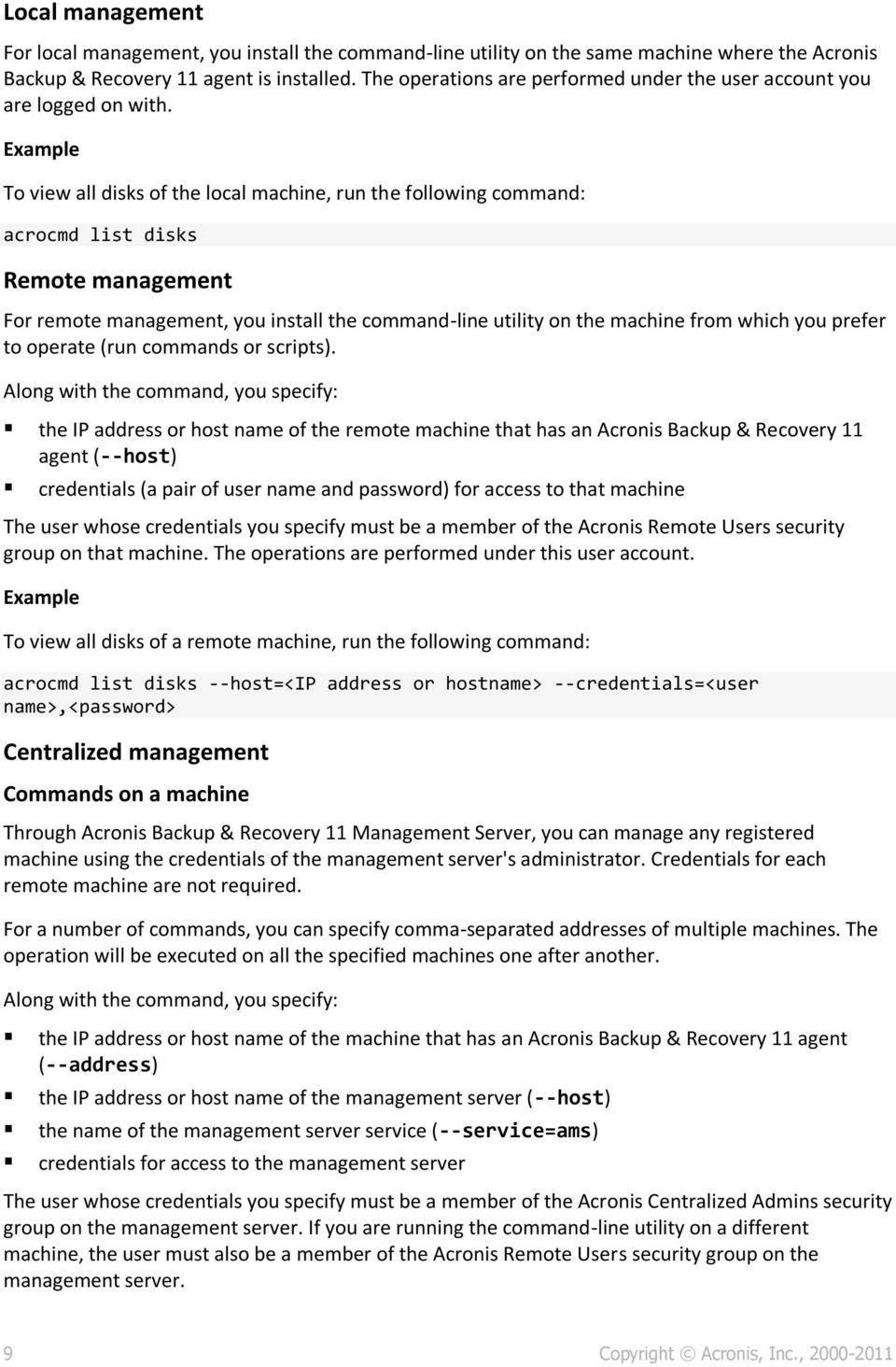
10 The operations on the machine are performed under the account of the agent service running on that machine (Acronis Agent User account). Example To view all disks of a machine through the management server, run the following command: acrocmd list disks --host=<ams hostname> --credentials=<user name>,<password> --service=ams --address=<ip address or hostname> Commands on the management server There are commands that can be executed by the management server itself. Example To view the current activities of the management server, run the following command: acrocmd list activities --host=<ams hostname> --credentials=<user name>,<password> --service=ams The below diagram shows options of access to a managed machine directly or via Acronis Backup & Recovery 11 Management Server. Options of access to a managed machine 1.5 Uninstallation Uninstallation in Linux In Linux, run the following commands to uninstall the command-line utility: 10 Copyright Acronis, Inc.,
11 # cd /usr/lib/acronis/commandlinetool/uninstall #./uninstall To uninstall the command-line utility in the unattended mode, run the./uninstall commands with the -a parameter. Uninstallation in Windows When you uninstall Acronis Backup & Recovery 11 by clicking Start -> All Programs -> Acronis -> Uninstall Acronis Backup & Recovery 11, the command-line utility is uninstalled along with all product components. To uninstall the command-line utility separately from the product 1. Run the Acronis Backup & Recovery 11 setup file. 2. Click Extract installation files. 3. Select the check box corresponding to the AcronisCommandLineTool.msi file. 4. Specify the folder where to extract the file. 5. Click Extract. 6. After the file is successfully extracted, click Close. 7. Run the following command: msiexec /uninstall <path>\acroniscommandlinetool.msi /qb where <path> is the folder where the file is extracted. If you have an edition with centralized management, you can also uninstall the command-line utility from the setup file. To do so, run the Acronis Backup & Recovery 11 setup file, click Install Acronis Backup & Recovery 11, then click Modify, and then clear the check box next to the name of the command-line utility. 1.6 List of abbreviated names This document uses the following abbreviated names. AMS Acronis Backup & Recovery 11 Management Server and this component's service. MMS Acronis Managed Machine Service, the service running on a machine where an Acronis agent is installed. ASN Acronis Backup & Recovery 11 Storage Node and this component's service. Agent for ESX(i) Acronis Backup & Recovery 11 Agent for VMware vsphere ESX(i). 11 Copyright Acronis, Inc.,
12 2 Commands This section lists the supported commands and compatible parameters. When using the command-line utility, you can view the information about the supported commands by means of the help (p. 14) command. 2.1 Commands by services The following table summarizes the commands that can be executed by the Acronis services. For questions on how to connect to an Acronis service, please see the --service (p. 48) command description. Command AMS Agent for Windows Agent for Linux 12 Copyright Acronis, Inc., MMS Agent for ESX(i) or Hyper-V Bootable media Backup and recovery list disks (p. 14) backup disk (p. 15) recover disk (p. 16) recover mbr (p. 18) backup file (p. 19) recover file (p. 20) list vms (p. 21) + + backup vm (p. 22) +* + recover vm (p. 23) +* + (create vm files) + (create vm on a server) Operations with archives and backups list archives (p. 24) export archive (p. 25) validate archive (p. 26) delete archive (p. 26) list backups (p. 27) list content (p. 28) validate backup (p. 28) export backup (p. 29) replicate backup (p. 29) convert full (p. 30) consolidate backup (p. 31) ASN

13 Command AMS Agent for Windows Agent for Linux MMS Agent for ESX(i) or Hyper-V Bootable media delete backup (p. 32) list mounts (p. 32) mount (p. 33) umount (p. 34) Operations with Acronis Secure Zone create asz (p. 34) cleanup asz (p. 35) delete asz_files (p. 35) delete asz (p. 36) Operations with Acronis Startup Recovery Manager activate asrm (p. 37) deactivate asrm (p. 37) list tape_libraries (p. 37) Operations with tapes + + list tape_drives (p. 38) + + Operations with vaults validate vault (p. 39) Operations with disks clone disk (p. 39) Administration operations get log (p. 40) list activities (p. 41) list plans (p. 41) delete plan (p. 42) export plan (p. 42) import plan (p. 43) disable plan (p. 44) enable plan (p. 44) list tasks (p. 45) run task (p. 45) stop task (p. 46) delete task (p. 46) list licenses (p. 47) ASN 13 Copyright Acronis, Inc.,
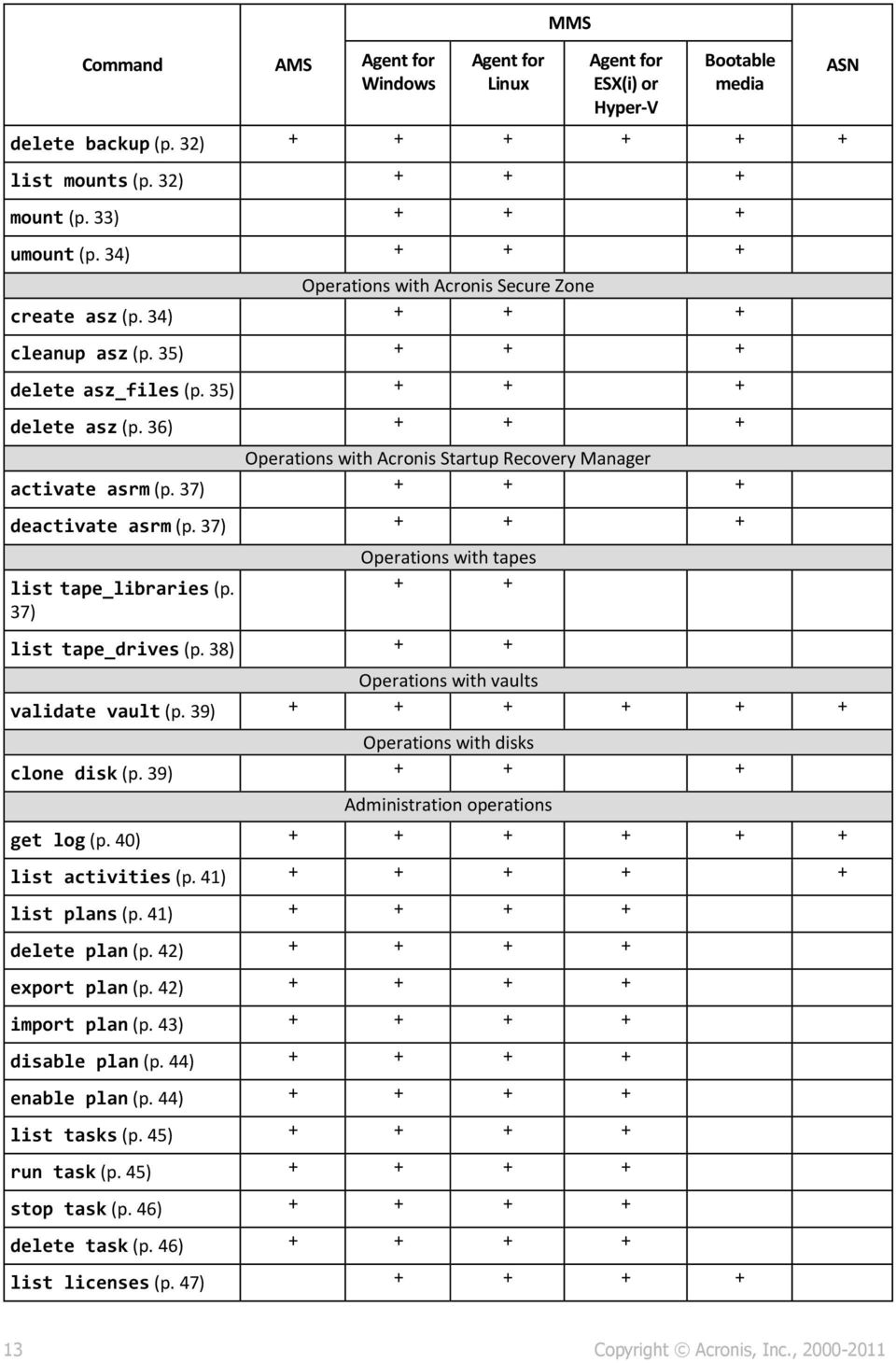
14 * The AMS service does not execute these commands by itself. It only defines which Agent for ESX(i) or Agent for Hyper-V can execute the command and transmits the command to the corresponding MMS. If you want Agent for Windows to perform the operation, specify its registration address in the --address (p. 48) parameter. 2.2 help The command provides the information about the supported commands. Type acrocmd help to get the list of all available commands. Type acrocmd help <text fragment> to get the list of all commands that begin with the fragment you specified. For example, acrocmd help ba lists the following commands: backup disk, backup file, etc. Type acrocmd help <complete command name> to view the information about this command. For example, acrocmd help backup disk displays the information about the backup disk command. 2.3 Backup and recovery Disks and volumes list disks Lists available disk groups, disks, volumes and unallocated space. Examples (p. 70) Units of measurement --size_measure={s kb mb gb} Measure of the size of disks and volumes. If not specified, the value is mb. --start_measure={s kb mb gb} Measure of the offset of volumes. If not specified, the value is mb. --address=<ip address or hostname> (p. 48) 14 Copyright Acronis, Inc.,

15 --service={mms ams} (p. 48) Access to a virtual machine (Virtual edition only) {--vmid=<virtual machine ID> --vmname=<virtual machine name>} (p. 49) backup disk Creates a backup of the specified disks or volumes. If neither the --disk nor the --volume parameter is specified, the command backs up all volumes. Examples (p. 70) What to back up --disk=<disk numbers> (p. 53) --volume=<volume numbers> (p. 54) --oss_numbers (p. 69) --exclude_names=<names> (p. 55) --exclude_mask=<masks> (p. 55) --exclude_system (p. 55) --exclude_hidden (p. 55) Where to save the backup --loc=<path> (p. 51) --arc=<archive name> (p. 51) --password=<password> (p. 67) How to back up --plain_archive (p. 56) --backuptype={full incremental differential} (p. 56) --raw (p. 57) --cleanup (p. 57) --archive_comment=<comments> (p. 57) --backup_comment=<comments> (p. 57) Backup options --encryption={none aes128 aes192 aes256} (p. 57) --pre_cmd=<command> (p. 58) --post_cmd=<command> (p. 58) --use_vss={none auto software_auto software hardware acronis native} (p. 58) --compression={none normal high max} (p. 59) --fast (p. 59) --split=<size> (p. 59) --reboot_after (p. 68) --silent_mode={on off} (p. 68) --ignore_bad_sectors (p. 60) --retry_count=<number of attempts> (p. 68) --retry_delay=<delay> (p. 68) 15 Copyright Acronis, Inc.,

16 --ftp_active (p. 69) --cataloging={true false} (p. 60) --address=<ip addresses or hostnames> (p. 48) --service={mms ams} (p. 48) recover disk Recovers the specified disk or volume. You can recover only one disk or volume at a time. A disk is always recovered along with its MBR. When you recover a volume, the MBR is not recovered. You can use the recover mbr (p. 18) command in this case. Examples (p. 70) What to recover --loc=<path> (p. 51) --arc=<archive name> (p. 51) --password=<password> (p. 67) --backup=<backup ID> (p. 52) --disk=<disk number> (p. 53) --nt_signature={auto new backup existing} (p. 53) --volume=<volume number> (p. 54) --oss_numbers (p. 69) Where to recover --target_disk=<disk number> (p. 61) --target_volume=<volume number> (p. 61) Recovering a disk If the --target_disk parameter is specified, the software will recover to the specified disk. If the --target_disk parameter is not specified, the software will first try to recover to the original disk, namely, to that very disk you backed up. If the original disk is not found, the command will fail. Recovering a volume 16 Copyright Acronis, Inc.,

17 If the --target_volume parameter is specified, the software will recover to the specified volume. If the --target_volume parameter is not specified, and the --target_disk parameter is specified, the software will try to recover to the first unallocated space of a suitable size on the specified disk. If no unallocated space of a suitable size is found, the command will fail. If neither the --target_volume parameter nor the --target_disk parameter is specified, the software will first try to recover to the original volume, namely, to that very volume you backed up. If the original volume is not found, the software will recover to the first unallocated space of a suitable size. If no unallocated space of a suitable size is found, the command will fail. A volume will not be considered original if its size, location or other physical parameters have been changed after backup. Changing the volume letter or label does not prevent the software from recognizing the volume. --start=<offset>{s kb mb gb} (p. 55) --size=<volume size>{s kb mb gb} (p. 55) How to recover --fat16_32 (p. 62) --ext2_3 (p. 62) --type={active primary logical} (p. 62) --preserve_mbr (p. 62) --active_restore If the parameter is specified, the Acronis Active Restore technology is enabled. Recovery options --reboot (p. 68) --reboot_after (p. 68) --silent_mode={on off} (p. 68) --retry_count=<number of attempts> (p. 68) --retry_delay=<delay> (p. 68) --ftp_active (p. 69) Acronis Universal Restore parameters --ur_driver=<inf file name> Specifies using Acronis Universal Restore and the mass storage driver to be installed. --ur_path=<search folder> Specifies using Acronis Universal Restore and the path to the driver storage. --address=<ip addresses or hostnames> (p. 48) 17 Copyright Acronis, Inc.,

18 --service={mms ams} (p. 48) recover mbr Recovers the MBR from a disk or volume backup. Examples (p. 70) What to recover --loc=<path> (p. 51) --arc=<archive name> (p. 51) --password=<password> (p. 67) --backup=<backup ID> (p. 52) --disk=<disk number> (p. 53) Where to recover --target_disk=<disk number> (p. 61) Recovery options --reboot (p. 68) --reboot_after (p. 68) --silent_mode={on off} (p. 68) --retry_count=<number of attempts> (p. 68) --retry_delay=<delay> (p. 68) --ftp_active (p. 69) --address=<ip addresses or hostnames> (p. 48) --service={mms ams} (p. 48) 18 Copyright Acronis, Inc.,

19 2.3.2 Files backup file Creates a backup of specified files and folders. Examples (p. 72) What to back up --include=<paths> (p. 55) --exclude_names=<names> (p. 55) --exclude_mask=<masks> (p. 55) --exclude_system (p. 55) --exclude_hidden (p. 55) Where to save the backup --loc=<path> (p. 51) --arc=<archive name> (p. 51) --password=<password> (p. 67) How to back up --plain_archive (p. 56) --backuptype={full incremental differential} (p. 56) --cleanup (p. 57) --archive_comment=<comments> (p. 57) --backup_comment=<comments> (p. 57) Backup options --encryption={none aes128 aes192 aes256} (p. 57) --pre_cmd=<command> (p. 58) --post_cmd=<command> (p. 58) --snapshot={always possible none} (p. 58) --use_vss={none auto software_auto software hardware acronis native} (p. 58) --compression={none normal high max} (p. 59) --split=<size> (p. 59) --reboot_after (p. 68) --silent_mode={on off} (p. 68) --ignore_bad_sectors (p. 60) --retry_count=<number of attempts> (p. 68) --retry_delay=<delay> (p. 68) --ftp_active (p. 69) --cataloging={true false} (p. 60) 19 Copyright Acronis, Inc.,

20 --address=<ip addresses or hostnames> (p. 48) --service={mms ams} (p. 48) recover file Recovers files and folders from a file-level or disk-level backup. Examples (p. 72) What to recover --loc=<path> (p. 51) --arc=<archive name> (p. 51) --password=<password> (p. 67) --backup=<backup ID> (p. 52) --file=<paths> (p. 60) --exclude=<files, folders and masks> (p. 60) Where to recover --target=<path> (p. 52) How to recover --overwrite={always older newer} (p. 63) --recover_absolute_path (p. 63) --recover_security={true false} This parameter is effective only when recovering from a file-level backup of Windows files. If the value is true or if the parameter is not specified, recover NTFS permissions for files along with the files themselves. Otherwise, the files will inherit the NTFS permissions from the folder to which they will be recovered. --original_date Recover files' original date and time from the backup. If not specified, the current date and time are assigned. Recovery options --reboot (p. 68) --reboot_after (p. 68) --silent_mode={on off} (p. 68) 20 Copyright Acronis, Inc.,

21 --retry_count=<number of attempts> (p. 68) --retry_delay=<delay> (p. 68) --ftp_active (p. 69) --address=<ip address or hostnames> (p. 48) --service={mms ams} (p. 48) Virtual machines The commands listed in this section are available in the Acronis Backup & Recovery 11 Advanced Server Virtual edition only if Agent for ESX(i) or Agent for Hyper-V is installed. (This does not apply to the recover vm (p. 23) command.) list vms Lists virtual machines that are present on the specified management server or that are managed by Agent for ESX(i) or Agent for Hyper-V, depending on the service that will execute the command. Examples (p. 73) --service={mms ams} (p. 48) 21 Copyright Acronis, Inc.,
22 backup vm Creates a backup of specified disks and volumes of the specified virtual machines. If neither --disk nor --volume parameter is specified, the command backs up the entire machine. Examples (p. 73) Access to a virtual machine {--vmid=<virtual machine IDs> --vmname=<virtual machine names>} (p. 49) You can specify one or more virtual machines to be backed up. --simultaneous_backup=<number> Number of virtual machines to be backed up simultaneously by Agent for ESX(i) or Agent for Hyper-V. If not specified, each agent will back up virtual machines two at a time simultaneously. To back up machines one at a time, set the parameter value to 1. What to back up --disk=<disk numbers> (p. 53) --volume=<volume numbers> (p. 54) --exclude_names=<names> (p. 55) --exclude_mask=<masks> (p. 55) --exclude_system (p. 55) --exclude_hidden (p. 55) Where to save the backup --loc=<path> (p. 51) --arc=<archive name> (p. 51) --password=<password> (p. 67) How to back up --backuptype={full incremental differential} (p. 56) --raw (p. 57) --cleanup (p. 57) --archive_comment=<comments> (p. 57) --backup_comment=<comments> (p. 57) Backup options --encryption={none aes128 aes192 aes256} (p. 57) --compression={none normal high max} (p. 59) --fast (p. 59) --split=<size> (p. 59) --silent_mode={on off} (p. 68) --retry_count=<number of attempts> (p. 68) --retry_delay=<delay> (p. 68) --ftp_active (p. 69) --cataloging={true false} (p. 60) 22 Copyright Acronis, Inc.,
23 Access to a remote physical machine --service={mms ams} (p. 48) recover vm Recovers a disk or volume backup onto a new or existing virtual machine. The recover vm command replaces and enhances the convert command which was available in earlier versions of the Acronis software. The recover vm command can be executed by the following agents: Agent for ESX(i) recovers a disk (volume) backup to a new or existing ESX(i) virtual machine. Agent for Hyper-V recovers a disk (volume) backup to a new or existing Hyper-V virtual machine. Agent for Windows recovers a disk (volume) backup to a new virtual machine of any of the following types: VMware Workstation, Microsoft Virtual PC, Parallels Workstation or Citrix XenServer Open Virtual Appliance (OVA). Files of the fully configured and operational machine will be placed in the folder you select. You can start the machine using the respective virtualization software or prepare the machine files for further usage. The OVA virtual appliance can be imported to XenServer. Disks of a Virtual PC can be attached to a Hyper-V virtual machine. A virtual machine must be powered off during the recovery to this machine. The target machine located on an ESX(i) or Hyper-V host will be powered off without a prompt. Please be sure to specify the correct machine. Examples (p. 73) What to recover --loc=<path> (p. 51) --arc=<archive name> (p. 51) --password=<password> (p. 67) --backup=<backup ID> (p. 52) --disk=<disk number> (p. 53) --volume=<volume number> (p. 54) Where to recover If you want to recover to an existing virtual machine: {--vmid=<virtual machine ID> --vmname=<virtual machine name>} (p. 49) 23 Copyright Acronis, Inc.,
24 If you want to recover to a new virtual machine: --vmname=<virtual machine name> (p. 49) --vmtype={vmware esx hyperv virtualpc parallels citrix} (p. 49) {--vmserver_name=<server name> --vmserver_id=<server GUID>} (p. 49) --vmstorage=<path> (p. 49) Credentials for a network folder where a vmware, virtualpc, parallels or citrix virtual machine is to be created. --target_disk=<disk number> (p. 61) --target_volume=<volume number> (p. 61) --start=<offset>{s kb mb gb} (p. 55) --size=<volume size>{s kb mb gb} (p. 55) How to recover --fat16_32 (p. 62) --ext2_3 (p. 62) --type={active primary logical} (p. 62) --preserve_mbr (p. 62) Recovery options --power_on (p. 63) --silent_mode={on off} (p. 68) --retry_count=<number of attempts> (p. 68) --retry_delay=<delay> (p. 68) --ftp_active (p. 69) --service={mms ams} (p. 48) 2.4 Operations with archives and backups Archives list archives Lists the information about archives in the specific location. The displayed records are sorted by date in descending order. 24 Copyright Acronis, Inc.,
25 Examples (p. 74) --loc=<path> (p. 51) --filter_type=<types> (p. 66) {-a --all} If the parameter is specified, the following properties will be displayed for each archive: name; type; creation date; machine whose data is contained in the archive; owner (the user who saved the archive to the destination); occupied space in bytes; and comments on the archive. If not specified, only name, type and creation date will be displayed for each archive. --address=<ip address or hostname> (p. 48) --service={mms ams asn} (p. 48) export archive Copies the archive specified by the --arc parameter from the location specified by the --loc parameter to the location specified by the --target parameter. If the --arc parameter is not specified, the command will export all the archives stored in the source location. The command always creates a new archive in the target location. You cannot specify an existing archive in the --target_arc parameter. Using this command, you can, for example, import an archive to a centralized managed vault or export the entire vault to a different location. Examples (p. 74) --loc=<path> (p. 51) --arc=<archive name> (p. 51) --password=<password> (p. 67) --target=<path> (p. 52) --target_arc=<archive name> (p. 52) 25 Copyright Acronis, Inc.,
26 --address=<ip address or hostname> (p. 48) --service={mms ams asn} (p. 48) validate archive Validates the archive data integrity. Examples (p. 74) --loc=<path> (p. 51) --arc=<archive name> (p. 51) --password=<password> (p. 67) --address=<ip address or hostname> (p. 48) --service={mms ams asn} (p. 48) delete archive Deletes an archive. Examples (p. 74) 26 Copyright Acronis, Inc.,
27 --loc=<path> (p. 51) --arc=<archive name> (p. 51) --address=<ip address or hostname> (p. 48) --service={mms ams asn} (p. 48) Backups list backups Lists backups in the specified archive. The displayed records are sorted by date in descending order. Examples (p. 74) --loc=<path> (p. 51) --arc=<archive name> (p. 51) --password=<password> (p. 67) --filter_date=<dates and times> (p. 65) --filter_type=<types> (p. 66) --address=<ip address or hostname> (p. 48) --service={mms ams asn} (p. 48) 27 Copyright Acronis, Inc.,
28 list content Lists the contents of a backup (backed up disks, volumes, files, virtual machines). Examples (p. 74) --loc=<path> (p. 51) --arc=<archive name> (p. 51) --password=<password> (p. 67) --backup=<backup ID> (p. 52) --content_type={volume file} (p. 65) --content_path=<path> (p. 65) --address=<ip address or hostname> (p. 48) --service={mms ams asn} (p. 48) validate backup Validates the backup data integrity. Examples (p. 74) --loc=<path> (p. 51) --arc=<archive name> (p. 51) --password=<password> (p. 67) --backup=<backup ID> (p. 52) 28 Copyright Acronis, Inc.,
29 --address=<ip address or hostname> (p. 48) --service={mms ams asn} (p. 48) export backup Copies the archive specified by the --arc parameter from the location specified by the --loc parameter to the location specified by the --target parameter. The copy will contain only the backups specified by the --backup parameter. The command always creates a new archive in the target location. You cannot specify an existing archive in the --target_arc parameter. Both the --target and the --target_arc parameters are mandatory. If the --backup parameter is not specified, the command will export only the latest backup. Examples (p. 74) --loc=<path> (p. 51) --arc=<archive name> (p. 51) --password=<password> (p. 67) --backup=<backup IDs> (p. 52) --target=<path> (p. 52) --target_arc=<archive name> (p. 52) --address=<ip address or hostname> (p. 48) --service={mms ams asn} (p. 48) replicate backup Replicates the latest backup of the specified archive to a different location. The target archive has the same name as the source one. If the target archive exists, the command will append the backup to it. 29 Copyright Acronis, Inc.,
30 If the target location is the same as the source one, the command will fail. If the --backup parameter is specified, the specified backups will be replicated. Using this command, you can copy each backup of your archive to a second location, immediately after backing up or on a schedule. This helps you make your archive more reliable by maintaining its copy in a different location. Examples (p. 74) --loc=<path> (p. 51) --arc=<archive name> (p. 51) --password=<password> (p. 67) --target=<path> (p. 52) --backup=<backup IDs> (p. 52) --address=<ip address or hostname> (p. 48) --service={mms ams asn} (p. 48) convert full Converts an incremental or differential backup into a full one. The backup time stamp remains unchanged. The dependent incremental and differential backups are also updated. However, the old backup versions are deleted only after the new ones have been created. Therefore, the location must have enough space to temporarily store both the old and the new versions. Examples (p. 74) --loc=<path> (p. 51) The command does not support the following locations: Acronis Online Backup Storage, tape and CD/DVD. --arc=<archive name> (p. 51) --password=<password> (p. 67) --backup=<backup ID> (p. 52) 30 Copyright Acronis, Inc.,
31 --address=<ip address or hostname> (p. 48) --service={mms ams asn} (p. 48) consolidate backup Modifies an archive so that only the backups specified in the --backup parameter are kept. All other backups of the archive are deleted. If the --backup parameter is not specified, only the latest backup of the archive is kept. As a result, the archive will contain only one backup. Examples (p. 74) --loc=<path> (p. 51) --arc=<archive name> (p. 51) --password=<password> (p. 67) --backup=<backup IDs> (p. 52) --address=<ip address or hostname> (p. 48) --service={mms ams asn} (p. 48) 31 Copyright Acronis, Inc.,
32 delete backup Deletes the selected backup from an archive. If incremental or differential backups depend on the backup being deleted, the consolidation will be performed. This consolidation may be time and resource consuming. Examples (p. 74) --loc=<path> (p. 51) --arc=<archive name> (p. 51) --password=<password> (p. 67) --backup=<backup ID> (p. 52) --address=<ip address or hostname> (p. 48) --service={mms ams asn} (p. 48) Mounting Mounting volumes from a disk-level backup lets you access the volumes as though they were physical disks list mounts Lists the volumes mounted from backups. Examples (p. 75) 32 Copyright Acronis, Inc.,
33 --address=<ip address or hostname> (p. 48) --service={mms ams} (p. 48) mount Mounts the specified volume from the backup to the system where Agent for Windows or Agent for Linux is installed. Only one volume can be mounted within a single mount operation. Limitation: You can only mount backups stored in a local or shared folder or on Acronis Secure Zone. Examples (p. 75) What to mount --loc=<path> (p. 51) --arc=<archive name> (p. 51) --password=<password> (p. 67) --backup=<backup ID> (p. 52) --volume=<volume number> (p. 54) How to mount (Agent for Windows only) --rw (p. 63) --letter=<letter> (p. 64) How to mount (Agent for Linux only) --rw (p. 63) --mount_point=<mount point> (p. 64) --address=<ip address or hostname> (p. 48) --service={mms ams} (p. 48) 33 Copyright Acronis, Inc.,
34 umount Unmounts the volume with the specified letter (Agent for Windows only). Unmounts the device mounted at the mount point, destroys the kernel space block device and stops the user space daemon (Agent for Linux only). Examples (p. 75) {--letter=<letter> all} (p. 64) (Agent for Windows only) --mount_point=<mount point> (p. 64) (Agent for Linux only) --address=<ip address or hostname> (p. 48) --service={mms ams} (p. 48) 2.5 Operations with Acronis Secure Zone Acronis Secure Zone is a secure volume for storing backup archives within a managed machine create asz Creates Acronis Secure Zone on the selected disk taking space from the selected volumes and from the unallocated space. Examples (p. 76) --disk=<disk number> (p. 53) --volume={<volume numbers> all} (p. 54) --oss_numbers (p. 69) --asz_size={<size>{s kb mb gb} unallocated} (p. 64) --password=<password> (p. 67) --reboot (p. 68) --later (p. 68) --silent_mode={on off} (p. 68) 34 Copyright Acronis, Inc.,
35 --address=<ip addresses or hostnames> (p. 48) --service={mms ams} (p. 48) cleanup asz Deletes the backups corrupted due to a power loss or another reason, from Acronis Secure Zone. Examples (p. 76) --address=<ip addresses or hostnames> (p. 48) --service={mms ams} (p. 48) delete asz_files Deletes the latest backup of an archive located in Acronis Secure Zone. If the specified archive contains only one backup, such backup will not be deleted. Examples (p. 76) --credentials=<password> (p. 50) Password for Acronis Secure Zone. --arc=<archive name> (p. 51) --password=<password> (p. 67) Password for the archive. 35 Copyright Acronis, Inc.,
36 --silent_mode={on off} (p. 68) --address=<ip address or hostname> (p. 48) --service={mms ams} (p. 48) delete asz Deletes Acronis Secure Zone. Examples (p. 76) --volume=<volume numbers> (p. 54) --oss_numbers (p. 69) --silent_mode={on off} (p. 68) --address=<ip addresses or hostnames> (p. 48) --service={mms ams} (p. 48) 2.6 Operations with Acronis Startup Recovery Manager Acronis Startup Recovery Manager is the bootable rescue utility that can be started at boot time by pressing F Copyright Acronis, Inc.,
37 2.6.1 activate asrm Activates the Acronis Startup Recovery Manager. Examples (p. 77) --address=<ip addresses or hostnames> (p. 48) --service={mms ams} (p. 48) deactivate asrm Deactivates the Acronis Startup Recovery Manager. Examples (p. 77) --address=<ip addresses or hostnames> (p. 48) --service={mms ams} (p. 48) 2.7 Operations with tapes list tape_libraries Lists tape libraries attached to a machine where an Acronis Backup & Recovery 11 agent is running. 37 Copyright Acronis, Inc.,
38 Listing tape libraries attached to Acronis Backup & Recovery 11 Storage Node is not possible. Examples (p. 77) --filter_guid=<guids> (p. 65) --filter_name=<names> (p. 66) --address=<ip address or hostname> (p. 48) --service={mms ams asn} (p. 48) list tape_drives Lists drives of tape libraries and/or stand-alone tape drives attached to a machine where an Acronis Backup & Recovery 11 agent is running. Listing drives of tape libraries attached to Acronis Backup & Recovery 11 Storage Node is not possible. Examples (p. 77) --address=<ip address or hostname> (p. 48) --service={mms ams asn} (p. 48) 38 Copyright Acronis, Inc.,
39 2.8 Operations with vaults validate vault Validates data integrity of all archives in the specified location except for password-protected ones. To validate a password-protected archive, use the validate archive (p. 26) command. Examples (p. 77) --loc=<path> (p. 51) --address=<ip address or hostname> (p. 48) --service={mms ams asn} (p. 48) 2.9 Operations with disks clone disk Clones a hard disk. Use this operation if you need to transfer all the source disk data to a target disk. If the capacities of the source and the target disks differ, the volumes will be resized to fit into the target disk. If the target disk capacity is bigger, the volumes will be increased. If the target disk capacity is smaller, the volumes will be decreased. Examples (p. 78) --source=<source disk number> The number of the source disk. --target=<target disk number> The number of the target disk. --reboot (p. 68) --later (p. 68) --reboot_after (p. 68) 39 Copyright Acronis, Inc.,
40 --address=<ip address or hostname> (p. 48) --service={mms ams} (p. 48) 2.10 Administration operations Logs and activities get log Exports the log of the activity with the specified GUID in the Acronis xml format. To learn GUIDs of activities, use the list activities (p. 41) command. Examples (p. 78) --id=<guid> (p. 69) --loc=<full path> (p. 51) The file to export the log to. The following locations are supported: local path, SMB, NFS, FTP and SFTP. The software exports logs in the Acronis xml format regardless of the extension of the file. --address=<ip address or hostname> (p. 48) --service={mms ams asn} (p. 48) 40 Copyright Acronis, Inc.,
41 list activities Lists the current and past activities of the specified service (Acronis Managed Machine Service, Acronis Backup & Recovery 11 Management Server, Acronis Backup & Recovery 11 Storage Node). The command displays no more than the latest 5000 records. The displayed records are sorted by date in descending order. If the --service (p. 48) parameter is not specified, the activities of Acronis Managed Machine Service are listed. For Acronis Backup & Recovery 11 Management Server, only its own activities are listed. The activities of the Managed Machine Services that run on the registered machines are not included in the list. If a machine performs too slowly, you might want to use the command to find out the activity that has been running for an unexpectedly long time. Thus, you will be able to detect and end hung-up processes. Examples (p. 78) --filter_guid=<guids> (p. 65) --filter_state=<states> (p. 66) --address=<ip address or hostname> (p. 48) --service={mms ams asn} (p. 48) Plans list plans Lists the backup plans existing on a managed machine or on the management server. The displayed records are sorted by date in descending order. Examples (p. 78) 41 Copyright Acronis, Inc.,
42 --filter_state=<states> (p. 66) --filter_status=<statuses> (p. 66) --filter_user=<user names> (p. 66) --address=<ip address or hostname> (p. 48) --service={mms ams} (p. 48) delete plan Deletes the specified backup plan. Examples (p. 78) --id=<guid> (p. 69) --address=<ip address or hostname> (p. 48) --service={mms ams} (p. 48) export plan Exports the specified backup plan to an *.xml file. The operation creates a file with complete configuration of the backup plan. You can import the file (p. 43) to reuse the exported backup plan on another machine. 42 Copyright Acronis, Inc.,
43 The export files of backup plans can be edited with text editors. Passwords are encrypted in the export files. Centralized backup plans can be exported from a management server and imported to a management server only. Examples (p. 78) --id=<guid> (p. 69) --loc=<full path> Full path to the file to which the backup plan will be exported. --address=<ip address or hostname> (p. 48) --service={mms ams} (p. 48) import plan Imports a backup plan from an *.xml file. An XML file with complete configuration of a backup plan can be created by means of the export plan (p. 42) command. Centralized backup plans can be exported from a management server and imported to a management server only. Examples (p. 78) --loc=<full path> Full path to the file from which the backup plan will be imported. 43 Copyright Acronis, Inc.,
44 --address=<ip address or hostname> (p. 48) --service={mms ams} (p. 48) disable plan Disables the specified backup plan. As a result, the backup plan will not run according to its schedule. Examples (p. 78) --id=<guid> (p. 69) --address=<ip address or hostname> (p. 48) --service={mms ams} (p. 48) enable plan Enables a previously disabled (p. 44) backup plan. As a result, the specified backup plan will run again according to its schedule. Examples (p. 78) --id=<guid> (p. 69) 44 Copyright Acronis, Inc.,
45 --address=<ip address or hostname> (p. 48) --service={mms ams} (p. 48) Tasks list tasks Lists the tasks existing on a managed machine or on the management server. The displayed records are sorted by date in descending order. Examples (p. 79) --filter_state=<states> (p. 66) --filter_user=<user names> (p. 66) --filter_last_result=<last_results> To display only tasks with specific last execution results, specify one or more of the following values: not_run_yet, succeeded, succeeded_with_warnings, failed, or stopped. --address=<ip address or hostname> (p. 48) --service={mms ams} (p. 48) run task Starts execution of the specified task. Examples (p. 79) --id=<guid> (p. 69) 45 Copyright Acronis, Inc.,
46 --address=<ip address or hostname> (p. 48) --service={mms ams} (p. 48) stop task Stops execution of the specified task. Examples (p. 79) --id=<guid> (p. 69) --address=<ip address or hostname> (p. 48) --service={mms ams} (p. 48) delete task Deletes the specified task. A task belonging to a backup plan cannot be deleted separately from the plan. Examples (p. 79) --id=<guid> (p. 69) 46 Copyright Acronis, Inc.,
47 --address=<ip address or hostname> (p. 48) --service={mms ams} (p. 48) Licenses list licenses Lists Acronis Backup & Recovery 11 licenses assigned to a machine. If the licenses are registered on the license server, the agent also checks the status of the licenses on the license server. Examples (p. 80) --address=<ip address or hostname> (p. 48) --service={mms ams} (p. 48) 47 Copyright Acronis, Inc.,
48 3 3.1 Access to a physical machine host --host=<ip address or hostname> Specifies the machine running an Acronis service to connect to. If not specified, the command-line utility connects to the local host. Examples: --host=server1 --host= service --service={mms ams asn} Specifies the Acronis service to connect to. If not specified, the command-line utility connects to the agent service (Acronis Managed Machine Service, MMS). To connect to a storage node or the management server, you must explicitly specify the asn or the ams service using the --service parameter. This parameter is required even if an agent is not installed on that server or is unable to execute the command by design. Example acrocmd validate archive --loc=bsp://<storage node>/<vault name> --arc=<archive name> You can run this command on a machine where an agent and the command-line utility are installed. The command-line utility connects to the local agent. The agent addresses a storage node. acrocmd validate archive --loc=bsp://<storage node>/<vault name> --arc=<archive name> --host=<storage node> --credentials=<user name>,<password> --service=asn You can run this command on a machine where only the command-line utility is installed. In this case, the command-line utility connects directly to a storage node. In both cases validation will be performed by a storage node, using that node's CPU resource address --address=<ip address or hostname> Specifies a machine registered on the management server. Some commands can be applied to multiple machines. This is done by separating the machine addresses with commas. Such commands include backup disk (p. 15), backup file (p. 19), recover disk (p. 16), recover mbr (p. 18), recover file (p. 20), create asz (p. 34), delete asz (p. 36), activate asrm (p. 37), and deactivate asrm (p. 37). The operation will be executed 48 Copyright Acronis, Inc.,
49 on the specified machines one after another. The parameter for the above commands has been specified in the following way: --address=<ip addresses or hostnames>. The management server must also be specified when using this parameter. Credentials for the machine are not required. Only the management server credentials are needed. Example To view all machine disks through the management server, run the following command: acrocmd list disks --host=<ams hostname> --credentials=<user name>,<password> --service=ams --address=<ip address or hostname> 3.2 Virtual machines Access to a virtual machine {--vmid=<virtual machine ID> --vmname=<virtual machine name>} The methods of access to a virtual machine If Agent for ESX(i) or Agent for Hyper-V is registered on the management server, you can access a virtual machine directly from the management server without specifying the virtualization host: --host=<ams hostname> --credentials=<user name>,<password> --service=ams --vmname=<virtual machine name> If Agent for ESX(i) or Agent for Hyper-V is not registered on the management server, specify the virtual appliance or the Windows host running the agent: --host=<agent hostname> --credentials=<user name>,<password> --vmname=<virtual machine name> When operating within the virtual appliance or the Windows host running the agent, you do not need to specify access parameters other than --vmname or --vmid. vmid --vmid=<virtual machine ID> Virtual machine unique identifier, assigned by the virtualization software. Use the list vms (p. 21) command to obtain identifiers of virtual machines. vmname --vmname=<virtual machine name> Virtual machine name. If the Acronis agent finds more than one virtual machine with the same name, an error occurs (this does not apply to clustered Hyper-V virtual machines). In this case, use the --vmid parameter New virtual machine vmname --vmname=<virtual machine name> 49 Copyright Acronis, Inc.,
50 Name of a new virtual machine. vmtype --vmtype={vmware esx hyperv virtualpc parallels citrix} Type of a new virtual machine. The esx and hyperv values can be used only with Agent for ESX(i) and Agent for Hyper-V, respectively. vmserver_name --vmserver_name=<server name> Name of the ESX(i) or Hyper-V server or cluster where a virtual machine will be created. The --vmserver_name and --vmserver_id parameters are mutually exclusive. vmserver_id --vmserver_id=<server GUID> Identifier of the ESX(i) or Hyper-V server or cluster where a virtual machine will be created. The --vmserver_id and --vmserver_name parameters are mutually exclusive. vmstorage --vmstorage=<path> Location of the new virtual machine. When creating a vmware, virtualpc, parallels or citrix machine in a local or network folder, specify the path to the folder. Examples: --vmstorage=c:\vms --vmstorage=\\srv1\folder1 When creating a virtual machine on an ESX(i) server, specify the name of the datastore. Example: Storage_1 When creating a virtual machine on a Hyper-V server, specify the path to the server's local folder. Example: C:\ProgramData\Microsoft\Windows\Hyper-V\Virtual Machines 3.3 credentials --credentials=<user name>,<password> Credentials to access a location, service, machine, archive. A command can contain several --credentials parameters. Each of them must follow the parameter that defines the object to which credentials are required (--loc, --host, --service, --target). To access Acronis Secure Zone, specify only the password in this parameter. 50 Copyright Acronis, Inc.,
51 3.4 Location loc --loc=<path> When backing up, the path to the location where the backup is to be created. For other operations, the path to the location where the backups are stored. The path can be specified in the following formats: Type of storage Local path (in Windows) Format <drive>:\<folder> Local path (in Linux) /<directory 1>/.../<directory N> SMB NFS FTP, SFTP Acronis Backup & Recovery 11 Storage Node Acronis Online Backup Storage (only for Windows) Acronis Secure Zone Tape \\<server>\<folder> nfs://<server>/<folder>/ ftp://<server>/<folder>/ sftp://<server>/<folder>/ bsp://<storage node>/<vault name> online:// atis:///asz atis:///tape?<guid of attached library>* *Using this format, you can access a tape library or drive only if it is directly attached to the managed machine. You can determine the GUID of this library or drive by using the list tape_libraries (p. 37) and list tape_drives (p. 38) commands, respectively. For a tape library or drive attached to a storage node, a centralized vault should be created on that storage node. To access such tape library or drive, use the bsp://<storage node>/<vault name> format arc --arc=<archive name> Name of the archive. Parameter values are case-sensitive. Using variables in archive names When you back up more than one machine with a single backup command, data from all of the machines is saved to the same location. Each machine backs up to a separate archive. Archive names must be unique within the location. Otherwise, the backup operation will fail. Add variables to the archive names to make them unique within the location. For the backup vm (p. 22) command, the archive name must contain the [Virtualization Server Type] and [Virtual Machine Name] variables. For other backup commands, use the [MachineName] variable. You can also use these variables when backing up a single machine if this is practical or efficient for you. Examples: 51 Copyright Acronis, Inc.,
52 --arc="[virtualization Server Type]_[Virtual Machine Name]_archive1" for the backup vm command --arc=[machinename]_archive1 for the backup disk and backup file commands Specifying archives by backup file names In this parameter, you can specify an archive by the file name of a backup that belongs to the archive; for example: --arc=my_backup2.tib. If the archive does not contain metadata, the command will apply to the backup chain. (A backup chain is a full backup and all of its dependent incremental and differential backups.) This syntax is useful for archives created using the --plain_archive (p. 56) parameter. Also, this syntax is the only way to access an archive if its metadata has not been created or is lost for some reason. If you need to use the --backup (p. 52) parameter with the command, specify a backup identifier rather than a file name as this parameter value. For example: Correct --arc=my_backup2.tib --backup=xxxxxxxx-xxxx-xxxx-xxxx-xxxxxxxxxxxx Incorrect --arc=my_backup2.tib --backup=my_backup3.tib Restriction: You cannot specify file names of backups stored on Acronis Storage Node, Acronis Online Backup Storage, Acronis Secure Zone or tape backup --backup=<backup ID> Identifier of the backup with which the operation is to be performed (for example, the backup from which the data is to be recovered). With the export backup (p. 29), consolidate backup (p. 31) and replicate backup (p. 29) commands, you can specify several backups. If the parameter is not specified, the operation will be applied to the latest backup target --target=<path> In the recover file (p. 20) command, the parameter specifies a folder where folders/files will be recovered (a target folder). The formats of the parameter value are the same as in the --loc (p. 51) parameter. If the parameter is not specified, the original path will be re-created from the backup. In the export archive (p. 25), export backup (p. 29), or replicate backup (p. 29) command, the parameter specifies the location where the archive or backup will be exported or replicated. The formats of the parameter value are the same as in the --loc (p. 51) parameter, except for online:// which is not supported. If the parameter is not specified, the command will fail target_arc --target_arc=<archive name> 52 Copyright Acronis, Inc.,
53 The name of the target archive in the export archive (p. 25) and export backup (p. 29) commands. The name has to be unique within the target location. If there is an archive with the same name or if the parameter is not specified, the command will fail. 3.5 Disks and volumes disk Commands: backup disk and backup vm --disk=<disk numbers> The parameter is used with the backup disk (p. 15) and backup vm (p. 22) commands to specify disks to be backed up. Use the list disks (p. 14) command to obtain numbers of available disks and volumes. You can use the --disk and --volume (p. 54) parameters within one command line, for example: --disk=1 --volume=e Commands: recover disk, recover mbr, recover vm, create asz --disk=<disk number> The number of the disk with which the operation is to be performed. In the recover disk (p. 16) and recover vm (p. 23) commands, this is the disk whose data is to be recovered from a backup. In the recover mbr (p. 18) command, the parameter is the disk whose MBR is to be recovered from a backup. In the create asz (p. 34) command, this is the disk on which Acronis Secure Zone is to be created nt_signature --nt_signature={auto new backup existing} The NT signature is a record that is kept in the hard disk's MBR. It uniquely identifies the hard disk for the operating system. When recovering a disk containing a system volume, you can choose what to do with the NT signature of the target disk. Specify any of the following parameters: auto (default) The software will keep the NT signature of the target disk if it is the same NT signature as the one stored in the backup. (In other words, if you recover the disk to the same disk that was backed up.) Otherwise, the software will generate a new NT signature for the target disk. new The software will generate a new NT signature for the target disk. backup The software will replace the NT signature of the target disk with the one from the backup. existing The software will leave the NT signature of the target disk untouched. 53 Copyright Acronis, Inc.,
54 3.5.3 volume Commands: backup disk and backup vm --volume=<volume numbers> The parameter is used with the backup disk (p. 15) and backup vm (p. 22) commands to specify volumes to be backed up. Volume numbers are specified as in the following format: <disk number>-<volume number>, for example: --volume=1-1,1-2 Dynamic volumes are specified with the DYN prefix or by their GUIDs, for example: --volume=dyn1 --volume=e6ee6edc-d1ba-11d8-813e-806e6f6e6963 Both basic and dynamic volumes can be specified by their letters, for example: --volume=c Mixed notation is also acceptable, for example: --volume=1-1,e,e6ee6edc-d1ba-11d8-813e-806e6f6e6963 To view available disks, volumes and GUIDs of volumes, use the list disks (p. 14) command. You can use the --disk (p. 53) and --volume parameters in one command, for example: --disk=1 --volume=e Commands: recover disk, recover vm, mount --volume=<volume number> The volume with which the operation is to be performed. The parameter is used with the recover disk (p. 16), recover vm (p. 23), mount (p. 33) commands. Selecting a dynamic volume for recovery The software considers all dynamic volumes of a backup as belonging to a separate disk. To learn the correspondence between the dynamic volumes you backed up and the numbers assigned to these volumes by the software, run the list content (p. 28) command without specifying the --content_path (p. 65) parameter. For example, if you backed up volumes 1-2 (the second volume of the first disk), 2-1 (the first volume of the second disk) and DYN1 (the first dynamic volume), the software considers the latter as the first volume of the third disk. So, when you recover the dynamic volume, you should specify --volume=3-1. Command: create asz --volume={<volume numbers> all} Volumes from which the free space for Acronis Secure Zone will be taken. The parameter is used with the create asz (p. 34) command. If not specified, Acronis Secure Zone will use the unallocated 54 Copyright Acronis, Inc.,
55 space only. If --volume=all is specified, the free space will be taken from all volumes of the specified disk. Command: delete asz --volume=<volume numbers> Volumes to which the free space will be added after the Acronis Secure Zone deletion. The parameter is used with the delete asz (p. 36) command. The space will be distributed in proportion to each volume's size. Without this parameter, the freed space becomes unallocated start --start=<offset>{s kb mb gb} This parameter specifies the start position of the volume being recovered. If no measurement unit is specified, the offset is measured in megabytes (mb). Use this parameter with the recover disk (p. 16) and recover vm (p. 23) commands when recovering a volume to the hard disk unallocated space. The --start parameter and the --target_volume (p. 61) parameter are mutually exclusive. If you specify both, an error will occur size --size=<volume size>{s kb mb gb} The parameter specifies the new size of the volume being recovered. If no measurement unit is specified, the size is measured in megabytes (mb). Use this parameter with the recover disk (p. 16) and recover vm (p. 23) commands if you need to resize the volume during recovery. 3.6 Backup parameters include --include=<paths> Files or folders to be included into the backup. The parameter is used with the backup file (p. 19) command exclude exclude_names --exclude_names=<names> Files and folders to be excluded from the backup. For example, c:\pagefile.sys,c:\hiberfil.sys. exclude_mask --exclude_mask=<masks> 55 Copyright Acronis, Inc.,
56 Masks to select files to be excluded from the backup. For more details, see the description of the exclude (p. 60) parameter used in the recover file command. exclude_system --exclude_system In file systems that are supported by Windows, type this parameter to skip files and folders with the System attribute. If a folder is System, all of its contents including files that are not System will be excluded. exclude_hidden --exclude_hidden In file systems that are supported by Windows, type this parameter to skip files and folders with the Hidden attribute. If a folder is Hidden, all of its contents including files that are not Hidden will be excluded. In Linux, a file is considered hidden if the first symbol in the file name is a dot plain_archive --plain_archive Enables simplified naming of backup files and disables adding metadata to the backup archive. With this parameter, full backups are named using the archive name (the --arc parameter value); for example: MyData.tib. Names of incremental or differential backups have an index; for example: MyData2.tib, MyData3.tib. Before creating a new full backup, the software will delete the entire archive and start a new one. This parameter is useful in the following cases: If you want to create a portable image of a machine on a detachable media If you are planning to move the backups to a different location by using a script If you want to rotate USB hard drives so that each drive keeps a single full backup or all backups created during a week Without this parameter, each backup will have a unique file name with the exact time stamp and the backup type; for example: MyData_2010_03_26_17_01_38_960D.tib. This standard file naming allows for a wider range of backup destinations and backup schemes. Restrictions When using simplified file naming, the following functionality is not available: Backup of virtual machines from host Backup to Acronis Storage Node, Acronis Online Backup Storage, Acronis Secure Zone or tape Tip. The FAT16, FAT32, and NTFS file systems do not allow the following characters in the file name: backslash (\), slash (/), colon (:), asterisk (*), question mark (?), quotation mark ("), less than sign (<), greater than sign (>), and pipe ( ) backuptype --backuptype={full incremental differential} 56 Copyright Acronis, Inc.,
57 Type of the backup. If not specified, the value is full raw --raw The parameter is used with the backup disk (p. 15) and backup vm (p. 22) commands. Use this parameter to create a backup of a disk (volume) with unrecognized or unsupported file system. This will copy all disk/volume contents sector-by-sector. Without this parameter only the sectors containing data are backed up cleanup --cleanup With this parameter, the software will clear space for the backup being created by deleting old backups. If the parameter is not specified and the destination is out of space, the backup will fail. The archive will be cleaned up only during backup and only if there is not enough space to complete the operation. The software will act as follows: Delete the oldest full backup with all dependent incremental/differential backups If there is only one full backup left and a full backup is in progress, then delete the last full backup with all dependent incremental/differential backups If there is only one full backup left, and an incremental or differential backup is in progress, an error occurs saying there is a lack of available space Comments archive_comment --archive_comment=<comments> Comments on the archive that is specified in the --arc (p. 51) parameter. To view comments on archives, use the list archives (p. 24) command with the -a parameter. backup_comment --backup_comment=<comments> Comments on the backup that is specified in the --backup (p. 52) parameter. To view comments on backups, use the list backups (p. 24) command Backup options encryption --encryption={none aes128 aes192 aes256} The algorithm to encrypt the archive. If not specified, the value is none. This parameter cannot be used without the --password (p. 67) parameter. 57 Copyright Acronis, Inc.,
58 Pre and post commands pre_cmd --pre_cmd=<command> Pre data capture command. Specifies a command or a batch file that will suspend operation of a database or application for a short period of time. This period of time is required to take a snapshot of the data being backed up. While suspending the database, all running transactions are completed to prevent loss of data consistency. You must specify a command or file to resume the database or application after the data capture is complete. Example: --pre_cmd="net stop MSSQLSERVER" post_cmd --post_cmd=<command> Post data capture command. Specifies a command or a batch file that will resume operation of the database or application after the data capture is complete. Example: --post_cmd="net start MSSQLSERVER" snapshot --snapshot={always possible none} Defines whether to back up files directly (one by one) or by taking an instant data snapshot. Available values of the parameter are as follows: possible (by default) Create a snapshot if it is possible. Back up files directly if taking a snapshot is not possible. none Do not create a snapshot. Always back up files directly. Trying to back up files that are opened for exclusive access will result in a read error. Also, files in the backup may not be time-consistent. always Always create a snapshot. Using a snapshot enables the backing up of all local files. This includes files opened for exclusive access. The files will be backed up at the same point in time. If a snapshot cannot be taken, the backup will fail use_vss --use_vss={auto software_auto acronis native software hardware none} Volume Shadow Copy Service (VSS) notifies VSS-aware applications that the backup is about to start. This ensures the consistent state of all data being used by such applications. Then, VSS tells a snapshot provider to create the snapshot. You can select the snapshot provider that VSS will use for taking snapshots. Available values of the parameter are as follows: 58 Copyright Acronis, Inc.,
59 auto (by default) VSS will use the hardware-based provider that supports the source volume. If none is found, VSS will use the Microsoft Software Shadow Copy provider. software_auto In most cases, VSS will use the Microsoft Software Shadow Copy provider. acronis VSS will use Acronis VSS Provider for taking snapshots. native VSS will use the system provider (Microsoft Software Shadow Copy provider) for taking snapshots. software VSS will use any available software-based provider that supports the source volume. hardware VSS will use the hardware-based provider that supports the source volume. If no hardware-based provider is found, snapshots will be created by means of Acronis Backup & Recovery 11. none Choose this value if your database is incompatible with VSS. Snapshots will be created by means of Acronis Backup & Recovery 11. Snapshots are taken faster but data consistency of the applications whose transactions are not completed cannot be guaranteed compression --compression={none normal high max} Data compression level. If not specified, the value is normal fast --fast Defines whether a file change is detected using the file size and time stamp or by comparing the file contents to those stored in the archive. Use this parameter to speed up incremental and differential disk-level backup. If specified, the software determines whether a file has changed or not by the file size and the date/time when the file was last modified. If not specified, the software will compare the entire file contents to those stored in the archive split --split=<size> If specified, the backup will be split into multiple files of the specified size (in MB). If not specified, the software will split the backup when necessary. Such might be the case when the backup is placed on removable media or on FAT16 and FAT32 file systems that have a file size limit of 2GB and 4GB, respectively. 59 Copyright Acronis, Inc.,
60 ignore_bad_sectors --ignore_bad_sectors Use this parameter to back up a rapidly dying disk without user interaction. Without this parameter, the software asks for user interaction each time it comes across a bad sector during backup. This behavior does not change even if the silent mode (p. 68) is enabled cataloging --cataloging={true false} If the parameter value is true or is not specified, the backup content will be added to the data catalog automatically as soon as it is created. The data catalog enables you to easily find the required version of data using GUI and select it for recovery. If the value is false, the backup will be faster but the data catalog will display no more than 3 levels of nested items. 3.7 Recovery parameters file --file=<paths> Files and folders to recover from the file-level backup. If not specified, all contents of the backup are recovered. You can disable recovery of certain files and folders by using the --exclude (p. 60) parameter. A file or folder specified in both the --file and --exclude parameters will be recovered exclude --exclude=<files, folders and masks> Files and folders to be excluded from the recovery. You can either specify files and folders explicitly or use certain criteria that are called file masks. You can use one or more wildcard characters * and? in a file mask: The asterisk (*) substitutes for zero or more characters in a file name; for example, file mask "Doc*.txt" yields files such as "Doc.txt" and "Document.txt". The question mark (?) substitutes for exactly one character in a file name; for example, file mask "Doc?.txt " yields files such as "Doc1.txt" and "Docs.txt" but not the files "Doc.txt" or "Doc11.txt". To exclude a folder specified by a path containing the drive letter, add a backslash (\) to the folder name in the criterion; for example: "C:\Finance\". Exclusion examples Criterion Example Description Windows and Linux 60 Copyright Acronis, Inc.,
61 By name By mask (*) F.log F *.log F* Excludes all files named "F.log" Excludes all folders named "F" Excludes all files with the.log extension Excludes all files and folders with names starting with "F" (such as folders "F", "F1" and files "F.log", "F1.log") By mask (?) F???.log Excludes all.log files with names consisting of four symbols and starting with "F" Windows By file path C:\Finance\F.log Excludes the file named "F.log" located in the folder C:\Finance By folder path C:\Finance\F\ Excludes the folder C:\Finance\F (be sure to specify the full path starting from the disk letter) Linux By file path /home/user/finance/f.log Excludes the file named "F.log" located in the directory /home/user/finance By folder path /home/user/finance/ Excludes the directory /home/user/finance The above settings are not effective for the files or folders that were explicitly selected for recovery. For example, assume that you selected the folder my_folder and the file my_file.tmp outside that folder, and selected to skip all.tmp files. In this case, all.tmp files in the folder my_folder will be skipped during the backup process, but the file my_file.tmp will not be skipped target_disk --target_disk=<disk number> Disk where you will recover data which has been selected in the --disk (p. 53) parameter target_volume --target_volume=<volume number> Volume where you will recover data which has been selected in the --volume (p. 54) parameter. If you need to recover a volume to the unallocated space of a basic disk, use one of the following methods: Specify the --start (p. 55) parameter instead of the --target_volume parameter. Type --target_volume=<disk number>-<unallocated space sequence number> to specify unallocated space on a specific disk. Specify the --target_disk (p. 61) parameter without the --target_volume parameter. In this case, the software will try to recover to the first unallocated space of a suitable size on the specified disk. Examples --target_volume=c to recover to a basic volume --target_volume=dyn1 to recover to a dynamic volume --target_volume=unallocated-1-1 to recover to the first unallocated space of the first basic 61 Copyright Acronis, Inc.,
62 disk --target_volume=unallocated-dyn to recover to the unallocated space of the disk group (for Windows only) fat16_32 --fat16_32 If the parameter is specified, the file system will be converted from FAT16 to FAT32. The parameter is used with the recover disk (p. 16) and recover vm (p. 23) commands. Without this parameter, the recovered volume will inherit the file system from the backup. It is recommended to use the parameter if the volume size after recovery is likely to exceed 2 GB ext2_3 --ext2_3 If the parameter is specified, the file system will be converted from Ext2 to Ext3. The parameter is used with the recover disk (p. 16) and recover vm (p. 23) commands. Without this parameter, the recovered volume will inherit the file system from the backup type --type={active primary logical} Sets the recovered volume as active, primary or logical. However, this may not be possible (for example, because there cannot be more than four primary volumes on a disk). Setting a volume active sets it as primary. On the other hand, a volume set primary may remain inactive. If the type is not specified, the software will try to keep the target volume type. If the target volume is active, the recovered volume is set active. If the target volume is primary and there are other primary volumes on the disk, one of them will be set active while the recovered volume becomes primary. If no other primary volumes remain on the disk, the recovered volume is set active. When recovering a volume on unallocated space, the software extracts the volume type from the backup. For the primary volume, the type will be set as follows: if the target disk is the 1st according to BIOS and it has no other primary volumes, the recovered volume will be set active if the target disk is the 1st according to BIOS and there are other primary volumes on it, the recovered volume will be set logical if the target disk is not the 1st, the recovered volume will be set logical preserve_mbr --preserve_mbr When recovering a volume over an existing one, the target volume is deleted from the disk along with its entry in the target disk MBR. Then, with this parameter, the recovered volume's entry will occupy the upper empty position in the target disk MBR. Thus, the target disk MBR is preserved. If the parameter is not specified, the recovered volume's entry will occupy the same position as in the 62 Copyright Acronis, Inc.,
63 source disk MBR saved in the backup. If the position is not empty, the existing entry will be moved to another position overwrite --overwrite={always older newer} The parameter is used with the recover file (p. 20) command. Choose what to do if the program finds in the target folder a file with the same name as in the backup: always (by default) - this will give the file in the backup priority over the file on the hard disk. older - this will give priority to the most recent file modification, whether it be in the backup or on the disk. never - this will give the file on the hard disk priority over the file in the backup. If you allow files to be overwritten, you still have an option to prevent overwriting of specific files by excluding (p. 60) them from the recovery operation recover_absolute_path --recover_absolute_path The parameter is used with the recover file (p. 20) command. Recover with full paths to files and folders. If not specified, full paths are not used. Example You backed up folder My folder located at C:\My data\dir1, and now you recover it from the latest backup to D:\Sample\Dir2. recover file --loc=e:\my_backups --archive=my_archive --file="my folder" --target=d:\sample\dir2 The --recover_absolute_path parameter is not specified. The recovered folder will be located at D:\Sample\Dir2\My folder. recover file --loc=e:\my_backups --archive=my_archive --file="my folder" --target=d:\sample\dir2 --recover_absolute_path The --recover_absolute_path parameter is specified. The recovered folder will be located at D:\Sample\Dir2\C\My data\dir1\my folder power_on --power_on Power on the target virtual machine when the recovery is complete. 3.8 Mounting parameters rw --rw 63 Copyright Acronis, Inc.,
64 If specified, the backed up volume will be mounted in the read/write mode. You will be able to modify its contents (save, move, create, delete files or folders) and run executables consisting of one file. If not specified, the volume will be mounted in the read-only mode letter Command: mount --letter=<letter> The letter to be assigned to the mounted volume. The parameter is used with the mount (p. 33) command when mounting a volume in Windows. Command: umount {--letter=<letter> all} The letter of the volume to be disconnected. If the value is all, all volumes will be disconnected. The parameter is used with the umount (p. 34) command when unmounting a volume in Windows mount_point --mount_point=<mount point> The directory to mount the volume to or unmount from. The parameter is used with the mount (p. 33) and umount (p. 34) commands in Linux. 3.9 Acronis Secure Zone parameters asz_size --asz_size={<size>{s kb mb gb} unallocated} The size of Acronis Secure Zone. If no measurement unit is specified, the size is measured in megabytes (mb). The parameter is used with the create asz (p. 34) command. If not specified, the size is set as the average between the maximal (unallocated space plus free space on the volumes selected with the --volume (p. 54) parameter) and minimal (about 50 MB) values. Either way, the software will first use the unallocated space. If there is not enough unallocated space, the selected volumes will be decreased. Resizing of locked volumes requires a reboot, which is allowed only if the --reboot (p. 68) parameter is specified. With the unallocated value, the zone will use all unallocated space on the disk. Volumes will be moved, if necessary, but will not be resized. Moving of locked volumes requires a reboot. The --volume (p. 54) parameter is ignored. 64 Copyright Acronis, Inc.,
65 3.10 Filtering The filtering parameters are used to filter the data retrieved by the listing commands (list activities (p. 41), list archives (p. 24) and others) content_type --content_type={volume file} Type of content to display. The parameter is used with the list content (p. 28) command when viewing the contents of a disk-level backup only. If the value is volume or if the parameter is not specified, the command will list disks and volumes contained in the backup. Otherwise, the list of backed up files and folders will be shown content_path Path to content inside the backup. The parameter is used with the list content (p. 28) command and only if the --content_type (p. 65) parameter value is other than disk. If not specified, the first 5000 root elements will be shown. For disk-level and file-level backups, this parameter is a file system path. In Windows, specify volumes in the path by their letters (not numbers, like 1-1). In Linux, specify the volume's mount point. Examples: --content_path=c:\windows\system32 --content_path=/home/user1/work filter_date --filter_date=<dates and times> The parameter is used with the list backups (p. 27) command. If specified, the command will retrieve only backups that were created on certain dates and at certain time. If not specified, backups with any creation date and time will be displayed. Specify a list of exact dates and times in the following format: "DD.MM.YYYY HH24:MM:SS". You can omit seconds, minutes and hours. This will mean "any second", "any second and any minute" or "any second, any minute and any hour", respectively. Examples: --filter_date=" :00" shows backups created between :00:00 and :00:59. --filter_date=" " shows backups created between :00:00 and :59:59. --filter_date= shows backups created between :00:00 and :59: filter_guid --filter_guid=<guids> 65 Copyright Acronis, Inc.,
66 GUIDs for selecting objects to be output. The parameter is used with the list tape_libraries (p. 37) and list activities (p. 41) commands. If not specified, objects with any GUID will be displayed filter_name --filter_name=<names> Object names for selecting objects to be output. The parameter is used with the list tape_libraries (p. 37) command. If not specified, objects with any name will be displayed filter_state --filter_state=<states> States for selecting objects to be output. The parameter is used with the list activities (p. 41), list tasks (p. 45), and list plans (p. 41) commands. If the parameter is not specified, objects with any state will be listed. For the list activities (p. 41) command, you can specify one or more of the following states: running, paused, waiting, waiting_for_children, or completed. For the list tasks (p. 45) and list plans (p. 41) commands, you can specify one or more of the following states: idle, waiting, running, or need_interaction filter_status --filter_status=<statuses> Statuses for selecting objects to be output. The parameter is used with the list plans (p. 41) command. If not specified, objects with any status will be displayed. You can specify one or more of the following statuses: ok, warning, error, or unknown filter_type --filter_type=<types> Types for selecting objects to be output. The parameter is used with the list archives (p. 24) and list backups (p. 27) commands. If not specified, objects with any type will be displayed. For the list archives (p. 24) command, you can specify one or more of the following types: disk and file. For the list backups (p. 27) command, you can specify one or more of the following types: full, incremental and differential filter_user --filter_user=<user names> The parameter is used with the list tasks (p. 45) and list plans (p. 41) commands. If specified, the software will list only tasks that run (or only plans whose tasks run) under the specified user accounts. If not specified, tasks run under any user account will be displayed. 66 Copyright Acronis, Inc.,
67 log --log=<full path> Saves the log of the operation with which the parameter is used to the specified file. The software writes logs in the Acronis xml format regardless of the extension of the file output --output={formatted raw} Output mode. Applicable values are: formatted (by default) Outputs human-readable formatted table. The maximum width of a table column is 20 characters. The text is left aligned. Table headers and header separators are shown. raw This mode is intended for use as input for a third-party parser. Headers are not visible; column header separator lines are not visible; the column separator is "\t" (tab character). Also, this mode enables you to see the full length of a value that is longer than 20 characters (for example, the GUID of a backup plan) progress --progress Enables displaying the operation progress information (percent completed, elapsed time, estimated time) on the screen. The progress information is recorded in the log regardless of the --progress parameter presence file_params {-f --file_params}=<full local path> Specifies the full path to an input parameter file. The path must be local (for example, c:\temp\1.txt or /home/user1/1.txt). For more detailed information, see Syntax (p. 7) password --password=<password> Password for the archive in the backup and recovery operations, archive and backup management operations. Password for Acronis Secure Zone in the create asz (p. 34) command. 67 Copyright Acronis, Inc.,
68 reboot reboot and reboot later --reboot --reboot --later Reboot the machine before the operation (if required). Use the --reboot parameter when performing the following operations that require a reboot: recovering a volume that contains the currently active operating system, recovering locked files, creating/deleting Acronis Secure Zone on a system disk, cloning a system disk. The machine will be rebooted without a prompt. To display the prompt during the operations that require a reboot, specify the --silent_mode=off parameter instead of the --reboot parameter. If neither the --reboot parameter nor the --silent_mode=off parameter is specified, the operation will fail. To postpone the operation until a user reboots the system manually, add the --later parameter. With this parameter, the operation will be performed after the user initiates a reboot. If you specify the --reboot parameter with operations that do not necessarily require a reboot, this parameter will be ignored. reboot after --reboot_after Reboot the server after the operation is completed silent_mode --silent_mode={on off} If the parameter value is on or if the parameter is not specified, the silent mode is enabled. It means that the software will automatically handle situations requiring user interaction. If an operation cannot continue without user interaction, it will fail. Details of the operation, including errors, if any, can be found in the operation log. If the value is off, the command allows interaction with the user. Set this value if the operation requires a user interaction, such as inserting removable media (CD, DVD or tape). To prohibit interaction when the software comes across a bad sector during backup, use the --ignore_bad_sectors (p. 60) parameter. The --silent_mode parameter does not work in this particular case Error handling --retry_count=<number of attempts> --retry_delay=<delay> These parameters are used with the backup and recovery commands only. When a recoverable error occurs, the software re-attempts to perform the unsuccessful operation. You can set the time interval between attempts and the number of attempts. The attempts will be 68 Copyright Acronis, Inc.,
69 stopped as soon as the operation succeeds OR the specified number of attempts is performed, depending on which comes first. The interval may be set in seconds (s, by default), minutes (m) or hours (h). If the parameters are not specified, the time interval between attempts is 30 seconds and the number of attempts is 5 (as if you typed --retry_count=5 --retry_delay=30s). To completely disable re-attempts, specify --retry_count=0. Examples: 10 seconds interval: --retry_delay=10 or --retry_delay=10s 1 minute interval: --retry_delay=1m 1 hour interval: --retry_delay=1h ftp_active --ftp_active Use an FTP server in the Active mode id --id=<guid> GUID of the activity, task or backup plan with which the operation is to be performed. The parameter is used with the get log (p. 40) command and with the task (p. 45) and plan (p. 41) management commands oss_numbers --oss_numbers The parameter is used with the backup disk (p. 15), recover disk (p. 16), create asz (p. 34), and delete asz (p. 36) commands. If specified, the numbers of the volumes in the --volume (p. 54) parameter value are adjusted for the MBR partition table. This means that primary volumes have numbers 1-1, 1-2, 1-3, 1-4; logical volume numbers start with 1-5. If the parameter is not specified, consecutive volume numbering must be used. For example, if the disk has one primary and two logical partitions, their numbers can appear as follows: --oss_numbers --volume=1-1,1-5, Copyright Acronis, Inc.,
70 or --volume=1-1,1-2,1-3 4 Usage examples 4.1 Backup and recovery Disks and volumes Listing disks (p. 14) Listing all disks of the local machine. acrocmd list disks Listing disks of a remote machine. acrocmd list disks --host= credentials=user1,pass1 Listing disks of a virtual machine. acrocmd list disks --host=srv1 --credentials="srv1\ams user",pass1 --service=ams --vmid=xxxxxxxx-xxxx-xxxx-xxxx-xxxxxxxxxxxx Backing up disks and volumes (p. 15) Backing up the first volume of the second disk and the third volume of the first disk. The backup will be saved to a local folder and will be split into 4.5-GB parts to be later written on DVDs. To get the volume numbers, use the list disks (p. 14) command. acrocmd backup disk --volume=2-1,1-3 --split= loc="f:\my backups" --arc="my archive" Backing up the entire machine to a file with a simplified name. No archive metadata will be added. For more details, see the --plain_archive (p. 56) parameter description. The operation log will be saved to a text file. acrocmd backup disk --loc=f:\ --arc=my_machine --plain_archive --log=d:\logs\log.txt Backing up disks 1 and 2 excluding.bak files. The compression level will be set to maximum. The backup will be saved to a network shared folder. To get the disk numbers, use the list disks (p. 14) command. acrocmd backup disk --disk=1,2 --compression=max --exclude_mask=*.bak --loc=\\bkpsrv\backups --credentials=bkpuser,pass --arc=disk_archive Creating an incremental backup of volume C:. The Volume Shadow Copy Service (VSS) will be enabled and will automatically select between the available hardware-based and software-based snapshot providers. The backup will be saved to a managed vault. acrocmd backup disk --volume=c --backuptype=incremental --use_vss=auto --loc=bsp://storage_node1/my_vault --credentials=bkpuser,pass --arc=c_archive Backing up the first (according to the list disks (p. 14) command output) dynamic volume in Windows or logical volume in Linux. The backup will be saved to a network shared folder. acrocmd backup disk --volume=dyn1 --loc=\\srv1\backups --credentials=netuser1,pass1 --arc=dyn1_arc 70 Copyright Acronis, Inc.,
71 For more information about selecting logical volumes in Linux, see Selecting logical volumes and MD devices for backup (p. 80) Backing up all dynamic volumes in Windows or all logical volumes in Linux. The backup will be saved to an FTP server. acrocmd backup disk --volume=dyn --loc=ftp://srv1/backups --credentials=ftpuser1,pass1 --arc=alldyn_arc Recovering disks and volumes (p. 16) Recovering hard disk 1 from the latest backup of an archive to hard disk 2. acrocmd recover disk --loc=f:\backups --arc=my_archive --disk=1 --target_disk=2 Recovering hard disk 2 from a backup located in an NFS shared folder to hard disk 1. acrocmd recover disk --loc=nfs://server/backups --arc=my_archive --backup=xxxxxxxx-xxxx-xxxx-xxxx-xxxxxxxxxxxx --disk=2 --target_disk=1 Recovering hard disk 1 from the latest backup of an archive to the original disk. The archive is specified by the file name of a backup that belongs to the archive (my_machine2.tib). This syntax is useful for archives created using the --plain_archive (p. 56) parameter. Please be aware that the command will apply to the latest backup rather than to the one specified in the --arc parameter. If the archive does not contain metadata, the command will apply to the latest backup of the backup chain. (A backup chain is a full backup and all of its dependent incremental and differential backups.) acrocmd recover disk --loc=f:\backups --arc=my_machine2.tib --disk=1 Recovering the first volume of the first disk from a backup residing in a managed vault to hard disk 2. A new volume will be created starting from megabyte It will have the size of 6400 megabytes and the "active" flag. acrocmd recover disk --loc=bsp://storage_node1/my_vault --credentials=admin,pass --arc=my_archive --backup=xxxxxxxx-xxxx-xxxx-xxxx-xxxxxxxxxxxx --volume=1-1 --target_disk=2 --start= size= type=active Recovering the first volume of the second disk from the latest backup of an archive to the first dynamic volume. acrocmd recover disk --loc=\\srv1\backups --credentials=netuser1,pass1 --arc=machine1_dyn1 --volume=2-1 --target_volume=dyn1 Recovering the second volume of the first disk from the latest backup of an archive to the original volume. In other words, you are recovering to the volume you backed up. If the original volume is not found, the software will recover to the first unallocated space of a suitable size. If no unallocated space of a suitable size is found, the command will fail. acrocmd recover disk --loc=/home/user1/my_backups --arc=my_machine1 --volume=1-2 Recovering a volume (either basic or logical) to the unallocated space of a basic disk. If no unallocated space of a suitable size is found, the command will fail. The resulting volume will be basic. acrocmd recover disk --loc=f:\ --arc=my_machine --backup=xxxxxxxx-xxxx-xxxx-xxxx-xxxxxxxxxxxx --volume=2-2 --target_disk=3 Recovering a volume to the unallocated space of a disk group. The resulting volume will be dynamic. The type of the resulting volume will be simple (if a basic volume was backed up) or will be inherited from the backed up volume (if a dynamic volume was backed up). acrocmd recover disk --loc=ftp://srv1/backups --arc=alldyn_arc --volume=1-1 --target_volume=unallocated-dyn 71 Copyright Acronis, Inc.,
72 Recovering MBR (p. 18) Recovering an MBR of hard disk 1 from the latest backup of an archive located in Acronis Secure Zone to the same hard disk 1. acrocmd recover mbr --loc=atis:///asz --arc=my_archive --disk=1 --target_disk= Files Backing up files and folders (p. 19) Backing up a file. The backup will be saved to a local folder. acrocmd backup file --include=c:\documents\my_thesis.doc --loc=e:\backups\my_thesis --arc=my_thesis Creating a backup of network shared folders. The backup will be saved to a local folder. The archive will be protected by a password and encrypted. acrocmd backup file --include=\\srv1\folder1 \\srv2\folder2 --password=123 --encryption=aes256 --loc=d:\backups --arc=my_archive Creating a backup of a local folder. The backup will be saved to a vault on a storage node. The disk snapshot must be taken. If taking a snapshot is not possible, the backup will fail. acrocmd backup file --include=d:\documents --snapshot=always --loc=bsp://storage_node1/my_vault --arc=my_archive Backing up the user home directory in Linux. The backup will be saved to a SAMBA share. acrocmd backup file --include=/home/anna --loc=\\bkpsrv\backups\anna --credentials=netuser1,pass1 --arc=home_dir Creating a backup of a local folder. The backup will be placed to an online storage, with encryption enabled. acrocmd backup file --include=c:\work --password=123 --encryption=aes256 --loc=online:// --credentials="[email protected]",pass --arc=my_archive Recovering files and folders (p. 20) Recovering a file from a backup stored in a local folder to the original folder. Since the --overwrite parameter is not specified, the existing file will be overwritten. acrocmd recover file --loc=e:\backups\my_thesis --arc=my_thesis --backup=xxxxxxxx-xxxx-xxxx-xxxx-xxxxxxxxxxxx --file=c:\documents\my_thesis.doc Recovering a folder and its contents from the latest backup of an archive residing in Acronis Secure Zone to a local folder. acrocmd recover file --loc=atis:///asz --arc=my_archive --file=c:\documents --target=d:\my_folder Recovering a folder and its contents from a backup. The archive is specified by the file name of a backup that belongs to the archive (my_machine3.tib). This syntax is useful for archives created using the --plain_archive (p. 56) parameter. Please be aware that the command will apply to the backup specified in the --backup parameter rather than to the one specified in the --arc parameter. acrocmd recover file --loc=e:\backups\my_machine --arc=my_machine3.tib --backup=xxxxxxxx-xxxx-xxxx-xxxx-xxxxxxxxxxxx --file=c:\documents --target=d:\my_folder 72 Copyright Acronis, Inc.,
73 Recovering all contents of the latest backup of an archive residing on a network share to the original folder. The existing files and folders will not be overwritten. The files' security settings and original dates will be preserved. acrocmd recover file --loc=nfs://server/backups --arc=my_data --overwrite=never --recover_security=true --original_date Recovering the user home directory in Linux from a backup stored on a SAMBA share. acrocmd recover file --loc=\\bkpsrv\backups\anna --credentials=netuser1,pass1 --arc=home_dir --backup=xxxxxxxx-xxxx-xxxx-xxxx-xxxxxxxxxxxx --file=/home/anna Recovering the contents of the latest backup of an archive residing on a network share. The software will recover all files and folders except for the *.tmp and *.bak files. acrocmd recover file --loc=\\srv1\folder1 --credentials=user1,pass1 --arc=my_docs --exclude=*.tmp,*.bak Virtual machines Listing virtual machines (p. 21) Listing virtual machines that are managed by the management server. acrocmd list vms --host=srv1 --credentials="srv1\ams user",pass1 --service=ams Backing up virtual machines (p. 22) Backing up a virtual machine. The incremental backup will be saved to a managed vault. Progress will be shown. acrocmd backup vm --vmid=xxxxxxxx-xxxx-xxxx-xxxx-xxxxxxxxxxxx --loc="bsp://storage_node1/my vm vault" --arc="my vm archive" --backuptype=incremental --progress --host=srv1 --credentials="srv1\ams user",pass1 --service=ams Backing up four virtual machines. A separate archive will be created for each machine. All machines will be backed up in parallel. acrocmd backup vm --vmid=xxxxxxxx-xxxx-xxxx-xxxx-xxxxxxxxxxx1,xxxxxxxx-xxxx-xxxx-xxxx-xxxxxxxxxxx 2,XXXXXXXX-XXXX-XXXX-XXXX-XXXXXXXXXXX3,XXXXXXXX-XXXX-XXXX-XXXX-XXXXXXXXXXX4 --loc=\\srv1\folder1 --credentials=netuser1,pass1 --arc="[virtualization Server Type]_[Virtual Machine Name]_archive1" --simultaneous_backup=4 --host=srv1 --credentials="srv1/ams user",pass1 --service=ams Recovering virtual machines (p. 23) Recovering all disks from the latest backup of the archive residing in a managed vault to an existing virtual machine. acrocmd recover vm --vmid=xxxxxxxx-xxxx-xxxx-xxxx-xxxxxxxxxxxx --loc="bsp://storage_node1/my vm vault" --arc="my vm archive" --host=srv1 --credentials="srv1\ams user",pass1 --service=ams Recovering the first disk from the latest backup of an archive stored in the \\bkpsrv\vms shared folder to a new VMware Workstation virtual machine. The virtual machine files will be saved to the \\srv1\vms shared folder. acrocmd recover vm --disk=1 --vmname=my_vm_1 --vmtype=vmware --vmstorage=\\srv1\vms --credentials=netuser1,pass1 --loc=\\bkpsrv\vms --credentials=netuser2,pass2 --arc="my vm archive" --host=srv1 --credentials="srv1/ams user",pass1 --service=ams 73 Copyright Acronis, Inc.,
74 Recovering all disks from the specified backup to a new ESX(i) virtual machine. The virtual machine will be created in Storage1 of the specified ESX(i) server (Server1). acrocmd recover vm --vmname=my_vm_1 --vmtype=esx --vmserver_name=server1 --vmstorage=storage1 --loc=\\bkpsrv\vms --credentials=netuser1,pass1 --arc="my vm archive" --backup=xxxxxxxx-xxxx-xxxx-xxxx-xxxxxxxxxxxx --host=srv1 --credentials="srv1/ams user",pass1 --service=ams Recovering all disks from the latest backup of an archive to a new Hyper-V virtual machine. The virtual machine will be created in a local folder of the specified Hyper-V server (Server1). acrocmd recover vm --vmname=my_vm_1 --vmtype=hyperv --vmserver_name=server1 --vmstorage="c:\programdata\microsoft\windows\hyper-v\virtual Machines" --loc=\\bkpsrv\vms --credentials=netuser1,pass1 --arc="my vm archive" --host=srv1 --credentials="srv1/ams user",pass1 --service=ams 4.2 Operations with archives and backups Archives Listing archives (p. 24) Listing archives in a managed vault. Since the --all parameter is specified, all fields will be output for each archive: GUID; name; creation date; machine where the archive was created; owner (the user who saved the archive to the location); and occupied space in bytes. acrocmd list archives --all --loc=bsp://storage_node1/my_vault --credentials="asn user",pass123 Exporting an archive (p. 25) Exporting a password-protected archive stored in a shared folder to a local folder. acrocmd export archive --loc=\\bkpsrv\backups --credentials=netuser1,pass --arc=my_archive --password=123 --target=e:\copies --target_arc=my_archive_copy Validating an archive (p. 26) Validating all backups of an archive. acrocmd validate archive --loc=e:\backups\ --arc=my_archive Deleting an archive (p. 26) Deleting an archive. acrocmd delete archive --loc=bsp://storage_node1/my_vault --credentials="asn user",pass123 --arc=my_archive Backups Listing backups (p. 27) Listing backups of an archive located in a managed vault. acrocmd list backups --loc=bsp://storage_node1/my_vault --credentials="asn user",pass123 --arc=my_archive Listing backup content (p. 28) Listing the content of a backup from an archive residing in Acronis Secure Zone. acrocmd list content --loc=atis:///asz --credentials=aszpass --arc=my_archive --backup=xxxxxxxx-xxxx-xxxx-xxxx-xxxxxxxxxxxx 74 Copyright Acronis, Inc.,
75 Validating a backup (p. 28) Validating a backup. acrocmd validate backup --loc=e:\backups\ --arc=my_archive --backup=xxxxxxxx-xxxx-xxxx-xxxx-xxxxxxxxxxxx Exporting backups (p. 29) Exporting the selected backups of an archive stored in a managed vault to a local folder. acrocmd export backup --loc=bsp://storage_node1/my_vault --credentials="asn user",pass --arc=my_archive --password=123 --backup=xxxxxxxx-xxxx-xxxx-xxxx-xxxxxxxxxxx1,xxxxxxxx-xxxx-xxxx-xxxx-xxxxxxxxx XX2 --target=e:\copies --target_arc=my_archive_copy Replicating a backup (p. 29) Replicating the latest backup of an archive stored in a local folder to a tape device directly attached to the machine. acrocmd replicate backup --loc=c:\backups --arc=my_archive --password=123 --target=atis:///tape?xxxxxxxx-xxxx-xxxx-xxxx-xxxxxxxxxxxx Converting a backup to full (p. 30) Converting the latest backup of the archive to a full backup. As a result of the operation, the incremental or differential backup is substituted with a full one (for the same point in time). acrocmd convert full --loc=c:\backups --arc=my_archive --backup=xxxxxxxx-xxxx-xxxx-xxxx-xxxxxxxxxxxx Consolidating backups (p. 31) Deleting all backups from an archive except for the specified ones. acrocmd consolidate backup --loc=c:\backups --arc=my_archive --password=123 --backup=xxxxxxxx-xxxx-xxxx-xxxx-xxxxxxxxxxx1,xxxxxxxx-xxxx-xxxx-xxxx-xxxxxxxxx XX2 Deleting backups (p. 32) Deleting the specified backups from an archive. acrocmd delete backup --loc=c:\backups --arc=my_archive --password=123 --backup=xxxxxxxx-xxxx-xxxx-xxxx-xxxxxxxxxxx1,xxxxxxxx-xxxx-xxxx-xxxx-xxxxxxxxx XX Mounting Listing mounts (p. 32) Listing the volumes mounted from backups. acrocmd list mounts Mounting (p. 33) (Agent for Windows only) Mounting the first volume of the first disk from a backup in the read-only mode. The resulting volume will be assigned letter "Z". acrocmd mount --loc=e:\backups --arc=my_archive --backup=xxxxxxxx-xxxx-xxxx-xxxx-xxxxxxxxxxxx --volume=1-1 --letter=z 75 Copyright Acronis, Inc.,
76 Mounting (p. 33) (Agent for Linux only) Mounting the first volume of the second disk from the latest backup of an archive located on the srv1 node in the /backups directory exported by NFS. acrocmd mount --mount_point=/mnt/md1 --loc=nfs://srv1/backups --arc=my_archive --volume=1-2 Mounting the first volume of the first disk from a backup in the read-write mode. acrocmd mount --mount_point=/mnt/md2 --loc=/home/backups --arc=mybackup --backup=xxxxxxxx-xxxx-xxxx-xxxx-xxxxxxxxxxxx --volume=1-1 --rw Unmounting (p. 34) (Agent for Windows only) Unmounting a volume. acrocmd umount --letter=z Unmounting (p. 34) (Agent for Linux only) Unmounting a device mounted at the mount point. acrocmd umount --mount_point=/mnt/md1 4.3 Operations with Acronis Secure Zone Creating Acronis Secure Zone (p. 34) Creating Acronis Secure Zone on disk 2 of the local machine. Since the --asz_size (p. 64) parameter is not specified, Acronis Secure Zone will be created with a default size which is the average between the maximal (all the unallocated space) and minimal (about 50 MB) values. acrocmd create asz --disk=2 Creating Acronis Secure Zone of size 500 MB on disk 1 of the local machine. If the unallocated space is not enough, the space will be taken from the second volume of that disk. acrocmd create asz --disk=1 --volume=1-2 --asz_size=500 Creating Acronis Secure Zone of size 20 GB on disk 1 of a remote machine. acrocmd create asz --host= credentials=john,pass1 --disk=1 --asz_size=20gb Cleaning up Acronis Secure Zone (p. 35) Cleaning up Acronis Secure Zone on the local machine. The cleanup operation deletes the backups corrupted due to a power loss or another reason. acrocmd cleanup asz Cleaning up Acronis Secure Zone on a remote machine. acrocmd cleanup asz --host=srv1 --credentials="srv1/ams user",pass1 --service=ams --address= Deleting a backup from Acronis Secure Zone (p. 35) Deleting the latest backup of an archive stored in Acronis Secure Zone on the local machine. acrocmd delete asz_files --credentials=asz_pass --arc=my_archive --password=123 Deleting Acronis Secure Zone (p. 36) Deleting Acronis Secure Zone from the local machine. The freed space will be added to the 1st volume of disk 1. (This is the disk where Acronis Secure Zone is located.) acrocmd delete asz --volume= Copyright Acronis, Inc.,
77 Deleting Acronis Secure Zone from a remote machine. The freed space will become unallocated. acrocmd delete asz --host=srv1 --credentials="srv1/ams user",pass1 --service=ams --address= Operations with Acronis Startup Recovery Manager Activating Acronis Startup Recovery Manager (p. 37) Activating Acronis Startup Recovery Manager on the local machine. acrocmd activate asrm Activating Acronis Startup Recovery Manager on a remote machine. acrocmd activate asrm --host=srv1 --credentials="srv1/ams user",pass1 --service=ams --address= Deactivating Acronis Startup Recovery Manager (p. 37) Deactivating Acronis Startup Recovery Manager on the local machine. acrocmd deactivate asrm Deactivating Acronis Startup Recovery Manager on a remote machine. acrocmd deactivate asrm --host=srv1 --credentials="srv1/ams user",pass1 --service=ams --address= Operations with tapes Listing tape libraries (p. 37) Viewing the information about all tape libraries attached to the local machine. acrocmd list tape_libraries Viewing the information about a tape library attached to the local machine. acrocmd list tape_libraries --filter_name="hp MSL6060" Listing tape drives (p. 38) Viewing the information about drives of tape libraries and stand-alone tape drives attached to the local machine. acrocmd list tape_drives 4.6 Operations with vaults Validating a vault (p. 39) Validating all archives in a managed vault except for password-protected ones. To validate a password-protected archive, use the validate archive (p. 26) command. acrocmd validate vault --loc=bsp://storage_node1/my_vault --credentials="asn user",pass123 Validating all archives in a network shared folder except for password-protected ones. acrocmd validate vault --loc=\\srv1\backups --credentials=netuser1,pass1 Exporting a vault Exporting all archives from a managed vault to a shared folder. This is performed by means of the export archive (p. 25) command. 77 Copyright Acronis, Inc.,
78 In the example below, the command will be executed by the storage node service. We recommend you to use the asn value of the --service parameter. If the service is not specified, the command will be executed by the agent service. This will unnecessarily load the machine where the command is run. The first credentials are required for the storage node to execute the command. This user may be an administrator on the machine where the management server is installed. The second credentials will ensure export of all archives stored in the specified vault. This user should have access to all of the archives. acrocmd export archive --service=asn --host=storage_node --credentials=user1,pass1 --loc=bsp://storage_node/my_vault --credentials=user2,pass2 --target=\\bkpsrv\backups --credentials=netuser,pass3 4.7 Operations with disks Cloning a disk (p. 39) Cloning disk 2 of the local machine to disk 3 of the same machine. acrocmd clone disk --source=2 --target=3 4.8 Administration operations Logs and activities Getting log (p. 40) Exporting the log of an activity with the specified GUID to a file. acrocmd get log --id=xxxxxxxx-xxxx-xxxx-xxxx-xxxxxxxxxxxx --loc=c:\logs\task.log Listing activities (p. 41) Viewing all current activities of Acronis Managed Machine Service that runs on the local machine. acrocmd list activities Viewing the running activities of Acronis Backup & Recovery 11 Management Server. acrocmd list activities --host=srv1 --credentials="srv1\ams user",pass1 --service=ams --filter_state=running Viewing activities of Acronis Managed Machine Service that runs on a remote machine. The software will show only completed activities. acrocmd list activities --host=srv1 --credentials="srv1\ams user",pass1 --service=ams --address= filter_state=completed Viewing the running activities of Acronis Backup & Recovery 11 Storage Node. By reviewing the command output, which displays the time elapsed from an activity start, you can detect hung-up processes on the storage node. acrocmd list activities --host=srv1 --credentials="srv1\asn user",pass1 --service=asn --filter_state=running Plans Listing plans (p. 41) Viewing all backup plans on the local machine. acrocmd list plans 78 Copyright Acronis, Inc.,
79 Viewing all centralized backup plans existing on Acronis Backup & Recovery 11 Management Server. acrocmd list plans --host=srv1 --credentials="srv1\ams user",pass1 --service=ams Viewing all backup plans with the warning status on the local machine. acrocmd list plans --filter_status=warning Deleting a plan (p. 42) Deleting a backup plan on the local machine. acrocmd delete plan --id=xxxxxxxx-xxxx-xxxx-xxxx-xxxxxxxxxxxx Exporting a plan (p. 42) Exporting a backup plan from the local machine to a file. acrocmd export plan --id=xxxxxxxx-xxxx-xxxx-xxxx-xxxxxxxxxxxx --loc=c:\temp\plan.xml Importing a plan (p. 43) Importing a backup plan to the local machine. acrocmd import plan --loc=c:\temp\plan.xml Disabling a plan (p. 44) Disabling a backup plan on the local machine. acrocmd disable plan --id=xxxxxxxx-xxxx-xxxx-xxxx-xxxxxxxxxxxx Enabling a plan (p. 44) Enabling a previously disabled backup plan on the local machine. acrocmd enable plan --id=xxxxxxxx-xxxx-xxxx-xxxx-xxxxxxxxxxxx Tasks Listing tasks (p. 45) Viewing all tasks on the local machine. acrocmd list tasks Viewing all running tasks on a remote machine. acrocmd list tasks --host= credentials=user1,pass1 --filter_state=running Running a task (p. 45) Starting execution of a task on the local machine. acrocmd run task --id=xxxxxxxx-xxxx-xxxx-xxxx-xxxxxxxxxxxx Stopping a task (p. 46) Stopping execution of a task on a remote machine. acrocmd stop task --host=srv1 --credentials="srv1/ams user",pass1 --service=ams --address= id=xxxxxxxx-xxxx-xxxx-xxxx-xxxxxxxxxxxx Deleting a task (p. 46) Deleting a task on the local machine. acrocmd delete task --id=xxxxxxxx-xxxx-xxxx-xxxx-xxxxxxxxxxxx 79 Copyright Acronis, Inc.,
80 4.8.4 Licenses Listing licenses (p. 47) Listing the Acronis Backup & Recovery 11 licenses assigned to a remote machine. acrocmd list licenses --host= credentials=user1,pass1 4.9 Selecting logical volumes and MD devices for backup Let's assume that the system has four physical disks: Disk 1, Disk 2, Disk 3 and Disk 4. A RAID-1 volume is configured on two basic volumes: sdb1, sdd1 A logical volume is configured on two basic volumes: sdb2, sdd2 Disk 3 is empty. A list of volumes can be obtained by using the following command: acrocmd list disks Num Partition Flags Start Size Type GUID Disk 1 16,384 MB PS_MBR 1-1 sda1 Pri,Act MB MB Ext sda2 Pri 204 MB 12,002 MB Reiser 1-3 sda3 Pri 12,206 MB 1,028 MB Linux swap Unallocated-1-1 Unallocated 13,233 MB 3,151 MB Disk 2 8,192 MB PS_MBR Unallocated-2-1 Unallocated 4,110 MB 4,082 MB Disk 3 1,024 MB PS_NONE Unallocated-3-1 Unallocated 0 MB 1,024 MB Disk 4 8,192 MB PS_MBR Unallocated-4-1 Unallocated 4,110 MB 4,082 MB Dynamic volumes: 1 Dyn1 MyVG-MyLV 0 MB 4,096 MB Ext 3 A5C349F Dyn2 md0 0 MB 2,055 MB Ext 2 FFF5E The logical volume, DYN1, occupies basic volumes 2-2 and 4-2 (which are not shown by the above command). The RAID-1 volume, DYN2, occupies basic volumes 2-1 and 4-1 (which are not shown by the above command either). To back up the logical DYN1 volume, run the following command (here, the name of the backup is assumed to be my_archive and its location to be /home/user): acrocmd backup disk --volume=dyn1 --loc=/home/user --arc=my_archive To back up the RAID-1 volume DYN2, run the following command: acrocmd backup disk --volume=dyn2 --loc=/home/user --arc=my_archive To back up all three hard disks with volumes, select the volumes 1-1, 1-2, 1-3, DYN1 and DYN2: acrocmd backup disk --volume=1-1,1-2,1-3,dyn1,dyn2 --loc=/home/user --arc=my_archive If you select Disk 3 or volumes 2-1, 2-2, 4-1 or 4-2, the program will create a raw (sector-by-sector) backup. 80 Copyright Acronis, Inc.,
81 4.10 Scheduling backups under Linux using the cron service To automate backups, you can use the cron service familiar to many UNIX users. Example Let s assume that you need to back up a volume regularly. A full backup has to be created weekly, supported by incremental backups created daily. Use the list disks (p. 14) command to obtain the necessary volume number. For example, the volume number is 2-1. Create two executable files for the daily and weekly backup (for example, abr.cron) and place them into the /etc/cron.daily and /etc/cron.weekly directories, respectively. To initiate weekly full backups of volume 2-1, add the following line to the /etc/cron.weekly/abr.cron file: #!/bin/bash acrocmd backup disk --volume=2-1 --loc=/mnt/my_archives/my_host --arc=my_archive where /mnt/my_archives/my_host is the path to the backup location. The second abr.cron file is needed to initiate daily incremental backups. #!/bin/bash acrocmd backup disk --volume=2-1 --backuptype=incremental --loc=/mnt/my_archives/my_host --arc=my_archive For more information, see Help of the cron service. 5 Comparison of the old and new command-line syntax The following table lists commands that were used in the Acronis Backup & Recovery 10 command-line utility, and the corresponding commands of the Acronis Backup & Recovery 11 command-line utility. This comparison can help you learn new commands faster and easier. Old syntax asrm_activate asrm_deactivate asz_content asz_create asz_delete asz_delete_files asz_files clone consolidate New syntax activate asrm deactivate asrm list archives create asz delete asz delete asz_files clone disk export backup 81 Copyright Acronis, Inc.,
82 convert create deploy deploy_mbr explore export recover vm backup disk recover disk recover mbr mount export archive export /include_pits:[pits numbers] export backup filebackup filerestore list list /arc:[archive name] or list /arc_id:[archive id] list /filename:[file name] list /vault:[path] ls_check pit_info unplug verify backup file recover file list disks list backups list content list archives list licenses list backups umount validate archive 82 Copyright Acronis, Inc.,
Acronis Backup & Recovery 11
 Acronis Backup & Recovery 11 Update 0 Installation Guide Applies to the following editions: Advanced Server Virtual Edition Advanced Server SBS Edition Advanced Workstation Server for Linux Server for
Acronis Backup & Recovery 11.5
 Acronis Backup & Recovery 11.5 Installation Guide Applies to the following editions: Advanced Server Virtual Edition Advanced Server SBS Edition Advanced Workstation Server for Linux Server for Windows
Acronis Backup & Recovery 11.5 Quick Start Guide
 Acronis Backup & Recovery 11.5 Quick Start Guide Applies to the following editions: Advanced Server for Windows Virtual Edition Advanced Server SBS Edition Advanced Workstation Server for Linux Server
Acronis Backup & Recovery 11.5
 Acronis Backup & Recovery 11.5 Update 2 Installation Guide Applies to the following editions: Advanced Server Server for Windows Virtual Edition Server for Linux Advanced Server SBS Edition Workstation
Acronis Backup & Recovery 11
 Acronis Backup & Recovery 11 Update 0 Installation Guide Applies to the following editions: Advanced Server Virtual Edition Advanced Server SBS Edition Advanced Workstation Server for Linux Server for
How To Install Acronis Backup & Recovery 11.5 On A Linux Computer
 Acronis Backup & Recovery 11.5 Server for Linux Update 2 Installation Guide Copyright Statement Copyright Acronis International GmbH, 2002-2013. All rights reserved. Acronis and Acronis Secure Zone are
Acronis Backup & Recovery 10 Server for Linux. Command Line Reference
 Acronis Backup & Recovery 10 Server for Linux Command Line Reference Table of contents 1 Console mode in Linux...3 1.1 Backup, restore and other operations (trueimagecmd)... 3 1.1.1 Supported commands...
Acronis Backup & Recovery 10 Server for Windows. Installation Guide
 Acronis Backup & Recovery 10 Server for Windows Installation Guide Table of contents 1 Before installation...3 1.1 Acronis Backup & Recovery 10 components... 3 1.1.1 Agent for Windows... 3 1.1.2 Management
Acronis SharePoint Explorer. User Guide
 Acronis SharePoint Explorer User Guide Table of contents 1 Introducing Acronis SharePoint Explorer... 3 1.1 Supported Microsoft SharePoint versions... 3 1.2 Supported backup locations... 3 1.3 Licensing...
Acronis Backup & Recovery 10 Server for Windows. Installation Guide
 Acronis Backup & Recovery 10 Server for Windows Installation Guide Table of Contents 1. Installation of Acronis Backup & Recovery 10... 3 1.1. Acronis Backup & Recovery 10 components... 3 1.1.1. Agent
Acronis Backup & Recovery 10 Server for Windows. Installation Guide
 Acronis Backup & Recovery 10 Server for Windows Installation Guide Table of Contents 1. Installation of Acronis Backup & Recovery 10... 3 1.1. Acronis Backup & Recovery 10 components... 3 1.1.1. Agent
Acronis Backup & Recovery 11.5. Backing Up Microsoft Exchange Server Data
 Acronis Backup & Recovery 11.5 Backing Up Microsoft Exchange Server Data Copyright Statement Copyright Acronis International GmbH, 2002-2012. All rights reserved. Acronis and Acronis Secure Zone are registered
Acronis Backup & Recovery 11. Backing Up Microsoft Exchange Server Data
 Acronis Backup & Recovery 11 Backing Up Microsoft Exchange Server Data Copyright Acronis, Inc., 2000-2012. All rights reserved. Acronis and Acronis Secure Zone are registered trademarks of Acronis, Inc.
Acronis Backup & Recovery 10 Workstation. Installation Guide
 Acronis Backup & Recovery 10 Workstation Installation Guide Table of Contents 1. Installation of Acronis Backup & Recovery 10... 3 1.1. Acronis Backup & Recovery 10 components... 3 1.1.1. Agent for Windows...
Acronis Backup & Recovery 11 Virtual Edition
 Acronis Backup & Recovery 11 Virtual Edition Backing Up Virtual Machines Copyright Acronis, Inc., 2000-2011. All rights reserved. Acronis and Acronis Secure Zone are registered trademarks of Acronis, Inc.
Acronis Backup & Recovery 11.5. Update 2. Backing Up Microsoft Exchange Server Data
 Acronis Backup & Recovery 11.5 Update 2 Backing Up Microsoft Exchange Server Data Copyright Statement Copyright Acronis International GmbH, 2002-2013. All rights reserved. Acronis and Acronis Secure Zone
Acronis Backup & Recovery 11.5
 Acronis Backup & Recovery 11.5 Update 2 Installation Guide Applies to the following editions: Advanced Server Server for Windows Virtual Edition Server for Linux Advanced Server SBS Edition Workstation
Acronis Backup & Recovery 11.5
 Acronis Backup & Recovery 11.5 Update 2 Backing Up Microsoft Exchange Server Data Copyright Statement Copyright Acronis International GmbH, 2002-2013. All rights reserved. Acronis and Acronis Secure Zone
Acronis Backup Advanced for Exchange. Version 11.5 Update 3. Backing Up Microsoft Exchange Server Data
 Acronis Backup Advanced for Exchange Version 11.5 Update 3 Backing Up Microsoft Exchange Server Data Copyright Statement Copyright Acronis International GmbH, 2002-2014. All rights reserved. Acronis and
ACRONIS BACKUP RECOVERY 10 SERVER FOR WINDOWS
 You can read the recommendations in the user guide, the technical guide or the installation guide for ACRONIS BACKUP RECOVERY 10 SERVER FOR WINDOWS. You'll find the answers to all your questions on the
How To Install Acronis Backup And Recovery 10 On A Computer Or Network With A Hard Drive (For A Non-Profit)
 Acronis Backup & Recovery 10 Advanced Server Virtual Edition Installation Guide Table of Contents 1. Installation of Acronis Backup & Recovery 10... 3 1.1. Acronis Backup & Recovery 10 components... 3
2.6.1 Creating an Acronis account... 11 2.6.2 Subscription to Acronis Cloud... 11. 3 Creating bootable rescue media... 12
 USER'S GUIDE Table of contents 1 Introduction...3 1.1 What is Acronis True Image 2015?... 3 1.2 New in this version... 3 1.3 System requirements... 4 1.4 Install, update or remove Acronis True Image 2015...
Acronis Backup Advanced Version 11.5 Update 6
 Acronis Backup Advanced Version 11.5 Update 6 APPLIES TO THE FOLLOWING PRODUCTS Advanced for Exchange BACKING UP MICROSOFT EXCHANGE SERVER DATA Copyright Statement Copyright Acronis International GmbH,
Acronis Backup & Recovery 10 Server for Linux. Update 5. Installation Guide
 Acronis Backup & Recovery 10 Server for Linux Update 5 Installation Guide Table of contents 1 Before installation...3 1.1 Acronis Backup & Recovery 10 components... 3 1.1.1 Agent for Linux... 3 1.1.2 Management
Acronis Backup & Recovery 10 Server for Linux. Installation Guide
 Acronis Backup & Recovery 10 Server for Linux Installation Guide Table of contents 1 Before installation...3 1.1 Acronis Backup & Recovery 10 components... 3 1.1.1 Agent for Linux... 3 1.1.2 Management
Acronis Disk Director 11 Advanced Server. Quick Start Guide
 Acronis Disk Director 11 Advanced Server Quick Start Guide Copyright Acronis, Inc., 2000-2010. All rights reserved. Acronis and Acronis Secure Zone are registered trademarks of Acronis, Inc. "Acronis Compute
Acronis Backup Advanced Version 11.5 Update 6
 Acronis Backup Advanced Version 11.5 Update 6 APPLIES TO THE FOLLOWING PRODUCTS Advanced for VMware / Hyper-V / RHEV / Citrix XenServer / Oracle VM BACKING UP VIRTUAL MACHINES Copyright Statement Copyright
Acronis Backup & Recovery 11
 Acronis Backup & Recovery 11 Quick Start Guide Applies to the following editions: Advanced Server Virtual Edition Advanced Server SBS Edition Advanced Workstation Server for Linux Server for Windows Workstation
Acronis Backup & Recovery 10 Advanced Server Virtual Edition. Installation Guide
 Acronis Backup & Recovery 10 Advanced Server Virtual Edition Installation Guide Table of contents 1 Before installation...4 1.1 Acronis Backup & Recovery 10 components... 4 1.1.1 Agent for Windows... 4
Acronis Backup & Recovery 10 Advanced Server SBS Edition. Installation Guide
 Acronis Backup & Recovery 10 Advanced Server SBS Edition Installation Guide Table of Contents 1. Installation of Acronis Backup & Recovery 10... 3 1.1. Acronis Backup & Recovery 10 components... 3 1.1.1.
Acronis Backup & Recovery 10 Advanced Server Virtual Edition. Quick Start Guide
 Acronis Backup & Recovery 10 Advanced Server Virtual Edition Quick Start Guide Table of contents 1 Main components...3 2 License server...3 3 Supported operating systems...3 3.1 Agents... 3 3.2 License
2.8.1 Creating an Acronis account... 15 2.8.2 Subscription to Acronis Cloud... 16. 3 Creating bootable rescue media... 16
 USER'S GUIDE Table of contents 1 Introduction...3 1.1 What is Acronis True Image 2015?... 3 1.2 New in this version... 3 1.3 System requirements... 4 1.4 Install, update or remove Acronis True Image 2015...
Acronis Backup & Recovery 10 Server for Windows. Installation Guide
 Acronis Backup & Recovery 10 Server for Windows Installation Guide Table of Contents 1. Before installation... 3 1.1. Acronis Backup & Recovery 10 components... 3 1.1.1. Agent for Windows... 3 1.1.2. Bootable
EMC Data Domain Management Center
 EMC Data Domain Management Center Version 1.1 Initial Configuration Guide 302-000-071 REV 04 Copyright 2012-2015 EMC Corporation. All rights reserved. Published in USA. Published June, 2015 EMC believes
Upgrading to advanced editions of Acronis Backup & Recovery 10. Technical white paper
 Upgrading to advanced editions of Acronis Backup & Recovery 10 Technical white paper Table of contents 1 Introduction...3 2 Choosing the way to upgrade...3 2.1 Gradual upgrade... 3 2.2 Importing backup
Acronis Backup & Recovery 10 Management Server reports. Technical white paper
 Acronis Backup & Recovery 10 Management Server reports Technical white paper Table of Contents 1 Report data... 3 2 Time format... 4 3 Relationship between views... 4 4 Relationship diagram... 6 5 Current
Acronis Backup & Recovery 10 Server for Linux. Installation Guide
 Acronis Backup & Recovery 10 Server for Linux Installation Guide Table of Contents 1. Installation of Acronis Backup & Recovery 10... 3 1.1. Acronis Backup & Recovery 10 components... 3 1.1.1. Agent for
Acronis Backup & Recovery 10 Server for Linux. Installation Guide
 Acronis Backup & Recovery 10 Server for Linux Installation Guide Table of Contents 1. Installation of Acronis Backup & Recovery 10... 3 1.1. Acronis Backup & Recovery 10 components... 3 1.1.1. Agent for
Acronis Backup & Recovery 11.5 User Guide
 Acronis Backup & Recovery 11.5 User Guide Applies to the following editions: Advanced Server Virtual Edition Advanced Server SBS Edition Advanced Workstation Server for Linux Server for Windows Workstation
EMC NetWorker Module for Microsoft for Windows Bare Metal Recovery Solution
 EMC NetWorker Module for Microsoft for Windows Bare Metal Recovery Solution Release 3.0 User Guide P/N 300-999-671 REV 02 Copyright 2007-2013 EMC Corporation. All rights reserved. Published in the USA.
Acronis Storage Gateway
 Acronis Storage Gateway DEPLOYMENT GUIDE Revision: 12/30/2015 Table of contents 1 Introducing Acronis Storage Gateway...3 1.1 Supported storage backends... 3 1.2 Architecture and network diagram... 4 1.3
Acronis Backup & Recovery Online Advanced. User Guide
 Acronis Backup & Recovery Online Advanced User Guide Table of contents 1 Introduction to Acronis Backup & Recovery Online...4 1.1 What is Acronis Backup & Recovery Online?... 4 1.2 What data can I back
Backup and Recovery FAQs
 May 2013 Page 1 This document answers frequently asked questions regarding the Emerson system Backup and Recovery application. www.deltav.com May 2013 Page 2 Table of Contents Introduction... 6 General
Acronis Backup & Recovery Online Advanced. User Guide
 Acronis Backup & Recovery Online Advanced User Guide Table of contents 1 Introduction to Acronis Backup & Recovery Online...4 1.1 What is Acronis Backup & Recovery Online?... 4 1.2 What data can I back
Mobile App User's Guide
 Mobile App User's Guide Copyright Statement Copyright Acronis International GmbH, 2002-2012. All rights reserved. "Acronis", "Acronis Compute with Confidence", "Acronis Recovery Manager", "Acronis Secure
Acronis Backup Advanced Version 11.5 Update 6
 Acronis Backup Advanced Version 11.5 Update 6 APPLIES TO THE FOLLOWING PRODUCTS Advanced for VMware / Hyper-V / RHEV / Citrix XenServer / Oracle VM BACKING UP VIRTUAL MACHINES Copyright Statement Copyright
Acronis Disk Director Server 10.0. User s guide
 Acronis Disk Director Server 10.0 User s guide Copyright Acronis, Inc., 2000 2010. All rights reserved. Windows and MS-DOS are registered trademarks of Microsoft Corporation. All other trademarks and copyrights
Kaseya 2. User Guide. Version 7.0. English
 Kaseya 2 Backup User Guide Version 7.0 English September 3, 2014 Agreement The purchase and use of all Software and Services is subject to the Agreement as defined in Kaseya s Click-Accept EULATOS as updated
Quick Start - Virtual Server idataagent (Microsoft/Hyper-V)
 Page 1 of 31 Quick Start - Virtual Server idataagent (Microsoft/Hyper-V) TABLE OF CONTENTS OVERVIEW Introduction Key Features Complete Virtual Machine Protection Granular Recovery of Virtual Machine Data
VERITAS Backup Exec TM 10.0 for Windows Servers
 VERITAS Backup Exec TM 10.0 for Windows Servers Quick Installation Guide N134418 July 2004 Disclaimer The information contained in this publication is subject to change without notice. VERITAS Software
Acronis Backup & Recovery 11.5 Server for Linux. User Guide
 Acronis Backup & Recovery 11.5 Server for Linux User Guide Copyright Statement Copyright Acronis International GmbH, 2002-2012. All rights reserved. Acronis and Acronis Secure Zone are registered trademarks
Getting Started with ESXi Embedded
 ESXi 4.1 Embedded vcenter Server 4.1 This document supports the version of each product listed and supports all subsequent versions until the document is replaced by a new edition. To check for more recent
2.8.1 Creating an Acronis account... 17 2.8.2 Subscription to Acronis Cloud... 17. 2.9 Parallels Desktop support...17 2.10 Backup list icons...
 USER'S GUIDE Table of contents 1 Introduction...4 1.1 What is Acronis True Image 2016?... 4 1.2 New in this version... 4 1.3 System requirements... 5 1.4 Install, update or remove Acronis True Image 2016...
Acronis Disk Director 11 Home. User's Guide
 Acronis Disk Director 11 Home User's Guide Copyright Acronis, Inc., 2000-2010. All rights reserved. "Acronis", "Acronis Compute with Confidence", "Acronis Recovery Manager", "Acronis Secure Zone", Acronis
Acronis Backup Version 11.7 INSTALLATION GUIDE. For Windows Server For PC APPLIES TO THE FOLLOWING PRODUCTS
 Acronis Backup Version 11.7 APPLIES TO THE FOLLOWING PRODUCTS For Windows Server For PC INSTALLATION GUIDE Table of contents 1 Before installation...3 1.1 About using the product in the trial mode... 3
How to Backup and Restore a VM using Veeam
 How to Backup and Restore a VM using Veeam Table of Contents Introduction... 3 Assumptions... 3 Add ESXi Server... 4 Backup a VM... 6 Restore Full VM... 12 Appendix A: Install Veeam Backup & Replication
A+ Guide to Software: Managing, Maintaining, and Troubleshooting, 5e. Chapter 3 Installing Windows
 : Managing, Maintaining, and Troubleshooting, 5e Chapter 3 Installing Windows Objectives How to plan a Windows installation How to install Windows Vista How to install Windows XP How to install Windows
PARALLELS SERVER BARE METAL 5.0 README
 PARALLELS SERVER BARE METAL 5.0 README 1999-2011 Parallels Holdings, Ltd. and its affiliates. All rights reserved. This document provides the first-priority information on the Parallels Server Bare Metal
Hyper-V Protection. User guide
 Hyper-V Protection User guide Contents 1. Hyper-V overview... 2 Documentation... 2 Licensing... 2 Hyper-V requirements... 2 Windows Server 2012 Hyper-V support... 3 2. Hyper-V protection features... 3
VMware vsphere Data Protection 6.0
 VMware vsphere Data Protection 6.0 TECHNICAL OVERVIEW REVISED FEBRUARY 2015 Table of Contents Introduction.... 3 Architectural Overview... 4 Deployment and Configuration.... 5 Backup.... 6 Application
NovaBACKUP. User Manual. NovaStor / May 2014
 NovaBACKUP User Manual NovaStor / May 2014 2014 NovaStor, all rights reserved. All trademarks are the property of their respective owners. Features and specifications are subject to change without notice.
UltraBac Documentation. UBDR Gold. Administrator Guide UBDR Gold v8.0
 UltraBac Documentation UBDR Gold Bare Metal Disaster Recovery Administrator Guide UBDR Gold v8.0 UBDR Administrator Guide UBDR Gold v8.0 The software described in this guide is furnished under a license
Mobile App User's Guide
 Mobile App User's Guide Copyright Statement Copyright Acronis International GmbH, 2002-2012. All rights reserved. "Acronis", "Acronis Compute with Confidence", "Acronis Recovery Manager", "Acronis Secure
BackupAssist v6 quickstart guide
 Using the new features in BackupAssist v6... 2 VSS application backup (Exchange, SQL, SharePoint)... 2 Backing up VSS applications... 2 Restoring VSS applications... 3 System State backup and restore...
Copyright 2015 SolarWinds Worldwide, LLC. All rights reserved worldwide. No part of this document may be reproduced by any means nor modified,
 Copyright 2015 SolarWinds Worldwide, LLC. All rights reserved worldwide. No part of this document may be reproduced by any means nor modified, decompiled, disassembled, published or distributed, in whole
Quick Start - Virtual Server idataagent (VMware)
 Page 1 of 24 Quick Start - Virtual Server idataagent (VMware) TABLE OF CONTENTS OVERVIEW Introduction Key Features Complete Virtual Machine Protection Granular Recovery of Virtual Machine Data Minimal
Virtual Dashboard for VMware and Hyper-V
 Virtual Dashboard for VMware and Hyper-V USER MANUAL Steelgate Technologies, February 2015, all rights reserved. All trademarks are the property of their respective owners. Features and specifications
Acronis True Image Server
 Scripting and Scheduling Acronis True Image Server Computer...With Confidence www.acronis.com Copyright SWsoft, 2000-2003. All rights reserved. Linux is a registered trademark of Linus Torvalds. OS/2 is
VMTurbo Operations Manager 4.5 Installing and Updating Operations Manager
 VMTurbo Operations Manager 4.5 Installing and Updating Operations Manager VMTurbo, Inc. One Burlington Woods Drive Burlington, MA 01803 USA Phone: (781) 373---3540 www.vmturbo.com Table of Contents Introduction
User's Guide. RecoveryExpert. www.acronis.com. Compute with confidence
 User's Guide RecoveryExpert Compute with confidence www.acronis.com Copyright SWsoft, 2000-2002. All rights reserved. Linux is a registered trademark of Linus Torvalds. OS/2 is a registered trademarks
Acronis Backup & Recovery 11
 Acronis Backup & Recovery 11 Update 0 User Guide Applies to the following editions: Advanced Server Virtual Edition Advanced Server SBS Edition Advanced Workstation Server for Linux Server for Windows
Acronis Backup & Recovery 11.5 Server for Linux. Update 2. User Guide
 Acronis Backup & Recovery 11.5 Server for Linux Update 2 User Guide Copyright Statement Copyright Acronis International GmbH, 2002-2013. All rights reserved. Acronis and Acronis Secure Zone are registered
In order to upload a VM you need to have a VM image in one of the following formats:
 What is VM Upload? 1. VM Upload allows you to import your own VM and add it to your environment running on CloudShare. This provides a convenient way to upload VMs and appliances which were already built.
CA arcserve Unified Data Protection Agent for Linux
 CA arcserve Unified Data Protection Agent for Linux User Guide Version 5.0 This Documentation, which includes embedded help systems and electronically distributed materials, (hereinafter referred to as
VMware/Hyper-V Backup Plug-in User Guide
 VMware/Hyper-V Backup Plug-in User Guide COPYRIGHT No part of this publication may be reproduced, stored in a retrieval system, or transmitted in any form or by any means, electronic, mechanical, photocopying,
Consolidated Monitoring, Analysis and Automated Remediation For Hybrid IT Infrastructures. Goliath Performance Monitor Installation Guide v11.
 Consolidated Monitoring, Analysis and Automated Remediation For Hybrid IT Infrastructures Goliath Performance Monitor Installation Guide v11.5 (v11.5) Document Date: March 2015 www.goliathtechnologies.com
Acronis Backup & Recovery for Mac. Acronis Backup & Recovery & Acronis ExtremeZ-IP REFERENCE ARCHITECTURE
 Acronis Backup & Recovery for Mac Acronis Backup & Recovery & Acronis ExtremeZ-IP This document describes the technical requirements and best practices for implementation of a disaster recovery solution
PowerPanel Business Edition Installation Guide
 PowerPanel Business Edition Installation Guide For Automatic Transfer Switch Rev. 5 2015/12/2 Table of Contents Introduction... 3 Hardware Installation... 3 Install PowerPanel Business Edition Software...
VMware vsphere Data Protection 5.8 TECHNICAL OVERVIEW REVISED AUGUST 2014
 VMware vsphere Data Protection 5.8 TECHNICAL OVERVIEW REVISED AUGUST 2014 Table of Contents Introduction.... 3 Features and Benefits of vsphere Data Protection... 3 Additional Features and Benefits of
NovaBACKUP Virtual Dashboard
 NovaBACKUP Virtual Dashboard User Manual NovaStor / April 2015 2015 NovaStor, all rights reserved. All trademarks are the property of their respective owners. Features and specifications are subject to
Active Directory 2008 Operations
 The Essentials Series Active Directory 2008 Operations sponsored by by Greg Shields Understanding Active Directory Recovery in Windows Server 2008...1 Backing Up AD...1 Full Server Recovery of a Domain
System Protection for Hyper-V Whitepaper
 Whitepaper Contents 1. Introduction... 2 Documentation... 2 Licensing... 2 Hyper-V requirements... 2 Definitions... 3 Considerations... 3 2. About the BackupAssist Hyper-V solution... 4 Advantages... 4
System Protection for Hyper-V User Guide
 User Guide BackupAssist User Guides explain how to create and modify backup jobs, create backups and perform restores. These steps are explained in more detail in a guide s respective whitepaper. Whitepapers
Hyper-V Protection. User guide
 Hyper-V Protection User guide Contents 1. Hyper-V overview... 2 Documentation... 2 Licensing... 2 Hyper-V requirements... 2 2. Hyper-V protection features... 3 Windows 2012 R1/R2 Hyper-V support... 3 Custom
Use QNAP NAS for Backup
 Use QNAP NAS for Backup BACKUP EXEC 12.5 WITH QNAP NAS Copyright 2010. QNAP Systems, Inc. All Rights Reserved. V1.0 Document revision history: Date Version Changes Apr 2010 1.0 Initial release Note: Information
EMC DOCUMENTUM xplore 1.1 DISASTER RECOVERY USING EMC NETWORKER
 White Paper EMC DOCUMENTUM xplore 1.1 DISASTER RECOVERY USING EMC NETWORKER Abstract The objective of this white paper is to describe the architecture of and procedure for configuring EMC Documentum xplore
Interworks. Interworks Cloud Platform Installation Guide
 Interworks Interworks Cloud Platform Installation Guide Published: March, 2014 This document contains information proprietary to Interworks and its receipt or possession does not convey any rights to reproduce,
Acronis Backup & Recovery Online Stand-alone. User Guide
 Acronis Backup & Recovery Online Stand-alone User Guide Table of contents 1 Introduction to Acronis Backup & Recovery Online... 4 1.1 What is Acronis Backup & Recovery Online?... 4 1.2 What data can I
NetVanta Unified Communications Server Backup and Restore Procedures
 NetVanta Unified Communications Technical Note NetVanta Unified Communications Server Backup and Restore Procedures 1 Introduction 1.1 Overview This document provides backup and restore procedures to protect
Update 2. User's Guide
 Update 2 User's Guide Copyright Acronis, Inc., 2002-2012. All rights reserved. "Acronis", "Acronis Compute with Confidence", "Acronis Recovery Manager", "Acronis Secure Zone", Acronis True Image, Acronis
vsphere Upgrade vsphere 6.0 EN-001721-03
 vsphere 6.0 This document supports the version of each product listed and supports all subsequent versions until the document is replaced by a new edition. To check for more recent editions of this document,
Acronis Disk Director 11 Advanced Server. User's Guide
 Acronis Disk Director 11 Advanced Server User's Guide Copyright Acronis, Inc., 2000-2010. All rights reserved. Acronis and Acronis Secure Zone are registered trademarks of Acronis, Inc. "Acronis Compute
Acronis Backup & Recovery Online Stand-alone. User Guide
 Acronis Backup & Recovery Online Stand-alone User Guide Table of contents 1 Introduction to Acronis Backup & Recovery Online...4 1.1 What is Acronis Backup & Recovery Online?... 4 1.2 What data can I back
Installation Instructions Release Version 15.0 January 30 th, 2011
 Release Version 15.0 January 30 th, 2011 ARGUS Software: ARGUS Valuation - DCF The contents of this document are considered proprietary by ARGUS Software, the information enclosed and any portion thereof
NetIQ Sentinel 7.0.1 Quick Start Guide
 NetIQ Sentinel 7.0.1 Quick Start Guide April 2012 Getting Started Use the following information to get Sentinel installed and running quickly. Meeting System Requirements on page 1 Installing Sentinel
BackupAssist v6 quickstart guide
 New features in BackupAssist v6... 2 VSS application backup (Exchange, SQL, SharePoint)... 3 System State backup... 3 Restore files, applications, System State and mailboxes... 4 Fully cloud ready Internet
Attix5 Pro Server Edition
 Attix5 Pro Server Edition V7.0.3 User Manual for Linux and Unix operating systems Your guide to protecting data with Attix5 Pro Server Edition. Copyright notice and proprietary information All rights reserved.
Preparing Your Network for an MDsuite Installation
 Preparing Your Network for an MDsuite Installation Professional Data Services 1632 East 23 rd Avenue Hutchinson, KS 67502 Toll-free: 800.875.0480 Fax: 858.486.5493 www.mdsuite.com Introduction This document