
OREGON REVISED STATUTES 2011 EDITION
|
|
|
- Kristian Johnston
- 10 years ago
- Views:
Transcription
1 OREGON REVISED STATUTES 2011 EDITION Laws Governing Registered Baccalaureate Social Workers Licensed Master s Social Workers Clinical Social Work Associates and Licensed Clinical Social Workers (Including additional related laws) State Board of Licensed Social Workers 3218 Pringle Road SE Suite 240 Salem, OR Phone: (503) Fax: (503) Web Site: NOTE: The text in this document is provided as a courtesy and was produced from material on the Oregon State Legislature's website. The official record copy is the printed published copy of the Oregon Revised Statutes. The text in this document is not the official text of Oregon law. Although efforts have 1

2 been made to match the text in this document to the official legal text represented, substantive errors or differences may remain. It is the user s responsibility to verify the accuracy of all legal text, including the text in this document. The State of Oregon is not liable for any loss or damage resulting from any errors in or use of these materials. 2

3 2009 EDITION OREGON REVISED STATUTES Table of Contents CHAPTER 675 REGULATED SOCIAL WORKERS (Generally) Definitions for ORS to Use of title prohibited without license; exceptions License or certification required to practice clinical work; exceptions... 1 (Licensing) License; qualifications; rules Baccalaureate social worker registration Master s social worker license Examination; rules Certification as clinical social work associate; requirements Grounds for disciplinary action; authorized sanctions and penalties; investigation Effect of revocation of authorization Reissuance of authorization to practice When authorization to practice effective; rules; renewal Continuing education rules Fees; authorization; uses Confidentiality of communication by client; exceptions Duty to report evidence of impairment or unprofessional or prohibited conduct; confidentiality of report; limitation on liability Investigation of alleged violation; confidentiality of information; limitation of liability... 6 (State Board of Licensed Social Workers) State Board of Licensed Social Workers General powers of board; fees State Board of Licensed Social Workers Account Duties of board; rules... 8 (Penalties) Penalties Civil penalty for prohibited practices by persons without authorization to practice regulated social work Civil penalty for practice of clinical social work without license or certification... 9 CHAPTER SELECTED PARAGRAPHS (Reporting Obligations) Duty to report prohibited or unprofessional conduct, arrests and convictions; investigation; confidentiality; immunity from liability 9 (Processing of Complaints Against Health Professionals) Definitions for ORS to Complaint investigation Immunity of information providers Complaints and investigations confidential; exceptions; fees Disclosure of confidential information to another public entity; criteria
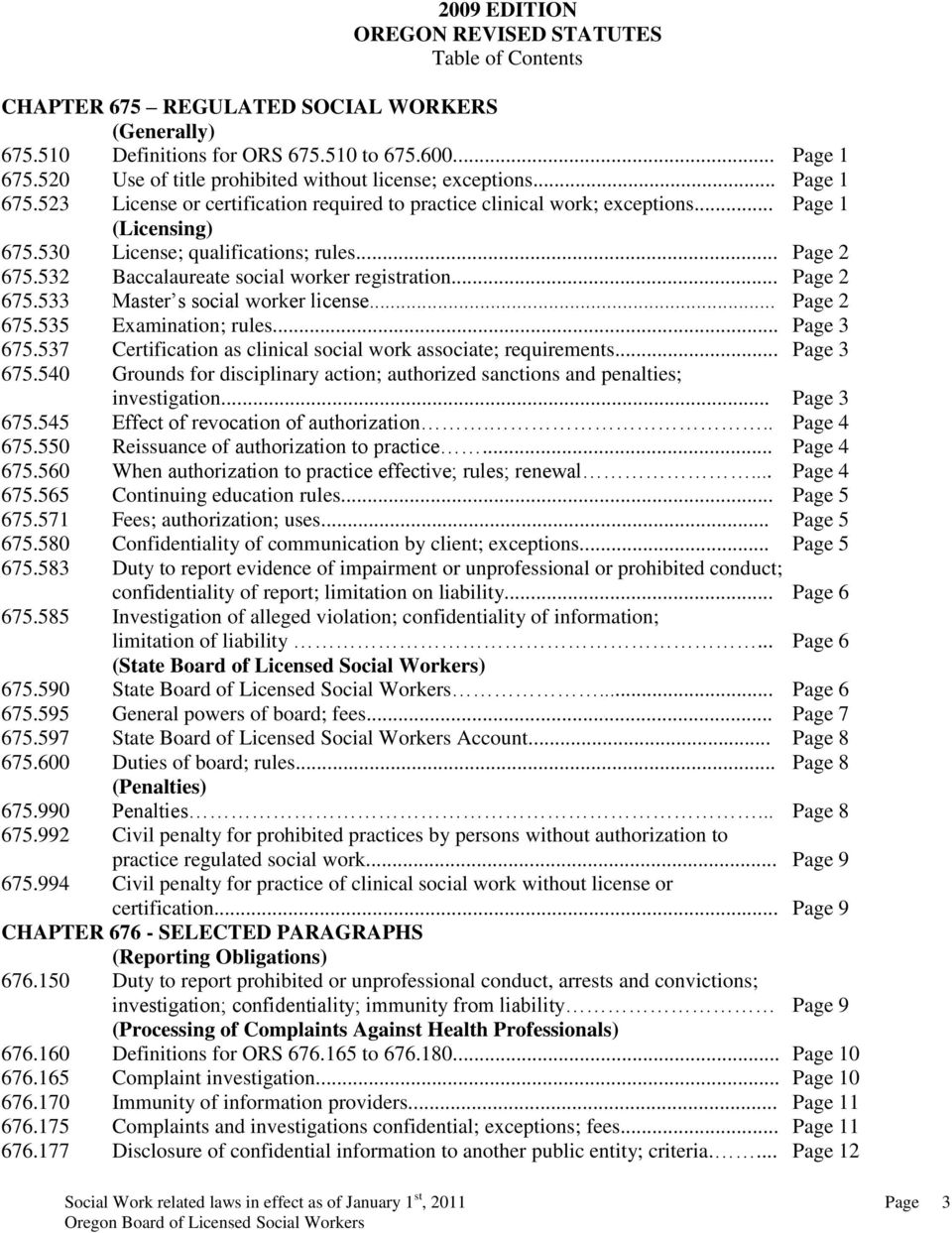
4 Notice prior to disclosure (Effect of expiration, lapse, surrender suspension or revocation of license) Continuing jurisdiction of boards; effect of expiration, lapse, surrender, suspension or revocation of license Practice of health care profession after suspension or revocation of license prohibited Enjoining health care professional from practicing after suspension or revocation of license Injunction as cumulative remedy (Miscellaneous) Purposes of health professional regulatory boards; authority of boards to require fingerprints Executive directors; reports. 14 CHAPTER 109, B, 430 & ABUSE REPORTING (Age Majority) Age of Majority Majority of married persons 15 (Rights of Minors) Right to treatment for venereal disease without parental consent Right to medical or dental treatment without parental consent; provision of birth control information and services to any person Disclosure without minor s consent and without liability Construction Right to donate blood Certain persons immune from liability for providing care to minor Right to diagnosis or treatment for mental or emotional disorder or chemical dependency without parental consent Disclosure without minor s consent; civil immunity Person providing treatment for diagnosis not subject to civil liability for Providing treatment or diagnosis without consent of parent or guardian 17 (Reporting abuse of elderly persons) Definitions for ORS to Policy Duty of officials to report Method of reporting; content; notice to law enforcement agency and to department Duty to investigate; notice to department; evaluation Immunity of person making report in good faith; identity confidential Immunity for disclosure to prospective employer Photographing of victim; photograph as record Catalogue of abuse records; confidentiality Confidentiality of abuse records; confidentiality Spiritual treatment not abuse.. 21 (Reporting of Child Abuse) 419B.005 Definitions B.007 Policy B.010 Duty of officials to report child abuse; exceptions; penalty B.015 Report form and content; notice to law enforcement agencies and local office 4
5 of Department of Human Services B.017 Time limits for notification between law enforcement agencies and Department of Human Services; rules B.020 Duty of department or law enforcement agency receiving report; investigation; notice to parents; physical examination; child s consent B.025 Immunity of person making report in good faith B.028 Photographing child abuse during investigation; photographs as record B.030 Central registry of reports B.035 Confidentiality of records; when available to others B.040 Certain privileges not grounds for excluding evidence in court proceedings on child abuse B.045 Investigation conducted on public school premises; notification; role of school personnel B.050 Authority of health care provider to disclose information; immunity from liability 28 (Abuse reporting for persons who are mentally ill or have developmental disability) Definitions for ORS to Mandatory reports and investigations Abuse report; content; action on report; notice to law enforcement agency and Department of Human Services Investigation of abuse report; notice to medical examiners; findings; recommendations Training requirements for person investigating reports of alleged abuse Photographs of victims during investigation; exception; photographs as records Immunity of persons making reports in good faith; confidentiality Retaliation prohibited; liability for retaliation Immunity of employer reporting abuse by employee Reports of abuse to be maintained by Department of Human Services Confidentiality of records; when record may be made available to agency Duty of officials to report abuse; exceptions for privileged communications; exceptions for religious practice. 33 (Resident Abuse) Definitions for ORS to and Legislative finding Rules; submission of rules to advisory group Report of suspected abuse of resident required Oral report to area agency on aging, department or law enforcement agency Investigation of abuse complain; initial status report; content; distribution of report; duties of investigator; investigation report Immunity provided reporter of abuse Photographing resident; photograph as record Record of reports; classification of investigation report Confidentiality of reports; when available Certain evidentiary privileges inapplicable Investigation of licensing violations; powers of investigator Letter of determination; determination rules; distribution of letter; notice 5

6 to nursing assistant Review of finding that nursing assistant responsible for abuse; name placed In registry Preemployment inquiries; when employment prohibited Spiritual healing alone not considered abuse to resident Monitors; designation; duties; peer review of facilities
7 CHAPTER 675 REGULATED SOCIAL WORKERS (Generally) Definitions for ORS to As used in ORS to , unless the context requires otherwise: (1) Authorization to practice regulated social work means a certificate or license issued by the State Board of Licensed Social Workers under ORS to (2) Clinical social work means the professional practice of applying principles and methods with individuals, couples, families, children and groups, which include, but are not restricted to: (a) Providing diagnostic, preventive and treatment services of a psychosocial nature pertaining to personality adjustment, behavior problems, interpersonal dysfunctioning or deinstitutionalization; (b) Developing a psychotherapeutic relationship to employ a series of problem solving techniques for the purpose of removing, modifying, or retarding disrupted patterns of behavior, and for promoting positive personality growth and development; (c) Counseling and the use of psychotherapeutic techniques, such as disciplined interviewing which is supportive, directive or insight oriented depending upon diagnosed problems, observation and feedback, systematic analysis, and recommendations; (d) Modifying internal and external conditions that affect a client s behavior, emotions, thinking, or intrapersonal processes; (e) Explaining and interpreting the psychosocial dynamics of human behavior to facilitate problem solving; and (f) Supervising, administering or teaching clinical social work practice. (3) Regulated social worker means a baccalaureate social worker registered under ORS , a master s social worker licensed under ORS , a clinical social work associate certified under ORS or a clinical social worker licensed under ORS (4) Unprofessional conduct includes, but is not limited to, any conduct or practice contrary to recognized standards of ethics of the social work profession or any conduct that constitutes or might constitute a danger to the health or safety of a client or the public or in any other manner fails or might fail to adhere to the recognized standards of the profession Use of title prohibited without license; exceptions. (1) A person may not use any title, words or abbreviations, including the title social worker, that indicate that the person has an authorization to practice regulated social work unless the person is a regulated social worker. (2) Subsection (1) of this section does not prohibit the use of the educational designations Bachelor of Social Work or Master s of Social Work by a person who is not a regulated social worker. [1977 c.677 2; 1987 c ; 1989 c ; 2009 c.442 3] License or certification required to practice clinical social work; exceptions. A person may not practice clinical social work unless the person is a clinical social worker licensed under ORS or a clinical social work associate certified under ORS , except if the person is: (1) Licensed or certified by the State of Oregon to provide mental health services, provided that the person is acting within the lawful scope of practice for the person s license or certification and does not represent that the person is a regulated social worker; (2) Certified to provide alcohol and drug abuse prevention services, intervention services and treatment in compliance with rules adopted by the Director of Human Services under ORS (2)(f) and (1), provided that the person is acting within the lawful scope of practice for the person s certification and does not represent that the person is a regulated social worker; 1

8 (3) Employed by or contracting with an entity that is certified or licensed by the State of Oregon under ORS to to provide mental health treatment or addiction services, provided that the person is practicing within the lawful scope of the person s employment or contract; (4) A recognized member of the clergy, provided that the person is acting in the person s ministerial capacity and does not represent that the person is a regulated social worker; or (5) A student in a social work graduate degree program that meets the requirements established by the State Board of Licensed Social Workers by rule. [2009 c.442 4a] (Licensing) License; qualifications; rules. (1) If an applicant for initial licensure as a clinical social worker has complied with the requirements of this section and has paid the fee under ORS , the State Board of Licensed Social Workers shall issue a license to the applicant. (2) An applicant for licensure as a clinical social worker shall submit evidence satisfactory to the board that the applicant: (a) Has complied with all applicable provisions of ORS to and the applicable rules of the board; (b) Holds a master s degree in social work from a college or university accredited by an accrediting organization recognized by the board; (c) Has completed the equivalent of two years of full-time experience in the field of clinical social work in accordance with rules of the board; (d) Holds a certificate of clinical social work associate issued under ORS before January 1, 2011, or holds a valid master s social worker license issued under ORS ; and (e) If required under ORS , has passed the written examination for licensure as a clinical social worker. (3) The board shall adopt rules relating to the clinical experience required under subsection (2)(c) of this section after consultation with persons active in the field of clinical social work. The rules may allow for including experience obtained in the course of the study of social work as part of the clinical experience required under subsection (2)(c) of this section Baccalaureate social worker registration. (1) If an applicant for initial registration as a baccalaureate social worker has complied with the requirements of this section and has paid the fee under ORS , the State Board of Licensed Social Workers shall register the applicant as a baccalaureate social worker. Upon registration, the board shall issue notice of the registration to the applicant. (2) An applicant for registration as a baccalaureate social worker shall submit evidence satisfactory to the board that the applicant: (a) Has complied with the requirements of all applicable provisions of ORS to and the applicable rules of the board; (b) Holds a bachelor s degree in social work from a college or university accredited by an accrediting organization recognized by the board; and (c) If required under ORS , has passed the written examination for registration as a baccalaureate social worker. [2009 c.442 6] Master s social worker license. (1) If an applicant for initial licensure as a master s social worker has complied with the requirements of this section and has paid the fee under ORS , the State Board of Licensed Social Workers shall issue a license to the applicant. (2) An applicant for licensure as a master s social worker shall submit evidence satisfactory to the board that the applicant: (a) Has complied with the requirements of all applicable provisions of ORS to and the applicable rules of the board; (b) Holds a master s degree in social work from a college or university accredited by an 2
9 accrediting organization recognized by the board; and (c) If required under ORS , has passed the written examination for licensure as a master s social worker. [2009 c.442 7] Examination; rules. (1) The State Board of Licensed Social Workers may adopt rules to establish written examination requirements for: (a) Baccalaureate social worker registration; (b) Master s social worker licensing; or (c) Clinical social worker licensing. (2) The rules adopted by the board under this section shall specify the subjects on which an applicant may be examined, how the written examination is to be administered and the scoring or evaluation process used to determine whether an applicant has passed the examination. The board shall provide a copy of the rules to an applicant at least 30 days prior to any examination. (3) Examinations for authorizations to practice regulated social work conducted under ORS to shall be held at least once every year at such times and places as the board may determine. Timely and appropriate notice shall be sent to each applicant. (4) Upon written request to the board, any applicant may discuss the applicant s performance on the examination with the board. (5) Any applicant who fails to attain a passing grade on the examination shall be allowed to take the examination a second time. Any applicant who fails the examination a second time must obtain special permission from the board to take the examination again. [1989 c ; 2009 c ] Certification as clinical social work associate; requirements. (1) If an applicant for initial certification as a clinical social work associate has complied with the requirements of this section and has paid the fee under ORS , the State Board of Licensed Social Workers shall certify the applicant. Upon certification, the board shall issue a certificate to the applicant. (2) An applicant for certification as a clinical social work associate shall submit evidence satisfactory to the board that the applicant: (a) Has complied with all applicable provisions of ORS to and the applicable rules of the board; (b) Holds a master s degree in social work from a college or university accredited by an accrediting organization recognized by the board; and (c) Has developed a plan approved by the board for completion of practice and supervision requirements as defined by the rules of the board. [1989 c ; 1997 c.381 3; 2009 c ] Grounds for disciplinary action; authorized sanctions and penalties; investigation. (1) The State Board of Licensed Social Workers may impose any or all of the sanctions specified in subsection (2) of this section, upon proof, after a hearing pursuant to the provisions of ORS chapter 183 relating to a contested case, that a regulated social worker: (a) Has been convicted in this or any other state of a crime that is a felony in this state; (b) Has been convicted of a felony in a federal court; (c) Is unable to perform the practice of social work by reason of physical illness; (d) Has an impairment as defined in ORS ; (e) Has been grossly negligent or has engaged in unprofessional conduct in the practice of social work; or (f) Has violated any provision of ORS to or any rule adopted under ORS (2) Pursuant to the provisions of subsection (1) of this section, the board may: (a) Deny, suspend, revoke or refuse to renew any authorization to practice regulated social work issued under ORS to (b) Place a regulated social worker on probation and impose conditions or limits on the scope of practice of a regulated social worker. 3

10 (c) Impose a civil penalty not to exceed $3,000 for each violation. (3) The expiration, or voluntary surrender by a regulated social worker, of an authorization to practice regulated social work does not deprive the board of jurisdiction to proceed with any investigation of, or any action or disciplinary proceedings against, the regulated social worker. (4) Information that the board obtains as part of an investigation into the conduct of a regulated social worker or an applicant for an authorization to practice regulated social work or as part of a contested case proceeding, consent order or stipulated agreement involving the conduct of a regulated social worker or applicant, is confidential as provided under ORS (5) Subject to the provisions of ORS chapter 183 relating to a contested case, the board may impose a civil penalty in an amount up to $5,000 upon proof that, after a person s authorization to practice regulated social work has been revoked by the board, the person has: (a) Engaged in the practice of clinical social work; or (b) Represented that the person is a regulated social worker. [1977 c.677 6; 1979 c.769 5; 1985 c.52 4; 1989 c ; 1997 c.381 4; 1997 c ; 2009 c ; 2009 c ] Effect of revocation of authorization. To safeguard the people of the State of Oregon from the dangers of unqualified and improper practice of social work, a regulated social worker whose authorization to practice regulated social work has been revoked by the State Board of Licensed Social Workers may not: (1) Engage in or offer to engage in the practice of clinical social work. (2) Represent that the person is a regulated social worker by using any title, words or abbreviations that indicate that the person has an authorization to practice regulated social work. [2009 c.442 5] Reissuance of authorization to practice. If the State Board of Licensed Social Workers has revoked or refused to reissue or renew an authorization to practice regulated social work, the board may reissue the authorization after one year from the date of the revocation or the date the reissuance or renewal was refused. [1977 c.677 7; 1979 c.769 6; 1989 c ; 2009 c ] When authorization to practice effective; rules; renewal. (1) An authorization to practice regulated social work granted by the State Board of Licensed Social Workers under ORS to is effective when the authorization is issued by the board. (2) An authorization to practice regulated social work granted by the board expires on the date established by the board by rule. (3) The board shall adopt rules setting forth requirements for renewal of a baccalaureate social worker registration and renewal of a master s social worker license. (4) A clinical social work associate certified by the board under ORS may renew the certification by: (a) Payment of the renewal fee established under ORS ; and (b) Submission of a sworn statement by the associate, on a form provided by the board, that demonstrates to the board s satisfaction that satisfactory progress is being made toward completion of the associate s adopted supervisory plan. (5) A clinical social worker licensed under ORS may renew the license by: (a) Payment of the renewal fee established under ORS ; and (b) Submission of a sworn statement by the applicant, on a form provided by the board, that the applicant: (A) Has completed applicable continuing education requirements established by the board under ORS ; and (B) Is unaware of any reason for denial of the renewal. [1977 c.677 9; 1979 c.769 8; 1989 c ; 2005 c.36 1; 2009 c ] 4
11 Continuing education; rules. (1) The State Board of Licensed Social Workers may establish by rule continuing education requirements for the renewal of authorizations to practice regulated social work. (2) The board may require applicants for renewal of authorization to practice regulated social work to submit evidence of completion of continuing education requirements as a condition of renewal in order to ensure the highest quality of professional services to the public. [1989 c ; 2009 c ] [1977 c.677 8; 1979 c.769 7; 1985 c.52 5; repealed by 1989 c ( enacted in lieu of )] Fees; authorization; uses. (1) The State Board of Licensed Social Workers shall collect fees for: (a) Examination and reexamination. (b) An initial authorization to practice regulated social work. (c) Renewal of an authorization to practice regulated social work. (d) Delinquent renewal of an authorization to practice regulated social work. (2) Fees collected under subsection (1) of this section shall be deposited in the State Board of Licensed Social Workers Account established under ORS and shall be used to defray the expenses of the board. (3) Subject to prior approval of the Oregon Department of Administrative Services and a report to the Emergency Board prior to adopting the fees and charges, the fees and charges established under this section may not exceed the cost of administering the regulatory program pertaining to the purpose for which the fee or charge is established, as authorized by the Legislative Assembly within the budget of the State Board of Licensed Social Workers, as the budget may be modified by the Emergency Board. (4) The State Board of Licensed Social Workers may impose a delinquent renewal fee for an authorization to practice regulated social work if the application for renewal is not filed and accepted by the renewal date established by the board by rule, but is filed and accepted within 30 days of the renewal date. An authorization to practice regulated social work is lapsed if an application for renewal is not filed and accepted within 30 days of the renewal date. (5) Fees collected under this section are nonrefundable. [1989 c (enacted in lieu of ); 1991 c ; 1993 c.8 1; 2005 c ; 2005 c.36 2; 2009 c ] Confidentiality of communication by client; exceptions. (1) A regulated social worker or any employee of the regulated social worker may not disclose any communication given by a client in the course of noninvestigatory professional activity when the communication was given to enable the regulated social worker to aid the client, except when: (a) The client or a person legally responsible for the client s affairs gives consent to the disclosure; (b) The client initiates legal action or makes a complaint against the regulated social worker to the State Board of Licensed Social Workers; (c) The board requests the information as part of an investigation or proceeding; (d) The communication reveals a clear intent to commit a crime that reasonably is expected to result in physical injury to a person; (e) The communication reveals that a minor was the victim of a crime, abuse or neglect; (f) Disclosure of the communication is necessary to obtain further professional assistance for the client; or (g) Disclosure of the communication is otherwise required by ORS , 419B.010 or (2) Nothing in this section is intended to prevent a regulated social worker who is a public employee from disclosing communications from a client when the disclosure is made in the performance of the regulated social worker s duty as a public employee and the public employer has determined that the disclosure is necessary in the performance of the duty of the regulated 5

12 social worker as a public employee. [1977 c ; 1979 c.769 9; 1989 c ; 1997 c.381 5; 2009 c ] Duty to report evidence of impairment or unprofessional or prohibited conduct; confidentiality of information; limitation of liability. (1) Unless state or federal laws relating to confidentiality or the protection of health information prohibit disclosure, a regulated social worker shall report to the State Board of Licensed Social Workers any information the regulated social worker has that appears to show that a regulated social worker is or may be an impaired professional as defined in ORS , or may have engaged in unprofessional conduct according to the guidelines of the code of ethics, to the extent that disclosure does not conflict with the requirements of ORS (2) A regulated social worker shall report any prohibited conduct as defined in ORS in the manner provided in ORS (3) Notwithstanding ORS , any information that the board obtains pursuant to subsection (1) of this section is confidential and may not be disclosed except as provided by the board by rule. (4) A person who reports or provides information to the board under subsection (1) of this section in good faith is not subject to an action for civil damages as a result of reporting or providing information to the board. [1989 c ; 1997 c.381 6; 1997 c a; 2007 c ; 2009 c ; 2009 c ; 2009 c ; 2009 c a,89b] Investigation of alleged violations; confidentiality of information; limitation of liability. (1) Upon complaint of any person, or upon its own initiative, the State Board of Licensed Social Workers may investigate any alleged violation of ORS to (2) Any information that the board obtains pursuant to subsection (1) of this section is confidential as provided under ORS and is not admissible in judicial proceedings, other than judicial review as provided for under ORS , until the board votes to take final action. (3) Any person who reports or provides information to the board under subsection (1) of this section in good faith is not subject to an action for civil damages as a result thereof. (4) In addition to any other privilege or immunity provided by law, members of the board, members of its administrative and investigative staff, agents of the board and attorneys acting for the board as prosecutors or counsel have the same privileges and immunities from civil, administrative and criminal proceedings arising by reason of official actions as prosecuting and judicial officers of the state. (5) A person who has made a complaint to the board or who has given information or testimony relative to a proposed or pending proceeding before the board is not answerable for any such act in any proceeding except for perjury. [1985 c.52 9; 1989 c ; 1997 c.381 7; 1997 c a; 2009 c ] (State Board) State Board of Licensed Social Workers. (1) There is established a State Board of Licensed Social Workers. The board shall consist of seven members appointed by the Governor and subject to confirmation by the Senate in the manner provided in ORS and All members of the board must be residents of this state. Of the members of the board: (a) Four members shall be clinical social workers licensed under ORS ; and (b) Three members must be members of the public who have demonstrated an interest in the field of clinical social work and who are not: (A) Regulated social workers; or (B) A spouse, domestic partner, child, parent or sibling of a regulated social worker. (2)(a) Board members required to be clinical social workers licensed under ORS may be appointed from a list of three to five 6
13 nominees for each vacancy, submitted by any professional organization that represents clinical social workers. (b) In selecting the members of the board, the Governor shall strive to balance the representation on the board according to: (A) Geographic areas of this state; and (B) Ethnic group. (3)(a) The term of office of each member is four years, but a member serves at the pleasure of the Governor. The terms must be staggered so that no more than three terms end each year. (b) Before the expiration of the term of a member, the Governor shall appoint a successor whose term begins on July 1 next following. A member is eligible for reappointment. If there is a vacancy for any cause, the Governor shall make an appointment to become immediately effective for the unexpired term. (c) A board member shall be removed immediately from the board if, during the member s term, the member: (A) Is not a resident of this state; (B) Has been absent from three consecutive board meetings, unless at least one absence is excused; or (C) Is not a clinical social worker licensed under ORS or a retired clinical social worker who was a clinical social worker licensed under ORS in good standing at the time of retirement, if the board member was appointed to serve on the board as a clinical social worker licensed under ORS (4) Members of the board are entitled to compensation and expenses as provided in ORS The board may provide by rule for compensation to board members for the performance of duties at a rate that is greater than the rate provided in ORS [1979 c.769 2; 1985 c.52 6; 1989 c.69 1; 1989 c ; 2001 c.459 1; 2009 c.535 3,39] General powers of board; fees. In addition to the powers otherwise granted under ORS to , the State Board of Licensed Social Workers shall have the following powers: (1) To determine the qualifications of applicants to practice social work in this state. (2) To cause to have examinations prepared, conducted and graded. (3) To grant authorizations to practice regulated social work to qualified applicants upon their compliance with the provisions of ORS to and the rules of the board. (4) To grant or deny renewal of authorizations to practice regulated social work. (5) To suspend or revoke authorizations to practice regulated social work. (6) To issue letters of reprimand. (7) To impose probationary periods with the authority to restrict the scope of practice of a regulated social worker. (8) To require that a regulated social worker: (a) Practice under supervision; (b) Obtain additional training in social work; or (c) Undergo psychological, physical or psychiatric assessment, enter into and remain in any prescribed treatment program and disclose the results of the treatment program to the board. (9) To impose civil penalties as provided in ORS (10) To restore authorizations to practice regulated social work that have been suspended, revoked or voided by nonpayment of the renewal fee. (11) To collect fees for application, examination and reexamination of applicants for initial authorizations to practice regulated social work as provided in ORS (12) To collect fees for renewal of authorizations to practice regulated social work as provided in ORS (13) To collect delinquent renewal fees as provided in ORS (4). (14) To investigate alleged violations of ORS to (15) To issue subpoenas for the attendance of witnesses, take testimony, administer oaths or affirmations to witnesses, conduct hearings and require the production of relevant documents in 7

14 all proceedings pertaining to the duties and powers of the board. (16) To enforce ORS to and exercise general supervision over the practice of social work in this state. (17) To adopt a common seal. (18) To formulate and enforce a code of professional conduct for the practice of social work giving particular consideration to the code of ethics. (19) To formulate and enforce continuing education requirements for regulated social workers to ensure the highest quality of professional services to the public. (20) To take such other disciplinary action as the board in its discretion finds proper, including but not limited to assessment of the costs of the disciplinary process. (21) For the purpose of requesting a state or nationwide criminal records check under ORS , to require the fingerprints of a person who is: (a) Applying for an authorization to practice regulated social work; (b) Applying for renewal of an authorization to practice regulated social work; or (c) Under investigation by the board. [1989 c ; 1995 c ; 1997 c.381 8; 2003 c ; 2005 c ; 2009 c ] State Board of Licensed Social Workers Account. The State Board of Licensed Social Workers Account is established in the State Treasury, separate and distinct from the General Fund. Interest earned by the State Board of Licensed Social Workers Account shall be credited to the account. Moneys in the account are continuously appropriated to the board for the administration and enforcement of ORS to [2001 c.459 2; 2009 c ] Duties of board; rules. The State Board of Licensed Social Workers shall: (1) Pursuant to ORS chapter 183, adopt rules necessary to carry out the provisions of ORS to (2) Publish annually a list of the names and addresses of all persons who have been authorized to practice regulated social work. (3) Establish a voluntary arbitration procedure that may be invoked with the consent of clients and regulated social workers whereby disputes between clients and workers may be resolved. (4) Report to the Legislative Assembly on its activities regarding authorizations to practice regulated social work during the preceding biennium. [1977 c.677 5; 1979 c.769 4; 1985 c.52 7; 1989 c ; 2009 c ; 2009 c ; 2009 c ,91b,91c] (Penalties) Penalties. (1)(a) Violation of any provision of ORS to is a Class C misdemeanor. (b) Notwithstanding paragraph (a) of this subsection, violation of ORS is a Class A misdemeanor. (2) Violation of any provision of ORS is a Class B misdemeanor. (3) The following shall be Class C misdemeanors: (a) Any violation of ORS ; (b) Obtaining or attempting to obtain or renew an authorization to practice regulated social work by bribery or fraudulent representation; (c) Knowingly making a false statement in connection with any application for an authorization to practice regulated social work under ORS to ; or (d) Knowingly making a false statement on any form adopted by the State Board of Licensed Social Workers in accordance with ORS to , or the rules adopted under ORS to [1963 c ; 1973 c ; subsection (2) enacted as 1977 c ; subsection (3) enacted as 1977 c ; 1979 c ; 1989 c ; subsection (1)(b) of 1995 Edition enacted as 1995 c.810 4; 2009 c ] 8

15 Civil penalty for prohibited practices by persons without authorization to practice regulated social work. Subject to the provisions of ORS chapter 183 relating to a contested case, the State Board of Licensed Social Workers may impose a civil penalty of up to $3,000 upon proof that a person who is not a regulated social worker has: (1) Represented that the person is a regulated social worker; or (2) Used the title social worker or any title, words or abbreviations that indicate that the person has an authorization to practice regulated social work in violation of ORS [2009 c b] Civil penalty for practice of clinical social work without license or certification. Subject to the provisions of ORS chapter 183 relating to a contested case, the State Board of Licensed Social Workers may impose a civil penalty of up to $5,000 upon proof that a person who is not a clinical social worker licensed under ORS or a clinical social work associate certified under ORS has: (1) Engaged in the practice of clinical social work, unless the person is permitted to practice clinical social work under ORS ; or (2) Represented that the person is a clinical social worker or clinical social work associate. [2009 c a] CHAPTER 676 SELECTED PARAGRAPHS Duty to report prohibited or unprofessional conduct, arrests and convictions; investigation; confidentiality; immunity from liability. (1) As used in this section: (a) Board means the: (A) State Board of Examiners for Speech- Language Pathology and Audiology; (B) State Board of Chiropractic Examiners; (C) State Board of Licensed Social Workers; (D) Oregon Board of Licensed Professional Counselors and Therapists; (E) Oregon Board of Dentistry; (F) Board of Examiners of Licensed Dietitians; (G) State Board of Massage Therapists; (H) Oregon Board of Naturopathic Medicine; (I) Oregon State Board of Nursing; (J) Nursing Home Administrators Board; (K) Oregon Board of Optometry; (L) State Board of Pharmacy; (M) Oregon Medical Board; (N) Occupational Therapy Licensing Board; (O) Physical Therapist Licensing Board; (P) State Board of Psychologist Examiners; (Q) Board of Radiologic Technology; (R) State Board of Direct Entry Midwifery; (S) State Board of Denture Technology; (T) Respiratory Therapist Licensing Board; (U) Department of Human Services, to the extent that the department certifies emergency medical technicians; (V) Oregon State Veterinary Medical Examining Board; or (W) State Mortuary and Cemetery Board. (b) Licensee means a health professional licensed or certified by or registered with a board. (c) Prohibited conduct means conduct by a licensee that: (A) Constitutes a criminal act against a patient or client; or (B) Constitutes a criminal act that creates a risk of harm to a patient or client. (d) Unprofessional conduct means conduct unbecoming a licensee or detrimental to the best interests of the public, including conduct contrary to recognized standards of ethics of the licensee s profession or conduct that endangers the health, safety or welfare of a patient or client. (2) Unless state or federal laws relating to confidentiality or the protection of health information prohibit disclosure, a licensee who has reasonable cause to believe that another licensee has engaged in prohibited or unprofessional conduct shall report the conduct 9
16 to the board responsible for the licensee who is believed to have engaged in the conduct. The reporting licensee shall report the conduct without undue delay, but in no event later than 10 working days after the reporting licensee learns of the conduct. (3) A licensee who is convicted of a misdemeanor or felony or who is arrested for a felony crime shall report the conviction or arrest to the licensee s board within 10 days after the conviction or arrest. (4) The board responsible for a licensee who is reported to have engaged in prohibited or unprofessional conduct shall investigate in accordance with the board s rules. If the board has reasonable cause to believe that the licensee has engaged in prohibited conduct, the board shall present the facts to an appropriate law enforcement agency without undue delay, but in no event later than 10 working days after the board finds reasonable cause to believe that the licensee engaged in prohibited conduct. (5) A licensee who fails to report prohibited or unprofessional conduct as required by subsection (2) of this section or the licensee s conviction or arrest as required by subsection (3) of this section is subject to discipline by the board responsible for the licensee. (6) A licensee who fails to report prohibited conduct as required by subsection (2) of this section commits a Class A violation. (7) Notwithstanding any other provision of law, a report under subsection (2) or (3) of this section is confidential under ORS A board may disclose a report as provided in ORS (8) Except as part of an application for a license or for renewal of a license and except as provided in subsection (3) of this section, a board may not require a licensee to report the licensee s criminal conduct. (9) The obligations imposed by this section are in addition to and not in lieu of other obligations to report unprofessional conduct as provided by statute. (10) A licensee who reports to a board in good faith as required by subsection (2) of this section is immune from civil liability for making the report. (11) A board and the members, employees and contractors of the board are immune from civil liability for actions taken in good faith as a result of a report received under subsection (2) or (3) of this section. [2009 c.536 1] (Processing of Complaints Against Health Care Professionals) Definitions for ORS to As used in ORS to , health professional regulatory board means the: (1) State Board of Examiners for Speech- Language Pathology and Audiology; (2) State Board of Chiropractic Examiners; (3) State Board of Licensed Social Workers; (4) Oregon Board of Licensed Professional Counselors and Therapists; (5) Oregon Board of Dentistry; (6) Board of Examiners of Licensed Dietitians; (7) State Board of Massage Therapists; (8) State Mortuary and Cemetery Board; (9) Oregon Board of Naturopathic Medicine; (10) Oregon State Board of Nursing; (11) Nursing Home Administrators Board; (12) Oregon Board of Optometry; (13) State Board of Pharmacy; (14) Oregon Medical Board; (15) Occupational Therapy Licensing Board; (16) Physical Therapist Licensing Board; (17) State Board of Psychologist Examiners; (18) Board of Medical Imaging; (19) Oregon State Veterinary Medical Examining Board; and (20) Oregon Health Authority to the extent that the authority certifies emergency medical technicians. [1997 c.791 1; 1999 c.537 4; 2001 c.274 4; 2009 c.43 9; 2009 c ; 2009 c ; 2009 c ; 2009 c ] Complaint investigation. (1) When a health professional regulatory board or the Oregon Health Licensing Agency receives a 10

17 complaint by any person against a licensee, applicant or other person alleged to be practicing in violation of law, the board or agency shall assign one or more persons to act as investigator of the complaint. (2) The investigator shall collect evidence and interview witnesses and shall make a report to the board or agency. The investigator shall have all investigatory powers possessed by the board or agency. (3) The report to the board or agency shall describe the evidence gathered, the results of witness interviews and any other information considered in preparing the report of the investigator. The investigator shall consider, and include in the report, any disciplinary history with the board or agency of the licensee, applicant or other person alleged to be practicing in violation of law. (4) The investigator shall make the report to the board or agency not later than 120 days after the board or agency receives the complaint. However, the board or agency may extend the time for making the report by up to 30 days for just cause. The board or agency may grant more than one extension of time. (5) Investigatory information obtained by an investigator and the report issued by the investigator shall be exempt from public disclosure. (6) When a health professional regulatory board reviews the investigatory information and report, the public members of the board must be actively involved. [1997 c.791 5; 2009 c.756 5] Immunity of information providers. A person who reports or supplies information in good faith to a health professional regulatory board or to a committee reporting to a health professional regulatory board shall be immune from an action for civil damages as a result thereof. [1997 c.791 4] Complaints and investigations confidential; exceptions; fees. (1) A health professional regulatory board shall keep confidential and not disclose to the public any information obtained by the board as part of an investigation of a licensee or applicant, including complaints concerning licensee or applicant conduct and information permitting the identification of complainants, licensees or applicants. However, the board may disclose information obtained in the course of an investigation of a licensee or applicant to the extent necessary to conduct a full and proper investigation. (2) Notwithstanding subsection (1) of this section, if a health professional regulatory board votes not to issue a notice of intent to impose a disciplinary sanction: (a) The board shall disclose information obtained as part of an investigation of an applicant or licensee if the person requesting the information demonstrates by clear and convincing evidence that the public interest in disclosure outweighs other interests in nondisclosure, including but not limited to the public interest in nondisclosure. (b) The board may disclose to a complainant a written summary of information obtained as part of an investigation of an applicant or licensee resulting from the complaint to the extent the board determines necessary to explain the reasons for the board s decision. An applicant or licensee may review and obtain a copy of any written summary of information disclosed to a complainant by the board after the board has deleted any information that could reasonably be used to identify the complainant. (3) If a health professional regulatory board votes to issue a notice of intent to impose a disciplinary sanction, upon written request by the licensee or applicant, the board shall disclose to the licensee or applicant all information obtained by the board in the investigation of the allegations in the notice except: (a) Information that is privileged or confidential under a law other than this section. (b) Information that would permit the identification of any person who provided information that led to the filing of the notice and who will not provide testimony at a hearing arising out of the investigation. 11
18 (c) Information that would permit the identification of any person as a person who made a complaint to the board about a licensee or applicant. (d) Reports of expert witnesses. (4) Information disclosed to a licensee or applicant under subsection (3) of this section may be further disclosed by the licensee or applicant only to the extent necessary to prepare for a hearing on the notice of intent to impose a disciplinary sanction. (5)(a) A health professional regulatory board shall disclose: (A) A notice of intent to impose a disciplinary sanction against a licensee or applicant that has been issued by vote of the board; (B) A final order that results from the board s notice of intent to impose a disciplinary sanction; (C) An emergency suspension order; (D) A consent order or stipulated agreement that involves licensee or applicant conduct; and (E) Information to further an investigation into board conduct under ORS (b) A health professional regulatory board may make the information required to be disclosed under paragraph (a)(a) to (D) of this subsection available in electronic form, accessible by use of a personal computer or similar technology that provides direct electronic access to the information. (6) If a notice of intent to impose a disciplinary sanction has been issued by vote of a health professional regulatory board, a final order that results from the board s notice of intent to impose a disciplinary sanction, an emergency suspension order or a consent order or stipulated agreement that involves licensee or applicant conduct shall summarize the factual basis for the board s disposition of the matter. (7) A health professional regulatory board record or order, or any part thereof, obtained as part of or resulting from an investigation, contested case proceeding, consent order or stipulated agreement, is not admissible as evidence and may not preclude an issue or claim in any civil proceeding except in a proceeding between the board and the licensee or applicant as otherwise allowed by law. (8)(a) Notwithstanding subsection (1) of this section, it is not disclosure to the public for a board to permit other public officials and members of the press to attend executive sessions where information obtained as part of an investigation is discussed. Public officials and members of the press attending such executive sessions shall not disclose information obtained as part of an investigation to any other member of the public. (b) For purposes of this subsection, public official means a member or member-elect, or any member of the staff or an employee, of a public entity as defined by ORS (9) A health professional regulatory board may establish fees reasonably calculated to reimburse the actual cost of disclosing information to licensees or applicants as required by subsection (3) of this section. [1997 c.791 2; 1999 c.751 3; 2005 c.801 1] Disclosure of confidential information to another public entity; criteria. (1) Notwithstanding any other provision of ORS to , a health professional regulatory board, upon a determination by the board that it possesses otherwise confidential information that reasonably relates to the regulatory or enforcement function of another public entity, may disclose that information to the other public entity. (2) Any public entity that receives information pursuant to subsection (1) of this section shall agree to take all reasonable steps to maintain the confidentiality of the information, except that the public entity may use or disclose the information to the extent necessary to carry out the regulatory or enforcement functions of the public entity. (3) For purposes of this section, public entity means: (a) A board or agency of this state, or a board or agency of another state with regulatory or enforcement functions similar to the functions of a health professional regulatory board of this state; 12
19 (b) A district attorney; (c) The Department of Justice; (d) A state or local public body of this state that licenses, franchises or provides emergency medical services; or (e) A law enforcement agency of this state, another state or the federal government. [1999 c.751 2] Notice prior to disclosure. If a health professional regulatory board intends to disclose a record pursuant to ORS (2), the board shall provide the licensee or applicant seven days prior written notice by first class mail. The notice shall describe the record that the board intends to disclose in sufficient detail to permit the licensee or applicant to know the contents of the record. In any subsequent action for injunctive or declaratory relief, the burden shall be on the person seeking disclosure to demonstrate by clear and convincing evidence that the public interest in disclosure outweighs other interests in nondisclosure, including but not limited to the public interest in nondisclosure. [1997 c.791 3] (Effect of expiration, lapse, surrender, suspension or revocation of license) Continuing jurisdiction of boards; effect of expiration, lapse, surrender, suspension or revocation of license. (1) As used in this section: (a) Health professional regulatory board means the agencies listed in ORS and the Oregon Health Licensing Agency created in ORS (b) License means a license, registration, certification or other authorization to engage in a profession. (2) A health professional regulatory board continues to have jurisdiction for licensing, regulatory and disciplinary purposes related to acts and omissions that occur while a person is licensed or required to be licensed, regardless of any changes in the licensing status of the person. (3) A person who obtains, but is not required to obtain, a license to engage in a profession regulated by a health professional regulatory board, and whose license expires, lapses or is voluntarily surrendered while the person is under investigation by the board, or whose license is suspended or revoked, may not engage in that profession unless the person again obtains a license from the relevant health professional regulatory board to engage in the profession. (4) Nothing in this section limits the jurisdictional, investigatory or other authority otherwise provided by law to a health professional regulatory board. [2009 c.756 2] Practice of health care profession after suspension or revocation of license prohibited. No person whose license has been revoked or suspended by any board authorized by the statutes of the State of Oregon to issue licenses to practice a health care profession shall continue the practice of this profession after the order or decision of the board suspending or revoking the license of the person has been made. The license shall remain suspended or revoked until a final determination of an appeal from the decision or order of the board has been made by the court. [1953 c.592 1; 1983 c.769 4] Enjoining health care professional from practicing after suspension or revocation of license. (1) If at any time the board suspending or revoking the license of any licentiate of a health care profession determines that such licentiate is continuing to practice the health care profession notwithstanding, the board shall in its own name bring an action to enjoin such licentiate. (2) If the court shall find that the licentiate has been or is continuing the practice of the health care profession for which the license has been revoked or suspended it shall issue an injunction restraining the licentiate. The commission of a single act constituting the practice of the respective health care profession shall be prima facie evidence warranting the 13

20 issuance of such injunction. [1953 c.592 2; 1979 c ; 1983 c.769 5] Injunction as cumulative remedy. The remedy herein provided is cumulative and shall be without prejudice to any other civil or criminal remedy. [1953 c.592 3] (Miscellaneous) Purposes of health professional regulatory boards; authority of boards to require fingerprints. (1) As used in this section: (a) Health professional regulatory board means the agencies listed in ORS and the Oregon Health Licensing Agency created in ORS (b) Impairment means an inability to practice with reasonable competence and safety due to the habitual or excessive use of drugs or alcohol, other chemical dependency or a mental health condition. (c) License means a license, registration, certification or other authorization to engage in a profession. (d) Licensee means a person licensed, registered, certified or otherwise authorized by a health professional regulatory board to engage in a profession. (2) All health professional regulatory boards shall operate with the primary purposes of promoting the quality of health services provided, protecting the public health, safety and welfare by ensuring that licensees practice with professional skill and safety and addressing impairment among licensees. (3) For the purpose of requesting a state or nationwide criminal records check under ORS , a health professional regulatory board may require the fingerprints of a licensee seeking renewal of a license, an applicant for a license, a board employee or volunteer or an applicant for employment with the board. [2009 c.756 1] Executive directors; reports; rules. (1) As used in this section, health professional regulatory board means a health professional regulatory board described in ORS other than the Department of Human Services with regard to the certification of emergency medical technicians. (2) Subject to applicable provisions of the State Personnel Relations Law and the approval of the Governor, notwithstanding ORS , each health professional regulatory board shall appoint an executive director and prescribe the duties and fix the compensation of the executive director. The executive director shall serve at the pleasure of the Governor under the direct supervision of the appointing board. The board may request that the Governor remove the executive director. (3) In addition to any other duties imposed by law or otherwise required of state agencies, the executive director shall keep all records of the board and discharge all duties prescribed by the board. (4) The executive director shall prepare periodic reports regarding the licensing, monitoring and investigative activities of the board. The executive director shall submit the reports to the board and the Governor. The Oregon Department of Administrative Services, in consultation with the board, shall adopt rules specifying requirements for the report content and processes for preparing and submitting the reports. The rules may be consistent with performance management measures and processes initiated by the department. The rules shall require each board to undergo a peer review of board activities by a team of executive directors of other health professional regulatory boards and at least one public member. The department may assess the board for the cost of the peer review. [2009 c.756 4] CHAPTER 109, 124, 419B, 430 & 431 ABUSE REPORTING (Age of Majority) Age of majority. Except as provided in ORS , in this state any 14
21 person shall be deemed to have arrived at majority at the age of 18 years, and thereafter shall: (1) Have control of the person s own actions and business; and (2) Have all the rights and be subject to all the liabilities of a citizen of full age. [Amended by 1973 c ; 2005 c.22 91] Majority of married persons. Except as provided in ORS , all persons shall be deemed to have arrived at the age of majority upon their being married according to law. [Amended by 1953 c.343 2; 1957 c ; 1973 c ] [1977 c.525 2; 1993 c ; repealed by 1993 c ] [1977 c.525 3; 1979 c.266 2; 1993 c ; repealed by 1993 c ] [1977 c.525 4; 1993 c ; repealed by 1993 c ] [1977 c.525 5; repealed by 1993 c ] RIGHTS OF MINORS Right to treatment for venereal disease without parental consent. (1) Notwithstanding any other provision of law, a minor who may have come into contact with any venereal disease may give consent to the furnishing of hospital, medical or surgical care related to the diagnosis or treatment of such disease, if the disease or condition is one which is required by law or regulation adopted pursuant to law to be reported to the local or state health officer or board. Such consent shall not be subject to disaffirmance because of minority. (2) The consent of the parent, parents, or legal guardian of such minor shall not be necessary to authorize such hospital, medical or surgical care and without having given consent the parent, parents, or legal guardian shall not be liable for payment for any such care rendered. [Formerly ; 1977 c.303 1] [Formerly ; repealed by 1973 c ] [1971 c.726 1; 1973 c.454 1; repealed by 1973 c ] Right to medical or dental treatment without parental consent; provision of birth control information and services to any person. Any physician or nurse practitioner may provide birth control information and services to any person without regard to the age of the person. A minor 15 years of age or older may give consent to hospital care, medical or surgical diagnosis or treatment by a physician licensed by the Oregon Medical Board, and dental or surgical diagnosis or treatment by a dentist licensed by the Oregon Board of Dentistry, without the consent of a parent or guardian, except as may be provided by ORS A minor 15 years of age or older may give consent to diagnosis and treatment by a nurse practitioner who is licensed by the Oregon State Board of Nursing under ORS and who is acting within the scope of practice for a nurse practitioner, without the consent of a parent or guardian of the minor. [1971 c.381 1; 2005 c.471 7] Disclosure without minor s consent and without liability. A hospital or any physician, nurse practitioner or dentist as described in ORS may advise the parent or parents or legal guardian of any minor of the care, diagnosis or treatment or the need for any treatment, without the consent of the patient, and any hospital, physician, nurse practitioner or dentist is not liable for advising the parent, parents or legal guardian without the consent of the patient. [1971 c.381 2; 2005 c.471 8] Construction. The provisions of ORS , and this section do not 15
22 amend or supersede the provisions of ORS or [1971 c.381 3; 1973 c ] Right to donate blood. (1) Any person 16 years of age or over may donate blood to any blood program without obtaining permission of a parent or guardian. (2) As used in subsection (1) of this section, blood program means any voluntary and noncompensatory program for the drawing of blood which is approved by the American Association of Blood Banks or the American Red Cross. [1977 c.533 1] Certain persons immune from liability for providing care to minor. (1) No person licensed, certified or registered to practice a health care profession or health care facility shall be liable for damages in any civil action arising out of the failure of the person or facility to obtain the consent of a parent to the giving of medical care or treatment to a minor child of the parent if consent to the care has been given by the other parent of the child. (2) The immunity provided by subsection (1) of this section shall apply regardless of whether: (a) The parents are married, unmarried or separated at the time of consent or treatment. (b) The consenting parent is, or is not, a custodial parent of the minor. (c) The giving of consent by only one parent is, or is not, in conformance with the terms of any agreement between the parents, any custody order or any judgment of dissolution or separation. (3) The immunity created by subsection (1) of this section shall not apply if the parental rights of the parent who gives consent have been terminated pursuant to ORS 419B.500 to 419B.524. (4) For the purposes of this section, health care facility means a facility as defined in ORS or any other entity providing medical service. [Formerly ; 1993 c ; 2003 c ] Right to diagnosis or treatment for mental or emotional disorder or chemical dependency without parental consent. (1) A minor 14 years of age or older may obtain, without parental knowledge or consent, outpatient diagnosis or treatment of a mental or emotional disorder or a chemical dependency, excluding methadone maintenance, by a physician licensed by the Oregon Medical Board, a psychologist licensed by the State Board of Psychologist Examiners, a nurse practitioner registered by the Oregon State Board of Nursing, a clinical social worker licensed by the State Board of Licensed Social Workers or a community mental health program established and operated pursuant to ORS when approved to do so by the Oregon Health Authority pursuant to rule. (2) However, the person providing treatment shall have the parents of the minor involved before the end of treatment unless the parents refuse or unless there are clear clinical indications to the contrary, which shall be documented in the treatment record. The provisions of this subsection do not apply to: (a) A minor who has been sexually abused by a parent; or (b) An emancipated minor, whether emancipated under the provisions of ORS and or 419B.550 to 419B.558 or, for the purpose of this section only, emancipated by virtue of having lived apart from the parents or legal guardian while being self-sustaining for a period of 90 days prior to obtaining treatment as provided by this section. [1985 c.525 1; 1989 c ; 1993 c ; 1997 c ; 2009 c ; 2009 c ] Disclosure without minor s consent; civil immunity. A physician, psychologist, nurse practitioner, clinical social worker licensed under ORS or community mental health program described in ORS may advise the parent or parents or legal guardian of any minor described in ORS of the diagnosis or treatment whenever the disclosure is clinically appropriate and will 16
23 serve the best interests of the minor s treatment because the minor s condition has deteriorated or the risk of a suicide attempt has become such that inpatient treatment is necessary, or the minor s condition requires detoxification in a residential or acute care facility. If such disclosure is made, the physician, psychologist, nurse practitioner, clinical social worker licensed under ORS or community mental health program shall not be subject to any civil liability for advising the parent, parents or legal guardian without the consent of the minor. [1985 c.525 2; 1989 c ; 2009 c ; 2009 c ] Person providing treatment or diagnosis not subject to civil liability for providing treatment or diagnosis without consent of parent or guardian. A physician, psychologist, nurse practitioner, clinical social worker licensed under ORS or community mental health program described in ORS who in good faith provides diagnosis or treatment to a minor as authorized by ORS shall not be subject to any civil liability for providing such diagnosis or treatment without consent of the parent or legal guardian of the minor. [1985 c.525 3; 1989 c ; 2009 c ; 2009 c ] (Reporting abuse of elderly persons) Definitions for ORS to As used in ORS to : (1) Abuse means one or more of the following: (a) Any physical injury to an elderly person caused by other than accidental means, or which appears to be at variance with the explanation given of the injury. (b) Neglect. (c) Abandonment, including desertion or willful forsaking of an elderly person or the withdrawal or neglect of duties and obligations owed an elderly person by a caretaker or other person. (d) Willful infliction of physical pain or injury upon an elderly person. (e) An act that constitutes a crime under ORS , , , , , , or (f) Verbal abuse. (g) Financial exploitation. (h) Sexual abuse. (i) Involuntary seclusion of an elderly person for the convenience of a caregiver or to discipline the person. (j) A wrongful use of a physical or chemical restraint of an elderly person, excluding an act of restraint prescribed by a licensed physician and any treatment activities that are consistent with an approved treatment plan or in connection with a court order. (2) Elderly person means any person 65 years of age or older who is not subject to the provisions of ORS to (3) Facility means: (a) A long term care facility as that term is defined in ORS (b) A residential facility as that term is defined in ORS , including but not limited to an assisted living facility. (c) An adult foster home as that term is defined in ORS (4) Financial exploitation means: (a) Wrongfully taking the assets, funds or property belonging to or intended for the use of an elderly person or a person with a disability. (b) Alarming an elderly person or a person with a disability by conveying a threat to wrongfully take or appropriate money or property of the person if the person would reasonably believe that the threat conveyed would be carried out. (c) Misappropriating, misusing or transferring without authorization any money from any account held jointly or singly by an elderly person or a person with a disability. (d) Failing to use the income or assets of an elderly person or a person with a disability effectively for the support and maintenance of the person. (5) Intimidation means compelling or deterring conduct by threat. (6) Law enforcement agency means: (a) Any city or municipal police department. 17
24 (b) Any county sheriff s office. (c) The Oregon State Police. (d) Any district attorney. (7) Neglect means: (a) Failure to provide the care, supervision or services necessary to maintain the physical and mental health of an elderly person that may result in physical harm or significant emotional harm to the elderly person; or (b) The failure of a caregiver to make a reasonable effort to protect an elderly person from abuse. (8) Person with a disability means a person described in: (a) ORS (7)(b); or (b) ORS (9) Public or private official means: (a) Physician, naturopathic physician, osteopathic physician, chiropractor, physician assistant or podiatric physician and surgeon, including any intern or resident. (b) Licensed practical nurse, registered nurse, nurse practitioner, nurse s aide, home health aide or employee of an in-home health service. (c) Employee of the Department of Human Services or community developmental disabilities program. (d) Employee of the Oregon Health Authority, county health department or community mental health program. (e) Peace officer. (f) Member of the clergy. (g) Regulated social worker. (h) Physical, speech or occupational therapist. (i) Senior center employee. (j) Information and referral or outreach worker. (k) Licensed professional counselor or licensed marriage and family therapist. (L) Any public official who comes in contact with elderly persons in the performance of the official s official duties. (m) Firefighter or emergency medical technician. (n) Psychologist. (o) Provider of adult foster care or an employee of the provider. (p) Audiologist. (q) Speech-language pathologist. (10) Services includes but is not limited to the provision of food, clothing, medicine, housing, medical services, assistance with bathing or personal hygiene or any other service essential to the well-being of an elderly person. (11)(a) Sexual abuse means: (A) Sexual contact with an elderly person who does not consent or is considered incapable of consenting to a sexual act under ORS ; (B) Sexual harassment, sexual exploitation or inappropriate exposure to sexually explicit material or language; (C) Any sexual contact between an employee of a facility or paid caregiver and an elderly person served by the facility or caregiver; (D) Any sexual contact between an elderly person and a relative of the elderly person other than a spouse; or (E) Any sexual contact that is achieved through force, trickery, threat or coercion. (b) Sexual abuse does not mean consensual sexual contact between an elderly person and a paid caregiver who is the spouse of the elderly person. (12) Sexual contact has the meaning given that term in ORS (13) Verbal abuse means to threaten significant physical or emotional harm to an elderly person or a person with a disability through the use of: (a) Derogatory or inappropriate names, insults, verbal assaults, profanity or ridicule; or (b) Harassment, coercion, threats, intimidation, humiliation, mental cruelty or inappropriate sexual comments. [Formerly ; 1999 c.463 6; 2001 c ; 2005 c.671 4; 2007 c.70 29; 2009 c ; 2009 c ; 2009 c.708 1; 2009 c.837 9] Policy. The Legislative Assembly finds that for the purpose of preventing abuse, safeguarding and enhancing the welfare of 18
25 elderly persons, it is necessary and in the public interest to require mandatory reports and investigations of allegedly abused elderly persons. [Formerly ] Duty of officials to report; exception. Any public or private official having reasonable cause to believe that any person 65 years of age or older with whom the official comes in contact, while acting in an official capacity, has suffered abuse, or that any person with whom the official comes in contact while acting in an official capacity has abused a person 65 years of age or older shall report or cause a report to be made in the manner required in ORS Nothing contained in ORS to affects the duty to report imposed by this section, except that a psychiatrist or psychologist is not required to report such information communicated by a person if the communication is privileged under ORS to [Formerly ; 2009 c.708 2] Method of reporting; content; notice to law enforcement agency and to department. (1) When a report is required under ORS , an oral report shall be made immediately by telephone or otherwise to the local office of the Department of Human Services or to a law enforcement agency within the county where the person making the report is at the time of contact. If known, such reports shall contain the names and addresses of the elderly person and any persons responsible for the care of the elderly person, the nature and the extent of the abuse (including any evidence of previous abuse), the explanation given for the abuse and any other information which the person making the report believes might be helpful in establishing the cause of the abuse and the identity of the perpetrator. (2) When a report of a possible crime is received by the department under ORS , the department or the designee of the department shall notify the law enforcement agency having jurisdiction within the county where the report was made. If the department or the designee of the department is unable to gain access to the allegedly abused elderly person, the department or the designee of the department may contact the law enforcement agency for assistance and the agency shall provide assistance. (3) If the department or the designee of the department determines that there is reason to believe a crime has been committed, the department or the designee of the department shall immediately notify the law enforcement agency having jurisdiction within the county where the report was made. The law enforcement agency shall confirm to the department or the designee of the department its receipt of the notification within two business days. (4) When a report is received by a law enforcement agency, the agency shall immediately notify the law enforcement agency having jurisdiction if the receiving agency does not. The receiving agency shall also immediately notify the local office of the department in the county where the report was made. [Formerly ; 2009 c ] Duty to investigate; notice to law enforcement agency and department; written findings; review by district attorney. (1) Upon receipt of the report required under ORS , the Department of Human Services or the law enforcement agency shall cause an investigation to be commenced promptly to determine the nature and cause of the abuse. The investigation shall include a visit to the named elderly person and communication with those individuals having knowledge of the facts of the particular case. If the alleged abuse occurs in a residential facility, the department shall conduct an investigation regardless of whether the suspected abuser continues to be employed by the facility. (2) If the department finds reasonable cause to believe that a crime has occurred, the department shall notify in writing the appropriate law enforcement agency. If the law enforcement agency conducting the investigation finds reasonable cause to believe 19
26 that abuse has occurred, the agency shall notify the department in writing. Upon completion of the evaluation of each case, the department shall prepare written findings that include recommended action and a determination of whether protective services are needed. (3) Within three business days of receiving notification from the department that there is reasonable cause to believe that a crime has occurred, a law enforcement agency shall notify the department: (a) That there will be no criminal investigation, including an explanation of why there will be no criminal investigation; (b) That the investigative findings have been given to the district attorney for review; or (c) That a criminal investigation will take place. (4) If a law enforcement agency gives the findings of the department to the district attorney for review, within five business days the district attorney shall notify the department that the district attorney has received the findings and shall inform the department whether the findings have been received for review or for filing charges. A district attorney shall make the determination of whether to file charges within six months of receiving the findings of the department. (5) If a district attorney files charges stemming from the findings of the department and the district attorney makes a determination not to proceed to trial, the district attorney shall notify the department of the determination within five business days and shall include information explaining the basis for the determination. [Formerly ; 2009 c ] Immunity of person making report in good faith; identity confidential. (1) Anyone participating in good faith in the making of a report of elder abuse and who has reasonable grounds for making the report shall have immunity from any civil liability that might otherwise be incurred or imposed with respect to the making or content of such report. Any such participant shall have the same immunity with respect to participating in any judicial proceeding resulting from such report. (2) The identity of the person making the report shall be treated as confidential information and shall be disclosed only with the consent of that person or by judicial process, or as required to perform the functions under ORS [Formerly ; 2005 c.671 5] Immunity for disclosure to prospective employer. A person who has personal knowledge that an employee or former employee of the person was found by the Department of Human Services, a law enforcement agency or a court to have committed abuse under ORS to , to or to , is immune from civil liability for the disclosure to a prospective employer of the employee or former employee of known facts concerning the abuse. [2009 c ] Photographing of victim; photograph as record. (1) In carrying out its duties under ORS a law enforcement agency or the Department of Human Services may photograph or cause to have photographed any victim who is the subject of the investigation for purposes of preserving evidence of the condition of the victim at the time of the investigation. (2) For purposes of ORS , photographs taken under authority of subsection (1) of this section shall be considered records. [Formerly ] Catalog of abuse records; confidentiality. A proper record of complaints made under ORS and shall be maintained by the Department of Human Services. The department shall prepare reports in writing when investigation has shown that the condition of the elderly person was the result of abuse even if the cause remains unknown. The complaints and investigative reports shall be cataloged under the name of the victim but shall be treated as confidential information, and shall 20
27 be disclosed only with the consent of that person or by judicial process. [Formerly ] Confidentiality of records; exceptions. Notwithstanding the provisions of ORS to , the names of the public or private official who made the complaint, witnesses and the elderly persons compiled under the provisions of ORS to are confidential and are not accessible for public inspection. However, the Department of Human Services shall make the information and any investigative report available to any law enforcement agency, to any public agency that licenses or certifies residential facilities or licenses or certifies the persons practicing therein, to any public agency providing protective services for the elderly person and to the Long Term Care Ombudsman, if appropriate. The department shall also make the information and any investigative report available to any private nonprofit agency providing protective services for the elderly person. When this information and any investigative report is made available to the private agency, ORS to relating to confidentiality apply to the private agency. [Formerly ; 2001 c ] Spiritual treatment not abuse. An elderly person who in good faith is voluntarily under treatment solely by spiritual means through prayer in accordance with the tenets and practices of a recognized church or religious denomination by a duly accredited practitioner thereof shall, for this reason alone, not be considered subjected to abuse by reason of neglect under ORS to [Formerly ] (Reporting Child Abuse) 419B.005 Definitions. As used in ORS 419B.005 to 419B.050, unless the context requires otherwise: (1)(a) Abuse means: (A) Any assault, as defined in ORS chapter 163, of a child and any physical injury to a child which has been caused by other than accidental means, including any injury which appears to be at variance with the explanation given of the injury. (B) Any mental injury to a child, which shall include only observable and substantial impairment of the child s mental or psychological ability to function caused by cruelty to the child, with due regard to the culture of the child. (C) Rape of a child, which includes but is not limited to rape, sodomy, unlawful sexual penetration and incest, as those acts are described in ORS chapter 163. (D) Sexual abuse, as described in ORS chapter 163. (E) Sexual exploitation, including but not limited to: (i) Contributing to the sexual delinquency of a minor, as defined in ORS chapter 163, and any other conduct which allows, employs, authorizes, permits, induces or encourages a child to engage in the performing for people to observe or the photographing, filming, tape recording or other exhibition which, in whole or in part, depicts sexual conduct or contact, as defined in ORS or described in ORS and , sexual abuse involving a child or rape of a child, but not including any conduct which is part of any investigation conducted pursuant to ORS 419B.020 or which is designed to serve educational or other legitimate purposes; and (ii) Allowing, permitting, encouraging or hiring a child to engage in prostitution, as defined in ORS chapter 167. (F) Negligent treatment or maltreatment of a child, including but not limited to the failure to provide adequate food, clothing, shelter or medical care that is likely to endanger the health or welfare of the child. (G) Threatened harm to a child, which means subjecting a child to a substantial risk of harm to the child s health or welfare. (H) Buying or selling a person under 18 years of age as described in ORS
28 (I) Permitting a person under 18 years of age to enter or remain in or upon premises where methamphetamines are being manufactured. (J) Unlawful exposure to a controlled substance, as defined in ORS , that subjects a child to a substantial risk of harm to the child s health or safety. (b) Abuse does not include reasonable discipline unless the discipline results in one of the conditions described in paragraph (a) of this subsection. (2) Child means an unmarried person who is under 18 years of age. (3) Public or private official means: (a) Physician, osteopathic physician, physician assistant, naturopathic physician, podiatric physician and surgeon, including any intern or resident. (b) Dentist. (c) School employee. (d) Licensed practical nurse, registered nurse, nurse practitioner, nurse s aide, home health aide or employee of an in-home health service. (e) Employee of the Department of Human Services, Oregon Health Authority, State Commission on Children and Families, Child Care Division of the Employment Department, the Oregon Youth Authority, a county health department, a community mental health program, a community developmental disabilities program, a county juvenile department, a licensed child-caring agency or an alcohol and drug treatment program. (f) Peace officer. (g) Psychologist. (h) Member of the clergy. (i) Regulated social worker. (j) Optometrist. (k) Chiropractor. (L) Certified provider of foster care, or an employee thereof. (m) Attorney. (n) Licensed professional counselor. (o) Licensed marriage and family therapist. (p) Firefighter or emergency medical technician. (q) A court appointed special advocate, as defined in ORS 419A.004. (r) A child care provider registered or certified under ORS 657A.030 and 657A.250 to 657A.450. (s) Member of the Legislative Assembly. (t) Physical, speech or occupational therapist. (u) Audiologist. (v) Speech-language pathologist. (w) Employee of the Teacher Standards and Practices Commission directly involved in investigations or discipline by the commission. (x) Pharmacist. (y) An operator of a preschool recorded program under ORS 657A.255. (z) An operator of a school-age recorded program under ORS 657A.257. (4) Law enforcement agency means: (a) Any city or municipal police department. (b) Any county sheriff s office. (c) The Oregon State Police. (d) A county juvenile department. [1993 c ; 1993 c.622 1a; 1995 c ; 1995 c.766 1; 1997 c.127 1; 1997 c.561 3; 1997 c.703 3; 1997 c ; 1999 c ; 1999 c.954 4; 2001 c ; 2003 c.191 1; 2005 c ; 2005 c.708 4; 2009 c.199 1; 2009 c ; 2009 c.518 1; 2009 c.570 6; 2009 c ; 2009 c ; 2009 c.708 3] 419B.007 Policy. The Legislative Assembly finds that for the purpose of facilitating the use of protective social services to prevent further abuse, safeguard and enhance the welfare of abused children, and preserve family life when consistent with the protection of the child by stabilizing the family and improving parental capacity, it is necessary and in the public interest to require mandatory reports and investigations of abuse of children and to encourage voluntary reports. [1993 c ] 419B.010 Duty of officials to report child abuse; exceptions; penalty. (1) Any public or private official having reasonable cause to believe that any child with whom the official 22
29 comes in contact has suffered abuse or that any person with whom the official comes in contact has abused a child shall immediately report or cause a report to be made in the manner required in ORS 419B.015. Nothing contained in ORS to or 419B.234 (6) affects the duty to report imposed by this section, except that a psychiatrist, psychologist, member of the clergy, attorney or guardian ad litem appointed under ORS 419B.231 is not required to report such information communicated by a person if the communication is privileged under ORS to or 419B.234 (6). An attorney is not required to make a report under this section by reason of information communicated to the attorney in the course of representing a client if disclosure of the information would be detrimental to the client. (2) Notwithstanding subsection (1) of this section, a report need not be made under this section if the public or private official acquires information relating to abuse by reason of a report made under this section, or by reason of a proceeding arising out of a report made under this section, and the public or private official reasonably believes that the information is already known by a law enforcement agency or the Department of Human Services. (3) A person who violates subsection (1) of this section commits a Class A violation. Prosecution under this subsection shall be commenced at any time within 18 months after commission of the offense. [1993 c ; 1999 c ; 2001 c ; 2001 c ; 2005 c.450 7] 419B.015 Report form and content; notice. (1)(a) A person making a report of child abuse, whether the report is made voluntarily or is required by ORS 419B.010, shall make an oral report by telephone or otherwise to the local office of the Department of Human Services, to the designee of the department or to a law enforcement agency within the county where the person making the report is located at the time of the contact. The report shall contain, if known, the names and addresses of the child and the parents of the child or other persons responsible for care of the child, the child s age, the nature and extent of the abuse, including any evidence of previous abuse, the explanation given for the abuse and any other information that the person making the report believes might be helpful in establishing the cause of the abuse and the identity of the perpetrator. (b) When a report of child abuse is received by the department, the department shall notify a law enforcement agency within the county where the report was made. When a report of child abuse is received by a designee of the department, the designee shall notify, according to the contract, either the department or a law enforcement agency within the county where the report was made. When a report of child abuse is received by a law enforcement agency, the agency shall notify the local office of the department within the county where the report was made. (2) When a report of child abuse is received under subsection (1)(a) of this section, the entity receiving the report shall make the notification required by subsection (1)(b) of this section according to rules adopted by the department under ORS 419B.017. (3)(a) When a report alleging that a child or ward in substitute care may have been subjected to abuse is received by the department, the department shall notify the attorney for the child or ward, the child s or ward s court appointed special advocate, the parents of the child or ward and any attorney representing a parent of the child or ward that a report has been received. (b) The name and address of and other identifying information about the person who made the report may not be disclosed under this subsection. Any person or entity to whom notification is made under this subsection may not release any information not authorized by this subsection. (c) The department shall make the notification required by this subsection within three business days of receiving the report of abuse. (d) Notwithstanding the obligation imposed by this subsection, the department is not 23
30 required under this subsection to notify the parent or parent s attorney that a report of abuse has been received if the notification may interfere with an investigation or assessment or jeopardize the child s or ward s safety. [1993 c ; 1993 c.734 1a; 2005 c.250 1; 2007 c.237 1] 419B.017 Time limits for notification between law enforcement agencies and Department of Human Services; rules. (1) The Department of Human Services shall adopt rules establishing: (a) The time within which the notification required by ORS 419B.015 (1)(a) must be made. At a minimum, the rules shall: (A) Establish which reports of child abuse require notification within 24 hours after receipt; (B) Provide that all other reports of child abuse require notification within 10 days after receipt; and (C) Establish criteria that enable the department, the designee of the department or a law enforcement agency to quickly and easily identify reports that require notification within 24 hours after receipt. (b) How the notification is to be made. (2) The department shall appoint an advisory committee to advise the department in adopting rules required by this section. The department shall include as members of the advisory committee representatives of law enforcement agencies and multidisciplinary teams formed pursuant to ORS and other interested parties. (3) In adopting rules required by this section, the department shall balance the need for providing other entities with the information contained in a report received under ORS 419B.015 with the resources required to make the notification. (4) The department may recommend practices and procedures to local law enforcement agencies to meet the requirements of rules adopted under this section. [2005 c.250 3] 419B.020 Duty of department or law enforcement agency receiving report; investigation; notice to parents; physical examination; child s consent; notice at conclusion of investigation. (1) If the Department of Human Services or a law enforcement agency receives a report of child abuse, the department or the agency shall immediately: (a) Cause an investigation to be made to determine the nature and cause of the abuse of the child; and (b) Notify the Child Care Division if the alleged child abuse occurred in a child care facility as defined in ORS 657A.250. (2) If the abuse reported in subsection (1) of this section is alleged to have occurred at a child care facility: (a) The department and the law enforcement agency shall jointly determine the roles and responsibilities of the department and the agency in their respective investigations; and (b) The department and the agency shall each report the outcomes of their investigations to the Child Care Division. (3) If the law enforcement agency conducting the investigation finds reasonable cause to believe that abuse has occurred, the law enforcement agency shall notify by oral report followed by written report the local office of the department. The department shall provide protective social services of its own or of other available social agencies if necessary to prevent further abuses to the child or to safeguard the child s welfare. (4) If a child is taken into protective custody by the department, the department shall promptly make reasonable efforts to ascertain the name and address of the child s parents or guardian. (5)(a) If a child is taken into protective custody by the department or a law enforcement official, the department or law enforcement official shall, if possible, make reasonable efforts to advise the parents or guardian immediately, regardless of the time of day, that the child has been taken into custody, the reasons the child has been taken into custody 24
31 and general information about the child s placement, and the telephone number of the local office of the department and any afterhours telephone numbers. (b) Notice may be given by any means reasonably certain of notifying the parents or guardian, including but not limited to written, telephonic or in-person oral notification. If the initial notification is not in writing, the information required by paragraph (a) of this subsection also shall be provided to the parents or guardian in writing as soon as possible. (c) The department also shall make a reasonable effort to notify the noncustodial parent of the information required by paragraph (a) of this subsection in a timely manner. (d) If a child is taken into custody while under the care and supervision of a person or organization other than the parent, the department, if possible, shall immediately notify the person or organization that the child has been taken into protective custody. (6) If a law enforcement officer or the department, when taking a child into protective custody, has reasonable cause to believe that the child has been affected by sexual abuse and rape of a child as defined in ORS 419B.005 (1)(a)(C) and that physical evidence of the abuse exists and is likely to disappear, the court may authorize a physical examination for the purposes of preserving evidence if the court finds that it is in the best interest of the child to have such an examination. Nothing in this section affects the authority of the department to consent to physical examinations of the child at other times. (7) A minor child of 12 years of age or older may refuse to consent to the examination described in subsection (6) of this section. The examination shall be conducted by or under the supervision of a physician licensed under ORS chapter 677 or a nurse practitioner licensed under ORS chapter 678 and, whenever practicable, trained in conducting such examinations. (8) When the department completes an investigation under this section, if the person who made the report of child abuse provided contact information to the department, the department shall notify the person about whether contact with the child was made, whether the department determined that child abuse occurred and whether services will be provided. The department is not required to disclose information under this subsection if the department determines that disclosure is not permitted under ORS 419B.035. [1993 c ; 1993 c.622 7a; 1997 c ; 1997 c.703 1; 1997 c ; 2007 c.501 4; 2007 c.781 1] 419B.025 Immunity of person making report in good faith. Anyone participating in good faith in the making of a report of child abuse and who has reasonable grounds for the making thereof shall have immunity from any liability, civil or criminal, that might otherwise be incurred or imposed with respect to the making or content of such report. Any such participant shall have the same immunity with respect to participating in any judicial proceeding resulting from such report. [1993 c ] 419B.028 Photographing child during investigation; photographs as records. (1) In carrying out its duties under ORS 419B.020, any law enforcement agency or the Department of Human Services may photograph or cause to have photographed any child subject of the investigation for purposes of preserving evidence of the child s condition at the time of the investigation. Photographs of the anal or genital region may be taken only by medical personnel. (2) When a child is photographed pursuant to ORS 419B.023, the person taking the photographs or causing to have the photographs taken shall, within 48 hours or by the end of the next regular business day, whichever occurs later: (a) Provide hard copies or prints of the photographs and, if available, copies of the photographs in an electronic format to the designated medical professional described in ORS (9); and 25
32 (b) Place hard copies or prints of the photographs and, if available, copies of the photographs in an electronic format in any relevant files pertaining to the child maintained by the law enforcement agency or the department. (3) For purposes of ORS 419B.035, photographs taken under authority of this section shall be considered records. [1993 c ; 2007 c.674 5] 419B.030 Central registry of reports. (1) A central state registry shall be established and maintained by the Department of Human Services. The local offices of the department shall report to the state registry in writing when an investigation has shown reasonable cause to believe that a child s condition was the result of abuse even if the cause remains unknown. Each registry shall contain current information from reports cataloged both as to the name of the child and the name of the family. (2) When the department provides specific case information from the central state registry, the department shall include a notice that the information does not necessarily reflect any subsequent proceedings that are not within the jurisdiction of the department. [1993 c ] 419B.035 Confidentiality of records; when available to others. (1) Notwithstanding the provisions of ORS to , to and to relating to confidentiality and accessibility for public inspection of public records and public documents, reports and records compiled under the provisions of ORS 419B.010 to 419B.050 are confidential and may not be disclosed except as provided in this section. The Department of Human Services shall make the records available to: (a) Any law enforcement agency or a child abuse registry in any other state for the purpose of subsequent investigation of child abuse; (b) Any physician, at the request of the physician, regarding any child brought to the physician or coming before the physician for examination, care or treatment; (c) Attorneys of record for the child or child s parent or guardian in any juvenile court proceeding; (d) Citizen review boards established by the Judicial Department for the purpose of periodically reviewing the status of children, youths and youth offenders under the jurisdiction of the juvenile court under ORS 419B.100 and 419C.005. Citizen review boards may make such records available to participants in case reviews; (e) A court appointed special advocate in any juvenile court proceeding in which it is alleged that a child has been subjected to child abuse or neglect; (f) The Child Care Division for certifying, registering or otherwise regulating child care facilities; (g) The Office of Children s Advocate; (h) The Teacher Standards and Practices Commission for investigations conducted under ORS involving any child or any student in grade 12 or below; (i) Any person, upon request to the Department of Human Services, if the reports or records requested regard an incident in which a child, as the result of abuse, died or suffered serious physical injury as defined in ORS Reports or records disclosed under this paragraph must be disclosed in accordance with ORS to ; and (j) The Child Care Division of the Employment Department for purposes of ORS 657A.030 (8)(g). (2)(a) When disclosing reports and records pursuant to subsection (1)(i) of this section, the Department of Human Services may exempt from disclosure the names, addresses and other identifying information about other children, witnesses, victims or other persons named in the report or record if the department determines, in written findings, that the safety or well-being of a person named in the report or record may be jeopardized by disclosure of the names, addresses or other identifying information, and if that concern outweighs the public s interest in the disclosure of that information. 26
33 (b) If the Department of Human Services does not have a report or record of abuse regarding a child who, as the result of abuse, died or suffered serious physical injury as defined in ORS , the department may disclose that information. (3) The Department of Human Services may make reports and records compiled under the provisions of ORS 419B.010 to 419B.050 available to any person, administrative hearings officer, court, agency, organization or other entity when the department determines that such disclosure is necessary to administer its child welfare services and is in the best interests of the affected child, or that such disclosure is necessary to investigate, prevent or treat child abuse and neglect, to protect children from abuse and neglect or for research when the Director of Human Services gives prior written approval. The Department of Human Services shall adopt rules setting forth the procedures by which it will make the disclosures authorized under this subsection or subsection (1) or (2) of this section. The name, address and other identifying information about the person who made the report may not be disclosed pursuant to this subsection and subsection (1) of this section. (4) A law enforcement agency may make reports and records compiled under the provisions of ORS 419B.010 to 419B.050 available to other law enforcement agencies, district attorneys, city attorneys with criminal prosecutorial functions and the Attorney General when the law enforcement agency determines that disclosure is necessary for the investigation or enforcement of laws relating to child abuse and neglect. (5) A law enforcement agency, upon completing an investigation and closing the file in a specific case relating to child abuse or neglect, shall make reports and records in the case available upon request to any law enforcement agency or community corrections agency in this state, to the Department of Corrections or to the State Board of Parole and Post-Prison Supervision for the purpose of managing and supervising offenders in custody or on probation, parole, post-prison supervision or other form of conditional or supervised release. A law enforcement agency may make reports and records compiled under the provisions of ORS 419B.010 to 419B.050 available to law enforcement, community corrections, corrections or parole agencies in an open case when the law enforcement agency determines that the disclosure will not interfere with an ongoing investigation in the case. The name, address and other identifying information about the person who made the report may not be disclosed under this subsection or subsection (6)(b) of this section. (6)(a) Any record made available to a law enforcement agency or community corrections agency in this state, to the Department of Corrections or the State Board of Parole and Post-Prison Supervision or to a physician in this state, as authorized by subsections (1) to (5) of this section, shall be kept confidential by the agency, department, board or physician. Any record or report disclosed by the Department of Human Services to other persons or entities pursuant to subsections (1) and (3) of this section shall be kept confidential. (b) Notwithstanding paragraph (a) of this subsection: (A) A law enforcement agency, a community corrections agency, the Department of Corrections and the State Board of Parole and Post-Prison Supervision may disclose records made available to them under subsection (5) of this section to each other, to law enforcement, community corrections, corrections and parole agencies of other states and to authorized treatment providers for the purpose of managing and supervising offenders in custody or on probation, parole, post-prison supervision or other form of conditional or supervised release. (B) A person may disclose records made available to the person under subsection (1)(i) of this section if the records are disclosed for the purpose of advancing the public interest. (7) An officer or employee of the Department of Human Services or of a law enforcement agency or any person or entity to whom disclosure is made pursuant to 27
34 subsections (1) to (6) of this section may not release any information not authorized by subsections (1) to (6) of this section. (8) As used in this section, law enforcement agency has the meaning given that term in ORS (9) A person who violates subsection (6)(a) or (7) of this section commits a Class A violation. [1993 c ,20a; 1995 c ; 1997 c.328 8; 1999 c ; 2003 c ; 2003 c.412 1; 2003 c.591 8; 2005 c.317 1; 2005 c.659 2; 2009 c.348 3; 2009 c.393 1] 419B.040 Certain privileges not grounds for excluding evidence in court proceedings on child abuse. (1) In the case of abuse of a child, the privileges created in ORS to , including the psychotherapist-patient privilege, the physician-patient privilege, the privileges extended to nurses, to staff members of schools and to regulated social workers and the husband-wife privilege, shall not be a ground for excluding evidence regarding a child s abuse, or the cause thereof, in any judicial proceeding resulting from a report made pursuant to ORS 419B.010 to 419B.050. (2) In any judicial proceedings resulting from a report made pursuant to ORS 419B.010 to 419B.050, either spouse shall be a competent and compellable witness against the other. [1993 c ; 2009 c ] 419B.045 Investigation conducted on public school premises; notification; role of school personnel. If an investigation of a report of child abuse is conducted on public school premises, the school administrator shall first be notified that the investigation is to take place, unless the school administrator is a subject of the investigation. The school administrator or a school staff member designated by the administrator may, at the investigator s discretion, be present to facilitate the investigation. The Department of Human Services or the law enforcement agency making the investigation shall be advised of the child s disabling conditions, if any, prior to any interview with the affected child. A school administrator or staff member is not authorized to reveal anything that transpires during an investigation in which the administrator or staff member participates nor shall the information become part of the child s school records. The school administrator or staff member may testify at any subsequent trial resulting from the investigation and may be interviewed by the respective litigants prior to any such trial. [1993 c ; 2003 c ] 419B.050 Authority of health care provider to disclose information; immunity from liability. (1) Upon notice by a law enforcement agency, the Department of Human Services, a member agency of a county multidisciplinary child abuse team or a member of a county multidisciplinary child abuse team that a child abuse investigation is being conducted under ORS 419B.020, a health care provider must permit the law enforcement agency, the department, the member agency of the county multidisciplinary child abuse team or the member of the county multidisciplinary child abuse team to inspect and copy medical records, including, but not limited to, prenatal and birth records, of the child involved in the investigation without the consent of the child, or the parent or guardian of the child. A health care provider who in good faith disclosed medical records under this section is not civilly or criminally liable for the disclosure. (2) As used in this section, health care provider has the meaning given that term in ORS [1997 c ; 1999 c.537 3; 2001 c ; 2005 c ] (Abuse reporting for persons who are mentally ill or have developmental disabilities) Definitions for ORS to As used in ORS to : (1) Abuse means one or more of the following: (a) Abandonment, including desertion or willful forsaking of a person with a 28
35 developmental disability or the withdrawal or neglect of duties and obligations owed a person with a developmental disability by a caregiver or other person. (b) Any physical injury to an adult caused by other than accidental means, or that appears to be at variance with the explanation given of the injury. (c) Willful infliction of physical pain or injury upon an adult. (d) Sexual abuse of an adult. (e) Neglect. (f) Verbal abuse of a person with a developmental disability. (g) Financial exploitation of a person with a developmental disability. (h) Involuntary seclusion of a person with a developmental disability for the convenience of the caregiver or to discipline the person. (i) A wrongful use of a physical or chemical restraint upon a person with a developmental disability, excluding an act of restraint prescribed by a licensed physician and any treatment activities that are consistent with an approved treatment plan or in connection with a court order. (j) An act that constitutes a crime under ORS , , , , , , or (k) Any death of an adult caused by other than accidental or natural means. (2) Adult means a person 18 years of age or older with: (a) A developmental disability who is currently receiving services from a community program or facility or was previously determined eligible for services as an adult by a community program or facility; or (b) A mental illness who is receiving services from a community program or facility. (3) Adult protective services means the necessary actions taken to prevent abuse or exploitation of an adult, to prevent selfdestructive acts and to safeguard an adult s person, property and funds, including petitioning for a protective order as defined in ORS Any actions taken to protect an adult shall be undertaken in a manner that is least intrusive to the adult and provides for the greatest degree of independence. (4) Caregiver means an individual, whether paid or unpaid, or a facility that has assumed responsibility for all or a portion of the care of an adult as a result of a contract or agreement. (5) Community program means a community mental health program or a community developmental disabilities program as established in ORS to (6) Facility means a residential treatment home or facility, residential care facility, adult foster home, residential training home or facility or crisis respite facility. (7) Financial exploitation means: (a) Wrongfully taking the assets, funds or property belonging to or intended for the use of a person with a developmental disability. (b) Alarming a person with a developmental disability by conveying a threat to wrongfully take or appropriate money or property of the person if the person would reasonably believe that the threat conveyed would be carried out. (c) Misappropriating, misusing or transferring without authorization any money from any account held jointly or singly by a person with a developmental disability. (d) Failing to use the income or assets of a person with a developmental disability effectively for the support and maintenance of the person. (8) Intimidation means compelling or deterring conduct by threat. (9) Law enforcement agency means: (a) Any city or municipal police department; (b) Any county sheriff s office; (c) The Oregon State Police; or (d) Any district attorney. (10) Neglect means: (a) Failure to provide the care, supervision or services necessary to maintain the physical and mental health of a person with a developmental disability that may result in physical harm or significant emotional harm to the person; 29
36 (b) The failure of a caregiver to make a reasonable effort to protect a person with a developmental disability from abuse; or (c) Withholding of services necessary to maintain the health and well-being of an adult which leads to physical harm of an adult. (11) Person with a developmental disability means a person described in subsection (2)(a) of this section. (12) Public or private official means: (a) Physician, naturopathic physician, osteopathic physician, psychologist, chiropractor or podiatric physician and surgeon, including any intern or resident; (b) Licensed practical nurse, registered nurse, nurse s aide, home health aide or employee of an in-home health service; (c) Employee of the Department of Human Services or Oregon Health Authority, county health department, community mental health program or community developmental disabilities program or private agency contracting with a public body to provide any community mental health service; (d) Peace officer; (e) Member of the clergy; (f) Regulated social worker; (g) Physical, speech or occupational therapist; (h) Information and referral, outreach or crisis worker; (i) Attorney; (j) Licensed professional counselor or licensed marriage and family therapist; (k) Any public official who comes in contact with adults in the performance of the official s duties; or (L) Firefighter or emergency medical technician. (13) Services includes but is not limited to the provision of food, clothing, medicine, housing, medical services, assistance with bathing or personal hygiene or any other service essential to the well-being of an adult. (14)(a) Sexual abuse means: (A) Sexual contact with a nonconsenting adult or with an adult considered incapable of consenting to a sexual act under ORS ; (B) Sexual harassment, sexual exploitation or inappropriate exposure to sexually explicit material or language; (C) Any sexual contact between an employee of a facility or paid caregiver and an adult served by the facility or caregiver; (D) Any sexual contact between a person with a developmental disability and a relative of the person with a developmental disability other than a spouse; or (E) Any sexual contact that is achieved through force, trickery, threat or coercion. (b) Sexual abuse does not mean consensual sexual contact between an adult and a paid caregiver who is the spouse of the adult. (15) Sexual contact has the meaning given that term in ORS (16) Verbal abuse means to threaten significant physical or emotional harm to a person with a developmental disability through the use of: (a) Derogatory or inappropriate names, insults, verbal assaults, profanity or ridicule; or (b) Harassment, coercion, threats, intimidation, humiliation, mental cruelty or inappropriate sexual comments. [1991 c.744 2; 1999 c.463 7; 2003 c.443 4; 2007 c.21 2; 2007 c ; 2007 c.492 2; 2009 c ; 2009 c ; 2009 c ] Mandatory reports and investigations. The Legislative Assembly finds that for the purpose of preventing abuse and safeguarding and enhancing the welfare of adults with mental illness or developmental disabilities, it is necessary and in the public interest to require mandatory reports and thorough and unbiased investigations of adults with mental illness or developmental disabilities who are allegedly abused. [1991 c.744 1; 2003 c.443 1; 2007 c ] [1963 c.581 4; repealed by 1969 c.321 9] Abuse report; content; action on report; notice to law enforcement agency and Department of Human Services. (1) When a 30
37 report is required under ORS (1) and (2), an oral report shall be made immediately by telephone or otherwise to the Department of Human Services, the designee of the department or a law enforcement agency within the county where the person making the report is at the time of contact. If known, the report shall include: (a) The name, age and present location of the allegedly abused adult; (b) The names and addresses of persons responsible for the adult s care; (c) The nature and extent of the alleged abuse, including any evidence of previous abuse; (d) Any information that led the person making the report to suspect that abuse has occurred plus any other information that the person believes might be helpful in establishing the cause of the abuse and the identity of the perpetrator; and (e) The date of the incident. (2) When a report is received by the department s designee under this section, the designee shall immediately determine whether abuse occurred and if the reported victim has sustained any serious injury. If so, the designee shall immediately notify the department. If there is reason to believe a crime has been committed, the designee shall immediately notify the law enforcement agency having jurisdiction within the county where the report was made. If the designee is unable to gain access to the allegedly abused adult, the designee may contact the law enforcement agency for assistance and the agency shall provide assistance. When a report is received by a law enforcement agency, the agency shall immediately notify the law enforcement agency having jurisdiction if the receiving agency does not. The receiving agency shall also immediately notify the department in cases of serious injury or death. (3) Upon receipt of a report of abuse under this section, the department or its designee shall notify: (a) The agency providing primary case management services to the adult; and (b) The guardian or case manager of the adult unless the notification would undermine the integrity of the investigation because the guardian or case manager is suspected of committing abuse. [1991 c.744 4; 2001 c ; 2009 c ] Investigation of abuse; notice to medical examiners; findings; recommendations. (1) Upon receipt of any report of alleged abuse of an adult, or upon receipt of a report of a death of an adult that may have been caused by other than accidental or natural means, the Department of Human Services or its designee shall investigate promptly to determine if abuse occurred or whether a death was caused by abuse. If the department or its designee determines that a law enforcement agency is conducting an investigation of the same incident, the department or its designee need not conduct its own investigation. (2) The department or its designee may enter a facility and inspect and copy records of a facility or community program if necessary for the completion of the investigation. (3) In cases in which the department, its designee or the law enforcement agency conducting the investigation finds reasonable cause to believe that an adult has died as a result of abuse, it shall report that information to the appropriate medical examiner. The medical examiner shall complete an investigation as required under ORS chapter 146 and report the findings to the department, its designee or the law enforcement agency. (4) Upon completion of an investigation conducted by a law enforcement agency, that agency shall provide the department or its designee with a report of its findings and supporting evidence. (5) If the department or its designee determines that there is reasonable cause to believe that abuse occurred at a facility or that abuse was caused or aided by a person licensed by a licensing agency to provide care or services, the department or its designee shall immediately notify each appropriate licensing 31
38 agency and provide each licensing agency with a copy of its investigative findings. (6) Upon completion of the investigation, the department or its designee shall prepare written findings that include recommended actions and a determination of whether protective services are needed. The department or its designee shall provide appropriate protective services as necessary to prevent further abuse of the adult. Any protective services provided shall be undertaken in a manner that is least intrusive to the adult and provides for the greatest degree of independence that is available within existing resources. (7) If the department or its designee determines that there is reason to believe a crime has occurred, the department or its designee shall report the findings to the appropriate law enforcement agency. The law enforcement agency must confirm its receipt of the report to the department or its designee within two business days. Within three business days of receipt of the findings, the agency shall notify the department or its designee: (a) That there will be no criminal investigation, including an explanation of why there will be no criminal investigation; (b) That the findings have been given to the district attorney for review; or (c) That there will be a criminal investigation. (8) If a law enforcement agency gives the findings of the department or its designee to the district attorney for review, within five business days the district attorney shall notify the department or its designee that the district attorney has received the findings and shall inform the department or its designee whether the findings have been received for review or for filing charges. A district attorney shall make the determination of whether to file charges within six months of receiving the findings of the department or its designee. (9) If a district attorney files charges stemming from a report from the department or its designee and the district attorney makes a determination not to proceed to trial, the district attorney shall notify the department or its designee of the determination within five business days and shall include information explaining the basis for the determination. [1991 c.744 5; 2009 c ] Training requirements for persons investigating reports of alleged abuse. Any designee of the Department of Human Services who makes a determination or conducts an investigation under ORS or shall receive training and consultation that is necessary to allow the designee to make the determination or conduct a thorough and unbiased investigation. The training required under this section shall address the cultural and social diversity of the people of this state. [2003 c.443 3] Photographs of victim during investigation; exception; photographs as records. (1) In carrying out its duties under ORS to , a law enforcement agency or the Department of Human Services designee may photograph or cause to have photographed any victim who is the subject of the investigation for purposes of preserving evidence of the condition of the victim at the time of investigation unless the victim knowingly refuses to be photographed. (2) For purposes of ORS , photographs taken under authority of subsection (1) of this section shall be considered case records. [1991 c.744 6] [1963 c.581 5; repealed by 1969 c.321 9] Immunity of persons making reports in good faith; confidentiality. (1) Anyone participating in good faith in making a report of abuse pursuant to ORS and (1) and (2) and who has reasonable grounds for making the report, shall have immunity from any civil liability that might otherwise be incurred or imposed with respect to the making or content of the report. The participant shall have the same immunity with 32
39 respect to participating in any judicial proceeding resulting from the report. (2) The identity of the person making the report shall be treated as confidential information and shall be disclosed only with the consent of that person, by judicial order or as otherwise permitted by ORS [1991 c.744 7] Retaliation prohibited; liability for retaliation. (1) A facility, community program or person shall not retaliate against any person who reports in good faith suspected abuse or against the allegedly abused adult with respect to any report. (2) Any facility, community program or person that retaliates against any person because of a report of suspected abuse shall be liable in a private action to that person for actual damages and, in addition, a penalty up to $1,000, notwithstanding any other remedy provided by law. (3)(a) Any adverse action is evidence of retaliation if taken within 90 days of a report. (b) For purposes of this subsection, adverse action means any action taken by a facility, community program or person involved in a report against the person making the report or against the adult with respect to whom the report was made because of the report, and includes but is not limited to: (A) Discharge or transfer from the facility, except for clinical reasons; (B) Discharge from or termination of employment; (C) Demotion or reduction in remuneration for services; or (D) Restriction or prohibition of access to the facility or its residents. [1991 c.744 8; 2003 c.443 5] Immunity of employer reporting abuse by employee. A person who has personal knowledge that an employee or former employee of the person was found by the Department of Human Services or a law enforcement agency to have committed abuse under ORS to , is immune from civil liability for the disclosure to a prospective employer of the employee or former employee of known facts concerning the abuse. [2009 c ] Reports of abuse to be maintained by Department of Human Services. A proper record of all reports of abuse made under ORS and (1) and (2) shall be maintained by the Department of Human Services. [1991 c.744 9] [1969 c.253 1; repealed by 1985 c ] Confidentiality of records; when record may be made available to agency. Notwithstanding the provisions of ORS to , the names of persons who made reports of abuse, witnesses of alleged abuse and the affected adults and materials under ORS maintained under the provisions of ORS are confidential and are not accessible for public inspection. However, the Department of Human Services shall make this information and any investigative report available to any law enforcement agency, to any public agency that licenses or certifies facilities or licenses or certifies the persons practicing therein and to any public agency providing protective services for the adult, if appropriate. The department shall also make this information and any investigative report available to any private agency providing protective services for the adult and to the system described in ORS (1). When this information and any investigative report is made available to a private agency, the confidentiality requirements of this section apply to the private agency. [1991 c ; 2003 c ; 2005 c.498 9] Duty of officials to report abuse; exceptions for privileged communications; exception for religious practice. (1) Any public or private official who has reasonable cause to believe that any adult with whom the official comes in contact while acting in an 33
40 official capacity, has suffered abuse, or that any person with whom the official comes in contact while acting in an official capacity has abused an adult shall report or cause a report to be made in the manner required in ORS (2) Nothing contained in ORS to affects the duty to report imposed by subsections (1) and (2) of this section, except that a psychiatrist, psychologist, member of the clergy or attorney shall not be required to report such information communicated by a person if the communication is privileged under ORS to (3) An adult who in good faith is voluntarily under treatment solely by spiritual means through prayer in accordance with the tenets and practices of a recognized church or religious denomination by a duly accredited practitioner thereof shall for this reason alone not be considered subjected to abuse under ORS to [1991 c.744 3,11] (Resident Abuse) Definitions for ORS to and As used in ORS to and : (1) Abuse means: (a) Any physical injury to a resident of a long term care facility which has been caused by other than accidental means. (b) Failure to provide basic care or services, which failure results in physical harm or unreasonable discomfort or serious loss of human dignity. (c) Sexual contact with a resident caused by an employee, agent or other resident of a long term care facility by force, threat, duress or coercion. (d) Illegal or improper use of a resident s resources for the personal profit or gain of another person. (e) Verbal or mental abuse as prohibited by federal law. (f) Corporal punishment. (g) Involuntary seclusion for convenience or discipline. (2) Abuse complaint means any oral or written communication to the department, one of its agents or a law enforcement agency alleging abuse. (3) Department means the Department of Human Services or a designee of the department. (4) Facility means a long term care facility, as defined in ORS (5) Law enforcement agency means: (a) Any city or municipal police department. (b) Any county sheriff s office. (c) The Oregon State Police. (d) Any district attorney. (6) Public or private official means: (a) Physician, including any intern or resident. (b) Licensed practical nurse or registered nurse. (c) Employee of the Department of Human Services, a community developmental disabilities program or a long term care facility or person who contracts to provide services to a long term care facility. (d) Employee of the Oregon Health Authority, county health department or community mental health program. (e) Peace officer. (f) Member of the clergy. (g) Regulated social worker. (h) Physical, speech and occupational therapists. (i) Legal counsel for a resident or guardian or family member of the resident. [1979 c.770 1; 1981 c.470 7; 1981 c ; 1987 c ; 1989 c ; 1993 c.759 1; 2001 c ; 2009 c ; 2009 c ] Legislative finding. The Legislative Assembly finds that for the purpose of preventing abuse, safeguarding and enhancing the welfare of residents and assuring the dignity and care to which residents are entitled, it is necessary and in the public interest to require mandatory reports and investigations of allegedly abused residents. [1979 c.770 2; 1993 c.759 2] 34
41 Rules; submission of rules to advisory group. (1) The Department of Human Services shall implement the provisions of ORS to and and shall adopt such rules as are reasonably necessary for the enforcement of ORS to and (2) Prior to proceeding with the procedures for notice prescribed under ORS , the department shall submit any proposed rules to an advisory group consisting of representatives of long term care providers, long term care advocates, relevant licensing boards and the department. The department shall consider and respond to the comments of the advisory group that pertain to any proposed rules before the department adopts the rules. [1993 c (1),(2)] Report of suspected abuse of resident required. Any public or private official having reasonable cause to believe that any resident in a long term care facility, with whom the official comes in contact while acting in an official capacity, has suffered abuse, or that any person with whom the official comes in contact while acting in an official capacity has abused a resident in a long term care facility, shall report or cause a report to be made in the manner required in ORS [1979 c.770 3; 1993 c.759 3] Oral report to area agency on aging, department or law enforcement agency. (1) An oral report shall be made immediately by telephone or otherwise to the local office of the area agency on aging or of the Department of Human Services or to a law enforcement agency within the county where the person making the report is at the time of contact. If known, such reports shall contain the names and addresses of the resident and any persons responsible for the care of the resident, the nature and the extent of the abuse, including any evidence of previous abuse, the explanation given for the abuse and any other information which the person making the report believes might be helpful in establishing the cause of the abuse and the identity of the perpetrator. (2) When a report is received by the area agency or department, the area agency or the department may notify the law enforcement agency having jurisdiction within the county where the report was made. When a report is received by a law enforcement agency, the agency shall immediately notify the law enforcement agency having jurisdiction if the receiving agency does not and the local office of the area agency or the department in the county where the report was made. [1979 c.770 4; 1985 c.651 4; 1993 c.759 4] Investigation of abuse complaint; initial status report; content; distribution of report; duties of investigator; investigation report. (1) Upon receipt of the oral or written report required under ORS , or of an abuse complaint, the area agency on aging, the Department of Human Services or the law enforcement agency shall cause an investigation to be commenced as follows: (a) Within two hours, if the complaint alleges that a resident s health or safety is in imminent danger or that the resident has recently died, been hospitalized or been treated in an emergency room; or (b) Prior to the end of the next working day, if the complaint alleges that circumstances exist that could result in abuse and that the circumstances could place a resident s health or safety in imminent danger. (2) If the law enforcement agency conducting the investigation finds reasonable cause to believe that abuse has occurred, the law enforcement agency shall notify in writing the local office of the area agency or the department as appropriate. Except in cases where the investigation is part of nursing facility surveyor activity pursuant to federal law, the area agency or the department shall complete an initial status report within two working days of the start of the investigation that includes: (a) A summary of the complaint that identifies each alleged incident or problem; (b) The status of the investigation; 35
42 (c) Whether an abuse complaint was initially filed at the direction of the administration of the facility; (d) A determination of whether protection of the resident is needed and whether the facility must take action; (e) The name and telephone number of the investigator; and (f) The projected date that the investigation report will be completed and a statement that the report will be available upon request after the department issues a letter of determination. (3) The initial status report described in subsection (2) of this section shall be provided either in person or by mail to the following individuals as soon as practicable, but no later than two working days after its completion: (a) The complainant, unless the complainant waives the requirement; (b) If the complaint involves a specific resident, the resident or a person designated to receive information concerning the resident; (c) A representative of the Long Term Care Ombudsman, upon request; and (d) The long term care facility. (4) The initial status report described in subsection (2) of this section shall be available for public inspection. (5) When copies of the initial status report described in subsection (2) of this section are made available to individuals listed in subsection (3) of this section, the names of the resident involved, the complainant and any individuals interviewed by the investigator shall be deleted from the copies. (6) In investigating an abuse complaint, the investigator shall: (a) Make an unannounced visit to the facility, except as provided by ORS , to determine the nature and cause of the abuse of the resident; (b) Interview all available witnesses identified by any source as having personal knowledge relevant to the abuse complaint, such interviews to be private unless the witness expressly requests the interview not to be private; (c) Make personal inspection of all physical circumstances that are relevant and material and that are susceptible to objective observation; and (d) Write an investigation report that includes: (A) The investigator s personal observations; (B) A review of documents and records; (C) A summary of all witness statements; and (D) A statement of the factual basis for the findings for each incident or problem alleged in the complaint. (7) Within five working days of completion of the investigation and not later than 60 days from completion of the initial status report described in subsection (2) of this section, the investigator shall provide the department with the written report required by subsection (6) of this section. The department shall make the investigation report available upon request after the letter of determination is complete. When copies of the report are made available, the names of the resident involved, the complainant and any individuals interviewed by the investigator shall be deleted from the copies. [1979 c.770 5; 1987 c ; 1993 c.759 5] Immunity provided reporter of abuse. (1) Anyone participating in good faith in the making of a report pursuant to ORS to and who has reasonable grounds for the making thereof, shall have immunity from any liability, civil or criminal, that might otherwise be incurred or imposed with respect to the making or content of such report. Any such participant shall have the same immunity with respect to participating in any judicial proceeding resulting from such report. (2) Anyone who makes a report pursuant to ORS to shall not be subjected to any retaliation by any official or employee of a long term care facility for making a report, including but not limited to restriction of otherwise lawful access to the facility or to any resident thereof, or, if an employee, to dismissal or harassment. [1979 c.770 6] 36
43 Photographing resident; photograph as record. (1) In carrying out its duties under ORS , the law enforcement agency, the Department of Human Services or the area agency on aging may photograph or cause to have photographed any resident subject of the investigation for purposes of preserving evidence of the condition of the resident at the time of the investigation. (2) Notwithstanding the provisions of ORS to , photographs taken under authority of subsection (1) of this section shall not be considered records. [1979 c.770 7; 1981 c.470 6; 1987 c ; 1993 c.759 8; 2005 c.268 1] Record of reports; classification of investigation report. (1) A proper record of reports under ORS , and on residents in long term care facilities shall be maintained by the Department of Human Services. Each problem or incident alleged in a report shall be determined to be abuse, other licensing violation or no violation. Each incident of abuse or other licensing violation alleged in a report shall be classified as substantiated, unsubstantiated or unable to substantiate or recorded as under appeal by the facility. (2) All reports shall be cataloged under the name of the long term care facility associated with the complaint. [1979 c.770 8; 1987 c ; 1993 c.759 9] [1979 c.770 9; repealed by 1981 c ( enacted in lieu of )] Confidentiality of reports; when available. (1) Notwithstanding the provisions of ORS to , the names of complainants and residents compiled under the provisions of ORS to are confidential and are not accessible for public inspection. However, the Department of Human Services shall make the information available to any law enforcement agency, to any public agency which licenses or certifies long term care facilities or licenses or certifies the persons practicing the healing arts therein and to the Long Term Care Ombudsman. (2) Except as provided in subsection (1) of this section, the provisions of ORS to apply to all records and reports compiled under ORS to [1981 c (enacted in lieu of ); 1993 c ] Certain evidentiary privileges inapplicable. In the case of abuse of a resident in a long term care facility, the privileges extended under ORS to shall not be a ground for excluding evidence regarding the abuse of a resident, or the cause thereof, in any judicial proceeding resulting from a report made pursuant to ORS [1979 c ; 1983 c ; 1993 c ] Investigation of licensing violations; powers of investigator. (1) For complaints of licensing violations other than abuse, the Department of Human Services shall cause an investigation to be completed within 90 days of the receipt of the complaint. (2) Except in cases where the investigation is part of nursing facility surveyor activity pursuant to federal law, an investigator investigating a complaint other than a complaint of abuse shall: (a) Make an unannounced visit to the facility, while complying with ORS ; (b) Interview all available witnesses identified by any source as having personal knowledge relevant to the complaint, such interviews to be private unless the witness expressly requests the interview not to be private; (c) Make personal inspection of all physical circumstances that are relevant and material and that are susceptible to objective observation; and (d) Write an investigation report that includes: (A) The investigator s personal observations; (B) A review of documents and records; (C) A summary of all witness statements; and 37
44 (D) A statement of the factual basis for the findings for each incident or problem alleged in the complaint. [1993 c.759 6] Letter of determination; determination rules; distribution of letter; notice to nursing assistant; right to contested case hearing; rules. (1) Within 60 days of receipt of the investigation documents and the written report described in ORS (6)(d) and (2)(d), the Department of Human Services shall prepare a written letter of determination that states the department s determinations concerning each incident or problem alleged in the complaint. The department shall determine whether the alleged incident or problem was substantiated or unsubstantiated or whether the department was unable to substantiate the alleged incident or problem. The department shall adopt by rule definitions for the terms substantiated, unsubstantiated and unable to substantiate. If the department determines that an incident or problem alleged in the complaint is substantiated, the letter of determination shall state whether the substantiated incident was abuse or violation of another rule. If abuse is substantiated, the letter of determination shall state whether the facility or an individual, or both, was responsible. The department shall adopt by rule criteria for determining responsibility for substantiated abuse. (2) A copy of the letter of determination shall be placed in the facility s complaint file. Copies shall be sent to the facility, the complainant and the local office of the department. The facility and the complainant receiving the letter of determination shall be given 10 days to respond with additional information and shall be informed of the appeals process. (3) If the department determines that an individual who holds a license or certificate for a health occupation is directly responsible for the abuse, the department shall send a copy of its letter of determination and investigation report to the state agency responsible for licensing or certifying the individual in the health occupation. In instances involving conduct of a nursing assistant, the department shall give the nursing assistant 10 days to respond with additional information. The department also shall notify by mail the nursing assistant implicated in the investigation of: (a) The nature of the allegations; (b) The date and time of occurrence; (c) The right to a contested case hearing conducted in accordance with ORS chapter 183; (d) The department s obligation to report the substantiated findings in the registry maintained under ORS after the nursing assistant has had an opportunity for a contested case hearing; and (e) The fact that the nursing assistant s failure to request a contested case hearing within 30 days from the date of the notice will result in the department s reporting the substantiated findings in the registry maintained under ORS (4) Notice sent to the nursing assistant s last-known address is sufficient to meet the requirements of subsection (3) of this section. [1993 c.759 7; 2009 c.72 1] Review of finding that nursing assistant responsible for abuse; name placed in registry. (1) If a nursing assistant found by the Department of Human Services to be responsible for abuse does not respond to the department within 30 days after notice of the opportunity for a contested case hearing, the department shall place the abuse finding in the registry maintained under this section. (2) If a nursing assistant is found to be responsible for abuse, the nursing assistant is entitled to a contested case hearing under ORS chapter 183. Upon a finding of abuse in a final order, the department shall place the finding in the registry maintained under this section. (3) The department shall maintain a nursing assistant registry that contains, at a minimum, the information required by 42 C.F.R [1993 c ; 2001 c ; 2009 c.72 2] 38
45 Preemployment inquiries; when employment prohibited. (1) Before employing a registered nurse, licensed practical nurse or nursing assistant, a long term care facility shall contact the Oregon State Board of Nursing and inquire whether the person is currently licensed or certified by the board and whether there has been any disciplinary action against the person or substantiated abuse findings against a nursing assistant. (2) A facility shall not employ or retain in employment any person found by a court of law to have abused, neglected or mistreated a person receiving long term care services, nor shall a facility employ or retain in employment any nursing assistant against whom a finding of resident abuse has been entered into the registry maintained under ORS [1993 c ; 2009 c.72 3] Spiritual healing alone not considered abuse of resident. A resident who in good faith is under treatment solely by spiritual means through prayer in accordance with the tenets and practices of a recognized church or religious denomination by a duly accredited practitioner thereof shall, for this reason alone, not be considered an abused resident within the meaning of ORS to and [1979 c ; 1993 c ] Monitors; designation; duties; peer review of facilities. (1) Upon receipt of a report under ORS to or upon receipt of a complaint by a resident or legal guardian of a resident, or other public or private official, as defined in ORS by the Department of Human Services, the Director of Human Services may designate monitors who shall observe the activities of the facility and report to the director. The monitors may be designated without prior notice to the operator or owner of the facility. The monitors shall observe the operations of the facility for a period of not to exceed 10 days, assist the facility by advising it on how to comply with state requirements and shall submit a written report periodically to the director on the operation and condition of the facility. (2) The monitors shall have access to the facilities to the extent necessary to carry out their duties. The monitors shall also have access to all records pertaining to the operation of the facility. (3) Upon completion of their investigations, the monitors shall file a final report with the director and may: (a) Find that problems in the facility have been resolved and recommend that further action by the department is unnecessary; (b) Find that the problems in the facility are continuing but the facility owner, operator or other controlling person can resolve them within a period of not more than three months, and that during the three-month period the health and welfare of the residents of the facility are not jeopardized thereby; or (c) Find that the problems of the facility have not been resolved and the department should take steps to obtain compliance with resident care standards and continue monitoring for an additional period. (4) Associations representing long term care facilities may initiate a peer review process for any facility that is a member of the association and that is the subject of any complaint filed against it under ORS to , and or any other provision of law. The report of the peer review process shall be submitted to the department. The peer review described in this subsection is in addition to and not in lieu of any other investigation, observation or report of the monitors otherwise required or authorized by ORS to , and The association and persons conducting the peer review process acting in good faith shall not be subject to an action for civil damages as a result thereof. (5) As used in this section: (a) Department means the Department of Human Services. (b) Director means the Director of Human Services. (c) Facility means a long term care facility as defined in ORS
46 (d) Monitor means an agent of the director designated by the director to observe the operation of a facility. [1979 c ,13; 1987 c ; 1993 c ; 2001 c ] ~~~~~~~~ End of Document 2011 ORS 01/03/
LICENSED PROFESSIONAL COUNSELORS AND MARRIAGE AND FAMILY THERAPISTS
 LICENSED PROFESSIONAL COUNSELORS AND MARRIAGE AND FAMILY THERAPISTS (Generally) 675.705 Definitions for ORS 675.715 to 675.835. As used in ORS 675.715 to 675.835: (1) Assessment means assessment under
OCCUPATIONAL THERAPISTS
 OCCUPATIONAL THERAPISTS (Generally) Definition, Licensing, State Board 675.210 Definitions for ORS 675.210 to 675.340. As used in ORS 675.210 to 675.340, unless the context requires otherwise: (1) Board
CHAPTER 43-41 SOCIAL WORKERS
 CHAPTER 43-41 SOCIAL WORKERS 43-41-01. Definitions. In this chapter, unless the context or subject matter otherwise requires: 1. "Board" means the North Dakota board of social work examiners. 2. "College
HOUSE BILL No. 2577 page 2
 HOUSE BILL No. 2577 AN ACT enacting the addictions counselor licensure act; amending K.S.A. 74-7501 and K.S.A. 2009 Supp. 74-7507 and repealing the existing section; also repealing K.S.A. 65-6601, 65-6602,
CHAPTER 43-40 OCCUPATIONAL THERAPISTS
 CHAPTER 43-40 OCCUPATIONAL THERAPISTS 43-40-01. Definitions. As used in this chapter, unless the context or subject matter otherwise requires: 1. "Board" means the board of occupational therapy practice.
SENATE BILL 1099 AN ACT
 Senate Engrossed State of Arizona Senate Forty-third Legislature First Regular Session SENATE BILL AN ACT amending sections -, -.0, -, -, -, -, -, -, -, - and -, Arizona revised statutes; repealing section
NC General Statutes - Chapter 90 Article 26 1
 Article 26. Fee-Based Practicing Pastoral Counselors. 90-380. Title. This Article shall be known as the "Fee-Based Practicing Pastoral Counselor Certification Act." (1991, c. 670.) 90-381. Purpose. It
HEALTH OCCUPATIONS TITLE 19. SOCIAL WORKERS SUBTITLE 3. LICENSING
 HEALTH OCCUPATIONS TITLE 19. SOCIAL WORKERS SUBTITLE 3. LICENSING 19-301. License required; exceptions; practice without license (a) In general. -- Except as otherwise provided in this title, an individual
LEGISLATIVE RESEARCH COMMISSION PDF VERSION
 CHAPTER 126 PDF p. 1 of 7 CHAPTER 126 (SB 206) AN ACT relating to relating to health practitioners. Be it enacted by the General Assembly of the Commonwealth of Kentucky: SECTION 1. A NEW SECTION OF KRS
NC General Statutes - Chapter 90B 1
 Chapter 90B. Social Worker Certification and Licensure Act. 90B-1. Short title. This Chapter shall be known as the "Social Worker Certification and Licensure Act." (1983, c. 495, s. 1; 1999-313, s. 1.)
78th OREGON LEGISLATIVE ASSEMBLY--2015 Regular Session. Senate Bill 279
 th OREGON LEGISLATIVE ASSEMBLY--0 Regular Session Senate Bill Printed pursuant to Senate Interim Rule. by order of the President of the Senate in conformance with presession filing rules, indicating neither
CHAPTER 331. C.45:2D-1 Short title. 1. This act shall be known and may be cited as the "Alcohol and Drug Counselor Licensing and Certification Act.
 CHAPTER 331 AN ACT to license and certify alcohol and drug counselors, creating an Alcohol and Drug Counselor Committee, revising various parts of the statutory law. BE IT ENACTED by the Senate and General
CHAPTER 43-53 MARRIAGE AND FAMILY THERAPY PRACTICE
 CHAPTER 43-53 MARRIAGE AND FAMILY THERAPY PRACTICE 43-53-01. Definitions. As used in this chapter, unless the context otherwise requires: 1. "Advertise" includes the issuing or causing to be distributed
Annotated Code of Maryland
 Annotated Code of Maryland Health Occupations Article Title 9 - Nursing Home Administrators Subtitle 1. Definitions; General Provisions. 9 101. Definitions. (a) In this title the following words have the
NC General Statutes - Chapter 90 Article 18D 1
 Article 18D. Occupational Therapy. 90-270.65. Title. This Article shall be known as the "North Carolina Occupational Therapy Practice Act." (1983 (Reg. Sess., 1984), c. 1073, s. 1.) 90-270.66. Declaration
13 HB 315/AP A BILL TO BE ENTITLED AN ACT
 House Bill 315 (AS PASSED HOUSE AND SENATE) By: Representatives Cooper of the 43 rd, Clark of the 101 st, Rynders of the 152 nd, Kaiser of the 59 th, Jones of the 53 rd, and others A BILL TO BE ENTITLED
TITLE TWENTY-SIX. PROFESSIONS AND OCCUPATIONS CHAPTER 61. CLINICAL SOCIAL WORKERS
 For 2015 OPR bill October 17, 2014: TITLE TWENTY-SIX. PROFESSIONS AND OCCUPATIONS CHAPTER 61. CLINICAL SOCIAL WORKERS Sec. x 26 V.S.A. 3201 is amended to read: 26 V.S.A. 3201. Definitions As used in this
12 SB 414/CSFA/2. Senate Bill 414 By: Senators Unterman of the 45th, Albers of the 56th and Millar of the 40th A BILL TO BE ENTITLED AN ACT
 Senate Bill 414 By: Senators Unterman of the 45th, Albers of the 56th and Millar of the 40th AS PASSED SENATE A BILL TO BE ENTITLED AN ACT 1 2 3 4 5 6 7 To amend Title 43 of the Official Code of Georgia
NURSE PRACTICE ACT January 12, 1982
 NURSE PRACTICE ACT January 12, 1982 Act # 4666 Section 415 Title 3 Virgin Islands Code Subchapter IV Bill No. 14-0094 FOURTEENTH LEGISTLATURE OF THE VIRGIN ISLANDS OF THE UNITED STATES Regular Session
Arizona Revised Statutes Article 6 Licensing of Nursing Care Institution Administrators and Certification of Assisted Living Facilities Managers
 Arizona Revised Statutes Article 6 Licensing of Nursing Care Institution Administrators and Certification of Assisted Living Facilities Managers 36-446. Definitions In this article, unless the context
PLEASE READ. The official text of New Jersey Statutes can be found through the home page of the New Jersey Legislature http://www.njleg.state.nj.
 PLEASE READ The official text of New Jersey Statutes can be found through the home page of the New Jersey Legislature http://www.njleg.state.nj.us/ New Jersey Statutes Annotated (N.J.S.A.), published by
AN ACT PROFESSIONS AND OCCUPATIONS
 1504 Professions and Occupations Ch. 286 CHAPTER 286 PROFESSIONS AND OCCUPATIONS SENATE BILL 13-151 BY SENATOR(S) Nicholson, Aguilar, Guzman, Newell, Tochtrop, Todd; also REPRESENTATIVE(S) Primavera, Fields,
JAN 2 2 2016. Hawaii Revised Statutes regulates numerous professions and. occupations, including marriage and family therapists.
 S.B. NO. JAN 0 A BILL FOR AN ACT THE SENATE TWENTY-EIGHTH LEGISLATURE, 0 STATE OF HAWAII RELATED TO LICENSED MARRIAGE AND FAMILY THERAPISTS. BE IT ENACTED BY THE LEGISLATURE OF THE STATE OF HAWAII: I 0
Assembly Bill No. 85 Committee on Commerce and Labor
 Assembly Bill No. 85 Committee on Commerce and Labor CHAPTER... AN ACT relating to professions; transferring certain duties of the Secretary-Treasurer of the Board of Examiners for Alcohol, Drug and Gambling
Regular Session, 2014. ACT No. 136. To amend and reenact R.S. 37:2352(4), (5), (6) and (7), 2354(B), (C) and (D), 2355(B),
 Regular Session, 0 SENATE BILL NO. BY SENATOR MARTINY ACT No. 0 AN ACT To amend and reenact R.S. :(), (), () and (), (B), (C) and (D), (B),, the introductory paragraph of (B), (E) and (G), (A), (B), (C)(),
OCCUPATIONAL THERAPY PRACTICE ACT - CREATION OF BOARD, REQUIREMENTS FOR LICENSURE, PRACTICE AND REFERRAL, RENEWAL OF LICENSE, REFUSAL, SUSPENSION OR
 OCCUPATIONAL THERAPY PRACTICE ACT - CREATION OF BOARD, REQUIREMENTS FOR LICENSURE, PRACTICE AND REFERRAL, RENEWAL OF LICENSE, REFUSAL, SUSPENSION OR REVOCATION OF LICENSE AND IMPAIRED PROFESSIONALS PROGRAM
CHAPTER 43-44 DIETITIANS AND NUTRITIONISTS
 CHAPTER 43-44 DIETITIANS AND NUTRITIONISTS 43-44-01. Definitions. As used in this chapter, unless the context or subject matter otherwise requires: 1. "Board" means the board of dietetic practice. 2. "Dietetics"
NORTH CAROLINA GENERAL ASSEMBLY 1979 SESSION CHAPTER 697 HOUSE BILL 1134
 NORTH CAROLINA GENERAL ASSEMBLY 1979 SESSION CHAPTER 697 HOUSE BILL 1134 AN ACT REQUIRING CERTIFICATION OF CERTAIN INDIVIDUALS WHO USE THE TITLE "CERTIFIED MARRIAGE AND FAMILY COUNSELOR/THERAPIST" AND
CHAPTER 43-32 PSYCHOLOGISTS
 CHAPTER 43-32 PSYCHOLOGISTS 43-32-01. Definitions. 1. "Applied behavior analyst" means an individual licensed under this chapter as an applied behavior analyst. The term does not include a registered applied
LEGISLATURE OF THE STATE OF IDAHO Sixtieth Legislature Second Regular Session 2010 IN THE HOUSE OF REPRESENTATIVES HOUSE BILL NO.
 LEGISLATURE OF THE STATE OF IDAHO Sixtieth Legislature Second Regular Session 00 IN THE HOUSE OF REPRESENTATIVES HOUSE BILL NO. BY STATE AFFAIRS COMMITTEE 0 0 0 0 AN ACT RELATING TO PSYCHOSOCIAL REHABILITATION
CHAPTER 467E SOCIAL WORKERS
 CHAPTER 467E SOCIAL WORKERS SECTION 467E-1 Definitions 467E-1.5 Limitations of scope of practice 467E-2 Social worker licensing program 467E-3 Powers and duties of the director 467E-4 Fees; disposition
West s Annotated MISSISSIPPI CODE
 West s Annotated MISSISSIPPI CODE Using the Classification and Numbering System of the Mississippi Code of 1972 Title 73 Professions and Vocations 2002 Cumulative Annual Pocket Part Chapter 60 HOME INSPECTORS
SUPPLEMENTAL NOTE ON HOUSE BILL NO. 2577. HB 2577 would create the Addictions Counselor Licensure Act. The following is the outline of the Act:
 Corrected SESSION OF 2010 SUPPLEMENTAL NOTE ON HOUSE BILL NO. 2577 As Amended by House Committee on Health and Human Services Brief* HB 2577 would create the Addictions Counselor Licensure Act. The following
How To Pass The Marriamandary Individual Tax Preparers Act
 SENATE BILL Q, C, Q lr CF HB By: Senators Conway, Colburn, Della, Garagiola, Lenett, and Pugh Pugh, and Haines Introduced and read first time: February, 00 Assigned to: Rules Re referred to: Education,
Chapter 673 1999 EDITION. Accountants; Tax Consultants and Preparers
 Chapter 673 1999 EDITION Accountants; Tax Consultants and Preparers ACCOUNTANTS (Generally) 673.010 Definitions for ORS 673.010 to 673.457 673.015 Statement of public interest in regulating practice of
Physical Therapist Licensing Act
 45:9-37.11. Short title This act shall be known and may be cited as the "Physical Therapist Licensing Act of 1983." L.1983, c. 296, s. 1. 45:9-37.12. Legislative findings and declarations The Legislature
12 LC 33 4683S. The House Committee on Health and Human Services offers the following substitute to HB 972: A BILL TO BE ENTITLED AN ACT
 The House Committee on Health and Human Services offers the following substitute to HB 972: A BILL TO BE ENTITLED AN ACT 1 2 3 4 5 6 7 8 9 10 11 12 13 To amend Chapter 34 of Title 43 of the Official Code
Sixty-third Legislative Assembly of North Dakota In Regular Session Commencing Tuesday, January 8, 2013
 Sixty-third Legislative Assembly of North Dakota In Regular Session Commencing Tuesday, January 8, 2013 HOUSE BILL NO. 1091 (Human Services Committee) (At the request of the State Board of Nursing) AN
13 LC 33 5035S. The House Committee on Health and Human Services offers the following substitute to HB 178: A BILL TO BE ENTITLED AN ACT
 The House Committee on Health and Human Services offers the following substitute to HB 178: A BILL TO BE ENTITLED AN ACT 1 2 3 4 5 6 7 8 9 10 11 To amend Chapter 34 of Title 43 of the Official Code of
HOUSE BILL No. 2964. By Committee on Health and Human Services 2-15
 0 0 0 Session of 00 HOUSE BILL No. By Committee on Health and Human Services - AN ACT providing for the regulation and licensing of radiologic technologists; granting powers and duties of the state board
OHIO COUNSELOR, SOCIAL WORKER, & MARRIAGE AND FAMILY THERAPIST BOARD. Laws and Rules 12/1/2014
 OHIO COUNSELOR, SOCIAL WORKER, & MARRIAGE AND FAMILY THERAPIST BOARD Laws and Rules 12/1/2014 Counselor, Social Worker and Marriage & Family Therapist Board 77 S High St., 24th Flr, Rm 2468, Columbus,
District of Columbia Nurse Practice Act
 Government of the District of Columbia Department of Health District of Columbia Board of Nursing District of Columbia Nurse Practice Act 825 North Capitol Street, NE, 2 nd Floor, Washington, DC 20002
Colorado Mental Health Practice Act Colorado Revised Statutes
 Colorado Mental Health Practice Act Colorado Revised Statutes Title 12 Professions and Occupations Article 43 Mental Health Effective July 1, 2009 DISCLAIMER: Colorado Revised Statutes are made available
[CHAPTER 467E] SOCIAL WORKERS
![[CHAPTER 467E] SOCIAL WORKERS](/thumbs/25/6667947.jpg "[CHAPTER 467E] SOCIAL WORKERS") [CHAPTER 467E] SOCIAL WORKERS SECTION 467E-1 Definitions 467E-1.5 Limitations of scope of practice 467E-2 Social worker licensing program 467E-3 Powers and duties of the director 467E-4 Fees; disposition
[CHAPTER 467E] SOCIAL WORKERS SECTION 467E-1 Definitions 467E-1.5 Limitations of scope of practice 467E-2 Social worker licensing program 467E-3 Powers and duties of the director 467E-4 Fees; disposition
12 LC 33 4750S A BILL TO BE ENTITLED AN ACT BE IT ENACTED BY THE GENERAL ASSEMBLY OF GEORGIA:
 The House Committee on Health and Human Services offers the following substitute to SB 368: A BILL TO BE ENTITLED AN ACT 1 2 3 4 5 To amend Chapter 26 of Title 43 of the Official Code of Georgia Annotated,
NC General Statutes - Chapter 93B 1
 Chapter 93B. Occupational Licensing Boards. 93B-1. Definitions. As used in this Chapter: "License" means any license (other than a privilege license), certificate, or other evidence of qualification which
Public Act No. 10-38
 1 of 8 8/27/2010 10:34 AM Substitute House Bill No. 5286 Public Act No. 10-38 AN ACT CONCERNING LICENSURE OF MASTER AND CLINICAL SOCIAL WORKERS. Be it enacted by the Senate and House of Representatives
Indiana Board of Accountancy
 Indiana Board of Accountancy Laws and Regulations A compilation of the Indiana Code and Indiana Administrative Code 2012 Edition Indiana Board of Accountancy Indiana Professional Licensing Agency 402 West
Title 32: PROFESSIONS AND OCCUPATIONS
 Title 32: PROFESSIONS AND OCCUPATIONS Chapter 81: ALCOHOL AND DRUG COUNSELORS HEADING: RR 1997, c. 2, 55 (cor) Table of Contents Subchapter 1. GENERAL PROVISIONS... 3 Section 6201. STATE BOARD OF ALCOHOL
PLEASE READ. The official text of New Jersey Statutes can be found through the home page of the New Jersey Legislature http://www.njleg.state.nj.
 PLEASE READ The official text of New Jersey Statutes can be found through the home page of the New Jersey Legislature http://www.njleg.state.nj.us/ New Jersey Statutes Annotated (N.J.S.A.), published by
77th OREGON LEGISLATIVE ASSEMBLY--2013 Regular Session. Senate Bill 387 SUMMARY
 Sponsored by Senator BATES (Presession filed.) th OREGON LEGISLATIVE ASSEMBLY-- Regular Session Senate Bill SUMMARY The following summary is not prepared by the sponsors of the measure and is not a part
EFFECTIVE NEBRASKA HEALTH AND HUMAN SERVICES 172 NAC 100 7/21/04 REGULATION AND LICENSURE PROFESSIONAL AND OCCUPATIONAL LICENSURE TABLE OF CONTENTS
 TITLE 172 CHAPTER 100 PROFESSIONAL AND OCCUPATIONAL LICENSURE ADVANCED PRACTICE REGISTERED NURSE TABLE OF CONTENTS SUBJECT CODE SECTION PAGE Administrative Penalty 010 23 Continuing Competency 004 8 Definitions
MANDATORY REPORTING LAWS & RULES
 Janet Napolitano Governor Joey Ridenour Executive Director Arizona State Board of Nursing 4747 North 7th Street, Suite 200 Phoenix AZ 85014-3653 Phone (602) 889-5150 Fax (602) 889-5155 E-Mail: [email protected]
OREGON LAWS 2013 Chap. 5
 CHAPTER 5 AN ACT SB 483 Relating to resolution of matters related to health care; creating new provisions; amending ORS 30.278, 31.250 and 743.056; and declaring an emergency. Be It Enacted by the People
GENERAL ASSEMBLY OF NORTH CAROLINA SESSION 2011 H 1 HOUSE BILL 429. Short Title: Establish Music Therapy Practice Act. (Public)
 GENERAL ASSEMBLY OF NORTH CAROLINA SESSION H 1 HOUSE BILL Short Title: Establish Music Therapy Practice Act. (Public) Sponsors: Referred to: Representatives Insko, Rapp, and Keever (Primary Sponsors).
Nursing Board - A Review of the State Legislature
 REFERENCE TITLE: nursing board; respiratory therapists State of Arizona House of Representatives Forty-eighth Legislature Second Regular Session 0 HB Introduced by Representative Lopes AN ACT AMENDING
HP1616, LD 2253, item 1, 123rd Maine State Legislature An Act To License Certified Professional Midwives
 PLEASE NOTE: Legislative Information cannot perform research, provide legal advice, or interpret Maine law. For legal assistance, please contact a qualified attorney. Be it enacted by the People of the
DIVISION OF CORPORATIONS, BUSINESS AND PROFESSIONAL LICENSING
 Statutes and Regulations Professional Counselors September 2015 (Centralized Statutes and Regulations not included) DEPARTMENT OF COMMERCE, COMMUNITY, AND ECONOMIC DEVELOPMENT DIVISION OF CORPORATIONS,
15 HB 505/AP A BILL TO BE ENTITLED AN ACT BE IT ENACTED BY THE GENERAL ASSEMBLY OF GEORGIA:
 House Bill 505 (AS PASSED HOUSE AND SENATE) By: Representatives Cooper of the 43 rd, Ramsey of the 72 nd, Bennett of the 94 th, Gasaway of the 28 th, Cheokas of the 138 th, and others A BILL TO BE ENTITLED
State of Oregon - Board of Licensed Social Workers 3218 Pringle Rd. SE, Ste. 240, Salem, OR 97302 (503) 378-5735 [email protected].
 State of Oregon - Board of Licensed Social Workers 3218 Pringle Rd. SE, Ste. 240, Salem, OR 97302 (503) 378-5735 [email protected] LCSW License Renewal Application License Number: Renewal Date (end
DIVISION 25 CERTIFIED OREGON PHARMACY TECHNICIANS AND PHARMACY TECHNICIANS
 855-025-0001 DIVISION 25 CERTIFIED OREGON PHARMACY TECHNICIANS AND PHARMACY TECHNICIANS Purpose and Scope Transition from Registration of Technician to Licensure of Technician The purpose of the Pharmacy
26-39-101. Title. This chapter is known as the "Utah Child Care Licensing Act."
 26-39-101. Title. This chapter is known as the "Utah Child Care Licensing Act." Enacted by Chapter 196, 1997 General Session 26-39-102. Definitions. As used in this chapter: (1) "Advisory committee" means
BY SENATOR(S) Nicholson, Aguilar, Guzman, Newell, Tochtrop, Todd; also REPRESENTATIVE(S) Primavera, Fields, Hullinghorst, Labuda, Ryden, Schafer.
 NOTE: This bill has been prepared for the signatures of the appropriate legislative officers and the Governor. To determine whether the Governor has signed the bill or taken other action on it, please
NORTHAMERICAN ASSOCIATION OF MASTERS IN PSYCHOLOGY (NAMP) MODEL ACT FOR LICENSURE OF MASTER-LEVEL PSYCHOLOGISTS
 NORTHAMERICAN ASSOCIATION OF MASTERS IN PSYCHOLOGY (NAMP) MODEL ACT FOR LICENSURE OF MASTER-LEVEL PSYCHOLOGISTS A. DECLARATION OF POLICY The practice of psychology in (name of jurisdiction) is hereby declared
CHAPTER 85. 1. Section 1 of P.L.1947, c.262 (C.45:11-23) is amended to read as follows:
 CHAPTER 85 AN ACT concerning advanced practice nurses, amending P.L.1947, c.262, amending the title and body of P.L.1991, c.377 and supplementing that act. BE IT ENACTED by the Senate and General Assembly
ARTICLE 23. RADIOLOGIC TECHNOLOGISTS.
 ARTICLE 23. RADIOLOGIC TECHNOLOGISTS. 30-23-1. Legislative findings and declarations of public policy. The Legislature finds and declares that in the interest of public health, the people of this state
ARTICLE 7. This article may be cited as the "South Carolina Physician Assistants Practice Act".
 ARTICLE 7. SOUTH CAROLINA PHYSICIAN ASSISTANTS PRACTICE ACT SECTION 40-47-905. Short title. This article may be cited as the "South Carolina Physician Assistants Practice Act". SECTION 40-47-910. Definitions.
LOUISIANA REVISED STATUTE 37: 3200-3221 THE LOUISIANA RADIOLOGIC TECHNOLOGIST LICENSING LAW
 LOUISIANA REVISED STATUTE 37: 3200-3221 THE LOUISIANA RADIOLOGIC TECHNOLOGIST LICENSING LAW LOUISIANA STATE RADIOLOGIC TECHNOLOGY BOARD OF EXAMINERS 3108 CLEARY AVENUE, SUITE 207 METAIRIE, LOUISIANA 70002
Behavioral Health and Human Services Licensing Board
 Behavioral Health and Human Services Licensing Board SOCIAL WORKERS, MARRIAGE AND FAMILY THERAPISTS, MENTAL HEALTH COUNSELORS, AND ADDICTION COUNSELORS A compilation of the Indiana Code and Indiana Administrative
COLORADO REVISED STATUTES
 COLORADO REVISED STATUTES Title 12 Professions and Occupations Article 38 Nurses Effective July 1, 2013 DISCLAIMER The Colorado Revised Statutes are available on the internet for public use by the Committee
90-522. Title; purpose. 90-523. Definitions. 90-524. Board of Examiners created.
 NC AT Act 12/04 Article 34. Athletic Trainers. 90-522. Title; purpose. (a)this Article may be cited as the "Athletic Trainers Licensing Act". (b) The practice of athletic trainer services affects the public
CHAPTER 152 SENATE BILL 1362 AN ACT
 Senate Engrossed State of Arizona Senate Fiftieth Legislature Second Regular Session 0 CHAPTER SENATE BILL AN ACT AMENDING SECTION -0, ARIZONA REVISED STATUTES; AMENDING TITLE, CHAPTER, ARTICLE, ARIZONA
Connecticut General Statutes Chapter 376 Physical Therapists
 Connecticut General Statutes Chapter 376 Physical Therapists Sec. 20-66. Definitions. As used in this chapter, unless the context otherwise requires: (1) "Physical therapist" means a person licensed to
LEGISLATURE OF THE STATE OF IDAHO Sixtieth Legislature First Regular Session 2009 IN THE SENATE SENATE BILL NO. 1101 BY STATE AFFAIRS COMMITTEE
 LEGISLATURE OF THE STATE OF IDAHO Sixtieth Legislature First Regular Session 0 IN THE SENATE SENATE BILL NO. 0 BY STATE AFFAIRS COMMITTEE 0 0 AN ACT RELATING TO DRIVING BUSINESSES; AMENDING TITLE, IDAHO
Part 2 Peace Officer Training and Certification Act
 Part 2 Peace Officer Training and Certification Act 53-6-201 Short title. This part is known as the "Peace Officer Training and Certification Act." Enacted by Chapter 234, 1993 General Session 53-6-202
STATE OF NEBRASKA. Regulations Governing the Practice of: ACUPUNCTURE
 2004 STATE OF NEBRASKA Regulations Governing the Practice of: ACUPUNCTURE Department of Health and Human Services Regulation and Licensure Credentialing Division Nebraska State Office Building P.O. Box
DIVISION OF CORPORATIONS, BUSINESS AND PROFESSIONAL LICENSING
 Statutes and Regulations Public Accountancy October 2014 (Centralized Statutes and Regulations not included) DEPARTMENT OF COMMERCE, COMMUNITY, AND ECONOMIC DEVELOPMENT DIVISION OF CORPORATIONS, BUSINESS
This act may be cited as the "Social Worker's Licensing Act".
 59-1250. Short title. This act may be cited as the "Social Worker's Licensing Act". 59-1250.1. Definitions. As used in the Social Worker s Licensing Act: 1. Approved provider of continuing education means
* * * Applied Behavior Analysis * * *
 SENATE PROPOSAL OF AMENDMENT H. 282 An act relating to professions and occupations regulated by the Office of Professional Regulation The Senate proposes to the House to amend the bill as follows: First:
SENATE BILL No. 1282 AMENDED IN SENATE MAY 26, 2010 AMENDED IN SENATE APRIL 28, 2010 AMENDED IN SENATE MARCH 23, 2010. Introduced by Senator Steinberg
 AMENDED IN SENATE MAY, 0 AMENDED IN SENATE APRIL, 0 AMENDED IN SENATE MARCH, 0 SENATE BILL No. Introduced by Senator Steinberg February, 0 An act to add and repeal Chapter. (commencing with Section.0)
CERTIFIED PUBLIC ACCOUNTANT LICENSING ACT
 CERTIFIED PUBLIC ACCOUNTANT LICENSING ACT 58-26a-101. Short title. This chapter is known as the "Certified Public Accountant Licensing Act." 58-26a-102. Definitions. In addition to the definitions in Section
CHAPTER 20. FLORIDA REGISTERED PARALEGAL PROGRAM 20-1. PREAMBLE. The purpose of this chapter is to set forth a definition that must be met in order to
 1103 1104 1105 1106 1107 1108 1109 1110 1111 1112 1113 1114 1115 1116 1117 1118 1119 1120 1121 1122 1123 1124 1125 1126 1127 CHAPTER 20. FLORIDA REGISTERED PARALEGAL PROGRAM 20-1. PREAMBLE Rule 20-1.1.
STATUTES RELATING TO PSYCHOLOGY
 2007 STATE OF NEBRASKA STATUTES RELATING TO PSYCHOLOGY Department of Health and Human Services Division of Public Health Licensure Unit 301 Centennial Mall South, Third Floor PO Box 94986 Lincoln, NE 68509-4986
CHAPTER 20. FLORIDA REGISTERED PARALEGAL PROGRAM 20-1. PREAMBLE RULE 20-1.1 PURPOSE
 CHAPTER 20. FLORIDA REGISTERED PARALEGAL PROGRAM 20-1. PREAMBLE RULE 20-1.1 PURPOSE The purpose of this chapter is to set forth a definition that must be met in order to use the title paralegal, to establish
HOUSE BILL NO. HB0084. Sponsored by: Representative(s) Pedersen A BILL. for. AN ACT relating to professions and occupations; providing
 0 STATE OF WYOMING LSO-0 HOUSE BILL NO. HB00 Massage Therapy Practice Act. Sponsored by: Representative(s) Pedersen A BILL for AN ACT relating to professions and occupations; providing for licensure and
TABLE OF CONTENTS. This act shall be known and may be cited as the Appraisal Management Company Registration Act.
 Appraisal Management Company Registration Act 63 P.S. 457.21 457.31 (Current through 02/02/2012) (When referring to section numbers, use a truncated version of the number after the decimal point. For example,
REFERENCE TITLE: accountancy board; certified public accountants HB 2218. Introduced by Representative Thorpe AN ACT
 REFERENCE TITLE: accountancy board; certified public accountants State of Arizona House of Representatives Fifty-second Legislature First Regular Session HB Introduced by Representative Thorpe AN ACT AMENDING
As Amended by Senate Committee SENATE BILL No. 408
 Session of As Amended by Senate Committee SENATE BILL No. 0 By Committee on Corrections and Juvenile Justice - 0 AN ACT concerning abuse, neglect and exploitation of persons; relating to reporting and
COLORADO REVISED STATUTES
 COLORADO REVISED STATUTES Title 12 Professions and Occupations Article 38.1 Nurse Aides Effective July 1, 2013 DISCLAIMER The Colorado Revised Statutes are available on the internet for public use by the
REPORTING REQUIREMENTS
 REPORTING REQUIREMENTS REPORTING REQUIREMENTS Consistent with state law, you must report known or suspected abuse, neglect, and/or exploitation of children and certain adults. Different rules apply to
NC General Statutes - Chapter 93 1
 93-1. Definitions; practice of law. (a) Chapter 93. Certified Public Accountants. Definitions. As used in this Chapter certain terms are defined as follows: (1) An "accountant" is a person engaged in the
Chapter 813. Driving Under the Influence of Intoxicants 2013 EDITION. Title 59 Page 307 (2013 Edition)
 Chapter 813 2013 EDITION Driving Under the Influence of Intoxicants GENERAL PROVISIONS 813.010 Driving under the influence of intoxicants; penalty 813.011 Felony driving under the influence of intoxicants;
MENTAL HEALTH PRACTICE ACT
 2013 STATE OF NEBRASKA STATUTES RELATING TO MENTAL HEALTH PRACTICE ACT MARRIAGE AND FAMILY THERAPY PROFESSIONAL COUNSELING SOCIAL WORK Department of Health and Human Services Division of Public Health