
Health Insurance Exchange Overview
|
|
|
- Scarlett Green
- 10 years ago
- Views:
Transcription
1 Health Insurance Exchange Overview Minnesota Health Insurance Exchange Advisory Task Force November 8, 2011
2 Overview Existing Market Challenges What is an Exchange? Exchange Opportunities Exchange Components Key Exchange Issues Existing Exchange Structures State and Federal Status Timeline and Status

3 Challenges for the Triple Aim Quality is improving but unequal Too little consumer engagement Health Improvement Health care is too complex Lack of information to make informed decisions Consumer Experience Affordability Unsustainable health care cost growth Growing uninsured Small employers dropping coverage 3
4 Challenges for Competition Imperfect Information Lack of Consumer Engagement Barriers to Health Care Market Competition Lack of Mobility and Portability Too Few Sellers 4
5 Employers / Employees Navigators / Brokers Individuals What is an Exchange? Insurers Commerce DHS MDH Other Federal Hub 5

6 Exchange Opportunities Advance the Triple Aim Potential incentives for health improvement Simple one-stop shop Streamline access to public and private coverage Financial assistance for individuals and small businesses Aggregate contributions for one health plan Enhance Market Competition Transparent apples to apples comparison information Foster market competition on value and affordability Engage consumers in well-informed decision making Choice, mobility, and portability Reduce barriers to entry for newer and smaller insurers 6
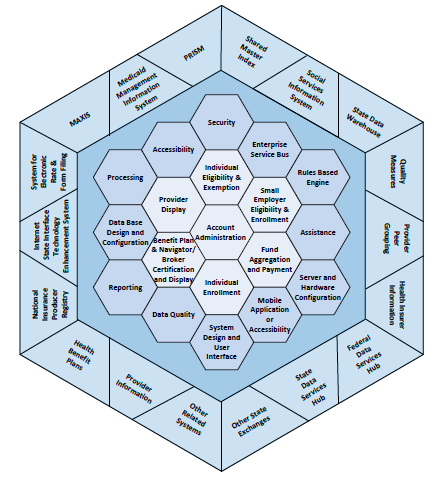
7 Exchange Components: Functions Provide one-stop shop including a call center and website Ensure health insurance plans meet certain standards Provide comparative information on health benefit plans, costs, quality, and satisfaction using a standard format Set up open enrollment and special enrollment periods Facilitate real-time eligibility and enrollment using a uniform format Determine eligibility for individual and employer tax credits, Medicaid, and coverage requirement exemptions Communicate with employers regarding employee subsidy eligibility, cancelation of coverage, and penalty liability Establish a Navigator program Additional functions for small employers: Employee choice and premium aggregation
8 Exchange Components: Eligibility Individuals: General Individual Market Individual Subsidies ( % FPL): Through Exchange to those not eligible for affordable employer coverage. Subsidies limit Silver plan premiums to 2-9.5% of income and cost-sharing subsidies limit actuarial value to 94-70%. Medicaid Eligibility (<133% FPL) Basic Health Plan ( % FPL): State option. States may use 95% of subsidy funds to establish. Similar to MinnesotaCare. Small Groups: Eligible up to 100 employees, state can limit to 50 employees until 2016 Sliding scale tax credits through Exchange for 2 years for up to 50% of employer premium portion for < 25 employees and < $50,000 average wage Large Groups: May be allowed to participate in 2017 at state discretion
9 Exchange Components: Plan Certification Marketing criteria Network adequacy requirements Accreditation on local clinical quality measures, patient experience, consumer access, utilization management, quality assurance, provider credentialing, complaints and appeals, and patient information systems Disclosure of information on claims payment policies, claims denials, data on enrollment and disenrollment, rating practices, cost-sharing for in network and out of network providers, and company financial information Implementation of a quality improvement strategy Utilization of a standard format for comparing health plan options Utilization of a uniform enrollment form/process Health plan offering of at least 1 Silver and 1 Gold plan
10 Exchange Components: Market Rules Benefit, Rating, and Issue Rules: Apply to all individual and small group plans inside and outside the Exchange not grandfathered Benefit Rules: Must provide essential benefits and fit an actuarial level (Bronze, Silver, Gold, Platinum, or Young Invincible ) Rating and Issue Rules: Premium variation based on health status prohibited. Rating variation limited to tobacco use (1.5:1), age (3:1), geography (state defined), and family composition. Guarantee issue. Premiums: For the same plans inside and outside Exchange must be the same Certification Rules: Only apply to Exchange plans (marketing, network adequacy, etc) Open Enrollment: Appears to only apply to Exchange Wellness Discounts: 10-state demonstration project in 2014 that allows wellness discounts permitted for group plans to be applied to the individual market
11 Exchange Components: Risk Sharing Reinsurance: From reallocates $25 billion to individual market plans inside and outside Exchange with high risk individuals. Funded by fully and self insured plans. Risk Corridors: From for individual and small group plans inside and outside the Exchange - will operate similar to Part D program. Risk Adjustment: HHS establish and operate method for risk adjustment for individual and small group plans inside and outside Exchange. States with claims databases may propose alternate mechanism. Risk Pooling: Individual market plans inside and outside Exchange are in same risk pool. Small group plans inside and outside Exchange are in same risk pool. Market Merger: States may merge their individual and small group market risk pools.
12 Exchanges & Adverse Selection What is adverse selection? The unequal separation of risk into different insurance arrangements Why is adverse selection an issue for Exchanges? When market rules and characteristics of products offered inside vs outside a market/pool are different and lead to separation of risk. Situation can result in higher risk, higher premiums, and lower enrollment inside vs outside a market/pool that continues over time (death spiral). Example: Purchasing pools enacted by many States in the 1990s (voluntary participation and different market rules and products) Provisions to Mitigate Adverse Selection: Single risk pool inside and outside Exchange, minimum benefit level, same rating rules, risk adjustment, and Exchange subsidies Adverse Selection Concerns: When different insurers and products operate inside vs outside Exchange, and when different market rules exist inside vs outside Exchange related to certification and open enrollment
13 Exchange Components: Operation Governance: Government entity Quasi public-private entity Private non-profit entity established by the state Federal government on behalf of a state (also federal-state partnerships) Structure: Separate or combined Exchange for individuals and small groups Multiple subsidiary Exchanges each serving a distinct geographic area Regional Exchange including multiple states Financing: HHS to fully fund states for Exchange start-up through Starting in 2015, Exchange must be self-sustaining. Potential issue for Navigator funding prior to 2015
14 Functions: Key Exchange Issues Coordination/streamlining of Exchange functions with existing state functions Measurement and reporting of cost, quality, and satisfaction for insurers, health benefit plans, and providers Navigator and broker requirements and compensation Small group: Defined contribution and true portability for individuals Technical infrastructure Exchange operations Eligibility: Basic Health Plan or private subsidies through Exchange for % FPL what happens to MinnesotaCare? Size of the small group market Large employer participation in 2017
15 Key Exchange Issues Encouraging Market Competition and Value (Certification, Market Rules, Risk Sharing, and Avoiding Adverse Selection): Role: Competition within vs. against the Exchange Avoiding adverse selection (certification, participation, and market rules inside and outside Exchange - regulatory simplification) Use of cost, quality, and satisfaction data to incent competition and value Incenting competition and improved health outcomes for high risk individuals risk adjustment and wellness discounts Risk adjustment consideration of MN alternative methods Risk sharing reinsurance and role/transition of high risk pool Merger of the individual and small group markets Exchange Operation Long-term governance and unique MN options Ongoing funding
16 Existing Exchange Structures Massachusetts Utah Private (i.e. CT, CA) Started mid 1990s Market public, individual, and small group small group (testing larger groups) Governance public/private entity agency private Role Rating and Risk Sharing Enrollment negotiate terms comparison of standard tiered plans facilitate subsidy for those < 300% FPL CR and GI inside and outside merged individual and small group pools risk adj for public 200,000 (160K public, < 5K sm grp) defined contribution voluntary insurer participation transparency of comparison info aggregate contributions group rated same rating rules inside and outside risk adj inside small and larger groups defined contribution contractual requirements for insurers human resources functions and other benefits group rated same general rules inside and outside < 3,000 75, ,000 16
17 State and Federal Status State Status: 49 states received planning grants 17 states received level 1 establishment grants 12 states have established Exchange through legislation (IL and ND considering legislation this week) 8 states have Executive Orders Governance thus far: 2 non-profit (IN, HI) 4 state agency (RI, UT, VT, WV) 8 public/private entity (CA, CO, CT, MD, MA, NV, OR, WA) Federal Status: Federal Exchange under development with HIOS/healthcare.gov and multiple procurements Multiple final rules in development and additional proposed rules forthcoming
18 Timeline Early to late 2011: Planning, research, and modeling January 1, 2013: Prove to HHS that Exchange can be operational by January 1, 2014 or HHS will implement federal Exchange Summer 2013: Populate Exchange with information January 1, 2014: Coverage through Exchange starts Late 2011 to 2013: Task Force, design, and development First Half of 2013: System testing Fall 2013: Open enrollment 18
19 Planning Grant Level 1 Grant Status - Economic and actuarial research and modeling - Evaluation of technical infrastructure options and costs - IT RFP - Initial evaluation of operations - Resources for design and development - Advisory Task Force and work groups - Marketing, communication, and outreach - Technical infrastructure 19
Patient Protection and Affordable Care Act of 2009: Health Insurance Exchanges
 Patient Protection and Affordable Care Act of 2009: Health Insurance Exchanges Provision Notes Standards SUBTITLE D AVAILABLE COVERAGE CHOICES FOR ALL AMERICANS PART I Establishment of Qualified Health
What is a state health insurance exchange (i.e. "American Health Benefit Exchange")?
 MEMORANDUM DATE: 11/07/2011 TO: Members of the House Appropriation Subcommittee for LARA FROM: Paul Holland, Fiscal Analyst RE: State Health Insurance Exchanges In response to the requirements pertaining
Update. Director of Policy and National Health Care Reform Coordinator. Roni Mansur Chief Operating Officer. Board of Directors Meeting March 8, 2012
 National Health Care Reform Update Kaitlyn Kenney Director of Policy and National Health Care Reform Coordinator Roni Mansur Chief Operating Officer Board of Directors Meeting March 8, 2012 Agenda Update
The Health Benefit Exchange and the Commercial Insurance Market
 The Health Benefit Exchange and the Commercial Insurance Market Overview The federal health care reform law directs states to set up health insurance marketplaces, called Health Benefit Exchanges, that
Health Insurance Exchange Study
 Health Insurance Exchange Study Minnesota Department of Health February, 2008 Division of Health Policy Health Economics Program PO Box 64882 St. Paul, MN 55164-0882 (651) 201-3550 www.health.state.mn.us
Kansas Insurance Department
 Kansas Insurance Department The Affordable Care Act What Happens Now? Kansas Society of CPAs June 5, 2013 Linda J. Sheppard, Special Counsel & Director of Health Care Policy and Analysis 2010 Affordable
How To Regulate Rate Regulation
 Rate Regulation Introduction Concerns over the fairness and equity of insurer rating practices that attempt to charge higher premiums to those with higher actual and expected claims costs have increased
American Health Benefit Exchanges Fact Sheet A Provision of the Patient Protection and Affordable Care Act (PPACA)
 American Health Benefit Exchanges Fact Sheet A Provision of the Patient Protection and Affordable Care Act (PPACA) This Fact Sheet reflects the Final Ruling published by the Department of Health and Human
Health insurance Marketplace. What to expect in 2014
 Health insurance Marketplace What to expect in 2014 Overview The Affordable Care Act (ACA) includes several provisions geared to extend greater access to health insurance benefits to more people. Beginning
Marketplaces (Exchanges): Information for Employers and Individuals Lisa Klinger, J.D. www.leavitt.com/healthcarereform.com
 10-21- 2013 As of January 1, 2014, the Patient Protection and Affordable Care Act (PPACA) requires most U.S. citizens and lawful residents to either have minimum essential coverage or to pay a federal
Health Insurance Exchanges and the Medicaid Expansion After the Supreme Court Decision: State Actions and Key Implementation Issues
 Health Insurance Exchanges and the Medicaid Expansion After the Supreme Court Decision: State Actions and Key Implementation Issues Sara R. Collins, Ph.D. Vice President, Affordable Health Insurance The
New Federal Rating Rules
 New Federal Rating Rules The Patient Protection and Affordable Care Act ( PPACA ) includes new federal rules limiting the extent to which insurance companies can impose premium surcharges on individuals
Health Insurance Marketplace. vhealth insurance exchanges. What to expect in 2014. What to expect in 2014
 vhealth insurance exchanges Health Insurance Marketplace What to expect in 2014 What to expect in 2014 The basics of exchanges As part of the Affordable Care Act (ACA or health care reform law), starting
REGULATORY UPDATE Vol. 1 No. 18
 REGULATORY UPDATE Vol. 1 No. 18 FAQs on Exchanges August 7, 2013 IN THIS ISSUE FAQs on Exchanges Employer Mandate Delay Transitional Guidance Issued Individual Mandate Final Rules Issued Possible Exchange
the Affordable Care Act: What Colorado Businesses Need to Know
 22 About questions the Affordable Care Act: What Colorado Businesses Need to Know 1 What is the Affordable Care Act? Who is impacted (small, large businesses and self-insured)? The Patient Protection and
How To Determine The Impact Of The Health Care Law On Insurance In Indiana
 ACA Impact on Premium Rates in the Individual and Small Group Markets Paul R. Houchens, FSA, MAAA BACKGROUND The Patient Protection and Affordable Care Act (ACA) introduces significant changes in covered
HHealth HEALTH INSURANCE EXCHANGE FAQs
 HHealth HEALTH INSURANCE EXCHANGE FAQs Page 1 TABLE OF CONTENTS Introduction... 3 Background... 3 Health Insurance Exchange FAQs... 4 What is the Patient Protection and Affordable Care Act (PPACA)?...
Update: Health Insurance Reforms and Rate Review. Health Insurance Reform Requirements for the Group and Individual Insurance Markets
 By Katherine Jett Hayes and Taylor Burke Background Update: Health Insurance Reforms and Rate Review The Patient Protection and Affordable Care Act (ACA) included health insurance market reforms designed
PART 1: ENABLING AUTHORITY AND GOVERNANCE
 Application for Approval of an American Health Benefit Exchange On March 23, 2010, the President signed into law the Patient Protection and Affordable Care Act (P.L. 111-148). On March 30, 2010, the Health
Overview of Health Insurance Exchanges in the USET Area. USET Impact Week February 4-7, 2013 Washington, DC
 Overview of Health Insurance Exchanges in the USET Area USET Impact Week February 4-7, 2013 Washington, DC 1 Affordable Care Act (ACA) Insurance Reforms No lifetime limits, annual limits Pre-existing conditions
Senate HELP Committee Affordable Health Choices Act (S. 1679) June 9, 2009 (passed by Committee July 15, 2009)
 on Health Reform This side-by-side compares the leading comprehensive reform proposals across a number of key characteristics and plan components. Included in this side-byside are proposals for moving
Assessing Consumer Protections in the July 2011 HHS Exchange Regulations
 Assessing Consumer Protections in the July 2011 HHS Exchange Regulations The U.S. Department of Health and Human Services (HHS) released the first round of Exchange regulations on many aspects of the health
HEALTH INSURANCE EXCHANGE FAQS
 HEALTH INSURANCE EXCHANGE FAQS 0 TABLE OF CONTENTS INTRODUCTION... 1 BACKGROUND... 1 HEALTH INSURANCE EXCHANGE FAQS... 1 1 INTRODUCTION IN EARLY 2010, CONGRESS PASSED THE PATIENT PROTECTION AND AFFORDABLE
HEALTH REFORM AND MULTIEMPLOYER PLAN COVERAGE 2014 AND BEYOND
 WWW.BKLAWYERS.COM HEALTH REFORM AND MULTIEMPLOYER PLAN COVERAGE 2014 AND BEYOND ABA SECTION OF LABOR AND EMPLOYMENT LAW EMPLOYEE BENEFITS COMMITTEE MID- WINTER MEETING 201 BLITMAN & KING LLP Franklin Center,
Illinois Exchange Background Research and Needs Assessment Final Report and Findings. Governor s Reform Implementation Council October 14, 2011
 Illinois Exchange Background Research and Needs Assessment Final Report and Findings Governor s Reform Implementation Council October 14, 2011 Research & Assessment Illinois, using Federal grant money,
Strengthening Community Health Centers. Provides funds to build new and expand existing community health centers. Effective Fiscal Year 2011.
 Implementation Timeline Reflecting the Affordable Care Act 2010 Access to Insurance for Uninsured Americans with a Pre-Existing Condition. Provides uninsured Americans with pre-existing conditions access
State Based Exchange - How to Qualify For a FTE
 Presented by: Kevin Kuhlman National Federation of Independent Business State Decision Update Small Employer Responsibilities Individual Mandate Individual and Small Business Exchanges Affordable Coverage
The Affordable Care Act: Health Coverage Options & Considerations in 2014
 The Affordable Care Act: Health Coverage Options & Considerations in 2014 J A C K S O N V I L L E A R E A C H A M B E R O F C O M M E R C E A U G U S T 2 7, 2 0 1 3 L A U R A M I N Z E R E X E C U T I
Fact Sheet. AARP Public Policy Institute. Health Reform Changes Insurance Rules
 Fact Sheet Health Reform Changes Insurance Rules The Affordable Care Act (ACA) will greatly increase the availability of health insurance and broadly impact the delivery of health care in America. This
Washington Health Benefit Exchange. Leading Age 2014 Annual Conference. Phil Dyer Board Member
 Washington Health Benefit Exchange Leading Age 2014 Annual Conference Phil Dyer Board Member DISCLAIMER; The views and information expressed are my personal opinions and perspectives and do not represent
Insurance Market Reforms in the Patient Protection & Affordable Care Act and the Health Care & Education Reconciliation Act
 Insurance Market Reforms in the Patient Protection & Affordable Care Act and the Health Care & Education Reconciliation Act The new health care reform legislation will provide significant new options for
Texas Grantee Meeting
 Texas Grantee Meeting AmeriCorps Health Insurance Update March 27-28, 2014 Agenda Major Issues Situation for Current Program and Members Looking Ahead (September 1, 2014) Caveats Not Legal Advice Represent
How To Understand The Health Care Exchange
 STATE HEALTH INSURANCE EXCHANGE MISSISSIPPI INSURANCE DEPARTMENT P.O. BOX 79 JACKSON, MS 39205-0079 What Is An Exchange? 2 o Essentially a marketplace for major medical insurance. o Travelocity, Expedia,
Health Care Reform Frequently Asked Questions (FAQ) Consumers Employers
 This page provides answers to frequently asked questions (FAQ) regarding The Patient Protection and Affordable Care Act (PPACA; P.L. 111-148) and the Health Care and Education Reconciliation Act of 2010
Issue Brief: The Health Benefit Exchange and the Small Employer Market
 Issue Brief: The Health Benefit Exchange and the Small Employer Market Overview The federal health care reform law directs states to set up health insurance marketplaces, called Health Benefit Exchanges,
HEALTH INSURANCE PRICE INDEX REPORT FOR THE 2015
 HEALTH INSURANCE PRICE INDEX REPORT FOR THE 2015 OPEN ENROLLMENT PERIOD March 2015 ehealth 3.2015 Table of Contents Introduction... 3 Executive Summary and Highlights... 4 Nationwide Health Insurance Costs
2016 Individual Exchange Premiums updated November 4, 2015
 2016 Individual Exchange Premiums updated November 4, 2015 Within the document, you'll find insights across 50 states and DC with available findings (i.e., carrier participation, price leadership, gross
Successes and Challenges in the Affordable Care Act: Beyond Access
 Successes and Challenges in the Affordable Care Act: Beyond Access Robert Greenwald Clinical Professor of Law, Harvard Law School Director, Center for Health Law and Policy Innovation/Treatment Access
STATE HEALTH INSURANCE EXCHANGE MISSISSIPPI INSURANCE DEPARTMENT P.O. BOX 79 JACKSON, MS 39205-0079
 STATE HEALTH INSURANCE EXCHANGE MISSISSIPPI INSURANCE DEPARTMENT P.O. BOX 79 JACKSON, MS 39205-0079 What Is An Exchange? o Essentially a marketplace for major medical insurance. o Travelocity, Expedia,
HEALTH INSURANCE MARKETPLACES FACT SHEET
 HEALTH INSURANCE MARKETPLACES FACT SHEET INFORMED ON REFORM Overview A Health Insurance Marketplace, also known as a Health Insurance Exchange, is available in every state as a public option for individuals
The Patient Protection & Affordable Care Act: Next Steps in Maine. February 8, 2013 1
 The Patient Protection & Affordable Care Act: Next Steps in Maine February 8, 2013 1 Maine Medical Association Voluntary membership association of over 3,600 Maine physicians, residents, and medical students
District of Columbia Health Benefits Exchange (DC HBX) Insurance Subcommittee FAQ: Small Business Owners and Producers (Insurance Agents & Brokers)
 District of Columbia Health Benefits Exchange (DC HBX) Insurance Subcommittee FAQ: Small Business Owners and Producers (Insurance Agents & Brokers) 1. Will small businesses be forced into the DC HBX to
Health Insurance Exchanges
 Brought to you by Linden Group Health Services, Inc. Health Insurance Exchanges The Affordable Care Act (ACA) requires each state to have a competitive marketplace, known as an Affordable Health Insurance