
How to Earn a Bachelor s Degree
|
|
|
- Hester Sherman
- 10 years ago
- Views:
Transcription
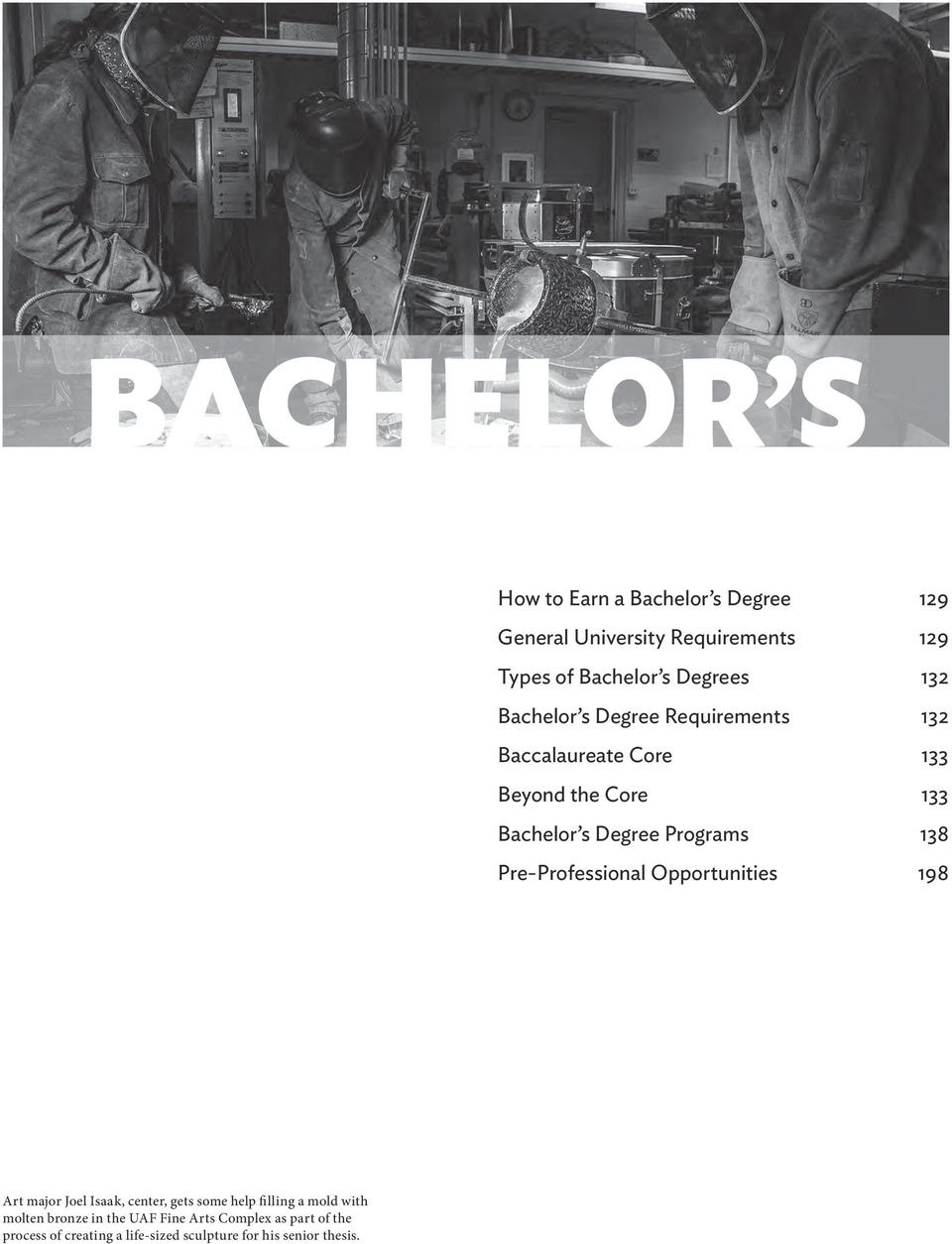
1 BACHELOR S How to Earn a Bachelor s Degree 129 General University Requirements 129 Types of Bachelor s Degrees 132 Bachelor s Degree Requirements 132 Baccalaureate Core 133 Beyond the Core 133 Bachelor s Degree Programs 138 Pre-Professional Opportunities 198 Art major Joel Isaak, center, gets some help filling a mold with molten bronze in the UAF Fine Arts Complex as part of the process of creating a life-sized sculpture for his senior thesis.
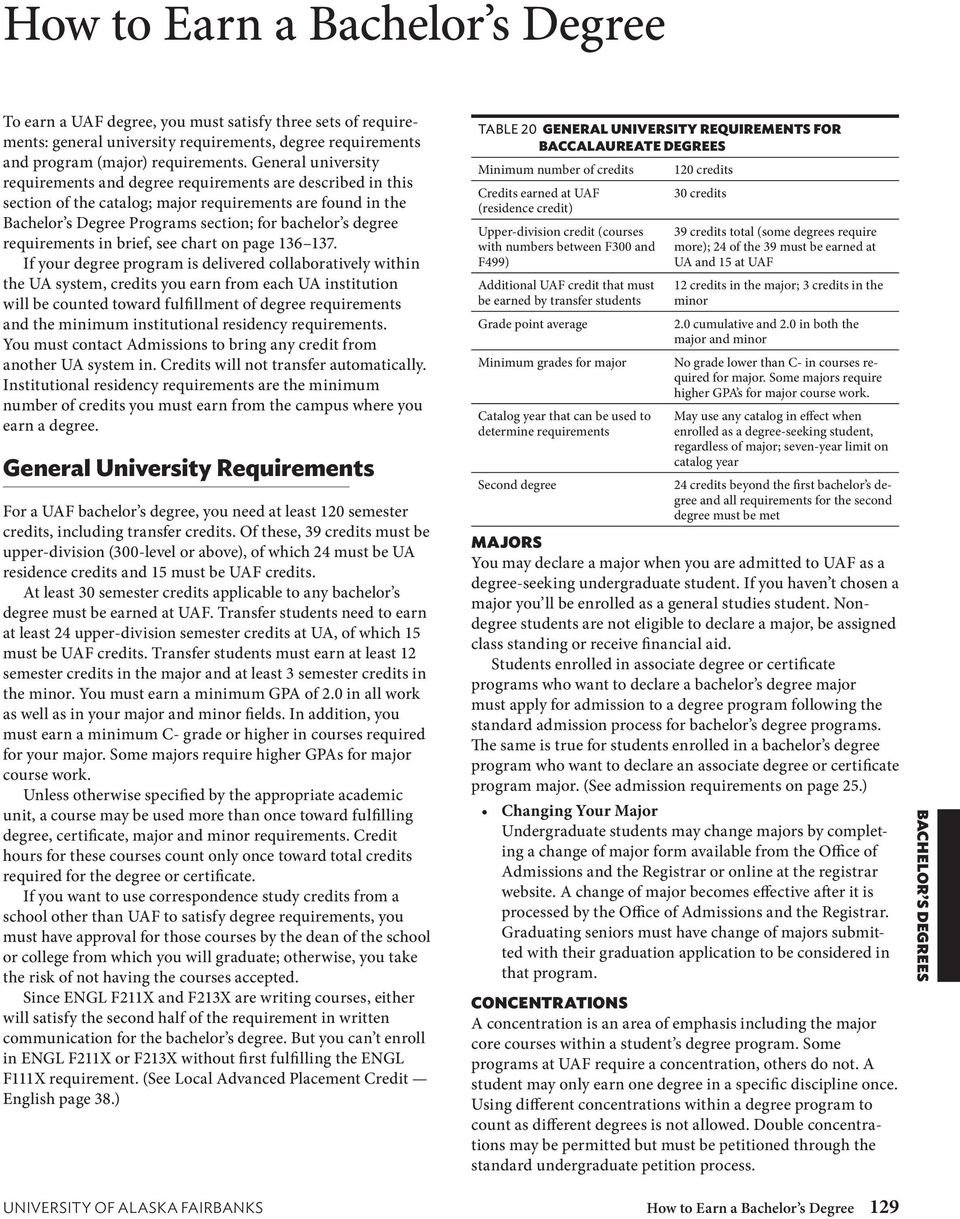
2 How to Earn a Bachelor s Degree To earn a UAF degree, you must satisfy three sets of requirements: general university requirements, degree requirements and program (major) requirements. General university requirements and degree requirements are described in this section of the catalog; major requirements are found in the Bachelor s Degree Programs section; for bachelor s degree requirements in brief, see chart on page If your degree program is delivered collaboratively within the UA system, credits you earn from each UA institution will be counted toward fulfillment of degree requirements and the minimum institutional residency requirements. You must contact Admissions to bring any credit from another UA system in. Credits will not transfer automatically. Institutional residency requirements are the minimum number of credits you must earn from the campus where you earn a degree. General University Requirements For a UAF bachelor s degree, you need at least 120 semester credits, including transfer credits. Of these, 39 credits must be upper-division (300-level or above), of which 24 must be UA residence credits and 15 must be UAF credits. At least 30 semester credits applicable to any bachelor s degree must be earned at UAF. Transfer students need to earn at least 24 upper-division semester credits at UA, of which 15 must be UAF credits. Transfer students must earn at least 12 semester credits in the major and at least 3 semester credits in the minor. You must earn a minimum GPA of 2.0 in all work as well as in your major and minor fields. In addition, you must earn a minimum C- grade or higher in courses required for your major. Some majors require higher GPAs for major course work. Unless otherwise specified by the appropriate academic unit, a course may be used more than once toward fulfilling degree, certificate, major and minor requirements. Credit hours for these courses count only once toward total credits required for the degree or certificate. If you want to use correspondence study credits from a school other than UAF to satisfy degree requirements, you must have approval for those courses by the dean of the school or college from which you will graduate; otherwise, you take the risk of not having the courses accepted. Since ENGL F211X and F213X are writing courses, either will satisfy the second half of the requirement in written communication for the bachelor s degree. But you can t enroll in ENGL F211X or F213X without first fulfilling the ENGL F111X requirement. (See Local Advanced Placement Credit English page 38.) Table 20 GENERAL UNIVERSITY REQUIREMENTS FOR BACCALAUREATE DEGREES Minimum number of credits 120 credits Credits earned at UAF 30 credits (residence credit) Upper-division credit (courses with numbers between F300 and F499) Additional UAF credit that must be earned by transfer students Grade point average Minimum grades for major Catalog year that can be used to determine requirements Second degree 39 credits total (some degrees require more); 24 of the 39 must be earned at UA and 15 at UAF 12 credits in the major; 3 credits in the minor 2.0 cumulative and 2.0 in both the major and minor No grade lower than C- in courses required for major. Some majors require higher GPA s for major course work. May use any catalog in effect when enrolled as a degree-seeking student, regardless of major; seven-year limit on catalog year 24 credits beyond the first bachelor s degree and all requirements for the second degree must be met MAJORS You may declare a major when you are admitted to UAF as a degree-seeking undergraduate student. If you haven t chosen a major you ll be enrolled as a general studies student. Nondegree students are not eligible to declare a major, be assigned class standing or receive financial aid. Students enrolled in associate degree or certificate programs who want to declare a bachelor s degree major must apply for admission to a degree program following the standard admission process for bachelor s degree programs. The same is true for students enrolled in a bachelor s degree program who want to declare an associate degree or certificate program major. (See admission requirements on page 25.) Changing Your Major Undergraduate students may change majors by completing a change of major form available from the Office of Admissions and the Registrar or online at the registrar website. A change of major becomes effective after it is processed by the Office of Admissions and the Registrar. Graduating seniors must have change of majors submitted with their graduation application to be considered in that program. CONCENTRATIONS A concentration is an area of emphasis including the major core courses within a student s degree program. Some programs at UAF require a concentration, others do not. A student may only earn one degree in a specific discipline once. Using different concentrations within a degree program to count as different degrees is not allowed. Double concentrations may be permitted but must be petitioned through the standard undergraduate petition process. UNIVERSITY OF ALASKA FAIRBANKS How to Earn a Bachelor s Degree 129
3 MINORS A minor is a component of a bachelor s degree. The bachelor of arts and bachelor of arts and sciences degrees require a minor. You must satisfactorily complete the requirements for a minor before a BA or BAS degree can be awarded. A minor is optional for bachelor of science, bachelor of business administration, and bachelor of emergency management degrees. A minor from UAF consists of a minimum of 15 credits, at least 3 of which have to be earned at UAF. Students must earn a cumulative GPA of at least 2.0 (C) in the minor and follow minor requirements from the same academic catalog used for their bachelor s program. An associate of applied science degree or certificate of at least 30 credits earned at any regionally accredited college or university may be used to meet requirements for a minor in BA and BAS degree programs. Some minors require more than 15 credits and approval from the department. Refer to specific requirements listed in the Bachelor s Degree Program section. Students seeking minors can use DegreeWorks to review their options. Results in DegreeWorks will be more accurate after submitting a declaration of minor form to the Office of Admissions and the Registrar by the beginning of the senior year. SECOND BACHELOR S DEGREE UAF graduates who want to earn a second bachelor s degree must complete at least 24 hours of credit beyond the first bachelor s degree. Students must meet all general university requirements, degree requirements and major requirements for both degrees. Students who earned a bachelor s degree from another college or university must be accepted for admission as a transfer student. All general university requirements (including residency requirement), degree and major requirements must be met. Students who graduated from a regionally accredited college or university, however, will be considered to have completed the equivalent of the UAF baccalaureate core. DOUBLE DEGREES Students who want to earn more than one UAF bachelor s degree must complete all general requirements as well as all major and minor requirements (if any) for all degrees. At least 24 semester credit hours beyond the total required for the first degree need to be earned before any additional degrees can be awarded. For two degrees completed at the same time, students may follow requirements from two different catalogs. RESIDENCE CREDIT Residence credit is course credit earned through any unit of UAF. Formal classroom instruction, correspondence study, distance-delivered courses, individual study or research at UAF are all considered residence credit. On the other hand, transfer credit, advanced placement credit, credit for prior learning, military service credit and credit granted through nationally prepared examinations are not considered resident credit, nor are credit-by-examination credits earned through locally prepared tests. None of these types of credit can be applied to UAF residency requirements. UAF residence credit takes precedence over any non-resident credits. For example, if a student has AP credit for a course, but takes the same courses at UAF, the AP credit will be excluded and the UAF course will be applied to the degree requirements. RESIDENCY REQUIREMENT Most universities have residency requirements that call for a certain number of credits toward a degree to be earned at the degree-granting school. At UAF, the residency requirement for bachelor s degrees is 30 resident credits. DEGREE REQUIREMENTS AND TIME LIMITS You may complete degree requirements in effect and published in the UAF catalog in any one of the previous seven academic years in which you are enrolled as a degree student for a bachelor s degree. You re considered enrolled in your degree program when you complete the appropriate degree student registration procedure. If you do not enroll for a semester or more, or if you enroll through the non-degree Table 21 DIFFERENCES BETWEEN DOUBLE MAJORS AND DOUBLE DEGREES Degree(s) earned Double Majors One bachelor s degree is earned. The bachelor of arts degree requires the completion of two majors rather than a major and a minor. Majors are selected from those approved for the BA degree. The bachelor of science degree requires the completion of a double major instead of a single major. Majors are selected from those approved for the BS degree. Double Degrees More than one bachelor s degree is earned. Can be the same degree (e.g., two BAs) or different degrees, (e.g., BA and BS, BBA and BS, BFA and BA, etc.). Each degree is independent of the other. If requirements for one degree are not completed as scheduled, the other degree may be awarded if all requirements are met. Graduation application A single graduation application and fee is required. A separate graduation application and fee is required for each degree. Catalog year General university requirements and major requirements Credit hours required A single catalog is followed for both majors to meet requirements. All general university requirements and all major requirements for both majors must be met. If one major is from a program that requires 120 total credits and the other major is from a program that requires 130 total credits, the 130 total credits must be completed. Different catalogs may be followed to meet requirements for each degree. All general university requirements as well as all major and minor requirements (if any) must be met for each degree. At least 24 semester credit hours beyond the total required for the first degree must be completed before an additional degree can be awarded. 130 How to Earn a Bachelor s Degree CATALOG

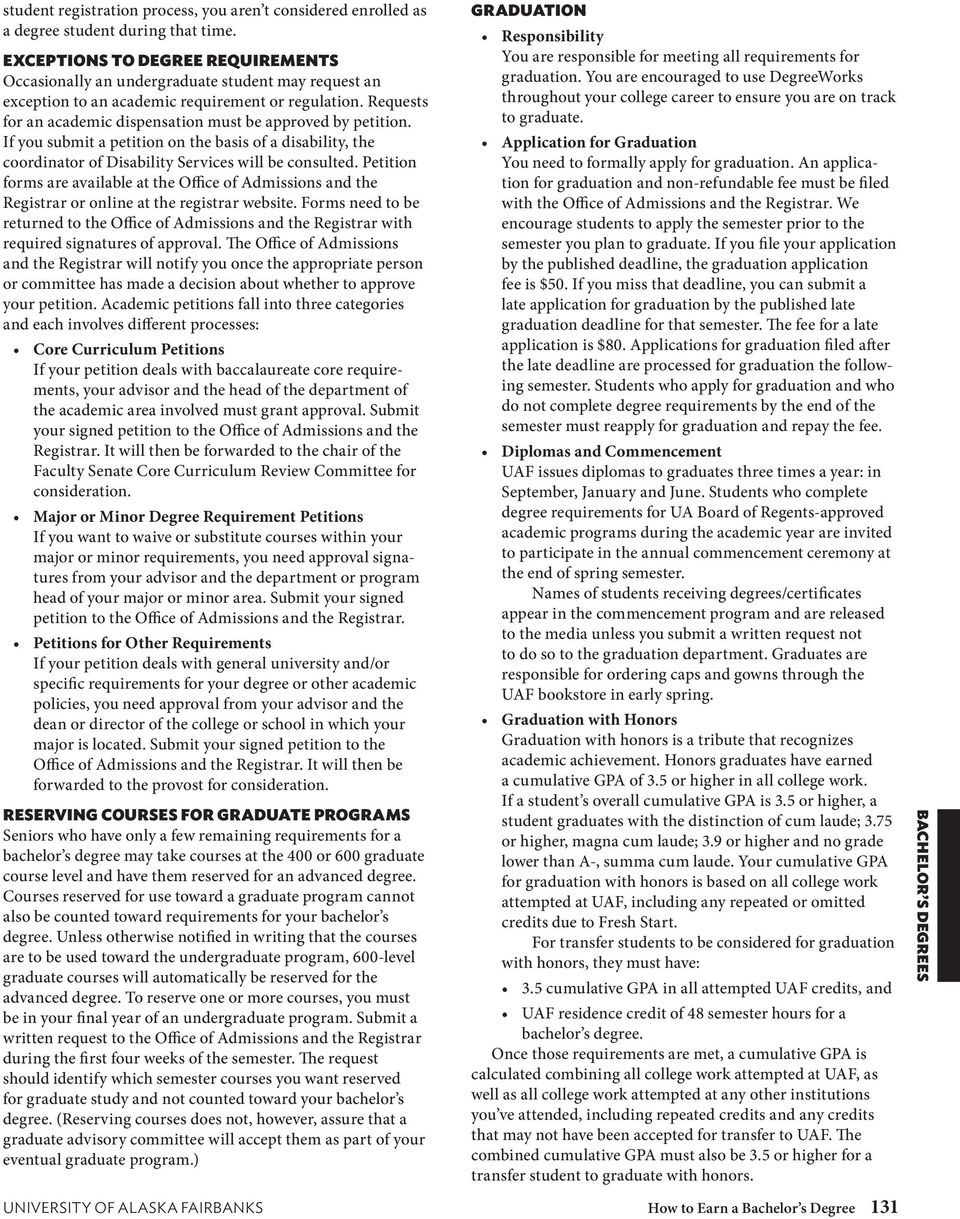
4 student registration process, you aren t considered enrolled as a degree student during that time. EXCEPTIONS TO DEGREE REQUIREMENTS Occasionally an undergraduate student may request an exception to an academic requirement or regulation. Requests for an academic dispensation must be approved by petition. If you submit a petition on the basis of a disability, the coordinator of Disability Services will be consulted. Petition forms are available at the Office of Admissions and the Registrar or online at the registrar website. Forms need to be returned to the Office of Admissions and the Registrar with required signatures of approval. The Office of Admissions and the Registrar will notify you once the appropriate person or committee has made a decision about whether to approve your petition. Academic petitions fall into three categories and each involves different processes: Core Curriculum Petitions If your petition deals with baccalaureate core requirements, your advisor and the head of the department of the academic area involved must grant approval. Submit your signed petition to the Office of Admissions and the Registrar. It will then be forwarded to the chair of the Faculty Senate Core Curriculum Review Committee for consideration. Major or Degree Requirement Petitions If you want to waive or substitute courses within your major or minor requirements, you need approval signatures from your advisor and the department or program head of your major or minor area. Submit your signed petition to the Office of Admissions and the Registrar. GRADUATION Responsibility You are responsible for meeting all requirements for graduation. You are encouraged to use DegreeWorks throughout your college career to ensure you are on track to graduate. Application for Graduation You need to formally apply for graduation. An application for graduation and non-refundable fee must be filed with the Office of Admissions and the Registrar. We encourage students to apply the semester prior to the semester you plan to graduate. If you file your application by the published deadline, the graduation application fee is $50. If you miss that deadline, you can submit a late application for graduation by the published late graduation deadline for that semester. The fee for a late application is $80. Applications for graduation filed after the late deadline are processed for graduation the following semester. Students who apply for graduation and who do not complete degree requirements by the end of the semester must reapply for graduation and repay the fee. Diplomas and Commencement UAF issues diplomas to graduates three times a year: in September, January and June. Students who complete degree requirements for UA Board of Regents-approved academic programs during the academic year are invited to participate in the annual commencement ceremony at the end of spring semester. Names of students receiving degrees/certificates appear in the commencement program and are released to the media unless you submit a written request not Petitions for Other Requirements to do so to the graduation department. Graduates are If your petition deals with general university and/or responsible for ordering caps and gowns through the specific requirements for your degree or other academic UAF bookstore in early spring. policies, you need approval from your advisor and the dean or director of the college or school in which your Graduation with Honors major is located. Submit your signed petition to the Graduation with honors is a tribute that recognizes Office of Admissions and the Registrar. It will then be academic achievement. Honors graduates have earned forwarded to the provost for consideration. a cumulative GPA of 3.5 or higher in all college work. If a student s overall cumulative GPA is 3.5 or higher, a RESERVING COURSES FOR GRADUATE PROGRAMS student graduates with the distinction of cum laude; 3.75 Seniors who have only a few remaining requirements for a or higher, magna cum laude; 3.9 or higher and no grade bachelor s degree may take courses at the 400 or 600 graduate lower than A-, summa cum laude. Your cumulative GPA course level and have them reserved for an advanced degree. for graduation with honors is based on all college work Courses reserved for use toward a graduate program cannot attempted at UAF, including any repeated or omitted also be counted toward requirements for your bachelor s credits due to Fresh Start. degree. Unless otherwise notified in writing that the courses For transfer students to be considered for graduation are to be used toward the undergraduate program, 600-level with honors, they must have: graduate courses will automatically be reserved for the 3.5 cumulative GPA in all attempted UAF credits, and advanced degree. To reserve one or more courses, you must be in your final year of an undergraduate program. Submit a UAF residence credit of 48 semester hours for a written request to the Office of Admissions and the Registrar bachelor s degree. during the first four weeks of the semester. The request Once those requirements are met, a cumulative GPA is should identify which semester courses you want reserved calculated combining all college work attempted at UAF, as for graduate study and not counted toward your bachelor s well as all college work attempted at any other institutions degree. (Reserving courses does not, however, assure that a you ve attended, including repeated credits and any credits graduate advisory committee will accept them as part of your that may not have been accepted for transfer to UAF. The eventual graduate program.) combined cumulative GPA must also be 3.5 or higher for a transfer student to graduate with honors. UNIVERSITY OF ALASKA FAIRBANKS How to Earn a Bachelor s Degree 131
5 Types of Bachelor s Degrees Bachelor s Degree Requirements Bachelor of Arts The BA degree emphasizes written and oral communication skills, creative thinking, critical analyses of texts, understanding cultures, and a working knowledge of social, political and historical contexts. The degree is typically pursued by students whose major areas of study are directed toward humanities, arts and social science disciplines. Bachelor of Arts and Sciences The BAS degree encompasses the contexts of social sciences, mathematics, science, as well as culture and diversity. Students who want a foundation in these areas as well as a broad spectrum of knowledge pursue this degree. Bachelor of Business Administration The BBA degree is the undergraduate equivalent of an MBA. Students explore a wide spectrum of businessrelated issues to develop advanced business, management and administration skills required in organizational settings at senior levels, and to accelerate high-level career development in the workplace. Bachelor of Emergency Management The BEM degree prepares students for professional careers responding to natural and manmade disasters, forming crisis management plans and ensuring public safety. Students with backgrounds ranging from first responders and military to applied vocational skills will graduate ready to start or advance in careers in emergency management, homeland security, public safety and emergency services. Bachelor of Fine Arts The BFA degree has a rigorous curriculum designed to prepare talented students for professional careers in the arts. Bachelor of Music The BM degree encourages acquisition of skills and display of talent in music, with special emphasis on aesthetic performance and understanding. Bachelor of Science The BS degree emphasizes oral and written communication skills and analytical skills for examining and solving problems. The degree is typically pursued by students whose major areas of study are directed toward natural sciences, mathematics, statistics, engineering, computer science and some social science fields. Bachelor of Technology The BT interdisciplinary degree is designed for students with technical or vocational backgrounds who want to enhance their experiences with more advanced academic pursuits. THE CORE CURRICULUM For a summary of the bachelor s degree requirements see Table 22. Undergraduate bachelor s study at UAF is characterized by a common set of learning experiences known as the Core Curriculum. The core provides students with a shared foundation of skills and knowledge that, when combined with specialized study in the major and other specific degree requirements, prepares students to better meet the demands of life in the 21st century. Through the baccalaureate core experience, every UAF student is expected to achieve: multidimensional competency in written and oral English, including comprehension of complex materials and creation of clearly organized presentations of soundly reasoned thought in both oral and written form; a solid grasp of quantitative reasoning and mathematical application; an intellectual comfort with the sciences, including the scientific method, frameworks that have nurtured scientific thought, traditions of human inquiry and the impact of technology on the world s ecosystems; an appreciation of cultural diversity and its implications for individual and group values, aesthetics, and social and political institutions; an understanding of global economic interdependence, sense of historical consciousness and a more critical comprehension of literature and the arts; a better understanding of one s own values, other value systems and relationships between value systems and life choices. If you completed your bachelor s degree from a regionally accredited institution, you will be considered to have completed the equivalent of the baccalaureate core when you have been officially accepted to an undergraduate degree program at UAF. COURSE CLASSIFICATIONS FOR THE BACCALAUREATE CORE Courses that may be used to satisfy general baccalaureate core requirements have course numbers ending with X. For example, English F111X and Communication F141X meet specific core requirements. See the requirements for the baccalaureate core for a listing of other specific core courses. Courses meeting the upper-division writing-intensive and oral communication-intensive requirements for the baccalaureate core are identified in the course description of the catalog with the following designators: O oral communication intensive course W writing intensive course. Two courses designated O/2 are required to complete the oral communication intensive requirement. 132 How to Earn a Bachelor s Degree CATALOG

6 Baccalaureate Core Courses used to meet a science or mathematics core requirement may also be used to satisfy the major and/or minor degree requirements. Other core courses may not be used to meet any other requirements for a degree. Students must earn a C- grade or higher in each course used toward the baccalaureate core. Requirements Credits Communication 9 ENGL F111X Introduction to Academic Writing (3) ENGL F190H may be substituted. Complete one of the following: ENGL F211X Academic Writing about Literature (3) ENGL F213X Academic Writing about the Social and Natural Sciences (3) Complete one of the following: COMM F131X Fundamentals of Oral Communication: Group Context (3) COMM F141X Fundamentals of Oral Communication: Public Context (3) Perspectives on the Human Condition 18 Complete all of the following four courses: ANTH F100X/SOC F100X Individual, Society and Culture (3) ECON F100X or PS F100X Political Economy (3) HIST F100X Modern World History (3) ENGL/FL F200X World Literature (3) 12 Complete one of the following three courses: ART/MUS/THR F200X Aesthetic Appreciation: Interrelationship of Art, Drama and Music (3) HUM F201X Unity in the Arts (3) ANS F202X Aesthetic Appreciation of Alaska Native Performance (3) 3 Complete one of the following six courses: BA F323X Business Ethics (3) COMM F300X Communicating Ethics (3) JUST F300X Ethics and Justice (3) NRM F303X Environmental Ethics and Actions (3) PS F300X Ethics and Society (3) PHIL F322X Ethics (3) 3 Or complete 12 credits from the above courses plus one of the following: Two semester-length courses in a single Alaska Native language or other non-english language Three semester-length courses (9 credits) in American Sign Language taken at the university level. 6 9 Mathematics 3 Complete one of the following: MATH F103X Concepts and Contemporary Applications of Mathematics (3) MATH F107X Functions for Calculus* (4) MATH F161X Algebra for Business and Economics** (3) STAT F200X Elementary Probability and Statistics (3) * No credit may be earned for more than one of MATH F107X or F161X. Or complete one of the following:* MATH F200X Calculus I** (4) MATH F201X Calculus II (4) MATH F202X Calculus III (4) MATH F262X Calculus for Business and Economics (4) MATH F272X Calculus for Life Sciences (4) 3 4 *Or any math course having one of these as a prerequisite **No credit may be earned for more than one of Math F200X, F262X or F272. Natural Sciences 8 Complete any two (4-credit) courses. ATM F101X Weather and Climate of Alaska (4) BIOL F100X Human Biology (4) BIOL F101X Biology of Sex (4) BIOL F103X Biology and Society (4) BIOL F104X Natural History (4) BIOL F115X Fundamentals of Biology I (4) BIOL F116X Fundamentals of Biology II (4) BIOL F120X Introduction to Human Nutrition (4) BIOL F213X Human Anatomy and Physiology I (4) BIOL F214X Human Anatomy and Physiology II (4) CHEM F100X Chemistry in Complex Systems (4) CHEM F103X Basic General Chemistry (4) CHEM F104X Beginnings in Biochemistry (4) CHEM F105X General Chemistry (4) CHEM F106X General Chemistry (4) GEOG F111X Earth and Environment: Elements of Physical Geography (4) GEOS F100X Introduction to Earth Science (4) GEOS F101X The Dynamic Earth (4) GEOS F106X Life and the Age of Dinosaurs (4) GEOS F112X History of Earth and Life (4) GEOS F120X Glaciers, Earthquakes and Volcanoes (4) GEOS F125X Humans, Earth and Environment (4) MSL F111X The Oceans (4) PHYS F102X Energy and Society (4) PHYS F103X College Physics (4) PHYS F104X College Physics (4) PHYS F115X Physical Science I (4) PHYS F175X Astronomy (4) PHYS F211X General Physics (4) PHYS F212X General Physics (4) PHYS F213X Elementary Modern Physics (4) 8 Library and Information Research 0 1 Successful completion of library skills competency test or LS F100X or LS F101X prior to junior standing 0 1 Upper-Division Writing and Oral Communication Complete the following at the upper-division level: Two writing intensive courses designated (W) and one oral communication intensive course designated (O), or two oral communication intensive courses designated (O/2) (see degree and/or major requirements) Total credits required Beyond the Core BACHELOR OF ARTS Requirements Credits Complete the baccalaureate core Complete the following BA requirements in addition to the core: Humanities and social sciences 18 Any combination of courses at the F100-level or above, with a minimum of 6 credits from the humanities and a minimum of 6 credits in the social sciences OR up to 12 credits in a single non-english language taken at the university level and a minimum of 6 credits in social science. Mathematics 3 One course at the F100-level or above in mathematical sciences (math, computer science, statistics) excluding developmental math (DEVM) courses. UNIVERSITY OF ALASKA FAIRBANKS How to Earn a Bachelor s Degree 133

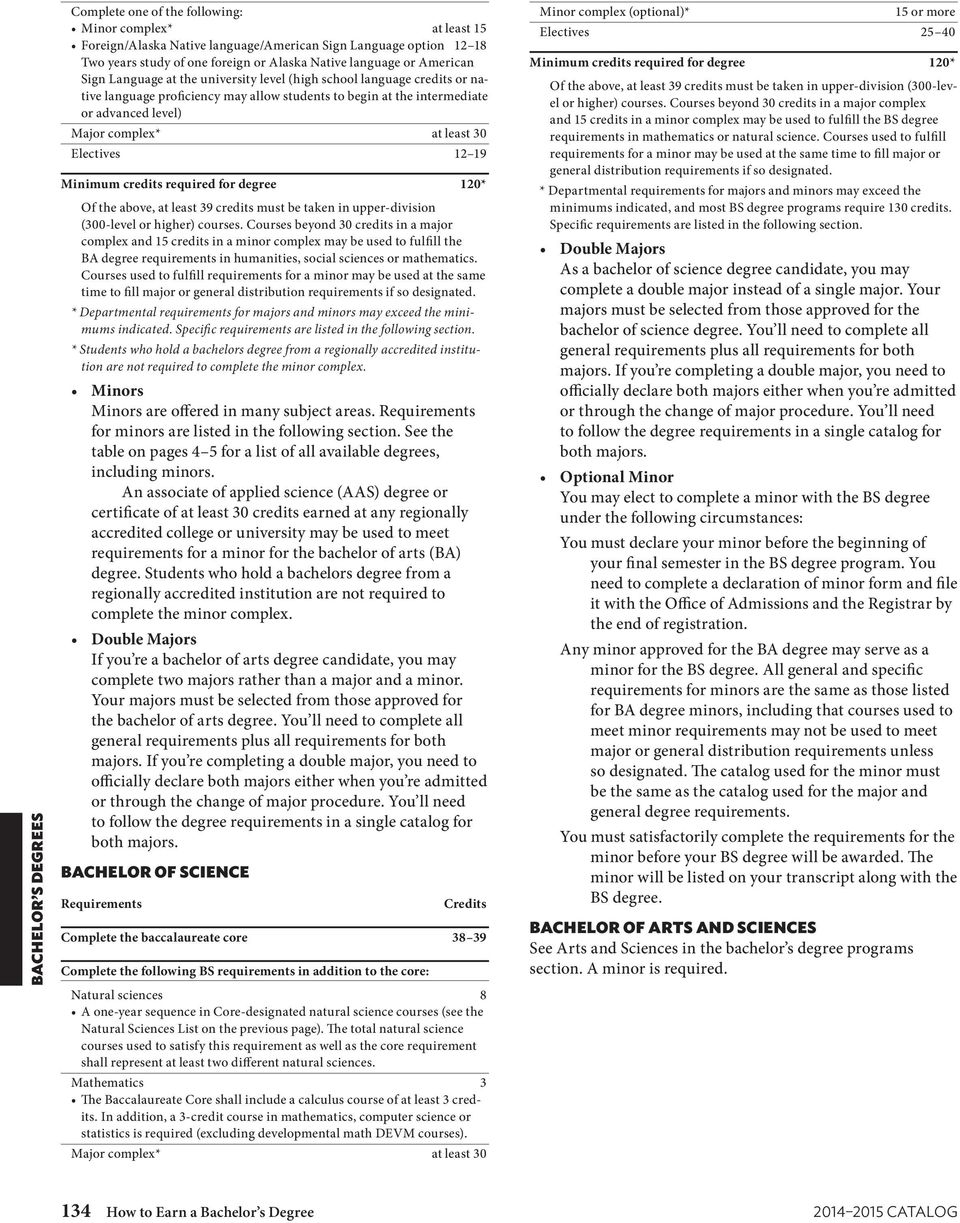
7 Complete one of the following: complex* at least 15 Foreign/Alaska Native language/american Sign Language option Two years study of one foreign or Alaska Native language or American Sign Language at the university level (high school language credits or native language proficiency may allow students to begin at the intermediate or advanced level) Major complex* at least 30 Electives Minimum credits required for degree 120* Of the above, at least 39 credits must be taken in upper-division (300-level or higher) courses. Courses beyond 30 credits in a major complex and 15 credits in a minor complex may be used to fulfill the BA degree requirements in humanities, social sciences or mathematics. Courses used to fulfill requirements for a minor may be used at the same time to fill major or general distribution requirements if so designated. * Departmental requirements for majors and minors may exceed the minimums indicated. Specific requirements are listed in the following section. * Students who hold a bachelors degree from a regionally accredited institution are not required to complete the minor complex. s s are offered in many subject areas. Requirements for minors are listed in the following section. See the table on pages 4 5 for a list of all available degrees, including minors. An associate of applied science (AAS) degree or certificate of at least 30 credits earned at any regionally accredited college or university may be used to meet requirements for a minor for the bachelor of arts (BA) degree. Students who hold a bachelors degree from a regionally accredited institution are not required to complete the minor complex. Double Majors If you re a bachelor of arts degree candidate, you may complete two majors rather than a major and a minor. Your majors must be selected from those approved for the bachelor of arts degree. You ll need to complete all general requirements plus all requirements for both majors. If you re completing a double major, you need to officially declare both majors either when you re admitted or through the change of major procedure. You ll need to follow the degree requirements in a single catalog for both majors. BACHELOR OF SCIENCE Requirements Credits Complete the baccalaureate core Complete the following BS requirements in addition to the core: Natural sciences 8 A one-year sequence in Core-designated natural science courses (see the Natural Sciences List on the previous page). The total natural science courses used to satisfy this requirement as well as the core requirement shall represent at least two different natural sciences. Mathematics 3 The Baccalaureate Core shall include a calculus course of at least 3 credits. In addition, a 3-credit course in mathematics, computer science or statistics is required (excluding developmental math DEVM courses). Major complex* at least 30 complex (optional)* 15 or more Electives Minimum credits required for degree 120* Of the above, at least 39 credits must be taken in upper-division (300-level or higher) courses. Courses beyond 30 credits in a major complex and 15 credits in a minor complex may be used to fulfill the BS degree requirements in mathematics or natural science. Courses used to fulfill requirements for a minor may be used at the same time to fill major or general distribution requirements if so designated. * Departmental requirements for majors and minors may exceed the minimums indicated, and most BS degree programs require 130 credits. Specific requirements are listed in the following section. Double Majors As a bachelor of science degree candidate, you may complete a double major instead of a single major. Your majors must be selected from those approved for the bachelor of science degree. You ll need to complete all general requirements plus all requirements for both majors. If you re completing a double major, you need to officially declare both majors either when you re admitted or through the change of major procedure. You ll need to follow the degree requirements in a single catalog for both majors. Optional You may elect to complete a minor with the BS degree under the following circumstances: You must declare your minor before the beginning of your final semester in the BS degree program. You need to complete a declaration of minor form and file it with the Office of Admissions and the Registrar by the end of registration. Any minor approved for the BA degree may serve as a minor for the BS degree. All general and specific requirements for minors are the same as those listed for BA degree minors, including that courses used to meet minor requirements may not be used to meet major or general distribution requirements unless so designated. The catalog used for the minor must be the same as the catalog used for the major and general degree requirements. You must satisfactorily complete the requirements for the minor before your BS degree will be awarded. The minor will be listed on your transcript along with the BS degree. BACHELOR OF ARTS AND SCIENCES See Arts and Sciences in the bachelor s degree programs section. A minor is required. 134 How to Earn a Bachelor s Degree CATALOG
8 BACHELOR OF BUSINESS ADMINISTRATION All majors must earn a C- grade or higher in all common body of knowledge courses, department-specific general requirements, major-specific requirements, and specific math and statistics requirements. Requirements Credits Complete the baccalaureate core (BA F323X Business Ethics must be included in the courses used to meet the Perspectives on the Human Condition requirement.) Complete the following BBA requirements in addition to the core: Mathematics MATH F161X Algebra for Business and Economics 3 (MATH F262X should be taken to complete the mathematics requirement for the core.) Social Sciences and Statistics 12 STAT F200X Elementary Probability and Statistics (3) ECON F201 Principles of Economics I: Microeconomics (3) ECON F202 Principles of Economics II: Macroeconomics (3) ECON F227 Intermediate Statistics for Economics and Business (3) Common Body of Knowledge AIS F101 Effective Personal Computer Use OR demonstrated computer literacy (0 3) ACCT F261 Principles of Financial Accounting (3) ACCT F262 Principles of Managerial Accounting (3) AIS F310 Management of Information Systems or AIS F316 Accounting Information Systems (3) BA F325 Financial Management (3) BA F330 Legal Environment of Business (4) BA F343 Principles of Marketing (3) BA F360 Operations Management (3) BA F390 Organization Theory and Behavior (3) BA F462O Corporate Strategy (3) ECON F324 Intermediate Macroeconomics (3) or ECON F350 Money and Banking (3) Major complex* at least complex (optional) ** at least 15 BACHELOR OF EMERGENCY MANAGEMENT The BEM degree prepares students for professional careers responding to natural and manmade disasters, forming crisis management plans and ensuring public safety. Students with backgrounds ranging from first responders and military to applied vocational skills graduate ready to start or advance in careers in emergency management, homeland security, public safety and emergency services. BACHELOR OF FINE ARTS BFA general requirements are the same as the requirements for the BA degree except a minor is not required for the BFA. BACHELOR OF MUSIC See Music in the Bachelor s Degree Programs section. BACHELOR OF TECHNOLOGY The BT degree program offers qualified applicants the opportunity to expand upon their vocational or technical education. An AAS degree from an accredited institution of higher education, or the equivalent, is one of the degree program requirements. See Technology in the Bachelor s Degree Programs section. Minimum credits required for degree 120 Of the above, at least 39 credits must be taken in upper-division (300-level or higher) courses. * Departmental requirements for majors may exceed the minimums indicated. Specific requirements are listed in the Degrees and Programs section of the catalog. ** Requirements for minors may exceed 15 credits. Specific requirements are listed in the following section. UNIVERSITY OF ALASKA FAIRBANKS How to Earn a Bachelor s Degree 135
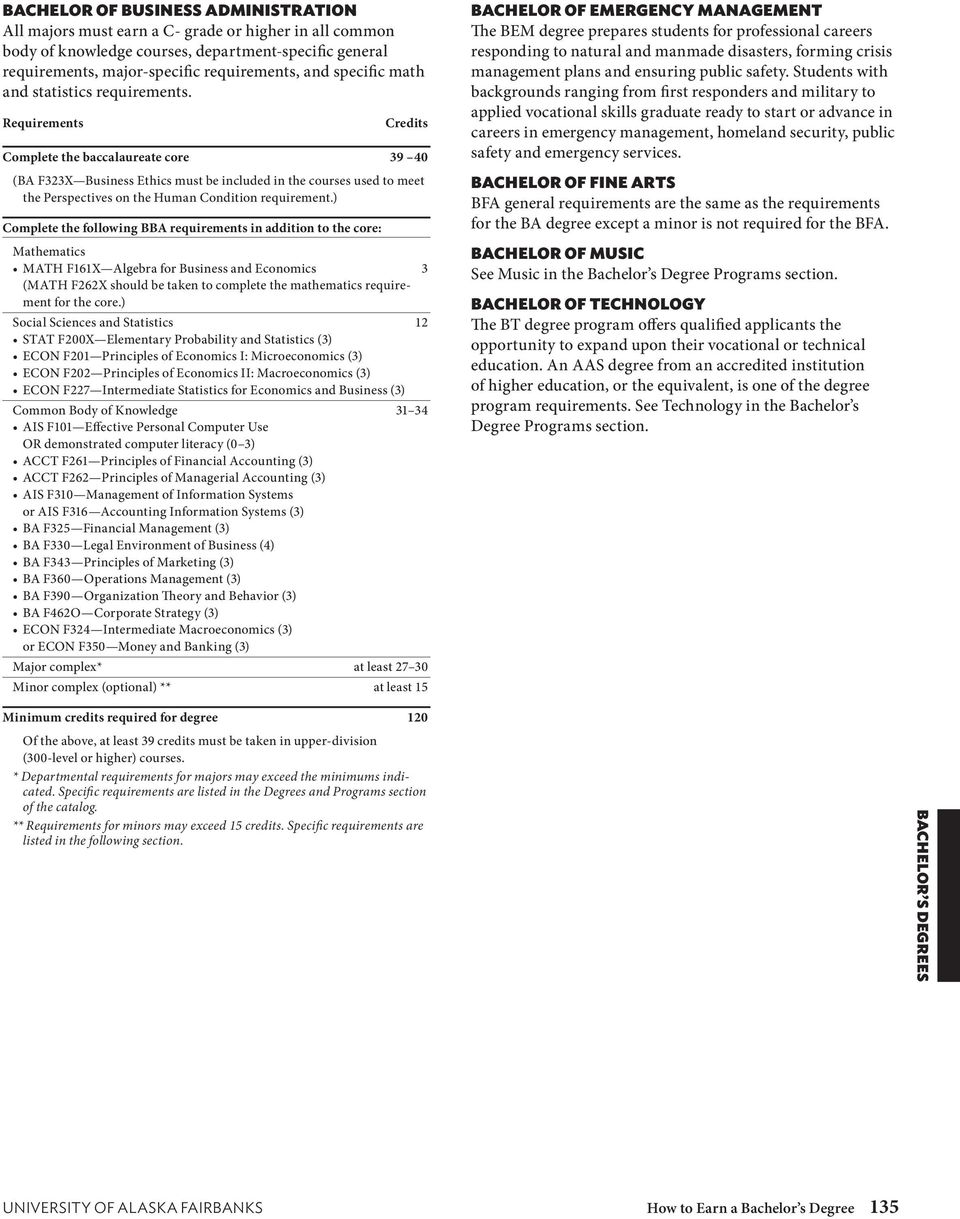
9 Table 22 SUMMARY OF BACHELOR S DEGREE REQUIRE- MENTS Academic Discipline Communications To be completed by all. See your degree requirements (e.g. BBA) for any specific required core courses: ENGL F111X 3 cr ENGL F211X or ENGL F213 3 cr COMM F131X or COMM F141X 3 cr Baccalaureate Core See individual degree programs for the writing and oral-intensive core requirements Bachelor of Arts and Bachelor of Fine Arts* 2 designated upper-division writing-intensive (W) and either 1 designated upper-division oral-intensive (O) course or 2 upper-division oral-intensive courses designated O/2 Humanities and Social Sciences (18 cr): Any combination of courses at the F100 level or above with a minimum of 6 credits in humanities and 6 credits in social sciences or up to 12 credits of a non-english language taken at the university level and at least 6 credits of social sciences One 3-credit course at F100 level or above from math, computer sciences or statistics (excluding DEVM courses) Humanities and Social Sciences Perspectives on the Human Condition (18 cr): ANTH/SOC F100X 3 cr ECON/PS F100X 3 cr HIST F100X 3 cr ART/MUS/THR F200X or ANS F202X or HUM F201X 3 cr ENGL/FL F200X 3 cr BA F323X or COMM F300X or JUST F300X or NRM F303X or PHIL F322X or PS F300X 3 cr or 12 credits from list at left plus 2 semester-length courses in a single Alaska Native or other non-english language or 3 semesters (9 credits) in American Sign Language taken at the university level Mathematics MATH F103X or MATH F107X or MATH F161X or STAT F200X or MATH F200X, F201X, F202X, F262X or F272X or any math course having one of the above as a prerequisite 3 or 4 cr Natural Sciences Complete any two (4-credit) courses. ATM F101X 4 cr BIOL F100X 4 cr BIOL F101X 4 cr BIOL F103X 4 cr BIOL F104X 4 cr BIOL F115X 4 cr BIOL F116X 4 cr BIOL F120X 4 cr BIOL F213X 4 cr BIOL F214X 4 cr CHEM F100X 4 cr CHEM F103X 4 cr CHEM F104X 4 cr CHEM F105X 4 cr CHEM F106X 4 cr GEOG F111X 4 cr GEOS F100X 4 cr GEOS F101X 4 cr GEOS F106X 4 cr GEOS F112X 4 cr GEOS F120X 4 cr GEOS F125X 4 cr MSL F111X 4 cr PHYS F102X 4 cr PHYS F103X 4 cr PHYS F104X 4 cr PHYS F115X 4 cr PHYS F175X 4 cr PHYS F211X 4 cr PHYS F212X 4 cr PHYS F213X 4 cr No additional natural science unless required by the major or minor Library and Information Research Other Successful completion of library skills competency test or LS F100X or F101X 0 1 cr (complete during first 2 years) Students must earn a C- or higher in courses used toward the baccalaureate core requirements. *BFA general requirements are the same as the requirements for the BA degree except a minor is not required for the BFA Major Complex At least 30 cr Complex Required: at least 15 cr* Total Required cr 120 cr 136 How to Earn a Bachelor s Degree CATALOG
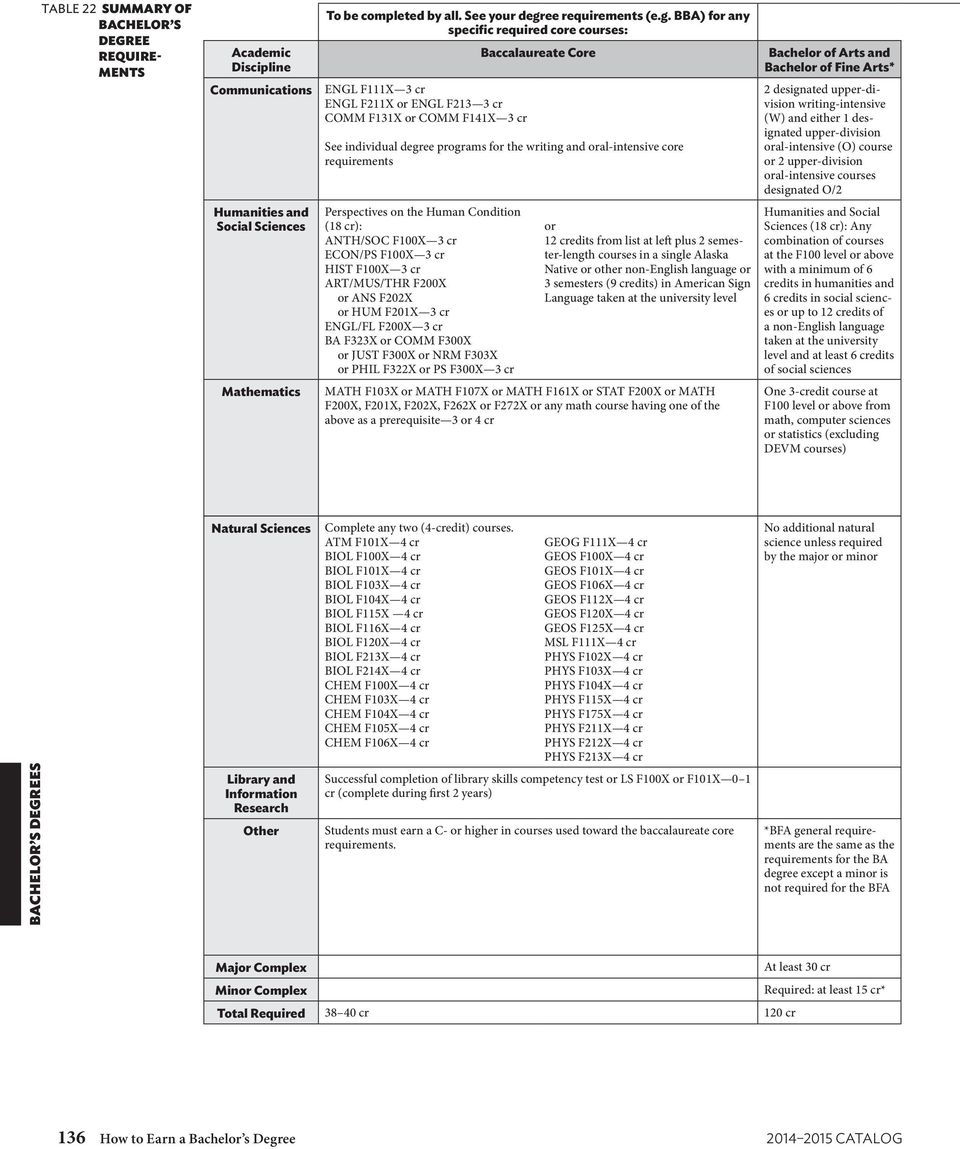
10 Complete the following degree requirements Bachelor of Emergency Management Bachelor of Science Bachelor of Technology 2 designated upper-division writing-intensive (W) and either 1 designated upper-division oral-intensive (O) course or 2 upper-division oral-intensive courses designated O/2 No additional humanities or social sciences unless required by major or minor Bachelor of Business Administration 2 designated upper-division writing-intensive (W) and either 1 designated upper-division oral-intensive (O) course or 2 upper-division oral-intensive courses designated O/2 ECON F201 3 cr ECON F202 3 cr ECON F227 3 cr (BA F323X must be included in the courses used to meet the Perspectives on the Human Condition requirement.) Bachelor of Music Bachelor of Arts and Sciences LAS F410 W,O/2, ED F486 O/2 and HIST F461 W 2 designated upper-division writing-intensive (W) and either 1 designated upper-division oral-intensive (O) course or 2 upper-division oral-intensive courses designated O/2 No additional humanities or social sciences unless required by major or minor 2 designated upper-division writing-intensive (W) and either 1 designated upper-division oral-intensive (O) course or 2 upper-division oral-intensive courses designated O/2 No additional humanities or social sciences unless required by major or minor 2 designated upper-division writing-intensive (W) and either 1 designated upper-division oral-intensive (O) course or 2 upperdivision oral-intensive courses designated O/2 No additional humanities or social sciences except those required in the major No additional humanities or social sciences except those required in the major. (ART/ MUS/THR F200X, HIST F100X, ANTH/SOC F100X and ENGL/FL F200X must be included in the courses used to meet the Perspectives on the Human Condition requirements.) MATH F205 3 cr MATH F206 3 cr (MATH F107X or MATH F161X must be taken to meet the core math requirement.) One 3-credit course at the F100 level or above from math, computer sciences or statistics (excluding DEVM courses). A 3-credit calculus course must be included in core or BS requirements One-year sequence in one natural science beyond the core-8 cr (Total natural science courses used to meet core and BS requirements must represent at least two different natural sciences.) One 3-credit course at the F100 level or above from math, computer sciences or statistics (MATH F161X must be taken to meet the core math requirement) STAT F200X 3 cr MATH F161X 3cr (MATH F262X must be taken to meet the core math requirement.) No additional natural science required No additional natural science unless required by the major No additional natural science required No additional natural science required 2 additional core lab courses in the 2 disciplines not completed for the core natural sciences from the disciplines of biology, chemistry, physics and geoscience (2 different science discipline lab courses selected from the disciplines of biology, chemistry, physics and geoscience must be taken for the core natural science requirement.) Computer competency (any computer science or computer applications course) 3 cr TTCH F301 Technology and Society 3 cr Area of specialization 30+ cr Option 33 cr Common Body of Knowledge cr Electives at least 7 cr At least 78 cr At least 30 cr At least cr 85 or more cr At least 56 cr Optional: at least 15 cr Optional: at least 15 cr Optional: at least 15 cr At least 15 cr 120 cr 120 cr 120 cr 120 cr 120 cr 120 cr UNIVERSITY OF ALASKA FAIRBANKS How to Earn a Bachelor s Degree 137
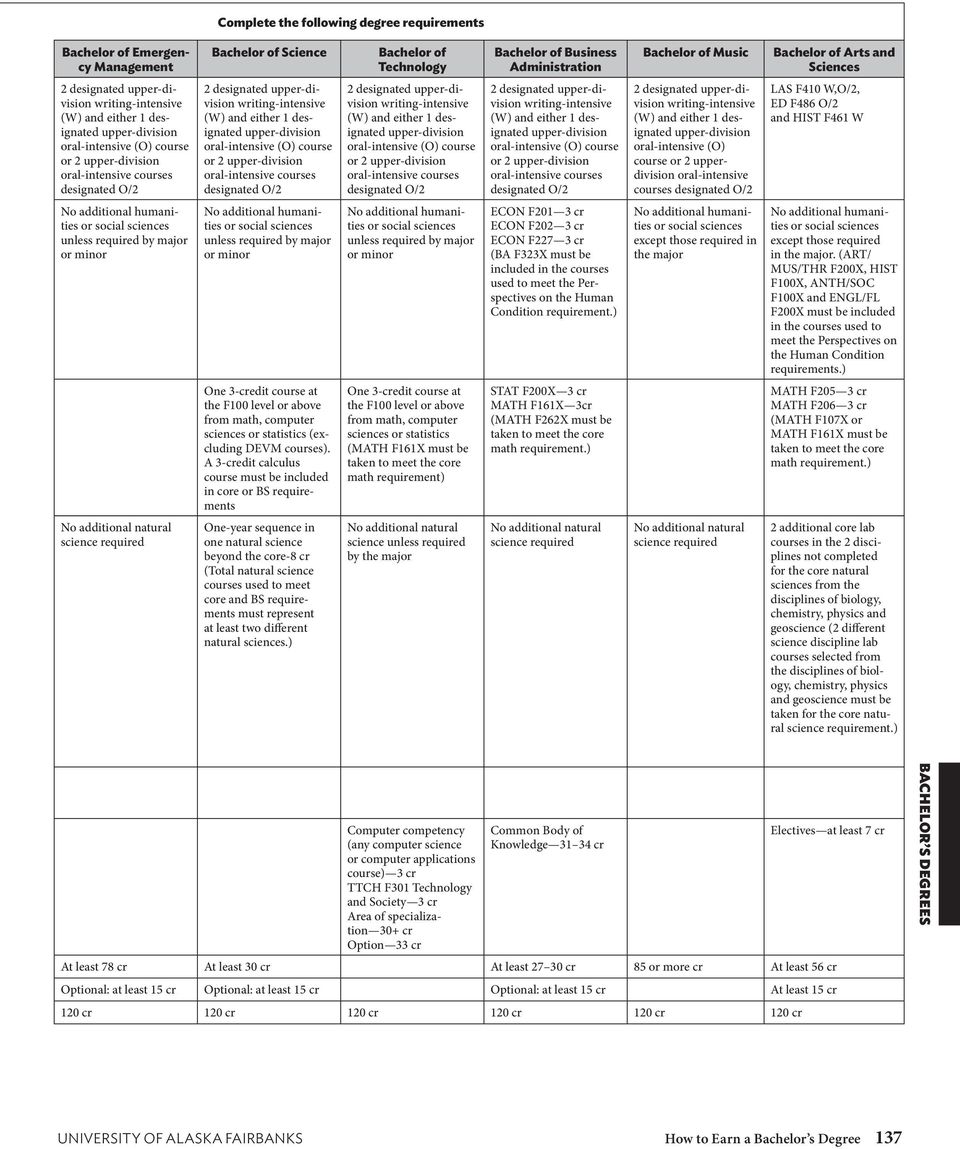
11 Bachelor s Degree Programs ACCOUNTING School of Management Department of Accounting and Information Systems BBA Degree Minimum Requirements for Degree: 120 credits The accounting department offers an extensive program for those interested in the fields of general accounting, auditing, managerial accounting, taxation and government accounting. The objectives of the program are to provide a strong business background through an understanding of accounting and to train students for employment in accounting work. The UAF accounting program is accredited by the Association to Advance Collegiate Schools of Business. The AACSB accredits 120 programs nationwide, and the UAF accounting program is the only program in Alaska with AACSB accreditation. The accounting program prepares students for certification as Certified Public Accountants, Certified Management Accountants, Certified Financial Managers, Certified Internal Auditors and Certified Fraud Examiners. The UAF accounting program places nearly 100 percent of its graduates. Major BBA Degree 1. Complete the general university requirements. (See page 129. As part of the core curriculum requirements, complete: BA F323X* and MATH F262X*.) 2. Complete the BBA degree requirements. (See page 135. As part of the common body of knowledge, complete AIS F316.) 3. Complete one of the following*: ENGL F314W,O/2 or BA F456W or HSEM F445W, O/2 4. Complete the following program (major) requirements:* ACCT F330 Income Tax...3 ACCT F342 Managerial Cost Accounting...3 ACCT F361 Intermediate Accounting...3 ACCT F362 Intermediate Accounting...3 ACCT F401 Advanced Accounting...3 ACCT F452W Auditing (3) or ACCT F472W Internal and Government Auditing (3) Complete three of the following:* ACCT F404 Advanced Cost Accounting and Controllership...3 ACCT F414O/2 Governmental and Nonprofit Accounting...3 ACCT F430 Advanced Taxes...3 ACCT F472W Internal and Government Auditing Complete free electives as needed to meet 120 credits 7. Minimum credits required Note: The BBA degree requires 50 percent of the accounting, business administration and economics credits to be earned in residence at UAF. * ACCT F261 Principles of Financial Accounting...3 ACCT F262 Principles of Managerial Accounting...3 Upper-division accounting electives Minimum credits required...15 Note: Courses completed to satisfy this minor can be used to simultaneously satisfy other major or general distribution requirements. ALASKA NATIVE LANGUAGES College of Liberal Arts Alaska Native Languages Program only The Alaska Native languages program offers courses in Eskimo, Aleut and Indian languages spoken in the state. Major and minor curricula are offered in Central Yup ik Eskimo, the largest Alaska Native language in terms of number of speakers; and Inupiaq Eskimo, the second largest. Regular courses are also available in Gwich in Athabascan. Individual or small-group instruction is available in other Athabascan languages as well as in Siberian Yup ik, Alutiiq, Aleut and Tlingit. UAF is the only university in the United States to provide such programs. Students interested in individual or small group interaction should contact the Alaska Native Language Center. Professional opportunities for those skilled in Alaska Native languages exist in teaching, research and cultural, educational and political development. The AAS degree and the 30-credit certificate in Native language education for either Inupiaq or Athabascan are available by distance delivery. Both provide training in language and culture for people interested in becoming Native language instructors, and both may serve as a step toward further education. The Alaska Native language teaching program benefits from the research staff and library of the Alaska Native Language Center. Students have access to researchers who are world leaders in documenting Eskimo and northern Athabascan languages. The library houses more than 15,000 items, virtually everything written about Alaska Native languages, including copies of documentation dating to the 1700s. Any ANL or ESK courses Minimum credits required Bachelor s Degree Programs CATALOG
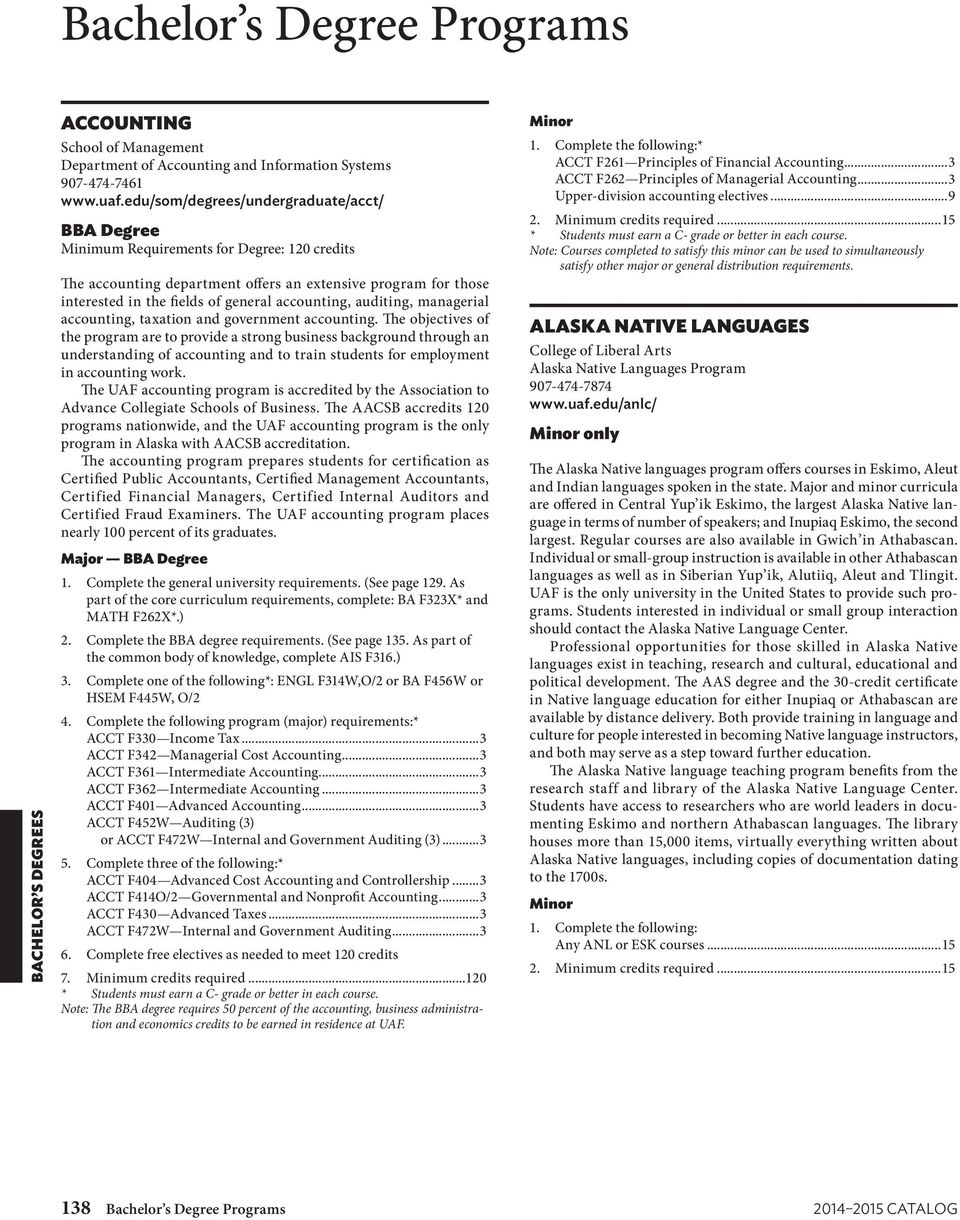
12 ALASKA NATIVE STUDIES College of Rural and Community Development Department of Alaska Native Studies and Rural Development BA Degree Minimum Requirements for Degree: 120 credits Alaska Native studies provides students with an awareness of the scope, richness and variety of Alaska Native cultures. It offers a series of critical perspectives on the contemporary Native experience in North American society. The BA degree can be earned on the Fairbanks campus or through distance delivery. Students complete a concentration in one of four areas: Alaska Native Forms of Cultural Expression, Alaska Native Education, Alaska Native Language, Alaska Native Law, or Government and Politics. The Alaska Native studies BA prepares students to appreciate historical and contemporary cultural dynamics. The department also welcomes students pursuing a second major or a minor. It encourages students who expect to be involved professionally in Alaska Native communities or other multicultural settings to pursue this degree. Special application requirements and deadlines apply for distance BA programs. For more information contact the department toll-free at or visit Major BA Degree 1. Complete the general university requirements (page 129). 2. Complete the BA degree requirements (page 133). Non-Fairbanks campus students choosing a minor other than Rural Development must verify that the required courses can be accessed via distance before declaring that minor. Courses used in the core major and concentration area may be double counted for the minor. 3. Complete the following:* ANS F101 Introduction to Alaska Native Studies...3 ANS/ANTH F242 Native Cultures of Alaska...3 ANS F310 Indigenous Land Settlements...3 ANS F350W,O Cross Cultural Communication: Alaskan Perspectives...3 ANS F375 Native American Religion and Philosophy...3 ANS F401 Cultural Knowledge of Native Elders...3 RD F350 Community Research in Indigenous Contexts...3 RD F475 Rural Development Senior Project Complete 9 ANS/RD elective credits Complete 21 credits in one of the following concentrations (These are recommended courses. Course substitutions may be made with approval of the faculty advisor):* Alaska Native Education ANL F315 Alaska Native Languages: Eskimo-Aleut...3 ANL F316 Alaska Native Languages: Indian Languages...3 ANS F102 Orientation to Alaska Native Education...2 ANS F111 History of Alaska Natives...3 ANS F202X Aesthetic Appreciation of Alaska Native Performance**...3 ANS F250 Current Alaska Native Leadership Perspectives...3 ANS F251 Practicum in Native Cultural Expression...3 ANS F300W Alaska Native Writers Workshop...3 ANS/ANTH F320W Language and Culture: Application to Alaska...3 ANS/ENGL F340 Contemporary Native American Literature...3 ANS F348W Native North American Women...3 ANS F351 Practicum in Native Cultural Expression ANS F370 Issues in Alaska Bilingual and Multicultural Education...1 ANS/ED F420 Alaska Native Education...3 ANS F461 Native Ways of Knowing...3 ANS F475 Alaska Native Social Change...3 RD F110 ANCSA: Land Claims in the 21st Century...1 RD F265 Perspectives on Subsistence in Alaska...3 RD F470/F670 ANCSA Pre-1971 to present...3 Alaska Native Forms of Cultural Expression ANL F315 Alaska Native Languages: Eskimo-Aleut...3 ANL F316 Alaska Native Languages: Indian Languages...3 ANS F111 History of Alaska Natives...3 ANS F160 Alaska Native Dance...1 ANS/THR F161 Introduction to Alaska Native Performance...3 ANS F202X Aesthetic Appreciation of Alaska Native Performance**...3 ANS F250 Current Alaska Native Leadership Perspectives...3 ANS F251 Practicum in Native Cultural Expression...3 ANS F300W Alaska Native Writers Workshop...3 ANS/ANTH F320W Language and Culture: Application to Alaska...3 ANS/ENGL F340 Contemporary Native American Literature...3 ANS F347 Voices of Native American Peoples...3 ANS F348W Native North American Women...3 ANS/ENGL F349 Narrative Art of Alaska Native Peoples (in English translation)...3 ANS F351 Practicum in Native Cultural Expression ANS F360 Advanced Native Dance...1 ANS F361 Advanced Alaska Native Performance...3 ANS/ART F365 Native Art of Alaska...3 ANS F381W Alaska Natives in Film...3 ANS F461 Native Ways of Knowing...3 RD F265 Perspectives on Subsistence in Alaska...3 RD F470/F670 ANCSA Pre-1971 to present...3 Alaska Native Language (not available at all campus locations) Complete two years study of an Alaska Native language (16 credits) and choose 6 credits from the following:* ANL F255 Introduction to Alaska Native Languages: Eskimo-Aleut...3 ANL F256 Introduction to Alaska Native Languages: Indian Languages...3 ANL F287 Teaching Methods for Alaska Native Languages...3 ANL F288 Curriculum and Materials Development for Alaska Native Languages...3 ANL F315 Alaska Native Languages: Eskimo-Aleut...3 ANL F316 Alaska Native Languages: Indian Languages...3 ANS F202X Aesthetic Appreciation of Alaska Native Performance**...3 ANS F300W Alaska Native Writers Workshop...3 ANS/ANTH F320W Language and Culture: Application to Alaska...3 ANS F370 Issues in Bilingual and Multicultural Education...3 ANS F461 Native Ways of Knowing...3 Alaska Native Law, Government and Politics ANS F111 History of Alaska Natives...3 ANS F250 Current Alaska Native Leadership Perspectives...3 ANS/RD F315 Tribal Peoples and Development...3 ANS/ANTH F320W Language and Culture: Application to Alaska...3 ANS/PS F325 Native Self-Government...3 ANS F348W Native North American Women...3 ANS/PS F425 Federal Indian Law and Alaska Natives...3 ANS/PS F450 Comparative Aboriginal Rights and Policies...3 ANS F475 Alaska Native Social Change...3 ANS F461 Native Ways of Knowing...3 ENGL F414W Research Writing...3 PLS F280 Legal Research and Writing for Paralegals...3 PS F263 Alaska Native Politics...3 RD F110 ANCSA: Land Claims in the 21st Century...1 UNIVERSITY OF ALASKA FAIRBANKS Bachelor s Degree Programs 139
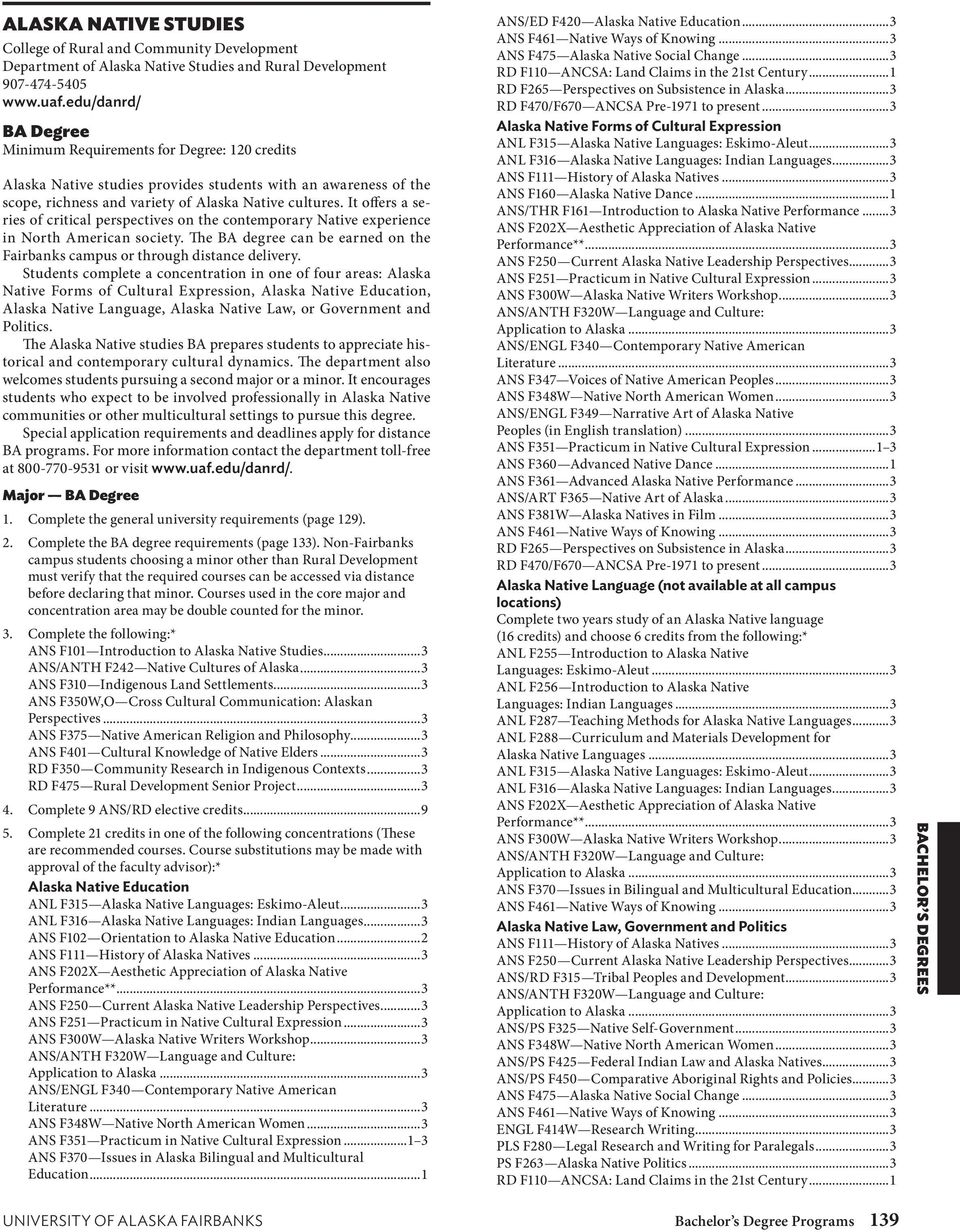
13 RD F265 Perspectives on Subsistence in Alaska...3 RD F300 Rural Development in a Global Perspective...3 RD F470/670 ANCSA Pre-1971 to present...3 TM F201 Advanced Tribal Government Minimum credits required ** ANS F202X may not be counted toward an Alaska Native Studies major if used to fulfill core requirements. *** ANS F300- or F400-level course...3 ANS F401 Cultural Knowledge of Native Elders...3 Alaska Native Studies electives Minimum credits required...15 *** All minor programs must be approved by the Alaska Native Studies and Rural Development department head. AMERICAN SIGN LANGUAGE College of Rural and Community Development Community and Technical College only The minor in American sign language provides students with an opportunity to acquire signing skills and experience American deaf culture and history. Students of ASLG will have a greater understanding of diversity and empathy for people with differing abilities. ASLG students will develop critical thinking skills and be able to sign clearly, be understood and comprehend native signers. ASLG minor students will be required to participate in community events and develop an ethical responsibility to the community in which they live. ASL is a visual language that uses physical stamina and coordination, as well as agile visual/mental processing and prolonged visual attention. There is no use of voice during the ASLG classes, therefore students must be able to sustain physically demanding activity in order to participate and learn. * ASLG F101 American Sign Language I...3 ASLG F202 American Sign Language II...3 ASLG F203 American Sign Language III...3 ASLG F204 American Sign Language IV...3 ASLG F205 American Sign Language V Minimum credits required...15 Note: Courses designated as humanities that are taken for the minor may also be used to fulfill humanities distribution requirements for the BA degree. Courses that are taken for the minor may not be used to fulfill the Core Perspectives on Human Condition requirements. ANTHROPOLOGY College of Liberal Arts Department of Anthropology BA, BS Degrees Minimum Requirements for Degrees: BA: 120 credits; BS: 130 credits The Department of Anthropology offers a balanced and flexible program of academic courses and research in cultural anthropology, linguistic anthropology, archaeology and biological anthropology. Anthropology contributes to an understanding of the complex problems of human behavior, biology, language, cultural and social organization, and the relationship of humans to their environments. Research carried out in the field, laboratory and library emphasizes past and present modes of living and the origins and distribution of peoples and cultures throughout the world. Although special attention is given to the circumpolar North, faculty also maintain active research programs elsewhere, such as Africa and North America. Major BA Degree 1. Complete the general university requirements. (See page 129. As part of the core curriculum requirements complete ANTH F100X*.) 2. Complete the BA degree requirements (page 133). 3. Complete the following program (major) requirements:* a. Complete the following: ANTH F211 Fundamentals of Archaeology (3) or ANTH F221 Fundamentals of Biological Anthropology (3)...3 ANTH F215 Fundamentals of Social/Cultural Anthropology...3 ANTH/LING F223 Sociolinguistics: Language and Inequality...3 ANTH F384 History of Anthropology...3 ANTH F411O Senior Seminar...3 b. Complete six anthropology electives, with degree classification designator s or h, at least four (12 credits) of which are at the F400 level Minimum credits required Note: LING F101 satisfies part of the BA humanities requirements. Major BS Degree 1. Complete the general university requirements. (See page 129. As part of the core curriculum requirements complete ANTH F100X*.) 2. Complete the BS degree requirements (page 134). 3. Complete the following program (major) requirements:* a. Complete the following: ANTH F211 Fundamentals of Archaeology...3 ANTH F221 Introduction to Biological Anthropology...3 ANTH F215 Fundamentals of Social/Cultural Anthropology (3) or ANTH F320W Language and Culture: Applications to Alaska (3) or ANTH/LING F223 Sociolinguistics: Language and Inequality (3)...3 ANTH F411O Senior Seminar...3 b. Complete the following: ANTH F214 World Prehistory...3 ANTH F405W Archaeological Methods and Theory...3 ANTH F423 Human Origins...3 ANTH F424 Analytical Techniques...3 c. Complete one of the following: ANTH F309 Circumpolar Archaeology...3 ANTH F315 Human Variation...3 d. Complete one of the following: ANTH F415 Zooarchaeology and Taphonomy...3 ANTH F422 Human Osteology...3 e. Complete at least two of the following electives:** ANTH F426 Bioarchaeology...3 ANTH F428 Ecological Anthropology...3 ANTH F492 Seminar: Physical Anthropology...3 ANTH F492 Seminar: Archaeology Minimum credits required ** Courses not selected under c or d areas may be used to meet this area. 140 Bachelor s Degree Programs CATALOG
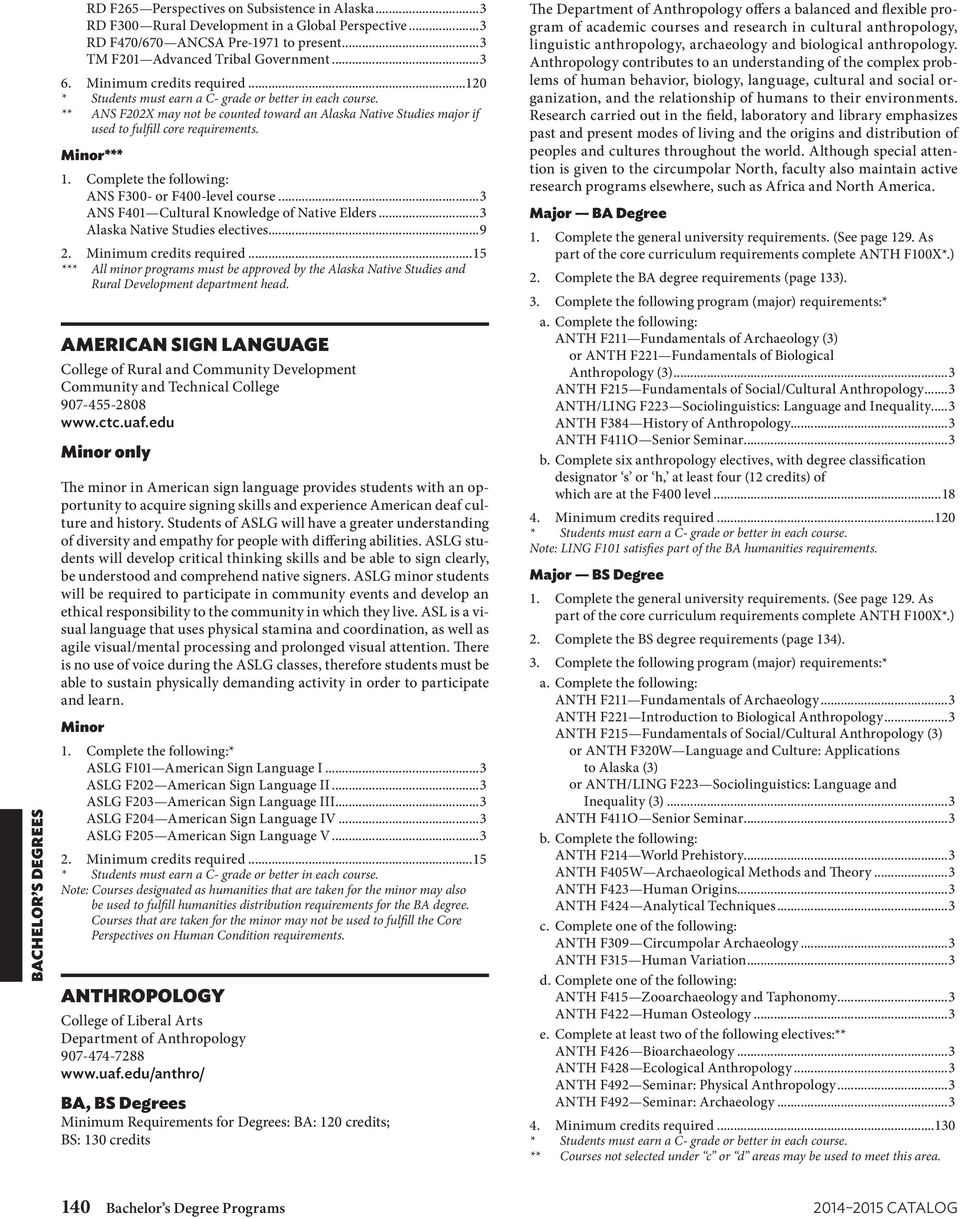
14 ANTH F211 Fundamentals of Archaeology...3 ANTH F215 Fundamentals of Social/Cultural Anthropology...3 ANTH F221 Introduction to Biological Anthropology...3 ANTH/LING F223 Sociolinguistics: Language and Inequality...3 Anthropology electives Minimum credits required...18 ARCTIC SKILLS College of Rural and Community Development Department of Emergency Services and Public Safety only The minor in arctic skills is designed for anyone who lives and works in a northern climate and wishes to learn to cope with the outdoor arctic environment. Students who complete this minor also earn a State of Alaska EMTI certificate and may prepare to take the FAA written exam for partial fulfillment of the private pilot certificate requirements. AVTY F100 Private Pilot Ground School (4) or AVTY F111 Fundamentals of Aviation (3) AVTY F231 Arctic Survival (3) or EMS F257 Arctic Survival (3)...3 EMS F170 EMT: Emergency Medical Technician I...6 Approved electives* Minimum credits required...15 * Approved by program manager. ART College of Liberal Arts Department of Art BA, BFA Degrees Minimum Requirements for Degrees: BA: 120 credits; BFA: 120 credits The art program encourages independent, original and creative thinking while recognizing the role and responsibility of the fine arts within the humanities. The BFA degree is professionally oriented and designed to prepare students for careers in art. It is the usual prerequisite for graduate studies in art. Admission requires a portfolio review by the art faculty, generally done in the student s junior year. Enrollment in the BFA program is recommended only for students who are willing to make the considerable commitment of time and energy necessary to achieve professional competence in their major areas. Career opportunities for BFA graduates include artist, designer, arts administrator, art teacher, gallery and museum administrator, and computer-related fields. Major BA Degree 1. Complete the general university requirements (page 129). 2. Complete the BA degree requirements (page 133). 3. Complete the following program (major) requirements:* a. Complete the following: ART F105 Beginning Drawing...3 ART F261 and F262 History of World Art...6 b. Complete two of the following: ART F161 Two-Dimensional Digital Design...3 ART F162 Color and Design...3 ART F163 Three-Dimensional Design...3 c. Complete three of the following electives (at least one must be a two-dimensional area, and one must be a three-dimensional area): Two-dimensional areas: ART F205 Intermediate Drawing...3 ART F207 Beginning Printmaking...3 ART F213 Beginning Painting (Acrylic or Oil)...3 ART F271 Beginning Computer Art...3 ART F283 Basic Darkroom Photography (3) or ART F284 Basic Digital Photography (3)...3 Three-dimensional areas: ART F201 Beginning Ceramics...3 ART F209 Beginning Metalsmithing and Jewelry...3 ART F211 Beginning Sculpture...3 ART F268 Beginning Native Art Studio...3 d. Complete three upper-division courses from one of these areas: Ceramics...9 Computer Art...9 Drawing...9 Metalsmithing...9 Native Studio Art...9 Painting...9 Photography...9 Printmaking...9 Sculpture...9 e. Complete one of the following upper-division art history courses: ART F363W History of Modern Art...3 ART F364W Italian Renaissance Art...3 ART F365W Native Art of Alaska...3 ART F425W Visual Images of the North...3 ART F463 Seminar in Art History...3 ART F490 Current Problems...3 f. Upper-division art elective Minimum art credits required for major Minimum credits required Note: Transfer students who are candidates for the BA degree in art must complete a minimum of 12 credits in art while in residence. Note: In addition to the program (major) requirements above, BA students will need additional upper-division credit (e.g., from the social science/humanities requirements and the minor), to equal 39 upper-division credits total. Major BFA Degree Concentrations: Ceramics, Computer Art, Drawing, Metalsmithing, Native Studio Art, Painting, Photography, Printmaking, Sculpture 1. Complete the general university requirements (page 129). 2. Complete the BFA degree requirements (page 135). 3. Complete the following program (major) requirements:* a. Complete the following: ART F105 Beginning Drawing...3 ART F261 and F262 History of World Art...6 b. Complete two of the following: ART F161 Two-Dimensional Digital Design...3 ART F162 Color and Design...3 ART F163 Three-Dimensional Design...3 UNIVERSITY OF ALASKA FAIRBANKS Bachelor s Degree Programs 141
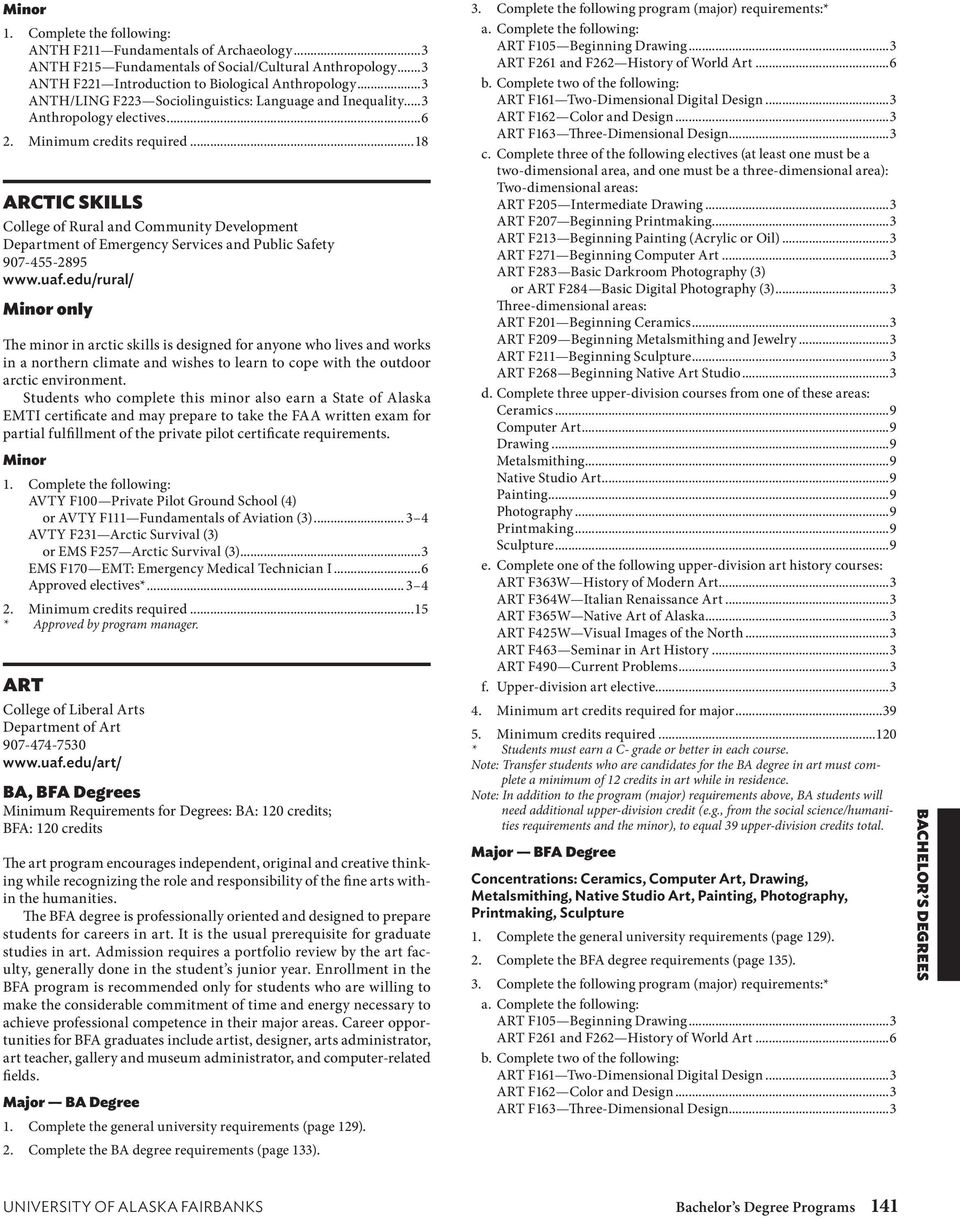
15 c. Complete three of the following electives (at least one must be a two-dimensional area, and one must be a three-dimensional area) Two-dimensional areas: ART F205 Intermediate Drawing...3 ART F207 Beginning Printmaking...3 ART F213 Beginning Painting (Acrylic of Oils)...3 ART F271 Beginning Computer Art...3 ART F283 Basic Darkroom Photography (3) or ART F284 Basic Digital Photography (3)...3 Three-dimensional areas: ART F201 Beginning Ceramics...3 ART F209 Beginning Metalsmithing and Jewelry...3 ART F211 Beginning Sculpture...3 ART F268 Beginning Native Art Studio...3 d. Major program approved by BFA thesis committee***...24 e. Complete three of the following upper division art history courses: ART F363W History of Modern Art...3 ART F364W Italian Renaissance Art...3 ART F365W Native Art of Alaska...3 ART F425W Visual Images of the North...3 ART F463 Seminar in Art History...3 ART F490 Current Problems...3 Upper-division art electives...6 Thesis project (including exhibition, portfolio and oral presentation) Minimum credits required *** Major program must include at least two, and no more than three, studio areas. Minimum requirement for the first area is 15 upper-division credits. Minimum requirement for the second area is 9 upper-division credits. Note: A minor is not required for this degree. Note: Transfer students who are candidates for the BFA in art must complete a minimum of 15 credits in art while in residence. Note: All studio areas in the department are eligible for fulfillment of specialization requirements: ceramics, computer art, metalsmithing, Native art, painting, drawing, photography, printmaking and sculpture. * ART F105 Beginning Drawing...3 ART F261 History of World Art or F262 History of World Art Complete one of the following:* ART F161 Two-Dimensional Design...3 ART F162 Color and Design...3 ART F163 Three-Dimensional Design Complete the following:* Art Electives Minimum credits required...18 Note: A minor in art is only available to nonart majors. ARTS AND SCIENCES School of Education BAS Degree Minimum Requirements for Degree: 120 credits The arts and sciences degree program instructs students in the subject areas encompassed in Alaska teacher content and performance standards: English/language arts, mathematics, science, geography, government and citizenship, history, skills for a healthy life, arts, world languages and technology. The BAS program is a broad-based major, concentrating on key principles and content knowledge in mathematics and science, the social sciences, humanities and fine arts. Students in the BAS degree program are advised by the School of Education. BAS majors may choose any approved minor. Students who are interested in being teachers are encouraged to choose the education minor. Major BAS Degree 1. Complete the general university requirements. (See page 129. As part of the core curriculum requirements, complete the following: ART/MUS/THR F200X*, HIST F100X*, ANTH/SOC F100X*, ENG/ FL F200X*, MATH F107X* or MATH F161X*, COMM F131X* or COMM F141X*, and two different science discipline laboratory courses selected from biology*, chemistry*, physics* and geoscience*. Two years of a non-english language highly recommended.) 2. Complete the following BAS degree major requirements in addition to the core:* a. Complete the following mathematics requirements: MATH F205 Mathematics for Elementary School Teachers I...3 MATH F206 Mathematics for Elementary School Teachers II...3 b. Complete two additional laboratory courses in the two science disciplines not completed for the baccalaureate core. c. Complete the following social sciences requirements: GEOG F101 Expedition Earth: Introduction to Geography...3 HIST F131 History of the U.S. (3) or HIST F132 History of the U.S. (3)...3 HIST F461W History of Alaska...3 PS F101 Introduction to American Government and Politics...3 d. Complete the following literature, grammar and writing requirements: ENGL F271 Introduction to Creative Writing Fiction (3) or ENGL F272 Introduction to Creative Writing Poetry (3) or ENGL F313W Writing Nonfiction Prose (3) or ENGL F314W,O/2 Technical Writing (3) or JRN F311W Magazine Article Writing (3)...3 ENGL F306 Survey of American Literature: Beginnings to the Civil War (3) or ENGL F307 Survey of American Literature: Civil War to the Present (3) or ENGL F308 Survey of British Literature: Beowulf to the Romantic Period (3) or another literature-focused course (3)...3 ENGL F317 Traditional English Grammar...3 e. Complete the following psychology and language development requirements: LING/ED F100 Language, Education and Linguistics (3) or LING F101 Nature of Language (3) or LING F303W,O Language Acquisition (3)...3 PSY F240 Lifespan Developmental Psychology (3) or PSY/ED F245 Child Development (3)...3 f. Complete creative expression course or courses from applied courses in music, theatre, photography or art...3 g. Complete the following understanding diversity and culture requirements: ANTH F242 Native Cultures of Alaska...3 Course selected from a list developed by the review committee...3 h. Complete the following senior seminar requirements: LAS F410W,O/2 Scientific Research...3 ED F486O/2 Media Literacy Bachelor s Degree Programs CATALOG
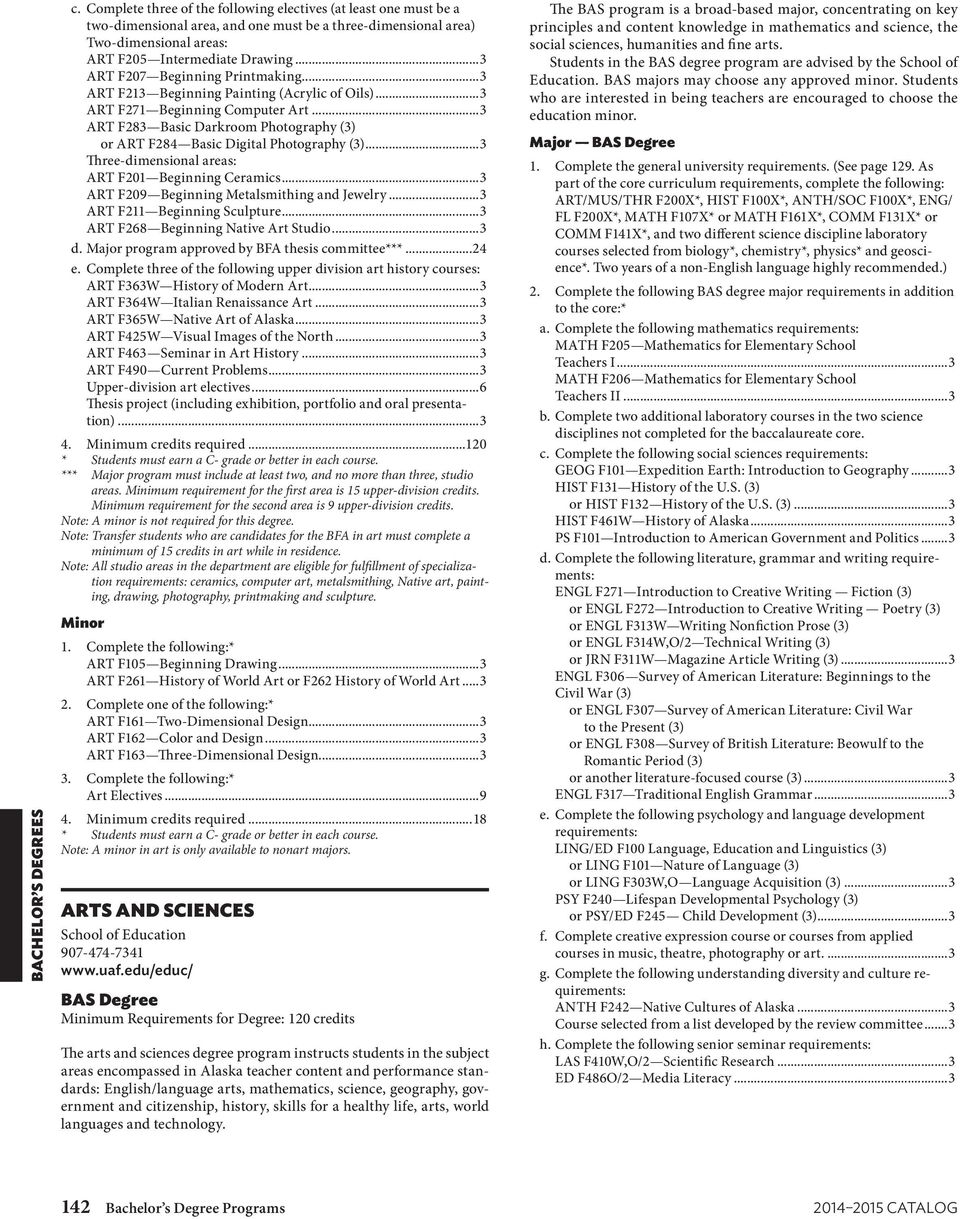
16 i. Complete the following technology requirement: ED F237 Technology Tools for Teachers This course is divided into four modules. Students have the option to test out of any of the four modules or enroll in and successfully complete for a passing grade any module that has not been successfully challenged. j. Complete the following Praxis test requirement: BAS students will be required to have Alaska passing scores on the Praxis I and the Praxis II (test 0014) prior to completing their last semester. Praxis I assesses reading, writing and math; Praxis II Elementary Content Knowledge assesses broad knowledge and background in English/language, arts, math, science and social sciences. 3. Complete minor complex** Complete electives Minimum credits required ** Departmental requirements for minors may exceed this 15 credit minimum. See other program descriptions for specific minor requirements. Note: For the BAS degree program, at least 39 credits must be taken in upper-division (F300- and F400-level) courses. Courses taken to fulfill the BAS degree can also be counted for content minors or second majors. ASIAN STUDIES College of Liberal Arts only A minor in Asian studies provides interdisciplinary instruction in the varieties of Asian languages and cultures. It enables students to consolidate various course offerings into a meaningful and cohesive program relevant to several major fields of specialization. (Combining a Japanese Studies major with an Asian Studies minor requires approval from both programs.) 1. Complete 15 credits in approved Asian studies courses:* a. Department of Foreign Languages CHNS F101 Elementary Chinese I...5 CHNS F102 Elementary Chinese II...5 CHNS F201 Intermediate Chinese...4 CHNS F202 Intermediate Chinese II...4 JPN F101 Elementary Japanese I...5 JPN F102 Elementary Japanese II...5 JPN F201 Intermediate Japanese I...4 JPN F202 Intermediate Japanese II...4 b. Department of Geography GEOG F311W Geography of Asia...3 c. Department of History HIST F121 East Asian Civilization...3 HIST F122 East Asian Civilization...3 HIST F330 Modern China...3 HIST F331 Modern Japan...3 HIST F333 Foundations of Japanese History...3 HIST/WMS F414 Women and Gender in East Asian History...3 d. Department of Philosophy PHIL F202 Introduction to Eastern Philosophy...3 e. Department of Political Science PS F464W East Asian Governments and Politics Minimum credits required...15 * Courses must be distributed among at least three departments and include material on at least two Asian countries. Students are strongly encouraged to include a semester or more of Asian language. BIOLOGICAL SCIENCES College of Natural Science and Mathematics Department of Biology and Wildlife BA, BS Degrees Minimum Requirements for Degrees: 120 credits Biological sciences is an appropriate major for students interested in the science of life. Programs in these fields provide a broad education and a foundation in the basic principles of biology. Graduates are employed in environmental science, health services, biology education, and as field and laboratory technicians. Graduates may also pursue advanced MS, pharmacology, nursing, MD or PhD degrees. Biology faculty advisors can help students choose courses that will best fit their goals. Biological sciences majors may pursue either a BA or BS degree. Because biology is an interdisciplinary science, both programs include course work in the physical sciences and mathematics. The BA requires fewer credits in biology and more credits in the social sciences and humanities than the BS degree, which focuses more intensively on biological science. The BS degree without a concentration provides the most comprehensive education in biology. The BS degree with a concentration permits some degree of specialization in one of three sub-disciplines: cell and molecular biology, physiology, or ecology and evolutionary biology. Incoming students who do not meet the prerequisites for Fundamentals of Biology I (BIOL F115X) and those who did not complete a biology course in high school are encouraged to take a biology course for non-majors such as Biology and Society (BIOL F103X) or Natural History of Alaska (BIOL F104X) and General Chemistry I and II (CHEM F105X and CHEM F106X) during their first year, and to begin the BIOL F115X and F116X series in their sophomore year. Students unprepared for General Chemistry I (CHEM F105X) should take Basic General Chemistry (CHEM F103X) during their first year, and begin both the General Chemistry (CHEM F105X and F106X) and Fundamentals of Biology Series (BIOL F115X and F116X) during their sophomore year. Students majoring in the biological sciences must complete a capstone project during their junior or senior year. The goal of the capstone experience is to integrate skills and information students have learned in previous courses by conducting a mentored research project and communicating the results. To fulfill the capstone requirement, a student may take either a designated capstone course or complete a mentored research project with a faculty member and petition the Biology and Wildlife chair to have this research experience count toward the capstone requirement. Biology course credit for mentored research may be obtained by completing BIOL F490, F397, or F497. More information about the capstone requirement is posted on the Biology and Wildlife website ( Students are strongly encouraged to speak to a biology advisor well before their senior year about how they plan to satisfy the capstone requirement. Major BA Degree 1. Complete the general university requirements. (See page 129. As part of the core curriculum requirements, complete: CHEM F105X* and F106X*.) 2. Complete the BA degree requirements (page 133). As part of the BA degree requirements, complete STAT F200X*. As part of the humanities and social sciences requirement, take at least 9 credits of upper-division course work. As part of the minor, take at least 3 credits of upper-division course work. UNIVERSITY OF ALASKA FAIRBANKS Bachelor s Degree Programs 143

17 3. Complete the following program (major) requirements:* a. Complete the following: BIOL F115X Fundamentals of Biology I...4 BIOL F116X Fundamentals of Biology II...4 BIOL F260 Principles of Genetics...4 BIOL F481 Principles of Evolution...4 CHEM F321 Organic Chemistry...4 PHYS F103X College Physics...4 b. Complete two of the following three biology breadth requirements:** BIOL F310 Animal Physiology (4) or BIOL F342 Microbiology (4) or BIOL F434W Structure and Function of Vascular Plants (4) or BIOL F213X and F214X Human Anatomy and Physiology I and II (8) BIOL F360 Cell and Molecular Biology...3 BIOL F371 Principles of Ecology...4 c. Complete three elective courses from course lists A, B, C or D below, at least one of which is designated a W course.*** If possible, satisfy all UAF core requirements for W and O courses and the biology capstone requirement with these elective courses. d. Complete a biology capstone project (no credit requirement): The capstone requirement can be met through a petition following the completion of a mentored research project with a faculty member (e.g., by taking BIOL F490, or BIOL F497, or without course credits), or by completing at least one of the following courses: BIOL F403W Metabolism and Biochemistry (4) or BIOL F434W Plant Structure and Function of Vascular Plants (4) or BIOL F441W,O/2 Animal Behavior (3) or BIOL F472W Community Ecology (4) or BIOL F473W Limnology (3) Minimum credits required Major BS Degree without concentration 1. Complete the general university requirements. (See page 129. As part of the core curriculum requirements, complete: MATH F200X* or MATH F272X*; and CHEM F105X* and F106X*.) 2. Complete the BS degree requirements. (See page 134. As part of the BS degree requirements, complete STAT F200X* or STAT F300* and PHYS F103X* and PHYS F104X*.) 3. Complete the following program (major) requirements:* BIOL F115X Fundamentals of Biology I...4 BIOL F116X Fundamentals of Biology II...4 BIOL F260 Principles of Genetics...4 BIOL F360 Cell and Molecular Biology...3 BIOL F371 Principles of Ecology...4 BIOL F310 Animal Physiology (4) or BIOL F342 Microbiology (4) or BIOL F213X and F214X Human Anatomy and Physiology I and II (8) or BIOL F434W Structure and Function of Vascular Plants (4) BIOL F481 Principles of Evolution...4 CHEM F321 Organic Chemistry I (4) and either CHEM F322 Organic Chemistry II (3) or CHEM F451 General Biochemistry Metabolism (3) Complete the following electives (at least one must satisfy the W requirement):*** Organismal elective: Complete one additional course from list D Biology electives: Complete four additional courses at the 200 level or above, at least three of which must be from lists A, B, C or D Complete a biology capstone project (no credit requirement): The capstone requirement can be met through a petition following the completion of a mentored research project with a faculty member (e.g., by taking BIOL F490, or BIOL F497, or without course credits), or by completing at least one of the following courses: BIOL F403W Metabolism and Biochemistry (4) or BIOL F434W Structure and Function of Vascular Plants (4) or BIOL F441W,O/2 Animal Behavior (3) or BIOL F472W Community Ecology (4) or BIOL F473W Limnology (3) 6. Minimum credits required Major BS Degree with concentration 1. Complete the general university requirements. (See page 129. As part of the core curriculum requirements, complete: MATH F200X* or MATH F272X*; and CHEM F105X* and F106X*.) 2. Complete the BS degree requirements. (See page 134. As part of the BS degree requirements, complete STAT F200X* or STAT F300* and PHYS F103X* and PHYS F104X*.) 3. Complete the following program (major) requirements:* BIOL F115X Fundamentals of Biology I...4 BIOL F116X Fundamentals of Biology II...4 BIOL F260 Principles of Genetics...4 BIOL F310 Animal Physiology (4) or BIOL F434W Structure and Function of Vascular Plants (4) or BIOL F342 Microbiology (4) or BIOL F213X and F214X Human Anatomy and Physiology I and II (8) BIOL F481 Principles of Evolution...4 CHEM F321 Organic Chemistry I (4) and either CHEM F322 Organic Chemistry II (3) or CHEM F451 General Biochemistry Metabolism (3) Complete one of the following concentrations:***. (When choosing courses to fulfill concentration requirements, students should consider the university requirement for two W courses and one O course, and the departmental requirement for a capstone project.) a. Cell and Molecular Biology i. As part of the program requirements, complete CHEM F321. ii. Complete the following (at least one of which must satisfy the W requirement): BIOL F360 Cell and Molecular Biology...3 CHEM F450 General Biochemistry Macromolecules...3 CHEM F451 General Biochemistry Metabolism...3 Cell and molecular and physiology electives: Take three additional courses from lists A or B, at least one of which must be from list A Biology breadth elective: Take one additional course from lists C or D b. Physiology Complete the following (at least one of which must satisfy the W requirement): BIOL F360 Cell and Molecular Biology...3 Physiology or cell and molecular biology electives: Take two courses from list A and two from list B Biology breadth elective: Take one additional course from lists C or D Biology elective: Take one additional course from lists A, B, C or D c. Ecology and Evolutionary Biology Complete the following (at least one of which must satisfy the W requirement): BIOL F371 Principles of Ecology...4 Ecology and evolutionary biology electives: Take two additional courses from list C Organismal elective: Take one additional course from list D Bachelor s Degree Programs CATALOG

18 Biology breadth elective: Take one additional course from lists A or B Biology elective: Take one additional course from lists A, B, C or D STAT F401 Regression and Analysis of Variance (4) or STAT F402 Scientific Sampling (3) Complete a biology capstone project (no credit requirement): The capstone requirement can be met through a petition following the completion of a mentored research project with a faculty member (e.g., by taking BIOL F490, or BIOL F497, with or without course credits), or by completing at least one of the following courses: BIOL F403W Metabolism and Biochemistry (4) or BIOL F434W Structure and Function of Vascular Plants (4) or BIOL F441W,O/2 Animal Behavior (3) or BIOL F472W Community Ecology (4) or BIOL F473W Limnology (3) Minimum credits required Biology elective course lists:**** List A Cell and Molecular Biology BIOL F342 Microbiology...3 BIOL F360 Cell and Molecular Biology...3 BIOL F403W Metabolism and Biochemistry...4 BIOL F417O Neurobiology...3 BIOL F435 Biology of Cancer...3 BIOL F460 Principles of Virology...3 BIOL F462O Concepts of Infectious Disease...3 BIOL F465 Immunology...3 CHEM F322 Organic Chemistry II...3 CHEM F450 General Biochemistry Macromolecules...3 CHEM F451 General Biochemistry Metabolism...3 CHEM F470 Cellular and Molecular Neuroscience...3 CHEM F474 Neurochemistry...3 List B Physiology BIOL F310 Animal Physiology...4 BIOL F317 Comparative Anatomy...4 BIOL F335 Epidemiology...3 BIOL F342 Microbiology...4 BIOL F417O Neurobiology...3 BIOL F434W Structure and Function in Vascular Plants...4 BIOL F441W,O/2 Animal Behavior...3 BIOL F455W,O Environmental Toxicology...3 BIOL F457W,O Environmental Microbiology...3 BIOL F458 Vertebrate Endocrinology...3 BIOL F459O/2 Wildlife Nutrition...4 BIOL F462O Concepts of Infectious Disease...3 BIOL F465 Immunology...3 List C Ecology and Evolutionary Biology BIOL F371 Principles of Ecology...4 BIOL F418 Biogeography...3 BIOL F433 Conservation Genetics...3 BIOL F441W,O/2 Animal Behavior...3 BIOL F457W Environmental Microbiology...3 BIOL F462O Concepts of Infectious Disease...3 BIOL F469O Landscape Ecology and Wildlife Habitat...3 BIOL F471 Population Ecology...3 BIOL F472W Community Ecology...3 BIOL F473W Limnology...3 BIOL F474 Plant Ecology...4 BIOL F476O Ecosystem Ecology...3 BIOL F483 Stream Ecology...3 BIOL F485 Global Change Ecology...3 BIOL F486 Vertebrate Paleontology...3 BIOL F487 Conceptual Issues in Evolutionary Biology...3 BIOL F488 Arctic Vegetation Ecology: Geobotany...3 BIOL F489 Vegetation Description and Analysis...3 WLF F301 Design of Wildlife Studies...3 WLF F410 Wildlife Populations and their Management...3 List D Organismal Biology BIOL F301 Biology of Fishes...4 BIOL F305 Invertebrate Zoology...4 BIOL F317 Comparative Anatomy...4 BIOL F331 Systematic Botany...4 BIOL F406 Entomology...4 BIOL F418 Biogeography...4 BIOL F425W Mammalogy...3 BIOL F426W,O/2 Ornithology...3 BIOL F427 Ichthyology...4 BIOL F486 Vertebrate Paleontology...3 BIOL F489 Vegetation Description and Analysis Complete the following program (minor) requirements:* BIOL F115X Fundamentals of Biology I...4 BIOL F116X Fundamentals of Biology II...4 BIOL F260 Principles of Genetics Complete one of the following course options:**** BIOL F213X and F214X Human Anatomy and Physiology I and II (8) or BIOL F310 Animal Physiology (4) or BIOL F342 Microbiology (4) or BIOL F360 Cell and Molecular Biology (3) or BIOL F371 Principles of Ecology (4) or BIOL F434W Structure and Function of Vascular Plants (4) or BIOL F481 Principles of Evolution (4) Complete one additional course in biology at the 200 level or above Minimum credits required...18 * Students must earn a C or better in each course. ** Because biology breadth courses for the BA degree serve as prerequisites for many upper-division biology electives, course choices should be made with consideration of the elective biology courses the student plans to complete. *** Independent study (BIOL F397 or F497) or research experience (URSA F388 and F488, and BIOL F490) courses may be substituted by petition for a maximum of two required elective courses in biology (3 4 credits of independent study or research per substituted course). The subject area of the independent study or research will determine which biological subject areas the credits satisfy. **** Courses that satisfy upper-division elective credit may require prerequisites in addition to the required biology course.` Note: A foreign language is encouraged by the department in meeting requirements of the core curriculum. BUSINESS ADMINISTRATION School of Management Department of Business Administration BBA Degree Minimum Requirements for Degree: 120 credits The business administration department offers professional education to students interested in management, finance, human resource management, international business, marketing and travel industry management. Competent management practices require an education that is both broad and deep. The business administration program prepares graduates to meet complex technical, economic and social problems and enables them to apply imaginative and responsible leadership to the needs of industry and government. The undergraduate and graduate programs are accredited by the Association to Advance Collegiate Schools of Business. UNIVERSITY OF ALASKA FAIRBANKS Bachelor s Degree Programs 145

19 Major BBA Degree Concentrations: Finance, General Business, and Marketing 1. Complete the general university requirements. (See page 129. As part of the core curriculum requirements, complete: BA F323X*; and MATH F262X*.) 2. Complete one oral-intensive course designated (O) and one oralintensive designated (O/2), or complete two oral-intensive courses designated (O), or complete three oral-intensive courses designated (O/2). 3. Complete the BBA degree requirements. (See page 135. As part of the Common Body of Knowledge, complete AIS F310.) 4. Complete the following:* BA F151 Introduction to Business...3 ENGL F314W,O/2 Technical Writing Complete the following program (major) requirements:* BA F307 Introductory Human Resource Management...3 ECON F321 Intermediate Microeconomics (3) or ECON F351 Public Finance...3 BA F460O International Business (3) or BA F461 International Finance (3) or ECON F463W International Economics (3) Complete an additional 6 credits from ACCT, BA or ECON Complete one of the following concentrations:* a. Finance Complete four of the following: BA F423W Investment Analysis...3 BA F424 Real Estate and Alternative Investments...3 BA F454O Student Investment Fund...3 BA F455 Portfolio Management...3 BA F461 International Finance...3 b. General Business Complete four School of Management courses (of which at least three must be BA courses) approved by the undergraduate director and of which at least 6 hours must be upper-division. Note: At least one course must be designated writing-intensive (W). c. Marketing Complete four of the following: BA F241 Advertising, Sales and Promotion...3 BA F436 Consumer Behavior...3 BA F445W Marketing Research...3 BA F490 Services Marketing...3 BA F491 Current Topics in Marketing Minimum credits required ** Business students may earn a minor as long as their business degree requirements are met first. Note: The BBA degree requires 50 percent of the accounting, business administration and economics credits to be earned in residence at UAF. Note: Only one bachelor of business administration degree may be earned with a concentration in finance, general business or marketing. * Finance ACCT F261 Principles of Financial Accounting...3 BA F151 Introduction to Business...3 BA F325 Financial Management...3 ECON F201 Principles of Economics I: Microeconomics Complete one of the following with instructor permission: BA F423W Investment Analysis...3 BA F424 Real Estate and Alternative Investments...3 BA F461 International Finance Minimum credits required...15 General Business 1. Complete five School of Management courses (of which at least three must be BA courses) approved by the undergraduate director and of which at least 6 hours must be upper-division. 2. Minimum credits required...15 Management and Organizations 1. Complete five of the following: BA F151 Introduction to Business...3 BA F307 Introductory Human Resource Management...3 BA F317W Employment Law...3 BA F325 Financial Management...3 BA F330 The Legal Environment of Business...4 BA F343 Principles of Marketing...3 BA F360 Operations Management...3 BA F390 Organizational Theory and Behavior...3 ECON F201 Principles of Economics I: Microeconomics Minimum credits required...15 Marketing 1. Complete five courses from the following: STAT F200X Elementary Probability and Statistics...3 BA F151 Introduction to Business...3 BA F241 Advertising, Sales and Promotion...3 BA F343 Principles of Marketing...3 BA F436 Consumer Behavior...3 BA F490 Services Marketing...3 BA F491 Current Topics in Marketing Minimum credits required...15 Sports Management BA F280 Sports Leadership...3 BA F281 Sports Management Complete nine credit hours from the following: ACCT F261 Principles of Financial Accounting...3 AIS F310 Management of Information Systems...3 BA F151 Introduction to Business...3 BA F253 Internship in Business...3 BA F307 Introductory Human Resource Management...3 BA F390 Organizational Theory and Behavior...3 BA F457 Training and Management Development...3 PSY F337W Sports Psychology...3 JRN F260 Sports Journalism Minimum credits required...15 * s applicable to a bachelor of arts or bachelor of science degree. CHEMISTRY College of Natural Science and Mathematics Department of Chemistry and Biochemistry BA, BS Degrees Minimum Requirements for Degrees: 120 credits Our programs prepare students for employment as research chemists in federal, state, municipal, academic or industrial laboratories, and in premedicine as laboratory technicians, industry supervisors and technical sales personnel. Our programs also provide a technical base for chemistry teachers. Graduates also find positions in the environmental sciences, oceanography and related interdisciplinary fields. Many chemistry graduates elect to pursue advanced MS, PhD, pharmacology or MD degrees. 146 Bachelor s Degree Programs CATALOG
20 The chemistry curriculum meets the American Chemical Society standards covering the basics of general, organic, inorganic, physical and analytical chemistry, and biochemistry. Undergraduate research leading to publications is strongly encouraged, and many of the laboratory-based courses have a research component built into them. The BS and BA programs may be completed without an optional concentration, or students can opt for an additional focus in biochemistry, environmental chemistry or forensic chemistry. The BS programs generally prepare students for a career in chemistry or biochemistry, or for professional school. The BS in chemistry is an ACS-approved degree program. The environmental chemistry concentration provides courses that help students study the chemistry of the natural environment by adding geology, biology or atmospheric courses, and it prepares students for graduate studies and/or careers in the environmental industry. The biochemistry concentration provides an enhanced curriculum in biological chemistry for students seeking advanced careers in biochemistry, medicine or health sciences. The BA degree provides breadth in the curriculum for study of a minor subject and requires more humanities courses. The BA best prepares students for careers in chemistry-related fields like environmental law, forensic science, science education, anthropology, etc. Limited teaching assistantships are often available for upper-division students, which strengthen leadership and communication skills. The bachelor s degrees in chemistry and concentrations in biochemistry and environmental chemistry provide excellent research opportunities and background for undergraduate students through connection to corresponding graduate programs. See graduate programs in chemistry, biochemistry and molecular biology, and environmental chemistry. The Chemistry and Biochemistry Department is housed in the Reichardt Building, where laboratories are equipped with researchgrade instrumentation, providing hands-on experience to students for entry into graduate school or industry. See the departmental website for more information, Major BA Degree 1. Complete the general university requirements. (See page 129. As part of the core curriculum requirements, complete: MATH F200X; PHYS F103X and PHYS F104X, or PHYS F211X and PHYS F212X.) 2. Complete the BA degree requirements. (See page 133. As part of the BA degree requirements, complete: MATH F201X.) 3. Complete the following program (major) requirements:* CHEM F105X General Chemistry I...4 CHEM F106X General Chemistry II...4 CHEM F202 Basic Inorganic Chemistry...3 CHEM F212 Chemical Equilibrium and Analysis...4 CHEM F321 Organic Chemistry I...4 CHEM F322 Organic Chemistry II (3) or CHEM F451 Biochemistry (3)...3 CHEM F324W Advanced Organic Chemistry Laboratory (3) or CHEM F314W Analytical Instrumental Laboratory (3)...3 CHEM F331 Physical Chemistry I...4 CHEM F481 Seminar...1 CHEM F482O Seminar Ensure that you have satisfied the university requirement of 39 upper-division credits and two writing-intensive (W) courses, which will typically require either taking more upper-division chemistry courses or a significant number of upper-division courses in other disciplines, likely your minor. 5. Minimum credits required Note: This degree does not encompass the depth required to be an American Chemistry Society-approved chemistry degree. Students taking this degree will not receive a certificate from ACS. Students intending to continue in chemistry or biochemistry careers or graduate studies should select a BS degree program. Optional Concentration: Forensic Chemistry 1. Complete the general university requirements. (See page 129. As part of the core curriculum requirements, complete: MATH F200X; PHYS F103X and PHYS F104X, or PHYS F211X and PHYS F212X.) 2. Complete the BA degree requirements. (See page 133. As part of the BA degree requirements, complete: MATH F201X.) 3. Complete the program (major) requirements as listed under chemistry BA degree, including: CHEM F314W Analytical Instrumental Laboratory Complete the following:* CHEM F332 Physical Chemistry II Earn a minor in justice using the following courses to complete the requirements:* JUST F110 Introduction to Justice...3 JUST F222 Research Methods...3 JUST F251 Criminology...3 JUST F300X Ethics and Justice**...3 JUST F354 Procedural Law...3 JUST F454W Advanced Problems in Procedural Law Minimum credits required ** JUST F300X may not be used to fulfill core ethics requirement. Note: This degree does not encompass the depth required to be an American Chemistry Society-approved chemistry degree. Students taking this track will not receive a certificate from ACS. Students intending to continue in chemistry or biochemistry careers or graduate studies should select a BS degree program. Major BS Degree (American Chemistry Society-approved) 1. Complete the general university requirements. (See page 129. As part of the core curriculum requirements, complete: MATH F200X; PHYS F103X and PHYS F104X, or PHYS F211X and PHYS F212X.) 2. Complete the BS degree requirements. (See page 134. As part of the BS degree, complete: MATH F201X. Chemistry foundation courses may be used toward partial fulfillment of the natural science requirement.) 3. Complete the program (major) requirements:* CHEM F105X General Chemistry I...4 CHEM F106X General Chemistry II...4 CHEM F202 Basic Inorganic Chemistry...3 CHEM F212 Chemical Equilibrium and Analysis...4 CHEM F321 Organic Chemistry I...4 CHEM F322 Organic Chemistry II...3 CHEM F324W Advanced Organic Chemistry Laboratory...3 CHEM F331 Physical Chemistry I...4 CHEM F332 Physical Chemistry II...4 CHEM F434W Chemistry Capstone Laboratory...3 CHEM F451 General Biochemistry Metabolism...3 CHEM F481 Seminar...1 CHEM F482O Seminar...2 CHEM F488 Undergraduate Chemistry and Biochemistry Research...3 MATH F202X Calculus Complete two of the following:* CHEM F402 Inorganic Chemistry...3 CHEM F450 General Biochemistry Macromolecules...3 CHEM F314W Analytical Instrumental Laboratory Minimum credits required Note: Upon completing the required curriculum and fulfilling all general university requirements, students will receive a certificate from the American Chemical Society indicating approval of their degree program. UNIVERSITY OF ALASKA FAIRBANKS Bachelor s Degree Programs 147

21 Optional Concentrations: Biochemistry, Environmental Chemistry Biochemistry 1. Complete the general university requirements. (See page 129. As part of the core curriculum requirements, complete: MATH F200X; PHYS F103X and PHYS F104X, or PHYS F211X and PHYS F212X.) 2. Complete the BS degree requirements. (See page 134. As part of the BS degree requirements, complete: MATH F201X. Chemistry foundation courses may be used toward partial fulfillment of the natural science requirement.) 3. Complete the following program (major) requirements:* CHEM F105X General Chemistry I...4 CHEM F106X General Chemistry II...4 BIOL F115X Fundamentals of Biology I...4 BIOL F116X Fundamentals of Biology II...4 CHEM F202 Basic Inorganic Chemistry...3 CHEM F212 Chemical Equilibrium and Analysis...4 CHEM F321 Organic Chemistry I...4 CHEM F322 Organic Chemistry II...3 CHEM F331 Physical Chemistry I...3 CHEM F450 General Biochemistry Macromolecules...3 CHEM F451 General Biochemistry Metabolism...3 CHEM F481 Seminar...1 CHEM F482O Seminar...2 CHEM F488 Undergraduate Chemistry and Biochemistry Research Complete four of the following advanced chemistry/math courses:* ** CHEM F323 Organic Chemistry Laboratory (1) or CHEM F324W Advanced Organic Chemistry Laboratory (3) CHEM F332 Physical Chemistry II...4 CHEM F434W Chemistry Capstone Laboratory...3 CHEM F314W Analytical Instrumental Laboratory...3 CHEM F402 Advanced Inorganic Chemistry...3 CHEM F420 NMR Spectroscopy of Natural Products...3 MATH F202X Calculus III Complete 10 credits of the following biology/biochemistry courses:* ** CHEM F360 Cell and Molecular Biology...4 CHEM F418W Developmental Biology...3 CHEM F455W,O Environmental Toxicology...3 CHEM F470 Cellular and Molecular Neuroscience...3 CHEM F474 Neurochemistry...3 BIOL F240 Beginnings in Microbiology...4 BIOL F260 Principles of Genetics...4 BIOL F310 Animal Physiology...4 BIOL F342 Microbiology...4 BIOL F402W Biomedical and Research Ethics...3 BIOL F417O Neurobiology...3 BIOL F453O/2 Molecular Biology...4 BIOL F462O Concepts in Infectious Disease...3 BIOL F465 Immunology Minimum credits required ** Courses selected under numbers 4 and 5 above must meet baccalaureate degree requirements for 39 upper-division credits and two writing-intensive courses. Note: This degree is intended for students interested in careers in biochemistry or pre-professional students, providing extra depth in biological sciences. The selection of optional courses will determine if the curriculum conforms to the American Chemistry Society-approved chemistry degree. Students desiring an ACS-approved chemistry degree should consult with their advisor about optional courses that will meet ACS requirements. Environmental Chemistry 1. Complete the general university requirements. (See page 129. As part of the core curriculum requirements, complete: MATH F200X; PHYS F103X and PHYS F104X, or PHYS F211X and PHYS F212X.) 2. Complete the BS degree requirements. (See page 134. As part of the BS degree, complete: MATH F201X. Chemistry foundation courses may be used toward partial fulfillment of the natural science requirement.) 3. Complete the following program (major) requirements:* CHEM F105X General Chemistry I...4 CHEM F106X General Chemistry II...4 CHEM F202 Basic Inorganic Chemistry...3 CHEM F212 Chemical Equilibrium and Analysis...4 CHEM F314W Analytical Instrumental Laboratory...3 CHEM F321 Organic Chemistry I...4 CHEM F322 Organic Chemistry II...3 CHEM F324W Advanced Organic Chemistry Laboratory...3 CHEM F331 Physical Chemistry I...4 CHEM F332 Physical Chemistry II...4 CHEM F434W Chemistry Capstone Laboratory...3 CHEM F481 Seminar...1 CHEM F482O Seminar...2 CHEM F488 Undergraduate Chemistry and Biochemistry Research...3 MATH F202X Calculus III Complete two of the following:* ATM F101X Weather and Climate of Alaska...4 BIOL F115X Fundamentals of Biology I...4 BIOL F116X Fundamentals of Biology II...4 GEOS F101X The Dynamic Earth...4 GEOS F262 Rocks and Minerals Complete two of the following:* ATM F401 Introduction to Atmospheric Science...3 BIOL F342 Microbiology...4 CHEM F406 Atmospheric Chemistry...3 CHEM F455W,O Environmental Toxicology...3 GEOS F417 Introduction to Geochemistry...3 NRM F380W Soils and the Environment Minimum credits required Note: A course in statistics (e.g. STAT F200X, STAT F300, or GEOS F430) is suggested. The selection of optional courses will determine if the curriculum conforms to the American Chemistry Society-approved chemistry degree. Students desiring an ACS-approved chemistry degree should consult with their advisor about optional courses that will meet ACS requirements. Requirements for Chemistry Teachers (grades 7 12) 1. Complete all the requirements of the chemistry BA or BS degree. 2. All prospective science teachers must complete the following: PHIL F481 Philosophy of Science...3 Note: We strongly recommend that prospective secondary science teachers seek advising from the UAF School of Education early in your undergraduate degree program so that you can be appropriately advised of the State of Alaska requirements for teacher licensure. s Chemistry CHEM F105X General Chemistry I...4 CHEM F106X General Chemistry II Complete the following: CHEM F212 Chemical Equilibrium and Analysis*...4 CHEM F321 Organic Chemistry I...4 CHEM F322 Organic Chemistry II...3 CHEM F331 Physical Chemistry I Bachelor s Degree Programs CATALOG
22 3. Complete one of the following additional chemistry lab courses: CHEM F202 Basic Inorganic Chemistry...3 CHEM F323 Organic Chemistry Laboratory Minimum credits required Biochemistry CHEM F105X General Chemistry I...4 CHEM F106X General Chemistry II Complete the following: CHEM F321 Organic Chemistry I...4 CHEM F322 Organic Chemistry II...3 CHEM F331 Physical Chemistry I...4 CHEM F451 General Biochemistry Metabolism Complete one of the following chemistry lab courses: CHEM F202 Basic Inorganic Chemistry...3 CHEM F212 Chemical Equilibrium and Analysis...4 CHEM F323 Organic Chemistry Laboratory Minimum credits required CHILD DEVELOPMENT AND FAMILY STUDIES College of Rural and Community Development Department of Social and Human Development BA Degree Minimum Requirements for Degree: 120 credits This program provides the necessary preparation for early childhood educators who wish to advance their professional knowledge and career opportunities with specialized study in administration, curriculum and teaching, family support, or infants and toddlers. The child development and family studies program meets professional preparation standards developed by the National Association for the Education of Young Children. These six core standards and field experience expectations guide the CDFS BA program content and outline a set of common expectations for professional knowledge, skills and dispositions within the field of early care and education in conjunction with family studies. The program supports students who desire a strong foundation in the field of early childhood by integrating the early childhood education AAS content requirements with that of the child development and family studies BA. Students are required to complete the program major and one of the specialized concentration areas: administration within the early childhood field, curriculum and teaching, family support, or infant and toddler. Students entering the child development and family studies BA program with an AA or AAS degree in early childhood education from a regionally accredited college or university will receive 23 transfer credits toward the program major. Any additional courses will need to be evaluated on an individual basis. Flexible course delivery fosters successful completion for early childhood professionals living in both rural and urban areas of Alaska. All program and concentration area courses must be completed with a C grade or better, with the exclusion of all clinical practice course work which must completed with a B grade or better. Completion of the CDFS BA will meet requirements for both a major and minor. Major BA Degree 1. Complete the general university requirements.* (See page 129. As part of the core curriculum requirements, the following courses are recommended: ENGL F213X*, MATH F103X*, MATH F107X*, or MATH F161X*; BIOL F104X*, GEOG F111X* or GEOS F120X*.) 2. Complete the BA degree requirements. (See page 133. As part of the BA social science degree requirements, complete PSY F101.)* a. Complete three of the following recommended humanities/social science courses as part of your BA degree requirements:* ANS F242 Native Cultures of Alaska...3 ANS F320W Language and Culture: Applications to Alaska...3 ANS F330 Yup ik Parenting and Child Development...3 ANS F461 Native Ways of Knowing...3 ANTH F407 Kinship and Social Organizations...3 LING F303W,O Language Acquisition...3 b. Complete one of the following recommended mathematics courses as part of your BA core requirements:* CS F101 Computers and Society...3 CS F102 Introduction to Computer Science...3 MATH F103X Concepts and Contemporary Applications of Mathematics...3 MATH F107X Functions for Calculus...4 MATH F161X Algebra for Business and Economics Complete the following program (major) requirements:* ECE F101 Overview of the Profession...3 ECE F104 Child Development I: Prenatal, Infants and Toddlers...3 ECE F107 Child Development II: The Preschool and Primary Years...3 ECE F110 Safe, Healthy, Learning Environments...3 ECE F140 Positive Social and Emotional Development...3 ECE F210 Child Guidance...3 ECE F229 Foundations in Nutrition and Physical Wellness...3 ECE F235 Screening, Assessment and Recording (2) or ECE F130 Culture, Learning, and the Young Child (2)...2 ECE F305 Social and Emotional Development: Reflection and Practice...3 ECE F342O Family Relationships...3 ECE F350 Play: Foundation for Development...3 ECE F445W Adolescence through the Lifespan...3 ECE F480 Child Development and Family Studies Portfolio Complete one of the following concentrations:* Administration Within the Early Childhood Field*** Complete the following:* ECE F340 Financial Management...3 ECE F341W Personnel Management...3 ECE F471 Clinical Practice: Organizational Action Research...3 CIOS F150 Computer Business Applications...3 ENGL F212 Business, Grant and Report Writing...3 BA S301 Principles of Management (UAS)...3 BA S343 Principles of Marketing (UAS)...3 BA S490 Political and Social Environment of Business (UAS)...3 Note: ECON F201 or ECON F202 is a prerequisite for BA S490. Note: This specialization is offered in collaboration with the University of Alaska Southeast. For course descriptions of UAS courses see current University of Alaska Southeast catalog. These courses are available by distance delivery. Curriculum and Teaching*** Complete the following:* ECE F240 Inclusion of Children with Special Needs...3 ECE F310 Constructivist Curriculum...3 ECE F360 Assessment in Early Childhood...3 ECE F420W Developing Literacy in the Early Years...3 ECE F430 Fine Arts in the Early Years...3 ECE F440 Exploring Math and Science in the Early Years...3 ECE F472 Clinical Practice: Classroom Research**...3 ECE F473 Clinical Practice: Classroom Management** (3) or ECE F270 Practicum II as approved by CDFS program**(3)...3 UNIVERSITY OF ALASKA FAIRBANKS Bachelor s Degree Programs 149
23 Family Support*** **** Complete the following:* ECE F242 Child and Family Ecology...3 ECE F301 Parents as Partners in Education (3) or ECE F302 Building Home Program Relationships: Prenatal to 3 Years (3)...3 ECE F306W Building Bridges to Support Family Mental Health...3 ECE F405 Seminar in Culture and Child Rearing Practices...3 ECE F410 Supporting Family Relationships through Mentoring...3 ECE F442 Family Resource Management...3 ECE F471 Clinical Practice: Organizational Action Research...3 SWK F360 Child Abuse and Neglect...3 Infant and Toddler*** Complete the following:* ECE F214 Curriculum III: Infant and Toddlers...3 ECE F302 Building Home Program Relationships...3 ECE F304W Attachment and Social Development...3 ECE F320 Environment and Curriculum for Infants and Toddlers...3 ECE F405 Seminar in Culture and Child Rearing Practices...3 ECE F421 From Babbling to Talking to Early Literacy...3 ECE F472 Clinical Practice: Classroom Research**...3 ECE F473 Clinical Practice: Classroom Management** (3) or ECE F270 Practicum II as approved by CDFS program** (3) Minimum credits required * Students must earn a C grade or better in each course. ** Student must earn a B grade or higher in each course. *** Students completing any CFDS concentration will need an additional 6 upper-division ( ) credits within the Humanities/Social Science BA general degree requirements. **** Note: Students completing the family support concentration need to complete SWK F103 as a prerequisite to SWK F360. For students entering the program with an AA or AAS degree in early childhood education from a regionally accredited college or university (23 credits accepted as a block of courses). 1. Complete the general university requirements.* (See page 129. As part of the core curriculum requirements, the following courses are recommended: ENGL F213X*; MATH F103X*, MATH F107X* or MATH F161X*; BIOL F104X*, GEOG F111X* or GEOS F120X*.) 2. Complete the BA degree requirements. (See page 133. As part of the BA social science degree requirements, complete PSY F101.)* a. Complete three of the following humanities/social science courses as part of the BA degree requirements:* ANS F242 Native Cultures of Alaska...3 ANS F320W Language and Culture: Applications to Alaska...3 ANS F330 Yupik Parenting and Child Development...3 ANS F461 Native Ways of Knowing...3 ANTH F407 Kinship and Social Organizations...3 LING F303W,O Language Acquisition...3 b. Complete one of the following mathematics courses as part of the BA core requirements:* CS F101 Computers and Society...3 CS F102 Introduction to Computer Science...3 MATH F103X Concepts and Contemporary Applications of Mathematics...3 MATH F107X Functions for Calculus...4 MATH F161X Algebra for Business and Economics Complete the following program (major) requirements:* ECE F305 Social and Emotional Development: Reflection and Practice...3 ECE F342O Family Relationships...3 ECE F350 Play: Foundation for Development...3 ECE F445W Adolescence through the Lifespan...3 ECE F480 Child Development and Family Studies Portfolio Complete one of the following concentrations:* Administration Within the Early Childhood Field*** Complete the following:* ECE F340 Financial Management...3 ECE F341W Personnel Management...3 ECE F471 Clinical Practice: Organizational Action Research...3 CIOS F150 Computer Business Applications...3 ENGL F212 Business, Grant and Report Writing...3 BA S301 Principles of Management (UAS)...3 BA S343 Principles of Marketing (UAS)...3 BA S490 Political and Social Environment of Business (UAS)...3 Note: ECON F201 or ECON F202 is a prerequisite for BA S490. Note: This specialization is offered in collaboration with the University of Alaska Southeast. For course descriptions of UAS courses see the current University of Alaska Southeast catalog. These courses are available by distance delivery. Curriculum and Teaching*** Complete the following:* ECE F240 Inclusion of Children with Special Needs...3 ECE F310 Constructivist Curriculum...3 ECE F360 Assessment in Early Childhood...3 ECE F420W Developing Literacy in the Early Years...3 ECE F430 Fine Arts in the Early Years...3 ECE F440 Exploring Math and Science in the Early Years...3 ECE F472 Clinical Practice: Classroom Research**...3 ECE F473 Clinical Practice: Classroom Management** (3) or ECE F270 Practicum II as approved by CDFS program**(3)...3 Family Support*** **** Complete the following:* ECE F242 Child and Family Ecology...3 ECE F301 Parents as Partners in Education (3) or ECE F302 Building Home Program Relationships: Prenatal to 3 Years (3)...3 ECE F306W Building Bridges to Support Family Mental Health...3 ECE F405 Seminar in Culture and Child Rearing Practices...3 ECE F410 Supporting Family Relationships through Mentoring...3 ECE F442 Family Resource Management...3 ECE F471 Clinical Practice: Organizational Action Research...3 SWK F360 Child Abuse and Neglect****...3 Infant and Toddler*** Complete the following:* ECE F214 Curriculum III: Infant and Toddlers...3 ECE F302 Building Home Program Relationships...3 ECE F304W Attachment and Social Development...3 ECE F320 Environment and Curriculum for Infants and Toddlers...3 ECE F405 Seminar in Culture and Child Rearing Practices...3 ECE F421 From Babbling to Talking to Early Literacy...3 ECE F472 Clinical Practice: Classroom Research**...3 ECE F473 Clinical Practice: Classroom Management** (3) or ECE F270 Practicum II as approved by CDFS program** (3) Minimum credits required * Students must earn a C grade or better in each course. ** Student must earn a B grade or higher in each course. *** Students completing any CFDS concentration will need an additional 6 upper-division ( ) credits within the Humanities/Social Science BA general degree requirements. **** Note: Students completing the family support concentration need to complete SWK F103 as a prerequisite to SWK F Bachelor s Degree Programs CATALOG
24 CIVIL ENGINEERING College of Engineering and Mines Department of Civil and Environmental Engineering BS Degree Minimum Requirements for Degree: 134 credits Civil engineers plan, design and supervise the construction of public and private structures such as space-launch facilities, offshore structures, bridges, buildings, tunnels, highways, transit systems, dams, airports, irrigation projects, and water treatment and distribution facilities. Civil engineers use sophisticated technology and employ computer-aided engineering during design, construction, project scheduling and cost control project phases. They are creative problem solvers involved in community development and the challenges of pollution, deteriorating infrastructure, traffic congestion, energy needs, floods, earthquakes and urban planning. The civil engineering program at UAF has been accredited since 1940 and is currently accredited by the Engineering Accreditation Commission of the Accreditation Board for Engineering and Technology. All engineering programs in the department give special attention to problems of northern regions. The civil engineering program educational objectives are: 1. Graduates will have a strong fundamental scientific and technical knowledge base as well as strong critical thinking skills. 2. Graduates will apply their engineering skills to critically analyze and interpret data and be proficient in engineering design accommodating the total project environment. 3. Graduates will be able to communicate with the technical, professional and broader communities in written, verbal and visual formats, including interacting in interdisciplinary contexts. 4. Graduates will demonstrate high standards in ethical, legal and professional obligations to protect human health, welfare and the environment. 5. Graduates will be active in the professional civil engineering community, actively contribute to the profession and pursue lifelong learning. In addition to general civil engineering courses, the department offers specialties in transportation, geotechnical, structures, water resources, hydrology and environmental studies. These courses emphasize principles of analysis, planning and engineering design in northern regions. For more information about the civil engineering program mission, goals and educational objectives, visit abet/. Major BS Degree 1. Complete the general university requirements. (See page 129. As part of the core curriculum requirements, complete: MATH F200X*, CHEM F105X* and CHEM F106X*.) 2. Complete the BS degree requirements. (See page 134. As part of the BS degree requirements, complete: MATH F201X*; PHYS F211X* and PHYS F212X*.) 3. Complete the following program (major) requirements:* CE F112 Elementary Surveying...3 CE F302 Introduction to Transportation Engineering...3 CE F326W Introduction to Geotechnical Engineering...4 CE F331 Structural Analysis...3 CE F334 Properties of Materials...3 CE F341 Environmental Engineering...4 CE F344 Water Resources Engineering...3 CE F432 Steel Design...3 CE F438W,O Design of Engineered Systems...3 CE F490 Civil Engineering Seminar CE F491 Civil Engineering Seminar DRT F210 Intermediate CAD...3 ES F101 Introduction to Engineering...3 ES F201 Computer Techniques...3 ES F209 Statics...3 ES F210 Dynamics...3 ES F301 Engineering Analysis...3 ES F331 Mechanics of Materials...3 ES F341 Fluid Mechanics...4 ESM F422 Engineering Decisions...3 ESM F450W Economic Analysis and Operations...3 GE F261 General Geology for Engineers...3 MATH F202X Calculus III...4 MATH F302 Differential Equations...3 Technical electives** Minimum credits required ** Technical electives must include 3 credits in the field of environmental engineering, construction, or transportation, 6 credits of CE, ENVE, ESM courses or approved technical courses, and 3 credits of either ES F307 or ES F346. Students must earn a C- grade or better in each technical elective course. Up to two graduate-level courses may be used towards graduation. Graduate-level courses must be approved by student s advisor and the student must be within two semesters of graduation and have at least a 3.0 GPA to take graduate-level courses. Note: The ability to use computers for normal class work is expected in all engineering classes above the F100 level. COMMUNICATION College of Liberal Arts Department of Communication BA Degree Minimum Requirements for Degree: 120 credits The communication program teaches students to communicate effectively and ethically in a rapidly changing world characterized by diversity in gender, culture and belief. It offers a comprehensive background in the discipline in preparation for employment or further education. Students majoring in other disciplines find communication electives valuable additions to their programs. The program is both theoretical and pragmatic, designed to prepare students for the professional workplace or for advanced study. Major BA Degree 1. Complete the general university requirements (page 129). 2. Complete the BA degree requirements (page 133). 3. Complete the following program (major) requirements:* a. Complete the following: COMM F180 Introduction to Human Communication...3 COMM F330 Intercultural Communication...3 COMM F351 Gender and Communication...3 COMM F401 Communication Research Methods...3 COMM F425W Communication Theory...3 COMM F482W,O Capstone Seminar in Communication...3 b. Complete four of the following:** COMM F300X Communicating Ethics***...3 COMM F320 Communication and Language...3 COMM F321W Nonverbal Communication...3 COMM F322W Communication in Interpersonal Relationships...3 UNIVERSITY OF ALASKA FAIRBANKS Bachelor s Degree Programs 151
25 COMM F331O Advanced Group Communication...3 COMM F335O Organizational Communication...3 COMM F352 Family Communication...3 COMM F353 Conflict, Mediation, and Communication...3 COMM F380 Communication and Diversity...3 COMM F432O Professional Public Speaking...3 COMM F441 Persuasion...3 COMM F462W Communication in Health Contexts...3 COMM F475W Applied Communication in Training and Development Minimum credits required ** With approval of advisor, an appropriate level special topics or independent studies course in communication may be used to meet this requirement. *** If taken to meet the upper-division of baccalaureate core requirement for Ethics/Values and Choices in the Perspectives in the Human Condition, then the student must take an additional F300- or F400-level communication course to complete the major. COMM F180 Introduction to Human Communication...3 COMM F330 Intercultural Communication (3) or COMM F351 Gender and Communication Complete communication electives at the F300 level or above Minimum credits required...15 Note: Courses designated as social science or humanities that are taken for the minor may also be used to fulfill social science and/or humanities distribution requirements for the BA degree. COMPUTER ENGINEERING College of Engineering and Mines Department of Electrical and Computer Engineering BS Degree Minimum Requirements for Degree: 134 credits The mission of the Electrical and Computer Engineering Department is to offer the highest quality, contemporary education in electrical and computer engineering at the undergraduate and graduate levels and to perform research appropriate to the technical needs of the state of Alaska, the nation and the world. Computer engineering is a relatively new discipline. It lies somewhere in the middle between computer science, which covers theory, algorithms, software, networking, graphics and computer architecture and electrical engineering, which covers microelectronics, electrical circuits and devices, networks, communications systems, computer architecture, hardware design and systems analysis. Computer engineers design, analyze, produce, operate, program and maintain computer and digital systems. They apply theories and principles of science and mathematics to the design of hardware, software, networks and processes to solve technical problems. Over the past decade, computers have evolved into complex systems that may consist of single machines or many interconnected computers linked by a data network. In one form or another, computers now control most telephone and communications systems, process control and manufacturing automation systems, management information systems, household appliances, automobiles, transportation systems and medical instrumentation. Computers also form the core of the Internet. To work in the constantly evolving discipline of computer systems engineering, the computer engineer must acquire competence in both digital computer hardware and the fundamentals of software engineering. Careers in computer engineering are as wide and varied as computer systems themselves. Systems range from embedded computer systems found in consumer products or medical devices; control systems for automobiles, aircraft and trains; to more wide-ranging applications in telecommunications, financial transactions and information systems. The faculty of the Electrical and Computer Engineering Department provide a positive learning environment that enables students to pursue their goals in an innovative program that is rigorous and challenging, open and supportive. The BS program develops practical skills by emphasizing hands-on experience in the design, implementation, and validation of electrical systems in an environment that fosters and encourages innovation and creativity. This approach builds the foundation for the program s educational objectives: 1. Breadth: Graduates will utilize their broad education emphasizing computer engineering to serve as the foundation for productive careers in the public or private sectors, graduate education, and lifelong learning. 2. Depth: Graduates will apply their understanding of the fundamental knowledge prerequisite for the practice of and/or advanced study in computer engineering, including its scientific principles, rigorous analysis, and creative design. 3. Professional skills: Graduates will apply skills for clear communication, responsible teamwork, professional attitudes and ethics needed to succeed in the complex modern work environment. These objectives serve the department, college and university missions by insuring that all graduates of the program have received a high quality, contemporary education that prepares them for a rewarding career in computer engineering. Candidates for the BS degree are required to take the state of Alaska Fundamentals of Engineering Examination in their general field. For more information about the computer engineering program mission, goals and educational objectives, visit ece/abet/. Major BS Degree 1. Complete the general university requirements. (See page 129. As part of the core curriculum requirements, complete: MATH F200X, CHEM F105X and CHEM F106X or PHYS F213X.)* 2. Complete the BS degree requirements. (See page 134. As part of the BS degree requirements, complete: MATH F201X, PHYS F211X and PHYS F212X.)* 3. Complete the following program (major) requirements:* CS F201 Computer Science I...3 CS F202 Computer Science II...3 CS F301 Assembly Language Programming...3 CS F311 Data Structures and Algorithms...3 CS F321 Operating Systems...3 CS F331 Programming Languages...3 EE F102 Introduction to Electrical and Computer Engineering...3 EE F203 Electrical Engineering Fundamentals I...4 EE F204 Electrical Engineering Fundamentals II...4 EE F333W Physical Electronics...4 EE F311 Applied Engineering Electromagnetics...3 EE F331 High Frequency Lab...1 EE F343 Digital Systems Analysis and Design...4 EE F353 Circuit Theory...3 EE F354 Engineering Signal Analysis...3 EE F443 Computer Engineering Analysis and Design...4 EE F444W,O Embedded Systems Design...4 EE F463 Communication Networks...3 ES F101 Introduction to Engineering...3 ESM F450W Economic Analysis and Operations...3 MATH F202X Calculus III Bachelor s Degree Programs CATALOG
26 MATH F302 Differential Equations...3 MATH F307 Discrete Mathematics...3 Approved electives**...6 Approved engineering science elective*** Complete State of Alaska Fundamentals of Engineering examination 5. Minimum credits required ** Recommended electives are: EE F334, EE F434, EE F451, EE F461, EE F464, EE F471, CS F361, CS F381, CS F472, CS F411, CS F421, CS F431, CS F471, CS F481 *** Engineering science elective to be chosen from ES F208, ES F331, ME F334, ES F341, ES F346. COMPUTER SCIENCE College of Engineering and Mines Department of Computer Science BS, BS/MS Degrees Minimum Requirements for Degrees: BS: 120 credits; BS/MS: 141 credits Computer science is the study of information handling and its application to the problems of the world. Computing is widely used in support of science, engineering, business, law, medicine, education and the social sciences, and offers abundant employment opportunities. The BS and MS degrees follow the recommendations of the Association for Computing Machinery and the Institute for Electrical and Electronic Engineers. The BS degree is accredited by the Computing Accreditation Commission of the Accreditation Board for Engineering and Technology. The computer science undergraduate program introduces the fundamentals of computer programming, hardware and theory. It emphasizes the application of general principles to real-world problems. Mathematics and engineering play critical roles in the core. A solid background in fundamentals enables graduates to understand the uses of today s computers and to participate in future developments. Major BS Degree 1. Complete the general university requirements. (See page 129. As part of the core curriculum requirements, complete: MATH F200X* and any approved ethics course.) 2. Complete the BS degree requirements. (See page 134. As part of the BS degree requirements, complete: MATH F201X*, PHYS F211X* and PHYS F212X*.) 3. Complete the following:* MATH F202X Calculus III...4 MATH F307 Discrete Mathematics...3 STAT F300 Statistics Complete one of the following:* MATH F302 Differential Equations...3 MATH F310 Numerical Analysis...3 MATH F314 Linear Algebra...3 MATH F371 Probability...3 MATH F405W Abstract Algebra...3 MATH F408 Mathematical Statistics...3 MATH F460 Mathematical Modeling Complete the following program (major) requirements:* CS F201 Computer Science I...3 CS F202 Computer Science II...3 CS F301 Assembly Language Programming...3 CS F311 Data Structures and Algorithms...3 CS F321 Operating System...3 CS F331 Programming Languages...3 CS F371 Computer Ethics and Technical Communication...3 CS F372 Software Construction...3 CS F411 Analysis of Algorithms...3 CS F441 Systems Architecture (3) or EE F443 Computer Engineering (4) CS F471W Senior Capstone I...3 CS F472W/O Senior Capstone II...3 EE F341 Digital and Computer Analysis and Design...4 Electives in computer science at the F300 or F400 level or approved electives (such as EE F443) Minimum credits required Major BS/MS Degree 1. Complete the following admission requirements: a. CS major (junior preferred) or senior standing. b. GPA 3.25 or above based on a minimum of 24 credits. Students must maintain a cumulative GPA of 3.0 to remain in the program. c. Submit GRE (general) scores. d. Submit a study goal statement. e. Submit a UAF graduate application for admission. 2. Complete the general university requirements. (See page 129. As part of the core curriculum requirements, complete: MATH F200X* and any approved ethics course.) 3. Complete the BS degree requirements. (See page 134. As part of the BS degree requirements, complete: MATH F201X*, PHYS F211X* and PHYS F212X*.) 4. Complete the following program (major) requirements:* CS F201 Computer Science I...3 CS F202 Computer Science II...3 CS F301 Assembly Language Programming...3 CS F311 Data Structures and Algorithms...3 CS F321 Operating System...3 CS F331 Programming Languages...3 CS F441 Systems Architecture...3 CS F471W Senior Capstone I...3 CS F472W,O Senior Capstone II...3 EE F341 Digital and Computer Analysis and Design...4 ENGL F314W,O/2 Technical Writing...3 MATH elective at the F300/F400 level...3 MATH F307 Discrete Mathematics...3 STAT F300 Statistics Complete the following: CS F611 Complexity of Algorithms...3 CS F631 Programming Language Implementation...3 CS F641 Advanced Systems Architecture...3 CS F671 Advanced Software Engineering...3 CS F690 Graduate Seminar and Project...3 CS F691 Graduate Seminar and Project...3 CS upper-division/graduate level electives...3 CS graduate level electives Pass a written comprehensive exam in the areas of computer algorithms/theory/complexity, computer architecture, computer language and software engineering. 7. Minimum credits required * Students must earn a C- grade or better in each course required for the BS degree. Note: For the master s degree, a student must earn an A or B grade in F400-level courses. A grade of C will be accepted in F600-level courses provided a B grade point average is maintained. Note: This degree program must be completed in seven years or the student will be disqualified from the program. If a student is disqualified, a BS in computer science will be awarded if: 1) completed in 10 years, and 2) the student meets the BS degree requirements for computer science with the option of substituting CS F411/F451 for CS F611/F651. UNIVERSITY OF ALASKA FAIRBANKS Bachelor s Degree Programs 153
27 * CS F201 Computer Science I...3 CS F202 Computer Science II...3 Three electives at the F300 or F400 level from CS, EE F341, MATH F310, MATH F460; or electives approved by a computer science advisor Minimum credits required...15 * Students must earn a C- grade or better in each course used to fulfill the minor requirements. Note: Courses completed to satisfy this minor can be used to simultaneously satisfy other major or general distribution requirements. EARTH SCIENCE College of Natural Science and Mathematics Department of Geology and Geophysics BA Degree Minimum Requirements for Degree: credits This program provides broad training in various aspects of earth systems science. Three concentrations are available: earth systems science, geological hazards and mitigation, and secondary education. The concentrations allow students to focus on different interests and career paths during their junior and senior years but offer considerable flexibility during the freshman and sophomore years. The earth science concentration offers students a sound background in a broad spectrum of geoscience disciplines, with an emphasis on the interaction between earth systems. The geological hazards and mitigation concentration is designed for students who wish to pursue careers in communicating science, hazards analysis or emergency management-related natural disasters. The secondary education concentration is designed for students who plant to teach earth science in secondary school in Alaska. Requirements for certified teachers have been built in to this concentration in consultation with the School of Education. Students choosing this concentration should consult with both the Department of Geology and Geophysics and the School of Education for advising. Major BA Degree 1. Complete the general university requirements. (See page 129. As part of the core curriculum requirements, complete: NRM F303X*, CHEM F103X and CHEM F104X or CHEM F105X and CHEM F106X or PHYS F103X and PHYS F104X). 2. Complete the BA degree requirements. (See page 133. Note that social science (s) courses are included in each of the concentrations. These courses may also be applied to the BA degree requirements). 3. Complete the following foundation courses:* GEOS F101X The Dynamic Earth (4) or GEOS F120X Glaciers, Earthquakes and Volcanoes (4)...4 GEOS F112X The History of Earth and Life (4) or GEOS F106X Life in the Age of Dinosaurs(4) Complete one of the following concentrations: Earth Systems Science a. Complete the following:* GEOS F304 Geomorphology...3 GEOS F315W Paleobiology and Paleontology...4 b. Complete one course from each of the following areas:* Earth Systems GEOG F101 Expedition Earth: Introduction to Geography...3 MSL F111X The Oceans...4 NRM F101 Natural Resource Conservation Policy...3 PHYS F175X Introduction to Astronomy...4 Earth Materials GEOS F213 Mineralogy...4 GEOS F262 Rocks and Minerals...3 Geospatial Sciences GEOG F338 Introduction to Geographic Information Systems...3 GEOS F222 Fundamentals of Geospatial Sciences...3 GEOS F225 Field and Computer Methods in Geology (2) and GEOS F408 Photogeology (2)...4 c. Complete one course from any two of the following areas:* Weather and Climate ATM F101X Weather and Climate of Alaska...4 GEOG F307 Weather and Climate...3 Natural Resources GEOG F302 Geography of Alaska...3 GEOG F402 Resources and Environment...3 Geoscience GEOS F309 Tectonics...3 GEOS F322 Stratigraphy and Sedimentation...4 Geobiology GEOS F485 Mass Extinctions, Neocatasrophism, and the History of Life...3 GEOS F486 Vertebrate Paleontology...3 d. Complete 9 additional credits at the F300 level or above with an emphasis in geology, geography, biology, natural resources management or other earth science-related field as approved by the undergraduate advisor, including one W (writing-intensive) course and one O (oral-intensive) course...9 e. Complete any UAF minor. Courses used to satisfy the upper-division emphasis may also be applied towards the requirements for a minor. f. Minimum credits required Geological Hazards and Mitigation a. As part of the core curriculum requirements, complete SOC F100X and COMM F300X. b. Complete the following:* ED F486O/2 Media Literacy...3 ENGL F314W,O/2 Technical Writing...3 GEOS F304 Geomorphology...3 GEOS F380 Geological Hazards...3 GEOS F406 Volcanology...3 HSEM F301 Principles of Emergency Management and Homeland Security...3 PHYS F175X Introduction to Astronomy...4 STAT F200X Elementary Probability and Statistics...3 c. Complete one course from each of the following areas:* Earth Materials GEOS F213 Mineralogy...4 GEOS F262 Rocks and Minerals...3 Geospatial Sciences GEOS F222 Fundamentals of Geospatial Sciences...3 GEOS F225 Field and Computer Methods in Geology (2) and GEOS F408 Photogeology (2)...4 Weather and Climate ATM F101X Weather and Climate of Alaska...4 GEOG F307 Weather and Climate Bachelor s Degree Programs CATALOG
28 d. Complete a minimum of two courses from one of the following specialized areas:* Mitigation HSEM F412 Emergency Planning and Preparedness...3 HSEM F423 Disaster Response Operations and Management...3 HSEM F434 All Hazards Risk Analysis...3 Communications COMM F335O Organizational Communications...3 COMM F353 Conflict, Mediation, and Communication...3 COMM F441 Persuasion...3 e. Complete any the requirements for a minor in geology, paleontology, geospatial sciences, geography, communications, journalism, sociology or other field related to communicating and mitigating natural hazards, as approved by the undergraduate advisor. f. Minimum credits required Secondary Education a. Complete the following:* GEOG F101 Expedition Earth: Introduction to Geography...3 GEOS F262 Rocks and Minerals...3 GEOS F315W Paleobiology and Paleontology...4 GEOS F475 Presentation Techniques in the Geosciences...2 MSL F111X The Oceans...4 PHYS F175X Introduction to Astronomy...4 PSY F101 Introduction to Psychology...3 b. Complete one course from each of the following areas:* Landform Analysis GEOG F111X Earth and Environment: Elements of Physical Geography...4 GEOS F304 Geomorphology...3 Geospatial Sciences GEOS F222 Fundamentals of Geospatial Sciences...3 GEOS F225 Field and Computer Methods in Geology...2 GEOS F338 Introduction to Geographic Information Systems...3 Weather and Climate ATM F101X Weather and Climate of Alaska...4 GEOG F307 Weather and Climate...3 Natural Resources GEOG F302 Geography of Alaska...3 GEOG F402 Resources and Environment...3 Evolutionary Processes GEOS F309 Tectonics...3 GEOG F485 Mass Extinctions, Neocatastrophism, and the History of Life...3 GEOS F486 Vertebrate Paleontology...3 c. Complete the requirements for a minor in secondary education (see page 158)...16 d. Complete the additional requirements of the secondary education licensure program (see page 159)**...19 e. Minimum credits required **Note: We strongly recommend that prospective secondary science teachers seek advising from the UAF School of Education early in your undergraduate degree program, so that you can be appropriately advised of the state of Alaska requirements for teacher licensure. ECONOMICS School of Management Department of Economics BA, BBA Degrees Minimum Requirements for Degrees: 120 credits Economics is the study of social activities concerned with the production, distribution and consumption of goods and services. Nearly all social phenomena and problems have economic aspects, and therefore, knowledge of economic systems and their relations with each other is essential to an understanding of the complex world in which we live. The department has three undergraduate instructional goals: to provide students with basic tools of analysis and the factual, statistical and descriptive materials they will need to perform their duties as citizens; to introduce economics majors to the various fields of economics to prepare them for positions in business and government and for graduate study; and to offer a course of study suitable for a minor in economics. Major BA Degree 1. Complete the general university requirements. (See page 129. As part of the core curriculum requirements, complete: MATH F262X* or MATH F200X.*) 2. Complete the BA degree requirements. (See page 133. As part of the BA degree requirements, complete: MATH F161X*, ECON F201 and ECON F202, and 3 credits of a political science elective.) 3. Complete the following:* ACCT F261 Principles of Financial Accounting...3 ECON F227 Intermediate Statistics for Economics and Business...3 ECON F321 Intermediate Microeconomics...3 ECON F324 Intermediate Macroeconomics...3 ECON F463W International Economics...3 STAT F200X Elementary Probability and Statistics...3 Economics electives at the F300 level or above** Minimum credits required ** Up to 6 credits of the following courses may be included: BA F325, F343 and F360. At least 6 credits of electives must be courses designated writingintensive (W). Major BBA Degree 1. Complete the general university requirements. (See page 129. As part of the core curriculum requirements, complete: MATH F262X* and BA F323X.*) 2. Complete the BBA degree requirements. (See page 135. As part of the Common Body of Knowledge, complete AIS F310.) 3. Complete the following program (major) requirements:* ECON F321 Intermediate Microeconomics...3 ECON F324 Intermediate Macroeconomics**...3 ECON F350 Money and Banking II**...3 ECON F463W International Economics...3 ECON F351 Public Finance (3) or ECON F451W Public Expenditure Analysis (3)...3 ECON F409W Industrial Organization (3) or ECON F420W Labor Markets and Public Policy (3)...3 ECON F434W Environmental Economics (3) or ECON F439W Energy Economics (3)...3 BA F460O International Business Complete a minor complex (optional) or free electives to meet minimum credits required. 5. Minimum credits required ** If not taken in the BBA Common Body of Knowledge (CBK). Note: At least 6 credits in the major must be courses designated writing-intensive (W). ECON F201 Principles of Economics I: Microeconomics...3 ECON F202 Principles of Economics II: Macroeconomics...3 Approved economics courses at the F300 level or above Minimum credits required...18 UNIVERSITY OF ALASKA FAIRBANKS Bachelor s Degree Programs 155
29 EDUCATION School of Education BA Degree and Postbaccalaureate Licensure Minimum Requirements for Degree: credits; Postbaccalaureate secondary licensure (Grades 7 12): credits; Music Education: 33 credits (See the BM in Music Education). Art K 12 licensure: 34 credits The University of Alaska Fairbanks complies fully with the institutional reporting requirements mandated in Title II of the Higher Education Act Amendments of Please contact the School of Education for a copy of the report. The School of Education prepares students from across Alaska, as well as from other states and nations, to work in urban and rural Alaska and to work with multicultural and minority especially Alaska Native students. To fulfill our commitment to enhancing educational opportunities for the state s rural and Native populations, faculty actively and knowledgeably utilize educational technology to deliver all School of Education programs to students in most areas of the state. The School of Education offers bachelor s degrees in arts and sciences and elementary education; and postbaccalaureate programs in elementary education, secondary education, counseling, curriculum and instruction, and special education. The School of Education is approved by the Alaska Department of Education and Early Development to recommend its students for Alaska licensure as elementary and secondary teachers, school counselors and special education teachers. Courses are available onsite and by distance delivery through the Kuskokwim, Bristol Bay, Interior-Aleutians, Chukchi, and Northwest campuses, as well as on the Fairbanks campus. Faculty research in cross-cultural studies, curriculum and instruction, language and literacy, and small rural schools supports the mission of the School of Education. Priority for enrollment in field-based courses is given to rural students formally admitted to degree and licensure programs. All inquiries should be addressed to one of the rural campuses or to the School of Education s Certification and Advising Office. Candidates for elementary and secondary licensures are required to have use of/own a laptop computer: elementary, before enrolling in ED F329 and F344; secondary, before the fall semester. Computers may be of any type but must have capacities that enable candidates to meet School of Education requirements. Laptop requirements and purchase information can be viewed by accessing the Technology Requirement link at the website of the School of Education, If you have questions about how a laptop purchase will fit in with your current financial aid package, please contact the UAF Financial Aid Office. Licensure Information UAF education programs are approved by the Alaska State Board of Education and accredited by the National Council for the Accreditation of Teacher Education. For information about these programs, contact one of the UAF School of Education academic advisors. Certification is awarded by the Alaska Department of Education and Early Development in Juneau. Therefore, students must meet all requirements specified by EED at the time of their application for the teaching certificate. In addition to completing an approved teacher training program, the State of Alaska requires that all initial applicants provide evidence of passing scores on one of various state identified skills tests; the UAF School of Education requires Praxis I for this purpose. For additional information, see the Alaska State Department of Education and Early Development website. BA Degree, Elementary Education (K 8) Students in the bachelor of arts in elementary education degree program are assessed relative to national and state standards, including National Council for Accreditation of Teacher Education standards, the Alaska Teacher Standards, the Alaska Student Content and Performance Standards, and the Alaska Standards for Culturally Responsive Schools. Course work provides students on the Fairbanks campus and in remote sites with the experience necessary to be eligible for an elementary teacher license. The integrated major/minor degree requirements are designed to prepare students to meet standards that recognize, respect and build upon Alaska s cultural, linguistic and geographic factors. The interdisciplinary degree requirements provide breadth in the content areas necessary for successful teaching at an elementary level. They provide depth in the opportunities to connect theory and practice in real classroom, school, and community contexts. Students completing this degree benefit from collaborative efforts with academic departments across campus and from School of Education partnerships with a wide range of Alaska s rural and urban schools and districts. The degree has four central components: (1) subject area course work in the designated UAF core requirements; (2) additional subject area course work in those areas important for successful teaching at an elementary level; (3) an integrated set of education courses and fieldwork in schools and the community to provide the foundation for a successful professional internship year; and (4) a capstone year-long school internship with a mentor teacher, with concurrent enrollment in professional course work that focuses on the integration and application of theory, research and practice in real school environments. Students follow the calendar of the school or district in which they complete their internship. Candidates serving internships are charged a $150 fee per semester. Degree and program requirements include multiple types of ongoing assessments throughout the programs. There is a strong emphasis on performance assessment and portfolio development and evaluation relative to national and state standards. Transition/Admission Requirements BA in elementary education students should enroll in the School of Education s recommended sequence of core and major course requirements during their first two years. By following the sequence recommended in Transition One (see School of Education website), students will be knowledgeable about their status relative to their progress toward meeting the criteria for admission to the professional internship year. To make certain that students will be able to receive the support necessary to prepare for the internship year, all BA in Elementary Education students are required to submit Praxis I scores (passing scores are not required until applying to the internship year) to the School of Education prior to enrolling in EDSE F316, and Praxis II (test 0014 or 5014) test scores must be submitted with the Intern Year Admission packet. Prior to enrollment in professional-year courses and prior to receiving an internship placement in a classroom, all students must submit the materials listed below and meet admission requirements as described in Transition Two. Declaring a BA major in elementary education does not guarantee admission to the professional internship year. Internships begin in August or September on the date when teachers return to school (this varies across districts). Since internship placements are arranged with principals and mentor teachers in the spring, all materials necessary for determining admission to the School of Education must be submitted by Feb. 1. Faculty in the School of Education consider multiple criteria in making valid and reliable judgments about each applicant s knowledge, skills, and professional characteristics prior to approval for the year-long internship in a classroom with elementary children. 156 Bachelor s Degree Programs CATALOG
30 Students must submit the following information to the School of Education by Feb. 1: 1. Copies of transcripts from all institutions attended. Evidence of plan of completion of all BA degree in elementary education degree courses by August 1st (except for those required in the Professional Internship Year), with a minimum of a 2.75 overall GPA, a 2.0 in each major academic area, and a C or better in the UAF Core communication courses and in all required education and math courses. Students with less than a 2.75 overall GPA may be considered for conditional admission in special circumstances. 2. Alaska Passing scores from the Praxis I exams in reading, writing and math, and Praxis II exam (test 0014 or 5014). 3. Two letters of reference that address qualifications and potential as a teacher. 4. A current and complete resume/curriculum vitae. 5. Two one-page essays on topics determined by the School of Education. 6. Completed Elementary Teacher Education Academic Analysis and Life/Work Form to provide information on breadth and depth of prior course work and/or documented life experiences relative to ten Alaska Student Content Standard areas. 7. A one-to-two-page autobiographical sketch (appropriate for presenting to prospective principals and mentor teachers). 8. Extemporaneous writing sample. Contact the School of Education advising office for date, time and location information. 9. Evidence of successful experiences in teaching and learning situations. 10. Evidence of ability to work collaboratively and respectfully in cross-cultural contexts. 11. Completed Alaska Student Teacher Authorization Packet (including fingerprint cards and criminal background check. Forms are available from the School of Education). 12. Complete an interview, when requested. 13. Some school districts may require interns to pass a general physical exam and require additional shot records. Note: Students are admitted for a specific academic year and must reapply if they do not enroll in the year in which they were reviewed. Major BA Degree (Elementary) 1. Complete the general university requirements. (See page 129. As part of the core curriculum requirements, complete the following with a C or higher: ANTH/SOC F100X, HIST F100X, ECON/PS F100X, MATH F107X or MATH F161X, ART/MUS/THR F200X, BIOL F100X or BIOL F104X, CHEM F100X or PHYS F115X**. Students who choose the language option to meet core perspectives on the human condition requirements can submit their language credits only for the ENGL/FL F200X and the core ethics requirements.)* 2. Complete the following BA degree and program (major) requirements earning a C or higher:* a. Complete the following mathematics requirements:* MATH F205 Mathematics for Elementary School Teachers I...3 MATH F206 Mathematics for Elementary School Teachers II...3 b. Complete one of the following:* GEOS F101X The Dynamic Earth...4 GEOS F120X Glaciers, Earthquakes and Volcanoes: Past, Present and Future...4 c. Complete the following social sciences requirements:* ANTH F242 Native Cultures of Alaska...3 ED/PSY F245 Child Development...3 GEOG F101 Expedition Earth: Introduction to Geography...3 HIST F131 History of the U.S...3 HIST F461W History of Alaska (3) or HIST F115 Alaska, Land and Its People (3)...3 d. Complete the following humanities requirements:* i. ENGL F271 Introduction to Creative Writing Fiction (3) or ENGL F272 Introduction to Creative Writing Poetry (3) or ENGL F273 Introduction to Creative Writing Non-Fiction or ENGL F314W,O/2 Technical Writing (3) or JRN F311W Magazine Article Writing (3)...3 ii. ED F486O/2 Media Literacy...3 ED/LING F100 Language, Linguistics and Education (3) or LING F101 Nature of Language (3)...3 e. ED F329 Teaching with Technology*...3 f. Complete the following education requirements:* ED F110 Becoming a Teacher in the 21st Century...1 ED F201 Introduction to Education...3 ED F204 Literature for Children...3 EDSE F316 Introduction to Special Education for Elementary Classroom Teachers...3 EDSE F320 Adapting and Accommodating Instruction for Students with Disabilities...3 ED F330 Assessment of Learning...3 ED F350 Communication in Cross-Cultural Classrooms (3) or ED/ANS F420 Alaska Native Education (3) or ED/ANS F461 Native Ways of Knowing (3)...3 ED F344W Foundations of Literacy Development...3 g. Complete the following professional internship year with integrated course work (first semester):* ED F411 Reading, Writing, Language Arts: Methods and Curriculum Development...3 ED F412W Integrated Social Studies and Language Arts: Methods and Curriculum Development...3 ED F466 Internship and Collaborative Student Teaching...3 ED F467 Synthesizing the Standards I...2 ED F478 Math Methods and Curriculum Development...3 ED F479 Science Methods and Curriculum Development...3 h. Complete the following professional internship year with integrated course work (second semester):* ED F414 Art, Music and Drama in Elementary Classrooms...3 ED F417 Physical and Health Education for Elementary Teachers...3 ED F468O Internship and Student Teaching...4 ED F469 Synthesizing the Standards II...2 ED F476 Assessment of Literacy Development Minimum credits required * Students must earn a C grade or better in all required courses. BA Degree, Secondary Education (8 12) The requirements for a secondary school teaching certificate include completion of both a teaching major in an academic subject area appropriate to the secondary school and the professional education sequence. The degree is awarded as a BA with a double major. Upon declaration of a major in secondary education, students are assigned an advisor in the Education Department to plan the completion of the teaching major and the education sequence of courses. The teaching major must be in an academic subject are approved for a State of Alaska secondary school teaching certificate and available as a BA degree: art, biology, chemistry, Earth science, economics, English, French, German, history, mathematics, political science or Spanish. UNIVERSITY OF ALASKA FAIRBANKS Bachelor s Degree Programs 157
31 Transition/Admission Requirements Declaring a BA major in secondary education does not guarantee admission to the professional internship year. Internships begin in August or September on the date when teachers return to school (this varies across districts). Since internship placements are arranged with principals and mentor teachers in the spring, all materials necessary for determining admission to the School of Education must be submitted by Feb. 1. Faculty in the School of Education consider multiple criteria in making valid and reliable judgments about each applicant s knowledge, skills, and professional characteristics prior to approval for the year-long internship in a classroom with secondary children. Students must submit the following information to the School of Education by March 1: 1. Copies of transcripts from all institutions attended. Evidence of plan of completion of all BA degree in secondary education degree courses by August 1st (except for those required in the Professional Internship Year), with a minimum of a 2.75 overall GPA. 2. Three current letters of reference that address qualifications and potential as a teacher. 3. A personal statement of words addressing motivation to enter the teaching profession, self-assessed qualifications to teach, experiences which have prepared candidate for teaching. 4. Alaska Passing scores from the Praxis I exams in reading, writing and math. 5. Alaska Passing scores from the Praxis II in the relevant content knowledge Praxis II Subject test for each content area the applicant expects to teach. Applicants applying to teach a World Language are required to submit Praxis II scores in the target language AND are required to submit scores for the ACTFL Oral Proficiency Interview and Writing Proficiency Test; Applicants must meet the Advanced Low rating for both tests. 6. Extemporaneous writing sample. Contact the School of Education advising office for date, time and location information. 7. All applicants will be required to interview with secondary faculty as part of the admission process. Major BA Degree (Secondary) 1. Complete the general university requirements (page 129). 2. Complete the following BA degree and program (major) requirements earning a C or higher:* a. Complete the following education requirements:* EDSC F110 Becoming a Middle School/High School Teacher...1 EDSC F407 Reading Strategies for Secondary Teachers...3 EDSC F414 Learning, Development and Special Needs Instruction (3) or EDSE F422 Curriculum and Strategies II: High Incidence (3) or EDSE F482 Inclusive Classrooms for All Children (3)...3 EDSC F205 Introduction to Secondary Education (3) or EDSC F415 Foundations of Modern Educational Practices (3)... (3) EDSC F458 Classroom Organization and Management...3 b. Complete the following professional internship year with integrated course work:* EDSC F402 Methods of Teaching in the Secondary School...3 EDSC F432 English/Language Arts Secondary Instruction and Assessment** (3) or EDSC F433 Mathematics Secondary Instruction and Assessment** (3) or EDSC F434 Science Secondary Instruction and Assessment** (3) or EDSC F435 Social Studies Secondary Instruction and Assessment** (3) or EDSC F436 Art Secondary Instruction and Assessment** (3) or EDSC F437 World Language Secondary Instruction and Assessment** (3)...3 EDSC F442 Technology Applications in Education I...1 EDSC F443 Technology Applications in Education II...2 EDSC F457 Multicultural Education and School-Community Relations...4 EDSC F471 Secondary Teaching: School Internship 1 and Seminar...3 EDSC F472 Secondary Teaching: School Internship II and Seminar Complete requirements for a major in content area: art, biology, chemistry, Earth science, economics, English, French, German, history, mathematics, political science or Spanish. 4. Minimum credits required * Students must earn a C grade or better in all required courses. ** Candidates must take the section or course that corresponds with their major teaching content area. General The General Education minor is designed for any student interested in education issues who does not intend to pursue a license in elementary or secondary education. 1. Complete the following with a C grade or higher:* ED F110 Becoming a Teacher in the 21st Century...1 ED F201 Introduction to Education...3 ED F350 Communication in Cross-Cultural Classrooms (3) or ANS/ED F420 Alaska Native Education (3)...3 PSY F240 Lifespan Developmental Psychology (3) or ED/PSY F245 Child Development (3)...3 Approved education electives** Minimum credits required...16 * Practicum may be required in each education course. ** Contact the School of Education s Certification and Advising Office for a list of approved elective courses. Elementary* The elementary education minor is designed for students who intend to pursue a license in elementary education. Students who complete ED F110, F201, F330, F344 and EDSE F316 with grades of C or better will be allowed to substitute this sequence for ED F624, F625 and F626 in the postbaccalaureate elementary licensure program available on the UAF campus. 1. Complete the following with a C grade or higher: ED F110 Becoming a Teacher in the 21st Century...1 ED F201 Introduction to Education...3 ED F204 Literature for Children...3 EDSE F316 Introduction to Special Education for Elementary Classroom Teachers...3 ED F330 Assessment of Learning...3 ED F344 Foundations of Literacy Development...3 ED F350 Communication in Cross-Cultural Classrooms (3) or ANS/ED F420 Alaska Native Education (3) Minimum credits required...19 * Practicum may be required in each education course. Secondary* The secondary education minor is designed for students who are interested in pursuing careers as middle school and/or high school (grades 7 12) teachers. Students must complete all course work with grades of C or better. EDSC F110 Becoming a Middle/High School Teacher...1 PSY F240 Lifespan Development Psychology (3) or ED/PSY F245 Child Development (3)...3 EDSC F205 Introduction to Secondary Education (3) or EDSC F415 Foundations of Modern Educational Practice (3)...3 EDSC F458 Classroom Organization and Management Bachelor s Degree Programs CATALOG
32 EDSC F407 Developing Literacy in the Content Areas...3 EDSC F482 Inclusive Classrooms for All Children (3) or EDSC F414 Learning, Development and Special Needs Instruction (3) or EDSE F422 Curriculum and Strategies II: High Incidence (3) Minimum credits required...16 * Practicum may be required in each education course. Secondary Postbaccalaureate Licensure Program Program delivery is offered in Fairbanks and in areas served by the College of Rural and Community Development (CRCD) campuses and their service areas with the exception of the Aleutian-Pribilof Center. This is an intensive, classroom-based secondary licensure program (31 credits) that prepares postbaccalaureate candidates for secondary (grades 7 12) teaching positions. The program is specifically designed to prepare candidates to teach in multicultural settings in Alaska. Content that addresses multicultural issues in general, and Alaska rural issues in particular, is contained specifically in EDSC F457 Multicultural Education and School-Community Relations, and is a fundamental component of the course work within the program. When funding is available, all secondary Fairbanks candidates participate in a rural practicum. Student outcomes for the program are based on the Standards for Alaska s Teachers located at: teacher.pdf. Students must apply to graduate with a certificate of completion through the Office of Admissions and the Registrar, Graduation Services. At the end of the program, if students have successfully met all of the program requirements, they will be eligible to apply for an Alaska initial teaching license. Candidates who enter the Secondary Postbaccalaureate Licensure program are required to have use of/own a laptop computer before they begin their internships in the fall semester of their professional year. Candidates are expected to be proficient in Windows Office software including, but not limited to, word processing, spreadsheets, and presentation software. Program Options Fast Track Option The Fast Track Option is an intensive three-semester program that allows candidates (one year unpaid interns) to complete the secondary licensure program as full-time students in 12 months. Candidates take classes summer-fall-spring. The academic year-long internship is completed during the fall and spring semesters. Two-Year Option The Two-Year Option allows candidates (two-year unpaid interns) to complete the secondary postbaccalaureate licensure program as parttime students over a period of months. The last semester of the program requires full-time placement at a public school site. Teaching While Training Option The Teaching While Training Option is for candidates (teacher interns) who have secured a teaching position with an Alaskan School District. Generally, this option is available only to those candidates in areas of teacher shortage. Candidates complete the secondary postbaccalaureate licensure program over a period of 24 months. Admissions Process and Requirements Admission to the secondary postbaccalaureate licensure program includes meeting requirements of the UAF undergraduate admission process and of the School of Education. Students take their courses at the 400 level and will NOT be able to apply these courses towards a master of education degree. Submit the following information to the UAF Office of Admissions: 1. UAF undergraduate application and application fee. 2. Official transcript of bachelor s degree from accredited institution, minimum GPA of Applicants who have attended more than one university should include transcripts from all universities. Submit the following information to the School of Education: 1. A personal statement of words explaining your motivation for becoming a teacher. Describe how your academic qualifications and work experiences have prepared you for a career in teaching. Elaborate on your personal strengths, including your ability to work collaboratively with others. Describe your experiences with adolescents in instructional and supervisory capacities. Explain why you believe you can help young people of all cultures be successful in school. 2. A vitae/resume. 3. Three current letters of reference that address qualifications and potential as a teacher. 4. Extemporaneous writing sample. Contact the School of Education Advising Office for date, time and location information. 5. Alaska Passing scores from the Praxis I exam in reading, writing and mathematics. 6. Academic Content Testing a. Content Area Exams: Candidates must submit a score report from the relevant content knowledge Praxis II Subject test for each content area the applicant expects to reach. The scores must meet the score set by the State of Alaska ( TeacherCertification/pdf/Content_Area_Exams.pdf). World language applicants should contact the School of Education for additional information prior to taking any Praxis II tests for their world language content area. In addition, world language applicants must complete the world language exams. b. World language exams: Applicants applying to teach a world language are required to submit Praxis II scores in the target language AND are required to submit scores for the ACTFL Oral Proficiency Interview (OPic) and Writing Proficiency Test (WPT). Applicants must meet the Advanced Low rating for both tests ( In the target language, write a 2 3 page, well-organized, coherent response to one of three prompts (contact School of Education Secondary Program for additional information). 7. Demonstrated evidence of content competency in one of the UAFapproved secondary endorsement areas ( secondary/endorsement_areas/). a. The applicant holds a degree in an approved UAF secondary endorsement area or; b. Those applicants who do not hold a degree in the academic content area that they expect to teach, must have documentation of content competency reviewed by a Secondary Program faculty review team prior to application to program. Additional course work may be required to enter the program. 8. Initial Content Preparation complete checklist of each content area you expect to teach ( 9. Applicants must submit a placement packet. Contact the School of Education for specific guidelines. The School of Education determines placement approval, change or termination. 10. All applicants will be required to interview with secondary faculty as part of the admission process. Application Review Process Applications are due March 1 (summer or fall admissions) and Oct. 15 (spring admissions), and are reviewed thereafter for admission. A candidate may be admitted, not admitted, or admitted with stipulations. Stipulations are specified when additional development in a UNIVERSITY OF ALASKA FAIRBANKS Bachelor s Degree Programs 159
33 particular area(s) is needed before beginning a secondary postbaccalaureate program. The UAF School of Education coordinates with appropriate academic departments the review and evaluation of the candidate s qualifications, professional experiences and academic performance based on the contents of his/her application. The secondary postbaccalaureate program is a selective teacher education program. A comprehensive system including multiple measures is used to assess personal characteristics, communication skills and basic skills of candidates preparing to teach. Multiple assessment measures include a review of transcripts, content area strengths and/or Praxis II scores, personal statement and/or writing proficiency exams, Praxis I scores and letters of reference. A personal interview will be required as part of the admission process. Upon Acceptance to the Program The School of Education has a systematic procedure for monitoring the progress of education students from admission through completion of their professional education program to determine if they should continue the program, be advanced to the secondary teaching internship and eventually be recommended for a teaching license. In assessing candidate progress in knowledge, skills and disposition, faculty will review grades, observations, faculty recommendations, demonstrated academic competence and recommendations from the appropriate professionals in the schools. Systematic approaches are used to assist education candidates who are making unsatisfactory progress in their programs, but still maintain potential for successful completion. Following are specific criteria for entry to the secondary teaching internship: successful completion of summer program courses; approval of faculty to enter the Secondary Education Internship; some school districts may require candidates to pass a general physical exam and require additional shot records; and State of Alaska Certificate of Authorization, fingerprint cards and money order in the amount of $60 payable to the School of Education by June 1 (this fee is non-refundable once submitted to the state). The UAF School of Education provides these materials, which will then be submitted to the State of Alaska for a criminal background check. Fees are subject to change. Professional Field Experiences The Secondary Postbaccalaureate Licensure Program includes a comprehensive internship experience in an educational setting. Internship placements are arranged and supervised by university faculty in partnership with the principal and staff from the public school. University course work and classroom practice are closely linked and communication about performance in both the course work and classroom practice is shared among the partners. Internships follow the K 12 school year calendar and not the university academic year calendar. Performance in the internship must meet stated competencies and individual outcomes. Performance evaluations determine the candidate s progress toward meeting the State of Alaska Standards for Alaska s Teacher and the International Society for Technology in Education s National Education Technology Standards and Performance Indicators for All Teachers and performance guidelines of Specialty Performance Organizations. It is expected that candidates will demonstrate appropriate professional characteristics with respect to their actions, attitudes and performance. Teacher candidates are required to adhere to the characteristics of professionalism as published in the Secondary Postbaccalaureate Licensure Handbook, and to abide by the State of Alaska Code of Ethics of the Education Profession. Unacceptable academic performance, an unprofessional attitude, unsatisfactory field reports, violation of professional ethics, or other factors may result in removal from the field experience and denial of the Institutional Recommendation for teacher certification. Internship placements are made in partnership with participating school districts, which may request additional information and/or preparation from candidates according to the district s established policies and practices. Because cooperating districts also determine the number of placements available for candidates, placement may become competitive if the number of applicants exceeds the number of spaces. Districts also reserve the right to refuse or terminate placements when candidates do not meet a minimum standard of performance. Thus, while the University will make every effort to identify appropriate field experiences, admission to the Secondary Postbaccalaureate Licensure program does not guarantee an internship placement. Program Requirements 1. Complete the following for secondary licensure: EDSC F402 Methods of Teaching in the Secondary School...3 EDSC F407 Reading Strategies for Secondary Teachers...3 EDSC F414 Learning, Development and Special Needs Instruction (3) or EDSE F422/622 Curriculum and Strategies II: High Incidence (3) or EDSE F482 Inclusive Classrooms for All Children...3 EDSC F415 Foundations of Modern Educational Practices (3) or EDSC F205 Introduction to Secondary Education (3)...3 EDSC F431 Secondary Instruction and Assessment in the Content Area (3)* or EDSC F432 English/Language Arts Secondary Instruction and Assessment (3)* or EDSC F433 Mathematics Secondary Instruction and Assessment (3)* or EDSC F434 Science Secondary Instruction and Assessment (3)* or EDSC F435 Social Studies Secondary Instruction and Assessment (3)* or EDSC F436 Art Secondary Instruction and Assessment (3) or EDSC F437 World Language Secondary Instruction and Assessment (3)...3* EDSC F442 Technology Applications in Education...1 EDSC F443 Technology Applications in Education II...2 EDSC F457 Multicultural Education and School-Community Relations...4 EDSC F458 Classroom Organization and Management...3 EDSC F471 Secondary Teaching: School Internship I and Seminar...3 EDSC F472 Secondary Teaching: School Internship II and Seminar Minimum credits required * Candidates must take the section or course that corresponds with their major teaching content areas. K 12 Art Licensure Program Offered on the Fairbanks campus only, this is an intensive, classroom-based K 12 art licensure program (34 credits) that prepares postbaccalaureate candidates for K 12 teaching positions. The program is specifically designed to prepare candidates to teach in multicultural settings in Alaska. The content will specifically identify and discuss current issues of art education and applying Alaska Content/Performance Standards and Frameworks as well as National Standards for Art Education. At the end of the program, if students have successfully met all of the program requirements, they will be eligible to apply for an Alaska initial teaching license and will receive certificates of completion from UAF. Candidates who enter the K 12 Art Licensure program are required to have use of/own a laptop computer before they begin their internships in the fall semester of their professional year. 160 Bachelor s Degree Programs CATALOG
34 For program options and professional field experiences information, please see information listed in the catalog (page 159) for the Secondary Postbaccalaureate Licensure program. Admission Process and Requirements Applicants will follow the admission process and requirements listed in the catalog (page 159) for the Secondary Postbaccalaureate Licensure Program, with the exception that applicants must have a bachelor s degree in art from an accredited university or college. Applicants should be aware that additional content course work may be required, depending on content of degree. Additional course work, as determined by the appropriate departments, may mean a delay of program admission until requirements are fulfilled. Program Requirements EDSC F415 Foundations of Modern Educational Practices (3) or EDSC F205 Introduction to Secondary Education (3)...3 EDSC F414 Learning, Development and Special Needs Instruction (3) or EDSE F422 Curriculum Strategies II: High Incidence (3) or EDSE F482 Inclusive Classrooms for All Children (3)...3 PSY F240 Lifespan Development (3) or (preferred) PSY F245 Child Development (3)...3 EDSC F402 Methods of Teaching in the Secondary School...3 EDSC F436 Secondary Art Instruction and Assessment...3 ED F453/ART F459 Secondary Internship...3 EDSC F458 Classroom Organization and Management...3 ED F449 Elementary Art Methods...3 ED F452/ART F458 Elementary Internship...3 EDSC F457 Multicultural Education and School-Community Relations...4 EDSC F442 Technology Applications in Education Minimum credits required...34 ELECTRICAL ENGINEERING College of Engineering and Mines Department of Electrical and Computer Engineering BS Degree Minimum Requirements for Degree: 135 credits The mission of the UAF Electrical and Computer Engineering Department is to offer the highest-quality contemporary education at the undergraduate and graduate levels and to perform research appropriate to the technical needs of the state of Alaska, the nation and the world. Electrical and computing engineering encompasses telecommunications, electrical power generation, transmission and distribution, control systems, and computer applications and design. Electrical engineers can typically expect gainful employment in one or more of these areas after graduation. Communication engineers design, build and operate communication devices and systems, including satellites, antennas, wireless devices and computer networks. Electric power engineers design and oversee the construction, installation and maintenance of electrical systems that provide light, heat and power. Power engineers are also instrumental in the development of systems using modern power electronic devices to control power generation and distribution and build electric drives. People trained in computer engineering automate businesses, factories, pipelines and refineries. They design control systems and computers that guide trains, planes and space vehicles. Electrical engineers design the integrated circuits and automatic control systems used in many areas of science and engineering. Process controls in the mining and petroleum industries are also largely the responsibility of the electrical and computer engineer. Undergraduate research and design project opportunities are available at UAF in the areas of communications, radar, sonar and lidar remote sensing, instrumentation and microwave circuit design, electric power and energy systems, digital and computer engineering and nanotechnology. The Student Rocket Project brings electrical and computer engineering and mechanical engineering students together to build and launch rockets at the Poker Flat Research Range, the only university-affiliated rocket range in the country. This program offers real engineering experience as well as fellowships, paid internships and scholarships. The curriculum is designed to ensure that fundamentals and specialized skills are acquired by the student. The program prepares engineers to enter practice upon graduation and provides the theoretical background for students entering graduate studies. Candidates for the BS degree are required to take the State of Alaska Fundamentals of Engineering Examination in their general field. The faculty of the Electrical and Computer Engineering Department provide a positive learning environment that enables students to pursue their goals in an innovative program that is rigorous and challenging, open and supportive. The BSEE program develops practical skills by emphasizing hands-on experience in the design, implementation, and validation of electrical systems in an environment that fosters and encourages innovation and creativity. This approach builds the foundation for the following program educational objectives. 1. Breadth: Graduates will utilize their broad education emphasizing electrical engineering to serve as the foundation for productive careers in the public or private sectors, graduate education, and lifelong learning. 2. Depth: Graduates will apply their understanding of the fundamental knowledge prerequisite for the practice of and/or advanced study in electrical engineering, including its scientific principles, rigorous analysis, and creative design. The BSEE program offers depth concentration areas in communications, computer engineering, and power and control. 3. Professional skills: Graduates will apply skills for clear communication, responsible teamwork, professional attitudes and ethics needed to succeed in the complex modern work environment. These objectives serve the department, college and university missions by insuring that all graduates of the BSEE program have received a high quality, contemporary education that prepares them for rewarding careers in electrical engineering. For more information about the Electrical Engineering Program mission, goals and educational objectives, visit ece/abet/. Major BS Degree Concentrations: Communications, Computer Engineering, Power and Control 1. Complete the general university requirements. (See page 129. As part of the core curriculum requirements, complete: MATH F200X, CHEM F105X and CHEM F106X or PHYS F213X.)* 2. Complete the BS degree requirements. (See page 134. As part of the BS degree requirements, complete: MATH F201X, PHYS F211X and PHYS F212X.)* 3. Complete the following program (major) requirements:* EE F102 Introduction to Electrical and Computer Engineering...3 EE F203 Electrical Engineering Fundamentals I...4 EE F204 Electrical Engineering Fundamentals II...4 EE F303 Electrical Machinery...4 EE F311 Applied Engineering Electromagnetics...3 UNIVERSITY OF ALASKA FAIRBANKS Bachelor s Degree Programs 161
35 EE F331 High Frequency Lab...1 EE F333W Physical Electronics...4 EE F334 Electronic Circuit Design...4 EE F343 Digital Systems Analysis and Design...4 EE F353 Circuit Theory...3 EE F354 Engineering Signal Analysis...3 EE F471 Fundamentals of Automatic Control...3 ES F101 Introduction to Engineering...3 ES F201 Computer Techniques...3 ES F208 Mechanics...4 ESM F450W Economic Analysis and Operations...3 MATH F202X Calculus...4 MATH F302 Differential Equations...3 Approved EE elective Approved EE design elective Approved engineering science elective**...3 Approved mathematics elective*** Complete State of Alaska Fundamentals of Engineering examination. 5. Complete one of the following concentrations:* Communications Complete the following: EE F412 Electromagnetic Waves and Devices...3 EE F432 Electromagnetics Laboratory...1 EE F461 Communication Systems...4 Approved engineering science elective**...3 Computer Engineering Complete the following: EE F443 Computer Engineering Analysis and Design...4 EE F451 Digital Signal Processing...4 EE F461 Communication Systems...4 Power and Control Complete the following: EE F404 Electric Power Systems...4 EE F406 Electrical Power Engineering...4 Approved engineering science elective** Minimum credits required ** Engineering science elective to be chosen from ES F331, ME F334, ES F341 or ES F346. *** Mathematics elective to be chosen from the following advanced topics: linear algebra and matrices, probability and statistics, partial differential equations, numerical analysis, advanced calculus or complex variables. Note: Students must plan their elective courses in consultation with their electrical engineering faculty advisor, and all elective courses must be approved by their electrical engineering faculty advisor. ENGLISH College of Liberal Arts Department of English BA Degree Minimum Requirements for Degree: 120 credits The BA in English at UAF provides training in rhetorical dexterity, critical acumen and creative ingenuity habits of mind that develop alongside intellectual inquiries concerning the production and reception of literary (and nonliterary) texts. As effective creators and thoughtful consumers of print and digital information, students learn how to identify critical methods, analyze language in varying historical, cultural and institutional contexts, and employ research in writing and speaking for a professional audience in the humanities. The department has a particular strength in creative writing; students will have the opportunity to attend lectures and workshops with respected visiting writers and scholars as well as resident faculty. The English major is flexible and comprehensive enough to allow students to choose their own paths. Mindful of how language shapes problems, communities and environments, students are prepared for a variety of graduate programs and careers in diverse fields such as education, law and business. Major BA Degree 1. Complete the general university requirements (page 129). 2. Complete the BA degree requirements (page 133). 3. Complete the following:* a. ENGL F310 Literary Criticism...3 b. Complete one of the following: ENGL F301 Continental Literature in Translation: The Ancient World...3 ENGL F302 Continental Literature in Translation: Medieval and Renaissance...3 c. Complete three of the following: ENGL F306 Survey of American Literature: Beginnings to the Civil War...3 ENGL F307 Survey of American Literature: Civil War to the Present...3 ENGL F308 Survey of British Literature: Beowulf to the Romantic Period...3 ENGL F309 Survey of British Literature: Romantic Period to the Present...3 d. Complete one of the following: ENGL F422W,O/2 Shakespeare: History Plays and Tragedies...3 ENGL F425W,O/2 Shakespeare: Comedies and Non-Dramatic Poetry...3 e. Complete one of the following: ENGL F317 Traditional English Grammar...3 ENGL F318 Modern English Grammar...3 ENGL F462 Applied English Linguistics...3 ENGL F472 History of the English Language...3 f. Complete one of the following: ENGL F410W,O/2 Studies in American Literature up to ENGL F415W,O/2 Studies in 17th- and 18th-Century British Literature...3 ENGL F420W,O/2 Studies in Medieval and 16th-Century British Literature...3 ENGL F440W,O/2 Studies in 20th- and 21st-Century British Literature...3 ENGL F450W,O/2 Studies in 19th-Century British Literature...3 ENGL F455W,O/2 Studies in 20th- and 21st-Century American Literature...3 ENGL F460W,O/2 Studies in Comparative/World Literature...3 g. Complete one of the following: ENGL F435 Authors...3 ENGL F465 Genre...3 h. Complete three ENGL F300- and ENGL F400-level courses (at least one at the F400 level) Minimum credits required Recommended courses for students interested in creative writing: ENGL F371W Topics in Creative Writing...3 ENGL F471W Undergraduate Writer s Workshop Bachelor s Degree Programs CATALOG
36 Requirements for English Teachers (Grades 7 12)* 1. Complete all the requirements for the English BA degree. 2. All prospective English teachers must complete the following: ENGL/FL F200X World Literature...3 LING F101 Nature of Language...3 ED F486O Media Literacy...3 ENGL F317 Traditional English Grammar (3) or ENGL F318 Modern English Grammar (3)...3 ENGL F472 History of the English Language...3 ENGL F485 Teaching Composition in the Schools...3 A writing course see list of approved electives...3 Two multicultural literature courses, including one Alaska Native literature course, from list of approved electives...6 Note: above courses can also be used as Humanities electives for BA degree requirements. If ENGL/FL F200X is used to meet core requirements, it may not meet the BA humanities electives requirement. * Please ask your advisor for an advising sheet for teaching majors. We strongly recommend that prospective secondary English teachers seek advising from the UAF School of Education early in their undergraduate degree program, so that they can be appropriately advised of the State of Alaska requirements for teacher licensure. They will apply for admission to the UAF School of Education s postbaccalaureate one-year intensive teacher preparation program during their senior year. 1. Complete two of the following: ENGL F301 Continental Literature in Translation: The Ancient World (3) or ENGL F302 Continental Literature in Translation: Medieval and Renaissance (3)...3 ENGL F306 Survey of American Literature: Beginnings to the Civil War...3 ENGL F307 Survey of American Literature: Civil War to the Present...3 ENGL F308 Survey of British Literature: Beowulf to the Romantic Period...3 ENGL F309 Survey of British Literature: Romantic Period to the Present Complete the following: ENGL F422W,O/2 Shakespeare: History Plays and Tragedies (3) or ENGL F425W,O/2 Shakespeare: Comedies and Non-Dramatic Poetry (3)...3 ENGL electives at the F300 or F400 level Minimum credits required...18 ENVIRONMENTAL POLITICS College of Liberal Arts Department of Political Science only Students in the minor program in environmental politics explore the local, national and international contexts within which key decisions about the environment are made. Courses examine philosophical and theoretical perspectives on the environment; ways in which different countries address issues of resource development and environmental regulations; international environmental laws, treaties, and institutions; relationships between environmental protection and national security; relationships between politics and environmental science; and the effects of environmental concerns on the international political economy. The minor may be used in conjunction with any BA degree program, including political science, or as an optional addition to any BS degree program. For further information, contact the Department of Political Science. 1. Complete the following*: PS F101 Introduction to American Government and Politics Complete 12 elective political science credits from the following: PS F447 U.S. Environmental Politics...3 PS F454 International Law and the Environment...3 PS F455O Political Economy of the Global Environment...3 PS F456O Science, Technology and Politics...3 PS F458 Comparative Environmental Politics Minimum credits required...15 * PS F100X is recommended to fulfill the political economy requirement of the core curriculum. ESKIMO College of Liberal Arts Alaska Native Languages Program BA Degree Minimum Requirements for Degree: 120 credits Eskimo languages are spoken by far northern people from the northeastern tip of Siberia, across Alaska and Canada, to East Greenland. The Eskimo languages include the four Yupik languages of Alaska and Siberia as well as Inuit, the Alaska sector of which is called Inupiaq. In terms of population and numbers of speakers, Central Alaska Yup ik is by far the largest Alaska Native language; Inupiaq is the second largest. Eskimo languages are the linguistic heritage of more than half of Alaska s Native population. Students who obtain a BA in Central Yup ik or Inupiaq Eskimo may be employed as Native language instructors or language specialists for school districts or Native organizations. No other university in the United States offers a BA in Eskimo. Students in linguistics or anthropology may want to complete a minor in Eskimo to add a distinctly Alaska emphasis to their education. Inupiaq Eskimo BA Degree 1. Complete the general university requirements (page 129). 2. Complete the BA degree requirements (page 133). 3. Complete the following program (major) requirements:* ANL F315 Alaska Native Languages: Eskimo-Aleut...3 ESK F111 Elementary Inupiaq Eskimo...5 ESK F112 Elementary Inupiaq Eskimo...5 ESK F211 Intermediate Inupiaq Eskimo...3 ESK F212 Intermediate Inupiaq Eskimo...3 ESK F417 Advanced Inupiaq Eskimo...3 LING F101 Nature of Language (3) or ANS F320W Language and Culture: Applications to Alaska (3) Complete three of the following:* ANL F287 Teaching Methods for Alaska Native Languages...3 ANL F316 Alaska Native Languages: Indian Languages...3 ANS/ENGL F349 Narrative Art of Alaska Native Peoples (in English Translation)...3 ANTH F242 Native Cultures of Alaska...3 ESK F417 Advanced Inupiaq Eskimo...3 HIST F110 History of Alaska Natives...3 LING/ED F303W,O Language Acquisition...3 LING F318 Introduction to Phonetics and Phonology...3 LING F320 Introduction to Morphology...3 LING F410O Theory and Methods of Second Language Teaching...3 LING F430 Historical Linguistics...3 UNIVERSITY OF ALASKA FAIRBANKS Bachelor s Degree Programs 163
37 LING F450O Language, Policy and Planning...3 MUS F223 Alaska Native Music...3 PS F263 Alaska Native Politics...3 Yup ik Eskimo course or approved course Minimum credits required Yup ik Eskimo BA Degree 1. Complete the general university requirements (page 129). 2. Complete the BA degree requirements (page 133). 3. Complete the following program (major) requirements:* ANL F315 Alaska Native Languages: Eskimo-Aleut...3 ESK F101 Elementary Central Yup ik Eskimo...5 ESK F102 Elementary Central Yup ik Eskimo...5 ESK F201 Intermediate Central Yup ik...3 ESK F202 Intermediate Central Yup ik...3 ESK F301 Advanced Central Yup ik Eskimo...3 ESK F415 Additional Topics in Advanced Yup ik Eskimo...3 LING F101 Nature of Language (3) or ANS F320W Language and Culture: Applications to Alaska (3) Complete two of the following:* ANL F287 Teaching Methods for Alaska Native Languages...3 ANL F316 Alaska Native Languages: Indian Languages...3 ANS/ENGL F349 Narrative Art of Alaska Native Peoples (in English Translation)...3 ANTH F242 Native Cultures of Alaska...3 HIST F110 History of Alaska Natives...3 LING/ED F303W,O Language Acquisition...3 LING F318 Introduction to Phonetics and Phonology...3 LING F320 Introduction to Morphology...3 LING F430 Historical Linguistics...3 LING F450O Language, Policy and Planning...3 MUS F223 Alaska Native Music...3 PS F263 Alaska Native Politics...3 Inupiaq Eskimo course or approved course Minimum credits required Complete Eskimo electives Minimum credits required...15 FILM College of Liberal Arts Department of Theatre and Film BA Degree Minimum Requirements for Degree: 120 credits A degree in film will provide students with a critical understanding of the history, theory and technologies of cinema and new media arts, while giving students the opportunities, tools and resources needed for careers in media industries, to pursue graduate study, or become media artists. Through an interdisciplinary approach to film and media studies, the program will produce media-literate professionals who can play a leading role in an increasingly information-centered world where every profession will require skilled media creators. Film students will have opportunities to produce their own creative, time-based content for a wide variety of multimedia applications. Emphasis will be placed on the cultures, lifestyles and environments of Alaska and the North, and the unique opportunities they afford for skilled media creators and artists. Major BA Degree 1. Complete the general university requirements (page 129). To graduate, all students must complete 39 upper-division credits. Some of these will be covered by the upper-division required courses for the film BA, but not all of them. Film students will need to take upper-division electives (in film or other disciplines) to complete the upper-division requirement. 2. Complete the BA degree requirements (page 133). 3. Complete the following program (major) requirements:* a. Complete the following: FLM/ART F172 Previsualization and Preproduction for Digital Cinema...3 FLM/ENGL F217 Introduction to the Study of Film...3 FLM/JRN F290 Digital Video Editing...3 FLM/THR F271 Let s Make a Movie (3) or FLM/JRN F280 Video Storytelling...3 FLM/THR F331 Directing Film/Video (3) or FLM/JRN F480 Documentary Filmmaking...3 b. Complete minimum of 6 credits from Film Studies, including at least one upper-division course: FLM/JRN F105 History of the Cinema...3 FLM/ JRN F308 Film Criticism...3 FLM/THR F334W Movies and Films...3 FLM/JRN/HIST F368 Topics in American Film History...3 FLM/ANS F381 Alaska Natives in Film...3 FLM/ENG F427 Topics in Film Studies...3 FLM/FREN F433 Studies in French and European Cinema...3 FLM/RUSS F484 Russian and Soviet Cinema...3 c. Complete a minimum of 9 credits from Film Production, including at least one upper-division course: THR F121 Fundamentals of Acting...3 FLM/JRN F251 Introduction to Video Production...4 FLM/JRN F280 Video Storytelling...3 FLM F298 Film Research...3 FLM/THR F310 Acting for the Camera...3 FLM/ART F371 Digital Photography and Pixel Painting...3 FLM F358 Lights, Camera, Audio...3 FLM F418 Internship in Film Production FLM/THR F431 Advanced Film Production...3 FLM F458 SFX Up Your Video...3 FLM/ART/ANTH F460 Cross-Cultural Filmmaking...3 FLM/THR F470 Advanced Film and Video Directing...3 FLM /ART F472 Visualization and Animation...3 FLM/ART F475 Digital Video Compositing...3 FLM/ENG/THR F488 Dramatic Writing...3 FLM F497 Independent Study...3 FLM F498 Film Research...3 FLM F499 Film Thesis Complete a minimum of 6 credits from department-approved electives 5. Of the above, students must complete 15 credits at the F300 or F400 level, at least 6 credits of which must be at the F400 level 6. Minimum credits required * Students must earn a C- grade or better in all courses required of the core and major. Note: Courses used to satisfy the major cannot be used for the minor. 164 Bachelor s Degree Programs CATALOG
38 Film Studies FLM/ART/THR F172 Previsualization and Preproduction for Digital Cinema...3 FLM/ENGL F217 Introduction to the Study of Film...3 FLM/THR/F271 Let s Make a Movie (3) or FLM/JRN F280 Video Storytelling (3) Complete a minimum of 9 credits from department-approved electives. 3. Minimum credits required...18 FISHERIES School of Fisheries and Ocean Sciences Fisheries Program BA, BS Degree Minimum Requirements for Degrees: 120 credits The undergraduate programs in fisheries offer students broad education and training, preparing graduates to work as professionals in fisheries management, research, conservation, education, policy, harvest and marketing organizations. The programs also provide a solid foundation for graduate study for students contemplating careers in advanced research and management, administration or teaching. The BS degree in fisheries provides students with the knowledge base, skill sets and hands-on experience to obtain positions in state, federal and nongovernmental fisheries and natural resources conservation and management agencies in Alaska and throughout North America. Graduates with this degree will be particularly qualified to work for traditional state, provincial, federal, Alaska Native, and Native American agencies in the areas of marine and freshwater fisheries biology and management and fisheries social science. The BA degree in fisheries provides students with the knowledge base, skill sets, and hands-on experience to obtain positions in the fishing and seafood processing industries in Alaska and throughout North America. Graduates with this degree will be qualified to work for traditional fisheries governmental agencies in the areas of business administration, policy development, fisheries education and outreach, or as social scientists. The minor gives students who are majoring in other areas (e.g., wildlife biology, natural resources management, business, rural and community development, journalism) a solid introductory background in fisheries. Fisheries students have opportunities to work with professionals from federal, state, local, tribal and private groups during their required internship or research project. These organizations often hire fisheries students for summer internships, which can turn into fulltime jobs after graduation. The undergraduate fisheries program is administered through the Fairbanks campus. Students have the option of completing their program in Fairbanks or Juneau, with many fisheries courses offered via distance education for students in outlying areas. The undergraduate fisheries program is designed as a 2+2 program in which students may complete their first two years at any UAF, UAS or UAA campus and their last two years in either Fairbanks or Juneau as a UAF student. Students interested in the 2+2 option must contact the UAF fisheries program. Fairbanks offers an excellent location for the study of Interior Alaska aquatic habitats, with a number of subarctic streams and lakes within easy reach. The Juneau Center has ready access to both marine and freshwater habitats and freshwater and seawater wet labs. The Fishery Industrial Technology Center, located in Kodiak, has facilities for work in harvest technology, seafood technology, seafood biochemistry and microbiology. Major BA Degree Concentrations: Fisheries Business and Social Science, Rural and Community Development 1. Complete the general university requirements (page 129). To graduate, all students must complete 39 upper-division credits. 2. Complete the BA degree requirements (page 133). 3. Complete the following (major) requirements:* ENGL F314W/O Technical Writing (3) or ENGL F414W Research Writing (3)...3 FISH F101 Introduction to Fisheries...3 FISH F102 Fact or Fishin: Case Studies in Fisheries...1 FISH F103 The Harvest of the Sea...2 FISH F261 Introduction to Fisheries Utilization...3 FISH F288 Fish and Fisheries of Alaska...3 FISH F411 Human Dimensions of Environmental Systems (3) or GEOG F312 People, Places, and Environment: Principles of Geography (3)** or SOC F440 Environmental Sociology (3)**...3 FISH F487W/O Fisheries Management...3 FISH F490 Experiential Learning Internship...1 STAT F200X Elementary Probability and Statistics Complete one of the following concentrations:* Fisheries Business and Social Science:* ANTH F403W/O Political Anthropology (3) or ANTH F428 Ecological Anthropology and Regional Sustainability (3)...3 BA F307 Introductory Human Resources Management (3) or BA F343 Principles of Marketing (3)...3 BA F390 Organizational Theory and Behavior (3) or BA F330 The Legal Environment of Business (4) ECON F235 Introduction to Natural Resource Economics...3 FISH F340 Seafood Business...3 NRM F407 Environmental Law (3) or NRM F430 Resource Management Planning (3) or HIST F411 Environmental History (3)...3 PS F447 U.S. Environmental Politics (3) or PS F454 International Law and the Environment (3) or PS F455O Political Economy of the Global Environment (3) or PS F458 Comparative Environmental Politics (3)...3 RD F245 Fisheries Development in Rural Alaska (3) or RD F265 Perspectives on Subsistence in Alaska (3) or RD F300W Rural Development in a Global Perspective (3) or RD F350O Indigenous Knowledge and Community Research (3) or RD F351 Strategic Planning for Rural Communities (3) or ANS F350W,O Cross Cultural Communication: Alaskan Perspectives (3) or ANS F401 Cultural Knowledge of Native Elders (3)**...3 Rural and Community Development RD F245 Fisheries Development in Rural Alaska (3) or RD F265 Perspectives on Subsistence in Alaska (3) or ANTH F428 Ecological Anthropology and Regional Sustainability (3)...3 RD F300W Rural Development in a Global Perspective...3 RD F350O Indigenous Knowledge and Community Research...3 RD F351 Strategic Planning for Rural Communities...3 RD F352 Rural Business Planning and Proposal Development...3 RD F450 Managing Rural Projects and Programs...3 RD F475W Rural Development Senior Project Minimum credits required ** Students who take GEOG F312 or SOC F440, ANTH F403 or ANS F401 should be aware that these four courses require additional prerequisites that are not part of the bachelor of arts in fisheries degree program. UNIVERSITY OF ALASKA FAIRBANKS Bachelor s Degree Programs 165
39 Major BS Degree 1. Complete the general university requirements. (See page 129. As part of the core curriculum requirements, complete MATH F200X or F272X.) To graduate, all students must complete 39 upper-division credits. 2. Complete the BS degree requirements. (See page 134. As part of the BS degree requirements, complete STAT F401 or STAT F402.) 3. Complete the following:* BIOL F115X Fundamentals of Biology I**...4 BIOL F116X Fundamentals of Biology II**...4 BIOL F260 Principles of Genetics...4 BIOL F310 Animal Physiology (4) or BIOL F213X Human Anatomy and Physiology I (4) and BIOL F214X Human Anatomy and Physiology II (4) BIOL F371 Principles of Ecology...4 CHEM F105X General Chemistry I**...4 CHEM F106X General Chemistry II**...4 ECON F235 Introduction to Natural Resource Economics (3) or ECON F201 Principles of Economics I: Microeconomics (3)...3 ENGL F414W Research Writing...3 FISH F101 Introduction to Fisheries...3 FISH F102 Fact or Fishin: Case Studies in Fisheries...1 FISH F103 The Harvest of the Sea...2 FISH F261 Introduction to Fisheries Utilization...3 FISH F288 Fish and Fisheries of Alaska...3 FISH F427 Ichthyology(4) or BIOL F305 Invertebrate Zoology (4) FISH F315 Freshwater Fisheries Techniques (3) or FISH F414 Field Methods in Marine Ecology and Fisheries (3)...3 FISH F411 Human Dimensions of Environmental Systems (3) or GEOG F312 People, Places, and Environment: Principles of Geography ****(3) or SOC F440 Environmental Sociology ****(3)...3 FISH F425 Fish Ecology (3) or FISH F426 Behavioral Ecology of Fishes (3) or FISH F428 Physiological Ecology of Fishes (3)...3 FISH F487W,O Fisheries Management...3 FISH F490 Experiential Learning Internship...1 PHYS F103X College Physics** (4) or PHYS F115X Physical Science I** (4) or PHYS F211X General Physics** (4)...4 STAT F200X Elementary Probability and Statistics...3 STAT F401 Regression and Analysis of Variance*** (4) or STAT F402 Scientific Sampling*** (3) Complete 9 credits of electives* from Fisheries, Biology, Marine Science and Limnology or Natural Resource Management (of which at least 5 credits must be upper-division). 5. Complete 4 credits of electives* from Chemistry, Geology or Physics. 6. Additional electives* to complete minimum credits required. 7. Minimum credits required ** Courses completed in the fisheries core may be used to meet the core natural sciences or BS degree natural science requirements but not both. *** STAT F401 or STAT F402 may be used to meet the BS degree mathematics requirements. **** Students who take GEOG F312 or SOC F440 should be aware that these two courses require additional prerequisites that are not part of the bachelor of science in fisheries degree program. Note: Fisheries majors are encouraged to reinforce their fisheries qualifications by earning a minor in a program related to fisheries. Some examples are biology, business management, chemistry, economics, mathematics, natural resources management (animal science), northern studies, statistics or wildlife. FISH F101 Introduction to Fisheries (3) or NRM F101 Natural Resources Conservation and Policy (3)...3 FISH F288 Fish and Fisheries of Alaska Students must take at least 6 additional credit hours designated FISH, with the exception of any FISH F492 courses. 3. Students may apply at most 3 credit hours from one of the following concentrations: Fisheries Science BIOL F305 Invertebrate Zoology...5 BIOL F310 Animal Physiology...3 BIOL F328 Biology of Marine Organisms...3 BIOL F441 Animal Behavior...3 BIOL F471 Population Ecology...3 BIOL F472W Community Ecology...3 BIOL F473W Limnology...3 BIOL F476 Ecosystem Ecology...3 BIOL F483 Stream Ecology...3 NRM F370 Introduction to Watershed Management...3 Fisheries Business Administration and Economics ACCT F261 Principles of Financial Accounting...3 ACCT F262 Principles of Managerial Accounting...3 BA F151 Introduction to Business...4 BA F307 Introductory Human Resources Management...3 BA F325 Financial Management...3 BA F330 The Legal Environment of Business...3 BA F343 Principles of Marketing...3 BA F390 Organizational Theory and Management...3 ECON F235 Introduction to Natural Resources Economics...3 ECON F335 Intermediate Natural Resource Economics...3 ECON F434 Environmental Economics...3 Fisheries Policy and Rural Development ANS F350W,O Cross Cultural Communication: Alaskan Perspectives...3 ANS F401 Cultural Knowledge of Native Elders...3 ANTH F242 Native Cultures of Alaska...3 ANTH F403W/O Political Anthropology...3 ANTH F428 Ecological Anthropology and Regional Sustainability...3 HIST F411 Environmental History...3 NRM F407 Environmental Law...3 NRM F430 Resource Management Planning...3 PS F101 Introduction to American Government and Politics...3 PS F447 U.S. Environmental Politics...3 PS F454 International Law and the Environment...3 PS F455O Political Economy of the Global Environment...3 PS F458 Comparative Environmental Politics...3 RD F200 Community Development in the North...3 RD F245 Fisheries Development in Rural Alaska...3 RD F256 Co-management of Renewable Resources...3 RD F265 Perspectives on Subsistence in Alaska...3 RD F300W Rural Development in a Global Perspective...3 RD F350O Indigenous Knowledge and Community Research...3 RD F430 Indigenous Economic Development and Entrepreneurship Minimum credits required Bachelor s Degree Programs CATALOG
40 FOREIGN LANGUAGES College of Liberal Arts Department of Foreign Languages and Literatures BA Degree Minimum Requirements for Degree: 120 credits Language is the embodiment of culture and an expression of a people s way of thinking, feeling and viewing the world. We have an increasing need to communicate directly with other peoples to achieve mutual understanding. To learn a new language opens new avenues of thought, new modes of expression and new models of understanding. The study of foreign languages and literatures liberates the student from the confines of one culture. Foreign language majors are encouraged to spend one or both semesters of their junior year in an exchange program appropriate to their language focus. Major BA Degree Concentrations: Two Languages, Single Language (French, German, Spanish) 1. Complete the general university requirements (page 129). 2. Complete the BA degree requirements (page 133). 3. Complete one of the two following concentrations:* Two Languages a. Complete a minimum of 18 credits at the F200 level or above in the first language: French, German, Japanese, Russian or Spanish. These must include two F400-level courses in the target language taken in residence at UAF. b. Complete a minimum of 15 credits at the F200 level or above in the second language: French, German, Japanese, Russian or Spanish. French, German or Spanish a. Complete a minimum of 30 credits in the target language at the F200 level or above. These may include target language courses and/ or courses taken in the target language on an approved study abroad program and up to 6 credits of advisor-approved electives from Education or Linguistics, but must include two F400-level courses in the target language taken in residence at UAF. Japanese: see requirements under Japanese Studies major Russian: see requirements under Russian Studies major 4. Minimum credits required Note: In addition to a first and second language, students should complete a well-defined minor related to their career goals. When choosing a minor it is highly recommended that students see an advisor as early as possible. Note: Recommended background courses: LING F101 and LING F216. Note: F100-level language courses (which are preparatory to, but not part of the foreign language degree) may be counted toward fulfillment of requirements specified under Perspectives on the Human Condition and/or Humanities. Each language counts as a separate discipline. Foreign language credits at the F100 level or above...3 Foreign language credits at the F200 level or above Minimum credits required...15 GENERAL SCIENCE College of Natural Science and Mathematics Department of Physics BS Degree Minimum Requirements for Degree: 130 credits The BS degree program in general science provides a broad background in the natural sciences. The program allows specialization in at least two disciplines within the natural sciences as well as an additional area of associated interest. This degree offers more breadth in the natural sciences than other degree programs and may be classified as an interdisciplinary degree. Major BS Degree 1. Complete the general university requirements (page 129). 2. Complete the BS degree requirements (page 134). 3. Complete the following program (major) requirements:* BIOL F115X Fundamentals of Biology I...4 BIOL F116X Fundamentals of Biology II...4 CHEM F105X General Chemistry***...4 CHEM F106X General Chemistry***...4 GEOS F101X The Dynamic Earth...4 GEOS F112X The History of Earth and Life...4 MATH F107X Functions for Calculus...4 MATH F108 Trigonometry...3 MATH F200X Calculus**...4 PHYS F103X College Physics***...4 PHYS F104X College Physics*** Select one of the following by the start of the junior year:**** a. Two majors. b. One major and two minors. Complete one major from the following: biological sciences, chemistry, geosciences or physics. The major requires the completion of at least 20 credits in addition to the foundation courses in the discipline.* Complete one of the following*: a. Complete a second major from the following: biological sciences, chemistry, geosciences, physics or mathematics. The major requires the completion of at least 20 credits in addition to the foundation courses in the discipline...20 b. Complete two minors, one of which must be in the natural sciences or mathematics, while the other may be selected from the following disciplines: anthropology, English, French, German, Spanish, Russian, history, political science or economics. The minor must include 12 or more credits in addition to the foundation courses in that discipline Minimum credits required ** A student does not need to take MATH F107X and MATH F108 if the student completes MATH F200X with a C or better. Complete a BS degree mathematics elective for 3 credits if MATH F107X and MATH F108 are not taken. *** PHYS F211X, F212X and F213X may substitute for PHYS F103X and F104X. CHEM F212 may substitute for CHEM F105X and F106X. **** A general science student, after meeting with his/her general science advisor, should contact the head of the major/minor department as early as possible to determine course requirements in that discipline. These courses will be determined by the department head of the discipline and will reflect the student s needs as well as the intent of the general science program. Requirements for General Science Teachers (grades 7 12) 1. Complete all the requirements of the general science BS. 2. If the student opts for one major and two minors, all must represent science or mathematics disciplines: UNIVERSITY OF ALASKA FAIRBANKS Bachelor s Degree Programs 167
41 3. All prospective science teachers must complete the following: PHIL F481 Philosophy of Science (3)...3 Note: We strongly recommend that prospective secondary science teachers seek advising from the UAF School of Education early in your undergraduate degree program so that you can be appropriately advised of the State of Alaska requirements for teacher licensure. You will apply for admission to the UAF School of Education s postbaccalaureate teacher preparation program, a one-year intensive program, during your senior year. Above requirements apply to all candidates who apply to the UAF School of Education Spring 2006 or later for licensure in General Science. GEOGRAPHY School of Natural Resources and Extension UA Geography Program BA, BS Degrees Minimum Requirements for Degrees: 120 credits Geography is a broad, holistic study of the interactions among various natural/environmental, political, cultural and economic systems, and how those interactions create the world we see today at both local and global scales. Geography takes a synthesizing and inherently interdisciplinary approach to develop an integrated understanding of climate change, resource development, energy use and conservation, geopolitics, sustainable development, assessment of natural and human-caused environmental hazards, land-use change, regional conflicts, and economic and political developments all over the world. Geography also provides the framework for the integration of existing and emerging technologies such as GIS, remote sensing and geovisualization into a broad range of academic and professional fields. The geography BA and BS degrees are built upon a group of required courses that gives students a firm grounding in the fundamental components of the discipline, including global geographic perspectives, geography of the earth s natural systems, geography of human systems, geospatial sciences (GIS, remote sensing, geo-visualization), and the synthesis of these core perspectives through an integrating capstone experience. Our students find work in such fields as mapping technology (GIS/ cartography), regional planning, international relations, state and federal resource management, transportation planning, environmental impact assessment, tourism, and teaching. Many of our students go on to graduate study in geography, natural resources, environmental science or planning. The geography BA degree gives students a broad understanding of the interactions among the physical environments, economics, political events, and cultures of various regions of the world, and equips students with the ability to interpret contemporary geopolitical and environmental issues. The BA prepares students for careers in management, policy, teaching, field-based research, regional planning, and a variety of private sector careers. The BA also provides an excellent foundation for graduate studies in a wide range of academic disciplines. BA students are encouraged to coordinate minors, electives and internships to develop further expertise within a chosen region or topic, to take advantage of the considerable topical and regional expertise found throughout the UAF community, and also to underscore the important role other disciplines play within the field of geography. Three specialized concentrations are available to students pursuing the BS degree: environmental studies; landscape analysis and climate change studies; and geospatial sciences. The environmental studies concentration provides the foundation for understanding interactions between natural and human systems, analysis of environmental issues from an interdisciplinary geographic perspective, a diverse technical and scientific approach to environmental issues, and the ability to design balanced solutions to environmental problems. The landscape analysis and climate change studies concentration integrates and synthesizes courses in geography, climate, geologic and biological sciences, as well as geospatial sciences. Students gain a sound and interdisciplinary understanding of how environmental change influences landscape patterns and human activity and welfare on both spatial and temporal scales. Senior capstone and internship courses offer integrating capstone experiences, enabling students to apply what they have learned in real-world settings. The geospatial sciences concentration emphasizes skills and practices in geographic information systems, remote sensing, geovisualization and analysis of spatial patterns. Courses in GIS, remote sensing, GPS, map design, spatial statistics and computer programming are integrated with the geography foundation curriculum and courses in the natural sciences. Major BA Degree 1. Complete the general university requirements (page 129). 2. Complete the BA degree requirements (page 133). 3. As part of the baccalaureate core requirements, complete NRM F303X.* 4. Complete the following:* GEOG F101 Expedition Earth: Introduction to Geography...3 GEOG F111X Earth and Environment: Elements of Physical Geography...4 GEOG F312 People, Places, and Environment: Principles of Human Geography...3 GEOG F338 Introduction to Geographic Information Systems...3 GEOG F490W,O Geography Seminar Complete the following program (major) requirements. Students will tailor their program through course selection from the categories below in consultation with their advisor to focus on a subspecialty in the circumpolar North and/or the Pacific Rim.* a. Regional geography: Complete two of the following: GEOG F302 Geography of Alaska...3 GEOG F303 Geography of United States and Canada...3 GEOG F305W Geography of Europe...3 GEOG F306 Geography of Russia...3 GEOG F311W Geography of Asia...3 GEOG F410 Geography of the Pacific Rim...3 GEOG F427 Polar Geography...3 b. Physical geography: Complete one of the following: GEOG F307 Weather and Climate...3 GEOG F339 Maps and Landscape Analysis...4 GEOG F412 Geography of Climate and Environmental Change...3 GEOG F418 Biogeography...3 c. Human geography: Complete one of the following: GEOG F402 Resources and Environment...3 GEOG F404 Urban Geography...3 GEOG F405 Political Geography...3 GEOG F420 Geopolitics of Energy...3 NRM F403W/O Environmental Decision Making...3 d. Techniques: Complete one of the following: GEOG F309 Digital Cartography and Geo-Visualization...4 GEOG F430 Google Earth and Neogeography...3 GEOG F435 GIS Analysis...4 GEOG F483W Research Design, Writing, and Presentation Methods...3 GEOS F422 Geoscience Applications of Remote Sensing...3 GEOS F458 Geoscience Applications of GPS and GIS...3 NRM F366 Survey Research in Natural Resource Management...3 e. Geography electives: Complete two courses from any of the above categories, or other courses appropriate to the student s chosen program of study. Both courses must be at F300 level or higher and approved by the student s advisor. 168 Bachelor s Degree Programs CATALOG
42 6. Minimum credits required * Students must earn a C grade or better in each course. Note: Geography majors are encouraged to reinforce their program focus with a minor in one of the following areas: Alaska Native Studies, Anthropology, Asian Studies, Economics, Environmental Politics, Foreign Languages, Geology, Geophysics, Global Studies, History, Journalism, Natural Resource Management, Northern Studies, Political Science, Rural Development, Russian Studies. Note: Students and faculty advisors should carefully review prerequisites for courses outlined in each required and/or optional area. In some instances courses, either in geography or other fields, require successful completion of 1 3 prerequisite courses. Therefore, students and faculty should note minimum degree credit hours are 120, but the actual number of required course credits may exceed that number. Major BS Degree 1. Complete the general university requirements (page 129). 2. Complete the BS degree requirements (page 134). See individual BS concentrations for specific course requirements. 3. As part of the baccalaureate core requirements, complete NRM F303X.* 4. Complete the following:* GEOG F101 Expedition Earth: Introduction to Geography...3 GEOG F111X Earth and Environment: Elements of Physical Geography...4 GEOG F312 People, Places and Environment: Principles of Human Geography...3 GEOG F338 Introduction to Geographic Information Systems...3 GEOG F490W/O Geography Seminar Complete one of the following concentrations:* Environmental Studies a. As part of the baccalaureate core requirements, complete CHEM F105X. b. As part of the BS degree requirements, complete BIOL F115X and BIOL F116X. c. Complete the following: GEOG F207 Research Methods and Statistics in Geography...3 GEOG F307 Weather and Climate...3 GEOG F339 Maps and Landscape Analysis...4 GEOG F402 Resources and Environment...3 d. Complete two courses from the following environmental studies electives: GEOG F412 Geography of Climate and Environmental Change...3 GEOG F463 Wilderness Concepts...3 GEOG F488 Geographic Assessment and Prediction of Natural Hazards...3 NRM F403W/O Environmental Decision Making...3 NRM F407 Environmental Law...3 e. Complete three courses from the following environmental system electives: ANTH F428 Ecological Anthropology and Regional Sustainability...3 BIOL F371 Principles of Ecology...4 BIOL/NRM F277 Introduction to Conservation Biology...3 GEOG F418 Biogeography...3 GEOS F304 Geomorphology...3 NRM F375 Natural Resource Ecology...3 NRM F380W Soils and the Environment...3 f. Complete one of the following environmental management electives: NRM F365 Principles of Outdoor Recreation Management...3 NRM F370 Introduction to Watershed Management...3 NRM F430 Resource Management Planning...3 NRM F464 Wilderness Management...3 NRM F480 Soil Management for Quality and Conservation...3 g. Complete one of the following techniques electives: GEOG F309 Digital Cartography and Geo-Visualization...4 GEOG F435 GIS Analysis...4 GEOS F422 Geoscience Applications of Remote Sensing...3 GEOS F458 Geoscience Applications of GPS and GIS...3 NRM F366 Survey Research in Natural Resource Management...3 GEOG F483W Research Design, Writing, and Presentation Methods...3 Landscape Analysis and Climate Change Studies a. As part of the baccalaureate core requirements, complete CHEM F105X and STAT F200X. b. As part of the BS degree requirements, complete BIOL F115X and BIOL F116X. c. Complete the following processes requirements (geomorphology, climate, ecology, systems): GEOG F307 Weather and Climate...3 GEOG F412 Geography of Climate and Environmental Change...3 GEOG F418 Biogeography...3 BIOL F371 Principles of Ecology...4 GEOS F304 Geomorphology...3 d. Complete one of the following processes electives: NRM F370 Watershed Management...3 NRM F380W Soils and the Environment...3 or a processes-oriented content course approved by a geography faculty advisor. e. Complete the following patterns requirements (field methods, GIS/ remote sensing tools): GEOG F309 Digital Cartography and Geo-Visualization...4 GEOG F339 Maps and Landscape Analysis...4 GEOG F435 GIS Analysis (4) or GEOS F458 Geoscience Application GPS and GIS (3) f. Complete at least one of the following patterns electives: GE F471 Remote Sensing for Engineering...3 GEOS F422 Geoscience Applications of Remote Sensing...3 NRM F641 Remote Sensing Applications in Natural Resources...4 g. Complete the following capstone requirement (program synthesis): GEOG F483W Research Design, Writing, and Presentation Methods...3 Geospatial Sciences a. Complete the following: CS F103 Introduction to Computer Programming...3 GEOG F300 Internship in Geography...3 GEOG F339 Maps and Landscape Analysis GEOG F435 GIS Analysis...4 STAT F200X Elementary Probability and Statistics...3 b. Complete at least two remote sensing electives: GE F471 Remote Sensing for Engineering...3 GEOS F422 Geoscience Applications of Remote Sensing...3 NRM F641 Remote Sensing Applications in Natural Resources...4 c. Complete at least two GIS electives: GE F376 GIS in Geological and Environmental Engineering...3 GEOG F309 Digital Cartography and Geo-Visualization...4 GEOS F458 Geoscience Applications of GPS and GIS...3 NRM F638 GIS Programming**...3 d. Complete at least two landscape electives: BIOL F469O Landscape Ecology and Wildlife Habitat...3 GEOS F304 Geomorphology...3 GEOS F408 Photogeology...2 GEOS F430 Statistics and Data Analysis in Geology Minimum credits required * Students must earn a C grade or better in each course. ** Graduate level credit used to complete this undergraduate degree program may NOT be applied towards future graduate degree programs. Note: Students and faculty advisors should carefully review prerequisites for courses outlined in each required and/or optional area. In some instances, courses, either in geography or other fields, require successful completion of from 1 3 prerequisite courses. Therefore, students and faculty should note minimum degree credit hours are 120, but the actual number of required course credits may exceed that number. UNIVERSITY OF ALASKA FAIRBANKS Bachelor s Degree Programs 169
43 Geography GEOG F101 Expedition Earth: Introduction to Geography...3 GEOG F111X Earth and Environment: Elements of Physical Geography...4 GEOG electives Minimum credits required...16 * Students must earn a C grade or better in each course. Geographic Information Systems * GEOG F111X Earth and Environment: Introduction to Physical Geography...4 GEOG F309 Digital Cartography and Geo-Visualization...4 GEOG F338 Introduction to Geographic Information Systems...3 GEOS F458 Geoscience Applications of GPS and GIS Complete one of the following:* GEOG F300 Internship in Geography (in GIS) (3) or any GIS-related course approved by geography department chair (3)...3 GEOG F435 GIS Analysis...4 GEOG F430 Google Earth and Neogeography...3 NRM F369 GIS and Remote Sensing for Natural Resources Minimum credits required...17 * Students must earn a C grade or better in each course. GEOLOGICAL ENGINEERING College of Engineering and Mines Department of Mining and Geological Engineering BS Degree Minimum Requirements for Degree: 133 credits The mission of the geological engineering program is to advance and disseminate knowledge related to mineral and energy exploration, evaluation, development and production; engineering site selection, construction and construction material production; and groundwater and geo-environmental engineering including geologic hazards assessment, through creative teaching, research and public service with an emphasis on Alaska, the North and its diverse peoples. Geological engineering deals with the application of geology in the environment. Properties of earth materials exploration activities, geophysical and geochemical prospecting, site investigations and engineering geology are all phases of geological engineering. The program prepares students for employment with industry, consulting companies and government agencies. The educational objectives of the geological engineering program are to produce: 1. Graduates who are employed in one of the following professional areas: mineral and energy exploration and development; geotechnical engineering; groundwater engineering; or geo-environmental engineering. 2. Graduates will possess technical knowledge required to meet the unique challenges of geological engineering problems germane to cold regions, especially Alaska. 3. Graduates will pursue life-long learning through continuing education opportunities, professional registration/certification, and/ or graduate studies. For more information about the geological engineering program mission, goals and educational objectives, visit mingeo/abet/. Major BS Degree 1. Complete the general university requirements (page 129). As part of the core curriculum requirements, complete: MATH F200X*, CHEM F105X* and CHEM F106X*. 2. Complete the BS degree requirements (page 134). As part of the BS degree requirements, complete: MATH F201X*, PHYS F211X* and PHYS F212X*. 3. Complete the following program (major) requirements:* ES F201 Computer Techniques...3 ES F208 Mechanics...4 ES F331 Mechanics of Materials...3 ES F341 Fluid Mechanics...4 GE F101 Introduction to Geological Engineering...1 GE F261 General Geology for Engineers...3 GE F365 Geological Materials Engineering...3 GE F371 Remote Sensing for Engineering...3 GE F375 Principles of Engineering Geology and Terrain Analysis...3 GE F381W Field Methods and Applied Design I...2 GE F382W Field Methods and Applied Design II...4 GE F405 Exploration Geophysics...3 GE F420 Subsurface Hydrology...3 GE F480W Senior Design...3 GEOS F213 Mineralogy...4 GEOS F214 Petrology and Petrography...4 GEOS F322 Stratigraphy and Sedimentation...4 GEOS F332 Ore Deposits and Structure...3 MATH F202X Calculus III...4 MATH F302 Differential Equations...3 MIN F202 Mine Surveying...3 MIN F225 Quantitative Methods in Mining Engineering...2 MIN F370 Rock Mechanics...3 MIN F408O Mineral Valuation and Economics...3 Technical electives**...6 Highly recommended technical electives: CE F341 Environmental Engineering...4 CE F344 Water Resources Engineering...3 CE F422 Foundation Engineering...3 CE F424 Introduction to Permafrost Engineering...3 CE F442 Environmental Engineering Design...3 CE F603 Arctic Engineering...3 ESM F422 Engineering Design...3 GE F322 Erosion Mechanics and Conservation...3 GE F376 GIS Applications in Geological and Environmental Engineering...3 GE F384 Engineering Geology of Alaska...4 GE F400 Geological Engineering Internship GE F422 Soil Physics...3 GE F430 Geomechancial Instrumentation...3 GE F435 Exploration Design...3 GE F440 Slope Stability...3 GE F441 Geohazard Analysis...3 GE F445 Design of Earth Dams and Embankments...3 MIN F443 Principles and Applications of Industrial Explosives...3 MIN F482 Computer-Aided Mine Design VULCAN...3 NRM F435 GIS Analysis...4 PETE F302 Well Logging...3 PETE F407 Petroleum Production Engineering...3 PETE F426 Drilling Engineering Bachelor s Degree Programs CATALOG
44 4. Minimum credits required * Students must earn a C- grade or better in each of these courses. ** Technical elective credits must contain engineering design and be selected by the student from the list of approved technical electives from the geological engineering program in conference with his or her advisor and approved by the department. Note: Candidates for the BS degree in geological engineering are required to take the State of Alaska Fundamentals of Engineering examination, which is a first step toward registration as professional engineers. GEOSCIENCE College of Natural Science and Mathematics Department of Geology and Geophysics BS Degree Minimum Requirements for Degree: 120 credits Graduates in geoscience have broad backgrounds in the earth sciences and firm foundations in mathematics, physics and chemistry. Four concentrations are available to allow students to pursue their own emphasis: geology, paleontology, geospatial science and geophysics. The concentrations allow students to focus earlier in their studies but are flexible enough to allow students to pursue their own interests in the junior and senior years. All of the concentrations are designed to prepare students for industry jobs in oil, mining and environmental consulting; jobs with agencies such as U.S. Geological Survey, NASA, Alaska Division of Geological and Geophysical Surveys; or graduate studies. The geology concentration offers students a sound background in a spectrum geological disciplines with an emphasis on current field mapping techniques essential to exploration and research. The paleontology concentration is designed to provide students with the skills necessary to locate, excavate, interpret and curate specimens for museums, agencies or universities. The geospatial sciences concentration focuses on the principles, techniques and applications of remote sensing, GIS and GPS to prepare students for careers that require geospatial data analysis and visualization. The geophysics concentration challenges students to use physics in understanding geoscience concepts, emphasizing applications in seismology, volcanology and glaciology in the context of the Alaskan landscape. This concentration is designed to prepare students for graduate work in geophysics and environmental engineering fields or other disciplines that use geophysical tools such as ground-penetrating radar or exploration seismology. Major BS Degree 1. Complete the general university requirements. (See page 129. As part of the core curriculum requirements, complete MATH F200X and CHEM F105X.) 2. Complete the following:* GEOS F101X The Dynamic Earth...4 GEOS F112X The History of Earth and Life...4 GEOS F309 Plate Tectonics Complete one of the following concentrations:* Geology a. Complete the following: CHEM F106X General Chemistry II...4 PHYS F103X College Physics I...4 PHYS F104X College Physics II...4 b. Complete the following (major) requirements:* GEOS F213 Mineralogy...4 GEOS F214 Petrology and Petrography...4 GEOS F225 Field and Computer Methods in Geology...2 GEOS F304 Geomorphology...3 GEOS F314 Structural Geology...4 GEOS F315W Paleobiology and Paleontology...4 GEOS F322 Stratigraphy and Sedimentation...4 GEOS F351W Field Geology**...8 GEOS F430 Statistics and Data Analysis in Geology...3 STAT F200X Elementary Probability and Statistics (3) or STAT F300 Statistics (3)...3 c. Complete 12 additional credits of upper-division GEOS courses or other upper-division courses approved by the undergraduate advisor* including one O (oral-intensive) course from any department. Paleontology a. Complete the following: CHEM F106X General Chemistry II...4 PHYS F103X College Physics I...4 b. Complete the following (major) requirements:* GEOS F213 Mineralogy...4 GEOS F214 Petrology and Petrography...4 GEOS F225 Field and Computer Methods in Geology...2 GEOS F314 Structural Geology...4 GEOS F322 Stratigraphy and Sedimentation...4 GEOS F351W Field Geology**...8 GEOS F430 Statistics and Data Analysis in Geology...3 STAT F200X Elementary Probability and Statistics (3) or STAT F300 Statistics (3)...3 GEOS F315W Paleobiology and Paleontology...4 GEOS F317O Paleontological Research and Laboratory Methods...2 c. Complete at least two of the following electives:* GEOS F453 Palynology and Paleopalynology...4 GEOG F485 Mass Extinctions, Neocatastrophism and the History of Life...3 GEOS F486 Vertebrate Paleontology...3 GEOS F488 Undergraduate Research...2 d. Complete the requirements for a minor in biological sciences...20 Geospatial Sciences a. Complete the following: CHEM F106X General Chemistry II...4 PHYS F103X College Physics I...4 PHYS F104X College Physics II...4 b. Complete the following (major) requirements:* GEOS F213 Mineralogy...4 GEOS F214 Petrology and Petrography...4 GEOS/GEOG F222 Fundamentals of Geospatial Sciences...3 GEOS F225 Field and Computer Methods in Geology...3 GEOS F304 Geomorphology...3 GEOS F314 Structural Geology...4 GEOS F322 Stratigraphy and Sedimentation...4 GEOS F351W Field Geology**...8 GEOS F430 Statistics and Data Analysis in Geology...3 STAT F200X Elementary Probability and Statistics (3) or STAT F300 Statistics (3)...3 c. Complete at least two of the following remote sensing electives:* GEOS F408 Photogeology...2 GEOS F422 Geoscience Applications of Remote Sensing...3 GEOS F488 Undergraduate Research...2 NRM F641 Remote Sensing of Natural Resources...4 d. Complete at least two of the following GIS electives:* GEOG F309 Digital Cartography and Geo-Visualization...4 GEOG F435 GIS Analysis...3 GEOS F458 Geoscience Applications of GPS and GIS...3 NRM F338 Introduction to GIS...3 e. Complete 9 additional credits of upper-division GEOS courses or other upper-division courses approved by the undergraduate advisor* including one O (oral-intensive) course and one additional W (writing-intensive) course from any department. UNIVERSITY OF ALASKA FAIRBANKS Bachelor s Degree Programs 171
45 Geophysics a. Complete the following:* GEOS F262 Rocks and Minerals...3 GEOS F318 Solid Earth Geophysics...3 GEOS F406 Volcanology...3 GEOS F431 Foundations of Geophysics...4 GEOS F475W,O Presentation Techniques in the Geosciences...2 GEOS F477O Ice in the Climate System...3 GEOS F488 Undergraduate Research...2 MATH F201X and MATH F202X Calculus II and III...8 MATH F302 Differential Equations...3 MATH F314 Linear Algebra...3 PHYS F211 and PHYS F212 General Physics...8 PHYS F213X Elementary Modern Physics...4 PHYS F220 Introduction to Computational Physics...4 b. Complete at least three of the following science and engineering electives:* ES F331 Mechanics of Materials...3 ES F341 Fluid Mechanics...4 GEOS F314 Structural Geology...4 GEOS F322 Stratigraphy and Sedimentation...4 GEOS F422 Geoscience Applications of Remote Sensing...3 ME F441 Heat and Mass Transfer...3 PHYS F301 Introduction to Mathematical Physics...4 PHYS F313 Thermodynamics and Statistical Physics...4 PHYS F341 Classical Physics I: Particle Mechanics...4 c. Complete 3 additional upper-division GEOS credits or other upperdivision courses as approved by the undergraduate advisor* d. Complete one W (writing-intensive) course approved by the undergraduate advisor.* 4. Minimum credits required * Students must earn a C- grade or better in each of these courses. ** GEOS F351 is offered at UAF during the summer of odd-numbered years. Students may substitute a 6-credit field geology class at another institution. The geology and geophysics undergraduate advisor will assist students in placement in an approved field geology class. s Geology GEOS F101X The Dynamic Earth...4 GEOS F112X The History of Earth and Life Complete 12 additional credits of GEOS courses as approved by the undergraduate geoscience advisor Minimum credits required...20 Paleontology GEOS F101X The Dynamic Earth...4 GEOS F112X The History of Earth and Life Complete three of the following: GEOS F315W Paleobiology and Paleontology...4 GEOS F317O Paleontological Research and Laboratory Methods...2 GEOS F322 Stratigraphy and Sedimentation...4 GEOS F453 Palynology and Paleopalynology...4 GEOS F485 Mass Extinctions, Neocatastrophism and the History of Life...3 GEOS F486 Vertebrate Paleontology Minimum credits required Geospatial Sciences GEOS F101X The Dynamic Earth...4 GEOS F112X The History of Earth and Life...4 GEOS/GEOG F222 Fundamentals of Geospatial Sciences...3 GEOS F225 Field and Computer Methods in Geology...2 GEOS F422 Geoscience Applications of Remote Sensing...3 GEOS F458 Geoscience Applications of GPS and GIS Minimum credits required:...19 Geophysics GEOS F101X The Dynamic Earth...4 GEOS F112X The History of Earth and Life...4 GEOS F318 Solid Earth Geophysics...3 GEOS F406 Volcanology...3 GEOS F431 Foundations of Geophysics...4 GEOS F477O Ice in the Climate System Minimum credits required:...21 GLOBAL STUDIES College of Liberal Arts Only This interdisciplinary program enhances students understanding of issues resulting from an increasingly interdependent world and giving students an opportunity to broaden their horizons beyond their chosen major and achieve a more integrated vision of contemporary global problems, alternative concepts of global society, and strategies for moving toward a more just and humane world order. The program s flexibity allows students, in consultation with their advisor, to select an array of courses and co-curricular experiences that best complement their majors as well as their goals for their careers and/or postbaccalaureate education. Global studies students are encouraged to pursue opportunities for study abroad and foreign language acquisition as part of their minor requirements. Working with their advisor and the UAF Office of International Programs and Initiatives, global studies students may discover ways to build on their UAF coursework and satisfy a significant portion of their global studies minor requirements at a foreign college or university. 1. Complete one entry-level course from among the following: ANTH F245 Culture and Global Studies...3 ENGL F218 Themes in Literature: Colonial and Post-Colonial Literature...3 ENGL F280 Colonial and Post-Colonial Literature...3 GEOG F203 World Economic Geography...3 JUST F201 Dispute Resolution and Restorative Processes...3 LING F216 Languages of the World...3 PS F202 Democracy and Global Society Complete four different courses from the following (12 credits) with no more than two courses (6 credits) from the same department: ANTH/RD F315 Tribal People and Development...3 ANTH F428 Ecological Anthropology and Regional Sustainability...3 ANTH/WGS F445 Gender in Cross-Cultural Perspective...3 ANTH F446 Economic Anthropology...3 BIOL F476 Ecosystem Ecology...3 COMM F330 Intercultural Communication...3 COMM F353 Conflict, Mediation and Communication...3 ENGL F380 Topics in Colonial and Post-Colonial Literature...3 GEOG/NRM F338 Introduction to Geographic Information Systems...3 HIST F316 Europe since HIST F411 Environmental History...3 JUST F401 Cross Cultural Conflict Analysis and Intervention Bachelor s Degree Programs CATALOG
46 JUST F405 Clinic in Mediation, Conferencing, and Circle Practices...3 PHIL/PS F472 Ethics and International Affairs...3 PS F201 Comparative Politics...3 PS F203 Peace, War and Security...3 PS F322O International Law and Organization...3 PS F323 International Political Economy...3 PS F454 International Law and the Environment...3 PS F455O Political Economy of the Global Environment...3 PS F456O Science, Technology and Politics...3 RD F300W Rural Development in a Global Perspective...3 SOC F405O Social Movements and Social Change...3 SOC F460 Global Issues in Sociological Perspective Complete a variable credit civic engagement/internship project working collaboratively with one of the faculty in the student s primary course interest. The number of credits will be determined by the student s advisor based on the number of hours worked in the nature of the academic component of the internship or project Minimum credits required Note: The Program in Global Studies also strongly encourages students to study abroad for at least one semester, and to work toward fluency in a second language. Because of the flexibility of the program and the internship requirement, it will be important for students to work closely with an advisor familiar with the program. Please contact the Program Coordinator with any questions you may have about the program. For more information and advising: Dr. Peter A. DeCaro Program Coordinator [email protected] HISTORY College of Liberal Arts Department of History BA Degree Minimum Requirements for Degree: 120 credits The History Department prepares students to critically analyze and interpret cultural heritage, the great problems that have faced humans throughout history and how we have sought to solve them. If you enjoy studying and researching major cultural, social, economic and political events of the past, then a BA in history may be for you. Through our program you will develop skills in oral and written presentation, research and critical thinking, and gain a greater awareness of the human condition. Our students also acquire an appreciation of the complexity of the discipline, an understanding that historical narratives are constructed, contested and always changing, and the recognition that there are varied perspectives on the past. As liberal arts majors, history prepares students for a multitude of careers in the public, private and nonprofit sectors. History graduates may find work as educators, researchers and analysts, public relations representatives, advocates, and businessmen and -women. Major BA Degree 1. Complete the general university requirements. (See page 129. As part of the core curriculum requirements, complete HIST F100X.)* 2. Complete the BA degree requirements (page 133). 3. Complete the following program (major) requirements:* a. Complete three of the following: HIST F101 Western Civilization...3 HIST F102 Western Civilization...3 HIST F121 East Asian Civilization...3 HIST F122 East Asian Civilization...3 HIST F131 History of the U.S...3 HIST F132 History of the U.S...3 b. Complete the following: HIST F275 Perspectives on History...3 c. Complete 5 HIST courses at the F300 or F400 level, at least 2 of which must be at the F400 level...15 d. Of the courses for the major, at least two (at any level) must be taken in each of the following three fields. These courses must be approved by an advisor. 1. United States history 2. European history 3. Other areas, such as Northern history (including Alaska) World or non-western (non-u.s., non-european) history Women s history e. Complete the following: HIST F475W Historiography...3 HIST F476W/O Senior Thesis Minimum credits required Note: Students who are considering graduate work in history are strongly urged to take at least two years of a foreign language. Note: History majors are strongly urged to consult with the history department regarding the selection of a minor. 1. Complete HIST electives at the F300 level or above Complete HIST electives Minimum credits required...18 HOMELAND SECURITY AND EMERGENCY MANAGEMENT School of Management Department of Homeland Security and Emergency Management BEM Degree Minimum Requirements for Degree: 120 credits In a post-9/11 environment, the challenges faced by emergency management and homeland security professionals have reached unprecedented levels. As we experience an increase in the frequency, complexity and severity of manmade, natural and technological disasters, ever-increasing demands have been placed on emergency professionals and the skill sets required to succeed. Today, more so than ever before, the integration of federal, state and local resources, communication and collaboration has become the norm. Issues concerning terrorism, critical infrastructure protection/management, risk, business continuity, fire, hazardous materials, law enforcement, public health and safety are no longer domains unto themselves but part of the new fabric of this highly integrated and complex environment. Consequently, more is now required and expected of our traditional first responders and those charged with the leadership and management roles of these individuals and organizations. The bachelor of emergency management program focuses on developing skills to lead and manage individuals and organizations in an increasingly complex environment. The program builds upon an UNIVERSITY OF ALASKA FAIRBANKS Bachelor s Degree Programs 173
47 individual s technical capabilities derived from education, training and experience in fire, law enforcement, military or other related fields. This technical expertise is then combined with a curriculum of business administration, emergency management and homeland security instruction. This focus gives students the operations management knowledge to lead and manage individuals, departments or agencies on a day-to-day basis as well as during times of crisis at the local, regional, national or international levels. This degree is built specifically to meet the needs of those who provide administrative oversight, supervisory control, leadership or management roles within the fields of fire, law, emergency medical services, and security (to include other related fields) at the local, state, federal and international levels. The degree also provides those at the responder level the opportunity to further their education, increase their competitive advantage for promotion and advance their operational understanding of the highly integrated emergency management and homeland security environment of today. Major BEM Degree 1. Complete the general university requirements. (See page 129). 2. Complete the BEM degree requirements (page 135)*. a. Complete 33 credits of major requirements from UAF HSEM 200-level courses, the emergency services AAS degree from UAF or any regionally accredited institution within these subject areas: emergency/para-medical, environmental health and safety, fire science, law enforcement, network/cyber security, process technology, public safety or wildland fire, or commensurate military credit from the above subject areas as approved by the program director. b. Complete the following:* ACCT F261 Principles of Financial Accounting...3 BA F307 Introduction to Human Resources Management...3 BA F390 Organizational Theory and Behavior...3 BA F457 Training and Management Development...3 ECON F201 Principles of Economics I: Microeconomics...3 ENGL F314W,O/2 Technical Writing...3 c. Complete 6 credits from the following: URSA any course HSEM any course not counted in a) above or in d) below STAT F200X Elementary Probability and Statistics...3 PSY/SOC F250 Introductory Statistics for Social Sciences...3 JUST F222 Research Methods...3 PS F203 Peace, War and Security...3 BA F330 Legal Environment of Business...4 BA F317W Employment Law...3 BA F452W Internship in Emergency Management...3 BA F490 Services Marketing...3 COMM F300X Communicating Ethics...3 COMM F335O Organizational Communications...3 COMM F353 Conflict, Mediation, and Communication...3 GEOS F380 Geological Hazards...3 d. Complete the following (major) courses:* HSEM F301 Principles of Emergency Management and Homeland Security...3 HSEM F412 Emergency Planning and Preparedness...3 HSEM F423 Disaster Response Operations and Management...3 HSEM F434 All Hazards Risk Analysis...3 HSEM F445W,O/2 Business Continuity and Crisis Management...3 HSEM F456W Leadership in Dangerous Contexts...3 e. Complete one of the following concentrations: Homeland Security Complete the following: HSEM F406 Comparative Homeland Security...3 HSEM F408 Homeland Defense and Security...3 Emergency Management Complete the following: HSEM F405 Introduction to Emergency Management Exercise Design...3 HSEM F407 Comparative Emergency Management Minimum credits required Note: Of the above, at least 39 credits must be taken in upper-division (F300-level or higher) courses. Note: Must take two upper-division writing-intensive and one upper-division oral-intensive or two half oral-intensive course(s). Emergency Management * HSEM F301 Principles of Homeland Security and Emergency Management Complete three of the following:* HSEM F412 Emergency Planning and Preparedness...3 HSEM F423 Disaster Response Operations and Management...3 HSEM F434 All Hazards Risk Analysis...3 HSEM F445W, O/2 Business Continuity and Crisis Management...3 HSEM F456W Leadership and Influence During Crisis Complete at least 3 credits from the following:* BA F317W Employment Law...3 BA F452W Internship in Emergency Management...3 BA F490 Services Marketing...3 COMM F335O Organizational Communications...3 COMM F353 Conflict, Mediation, and Communication...3 GEOS F120X Glaciers, Earthquakes and Volcanoes: Past, Present and Future... 4** GEOS/GEOG F222 Fundamentals of Geospatial Sciences (3) or course(s) pre-approved by the program director Minimum credits required...15 ** May be used to satisfy half of the core science requirement. Military Security Studies 1. Complete 10 credits of MILS electives, as approved by the program director, Homeland Security and Emergency Management.* 2. Complete two of the following:* HSEM F301 Principles of Emergency Management and Homeland Security...3 HSEM F412 Emergency Planning and Preparedness...3 HSEM F423 Disaster Response Operations and Management...3 HSEM F434 All Hazards Risk Analysis...3 HSEM F445W, O/2 Business Continuity and Crisis Management...3 HSEM F456W Leadership and Influence During Crisis...3 MILS F442 History of the American Military (3) or course(s) pre-approved by the program director Minimum credits required Bachelor s Degree Programs CATALOG
48 INTERDISCIPLINARY STUDIES Office of Interdisciplinary Programs BA, BS, BT Degrees Minimum Requirements for Degrees: 130 credits The interdisciplinary program provides flexibility to students who have well-defined goals that do not fit into one of the established majors offered by the university. Two tracks are available for students. First, programs with well-defined interdisciplinary goals that do not fit into established majors, and second, a general studies degree completion option. The program, with well-defined goals, is available to undergraduate and graduate students (see page 233 for graduate information). Interdisciplinary studies, both graduate and undergraduate programs, are administered by the Graduate School office. Help with the application process, contact information for faculty advisors and assistance for interdisciplinary students is available at or see Interdisciplinary Goals Option Students may submit a proposal for an interdisciplinary program after completing 15 credits at UAF as long as they have at least 30 credits remaining in the proposed degree program. The proposed curriculum must differ significantly from established degree programs at UAF and will require evidence that the necessary facilities and faculty are available to ensure an approximation of a normal undergraduate degree. All general requirements for the BA, BS or BT degree must be met. In developing an interdisciplinary proposal, the student should specify the degree (BA, BS or BT), include an explanation of how the proposed program differs substantially from established UAF programs, and include a discussion showing that current UAF resources are adequate to meet the requirements of the proposed program. (A minimum of two disciplines is required for the interdisciplinary degree.) The student then obtains an advisory committee of at least three faculty members from the appropriate disciplines and holds at least one formal meeting with the full committee to review the proposal. The committee will appoint a chair, review the proposed program, select a degree title in concert with the student and make its recommendation. Applicants then submit the proposal for the program they wish to pursue to the Dean of the Graduate School, specifying the degree, proposed curriculum work sheet and rationale. The degree is awarded through the school or college of the chair of the committee, subject to approval by the Dean of the Graduate School. Students interested in pursuing an undergraduate interdisciplinary degree can contact the Office of the Graduate School and Interdisciplinary Programs for help in finding faculty advisors and developing their curriculum proposal. 5. Submit to the dean of the Graduate School for final approval. 6. Complete all the requirements for the baccalaureate program including a. Completing the Core curriculum b. Completing the residency requirement c. Completing 39 upper-division credits d. Completing the PRAXIS I pre-professional skills test. This test should be completed when Core requirements are satisfied but may be taken the last semester in the program. 7. Minimum credits required Contact the Academic Advising Center at or for materials and procedures. 2. Prepare and submit a draft declaration of interdisciplinary minor form and submit it electronically to the Academic Advising Center at or in person at 510 Gruening Building. Include a title for the minor, briefly describe the body of knowledge and skills intended to fulfill the minor, including courses specifying the knowledge and skills relevant to the minor title. For example: Food Science minor, including relevant course work from transfer credits in Food Science from a regionally accredited university, as well as credits from chemistry, fisheries or natural resources management, and biological sciences. An interdisciplinary minor cannot be titled the same as an existing minor and must demonstrate a cohesive body of knowledge skills. The approved title will appear on the student s transcript. 3. Three faculty members approved by the dean of General Studies will serve as the interdisciplinary minor committee. This committee will ensure that an appropriate and cohesive body of knowledge and skills is addressed in the planned minor and that the interdisciplinary minor does not overlap with an existing minor, and will discuss alternatives with the student as needed. 4. Minimum credits required...18 JAPANESE STUDIES College of Liberal Arts Department of Foreign Languages and Literatures BA Degree Minimum Requirements for Degree: 120 credits Students majoring in Japanese studies are required to successfully complete at least one semester on an exchange program in Japan. Spending a full academic year abroad is strongly encouraged. General Studies Degree Completion Option (may not be used Major BA Degree as a double major) 1. Complete the general university requirements (page 129). Students may not declare this major until they have accumulated at 2. Complete the BA degree requirements (page 133). least 100 credits. BA, BS or BT degree 3. Complete the following Japanese studies core requirements (all courses in this category are taught in Japanese):* (15) 1. Contact the UAF Office of the Graduate School and Interdisciplinary Programs for materials and procedures. Prepare and submit a rationale/justification letter. JPN F301 Advanced Japanese**...3 JPN F302O Advanced Japanese**...3 JPN F431 Studies in Japanese Culture** JPN F432 Studies in Japanese Language**...3 Three faculty members serving in the Academic Advising Center or JPN F475 Seminar on Contemporary Japan...3 at Rural Campuses will serve as the degree completion interdisciplinary studies committee. 4. Complete 6 credits from the following Japanese Studies electives:* JPN F330 Classical Japanese Literature Prepare rationale/justification letter explaining the need for the JPN F331W Women s Voices in Japanese Literature...3 degree completion program. JPN F332 Japanese Cultural Traditions and Arts Conduct committee meeting to finalize degree proposal. JPN F333 Twentieth Century Japanese Prose Fiction...3 JPN F482 Selected Topics in Japanese...3 UNIVERSITY OF ALASKA FAIRBANKS Bachelor s Degree Programs 175
49 5. Complete 12 additional credits from the following Japan-related electives as approved by an advisor:* *** **** JPN F210 Beginning Kanji...2 JPN F310 Intermediate Kanji...2 JPN F311 Advanced Kanji...2 JPN F330 Classical Japanese Literature...3 JPN F331W Women s Voices in Japanese Literature...3 JPN F332 Japanese Cultural Traditions and Arts...3 JPN F333 Twentieth Century Japanese Prose Fiction...3 JPN F482 Selected Topics in Japanese...3 HIST F121 East Asian Civilization...3 HIST F122 East Asian Civilization...3 HIST F331 Modern Japan...3 HIST F333 Foundations of Japanese History...3 HIST F414 Women and Gender in East Asian History...3 GEOG F311W Geography of Asia...3 PS F321 International Politics...3 PS F464W East Asian Governments and Politics Completion of semester exchange in Japan or written departmental approval.** 7. Minimum credits required ** After completion of language training through the 200 level, students may study in Japan as long as they complete a minimum of 15 credits of Japanese language study at the upper-division level to fulfill the Japanese Studies core requirements. JPN F475 must be taken in residence at UAF. *** Instructor-approved Japan-related courses taken during time abroad may count toward this requirement. **** Courses taken to satisfy requirement 4 may not be retaken or otherwise counted to satisfy requirement 5. Note: Students planning a double major for a single BA may double count a maximum of 9 credits from the major requirements toward a second major. Students earning two degrees (BA/BBA) are not subject to double counting restrictions. Japanese course credits at the F100 level or above...3 Japanese course credits at the F200 level or above Minimum credits required...15 JOURNALISM College of Liberal Arts Department of Journalism BA Degree Minimum Requirements for Degree: 120 credits The journalism program offers a solid curriculum designed to prepare students to leave the classroom and be ready to take their places in the nation s newsrooms. In addition to the solid academic background they receive in the classroom, students get practical experience by working with media on and off campus. On campus, these include KUAC, a public television and public radio station, student-owned FM radio station KSUA, and the Sun Star, the campus newspaper. Off campus, students have opportunities to intern with a variety of radio and television stations, newspapers and other media-related businesses and organizations, both in and out of Alaska. The department runs several laboratory facilities including a digital newsroom and photography lab, a digital audio bay, a digital video editing/advanced digital printing lab, two wet photography labs and a photography studio. The department is accredited by the Accrediting Council on Education in Journalism and Mass Communication. Major BA Degree 1. Complete the general university requirements (page 129). 2. Complete the BA degree requirements. (See page 133. As part of the BA degree requirements, complete HIST F132*.) 3. Complete the following program (major) requirements:* JRN F101 Media and Culture...3 JRN F202 News Writing for the Media...3 JRN F251 Introduction to Video Production...4 JRN F302W Reporting...3 JRN F400 Professional Media Internship...3 JRN F404 Photojournalism I...3 JRN F413 Mass Media Law and Regulation...3 JRN F421 Journalism in Perspective...3 JRN F432W Public Relations Techniques...3 JRN F454O Newscast...3 JRN F490 Online Publication: Extreme Alaska Complete one of the following four courses:... JRN F215 Radio Production...3 JRN F323 Editing for Journalists...3 JRN F406 Photojournalism II...3 JRN F480 Documentary Filmmaking Complete one course from the list of approved journalism electives:* JRN F204/ART F284 Basic Digital Photography...3 JRN F215 Radio Production...3 JRN F240 Foreign Corresponding...3 JRN F250 Website Design...3 JRN/FLM F280 Video Storytelling...3 JRN F311W Magazine Article Writing...3 JRN F323 Editing for Journalists...3 JRN F324 Typography and Publication Design...3 JRN/THR/FLM F347O Lighting Design...3 JRN/WGS F380O Women, ities and the Mass Media...3 JRN F390 New Media Toolkit...3 JRN F402/ART F483 Advanced Photography...3 JRN F405/ART F465 Advanced Photography Seminar...3 JRN F406 Photojournalism II...3 JRN F407/ART F487 Digital Darkroom...3 JRN F411W Writing for a Living...3 JRN F440 Ethics and Reporting in the Far North...3 JRN F444W Investigative Reporting...3 JRN F452 Radio and Television News Writing...3 JRN F453O Television News Reporting...3 JRN F454O Newscast...3 JRN F456W Science Writing for Magazines and Newspapers...3 JRN F480 Documentary Filmmaking...3 JRN/ART F484 Multimedia Theory and Practice...3 JRN F493 Special Topics...3 JRN F497 Independent Study...3 JRN F498 Undergraduate Research Complete credits outside of Journalism. To assure the journalist a broad liberal arts education, 80 credits must be taken from outside of journalism, 65 of which should be from any of these departments; AKNP, ALST, ANL, ANS, ANTH, ART, ASLF, ATM, BIOL, CHEM, COMM, ECON, ENGL, ENVE, ESK, FISH, FL, FREN, GEOG, GEOS, GER, HIST, HONR, HUM, JPN, JUST, LING, LS, MATH, MSL, MUS, NORS, NRM, PHIL, PHYS, PS, PSY, RUSS, SOC, SPAN, STAT, THR and WGS 7. Minimum credits required * Students must earn a C- grade or better in each course in the major requirements and any course offered through the Department of Journalism. 176 Bachelor s Degree Programs CATALOG
50 * * JRN F101 Media and Culture...3 JRN F202 News Writing for the Media...3 Approved JRN electives...9 (Any journalism course taken for the major serves as an approved elective for the minor. Other approved electives for the minor are the same as those listed for the major). 2. Minimum credits required...15 * Students must earn a C- grade or better in all department courses used to satisfy minor requirements. JUSTICE College of Liberal Arts Justice Program BA Degree Minimum Requirements for Degree: 120 credits The justice discipline represents a melding of theoretical and applied concepts, and both the BA degree in justice and the MA degree in administration of justice reflect that dichotomy. Consequently, students explore theoretical models associated with different aspects of the criminal justice system, and also study its structure and administration. Available course work includes classes in alternative dispute resolution, through which students learn about alternatives to traditional criminal justice such as mediation and arbitration (a minor in alternative dispute resolution is available). The applied nature of the degree results in graduates with a BA in justice who can compete for positions in various justice employment fields. Justice juniors and seniors also enjoy opportunities for internships with various justice agencies. Justice courses are available online and in the classroom. The minor in dispute resolution gives students a theoretical background for and practice of alternative dispute resolution. The curriculum supports the developing restorative justice emphasis of the BA of justice, and is applicable to business administration, social work, psychology and counseling contexts. Major BA Degree 1. Complete the general university requirements, including 2 W and 1 O class and 39 upper-division credits. (page 129). 2. Complete the BA degree requirements (page 133). 3. Complete the following program (major) requirements:* JUST F110 Introduction to Justice...3 JUST F125 Introduction to Addictive Processes...3 JUST F201 Dispute Resolution and Restorative Practices...3 JUST F222 Research Methods...3 JUST F251 Criminology...3 JUST F300X Ethics and Justice**...3 JUST F340 Rural Justice in Alaska...3 JUST F358 Juvenile Delinquency Complete 18 credits of justice electives* 5. Minimum credits required ** If taken to meet the upper-division baccalaureate core requirement for ethics/values and choices in the Perspectives on the Human Condition, then the student must take an additional upper-division justice elective for 3 credits to complete the major. s Justice JUST F110 Introduction to Justice...3 JUST electives Minimum credits required...15 Alternative Dispute Resolution * JUST F201 Dispute Resolution and Restorative Practices...3 JUST F302 Dispute Systems...3 JUST F403 Law and Science of Arbitration...3 JUST F405 Clinic in Mediation, Conferencing and Circle Practices Complete one of the following:* JUST F315 Correctional Counseling and Rehabilitation... 3** JUST F401 Cross Cultural Conflict Analysis and Intervention Minimum credits required...15 Note: 400-level courses require junior standing or instructor permission ** JUST F315 requires JUST F310 as a prerequisite. For nonjustice majors, taking JUST F401 avoids this extra course. LAW AND SOCIETY College of Liberal Arts Department of Political Science only This program helps students understand law in relationship to the larger society. It is based firmly on the view that the law is a rich humanistic tradition and study of legal ideas and institutions will promote sustained reflection on such fundamental concepts and values as equality, freedom, privacy, justice and human rights. While the program is of special interest to students who plan graduate studies in law or careers in government service, it is recommended for any student who desires to understand the role of law in society. The program provides students with tools for reasoned appraisal of how the law works, ideas and policies that underlie it, and the ability to think clearly and analyze arguments critically. PS F303 Politics and the Judicial Process...3 PS F435W Constitutional Law I: Federalism...3 PS F436W Constitutional Law II: Civil Rights and Liberties Complete 6 credits from the following: ANS F425 Federal Indian Law and Alaska Natives...3 BA F317W Employment Law...3 BA F330 The Legal Environment of Business...4 JRN F413 Mass Media Law and Regulation...3 JUST F352 Criminal Law...3 JUST F354 Procedural Law...3 PS F322O International Law and Organization...3 PS F450 Comparative Aboriginal Rights and Policies...3 SOC F435 Sociology of Law Minimum credits required...15 UNIVERSITY OF ALASKA FAIRBANKS Bachelor s Degree Programs 177
51 LEADERSHIP School of Management Northern Leadership Center only The minor in leadership and management is administered by the Northern Leadership Center. Its purpose is to strengthen the abilities of UAF graduates to lead and contribute effectively in both the public and private spheres, especially in the Alaska economy. 1. Complete two of the following: LEAD/BA F470 Leadership Theory and Development*...3 LEAD/BA F472 Leading Change*...3 HSEM/LEAD F456 Leadership and Influence During Crisis* Complete 9 credit hours from one of the following tracks OR with the written approval of the Director of the Northern Leadership Center, any three 3-credit hour courses from any combination of tracks. a. Business Administration BA F280 Sports Leadership...3 BA F307 Introductory Human Resource Management...3 BA F460O International Business...3 b. Military Science MILS F101 Foundations of Officership...2 MILS F102 Basic Leadership...2 MILS F201 Individual Leadership Studies...3 MILS F202 Leadership and Teamwork...3 c. Political Science PS F212 Introduction to Public Administration...3 PS F301 American Presidency*...3 PS/PHIL F412W Modern Political Theory*...3 PS F437 United States Foreign Policy*...3 d. Communication COMM F330 Intercultural Communication...3 COMM F331O Advanced Group Communication...3 COMM F335O Organizational Communication...3 COMM F475 Applied Communication in Training and Development*...3 e. Outdoor Leadership NRM F161 Introduction to Wilderness Leadership...3 NRM F361 Advanced Wilderness Leadership*...3 Select from the following skills courses for the remaining 3 credits: RECR F140H Beginning Rock Climbing...1 RECR F140K Advanced Rock Climbing...1 RECR 170G Introduction to Ski Mountaineering...1 RECR F170N Introduction to Winter Camping...1 RECR F140L Technical Climbing...1 RECR F140Y Kayaking...1 EMS F150 Wilderness Emergency Care Minimum credits required...15 * These courses have prerequisites that need to be taken into consideration. Consult with the leadership minor coordinator. LINGUISTICS College of Liberal Arts Linguistics Program BA Degree Minimum Requirements for Degree: 120 credits Linguistics is the study of language and covers a variety of subjects from theories of grammar and how we produce language to applications of linguistic knowledge in areas such as language teaching. The undergraduate degree program seeks to give an overview of the discipline to raise students awareness of the many aspects of that uniquely human phenomenon, language. Major BA Degree 1. Complete the general university requirements (page 129). 2. Complete the BA degree requirements (page 133). 3. Complete the following program (major) requirements:* a. Complete the following:** Foreign or Native language (four semesters or equivalent) and a second language (two semesters).*** LING F101 Nature of Language...3 b. Complete the following:* ENGL F318 Modern English Grammar...3 LING F318 Introduction to Phonetics and Phonology...3 LING F320 Introduction to Morphology...3 LING F430 Historical Linguistics (3) or LING F420 Semantics (3)...3 LING F482 Seminar in Linguistics...3 c. Complete six of the following:* ANL F251 Introduction to Athabascan Linguistics...3 ANL F315 Alaska Native Languages: Eskimo-Aleut...3 ANL F316 Alaska Native Languages: Indian Languages...3 ANS F320W Language and Culture: Applications of Alaska...3 ANTH/WGS F308W,O Language and Gender...3 COMM F320 Communication and Language...3 ENGL F462 Applied English Linguistics...3 ENGL F472 History of the English Language...3 LING F410O Theory and Methods of Second Language Teaching...3 LING F420 Semantics...3 LING F430 Historical Linguistics...3 LING F431 Field Methods in Descriptive Linguistics I...3 LING F434 Field Methods in Descriptive Linguistics II...3 LING F450O Language, Policy and Planning...3 or other upper-division LING electives. 4. Minimum credits required LING F101 Nature of Language...3 LING F318 Introduction to Phonetics and Phonology...3 LING F320 Introduction to Morphology (3) or ENGL F318 Modern English Grammar (3) Complete two LING electives. **** Minimum credits required...15 ** Where appropriate, these courses may be counted toward fulfillment of core requirements or BA degree requirements, but not both. *** It is recommended that at least one of the languages be other than an Indo- European language. **** Three of these credits may be from related courses in other departments listed in the linguistics major under 3c. 178 Bachelor s Degree Programs CATALOG
52 MARINE SCIENCE School of Fisheries and Ocean Sciences only Though the marine science minor is available to students in all degree programs, fisheries students will particularly benefit from the breadth this minor offers. The program will also appeal to students from other disciplines (e.g., political science, earth sciences, biology and wildlife, environmental science, resource management, education) in which possible career paths may require and/or benefit from training in marine science (policymaking, resource management, education, the seafood industry, etc.). Students who complete the minor in marine science will possess a knowledge base and skill set that will make them more competitive for a wide variety of agency and organization positions, particularly within the state of Alaska. The education and training will be applicable to jobs within government management agencies such as the Alaska Department of Fish and Game and the U.S. Fish and Wildlife Service, as well as Alaska Native organizations, nonprofit conservation organizations, the seafood industry, or in other policy development, fisheries, education or outreach capacities. MSL F211 Introduction to Marine Science I...3 MSL F212 Introduction to Marine Science II...3 MSL F213L Marine Science Laboratory Complete 3 credits from the following: MSL F317 Introduction to Marine Mammal Biology...3 MSL F330 The Dynamic Alaskan Coastline...3 MSL F403 Estuaries Oceanography...3 MSL F412 Early Life Histories of Marine Invertebrates...3 MSL F431 Polar Marine Science...3 MSL F449 Biological Oceanography...3 MSL F463 Chemical Coastal Processes Complete 5 additional credits from the following: Marine Science and Limnology MSL F220 Scientific Diving...2 MSL F317 Introduction to Marine Mammal Biology...3 MSL F330 The Dynamic Alaskan Coastline...3 MSL F403 Estuaries Oceanography...2 MSL F412 Early Life Histories of Marine Invertebrates...3 MSL F419 Concepts in Physical Oceanography...3 MSL F421 Field Course in Subtidal Studies...2 MSL F431 Polar Marine Science...3 MSL F440 Oceanography for Fisheries...3 MSL F449 Biological Oceanography...3 MSL F450 Marine Biology and Ecology Field Course...4 MSL F456 Kelp Forest Ecology...4 MSL F461 Chemical Oceanography...3 MSL F463 Chemical Coastal Processes...3 MSL F492 IMS Seminar...1 MSL F497 Marine Field Experience (Independent Study) Fisheries FISH F288/BIOL F288 Fish and Fisheries of Alaska...3 FISH F425 Fish Ecology...3 FISH F440 Oceanography for Fisheries...3 FISH/BIOL F427 Ichthyology...3 Chemistry CHEM F202 Basic Inorganic Chemistry...3 CHEM F212 Chemical Equilibrium and Analysis...4 Biology and Wildlife BIOL F305 Invertebrate Zoology...5 BIOL F473 Limnology...4 Economics ECON F235 Introduction to Natural Resource Economics...3 Geology and Geophysics GEOS/GEOG F222 Fundamentals of Geospatial Sciences...3 Statistics STAT F200X Elementary Probability and Statistics Minimum credits required...15 MATHEMATICS College of Natural Science and Mathematics Department of Mathematics and Statistics or BA, BS Degrees Minimum Requirements for Degrees: 120 credits The number of new fields in which professional mathematicians find employment grows continually. This department prepares students for careers in industry, government and education. In addition to the major programs, the department provides a number of service courses in support of other programs within the university. Current and detailed information on mathematics degrees and course offerings is available from the department. The department maintains a math lab which is available for assistance to all students studying mathematics at the baccalaureate level. The Department of Mathematics and Statistics also offers a minor in statistics (see separate listings). Major BA or BS Degree 1. Complete the following pre-major requirement: Students must be ready to matriculate into MATH F200X before they will be allowed to declare mathematics as their major. 2. Complete the general university requirements (page 129) to include a total of 39 upper-division credits, in any field, to satisfy the general university requirements for baccalaureate degrees. 3. Complete the BA or BS degree requirements. (See page As part of the BS degree requirements, complete PHYS F103X and PHYS F104X, or PHYS F211X and PHYS F212X.) 4. Complete the following program (major) requirements:* MATH F200X Calculus I**...4 MATH F201X Calculus II**...4 MATH F202X Calculus III...4 MATH F215 Introduction to Mathematical Proofs...3 MATH F314 Linear Algebra Complete one of the following options:* Mathematics Option a. Complete the following: MATH F401W Introduction to Real Analysis...3 MATH F405W Abstract Algebra...3 MATH F490O Senior Seminar...2 b. Complete at least 21 additional credits of electives.* Acceptable elective courses include any math or statistics course at the F300 level or above, and CS F201. At least 15 credits must be math courses (for exceptions see below***). Following are some suggested elective packages. i. Pure math: MATH F305 Geometry...3 MATH F320 Topics in Combinatorics (3) or MATH F321 Number Theory (3)...3 MATH F404 Topology...3 MATH F422 Complex Analysis...3 Additional elective credits...9 UNIVERSITY OF ALASKA FAIRBANKS Bachelor s Degree Programs 179
53 ii. Applied math: MATH F302 Differential Equations...3 MATH F421 Applied Analysis...4 MATH F422 Introduction to Complex Analysis...3 MATH F460 Mathematical Modeling...3 Complete two of the following: MATH F307 Discrete Mathematics...3 MATH F310 Numerical Analysis...3 STAT F300 Statistics...3 Statistics Option Complete the following: ENGL F314W,O/2 Technical Writing (3) or ENGL F414W Research Writing (3)...3 CS F201 Computer Science I (3) or NRM F338 Introduction to Geographic Information Systems (3)...3 MATH F371 Probability...3 MATH F401W Introduction to Real Analysis (3) or MATH F405W Abstract Algebra (3)...3 MATH F408 Mathematical Statistics...3 STAT F300 Statistics...3 STAT F401 Regression and Analysis of Variance...4 STAT F402 Scientific Sampling...3 STAT F454 Statistical Consulting Seminar...1 Additional elective credits at the F300 level or above Minimum credits required ** Satisfies core or BA or BS degree requirements. *** In some cases, courses with strong mathematical content from other disciplines may be used as electives. Such an elective package must be approved by an advisor in the Department of Mathematics and Statistics. The requirement that at least 15 credits be math courses still applies. **** We strongly recommend that prospective secondary science teachers seek advising from the UAF School of Education early in your undergraduate degree program, so that you can be appropriately advised of the State of Alaska requirements for teacher licensure. You will apply for admission to the UAF School of Education s postbaccalaureate teacher preparation program, a one-year intensive program, during your senior year. Note: All mathematics majors including double majors must have an advisor from the Department of Mathematics and Statistics. Note: In addition to meeting all the general requirements for the specific degree, certain mathematics courses are required of all mathematics majors. At least 12 approved mathematics credits at the F300 level or above must be taken while in residence on the Fairbanks campus. All electives must be approved by the department. Requirements for mathematics teachers (grades 7 12):**** CS F201 Computer Science I...3 MATH F305 Geometry...3 MATH F306 Introduction to the History and Philosophy of Mathematics...3 MATH F320 Topics in Combinatorics (3) or MATH F321 Number Theory (3) or MATH F307 Discrete Mathematics (3)...3 STAT F300 Statistics (3) or MATH F371 Probability (3) and MATH F408 Mathematical Statistics (3) Complete two of the following: MATH F302 Differential Equations...3 MATH F310 Numerical Analysis...3 MATH F421 Applied Analysis...4 MATH F422 Introduction to Complex Analysis...3 MATH F460 Mathematical Modeling...3 Math F200X Calculus I...4 Math F201X Calculus II...4 Math F202X Calculus III...4 At least 9 additional credits from MATH F215, STAT F300, any F300- or F400-level MATH course; or electives approved by a mathematics advisor Minimum credits required...21 Note: Courses completed to satisfy this minor can be used to simultaneously satisfy other major or general distribution requirements. MECHANICAL ENGINEERING College of Engineering and Mines Department of Mechanical Engineering BS, BS/MS Degrees Minimum Requirements for Degree: BS: 130 credits; BS/MS: 151 credits The mission of the mechanical engineering department at UAF is to offer the highest quality contemporary education at undergraduate and graduate levels, and to perform research appropriate to the technical needs of the state of Alaska, the nation and the world. Mechanical engineers conceive, plan, design and direct the manufacturing, distribution and operation of a wide variety of devices, machines and systems for energy conversion, environmental control, materials processing, transportation, materials handling and other purposes. Mechanical engineers are engaged in creative design, applied research, development and management. A degree in mechanical engineering also frequently forms the base for entering law, medical or business school, as well as for graduate work in engineering. The objectives of the mechanical engineering program are to produce graduates who are able to compete successfully on the world stage at the professional level; deal with the significant local, regional, national and global issues facing humankind; continue to develop as engineers through lifelong learning; and serve as resources of technical knowledge for the state as well as the nation, especially with respect to northern issues. The Engineering Accreditation Commission of ABET has accredited the BS degree program in mechanical engineering since Because engineering is based on mathematics, chemistry and physics, students are introduced to the basic principles in these areas during their first two years of study. The third year encompasses courses in the engineering science extensions to the basic sciences forming the foundation to engineering synthesis and design. The design project course draws on much of the student s previous learning through a simulated industrial design project. Throughout the four-year program, courses in communication, humanities and social sciences are required because mechanical engineers must be able to communicate effectively in written, oral and graphical form. Students may choose an emphasis in aerospace or petroleum engineering. Because of UAF s unique location, special emphasis is placed on cold regions engineering problems. This fact is highlighted in the technical elective, arctic engineering. Candidates for the BS degree in mechanical engineering are required to take the State of Alaska Fundamentals of Engineering examination in their general field. Undergraduate students who plan to pursue graduate studies in engineering may also choose an accelerated degree for a master s in mechanical engineering. This program speeds the process and allows qualified mechanical engineering students to complete both a bachelor of science and a master of science degree in five years. 180 Bachelor s Degree Programs CATALOG
54 Major BS Degree 1. Complete the general university requirements. (See page 129. As part of the core curriculum requirements, complete MATH F200X, CHEM F105X and CHEM F106X.) 2. Complete the BS degree requirements. (See page 134. As part of the BS degree requirements, complete MATH F201X, PHYS F211X and PHYS F212X.) 3. Complete the following program (major) requirements:* ES F101 Introduction to Engineering...3 ES F201 Computer Techniques...3 ES F209 Statics...3 ES F210 Dynamics...3 ES F301 Engineering Analysis...3 ES F307 Elements of Electrical Engineering...3 ES F331 Mechanics of Materials...3 ES F341 Fluid Mechanics...4 ES F346 Basic Thermodynamics...3 ESM F450W Economic Analysis and Operations...3 MATH F202X Calculus III...4 MATH F302 Differential Equations...3 ME F302 Dynamics of Machinery...4 ME F308 Measurement and Instrumentation...3 ME F313 Mechanical Engineering Thermodynamics...3 ME F321 Industrial Processes...3 ME F334 Elements of Material Science/Engineering...3 ME F403 Machine Design...3 ME F408 Mechanical Vibrations...3 ME F415W Thermal Systems Laboratory...3 ME F441 Heat and Mass Transfer...3 ME F486 Senior Design...1 ME F487W,O Design Project...3 ME electives**...6 Technical electives*** Minimum credits required * Students must earn a C- grade or better in each of the program (major) requirements, with exception of ES F101. ** Mechanical engineering course at the F400 level or above. *** Engineering course at the F400 level or above. Note: Students electing to complete an emphasis in aerospace engineering must complete the sequence of aerospace courses (ME F450, F451, F452 and F453) as part of their program requirements and complete a senior design project that is related to aerospace engineering. Note: Students electing to complete an emphasis in petroleum engineering must complete the sequence of petroleum-related courses (ME F409; ME F416; PETE F407; PETE F426) as part of their program requirements and complete a senior design project that is related to petroleum engineering. Note: Students must plan their elective courses in consultation with their mechanical engineering faculty advisor, and obtain the advisor s approval for all elective courses. Major BS/MS Degree 1. Complete the following admission requirements: a. ME major (junior preferred) or senior standing. b. GPA 3.25 or above (based on minimum of 24 credits in ME major requirements). Students must maintain a cumulative GPA of 3.0 to remain in the program. c. Submit three letters of reference. d. Submit GRE (general) scores. e. Submit a study goal statement. f. Submit a UAF graduate application for admission. 2. Complete the general university requirements (page 129). 3. Complete the BS degree requirements. (See page 134. As part of the BS degree requirements, complete: MATH F201X, PHYS F211X and PHYS F212X.) 4. Complete the master s degree requirements (page 204). 5. Complete the following BS program (major) requirements: ES F101 Introduction to Engineering...3 ES F201 Computer Techniques...3 ES F209 Statics...3 ES F210 Dynamics...3 ES F301 Engineering Analysis...3 ES F307 Elements of Electrical Engineering...3 ES F331 Mechanics of Materials...3 ES F341 Fluid Mechanics...4 ES F346 Basic Thermodynamics...3 ESM F450W Economic Analysis and Operations...3 MATH F202X Calculus...4 MATH F302 Differential Equations...3 ME F302 Dynamics of Machinery...4 ME F308 Measurement and Instrumentation...3 ME F313 Mechanical Engineering Thermodynamics...3 ME F321 Industrial Processes...3 ME F334 Elements of Materials Science/Engineering...3 ME F403 Machine Design...3 ME F408 Mechanical Vibrations...3 ME F415W Thermal Systems Laboratory...3 ME F441 Heat and Mass Transfer...3 ME F486 Senior Design...1 ME F487W/O Design Project Complete the following MS program (major) requirements: ME F608 Advanced Dynamics...3 ME F631 Advanced Mechanics of Materials...3 ME F634 Advanced Materials Engineering...3 ME F641 Advanced Fluid Mechanics...3 ME F642 Advanced Heat Transfer Complete the thesis or non-thesis requirements: Thesis ME F699 Thesis...6 Electives...9 (Electives approved by student s advisory committee with at least 3 credits at the graduate level) Non-Thesis ME F698 Project...3 Electives...12 (Electives approved by student s advisory committee with at least 6 credits at the graduate level) 8. Minimum credits required for both degrees Note: This degree program must be completed in seven years or the student will be disqualified from the program. If a student is disqualified for exceeding the seven year limit, a mechanical engineering BS degree will be awarded if: 1) course work is completed in 10 years, and 2) the student meets all ME BS requirements. MILITARY SCIENCE AND LEADERSHIP School of Management Department of Military Science and Leadership only The Army Reserve Officers Training Program (ROTC) is America s primary program for training military officers. The Nanook Battalion is a cooperative effort agreed to by the Army and UAF as a means of providing junior officer leadership in the interest of national security. The goal of the program is to assist young men and women with leadership potential in obtaining commissions in the Army Reserve, National Guard or Regular Army. Military science and leadership is an approved minor for the BA degree. Army instructors train students in leadership, management and decision-making through academic instruction and practical UNIVERSITY OF ALASKA FAIRBANKS Bachelor s Degree Programs 181
55 experience laboratories. These instructors impart qualities necessary for the Army officer and civilian executive. ROTC is divided into the basic course for freshmen and sophomores and the advanced course for juniors and seniors. Programs and courses can be adjusted to meet specific needs of individual students who desire to enroll but are past their freshman year. Basic military science courses are open to all students regardless of whether or not they intend to seek an Army commission. There is no military obligation incurred by enrolling in any of the basic courses. Students who complete the basic course and desire to pursue the program for a commission may apply for enrollment in the advanced course. A special basic camp, two-year program is available for transfer students and others who were unable to take ROTC prior to their last two years in school. This program allows immediate acceleration into the advanced course. Students should consult the professor of military science prior to June 1 annually for information concerning the basic camp. Students with prior military service may also apply for immediate enrollment as an advanced course student. Applicants must be physically qualified and be selected by the professor of military science. The criterion for selection is based on both academic proficiency and leadership potential. Students who wish to enroll in advanced classes but do not desire to earn a commission may do so with the approval of the department head. There are many activities sponsored by the Nanook Battalion. The ROTC Color Guard team opens UAF hockey, basketball and other sporting and communal events. They provide a recognized trained and dedicated guard for the national colors during the national anthem and opening ceremony. The Ranger Challenge team represents the Nanook Battalion and UAF in an annual military skill-based competition in Hawaii. The Nanook Battalion has a complete set of match grade rifles and pistols for marksmanship training. Army training such as Airborne School, Air Assault School, Northern Warfare Training and Mountaineering School are also offered to students. At an annual UAF ceremony, awards are presented for outstanding academic, athletic and leadership achievement, as well as excellence in ROTC skills. Completion of the advanced program will lead to service in the Army as a commissioned officer. Students who compete for a commission are provided a monthly stipend. Advanced course students receive a monthly subsistence allowance during the school year. This allowance is tax free. Students enrolled in military science are furnished uniforms and texts by the department. Army ROTC scholarships are available for tuition and lab fees, and provide a book allowance in addition to the stipend. Scholarships are awarded for two, three or four years on a competitive basis. Interested students should contact the military science department for further details. MILS electives* Minimum credits required...19 * Electives must be approved by the department. MINING ENGINEERING College of Engineering and Mines Department of Mining and Geological Engineering BS Degree Minimum Requirements for Degree: 132 credits As the nation s northernmost accredited mining engineering program, our mission is to advance and disseminate knowledge for exploration, evaluation, development and efficient production of mineral and energy resources with assurance of the health and safety of persons involved and protection of the environment, through creative teaching, research and public service with an emphasis on Alaska, the North and its diverse peoples. The mining engineering program emphasizes engineering as it applies to the exploration and development of mineral resources and the economics of the business of mining. The program offers specializations in exploration, mining or mineral beneficiation. Students are prepared for job opportunities with mining and construction companies, consulting and research firms, equipment manufacturers, investment and commodity firms in the private sector, as well as with state and federal agencies. The mining engineering program educational objectives are to graduate competent engineers who: are employed in the mineral and energy industries, can solve problems germane to Alaska, and are professionals and who understand the need to stay technically current. Mining engineers may aspire to, and achieve, the highest positions in the industry: operating or engineering management, government agency director or entrepreneur. Starting salaries are among the highest in the engineering profession. Students may initiate their mining engineering program in Anchorage and transfer to Fairbanks upon completion of their freshman or sophomore year. Anchorage students intending to transfer to Fairbanks should contact faculty of the UAF Mining Engineering Department. Candidates for the BS degree in mining engineering must take the State of Alaska Fundamentals of Engineering examination. The Fundamentals of Engineering examination is a first step toward registration as a professional engineer. The minor in mining engineering provides nonmining engineering students with an opportunity to acquire employable skills in the mining profession. Students in the mining engineering minor will be trained in a broad variety of topics such as mine ventilation, ground control, mine operation, economics, environmental law and labor management. Students will have the choice of other mining topics to make up the minor requirements. For more information about the mining engineering program mission, goals and educational objectives, visit mingeo/abet/. Major BS Degree 1. Complete the general university requirements. (See page 129. As part of the core curriculum requirements, complete: CHEM F105X, CHEM F106X, LS F101X and MATH F200X.) 2. Complete the BS degree requirements. (See page 134. As part of the BS degree requirements, complete: MATH F201X, PHYS F211X and PHYS F212X.) 3. Complete the following program (major) requirements:* ES F208 Mechanics...4 ES F307 Elements of Electrical Engineering...3 ES F331 Mechanics of Materials...3 ES F341 Fluid Mechanics...4 ES F346 Basic Thermodynamics...3 GE F261 General Geology for Engineers...3 GEOS F262 Rocks and Minerals...3 GEOS F332 Ore Deposits and Structure...3 MIN F103 Introduction to Mining Engineering...1 MIN F104 Mining Safety and Operations Lab...1 MIN F202 Mine Surveying...3 MIN F225 Quantitative Methods in Mining Engineering...2 MIN F226 Introduction to Mine Development...2 MIN F301 Mine Plant Design Bachelor s Degree Programs CATALOG
56 MIN F302 Underground Mine Environmental Engineering...3 MIN F313 Introduction to Mineral Preparation...3 MIN F370 Rock Mechanics...3 MIN F407W Mine Reclamation and Environmental Management...3 MIN F408O Mineral Valuation and Economics...3 MIN F409 Operations Research and Computer Applications in Mineral Industry...3 MIN F443 Principles and Applications of Industrial Explosives...3 MIN F454 Underground Mining Methods...3 MIN F482 Computer-Aided Mine Design VULCAN...3 MIN F484 Surface Mining Methods II...2 MIN F489W Mining Design Project I...1 MIN F490W Mining Design Project II...2 MIN F485 Mining Engineering Exit Exam Complete the following program (major) requirements: MATH F202X Calculus...4 MATH F302 Differential Equations Complete 3 credits* from the following recommended technical electives:** GE F440 Slope Stability...3 MIN F401 Mine Site Field Trip...2 MIN F415 Coal Preparation...3 CE F603 Arctic Engineering...3 Approved technical electives Take the Fundamentals of Engineering examination administered by the State of Alaska. 7. Minimum credits required ** Students must plan their elective courses in consultation with their mining engineering faculty advisor. Technical electives are selected from the list of the approved technical electives for mining engineering program and other programs course listing. All elective courses must be approved by the department head. * MIN F103 Introduction to Mining Engineering...1 MIN F104 Mining Safety and Operations Lab...1 MIN F226 Introduction to Mine Development Complete MIN credits from advisor-approved electives at 300 or 400 level* Minimum credits required...15 MUSIC College of Liberal Arts Department of Music BA, BM Degrees Minimum Requirements for Degrees: BA: 120 credits; BM: credits The music curriculum is designed to satisfy cultural and professional objectives. The BA degree in music provides a broad, liberal education with a concentration in music. The BM degree in music education offers thorough preparation in teacher training with sufficient time to develop excellence in performance areas. The BM degree in performance offers intensive specialization for those desiring professional training in music performance. Recitals and concerts provide students with a variety of musical experiences which expand their regular curriculum. The Music Department is a full member of the National Association of Schools of Music, the national accrediting organization. Notes for All Undergraduate Music Degrees The various music organizations maintained by the department offer participation for students in all academic divisions of the university. Music majors will be required to earn a minimum of 8 credits in large ensembles: MUS F101 (University Chorus), MUS F203 (Fairbanks Symphony Orchestra), MUS F205 (Wind Symphony), MUS F211 (Choir of the North). Wind and percussion instrumentalists are required to take a minimum of 4 credits in MUS F205 (Wind Symphony). Piano majors may substitute up to 2 credits of MUS F307 Piano Accompanying. Each student (major or nonmajor) who enrolls in private applied lessons must be currently enrolled in a large ensemble. Requirements for students registered for class lessons vary with disciplines and are at the discretion of the instructor. Attendance at recitals and concerts provides students with a variety of musical experiences which expand their regular curriculum; therefore, registration for MUS F190 (Recital Attendance) is mandatory until majors have passed eight semesters and minors have passed two. All applied music students enrolled in MUS F261 or higher are required to perform in at least one student recital during each semester of study. At the end of each semester, all music majors must demonstrate a satisfactory level of proficiency of performance (Performance Juries) in their applied major in order to advance to the next level of study. A student may elect to continue study at the F200 level to prepare to pass requirements for admission to upper-division study. The performance jury at the end of the first semester of study serves as an audition for students wishing to enter a BM program in music education or performance. Competency levels required for each degree must be achieved in one performance area. A piano proficiency jury examination must be successfully completed by the end of the student s second year in the program. See the Music Department handbook for details. Students who desire to enroll in music theory or ear training courses will complete a placement examination and be allowed to enter at their appropriate level. Students must earn a C grade or better in each course of their major concentration. MUS F493 is repeatable up to 6 credits. MUS F307, F313, F317 are repeatable for credit. MUS F161 F162, F261 F262, F361 F362, F461 F462 are repeatable up to 6 credits. Major BA Degree 1. Complete the general university requirements (page 129). 2. Complete the BA degree requirements (page 133). 3. Complete a piano placement test during the first week of classes. 4. Complete the following program (major) requirements:* a. Complete the following: MUS F131 and F132 Basic Theory I and II...6 MUS F133 and F134 Basic Ear Training I and II...4 MUS F161 F362 Private Lessons (major area)...12 MUS F190 Recital Attendance...0 MUS F221 and F222 History of Music...6 MUS F231 and F232 Advanced Theory I and II...4 MUS F233 and F234 Advanced Ear Training I and II...2 MUS F253 Piano Proficiency...0 MUS F331 Form and Analysis...3 MUS F332 Introduction to Music Technology...3 Large ensembles...6 UNIVERSITY OF ALASKA FAIRBANKS Bachelor s Degree Programs 183
57 b. Complete 6 credits from the following: MUS F421W Music Before MUS F422W Music in the Seventeenth and Eighteenth Centuries...3 MUS F423W Music of the Nineteenth Century...3 MUS F424W Music in the Twentieth Century...3 MUS F410W Women in Music Minimum credits required * Students must earn a C grade or better in each course. Major BM Degree (Performance) 1. Complete the following BM degree admission requirement: Audition on the major instrument. 2. Complete the general university requirements. (See page 129. As part of the core curriculum requirements, voice performance majors must complete one year of language study. Selection of the language will be made in consultation with the voice advisor.) 3. Complete a piano placement test during the first week of classes. 4. Complete the following degree and program (major) requirements:* a. Complete the following: MUS F161 F462 Private Lessons (major)...24 MUS F131 and F132 Basic Theory I and II...6 MUS F133 and F134 Basic Ear Training I and II...4 MUS F221 and F222 History of Music...6 MUS F231 and F232 Advanced Theory I and II...4 MUS F233 and F234 Advanced Ear Training I and II...2 MUS F331 Form and Analysis...3 MUS F332 Introduction to Computer-based Music Technology...3 MUS F351O Conducting...3 MUS F390 Junior Recital...0 Large ensembles...8 MUS F190 Recital Attendance...0 MUS F490 Senior Recital...0 b. Complete 6 credits from the following: MUS F431 Counterpoint...3 MUS F432 Orchestration and Arranging...3 MUS F433 Seminar in Musical Composition...3 MUS F434 Advanced Harmonic Analysis...3 MUS F435 Private Lessons in Music Composition c. Complete 6 credits from the following: MUS F421W Music Before MUS F422W Music in the Seventeenth and Eighteenth Centuries...3 MUS F423W Music of the Nineteenth Century...3 MUS F424W Music in the Twentieth Century...3 d. Complete 9 credits from the following secondary area:** MUS F124 Music in World Cultures...3 MUS F153 Functional Piano...1 MUS F161 F162, F261 F262, F361 F362, F461 F462 Private Lessons (secondary performance area)...2 or 4 MUS F223 Alaska Native Music...3 MUS F253 Piano Proficiency...0 MUS F307 Chamber Music...1 MUS F313 Opera Workshop MUS F317 Arctic Chamber Orchestra...1 MUS F493 Special Topics Minimum credits required * Students must earn a C grade or better in each course. ** Courses from 4b and 4c not already applied to program requirements may also meet this requirement. Major BM Degree (Music Education) Concentrations: Elementary, Secondary, K Complete the following BM degree admission requirement: Audition on the major instrument. 2. Complete the general university requirements (page 129). 3. Complete a piano placement test during the first week of classes. 4. Complete the following degree and program (major) requirements:* Large ensembles...8 MUS F131 and F132 Basic Theory I and II...6 MUS F133 and F134 Basic Ear Training I and II...4 MUS F161 F461 Private Lessons (major)...14 MUS F190 Recital Attendance...0 MUS F221 and F222 History of Music...6 MUS F231 and F232 Advanced Theory I and II...4 MUS F233 and F234 Advanced Ear Training I and II...2 MUS F253 Piano Proficiency...0 MUS F331 Form and Analysis...3 MUS F332 Introduction to Computer-based Music Technology...3 MUS F351O Conducting...3 MUS F390 Junior Recital...0 MUS F432 Orchestration and Arranging Complete the following education requirements: a. Contact the School of Education for application procedures for admission to the teacher education program.** b. Complete the following: MUED F110 Becoming a Music Teacher in the 21st Century...2 MUED F201 Introduction to Music Education...2 MUED F315 Music Methods and Techniques...10 MUED F316 Practicum in Middle School Classroom Techniques...1 EDSE F482 Inclusive Classrooms for All Children...3 ANS/ED F420 Alaska Native Education (3) or ED F350 Communication in Cross-Cultural Classrooms (3)...3 PSY F240 Lifespan Developmental Psychology...3 c. Complete a multicultural elective*** Complete one of the following concentrations: Elementary a. Complete the following: MUED F309 Elementary School Music Methods...3 ED F452O Elementary Internship b. Minimum credits required Secondary a. Complete the following: MUED F405W Secondary School Music Methods...3 ED F453O Secondary Internship b. Minimum credits required K 12 a. Complete the following: MUED F309 Elementary School Music Methods...3 MUED F405W Secondary School Music Methods...3 ED F454O Student Teaching K b. Minimum credits required * Students must earn a C grade or better in each course. ** Music education majors must have completed the necessary prerequisites and be admitted to the teacher education program prior to acceptance for placement in student teaching. *** Contact the Office of Certification and Advising (School of Education) for a list of approved courses that meet this requirement. 1. Students must select from one of the options defined below:* Option A a. Select 12 credits from the following courses: MUS F103 Fundamentals of Music...3 MUS F124 Music in World Cultures...3 MUS F131 Basic Theory I...3 MUS F132 Basic Theory II...3 MUS F133 Basic Ear Training I...2 MUS F134 Basic Ear Training II...2 MUS F221 History of Music Bachelor s Degree Programs CATALOG
58 MUS F222 History of Music...3 MUS F223 Alaska Native Music...3 MUS F231 Advanced Theory I...2 MUS F232 Advanced Theory II...2 MUS F421W Music Before MUS F422W Music in the Seventeenth and Eighteenth Centuries...3 MUS F423W Music in the Nineteenth Century...3 MUS F424W Music Since b. Select 2 credits from the following music large ensemble courses: MUS F101 University Chorus...1 MUS F203 Orchestra...1 MUS F205 Wind Ensemble...1 MUS F207 UAF Jazz Ensemble...1 MUS F211 Choir of the North...1 MUS F319 Alaska Chamber Chorale...1 c. Select 4 credits from the following courses in private lessons or class lessons: MUS F151 Class Lessons...1 MUS F161 F462 Private Lessons...2 d. MUS F190 Recital Attendance (two semesters)...0 e. Total credits...18 Option B a. Select 6 credits from the following courses: MUS F103 Fundamentals of Music...3 MUS F124 Music in World Cultures...3 MUS F131 Basic Theory I...3 MUS F132 Basic Theory II...3 MUS F133 Basic Ear Training I...2 MUS F134 Basic Ear Training II...2 MUS F221 History of Music...3 MUS F222 History of Music...3 MUS F223 Alaska Native Music...3 MUS F231 Advanced Theory I...2 MUS F232 Advanced Theory II...2 MUS F421W Music Before MUS F422W Music in the Seventeenth and Eighteenth Centuries...3 MUS F423W Music in the Nineteenth Century...3 MUS F424W Music Since b. Select 4 credits from the following music ensemble courses: MUS F101 University Chorus...1 MUS F203 Orchestra...1 MUS F205 Wind Ensemble...1 MUS F207 UAF Jazz Band...1 MUS F211 Choir of the North...1 MUS F319 Alaska Chamber Chorale...1 c. Select 8 credits from the following courses in private lessons or chamber music: MUS F161 F362 Private Lessons...2 MUS F307 Chamber Music...1 d. MUS F190 Recital Attendance (two semesters)...0 e. Total credits...18 * Students must earn a C or better in each course. Note: No substitutions permitted between options. It is recommended that students contact the Music Department for advisement on appropriate course selections before selecting courses. All performance courses are subject to course enrollment studio space limitations. Large ensemble courses are available subject to currently available vacancies for different instrumental areas. Private lessons and large ensemble courses may require passing of a performance audition. Prerequisite requirements apply. NATURAL RESOURCES MANAGEMENT School of Natural Resources and Extension BS Degree Minimum Requirements for Degree: 120 credits The complexity and interrelatedness of society and the environment require an interdisciplinary approach to making and implementing sustainable natural resource decisions. The natural resources management degree integrates knowledge in natural science, policy, economics and human values to advance the sustainable management of natural resources and agricultural systems. Students learn through a variety of approaches, including classroom instruction, hands-on laboratory experiences, and opportunities for internships and independent research under the guidance of a faculty mentor. Successful graduates will be qualified for employment in a broad range of private enterprise, government agencies and nonprofit organizations in the various natural resources fields, and will be well-equipped for graduate studies. Major BS Degree 1. Complete the general university requirements. (See page 129. As part of the core curriculum requirements, complete BIOL F115X, BIOL F116X, NRM F303X, and a MATH Calculus course.) 2. Complete the BS degree requirements. (See page 134. As part of the BS degree requirements, complete CHEM F105X and STAT F200X*.) 3. Complete the following (major) requirements:* NRM F101 Natural Resources Conservation and Policy...3 NRM F111 Introduction to Sustainability...3 NRM F240 Natural Resource Measurements...3 NRM F210 Introduction to Sustainable Agriculture...3 ECON F235 Introduction to Natural Resource Economics...3 NRM F277 Conservation Biology...3 NRM F290 Resource Management Issues at High Latitudes...2 NRM F366 Survey Research in Natural Resources Management...3 NRM F370 Introduction to Watershed Management...3 NRM F375 Natural Resource Ecology...3 NRM F380W Soils and the Environment...3 NRM F403W/O Environmental Decision Making...3 NRM F430 Resource Management Planning...3 NRM/GEOG F483W Research Design, Writing, and Presentation Methods...3 a. Complete one of the following GIS courses: NRM F338 Introduction to Geographic Information Systems...3 NRM F369 GIS and Remote Sensing for Natural Resources...3 NRM F435 GIS Analysis...4 b. Complete one of the following policy/law courses: NRM F204 Public Lands Law and Policy...3 NRM F407 Environmental Law...3 c. Complete a minor, pre-vet, or 15 credits in a support field which is a group of courses selected for its clear pertinence to a cohesive program. Support fields may include but are not limited to natural resources management, chemistry, communications, education, art, fisheries and wildlife management. Courses must be approved by the student s academic advisor and department head prior to attaining senior standing. Note: students must take a total of 39 upper division credits. 4. Minimum credits required UNIVERSITY OF ALASKA FAIRBANKS Bachelor s Degree Programs 185
59 NRM F101 Natural Resources Conservation and Policy...3 NRM electives* Minimum credits required...18 * At least 6 credits must be upper-division. The minor program must be approved by an NRM advisor. NORTHERN STUDIES College of Liberal Arts BA Degree Minimum Requirements for Degree: 130 credits The northern studies program offers an interdisciplinary study of northern problems and policy issues. The purpose of the northern studies program is to give interested students a broader study of the northern region its environment, peoples and problems. The geographic location of UAF is outstanding for the study of northern issues. Students examine the countries and regions throughout the circumpolar North and their distinctive problems, such as the survival of indigenous populations, environmental and wilderness issues, high rates of alcoholism and suicide, fragile environments, adaptation to extreme cold and cycles of light and darkness, and adult development in small frontier societies. The northern studies curriculum is centered around an interdisciplinary course (NORS F484W Seminar in Northern Studies), which is taken in the senior year. For information on studying at McGill University, Montreal, Canada; the University of Copenhagen, Denmark; or opportunities for study in Russia and the Commonwealth of Independent States, see Exchange Programs and Study Abroad Programs, page 82. Major BA Degree 1. Complete the general university requirements (page 129). 2. Complete the BA degree requirements (page 133). 3. Complete the following:* NORS F201 The Circumpolar North: An Introductory Overview...3 ANS/ANTH F242 Native Cultures of Alaska (3) or SOC F301 Rural Sociology (3)...3 BIOL F104X Natural History of Alaska**...4 NORS/ART F425W Visual Images of the North (3) or ENGL/ANS F349 Narrative Art of Alaska Native Peoples (in English Translation) (3) or ENGL F350 Literature of Alaska and the Yukon Territory (3)...3 GEOG F427 Polar Geography...3 HIST F483W 20th Century Circumpolar History...3 NORS F484W/O Seminar in Northern Studies...3 PS F263 Alaska Native Politics (3) or PS F462 Alaska Government and Politics (3) or PS F460 Government and Politics of Canada (3) or PS F468 Government and Politics of Russia (3) Complete 15 credits* from two of the following groups:*** a. Anthropology ANTH F302 Ethnography of Siberia (s)...3 ANTH F309 Circumpolar Archaeology...3 ANS/ANTH F320W Language and Culture: Applications to Alaska...3 ANTH F383 Athabascan Peoples of Alaska and Adjacent Canada...3 ANTH F472 Culture and History of the North Atlantic...3 b. Geography GEOG F302 Geography of Alaska...3 GEOG F303 Geography of United States and Canada...3 GEOG F306 Geography of Russia...3 c. History HIST F404 Modern Scandinavia...3 HIST F461W History of Alaska...3 HIST F463 Foundations of Russian History...3 HIST F464 History of Russia...3 HIST F481 Polar Exploration and Its Literature...3 d. Political Science PS/ANS F325 Native Self-Government...3 PS/ANS F450 Comparative Aboriginal Rights and Policies...3 PS F452 International Relations of the North...3 PS F454 International Law and the Environment...3 PS F460W Government and Politics of Canada...3 PS F468W Government and Politics of Russia...3 e. Humanities***** ANS/ART F365 Native Art of Alaska...3 ANS/ENGL F349 Narrative Art of Alaska Native Peoples (in English Translation)...3 ENGL F350 Literature of Alaska and the Yukon Territory...3 Northern language**** Minimum credits required * Students must earn at least a C- grade in each course. ** Students may take this course as one of the two required lab science courses within the university s general requirements. *** Students may not double count these major requirements to fulfill a minor. **** Two semesters of a northern language, such as Eskimo or Russian. By choosing the northern language option you may have to take additional upper division credits to meet the minimum general university requirement of 39 upper division credits. ***** Students may not double count the fulfillment of the humanities of government requirements in #3 above with government or humanities courses in sections d or e of #4. NORS F201 The Circumpolar North: An Introductory Overview..3 ANS/ANTH F242 Native Cultures of Alaska (3) or SOC F301 Rural Sociology (3)...3 NORS/ART F425W Visual Images of the North (3) or ENGL F349 Narrative Art of Alaska Native Peoples (in English Translation) (3) or ENGL/ANS F350 Literature of Alaska and the Yukon Territory (3)...3 BIOL F104X Natural History of Alaska*...4 GEOG F427 Polar Geography...3 HIST F483W 20th Century Circumpolar History Minimum credits required...19 * Students may take this course as one of the two required lab science courses within the university s general requirements. PETROLEUM ENGINEERING College of Engineering and Mines Department of Petroleum Engineering BS Degree Minimum Requirements for Degree: 133 credits The mission of the petroleum engineering program is to provide its students with quality education and training in the field of petroleum engineering through effective teaching, research and public service, with emphasis on Alaska petroleum resources. 186 Bachelor s Degree Programs CATALOG
60 Petroleum engineering offers a unique look at the challenging problems confronting the petroleum industry. This program requires an understanding of many disciplines including mathematics, physics, chemistry, geology and engineering science. Courses in petroleum engineering deal with drilling, formation evaluation, production, reservoir engineering, computer simulation and enhanced oil recovery. The curriculum prepares graduates to meet the demands of modern technology while emphasizing, whenever possible, the special problems encountered in Alaska. Located in one of the largest oil-producing states in the nation, the UAF petroleum engineering department offers one of the most modern and challenging degree programs available. The petroleum engineering program educational objectives are: 1. Our graduates will possess the technical knowledge and skills required to analyze real world petroleum engineering problems, and develop innovative solutions that meet the needs of multiple stakeholders. 2. Our graduates will recognize the value of continuing professional development throughout their careers. This may take the form of advanced degrees, industry courses, and formal mentoring and coaching. 3. Our graduates will compete effectively in the global petroleum engineering profession and they will exhibit the behaviors necessary to become leaders in the Alaska petroleum industry and beyond. For more information about the petroleum engineering program mission, goals and educational objectives, visit pete/abet/. Major BS Degree 1. Complete the general university requirements. (See page 129. As part of the core curriculum requirements, complete: MATH F200X, CHEM F105X and F106X, and LS F101X.) 2. Complete the BS degree requirements. (See page 134. As part of the BS degree requirements, complete: MATH F201X, PHYS F211X and F212X.) 3. Complete the following program (major) requirements:* ES F201 Computer Techniques...3 ES F208 Mechanics...4 ES F331 Mechanics of Materials...3 ES F341 Fluid Mechanics...4 ES F346 Basic Thermodynamics...3 GE F261 General Geology for Engineers (3) or GEOS F101X The Dynamic Earth (4) GEOS F370 Sedimentary and Structural Geology for Petroleum Engineers...4 PETE F101 Fundamentals of Petroleum, Drilling and Production...3 PETE F301 Reservoir Rock and Fluid Properties...4 PETE F302 Well Logging...3 PETE F303W Reservoir Rock and Fluid Properties Laboratory...1 PETE F407 Petroleum Production Engineering...3 PETE F411W Drilling Fluids Laboratory...1 PETE F421 Reservoir Characterization...3 PETE F426 Drilling Engineering...3 PETE F431 Natural Gas Engineering...2 PETE F456 Petroleum Evaluation and Economic Decisions...3 PETE F466 Petroleum Recovery Methods...3 PETE F476 Petroleum Reservoir Engineering...3 PETE F478 Well Test Analysis...2 PETE F481W Well Completions and Stimulation Design...3 PETE F487A Petroleum Project Design**...1 PETE F487BW,O Petroleum Project Design...1 PETE F489 Reservoir Simulation...2 Engineering elective***...3 Technical elective**** Complete the following program (major) requirements: MATH F202X Calculus III...4 MATH F302 Differential Equations...3 MATH F310 Numerical Analysis (3) or ES F301 Engineering Analysis (3) Complete the Fundamentals of Engineering Exam (as approved by the Board of Architects, Engineers and Land Surveyors). 6. Minimum credits required ** PETE F487A is prerequisite for PETE F487B. Must take both courses to meet the oral communication and writing-intensive requirements. *** As approved by advisor (e.g. ME F416 or ES F307). **** As approved by advisor (e.g. CE F603). PHILOSOPHY College of Liberal Arts Department of Philosophy and Humanities BA Degree Minimum Requirements for Degree: 130 credits The courses in philosophy are designed to confront the student with the fundamental problems of both Western and non-western philosophical heritages and introduce the student to independent reflection on them, thus broadening his/her perspectives for the various areas of specialization in science, the social sciences and humanities. Major BA Degree 1. Complete the general university requirements (page 129). 2. Complete the BA degree requirements (page 133). 3. Complete two semester-length courses of non-english language study at the college level.* 4. Complete the following program (major) requirements:** a. Complete the following: PHIL F102 Introduction to Philosophy...3 PHIL F104 Logic and Reasoning...3 PHIL F202 Introduction to Eastern Philosophy...3 PHIL F351 History of Ancient Greek Philosophy...3 PHIL F352 History of Modern Philosophy: Descartes to Kant...3 PHIL F471 Contemporary Philosophical Problems...3 b. Complete six of the following electives: PHIL F108 Critical Thinking...3 PHIL F110 Introduction to Political Philosophy...3 PHIL F322X Ethics***...3 PHIL F341O Theories of Knowledge...3 PHIL F342 Theories of Reality...3 PHIL F353 Survey of Buddhist Thought...3 PHIL F361 Philosophy in Literature...3 PHIL F362 Feminist Philosophy...3 PHIL F381 Topics in Logics...3 PHIL F402 Biomedical and Research Ethics...3 PHIL F411W,O Classical Political Theory...3 PHIL F412W Modern Political Theory...3 PHIL F421 Aesthetics...3 PHIL F472 Ethics in International Affairs...3 PHIL F481 Philosophy of Science...3 PHIL F482 Comparative Philosophy and Religions...3 PHIL F485 Topics in Comparative Philosophies...3 PHIL F487 Conceptual Issues in Evolutionary Biology...3 PHIL F493 Special Topics...3 PHIL F499W BA Thesis in Philosophy Minimum credits required UNIVERSITY OF ALASKA FAIRBANKS Bachelor s Degree Programs 187
61 PHIL F102 Introduction to Philosophy...3 PHIL F351 History of Ancient Greek Philosophy...3 PHIL F352 History of Modern Philosophy: Descartes to Kant...3 PHIL elective at the F400 level Complete two of the following: PHIL F104 Logic and Reasoning...3 PHIL F108 Critical Thinking...3 PHIL F110 Introduction to Political Philosophy...3 PHIL F202 Introduction to Eastern Philosophy...3 PHIL F322X Ethics***...3 PHIL F341O Theories of Knowledge...3 PHIL F342 Theories of Reality...3 PHIL F353 Survey of Buddhist Thought...3 PHIL F361 Philosophy in Literature...3 PHIL F381 Topics in Logics...3 PHIL F402 Biomedical and Research Ethics...3 PHIL/PS F411W,O Classical Political Theory...3 PHIL/PS F412W Modern Political Theory...3 PHIL F421 Aesthetics...3 PHIL F472 Ethics in International Affairs...3 PHIL F481 Philosophy of Science...3 PHIL F482 Comparative Philosophy and Religions...3 PHIL F485 Topics in Comparative Philosophies...3 PHIL F487 Conceptual Issues in Evolutionary Biology Minimum credits required...18 * Non-English language may be used to meet general degree requirements. * *** PHIL F322X may not be counted toward a philosophy major or minor if used to fulfill core requirements. PHYSICS College of Natural Science and Mathematics Department of Physics BS Degree Minimum Requirements for Degree: 120 credits Physics, together with mathematics and chemistry, provides the foundation for work in all fields of the physical sciences and engineering, and contributes greatly to other disciplines such as the biosciences and medicine. The undergraduate curriculum provides a solid foundation in classical and modern physics, with emphasis on both its experimental and theoretical aspects. A student completing this curriculum can be well-prepared for advanced study in physics and related sciences, and for other careers in industry, government or the private sector that require refined abilities in problem-solving. The physics concentration represents the classical undergraduate physics curriculum, while the applied physics concentration provides a solid foundation in general physics with the flexibility to include applied or interdisciplinary course work, aimed at e.g., engineering physics, biophysics or oceanography. The atmospheric physics concentration is a solid foundation at the interface of physics, climate sciences and meteorology. The computational physics concentration is relevant for students seeking careers in any areas that require expertise in computational modeling and simulation of physical systems. The technical management concentration provides an opportunity to combine basic knowledge of physics with an aptitude for leadership in business. Declared physics majors in good standing with appropriate grades, department mentoring and approval for some courses are, upon graduation, welcome to apply to the MBA program in UAF s School of Management. Major BS Degree 1. Complete the general university requirements. (See page 129. As part of the core curriculum requirements, complete MATH F200X.)* 2. Complete the BS degree requirements. (See page 134. As part of the BS degree requirement, complete MATH F201X, PHYS F211X and PHYS F212X.)* 3. Complete the following program (major) requirements:* PHYS F211X General Physics...4 PHYS F212X General Physics...4 PHYS F213X Elementary Modern Physics...4 PHYS F220 Introduction to Computational Physics...4 PHYS F301 Introduction to Mathematical Physics...4 PHYS F341 Classical Physics I: Particle Mechanics...4 PHYS F342 Classical Physics II: Electricity and Magnetism Complete the following program (major) requirements:** MATH F200X Calculus I...4 MATH F201X Calculus II...4 MATH F202X Calculus III Complete one of the following concentrations:* Physics a. Complete 6 credits of MATH electives at the F300 level or above. (MATH F314, MATH F421 or MATH F422 are recommended.)*...6 b. Complete the following:* PHYS F351 Thermal Physics...2 PHYS F451 Statistical Physics...2 PHYS F343 Classical Physics III: Vibration and Waves...4 PHYS F381W,O Physics Laboratory...3 PHYS F421 Quantum Mechanics...4 PHYS F462 Geometrical and Physical Optics...4 c. Complete 6 credits from the following:* PHYS F471 Advanced Topics in Physics I PHYS F472 Advanced Topics in Physics II Applied Physics a. Complete 3 credits of MATH electives at the F300 level or above. (MATH F314, MATH F421, or MATH F422 are recommended.)...3 b. Complete 9 physics credits at the F300 level or above...9 c. Complete 17 credits from applied physics...17 Note: The credits must be in a chosen subject area and approved before the beginning of the student s final semester by the head of the Physics Department. Atmospheric Physics a. Complete 6 credits of MATH electives at the F300 level or above. (MATH F314, MATH F421 or MATH F422 are recommended.)*...6 b. Complete 9 physics credits at the F300 level or above.*...9 c. Complete the following:* ATM F401 Introduction to Atmospheric Science...3 ATM F413 Atmospheric Radiation...3 ATM F445 Atmospheric Dynamics...3 d. Complete 8 credits in other relevant upper-division courses.*...8 Note: The credits must be in a chosen subject area and approved before the beginning of the student s final semester by the head of the physics department. Computational Physics a. Complete 6 credits of MATH electives at the F300 level or above. (MATH F314, MATH F421 or MATH F422 are recommended.)*...6 b. Complete credits in other relevant upper-division courses...5 Note: The credits must be in a chosen subject area and approved before the beginning of the student s final semester by the head of the physics department. 188 Bachelor s Degree Programs CATALOG
62 c. Complete the following:* MATH F310 Numerical Analysis...3 CS F201 Computer Science I...3 CS F202 Computer Science II...3 d. Complete 12 credits in applied physics*...12 Note: The credits must be in a chosen subject area and approved before the beginning of the student s final semester by the head of the physics department. Technical Management a. Complete 3 credits of MATH electives at the F300 level or above. (MATH F314, MATH F421 or MATH F422 are recommended.)*...3 b. Complete STAT F200X Elementary Probability and Statistics...3 c. Complete 12 physics credits at the F300 level or above.*...12 d. Complete the following:* ACCT F261 Principles of Financial Accounting...3 ACCT F262 Principles of Managerial Accounting...3 e. Complete the following: (Students must take ACCT F261, MATH F202X and PHYS F220 before taking these courses; or have permission of the MBA director. The School of Management agrees that such students will be allowed to register for these courses.) BA F325 Financial Management***...3 BA F330 The Legal Environment of Business***...3 BA F343 Principles of Marketing***...3 BA F360 Operations Management***...3 BA F390 Organizational Theory and Behavior*** Minimum credits required ** Satisfies core curriculum or BS degree requirements, but not both. *** Students can be required to earn a B grade or higher if applying for the MBA program. Note: Other courses suggested to fulfill minimum credit requirements: ES F201, F307 and F308. Note: Must exclude PHYS F103X and PHYS F104X from core curriculum natural science requirement. Requirements for physics teachers (grades 7 12) 1. Complete all the requirements of the BS degree. 2. All prospective physics teachers must complete the following:* CHEM F105X and CHEM F106X General Chemistry...8 PHYS F211X General Physics...4 PHYS F212X General Physics...4 PHYS F213X Elementary Modern Physics...4 PHYS F220 Introduction to Computational Physics...4 PHYS F301 Introduction to Mathematical Physics...4 MATH electives Complete 16 credits of physics-approved electives All prospective science teachers must complete the following:* PHIL F481 Philosophy of Science (3)...3 Note: We strongly recommend that prospective secondary science teachers seek advising from the UAF School of Education early in your undergraduate degree program, so that you can be appropriately advised of the State of Alaska requirements for teacher licensure. Apply for admission to the UAF School of Education s postbaccalaureate teacher preparation program, a one-year intensive program, during your senior year. POLITICAL SCIENCE College of Liberal Arts Department of Political Science BA Degree Minimum Requirements for Degree: 120 credits The Department of Political Science offers a BA degree as well as minors in law and society, environmental politics and political science. Graduate-level courses in political science are available through the northern studies concentration in environmental politics and policy. Doctoral study in political science is available through the interdisciplinary studies program of the Graduate School. The study of political science provides education for citizenship in a changing nation and world. Political science provides a sound preparation in the social sciences. As the study of power, political science explains who gets what, when, where and how. It examines the struggles over claims to authority that shape our lives and our world. As the study of values, it examines why citizens obey or rebel, the nature of just societies, and the ways individuals reconcile personal liberty with political authority. As the science of political behavior, it analyzes the actions of interest groups, political parties and public officials. Politics is an omnipresent force, not only in governments but in families, social organizations, schools and decision-making bodies of all types from student councils to international institutions. A solid understanding of local, national and international politics will benefit any student throughout his or her career. Courses are offered in the traditional fields of international and comparative politics, American government, political theory, public policy and public law. The department also offers classes in environmental policy and politics, Native American studies, the politics of science and women s studies. In addition to course offerings and faculty expertise, the department presents real world opportunities for political science students to apply their learning. Those include numerous internship and scholarship opportunities in Alaska and the rest of the United States. Students can participate in model United Nations simulations, join the political science honor society Pi Sigma Alpha, aid faculty as research assistants and take part in numerous other department projects such as bringing speakers to campus or hosting roundtables on important issues. Graduate students may also serve as teaching assistants. The political science BA has led students to graduate work in the social sciences; employment in the media and public relations; teaching at high school and university levels; and careers in business corporations and non-profits at the state and national levels. Political science provides a broad understanding of the formation, application and change of the law, as well as research techniques and standards of argumentation essential to legal practice. The study of political science also prepares students for work in various fields of government. Alaska offers job prospects for political science graduates as managers in state and local governments and as legislators and legislative staff members. Graduates are also qualified to work outside of Alaska in numerous public and private sector jobs. Major BA Degree * PHYS F211X General Physics Complete the general university requirements. (See page 129. As PHYS F212X General Physics...4 part of the core curriculum requirements, complete PS F100X, PS PHYS F213X Elementary Modern Physics...4 F300X and HIST F100X.) 2. Complete 8 credits of physics electives at the F level Complete the BA degree requirements (page 133). 3. Minimum credits required Complete the following major (program) requirements:* PS F101 Introduction to American Government and Politics...3 PS F222 Political Science Research Methods...3 PS F499W or PS F475 or the Alaska Universities Legislative Internship Program or other approved internship earning at least 3 transferable upper-division credits...3 UNIVERSITY OF ALASKA FAIRBANKS Bachelor s Degree Programs 189
63 4. Complete 24 credits in political science. Include at least one course from four of the following sub-disciplinary groups:* a. Group A American Government and Politics PS F212 Introduction to Public Administration...3 PS F301 American Presidency...3 PS F302 Congress and Public Policy...3 PS F401W Political Behavior...3 PS F403W Public Policy...3 PS F462 Alaska Government and Politics...3 b. Group B Public Law PS F303 Politics and the Judicial Process...3 PS/JUST F404 Introduction to Legal Research and Writing...3 PS F435W Constitutional Law I: Federalism...3 PS F436W Constitutional Law II: Civil Rights and Liberties...3 c. Group C Comparative Politics PS F201 Comparative Politics...3 PS F202 Democracy and Global Society...3 PS F460W Government and Politics of Canada...3 PS F464W East Asian Governments and Politics...3 PS/HIST F467W Political Development in Latin America and the Caribbean...3 PS F468W Government and Politics of Russia...3 d. Group D International Politics PS F321 International Politics...3 PS F322O International Law and Organization...3 PS F323 International Political Economy...3 PS F437 United States Foreign Policy Group E Political Theory PS F314W Political Ideologies...3 PS F315 American Political Thought...3 PS/WGS F340 Women and Politics...3 PS/PHIL F411W,O Classical Political Theory...3 PS/PHIL F412W Modern Political Theory Minimum credits required PS F101 Introduction to American Government and Politics Complete at least four political science courses at the F200, F300 or F400 level Minimum credits required...15 PSYCHOLOGY College of Liberal Arts Department of Psychology BA, BS Degrees Minimum Requirements for Degrees: 120 credits The Department of Psychology offers BA and BS degrees in psychology. The department s focus is to provide breadth and depth in the science and profession of psychology with a commitment to honoring diversity and promoting human welfare. The curriculum develops cross-cultural knowledge, critical thinking, imagination, creativity, ethical principles and concern for social justice, as well as respect for and knowledge of diverse points of view that include feminist, multicultural, indigenous, and gay and lesbian perspectives. In addition to active engagement in the classroom, students can participate in research and community service. Programs in psychology facilitate an understanding of the human experience as an interaction of biological, psychological, social and cultural processes. Graduates of the undergraduate program in psychology have been successful in gaining entrance to graduate school in a variety of fields including psychology, medicine, business and law. Graduation with an undergraduate psychology degree has allowed students to become employed in a variety of entry-level human services and business positions. The Alaska Natives into Psychology program helps train Alaska Natives and American Indians as psychologists or other behavioral health professionals to address the significant shortage of these professionals in Alaska, particularly rural Alaska. The program strives to attract Native high school and undergraduate students seeking a degree in psychology. Major BA or BS Degree 1. Complete the general university requirements (page 129). 2. Complete the BA or BS degree requirements (page 133 or134). 3. Complete the following program (major) requirements:* a. Foundation (15 credits) Complete the following: PSY F101 Introduction to Psychology...3 PSY F201 Psychology and Culture...3 PSY/SOC F250 Introductory Statistics for Social Sciences (3) or STAT F200X Elementary Probability and Statistics (3)...3 PSY F275 Introduction to Social Science Research Methods...3 PSY F475W Research Design and Analysis in Psychology (3) or PSY F485 Senior Seminar (3) or PSY F499 Thesis (3)...3 b. Theoretical (6 credits) Complete 6 credits from the following: PSY F304 Personality...3 PSY F320 History and Systems of Psychology...3 PSY/SOC F330 Social Psychology...3 PSY/SOC F333/WGS F332 Human Sexualities Across Cultures...3 PSY F335 Brain and Behavior...3 PSY F345 Abnormal Psychology...3 PSY/WGS F360O Psychology of Women Across Cultures...3 PSY F370 Drugs and Behavior...3 PSY F440 Learning and Cognition...3 PSY F470W,O Sensation and Perception...3 c. Applied (6 credits) Complete 6 credits from the following: PSY F337W Sport Psychology...3 PSY F390W,O Industrial and Organizational Psychology...3 PSY F445W Community Psychology...3 PSY F455 Clinical Psychology...3 PSY F469 Health Psychology...3 PSY F475W Research Analysis and Design...3 PSY/SOC F480W Qualitative Social Science Research...3 PSY F485 Senior Seminar in Psychology...3 PSY F488 Practicum in Psychology PSY F498 Research in Psychology PSY F499 Thesis d. Breadth (9 credits) Complete 9 additional psychology credits selected from the catalog or from electives approved by psychology faculty. 4. Minimum credits required ** STAT F200X may count for both CORE and major requirement. Note: No course may count in more than one area (e.g. PSY F475W may NOT count toward both 3a and 3c). Note: Students may not count more than 6 credits of any combination of PSY F497 and F498 toward the major. Note: Students may apply an unlimited number of PSY F392/F492 and PSY F393/F493 credits toward the degree provided the topics are different for each course. Note: Students should work closely with an advisor to ensure completion of 39 upper division credits for graduation. 190 Bachelor s Degree Programs CATALOG
64 PSY F101 Introduction to Psychology...3 PSY electives Minimum credits required...15 RURAL DEVELOPMENT College of Rural and Community Development Department of Alaska Native Studies and Rural Development Toll-free BA Degree Minimum Requirements for Degree: 120 credits Rural development degree programs are designed to educate a new generation of community leaders for rural Alaska. The BA degree can be earned either on the Fairbanks campus or through distance delivery. Special application requirements and deadlines apply for distance BA degree programs. Students in the rural development program gain a broad understanding of Alaska s relationship to the global economy and an appreciation for sustainable development strategies. Students also learn specific tools essential for community leadership, including business plan and grant proposal writing, community visioning and planning processes, computer business applications, project management, and evaluation techniques. Graduates typically take positions with tribal and municipal governments, fisheries, tourism and other private businesses, Native corporations, regional health corporations or nonprofits, and state/federal agencies. Within the BA degree program, students will select and develop a concentration in one of five areas: The community health and wellness concentration is for students with a strong interest in health and wellness. Students focus on the various facets of a healthy rural community. Going beyond the basics of health care, they explore different aspects of wellness within a community and develop tools to attain community wellness goals. Students blend and apply both contemporary and traditional health and wellness tools. Graduates may find employment with tribal governments, health consortia, clinics and schools. The community research and indigenous knowledge concentration is for students with interests in applied research involving Alaska Native communities, cultures, languages, ceremonial performances and histories. Students learn principles of ethical research, explore issues of intellectual and cultural property rights, and acquire skills to do ethnographies, oral histories, community surveys and needs assessments, and archival research. Graduates may find employment with museums, ANCSA corporations, tribal governments, and state and federal agencies. The concentration in indigenous organization management is designed for students interested in development and operations of indigenous organizations in rural Alaska. Students develop an understanding of the history and constitutional basis for tribal governance, basics of federal Indian law, principles and practices of self-determination, and the mandates of the Alaska Native Claims Settlement Act. They develop skills in planning, budgeting and human resources management. Students can pursue a special interest, such as management of health programs, tribal governance programs or Alaska Native corporations, and tailor the concentration to these specifications through choice of related courses and electives. Graduates may find employment with tribal and municipal governments and organizations, ANCSA corporations, and state and federal agencies. The natural resource development concentration is designed for students with an interest in land and resources development, co-management and conservation. Students learn about traditional ecological knowledge, principles of natural resources management and policy, adaptive management, conservation and ecotourism, and skills for effective public/private/tribal collaboration in resource management. Management strategies for addressing climate change are explored. Graduates may find employment with ANCSA corporations, regional and tribal entities, or state and federal agencies. The concentration in rural community business and economic development planning is for students interested in creating sustainable economies in rural and indigenous communities, with a focus on small business development. Students learn to develop business and marketing plans, economic development planning, and basic principles of financial and human resources management for rural enterprises. Graduates find employment in ANCSA corporations, regional development organizations, economic development agencies and as local entrepreneurs. For more information contact the department toll-free at or visit our website: Major BA Degree Concentrations: Community Health and Wellness; Community Research and Indigenous Knowledge; Indigenous Organization Management; Natural Resource Development; or Rural Community Business and Economic Development Planning. 1. Complete the general university requirements (page 129). 2. Complete the BA degree requirements (page 133). 3. Complete the following:* RD F300W Rural Development in a Global Perspective...3 RD F325 Community Development Strategies...3 RD F350O Indigenous Knowledge and Community Research...3 RD F351 Strategic Planning for Rural Communities...3 RD F352 Rural Business Planning and Proposal Development...3 RD F400 Rural Development Internship...3 RD F450 Managing Rural Projects and Programs...3 RD F475W Rural Development Senior Project Complete the following:* RD elective...3 RD, ANS or ED electives Complete one of the following concentrations: Community Health and Wellness Complete 21 credits from the following:*** ANS F242 Native Cultures of Alaska...3 ANS F275 Yup ik Practices in Spirituality and Philosophy...3 ANS F330 Yup ik Parenting and Child Development (Kuskokwim Campus only) ANS F348W Native North American Women...3 ANS F350W,O Cross Cultural Communication: Alaskan Perspectives...3 ANS/ED F370 Issues in Alaska Bilingual and Multicultural Education...1 ANS/ED F420 Alaska Native Education...3 ANS F461 Native Ways of Knowing...3 EBOT F100 Introduction to Ethnobotany...3 HUMS F260 History of Alcohol in Alaska...1 HUMS F263 Fetal Alcohol Spectrum Disorder (FASD)...1 HUMS F264 Culture, Chemical Dependency and Alaska Natives...1 HUMS F265 Substance Abuse and the Family...1 UNIVERSITY OF ALASKA FAIRBANKS Bachelor s Degree Programs 191
65 HUMS F280 Prevention and Community Development...3 RD F401 Cultural Knowledge of Native Elders...3 RD F462 Rural Health and Human Service Systems...3 RD F465 Community Healing and Wellness...3 RD F470/670 The Alaska Native Claims Settlement Act: Pre-1971 to present...3 RD F492 Rural Development Leadership Seminar RHS; any advisor-approved courses... varies RNS F120 Alaska Native Food Systems...3 TM F114 Tribal Justice in Tribal Court...1 TM F116 Juvenile Justice in Tribal Court...1 TM F117 Tribal Court Enforcement of Decisions...1 TM F118 Tribal Community and Restorative Justice...1 Community Research and Indigenous Knowledge Complete 21 credits from the following:*** ANL F256 Introduction to Alaska Native Languages: History, Status and Maintenance...3 ANL F287 Teaching Methods for Alaska Native Languages...3 ANL F315 Alaska Native Languages: Eskimo-Aleut...3 ANL F316 Alaska Native Languages: Indian Languages...3 ANS F202X Aesthetic Appreciation of Alaska Native Performance...3 ANS F242 Native Cultures of Alaska...3 ANS F275 Yup ik Practices in Spirituality and Philosophy...3 ANS F315 Tribal People Development...3 ANS/ANTH F320W Language and Culture in Alaska...3 EBOT F200 Seminar in Ethnobotany...1 HIST F446 American Indian History...3 HIST F490W Researching and Writing North American History...3 NORS F470 Oral Sources: Issues in Documentation...3 NORS F484W,O Seminar in Northern Studies...3 RD F110 Alaska Native Claims Settlement Act: Land Claims in the 21st Century...1 RD F265 Perspectives on Subsistence in Alaska...3 RD F268 Rural Tourism: Planning and Principles...3 RD F280 Resource Management Research Techniques...3 RD F401 Cultural Knowledge of Native Elders...3 RD F425 Cultural Resource Issues...3 RD F430 Indigenous Economic Development and Entrepreneurship...3 RD F470 The Alaska Native Claims Settlement Act: Pre-1971 to present...3 RD F492 Rural Development Leadership Seminar (may earn up to six credits) Indigenous Organization Management Complete 21 credits from the following:*** ABUS F232 Contemporary Management Issues...3 ABUS F263 Public Relations...3 ABUS F273 Managing a Small Business...3 ANS F310 Indigenous Land Settlements...3 ANS F325 Native Self Government...3 ANS/PS F425 Federal Indian Law and Alaska Natives...3 ANS F450 Comparative Indigenous Rights and Policies...3 BA F307 Introductory Human Resources Management...3 BA F317W Employment Law...3 BA F457 Training and Management Development...3 NORS/PS F205 Leadership, Citizenship and Choice...3 NRM F101 Natural Resources Conservation Policy...3 NRM F464 Wilderness Management...3 RD F280 Resource Management Research Techniques...3 RD F401 Cultural Knowledge of Native Elders...3 RD F427 Tribal Contracting and Compacting...3 RD F430 Indigenous Economic Development and Entrepreneurship...3 RD F451 Human Resource Management for Indigenous Communities...3 RD F460 Women and Development...3 RD F492 Rural Development Leadership Seminar (may earn up to six credits) TM F101 Introduction to Tribal Government...3 TM F105 Introduction to Tribal Finance Applications...3 TM F120 Introduction to Tribal Natural Resource Management...3 TM F130 Introduction to Utility Management...2 TM F201 Advance Tribal Government...3 TM F205 Advanced Tribal Finance Applications...3 TM F225 Cross Connections: Adapting and Integrating Principles of Management Conservation...3 Natural Resource Development Complete 21 credits from the following:*** ABUS F158 Introduction to Tourism AMIT F101 Introduction to Mining...3 EBOT F100 Introduction to Ethnobotany...3 EBOT F200 Seminar in Ethnobotany...1 ENVI F101 Introduction to Environmental Science...3 FISH F101 Introduction to Fisheries...3 FISH F261 Introduction to Fisheries Utilization...3 HLRM F120 History of Domesticated Alaskan Ungulates...1 HLRM F140 High Latitude Range Management...2 NRM F101 Natural Resources Conservation and Policy...3 NRM F453 Harvesting and Utilization of Forest Products...3 NRM F461 Interpretive Services...3 NRM F464 Wilderness Management...3 RD F245 Fisheries Development in Rural Alaska...3 RD F255 Rural Alaska Land Issues...3 RD F265 Perspectives on Subsistence in Alaska...3 RD F268 Rural Tourism: Planning and Principles...3 RD F280 Resource Management Research Techniques...3 RD F425 Cultural Resource Issues...3 RD F430 Indigenous Economic Development and Entrepreneurship...3 RD F492 Rural Development Leadership Seminar (may earn up to six credits) TM F120 Introduction to Tribal Natural Resource Management...3 TM F170 Fundamentals of Rural Transportation...4 TM F225 Cross Connections: Adapting and Integrating Principles of Management Conservation...3 TM F271 Rural Transportation Planning...1 Rural Community Business and Economic Development Planning Complete 21 credits from the following:*** ABUS F101 Principles of Accounting I...3 ABUS F151 Village Based Entrepreneurship ABUS F154 Human Relations...3 ABUS F155 Business Math ABUS F161 Personal and Business Finance...3 ABUS F272 Small-Business Planning...3 AMIT F101 Introduction to Mining...3 ANS/RD F315 Tribal People and Development...3 ANS F325 Native Self Government...3 ANS/PS F450 Comparative Indigenous Rights and Policies...3 CM F201 Construction Project Management...3 CM F202 Project Planning and Scheduling...3 NRM F101 Natural Resources Conservation and Policy...3 RD F110 Alaska Native Claims Settlement Act: Land Claims in the 21st Century...1 RD F250 Grant Writing for Community Development RD F268 Rural Tourism: Planning and Principles...3 RD F427 Tribal Contracting and Compacting...3 RD F460 Women and Development...3 RD F470/670 The Alaska Native Claims Settlement Act: Pre-1971 to present...3 RD F492 Rural Development Leadership Seminar (may earn up to six credits) Bachelor s Degree Programs CATALOG
66 TM F170 Fundamentals of Rural Transportation...4 TM F171 Introduction to the Indian Reservation Roads Program Minimum credits required ** Concentration area and elective credits may also fulfill the humanities, social science or mathematics general requirements for the BA degree. Prerequisites are required for many of these courses; however, prerequisites do not apply to the credit requirement. *** Recommended courses. Course substitutions relevant to the concentration area may be made with approval of the Rural Development faculty advisor. Any three-credit RD course at the 300 level or above...3 RD electives at the F200 level or above Minimum credits required...15 RUSSIAN STUDIES College of Liberal Arts Department of Foreign Languages and Literatures BA Degree Minimum Requirements for Degree: 120 credits Students majoring in Russian studies are encouraged to spend one or two semesters on an exchange program in Russia. SOCIAL WORK College of Liberal Arts Department of Social Work BA Degree Minimum Requirements for Degree: 120 credits We educate generalist social work practitioners to promote the health and well-being of individuals, families and communities, emphasizing the diversity and uniqueness of rural Alaska. We create a community of critical thinkers dedicated to becoming competent, culturally sensitive professionals engaged in lifelong learning. We prepare students for generalist social work practice with individuals, families, groups, organizations and communities; to integrate the values and ethics of the social work profession into generalist practice; to apply critical thinking to inform and communicate professional judgments; to engage diversity in generalist practice to advance human rights and advocate for social and economic justice; and to understand bio-psycho-social, spiritual, and cultural functioning and apply it to all client systems. Graduates in social work qualify for beginning practice positions in child welfare, mental health, services for the aged, family agencies, youth programs, health services, Native corporations and other social agencies. Social work applies knowledge in the behavioral sciences to deal with the emotional and social problems of individuals, families and communities. The curriculum includes a liberal arts base, foundation requirements in the behavioral sciences, and sequences in social policy and services, practice methods and field instruction. A major emphasis is the preparation of the student for beginning social work practice with rural and Alaska Native populations. Students learn to engage people on a personal level and are placed in a social service agency as part of their course work during the senior year. Students must apply to participate in a senior field placement and are required to complete a minimum of 400 hours over the course of two semesters in a social service agency practicing the skills learned in the program. The UAF baccalaureate social work program is accredited by the Council on Social Work Education. This degree program is delivered collaboratively within the UA system. Major BA Degree 1. Complete the general university requirements (page 129). 2. Complete the BA degree requirements (page 133). 3. Complete the following:* RUSS F201 Intermediate Russian I...4 RUSS F202 Intermediate Russian II...4 RUSS F301W,O Advanced Russian...3 RUSS F302W,O Advanced Russian...3 RUSS F432 Studies of Russian Literature Complete two of the following Russian studies core requirements:* RUSS F431 Studies in Russian Culture...3 RUSS F482 Selected Topics in Russian Literature...3 Major BA Degree RUSS F484 Russian and Soviet Cinema Complete the general university requirements. (See page 129. As 5. Complete 9 credits from the following Russian studies electives:* part of the core curriculum requirements, complete SOC F100X or ANTH F302 Ethnography of Siberia...3 ANTH F100X; and BIOL F100X, F103X, F115X, F116X, F213X, or BA F460O International Business...3 F214X.) ECON F463W International Economics...3 GEOG F306 Geography of Russia Complete the BA degree requirements. (See page 133. As part HIST F315 Europe: of the BA degree requirements, complete ANS/ANTH F242 and HIST F461 History of Alaska...3 PSY F101.) HIST F463 Imperial Russia, Compete the following program (major) requirements:* HIST F464 Soviet and Post-Soviet Russia...3 a. Complete the following: PS F468W Government and Politics of Russia...3 SWK F103 Introduction to Social Work Minimum credits required SWK F220 Ethics, Values and Social Work Practice...3 SWK F305O Social Welfare History...3 Note: Electives must include at least 12 upper-division credits. BA F460 and SWK F306 Social Welfare: Policies and Issues...3 ECON F463 are recommended for students who are planning to minor in SWK F320W Rural Social Work...3 business administration. Please contact the business administration department for prerequisites. SWK F341 Human Behavior in the Social Environment I...3 SWK F342 Human Behavior in the Social Environment II...3 SWK F375W Research Methods in Social Work...3 SWK F440 Social Work Practice with Military Families Complete 15 credits from the Russian studies core or an advisorapproved combination from the Russian studies core and Russian SWK F460 Social Work Practice I...3 SWK F461 Practicum in Social Work I**...3 or 6 studies electives. SWK F463 Social Work Practice II Minimum credits required...15 SWK F464 Practicum in Social Work II**...3 or 6 SWK F466 Practicum in Social Work III**... 0 or 3 or 6 UNIVERSITY OF ALASKA FAIRBANKS Bachelor s Degree Programs 193
67 b. Complete two courses from the following special problems areas: HUMS F205 Basic Principles of Group Counseling...3 HUMS F305 Substance Abuse Counseling...3 SWK F310 Fetal Alcohol Spectrum Disorder...3 SWK F330 Seminar in International Social Work...3 SWK F350W Women s Issues in Social Welfare and Social Work Practice...3 SWK F360 Child Abuse and Neglect...3 SWK F370 Services and Support for an Aging Society...3 SWK F470 Substance Abuse Theories and Treatment...3 SWK F484 Seminar in Social Work Practice Areas Minimum credits required ** Students must complete a total of 12 credits of practicum, and students must take SWK F461 (Practicum I) and SWK F464 (Practicum II) for at least 6 of these credits. SWK F466 (Practicum III) is an option for students who have completed SWK F461 and SWK F464 for less than 12 credits. SWK F103 Introduction to Social Work...3 SWK F220 Ethics, Values and Social Work Practice Complete three SWK designated courses, excluding SWK F460, F461, F463 and F Minimum credits required...15 SOCIOLOGY College of Liberal Arts Department of Sociology BA, BS Degree Minimum Requirements for Degrees: 120 credits Sociology is a scientific discipline that teaches us about ourselves and the groups of which we are a part. The sociological perspective equips the graduate with critical thinking and analytical problem-solving skills necessary for a variety of careers. A person with a sociology undergraduate degree can apply sociology in any work environment, including human services, government, business, community activism and public health agencies. The sociology department also prepares individuals to pursue graduate studies in sociology or professional programs for careers in law, medicine, business, education and social policy. Major BA or BS Degree 1. Complete the general university requirements (page 129). 2. Complete the BA or BS degree requirements. (See page 133 or. As part of the baccalaureate core requirements, complete SOC F100X.) 3. Complete the following program (major) requirements:* SOC F201 Social Problems...3 SOC F263 Social Inequality and Stratification...3 SOC F303 Early Sociological Thought...3 SOC F308 Race and Ethnic Relations...3 SOC F373W Research Methods in the Social Sciences...3 SOC F490 Capstone Seminar Complete one course from the following research methods: SOC/PSY F250 Introductory Statistics for Social Sciences...3 STAT F200X Elementary Probability and Statistics...3 SOC/PSY F480W Qualitative Social Science Research Complete 12 credits* from the following electives:** SOC F202 Sociology of Popular Culture...3 SOC F242 The Family: A Cross-Cultural Perspective...3 SOC F301 Rural Sociology...3 SOC F309 Urban Sociology...3 SOC F310 Sociology of Aging...3 SOC/WGS F320 Sociology of Gender...3 SOC/PSY F330 Social Psychology...3 SOC/PSY F333/WGS F332 Human Sexualities Across Cultures...3 SOC F335 Deviance and Social Control...3 SOC/ED F345 Sociology of Education...3 SOC F350W Sociology of Childhood...3 SOC F405O Social Movements and Social Change...3 SOC F407O Work and Occupations...3 SOC F435 Sociology of Law...3 SOC F440O Environmental Sociology...3 SOC F460 Global Issues in Sociological Perspective...3 SOC/PSY F480W Qualitative Social Science Research Minimum credits required ** Courses from this group not used toward the major may be applied toward BA general degree requirements where applicable. SOC F201 Social Problems...3 SOC electives Minimum credits required...18 STATISTICS College of Natural Science and Mathematics Department of Mathematics and Statistics Only Statistics is a collection of methods and theories for making decisions or estimating unknown quantities from incomplete information. Statistical techniques are useful, for example, in estimating plant, animal and mineral abundances; forecasting social, political and economic trends; planning field plot experiments in agriculture; performing clinical trials in medical research; and maintaining quality control in industry. Employment opportunities are excellent for statisticians in many of these areas of application. STAT F200X Elementary Probability and Statistics (3) or STAT F300 Statistics (3)...3 STAT F401 Regression and Analysis of Variance...4 MATH F371 Probability*...3 MATH F408 Mathematical Statistics...3 MATH, STAT or STAT related course work** Minimum credits required...16 * MATH F371 requires MATH F200X, F201X and F202X as prerequisites. ** e.g., BA F360, GEOS F430, ANTH F424, MATH F460, etc. Note: Courses completed to satisfy this minor can be used to simultaneously satisfy other major or general distribution requirements. Note: Fisheries majors selecting the research option need only complete MATH F371 and MATH F408 in addition to their fisheries requirements to obtain a minor in statistics. 194 Bachelor s Degree Programs CATALOG
68 TECHNOLOGY Office of Interdisciplinary Programs BT Degree Minimum Requirements for Degree: 120 credits This program offers qualified applicants the opportunity to expand upon their vocational/technical education. The interdisciplinary studies BT degree allows exceptional students to tailor a bachelor s degree program to their unique needs. Information and advising for this degree is through the Office of the Graduate School and Interdisciplinary Programs. Major BT Degree 1. Complete the general university requirements (page 129). 2. Complete the following BT degree requirements: ENGL F314W,O/2 Technical Writing...3 MATH/CS/STAT elective at the F100 level...3 TTCH F301 Technology and Society...3 Computer competency...3 Specialty Electives...6 (Advisor-approved upper-division internship or advanced technical experience.) 3. Complete 30 credits of interdisciplinary studies approved by a faculty committee.* 4. Complete 30 credits at UAF (either completed in residence or accepted by transfer as equivalent to specific UAF courses) from one of the following areas of specialization: a. An associate of applied science degree from an accredited institution of higher education. In general, the name of the degree shall be bachelor of technology. b. Substitute one of the following qualifications in an applied or technical field with the approval of the Curricular Affairs Committee of the Faculty Senate: AAS or similar degree earned at a non-accredited institution, deemed appropriate by the faculty. State or federal certification deemed appropriate by the faculty. Journeyman status in trades and industry, deemed appropriate by the faculty. 5. Minimum credits required Note: At least 39 credits must be F300 level or above. See Interdisciplinary Studies. THEATRE College of Liberal Arts Department of Theatre and Film BA Degree Minimum Requirements for Degrees: 120 credits The theatre and film department teaches basic and advanced courses in theatre arts, technology and appreciation. The department recognizes the importance of the role of fine arts within the humanities program of a liberal arts education. Courses in theatre help develop a student s sense of self worth while encouraging independent, original and creative thinking. Classes and productions are open to theatre majors and minors and students in other fields. These experiences provide unique opportunities for creative expression and development when coupled with other programs. Additional upper-division credits are required to complete the program. Major BA Degree Concentrations: Design/Technical Theatre, Directing, Performance 1. Complete the general university requirements (page 129). Please be advised: To graduate, all students must complete 39 upperdivision credits. Some of these will be covered by the upper-division required courses for the Theatre, BA, but not all of them. Theatre students will need to take upper-division electives (in Theatre or elsewhere) to complete the upper-division requirement. 2. Complete the BA degree requirements (page 133). 3. Complete the following program (major) requirements:* THR F121 Fundamentals of Acting...3 THR F190 Audition or Portfolio Review Participation...0 THR F191 Audition or Portfolio Review Participation...0 THR F215 Dramatic Literature...3 THR F241 Basic Stagecraft...4 THR F254 Beginning Costume Construction and Crafts...3 THR F290 Audition or Portfolio Review Participation II...0 THR F291 Audition or Portfolio Review Participation II...0 THR F332 Stage Directing I...3 THR F335 The Collaborative Process...3 THR F411W Theatre History I Complete one of the following concentrations:* Design/Technical Theatre a. Complete the following: THR F245 Stage Management...3 THR/FLM F271 Let s Make a Movie...3 b. Complete three of the following: THR F343 Scene Design...3 THR/ART F347O Lighting Design...3 THR F348 Sound Design in the Entertainment Industry...3 THR F356 Costume Design...3 c. Complete a minimum of 3 credits of the following: THR F341 Intermediate Stagecraft...3 THR F354 Intermediate Costume Construction...3 THR F447 Lighting Design II...3 THR F456 Advanced Topics in Costume Design and Construction...3 Directing a. Complete the following: THR F221 Acting II...3 THR F245 Stage Management...3 THR F432 Stage Directing II...3 b. Complete three of the following: THR/FLM F271 Let s Make a Movie...3 THR F320 Voice and Speech for the Actor...3 THR F321 Acting III...3 THR/FLM F331 Directing Film/Video...3 THR/ART F347O Lighting Design...3 THR F343 Scene Design...3 THR F356 Costume Design...3 Performance a. Complete the following: THR F221 Acting II...3 THR F310 Acting for the Camera...3 THR F320 Voice and Speech for the Actor...3 THR F321 Acting III...3 THR F423 Acting IV...3 UNIVERSITY OF ALASKA FAIRBANKS Bachelor s Degree Programs 195
69 b. Complete one of the following: THR F343 Scene Design...3 THR/ART F347O Lighting Design...3 THR F348 Sound Design for the Entertainment Industry...3 THR F356 Costume Design Minimum credits required THR F121 Fundamentals of Acting...3 THR F215 Dramatic Literature...3 THR F241 Basic Stagecraft...4 THR electives** Minimum credits required...18 * Students must earn a C- or higher in each course. ** No more than 5 credits in theatre practicum may be applied to the minor. The minor program requires the approval of a member of the theatre faculty in advance of formally declaring the minor, preferably no later than the first semester of the junior year. Note: Production participation requirement Theatre, being a collaborative art, is dependent on the participation of people in all aspects of theatrical production: acting, designing, crew work, box-office, publicity, directing, etc. For this reason, students majoring or minoring in theatre are expected to participate actively and continuously in the production activities of the theatre department throughout their academic career at UAF. Theatre majors are strongly encouraged to take at least 3 credits of upper-division theatre practicum to help fulfill the general university requirement of 39 upper-division credits. Theatre majors and minors are expected to attend all theatre department Town Meetings and to talk regularly with a theatre department faculty member (an advisor) regarding their participation so that they may plan a working course of action to fulfill this requirement. See Film. WILDLIFE BIOLOGY AND CONSERVATION College of Natural Science and Mathematics Department of Biology and Wildlife BS Degree Minimum Requirements for Degree: 120 credits The undergraduate wildlife program provides basic education and training. This degree is designed for students whose objective is to accomplish the research needed to provide additional information on wild animal populations, their habitat and habitat-animal relationships. This degree is also for students whose primary interests involve interpreting, applying or disseminating research findings, rather than their acquisition. A wildlife BS degree is appropriate for students contemplating careers in wildlife agency administration, in developing and implementing wildlife management plans and in public information and education. The curriculum provides a solid foundation for graduate study and meets requirement for certification by The Wildlife Society. The geographic location of the university is particularly advantageous for the study of wildlife biology. Spruce forest, aspen-birch forest, alpine tundra, bogs and several types of aquatic habitats are within easy reach. Studies can be made in many other habitats ranging from the dense forests of southeastern Alaska to arctic tundra. Adequate study collections of plants and animals are available, and a 2,000-acre study area is near the campus. Wildlife biology students have ample opportunity for close association with the personnel of the Alaska Cooperative Fish and Wildlife Research Unit, Institute of Arctic Biology and several local offices of the federal and state conservation agencies. These agencies often provide support for graduate student projects, and program faculty usually hire a number of students for summer fieldwork. Thus, an unusually good opportunity is available for students to gain experience and to make job connections. Major BS Degree 1. Complete the general university requirements. (See page 129. As part of the core curriculum requirements, complete COMM F141X.) 2. Complete the BS degree requirements (page 134). 3. Complete the following program (major) requirements:* a. Complete the following: BIOL F115X Fundamentals of Biology I***...4 BIOL F116X Fundamentals of Biology II***...4 BIOL F239 Introduction to Plant Biology...4 BIOL F260 Principles of Genetics...4 BIOL F310 Animal Physiology...4 BIOL F317 Comparative Anatomy of Vertebrates...4 BIOL F331 Systematic Botany (4) or BIOL F488 Arctic Vegetation Ecology: Geobotany...3 BIOL F371 Principles of Ecology...4 ENGL F314W,O/2 Technical Writing (3) or ENGL F414W Research Writing (3)...3 WLF F101 Survey of Wildlife Science WLF F301 Design of Wildlife Studies...3 WLF F322W Principles and Techniques of Wildlife Management...3 WLF F410 Wildlife Populations and Their Management...3 WLF F460O/2 Wildlife Nutrition...4 b. Complete at least one of the following: BIOL F471 Population Ecology...3 WLF F305 Wildlife Diseases...3 WLF F433 Conservation Genetics...3 WLF F469O Landscape Ecology and Wildlife Habitat...3 c. Complete the following: CHEM F105X General Chemistry**...4 CHEM F106X General Chemistry**...4 MATH F200X Calculus (4)** or MATH F272X Calculus for Life Sciences (3)** PHYS F103X College Physics (4) or GEOS F101X The Dynamics of Earth (4) or NRM F380W Soils and the Environment (3) STAT F200X Elementary Probability and Statistics (3)*** or STAT F300 Statistics (3)***...3 STAT F401 Regression and Analysis of Variance***...4 d. Complete at least one from each of the following pairs: WLF F420O Ecology and Management of Birds (3) or BIOL F426W,O/2 Ornithology (3)...3 WLF F421 Ecology and Management of Large Mammals (3) or BIOL F425 Mammalogy (3)...3 e. Complete two of the following:* NRM F204 Public Lands Law and Policy...3 ECON F235 Introduction to Natural Resources Economics...3 NRM F407 Environmental Law...3 HIST F411 Environmental History...3 PS F447 Environmental Politics...3 f. Complete at least one additional course at the F300 level or higher (3 or 4 credits) in biology, wildlife biology, fisheries or natural resources management.* Minimum credits required * Students must earn a C grade or better in each course. ** Satisfies a core requirement. *** Satisfies a BS degree requirement. Note: BS degree candidates are strongly urged to obtain work experience in wildlife-related positions with public resource agencies or private firms. Faculty members can help students contact potential employers. 196 Bachelor s Degree Programs CATALOG
70 Requirements for biology teachers (grades 7 12):* 1. Complete all the requirements of the wildlife biology BS degree. 2. All prospective biology teachers must complete the following: BIOL F342 Microbiology...4 BIOL F481 Principles of Evolution...4 BIOL F303 Principles of Metabolism and Biochemistry (4) or CHEM F321 and CHEM F322 Organic Chemistry (7) All prospective science teachers must complete the following: PHIL F481 Philosophy of Science (3)...3 * We strongly recommend that prospective secondary science teachers seek advising from the UAF School of Education early in your undergraduate degree program, so that you can be appropriately advised of the State of Alaska requirements for teacher licensure. You will apply for admission to the UAF School of Education s postbaccalaureate teacher preparation program, a one-year intensive program, during your senior year. Above requirements apply to all candidates who apply to the UAF School of Education Spring 2006 or later for licensure in biology. * WLF F301 Design of Wildlife Studies...3 WLF F410 Wildlife Populations and their Management...3 WLF F460O/2 Wildlife Nutrition...4 Approved BIOL and WLF electives* Minimum credits required...15 * Only biology or wildlife electives that are not required for the student s major. Note: Prerequisites for required courses include BIOL F115X F116X, BIOL F371, BIOL F310, STAT F200X or F300, and WLF F322W. Depending upon a student s major, some of these prerequisites may satisfy the 6 elective credits in biology and wildlife required for this minor. WOMEN S AND GENDER STUDIES College of Liberal Arts only Women s and gender studies offers an interdisciplinary minor focusing on women, girls, and historical and contemporary experiences related to femaleness. In addition, the minor offers students the opportunity to study multiple issues related to gender, such as masculinities, femininities and sexualities. In addition to an introductory course and a theory course focusing on women s studies, the minor draws from a variety of other disciplines, including: Alaska Native studies, anthropology, communication, education, English, foreign languages, history, journalism, justice, linguistics, literature, music, philosophy, political science, psychology, social work and sociology. The particular strength of the program lies in its interdisciplinarity, its wide diversity of course offerings and its inquiry into gender issues. The multiple voices and perspectives provide broad understanding of diverse issues related to both women and gender. The minor helps students prepare for a wide variety of personal and career pursuits as gender issues and women are involved in every aspect of human experience. WGS F201 Introduction to Women s and Gender Studies Complete at least 12 additional credits from courses cross-listed with WGS [and that are from two or more disciplines] subject to the approval of a Women s Studies advisor Minimum credits required...15 YUP IK LANGUAGE AND CULTURE College of Liberal Arts Department of Alaska Native Languages or Program available at Kuskokwim Campus only BA Degree Minimum Requirements for Degree: 120 credits The Yup ik language and culture, or Yupiit Nakmiin Qaneryaraat Piciryaraat-llu, program strives to reinforce a Yup ik identity that is centrally dependent on the language and culture, prepares the student for success in the world, and leads to acceptance at home. The program is based on the philosophy that a strong command of the Yup ik language leads to a complete understanding of the Yup ik way of life, the world around us, and our place in it. Depending on interest, students in the program are encouraged to complete a minor in education or Alaska Native and rural development. Major BA Degree 1. Complete the general university requirements (page 129). 2. Complete the BA degree requirements (page 133). 3. Complete the following program (major) requirements.* a. Complete one of the following sequences: ESK F221 Intermediate CY Apprenticeship ESK F222 Intermediate CY Apprenticeship ESK F223 Intermediate CY Apprenticeship or ESK F204 Conversational Central Yup ik IV...3 ESK F205 Regaining Fluency in Yup ik...3 ESK F206 Regaining Fluency in Yup ik...3 or ESK F240 Introduction to Reading Yup ik...3 ESK F250 Yup ik Literature for Children...3 ESK F251 Teaching Yup ik Reading and Writing...3 b. Complete the following: ESK F130 Beginning Yup ik Grammar...3 ESK F208 Yup ik Composition...3 ESK F375O Yup ik Philosophy and Spirituality (Umyuarteqsaraq)...3 ESK F330W Central Yup ik Literature (Yupiit Quliraitnek Igaryaraq)...3 ESK F488W Documenting Cultural and Oral Traditions (Caliarkaq)...3 c. Complete two of the following: ANL F287 Teaching Methods for Alaska Native Languages...3 ANL F288 Curriculum and Materials Development for Alaska Native Languages...3 ANS F111 History of Alaska Natives...3 ANS/ANTH F242 Native Cultures of Alaska...3 ANS/ANTH F320 Language and Culture...3 ESK F230 Introduction to Interpreting and Translating...3 ESK F231 Introduction to Interpreting and Translating II...3 ESK F240 Introduction to Reading Yup ik...3 ESK F250 Yup ik Literature for Children...3 ESK F251 Teaching Yup ik Reading and Writing...3 LING F402 Second Language Acquisition...3 LING F410 Theory and Methods of Language Teaching...3 LING F450O Language Policy and Planning Minimum credits required UNIVERSITY OF ALASKA FAIRBANKS Bachelor s Degree Programs 197
71 Pre-Professional Opportunities UAF students may develop a program of study that prepares them for a variety of professional or graduate programs. Preprofessional advising provides information about groundwork for admission to a specific graduate program or professional school. Most professional schools do not require a specific major for admission to their program. However, many courses may be required before admittance into the program, so a student must research admissions requirements carefully. The Academic Advising Center provides academic advising for all pre-professional areas. The Biology and Wildlife Department and the Chemistry Department provide additional academic advising for the medical, dental, pharmacy, veterinary and allied health pre-professional programs. The Justice Department provides academic advising for law pre-professional programs. Descriptions of each of the following professions and some information about required undergraduate course work are at Contact the Academic Advising Center at or [email protected] for more information. Acupuncture and Oriental Medicine Architecture Audiology Chiropractic Dentistry Law Library Science Medicine (allopathic and osteopathic) Museum Studies Naturopathic Medicine Occupational Therapy Optometry Pharmacy Physical Therapy Physician Assistant Podiatry Speech/Language Pathology Veterinary Medicine 198 Pre-Professional Opportunities CATALOG
How to Earn a Bachelor s Degree
 BACHELOR S How to Earn a Bachelor s Degree 128 General University Requirements 128 Types of Bachelor s Degrees 131 Bachelor s Degree Requirements 131 Baccalaureate Core 132 Beyond the Core 132 Bachelor
BACCALAUREATRE DEGREE REQUIREMENTS
 BACCALAUREATRE DEGREE REQUIREMENTS BACHELOR OF ARTS (BA) REQUIREMENTS The BA degree emphasizes written and oral communication skills, creative thinking, critical analyses of texts, understanding cultures,
How To Become A Teacher In Alaska
 EDUCATION School of Education 907-474-7341 www.uaf.edu/educ/ BA Degree and Postbaccalaureate Licensure Minimum Requirements for Degree: 121 128 credits; Postbaccalaureate secondary licensure (Grades 7
BACHELOR OF BUSINESS ADMINISTRATION
 2010-2011 Administrative Assistant (505) 747-2184 Northern New Mexico College BACHELOR OF BUSINESS ADMINISTRATION Students in Northern s Business Administration program develop competency in applying technology
BACHELOR OF BUSINESS ADMINISTRATION
 2009-2010 Robert Behrendt (505) 747-2182 Northern New Mexico College BACHELOR OF BUSINESS ADMINISTRATION Students in Northern s Business Administration program develop competency in applying technology
B.F.A. ART EDUCATION MAJOR DEGREE REQUIREMENTS 2014 10/24/13
 B.F.A. ART EDUCATION MAJOR DEGREE REQUIREMENTS 2014 10/24/1 All students initially apply and enroll at the University of Arkansas for the B.A. degree. After completion of the Foundations Core I courses,
The University of Connecticut. School of Engineering COMPUTER SCIENCE GUIDE TO COURSE SELECTION AY 2013-2014. Revised May 23, 2013.
 The University of Connecticut School of Engineering COMPUTER SCIENCE GUIDE TO COURSE SELECTION AY 2013-2014 Revised May 23, 2013 for Computer Science (CSci) Majors in the School of Engineering Table of
Requirements for Associate Degrees
 Requirements for Associate Degrees Associate Degrees are conferred to students who fulfill the requirements prescribed by the Board of Governors of the California Community Colleges and the West Kern Community
ADDRESS: TELEPHONE: E-MAIL: CATALOG YEAR OF ADMISSION TO DEGREE: ADVISOR: DATE: MAJOR: MINOR:
 Revised Spring 2014 Bachelor of Arts in Languages (BA Only) STUDENT NAME: ID# ADDRESS: TELEPHONE:E-MAIL: Circle One: Single Language Option Dual Language Option CATALOG YEAR OF ADMISSION TO DEGREE: ADVISOR:
College of Business. Role and Mission. Idaho Falls Programs. EITC/Idaho State University Program. Undergraduate Curriculum Learning Goals.
 2015-16 Idaho State University Undergraduate Catalog 1 College of Business Faculty Dean Thomas Ottaway, Ph.D. Associate Dean for Information Assurance Corey Schou, Ph.D. Associate Dean Joanne Tokle, Ph.D.
2014-2015 PETITION/PROGRAM SHEET Degree: Bachelor of Arts Major: Liberal Arts, Elementary Teaching Concentration: Social Science
 14-15 PETITION/PROGRAM SHEET Degree: Bachelor of Arts Major: Liberal Arts, Elementary Teaching Concentration: Social Science About This Major... The Center for Teacher Education offers a comprehensive
Bachelor s Degrees. You may earn a maximum of 30 college credits by examination. See page 22 for further information.
 Bachelor s Degrees Maintaining Good Standing You must maintain a minimum cumulative grade-point average of 2.0 for the Bachelor of Applied Science, the Bachelor of Science in Nursing, and the Bachelor
Admissions. Office of Admissions. Admission. When to Apply. How to Apply. Undergraduate Admission Directly from High School
 Iowa State University 2015-2016 1 Admissions Office of Admissions Director Katharine Johnson Suski Admission When to Apply Applicants for the fall semester are encouraged to apply during the fall of the
Credit Programs and Awards
 Credit Programs and Awards The college offers programs of instruction designed to meet a variety of educational and vocational needs of students. Students who wish to earn a baccalaureate degree may complete
Chapter 3 Admissions. Application Deadlines. Admission Standards. Standards for Freshmen. Table 3.1 Idaho College Admission Core
 The Admissions Office responds to prospective and newly admitted students. The primary functions are: To provide information about Boise State To host campus tours and other on-campus events To conduct
School of Business Administration and Economics
 School of Business Administration and Economics Accreditation Business programs are accredited by The Association to Advance Collegiate Schools of Business (AACSB International). Vision The vision of the
B.F.A. STUDIO ART MAJOR DEGREE REQUIREMENTS 7/31/2013
 B.F.A. STUDIO ART MAJOR DEGREE REQUIREMENTS 7/1/201 All students initially apply and enroll at the University of Arkansas for the B.A. degree. After completion of the Foundations Core I courses, or their
How To Pass The Cnnu Test
 Policy for CLEP and Procedures for Course Challenges Updated by the Provost -Fall 2015 General Policy for the College-Level Examination Program (CLEP) Through College-Level Examination Program (CLEP),
Requirements for Associate Degrees
 Requirements for Associate Degrees Associate Degrees are conferred to students who fulfill the requirements prescribed by the Board of Governors of the California Community Colleges and the West Kern Community
LIBERAL ARTS LIBERAL ARTS
 LIBERAL ARTS LIBERAL ARTS 169 The Liberal Arts AA Degree is designed for students who desire a broad knowledge of liberal arts and sciences plus additional coursework in an Area of Emphasis. This area
for the Associate Degree 2014-2015
 2014 2015 catalog college of the Redwoods General Education Requirements for the Associate Degree 2014-2015 OPTION I: Associate of Science in a Specific Program Only courses with course numbers 1-199 may
How to Become a College Or University Student in India
 2009-2010 Administrative Assistant 747-2184 Northern Associate of Arts BUSINESS ADMINISTRATION This program is a transfer degree designed for students who want to major in the field of business or accounting
The purpose of Weber State University s General Education Program is to provide students with foundational knowledge and skills that enhance and
 The purpose of Weber State University s General Education Program is to provide students with foundational knowledge and skills that enhance and transcend their academic program of study. CORE GENERAL
Chapter 13 Obtaining a Degree at SUU
 Chapter 13 Obtaining a Degree at SUU Table 13.1 lists the types of degrees and certificates offered at Southern Utah University. Chapter 15, Summary of Programs and Courses, lists the degrees, majors,
4. College of Business
 The University of Texas at San Antonio 1 4. College of Business Mission Statement The College of Business is dedicated to creating and sharing knowledge that enhances the translation of theory to practice.
Master of Professional Accountancy
 Master of Professional Accountancy Administrative Unit This degree is administered by the Office of Graduate Studies and Research through the faculty of the School of Business. Objectives The Master of
Science, Technology, Engineering, and Mathematics (STEM) Education and Professional Studies
 Science, Technology, Engineering, and Mathematics (STEM) and Professional Web Site: http://www.odu.edu/stemps To be named, Chair The Department of STEM and Professional offers five concentrations under
GRADUATION REQUIREMENTS
 VI GRADUATION REQUIREMENTS Visit the Hill College website at www.hillcollege.edu and/or contact individual departments for changes and updates. 1 GRADUATION INFORMATION A formal graduation exercise is
Engage in careful, logical thinking and critical analysis.
 A. Semester System The Ohio State University operates on the Semester System. The academic year is divided into semesters. Autumn and Spring semesters typically have 14 weeks of classes followed by a week
Rogers State University. Department of Health Sciences. Bachelor of Science Nursing
 Rogers State University Department of Health Sciences Bachelor of Science Nursing Rogers State University Department of Health Sciences Bachelor of Science with a Major in Nursing Introduction Rogers State
Degree and Graduation Requirements
 Degree and Graduation Requirements Degree Requirements Associate of Science, Associate of Arts, Associate of Pre- Engineering, Associate of Science in Criminal Justice, and Associate of Science in Business
COLLEGE OF ARTS AND SCIENCES
 COLLEGE OF ARTS AND SCIENCES 77 COLLEGE OF ARTS AND SCIENCES 217 VARNER HALL (248) 370-2140 Fax: (248) 370-4280 Dean: David J. Downing Office of the Dean: William A. Macauley, associate dean; Mary A. Papazian,
Combined Degrees. Undergraduate Catalog. Program Description. BA/MA OR BS/MA Combinations. Acceptance and Advancement to Candidacy
 Program Description The combined degrees program enables the student with an outstanding academic record to complete both a bachelor s degree and a master s degree through an accelerated program. Upper-level
DEPARTMENT OF PSYCHOLOGY, SOCIOLOGY, AND CRIMINAL JUSTICE SCHOOL OF LIBERAL ARTS
 School of Liberal Arts DEPARTMENT OF PSYCHOLOGY, SOCIOLOGY, AND CRIMINAL JUSTICE SCHOOL OF LIBERAL ARTS Dr. Abe Marrero, Department Head Dr. Brian Andrews Dr. Diana Clayton Ms. Christian Mackey Ms. Cheri
MEMORANDUM OF UNDERSTANDING. MILWAUKEE AREA TECHNICAL COLLEGE: AAS Criminal Justice Law Enf. AND CARDINAL STRITCH UNIVERSITY: BS Criminal Justice
 MEMORANDUM OF UNDERSTANDING MILWAUKEE AREA TECHNICAL COLLEGE: AAS Criminal Justice Law Enf. AND CARDINAL STRITCH UNIVERSITY: BS Criminal Justice This articulation agreement establishes a relationship between
Section 4 GRADUATION AND DEGREE REqUIREMENTS
 Section 4 GRADUATION and DEGREE Requirements 42 Catalog Rights marin.edu Catalog Rights The catalog sets forth graduation requirements for achieving an associate degree, and these requirements may change
How To Get A B.S. In History
 Associate in Arts to BA/BS in Sociology/Anthropology Students will complete the following courses through their Associate in Arts Degree at Metropolitan: American Institutions 6 credits HIST 120 HIST 121
Humanities Complete 3 credit hours from options
 Central New Mexico Community College Associate of Arts in Early Childhood Multicultural Education, Birth- 3 rd Grade Teacher Concentration and New Mexico Highlands University Bachelor of Arts in Early
General Education Course List: A supplement to the Weber State University Catalog
 2010-2011 catalog year Spring 2011 General Education Course List: A supplement to the Weber State University Catalog Avoid Misadvisement Consult your academic advisor (see weber.edu/ssc for a complete
General Education Guidelines for Century College Students Transferring to the University of St. Thomas
 General Education Guidelines for Century College Students Transferring to the University of St. Thomas UST General Education Requirements Century College Courses Which Fulfill UST General Education Requirements
Chapter 13 Obtaining a Degree at SUU
 Chapter 13 Obtaining a Degree at SUU Table 13.1 lists the types of degrees and certificates offered at Southern Utah University. Please refer to the individual department listings in Chapter 16 for details
Coastal Carolina University Catalog 2004/2005 ADMISSIONS
 ADMISSIONS 25 ADMISSION INFORMATION The Office of Admissions is committed to marketing the University and attracting students who seek to attend a comprehensive liberal arts institution. As a team, we
R470, General Education, Common Course Numbering, Lower-Division Pre- Major Requirements, Transfer of Credits, and Credit by Examination
 R470, General Education, Common Course Numbering, Lower-Division Pre- Major Requirements, Transfer of Credits, and Credit by Examination R470-1. Purpose: To assure reciprocity and consistency in the structure
Core Curriculum 2013-2014
 Introduction College Core Curriculum Associates and baccalaureate programs at the have as a requirement the satisfactory completion of 60 semester credit hours comprising the six areas of the core curriculum
CRIMINOLOGY STATE UNIVERSITY OF WEST GEORGIA. UNDERGRADUATE MAJOR, MINOR, DEGREE DECLARATION (You must submit an approved form for each major.
 CRIMINOLOGY STATE UNIVERSITY OF WEST GEORGIA UNDERGRADUATE MAJOR, MINOR, DEGREE DECLARATION (You must submit an approved form for each major.) STUDENT NAME (Please print) STUDENT SOCIAL SECURITY NUMBER
The Department of Bioengineering
 The Department of Bioengineering 226 Engineering Research Building Box 19138 817-272-2249 www.uta.edu/bioengineering Overview The Department of Bioengineering offers a Bachelor of Science (BS) degree in
George Dean Johnson, Jr. College of Business & Economics
 George Dean Johnson, Jr. College of Business & Economics Accreditation Business programs are accredited by AACSB International The Association to Advance Collegiate Schools of Business (600 Emerson Road,
Morningside College Northeast Iowa Community College 2014-2015 Transfer Guide
 Morningside College Northeast Iowa Community College 2014-2015 Transfer Guide The transfer guide is designed to help NICC students who wish to transfer to Morningside College identify NICC courses that
Associate of Arts Degree to BFA in Art: Studio Art
 Associate of Arts Degree to BFA in Art: Studio Art St. Charles Community College students who plan to transfer to Truman State University with the Associate of Arts degree are strongly encouraged to prepare
GENERAL EDUCATION PROGRAM. Introduction. Learning Outcomes
 GENERAL EDUCATION PROGRAM Introduction The Virginia State University (VSU) General Education Program is founded on the principles of academic excellence and personal growth and comprises the core curriculum
2015-2016 Articulation Manual
 2015-2016 Articulation Manual Ringling College of Art and Design For more information please visit: www.ringling.edu Mission Ringling College of Art and Design recognizes that artists and designers play
Morningside College----Northeast Community College 2014-2015 Transfer Guide
 Morningside College----Northeast Community College 2014-2015 Transfer Guide The transfer guide is designed to help Northeast Community Colleges students who wish to transfer to Morningside College identify
Transfer Degree Options. WVC Degree Requirements
 26 www.wvc.edu The Wenatchee Valley College Abilities Outcomes: Through the course of pursuing degrees and certificates from WVC, successful students will be able to: Think critically (analyze, synthesize,
College/University Transfer Programs
 Tidewater Community College 0-5 Catalog Transfer Education College/University Transfer Programs associate Degree Specialization Certificate Liberal Arts page Business Administration page Engineering* page
Transfer Degree Requirements
 Transfer Degree Requirements Associate in Arts (AA) Associate in Arts Major Related Program (MRP) Associate in Fine Arts (AFA) Associate in Science Transfer Track 1 (AST 1) Associate in Science Transfer
Associate of Arts Degree to BS in Accounting
 Associate of Arts Degree to BS in Accounting St. Charles Community College students who plan to transfer to Truman State University with the Associate of Arts degree are strongly encouraged to prepare
The Department of Physics
 The Department of Physics 108 Science Hall Box 19059 817-272-2266 www.uta.edu/physics Academic Advising: 108 Science Hall 817-272-2266 Overview The Department of Physics offers three Bachelors of Science
General Education Guidelines for Normandale Community College Students Transferring to the University of St. Thomas
 General Education Guidelines for Normandale Community College Students Transferring to the University of St. Thomas UST General Education Requirements Normandale Community College Courses Which Fulfill
University of Minnesota 2011 13 Catalog. Degree Completion
 University of Minnesota 2011 13 Catalog Degree Completion Bachelor of Arts Degree... 60 Degree Requirements... 60 Specific Provisions... 61 General Education Requirements... 61 Major or Area of Concentration...
Associate Degree Transfer Agreement To Bellevue University from Mt. San Jacinto College
 Associate Degree Transfer Agreement To Bellevue University from Mt. San Jacinto College This transfer agreement is for students who are interested in transferring to Bellevue University to earn an online
Associate in Arts to BA in Music: Liberal Arts. Students will complete the following courses through their Associate in Arts Degree at Metropolitan:
 Associate in Arts to BA in Music: Liberal Arts Students will complete the following courses through their Associate in Arts Degree at Metropolitan: American Institutions 6 credits HIST 120 HIST 121 POLS
GRADUATION AND DEGREE REQUIREMENTS
 GRADUATION AND DEGREE REQUIREMENTS GENERAL REQUIREMENTS FOR GRADUATION Upon successful completion of an approved plan of study and provided the following requirements have been fulfilled, the student will
Undergraduate Degree Map for Completion in Four Years
 Page 1 of 5 Undergraduate Degree Map for Completion in Four Years College: College of Science, Engineering & Technology Department: Physics & Astronomy Name of Program: PHYSICS EDUCATION Degree Designation:
Liberal Arts with an Emphasis in Arts and Humanities Associate in Arts Degree
 Liberal Arts with an Emphasis in Arts and Humanities Associate in Arts Degree The A.A. in Liberal Arts with an emphasis in Arts and Humanities provides students with a broad perspective on culture and
College of Lake County Transfer Guide Bachelor of Arts in Early Childhood Education ECED Available at: NEIU Main Campus (Chicago, IL)
 Page 1 of 5 College of Lake County Transfer Guide Bachelor of Arts in Early Childhood Education ECED Available at: NEIU Main Campus (Chicago, IL) Program Description The program in Early Childhood Education
General Education Transfer Credit Agreement 2014-2015 Catalog
 Berkeley City College B E R K E L E Y, C A L I F O R N I A General Education Transfer Credit Agreement 2014-2015 Catalog This articulation agreement describes how courses taken at Berkeley City College
How To Get A Bachelor Degree In Chemistry
 ENVIRONMENTAL STUDIES AND PLANNING DEPARTMENT OFFICE Rachel Carson Hall 18 (707) 664-2306 www.sonoma.edu/ensp/ DEPARTMENT CHAIR Laura A. Watt enjoy small class sizes and personalized teaching by distinguished
General Education Transfer Credit Agreement 2014-2015 Catalog
 San Jose City College S A N J O S E, C A L I F O R N I A General Education Transfer Credit Agreement 2014-2015 Catalog This articulation agreement describes how courses taken at San Jose City College will
The Department of Psychology
 The Department of Psychology 313 Life Science Bldg. Box 19528 817-272-2281 www.uta.edu/psychology Academic Advising: 320 Life Science Bldg. 817-272-0858 Overview The Department of Psychology offers two
Degree Requirements. Students who have already earned a baccalaureate degree are only eligible for an AAS degree, not an AA, AS or AGS degree.
 Degree Requirements A student may select a concentration program under one of four Associate Degrees: Associate in Applied Science Associate in Arts Associate in General Studies Associate in Science The
COMPUTER SCIENCE AND ENGINEERING
 The University of Connecticut School of Engineering COMPUTER SCIENCE AND ENGINEERING GUIDE TO COURSE SELECTION AY 2013-2014 Revised May 23, 2013 for Computer Science and Engineering (CSE) Majors in the
BACHELOR OF EMERGENCY MANAGEMENT (BEM) DEGREE
 BACHELOR OF EMERGENCY MANAGEMENT (BEM) DEGREE I. Cover Memorandum DATE: January 10, 2006 TO: FROM: SUBJECT: Brian D. Rogers, Chair, University of Alaska Board of Regents Mark R. Hamilton, President, University
Undergraduate Degree Map for Completion in Four Years
 Page 1 of 5 Undergraduate Degree Map for Completion in Four Years College: College of Social & Behavioral Sciences Department: Economics Name of Program: OMICS Degree Designation: BS Emphasis/Concentration:
Graduation Requirements
 Graduation Requirements PROGRAMS OF INSTRUCTION The Lone Star College System offers courses and programs to suit the needs of individual students. In keeping with the mission of a community college, the
LHU REQUIREMENTS FOR A B.S. IN PSYCHOLOGY (Last revised August 2011)
 LHU REQUIREMENTS FOR A B.S. IN HOLOGY (Last revised August 2011) Name GENERAL EDUCATION REQUIREMENTS (54 s.h.) Psychology B.S. Pathway (See last page of this document for information on Gen. Ed.) Subject
DIXIE STATE UNIVERSITY
 Section: 5-Student Services DIXIE STATE UNIVERSITY POLICIES AND PROCEDURES MANUAL Policy No: 20 Approved: 4/26/96 Revised: 1/31/2014 Policy: GRADUATION 5-20 GRADUATION I. Dixie State University (DSU) has
Academic Programs and Curricula
 Auburn University 1 Academic Programs and Curricula An academic program is an organized plan of study which, when successfully completed, is recognized by the awarding of a degree. It includes all courses
COURSES FOR TRANSFER ASSOCIATE OF SCIENCE DEGREE PROGRAMS
 SOCIAL WORK (0071) Social Science Division ASSOCIATE OF SCIENCE DEGREE PROGRAMS This degree program is also available as an online degree program. See the description of the online program of study at
John Cook School of Business http://slu.edu/x13227.xml
 John Cook School of Business http://slu.edu/x13227.xml The School of Business was founded in 1910 as a distinct unit of Saint Louis University, one of the first schools in the American West to provide
Students should refer to their DegreeWorks degree audit in their Web for Students account for more information regarding their degree requirements.
 Texas A&M University-Texarkana 1 Accounting The Accounting degree program at Texas A&M University-Texarkana prepares students for professional careers as accountants, consultants, analysts, financial planners,
General Education Guidelines for Saint Paul College Students Transferring to the University of St. Thomas
 General Education Guidelines for Saint Paul College Students Transferring to the University of St. Thomas UST General Education Requirements Saint Paul College Courses Which Fulfill UST General Education
Transfer Degree Options. WVC Degree Requirements
 28 www.wvc.edu The Wenatchee Valley College Abilities Outcomes: Through the course of pursuing degrees and certificates from WVC, successful students will be able to: Think critically (analyze, synthesize,
Degrees & Certificates
 Macomb Community College Degrees & Certificates Common Degree Outcomes: Degrees Offered at Macomb Associate of Arts Associate of Science Associate of Applied Science Associate of Baccalaureate Studies