
JD Edwards EnterpriseOne Resource Assignments 9.0 Implementation Guide
|
|
|
- Joseph Dalton
- 10 years ago
- Views:
Transcription
1 JD Edwards EnterpriseOne Resource Assignments 9.0 Implementation Guide September 2008
2 JD Edwards EnterpriseOne Resource Assignments 9.0 Implementation Guide SKU e190ara-b 0908 Copyright , Oracle and/or its affiliates. All rights reserved. Trademark Notice Oracle is a registered trademark of Oracle Corporation and/or its affiliates. Other names may be trademarks of their respective owners. License Restrictions Warranty/Consequential Damages Disclaimer This software and related documentation are provided under a license agreement containing restrictions on use and disclosure and are protected by intellectual property laws. Except as expressly permitted in your license agreement or allowed by law, you may not use, copy, reproduce, translate, broadcast, modify, license, transmit, distribute, exhibit, perform, publish or display any part, in any form, or by any means. Reverse engineering, disassembly, or decompilation of this software, unless required by law for interoperability, is prohibited. Subject to patent protection under one or more of the following U.S. patents: 5,781,908; 5,828,376; 5,950,010; 5,960,204; 5,987,497; 5,995,972; 5,987,497; and 6,223,345. Other patents pending. Warranty Disclaimer The information contained herein is subject to change without notice and is not warranted to be error-free. If you find any errors, please report them to us in writing. Restricted Rights Notice If this software or related documentation is delivered to the U.S. Government or anyone licensing it on behalf of the U.S. Government, the following notice is applicable: U.S. GOVERNMENT RIGHTS Programs, software, databases, and related documentation and technical data delivered to U.S. Government customers are commercial computer software or commercial technical data pursuant to the applicable Federal Acquisition Regulation and agency-specific supplemental regulations. As such, the use, duplication, disclosure, modification, and adaptation shall be subject to the restrictions and license terms set forth in the applicable Government contract, and, to the extent applicable by the terms of the Government contract, the additional rights set forth in FAR , Commercial Computer Software License (December 2007). Oracle USA, Inc., 500 Oracle Parkway, Redwood City, CA Hazardous Applications Notice This software is developed for general use in a variety of information management applications. It is not developed or intended for use in any inherently dangerous applications, including applications which may create a risk of personal injury. If you use this software in dangerous applications, then you shall be responsible to take all appropriate fail-safe, backup, redundancy and other measures to ensure the safe use of this software. Oracle Corporation and its affiliates disclaim any liability for any damages caused by use of this software in dangerous applications. Third Party Content, Products, and Services Disclaimer This software and documentation may provide access to or information on content, products and services from third parties. Oracle Corporation and its affiliates are not responsible for and expressly disclaim all warranties of any kind with respect to third party content, products and services. Oracle Corporation and its affiliates will not be responsible for any loss, costs, or damages incurred due to your access to or use of third party content, products or services.
3 Contains GNU libgmp library; Copyright 1991 Free Software Foundation, Inc. This library is free software which can be modified and redistributed under the terms of the GNU Library General Public License. Includes Adobe PDF Library, Copyright Adobe Systems, Inc. and DL Interface, Copyright Datalogics Inc. All rights reserved. Adobe is a trademark of Adobe Systems Incorporated. Portions of this program contain information proprietary to Microsoft Corporation. Copyright Microsoft Corporation. Portions of this program contain information proprietary to Tenberry Software, Inc. Copyright Tenberry Software, Inc. Portions of this program contain information proprietary to Premia Corporation. Copyright 1993 Premia Corporation. This product includes code licensed from RSA Data Security. All rights reserved. This product includes software developed by the OpenSSL Project for use in the OpenSSL Toolkit ( This product includes cryptographic software written by Eric Young ([email protected]). This product includes software written by Tim Hudson ([email protected]). All rights reserved. This product includes the Sentry Spelling-Checker Engine, Copyright 1993 Wintertree Software Inc. All rights reserved. Open Source Disclosure Oracle takes no responsibility for its use or distribution of any open source or shareware software or documentation and disclaims any and all liability or damages resulting from use of said software or documentation. The following open source software may be used in Oracle s JD Edwards EnterpriseOne products and the following disclaimers are provided: This product includes software developed by the Apache Software Foundation ( Copyright (c) The Apache Software Foundation. All rights reserved. THIS SOFTWARE IS PROVIDED AS IS AND ANY EXPRESSED OR IMPLIED WARRANTIES, INCLUDING, BUT NOT LIMITED TO, THE IMPLIED WARRANTIES OF MERCHANTABILITY AND FITNESS FOR A PARTICULAR PURPOSE ARE DISCLAIMED. IN NO EVENT SHALL THE APACHE SOFTWARE FOUNDATION OR ITS CONTRIBUTORS BE LIABLE FOR ANY DIRECT, INDIRECT, INCIDENTAL, SPECIAL, EXEMPLARY, OR CONSEQUENTIAL DAMAGES (INCLUDING, BUT NOT LIMITED TO, PROCUREMENT OF SUBSTITUTE GOODS OR SERVICES; LOSS OF USE, DATA, OR PROFITS; OR BUSINESS INTERRUPTION) HOWEVER CAUSED AND ON ANY THEORY OF LIABILITY, WHETHER IN CONTRACT, STRICT LIABILITY, OR TORT (INCLUDING NEGLIGENCE OR OTHERWISE) ARISING IN ANY WAY OUT OF THE USE OF THIS SOFTWARE, EVEN IF ADVISED OF THE POSSIBILITY OF SUCH DAMAGE.
4

5 Contents General Preface About This Documentation Preface......xi JD Edwards EnterpriseOne Application Prerequisites......xi Application Fundamentals......xi Documentation Updates and Downloading Documentation......xii Obtaining Documentation Updates...xii Downloading Documentation...xii Additional Resources...xii Typographical Conventions and Visual Cues......xiii Typographical Conventions...xiv Visual Cues...xiv Country, Region, and Industry Identifiers...xv Currency Codes...xvi Comments and Suggestions...xvi Common Fields Used in Implementation Guides......xvi Preface JD Edwards EnterpriseOne Resource Assignments Preface......xix JD Edwards EnterpriseOne Products...xix JD Edwards EnterpriseOne Application Fundamentals......xix Common Fields Used in This Implementation Guide......xix Chapter 1 Getting Started with JD Edwards EnterpriseOne Resource Assignments JD Edwards EnterpriseOne Resource Assignments Overview JD Edwards EnterpriseOne Resource Assignments Implementation...1 Global Implementation Steps for JD Edwards EnterpriseOne Resource Assignments...2 Implementation Steps for the JD Edwards EnterpriseOne Resource Assignments System Chapter 2 Setting Up the Resource Assignments System...3 Understanding the JD Edwards EnterpriseOne Resource Assignments System Understanding User-Defined Codes for Work Order Resource Assignments Copyright , Oracle and/or its affiliates. All rights reserved. v
6 Contents Setting Up Resource Assignment Constants...5 Understanding Resource Assignment Constants...5 Forms Used to Set Up Resource Assignment Constants...6 Setting Up Resource Assignment Constants...6 Defining Resource Working Hours...7 Understanding Resource Working Hours...7 Prerequisites...8 Forms Used to Define Resource Working Hours...9 Adding a Base Calendar...9 Adding a Resource Calendar...10 Defining Crew Maintenance Schedule Periods Understanding Crew Maintenance Schedule Periods...11 Forms Used to Define Crew Maintenance Schedule Periods...12 Defining Crew Maintenance Schedule Periods...12 Setting the Current Period...13 Chapter 3 Entering Resource Master Records Understanding Resource Master Records Entering Resource Master Records Prerequisite...16 Forms Used to Enter Resource Master Records...17 Setting Processing Options for Resource Master (P48310)...17 Entering Resource Master Records...18 Updating the Resource Master Table Understanding the Resource Master Global Update Programs...20 Running the Resource Master Global Update Programs...21 Setting Processing Options for Resource Master Global Update - Address Book/Equipment Master (R48350/R48351)...21 Assigning Resources to a Crew Understanding Assigning Resources to a Crew...23 Form Used to Assign a Resource to a Crew...23 Assigning a Resource to a Crew...23 Chapter 4 Managing Crew Scheduling Understanding Crew Scheduling Common Fields Used in This Chapter...29 vi Copyright , Oracle and/or its affiliates. All rights reserved.
7 Contents Entering Work Orders and Planning for Crew Scheduling Understanding Work Orders and Planning for Crew Scheduling...31 Forms Used to Create Work Orders for Crew Scheduling...32 Reviewing Work Order Detail (P13714)...32 Reviewing Labor Detail Steps (P13732)...34 Working with Crew Availability Understanding Crew Availability...35 Prerequisites...36 Forms Used to Work with Crew Availability...36 Setting Processing Options for Crew Schedule Metric (P48315)...36 Defining Crew Availability...36 Creating the Crew Schedule Understanding the Crew Schedule...38 Forms Used to Create the Crew Schedule...38 Reviewing the Crew Schedule...38 Saving Schedule Changes...39 Searching for Unscheduled Work for Crew Scheduling Understanding the Search for Unscheduled Work...40 Forms Used to Search for Unscheduled Work...41 Reviewing Unscheduled Work...41 Reviewing Crew Availability by Craft...41 Rescheduling Work Not Completed Understanding Rescheduling Work Not Completed...42 Forms Used to Reschedule Work Not Completed...43 Reviewing Carryover Work...43 Entering Reason Codes to Track Rescheduling Metrics...44 Working with PM Forecasts in Crew Scheduling Understanding PM Forecasts in Crew Scheduling...44 Form Used to Work with PM Forecasts in Crew Scheduling...45 Reviewing PM Forecasts...45 Reviewing the Crew Schedule Understanding Crew Schedule Review...46 Prerequisite...46 Forms Used to Review the Crew Schedule...46 Setting Processing Options for Crew Scheduling Workbench (P48320)...47 Reviewing Future and Historical Work Scheduled...49 Managing Large Jobs in Crew Scheduling Understanding Large Jobs in Crew Scheduling...49 Forms Used to Manage Large Jobs in Crew Scheduling...50 Splitting a Labor Detail Step...50 Copyright , Oracle and/or its affiliates. All rights reserved. vii

8 Contents Scheduling Parent/Child Work Order Jobs...51 Revising the Current Crew Schedule Understanding Crew Schedule Revisions...52 Form Used to Revise the Current Crew Schedule...52 Adding Unplanned Items to the Crew Schedule...52 Checking Inventory Availability for the Crew Schedule Understanding Inventory Availability for Crew Scheduling...53 Form Used to Check Inventory Availability for the Crew Schedule...54 Checking Inventory Availability for the Crew Schedule...54 Printing the Crew Schedule Report (R48342) Understanding the Print Schedule Program...55 Rolling the Schedule Understanding Rolling Schedules...55 Form Used to Roll the Schedule...56 Setting the Current Period Manually...56 Running the Maintenance Schedule Roll Periods Program (R48325)...57 Setting Processing Options for Maintenance Schedule Roll Periods (R48325)...57 Assigning Resources to Crew Schedules Understanding Resource Assignments Using Crew Scheduling...57 Forms Used to Assign Resources to Crew Schedules...59 Setting Processing Options for Crew Schedule Assignments (P48330)...59 Assigning Resources to a Crew Schedule...61 Completing Orders on the Schedule Understanding Completing Orders on the Schedule...62 Forms Used to Complete Work Orders on the Schedule...64 Completing Work Orders on the Schedule...64 Completing Labor Detail Steps on the Schedule...65 Running the Crew Schedule Completion Metrics Program (R48327)...65 Reviewing Schedule Metrics Understanding Schedule Metrics...66 Prerequisites...66 Forms Used to Review Schedule Metrics...67 Reviewing Schedule Achievement...67 Reviewing Reason for Reschedule...68 Chapter 5 Assigning Resources to Work Orders Understanding How to Assign Resources to Work Orders Without Using Crew Scheduling Prerequisites...70 viii Copyright , Oracle and/or its affiliates. All rights reserved.
9 Contents Setting Processing Options for Resource Assignment (P48331) Working with Work Orders Understanding Work Orders...73 Forms Used to Work with Work Orders...74 Reviewing Work Orders...74 Revising Work Orders...75 Locating Resources Understanding How to Locate Resources...78 Prerequisite...78 Forms Used to Locate Resources...79 Locating Resources...79 Assigning Resources to Tasks Understanding How to Assign Resources to Tasks...81 Forms Used to Assign Resources to Tasks...82 Assigning Resources to Tasks...82 Revising Resource Assignments Understanding Revising Resource Assignments...83 Forms Used to Revise Resource Assignments...84 Revising Resource Assignments...84 Downloading Work Order Backlogs Understanding Work Order Backlogs...86 Downloading Work Orders...86 Setting Processing Options for Work Order Backlog Download (R13460)...86 Chapter 6 Integrating with Employee Assignments Understanding Employee Assignment Integration Prerequisite...90 Understanding Employee Assignment Integration Setup Setting Up Users Understanding User Setup...93 Prerequisite...93 Forms Used to Set Up Users...94 Setting Up an Employee as a Service Provider...94 Appendix A JD Edwards EnterpriseOne Resource Assignments Reports JD Edwards EnterpriseOne Resource Assignments Reports: A to Z Copyright , Oracle and/or its affiliates. All rights reserved. ix
10 Contents JD Edwards EnterpriseOne Resource Assignments Selected Reports R Resource Assignment Detail Report...96 R Resource Assignment Summary Report...96 Processing Options for Resource Assignment Reports (R48340, R48341)...96 R48345 Crew Work Assignment Report...97 Processing Options for Crew Work Assignment Report (R48345)...97 R48342 Crew Schedule Report...98 Processing Options for Crew Schedule Report (R48342)...98 R48327 Crew Schedule Completion Metrics...99 Processing Options for Crew Schedule Completion Metrics (R48327)...99 Glossary of JD Edwards EnterpriseOne Terms Index x Copyright , Oracle and/or its affiliates. All rights reserved.
11 About This Documentation Preface JD Edwards EnterpriseOne implementation guides provide you with the information that you need to implement and use JD Edwards EnterpriseOne applications from Oracle. This preface discusses: JDEdwardsEnterpriseOneapplication prerequisites. Application fundamentals. Documentation updates and downloading documentation. Additional resources. Typographical conventions and visual cues. Comments and suggestions. Common fields in implementation guides. Note. Implementation guides document only elements, such as fields and check boxes, that require additional explanation. If an element is not documented with the process or task in which it is used, then either it requires no additional explanation or it is documented with common fields for the section, chapter, implementation guide, or product line. Fields that are common to all JD Edwards EnterpriseOne applications are defined in this preface. JD Edwards EnterpriseOne Application Prerequisites To benefit fully from the information that is covered in these books, you should have a basic understanding of how to use JD Edwards EnterpriseOne applications. You might also want to complete at least one introductory training course, if applicable. You should be familiar with navigating the system and adding, updating, and deleting information by using JD Edwards EnterpriseOne menus, forms, or windows. You should also be comfortable using the World Wide Web and the Microsoft Windows or Windows NT graphical user interface. These books do not review navigation and other basics. They present the information that you need to use the system and implement your JD Edwards EnterpriseOne applications most effectively. Application Fundamentals Each application implementation guide provides implementation and processing information for your JD Edwards EnterpriseOne applications. For some applications, additional, essential information describing the setup and design of your system appears in a companion volume of documentation called the application fundamentals implementation guide. Most product lines have a version of the application fundamentals implementation guide. The preface of each implementation guide identifies the application fundamentals implementation guides that are associated with that implementation guide. Copyright , Oracle and/or its affiliates. All rights reserved. xi

12 General Preface The application fundamentals implementation guide consists of important topics that apply to many or all JD Edwards EnterpriseOne applications. Whether you are implementing a single application, some combination of applications within the product line, or the entire product line, you should be familiar with the contents of the appropriate application fundamentals implementation guides. They provide the starting points for fundamental implementation tasks. Documentation Updates and Downloading Documentation This section discusses how to: Obtain documentation updates. Download documentation. Obtaining Documentation Updates You can find updates and additional documentation for this release, as well as previous releases, on Oracle s PeopleSoft Customer Connection website. Through the Documentation section of Oracle s PeopleSoft Customer Connection, you can download files to add to your Implementation Guides Library. You ll find a variety of useful and timely materials, including updates to the full line of JD Edwards EnterpriseOne documentation that is delivered on your implementation guides CD-ROM. Important! Before you upgrade, you must check Oracle s PeopleSoft Customer Connection for updates to the upgrade instructions. Oracle continually posts updates as the upgrade process is refined. See Also Oracle s PeopleSoft Customer Connection, Downloading Documentation In addition to the complete line of documentation that is delivered on your implementation guide CD-ROM, Oracle makes JD Edwards EnterpriseOne documentation available to you via Oracle s website. You can download PDF versions of JD Edwards EnterpriseOne documentation online via the Oracle Technology Network. Oracle makes these PDF files available online for each major release shortly after the software is shipped. See Oracle Technology Network, Additional Resources The following resources are located on Oracle s PeopleSoft Customer Connection website: Resource Navigation Application maintenance information Business process diagrams Updates + Fixes Support, Documentation, Business Process Maps xii Copyright , Oracle and/or its affiliates. All rights reserved.
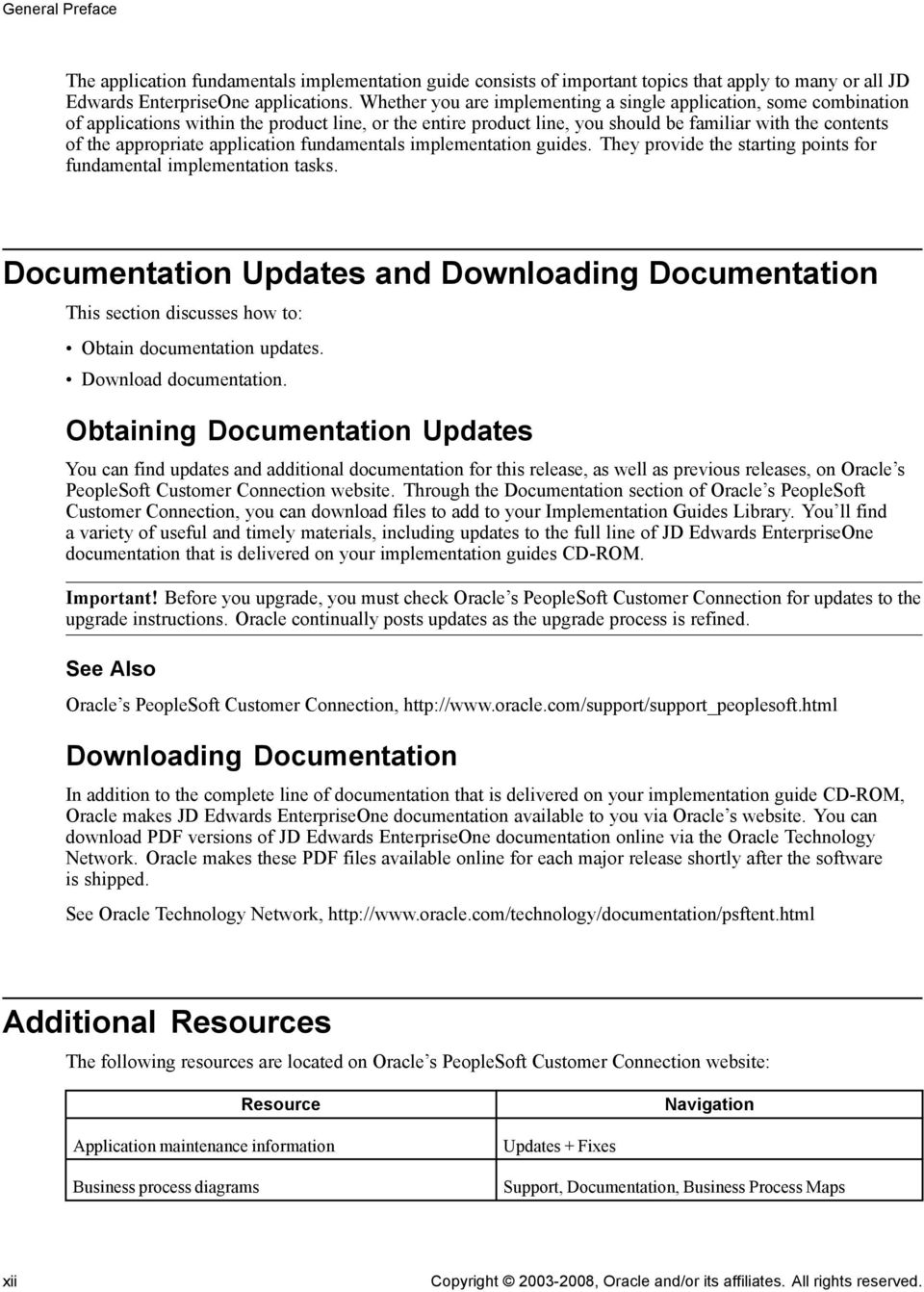
13 General Preface Resource Interactive Services Repository Hardware and software requirements Installation guides Integration information Minimum technical requirements (MTRs) Documentation updates Implementation guides support policy Prerelease notes Product release roadmap Release notes Release value proposition Statement of direction Troubleshooting information Upgrade documentation Navigation Support, Documentation, Interactive Services Repository Implement, Optimize + Upgrade; Implementation Guide; Implementation Documentation and Software; Hardware and Software Requirements Implement, Optimize + Upgrade; Implementation Guide; Implementation Documentation and Software; Installation Guides and Notes Implement, Optimize + Upgrade; Implementation Guide; Implementation Documentation and Software; Pre-Built Integrations for PeopleSoft Enterprise and JD Edwards EnterpriseOne Applications Implement, Optimize + Upgrade; Implementation Guide; Supported Platforms Support, Documentation, Documentation Updates Support, Support Policy Support, Documentation, Documentation Updates, Category, Release Notes Support, Roadmaps + Schedules Support, Documentation, Documentation Updates, Category, Release Notes Support, Documentation, Documentation Updates, Category, Release Value Proposition Support, Documentation, Documentation Updates, Category, Statement of Direction Support, Troubleshooting Support, Documentation, Upgrade Documentation and Scripts Typographical Conventions and Visual Cues This section discusses: Typographical conventions. Visualcues. Country, region, and industry identifiers. Currency codes. Copyright , Oracle and/or its affiliates. All rights reserved. xiii
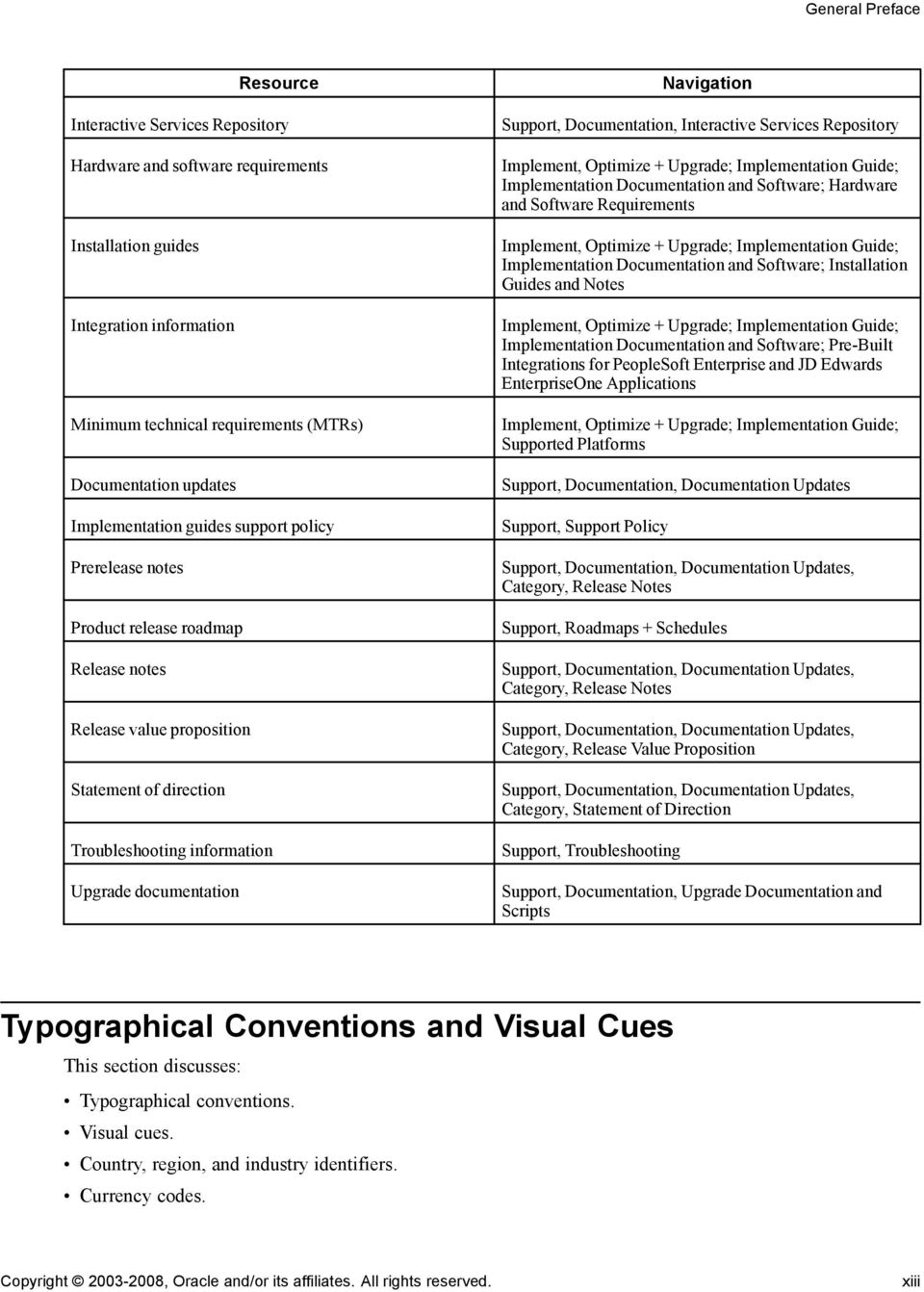
14 General Preface Typographical Conventions This table contains the typographical conventions that are used in implementation guides: Typographical Convention or Visual Cue Description Bold Indicates PeopleCode function names, business function names, event names, system function names, method names, language constructs, and PeopleCode reserved words that must be included literally in the function call. Italics Indicates field values, emphasis, and JD Edwards EnterpriseOne or other book-length publication titles. In PeopleCode syntax, italic items are placeholders for arguments that your program must supply. We also use italics when we refer to words as words or letters as letters, as in the following: Enter the letter O. KEY+KEY Indicates a key combination action. For example, a plus sign (+) between keys means that you must hold down the first key while you press the second key. For ALT+W, hold down the ALT key while you press the W key. Monospace font Indicates a PeopleCode program or other code example. (quotation marks) Indicate chapter titles in cross-references and words that are used differently from their intended meanings.... (ellipses) Indicate that the preceding item or series can be repeated any number of times in PeopleCode syntax. { } (curly braces) Indicate a choice between two options in PeopleCode syntax. Options are separated by a pipe ( ). [ ] (square brackets) Indicate optional items in PeopleCode syntax. & (ampersand) When placed before a parameter in PeopleCode syntax, an ampersand indicates that the parameter is an already instantiated object. Ampersands also precede all PeopleCode variables. Visual Cues Implementation guides contain the following visual cues. xiv Copyright , Oracle and/or its affiliates. All rights reserved.

15 General Preface Notes Notes indicate information that you should pay particular attention to as you work with the JD Edwards EnterpriseOne system. Note. Example of a note. If the note is preceded by Important!, the note is crucial and includes information that concerns what you must do for the system to function properly. Important! Example of an important note. Warnings Warnings indicate crucial configuration considerations. Pay close attention to warning messages. Warning! Example of a warning. Cross-References Implementation guides provide cross-references either under the heading See Also or on a separate line preceded by the word See. Cross-references lead to other documentation that is pertinent to the immediately preceding documentation. Country, Region, and Industry Identifiers Information that applies only to a specific country, region, or industry is preceded by a standard identifier in parentheses. This identifier typically appears at the beginning of a section heading, but it may also appear at the beginning of a note or other text. Example of a country-specific heading: (FRA) Hiring an Employee Example of a region-specific heading: (Latin America) Setting Up Depreciation Country Identifiers Countries are identified with the International Organization for Standardization (ISO) country code. Region Identifiers Regions are identified by the region name. The following region identifiers may appear in implementation guides: Asia Pacific Europe Latin America North America Industry Identifiers Industries are identified by the industry name or by an abbreviation for that industry. The following industry identifiers may appear in implementation guides: USF(U.S.Federal) Copyright , Oracle and/or its affiliates. All rights reserved. xv

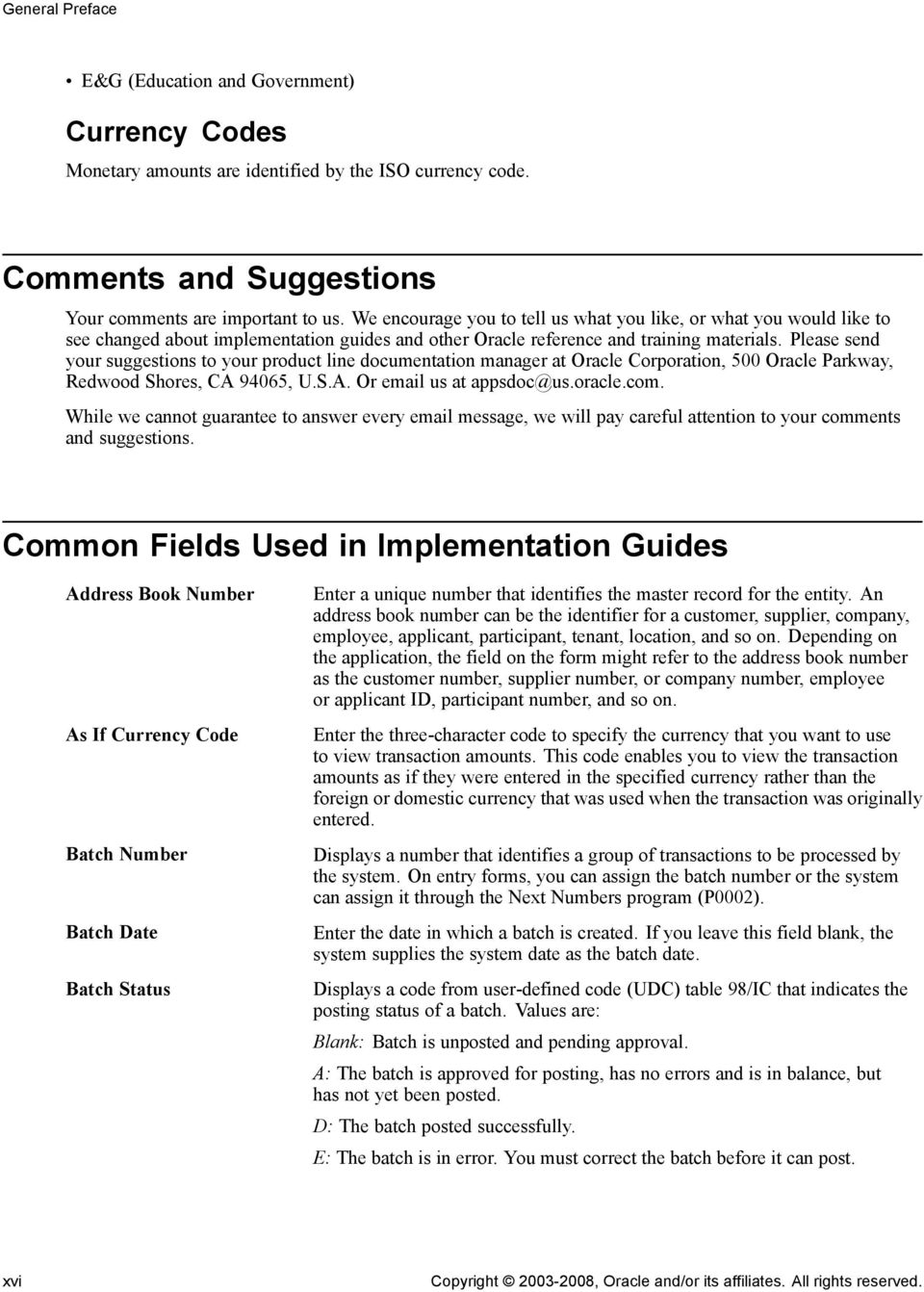
16 General Preface E&G (Education and Government) Currency Codes Monetary amounts are identified by the ISO currency code. Comments and Suggestions Your comments are important to us. We encourage you to tell us what you like, or what you would like to see changed about implementation guides and other Oracle reference and training materials. Please send your suggestions to your product line documentation manager at Oracle Corporation, 500 Oracle Parkway, Redwood Shores, CA 94065, U.S.A. Or us at While we cannot guarantee to answer every message, we will pay careful attention to your comments and suggestions. Common Fields Used in Implementation Guides Address Book Number As If Currency Code Batch Number Batch Date Batch Status Enter a unique number that identifies the master record for the entity. An address book number can be the identifier for a customer, supplier, company, employee, applicant, participant, tenant, location, and so on. Depending on the application, the field on the form might refer to the address book number as the customer number, supplier number, or company number, employee or applicant ID, participant number, and so on. Enter the three-character code to specify the currency that you want to use to view transaction amounts. This code enables you to view the transaction amounts as if they were entered in the specified currency rather than the foreign or domestic currency that was used when the transaction was originally entered. Displays a number that identifies a group of transactions to be processed by the system. On entry forms, you can assign the batch number or the system can assign it through the Next Numbers program (P0002). Enter the date in which a batch is created. If you leave this field blank, the system supplies the system date as the batch date. Displays a code from user-defined code (UDC) table 98/IC that indicates the posting status of a batch. Values are: Blank: Batch is unposted and pending approval. A: The batch is approved for posting, has no errors and is in balance, but has not yet been posted. D: The batch posted successfully. E: The batch is in error. You must correct the batch before it can post. xvi Copyright , Oracle and/or its affiliates. All rights reserved.
17 General Preface Branch/Plant Business Unit Category Code Company Currency Code Document Company Document Number Document Type P: The system is in the process of posting the batch. The batch is unavailable until the posting process is complete. If errors occur during the post, the batch status changes to E. U: The batch is temporarily unavailable because someone is working with it, or the batch appears to be in use because a power failure occurred while the batch was open. Enter a code that identifies a separate entity as a warehouse location, job, project, work center, branch, or plant in which distribution and manufacturing activities occur. In some systems, this is called a business unit. Enter the alphanumeric code that identifies a separate entity within a business for which you want to track costs. In some systems, this is called a branch/plant. Enter the code that represents a specific category code. Category codes are user-defined codes that you customize to handle the tracking and reporting requirements of your organization. Enter a code that identifies a specific organization, fund, or other reporting entity. The company code must already exist in the F0010 table and must identify a reporting entity that has a complete balance sheet. Enter the three-character code that represents the currency of the transaction. JD Edwards EnterpriseOne provides currency codes that are recognized by the International Organization for Standardization (ISO). The system stores currency codes in the F0013 table. Enter the company number associated with the document. This number, used in conjunction with the document number, document type, and general ledger date, uniquely identifies an original document. If you assign next numbers by company and fiscal year, the system uses the document company to retrieve the correct next number for that company. If two or more original documents have the same document number and document type, you can use the document company to display the document that you want. Displays a number that identifies the original document, which can be a voucher, invoice, journal entry, or time sheet, and so on. On entry forms, you can assign the original document number or the system can assign it through the Next Numbers program. Enter the two-character UDC, from UDC table 00/DT, that identifies the origin and purpose of the transaction, such as a voucher, invoice, journal entry, or time sheet. JD Edwards EnterpriseOne reserves these prefixes for the document types indicated: P: Accounts payable documents. R: Accounts receivable documents. T: Time and pay documents. I: Inventory documents. O: Purchase order documents. S: Sales order documents. Copyright , Oracle and/or its affiliates. All rights reserved. xvii

18 General Preface Effective Date Fiscal Period and Fiscal Year G/L Date (general ledger date) Enter the date on which an address, item, transaction, or record becomes active. The meaning of this field differs, depending on the program. For example, the effective date can represent any of these dates: The date on which a change of address becomes effective. The date on which a lease becomes effective. The date on which a price becomes effective. The date on which the currency exchange rate becomes effective. The date on which a tax rate becomes effective. Enter a number that identifies the general ledger period and year. For many programs, you can leave these fields blank to use the current fiscal period and year defined in the Company Names & Number program (P0010). Enter the date that identifies the financial period to which a transaction will be posted. The system compares the date that you enter on the transaction to the fiscal date pattern assigned to the company to retrieve the appropriate fiscal period number and year, as well as to perform date validations. xviii Copyright , Oracle and/or its affiliates. All rights reserved.

19 JD Edwards EnterpriseOne Resource Assignments Preface This preface discusses: JD Edwards EnterpriseOne products. JD Edwards EnterpriseOne application fundamentals. Common fields used in this implementation guide. JD Edwards EnterpriseOne Products This implementation guide refers to these JD Edwards EnterpriseOne products from Oracle: JD Edwards EnterpriseOne Capital Asset Management JD Edwards EnterpriseOne Human Resources JD Edwards EnterpriseOne Human Capital Management Foundation JD Edwards EnterpriseOne Time and Labor JD Edwards EnterpriseOne Work Orders JD Edwards EnterpriseOne Application Fundamentals Additional, essential information describing the setup and design of the system appears in a companion volume of documentation called JD Edwards EnterpriseOne Capital Asset Management 9.0 Implementation Guide. Customers must conform to the supported platforms for the release as detailed in the JD Edwards EnterpriseOne minimum technical requirements. In addition, JD Edwards EnterpriseOne may integrate, interface, or work in conjunction with other Oracle products. Refer to the cross-reference material in the Program Documentation at for Program prerequisites and version cross-reference documents to assure compatibility of various Oracle products. See Also JD Edwards EnterpriseOne Capital Asset Management 9.0 Implementation Guide, "JD Edwards EnterpriseOne Capital Asset Management Preface" Common Fields Used in This Implementation Guide Branch Enter a secondary or higher level business unit. Copyright , Oracle and/or its affiliates. All rights reserved. xix

20 Preface In tenant work orders, this business unit is the building number. It is edited against the Business Unit Master file (F0006). You can assign subordinate business units to it: Building Number (MMCU) UnitA(MCU) UnitB(MCU) Job 123 (MCU) Note. This is a required field if a unit number is entered. In the Engineering Change Order system, this is the branch or plant for the engineering change order. Business Unit Calendar Type Enter a value that identifies a separate entity within a business for which you want to track costs. For example, a business unit might be a job, project, work center, or branch/plant. Business unit security can prevent you from locating business units for which youhavenoauthority. Enter a user defined code (42/WD) that specifies how the calendar is used. For example, the calendar might be specific to an industry such as banking or it might be used to schedule delivery persons for a route. Note. If you use the default value of *, the system updates the value to blank even though blank is not set up as a valid value in the UDC table. Calendar Value Enter a code used to classify values within a calendar type. For example, if thecalendartypeisroute, you can enter a code that specifies a particular route, such as Daily or Weekend. Note. The system does not validate the code that you enter. Crew Effective Date Expired Date Lead Craft Enter the address book number of a group of employees covering a number of lead crafts (trade) which is responsible for carrying out the work in a specific area or for a particular craft across multiple areas. Enter the date on which this transaction takes effect. The effective date is used generically. The date can be the date of the next raise, a lease effective date, a price or cost effective date, a currency effective date, a tax rate effective date, a change in well status, or any other date that is appropriate. Enter the expiration date of the log entry. For example, in the case of a submittal requirement for an insurance certificate, the termination date for the policy would be entered in the Expired Date field. The termination date would then be used by the Submittal Status Update program to update the status field. If the Expired Date is earlier than the date that you run the program, the system sets the status to N for the log entry. Enter an alphanumeric code used to define the lead craft required to complete the work. The value entered is used as the default craft (work center) when new labor detail records are added to the work order. xx Copyright , Oracle and/or its affiliates. All rights reserved.

21 Preface Resource Type Enter a code that identifies the type of resource for which you are entering competency information. This is a user defined code (05/RT). Values are: 01: Individual 02: Asset, such as equipment Note. If you change the resource type, ensure that the spread of the assigned hours matches the estimated labor and machine hours Resource Number Shift Code Site and Supervisor Enter a number that represents either the address number or the asset number, depending on whether the resource that you are working with is a person or a pieceofequipment.thesystemusesthe resource number in conjunction with the resource type to uniquely identify the resource. For Resource Type 01 (individuals), you can use these formats to enter an address number: Short address number Long address number Tax ID For Resource Type 02 (assets), you can use these formats to enter an asset number: Asset number Unit number Serial number Enter a user defined code (00/SH) that identifies daily work shifts. In payroll systems, you can use a shift code to add a percentage or amount to the hourly rate on a timecard. For payroll and time entry: If an employee always works a shift for which a shift rate differential is applicable, enter that shift code on the employee s master record. When you enter the shift on the employee s master record, you do not need to enter the code on the timecard when you enter time. If an employee occasionally works a different shift, you enter the shift code on each applicable timecard to override the default value. Enter a user-defined name or number that identifies an address book record. You can use this number to locate and enter information about the address book record. If you enter a value other than the address book number (AN8), such as the long address or tax ID, you must precede it with the special character that is defined in the Address Book constants. When the system locates the record, it returns the address book number to the field. For example, if address book number 4100 (Total Solutions) has a long address TOTAL and an * distinguishes it from other entries (as defined in the Address Book constants), you could type *TOTAL into the field, and the system would return Copyright , Oracle and/or its affiliates. All rights reserved. xxi
22 Preface xxii Copyright , Oracle and/or its affiliates. All rights reserved.
23 CHAPTER 1 Getting Started with JD Edwards EnterpriseOne Resource Assignments This chapter discusses: JD Edwards EnterpriseOne Resource Assignments overview. JD Edwards EnterpriseOne Resource Assignments implementation. JD Edwards EnterpriseOne Resource Assignments Overview The JD Edwards EnterpriseOne Resource Assignments system from Oracle provides the capability to assign resources to a work order or to specific work order instructions while checking the current availability and assignments of the resources. Once work orders and instructions have been entered into the system, you can assign resources to either the work order or the instruction that is based on the work order document type. Resources can be either individuals who are validated against the address book or equipment that is validated against the equipment master. JD Edwards EnterpriseOne Resource Assignments Implementation This section provides an overview of the steps that are required to implement the JD Edwards EnterpriseOne Resource Assignments system. In the planning phase of the implementation, take advantage of all JD Edwards EnterpriseOne sources of information, including the installation guides and troubleshooting information. A complete list of these resources appears in the preface in the JD Edwards EnterpriseOne Financial Management Application Fundamentals 9.0 Implementation Guide with information about where to find the most current version of each. When determining which electronic software updates (ESUs) to install for JD Edwards EnterpriseOne Resource Assignments, use the EnterpriseOne and World Change Assistant. EnterpriseOne and World Change Assistant, a Java-based tool, reduces the time that is required to search for and download ESUs by 75 percent or more and enables you to install multiple ESUs at one time. See JD Edwards EnterpriseOne Tools 8.98 Software Update Guide Copyright , Oracle and/or its affiliates. All rights reserved. 1
24 Getting Started with JD Edwards EnterpriseOne Resource Assignments Chapter 1 Global Implementation Steps for JD Edwards EnterpriseOne Resource Assignments This table lists the suggested global implementation steps for JD Edwards EnterpriseOne Resource Assignments: Step 1. Set up companies, fiscal date patterns, and business units. Reference JD Edwards EnterpriseOne Financial Management Application Fundamentals 9.0 Implementation Guide, "Setting Up Organizations" 2. Set up accounts and the chart of accounts. JD Edwards EnterpriseOne Financial Management Application Fundamentals 9.0 Implementation Guide, "Creating the Chart of Accounts" 3. Set up the General Accounting constants. JD Edwards EnterpriseOne General Accounting 9.0 Implementation Guide, "Setting Up the General Accounting System" 4. Enter address book records. JD Edwards EnterpriseOne Address Book 9.0 Implementation Guide, "Entering Address Book Records" 5. Enter equipment master records. JD Edwards EnterpriseOne CapitalAssetManagement 9.0 Implementation Guide, "Creating Equipment Master Records" 6. Enter work orders and instructions. JD Edwards EnterpriseOne CapitalAssetManagement9.0 Implementation Guide,"WorkingwithWorkOrders" Implementation Steps for the JD Edwards EnterpriseOne Resource Assignments System This table lists the implementation steps for the JD Edwards EnterpriseOne Resource Assignments system. Step 1. Set up Resource Assignment constants and resource working hours. Reference Chapter 2, "Setting Up the Resource Assignments System," page 3 2. Set up resource master information. Chapter 3, "Entering Resource Master Records," page If your organization uses crews and crew scheduling, set up crews, schedule periods, and crew working hours. 4. Set up system integrations with Employee Assignment. Set up a system constant, users, Employee Assignment integration settings, and Resource Assignment integration settings. Chapter 4, "Managing Crew Scheduling," page 25 Chapter 6, "Integrating with Employee Assignments," page 89 2 Copyright , Oracle and/or its affiliates. All rights reserved.
25 CHAPTER 2 Setting Up the Resource Assignments System This chapter provides overviews of the JD Edwards EnterpriseOne Resource Assignments system and of user-defined codes for work order resource assignments and discusses how to: Set up resource assignment constants. Define resource working hours. Define crew maintenance schedule periods. Understanding the JD Edwards EnterpriseOne Resource Assignments System Assigning resources to work orders involves matching the work order requirements against the resources; checking the availability, competencies, and skills of the resources; and creating resource assignments that can be monitored and against which reports can be run. When you use work order resource assignments, you define the available capacity of resources by setting up a base calendar with available working hours. You also can set up a resource calendar for a specific resource to override the base calendar for instance, if an employee takes a vacation. When the base calendar is defined, you can associate resources with the base calendar in the Resource Master program (P48310) to define their availability. At any time, you can review the resource assignment information to determine whether resources are loaded according to their capacity. If you want to check the competencies or skills of resources, you need to have Oracle s JD Edwards EnterpriseOne Human Capital Management Foundation and the JD Edwards EnterpriseOne Human Resources systems installed. See Also JD Edwards EnterpriseOne Human Resources 9.0 Implementation Guide, "Setting Up Competency Management" Understanding User-Defined Codes for Work Order Resource Assignments Copyright , Oracle and/or its affiliates. All rights reserved. 3
26 Setting Up the Resource Assignments System Chapter 2 This table lists the user-defined codes (UDCs) for the applications in the work order resource assignments module: User-Defined Code 42/WD: Resource Calendar Type 48/TP: Assignment Type 48/LP: Load Profile Method 48/PT: Period Type 48/CT: Calendar Type 48/RC: Override Reason 48/RD: Resource Details Description Specifies how the calendar is used. For example, the calendar might be specific to an industry such as banking, or it might be used within JD Edwards EnterpriseOne Resource Assignments. Specifies the type of assignment in scheduling, notification, and assignment. For future use. Specifies the load profile method for resources. The load profile method indicates how the work of an assignment is distributed. Currently, only a flat load profile is supported. Specifies the type of period the system uses for displaying the availability and assignments of the resources You can set a default value in the processing options for the Resource Assignment program (P48331). Specifies the selected calendar type (for example, base calendar) when you define working hours in the Resource Working Hours program (P48307). Click the Search button for the Type field to access values. Specifies the reason for the working hours override. If integrating with the HR Leave Request process, ensure that valid UDC values from 07/LV Leave Type are included in the Override Reason Code UDC. Specifies whether the resources assignments or availability appears on the Work with Resource Assignments form in the Resource Assignment program. You can set a default value in the processing options for the Resource Assignment program. 48/01-48/20: Resource Attributes These user-defined codes define additional filter criteria for resources. For example, if the JD Edwards EnterpriseOne Human Resources or Payroll systems are not installed, you can use these codes to define criteria such as job type or competency. 48/SD: Scheduling Day of Week 48/WD: Work Day 48/TK: Task Status Specifies the days for which working hours are defined. This system uses this code in the Resource Working Hours program. Specifies which day of the week is the starting workday. You can set a default value in the processing options for the Resource Assignment program. Specifies the status of a task in scheduling, notification, and assignment. For future use. 4 Copyright , Oracle and/or its affiliates. All rights reserved.
27 Chapter 2 Setting Up the Resource Assignments System 48/CK: Calendar Key User-Defined Code 48/RL: Resource Assignment Level Description Classifies different resource calendars. For example, you might define normal shift, day shift, and night shift calendars. Specifies whether resource assignments are at the level of the work order or the work order labor detail, based on the work order document type. To make assignments at the labor detail level, you must use this UDC to specify the work order document type. Setting Up Resource Assignment Constants This section provides an overview of resource assignment constants and discusses how to set up resource assignment constants. Understanding Resource Assignment Constants Before you can assign resources to work orders, you must set up the resource assignment constants, using the Resource Assignment Constants program (P48301), to provide default values for the work day calendar and for the hours that can be set up for resources. You define resource assignment constants by business unit. At a minimum, you must define resource assignment constants for business unit ALL to provide global default values. You can also define default values for specific business units. When you create a resource master record, the system uses the business unit that is associated with the resource to determine which default values to use. You can create resource master records for individuals or for assets. The system retrieves the business unit for individual resources from the address book, and retrieves the business unit for assets from the equipment master. If no constants exist for the business unit that is associated with the resource, the system uses the default values for business unit ALL. The system uses the working hours default values when the working hours are created in the Resource Working Hours program. When you create base calendars, the system uses the default values from the resource assignment constants for business unit ALL. When you create resource calendars, the system uses the resource assignment constants that are set up for the business unit that is associated with the resource. If no business-unit specific constants exist, the system uses the values from the business unit ALL constants when creating resource calendars. The system uses resource assignment constants to populate these fields with default values when you create a resource master record: Calendar Type Calendar Value Branch Shift Copyright , Oracle and/or its affiliates. All rights reserved. 5
28 Setting Up the Resource Assignments System Chapter 2 See Also JD Edwards EnterpriseOne Financial Management Application Fundamentals 9.0 Implementation Guide, "Setting Up Organizations," Setting Up Business Units Forms Used to Set Up Resource Assignment Constants Form Name FormID Navigation Usage Work with Resource Assignment Constants W48301B Resource Assignment Setup (G13RA41), Resource Assignment Constants Access forms to set up constants for resource assignments. Resource Assignment Constants - Revision W48301A On the Work with Resource Assignment Constants form, click Add. Set up resource assignment constants. Setting Up Resource Assignment Constants Access the Resource Assignment Constants - Revision form. Resource Assignment Constants - Revision form Business Unit Calendar Type Calendar Value Enter the business unit number to set up constants for a specific business unit. Otherwise, enter ALL to set up default constants. At a minimum, you must define constants for business unit ALL. You can then define constants for additional business units if necessary. Enter RESOURCE to set up constants for resource calendars. Calendar type values are stored in UDC 48/CT, and can include values such as RESOURCE or BASE. Enter a code that, along with the Calendar Type field, further defines the type of calendar you are working with. Calendar value codes are stored in UDC 48/CK and might include values such as night shift, day shift, and holiday. 6 Copyright , Oracle and/or its affiliates. All rights reserved.
29 Chapter 2 Setting Up the Resource Assignments System Start Time Enter the time that resources are typically available to begin working during the workday. The system uses this value to calculate available hours for the day. This field is currently not used whenyouareschedulingtasks. Note. You can enter multiple start and end time ranges. For example, if a resource is typically available from 8:00 until 12:00, then takes an hour break for lunch, and continues working from 13:00 through 17:00, you would enter 8:00 in the first row for Start Time, and 13:00 in the second row for Start Time. You would then enter 12:00 in the first row for End Time, and 17:00 in the second row for End Time. End Time Enter the time that resources are typically no longer available during the work day. The system uses this value to calculate available hours for the day. This field is currently not used when you are scheduling tasks. Note. You can enter multiple start and end time ranges. For example, if a resource is typically available from 8:00 until 12:00, then takes an hour break for lunch, and continues working from 13:00 through 17:00, you would enter 8:00 in the first row for Start Time, and 13:00 in the second row for start time. You would then enter 12:00 in the first row for End Time, and 17:00 in the second row for End Time. Available Review the number of hours that are available. The system calculates this value based on the values in the Start Time and End Time fields. Defining Resource Working Hours This section provides an overview of resource working hours, lists prerequisites, and discusses how to: Add a base calendar. Add a resource calendar. Understanding Resource Working Hours After you have defined default working hours in the Resource Assignment Constants program, you use the Resource Working Hours program to set up working hour calendars. You can set up two types of working hour calendars: Base calendar The base calendar enables you to set up the working hours in a typical work week for a group of resources. The group of resources is associated with the same work day calendar in the Resource Master program. When you create a base calendar, the system supplies the working hours using the default values from the Resource Assignment Constants for business unit ALL. You can edit these values as necessary. For days on whichnoworkisdone forexample,saturdayandsunday you can override the normal working hours by entering 0 (zero) in the Start Time and End Time fields. In addition, you can specify that the system considers certain days, such as holidays, nonworking days. Resource calendar Copyright , Oracle and/or its affiliates. All rights reserved. 7
30 Setting Up the Resource Assignments System Chapter 2 Resource calendars enable you to override the capacity for a particular resource for a particular date or date range. Use resource calendars for exceptions to the base calendar, such as vacation time for a specific resource. The resource must exist in the Resource Master table (F48310) before you can create a resource calendar. The calendar values that are defined in the Resource Working Hours program (P48307) are stored in the F48307 table. Day of Week, Overrides, and Holidays When you create a base calendar, you can define the days of the week on which that calendar should be used. If the calendar should be used for all or most days during the week, you can enter 0 (zero) in the Day of Week field, and specify the number of hours, using start and end times, that resources are available during each day of the week. You can then enter additional calendars for that same calendar type, calendar value, branch, and shift code combination to specify any days of the week that do not match those set up in the original base calendar. For example, assume that all resources in Branch M30, regardless of shift, are available for 8 hours each day of the week except for Saturday and Sunday, when they are not available at all. You can create these three base calendars for this scenario: Calendar Type Calendar Value Branch Day of Week Hours Available RESOURCE NORMAL M30 0 (Default for each day of the week) 8 RESOURCE NORMAL M30 6(Saturday) 0 RESOURCE NORMAL M30 7 (Sunday) 0 Note. The values in the Hours Available field are calculated based on the start and end times that you enter for the calendar. To calculate 0 (zero) available hours, enter 0 in both the Start Time and End Time fields. You can also create base calendars to specify company holidays, or other days on which large numbers of resources are not available as they would normally be. To create a base calendar for a specific day, you enter 9 in the Day of Week field. For example, if resources are typically available for 8 hours on Mondays, but a company holiday falls on a Monday, you can create a base calendar for the holiday by entering 9 in the Day of Week field, entering the date of the holiday in the Date field, and entering 0 in both the Start Time and End Time fields. You must enter 9 in the Day of Week field to enable the Date field. Prerequisites Before you complete the tasks in this section: Verify that you have set up the resource assignment constants for business unit ALL and other business units, if required. Verify that the resource exists in the Resource Master program before you add a resource calendar. 8 Copyright , Oracle and/or its affiliates. All rights reserved.
31 Chapter 2 Setting Up the Resource Assignments System Forms Used to Define Resource Working Hours Form Name FormID Navigation Usage W48307A Periodic Resource View existing calendar Assignment Processing values. (G13RA20), Resource Working Hours Work With Resource Working Hours Add a calendar value or resource calendar value. Working HoursDetail - Base W48307B OntheWork WithResource Working Hours form, select the Base Calendar tab and then click Add. Add a base calendar. Work Hours Detail - Resource W48307D On the Work With Resource Working Hours form, select the Resource Calendar tab andthenclickadd. Add a resource calendar. Adding a Base Calendar Access the Working Hours Detail - Base form. Working Hours Detail - Base form Shift Day of Week Enter a user-defined code (00/SH) that identifies daily work shifts. Complete this field only if the base calendar is specific to resources during a specific shift. Enter a code to specify the days of the week for which the working hours that are associated with this calendar apply. If you do not specify a day of the week, the system uses 0 (zero). Values are: 0: Assign base or resource working hours to every day of the week. 1: Assign base or resource working hours to Monday. Copyright , Oracle and/or its affiliates. All rights reserved. 9
32 Setting Up the Resource Assignments System Chapter 2 Override Reason Date Start Time End Time Hours Available 2: Assign base or resource working hours to Tuesday. 3: Assign base or resource working hours to Wednesday. 4: Assign base or resource working hours to Thursday. 5: Assign base or resource working hours to Friday. 6: Assign base or resource working hours to Saturday. 7: Assign base or resource working hours to Sunday. 9: Override working hours for a specific date. If you want to define an override value for a specific date, enter 9 in the Day of Week field. Doing so enables the Date field. You might use this option to enter an override number of working hours for a company holiday. Enter a code to indicate the reason for the working hours override. For example, to specify that the override is due to a company holiday, enter HOL. Values are stored in UDC 48/RC. Enter the override date for a base calendar entry in this field. This field is enabled only if you enter 9 in the Day of Week field. For example, if resources are typically available for 8 hours on Mondays, but a company holiday falls on a Monday, you can create a base calendar for the holiday by entering 9 in the Day of Week field, entering the date of the holiday in this field, and entering 0 in both the Start Time and End Time fields. Enter the start time that the system uses to calculate available hours for the day. This field is currently not used when you are scheduling tasks. The default values for this field come from the resource assignment constants for business unit ALL. You can override this value. Enter the finish time that the system uses to calculate available hours for the day. This field is currently not used when you are scheduling tasks. The default values for this field come from the resource assignment constants for business unit ALL. You can override this value. Review the number of hours that a resource is available for scheduling on a single day. The system calculates available hours for the start and end times that you entered. Adding a Resource Calendar Access the Working Hours Detail - Resource form. 10 Copyright , Oracle and/or its affiliates. All rights reserved.
33 Chapter 2 Setting Up the Resource Assignments System Working Hours Detail - Resource form Resource Type Date From and Date Thru Shift Code Specify the type of resource for which you are overriding working hours. You can enter resource working hours for an individual or for an asset. For example, you might enter resource working hours for an individual if that person is on vacation, or for an asset if the asset is undergoing maintenance. This is a user-defined code (05/RT). Values are: 01: Individual 02: Asset Enter the date range during which the override values are effective. For example, if a resource is on vacation for a week, enter the first day of vacation in the Date From field, and the last day of vacation in the Date Thru field. Specify the shift for which the override hours apply. For example, you might specify that the resource is available for the night shift. This field is informational only. The system does not use this value to calculate the available hours for the resource. The system uses the start and end times to calculate the number of available hours. Defining Crew Maintenance Schedule Periods This section provides an overview of crew maintenance schedule periods and discusses how to: Define crew maintenance schedule periods. Set the current period. Understanding Crew Maintenance Schedule Periods Copyright , Oracle and/or its affiliates. All rights reserved. 11
34 Setting Up the Resource Assignments System Chapter 2 Before you can schedule work for a work crew, you must define the dates that define each work period for which you schedule work. You use the Maintenance Schedule Periods program (P48302) to define the crew maintenance schedule periods, which include the dates that are associated each scheduling period. Before you can create schedule periods, you must first define schedule pattern codes in UDC 13/SP. When youdefineaschedule pattern code, you specify the number of days that are associated with each work period for that code by entering the number in the Special Handling field in the UDC table. For example, to define weekly schedule periods, you might create code W in UDC 13/SP, and enter 7 in the Special Handling field for that code. After you define schedule pattern codes, you can create the crew maintenance schedule periods. You specify the schedule pattern code and the date on which the first schedule period begins, and the system generates all future schedule periods based on these values. After you have generated the schedule periods, you must specify which of those periods is the current schedule period. Going forward, you can move the current schedule period manually or set up the system to automatically roll to the next schedule period using a batch program. Note. If you change or regenerate the schedule periods after they are in the system, the system deletes all existing schedule periods from the start date and inserts the new schedule periods. After you generate the crew maintenance schedule periods, you can associate the schedule with a crew using the Resource Master program. The system uses the dates from the crew maintenance schedule periods to determine the date ranges on the crew scheduling programs so that you can display the current, next, following, and future periods without having to manually enter the date ranges. A typical schedule period might define weekly work starting on Monday and finishing on Sunday. Schedule periods are user-defined and can be set up to include any number of days, depending on customer requirements. See Also Chapter 4, "Managing Crew Scheduling," Rolling the Schedule, page 55 Forms Used to Define Crew Maintenance Schedule Periods Form Name FormID Navigation Usage W48302A Resource Assignments Setup Set the current period. (G13RA41), Maintenance Schedule Periods Work With Maintenance Schedule Periods View and update maintenance schedule periods. Maintenance Schedule Period Generation W48302C On the Work With Maintenance Schedule Periods form, click Add. Define crew maintenance schedule periods. Defining Crew Maintenance Schedule Periods Access the Maintenance Schedule Period Generation form. 12 Copyright , Oracle and/or its affiliates. All rights reserved.
35 Chapter 2 Setting Up the Resource Assignments System Maintenance Schedule Period Generation form After you complete the required fields on this form, click the Generate Periods button. The system displays the results of the generation process next to the button after processing is complete. For example, if the system successfully creates all periods, the message Period Build Successful appears on the form. Setting the Current Period Access the Work With Maintenance Schedule Periods form. Work With Maintenance Schedule Periods form Select a record, and then select Set Current from the Row menu to define the current schedule period. Copyright , Oracle and/or its affiliates. All rights reserved. 13
36 Setting Up the Resource Assignments System Chapter 2 14 Copyright , Oracle and/or its affiliates. All rights reserved.
37 CHAPTER 3 Entering Resource Master Records This chapter provides an overview of resource master records and discusses how to: Enter resource master records. Update the Resource Master table. Assign resources to a crew. Understanding Resource Master Records You use the Resource Master program (P48310) to maintain information and attributes for individual and equipment resources. The system validates individual resources against the address book. Individual resources can represent either a crew of people or a single person. The system validates equipment resources against the Asset Master File table (F1201). You can review resource information by resource type and resource number. You also can retrieve both active and inactive resources. When you enter data using the Resource Master program, the system creates records in the Resource Master table (F48310). The system uses this table to determine which resources are available for work order assignments. After a resource exists in the F48310 table, you can add the resource to a resource assignment. You can also define an effective date range for the resource and associate the resource with a crew, supervisor, site, and lead craft. When you enter a resource, the system populates the Calendar Type, Calendar Value, Branch, and Shift Code (if applicable) fields with the default values from the Resource Assignment constants. The system uses the Resource Assignment constants that are associated with the resource s business unit, as defined in the Address Book Master table (F0101), or the Asset Master File table. If no resource assignment constants are set up for the business unit, the system uses the default values for business unit ALL. You can manually override any of the default information. Additionally, you can select the time zone manually or set up the system to use the value from the processing options. You can also specify that a resource as inactive. The system does not display inactive resources when you perform an advanced search using the Resource Master Search & Select program (P48310S). In addition, the Resource Master program provides 20 user-defined category codes that you can use to further classify resource attributes. Copyright , Oracle and/or its affiliates. All rights reserved. 15
38 Entering Resource Master Records Chapter 3 Crew Scheduling If you use crew scheduling, you must define the crews in the Resource Master program. The crew is a group of resources that are responsible for the maintenance of a particular area. The crew and each individual resource is defined in the Resource Master program. When you define the crew, you assign the Schedule Period code to specify under which schedule period the crew operates. When the crew is set up, you can assign individual resources to the crew. You must set up each resource that is assigned to a crew in the Resource Master program and link it to the crew by entering the resource number for the crew in the Crew field. You can associate multiple resources to a crew based on the number of individuals who are qualified to work the particular craft. You also define the lead craft (trade) of the individual resource on the Resource Master record for use in crew scheduling and work assignments. Entering Resource Master Records This section lists a prerequisite and discusses how to: Set processing options for Resource Master (P48310). Enter resource master records. Prerequisite Before you complete the tasks in this section, verify that resource assignment constants have been set up. See Also Chapter 2, "Setting Up the Resource Assignments System," Setting Up Resource Assignment Constants, page 5 16 Copyright , Oracle and/or its affiliates. All rights reserved.
39 Chapter 3 Entering Resource Master Records Forms Used to Enter Resource Master Records Form Name FormID Navigation Usage W48310A Periodic Resource Assignment Processing (G13RA20), Resource Master Work with Address Book Resources Work with Equipment Resources W48310B Periodic Resource Assignment Processing (G13RA20), Resource Master Resource Master Revisions W48310C On the Work with Address Book Resources form or the Work with Equipment Resources form, click the Add button. Select existing resources, or access forms to enter new resource records. Note. Depending on a processing option setting, the Work with Address Book Resources form or the Work with Equipment Resources form appears. Select existing resources, or access forms to enter new resource records. Note. Depending on a processing option setting, the Work with Address Book Resources form or the Work with Equipment Resources form appears. Enter resource master records. Setting Processing Options for Resource Master (P48310) Processing options enable you to specify the default processing for programs and reports. Note. You must set these processing options before you enter resource master records. Defaults These processing options control the default values that the system uses when you add resources to the Resource Master table. 1. Resource Type Specify the default resource type. The system uses this information to determine which form to display when you access the program. Enter a value from user-defined code (UDC) table 05/RT (Record Type). If you leave this processing option blank, the system uses a resource type of 01. Values are: 01: Individual resource. The system displays the Work With Address Book Resources form. 02: Asset resource, such as equipment. The system displays the Work with Equipment Resources form. 2. Resource Activity Specify whether to display resources that are active, inactive, or both. Values are: Blank: All resources. Copyright , Oracle and/or its affiliates. All rights reserved. 17
40 Entering Resource Master Records Chapter 3 0: Active resources. 1: Inactive resources. 3. Effective Date Enter the default date on which a resource becomes active or available. If you leave this field blank, the resource becomes available on the date on which the record is entered into the system. You can override this date when you enter the resource. The system uses the effective date along with the expiration date to determine when a resource is active. 4. Expiration Date Enter the date on which the resource is no longer active or available. If you leavethisprocessing option blank, the system uses December 31, 2015 as the default expiration date. You can override this date when you enter a resource record. The system uses the expiration date along with the effective date to determine when a resource is active. 5. Time Zone Specify the default time zone that the system uses when you add resources in the Resource Master program. You can override this value when you enter the resource. This feature is scheduled for a future release. 6. Daylight Saving Specify whether to supply the daylight savings rule automatically when you add resources in the Resource Master program. This feature is scheduled for a future release. Versions This processing option controls the version that the system uses when this program is called. 1. Resource Competencies (P05100) Version Specify the version that the system uses when accessing the Resource Competency Information program (P05100). If you leave this processing option blank, the system uses version ZJDE0001. Entering Resource Master Records Access the Resource Master Revisions form. 18 Copyright , Oracle and/or its affiliates. All rights reserved.
41 Chapter 3 Entering Resource Master Records Resource Master Revisions form Basic Data Select the Basic Data tab. Crew Supervisor Lead Craft Assignment Percentage Schedule Pattern Inactive Enter a user-defined name or number that identifies an address book record for a crew. You can use this field to enter and locate information. If you enter a value other than the address book number (AN8), such as the long address or tax ID, you must precede it with the special character that is defined in the Address Book constants. When the system locates the record, it returns the address book number to the field. Enter a user-defined name or number that identifies an address book record for a supervisor. You can use this number to locate and enter information about the address book record. If you enter a value other than the address book number (AN8), such as the long address or tax ID, you must precede it with the special character that is defined in the Address Book constants. When the system locates the record, it returns the address book number to the field. Displays the lead craft. The lead craft is the primary craft for the resource, and categorizes individual resources when the system is determining the availability for the craft within the crew during crew scheduling. Enter a percentage that indicates the proportion of a resource s time that is allocated to the task. Enter a code to use a schedule pattern in crew scheduling. For example, M could represent a weekly scheduling pattern that starts on Monday with a seven-day period and2 could represent biweekly with a 14-day period. This field is enabled only for crew resource masters. Select to specify that the resource is inactive. Copyright , Oracle and/or its affiliates. All rights reserved. 19
42 Entering Resource Master Records Chapter 3 Crew (Y/N) (crew (yes/no)) Select to specify a crew resource master. If you select this option, the resource number and crew field must be the same and you must also define the schedule pattern code. Calendar Type Select the Calendar Type tab. Calendar Type Calendar Value Time Zone Rule Name Enter a UDC (42/WD) that specifies how the you will use calendar. For example, the calendar might be specific to an industry, such as banking, or you might use it to schedule delivery persons for a route. If you are using resource assignments to schedule resources for work, you typically enter RESOURCE in this field. Enter a code to further classify the type of calendar that is associated with the resource. For example, if the calendar type is RESOURCE, you can enter a code that specifies whether the resource calendar is a normal calendar or a shift calendar. Enter the time zone in which the resource is typically located. This value is used to determine the time for scheduling purposes. You can specify a default time zone in the processing options. Enter a name that uniquely identifies a daylight savings rule. Use daylight savings rules to adjust time for a geographic and political locale. Updating the Resource Master Table This section provides an overview of the resource master global update programs and discusses how to: Run the resource master global update programs. Set processing options for Resource Master Global Update - Address Book/Equipment Master (R48350/R48351). Understanding the Resource Master Global Update Programs The Resource Master Global Update - Address Book (R48350) and Resource Master Global Update - Equipment Master (R48351) programs enable you to add or update Resource Master table records in batch. The F48310 table is based on the Address Book Master table (F0101) or the Asset Master File table (F1201), respectively. You use data selection to control the records that are processed. The data selection for the Resource Master Global Update - Address Book program is based on the F0101 table. The data selection for the Resource Master Global Update - Equipment Master program is based on the F1201 table. Use processing options to determine the values that the system uses when you create or update the F48310 table. You can use processing options to set default values for the Resource Master records. For example, you can indicate: Source of the calendar values. Applicable address book numbers. 20 Copyright , Oracle and/or its affiliates. All rights reserved.
43 Chapter 3 Entering Resource Master Records Default branch/plant. Default assignment percentage value. Running the Resource Master Global Update Programs Select Advanced & Technical Operations menu (G13RA31), select Resource Master Global Update - Address Book or Resource Master Global Update - Equipment Master. Setting Processing Options for Resource Master Global Update - Address Book/Equipment Master (R48350/R48351) Processing options enable you to specify the default processing for programs and reports. Process This processing option controls whether the batch program runs in proof or final mode. 1. Proof or Final Mode Specify whether the system prints in proof mode or final mode. If you select final mode, the system updates tables as details are processed. If you select proof mode, the system does not update the tables as the report prints. Values are: Blank: Proof mode. 1: Final mode. Defaults These processing options control the default values that the system uses to update the Resource Master table. 1. Date - Effective Specify the date that the system uses to update the effective from date (DEF) in the F48310 table. If you leave this processing option blank, the system uses the system date when you add a new record. The system does not update the effective from date for existing records. 2. Date - Expired Specify the date that the system uses to update the effective through date (EXPR) in the F48310 table. If you leave this processing option blank, the system uses the date from the century change year (CENTCHG) when you add a new record. The system does not update the effective through date for existing records. 3. Default Calendar Values Specify whether the system uses the default calendar values that are specified in the processing options or set up in the F48301 tables. Values are: Blank: Use the calendar values that are specified in the processing options. 1: Use the calendar values that are set up in the F48301 table. 4. Business Unit to Retrieve Resource Constants Specify the business unit that the system uses to locate the default calendar values in the F48301 table. If you leave this processing option blank, the system uses the business unit from the F0101 table. 5. Branch Specify the default branch that the system uses when you create a resource master record. The system uses this value only if the Default Calendar Copyright , Oracle and/or its affiliates. All rights reserved. 21
44 Entering Resource Master Records Chapter 3 6. Work Day Calendar Type Values processing option is set to provide default calendar values from the processing options. Specify the default work day calendar type to use when you create a resource master record. Enter a value from UDC 42/WD (Work Day Calendar Type). The system uses this value only if the Default Calendar Values processing option is set to provide default calendar values from the processing options. 7. Work Day Calendar Key Specify the default work day calendar key to use when you create a resource master record. This code enables you to classify values within a calendar type. Enter a value from UDC 48/CK (Calendar Key). The system uses this value only if the Default Calendar Values processing option is set to provide default calendar values from the processing options. 8. Shift Code Specify the default shift code to use when you create a resource master record. Enter a value from UDC 06/SH (Shift Codes). The system uses this value only if the Default Calendar Values processing option is set to provide default calendar values from the processing options. 9. Crew Specify the address book number of the default crew to use when you create a resource master record. 10. Supervisor Specify the default supervisor to use when you create a resource master record. 11. Site Specify the default site to use when you create a resource master record. 12. Lead Craft Specify the default alphanumeric code for the lead craft that is required to complete the work. The system uses the value that you enter as the default craft (work center) when you add new labor detail records to a work order. 13. Active/Inactive Specify whether the resource is active or inactive when the resource master record is created. Values are: Blank: Active 1: Inactive 14. Percentage - Assignment Specify the default assignment percentage to use when you create a resource master record. The system uses this information to determine what proportion of a resource s time to allocate to a task. 15. Time Zone Specify the default time zone to use when you create a resource master record. This feature is scheduled for a future release. 16. Daylight Savings Rule Specify the default daylight savings rule for the system to use when creating a resource master record. Use of the daylight savings rule when the system displays date and time for resources is scheduled for a future release. Defaults - Attributes These processing options control the default resource attributes that the system uses to update the F48310 table. 1. Resource Attribute 01 through 20. Resource Attribute 20 Specify the default resource attribute to use when you create a resource master record. The system uses this information to classify resources for specific scheduling requirements. Enter value ranges from UDC 48/01 UDC48/20 (Resource Attribute 01 through Resource Attribute 20). 22 Copyright , Oracle and/or its affiliates. All rights reserved.
45 Chapter 3 Entering Resource Master Records Assigning Resources to a Crew This section provides an overview of assigning resources to a crew and discusses how to assign a resource to a crew. Understanding Assigning Resources to a Crew When the crew is set up, you must assign individual resources to the crew. Each resource that you assign to a crew is set up in the Resource Master program and linked to the crew by completing the associated Crew field. You can assign multiple resources to a crew based on the number of individuals who are qualified to work the particular craft. You also define the lead craft (trade) of the individual resources on the Resource Master record for use in crew scheduling and work assignments. Form Used to Assign a Resource to a Crew Form Name FormID Navigation Usage Resource Master Revisions W48310C Periodic Resource Assignments Processing (G13RA20), Resource Master. On the Work With Address Book Resources form, select a record and then click Select. Assigning a Resource to a Crew Assign a resource to a crew. View and assign a resource to a crew by completing the Crew field. Select a LeadCraftto associate with the resource. Access the Resource Master Revisions form. Copyright , Oracle and/or its affiliates. All rights reserved. 23
46 Entering Resource Master Records Chapter 3 Resource Master Revisions form Note. You must enter the crew as a resource before you can associate the crew with an individual or asset resource. Crew Lead Craft Specify the address book number of the default crew to use when you create a resource master record. Specify the default, alphanumeric code for the lead craft that is required to complete the work. The system uses the value that you enter as the default craft (work center) when you add new labor detail records to a work order. For example, if you specify on the work order that someone with a particular lead craft must complete the task, the system assigns to that task only those resources whose lead craft matches that of the task. 24 Copyright , Oracle and/or its affiliates. All rights reserved.
47 CHAPTER 4 Managing Crew Scheduling You can manage resource assignments by directly assigning resources to work orders, or you can use crew scheduling. When you use crew scheduling, you assign work orders to a crew, and the system uses the information that you set up for each crew to assign resources to the work orders. This chapter provides an overview of crew scheduling and discusses how to: Enter work orders and plan for crew scheduling. Work with crew availability. Create the crew schedule. Search for unscheduled work for crew scheduling. Reschedule work not completed. Work with preventive maintenance (PM) forecasts in crew scheduling. Review the crew schedule. Manage large jobs in crew scheduling. Revise the current crew schedule. Check inventory availability for the crew schedule. Print the Crew Schedule Report (R48342). Roll the schedule. Assign resources to crew schedules. Complete orders on the schedule. Review schedule metrics. Note. Many of the resource assignment processes, such as locating resources, assigning resources to tasks, and revising resources, are similar or the same, whether you are using crew scheduling or assigning resources directly to work orders. These processes are documented in a separate chapter. See Also Chapter 5, "Assigning Resources to Work Orders," Locating Resources, page 78 Chapter 5, "Assigning Resources to Work Orders," Assigning Resources to Tasks, page 81 Chapter 5, "Assigning Resources to Work Orders," Understanding Revising Resource Assignments, page 83 Copyright , Oracle and/or its affiliates. All rights reserved. 25
48 Managing Crew Scheduling Chapter 4 Understanding Crew Scheduling Note. Typically, the process of assigning resources to work orders manually is used only when you do not use the crew scheduling process. If you are creating crew schedules, you use the Work With Work Assignments program (P48330) to assign resources to the schedule and not directly to the work order. However, many of the processes, such as locating resources, assigning resources to tasks, and revising resources, are similar or the same, regardless of whether you are using crew scheduling. Therefore, you should review the information in this chapter even if you are implementing crew scheduling. A common practice within a maintenance environment is the preparation of a schedule of work for a crew that has responsibilities for a particular area and craft (trade). When preparing the schedule, the maintenance scheduler must consider both supply and demand variables. The demand variables can include upcoming preventive maintenance work, reactive work orders, allowance for emergency work orders, and work orders not completed in previous periods. On the supply side, the variables consist of capacity by craft for a crew, vacation and holidays, training, material availability, and special scheduling requirements. Crews Crews consist of groups of employees designated by crafts (trades) that work as a team and are assigned work based on the total time available for the crew or craft instead of by individual resource availability. Crew Scheduling The crew scheduling process establishes a realistic target of work for the crew to complete during the next schedule period and monitors how well the crew performed to the schedule. The crew availability is based on the individual resource availability within the crew or craft and is reduced by the percent load target to allow for unplanned work and break in work. Over time, as the crew s capacity to complete scheduled work increases, the percent load is adjusted to maintain a realistic target and to reduce the amount of unplanned work. Work Order/Planning The Work Order/Planning module supports the entry of the work request and the planning of the labor detail steps required to complete the work. It also assists the scheduler in deciding who should do the work and when. The work order includes the crew and the lead craft with overall responsibility for completing the job, and specifies the material requirements to complete the work order. The labor detail contains the work steps required to complete the work and can be used when multiple crews and schedule periods are required. Work can be scheduled either at the work-order level or work-order labor detail level based on the work order document type and the Resource Assignment Level (user-defined code (UDC) 48/RL) setting. Preventive Maintenance 26 Copyright , Oracle and/or its affiliates. All rights reserved.
49 Chapter 4 Managing Crew Scheduling The Preventive Maintenance module supports projecting the preventive maintenance schedules for a specified date range to include the projected work load in the crew scheduling process. The Maintenance Rules program (P1393) is used to define whether an asset and service type combination is to be scheduled automatically when it comes due. When the PM Projection program (R13411) is run, the projection includes the crew, work order coding, and schedule rule based on the maintenance rules. If the projection is flagged to be automatically scheduled, it will appear on the Manage Schedule form (W48320B). The projection can be unscheduled if you click theremove from Schedule button, or can be scheduled if you click the Add to Schedule button on the PM Forecast Review program (P48324). The PM Status Update program (R12807) is run to create a work order andtocreateacrewschedulebasedonthepmprojectionschedule rule, if it exists, or the maintenance rules. Maintenance Schedule Periods The Maintenance Schedule Periods program (P48302) enables you to define a Schedule Pattern Code (UDC 13/SP) and to set the date range for the scheduling periods. The current schedule period is flagged to indicate the period that the crew is currently working in. The next schedule period is when the scheduler builds the work schedule for the next period. When you set up a crew in the Resource Master program (P48310), you associate a schedule pattern code to the crew. Schedule Metrics - Crew Availability The Schedule Metrics program (P48315) enables you to define the crew availability by schedule period, which is used as the target availability when assigning work to the crew or craft during the scheduling process. The crew availability is based on the expected availability of the individual resources within the crew, then reduced by the load percent. The load percent is the target value used to reduce the expected availability for the crew to allow for unscheduled events so that a realistic target is set for the crew to achieve. Manage the Schedule The Crew Manage Schedule program (P48320) enables you to review and manage the crew schedules. The scheduled preventive maintenance projections and current scheduled work orders will appear. The scheduled work is either at the work-order level or work-order labor detail based on the work order document type and the Resource Assignment Level (UDC 48/RL) setting. The application displays scheduled work by crew, craft, and schedule period. The Crew Manage Schedule program enables you to manage the schedule using the following programs: P48320: Review and update the schedule in the Current, Next, Following, or Specific Schedule Periods. Crew Availability by Craft (P48322): Review crew availability by craft to ensure realistic target of work. Carryover Work (P48323): Search for schedules not completed. Unscheduled Work (P48321): Search for unscheduled (backlog) work. PM Forecast (P48324): Search for PM forecasts not scheduled. Schedule by Work Order (P48326): Schedule larger jobs. Crew Schedule Metrics (P48315): Save schedule details and summary totals. Schedule Inquiry (P48328): Review past or future schedules. Crew Availability by Craft Copyright , Oracle and/or its affiliates. All rights reserved. 27
50 Managing Crew Scheduling Chapter 4 As work is assigned to the crew, the Crew Availability by Craft form is refreshed, displaying the target available hours, scheduled hours, variance, and load percent to assist the scheduler in producing the schedule. Save the Schedule When the next schedule has been produced and agreed on by maintenance and operations, the form option to save the schedule can be used to flag the scheduled work, total the scheduled hours by crew or craft, and update the totals to the Crew Schedule Metrics table (F48315). Roll the Schedule At the end of each schedule period, the current schedule period needs to be forwarded to the next period so that the work assignment and scheduling programs reflect the new schedule periods. This can be done manually from the Maintenance Schedule Periods program or by running the Crew Schedule Roll Periods program (R48325). Crew Work Assignments The Crew Work Assignments program (P48330) enables you to review the current schedule of work for the crew that has not been completed and assign individual resources to the crew schedule. The system displays the crew schedule for the current period, which includes the individual resources for the crew and their remaining available hours. The Crew Work Assignments program enables you to: Assign individual resources to the crew schedule. Review individual resource available hours. Move schedules to the current, next, following, or specific period or to a specific date. Complete work order or labor detail steps. Reschedule work and resources. Unscheduled Break in Work During the week, if additional work is required to be carried out by the crew, access the Manage Schedule program for the current period and review the current schedule for crew availability. Use the exit to the Unscheduled Work program to add additional work to the current period. If required, remove existing scheduled work to provide capacity to complete unscheduled work or a break in work. Reschedule Metrics If a current schedule must be moved to a future period, the Maintenance Rescheduling Metrics program (P48316) is displayed to allow the entry of a reason code (UDC 48/RS) and a text description as to why the task is being rescheduled. The Reschedule Metrics program also enables you to review reschedule information by crew. 28 Copyright , Oracle and/or its affiliates. All rights reserved.
51 Chapter 4 Managing Crew Scheduling Completion To support the completion of labor detail steps, a new form has been added to the Crew Work Assignment program to enable the entry of the operation status and completion date at the labor detail step. The completion of a work order schedule will display the work order program. Supply and Demand Inclusion Rules The Supply and Demand Inclusion Rules program (P34004) is used to define the work order and operation status values that are associated with open work order and labor detail steps. Crew Schedule Completion Metrics The Crew Schedule Completion Metrics program (R48327) details the work completed during the schedule period and provides totals by crew and craft for the saved schedule work and the total hours completed. Processing options enable you to run the report for a past schedule period, and will include work with a completion date within that schedule period. If the report is run in final mode, it will update the schedule completion information for the crew to the Crew Schedule Metrics table. Schedule Metrics - Schedule Compliance The Crew Schedule Metric program (P48315) enables you to review and maintain the schedule completion information for the crew, craft, and schedule period. The schedule compliance and percent scheduled metric information is also displayed. The schedule completion information can be updated using the Crew Schedule Completion Metrics program (R48327), or manually entered using the program. Reports The system includes standard reports to support the scheduling and assignment processes. Reports for crew availability, crew schedule, carryover work, and unscheduled work can be generated using the Crew Schedule Report program (R48342). Reports for the assignments by crew, supervisor, employee, and sorted by schedule date can be generated using the Work Assignment Package program (R48345). Common Fields Used in This Chapter Assigned Hours Available Hours Backlog Calculated Hours Review the hours assigned to an individual or a crew. Review the total hours available for scheduled work during the schedule period. The system multiplies the available hours by the load percent to calculate the target hours to schedule. Review the list of all work that has not been completed. This includes both scheduled and unscheduled work that has not been completed. Review the calculated hours for the crew and lead craft for the schedule period date range, which is derived using the Resource Master (P48310) and Resource Working Hours (P48307) setup information. The resource master for an individual employee defines the crew and lead craft with which he Copyright , Oracle and/or its affiliates. All rights reserved. 29
52 Managing Crew Scheduling Chapter 4 Carryover Work Completed Hours Completed Scheduled Hours Craft Labor Detail Load % (load percent) Schedule Compliance Schedule Dates Scheduled Hours Schedule Pattern Schedule Period or she is associated. The resource working hours defines the individual s available hours. Review work orders scheduled to be completed in a previous schedule period that have not yet been completed. These work orders need to be rescheduled or returned to the unscheduled backlog. Enter the total hours completed by the crew during the schedule period. Enter the total hours of scheduled work completed by the crew during the schedule period. Enter the craft (trade) that is required to complete the task. When the task is scheduled, the crew and craft availability is reduced by the estimated hours on the task. Define the tasks required to complete the work, especially for larger jobs that require multiple crews and crafts and cross multiple schedule periods. The task contains planning information such as the task description, craft, estimated hours, and task status. Each work order typically has only one task; however, larger jobs might require multiple tasks. Review the portion of the available hours that will be considered for scheduling work. The load percent should be set to provide a realistic target for the crew to achieve. Review the percentage of estimated hours scheduled that was completed, divided by the total estimated hours scheduled to be completed in the same period. It is a measure of the crew s ability to complete the work scheduled during the schedule period. This value is typically represented by a percentage and will always be less than or equal to 100 percent. The closer the percentage to 100, the better the performance for the time period. Enter the dates when the work is currently scheduled to be completed. These dates are recorded on the crew schedule record in the Resource Assignment Detail table (F48311). Enter the total hours scheduled by the crew during the schedule period. Enter a code used to specify a schedule pattern used in maintenance scheduling. For example, M could represent a weekly scheduling pattern starting on Monday with a 7-day period; 2 could represent biweekly with a 14-day period. The number of days used for display and processing is defined in the special handling code of UDC 13/SP (Schedule Pattern). The schedule pattern is associated with a crew to determine the scheduling periods tied to the crew when you are defining availability and scheduling work. Review the date range covering the maintenance scheduling periods. Current, Next and Following schedule periods are typically used when scheduling and cover the work currently being processed and the next two scheduling periods being developed. Typically, a schedule period is defined as a week (Monday to Sunday). However, schedule periods are user-defined and can include any number of days necessary to meet the needs of the organization. 30 Copyright , Oracle and/or its affiliates. All rights reserved.
53 Chapter 4 Managing Crew Scheduling Entering Work Orders and Planning for Crew Scheduling This section provides an overview of work orders and planning for crew scheduling and discusses how to: Reviewworkorder detail (P13714). Reviewlabordetail steps (P13732). Understanding Work Orders and Planning for Crew Scheduling The planner or scheduler is responsible for confirming the coding on the work order and developing the job plan. The job plan includes the labor detail steps and the materials that are required to complete the job. The scheduling process is supported at both the work order andjobplanlevels,basedontheworkorderdocument type and resource assignments level (UDC 48/RL). The work order includes the default crew and lead craft (trade) that are required to complete the work, along with the estimated hours and planned start and finish dates, which you use when scheduling work at the work order level. The labor detail job plan can have one or more steps, depending on whether the job requires multiple crews, crafts, or schedule periods to complete. Each labor detail step has a craft, description, estimated hours, and planned start and finish dates, which you use when scheduling work at the work-order labor detail level. The system determines the materials that are required to complete the work using the parts list that is associated with the work order. Materials that are required for the work order may be stocked items or direct charge items. The stocked items will be committed to the work order and are issued out of stock. The direct charge items are ordered using a purchase requisition prior to the work order release. When the job plan is complete, the work order is available for inclusion in the scheduling process. You use the Work Order Entry program (P13714) to add and review the work order. You use the work order to track the crew, lead craft, parts, and labor details that are associated with a job. You can set a processing option for the P13714 program to enable the system to automatically populate the Crew field on the work order using the SWM address book extension record for the customer, the equipment, or the work order category codes, which you enter on the work order. You use the Work Order Detail program (P13732) to add and review labor detail steps that are required to complete the work. These steps include the craft that is required to complete the step. You can set a processing option for the P13714 program to automatically create the labor detail steps. The system creates the first labor detail step based on the work order details if the lead craft is entered. If you enter labor detail steps, the system totals the estimated hours for each step and updates the Work Order Estimated Hours field, which becomes disabled. Based on the assignment level, the system aligns the estimated hours on the work order or the labor detail steps with the crew scheduled hours and proportionally splits the work into assignments. The work order planned start and finished dates can be used as filters when you are searching for unscheduled work for a crew and a particular period. When the work order or labor detail step is scheduled, the schedule dates become the key dates when you are assigning resources and moving tasks to different schedule periods. Changes to the work order and labor detail planned dates will not update the crew or resource schedules. If you are not using crew scheduling, changes to the work order and labor detail steps will continue to update the assignment dates. Copyright , Oracle and/or its affiliates. All rights reserved. 31
54 Managing Crew Scheduling Chapter 4 The system will allow only one schedule per work order, or one schedule per labor step based on the UDC 48/RL setting. See Also JD Edwards EnterpriseOne Capital Asset Management 9.0 Implementation Guide, "Working with Work Orders," Creating Work Orders Using the Work Order Entry Programs (P48201 and P17714) Forms Used to Create Work Orders for Crew Scheduling Form Name FormID Navigation Usage W13700B Crew Scheduling (G13RA12), Planning Workbench Search For Equipment Work Orders Work Order - Manage <Work Order Name> W13714B On the Search For Equipment Work Orders form, select a record. View, add, or revise work orders. See JD Edwards EnterpriseOne Capital Asset Management 9.0 Implementation Guide, "Working with Work Orders," Creating Work Orders Using the Planning Workbench Program (P13700). View the Planning and Labor tab details. Work Order Labor - Manage <Work Order Name> W13732A On the Work Order - Manage <Work Order Name> form, select the Labor tab. Review labor detail steps. Reviewing Work Order Detail (P13714) Access the Work Order - Manage <Work Order Name> form. Select the Planning tab. 32 Copyright , Oracle and/or its affiliates. All rights reserved.
55 Chapter 4 Managing Crew Scheduling Work Order - Manage <Work Order Name> form: Planning tab Status Planned Start Date Planned Finish Date Actual Finish Date Status Comment Crew Enter a UDC (00/SS) that describes the status of a work order, rate schedule, or engineering change order. Displays the planned start date for the order. The system calculates the planned start date using the work order parts list and labor detail steps and then indicates when the job is ready for scheduling. Displays the planned finish date for the order. The system calculates the planned finish date using the work order labor detail steps and indicates when the job should be completed by. Enter the date that the work order or engineering change order is completed or canceled. Enter a brief description to explain the status of the work order. Enter a user-defined name or number that identifies an address book record for a crew. You can use this field to enter and locate information. If you enter a value other than the address book number (AN8), such as the long address or tax ID, you must precede it with the special character that is defined in the Address Book constants. When the system locates the record, it returns the address book number to the field. Copyright , Oracle and/or its affiliates. All rights reserved. 33
56 Managing Crew Scheduling Chapter 4 Lead Craft Supervisor Parent WO Enter an alphanumeric code used to define the lead craft required to complete the work. The value entered is used as the default craft (work center) when new labor detail records are added to the work order. Enter a user-defined name or number that identifies an address book record for a supervisor. You can use this field to enter and locate information. If you enter a value other than the address book number (AN8), such as the long address or tax ID, you must precede it with the special character that is defined in the Address Book constants. When the system locates the record, it returns the address book number to the field. Enter a number that identifies the parent work order. You can use this number to: Enter default values for new work orders, such as Type, Priority, Status, and Manager. Group work orders for project setup and reporting. Reviewing Labor Detail Steps (P13732) Access the Work Order Labor - Manage <Work Order Name> form. Work Order Labor - Manage <Work Order Name> form Review, update, and add details to the labor detail steps. Work Center Operation Sequence # (operation sequence number) Enter an alphanumeric code that identifies the lead craft that is required to complete the individual steps on a work order. Typically, a work center represents a business unit, which might be a warehouse location, job, project, work center, branch, plant, or maintenance work group (craft). Enter a number used to indicate an order of succession. In routing instructions, this is a number that sequences the fabrication or assembly steps in the manufacture of an item. You can track costs and charge time by operation. 34 Copyright , Oracle and/or its affiliates. All rights reserved.
57 Chapter 4 Managing Crew Scheduling In bills of material, this is a number that designates the routing step in the fabrication or assembly process that requires a specified component part. You define the operation sequence after you create the routing instructions for the item. The JD Edwards EnterpriseOne Shop Floor Management system uses this number in the backflush/preflush by operation process. Description Estimated Hours Enter brief information about the labor detail step, such as a remark or an explanation. Enter the standard hours of labor that you expect to incur in the normal production of this item. The run labor hours in the Routing Master table (F3003) are the total hours that it takes the specified crew size to complete the operation. The hours are multiplied by the crew size during shop floor release and product costing. Working with Crew Availability This section provides an overview of crew availability, lists prerequisites, and discusses how to: Set processing options for Crew Schedule Metric (P48315). Define crew availability. Understanding Crew Availability One of the first processes performed each schedule period is estimating the available capacity of the crew to complete scheduled work during the schedule period. The crew capacity is typically broken down into a number of lead crafts indicating availability to work on the backlog of unscheduled work. The crew availability is based on the expected availability of the individual resources within the crew and craft and reduced by a load percent. The load percent is a target value used to reduce the expected availability of the crew and craft work group to allow for unscheduled events in order to achieve a realistic target for the work group. As the crew and craft s estimating and capacity to complete scheduledworkimproves,the load percent is adjusted to maintain a realistic target. The Crew Schedule Metrics program will be used to define crew availability. When defining availability, the system supplies the schedule pattern and the next schedule period that needs to be defined for the crew. As you proceed to enter data for the crew, the system creates a line for each lead craft defined in the resource master for each individual associated with the crew. The system will calculate the resource available hours for the crew and craft by totaling the working hours for the individuals with the same crew and craft combination for the schedule period. The crew standard hours, available hours, and load percent can then be entered for each lead craft. At a minimum, you should maintain the current, next, and following crew and craft availability metric information. The copy option will copy the details for the selected row and supply the dates for the next schedule period not currently defined. Copyright , Oracle and/or its affiliates. All rights reserved. 35
58 Managing Crew Scheduling Chapter 4 Prerequisites Complete these steps prior to creating the crew availability: 1. Set up Schedule Periods (P48302) and current period. 2. Set up crews using Resource Master associating the schedule period code. 3. Set up individuals within each crew, specifying the lead craft for each individual. 4. Set up resource hours for individuals using Resource Working Hours. See Also Chapter 2, "Setting Up the Resource Assignments System," Defining Crew Maintenance Schedule Periods, page 11 Chapter 3, "Entering Resource Master Records," Assigning Resources to a Crew, page 23 Chapter 2, "Setting Up the Resource Assignments System," Defining Resource Working Hours, page 7 Forms Used to Work with Crew Availability Form Name FormID Navigation Usage Work With Maintenance Schedule Metrics W48315A Periodic Resource Assignment Processing (G13RA20), Crew Schedule Metric Define crew availability. Crew Availability Revisions W48315B On the Work With Maintenance Schedule Metrics form, select a record. View and update crew schedule metrics. Setting Processing Options for Crew Schedule Metric (P48315) Use these processing options to set default values for the Crew Schedule Metric program. Defaults Use this processing option to determine whether a manual update to the schedule compliance program is allowed. Allow Update of Schedule Compliance Specify whether the user is allowed to update the schedule compliance data using the Schedule Compliance option on the Row menu. Values are: Blank: Do not allow. 1: Allow. Defining Crew Availability Access the Work With Maintenance Schedule Metrics form. 36 Copyright , Oracle and/or its affiliates. All rights reserved.
59 Chapter 4 Managing Crew Scheduling Work With Maintenance Schedule Metrics form Lead Craft Standard Hours Available Hours Load % (load percentage) Target Hours Calculated Hours Enter an alphanumeric code to use to define the lead craft required to complete the work. The value entered is used as the default craft (work center) when new labor detail records are added to the work order. Enter the total hours that should be available to carry out work during the schedule period based on all the resources in the crew being fully available for scheduled work. Enter the total hours available for scheduled work during the schedule period. The available hours is multiplied by the load percent to calculate the target hours to schedule. Enter a numeric value that represents the percentage of the available hours that is to be considered for scheduling work. The load percentage should be set to provide a realistic target for the crew to achieve. Enter the target hours available for scheduling work. The value is the product of the available hours multiplied by the load percent. Enter the calculated hours for the crew or lead craft for the schedule period date range that is derived using the Resource Master (P48310) and Resource Working Hours (P48307) setup information. The resource master for an individual employee defines which crew or lead craft they belong to. The resource working hours defines their available hours. Creating the Crew Schedule This section provides an overview of the crew schedule and discusses how to: Review the crew schedule. Save schedule changes. Copyright , Oracle and/or its affiliates. All rights reserved. 37
60 Managing Crew Scheduling Chapter 4 Understanding the Crew Schedule The Manage Schedule program is used to review the work orders and PM projections scheduled for the current schedule period or to select a different schedule period to review. The processing options determine the default schedule period that will be used to review the crew schedule. The scheduled work can either be removed from the schedule or moved to a different schedule period or a particular date. Work is added to the schedule using the following search links: Carryover Work program allows the review of work scheduled in a previous period that was not completed. Unscheduled Work program allows multiple searches for work not currently scheduled for inclusion in the schedule. PM Forecasts program allows the review of the PM projections. As work is scheduled to the crew, the Crew Availability by Craft section is refreshed displaying the target available hours, scheduled hours, variance, and scheduled and load percent to assist the scheduler in producing the schedule. The schedule for the next and future schedule periods can include the projected PM work load prior to the actual work order being created. The planner can review the PM work load and decide whether it should be included in the schedule period when due. Prior to saving the schedule, the PM schedule needs to be triggered due so the actual assigned work order is included in the schedule. When the schedule for the next period has been finalized and approved, the Save Metrics form action is used to save the schedule detail and update the scheduled compliance information to the F48315 metrics table. Forms Used to Create the Crew Schedule Form Name FormID Navigation Usage Manage Schedule W48320B Crew Scheduling (G13RA12),Crew Scheduling Workbench Review the crew schedule. View work orders in a specified schedule period by crew, supervisor, or craft. Save Metrics Confirmation W48320C On the Manage Schedule form, select Save Metrics from the options in the More Form Actions field. Save schedules changes. You save the schedule changes agreed to for the next schedule period. Reviewing the Crew Schedule Access the Manage Schedule form. 38 Copyright , Oracle and/or its affiliates. All rights reserved.
61 Chapter 4 Managing Crew Scheduling Manage Schedule form Review schedule periods by crew, supervisor, or craft. Select work orders, and then click the Remove from Schedule button to remove the orders from the schedule and put them into the unscheduled backlog. Use the Move To selection to move orders to a different schedule period or date. Saving Schedule Changes Access the Save Metrics Confirmation form. Save Metrics Confirmation form From the Manage Schedule form, select the next period and select the Save Metrics option on the More Form Actions menu. Copyright , Oracle and/or its affiliates. All rights reserved. 39
62 Managing Crew Scheduling Chapter 4 Searching for Unscheduled Work for Crew Scheduling This section provides an overview of the search for unscheduled work and discusses how to: Review unscheduled work. Reviewcrewavailability by craft. Understanding the Search for Unscheduled Work One of the main sources of work when you are creating the next schedule is searching through the work in the backlog that is currently not scheduled. When a work order is in the backlog, the job plan is developed to support the scheduling of the tasks required to complete the work. During the scheduling meeting, the unscheduled backlog of work is reviewed and selected work is agreed to be included in the next schedule. After the meeting, the scheduler searches through the list of unscheduled jobs and selects those that were agreed to be included. This can involve doing multiple searches by work order number or work order coding to find and select the work orders or labor detail steps. As work is selected for inclusion in the schedule, the crew and craft availability is refreshed. You use the Manage Schedule program to review work for a specific crew and schedule period. You access the search for unscheduled work (backlog) by clicking the link to the Unscheduled Work program. You can select unscheduled work and add it to the crew and schedule period described at the top of the form. To schedule backlog work to a different crew or period than you originally accessed, you must return to the Manage Schedule program and change the crew and schedule period, or use the Schedule by Work Order program. You can use the filters in the header section of the Unscheduled Work program to search for work orders. You can use the craft to additionally filter to the labor detail level. As work is selected, click the Add to Schedule button. The system displays each order that you add to the schedule in the Selected Unscheduled Work grid. You can review the list and remove work if necessary. A processing option setting enables you to select a work order that has a document type requiring scheduling at the labor detail level. The system does not display an error, but instead schedules all of the labor detail steps associated with the selected work order. All unscheduled labor steps are scheduled, even if they are not displayed due to filtering. The Crew Availability by Craft section at the bottom of the form can be used to confirm that the target and scheduled hours are as expected prior to when you click the Save and Close button that updates the tables with the work selected. 40 Copyright , Oracle and/or its affiliates. All rights reserved.
63 Chapter 4 Managing Crew Scheduling Forms Used to Search for Unscheduled Work Form Name FormID Navigation Usage Manage Schedule W48320B Crew Scheduling (G13RA12), Crew Scheduling Workbench Review crew availability by craft. Review the Crew Availability by Craft section to view the target hours, scheduled hours, variance, and calculated schedule and load percent. Search for Unscheduled Work W48321A On the Manage Schedule form, click the Unscheduled Work link. Review unscheduled work. Schedule backlog. See Also Chapter 4, "Managing Crew Scheduling," Managing Large Jobs in Crew Scheduling, page 49 Reviewing Unscheduled Work Access the Search for Unscheduled Work form. 1. Review the unscheduled work. 2. Scroll to the Selected Unscheduled Work region. 3. Select work orders, and click the Add to Schedule button to include in Selected Unscheduled Work grid 4. Click the Save and Close button to include the orders on the schedule. 5. Click the Remove button to remove orders selected to be included on the schedule. Reviewing Crew Availability by Craft Access the Manage Schedule form. Scroll to the Crew Availability by Craft section. Manage Schedule form: Crew Availability by Craft section Copyright , Oracle and/or its affiliates. All rights reserved. 41
64 Managing Crew Scheduling Chapter 4 Scroll to the bottom of the screen to review the crew target hours, scheduled hours, variance, and calculated schedule and load percent for each craft. Target Hours Scheduled Hours Variance Scheduled % (scheduled percentage) Load % (load percentage) Enter the target hours available for scheduling work. The value is the product of the available hours multiplied by the load percent. Enter the total hours scheduled by the crew during the schedule period. Enter the hours available by craft. Negative hours will be highlighted as a warning. Review this value to determine the percent scheduled. This is the percentage of scheduled hours to target hours. Review this value to determine the load percent, which is the portion of the available hours that is to be considered for scheduling work. The load percent should be set to provide a realistic target for the crew to achieve. Rescheduling Work Not Completed This section provides an overview of rescheduling work not completed and discusses how to: Review carryover work. Enter reason codes to track rescheduling metrics. Understanding Rescheduling Work Not Completed To reschedule work, users must review the work that was previously scheduled but not completed, and move that work to the current schedule period, to a future schedule period, or back to the unscheduled backlog. When you reschedule work, the system displays the Maintenance Rescheduling Metrics Revisions form where you can enter the reason code and text explanation as to why the work is being rescheduled. The rescheduling details form is available from the Carryover Work program when you are moving work, and from the Crew Manage Schedule (P48320) and Work Assignments (P48330) programs when you are moving work from the current period. When a crew schedule is moved to another schedule period, the start and finish dates on the crew schedule are updated to the start and finish dates of the schedule period that it is moved to. If any resource assignments are associated with the crew schedule, they are also updated to the start date of the new schedule period. The processing option for the Carryover Work program is used to define the Supply and Demand Inclusion rule to be used to determine what work order and labor detail step status values are still open. To conclude the process, you can go to the Maintenance Rescheduling Metrics program (P48316) to review reasons for rescheduling by crew, rescheduling code, and date range. 42 Copyright , Oracle and/or its affiliates. All rights reserved.
65 Chapter 4 Managing Crew Scheduling Forms Used to Reschedule Work Not Completed Form Name FormID Navigation Usage Search for Carryover Work W48323A Crew Scheduling (G13RA12), Crew Scheduling Workbench On the Manage Schedule form, click the Carryover Work link. Review carryover work. Select the work orders that were not completed in previous periods to include in the current crew schedule or to move to a different schedule period. Maintenance Rescheduling Metrics Revisions W48316B On the Manage Schedule form, select the work order to remove and click the Remove From Schedule button Enter reason codes to track rescheduling metrics. Select a rescheduling code and enter additional text to track changes made to the schedule. Reviewing Carryover Work Access the Search for Carryover Work form. Search for Carryover Work form 1. Select the work orders to reschedule. 2. To remove the work orders, click the Remove from Schedule button. 3. To move the work order to another period, select one of the options from the Move To drop-down list box, and then click the Go button. Copyright , Oracle and/or its affiliates. All rights reserved. 43
66 Managing Crew Scheduling Chapter 4 Entering Reason Codes to Track Rescheduling Metrics Access the Maintenance Rescheduling Metrics Revisions form. Rescheduling Code Enter a UDC (48/RS) that indicates the reason why a task has been rescheduled. Working with PM Forecasts in Crew Scheduling This section provides an overview of preventive maintenance (PM) forecasts in crew scheduling and discusses how to review PM forecasts. Understanding PM Forecasts in Crew Scheduling PM projections are another component of creating the crew schedule. You use PM forecasts to include the PM work load on the crew schedule prior to creating the assigned work order. The maintenance schedule flag, which is set in the maintenance rules table, is used to determine whether the PM projection is to be scheduled when due or added to the unscheduled work backlog. Scheduled PM projections are displayed on the crew schedule either as the projection if you are scheduling at the work order level, or as the labor detail steps from the associated labor master setup using the Standard Routing program (P3003). The PM projections, both scheduled and unscheduled, can be reviewed and the maintenance schedule flag changed from the maintenance rules table default value if required. When the work comes due, a work order is generated and can be added to either the crew schedule or the unscheduled backlog based on the maintenance schedule flag on the projection. You initiate the crew schedule process by running the PM Projection program, which creates the forecast table. Use the Crew Manage Schedule program (P48320) to review and remove the PM projections that are generated from the crew schedule. The Remove from Schedule button will remove the PM projection from the schedule period by updating the maintenance schedule flag on the projection to unscheduled. You use the PM Forecast Search & Select program (P48324) to review the PM projection based on the selected crew, schedule date range, and maintenance schedule flag. This program enables you to review the PM projections by schedule period that are currently flagged for inclusion on the crew schedule, or the unscheduled backlog when the work order is created. The unscheduled PM projections that are new, or originally removed from the schedule, can be moved to thecrewscheduleifyouclicktheaddtoschedulebutton. When the PM comes due, you must create a work order by running a version of the PM Status Update program, which has the PM forecast type defined as a processing option. The PM Status Update program can be run in batch or for selected PM projections. Click the PM Forecast link to review the PM projections for the current schedule. The work order can be generated if you click the Create Work Order button to convert the PM projection to an active work order. The work order number appears on the current schedule instead of the PM projection. When the PM Status Update program is run and a work order is created, the system first checks for a matching PM projection if a forecast type is defined in the processing option, or it will use the maintenance schedule flag in the maintenance rules table to determine whether a crew schedule should be created. If the PM projection is found for the equipment or service type, the PM forecast will be deleted. 44 Copyright , Oracle and/or its affiliates. All rights reserved.
67 Chapter 4 Managing Crew Scheduling See Also JD Edwards EnterpriseOne Capital Asset Management 9.0 Implementation Guide, "Setting Up Preventive Maintenance," Setting Up PM Rules for Schedules JD Edwards EnterpriseOne Capital Asset Management 9.0 Implementation Guide, "Working with Preventive Maintenance Schedules" JD Edwards EnterpriseOne Capital Asset Management 9.0 Implementation Guide, "Working with Maintenance Forecasts" Form Used to Work with PM Forecasts in Crew Scheduling Form Name FormID Navigation Usage Search for PM Forecasts W48324A Crew Scheduling (G13RA12), Crew Scheduling Workbench On the Manage Schedule form, click the PM Forecasts link. Reviewing PM Forecasts Review PM forecasts. View the unscheduled or scheduled PM work by crew, supervisor, lead craft, and schedule period to include in the schedule or to create a work order. Access the Search for PM Forecasts form. Search for PM Forecasts form Review PM forecasts for a specific schedule period, and click the Add to Schedule button to add the work order to the crew schedule. Click the Create Work Order button to generate a work order for the PM forecast. Copyright , Oracle and/or its affiliates. All rights reserved. 45
68 Managing Crew Scheduling Chapter 4 Reviewing the Crew Schedule This section provides an overview of crew schedule review, lists a prerequisite, and discusses how to: Set processing options for Crew Scheduling Workbench (P48320). Review future and historical work scheduled. Understanding Crew Schedule Review You review the crew schedule to verify the work that is to be completed by the crew or craft for the schedule period. Multiple searches can be conducted using the crew, craft, supervisor, and schedule period combinations. The schedule period allows the scheduled work to be displayed for the current, next, following, or specific period in the future. The Manage Schedule program displays the following crew and craft scheduling details: PM projections for the schedule period. Work order and labor detail steps scheduled for the schedule period. Crew and craft availability and scheduled hours for the schedule period. Highlighted work orders with materials planned and shortage/availability indicator. The Manage Schedule program is used to review, add, and update the work on the schedule for the crew and selected schedule period. From this form, a number of selections are available on form and row menus to perform updates to the schedule based on the requirements. These will be discussed in more detail in the following sections. The Schedule Inquiry program is a useful application to review all future and historical work scheduled for a crew for a specified date range. When you know the date when it was scheduled, you can review that specific schedule period if required. Prerequisite Set the Crew Scheduling Workbench processing option to designate the schedule period to display. Forms Used to Review the Crew Schedule Form Name FormID Navigation Usage Manage Schedule W48320B Crew Scheduling (G13RA12), Crew Scheduling Workbench View work orders and PM work orders by crew/craft for a specified schedule period. Scheduled Work Inquiry W48328A On the Manage Schedule form, select the Schedule Inquiry option from the More Form Actions field. Review future and historical work scheduled. 46 Copyright , Oracle and/or its affiliates. All rights reserved.
69 Chapter 4 Managing Crew Scheduling Setting Processing Options for Crew Scheduling Workbench (P48320) Use these processing options to specify the defaults for the Crew Scheduling Workbench program (P48320). Defaults Select the Defaults tab. 1. Schedule Period Specify the default schedule period that the system uses when displaying the maintenance schedule. Values are: 1: Current Period (default) 2: Next Period 3: Following Period 2. Crew Specify the default crew that the system uses when displaying the maintenance schedule. 3. Supervisor Specify the default supervisor that the system uses when displaying the maintenance schedule. 4. Craft Specify the default craft that the system uses when displaying the maintenance schedule. Process Select the Process tab. Use this processing option to determine the forecast type to define the PM Projection to be considered for display on the crew schedule review. 1. Forecast Type Specify the forecast type to use to retrieve the preventive maintenance forecast records from the PM Projections table (F13411). Enter a value from UDC 34/DF (Forecast Type). If you leave this processing option blank, the system uses MF as the forecast type. Versions Select the Versions tab. Use these processing options to set versions for these programs. 1. Unscheduled Work Search and Select (P48321) Version 2. Carryover Work Search and Select (P48323) Version 3. PM Forecast Search and Select (P48324) Version 4. Work Order Parts List Inquiry (P3121) Version Specify the version that the system uses for the Unscheduled Work Search and Select program. If you leave this processing option blank, the system uses version ZJDE0001. Specify the version that the system uses for the Carryover Work Search and Select program. If you leave this processing option blank, the system uses version ZJDE0001. Specify the version that the system uses for the PM Forecast Search and Select program. If you leave this processing option blank, the system uses version ZJDE0001. Specify the version that the system uses for the Work Order Parts List Inquiry program. If you leave this processing option blank, the system uses version ZJDE0001. Copyright , Oracle and/or its affiliates. All rights reserved. 47
70 Managing Crew Scheduling Chapter 4 5. Work with Bill of Material (P3002) Version 6. Open Order Inquiry (P4310) Version 7. Maintenance Schedule Metrics (P48315) Version 8. Work Order Parts Detail (P17730) Version 9. Work Order Labor Detail (P17732) Version 10. Parts List (P3111) Version 11. Routing Instructions (P3112) Version 12. Maintenance Work Assignments (P48330) Version 13. Scheduled Work Inquiry (P48328) Version Specify the version that the system uses for the Work with Bill of Material program. If you leave this processing option blank, the system uses version ZJDE0002. Specify the version that the system uses for the Open Order Inquiry program. If you leave this processing option blank, the system uses version ZJDE0013. Specify the version that the system uses for the Maintenance Schedule Metrics program. If you leave this processing option blank, the system uses version ZJDE0001. Specify the versionthatthesystemusesfortheworkorderpartsdetail program. If you leave this processing option blank, the system uses version ZJDE0001. Specify the version that the system uses for the Work Order Labor Detail program (P17732). If you leave this processing option blank, the system uses version ZJDE0001. Specify the version that the system uses for the Parts List program (P3111). If you leave this processing option blank, the system uses version ZJDE0001. Specify the version that the system uses for the Routing Instructions program. If you leave this processing option blank, the system uses version ZJDE0001. Specify the version that the system uses for the Maintenance Work Assignments program. If you leave this processing option blank, the system uses version ZJDE0001. Specify the version that the system uses for the Scheduled Work Inquiry program. If you leave this processing option blank, the system uses version ZJDE0001. WO Entry Select the WO Entry tab. 1. Work Order Program Specify the work order program that the system uses when you select a work order to review. Values are: 1: CAM Work Order Revisions (P13714). 2: Work Order Revisions (P17714). 3: Manufacturing Work Order Revisions (P48013). Note. This processing option also specifies the labor and parts details programs that the system uses. Values 1 and 2 use the Work Order Labor Detail program (P17732) and the Work Order Parts Detail program (P48013); otherwise, the Work Order Routing program (P3112) and Work Order Parts List (P3111) programs are used. 2. Work Order Program Version Specify the version of the selected work order program. If this processing option is left blank, the default version (ZJDE0001) will be used. 48 Copyright , Oracle and/or its affiliates. All rights reserved.
71 Chapter 4 Managing Crew Scheduling Reviewing Future and Historical Work Scheduled Access the Scheduled Work Inquiry form. Scheduled Work Inquiry form Search for future and historical orders by crew, supervisor, craft, and specified date range. Managing Large Jobs in Crew Scheduling This section provides an overview of large jobs in crew scheduling and discusses how to: Split a labor detail step. Schedule parent/child work order jobs. Understanding Large Jobs in Crew Scheduling The scheduling of large jobs typically covers multiple work orders, labor detail steps, crews, or schedule periods, or a combination of these. With this type of job, the work has been broken down into smaller tasks that are managed and scheduled separately, but need to be viewed together to illustrate the relationship between the tasks and the schedule periods. You can use two methods to individually track smaller parts of a large job. First, you can use parent/child work orders. The parent/child work order structure is used to create a group of related work orders that are to be carried out against different business units or equipment for tracking costs and history. Multiple child work orders are created, each representing a part of the larger job. These work orders are all grouped under a parent work order, which represents the larger job as a whole. Second, you can break down the pieces of a large job on a single work order using labor detail steps. Each step on the work order can be scheduled separately, using different crews and equipment. You must be able to search and filter by the parent work order number and view the associated child work orders and associated labor detail steps if scheduling at that level. The Schedule by Work Order program enables you to view projects using parent/child associations, and also to view labor detail steps that are associated with a work order. Copyright , Oracle and/or its affiliates. All rights reserved. 49
72 Managing Crew Scheduling Chapter 4 During the planning or scheduling process, the work requires multiple crews or schedule periods to complete the work. This requires the scheduler to access the work order labor detail program and create new steps for the work and split the estimated hours based on the scope for each new step. By splitting the labor detail steps, the scheduler can assign a crew and resources to the individual steps and monitor progress and schedule compliance at this level. You use the Manage Schedule program to locate work orders and to break down the labor detail steps. You can use the link to the Unscheduled Work program, where you can select either the first step or all current steps planned on the job. You can use the More Row Actions option to access the Labor Detail program (P17732) to break a job down into multiple steps. To break a job into multiple steps, you can create a new operation step and split the estimated hours as required. Each step should have a clear description so that verifying the completion of a step can be easily verified, especially if you are splitting work over multiple schedule periods. When the labor detail steps are defined, you can click the Work Order link from the Manage Schedule program to access the Schedule By Work Order program. Use this program to review and schedule the labor detail steps for a work order, and to review the parent/child work order relationships. Select each labor detail line to assign a crew and schedule period to the task. You can move work that is already scheduled to a different crew or schedule period by selecting the labor detail step and updating the crew or schedule period. Forms Used to Manage Large Jobs in Crew Scheduling Form Name FormID Navigation Usage Manage Schedule W48320B Crew Scheduling (G13RA12), Crew Scheduling Workbench Review the schedule for acrew. Work Order Labor Details W17732D On the Manage Schedule form, selectthemorerow Actions: Labor Detail. SchedulingbyWorkOrder W48326A On the Manage Schedule form, click the Order Number link. Split a labor detail step. View and add new labor detail steps. Schedule parent/child work order jobs. View and update crew and schedule period. View parent/child work order relationship and labor detail steps. Splitting a Labor Detail Step Access the Work Order Labor Details form. 50 Copyright , Oracle and/or its affiliates. All rights reserved.
73 Chapter 4 Managing Crew Scheduling Work Order Labor Details form 1. On the existing labor detail step, update the estimated hours to a value that represents a portion of the total hours for the step. For example, if the existing step includes 20 estimated hours, and you want to split the work equally between two resources, update the Estimated Hours field to Enter one or more new labor detail lines, and include the number of estimated hours for each resource. For example, if you are splitting an existing labor detail line equally between two resources, and the original labor detail line included 20 estimated hours, you update the original line to include 10 estimated hours, and enter one additional line that includes 10 estimated hours. When you complete this process, the total number of estimated hours from all lines should be equal to the number of estimated hours from the original labor detail line before it was updated. Note. Each grid line should include the craft (work center), operation sequence number, description, and remaining hours. Scheduling Parent/Child Work Order Jobs Access the Scheduling by Work Order form. 1. Review the parent work order number and the associated child order number. 2. Click on a row to select the work order/labor detail step. Click the Remove from Schedule button to remove the labor detail step from the schedule. Add or change the crew. Change the schedule period. Copyright , Oracle and/or its affiliates. All rights reserved. 51
74 Managing Crew Scheduling Chapter 4 Note. If the header record is selected, the option to add a crew and schedule period is not available. Revising the Current Crew Schedule This section provides an overview of crew schedule revisions and discusses how to add unplanned items to the crew schedule. Understanding Crew Schedule Revisions After the schedule has been created, the system must allow for scheduling emergency, unplanned, or minor work that was not originally scheduled. The planner or supervisor is typically responsible for initiating and managing breaks in work. You initiate this process from the Manage Schedule program by reviewing the current schedule and then accessing the link to the Unscheduled Work program, which you use to select additional work to add to the schedule. The work selected is added to the current schedule and appears on the Crew Work Assignments form under the current period for the crew to carry out. During this process, you can review the work in the current schedule and remove work to allow capacity to take on the new jobs added. When you are removing work from the current schedule, the Maintenance Rescheduling Metrics Revision program appears, enabling you to enter the reason for rescheduling. Work can be removed from the current schedule if you click the Remove from Schedule button or the Move To button. The Remove from Schedule button moves the work back to the unscheduled backlog for rescheduling. Using the Move To options, you can move the work to the next period, the following period, or a specific period in the future. See Also Chapter 4, "Managing Crew Scheduling," Searching for Unscheduled Work for Crew Scheduling, page 40 Chapter 4, "Managing Crew Scheduling," Rescheduling Work Not Completed, page 42 Form Used to Revise the Current Crew Schedule Form Name FormID Navigation Usage Manage Schedule W48320B Crew Scheduling (G13RA12), Crew Scheduling Workbench Adding Unplanned Items to the Crew Schedule Add unplanned items to the crew schedule. Click the Unscheduled Work link to include unplanned or minor items on the schedule. View and revise the work orders on the crew schedule for the current period. Access the Manage Schedule form. 52 Copyright , Oracle and/or its affiliates. All rights reserved.
75 Chapter 4 Managing Crew Scheduling Manage Schedule form Review the current schedule of work for the crew. Click the Unscheduled Work link to search and select additional work for the current schedule. Checking Inventory Availability for the Crew Schedule This section provides an overview of inventory availability for crew scheduling and discusses how to check inventory availability for the crew schedule. Understanding Inventory Availability for Crew Scheduling As the job planning process continues, the system checks availability for the materials required for the orders in the schedule period. During the review of the crew schedule, a parts availability flag appears for each task on the schedule. The flag indicates one of the following conditions: No materials planned. Materials planned and no shortages exist. Materials planned and shortages exist. A material shortage warning appears if a negative stock availability exists for an open part on the parts list, or an open purchase order exists for the work order. The parts availability screen can be accessed to review the availability for the individual parts on the work order, or to review the open order inquiry displaying open purchase orders required for the work order. Copyright , Oracle and/or its affiliates. All rights reserved. 53
76 Managing Crew Scheduling Chapter 4 Form Used to Check Inventory Availability for the Crew Schedule Form Name FormID Navigation Usage Manage Schedule W48320B Crew Scheduling (G13RA12), Crew Scheduling Workbench Check inventory availability for the crew schedule. View the information as allowedbythefollowing More Row actions: OpenOrders Parts Inquiry Checking Inventory Availability for the Crew Schedule Access the Manage Schedule form. Manage Schedule form Review the Parts Availability column for warnings. Select a record, then select the Parts Inquiry option or the Order Details option from the More Row Actions menu, and then click the Go button to review quantity details. Printing the Crew Schedule Report (R48342) 54 Copyright , Oracle and/or its affiliates. All rights reserved.
77 Chapter 4 Managing Crew Scheduling This section provides an overview of the print schedule program. Understanding the Print Schedule Program Prior to the scheduling meetings between maintenance and operations, you must run the Crew Schedule Report program and distribute for review prior to the meeting. When corrections have been marked on the printed report, the maintenance scheduler can update the schedule and backlog to prepare the planned schedule for the following week. The reports that can be printed for the crew selected include: Crew availability Crew carryover Crew schedule Crew unscheduled backlog The different sections of the schedule report the same information that is available using the online applications or individual report menu options. When this report is run for multiple crews, it prints all sections for each crew prior to processing the next crew. Therefore, the report can be split and issued to each crew efficiently. See Also Appendix A, "JD Edwards EnterpriseOne Resource Assignments Reports," page 95 Rolling the Schedule This section provides an overview of rolling schedules and discusses how to: Set the current period manually. Run the Maintenance Schedule Roll Periods program (R48325). Set processing options for Maintenance Schedule Roll Periods (R48325). Understanding Rolling Schedules When the current schedule has ended, the schedule period must be rolled to the next period so that the work assignment and scheduling programs display the new schedule period. The schedule for the next period is reviewed by the scheduler prior to rolling the schedule to ensure that it is complete and that it has been saved. You run the Maintenance Schedule Roll Periods program to move the Current Period flag in the Maintenance Schedule Period program to the next schedule period. This program is typically run for a schedule period and checks the date range of the current schedule with the through date in the processing options. If the through date is greater than the current period date range, the system increments the current period to the next period. The system date is automatically supplied as the through date if the Through Date field is left blank. You can also manually reset the current period using the Maintenance Schedule Periods program. Note. The Maintenance Schedule Roll Periods program is typically run on a regular schedule using a system date to initiate the roll of the current period. Copyright , Oracle and/or its affiliates. All rights reserved. 55
78 Managing Crew Scheduling Chapter 4 Form Used to Roll the Schedule Form Name FormID Navigation Usage W48302A Resource Assignments Setup Set the current period (G13RA41), Maintenance manually. Schedule Periods Work With Maintenance Schedule Periods Setting the Current Period Manually View the maintenance schedule periods. Select the Set Current option on the Row menu to set the next schedule period. Access the Work With Maintenance Schedule Periods form. Work With Maintenance Schedule Periods form Select the period that you want to mark as the current period, and then select Set Current from the Row menu. 56 Copyright , Oracle and/or its affiliates. All rights reserved.
79 Chapter 4 Managing Crew Scheduling Running the Maintenance Schedule Roll Periods Program (R48325) Select Crew Scheduling (G13RA12), Crew Schedule Roll Periods. Setting Processing Options for Maintenance Schedule Roll Periods (R48325) Use these processing options to specify the schedule roll requirements. Process Use these processing options to run the program in proof or final mode; to determine where the report will write errors; to enter the address number of the message recipient; and to enter the through date to process the program. 1. Proof or Final Mode Specify whether the program results will be reviewed first (Proof mode), or whether the system will be updated with the changes (Final mode). Values are: Blank: Proof Mode 1: Final Mode 2. Work Center Or Report Specify where the system will publish messages. Values are: Blank: Write error messages to Work Center. 1:: Write error messages to report. 3. Job Status Recipient Specify the address book number of the recipient for receiving job status messages. Note. If this processing option is left blank, the system will enter the address book number of the current user. 4. Through Date Specify the through date for the system to use to process selected schedule periods that will be rolled. The schedule periods that are defined as current and that have a period end date that is before the date in the processing options will be selected. Note. If this processing option is blank, the system date is used. Assigning Resources to Crew Schedules This section provides an overview of resource assignments using crew scheduling and discusses how to: Set processing options for Crew Schedule Assignments (P48330). Assign resources to a crew schedule. Understanding Resource Assignments Using Crew Scheduling Copyright , Oracle and/or its affiliates. All rights reserved. 57
80 Managing Crew Scheduling Chapter 4 After the crew schedule has been agreed to and saved by the scheduler, and the schedule period is rolled, the crew can begin to carry out the schedule. Resources are assigned or removed from the current crew schedule based on availability and competency for the work to be completed during the schedule period and in a scheduled day. If the work cannot be completed, or if you determine that additional resources are required, adjustments can be made to the crew schedule to split the hours and resources required to complete the task. Crew Work Assignments The crew reviews the current schedule for the period and begins to assign resources to the current schedule based on the availability of the resources in the crew. Crew resources and availability are displayed in the resource search window following the list of scheduled work. Tasks on the schedule can be moved to allow for plant outages or balancing of individual resource availability for a particular day. During the schedule period, additional work can be added to the current schedule and the crew can revise their work assignments to allow for the changes. You can also move and reschedule existing work. When the scheduled work is done, the work order and schedule is reported as complete. If work is not completed for the schedule period or schedule day, the work is rescheduled. The Crew Work Assignments program (P48330) enables you to review, assign, or remove resources to and from the schedule of work based on the resource availability for the period and day. The top section of the form supports the filtering and display of the work scheduled for the crew for the schedule period. The supply and demand inclusion rule defined in the processing options of the P48330 program enables you to remove the completed work for the list during the schedule period. The bottom section of the form supports filtering and display of resources that are available within the crew to complete the work. This section of the form displays the current available hours for each resource for the days within the schedule. You can access the Advanced Resource Search and Select program (P48310S) using the search button for the Resource Number field. This program enables you to search using resource competencies. After you complete a resource search, the system displays the detailed availability and current assignments for the selected resource. When you are assigning resources, the selected resource is added to the crew schedule tasks that you selected using the crew assigned hours, which are the same as the work order or labor detail estimated hours. For example, you can create a work order with a labor detail step that includes 12 estimated hours. You then schedule that work order detail step to a crew that currently has 12 available hours. You then assign resources to that crew. If you assign two resources to the crew, the system evenly distributes the assigned work between the resources, and assigns each of them 6 hours. You can then adjust the number of hours for each resource using the Assignment Detail form (W48331B). If multiple resources are assigned to a crew schedule, the hours are split evenly between the resources. You can access the Assignment Detail form and adjust the individual assigned hours and dates as required using the link in the assignment column for the More Row options. Note. If you change the estimated hours on the work order or labor detail steps, the crew schedule assigned hours are updated to reflect this change and the resource assignment hours are updated proportionally. Changing the planned start and finish dates on the work order or labor detail will not update the crew schedule or assignment dates. You must change crew schedule dates using the Crew Scheduling programs. When reviewing work assignments, you can also review the work order details and assignment details, and run the Assignment Work Sheet report (P48342), which lists the assignment details by crew, supervisor, and individual resource for the schedule period. After the scheduled work is complete, you use row action options to access either the work order header or work order labor detail, where you can report the status as complete. Work orders that are not completed for the previous day or orders that may not get done in the current period schedule can be moved to a specific date or a different schedule period. 58 Copyright , Oracle and/or its affiliates. All rights reserved.
81 Chapter 4 Managing Crew Scheduling Note. The crew assignment process follows the same general rules as the Resource Assignment program (P48331), except that the assignment is to the crew schedule and not directly to the work order or labor detail. Both applications create resource assignments in the Resource Assignments table (F48331). See Also Chapter 5, "Assigning Resources to Work Orders," Locating Resources, page 78 Chapter 5, "Assigning Resources to Work Orders," Assigning Resources to Tasks, page 81 Chapter 5, "Assigning Resources to Work Orders," Revising Resource Assignments, page 83 Forms Used to Assign Resources to Crew Schedules Form Name FormID Navigation Usage W48330E Crew Scheduling (G13RA12), Crew Schedule Assignments Work With Work Assignments Assign resources to a crew schedule. View the work orders on the weekly crew schedule for the specified period. View and revise the Resource Search region for resource availability. Work With Work Assignments W48330E On the Work With Work Assignments form, click on the Availability tab. View resource capacity, load, and availability. Work With Work Assignments W48330E On the Work With Work Assignments form, click on the Assignments tab. View resource capacity, load, and availability. Manage Schedule W48320B On the Work With Work Assignments form, select the Go to: Manage Schedule link. Click the Unscheduled Work link to include break in work on the schedule. Setting Processing Options for Crew Schedule Assignments (P48330) Use these processing options to specify the defaults for the Crew Schedule Assignments program. Defaults Use these processing options to specify default values on the Work With Assignments form. 1. Schedule Period Specify the default value for the schedule period. Values are: 1: Current Period (default) 2: Next Period 3: Following Period Copyright , Oracle and/or its affiliates. All rights reserved. 59
82 Managing Crew Scheduling Chapter 4 2. Crew, 3. Supervisor, 4. Craft, and 5. Resource Type Specify the default value for the crew, supervisor, craft, and resource type. 6. Load Profile Method Specify how the work will be distributed across the duration of an assignment when a resource is assigned. For example, when you are using the flat load profile, the load is evenly distributed for the assignment across the duration. The current default value is: 1: Flat Load Profile Process Use these processing options to designate the number of periods, to select a default period type, to enter the supply and demand inclusion rules, to update the work order assigned to field, and to determine the operation status completion code. 1. Number of Periods Specify the number of periods to calculate availability and assignment load. The periods are expressed as days or weeks based on the Period Type field. Note. If this processing option is set beyond 52, the system uses Period Type Specify the period type to use to group the display of assigned hours and capacity hours for a resource. UDC 48/PT (Period Types) will be used to select values. The default value is Blank: Days. 3. Set Default for Supply/Demand Inclusion Rules 4. Update Work Order Assigned To Field 5. Operation Completion Status Specify the default value from UDC 40/RV. Specify whether the system will automatically update the Assigned To field on the work order header when the Resource Assignments program is run. The system will also update the Assigned To field when it is blank or when you change the assignment resource number, which is the same as the number on the work order. Values are: Blank: Do not update. 1: Update. Specify the operation completion status that the system uses to update the labor detail step when it is completed. Select the default value from UDC 31/OS (Operation Status). Versions Note. This processing option applies only when you assign resources at the work order level. Use these processing options to set versions for these programs: 60 Copyright , Oracle and/or its affiliates. All rights reserved.
83 Chapter 4 Managing Crew Scheduling 1. Maintenance Schedule Review (P48320) Version, 2. Work Order Labor Details (P17732) Version, 3. Routing Instructions (P3112) Version, and 4. Assignment Detail (P48331) Version 5. Assignment Work Sheet (R48345) Version Specify the version of the corresponding program that the system uses during resource assignment. If you leave these processing options blank, the system uses the default version ZJDE0001. Specify the version of the Assignment Work Sheet that the system uses during resource assignment. If you leave this processing option blank, the system uses the default version XJDE0001. Work Order Entry Use these processing options to set the work order program to be used and the default version. 1. Work Order Program Specify the work order default program. Values are: 1: CAM work order (P13714) (default) 2: Work Order (P17714) 3: Manufacturing Work Order (P48013) 2. Work Order Program Version Specify the work order default version byenteringaversionorusingthe default value of ZJDE0001. Assigning Resources to a Crew Schedule Access the Work With Work Assignments form. Copyright , Oracle and/or its affiliates. All rights reserved. 61
84 Managing Crew Scheduling Chapter 4 Work With Work Assignments form 1. Search for assignments by crew, supervisor, or craft and schedule period. 2. Scroll to the Resource Search region. 3. Review and select the work order to assign a resource to, select the resource, and click the Assign Resource button. 4. Review and select the work order to move to a different schedule period or date and select a value in the Move To: field. Note. If an incorrect resource is assigned, select Remove Resources from the More Row Actions menu to remove the resource. Completing Orders on the Schedule This section provides an overview of completing orders on the schedule and discusses how to: Complete work orders on the schedule. Complete labor detail steps on the schedule. Run the Crew Schedule Completion Metrics program (R48327). Understanding Completing Orders on the Schedule 62 Copyright , Oracle and/or its affiliates. All rights reserved.
85 Chapter 4 Managing Crew Scheduling The current schedule must be updated to reflect the work that has been completed to ensure that only the current remaining work is displayed on the schedule. The Crew Work Assignments program contains a Row action to complete a scheduled task, which could be at the work order or labor detail step. Scheduling completions can be performed either at the work order level or the labor detail level. If completions are performed at the work order level, the system displays the work order program, enabling you to update the work order status and completion date. Scheduling that is completed at the labor detail level will display the labor detail completion program, enabling you to update the operation status and completion date for the labor step. Completing multiple labor detail steps can be accomplished using the Work Order Detail program and updating the operation status and completion date on the required steps. The system uses the supply and demand inclusion rules, as defined in the processing options of the P48330 program, to determine whether to display completed work orders or labor detail steps on the Work Assignments form. You run the Crew Schedule Completion Metrics program to report the work that was completed and to update the crew metrics. If the schedule is at the work order detail level, the report will support the completion of the labor detail step and the work order. The Crew Schedule Completion report lists all work orders and labor detail steps with a crew schedule that has a work order or labor detail completion date within the schedule period defined in the processing option. The report is grouped by crew schedule and lead craft and lists both the saved schedule and total hours of work completed. The information can be used to automatically update the Crew Schedule Completion metric information stored in the Crew Schedule Metrics table. Copyright , Oracle and/or its affiliates. All rights reserved. 63
86 Managing Crew Scheduling Chapter 4 Forms Used to Complete Work Orders on the Schedule Form Name FormID Navigation Usage W48330E Crew Scheduling (G13RA12), Crew Schedule Assignments Work With Work Assignments Review and select work orders and work order labor detail records. Work Order - Manage <Work Order Description (Order Number)> W13714B On the Work With Work Assignments form, select a work order and then select Complete from the More Row Actions menu. Work OrderRevisions W17714A OntheWork With Work Assignments form, select a work order and then select Complete from the More Row Actions menu. Work Order Details W48013A On the Work With Work Assignments form, select a work order and then select Complete from the More Row Actions menu. Labor Step Completion W48330A On the Work With Work Assignments form, select a work order labor detail record and then select Complete from the More Row Actions menu. Complete work orders on the schedule. Note. This form appears if the Work Order Program processing option on the Work Order Entry tab of the P48330 program is set to a value of 1 (CAM Work Order (P13714)). Complete work orders on the schedule. Note. This form appears if the Work Order Program processing option on the Work OrderEntrytabofthe P48330 program is set to a value of 2 (Work Order (P17714)). Complete work orders on the schedule. Note. This form appears if the Work Order Program processing option on the Work Order Entry tab of the P48330 program is set to a value of 3 (Manufacturing Work Order (P48013)). Complete labor detail steps on the schedule. Completing Work Orders on the Schedule Access the Work Order - Manage <Work Order Description (Order Number)> form. Status Actual Finish Date Status Comment Enter a UDC (00/SS) that describes the status of a work order, rate schedule, or engineering change order. Enter the date that the work order or engineering change order is completed or canceled. Enter a brief description to explain the status of the work order. 64 Copyright , Oracle and/or its affiliates. All rights reserved.
87 Chapter 4 Managing Crew Scheduling Actual Hours Enter the actual hours accumulated for the work order. When you save changes, the Change Status form appears. Remark Change Component Enter a remark, description, name, or address. Enter a value that determines whether an equipment component changeout was done on the work order. Values are: 0: Component Changeout was not done. 1: Component Changeout was done. Completing Labor Detail Steps on the Schedule Access the Labor Step Completion form. Labor Step Completion form Operation Status Actual Finish Date The operation status code (UDC 31/OS) that identifies the current status of a work order or engineering change order as the operation steps in the routing are completed. A processing option is available to specify the default operation status for completed. Enter the date that the work order or engineering change order is completed or canceled. Running the Crew Schedule Completion Metrics Program (R48327) Select Crew Scheduling (G13RA12), Crew Schedule Completion Metrics. Copyright , Oracle and/or its affiliates. All rights reserved. 65
88 Managing Crew Scheduling Chapter 4 See Also Appendix A, "JD Edwards EnterpriseOne Resource Assignments Reports," page 95 Reviewing Schedule Metrics This section provides an overview of schedule metrics, lists prerequisites, and discusses how to: Review schedule achievement. Review reason for reschedule. Understanding Schedule Metrics The schedule metrics table contains all of the crew and craft availability and schedule compliance metric information that is supported throughout the crew scheduling process. The schedule compliance metric measures the performance of the crew in the process of creating a schedule of work and then completing that work. The following information is maintained by crew and craft for a schedule period: Schedule Hours Completed Schedule Hours Completed Hours Available Hours LoadPercent The Crew Manage Schedule program creates a schedule for the crew in the next period and allows you to view current, following, and future scheduled work. After you review and update the schedule, you can use the Save Metrics option to save the schedule and update the scheduled hours for the crew and craft in the Schedule Metrics table (F48315). The Schedule Completion Metrics report (R48327) is run after orders on the schedule are completed. The report updates the Completed Scheduled Hours and Completed Hours fields in the F48315 table. This report is typically run one to two weeks after the work has been completed to capture the completion metrics for the crew and craft. The Schedule Metrics program provides an aggregate view of the metric information. The two key scheduling metrics that the report calculates are: Schedule Compliance - Scheduled Completed / Total Scheduled. Percent Scheduled - Scheduled Completed / Total Work Completed. You use the Maintenance Rescheduling Metrics program (P48316) to review the reasons why work is rescheduled. You can review this data by crew or craft and date range. The reason codes and text descriptions by work order are available for review and analysis. Prerequisites Before you complete the tasks in this section: 66 Copyright , Oracle and/or its affiliates. All rights reserved.
89 Chapter 4 Managing Crew Scheduling 1. Set up crew availability for the next period. 2. Create and save the schedule of work for the crew in the next period. 3. Report completions of the work scheduled and other unscheduled work completed during the schedule period. See Also Chapter 4, "Managing Crew Scheduling," Working with Crew Availability, page 35 Chapter 4, "Managing Crew Scheduling," Saving Schedule Changes, page 39 Chapter 4, "Managing Crew Scheduling," Completing Orders on the Schedule, page 62 Forms Used to Review Schedule Metrics Form Name FormID Navigation Usage W48315A Periodic Resource Review schedule Assignment Processing achievement. (G13RA20), Crew Schedule Metric Work With Maintenance Schedule Metrics View schedule metrics by crew and schedule period. Work With Maintenance Rescheduling Metrics W48316A Periodic Resource Assignment Processing (G13RA20), Crew Reschedule Metric Review reason for reschedule. View reschedulemetricsby crew, craft, reason code, and schedule period. Reviewing Schedule Achievement Access the Work With Maintenance Schedule Metrics form. Work With Maintenance Schedule Metrics form Copyright , Oracle and/or its affiliates. All rights reserved. 67
90 Managing Crew Scheduling Chapter 4 Review the schedule completion performance compared to the total amount of work scheduled. The data on this form is summarized for the entire crew. You can select a crew to view detailed metrics for each lead craft. You can then select a lead craft to view detailed information about each resource in that craft. The average load percentage that the system displays on the Work With Maintenance Schedule Metrics form is a calculated value based on all of the resources in that crew. Reviewing Reason for Reschedule Access the Work With Maintenance Rescheduling Metrics form. Work With Maintenance Rescheduling Metrics form Review the rescheduling reason codes by crew, craft, rescheduling code, and date range. 68 Copyright , Oracle and/or its affiliates. All rights reserved.
91 CHAPTER 5 Assigning Resources to Work Orders This chapter provides an overview of how to assign resources to work orders without using crew scheduling and discusses how to: Set processing options for Resource Assignment (P48331). Work with work orders. Locate resources. Assign resources to tasks. Revise resource assignments. Download work order backlogs. Note. Typically, you use the process of assigning resources to work orders manually only when you do not use the crew scheduling process. If you are creating crew schedules, you use the Work With Work Assignments program (P48330) to assign resources to the schedule and not directly to the work order. However, many of the processes, such as locating resources, assigning resources to tasks, and revising resources are similar or the same, whether or not you are using crew scheduling. Therefore, you should review the information in this chapter even if you are implementing crew scheduling. See Also Chapter 4, "Managing Crew Scheduling," page 25 Understanding How to Assign Resources to Work Orders Without Using Crew Scheduling After you define the resources in the Resource Master program (P48310) and set up their capacity by associating them with a work hour calendar, you can start assigning resources to work orders or work order labor detail. You assign resources to work orders or work order labor detail by using the Resource Assignment program (P48331). This program enables you to search for work orders and resources, and to carry out the assignment. You define work order types in the Resource Assignment Level user-defined code (UDC) table (48/RL) to enable resource assignments at the labor detail level. Copyright , Oracle and/or its affiliates. All rights reserved. 69
92 Assigning Resources to Work Orders Chapter 5 Note. Resources cannot be assigned to a work order header and a work order labor detail line on the same work order. The word task is used when referring to an assignment process that can be carried out at either the work order or work order labor detail level. The level for assignment is based on the Resource Assignment Level UDC table. Prerequisites Before you complete the tasks in this chapter: Add equipment or individual resources to the resource master. Add base calendars for resources. Define the Resource Assignment Level by work order document type in UDC 48/RL. Set up a supply and demand inclusion rule in the processing options of the P48331 program to determine what work order status values will display assignments and resource capacity. Setting Processing Options for Resource Assignment (P48331) Select Daily Resource Assignments menu (G13RA10), Resource Assignment. Processing options enable you to specify default processing for programs and reports. Defaults These processing options control default values for the filter fields on the Work With Resource Assignments form. 1. Crew Specify the address book number of the manager or planner that the system uses to search for work orders. 2. Supervisor Specify the supervisor whom the system uses to search for work orders. 3. Customer Specify the customer whom the system uses to search for work orders. 4. Scheduled Start Date Specify the scheduled start date. The system uses this date when searching for work orders. If you leave this processing option blank, the system uses the system date with the Starting Workday processing option to determine the scheduled start date. 5. Scheduled End Date Specify the scheduled end date. The system uses this date when searching for work orders. If you leave this processing option blank, the system uses the scheduled start date with the Number of Periods and Period Type processing options to determine the scheduled end date. 6. Order Type Specify the order type. The system uses this value when searching for work orders. Enter a value from UDC 00/DT (Document Type - All Documents). 70 Copyright , Oracle and/or its affiliates. All rights reserved.
93 Chapter 5 Assigning Resources to Work Orders 7. Type - W.O. Specify the classification of work orders or engineering change orders. The system uses this value when searching for work orders. Enter a value from UDC 00/TY (Work Order/ECO Type). 8. Priority Specify the relative priority of a work order or engineering change order in relation to other orders. The system uses this value when searching for work orders. Enter a value from UDC 00/PR (Work Order Priority). 9. Work Order Status From Specify the beginning status code for a range of work orders. The system uses this value when searching for work orders. Enter a value from UDC 00/SS (Work Order Status). 10. Work Order Status To Specify the ending status code for a range of work orders. The system uses this value when searching for work orders. Enter a value from UDC 00/SS (Work Order Status). 11. Service Address Number Specify the service address number (site) that the system uses to search for work orders. 12. Business Unit Specify the business unit that the system uses to search for work orders. 13. Parent W.O. Number Specify the parent work order that the system uses to search for work orders. 14. Project Number Specify the EPM (engineering project management) number that the system uses to search for work orders. 15. Resource Type Specify the default resource type. The system uses this to determine what type of resources to display. Enter a value from UDC 05/RT (Record Type). If you leave this processing option blank, a resource type of 01 is used. Values are: 01: Individual 02: Asset, such as equipment 16. Resource Details Specify the type of details that appear for a resource. Enter a value from UDC 48/RD (Resource Details). 17. Resources Assigned Specify whether the Resource Assignment program displays only those work orders that have resources assigned to them, those without resource assignments, or both. Values are: Blank: All work orders. 0: Work orders without resource assignments. 1: Work orders with resource assignments. 18. Load Profile Method Specify the load profile method. The system uses the method to distribute the work across the duration of an assignment when a resource is assigned. For example, when you are using the flat load profile, the system spreads the work for an assignment evenly over the duration. Currently, the system uses only the flat load profile value 1, which is also the default value. Enter a value from UDC 48/LP (Load Profile Method). Process These processing options control processing in the Resource Assignment program. Copyright , Oracle and/or its affiliates. All rights reserved. 71
94 Assigning Resources to Work Orders Chapter 5 1. Number of Periods Specify the number of periods that the system uses to calculate availability and assigned workloads. Periods are expressed as days or weeks, based on the value in the Period Type field. Enter a value within a range of 1 to Period Type Specify the period type that the system uses to group the display of assigned hours and capacity hours for a resource. Enter a value from UDC 48/PT (Period Type). If you leave this processing option blank, the system uses Days as the period type. 3. Starting Workday Specify the starting workday. The system uses this processing option with the system date to determine the scheduled start date that is used when searching for work orders. If you leave this processing option blank, the system uses Monday. Enter a value from UDC 48/WD (Work Day). Note. The system uses this processing option only if the Scheduled Start Date processing option is blank. 4. Supply/Demand Inclusion Rule 5. Automatically Expand Instructions 6. Update Work Order Assigned To field Specify the supply/demand inclusion rule that the system uses to calculate availability. For assignments at the work order level, the system determines whether the assignment is included in availability calculations by using the rule in this processing option, the work order document type (DCTO), and the work order status (SRST). For assignments at the labor detail level, the system determines whether the assignment is included in availability calculations by using the rule in this processing option, the work order document type, and the operation status (OPST). If the Operation Status field is blank, the system uses the work order status. If you leave this processing option blank, the system calculates availability by using all assignments that have been identified for inclusion. Specify whether the system automatically expands the tree structure when displaying work orders on the Work With Resource Assignments form. The expanded tree structure displays the labor detail steps for work orders. Values are: Blank: Do not automatically expand. 1: Automatically expand. Specify whether the system automatically updates the Assigned To field on the work order header when you update assignments with the Resource Assignment program. This applies only when you assign resources at the work order level. In addition, the system updates the Assigned To field only when it is blank or you change an assignment resource number that is the same as the number on the work order. Values are: Blank: Do not update. 1: Update. Versions These processing options control which versions the system uses when additional programs are called. 72 Copyright , Oracle and/or its affiliates. All rights reserved.
95 Chapter 5 Assigning Resources to Work Orders 1. Routing Instructions (P3112) Version 2. Labor Details (P17732) Version 3. Work Order Backlog Download (R13460) Version Specify which version of Routings (P3112) will be used. If this processing option is left blank, the system uses version ZJDE0001. Specify which version of the Work Order Labor program (P17732) the system uses. If you leave this processing option blank, the system uses version ZJDE0001. Specify the version of the Work Order Backlog Download program (R13460) that the system uses. If you leave this processing option blank, the system uses version XJDE0001. WO Entry These processing options control which work order entry program and version the system uses. 1. Work Order Program Specify the work order program that the system uses when you select a work order to review. Values are: 1: CAM Work Order (P13714) (default) 2: Work Order (P17714) 3: Manufacturing Order (P48013) Note. This processing option also specifies the routing/labor detail program the system uses. For value 1, the system uses the Work Order Labor Detail program (P17732). Otherwise, the system uses the Work Order Routing program (P3112). 2. Work Order Program Version Specify the version of the selected work order program. If this processing option is left blank, the system uses version ZJDE0001. Working with Work Orders This section provides an overview of work orders and discusses how to: Review work orders. Revise work orders. Understanding Work Orders You can locate work orders by applying search criteria. For example, you can locate work orders by crew, work site, status, and order type. Additionally, you can display work orders that are based on whether an assignment already exists. You can also download work order backlog information outside of the JD Edwards EnterpriseOne software by downloading the work order to a text file format. You can then upload this information into a project management package for further processing. If you are working with engineer-to-order projects, you can search for work orders by project number. You can set default values on the Defaults tab of the P48331 processing options for some of the search fields. The work orders that match the search criteria appear in the detail area with their associated instructions, as well as any resource assignments that exist. Each row provides detailed information about the task. Copyright , Oracle and/or its affiliates. All rights reserved. 73
96 Assigning Resources to Work Orders Chapter 5 If work order labor detail exists for a work order and you are assigning resources at this level, the system displays each labor detail step in the detail area following the work order. You can set a processing option on the Process tab of the P48331 program to automatically display the labor detail following the work order. If a resource assignment already exists for a task, it always appears with the associated task, and its associated assignment details appear in the detail area. When you select a task that requires a resource, you can review the available resources in the Resource Search area. You search for resources by resource type. If a supervisor or work center branch is associated with the task, that information is supplied to the search fields by default to limit the search for available resources. If the basic resource search does not provide enough search criteria, you can use the Advanced Search option to access the Resource Master Search & Select program (P48310S). This program enables you to apply additional search criteria (for example, job type and competency) to match a resource to the requirements of a particular task. If you have already defined competency information on the labor detail line, the system uses this information as search criteria on the Resource Master Search & Select form. However, you can change the search criteria if necessary. You can review the availability of current assignments for all of the resources that are retrieved by this search in the Resource Detail area. Resource assignments can be carried out on the Work with Resource Assignments form if you select a task andanavailable resource, then click the Assign Resource button in the center of the form to make the actual assignment. Forms Used to Work with Work Orders Form Name FormID Navigation Usage Work With Resource Assignments W48331E Daily Resource Assignments (G13RA10), Resource Assignment Click Find. Review work orders. Work Order - Manage <Work Order Description> W13714B On the Work with Resource Assignments form, click the Work Order description link. The form that appears will depend on the processing options you set up on the WO Entry tab. Revise work orders. Reviewing Work Orders Access the Work With Resource Assignments form. 74 Copyright , Oracle and/or its affiliates. All rights reserved.
97 Chapter 5 Assigning Resources to Work Orders Work With Resource Assignments form Review the work order or labor detail task. Revising Work Orders Access the Work Order - Manage <Work Order Description> form. Copyright , Oracle and/or its affiliates. All rights reserved. 75
98 Assigning Resources to Work Orders Chapter 5 Work Order - Manage <Work Order Description> form See JD Edwards EnterpriseOne Work Orders 9.0 Implementation Guide, "Creating Work Orders". Work Order Equipment Number Enter an identification code that represents an asset. You enter the identification code in one of the following formats: 1: Asset number (a computer-assigned, 8-digit, numeric control number). 2: Unit number (a 12-character alphanumeric field). 3: Serial number (a 25-character alphanumeric field). Every asset has an asset number. You can use unit number and serial number to further identify assets. If this is a data entry field, the first character that you enter indicates whether you are entering the primary (default) format that is defined for the system, or one of the other two formats. A special character (such as / or *) in the first position of this field indicates which asset number format you are using. You assign special characters to asset number formats on the Fixed Asset Constants form (W001012B). Review and revise the Parts, Labor, Status History, and Related Actions tabs. Planning Status Requested Date Enter a UDC (00/SS) that describes the status of a work order, rate schedule, or engineering change order. Any status change from 90 through 99 triggers the system to automatically update the completion date. Enter the date that the work order or engineering change order is planned to be completed. 76 Copyright , Oracle and/or its affiliates. All rights reserved.
99 Chapter 5 Assigning Resources to Work Orders Planned Date Planned Finish Actual Finish Parent W.O. No (parent work order number) Enter the start date for the order. You can enter this date manually, or have the system calculate it using a backscheduling routine. The routine starts with the required date and offsets the total lead time to calculate the appropriate start date. Enter the date that an item is scheduled to arrive or that an action is scheduled for completion. Enter the date that the work order or engineering change order is completed or canceled. Enter a number that identifies the parent work order. You can use this number to: Enter default values for new work orders, such as Type, Priority, Status, and Manager. Group work orders for project setup and reporting. Access the Responsible Persons region of the form. Work Order - Manage <Work Order Description> form: Responsible Persons region Crew Lead Craft Supervisor Assigned To Inspector Originator Enter a user-defined name or number that identifies an address book record for a crew. You can use this number to locate and enter information about the address book record. If you enter a value other than the address book number (AN8), such as the long address or tax ID, you must precede it with the special character that is defined in the Address Book constants. When the system locates the record, it returns the address book number to the field. Enter an alphanumeric code to use to define the lead craft required to complete the work. The value entered is used as the default craft (work center) when new labor detail records are added to the work order. Enter a user-defined name or number that identifies an address book record for a supervisor. Enter a user-defined name or number that identifies an address book record for assigned to. Enter a user-defined name or number that identifies an address book record for an inspector. Enter a user-defined name or number that identifies an address book record for the record originator. Copyright , Oracle and/or its affiliates. All rights reserved. 77
100 Assigning Resources to Work Orders Chapter 5 Locating Resources This section provides an overview of how to locate resources, lists a prerequisite, and discusses how to locate resources. Understanding How to Locate Resources TheResourceAssignment program provides a method for locating resources that can be assigned to tasks. A search is activated if you click the Find Resources button in the Resource Search region of the Work With Resource Assignments form. The default value for the Resource Type field can be set on the Defaults tab of the processing options. The filter fields in this area, such as Supervisor or work center from the work order labor detail, are populated from the selected task if the corresponding record fields contain a value. The resources that are set up in the Resource Master table (F48310) and that match the search criteria appear in the detail area. The detail area displays the current available hours for each matching resource. The current available hours are calculated by using the resource s capacity and current assignments. The Advanced Search tab can be used to conduct a more detailed search for resources. If you have the JD Edwards EnterpriseOne Payroll system or the JD Edwards Human Resources (HR) system from Oracle installed, you can search by job type/step code from Payroll or the competency type, code, and level from HR. If you do not have the HR system or the Payroll system installed, you can use the resource attributes to set up this type of information for resources. The resources that are set up in the F48310 table and that match the search criteria appear in the detail area. The detail area displays the current available hours for each matching resource. The current available hours are calculated by using the resource s capacity and current assignments. You can define the competencies that are required to complete a particular task in the Work Order Labor Detail program. The system can also supply competency information from the Work With Routing Master program (P3003). Additionally, you can add blind assignments on the Resource Assignment Detail form (blank resource assignment) and then define competencies for each assignment. The competencies that you define act as search criteria in the Resource Master Search & Select program when you search for resources to assign to a task. When resources are retrieved, you can check their capacity and existing assignments for a particular time period. The availability of a resource is calculated based on the resource calendar and the Resource Working Hours table (F48307). The assigned load is calculated based on existing assignments for the time period. Resource assignments can be displayed either in days or in weeks, depending on the setting of the processing options. The schedule start date on the work order filter tab supplies the default value for the Project From date; this value can be overridden. Prerequisite Set the period type and the number of periods on the Process tab of the P48331 processing options to determine the time frame for which resource capacity will be displayed in the resource detail tree. 78 Copyright , Oracle and/or its affiliates. All rights reserved.
101 Chapter 5 Assigning Resources to Work Orders Forms Used to Locate Resources Form Name FormID Navigation Usage W48331E Daily Resource Assignments Locate resources. (G13RA10), Resource Assignment. Review work orders. Assign a resource (an employee or a piece of equipment) to a task. You can assign a resource to multiple tasks at the same time. Work With Resource Assignments To locate workorders, complete field information and click Find. To locate resources, scroll down to Resource Search. To assign a resource, click the Assign Resource button. To delete a resource, select the resource assignment, and click the Remove Resource button. Delete a resource assignment for a particular resource. Resource Master Search & Select W48310SA On the Work With Resource Assignments form, use the search button to locate the resource number. Locate resources. Locating Resources Access the Work With Resource Assignments form. Copyright , Oracle and/or its affiliates. All rights reserved. 79
102 Assigning Resources to Work Orders Chapter 5 Work With Resource Assignments form Review the work tasks for the scheduled date range. To locate resources: 1. On the Work With Resource Assignments form, verify the Resource Type field in the Resource Search region. 2. Click the Find button in the Resource Search region. The list box following the search area displays the available resources in a folder, labeled by resource type. If a resource is set to inactive on the resource master, it does not appear. 3. To view the availability of the resource for the scheduled period, click the name of the resource. 4. Select the Assignments or Availability tab to review the resource capacity, load, and availability. The resource assignment tree in the lower-right area of the form displays assignments or availability for the resource for every day or week of the scheduled period. The availability information is based on the calendar information that is associated with the resource. 80 Copyright , Oracle and/or its affiliates. All rights reserved.
103 Chapter 5 Assigning Resources to Work Orders Assigning Resources to Tasks This section provides an overview of how to assign resources to tasks and discusses how to assign resources to tasks. Understanding How to Assign Resources to Tasks After you have retrieved the tasks that require resources, as well as the available resources, you can perform the actual assignment on the Work With Resource Assignments form. To assign a resource to a task, select both the task and the resource, and then click theassign Resource button. When the resource is assigned, the resource appears in the Individual Resources column for the task to which the resource is assigned. You can also delete a resource assignment on the Work With Resource Assignments form by selecting the resource assignment and clicking the Remove Resources button. On this form, however, you cannot change any assignment details. To change assignment details, you must access either the Resource Assignment Detail form or the Assignment Detail Review form. If you delete a work order or a labor detail step with existing resource assignments, these assignments are also deleted. When you assign resources at the work order level, you can set processing options to insert resource assignments automatically in the Assigned To field on the work order header. You can assign only individual resources, not equipment. If you assign more than one resource to a work order, the Individual Resources field will contain the address book number for each assigned resource separated by a comma. In addition, you can set a processing option in each of these programs to create individual resource assignments: Work Order Revisions (P17714). Preventive Maintenance Backlog (P12071). Update PM Schedule Status (R12807). When this processing option is enabled, the system validates the address book number that was entered in the Individual Resources field against the Resource Master table. In addition to assigning resources using the Resource Assignment program, you can also insert, update, or delete resource assignments in the Work Order Revisions program. You can select a resource by scrolling to the Resource Search region and searching the Resource Number field to access the Resource Master Search & Select program. When you create a work order by running the Update PM Schedule Status program, the system can create a resource assignment if the Assigned To field on the model work order contains a value and if the processing option is set to create resource assignments. On the PM schedule that you created, the Employee field is updated with the Assigned To address book number. In the Preventive Maintenance Backlog program, you can change the employee, thus updating the Assigned To field in the associated work order. When resources are assigned to tasks, the system automatically checks the resource s capacity when calculating the assignment start and end dates. The Resource Availability is defined in this way: Capacity Available resource capacity by day. Load Amount of work assigned to a resource. Copyright , Oracle and/or its affiliates. All rights reserved. 81
104 Assigning Resources to Work Orders Chapter 5 Availability Available working hours for the resource. All assignments foraselectedtaskaredisplayedontheresource Assignment Detail form. You can call this form directly from the Work With Resource Assignments form if you click the Assignment Details button. On the Assignment Detail form, you can add, update, and delete assignments. You can review the resource assignments that you made in summary format or detail format. To review in summary format, click the Summary Review link. The Assignment Summary Review form is primarily a review form; for example, a supervisor could review all assignments for his or her team. To review in detail format, click the Detail Review link. The Assignment Detail Review form enables you to use filter criteria to select resource assignments for review. It also enables you to make changes to assignment information within the grid, such as task description, assignment start and end dates, and assignment percent. Click the Assignment Detail button to make revisions. Forms Used to Assign Resources to Tasks Form Name FormID Navigation Usage Work with Resource Assignments W48331E Daily Resource Assignment (G13RA10), Resource Assignment The Work with Resource Assignments form supports these functions: Assign resources to tasks. Delete resource assignments from a task. Equally distribute the hours required to complete the task between all assigned resources. Report changes in availability for a selected resource. Review summarized assignment information about the selected resource. Adjust assignment information based on the revised scheduled start date. Assignment Summary Review W48331C On the Work with Resource Assignments form, click the Summary Review link. Change the date in the ScheduledStartDatefield, and click Find. Assignment Detail Review W48331D On the Work With Resource Assignments form, select Detail Review from the Form menu. Review detailed resource assignment information such as the tasks to which theresourceisassigned, the hours required for completion, and the percentage of the resource s capacityassignedtoatask. Assigning Resources to Tasks Access the Work With Resource Assignments form. 82 Copyright , Oracle and/or its affiliates. All rights reserved.
105 Chapter 5 Assigning Resources to Work Orders Work With Resource Assignments form 1. Scroll to the Resource Search region to review and assign resources to a task. 2. To assign resources to a task, select the task, select the resource that you want to assign to the task, and then click the Assign Resource button. 3. To delete the resource assignment, click the Remove Resources button. 4. To report distribution of hours when multiple resources are assigned to the task, click Find. 5. To report a change in availability for the selected resource, scroll to the Availability tab or the Assignments tab. Revising Resource Assignments This section provides an overview of revising resource assignments and discusses how to revise resource assignments. Understanding Revising Resource Assignments When resources are assigned to tasks, the application provides methods for revising assignment details for a particular task. Copyright , Oracle and/or its affiliates. All rights reserved. 83
106 Assigning Resources to Work Orders Chapter 5 The Work With Resource Assignments form displays all of the current assignments for a particular task and enables you to add, update, or delete assignments on the task. If you click the Assignment Detail button, you can access the Resource Assignment Detail form to adjust the dates and assigned hours for all of the assignments to keep them aligned. On this form, you can also update the assignment hours, start and end dates, assignment percentage, and competency information. If multiple assignments exist, the sum of the assigned hours has to be less than or equal to the estimated hours on the task. The Assignment Detail Review form displays all of the current assignments for a particular resource and enables you to update assignment details. This form is used to balance the load for a resource across all of the tasks assigned to this resource for the current schedule period. On this form, you can update the resource assigned, assignment start and end dates, assignment percentage, and competency information. The Work Order Revisions program enables you to change the scheduled start and finish dates, which then can update the dates in the Work Order Labor Detail program, based on a processing option. The system updates the resource assignments at the work order or labor detail level with these date changes. The system does not check resource capacity at this point. Use the Resource Assignment Detail form to make adjustments manually, if necessary. You update the work order estimated hours by using either the Work Order Revisions program or the Work Order Labor Detail program. The system uses this value to update the assignment hours for existing assignments on the work order. Use the Work Order Labor Detail program to change the scheduled start and finish dates for a labor detail step. The system uses these dates to update an existing assignment s start and finish dates for this step. The system does not check resource capacity to calculate the assignment start and finish dates. Change the estimated hours for a labor step in the Work Order Labor Detail program. If you change the estimated hours on a labor detail line, the system uses this value to update the associated individual assignments. If you change the run machine hours, the system updates the associated asset assignments. Changes to the labor detail key values (work center, operation sequence, operation type) also automatically update the associated assignment. Forms Used to Revise Resource Assignments Form Name FormID Navigation Usage Work With Resource Assignments W48331E Daily Resource Assignment (G13RA10), Resource Assignment Add, update, or delete resource assignment information for the task. Resource Assignment Detail W48331B On the Work With Resource Assignments form, click the Assignment Detail button. Revise resource assignments. Assignment Detail Review W48331D On the Work With Resource Assignments form, select DetailReviewontheForm menu. Review and update task assignment information for a resource. Adjust assignment details, as required, to resolve capacity constraints. You cannot add or delete assignment information here. Revising Resource Assignments 84 Copyright , Oracle and/or its affiliates. All rights reserved.
107 Chapter 5 Assigning Resources to Work Orders Access the Resource Assignment Detail form. Work Order Details Select the Work Order Details tab. Resource Assignment Detail form: Work Order Details tab Start Date End Date Enter the calendar date that an operation or rate is scheduled to begin. If the start date is changed, the assignment end date is recalculated, based on the assigned hours, assignment percent, and current capacity of the resource. Enter the calendar date that an activity or rate is scheduled to end. This date is calculated by the constraints-based planning system. Note. If you clear the end date, it will be recalculated based on the start date, assigned hours, assignment percentage, and current capacity of the resource. This process typically occurs when the end date is selected, which indicates that the task will not be completed on the current end date at the current capacity. Assigned Hours Assignment Percent If you update the end date, the assignment percent is recalculated, based on the start date, assigned hours, and current capacity of the resource. Enter a number that indicates the hours that have been assigned to this task. If you update the assigned hours, the assignment end date is recalculated, based on the start date, assignment percent, and current capacity of the resource. For more than one assignment, manually distribute the assigned hours among the resources or use the Distribute Hours option on the Form menu to automatically distribute the assigned hours. The total assigned hours by resource type cannot exceed the estimated hours of the task. Enter a percentage that indicates the proportion of a resource s time that will be allocated to the task. If you update the assignment percent, the assignment end date is recalculated, based on the assigned hours, assignment percent, and current capacity of the resource. Copyright , Oracle and/or its affiliates. All rights reserved. 85
108 Assigning Resources to Work Orders Chapter 5 Downloading Work Order Backlogs This section provides an overview of work order backlogs and discusses how to: Download work orders. Set processing options for Work Order Backlog Download (R13460). Understanding Work Order Backlogs Use the Work Order Backlog Download program (R13460) to allow users to work with resource assignments outside of JD Edwards EnterpriseOne. You download the work order backlog and assignments to a text file format (csv). You can then upload this information to a project management package for further processing. This download process is configured in such a way that customers can use the process as a template for developing their own specific requirements, depending on their data setup and project management software. By using the Work Order Backlog Download program, you can download work orders, work order instructions, and assignment details into these.csv text files: JDEToMSProjTasks.csv This file contains task information. JDEToMSProjAssign.csv This file contains resource assignment information. You need to create an export folder in the JD Edwards EnterpriseOne software directory for the text files that are generated by the Work Order Backlog Download program. Create this folder before the report is run on the machine for the first time. If the job is run locally, label this folder as:c:\b7\prod Env\Export. You can use processing options to specify whether labor details or assignment details are included in the download. You can also access this program from the Resource Assignment program. Note. This option is not available in the web version of the Resource Assignment program. If you do access this program from the Resource Assignment program, the work order selections from the workbench are appended to any data selection that is defined for the version that you run. Downloading Work Orders Select Daily resource Assignment Planning (G13RA10), Work Order Backlog Download. Setting Processing Options for Work Order Backlog Download (R13460) Processing options enable you to specify the default processing for programs and reports. 86 Copyright , Oracle and/or its affiliates. All rights reserved.
109 Chapter 5 Assigning Resources to Work Orders Process These processing options control whether the associated labor detail and assignment detail are downloaded along with the work order information. 1. Download associated labor detail 2. Download associated assignment detail Specify whether the system downloads associated labor detail information from the Work Order Routing table (F3112) with the selected work order. Values are: Blank: Do not download. 1: Download. Specify whether the system downloads associated assignment detail information from the Resource Assignments table (F48311) with the selected work order. Values are: Blank: Do not download. 1: Download. Copyright , Oracle and/or its affiliates. All rights reserved. 87
110 Assigning Resources to Work Orders Chapter 5 88 Copyright , Oracle and/or its affiliates. All rights reserved.
111 CHAPTER 6 Integrating with Employee Assignments This chapter provides overviews of employee assignment integration and employee assignment integration setup, and discusses how to set up users. Understanding Employee Assignment Integration To facilitate the process of assigning employees to work orders, and having employees charge their time to those work orders, you can integrate the JD Edwards EnterpriseOne Resource Assignments system with the Employee Assignment module in Oracle s JD Edwards EnterpriseOne Human Capital Management product family. The Employee Assignment module enables you to automatically create timecard templates that employees can use when entering their labor hours. Timecard templates provide employees with timecards that already include employee, organization, job, work order, and rate information. Timecard templates provide an easy method for employees to enter their time, and provide greater accuracy for time and labor reporting, because the amount of data entry is significantly reduced. You can use resource assignments along with employee assignments to: Createemployeeassignments. A resource coordinator creates employee assignments for temporary work assignments. The coordinator enters the different job descriptions, rates, and pay basis codes. Assign resources to a work order. A project manager assigns resources to a work order. Create timecard templates. A payroll clerk creates timecard templates that employees use when entering time that was worked for the pay period. These templates include data from the work order to which the employee was assigned, eliminating the need for the employee or the payroll clerk to manually enter the data. Enter time worked. Employees use self-service time entry to review the timecard templates and update them with actual hours worked. Review and approve timecards. Managers use self-service time entry in Oracle s JD Edwards EnterpriseOne Human Capital Management module to review and approve the timecard information that the employees entered. Upload the timecard information to the time entry system for payroll processing. Copyright , Oracle and/or its affiliates. All rights reserved. 89
112 Integrating with Employee Assignments Chapter 6 After managers approve the timecards, you run a batch process to convert the timecard templates into actual timecards. The system then processes those timecards through payroll andgenerates payments for employees. Change resource assignments. When an employee does not come to work on a day that work is scheduled, the supervisor can reassign the work order to another employee. If the timecard templates are created as the resource is assigned, the timecard template must be updated to reflect the assignment change. For example, if an employee does not come to work, you can reassign his or her task to someone else on that day. However, the system does not automatically update the timecard templates. The payroll clerk must regenerate the timecard templates to update the information, or the new assignee can manually enter timecards for the assignment. You use the Generate Timecard Template program (R ) to automatically create timecard templates for selected employees. When you create the templates, you specify whether the templates are based on data from the JD Edwards EnterpriseOne Resource Assignments system or from the Employee Assignments module. When you create templates from the JD Edwards EnterpriseOne Resource Assignments system, pay basis (pay class) and rates are validated against the Employee Master Information table (F060116) when the template is created. The templates are stored in temporary time entry tables, where they can be reviewed and updated. After the employee updates the template with his or her actual hours, and the timecards have been reviewed for accuracy, you upload the timecard templates to the live time entry table. The timecards can then be processed through a payroll cycle. Note. To enable employees to update and enter timecard information, you must set up and use Oracle s JD Edwards EnterpriseOne Employee Self Service system. Without this system employees cannot access the timecard templates. Prerequisite Before you begin integrating the JD Edwards EnterpriseOne Resource Assignments system with the Employee Assignment module, you should have a comprehensive understanding of these areas in the JD Edwards EnterpriseOne Human Capital Management systems: Pay type setup. Employee assignment setup and processing. Time entry programs and processing options. Batch time entry processing. Timecard templates. Self-service time entry. 90 Copyright , Oracle and/or its affiliates. All rights reserved.
113 Chapter 6 Integrating with Employee Assignments See Also JD Edwards EnterpriseOne Human Capital Management Application Fundamentals 9.0 Implementation Guide, "Setting Up Pay Types" JD Edwards EnterpriseOne Time and Labor 9.0 Implementation Guide, "Creating Employee Assignments" JD Edwards EnterpriseOne Time and Labor 9.0 Implementation Guide, "Setting Time Entry Processing Options" JD Edwards EnterpriseOne Time and Labor 9.0 Implementation Guide, "Setting Up Time Entry Batch Processing," Setting Processing Options for Time Entry Batch Processor (R05116Z1I) JD Edwards EnterpriseOne Time and Labor 9.0 Implementation Guide, "Creating Employee Assignments," Generating and Saving Timecard Templates JD Edwards EnterpriseOne Human Capital Management Self-Service 9.0 Implementation Guide, "Setting Up Self-Service Time Entry" Understanding Employee Assignment Integration Setup Before you can generate timecards from the JD Edwards EnterpriseOne Resource Assignment system, you must set up the integration information in both the Employee Assignment module and in the JD Edwards EnterpriseOne Resource Assignments system. You must set up these items in Oracle s JD Edwards EnterpriseOne Human Capital Management system: Pay types to use in assignments, including a default pay type. Pay type cross-reference for employee assignment pay types. Versions of time entry programs. Versions of programs to generate, review, and update timecard templates. Pay Types When you create timecards, you must specify the pay type that is associated with each timecard entry. The system uses the information that is associated with the pay type to determine how to calculate the employee s pay rate for each timecard. For example, you might create a pay type for overtime pay, and specify that the multiplier is 1.5. When an employee enters hours with this pay type, the system multiplies the employee s pay rate by 1.5 to calculate overtime. You can create up to 999 pay types in the JD Edwards EnterpriseOne Human Capital Management system. After you create the pay types, you must then set up the default pay type cross-reference in the employee assignment module. The system uses this information to determine the basis of the employee s pay. For example, the basis might be hourly, salaried, or lump sum. See JD Edwards EnterpriseOne Time and Labor 9.0 Implementation Guide, "Creating Employee Assignments," Setting Up Default Pay Type Cross-References. Time Entry Programs The calculation of employee time and pay rates is complicated. To facilitate the process of calculating employee time, you must set up two versions of each of these time entry programs: Time Entry MBF Processing Options (P050002A) Copyright , Oracle and/or its affiliates. All rights reserved. 91
114 Integrating with Employee Assignments Chapter 6 Speed Time Entry (P051121) You create two versions of the P050002A program because the timecards that you create must go through several processes before you can process them through the payroll cycle. The first version that you create keeps the timecards locked to the time entry system until they are ready to be processed through a payroll cycle. This version must have the Time Entry Lockout processing option on the Processing tab set to 1. You then enter the name of this version in the Time Entry Version processing option for the Speed Time Entry program. When you are accessing or processing timecards that are not yet ready to go through the payroll cycle, you use this first version of P You then create a second version of the P050002A program that releases the timecards to the payroll system. On this version, you set the Time Entry Lockout processing option on the Processing tab to blank or 0. This enables the timecards to be released from time entry and processed in a payroll cycle. You then create a second version of the P program and enter this second version of the P050002A in the Time Entry Version processing option. You use this second version of the P when you are accessing or processing timecards that are ready to go through the payroll cycle. Note. To access these programs, enter IV in the Fast Path field and search on the program ID. Generate and Update Timecards After you have set up the two versions of the P050002A and P programs, you must set up versions of these programs to create timecard templates, review them in the self-service system, and upload them to the time entry system: Generate Timecard Templates (R ) TimeEntrySelf Service Director (P051125) TimeEntryBatch Processor (R05116Z1I) You use the Generate Timecard Templates program to create timecard templates for each selected employee. You run this program after you assign an employee to a work order. The system then creates timecard templates in the F06116Z1 table, which is a temporary table. You set the Source For Timecard Template processing option to specify whether the timecard templates are based on the employee assignment record or the resource assignment record. You also specify, in the processing options of this program, where the system finds the default pay type to use on the timecard template if one does not exist. The templates that the system creates include information about the employee, the pay rate, the work order, and the job. Employees can access the timecard template using the JD Edwards EnterpriseOne Self-Service Time Entry system, where they can review and update the number of hours that is associated with each record. To enable employees to view the timecard templates, you must set up a version of the Time Entry Self Service Director program that can be accessed from a web portal. You set a processing option in this program to specify whether the system displays estimated hours on each timecard template. If you choose to display estimated hours, the employee can override the hours if necessary. However, if the estimated hours are correct, no additional data entry is required by the employee. If you choose not to display estimated hours, the employee must enter hours in order for the timecard to be processed through a payroll cycle. After the employee reviews and updates the timecard template, the managers can review and approve the timecards for processing. After the timecards have been approved, you run the Time Entry Batch Processor program (R05116Z1I) to transfer the approved timecard records from the F06116Z1 table into the Employee Transaction Detail File (F06116). Note. Timecards must exist in the F06116 table for the system to process them through a payroll cycle. The payroll system does not process timecard records from the F06116Z1 table. 92 Copyright , Oracle and/or its affiliates. All rights reserved.
115 Chapter 6 Integrating with Employee Assignments Setting Up Users This section provides an overview of user setup, lists a prerequisite, and discusses how to set up an employee as a service provider. Understanding User Setup Before you can generate timecard templates through the JD Edwards EnterpriseOne Resource Assignments system, you must set up employees. First, you must enter the employees into the system using the Employee Information program (P0801). When you enter employees using this program, the system also adds the employees to Oracle s JD Edwards EnterpriseOne Address Book system using the Address Book Revisions program (P01012). After you have entered the employee into the system, you must specify that the employee is a service provider. Setting an employee up as a service provider is required only if you are generating timecards from the JD Edwards EnterpriseOne Resource Assignments system. Note. You must also set up the employee in the resource master if you want to assign the employee to work orders as a resource. Prerequisite Enter the users for whom you intend to generate timecards. See Also JD Edwards EnterpriseOne Human Capital Management Application Fundamentals 9.0 Implementation Guide, "Adding Employee Records One at a Time" Chapter 3, "Entering Resource Master Records," page 15 JD Edwards EnterpriseOne Address Book 9.0 Implementation Guide, "Entering Address Book Records" Copyright , Oracle and/or its affiliates. All rights reserved. 93
116 Integrating with Employee Assignments Chapter 6 Forms Used to Set Up Users Form Name FormID Navigation Usage Work With Addresses W01012B Daily Processing (G0110), Address Book Revisions Access the Work With Service/Warranty Management Information form. Work With Service/Warranty Management Information W1782G On the Work With Addresses form, select an employee and then select S/WM from the Row menu. Access the Service/Warranty Management Information form. Service/Warranty Management Information W1782A On the Work With Service/Warranty Management Information form, click Add. Access the Service Provider Revisions form. Service Provider Revisions W1782C On the Service/Warranty Management Information form, click the Service Provider button. Set up an employee as a service provider. Setting Up an Employee as a Service Provider Access the Service Provider Revisions form. Time Zone List Daylight Savings Rule Name Select the time zone for which you want to view the date and time. Enter a name that uniquely identifies a daylight savings rule. Use daylight savings rules to adjust time for a geographic and political locale. 94 Copyright , Oracle and/or its affiliates. All rights reserved.
117 APPENDIX A JD Edwards EnterpriseOne Resource Assignments Reports This appendix provides an overview of Resource Assignments reports and enables you to: View summary tables of all reports. View report details for selected reports. JD Edwards EnterpriseOne Resource Assignments Reports: A to Z This table lists the Resource Assignments reports, sorted alphanumerically by report ID. Report ID and Report Name Description Navigation R48340 Resource Assignment Detail Report R48341 Resource Assignment Summary Report R48342 Crew Schedule Reports Use the Resource Assignment Detail Report to generate a detailed list of the jobs and the hours that are assigned to an individual resource. It displays the information that is available on the Assignment Detail Review form. Use the Resource Assignment Summary Report to generate a summarized list of capacity and assigned workload for resources. This report also calculates totals for the capacity and assignment hours for each resource and for a team, as well as the current assigned hours. Use the Crew Schedule Reports to generate a detailed crew schedule report including crew availability, carryover, schedule, and unscheduled work. Daily Resource Assignment Planning menu (G13RA10), Resource Assignment Detail Report Daily Resource Assignment Planning menu (G13RA10), Resource Assignment Summary Report Crew Scheduling menu (G13RA12), Crew Schedule Report Copyright , Oracle and/or its affiliates. All rights reserved. 95
118 JD Edwards EnterpriseOne Resource Assignments Reports Appendix A Report ID and Report Name Description Navigation R48345 Crew Work Assignment Report R48327 Crew Schedule Completion Metrics program Use the Resource Work Assignments Report to generate a detailed schedule package, including a summary of work and the work order details, by resource assignment for the schedule. Use the Crew Schedule Completion Metrics program to report the work that was completed and to update the crew metrics. Crew Scheduling menu (G13RA12), Crew Work Assignment Report Crew Scheduling menu (G13RA12), Crew Schedule Completion Metrics program JD Edwards EnterpriseOne Resource Assignments Selected Reports This section provides detailed information, including processing options, for individual reports. The reports are listed alphanumerically by report ID. R Resource Assignment Detail Report Use the Resource Assignment Detail Report (R48340) to generate a detailed list of the jobs and the hours that are assigned to an individual resource. It displays the information that is available on the Assignment Detail Review form. You use processing options to specify the period type, the starting work day, and the supply/demand inclusion rule that is used to calculate resource availability. R Resource Assignment Summary Report Use the Resource Assignment Summary Report (R48341) to generate a summarized list of capacity and assigned workload for resources. This report also calculates totals for the capacity and assignment hours for each resource and for a team, as well as the current assigned hours. The report includes information that is available on the Assignment Summary Review form. Use processing options to specify the period type, the starting workday, and the supply/demand inclusion rule that is used to calculate resource availability. Processing Options for Resource Assignment Reports (R48340, R48341) Processing options enable you to specify the default processing for programs and reports. 96 Copyright , Oracle and/or its affiliates. All rights reserved.
119 Appendix A JD Edwards EnterpriseOne Resource Assignments Reports Defaults 1. Schedule Start Date Specify the scheduled start date. The system uses this date with the Period Type to determine the dates that are used to display assigned hours and capacity hours for a resource. If this processing option is left blank, the system uses the system date with the Starting WorkDay processing option to determine the scheduled start date. Process 1. Period Type and Blank = Days Specify the period type the system uses to group the display of assigned hours and capacity hours for a resource. Enter a value from UDC 48/PT (Period Type). If you leave this processing option blank, the system uses Days as the period type. 2. Starting WorkDay Specify the starting workday. The system uses this processing option in conjunction with the system date to determine the scheduled start date when displaying the assigned hours and capacity hours for a resource. Enter a value from UDC 48/WD (Work Day). Note: The system uses this processing option only if the Scheduled Start Date processing option is blank. If you leave this option blank, the system uses Monday. 3. Supply/Demand Inclusion Rule Specify the supply/demand inclusion rule that the system uses to calculate availability. For assignments at the work order level, the system determines if the assignment is included in availability calculations by using the rule in this processing option, the work order document type (DCTO), and the work order status (SRST). For assignments at the labor detail level, the system determines if the assignment is included in availability calculations by using the rule in this processing option, the work order document type, and the operation status (OPST). If the Operation Status field is blank, the system uses the work order status. If you leave this processing option blank, the system calculates availability by using all assignments that have been identified for inclusion. R48345 Crew Work Assignment Report Use the Crew Work Assignment Report (R48345) to generate and print a schedule package by resource assignment for the schedule. The package will include a summary of the work to be completed and the work order detail print. The report includes information that is available on the Crew Schedule Assignments program (P48330). Processing Options for Crew Work Assignment Report (R48345) Use processing options to specify the report title, schedule period, and supply and demand inclusion rule. Default 1. Report Sub Title: Specify whether to create a free form Report Sub Title. Copyright , Oracle and/or its affiliates. All rights reserved. 97
120 JD Edwards EnterpriseOne Resource Assignments Reports Appendix A Process 1. Schedule Period Specify whether to set default values for schedule period. Values are: 1: Current Period (default) 2: NextPeriod 3: Following Period 2. Supply and Demand Inclusion Rule: R48342 Crew Schedule Report Specify the supply/demand inclusion rule that the system uses to determine what work orders/labor detail steps are active. Set the default Supply & Demand Inclusion Rules processing option based on the 40/RV UDC. Use the Crew Schedule Reports to generate a detailed crew schedule report including the crew schedule, availability, carryover, and unscheduled work. Each section of the report can also be printed from the menu directly. It displays the information that is available on the Manage Schedule program. Processing Options for Crew Schedule Report (R48342) Use processing options to specify the records that you want to include on the printed schedule. Default Use this processing option to create a free form Report Sub Title. 1. Report Sub Title: Specify whether to create a free form Report Sub Title. Process 1. Schedule Period Specify whether to set default values for schedule period. Values are: 1: Current Period (default) 2: NextPeriod 3: Following Period Set the default Forecast Type processing option based on the 34/DF UDC. Set the default Supply & Demand Inclusion Rules processing option based on the 40/RV UDC. Use this processing option to specify the supply/demand inclusion rule that the system uses to determine what work orders or labor detail steps are active. 2. Forecast Type Use this processing option to specify the forecast type to be used when creating PM projections. Enter a value from UDC 34/DF (Forecast Type). 3. Supply/Demand Inclusion Rule Use this processing option to specify the supply/demand inclusion rule that the system uses to determine what work orders / labor detail steps are active. For schedules at the work order level, the system determines if the schedule is included by using the rule in this processing option, the work order document type (DCTO), and the work order status (SRST). For schedules at the labor detail level, the system determines if the schedule is included 98 Copyright , Oracle and/or its affiliates. All rights reserved.
121 Appendix A JD Edwards EnterpriseOne Resource Assignments Reports Print by using the rule in this processing option, the work order document type, and the operation status (OPST). If the Operation Status field is blank, the system uses the work order status. Enter a value from UDC 40/RV (Inclusion Version). If you leave this processing option blank, the system calculates availability by using all assignments that have been identified for inclusion. Use these processing options to select which reports to print by selecting. 1. Print Crew Availability Report Specify if the crew availability section is to print when running the report. Values are: Blank: Do not print 1: Print 2. Print Carryover Report Specify if the crew carryover section is to print when running the report. Values are: Blank: Do not print 1: Print 3. Print Schedule Report Specify if the crew schedule details section is to print when running the report. Values are: Blank: Do not print 1: Print 4. Print Backlog Report Specify if the crew backlog (unscheduled)sectionistoprintwhenrunningthe report. Values are: Blank: Do not print 1: Print Note. Each of these reports can also be printed directly from the menu selection. R48327 Crew Schedule Completion Metrics Use the Crew Schedule Completion Metrics program to report the work that was completed and to update the crew metrics. It displays the information that is available on the Crew Schedule Metrics program. Processing Options for Crew Schedule Completion Metrics (R48327) Use processing options to specify the defaults for the Crew Schedule Completion Metrics (R48327). Default Usethisprocessing option to set the number of periods. Copyright , Oracle and/or its affiliates. All rights reserved. 99
122 JD Edwards EnterpriseOne Resource Assignments Reports Appendix A 1. Number of Periods Prior to Current Specify the number of periods prior to the current period the system uses to calculate completion metrics. For example, if you enter a "1" in this processing option the system will calculate completion metrics for the period just prior to the current period. If the current period is this week, one period prior is last week. If you leave this option blank, the system uses one period prior to the current period. Process 1. Proof or Final Mode Specify if the program results will be reviewed first, or if the system will be updated with the changes. Values are: Blank: Proof Mode 1: FinalMode 2. Work Center or Report Specify where the system writes errors. Values are: Blank: Write errors to Work Center. 1: Write errors to Report. 3. Job Status Message Recipient 4. Supply and Demand Inclusion Rule Specify the address book number of the recipient of job status messages that result from the Maintenance Schedule Completion Metrics report (R48327). If you leave this processing option blank, the system uses the address book number of the current user. Specify the supply/demand inclusion rule that the system uses to select completed work. 100 Copyright , Oracle and/or its affiliates. All rights reserved.
123 Glossary of JD Edwards EnterpriseOne Terms Accessor Methods/Assessors activity rule add mode Advanced Planning Agent (APAg) alternate currency Application Server as if processing as of processing Auto Commit Transaction back-to-back process batch processing batch server batch-of-one immediate best practices Java methods to get and set the elements of a value object or other source file. The criteria by which an object progresses from one given point to the next in a flow. A condition of a form that enables users to input data. A JD Edwards EnterpriseOne tool that can be used to extract, transform, and load enterprise data. APAg supports access to data sources in the form of rational databases, flat file format, and other data or message encoding, such as XML. A currency that is different from the domestic currency (when dealing with a domestic-only transaction) or the domestic and foreign currency of a transaction. In JD Edwards EnterpriseOne Financial Management, alternate currency processing enables you to enter receipts and payments in a currency other than the one in which they were issued. Software that provides the business logic for an application program in a distributed environment. The servers can be Oracle Application Server (OAS) or WebSphere Application Server (WAS). A process that enables you to view currency amounts as if they were entered in a currency different from the domestic and foreign currency of the transaction. Aprocess that is run as of a specific point in time to summarize transactions up to that date. For example, you can run various JD Edwards EnterpriseOne reports as of a specific date to determine balances and amounts of accounts, units, and so on as of that date. A database connection through which all database operations are immediately written to the database. A process in JD Edwards EnterpriseOne Supply Management that contains the same keys that are used in another process. A process of transferring records from a third-party system to JD Edwards EnterpriseOne. In JD Edwards EnterpriseOne Financial Management, batch processing enables you to transfer invoices and vouchers that are entered in a system other than JD Edwards EnterpriseOne to JD Edwards EnterpriseOne Accounts Receivable and JD Edwards EnterpriseOne Accounts Payable, respectively. In addition, you can transfer address book information, including customer and supplier records, to JD Edwards EnterpriseOne. A server that is designated for running batch processing requests. A batch server typically does not contain a database nor does it run interactive applications. A transaction method that enables a client application to perform work on a client workstation, then submit the work all at once to a server application for further processing. As a batch process is running on the server, the client application can continue performing other tasks. See also direct connect and store-and-forward. Non-mandatory guidelines that help the developer make better design decisions. Copyright , Oracle and/or its affiliates. All rights reserved. 101
124 Glossary BPEL BPEL PM Build Configuration File build engineer Build Program business analyst business function business function event rule business service business service artifacts business service class method business service configuration files business service cross reference business service cross-reference utilities business service development environment business services development tool business service EnterpriseOne object Abbreviation for Business Process Execution Language, a standard web services orchestration language, which enables you to assemble discrete services into an end-to-end process flow. Abbreviation for Business Process Execution Language Process Manager,a comprehensive infrastructure for creating, deploying, and managing BPEL business processes. Configurable settings in a text file that are used by a build program to generate ANT scripts. ANT is a software tool used for automating build processes. These scripts build published business services. An actor that is responsible for building, mastering, and packaging artifacts. Some build engineers are responsible for building application artifacts, and some are responsible for building foundation artifacts. AWIN32executable that reads build configuration files and generates an ANT script for building published business services. An actor that determines if and why an EnterpriseOne business service needs to be developed. A named set of user-created, reusable business rules and logs that can be called through event rules. Business functions can run a transaction or a subset of a transaction (check inventory, issue work orders, and so on). Business functions also contain the application programming interfaces (APIs) that enable them to be called from a form, a database trigger, or a non-jd Edwards EnterpriseOne application. Business functions can be combined with other business functions, forms, event rules, and other components to make up an application. Business functions can be created through event rules or third-generation languages, such as C. Examples of business functions include Credit Check and Item Availability. See named event rule (NER). EnterpriseOne business logic written in Java. A business service is a collection of one or more artifacts. Unless specified otherwise, a business service implies both a published business service and business service. Source files, descriptors, and so on that are managed for business service development and are needed for the business service build process. A method that accesses resources provided by the business service framework. Configuration files include, but are not limited to, interop.ini, JDBj.ini, and jdelog.properties. Akeyand value data pair used during orchestration. Collectively refers to both the code and the key cross reference in the WSG/XPI based system. Utility services installed in a BPEL/ESB environment that are used to access JD Edwards EnterpriseOne orchestration cross-reference data. Aframework needed by an integration developer to develop and manage business services. Otherwise known as JDeveloper. Acollection of artifacts managed by EnterpriseOne LCM tools. Named and represented within EnterpriseOne LCM similarly to other EnterpriseOne objects like tables,views,forms,andsoon. 102 Copyright , Oracle and/or its affiliates. All rights reserved.
125 Glossary business service framework business service payload business service property Business Service Property Admin Tool business service property business service group business service property categorization business service property key business service property utilities business service property value business service repository business services server business services source file or business service class business service value object template Business Service Value Object Template Utility business services server artifact business view central objects merge central server Parts of the business service foundation that are specifically for supporting business service development. An object that is passed between an enterprise server and a business services server. The business service payload contains the input to the business service when passed to the business services server. The business service payload contains the results from the business service when passed to the Enterprise Server. In the case of notifications, the return business service payload contains the acknowledgement. Key value data pairs used to control the behavior or functionality of business services. An EnterpriseOne application for developers and administrators to manage business service property records. A classification for business service property at the business service level. This is generally a business service name. A business service level contains one or more business service property groups. Each business service property group may contain zero or more business service property records. A way to categorize business service properties. These properties are categorized by business service. A unique name that identifies the business service property globally in the system. A utility API used in business service development to access EnterpriseOne business service property data. A value for a business service property. A source management system, for example ClearCase, where business service artifacts and build files are stored. Or, a physical directory in network. The physical machine where the business services are located. Business services are run on an application server instance. One type of business service artifact. A text file with the.java file type written to be compiled by a Java compiler. The structural representation of a business service value object used in a C-business function. A utility used to create a business service value object template from a business service value object. The object to be deployed to the business services server. Ameans for selecting specific columns from one or more JD Edwards EnterpriseOne application tables whose data is used in an application or report. A business view does not select specific rows, nor does it contain any actual data. It is strictly a view through which you can manipulate data. A process that blends a customer s modifications to the objects in a current release with objects in a new release. A server that has been designated to contain the originally installed version of the software (central objects) for deployment to client computers. In a typical JD Edwards EnterpriseOne installation, the software is loaded on to one machine the central server. Then, copies of the software are pushed out or downloaded to various workstations attached to it. That way, if the software is altered or corrupted through its use on workstations, an original set of objects (central objects) is always available on the central server. Copyright , Oracle and/or its affiliates. All rights reserved. 103
126 Glossary charts check-in repository connector contra/clearing account Control Table Workbench control tables merge correlation data cost assignment cost component credentials cross-reference utility services cross segment edit currency restatement cxml database credentials database server Data Source Workbench date pattern Tables of information in JD Edwards EnterpriseOne that appear on forms in the software. A repository for developers to check in and check out business service artifacts. There aremultiplecheck-in repositories. Each can be used for a different purpose (for example, development, production, testing, and so on). Component-based interoperability model that enables third-party applications and JD Edwards EnterpriseOne to share logic and data. The JD Edwards EnterpriseOne connector architecture includes Java and COM connectors. A general ledger account in JD Edwards EnterpriseOne Financial Management that is used by the system to offset (balance) journal entries. For example, you can use a contra/clearing account to balance the entries created by allocations in JD Edwards EnterpriseOne Financial Management. An application that, during the Installation Workbench processing, runs the batch applications for the planned merges that update the data dictionary, user-defined codes, menus, and user override tables. A process that blends a customer s modifications to the control tables with the data that accompanies a new release. The data used to tie HTTP responses with requests that consist of business service name and method. The process in JD Edwards EnterpriseOne Advanced Cost Accounting of tracing or allocating resources to activities or cost objects. In JD Edwards EnterpriseOne Manufacturing, an element of an item s cost (for example, material, labor, or overhead). A valid set of JD Edwards EnterpriseOne username/password/environment/role, EnterpriseOne session, or EnterpriseOne token. Utility services installed in a BPEL/ESB environment that access EnterpriseOne cross-reference data. A logic statement that establishes the relationship between configured item segments. Cross segment edits are used to prevent ordering of configurations that cannot be produced. The process of converting amounts from one currency into another currency, generally for reporting purposes. You can use the currency restatement process, for example, when many currencies must be restated into a single currency for consolidated reporting. A protocol used to facilitate communication between business documents and procurement applications, and between e-commerce hubs and suppliers. A valid database username/password. Aserver in a local area network that maintains a database and performs searches for client computers. An application that, during the Installation Workbench process, copies all data sources that are defined in the installation plan from the Data Source Master and Table and Data Source Sizing tables in the Planner data source to the system-release number data source. It also updates the Data Source Plan detail record to reflect completion. A calendar that represents the beginning date for the fiscal year and the ending date for each period in that year in standard and 52-period accounting. 104 Copyright , Oracle and/or its affiliates. All rights reserved.
127 Glossary denominated-in currency deployment artifacts deployment server detail information direct connect Do Not Translate (DNT) dual pricing duplicate published business services authorization records embedded application server instance edit code edit mode edit rule Electronic Data Interchange (EDI) embedded event rule Employee Work Center enterprise server Enterprise Service Bus (ESB) EnterpriseOne administrator EnterpriseOne credentials EnterpriseOne object The company currency in which financial reports are based. Artifacts that are needed for the deployment process, such as servers, ports, and such. A server that is used to install, maintain, and distribute software to one or more enterprise servers and client workstations. Information that relates to individual lines in JD Edwards EnterpriseOne transactions (for example, voucher pay items and sales order detail lines). A transaction method in which a client application communicates interactively and directly with a server application. See also batch-of-one immediate and store-and-forward. A type of data source that must exist on the iseries because of BLOB restrictions. The process of providing prices for goods and services in two currencies. Two published business services authorization records with the same user identification information and published business services identification information. An OC4J instance started by and running wholly within JDeveloper. A code that indicates how a specific value for a report or a form should appear or be formatted. The default edit codes that pertain to reporting require particular attention because they account for a substantial amount of information. A condition of a form that enables users to change data. A method used for formatting and validating user entries against a predefined rule or set of rules. An interoperability model that enables paperless computer-to-computer exchange of business transactions between JD Edwards EnterpriseOne and third-party systems. Companies that use EDI must have translator software to convert data from the EDI standard format to the formats of their computer systems. An event rule that is specific to a particular table or application. Examples include form-to-form calls, hiding a field based on a processing option value, and calling a business function. Contrast with the business function event rule. A central location for sending and receiving all JD Edwards EnterpriseOne messages (system and user generated), regardless of the originating application or user. Each user has a mailbox that contains workflow and other messages, including Active Messages. A server that contains the database and the logic for JD Edwards EnterpriseOne. Middleware infrastructure products or technologies based on web services standards that enable a service-oriented architecture using an event-driven and XML-based messaging framework (the bus). An actor responsible for the EnterpriseOne administration system. Auser ID, password, environment, and role used to validate a user of EnterpriseOne. A reusable piece of code that is used to build applications. Object types include tables, forms, business functions, data dictionary items, batch processes, business views, event rules, versions, data structures, and media objects. Copyright , Oracle and/or its affiliates. All rights reserved. 105
128 Glossary EnterpriseOne development client EnterpriseOneextension EnterpriseOne process EnterpriseOne resource Environment Workbench escalation monitor event rule explicit transaction exposed method or value object facility fast path file server finalmode foundation FTP server header information HTTP Adapter Historically called fat client, a collection of installed EnterpriseOne components required to develop EnterpriseOne artifacts, including the Microsoft Windows client and design tools. A JDeveloper component (plug-in) specific to EnterpriseOne. A JDeveloper wizard is a specific example of an extension. Asoftwareprocess that enables JD Edwards EnterpriseOne clients and servers to handle processing requests and run transactions. A client runs one process, and servers can have multiple instances of a process. JD Edwards EnterpriseOne processes can also be dedicated to specific tasks (for example, workflow messages and data replication) to ensure that critical processes don t have to wait if the server is particularly busy. Any EnterpriseOne table, metadata, business function, dictionary information, or other information restricted to authorized users. An application that, during the Installation Workbench process, copies the environment information and Object Configuration Manager tables for each environment from the Planner data source to the system-release number data source. It also updates the Environment Plan detail record to reflect completion. A batch process that monitors pending requests or activities and restarts or forwards them to the next step or user after they have been inactive for a specified amount of time. A logic statement that instructs the system to perform one or more operations based on an activity that can occur in a specific application, such as entering a form or exiting afield. Transaction used by a business service developer to explicitly control the type (auto or manual) and the scope of transaction boundaries within a business service. Published business service source files or parts of published business service source files that are part of the published interface. These are part of the contract with the customer. An entity within a business for which you want to track costs. For example, a facility might be a warehouse location, job, project, work center, or branch/plant. A facility is sometimes referred to as a business unit. A command prompt that enables the user to move quickly among menus and applications by using specific commands. A server that stores files to be accessed by other computers on the network. Unlike a disk server, which appears to the user as a remote disk drive, a file server is a sophisticated device that not only stores files, but also manages them and maintains order as network users request files and make changes to these files. The report processing mode of a processing mode of a program that updates or creates data records. Aframework that must be accessible for execution of business services at runtime. This includes, but is not limited to, the Java Connector and JDBj. Aserver that responds to requests for files via file transfer protocol. Information at the beginning of a table or form. Header information is used to identify or provide control information for the group of records that follows. A generic set of services that are used to do the basic HTTP operations, such as GET, POST, PUT, DELETE, TRACE, HEAD, and OPTIONS with the provided URL. 106 Copyright , Oracle and/or its affiliates. All rights reserved.
129 Glossary instantiate integration developer integration point (IP) integration server integrity test interface table internal method or value object interoperability model in-your-face-error IServer service jargon Java application server JDBNET JDEBASE Database Middleware JDECallObject jde.ini JDEIPC jde.log JDENET JDeveloper Project A Java term meaning to create. When a class is instantiated, a new instance is created. The user of the system who develops, runs, and debugs the EnterpriseOne business services. The integration developer uses the EnterpriseOne business services to develop these components. The business logic in previous implementations of EnterpriseOne that exposes a document level interface. This type of logic used to be called XBPs. In EnterpriseOne 8.11, IPs are implemented in Web Services Gateway powered by webmethods. A server that facilitates interaction between diverse operating systems and applications across internal and external networked computer systems. A process used to supplement a company s internal balancing procedures by locating and reporting balancing problems and data inconsistencies. See Z table. Business service source files or parts of business service source files thatarenotpartof the published interface. These could be private or protected methods. These could be value objects not used in published methods. A method for third-party systems to connect to or access JD Edwards EnterpriseOne. In JD Edwards EnterpriseOne, a form-level property which, when enabled, causes the text of application errors to appear on the form. This internet server service resides on the web server and is used to speed up delivery of the Java class files from the database to the client. An alternative data dictionary item description that JD Edwards EnterpriseOne appears based on the product code of the current object. A component-based server that resides in the middle-tier of a server-centric architecture. This server provides middleware services for security and state maintenance, along with data access and persistence. A database driver that enables heterogeneous servers to access each other s data. AJDEdwards EnterpriseOne proprietary database middleware package that provides platform-independent APIs, along with client-to-server access. An API used by business functions to invoke other business functions. A JD Edwards EnterpriseOne file (or member for iseries) that provides the runtime settings required for JD Edwards EnterpriseOne initialization. Specific versions of the file or member must reside on every machine running JD Edwards EnterpriseOne. This includes workstations and servers. Communications programming tools used by server code to regulate access to the same data in multiprocess environments, communicate and coordinate between processes, and create new processes. The main diagnostic log file of JD Edwards EnterpriseOne. This file is always located in the root directory on the primary drive and contains status and error messages from the startup and operation of JD Edwards EnterpriseOne. AJDEdwards EnterpriseOne proprietary communications middleware package. This package is a peer-to-peer, message-based, socket-based, multiprocess communications middleware solution. It handles client-to-server and server-to-server communications for all JD Edwards EnterpriseOne supported platforms. An artifact that JDeveloper uses to categorize and compile source files. Copyright , Oracle and/or its affiliates. All rights reserved. 107
130 Glossary JDeveloper Workspace JMS Queue listener service local repository local standalone BPEL/ESB server Location Workbench logic server MailMerge Workbench Manual Commit transaction master business function (MBF) master table matching document media storage object message center messaging adapter messaging server Middle-Tier BPEL/ESB Server Monitoring Application An artifact that JDeveloper uses to organize project files. It contains one or more project files. A Java Messaging service queue used for point-to-point messaging. A listener that listens for XML messages over HTTP. A developer s local development environment that is used to store business service artifacts. A standalone BPEL/ESB server that is not installed within an application server. An application that, during the Installation Workbench process, copies all locations that are defined in the installation plan from the Location Master table in the Planner data source to the system data source. A server in a distributed network that provides the business logic for an application program. In a typical configuration, pristine objects are replicated on to the logic server from the central server. The logic server, in conjunction with workstations, actually performs the processing required when JD Edwards EnterpriseOne software runs. An application that merges Microsoft Word 6.0 (or higher) word-processing documents with JD Edwards EnterpriseOne records to automatically print business documents. You can use MailMerge Workbench to print documents, such as form letters about verification of employment. A database connection where all database operations delay writing to the database until a call to commit is made. An interactive master file that serves as a central location for adding, changing, and updating information in a database. Master business functions pass information between data entry forms and the appropriate tables. These master functions provide a common set of functions that contain all of the necessary default and editing rules for related programs. MBFs contain logic that ensures the integrity of adding, updating, and deleting information from databases. See published table. A document associated with an original document to complete or change a transaction. For example, in JD Edwards EnterpriseOne Financial Management, a receipt is the matching document of an invoice, and a payment is the matching document of a voucher. Files that use one of the following naming conventions that are not organized into table format: Gxxx, xxxgt, or GTxxx. A central location for sending and receiving all JD Edwards EnterpriseOne messages (system and user generated), regardless of the originating application or user. An interoperability model that enables third-party systems to connect to JD Edwards EnterpriseOne to exchange information through the use of messaging queues. A server that handles messages that are sent for use by other programs using a messaging API. Messaging servers typically employ a middleware program to perform their functions. ABPEL/ESB server that is installed within an application server. An EnterpriseOne tool provided for an administrator to get statistical information for various EntepriseOne servers, reset statistics, and set notifications. 108 Copyright , Oracle and/or its affiliates. All rights reserved.
131 Glossary named event rule (NER) nota fiscal nota fiscal factura Object Configuration Manager (OCM) Object Librarian Object Librarian merge Open Data Access (ODA) Output Stream Access (OSA) package packagebuild package location Package Workbench Pathcode Directory Encapsulated, reusable business logic created using event rules, rather that C programming. NERs are also called business function event rules. NERs can be reused in multiple places by multiple programs. This modularity lends itself to streamlining, reusability of code, and less work. In Brazil, a legal document that must accompany all commercial transactions for tax purposes and that must contain information required by tax regulations. In Brazil, a nota fiscal with invoice information. See also nota fiscal. In JD Edwards EnterpriseOne, the object request broker and control center for the runtime environment. OCM keeps track of the runtime locations for business functions, data, and batch applications. When one of these objects is called, OCM directs access to it using defaults and overrides for a given environment and user. A repository of all versions, applications, and business functions reusable in building applications. Object Librarian provides check-out and check-in capabilities for developers, and it controls the creation, modification, and use of JD Edwards EnterpriseOne objects. Object Librarian supports multiple environments (such as production and development) and enables objects to be easily moved from one environment to another. A process that blends any modifications to the Object Librarian in a previous release into the Object Librarian in a new release. An interoperability model that enables you to use SQL statements to extract JD Edwards EnterpriseOne data for summarization and report generation. An interoperability model that enables you to set up an interface for JD Edwards EnterpriseOne to pass data to another software package, such as Microsoft Excel, for processing. JD Edwards EnterpriseOne objects are installed to workstations in packages from the deployment server. A package can be compared to a bill of material or kit that indicates the necessary objects for that workstation and where on the deployment server the installation program can find them. It is point-in-time snapshot of the central objects on the deployment server. Asoftware application that facilitates the deployment of software changes and new applications to existing users. Additionally, in JD Edwards EnterpriseOne, a package build can be a compiled version of the software. When you upgrade your version of the ERP software, for example, you are said to take a package build. Consider the following context: Also, do not transfer business functions into the production path code until you are ready to deploy, because a global build of business functions done during a package build will automatically include the new functions. The process of creating a package build is often referred to, as it is in this example, simply as a package build. The directory structure location for the package and its set of replicated objects. This is usually \\deployment server\release\path_code\package\package name. The subdirectories under this path are where the replicated objects for the package are placed. This is also referred to as where the package is built or stored. An application that, during the Installation Workbench process, transfers the package information tables from the Planner data source to the system-release number data source. It also updates the Package Plan detail record to reflect completion. The specific portion of the file system on the EnterpriseOne development client where EnterpriseOne development artifacts are stored. Copyright , Oracle and/or its affiliates. All rights reserved. 109
132 Glossary patterns planning family preference profile print server pristine environment processingoption production environment production-grade file server Production Published Business Services Web Service program temporary fix (PTF) project promotion path proxy server published business service published business service identification information General repeatable solutions to a commonly occurring problem in software design. For business service development, the focus is on the object relationships and interactions. For orchestrations, the focus is on the integration patterns (for example, synchronous and asynchronous request/response, publish, notify, and receive/reply). A means of grouping end items whose similarity of design and manufacture facilitates being planned in aggregate. The ability to define default values for specified fields for a user-defined hierarchy of items, item groups, customers, and customer groups. The interface between a printer and a network that enables network clients to connect to the printer and send their print jobs to it. A print server can be a computer, separate hardware device, or even hardware that resides inside of the printer itself. A JD Edwards EnterpriseOne environment used to test unaltered objects with JD Edwards EnterpriseOne demonstration data or for training classes. You must have this environment so that you can compare pristine objects that you modify. Adatastructure that enables users to supply parameters that regulate the running of a batch program or report. For example, you can use processing options to specify default values for certain fields, to determine how information appears or is printed, to specify date ranges, to supply runtime values that regulate program execution, and so on. AJDEdwards EnterpriseOne environment in which users operate EnterpriseOne software. Afileserver that has been quality assurance tested and commercialized and that is usually provided in conjunction with user support services. Published business services web service deployed to a production application server. Arepresentation of changes to JD Edwards EnterpriseOne software that your organization receives on magnetic tapes or disks. In JD Edwards EnterpriseOne, a virtual container for objects being developed in Object Management Workbench. The designated path for advancing objects or projects in a workflow. The following is the normal promotion cycle (path): 11>21>26>28>38>01 In thispath,11 equals new project pending review, 21 equals programming, 26 equals QA test/review, 28 equals QA test/review complete, 38 equals in production, 01 equals complete. During the normal project promotion cycle, developers check objects out of and into the development path code and then promote them to the prototype path code. The objects are then moved to the productions path code before declaring them complete. A server that acts as a barrier between a workstation and the internet so that the enterprise can ensure security, administrative control, and caching service. EnterpriseOne service level logic and interface. A classification of a published business service indicating the intention to be exposed to external (non-enterpriseone) systems. Information about a published business service used to determine relevant authorization records. Published business services + method name, published business services, or *ALL. 110 Copyright , Oracle and/or its affiliates. All rights reserved.
133 Glossary published business service web service published table publisher pull replication QBE real-time event refresh replication server Rt-Addressing rules quote order secure by default Secure Socket Layer (SSL) SEI implementation selection serialize Server Workbench Published business services components packaged as J2EE Web Service (namely, a J2EE EAR file that contains business service classes, business service foundation, configuration files, and web service artifacts). Also called a master table, this is the central copy to be replicated to other machines. Residing on the publisher machine, the F98DRPUB table identifies all of the published tables and their associated publishers in the enterprise. The server that is responsible for the published table. The F98DRPUB table identifies all of the published tables and their associated publishers in the enterprise. One of the JD Edwards EnterpriseOne methods for replicating data to individual workstations. Such machines are set up as pull subscribers using JD Edwards EnterpriseOne data replication tools. The only time that pull subscribers are notified of changes, updates, and deletions is when they request such information. The request is in the form of a message that is sent, usually at startup, from the pull subscriber to the server machine that stores the F98DRPCN table. An abbreviation for query by example. In JD Edwards EnterpriseOne, the QBE line is the top line on a detail area that is used for filtering data. A message triggered from EnterpriseOne application logic that is intended for external systems toconsume. A function used to modify JD Edwards EnterpriseOne software, or subset of it, such as a table or business data, so that it functions at a new release or cumulative update level, such as B73.2 or B Aserverthat is responsible for replicating central objects to client machines. Unique data identifying a browser session that initiates the business services call request host/port user session. Mandatory guidelines that are not enforced by tooling, but must be followed in order to accomplish the desired results and to meet specified standards. In JD Edwards Procurement and Subcontract Management, a request from a supplier for item and price information from which you can create a purchase order. In JD Edwards Sales Order Management, item and price information for a customer who has not yet committed to a sales order. A security model that assumes that a user does not have permission to execute an object unless there is a specific record indicating such permissions. A security protocol that provides communication privacy. SSL enables client and server applications to communicate in a way that is designed to prevent eavesdropping, tampering, and message forgery. A Java class that implements the methods that declare in a Service Endpoint Interface (SEI). Found on JD Edwards EnterpriseOne menus, a selection represents functions that you can access from a menu. To make a selection, type the associated number in the Selection field and press Enter. The process of converting an object or data into a format for storage or transmission across a network connection link with the ability to reconstruct the original data or objects when needed. An application that, during the Installation Workbench process, copies the server configuration files from the Planner data source to the system-release number Copyright , Oracle and/or its affiliates. All rights reserved. 111
134 Glossary data source. The application also updates the Server Plan detail record to reflect completion. Service Endpoint Interface (SEI) SOA softcoding source repository spot rate Specification merge specification Specification Table Merge Workbench SSL Certificate store-and-forward subscriber table superclass supplemental data table access management (TAM) Table Conversion Workbench A Java interface that declares the methods that a client can invoke on the service. Abbreviation for Service Oriented Architecture. A coding technique that enables an administrator to manipulate site-specific variables that affect the execution of a given process. A repository for HTTP adapter and listener service development environment artifacts. An exchange rate entered at the transaction level. This rate overrides the exchange rate that is set up between two currencies. A merge that comprises three merges: Object Librarian merge, Versions List merge, and Central Objects merge. The merges blend customer modifications with data that accompanies a new release. A complete description of a JD Edwards EnterpriseOne object. Each object has its own specification, or name, which is used to build applications. An application that, during the Installation Workbench process, runs the batch applications that update the specification tables. A special message signed by a certificate authority that contains the name of a user and thatuser spublickeyinsuchawaythatanyone can "verify" that the message was signed by no one other than the certification authority and thereby develop trust in the user s public key. The mode of processing that enables users who are disconnected from a server to enter transactions and then later connect to the server to upload those transactions. Table F98DRSUB, which is stored on the publisher server with the F98DRPUB table and identifies all of the subscriber machines for each published table. An inheritance concept of the Java language where a class is an instance of something, but is also more specific. Tree might be the superclass of Oak and Elm, for example. Any type of information that is not maintained in a master file. Supplemental data is usually additional information about employees, applicants, requisitions, and jobs (such as an employee s job skills, degrees, or foreign languages spoken). You can track virtually any type of information that your organization needs. For example, in addition to the data in the standard master tables (the Address Book Master, Customer Master, and Supplier Master tables), you can maintain other kinds of data in separate, generic databases. These generic databases enable a standard approach to entering and maintaining supplemental data across JD Edwards EnterpriseOne systems. The JD Edwards EnterpriseOne component that handles the storage and retrieval of use-defined data. TAM stores information, such as data dictionary definitions; application and report specifications; event rules; table definitions; business function input parameters and library information; and data structure definitions for running applications, reports, and business functions. An interoperability model that enables the exchange of information between JD Edwards EnterpriseOne and third-party systems using non-jd Edwards EnterpriseOne tables. 112 Copyright , Oracle and/or its affiliates. All rights reserved.
135 Glossary table conversion table event rules terminal server three-tier processing three-way voucher match transaction processing (TP) monitor transaction processing method transaction set trigger triggering event two-way authentication two-way voucher match user identification information User Overrides merge value object variance An interoperability model that enables the exchange of information between JD Edwards EnterpriseOne and third-party systems using non-jd Edwards EnterpriseOne tables. Logic that is attached to database triggers that runs whenever the action specified by the trigger occurs against the table. Although JD Edwards EnterpriseOne enables event rules to be attached to application events, this functionality is application specific. Table event rules provide embedded logic at the table level. A server that enables terminals, microcomputers, and other devices to connect to a network or host computer or to devices attached to that particular computer. The task of entering, reviewing and approving, and posting batches of transactions in JD Edwards EnterpriseOne. In JD Edwards Procurement and Subcontract Management, the process of comparing receipt information to supplier s invoices to create vouchers. In a three-way match, you use the receipt records to create vouchers. Amonitorthat controls data transfer between local and remote terminals and the applications that originated them. TP monitors also protect data integrity in the distributed environment and may include programs that validate data and format terminal screens. A method related to the management of a manual commit transaction boundary (for example, start, commit, rollback, and cancel). An electronic business transaction (electronic data interchange standard document) made up ofsegments. One of several events specific to data dictionary items. You can attach logic to a data dictionary item that the system processes automatically when the event occurs. A specific workflow event that requires special action or has defined consequences or resulting actions. An authentication mechanism in which both client and server authenticate themselves by providing the SSL certificates to each other. In JD Edwards Procurement and Subcontract Management, the process of comparing purchase order detail lines to the suppliers invoices to create vouchers. You do not record receipt information. User ID, role, or *public. Adds new user override records into a customer s user override table. A specific type of source file that holds input or output data, much like a data structure passes data. Value objects can be exposed (used in a published business service) or internal, and input or output. They are comprised of simple and complex elements and accessories to those elements. In JD Edwards Capital Asset Management, the difference between revenue generated by a piece of equipment and costs incurred by the equipment. In JD Edwards EnterpriseOne Project Costing and JD Edwards EnterpriseOne Manufacturing, the difference between two methods of costing the same item (for example, the difference between the frozen standard cost and the current cost is an engineering variance). Frozen standard costs come from the Cost Components table, and the current costs are calculated using the current bill of material, routing, and overhead rates. Copyright , Oracle and/or its affiliates. All rights reserved. 113
136 Glossary versioning a published business service Version List merge visual assist vocabulary override wchar_t web application server web server Web Service Description Language (WSDL) Web Service Inspection Language (WSIL) web service proxy foundation web service softcoding record web service softcoding template Where clause Windows terminal server wizard workbench work day calendar Adding additional functionality/interfaces to the published business services without modifying the existing functionality/interfaces. The Versions List merge preserves any non-xjde and non-zjde version specifications for objects that are valid in the new release, as well as their processing options data. Forms that can be invoked from a control via a trigger to assist the user in determining what data belongs in the control. An alternate description for a data dictionary item that appears on a specific JD Edwards EnterpriseOne form or report. An internal type of a wide character. It is used for writing portable programs for international markets. Awebserver that enables web applications to exchange data with the back-end systems and databases used in ebusiness transactions. Aserverthat sends information as requested by a browser, using the TCP/IP set of protocols. A web server can do more than just coordination of requests from browsers; it can do anything a normal server can do, such as house applications or data. Any computer can be turned into a web server by installing server software and connecting the machine to the internet. An XML format for describing network services. An XML format for assisting in the inspection of a site for available services and a set of rules for how inspection-related information should be made. Foundation classes for web service proxy that must be included in a business service server artifact for web service consumption on WAS. An XML document that contains values that are usedtoconfigureawebserviceproxy. This document identifies the endpoint and conditionally includes security information. An XML document that provides the structure for a soft coded record. The portion of a database operation that specifies which records the database operation will affect. A multiuser server that enables terminals and minimally configured computers to display Windows applications even if they are not capable of running Windows software themselves. All client processing is performed centrally at the Windows terminal server and only display, keystroke, and mouse commands are transmitted over the network to the client terminal device. A type of JDeveloper extension used to walk the user through a series of steps. A program that enables users to access a group of related programs from a single entry point. Typically, the programs that you access from a workbench are used to complete alarge business process. For example, you use the JD Edwards EnterpriseOne Payroll Cycle Workbench (P07210) to access all of the programs that the system uses to process payroll, print payments, create payroll reports, create journal entries, and update payroll history. Examples of JD Edwards EnterpriseOne workbenches include Service Management Workbench (P90CD020), Line Scheduling Workbench (P3153), Planning Workbench (P13700), Auditor s Workbench (P09E115), and Payroll Cycle Workbench. In JD Edwards EnterpriseOne Manufacturing, a calendar that is used in planning functions that consecutively lists only working days so that component and work order scheduling can be done based on the actual number of work days available. A work 114 Copyright , Oracle and/or its affiliates. All rights reserved.
137 Glossary day calendar is sometimes referred to as planning calendar, manufacturing calendar, or shop floor calendar. workflow workgroup server XAPI events XML CallObject XML Dispatch XML List XML Service XML Transaction XML Transaction Service (XTS) Zevent Ztable Z transaction The automation of a business process, in whole or in part, during which documents, information, or tasks are passed from one participant to another for action, according to a set of procedural rules. A server that usually contains subsets of data replicated from a master network server. A workgroup server does not perform application or batch processing. A service that uses system calls to capture JD Edwards EnterpriseOne transactions as they occur and then calls third-party software, end users, and other JD Edwards EnterpriseOne systems that have requested notification when the specified transactions occur to return a response. An interoperability capability that enables you to call business functions. An interoperability capability that provides a single point of entry for all XML documents coming into JD Edwards EnterpriseOne for responses. An interoperability capability that enables you to request and receive JD Edwards EnterpriseOne database information in chunks. An interoperability capability that enables you to request events from one JD Edwards EnterpriseOne system and receive a response from another JD Edwards EnterpriseOne system. An interoperability capability that enables you to use a predefined transaction type to send information to or request information from JD Edwards EnterpriseOne. XML transaction uses interface table functionality. Transforms an XML document that is not in the JD Edwards EnterpriseOne format into an XML document that can be processed by JD Edwards EnterpriseOne. XTS then transforms the response back to the request originator XML format. A service that uses interface table functionality to capture JD Edwards EnterpriseOne transactions and provide notification to third-party software, end users, and other JD Edwards EnterpriseOne systems that have requested to be notified when certain transactions occur. Aworking table where non-jd Edwards EnterpriseOne information can be stored and then processed into JD Edwards EnterpriseOne. Z tables also can be used to retrieve JD Edwards EnterpriseOne data. Z tables are also known as interface tables. Third-party data that is properly formatted in interface tables for updating to the JD Edwards EnterpriseOne database. Copyright , Oracle and/or its affiliates. All rights reserved. 115
138 Glossary 116 Copyright , Oracle and/or its affiliates. All rights reserved.
139 Index A B C additional documentation xii Address Book Master table (F0101) 15 Address Book Revisions program (P01012) 93 application fundamentals xi Asset Master File table (F1201) 15 assign resources to a crew 23 assigning resources 82 assignment detail 58 Assignment Detail Review form 83 Assignment Work Sheet program (R48342) 58 backlog 27, 29, 35, 39, 40, 55 base calendar 5, 7, 9 Carryover Work program (P48323) 27, 42, 43 comments, submitting xvi common fields xvi competencies 78 completing orders on the schedule 62 contact information xvi crew availability 27, 35, 36, 55 definition 26 schedule 26, 38, 42, 46, 55 schedule revisions 52 scheduling overview 26 Crew Availability by Craft (P48322) 27, 38, 40, 41 crew maintenance schedule periods 11, 27 Crew Manage Schedule program (P48320) carryover work 42 inventory availability 54 PM forecast 44 review 38, 46 unscheduled work 40, 52 Crew Schedule Completion Metrics program (R48327) 29, 99 D E F Crew Schedule Completions Metrics program (R48327) processing options 65 usage 62 Crew Schedule Metrics program (P48315) processing options 36 usage 29, 35 Crew Schedule Metrics table (F48315) 28, 65 Crew Schedule Report (R48342) overview 98 printing 54 processing options 98 Crew Schedule Report program (R48342) 29 Crew Schedule Reports program (R48642) 55 Crew Schedule Roll Periods program (R48325) 28 Crew Scheduling Workbench program (P48320) processing options 47 crew work assignments 57 Crew Work Assignments program (P48330) 28 Crew Work Assignments Report (R48345) 97 cross-references xv Customer Connection website xii documentation downloading xii related xii updates xii downloading documentation xii employee assignment integration 89 Employee Information program (P0801) 93 F0101 table 15 F1201 table 15 Copyright , Oracle and/or its affiliates. All rights reserved. 117
140 Index G I L M N P F48301 table 5 F48307 table 78 F48310 table 15, 18, 78 F48311 table 30 F48315 table 28, 65, 66 global update programs 20 implementation 1 implementation guides ordering xii inventory availability 53, 54 Labor Detail program (P17732) 50 Labor Detail Steps (P13732) 34 Labor Step Completion form 64 lead craft 34 locating resources advanced search 15 basic search 79 overview 78 Maintenance Rescheduling Metrics program (P48316) 28, 42, 44, 52, 66, 68 Maintenance Rules program (P1393) 26 Maintenance Schedule Periods program (P48302) form 12, 13 overview 27 setup 11 Maintenance Schedule Roll Periods report (R48325) processing options 57 usage 55 manage the schedule 27 notes xv P01012 program 93 P0801 program 93 P12071 program 81 P13714 program 31, 32 P13732 program 31, 34, 63, 65 R P1393 program 26 P17732 program 50 P34004 program 29 P48301 program 5, 7 P48302 program 11, 27, 55, 56 P48307 program 7, 69 P48310 program 15, 17, 27, 69 P48310S program 15, 74, 78 P48315 program 27, 29, 35, 67 P48316 program 28, 42, 44, 52, 66, 68 P48320 program 38, 40, 44, 46, 52, 54 P48321 program 27, 28, 40, 41, 50, 52, 53 P48322 program 27, 38, 40, 41 P48323 program 27, 42, 43 P48324 program 26, 27, 44, 45 P48326 program 27, 50, 51 P48328 program 27, 46, 49 P48330 program 28, 52, 57, 59, 61, 62, 64 P48331 program 74, 78, 79, 81, 83 PeopleCode, typographical conventions xiv planning for crew scheduling 26, 31 PM Forecast program (P48324) form name 45 usage 26, 27, 44 PM Projection program (R13411) 26, 38, 44 PM Status Update program (R12807) 26, 44 prerequisites xi Preventative Maintenance Backlog program (P12071) 81 preventive maintenance 26 R12807 program 26, 44, 81 R13411 program 26, 38, 44 R13460 program 86 R48325 program 28 R48325 report processing options 57 usage 55 R48327 program 29, 62, 65, 99 R48327 report 66 R48340 program 96 R48341 program 96 R48342 program 29, 58, 98 R48342 report 54 R48345 program 29, 97 R48350 program Copyright , Oracle and/or its affiliates. All rights reserved.
141 Index R48350/R48351 program 21 R48642 program 55 related documentation xii reports 95 rescheduling code 43, 44 Resource Assignment Constants program (P48301) form 6 overview 5 usage 7 Resource Assignment Detail form 83 Resource Assignment Detail Report (R48340) overview 96 processing options 96 Resource Assignment Detail table (F48311) 30 resource assignment level 26, 27 Resource Assignment program (P48331) 74, 78, 79, 81, 83 Resource Assignment Summary Report (R48341) overview 96 processing options 96 Resource Assignment Summary Review form 81 resource assignments constants 5 overview 1 removing assignments 81 reports 95 revising 83 work orders 3 Resource Assignments Constants table (F48301) 5 resource assignments level 31 resource calendar 5, 7, 10 resource competencies 78 resource master 15 Resource Master (P48310) 18 Resource Master Global Update Address Book program (R48350) 20 Resource Master Global Update - Address Book/Equipment Master (R48350/R48351) 21 Resource Master program (P48310) processing options 17, 70 usage 15, 27, 69 Resource Master Revisions form 18 S T U V Resource Master Revisions table (F48310) 15, 18, 23, 78 Resource Master Search & Select program (P48310S) 15, 74, 78 resource search and select 58 resource working hours 7 Resource Working Hours program (P48307) base calendar form 9 resource calendar form 10 usage 7, 69 Resource Working Hours table (F48307) 78 revising resources 84 revising work orders 75 roll the schedule 28 save metrics 38, 39 Schedule by Work Order program (P48326) 27, 50, 51 schedule completion 62 Schedule Completion Metrics report (R48327) 66 Schedule Inquiry program (P48328) 27, 46, 49 schedule metrics 27, 66 Schedule Metrics program (P48315) 27 Schedule Metrics table (F48315) 66 set current period 56 status change form 65 suggestions, submitting xvi Supply and Demand Inclusion Rules program (P34004) 29 typographical conventions xiv Unscheduled Work program (P48321) form name 41 usage 27, 28, 40, 50, 52, 53 Update PM Schedule Status program (R12807) 81 user defined codes setup 3 user setup 93 visual cues xiv Copyright , Oracle and/or its affiliates. All rights reserved. 119
142 Index W warnings xv Work Assignment Package program (R48345) 29 Work Assignments program (P48330) 52 work instructions 81 Work Order - Manage <Work Order Description (Order Number)> form 64 Work Order Backlog Download program (R13460) processing options 86 usage 86 Work Order Detail program (P13732) 31 Work Order Details form 64 Work Order Labor Detail program (P13732) 63, 65 work order resource assignments 3 Work Order Revisions form 64 Work Order Revisions program (P13714) 31, 32 work orders assigning resources 81 complete work orders 62 locating 73 parent/child 49, 51 revising 75 usage 26, 31 Work With Maintenance Schedule Metrics (P48315) 67 Work With Maintenance Schedule Periods program (P48302) 55, 56 Work With Resource Assignments form 80 Work With Work Assignments form 64 Work With Work Assignments program (P48330) form 61, 64 processing options 59 usage 57, Copyright , Oracle and/or its affiliates. All rights reserved.
JD Edwards EnterpriseOne Change Management 9.0 Implementation Guide
 JD Edwards EnterpriseOne Change Management 9.0 Implementation Guide September 2008 JD Edwards EnterpriseOne Change Management 9.0 Implementation Guide SKU e190acm-b 0908 Copyright 2003-2008, Oracle and/or
JD Edwards EnterpriseOne Work Orders 9.0 Implementation Guide
 JD Edwards EnterpriseOne Work Orders 9.0 Implementation Guide September 2008 JD Edwards EnterpriseOne Work Orders 9.0 Implementation Guide SKU e190awo-b 0908 Copyright 2003-2008, Oracle and/or its affiliates.
JD Edwards EnterpriseOne Customer Relationship Management 9.0 Sales Applications Implementation Guide
 JD Edwards EnterpriseOne Customer Relationship Management 9.0 Sales Applications Implementation Guide September 2008 JD Edwards EnterpriseOne Customer Relationship Management 9.0 Sales Applications Implementation
JD Edwards EnterpriseOne Customer Relationship Management Application Fundamentals 9.0 Implementation Guide
 JD Edwards EnterpriseOne Customer Relationship Management Application Fundamentals 9.0 Implementation Guide September 2008 JD Edwards EnterpriseOne Customer Relationship Management Application Fundamentals
JD Edwards EnterpriseOne Kanban Management 9.0 Implementation Guide
 JD Edwards EnterpriseOne Kanban Management 9.0 Implementation Guide September 2008 JD Edwards EnterpriseOne Kanban Management 9.0 Implementation Guide SKU e190akm-b 0908 Copyright 2003-2008, Oracle and/or
JD Edwards EnterpriseOne Tools 8.98 Translation Tools Guide
 JD Edwards EnterpriseOne Tools 8.98 Translation Tools Guide September 2008 JD Edwards EnterpriseOne Tools 8.98 Translation Tools Guide SKU E1_TOOLS898TTT-B 0908 Copyright 2003 2008, Oracle and/or its affiliates.
JD Edwards EnterpriseOne Advanced Cost Accounting 9.0 Implementation Guide
 JD Edwards EnterpriseOne Advanced Cost Accounting 9.0 Implementation Guide September 2008 JD Edwards EnterpriseOne Advanced Cost Accounting 9.0 Implementation Guide SKU e190aac-b 0908 Copyright 2003-2008,
JD Edwards EnterpriseOne Procurement Management 9.0 Implementation Guide
 JD Edwards EnterpriseOne Procurement Management 9.0 Implementation Guide September 2008 JD Edwards EnterpriseOne Procurement Management 9.0 Implementation Guide SKU e190apr-b 0908 Copyright 2003-2008,
JD Edwards EnterpriseOne Data Interface for Electronic Data Interchange 9.0 Implementation Guide
 JD Edwards EnterpriseOne Data Interface for Electronic Data Interchange 9.0 Implementation Guide September 2008 JD Edwards EnterpriseOne Data Interface for Electronic Data Interchange 9.0 Implementation
JD Edwards EnterpriseOne Tools 8.98 Performance Monitor Guide
 JD Edwards EnterpriseOne Tools 8.98 Performance Monitor Guide September 2008 JD Edwards EnterpriseOne Tools 8.98 Performance Monitor Guide SKU E1_TOOLS898TPF-B 0908 Copyright 2003 2008, Oracle and/or its
JD Edwards EnterpriseOne Tools 8.98 Web Services Gateway: Integration Development Methodology Guide
 JD Edwards EnterpriseOne Tools 8.98 Web Services Gateway: Integration Development Methodology Guide September 2008 JD Edwards EnterpriseOne Tools 8.98 Web Services Gateway: Integration Development Methodology
How To Write A Peoplebook
 PeopleSoft Enterprise Human Resources 8.9 PeopleBook: Manage Employee Reviews April 2005 PeopleSoft Enterprise Human Resources 8.9 PeopleBook: Manage Employee Reviews SKU HRCS89MP1ERV-B 0405 Copyright
JD Edwards World Invoice Formatting Guide. Version A9.2
 JD Edwards World Invoice Formatting Guide Version A9.2 Revised May 4, 2011 Copyright Notice Copyright 2010, Oracle. All rights reserved. Trademark Notice Oracle is a registered trademark of Oracle Corporation
PeopleSoft Enterprise Mobile Time and Expense 9.0 PeopleBook
 PeopleSoft Enterprise Mobile Time and Expense 9.0 PeopleBook September 2006 PeopleSoft Enterprise Mobile Time and Expense 9.0 PeopleBook SKU FSCM9MTE-B 0806 Copyright 1992-2006, Oracle. All rights reserved.
How To Use The Programs Of Ancient.Org
 Oracle s PeopleSoft Enterprise Campus Solutions 9.0 Feature Pack 2: Electronic Payment Integration November 2009 Campus Solutions 9.0 Feature Pack 2: Electronic Payment Integration Copyright 2009, Oracle.
JD Edwards EnterpriseOne Procurement Management 8.12 Implementation Guide
 JD Edwards EnterpriseOne Procurement Management 8.12 Implementation Guide April 2006 JD Edwards EnterpriseOne Procurement Management 8.12 Implementation Guide SKU E1_812APR-B_0406 Copyright 2006, Oracle.
Oracle s PeopleSoft 9.0 Recruiting and Admissions Changes and Updates for CS Bundle #38
 Oracle s PeopleSoft 9.0 Recruiting and Admissions Changes and Updates for CS Bundle #38 July 2015 Changes and Updates for CS Bundle #38 Copyright 2015, Oracle. All rights reserved. The Programs (which
JD Edwards EnterpriseOne Tools 8.98 Auditing Administration Guide Including 21 CFR Part 11 Administration
 JD Edwards EnterpriseOne Tools 8.98 Auditing Administration Guide Including 21 CFR Part 11 Administration September 2008 JD Edwards EnterpriseOne Tools 8.98 Auditing Administration Guide Including 21 CFR
PeopleSoft FSCM 9.2: Contracts for Government Contracting
 PeopleSoft FSCM 9.2: Contracts for Government Contracting March 2013 PeopleSoft FSCM 9.2: Contracts for Government Contracting CDSKU fscm92pbr0 Trademark Notice Oracle and Java are registered trademarks
Oracle s PeopleSoft 9.0 Recruiting and Admissions Changes and Updates for CS Bundle #31
 Oracle s PeopleSoft 9.0 Recruiting and Admissions Changes and Updates for CS Bundle #31 October 2013 Changes and Updates for CS Bundle #31 Copyright 2013, Oracle. All rights reserved. The Programs (which
Rental Management Implementation Guide Release 9.1
 [1]JD Edwards EnterpriseOne Applications Rental Management Implementation Guide Release 9.1 E55294-09 May 2016 Describes the Rental Management module, and discusses how to set up and use the module to
Enterprise PeopleTools 8.49 PeopleBook: Workflow Technology
 Enterprise PeopleTools 8.49 PeopleBook: Workflow Technology March 2007 Enterprise PeopleTools 8.49 PeopleBook: Workflow Technology SKU PT849WFL-B 0307 Copyright 1988-2007, Oracle. All rights reserved.
JD Edwards EnterpriseOne U.S. Payroll 9.0 Implementation Guide
 JD Edwards EnterpriseOne U.S. Payroll 9.0 Implementation Guide September 2008 JD Edwards EnterpriseOne U.S. Payroll 9.0 Implementation Guide SKU e190apu-b 0908 Copyright 2003-2008, Oracle and/or its affiliates.
JD Edwards EnterpriseOne Applications
 JD Edwards EnterpriseOne Applications Customer Relationship Management Fundamentals Implementation Guide Release 9.1 E15092-03 November 2012 JD Edwards EnterpriseOne Applications Customer Relationship
PeopleSoft Enterprise Human Resources 9.1 PeopleBook: Administer Compensation
 PeopleSoft Enterprise Human Resources 9.1 PeopleBook: Administer Compensation November 2010 PeopleSoft Enterprise Human Resources 9.1 PeopleBook: Administer Compensation SKU hrms91hhac-b1110 Copyright
PeopleSoft HR 9.1 PeopleBook: Administer Compensation
 PeopleSoft HR 9.1 PeopleBook: Administer Compensation March 2012 PeopleSoft HR 9.1 PeopleBook: Administer Compensation SKU hcm91fp2hhac-b0312 Copyright 1988, 2012, Oracle and/or its affiliates. All rights
PeopleSoft Enterprise FSCM 9.1 Mobile Inventory Management Hardware and Software Requirements
 PeopleSoft Enterprise FSCM 9.1 Mobile Inventory Management Hardware and Software Requirements FEBRUARY 2011 PeopleSoft Enterprise FSCM 9.1 Mobile Inventory Hardware and Software Requirements SKU ifscm91hwsw_021011
PeopleSoft HR 9.1 PeopleBook: Manage Variable Compensation
 PeopleSoft HR 9.1 PeopleBook: Manage Variable Compensation March 2012 PeopleSoft HR 9.1 PeopleBook: Manage Variable Compensation SKU hcm91fp2hhvc-b0312 Copyright 1988, 2012, Oracle and/or its affiliates.
PeopleSoft HCM 9.2: Human Resources Manage Employee Reviews
 PeopleSoft HCM 9.2: Human Resources Manage Employee Reviews March 2013 PeopleSoft HCM 9.2: Human Resources Manage Employee Reviews CDSKU hcm92pbr0 Copyright 1988-2013, Oracle and/or its affiliates. All
PeopleSoft 9.2: Events and Notifications Framework
 PeopleSoft 9.2: Events and Notifications Framework March 2013 PeopleSoft 9.2: Events and Notifications Framework CDSKU elm92pbr0 Copyright 1992-2013, Oracle and/or its affiliates. All rights reserved.
PeopleSoft CRM 9.2: Integrated FieldService
 PeopleSoft CRM 9.2: Integrated FieldService June 2013 PeopleSoft CRM 9.2: Integrated FieldService CDSKU crm92pbr0 Copyright 2001, 2013, Oracle and/or its affiliates. All rights reserved. Trademark Notice
PeopleSoft Enterprise 8.9 MP1 Financial Aid Updates to Financial Aid for CS Bundle 4 Regulatory Release 3 2006-2007
 PeopleSoft Enterprise 8.9 MP1 Financial Aid Updates to Financial Aid for CS Bundle 4 Regulatory Release 3 2006-2007 May 2006 Updates to Financial Aid for CS Bundle 4 Regulatory Release 3 2006-2007 Copyright
PeopleSoft Enterprise CRM 9.1 Marketing Applications PeopleBook
 PeopleSoft Enterprise CRM 9.1 Marketing Applications PeopleBook October 2009 PeopleSoft Enterprise CRM 9.1 Marketing Applications PeopleBook SKU crm91pbr0 Copyright 2001, 2009, Oracle and/or its affiliates.
JD Edwards EnterpriseOne Applications
 JD Edwards EnterpriseOne Applications Work Orders Implementation Guide Release 9.1.x E15155-06 April 2014 JD Edwards EnterpriseOne Applications Work Orders Implementation Guide, Release 9.1.x E15155-06
PeopleSoft CRM 9.2: Business Object Management
 PeopleSoft CRM 9.2: Business Object Management June 2013 PeopleSoft CRM 9.2: Business Object Management CDSKU crm92pbr0 Copyright 2001, 2013, Oracle and/or its affiliates. All rights reserved. Trademark
PeopleSoft Enterprise Dashboard Integration Framework for CRM 9 PeopleBook
 PeopleSoft Enterprise Dashboard Integration Framework for CRM 9 PeopleBook August 2006 PeopleSoft Enterprise Dashboard Integration Framework for CRM 9 PeopleBook SKU CRM9DIF-B 0806 Copyright 2001-2006,
Review Employee Leave Balances
 COPYRIGHT & TRADEMARKS Copyright 1998, 2009, Oracle and/or its affiliates. All rights reserved. Oracle is a registered trademark of Oracle Corporation and/or its affiliates. Other names may be trademarks
Reviewing Employee History
 COPYRIGHT & TRADEMARKS Copyright 1998, 2009, Oracle and/or its affiliates. All rights reserved. Oracle is a registered trademark of Oracle Corporation and/or its affiliates. Other names may be trademarks
New Features in Primavera Contract Management 14.1
 New Features in Primavera Contract Management 14.1 July 2014 COPYRIGHT & TRADEMARKS Copyright 2014 Oracle and/or its affiliates. All rights reserved. Oracle is a registered trademark of Oracle Corporation
JD Edwards EnterpriseOne Applications
 JD Edwards EnterpriseOne Applications Plant Manager's Dashboard Implementation Guide Release 9.1 E15098-01 March 2012 JD Edwards EnterpriseOne Applications Plant Manager's Dashboard Implementation Guide,
PeopleSoft Enterprise Supply Chain Management 9.1 Common Information PeopleBook
 PeopleSoft Enterprise Supply Chain Management 9.1 Common Information PeopleBook November 2009 PeopleSoft Enterprise Supply Chain Management 9.1 Common Information PeopleBook SKU fscm91pbr0 Copyright 1992,
EnterpriseOne 8.10 Quality Management PeopleBook
 EnterpriseOne 8.10 Quality Management PeopleBook May 2004 EnterpriseOne 8.10 Quality Management PeopleBook SKU SCM810QM0504 Copyright 2004 PeopleSoft, Inc. All rights reserved. All material contained
COPYRIGHT & TRADEMARKS
 COPYRIGHT & TRADEMARKS Copyright 1998, 2009, Oracle and/or its affiliates. All rights reserved. Oracle is a registered trademark of Oracle Corporation and/or its affiliates. Other names may be trademarks
JD Edwards EnterpriseOne Tools 8.98 Workflow Tools Guide
 JD Edwards EnterpriseOne Tools 8.98 Workflow Tools Guide September 2008 JD Edwards EnterpriseOne Tools 8.98 Workflow Tools Guide SKU E1_TOOLS898TWK-B 0908 Copyright 2003 2008, Oracle and/or its affiliates.
PeopleSoft 8.8 CRM Call Center Applications PeopleBook
 PeopleSoft 8.8 CRM Call Center Applications PeopleBook December 2002 PeopleSoft 8.8 CRM Call Center Applications PeopleBook SKU CRM88CAL-B 1202 PeopleBooks Contributors: Teams from PeopleSoft Product Documentation
Revenue/Expenses Balance by Fund
 COPYRIGHT & TRADEMARKS Copyright 1998, 2009, Oracle and/or its affiliates. All rights reserved. Oracle is a registered trademark of Oracle Corporation and/or its affiliates. Other names may be trademarks
PeopleSoft FSCM 9.2: Asset Lifecycle Management Fundamentals
 PeopleSoft FSCM 9.2: Asset Lifecycle Management Fundamentals March 2013 PeopleSoft FSCM 9.2: Asset Lifecycle Management Fundamentals CDSKU fscm92pbr0 Copyright 1992-2013, Oracle and/or its affiliates.
Customer Relationship Management for Support Implementation Guide Release 9.2
 [1]JD Edwards EnterpriseOne Applications Customer Relationship Management for Support Implementation Guide Release 9.2 E63927-01 October 2015 Describes CRM Support module, and discusses how to capture
Bank Account Numbers for ACH Payments
 COPYRIGHT & TRADEMARKS Copyright 1998, 2009, Oracle and/or its affiliates. All rights reserved. Oracle is a registered trademark of Oracle Corporation and/or its affiliates. Other names may be trademarks
PeopleSoft HCM 9.2: Human Resources Manage Commitment Accounting
 PeopleSoft HCM 9.2: Human Resources Manage Commitment Accounting March 2013 PeopleSoft HCM 9.2: Human Resources Manage Commitment Accounting CDSKU hcm92pbr0 Trademark Notice Oracle and Java are registered
PeopleSoft HCM 9.2: Human Resources Manage Professional Compliance
 PeopleSoft HCM 9.2: Human Resources Manage Professional Compliance March 2013 PeopleSoft HCM 9.2: Human Resources Manage Professional Compliance CDSKU hcm92pbr0 Copyright 1988-2013, Oracle and/or its affiliates.
PeopleSoft FSCM 9.2: Supply Chain Management Common Information
 PeopleSoft FSCM 9.2: Supply Chain Management Common Information July 2013 PeopleSoft FSCM 9.2: Supply Chain Management Common Information CDSKU fscm92pbr1_r03_hosted-doc Trademark Notice Oracle and Java
Vendor Performance Summary Report
 COPYRIGHT & TRADEMARKS Copyright 1998, 2009, Oracle and/or its affiliates. All rights reserved. Oracle is a registered trademark of Oracle Corporation and/or its affiliates. Other names may be trademarks
PeopleSoft Managing Items 8.8 PeopleBook
 PeopleSoft Managing Items 8.8 PeopleBook December 2003 PeopleSoft Managing Items 8.8 PeopleBook SKU FSCM88SIT-B 1203 Copyright 1992-2003 PeopleSoft, Inc. All rights reserved. All material contained in
PeopleSoft HCM 9.2: Human Resources Manage Positions
 PeopleSoft HCM 9.2: Human Resources Manage Positions March 2013 PeopleSoft HCM 9.2: Human Resources Manage Positions CDSKU hcm92pbr0 Copyright 1988-2013, Oracle and/or its affiliates. All rights reserved.
PeopleSoft Candidate Gateway 9.1 PeopleBook
 PeopleSoft Candidate Gateway 9.1 PeopleBook March 2012 PeopleSoft Candidate Gateway 9.1 PeopleBook SKU hcm91fp2hert-b0312 Copyright 1988, 2012, Oracle and/or its affiliates. All rights reserved. Trademark
PeopleSoft CRM 9.2: Services Foundation
 PeopleSoft CRM 9.2: Services Foundation June 2013 PeopleSoft CRM 9.2: Services Foundation CDSKU crm92pbr0 Copyright 2001, 2013, Oracle and/or its affiliates. All rights reserved. Trademark Notice Oracle
How To Create Employee Review Documents In Peoplesoft
 PeopleSoft HR 9.1 PeopleBook: Manage Employee Reviews March 2012 PeopleSoft HR 9.1 PeopleBook: Manage Employee Reviews SKU hcm91fp2herv-b0312 Copyright 1988, 2012, Oracle and/or its affiliates. All rights
PeopleSoft Enterprise Program Management 9.1 PeopleBook
 PeopleSoft Enterprise Program Management 9.1 PeopleBook November 2009 PeopleSoft Enterprise Program Management 9.1 PeopleBook SKU fscm91pbr0 Copyright 1992, 2009, Oracle and/or its affiliates. All rights
PeopleSoft FSCM 9.2: Real Estate Management
 PeopleSoft FSCM 9.2: Real Estate Management March 2013 PeopleSoft FSCM 9.2: Real Estate Management CDSKU fscm92pbr0 Copyright 1992-2013, Oracle and/or its affiliates. All rights reserved. Trademark Notice
PeopleSoft FSCM 9.2: Mobile Inventory Management
 PeopleSoft FSCM 9.2: Mobile Inventory Management July 2013 PeopleSoft FSCM 9.2: Mobile Inventory Management CDSKU fscm92pbr1_r03_hosted-doc Trademark Notice Oracle and Java are registered trademarks of
PeopleSoft Red Paper Series. E-Learning. By: Gregory Sandford, Benjamin Harr, Leo Popov May 2006
 PeopleSoft Red Paper Series E-Learning By: Gregory Sandford, Benjamin Harr, Leo Popov May 2006 E-Learning Copyright 2006, Oracle. All rights reserved. The Programs (which include both the software and
PeopleSoft CRM 9.2: Sales
 PeopleSoft CRM 9.2: Sales June 2013 PeopleSoft CRM 9.2: Sales CDSKU crm92pbr0 Copyright 2001, 2013, Oracle and/or its affiliates. All rights reserved. Trademark Notice Oracle and Java are registered trademarks
PeopleSoft HR 9.1 PeopleBook: Administer Salary Packaging
 PeopleSoft HR 9.1 PeopleBook: Administer Salary Packaging March 2012 PeopleSoft HR 9.1 PeopleBook: Administer Salary Packaging SKU hcm91fp2hhsp-b0312 Copyright 1988, 2012, Oracle and/or its affiliates.
JD Edwards Performance Tuning guide for Oracle Application Server and Oracle Portal Server 10g.
 JD Edwards Performance Tuning guide for Oracle Application Server and Oracle Portal Server 10g. An Oracle JD Edwards EnterpriseOne Performance and Tuning White Paper Aug 2010 PURPOSE STATEMENT This document
PeopleSoft Enterprise Human Resources 9.1 PeopleBook: Administer Company Cars
 PeopleSoft Enterprise Human Resources 9.1 PeopleBook: Administer Company Cars November 2010 PeopleSoft Enterprise Human Resources 9.1 PeopleBook: Administer Company Cars SKU hrms91hhcc-b1110 Copyright
PeopleSoft HCM 9.2: Payroll Interface
 PeopleSoft HCM 9.2: Payroll Interface March 2013 PeopleSoft HCM 9.2: Payroll Interface CDSKU hcm92pbr0 Copyright 1988-2013, Oracle and/or its affiliates. All rights reserved. Trademark Notice Oracle and
Oracle Utilities Meter Data Management Business Intelligence
 Oracle Utilities Meter Data Management Business Intelligence Metric Reference Guide Release 2.3.2 E22567-01 May 2011 Oracle Utilities Meter Data Management Business Intelligence Metric Reference Guide
Approve or Reject Purchase Requistions, Contracts, and Purchase Orders
 Contracts, and Purchase Orders COPYRIGHT & TRADEMARKS Copyright 1998, 2009, Oracle and/or its affiliates. All rights reserved. Oracle is a registered trademark of Oracle Corporation and/or its affiliates.
PeopleSoft CRM 9.2: Event Management
 PeopleSoft CRM 9.2: Event Management June 2013 PeopleSoft CRM 9.2: Event Management CDSKU crm92pbr0 Copyright 2001, 2013, Oracle and/or its affiliates. All rights reserved. Trademark Notice Oracle and
Customer Order Portal Created on 9/24/2009 12:45 PM
 Created on 9/24/2009 12:45 PM COPYRIGHT & TRADEMARKS Copyright 1998, 2009, Oracle and/or its affiliates. All rights reserved. Oracle is a registered trademark of Oracle Corporation and/or its affiliates.
IBM WebSphere Portal Reference Guide Release 9.2
 [1]JD Edwards EnterpriseOne IBM WebSphere Portal Reference Guide Release 9.2 E53620-03 March 2016 Describes how to use this guide to supplement the use of the IBM WebSphere Portal with Oracle JD Edwards
PeopleSoft HCM 9.2: Stock Administration
 PeopleSoft HCM 9.2: Stock Administration March 2013 PeopleSoft HCM 9.2: Stock Administration CDSKU hcm92pbr0 Trademark Notice Oracle and Java are registered trademarks of Oracle and/or its affiliates.
PeopleSoft Enterprise Human Resources 9.1 PeopleBook: Track Faculty Events
 PeopleSoft Enterprise Human Resources 9.1 PeopleBook: Track Faculty Events November 2010 PeopleSoft Enterprise Human Resources 9.1 PeopleBook: Track Faculty Events SKU hrms91hhfe-b1110 Copyright 1988,
Oracle Enterprise Manager
 Oracle Enterprise Manager System Monitoring Plug-in Installation Guide for Microsoft Active Directory Release 12.1.0.1.0 E28548-04 February 2014 Microsoft Active Directory, which is included with Microsoft
Oracle Database. How To Get Started. April 2006. 10g Release 2 (10.2) for or IBM z/os (OS/390) B28533-01
 Oracle Database How To Get Started 10g Release 2 (10.2) for or IBM z/os (OS/390) B28533-01 April 2006 Oracle Database How To Get Started, 10g Release 2 (10.2) for or IBM z/os (OS/390) B28533-01 Copyright
PeopleSoft Enterprise Real Estate Management 9.1 PeopleBook
 PeopleSoft Enterprise Real Estate Management 9.1 PeopleBook November 2009 PeopleSoft Enterprise Real Estate Management 9.1 PeopleBook SKU fscm91pbr0 Copyright 1992, 2009, Oracle and/or its affiliates.
Oracle Cloud E66330-01
 Oracle Cloud Known Issues for Oracle Data Visualization Cloud Service E66330-01 November 2015 Describes information about known software issues and their workarounds for this release of Oracle Data Visualization
Agile Product Lifecycle Management for Process
 Document Reference Library User Guide Release 6.0.0.3.0 Part No. E18528-01 September 2010 Copyrights and Trademarks Agile Product Lifecycle Management for Process, Release 6.0.0.3.0 E18528-01 Copyright
PeopleSoft Customer Relationship Management 9.1 Hardware and Software Requirements Guide
 PeopleSoft Customer Relationship Management 9.1 Hardware and Software Requirements Guide June 2012 PeopleSoft Customer Relationship Management 9.1 Hardware and Software Requirements Guide SKU crm91hwsw
Oracle Utilities Mobile Workforce Management Business Intelligence
 Oracle Utilities Mobile Workforce Management Business Intelligence Metric Reference Guide Release 2.4.0 E26818-01 December 2011 Oracle Utilities Mobile Workforce Management Business Intelligence Metric
Enterprise PeopleTools 8.48 PeopleBook: Crystal Reports for PeopleSoft
 Enterprise PeopleTools 8.48 PeopleBook: Crystal Reports for PeopleSoft June 2006 Enterprise PeopleTools 8.48 PeopleBook: Crystal Reports for PeopleSoft SKU PT848CYR-B 0606 Copyright 1988-2006, Oracle.
Oracle Agile Product Lifecycle Management for Process
 Oracle Agile Product Lifecycle Management for Process Document Reference Library User Guide Release 6.1.0.1 E27854-01 March 2012 Oracle Agile Product Lifecycle Management for Process Document Reference
EnterpriseOne 8.10 Work Orders PeopleBook
 EnterpriseOne 8.10 Work Orders PeopleBook May 2004 EnterpriseOne 8.10 Work Orders PeopleBook SKU PM810WO0504 Copyright 2004 PeopleSoft, Inc. All rights reserved. All material contained in this documentation
Oracle Enterprise Manager
 Oracle Enterprise Manager System Monitoring Plug-in Installation Guide for Microsoft Internet Information Services Release 12.1.0.2.0 E28547-05 February 2014 This document provides a brief description
New Features in Primavera P6 Professional 15.1
 New Features in Primavera P6 Professional 15.1 COPYRIGHT & TRADEMARKS Copyright 2015, Oracle and/or its affiliates. All rights reserved. Oracle is a registered trademark of Oracle Corporation and/or its
PeopleSoft HCM 9.2: Human Resources Manage Profiles
 PeopleSoft HCM 9.2: Human Resources Manage Profiles March 2013 PeopleSoft HCM 9.2: Human Resources Manage Profiles CDSKU hcm92pbr0 Trademark Notice Oracle and Java are registered trademarks of Oracle and/or
P R O V I S I O N I N G O R A C L E H Y P E R I O N F I N A N C I A L M A N A G E M E N T
 O R A C L E H Y P E R I O N F I N A N C I A L M A N A G E M E N T, F U S I O N E D I T I O N R E L E A S E 1 1. 1. 1.x P R O V I S I O N I N G O R A C L E H Y P E R I O N F I N A N C I A L M A N A G E
Kanban Management Implementation Guide Release 9.2
 [1]JD Edwards EnterpriseOne Applications Kanban Management Implementation Guide Release 9.2 E63925-01 October 2015 Describes the Kanban Management module, and discusses how to set up and use the module
Oracle Cloud E37404-05
 Oracle Cloud Known Issues for Oracle Business Intelligence Cloud Service E37404-05 November 2015 Describes information about known software issues and their workarounds for this release of Oracle Business
PeopleSoft FSCM 9.2: Cash Management
 PeopleSoft FSCM 9.2: Cash Management March 2013 PeopleSoft FSCM 9.2: Cash Management CDSKU fscm92pbr0 Copyright 1992-2013, Oracle and/or its affiliates. All rights reserved. Trademark Notice Oracle and
About Contract Management
 Contract Management System Architecture Data Sheet June 2015 About Contract Management Oracle Primavera Contract Management is a multi-user, multi-project Web-based application that manages all aspects
JD Edwards World CASE Guide. Release A9.2
 JD Edwards World CASE Guide Release A9.2 Revised May 1, 2009 Copyright Notice Copyright 2010, Oracle. All rights reserved. Trademark Notice Oracle is a registered trademark of Oracle Corporation and/or
University of Missouri
 University of Missouri PeopleSoft End User Training MYHR - NEW EMPLOYEE ONBOARDING T R A IN IN G PARTICIPANT GUIDE P E O P L E S O F T H R M S 9.1 MYHR J A N U A R Y 28, 2014 COPYRIGHT & TRADEMARKS Copyright
Human Resources 9.1 Basic Navigation Guide
 Human Resources 9.1 Version Date: July 2012 COPYRIGHT & TRADEMARKS Copyright 1998, 2011, Oracle and/or its affiliates. All rights reserved. Oracle is a registered trademark of Oracle Corporation and/or
Oracle Enterprise Manager. Description. Versions Supported
 Oracle Enterprise Manager System Monitoring Plug-in Installation Guide for Microsoft Active Directory 10g Release 2 (10.2.0.2) B28044-02 June 2006 This document provides a brief description about the Oracle
Oracle FLEXCUBE Direct Banking Release 12.0.1.0.0 Help Desk User Manual. Part No. E52306-01
 Oracle FLEXCUBE Direct Banking Release 12.0.1.0.0 Help Desk User Manual Part No. E52306-01 Help Desk User Manual Table of Contents 1. Transaction Host Integration Matrix... 3 2. Introduction... 4 3. Advance
PeopleSoft Financials/Supply Chain Management 9.1 FP2 Hardware and Software Requirements
 PeopleSoft Financials/Supply Chain Management 9.1 FP2 Hardware and Software Requirements November 2013 PeopleSoft Financials/Supply Chain Management 9.1 FP2 Hardware and Software Requirements SKU fscm91hwsw_fp2_112013