
TENNESSEE LICENSURE STANDARDS AND INDUCTION GUIDELINES
|
|
|
- Eunice O’Connor’
- 10 years ago
- Views:
Transcription
1 TENNESSEE LICENSURE STANDARDS AND INDUCTION GUIDELINES TENNESSEE DEPARTMENT OF EDUCATION

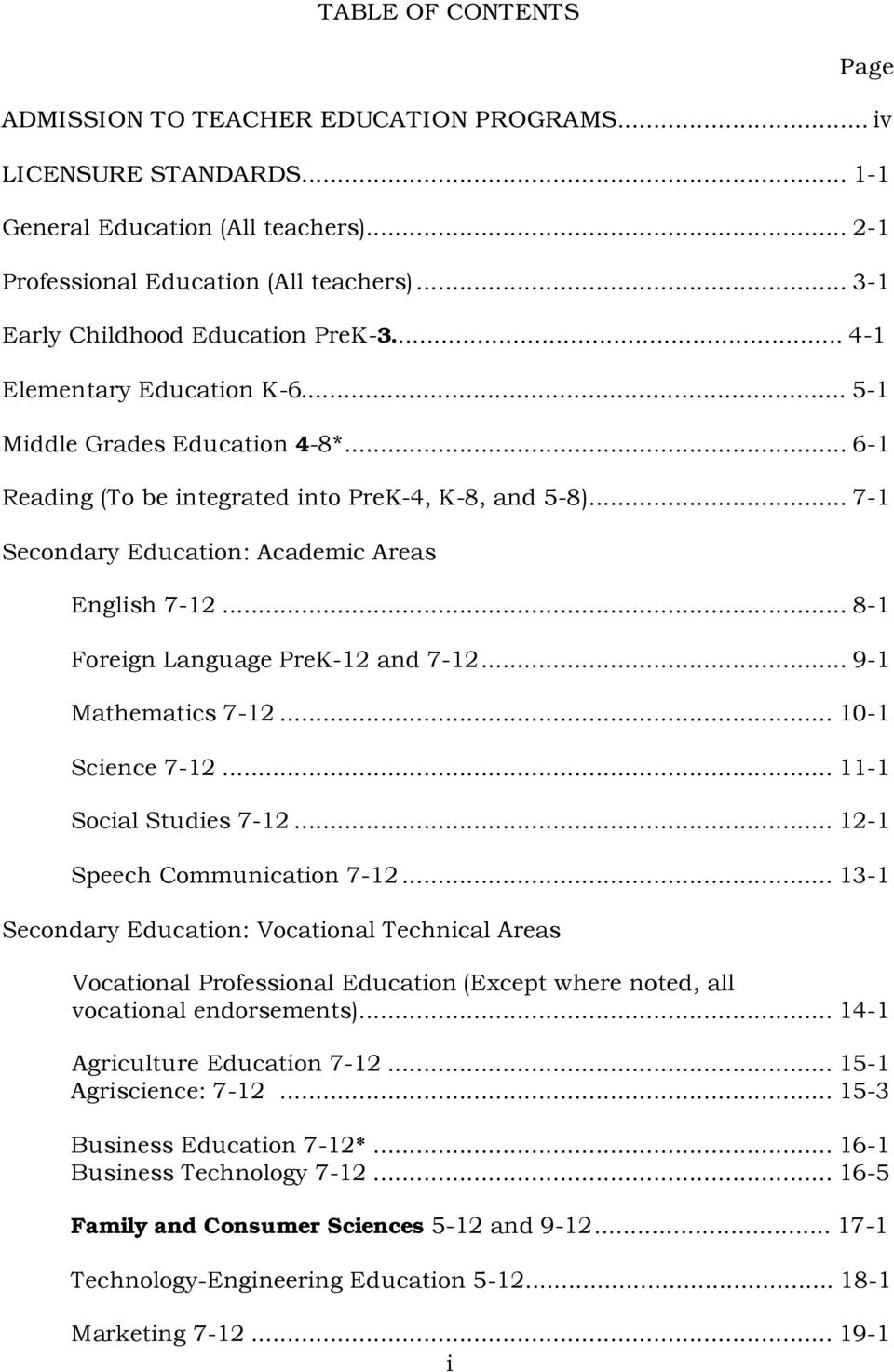
2 TABLE OF CONTENTS Page ADMISSION TO TEACHER EDUCATION PROGRAMS... iv LICENSURE STANDARDS General Education (All teachers) Professional Education (All teachers) Early Childhood Education PreK Elementary Education K Middle Grades Education 4-8* Reading (To be integrated into PreK-4, K-8, and 5-8) Secondary Education: Academic Areas English Foreign Language PreK-12 and Mathematics Science Social Studies Speech Communication Secondary Education: Vocational Technical Areas Vocational Professional Education (Except where noted, all vocational endorsements) Agriculture Education Agriscience: Business Education 7-12* Business Technology Family and Consumer Sciences 5-12 and Technology-Engineering Education Marketing i
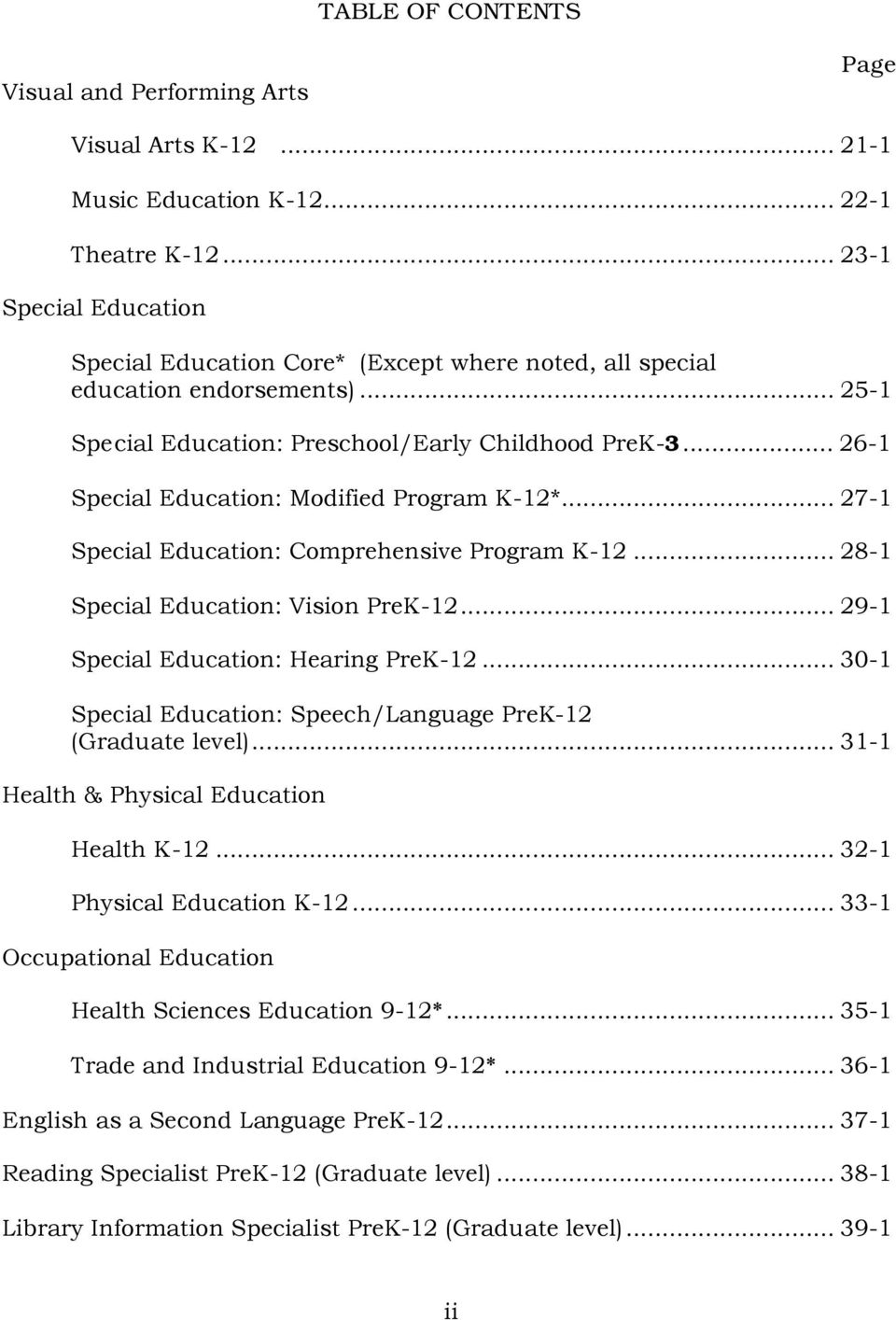
3 ... TABLE OF CONTENTS Visual and Performing Arts Page Visual Arts K Music Education K Theatre K Special Education Special Education Core* (Except where noted, all special education endorsements) Spe cial Education: Preschool/Early Childhood PreK Special Education: Modified Program K-12* Special Education: Comprehensive Program K Special Education: Vision PreK Special Education: Hearing PreK Special Education: Speech/Language PreK-12 (Graduate level) Health & Physical Education Health K Physical Education K Occupational Education Health Sciences Education 9-12* Trade and Industrial Education 9-12* English as a Second Language PreK Reading Specialist PreK-12 (Graduate level) Library Information Specialist PreK-12 (Graduate level) ii
4 TABLE OF CONTENTS Professional School Service Personnel Page School Psychologist PreK School Counselor PreK School Social Worker PreK Administrator/Supervisor PreK-12 (Graduate level) Induction Internship Guidelines Enhanced Student Teaching Guidelines Adapting the Framework for Evaluation and Professional Growth in the Evaluation of Pre-Service Teachers Tennessee Teaching Standards: A Guide for Mentoring POST-BACCALAUREATE PROGRAMS Post-Baccalaureate Program Facilitating Admission to Post-Baccalaureate Programs: Implementation Guidelines ALTERNATIVE LICENSURE Alternative Licensure Standards ADDITIONAL ENDORSEMENTS Additional Endorsements PROGRAM APPROVAL Program Approval Transition to NCATE * Standards are in a transitional phase; see effective dates. iii

5 STATE BOARD OF EDUCATION RULES APPROVAL OF TEACHER EDUCATION PROGRAMS AND INSTITUTIONS AND ADMISSION TO TEACHER EDUCATION PROGRAMS Paragraphs (12) and (13) of Rule (Certification-General Regulations): (12) Approval of Teacher Education Programs and Institutions. All programs of teacher education and the institutions providing these programs must be approved by the State Board of Education. This shall be done according to standards and procedures established by the State Board of Education. (13) Admission to Teacher Education Programs. (a) (b) Each institution of higher education offering teacher education programs will develop and submit to the State Department of Education a description of its admissions procedures, taking into account the Teacher Education Policy (January, 1988, as the same may be amended), National Council of Accreditation of Teacher (NCATE) standards, and guidelines promulgated by the State Board of Education. Praxis I, an assessment of academic skills, will be used as a part of the admissions process for entrance into teacher education. Praxis I offers two testing formats, the Pre-Professional Skills Test (PPST), in a paper-and-pencil format and the Computer-Based Academic Skills Assessments in a computer delivered format. Either form is acceptable. 1. Candidates seeking admission to approved teacher education programs in Tennessee colleges and universities shall attain scores as follows on either the Pre-Professional Skills Test or the Computer-Based Academic Skills Assessments. Pre-Professional Skills Test Computer-Based Academic Skills Assessment Mathematics Reading Writing Candidates who fail to pass any required subtest(s) of the PPST may retake such subtests as often as such tests are administered. Candidates retaking any of the subtests must attain cut off scores in effect at the retesting time. iv

6 3. Persons who fail the tests after having taken them twice may appeal. Each institution of higher education will establish an appeals committee to evaluate the appeal of a person who has failed the tests but appears strong on other admissions criteria established by the institution. Appeals procedures and criteria will take into account the Teacher Education Policy and NCATE standards. (c) (d) (e) (f) (g) Admissions procedures will specify the process by which failure to meet standards may be appealed. Each institution will report to the State Department of Education annually (1) the number of students admitted to teacher education programs, and (2) the number admitted on appeal. NCATE standards for admission to teacher education programs will apply to all candidates for teacher education, beginning with those seeking admission to teacher education programs in fall Candidates seeking admission to approved teacher education programs in Tennessee who have attained a composite score of 21 or above on the American College Testing Program (ACT) or a composite score of 22 or above on the Enhanced ACT Assessment or who have attained a combined verbal and mathematical score of 920 or above on the Scholastic Aptitude Test (SAT) or a combined verbal and mathematical score of 1,020 or above on the recentered Scholastic Achievement Test (SAT) shall be exempt from taking a state-mandated test for admission. Candidates with a baccalaureate degree from a regionally accredited institution seeking admission to approved graduate level teacher education programs in Tennessee shall be exempt from taking a state-mandated test for admission provided the institution establishes appropriate test requirements. Institutions of higher education offering approved programs in school administration and supervision will develop and submit to the State Department of Education a description of admissions procedures in accordance with guidelines established by the State Board of Education. v
7 Attachment I Guidelines For Admission To Teacher Education Programs 1. Each teacher education institution will develop and submit to the State Department of Education a description of its admissiions procedures, taking into account the Teacher Education Policy and NCATE standards. 2. Admissions procedures will include an interview of each candidate by an admissions board composed of one or more persons from the practicing profession as well as one or more persons from the teacher education, liberal arts, or other appropriate faculties. 3. Admissions procedures will specify the process by which failure to meet standards may be appealed. 4. The admissions process will specify the point at which the candidate is admitted to teacher education. Institutions will notify candidates in writing regarding their admission to teacher education. 5. The PRAXIS I, a standardized test of basic skills, will be used as a part of the admissions process for entrance into teacher education. Persons who fail the PRAXIS I after having taken it twice may appeal. Each campus will establish an appeals committee to evaluate the appeal of a person who has failed the PRAXIS I but appears strong on other admissions criteria established by the institution. Appeals procedures and criteria will take into account the Teacher Education Policy and NCATE standards. If an appeals committee recommends that a person be admitted to teacher education despite a failing PRAXIS I score, that decision will be predicated on strengths in several other criteria rather than on a minimal meeting of those criteria. 6. A 2.5 grade point average will apply to all candidates for teacher education. 7. Each institution will report to the State Department of Education annually (1) the number of students admitted, and (2) the number admitted on appeal. vi

8 LICENSURE Teacher education programs, designed by institutions of higher education, will consist of three components: (1) a liberal arts component, as outlined in the section on general education; (2) a program of professional studies, as outlined in the section on professional education and as further amplified in the sections dealing with the various teaching areas; and (3) a program of study in the teaching area constituting a major. The general education core curriculum will constitute approximately 50% of the 120 semester hours minimum course work required to complete the baccalaureate degree. The major in the teaching area will constitute no more than 30% of the 120 semester hours minimum course work required to complete the baccalaureate degree. Institutions of higher education, including colleges or departments of education and colleges of arts and sciences, have the responsibility to design effective liberal arts and teacher education programs for teacher candidates. The institutions, in accordance with their own governance procedures, will make decisions regarding organizing resources and designing teacher preparation programs to address the knowledge and skills outlined in this document. Teacher candidates will have adequate advisement in both education and the teaching field. The knowledge and skills listed in each licensure section are broad goal statements regarding what is expected of a teacher seeking initial licensure; institutions of higher education will develop more specific competencies where appropriate. All programs of teacher education, both undergraduate and graduate, and the institutions providing these programs must be approved by the State Board of Education. Such programs must ensure that candidates have opportunities to attain the knowledge and skills specified by the State Board of Education, have internship or student teaching experiences in accordance with guidelines established by the State Board of Education, and meet other standards, procedures, and guidelines established by the State Board of Education. Teacher candidates seeking initial licensure must complete successfully any candidate assessment as provided by the State Board of Education and must be recommended by an institution of higher education with an approved program of teacher education. 1-1

9 Tennessee Teacher Licensure Standards: General Education Date Standards Adopted or Most Recent Revision: 1997 Date Institutions Must Submit To DOE: Current Date Candidates Must Meet Standards: September 1, 2001 Teacher education programs of study will include a liberal arts component to foster the personal intellectual development of the teacher candidate. The sequence of studies in general education will be well planned and broad enough to permit teacher candidates to develop the knowledge and skills essential to experiencing success, satisfaction, and intellectual growth in teaching and in life. All teacher candidates will demonstrate the knowledge and skills to accomplish the following: I. Knowledge and Skills Pertaining to All Areas A. Integrate knowledge acquired from a variety of sources. B. Use basic problem solving skills such as identifying, defining, postulating and evaluating, planning and acting, and assessing results. C. Analyze and synthesize ideas, information, and data. D. Understand cultural and individual diversity, and human-kind s shared environment, heritage, and responsibility. E. Understand and respect other points of view, both personal and cultural. F. Understand one s own and others ethics and values. G. Understand the appropriate role of technology for gathering and communicating information. (More specific knowledge and skills regarding instructional technology will be acquired in the professional education core and in the major.) H. Understand the interdependence among fields of study. II. Communication A. Send and receive messages, written and oral, in standard English; communicate verbally and non-verbally. B. Understand how non-verbal cues affect listening; use non-verbal cues in a positive way. 2-1

10 C. Identify one s intended audience and communicate effectively when speaking or writing. D. Know about diverse communication styles, abilities, and cultural differences. III. Humanities and the Arts A. Know about various means of creative expression, both within a given culture and across cultures or languages. B. Understand how human ideals, values, and ethics can be examined and illuminated figuratively. C. Know about the past and current relationships between creative expression and the societies from which they grow. D. Understand how creators and critics make informed qualitative judgments about creative expressions; formulate such judgments oneself. IV. Social Science and Culture A. Understand how social scientists create, describe, disseminate, and refine new knowledge within their disciplines. B. Apply social science methods in appropriate situations. C. Understand how governmental and social institutions interact with each other and with individuals. D. Have an informed historical perspective, including an understanding of how one s own society developed and an awareness of how other societies developed. E. Have an informed perspective on contemporary issues affecting society. V. Science and Technology A. Understand how scientists and technologists create, describe, disseminate, and refine new knowledge within their disciplines. B. Apply scientific methods in appropriate situations. C. Understand the major ways that science and technology have affected humans and their world. 2-2

11 D. Understand the power and limitations of science and technology in a changing world; understand how societies, institutions, and individuals are responsible to see that technology is used ethically and appropriately. E. Be aware of contemporary scientific and technological trends and implications for the future. VI. Mathematical Concepts and Applications Guidelines A. Understand how algebraic, geometric, and arithmetic ideas are created, described, disseminated, and refined. B. Apply mathematical methods in appropriate situations, such as in science. C. Send, receive, and interpret information which is presented graphically and numerically. D. Apply mathematical techniques to solve real life problems. I. The general education core curriculum will comprise approximately 50% of the 120 semester hours minimum course work required to complete the baccalaureate degree. The knowledge and skills will be embedded in the courses which comprise an institution s general education and elective requirements. II. III. Some of the knowledge and skills specified for specific subject or grade level endorsements may be covered in courses that comprise the general education core. Course work in the general education core will be at the appropriate (college) level and will build upon pre-college work that assumes the student has covered the academic skills and subjects described by The College Board and referenced in the Comprehensive Education Reform Act of 1984 (TCA ). 2-3

12 Tennessee Teacher Licensure Standards: Professional Education Date Standards Adopted or Most Recent Revision: October 31, 2003 Date Institutions Must Submit To DOE: September 1, 2004 Date Candidates Must Meet Standards: September 1, 2007 All teacher candidates complete studies in professional education. Professional education is a lifelong undertaking that is initiated in college course work, refined in field experiences, and enhanced during professional practice. The course work and related field and laboratory experiences enable the teacher candidate to meet the following performance standards in teaching all students including students at risk, students with disabilities, English language learners, economically disadvantaged students, highly mobile students, intellectually gifted students, and students from different racial and ethnic backgrounds: Standard 1 Discipline Taught. Candidates know, understand, and use the central concepts, tools of inquiry and structures of the discipline(s) they teach and can create learning experiences that develop student competence in the subject matter. Supporting Explanation Candidates demonstrate a broad general understanding of the major concepts of the discipline they teach. They understand and are able to use assumptions and the processes of inquiry for the discipline being taught. Candidates create interdisciplinary learning experiences that allow students to integrate knowledge, skills and methods of inquiry from several related subject areas. They use connections in instruction across disciplines and draw on their knowledge to build understanding and motivate students. They demonstrate an understanding of the implications of disability legislation and special education policies and procedures and they provide equitable access to and participation in the general curriculum for students with disabilities. Standard 2 Student Learning and Development. Candidates understand how students learn and develop and provide learning opportunities that support student intellectual, social and personal development. Supporting Explanation Candidates understand how learning occurs how all students construct knowledge and acquire skills and are able to provide learning opportunities that support their intellectual, social and personal development. When making

13 instructional decisions, candidates draw upon an in-depth knowledge of developmental progression in student physical, social, emotional, moral, and cognitive domains and recognize that students with disabilities may exhibit greater individual variation and that a disability often influences development and functioning in more than one area. Candidates use this knowledge to optimize learning opportunities for each student. Standard 3 Diverse Learners. Candidates understand how students differ in their approaches to learning and create instructional opportunities that are adapted to diverse learners. Supporting Explanation Candidates understand and identify differences in student approaches to learning and performance. They design instruction and adapt instructional techniques for all students within the broader context of their families, cultural backgrounds, socioeconomic classes, languages, communities, peer/social groups and exceptional learning needs. Candidates create a learning community which is inclusive and in which individual differences are respected. Standard 4 Teaching Strategies. Candidates understand and use a variety of instructional strategies to encourage development of critical thinking, problem solving and performance skills in students. Supporting Explanation Candidates understand and use the principles and techniques associated with various instructional strategies that reflect best practice (such as cooperative learning, direct instruction, whole group instruction, independent study and interdisciplinary instruction) and that foster high expectations for all students. They organize instruction to create learning experiences that connect subject matter to real life experiences and enable students to apply learning to future careers. Candidates vary their role in the instructional process (e.g. instructor, facilitator, coach, audience) to achieve different instructional purposes and to meet individual student needs. Candidates use multiple teaching and learning strategies in active learning opportunities to promote the development of critical thinking, problem solving and performance capabilities in the content areas. Using a wide variety of resources and methods, including technology and assessment data, candidates develop and use clear, accurate presentations of concepts to promote student learning. Candidates use reading comprehension and writing strategies in the content area and assist students in applying mathematics concepts to subject 3-2
14 content. They support acquisition of English necessary for continuous learning in the content area of students whose first language is not English. Standard 5 Learning Environment. Candidates use an understanding of individual and group motivation and behavior to create a learning environment that encourages positive social interaction, active engagement in learning and selfmotivation. Supporting Explanation Drawing on their knowledge of human motivation and behavior, candidates create a learning environment that is inclusive and supports positive social interaction, active engagement in learning and self-motivation for all students. They organize and manage resources such as time, space, facilities, technology, activities, instructional assistants and volunteers to engage all students in productive tasks and maximize the amount of class time spent in learning. They develop shared expectations for all students and create and maintain a positive, inclusive classroom climate of mutual respect, support and inquiry. Candidates understand and use a wide variety of classroom management strategies that foster self control and self discipline. They can defuse potential conflict and use conflict resolution strategies to maintain a smoothly functioning learning community. Standard 6 Communication. Candidates use knowledge of effective verbal, nonverbal and media communication techniques to foster active inquiry, collaboration and supportive interaction in the classroom. Supporting Explanation Candidates understand language development, the role of language in learning and how culture, gender, and exceptional learning needs affect communication in the classroom. They recognize effective verbal and nonverbal communication techniques and use them to support all students learning. Candidates model effective communication strategies in conveying ideas and information, asking questions, listening, giving directions, probing for student understanding, and helping students express their ideas. Using a variety of tools, including technology, candidates support and expand student expression in speaking, writing and technical media. Standard 7 Planning. Candidates plan instruction based upon knowledge of subject matter, students, the community, and curriculum goals. 3-3

15 Supporting Explanation Candidates use their knowledge of subject matter, learning theory, curriculum and student development, assessment measures, and assessed student needs in planning instruction for all students. They evaluate, select and create learning experiences that are developmentally appropriate, aligned with Tennessee curriculum standards, relevant to students and based upon the principles of effective teaching. They are able to help students connect learning to real life and future careers. Candidates identify long-range instructional goals, sequence short-range instructional objectives, and develop units and daily lessons that target these goals and objectives. Candidates effectively integrate a variety of resources, including teacher-created materials, textbooks, technology, community and business resources, to promote student learning. Working with others in developing individualized plans, candidates adjust goals, teaching strategies or supports to help students with disabilities succeed in the general curriculum and plan for students who require an expanded curriculum. Standard 8 Assessment and Evaluation. Candidates know, understand and use formal and informal assessment strategies to evaluate and ensure the continuing intellectual, social and physical development of the learner. Supporting Explanation Candidates understand the characteristics, uses, advantages and limitations of different types of assessments for evaluating student learning. They understand state and federal accountability requirements. Candidates select, construct and use formal and informal assessment strategies and instruments appropriate to the learning expectations being evaluated to make instructional decisions based on student performance information. They actively solicit and use information about students learning needs and progress from parents, other colleagues and the students themselves. Candidates develop and maintain useful records of student work and progress and responsibly communicate student progress to students, parents and other colleagues. They collaborate with special education teachers and others to plan and design accommodations, modifications, adaptations or alternate assessments, based on the results of recommended individual assessments. Standard 9 Reflective Practitioner. Candidates are reflective practitioners who continually evaluate the effects of their choices and actions on others (students, parents and other professionals in the learning community) and who actively seek out opportunities to grow professionally. 3-4

16 Supporting Explanation Candidates consistently reflect on their teaching practices by continually evaluating the effect their instruction has on all students. They monitor teaching strategies and behavior in relation to student success and use the information to modify and revise instruction accordingly. Candidates continually examine their teaching performance within the context of state and local standards and federal and state accountability requirements. Using their data-based reflections, candidates engage in actions that consistently support and promote the achievement of students with disabilities. Candidates seek professional literature, engage colleagues, participate in professional organizations, and use other resources to support their continuing professional development. To guide professional behavior, candidates draw upon a broad knowledge of legal and ethical responsibilities, educational policy, and organizational, historical, and professional dimensions of classrooms and schools. Standard 10 Colleagues, Parents, and Community. Candidates foster relationships with school colleagues, parents and agencies in the larger community to support students learning and well-being. Supporting Explanation Candidates consult with families and teachers, and collaborate with other professionals within the school and within community agencies to foster student learning. They participate in collegial activities designed to make the entire school a productive learning community. Candidates act as advocates for all students, advise them, recognize student problems, and seek additional help as needed and appropriate. Candidates understand schools as organizations within the larger community and effectively communicate school goals and accomplishments to the community and general public. Standard 11 Technology. 11.a. Candidates use technology and technology based resources to facilitate developmentally appropriate student learning. Supporting Explanation Candidates use technology resources to guide classroom decisions regarding student learning. They integrate instructional technology to facilitate interdisciplinary teaching and learning in their classrooms, to supplement 3-5
17 instructional strategies, to design instructional materials, and to enhance hands-on experiences and problem solving activities for all students. Candidates select and use grade-level and content-specific technology resources, including assistive technology, to increase student participation in the total curriculum. They apply technology to analyze assessment data and to target individual student learning needs. 11.b. Candidates use technology to enhance their professional growth and productivity. Supporting Explanation Candidates use technology in their own learning process and to change their current educational practice. They use technology to gather, sort, and analyze information needed for their own research projects and to communicate and collaborate effectively with other professionals. Candidates use tools such as databases and spreadsheets for sorting, compiling, and analyzing data gathered from a variety of sources. They use presentation tools in a networked environment for sharing information in multiple professional formats. 11.c. Candidates effectively use and manage all technology available to them and explore uses of emerging resources. They promote the equitable, ethical and legal use of technology resources. Supporting Explanation Candidates design effective environments for using and managing technology in the classroom. They are able to perform minor trouble-shooting operations. When planning units of instruction, candidates address software purchasing agreements, copyright laws, issues related to intellectual property, the importance of virus protection, and policies for acceptable use of Internet resources. Candidates seek information from technical manuals and journals as well as on-line resources to learn about emerging technologies and to explore their possible educational applications. They model the legal and ethical use of technology resources. Program Implementation Standards: 1. All teaching areas include the standards in the professional education core; course work and related field experiences apply the standards to specific teaching areas. 2. Courses that comprise the professional education core may include some of the performance standards for specific subject or grade-level endorsements. 3. Candidates in teacher preparation programs participate in ongoing, wellstructured field experiences in varied school settings with diverse 3-6

18 learners prior to the internship or student teaching. Field experiences and student teaching or the internship assist teacher candidates develop the knowledge, skills, and dispositions necessary to help all students learn and are consistent with NCATE standards. 4. The teacher education unit, other institutional units, and P-12 schools actively and continuously collaborate in partnership activities in developing, implementing and evaluating teacher preparation programs, consistent with NCATE standards. 5. The teacher education unit systematically collects data verifying the candidate s knowledge, skills and dispositions. The unit extends the assessment of candidate performance beyond program completion through the induction years. The unit systematically uses the results of those assessments to implement changes in professional educator preparation programs. 6. Institutions of higher education use the following documents (as they may be amended) when planning, implementing and evaluating teacher preparation programs: Model Standards for Beginning Teacher Licensing: A Resource for State Dialogue, developed by the Interstate New Teacher Assessment and Support Consortium (1992); Model Standards for Licensing General and Special Education Teachers of Students with Disabilities: A Resource for State Dialogue, Interstate New Teacher Assessment and Support Consortium, (2001 Draft); NCATE 2000 Standards (2000); Foundation Technology Standards for All Teachers, International Society for Technology in Education (1997); Tennessee Framework for Evaluation and Professional Growth (1997); Tennessee Curriculum Standards in related subject areas; Tennessee Teacher Licensure Standards, Special Education Core (2002); and resources from the Education Edge Initiative (1996). 7. These licensure standards become effective for candidates seeking licensure no later than September 1, Institutions with licensure programs will submit standards for conditional approval no later than September 1,

19 Tennessee Teacher Licensure Standards: Early Childhood Education (Endorsement in Early Childhood Education PreK-3) Date Standards Adopted or Most Recent Revision: August 27, 2004 Date Institutions Must Submit To DOE: September 1, 2005 Date Candidates Must Meet Standards: September 1, 2008 Introduction Tennessee supports early childhood education (PreK-3) preparation programs that enable teacher candidates to meet the developmental and academic needs of all children. The performance standards for early childhood education (PreK-3) provide teacher preparation programs guidelines to develop prospective teachers who have the necessary content and pedagogical knowledge as well as the personal dispositions necessary to be successful beginning teachers. Teaching young children is a lifelong undertaking that is initiated in college course work, refined in field experiences and/or clinical practice, and enhanced during professional teaching. The intent of these performance standards is to support teacher preparation programs having a comprehensive program of study that integrates the general education core, professional education, an academic major and a variety of field experiences to ensure teacher candidates meet all of the following standards. Early Childhood Education Content Area Standards Standard 1: Child Development and Learning Candidates use their understanding of young children s characteristics and needs and the multiple influences on children s development and learning to create environments that are healthy, respectful, supportive, and challenging for all children. Supporting explanation Early childhood teacher candidates know and understand young children s characteristics and needs, including physical, cognitive, social, emotional, language, and aesthetic. They understand children s play activity, learning processes, and motivation to learn. Candidates understand the multiple influences on development and learning, including the cultural and linguistic contexts for development, children s close relationships with adults and peers, the economic conditions of children and families, children s health status and disabilities, children s individual developmental variations and learning styles, family and community characteristics, opportunities to play and learn, technology and the media. Candidates use developmental knowledge to create healthy, respectful, supportive, and challenging learning environments for all young children, including curriculum, interactions, teaching practices, and learning materials. 1

20 Standard 2: Family and Community Relationships Candidates know about, understand, and value the importance and complex characteristics of children s families and communities. They use these understandings to create respectful, reciprocal relationships that support and empower families and involve all families in their children s development and learning. Supporting explanation Candidates understand and apply their knowledge of family and community characteristics. They build positive relationships, taking families preferences and goals into account and incorporating knowledge of families languages and cultures. Candidates demonstrate respect for variations across cultures in family strengths, expectations, values, and childrearing practices. They support and empower diverse families, including those whose children have disabilities or special characteristics or learning needs, families who are facing multiple challenges in their lives, and families whose languages and cultures may differ from those of the early childhood professionals. Candidates understand and value the role of parents and other important family members as children s primary teachers. They possess essential skills to involve families and communities in many aspects of children s development and learning. Standard 3: Observation, Documentation, and Assessment Candidates know about and understand the goals, benefits, and uses of assessment. They know about and use systematic observations, documentation, and other effective assessment strategies in a responsible way and in partnership with families and other professionals, to influence positively children s development and learning. Supporting explanation Candidates use ongoing, systematic observations and other informal and formal assessments to record and make visible children s unique qualities and to develop appropriate goals, plan, implement, and evaluate effective curricula. They understand essential distinctions and definitions, such as screening, diagnostic assessment, standardized testing, and accountability assessment, and are familiar with essential concepts of reliability and validity and other psychometric concepts. Candidates demonstrate skills in using a variety of assessments that are appropriate to their goals and children s characteristics, with emphasis on curriculum-embedded, performance assessments. They choose valid tools that are developmentally, culturally, and linguistically appropriate; use the assessments correctly; adapt assessments as allowed and needed, using assistive technology as a resource; make appropriate referrals; and interpret assessment results, with the goal of obtaining valid, useful information to inform practice and decision making. Candidates understand that responsible assessment is ethically grounded, guided by sound professional standards, collaborative, and open. They demonstrate an understanding of appropriate, responsible assessment practices for culturally and 2

21 linguistically diverse children and for children with developmental delays, disabilities, or other special characteristics. Candidates demonstrate knowledge of legal and ethical issues, current educational concerns and controversies, and appropriate practices in the assessment of diverse young children. Standard 4: Professionalism Candidates know and use ethical guidelines and other professional standards related to early childhood practice. They are continuous, collaborative learners who demonstrate knowledgeable, reflective, and critical perspectives on their work. Supporting explanation Candidates know about the many connections between the early childhood field and other related disciplines and professions with which they collaborate. They know about and uphold ethical guidelines and other professional standards. They know and obey relevant laws such as those pertaining to child abuse, the rights of children with disabilities, and school attendance. Candidates know about relevant national, state and local standards for content and child outcomes, professional guidelines and position statements, child care licensing requirements and other professional standards affecting early childhood practice. Candidates also demonstrate an understanding of and essential skills in interdisciplinary collaboration. They demonstrate essential knowledge and core skills in team building and in communicating with families and colleagues from other disciplines. Candidates make and justify decisions on the basis of their knowledge of the central issues, professional values and standards, and research findings in their field. They demonstrate that they can engage in informed advocacy for children and the profession. Candidates know about the central policy issues in the field and they examine societal concerns about program quality and provision of early childhood services. Standard 5. Teaching and Learning Candidates integrate their understanding of and relationships with children and families; their understanding of developmentally effective approaches to teaching and learning; and their knowledge of academic disciplines to design, implement, and evaluate experiences that promote positive development and learning for all young children. Supporting explanation Candidates know, understand, and use theories and research that support highquality interactions with children and families. Candidates develop positive, respectful relationships with children whose cultures and languages may be different from their own, as well as with children who may have developmental delays, disabilities, or other learning challenges. 3
22 Candidates know, understand, and use a wide array of developmentally effective approaches, strategies, and tools to positively influence young children s development and learning. They foster oral language and communication; make the most of the environment and routines; capitalize on incidental teaching; focus on children s characteristics, needs and interests; link children s language and culture to the early childhood program; teach through social interactions; create support for play; address children s challenging behaviors; support learning through technology; and use integrative approaches to curriculum. Candidates use their own knowledge and other resources to design, implement, and evaluate meaningful, challenging curriculum that promotes comprehensive developmental and learning outcomes for all young children. They foster academic and social competence, problem-solving and thinking, and security and selfregulation. English Language Arts Standard 1: Early Literacy Candidates know, understand and use research-based knowledge and skill in promoting and developing listening, speaking, reading, and writing. Supporting Explanation: Candidates know that early language and literacy form the foundation for learning. They integrate the elements of listening, speaking, reading and writing in teaching children. 1.1 Candidates identify the unique strengths, needs, and interests of individual children and plan appropriate literacy-rich experiences. 1.2 Candidates understand the value of play and spontaneous and planned experiences and they apply that understanding in the development of early literacy skills. 1.3 Candidates understand and demonstrate the use of language, reading, and writing to strengthen the cultural and linguistic identity of the children they teach. 1.4 Candidates apply knowledge of the content categories of early literacy to motivate young children s pleasure in listening to stories, curiosity about words and letters, exploration of print forms, and enjoyment of rhymes, songs, poems, books, and dramatic play. 4
23 Standard 2: Reading Candidates know, understand, and use appropriate practices for promoting and developing beginning literacy skills, for integrating reading instruction across all subject matter areas, and for enabling all children to become proficient and motivated readers. Supporting Explanation Candidates know what is necessary for all children to learn to read, and they implement a balanced reading program. Teacher candidates understand that children learn to read within the context of every subject and that explicit instruction in reading is needed. For additional information, please refer to Tennessee Reading Standards To Be Integrated Into Licensure Standards, PreK-4, K-8 (2001). Standard 3: Writing Candidates know, understand, and use the writing process for communication, expression, and reflection in all subject areas, for a variety of purposes, in a range of modes, and for multiple audiences. Supporting Explanation Candidates demonstrate a broad understanding of the uses of writing to communicate, to promote the dissemination of information, to generate, develop, and refine ideas, and to express individual voice. 2.1 Candidates understand, apply, and model knowledge of the writing process. They embed writing into familiar activities to help children learn both the conventions of print and how print supports their immediate interests and needs. 2.2 Candidates know the state writing curriculum standards and incorporate that knowledge into their instruction. 2.3 Candidates write frequently for multiple purposes and in practical, occupational, personal, and academic modes. They link functional and playrelated print to class activities, such as daily schedules, helper charts and labels on material shelves. 2.4 Candidates evaluate written products and assess children s progress. 2.5 Candidates recognize the relationship between the development of motor skills and the development of handwriting. 2.6 Candidates acknowledge and respect the effect of cultural diversity and linguistic differences in the writing of children whose first language is not English. 5
24 2.7 Candidates understand the interactive relationship of writing to the other language arts. 2.8 Candidates promote the integration of literacy skills across all subject areas. Standard 4: Elements of Language Candidates know and understand basic English usage, mechanics, spelling, grammar, and sentence structure as tools to facilitate the writing process. Supporting Explanation Candidates understand and use the rules and conventions governing the structure and syntax of language as prerequisites to effective communication and as markers of literacy. 3.1 Candidates recognize that effective instruction in the elements of language is integrated with and applied to the writing process. 3.2 Candidates demonstrate understanding of the parts of speech and their functions in sentences. 3.3 Candidates apply the standard rules of capitalization and punctuation, as well as legible handwriting, in written communication. 3.4 Candidates display knowledge of the emerging stages of accurate spelling, including temporary spelling, and of phonemic awareness and structural analysis of words. 3.5 Candidates translate the knowledge of structure and mechanics into proofreading and editing of written language in all disciplines. 3.6 Candidates construct simple, compound, and complex sentences, using correct word order, subject-verb agreement, and correctly placed modifiers. 3.7 Candidates model effective oral and written communication skills. 3.8 Candidates design instruction appropriate to children of diverse backgrounds. 3.9 Candidates support the continuous English language development through content area instruction for children whose first language is not English. Mathematics Standard 1: Mathematical Processes Candidates demonstrate an understanding of effective instructional strategies that integrate mathematics content and processes. 6
25 Supporting Explanation Candidates develop the mathematical processes of problem solving, reasoning, communication, connections, and representation and plan effective instructional activities to develop these processes in children. In addition, they integrate appropriate reading strategies, mathematics manipulatives, and appropriate technologies into their instructional practices to support conceptual and process development. 1.1 Candidates use problem solving to build new mathematical knowledge, to solve problems in a variety of contexts and to reflect on solutions. 1.2 Candidates make and investigate mathematical conjectures and use logical thought in reflecting, explaining, and justifying strategies and solutions. 1.3 Candidates use appropriately and accurately the vocabulary and symbols of mathematics to express and justify mathematical concepts and strategies. 1.4 Candidates demonstrate an understanding of how mathematical concepts are related and how they are connected to other disciplines and the real world. 1.5 Candidates use a variety of manipulatives, games, computers and other appropriate technologies to explore, apply and deepen understanding of mathematical concepts, operations and relations and to promote mathematical curiosity and interest. Standard 2: Number and Operations Candidates work flexibly with rational numbers to solve problems and create learning experiences that develop children s comprehension of mathematical concepts, operations and relations necessary for number and operation sense. Supporting Explanation Candidates have both conceptual understanding of number and operation sense and the ability to apply those concepts and procedures in problem-solving situations. They also demonstrate knowledge of effective instructional practices necessary for developing proficiency with number and operations in children. 2.1 Candidates represent numbers, number relationships, and number systems verbally, symbolically and graphically. 2.2 Candidates model operations, explain how they relate to one another, and create learning experiences to make the link between numbers and operations. 2.3 Candidates apply number and operation sense to represent and solve problems and to justify or explain reasonable estimates using words, actions, pictures, and manipulatives. 7
26 Standard 3: Algebra Candidates know, understand, and use algebraic concepts and create learning experiences that develop algebraic thinking in children. Supporting Explanation Candidates generalize patterns as they represent and analyze quantitative relationships and change in a variety of contexts and problem-solving situations. They also demonstrate knowledge of developmentally effective instructional practices necessary for fostering algebraic proficiency in children. 3.1 Candidates create, describe, extend, and translate patterns of shapes and numbers. 3.2 Candidates represent and analyze mathematical situations and structures using words, objects and pictures. 3.3 Candidates use mathematical models to represent and describe quantitative relationships. 3.4 Candidates analyze, represent, and describe change in a variety of contexts and problems using words, pictographs, bar graphs, and tables. Standard 4: Geometry Candidates know, understand and use geometric concepts and create learning experiences that develop geometric concepts and spatial reasoning in children. Supporting Explanation Candidates have an understanding of geometric concepts and relationships and apply them in problem solving situations. They also demonstrate knowledge of developmentally effective instructional practices necessary for fostering geometric proficiency in children. 4.1 Candidates describe, compare and analyze characteristics and properties of two- and three-dimensional geometric figures. 4.2 Candidates specify locations and explain spatial relationships using directional terms and coordinate geometry. 4.3 Candidates apply transformations, such as flips, slides and turns, to geometric shapes and use symmetry to analyze mathematical situations. 4.4 Candidates use visualization, spatial reasoning and geometric modeling to solve problems. 8
27 Standard 5: Measurement Candidates know, understand and use measurement and create learning opportunities that teach children to apply the units and processes of measurement in mathematical and real-world problems. Supporting Explanation Candidates use a variety of tools and strategies to determine and estimate nonstandard, metric and customary measurements in mathematical and real-world problems. 5.1 Candidates select and use appropriate tools and units to measure time, length, perimeter, area, capacity, volume and weight. 5.2 Candidates use and justify a variety of strategies, including standard and nonstandard units of measurement, to estimate and compare measurements of time, length, capacity and weight. Standard 6: Data Analysis and Probability Candidates know, understand and use data analysis and probability concepts and design instructional activities to teach children to understand and apply basic statistical and probability concepts. Supporting Explanation Candidates apply basic statistical and probability concepts in order to organize and analyze data and to make predictions and conjectures. 6.1 Candidates formulate questions that can be addressed with data and collect, organize and display relevant data to answer questions. 6.2 Candidates read, interpret, and create pictographs, bar graphs, and tables to solve problems. 6.3 Candidates determine possible outcomes and develop basic probability vocabulary to describe the likelihood of an outcome or event. Science Standard 1: Elements of Effective Science Instruction Candidates demonstrate understanding of science and technology in daily life through the use of inquiry-based, open-ended and materials-based investigations, incorporating habits of mind and pedagogical techniques required to deliver the content in a safe environment. 9
28 Supporting Explanation Candidates know, understand and use strategies and pedagogy to enhance science instruction for all children. 1.1 Candidates engage in multiple levels of inquiry that incorporate designing investigations; observing, predicting, interpreting and analyzing data; and providing evidence to communicate results. 1.2 Candidates demonstrate understanding and apply the unifying concepts of science such as scale and model, form and function, organization, interaction, change and conservation. 1.3 Candidates select and use a variety of conventional and non-conventional scientific instruments for measurement and observation including calculators, computers, and other appropriate technologies. 1.4 Candidates demonstrate the interrelationships among the various science disciplines, literacy, mathematics and social sciences by integrated teaching practice. 1.5 Candidates foster the creation of a classroom culture that supports higher levels of questioning, collaborative learning, real world connections and sensemaking. 1.6 Candidates plan lessons and units that incorporate a learning cycle engagement, exploration, preparation, and evaluation and the safe management of materials in the classroom. Standards 2: Life Science Candidates know, understand and use the central concepts of life science. Supporting Explanation Candidates have a solid knowledge base in the major concepts, issues and processes related to cells, diversity of life, interdependence among living things and the environment, inheritance, flow of matter and energy in nature, and biological change. 2.1 Candidates demonstrate knowledge and understanding of cells as the basic unit of structure and function in living things. 2.2 Candidates demonstrate an understanding that organisms are interdependent and dependent on resources provided by the physical environment. 2.3 Candidates exhibit an understanding that the sun is the source of energy, captured by green plants in photosynthesis and released during cellular respiration. 10
29 2.4 Candidates demonstrate an understanding that living things are related across generations by hereditary information transmitted from parent to offspring. 2.5 Candidates convey their understanding that living things display an enormous amount of variation, yet have many fundamental characteristics in common. 2.6 Candidates demonstrate knowledge of the process of natural selection and the nature of biological change over time. Standard 3: Earth/Space Science Candidates know, understand and use the central concepts of earth/space science. Supporting Explanation Candidates have a solid base of knowledge of the earth s resources, features, cycles and place in the universe. 3.1 Candidates demonstrate an understanding of the major components in the universe and that there are predictable patterns, such as seasons and phases of the moon, among these components. 3.2 Candidates demonstrate an understanding of the relationships between atmospheric cycles and daily and seasonal weather changes. Candidates use appropriate tools to measure and record temperature, precipitation and wind conditions. 3.3 Candidates demonstrate an understanding that the earth is characterized by many different observable and measurable land and water features. 3.4 Candidates demonstrate an understanding that the earth is composed of a wealth of useful resources that can be recycled or conserved, and that human activities and natural forces affect land, ocean and atmosphere. Standard 4: Physical Science Candidates know, understand and use the central concepts of physical science. Supporting Explanation Candidates demonstrate a solid base of understanding of the major concepts, issues and processes that surround matter its composition, properties and interactions and the relationships that exist among force, matter and energy. 4.1 Candidates demonstrate an understanding of the various ways in which force affects motion and that simple machines can be used to facilitate work. 11
30 4.2 Candidates classify and identify matter by physical and chemical properties and recognize that the properties can change over time and under different conditions. They use appropriate tools to observe and measure the physical properties of materials. 4.3 Candidates demonstrate understanding of the law of conservation of mass and can explain how matter changes its form, color, or texture when heated, mixed or separated. 4.4 Candidates demonstrate an understanding that the sun is the earth s main source of heat and light energy and that sound is produced when objects vibrate. Social Studies Standard 1: Social Studies Processes Candidates use effective instructional strategies that integrate social studies content and knowledge. Supporting Explanation Candidates recognize how culture; economics; geography; governance and civics; history; and individuals, groups and interactions impact the various elements of the Tennessee curriculum: local communities, Tennessee communities, and some world communities. Candidates provide hands on experiences to help children understand core concepts that may be abstract or distant in time and space. Candidates understand and use a variety of instructional strategies to encourage the development of necessary age appropriate social studies skills. Standard 2: Culture Candidates understand and demonstrate appreciation of and respect for a variety of human cultures including the similarities and differences in beliefs, knowledge bases, changes, values and traditions. Supporting Explanation Candidates recognize the contributions of individuals and people of various ethnic, racial, religious and socioeconomic groups to the development of communities and civilizations. Standard 3: Economics Candidates understand basic economic concepts. 12
31 Supporting Explanation Candidates create learning experiences to help children understand the difference between needs and wants. Candidates create experiences to help children understand basic concepts of spending and saving to achieve desired goals on personal and community levels. Standard 4: Geography Candidates use knowledge of geography to explain the web of relationships among people, places, and environments with a primary focus on the local community. Supporting Explanation Candidates prepare a balanced approach to the teaching of social studies, including both cultural and physical geography. Standard 5: Governance and Civics Candidates understand the concepts of governance and civics. Supporting Explanation Candidates convey the structure and purpose of governance in a democracy in language that is meaningful and appropriate for children. Candidates demonstrate an understanding of individual rights and responsibilities, including respectful and ethical behaviors, and the role of citizens within their homes, classrooms, schools, communities, nation, and world. Standard 6: History Candidates understand the importance of history and its relationship to informed decisions in contemporary life. Supporting Explanation Candidates understand the place of historical events in the context of past, present, and future. Candidates evaluate evidence, including primary sources, to develop comparative and causal analyses. Standard 7: Individuals, Groups, and Interactions Candidates understand that personal development and identity are shaped by factors including family, culture, groups, and institutions. 13
32 Supporting Explanation Candidates highlight the exploration, identification, and analysis of how individuals and groups work independently and cooperatively at the local, state, national, and international levels. Arts Education Standard 1 Candidates know, understand, and use basic knowledge and skills in the arts to integrate them with other subject areas and to coordinate with arts specialists to support knowledge and skill development in the arts. Supporting Explanation Candidates demonstrate a broad general knowledge of the major concepts in music, visual art, drama, dance and creative movement. They demonstrate knowledge of the developmental processes of these concepts. Candidates draw upon their knowledge of the arts to integrate them into other subject areas. They also use this knowledge to stimulate student creativity and provide a means for student expression of ideas. Candidates create meaningful learning experiences enabling children to explore with art and sensory media, participate in movement activity, and enjoy musical and dramatic experiences. They coordinate with arts specialists in meeting the national and state curriculum standards. Health/Wellness Standard 1 Candidates know, understand, and use basic health knowledge and skills to promote healthy living in children and families and to integrate health and wellness concepts and practices into other subject disciplines of the curriculum. Supporting Explanation Candidates demonstrate a broad general understanding of the major concepts of personal health and wellness; proper nutrition; healthy family growth and development; positive emotional, social, and mental health practices; personal hygiene and disease prevention; injury prevention and safety practices; responsible use of chemical substances; and essential community health services. Candidates facilitate children s understanding and practices of health and wellness across the other subject disciplines of the school curriculum. 14
33 Physical Activity and Physical Education Standard 1 Candidates know, understand, and use knowledge to provide high-quality, meaningful, and developmentally appropriate physical activity and physical education experiences in all settings. Supporting Explanation Candidates demonstrate understanding of the connection between physical activity and learning. They promote enjoyment of movement and physical activity; progress in gross and fine motor skill development; respect for rules and fair play; and acceptance of diversity in abilities and skills. They collaborate with physical educators and others to reinforce goals across all developmental domains. Program Implementation Standards 1. The program of study in early childhood education enables teacher candidates to meet the performance standards for the early childhood education endorsement. Institutions of higher education develop a comprehensive program of study that integrates the standards in the general education core, professional education, and the major. The program of study assists candidates in applying developmentally appropriate practices in teaching young children in infant and toddler programs, pre-kindergarten programs, and primary grades. 2. Candidates in early childhood education complete a major, consisting of courses offered primarily by faculty from arts and sciences disciplines. The major includes in-depth study of one or more fields, provides candidates the opportunity to demonstrate the integration of knowledge across the disciplines, and promotes an understanding of the processes of inquiry and research. The major may be combined with study in other fields related to how children learn in the context of their environment. Enrollment in such a major is open to students who are preparing for licensure in early childhood education and to students who are not. Examples include the following: A. An interdisciplinary major, which includes study in what is taught in primary grades. B. An interdisciplinary major in human development and learning which draws upon fields such as psychology, sociology, cultural anthropology, biology, and child development. C. A major in a single discipline. Majors in child development and family studies, human growth and development, and developmental psychology are particularly appropriate; other majors will be considered for approval. 15
34 3. Institutions of higher education provide focused study in early literacy and in reading (as outlined in the Tennessee Reading Standards To Be Integrated Into Licensure Standards, 2001) and may include such study in the major or in the professional education core. 4. Institutions of higher education provide field experiences and clinical practice (enhanced student teaching or internship) that are well designed and sequenced to provide opportunities for candidates to apply their knowledge, skills and dispositions in a variety of settings including infant and toddler, prekindergarten, and primary grades. Field experiences are ongoing communityand school-based opportunities in which candidates may observe, assist, tutor, instruct or conduct applied research. Clinical practice provides candidates with experiences that allow for full immersion in the community- and school-based settings allowing candidates to demonstrate competence in the professional role for which they are preparing. 5. Teacher candidates have internship or student teaching experiences (to the extent possible) in both birth through age 4 and kindergarten through grade 3. (Candidates who do not have a student teaching experience in birth through age 4 have a kindergarten experience.) Candidates study and practice in a variety of settings that include students of diverse backgrounds and learning needs. All sites for the student teaching semester or full year internship are approved as part of the regular teacher education program approval process. All sites are evaluated continually by the institutions of higher education to assess their appropriateness and quality as student teaching or internship sites. Teacher candidates are supervised by cooperating teachers or other licensed professionals who are qualified and experienced in early childhood programs. 6. Institutions of higher education adapt the professional education standards to meet the particular needs of early childhood education teachers in infant and toddler, pre-kindergarten and primary grades settings. 7. Institutions of higher education may develop joint licensure programs in Early Childhood Education PreK-3 and Special Education Preschool/Early Childhood Education PreK Teacher candidates not previously licensed to teach, but who have completed an early childhood education or child development bachelor s or master s level program, can be recommended for initial licensure, provided that they meet the standards for early childhood education (PreK-3) and have completed an enhanced student teaching semester or full year internship involving both birth through age 4 and grades kindergarten through Teachers currently endorsed in early childhood education PreK-4 will continue to be licensed to teach the grade levels covered by their endorsements. Teachers endorsed in early childhood education PreK-3 may teach grade 4 in schools having grade 3 if there are no other appropriately endorsed teachers available. 16
35 10. Institutions of higher education use the following documents (as they may be amended) when planning, implementing and evaluating teacher preparation programs: Model Standards for Beginning Teacher Licensing: A Resource for State Dialogue, developed by the Interstate New Teacher Assessment and Support Consortium (1992); Standards for Early Childhood Professional Preparation: Initial Licensure Programs, National Association for the Education of Young Children (2001); Tennessee Curriculum Standards in related subject areas; national standards in the content areas; Tennessee Early Learning Developmental Standards (2004); Tennessee Reading Standards To Be Integrated Into Licensure Standards (2001); and Tennessee Licensure Standards: Special Education Core and Special Education Early Childhood PreK-4 (2002). 11. These standards become effective for candidates seeking licensure no later than September 1, Institutions will submit standards for conditional approval no later than September 1, F:\Karen\Early Childhood Education Licensure Ad Hoc Committee\ECE Licensure Standards 2004.doc vlb 8/4/04 17
36 Tennessee Teacher Licensure Standards: Elementary Education (Endorsement in Elementary Education - Grades K-6) Date Standards Adopted or Most Recent Revision: October 31, 2003 Date Institutions Must Submit To DOE: September 1, 2004 Date Candidates Must Meet Standards: September 1, 2007 Introduction Tennessee supports elementary education (K-6) preparation programs that enable teacher candidates to meet the academic and developmental needs of all students. The performance standards for elementary education (K-6) provide teacher preparation programs guidelines to develop prospective teachers who have the necessary content and pedagogical knowledge as well as the personal dispositions necessary to be successful beginning teachers. Teaching elementary school is a lifelong undertaking that is initiated in college course work, refined in field experiences and/or clinical practice, and enhanced during professional teaching. The intent of these performance standards is to support teacher preparation programs having a comprehensive program of study that integrates the general education core, professional education, an academic major and a variety of field experiences to ensure teacher candidates meet all of the following standards. Content Area Standards English Language Arts Standard 1: Reading Candidates know, understand, and use appropriate practices for promoting and developing beginning literacy skills, for integrating reading instruction across all subject matter areas, and for enabling all children to become proficient and motivated readers. Supporting Explanation Candidates know what is necessary for all children to learn to read, and they implement a balanced reading program. Teacher candidates understand that children learn to read within the context of every subject and that explicit instruction in reading is needed throughout the elementary and middle grades. For additional information, please refer to Tennessee Reading Standards To Be Integrated Into Licensure Standards, PreK-4, K-8 and 5-8 (2001). 5-1
37 Standard 2: Writing Candidates know, understand, and use the writing process for communication, expression, and reflection in all subject areas, for a variety of purposes, in a range of modes, and for multiple audiences. Supporting Explanation Candidates demonstrate a broad understanding of the uses of writing to communicate, to promote the dissemination of information, to generate, develop, and refine ideas, and to express individual voice. 2.1 Candidates understand and apply knowledge of the writing process. 2.2 Candidates know the state writing curriculum standards and incorporate that knowledge into their instruction. 2.3 Candidates write frequently for multiple purposes and in practical, occupational, personal, and academic modes. 2.4 Candidates evaluate written products and assess students' progress both holistically and through the analysis of discrete elements. 2.5 Candidates recognize the relationship between the development of motor skills and the development of handwriting. 2.6 Candidates acknowledge and respect the effect of cultural diversity and linguistic differences in the writing of students whose first language is not English. 2.7 Candidates understand the interactive relationship of the language arts. 2.8 Candidates promote the integrating of literacy skills across all subject areas. Standard 3: Elements of Language Candidates know and understand basic English usage, mechanics, spelling, grammar, and sentence structure as tools to facilitate the writing process. Supporting Explanation Candidates understand and use the rules and conventions governing the structure and syntax of language as prerequisites to effective communication and as markers of literacy. 3.1 Candidates recognize that effective instruction in the elements of language is integrated with and applied to the writing process. 5-2
38 3.2 Candidates demonstrate understanding of the parts of speech and their functions in sentences. 3.3 Candidates apply the standard rules of capitalization and punctuation, as well as legible handwriting, in written communication. 3.4 Candidates display knowledge of the emerging stages of accurate spelling, including temporary spelling, and of phonemic awareness and structural analysis of words. 3.5 Candidates translate the knowledge of structure and mechanics into proofreading and editing of written language in all disciplines. 3.6 Candidates construct simple, compound, and complex sentences, using correct word order, subject-verb agreement, and correctly placed modifiers. 3.7 Candidates model effective oral and written communication skills. 3.8 Candidates design instruction appropriate to students of diverse backgrounds. 3.9 Candidates support the continuous English language development through content area instruction for students whose first language is not English. Mathematics Standard 1: Mathematical Processes Candidates demonstrate an understanding of effective instructional strategies that integrate mathematics content and processes. Supporting Explanation Candidates develop the mathematical processes of problem solving, reasoning, communication, connections, and representation and plan effective instructional activities to develop these processes in students. In addition, they integrate appropriate reading strategies and appropriate technologies into their instructional practices to support conceptual and process development. 1.1 Candidates use problem solving to build new mathematical knowledge, to solve problems in a variety of contexts and to reflect on solutions. 1.2 Candidates make and investigate mathematical conjectures and use logical thought in reflecting, explaining, and justifying strategies and solutions. 1.3 Candidates use appropriately and accurately the vocabulary and symbols of mathematics to express and justify mathematical concepts and strategies. 1.4 Candidates demonstrate an understanding of how mathematical concepts are related and how they are connected to other disciplines and the real world. 5-3
39 1.5 Candidates use a variety of manipulatives and other models to represent mathematical concepts, operations and relations. Standard 2: Number and Operations Candidates work flexibly with rational numbers to solve problems and create learning experiences that develop student comprehension of mathematical concepts, operations and relations necessary for number and operation sense. Supporting Explanation Candidates have both conceptual understanding of number and operation sense and the ability to apply those concepts and procedures in problem-solving situations. They also demonstrate knowledge of effective instructional practices necessary for developing proficiency with number and operations in students. 2.1 Candidates represent numbers, number relationships, and number systems verbally, symbolically and graphically. 2.2 Candidates model operations and explain how they relate to one another. 2.3 Candidates carry out computational procedures flexibly, accurately, efficiently and appropriately. 2.4 Candidates apply number and operation sense to represent and solve problems and to justify or explain reasonable estimates. Standard 3: Algebra Candidates know, understand, and use algebraic concepts and create learning experiences that develop algebraic thinking in students. Supporting Explanation Candidates can generalize patterns as they represent and analyze quantitative relationships and change in a variety of contexts and problems-solving situations. They also demonstrate knowledge of effective instructional practices necessary for fostering algebraic proficiency in students. 3.1 Candidates extend and generalize patterns to describe relations and functions. 3.2 Candidates represent and analyze mathematical situations and structures using algebraic symbols. 3.3 Candidates use mathematical models to represent and describe quantitative relationships. 3.4 Candidates analyze, represent, and describe change in a variety of contexts and problems using graphs, tables and equations. 5-4
40 Standard 4: Geometry Candidates know, understand and use geometric concepts and create learning experiences that develop geometric concepts and spatial reasoning in students. Supporting Explanation Candidates have an understanding of geometric concepts and relationships and can apply them in problem solving situations. They also demonstrate knowledge of effective instructional practices necessary for developing geometric proficiency in students. 4.1 Candidates analyze and describe characteristics and properties of two- and three-dimensional geometric figures. 4.2 Candidates specify locations and explain spatial relationships using coordinate geometry and other representational systems. 4.3 Candidates apply transformations and use symmetry to analyze mathematical situations. 4.4 Candidates use visualization, spatial reasoning and geometric modeling to solve problems. Standard 5: Measurement Candidates know, understand and use measurement and create learning opportunities that teach students to apply the units and processes of measurement in mathematical and real-world problems. Supporting Explanation Candidates use a variety of tools, techniques and formulas to determine and estimate both metric and customary measurements in mathematical and real-world problems related to their instructional responsibilities. 5.1 Candidates select and use appropriate tools and units to measure time, angles, length, perimeter, area, capacity, volume and weight. 5.2 Candidates use and justify a variety of strategies, techniques and formulas to determine and estimate measurements. Standard 6: Data Analysis and Probability Candidates know, understand and use data analysis and probability concepts and design instructional activities to teach students to understand and apply basic statistical and probability concepts. 5-5
41 Supporting Explanation Candidates apply basic statistical and probability concepts in order to organize and analyze data and to make predictions and conjectures. 6.1 Candidates formulate questions that can be addressed with data and collect, organize and display relevant data to answer questions. 6.2 Candidates select and use appropriate statistical methods to analyze data. 6.3 Candidates make and evaluate inferences and predictions that are based on data. 6.4 Candidates apply basic concepts of probability in problem-solving situations. Science Standard 1: Elements of Effective Science Instruction Candidates demonstrate understanding of science and technology in daily life through the use of inquiry-based, open-ended and materials-based investigation, incorporating habits of mind and pedagogical techniques required to deliver effectively the content in a safe environment. Supporting Explanation Candidates know, understand and use strategies and pedagogy to enhance science instruction for all students. 1.1 Candidates engage in multiple levels of inquiry that incorporate designing investigations; observing, predicting, interpreting and analyzing data; and providing evidence to communicate results. 1.2 Candidates demonstrate understanding and apply the unifying concepts of science such as scale and model, form and function, organization, interaction, change and conservation. 1.3 Candidates select and use a variety of scientific instruments for measurement and observation including computers, calculators and probeware. 1.4 Candidates demonstrate the interrelationships among the various science disciplines, literacy, mathematics and social sciences by integrated teaching practice. 1.5 Candidates demonstrate an understanding of assessment as ongoing and continuous and use a variety of assessment techniques that indicate what students know, understand and are able to do. 5-6
42 1.6 Candidates foster the creation of a classroom culture that supports higher levels of questioning, collaborative learning, real world connections and sensemaking. 1.7 Candidates plan lessons and units that incorporate a learning cycle engagement, exploration, explanation, extension and evaluation and safe management of materials. Standards 2: Life Science Candidates know, understand and use the central concepts of life science. Supporting Explanation Candidates have a solid knowledge base in the major concepts, issues and processes related to cells, diversity of life, interdependence among living things and the environment, inheritance, flow of matter and energy in nature, and biological change. 2.1 Candidates demonstrate knowledge and understanding of cells as the basic unit of structure and function in living things. 2.2 Candidates demonstrate understanding that organisms are interdependent and dependent on resources provided by the physical environment. 2.3 Candidates exhibit understanding that the sun is the source of energy, captured by green plants in photosynthesis and released during cellular respiration. 2.4 Candidates demonstrate understanding that living things are related across generations by hereditary information transmitted from parent to offspring in the form of DNA, genes and chromosomes. 2.5 Candidates convey their understanding that living things display an enormous amount of variation, yet have many fundamental characteristics in common. 2.6 Candidates demonstrate knowledge of the process of natural selection and the nature of biological change over time. Standard 3: Earth/Space Science Candidates know, understand and use the central concepts of earth/space science. Supporting Explanation Candidates have a solid base of knowledge of the earth s resources, features, cycles and place in the universe. 5-7
43 3.1 Candidate demonstrate understanding that the universe is comprised of many galaxies, each made of solar systems, and that movement of objects in space is governed by the force of gravity. Candidates convey to students that motion determines seasons, time increments and phase changes of natural satellites, such as the moon. 3.2 Candidates demonstrate understanding of the water cycle and how it influences global patterns of atmospheric movement resulting in weather and climate. 3.3 Candidates demonstrate understanding that the earth is characterized by many different land and water features that are affected by external and internal forces, such as weathering, erosion, plate tectonics and human activity. 3.4 Candidates demonstrate understanding that the earth is composed of a wealth of useful resources, and that human activities and natural forces affect land, ocean and atmosphere. Standard 4: Physical Science Candidates know, understand and use the central concepts of physical science. Supporting Explanation Candidates demonstrate a solid base of understanding of the major concepts, issues and processes that surround matter its composition, properties and interactions and the relationships that exist between force, matter and energy. 4.1 Candidates demonstrate various ways in which force affects motion and that simple machines can be used to make work easier. 4.2 Candidates classify and identify matter by physical and chemical properties. 4.3 Candidates demonstrate comprehension of the law of conservation of mass and that matter exists in pure states and combines to form mixtures and compounds. 4.4 Candidates demonstrate comprehension of the law of conservation of energy and that energy exists in many forms and can be transferred, converted, or conserved, but never lost. Social Studies Standard 1: Social Studies Processes Candidates use effective instructional strategies that integrate social studies content and knowledge. 5-8
44 Supporting Explanation Candidates recognize how culture; economics; geography; governance and civics; history; and individuals, groups and interactions impact the various elements of the Tennessee curriculum: local communities, world communities, American history from its beginning to the present, and early world civilizations. Candidates understand and use a variety of instructional strategies to encourage the development of critical thinking, problem solving and performance skills in students. 1.1 Candidates assist students in acquiring information through locating, gathering, observing, comprehending, organizing, and processing information from a variety of primary and secondary sources. 1.2 Candidates use sources that include printed materials, maps, graphic representations, artifacts, physical and human environmental elements and media and technology sources. 1.3 Candidates model the problem solving process involving comprehension, analysis, and data interpretation that lead to a solution or conclusion. 1.4 Candidates use communication to convey ideas through individual expression, group dialogue, cultural communities, and global networks using oral, written, symbolic, visual and technological means. 1.5 Candidates relate an understanding of chronological placement, historical trends, and historical decision-making that is integral to all of the social studies disciplines. 1.6 Candidates analyze historical data to prioritize events, identify bias, recognize perspectives, interpret trends, and predict outcomes. Standard 2: Culture Candidates understand and demonstrate appreciation of the variety of human cultures including the similarities and differences in beliefs, knowledge bases, changes, values and traditions. Supporting Explanation 2.1 Candidates explore different elements of societies to help develop their students' appreciation of and respect for the variety of human cultures. 2.2 Candidates recognize the contributions of individuals and people of various ethnic, racial, religious and socioeconomic groups to the development of communities and civilizations. 5-9
45 Standard 3: Economics Candidates understand basic economic concepts and recognize the effects of globalization, population growth, technological changes and international competition on production, distribution and consumption of goods and services. Supporting Explanation 3.1 Candidates create learning experiences to help students contrast basic needs versus wants and using versus saving money. 3.2 Candidates assist students in understanding economic decision making on a personal and a global level. Standard 4: Geography Candidates use knowledge of geography to explain the web of relationships among people, places, and environments. Supporting Explanation 4.1 Candidates integrate the six essential elements of geography in their teaching: the world in spatial terms, places and regions, physical systems, human systems, environment and society, and use of geography. 4.2 Candidates prepare a balanced approach to the teaching of social studies, including both cultural and physical geography. Standard 5: Governance and Civics Candidates understand the concepts of governance and civics. Supporting Explanation 5.1 Candidates convey the structure and purpose of governance in a democracy in language that is meaningful and appropriate for students. 5.2 Candidates demonstrate an understanding of individual rights and responsibilities, including ethical behaviors, and the role of citizens within their community, nation, and world. Standard 6: History Candidates understand the importance of history and its relationship to informed decisions in contemporary life. 5-10
46 Supporting Evidence 6.1 Candidates understand the place of historical events in the context of past, present, and future. 6.2 Candidates construct sound historical arguments and perspectives on which informed decisions in contemporary life can be based. 6.3 Candidates evaluate evidence, including primary sources, to develop comparative and causal analyses. Standard 7: Individuals, Groups, and Interactions Candidates understand that personal development and identity are shaped by factors including culture, groups, and institutions and highlight the exploration, identification, and analysis of how individuals and groups work independently and cooperatively. Supporting Explanation 7.1 Candidates describe the responsibilities that individuals have both to themselves and the group to which they belong. 7.2 Candidates convey how interactions between individuals and groups can influence communities and the individuals therein. 7.3 Candidates assist students in understanding how groups can impact change at the local, state, national, and international levels. Arts Education Standard 1 Candidates know, understand, and use basic knowledge and skills in the arts to integrate them with other subject areas and to coordinate with arts specialists to support knowledge and skill development in the arts. Supporting Explanation Candidates demonstrate a broad general knowledge of the major concepts in music, visual art, drama, and dance. They further demonstrate knowledge of the developmental processes of these concepts. Candidates understand the role of the arts in differing cultures and draw upon their knowledge of the arts to integrate them into other subject areas. They also use this knowledge to stimulate student creativity and to provide a means for student expression of ideas. Candidates coordinate with arts specialists in meeting the national and state curriculum standards. 5-11
47 Health/Wellness Standard 1 Candidates know, understand, and use basic health knowledge and skills to introduce and reinforce learning about healthy lifestyles and how to integrate wellness concepts and practices in all other subject disciplines of the school curriculum. Supporting Explanation Candidates demonstrate a broad general understanding of the major concepts of personal health and wellness; proper nutrition; healthy family growth and development; positive emotional, social, and mental health practices; disease prevention and control behaviors; injury prevention and safety practices; responsible use of chemical substances; essential community health practices and services; and consumer decision making and access to health products and services. Candidates facilitate student understanding and practices of health and wellness across all the subject disciplines of the school curriculum. Physical Activity and Physical Education Standard 1 Candidates know, understand, and use physical activity to enhance and reinforce learning in all subject areas and coordinate with physical education specialists to support physical fitness knowledge and skill development for children. Supporting Explanation Candidates demonstrate understanding of the connection between physical activity and learning. They use physical activity to increase the motivation and success of students. They coordinate with physical education specialists to mutually reinforce the goals in both regular and physical education. Program Implementation Standards 1. The program of study in elementary education enables teacher candidates to meet the performance standards for the elementary education endorsement. Institutions of higher education develop a comprehensive program of study that integrates the standards in the general education core, professional education, and the major. The program of study assists candidates in teaching the subjects taught in early elementary and intermediate grades, particularly English language arts, mathematics, social studies, and science, and the ability to apply developmentally appropriate practices to the various content areas. 2. Candidates in elementary education complete a major, consisting of courses offered primarily by faculty from arts and sciences disciplines. The major includes in-depth study of one or more fields, provides candidates the 5-12
48 opportunity to demonstrate the integration of knowledge across the disciplines, and promotes an understanding of the processes of inquiry and research. The major may be combined with study in other fields related to how children learn in the context of their environment. Enrollment in such a major is open to students who are preparing for licensure in elementary education and to students who are not. Examples include the following: A. An interdisciplinary major, which includes study in English, mathematics, science and social studies. B. An interdisciplinary major in two disciplines from the arts and sciences. The major may include any combination of subjects taught in elementary grades. C. A major in a single discipline from the arts and sciences. 3. Institutions of higher education provide focused study of the teaching of reading (as outlined in the Tennessee Reading Standards To Be Integrated Into Licensure Standards, 2001) and may include such study in the major or in the professional education core. 4. Institutions of higher education provide field experiences and clinical practice (enhanced student teaching or internship) that are well designed and sequenced to provide opportunities for candidates to apply their knowledge, skills and dispositions in a variety of settings appropriate to the content and level of the program. Field experiences are ongoing school-based opportunities in which candidates may observe, assist, tutor, instruct or conduct applied research. Candidates study and practice in a variety of settings that include students of diverse backgrounds and learning needs. Clinical practice provides candidates with experiences that allow for full immersion in the school-based community allowing candidates to demonstrate competence in the professional role for which they are preparing. 5. Teacher candidates have internship or student teaching experiences in both early grades (K-3) and intermediate grades (4-6). 6. Institutions of higher education use the following documents (as they may be amended) when planning, implementing and evaluating teacher preparation programs: Model Standards for Beginning Teacher Licensing: A Resource for State Dialogue, developed by the Interstate New Teacher Assessment and Support Consortium (1992); Tennessee Curriculum Standards in related subject areas; national standards in the content areas; and Tennessee Reading Standards To Be Integrated Into Licensure Standards (2001). 7. These standards become effective for candidates seeking licensure no later than September 1, Institutions will submit standards for conditional approval no later than September 1,
49 Tennessee Teacher Licensure Standards: Middle Grades Education (Endorsement in Middle Grades Education 4-8) Date Standards Adopted or Most Recent Revision: August 27, 2004 Date Institutions Must Submit To DOE: September 1, 2005 Date Candidates Must Meet Standards: September 1, 2008 Introduction Tennessee supports specialized preparation programs for middle grades education (4-8) that enable teacher candidates to meet the academic and developmental needs of all students. The performance standards for middle grades education provide teacher preparation programs guidelines to develop prospective teachers who have the necessary content and pedagogical knowledge as well as the personal dispositions necessary to be successful beginning teachers. Teaching middle grades is a lifelong undertaking that is initiated in college course work, refined in field experiences and/or clinical practice, and enhanced during professional teaching. The intent of these performance standards is to support teacher preparation programs having a comprehensive program of study that integrates the general education core, professional education, an academic major and a variety of field experiences to ensure teacher candidates meet all of the following standards. Middle Grades Education Content Area Standards Standard 1: Middle Childhood and Young Adolescent Development Candidates demonstrate understanding of the major concepts, principles, and theories of middle childhood and young adolescent development. Supporting Explanation Candidates demonstrate understanding of the major concepts, principles and theories of middle childhood and young adolescent development, including intellectual, physical, social, emotional, and moral development. They design and provide opportunities that support positive student development and learning. 1.1 Candidates use current research regarding the major concepts, principles, and theories of middle childhood and young adolescent development. 1.2 Candidates identify the range of individual differences within the areas and rates of development and provide for that diversity in creating learning opportunities. 1
50 1.3 Candidates use a variety of developmentally appropriate teaching and classroom management strategies, including conflict resolution, to provide learning experiences which take into consideration these developmental characteristics. 1.4 Candidates understand the implications of middle childhood and young adolescent developmental needs for patterns of school organization and make use of various components of successful middle level schools, such as integrated and exploratory curriculum, flexible scheduling, and guidance and support services. 1.5 Candidates understand the influence that developmental needs have on social and emotional growth and the learning process. 1.6 Candidates understand and demonstrate respect for the complex and dynamic contexts in which development occurs in classrooms, families, peer groups, communities and society and they involve all in the educational experience. 1.7 Candidates understand the issues of health, sexuality and peer pressure during middle childhood and young adolescence and know about how the media influence students perceptions, images and aspirations. Standard 2: Middle Level Philosophy, Organization and Instruction Candidates understand the major concepts, principles, theories, and research underlying the philosophical foundations of developmentally responsive middle level programs and schools. Supporting Explanation Candidates understand the major concepts, principles, theories, and research underlying the philosophical foundations of developmentally responsive middle level programs and schools and they work successfully within middle level organizational components. 2.1 Candidates know about historical and contemporary models for educating students in the middle grades (4-8), including their advantages and disadvantages. 2.2 Candidates articulate and apply characteristic components of developmentally responsive middle level schools, as well as their philosophical underpinnings. 2.3 Candidates employ best practices for the education of middle childhood and young adolescent students in a variety of school organizational plans, such as P-8, K-5, 5-8, and Candidates implement the team process and collaborative analysis of student assessment data as means for school improvement and enhancement of student learning. 2
51 2.5 Candidates collaborate effectively with colleagues in planning and implementing the major components of middle level education, including team organization, job-embedded professional development, flexible grouping and scheduling, attention to transitions between levels, as well as advisory, exploratory, and intramural programs. 2.6 Candidates develop and implement an integrated curriculum, making connections within the disciplines, across disciplines, and with the real world, including the world of work. 2.7 Candidates integrate learning experiences and career education and enable students to perceive the relationship between education and careers and the effects of educational decisions on career options. English Language Arts Standard 1: Reading Candidates know, understand, and use appropriate practices for promoting and developing literacy skills, for integrating reading instruction across all subject matter areas, and for enabling all students to become proficient and motivated readers. Supporting Explanation Candidates know what is necessary for all students to learn to read, and they implement a balanced reading program. Teacher candidates understand that students learn to read within the context of every subject and that explicit instruction in reading is needed throughout the elementary and middle grades. For additional information, please refer to Tennessee Reading Standards To Be Integrated Into Licensure Standards, PreK-4, K-8 and 5-8 (2001). Standard 2: Writing Candidates know, understand, and use the writing process for communication, expression, and reflection in all subject areas, for a variety of purposes, in a range of modes, and for multiple audiences. Supporting Explanation Candidates demonstrate a broad understanding of the uses of writing to learn, inform, explain, persuade and express individual voice. 2.1 Candidates demonstrate knowledge of the writing process. 2.2 Candidates know the state writing curriculum standards and incorporate that knowledge into their instruction. 3
52 2.3 Candidates write frequently across content areas and in practical, occupational, personal and academic modes. 2.4 Candidates evaluate written products and assess students' progress both holistically and through the analysis of discrete elements. 2.5 Candidates know and use a variety of strategies to teach on-demand timed writing, emphasizing narrative and expository modes. 2.6 Candidates acknowledge and respect the effect of cultural diversity and linguistic differences in the writing of students whose first language is not English. 2.7 Candidates understand the reciprocal nature of the language arts and integrate that knowledge in their teaching practices. 2.8 Candidates promote writing to learn within the core content areas and related arts. 2.9 Candidates incorporate technology in the teaching of writing. Standard 3: Elements of Language Candidates know and understand basic English usage, mechanics, spelling, grammar, and sentence structure as tools to facilitate the writing process. Supporting Explanation Candidates understand and use the rules and conventions governing the structure and syntax of language as prerequisites to effective communication and as markers of literacy. 3.1 Candidates recognize that effective instruction in the elements of language is integrated with and applied to the writing process. 3.2 Candidates demonstrate understanding of the parts of speech and their functions in sentences. 3.3 Candidates apply the standard rules of capitalization and punctuation in written communication using legible handwriting and word processing. 3.4 Candidates teach students to identify and correct errors in spelling. 3.5 Candidates use a variety of strategies, including sentence combining, to correct run-on sentences and sentence fragments. 3.6 Candidates translate the knowledge of structure and mechanics into proofreading and editing of written language in all disciplines. 4
53 3.7 Candidates construct simple, compound, and complex sentences, using correct word order, subject-verb agreement, and correctly placed modifiers. 3.8 Candidates design instruction appropriate to students of diverse backgrounds. 3.9 Candidates support continuous English language development through content area instruction for students whose first language is not English. Standard 4: Speaking and Listening Candidates know, understand, and model appropriate oral language and listening skills. They understand that listening and speaking involve complex language structures and that development of these structures is necessary for students to communicate orally, write effectively, and make meaning from text. Supporting Explanation 4.1 Candidates model appropriate pitch, rate, and modulation when speaking. 4.2 Candidates display confidence and poise in oral presentations. 4.3 Candidates model the tenets of Standard English usage in spoken language. 4.4 Candidates demonstrate methods to advance students abilities to listen and speak for a variety of purposes and audiences. Mathematics Standard 1: Mathematical Processes Candidates demonstrate an understanding of effective instructional strategies that integrate mathematics content and processes. Supporting Explanation Candidates develop the mathematical processes of problem solving, reasoning, communication, connections, and representation and plan effective instructional activities to develop these processes in students. In addition, they integrate appropriate reading strategies and a variety of technologies into their instructional practices to support conceptual and process development. 1.1 Candidates use problem solving to build new mathematical knowledge, to solve problems in a variety of contexts and to reflect on solutions. 1.2 Candidates make and investigate mathematical conjectures and use logical thought in reflecting, explaining, and justifying strategies and solutions. 5
54 1.3 Candidates use appropriately and accurately the vocabulary and symbols of mathematics to express and justify mathematical concepts and strategies. 1.4 Candidates demonstrate an understanding of how mathematical concepts are related and developed across grade levels as well as how they are connected to other disciplines and the real world. 1.5 Candidates use a variety of representations of mathematical concepts, operations and relations, including manipulatives, graphs and other models. Standard 2: Number and Operations Candidates work flexibly with rational numbers to solve problems and create learning experiences that develop student comprehension of mathematical concepts, operations, properties and relations necessary for number and operation sense. Supporting Explanation Candidates have both conceptual understanding of number and operation sense and the ability to apply those concepts, properties and procedures in problem-solving situations. They also demonstrate knowledge of effective instructional practices necessary for developing proficiency with number and operations in students. 2.1 Candidates represent numbers, number relationships, and number systems verbally, symbolically and graphically. 2.2 Candidates model operations and explain how they relate to one another. 2.3 Candidates carry out computational procedures flexibly, accurately, efficiently and appropriately. 2.4 Candidates apply number and operation sense to represent and solve problems and to justify or explain reasonable estimates. Standard 3: Algebra Candidates know, understand, and use algebraic concepts and create learning experiences that develop algebraic thinking in students. Supporting Explanation Candidates can generalize patterns as they represent and analyze quantitative relationships and change in a variety of contexts and problems-solving situations. They also demonstrate knowledge of effective instructional practices necessary for fostering algebraic proficiency in students. 3.1 Candidates extend and generalize patterns to describe relations and functions, including linear and non-linear functions. 6
55 3.2 Candidates represent and analyze mathematical situations and structures, including linear equations, using algebraic symbols. 3.3 Candidates use mathematical models, including graphs of linear equations, to represent and describe quantitative relationships, as well as real-world problems. 3.4 Candidates analyze, represent, and describe change in a variety of contexts and problems using graphs, tables and equations. 3.5 Candidates can simplify and evaluate algebraic expressions and apply formulas to solve real-world problems. Standard 4: Geometry Candidates know, understand and use geometric concepts and create learning experiences that develop geometric concepts and spatial reasoning in students. Supporting Explanation Candidates have an understanding of geometric concepts and relationships and can apply them in real-world problem solving situations. They also demonstrate knowledge of effective instructional practices necessary for developing geometric proficiency in students. 4.1 Candidates analyze and describe characteristics and properties of two- and three-dimensional geometric figures. 4.2 Candidates specify locations and explain spatial relationships using coordinate geometry and other representational systems. 4.3 Candidates apply transformations and use symmetry to analyze mathematical situations. 4.4 Candidates use visualization, spatial reasoning and geometric modeling to solve problems. Standard 5: Measurement Candidates know, understand and use measurement and create learning opportunities that teach students to apply the units and processes of measurement in mathematical and real-world problems. Supporting Explanation Candidates use a variety of tools, techniques and formulas to determine and estimate both metric and customary measurements in mathematical and real-world problems related to their instructional responsibilities. 7
56 5.1 Candidates select and use appropriate tools and units to measure time, angles, length, perimeter, area, surface area, capacity, volume and weight. 5.2 Candidates use and justify a variety of strategies, techniques and formulas to determine and estimate measurements. Standard 6: Data Analysis and Probability Candidates know, understand and use data analysis and probability concepts and design instructional activities to teach students to understand and apply basic statistical and probability concepts. Supporting Explanation Candidates apply basic statistical and probability concepts in order to organize and analyze data and to make predictions and conjectures. 6.1 Candidates formulate real-world questions that can be addressed with data and collect, organize and display relevant data to answer questions. 6.2 Candidates select and use appropriate statistical methods to analyze data. 6.3 Candidates make and evaluate inferences and predictions that are based on data. 6.4 Candidates apply basic concepts of probability in problem-solving situations. Science Standard 1: Elements of Effective Science Instruction Candidates demonstrate understanding of science and technology in daily life through the use of inquiry-based, open-ended and materials-based laboratory investigation including student-designed investigation. They incorporate habits of mind and pedagogical techniques required to deliver effectively the content in a safe environment. Supporting Explanation Candidates know, understand and use strategies and pedagogy to enhance science instruction for all students. 1.1 Candidates engage in multiple levels of inquiry that incorporate designing investigations; observing, predicting, interpreting and analyzing data; and providing evidence to communicate results. 8
57 1.2 Candidates demonstrate understanding of and apply the unifying concepts of science such as scale and model, form and function, organization, interaction, change and conservation. 1.3 Candidates select and use a wide variety of scientific instruments for measurement and observation including microscopes, computers, calculators and probeware. 1.4 Candidates demonstrate the interrelationships among the various science disciplines, literacy, mathematics and social sciences by integrated teaching practices. 1.5 Candidates demonstrate an understanding of assessment as ongoing and continuous and use a variety of assessment techniques that indicate what students know, understand and are able to do. 1.6 Candidates create a classroom culture that supports higher levels of questioning, collaborative learning, real world connections and other interconnections. 1.7 Candidates plan lessons and units that incorporate a learning cycle engagement, exploration, explanation, extension and evaluation using current Tennessee science curriculum standards. 1.8 Candidates demonstrate the ability to manage and maintain a safe laboratory environment, including proper materials and chemical storage, safe laboratory procedures and practices and appropriate student behavior. 1.9 Candidates continually seek out and make use of relevant and current research in science and science instruction through professional publications, organizations and other resources. Standards 2: Life Science Candidates know, understand and use the central concepts of life science. Supporting Explanation Candidates have a solid knowledge base in the major concepts, issues and processes related to cells, diversity of life, interdependence among living things and the environment, heredity and reproduction, flow of matter and energy in nature, and biological change. 2.1 Candidates demonstrate knowledge and understanding of the structure and function of plant and animal cells. 2.2 Candidates demonstrate their understanding that organisms are interdependent and dependent on resources provided by the physical environment and demonstrate relationships within the food chain. 9
58 2.3 Candidates demonstrate understanding of the process of photosynthesis and cellular respiration and their impact on their environment. 2.4 Candidates demonstrate their understanding that living things are related across generations by hereditary information transmitted from parent to offspring in the form of DNA, genes and chromosomes in reproductive processes. 2.5 Candidates demonstrate their understanding that living things display an enormous amount of variation and adaptations for survival in specific environments, yet have many fundamental characteristics in common. 2.6 Candidates demonstrate knowledge of the process of natural selection and the nature of biological change over time as indicated by fossil evidence. Standard 3: Earth/Space Science Candidates know, understand and use the central concepts of earth/space science. Supporting Explanation Candidates have a solid base of knowledge of the earth s resources, features, cycles and place in the universe. 3.1 Candidates demonstrate understanding of the objects of the universe, relative distances between objects, and movement of objects in space governed by the force of gravity. Candidates assist students in discovering that motion determines seasons, time increments and phase changes of natural satellites, such as the moon. 3.2 Candidates demonstrate understanding of the water cycle and effects of solar energy and how they influence global patterns of oceanic and atmospheric movement resulting in weather and climate, including catastrophic events. They collect and analyze weather data to predict weather patterns. 3.3 Candidates demonstrate an understanding of the rock cycle. 3.4 Candidates demonstrate understanding that the earth is characterized by many different land and water features that are affected by external and internal forces, such as weathering, erosion, plate tectonics and human activity. 3.5 Candidates demonstrate understanding that the earth is composed of a wealth of useful resources providing necessary materials and energy and that human activities and natural forces affect land, ocean and the atmosphere. Standard 4: Physical Science Candidates know, understand and use the central concepts of physical science. 10
59 Supporting Explanation Candidates demonstrate a solid base of understanding of the major concepts, issues and processes that surround matter its composition, properties and interactions and the relationships that exist among force, matter and energy. 4.1 Candidates demonstrate various ways in which force affects motion, including Newton s laws, and that simple machines can be used to facilitate work. 4.2 Candidates classify and identify matter by physical and chemical properties and distinguish between physical and chemical changes. 4.3 Candidates demonstrate comprehension of the law of conservation of mass and that matter exists in pure states and can combine to form mixtures and compounds; they explain what is represented in a chemical compound. 4.4 Candidates demonstrate comprehension of the law of conservation of energy and that energy exists in many forms and can be transferred, converted, or conserved, but never lost. 4.5 Candidates demonstrate understanding of the differences between acids and bases and how indicators are used. 4.6 Candidates demonstrate understanding of what a chemical equation represents and how chemical symbols, formulas and balanced chemical equations are used to describe a chemical reaction. Social Studies Standard 1: Social Studies Processes Candidates use effective instructional strategies that integrate social studies content and knowledge. Supporting Explanation Candidates recognize how culture; economics; geography; governance and civics; history; and individuals, groups and interactions impact the various elements of the Tennessee curriculum: world communities, American history from its beginning to the present, and early world civilizations. Candidates understand and use a variety of instructional strategies to encourage the development of critical thinking, problem solving and performance skills in students. 1.1 Candidates assist students in acquiring information through locating, gathering, observing, comprehending, organizing, and processing information from a variety of primary and secondary sources. 11
60 1.2 Candidates use sources that include printed materials, maps, graphic representations, artifacts, physical and human environmental elements and media and technology sources. 1.3 Candidates model the problem solving process involving comprehension, analysis, and data interpretation that lead to a solution or conclusion. 1.4 Candidates use communication to convey ideas through individual expression, group dialogue, cultural communities, and global networks using oral, written, symbolic, visual and technological means. 1.5 Candidates relate an understanding of chronological placement, historical trends, and historical decision-making that is integral to all of the social studies disciplines. 1.6 Candidates analyze historical data to prioritize events, identify bias, recognize perspectives, interpret trends, and predict outcomes. Standard 2: Culture Candidates understand and demonstrate appreciation of the variety of human cultures including the similarities and differences in beliefs, knowledge bases, changes, values and traditions. Supporting Explanation 2.1 Candidates explore different elements of societies to help develop their students' appreciation of and respect for the variety of human cultures. 2.2 Candidates recognize the contributions of individuals and people of various ethnic, racial, religious and socioeconomic groups to the development of communities and civilizations. Standard 3: Economics Candidates understand basic economic concepts and recognize the effects of globalization, population growth, technological changes and international competition on production, distribution and consumption of goods and services. Supporting Explanation 3.1 Candidates demonstrate an understanding of basic economic concepts. 3.2 Candidates utilize maps, tables, diagrams, and charts to interpret economic information. 3.3 Candidates convey how economic concepts shape history and apply this knowledge to current day events. 12
61 Standard 4: Geography Candidates use knowledge of geography to explain the web of relationships among people, places, and environments. Supporting Explanation 4.1 Candidates use knowledge of geographic spatial terms to identify the distribution of major human and physical features at country and global scales as exhibited in maps. 4.2 Candidates demonstrate an understanding of the demographic characteristics in places and regions. 4.3 Candidates recognize the basic components of earth s physical processes and environment. 4.4 Candidates apply their knowledge of human systems in analyzing types and patterns of human settlement. 4.5 Candidates employ their knowledge of the physical environment to explain human modifications, world patterns of resource distribution and utilization, and reactions to extreme natural events. 4.6 Candidates create activities focusing on the effects of physical and human geographic factors on historical events. Standard 5: Governance and Civics Candidates understand the concepts of governance and civics. Supporting Explanation 5.1 Candidates convey the structure and purpose of governance in a democracy in language that is meaningful and appropriate for students. 5.2 Candidates demonstrate an understanding of individual rights and responsibilities, including ethical behaviors, and the role of citizens within their community, nation, and world. 5.3 Candidates provide opportunities for students to analyze the roles of the citizen in American democracy. 5.4 Candidates demonstrate understanding of different governance systems found throughout history and the world. 13
62 Standard 6: History Candidates understand the importance of history and its relationship to informed decisions in contemporary life. Supporting Explanation 6.1 Candidates understand the place of historical events in the context of past, present, and future. 6.2 Candidates convey the importance of perspective and context in the interpretation of historical events. 6.3 Candidates evaluate evidence, including primary sources, to develop comparative and causal analyses. 6.4 Candidates construct sound historical arguments and perspectives on which informed decisions in contemporary life can be based. Standard 7: Individuals, Groups, and Interactions Candidates understand that personal development and identity are shaped by factors including culture, groups, and institutions and highlight the exploration, identification, and analysis of how individuals and groups work independently and cooperatively. Supporting Explanation 7.1 Candidates describe the responsibilities that individuals have both to themselves and the group to which they belong. 7.2 Candidates convey how interactions between individuals and groups can influence communities and the individuals themselves. 7.3 Candidates assist students in understanding how groups can impact change at the local, state, national, and international levels. Arts Education Standard 1 Candidates know, understand, and use basic knowledge and skills in the arts to integrate them with other subject areas and to coordinate with arts specialists to support knowledge and skill development in the arts. Supporting Explanation 14
63 Candidates demonstrate a broad general knowledge of the major concepts in music, visual art, drama, and dance. They further demonstrate knowledge of the developmental processes of these concepts. Candidates understand the role of the arts in differing cultures and draw upon their knowledge of the arts to integrate them into other subject areas. They also use this knowledge to stimulate student creativity and to provide a means for student expression of ideas. Candidates coordinate with arts specialists in meeting the national and state curriculum standards. Health/Wellness Standard 1 Candidates know, understand, and use basic health knowledge and skills to introduce and reinforce learning about healthy lifestyles and how to integrate wellness concepts and practices in all other subject disciplines of the school curriculum. Supporting Explanation Candidates demonstrate a broad general understanding of the major concepts of personal health and wellness; proper nutrition; healthy family growth and development; positive emotional, social, and mental health practices; disease prevention and control behaviors; injury prevention and safety practices; responsible use of chemical substances; essential community health practices and services; and consumer decision making and access to health products and services. Candidates facilitate student understanding and practices of health and wellness across all the subject disciplines of the school curriculum. Physical Activity and Physical Education Standard 1 Candidates know, understand, and use physical activity to enhance and reinforce learning in all subject areas and coordinate with physical education specialists to support physical fitness knowledge and skill development for children. Supporting Explanation Candidates demonstrate understanding of the connection between physical activity and learning. They use physical activity to increase the motivation and success of students. They coordinate with physical education specialists to mutually reinforce the goals in both regular and physical education and to ensure that students understand the relationship between exercise and healthy lifestyles. Program Implementation Standards 1. The program of study in middle grades education enables teacher candidates to meet the performance standards for the middle grades education endorsement. 15
64 Institutions of higher education develop a comprehensive program of study that integrates the standards in the general education core, professional education, and the major. The program of study assists candidates in teaching the subjects taught in middle grades, particularly English language arts, mathematics, social studies, and science, and the ability to apply developmentally appropriate practices to the various content areas. 2. Candidates in middle grades education complete a major, consisting of courses offered primarily by faculty from arts and sciences disciplines. The major includes in-depth study of one or more fields, provides candidates the opportunity to demonstrate the integration of knowledge across the disciplines, and promotes an understanding of the processes of inquiry and research. The major may be combined with study in other fields related to how children learn in the context of their environment. Enrollment in such a major is open to students who are preparing for licensure in middle grades education and to students who are not. Examples include the following: A. An interdisciplinary major, which includes study in English, mathematics, science and social studies. B. An interdisciplinary major in two disciplines from the arts and sciences. The major may include any combination of subjects taught in elementary grades. C. A major in a single discipline from the arts and sciences with an area of emphasis (approximately 10% of the undergraduate curriculum) in at least one additional discipline outside the major. 3. Institutions of higher education provide focused study of the teaching of reading (as outlined in the Tennessee Reading Standards To Be Integrated Into Licensure Standards, 2001) and may include such study in the major or in the professional education core. 4. Institutions of higher education provide field experiences and clinical practice (enhanced student teaching or internship) that are well designed and sequenced to provide opportunities for candidates to apply their knowledge, skills and dispositions in a variety of settings appropriate to the content and level of the program. Field experiences are ongoing school-based opportunities in which candidates may observe, assist, tutor, instruct or conduct applied research. Candidates study and practice in a variety of settings that include students of diverse backgrounds and learning needs. Clinical practice provides candidates with experiences that allow for full immersion in the school-based community allowing candidates to demonstrate competence in the professional role for which they are preparing. 5. Teacher candidates have internship or student teaching experiences in both intermediate grades (4-6) and middle grades (7 and 8). To the extent possible, teacher candidates have experiences either in field experiences or internship/student teaching in a variety of instructional patterns, including 16
65 teaming, departmentalization and self-contained, and in at least two content areas. 6. Teachers who hold an elementary education endorsement (such as K-8) may continue to teach in the grades for which they are endorsed. 7. Institutions of higher education use the following documents (as they may be amended) when planning, implementing and evaluating teacher preparation programs: Model Standards for Beginning Teacher Licensing: A Resource for State Dialogue, developed by the Interstate New Teacher Assessment and Support Consortium (1992); National Middle School Association Middle Level Teacher Preparation Standards (2002); other current research on middle level education; Tennessee Curriculum Standards in related subject areas; national standards in the content areas; and Tennessee Reading Standards To Be Integrated Into Licensure Standards (2001). 8. These standards become effective for candidates seeking licensure no later than September 1, Institutions will submit standards for conditional approval no later than September 1,
66 Reading Standards To Be Integrated Into Licensure Standards, PreK-4, K-8, and 5-8 Date Standards Adopted or Most Recent Revision: 2001 Date Institutions Must Submit To DOE: Current Date Candidates Must Meet Standards: September 1, 2002 Teacher candidates in the licensure areas of early childhood education PreK-4, elementary education K-8 and middle grades education 5-8 complete a focused study of the teaching of reading within the context of their preparation to teach language arts and other content areas. Education in teaching reading is a lifelong undertaking that is initiated in college course work, refined in field experiences and enhanced during professional practice. The intent of these standards is to ensure that prospective teachers leave their pre-service programs understanding what is needed for all children to learn to read. Reading is a linguistic and cognitive process. Teacher candidates need to understand that a balanced reading program is one in which the development of both aspects of learning to read the alphabetic principle and the construction of meaning go on at the same time and in the same activities. Teacher candidates must be prepared to make instructional decisions appropriate for the needs of individual students. In addition, teacher candidates need to understand that children learn to read within the context of every subject. They need to understand that to continue to learn to grow as readers children need explicit instruction in reading and writing throughout the elementary and middle school years. They need to understand the reciprocity between reading and writing processes in both learning to read and in reading to learn. The course work and related field and laboratory experiences in teacher preparation programs enable the teacher candidate to meet the following performance standards. Standard 1 Candidate Standards Content Knowledge and Content-Related Pedagogy Candidates know about and apply research-based teaching practices that enable all children and youth to become proficient and motivated readers, writers, speakers, and listeners. They develop expertise in applying explicit approaches to support student acquisition of phonemic awareness, fluency, reading comprehension and study skills. Candidates demonstrate developmentally appropriate practices for promoting and developing beginning literacy skills and strategies for all young children. Candidates know and 7-1
67 demonstrate the integration of reading instruction across all subject matter areas and make appropriate accommodations for students who are experiencing difficulties in reading. They demonstrate working knowledge of pedagogical strategies to provide learning experiences that enable children to become competent, independent readers including knowledge of how to teach reading to children whose native language is other than English. Supporting Explanation Candidates know that effective instruction integrates attention to the alphabetic principle with attention to the construction of meaning and opportunities to develop fluency. They demonstrate a clear understanding of the interrelationships among the dimensions of a balanced reading program: Phonemic awareness the skills and knowledge to understand how phonemes, or speech sounds are connected to print. Decoding unfamiliar words embedded within continuous text and in isolation. Fluency the ability to read at a rate that supports comprehension of text. Background information and vocabulary to foster reading comprehension. Comprehension the development of appropriate active strategies to construct meaning from print. Development and maintenance of a motivation to read. Reading to learn informational and study skills. Candidates understand the phonological and orthographic systems of language and how these two systems are related. They understand how children develop reading and literacy skills before beginning formal instruction and how instruction should proceed to help all children learn to read and write. Standard 2 Student Development Candidates understand the developmental nature of language and its relationship to learning to read and identify age and developmentally appropriate strategies in their teaching of students. They identify and design appropriate strategies to improve the literacy skills of all students. 7-2
68 Supporting Explanation Candidates apply information about language development as it relates to literacy and about the relationship between early literacy behavior and successful beginning reading. Candidates demonstrate knowledge about reading development and students reading difficulties and understand the skills and strategies that are critical for learning to read, reading to learn and reading to do. They have the knowledge that allows them to tailor reading programs for children who are not responding to instruction. Candidates recognize the characteristics of good readers, differentiate good readers from poor readers in light of those characteristics and apply that knowledge to effective intervention strategies for all readers. Standard 3 Curriculum Candidates know how to implement a balanced literacy program that provides explicit and systematic instruction within a print-rich environment regardless of grade level. They teach reading within the context of every subject area in such manner as to build vocabulary, background knowledge and strong comprehension strategies. They assess student progress, use data to identify children who are falling behind in reading or who are at risk of falling behind and provide intervention methods that are based on those assessments. Supporting Explanation Candidates include in their curricula components and practices consistently supported by research including: Explicit teaching of word identification strategies, comprehension and literature appreciation; Instructional activities to ensure the development of phonemic awareness; Systematic and explicit instruction in the code system of written English; Daily exposure to a variety of print and visual media, as well as opportunities for children to read independently and with others and for children to hear literature read aloud; Selection of developmentally appropriate books and interaction with children in read aloud sessions to foster comprehension; 7-3
69 Vocabulary instruction (general and technical) that includes a variety of complementary methods that integrate all language arts to assist children and youth in acquiring and expanding their receptive and expressive vocabularies; Comprehension strategies that promote higher order thinking including predicting outcomes, summarizing, clarifying, describing main idea, questioning, critical thinking, metacognition and visualizing; Frequent writing of narrative, expository and creative prose to enable analytical and critical understanding of what is read; Use of other subject areas to reinforce reading, comprehension, communication and study skills; and Strategies that motivate children to learn to read so that they read for pleasure and information and continue to grow as readers throughout their school years and as adults. Candidates understand the importance of teaching phonics and word analysis skills within the context of a rich body of media in multiple domains. They help students understand the forms and functions of different kinds of text and help them build the vocabulary and background knowledge necessary for comprehension as they progress through the grades. Standard 4 Learning Expectations Instruction Candidates plan and orchestrate appropriate learning experiences for all students. They combine their knowledge of the critical components of reading instruction with understanding of how children develop reading and literacy skills prior to beginning formal instruction and how children continue to develop into skilled readers through explicit instruction and practice. They communicate high expectations and provide effective feedback for students. Supporting Explanation Candidates use information about the learning and curricular needs of diverse learners including students with disabilities and students with limited English proficiency to establish high expectations and design learning that meets the needs of all children. They understand their responsibility to provide leadership to coordinate the student s reading program, collaborate with other classroom teachers and support staff (including Title I, special education and ESL teachers), implement interventions for children in need of special services and integrate instruction in pull-out programs with on-going classroom instruction. 7-4
70 Candidates understand that to teach reading and writing effectively they may need to adapt and augment lessons and proprietary reading programs to meet unique needs. They understand that teaching all children to read requires being a leader who makes proactive decisions about the strategies and materials most appropriate for the children in their classrooms. Candidates understand that children need the opportunity to read independently each day and have opportunities to discuss what has been read to develop the fluency, vocabulary and background knowledge that will improve comprehension, foster enjoyment of reading and increase motivation. They also understand the need for children to hear a wealth of good books read aloud. Candidates are proficient in a wide range of instructional strategies. Standard 5 Assessment Strategies Candidates understand that assessments are used for various purposes, including determining strengths and needs of students in order to plan for instruction and flexible grouping; monitoring of progress in relation to stages of reading, spelling and writing; assessing curriculum-specific learning. Candidates use ongoing formal and informal diagnostic tests appropriately for instructional decision-making, program placement and analysis of growth over time. Supporting Explanation Candidates have knowledge of factors that identify children at risk of failure to learn to read and are able to apply that knowledge to early identification of children at risk of failure. They know how to conduct curriculum-based assessments to guide instructional decision-making. They are able to conduct formal and informal assessment for continuous, in-class assessment of children s reading abilities. They understand how to interpret and modify instruction according to norm-referenced and individually referenced assessment outcomes, including in-class progress monitoring measures. Standard 6 Reflective Practice Candidates understand that teachers are reflective practitioners who continually assess and adapt their practices in light of their experiences with students and based on scholarship related to their profession. They understand that teachers are actively involved in their own development as professionals who keep abreast of developments in reading and communication research and know how to apply research judiciously to their practice. 7-5
71 Supporting Explanation Candidates use strategies to support reflective practice including teacher action research and study groups. They understand the role of The Tennessee Framework for Evaluation and Professional Growth in reflective practice and are able to use the self-assessment, unit/lesson plan evaluation and comprehensive assessment tools provided in the framework as tools to evaluate and improve their instruction. They know how to evaluate their instruction based on student learning and make appropriate adjustments. Standard 7 Community Context Candidates understand that their classrooms operate within and are influenced by school, local, state, national and world communities. They understand how to foster relationships with school colleagues, parents and agencies in the larger community to support students learning. Candidates understand the need to relate literacy learning to the rich cultural and language heritage diverse learners bring to the classroom. Supporting Explanation Candidates understand the importance of involving parents in a meaningful way in the education of their children. Candidates understand the role that family literacy strategies play in all communities including those in which large numbers of children are at risk of reading failure. They understand that in some communities large numbers of children may live in poverty, have limited English proficiency or live in homes in which the parent s or caretaker s reading levels are low. Candidates understand the importance of the cultural context of the community. Program Implementation Standards Standard 1 Content Teacher preparation programs provide prospective teachers with a focused study of reading, incorporating the candidate standards appropriate to the relevant grade spans early childhood education, elementary education, and middle grades education. They provide teachers with the opportunity to 7-6
72 acquire the necessary content and pedagogical expertise to ensure that teachers have basic knowledge of the structure of the English language, reading development and the nature of reading difficulties. They ensure that prospective teachers can use validated, reliable, efficient assessments to inform classroom teaching. They educate prospective teachers to identify, read, respect and apply research findings to their practice and to evaluate their practice. They provide instruction in reading development. They provide opportunities for prospective teachers to observe teachers demonstrating successful instruction. They ensure that teachers can integrate reading, comprehension, and study skills in all subject areas. Standard 2 Field Experiences Teacher preparation programs provide prospective teachers with opportunities to develop their expertise through a coherent set of experiences in a variety of high quality field sites. They work with school-based educators who practice research-based instructional strategies, reflect on their practice and model a learning community. Teacher preparation programs establish collaborative relationships with school districts that provide sites for prospective teachers field experiences. Standard 3 Research Teacher preparation institutions base their programs on the principle that research should guide the profession and that teacher educators must revise their programs in accordance with new research findings and incorporate them into their coursework. They revise their reading and language arts programs to reflect the findings of reading research related to an understanding of the reading and writing processes and the components that must be in place to enable all children to learn to read and read to learn. Standard 4 Program Design Institutions use the following documents (as they may be amended) and other sources of information when planning, implementing and evaluating teacher preparation programs: International Reading Association Standards for Reading Professionals. Interstate New Teacher and Assessment and Support Consortium Model Standards for Beginning Teacher Licensing: A Resource for State Dialogue. 7-7
73 National Association for the Education of Young Children Early Childhood Education Standards. National Council on Accreditation of Teacher Education Program Standards for Elementary Teacher Preparation. National Council of Teachers of English and the International Reading Association Standards for the English Language Arts. Tennessee State Board of Education Tennessee Curriculum Standards in Reading, Writing and Elements of Language. Tennessee State Board of Education Tennessee Framework for Evaluation and Professional Growth. Tennessee State Board of Education Teacher Licensure Standards: Professional Education. In addition, the following recent syntheses and compendia of research are recommended: Bowman, B.T., Donovan, M.S., Burns, M.S., Eds. (2001). Eager to Learn: Educating Our Preschoolers. National Research Council. National Academy Press. Burns, M.S., Griffin, P., Snow, C.E., Eds. (1999). Starting Out Right. A Guide to Promoting Children s Reading Success. National Academy Press. Kamil M., Mosenthal, P., Pearson P. D., and Barr, R., Eds Handbook of Reading Research, Vol. III. Learning First Alliance (1998). Every Child Reading: An Action Plan. A Learning First Alliance Action Paper. National Reading Panel (2000). Teaching Children to Read: An Evidence-Based Assessment of the Scientific Research Literature on Reading and Its Implications for Reading Instruction. Snow, C.E., Burns, M.S., Griffin, P., Eds. (1999). Preventing Reading Difficulties in Young Children. National Research Council. 7-8
74 Standard 5 Effective Date These licensure standards become effective for candidates seeking licensure no later than September 1,
75 Tennessee Teacher Licensure Standards: English (Endorsement in English 7-12) Date Standards Adopted or Most Recent Revision: 1997 Date Institutions Must Submit To DOE: Current Date Candidates Must Meet Standards: September 1, 2001 The goals of language arts education are to develop competence in the use of language, including writing, reading, viewing, speaking and listening, necessary for continued lifelong learning. Specifically, the English language arts teacher will be able to assist students in developing the skills necessary to produce written language that can be read and interpreted by various audiences; to read for comprehension, interpretation, evaluation, and appreciation; to use, read, and view media and technology and analyze spoken, written, and visual texts accurately; to express ideas orally; and to listen actively. Becoming a teacher is a lifelong undertaking that is initiated in college course work, refined in field experiences, and enhanced during professional practice. The course work and related field and laboratory experiences will provide the prospective English teacher knowledge and skills to accomplish the following: A. Emphasize the social, philosophical, aesthetic, and historical dimensions of literature. B. Understand regional, colloquial, cultural, and national diversity in language and literature. C. Know a wide range of literature from many periods and various genres and relate that knowledge to class reading and class writing. D. Make connections among various literary selections and between literature and other fine arts. E. Relate a wide range of print and visual texts, both classical and contemporary, to students lives. F. Write in a variety of modes for different audiences, purposes, and viewpoints and teach these skills. G. Teach stages of the writing process as they apply to a variety of writing tasks. H. Plan a sequence of writing tasks appropriate to the development of students. I. Know traditional grammatical concepts and teach them in an integrated context. 8-1
76 Guidelines J. Continue to develop reading strategies - such as pre-reading, questioning, predicting, accessing prior knowledge, and vocabulary development - in order to improve comprehension. K. Identify and recommend contemporary literature appropriate to the interests and abilities of young people. L. Use effective oral communication techniques to foster inquiry and interaction in the classroom. M. Demonstrate and teach the skills of listening and speaking. N. Know the development and structure of the English language. O. Have basic knowledge of a language other than English in order to improve understanding of one s own language. P. Support the ongoing English language development of students whose first language is not English. Q. Teach students to apply English language arts skills across the curriculum. R. Teach students to communicate persuasively orally and in writing. S. Incorporate questioning techniques that emphasize critical thinking, such as inference, evaluation, comparison, contrast, analysis, synthesis, criticism, and appreciation. T. Use a variety of formal and informal assessment techniques including observations, seminars, portfolios, writing samples, journals, original literary works, scoring rubrics, teacher-made tests, performance tasks, group collaboration, projects (including electronic and printed media projects), student self-assessment, and standardized tests to evaluate students progress and modify instruction. I. Teacher education programs will enable teacher candidates to acquire knowledge and skills specified for endorsement in English II. A basic knowledge of a language other than English means two semesters of college language instruction or the equivalent as determined by the institution of higher education. The institution may consider other means for learning a second language such as completion of intensive language training by the Peace Corps, passing the Praxis II 8-2
77 subject assessment in a second language, or earning a foreign language teaching credential from Tennessee or another state. III. IV. The program of studies in professional education will include human development and instructional knowledge and skills applicable to both middle grades (grades 7-8) and high school levels. Field experiences and clinical practice (enhanced student teaching or internship) are integral components of the preparation program. They are well designed and sequenced to provide opportunities for candidates to apply their knowledge, skills, and dispositions in a variety of settings appropriate to the content and level of the program. Field experiences are ongoing school-based opportunities in which candidates may observe, assist, tutor, instruct, or conduct applied research. Candidates study and practice in a variety of settings that include students of diverse backgrounds and learning needs. Clinical practice provides candidates with experiences that allow for full immersion in the schoolbased community allowing candidates to demonstrate competence in the professional role for which they are preparing. V. Teacher candidates will have internship or student teaching experiences in both middle grade (grades 7-8) and high school (grades 9-12) classrooms. VI. These standards are derived from Standards for English Language Arts: A Project of the National Council of Teachers of English and the International Reading Association, l996; the English Language Arts Curriculum Framework, K-12, Tennessee, 1996; Model Standards for Beginning English Language Arts Teacher Licensing and Development: A Resource for State Dialogue, Interstate New Teacher Assessment and Support Consortium, review draft, 1996; and the NCATE-Approved Curriculum Guidelines prepared by the National Council of Teachers of English, Institutions of higher education are expected to consider these documents (as they may be amended) when designing teacher preparation programs. VII. These licensure standards become effective no later than September 1,
78 Tennessee Teacher Licensure Standards: Foreign Language (Endorsements in French, German, Latin, Russian, Spanish, and other foreign languages 7-12 and PreK-12) Date Standards Adopted or Most Recent Revision: 1997 Date Institutions Must Submit To DOE: Current Date Candidates Must Meet Standards: September 1, 2001 The goals of foreign language education are to develop the skills necessary to communicate in languages other than English, gain knowledge and understanding of other cultures, connect with other disciplines and acquire information, develop insight into the nature of language and culture, and participate in multilingual communities at home and around the world. Becoming a teacher is a lifelong undertaking that is initiated in college course work, refined in field experiences, and enhanced during professional practice. The course work and related field and laboratory experiences will provide the prospective foreign language teacher the knowledge and skills to accomplish the following: I. Instructional/Professional A. Know various theories and methods of foreign language instruction and modify instruction as appropriate to language and student population. B. Understand the developmental nature of language proficiency and measure student proficiency in various skills appropriate to the language being taught and the level of instruction. C. Understand foreign language education as it relates to the objectives and characteristics of evolving curricular models, scheduling patterns, and physical setting. D. Convey to many different audiences, including students, parents, administrators, business, and community, the importance of foreign language proficiency as it relates to local needs, interests, and career opportunities. II. Communication A. Speaking 1. Satisfy the requirements of everyday situations and routine school and work requirements (modern languages). 2. Handle with confidence complicated tasks and social situations, such as elaborating, complaining, and apologizing (modern languages). 9-1
79 3. Narrate and describe with some detail, using appropriate transitional devices (modern languages). 4. Communicate facts and talk casually. 5. Use circumlocution successfully when faced with vocabulary or syntactic limitation s and use communicative strategies such as pause fillers, stalling devices, and different rates of speech (modern languages). 6. Communicate effectively with native speakers (modern languages). 7. Read aloud with correct pronunciation and phrasing and indicate an understanding of what is being read aloud (modern and classical languages). B. Listening 1. Understand main ideas and most details of connected discourse on a variety of topics beyond the immediacy of the situation (modern languages). 2. Understand description and narration in different time frames (modern languages). 3. Understand interviews, short lectures on familiar topics, and news items and reports dealing with factual information (modern languages). 4. Listen to a passage read aloud and extract the main idea (modern and classical languages). 5. Comprehend sound discriminations aurally (modern and classical languages). C. Reading 1. Follow essential points of written discourse in areas of special interest and knowledge (modern and classical languages). 2. Understand parts of texts which are conceptually abstract and linguistically complex and texts which treat unfamiliar topics and situations (modern and classical languages). 3. Comprehend the facts to make appropriate inferences (modern and classical languages). 9-2
80 4. Indicate awareness of the aesthetic properties of language and literary style in a variety of written forms (modern and classical languages). D. Writing 1. Write social correspondence (modern languages) or grammatically correct prose of moderate difficulty and link sentences in simple discourse of at least several paragraphs in length on familiar topics. 2. Take notes and write cohesive summaries in the target language (modern languages). 3. Write narratives and descriptions, both creative and factual, drawing from personal experience, readings, and other verbal or non-verbal stimuli. 4. Compose prose of a classical nature on a variety of topics (classical languages). III. Language Analysis A. Know the nature of language and the significance of language changes and variations which occur across time and place and social classes. B. Know theories of first and second language acquisition and learning and apply that knowledge in teaching. C. Know the phonological, morphological, syntactical, and lexical components of the target language. D. Know how communication (conversational strategies and types of discourse) occurs/occurred in real life. IV. Culture and Civilization Guidelines A. Understand the daily living patterns, societal structure, institutions, and value systems of the people who use/used the language. B. Know the cultures and civilizations from historical geographic, political, economic, artistic, journalistic, and literary perspectives. I. Teacher education programs will enable teacher candidates to acquire the knowledge and skills specified for the language(s) for which they seek 9-3
81 to become endorsed. The license will specify which foreign language(s) the teacher can teach. II. Field experiences and clinical practice (enhanced student teaching or internship) are integral components of the preparation program. They are well designed and sequenced to provide opportunities for candidates to apply their knowledge, skills, and dispositions in a variety of settings appropriate to the content and level of the program. Field experiences are ongoing school-based opportunities in which candidates may observe, assist, tutor, instruct, or conduct applied research. Candidates study and practice in a variety of settings that include students of diverse backgrounds and learning needs. Clinical practice provides candidates with experiences that allow for full immersion in the schoolbased community allowing candidates to demonstrate competence in the professional role for which they are preparing. III. Teacher candidates seeking endorsement in a foreign language, grades 7-12, will have field experiences in both middle grades (grades 7-8) and high school (grades 9-12) classrooms and will complete an internship or student teaching experience. IV. Teacher candidates seeking endorsement in a foreign language, grades PreK-12, will have foreign language field experiences in both PreK-8 and high school (grades 9-12) classrooms and will complete an internship or student teaching experience in the language of endorsement. The program of studies in professional education will include human development and instructional knowledge and skills applicable to grades PreK-12. V. Teachers who hold an endorsement in a foreign language 7-12 may add an endorsement in the same foreign language PreK-12 by completing studies of child development and methods of teaching foreign language appropriate to grades PreK-6 and by completing an appropriate practicum experience. VI. VII. Teacher candidates will demonstrate modern foreign language skills in reading, writing, speaking and listening at least at an intermediate-high rating on the American Council on the Teaching of Foreign Language (ACTFL) proficiency scale or its equivalent; this requirement will be in effect until such time as the Praxis exams in Productive Language Skills have required minimum scores. Teacher preparation programs for modern languages will include planned intensive language experiences abroad or interactions in the United States with people from cultures where the target language is spoken. VIII. Teacher preparation programs for classical languages will provide opportunities to acquire knowledge of cultural connotations of language 9-4
82 by contact with cultures, literature, and civilizations where the target language was spoken. IX. Teacher preparation programs for candidates who are native speakers of the language in which endorsement is sought must meet the requirements of guidelines II, III, V, and X. X. Teacher preparation institutions may develop programs for candidates who seek endorsements in foreign languages in which they do not offer a major, provided that they (1) develop a means for demonstrating foreign language proficiency consistent with these licensure standards and (2) develop an appropriate means for supervising field experiences. Institutions may seek the assistance of the Tennessee Foreign Language Institute in locating target language speakers to facilitate program implementation. XI. XII. The teacher candidate will use resource materials from different cultural sources and learning/teaching devices, including technologies such as video, computer software, the Internet, e -mail, satellite communications, and language laboratory facilities. The licensure standards are derived from the following: Foreign Languages Curriculum Framework, Grades K-12, Tennessee, 1996; Standards for Foreign Language Learning, American Council on the Teaching of Foreign Languages, et. Al., 1996; and Model Standards for Beginning Teacher Licensing and Development: A Resource for State Dialogue, Interstate New Teacher Assessment and Support Consortium, Institutions of higher education are expected to consider these sources (as they may be amended) when designing teacher preparation programs. XIII. These licensure standards become effective no later than September 1,
83 Tennessee Teacher Licensure Standards: Mathematics (Endorsement in Mathematics, 7-12) Date Standards Adopted or Most Recent Revision: 1997 Date Institutions Must Submit To DOE: Current Date Candidates Must Meet Standards: September 1, 2001 The goals of mathematics education are to enable the student to demonstrate an understanding of mathematical processes, perspectives, and ideas in the content areas including number systems, geometry and measurement, statistics and probability, functions and algebra, and discrete mathematics. Becoming a teacher is a lifelong undertaking that is initiated in college course work, refined in field experiences, and enhanced during professional practice. The course work and related field and laboratory experiences will provide the prospective teacher the knowledge and skills to accomplish the following: I. Mathematical Processes and Perspectives A. Use problem solving approaches to help students investigate and understand mathematics. B. Use a variety of manipulatives and visual materials to facilitate students exploration and development of mathematical concepts. C. Use graphing calculators, computers and other technologies as tools for teaching mathematics. D. Communicate mathematical ideas orally and in writing, using everyday and mathematical language, including symbols. E. Use teacher-to-teacher, teacher-to-student, and student-to-student discourse to extend mathematical understanding. F. Create an effective learning environment employing multiple teaching strategies in which students feel free to take risks. G. Make and evaluate mathematical conjectures and arguments to validate mathematical thinking. H. Use a variety of methods aligned with instructional techniques to assess mathematical learning. I. Show an understanding of interrelationships within mathematics; connect mathematics to other disciplines and real-world situations so that students will appreciate the significant role that mathematics plays in their lives. 10-1
84 J. Know the historical development, notations, and terminology of algebras, geometries, and the calculus. K. Understand the diverse cultural heritage and dynamic nature of mathematics including recent developments. II. Number Sense, Systems and Theory A. Demonstrate number sense, including a sense of magnitude, mental mathematics, estimation, place value, and a sense of the reasonableness of results. B. Represent and use numbers in a variety of equivalent forms, including integers, fractions, decimals, percent, and exponential and scientific notation. C. Know computational procedures, including common and uncommon algorithms, mental strategies, use of maniupulatives and other representations, technology, and paper and pencil. D. Know algebraic properties of number systems. E. Understand number theory at appropriate levels from abstract and concrete perspectives. F. Apply the above to real world models and applications. III. Geometry and Measurement A. Understand shapes and use spatial reasoning. B. Use geometric models to represent, visualize and solve problems. C. Estimate and use direct and indirect measurements and formulas to describe and compare geometric phenomena. D. Understand systems of geometry, including Euclidean, non- Euclidean, coordinate, transformational, and projective geometry, from both the synthetic and analytical points of view. E. Reason on an abstract level, make and test conjectures, and explore theorems. IV. Statistics and Probability A. Collect, represent, analyze and interpret data. 10-2
85 B. Use data to formulate and test hypotheses, draw conclusions, and make convincing arguments. C. Use descriptive and inferential statistics to model real world situations and to understand the role played by statistics and probability in social, political, and economic processes. D. Determine experimental probabilities by devising and carrying out experiments or simulations. E. Determine theoretical probability by constructing a sample space. F. Use probability as a way to describe chance or risk in simple and compound events. V. Functions, Algebra and Concepts of Calculus A. Describe, extend, analyze and create a wide variety of patterns to develop the concept of a function and its role in algebra. B. Model and solve problems using algebraic methods employing manipulatives and technology as appropriate. C. Understand the concepts of limit, continuity, differentiation and integration and how they relate to the calculus. D. Apply the concepts and techniques of calculus to the analysis of functions and graphs of functions. E. Apply the basic theory of linear algebra, calculus of vectors, and linear transformations. VI. Discrete Mathematics A. Apply counting techniques to collect and organize information and solve problems. B. Understand symbolic logic. C. Model real world problems using graph theory, linear programming and matrices. D. Develop and analyze algorithms including iterative and recursive techniques. 10-3
86 Guidelines I. Teacher education programs will enable teacher candidates to acquire knowledge and skills specified for endorsement in Mathematics II. III. IV. The program of study in professional education will include human development and instructional knowledge and skills applicable to both middle (grades 7-8) and high school (grades 9-12) levels. Field experiences and clinical practice (enhanced student teaching or internship) are integral components of the preparation program. They are well designed and sequenced to provide opportunities for candidates to apply their knowledge, skills, and dispositions in a variety of settings appropriate to the content and level of the program. Field experiences are ongoing school-based opportunities in which candidates may observe, assist, tutor, instruct, or conduct applied research. Candidates study and practice in a variety of settings that include students of diverse backgrounds and learning needs. Clinical practice provides candidates with experiences that allow for full immersion in the schoolbased community allowing candidates to demonstrate competence in the professional role for which they are preparing. Teacher candidates will have internship or student teaching experiences in both middle grade (grades 7-8) and high school (grades 9-12) classrooms. V. Teacher education programs will prepare prospective teachers to use graphing calculators, computers and other technologies, manipulatives, and visual materials as tools for teaching mathematics. VI. VII. Teacher preparation institutions may offer training for teaching courses emphasizing applied approaches such as those in Mathematics for Technology I and II. Such training may be provided for both pre-service and inservice teachers in a program approved by the Tennessee Department of Education. These licensure standards are derived from the following: Mathematics Framework, K-8, Tennessee, l996; Mathematics Framework, 9-12, Tennessee (scheduled for approval, fall 1997); Curriculum Standards, National Council of Teachers of Mathematics (NCTM), l989; Professional Standards for Teaching Mathematics, NCTM, l991; Model Standards in Mathematics for Beginning Teacher Licensing and Development: A Resource for State Dialogue, Interstate New Teacher Assessment and Support Consortium, Draft, l996; and NCATE-Approved Curriculum Guidelines, prepared by NCTM, l993. Institutions of higher education are expected to consider these sources (as they may be amended) when designing teacher preparation programs. 10-4
87 VIII. These licensure standards become effective no later than September 1,
88 Tennessee Teacher Licensure Standards: Science (Endorsements in Biology 7-12, Chemistry 7-12, Physics 7-12, and Earth Science 7-12) Date Standards Adopted or Most Recent Revision: 1997 Date Institutions Must Submit To DOE: Current Date Candidates Must Meet Standards: September 1, 2001 The goals of science education are to enable the student to demonstrate an understanding of science as an inquiry process; develop scientific knowledge by applying concepts of science; understand how science, technology and society influence one another; and use this knowledge in decision making. Becoming a science teacher is a life long undertaking that is initiated in college course work, refined in field experiences, and enhanced during professional practice. All prospective science teachers will complete studies leading to an understanding of inquiry-based instruction, the science content core and at least one of the endorsement areas: biology, chemistry, physics, or earth science. The course work and related field and laboratory experiences will provide the prospective teacher the knowledge and skills to accomplish the following: I. Inquiry-based Instruction (applies to all science endorsements) A. Demonstrate processes of science such as posing questions, observing, investigating phenomena, interpreting findings, communicating results, and making judgments based on the evidence. B. Teach key science concepts in depth. C. Relate the major concepts of the various science disciplines to each other and show how these disciplines are interconnected. D. Relate the concepts of science to contemporary, historical, technological, ethical, environmental, and other societal issues. E. Design and conduct inquiry-based, open-ended investigations, both laboratory and field based, in a learning environment that maintains an appropriate level of safety. F. Use a variety of technologies, such as hand tools, measuring instruments, calculators, and computers to collect, analyze, and display data. 11-1
89 II. Science Content Core (applies to all science endorsements) A. Understand the unifying concepts of science such as scale and model, form and function, organization, interactions, change and conservation, and be able to apply them to science teaching. B. Understand the major concepts and principles of life and environmental science. C. Understand the major concepts and principles of chemistry. D. Understand the major concepts and principles of physics. E. Understand the major concepts and principles of earth/space science. III. Biology A. Define organic evolution and describe the scientific theory of natural selection and other leading concepts such as gradual versus rapid rates, mechanisms of change and evidence (including anatomical, biochemical, embryological, and fossil) used to support the theory of organic evolution. B. Recognize taxonomic divisions of organisms and identify examples of each within the biological community. C. Identify characteristics of vertebrates and invertebrates and behaviors of such organisms. D. Identify characteristics of non-vascular and vascular plants and understand their physiology. E. Know Mendelian and modern genetics. F. Describe the various biotic and abiotic relationships in an ecosystem. G. Understand the methods of population study, factors which regulate populations, and the consequences of radical changes in population numbers in an ecosystem. H. Explain the organization and chemical composition of life including the structure of the atom, molecules, elements, mixtures, inorganic and organic compounds, bonding patterns, enzymes, and acids and bases. I. Understand the structure and function of the human body. 11-2
90 J. Operate laboratory instrumentation, including the compound and dissecting microscopes. K. Apply mathematics, including statistics and precalculus, to investigations in biology and the analysis of data. L. Understand cellular organelles including the structure of DNA and the internal biochemical processes associated with their interaction within an organism. IV. Chemistry A. Explain atomic structure, the development of atomic theory, and modern quantum theory. B. Explain the modern periodic law, and use of the periodic table of the elements in predicting the formula of a compound. C. Understand about nuclear chemistry, radioactive decay, and nuclear energy. D. Describe the differences between covalent and ionic bonding and the different properties of compounds formed by each. E. Explain how the percentage composition of a compound can be determined from the compound s formula. F. Define and illustrate the fundamental measuring unit of a chemical quantity, the mole, for both the quantity of an element and the quantity of a compound. G. Identify and explain the differences among the following types of reactions and to balance representative equations of each: simple replacement, double replacement, decomposition, composition, and oxidation-reduction. H. Explain the chemistry of selected elements in depth. I. Explain solutions and the quantitative calculations of concentrations. J. Explain the chemistry of acids and bases. K. Explain the chemistry of water and of the atmosphere and pollution problems associated with each. L. Understand the processing of chemical raw materials from the earth, air, and sea, and their importance to our economy. 11-3
91 M. Relate knowledge of electrochemistry, batteries, fuel cells, and corrosion. N. Explain organic chemistry and organic chemicals of major importance. O. Understand the chemistry of living systems. P. Explain elementary thermodynamics. Q. Understand chemical equilibrium and kinetics. R. Apply mathematics, including calculus, to investigations in chemistry and the analysis of data. V. Physics A. Explain vectors and use of vector analysis. B. Explain and be able to apply the conservation principles for energy and for linear and angular momentum. C. Relate the physical properties of states of matter, as well as mass, volume, density, and inertia. D. Explain elementary thermodynamics. E. Explain wave phenomena and their interactions as experienced in sound waves, interference, resonance, intensity, quality, and the Doppler effect. F. Describe the electromagnetic spectrum and the properties of electromagnetic waves to include reflection, refraction, interference, dispersion, and polarization. G. Describe the nature of light, explain the relationship of radio waves, and ultraviolet, visible, and infrared light. H. Explain the principles of geometric optics. I. Explain magnetism and electricity, as well as electromagnetic induction as applied to generators, motors, and transformers. J. Explain atomic structure, the development of atomic theory, and modern quantum theory. 11-4
92 K. Explain nuclear energy, basic principles of particle accelerators, and detection instruments. L. Understand calculations of mechanical advantage and friction as related to simple and compound machines. M. Apply the laws of motion as they relate to gravity, speed, acceleration, and velocity. N. Explain work, power, energy, and the measurement of each. O. Describe applications of solid state physics and modern technology. P. Apply mathematics, including statistics, calculus, and introductory and differential equations to investigations in physics and the analysis of data. VI. Earth Science A. Describe the Earth as a system that includes other interactive systems including hydrosphere, lithosphere, biosphere, cryosphere, atmosphere, and space. B. Explain the Earth s environment as a closed system in terms of the hydrologic cycle, the geochemical cycle, the rock cycle, and the tectonic cycle. C. Explain methods for determining relative and absolute time in the context of Earth history; understand the geologic time scale. D. Explain the relevance of paleontology in the reconstruction of ancient environments throughout the course of Earth history; understand the role of organisms in the evolution of the planet Earth; and understand the concept of species extinction. E. Explain the leading hypotheses and theories of the origin and evolution of the major components of the Universe, including such concepts as galaxy, planet, satellite, and solar system. F. Understand the structure, composition, and dynamics of galactic matter including, stars, planets, and satellites. G. Understand the schemes used to classify minerals and rocks; identify common minerals and rocks using physical and chemical properties; and explain the origin and natural history of igneous, metamorphic, and sedimentary rocks. 11-5
93 Guidelines H. Explain the theory of plate tectonics and understand endogenic geologic processes related to plate tectonics, including volcanoes, earthquakes, and metamorphism. I. Explain the exogenic geologic processes responsible for the diverse landforms on the Earth s surface, including the continents and the sea floor. J. Explain what constitutes geologic hazards, how humans may protect themselves, and the role of geology in waste disposal. K. Understand mineral, rock, and energy resources how and where they form, how they are evaluated, and how they are extracted. L. Apply mathematics, including statistics and precalculus, to investigations in the earth/space sciences and the analysis of data. I. Teacher education programs will enable teacher candidates to acquire knowledge and skills specified under inquiry-based instruction and the science content core and the knowledge and skills required for endorsement in at least one of the following: biology, chemistry, physics, or earth science. II. The major will include in-depth study in one or more disciplines, will foster the ability to integrate knowledge across disciplines, and will promote an understanding of the processes of inquiry and research. Science teachers will major in one of the following: A. A major in a single science either biology, chemistry, physics, or earth science (or geology). B. An interdisciplinary major in science that includes the equivalent of a minor in two of the four disciplines. C. A cross-disciplinary major including a science and another appropriate, related discipline, such as physics and math. III. IV. Prospective teachers will engage in an open-ended inquiry of long term duration. This would be accomplished most appropriately within the major. The program of study in professional education will include human development and instructional knowledge and skills applicable to both middle grades (grades 7-8) and high school levels. 11-6
94 V. Field experiences and clinical practice (enhanced student teaching or internship) are integral components of the preparation program. They are well designed and sequenced to provide opportunities for candidates to apply their knowledge, skills, and dispositions in a variety of settings appropriate to the content and level of the program. Field experiences are ongoing school-based opportunities in which candidates may observe, assist, tutor, instruct, or conduct applied research. Candidates study and practice in a variety of settings that include students of diverse backgrounds and learning needs. Clinical practice provides candidates with experiences that allow for full immersion in the schoolbased community allowing candidates to demonstrate competence in the professional role for which they are preparing. VI. VII. Teacher candidates will have internship or student teaching experiences in both middle grade (grades 7-8) and high school (grades 9-12) classrooms. Science teachers endorsed in biology, chemistry, physics, or earth science will be endorsed to teach science in grades 7-8, and the science(s) (biology, chemistry, physics, or earth science) in grades 7-12 for which they meet the specific knowledge and skills. VIII. These licensure standards are derived from the National Science Education Standards, National Academy Press 1996; Science Curriculum Framework, K-12, Tennessee, 1995; NSTA/NCATE Guidelines for Science Teacher Education, National Science Teachers Association, 1993; and an initial draft of the Model Standards for Beginning Science Teacher Licensing and Development, Interstate New Teacher Assessment and Support Consortium, Institutions of higher education are expected to consider these documents (as they may be amended) when designing teacher preparation programs. IX. These licensure standards become effective no later than September 1,
95 Tennessee Teacher Licensure Standards: Social Studies (Endorsements in History 7-12, Government 7-12, Geography 7-12, Economics 7-12, Psychology 9-12, and Sociology 9-12) Date Standards Adopted or Most Recent Revision: 1997 Date Institutions Must Submit To DOE: Current Date Candidates Must Meet Standards: September 1, 2001 The goals of social studies education are to enable the student to understand concepts derived from history, government, geography, economics, and the behavioral sciences and to apply them in decision making for informed citizenship. Becoming a social studies teacher is a lifelong undertaking that is initiated in college coursework, refined in field experiences, and enhanced during professional practice. Prospective teachers of history, government, geography and economics will complete studies leading to a balanced understanding of the social studies core as well as the respective disciplines in which they seek endorsement. Prospective teachers of psychology and sociology will complete studies in the respective disciplines in which they seek endorsement. The coursework and related field and laboratory experiences will provide the prospective teacher the knowledge and skills to accomplish the following: I. Social Studies Core (applies to all social studies endorsements except Psychology 9-12 and Sociology 9-12) A. Demonstrate the basic processes of the social sciences by posing questions, investigating, interpreting findings, communicating results, and making judgments based on the evidence. B. Explain the historical development of the United States in the following spheres of human activity: social, political, scientific and technological, economic, and cultural (philosophical, religious, and aesthetic). C. Explore critical eras in the historical development of the world in the following spheres of human activity: social, political, scientific and technological, economic, and cultural (philosophical, religious, and aesthetic). D. Examine and explain the influence of geographic characteristics, including climate, physical features, and natural resources, on the world s major societies and cultures. E. Analyze the context of current events from both historical and international perspectives and connect modern trends to past events. 12-1
96 F. Evaluate the interrelationships among the social sciences and between the social sciences and the humanities. G. Infuse into the curriculum a wide variety of materials as well as human and technological resources, including primary documents and artifacts, texts, maps, graphs, charts, and other resources. H. Understand peoples of other races and cultures and show respect for human diversity and for students varied talents and perspectives. II. History The teacher of history will possess the knowledge and skills in the social studies core and be able to organize and provide instruction at the appropriate school level for the study of history: A. Examine the concept of change over time with the ability to relate past to present. B. Investigate the major events and movements in history, including American, Western, and non-western, the turning points of historical development, and their relationship to the present. C. Apply the techniques of historical interpretation including cause and effect, major trends, and quantitative and non-quantitative analysis. D. Explore the interaction among peoples of different races and cultures and how such interaction has shaped United States and world history. E. Formulate a content balance between broad themes in United States and world history and specific historical events, ideas, movements, persons, and documents. III. Government The teacher of government will possess the knowledge and skills in the social studies core and be able to organize and provide instruction at the appropriate level for the study of government: A. Explain constitutional principles, including federalism, separation of powers, and individual rights and how these principles are embedded in the American political system. B. Examine the American political process including the electoral system, the role of political parties, the executive and legislative processes, and the role and function of the courts. 12-2
97 C. Analyze the roles of the citizen in American democracy, define the rights and responsibilities of citizens, and evaluate the impact of participatory citizenship on government at all levels. D. Investigate the world s major forms of government and how different forms of government view the role of the individual. E. Explore the development of United States foreign policy and how domestic politics and constitutional principles affect international relations. IV. Geography The teacher of geography will possess the knowledge and skills in the social studies core and be able to organize and provide instruction at the appropriate level for the study of geography: A. Describe and evaluate the influence of climate, physical features, natural resources, and variations in land forms upon the growth and development of an area. B. Interpret and analyze both global and regional aspects of the world s major cultures, economies, and political systems. C. Analyze and explain the relationship between population distribution and selected attributes of population, such as growth, levels of economic well-being and urbanization. D. Evaluate the use of resources and their impact on economic activities such as manufacturing, agriculture, mining, and service industries. E. Understand and explain how human activities are influenced by the natural environment, and how the natural environment, in turn, is affected by human activities. F. Apply geographical concepts to interpret the past and present and plan for the future. G. Analyze contemporary issues as they relate to the earth s physical and human systems. H. Use modern educational and other technologies, such as Geographic Information Systems, for analyzing and interpreting geographic phenomena, including transformation of statistical data into maps, graphs, and other tools. 12-3
98 I. Acquire geographic skills appropriate to lifelong learning, citizenship responsibilities, and employment opportunities. V. Economics The teacher of economics will possess the knowledge and skills in the social studies core and be able to organize and provide instruction at the appropriate school level for the study of economics: A. Apply economic reasoning when evaluating historical and contemporary issues. B. Define the concepts of scarcity, opportunity cost, and trade-offs and how they affect individuals and nations. C. Compare and contrast the world s economic systems and how these systems make decisions about distribution and production. D. Explain the interaction of supply and demand and their impact on markets and prices. E. Evaluate the role of government in our society with respect to monetary and fiscal policy and the impact of government actions have on individuals, groups, and the society at large. F. Know about the various institutions that contribute to economic policy decisions. G. Identify the economic factors that determine the amount of goods and services produced and consumed, the number of workers employed, and the standard of living. H. Explain what is meant by the internationalization of the American economy. I. Use measurement concepts and methods such as tables, charts, graphs, and ratios to explain economic phenomena. VI. Psychology The teacher of psychology will possess the knowledge and skills and be able to organize and provide instruction in psychology: A. Understand child and adult development (lifespan) including cognition and learning, physiological development, and social and personality development. B. Identify normal and abnormal developmental patterns. 12-4
99 C. Explain psychological concepts of sensation, perception, consciousness, motivation, and emotion. D. Examine the history and major theoretical concepts of psychology. E. Relate psychological knowledge to everyday experiences and other disciplines. F. Identify ethical issues in psychological research. G. Apply appropriate research methods in psychological research. H. Examine the impact of ethnic, national, and other cultural influences on human behavior. VII. Sociology The teacher of sociology will possess the knowledge and skills and be able to organize and provide instruction in sociology: Guidelines A. Explain the concepts of group behavior, socialization, social stratification, and demographic change. B. Examine the impact of cultural influences on the behavior of individuals and groups. C. Identify social problems and explain the enforcement of societal norms. D. Use and explain the methods of sociological research and the application of the results of this research. I. Teacher education programs will enable teacher candidates in history, government, geography, and economics to acquire the knowledge and skills specified in the social studies core and the knowledge and skills required for the discipline(s) in which they seek endorsement. II. III. Teacher education programs will enable teacher candidates in psychology and sociology to acquire the knowledge and skills required for the discipline(s) in which they seek endorsement. The major will include in-depth study in one or more disciplines, will foster the ability to integrate knowledge across the disciplines and will promote an understanding of the processes of inquiry and research. Interdisciplinary or cross-disciplinary majors will be developed jointly by the respective faculties. Social studies teachers will major in one of the following: 12-5
100 A. A major in a single social science. B. A major in a single social science plus a minor, leading to dual endorsement. C. An interdisciplinary major in social science that includes the equivalent of a minor in two social sciences leading to dual endorsement. D. A cross-disciplinary major, including a social science and another appropriate, related discipline, such as history and a foreign language. IV. Teachers will be endorsed to teach in subject areas for which they can demonstrate knowledge and skills. V. The program of study in the professional education core for candidates seeking endorsement in history, government, geography, and economics will include human development and instructional knowledge and skills applicable to both middle school (grades 7-8) and high school levels. VI. VII. Field experiences and clinical practice (enhanced student teaching or internship) are integral components of the preparation program. They are well designed and sequenced to provide opportunities for candidates to apply their knowledge, skills, and dispositions in a variety of settings appropriate to the content and level of the program. Field experiences are ongoing school-based opportunities in which candidates may observe, assist, tutor, instruct, or conduct applied research. Candidates study and practice in a variety of settings that include students of diverse backgrounds and learning needs. Clinical practice provides candidates with experiences that allow for full immersion in the schoolbased community allowing candidates to demonstrate competence in the professional role for which they are preparing. Candidates seeking endorsement in history, government, geography, and economics will have internship or student teaching experiences in both middle grade (7-8) and high school (9-12) classrooms. VIII. Social studies teachers endorsed in history 7-12, government 7-12, geography 7-12, or economics 7-12 shall be endorsed to teach social studies courses, grades 7-8. IX. Teachers will be endorsed in the subject areas of psychology and sociology if they demonstrate the specified knowledge and skills. The program of study in psychology and sociology will include human development and instructional knowledge and skills applicable to the 12-6
101 high school level; teachers will have internship or student teaching experiences in high school (grades 9-12) classrooms. Candidates may seek endorsement in psychology and sociology as areas of initial or additional licensure. X. These licensure standards are derived from the Tennessee K-12 Social Studies Curriculum Framework (1996); NCATE Approved Curriculum Guidelines, Prepared by the National Council for the Social Studies (1992); the Model Standards for Beginning Teacher Licensing: A Resource for State Dialogue, developed by the Interstate New Teacher Assessment and Support Consortium (1992); National Standards for History: Basic Edition, National Center for History in the Schools (1996); National Standards for Civics and Government, K -12, Center for Civic Education (1994); National Geography Standards, K-12, Geography Education Standards Project, developed on behalf of the American Geographical Society, Association of American Geographers, National Council for Geographic Education, National Geographic Society (1994); and Framework for Teaching Basic Economic Concepts, K-12, Phillip Saunders and June Gilliard, editors, Economics America: National Council on Economic Education (1996). Institutions of higher education are expected to consider these documents (as they may be amended) when designing teacher preparation programs. XI. These licensure standards become effective no later than September 1,
102 Tennessee Teacher Licensure Standards: Speech Communication (Endorsement in Speech Communication 7-12) Date Standards Adopted or Most Recent Revision: 1989 Date Institutions Must Submit To DOE: Current Date Candidates Must Meet Standards: May 1, 1995 The goals of speech communication education are to enable the student to present thoughtful, well-organized, appropriately adapted oral messages; to become a critical consumer of oral and mass communication messages; and to develop awareness of the responsibilities of speech communication in a free society. The speech communication teacher will demonstrate the following knowledge and skills: A. Knowledge of basic rhetorical and communication theory and criticism. B. Knowledge of the principles of interpersonal and small group communication. C. Ability to apply the principles of critical thinking in sending and receiving messages. D. Knowledge of the basic forms of speeches including informative, persuasive, and ceremonial. E. Knowledge of the principles of argumentation and debate. F. Knowledge of the principles of oral interpretation and interpreters theater. G. Knowledge of research and preparation skills such as topic selection and analysis, library resources, interviewing, outlining, composition, and audio-visual aids. H. Ability to encourage creative thinking in the development of speech content. I. Knowledge of the techniques for adapting messages to specific audiences and occasions. J. Knowledge of the values and responsibilities of freedom of speech. K. Knowledge of the history of communication from ancient to modern times, including great speeches and other major forms of public address. L. Knowledge of the rhetoric of social and political movements, both past and present. 13-1
103 M. Knowledge of intercultural communication, especially the ways that different cultures exchange information, persuade, and celebrate communication rituals. N. Knowledge of verbal and non-verbal symbols, including their power and limitations. O. Knowledge of the history and functions of mass media, their influence on society, and of basic concepts and techniques of media. P. Ability to develop students skills in vocal production. Q. Ability to demonstrate and teach effective verbal and non-verbal presentation skills. R. Ability to serve as a role model for students, demonstrating confidence and discipline in various modes of speech presentation. S. Ability to develop a positive learning environment and encourage growth; ability to offer class critiques of speech performance in ways that encourage the student-speaker while teaching correct principles to the class. T. Ability to assess student oral performance in a valid, objective manner. U. Ability to conduct public meetings effectively using parliamentary procedure. V. Ability to identify and explain careers utilizing speech communication knowledge and skills. W. Knowledge of the organization, value and purpose of forensic activities for speech contests and festivals. Guidelines I. Teacher education programs will enable teacher candidates to acquire knowledge and skills specified for endorsement in speech communication II. III. The program of study in professional education will include human development and instructional knowledge and skills applicable to both middle grades (grades 7-8) and high school. Field experiences and clinical practice (enhanced student teaching or internship) are integral components of the preparation program. They are well designed and sequenced to provide opportunities for candidates to 13-2
104 apply their knowledge, skills, and dispositions in a variety of settings appropriate to the content and level of the program. Field experiences are ongoing school-based opportunities in which candidates may observe, assist, tutor, instruct, or conduct applied research. Candidates study and practice in a variety of settings that include students of diverse backgrounds and learning needs. Clinical practice provides candidates with experiences that allow for full immersion in the schoolbased community allowing candidates to demonstrate competence in the professional role for which they are preparing. IV. Teacher candidates will have field experiences (not necessarily student teaching or internship) in both middle grades (grades 7-8) and high school (grades 9-12) and will complete an internship or student teaching experience. V. Teacher candidates who seek a dual endorsement in speech communication and theatre will major in one of the following: (1) speech communication, (2) theatre, or (3) an interdisciplinary major in speech communication and theatre. Candidates will be able to demonstrate the knowledge and skills required for both endorsement areas. The candidate s student teaching or internship experience will include placements in both speech communication and theatre. NOTE: The new requirements for speech communication become effective for initial and additional endorsements no later than May 1, Candidates seeking an additional endorsement in speech communication will meet the requirements specified for adding a secondary education endorsement. 13-3
105 Tennessee Teacher Licensure Standards: Vocational Professional Education Core Date Standards Adopted or Most Recent Revision: 1988 Date Institutions Must Submit To DOE: Current Date Candidates Must Meet Standards: September 1, 1994 Prospective vocational education teachers will complete studies in professional education. In addition, teachers of agriculture education, vocational home economics, technology education, and marketing will demonstrate the knowledge and skills specified in the section on Professional Education and the following knowledge and skills: A. Ability to plan and implement a vocational education program based upon assessment of student interest, understanding of state curricula, interpretation of employment and follow-up data and trends, and use of an advisory committee. B. Ability to plan, organize, and advise a student organization as an integral part of the instructional program and provide opportunities for youth leadership. C. Ability to demonstrate the application of basic competencies (communications, mathematics, and science) to vocational tasks. D. Ability to relate the vocational area to job entry and advanced education. E. Ability to advise students in career decision making in the vocational area, particularly regarding the likelihood of changing careers during one s lifetime. F. Ability to organize and operate classroom and laboratory activities in a safe and efficient manner. G. Understanding of the philosophical foundations, as well as financial, legislative, and occupational trends, in the vocational area. H. Ability to adapt curriculum and instruction for students with special needs; ability to interpret IEPs and follow through with indicated modifications. I. Understanding of basic concepts of computer utilization related to vocational education. J. Ability to implement cooperative experience programs and other types of occupational experience programs which include skill development, business and industrial liaison, job training, site selection, placement, 14-1
106 supervision, evaluation, and follow-up. (Does not apply to industrial arts or consumer homemaking education.) K. Ability to organize and implement an appropriate student follow-up system. (Does not apply to industrial arts or consumer homemaking education.) L. Ability to evaluate the vocational education program by collecting and analyzing diagnostic data and assessing student and teacher performance. M. Ability to develop and implement a systematic recruitment plan, a program of public relations, and a program for achievement recognition. N. Ability to manage the financial responsibilities of the teaching assignment. Guidelines I. Teacher education programs will enable teacher candidates in vocational agriculture, vocational home economics, technology education, and marketing to acquire knowledge and skills that are common to all vocational education areas. II. III. IV. Knowledge and skills specified in each of the vocational areas may be acquired as part of the general education core, the professional education core, and the major. Course work in education methods specific to vocational education will be taught, to the extent possible, by persons having expertise in the appropriate vocational area. Field experiences and clinical practice (enhanced student teaching or internship) are integral components of the preparation program. They are well designed and sequenced to provide opportunities for candidates to apply their knowledge, skills, and dispositions in a variety of settings appropriate to the content and level of the program. Field experiences are ongoing school-based opportunities in which candidates may observe, assist, tutor, instruct, or conduct applied research. Candidates study and practice in a variety of settings that include students of diverse backgrounds and learning needs. Clinical practice provides candidates with experiences that allow for full immersion in the schoolbased community allowing candidates to demonstrate competence in the professional role for which they are preparing. V. Vocational teacher candidates will have a student teaching or internship experience under the supervision of a cooperating or mentor teacher in the appropriate vocational area and will be supervised by a higher 14-2
107 education faculty member with expertise in the appropriate vocational area. VI. If the endorsement area is for grades 7-12 or 5-12, the teacher candidate will have field experiences in both middle grades (grades 7-8 or grades 5-8) and high school (grades 9-12) levels. The program of study in professional education will include human development and instructional knowledge and skills applicable to the appropriate middle grades and high school levels. 14-3
108 Tennessee Teacher Licensure Standards: Agricultural Education (Endorsements in Agricultural Education 7-12 and Agriscience 7-12) I. Agricultural Education Date Standards Adopted or Most Recent Revision: 1988 Date Institutions Must Submit To DOE: Current Date Candidates Must Meet Standards: Current The goal of agricultural education is to assist students in developing a broad base in production agriculture/agri-business and job entry skills in selected agricultural occupations. The agricultural education teacher will demonstrate the vocational professional education knowledge and skills and the following knowledge and skills: A. Animal Science 1. Ability to identify and describe the distinguishing breed characteristics of farm animals grown for home and commercial use in Tennessee. 2. Ability to understand, identify, and demonstrate the principles of livestock management. B. Soil Science 1. Ability to evaluate and classify land for agricultural and industrial uses. 2. Ability to understand, describe, and demonstrate the principles of soil management. 3. Ability to take soil samples and interpret results of soil analysis. C. Plant Science 1. Ability to understand and describe the fundamentals of ecology, plant growth, and plant propagation. 2. Ability to explain the relationship among plants, animals, and soil, and their importance to the national economy. 3. Knowledge of plants, including trees, used for the production of agricultural products. 15-1
109 D. Agri-business 1. Knowledge of and ability to explain the basic economic concepts in agriculture/agri-business. 2. Ability to identify and describe the types of agricultural businesses in a capitalist economy. E. Agricultural Mechanics 1. Understanding of basic skills and knowledge in agricultural mechanics. 2. Ability to identify, describe, and demonstrate the use of tools and equipment used in agriculture/agri-business occupations. 3. Understanding of the theory and application of various power sources. 4. Understanding of the theory and principles of internal combustion engines. F. Horticulture 1. Ability to identify and describe ornamental horticulture plants, materials, supplies, and structures. 2. Ability to plan and manage a greenhouse operation. 3. Ability to identify and control plant pests. 4. Understanding of nursery production and landscaping. G. Supervised Agriculture Experience Programs (SAEPs) 1. Ability to develop and supervise different types of SAEPs applicable to individual students. 2. Ability to maintain and analyze records necessary for all types of SAEPs. 3. Ability to develop agreements, training plans, and contracts with the agriculture industry for conducting SAEPs. 15-2
110 Guidelines I. Teacher education programs will enable teacher candidates to acquire knowledge and skills specified for endorsement in agricultural education. II. III. II. The knowledge and skills will be developed primarily in the major. Supporting course work may be included in the general education core and the professional education core. Teacher candidates will develop competence through classroom, laboratory, and supervised agriculture experience programs, including record keeping and cooperative education. Agriscience The goal of Agriscience is to provide students with basic scientific and agricultural knowledge and experience focusing on biological, environmental, chemical, and physical sciences. The Agriscience teacher will demonstrate the vocational professional education knowledge and skills and agricultural education knowledge and skills, and the following knowledge and skills: Agriscience: A. Understanding of energy flow, biomass productivity (food webs), and the cycling of matter (oxygen, carbon, nitrogen, water, and phosphorus) in an ecosystem. B. Understanding of the ethical, human, and environmental implications of the life sciences. C. Knowledge of heredity characteristics, chromosomes, genetic make up, genes, performance testing, and other areas of reproductive physiology. D. Understanding of the impact of technology on the quality of life. E. Ability to identify the parts of a cell, their functions, and the basic biological processes of animal and plant growth. F. Ability to distinguish among the subatomic particles (protons, electrons, and neutrons) in terms of charge, mass, and location and ability to explain isotopes. G. Ability to explain the modern periodic law and the use of the periodic table of the elements in predicting the formula of a compound. 15-3
111 Guidelines H. Understanding of the chemistry of acids and bases. I. Understanding of the chemistry of water and the atmosphere and the pollution problems associated with each. J. Understanding of magnetism and electricity, as well as electromagnetic induction as applied to generators, motors, and transformers. K. Understanding of calculations of mechanical advantage and friction as related to simple and compound machines. L. Understanding of work, power, energy, horsepower, laws of motion, thermodynamics, conservation of energy, Boyle s law and Charles law as they relate to engines. M. Ability to explain the earth s environment as a closed system in terms of the hydraulic cycle, carbon dioxide/oxygen cycle, nitrogen cycle, and greenhouse effect. I. Teacher education programs will enable teacher candidates to acquire knowledge and skills specified for endorsement in Agriscience II. III. IV. Candidates seeking endorsement in agriscience must also be endorsed in agricultural education. Teacher candidates seeking endorsement in agriscience must have a field experience in agriscience as part of their agricultural education curriculum. The knowledge and skills for the agriscience endorsement may be incorporated into course work in the major in the agricultural education or may be in addition to the major. 15-4
112 Tennessee Teacher Licensure Standards: Business Education Business (Endorsement in Business 7-12 and Business Technology 7-12) Date Standards Adopted or Most Recent Revision: 2000 Date Institutions Must Submit To DOE: September 1, 2003 Date Candidates Must Meet Standards: September 1, 2004 Business 7-12 Professional studies, culminating in business licensure, prepare candidates for teaching basic concepts of business. An endorsement in business technology may be added to the endorsement in business. The course work and related field and laboratory experiences enable the teacher candidate to meet the following standards: Standard 1 Discipline Taught. Candidates are sufficiently grounded in business knowledge to be able to create meaningful learning experiences for students. They guide the development of student leadership skills through course-related individual and team activities. Supporting Explanation Candidates display knowledge in a broad range of non-technical areas, as well as the rudiments of computer technology; they model and teach technical and non-technical workplace entry-level business skills needed for career success. They can create learning experiences for classroom and laboratory settings that enable students to demonstrate competence in performing business tasks. Candidates understand the relationship between vocational student organizations and classroom studies and are able to develop activities that support all business and business technology areas. Standard 2 Accounting. Candidates use accounting principles and procedures to record business transactions and to determine the financial condition of business firms. Supporting Explanation Candidates prepare and interpret financial statements and use computer software in preparing all financial records of business organizations. They determine and record business taxes; they detect inconsistencies in financial operations. Candidates are able to evaluate ethical issues that impact fiscal operations. 16-1
113 Standard 3 Economics. Candidates have developed a philosophy of the American enterprise system and can explain factors that impact economic changes. Supporting Explanation Candidates apply the concept of supply and demand in decision making. They evaluate factors affecting the availability of goods, services, employment, and a standard of living. Candidates understand the effect of the free enterprise system on domestic and global consumers as well as business and government organizations. In addition, candidates analyze the role of government and of societal institutions in market policy decisions. Standard 4 Legal System. Candidates apply concepts of the American legal system to conduct business and personal activities in a successful, ethical manner. Supporting Explanation Candidates analyze the history and function of the American legal system in order to identify laws that affect business and personal transactions. They are able to evaluate the impact of the American legal system and government regulations on domestic and international business activities. Candidates can diagram the path of different business and personal cases in the American court system. They are able to apply their knowledge of the law to write a contract with all essential components and to determine the legal obligations incurred. Standard 5 Communication. Candidates demonstrate skills to communicate effectively in a domestic and global business environment. Supporting Explanation Candidates illustrate principles that promote sound business relationships in the chain of command. They prepare and deliver effective oral presentations and written documents. Candidates listen for main ideas and supporting points in oral presentations and converse effectively in teams to solve business problems. Standard 6 Management. Candidates apply management principles to the functions of business in domestic and international environments. 16-2
114 Supporting Explanation Candidates apply cost-effective procedures when designing business activities and proposing solutions to human resource and other business-related problems. They are able to analyze and prioritize job-related tasks according to importance and urgency. Standard 7 Marketing. Candidates apply the concepts necessary to market business goods and services successfully in a global economy. Supporting Explanation Candidates analyze the role of marketing in distributing business goods and services in American and global economies. They examine the impact of environmental changes on the buying and selling of business goods and services. Standard 8 Statistics. Candidates apply methods of business data analysis to assist in business decision making and employ the appropriate software when creating learning experiences designed to develop student competencies. Supporting Explanation Candidates select appropriate statistical measures for analyzing various kinds of business data. They apply mathematical concepts in business operations and in solving business-related problems. They interpret graphical representations of statistical data and use technology for data analysis. Standard 9 Finance. Candidates have mastered the financial skills essential to conduct business and personal transactions successfully. Supporting Explanation Candidates can describe the importance of credit to the American and global economies. They judge the importance of credit, insurance, savings, and budgeting in the proper management of personal and business finances and critique financing sources available for business and personal transactions. They are able to illustrate the operations and functions of the Federal Reserve System. 16-3
115 Standard 10 Computer Information Technology. Candidates apply computer technology for research, data analysis, business information processing, and global communication. Supporting Explanation Candidates analyze current trends in applying computer technology in business, industry and society. They compare differences in major types of computer systems and peripheral devices as well as select, install, manage, and maintain computer hardware and software. Candidates analyze the functions of and design the structure for a networked environment. Their understanding of electronic communications, Internet resources, and electronic commerce enables them to explore the impact of technology for enhancing global business activities. Candidates possess the skill to efficiently keyboard information, appropriately formatted, as required in the workplace. They maintain currency regarding the job market for information technology specialists and provide professional development opportunities for other educators. Business Technology 7-12 Professional studies enable candidates who hold business licensure to teach business technology. They meet the following standards: Standard 1 Technical. Candidates expedite business and information processing tasks in an Internet-based work environment. Supporting Explanation Candidates design file folders for systematic electronic media storage and use appropriate data structures to place electronic files in related media locations. Candidates share, access, and display multimedia and hypermedia content relating to designated topics and select appropriate Internet search engines to categorize selection criteria. They design and evaluate instructional materials for computer laboratory activities that require the use of designated software packages. Likewise they design course outlines and effective instructional strategies and procedures to use for evaluating student work accomplished in a networked environment. Candidates design and publish on-line documents and provide hyperlinks to related resources, install software application packages in a designated file structure path, and apply productivity tools while creating multimedia presentations. 16-4
116 Standard 2 Information Processing. Candidates provide instructional content based on using information technology in a networked environment. Supporting Explanation Candidates use a systems approach to design problem solving strategies and evaluate models showing the flow of information in a business organization. They evaluate and use efficiently integrated business-oriented computer software productivity programs, design information systems that contain components of end-user computing and work group collaboration in an automated office environment. Candidates determine information system applications appropriate for each function of business. Candidates consider cultural, political, and geoeconomic challenges that confront electronic commerce practices and the management of global information technology while participating in collaborative projects and team activities to determine uses of technology to enhance productivity in a business environment. Program Implementation Standards 1. The program for the endorsement in business 7-12 enables teacher candidates to meet performance standards for business. 2. The program for the endorsement in business technology 7-12, which may be added to the business endorsement, enables teacher candidates to meet performance standards for business technology in course work not to exceed 9 semester hours. 3. The major constitutes a maximum of 30 percent of the undergraduate curriculum. Course work supporting the business technology endorsement is taken in addition to the 30 percent of the curriculum allocated to the major. 4. Teacher education programs in business and business technology provide opportunities for related supervised field experiences as part of course work, internship, or student teaching. Field experiences and clinical practice (enhanced student teaching or internship) are integral components of the preparation program. They are well designed and sequenced to provide opportunities for candidates to apply their knowledge, skills, and dispositions in a variety of settings appropriate to the content and level of the program. Field experiences are ongoing school-based opportunities in which candidates may observe, assist, tutor, instruct, or conduct applied research. Candidates study and practice in a variety of settings that include students of diverse backgrounds and learning needs. Clinical practice provides candidates with experiences that allow for full immersion in the school-based 16-5
117 community allowing candidates to demonstrate competence in the professional role for which they are preparing. 5. Teacher education programs enable candidates who have no related work experiences to gain appropriate business workplace experiences as part of course work or in a supervised practicum. 6. Teacher education institutions may develop programs that lead to licensure in both business and marketing. 7. Institutions of higher education use these documents (as they may be amended) when designing, implementing and evaluating teacher preparation programs: Model Standards for Beginning Teacher Licensing: A Resource for State Dialogue, developed by the Interstate New Teacher Assessment and Support Consortium (1992); NCATE 2000 Standards (2000); Foundation Technology Standards for All Teachers, International Society for Technology in Education (1997); and resources from the Education Edge Initiative (1996). 8. These licensure standards become effective no later than September 1, Note: The Vocational Professional Education core is not required for Business Education
118 Tennessee Teacher Licensure Standards: Family and Consumer Sciences Education (Endorsements in Family and Consumer Sciences, 5-12, Food Production and Management Services, 9-12, and Early Childhood Care and Services, 9-12) Date Standards Adopted or Most Recent Revision: August 27, 2004 Date Institutions Must Submit To DOE: September 1, 2005 Date Candidates Must Meet Standards: September 1, 2008 Family and Consumer Sciences Education, 5-12 Professional studies, culminating in licensure in family and consumer sciences education, prepare candidates for teaching basic concepts in the field. Endorsements in food production and management services and in early childhood care and services may be added to the endorsement in family and consumer sciences. The course work and related field and laboratory experiences enable the teacher candidate to meet the following standards: Standard 1 Career, Community, and Family Connections. Candidates demonstrate knowledge of multiple roles and responsibilities in family, work, and community settings. Supporting Explanation Candidates demonstrate responsible citizenship and service while managing multiple individual, family, career, and community roles and responsibilities. They understand the reciprocal impact of individual and family participation in community activities. Candidates understand career development concepts, the relationship between work and learning, and the career planning process. They demonstrate knowledge of careers and career paths in Family and Consumer Sciences. Candidates use ethical reasoning processes, individually and collaboratively, to take responsible action in families, workplaces, and communities. Standard 2 Consumer Economics and Resource Management. Candidates evaluate decisions and management practices related to using human, economic, and environmental resources in a technologically expanding, global economy. Supporting Explanation Candidates examine economic fundamentals and the reciprocal relationships between consumer behaviors and economic factors. They explain legislation that affects individuals and families and processes by which public policies are developed and implemented. Candidates analyze the impact of consumer laws, practices, rights, and responsibilities on the lives of individuals and the environment. They demonstrate management of individual and family resources to provide for food, clothing, shelter, 1.
119 health care, education, recreation, transportation, child and elder care, and other family needs and wants across the lifespan. Candidates use financial management processes in budgeting, banking, comparative shopping, saving, investing, using credit, purchasing insurance, and paying taxes. They evaluate economic activities in the context of rapidly changing technological and global conditions. Standard 3 Families in Society. Candidates communicate the significance of the family and its impact on the well being of individuals and society. Supporting Explanation Candidates analyze the impact of the family as a unique, dynamic system on individuals across the life span. They analyze diverse perspectives, needs, and characteristics of individuals and families. Candidates evaluate the interrelationships of diverse families and other institutions, such as educational, governmental, religious, and occupational institutions. They explain principles and practices of family planning, including responsible sexual behavior. Standard 4 Human Development over the Life Span. Candidates examine developmental changes of individuals across the life span and factors impacting these changes. Supporting Explanation Candidates facilitate understanding of physical, social, emotional and intellectual growth and development across the life span. They explain the environmental and hereditary factors that influence human growth and development across the life span. Candidates evaluate changing needs within the life cycle stages and their potential impact on the family and the community. Standard 5 Interpersonal Relations. Candidates assist students in developing respectful and caring interpersonal relationships in the family, school, workplace, and community. Supporting Explanation Candidates analyze functions and expectations of various types of relationships. They analyze the impact of personal needs and characteristics on interpersonal relationships. Candidates use effective conflict prevention and management principles and procedures in all interpersonal relations. 2
120 Standard 6 Parenting. Candidates analyze parenting roles and responsibilities and their effects on the well being of individuals and families in a diverse society. Supporting Explanation Candidates assist students in understanding parenting and nurturing practices and strategies that maximize human growth and development across the life span. They recognize the impact of the critical early years on optimal growth and development. Candidates understand the physical, social, and emotional factors related to beginning the parenting process. They demonstrate communication skills that contribute to positive relationships between parents and children. Candidates evaluate external support systems that provide services for parents and use current and emerging research on human growth and development and parenting in teaching about parenting practices. Standard 7 Nutrition, Food, and Wellness. Candidates demonstrate nutrition, food, and wellness practices that enhance individual and family well being. Supporting Explanation Candidates relate dietary guidelines, nutrition principles, research data, and life choices to individual and family wellness. They examine the social and emotional influences on personal eating habits. Candidates evaluate functions and sources of nutrients as well as factors that affect food quality and nutrient retention. They examine the effects of cultural influences and global factors on the production, supply, and distribution of food. Candidates synthesize principles of food acquisition, safety, sanitation, preparation, and service to meet long-term nutrition and food needs and preferences. Standard 8 Textiles and Apparel. Candidates integrate knowledge, skills, and practices in teaching about the factors that impact textiles and apparel products. Supporting Explanation Candidates demonstrate knowledge of the factors that impact textiles and apparel needs and choices of individuals and families across the life span. They apply principles of art and elements of design in the selection and coordination of textiles and apparel products for a variety of end uses and consumer preferences. Candidates demonstrate skills needed to care for, construct, and repair textiles and apparel products. 3
121 Standard 9 Housing, Interiors, Equipment, and Furnishings. Candidates integrate knowledge, skills, and practices in applying design principles to the living environment and teaching about the factors influencing housing decisions. Supporting Explanation Candidates analyze historical, cultural, economic, environmental, and technological influences on housing, equipment, and furnishings. They analyze and create blue prints and floor plans for efficiency and safety. Candidates apply art and design principles in the selection of equipment and furnishings to meet individual and family needs. They determine benefits of regular care, periodic maintenance, and improvements of housing, equipment, and interiors. Standard 10 Leadership and Communication. Candidates demonstrate leadership and communication skills in varying family, workplace, and community contexts. Supporting Explanation Candidates demonstrate responsible leadership and service in school, family, community, and work settings. They create an environment that encourages and respects the ideas, perspectives, and contributions of a diverse group of individuals. Candidates use good communication skills and collaborative leadership and teamwork processes. Standard 11 Authentic Instruction. Candidates integrate core academic education standards and related vocational student organization activities to enhance academic attainment, leadership development, application of curriculum knowledge and skills, community service, and career development. Supporting Explanation Candidates integrate and reinforce learning of core academic education standards, such as English language arts, math, science, and social studies, in family, career, and community contexts. They integrate programs and projects of the Family, Career and Community Leaders of America student organization to foster student learning. 4
122 Food Production and Management Services, 9-12 Standard 1 Fundamental Skills. Candidates demonstrate culinary skills and industry applications of food principles. Supporting Explanation Candidates demonstrate industry applications of principles of food acquisition, handling, and preparation including quantity meal planning and cooking and commercial equipment operation. They demonstrate culinary skills with application of food safety and sanitation procedures. Candidates demonstrate commercial preparation for all menu categories to produce a variety of food products. They demonstrate artistic food presentation techniques. Standard 2 Food Service Management. Candidates demonstrate implementation of food service management functions. Supporting Explanation Candidates practice business and financial skills related to purchasing and receiving in food service operations. They implement a marketing plan for food service operations. Candidates examine the areas of workplace ethics, legal liability, environmental issues, and human resource policies within the food industry. They demonstrate the concepts of internal and external customer service. Standard 3 Career Development. Candidates analyze career paths within the food production and food services industries. Supporting Explanation Candidates have knowledge of opportunities, education and training, and industry certifications for career paths in food production and services. They facilitate school to work transitions and apply business and human resource management skills to facilitate school-based enterprises. 5
123 Early Childhood Care and Services, 9-12 Standard 1 Developmentally Appropriate Practices. Candidates assess and implement developmentally appropriate practices that enhance growth and development of infants, toddlers, pre-kindergarten children, and school-aged children. Supporting Explanation Candidates evaluate and use current and emerging research to assess early childhood practices and procedures. They demonstrate knowledge of child development to plan, prepare, and implement developmentally appropriate practices and learning activities; select age-appropriate toys, equipment, and educational materials; and observe children and document observations using appropriate assessment techniques. Candidates implement an integrated curriculum that incorporates a child's language, learning styles, home experience, and cultural values. Standard 2 Understanding Content Knowledge in Early Childhood Education. Candidates understand the importance of each content area including early literacy (language), math, science, social studies, creative arts, music, and physical education in young children's learning. Supporting Explanation Candidates know the essential concepts, inquiry tools, and structure of content areas, including academic subjects, and can identify resources to deepen their understanding. They recognize that every child constructs knowledge in personally and culturally familiar ways. Candidates develop curriculum that is free of biases related to ethnicity, religion, gender, or ability status. Standard 3 Building Meaningful Curriculum. Candidates demonstrate integration of curriculum and instruction to meet the developmental needs and interests of all children. Supporting Explanation Candidates demonstrate a variety of teaching methods to meet the individual developmental needs of children, including children with special needs. They establish schedules, routines, and transitions that complement learning center activities. Candidates demonstrate knowledge of positive guidance, interpersonal relations, and conflict prevention and resolution. 6
124 Standard 4 Health and Safety. Candidates establish, organize, and maintain a safe and healthy environment conducive to a child s welfare and learning. Supporting Explanation Candidates plan nutritious meals and snacks; understand and follow governmental guidelines for health, safety, and fire; recognize signs of abuse and neglect and know reporting procedures; and demonstrate knowledge of emergency and security procedures. Standard 5 Career Development and Facilities Management. Candidates analyze career paths within the child care industry and apply management skills to facilitate a schoolbased child care program. Supporting Explanation Candidates have knowledge of career opportunities, training, and industry certifications for career paths in the child care industry. They facilitate school to work transitions and apply business and human resource management skills to operate a school-based child care program. Candidates apply ethical and environmental standards as they plan and implement the operational procedures for facility management. They demonstrate an understanding of the interrelationship among families, schools, communities, and programs. Program Implementation Standards 1. The program of study in Family and Consumer Sciences enables teacher candidates to meet the performance standards for the Family and Consumer Sciences endorsement. Institutions of higher education develop a comprehensive program of study that integrates the standards in the general education core, professional education, and the major. The major constitutes a maximum of 30 percent of the undergraduate experience. 2. The programs of study leading to endorsements in the two occupational areas food production and management services and early childhood care and services are included in the Family and Consumer Sciences major as part of the initial preparation program, or they are offered as additional endorsements to the FACS endorsement. Institutions of higher education are strongly encouraged to include one occupational area in the initial preparation. Course work supporting additional endorsements in food production and management services and early childhood care and services does not exceed 12 semester hours for each additional endorsement. It is understood that candidates 7
125 seeking additional endorsements will need to engage in continuous learning in these fields. 3. Institutions of higher education provide field experiences and clinical practice (enhanced student teaching or internship) that are well designed and sequenced to provide opportunities for candidates to apply their knowledge, skills and dispositions in a variety of settings appropriate to the content and level of the program. Field experiences are ongoing school-based opportunities in which candidates may observe, assist, tutor, instruct or conduct applied research. Candidates study and practice in a variety of settings that include students of diverse backgrounds and learning needs. Clinical practice provides candidates with experiences that allow for full immersion in the school-based community allowing candidates to demonstrate competence in the professional role for which they are preparing. 4. Teacher candidates have field experiences in both 5-8 and 9-12 settings. While it is not always possible to obtain student teaching experiences in 5-8 settings, at a minimum candidates have practicum experiences at that level. 5. Institutions of higher education use the following documents (as they may be amended) when planning, implementing and evaluating teacher preparation programs: Model Standards for Beginning Teacher Licensing: A Resource for State Dialogue, developed by the Interstate New Teacher Assessment and Support Consortium (1992); Tennessee Curriculum Standards in Family and Consumer Sciences (date); national standards in Family and Consumer Sciences (get correct title when available) (2004) 6. These standards become effective for candidates seeking licensure no later than September 1, Institutions will submit standards for conditional approval no later than September 1,
126 Tennessee Teacher Licensure Standards: Technology-Engineering Education (Endorsement in Technology-Engineering Education 5-12) Date Standards Adopted or Most Recent Revision: May 2, 2003 Date Institutions Must Submit To DOE: Current Date Candidates Must Meet Standards: September 1, 2005 Technology has been a powerful force in the development of civilization. Human action has used technology to shape the world in many ways according to interests or needs of the time. Many parts of our world are designed--shaped and controlled largely through the use of technology. An understanding of the interaction among humans, technological processes, and the world has an impact on further technological innovation. This context for viewing technological development is sometimes referred to as the "designed world." Technology-engineering education develops student learning of processes and knowledge related to technology that are needed to solve problems and extend human capabilities. Technology-engineering education is an applied discipline to promote technological literacy at all levels. Professional studies and experiences culminating in technology education licensure will enable the teacher candidate to meet the following standards: Standard 1 The Nature of Technology. Candidates demonstrate an understanding of technology, its role in human design in the world, and its relationship to the systems approach within technology education. Supporting Explanation Candidates explain the characteristics and scope of technology. They compare the relationship among technologies and systems and the connections between technology and other disciplines. They apply the concepts and principles of technology and systems when teaching technology in the classroom and laboratory. Candidates understand positive and negative aspects of technology in our world. Standard 2 Technology and Society. Candidates demonstrate an understanding of technology and society within the context of human design in the world. Supporting Explanation Candidates compare the relationships between technology and social, cultural, political, and economic systems. They assess the role of society in the development and use of technology, and they assess the importance of significant technological innovations on the history of humankind. Candidates judge the effects of technology on the environment. They evaluate the relationship between technology and social institutions, such as family, 18-1
127 education, government, and workforce. Candidates understand appropriate and inappropriate uses of technology and make decisions based on knowledge of intended an unintended effects of technology on society and the environment. The candidates demonstrate these capabilities within the context of physical systems; medical and agricultural biotechnologies; communication, transportation; construction; and manufacturing. Standard 3 Design. Candidates demonstrate an understanding of design within the context of the human design of the world. Supporting Explanation Candidates explain the importance of design in the human made world. They describe the attributes of design and analyze the engineering design process and principles. Candidates apply the processes of troubleshooting, research and development, invention, innovation, and experimentation in developing solutions to a design problem. They investigate the relationship between designing a product and the impact of the product on the environment, the economy, and the society. Standard 4 Technological Operations and Processes. Candidates demonstrate proficiency in technological operations and processes within the context of the designed world. Supporting Explanation Candidates select design problems and include appropriate criteria and constraints for each problem. They evaluate a design, assessing the success of a design solution and develop proposals for design improvements. They analyze a designed product and identify the key components of how it works and how it was made, and they operate and maintain technological products and systems. Candidates develop and model a design solution and complete an assessment to evaluate the merits of the design solution. They operate a technological device and/or system. They diagnose a malfunctioning system, restore the system, and maintain the system. They investigate the impacts of products and systems on individuals, the environment, and society. Candidates assess the impacts of products and systems. They follow safe practices and procedures in the use of tools and equipment. The candidates judge the relative strengths and weaknesses of a designed product from a consumer perspective. They exhibit respect by properly applying tools and equipment to the processes for which they were designed. They design and use instructional activities that emphasize solving real open-ended problems. The candidates demonstrate these capabilities within the context of physical systems; medical and agricultural biotechnologies; communication, transportation; construction; and manufacturing. 18-2
128 Standard 5 Designed World Analysis and Improvement. Using systems analysis, candidates evaluate the designed world to determine the success of a technological intervention and use this analysis to improve technology in a variety of contexts. Supporting Explanation Candidates analyze the principles, contexts, and applications of physical systems; medical and agricultural biotechnologies; communication, transportation; construction; and manufacturing. They select and use appropriate technologies in a variety of contexts, analyze the effects of the intervention, and use the analysis as a source of technological innovation in the designed world. Standard 6 Curriculum. Candidates design, implement, and evaluate curricula based upon standards for technological literacy. Supporting Explanation Candidates identify appropriate content for the study of technology at different grade levels. They design a technology curriculum that integrates technological content from other fields of study. They identify curriculum and instructional materials and resources that enable effective delivery when teaching about technology. Candidates undertake long-term planning that results in an articulated curriculum based on state and national standards (or equivalent) for grades K-12. They use multiple sources of information to make informed decisions in technology curriculum, and they incorporate up-to-date technological developments into the curriculum. Candidates implement a technology curriculum that systematically expands the technological capabilities of the student. Standard 7 Instructional Strategies. Candidates use a variety of effective teaching practices that enhance and extend learning of technology. Supporting Explanation Candidates base instruction on contemporary teaching strategies that are consistent with state and national standards. They apply principles of learning and consideration of student differences to the delivery of instruction. Candidates select and use a variety of instructional strategies, using appropriate materials, tools, and processes to maximize student learning about technology. They select and use a variety of student assessments appropriate for different instructional materials. Candidates evaluate instructional strategies to improve teaching and learning in the technology classroom by 18-3
129 using student learning outcomes, reflection, and other techniques. They exhibit an enthusiasm for teaching technology by creating meaningful and challenging technology learning experiences that lead to positive student attitudes toward the study of technology. Standard 8 Learning Environment. Candidates design, create, and manage learning environments that promote technological literacy. Supporting Explanation Candidates create a rich learning environment that provides for varied educational experiences in the technology classroom and laboratory. They identify a learning environment that encourages, motivates, and supports student learning, innovation, design, and risk-taking. They design a learning environment that establishes student behavioral expectations that support an effective teaching and learning environment. They create a flexible learning environment that is adaptable for the future. Candidates exhibit safe technology laboratory practice by designing, managing, and maintaining a physically safe technology-learning environment. Standard 9 Students. Candidates understand differences among students and how they learn. Supporting Explanation Candidates design technology experiences for students of different ethnic and socioeconomic backgrounds, gender, age, interest, and exceptionalities. They identify how students learn technology most effectively by integrating current research about hands-on learning and learning about the content of technology. Candidates create productive technology experiences for students with different abilities, interests, and ages. Standard 10 Professional Growth. Candidates understand and value the importance of engaging in comprehensive and sustained professional growth to improve the teaching of technology. Supporting Explanation Candidates demonstrate a continuously updated and informed background about the knowledge base and processes of technology. They continuously build upon effective instructional practices that promote technological literacy. They collaborate with other candidates and professional colleagues to promote professional growth, become actively involved in professional organizations, and attend professional development activities. Candidates demonstrate a value for 18-4
130 continuous professional growth and reflect upon how technology teachers can improve their teaching practice. They demonstrate the importance of professionalism by promoting technology organizations for students in the technology classroom, and they apply various marketing principles and concepts to promote technology education and the study of technology. Program Implementation Standards 1. Programs for the endorsement in technology-engineering education enable teacher candidates to meet performance standards in teaching technologyengineering education appropriate to grades five through twelve. 2. Candidates for licensure and endorsement in technology-engineering education may qualify through several different routes: a. Candidates seeking initial licensure and endorsement: Candidates may seek licensure and endorsement by completing a traditional program, consistent with these licensure standards as approved by the Department of Education. b. Candidates seeking alternative licensure and endorsement: Candidates who hold a bachelor's degree and have expertise in the technology education area but who are not licensed teachers may use alternative A, C and E licenses. The Division of Vocational-Technical Education, working with teacher preparation programs, will verify subject area competence of individual candidates seeking licensure. Initially, it is assumed that candidates will use the Alternative E License, which allows them to begin teaching if they successfully complete the Praxis specialty exam. Eventually, it is assumed that candidates will use the Alternative C License, offered on campuses or online. c. Candidates seeking additional endorsement: Candidates who are licensed teachers who have taught technology education for at least two years prior to or including (or who have expertise in the technology education area as verified by the Division of Vocational-Technical Education) may add the endorsement provided they: (1) complete a 5-day training in technologyengineering offered by the Department of Education (or equivalent methods course); (2) complete a one-day training in safety; (3) pass the Praxis examination; and (4) are recommended by the Division of Vocational- Technical Education. d. Trade and industry teachers: Candidates who hold a bachelor's degree and a professional occupational education license may be issued a professional license endorsed in technology education provided they: (1) complete the requirements in 2. C. and (2) pass the Praxis examination in Principles of Learning and Teaching. 3. Institutions use the following documents (as they may be amended) and other sources of information when planning, implementing and evaluating 18-5
131 the technology-engineering programs: Model Standards for Beginning Teacher Licensing: A Resource for State Dialogue, developed by the Interstate New Teacher Assessment and Support Consortium (1992); Standards for Technological Literacy: Content for the Study of Technology, International Technology Education Association (ITEA)(2000), Curriculum Standards for Initial Programs in Technology Education, ITEA and Council on Technology Teacher Education (2003) and Tennessee Technology Education Curriculum Standards (1999). 4. These licensure standards become effective no later than September 1,
132 Tennessee Teacher Licensure Standards: Marketing (Endorsement in Marketing 7-12) Date Standards Adopted or Most Recent Revision: 1988 Date Institutions Must Submit To DOE: Current Date Candidates Must Meet Standards: September 1, 1994 The goal of marketing education is to prepare students for initial employment and further study and advancement in marketing, merchandising, management, and entrepreneurship. The marketing teacher will demonstrate the vocational professional education knowledge and skills and the following knowledge and skills: I. Economics/Entrepreneurship A. Understanding of the world s economic systems and how these systems address the basic economic problems of what to produce, how much to produce, for whom to produce, and how to distribute. B. Understanding of the role of government in our society with respect to monetary and fiscal policy and the impact of government action on individuals and society. C. Ability to demonstrate the relationship between economic concepts and satisfaction of needs and wants. D. Understanding of the influence of competition and the economic growth cycle on business conditions. E. Ability to analyze the role of money in business transactions. F. Ability to relate cost/profit relationships to productivity and to relate supply and demand to markets and prices. G. Understanding of the influence of international trade on the American economy. II. Human Resources/Management A. Understanding of the importance of interpersonal skills in human resource management. B. Understanding of how businesses direct resources in order to realize goals. C. Understanding of the importance of effective personnel recruitment and training. 19-1
133 D. Ability to demonstrate the effect of policies on operations and personnel. E. Understanding of the accounting function in the operation of a business. F. Ability to demonstrate expected work-related behaviors, use of marketing fundamentals, and business operations in cooperative and job experiences. III. Marketing Fundamentals A. Ability to demonstrate that successful marketing of a good or service relies on the efficient use of the four components of the marketing mix: product, price, distribution, and promotion. B. Understanding of the concepts of standardization and grading in ensuring that a product meets certain criteria. C. Understanding that customer service is an important element in product strategy. D. Ability to explain that pricing policies, strategies, and decisions are based on an evaluation of cost demand, competition, and company objectives. E. Ability to describe financing and the purpose and importance of credit. F. Awareness of current legislation and court decisions that relate to pricing practices. G. Understanding of the nature and function of marketing channels in moving products and services. H. Understanding of the role of market research in determining how well a product or service is likely to sell. I. Ability to explain the importance of packaging of consumer and industrial products. IV. Promotion A. Understanding of effective use of communication in promotion strategy. B. Ability to describe an effective promotional mix including advertising, personal selling, sales promotion, and visual merchandising. 19-2
134 C. Ability to explain the role of advertising in the marketing of goods and services and the factors considered in making choices regarding use of media. D. Ability to describe visual merchandising as an important promotional device that uses elements of design and influences the customer s decision to buy. V. Operations Guidelines A. Ability to demonstrate the use of mathematics and computer skills essential to the marketing of goods and services. B. Ability to demonstrate proper money-handling procedures in business transactions. C. Ability to explain basic purchasing, receiving, and inventory procedures essential to efficient business operations. D. Ability to interpret financial statements. E. Ability to describe safety procedures and measures used by businesses to protect themselves from internal and external losses. F. Ability to use data from marketing information management systems to solve problems and make decisions. G. Understanding that technology will play a key role in shaping future marketing trends. I. Teacher education programs will enable teacher candidates to acquire knowledge and skills specified for endorsement in marketing II. III. Marketing teachers will provide verification of two years (2,000 hours equals one year) of acceptable work experience in marketing or a marketing related occupation, or a supervised practicum in one of the following areas: fashion merchandising, marketing, home furnishing merchandising, or supervised occupational experience. Teachers endorsed in marketing will also be endorsed to teach economics. 19-3
135 Tennessee Teacher Licensure Standards: Visual Arts (Endorsement in Visual Arts K-12) Date Standards Adopted or Most Recent Revision: 1988 Date Institutions Must Submit To DOE: Current Date Candidates Must Meet Standards: September 1, 1994 The goal of visual arts education is to develop in each student an understanding of art history and culture, the ability to respond to works of art through aesthetics and criticism, and the ability to create works of art. The art teacher will demonstrate the following knowledge and skills: I. Instruction/Professional A. Ability to inspire and develop the imagination of students, engendering a respect and a desire for art and other visual experiences. B. Ability to articulate and communicate effectively the goals of an art program to pupils, colleagues, administrators, and parents. C. Knowledge of stages of artistic development and the principles of learning related to art education; ability to use this knowledge to teach art at the elementary, middle, and secondary levels. D. Ability to assess aptitudes, experiential backgrounds, and interests of individuals and groups of students and to devise learning experiences to meet assessed needs of all students including those with special needs. E. Ability to design and implement learning experiences which utilize both organized and intuitive thinking in the creative process and which draw upon students personal experiences; ability to encourage students to seek out and apply new ideas. F. Knowledge of sequentially developed art curricula to be used in the schools; awareness of national developments in curricula and ability to select and implement curricula. G. Ability to form and defend evaluative judgments about art. H. Ability to conduct critiques of student work effectively. I. Knowledge of and ability to counsel students on professional issues, career opportunities, and competencies required for college entrance. 21-1
136 J. Knowledge of and ability to use appropriate means to present and exhibit works of art. K. Ability to plan and manage an effective art program including materials, spatial organization, and budget. L. Understanding of the need for continued learning and creative endeavor in art and art education. II. History/Aesthetics/Criticism A. Understanding of and the ability to communicate the development of past and contemporary art forms, major styles and periods of art, and the relationship of art to the culture in which it was produced. B. Understanding of and the ability to communicate diverse philosophies of art. C. Knowledge and understanding of the theories of art criticism including the ability to use analysis in historical, student, and personal works of art. D. Understanding of aesthetics and the ability to engender an appreciation of art; understanding of relationships between personal experience and background to aesthetic choices. E. Understanding of the fundamental and integral relationships among art history, aesthetics, criticism, and art production. F. Awareness of the interrelationship of all forms of creative expression including visual art, music, dance, and theater. III. Studio/Production/Artistic Expression A. Knowledge and skills in the production of art in each of the following: 1. Drawing, including work with the human figure 2. Two and three dimensional design 3. Painting 4. Sculpture 5. Printmaking 21-2
137 Guidelines B. Advanced knowledge and skills in the production of art in one of the above listed areas or in one of the following: 1. Metals/jewelry 2. Fibers 3. Computer graphics 4. Ceramics 5. Graphic design/commercial art 6. Photography 7. Other studio areas C. Knowledge and understanding of basic concepts of computer usage including use of peripheral devices for enhancing the computer as a creative instructional tool; awareness of changes in technology related to art. D. Knowledge and understanding of the importance of integrating personal experience, ideas, emotions, and perceptions into one s art work. E. Awareness that both intuition and skills development are vital parts of artistic expression. F. Awareness that art activity is involved primarily with divergent thinking processes. I. Teacher education programs will enable teacher candidates to acquire knowledge and skills specified for endorsement in visual arts K-12. II. III. The knowledge and skills will be developed primarily in the major; course work related to art history, aesthetics, and criticism may be included in the general education core and course work related to instruction may be included in the professional education core. It is understood that institutions may require more than 120 semester hours for the program if necessary to meet the standards of national professional organizations. Course work in education methods specific to art education will be taught by faculty who have had successful experiences teaching art in public schools and who maintain close contact with the schools. 21-3
138 IV. Field experiences and clinical practice (enhanced student teaching or internship) are integral components of the preparation program. They are well designed and sequenced to provide opportunities for candidates to apply their knowledge, skills, and dispositions in a variety of settings appropriate to the content and level of the program. Field experiences are ongoing school-based opportunities in which candidates may observe, assist, tutor, instruct, or conduct applied research. Candidates study and practice in a variety of settings that include students of diverse backgrounds and learning needs. Clinical practice provides candidates with experiences that allow for full immersion in the schoolbased community allowing candidates to demonstrate competence in the professional role for which they are preparing. V. The teacher candidate will have internship or student teaching experiences at the elementary (grades K-6) and secondary (grades 7-12) levels. VI. VII. Teacher training institutions will establish specific evaluative procedures to assess student progress and achievement. The program of evaluation should include an initial assessment of student potential for admission to the program and periodic assessment to determine progress throughout the program. The teacher candidates will present a portfolio for review and evaluation by the institution of higher education. 21-4
139 Tennessee Teacher Licensure Standards: Music Education (Endorsements in Vocal/General Music K-12 and Instrumental Music K-12) Date Standards Adopted or Most Recent Revision: 1989 Date Institutions Must Submit To DOE: Current Date Candidates Must Meet Standards: September 1, 1994 The goal of music education is to develop in each student an understanding of diverse styles of music and the ability to make aesthetic judgments in performing, creating, and responding to music. The music teacher will demonstrate the following knowledge and skills: Vocal/General Music I. Instruction/Professional A. Ability to inspire and develop the imagination of students. B. Understanding of child growth and development and identification and understanding of the principles of learning as they relate to music. C. Ability to assess aptitudes, experiential backgrounds, and interests of students and to develop learning experiences related to assessed need; ability to adapt music instruction for exceptional students. D. Ability to teach music reading and to adapt teaching to students of varied age and ability levels. E. Knowledge of and ability to use current methods and materials (including music textbooks) available in appropriate fields and levels of music education. F. Knowledge of sequentially developed music curriculum to be used in the schools; awareness of national developments in curriculum and ability to select and implement curriculum. G. Knowledge of current technology related to the creation, storage, and performance of music. H. Ability to implement music instruction (including demonstrable proficiency in listening, describing, reading, evaluating, performing, and creating music) for the general student at the elementary, middle, and high school levels. I. Knowledge of music literature suitable for various age levels; ability to select music appropriate for the ensemble and/or individual student. 22-1
140 J. Ability to lead students in analyzing and describing the music being performed. K. Ability to formulate a rationale for and philosophy of music education and the ability to articulate the rationale to students, colleagues, administrators, and parents. L. Knowledge of the role of music in the total school program. M. Knowledge of organizations and structures for professional music education and understanding of importance of utilizing such organizations for continued professional growth and as outlets for student participation. N. Awareness of the wide range of skills necessary to develop, organize, and maintain a music program in the schools. O. Ability to counsel students on professional issues, career opportunities, and competencies required for college entrance. II. History/Theory A. Knowledge and understanding of music of various styles, historical periods, and cultural sources, including western art music, nonwestern music, popular music, and folk music of Europe and America. B. Knowledge of the language and grammar of music; understanding of the common elements of music (rhythm, melody, harmony, expressive qualities, form, and style) and their interaction, as well as the ability to employ this understanding. C. Proficiency in composing, improvising, arranging, and adapting music from a variety of sources to meet the needs and ability levels of school performing groups and classroom situations. D. Ability to form and defend evaluative judgments about music. III. Performance A. Advanced level of proficiency as a solo performer; reasonable performance proficiency in an additional instrument or voice. B. Ability to read music at sight utilizing primary instrument or voice. C. Proficiency in sight-singing. 22-2
141 D. Functional piano proficiency. E. Conducting skills and rehearsing techniques which produce accurate and expressive performances with various types of ensembles and in the general classroom setting. F. Specific performance knowledge and skills required for the vocal/general music endorsement: 1. Functional proficiency in sight-reading, accompanying, transposition, and improvisation on the piano. 2. Sufficient vocal skill to assure effective use of the voice in demonstrations. 3. Proficiency in classroom instruments sufficient to employ these instruments as teaching tools. Instrumental Music ( includes all the above and the following) Guidelines G. Specific performance knowledge and skills required for the instrumental music endorsement; 1. Proficiency in solo instrumental performance. 2. Knowledge of and performance ability on wind, string, and percussion instruments sufficient to teach students effectively. 3. Sufficient vocal ability to use the voice in an instrumental ensemble rehearsal or in private instrumental instruction. I. Teacher education programs will enable teacher candidates to acquire knowledge and skills specified for endorsement in vocal/general music K-12 and/or instrumental music K-12. II. The knowledge and skills will be developed primarily in the major; course work related to music history may be included in the general education core; and course work related to instruction may be included in the professional education core. It is understood that institutions may require more than 120 semester hours for the program if necessary to meet the standards of national professional organizations. 22-3
142 III. IV. Course work in education methods specific to music education will be taught by faculty who have had successful experiences teaching music in public schools and who maintain close contact with the schools. The program will allow music educators to gain knowledge and skills while participating in a variety of large and small ensembles appropriate to the specific endorsement. V. The program will integrate skills of performing, describing, and creating through studies in music theory, music history, applied solo study, and ensemble experiences. VI. VII. Field experiences and clinical practice (enhanced student teaching or internship) are integral components of the preparation program. They are well designed and sequenced to provide opportunities for candidates to apply their knowledge, skills, and dispositions in a variety of settings appropriate to the content and level of the program. Field experiences are ongoing school-based opportunities in which candidates may observe, assist, tutor, instruct, or conduct applied research. Candidates study and practice in a variety of settings that include students of diverse backgrounds and learning needs. Clinical practice provides candidates with experiences that allow for full immersion in the schoolbased community allowing candidates to demonstrate competence in the professional role for which they are preparing. The teacher candidate will have internship or student teaching experiences at the elementary (grades K-6) and secondary (grades 7-12) levels. VIII. The teacher candidate will have the opportunity through field experiences in early grades (K-4), middle grades (5-8), and high school grades (9-12) to do the following: A. Have short-term, single focus, individual and small group teaching tasks. B. Assume full responsibility for the teaching of one class or one performing group on a short-term basis. C. Have other experiences such as helping at solo and ensemble festivals, private studio teaching, and small class instrumental instruction. IX. In the internship or student teaching experience, the teacher candidate will work with a music educator: 22-4
143 A. Whose performing groups play or sing accurately and with sensitivity regardless of level. B. Who has ability to instruct students in an organized and logically sequenced mode. C. Who continues seeking new ways to help students learn music. D. Who retains personal musicianship skills and continued curiosity about music. X. The teacher candidate shall present a senior recital or the equivalent for review by the institutions of higher education. 22-5
144 Tennessee Teacher Licensure Standards: Theatre (Endorsement in Theatre K-12) Date Standards Adopted or Most Recent Revision: 1989 Date Institutions Must Submit To DOE: Current Date Candidates Must Meet Standards: September 1, 1995 The goals of theatre education are to enable the student to develop means of expression through drama and theatre experiences create drama and theatre through individual effort and artistic collaboration; experience drama and theatre in multicultural, social, and historical contexts; and form aesthetic judgments. The theatre teacher will demonstrate the following knowledge and skills: I. Instruction/Professional A. Ability to inspire and develop the imagination of students. B. Awareness of national developments in education and theatre curricula and of traditional, current, and innovative instructional methods and materials. C. Ability to develop, organize, promote, and maintain a curriculum based theatre program for various age levels. D. Ability to assess interests, learning styles, and experiential backgrounds of individuals and groups of students. E. Ability to design and implement learning experiences which utilize both organized and intuitive thinking and which draw upon students needs, self awareness, and personal experiences. F. Ability to use the theatre experience to encourage students to engage in critical thinking and problem solving. G. Ability to teach and apply the principles of creative drama. H. Ability to implement group processes to create ensemble playing and collaborative theatre experiences. I. Ability to form and justify evaluative judgments about theatre. J. Ability to formulate a rationale for and philosophy of theatre education and the ability to articulate the rationale to students, colleagues, administrators, and parents. K. Knowledge of organizations and structures for professional theatre education as outlets for student participation. 23-1
145 L. Ability to counsel students on professional issues, career opportunities, and competencies required for college entrance. M. Ability to promote appropriate audience behavior. II. History/Theory A. Knowledge of the cultural, stylistic, and historical aspects of theatre. B. Knowledge of world drama from the classics through contemporary theatre including selections according to genre and theme. C. Appreciation of dramatic literature and a knowledge of play analysis and dramatic structure. D. Knowledge of theories of theatre criticism and the ability to apply them in the analysis of theatre productions. E. Knowledge of the interaction of the common elements of theatre. F. Knowledge of and ability to use the vocabulary of the theatre. G. Understanding of theatre as a cultural force for reflecting, interpreting, and changing social values. H. Understanding of laws and ethics associated with professional and community values including censorship, copyright laws and unions. I. Awareness of the sociodrama and the use of drama to open discussion. III. Performance/Technical A. Ability to use the mind, the voice, and the body as instruments for dramatic expression. B. Understanding of sensory and emotional expression. C. Ability to use creative movement including pantomime, clowning, dance, stage movement, and stage combat as methods of artistic expression. D. Understanding of the elements of character development. E. Understanding of creative drama, improvisation, storytelling, interpreters theatre, and puppetry as means of instruction and 23-2
146 Guidelines artistic expression. F. Knowledge of various methods, approaches, and techniques used in the art of acting. G. Knowledge of directing skills including the ability to select material, conceptualize, audition, cast, and rehearse. H. Ability to coordinate and oversee the design and technical aspects of stage productions, including scenery, lighting, makeup, sound, costumes, and properties. I. Knowledge of and ability to implement safety procedures in all theatre activities. J. Understanding of public relations and audience development. K. Knowledge of basic business and managerial skills including the development of budgets and procedures for business office, box office, and house management. L. Understanding of the processes of playwriting and script adaptation. M. Understanding of the artistic discipline required in theatre. N. Knowledge and understanding of the importance of integrating personal experience, ideas, emotions, and perceptions into creative and aesthetic experiences. O. Knowledge of the use of film, video, and computers in instruction, performance, and program management. I. Teacher education programs will enable teacher candidates to acquire knowledge and skills specified for endorsement in theatre K-12. II. III. Teacher education programs will prepare teacher candidates to teach in the elementary grades where the focus is on creative drama through the secondary grades where the focus is on theatre production. The program of studies in professional education will include human development and instructional knowledge and skills applicable to elementary (K-6) and secondary (7-12) levels. 23-3
147 IV. Field experiences and clinical practice (enhanced student teaching or internship) are integral components of the preparation program. They are well designed and sequenced to provide opportunities for candidates to apply their knowledge, skills, and dispositions in a variety of settings appropriate to the content and level of the program. Field experiences are ongoing school-based opportunities in which candidates may observe, assist, tutor, instruct, or conduct applied research. Candidates study and practice in a variety of settings that include students of diverse backgrounds and learning needs. Clinical practice provides candidates with experiences that allow for full immersion in the schoolbased community allowing candidates to demonstrate competence in the professional role for which they are preparing. V. Teacher candidates will have field experiences (not necessarily student teaching or internship) in both elementary grades (K-6) and secondary grades (7-12) and will complete an internship or student teaching experience. VI. VII. Teacher candidates who seek a dual endorsement in speech communication and theatre will major in one of the following: (1) speech communication, (2) theatre, or (3) an interdisciplinary major in speech communication and theatre. Candidates will be able to demonstrate the knowledge and skills required for both endorsement areas. The candidate s student teaching or internship experience will include placements in both speech communication and theatre. Teachers who have taught one or more classes in theatre in at least three academic years prior to and including may continue teaching theatre. Although they are not required to complete the endorsement, they are encouraged to do so. In assessing a teacher s knowledge and skills, an institution of higher education may consider the following: prior course work at institutions of higher education, study at professional schools including conservatories, teaching experience, professional experience in performance and production, and other professional development. VIII. Classroom teachers who are endorsed in early childhood education PreK- 4, or elementary education K-8 or 5-8 may teach creative drama without having the theatre endorsement. 23-4
148 Tennessee Teacher Licensure Standards Special Education Core Date Standards Adopted or Most Recent Revision: October 23, 2002 Date Institutions Must Submit To DOE: See Specific Endorsements Date Candidates Must Meet Standards: See Specific Endorsements Tennessee supports a collaborative framework for teaching students with disabilities. General and special educators work together as members of a team, each bringing their respective strengths to the task. While general and special educators possess knowledge and skills in common, they also have differing areas of expertise and contribute accordingly. Special education includes the following endorsements: special education, modified program (K-12); special education, comprehensive program (K-12); special education, vision (PreK-12); special education, hearing (PreK-12); special education, speech/language (PreK-12); and special education, preschool/early childhood (PreK-4). For each endorsement area, institutions of higher education develop a comprehensive program of study that integrates the standards in the general education core, professional education, the major, the special education core, and the special education endorsement area so as to avoid duplication. Becoming a teacher is a lifelong undertaking that is initiated in college course work, refined in field experiences, and enhanced during professional practice. The course work and related field and laboratory experiences enable the candidate to meet the following performance standards: Standard 1 Discipline Taught and Foundations of Special Education Candidates know, understand, and use the central concepts, tools of inquiry and structures of the discipline(s) they teach and can create learning experiences that develop student competence in the subject matter. Supporting Explanation Candidates demonstrate an understanding of the primary concepts and ways of knowing in the general curriculum related to their instructional responsibilities. They also demonstrate an understanding of the implications of disability legislation and special education policies and procedures in supporting the educational needs of students with disabilities. 1.1 Candidates demonstrate a solid base of understanding of the major concepts, assumptions, issues, and processes of inquiry in the general 25-1
149 curriculum related to their teaching responsibilities. 1.2 Candidates recognize that some students require an expanded curriculum with learning goals beyond the general curriculum to meet independent and functional living goals. 1.3 Candidates apply appropriately the concept of least restrictive environment, using the continuum of placements and services. 1.4 Candidates understand the field as an evolving and changing discipline based on philosophies, evidence-based principles and theories, relevant laws and policies, diverse and historical points of view, and issues that have historically influenced the field of special education and the individualization of learning. Candidates use this knowledge to examine their personal understandings and philosophies of special education. 1.5 Candidates serve as a resource to others by providing current information about the laws and policies that support students with disabilities and how to access information and resources. Standard 2 Student Learning and Development Candidates understand how individuals learn and develop and provide learning opportunities that support student intellectual, social and personal development. Supporting Explanation Candidates understand that all individuals have universal and unique patterns of learning and development that vary individually in cognitive, social, emotional and physical areas. They recognize that students with disabilities may exhibit greater individual variation than students without disabilities and that a disability often influences development and functioning in more than one area. Candidates use this knowledge to optimize learning opportunities for each student. 2.1 Candidates have knowledge of the characteristics of a wide array of disabilities and the ways that students' abilities and disabilities impact learning and development. They hold realistically high expectations for students and create challenging and supportive learning opportunities. 2.2 Candidates recognize that students with a specific disability may vary in their approaches to learning depending on the nature of their disability, their level of knowledge and functioning, and life experiences. They use this knowledge to design, implement and evaluate appropriate instruction. 25-2
150 2.3 Candidates understand how a disability in one area (e.g., physical, cognitive, social, and emotional) can impact learning and development in other areas and use this knowledge to provide specialized supports. 2.4 Candidates seek to understand the current and evolving development and learning of individual students from a life-span perspective, including development from birth through adulthood. They use this information as a basis for planning and assessment. Standard 3 Diverse Learners Candidates understand how students differ in their approaches to learning and create instructional opportunities that are adapted to diverse learners. Supporting Explanation Candidates recognize that students with disabilities come from a variety of cultures, languages, ethnicities and socioeconomic classes. They seek to understand how primary language, culture, and familial backgrounds interact with the individual s exceptional condition to impact the students approaches to learning. 3.1 Candidates understand that families, communities, and cultures may perceive disabilities differently depending upon differing values and belief systems. They seek to use these insights when working with students and their families and they use culturally accepted ways of seeking information about the student s background. 3.2 Candidates understand that cultural, ethnic, gender, and linguistic differences may be confused with or misinterpreted as manifestations of a disability and take actions to guard against inappropriate assessment and over and under identification of students for special education services. 3.3 Candidates understand that second language learners may have languagebased disabilities. 3.4 Candidates have a repertoire of strategies to build awareness, acceptance and appreciation for students with disabilities. They collaborate with other members of the school community to implement these strategies. 25-3
151 Standard 4 Teaching Strategies Candidates understand and use a variety of instructional strategies to encourage development of critical thinking, problem solving and performance skills in students. Supporting Explanation Candidates understand and use a variety of instructional strategies and technologies. They select, adapt, and use these instructional strategies to promote challenging learning results in general and special curricula and to modify learning environments appropriately. 4.1 Candidates assess students strengths and needs with respect to the curriculum, design and model instructional strategies, work with general education teachers to develop or implement instructional strategies to meet the needs of individual students, directly teach students with disabilities, and monitor student progress. 4.2 Candidates modify tasks and accommodate the individual needs of students according to individualized plans to provide access to the general curriculum and to facilitate student engagement in learning activities with peers. They provide a variety of ways for students to demonstrate their learning and adjust their instruction in response to information gathered from ongoing monitoring of performance. 4.3 Candidates understand and use a range of specialized instructional strategies that reflect best practice. They use assistive and instructional technologies to promote learning and independence of students with disabilities. 4.4 Candidates keep abreast of research-based instructional practices and are able to locate, evaluate, and use instructional materials, technologies, and equipment that are appropriate for individual students with disabilities. They conduct initial and on-going evaluations of instructional materials and practices to determine whether they are effective. 4.5 Candidates use strategies that increase the self-awareness, selfmanagement, self-control, self-reliance, and self-advocacy of students with disabilities. Candidates identify and use instructional strategies that have been successful in different learning environments, such as home, school, and workplace. 25-4
152 Standard 5 Learning Environment Candidates use an understanding of individual and group motivation and behavior to create a learning environment that encourages positive social interaction, active engagement in learning and self-motivation. Supporting Explanation Drawing on their knowledge of human motivation and behavior, candidates support a learning environment that is inclusive and encourages positive social interaction. They structure activities that specifically foster engagement, independent learning, and self-motivation in students with disabilities. 5.1 Candidates foster environments in which diversity is valued and individuals are taught to live harmoniously and productively in a culturally diverse world. 5.2 Candidates recognize situations that are likely to promote intrinsic motivation and create learning environments that encourage engagement, self-motivation, and self-advocacy. 5.3 Candidates have a repertoire of effective strategies for promoting positive behavior and building constructive relationships between students with disabilities and their non-disabled peers. They conduct functional behavior assessments, explore optional strategies, monitor outcomes, and design and implement positive behavioral support plans. 5.4 Candidates help students develop positive strategies for coping with frustrations in learning and social situations. They facilitate the development, implementation and monitoring of prevention and intervention programs for students with disabilities who exhibit challenging behaviors. Standard 6 Communication Candidates use knowledge of effective verbal, non-verbal and media communication techniques to foster active inquiry, collaboration and supportive interaction in the classroom. Supporting Explanation Candidates understand that students with disabilities often have 25-5
153 communication or language delays or disorders associated with their disabilities and may require multiple modes of communication. They teach language and communication skills, make accommodations to promote effective communication, and support the use of technology to promote learning and communication. 6.1 Candidates provide multiple opportunities to foster effective communication among students with disabilities and other members of the classroom to improve language and communication skills. 6.2 Candidates know how to assess, design, and implement strategies that foster non-verbal and verbal communication. They collaborate with language specialists and others involved in the student s learning. They assist the general education teacher in implementing strategies. 6.3 Candidates have knowledge of the range of augmentative, alternative and assistive technology that support students in learning and know how to access support specialists and services both within and outside the school setting. They monitor students use of assistive communication devices and provide assistance in using and changing the devices in response to changes in need. Standard 7 Planning Candidates plan instruction based upon knowledge of subject matter, students, community and curriculum goals. Supporting Explanation Candidates use their knowledge of subject matter, learning theory, curriculum, student development, and assessed student needs in planning instruction. Working with others in developing individualized plans, they adjust goals, teaching strategies or supports to help students with disabilities succeed in the general curriculum and plan for students who require an expanded curriculum. 7.1 Candidates incorporate their knowledge of disabilities and information gathered in assessment of specific learners to guide and oversee the development of various individual plans including individualized education plans (IEPs), individualized family service plans (IFSPs), and individual accommodation plans (IAPs) for students with disabilities. 7.2 Candidates plan ways to adapt instruction to facilitate learning within the general curriculum in collaboration with general educators. They plan ways to integrate students with their non-disabled peers. 25-6
154 7.3 Candidates work within the context of family and community to carry out the education and life goals of students, including the development of individualized transition plans. They plan ways to integrate students with their non-disabled peers. 7.4 Candidates participate in planning and developing an expanded curriculum, such as the development of functional life skills and communication skills, when needed. Standard 8 Assessment and Evaluation Candidates know, understand and use formal and informal assessment strategies to evaluate and ensure the continuing intellectual, social and physical development of the learner. Supporting Explanation Candidates understand the purposes, strengths, limitations and uses of various assessment approaches for making eligibility, placement, and instructional decisions for students with disabilities. They administer, score, interpret, and report on assessments related to their areas of specialization. They work with general education teachers and others to plan and design accommodations, modifications, adaptations or alternate assessments. 8.1 Candidates use a variety of assessment procedures to document students learning, behavior, and growth within multiple environments. They plan and conduct assessments to develop individual learning plans. Candidates initiate, contact, and collaborate with other professionals throughout the identification and initial planning process. They involve families and students in the process. 8.2 Candidates ensure that students with disabilities participate in school system and statewide assessments and document on the IEP the use of accommodations, special considerations or alternate assessments when appropriate. 8.3 Candidates are aware of and guard against over and under identification of disabilities based on cultural, ethnic, gender, and linguistic diversity. They use assessment strategies that guard against misinterpreting these differences as disabilities. 25-7
155 Standard 9 Reflective Practitioner Candidates are reflective practitioners who continually evaluate the effects of their choices and actions on others (students, parents and other professionals in the learning community) and who actively seek out opportunities to grow professionally. Supporting Explanation Candidates are guided by the profession s ethical and professional practice standards. They devote ongoing attention to legal matters along with serious professional and ethical considerations. They view themselves as lifelong learners and regularly reflect on and adjust their practice. 9.1 Candidates actively seek out current information and research about how to educate students for whom they are responsible. They read the professional literature and research, network with colleagues, and engage in professional development. 9.2 Candidates reflect on the progress of individual students with disabilities and work with general education teachers, other professionals, students, and families to consider ways to build on the students strengths and meet their needs. 9.3 Candidates seek evidence about the approaches they use and regularly examine their beliefs in relation to the literature. They reflect on the potential interaction between a student s cultural experiences and the student s disability. Standard 10 Colleagues, Families, and Community Candidates foster relationships with school colleagues, parents and agencies in the larger community to support students learning and well-being. Supporting Explanation Candidates understand that families, schools and communities are important contexts for teaching, learning and development. They advocate for students with disabilities to receive the support they need to be successful in the general curriculum and to achieve the goals of their individual education plans. They collaborate with other teachers and professionals and with families to ensure that students are valued members of the classroom, school, and the larger community. 25-8
156 10.l Candidates collaborate with general education teachers to infuse individualized goals and specialized strategies into instruction for students with disabilities Candidates understand the roles and responsibilities of paraprofessionals. They collaborate with, give guidance to and supervise these staff members to foster the health and safety and academic, vocational and social learning of students Candidates work with related services professionals in the school and in the larger community to design, implement and evaluate instructional plans for students with disabilities. They collaborate on integrating related services into these plans to enhance students performance Candidates work closely with families to establish mutual understanding of the students educational goals, performance, and meaningful contexts for intervention. They include family members as partners on interdisciplinary and interagency teams Candidates understand the impact that having a child with a disability may have on family roles and functioning at different points in the life cycle of the family. They assess family needs and resources as they relate to child and family service options, and facilitate or implement a range of child-oriented and family-oriented services based on this assessment. Program Implementation Standards 1. The program of study in special education enables teacher candidates to meet the performance standards for one or more special education endorsement areas. For each endorsement area, institutions of higher education develop a comprehensive program of study that integrates the standards in the general education core, professional education, the major, the special education core, and the special education endorsement area, avoiding duplication. The program of study assists candidates in meeting the standards of the special education core and enables candidates to apply concepts in the core to the specific endorsement area. The program of study assists candidates in teaching in a variety of regular and special education environments. 2. Candidates in special education may have an interdisciplinary major in exceptional learning or the equivalent or they may major in any acceptable major in corresponding general curriculum areas. 3. Institutions of higher education may provide opportunities for candidates to complete two endorsements while completing requirements for initial licensure within a program that includes a semester of student teaching or 25-9
157 an internship. Examples include modified and comprehensive endorsements as well as comprehensive and early childhood endorsements. Other combinations of endorsements may also be possible. The student teaching or internship must provide the candidate with opportunities in both endorsements. 4. Institutions of higher education may develop joint licensure programs in special education and general curriculum areas. Examples include early childhood education and special education preschool/early childhood as well as modified and other general curriculum areas. 5. Institutions of higher education use these documents (as they may be amended) when designing, implementing and evaluating teacher preparation programs: Model Standards for Licensing General and Special Education Teachers of Students with Disabilities: A Resource for State Dialogue, Interstate New Teacher Assessment and Support Consortium, 2001; NCATE 2000 Standards, National Council for the Accreditation of Teacher Education, (2000); Foundation Technology Standards for All Teachers, International Society for Technology in Education (1997); Professional Standards, Council for Exceptional Children, 2001; professional standards in related general curriculum areas; Tennessee curriculum standards in related general curriculum areas. 6. These licensure standards become effective in accordance with the effective dates of the specific special education endorsements being sought. Institutions will submit standards for conditional approval in accordance with the requirements of the specific special education endorsements
158 Tennessee Teacher Licensure Standards: Special Education, Preschool/Early Childhood Education (Endorsement in Special Education, Preschool/ Early Childhood Education PreK-3 Date Standards Adopted or Most Recent Revision: August 27, 2004 Date Institutions Must Submit To DOE: September 1, 2004 Date Candidates Must Meet Standards: September 1, 2006 Professional studies culminating in licensure prepare teachers to work in a variety of settings with young children with disabilities and developmental delays ages birth through eight. The course work and related field and laboratory experiences enable the candidate to meet the following performance standards: Standard 1 Discipline Taught and Foundations of Special Education Candidates know, understand, and use the central concepts, tools of inquiry and structures of the discipline(s) they teach and can create learning experiences that develop student competence in the subject matter. Supporting Explanation Candidates demonstrate an understanding of the primary concepts and ways of knowing in the general and specialized curricula related to young children ages birth through eight. They also demonstrate an understanding of the implications of disability legislation and special education policies and procedures in supporting the educational needs of young children with disabilities. 1.1 Candidates understand the historical and philosophical foundations of services for young children both with and without exceptional learning needs. They know about current trends and issues in early childhood education and early childhood special education. 1.2 Candidates understand the essentials of many academic disciplines and content areas and set the foundations for later understanding and success for children. 1.3 Candidates demonstrate a solid base of understanding in the content areas of math, reading, English/language arts, science and social studies comparable to early childhood education teachers. 1.4 Candidates have knowledge of service delivery models for young children with disabilities. They understand the field's emphasis on cross-categorical, interdisciplinary, and family-focused characteristics; they understand its emphasis on prevention and early intervention and on services in typical environments. 1
159 1.5 Candidates know and understand family systems theory. They understand how the young child with disabilities affects and is affected by parents, siblings, the extended family, and the community. Standard 2 Student Learning and Development Candidates understand how individuals learn and develop and provide learning opportunities that support intellectual, social and personal development. Supporting Explanation Candidates understand that all individuals have universal and unique patterns of learning and development that vary individually in cognitive, social, emotional and physical areas. They recognize that young children with disabilities or developmental delays may exhibit greater individual variation than young children without disabilities and that a disability often influences development and functioning in more than one area. Candidates use this knowledge to optimize learning opportunities appropriate to the age and stage of the young child. 2.1 Candidates understand theories of typical and atypical early childhood development and the effect of biological and environmental factors on pre-, peri-, and post-natal development and apply that knowledge to their practice. 2.2 Candidates understand the influence of stress and trauma, protective factors and resilience, and supportive relationships on the social and emotional development of young children. 2.3 Candidates recognize the impact of medical conditions and childhood illnesses on the child's development and on family concerns, resources and priorities. 2.4 Candidates use developmental knowledge to create healthy, respectful, supportive, and challenging learning environments for young children. Standard 3 Diverse Learners Candidates understand how students differ in their approaches to learning and create instructional opportunities that are adapted to diverse learners. Supporting Explanation Candidates recognize that young children with disabilities or developmental delays come from a variety of cultures, languages, ethnicities and socioeconomic classes. They seek to understand how primary language, culture, and familial backgrounds 2
160 interact with the child's exceptional condition to impact the child's approaches to learning. 3.1 Candidates understand the significance of sociocultural and political contexts for the development and learning of young children who are culturally and linguistically diverse. 3.2 Candidates use intervention strategies with young children and their families that affirm and respect family, cultural, and linguistic diversity. Standard 4 Teaching Strategies Candidates understand and use a variety of instructional strategies to encourage development of critical thinking, problem solving and performance skills in young children. Supporting Explanation Candidates understand and use a variety of instructional and intervention strategies and technologies. They select, adapt, and use these strategies to promote challenging learning results in the general and special curricula and they modify learning environments appropriately. 4.1 Candidates use their own knowledge and other resources to design, implement and evaluate meaningful, challenging curriculum and intervention strategies that promote comprehensive developmental and learning outcomes for young children. 4.2 Candidates provide instructional support in a variety of service delivery environments, including the home, center, clinic, preschool, and school. 4.3 Candidates develop learning experiences and select instructional and intervention strategies to prepare young children for future learning experiences. They prepare young children and their families for successful transitions. Standard 5 Learning Environment Candidates use an understanding of individual and group motivation and behavior to create a learning environment that encourages positive social interaction, active engagement in learning and self-motivation. Supporting Explanation 3
161 Drawing on their knowledge of human motivation and behavior, candidates establish a learning environment that is inclusive and encourages positive social interaction. They structure activities that specifically foster engagement, independent learning, and self-motivation in young children with disabilities. 5.1 Candidates design, implement, and evaluate learning environments to assure developmental and functional appropriateness. They understand the importance of a supportive, interesting classroom environment in preventing many challenging behaviors. 5.2 Candidates provide indoor and outdoor environments that employ materials, media, and technology, including adaptive and assistive technology appropriate to the age and stage of the young child. 5.3 Candidates take into consideration medical care and physical management for premature and low-birth-weight children and other young children with medical and health conditions in designing the learning environment. They use universal healthcare precautions to ensure the safety and health of the young children and staff. 5.4 Candidates develop and use appropriate procedures for positioning, handling, and feeding the young child in the learning environment. 5.5 Candidates use health appraisal procedures and make referrals as needed. Standard 6 Communication Candidates use knowledge of effective verbal, non-verbal and media communication techniques to foster active inquiry, collaboration and supportive interaction in the learning environment. Supporting Explanation Candidates understand that young children with disabilities often have communication or language delays or disorders associated with their disabilities and may require multiple modes of communication. They teach language and communication skills, make accommodations to promote effective communication, and support the use of technology to promote learning and communication. 6.l Candidates understand typical and atypical communication and language development in young children. They embed the program with rich oral language to create the foundations for literacy and cognitive development. 6.2 Candidates support and facilitate family and child interactions as primary contexts for communication, learning and development. They assist parents in incorporating child goals in naturally occurring home teaching opportunities. 4
162 Standard 7 Planning Candidates plan instruction based upon knowledge of subject matter, students, community and curriculum goals. Supporting Explanation Candidates use their knowledge of general and special curricula, learning theory, curriculum, child development, and assessed needs in planning interventions and instruction. Working with others in developing individualized plans, they adjust goals, teaching strategies or supports to help students with disabilities succeed in the general curriculum and plan for children who require an expanded curriculum. 7.1 Candidates plan and implement developmentally, functionally and individually appropriate curriculum and design intervention strategies incorporating information from multiple disciplines. 7.2 Candidates plan and implement individual and group activities that are appropriate to the age and stage of the young child. 7.3 Candidates plan, implement and use procedures and services that support the transition of young children into preschool, school and other settings. Standard 8 Assessment and Evaluation Candidates know, understand and use formal and informal assessment strategies to evaluate and ensure the continuing intellectual, social and physical development of the learner. Supporting Explanation Candidates understand the purposes, strengths, limitations and uses of various assessment approaches for making eligibility, placement, and instructional decisions for young children with disabilities or developmental delays. They administer, score, interpret, and report on assessments related to their areas of specialization. They work with families, general education teachers and others to plan and design accommodations, modifications, adaptations or alternate assessments. 8.1 Candidates use systematic observations, documentation, and other effective assessment tools and approaches. They select, adapt and use specialized formal and informal assessments, such as play based and transdisciplinary assessments, for infants, young children and their families. 8.2 Candidates assist families in identifying their concerns, resources, and priorities for purposes of assessment. They participate and collaborate as a 5
163 team member with other professionals in conducting family-centered assessments. 8.3 Candidates communicate effectively with the family about curriculum and their child's progress. They report assessment results in a manner that the family and others understand and that supports the child and family. Standard 9 Reflective Practitioner Candidates are reflective practitioners who continually evaluate the effects of their choices and actions on others (young children, parents and other professionals in the learning community) and who actively seek out opportunities to grow professionally. Supporting Explanation Candidates are guided by the profession s ethical and professional practice standards. They devote ongoing attention to legal matters along with serious professional and ethical considerations. They view themselves as lifelong learners and regularly reflect on and adjust their practice. 9.1 Candidates use family theories and principles to guide professional practice, respecting family choices and goals. 9.2 Candidates articulate a personal philosophy regarding the education of young children with disabilities and developmental delays. 9.3 Candidates engage in informed advocacy for children and the profession. Standard 10 Colleagues, Families, and Community Candidates foster relationships with school colleagues, parents and agencies in the larger community to support young children's learning and well-being. Supporting Explanation Candidates understand that families, schools and communities are important contexts for teaching, learning and development. They advocate for young children with disabilities or delays to receive the support they need to be successful in the general and special curricula and to achieve the goals of their individual plans. They collaborate with other teachers and professionals and with families to ensure that young children are valued across community settings Candidates involve families and communities in many aspects of children's development and learning. 6
164 10.2 Candidates use various models of consultation in early childhood settings Candidates establish and maintain positive collaborative relationships with families Candidates explain to parents of children the nature of child development and sequences of skill acquisition. Program Implementation Standards 1. The program of study enables teacher candidates who serve children with disabilities and developmental delays ages birth through eight to meet the performance standards in preschool/early childhood education. 2. Institutions of higher education provide a well integrated field-based component in multiple settings, involving children of various ages, disabilities, and levels of severity. Institutions provide field experiences with pre-kindergarten and school age children. They provide practicum experiences prior to the student teaching/extended field experience semester or to the full year internship. The field experiences involve a variety of settings including home-based, clinical/center-based, and public (or state approved) school-based settings. Such placements may be in sites sponsored by education agencies, other public agencies, or state licensed private agencies. Institutions submit for approval a description of the field-based component. Teacher candidates are supervised by cooperating teachers or other licensed professionals who are qualified and experienced in their fields. 3. Institutions of higher education may develop joint licensure programs of Early Childhood PreK-3 and Special Education Preschool/Early Childhood Education PreK Teachers currently endorsed in Special Education Preschool/Early Childhood Education PreK-1 and PreK-4 will continue to be licensed to teach the grade levels covered by their endorsements. Teachers endorsed in Special Education Preschool/Early Childhood Education PreK-3 may teach grade 4 in schools having grade 3 if there are no other appropriately endorsed teachers available. 5. In addition to the documents referenced in the special education core, institutions of higher education use these documents (as they may be amended) when designing, implementing and evaluating teacher preparation programs: CEC Standards for Beginning Early Childhood Educators, Council for Exceptional Children, 2001; NAEYC Standards for Early Childhood Professional Preparation, National Association for the Education of Young Children, 2001; and Personnel Standards for Early Education and Early Intervention: Guidelines for Licensure in Early Childhood Special Education, Division of Early Childhood, CEC, These licensure standards become effective for candidates seeking licensure no later than September 1, Institutions with programs in preschool/early 7
165 childhood special education will submit standards for conditional approval no later than September 1,
166 Tennessee Teacher Licensure Standards Special Education, Modified (K-12) Date Standards Adopted or Most Recent Revision: October 23, 2002 Date Institutions Must Submit To DOE: June 1, 2004 Date Candidates Must Meet Standards: September 1, 2006 Professional studies culminating in licensure prepare teachers of students with mild and moderate disabilities; these students can participate in the regular curriculum with appropriate adaptations and support. The course work and related field and laboratory experiences enable the candidate to meet the following performance standards: Standard 1 Discipline Taught and Foundations of Special Education Candidates know, understand, and use the central concepts, tools of inquiry and structures of the discipline(s) they teach and can create learning experiences that develop student competence in the subject matter. Supporting Explanation Candidates demonstrate an understanding of the primary concepts and ways of knowing in the general and specialized curricula related to individuals with mild and moderate disabilities in grades K-12. They also demonstrate an understanding of the implications of disability legislation and special education policies and procedures in supporting the educational needs of students with mild and moderate disabilities. 1.1 Candidates demonstrate a solid base of understanding in the content areas of math, reading, English/language arts, science and social studies comparable to elementary education teachers. 1.2 Candidates demonstrate the importance of including in the curriculum such areas as communication skills, oral language development, emotional and social skills, functional and independent living skills, employmentrelated skills and self-advocacy skills. 1.3 Candidates apply appropriately the continuum of placement and services available for individuals with mild and moderate disabilities, including the concept of least restrictive environment. 1.4 Candidates understand the historical and philosophical foundations of services for individuals with mild and moderate disabilities. They know about current trends and issues in these areas. 27-1
167 1.5 Candidates recognize the factors that influence the overrepresentation of culturally/linguistically diverse students in programs for individuals with mild and moderate disabilities. Standard 2 Student Learning and Development Candidates understand how individuals learn and develop, and provide learning opportunities that support student intellectual, social and personal development. Supporting Explanation Candidates understand that all individuals have universal and unique patterns of learning in cognitive, social, emotional and physical areas. They recognize that individuals with mild and moderate disabilities may exhibit greater variation than those without disabilities and that a disability often influences development and functioning in more than one area. Candidates use this knowledge to optimize learning opportunities for each student. 2.1 Candidates know the characteristics associated with mild and moderate disabilities and the potential impact they may have on learning and development. 2.2 Candidates understand the etiologies and medical aspects of conditions affecting individuals with mild and moderate disabilities. 2.3 Candidates understand the psychological, social and emotional characteristics of individuals with mild and moderate disabilities. Standard 3 Diverse Learners Candidates understand how students differ in their approaches to learning and create instructional opportunities that are adapted to diverse learners. Supporting Explanation Candidates recognize that individuals with disabilities come from a variety of cultures, languages, ethnicities and socioeconomic classes. They seek to understand how primary language, culture and familial backgrounds interact with the student's exceptional condition to impact the student's approaches to learning. 27-2
168 No standards in addition to special education core. Standard 4 Teaching Strategies Candidates understand and use a variety of instructional strategies to encourage development of critical thinking, problem solving and performance skills in individuals in grades K-12. Supporting Explanation Candidates understand and use a variety of instructional strategies and technologies. They select, adapt and use these instructional strategies to promote challenging learning results in general and special curricula and to modify learning environments appropriately. 4.1 Candidates develop, structure and implement accommodations, modifications, adaptations and technology support to provide access to the general curriculum for students with mild and moderate disabilities. 4.2 Candidates describe the advantages and limitations of instructional strategies and practices for teaching individuals with mild and moderate disabilities. 4.3 Candidates use research-based reading methods with individuals with mild and moderate disabilities to promote stronger outcomes. 4.4 Candidates use strategies to assist students in organizing and composing written products. 4.5 Candidate use methods to teach mathematics appropriate to individuals with mild and moderate disabilities to promote stronger outcomes. 4.6 Candidates identify and teach relationships within and across the curricula. 4.7 Candidates apply specialized materials for individuals with mild and moderate disabilities. 4.8 Candidates use strategies for integrating student initiated learning experiences into ongoing instruction. 4.9 Candidates teach strategies for study skills, organization and test taking. 27-3
169 4.10 Candidates use instructional methods to strengthen and compensate for deficits in attention, perception, comprehension, memory and retrieval. Standard 5 Learning Environment Candidates use an understanding of individual and group motivation and behavior to create a learning environment that encourages positive social interaction, active engagement in learning and self-motivation. Supporting Explanation Drawing on their knowledge of human motivation and behavior, candidates support a learning environment that is inclusive and encourages positive social interaction. They structure activities that specifically foster engagement, independent learning and self-motivation in students with mild and moderate disabilities. 5.1 Candidates modify the physical environment to provide optimal learning opportunities for individuals with mild and moderate disabilities. 5.2 Candidates minimize barriers to accessibility and facilitate acceptance of individuals with mild and moderate disabilities. 5.3 Candidates use appropriate methods to ensure individual academic success in one to one, small group and large group settings. 5.4 Candidates establish a consistent classroom routine for students with mild and moderate disabilities. 5.5 Candidates assist students in using problem solving and conflict resolution skills. 5.6 Candidates prepare students with mild and moderate disabilities to take an active role in their IEP planning process in order to support their commitment to learning, self-motivation and self-advocacy. Standard 6 Communication Candidates use knowledge of effective verbal, non-verbal and media communication techniques to foster active inquiry, collaboration and supportive interaction in the learning environment. 27-4
170 Supporting Explanation Candidates understand that students with disabilities often have communication or language delays or disorders associated with their disabilities and may require multiple modes of communication. They teach language and communication skills, make accommodations to promote effective communication, and support the use of technology to promote learning and communication. No standards in addition to special education core. Standard 7 Planning Candidates plan instruction based upon knowledge of subject matter, students, community and curriculum goals. Supporting Explanation Candidates use their knowledge of general and special curricula, learning theory, curriculum, child development, and assessed needs in planning interventions and instruction. Working with others in developing individualized plans, they adjust goals, teaching strategies or supports to help students with mild and moderate disabilities succeed in the general curriculum and plan for students who require an expanded curriculum. 7.1 Candidates incorporate their knowledge of the general curriculum standards and information gathered in assessment of specific students to guide and oversee the development of various individual plans including IEPs and IAPs. 7.2 Candidates work within the context of family and community to carry out the educational and life goals of students with mild and moderate disabilities. 7.3 Candidates plan, implement and use procedures and services that support transition of individuals with mild and moderate disabilities to future school and work settings. 7.4 Candidates use ongoing assessment and student progress monitoring to write IEPs and account for student outcomes. 27-5
171 Standard 8 Assessment and Evaluation Candidates know, understand and use formal and informal assessment strategies to evaluate and ensure the continuing intellectual, academic, social and physical development of the learner. Supporting Explanation Candidates understand the purposes, strengths, limitations and uses of various assessment approaches for making eligibility, placement, and instructional decisions for individuals with mild and moderate disabilities. They administer, score, interpret and report on assessments related to their areas of specialization. They work with families, general educators and others to plan and design accommodations, modifications, adaptations or alternate assessments. 8.1 Candidates know how to administer, score, interpret and report on formal and informal assessments, including standardized, functional, criterionreferenced, and curriculum-based tests. 8.2 Candidates plan and conduct informal and formal assessments in order to make eligibility and placement decisions. 8.3 Candidates collaborate with other professionals throughout the identification and initial planning process. They seek multiple perspectives on the strengths and needs of students with mild and moderate disabilities. 8.4 Candidates regularly use ongoing assessment and student progress monitoring to make instructional decisions and adaptations and modifications in instruction. Standard 9 Reflective Practitioner Candidates are reflective practitioners who continually evaluate the effects of their choices and actions on others (students, parents and other professionals in the learning community) and who actively seek out opportunities to grow professionally. 27-6
172 Supporting Explanation Candidates are guided by the profession's ethical and professional practice standards. They devote ongoing attention to legal matters along with serious professional and ethical considerations. They view themselves as lifelong learners and regularly reflect on and adjust their practice. No standards in addition to the special education core. Standard 10 Colleagues, Families, and Community Candidates foster relationships with school colleagues, parents and agencies in the larger community to support students' learning and well-being. Supporting Explanation Candidates understand that families, schools and communities are important contexts for teaching, learning and development. They advocate for students with disabilities to receive the support they need to be successful in the general and special curricula and to achieve the goals of their individual plans. They collaborate with other teachers and professionals and with families to ensure that students are valued members of the classroom, school and the larger community. No standards in addition to special education core. Program Implementation Standards 1. The program of study enables teacher candidates who serve students with mild and moderate disabilities ages 5 through 21--or other students who benefit from special services or interventions--to meet the performance standards for modified instruction in the general curriculum. 2. Institutions of higher education provide a well integrated field-based component involving candidates in a variety of settings including regular, consultant and resource settings. Institutions provide practicum experiences prior to the student teaching or full year internship experience. The field experiences include opportunities for the candidates to collaborate with other educational professionals. 3. In addition to the documents referenced in the special education core, institutions of higher education use the following document (as it may be amended) when designing, implementing and evaluating teacher 27-7
173 preparation programs: CEC Standards for Beginning Educators in the Individualized Curriculum, Council for Exceptional Children, These licensure standards become effective for candidates seeking licensure no later than September 1, Institutions with programs in modified special education will submit standards for conditional approval no later than June 1,
174 Special Education, Comprehensive Program (K-12) Date Standards Adopted or Most Recent Revision: 1989 Date Institutions Must Submit To DOE: Current Date Candidates Must Meet Standards: Current Teachers of students with handicaps whose early focus may be on basic skills but whose later years will focus on vocational or independent living skills will demonstrate the following knowledge and skills: I. Knowledge of the Handicapping Conditions and Knowledge of the Field A. Understanding of the etiology of moderately and severely handicapping conditions. B. Ability to identify the continuum of child find, educational, social, and vocational service delivery systems with special emphasis on the instructional implications of social integration, competitive work, and supported employment. C. Ability to demonstrate the use of students prosthetic devices for positioning, transfer, mobility, travel, self-help, recreation, and communication. D. Ability to use techniques for minimizing abnormal motor patterns and encouraging normal motor movements and movement patterns. II. Assessment/Evaluation/Planning A. Ability to conduct a life space analysis and systematic ecological inventories for individual students across specialized curricular domains. B. Ability to foster shared decision making with parents and service providers to develop individualized behavioral goals and objectives which specify conditions, performance, and criteria for considering a task or activity learned. C. Ability to apply alternative performance strategies, including the principle of partial participation; ability to identify functional, age appropriate target skills. D. Ability to recognize the communicative intent of behavior and design, implement, and monitor programs that address behavioral excesses and deficits using community referenced behavior management strategies. 28-1
175 III. Instruction Guidelines A. Ability to articulate the rationale for integrated transdisciplinary therapy and its implementation. B. Ability to design and implement instruction that is based on applied behavior analysis techniques and that reflects a balance between safety concerns, adequate supervision, and normalized risk taking. C. Ability to teach functional activities employing classroom simulations, natural cues and responses, and community based training, with increasing percentages of time spent in non-school activities as students progress through adolescence into adulthood. D. Ability to design and implement an appropriate pre-vocational program for elementary age students. E. Ability to design and implement vocational instruction in which secondary students participate in job training experiences of various formats. F. Ability to design and implement a schedule which enables students to spend a majority of time engaged in active learning activities with consideration given to the delivery of special services, smooth transitions and minimal down time. G. Ability to identify and incorporate various postural positions into the daily program for students with physical disabilities. H. Knowledge of curricular approaches and strategies focusing on acquisition of age appropriate functional skills; ability to design and implement individualized programming across specialized curricular areas such as communicative, cognitive, functional academic, psychomotor, domestic living/self-help, recreation/leisure, vocational, and general community living skills. I. Ability to implement systematic, data based, errorless learning and trial and error instructional strategies. I. This endorsement is for teachers who work with students with handicaps ages 5 though 21 who are in a program emphasizing independent living, a functional curriculum, or a life skills curriculum. The term 28-2
176 comprehensive program is not limited to services provided in selfcontained classrooms or comprehensive development classes. These are two among many arrangements which may be used in the delivery of appropriate services. The endorsement does not dictate the classroom setting. II. III. Field experiences and clinical practice (enhanced student teaching or internship) are integral components of the preparation program. They are well designed and sequenced to provide opportunities for candidates to apply their knowledge, skills, and dispositions in a variety of settings appropriate to the content and level of the program. Field experiences are ongoing school-based opportunities in which candidates may observe, assist, tutor, instruct, or conduct applied research. Candidates study and practice in a variety of settings that include students of diverse backgrounds and learning needs. Clinical practice provides candidates with experiences that allow for full immersion in the schoolbased community allowing candidates to demonstrate competence in the professional role for which they are preparing. Teacher candidates will have field experiences involving students at a variety of age levels and in a variety of settings to include regular, resource, consultant, comprehensive, and community based settings. The field experiences will include opportunities for the teacher candidates to work as a member of a team with other teachers, including teachers in other disciplines. Teacher candidates will have internship or student teaching experiences in regular, consultant, and resource settings and may have such experiences in comprehensive and community based settings. 28-3
177 Special Education, Vision (PreK-12) Date Standards Adopted or Most Recent Revision: 1989 Date Institutions Must Submit To DOE: Current Date Candidates Must Meet Standards: September 1, 1995 Teachers of students with visual impairments will demonstrate the following knowledge and skills: I. Knowledge of Handicapping Conditions and Overall Knowledge of Field A. Knowledge of the physical, social, psychological, and cognitive development or learners with vision impairments from birth through adulthood. B. Knowledge of the effects of additional handicaps on the development of students with visual impairments. C. Knowledge of the anatomy and physiology of the eye. D. Knowledge of the etiology of eye conditions and the behavioral and educational implications of the visual impairments. E. Knowledge of eye conditions that are genetically determined; ability to identify sources of information and counseling for students and parents. F. Knowledge of how physical and perceptual abilities affect orientation and mobility. G. Understanding of the effects of individuals with visual impairments on their families and on the seeing population; understanding of the effects of public attitudes and family attitudes on individuals with visual impairments. H. Knowledge of environmental modifications promoting safety and independent travel by students with visual impairments. II. Assessment/Evaluation A. Ability to select, administer, score, and interpret vision screening tests and functional vision assessments for students with visual impairments, including preschool learners and students with multiple handicaps. B. Ability to select, administer, score, and interpret orientation and mobility and concept development assessments. 29-1
178 C. Ability to select, administer, score, and interpret formal and informal assessments appropriate for students with visual impairments, including preschool learners, students with multiple handicaps, and students with learning problems, across curricular domains. III. Instruction A. Knowledge of specialized curricula for students with visual impairments, including but not limited to self-help, handwriting, concept development, typing, listening, tactile skills, visual efficiency, motor development, orientation and mobility, reasoning, human sexuality, and recreation and leisure activities. B. Ability to read and write the Braille code and prepare materials for students who are blind using the appropriate format. C. Ability to read and write the Nemeth code and format mathematical problems. D. Ability to transcribe tests, textbooks, worksheets, and diagrams for tactile reading. E. Ability to use specialized media, equipment, and technology suitable for students with visual impairments, including, but not limited to, mathematical and computational devices, listening and recording devices, writing instruments, electronic devices, optical aids, computers, and devices for producing and reproducing materials. F. Knowledge of and ability to access national, state, and local resources for obtaining, borrowing, and repairing materials and equipment for students with visual impairments. G. Ability to use instructional strategies for teaching independent travel skills, including, but not limited to, concept development, motor development, orientation, protective techniques, sighted guide travel, trailing, and pre-cane skills. H. Knowledge of the roles and responsibilities of teachers in consultant, itinerant, resource, self-contained, and residential settings. I. Ability to work with school personnel and students to integrate students with visual impairments into the regular classroom. J. Ability to design instructional strategies for teaching preschool learners with visual impairments, students with multiple 29-2
179 Guidelines handicaps, and students with learning problems. K. Ability to teach communication skills (listening, reading, writing, and speaking) to students who are visually impaired and blind. L. Knowledge of and ability to teach language arts, reading, and mathematics at a level comparable to that required of teachers of elementary education, using a variety of adaptive instructional methods. I. This endorsement is for teachers who work with students ages birth through 21 with vision impairments. When working with preschool students, it is anticipated that the vision teacher will work collaboratively with the early childhood teacher and/or the preschool/early childhood special education teacher. II. III. Field experiences and clinical practice (enhanced student teaching or internship) are integral components of the preparation program. They are well designed and sequenced to provide opportunities for candidates to apply their knowledge, skills, and dispositions in a variety of settings appropriate to the content and level of the program. Field experiences are ongoing school-based opportunities in which candidates may observe, assist, tutor, instruct, or conduct applied research. Candidates study and practice in a variety of settings that include students of diverse backgrounds and learning needs. Clinical practice provides candidates with experiences that allow for full immersion in the schoolbased community allowing candidates to demonstrate competence in the professional role for which they are preparing. Teacher candidates will have field experiences involving students at a variety of age levels and in a variety of settings, including experiences in consultant, itinerant, resource, and self-contained settings. Field experiences may include residential settings. The field experiences will include opportunities for the teacher candidate to work as a member of a team with other teachers, including teachers in other disciplines. 29-3
180 Special Education, Hearing (PreK-12) Date Standards Adopted or Most Recent Revision: 1989 Date Institutions Must Submit To DOE: Current Date Candidates Must Meet Standards: September 1, 1995 Teachers of students with hearing impairments will demonstrate the following knowledge and skills: I. Knowledge of Handicapping Conditions and Knowledge of the Field A. Knowledge of the social, psychological, and cognitive development of learners with hearing impairments from birth through adulthood. B. Knowledge of the anatomy and physiology of the ear. C. Knowledge of the etiology of hearing loss and the behavioral and educational implications of the impairment. D. Knowledge of normal language acquisition. E. Knowledge of production, transmission, and reception of speech sounds and other sounds. F. Knowledge of the effects of hearing impairment on language acquisition, the reception and production of speech and the reception of other sounds. G. Knowledge of speech, auditory, and visual mechanisms; knowledge of anatomy, interrelationships, and common pathologies affecting these mechanisms; knowledge of the functioning of these mechanisms in communicative behavior in students with and without hearing impairments. II. Assessment/Evaluation A. Ability to assess language development, both expressive and receptive. B. Ability to interpret the results of audiometric testing. C. Knowledge of speech assessment instruments and techniques appropriate for students with hearing impairments. D. Ability to select, administer, score, and interpret assessments appropriate for students with hearing impairments, including 30-1
181 preschool learners, students with multiple handicaps, and students with learning problems. E. Ability to translate diagnostic information into the curriculum for students with hearing impairments. III. Instruction Guidelines A. Ability to adapt regular curriculum and instructional procedures for students with hearing impairments, including preschool learners, students with multiple handicaps, and students with learning problems. B. Knowledge of the use of amplification equipment in the instructional process. C. Knowledge of the various communication methodologies used by the hearing impaired. D. Ability to use manual communication and awareness of other approaches. E. Ability to teach parents to assist their preschool and school age children in communication skill development. F. Knowledge of methods and procedures of language instruction for hearing impaired students. G. Knowledge of and ability to teach language arts, reading, and mathematics, at a level comparable to that required of teachers of elementary education, using a variety of adaptive instructional methods. I. This endorsement is for teachers who work with students ages birth through 21 with hearing impairments. When working with preschool students it is anticipated that the hearing teacher will work collaboratively with the early childhood teacher and/or the preschool/early childhood special education teacher. II. Field experiences and clinical practice (enhanced student teaching or internship) are integral components of the preparation program. They are well designed and sequenced to provide opportunities for candidates to apply their knowledge, skills, and dispositions in a variety of settings appropriate to the content and level of the program. Field experiences are ongoing school-based opportunities in which candidates may 30-2
182 observe, assist, tutor, instruct, or conduct applied research. Candidates study and practice in a variety of settings that include students of diverse backgrounds and learning needs. Clinical practice provides candidates with experiences that allow for full immersion in the schoolbased community allowing candidates to demonstrate competence in the professional role for which they are preparing. III. Teacher candidates will have field experiences involving students at a variety of age levels and in a variety of settings including experience in consultant, itinerant, resource, and self-contained settings. Field experiences may include residential settings. Field experiences will provide opportunities for participation in both oral/aural and total communication settings. The field experiences will include opportunities for the teacher candidate to work as a member of a team with other teachers, including teachers in other disciplines. 30-3
183 Special Education, Speech-Language (PreK-12) Date Standards Adopted or Most Recent Revision: 1994 Date Institutions Must Submit To DOE: Current Date Candidates Must Meet Standards: September 1, 1995 Individuals who complete master s level programs in speech-language pathology who seek licensure as a speech-language teacher will complete a program of study to learn the particular knowledge and skills required for effective performance in the school setting. The education and professional development of these individuals is initiated in course work, refined in field experiences, and enhanced during professional practice. In addition to the knowledge and skills developed in speech-language pathology programs, a program of studies will provide the prospective speech-language teacher the knowledge and skills to develop the following: Guidelines A. Ability to communicate and collaborate with other professionals in the school and with parents in planning to meet student needs. B. Understanding of the culture of the school and the role of the speech-language teacher in the school. C. Understanding of federal, state, and local laws and policies affecting students. D. Ability to function as a contributing member of a multi-disciplinary team, ability to develop and implement an individualized education program (IEP). E. Ability to apply speech-language knowledge and skills in a regular classroom, integrating materials and instructional objectives from the regular curriculum in the context of naturally occurring situations and daily routine. F. Ability to apply classroom and behavior management strategies in a variety of instructional settings. I. The knowledge and skills apply to candidates for licensure as speechlanguage teacher who have completed a master s degree in speechlanguage pathology from a program accredited by the American Speech- Language-Hearing Association. II. Candidates will acquire the knowledge and skills by completing a program of studies, which may be an integral part of the speechlanguage pathology program or may be in addition to the speechlanguage pathology program. The program of studies may be offered by 31-1
184 a college or department of education or a college or department of speech-language pathology or may be offered collaboratively by these and other college units. In designing a program of study for individual candidates, the institution of higher education will assess the candidate s background by examining the candidate s transcript, providing opportunities to test out of courses, reviewing prior experience, and administering any other necessary tests or additional assessments of knowledge and skills. III. Candidates for licensure as a speech-language teacher must complete a program of study specified for speech-language teachers at an institution whose program has been approved by the State Board of Education in accordance with the Teacher Education Policy and Program Approval Procedures of the Board. The candidate must be recommended for licensure jointly by the college/department of education and the college/department of speech-language pathology. IV. The new standards become effective no later than September 1, Note: The Special Education Core is not required for the Special Education Speech-Language Program. 31-2
185 Tennessee Teacher Licensure Standards: Health Education (Endorsement in Health K-12) Date Standards Adopted or Most Recent Revision: 1989 Date Institutions Must Submit To DOE: Current Date Candidates Must Meet Standards: Current The goal of health instruction is to help students reach their full potential through the understanding and practice of good physical, mental, and social health. Health instruction includes the following areas: community health, consumer health, disease control, environmental health, family life, mental health, nutrition, personal health, safety and first aid, and substance use and abuse. The health teacher will demonstrate the following knowledge and skills: A. Understanding of the physical, psychological, emotional, and social growth and development of children and youth. B. Understanding of the structure and function of the systems of the human body. C. Knowledge of the philosophy of health education and the components of comprehensive school health education. D. Ability to assess individual, school, and community needs for health education. E. Ability to articulate and communicate effectively the goals of the health education program to students, colleagues, administrators, and parents. F. Ability to act as a resource person in health education for other educators and to coordinate the provision of health education services. G. Knowledge of community health resources and ability to analyze information for referral to appropriate community resources. H. Understanding of health related consumer issues including criteria for evaluating health products and services and the government s role in regulating health products and services. I. Ability to identify and describe risk factors, causes, symptoms, transmission mechanisms, treatment procedures, and methods of control and prevention of non-communicable and communicable diseases including sexually transmitted diseases. J. Understanding of the interrelationship between human behavior and the environment, the effect of environmental influences on 32-1
186 Guidelines health, and the responsibility of the individual and society for environmental quality. K. Understanding of family life including the roles, interrelationships, and responsibilities of family members; ability to identify methods of dealing with family problems such as child abuse, divorce, and addiction; ability to describe the stages and characteristics of the life cycle including death and dying; and ability to describe factors related to responsible sexual behavior. L. Understanding of concepts related to mental health, including development of positive self concept and respect for individual differences; the application of problem solving and decision making skills, appropriate methods of managing stress, and identification of risk factors associated with emotional problems including suicide. M. Understanding of basic nutrition principles, including the function of basic nutrients in the body, the components of a balanced diet, and the symptoms of common eating disorders. N. Ability to describe positive personal health practices that promote wellness, including personal hygiene and physical fitness. O. Knowledge of safety, first aid, and cardiopulmonary resuscitation (CPR); ability to identify and eliminate hazardous conditions; ability to identify proper safety procedures in the home and work place. P. Ability to identify and describe appropriate and inappropriate uses of substances, symptoms of possible substance abuse, effects of substance abuse on personal health, legal consequences of substance abuse, and methods of prevention and control. I. Teacher education programs will enable teacher candidates to acquire knowledge and skills specified for endorsement in health K-12. II. Field experiences and clinical practice (enhanced student teaching or internship) are integral components of the preparation program. They are well designed and sequenced to provide opportunities for candidates to apply their knowledge, skills, and dispositions in a variety of settings appropriate to the content and level of the program. Field experiences are ongoing school-based opportunities in which candidates may observe, assist, tutor, instruct, or conduct applied research. Candidates study and practice in a variety of settings that include students of 32-2
187 diverse backgrounds and learning needs. Clinical practice provides candidates with experiences that allow for full immersion in the schoolbased community allowing candidates to demonstrate competence in the professional role for which they are preparing. III. IV. Teacher candidates in health education are encouraged to develop a second teaching field. If the teacher candidate is seeking initial licensure in two teaching fields, at least part of the candidate's internship or student teaching experience will be in health under the supervision of a mentor or cooperating teacher qualified in health education. Teacher candidates may major in health or in another major appropriate for a second teaching field. 32-3
188 Tennessee Teacher Licensure Standards: Physical Education (Endorsement in Physical Education K-12) Date Standards Adopted or Most Recent Revision: 1989 Date Institutions Must Submit To DOE: Current Date Candidates Must Meet Standards: September 1, 1995 The goal of physical education is to develop students physically, mentally, emotionally, and ethically, and to enable students to engage in activities throughout their lifetimes. Instruction will assist students in (1) maintaining an optimal level of physical fitness, (2) understanding rhythmic patterns, pattern and design of music, and other cultures through rhythmic movement, (3) achieving potential in overall body development through gymnastics, and (4) developing skills for successful and enjoyable participation in games and sports. Physical education teachers will demonstrate the following knowledge and skills: A. Knowledge of physical growth and development of children and youth; ability to identify physical education skills appropriate for students from early elementary through secondary grade levels. B. Ability to develop a physical education program in which each child can be successful and which leads to a wholesome self concept. C. Understanding of the health related components of physical fitness to include cardio-respiratory fitness, endurance, flexibility, and muscular strength. D. Understanding of the sports related components of physical fitness to include agility, balance, speed, power, and coordination. E. Understanding of and ability to demonstrate movement skills progressing from the simple to the complex. F. Understanding of the principles of skill acquisition and body control, rules and strategies, attitude development, social skills, team work, and leadership in games, sports, and aquatics. G. Understanding of the elements of body movement, control, posture, safety, and proper use of apparatus in gymnastics. H. Ability to teach the skills necessary to engage in lifetime activities. I. Ability to administer and interpret assessment of health related components of physical fitness and design appropriate fitness programs. 33-1
189 J. Ability to observe, measure, and evaluate student progress in physical fitness, rhythmic movement, gymnastics, and games/sports. K. Ability to adapt physical education programs for exceptional children. L. Ability to manage a physical education program; ability to design, procure, and use effectively and safely facilities, equipment, and supplies. M. Knowledge of the history and philosophy of physical education and the relationship of physical education to the total school program; understanding of legal responsibilities when teaching physical education. N. Ability to articulate and communicate effectively the goals of a physical education program to students, colleagues, administrators, and parents. O. Knowledge of safety, first aid, and cardio-pulmonary resuscitation (CPR); ability to deal with emergency situations. P. Understanding of the structure and function of the human body. Q. Understanding of the mechanical principles related to human movement, including equilibrium, force, motion, and leverage. R. Understanding of the physiological principles related to exercise and human movement. S. Knowledge of the psychological aspects of physical education and their relationship to learning human movement skills. T. Knowledge of the sociological aspects of physical education. Guidelines I. Teacher education programs will enable teacher candidates to acquire knowledge and skills specified for endorsement in physical education K- 12. II. III. Knowledge and skills may be acquired as part of the general education core, the professional education core, and the major in physical education. Field experiences and clinical practice (enhanced student teaching or internship) are integral components of the preparation program. They are well designed and sequenced to provide opportunities for candidates to apply their knowledge, skills, and dispositions in a variety of settings appropriate to the content and level of the program. Field experiences are ongoing school-based opportunities in which candidates may 33-2
190 observe, assist, tutor, instruct, or conduct applied research. Candidates study and practice in a variety of settings that include students of diverse backgrounds and learning needs. Clinical practice provides candidates with experiences that allow for full immersion in the schoolbased community allowing candidates to demonstrate competence in the professional role for which they are preparing. IV. Teacher candidates will have internship or student teaching experience under the supervision of a qualified physical education mentor or cooperating teacher and will be supervised by an appropriate higher education faculty member. It is understood that the intern/student teacher may move from school to school to follow a teacher who may be assigned to different schools. V. The teacher candidate will have internship or student teaching experiences involving students in both early elementary grades (K-4) and middle/secondary grades (5-12). VI. VII. Teacher candidates in physical education are encouraged to develop a second teaching field. The teacher education program will ensure that all teacher candidates understand physical growth and development and the progression of skill development for children from early elementary through secondary grade levels. 33-3
191 Tennessee Teacher Licensure Standards: Health Science Education Licensure (Endorsement in Health Science Education 9-12) Date Standards Adopted or Most Recent Revision: 1998 Date Institutions Must Submit To DOE: Current Date Candidates Must Meet Standards: September 1, 2002 Health science education is a lifelong undertaking that is initiated in college course work, refined in field experiences, and enhanced during professional practice. The course work and related field and laboratory experiences will provide the prospective teacher the knowledge and skills to accomplish the following: I. Health Care Core A. Academic Foundation. Apply knowledge of language arts, social studies, mathematics, and life sciences to health care. B. Communication. Use effective methods of verbal and nonverbal communication and be aware of multicultural and multilingual needs. C. Systems. Understand the range of services offered by health care providers and how the key systems affect the quality of care given. D. Employability Skills. Demonstrate effective employment skills to solve problems and make decisions while adapting to changing situations. E. Legal Responsibilities. Understand legal responsibilities and operate within the scope of practice. F. Ethics. Adhere to the accepted code of ethics of the profession. G. Safety Practices. Distinguish potential or existing hazards and apply standard precautions to prevent injury and illness to self and others. H. Teamwork. Interact effectively with all members of the health care team. II. Therapeutic and Diagnostic Core A. Health Maintenance Practices. Promote health maintenance practices and disease prevention strategies. B. Monitoring Client Status. Assess client health status and report results. 35-1
192 C. Client Movement. Apply the principles of body mechanics for client and equipment transport. III. Therapeutics A. Data Collection. Use protocols and guidelines in collecting and reporting client data. B. Treatment Planning. Use data for the purpose of treatment planning. C. Implementing Procedures. Execute procedures accurately, supporting the treatment team. D. Client Status Evaluation. Evaluate client status to reach treatment goals. IV. Diagnostics A. Planning. Interpret requests for procedures and plan for implementation. B. Preparation. Prepare supplies, equipment, and clients for procedures and maintain equipment according to protocol. C. Procedure. Know the logic and sequence and perform the procedure creating precise and accurate products. D. Evaluation. Evaluate the procedure and its product and follow quality assurance protocols. E. Reporting. Produce precise, accurate, and timely reports using appropriate communication channels. V. Information Services A. Analysis. Verify and analyze client information to prepare reports using knowledge of external agencies. B. Abstracting and Coding. Interpret medical records and convert narrative information into a statistical data base. C. Information Systems. Design and educate the health care team to the use of new and revised systems and processes. D. Documentation. Obtain, record, and retrieve client information focusing on accuracy and completeness and following legal guidelines. 35-2
193 E. Operations. Use health information equipment and materials safely and efficiently in daily operations. VI. Environmental Services Guidelines A. Environmental Operations. Demonstrate adherence to the job description while performing tasks safely and following internal and external guidelines. B. Aseptic Procedure. Maintain an aseptic environment using standard precautions of work practice controls. C. Resource Management. Employ careful use of available resources to make timely and cost effective decisions. D. Aesthetics. Organize and maintain an aesthetically appealing and healthy environment. I. The health science teacher will develop the knowledge and skills specified in professional education and health science education. II. III. IV. Knowledge and skills in the professional education core are common to all teaching areas; the application of the knowledge and skills to specific teaching areas will be embedded in the course work and related field experiences. The health science teacher will be required to hold an associate or higher degree and hold current licensure, registration or certification in an allied health occupation or as a registered nurse in Tennessee. A comprehensive test administered or accepted by the Tennessee Health Related Boards will ensure that teachers possess a sound occupational background in health science. The health science teacher will be required to complete three years of successful employment within the past five years in a related health occupation prior to teaching. V. The knowledge and skills related to professional education will be incorporated into a program of study not to exceed 18 semester hours and may be offered by a college or department of education and other units working collaboratively. Institutions of higher education are encouraged to develop appropriate course work using distance learning to reach prospective teachers across the state. In designing a program of study for the individual candidates, the institution will assess the candidate s background by examining the candidate s transcript, 35-3
194 providing opportunities to test out of courses, reviewing prior experience, and administering any other tests or additional assessments of knowledge and skills. Teachers must complete six semester hours prior to their second year of teaching. VI. VII. Academic advisement concerning teaching as a career and the appropriate course selection for prospective teachers will be readily available. Prior to beginning teaching, the health science teacher will attend a three-day seminar sponsored by the Department of Education on curriculum and teaching strategies. VIII. In addition to the course work taken by the health science teacher, the following should be provided for each newly hired health science teacher: A. Two all day seminars planned by state consultants for new teachers to discuss knowledges and skills necessary for the first year of teaching. B. Four days of released time for new teachers to allow them to visit and observe experienced health science teachers and their programs during the first year of teaching. C. The assignment of a teacher mentor to each new teacher by the local school system during the first year of teaching. D. Assistance by a health science teacher in planning, organizing, and advising Health Occupations Students of America as an integral part of the instructional program. IX. These licensure standards are derived from the Model Standards for Beginning Teacher Licensing: A Resource for State Dialogue, developed by the Interstate New Teacher Assessment and Support Consortium (1992); National Health Care Skill Standards, Far West Laboratory (1995); Tennessee Framework for Evaluation and Professional Growth (State Model for Local Evaluation, 1997); Health Science Curriculum Framework, Grades 9-12, Tennessee (1998); and Tennessee School-to- Career System, Executive Summary (1996). Institutions of higher education are expected to consider these documents (as they may be amended) when designing teacher preparation programs. X. The licensure standards become effective no later than September 1,
195 Tennessee Teacher Licensure Standards: Trade & Industrial Education Licensure (Endorsement in Trade & Industrial Education 9-12) Date Standards Adopted or Most Recent Revision: 1999 Date Institutions Must Submit To DOE: Current Date Candidates Must Meet Standards:September 1, 2002 Trade and industrial education is a lifelong undertaking that is initiated in occupational experience and formal post-secondary education and enhanced during professional practice as a teacher. Training for licensure and subsequent professional development of trade and industrial education teachers should be a continuous process. By the time a teacher is ready to gain professional licensure, the teacher will reach the professional studies portion of the Instructional Standards of Quality as adopted by the National Association of Industrial and Technical Teacher Educators (NAITTE). These standards, attained through a combination of programs in professional education, other post secondary education programs, occupational experience, teaching experience, and professional development opportunities, will provide the prospective teacher the knowledge and skills to accomplish the following NAITTE standards: I. Instruction Help all students become thinking, active worker-citizens by providing them with opportunities to observe, actively encounter and engage in, create, and experience meaningful learning. II. Curriculum Develop a course of study that helps prepare students for active participation as citizens and workers in a postindustrial society. III. Special Populations of Students Adapt instructional strategies and assessment procedures to accommodate students with special needs, including persons with disabilities, students with academic or economic disadvantages, limited English proficient and other ethnic minority persons, displaced homemakers, incarcerated persons, and other nontraditional students, including gifted and talented individuals. IV. Laboratory Organization and Management Standard Organize and manage laboratories to ensure that students are provided with an occupationally relevant, stimulating, and safe learning environment. 36-1
196 V. Linkages with Stakeholder Groups Establish and maintain working relationships with appropriate stakeholder groups. VI. Projection of a Positive Public Status and Image Guidelines Implement a systematic program that will demonstrate professional competence and the positive value of the program to school and community. I. The trade and industrial education teacher will develop the knowledge and skills specified in professional education and trade and industrial education. II. III. IV. Knowledge and skills in the professional education core are common to all teaching areas; the application of the knowledge and skills to specific teaching areas will be embedded in the course work and related field experiences. The trade and industrial education teacher will be a high school graduate or the equivalent, as determined by the General Education Development (GED) test. The teacher will also hold and maintain a current industry certification, where available, in the specific teaching area. The trade and industrial education teacher will have a minimum of five years appropriate and current work experience in the field for which application is made. A combination of technical training at the post secondary level, industry certification, or state licensure in a specific skill area may be substituted for work experience consistent with State Board of Education requirements. V. The knowledge and skills related to professional education will be incorporated into a program of study not to exceed 18 semester hours and may be offered by a college or department of education and other units working collaboratively. Institutions of higher education are encouraged to develop appropriate course work using distance learning to reach prospective teachers across the state. In designing a program of study for the individual candidates, the institution will assess the candidate s background by examining the candidate s transcript, providing opportunities to test out of courses, reviewing prior experience, and administering any other tests or additional assessments of knowledge and skills. Institutions of higher education may admit prospective teachers as special students or non-degree students 36-2
197 consistent with their own requirements. Teachers must complete six semester hours prior to their second year of teaching. VI. VII. Academic advisement concerning teaching as a career and the appropriate course selection for prospective teachers will be readily available. Prior to beginning teaching, the trade and industrial education teacher will attend a three-day seminar sponsored by the Department of Education on curriculum and teaching strategies. The trade and industrial teacher will also attend a three-day seminar sponsored by the Department of Education prior to the second year of teaching and prior to the third year of teaching. VIII. In addition to the course work taken by the trade and industrial education teacher, the following shall be provided for each newly hired trade and industrial education teacher: A. State consultants shall provide two all day seminars for new teachers to discuss knowledges and skills necessary for the first year of teaching. B. School systems shall provide four days of released time for new teachers to allow them to visit and observe experienced trade and industrial education teachers and their programs during the first year of teaching. C. School systems shall assign a trained teacher mentor to each new teacher during the first year of teaching. D. Higher education faculty shall provide for observation of the new teacher in conjunction with course work. E. The Department of Education and school systems shall provide assistance by a trade and industrial education teacher in planning, organizing, and advising SkillsUSA-VICA as an integral part of the instructional program. IX. These licensure standards are derived from the Model Standards for Beginning Teacher Licensing: A Resource for State Dialogue, developed by the Interstate New Teacher Assessment and Support Consortium (1992); Standards of Quality for the Preparation of Trade and Industrial Education Teachers, National Association of Industrial and Technical Teacher Educators (1998); Tennessee Framework for Evaluation and Professional Growth (State Model for Local Evaluation, 1997); and Tennessee School-to-Career System, Executive Summary (1996). Institutions of higher education are expected to consider these documents (as they may be amended) when designing teacher preparation programs. 36-3
198 X. The licensure standards become effective no later than September 1,
199 Tennessee Teacher Licensure Standards: English As A Second Language (PreK through 12) Date Standards Adopted or Most Recent Revision: May 2, 2003 Date Institutions Must Submit To DOE: Current Date Candidates Must Meet Standards: September 1, 1999 A teacher of English as a second language works with students, teachers and others in varied educational settings to assist students of non-english language background in the learning of English and successful transition into the regular school curriculum. Prospective teachers of English as a second language will complete studies in teaching English as a second language. The education and professional development of the teacher is initiated in a course work, refined in field experiences and enhanced during professional practice. English as a second language preparation programs will provide the prospective candidate with the knowledge and skills to develop the following: I. Professional A. Knowledge of various English as a second language methods, approaches, and strategies to facilitate non-english language background students learning of reading, writing, speaking and listening in English and other content areas. B. Ability to apply multiple approaches with learners of varied ages, stages of development, learning styles, and cultures and in varied learning environments. C. Ability to analyze, select and modify curriculum and materials to facilitate students successful transition into the regular curriculum. D. Awareness of bilingual education methods and the role of a student s native language in the learning of English as a second language. E. Knowledge of the required methods of identifying, placing, monitoring, and exiting of non-english language background students. F. Ability to assess, select, administer, interpret and communicate the results of formal and informal language and academic assessments. 37-1
200 G. Awareness of the importance of using varied data sources to distinguish developmental stages of language acquisition from other special needs. H. Ability to communicate, collaborate, and consult with students, teachers, parents, staff, administrators, and other service providers regarding the social and academic integration of non- English language background students. I. Knowledge of current state and federal requirements affecting the provision of services to non-english language background students. II. Language A. Knowledge of linguistics enabling the teacher to apply understanding of the differences in the sound systems, forms, structures, and lexicon of English and other languages. B. Knowledge of the cultural, psycholinguistic and sociolinguistic variables that affect second language learning and the ability to apply that knowledge in the classroom. C. Knowledge of the similarities and differences between first and second language acquisition and ability to apply that knowledge in the classroom. III. Culture Guidelines A. Knowledge of the impact of culture on non-english language background students perceptions, learning styles, needs, expectations, and rate of second language acquisition. B. Knowledge of the particular aspects of American culture and traditions that must be understood and used correctly by non- English language background students for successful acculturation. C. Appreciation of cultural diversity and the ability to communicate in varied cultural situations to enable students to reach their educational objectives. I. Candidates for licensure with endorsement as a teacher of English as a second language will complete an approved program of studies in English as a second language roughly equivalent to a minor at either the undergraduate or graduate level. 37-2
201 II. III. IV. Candidates for initial endorsement will have had the experience of learning a second language equivalent to at least six semester hours of college level study. This experience may include (but is not be limited to): completion of intensive language training by the Peace Corps, passing the Praxis II subject assessment in a second language, or a foreign language teaching credential from Tennessee or another state. Candidates for additional endorsement will not be required to meet this requirement. A candidate may seek licensure as a teacher of English as a second language as an area of initial (first) endorsement or additional endorsement. Candidates for initial endorsement will have acquired a baccalaureate degree and will acquire the knowledge and skills specified for the professional education core and English as a second language. They will complete an enhanced student teaching semester or full-year internship which will include experiences in English as a second language settings at both the PreK 6 and 7-12 grade levels. V. Field experiences and clinical practice (enhanced student teaching or internship) are integral components of the preparation program. They are well designed and sequenced to provide opportunities for candidates to apply their knowledge, skills, and dispositions in a variety of settings appropriate to the content and level of the program. Field experiences are ongoing school-based opportunities in which candidates may observe, assist, tutor, instruct, or conduct applied research. Candidates study and practice in a variety of settings that include students of diverse backgrounds and learning needs. Clinical practice provides candidates with experiences that allow for full immersion in the schoolbased community allowing candidates to demonstrate competence in the professional role for which they are preparing. VI. VII. Candidates for additional endorsement will acquire the knowledge and skills specified for English as a second language. They will complete a practicum of at least 30 clock hours in English as a second language settings; the practicum will include experiences in both the PreK-6 and 7-12 grade levels. Appropriately supervised teaching experience at the PreK-12 level in English as a second language of at least one semester may be substituted for the practicum. Teachers of English as a second language will be prepared to serve schools with grades pre-kindergarten through twelve. Preparation programs will have identifiable aspects at both the PreK-6 and 7-12 grade levels. VIII. Supervision of the practicum, student teaching, and internship may be addressed by collaborative arrangements among institutions with English as a second language programs, other institutions with teacher preparation programs, and school systems. 37-3
202 IX. Because candidates in this field come from diverse educational and cultural backgrounds, institutions of higher education will use multiple methods of assessment in determining the candidate s prior knowledge and needed course work and/or field experience. X. The new licensure standards become effective no later than September 1, Teachers of English as a second language who are endorsed under existing standards prior to this date will be considered appropriately endorsed, and may continue to serve as teachers of English as a second language. 37-4
203 Tennessee Licensure Standards Reading Specialist, PreK-12 Date Standards Adopted or Most Recent Revision: October 23, 2002 Date Institutions Must Submit To DOE: June 1, 2003 Date Candidates Must Meet Standards: September 1, 2005 Candidates for licensure as a reading specialist complete advanced studies in reading and leadership, enabling them to fulfill multiple responsibilities ensuring that all students learn to read. The reading specialist has a comprehensive understanding of the Tennessee Reading Standards for teachers and the Tennessee Curriculum Standards in Reading, Writing and Elements of Language for students. Reading specialists assume multiple roles, depending on the needs of students and teachers, and provide services at all grade levels pre-kindergarten, elementary, middle grades, and high school. They support classroom instruction by planning and collaborating with teachers, modeling effective reading and literacy instruction in classrooms, demonstrating multiple teaching and assessment strategies, and providing specialized support to students to supplement and extend classroom instruction. They assist teachers in using multiple techniques to diagnose and evaluate the reading strengths and needs of students and they provide information to classroom teachers, special educators, other professionals, and parents in order to plan collaboratively an appropriate reading program. Reading specialists provide leadership in developing the literacy program and the curriculum. They deliver professional development and they mentor teachers and paraprofessionals in literacy. They help identify students at risk of referral to special education due mainly to difficulty in learning to read. Reading specialists assist teachers with integration of reading strategies across content areas. They provide resources to teachers, administrators and parents and communicate the purposes of the reading and writing program to policy makers and the community. Teaching reading is a lifelong undertaking that is initiated in college course work, refined in field experiences and enhanced during professional practice and inquiry. The course work and related field experiences in reading specialist preparation programs enable the candidate to meet the following performance standards. Candidate Standards Knowledge Base and Beliefs about Reading Standard 1. Theoretical Base. Candidates demonstrate an understanding of theories underlying the reading process and the teaching of reading. 38-1
204 Supporting Explanation Candidates demonstrate an understanding of the major theories of language development, cognition, and learning. They demonstrate an understanding of reading as a complex process of constructing meaning through the interaction of the reader s existing knowledge, the information suggested by the written text, and the context of the reading situation. Candidates understand the impact of physical, perceptual, emotional, social, cultural, linguistic, and environmental factors in the reading process and the implications each factor has on reading. Standard 2. Knowledge Base. Candidates demonstrate an understanding of the written language as a symbolic system and the interrelation of reading and writing, and listening and speaking. Supporting Explanation Candidates demonstrate an understanding of the principles of language acquisition and of emergent literacy and the experiences that support them. They apply understanding of pragmatic, semantic, syntactic, morphemic, phonemic, and graphemic systems of language to the reading and writing process. They apply knowledge about research-based teaching practices that enable all students to become proficient and motivated readers, writers, speakers and listeners. They understand how school practices, such as grouping procedures, school curriculum and assessments, influence student learning and they align goals, instruction and assessment. Standard 3. Individual Differences. Candidates demonstrate an understanding of how literacy development differs from learner to learner. Supporting Explanation Candidates understand the developmental nature of language and literacy and the relationship between early literacy experiences and successful beginning reading. They identify the influences of family and peers as well as ethnic, socioeconomic, and cultural factors on reading development. They create instruction to address the strengths and needs of individual learners, respecting the cultural, linguistic and ethnic diversity of the learners. They demonstrate knowledge of federal, state and local programs designed to help students with reading and writing problems, including students with disabilities and English language learners, and collaborate with colleagues to ensure that all students learn to read. Standard 4. Reading Difficulties. Candidates use knowledge of the multiple factors associated with reading and writing difficulties to assess capabilities and reading difficulties of individual learners and create appropriate learning experiences. 38-2
205 Supporting Explanation Candidates design, implement and evaluate individualized and group instruction to assist students who are having difficulty learning to read. They use knowledge of the instructional implications of research in reading and literacy, as well as other related fields such as special education and psychology, in designing experiences for students experiencing difficulties in reading. Instruction and Assessment Standard 5. Literacy Environment. Candidates create an environment that fosters interest and growth in all aspects of literacy. Supporting Explanation Candidates provide opportunities for learners to select from a variety of written materials, using texts and trade books to stimulate interest, promote reading growth, and increase the motivation for learners to read widely and independently for pleasure and for information. They promote the integration of language arts in all content areas and use technologies to support reading. They include opportunities for children to hear literature read aloud and they implement effective strategies to include parents as partners in the literacy development of their children. Standard 6. Word Identification, Vocabulary, and Spelling. Candidates teach word identification strategies, assist students in building their vocabularies, and guide students in refining their spelling. Supporting Explanation Candidates use phonics to help students learn and apply knowledge of letter/sound correspondences in reading and spelling. They assist students in learning to use all language systems to identify and define unfamiliar words in the construction of meaning. They assist students in using context to define unfamiliar words. Candidates employ effective techniques to integrate all language arts in assisting students in expanding their vocabularies and teach students to monitor their own word identification. Standard 7. Comprehension. Candidates provide explicit instruction and model multiple comprehension strategies. Supporting Explanation Candidates use comprehension strategies that promote higher order thinking including questioning, predicting outcomes, summarizing, clarifying, and 38-3
206 describing main idea. They assist students in connecting new information with prior knowledge. They expose students to a variety of genres and ensure that students gain understanding of the importance of conventions of standard written English. Candidates use a variety of content literacy standards; they integrate reading in the subject matter areas to improve students reading comprehension, communication and study skills. They teach students to monitor their own comprehension. Standard 8. Study Strategies. Candidates teach students a variety of study strategies to strengthen reading comprehension. Supporting Explanation Candidates provide opportunities to locate and use a variety of print, nonprint, and electronic reference sources. They teach effective time management strategies and teach students to vary their reading rate according to the purposes and difficulty of the material. They teach students to organize, synthesize, apply, and remember information and teach test taking strategies. Standard 9. Writing. Candidates emphasize the interrelationship between reading and writing. Supporting Explanation Candidates teach students planning strategies appropriate to various kinds of writing. They teach the writing process: drafting, revising, and editing. They teach students the conventions of standard written English needed to edit their writing. Standard 10. Assessment. Candidates use a variety of evaluation tools and techniques and provide ongoing assessment to diagnose individual learner strengths and needs, recommend effective strategies, make decisions about instruction, advise classroom teachers, parents and students, and make referrals to other professionals. Supporting Explanation Candidates administer and use information from norm-referenced tests, criterion-referenced tests, curriculum based-assessments, formal and informal inventories, constructed response assessments, portfolios, student selfevaluations, work samples with rubrics, observations, anecdotal records, journals, and other indicators of student progress to inform instruction and learning. Candidates recognize and identify various types of reading difficulties, implement continuous assessment procedures, and recommend and implement appropriate instruction. Candidates show learner growth and development to students, teachers, administrators, and parents through data from such indicators and teach learners to assess their own literacy development. 38-4
207 Organizing and Enhancing a Reading Program Standard 11. Communicating Information. Candidates communicate information about reading to students, professionals, paraprofessionals, administrators, policy makers, and the community and elicit their assistance. Supporting Explanation Candidates communicate with colleagues and paraprofessionals in assessing student achievement and planning instruction and with students about ways to improve their reading. They involve parents in a meaningful way in supporting their students reading and writing. They communicate information about literacy and data and interpret research findings to colleagues and the wider community. Standard 12. Curriculum Development. Candidates initiate and participate in ongoing curriculum development and evaluation. Supporting Explanation Candidates plan and implement literacy programs to help students, including those supported by federal, state and local funding, and adapt instruction to meet the needs of diverse learners. They help develop individual educational plans for students with severe learning problems related to reading. Candidates select and evaluate instructional materials, including those that are technology based, and coordinate and support needs assessment, program development, budgeting, evaluation, and grant and proposal writing. They use multiple indicators to determine the effectiveness of the literacy program. Standard 13. Professional Development. Candidates participate in, initiate, implement and evaluate professional development programs in the schools. Supporting Explanation Candidates provide professional growth and development experiences that are research based and take into account school resources. They do this in various ways, including modeling good reading instruction in regular classrooms and supporting teachers in managing classes and small groups. Candidates evaluate the effectiveness of professional development. Standard 14. Research. Candidates apply research to improve the literacy program. 38-5
208 Supporting Explanation Candidates use research to develop curriculum and professional development and to assist colleagues. They conduct research using a range of methodologies and promote teacher- and classroom-based research. Standard 15. Supervision of Paraprofessionals. Candidates assist paraprofessionals in meeting students needs. Supporting Explanation Candidates provide professional development for paraprofessionals, observe and evaluate them, and provide feedback and support. Standard 16. Professionalism. Candidates continually pursue knowledge of literacy and use that knowledge to assess and adapt their practices. Supporting Explanation Candidates reflect on their own practice, evaluating their programs and instruction based on student learning and make appropriate adjustments. They interact with teachers, teacher educators, professional organizations and researchers to improve their knowledge of reading and the school s progress in reading. Candidates work collaboratively with their colleagues through regular conversations and consultations about learners, assessment and instruction. They interact with teachers, teacher educators, professional organizations and researchers to improve their own knowledge of reading and to improve the school program. Program Implementation Standards 1. Reading specialist programs provide prospective reading specialists with a focused study of reading appropriate to grades pre-kindergarten through twelve. 2. Preparation programs must be consistent with the standards of the International Reading Association (IRA), upon which the Tennessee standards are based, although institutions are not required to submit their standards to the IRA for review. Programs prepare prospective reading specialists at the graduate level. 3. Candidates for the reading specialist endorsement must have at least three years of successful experience as a licensed teacher. 38-6
209 4. Preparation programs provide prospective teachers with opportunities to develop their expertise through a coherent set of experiences in varied settings with diverse learners. Practicum experiences assist candidates in developing the knowledge, skills and dispositions necessary to help all students learn to read competently and to collaborate effectively with colleagues. 5. Institutions use the following documents (as they may be amended) and other sources of information when planning, implementing and evaluating reading specialist programs: International Reading Association Standards for Reading Professionals. Interstate New Teacher Assessment and Support Consortium Model Standards for Beginning Teacher Licensing: A Resource for State Dialogue. National Association for the Education of Young Children Early Childhood Education Standards. National Council on Accreditation of Teacher Education Program Standards for Elementary Teacher Preparation. National Council of Teachers of English and the International Reading Association Standards for the English Language Arts. Tennessee State Board of Education Reading Standards to be Integrated into Licensure Standards, PreK-4, K-8, and Tennessee State Board of Education Tennessee Curriculum Standards in Reading, Writing and Elements of Language. Tennessee State Board of Education Tennessee Framework for Evaluation and Professional Growth. In addition, the following recent syntheses and compendia of research are recommended: Alverman, D.E Effective Literacy Instruction for Adolescents. Executive Summary and Paper Commissioned by the National Reading Conference
210 Billmeyer, R., Barton, M.L. (date). Teaching Reading in the Content Areas: If Not Me, Then Who? 2 nd. ed. Mid-continent Regional Educational Laboratory. Bowman, B.T., Donovan M.S., Burns, M.S., Eds Eager to Learn: Educating Our Preschoolers. National Research Council. National Academy Press. Burns, M.S., Griffin, P., Snow, C.E., Eds Starting Out Right. A Guide to Promoting Children s Reading Success. National Academy Press. Kamil, M., Mosenthal, P., Pearson, P.D., and Barr, R., Eds Handbook of Reading Research, Vol. III. Learning First Alliance Every Child Reading: An Action Plan. A Learning First Alliance Action Paper. readingaction.html. Moore, D.W., Bean, T., Birdyshaw, D., Rycik, J Adolescent Literacy: A Position Statement. International Reading Association, Newark, DE. National Reading Panel Teaching Children to Read: An Evidence-Based Assessment of the Scientific Research Literature on Reading and Its Implications for Reading Instruction. Peterson, C., Caverly, D., Nicholson, S., O Neal, S., Cusenbary, S. (date). Building Reading Proficiency at the Secondary Level: A Guide to the Resources. Quatroche, D.J., Bean, R.M., Hamilton, R.L The Role of the Reading Specialist: A Review of Research. The Reading Teacher, Vol. 55, No. 3. Snow, C.E., Burns, M.S., Griffin, P., Eds Preventing Reading Difficulties in Young Children. National Research Council. 6. These licensure standards become effective for candidates seeking licensure as a reading specialist no later than September 1, Institutions with programs leading to licensure as a reading specialist will submit standards for conditional approval no later than June 1,
211 Tennessee Teacher Licensure Standards: Library Information Specialist (PreK-12) Date Stan dards Adopted or Most Recent Revision: 1994 Date Institutions Must Submit To DOE: Current Date Candidates Must Meet Standards: September 1, 2000 A school library information specialist works with teachers and students in organizing knowledge and accessing information. This role requires communication skills, professional knowledge of teaching and learning, understanding and use of technology, ability to manage and organize resources, and knowledge of books, media, and instructional materials basic to effective library programs. In order to implement these licensure standards, an expansion of distance learning opportunities will be required. Prospective school library information specialists will complete studies in library science. The education and professional development of a school library information specialist is initiated in course work, refined in field experiences, and enhanced during professional practice. School library information specialist preparation programs will provide the prospective candidate with the knowledge and skills to develop the following: I. Professionalism and Communication A. Ability to communicate effectively with students, faculty, parents, and other colleagues individually and in groups to determine needs and to provide guidance in the selection and use of reading, viewing, and listening materials and electronic media for both pleasure and research. B. Ability to provide staff development and activities for teachers in the use of library and media resources. C. Ability to demonstrate a commitment to personal and professional growth by participating in local, state, and national professional organizations. D. Knowledge of a variety of cultural and philosophical viewpoints and the responsibility of the library information specialist to provide information and materials to reflect this variety. II. Instructional Leadership A. Ability to collaborate with teachers on curriculum development and instructional design of lessons, units, and activities. 39-1
212 B. Understanding of student development and ability to use teaching strategies to meet the needs of diverse learners. C. Ability to identify and select resources appropriate to areas of the curriculum and various client groups. D. Ability to convey research skills and strategies, including the evaluation and analysis of information, to students and teachers. E. Understanding of traditional and non-traditional research tools and the ability to use technology for research and information retrieval, and to instruct teachers and students on the use of electronic resources. F. Ability to convey the importance of preparing one s self to become a life long learner and to provide students with the skills necessary for this endeavor. III. Collection Management and Organization A. Knowledge of books, media, and instructional material appropriate for children and young adults. B. Ability to develop, implement, and revise resource selection policies and procedures that reflect the school s goals and objectives. C. Ability to plan collection development, library instruction, and library schedule to accommodate the needs of the instructional program. D. Ability to create an organized, accessible environment that facilitates access and stimulates use of library resources and is conducive to student learning. E. Ability to manage a budget, conduct an inventory, develop the collection, and provide statistical analysis of circulation in a library. F. Ability to evaluate both internal holdings and external resources in order to select appropriate resources to meet the needs of students and faculty. G. Knowledge of community and global resources which supplement library services. 39-2
213 IV. Administration Guidelines A. Ability to develop and implement short and long range goals for a library program. B. Ability to manage other library personnel. C. Ability to develop and administer the programs and processes of the library. D. Understanding of computer applications for both instructional and administrative purposes and ability to use library networks effectively. I. Candidates for licensure with endorsement as a school library information specialist will complete a graduate program leading to a master s degree with a major in library information science. Candidates who already hold a master s degree will complete an approved course of study at the graduate level meeting the appropriate knowledge and skills for a school library information specialist. II. III. IV. A candidate may seek licensure as a school library information specialist as an area of initial (first) endorsement or additional endorsement. Field experiences and clinical practice (enhanced student teaching or internship) are integral components of the preparation program. They are well designed and sequenced to provide opportunities for candidates to apply their knowledge, skills, and dispositions in a variety of settings appropriate to the content and level of the program. Field experiences are ongoing school-based opportunities in which candidates may observe, assist, tutor, instruct, or conduct applied research. Candidates study and practice in a variety of settings that include students of diverse backgrounds and learning needs. Clinical practice provides candidates with experiences that allow for full immersion in the schoolbased community allowing candidates to demonstrate competence in the professional role for which they are preparing. Candidates for initial endorsement will acquire knowledge and skills specified for the professional education core (including instructional technology) and library information specialist. They will complete an enhanced student teaching semester or full-year internship experience in school library settings at both the PreK-6 and 7-12 grade levels. Candidates must have opportunities to observe regular classrooms as part of their preparation program field experience. 39-3
214 V. Candidates for additional endorsement will acquire the knowledge and skills specified for the school library information specialist and instructional technology in the professional education core. They will complete a practicum of at least 200 clock hours in a school library setting. VI. VII. Library information specialists will be prepared to serve schools with grades prek-12. Preparation programs will have identifiable aspects at both the PreK-6 and 7-12 grade levels. Supervision of the practicum, student teaching, and internship may be addressed by collaborative arrangements among institutions with school library information specialist programs, institutions with teacher preparation programs, and school systems. VIII. The new licensure standards become effective no later than September 1, Library media specialists who are endorsed under existing standards prior to this date will be considered appropriately endorsed, and may continue to serve as library media specialists. 39-4
215 Tennessee Licensure Standards: School Psychologist (PreK-12) Date Standards Adopted or Most Recent Revision: 1993 Date Institutions Must Submit To DOE: Current Date Candidates Must Meet Standards: September 1, 2001 The school psychologist s primary responsibility is the well-being of children and youth. School psychologists promote, recognize, and value human diversity and are committed to the enhancement of human development, including social, emotional, and educational development, through the application of comprehensive school psychological services. School psychologists are committed to the enhancement of children, families, and schools. They are responsive to the unique needs of systems and organizations roles in promoting children s acquisition of academic as well as individual and social competencies. School psychologists bring a psychological perspective to bear on the problems of educators and the persons they serve including, but not limited to, special needs learners. School psychologists provide service to schools, children, and families within the context of a multidisciplinary model. Their special expertise requires training that is substantially different from that of teachers or other educational professionals. Prospective school psychologists will complete an integrated and sequential preparation program of study and practice. The education and professional development of a school psychologist is initiated in graduate level course work, refined in field experiences, and enhanced during professional practice. School psychologist preparation programs will provide the prospective candidate with the knowledge and skills to develop the following: 1. Understanding of the knowledge base specific to school psychology: (a) history and foundations of school psychology, (b) legal and ethical issues, (c) professional issues and standards, (d) alternative models for the delivery of school psychological services, (e) emerging technologies, and (f) roles and functions of the school psychologist. 2. Understanding of the psychological foundations of behavior based on knowledge of (a) biological bases for behavior, (b) human learning, (c) social and cultural bases for behavior, (d) child and adolescent development, and (e) individual differences. 3. Understanding of the instructional design and organization of schools, community based resources and alternative service delivery systems as they apply to all students including the special needs learner. 41-1
216 Guidelines 4. Ability to provide school psychological services within a model which links assessment to intervention services delivered to individuals and groups. 5. Ability to provide individual assessments of ability, achievement, classroom behavior, and personal and social characteristics of individuals. 6. Ability to provide direct and indirect assessments and interventions for the delivery of comprehensive school psychological services. 7. Ability to develop and implement individual and group interventions for the educational and mental health needs of children and youth. 8. Ability to develop and implement consultation services to individuals and groups, especially parents and teachers. 9. Ability to use measurement, statistics, research and program evaluation methodologies in the delivery of comprehensive school psychological services. 10. Ability to develop, implement and evaluate training programs for parents and educators. 11. Ability to provide services that are consistent with provider standards and legal and ethical guidelines of the field of school psychology. 12. Ability to conduct the day-to-day delivery of school psychological services through effective oral and written communication, time management, record keeping, and public and professional relations. 1. Candidates for licensure as a school psychologist will complete an approved graduate level preparation program in school psychology consistent with the knowledge and skills required for licensure and the curriculum guidelines of the National Association of School Psychologists (NASP). 2. Institutions of higher education with approved preparation programs for school psychology will work in collaboration with local school systems in the planning and delivery of preparation programs. The programs will be consistent with ethical and legal standards for professional practice. 41-2
217 3. Programs will provide supervised field experiences in which candidates are evaluated regarding their mastery of skills required by the licensure standards. 4. At or near the completion of the program, an internship will provide the student with a broad range of school psychological experiences including the opportunity to work with diverse client populations, a range of teaching and learning styles, different types of service delivery programs, and varied assessment and intervention methodologies. The internship experience will consist of full-time work for one academic year or halftime work over a period of two consecutive academic years. 5. At least one-half of the internship will be completed in a school setting. While working in a school setting, the candidate will be supervised by a licensed school psychologist. Individuals serving as supervisors will be selected jointly by the school system and the institution of higher education, and will indicate a willingness to serve as a supervisor and to remain current in the field. 6. The remainder of the internship will include work with children, youth, and families. The intern will be supervised by an appropriately credentialed and experienced supervising psychologist. 7. Programs in school psychology will be developed from the current knowledge base in school psychology, will be taught by faculty members from school psychology and other academic fields, and will be approved by the State Board of Education in accordance with the Teacher Education Police and Program Approval Procedures adopted by the State Board of Education. Preparation programs must demonstrate that the standards of NASP were considered in the development of the programs. 8. The new standards become effective no later than September 1, School psychologists who are licensed under existing standards prior to this date will be considered appropriately licensed and may continue to serve as school psychologists. 41-3
218 Tennessee Licensure Standards: School Counselor (Pre-K through 12) Date Standards Adopted or Most Recent Revision: 1999 Date Institutions Must Submit To DOE: Current Date Candidates Must Meet Standards: September 1, 1996 School counselors support teachers, other professional personnel, and parents in addressing the needs of students related to academic and career preparation and personal growth and development. The new emphasis on teaching for prevention calls for the school counselor to become a member of the instructional team, working closely with teachers. The counselor also works closely with school social workers, school psychologists, and family resource center staff in designing a team approach to meet student needs and overcome barriers to learning. The school counselor provides instruction in small and large group settings, provides personal counseling and career guidance to individual students, and works with teachers to assist them in their role as advisors. The counselor also communicates with and provides education to parents. To assist counselors in responding effectively to the requirements of this role, institutions of higher education and local schools must collaborate in the design and implementation of school counselor preparation programs. Prospective school counselors will complete studies in guidance and school counseling. The education and professional development of a school counselor is initiated in graduate level course work, refined in field experiences, and enhanced during professional practice. School counselor preparation programs will provide the prospective candidate with the knowledge and skills to develop the following: 1. Understanding of the nature and needs of students in grade levels PreK-12. Ability to apply knowledge from the area of human growth and development and learning theories; to identify learning problems; and to assist teachers and parents in responding to counseling and guidance interventions with students. 2. Understanding the process of social and cultural change with respect to various racial, gender, and ethnic groups, and knowledge of differing cultural and lifestyle patterns. Ability to develop plans and programs to prevent person and substance abuse, discrimination, and dropping out of school. 3. Understanding of the philosophical basis underlying the helping process. Ability to facilitate student growth and development through both counseling and consulting activities, including contributing to the development and implementation of individualized educational programs (IEPs) for students with special needs. 42-1
219 Guidelines 4. Ability to lead large and small group counseling and guidance activities related to personal and interpersonal growth, self-help and problem solving, and career development. 5. Understanding changes in society and technology and the influence of changes on work and learning. Ability to develop and implement a comprehensive career development program. 6. Ability to assist in curriculum advisement and career counseling using a variety of materials, strategies, and technologies. 7. Understanding of appropriate tests and other assessments to assist students and their parents in making effective educational, social, and career decisions. Ability to use group-administered educational and psychological measurement and appraisal instruments. 8. Ability to plan, manage, and evaluate a comprehensive PreK-12 program of guidance and counseling services. Understanding of research and research design. Ability to conduct research and evaluation projects related to the outcomes of counseling and guidance services. 9. Understanding of the ethical and legal standards of guidance and school counseling professionals. 10. Ability to work with teachers, school social workers, school psychologists, and family resource center staff in meeting student needs. 11. Ability to inform students, teachers, parents, and the community about the purposes and activities of the school guidance and counseling program. 12. Ability to work with parents and conduct parent education activities. Ability to use community resources and referral processes, and develop effective partnership arrangements with community agencies. 1. Candidates for licensure as a school counselor will complete an approved preparation program in school guidance and counseling and a graduate degree. 2. Candidates for licensure will acquire the knowledge and skills specified for school counselors. Candidates will be recommended for licensure by 42-2
220 an institution with an approved program in guidance and counseling. 3. School counselor candidates will be prepared to serve schools with grades PreK-12. Preparation programs will have identifiable aspects of both PreK-6 and 7-12 grade levels. 4. Institutions of higher education with approved preparation programs for school counselors will work in collaboration with local school systems in the planning and delivery of preparation programs. 5. The school counselor internship will be organized jointly by the local school system and the institution of higher education. The internship will be on a full-time basis for at least a semester in length and or equivalent amount of time organized on a less than full time basis. Guidance and counseling experiences at both the PreK-6 and 7-12 grade levels will be provided to the candidate during the internship or practicum. The combined school settings selected will provide a diversity of students. Candidates will have an opportunity to demonstrate skills in individual and group counseling, teacher and parent consultation, classroom guidance, building cooperative relationships in the school, and development of partnerships with community resources. 6. Candidates participating in the internship will be advised and guided by a mentor counselor. Individuals serving as mentors will be selected jointly by the school system and the institution of higher education, and will indicate a willingness to serve as a mentor and to remain current in their field. 7. School counselor candidates without teaching experience will have a semester long orientation experience in a school as an early part of the preparation program. The orientation experience will be structured to provide observation, participation in, and analysis of classroom instruction. The orientation will also provide the candidate with teaching experiences and feedback regarding the candidate s teaching. 8. Institutions of higher education offering approved programs in guidance and school counseling will develop and submit to the State Department of Education for approval admissions procedures that include: a) Assessment of personal characteristics and academic proficiency of the candidate as required by NCATE for programs at the advanced level; and b) An interview or review of the candidate s application by an admissions board comprised of one or more practicing school guidance counselors as well as one or more faculty from curriculum and instruction, educational 42-3
221 administration, guidance and counseling or other appropriate faculties. 9. Programs in guidance and school counseling will be developed from the current knowledge base in guidance and counseling and in teaching and learning, will include faculty members guidance and counseling and other appropriate faculties, and will be approved by the State Board of Education in accordance with the Teacher Education Policy and Program Approval Procedures adopted by the State Board of Education. Preparation programs are encouraged to meet the standards of the Council for the Accreditation of Counseling and Related Educational Programs (CACREP). 10. School counselors who serve in a supervisory role will not be required to have an endorsement in administration/supervision or as a beginning administrator; however, they are encouraged to attain comparable administrative preparation. 11. The new standards become effective no later than September 1, Candidates from Tennessee and from other states who are licensed and endorsed at the graduate level in school counseling in K -8 or 7-12 may be granted the PreK-12 license provided they have met one of the following conditions: a) The candidate has at least one year of documented successful counselor experience in the grade span not covered by the existing endorsement and has a positive recommendation by the school system or b) The candidate has six hours of graduate course work in current content in school counseling in the grade span not covered by the existing endorsement. Candidates will submit evidence of completion of the six hours directly to the Department of Education, Office of Teacher Licensing. If the candidate lacks (a) or (b), the candidate will be issued an Interim A license endorsed Pre-K-12, provided the superintendent indicates an intent to employ. The candidate must complete the required six hours before the Interim A may be renewed or before issuance of a regular license. 13. Candidates who have not yet completed the required internship may be employed under an Interim A License provided that the following conditions are met: a) The counselor preparation institution in which they are enrolled certifies that the individual can complete the PreK- 42-4
222 12 school counselor program within one year consistent with the institution s criteria; b) The individual receives appropriate supervision by the institution during the internship; and c) The superintendent certifies that the individual will receive direct supervision by a licensed school counselor (with a minimum of two years experience as a school counselor) for a minimum of one hour per week. 14. Candidates who hold a graduate degree in community/agency counseling may be employed under an Interim A license, provided the following conditions are met: a) The individual is enrolled in an approved graduate program in school counseling; b) The individual has completed at least 30 hours leading to completion of an approved graduate program in school counseling; and c) The superintendent certifies that the individual will receive direct supervision by a licensed school counselor (with a minimum of two years as a school counselor) for a minimum of one hour per week. 15. Candidates who hold a graduate degree in community/agency counseling may be employed under an Interim E License, provided the conditions of the Interim E License are met and provided the superintendent certifies that the individual will receive direct supervision by a licensed school counselor (with a minimum of two years experience as a school counselor) for a minimum of one hour per week. 16. Candidates may seek an Interim E License based upon successful completion of the required specialty examination provided the candidate has completed a graduate degree and the superintendent certifies that the individual will receive direct supervision by a licensed school counselor (with a minimum of two years experience as a school counselor) for a minimum of one hour per week. If the candidate has not completed a school counselor program, the applicant must complete course work appropriate to the applicant s needs in an approved school counselor licensure program not to exceed 24 semester hours. 42-5
223 Tennessee Licensure Standards: School Social Worker (PreK-12) Date Standards Adopted or Most Recent Revision: 1993 Date Institutions Must Submit To DOE: Current Date Candidates Must Meet Standards: September 1, 1996 School social workers work with teachers, other school personnel, parents, and community agencies to overcome barriers to learning. Providing a link between home, school, and community, the school social worker serves as a case manager and as an advocate for the student. The school social worker provides information to facilitate the family s use of community resources. In addition to completing a program in social work, the school social worker learns the particular knowledge and skills required for effective performance in the school setting. Institutions of higher education will collaborate with community agencies and schools in designing and implementing preparation programs for school social workers. Prospective school social workers will complete studies in school social work. The education and professional development of a school social worker is initiated in undergraduate or graduate level course work, refined in field experiences, and enhanced during professional practice in schools, with families, and in the community. In addition to the knowledge, skills, and values developed in social work programs, a program of study in school social work will provide the prospective school social worker the knowledge and skills to develop the following: 1. Understanding of social, emotional, cultural, and economic issues affecting students and schools and ability to assist students and families in overcoming barriers to learning. 2. Understanding of the needs of students at risk due to disability, economic conditions, family disruption, or other environmental factors and ability to work with teachers, school counselors, school psychologists, and family resource center staff in addressing student needs. 3. Ability to serve as liaison between home and school, assist parents in understanding their children s educational needs, interpret student assessments to parents, and work with parents in developing parenting skills. 4. Ability to perform case management functions, facilitating the coordination and integration of community services to benefit students and their families. 43-1
224 Guidelines 5. Ability to support students with special needs by preparing social histories, contributing to the development and implementation of individualized education programs (IEPs) and helping ensure the participation of parents. 6. Understanding of federal, state, and local laws and policies affecting students including issues such as services for disadvantaged students, services required by students with disabilities, due process rights of students and families, child abuse and neglect, HIV and AIDS, confidentiality, attendance, suspension, and expulsion. 1. Candidates for licensure as a school social worker will complete a program in social work either at the bachelor s or master s level. Effective September 1, 1996, programs in social work must be accredited by or have candidacy status with the Council on Social Work Education. 2. Candidates will acquire the knowledge and skills specified for school social work by completing a program of study in school social work, which may be an integral part of the social work program or may be in addition to the social work program. The school social work program of studies may be offered by a college or department of education or a college or department of social work or may be offered collaboratively by these and other college units. In designing a program of study for individual candidates, the institution of higher education will assess the candidate s background by examining the candidate s transcript, providing opportunities to test out of courses, reviewing prior social work experience, and administering any other necessary tests or additional assessments of knowledge and skills. 3. Candidates for licensure in school social work must complete a school social work program of study at an institution whose program has been approved by the State Board of Education in accordance with the Teacher Education Policy and Program Approval Procedures of the Board. The candidate must be recommended for licensure jointly by the college/department of education and the college/department of social work. 4. School social workers who serve in supervisory roles will not be required to have an endorsement in administration/supervision or as a beginning administrator; however, they are encouraged to attain comparable administrative preparation. 5. The new standards become effective no later than September 1,
225 Tennessee Teacher Licensure Standards: Administrator (Endorsement, Beginning Administrator PreK-12 and Professional Administrator PreK-12) Date Standards Adopted or Most Recent Revision: 1999 Date Institutions Must Submit To DOE: Current Date Candidates Must Meet Standards: September 1, 2001 These licensure standards are designed for educational administrators including principals and supervisors. The standards incorporate the six standards developed by the Interstate School Leaders Licensure Consortium. The standards are statements of what educational administrators should know and be able to do as the result of professional studies and will serve as a basis for continuous professional development. All prospective educational administrators will complete studies in educational administration and leadership. The education and professional development of an educational administrator is a career long undertaking that is initiated in graduate level course work, refined in field experiences, and enhanced during professional practice. Preparation programs will provide the prospective educational administrator the knowledge and skills to accomplish the following: I. Promote the success of all students by facilitating the development, articulation, implementation, and stewardship of a vision of learning that is shared and supported by the school community. A. Develop the vision and mission of the school with and among the community. B. Develop an implementation plan with objectives and strategies to achieve the vision and goals of the school and system. C. Communicate, implement, marshal resources, monitor, evaluate, and revise the plan in a process of continuous improvement. II. Promote the success of all students by advocating, nurturing, and sustaining a school culture and instructional program conducive to student learning and professional growth. A. Foster a culture of high expectations for self, students, and staff to maximize student and professional growth and development. B. Promote, plan, implement, monitor and evaluate professional development that focuses on student learning consistent with the school and system vision and goals. 44-1
226 C. Promote student learning using knowledge of human development and learning theory, best practice, assessment, data, technologies, and support services appropriate to the grade levels of the school. III. Promote the success of all students by ensuring management of the organization, operations, and resources for a safe, efficient, and effective learning environment. A. Manage the human, fiscal, material, physical, technological, and time resources to provide a safe, healthy, aesthetically pleasing and effective instructional environment. B. Identify potential problems and opportunities and confront and resolve them in a timely manner, using effective group-process, conflict resolution, consensus-building, and communication skills. IV. Promote the success of all students by collaborating with families and community members, responding to diverse community interests and needs, and mobilizing community resources. A. Ensure that diversity is recognized and valued throughout the school community. B. Establish partnerships with area businesses, institutions of higher education, and community agencies, organizations, and parents to strengthen programs and support school and system goals. V. Promote the success of all students by acting with integrity, fairness, and in an ethical manner. A. Apply laws and procedures fairly, wisely, and considerately. B. Treat people fairly, equitably, and with dignity and respect. C. Understand various ethical perspectives and serve as a role model of ethical behavior and professional practice. VI. Promote the success of all students by understanding, responding to, and influencing the larger political, social, economic, legal and cultural context. A. Understand and influence the environment in which the school operates on behalf of students and their families. B. Use legal systems to protect and promote students rights and improve students opportunities within a framework of policies, laws, and regulations enacted by local, state, and federal authorities. 44-2
227 Guidelines I. Programs in educational administration and leadership will enable prospective principals and supervisors to develop the knowledge and skills specified for the beginning administrator and professional administrator endorsements. II. III. IV. Applicants for the beginning administrator endorsement will be recommended by an institution of higher education with a program in educational administration and leadership approved by the State Board of Education. The endorsement of a candidate will involve two steps: beginning administrator endorsement and professional administrator endorsement. A beginning administrator will be required to attain professional administrator endorsement within three years of employment as a principal or supervisor. A candidate must successfully complete a state required test/assessment prior to endorsement as a beginning administrator. A candidate may complete administrator preparation through a standard program or an internship program consistent with the policies referenced in Guideline IX. Both types of programs will include work with a mentor principal or supervisor. Individuals serving as mentors will be selected jointly by the school system and the institution of higher education, will receive training as a mentor, and will indicate a willingness to serve as a mentor and to remain current in the field. A. In the standard program, the candidate will have appropriate field experiences as part of the beginning administrator preparation and will have a mentor principal or supervisor as part of the professional administrator preparation. B. In the internship program, the beginning administrator preparation will include an internship of one semester or the equivalent spent full time in a school setting with a mentor principal or supervisor. V. Prior to recommending the candidate for the beginning administrator endorsement, an institution will determine whether the candidate has met the requirement for successful teaching experience. Successful teaching experience may include teaching experience in a public school or non-public school, prek-12, that is approved by a recognized accrediting agency or approved by a state department of education; an institution of higher education approved by a regional accrediting association; U.S. Government teaching programs; teacher exchange 44-3
228 programs; and teaching in the armed forces of the United States. (Note: TCA requires that an individual must have eight months of experience as a teacher in order to receive payment as a principal). VI. VII. VIII. IX. Prior to recommending the candidate for professional administrator endorsement, the superintendent (and the institution of higher education for candidates in the standard program) will evaluate the candidate based on the knowledge and skills required for licensure. Institutions of higher education offering approved programs in educational administration and leadership will develop and submit to the State Department of Education for approval admissions procedures that include: (1) assessment of leadership potential and (2) an interview of the candidate by an admissions board composed of one or more practicing educational administrators as well as one or more faculty members from teacher education, educational administration and leadership, or other appropriate faculties. Programs in educational administration and leadership will include faculty members from educational administration and leadership and other appropriate faculties and plan collaboratively with practitioners. These licensure standards are derived from the Standards for School Leaders developed by the Interstate School Leaders Licensure Consortium (1996); NCATE Guidelines (1995); the Policy for the Principal in Tennessee s Schools (1994); and the Policy for the Supervisor in Tennessee s Schools (1994). Institutions of higher education are expected to consider these documents (as they may be amended) when designing and implementing educational administration and leadership programs. X. These licensure standards become effective no later than September 1, The standards do not affect currently licensed administrators. 44-4
229 INDUCTION Institutions of higher education and local school systems will cooperate in planning induction programs for teacher candidates. The induction programs will provide teacher candidates with either (1) a full school year, paid internship following the attainment of a baccalaureate degree, or (2) an enhanced student teaching experience of a full semester as part of the undergraduate program. Teacher candidates seeking licensure on May 1, 1994, and thereafter must have successfully completed an induction program consisting of either a full school year internship or a student teaching semester. 45-1
230 INTERNSHIP PLAN GUIDELINES Date Standards Adopted or Most Recent Revision: 1988 Date Institutions Must Submit To DOE: Current Date Candidates Must Meet Standards: May 1, 1994 The full school year internship is a paid experience whereby teacher candidates are inducted into the teaching profession. The experience must be planned jointly by the local school system and the institution of higher education with significant input from principals and teachers. Internship experiences will occur primarily in the school setting and encompass both classroom teaching and other aspects of the school and school system program. Interns will be supplemental to existing staffing schools where they are located. The internship, however, is more than direct experience in the classroom. Additional activities such as observation, course work, seminars, planning, and evaluation will comprise the remaining portion of the full school year internship experience. The interns will have regular and frequent contact with a team of mentors throughout the school year. Orientation, continuing training, and support will be provided to mentors to enhance their ability in the mentoring role and as members of a professional development team. The beginning and ending of the internship period will be defined by the school calendar of the cooperating local school system, and the interns will be subject to the same vacation periods and holidays as other local school system personnel. The performance of interns will be evaluated by the internship team composed of teacher mentors, higher education faculty mentors, and principals or their designee. All internship team members will contribute to the formative evaluation process. The interns will be evaluated by the principal or their designee for determining apprentice licensure status and by the institution of higher education faculty mentors for awarding of college credit. 46-1
231 I. General Elements of the Plan A. The plan will provide for a full school year internship with stipend for the teacher candidate. B. The plan will be developed jointly be the local school system and the institution of higher education with significant input from principals and teachers. The plan may include a variety of configurations such as individual contracts between a local school system and an institution of higher education or a consortium of several school systems and/or several institutions. C. The plan will provide individual interns a coherent program of teaching experiences with students with diverse learning needs and varied backgrounds. It will build upon practicum experiences in the professional education core of the teacher preparation program. D. The internship experiences will be designed as a continuation of professional development begun in the professional education core of the teacher preparation program. E. Interns will be involved in additional pedagogical experiences which may include course work dealing with theory and its application, seminars with teacher mentors and other interns, and observation of regular teachers and other interns. F. The plan will provide for guidance to interns by teacher mentors and higher education faculty mentors to develop and practice skills in order to aid the interns in developing their own repertoire of teaching behaviors. G. Interns will be supplemental to existing staffing in the public schools where they are located. They will be teamed with one or more experienced teachers to facilitate the instructional goals of the schools. H. Interns will spend at least half of the school year (a minimum of 100 days) in direct teaching activities with a significant portion in full day, continuous teaching experiences. I. The interns will have been granted either a Bachelor of Arts or Bachelor of Science degree and be issued initial interim licensure (as an intern) based upon the recommendation of the institution of higher education where they commence the internship. 46-2
232 J. Mentoring of interns by teacher mentors is a professional assignment for which the mentor will be adequately compensated and trained; it is not an extra duty to be carved out of an otherwise full teaching schedule. Release time will be provided for appropriate responsibilities occurring during the school day. K. Care will be taken to select well-qualified teacher mentors who wish to undertake the assignment. L. The plan will provide for additional compensation from the institution of higher education to any teacher mentors who provide formal college course instruction beyond the internship seminars. M. Higher education faculty mentors from the major areas of study and/or the professional educational unit who work extensively with interns and teacher mentors will be compensated and this activity will be considered part of the regular teaching load. N. The school(s) of internship placement and the higher education institution will provide frequent formative evaluation of each intern s progress. The interns will receive regular feedback on the results of evaluations. O. The school principal and the higher education mentor will conduct intern performance evaluations referenced to the state evaluation model approved by the State Board of Education. These data will form the primary basis for formulating the recommendation for second year apprentice status. P. The higher education institution will have final responsibility for recommending (or not recommending) the intern for second year apprentice status following consultation with appropriate schoolbased and school system professionals. Q. The higher education institution and the school system will develop an agreement specifying the consultation process to be used leading to the institutional recommendation. The agreement will further specify the persons (professional roles) involved and the evaluation data sources to be considered for the recommendation. R. Successful completion of the internship will count as the first year of apprentice licensure and the intern will be credited with one full school year of experience. 46-3
233 S. Credit granted for internship experiences shall be either graduate or undergraduate credit, but may not exceed 12 semester hours total for the school year. T. Interns will pay tuition and fees to the institution of higher education. U. The plan will describe an evaluation plan that provides evidence relating to matters specified by the institution and local school system as proposed outcomes of the program. II. Eligibility of Teacher Candidates for Internship Positions A. Teacher candidates who have been awarded a baccalaureate degree without student teaching will be eligible to apply for full year internship positions and be recommended for initial provisional licensure to be held during the internship experience. B. Prior to entering the internship the teacher candidate will have attained the following requirements: 1. Knowledge and skills constituting the general education core. 2. Knowledge and skills in the major constituting the requirements for licensure in a qualified teaching area. 3. Introduction to the knowledge and skills constituting the professional education core. 4. Passing scores on any required tests of knowledge and skills. 5. Positive recommendation of the sponsoring institution of higher education and local school system. C. The plan will include a description of the criteria and process for selection of interns which, at a minimum, will: 1. Include interviews. 2. Maximize opportunities for minority candidates. 3. Address personal qualifications. 4. Require appropriate and rigorous academic preparation. III. Selection and Assignment of Mentors A. The plan will specify the selection process for teacher mentors. At a minimum, teachers who serve as mentors or mentor/intern coordinators should meet the following requirements: 1. At least four years of full time teaching experience. 2. Appropriate certification (licensure). 46-4
234 3. Evaluation as a highly competent teacher through either local assessment and/or state evaluation procedures. 4. Willingness to assume the roles expected of a mentor (i.e., confidant, advocate, coach, and critic). 5. Willingness to stay current with the latest research on teaching and learning. 6. Ability to work as a team member and facilitate professional learning experiences of interns. B. The plan will specify the maximum number of interns to be assigned to each teacher mentor. Each intern will be assigned an internship team, with one teacher mentor serving in a primary mentoring role. C. The plan will provide release time for teacher mentors for counseling, observation, evaluation, or other internship activities occurring during the school day and/or utilize stipends for teacher mentors to provide compensation for any additional work. D. The plan will specify the selection process for higher education faculty mentors. At a minimum, faculty who serve as mentors or mentor/intern coordinators should meet the following requirements: 1. Evaluation as a highly competent role model for teachers. 2. Appropriate professional preparation or experiences. 3. Ability to demonstrate effective teaching strategies and methods. 4. Willingness to assume the roles expected of a mentor (i.e., confidant, advocate, coach, and critic). 5. Willingness to stay current with the latest research on teaching and learning. 6. Ability to work as a team member and facilitate professional learning experiences, including pedagogical instruction. E. The plan will specify the maximum number of interns to be assigned to each higher education faculty mentor. F. The plan will provide for joint orientation, continuing training, and support for teacher mentors and higher education faculty mentors. Planned professional development opportunities for mentors related to the knowledge base of teaching, mentoring, research and practice, and supervision should be outlined in the plan. 46-5
235 IV. Role and Responsibility of Mentors, Principals, and Mentor/Intern Coordinators A. The plan will include job descriptions for teacher mentors, faculty mentors, principals, mentor/intern coordinators, and any other individuals who will be part of the internship team. B. The teacher mentor will play a critically important role in the internship experience. Mentoring is a professional assignment and the job description for teacher mentors should incorporate at least the following responsibilities: 1. Supervise intern instructional activities, observe interns and provide performance feedback. 2. Demonstrate effective classroom instruction to interns. 3. Meet regularly with interns to provide assistance in the following: curriculum and instructional planning, diagnosing learner needs and differences, evaluating student progress, classroom management, selecting teaching strategies and instructional materials, and school acculturation. 4. Meet regularly with higher education faculty mentors to identify intern needs, plan assistance strategies, and discuss intern progress. 5. Participate in orientation and training for the internship team members. 6. Provide pedagogical instruction to interns as determined in cooperation with the internship team. 7. Provide periodic and frequent formative evaluation of each intern s progress. C. The higher education faculty mentor will play a critical support role in the internship in addition to determining the success of individual interns relative to completion of experiences required for academic credit. The faculty mentor s assignment should incorporate at least the following responsibilities: 1. Initiate, arrange, and participate in meeting of the internship team to identify each intern s needs, plan assistance strategies, and discuss intern progress. 2. Communicate with the school principal and teacher mentors regarding each intern s experiences and evaluation. 3. Demonstrate effective classroom instruction to interns as required and appropriate in cooperation with the internship team. 4. Observe and coach the interns in improvement of teaching performance and in other aspects of professional development. 46-6
236 5. Meet regularly with teacher mentors to identify interns needs, plan assistance strategies, and discuss intern progress. 6. Participate in orientation and training for the internship team members. 7. Provide periodic and frequent formative evaluation of each intern s progress and a summative evaluation for the attainment of internship course credit. D. A mentor/intern coordinator may be designated by the local school system in consultation with the institution of higher education to coordinate the internship experiences and mentoring responsibilities. The coordinator s assignment should incorporate at least the following responsibilities: 1. Arrange for orientation of mentors and interns. 2. Coordinate the overall schedule of internship activities for the local school system, particularly the involvement of individual interns in more than one school. 3. Arrange for interns to meet for group seminars or discussions. 4. Observe and coach interns as appropriate in improvement of teaching performance and other professional development. 5. Arrange for mentors to meet for group discussion and training. 6. Counsel and advise mentors in their roles and responsibilities. 7. Participate in orientation and training for the internship team members. E. The principal of the school where the interns have their primary assignment has responsibility for overseeing the implementation of the internship plan and evaluating the interns. The principal (or designee) should carry out at least the following responsibilities relative to the internship: 1. Coordinate the formulation and implementation of the internship plan for the school. 2. Assist teacher mentors in orienting interns. 3. Regularly observe the interns and provide feedback using the approved local evaluation procedures. 4. Evaluate the interns and recommend apprentice teacher licensure status in accordance with the approved local evaluation procedures. V. Internship Site Selection, Assignments, and Schedule A. The plan will include the process by which individual internship 46-7
237 sites will be identified, selected, and approved by the local school system, the higher education institution, and the State Department of Education. Sites may include the state s special schools. B. The plan will address the criteria by which individual internship sites are selected. The criteria should incorporate at least the following: 1. Expressed willingness of the principals and teachers at the selected schools to serve as mentors and evaluators of interns. 2. Evidence of an effective instructional program at the selected schools. 3. Commitment by school system officials to the internship program. 4. Appropriate setting in one or more schools to provide for a variety of experiences and opportunity for interns to teach students with diverse learning needs and with varied backgrounds. C. The plan will outline the basic schedule for interns from preservice until school is dismissed and specify those time periods when the interns will be teaching, engaging in other school activities, or completing additional course work. D. The plan will briefly outline or describe the types of activities and experiences which will be part of the internship year. E. The plan will describe the requirements for completion of internship assignments by interns, and outline the causes and procedures by which an internship can be terminated. F. The plan will describe how earlier practicum experiences, the professional education core, and the major will be related to the internship year. G. The plan will outline time requirements for teacher mentors in observing, coaching, evaluating, and other activities relative to contact with interns and participation in internship team training. VI. Assessment of Interns A. Assessment of interns will incorporate criteria embodied in state guidelines for internship assessment and approved local evaluation plans of the school system. B. The plan will describe the process and procedures for both 46-8
238 formative and summative evaluation of interns. VII. Development and Approval of Internship Plans A. Internship plans will be jointly developed by the local school system and the institution of higher education, and approved by the State Board of Education. Plans may incorporate several school systems working with one institution or several institutions working with one school system. B. Internship plans must be submitted to the State Department of Education by October 1 preceding the school year each plan in to be initially implemented or revised. The State Department of Education will review and recommend the plans to the State Board of Education for approval. VIII. Illustration of Possible Plan The following is an example of how cooperating school systems and institutions of higher education might organize and implement an internship program. This does not preclude other models or variations which might be employed to meet the above guidelines. An institution of higher education wanting to develop an internship program seeks out one or more local school systems, other state approved schools, or state special schools interested in participating. The institution and school system create an internship planning team to explore alternatives and develop a plan. Using the guidelines approved by the State Board of Education, the internship team develops a plan and submits it to the local superintendent, the local board of education, and appropriate administrator(s) in the institution of higher education for approval. Then the plan is submitted to the State Department of Education for review and recommendation to the State Board of Education for approval. The school system designates a mentor/intern coordinator (e.g., school administrator, teacher, or higher education faculty) who is assigned to the program on a part-time or full-time basis, and teacher mentors who will be assigned to one or more interns with whom they will work on a daily basis. This internship team, which also includes higher education faculty mentors, meets regularly to plan and schedule activities, discuss the progress and needs of interns, evaluate their own efforts, and make program adjustments. Each principal in whose school interns are placed meets with the internship team to plan intern evaluation. During the first few weeks of school, interns visit a variety of classes and school activities and meet regularly with their teacher mentors to discuss what 46-9
239 they have seen and experienced. The interns also begin teaching on a limited basis (a few classes or subjects) and add teaching load as the year progresses. The interns begin to take some responsibility in extra-curricular activities and school duties. Both teacher mentors and higher education faculty mentors regularly observe interns in the classroom and in their other activities and provide performance feedback. The interns meet together in a seminar structured and directed by teacher mentors and higher education faculty mentors. The interns also request the inclusion of particular topics and discussion items. They regularly observe each other and hold peer review sessions structured with the aid of their mentors. Before taking on mentoring responsibilities, all teacher mentors and higher education faculty mentors attend workshops jointly designed by the school system and institution to (1) acquaint them with the important features of the participating school system and institution of higher education, (2) acquaint them with the details of the approved internship plan, and (3) assist them in developing mentoring skills. Throughout the year, mentors attend follow-up sessions which provide them with additional training and enable them to provide feedback about the ongoing internship program. The principal meets regularly with each internship team during the year to review intern progress and performance evaluation data collected by various parties. Some interns have been placed in two different schools during the year to ensure diversity of teaching experience. In each of these cases, the school system has designated the principal in whose school the intern has spent the most time as the recommending principal. However, performance evaluation data from both school settings are used in making the teacher licensure recommendation at year s end
240 ENHANCED STUDENT TEACHING PLAN GUIDELINES Date Standards Adopted or Most Recent Revision: 1988 Date Institutions Must Submit To DOE: Current Date Candidates Must Meet Standards: May 1, 1994 The enhanced student teaching experience is a planned professional semester which includes full day teaching and observation activities as an initial step in the induction process for teacher candidates. The experience of each individual student teacher is planned jointly by the institution of higher education and the local school system with significant input from principals and teachers. Student teachers will spend at least 15 weeks (one semester) in full day classroom teaching experiences. The professional semester will focus on direct teaching experience in at least two classrooms which may be at different schools. Regular seminars will be held with higher education faculty to focus on application and analysis of teaching knowledge in the classroom, but no other courses may be taken by student teachers during the professional semester. Cooperating teachers will assume mentoring roles and orchestrate, in cooperation with higher education faculty mentors, the activities of student teachers in the classroom. Orientation, continuing training, and support will be provided cooperating teachers and faculty mentors to enhance their abilities in mentoring and supervision. The beginning and ending of the professional semester will normally be defined by the calendar of the institution of higher education and coordinated with the schedule of the local school system. The beginning and/or ending of the local school system semester will be incorporated when possible. The performance of student teachers will be evaluated by cooperating teachers and supervising higher education faculty with shared responsibility for formative evaluation. Summative evaluation will be the responsibility of higher education faculty with significant input from and consultation with members of the student teaching team. Each institution will determine instruments and procedures for evaluation and utilize the local evaluation model where possible. Successful completion of the professional semester, along with completion of required course work for a baccalaureate degree, will be utilized by the institution in recommending first year apprentice (beginning teacher) licensure status for the teacher candidates. I. General Elements of Enhanced Student Teaching A. The professional semester program of student teaching will be planned jointly by the institution of higher education and local school system and involve significant input from the principals and cooperating teachers. B. The professional semester will include full day teaching and observation activities. 47-1
241 C. The plan will provide individual student teachers a coherent program of observation and teaching experiences with students with diverse teaching needs and varied backgrounds. It will build upon practicum experiences in the professional education core of the teacher preparation program. D. During the professional semester, regular seminars will be held with higher education faculty to focus on application and analysis of teaching knowledge in the classroom. No other courses may be taken by student teachers. In exceptional cases, student teachers may seek the approval of the head of the college or department of education to take no more than one additional course during student teaching provided: (1) the course does not interfere with the student teacher s full participation in all activities associated with student teaching and (2) no other opportunity exists for the student to take the course before completion of the teacher education program. E. Each student teacher will be assigned to a team of cooperating teachers who will assume mentoring roles and orchestrate the student s activities in the classroom. F. The cooperating teachers and supervising faculty member(s) from the institution of higher education will meet regularly with the student teachers to provide instruction and analysis of classroom teaching techniques. G. Cooperating teachers will be selected according to criteria which include teaching experience, appropriate certification, evaluation as a highly competent teacher, and willingness to assume the roles expected of a mentor. H. Higher education faculty mentors from major areas of study and/or the professional education unit who are responsible for student teaching will receive training in supervision and will be responsible for mentoring and modeling effective teaching. I. The cooperating teachers and higher education faculty mentors will cooperatively supervise the experience of student teachers with shared responsibility for formative evaluation. J. Responsibility for summative evaluation will be assumed by higher education faculty with significant input from and consultation with cooperating teachers and principals. K. Sites for all placements of student teachers will be selected in public schools according to criteria which ensure experiences 47-2
242 consistent with the goals of the teacher preparation program and licensure standards. Non-public schools may serve as placement sites for a portion of the student teaching experience; however, the nonpublic schools must be state approved or accredited as indicated by SDE Categories 1, 2, or 3. SDE Categories 4 and 5 schools are not acceptable placement sites. L. Successful completion of the student teaching semester and attainment of the requisite knowledge and skills for a baccalaureate degree are required to obtain a recommendation for apprentice (beginning teacher) licensure status. M. The plan will describe an evaluation plan that provides evidence relating to matters specified by the institution as proposed outcomes of the program. II. Eligibility of Teacher Candidates for Student Teaching A. Teacher candidates who elect a teacher preparation program without an internship will complete a planned professional semester of student teaching. B. Prior to entering the professional semester, the teacher candidate will have attained the knowledge and skills constituting the general education core, much of the knowledge and skills constituting the major in a qualified teaching area, and an introduction to the knowledge and skills constituting the professional education core. C. The plan will include a description of the criteria and process for student teacher placement which, at a minimum, will maximize opportunities for minority candidates, address personal qualifications, and require appropriate and rigorous academic preparation. D. While it is anticipated that most candidates will complete student teaching as part of the undergraduate program, some candidates may decide to complete student teaching after completion of the baccalaureate degree. III. Selection and Assignment of Cooperating Teachers and Faculty Mentors A. The plan will specify the selection process for cooperating teachers. At a minimum, teachers who serve as cooperating teachers should meet the following requirements: 1. At least four years of full-time teaching experience. 2. Appropriate certification (licensure). 47-3
243 3. Evaluation as a highly competent teacher through either local assessment and/or state evaluation procedures. 4. Willingness to assume the roles expected of a mentor (i.e., confidant, advocate, coach, and critic). 5. Ability to work as a team member and facilitate learning experiences including pedagogical instruction. B. The plan will specify the maximum number of student teachers to be assigned to each cooperating teacher during any one semester. C. The plan will specify the selection process for higher education faculty mentors. At a minimum, faculty who serve as mentors of student teachers should meet the following requirements: 1. Evaluation as a highly competent role model for teachers. 2. Appropriate professional experience for grade levels supervised. 3. Ability to demonstrate effective teaching strategies and methods. 4. Willingness to assume the roles expected of a mentor (i.e., confidant, advocate, coach, and critic). 5. Willingness to stay current with the latest research on teaching and learning. 6. Ability to work as a team member and facilitate professional learning experiences including pedagogical instruction. D. The plan will specify the maximum number of student teachers to be assigned to each higher education faculty mentor. E. The plan will provide for joint orientation, continuing training, and support for cooperating teachers and higher education faculty mentors. Planned professional development opportunities for teachers and faculty related to the knowledge base of teaching, mentoring, research and practice, and supervision should be outlined in the plan. IV. Role and Responsibility of Cooperating Teachers and Faculty Mentors A. The plan will include job descriptions for cooperating teachers, faculty mentors, principals, and any other individuals who will be part of the student teaching team. B. The cooperating teacher will play a critically important support role in the student teaching experience. Mentoring is a professional assignment and the job description for cooperating teachers should incorporate at least the following responsibilities: 1. Supervise student teacher instructional activities, observe 47-4
244 student teachers, and provide performance feedback. 2. Demonstrate effective classroom instruction to student teachers. 3. Meet regularly with student teachers to provide assistance in the following: curriculum and instructional planning, diagnosing learner needs and differences, evaluating student progress, classroom management, selecting teaching strategies and instructional materials, and school acculturation. 4. Meet regularly with higher education faculty mentors to identify student teacher n eeds, plan assistance strategies, discuss student teacher progress, and participate in orientation and training for the student teaching teams. 5. Provide pedagogical instruction to student teachers as determined in cooperation with the student teaching team. 6. Provide input to higher education faculty mentors in the summative evaluation of student teachers. C. The higher education faculty mentor will play a critical coordinating role in the professional semester in addition to determining the success of individual student teachers relative to completion of experiences required for academic credit. The faculty mentor s assignment should incorporate at least the following responsibilities: 1. Initiate, arrange, and participate in meetings of the student teaching team to identify each student teacher s needs, plan assistance strategies, and discuss student teacher progress. 2. Communicate with the school principal and cooperating teachers regarding each student teacher s experiences and evaluation. 3. Observe and coach the student teachers in improvement of teaching performance and in other aspects of professional development. 4. Demonstrate effective classroom instruction to student teachers, as required and appropriate, in cooperation with the student teaching team. 5. Meet regularly with cooperating teachers to identify student teacher needs, plan assistance strategies, discuss student teacher progress, and participate in orientation and training for the student teaching teams. 6. Provide periodic and frequent formative evaluation of each student teacher s progress and a summative evaluation for the attainment of student teaching course credit. D. The principal of the school where the student teachers have their primary assignment has responsibility for overseeing the implementation of the student teaching plan and assisting the 47-5
245 higher education faculty mentors in evaluating the student teachers. The principal (or designee) should carry out at least the following responsibilities relative to student teaching: 1. Coordinate the implementation of the student teaching plan for their school. 2. Assist cooperating teachers in orienting student teachers. 3. Observe the student teachers and assist higher education faculty mentors by providing feedback. V. Student Teaching Site Selection, Assignments, and Schedule A. The plan will include the process by which individual student teaching sites will be identified, selected, and approved by the institution of higher education and local school systems. Sites may include the state s special schools. B. The plan will address the criteria by which student teaching sites are selected. The criteria should incorporate at least the following: 1. Expressed willingness of principals and teachers at the selected schools to serve as mentors and evaluators of student teachers. 2. Evidence of an effective instructional program at the selected schools. 3. Commitment by school system officials to the enhanced student teaching program. 4. Appropriate setting in one or more schools to provide for a variety of experiences and opportunity to teach students with diverse learning needs and varied backgrounds. C. The plan will outline the basic schedule for student teachers during the professional semester and specify those time periods when the student teachers will be teaching, engaging in other school activities, or participating in seminars. D. The plan will briefly outline or describe the types of activities and experiences which will be part of the professional semester. E. The plan will describe the requirements for completion of the professional semester by student teachers and outline the causes and procedures by which a student teaching experience can be terminated. F. The plan will describe how earlier practicum experience s, the professional education core, and the major will be related to the professional semester. 47-6
246 G. The plan will outline the time requirements for cooperating teachers in observing, coaching, evaluating, and other activities relative to contact with student teachers and participation in training for the student teaching team. VI. Assessment of Student Teachers A. Assessment of student teachers will incorporate criteria embodied in state guidelines for student teacher assessment and approved local evaluation plans of the school system. B. The plan will describe the process and procedures for both formative and summative evaluation of student teachers. VII. Development and Approval of Enhanced Student Teaching Plans A. The institution s plan for the professional semester of student teaching will be approved as part of the higher education institution s regular approval to provide teacher education programs or will be submitted to the State Department of Education by February 1 preceding the school year in which the plan is to be initially implemented or revised. B. The State Department of Education will review and recommend enhanced student teaching plans to the State Board of Education for approval. C. Each individual student teacher s professional semester, which is jointly planned by the institution of higher education and the local school system, must comply with the institution s approved enhanced student teaching plan. 47-7
247 Adapting the Framework for Evaluation And Professional Growth In the Evaluation of Pre-Service Teachers Date Standards Adopted or Most Recent Revision: 2001 Date Institutions Must Submit To DOE: Current Date Candidates Must Meet Standards: Current For more than a decade, Tennessee has been working to improve the quality of partnerships between institutions of higher education and PreK-12 schools in the preparation of new teachers. The State Board of Education, working closely with institutions, schools, and professional organizations, has focussed on creating a seamless system for new teacher preparation and continuing professional development. This goal has received renewed emphasis and support by various developments at the national level. Tennessee has adopted the standards of the Interstate New Teacher Assessment and Support Consortium (INTASC, 1992) as the model by which new teachers would be prepared and by which teacher education institutions would be examined for program approval. Concurrently, Tennessee developed a Framework for Evaluation and Professional Growth (1997) for the evaluation of PreK-12 teachers, drawing upon the INTASC standards. PreK-12 administrators have received training in using the framework and the framework is being implemented in all public schools. The National Commission on Teaching and America s Future (NCTAF) published a report entitled What Matters Most: Teaching for America s Future (1996), which emphasized the importance of higher education and PreK-12 partnerships. More recently, the National Council for Accreditation of Teacher Education (NCATE) approved new standards by which teacher education programs will be approved. The new NCATE 2000 standards will place great emphasis on performance based evaluation of an institution s graduates; the focus will be on the graduate s ability to improve student learning. The Framework for Evaluation and Professional Growth may be used by institutions of higher education as one piece of evidence among many to show how well pre-service teachers actually perform. Many institutions have already begun using the framework to evaluate their pre-service teachers during student teaching and internship. Their experience has shown that the framework needs some adaptation for use with pre-service teachers because student teachers do not have the time necessary for skill acquisition, while interns do not always have the opportunities to develop all of the required skills to the levels of competency as stated in the evaluation model. For these reasons, a committee was convened to determine how to adapt the Framework for Evaluation and Professional Growth for use by teacher preparation programs in evaluating pre-service teacher candidates. This report presents the results of their work. 48-1
248 While use of the framework by institutions of higher education is voluntary, institutions are encouraged to use the adapted framework in order to create a common language and a seamless continuum of teacher preparation, begun during the pre-service period and refined during professional practice. Institutions with internship programs use the framework model since interns are evaluated as first year teachers. In the following discussion of adaptations, distinctions will be made, when necessary, between student teaching experiences and internship experiences. In order for the process to work smoothly, the committee recommended the following actions: Language. Institutions of higher education should consider embedding the language of the framework, especially the emphasis upon reflection, in the entire teacher education program, so that new teachers will have a smooth transition into their first year of teaching. IHE Faculty Training. Faculty members in institutions of higher education both in teacher preparation programs and in administrator preparation programs should receive training in the use of the framework. If adjunct faculty are supervising student teachers, they should receive training also. (The state will provide training to higher education faculty in Fall, 2000, under a Federal Title II grant). This is a critical issue when working with interns who must successfully complete the entire evaluation process in order to remain licensed by the state. Evaluators must understand the framework model in order to adequately support interns in their development. P-12 Administrators. The state must continue to train and provide ongoing support to administrators who will be evaluating their own teachers; the state must also work to achieve administrator support for the evaluation process and the teacher preparation function in their schools. P-12 Teachers. Institutions and schools should provide training to P-12 teachers who serve as mentors or cooperating teachers; communicate to them that their contributions are valued; create time for them to work with their student teachers or interns; provide time for them to meet to discuss their work; and provide incentives for them to participate such as incorporating mentoring as part of their own professional development plans, allowing credit for optional in-service, allowing mentoring to count toward license renewal, and providing compensation for their time. School Improvement. To be successful, the student teaching or internship program should be guided by principles of shared governance and should be closely linked to the goals of the school improvement plan. Colleges and Universities. Working in school partnerships requires a substantial commitment of time by faculty members from higher education 48-2
249 institutions. Colleges and universities should reward school-based work undertaken by their faculty. Recommendations The recommendations that follow apply to the comprehensive assessment, which is currently used to evaluate apprentice teachers, not to the focused assessment, which may only be used for experienced teachers. In evaluating student teachers, the institutions will use primarily the instruments which encompass the self-assessment worksheet, the formal observation including note taking, the planning information record, the reflecting information record and appraisal record, and the educator information record. In addition, in evaluating interns, the institutions use the summative report (scoring standards, rubrics, and future growth plan) because successful completion of the intern year counts as the first year of teaching for licensure and salary schedule purposes. The performance standards include the domains and indicators with measurement statements; they represent the expectations for teacher and intern performance. Student teachers should have an understanding of these standards and should have opportunities during their teacher preparation to build skill in these areas. Student teachers should not be expected to be proficient in the measurement statements. While some of the steps in the process of comprehensive assessment during an evaluation year are appropriate for use with student teachers, others are not. The following sections (1) describe the appropriate use of the data gathering instruments for the teacher of record, (2) provide guidance as to how they may be used or adapted to support student teachers in their pre-service period, and (3) provide guidance in their use for interns. While interns are completing the evaluations as first year teachers, it is necessary to adapt some of the steps because they are not the teachers of record, thereby reducing some opportunities to gather certain data. Self Assessment Teacher of Record Teachers of record complete the self-assessment at the very beginning of every evaluation process, regardless of license or experience. The teacher should use the performance standards to choose three areas of strength and three areas to strengthen. The teacher may use the selfassessment worksheet to prepare for this discussion with the evaluator. In addition to naming a specific domain and indicator, the teacher should provide a rationale as to why the teacher has made this choice. 48-3
250 The administrator should prepare for this discussion by reviewing previous evaluations and any other information regarding the teacher s performance. If the administrator has identified additional strengths, this is the time to let the teacher know. In addition, if the administrator has identified something on which the teacher should work, this is the appropriate time to discuss it with the teacher. This is important information for the teacher as well as the administrator. The focus is on the discussion, with teacher and administrator taking notes of the conversation. While the teacher may use the self-assessment worksheet to prepare for the discussion, and may provide a copy to the administrator, this is not required. If the teacher does provide the administrator with the worksheet, the administrator should return it at the end of the year; it does not remain in the teacher s file. The teacher should be prepared to have this discussion according to the directions provided in the manual. Student Teacher Student teachers should begin using data about themselves to identify areas about which they feel confident and areas in which they need to grow. Obviously, they do not yet have a range of experiences. However, attention to the process of reflection is important and the time invested in self-assessment will reinforce knowledge and understanding of the performance standards. Intern Interns complete the self-assessment worksheet at the beginning of the process. As the year progresses, the interns become more comfortable with the language and process of evaluating their own performances against the framework standards. Unit Plan and Lesson Plan Analysis Teacher of Record The guidelines suggest that school systems ask first and second-year apprentice teachers to submit a unit plan and lesson plan for analysis of their ongoing planning. The guidelines also suggest (but do not mandate) that this lesson be one of the classroom observations for this teacher. Many school systems have other initiatives in place that provide insight regarding a teacher s overall planning and it is not necessary to duplicate by requiring a unit or lesson plan. The school system should examine teachers long range planning in some way; the system should use the unit plan and lesson plan analysis or equivalent to gather data and assign performance levels using this information. When teachers are asked to submit a plan, the evaluator can use the analysis of unit and lesson plan to provide feedback regarding quality and suggestions for improvement. 48-4
251 Student Teacher The supervisor from the institution of higher education (IHE) may use the analysis of unit and lesson plan with student teachers in isolation or in conjunction with other methods of assessing planning. The supervisor should focus not only on the inclusion of these components in the plan, but also on the quality of how they are used. Intern Interns submit a unit and lesson plan if the school system requires them and designated school officials or university personnel complete an analysis of their plans. To reduce stress and confusion on the part of the intern, universities and schools should coordinate efforts when teaching unit and lesson plan writing. Observation Process-Planning Information Record Teacher of Record The teacher of record completes the planning information record for every lesson observed. For announced visits, the teacher completes the planning information record in advance giving the administrator time to review and ask clarification questions if necessary. For an unannounced visit, the teacher completes the planning information record after the observation and should address the reasons this lesson was designed in this particular way. The administrator reviews the information provided with the intent of having an idea of what is about to happen. Should the administrator need to ask additional questions to obtain clarification, the administrator should hold a conference to do so. In conducting a conference to obtain clarification, the administrator may make notes on the front or the back of this form to document the additional information provided. This is not the time to redesign the lesson for the teacher. There will be time to provide feedback about the plan after there is evidence that the plan was not successful or needed modifications. Student Teacher Student teachers may use the planning information record on a daily basis as well as on occasions of formal evaluations. This record provides a template for effective planning and the means for articulating and communicating those plans to anyone supporting the student. The IHE supervisor may modify or expand the questions based on evidence of student teacher needs. The supervisor may also use the questions in conjunction with other methods of planning. 48-5
252 Intern Interns complete no less than three full cycles of the observation process. The planning information record is the first step to be completed for an observation. Time constraints on the part of both parties may preclude engaging in the preconference prior to observation. While the pre-conference is not required, it is in the intern s interest to clarify if the planning information record is not clear. Classroom Observation Teacher of Record After the classroom observation of a teacher of record, the administrator leaves the classroom with notes on the classroom observation instrument. This is not the time formally to offer feedback; however, the administrator may note surface impressions based upon the data just collected and the things observed. The administrator may take a separate sheet of paper to note thoughts about strengths and to record any suggestions, concerns, and perhaps directives. This is a rough draft; it is procedurally incorrect to formally construct feedback prior to hearing the teacher s information provided in the reflecting information conference. Student Teacher The IHE supervisor may use the classroom observation instrument to collect factual information about the student teacher s lesson. Factual information regarding sequence and strategies, materials and media used, evidence of learning, and the learning environment will greatly enhance the supervisor s ability to provide specific feedback regarding the lesson taught. IHEs may also use some other appropriate method of collecting data when observing a student teacher. Intern Trained observers, including IHE and school personnel, observe the interns, as agreed upon by the IHE and the school system. The three required formal observations are scheduled ahead of time by joint agreement with the intern and IHE or public school evaluator. Reflecting Information Record Teacher of Record The teacher of record completes the reflecting information record for every lesson observed. The teacher must have time to address the questions; therefore, the evaluator does not provide feedback to the teacher on the day of 48-6
253 the observation as in the old evaluation system. Reflection is a skill that comes naturally for some teachers. For others, it is a skill that can be developed. It is important for the teacher to develop this valuable skill which can quickly move performance into a more effective level. The administrator reviews the responses on the reflecting information record, and uses the information provided along with impressions of the lesson taught to decide where conversation should begin in the reflecting information conference. Unlike the planning conference, this conference is not optional. It is required. The evaluator must make a good faith effort to have this conference within 24 hours following the lesson observed. Several questions on this form prompt teachers to assess learning and to note changes, modifications, additions, or deletions they would make if they were to teach this lesson again to the same set of students. Many times, teachers will generate the same issues that administrators have noted in their impressions. When this is the case, the administrator should carefully identify this as worthy feedback. Particular attention should be paid to questions 4 and 7 that encourage teachers to think about improvements and areas for growth. Reflection is a useful tool in promoting growth. When teacher reflection is truly accurate and ideas generated are appropriate and helpful, it is important that evaluators acknowledge it. If accurate teacher reflection is routinely disregarded, the teacher will eventually assume that reflection is merely another step in the process and that the teacher s voice has no merit. Student Teacher The process of being a reflective practitioner begins very early in pre-service work. The reflecting information record provides a template for that process. The IHE supervisor must provide adequate time for its completion. Teachers of record have overnight or 24 hours in which to complete the record; for student teachers, provision of release time following the lesson will accommodate the reflective process and facilitate the needed reflective discussion between student teacher and principal, classroom teacher, or IHE representative. Intern The reflection process is a critical component in interns development. It is a time to analyze teaching practices with a knowledgeable other. The number of supervisees and time constraints of IHE personnel may make it difficult to return in 24 hours to complete reflection conferences. The intern must have adequate time to reflect on the recently completed observation of lesson taught. Provision of release time following the lesson will accommodate the reflective process. The intern must be relieved of classroom responsibilities and be free of distractions and duties for the reflecting. Allowing a 24-hour reflecting period is the optimum condition for conducting a reflecting conference. 48-7
254 Appraisal Record Teacher of Record The evaluator completes the appraisal record for each lesson observed. Many times the evaluator can complete the record in the same setting as the reflecting information conference. Sometimes the evaluator will complete the appraisal and share it with the teacher in another setting. The administrator makes this decision based upon individual lessons observed. The evaluator uses the appraisal record to provide feedback to the teacher (both strengths and recommendations for improvement and growth). Some of this feedback may arise from information provided by teacher reflection and administrator impressions. Some may come solely from the teacher. Some may come solely from the administrator s data. There will be times when the administrator has concerns or suggestions that have not been discussed in the teacher s reflection. The evaluator should give feedback even though the teacher did not identify the issue as needing work. Expectations for change should be consistent with the feedback given. 1. Feedback must be performance based. All feedback should be connected to a domain and an indicator. This is a requirement, not an option. 2. Feedback should be specific to the teacher. Feedback should not simply restate the performance standard. The teacher can turn and look to see the expectation of a specific indicator. The language should be appropriate to this teacher and this lesson, not language that would be appropriate for any teacher in the state. 3. Feedback should be data based. The administrator should be able to explain the source of the feedback. If the evaluator observed it in the lesson, the notes should reflect this. If the feedback relates to the design of the lesson, it may appear on the planning information record. Sometimes this reference may be noted in language, such as, as noted in the reflection, in examining the logic of the planning information, or as observed in the lesson. These are a few examples of phrases that denote a data source. Feedback may not always appear in the language of the appraisal record, but should always be something the administrator can explain. A clear test is if the evaluator can t explain it then perhaps it isn t worthy feedback. The evaluator may use the appraisal record to provide feedback in areas other than classroom observations. The evaluator may provide any feedback related to the six domains in the performance standards on the appraisal record. One suggested use would be for feedback regarding the areas assessed on the education information record. 48-8
255 Student Teacher The IHE supervisor can use the appraisal record with student teachers to provide feedback regarding classroom observation performance or any other data that relates to the performance standards. The criteria for effective feedback in the framework includes relating it to the performance standards, being specific to the teacher observed, and being data based. The supervisor should prioritize feedback (positive comments as well as recommendations, suggestions, or directives) instead of addressing all indicators in every domain. Feedback should represent analysis of the data gathered in the classroom notes as well as the reflecting questions and the discussion of these questions. Intern The evaluator will complete an appraisal record after each observation and reflecting conference. As previously noted, regarding feedback to teachers of record, it is vital that interns receive feedback that will facilitate further professional development with strengths and deficits duly noted. Educator Information Record Teacher of Record The teacher completes the educator information record every time the teacher undergoes evaluation in the comprehensive assessment component. The purpose of the EIR is to gather information about assessment and professional growth that cannot be observed, but must be explained or illustrated. The teacher should receive the EIR at the beginning of the evaluation process. The use of the EIR scavenger hunt can greatly help the teacher understand the content being assessed by this instrument and can often provide clarity about the information the teacher needs to share. It is always helpful to introduce this instrument to a group of teachers to allow them time to process the questions before attempting to address them individually. The teacher needs time to gather samples and prepare responses for this instrument. The evaluator should tell the teacher when this information is due. It is preferable to collect the information prior to the last observation so that any discussion or request for clarity can take place during the last reflecting conference. (With the extension of the deadline for third-year apprentice teachers from December 15 th to March 15 th, school systems typically require the information in January. Student Teacher The educator information record assists in collecting non-observable information in the areas of assessment and evaluation (domain III) and 48-9
256 professional growth (domain V). Because the student teacher is not a teacher of record, there are portions of the EIR that student teachers are not yet in a position to address. The IHE supervisor should use discretion when incorporating these areas into a student teacher s learning. When working with a student teacher, the supervisor can use this instrument more appropriately as a teaching tool than as a data-gathering instrument. Intern The EIR is a part of the data collection necessary for interns to successfully complete their first year toward licensure. The evaluator will make some adaptations because interns are not in a position to address portions of the EIR as the teacher of record. In domain III, an intern should be able to achieve Performance Level A in all areas; however, for most interns it is not possible to demonstrate competency at Level B. The evaluator may include a note under comments that states Unable to observe level B due to lack of opportunity because intern is not teacher of record. Comprehensive Assessment - Summative Report Teacher of Record After all data has been gathered for a teacher of record, the evaluator completes the summative report. Using the data gathered throughout the year, the administrator must use the rubrics to assign performance levels in each indicator on all six domains. The Framework for Evaluation and Professional Growth contains specific directions for completing the summative report and scoring standards to assist the administrator in completing this final summation of teacher progress. Every teacher will have either an area to strengthen or an area for growth. This will identify the topic of the future growth plan. The evaluator and teacher confer to share the summative report and answer any questions the teacher may have. Signatures on page 44 signify this has been done. Dates are critical here as well as on all other instruments. Student Teacher The summative report in the Framework for Evaluation and Professional Growth, was designed for use in evaluating apprentice and professionally licensed teachers. The report was not designed for use with student teachers. Completion of the report relies upon observation and assessment of evidence over the course of a full year of teaching in which the teacher has complete responsibility for the class. Student teaching is only for a period of one semester and the student teacher does not have an opportunity to do all of the performances that the report assesses. Any ratings of the candidate would be 48-10
257 based upon limited evidence and would create confusion for the candidate. Similarly, the rubrics were designed for use in the evaluation of apprentice and professionally licensed teachers. However, student teachers should also be aware of the rubrics, which define best practice toward which they are aiming as professionals. The rubrics can serve as a useful structure for discussion between the student teacher and mentor about good teaching. Student teaching does not provide sufficient opportunity to observe all of the performances included in the rubrics. Thus, it is not appropriate to assign a rating level of A, B, or C to the student teacher; any rating would be based upon incomplete evidence. An IHE supervisor or evaluator could use the rubrics to say, Given what I have been able to observe, you are doing these things. It is important to note the positive things that the candidate is doing and to name them so that the experience ties back to prior learning. Institutions of higher education are encouraged to adapt the form and rubrics and to evaluate the candidate on the six domains using categories such as satisfactory levels of performance and understanding at this stage of development and unsatisfactory levels of performance and understanding at this stage of development, or categories such as at performance level expectations, does not meet performance level expectations, and exceeds performance level expectations. The institution may wish to add a category such as inadequate opportunity to observe. Interns Institutions with internship programs use the ratings with interns. It is advisable to discuss with interns early in the year that most of them will be in the A rating area in most domains. This is an acceptable rating for a first-year teacher and interns need to understand how the ratings work and to become familiar with the specific phrases denoting each level of performance. Even in domain III, in which institutions ask for modification (because it is not possible to observe level B due to lack of opportunity) receiving a level A is acceptable for first year teachers. As teachers continue in the second year of teaching and their first year of employment as teacher of record, they will be very comfortable with the evaluation process as a result of having experienced all aspects of it, including ratings on the summative report. Future Growth Plan Teacher of Record After completion of the summative report, teachers and administrators complete the future growth plan to address the area to strengthen or area for growth. This should come directly from the summative report. This is very much a collaborative effort. In most cases the teacher designs the plan and the administrator provides suggestions and approval. The educator should write a growth goal and an action plan outlining how the educator will learn 48-11
258 information regarding the area for growth and how the teacher will implement this knowledge in the classroom. The plan should also include timelines appropriate to completing the plan. The time allowed to complete the plan will vary depending on the depth and breadth of the growth described. The administrator must ensure the plan addresses all these areas before signing for approval. For some teachers, the administrator may design the plan, particularly if the teacher is marginal or struggling. The evaluator may need to be directive in outlining steps for improvement. Depending upon the date of approval, the teacher may or may not complete the plan during the current school year; the teacher may carry the work over the summer and continue the following school year. When the teacher has completed the work, the teacher should complete the second page of the form and submit it to the evaluator. If satisfactory, the two will sign and the final report will be placed in the teacher s file, completing the evaluation process. Student Teacher The future growth plan addresses growth areas based on data collected and overall assessment of teacher performance. Student teachers need to be aware of this process because it will be a future requirement. Intern Interns will complete the future growth plan in accordance with the guidelines for teachers of record
259 Tennessee Standards for Teaching: A Guide For Mentoring Date Standards Adopted or Most Recent Revision: 2001 Date Institutions Must Submit To DOE: Current Date Candidates Must Meet Standards: Current Background Since 1988, Tennessee has sought to improve the preparation of new teacher candidates. Institutions of higher education, working in partnership with PreK-12 schools, have developed rigorous new preparation programs designed to enhance teachers abilities to provide opportunities for all students to meet high standards. New teachers complete an academic major, focussed professional studies, and a full semester of student teaching or a full year internship. Tennessee has adopted the standards of the Interstate New Teacher Assessment and Support Consortium (INTASC) as the model by which new teachers are prepared. At the same time that teacher education institutions were revising their programs to meet the INTASC standards, Tennessee was implementing a new Framework for Evaluation and Professional Growth, also based on the standards. The framework is now in place in all school systems and school administrators have been provided training in using the framework to evaluate and encourage professional development in their teachers. The domains and indicators of the framework are provided in the Appendix. This document is closely linked to the framework and to the INTASC standards. Purpose What has been missing, however, has been support to teachers during their first years of teaching. Teachers need the support of a mentor and need intensive learning activities that build on their pre -service preparation and lead to lifelong professional development. The Tennessee Standards for Teaching: A Guide for Mentoring addresses these needs. The standards represent an extension of the framework. The standards are designed to be used by teachers to: Prompt reflection about student learning and teaching practice; Formulate professional goals to improve teaching practice; Guide, monitor and assess the progress of a teacher s practice toward professional goals and professionally-accepted benchmarks. The Tennessee Standards for Teaching: A Guide for Mentoring recognizes that teaching and learning are complex processes that are interdependent and occur in a variety of contexts. A vision of teaching in Tennessee must emphasize relationships between the various aspects of teaching and learning: 49-1
260 knowledge of students, subject matter, curriculum, and instructional strategies are ultimately linked to how the teacher plans instruction and assesses student learning. Teaching requires continuous growth in order to engage increasingly diverse students in a rapidly changing world. Teachers are never finished as professional learners, no matter how excellent their formal preparation. Schools must give particular attention to the early years of each teacher s career. The standards are also appropriate for growth of professional educators throughout their careers. Mentors also benefit from the professional growth that occurs as part of the reflection done as they use the document. The Tennessee Standards for Teaching: A Guide for Mentoring is designed to assist beginning teachers and their mentors in a beginning teacher support program and all teachers seeking to grow professionally in their careers. They are organized around the same six interrelated categories of teaching practice that comprise the Framework for Evaluation and Professional Growth. The six standards are for: Planning and Designing Instruction for all Students Teaching and Engaging All Students in Learning Assessing Teaching and Learning Creating and Maintaining Effective Learning Environments Developing as a Professional Educator Communicating for Effective Understanding In the following pages each standard is accompanied by questions that encourage teachers to explore aspects of teaching practice throughout their careers. In order to foster ongoing reflection and insights into teaching, the questions are introduced with the stem, How do I.. The questions can also be phrased Why do I., which encourages teachers to examine the rationale for key aspects of their teaching. Teachers using the standards will recognize that there are some overlaps among the six standards and questions. These overlaps underscore the interrelationships and complexities of teaching. Implementation The standards were approved by the Advisory Council on Teacher Education and Certification for use during the school year with the understanding that they would be reviewed following the first year s experience. The Advisory Council and the State Board of Education approved minor additions to the document in July
261 The State Department of Education will train school teams in the use of the standards for beginning teacher support programs under the auspices of a Title II Teacher Enhancement Project Grant. If the Education Reform Act of 2001 is funded, additional school teams will receive training and support. Acknowledgement In the development of the standards, Tennessee has learned a great deal from the experience of California s highly successful Beginning Teacher Support and Assistance program. In California, school systems which have fully implemented the program have seen an increase in teacher competence and growth and a dramatic reduction in attrition of new teachers. Staff members from the California Commission on Teacher Credentialing and the California Department of Education have provided valuable suggestions and assistance. While the standards in this document are Tennessee standards (based upon the Tennessee Framework for Evaluation and Professional Growth), many of the reflecting questions have been drawn from the California Standards for the Teaching Profession (1997). In addition, these standards incorporate suggestions made by Tennessee mentors and beginning teachers who developed mentoring programs and who used this document during the first year of the Title II grant ( ). 49-3
262 Standard I: Planning And Designing Instruction For All Students A. Teachers establish appropriate instructional goals and objectives. Questions: As teachers develop, they may ask, How do I or Why do I Establish short-term and long-term goals that are developmentally appropriate for the specific students I am teaching? Develop short-term and long-term plans that build on and extend student understanding of subject matter? Incorporate students knowledge and experiences in my curriculum and instructional planning? Select goals and sequence curriculum to promote understanding, critical thinking, and problem solving? B. Teachers plan instruction based upon knowledge of subject matter, students, the community, and curricular goals. Questions: As teachers develop, they may ask, How do I or Why do I Incorporate relevant national, state, district, and grade level standards into the learning expectations I hold for each student? Use formal and informal assessment results to plan short-term and long-term goals and to address identified student needs? Ensure that each instructional activity is related to an identifiable learning expectation? Use my knowledge of development and subject matter to organize and sequence the curriculum to increase student understanding? Plan instructional strategies appropriate to the complexity of the lesson content and student learning needs? Organize curriculum to ensure that students develop a deep understanding of core concepts in the subject matter? Develop units and lessons that highlight themes within and across subject matter areas? Sequence instruction to help students see relationships and connections across subject areas? Identify and integrate key concepts, skills, and methods of inquiry across subject matter areas? Select and use subject matter resources, human resources, materials and technologies that best promote student understanding of the subject s key concepts? Choose and adapt instructional resources and technologies to make subject matter relevant to students experiences and interests? 49-4
263 Plan instruction that connects subject matter to real life and future careers? Make decisions about organizing curriculum to allow enough time for student learning, review and assessment? C. Teachers plan instructional opportunities that are adapted to diverse students. Questions: As teachers develop, they may ask, How do I or Why do I Recognize differences in cognitive and linguistic development in my students? Ensure that the learning expectations are appropriate to students physical and emotional development, language acquisition, or other special needs? Establish learning goals that address the diverse languages, experiences and expectations impacting my classroom? Use my understanding of the cultures of my students communities to plan curriculum and instruction? Plan to ensure access to diverse academic content for all students? Select and use learning materials and resources that reflect the diversity in my classroom? Ensure that different cultural perspectives are included in the subject matter? Standard II: Teaching And Engaging All Students In Learning A. Teachers demonstrate an understanding of the central concepts, tools of inquiry, and structures of the discipline(s) taught and provide students access to this information through experiences that make the subject matter meaningful. Questions: As teachers develop, they may ask, How do I or Why do I Understand the central concepts and underlying assumptions in the subject area(s) to be taught? Incorporate diverse subject matter perspectives in my planning? Continue to keep my subject matter knowledge current? Use multiple representations of subject content? Use a variety of instructional strategies and technologies well suited to teaching a particular subject matter? Use a variety of instructional strategies and technologies to illustrate a concept and its connections within and across subject areas? 49-5
264 Use a variety of strategies to introduce, explain, and restate subject matter concepts and processes so that all students understand? Vary my instructional strategies to increase students active participation in learning? Sequence subject matter concepts to support student learning? Use my knowledge of subject matter and my students to pace instructional activities over time? Provide opportunities for all students to learn at their own pace in my daily, weekly, and unit plans? Design instructional activities so that all students participate in setting and achieving learning goals? B. Teachers demonstrate an understanding of and use a variety of instructional strategies to encourage students development of critical and creative thinking, problem solving, and performance skills. Questions: As teachers develop, they may ask, How do I or Why do I Provide opportunities for all students to think, discuss, interact, reflect and evaluate content? Engage all students in problem solving activities and encourage multiple approaches and solutions? Provide opportunities for all students to learn and practice skills that support the achievement of the instructional goals? Help all students to analyze and draw valid conclusions about content being learned? Build on students comments and questions during a lesson to extend their understanding? Help all students gain access to useful materials, resources, and technologies to support their learning of subject matter? Engage all students in a variety of learning experiences that accommodate the different ways they learn? Use technology to enhance learning? Ask questions or facilitate discussion to clarify or extend students thinking? C. Teachers use an understanding of both the students and the subject matter to create a learning environment that encourages active engagement in learning, positive intellectual interactions and student ownership of the learning. Questions: As teachers develop, they may ask, How do I or Why do I 49-6
265 Help students to see the connections between what they already know and the new material by relating subject matter concepts to previous lessons? Help students to connect classroom learning to their life experiences and cultural understandings? Motivate all students to initiate their own learning and to strive for challenging learning goals? Establish clear learning goals for each activity or lesson in order to make the learning meaningful for students? Help all students to develop and use strategies for accessing knowledge and information? Facilitate students development of employability skills? Help all students to apply learning from different curricular areas to solve problems? Enhance student ownership of learning by building on understanding of my students cognitive, linguistic, social, emotional, and physical development? Use my knowledge of subject matter to help students construct their own knowledge? Build on students life experiences, prior knowledge, and interests to make the content relevant and meaningful to them? Help students develop enthusiasm for and a deep knowledge of the subject matter? Modify materials and resources and use appropriate adaptive equipment to support each student s fullest participation? Make use of unexpected events to augment student learning? Help students to learn, practice, internalize and apply subject-specific learning strategies and procedures? Encourage all students to ask critical questions and consider diverse perspectives about subject matter? Standard III: Assessing Teaching And Learning A. Teachers use appropriate assessment strategies and instruments to obtain information about students and their ongoing progress and use this information to make instructional decisions. Questions: As teachers develop, they may ask, How do I or Why do I Establish and communicate learning expectations for students? Use a variety of assessments to determine what my students know and are able to do? Select, design and uses assessment tools appropriate to what I am assessing? Interpret this information to make initial and ongoing instructional decisions? 49-7
266 Gather and use information about students and their learning from a variety of sources including prior teachers, families, and guidance counselors. Use a range of assessment strategies to implement and monitor individualized student learning goals, such as IEP goals? Use multiple sources of information to report student progress and grades? B. Teachers communicate student status and progress to students, their parents and appropriate others. Questions: As teachers develop, they may ask, How do I or Why do I Organize and maintain records of student work and performance? Review and revise learning expectations with students and provide feedback to focus them on what needs to be done to move to the next level? Provide students with information about their progress as they engage in learning activities? Regularly communicate learning expectations and results of assessment to students, their families and appropriate others? C. Teachers reflect on teaching practice by evaluating continually the effects of instruction. Questions: As teachers develop, they may ask, How do I or Why do I Learn about my teaching as I observe and interact with my students? Reflect on my instructional successes and dilemmas to move my practice forward? Analyze my teaching to understand what contributes to student learning? Use a variety of assessment techniques to evaluate the effectiveness of the implemented curriculum and instructional strategies? Use informal assessment information to recognize when a lesson is falling apart, what to do about it, or when and how to revisit content that has been taught? Use assessment data to plan more effective ways for my teaching of subject matter concepts and processes? Collect, select, and reflect upon evidence of student learning and use this evidence to guide my planning? Develop and use tools and guidelines that help my students assess their own work and use their findings to understand and monitor their own learning goals? 49-8
267 Encourage students to describe their own learning processes and progress and learn from the work of their peers? D. Teachers evaluate student performance and determine the amount of progress. Questions: As teachers develop, they may ask, How do I or Why do I Evaluate student academic achievement and determine the amount of progress? Use standardized tests, diagnostic tools and developmental assessments to understand student progress? Assist students in monitoring their own progress toward meeting learning goals? Standard IV: Creating And Maintaining Effective Learning Environments A. Teachers create a learning environment that supports development of student abilities. Questions: As teachers develop, they may ask, How do I or Why do I Create a classroom environment that promotes social development and student learning, and creates opportunities for inde pendent and collaborative learning? Provide a variety of structures to promote student interaction and learning? Teach leadership skills and provide opportunities for students to use them? Use classroom rules to support students in assuming responsibility for themselves and one another? Create opportunities for students to become self-directed learners? Support and monitor student autonomy and choice during learning experiences? Facilitate the development of each student s self esteem? Encourage risk-taking and creativity in my classroom? Encourage, support and recognize the achievements and contributions of all students? Help students become respectful of differences and value diverse perspectives? Develop classroom procedures and routines that promote and maintain a climate of fairness, equity and respect? 49-9
268 Establish and consistently maintain equitable standards for behavior that reflects students developmental and personal needs? Facilitate student participation in classroom decision-making and conflict resolution? B. Teachers manage classroom resources effectively. Questions: As teachers develop, they may ask, How do I or Why do I Arrange the room to facilitate individual and group learning opportunities? Make the classroom environment physically safe and accessible for all students? Structure time so that student learning is supported, ensuring enough time for movement from one learning activity to the next? Manage student and teacher access to materials, technology and resources to promote learning? Help students make decisions about managing time and materials during learning activities? Standard V: Developing As A professional Educator C. Teachers collaborate with colleagues and appropriate others. Questions: As teachers develop, they may ask, How do I or Why do I Work with my colleagues and the school community to improve professional practice? Collaborate with teachers, administrators, education specialists, and paraprofessionals to ensure that all students diverse learning needs are met? Engage in thoughtful dialogue and reflection with colleagues to enhance learning or to solve teacher-related problems? Exhibit productive leadership and team membership skills that facilitate the development of mutually beneficial goals? Respect the student s community and appreciate its role in student learning? D. Teachers reflect on teaching practice and engage in professional development. Questions: As teachers develop, they may ask, How do I or Why do I 49-10
269 Assess my growth as a teacher over time? Provide evidence of performance levels and articulate strengths and priorities for growth? Formulate professional development plans that are based on my reflection and analysis? Engage in relevant professional development activities and implement new leanings? Expand my knowledge of new instructional methods and technologies? Continue to seek out and refine approaches that make the curriculum accessible to every student? Use professional literature and professional development opportunities to increase my understanding of teaching and learning? Use observations and feedback of colleagues to improve my teaching? Utilize the resources of professional organizations to support my own professional growth? E. Teachers perform professional responsibilities efficiently. Questions: As teachers develop, they may ask, How do I or Why do I Maintain appropriate student records that are accurate and up-todate? Complete assigned tasks on schedule? Maintain a satisfactory record of punctuality and attendance? Adhere to applicable policies and procedures? Participate in making and implementing school-wide decisions? Respect the privacy of students and maintain confidentiality of information? Demonstrate knowledge of my legal and professional responsibilities and implement appropriate laws addressing student learning, safety and behavior? Promote appropriate personal and professional relationships with colleagues? Standard VI: Communicating For Effective Understanding A. Teachers use appropriate verbal and non-verbal techniques to communicate effectively with students, parents, and appropriate others. Questions: As teachers develop, they may ask, How do I or Why do I 49-11
270 Ensure that my communication is clear and concise? Recognize nonverbal cues and interpret the message they convey? Encourage a two-way flow of communication? Elicit others input into productive dialogues? Match communication strategies with the needs of a specific audience, purpose or situation? Demonstrate sensitivity to cultural dimensions of communication? Utilize diverse communication technologies? Recognize listening as communication skill? B. Teachers write clearly and correctly. Questions: As teachers develop, they may ask, How do I or Why do I Ensure grammatically correct written communications? Design written communications with a specific audience and purpose in mind? Produce legible communications that are clear and concise? Use a variety of technological tools to enrich written communications? 49-12
271 APPENDIX Framework for Evaluation and Professional Growth, 1997 GENERAL EDUCATION EVALUATION DOMAINS AND INDICATORS The following areas will be used to assess teaching performance. I. PLANNING A. Establishes appropriate instructional goals and objectives B. Plans instruction based upon a knowledge of subject matter, students, the community, and curricular goals C. Plans instructional opportunities that are adapted to diverse students II. TEACHING STRATEGIES A. Demonstrates an understanding of the central concepts, tools of inquiry, and structures of the discipline(s) taught and provides students access to this information through experiences which make the subject matter meaningful B. Demonstrates an understanding of and uses a variety of instructional strategies to encourage students development of critical and creative thinking, problem solving, and performance skills C. Uses an understanding of both the students and the subject matter to create a learning environment that encourages active engagement in learning, positive intellectual interactions and student ownership of the learning III. ASSESSMENT AND EVALUATION A. Uses appropriate assessment strategies and instruments to obtain information about students and their ongoing progress and uses this information to make instructional decisions B. Communicates student status and progress to students, their parents, and appropriate others C. Reflects on teaching practice by evaluating continually the effects of instruction D. Evaluates student performance and determines the amount of progress 49-13
272 IV. LEARNING ENVIRONMENT A. Creates a learning climate that supports the development of student abilities B. Manages classroom resources effectively V. PROFESSIONAL GROWTH A. Collaborates with colleagues and appropriate others B. Engages in professional development C. Performs professional responsibilities efficiently VI. COMMUNICATION A. Uses appropriate verbal and non-verbal techniques to communicate effectively with students, parents, and appropriate others B. Writes clearly and correctly 49-14
273 POST-BACCALAUREATE TEACHER EDUCATION PLAN GUIDELINES Date Standards Adopted or Most Recent Revision: 1988 Date Institutions Must Submit To DOE: Current Date Candidates Must Meet Standards: Current Institutions of higher education may apply to the state to offer postbaccalaureate teacher education programs. The post-baccalaureate teacher education program will be designed to attract talented individuals and those seeking to change careers who have the potential to become good teachers. It will not serve as an emergency credentialing program. Teacher candidates in post-baccalaureate teacher education programs will be those individuals who have completed baccalaureate degrees but who did not complete teacher preparation. Candidates must be highly capable individuals and must demonstrate good potential to become teachers. Candidates will be screened by a committee consisting of both higher education and school personnel. The post-baccalaureate teacher education program will incorporate either an internship or enhanced student teaching experience, planned jointly by local school system(s) and institution(s) of higher education with significant input from principals and teachers. Institutions will require candidates to address any gaps in their undergraduate education to ensure the attainment of the knowledge and skills required in general education, professional education, and the major for the teaching field. Additional course work may be required based upon assessment of the knowledge and skills demonstrated by the candidate when admitted to the program or through assessment of performance during the induction experience. Teacher candidates in post-baccalaureate programs will complete at least an entire summer or full semester carrying a full load of course work in professional education including laboratory/field experiences prior to entering an induction experience. The induction experience must be structured in accordance with the state guidelines for the internship or enhanced student teaching. Additional course work to meet other knowledge and skills required in general education, professional education, or the major will be completed during and/or following the induction experience. Course work may be offered at either the graduate or undergraduate level. Teacher candidates who complete an induction experience of the full year paid internship will have that count as the first year of the apprentice license. If candidates complete a semester of enhanced student teaching, they will be eligible for the first year apprentice licensure. 51-1
274 I. General Elements of the Plan A. The plan will provide for a minimum twelve (12) calendar month program of substantially full-time study. This minimum applies to candidates with no prior professional education study. B. The plan will require applicants to be highly capable individuals who are either seeking to change careers or who have recently graduated from a baccalaureate program but did not complete teacher preparation. Applicants accepted into the program must meet high academic criteria and be able to attain passing scores on tests of knowledge and skills required in Tennessee. C. The plan will provide for the screening of individual applicants by a committee consisting of both institution and school personnel. D. The plan will describe in detail how the institution will provide candidates with preparation necessary to demonstrate the knowledge and skills outlined in general education, professional education, and the major for the teaching field. E. The plan will describe how joint planning between arts & sciences and education faculty will be accomplished with regard to curriculum planning, and the screening, advisement, and assessment of individual applicants. F. The plan will not be designed to serve as an emergency credentialing program. G. The plan will require candidates to complete at least an entire summer or a full semester carrying a full load of professional education course work prior to entering an induction experience. H. The plan will describe how laboratory/field experiences will be included in professional education course work prior to the induction experience. I. The plan will include an induction experience structured in accordance with the state guidelines for the full year internship or enhanced student teaching. The plan will utilize the state guidelines for internships and/or enhanced student teaching in designing, financing, and implementing the induction experience. J. The plan will describe how joint planning of the induction experience will be accomplished between institutions of higher education and local school systems or state special schools. 51-2
275 K. The plan will provide for periodic and frequent formative evaluation of the candidates by both the institution of higher education and the local school system. The final evaluation of teacher candidates will be consistent with the procedures applicable to the induction experience utilized by the program. L. The plan will describe how the institution will assess academic capabilities, career intentions, teaching effectiveness, and other matters specified by the institution as proposed outcomes of the program. II. Eligibility of Applicants for Post-Baccalaureate Teacher Education Positions A. Graduates of baccalaureate programs who did not complete teacher preparation will be eligible to apply. B. Applicants must demonstrate good potential to become teachers and meet the following requirements: 1. High academic standing in their baccalaureate program and/or demonstrated success in a career field related to the teaching area for which they will seek teaching licensure. 2. Admission standards comparable to those required of candidates entering undergraduate teacher education programs, including passing scores on required tests of knowledge and skills required in Tennessee. 3. Positive recommendations from faculty members and/or previous employers, and the post-baccalaureate teacher education program screening committee. C. The plan will include a description of the criteria and process for selection of applicants which, at a minimum, will: 1. Include an analysis of the applicant s undergraduate degree program relative to the knowledge and skills for general education and the major. 2. Include interviews. 3. Maximize opportunities for minority candidates. 4. Address personal qualifications. 5. Require appropriate and rigorous academic preparation. III. Development and Approval of Post-Baccalaureate Teacher Education Programs A. The plan for post-baccalaureate teacher education programs will be developed by the institution of higher education and approved by the State Board of Education. Plans may incorporate several 51-3
276 school systems working with one institution or several institutions working with one school system. B. The plan for post-baccalaureate teacher education programs must be submitted to the State Department of Education by February 1 preceding the school year the plan is to be implemented or revised. The State Department of Education will review and recommend the plan to the State Board of Education for approval. C. The post-baccalaureate teacher education programs will be initially approved as experimental programs. The State Department of Education will annually review the status of each approved plan and incorporate final review into the institution s teacher education program approval, once that process is fully implemented under the new state licensure standards and guidelines. 51-4
277 Facilitating Admission to Post-Baccalaureate Programs: Implementation Guidelines Date Standards Adopted or Most Recent Revision: 2001 Date Institutions Must Submit To DOE: Current Date Candidates Must Meet Standards: Current The rules governing Post-Baccalaureate programs ( (5)) state: Institutions shall require candidates to address any deficiencies in their undergraduate education to ensure the attainment of the knowledge and skills required in general education, professional education, and the major for the teaching field; additional course work may be required based upon assessment of the knowledge and skills demonstrated by the candidate when admitted to the program or through assessment of performance during the induction experience. Prospective teachers perceive that there is a great deal of variation in requirements in general education and the teaching field among the various teacher preparation programs. Apparently, the problem exists primarily in the secondary teaching areas. As part of the Title II grant, Tennessee addressed this problem by developing guidelines for faculty members to refer to when evaluating transcripts. The following were developed by the Advisory Council on Teacher Education and Certification and by a focus group convened at a meeting of the Tennessee Association of Colleges of Teacher Education. In evaluating for knowledge and skills in general education and in the subject specialty area, institutions of higher education will look for one or more of the following: General Education 1. Look for distribution among the five areas: math, science, social science, humanities, and communications. Require course work only for gross discrepancies. 2. Ask candidates to undertake a self-assessment of the knowledge and skills. Ask them to develop a portfolio showing how they meet or propose to meet the knowledge and skills. 3. Develop a bridge program enabling candidates to satisfy general education requirements through independent study. 4. Ask the candidate to gather evidence demonstrating competence in the knowledge and skills and have an employer verify the competence. 5. Demonstrate competency through some generally recognized test. 51-5
278 Subject Specialty Area 1. Look for the equivalent of study roughly equivalent to a major or minor in the teaching field. 2. Ask candidates to undertake a self-assessment of the knowledge and skills in the subject area. Ask them to develop a portfolio showing how they meet or propose to meet the knowledge and skills. 3. Allow candidates to test out of subject areas, through CLEP or other means. Consider successful completion of the Praxis test for the subject area as one piece of evidence among many. 4. Ask the candidate to gather evidence demonstrating competence in the knowledge and skills and have an employer verify the competence. 5. For endorsements in early childhood education, elementary education and middle grades education, allow any major acceptable under the related licensure standards (not just the one that the institution itself offers for elementary teachers). 6. Develop a Masters of Arts in Teaching degree for a specific content area, such as math education, and specify standards for the degree. 51-6
279 Alternative Preparation For Licensure Date Standards Adopted or Most Recent Revision: 2002 Date Institutions Must Submit To DOE: Current Date Candidates Must Meet Standards: Current The purpose of alternative preparation for licensure is to attract extremely capable individuals who bring maturity and a variety of work experiences to the teaching profession. I. Admissions/Eligibility A. All candidates must have at least a bachelor s degree from a regionally accredited institution of higher education in the teaching field or related field. Candidates are eligible to participate in programs for alternative preparation for licensure in all endorsement areas except school support personnel and administration. B. Higher education faculty members and K-12 practitioners will jointly screen candidates for admission in accordance with approved procedures. C. The criteria for admission, including test requirements, will be the same as those required for admission to post-baccalaureate programs or an equivalent test requirement. D. Candidates may apply directly to institutions of higher education or may address inquiries to the State Department of Education which will refer candidates to institutions of higher education with approved alternative licensure programs. II. Preparation A. Alternative preparation for licensure will consist of a Teacher Education Institute comprised of pre-service preparation incorporating the knowledge and skills specified for professional education as well as continuing professional growth and development during the first year of teaching. For candidates seeking endorsement in early childhood education (PreK-4), elementary education (K-8) and middle grades education (5-8), the pre-service and continuing preparation will include the knowledge and skills specified in the reading licensure standards. 52-1
280 B. Higher education and K-12 personnel will collaboratively plan and deliver the program. The program will include outstanding faculty from one or more institutions of higher education and one or more school systems. C. The teacher will be issued an Interim C License upon successful completion of the pre-service portion of an approved alternative preparation program and upon the recommendation of the institution of higher education. D. During the first year of teaching the teacher will receive the support of one or more mentor teachers, who will have received training. The teacher and the mentor will receive ongoing professional development through a program collaboratively planned by the school system(s) and institution(s) of higher education. E. The school system in which the teacher is employed must make a commitment to carry out the program and provide mentoring support for the teacher. The mentor(s) will meet regularly with teachers to demonstrate effective classroom instruction, observe the teacher, coach the teacher, provide continuity with pre-service training, and provide formative evaluation. Support from mentors and other professional development will be at least the equivalent of two days per month. F. The teacher s professional development will culminate in a seminar at the end of the first year in which the mentors participate. The program of study for certain endorsement areas, such as early childhood education (PreK-4), elementary education (K-8), middle grades education (5-8), and special education may continue during the summer following the first year of teaching. III. Evaluation and Licensure A. The principal, or designee, will be responsible for evaluation of the teaching performance of the teacher. B. The teacher will attain full licensure as an apprentice teacher upon the following: recommendation by the school system in accordance with local evaluation procedures, recommendation to the State Department of Education by the institution(s) of higher education, and successful completion of all testing requirements. 52-2
281 Successful completion of the teaching experience by the teacher will count as one apprentice year, or two apprentice years in the case of early childhood education (PreK-4), elementary education (K-8), middle grades education (5-8), or special education if the preparation program spans two years. C. The Interim C License may be reissued one time if the teacher has not completed all of the requirements within one year, and two times in the case of early childhood education (PreK-4), elementary education (K-8), middle grades education (5-8), and special education teachers. IV. Alternative Licensure Program A. The institution(s) of higher education and school system(s) will collaboratively develop a plan for an alternative licensure program which provides information regarding admissions procedures, format for the pre-service preparation program, continuing professional development and study for the first-year teacher, mentoring support and training of mentors, format for the concluding seminar, preparation program following the first year of teaching (if needed), and method of teacher assessment. B. The institution(s) of higher education and school system(s) will provide information in the plan regarding how the funding for the following expenses will be provided: 1. Tuition for the pre-service preparation program and for higher education involvement during the first year of teaching. 2. Mentoring, including training of mentors, stipends for mentors, released time, and substitute teacher reimbursement. 3. Salary of the teacher. V. Program Approval A. The State Department of Education will review all proposed programs for alternative licensure and will recommend them to the State Board of Education for approval. Proposed programs will be submitted by an institution of higher education or a consortium of institutions together with one or more school systems. The Department may conduct site visits of such programs either in conjunction with or in addition to regularly scheduled program approval visits. B. Approved programs must submit annual reports to the State Department of Education as part of their regular annual report. 52-3
282 LICENSURE STANDARDS Requirements for Adding Endorsements To a Teacher s License Specific Requirements Date Standards Adopted or Most Recent Revision: May 2, 2003 Date Institutions Must Submit To DOE: Current Date Candidates Must Meet Standards: May 1, General Education: Candidates for additional endorsements, having attained a baccalaureate from an accredited institution and a teacher license, have met the general education requirements for teacher licensure. 2. Professional Education: Candidates for additional endorsements, having attained a baccalaureate degree from an accredited institution and a teacher license, have met the professional education requirements for teacher licensure. 3. Additional Endorsement Areas: Candidates for additional endorsements will meet the following requirements: a. The addition of a secondary endorsement will not exceed 21 semester hours. b. The addition of endorsements in art, music, theater, physical education, and special education will not exceed 30 semester hours. c. The addition of endorsements in early childhood education, elementary education, and middle grades education will not exceed 30 semester hours, with the following exceptions: (1) The addition of early childhood education will not exceed 21 semester hours for candidates who hold endorsements in middle grades education. (2) The addition of early childhood education will not exceed 21 semester hours for candidates who hold endorsements in elementary education. (3) The addition of middle grades education will not exceed 21 semester hours for candidates who hold endorsements in elementary education or secondary education. d. The addition of one social studies area to an individual who holds another social studies endorsement will not exceed the following: (1) A maximum of 18 hours in history for an endorsement in history, (2) A maximum of 9 hours in geography for an endorsement in geography, (3) A maximum of 9 hours in government for an endorsement in government, (4) A maximum of 9 hours in economics for an endorsement in economics, (5) A maximum of 9 hours in sociology for an endorsement in sociology, and 53-1
283 (6) A maximum of 9 hours in psychology for an endorsement in psychology. The institution will use the applicable knowledge and skills of teaching in the specialty area as a focus for determining a program of study for the additional endorsement. In determining the exact course work to be required, the institution will consider previous course work and relevant experiences in lieu of specialty course work. In some cases, no course work may be needed or required. These specifications regarding course work for the additional endorsement area do not apply to individuals seeking initial licensure, individuals who hold an occupational education license and who seek a regular license, nor individuals who hold a license and who seek another endorsement for which a Master s degree is required. 4. Teaching Specialty Area Core Requirements in Science and Social Studies: Candidates for additional endorsements in the areas of science or social studies, having attained a baccalaureate from an accredited institution and having attained a teacher license, shall not be required to meet the science and social studies core requirements respectively. 5. Field Experiences: The candidate may need to have additional supervised field experience in the additional endorsement area. Field experiences may be obtained in a variety of ways. 6. Licensure Examinations: Candidates shall be required to achieve the minimum passing score(s) on specialty test(s) required for the additional endorsement area. Guidelines 1. Institutions of higher education will determine an individualized program for candidates seeking additional endorsements. Institutions will determine what course work and/or field experiences are needed by individual candidates. In evaluating for knowledge and skills, the institution will undertake one or more of the following: a. An examination of the candidate's transcript, b. An examination of the candidate s self assessment and portfolio, c. An examination of the candidate's professional experience and competence in the knowledge and skills as verified by an employer, d. Opportunities for candidates to test out of courses if appropriate, and e. Administration of other tests or assessments of the knowledge and skills deemed appropriate by the institution. 2. The candidate's prior or current teaching experience may count as field experience. The institution will consider: a. When the teaching experience occurred, b. In what specialty area the teaching experience occurred, c. Whether the candidate received appropriate supervision and support, and 53-2
284 d. The results of the local evaluation or other assessment of the candidate's performance. 3. Institutions of higher education will verify completion of the appropriate course requirements to the State Department of Education. 4. An institution must offer an approved program for initial endorsement in order to offer the program for additional endorsement (with the exception of the additional endorsement in geography). Institutions which offer programs for additional endorsement must submit to the State Department of Education a list of specialty areas in which additional endorsements are offered and a description of the processes used by the institution to assess the individual candidates and to determine needed coursework. 5. A candidate may obtain more than one endorsement when initial licensure is granted, provided that the candidate: a. Completes an approved program including a major in at least one endorsement area, b. Completes the requirements for each additional endorsement area as specified in this policy, and c. Is recommended for each endorsement area by the institution of higher education. 6. Candidates who need to take courses for additional endorsements at an institution other than the recommending institution may do so provided the candidate receives prior written approval from the verifying institution. Institutions will exercise a good faith effort to accept course work from other institutions. 7. Teachers who are licensed in Tennessee and who complete programs of study for additional endorsements at institutions in other states may be recommended by the out-of-state institution to the State Department of Education for additional endorsements. 8. Candidates who have attained a baccalaureate from an accredited institution and a teaching license from another state and who seek initial licensure or an additional endorsement on a Tennessee teacher license shall be considered to have met the general education requirements and professional education requirements on the same basis as Tennessee candidates. 9. Teachers who are licensed in Tennessee or in another state or who have completed a teacher preparation program in a teaching area covering a grade span that is more narrow than the comparable Tennessee K-12 or PreK-12 teaching endorsement, shall be awarded the Tennessee endorsement provided that at least one of the following conditions has been met: a. The applicant has at least one year of documented successful teaching experience in the grade span not covered by the existing endorsement in a school approved by the appropriate state governing body and a positive recommendation from the school system, or 53-3
285 b. The applicant has six hours of course work in current content in the teaching area in the grade span not covered by the existing endorsement. The applicant will apply directly to the State Department of Education for the endorsement. 10. The policy becomes effective for candidates who begin additional endorsements May 1, Requirement 3. d. becomes effective for candidates who begin additional social studies endorsements May 1,
286 Approval of Teacher Education Programs And Professional Education Units in Tennessee Date Standards Adopted or Most Recent Revision: 1988 Date Institutions Must Submit To DOE: Current Date Candidates Must Meet Standards: Current I. Overview of General Requirements The Teacher Education Policy adopted by the Tennessee State Board of Education in January, 1988, calls for a multidimensional approach to the program approval process that includes the following requirements: - successful completion of review of the teacher education unit using accreditation standards of the National Council for Accreditation of Teacher Education (NCATE); - successful completion of review of specialty area programs using state licensure standards and guidelines; - satisfactory performance by teacher candidates prior to licensure; and - satisfactory performance by teacher education program graduates in performance evaluation systems designed to assess the performance of probationary and apprentice teachers. In light of the above requirements, Tennessee sought and became an NCATE affiliated state in The State/NCATE partnership provides that Tennessee will conduct reviews of all teacher education institutions in a manner consistent and compatible with NCATE. All reviewed institutions are expected to address not only programs for teacher preparation, but all programs, initial and advanced, for all school personnel. The state expects all institutions to meet NCATE unit standards and guidelines for both initial and advanced programs. According to the State/NCATE partnership agreement, the state assumes a primary role in stipulating standards and guidelines for specialty area programs. Curriculum frameworks reflecting the licensure standards adopted by the State Board of Education, since November, 1988, are in place at all institutions of higher education seeking state approval. State teams who are trained in the State Board's licensure standards and guidelines conduct reviews to insure licensure requirements are met. If an institution is seeking initial NCATE accreditation and initial program approval, two separate teams conduct the review. One team is appointed by NCATE to address unit standards; the other team is appointed by the state to address state standards and guidelines for specialty area programs. For 55-1
287 institutions seeking state approval only, an appropriately composed single team is assigned to insure a thorough review of both NCATE standards for the unit and state standards for specialty area programs. As Tennessee developed a new and comprehensive state policy and standards and guidelines in anticipation of becoming an NCATE-recognized state, a thorough analysis of current state unit standards and NCATE unit standards occurred, and a high degree of compatibility was found to exist between the two. Consequently, Tennessee relinquished its review of state unit standards in acceptance of NCATE unit standards, thereby eliminating duplication of effort. In addition, Tennessee conducted an analysis comparing state specialty area standards and guidelines with NCATE approved curriculum guidelines. These findings also reflected a high degree of compatibility between the two but favored the state in terms of specific program knowledge and skills and guidelines responsive to the achievement of statewide goals and programs. Further, Tennessee is committed to on-site review of specialty areas in accordance with its established processes to assure quality teacher preparation programs. All professional education programs must have received Southern Association of Colleges and Schools accreditation. II. Guiding Principles A. Team Composition and Procedures 1. Under the Tennessee/NCATE partnership, the unit review team uses NCATE standards and follows established NCATE procedures regarding the chair, membership, training, function, and size. This team is appointed by NCATE for institutions seeking NCATE accreditation and by the state for institutions not seeking NCATE accreditation. At least one staff member, appointed by the Office of Teacher Education and Accreditation, is assigned as site observer and liaison to the site team(s) during the evaluation visit. 2. The state team for specialty area program review follows established state procedures using state standards and guidelines. These procedures parallel NCATE procedures. (Note: A Tennessee Board of Examiners Training Manual is provided on-site visiting teams.) 3. State team members are appointed by the Office of Teacher Education and Accreditation from a cadre of state examiners, a pool of experienced professionals trained to serve on visitation teams. Team members have knowledge of both the state and NCATE processes and standards. Team 55-2
288 membership is balanced to include representatives from public schools, institutions of higher education, and other groups. 4. The rationale for use of in-state team members to review specialty area programs is derived from the state's commitment to a knowledge and skill-based approach to the program approval process. The process is two-fold: a paper review process and an on-site review of specialty area programs using knowledge and skills that meet the unique requirements of state programs. 5. The team size varies as appropriate and adequate for the size of the institution in terms of the number, scope, and levels of programs submitted for approval. 6. A copy of prior program approval status for the unit and specialty area programs will be available to NCATE and state teams. 7. For initial State/NCATE visits, the two teams vote separately. Information gathered by the state team is available to the NCATE team, and, in turn, the relevant information gathered by the NCATE team is available to the state team. For institutions seeking NCATE accreditation, the state accepts the unit review results from the nationally appointed NCATE team and NCATE Unit Approval Board. 8. A liaison is designated by the Director of the Office of Teacher Education and Accreditation to represent the State Department of Education for all visits. This individual provides technical assistance to the institution in preparation for the visit and works cooperatively with the institution and NCATE for NCATE accredited institutions in arranging for concurrent NCATE and state on-site visits. In addition, the assigned liaison person supports the work of the state team to include assistance in team orientation, the fact finding process, and final report preparation (editing only). B. Relationships between NCATE and State Guidelines 1. The NCATE approved guidelines of professional organizations were analyzed and are addressed within existing state licensure standards and induction guidelines. Tennessee will continue efforts to relate national professional guidelines to its standards and guidelines. 55-3
289 C. Approval 1. The Commissioner's Advisory Committee for Unit and Program Approval reviews the institutional report, rejoinder, state team report, the NCATE team report, and information pertaining to the performance of graduates. The committee recommends action relative to approval status to the Commissioner of Education who recommends final action to the State Board of Education. 2. Final approval action by the State Board of Education is transmitted by letter via the Commissioner of Education to the head of the institution of higher education. 3. The letter indicates the action of the State Board of Education regarding approval status of all specialty area programs for NCATE institutions. For non-ncate institutions, it indicates approval status for specialty area programs as well as approval status for the unit. D. State Policy Related to Graduates of Nationally Accredited Programs in Other States 1. The state policy regarding reciprocity is set forth in State Board of Education rule (10). III. Procedures For Evaluation of Teacher Preparation Programs A. Official Communications 1. The State Department of Education, Office of Teacher Education and Accreditation, is responsible for periodic communications with each institution of higher education to define and update the accreditation or approval status of the institution's teacher education unit and the program approval status of the specialty area programs offered by the institution. 2. Official communication is directed to the Dean, Director, or Chair of the teacher education unit with copies going to the President and to the Chief Academic Officer. It is the responsibility of the Dean, Director, or Chair of each teacher education unit to disseminate the information to the respective and appropriate administrative units of the institution: colleges, schools, departments, and offices. B. Review Processes: Initial, New, and Continuing Program Approval 55-4
290 1. The Division of Teacher Education and Accreditation conducts a preliminary paper review process by which the specific licensure requirements for each specialty area program are analyzed with respect to their adequacy and congruence with corresponding standards of the state. The Division selects, trains, and assigns individuals for this purpose from the State Department of Education's specialty area professional staff. 2. For institutions seeking accreditation by NCATE, the analysis of the program folios in NCATE approved specialty areas may be made by NCATE as part of the institutional report on preconditions or the program paper review may be conducted by the state only. 3. For institutions seeking accreditation by NCATE, the analysis of the institutional report on preconditions is made by NCATE, except for those program areas for which there are no NCATE approved guidelines. 4. Following the initial paper review by Department of Education area specialists, the institution receives a letter from the Office of Teacher Education and Accreditation extending conditional approval for the institution to proceed with implementation of the specialty area program until an on-site visit by a state team of examiners occurs. If the paper review indicates that the program is not in conformity with state licensure standards and guidelines, the institution receives a non-conditional approval letter and is encouraged to revise and re-submit the program. 5. Approved institutions which initiate new programs involving substantial and/or substantive changes during the interim between scheduled site visits are required to submit such programs for review to the Director of Teacher Education and Accreditation. A site visit is conducted by the state if needed, as determined after the initial paper review. If positively reviewed, such programs may be granted conditional approval for the period extending until the next scheduled team visit. Substantial and/or substantive changes include changes in purpose, programs, scope, location, ownership, level of operation and instructional delivery systems. Examples are development of new programs, significant changes in existing programs, and delivery of existing or new programs at offcampus sites. Substantial and/or substantive changes typically include those defined as such by the Commission on Colleges of the Southern Association of Colleges and Schools. 6. It is the policy of the State of Tennessee that programs offered off campus meet the same high standards included in the approval process for on-campus programs. 55-5
291 7. An annual report is required for continuing program approval. The report is sent to the Office of Teacher Education and Accreditation in accordance with a format common to NCATE/AACTE annual reports. C. Appointment of the team 1. For institutions seeking initial NCATE accreditation: a. NCATE selects the unit team and the Office of Teacher Education and Accreditation selects and appoints a team of state examiners appropriate to the number and type of specialty area programs offered by the institution. b. The two teams conduct the visit concurrently and cooperatively with each using information derived from the other. The NCATE team's focus is on unit standards; the state team's focus is on specialty area programs. c. The NCATE team has a chair and a co-chair appointed by NCATE. The state team chair and co-chair are appointed by the Office of Teacher Education and Accreditation. d. The size of the NCATE team is five to six, depending upon the institution's program scope. The size of the state team depends upon the size of the institution and number of programs to be evaluated. e. For continuing reviews every five years, the teams are reduced in size. 2. For non-ncate institutions: a. The Office of Teacher Education and Accreditation appoints the team, composed of state examiners who review both the unit and the specialty area programs, and appoints a chair and co-chair. b. The size of the state team is determined by institutional size and program scope. Typically, a team for unit and program review ranges from five to seven members. 3. State Examiners a. State examiners are recommended by the Office of Teacher Education and Accreditation and appointed by the Commissioner of Education to include members 55-6
292 representing the following constituencies. Proportionate representation among these groups is maintained: (1) Tennessee Education Association (2) Tennessee Association for Colleges of Teacher Education (3) Other groups, to include: School administrators (superintendents, supervisors and principals) School board members Specialty group members (higher education faculty and K-12 practitioners in the specialty areas) Others: Appropriate state agency personnel b. Appointments are for a three year term. Members may serve one additional consecutive term if renominated and reappointed in the manner prescribed for membership. Individuals previously appointed may not be reappointed earlier than two years after having completed their last eligible term. Vacancies may be filled as they occur in a manner consistent with the provisions for initial appointments. c. Additional members may be appointed by the Commissioner of Education upon recommendations of the Office of Teacher Education and Accreditation. Proportionate representatives among the three groups will be maintained. d. As part of the application/nomination process for service as a state examiner, a letter must be sent by the individual's employer indicating a willingness to permit the individual to be released from the work assignment to participate in up to two site visits a year without penalty. e. All state examiners and staff members of the Tennessee Department of Education responsible for teacher education and approval of teacher education programs are trained by NCATE or trained under NCATE supervision with regard to unit approval standards and procedures. D. Initial On Campus Visit 1. At least one staff member designated by the Office of Teacher Education and Accreditation is assigned as support staff and liaison during the visits. 55-7
293 2. For state-only visits, the team reviews self-study materials prepared by the institution of higher education and conducts an on-campus evaluation to determine whether standards have been met for the approval of the institution's teacher education unit and specialty area programs. The team reviews the materials prepared in the preliminary paper review process. 3. For State/NCATE visits, NCATE team members are responsible for investigations of unit accredibility and state examiners are responsible for investigations of specialty area programs and other special conditions mandated by the state. Each team votes separately, but freely utilizes pertinent information and findings from the other team. 4. The State Department of Education assumes responsibility for expenses of team members who are employees of the State Department of Education or other state agencies. Expenses for all other team members, whether state appointed team members or NCATE team members, are paid by the institution being visited. In the case of NCATE appointed teams, reimbursement is made by the institution being visited in a manner consistent with NCATE guidelines. 5. The Office of Teacher Education and Accreditation is responsible for maintaining adequate written communications regarding all visit schedules. E. Preparation of the Evaluation Report 1. For state-only visits, the staff liaison person designated by the Office of Teacher Education and Accreditation collects written evaluations from each team member. The draft report is typed and edited by the Office of Teacher Education and Accreditation in collaboration with the team chair. The final report of the evaluation team is submitted to the institution by the Director, Office of Teacher Education and Accreditation within 40 days of the conclusion of the on-site visit. 2. For State/NCATE visits, the NCATE report is compiled by the team chair and sent to NCATE and the Office of Teacher Education and Accreditation. The state portion is typed and edited by the Office of Teacher Education and Accreditation and sent to the institution within 40 days of the on-site visit. NCATE sends a copy of its report to the Office of Teacher Education and Accreditation and the institution within 30 days of the conclusion of the on-campus visit. 55-8
294 F. Institutional Response 1. For state-only visits, the institution is expected to provide a written response to the team report within days of receipt of the report. The response should address the NCATE standards section related to unit accreditation and the specialty area program approval standards section. The report is sent to the Office of Teacher Education and Accreditation. 2. For State/NCATE visits, institutions send their written responses to NCATE standards to NCATE and the responses to program approval standards to the Office of Teacher Education and Accreditation within days of receipt of the report. G. Official Action by the State Board of Education 1. The Director, Office of Teacher Education and Accreditation, forwards to the Commissioner's Advisory Committee for Unit and Program Approval the reports and materials constituting the institutional self study, the report of the evaluation team, and the institutional response to the evaluation report. 2. The Committee reviews these materials and prepares recommendations for consideration by the Commissioner of Education. The Committee makes one of three recommendations: full approval, approval with stipulations, or denial of approval. 3. For institutions participating in national accreditation, the Committee accepts the NCATE decision with respect to the institutional unit for teacher education, but makes its own recommendations about the specialty area programs offered by the institution. 4. Final determination regarding approval of the teacher education unit and the specialty area programs is recommended by the Commissioner of Education and communicated by the Commissioner or designee to the State Board of Education. 5. The State Board of Education takes formal action upon the Commissioner's recommendation regarding approval status. H. Consequences of Official Action by the State Board of Education 1. For all institutions, program approval is issued in one of the following ways: 55-9
295 a. Full accreditation or approval of initial or continuing accreditation or approval is unequivocal, but may be accompanied by statements of weakness. All institutions must report annually data required by the Department of Education and the report will address progress on weaknesses cited in the action letter. For NCATE accredited institutions, this progress is reviewed by NCATE's Unit Accreditation Board three years after the visit to determine the viability of full accreditation status. For non-ncate institutions, this progress is reviewed by the Commissioner's Advisory Committee for Unit and Program Approval. b. Accreditation or approval with stipulations for initial or continuing accreditation or approval specifies critical deficiencies that must be addressed by the institution prior to the granting of full accreditation or approval along with a time frame for overcoming these critical deficiencies. Full accreditation or approval may be granted if the identified critical deficiencies are corrected within the stipulated timeline. NCATE or the state (for non-ncate institutions) specifies the period of time in which the institution must correct the critical deficiencies identified in the action letter. If the critical deficiencies are not corrected within the specified timeline, the institution's accreditation or approval is revoked. For NCATE accredited institutions, the period during which an institution is accredited with stipulations is noted in the NCATE Annual List of Accredited Institutions. c. Denial of accreditation prohibits initial accreditation of the professional education unit. d. Revocation of accreditation terminates the current accreditation. 2. State approval with stipulations may be extended for no more than three years. If return visits are required, these will be at the institution's expense. An initial twelve-month extension may be granted for an additional year at a time if sufficient progress has been made during the initial extension to merit such additional extension, provided the extension does not exceed the three-year period. Following a visit occurring at the end of a three-year period of extension, there are two options: full approval or denial of approval. The Commissioner's Advisory Committee for Unit and Program Approval makes a recommendation to the Commissioner of Education, who makes a recommendation to the State Board of Education. If approval 55-10
296 is denied, students need to be alerted as early as possible. If approval is denied, the following will occur: a. State approval for all licensure programs will be withdrawn. b. No additional students may be admitted effective immediately. c. The institution must inform students that only those who successfully complete their licensure programs within six calendar months immediately following denial of approval will receive licensure. d. All other students seeking Tennessee licensure or rank changes must transfer to an approved program at another institution in order to receive such. e. An institution may reapply for initial approval after a period of at least three years. 3. For institutions seeking state approval only, if the State Board of Education has approved a recommendation to deny approval, the institution receives a notice of denial that provides one year to correct deficiencies. Students who satisfactorily complete their programs of study during the twelve months covered by the notice of denial receive the appropriate licensure/rank upon the institution's recommendation. Before the end of the twelve months, staff of the Tennessee Department of Education conduct a site visit. 4. In the event an institution seeking NCATE accreditation receives negative team findings on either or both national accreditation standards and state program standards, the State Board of Education may extend approval for one year if there are substantial reasons for doing so. After one year, the state sends in a team to determine the progress made toward removing the stated inadequacies. No more than two additional one year extensions may be granted, after which state approval is withdrawn. I. Public Disclosure After all unit and specialty area program approval decisions have become final, the Office of Teacher Education and Accreditation provides an appropriate means of public disclosure which includes all essential information relative to the unit and specialty area programs including standards not met, strengths and weaknesses, dates of approval or denial, and specific listings of 55-11
297 approved specialty area programs. In any instance in which an institution is denied full approval, notification must be provided to students as soon as possible. J. Review Process The recommendations for unit or program approval from the Commissioner of Education are sent to the institution at least 45 days prior to a regularly scheduled meeting of the Board. The State Department of Education also sends the recommendation and a complete set of the documentation and findings upon which the recommendation is based to the State Board of Education at least 30 days prior to the Board's regularly scheduled meeting. An institution may submit in writing to the executive director of the State Board of Education a request for review of a recommendation for denial of unit or program approval. A request for review must include the specific reasons and full documentation. The request must be received at least 30 days prior to the regularly scheduled Board meeting at which the recommendation is to be considered. A request for review of a recommendation of the Commissioner of Education for denial of unit and program approval may be made only on the grounds that prescribed standards were disregarded or stated procedures not followed. The institution will have an opportunity to appear and present its request at the regularly scheduled meeting of the State Board of Education at which the recommendation is considered. The Board will take action on the recommendation at that meeting. K. State Department of Education Follow Up and Continuing Approval 1. The follow up procedures for continuing state approval and continuing NCATE accreditation will be closely coordinated. After an institution has achieved approval under the new regulations, periodic on-site reviews, annual reports, and updates of prior institutional reports and program descriptions will provide the basis for continuing state approval. 2. The institutions submit an annual report to the Office of Teacher Education and Accreditation staff for use in determining the continuing status of all teacher education programs. This annual report contains information parallel to that provided to AACTE and NCATE with an addendum providing state specific data. Particular attention is given to insure the following information is provided: a. recruitment, graduation and placement rates in teacher education including minority teacher candidates; 55-12
298 b. academic measures of teacher education graduates, including GPA and test scores; c. school system feedback on the performance of graduates during probationary and apprentice years using results from local evaluations; d. feedback from graduates using a common instrument; and e. faculty involvement in schools. 3. Three years after an on-site visit, a review of an institution's data bank records is conducted. The review of the unit is conducted by NCATE for NCATE accredited institutions with a copy of the review report sent to the Office of Teacher Education and Accreditation. For state approved institutions (non-ncate), the review of the unit is conducted by the Office of Teacher Education and Accreditation staff. ` 4. These reviews of data bank records provide evidence necessary to determine continuing program approval. If continuing approval is determined to be questionable, the Office of Teacher Education and Accreditation staff will visit the institution to determine whether a full program approval visit should take place, or whether a recommendation for continuing approval with stipulations should be made to the State Board of Education. L. Continuing Approval Five years after an institution receives initial program approval, the institution is reviewed for continuing approval. 1. NCATE Accredited Institutions. a. Team. Institutions seeking continuing accreditation by NCATE are visited by one joint state/ncate team in which the NCATE Board of Examiners members, together with the State Board of Examiners members, decide whether NCATE's unit standards are met and respond to specific state requirements as determined by the state agency. (i) NCATE and state team members participate in a training session on NCATE standards and procedures. State team members are trained regarding state requirements. NCATE team 55-13
299 members participate in an orientation session regarding state requirements. (ii) Teams are smaller in size than teams selected for initial program approval visits. The number of state members on the joint team will be at least one less than the number of NCATE's Board of Examiners members. b. Standards. NCATE standards are applied to the professional education unit and state standards are applied to specific program areas. (i) (ii) Institutions are not required to prepare program curriculum folios which respond to the NCATEapproved curriculum guidelines, but may do so if they wish national recognition of their programs. A program that is approved by the national specialty organization will be nationally recognized. (Also, if the state's program standards have been approved by the relevant national specialty organization, the program will be nationally recognized.) In addition to examining the overall health of the unit, the state members of the team examine new licensure programs, programs that have been substantially revised since the previous approval visit, weaknesses identified in a previous approval visit, and the institution's response to any changes in state requirements. The NCATE team members do not vote on individual licensure programs. c. Institutional Report. Institutions prepare one report in the format prescribed by NCATE. (i) (ii) The report includes a response to state requirements for any new licensure programs that have been implemented and programs that have been substantially revised since the previous approval visit. The report includes a response to state requirements that have changed since the previous approval visit. 2. State Approved Institutions a. Team. Institutions which do not seek NCATE 55-14
300 accreditation are visited by a state team in which the State Board of Examiners members decide whether NCATE's unit standards are met and respond to specific state requirements. (i) (ii) State team members are trained regarding NCATE standards and procedures and state requirements. Teams are smaller in size than teams selected for initial program approval visits. b. Standards. NCATE standards are applied to the professional education unit and state standards are applied to specific program areas. (i) In addition to examining the overall health of the unit, state team members examine new licensure programs, programs that have been substantially revised since the previous program approval visit, weaknesses identified in a previous approval visit, and the institution's response to any changes in state requirements. c. Institutional Report. Institutions prepare one report in the format prescribed by the Office of Teacher Education and Accreditation. (i) (ii) (iii) The report includes a summary of changes made and new initiatives undertaken with respect to NCATE standards for the unit. The report includes a response to state requirements for any new licensure programs that have been implemented and programs that have been substantially revised since the previous approval visit. The report includes a response to state requirements that have changed since the previous approval visit. IV. Preparation Guidelines For Institutions of Higher Education Seeking Accreditation/Program Approval A. Advance Planning Both the teacher education governance unit of the institution and the State Department of Education Office of Teacher Education 55-15
301 and Accreditation are responsible for regular communication and liaison with respect to the regulations and procedures relating to teacher preparation. The teacher education unit reports progress and status by means of the annual report. B. Pre-conditions for Unit Accreditation Eighteen months prior to the scheduled campus visit, the teacher education institution submits information documenting fulfillment of preconditions for accreditation of the unit to NCATE. C. Standards for Unit Accreditation or State Approval 1. Two months prior to the scheduled campus visit of the evaluation team, the institution of higher education prepares and submits a written narrative (Institutional Report) that shows how the institution is meeting the NCATE standards, specific state standards, and state specialty area program requirements. 2. If courses or programs are offered in off-campus settings, faculty, facilities, resources, and requirements must be similar to programs offered on-campus. The institution should provide the same evidence of quality to show that standards are met in off-campus arrangements. D. Teacher Preparation Program Descriptions 1. Prior to the scheduled on-campus evaluation visit, the institution of higher education prepares and submits to the Office of Teacher Education and Accreditation, for each conditionally approved specialty area program for which the institution of higher education is seeking approval, the following: a. a concise description of the program indicating how any specific guidelines are met in the curriculum b. a matrix that correlates the standards and guidelines of the state with the required courses and experiences in the program c. a program of study listing the course work and number of hours for each course in the general education core, the professional education core, and the major d. brief course descriptions for all course work listed on the matrix
302 E. Assembly of Records and Files for the Evaluation Team The institution of higher education assembles for the team the records and files of written materials which supplement the institutional report and which may serve as further documentation. F. Accommodations for the Evaluation Team The institution of higher education provides a suitable workroom for the exclusive use of the team for the days and evenings of the visit in accordance with NCATE Guidelines. G. The Visit 1. The on-campus visit normally extends from Sunday afternoon through Wednesday noon. The template for the NCATE visit is adhered to for both State/NCATE and state-only visits. Reasonable adaptations are made, as needed, to incorporate the state program review process within the template. The Office of Teacher Education and Accreditation liaison person, usually on Sunday afternoon, reviews the Tennessee standards to orient the NCATE team members on a State/NCATE institution visit. 2. The teams also visit off-campus sites where the institution regularly offers courses and programs. If additional time is required for visiting off-campus sites, the team chairs, the institution, and the Office of Teacher Education and Accreditation will negotiate special arrangements. 3. The on-site evaluation process ends with an informal exit report around noon on Wednesday. This report is made by the team chairs and co-chairs to the head of the unit and NCATE coordinator. Since the institution will respond in writing to the team's report, there is no discussion at the time of the completion of the visit. V. Commissioner s Advisory Committee For Unit And Program Approval A. The Commissioner's Advisory Committee for Unit and Program Approval is a committee of the State Department of Education appointed by the Commissioner. At least seven members representing parity among the following three categories are placed on this Committee: 1. Tennessee Education Association 2. Tennessee Association for Colleges of Teacher Education 55-17
303 3. Other groups, to include: School administrators (superintendents, supervisors and principals) School board members Specialty group members (higher education faculty and K-12 practitioners in the specialty areas) Others: Appropriate state agency personnel B. Appointments are for a period of three years. Members may serve one additional consecutive term if renominated and reappointed in the manner described for membership. Individuals may be appointed to the board for additional terms only after a lapse in membership of two years following the date they last served on the Committee. Vacancies will be filled as they occur in a manner consistent with provisions for initial appointment. C. All members of the Committee will be trained by NCATE or trained under NCATE supervision. D. The Commissioner's Advisory Committee for Unit and Program Approval, in consultation with the State Department of Education, will establish a schedule of operations whereby the work flow can be handled expeditiously and with due consideration of the meeting schedule of the State Board of Education. The Director of the Office of Teacher Education and Accreditation will insure there is adequate staff support for the committee
304 TENNESSEE TRANSITION TO NCATE
305 TABLE OF CONTENTS Page Toward Performance-Based Standards and Assessments In Tennessee Teacher Education: A Context...2 Transition to NCATE 2000 Time Frame...5 Transition Plan for the Implementation of NCATE 2000 Standards...7 Framing Questions for the Implementation of NCATE 2000 Standards...10 APPENDICES A. Principles for Performance-Based Assessment Systems in Professional Education Programs...14 B. Five Principles of Performance Assessment in Effective Teacher Education...18 C. Guidelines in Creating and Planning a Unit Assessment System...21 D. Components of a Unit Assessment System A Sample...23 E. List of Performance-Based Evidence...25 F. NCATE Constituent Members
306 Toward Performance-Based Standards and Assessments In Tennessee Teacher Education: A Context Date Standards Adopted or Most Recent Revision: 2001 Date Institutions Must Submit To DOE: Current Date Candidates Must Meet Standards: Current 1988 Adoption of a New Teacher Education Policy In 1988, the State Board of Education adopted a far-reaching Teacher Education Policy that fundamentally changed the manner in which Tennessee prepares first-year teachers. With the subsequent adoption of program approval procedures and licensure standards and guidelines, Tennessee entered into a partnership agreement with the National Council for Accreditation of Teacher Education, NCATE. National Standards for Teacher Education Units The partnership agreement with NCATE ensures that the professional education units in Tennessee teacher preparation colleges and universities are evaluated through the application of a consistent set of national standards. The current NCATE professional education unit standards, implemented in 1995, consist of twenty standards that are grouped into four categories. The unit standards focus on a wide variety of indicators that include references to such relevant issues as (1) the unit s conceptual framework, (2) development of the curriculum, (3) delivery of the curriculum, (4) quality of field experiences, (5) qualifications of candidates in professional education, (6) qualifications of faculty in professional education, (7) governance of the professional education unit, and (8) resources for the professional education unit. Knowledge and Skills for State Licensure Standards Since the adoption of the Teacher Education Policy, state licensure standards have been established in approximately fifty teaching specialty areas. Each of the teaching specialty areas has sets of competencies or knowledge and skills that indicate what first-year teachers should know and be able to do. The knowledge and skills apply to a comprehensive general education core, an academic major, and focused professional preparation. Current Focus on Input Measures The current method of evaluating professional education units and teaching specialty area programs relies very heavily on evidence related to the teacher preparation curriculum. Evaluation procedures direct attention, for the most part, to input measures and processes. Evaluations of input items include (1) reviews of course syllabi to verify that the required knowledge and skills are addressed, (2) field-based site selection documents that indicate compliance 56-3
307 with program guidelines, and, (3) observations of classes, curriculum labs, and technology-related facilities. Toward a Performance-Based Orientation For the past few years, there has been an emerging effort to again raise the bar in regard to teacher preparation quality. The primary focus is in the area of performance-based standards and assessment measures for professional education units and teaching specialty area program approval. Although input measures are important as indicators of teacher preparation quality, there is growing interest at the national, state, and institutional level, in developing multiple performance assessment measures that more clearly and accurately identify what teacher candidates can do with what they know and their impact on P-12 students. NCATE 2000 The recently adopted NCATE 2000 unit standards, which will be implemented during fall 2001, include a more performance-based orientation. The number of standards has been reduced from twenty to six, which are divided into two categories, Candidate Performance and Unit Capacity. Rubrics have been developed to assess each element of the six standards. From fall 2001, all professional education units seeking initial NCATE accreditation or continuing NCATE accreditation will respond to the NCATE 2000 unit standards. Tennessee Transition Plan for Implementation of NCATE 2000 Standards A Tennessee Transition Plan has been developed and adopted. The transition plan maintains the consistency of the application of professional education unit standards in assessing all professional education units. The Tennessee Transition Plan parallels the transition plan developed by NCATE for national accreditation of teacher preparation units. Performance-Based Licensure Standards Tennessee has begun the effort to move toward more performance-based licensure standards and assessments. The professional education core of the state licensure standards, which applies to all teaching specialty areas, has been reviewed. A draft version of the professional education core standards has been prepared to indicate a closer alignment to a performance-based format. The recently revised Business Education licensure standards have been structured to follow a performance-based model. Tennessee is committed to maintaining currency in its licensure standards. As the various national specialty professional associations and learned societies develop performancebased standards, revisions to state licensure standards will be considered. 56-4
308 State Program and Unit Approval Procedures Currently under review is the section of the Teacher Education Policy that delineates the procedures for state licensure program and professional education unit approval. The approval procedures will be revised to be consistent with the NCATE unit accreditation procedures associated with the NCATE 2000 unit standards as well as incorporate performance-based assessment elements. 56-5
309 Tennessee Transition to NCATE 2000 Time Frame Fall 2000 and Spring 2001 The state distributes the draft Transition Plan statewide for review and comment. Tennessee conducts four NCATE 2000 Pilot Institution Joint NCATE/STATE Continuing Accreditation visits. The State Board of Education considers the NCATE 2000 transition plan. The State Department of Education coordinates NCATE 2000 institutional orientation sessions and State Board of Examiners (BOE) training. The state revises state licensure program and unit approval procedures. Fall 2001 and Spring 2002 At a minimum, the teacher preparation unit, in collaboration with the professional community, has developed a plan for an assessment system with timelines and details about the system components and management. The unit bases outcomes for candidates on professional, state and institutional standards and communicates them clearly to candidates. On the institution s annual report to the State Department of Education, the unit reports progress made in its assessment system. NCATE accredited institutions submit the NCATE portion of the AACTE/NCATE annual report that includes progress on the unit s assessment system. Fall 2002 and Spring 2003 At a minimum, the unit is implementing the first steps of its assessment system. It has developed collaboratively with the professional community some internal performance assessments based on professional, state, and institutional standards. The unit is developing rubrics/criteria for scoring and tests for validity and reliability. On the institution s annual report to the State Department of Education, the unit reports progress made in its assessment system. NCATE accredited institutions submit the NCATE portion of the AACTE/NCATE annual report that includes progress on the unit s assessment system. Fall 2003 and Spring 2004 At a minimum, the unit is in the second year of implementing its assessment plan. The unit uses internal performance assessment based on professional, state, and institutional standards to identify the competence of all candidates. The unit has developed a system for testing the validity and reliability of the assessments. On the institution s annual report to the State Department of 56-6
310 Education, the unit reports progress made in its assessment system. NCATE accredited institutions submit the NCATE portion of the AACTE/NCATE annual report that includes progress on the unit s assessment system. Fall 2004 and Spring 2005 The unit is implementing, evaluating, and refining its assessment system. The unit is testing performance assessments for credibility (i.e., validity and reliability). The unit has compiled data on candidate performance from external and internal measurements and is using them to improve programs. On the institution s annual report to the State Department of Education, the unit reports progress made in its assessment system. NCATE accredited institutions submit the NCATE portion of the AACTE/NCATE annual report that includes progress on the unit s assessment system. 56-7
311 Tennessee Transition Plan For the Implementation of NCATE 2000 Standards The following levels have been identified at which NCATE 2000 unit standards 1 and 2 must be addressed at the time of a unit s on-site visit. It is expected that units provide evidence that Standards 3-6 are met at the time of the visit. A plan of the unit s assessment system is required in the first year that the standards are effective. Greater implementation of the assessment system is required in each subsequent year. The following specific requirements will apply to units whose visits are in the semesters identified below. These yearly requirements apply to units undergoing initial and continuing state approval. All units should follow a similar schedule for the development and implementation of their assessment systems, regardless of the date of their next on-site visit by a Board of Examiners team. Institutions with Visits in Fall 2001 and Spring 2002 At a minimum, units with visits scheduled during fall 2001 and spring 2002 have a well developed plan for an assessment system that includes time frames and details about the system components. The plans have been developed collaboratively by members of the professional community. The plan provides a detailed description of the unit s design for collecting, analyzing, summarizing, and using candidate assessment information. It includes evaluation measures of outcomes that will provide evidence of candidate proficiencies in professional, state, and institutional standards. These standards and assessments are clearly communicated to candidates. In addition, the plan includes provisions for data collection so that the unit is able to: a. Make decisions about candidate qualifications and performance at program admission, at appropriate transition points (including clinical practice entry and exit points), and at program completion. b. Demonstrate that assessments used to determine admission, continuation in, and program completion are related to candidate success. c. Use the results from candidate assessments to evaluate and make improvements in the unit, its programs, courses, teaching, and field and clinical experiences. d. Use results from assessments of unit operations (e.g. faculty evaluations, graduate surveys, employee surveys) to evaluate and 56-8
312 make improvements in the unit, its programs, courses, teaching, and field and clinical experiences. The plan clearly identifies the types of assessments that will be used by the unit and at what point in the unit s programs the major assessments will occur. It is expected that units employ multiple assessments. Examples of assessments include reflections, observations, teaching demonstrations, analytic work, student projects, and other forms of evaluative information demonstrating proficiency. The plan also indicates the sources of the assessment information. Some information will come from the internal assessments and other information will come from external sources. In addition to the plan of the assessment system, the unit should have available any performance assessment data that are currently being collected. These data might include assessments conducted internally by the unit and external data such as results of state licensing tests. Institutions with Visits in Fall 2002 and Spring 2003 At a minimum, the unit is implementing the first steps of its assessment system. It has developed collaboratively with the professional community some internal performance assessments based on professional, state, and institutional standards. Rubrics/criteria for scoring and tests for accuracy, consistency, and fairness are being developed. Some data collection efforts have been initiated. In addition to implementing the first steps of its assessment system, the unit should have available any performance assessment data that are currently being collected. These data might include assessments conducted internally by the unit and external data such as results of state licensing tests. Institutions with Visits in Fall 2003 and Spring 2004 At a minimum, the unit is in the second year of implementing its assessment plan. The unit is using internal performance assessment based on professional, state, and institutional standards to identify the competence of all candidates. A system for testing the accuracy, consistency, and fairness of the assessments has been developed. Data management and analysis have begun. In addition to implementing second year activities outlined in its assessment system, the unit should have available any performance assessment data that are currently being collected. These data might include assessments conducted internally by the unit and external data such as results of state licensing tests. 56-9
313 Institutions with Visits in Fall 2004 and Spring 2005 The unit s assessment system is being implemented, evaluated, and refined. Performance assessments are being tested for accuracy, consistency, and fairness. Data on candidate performance from external and internal measurements have been compiled and are being used to improve programs
314 Tennessee Transition Plan Framing Questions For the Implementation of NCATE 2000 Standards The framing questions below have been prepared as a general guide for professional education units to utilize in their efforts to comply with the NCATE 2000 Standards. The questions have been developed in a manner that corresponds to the sequence of the Tennessee Transition Plan for the Implementation of NCATE 2000 Standards. Fall 2001 and Spring 2002 Framing Questions At a minimum, a well-developed plan for an assessment system will include answers to each of the following questions. 1. How has the plan for the assessment system been developed collaboratively by members of the professional community? How have P-12 practitioners been involved? How have Arts and Science faculty been involved? How have adjunct faculty been involved? How have candidates been involved? 2. How does the plan for the assessment system include evaluation measures of outcomes that will provide evidence of candidate proficiencies in professional association standards developed by national professional associations that describe what professionals should know and be able to do? How does the plan provide evidence of candidate proficiencies in licensure standards adopted by the Tennessee State Board of Education? Similarly, how does the plan provide evidence of candidate proficiencies in the unit s standards for the knowledge, skills, and dispositions expected of candidates preparing to teach or do other work in schools? 3. How are the institutional, state, and professional standards and assessments communicated to candidates? 4. How will the assessment system provide for data collection so that the unit is able to make decisions about candidate qualifications at program admission? In the same vein, how will the assessment system provide data for making decisions about candidate performance at appropriate transition points (including clinical practice entry and exit points), and also at program completion? 5. How does the assessment system plan include provisions for data collection so that the unit is able to demonstrate that admission requirements are related to candidate success? What multiple 56-11
315 indicators (e.g. 3.0 GPA, demonstrated mastery of basic skills, general education knowledge, content mastery, and life and work experiences) are used by the unit to identify candidates with potential to become successful teachers at the point of candidate admission? 6. How does the assessment system plan include provisions for data collection so that the unit is able to use the results from candidate assessments to evaluate and make improvements in the unit, its programs, courses, teaching, and field and clinical experiences? 7. How does the assessment system plan include provisions for data collection so that the unit is able to use results from assessments of unit operations (e.g. faculty evaluations, graduate surveys, employee surveys) to evaluate and made improvements in the unit, its programs, courses, teaching, and field and clinical experiences? 8. Given the expectation that unit will employ multiple assessments, what are the types of assessments that will be used by the unit (e.g. end of course evaluations, written essays or topical papers, projects, journals, observations by faculty, comments by cooperating teachers, video tapes, and activities associated with preparation for teaching)? 9. At what point in the unit s programs will the major assessments occur? 10. What assessment information will come from internal observations: observation/videos, parent communications; and P- assessments (e.g. candidate work: lesson plans, reflections; 12 pupil outcomes: work, feedback, scores)? 11. What assessment information will come from external assessments (e.g. state licensure exams, employer evaluations, transcripts, follow-up studies, state program reviews, teacher evaluations during an induction or mentoring year)? 12. What performance assessment data are currently being collected (e.g. internal assessments, results of state licensing exams)? 56-12
316 Fall 2002 and Spring 2003 Framing Questions At a minimum, during the first year of implementation, a well-developed plan for an assessment system will include answers to each of the following questions. 1. What steps of the unit assessment system are being implemented now? 2. What internal performance assessments are being developed this year? 3. In what ways are these internal performance assessments based on the unit s standards, on Tennessee licensure standards, and on national professional association standards? 4. What rubrics or criteria for scoring these performance assessments are being developed? 5. What procedures are being established to ensure credibility of assessments-fairness, consistency, accuracy, and avoidance of bias? 6. How are P-12 practitioners, Arts and Science faculty, adjunct faculty, and candidates involved in developing these internal performance assessments? 7. In addition to the performance assessment data collected during the first year of the transition plan, what additional performance assessment data are being collected this year? Fall 2003 and Spring 2004 Framing Questions At a minimum, during the second year of implementation, a well-developed plan for an assessment system will include answers to each of the following questions. 1. What internal performance assessment measures are being used to identify the competence of all candidates? 2. How are these internal performance assessment measures based on professional, state, and unit standards? 56-13
317 3. What system for testing the accuracy, consistency, and fairness of the assessments has been developed? 4. What external performance assessment data are being used to identify the competence of all candidates? Fall 2004 and Spring 2005 Framing Questions At a minimum, during the third year of implementation, a well-developed plan for an assessment system will include answers to each of the following questions. 1. In what ways is the unit using results from candidate assessments to evaluate and make improvements in the unit, and its programs, courses, teaching, and field and clinical experiences? 2. In the evaluation of unit operations and programs, how does the unit collect, analyze, and use information about diversity, unit governance, and leadership? 56-14
318 APPENDIX A
319 APPENDIX A PRINCIPLES FOR PERFORMANCE-BASED ASSESSMENT SYSTEMS IN PROFESSIONAL EDUCATION PROGRAMS A statement from NCATE s Specialty Areas Studies Board, February, 2000 Assessing what professional educator candidates know and can do is critical to implementing the performance-based standards of the National Council for Accreditation of Teacher Education (NCATE) and its affiliated national professional specialty organizations. Given the complexities of teaching and other educational professions; the range of knowledge, skills, and dispositions to be assessed; the multiple purposes for which assessment results are used; and the stakes associated with the outcomes, assessment in professional education programs and units needs to include multiple measures implemented on a systematic and ongoing basis as part of a comprehensive system. This document outlines principles set forth by the NCATE Specialty Areas Studies Board for performance-based assessment systems at the program level. Although assessment systems will vary across programs and units, they generally should: (a) (b) (c) (d) address the knowledge, skills, and dispositions to be acquired by professional educator candidates as set forth in program goals; be consistent with the standards of relevant national and state accrediting/approval bodies; have multiple means for measuring candidate performance and impact; and provide on-going, systematic information useful for decisionmaking. It is particularly critical that assessment systems provide credible results that are collected and used in a fair, valid manner consistent with their intended purpose(s). An appropriate assessment system for a program or unit has the following characteristics: 1. The system is driven by a conceptual framework and program values that espouse assessment as a vehicle for both individual and program selfevaluation and improvement. Assessment is planned and implemented by key stakeholders in a manner consistent with the method of inquiry in the discipline and is considered a means to an end rather than an end in itself
320 2. The system includes components that work together in a synergistic manner to address the knowledge, skills, and dispositions of candidates across program goals, objectives and curriculum consistent with the performance-based standards of the respective national professional specialty. Assessment is a goal-oriented process linked to program purposes/goals and national standards. 3. Multiple measures are planned and administered on a systematic, ongoing basis throughout the program beginning with the admissions process. The system includes quantitative and qualitative measures useful for formative and summative assessment. One or more measures designed to yield evidence of positive candidate impact on students are included in the system. 4. The system includes one or more measures that have been created, reviewed, and/or scored by specialty professionals external to the program. Such professionals include those with relevant specialized expertise whose primary responsibility is not to the program/unit, such as field-based master teachers, clinical teachers, intern supervisors, and/or supervisors/employers of program candidates/graduates. 5. The system is clearly delineated. Measures and associated criteria or rubrics (including minimal proficiency levels), as well as policies and practices for obtaining and using results, are described in program documents in a manner that candidates and other stakeholders can understand. Candidates are made aware of program standards and assessment requirements to which they will be held and are provided with models and/or examples of performance and the instruction and support needed to attain such levels. 6. The assessment methods and corresponding criteria included in the system are sufficiently comprehensive and rigorous to make important decisions about the proficiencies of candidates and to safeguard those they may potentially serve. Critical decision-making points are delineated in the system. Decisions that are made reflect the application of relevant criteria and use of results in a manner that discriminates acceptable versus unacceptable performance. 7. The system includes policies and procedures for the gathering, use, storage, and reporting of individual results. Such policies address the rights of individuals (e.g., those afforded candidates by the Family Educational Rights and Privacy Act; confidentiality/anonymity or survey responses). Individual candidate results are reported in a clear manner that acknowledges the source(s) and limitations of the data, individual strengths, and areas of needed or potential improvement
321 8. The system includes a structure and procedures for sampling, analyzing, summarizing, and reporting aggregated results. Data are gathered on an ongoing basis and are summarized in a manner that reflects pass rates, the range of performances, and/or the typical or average performance (e.g., mean, median, or modal performance) as appropriate to the types of measures. Summaries of results are provided to key program stakeholders in a clear manner that acknowledges the source(s) and limitations of the data, data collection and reporting time frame, program strengths, and areas of needed or potential improvement. 9. The program and its assessment system foster the use of results for individual candidate and program improvement. Assessment results are regularly reviewed in relation to program goals and objectives as well as to relevant state and national standards and stimulate changes designed to optimize success. 10. The system has a mechanism and procedures for evaluating and improving itself and its component assessment methods. Evidence of the reliability and validity of the system and its component measures is gathered and used to make decisions about their ongoing use and/or revision. Evidence should address the ability of the system to comprehensively assess performance in a credible manner that is valid, fair, and unbiased
322 APPENDIX B
323 Appendix B Five Principles of Performance Assessment in Effective Teacher Education 1 Principle One: You must determine what you value as professional ability, skill and knowledge 1. How do you settle upon what you value as pedagogical ability? 2. How will you articulate what you value in terms of what teachers do? 3. How does a unit come to common agreement on the good teacher? Principle Two: What you value as professional ability, skill and knowledge, you must articulate as performance. 1. How do you state good practice as performance? 2. How do you state intangible qualities of good teaching as performance? 3. How will you clearly communicate the performances you articulate to candidates, colleagues, and the wider community? Principle Three: Whatever professional and pedagogical abilities your unit values, you must assist candidates in the acquisition of those professional abilities. In other words, you must assist the desired performances of the good teacher (as your unit has defined them). 1. What experiences move candidates toward mastery of the abilities? 2. What are the criteria that separate beginning from advanced levels of ability on the performances you value? 3. What combined field experience and course work are optimal for moving students toward advanced levels of the abilities you value? Principle Four: Whatever professional and pedagogical abilities your unit assists, you must publicly and explicitly assess in the candidates seeking to achieve them. You must assess the desired performances of the good teacher. 1 Murrell, P.C., Jr. (in preparation). Essential Principles of Performance Assessment in Urban-Focused Teacher Preparation. African-Centered Pedagogy: Developing Schools of Achievement for African American Children. New York, NY: State University of New York Press
324 1. What counts as evidence in the performance of candidates as they progress from beginning levels of the ability to advanced levels? 2. Do candidates, colleagues, and collaborators know, and work with, your standards in clinical settings? 3. Are you performance standards at the center of teacher preparation learning activity? Principle Five: Whatever professional and pedagogical abilities your unit values, you must show how the assisted performance and the assessed performance of candidates moves them to achieve those abilities. 1. What counts as evidence that performances are progressing from beginning level ability to advanced level ability? 2. In what ways are the professional and pedagogical abilities reflected in other venues of your unit? 3. What counts as evidence that the performances you expect of candidates are worthwhile, valuable, significant and important? 56-21
325 APPENDIX C
326 From: Lynne Weisenbach, Dean School of Education University of Indianapolis APPENDIX C Guidelines in Creating and Planning A Unit Assessment System 1. Begin with the standards and your conceptual framework they will create a path you can follow. You may find it helpful to appoint a planning team as part of the process. Whatever labels and organizational structures you use, you need to have a group that becomes VERY familiar with the standards.ncate standards, professional organization standards, state standards, and K-12 standards. 2. Within that overall framework, different departments across campus need to become engaged with the standards for their own content areas. How are the standards already being addressed in the curriculum? How is student achievement being addressed? 3. As you begin discussion with different constituency groups, look at what you re currently doing - you re probably on the road already! What are you currently assessing? How do you assess it? How are records kept? How is information shared across and within departments? Do you use the information to inform ongoing program development? How? 4. As you develop new assessment, it is a good idea to pilot them with a small group of students. It is much easier to make corrections and modifications when you are in test mode than when actually making high stakes decisions. 5. Keep detailed records and minutes
327 APPENDIX D
328 From: Lynne Weisenbach, Dean School of Education University of Indianapolis APPENDIX D Components of a Unit Assessment System A Sample Part I: Development of the Assessment System In this section, you need to outline the process you used in developing the system. Who was involved? What issues have you dealt with in the process? Year-by-year timelines you used/are using for key events in initiating and continuing the improvement of the system. Part II: Description of the System In this section, describe the Unit Assessment System (UAS) design, components, and emphases. As you do so, consider the following: How does your UAS incorporate standards? What are key points of candidate assessment? How are you providing candidates with ongoing feedback regarding their progress? How are you dealing with reliability/validity issues? What criteria for success are you using? How are raters trained? How are you addressing the effect of your candidates on K-12 student learning? How are multiple performance assessments of a candidate aggregated to make a final summative decision? Who assumes responsibility for the parts? The whole? Part III: Current Data In this section, you provide data about test scores, results of Entrance to Program assessments, results of Exit-from-Program assessments, evaluations during an induction or mentoring year, etc. Part IV: System Evaluation In this section, describe how you use aggregated assessments from individual candidates and other sources to refine and revise your program
329 APPENDIX E
330 From: NCATE 2000: Pilot Institutions Training DRAFT APPENDIX E List of Performance-based Evidence The following list is not meant to be exhaustive, nor is the unit required to include each of the items mentioned in its exhibit room. The list simply provides examples of the types of evidence that the unit can present to demonstrate compliance with NCATE standards. Ultimately, the unit must decide what evidence the team should evaluate to determine whether the standards are met. Conceptual Framework 1. Conceptual framework(s) documents. Standard 1 1. Summaries of assessments of candidates, including those at (a) entry, (b)critical stages in candidates development, and (c) prior to program completion. 2. Candidate proficiencies expected upon completion of programs and samples of candidate work. 3. Follow-up studies of graduates. 4. Data on performance of graduates. 5. Records of current performance assessments of candidate progress and summary results. 6. Program review documents from NCATE-affiliated specialty organizations. 7. External assessment data. 8. Expected dispositions and proficiencies and assessments. 1. Assessment system plans. Standard
331 2. Sample assessment measures used to ensure that candidates are ready to progress through the program and enter the profession and perform as professional educators. 3. Unit evaluations and instruments used to assess faculty, courses, and programs. Standard 3 1. Descriptions of the field-experiences and field placements that demonstrate diversity of setting. 2. Samples of candidate work. 3. University of school-based faculty evaluations of candidates during field and clinical experiences. 4. Summary results of candidate assessments upon entering and exiting field experiences. Standard 4 1. Curriculum components that address diversity issues. 2. Assessments of proficiencies related to diversity. 3. Unit policies, practices, and procedures that facilitate experiences with diverse candidates. 4. Unit policies, practices, and procedures that facilitate experiences with diverse faculty. 5. Unit policies, practices, and procedures that facilitate diverse field experiences. Standard 5 1. Faculty qualifications and assignments. 2. Samples of faculty publications and other scholarly activities. 3. Faculty evaluations. 4. Professional development activities
332 Standard 6 1. Unit budget, with provisions for technology. 2. List of facilities, including computer labs and curriculum resource centers. 3. Summaries of faculty workload. 4. Faculty development expenditures
333 APPENDIX F
334 NCATE Constituent Members 2010 Massachusetts Avenue, N.W. Suite 500 Washington, DC Phone: 202/ Fax: 202/ Website: American Association of Colleges for Teacher Education (AACTE) 1307 New York Avenue, N.W. Suite 300 Washington, DC Phone: 202/ Fax: 202/ Website: Association of Teacher Education (ATE) Executive Director 1900 Association Drive, Suite ATE Reston, VA Phone: 703/ Fax: 703/ Website: American Federation of Teachers (AFT) 555 New Jersey Avenue, N.W. Washington, DC Phone: 202/ Website: National Education Association (NEA) th Street, N.W. Washington, DC Phone: 202/ Website: Council of Chief State School Officers (CCSSO) One Massachusetts Avenue, N.W. Suite 700 Washington, DC Phone: 202/
335 Fax: 202/ Website: National Association of State Boards of Education (NASBE) 277 S. Washington St. Suite 100 Alexandria, VA Phone: 703/ Fax: 703/ Website: National School Boards Association (NSBA) 1680 Duke Street Alexandria, VA Phone: 703/ Fax: 703/ Website: American Council on the Teaching of Foreign Languages (ACTFL) 6 Executive Plaza Yonkers, NY Phone: 914/ Fax: 914/ [email protected] Website: American Alliance for Health, Physical Education, Recreation, and Dance (AAHPERD) 1900 Association Drive Reston, VA Phone: 703/ Toll Free: [email protected] Website: International Reading Association (IRA) 800 Barksdale Road P.O. Box 8139 Newark, DE USA Phone: 302/ Fax: 302/ [email protected] Website:
336 International Technology Education Association (ITEA) 4400 Fair Lakes Ct. Suite 104 Fairfax, VA Phone: 703/ Fax: 703/ Website: National Council for the Social Studies (NCSS) 3501 Newark Street, N.W. Washington, DC Phone: 202/ Website: National Council of Teachers of English (NCTE) 1111 W. Kenyon Road Urbana, IL USA Phone: Fax: 217/ Website: National Council of Teachers of Mathematics (NCTM) 1906 Association Drive Reston, VA Phone: 703/ Fax: 703/ Website: National Science Teachers Association (NSTA) 1840 Wilson Boulevard Arlington, VA USA Phone: 703/ Website: Teachers of English to Speakers of Other Languages (TESOL) 700 South Washington Street Suite 200 Alexandria, VA USA Phone: 703/ Fax: 703/ Website:
337 Association for Childhood Education International (ACEI) Georgia Avenue Suite 215 Olney, Maryland Phone: 301/ Toll Free: Fax: 301/ Website: Council for Exceptional Children (CEC) 1920 Association Drive Reston, VA Phone: 703/ Toll Free: Fax: 703/ Website: National Association for the Education of Young Children (NAEYC) th Street N.W. Washington, DC Phone: 202/ Toll Free: Fax: 202/ Website: National Middle School Association (NMSA) 4151 Executive Parkway Suite 300 Westerville, OH Phone: Website: Association for Education Communications and Technology (AECT) 1800 N. Stonelake Drive Suite 2 Bloomington, IN Phone: 812/ Toll Free: Fax: 812/
338 Website: International Society for Technology in Education (ISTE) 480 Charnelton Street Eugene, OR USA Phone: Fax: 541/ Webmaster: Website: American Educational Research Association (AERA) 1230 Seventeeth Street, N.W. Washington, DC Phone: 202/ Website: American Library Association (ALA) 50 E. Huron Chicago, IL Phone: Fax: 312/ Website: Council of Learned Societies in Education (CLSE) 3145 Geary Boulevard Suite 275 San Francisco, California Phone: Fax: Website: National Association of School Psychologists (NASP) 4340 East West Highway Suite 402 Bethesda, MD Phone: 301/ Fax: 301/ Website:
339 American Association of School Administrators (AASA) 1801 North Moore Street Arlington, VA Phone: 703/ Fax: 703/ Website: Association for Supervision and Curriculum Development (ASCD) 1703 North Beauregard Street Alexandria, VA USA Phone: 703/ Toll Free: Fax: 703/ Website: National Alliance of Black School Educators (NABSE) 2816 Georgia Avenue N.W. Washington, DC Phone: 202/ Toll Free: Fax: 202/ Website: National Association of Elementary School Principals (NAESP) 1615 Duke Street Alexandria, VA Phone: 703/ Toll Free: Fax: Website: National Association of Secondary School Principals (NASSP) 1904 Association Drive Reston, VA Phone: 703/ Website:
340 National Board for Professional Teaching Standards (NBPTS) 6818 S. Zarzamora San Antonio, TX Phone: Fax: 210/ Website:
TENNESSEE LICENSURE STANDARDS AND INDUCTION GUIDELINES
 TENNESSEE LICENSURE STANDARDS AND INDUCTION GUIDELINES TENNESSEE DEPARTMENT OF EDUCATION TABLE OF CONTENTS Page LICENSURE EFFECTIVE DATES... v ADMISSION TO TEACHER EDUCATION PROGRAMS...viii TCA 49-5-5610
Master s in Educational Leadership Ed.S. in Administration and Supervision
 Master s in Educational Leadership Ed.S. in Administration and Supervision Austin Peay State University Professional Educational Standards, TILS Standards, and NCATE Standards Austin Peay State University
Alignment Table School Counseling. Austin Peay State University Professional Educational Standards, CACREP STANDARDS, and NCATE Standards
 Alignment Table School Counseling Austin Peay State University Professional Educational Standards, CACREP STANDARDS, and NCATE Standards Austin Peay State University Professional Educational Standards
Professional Education Matrix
 COURSE NUMBER AND TITLE KNOWLEDGE AND SKILLS All prospective teachers will complete studies in professional education. Professional education is a lifelong undertaking that is initiated in college course
Standards for Certification in Early Childhood Education [26.110-26.270]
![Standards for Certification in Early Childhood Education [26.110-26.270]](/thumbs/24/3436110.jpg "Standards for Certification in Early Childhood Education [26.110-26.270]") I.B. SPECIFIC TEACHING FIELDS Standards for Certification in Early Childhood Education [26.110-26.270] STANDARD 1 Curriculum The competent early childhood teacher understands and demonstrates the central
I.B. SPECIFIC TEACHING FIELDS Standards for Certification in Early Childhood Education [26.110-26.270] STANDARD 1 Curriculum The competent early childhood teacher understands and demonstrates the central
MILLIKIN TEACHING STANDARDS
 MILLIKIN TEACHING STANDARDS Millikin Teaching Standards are correlated to and modifications of Illinois Professional Teaching Standards. Modifications reflect Millikin s mission and the education unit
Illinois Professional Teaching Standards
 Illinois Professional Teaching Standards Preamble: We believe that all students have the potential to learn rigorous content and achieve high standards. A well-educated citizenry is essential for maintaining
GEORGIA STANDARDS FOR THE APPROVAL OF PROFESSIONAL EDUCATION UNITS AND EDUCATOR PREPARATION PROGRAMS
 GEORGIA STANDARDS FOR THE APPROVAL OF PROFESSIONAL EDUCATION UNITS AND EDUCATOR PREPARATION PROGRAMS (Effective 9/01/08) Kelly Henson Executive Secretary Table of Contents Standard 1: Candidate Knowledge,
Arkansas Teaching Standards
 Arkansas Teaching Standards The Arkansas Department of Education has adopted the 2011 Model Core Teaching Standards developed by Interstate Teacher Assessment and Support Consortium (InTASC) to replace
TOOL KIT for RESIDENT EDUCATOR and MENT OR MOVES
 Get to Know My RE Observe Collect Evidence Mentor Moments Reflect Review Respond Tailor Support Provide Provide specific feedback specific Feedback What does my RE need? Practice Habits Of Mind Share Data
ILLINOIS PROFESSIONAL TEACHING STANDARDS (2013)
 ILLINOIS PROFESSIONAL TEACHING STANDARDS (2013) Standard 1 - Teaching Diverse Students The competent teacher understands the diverse characteristics and abilities of each student and how individuals develop
CHAPTER 77 STANDARDS FOR TEACHER INTERN PREPARATION PROGRAMS
 Ch 77, p.1 CHAPTER 77 STANDARDS FOR TEACHER INTERN PREPARATION PROGRAMS 281 77.1(256) General statement. Programs of teacher intern preparation leading to licensure in Iowa are subject to approval by the
Section Two: Ohio Standards for the Teaching Profession
 12 Section Two: Ohio Standards for the Teaching Profession 1 Teachers understand student learning and development and respect the diversity of the students they teach. Teachers display knowledge of how
CALIFORNIA S TEACHING PERFORMANCE EXPECTATIONS (TPE)
 CALIFORNIA S TEACHING PERFORMANCE EXPECTATIONS (TPE) The Teaching Performance Expectations describe the set of knowledge, skills, and abilities that California expects of each candidate for a Multiple
Early Childhood. Education
 Early Childhood Page 1 Education Program Assessment System effective August 26, 2013 Revised January 7, 2014 I. Greetings to Students Welcome to the Early Childhood Education teacher preparation program
Ch. 354 PROFESSIONAL EDUCATORS 22 CHAPTER 354. PREPARATION OF PROFESSIONAL EDUCATORS GENERAL PROVISIONS GENERAL CATEGORY PROGRAM DESIGN
 Ch. 354 PROFESSIONAL EDUCATORS 22 CHAPTER 354. PREPARATION OF PROFESSIONAL EDUCATORS Sec. 354.1. Definitions. 354.2. Purpose. GENERAL PROVISIONS GENERAL 354.11. Minimum requirements for approval. 354.12.
Faculty of Social and Behavioral Sciences
 Faculty of Social and Behavioral Sciences Chair: Basma Faour, Ed.D. Mission The Faculty of Social and Behavioral Sciences (SBS) provides culturally and contextually relevant educational curricula that
MASTER OF EDUCATION 1. MASTER OF EDUCATION DEGREE (M.ED.) (845) 575-3028 [email protected]
 MASTER OF EDUCATION 1 MASTER OF EDUCATION DEGREE (M.ED.) (845) 575-3028 [email protected] MISSION AND OBJECTIVES The Teacher Education programs offered by Marist College are integrally linked
B.A. in Education Specialization: Early Childhood Education (P-3) Student Handbook
 B.A. in Education Specialization: Early Childhood Education (P-3) Student Handbook Rowan University College of Education Teacher Education Department 1 Table of Contents Program Description 3 ECED Program
READING SPECIALIST STANDARDS
 READING SPECIALIST STANDARDS Standard I. Standard II. Standard III. Standard IV. Components of Reading: The Reading Specialist applies knowledge of the interrelated components of reading across all developmental
Position Statement on English Language Arts Education Connecticut State Board of Education December 3, 2008
 Position Statement on English Language Arts Education Connecticut State Board of Education December 3, 2008 The Connecticut State Board of Education believes a high-quality, comprehensive prekindergarten-12
ILLINOIS CERTIFICATION TESTING SYSTEM
 ILLINOIS CERTIFICATION TESTING SYSTEM FIELD 188: ASSESSMENT OF PROFESSIONAL TEACHING (PK 12) June 2011 ILLINOIS CERTIFICATION TESTING SYSTEM FIELD 188: ASSESSMENT OF PROFESSIONAL TEACHING (PK 12) June
Assessment Coordinator: Bill Freese 214 Reid Hall 994 3072
 MSU Departmental Assessment Plan 2009 2010 Department: Education Department Head: Dr. Joanne Erickson Assessment Coordinator: Bill Freese 214 Reid Hall 994 3072 Degrees/Majors/Options Offered by Department
Tennessee Educator Preparation Policy
 Tennessee Educator Preparation Policy Table of Contents I. Approval of Educator Preparation Providers and Programs A. Eligibility B. State Approval II. Procedures for Approval of Educator Preparation Providers
Colorado Professional Teaching Standards
 Colorado Professional Teaching Standards Standard I: Teachers demonstrate knowledge of the content they teach a. Teachers provide instruction that is aligned with the Colorado Academic Standards and their
Instruction: Design, Delivery, Assessment Worksheet
 Reading Specialist Instruction: Design, Delivery, Assessment Worksheet Sponsoring Organization University of Massachusetts Amherst Program/Group of Programs Reading Specialist Required Documents Program
NW COLORADO BOCES ALTERNATIVE LICENSURE PROGRAM
 NW COLORADO BOCES ALTERNATIVE LICENSURE PROGRAM 1 *For specific online course requirements, please refer to the attached course handout entitled Comprehensive Online Teacher Induction Program and Alternative
Standard Two: Knowledge of Mathematics: The teacher shall be knowledgeable about mathematics and mathematics instruction.
 Performance-Based Standards for Colorado Teachers The following shall serve as standards for the licensing of all teacher education candidates in Colorado and reflect the knowledge and skills required
Standards of Quality and Effectiveness for Professional Teacher Preparation Programs APPENDIX A
 APPENDIX A Teaching Performance Expectations A. MAKING SUBJECT MATTER COMPREHENSIBLE TO STUDENTS TPE 1: Specific Pedagogical Skills for Subject Matter Instruction Background Information: TPE 1. TPE 1 is
IAC Ch 13, p.1. b. Oral communication.
 IAC Ch 13, p.1 282 13.28 (272) Minimum content requirements for teaching endorsements. 13.28(1) Agriculture. 5-12. Completion of 24 semester credit hours in agriculture and agriculture education to include:
Course Description \ Bachelor of Primary Education Education Core
 Course Description \ Bachelor of Primary Education Education Core EDUC 310 :Foundations of Education in Qatar and School Reform : This course has been designed to acquaint the learners with the progress
Elementary MEd I. The Relationship of the Program with the Unit s Conceptual Framework
 Elementary MEd I. The Relationship of the Program with the Unit s Conceptual Framework Shaping Tomorrow: Ideas to Action The Early Elementary Education program for prospective elementary education candidates
ISBE 23 ILLINOIS ADMINISTRATIVE CODE 24
 ISBE 23 ILLINOIS ADMINISTRATIVE CODE 24 TITLE 23: EDUCATION AND CULTURAL RESOURCES (Doc. 3b) : EDUCATION CHAPTER I: STATE BOARD OF EDUCATION : PERSONNEL PART 24 STANDARDS FOR ALL ILLINOIS TEACHERS Section
Program Report for the Preparation of Elementary School Teachers Association for Childhood Education International (ACEI) 2007 Standards - Option A
 Program Report for the Preparation of Elementary School Teachers Association for Childhood Education International (ACEI) 2007 Standards - Option A NATIONAL COUNCIL FOR ACCREDITATION OF TEACHER EDUCATION
Indiana University East Faculty Senate
 Indiana University East Faculty Senate General Education Curriculum for Baccalaureate Degree Programs at Indiana University East The purpose of the General Education Curriculum is to ensure that every
* Lab Experience Course Code: (1) General Studies/Core (3) Major ** Field Experience (2) Enhanced General Studies (4) Professional Education
 Tennessee Teacher Licensure Standards: Page 1 of 9 Introduction Candidates for licensure as a reading specialist complete advanced studies in reading and leadership, enabling them to fulfill multiple responsibilities
CURRICULUM MAP. Elementary and Early Childhood Program: Alignment of Student Learning Outcomes, Standards, and Assessments
 CURRICULUM MAP Elementary and Early Childhood Program: Alignment of Student Learning Outcomes, Standards, and Assessments ACEI = Association for Childhood Education International Standards (see below for
Regulations Governing the Review and Approval of Education Programs in Virginia
 Regulations Governing the Review and Approval of Education Programs in Virginia Effective September 21, 2007 Amended January 19, 2011 State Board of Education 8VAC20-542-10 et. seq. Virginia Department
UNDERGRADUATE TEACHER EDUCATION CERTIFICATION CARDINAL STRITCH UNIVERSITY
 UNDERGRADUATE TEACHER EDUCATION CERTIFICATION AT CARDINAL STRITCH UNIVERSITY "Devoted to bridging knowledge, practice, and service." Our mission is to transform lives and communities by preparing leaders
ASU College of Education Course Syllabus ED 4972, ED 4973, ED 4974, ED 4975 or EDG 5660 Clinical Teaching
 ASU College of Education Course Syllabus ED 4972, ED 4973, ED 4974, ED 4975 or EDG 5660 Clinical Teaching Course: ED 4972, ED 4973, ED 4974, ED 4975 or EDG 5660 Credit: 9 Semester Credit Hours (Undergraduate),
TITLE 23: EDUCATION AND CULTURAL RESOURCES SUBTITLE A: EDUCATION CHAPTER I: STATE BOARD OF EDUCATION SUBCHAPTER b: PERSONNEL
 ISBE 23 ILLINOIS ADMINISTRATIVE CODE 24 TITLE 23: EDUCATION AND CULTURAL RESOURCES : EDUCATION CHAPTER I: STATE BOARD OF EDUCATION : PERSONNEL PART 24 STANDARDS FOR ALL ILLINOIS TEACHERS Section 24.10
Masters of Reading Information Booklet. College of Education
 Masters of Reading Information Booklet College of Education Department of Teaching and Learning Bloomsburg University's Masters in Reading/Reading Certification degree program provides theoretical, analytical
SECTION 4: MASTER OF EDUCATION DEGREE
 SECTION 4: MASTER OF EDUCATION DEGREE Beginning with the summer session in 1954, a fifthyear program of teacher education leading to the degree Master of Teaching was instituted at Northwestern Oklahoma
Illinois State Board Of Education Adopted June 2000 CONTENT-AREA STANDARDS FOR EDUCATORS
 Illinois State Board Of Education Adopted June 2000 CONTENT-AREA STANDARDS FOR EDUCATORS Division of Professional Preparation January 2001 Revised October 2001 Content-Area Standards Table of Contents
EMPORIA STATE UNIVERSITY THE TEACHERS COLLEGE. CLASSROOM MANAGEMENT: ED334 Spring, 2011 Three Hours
 EMPORIA STATE UNIVERSITY THE TEACHERS COLLEGE CLASSROOM MANAGEMENT: ED334 Spring, 2011 Three Hours Instructor: Steve Neill, Associate Professor Office: Visser Hall 203B Address: Box 4037 Emporia, Kansas
Matrix Showing Match between NCATE Curriculum Guidelines for Early Childhood Education and CEOE Competencies. CEOE Subarea Competency III III
 Certification Examinations for Oklahoma Educators (CEOE) Framework Development Correlation Table The Framework Development Correlation Table provides information about possible alignment of some of the
SECTION 4: MASTER OF EDUCATION DEGREE
 SECTION 4: MASTER OF EDUCATION DEGREE Beginning with the summer session in 1954, a fi fth-year program of teacher education leading to the degree Master of Teaching was instituted at Northwestern Oklahoma
Radford University TEACHER EDUCATION PROGRAM
 Radford University TEACHER EDUCATION PROGRAM POLICIES AND PROCEDURES GOVERNING ADMISSION/READMISSION, FIELD PLACEMENT, RETENTION, and PROGRAM COMPLETION Students have a professional obligation to abide
Elementary and Middle School Technology Curriculum Guidelines
 Elementary and Middle School Technology Curriculum Guidelines Catholic Schools Office Diocese of Erie March, 2007 PHILOSOPHY STATEMENT... 1 TECHNOLOGY CURRICULUM FOUNDATION... 1 TECHNOLOGY FOUNDATION STANDARDS
PRESERVICE. PROFESSIONAL STANDARDS FOR QUEENSLAND TEACHERS (graduate level): A guide for use with preservice teachers QUEENSLAND COLLEGE OF TEACHERS
 PRESERVICE PROFESSIONAL STANDARDS FOR TEACHERS (graduate level): March 2009 INTRODUCTION The Professional Standards for Queensland Teachers underpin all stages of teachers professional learning throughout
M.A. in Special Education / 2013-2014 Candidates for Initial License
 M.A. in Special Education / 2013-2014 Candidates for Initial License Master of Arts in Special Education: Initial License for Teachers of Students with Moderate Disabilities (PreK-8 or 5-12) Candidates
NC TEACHER EVALUATION PROCESS SAMPLE EVIDENCES AND ARTIFACTS
 STANDARD I: ELEMENT A: Teachers demonstrate leadership Teachers lead in their classroom Developing Has assessment data available and refers to it to understand the skills and abilities of students Accesses
Early Childhood Education
 Early Childhood Education Portfolio Guidelines College of Education University of Nevada, Reno Program Coordinator & Advisor: Melissa M. Burnham, Ph.D. (775) 784-7012; [email protected]; WRB 3031 P a g
Framework and Guidelines for Principal Preparation Programs
 THE FRAMEWORK FOR PRINCIPAL PREPARATION PROGRAM GUIDELINES PENNSYLVANIA DEPARTMENT OF EDUCATION 1 Purpose Of all the educational research conducted over the last 30 years in the search to improve student
Crosswalk of the New Colorado Principal Standards (proposed by State Council on Educator Effectiveness) with the
 Crosswalk of the New Colorado Principal Standards (proposed by State Council on Educator Effectiveness) with the Equivalent in the Performance Based Principal Licensure Standards (current principal standards)
NEW YORK STATE TEACHER CERTIFICATION EXAMINATIONS
 NEW YORK STATE TEACHER CERTIFICATION EXAMINATIONS TEST DESIGN AND FRAMEWORK September 2014 Authorized for Distribution by the New York State Education Department This test design and framework document
Master of Arts in Educational Administration, Principal Endorsement Program Course Sequence and Descriptions
 Master of Arts in Educational Administration, Principal Endorsement Program Course Sequence and Descriptions EDU 615 Principal as School Leader (3 credit hours) In this course, candidates will develop
Literacy Specialist Endorsement
 Literacy Specialist Endorsement 2004 Modified Ohio/IRA Program Standards (Grades K-12) Literacy specialist (limited to a teaching license that is endorsed for the teaching of reading grades kindergarten
(i) The program shall prepare candidates who are familiar with the historical foundations of gifted and talented education;
 Effective May 15, 2014 505-3-.90 GIFTED IN-FIELD EDUCATION ENDORSEMENT PROGRAM (1) Purpose. This rule states field-specific content standards for approving endorsement programs that prepare individuals
Program Administrator Definition and Competencies
 I. Program Administrator Definition The program administrator is the individual responsible for planning, implementing, and evaluating a child care, preschool or kindergarten program. The role of the administrator
Standards for School Counseling
 Standards for School Counseling Page 1 Standards for School Counseling WAC Standards... 1 CACREP Standards... 7 Conceptual Framework Standards... 12 WAC Standards The items below indicate the candidate
Walden University Catalog
 Walden University Catalog 2005 2006 vii School of Education M.S. in Education The M.S. in Education program is designed to develop educators serving students in K 12 classrooms as scholar-practitioners
The mission and goal are captured in the following theme: Teachers as learners, collaborators, and leaders facilitating student success.
 Overview of Beliefs and Expectations for Teacher Education Candidates Teacher Education Program School of Education, College of Applied Human Sciences Colorado State University The mission and goal of
The residency school counselor program does not prepare candidates to design, deliver, and
 STANDARD V: KNOWLEDGE AND SKILLS SCHOOL COUNSELORS -Building on the mission to prepare educators who demonstrate a positive impact on student learning based on the Improvement of Student Achievement act
2. SUMMER ADVISEMENT AND ORIENTATION PERIODS FOR NEWLY ADMITTED FRESHMEN AND TRANSFER STUDENTS
 Chemistry Department Policy Assessment: Undergraduate Programs 1. MISSION STATEMENT The Chemistry Department offers academic programs which provide students with a liberal arts background and the theoretical
(Advanced Preparation)
 1 NCTM CAEP Standards (2012) Elementary Mathematics Specialist (Advanced Preparation) Standard 1: Content Knowledge Effective elementary mathematics specialists demonstrate and apply knowledge of major
ADEPT Performance Standards. for. Classroom-Based Teachers
 ADEPT Performance Standards for Classroom-Based Teachers Revised ADEPT Performance Standards for Classroom-Based Teachers Introduction Central to the ADEPT system is a set of expectations for what teaching
Admissions Requirements
 Special Education Dickinson Hall, Rooms 300F, 304 (501) 569-3124, (501) 569-8710, (501) 569-8922 Master of Education in Special Education The Master of Education in Special Education (SPED) prepares candidates
Licensure Regulations for School Personnel Effective September 21, 2007
 Licensure Regulations for School Personnel Effective September 21, 2007 State Board of Education 8VAC20-22-10 et. seq. Virginia Department of Education Division of Teacher Education and Licensure P.O.
Approved by the Virginia Board of Education on September 27, 2012. Virginia Department of Education P. O. Box 2120 Richmond, Virginia 23218-2120
 Advancing Virginia's Leadership Agenda Guidance Document: Standards and Indicators for School Leaders and Documentation for the Principal of Distinction (Level II) Administration and Supervision Endorsement
Graduation Requirements
 Graduation Requirements PROGRAMS OF INSTRUCTION The Lone Star College System offers courses and programs to suit the needs of individual students. In keeping with the mission of a community college, the
UCC/UGC/ECCC Proposal for Plan Change or Plan Deletion
 UCC/UGC/ECCC Proposal for Plan Change or Plan Deletion FAST TRACK (Select if this will be a fast track item. Refer to Fast Track Policy for eligibility) If this proposal represents changes to the intent
M.A. in School Counseling / 2015 2016
 M.A. in School Counseling / 2015 2016 Course of Study for the Master of Arts in School Counseling Initial License (Pre K 8 or 5 12) Candidates for the degree of Master of Arts in School Counseling are
North Carolina School Library Media Coordinators Standards
 North Carolina School Library Media Coordinators Standards Every public school student will graduate from high school, globally competitive for work and postsecondary education and prepared for life in
AND LEARNING 21st Century Teaching and Learning
 21ST CENTURY TEACHING AND LEARNING 21st Century Teaching and Learning Dr. Grace Surdovel, Director of Master's Programs/Faculty of Practice The Master of Science in Education with a major in 21st Century
Regulations Governing the Certification of Educators in Rhode Island. Promulgated November 3, 2011 Effective: January 1, 2012
 Regulations Governing the Certification of Educators in Rhode Island Promulgated November 3, 2011 Effective: January 1, 2012 8 1 INTRODUCTION These Regulations Governing the Certification of Educators
1. PROFESSIONAL SCHOOL COUNSELOR IDENTITY:
 Utah State University Professional School Counselor Education Program Learning Objectives (Adapted from the Standards for Utah School Counselor Education Programs and the Council for Accreditation of Counseling
Alignment of the Hawaii Preschool Content Standards With HighScope s Preschool Child Observation Record (COR), 2nd edition
 Alignment of the Hawaii Preschool Content Standards With HighScope s Preschool Child Observation Record (COR), 2nd edition The following chart shows how items from the Hawaii Preschool Content Standards
Video Game Design (3 Teams per state, 2 team members minimum)
 Content Area Standard Strand 21st-Century Life & Careers 9.4 Career and Technical Education: All students who complete a career and technical education program will acquire academic and technical skills
AUSTRALIAN PROFESSIONAL STANDARDS FOR TEACHERS I L C O U N C
 AUSTRALIAN PROFESSIONAL STANDARDS FOR TEACHERS QUALITY TEACHING I L C O U N C Contents Introduction 2 Organisation of the Australian Professional Standards for Teachers 4 Professional Knowledge 8 Professional
Bachelor of Arts in Early Childhood Degree Offerings through the 2010-2012 Catalog*
 Bachelor of Arts in Early Childhood Degree Offerings through the 2010- Catalog* Catalog Number Class Name Course Description Semester Credits Prerequisites Semesters Offered Mode of Delivery EC 210 INTRODUCTION
New Jersey Professional Standards for Teachers Alignment with InTASC NJAC 6A:9C-3.3 (effective May 5, 2014)
 New Jersey Professional Standards for Teachers Alignment with InTASC NJAC 6A:9C-3.3 (effective May 5, 2014) Background On April 1, 2014, the State Board of Education adopted updated Professional Standards
The Framework for Gifted Endorsement Guidelines
 The Framework for Gifted Endorsement Guidelines March/2015 COMMONWEALTH OF PENNSYLVANIA DEPARTMENT OF EDUCATION 333 Market Street Harrisburg, PA 17126-0333 www.education.state.pa.us Commonwealth of Pennsylvania
Indiana Statewide Transfer General Education Core
 Indiana Statewide Transfer General Education Core Preamble In 2012 the Indiana legislature enacted Senate Enrolled Act 182, thereby establishing the requirements for a Statewide Transfer General Education
Pre-Requisites EDAM-5001 Early Literacy Guiding Principles and Language
 . EDAM EDAM-5001. EARLY LITERACY: GUIDING PRINCIPLES AND LANGUAGE DEVELOPMENT This course is the prerequisite for all other courses in the Early Childhood Literacy program. It outlines the philosophical
School of Education MASTER OF SCIENCE IN EARLY CHILDHOOD EDUCATION. MSED: Early Childhood Education
 School of Education MASTER OF SCIENCE IN EARLY CHILDHOOD EDUCATION : Early Childhood Education 2012-2014 Master of Science in Education () (Early Childhood Education) Purpose The Master of Science in Education
Requirements EDAM-5002. WORD STUDY K-3: PRINT AWARENESS, LETTER KNOWLEDGE, PHONICS, AND HIGH FREQUENCY WORDS
 LETTER OF ENDORSEMENT: TEACHER LEADERSHIP AND INSTRUCTIONAL COACHING Requirements Dr. Grace Surdovel, Director of Master's Programs/Faculty of Practice The Letter of Endorsement in Teacher Leadership and
Commission on Teacher Credentialing. Education Specialist Clear Program Standards
 Commission on Teacher Credentialing Education Specialist Clear Program Standards Clear (Induction) Program Standards Adopted by the Commission, March 2009 1 Program Standards for the Clear (Induction)
CALIFORNIA PRELIMINARY ADMINISTRATIVE CREDENTIAL EXAMINATION (CPACE)
 Education Code section 44270.5 allows an examination alternative to the Administrative Services preparation program as long as the examination is aligned with the current Administrative Services Program
Using Eggen & Kauchak, Educational Psychology: Windows on Classrooms for the New York State Teacher Certification Examinations
 Using Eggen & Kauchak, Educational Psychology: Windows on Classrooms for the New York State Teacher Certification Examinations Introduction The New York State Education Department requires that prospective
Masters Comprehensive Exam and Rubric (Rev. July 17, 2014)
 1 Educational Leadership & Policy Studies Masters Comprehensive Exam and Rubric (Rev. July 17, 2014) The comprehensive exam is intended as a final assessment of a student s ability to integrate important
Standards for the School Nurse [23.120]
![Standards for the School Nurse [23.120]](/thumbs/25/4559478.jpg "Standards for the School Nurse [23.120]") Standards for the School Nurse [23.120] STANDARD 1 Content Knowledge The certificated school nurse understands and practices within a framework of professional nursing and education to provide a coordinated
Standards for the School Nurse [23.120] STANDARD 1 Content Knowledge The certificated school nurse understands and practices within a framework of professional nursing and education to provide a coordinated
EDUC 605 Curriculum Development and Assessment.. 3 cr
 MASTER OF ARTS IN EDUCATION The Master of Arts in Education degree program combines online learning with practical and applied learning in the classroom. The master s candidate must earn and successfully
Program of Study: Bachelor of Science in Elementary/Special Education (Dual Major)
 Program of Study: Bachelor of Science in Elementary/Special Education (Dual Major) (Eligible for Institutional Recommendation) Program Description The Bachelor of Science in Elementary/Special Education
Standards for the School Counselor [23.110]
![Standards for the School Counselor [23.110]](/thumbs/25/6617639.jpg "Standards for the School Counselor [23.110]") II. STANDARDS FOR THE SCHOOL SERVICE PERSONNEL CERTIFICATE Standards for the School Counselor [23.110] STANDARD 1 - Academic Development Domain The competent school counselor understands the learning process
II. STANDARDS FOR THE SCHOOL SERVICE PERSONNEL CERTIFICATE Standards for the School Counselor [23.110] STANDARD 1 - Academic Development Domain The competent school counselor understands the learning process
1. Department of Curriculum and Instruction ELE 499 Course Title: Supervised Student Teaching in Primary Through Fifth Grade Credit Hours: 12
 1. Department of Curriculum and Instruction ELE 499 Course Title: Supervised Student Teaching in Primary Through Fifth Grade Credit Hours: 12 2. Course Description: Prerequisites: Admission to student