
Tax Supervision and Customs Control
|
|
|
- Earl Nicholson
- 10 years ago
- Views:
Transcription
1 Tax Supervision and Customs Control Every year the Tax Agency lays out a new Annual Objectives Plan, which is a basic statement, in figure form, of the results the Agency proposes to reach during the year, classified by activity areas. The actions required to achieve the stated objectives are specified each year in the General Tax Control Plan. The planned control activities for 2003 are broken down into three basic strategic lines: First of all, supervisory and control efforts are focused on those areas at the highest risk for tax and customs fraud, in both qualitative and quantitative terms. Secondly, the intensive use of new technologies applied to tax control incorporates modern risk analysis tools for selecting taxpayers and computer programs to support verification and collection efforts. Thirdly, heavy emphasis is placed on collaborations with other domestic and international institutions. The Resolution of 15 January 2003 of the Directorate General of the Tax Agency approved the general guidelines of the General Tax Control Plan for 2003, designed to coordinate the control activities of the different Tax Agency departments. The Tax Agency constantly endeavours to improve the quality of its actions. Along with the Objectives Plan, the Agency also has a Special Quality Programme that deals with different activities including prevention, integration of functional areas and cooperation with other public administrations. This last type of work is especially vital for getting under the surface of the quality issue and making real, deepreaching improvement there. The most relevant actions in 2003 were as follows: Collaborative efforts with other public administrations in Spain and abroad were intensified with regard to tax and customs control activities. These efforts included automatic information-sharing and cooperation on multilateral or bilateral verification and investigation actions, particularly with regard to intra-community VAT. One of the most innovative aspects of the 2003 Control Plan had to do with making the collaboration between the Tax Agency and Autonomous Tax Administrations a reality, by delimiting the areas of tax risk and fostering the exchange of information as established in Law 21/2001 of 21 December. This chapter discusses the control activities of the Tax Agency in 2003: - Mass checks triggered by the various annual tax seasons, which were basically supported by the information available in tax databases. - Selective checks on taxpayers who are tagged on the basis of objective criteria as posing more of a risk of tax evasion. - Activities aimed at collecting tax credits and other credits that debtors have not paid to the public sector during voluntary compliance periods. Supervision by the Tax Management Department 1. Census Overhaul In the year 2003, the Agency embarked on the task of overhauling the census of business owners, professionals and withholders in two different campaigns: - Comprehensive census overhaul, incorporating new criteria needed to respond to recent legislative amendments. - Overhaul of the Companies Index and notices to non-filers of corporate income tax 81
2 returns. 56,772 letters were sent out in connection with this campaign. 2. Examination of Annual Tax returns 2.1 Personal Income Tax As in fiscal years past, the Tax Management Department s personal income tax examination campaign took place in two sharply differentiated phases. The first phase involved the mass verification of tax returns to detect data errors and discrepancies compared to the information on file in the Tax Agency's databases. The extensive application of article 84 of Act 40/1998 of 9 December on Personal Income Tax and Other Tax Rules and article 123 of Act 230/1963 (the State Tax Act) allows management offices to include in the declared taxable base any omitted income whose existence is known to the Administration, whether it gained knowledge of that income from tax returns made out by the taxpayer or tax returns made out by third parties, and for any tax. By exercising this power plus its power to correct mistakes in arithmetic and incorrect applications of the rules, the Department prepared a large number of provisional assessments. The first phase of the 2003 income tax season resulted in the issue of 552,046 provisional settlements in the amount of 374,053 million euros by 15 March During the initial massive verification phase, the tax returns are sorted using a series of filters established by the Management Department which can be grouped as follows: 1. Arithmetic- to control possible arithmetic errors in the data contained on the tax return. 2. Pseudo-assessment.- Detects discrepancies between the data contained on the tax return and the information from informative declarations. 3. Proposed assessments based on limits or amounts Certain items on the tax return are checked to make sure that they do not exceed certain limits or amounts. The following table shows a breakdown of the global results based on the origin of the settlements: parallel arithmetic, pseudoassessment, assessment proposal. 82
3 TABLE No PERSONAL INCOME TAX (PHASE ONE) NUMBER OF ASSESSMENTS % AMOUNT % AVERAGE AMOUNT* Assessments correcting arithmetic ,72 14,523 3,88 459,88 mistakes Pseudoassessments correcting ,58 161,779 43,25 657,43 discrepancies Proposed Assessments ,70 197,751 52,87 720,70 TOTAL ,00 374, ,00 677,58 Data as of 15 March 2004 * Given in euros Source: Tax Management Department. The effectiveness of the assessments originating from assessment proposals is noteworthy, since 49.70% of the total assessments account for 52.87% of the total effectiveness, which represents more than half of the total amount obtained from the assessments issued. In the second-phase examination of filing taxpayers, the Department performed 34,727 assessments worth million euros. The overall results of the 2001 income tax examination campaign as of 15 March 2004 added up to million euros and affected 586,773 taxpayers, as seen on the following table. TABLE No PERSONAL INCOME TAX EXAMINATION (PHASES ONE AND TWO) Provisional assessments on tax returns filed NUMBER AMOUNT ,053 2nd phase (including filers and non-filers) ,037 TOTAL ,09 Data as of 15 March 2004 Source: Tax Management Department. 83
4 In a comparison of the result of the most recent income tax seasons, a considerable increase is observed in the number and amount of the assessments, due to the fact that the procedure for verifying income tax returns has been consolidated using the info-class application filters and the application of new personal income tax regulations. 2.2 Corporate Income Tax and Value Added Tax In the 2002 value added tax campaign, the Department made 81,934 provisional assessments worth an overall total of million euros. These data, however, are not yet definitive, because the campaign will not end until sometime in In numerical terms, 18,181 assessments were made for 2001 corporate income tax, for an overall monetary sum of million euros. These data do not include examinations performed by the Central and Regional Large Enterprise Management Centres attached to the Tax and Financial Auditing Department. 3. Examination of Periodic Tax returns Since there is a census list of business owners, professionals and withholders that includes, amongst other particulars, the periodic obligations incumbent upon each person or entity listed, the Agency can easily pinpoint anyone who fails to discharge their obligations by crossreferencing the census with the selfassessments that have been filed. Starting in fiscal 2002, periodic tax returns will be examined through the Self- Assessment Filing Supervision System (in Spanish, SCPA). The system has two branches of procedures, which are implemented depending on the reference level at issue. 1.- Obligations with an exact reference level, which include: - - Examination of taxpayers cleared to use the modules scheme procedure in their personal income tax. This procedure is analysed in the following section of this report. - Examination of partial payments on account toward corporate income tax. These sorts of payments are made in reference to the full tax liability payable for the last fiscal year a tax return was filed, minus deductions, withholdings and partial payments, unless the taxpayer exercises the option to make the payments based on the taxable base of the fiscal year currently under way. The following table shows the results as of 15 March 2004 of the examination of payments on account using form 202 for the third period of 2002 and the first and second periods of
5 TABLE No 39 PAYMENT ON ACCOUNT (202 FORM) LETTERS OF WARNING HEARING LETTERS PROVISIONAL ASSESSMENTS ISSUED SELF- ASSESS- MENT FILED AMOUNT PAID ISSUED SELF- ASSESS- MENT FILED AMOUNT PAID ISSUED AMOUNT SETTLED , , ,705 Data as of 15 March 2004 Source: Tax Management Department. 2.- Obligations with an estimated reference level. These obligations are examined quarterly and include: a) a) A letter of notice is sent out (without requiring acknowledgement of receipt) to the taxpayers who have failed to discharge some obligation during that quarter, asking them to file the appropriate tax return. b) A notice is sent out (with acknowledgement of receipt) instructing the taxpayer to file neglected tax returns from the last fiscal year. The results of the 2003 campaign refer to the checks of the third and fourth quarters of 2002 and the first and second quarters of 2003 made through the new Self- Assessment Filing Supervision System (SCPA), as shown on the following table: TABLE No 40 VERIFICATION OF PERIODIC OBLIGATIONS -SCPA ESTIMATED REFERENCE LEVEL (3Q and 4Q and 1Q and 2Q ) Letters Notices sent SELF-ASSESSMENTS FILED ISSUED NUMBER AMOUNT AVERAGE AMOUNT* , , , ,56 TOTAL , ,21 Data as of 15 March 2004 * Given in euros Source: Tax Management Department. 85

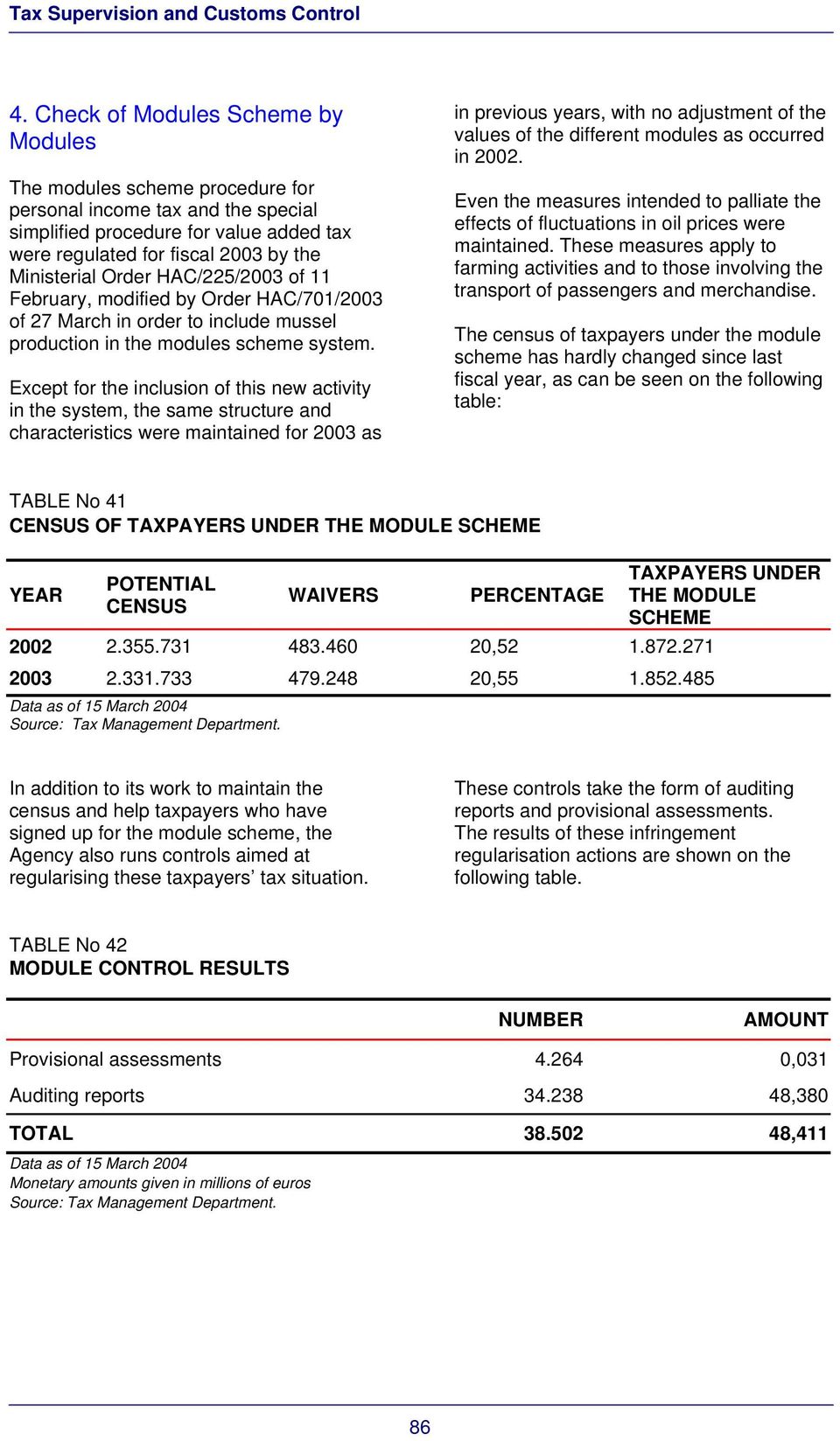
6 4. Check of Modules Scheme by Modules The modules scheme procedure for personal income tax and the special simplified procedure for value added tax were regulated for fiscal 2003 by the Ministerial Order HAC/225/2003 of 11 February, modified by Order HAC/701/2003 of 27 March in order to include mussel production in the modules scheme system. Except for the inclusion of this new activity in the system, the same structure and characteristics were maintained for 2003 as in previous years, with no adjustment of the values of the different modules as occurred in Even the measures intended to palliate the effects of fluctuations in oil prices were maintained. These measures apply to farming activities and to those involving the transport of passengers and merchandise. The census of taxpayers under the module scheme has hardly changed since last fiscal year, as can be seen on the following table: TABLE No 41 CENSUS OF TAXPAYERS UNDER THE MODULE SCHEME YEAR POTENTIAL CENSUS WAIVERS PERCENTAGE , , Data as of 15 March 2004 Source: Tax Management Department. TAXPAYERS UNDER THE MODULE SCHEME In addition to its work to maintain the census and help taxpayers who have signed up for the module scheme, the Agency also runs controls aimed at regularising these taxpayers tax situation. These controls take the form of auditing reports and provisional assessments. The results of these infringement regularisation actions are shown on the following table. TABLE No 42 MODULE CONTROL RESULTS NUMBER AMOUNT Provisional assessments ,031 Auditing reports ,380 TOTAL ,411 Data as of 15 March 2004 Source: Tax Management Department. 86
7 Supervision by the Financial and Tax Auditing Department Following the guidelines of the General Tax Control Plan (2003), one of the main objectives of which is the development of the National Auditing Plan for fiscal 2003, and subject to the guidelines and strategies set out in the Tax Agency 2005 document, tax auditings were conducted this year by means of selective audits, primarily focused on those sectors where the greatest risk of fraudulent conduct exists. Thanks to the intensive use of new technologies, the auditing methods and techniques have been modernised and auditing quality has been improved. Thus, in 2003, the gradual implementation of the Verification Assistance Method (MAC), the consolidation of the Department's Intranet to support knowledge management (documental base, auditing procedure guide, sectorial guides, etc.). The following actions carried out by Tax Auditors in 2003 are noteworthy: in the broadest sense of the term: urban development, construction, real estate development, auxiliary industries and subcontracting. - Intensification of controls of professional activities. - Special attention to value added tax refunds. - Continuation of actions focused on unreported economic activities. - Control of certain transactions to and from countries classified as tax havens. - Continued control of companies with ties to so-called Organised Fraud Networks which commit VAT fraud. - Collaboration with the tax auditing services of different autonomous communities in relation to transferred taxes. The results obtained by Tax Auditing in its general activities in 2003 were as follows: 33,722 taxpayers were checked and 83,747 reports were made out on them (this figure includes 25,444 A51 reports for penalty proceedings), calling for payment of 2, million euros. - Special focus on the real estate sector, GRAPH VIII AUDITING RESULTS (2003) EI s - UI s: Auditing Teams ERI s - URI s: Regional Auditing Teams Source: Financial and Tax Auditing Department TAXPAYES AUDITED 9% 2% REPORTS DRAFTED 11% 3% TAX DEBT 27% 53% 89% 86% 20% EI's UI's I. CENTRALISED ERI's URI'S 87

8 As a result of Tax Auditing s work to get liabilities settled during the course of 2003, the paid tax liability came up to 3, million euros; of this total, 3, million are ordinary results, and the remainder ( million euros) can be classified as extraordinary results. The figure is a considerable improvement over the 3, million euros paid in In addition to the activities described above, the Auditing Department worked hard in other areas to make headway in the fight against tax fraud. The biggest of these activities were basically aimed at offences against the Exchequer and other criminal acts that were reported to the Department. 1,548 cases of offences against the Exchequer were in fact forwarded to the Public Prosecutor s Office (1,015 tax offences, 14 accounting offences, 1 case of subsidy fraud and 518 cases of criminal acts) in addition to 146 cases involving other criminal conduct, altogether worth a total of million euros. The equivalent debt represented by this quota in terms of objectives, i.e., the debt which would have materialised in auditing reports had such auditings been carried out administratively, was 1, million euros (40.73% more than in 2002). Both of these items (actual quota and equivalent debt) include the amounts corresponding to the 15 cases of tax fraud. The results of these cases represent the highest amount ever reported by the Tax Agency. There are other activities too that have made great strides in the fight against tax fraud: checks in areas such as reduction of requested refunds, the reduction of taxable bases to be compensated, adjustments in consolidated taxation, etc. These activities add up to 1, million euros that, because they are not examined debt, constitute a reduction in the tax credits declared by taxpayers. This heading includes million euros from extraordinary results. Adding all the above figures together (settled debt, offences against the Exchequer and other criminal acts, other activities), the overall result of the Tax Auditing area in the fight against fraud comes up to 5, million euros, including million euros in extraordinary results. If the results of the auditings carried out by the Large Enterprise Management Units are added to these, the overall results amount to 6, million euros, 6, million or which are ordinary results and million are extraordinary results. The 2003 results met the stated objectives of the National Auditing Plan, making significant strides in the eradication of complex tax fraud which is characterised by the need for specialised investigation. The achievement of the Department s objectives has also been aided by extensive controls which are conducted within a relatively close period of time to the occurrence of the taxable event, thereby improving the voluntary discharge of fiscal obligations and doing more to ensure collection of the tax debt. The following graph illustrates how checks are getting closer and closer to the end of the voluntary tax return-filing period and shows how, for the period, regardless of the trend in the penalty interest charged for late payment, the portion of the total amount of reported examined debt that is due to this item has a marked downward tendency. 88

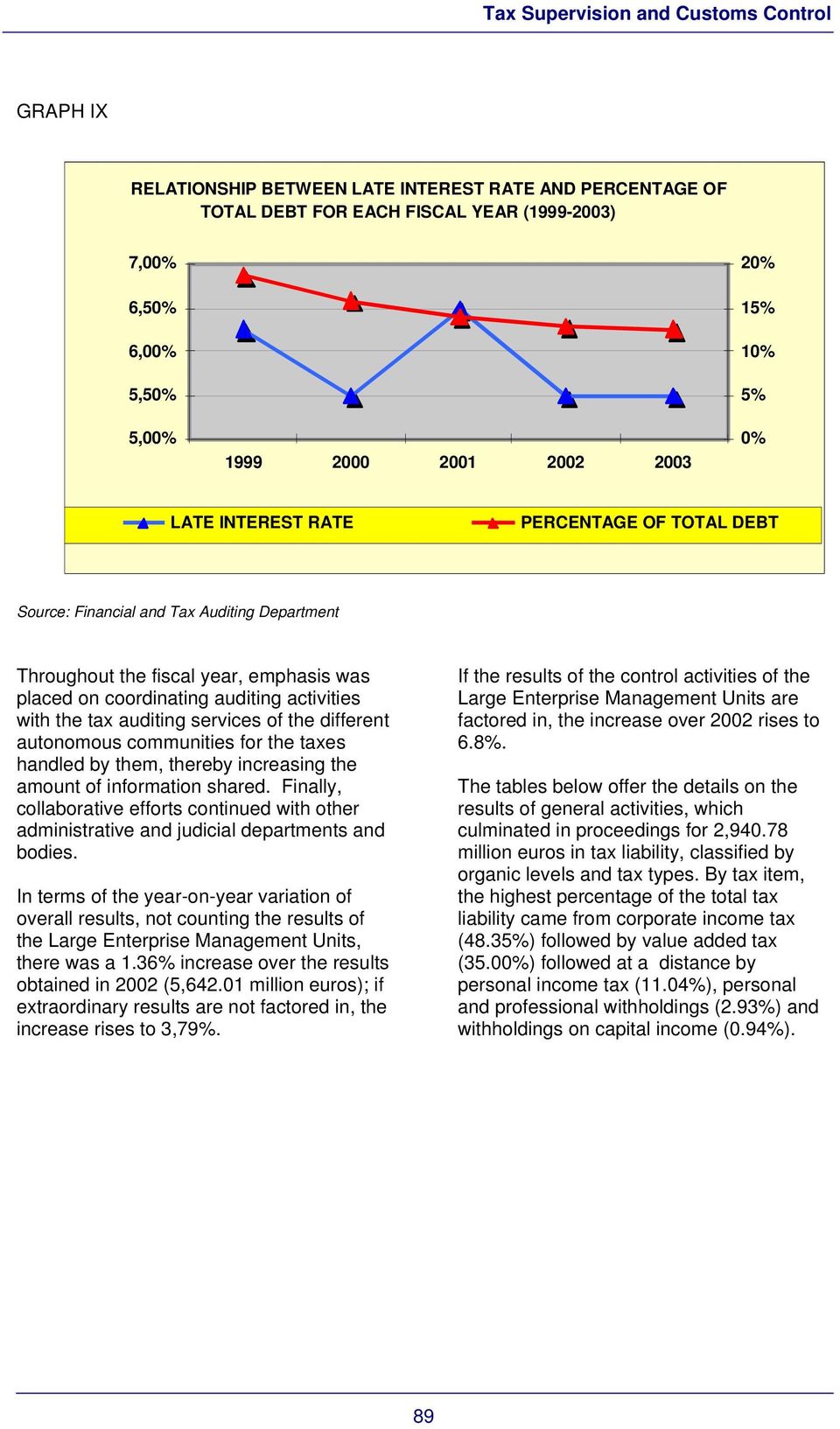
9 GRAPH IX RELATIONSHIP BETWEEN LATE INTEREST RATE AND PERCENTAGE OF TOTAL DEBT FOR EACH FISCAL YEAR ( ) 7,00% 6,50% 6,00% 5,50% 5,00% % 15% 10% 5% 0% LATE INTEREST RATE PERCENTAGE OF TOTAL DEBT Source: Financial and Tax Auditing Department Throughout the fiscal year, emphasis was placed on coordinating auditing activities with the tax auditing services of the different autonomous communities for the taxes handled by them, thereby increasing the amount of information shared. Finally, collaborative efforts continued with other administrative and judicial departments and bodies. In terms of the year-on-year variation of overall results, not counting the results of the Large Enterprise Management Units, there was a 1.36% increase over the results obtained in 2002 (5, million euros); if extraordinary results are not factored in, the increase rises to 3,79%. If the results of the control activities of the Large Enterprise Management Units are factored in, the increase over 2002 rises to 6.8%. The tables below offer the details on the results of general activities, which culminated in proceedings for 2, million euros in tax liability, classified by organic levels and tax types. By tax item, the highest percentage of the total tax liability came from corporate income tax (48.35%) followed by value added tax (35.00%) followed at a distance by personal income tax (11.04%), personal and professional withholdings (2.93%) and withholdings on capital income (0.94%). 89
10 TABLE No 43 SUMMARY OF REPORTS, TAXPAYERS AND INVESTIGATED LIABILITY BY ORGANIC LEVELS, 2002/2003 GENERAL ACTIVITIES CLASSIFICATION TAXPAYERS AUDIT. REPORTS TAX LIABILITY CHECKED Units , ,69 Regional Units ,23 576,88 Total Offices , ,57 Centralised Auditing* ,48 791,21 TOTAL , ,78 * This includes the National Auditing Office and the National Fraud Investigation Office Source: Financial and Tax Auditing Department TABLE No 44 TAX LIABILITY BROKEN DOWN BY TAX TYPE INVESTIGATED BY TAX AUDITORS OVERALL RESULTS (2002/2003) Percentage of Total Tax Liability Tax Liability TAX TYPE Personal income tax 308,02 324,52 8,55% 11,04% Corporate income tax 1.375, ,89 38,18% 48,35% VAT 1.429, ,42 39,67% 35,00% Withholdings on personal and professional earnings 235,78 86,16 6,54% 2,93% Withholdings on invested capital 28,78 27,55 0,80% 0,94% Other taxes 225,49 51,24 6,26% 1,74% Total 3.603, ,78 100% 100% Source: Financial and Tax Auditing Department 1. National Auditing Office The National Auditing Office (ONI), created under article 22 of Royal Decree 2335/1983, of 4 August and attached to the Director of the Financial and Tax Auditing Department, is responsible for advising, monitoring and inspecting those taxpayers whose tax liability is such that they require special treatment in order to ensure and facilitate compliance with their tax 90

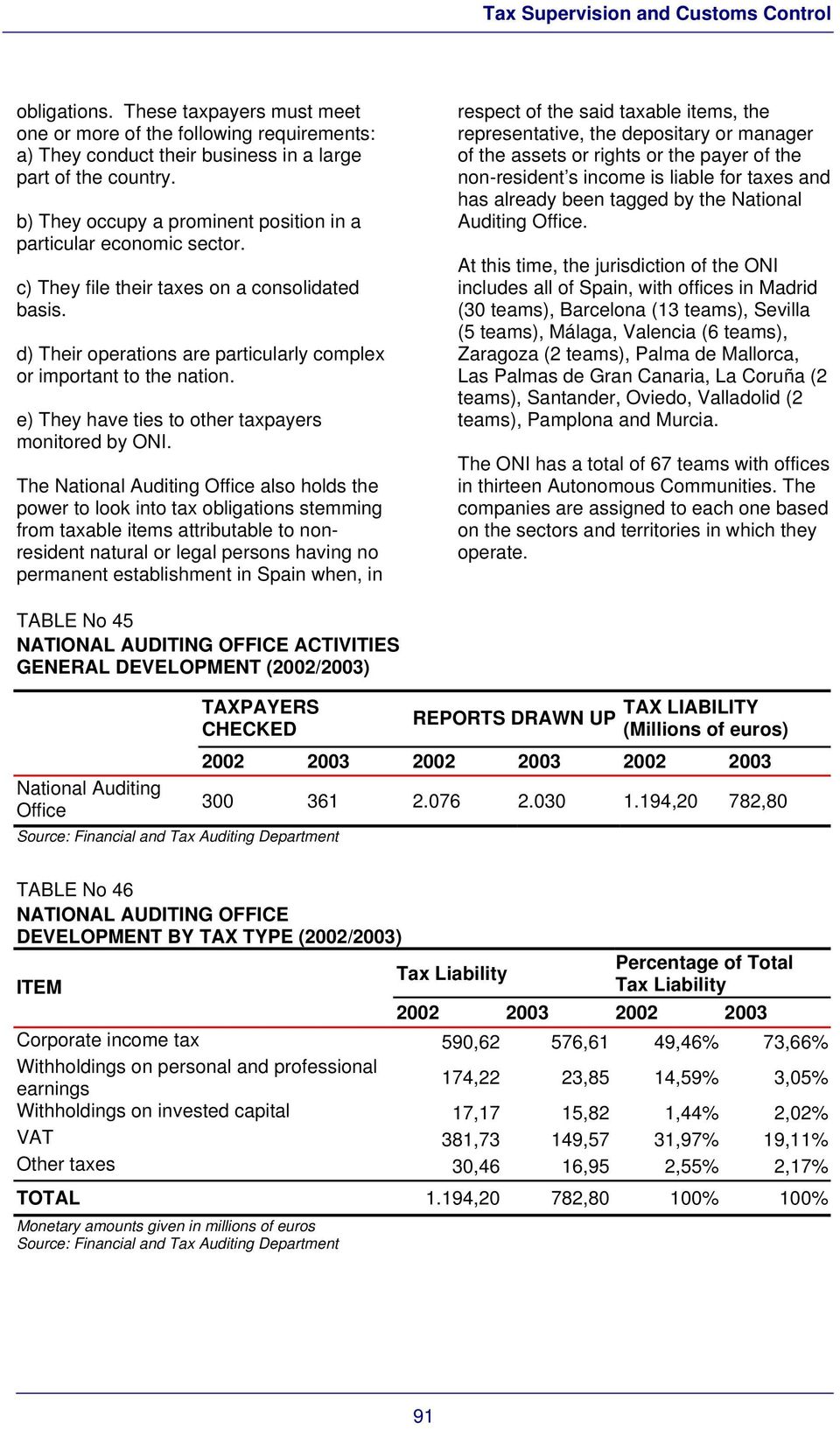
11 obligations. These taxpayers must meet one or more of the following requirements: a) They conduct their business in a large part of the country. b) They occupy a prominent position in a particular economic sector. c) They file their taxes on a consolidated basis. d) Their operations are particularly complex or important to the nation. e) They have ties to other taxpayers monitored by ONI. The National Auditing Office also holds the power to look into tax obligations stemming from taxable items attributable to nonresident natural or legal persons having no permanent establishment in Spain when, in respect of the said taxable items, the representative, the depositary or manager of the assets or rights or the payer of the non-resident s income is liable for taxes and has already been tagged by the National Auditing Office. At this time, the jurisdiction of the ONI includes all of Spain, with offices in Madrid (30 teams), Barcelona (13 teams), Sevilla (5 teams), Málaga, Valencia (6 teams), Zaragoza (2 teams), Palma de Mallorca, Las Palmas de Gran Canaria, La Coruña (2 teams), Santander, Oviedo, Valladolid (2 teams), Pamplona and Murcia. The ONI has a total of 67 teams with offices in thirteen Autonomous Communities. The companies are assigned to each one based on the sectors and territories in which they operate. TABLE No 45 NATIONAL AUDITING OFFICE ACTIVITIES GENERAL DEVELOPMENT (2002/2003) National Auditing Office TAXPAYERS CHECKED Source: Financial and Tax Auditing Department REPORTS DRAWN UP TAX LIABILITY (Millions of euros) ,20 782,80 TABLE No 46 NATIONAL AUDITING OFFICE DEVELOPMENT BY TAX TYPE (2002/2003) ITEM Percentage of Total Tax Liability Tax Liability Corporate income tax 590,62 576,61 49,46% 73,66% Withholdings on personal and professional 174,22 23,85 14,59% 3,05% earnings Withholdings on invested capital 17,17 15,82 1,44% 2,02% VAT 381,73 149,57 31,97% 19,11% Other taxes 30,46 16,95 2,55% 2,17% TOTAL 1.194,20 782,80 100% 100% Source: Financial and Tax Auditing Department 91
12 The Tax Agency Resolution of 17 February 1998, which modified the structure of certain services and gave tax auditing authority to the Financial and Tax Auditing Department, called for the formation of specialised teams, in addition to the rest of the National Auditing Office teams and with the same structure, in charge of conducting auditings, drafting reports and making proposals, as well as providing support to the rest of the auditing teams and units as directed by the Head of the ONI. These teams include: the International Tax Auditing Team, the Technical Assessment Team and the Coordination and Special Action Team. 2. Central Coordination Unit for Matters of Offences Against the Exchequer The aforementioned Tax Agency Resolution of 17 February 1998 created the Central Coordination Unit for Offences against the Exchequer. This Unit, which replaced the former Special Unit for the Auditing and Repression of Tax Fraud, under the direct supervision of the Department Director, assumed the responsibilities set out in part eight of the Resolution which include the following basic functions: a) It integrates the criteria to be used in matters involving offences against the Exchequer and notifies the Tax Auditorate of those criteria. b) It prepares the criteria that must be followed in the processing of potential offences against the Exchequer. c) It provides the auditing services with advice on the proceedings they are investigating if those proceedings might contain indications of offences against the Exchequer. By and large the courts have corroborated the Auditorate s judgment, as shown by their sentences. Not only has the number of sentences gone up over the years, but also most sentences find the defendant guilty. TABLE No 47 DEVELOPMENT OF THE AUDITORATE S ACTIVITIES IN PURSUIT OF FISCAL OFFENCES Number of proceedings (1) Number of taxpayers (2) Defrauded liability (3) 408,42 546,94 499,39 666,20 Average liability per proceeding (4) 0,551 0,703 0,495 0,434 Average liability per taxpayer (4) 0,938 1,210 0,903 0,899 Liability amounts given in millions of euros (1) Includes number of cases of tax offence, accounting offence, subsidy fraud and in conjunction with criminal proceedings. (2) Includes number of taxpayers investigated for tax offence, accounting offence, subsidy fraud and in conjunction with criminal proceedings. (3) Includes outstanding liabilities from tax offences, accounting offences, subsidy fraud and in conjunction with criminal proceedings. (4) Cases of accounting offences not involving an actual liability amount are not taken into account (14 cases and 11 taxpayers in 2003). Source: Financial and Tax Auditing Department 92

13 TABLE No 48 EVOLUTION OF JUDICIAL PRONOUNCEMENTS ON TAX OFFENCES (1997/2003) (*) 2003 Guilty verdicts ** Acquittals Dismissals TOTAL NUMBER OF 59 SENTENCES These data may vary as a result of decisions handed down after the date of this. report.* Includes 13 guilty sentences and 2 acquittals corresponding to judgments issued by the courts last year, which became known after the 2002 annual report was completed. **The guilty verdicts include 1 for an accounting offense, 1 for falsification and tax offense and 1 for a tax and accounting offense. Source: Financial and Tax Auditing Department 3. Regional Auditing Units The Resolution of the Chairman of the Tax Agency of 20 March 2003 modified the resolution of 24 March 1992 on the organization and functions of the tax auditing units of the Financial and Tax Auditing Department and established a new framework for the organization and assignment of functions to territorial units. This new territorial model introduced structured modifications intended to increase tax control efficiency and effectiveness. The most important innovation was the elimination of the division of competencies between regional and provincial units, creating for the Auditing Area a single regional unit for each Special Bureau. The new territorial model has resulted in a notable increase in the number of specialised units in large enterprises and actions designed to contain particularly complex forms of fraud. Moreover, in the interest of improved decision-making efficiency and coordination, the tasks of planning and selecting taxpayers for auditing and the verification of the assessment proposals submitted by auditors are concentrated at the regional level (Technical Office). Consequently, the traditional configuration of this section of the Annual Report based on the different organizational levels (Provincial Auditing Units and Regional Auditing Units) must now be updated to differentiate between Auditing Units and Teams (IUs and ITs) and Regional Auditing Units and Teams (RIUs and RITs). In addition to those established in parts 4, 5, 6 and 7 of Number Five of the Resolution of 24 March 1992 for each one of the units involved, the Regional Auditing Units of the Special Offices of the Tax Agency are assigned the following functions in relation to the taxpayers with tax domiciles in the jurisdiction of the Special Bureau of the Tax Agency, provided that the National Auditing Office or the National Fraud Investigation Offices do not have jurisdiction there: a) Planning and supervising the actions of existing auditing services in the area of the corresponding Special Bureau of the Tax Agency. b) Directing and coordinating the activities of all of its units. c) Controlling and assuming the responsibility for meeting the stated plans and objectives in coordination with the other offices of the Special Bureau. d) Studies, reports and advice on questions under its jurisdiction as necessary. 93

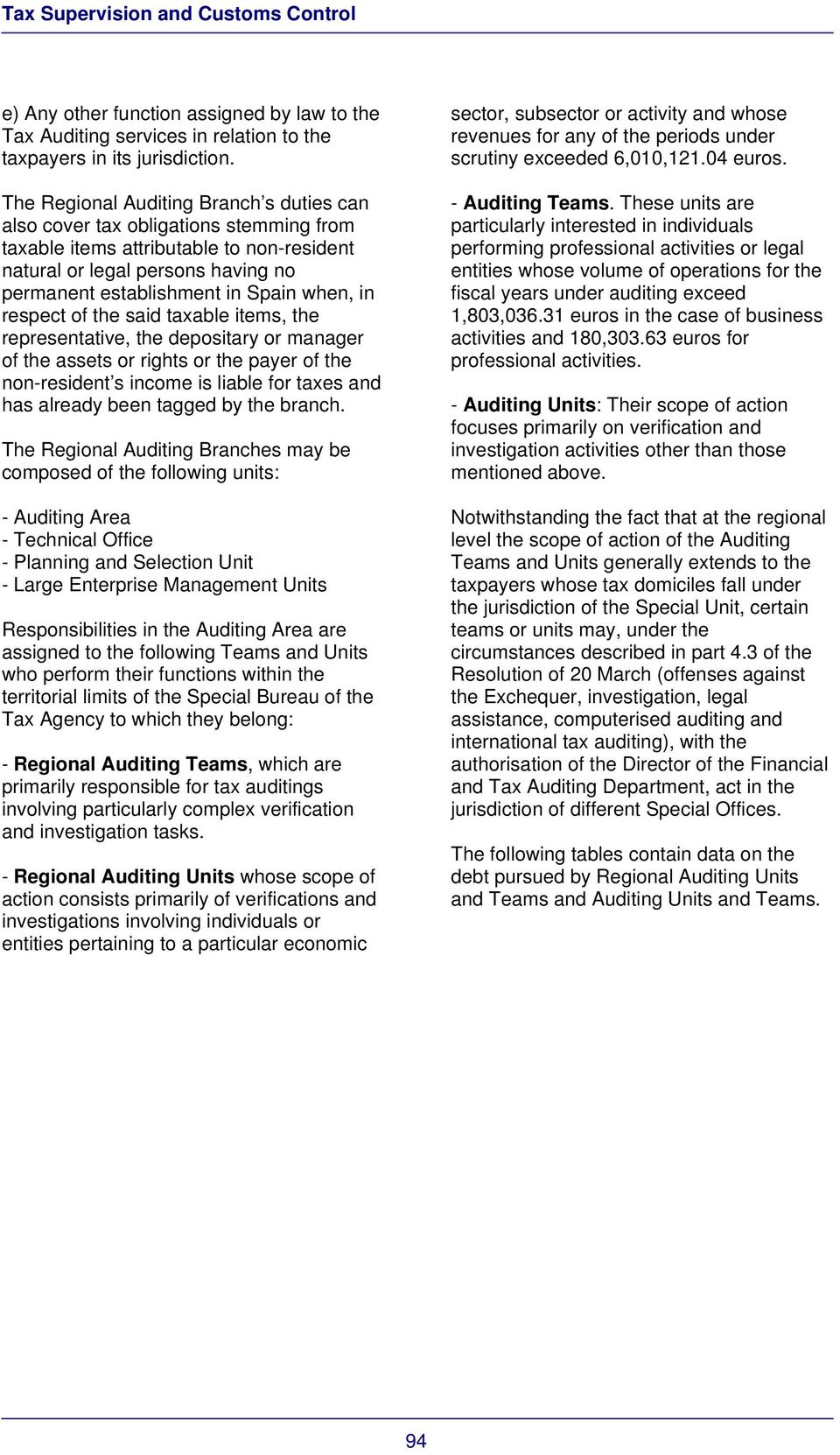
14 e) Any other function assigned by law to the Tax Auditing services in relation to the taxpayers in its jurisdiction. The Regional Auditing Branch s duties can also cover tax obligations stemming from taxable items attributable to non-resident natural or legal persons having no permanent establishment in Spain when, in respect of the said taxable items, the representative, the depositary or manager of the assets or rights or the payer of the non-resident s income is liable for taxes and has already been tagged by the branch. The Regional Auditing Branches may be composed of the following units: - Auditing Area - Technical Office - Planning and Selection Unit - Large Enterprise Management Units Responsibilities in the Auditing Area are assigned to the following Teams and Units who perform their functions within the territorial limits of the Special Bureau of the Tax Agency to which they belong: - Regional Auditing Teams, which are primarily responsible for tax auditings involving particularly complex verification and investigation tasks. - Regional Auditing Units whose scope of action consists primarily of verifications and investigations involving individuals or entities pertaining to a particular economic sector, subsector or activity and whose revenues for any of the periods under scrutiny exceeded 6,010, euros. - Auditing Teams. These units are particularly interested in individuals performing professional activities or legal entities whose volume of operations for the fiscal years under auditing exceed 1,803, euros in the case of business activities and 180, euros for professional activities. - Auditing Units: Their scope of action focuses primarily on verification and investigation activities other than those mentioned above. Notwithstanding the fact that at the regional level the scope of action of the Auditing Teams and Units generally extends to the taxpayers whose tax domiciles fall under the jurisdiction of the Special Unit, certain teams or units may, under the circumstances described in part 4.3 of the Resolution of 20 March (offenses against the Exchequer, investigation, legal assistance, computerised auditing and international tax auditing), with the authorisation of the Director of the Financial and Tax Auditing Department, act in the jurisdiction of different Special Offices. The following tables contain data on the debt pursued by Regional Auditing Units and Teams and Auditing Units and Teams. 94
15 TABLE No 49 TAX LIABILITY BROKEN DOWN BY TAX TYPE PURSUED BY REGIONAL AUDITING TEAMS AND UNITS (2002/2003) Percentage of Total Tax Liability TAX TYPE Tax Liability Personal income tax 32,88 22,47 3,96% 3,90% Corporate income tax 292,68 311,56 35,21% 54,01% VAT 328,43 180,37 39,51% 31,27% Withholdings on personal and professional 36,87 32,97 4,44% 5,72% earnings Withholdings on invested capital 3,77 9,56 0,45% 1,66% Other taxes 136,60 19,95 16,43% 3,46% TOTAL 831,23 576,88 100% 100% Source: Financial and Tax Auditing Department TABLE No 50 TAX LIABILITY BROKEN DOWN BY TAX TYPE PURSUED BY AUDITING TEAMS AND UNITS (2002/2003) Percentage of Total Tax Liability TAX TYPE Tax Liability Personal income tax 275,03 298,84 17,44% 19,00% Corporate income tax 491,84 522,96 31,20% 33,25% VAT 719,32 699,20 45,62% 44,46% Withholdings on personal and professional 24,58 28,85 1,56% 1,83% earnings Withholdings on invested capital 7,84 2,16 0,50% 0,14% Other taxes 58,04 20,68 3,68% 1,31% TOTAL 1.576, ,69 100% 100% Source: Financial and Tax Auditing Department 4. National Fraud Investigation Office Central Liaison Office (C.L.O.) 1.- Support activities to help reach the Tax Auditorate s objectives, both in regard to auditing activity planning and in the field of examinations and direct investigation. Under this heading, the following actions are worthy of note: Responding to requests for information from the different auditing teams and units, either on line (SINAI application) or using other media, in order to identify the real owners of certain 95

16 financial assets, clarify the means of payment used in transactions or obtain documental support for certain mercantile or commercial operations. In fiscal year 2003, work began on the development of a new application (ARES) to replace and improve the current one. This new application, which is expected to be operational in 2004, runs in an Intranet environment. The following requests for information were received and processed by this Team in fiscal year 2003: a) SINAI Application - General: b) SINAI Application - Financial Assets: c) Other requests involving financial assets: 6 d) Number of requests from actuaries requesting press information obtained by the Team: At the international level, under the terms of double taxation accords and EC directives, the unit processed 1,403 requests for information exchanges with the tax authorities of other countries Also on the international front, the Central Information Squad acts as a liaison for the management of the intra-community cooperation system for supervising VAT, handling 5,243 information-sharing requests. 2.- Verification and maintenance of the VIES Census in order to remove people registered in it who do not belong there. In all, there were 7,072 actions in this regard, with a total of 1,276 eliminations from the VIES Census. 3.- Creation and development of information programmes and plans, permanent or otherwise, aimed at systematically gathering information on financial markets and assets, foreign transactions, currency trafficking, taxpayer groups, professional and employers collectives and certain sectors. The information thus obtained is screened and analysed and then subjected to selection techniques to choose candidates for tax auditing. 16 programmes were developed in 2003, 10 of which are permanent. 4.- There were 332 disciplinary proceedings for minor infractions. 5.- The following appeals were processed: - Against SINAI notices: 7 - Against financial asset notices: 1 - Against fines: Execution of resolutions, suspensions and reports relative to disciplinary proceedings: - Executions of appeals: 19 - TEAC executions : 10 - Suspensions lifted on appeal: 11 - REAC suspensions lifted: 10 - TEAC reports: Maintenance and updating of databases consisting of making additions, modifications or notes to record corrections or rectifications reported by the filing entities of the different tax forms due to errors on the forms. 8.- Participation on the Standing Committee for Administrative Cooperation (SCAC) created by Regulation 218/92, initially for the purpose of supervising the operation of the VIES system and mutual assistance on VAT matters, although it was ultimately given additional responsibilities. Also participates on the working groups set up by the committee on an ad hoc basis to address certain tax fraud issues. 9.- Participation at international meetings and seminars. Among others, a member of the Central Information Squad attended the meetings (two in 2003) of working group number 8 (GT8) of the Fiscal Affairs Committee of the OECD on tax evasion 96

17 and fraud along with a representative of the Directorate General of Taxation Active participation in the Twinning Agreement between the Tax Agency and the Romanian Ministry of Finance to improve the collection system. The CIS coordinates the activities to be carried out in the area of administrative cooperation and assistance between member states on tax matters. This has required travel to Romania by some of the unit s members. The data obtained in the development of information plans and programmes is summarized on the following table: TABLE No 51 CENTRAL LIAISON OFFICE ACTIVITIES. DATA OBTAINED IN AUDITING SUPPORT INFORMATION 2003 A) Total number of data as of 31/12/03: * B) Breakdown by gathering body: - Central Information Squad Agency offices C) Comparison with years before (*) C.L.O Agency Offices TOTAL (*) Almost all of the data are obtained on magnetic support. The considerable increase in data in 2003 is basically due to the information received from banks about undeclared accounts on model 196. Source: Financial and Tax Auditing Department Tax Fraud Study Group. The principal studies and investigation projects carried out in 2003 were as follows: 1.- Internet and e-commerce The work that began years ago and which consists of studying, gathering and systematizing information on the sector continued in As a result of this work, cases exhibiting an apparently elevated risk of non-compliance were discovered and reported to the Special Units affected. 2.- Risk analysis Progress was made during the first quarter of 2003 on the new system for estimating the risk of tax evasion based on neuronal networks, with the development of the first pilot test. Efforts also continued to improve the control of VAT and to develop a system of neuronal networks for selection in the real estate sector. 3.- Non-resident accounts. Preparation of a report containing the results of the investigations carried out on the subject: financial and tax regulation, existing information and work in progress, 97
18 analysis of the fiscally-significant results obtained and conclusions and outlook for the future. The following reports, investigations and studies were also conducted: - Report on the operation of the prepaid telephone card sector. - Significant investments in second hand real estate prior to the introduction of the euro. - Preparation of statistical tables on sectorial economic activity adjusted to the needs of the National Auditing Plan. - Study of the fiscal conduct of taxpayers following an auditing. - Studies of the sector composed of clinics specialising in cosmetic surgery. - Actions to obtain information relative to special urban development activities. - Project regarding negative yields on capital investments of a significant quantity. - Project regarding the fraud induced by the module scheme. - Appraisals of second hand vehicles and boats valid for Control Methods and Procedures Team. Throughout 2003, the activities focused on a number of projects relative to Working Methods and Procedures: 1.- Verification Assistance Method (MAC) This tool has been active on the Tax Agency s Intranet since the middle of MAC is an application designed to systematise the most common tests of an auditing case, to encourage the most efficient use of the information existing in the databases and facilitate the assignment of tasks among teams or units. Some of the other reasons for developing MAC include: innovating working methods and instruments; extending the ability to work directly with the computerised accounting files of companies and introducing instruments to evaluate work quality. The main objectives for 2003 in relation to the Verification Assistance Method were as follows: - Extending the use of the application. In this regard, while in 2002 there were 241 users and 562 files created, in 2003 there were 719 users and 2,809 files created. - Completing MAC training through scheduled training courses. - Maintaining and updating the application. - Introducing new utilities and tools and continuously improving existing ones. - Initiating sectorial developments for MAC by creating work groups. - Evaluating MAC future-oriented design. 2.- Preparation of an "Auditing Procedure Manual. The Methods and Procedures Team is drafting the manual and the corresponding computer application; work is expected to begin in the near future to incorporate the suggestions, upgrades and improvements proposed by users. The document incorporates and standardises the most commonly used forms in auditing proceedings and includes a section containing all of the legislation affecting tax auditing proceedings. It also includes the main circulars, resolutions and instructions affecting tax auditing proceedings as well as some of the manuals and reports issued by the Financial and Tax Auditing Department. Central Investigation Teams. For 2003, the most notable activities of these teams can be divided into the following groups: 1. Actions related to the coordination and fight against organised fraud schemes. 98
19 1.1.- In the field of prevention and early detection of fraud, there were investigations to detect what are known as "missing traders in certain sectors which occasionally culminated with the withdrawal of the Intra-Community Operator Number; moreover, the administrative assistance provided to other EC countries resulted in more than 200 cases of information supplied to other countries In the field of coordinating direct actions in the fight against fraud, the teams focused their efforts primarily in the precious metals (gold), automotive, computer, metal and scrap metal sectors. The actions here focused on controlling interposed companies and fronts and also what are known as "carousel procedures. Thanks to the work done in this area, coordinated by the National Fraud Auditing Office, approximately 325 million euros of tax liabilities were uncovered. 2. Work in the financial markets sector which consisted of coordinating and supporting the work of the auditing units and teams in their efforts to check on taxpayers who generate losses in operations in the derivatives market and analyses of collective investment institutions. Finally, throughout 2003 the Central Investigation Teams of the National Fraud Auditing Office audited and investigated the taxpayers assigned to them. 5. Large Enterprise Management Units Since the Tax Agency Chairman s Resolution of 16 December 1994, supervising large enterprises is the responsibility of the Central Large Enterprise Management Unit and the Regional Large Enterprise Management Units, which operate under the Financial and Tax Auditing Department. The Central Large Enterprise Management Unit focuses its activities on the controls corresponding to the Large Enterprise Census, which is subject to auditing by the National Auditing Office; the Regional Large Enterprise Management Units are responsible for performing tax management functions on taxpayers who meet any of the following circumstances and do not fall under the jurisdiction of the National Auditing Office: - Those whose business volumes were in excess of 6,010, the year before; - As ordered by the Special Delegate for any of the reasons listed in part 7.b) of the Resolution of 20 March 2003 of the Chairman of the Tax Agency. The development of the census of taxpayers (tax roll) monitored by Large Enterprise Management Units is as follows: TABLE No 52 TAXPAYER CENSUS % 03/02 Central Large Enterprise Management Unit ,8% Regional Large Enterprise Management Units ,0% TOTAL ,0% Source: Financial and Tax Auditing Department 99

20 During 2004 the Large Enterprise Units continued to introduce monthly electronic tax returns; the number of those filed rose to 743,335 at Regional Units as a group and 48,707 at the Central Unit. The scope of control of these units is reflected in Table 52: which provides information on the tax revenues from Large Enterprises from corporate income tax, VAT, capital withholdings and personal earnings withholdings as well as the percentages which these revenues represent compared to the total. Tax refunds in the amount of 12,874 million euros were also processed, which represents approximately 43% of the total amount of all refunds paid out by the Agency. The results of the Management Control of Large Enterprises in 2004 are as follows: - Assessments generated in the amount of million euros. - Decreases in refunds, negative tax bases and compensations requested amounted to million euros. - Self-assessments filed after receiving notices of non-compliance with tax obligations amounted to million euros. The table below contains a comparative summary with the year before: TABLE No 53 RESULTS OF LARGE ENTERPRISE MANAGEMENT CONTROL ITEM DIFFERENCE Liability settled 127,81 161,04 26,0% Remission of refunds, compensations and negative taxable bases 229,14 408,81 78,4% Self-assessments in response to notice 37,63 110,99 195,0% TOTAL 394,58 680,84 72,5% Source: Financial and Tax Auditing Department The data contained on the table above show a 72.54% improvement over the Control in the Customs and Excise Area Fraud Control and the Fight Against Fraud 1. Auditing Area Activities The functions inherent to Customs and Excise Tax Auditing are performed by the following bodies: a) By the National Auditing Office on a nation-wide basis. previous year's results. b) By the Regional Customs and Excise Tax Units in peripheral areas and within the territorial limits of each Special Bureau of the Tax Agency. Auditing services stick to the orientation provided by the Tax Agency s General Plan on Supervision, which includes the Customs and Excise Partial Supervision Plan and the National Customs and Excise Auditing Plan. On the basis of the National Information and Investigation Office s investigations, their own investigations, the experience of 100

21 past years and their experience in computerised risk analysis, the Customs and Excise Tax Auditing Services checked a total of 3,404 taxpayers in 2003, concluding a total of 5,236 reports whose total examined debt came up to million euros, distributed by services as shown in TABLE No 54. TABLE No 54 ACTIVITIES PERFORMED BY THE CUSTOMS AND EXCISE AREA S AUDITING SERVICES NUMBER OF REPORTS NUMBER OF TAXPAYERS CHECKED EXAMINED DEBT % 03/ % 03/ % 03/02 Regional Auditing , ,86 214,29 205,81-3,96 Units National Auditing , ,05 60,58 57,61-4,91 Office TOTAL , ,11 274,87 263,42-4,16 Source: Customs and Excise Department In fiscal year 2003, the results obtained from supervisory activities were somewhat lower than the year before. The examined debt was 4.16% lower and the number of reports fell by 8.11%. The drop is due to the reduction in the number of auditors assigned to investigation and verification activities and an increase in intervention actions which are also handled by auditing personnel. However, the ratio of examined debt has improved as regards both the number of reports issued and the number of taxpayers audited. This improvement is due to the fact that the Department s investigation services have become more specialised. As a result of this, the taxpayers selected for auditing are those in sectors at highest risk for tax evasion and the quality of the auditings has improved, aided by the use of standard MACA information sources. When the examined debt is considered by tax type, there is a 21.51% reduction in VAT. However, if the million euros corresponding to the regularisation of VAT on imports caused by an irregularity that is not likely to be repeated were deducted from the total examined debt, the 2003 results would be 17,66% higher than those of the year before. As part of the Partial Customs and Excise Auditing Plan for 2003, priority was placed on foreign trade, excise tax on hydrocarbons and excise tax on certain means of transport, all of which improved the results of these programmes. The results of foreign trade auditings do not affect EU resources only (which were down by 2.11%), but also the results of all other taxes in the case of imported goods. The debt examined in relation to excise tax on hydrocarbons increased by 9.31%. Particularly significant is the variation in absolute terms of the excise tax on certain means of transport, with an increase of million euros as a result of efforts to detect organised schemes to evade the payment of this tax. These organised schemes operate by bringing luxury vehicles into Spain from EU countries and declaring customs values that are much lower than the market price, which results in 101
22 a significant reduction in the tax revenues collected. Finally, it should be noted the revenues from excise tax on tobacco products increased by %, thanks to the detection of irregularities in shipments to third party countries and to losses and differences in movement. TABLE No 55 EXAMINED DEBT BY TAX TYPE (figures given in millions of euros) DEBT TAX TYPE Regional Auditing Units National Auditing Office TOTAL Regional Auditing Units National Auditing Office TOTAL % 03/02 VAT 84,416 39, ,002 48,242 49,086 97,328-21,51 Excise on beer 0,305 0,004 0,309 0,073 0,023 0,096-68,96 Excise on alc. and bev. derived from alcohol 39,203 3,230 42,433 12,495 1,188 13,683-67,75 Excise on hydrocarbons 26,991 8,724 35,715 36,167 2,873 39,041 9,31 Retail sales 0,145 0,145 Excise on tobacco products 0,243 0,418 0,661 2,219 0,016 2, ,11 Excise on transport 44,303 0,017 44,320 74,275 74,275 67,59 Excise on int. products 2,732 0,000 2,732 0,310 0,310-88,66 Excise on electricity 5,692 0,238 5,930 16,646 0,225 16, ,51 E.U. own resources 8,551 8,301 16,852 12,991 3,505 16,496-2,11 Late interest 0,003 0,009 0,012 0,111 0,212 0, ,71 Tax penalties 1,846 0,055 1,901 2,134 0,477 2,612 37,38 TOTAL 214,285 60, , ,808 57, ,414-4,17 Source: Customs and Excise Department The Customs and Excise Tax Auditing Services investigative work in the year 2003 uncovered some fraudulent activities that were considered legal offences because of their monetary worth and willful intent to deceive. The services filed 37 reports of offences (involving million euros) with the Public Prosecutor s Office, a decrease of million euros compared to the year before. This difference is due to the smuggling crimes reported by auditing services. In 2002 there were four reports of this kind valued at million euros, while in 2003 there was only one valued at million euros. In this regard it should be noted that smuggling crimes, because of their special characteristics, are not normally reported by tax auditing services. 102
23 TABLE No 56 FISCAL OFFENCES AND SMUGGLING OFFENCES REPORTED BY THE CUSTOMS AND EXCISE TAX AUDITING AUTHORITIES %03/02 NUMBER OF OFFENSES DEBT (*) NUMBER OF OFFENSES DEBT (*) NUMBER OF OFFENSES Regional Auditing 29 78, ,917 27,59-11,11 Units National Auditing 2 0, , ,00-100,00 Office TOTAL 31 79, ,917 19,35-11,50 (*) Weighted by: 1,5 Source: Customs and Excise Department DEBT Some of the activities of the Customs and Excise Auditing services are not reflected in previously assumed debt. Such activities include 99 auditings conducted in 2003 of export refunds valued at million euros (TABLE 57). The Examination Plan that covers refunds is set by the Office of the Comptroller of the State Administration. In fiscal 2003 the reduction of refunds paid by Customs and Excise Auditing services registered a 59.71% increase over the refunds for TABLE No 57 REDUCTION OF EXPORT REFUNDS NUMBER OF CASES DEBT NUMBER OF CASES DEBT DEBT % 03/02 Regional 97 3, ,070-72,71 Auditing Units National Auditing 1 0, ,572 Office TOTAL 98 3, ,642-58,12 Source: Customs and Excise Department Further advances in the fight against tax fraud were made in the auditings of the refund requests submitted by taxpayers. In fiscal year 2003, there were 98 auditings of this kind, which served to reduce the requested refunds in the amount of million euros. 103
24 TABLE No 58 REDUCTION OF REFUNDS NUMBER OF CASES AMOUNT NUMBER OF CASES AMOUNT AMOUNT % 03/02 Regional 79 0, , ,33 Auditing Units National 3 16, ,259-98,41 Auditing Office TOTAL 82 16, ,733-59,71 Source: Customs and Excise Department In 2003, emphasis was also placed on collaborative efforts by the Customs and Excise Auditing Services with the auditing services of other areas of the Tax Agency and with other governmental or judicial bodies which included checking the origin of goods, reports to public prosecutors and courts, verification of active perfection modules, status and compliance with regulatory requirements governing fiscal deposits, etc. Many of these activities are carried out in response to the requests of other bodies, both in Spain and in third parties countries, submitted in accordance with Mutual Assistance Agreements. So in 2003 there were 400 reports drafted in collaboration with other administrations, in the form of 08 reports. While this number is slightly lower than in 2002, the number of fiscal ID numbers (NIFs) checked increased by 24.02%. Finally, it should be noted that there are other activities assigned to the customs and excise auditing services which are not included in the Auditing Plan, such as those relative to inspecting excise tax establishments. TABLE No 59 lists the number of auditing proceedings carried out.. TABLE No 59 OTHER ACTIVITIES CARRIED OUT BY CUSTOMS AND EXCISE TAX AUDITING % 03/02 08 REPORTS "Report on Collaboration with other Administrations" Number of cases ,85 Fiscal IDs checked ,02 AUDITINGS OF EXCISE ESTABLISHMENTS. Number of auditings ,77 Source: Customs and Excise Department 2. Investigation Area Activities The National Information and Investigation Office, which is organically and functionally subordinate to the Deputy Directorate General of Auditing and Investigation of the Customs and Excise Department, is essentially responsible for studying everything that has an impact on the fight against tax and customs fraud, particularly analysing sectors and enterprises that are considered high-risk. It also centralises and 104
25 coordinates a vital tool in the fight against fraud, mutual administrative assistance in customs and excise matters, with the European Anti-Fraud Office (which is in charge of fighting the kind of fraud that hurts the EC budget), other European Union Member States and other countries. The National Information and Investigation Office pairs with the National Auditing Office to prepare the National Customs and Excise Auditing Plan, which is part of the Tax Agency s General Plan on Supervision. The National Auditing Plan contains the guidelines that form the foundations on which Auditing services run their examinations vis-à-vis the traditional own resources of the European Union, the Spanish revenue authorities own taxes that the Customs and Excise Department applies, and Community aid for the exporting of agricultural products (refunds). In 2003 this office handled a total of 1,044 cases. TABLE 60 shows the information used as the basis for initiating these cases. TABLE No 60 ORIGIN OF INFORMATION CAUSING THE NATIONAL INFORMATION AND INVESTIGATION OFFICE TO OPEN PROCEEDINGS ORIGIN NUMBER National Information and Investigation Office (ONII) 78 Other Deputy Directorate Generals in the Customs Department 203 Regional offices 298 Mutual assistance (*) 408 Other 57 TOTAL (*) This refers to the European Anti-Fraud Office, Member States and Third Countries Source: Customs and Excise Department Mutual assistance operations rest on the legal foundation of Regulation (EC) No 515/97 and mutual assistance agreements between the European Union and other countries. A total of 408 of these cooperative operations were performed; the breakdown is shown on TABLE No 61. TABLE No 61 COOPERATION BY THE NATIONAL INFORMATION AND INVESTIGATION OFFICE IN 2003 CASES OF COOPERATION With Member States (233) NUMBER At Spain s request 27 At other Member States request 206 With third countries At Spain s request 11 (175) At third countries request 164 TOTAL 408 Source: Customs and Excise Department 105
26 After studying and analysing the investigation cases, a series of conclusions was drawn up and forwarded to the pertinent Auditing Services. This in turn resulted in tax settlements or criminal proceedings whose economic value, estimated by the National Auditing Office at the end of the case, is shown in TABLE No. 62. TABLE No 62 RESULTS OF THE CUSTOMS AND EXCISE DEPARTMENT S INVESTIGATION PROCEEDINGS COMPLEMENTA- ITEM REPORTS OFFENSES RY TOTAL ASSESSMENT Excise on alcohol and bev. der. f/alcoh. 7,437 13,245 20,682 Excise on hydrocarbons 7,078 5,131 12,209 Excise on registration 13,149 13,149 Excise on electricity 1,992 1,992 Excise on foreign trade 13,702 19,950 0,792 34,444 SUM 43,358 38,326 0,792 82,476 Recovery of export refunds 2,043 5,948 7,991 TOTAL 90,467 Source: Customs and Excise Department An analysis of these results shows a reduction in the tax offenses reported to the Public Prosecutor's office. However, if the million euros corresponding to different irregularities relative to excise tax on alcohol and alcohol derivatives (diversion of alcohol shipments) - that are unlikely to be repeated - are deducted from the total offences reported in 2002, the results for 2003 would have exceeded the figures for the year before considerably. In 2003, foreign trade reports were drafted on the basis of false declarations of potassium hydroxide (3.387 million euros) and the dumping of steel wire imports (3.004 million euros). Among others, offenses were reported based on false customs declarations of the value of imported hake (9.942 million euros), false declarations of the value of imported defense and dual use materials (5.362 million euros) and the mission with the O.L.A.F. in Vietnam relative to zinc oxide (2.004 million euros). The complementary assessments are the consequence of the computerised filters proposed by the National Auditing Office and which refer primarily to imports of pentahydrate disodium tetraborate. The recovery of export refunds refers primarily (and in the case of offenses, in their entirety) to meat products. 3. Operations Area Activities Customs Surveillance The total value of goods apprehended, discovered and seized during activities carried out by Customs and Excise s Operations Area in the year 2002 was 3, million euros. Activities against narcotics smuggling are still those that provide the biggest results; they account for 87% of all activities during the fiscal year, 106
27 and they mainly turn up hashish and cocaine, with tons apprehended and reported. The major drug busts in 2003 by the Operations Area are reflected in TABLE No. 63. TABLE No 63 LIST OF THE CUSTOMS AND EXCISE OPERATIONS AREA S MAIN DRUG BUSTS TUMBERRY ITEM QUANTITY (kg) Narcotics- Hashish CARIDAD C ITEM QUANTITY (kg) Narcotics- Cocaine POSEIDÓN ITEM QUANTITY (kg) Narcotics- Cocaine CORK ITEM QUANTITY (kg) Narcotics- Cocaine CRISHACA II ITEM QUANTITY (kg) Narcotics- Hashish Source: Customs and Excise Department A total of 11,434,920 packs of cigarettes were apprehended in action taken against tobacco smuggling, and discovery proceedings were carried out involving a total of 20,342,750 packs. 2,324 anti-smuggling activities were carried out in 2003: 2,165 for offences and 159 for administrative violations. There were 3,553 activities targeting other types of offences and violations, 264 of which had to do with money laundering. Also in 2003, there were 2,902 excise proceedings, 79 of which had to do with tobacco products, 579 with alcohol, 162 with beverages derived from alcohol, 19 with beer, 1,268 with hydrocarbons, 776 with certain modes of transport and 20 with electricity. A total of 1,471 persons were arrested or indicted for these activities, 930 for smuggling and the remaining 541 for other offences. In 2003, there were 411 collaborative efforts between Customs Surveillance services and Financial Auditing, Collection and Management bodies which are broken down as follows: 136 instances of support provided to auditing authorities, 226 to collection authorities and 49 to management authorities. Lastly, a total of 2,121 messages were received over AFIS-SCENT during of those messages were on the early warning system, which gives real-time information on the destination of a shipment in transit. The Customs and Excise Department sent 268 messages over AFIS- SCENT, 85 of which were early warnings. 107
28 4. Excise Auditing In order to make excise tax supervision more stringent for establishments and businesses that feature some high-risk component, each Regional Customs and Excise Section has Regional Excise Auditing Units, whose job it is to keep a sharp eye on developments. This job, albeit an integrated part of the auditing area, has certain unique features of its own that make it different from conventional auditing. It involves checks made both before and simultaneously with the taxable event. This special approach is used because of the unique nature of excise taxes, which is exacerbated by their high taxation rates, exemptions, cases of items that are not subject to a particular tax, tax refunds according to destination and non-monetary taxable bases. Part of excise auditor's job is to make out prior reports to regularise the tax situation of the taxpayers that they are auditing. The prior nature of these reports is determined, among other things, by the fact that these accounting examinations are confined to the records required by the Excise Act and its companion, the Excise Regulation. The auditing activity that took place in 2003 is shown in the following table, where one observes an increase in both the number of activities and the number of proceedings initiated. TABLE No 64 EXCISE AUDITING ACTIVITIES NUMBER %03/02 Number of cases ,72 Proceedings ,99 Reports drawn up ,62 Penalty proceedings ,49 Source: Customs and Excise Department Analytical Control and Technical Support by Customs Chemistry Laboratories goods involved in foreign trade or subject to excise tax rules is summarised in TABLES No 65 and 66. The customs laboratories work during 2003 running analytical checks of samples of 108
29 TABLE No 65 SAMPLES ANALYSED BY CUSTOMS AND EXCISE LABORATORIES IN 2003 CENTRAL BARCELONA IRÚN SEVILLE VALENCIA TOTAL Common Agricultural Policy Excise Hydrocarbons Alcohol and alcoholic beverages Tariff classification and other foreign trade controls TOTAL Source: Customs and Excise Department TABLE No 66 EVOLUTION OF THE NUMBER OF SAMPLES ANALYSED CENTRAL BARCELONA IRUN SEVILLE VALENCIA TOTAL Source: Customs and Excise Department Apart from the examinations to which the data in the tables above refer, the Central Customs Laboratory has also participated in a range of inter-laboratory testing within the framework of activities carried out in cooperation with the following organizations: Ministry of Agriculture, Fisheries and Food: Comparison test of mineral fertilisers: Determination of N, P and Mg. Santander Food and Agriculture Laboratory: Chemical analysis of unprocessed milk. Santander Food and Agriculture Laboratory: Chemical analysis of UHT milk. Santander Food and Agriculture Laboratory: Chemical analysis of fat in unprocessed milk. International Olive Oil Council: Detection of hazelnut oil in olive oil. International Olive Oil Council: Chemical analysis of olive oils. AENOR 118 National Technical Committee: Analysis of cations in tobacco leaves. 109
30 AENOR 118 National Technical Committee: Determination of nicotine, tar and carbon monoxide levels in cigarettes. Dutch Customs Laboratory: Determination of Solvent Yellow 124 in gasoil. Laboratory of the Government Chemist del Reino Unido (DAPS programme): Analysis of circulars 32,33,34 and 35. Ispra Community Research Centre (Italy): Isotopic analysis. Rounds 1, 2 and 3. (MAPA) Food and Agriculture Arbitration Laboratory: Analysis of wine and spirits. Other Activities Recognition of the International Olive Oil Council of the Tasting Panel. Recognition of the International Olive Oil Council of the olive oil chemical analysis laboratory. Olive oil analysis for private individuals. Participation on the work group coordinated by the Accisas Committee for the design of an official analytical method for detecting Solvent Yellow 124. Participation on the AENOR National Technical Committee and its subcommittees for the drafting and review of national standards for tobacco and tobacco products. Analysis of samples obtained as part of the National Petrol Station Auditing Plan. Participation on the Ad Hoc Group on Alcohol and Alcoholic Beverages of the Agricultural/Chemical Section of the Customs Tariff Nomenclature and Customs Code Statistics Committee for the drafting of a proposal to modify the complementary notes to chapter 22 of the Combined Nomenclature in order to delimit the contents of positions 2206 and Meetings were held in the UK and Brussels. Participation on the Customs Department - Beer Sector Group to prepare a proposed modification of Royal Decree 1165/1995 which approved the Excise Regulation with regard to certain aspects of the surveillance of beer factories by auditors. Included meetings at the Department and at the headquarters of the Cerveceros de España and visits to various companies operating in the sector. Assistance and presentation of a paper at the First Workshop on Analytical Methods in the Alcohol and Alcoholic Beverage Sector held in Ottawa, organized by the Canadian Customs Administration within the framework of NAFTA (North American Free Trade Association), where Greece and Spain were the only European customs administrations in attendance. Assistance in progress: Design and execution of collaborative testing organised by the MAPA Directorate General of Food. Attendance at the Second Chemicals Conference of European Customs Administrations 2007 to be held in PRAGUE. Exchange of civil servants with the Bulgarian Customs Administration. Assignment of a Chemistry Professor. Company visits along with Customs Surveillance personnel to verify compliance with rules governing exemptions from the payment of excise tax on alcohol and to control losses. As far as the development and expansion of the laboratories' analytical capacity in 2003 is concerned, it should be noted that the scope of the methodologies applied was expanded by introducing new methods, techniques and analytical instruments including: 110
31 - Acquisition of mass spectrometry equipment to determine the isotopic relations in stable isotopes. - Acquisition of equipment for conducting genetic analyses using the polymerase chain reaction (PCR) technique. - Increasing the number of instruments available for generic use and acquisition of small instruments for specific measurements. Thanks to the use of these resources, significant advances have been made in important areas of the laboratory activity. This has improved the effectiveness of certain types of analytical controls such as those requiring the application of identification methods or the quantification of chemicals, amino acids, proteins and pure organic products in meat products and in the wine and derivative beverage sectors. Intrastat Declaration Control Throughout 2003, the provincial Intrastat offices continued to monitor compliance with Instrastat statistical obligations by issuing non-compliance notices and to oversee the quality of the statistical data. The latter is done primarily by sending notices of errors on declarations and communications of average prices. The purpose of the first of these is to correct errors that are detected while the notices of average prices are forwarded to the operators whose declarations contain data that is inconsistent in terms of the ratio between the merchandise code, the mass or the units and the declared value. The downward trend continued once again this year in terms of the number of error notices sent, where a reduction of 4.69% was seen, and the average price notifications, which were down by 27.27%. Because the information on errors and inconsistencies is provided to operators more quickly and accurately, the problems are now more likely to be resolved without having to resort to formal notices. The number of non-compliance notices sent out was also down by 34.46% as a result of the intensified efforts by Intrastat offices to control late filing of declarations. TABLE No 67 CHECKS RUN BY PROVINCIAL INTRASTAT OFFICES NOTICES FOR NON-COMPLIANCE FOR ERRORS INCOMING OUTGOING INCOMING OUTGOING GOODS GOODS GOODS GOODS - Issued Submitted to National Statistics Institute - Resolved AVERAGE PRICE NOTICES INCOMING OUTGOING GOODS GOODS Issued Source: Customs and Excise Department 111
32 Control in the Collection Area Management of Enforcements If the debt is not paid within the voluntary period, enforcement proceedings commence. Tables 68 and 69 and graphs X and XI summarise the development of tax management in 2003, broken down by the authorities to whom the taxpayer is liable. TABLE No 68 GENERAL SUMMARY OF TAX MANAGEMENT IN 2003 ISSUING ENTITY OUTSTANDING 1/01/03 CHARGED DURING 2003 LIABILITY BURDEN TOTAL MANAGED PENDING MGMT AS OF 31/12/03 AGENCY DEBT 6.732, , , , ,81 OTHER ENTITIES 729,91 768, ,43 683,23 815,20 TOTAL 7.462, , , , ,01 Source: Collection Department GRAPH X BREAKDOWN OF THE LIABILITY BURDEN AND MANAGED LIABILITY, 2003 Liability Burden Total managed 12,70% 16,04% 87,30% OWED TO STATE TAX AGENCY OWED TO OTHERS 83,96% In fiscal 2003 the orders for compulsory payment amounted 4,332 million euros, as opposed to the 3,532 million euros collected by the same procedure in 2003, which represents an increase of 22.7%. Of the amount charged in 2003, 3,563 million euros or 84% of the total were liabilities owed to the Tax Agency, and 769 million euros, or 18%, were liabilities owed to other authorities. The total amount of delinquent taxes, which is calculated by adding the amount found during the year to the amount of liability outstanding from the year before, was 11,795 million euros, 4,260 million euros of which was managed in A total of 1,709 million euros in tax liability was paid off in the year 2003; 1,372 million euros of this sum came from assessments made by the Tax 112
33 Agency and collected by enforcement procedures, and 337 million euros were payments the Agency collected on behalf of other authorities. 1. Tax Liability owed to the State Tax Agency. In 2003 the Agency managed 3,577 million euros in liability assessed by it, which made up 84% of the total amount of taxes collected in the compulsory payment period. The total tax liability requiring collection management is distributed by origin in TABLE No 69 and GRAPH XI. TABLE 69 TAX COLLECTION MANAGEMENT ON BEHALF OF OTHER AUTHORITIES 2003 DISTRIBUTED BY ORIGIN OF LIABILITY OUTSTANDIN G 1/1/03 CHARGED DURING THE YEAR TOTAL BURDEN TOTAL MANAGED OUTSTANDIN G 31/12/03 REPORTS 3.568, , , , ,71 RECOGNISED DEBT 1.779,62 943, , , ,33 TAX AGENCY ASSESSMENTS 1.384,98 983, ,36 914, ,77 TOTAL 6.732, , , , ,81 Source: Collection Department GRAPH XI BREAKDOWN OF THE LIABILITY BURDEN AND MANAGED LIABILITY, 2003 BY ORIGIN 23,00% 50,55% 25,57% 43,30% 26,45% Total liability burden 31,12% Total managed AUDIT REPORTS RECOGNISED DEBTS ANOTHER ASSESSMENTS 113
34 The most significant information in relation to the breakdown of the debts charged by the Tax Agency in fiscal year 2003 is that 46% of the charges come from reports, 26% from acknowledgement of debts and the rest, 28%, from other taxes settled by the Tax Agency. (These percentages are altered slightly when the total charges are considered, in which case the percentage from Reports is higher). Looking at the picture in terms of the management of these liabilities, broken down by their origin, 43.3% can be traced to auditors reports, 31.1% to recognised debts and 25.8% to other Agency assessments. 2. Debt managed on behalf of other entities This heading encompasses collection management in compulsory proceedings lodged by the Agency in pursuit of resources owed to other State authorities and their autonomous organizations and resources owed to other public administrations or authorities whose collection is entrusted to the Agency by law or by accord, as established in article 103 of the 1991 General State Budgets Act 31/1990 of 27 December. In 2003 the Tax Agency handled collections for a total of 112 external entities including 59 autonomous bodies, 17 autonomous communities and 37 public entities. Other debts were collected by the different Ministerial Departments through executive channels. The statistical summary in Table No 70 and Graph XII clearly illustrates collection management during 2003 in compulsory proceedings on behalf of other authorities. TABLE 70 COLLECTIONS MANAGED IN 2003 ON BEHALF OF OTHER ENTITIES BREAKDOWN BY CREDITOR ISSUING ENTITY PENDING AS OF CHARGED 2003 TOTAL BURDEN TOTAL MANAGED PENDING MANAGED 31/12/03 Autonomous bodies 280,54 272,70 553,24 262,37 290,87 Autonomous communities 243,70 254,02 497,72 212,78 284,94 Public entities 23,73 29,16 52,89 28,70 24,19 Other 181,94 212,64 394,58 179,38 215,20 TOTAL 729,91 768, ,4 683,23 815,20 Source: Collection Department 114
35 GRAPH XII TAX COLLECTION MANAGEMENT ON BEHALF OF OTHER AUTHORITIES 2003 BREAKDOWN BY CREDITOR Total liability Burden Total managed 26,33 % 36,92 % 26,26 % 38,40 % 3,53 % 33,22 % 4,20 % AUTONOMOUS BODIES 31,14 AUTONOMOUS % COMMUNITIES PUBLIC ENTITIES OTHER The highest percentage of compulsory payment procedures performed during 2003 was done on behalf of the autonomous organizations sector, which was owed 37% of the total liability requiring collection management, followed by the Autonomous Communities, which accounted for 33%. TABLE 71 ORIGIN OF DEBTS OWED TO OTHER AUTHORITIES IN 2003 CREDITOR IN MILLIONS of euros PERCENTAGE AUTONOMOUS COMMUNITY OF ANDALUCIA 29,03 1,94% AUTONOMOUS COMMUNITY OF ARAGON 9,19 0,61% AUTONOMOUS COMMUNITY OF ASTURIAS 1,16 0,08% AUTONOMOUS COMMUNITY OF THE BALEARIC 1,71 0,11% ISLANDS AUTONOMOUS COMMUNITY OF THE CANARY 0,04 0,00% ISLANDS AUTONOMOUS COMMUNITY OF CANTABRIA 0,68 0,05% AUTONOMOUS COMMUNITY OF CASTILLA-LA 35,47 2,37% MANCHA AUTONOMOUS COMMUNITY OF CASTILLA-LEON 45,20 3,02% 115
36 AUTONOMOUS COMMUNITY OF CATALUÑA 173,31 11,57% AUTONOMOUS COMMUNITY OF EXTREMADURA 3,98 0,27% AUTONOMOUS COMMUNITY OF GALICIA 6,81 0,45% AUTONOMOUS COMMUNITY OF MADRID 83,38 5,56% AUTONOMOUS COMMUNITY OF MURCIA 0,67 0,04% AUTONOMOUS COMMUNITY OF THE BASQUE 3,18 0,21% COUNTRY AUTONOMOUS COMMUNITY OF LA RIOJA 0,43 0,03% AUTONOMOUS COMMUNITY OF VALENCIA 103,48 6,91% TRAFFIC AUTHORITY 270,46 18,05% HYDROGRAPHIC CONFEDERATIONS 176,08 11,75% EMPLOYMENT INSTITUTE 52,42 3,50% A.E.N.A. (AVIATION AUTHORITY) 1,20 0,08% PORT AUTHORITIES 13,15 0,88% HIGHER COUNCIL OF CHAMBERS OF 27,57 1,84% COMMERCE OTHER 65,25 4,35% MINISTERIAL DEPARTMENTS AND EXTERNAL 394,58 26,33% BODIES TOTAL 1.498,43 100,00% Source: Collection Department The authorities with the largest amount of liability for the Tax Agency to manage included an autonomous organization, the Spanish Traffic Authority (18.05%), followed by hydrographic confederations as a group, although they had less of a burden than the year before (11.75%). The Autonomous Communities of Catalonia, Madrid and Valencia together accounted for 24% of the total collection burden and 72% of the percentage owed to Autonomous Communities. Fee Management According to articles 4 and 7 of the General Tax Collection Regulation, the Tax Agency is responsible for handling the collection of public fees on the one hand and on the other for collection management during the compulsory period of the fees payable to ministerial departments and autonomous bodies. budgetary revenues of autonomous organizations, and in those cases where such organizations have chosen to collect such fees using the general procedure contained in the Order of 4 June 1998, modified by that of 11 December 2001 which regulated certain aspects of the collection of fees owed to the Exchequer, the Collection Department tracks the fees paid during the voluntary payment period through the collaborating entities of the Tax Agency at fifteen-day intervals and distributes the detailed information on the payments received during each fifteen-day period to the responsible area of the different ministerial departments involved. Payment proposals were issued to the pertinent bodies every fifteen days of the fees collected. The total payments in 2003 amounted to million euros. The following table summarises the liquid fees collected during the voluntary payment period for With regard to the account for part of the 116
37 TABLE 72 LIQUID FEES COLLECTED BY THEIR VOLUNTARY COMPLIANCE DEADLINE, 2003 IN THOUSANDS OF euros 1. Through collaborating institutions* ,75 2. Through restricted accounts** ,21 3. In the form of revenue stamps 16,04 4. Consular fees ,43 TOTAL ,43 * Total collected by partner institutions, in fees owed to ministerial departments and autonomous organizations ** Total collected through restricted accounts held by ministerial departments and autonomous organizations Source: Collection Department Under the terms of the Ministerial Order mentioned above, the Collection Department is responsible for the control and fortnightly tracking of revenues in the form of fees paid within voluntary compliance deadlines through the Agency s partner institutions. It is also in charge of informing the responsible bodies of the different ministerial departments and autonomous organizations of the revenues they receive every fortnight. With regard to the fees managed by Public Bodies of the State Administration other than the autonomous organizations, the Collection Department handles the statistics on the amounts transferred to the Public Treasury for the fees which apply to the State Budget. In 2003, the total amount of such fees transferred to the Public Treasury was million euros. As regards the fees managed by Public Organizations of the General State Administration other than autonomous organization, which make up part of their own resources, the Collection Department tracked the collection statistics of such fees, which totaled 2, million euros. Some fees are collected through restricted bank accounts. The Collection Department not only authorises the accounts to be opened at the request of the centre or organization seeking to collect, but also tracks the deposits made each month using information provided by the ministerial departments and autonomous organizations in whose name the restricted account is held. Lastly, pursuant to the Order of 4 June 1998, the Department has taken care of 2,096 proceedings to refund undue revenues in the form of fees paid during the voluntary compliance period and managed by ministerial departments or (when the fees collected must be applied to the National Budget) by autonomous organizations. The Collection Department ordered the payment of thousand euros in refunds of undue revenues. 117
Spanish Tax Agency. - Collection of the European Union s own revenues. Spanish Tax Agency
 Spanish Tax Agency The Spanish Tax Agency was officially created by article 103 of Act 31/1990 of 27 December on the 1991 National Budget, although it only took real form on 1 January 1992. It is an organization
Chapter 1 Legislative Background and Tax Reform
 Chapter 1 Legislative Background and Tax Reform The Chinese tax system has recently developed closely to the economic growth of the country. The entry of China into the World Trade Organization (WTO) and
Mexico. Rodolfo Trampe, Jorge Díaz, José Palomar and Carlos López. Von Wobeser y Sierra, S.C.
 Mexico Rodolfo Trampe, Jorge Díaz, José Palomar and Carlos López Market overview 1 What kinds of outsourcing take place in your jurisdiction? In Mexico, a subcontracting regime (understood as the regime
Legal Update: Tax Administration Laws Amendment Act 39 of 2013
 No.12 of 2014 June 2014 Legal Update: Tax Administration Laws Amendment Act 39 of 2013 The Tax Administration Laws Amendment Act ( the Act ) was promulgated on 16 January 2014. The Act amends the Transfer
Budgeterial Management
 Budgeterial Management Income Budget Definitive income forecasts called for 1,085,756 thousand euros, and net recognised economic rights came to 1,071,672 thousand euros, plus 21,619 thousand euros in
Personnel Management. Internal Auditing Service. Labour Relations
 Internal Auditing Service Personnel Management In the Tax Agency, personnel management is handled by the Human Resources and Economic Administration Department, whose aim for 2002 was to rationalise the
WEALTH MANAGEMENT. Review of tax compliance procedure for undisclosed foreign assets
 Olivier HOEBANX Associé BMH AVOCATS Review of tax compliance procedure for undisclosed foreign assets Introduction For several years, many countries have been introducing measures designed to punish taxpayers
between Italy and Switzerland
 Roadmap on the Way Forward in Fiscal and Financial Issues between Italy and Switzerland Taking note of the recent developments in the area of international taxation, in particular: the commitment of the
39. Indonesia. International Transfer Pricing 2013/14
 39. Indonesia Introduction Indonesia has adopted the arm s-length standard for transactions between related parties. As the tax system is based on self-assessment, the burden of proof lies with the taxpayer,
REGULATION ON DEPOSITS AND PARTICIPATION FUNDS SUBJECT TO INSURANCE AND PREMIUMS COLLECTED BY SAVING DEPOSITS INSURANCE FUND
 () () REGULATION ON DEPOSITS AND PARTICIPATION FUNDS SUBJECT TO INSURANCE AND PREMIUMS COLLECTED BY SAVING DEPOSITS INSURANCE FUND Published in issue 226339 of the Official Gazette dated November 7, 2006
SINGAPORE QP SYLLABUS HANDBOOK FOUNDATION PROGRAMME 2013-2014 SINGAPORE QP SYLLABUS HANDBOOK FOUNDATION PROGRAMME 1
 SINGAPORE QP SYLLABUS HANDBOOK FOUNDATION PROGRAMME 2013-2014 SINGAPORE QP SYLLABUS HANDBOOK FOUNDATION PROGRAMME 1 SINGAPORE QP SYLLABUS HANDBOOK FOUNDATION PROGRAMME 2013-2014 Singapore QP Syllabus Handbook
HOW TO IMPLEMENT YOUR COMPANY IN SPAIN?
 HOW TO IMPLEMENT YOUR COMPANY IN SPAIN? Companies based outside Spain can develop their activity in our country by adopting one of the following alternatives: - by establishing a permanent address, - by
ING Lion Premium Savings Account & ING Lion Deposit Regulations
 ING Lion Premium Savings Account & ING Lion Deposit Regulations I PURPOSE Article 1 -These regulations relating to the ING Lion Premium Savings Account or ING Lion Deposit (hereinafter referred to as the
Article 1. Article 2. The legislation shall mean this Law and the by-laws relating to the compliance with this Law.
 ACCOUNTING AND AUDITING LAW I BASIC PROVISIONS Article 1 This Law shall govern the requirements for and manner of keeping books of account, preparing, presenting, submitting and disclosing financial statements,
MUTUAL FUND DEALERS ASSOCIATION OF CANADA INFORMATION REPORTING REQUIREMENTS (POLICY NO. 6)
 1. Introduction MUTUAL FUND DEALERS ASSOCIATION OF CANADA INFORMATION REPORTING REQUIREMENTS (POLICY NO. 6) This Policy establishes minimum requirements concerning events that Approved Persons are required
COMMUNICATION FROM THE COMMISSION TO THE COUNCIL, THE EUROPEAN PARLIAMENT AND THE EUROPEAN ECONOMIC AND SOCIAL COMMITTEE
 EN EN EN EUROPEAN COMMISSION Brussels, COM(2010) COMMUNICATION FROM THE COMMISSION TO THE COUNCIL, THE EUROPEAN PARLIAMENT AND THE EUROPEAN ECONOMIC AND SOCIAL COMMITTEE Removing cross-border tax obstacles
Eimon UEDA Deputy Commissioner (International Affairs) National Tax Agency, Japan
 Eimon UEDA Deputy Commissioner (International Affairs) National Tax Agency, Japan The 5th IMF-Japan High-Level Tax Conference for Asian Countries in Tokyo April 23, 2014 1 OECD Forum on Tax Administration
Basic Rules of Issuing Invoices and Receipts 2014
 Basic Rules of Issuing Invoices and Receipts 2014 Most requirements pertaining to invoicing are contained in Act CXXVII of 2007 on Value Added Tax (hereinafter: VAT Act) and the decrees issued on the basis
Portugal The new billing e-invoice system
 Portugal The new billing e-invoice system Bocconi University, 4 May 2015 Ministry of Finance - Tax and Customs Authority Portugal Isabel Cunha Tax Auditor Agenda Implementation of the e-invoice system
UNOFFICIAL CONSOLIDATION AND TRANSLATION OF LAWS 128(I) OF 2009 AND 52(I) OF 2010 THE PAYMENT SERVICES LAWS OF 2009 TO 2010
 UNOFFICIAL CONSOLIDATION AND TRANSLATION OF LAWS 128(I) OF 2009 AND 52(I) OF 2010 THE PAYMENT SERVICES LAWS OF 2009 TO 2010 This translation and consolidation of laws is not official. It has been prepared
SCOPE OF APPLICATION AND DEFINITIONS
 Unofficial translation No. 398/1995 Act on Foreign Insurance Companies Issued in Helsinki on 17 March 1995 PART I SCOPE OF APPLICATION AND DEFINITIONS Chapter 1. General Provisions Section 1. Scope of
Macau SAR Tax Profile
 Macau SAR Tax Profile Produced in conjunction with the KPMG Asia Pacific Tax Centre Updated: June 2015 Contents 1 Corporate Income Tax 1 2 Income Tax Treaties for the Avoidance of Double Taxation 5 3 Indirect
Bank Finance and Regulation Survey. Bolivia
 Bank Finance and Regulation Survey Bolivia I. Banks and Financial Institutions Supervision 1. Applicable laws and regulations: Laws: Law No. 1178 dated Jul. 20, 1990: Law No. 1488 dated Apr. 14, 1993:
Representing Whistleblowers Nationwide
 Minnesota False Claims Act Minnesota Stat. 15C.01 to 15C.16) 15C.01 DEFINITIONS Subdivision 1. Scope. --For purposes of this chapter, the terms in this section have the meanings given them. Subd. 2. Claim.
TAX DEVELOPMENTS IN POLAND UPDATE 2009
 TAX DEVELOPMENTS IN POLAND UPDATE 2009 WARDYŃSKI & PARTNERS TAX PRACTICE APRIL 2010 1/8 INTRODUCTION The purpose of this report is to present key tax developments in Poland in 2009 which may be relevant
11 VAT on Intra-Community Trade
 11 VAT on Intra-Community Trade 11.1 Over the period 2007 to 2011, Value Added Tax (VAT) has accounted for just over 30% of total tax receipts in Ireland. Approximately 90% of Irish VAT receipts relate
(Informal Translation) Chapter One. General Provisions. 1- The deposit of securities with the Company or with any licensed entity;
 CAPITAL MARKET AUTHORITY (Informal Translation) Central Securities Depository and Registry Law No. 93 of 2000 Chapter One General Provisions Article 1 In this Law, the Company means a company licensed
SUBJECT: Settlement of International Tax Disputes. The Mutual Agreement Procedures.
 CIRCULAR LETTER NO. 21 /E Central Assessment Directorate Rome, 5 June 2012 SUBJECT: Settlement of International Tax Disputes. The Mutual Agreement Procedures. 2 TABLE OF CONTENTS INTRODUCTION... 3 1. INTERNATIONAL
Act on Insurance. The National Council of the Slovak Republic has adopted the following Act: SECTION I PART ONE GENERAL PROVISIONS
 Act on Insurance Full wording of Act No 8/2008 Coll. of 28 November 2007 on Insurance and on amendments and supplements to certain laws, as amended by Act No 270/2008 Coll., Act No 552/2008 Coll., Act
Act amending Banking Act (ZBan-1L) Article 1
 Legal notice All effort has been made to ensure the accuracy of this translation, which is based on the original Slovenian text. All translations of this kind may, nevertheless, be subject to a certain
Spanish Tax Facts. The Expatriate Financial Guide to Spain
 The Expatriate Financial Guide to Spain Spanish Tax Facts Introduction Tax Year Assessment Basis Taxation in Spain occurs at a national level and at a regional ( Autonomous Community ) or municipal level.
Unofficial English translation
 Annex 3.0. GENERAL DESCRIPTION OF THE TAX ASPECTS OF THE X/N SETTLEMENT SYSTEM Taxation rules for the operation of the settlement system mentioned in Article 1 (1) of the Law of 6 August 1993 on transactions
A D V O C A T E S A C T (12 December 1958/496)
 1 THE FINNISH BAR ASSOCIATION July 2005 A D V O C A T E S A C T (12 December 1958/496) Section 1 An advocate is a person who is registered in the Roll of Advocates as a member of the general Finnish Bar
LONDON STOCK EXCHANGE HIGH GROWTH SEGMENT RULEBOOK 27 March 2013
 LONDON STOCK EXCHANGE HIGH GROWTH SEGMENT RULEBOOK 27 March 2013 Contents INTRODUCTION... 2 SECTION A ADMISSION... 3 A1: Eligibility for admission... 3 A2: Procedure for admission... 4 SECTION B CONTINUING
Contractor s liability and tax number in the construction sector
 Contractor s liability and tax number in the construction sector 2 Introduction This guide provides information on the contractor s obligation to check and the tax number used at construction sites. Construction-related
Minnesota False Claims Act
 Minnesota False Claims Act (Minn. Stat. 15C.01 to.16) i 15C.01 DEFINITIONS Subdivision 1. Scope. --For purposes of this chapter, the terms in this section have the meanings given them. Subd. 2. Claim.
AN ACT IN THE COUNCIL OF THE DISTRICT OF COLUMBIA
 AN ACT IN THE COUNCIL OF THE DISTRICT OF COLUMBIA To amend the District of Columbia Procurement Practices Act of 1985 to make the District s false claims act consistent with federal law and thereby qualify
JOINT COUNCIL OF EUROPE/OECD CONVENTION ON MUTUAL ADMINISTRATIVE ASSISTANCE IN TAX MATTERS
 JOINT COUNCIL OF EUROPE/OECD CONVENTION ON MUTUAL ADMINISTRATIVE ASSISTANCE IN TAX MATTERS 1 TABLE OF CONTENTS TEXT OF THE CONVENTION ON MUTUAL ADMINISTRATIVE ASSISTANCE IN TAX MATTERS4 PREAMBLE... 4 CHAPTER
REPORT FROM THE COMMISSION TO THE EUROPEAN PARLIAMENT AND THE COUNCIL
 EUROPEAN COMMISSION Brussels, 25.9.2014 COM(2014) 592 final REPORT FROM THE COMMISSION TO THE EUROPEAN PARLIAMENT AND THE COUNCIL on the implementation in the period from 4 December 2011 until 31 December
VOLUME 42, NUMBER 2 >>>
 VOLUME 42, NUMBER 2 >>> Reproduced with permission from Tax Practice International Review, 42 TPIR 7, 2/28/15. Copyright 2015 by The Bureau of National Affairs, Inc. (800-372-1033) http://www.bna.com 02/15
1. What changes are foreseen in the Law on income tax from 1.1.2016?
 This newsletter covers the following topics: 1. What changes are foreseen in the Law on income tax from 1.1.2016?... 1 2. Proposed changes to the Tax Code, with effect from 01.01.2016... 2 3. Proposed
70. Switzerland. Other regulations
 70. Switzerland Introduction Switzerland does not have specific transfer pricing regulations but respectively adheres to the Organisation for Economic Co-operation and Development (OECD) Guidelines. As
AUDIT PROCEDURES RECEIVABLE AND SALES
 184 AUDIT PROCEDURES RECEIVABLE AND SALES Ștefan Zuca Abstract The overall objective of the audit of accounts receivable and sales is to determine if they are fairly presented in the context of the financial
MINNESOTA FALSE CLAIMS ACT. Subdivision 1. Scope. --For purposes of this chapter, the terms in this section have the meanings given them.
 As amended by Chapter 16 of the 2013 Minnesota Session Laws. 15C.01 DEFINITIONS MINNESOTA FALSE CLAIMS ACT Subdivision 1. Scope. --For purposes of this chapter, the terms in this section have the meanings
Taxation (F6) ROMANIA (ROM) June & December 2014
 Taxation (F6) ROMANIA (ROM) June & December 2014 This syllabus and study guide is designed to help with planning study and to provide detailed information on what could be assessed in any examination session.
STANDARD CONDITIONS FOR INDIVIDUAL VOLUNTARY ARRANGEMENTS. Produced by the IVA FORUM
 Protocol Annex 4 STANDARD CONDITIONS FOR INDIVIDUAL VOLUNTARY ARRANGEMENTS Produced by the IVA FORUM Revised January 25 th 2008 TABLE OF CONTENTS FOR STANDARD CONDITIONS PART I: INTERPRETATION Page 1 Definitions
TAX CARD 2015 ROMANIA
 ROMANIA TAX CARD TAX CARD 2015 ROMANIA Table of Contents 1. Individuals 1.1 Personal Income Tax 1.1.1 Tax Rates 1.1.2 Taxable Income 1.1.3 Exempt Income 1.1.4 Deductible Expenses/Allowances 1.2 Social
15. 2. 2. 2. Is Section 10d of the Corporate Income Tax Act consistent with Article 9 of the OECD Model Tax Convention?
 CHAPTER 15. SUMMARY AND CONCLUSIONS 15. 1. Introduction The main question addressed in this PhD thesis is whether the restrictions placed by Dutch law on deducting interest for corporate income tax purposes
KINGDOM OF SAUDI ARABIA. Capital Market Authority CREDIT RATING AGENCIES REGULATIONS
 KINGDOM OF SAUDI ARABIA Capital Market Authority CREDIT RATING AGENCIES REGULATIONS English Translation of the Official Arabic Text Issued by the Board of the Capital Market Authority Pursuant to its Resolution
UNOFFICIAL TRANSLATION. Explanatory Memorandum
 UNOFFICIAL TRANSLATION Explanatory Memorandum Article 1, paragraphs 491 to 500, of Law No 228 of 24 December 2012, hereinafter referred to the Law, has introduced a tax on financial transactions applying
Royal Decree-Law 4/2014, of 7 March 2014, establishing urgent measures on refinancing and business debt restructuring.
 Tax Newsflash Overview of main tax reforms recently introduced in Spain April 2014 Royal Decree-Law 4/2014, of 7 March 2014, establishing urgent measures on refinancing and business debt restructuring.
Revenue Administration: Performance Measurement in Tax Administration
 T e c h n i c a l N o t e s a n d M a n u a l s Revenue Administration: Performance Measurement in Tax Administration William Crandall Fiscal Affairs Department I n t e r n a t i o n a l M o n e t a r
Guideline for accounting and tax procedures in NL
 1 Guideline for accounting and tax procedures in NL 1. Annual Financial Statement 2. Corporate Income Tax Return 3. Transfer Pricing 4. VAT Return 5. EU Sales Listings 6. Intrastat Reports 7. Payroll Taxes
Combating Tax Fraud. Yam-yuen Chu. Commissioner Hong Kong Special Administrative Region of the People s Republic of China.
 Combating Tax Fraud Yam-yuen Chu Commissioner Hong Kong Special Administrative Region of the People s Republic of China 1 February 2012 IMF-Japan High Level Tax Conference for Asian and Pacific Countries
Internal Code of Conduct on Matters Relating to the Stock Market and Policy on the Use of Relevant Information
 Internal Code of Conduct on Matters Relating to the Stock Market and Policy on the Use of Relevant Information 1. Objective This "Internal Code of Conduct on Matters Relating to the Stock Market and Policy
PROJECT FICHE 3.2.1.2
 PROJECT FICHE 3.2.1.2 TO ACTION PROGRAMME 2005 FOR THE FORMER YUGOSLAV REPUBLIC OF MACEDONIA Title Combating money laundering (phase II) Total cost EC contribution: 1.5 million (approx) Aid Method Project
THE FORTY RECOMMENDATIONS OF THE FINANCIAL ACTION TASK FORCE ON MONEY LAUNDERING
 THE FORTY RECOMMENDATIONS OF THE FINANCIAL ACTION TASK FORCE ON MONEY LAUNDERING 1990 A. GENERAL FRAMEWORK OF THE RECOMMENDATIONS 1. Each country should, without further delay, take steps to fully implement
The Business Enterprise Registration Act
 Please note: The text below is a translation of the original Norwegian Act. Should any doubt arise, the Norwegian text of the Act is valid and binding. The Business Enterprise Registration Act Latest update:
Setting up your Business in SINGAPORE Issues to consider
 SINGAPORE is commerce, industry, heritage, culture and entertainment all rolled into a little island of slightly over 700 square kilometres with a population of 5.4 million. Here at the crossroads of Asia,
TRANSPORT FOR LONDON (TfL) LOW EMISSIONS CERTIFICATE (LEC) GUIDANCE NOTES FOR THE COMPANY AUDIT PROCESS. LEC (Company Audit) Guidance Notes
 TRANSPORT FOR LONDON (TfL) LOW EMISSIONS CERTIFICATE (LEC) GUIDANCE NOTES FOR THE COMPANY AUDIT PROCESS LEC (Company Audit) Guidance Notes Glossary of Terms Transport for London (TfL) London Low Emission
BOARD OF CENTRAL BANK OF THE REPUBLIC OF ARMENIA RESOLUTION. April 23, 1999 Number 63
 BOARD OF CENTRAL BANK OF THE REPUBLIC OF ARMENIA RESOLUTION April 23, 1999 Number 63 ON APPROVAL OF PROCEDURE ON CLASSIFICATION OF LOANS AND RECEIVABLES AND CREATION OF POSSIBLE LOSS RESERVES FOR BANKS
VAT in the European Community APPLICATION IN THE MEMBER STATES, FACTS FOR USE BY ADMINISTRATIONS/TRADERS INFORMATION NETWORKS ETC.
 EUROPEAN COMMISSION DIRECTORATE-GENERAL TAXATION AND CUSTOMS UNION Indirect Taxation and Tax administration VAT and other turnover taxes VAT in the European Community APPLICATION IN THE MEMBER STATES,
Corporate taxation and asset depreciation rules are described in the Fact Sheet on Corporate Tax and Depreciation.
 13. Taxation The system of taxation described below is derived from the Czech tax legislation and may be modified by a particular Double Taxation Treaty. The current tax system was introduced in January
This document has been provided by the International Center for Not-for-Profit Law (ICNL).
 This document has been provided by the International Center for Not-for-Profit Law (ICNL). ICNL is the leading source for information on the legal environment for civil society and public participation.
Standard conditions of purchase
 Standard conditions of purchase 1 OFFER AND ACCEPTANCE 2 PROPERTY, RISK & DELIVERY 3 PRICES & RATES The Supplier shall provide all Goods and Services in accordance with the terms and conditions set out
Insurance Tax Act 1. Section 1 Tax basis
 Insurance Tax Act 1 Date of signature: 8 April 1922 Full citation: Insurance Tax Act as published on 10 January 1996 (Federal Law Gazette I, p. 22), most recently amended by Article 1 of the Act of 5 December
Act on Investment Firms 26.7.1996/579
 Please note: This is an unofficial translation. Amendments up to 135/2007 included, May 2007. Act on Investment Firms 26.7.1996/579 CHAPTER 1 General provisions Section 1 Scope of application This Act
A Bill Regular Session, 2015 SENATE BILL 830
 Stricken language would be deleted from and underlined language would be added to present law. State of Arkansas 90th General Assembly A Bill Regular Session, 2015 SENATE BILL 830 By: Senator D. Sanders
Guide to Japanese Taxes
 Guide to Japanese Taxes CONTENTS 1. Introduction --------------------------------------------------------------------------------------------- 1 (1) Principle of Taxation under the Law (2) Self-Assessment
EUROPEAN UNION ACCOUNTING RULE 17 REVENUE FROM NON-EXCHANGE TRANSACTIONS (TAXES AND TRANSFERS)
 EUROPEAN UNION ACCOUNTING RULE 17 REVENUE FROM NON-EXCHANGE TRANSACTIONS (TAXES AND TRANSFERS) Page 2 of 26 I N D E X 1. Introduction... 3 2. Objective... 3 3. Scope... 3 4. Definitions... 4 5. Non-exchange
Guide to the VAT mini One Stop Shop
 EUROPEAN COMMISSION DIRECTORATE-GENERAL TAXATION AND CUSTOMS UNION Indirect Taxation and Tax administration VAT Brussels, 23 October 2013 Guide to the VAT mini One Stop Shop Table of Contents Background...
(Unofficial translation by the Financial and Capital Market Commission)
 (Unofficial translation by the Financial and Capital Market Commission) Text consolidated with amending laws of 12 December 2008; 01 December 2009; 10 December 2009. If a whole or part of a section has
American Express. Business Credit Card Conditions
 American Express Business Credit Card Conditions Effective 1st June 2006 Postal Address American Express Australia Limited Cardmember Services GPO Box 1582 Sydney NSW 2001 Lost or Stolen Cards In Australia
Revenue Audits Article by Eamon Staunton, MBA AITI, CPA, Examiner - Formation 2 Taxation
 Revenue Audits Article by Eamon Staunton, MBA AITI, CPA, Examiner - Formation 2 Taxation What is a Revenue Audit A Revenue audit is an examination of the information and figures shown by a taxpayer in
9 Revenue Debt Collection
 9 Revenue Debt Collection 9.1 Within Revenue, primary responsibility for debt management rests with the Collector General s Division. That Office is responsible for the collection of taxes and duties and
THE CPA LICENSURE EXAMINATION SYLLABUS TAXATION
 (632) 407-5937/(632) 415-0873 e-mail: [email protected] website: www.reviewer-online.com THE CPA LICENSURE EXAMINATION SYLLABUS TAXATION (50% of Business Law and Taxation) (Effective October
Polish Financial Supervision Authority. Guidelines
 Polish Financial Supervision Authority Guidelines on Motor Vehicle Insurance Claims Settlement Warsaw, 16 December 2014. Table of Contents Table of Contents... 2 I. Introduction... 3 II. Glossary... 6
LAW ON PROVIDING FAST MONEY TRANSFER SERVICES (unofficial fair copy) 1 I. GENERAL PROVISIONS
 LAW ON PROVIDING FAST MONEY TRANSFER SERVICES (unofficial fair copy) 1 I. GENERAL PROVISIONS Article 1 This Law shall regulate the manner and the terms and conditions for providing fast money transfer
STANDARD CONDITIONS FOR INDIVIDUAL VOLUNTARY ARRANGEMENTS. Produced by the IVA FORUM. Revised January 25'h 2008 - - - ~.,;..._.
 STANDARD CONDITIONS FOR INDIVIDUAL VOLUNTARY ARRANGEMENTS Produced by the IVA FORUM Revised January 25'h 2008 - - - ~.,;..._. TABLE OF CONTENTS FORST ANDARD CONDITIONS PART I: INTERPRETATION 1 Definitions
INFORMATION SHEET NO.54. Setting up a Limited Liability Company in Poland December 2008
 INFORMATION SHEET NO.54 Setting up a Limited Liability Company in Poland December 2008 General The Commercial Companies Code (KSH) regulates all issues related to the establishment, activity and dissolution
SOCIALIST REPUBLIC OF VIETNAM Independence - Freedom - Happiness ---------------- Law No. 21/2012/QH13 Hanoi, November 20, 2012 LAW
 THE NATIONAL ASSEMBLY -------- SOCIALIST REPUBLIC OF VIETNAM Independence - Freedom - Happiness ---------------- Law No. 21/2012/QH13 Hanoi, November 20, 2012 LAW AMENDING AND SUPPLEMENTING A NUMBER OF
Report on Compliance Programs, Activities, Trends and Targets Prepared in Accordance with Act 50, Sec. E. 111 (b) of 2013
 Report on Compliance Programs, Activities, Trends and Targets Prepared in Accordance with Act 50, Sec. E. 111 (b) of 2013 January 15, 2014 Vermont Department of Taxes: Report on Compliance Programs, Activities,