
SERVCORP LIMITED ABN APPENDIX 4E
|
|
|
- Collin Murphy
- 10 years ago
- Views:
Transcription
1 SERVCORP LIMITED ABN APPENDIX 4E Preliminary Final Report for the financial year ended 30 June 2010 The information in this document should be read in conjunction with the 2010 Financial Report and any public announcements made during the period in accordance with continuous disclosure obligations arising under Corporations Act 2001 and ASX Listing Rules.
2 Servcorp Limited ABN Financial Report 30 June 2010 Results for announcement to the market $A'000 Revenue and other income from ordinary activities Profit from ordinary activities after tax attributable to members down 26% to 168,837 down 94% to 2,006 Net profit for the period attributable to members down 94% to 2,006 Dividends Current period Total amount Amount per security Franked amount per security Final dividend declared 4, c 5.00c Interim dividend paid 4, c 5.00c Previous corresponding period Final dividend paid 7, c 10.00c Interim dividend paid 8, c 10.00c Special dividend paid 4, c 5.00c Record date for determining entitlements to the dividend 20 September June 2010 $ 30 June 2009 $ Net tangible asset backing Net tangible asset backing per ordinary security $2.01 $1.65 Control over entities Control was not gained or lost over any entity during the financial year ended 30 June 2010 that had a material effect on the profit for the period. Material interest in entities There were no material interests in entities that were not controlled entities. Details of associates and Joint Venture entities There are no associates or joint venture entities. Financial Report Page 1

3 Servcorp Limited ABN Financial Report 30 June 2010 Management Discussion & Analysis SERVCORP REPORTS MATURE FLOOR NPBT IN LINE WITH GUIDANCE GLOBAL EXPANSION PROGRESSING WELL Mature floor NPBT of $25,127,000 for FY 2010 NPBT of $2,875,000 for FY 2010 Virtual Office package growth of 20% for FY 2010 Virtual Office revenue growth of 9% in constant currency for FY 2010 Cash Balance (unencumbered) of $121,030,000 at 30 June 2010 Final dividend of 5.00 cents per share declared, fully franked Mature floor NPBT forecast of $30,000,000 for FY 2011 Immature floor loss forecast of $15,000,000 for FY 2011 Forecast dividend of cents per share for FY 2011 Servcorp recorded a NPBT attributable to mature floors for the twelve months ended 30 June 2010 (FY 2010) of $25,127,000 (FY 2009: $54,360,000). Immature floor expansion costs for FY 2010 were $20,103,000 (FY 2009: $2,942,000). The loss for Office Squared for FY 2010 was $2,149,000 (FY 2009: $4,143,000). Consolidated group NPBT was $2,875,000 for FY 2010 (FY 2009: $47,275,000). Consolidated group NPAT decreased to $2,006,000 for FY 2010 (FY 2009: $34,097,000). OPERATING SUMMARY The Business As previously advised, trading conditions in the Serviced Office business were very difficult in FY Depressed global business sentiment, particularly in the commercial real estate market, caused a drop in demand for Serviced Offices globally which impacted office pricing and occupancy of the mature Serviced Office business. This environment has created an opportunity for Servcorp to expand. Consolidated Serviced Office revenue was impacted by a strong AUD throughout FY 2010 recording a drop of 32% compared to FY When the effect of changes in foreign currency translation is stripped out, revenue dropped by 26% compared to FY Average mature floor occupancy for FY 2010 softened to 76% (FY 2009: 79%). Thirteen floors were opened during FY All were immature at 30 June 2010 and these were as follows: 1. Level 1, Lyra Building Hangzhou Opened July, Level 4, Al Mamoura Building, Abu Dhabi Opened September, Level 9, Jameel Square, Jeddah Opened December, Level 20, Marunouchi Tower Trust, Tokyo Opened December, Level 15, Da Vinci Building, Fukuoka Opened December, Level 17, Dashwood House, London Opened December, Level 19, 2 IFC, Hong Kong Opened January, Level 18, Sahab Tower, Kuwait Opened February, Level 42, 155 North Wacker, Chicago Opened March, Level 8, Nittochi Nishi-Shinjuku Building, Tokyo Opened March Level 12, 1 Peking Road, Hong Kong Opened April, Level 49, 300 LaSalle, Chicago Opened May Level 9, HK Club Building, Hong Kong Opened May 2010 The performance of all immature floors are tracking to expectations. As at 30 June 2010 Servcorp operated 77 floors in 29 cities in 17 countries. Financial Report Page 2

4 Servcorp Limited ABN Financial Report 30 June 2010 Management Discussion & Analysis (continued) Virtual Office Virtual Office package memberships increased by 20% during FY Virtual Office revenue decreased by 1% YOY for FY However when the translation effect of changes in currency is stripped out, Virtual Office revenue increased by 9% YOY for FY Expansion Thirteen floors were opened during FY At 30 June 2010 a further 31 leases had been executed for locations that are expected to open in the next six to nine months. Servcorp is on track to reach its floor opening target of 35 new locations in the eighteen months to 31 December As outlined at Servcorp s Annual General Meeting in November 2009, we are focused on rapidly expanding the Servcorp footprint into a number of new markets, in particular in North America. We are happy with the progress of new centre rollouts and early indications are that sales are adhering to the business model projections. Our focus is to build scale in each geographic location to spread marketing and web optimisation costs. Immature floor expansion costs were $20.10M for FY 2010 (FY 2009: $2.94M). Included in the FY 2010 immature floor costs are Head Office costs associated with expansion in the amount of $8.57M (FY 2009: Nil). Office Squared The Office Squared business has been significantly scaled back. Management is now focusing on our core business of Serviced and Virtual Offices. The Office Squared loss for FY 2010 was $2.15M (FY 2009: $4.14M). Operating Summary By Region Australia & New Zealand Mature floors Despite global economic market turmoil, Australia and New Zealand have performed well throughout FY 2010 and have not been impacted to the same extent as other markets. Mature floor revenue from ordinary activities decreased by 6% YOY to $45.47M during FY Mature floor NPBT decreased by 21% YOY to $10.77M for FY The closure cost associated with closing one floor in Australia had the effect of reducing the mature floor result by $0.63M. An additional three floors are scheduled to open in Australia and New Zealand in H1 FY Immature floors Two floors in Australia and New Zealand were immature during FY Immature floor losses were $0.63M. Financial Report Page 3

5 Servcorp Limited ABN Financial Report 30 June 2010 Management Discussion & Analysis (continued) Japan Mature floors Japanese business sentiment continues to be depressed and as a result the commercial market and lease rates are now at cyclical lows. There is an opportunity to expand in this market and Servcorp has secured space in three new locations that will open in H1 FY Revenue from mature locations decreased by 24% YOY to $55.14M during FY NPBT decreased by 45% YOY to $5.34M for FY Immature floors Four locations in Japan were immature during the period. The Net Loss Before Tax on immature floors was $2.17M for FY Middle East Mature floors The Dubai market which was in boom has suffered a material downturn with vacancy rates in this city now at ten year highs. Servcorp still operates a profitable business in this city, but nowhere near the profits of boom time. The Serviced Office markets in both Bahrain and Qatar remain challenging. Mature floor revenue from ordinary activities decreased by 37% YOY to $10.99M for FY 2010 when compared to FY Mature floor NPBT decreased by 65% YOY to $3.29M for FY Immature floors Locations were opened in Abu Dhabi, Jeddah and Kuwait during FY 2010 and the performance of these floors is encouraging. Six floors in the Middle East were immature during FY 2010 with losses for FY 2010 of $3.72M. Since the end of the financial year we have opened new locations in Beirut and Istanbul. A further location is expected to open in H in Saudi Arabia. Greater China Mature floors During FY 2010, we experienced management problems in this region. Management has now been restructured in China and the region is on track to recovery. The Hong Kong market was significantly impacted by the global financial crisis but this market is now improving and we should return to profitability in FY Revenue from ordinary activities decreased by 54% YOY to $13.19M in FY 2010 and Net Loss Before Tax was $0.40M for FY Immature floors Four floors in Greater China were immature as at 30 June 2010 with a Net Loss Before Tax of $2.02M for FY Southeast Asia Mature floors During calendar year 2009 the Singapore and Kuala Lumpur markets saw dramatic falls in commercial property values and commercial leasing rates. A recovery in Singapore is now evident. Kuala Lumpur however remains challenging. The Bangkok market has suffered as a result of the civil upheaval in April and May 2010 but it has now stabilised. Revenue from ordinary activities decreased by 39% YOY to $14.58M in FY 2010 and NPBT decreased by 52% YOY to $4.27M for FY Immature floors There were no immature floors in Southeast Asia during this period. Financial Report Page 4

6 Servcorp Limited ABN Financial Report 30 June 2010 Management Discussion & Analysis (continued) Europe Mature floors The European market continues to be very difficult. The Paris location continues to be impacted by pricing pressures as a result of heightened competition. The Brussels operation has now stabilised. Mature floor revenue from ordinary activities decreased by 33% YOY to $12.76M for FY The Net Loss Before Tax on mature floors was $3.29M for FY The loss before tax includes impairment of goodwill for the Paris operation of $1.16M. Immature floors A new location was opened in London during December This location is performing to expectations. Immature floor losses for Europe were $0.99M for FY USA Two floors were opened in Chicago in the USA during H2 FY An additional 19 leases have been executed in this market and these floors are expected to open during H1 FY Immature floors Immature floor losses of $2.05M for FY 2010 include the set-up of the USA Head Office infrastructure and the cost of sourcing and executing leases for new locations. India Franchise The India property market collapsed in calendar year 2009 but is now starting to improve. FINANCIAL SUMMARY Translation of foreign currency results to Australian Dollars Revenue from ordinary activities was down 26% YOY to $168.84M for FY During FY 2010 the AUD appreciated strongly against all major currencies. The AUD increased by an average of 17% against the USD, 17% against the EUR and 8% against the JPY. The appreciation in the AUD over the period has had a negative impact on the AUD consolidated revenues and profit for FY When expressed in constant currency terms, revenue decreased by 19% YOY for FY NPBT for FY 2010 was $2.88M, down 94% compared to FY When expressed in constant currency terms, NPBT decreased by 97% in FY 2010 compared to FY On a positive note the strong AUD has enabled management to change AUD to foreign currency at rates more favourable than budget estimates for the purpose of purchasing capex. In addition, initial trading losses from new locations are translated favourably on consolidation. The results for FY 2010 include realised and unrealised foreign currency gains in the amount of $0.49M (FY 2009 gain: $3.87M). Financial Report Page 5

7 Servcorp Limited ABN Financial Report 30 June 2010 Management Discussion & Analysis (continued) Cash Balance Cash balances were $131.95M at 30 June 2010 (30 June 2009: $83.96M). Of this balance, $10.92M has been pledged with banks as collateral for bank guarantees, leaving an unencumbered cash balance of $121.03M in the business as at 30 June 2010 (30 June 2009: $71.49M). DIVIDEND The directors of Servcorp Limited have declared a fully franked final dividend of 5.00 cents per share bringing the total dividend to cents per share in relation to the 2010 financial year. It is anticipated that dividends will be cents per share in relation to the 2011 financial year. OUTLOOK FY 2011 will be a major construction period for the company. It is anticipated that FY 2012 will be a year of consolidation. We reaffirm our intention to open no less than 35 new floors in the eighteen months to 31 December 2010 and to have 100 new floors open in the thirty-six months to 30 June Our initial guidance to have 29,000 Virtual Packages by 31 December 2010 was contingent on having at least ten floors open in the USA by 30 June We now anticipate that we are several months behind this target. We expect global trading conditions to remain difficult in FY 2011 but are optimistic about the new business model. We forecast mature floor NPBT for FY 2011 of approximately $30 million, $13 million for H1 FY 2011 and $17 million for H2 FY This forecast assumes currencies remain constant and global financial markets remain stable. Until they reach maturity, new floor openings will continue to have a material negative impact on group NPBT. Forecast immature floor losses will be approximately $15 million for FY 2011, significantly skewed towards the first half of FY Key: FY 2009 Year ended 30 June 2009 FY 2010 Year ended 30 June 2010 FY 2011 Year ended 30 June 2011 YOY Year on Year NPBT Net Profit Before Tax NPAT Net Profit After Tax H1 First Half of Financial Year H2 Second Half of Financial Year Financial Report Page 6

8 Servcorp Annual Report 2010

9 Contents Corporate governance 2 Directors report 12 Financial report 29 Servcorp Annual Report 2010

10 Corporate governance The Board has responsibility for the long-term health and prosperity of Servcorp. The directors are responsible to the shareholders for the performance of the Company and the Consolidated Entity and to ensure that it is properly managed. The Board is committed to the principles underpinning the ASX Corporate Governance Council s Corporate Governance Principles and Recommendations (2nd edition) which became effective after 1 January The Board is continually working to improve the Company s governance policies and practices, where such practices will bring benefits or efficiencies to the Company. This will include a review of the amended guidelines which will become effective after 1 January Details of Servcorp s compliance are set out below, and in the ASX principles compliance statement on pages 6 to 11 of this annual report. Role of the Board The Board has adopted a formal statement of matters reserved for the Board. The central role of the Board is to set the Company s strategic direction and to oversee the Company s management and business activities. Composition of the Board The size and composition of the Board is determined by the Board, subject to the limits set out in Servcorp s Constitution which requires a minimum of three directors and a maximum of twelve directors. The Board comprises five directors (two executive and three nonexecutive). The non-executive directors are all independent. There has been no change to the Board since the last annual report. The Chairman of the Board, Mr Bruce Corlett, is an independent non-executive director. The non-executive directors bring to the Board an appropriate range of skills, experience and expertise to ensure that Servcorp is run in the best interest of all stakeholders. The skills, experience and expertise of each director in office at the date of this annual report is set out on pages 12 and 13 of this annual report. The Board will continue to be made up of a majority of independent non-executive directors. The performance of nonexecutive directors was reviewed during the year. Responsibility for management of the Company s business activities is delegated to the CEO and management. The names of the directors of the Company in office at the date of this annual report are set out in the following table. The Board s primary responsibilities are: the protection and enhancement of long-term shareholder value; ensuring Servcorp has appropriate corporate governance structures in place; providing strategic direction, including reviewing and determining goals for management; monitoring management s performance within that framework; appointing the Chief Executive Officer and evaluating his performance and remuneration; monitoring business performance and results; identifying areas of significant risk and ensuring adequate controls are in place to manage those risks; establishing appropriate standards of ethical behaviour and a culture of corporate and social responsibility; approving executive remuneration policies; ratifying the appointment of the Chief Financial Officer and the Company Secretary; ensuring compliance with continuous disclosure policy in accordance with the Corporations Act 2001 and the Listing Rules of the Australian Securities Exchange; reporting to shareholders; approval of the commitment to new locations; ensuring the Board is, and remains, appropriately skilled to meet the changing needs of the Company. Corporate Governance 2

11 Names of directors in office at the date of this annual report Director First appointed Nonexecutive Independent Retiring at 2010 AGM Seeking re-election at 2010 AGM B Corlett 19 October 1999 Yes Yes No No R Holliday-Smith 19 October 1999 Yes Yes Yes Yes J King 24 August 1999 Yes Yes No No A G Moufarrige 24 August 1999 No No No No T Moufarrige 25 November 2004 No No No No Directors independence Independent professional advice It is important that the Board is able to operate independently of executive management. The non-executive directors are considered by the Board to be independent of management. Independence is assessed by determining whether the director is free of any business interest or other relationship which could materially interfere with the exercise of their unfettered and independent judgement and their ability to act in the best interests of Servcorp. None of the non-executive directors have ever been employed by Servcorp. Ms J King is the sister of Mr A G Moufarrige, but she has no joint financial interests in Servcorp or otherwise. Ms King is an experienced business woman who has held directorships on several other public company boards. Ms King, and the other independent directors, believe her relationship with Mr A G Moufarrige does not impair her exercising independent judgement. Election of directors The Company s Constitution specifies that an election of directors must take place each year. One-third of the Board (excluding the Managing Director and rounded down to the nearest whole number), and any other director who has held office for three or more years since they were last elected, must retire from office at each annual general meeting. The directors are eligible for re-election. Directors may be appointed by the Board during the year. Directors appointed by the Board must retire from office at the next annual general meeting. Any changes to directorships will be dealt with by the full Board and accordingly a Nomination Committee has not been established. Each director has the right to seek independent professional advice, at Servcorp s expense, to help them carry out their responsibilities. Prior approval of the Chairman is required, which will not be unreasonably withheld. A copy of advice received by the director is made available to all other members of the Board. Ethical standards All directors, managers and employees are expected to act with the utmost integrity and objectivity, striving at all times to enhance the reputation and performance of Servcorp. Codes of conduct, outlining the standards of personal and corporate behaviour to be observed, form part of Servcorp s management and team manuals. Director and officer dealings in Company shares Servcorp policy prohibits directors, officers and senior executives from dealing in Company shares or exercising options: in the six weeks prior to the release of the Company s half- year and full-year results to the ASX; or whilst in possession of price sensitive information. Directors must discuss proposed purchases or sales of shares in the Company with the Chairman before proceeding. Directors must also notify the Company Secretary when they buy or sell shares in the Company. This is reported to the Board. In accordance with the provisions of the Corporations Act 2001 and the Listing Rules of the ASX, each director has entered into an agreement with the Company that requires disclosure to the Company of all information needed for it to comply with the obligation to notify the ASX of directors holdings and interests in its securities. Servcorp Annual Report

12 Conflict of interest Committees In accordance with the Corporations Act 2001 and the Company s Constitution directors must keep the Board advised, on an ongoing basis, of any interest that would potentially conflict with those of Servcorp. Where the Board believes that an actual or potential significant conflict exists, the director concerned, if appropriate, will not take part in any discussions or decision making process on the matter and abstains from voting on the item being considered. Details of director related entity transactions with the Company and the Consolidated Entity are set out in Note 26 to the financial statements. The Board does not delegate major decisions to committees. Committees are responsible for considering detailed issues and making recommendations to the Board. The Board has established two committees to assist in the implementation of its corporate governance practices. Audit and Risk Committee The members of the Audit and Risk Committee during the year were: Continuous disclosure Servcorp is committed to ensuring that all shareholders and investors are provided with full and timely information and that all stakeholders have equal and timely access to material information concerning the company. Procedures are in place to ensure that all price sensitive information is disclosed to the ASX in accordance with the continuous disclosure requirements of the Corporations Act 2001 and ASX Listing Rules. The Company Secretary has been appointed as the person responsible for communications with the ASX. Auditor independence The Company s auditors Deloitte Touche Tohmatsu (Deloitte) were appointed at the annual general meeting of the Company on 6 November The Lead Partner at the time of Deloitte s appointment, Mr P Forrester, completed his five year tenure upon signing the financial report for the year ended 30 June In accordance with the mandatory requirements under the Corporations Law, Mr Forrester rotated off the Servcorp audit engagement and was replaced by Mr S Gustafson as Lead Partner. Mr S Gustafson will be due for rotation following the completion of the audit for the year ending 30 June Mr R Holliday-Smith (Chair) Mr B Corlett Ms J King The members are all independent non-executive directors. The chairman of the Audit and Risk Committee is independent and is not the chairman of the Board. The role of the Audit and Risk Committee is to assist the Board to meet its oversight responsibilities in relation to the Company s financial reporting, internal control structure, risk management procedures and the external audit function. In doing so, it is the committee s responsibility to maintain free and open communication between the committee and the external auditors and the management of Servcorp. The external auditors, the Chief Executive Officer, the Chief Financial Officer and other senior management may attend committee meetings by invitation. The Audit and Risk Committee met three times during the year. The committee meets with the external auditors without management being present before signing off its reports each half year. The committee Chairman also meets with the auditors at regular intervals during the year. Deloitte have established policies and procedures designed to ensure their independence, and provide the Audit and Risk Committee with an annual confirmation as to their independence. Corporate Governance 4

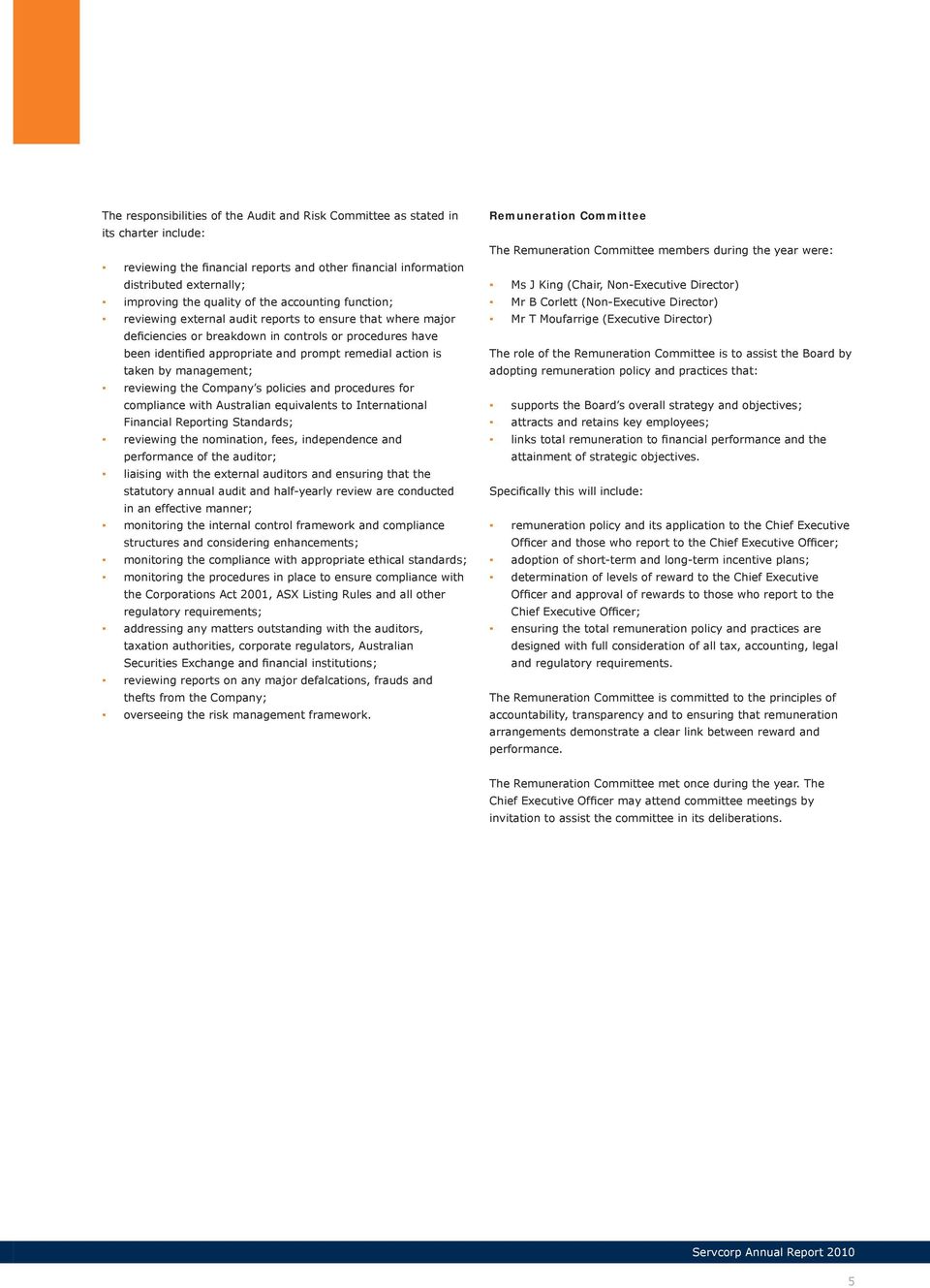
13 The responsibilities of the Audit and Risk Committee as stated in its charter include: reviewing the financial reports and other financial information distributed externally; improving the quality of the accounting function; reviewing external audit reports to ensure that where major deficiencies or breakdown in controls or procedures have been identified appropriate and prompt remedial action is taken by management; reviewing the Company s policies and procedures for compliance with Australian equivalents to International Financial Reporting Standards; reviewing the nomination, fees, independence and performance of the auditor; liaising with the external auditors and ensuring that the statutory annual audit and half-yearly review are conducted in an effective manner; monitoring the internal control framework and compliance structures and considering enhancements; monitoring the compliance with appropriate ethical standards; monitoring the procedures in place to ensure compliance with the Corporations Act 2001, ASX Listing Rules and all other regulatory requirements; addressing any matters outstanding with the auditors, taxation authorities, corporate regulators, Australian Securities Exchange and financial institutions; reviewing reports on any major defalcations, frauds and thefts from the Company; overseeing the risk management framework. Remuneration Committee The Remuneration Committee members during the year were: Ms J King (Chair, Non-Executive Director) Mr B Corlett (Non-Executive Director) Mr T Moufarrige (Executive Director) The role of the Remuneration Committee is to assist the Board by adopting remuneration policy and practices that: supports the Board s overall strategy and objectives; attracts and retains key employees; links total remuneration to financial performance and the attainment of strategic objectives. Specifically this will include: remuneration policy and its application to the Chief Executive Officer and those who report to the Chief Executive Officer; adoption of short-term and long-term incentive plans; determination of levels of reward to the Chief Executive Officer and approval of rewards to those who report to the Chief Executive Officer; ensuring the total remuneration policy and practices are designed with full consideration of all tax, accounting, legal and regulatory requirements. The Remuneration Committee is committed to the principles of accountability, transparency and to ensuring that remuneration arrangements demonstrate a clear link between reward and performance. The Remuneration Committee met once during the year. The Chief Executive Officer may attend committee meetings by invitation to assist the committee in its deliberations. Servcorp Annual Report
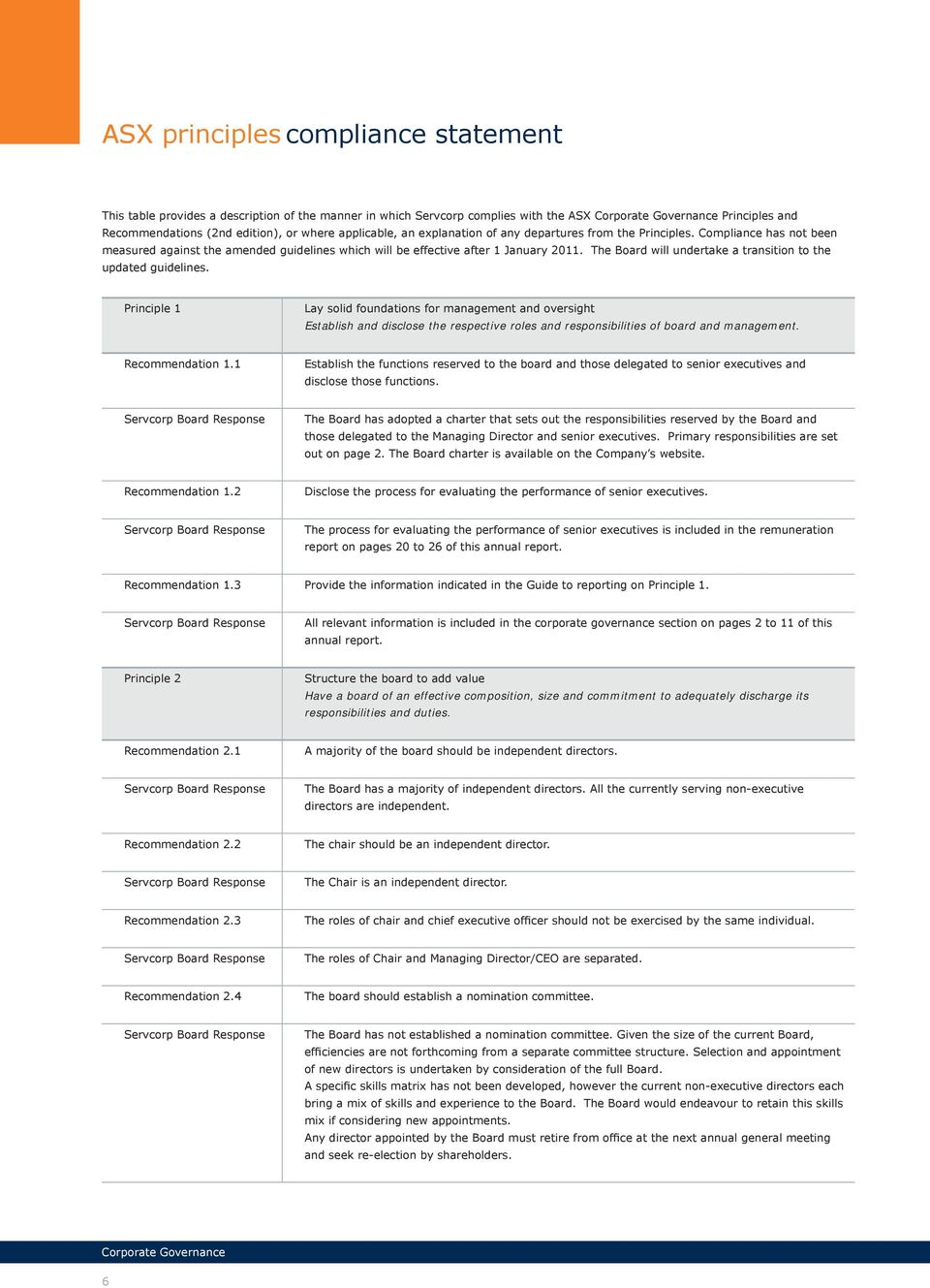
14 ASX principles compliance statement This table provides a description of the manner in which Servcorp complies with the ASX Corporate Governance Principles and Recommendations (2nd edition), or where applicable, an explanation of any departures from the Principles. Compliance has not been measured against the amended guidelines which will be effective after 1 January The Board will undertake a transition to the updated guidelines. Principle 1 Lay solid foundations for management and oversight Establish and disclose the respective roles and responsibilities of board and management. Recommendation 1.1 Establish the functions reserved to the board and those delegated to senior executives and disclose those functions. Servcorp Board Response The Board has adopted a charter that sets out the responsibilities reserved by the Board and those delegated to the Managing Director and senior executives. Primary responsibilities are set out on page 2. The Board charter is available on the Company s website. Recommendation 1.2 Disclose the process for evaluating the performance of senior executives. Servcorp Board Response The process for evaluating the performance of senior executives is included in the remuneration report on pages 20 to 26 of this annual report. Recommendation 1.3 Provide the information indicated in the Guide to reporting on Principle 1. Servcorp Board Response All relevant information is included in the corporate governance section on pages 2 to 11 of this annual report. Principle 2 Structure the board to add value Have a board of an effective composition, size and commitment to adequately discharge its responsibilities and duties. Recommendation 2.1 A majority of the board should be independent directors. Servcorp Board Response The Board has a majority of independent directors. All the currently serving non-executive directors are independent. Recommendation 2.2 The chair should be an independent director. Servcorp Board Response The Chair is an independent director. Recommendation 2.3 The roles of chair and chief executive officer should not be exercised by the same individual. Servcorp Board Response The roles of Chair and Managing Director/CEO are separated. Recommendation 2.4 The board should establish a nomination committee. Servcorp Board Response The Board has not established a nomination committee. Given the size of the current Board, efficiencies are not forthcoming from a separate committee structure. Selection and appointment of new directors is undertaken by consideration of the full Board. A specific skills matrix has not been developed, however the current non-executive directors each bring a mix of skills and experience to the Board. The Board would endeavour to retain this skills mix if considering new appointments. Any director appointed by the Board must retire from office at the next annual general meeting and seek re-election by shareholders. Corporate Governance 6
15 ASX principles compliance statement (continued) Recommendation 2.5 Disclose the process for evaluating the performance of the board, its committees and individual directors. Servcorp Board Response The Board operates under a code of conduct which recognises that strong ethical values must be at the heart of director and Board performance. The non-executive directors evaluate individual director s performance and also the Board s performance. As a tool to evaluation, a questionnaire is completed annually by the non-executive directors with the responses assessed and discussed by the non-executive directors. There is good interaction between all directors and with senior executives and it is considered that the non-executive directors have a solid understanding of the culture and values of the Company. Recommendation 2.6 Provide the information indicated in the Guide to reporting on Principle 2. Servcorp Board Response All relevant information is included in the corporate governance section on pages 2 to 11 of this annual report. Principle 3 Promote ethical and responsible decision-making Actively promote ethical and responsible decision-making. Recommendation 3.1 Establish a code of conduct and disclose the code or a summary of the code as to: the practices necessary to maintain confidence in the company s integrity; the practices necessary to take into account their legal obligations and the reasonable expectations of their stakeholders; the responsibility and accountability of individuals for reporting and investigating reports of unethical practices. Servcorp Board Response The Company has established codes of conduct and ethical standards which all directors, executives and employees are expected to uphold and promote. They guide compliance with legal requirements and ethical responsibilities, and also set a standard for employees and directors dealing with Servcorp s obligations to external stakeholders. In regard to stakeholders, the Company: reports its financial performance twice a year to the Australian Securities Exchange; maintains a website; publishes external announcements to the website and maintains these announcements for at least two years; at general meetings, shareholders are given a reasonable opportunity to ask questions; analyst briefings are held following the release of the half-year and full-year financial results. Recommendation 3.2 Establish a policy concerning trading in company securities by directors, senior executives and employees, and disclose the policy or a summary of that policy. Servcorp Board Response The Board has approved a policy concerning trading in company securities, the details of which are disclosed in the corporate governance section on page 3 of this annual report. Recommendation 3.3 Provide the information indicated in the Guide to reporting on Principle 3. Servcorp Board Response The information is made publicly available by inclusion of the main provisions in the annual report. Complete versions are not available on the Company s website as they form part of manuals which are proprietary and confidential. Servcorp Annual Report

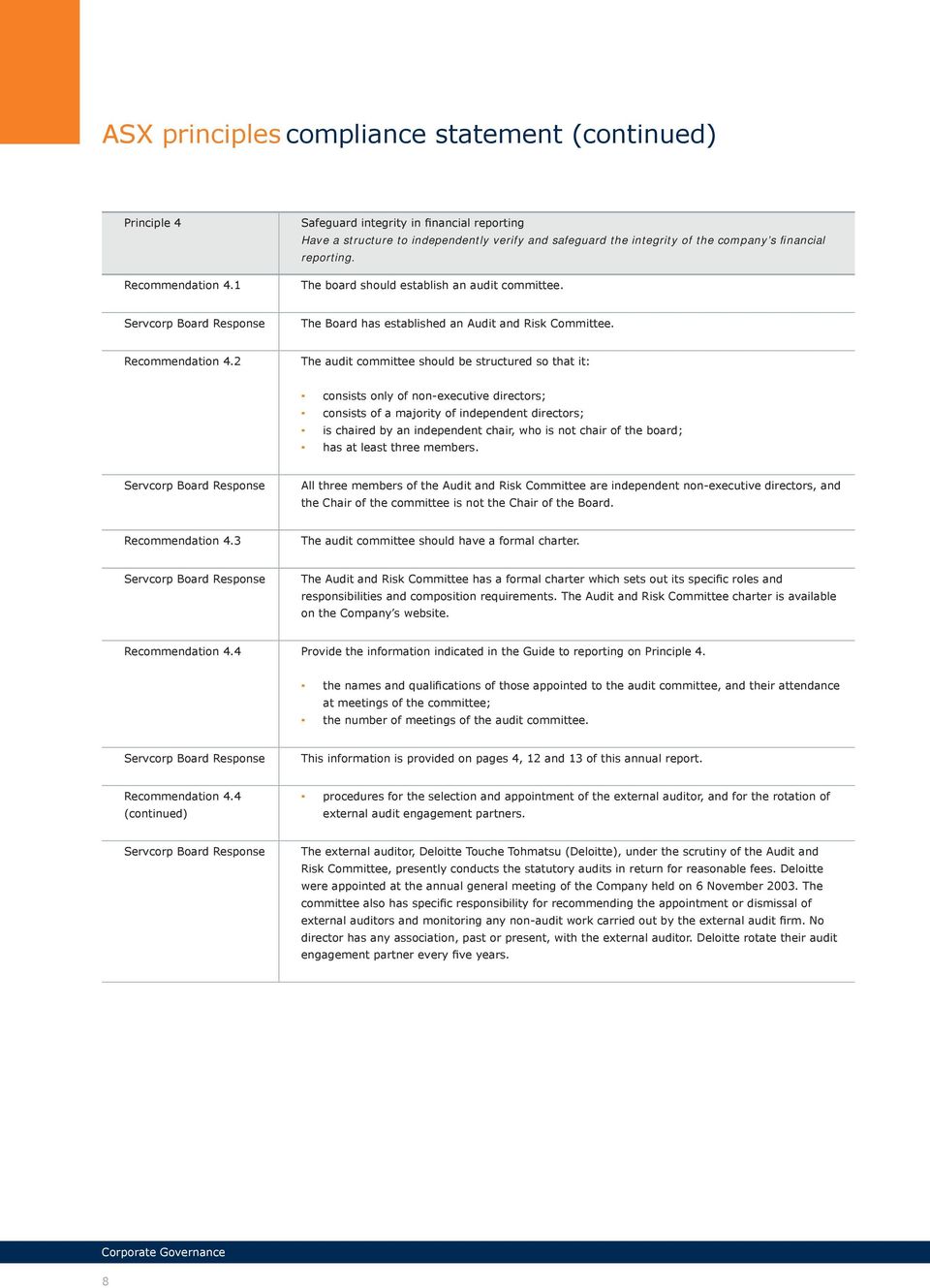
16 ASX principles compliance statement (continued) Principle 4 Recommendation 4.1 Safeguard integrity in financial reporting Have a structure to independently verify and safeguard the integrity of the company s financial reporting. The board should establish an audit committee. Servcorp Board Response The Board has established an Audit and Risk Committee. Recommendation 4.2 The audit committee should be structured so that it: consists only of non-executive directors; consists of a majority of independent directors; is chaired by an independent chair, who is not chair of the board; has at least three members. Servcorp Board Response All three members of the Audit and Risk Committee are independent non-executive directors, and the Chair of the committee is not the Chair of the Board. Recommendation 4.3 The audit committee should have a formal charter. Servcorp Board Response The Audit and Risk Committee has a formal charter which sets out its specific roles and responsibilities and composition requirements. The Audit and Risk Committee charter is available on the Company s website. Recommendation 4.4 Provide the information indicated in the Guide to reporting on Principle 4. the names and qualifications of those appointed to the audit committee, and their attendance at meetings of the committee; the number of meetings of the audit committee. Servcorp Board Response This information is provided on pages 4, 12 and 13 of this annual report. Recommendation 4.4 (continued) procedures for the selection and appointment of the external auditor, and for the rotation of external audit engagement partners. Servcorp Board Response The external auditor, Deloitte Touche Tohmatsu (Deloitte), under the scrutiny of the Audit and Risk Committee, presently conducts the statutory audits in return for reasonable fees. Deloitte were appointed at the annual general meeting of the Company held on 6 November The committee also has specific responsibility for recommending the appointment or dismissal of external auditors and monitoring any non-audit work carried out by the external audit firm. No director has any association, past or present, with the external auditor. Deloitte rotate their audit engagement partner every five years. Corporate Governance 8
17 ASX principles compliance statement (continued) Principle 5 Make timely and balanced disclosure Promote timely and balanced disclosure of all material matters concerning the company. Recommendation 5.1 Establish written policies designed to ensure compliance with ASX Listing Rule disclosure requirements and to ensure accountability at a senior executive level for that compliance and disclose those policies or a summary of those policies. Servcorp Board Response The Company has established a continuous disclosure compliance plan. The Board and management continually monitor information and events and their obligation to report any matters. Responsibility for communications to the ASX on all material matters rests with the Company Secretary following consultation with the Chair and Managing Director. Recommendation 5.2 Provide the information indicated in the Guide to reporting on Principle 5. Servcorp Board Response There is no further information to be provided. Principle 6 Respect the rights of shareholders Respect the rights of shareholders and facilitate the effective exercise of those rights. Recommendation 6.1 Design a communications policy for promoting effective communication with shareholders and encouraging their participation at general meetings and disclose the policy or a summary of that policy. Servcorp Board Response Servcorp aims to communicate clearly and transparently with shareholders and the community. Servcorp places company announcements on its website and also displays annual and half-year reports. Shareholders are given a reasonable opportunity to ask questions at the annual general meeting. Briefings are held following the release of annual and half-year results and the time and location of these briefings are notified to the market. Recommendation 6.2 Provide the information indicated in the Guide to reporting on Principle 6. Servcorp Board Response The information has been provided in the response to recommendation 6.1. Servcorp Annual Report

18 ASX principles compliance statement (continued) Principle 7 Recognise and manage risk Establish a sound system of risk oversight and management and internal control. Recommendation 7.1 Companies should establish policies for the oversight and management of material business risks and disclose a summary of those policies. Servcorp Board Response Management has a sound and comprehensive understanding of the inherent risks of the business which have been identified and managed through the experience of the Chief Executive Officer and long serving executives. Management have identified and documented the key risks of the business across the spectrum of strategic, information technology, human resources, operational, financial and legal/ compliance. The company does not have formal written policies for all aspects of its risk oversight and management. The company is a globally run business where senior executives have oversight through the systems and reporting mechanisms of all activities in all global locations. The systems infrastructure is centrally managed through a small group of senior executives. Management s objective is to create a culture for all executives to focus on risk as a natural part of their day to day activities. The senior executives responsible for the day to day management of key risks have been identified. Many processes are documented through the Company s manuals which are proprietary and confidential, and these are being strengthened and improved with time. Business processes are continually improved to reduce the potential for financial loss. Recommendation 7.2 The board should require management to design and implement the risk management and internal control system to manage the company s material business risks and report to it on whether those risks are being managed effectively. The board should disclose that management has reported to it as to the effectiveness of the company s management of its material business risks. Servcorp Board Response The Board has established an Audit and Risk Committee that is comprised only of non-executive directors. The Committee reviews the Company s risk management strategy, its adequacy and effectiveness and the communication of risks to the Board. The Committee is satisfied that the Company and management have a culture of risk control and are in the early stages of formalising the infrastructure of this culture. Although not all policies have been formally documented, the identified risks are tightly controlled and being managed effectively. The Company is heavily reliant on financial controls and senior executive controls. Day to day responsibility is delegated to the Chief Executive Officer and senior management. The Chief Executive Officer and senior management are responsible for: identification of risk; monitoring risk; communication of risk events to the Board; and responding to risk events, with Board authority. The Board defines risk to be any event that, if it occurs, will have a material impact on the ability of the Company to achieve its objectives. Risk is considered across the financial, operational and organisational aspects of the Company s affairs. The Audit and Risk Committee are working with management to ensure continuous improvement to the risk management and internal control systems. Corporate Governance 10
19 ASX principles compliance statement (continued) Recommendation 7.3 The board should disclose whether it has received assurance from the chief executive officer (or equivalent) and the chief financial officer (or equivalent) that the declaration provided in accordance with section 295A of the Corporations Act is founded on a sound system of risk management and internal control and that the system is operating effectively in all material respects in relation to financial reporting risks. Servcorp Board Response The Chief Executive Officer and Chief Financial Officer provide such assurance. Recommendation 7.4 Provide the information indicated in the Guide to reporting on Principle 7. Servcorp Board Response This information is provided above. Principle 8 Remunerate fairly and responsibly Ensure that the level and composition of remuneration is sufficient and reasonable and that its relationship to performance is clear. Recommendation 8.1 The board should establish a remuneration committee. Servcorp Board Response The Board has established a Remuneration Committee. The Remuneration Committee consists of three members, two of whom are independent non-executive directors. The Chair of the Committee is an independent non-executive director. Recommendation 8.2 Clearly distinguish the structure of non-executive directors remuneration from that of executive directors and senior executives. Servcorp Board Response This information is provided in the remuneration report on page 20 of this annual report. Recommendation 8.3 Provide the information indicated in the Guide to reporting on Principle 8. the names of the members of the remuneration committee and their attendance at meetings of the committee. Servcorp Board Response This information is provided on pages 5 and 13 of this annual report. Recommendation 8.3 (continued) the existence and terms of any schemes for retirement benefits, other than superannuation, for non-executive directors. Servcorp Board Response There are no such schemes in existence. Servcorp Annual Report

20 Directors report The directors present their report together with the Financial Report of Servcorp Limited ( the Company ) and the consolidated Financial Report of the Consolidated Entity, being the Company and its controlled entities, for the financial year ended 30 June Directors The directors of the Company at any time during or since the end of the financial year are: Alf Moufarrige Managing director Chief Executive Officer Appointed August 1999 Alf is one of the global leaders in the serviced office industry, with 30 years of experience. Alf is primarily responsible for Servcorp s expansion, profitability, cash generation and currency management. Directorships of listed entities in the last three years: None. Bruce Corlett Chair and independent non-executive director BA, LLB Member of Audit and Risk Committee Member of Remuneration Committee Appointed October 1999 Over the past 30 years Bruce has been a director of many publicly listed companies. He has an extensive business background involving a range of industries including banking, property and maritime. His current directorships include Trust Company Limited (Chair). Bruce is also chair of the Mark Tonga Perpetual Relief Trust, a Director of Lifestart Co-operative Limited and an Ambassador of The Australian Indigenous Education Foundation. Directorships of listed entities in the last three years: Stockland Trust Group from October 1996 to October 2008; Tooth and Co. Limited since September 1999 (Tooth & Co was removed from the official list of ASX on 12 February 2010); Trust Company Limited since October 2000 (Chair). Rick Holliday-Smith Independent non-executive director BA (Hons), CA, FAICD Chair of Audit and Risk Committee Appointed October 1999 Rick spent over 11 years in Chicago in the roles of Divisional President of global trading and sales for NationsBank, N.A. and, prior to that, Chief Executive Officer of Chicago Research and Trading Group Limited. Rick also spent over 4 years in London as Managing Director of Hong Kong Bank Limited, a wholly owned merchant banking subsidiary of HSBC Bank. Rick is currently a director of ASX Limited and Cochlear Limited. He became Chair of Cochlear in July He is also Chair of Snowy Hydro Limited. Rick has a Bachelor of Arts (Hons) from Macquarie University, is a Chartered Accountant and is a Fellow of the Australian Institute of Company Directors. Directorships of listed entities in the last three years: ASX Limited since July 2006; Cochlear Limited since February 2005 (Chair since July 2010); St George Bank Limited from February 2007 to December Julia King Independent non-executive director Member of Audit and Risk Committee Chair of Remuneration Committee Appointed August 1999 Julia has had more than 30 years experience in strategic marketing and advertising. She was Chief Executive of the LVMH fashion group in Oceania and developed the business in this area. Prior to joining LVMH Julia was Managing Director of Lintas, a multinational advertising agency. Julia was a non-executive director of Fairfax Media Limited, retiring in November 2009, and of Opera Australia, retiring in May She has been a director of Country Road and MMI Insurance, on the Australian Government s Task Force for the restructure of the wool industry and a member of the Council of the National Library. Directorships of listed entities in the last three years: Fairfax Media Limited from July 1995 to November Corporate Directors Report Governance 12
21 Directors (continued) Company Secretary Taine Moufarrige Executive director BA, LLB Member of Remuneration Committee Appointed November 2004 Taine joined Servcorp in 1996 as a Trainee Manager. Taine is now responsible for operations in Australia, New Zealand, India and the Middle East and for the strategic growth of the Company in these regions. Taine played a key role in establishing Servcorp locations in Europe, the Middle East, New Zealand, throughout Australia and in India through the Company s franchise venture. Taine is also responsible for the philanthropic activities of Servcorp. Directorships of listed entities in the last three years: Greg Pearce B Com, CA, ACIS Appointed August 1999 Greg joined Servcorp in 1996 as Financial Controller and was appointed to his current role of Company Secretary during the Company s IPO in Prior to joining Servcorp Greg spent ten years working in the information technology business and the 11 years prior to that working in audit and business services. Greg is a Chartered Accountant and is an Associate of Chartered Secretaries Australia. Directors meetings The number of directors meetings held (including meetings of committees of directors) and number of meetings attended by each of the directors of the Company during the financial year is set out in the following table. None. Directors attendances at meetings Director Board meetings Audit & Risk committee Remuneration committee Number of meetings held: Number of meetings attended: B Corlett R Holliday-Smith 11 3 J King A G Moufarrige 11 T Moufarrige 11 1 The details of the function and membership of the committees are presented in the corporate governance statement on pages 4 and 5. Servcorp Annual Report
22 Directors interests The relevant interest of each director in the share capital of the companies within the Consolidated Entity, as notified by the directors to the Australian Securities Exchange in accordance with s205g (1) of the Corporations Act 2001, at the date of this report is set out in the following table. Director Direct Ordinary shares in Servcorp Limited Indirect Options over ordinary shares B Corlett - 413,474 - R Holliday-Smith - 250,000 - J King - 105,165 - A G Moufarrige (i) 540,890 49,251,221 - T Moufarrige (i) 65,446 1,800,000 - Notes: i. The 1.8 million shares shown as being an indirect interest of T Moufarrige are also included in the indirect interest of A G Moufarrige. Corporate Directors Report Governance 14
23 Principal activities Dividends The principal activities of the Consolidated Entity during the course of the financial year were the provision of executive serviced and virtual offices and IT, communications and secretarial services. There were no significant changes in the nature of the activities of the Consolidated Entity during the year. Consolidated results Dividends totalling $9.84 million have been paid or declared by the Company in relation to the financial year ended 30 June 2010 (2009: $19.92 million). Information relating to dividends in respect of the prior and current financial year, including dividends paid or declared by the Company since the end of the previous year is set out in the following table. Net profit after tax for the financial year was $2.01 million (2009: $34.10 million). Operating revenue was $ million (2009: $ million). Basic and diluted earnings per share was 2.2 cents (2009: 42.7 cents). Dividends paid and declared Type Cents per share Total amount Date of payment Franked % Tax rate for franking credit In respect of the previous financial year: 2009 Special Ordinary shares , December % 30% Interim Ordinary shares ,047 2 April % 30% Final Ordinary shares ,847 1 October % 30% In respect of the current financial year: 2010 Interim Ordinary shares , March % 30% Final Ordinary shares ,922 6 October % 30% Servcorp Annual Report
24 Review of operations Virtual Office Revenue from ordinary activities for the twelve months ended 30 June 2010 was $ million, down 26% from the twelve months ended 30 June During the year the Australian dollar appreciated strongly against all major currencies. The Australian dolar increased by an average of 17% against the US dollar, 17% against the Euro and 8% against the Japanese yen. The appreciation in the Australian dollar over the year has had a negative impact on the consolidated revenues and profit for the twelve months ended 30 June When expressed in constant currency terms, revenue decreased by 19% compared to the 2009 year. Net profit before tax for the twelve months to 30 June 2010 was $2.88 million, down 94% compared to the prior year. When expressed in constant currency terms, net profit before tax decreased by 97% compared to the twelve months ended 30 June The result for the twelve months ended 30 June 2010 included realised and unrealised foreign currency gains in the amount of $0.49 million (gain for the twelve months ended 30 June 2009: $3.87 million). On a positive note the strong Australian dollar has enabled management to change Australian dollars to foreign currency at rates more favourable than budget estimates for the purpose of capital acquisitions. Virtual Office package memberships increased by 20% during the twelve months ended 30 June Virtual Office revenue decreased by 1% for the twelve months to 30 June 2010, however when the translation effect of changes in currency is stripped out, Virtual Office revenue increased by 9% compared to the 2009 year. Expansion Thirteen floors were opened in the year ended 30 June At 30 June 2010 a further 31 leases had been executed for locations that are expected to open in the next six to nine months. Servcorp is on track to reach its floor opening target of 35 new locations in the eighteen months to 31 December As outlined at Servcorp s annual general meeting in November 2009, we are focussed on rapidly expanding the Servcorp footprint into a number of new markets, in particular North America. We are happy with the progress of new centre rollouts and early indications are that sales are adhering to the business model projections. Our focus is to build scale in each geographic location to spread marketing and web optimisation costs. Cash balances were $ million at 30 June 2010 (30 June 2009: $83.96 million). Of this balance, $10.92 million has been pledged with banks as collateral for bank guarantees, leaving an unencumbered cash balance of $ million in the business as at 30 June 2010 (30 June 2009: $71.49 million). Immature floor expansion costs were $20.10 million for the year ended 30 June 2010 (30 June 2009: $2.94 million). Included in the current year immature floor costs are head office costs associated with expansion in the amount of $8.57 million (2009: $Nil). Serviced Offices Office Squared As previously advised, trading conditions in the Serviced Office business were very difficult in the 2010 financial year. Depressed global business sentiment, particularly in the commercial real estate market, caused a drop in demand for Serviced Offices globally which impacted office pricing and occupancy of the mature Serviced Office business. This environment has created an opportunity for Servcorp to expand. The Office Squared business has been significantly scaled back. Management is now focussing on our core business of Serviced and Virtual Offices. The Office Squared loss for the twelve months ended 30 June 2010 was $2.15 million (30 June 2009: $4.14 million). Consolidated Serviced Office revenue was impacted by a strong Australian dollar throughout the year, recording a drop of 32% compared to the year ended 30 June When the effect of changes in foreign currency translation is stripped out revenue dropped by 26% compared to the 2009 year. Average mature floor occupancy for the twelve months softened to 76% (twelve months ended 30 June 2009: 79%). As at 30 June 2010 Servcorp operated 77 floors in 29 cities in 17 countries. Corporate Directors Report Governance 16
25 Review of operations (continued) Australia & New Zealand Mature floors Despite global economic market turmoil, Australia and New Zealand have performed well throughout the 2010 year and have not been impacted to the same extent as other markets. Mature floor revenue from ordinary activities decreased by 6% to $45.47 million when compared to the 2009 year. Mature floor net profit before tax decreased by 21% to $10.77 million. The closure cost associated with closing one floor in Australia had the effect of reducing the mature floor result by $0.63 million. An additional three floors are scheduled to open in Australia and New Zealand by 31 December Immature floors Two floors in Australia and New Zealand were immature during the year. Immature floor losses in the twelve months ended 30 June 2010 were $0.63 million. Japan Mature floors Japanese business sentiment continues to be depressed and as a result the commercial market and lease rates are now at cyclical lows. There is an opportunity to expand in this market and Servcorp has secured space in three new locations that will open prior to 31 December Revenue from mature locations decreased by 24% to $55.14 million and net profit before tax decreased by 45% to $5.34 million for the twelve months ended 30 June Immature floors Four locations in Japan were immature during the year. The net loss before tax on immature floors was $2.17 million. Middle East Mature floors The Dubai market which was in boom has suffered a material downturn with vacancy rates in this city now at ten year highs. Servcorp still operates a profitable business in this city, but nowhere near the profits of boom time. The Serviced Office markets in both Bahrain and Qatar remain challenging. Middle East (continued) Immature floors Locations were opened in Abu Dhabi, Jeddah and Kuwait during the twelve months ended 30 June 2010 and the performance of these floors is encouraging. Six floors in the Middle East were immature during the year with losses in the twelve months ended 30 June 2010 of $3.72 million. Since the end of the financial year new locations have opened in Beirut and Istanbul. A further location is expected to open by 31 December 2010 in Saudi Arabia. Greater China Mature floors During the 2010 year, we experienced management problems in this region. Management has now been restructured in China and the region is on track to recovery. The Hong Kong market was significantly impacted by the global financial crisis but this market is now improving and we should return to profitability in the 2011 financial year. Revenue from ordinary activities decreased by 54% to $13.19 million and net loss before tax was $0.4 million for the twelve months ended 30 June Immature floors Four floors in Greater China were immature as at 30 June 2010, with a net loss before tax of $2.02 million for the twelve months ended 30 June Southeast Asia Mature floors During calendar year 2009, the Singapore and Kuala Lumpur markets saw dramatic falls in commercial property values and commercial leasing rates. A recovery in Singapore is now evident, however Kuala Lumpur remains challenging. The Bangkok market has suffered as a result of the civil upheaval in April and May 2010 but it has now stabilised. Revenue from ordinary activities decreased by 39% to $14.58 million and net profit before tax decreased by 52% to $4.27 million for the twelve months ended 30 June Immature floors There were no immature floors in Southeast Asia during the twelve months ended 30 June Mature floor revenue from ordinary activities decreased by 37% to $10.99 million when compared to the 2009 year. Mature floor net profit before tax decreased by 65% to $3.29 million. Servcorp Annual Report
26 Review of operations (continued) Events subsequent to balance date Europe Office Squared contract termination Mature floors The European market continues to be very difficult. The Paris location continues to be impacted by pricing pressures as a result of heightened competition. The Brussels operation has now stabilised. On 17 August 2010 a company in the Office Squared group issued a contract termination notice as a result of a fundamental breach. As at the date of signing this report, negotiations are under way to settle approximately $1 million due to Office Squared. Management are confident that this amount will be recovered. Mature floor revenue from ordinary activities decreased by 33% to $12.76 million. The net loss before tax on mature floors was $3.29 million for the twelve months ended 30 June The loss before tax includes impairment of goodwill for the Paris operation of $1.16 million. Immature floors A new location was opened in London in December This location is performing to expectations. Immature floor losses for Europe were $0.99 million for the twelve months ended 30 June USA Two floors were opened in Chicago in the USA during the second half of An additional 19 leases have been executed in this market and these floors are expected to open by 31 December Immature floors Immature floor losses of $2.05 million include the set-up of the USA head office infrastructure and the cost of sourcing and executing leases for new locations. India franchise The India property market collapsed in calendar year 2009 but is now starting to improve. Dividend On 26 August 2010 the directors declared a fully franked final dividend of 5.00 cents per share, payable on 6 October The financial effects of the above transactions have not been brought to account in the financial statements for the year ended 30 June The directors are not aware of any matter or circumstance, other than that referred to above or in the financial statements or notes thereto, that has arisen since the end of the year that has significantly affected, or may significantly affect, the operations of the Consolidated Entity, the results of those operations, or the state of affairs of the Consolidated Entity, in future financial years. Likely developments The Consolidated Entity will continue to pursue its policy of seeking to increase the profitability and market share of its major business sectors during the next financial year. Further information about likely developments in the operations of the Consolidated Entity and the expected results of those operations in future financial years has not been included in this report because disclosure of the information would be likely to result in unreasonable prejudice to the Consolidated Entity. New locations City Location Offices Opened Hangzhou Level 1, Lyra Building 4 July 2009 Abu Dhabi Level 4, Al Mamoura Building 79 September 2009 Tokyo Level 20, Marunouchi Trust Tower 52 December 2009 London Level 17, Dashwood House 38 December 2009 Jeddah Level 9, Jameel Square 60 December 2009 Fukuoka Level 15, Da Vinci Building 15 December 2009 Hong Kong Level 19, Two International Finance Centre 82 January 2010 Kuwait Level 18, Sahab Tower 14 February 2010 Chicago Level 42, 155 North Wacker 58 March 2010 Tokyo Level 8, Nishi Shinjuku Nittochi Building 12 March 2010 Hong Kong Level 12, One Peking Road 2 April 2010 Chicago Level 49, 300 LaSalle 11 May 2010 Hong Kong Level 9, Hong Kong Club Building 8 May 2010 Corporate Directors Report Governance 18
27 Options granted During the year or since the end of the financial year, the Company has not granted options over unissued ordinary shares of the Company. Options on issue At the date of this report unissued ordinary shares of the Company under option are: Grant date Expiry date Exercise price Number of shares Earliest exercise date 22 February February 2013 $ ,000 2 years from the date of issue The options expire on the earlier of: a. b. 5 years from the date of issue; the date on which the optionholder ceases to be an employee of the Company or any of its subsidiaries other than as a result of death of the optionholder or such later date as the Board in its absolute discretion determines on or before the date the optionholder ceases to be an employee of the Company or any of its subsidiaries. The options do not entitle the holder to participate in any share issue of the Company or any other body corporate. Options granted on 22 September 2008 lapsed subsequent to the end of the 2009 financial year as the vesting conditions were not attained. Shares issued on the exercise of options No shares were issued by the Company during the year or since the end of the financial year as a result of the exercise of an option over unissued shares. Servcorp Annual Report
28 Remuneration report Principles used to determine the nature and amount of remuneration The Board recognises that the Consolidated Entity s performance is dependent on the quality of its people. To achieve its financial and operating objectives, Servcorp must be able to attract, retain and motivate highly-skilled executives. The objective of the Consolidated Entity s executive reward framework is to ensure reward for performance is competitive and appropriate for the results delivered. The framework aligns executive reward with achievement of strategic objectives and the creation of value for shareholders. Executive remuneration packages involve a balance between fixed and incentive pay. In determining the appropriate balance an annual review is undertaken that involves cross referencing position descriptions to reliable accessible remuneration surveys and comparing current remuneration packages with the latest survey information. Servcorp s executive remuneration policy and principles are designed to ensure that the Consolidated Entity: provides competitive rewards that attract, retain and motivate executives of the highest calibre; encourages a strong and long term commitment to Servcorp; builds a structure for long term growth and succession planning; structures remuneration at a level that reflects the executive s duties and accountabilities and is competitive within Australia and, for certain roles, internationally; aligns executive incentive rewards with the creation of value for shareholders; complies with applicable legal requirements and appropriate standards of governance. The framework may provide a mix of fixed and variable pay, and a blend of short and long term incentives. The Board s current policy regarding remuneration for key management personnel is summarised on pages 21 to 26. Nonexecutive directors are remunerated on a different basis to senior executives as set out below. Non-executive directors Fees and payments to non-executive directors reflect the demands which are made on, and the responsibilities of, the directors. Nonexecutive directors fees and payments are reviewed by the Board. The Board ensures non-executive directors fees and payments are appropriate and in line with the market. Non-executive directors are not employed under a contract and do not receive share options or other equity based remuneration. Directors fees Non-executive directors fees are determined within an aggregate directors fee limit. The pool limit currently stands at $350,000 inclusive of payments for SGC superannuation. This was approved at the time of Servcorp s IPO in December Non-executive directors fees were initially set in December That level of fees did not vary until they were reviewed with effect from 1 January Their remuneration was reviewed again with effect from 1 October 2006 and as at 1 July Effective 1 July 2008, non-executive directors fees were as follows: Chair - $131,890 per annum including superannuation; Non-executive - $76,300 per annum including superannuation. Effective 1 January 2010, non-executive directors fees have been set as: Chair - $150,000 per annum including superannuation; Non-executive - $80,000 per annum including superannuation. Also, from 1 January 2010 the Chair of the Audit and Risk Committee receives an additional $10,000 per annum including superannuation. Additional fees are not paid for membership of Board committees. An entity associated with Mr Holliday-Smith received consulting fees in respect of services performed for Office Squared. These consulting fees ceased effective February Since 2006 non-executive directors fees have increased by 39%. Over the same period dividends have decreased by 5% and EPS by 93%. Retirement allowances for directors Non-executive directors are not entitled to retirement allowances other than amounts previously contributed to complying superannuation funds. Details of remuneration Details of the nature and amount of each element of the remuneration of each director of Servcorp Limited for the year ended 30 June 2010 is set out on page 24. Corporate Directors Report Governance 20
29 Remuneration report (continued) Principles used to determine the nature and amount of remuneration (continued) Senior executives The senior executive remuneration and reward framework has three components: Fixed remuneration This is targeted to be reasonable and fair, taking into account the Consolidated Entity s legal and industrial obligations, labour market conditions and the scale of the Consolidated Entity. This fixed remuneration component reflects core performance requirements and expectations. Fixed remuneration; Short term incentives; Long term incentives. Fixed remuneration is reviewed annually to ensure the executive s remuneration is competitive with the market. Remuneration is also reviewed on promotion. There are no guaranteed fixed remuneration increases for any senior executives. The combination of these comprises the executive s total remuneration. No senior executives are employed under a contract. In 2008 the Remuneration Committee undertook a review of the Consolidated Entity s remuneration practices. A policy is in place which provides senior executives with a more structured scheme for long term and short term incentives, based on earnings, earnings growth and individual performance criteria. As part of this years review, the Remuneration Committee identified 10 key management personnel. The continued steady increase in the Consolidated Entity s earnings has resulted in reward for those executives who have been essential to achieving this success. The success of Servcorp s current executives is evident in the Consolidated Entity s results over the previous four financial years. Net profit after tax increased from $25.37 million in 2006 to $34.10 million in 2009, an increase of 34%. Shareholder wealth also increased. Dividends paid had increased from cents per share in 2006 to 25.0 cents per share in the 2009 financial year, an increase of 138%. The Consolidated Entity s strong performance and healthy cash flow and balance sheet has been reflected in its ability to pay special dividends in the previous three financial years. Earnings per share increased from 31.6 cents per share in 2006 to 42.7 cents per share in 2009, an increase of 35%. Over the same four year period, the average total remuneration paid to key management personnel including executive directors has increased by 20%. In the current financial year, Servcorp has commenced an aggressive expansion plan with the intention of doubling the size of its operations by December Accordingly, the Consolidated Entities results for the 2010 financial year have not continued the impressive growth of the previous 4 years. Short term incentives The short term incentive component of executive remuneration may comprise an annual cash incentive which is linked to the performance of both the Consolidated Entity and the individual executive. Executives do not have a fixed proportion of their total remuneration that is performance related. The short term incentive target is reviewed annually. Performance targets are agreed with executives at the start of each year to ensure they meet specific business objectives for which the individual is responsible. Cash incentives (bonuses) are payable following finalisation of full-year results. Using a profit target ensures variable reward is only available when value has been created for shareholders and when profit is consistent with the business plan. For the financial year ended 30 June 2010, the Remuneration Committee set the short term incentive component of remuneration of the key management personnel in the form of a cash bonus contingent upon attaining performance targets for net profit before tax for mature floors for their region of responsibility. Key management personnel who had responsibility for the Consolidated Entity overall were A G Moufarrige, T Moufarrige, M Moufarrige and T Wallace. Short term incentive components for these personnel were attainable as follows: Consolidated Entity Short term NPBT on incentive mature floors % $m of base salary >$45 to <$47 Range from 20% to 25% The Directors are pleased with the results achieved and the Consolidated Entity is on target with its growth plan. The Consolidated Entity achieved its forecast net profit before tax on mature floors of $24 million. >$47 to <$49 Range from 25% to 30% >$49 to <$51 Range from 30% to 35% >$51 Range from 35% to 40% Servcorp Annual Report
30 Remuneration report (continued) Principles used to determine the nature and amount of remuneration (continued) Senior executives (continued) Short term incentives (continued) Key management personnel who had responsibility for a region were S Martin (Australia and New Zealand), O Vlietstra (Japan), B Barakat (Qatar) and L Lahdo (Middle East). Each region was set a performance target for net profit before tax for mature floors. Short term incentive components for these personnel were attainable as follows: Attainment of performance target (PT) Short term incentive % of base salary PT less $1m 20% PT attained 30% PT plus $1m 40% PT plus $2m 50% In addition, S Martin, O Vlietstra and L Lahdo were given short term incentive components based on the Consolidated Entity s overall performance, attainable as follows: Consolidated Entity NPBT on mature floors $m Short term incentive % of base salary >$45 to <$47 Range from 10% to 15% >$47 to <$49 Range from 15% to 20% >$49 to <$51 Range from 20% to 30% >$51 Range from 30% to 40% If the Consolidated Entity and all specified regions attained their performance targets for the financial year ended 30 June 2010, the total value of short term incentives payable to key management personnel was $729,856 (2009: $773,800). The range attainable was a minimum of $541,663 (2009: $572,959) and a maximum of $1,178,443 (2009: $1,232,734). Long term incentives The Board may grant options to eligible executives in accordance with the Servcorp Executive Share Option Scheme. The purpose of the Scheme is to encourage participation in the Company through share ownership. The Board believes that an Executive Share Option Scheme is a cost effective and efficient means to attract, retain and further incentivise key executives and encourage them to achieve superior returns for shareholders. History of the Scheme The Executive Share Option Scheme was first approved by shareholders on 19 October 1999; Amendments to the Scheme were approved by shareholders on 17 November 2000; The Company afforded shareholders the opportunity to reapprove the Scheme at a general meeting of the Company in May Shareholders re-approved the scheme on 24 May 2001; In February 2008, in light of the age of the Scheme documentation, the Board conducted a review of the terms and conditions of the Scheme and resolved to update these terms and conditions to better facilitate the effective operation of the Scheme. These amendments were approved by shareholders on 26 May 2008; In September 2008, in response to the views of some shareholders, the Board amended the exercise period commencement date from 24 months after issue of Options under the Scheme to 36 months after issue. Shareholders approved this amendment at the annual general meeting held on 12 November The substantive amendment approved in May 2008 was the introduction of an earnings per share performance hurdle for the vesting of options. Pursuant to this amendment, options will only vest (and hence be capable of being exercised) if the Consolidated Entity meets specified earnings per share hurdles. The options will vest in increasing proportions, depending on the level of growth in the Consolidated Entity s earnings per share. No options will vest unless the Consolidated Entity achieves earnings per share growth of at least 10% in the specified financial year. Pursuant to the terms and conditions of the Scheme, any person who is employed on a full or part time basis by the Company and any of its controlled entities in a management role and whom the Board determines is eligible to participate in the Scheme is entitled to participate in the Scheme. For the avoidance of doubt, non-executive directors are therefore ineligible to participate in the Scheme but executive directors are eligible to participate. Options do not form a fixed percentage of any executive s remuneration. Corporate Directors Report Governance 22
31 Remuneration report (continued) Principles used to determine the nature and amount of remuneration (continued) Senior executives (continued) Long term incentives (continued) In the current financial year, following a recommendation by the Remuneration Committee, the directors did not grant any options under the Scheme. The recommendation was on the basis of the uncertain taxation implications which may have arisen if options had been issued. Retirement benefits Retirement benefits for senior executives are provided to the extent required by the law of the country in which they reside. Senior executives are not entitled to any other retirement allowances. Details of remuneration Details of the nature and amount of each element of the remuneration of each member of the key management personnel and each of the five named executives of the Company and the Consolidated Entity receiving the highest remuneration for the financial year ended 30 June 2010 is set out in the table on pages 25 and 26. Servcorp Annual Report
32 Remuneration report (continued) Directors remuneration Name Short term employee benefits Post Share Total employment based payments Salary & fees $ Bonus (iv) $ Non - monetary $ Other $ Super $ Equity options $ A G Moufarrige (i)(v) , ,167-27, , ,359 30, ,344-29, ,403 T Moufarrige (i) ,325-13,724-34, , ,596 70,000 7,517-37, ,913 B Corlett (ii) , , , , , ,890 R Holliday-Smith (ii) (vi) , ,866-83, , ,333 6, ,633 J King (ii) , ,200-78, , ,300-76,300 Aggregate ,136, ,891-84,032-1,378, ,075, , ,861 33,333 90,990-1,446,139 Note: i. Executive directors. ii. Non-executive directors. iii. Directors and officers indemnity insurance has not been included in the above figures since it is impractical to determine an appropriate allocation basis. iv. The short term bonus relates to performance targets for the current financial year, payable in the following financial year. The bonus is contingent upon attainment of performance targets, as detailed on page 21 of this report. Some discretion may be applied before bonus amounts paid are finalised. The percentage of the maximum attainable bonus which vested in respect of targets for the 2010 financial year was as follows. The balance of the bonus was forfeited. A G Moufarrige 0% (2009: 29%) T Moufarrige 0% (2009: 50%) v. The salary and fees of A G Moufarrige include a component paid in Yen. The increase in the 2010 year reflects the change in foreign currency exchange rate, not an increase in salary in base currency terms. vi. An entity associated with R Holliday-Smith received consulting fees in respect of services performed for Office Squared. These consulting fees ceased effective February These fees are disclosed under Other in short term employee benefits. Corporate Directors Report Governance 24
33 Remuneration report (continued) Key management personnel and highly remunerated senior executive remuneration Name Short term employee benefits Post employment Salary Bonus Non - Other Super & (v) monetary fees $ $ $ $ $ M Moufarrige CIO (i) (ii) Share based payments Equity options (vi) $ Total ,087 15,000 13,724-35, , ,476-7,517-31, ,493 S Martin GM Aust & NZ (i) , ,000 13, , ,952 20, ,800 20, ,524 O Vlietstra GM Japan (i) (ii) ,251-52, , , ,915 77,160 34, , ,473 J Goodwyn GM USA (i) (ii) (iii) , ,989 B Barakat GM Saudi Arabia (i) (ii) (iii) ,693 80, , ,821 W Wu GM Hong Kong (i) , , , ,660 10, , ,239 L Lahdo GM UAE & Bahrain (i) ,901 65,000 8,009 26, , ,376 98,283 6,494 22, ,711 T Wallace CFO (i) (ii) , ,798 10, , ,971 96, ,865 15, ,415 Servcorp Annual Report
34 Remuneration report (continued) Key management personnel and highly remunerated senior executive remuneration (continued) Name Short term employee benefits Post employment Salary Bonus Non - Other Super & (v) monetary fees $ $ $ $ $ N Billet GM Sales (iv) Share based payments Equity options (vi) $ Total ,572 28, , ,192 L Gorman Intl Training & Dev Mgr (iv) ,829 17, , ,659 Aggregate ,209, ,000 73,879 26,947 81,604 47,205 2,599, ,855, ,443 48,637 22, ,615 72,702 2,463,703 Notes: i. Key management personnel other than directors. ii. Five relevant group executives who received the highest remuneration other than directors. iii. J Goodwyn and B Barakat were key management personnel from 1 July iv. L Gorman and N Billett were not key management personnel during the 2010 year. v. The short term bonus relates to performance targets for the current financial year, payable in the following financial year. The bonus is contingent upon attainment of performance targets, as detailed on pages 21 and 22 of this report. Some discretion may be applied before bonus amounts to be paid are finalised. The percentage of the maximum attainable bonus which vested in respect of targets for the 2010 financial year was as follows. The balance of the bonus was forfeited. M Moufarrige 0% (2009: 0%) S Martin 0% (2009: 13%) O Vlietstra 0% (2009: 36%) J Goodwyn n/a B Barakat n/a W Wu 0% (2009: 8%) L Lahdo 0% (2009: 68%) T Wallace 0% (2009: 108%) N Billett n/a (2009: 39%) L Gorman n/a (2009: 33%) M Moufarrige received a discretionary bonus in recognition of his efforts during Servcorp s equity capital raising in October L Lahdo and B Barakat received discretionary bonuses based on their performance in their region during the year. vi. The amounts disclosed under Share based payments relate to options issued on 22 February Based on the EPS performance of the Consolidated Entity for the 2008 financial year the options vested 100%. No options were forfeited. Options issued on 22 September 2008 did not vest as a result of the EPS performance of the Consolidated Entity for the 2009 financial year not meeting minimum EPS performance hurdles. All options were forfeited. No amount has been included in the remuneration of key management personnel with respect to these options. No options were issued in the 2010 financial year. Corporate Directors Report Governance 26
35
36
37 SERVCORP LIMITED and its controlled entities Financial Report For the financial year ended 30 June 2010
38 2010 Financial Report Contents Statement of comprehensive income 31 Statement of financial position 32 Statement of changes in equity 33 Statement of cash flows 34 Notes to Consolidated financial report 35 Directors declaration 85 Auditor s report 86 Financial Report 30
39 Statement of comprehensive income Servcorp Limited and its controlled entities Consolidated Note Revenue 2 161, ,394 Other revenue and income 2 7,264 9, , ,646 Service expenses (51,573) (58,886) Marketing expenses (11,454) (12,342) Occupancy expenses (82,590) (92,361) Administrative expenses (19,021) (17,597) Borrowing expenses (167) (185) Other expenses (1,157) - Total expenses (165,962) (181,371) Profit before income tax expense 2,875 47,275 Income tax expense 5 (869) (13,178) Profit for the year 2,006 34,097 Other comprehensive income Deferred exchange differences arising from monetary items considered part of the investment in foreign operations (net of tax) 316 3,495 Exchange differences arising on translation of foreign operations (net of tax) (313) 2,913 Other comprehensive income for the period (net of tax) 3 6,408 Total comprehensive income for the period 2,009 40,505 Earnings per share Basic earnings per share 8 $0.022 $0.427 Diluted earnings per share 8 $0.022 $0.427 The Statement of comprehensive income is to be read in conjunction with the notes to the Consolidated financial report. Servcorp Annual Report
40 Statement of financial position Servcorp Limited and its controlled entities as at 30 June 2010 Consolidated Note Current assets Cash and cash equivalents 9 131,948 83,958 Trade and other receivables 10 17,160 16,916 Other financial assets 12 1,008 1,555 Current tax assets 5 2, Other 11 8,347 6,528 Total current assets 161, ,150 Non-current assets Other financial assets 12 31,105 26,021 Property, plant and equipment 13 56,639 47,261 Deferred tax assets 5 14,544 10,741 Goodwill 14 14,805 15,962 Total non-current assets 117,093 99,985 Total assets 278, ,135 Current liabilities Trade and other payables 15 29,742 24,454 Other financial liabilities 16 20,015 19,466 Current tax liabilities 5 1,588 3,889 Provisions 18 5,883 5,894 Total current liabilities 57,228 53,703 Non-current liabilities Trade and other payables 15 6,904 7,708 Other financial liabilities Provisions Deferred tax liabilities Total non-current liabilities 8,413 10,141 Total liabilities 65,641 63,844 Net assets 212, ,291 Equity Issued capital ,149 76,118 Reserves (8,417) (8,467) Retained earnings 66,878 77,640 Equity attributable to equity holders of the parent 212, ,291 Total equity 212, ,291 The Statement of financial position is to be read in conjunction with the notes to the Consolidated financial report. Financial Report 32
41 Statement of changes in equity Servcorp Limited and its controlled entities Consolidated Issued capital Foreign currency translation reserve Employee equity settled benefits reserve Retained earnings Total Balance at 1 July ,948 (14,973) 29 61, ,652 Profit for the period ,097 34,097 Deferred exchange differences arising from monetary items considered part of the investment in foreign operations (net of tax) - 3, ,495 Translation of foreign operations (net of tax) - 2, ,913 Total comprehensive income for the period - 6,408-34,097 40,505 Share based payment Share buy-back (4,830) (4,830) Payment of dividends (18,105) (18,105) Balance at 30 June ,118 (8,565) 98 77, ,291 Balance at 1 July ,118 (8,565) 98 77, ,291 Profit for the period ,006 2,006 Deferred exchange differences arising from monetary items considered part of the investment in foreign operations (net of tax) Translation of foreign operations (net of tax) - (313) - - (313) Total comprehensive income for the period - 3-2,006 2,009 Share based payment Issue of shares 79, ,894 Cost of capital raising (2,662) (2,662) Tax effect of capital raising Payment of dividends (12,768) (12,768) Balance at 30 June ,149 (8,562) , ,610 The Statement of changes in equity is to be read in conjunction with the notes to the Consolidated financial report. Servcorp Annual Report
42 Statement of cash flows Servcorp Limited and its controlled entities Consolidated Note Cash flows from operating activities Receipts from customers 173, ,304 Payments to suppliers and employees (159,700) (175,004) Dividends and royalties received Income tax paid (9,140) (12,987) Interest and other items of similar nature received 3,710 3,233 Interest and other costs of finance paid (171) (183) Net operating cash flows 25(b) 8,798 43,024 Cash flows from investing activities Payments for property, plant and equipment (25,200) (7,883) Payments for lease deposits (6,467) (2,125) Payments for licence fee - (1,068) Proceeds from sale of property, plant and equipment Proceeds from refund of lease deposits 3,405 2,925 Net investing cash flows (28,216) (7,999) Cash flows from financing activities Proceeds from issue of equity securities of the parent 79,894 - Payments for share buy-back - (4,830) Payments for share issue costs (2,662) - Proceeds from borrowings Repayment of borrowings (119) (807) Dividends paid (12,769) (18,105) Net financing cash flows 64,344 (23,620) Net increase in cash and cash equivalents 44,926 11,405 Cash and cash equivalents at the beginning of the financial year 83,726 73,449 Effects of exchange rate changes on the balance of cash and cash equivalents held in foreign currencies 2,679 (1,128) Cash and cash equivalents at the end of the financial year 25(a) 131,331 83,726 The Statement of cash flows is to be read in conjunction with the notes to the Consolidated financial report. Financial Report 34
43 1. Significant accounting policies Statement of compliance The financial report is a general purpose financial report which has been prepared in accordance with the Corporations Act 2001, Accounting Standards and Interpretations, and complies with other requirements of the law. The financial report comprise the consolidated financial statements of the Group. Accounting Standards include Australian equivalents to International Financial Reporting Standards ( A-IFRS ). Compliance with A-IFRS ensures that the financial statements and notes of the Group comply with International Financial Reporting Standards ( IFRS ). The financial statements were authorised for issue by the directors on 26 August Basis of preparation The financial report has been prepared on the basis of historical cost, except for the revaluation of certain non-current assets and financial instruments. Cost is based on the fair values of the consideration given in exchange for assets. All amounts are presented in Australian dollars, unless otherwise noted. The Company is a company of the kind referred to in ASIC Class Order 98/0100, dated 10 July 1998, and in accordance with that Class Order, amounts in the financial report are rounded off to the nearest thousand dollars, unless otherwise indicated. Adoption of new and revised Accounting Standards In the current year, the Group has adopted all of the new and revised Standards and Interpretations issued by the Australian Accounting Standards Board (AASB) that are relevant to its operations and effective for the current annual reporting period. Details of the impact of the adoption of these new accounting standards are set out in the individual accounting policy notes. At the date of authorisation of the financial report, the following Standards and Interpretations relevant to the Group were on issue but not yet effective: AASB9 Financial Instruments AASB Amendments to Australian Accounting Standards arising from AASB9. Effective for annual reporting periods beginning 1 January The directors anticipate that the adoption of these Standards and Interpretations and any other Standards and Interpretations on issue but not yet effective in future periods will have no material financial impact on the financial statements of the Consolidated Entity. Servcorp Annual Report
44 1. Significant accounting policies (continued) The following significant accounting policies have been adopted in the preparation and presentation of the financial report: a. Basis of consolidation The consolidated financial statements incorporate the financial statements of the Company and entities controlled by the Company (its subsidiaries). A list of subsidiaries appears in Note 23 to the financial statements. Consistent accounting policies are employed in the preparation and presentation of the consolidated financial statements. On acquisition, the assets, liabilities and contingent liabilities of a subsidiary are measured at their fair values at the date of acquisition. Any excess in the cost of acquisition over the fair values of the identifiable net assets acquired is recognised as goodwill. If after reassessment, the fair values of the identifiable net assets acquired exceeds the cost of acquisition the difference is credited to the Statement of comprehensive income in the period of acquisition. The consolidated financial statements include the information and results of each subsidiary from the date on which the Company obtains control, and until such time as the Company ceases to control an entity. In preparing the consolidated financial statements, all intercompany balances and transactions, and unrealised profits arising within the Consolidated Entity are eliminated in full. Minority interests in the net assets of consolidated subsidiaries are identified separately from the Group s equity therein. b. Goodwill Goodwill arising on acquisition is recognised as an asset and initially recognised at cost, representing the excess of the cost of acquisition over the net fair value of the identifiable assets, liabilities and contingent liabilities acquired. Goodwill is not amortised, but is tested for impairment at each reporting date and whenever there is an indication that goodwill may be impaired. Any impairment of goodwill is recognised immediately in the Statement of comprehensive income and is not subsequently reversed. For the purpose of impairment testing, goodwill is allocated to each of the Group s cash-generating units (CGUs), or groups of CGUs, expected to benefit from the synergies of the business combination. CGUs (or groups of CGUs) to which goodwill has been allocated are tested for impairment annually, or more frequently if events or changes in circumstances indicate that goodwill might be impaired. If the recoverable amount of the CGU (or group of CGUs) is less than the carrying amount of the CGU, the impairment loss is allocated to reduce the carrying amount of any goodwill allocated to the CGU (or groups of CGUs) and then to the other assets of the CGUs pro-rata on the basis of the carrying amount of each asset in the CGU (or groups of CGUs). An impairment loss for goodwill is immediately recognised in profit or loss and is not reversed in a subsequent period. On disposal of an operation within a CGU, the attributable amount of goodwill is included in the determination of the profit or loss on disposal of the operation. Financial Report 36
45 1. Significant accounting policies (continued) c. Impairment of tangible and intangible assets excluding goodwill At each reporting date, the Consolidated Entity reviews the carrying values of its tangible and intangible assets, to determine whether there is any indication that those assets have suffered an impairment loss. If any such indication exists, the recoverable amount of the asset is estimated in order to determine the extent of the impairment loss (if any). Where the asset does not generate cash flows that are independent from other assets, the Consolidated Entity estimates the recoverable amount of the cash generating unit to which the asset belongs. Intangible assets with indefinite useful lives and intangible assets not yet available for use are tested for impairment at each reporting date and whenever there is an indication that the asset may be impaired. The recoverable amount is the higher of fair value, less costs to sell and value in use. In assessing the value in use, the estimated future cash flows are discounted to their present value by using a pre-tax discount rate, that reflects the time value of money and the risks specific to the asset for which the estimates of future cash flows have not been adjusted. If the recoverable amount of an asset (or CGU) is estimated to be less than its carrying amount, the carrying amount of the asset (or CGU) is reduced to its recoverable amount. An impairment loss is recognised in the Statement of comprehensive income immediately, unless the relevant assets are carried at fair value, in which case the impairment loss is treated as a revaluation decrease. Where an impairment loss subsequently reverses, the carrying amount of the asset (or CGU) is increased to the revised estimate of its recoverable amount, but only to the extent that the increased carrying amount does not exceed the carrying amount that would have been determined had no impairment loss been recognised for the asset (or CGU) in prior years. A reversal of the impairment loss is recognised in the Statement of comprehensive income immediately, unless the relevant asset is carried at fair value, in which case the reversal of the impairment loss is treated as a revaluation increase. d. Revenue recognition Sales revenue Sales revenue comprises revenue earned net of the amount of consumption tax from the provision of services to entities outside the Consolidated Entity. Rental, telephone and services revenue is typically invoiced in advance and is recognised in the period in which the service is provided. e. Other income / expense Interest income Interest revenue is accrued on a time basis, by reference to the principal outstanding and at the effective interest rate applicable. Disposal of assets The profit and loss on disposal of assets is brought to account when the significant risks and rewards of ownership passes to a party external to the Consolidated Entity. f. Foreign currency Transactions Foreign currency transactions are translated to Australian currency at the rates of exchange ruling at the dates of the transactions. Amounts receivable and payable in foreign currencies at balance date are translated at the rates of exchange ruling on that date. Foreign currency monetary items at reporting date are translated at the exchange rates existing at reporting date. Nonmonetary assets and liabilities carried at fair value that are denominated in foreign currencies are translated at the rates prevailing at the date when the fair value was determined. Non-monetary items that are measured in terms of historical cost in a foreign currency are not re-translated. Exchange differences are recognised in the profit and loss in the period in which they arise except exchange differences on monetary items receivable from or payable to a foreign operation for which settlement is neither planned or likely to occur, which form part of the net investment in a foreign operation. Such exchange differences are recognised in the foreign currency translation reserve and in the profit and loss on disposal of the net investment. Servcorp Annual Report
46 1. Significant accounting policies (continued) f. Foreign currency (continued) Translation of controlled foreign entities The individual financial statements of each group entity are presented in its functional currency being the currency of the primary economic environment in which the entity operates. For the purpose of the consolidated financial statements, the results and financial position of each entity are expressed in Australian dollars, which is the functional currency of Servcorp Limited and the presentation currency for the consolidated financial statements. The assets and liabilities of overseas operations are translated at the rates of exchange ruling at the Balance sheet date. Income and expense items are translated at the average exchange rate for the period. Exchange differences arising on translation are taken directly to the foreign currency translation reserve. The balance of the foreign currency translation reserve relating to an overseas operation that is disposed of is recognised in the profit and loss in the period of disposal. Goodwill and fair value adjustments arising on the acquisition of a foreign entity on or after the date of transition to A-IFRS are treated as assets and liabilities of the foreign entity and translated at exchange rates prevailing at the reporting date. Goodwill arising on acquisitions before the date of transition to A-IFRS is treated as an Australian dollar denominated asset. g. Borrowing costs Borrowing costs include interest, amortisation of discounts or premiums relating to borrowings, amortisation of ancillary costs using the effective interest rate method in connection with the arrangement of borrowings. Borrowing costs are expensed to the Statement of comprehensive income as incurred. h. Taxation Current tax Current tax is calculated by reference to the amount of income tax payable or recoverable in respect of the taxable profit or loss for the period. Income tax is calculated using tax rates and tax laws that have been enacted or substantively enacted by the reporting date. Current tax for current and prior periods is recognised as a liability or asset to the extent that it is unpaid or refundable. Deferred tax Deferred tax is accounted for using the comprehensive Balance sheet liability method in respect of temporary differences arising from differences between the carrying amount of assets and liabilities in the financial statements and the corresponding tax base of those items. In principle, deferred tax liabilities are recognised for all taxable temporary differences. Deferred tax assets are recognised to the extent that it is probable that sufficient taxable amounts will be available against which deductible temporary differences or unused tax losses and tax offsets can be utilised. However, deferred tax assets and liabilities are not recognised if the temporary differences giving rise to them arises from the initial recognition of assets and liabilities, other than as a result of a business combination, which affects neither taxable income nor accounting profit. Furthermore, a deferred tax liability is not recognised in relation to taxable temporary differences arising from goodwill. Deferred tax liabilities are recognised for taxable temporary differences arising on investments in subsidiaries, branches and associates except where the Consolidated Entity is able to control the reversal of the temporary differences and it is probable that the temporary differences will not reverse in the foreseeable future. Deferred tax assets arising from deductible temporary differences associated with these investments are only recognised to the extent that it is probable that there will be sufficient taxable profits against which to utilise benefits of the temporary differences and they are expected to reverse in the foreseeable future. Deferred tax assets and liabilities are measured at the tax rates that are expected to apply in the period when the assets and liabilities giving rise to them are realised or settled, based on tax rates and tax laws that have been enacted or substantially enacted by the reporting date. Financial Report 38
47 1. Significant accounting policies (continued) h. Taxation (continued) Deferred tax (continued) The measurement of deferred tax liabilities and assets reflects the tax consequences that would follow from the manner in which the Consolidated Entity expects, at the reporting date, to recover or settle the carrying amount of its assets and liabilities. Deferred tax assets and liabilities are offset when they relate to income taxes levied by the same taxation authority and the Consolidated Entity intends to settle its current tax assets and liabilities on a net basis. Current and deferred tax for the period Current and deferred tax is recognised as an expense or income in the Statement of comprehensive income, except when it relates to items credited or debited directly to equity, in which case the deferred tax is also recognised in equity. Tax consolidation The Company and all its wholly-owned Australian resident entities are part of a tax consolidated group under Australian taxation law. Servcorp Limited is the head entity in the tax consolidated group. Tax expense/ income, deferred tax liabilities and deferred tax assets arising from temporary differences of the members of the tax consolidated group are recognised in the separate financial statements of the members of the tax consolidated group using the separate tax payer within group approach. Current tax liabilities and assets and deferred tax assets arising from unused tax losses and tax credits of the members of the tax consolidated group are recognised by the Company. Under this method, each entity is subject to tax as part of the tax consolidated group. Due to the existence of a tax funding arrangement between entities in the tax consolidated group, amounts are recognised as payable to or receivable by the Company, and each member of the tax consolidated group in relation to the tax contribution amounts paid or payable between the parent entity, and the other members of the tax consolidated group in accordance with the arrangement. Where the tax contribution amount recognised by each member of the tax consolidated group for a particular period is different to the aggregate of the current tax liability or asset and any deferred tax asset arising from unused tax losses and tax credits in respect of that period, the difference is recognised as a contribution from (or distribution to) equity participants. Goods and services tax Revenues, expenses and assets are recognised net of the amount of goods and services tax (GST), except where the amount of GST incurred is not recoverable from the Australian Tax Office (ATO). In these circumstances the GST is recognised as part of the cost of acquisition of the asset or as part of an item of expense. Receivables and payables are stated inclusive of GST. The net amount of GST recoverable from or payable to the ATO is included as a current asset or liability in the Statement of financial position. Cash flows are included in the Statement of cash flows on a gross basis. The GST components of cash flows arising from investing and financing activities which are recoverable from or payable to the ATO are classified as operating cash flows. i. Receivables Trade debtors to be settled within 30 days are carried at amounts due. The collectability of debts is assessed at balance date and a specific allowance is made for any doubtful amounts. j. Derivative financial instruments The Consolidated Entity enters into derivative financial instruments to manage its exposure to fluctuations in foreign exchange rates. Further details of derivative financial instruments are disclosed in Note 20 to the financial statements. Derivatives are initially recognised at fair value on the date a derivative contract is entered into and are subsequently remeasured to their fair value at each reporting date. The resulting gain or loss is recognised immediately in the Statement of comprehensive income. Servcorp Annual Report
48 1. Significant accounting policies (continued) k. Share based payments Equity-settled share-based payments with employees are measured at the fair value of the equity instrument at the grant date. Fair value is measured by use of a binomial tree model. The expected life used in the model has been adjusted, based on management s best estimate for the effects of non-transferability, exercise restrictions, and behavioural considerations. Further details on how the fair value of equity-settled share-based transactions has been determined can be found in Note 21. The fair value determined at the grant date of the equity-settled share-based payments is expensed on a straight line basis over the vesting period, based on the Group s estimate of equity instruments that will eventually vest. At each reporting date, the Group revises its estimate of the number of equity instruments that are expected to vest. The impact of the revision of the original estimates, if any, is recognised in profit or loss, with a corresponding adjustment to the equity-settled employee benefits reserve. l. Financial assets Subsequent to initial recognition, investments in subsidiaries are measured at cost. Investments are recognised and derecognised on trade date where the purchase or sale of the investment is under a contract whose terms require delivery of the investment within the time-frame established by the market concerned, and are initially measured at fair value, plus transaction costs except for those financial assets classified as at fair value through profit or loss which are initially measured at fair value. The classification of financial assets depends on the nature and purpose of the financial assets and is determined at the time of initial recognition. Other financial assets are classified into the following specified categories: Financial assets at fair value through profit or loss Financial assets are classified as financial assets at fair value through profit or loss where the financial asset: has been acquired principally for the purpose of selling in the near future; is part of an identified portfolio of financial investments that the Group manages together and has a recent actual pattern of short-term profit taking; or is a derivative that is not designated and effective as a hedging instrument. Loans and receivables Trade receivables, loans and other receivables that have fixed or determinable payments that are not quoted in an active market are classified as Loans and receivables. Loans and receivables are measured at amortised costs using the effective interest method less impairment. Impairment of financial assets Financial assets, other than those at fair value through profit or loss, are assessed for indicators of impairment at each balance sheet date. Financial assets are impaired where there is objective evidence that as a result of one or more events that occurred after the initial recognition of the financial asset the estimated future cash flow of the investment have been impacted. Further details are disclosed in Note 14. Effective interest method The effective interest method is a method of calculating the amortised cost of a financial asset and of allocating interest income over the relevant period. The effective interest rate is the rate that will exactly discount estimated future cash receipts (including all fees paid or received that form an integral part of the effective interest rate, transaction costs and other premiums or discounts) through the expected life of the financial asset, or, where appropriate, a shorter period. Financial Report 40
49 1. Significant accounting policies (continued) m. Property, plant and equipment Acquisition Items of property, plant and equipment acquired are capitalised when it is probable that the future economic benefits associated with the item will flow to the entity and the cost can be measured reliably. Where these costs represent separate components of a complex asset, they are accounted for as separate assets and are separately depreciated over their useful lives. Costs incurred on property, plant and equipment, which does not meet the criteria for capitalisation, are expensed as incurred. Property, plant and equipment, leasehold improvements and equipment under finance lease are stated at cost less accumulated depreciation, less impairment losses. Cost includes expenditure that is directly attributable to the acquisition of the item. Depreciation Items of property, plant and equipment, including buildings and leasehold property but excluding freehold land, are depreciated using the straight line method over their estimated useful lives. Leasehold improvements are depreciated over the remaining lease term or estimated useful life, whichever is the shorter, using the straight line method. The estimated useful lives used for each class of asset are as follows: Buildings Leasehold improvements Office furniture and fittings Office equipment Motor vehicles 40 years Shorter of the useful life of the asset or the remaining lease term 7.7 years 3-4 years 6.7 years Depreciation rates and methods are reviewed annually and, where changed, are accounted for as a change in accounting estimate. Where depreciation rates or methods are changed, the net written down value of the asset is depreciated from the date of the change in accordance with the new depreciation rate or method. Assets are depreciated from the date of acquisition or, in respect of internally constructed assets, from the time an asset is completed and held ready for use. n. Leased assets Finance leases Leased plant and equipment Leases of plant and equipment under which the Company or its controlled entities assume substantially all the risks and benefits of ownership are classified as finance leases. Other leases are classified as operating leases. Lease payments are apportioned between finance charges and reduction of the lease obligation so as to achieve a constant rate of interest on the remaining balance of the liability. Lease liabilities are reduced by repayments of principal. The interest components of the lease payments are charged to the Statement of comprehensive income. Operating leases Operating lease payments are recognised as an expense on a straight line basis over the lease term, except where another systematic basis is more representative of the time pattern in which economic benefits from the leased asset are consumed. Lease incentives Floor rental is expensed in the accounting period on a straight line basis over the period of the lease term in accordance with lease agreements entered into with landlords. Where a rent free period or other lease incentives exist under the terms of a lease agreement, the aggregate rent payable over the lease term is calculated and a charge is made to the profit and loss on a straight line basis over the term of the lease. In the event that lease incentives are received to enter into operating leases, such incentives are recognised as a liability. Servcorp Annual Report
50 1. Significant accounting policies (continued) o. Payables Liabilities are recognised for amounts payable in the future for goods or services received, whether or not billed to the Consolidated Entity. Trade accounts payable are normally settled within 60 days. p. Borrowings costs Borrowings are recorded initially at fair value, net of transaction costs. Any difference between the initial recognised amount and the redemption value is recognised in the Statement of comprehensive income over the life of the borrowings using the effective interest rate method. q. Provisions Provisions are recognised when the Consolidated Entity has a present obligation (legal or constructive) as a result of a past event, the future sacrifice of economic benefits is probable, and the amount of the provision can be measured reliably. When some or all of the economic benefits required to settle a provision are expected to be recovered from a third party, the receivable is recognised as an asset if it is virtually certain that recovery will be received and the amount of the receivable can be measured reliably. The amount recognised as a provision is the best estimate of the consideration required to settle the present obligation at the reporting date, taking into account the risks and uncertainties surrounding the obligation. Where a provision is measured using the cash flows estimated to settle the present obligation, its carrying amount is the present value of those cash flows. Make good costs A provision is made for make good costs on leases that are expected to terminate where those make good costs can be reliably measured, and can be reasonably expected to occur. Onerous contracts An onerous contract is considered to exist where the Consolidated Entity has a contract under which the unavoidable cost of meeting the contractual obligations exceed the economic benefits estimated to be received. Present obligations arising under onerous contracts are recognised as a provision to the extent that the present obligation exceeds the economic benefits estimated to be received. Financial Report 42
51 1. Significant accounting policies (continued) r. Employee benefits Wages, salaries and annual leave The provisions for employee benefits in respect of wages, salaries and annual leave represents the amount which the Consolidated Entity has a present obligation to pay resulting from employees services provided up to the reporting date. Provisions made in respect of employee benefits expected to be settled within twelve months, are measured at their nominal values using the remuneration rate expected to apply at the time of settlement. Long service leave The provision for employee benefits in respect of long service leave represents the present value of the estimated future cash outflows to be made by the Consolidated Entity resulting from employees services provided up to the reporting date. Provisions for employee benefits which are not expected to be settled within twelve months are discounted using the rates attaching to national government securities at the balance sheet date, which most closely match the terms of maturity of the related liabilities. In determining the provision for employee benefits, consideration has been given to future increases in wage and salary rates, and the Consolidated Entity s experience with staff departures. Related on-costs have also been included in the liability. Executive share option scheme Servcorp Limited has granted options to certain executives under the Executive Share Option Scheme. Further information is set out in Note 21 to the financial statements. Defined contribution superannuation fund The Company and other controlled entities contribute to defined contribution superannuation plans. Contributions are charged to the Statement of comprehensive income as they are made. Further information is set out in Note 21. Contributions to defined contribution superannuation plans are expensed as incurred. s. Earnings per share (EPS) Basic earnings per share Basic EPS is calculated by dividing the net profit attributable to members of the Consolidated Entity for the reporting period, by the weighted average number of ordinary shares of the Company. Diluted earnings per share Diluted EPS is calculated by adjusting the basic EPS earnings by the effect of conversion to ordinary shares of the associated dilutive potential ordinary shares. The notional earnings on the funds that would have been received by the entity had the potential ordinary shares been converted are not included. The diluted EPS weighted average number of shares includes the number of shares assumed to be issued for no consideration in relation to dilutive potential ordinary shares, rather than the total number of dilutive potential ordinary shares. The identification of dilutive potential ordinary shares is based on net profit or loss from continuing ordinary operations and is applied on a cumulative basis, taking into account the incremental earnings and incremental number of shares for each series of potential ordinary share. t. Debt and equity instruments Debt and equity instruments are classified as either liabilities or as equity in accordance with the substance of the contractual arrangement. Servcorp Annual Report
52 1. Significant accounting policies (continued) u. Cash and cash equivalents Cash comprises cash on hand and demand deposits. Cash equivalents are short-term, highly liquid investments that are readily convertible to known amounts of cash, which are subject to an insignificant risk of changes in value and have a maturity of three months or less. v. Critical accounting issues In the application of the Group s accounting policies, management is required to make judgments, estimates and assumptions about carrying values of assets and liabilities that are not readily apparent from other sources. The estimates and associated assumptions are based on historical experience and various other factors that are believed to be reasonable under the circumstances, the results of which form the basis of making the judgments. Actual results may differ from these estimates. These estimates and underlying assumptions are reviewed on an ongoing basis. Revisions to accounting estimates are recognised in the period in which the estimate is revised if the revision affects only that period or in the period of the revision and future periods if the revision affects both current and future periods. The following are the critical judgments that management has made in the process of applying the Group s accounting policies and that have the most significant effect on the amounts recognised in the financial statements: Impairment of goodwill Determining whether goodwill is impaired requires an estimation of the value in use of the cash-generating units to which goodwill has been allocated. The value in use calculation requires the entity to estimate the future cash flows expected to arise from the cash-generating unit and a suitable discount rate in order to calculate present value. Further information on goodwill impairment is set out in Note 14. Useful lives of property, plant and equipment As described in Note 1(m), the Group reviews the estimated useful lives of property, plant and equipment at each reporting period. Make good provisions At each reporting date, management reviews leases that are expected to terminate to determine the present obligation in relation to floor closure costs including make good. Share options As described in Note 21, management uses their judgment in selecting an appropriate valuation technique for share options. Valuation techniques commonly used by market practitioners are applied. For share options, the Binomial Tree option valuation technique was applied. Tax losses Deferred tax assets for the carry forward of unused tax losses are recognised to the extent that it is probable that future taxable profits will be available against which the unused tax losses and unused tax credits can be utilised. This is assessed at each reporting date. Further information is set out in Note 5. Financial Report 44
53 2. Profit from operations Consolidated a. Revenue Revenue from continuing operations consisted of the following: Revenue from the rendering of services 161, ,394 b. Other revenue and income Interest income - bank deposits 4,502 3,199 Franchise fees Net foreign exchange gains (realised and unrealised) 486 3,870 Other income 1,618 1,576 Total other income 7,264 9,252 c. Profit before income tax Profit before income tax was arrived at after charging/(crediting) the following from/(to) continuing operations: Borrowing expenses: Interest on bank overdrafts and loans Depreciation of leasehold improvements 8,329 7,468 Depreciation of property, plant and equipment 5,044 5,202 Amortisation of licence fee Loss on disposal of property, plant and equipment 874 1,566 Change in fair value of financial assets classified as fair value through the profit and loss 1 (642) Impairment of trade receivables arising from: Third parties Operating lease rental expense: Minimum lease payments 67,865 76,237 Employee benefit expense: Equity-settled share based payments Servcorp Annual Report
54 3. Significant transactions Consolidated Individually significant transactions included in profit from ordinary activities before income tax expense: Impairment of goodwill - France 1,157 - Floor closure costs 1,977 4,617 3,134 4, Remuneration of auditors Consolidated 2010 $ 2009 $ a. Auditor of the parent entity (Deloitte Touche Tohmatsu Australia (DTT)) Audit and review of financial reports 451, ,560 Other services - tax 163, ,600 Other services 56,825 22, , ,383 b. Other auditors (DTT International Associates) Audit and review of financial reports 536, ,437 Other services - tax 93, ,822 Other services 33,206 32, , ,915 1,334,293 1,360,298 The auditor of Servcorp Limited is Deloitte Touche Tohmatsu. Financial Report 46
55 5. Income taxes Consolidated a. Income tax recognised in the profit and loss Tax expense comprises: Current tax expense 4,551 11,728 (Over)/under provision in prior years - current tax (136) 712 Under provision in prior years - deferred tax 35 1,324 Deferred tax income relating to the origination and reversal of temporary differences and previously unrecognised tax losses (3,581) (586) Income tax expense ,178 The prima facie income tax expense on pre-tax accounting profit from operations reconciles to the income tax expense in the financial statements as follows: Profit before income tax expense 2,875 47,275 Income tax expense calculated at 30% ,183 Deductible local taxes (182) (149) Effect of different tax rates of subsidiaries operating in other jurisdictions (1,638) (5,308) Other non-deductible items 679 1,179 Tax losses of controlled entities recovered (40) (130) Adjustment in deferred tax assets resulting from a change in accounting estimates - 1,321 Income tax (over)/under provision in prior years (101) 715 Unused tax losses and tax offsets not recognised as deferred tax assets 1,288 1,367 Income tax expense ,178 The tax rate used in the above reconciliation is the Australian corporate tax rate of 30% (2009: 30%). b. Current tax assets and liabilities Current tax assets Tax refunds receivable 2, Current tax payables/(receivables) Income tax attributable to: Parent entity (2,303) 2,376 Subsidiaries 3,891 1,513 1,588 3,889 Servcorp Annual Report
56 5. Income taxes (continued) Consolidated c. Deferred tax balances Deferred tax assets comprise: Tax losses - revenue 5,025 2,626 Temporary differences 9,519 8,115 14,544 10,741 Deferred tax liabilities comprise: Temporary differences Net deferred tax assets 14,073 9,947 The gross movement of the deferred tax accounts are as follows: Balance at the beginning of the financial year 9,947 9,212 Movements in foreign exchange rates (210) 1,472 Statement of comprehensive income credit/(charge) 4,336 (737) Balance at the end of the financial year 14,073 9,947 Deferred tax assets Movements in temporary differences: Accruals not currently deductible 1,305 (291) Doubtful debts Depreciable and amortisable assets 414 1,350 Tax losses 2,399 (398) Foreign exchange 158 (1,285) Other (318) 169 Deferred tax assets 4,019 (375) Balance at the beginning of the financial year 10,741 9,685 Movements in foreign exchange rates (216) 1,431 Statement of comprehensive income credit/(charge) 4,019 (375) Balance at the end of the financial year 14,544 10,741 Deferred tax liabilities Movements in temporary differences: Depreciable and amortisable assets (95) 178 Accruals and provisions not currently deductible 6 - Other (228) 102 Deferred tax liabilities (317) 280 Balance at the beginning of the financial year Movements in foreign exchange (6) 41 Statement of comprehensive income (credit)/charge (317) 280 Balance at the end of the financial year Financial Report 48
57 5. Income taxes (continued) Consolidated d. Unrecognised deferred tax balances The following deferred tax assets have not been brought to account as assets: Temporary differences 15 - Tax losses - capital 2,086 2,086 Tax losses - revenue 3,611 2,394 5,712 4,480 Tax losses carried forward Deferred income tax assets are recognised for tax losses carried forward to the extent that the realisation of the related tax benefit through future taxable profits is probable. The Consolidated Entity recognised deferred income tax assets of $5,024,890 (2009: $2,625,512) in respect to losses that can be carried forward against future taxable income. Servcorp Annual Report
58 6. Segment information The Group has adopted AASB 8 Operating Segments and AASB Amendments to Australian Accounting Standards arising from AASB 8 with effect from 1 July AASB 8 requires operating segments to be identified on the basis of internal reports about components of the Group that are regularly reviewed by the chief operating decision maker in order to allocate resources to the segment and to assess its performance. In contrast, the predecessor Standard (AASB 114 Segment Reporting) required an entity to identify two sets of segments (business and geographical), using a risks and rewards approach, with the entity s system of internal financial reporting to key management personnel serving only as the starting point for the identification of the Group s reportable segments. Servcorp Serviced Offices are fully-managed, fully-furnished CBD office suites in a prime location, with a receptionist, meeting rooms, IT infrastructure and support services available. Servcorp Virtual Office provides the services, facilities and IT to business without the cost of a physical office. In prior years, segment information reported externally was analysed on the basis of a primary and secondary segments. The primary segment was the geographic location of assets and the secondary segment was the provision of executive serviced and virtual offices and associated communications and secretarial services. The Group s information reported to the Board of Directors is based on each segment manager directly responsible for the functioning of the operating segment. The segment manager has regular contact with members of the Board of Directors to discuss operating activities, forecasts and financial results. Segment managers are also responsible for disseminating management planning materials as directed by the Chief Operating Decision Maker. The segment manager motivates and rewards team members who meet/exceed sales targets. Seven reportable operating segments have been identified: Australia and New Zealand, Greater China, South East Asia, Japan, Europe, the Middle East and the United States of America which reflected the segment requirements under AASB 8. The Group s reportable operating segments under AASB 8 are presented below. Amounts reported for the prior period have been restated to conform with the requirements of AASB 8. The accounting policies of the new reportable operating segments are the same as the Group s accounting policies. The following is an analysis of the Group s revenue and results by reportable operating segment for the periods under audit: 30 June 2010 Revenue 30 June 2009 Segment Profit/(Loss) 30 June June 2009 Continuing operations Australia and New Zealand 46,578 51,913 10,143 11,843 Greater China 16,202 31,715 (2,434) 5,070 Southeast Asia 14,654 23,725 4,265 8,845 Japan 56,218 72,727 3,166 9,622 Europe 13,190 18,901 (4,279) 1,680 Middle East 14,770 21,195 (427) 8,666 USA 30 - (2,045) - Other (1,873) (4,192) 162, ,793 6,516 41,534 Finance costs - - (167) (185) Interest revenue 4,502 3,199 4,502 3,199 Foreign exchange gains and losses 486 3, ,870 Unrecovered management fees - - (7,679) (1,064) Franchise fees Unallocated (1,441) (686) Profit before tax 2,875 47,275 Income tax expense (869) (13,178) Consolidated segment revenue and profit for the period 168, ,646 2,006 34,097 Financial Report 50
59 6. Segment information (continued) The revenue reported above represents revenue generated from external customers. Intersegment sales were eliminated in full. For the 12 months ended 30 June 2010, the Group s Virtual Office revenue and Serviced Office revenue were $40,145,000 and $121,428,000, respectively (2009: $40,710,000 and $178,684,000, respectively). AASB 8 was amended in May 2009 by AASB Further Amendments to Australian Accounting Standards arising from the Annual Improvements Project. The effect of this amendment is that the entities applying the revised standard are not required to disclose information regarding segment assets and liabilities where that information is not required to the chief operating decision maker. The directors resolved to early adopt the amendment in accordance with s.334(5) of the Corporations Act The accounting policies of the reportable segments are the same as the Group s accounting policies described in note 1. Servcorp Annual Report
60 7. Dividends Dividends proposed (unrecognised) or paid (recognised) by the Company are: Cents per share Total amount Date of payment Tax rate for franking credit Percentage franked Recognised amounts 2009 Final Fully paid ordinary shares ,035 2 Oct % 100% Special Fully paid ordinary shares , Dec % 100% Interim Fully paid ordinary shares ,047 2 Apr % 100% 2010 Final Fully paid ordinary shares ,847 1 Oct % 100% Interim Fully paid ordinary shares , Mar % 100% Unrecognised amounts Since the end of the financial year, the directors have declared the following dividend: Final Fully paid ordinary shares ,922 6 Oct % 100% In determining the level of future dividends, the directors will seek to balance growth objectives and rewarding shareholders with income. This policy is subject to the cash flow requirements of the Company and its investment in new opportunities aimed at growing earnings. The directors cannot give any assurances concerning the extent of future dividends, or the franking of such dividends, as they are dependent on future profits, the financial and taxation position of the Company and the impact of taxation legislation Dividend franking account 30% franking credits available 4,284 8,465 Impact on franking account balance of dividends not recognised 2,109 3,363 The balance of the franking account has been adjusted for franking credits that will arise from the payment of income tax provided for in the financial statements, and for franking debits that will arise from the payment of dividends recognised as a liability at reporting date. Financial Report 52
61 8. Earnings per share Consolidated Earnings reconciliation: Net profit 2,006 34,097 Earnings used in the calculation of basic and diluted EPS 2,006 34,097 No. No. Weighted average number of ordinary shares used in the calculation of basic EPS 91,918,843 79,870,050 Weighted average number of ordinary shares used in the calculation of diluted EPS 91,918,843 79,870,050 Basic earnings per share $0.022 $0.427 Diluted earnings per share $0.022 $0.427 Options outstanding as at 30 June 2010 and 30 June 2009 were anti-dilutive. 9. Cash and cash equivalents Consolidated Note Cash (i) 20 16,955 18,952 Bank short term deposits (ii) 114,993 65, ,948 83,958 Notes: i. Australia and France have $3,454,000 and $7,513,000, respectively, in cash which is encumbered. ii. Bank short term deposits mature within an average of 176 days (2009: 87 days). These deposits and the interest earning portion of the cash balance earn interest at a weighted average rate of 5.85% (2009: 3.38%). Servcorp Annual Report
62 10. Trade and other receivables Consolidated Current At amortised cost Trade receivables (i) 16,115 16,618 Less: allowance for doubtful debts held for trading (575) (697) Other debtors 1, ,160 16,916 Notes: i. The average credit period on rendering of services is 7 days. An allowance has been made for estimated unrecoverable trade receivable amounts arising from the past rendering of services, determined by reference to past default experience. The Group has fully reviewed all receivables over 90 days. Receivables are assessed for impairment at each reporting date and where there is an indication of impairment, a provision is raised. Aging of trade receivables past due but not impaired 1-30 days 14,346 15, days 1, days Total 16,115 16,618 In determining the recoverability of a trade receivable, the Group considers any change in the credit quality of the trade receivable from the date credit was initially granted up to the reporting date. The concentration of credit risk is limited due to the customer base being large and unrelated. Accordingly, the directors believe that there is no further credit provision required in excess of the allowance for doubtful debts. Financial Report 54
63 11. Other assets Consolidated Current Prepayments 6,733 5,676 Other 1, ,347 6, Other financial assets Current At amortised cost Lease deposits 1,008 1,555 1,008 1,555 Non-current At amortised cost Lease deposits 29,898 24,881 Licence fees 1,131 1,067 Other ,105 26,021 Servcorp Annual Report
64 13. Property, plant and equipment Consolidated Office furniture & fittings owned at cost Office furniture & fittings leased at cost Land and Leasehold Leasehold buildings at cost improvements owned at cost improvements at cost Office equipment owned at cost Office equipment leased at cost Motor vehicles owned at cost Total Gross carrying amounts Balance at 30 June ,314 62,800 2,603 12, ,561 2, ,866 Additions - 18,704-2,425-4, ,200 Disposals - (2,565) (1,368) (595) - (870) - (57) (5,455) Transfers (12) Net foreign currency differences on translation of self-sustaining operations 334 (2,365) 38 (331) 4 (275) 60 (14) (2,549) Balance at 30 June ,648 76,574 1,273 13, ,435 2, ,062 Accumulated depreciation Balance at 30 June ,226 2,554 6, , ,605 Depreciation expense 126 8,329-1,493-2, ,373 Disposals - (1,643) (1,368) (370) - (672) - (40) (4,093) Transfers (12) Net foreign currency differences on translation of self-sustaining operations 2 (988) 39 (259) 4 (275) 24 (9) (1,462) Balance at 30 June ,924 1,225 7, ,941 1, ,423 Net book value Balance at 30 June ,320 37, ,658-5,494 1, ,639 Balance at 30 June ,114 29, ,023-4,473 1, ,261 Aggregate depreciation expense allocated during the year is recognised as an expense and disclosed in Note 2 to the financial statements. Financial Report 56
65 14. Goodwill Consolidated Gross carrying amount and net book value Balance at the beginning of the financial year 15,962 15,962 Impairment of goodwill - France (1,157) - Balance at the end of the financial year 14,805 15,962 At the reporting date, the Consolidated Entity assessed the recoverable amount of goodwill and determined that $1,157,000 goodwill was impaired for France. The impairment loss was included in the other expenses line item in the Statement of comprehensive income. Allocation of goodwill to cash generating units The following seventeen countries are cash generating units: Japan, Australia, New Zealand, China, Hong Kong, Malaysia, Singapore, Thailand, Belgium, United Arab Emirates, Bahrain, Qatar, Saudi Arabia, France, United States of America, Kuwait and United Kingdom. Goodwill was allocated to the countries in which goodwill arose. The carrying amounts of goodwill relating to each cash generating unit as at 30 June 2010 was as follows: Consolidated Japan 9,161 9,161 France 1,030 2,187 Australia 2,636 2,636 New Zealand Singapore Thailand China ,805 15,962 The recoverable amount of goodwill relating to each cash generating unit was determined based on value-in-use calculations, which uses cash flow projections based on financial forecasts approved by management, covering a five year period and terminal value. No growth factors were applied beyond year five of the forecast period. For the year ended 30 June 2010 the discount rate applied to the above countries, inclusive of country risk premium was as follows: Japan 16.4%, France 15.5%, Australia 15.5%, New Zealand 15.5%, Singapore 15.5%, Thailand 17.9% and China 16.9% (2009: Japan 15.9%, France 14.1%, Australia 14.1%, New Zealand 14.1%, Singapore 14.1%, Thailand 17.1% and China 16.2% ). Management have applied assumptions to the future forecast cash flows based on historic performance and historic growth. The assumptions did not include any acquisitions or capital expansions, but do include amounts relating to sustaining capital expenditure. Servcorp Annual Report
66 15. Trade and other payables Consolidated Note Current At amortised cost Trade creditors 5,498 3,743 Deferred income 12,188 12,135 Deferred lease incentive 6,466 2,195 Other creditors and accruals 5,590 6,381 29,742 24,454 Non-current At amortised cost Deferred lease incentive 6,904 7,708 6,904 7, Other financial liabilities Current At amortised cost Bank loans - secured (i) Bank overdraft (ii) Security deposits 17,925 18,533 Finance lease 20 1, At fair value through profit or loss Forward foreign currency exchange contracts ,015 19,466 Non-current At amortised cost Bank loans - secured (i) Finance lease At fair value through profit or loss Forward foreign currency exchange contract Notes: i. The bank loan is denominated in JPY and is secured by a mortgage over property, the current market value of which exceeds the value of the bank loan. The interest rate on the loan is 1.79% (2009: 2.09%). ii. The bank overdraft in France is denominated in AUD and is secured. Interest at a rate of 4.70% is applicable to the outstanding balance. Financial Report 58
67 17. Financing arrangements Consolidated The Consolidated Entity has access to the following lines of credit: Total facilities available: Bank guarantees (i) 21,612 14,276 Bank overdrafts and loans (iii) 3,434 1,109 Bill acceptance / payroll / other facilities (ii) 4,125 3,975 29,171 19,360 Facilities utilised at balance sheet date: Bank guarantees (i) 14,890 14,075 Bank overdrafts and loans (iii) ,535 14,337 Facilities not utilised at balance sheet date: Bank guarantees (i) 6, Bank overdrafts and loans (iii) 2, Bill acceptance / payroll / other facilities (ii) 4,125 3,975 13,636 5,023 The Group has access to financing facilities at reporting date as indicated above. The Group expects to meet its other obligations from operating cash flows and proceeds. Notes: i. Bank guarantees have been issued to secure rental bonds over premises. A guarantee has also been established to secure an overdraft limit in the form of a term deposit. ii. Bill acceptance, payroll and other facilities have been established to facilitate the encashment of cheques, to accommodate direct entry payroll and direct entry supplier payments. iii. Bank overdraft limits have been established to fund working capital as required. All bank overdraft facilities are unsecured and payable at call, including credit card facility utilised. Servcorp Annual Report
68 18. Provisions Consolidated Current Employee benefits (i) 5,211 5,234 Other ,883 5,894 Non-current Employee benefits Other Notes: i. The current provision for employee benefits includes $3,800,000 of annual leave and vested long service leave entitlements accrued but not expected to be taken within 12 months (2009: $3,314,000). Financial Report 60
69 19. Issued capital Consolidated Fully paid ordinary shares 98,440,807 (2009: 78,467,310) 154,149 76,118 Movements in issued capital Balance at the beginning of the financial year 76,118 80,948 Share buy-back (i) - (4,830) Issue of shares (ii) 79,894 - Cost of capital raising (2,662) - Tax effect of capital raising Balance at the end of the financial year 154,149 76,118 (i) Share buy-back On 20 April 2009, Servcorp Limited completed the on market buy-back of 2,000,000 ordinary shares, representing approximately 2.5% of ordinary shares on issue at that date. These shares were subsequently cancelled. (ii) Equity capital raising Servcorp Limited completed an equity capital raising of $79,893,988 to fund global expansion. Capital raising costs amounted to $2,662,000 for the six months ended 31 December A total of 19,973,497 shares were issued. The components of the capital raising were as follows: Institutional component - during October 2009 $75,390,324 was raised from institutional investors following completion of the institutional offer including $51,360,420 under the institutional placement and $24,029,904 under the institutional entitlement offer. Retail component - during November 2009, $4,503,664 was raised under the retail entitlement offer. Servcorp Annual Report
70 20. Financial instruments Servcorp s Audit and Risk Committee oversees the establishment of the capital and financial risk management system which identifies, evaluates, classifies, monitors, qualifies and reports significant risks to the Servcorp Board. All controlled entities in the Servcorp Group apply this risk management system to manage their own risks. a. Financial risk management objectives The financial risks that result from Servcorp s activities are credit risk and market risk (interest rate risk and foreign exchange risk). The Consolidated Entity s corporate treasury function provides services to the business, co-ordinates access to domestic and international financial markets, and manages the financial risks relating to the operations of the Consolidated Entity. The Consolidated Entity does not enter into or trade financial instruments for speculative purposes. The Consolidated Entity does not apply hedge accounting. The use of financial derivatives is governed by the Consolidated Entity s policies approved by the Board of Directors. The Consolidated Entity s corporate treasury function reports to the Group s Audit and Risk Committee, an independent body that monitors risks and policies implemented to mitigate risk exposures. b. Capital management Servcorp s objective when managing capital is to ensure that entities within the Group will be able to continue as a going concern while maximising the return to stakeholders. The Group s overall strategy remains unchanged from The capital structure of Servcorp consists of equity attributable to equity holders of the parent, company issued capital, reserves and retained earnings. Servcorp operates globally, primarily through subsidiary companies established in the markets in which Servcorp operates. Operating cash flows are used to maintain and expand Servcorp, as well as to make routine outflows of tax and dividend payments. c. Market risk Servcorp s activities expose it primarily to the financial risks of changes in foreign currency exchange rates. The Group enters into forward foreign currency exchange contracts to economically hedge anticipated transactions. i. Foreign exchange risk Servcorp operates internationally and is exposed to foreign exchange risk arising from various currency exposures. Servcorp s foreign exchange risk arises primarily from: borrowings denominated in Japanese JPY; firm commitments of receipts and payments settled in foreign currencies or with prices dependent on foreign currencies; investments in foreign operations; and loans and trading accounts to foreign operations. Foreign currency assets and liabilities Servcorp manages its foreign exchange risk for its assets and liabilities denominated in foreign currency by borrowing in the same functional currency of its investment to form a natural economic hedge. For accounting purposes, net foreign operations are re-valued at the end of each reporting period with the movement reflected as a movement in the foreign currency translation reserve. Borrowings and forward exchange contracts not forming part of the net investment in foreign operations are re-valued at the end of each reporting period with the fair value movement reflected in the Statement of comprehensive income as exchange gains or losses. Financial Report 62
71 20. Financial instruments (continued) c. Market risk (continued) i. Foreign exchange risk (continued) Foreign currency sensitivity analysis The following table summarises the material sensitivity of financial instruments held at balance date to movements in the exchange rate of the Australian dollar to foreign exchange rates, with all other variables held constant. The sensitivity is based on reasonably possible changes, over a financial year, using the observed range of actual historical rates for the preceding 5 year period. Impact on profit Consolidated Impact on equity Consolidated Pre-tax gain/(loss) AUD/USD (i) +10% (2009: +10%) (80) (82) AUD/USD (i) -10% (2009: -10%) (559) (433) AUD/JPY +10% (2009: +11%) AUD/JPY -10% (2009: -11%) (23) (57) (9) 6 (1,126) 1,368 (1,136) 1,417 AUD/EUR +8% (2009: +5%) AUD/EUR -8% (2009: -5%) (3) 4 (264) (31) 5 (5) AUD/RMB +7% (2009: +7%) AUD/RMB -7% (2009: -7%) (139) 159 (449) Notes: i. Servcorp is exposed to Dirhams (Dubai), Dinars (Bahrain), Rials (Qatar) and Riyals (Saudi Arabia). These currencies are pegged to the USD. Servcorp Annual Report
72 20. Financial instruments (continued) c. Market risk (continued) Forward foreign currency exchange contracts The following table sets out the details of forward foreign currency exchange contracts in place as at 30 June These are level 2 fair value measurements derived from quoted prices in active markets. Average exchange rate Foreign currency million million Fair value Outstanding contracts Consolidated Sell JPY Not later than one year (84) (114) Later than one year and not later than five years (13) - Sell USD Not later than one year (16) - ii. Interest rate risk Interest rate risk on cash or short term deposits is not considered to be a material risk due to the short term nature of these financial instruments. Risk is managed by maintaining an appropriate mix between fixed and floating rate for secured and unsecured debt. The following table summarises the sensitivity of the financial instruments held at balance date, following a movement to interest rates, with all other variables held constant. The sensitivity is based on reasonably possible changes over a financial year, using the observed range of actual historical rates. Impact on profit Consolidated Pre tax gain/(loss) AUD balances 125 basis point increase 1, basis point decrease (1,437) (810) Other balances 250 basis point increase basis point decrease (62) (40) Financial Report 64
73 20. c. Financial instruments (continued) Market risk (continued) iii. Liquidity risk Ultimate responsibility for liquidity risk management rests with the board of directors, who have built an appropriate liquidity risk management framework for the management of the Consolidated Entity s short, medium and long-term funding. The Consolidated Entity manages liquidity risk by maintaining adequate reserves, banking facilities and borrowing facilities. The following table details the Consolidated Entity s expected maturity for its financial assets. The table below was drawn up based on the undiscounted contractual maturities of the financial assets including interest that will be earned. Less than 1 month 1 to 3 months 3 months to 1 year 1 to 5 years 5 + years Total Weighted average effective interest rate % Consolidated 2010 Non-interest bearing Cash and cash equivalents 16, ,955 Receivables 17, ,160 Lease deposits 859 1,163 3,483 19,852 4,849 30,206 Forward foreign currency exchange contracts - - 5, ,852 Interest bearing Cash and cash equivalents (i) 7,418 8, , , % 42,392 9, ,078 20,604 4, , Non-interest bearing Cash and cash equivalents 18, ,952 Receivables 16, ,916 Lease deposits 1,109 4,189 9,115 9,610 2,295 26,318 Forward foreign currency exchange contracts - - 6, ,503 Interest bearing Cash and cash equivalents (i) 17,252 47, , % 54,229 51,749 16,151 9,610 2, ,034 Notes: i. Fixed interest rate instruments. Servcorp Annual Report
74 20. Financial instruments (continued) c. Market risk (continued) iii. Liquidity risk (continued) The following table details the Consolidated Entity s remaining contractual maturity for its financial liabilities. The table was based on the earliest date on which undiscounted cash flows of financial liabilities are contractually to be paid. The table includes both principal and interest cash flows. Less than 1 month 1-3 months 3 months to 1 year 1-5 years 5+ years Total Weighted average effective interest rate % Consolidated 2010 Non-interest bearing Payables - 12, ,993 Security deposits (i) , ,975 Forward foreign currency exchange contracts - - 5, ,965 Interest bearing Finance lease , % Bank overdrafts and loans (ii) % 1,397 13,027 23,634 1, , Non-interest bearing Payables 5 12, ,044 Security deposits (i) , ,411 Forward foreign currency exchange contracts - - 6, ,617 Interest bearing Finance lease , % Bank overdrafts and loans (ii) % ,073 25, ,672 Notes: i. Fixed interest rate instruments. ii. Variable interest rate instruments. Financial Report 66
75 20. Financial instruments (continued) d. Credit risk The maximum credit risk on financial assets, excluding investments, of the Consolidated Entity which have been recognised on the Statement of financial position, is the carrying amount, net of any allowances for losses. Credit risk refers to the risk that the counterparty will default on its contractual obligations resulting in financial loss to the Consolidated Entity. The Group has adopted a policy of only dealing with creditworthy counterparties and obtaining sufficient collateral where appropriate, as a means of mitigating the risk of financial loss from defaults. Trade receivables consist of a large number of customers, spread across diverse industries and geographical areas. Ongoing credit evaluation is performed on the financial condition of accounts receivable. The Group does not have any significant credit risk exposure to any single counterparty or any group of any counterparties having similar characteristics. Details of credit enhancements in the form of serviced office security deposits retained from customers are further disclosed in Note 16. e. Fair value of financial instruments The directors consider that the carrying amount of financial assets and financial liabilities approximate their fair value other than investment in subsidiaries. Financial instruments are measured subsequent to initial recognition at fair value, grouped into levels 1 to 3 based on the degree to which fair value is observable: Level 1 fair value measurements are those derived from quoted prices (unadjusted) in active markets for identical assets or liabilities. Level 2 fair value measurements are those derived from inputs other than quoted prices included within Level 1 that are observable for the asset or liability, either directly (i.e as prices) or indirectly (i.e derived from prices). Level 3 fair value measurements are those derived from valuation techniques that include inputs for the asset or liability that are not based on observable market data (unobservable inputs). f. I-City Malaysia - Incorporated JV Under the joint venture agreement, a subsidiary has a call option giving it the right but not the obligation to require the minority holder to sell to it all of its subscription capital for the exercise price (as defined) and the minority holder has a put option giving it the right but not the obligation to sell to a subsidiary its subscription capital for the exercise price. The exercise price cannot be less than $1 and is calculated as USD350,000 less the aggregate amount of dividends paid by the subsidiary to the minority holder prior to the commencement of the option exercise period. The option exercise period is defined as being between the period 1 July 2012 to 31 December 2012, provided USD350,000 in dividends has not been paid to the minority holder prior to the commencement of the option period (as the option ceases to exist once dividends to this value have been paid). Further, a subsidiary has provided a bank guarantee to the minority holder with a face value of USD350,000 as security for the exercising of the put option noted above. The consolidated entity has guaranteed the subscription capital paid by the minority shareholder and therefore has recorded a liability of USD350,000 as at 30 June 2010 in relation to the put option and guarantee. As such, no separate fair value has been attributed to the put option. As the venture commenced in August 2007 and is an investment in a private company which is a start-up in nature, the fair value of the call option cannot be reliably measured as at 30 June Servcorp Annual Report
76 21. Employee benefits Defined contribution fund Contributions to defined contribution superannuation plans are expensed when employees have rendered services entitling them to the contributions. The Company s controlled entities are legally obliged to contribute to employee nominated defined contribution superannuation plans. Details of contributions to funds during the year ended 30 June 2010 are as follows: Consolidated Employer contributions 1,653 1,982 As at 30 June 2010, there were no outstanding employer contributions payable to other funds. Options granted to employees Share option scheme Consolidated 2010 No No. Balance at the beginning of the financial year 140, ,000 Forfeited during the financial year - (260,000) Granted during the financial year - 240,000 Balance at the end of the financial year 140, ,000 The Consolidated Entity has an ownership based remuneration scheme for key management personnel (including executive directors). Each key management personnel s share option converts into one ordinary share of Servcorp Limited when exercised. No amounts are paid or payable by the recipient of the option. The options carry neither rights to dividends or voting rights. Further details on option conditions are included later in this Note. Financial Report 68
77 21. Employee benefits (continued) Options granted to employees (continued) Executive share options issued by Servcorp Limited Balance at 1/7/09 No. Granted No. Forfeited No. Exercised No. Balance at 30/06/10 No. Vested and exercisable No. Net vested No. T Wallace 30, ,000-30,000 O Vlietstra 40, ,000-40,000 S Martin 40, ,000-40,000 W Wu 30, ,000-30, , , ,000 Options granted during the financial year Nil options were issued during the financial year ended 30 June Options issued under the Executive Share Option Scheme carry no rights to dividends and have no voting rights. Options exercised during the financial year Nil (2009: Nil) options were exercised into ordinary shares in Servcorp Limited during the financial year ended 30 June Options lapsed during the financial year Nil (2009: 260,000) options were forfeited under the Executive Share Option Scheme during the financial year ended 30 June Servcorp Annual Report
78 21. Employee benefits (continued) Options granted to employees (continued) Balance at the end of the financial year Grant date Expiry date Vested Exercise price Number of options outstanding February February 2013 Yes $ , , , ,000 The fair value of the services received is measured by the fair value of the equity instruments granted. Nil options were granted during the financial year. Options were valued using the Binomial Tree option pricing model. Where relevant, the expected life used in the model has been adjusted based on management s best estimate for the effects of nontransferability, exercise restrictions and behavioural considerations. Expected volatility is based on the historical market price of the Company s share. Inputs into the options model Award type Options Grant date 22/2/08 Expiry date 22/2/13 Share price at grant date $4.60 Exercise price $4.60 Expected life 3.5 years Volatility 25% Risk free interest rate 6.66% Dividend yield 2.6% Vesting Conditions The options will vest in the proportions detailed in the following table: EPS performance Percentage of options that will vest <10% 0% 50% to 100% >10% to <15% determined on pro-rata basis >15% 100% Financial Report 70
79 22. Commitments for expenditure Consolidated Capital expenditure commitments - property, plant and equipment Contracted but not provided for and payable: Not later than one year 16,251 1,096 Later than one year but not later than five years - - Later than five years ,251 1,096 Non-cancellable operating lease commitments Future operating lease rentals not provided for in the financial statements and payable: Not later than one year 78,396 50,713 Later than one year but not later than five years 194, ,398 Later than five years 68,350 28, , ,826 The Consolidated Entity leases property under operating leases expiring from one to 14 years. Liabilities in respect of lease incentives are disclosed in Note 15 to the financial statements. Operating leases Leasing arrangements Operating leases have been entered into to operate serviced office floors. The average lease term is seven years with market review clauses and options to renew. The Consolidated Entity does not have an option to purchase the leased asset at the expiry of the lease period. Finance lease liabilities During the financial year ended 30 June 2009, the Group acquired $2,241,000 of equipment under a finance lease. This acquisition is reflected in the cash flow statement over the term of the finance lease via lease repayments. Servcorp Annual Report
80 22. Commitments for expenditure (continued) Minimum future lease payments Consolidated Present value of minimum future lease payments Consolidated Not later than one year 1, , Later than one year and not later than five years Later than five years Minimum lease payments (i) 1,529 1,495 1,529 1,430 Less future finance charges (67) (65) - - Present value of minimum lease payments 1,462 1,430 1,529 1,430 Included in the financial statements as Note 16: Current borrowings 1, Non current borrowings ,529 1,430 Notes: i. Minimum future lease payments includes the aggregate of all lease payments and any guaranteed residual. Financial Report 72
81 23. Subsidiaries Ownership interest Name of entity Country of incorporation % % Parent entity Servcorp Limited (i) Australia Controlled entities Servcorp Australian Holdings Pty Ltd Australia Servcorp Offshore Holdings Pty Ltd Australia Servcorp Exchange Square Pty Ltd Australia Servcorp (Miller Street) Pty Ltd Australia Servcorp (North Ryde) Pty Ltd Australia Servcorp Smart Office Pty Ltd Australia Servcorp Smart Homes Pty Ltd Australia Servcorp Business Service (Beijing) Pty Ltd Australia Servcorp Virtual Pty Ltd Australia Servcorp Holdings Pty Ltd Australia Servcorp Administration Pty Ltd Australia Servcorp Adelaide Pty Ltd Australia Servcorp Bridge Street Pty Ltd Australia Servcorp Brisbane Pty Ltd Australia Servcorp Castlereagh Street Pty Ltd Australia Servcorp Chifley 25 Pty Ltd Australia Servcorp Chifley 29 Pty Ltd Australia Servcorp Communications Pty Ltd Australia Servcorp IT Pty Ltd Australia Servcorp Melbourne Virtual Pty Ltd Australia Servcorp MLC Centre Pty Ltd Australia Servcorp Melbourne 27 Pty Ltd Australia Servcorp Sydney Virtual Pty Ltd Australia Servcorp William Street Pty Ltd Australia Servcorp Melbourne 50 Pty Ltd Australia Servcorp Perth Pty Ltd Australia Servcorp Brisbane Riverside Pty Ltd Australia Servcorp Market Street Pty Ltd Australia Office Squared Pty Ltd Australia Servcorp WA Pty Ltd Australia Servcorp Parramatta Pty Ltd (iii) Australia Servcorp Sydney 56 Pty Ltd Australia Servcorp Norwest Pty Ltd Australia Servcorp Level 12 Pty Ltd Australia Servcorp Western Australia Pty Ltd Australia Office Squared (Nexus) Pty Ltd Australia Servcorp SA 30 Pty Ltd Australia Servcorp Gold Coast Pty Ltd Australia Servcorp North Sydney 32 Pty Ltd Australia Servcorp Docklands Pty Ltd Australia Servcorp Sydney 22 Pty Ltd Australia Servcorp Hobart Pty Ltd Australia Beechreef (New Zealand) Limited New Zealand Servcorp New Zealand Limited New Zealand Company Headquarters Limited New Zealand Servcorp Wellington Limited New Zealand Servcorp Christchurch Limited New Zealand Servcorp Annual Report
82 23. Subsidiaries (continued) Name of entity Country of incorporation Ownership interest % % Controlled entities (continued) Servcorp Serviced Offices Pte Ltd Singapore Servcorp Battery Road Pte Ltd Singapore Servcorp Marina Pte Ltd Singapore Servcorp Franchising Pte Ltd Singapore Servcorp Singapore Holdings Pte Ltd Singapore Office Squared Pte Ltd Singapore Servcorp Hottdesk Singapore Pte Ltd Singapore Servcorp Jeddah Pte Ltd (v) Singapore Servcorp Square Pte Ltd Singapore Servcorp SR Pte. Ltd. Singapore Servcorp Hong Kong Limited Hong Kong Servcorp Communications Limited Hong Kong Servcorp HK Central Limited Hong Kong Servcorp Business Services (Shanghai) Co. Ltd China Servcorp Business Service (Beijing) Co. Ltd China Servcorp Business Service (Chengdu) Co. Ltd China Servcorp Business Service (Sihui) Co. Ltd China Office Squared Network Technology Services (Hangzhou) Co. Ltd China Amalthea Nominees (Malaysia) Sdn Bhd Malaysia Office Squared Malaysia Sdn Bhd Malaysia I-Office2 Sdn Bhd Malaysia Servcorp Thai Holdings Limited Thailand Servcorp Company Limited Thailand Headquarters Co. Limited Thailand Servcorp Japan KK Japan Servcorp Tokyo KK Japan Servcorp Nippon International KK Japan Servcorp Marunouchi KK (iv) Japan Servcorp Ginza KK Japan Servcorp Shinagawa KK Japan Servcorp Nagoya KK Japan Servcorp Fukuoka KK Japan Servcorp Seoul LLC Korea Servcorp Paris SARL France Servcorp Edouard VII SARL France Servcorp Brussels SPRL Belgium Servcorp UK Limited United Kingdom Servcorp LLC (ii) UAE Servcorp Administration Services WLL (ii) UAE Servcorp Business Centres Operation Limited Liability Partnership Turkey Servcorp BFH WLL Bahrain Servcorp Qatar LLC (ii) Qatar Servcorp Aswad Company WLL (ii) Kuwait 49 - Servcorp Phoenicia SAL Lebanon Servcorp US Holdings, Inc. United States Financial Report 74
83 23. Subsidiaries (continued) Name of entity Country of incorporation 2010 % 2009 % Servcorp America LLC United States Servcorp Atlanta LLC United States Servcorp Boston LLC United States Servcorp New York LLC United States Servcorp Washington LLC United States Servcorp Philadelphia LLC United States Servcorp Dallas LLC United States Servcorp Houston LLC United States Servcorp Los Angeles LLC United States Servcorp Denver LLC United States Servcorp Miami LLC United States Servcorp San Francisco LLC United States Notes: i. Servcorp Limited is the head entity within the Australian tax consolidated group. ii. A Company in the Consolidated Entity exercises control over Servcorp LLC, Servcorp Qatar LLC, Servcorp Aswad Company WLL and Servcorp Administration Services WLL despite owning 49% of the issued capital. Arrangements are in place that entitle the Company or its controlled entities to all the benefits and risks of ownership notwithstanding that the majority shareholding may be vested in another party. iii. Servcorp Parramatta Pty Ltd changed its name from Servcorp Melbourne 36 Pty Ltd on 18 December iv. Servcorp Marunouchi KK changed its name from Management International KK on 29 September v. Servcorp Jeddah Pte Ltd was incorporated on 24 September 2008 and subsequently deregistered on 7 August Servcorp Annual Report
84 24. Formation/deregistration of controlled entities Consideration The Consolidated Entity s interest % Formations 2010 Servcorp America LLC The entity was formed on 8 July Servcorp New York LLC The entity was formed on 8 July Servcorp SR Pte. Ltd The entity was formed on 14 July Servcorp Atlanta LLC The entity was formed on 17 November Servcorp Washington LLC The entity was formed on 17 November Servcorp Boston LLC The entity was formed on 23 November Servcorp Docklands Pty Ltd The entity was formed on 13 January Servcorp Philadelphia LLC The entity was formed on 13 January Servcorp Sydney 22 Pty Ltd The entity was formed on 14 January Servcorp Seoul LLC The entity was formed on 22 February Servcorp Dallas LLC The entity was formed on 22 February Servcorp Houston LLC The entity was formed on 22 February Servcorp Los Angeles LLC The entity was formed on 14 April Financial Report 76
85 24. Formation/deregistration of controlled entities (continued) Consideration The Consolidated Entity s interest % Formations (continued) 2010 Servcorp Denver LLC The entity was formed on 14 April Servcorp Miami LLC The entity was formed on 14 April Servcorp San Francisco LLC The entity was formed on 14 April Servcorp Phoenicia SAL The entity was formed on 21 April Servcorp Hobart Pty Ltd The enitity was formed on 21 April Servcorp Aswad Company WLL The entity was formed on 4 May Servcorp Business Centres Operation Limited Liability Partnership The entity was formed on 14 May Servcorp Christchurch Limited The entity was formed on 20 May Servcorp Annual Report
86 24. Formation/deregistration of controlled entities (continued) Consideration The Consolidated Entity s interest % Formation 2009 Servcorp Edouard VII SARL The entity was formed on 2 July Servcorp North Sydney 32 Pty Ltd The entity was formed on 9 July Office Squared Network Technology Services (Hangzhou) Co. Ltd The entity was formed on 28 August Servcorp Jeddah Pte Ltd The entity was formed on 24 September Servcorp Square Pte Ltd The entity was formed on 9 October Servcorp Administration Services WLL The entity was formed on 28 October Servcorp US Holdings, Inc. The entity was formed on 14 May Servcorp HK Central Limited The entity was formed on 16 June Country of incorporation Deregistration 2010 Servcorp Jeddah Pte Ltd The entity was deregistered on 7 August 2009 Singapore Deregistration 2009 Nil Financial Report 78
87 25. Notes to statement of cash flows Consolidated a. Reconciliation of cash and cash equivalents For the purpose of the statement of cash flows, cash and cash equivalents includes cash on hand and at bank, short-term deposits at call, net of outstanding bank overdrafts. Cash and cash equivalents at the end of the financial year as shown in the Cash flow statement are reconciled to the related items in the Statement of financial position as follows: Cash 16,955 18,952 Short term deposits 114,993 65,006 Bank overdraft and bank loans (617) (232) 131,331 83,726 b. Reconciliation of profit for the period to net cash flows from operating activities Profit after income tax 2,006 34,097 Add/(less) non-cash items: Movements in provisions 232 (736) Depreciation of non-current assets 12,625 13,018 Amortisation of licence fees Goodwill impairment 1,157 - Loss on disposal of non-current assets 874 1,566 (Decrease)/increase in current tax liability (4,723) 129 (Decrease)/increase in deferred tax balances (6,435) 541 Unrealised foreign exchange loss Equity-settled share based payment Changes in net assets and liabilities during the financial period: Increase in prepayments and receivables (1,308) (1,427) Decrease in trade debtors 214 2,204 (Increase)/decrease in current assets (1,801) 1,162 Increase/(decrease) in deferred income 190 (2,393) (Decrease) in client security deposits (137) (1,823) Increase/(decrease) in accounts payable 4,871 (3,443) Net cash provided from operating activities 8,798 43,024 c. Non-cash financing and investing activities During the financial year ended 30 June 2009, the Group acquired $2,241,000 of equipment under a finance lease. This acquisition will be reflected in the cash flow statement over the term of the finance lease via lease repayments. Servcorp Annual Report
88 26. Related party disclosures Other than the details disclosed in this note, no key management personnel have entered into any other material contracts with the Consolidated Entity or the Company during the financial year, and no material contracts involving directors interests or specified executives existed at balance sheet date. Key management personnel holdings of shares Fully paid ordinary shares of Servcorp Limited Balance at 01/07/09 No. Received on exercise of options No. Net change No. Balance at 30/06/10 No. Specified directors B Corlett 413, ,474 R Holliday-Smith 250, ,000 J King 96,400-8, ,165 A G Moufarrige (i) 48,502,935-1,287,161 49,790,096 T Moufarrige (i) 1,859,992-5,454 1,865,446 Specified executives M Moufarrige (i) 1,928, ,928,842 S Martin 27, ,000 O Vlietstra 30, ,000 L Lahdo 5, ,000 T Wallace 10,000 - (10,000) - L Gorman 11, ,000 53,134,643-1,291,380 54,426,023 Notes: i. T Moufarrige and M Moufarrige have a relevant interest in 1.8 million shares each in the Company. The total of 3.6 million shares is also included as a relevant interest of A G Moufarrige. Key management personnel benefits The aggregate compensation of the key management personnel of the Consolidated Entity, are as follows: Consolidated Salary and fees, bonus and non-monetary benefits 3,766 3,629 Post employment benefits - superannuation Share based payment - equity options and shares Financial Report 80
89 26. Related party disclosures (continued) Loans to key management personnel The following loan balances are in respect of loans made to key management personnel of the Group. Balance at the beginning of financial year $ Loan repayment $ Interest charged/paid $ Balance at the end of financial year $ Number in group ,995 (32,000) ,739 (5,448) 2,704 31,995 1 Key management personnel are charged interest on loans provided by the Group at 8.05% p.a., which is comparable to the average commercial rate of interest. Equity interests in subsidiaries Details of the percentage of ordinary shares held in subsidiaries are disclosed in Note 23 to the financial statements. Other transactions with the Company and its controlled entities From time to time directors of the Company and its controlled entities, or their director related entities, may purchase goods from or provide services to the Consolidated Entity. These purchases or sales are on the same terms and conditions as those entered into by other employees, suppliers or customers of the Consolidated Entity and are trivial or domestic in nature. The Consolidated Entity has a lease with Tekfon Pty Ltd for the use of Tekfon s premises for storage. A director of the Company, Mr A G Moufarrige, has an interest in and is a director of Tekfon Pty Ltd. Enideb Pty Ltd operates the Servcorp franchise in Canberra. A relative of a director of the Company, Mr A G Moufarrige, has an interest in Enideb Pty Ltd. Mr A G Moufarrige has no interest in the affairs of Enideb Pty Ltd. Rumble Australia Pty Ltd provided consulting services for the development of proprietary software to a company in the Consolidated Entity on arms length terms. A director of the Company, Mr A G Moufarrige, has an interest in and is a director of Rumble Australia Pty Ltd. A director of the Company, Mr A G Moufarrige, has an interest in and is a director of Sovori Pty Ltd. Mr T Moufarrige, a director of the Company, is also a director of Sovori Pty Ltd. A director of the Company, Mr A G Moufarrige, has an interest in and is a director of MRC Biotech Pty Ltd. Aegis Partners Pty Ltd provided consulting services to Office Squared Pty Ltd. Consulting fees of Nil (2009: $33,336) were paid on arms length terms. A director of the Company, Mr R Holliday-Smith has an interest in and is a director of Aegis Partners Pty Ltd. The terms and conditions of the transactions with directors and their director related entities were no more favourable than those available, or which might reasonably be expected to be available, on similar transactions to non-director related entities on an arm s length basis. Servcorp Annual Report
90 26. Related party disclosures (continued) Other transactions with the Company and its controlled entities (continued) The value of the transactions during the year with directors and their director-related entities were as follows: Consolidated Director Director-related entity Transaction A G Moufarrige Tekfon Pty Ltd Premises rental A G Moufarrige Enideb Pty Ltd Franchisee A G Moufarrige A G Moufarrige, T Moufarrige A G Moufarrige R Holliday-Smith Rumble Australia Pty Limited Consulting Sovori Pty Ltd Reimbursements MRC Biotech Reimbursements Pty Ltd Aegis Partners Pty Consulting - 33 Ltd Amounts receivable from and payable to directors and their director-related entities at balance sheet date arising from these transactions were as follows: Current receivable Enideb Pty Ltd Current payable Enideb Pty Ltd 11 - Tekfon Pty Ltd 6 - Financial Report 82
91 27. Parent entity disclosures Financial Position The Company Assets Current assets 165,321 80,712 Non-current assets 19,817 29, , ,302 Liabilities Current liabilities 13,898 18,347 13,898 18,347 Equity Issued capital 154,147 76,118 Retained earnings 16,947 15,739 Reserves Equity settled employee benefits ,240 91,955 Financial performance Profit for the year 13,980 21,747 Total comprehensive income 13,980 21,747 As at 30 June 2010: i. Servcorp Limited guaranteed Company Headquarters Limited (a subsidiary) as part of a New Zealand lease negotiated in 2002; ii. On 4 February 2010 Servcorp Limited renewed a Corporate Guarantee and Indemnity with the Australian and New Zealand Banking Group Limited, pursuant to which the bank agreed to make available to the Australian and New Zealand companies a $16,406,000 interchangable facility for general corporate purposes. The liability under the deed by and between the Australian and New Zealand companies is limited to $30,000,000. As at 30 June 2010 the fair value of the these committments was Nil (2009:Nil). iii. There were no contigent liabilities of the parent entity; iv. There were no commitments for the acquisition of property, plant and equipment by the parent entity. Servcorp Annual Report
92 28. Subsequent events Other than the matters noted below, there has not arisen in the interval between reporting date and the date of this Financial Report, any item, transaction or event of a material and unusual nature likely, in the opinion of the Directors of the Company, to affect significantly the operations of the Consolidated Entity, the results of those operations, or the state of affairs of the Consolidated Entity in future financial years. Office Squared contract termination On 17 August 2010 a company in the Office Squared group issued a contract termination notice as a result of a fundamental breach. As at the date of signing this report, negotiations are under way to settle approximately $1Million due to Office Squared. Management are confident that this amount will be recovered. Dividend On 26 August 2010 the directors declared a fully franked final dividend of 5.00 cents per share, payable on 6 October The financial effect of the above transactions have not been brought to account in the financial statements for the year ended 30 June Financial Report 84
93
94
95
Servcorp Limited Analyst Presentation
 Servcorp Limited Analyst Presentation Alf Moufarrige, CEO Taine Moufarrige, Executive Director Thursday 26 August, 2010 Twelve Months ended 30 June, 2010 1 Operational Highlights FY 2010 Mature floor NPBT
Servcorp Limited Analyst Presentation
 Servcorp Limited Analyst Presentation Alf Moufarrige, CEO Thomas Wallace, CFO Thursday 25 February, 2010 Six Months ended 31 December 2009 1 Operational Highlights H1 2010 Mature floor NPBT of $12.05 million
Servcorp Limited Analyst Presentation. Presented by Alf Moufarrige, CEO Taine Moufarrige, Executive Director
 Servcorp Limited Analyst Presentation Presented by Alf Moufarrige, CEO Taine Moufarrige, Executive Director Wednesday 23 February 2011 1 Operational Highlights H1 2011 Mature floor NPBT of $13.32 million
SERVCORP LIMITED ABN 97 089 222 506 APPENDIX 4E. Preliminary Final Report for the financial year ended 30 June 2009
 SERVCORP LIMITED APPENDIX 4E Preliminary Final Report for the financial year ended The information in this document should be read in conjunction with the 2009 and any public announcements made during
Corporate Governance. Approach to Governance. Principle 1 Lay solid foundations for management and oversight. ASX Best Practice Recommendations
 Approach to Governance Tap is committed to conducting business in accordance with a high standard of corporate governance. This statement outlines the key principles and practices the Board has adopted
Corporate Governance Statement
 Corporate Governance Statement The Board of Directors of Sandon Capital Investments Limited (Sandon or the Company) is responsible for the corporate governance of the Company. The Board guides and monitors
Corporate Governance. Coca-cola amatil limited annual report 2009 7
 Corporate Governance At Coca-Cola Amatil (CCA), the Board of Directors is committed to achieving the highest standards in the areas of corporate governance and business conduct. This Corporate Governance
Progen Pharmaceuticals Limited ABN 82 010 975 612
 Progen Pharmaceuticals Limited ABN 82 010 975 612 Corporate Governance - 2015 Progen Pharmaceuticals Limited (the Company or Progen ) is a dual listed Australian company. Our primary listing is on the
For personal use only
 Statement of Corporate Governance for the Year Ended 30 June 2015 This Corporate Governance Statement is current as at 1 September 2015 and has been approved by the Board of Equus Mining Limited ( the
Corporate Governance Statement 2015. REA Group Corporate Governance Statement 2015 1
 Corporate Governance Statement 2015 REA Group Corporate Governance Statement 2015 1 2 REA Group Corporate Governance Statement 2015 Corporate Governance Statement 2015 Introduction REA Group is committed
Corporate Governance Statement
 ASX and Media Release 2 October 2015 Black Oak Minerals Limited (ASX: BOK) releases its current as referenced in the Annual Report to Shareholders and Appendix 4G which were released to ASX on 29 September
Servcorp Limited Analyst Presentation
 Servcorp Limited Analyst Presentation 27 August 2014 Presented by: Alf Moufarrige, CEO 1 Marcus Moufarrige, COO Operational Highlights Revenue of $242,247,000, up 17% NPBT of $34,257,000, up 24% NPAT of
Isentia Group Limited ACN 167 541 568 Corporate Governance Statement Year ended 30 June 2015
 The of Isentia Group Limited and its subsidiaries (referred to hereafter as the 'company' or Isentia ) was approved by the Board of Directors (the Board ) on 20 August 2015. 1. Principle 1 Lay solid foundations
Ramsay Health Care Limited ACN 001 288 768 Board Charter. Charter
 Ramsay Health Care Limited ACN 001 288 768 Board Charter Charter Approved by the Board of Ramsay Health Care Limited on 23 October 2012 Ramsay Health Care Limited ABN 57 001 288 768 Board Charter Contents
CORPORATE GOVERNANCE STATEMENT
 CORPORATE GOVERNANCE STATEMENT EMECO HOLDINGS LIMITED (ACN 112 188 815) For the year ended 30 June 2015 Emeco Holdings Limited (Company or Emeco) has followed each of the principles and recommendations
CORPORATE GOVERNANCE STATEMENT 2013 14
 CORPORATE GOVERNANCE STATEMENT 2013 14 1 CORPORATE GOVERNANCE STATEMENT Corporate Governance Statement Aurizon Holdings Limited and the entities it controls (Aurizon Holdings or Company) believe corporate
Corporate Governance Statement 21 October 2015
 Minotaur Exploration Limited (the Group) and its Board adheres to superior standards of corporate governance. The Board reviews the governance framework and practices to ensure they meet the interests
Corporate Governance Statement
 Corporate Governance Statement August 2015 Ethane Pipeline Income Fund comprises two registered investment schemes, Ethane Pipeline Income Trust and Ethane Pipeline Income Financing Trust (together the
Key to Disclosures Corporate Governance Council Principles and Recommendations
 Rules 4.7.3 and 4.10.3 1 Appendix 4G Key to Disclosures Corporate Governance Council Principles and Recommendations Name of entity: Gindalbie Metals Limited ABN / ARBN: Financial year ended: 24 060 857
Key to Disclosures Corporate Governance Council Principles and Recommendations
 Rules 4.7.3 and 4.10.3 1 Appendix 4G Name of entity Key to Disclosures Corporate Governance Council Principles and Recommendations WHITE ROCK MINERALS LTD ABN/ARBN Financial year ended 64 142 809 970 30/06/2015
Corporate Governance Statement
 Corporate Governance Statement Magellan Flagship Fund Limited ACN 121 977 884 Magellan Flagship Fund Limited (the Company ) is a listed investment company whose shares are traded on the Australian Securities
Appendix 14 CORPORATE GOVERNANCE CODE AND CORPORATE GOVERNANCE REPORT
 Appendix 14 CORPORATE GOVERNANCE CODE AND CORPORATE GOVERNANCE REPORT The Code This Code sets out the principles of good corporate governance, and two levels of recommendations: code provisions; and recommended
CORPORATE GOVERNANCE TREASURY WINE ESTATES ANNUAL REPORT FY2014 / 33
 CORPORATE GOVERNANCE This corporate governance statement outlines the corporate governance framework that has been established by Treasury Wine Estates Limited (the Company) and its group of companies
Corporate Governance Statement
 Corporate Governance Statement The Board of Directors of APN Outdoor Group Limited (APO) is responsible for the overall corporate governance of APO, including establishing the corporate governance framework
For personal use only
 Australian Securities Exchange Notice 19 February 2016 ILUKA RESOURCES LIMITED (ILU) APPENDIX 4G AND 2015 STATEMENT Please find attached the Appendix 4G and 2015 Corporate Governance Statement in accordance
Rolls Royce s Corporate Governance ADOPTED BY RESOLUTION OF THE BOARD OF ROLLS ROYCE HOLDINGS PLC ON 16 JANUARY 2015
 Rolls Royce s Corporate Governance ADOPTED BY RESOLUTION OF THE BOARD OF ROLLS ROYCE HOLDINGS PLC ON 16 JANUARY 2015 Contents INTRODUCTION 2 THE BOARD 3 ROLE OF THE BOARD 5 TERMS OF REFERENCE OF THE NOMINATIONS
Corporate Governance Statement
 Corporate Governance Statement Mesoblast Limited (the Company or Mesoblast) and its Board of Directors (the Board) are committed to implementing and achieving an effective corporate governance framework
APPENDIX 4G CORPORATE GOVERNANCE
 25 August 2015 The Manager Company Announcements Office Australian Securities Exchange Exchange Plaza 2 The Esplanade PERTH WA 6000 By: e-lodgement (ASX code SBI) APPENDIX 4G CORPORATE GOVERNANCE Please
WORLEYPARSONS LIMITED (WOR) APPENDIX 4G AND CORPORATE GOVERNANCE STATEMENT
 Level 12, 141 Walker Street North Sydney NSW 2060 Australia Telephone: +61 2 8923 6866 Facsimile: +61 2 8923 6877 worleyparsons.com WorleyParsons Limited ABN 17 096 090 158 26 August 2015 Manager, Market
Board means the Board of Directors of each of Scentre Group Limited, Scentre Management Limited, RE1 Limited and RE2 Limited.
 Board Charter SCENTRE GROUP LIMITED ABN 66 001 671 496 SCENTRE MANAGEMENT LIMITED ABN 41 001 670 579 AFS Licence No: 230329 as responsible entity of Scentre Group Trust 1 ABN 55 191 750 378 ARSN 090 849
Servcorp Limited Analyst Presentation
 Servcorp Limited Analyst Presentation Thursday 20 August 2009 Twelve months ended 30 June 2009 Servcorp Background World s s finest Serviced Offices and Virtual Offices Market leader Excellence in every
corporategovernance twothousandfourteen
 corporategovernance twothousandfourteen 2014 1 Corporate governance This Corporate Governance Statement for IOOF Holdings Limited (IOOF) sets out as required by the ASX Listing Rules details of IOOF s
Coventry Resources Inc. Corporate Governance Statement (current as at 30 June 2015)
 Coventry Resources Inc. Corporate Governance Statement (current as at 30 June 2015) The Board of Directors are responsible for the overall strategy, governance and performance of Coventry Resources Inc.
- - - - - - - - - - - - - - - - - - - - - - - - - - - - - - - - - - - - - - - - - - - - - - - - - - - - - - - - - - - - - - -
 . Board Charter - - - - - - - - - - - - - - - - - - - - - - - - - - - - - - - - - - - - - - - - - - - - - - - - - - - - - - - - - - - - - - - 1. Interpretation 1.1 In this Charter: Act means the Companies
Appendix 15 CORPORATE GOVERNANCE CODE AND CORPORATE GOVERNANCE REPORT
 Appendix 15 CORPORATE GOVERNANCE CODE AND CORPORATE GOVERNANCE REPORT The Code This Code sets out the principles of good corporate governance, and two levels of recommendations: code provisions; and recommended
BOARD CHARTER. Its objectives are to: provide strategic guidance for the Company and effective oversight of management;
 BOARD CHARTER Objectives The Board is ultimately responsible for the oversight and review of the management, operations and overall corporate governance of the Company. Its objectives are to: provide strategic
Corporate governance charter
 Corporate governance charter Corporate Travel Management Limited ACN 131 207 611 Adopted on 27 October 2015 Level 11 Central Plaza Two 66 Eagle Street Brisbane QLD 4000 GPO Box 1855 Brisbane QLD 4001 Australia
Infratil Limited - Board Charter. 1. Interpretation. 1.1 In this Charter:
 Infratil Limited - Board Charter 1. Interpretation 1.1 In this Charter: Act means the Companies Act 1993. Board means the Board of Directors of Infratil Limited. Business means the business of Infratil
1.2 The conduct of the Board is also governed by the Company's Constitution (Constitution).
 1. Purpose of the Charter 1.1 This Board Charter (Charter) sets out the role, composition and responsibilities of the Board of Directors of Atlantic Ltd (Atlantic or Company) within the governance structure
CORPORATE GOVERNANCE STATEMENT
 CORPORATE GOVERNANCE STATEMENT CORPORATE GOVERNANCE PRINCIPLES AND RECOMMENDATIONS In determining what those standards should involve, Sundance has considered the 3 rd Edition of ASX Corporate Governance
DataDot Technology Limited Corporate Governance Statement. Introduction. Recommendation 1.1. Recommendation 1.2
 DataDot Technology Limited Corporate Governance Statement Introduction This Corporate Governance Statement discloses the extent to which in 2015 DataDot Technology Limited adopted the 29 recommendations
Macquarie Group Limited Board Charter
 = Macquarie Group Limited Board Charter 1. ROLE AND RESPONSIBILITIES 1.1 The primary role of the Board of Voting Directors of Macquarie Group Limited ( the Board ) is to promote the long-term health and
GREAT PLAINS ENERGY INCORPORATED BOARD OF DIRECTORS CORPORATE GOVERNANCE GUIDELINES. Amended: December 9, 2014
 GREAT PLAINS ENERGY INCORPORATED BOARD OF DIRECTORS CORPORATE GOVERNANCE GUIDELINES Amended: December 9, 2014 Introduction The Board of Directors (the Board ) of Great Plains Energy Incorporated (the Company
Audit and Risk Committee Charter. Knosys Limited ACN 604 777 862 (Company)
 Audit and Risk Committee Charter Knosys Limited ACN 604 777 862 (Company) Audit and Risk Committee Charter 1. Introduction 1.1 The Audit and Risk Committee is a committee established by the board of directors
Issue date: 25 June 2015. Board of Directors Charter
 Issue date: 25 June 2015 Board of Directors Charter Board of Directors Charter Introduction This is the charter of the Board of Directors of the company specified in item 1 of the Schedule and each of
Reece Australia Limited (ABN 49 004 313 133) and controlled entities
 Reece Australia Limited (ABN 49 004 313 133) and controlled entities Half-year information for the six months ended 31 December 2008 provided to the ASX under listing rule 4.2A. This half-year financial
Nomination, Remuneration and Human Resources Committee Charter
 Nomination, Remuneration and Human Resources Committee Class Limited (ACN 116 802 054) As approved by the Board on 6 October 2015 1. Purpose of this The purpose of this is to specify the authority delegated
- 1 - CATHAY PACIFIC AIRWAYS LIMITED. Corporate Governance Code. (Amended and restated with effect from 3rd March 2014)
 - 1 - CATHAY PACIFIC AIRWAYS LIMITED (Amended and restated with effect from 3rd March 2014) This Code sets out the corporate governance practices followed by the Company. The Board and its responsibilities
Principle 1: Lay solid foundations for management and oversight
 Amcor Limited ( Amcor or the Company ) is committed to achieving and demonstrating the highest standards of corporate governance. The Board continues to refine and improve the governance framework and
APPLICATION OF THE KING III REPORT ON CORPORATE GOVERNANCE PRINCIPLES
 APPLICATION OF THE KING III REPORT ON CORPORATE GOVERNANCE PRINCIPLES Ethical Leadership and Corporate Citizenship The board should provide effective leadership based on ethical foundation. that the company
APPLICATION OF KING III CORPORATE GOVERNANCE PRINCIPLES 2014
 WOOLWORTHS HOLDINGS LIMITED CORPORATE GOVERNANCE PRINCIPLES 2014 CORPORATE GOVERNANCE PRINCIPLES 2014 CORPORATE GOVERNANCE PRINCIPLES 2014 This table is a useful reference to each of the King III principles
Corporate Governance Statement
 Corporate Governance Statement As at 30 August 2013 The Board of Directors of Geodynamics Limited is responsible for the corporate governance of the Company and is committed to achieving and demonstrating
Board Charter. HCF Life Insurance Company Pty Ltd (ACN 001 831 250) (the Company )
 Board Charter HCF Life Insurance Company Pty Ltd (ACN 001 831 250) (the Company ) Board approval date: 27 October 2015 Contents 1. Introduction and Purpose of this Charter...1 2. Role of the Board...1
Corporate Governance Guidelines
 Corporate Governance Guidelines Teachers Federation Health Ltd ABN: 86 097 030 414 Original Endorsed: 25/06/2015 Version: December 2015 1. Corporate Governance Framework 1 2. Board of Directors 2 3. Performance
BOARD CHARTER Link Administration Holdings Limited ("Company") ABN 27 120 964 098
 1. Role of the Board BOARD CHARTER Link Administration Holdings Limited ("Company") ABN 27 120 964 098 This Board Charter sets out the principles for the operation of the board of directors of the Company
Hunter Hall International Limited
 Hunter Hall International Limited ABN 43 059 300 426 Board Charter 1. Purpose 1.1 Hunter Hall International Limited (Hunter Hall, HHL) is an ASX-listed investment management company. 1.2 This Board Charter
Notion VTec Berhad (Company No. 637546-D) Board Charter
 1. Introduction In achieving the objectives of transparency, accountability and effective performance for Notion VTec Berhad ( Notion or the Company ) and its subsidiaries ( the Group ), the enhancement
Audit, Risk and Compliance Committee Charter
 1. Background Audit, Risk and Compliance Committee Charter The Audit, Risk and Compliance Committee is a Committee of the Board of Directors ( Board ) of Syrah Resources Limited (ACN 125 242 284) ( Syrah
Corporate governance statement
 Corporate governance statement Compliance with the UK Corporate Governance Code In the period to 30 March 2013, as detailed below and in the risk and risk management report and the remuneration report
AUDIT AND RISK MANAGEMENT COMMITTEE CHARTER
 MASTERMYNE GROUP LIMITED AUDIT AND RISK MANAGEMENT COMMITTEE CHARTER Purpose of Charter 1. The Audit and Risk Management Committee Charter (Charter) governs the operations of the Audit and Risk Management
Statement of Corporate Governance Practices 2015
 Statement of Corporate Governance Practices 2015 Introduction The Board of Directors of Coventry Group Ltd(CGL) is responsible for the corporate governance of the Company. The practices outlined in this
ASX Corporate Governance Council
 ASX Corporate Governance Council Principles of Good Corporate Governance and Best Practice Recommendations March 2003 Foreword The ASX Corporate Governance Council was formed on 15 August 2002, bringing
Corporate Governance in New Zealand Principles and Guidelines
 CONSULATION DRAFT: November 2014 CONSULTATION DRAFT November 2014 Corporate Governance in New Zealand Principles and Guidelines A handbook for directors, executives and advisers Auckland Office Level 5,
CONSULTATION PAPER CP 41 CORPORATE GOVERNANCE REQUIREMENTS FOR CREDIT INSTITUTIONS AND INSURANCE UNDERTAKINGS
 CONSULTATION PAPER CP 41 CORPORATE GOVERNANCE REQUIREMENTS FOR CREDIT INSTITUTIONS AND INSURANCE UNDERTAKINGS 2 PROPOSAL 1.1 It is now widely recognised that one of the causes of the international financial
CORPORATE GOVERNANCE POLICY
 CORPORATE GOVERNANCE POLICY A. Preamble The corporate objective of New World Resources Plc ( NWR ), its subsidiaries and NWR Group as a whole (the Group ) is to create long term value through the discovery,
The Company intends to follow the ASX CGC P&R in all respects other than as specifically provided below.
 Neptune Marine Services Limited Corporate Governance Statement ASX Corporate Governance Council s Corporate Governance Principles and Recommendations 3 rd edition As at 31 March 2016 and approved by the
Audit and Risk Committee Charter. 1. Membership of the Committee. 2. Administrative matters
 Audit and Risk Committee Charter The Audit and Risk Committee (the Committee ) is a Committee of the Board established with the specific powers delegated to it under Clause 8.15 of the Company s Constitution
DIPLOMAT PHARMACY, INC. Corporate Governance Guidelines
 DIPLOMAT PHARMACY, INC. Corporate Governance Guidelines Effective October 9, 2014 A. Purpose The Board of Directors (the "Board") of the Company has adopted the following Corporate Governance guidelines
Final Draft Guidance on Audit Committees
 Guidance Corporate Governance April 2016 Final Draft Guidance on Audit Committees The FRC is responsible for promoting high quality corporate governance and reporting to foster investment. We set the UK
Audit, Business Risk and Compliance Committee Charter
 Audit, Business Risk and Compliance Committee Charter Calibre Group Limited ABN 44 100 255 623 CGH162364/REV 1/2012 Adopted by the Board on 25 May 2012 1 Membership of the Committee The Committee must
BOARD CHARTER. 1.2 the policies and practices of the Board in respect of its duties, functions and responsibilities.
 The Board of Directors ('the Board') of Impala Platinum Holdings Limited ('the Company') has drawn up this Board Charter ( Charter ) in terms of the recommendations contained in the Code of Corporate Practices
Corporate Governance Report
 The Company is committed to maintaining a high standard of corporate governance to enhance shareholders interests and promote sustainable development. The Company emphasises a quality board of directors
Westpac Banking Corporation ABN 33 007 457 141. What s important to you is important to us. 2015 Westpac Group Corporate Governance Statement
 Westpac Banking Corporation ABN 33 007 457 141 What s important to you is important to us. 2015 Westpac Group Corporate Governance Statement Corporate Governance Introduction This Corporate Governance
FINANCIAL MARKETS AUTHORITY CORPORATE GOVERNANCE IN NEW ZEALAND. Principles and Guidelines A handbook for directors, executives and advisers
 FINANCIAL MARKETS AUTHORITY CORPORATE GOVERNANCE IN NEW ZEALAND Principles and Guidelines A handbook for directors, executives and advisers www.fma.govt.nz AUCKLAND OFFICE Level 5, Ernst & Young Building
Terms of Reference of the Audit Committee of the Board of Directors. (revised with effect from 1 January 2016)
 上 海 大 生 農 業 金 融 股 份 有 限 公 司 SHANGHAI DASHENG AGRICULTURE FINANCE TECHNOLOGY CO., LTD.* (a joint stock company incorporated in the People s Republic of China with limited liability) (Stock code: 1103) Terms
Audit, Business Risk and Compliance Committee charter
 Charter Audit, Business Risk and Compliance Committee charter Ensogo Limited ACN 165 522 887 Adopted by the Board on 25 November 2013 Committee Charter 1 Membership of the Committee The Committee must
Audit Committee. Directors Report. Gary Hughes Chairman, Audit Committee. Gary Hughes Chairman, Audit Committee
 Audit Committee Dear Shareholder, We are satisfied that the business has maintained robust risk management and internal controls, supported by strong overall governance processes, and that management have
中 國 通 信 服 務 股 份 有 限 公 司
 中 國 通 信 服 務 股 份 有 限 公 司 CHINA COMMUNICATIONS SERVICES CORPORATION LIMITED (A joint stock limited company incorporated in the People s Republic of China with limited liability) (Stock Code: 552) AUDIT COMMITTEE
CORPORATE GOVERNANCE STATEMENT
 CORPORATE GOVERNANCE STATEMENT Extracted from 30 June 2013 Annual Report The Directors of Gascoyne Resources Limited believe that effective corporate governance improves company performance, enhances corporate
A Guide to Corporate Governance for QFC Authorised Firms
 A Guide to Corporate Governance for QFC Authorised Firms January 2012 Disclaimer The goal of the Qatar Financial Centre Regulatory Authority ( Regulatory Authority ) in producing this document is to provide
KING III CORPORATE GOVERNANCE COMPLIANCE REGISTER
 KING III CORPORATE GOVERNANCE REGISTER CHAPTER 1: ETHICAL LEADERSHIP AND CORPORATE CITIZENSHIP NON 1.1. The board should provide effective leadership based on an ethical foundation 1.2. The board should
TASSAL GROUP LIMITED ABN 15 106 067 270
 TASSAL GROUP LIMITED ABN 15 106 067 270 Communications Policy (Approved by the Board 28 April 2008) 1 CONTENTS 1. Introduction and Purpose 2. ASX Announcements and Continuous Disclosure 3. Communication
Board Charter. May 2014
 May 2014 Document History and Version Control Document History Document Title: Board Charter Document Type: Charter Owner: Board [Company Secretary] Description of content: Corporate Governance practices
July 2012. Objectives and key requirements of this Prudential Standard
 Prudential Standard CPS 510 Governance Objectives and key requirements of this Prudential Standard The ultimate responsibility for the sound and prudent management of an APRA-regulated institution rests
AUDIT COMMITTEE TERMS OF REFERENCE
 AUDIT COMMITTEE TERMS OF REFERENCE 1. Purpose The Audit Committee will assist the Board of Directors (the "Board") in fulfilling its oversight responsibilities. The Audit Committee will review the financial
Corporate Governance Statement
 Statement Scentre Group was established on 30 June 2014 as part of the Restructure and Merger of Westfield Group and Westfield Retail Trust. Scentre Group is a stapled entity which operates as a single
THE BANK OF NOVA SCOTIA. Corporate Governance Policies
 Corporate Governance Policies June 2015 PAGE 1 Introduction Corporate governance refers to the oversight mechanisms and the way in which The Bank of Nova Scotia (the Bank ) is governed. The Board of Directors
Audit, Business Risk and Compliance Committee Charter. Spotless Group Holdings Limited ACN 154 229 562
 Audit, Business Risk and Compliance Committee Charter Spotless Group Holdings Limited ACN 154 229 562 Adopted by the Company board on 26 March 2014 Contents Page 1 Role and authority of the Audit, Business
CORPORATE GOVERNANCE BOARD MATTERS CCDG Code Principle 1: The Board s Conduct of Affairs
 City Developments Limited ( CDL or the Company ) is committed to maintaining good corporate governance in accordance with the principles and guidelines set out in the Code of Corporate Governance released
HIGHFIELD RESOURCES LIMITED AUDIT, BUSINESS RISK & COMPLIANCE COMMITTEE CHARTER
 HIGHFIELD RESOURCES LIMITED AUDIT, BUSINESS RISK & COMPLIANCE COMMITTEE CHARTER HIGHFIELD RESOURCES LTD AUDIT, BUSINESS RISK & COMPLIANCE COMMITTEE CHARTER PART 1 - PRELIMINARY 1. Introduction 1.1 The
UIL HOLDINGS CORPORATION CORPORATE GOVERNANCE GUIDELINES. Amended March 24, 2015
 UIL HOLDINGS CORPORATION CORPORATE GOVERNANCE GUIDELINES Amended March 24, 2015 The Board of Directors (the Board ) of UIL Holdings Corporation ( UIL Holdings or the Company ) has adopted the following
Westfield Corporation Human Resources Committee Charter. Westfield Corporation Limited (ABN 12 166 995 197) (ABN 66 072 780 619)
 Westfield Corporation Human Resources Committee Charter Westfield Corporation Limited (ABN 12 166 995 197) WESTFIELD CORPORATION HUMAN RESOURCES Westfield America COMMITTEE Management CHARTER Page Limited
Risk and Audit Committee Terms of Reference. 16 June 2016
 Risk and Audit Committee Terms of Reference 16 June 2016 Risk and Audit Committee Terms of Reference BHP Billiton Limited and BHP Billiton Plc Approved by the Boards of BHP Billiton Limited and BHP Billiton
BRISBANE BRONCOS LIMITED AUDIT AND RISK MANAGEMENT CHARTER
 ORGANISATION This charter governs the operations of the Audit and Risk Management Committee. The Committee shall review and reassess the charter at least annually and obtain the approval of the Board of