
Sexual Misconduct Claims
|
|
|
- Preston Page
- 10 years ago
- Views:
Transcription
1 Coverage and Liability Issues in Sexual Misconduct Claims American Re-Insurance Company Coverage and Liability Issues in Sexual Misconduct Claims Now available on

2 Introduction This is the fourth edition of American Re s booklet, Coverage and Liability Issues in Sexual Misconduct Claims. Many of us in the industry have been defending against sexual misconduct claims since they first became prominent in the mid-1980 s. Past editions of this booklet provided an overview of the liability and coverage issues that may arise in connection with sexual misconduct claims, along with a survey of state s laws on those issues. This edition will continue in that tradition. This edition will also examine some of the changes in insurance coverage forms for sexual misconduct claims. Therefore, this edition has three parts: Part One a discussion of the current claims environment, including changes in the laws, case management and risk management. Part Two an examination of various current sexual misconduct coverage forms. Part Three - a current overview of civil liability and insurance coverage issues in sexual misconduct claims, including descriptions of: timing and number of occurrences/claims; coverage for intentional acts; sexual misconduct exclusions; statutes of limitations; an inventory table of these subject areas, and a state-by-state detail of current law. This booklet does not purport to address all liability and coverage issues that may arise in connection with sexual misconduct claims. Citations to relevant decisions rendered as of February 28, 2005 have been provided. Since this review is intended to provide an overview only, the reader is encouraged to conduct a complete reading and analysis of the cited cases, applicable jurisdictional laws, and to seek specific legal opinions before making significant decisions. In providing the information herein, neither the authors nor American Re-Insurance Company intend to provide insurance or legal advice. Moreover, nothing contained herein should be construed as a position or opinion by American Re-Insurance Company or the authors with respect to insurance coverage or any specific claim. Prepared for American Re-Insurance Company by Catalina J. Sugayan of Lord, Bissell & Brook with research assistance from Sarah Dearing. Authored by: Catalina J. Sugayan, Esquire [email protected] Lord Bissell & Brook LLP 115 South LaSalle St. Chicago, IL (312) Edited by: Leah Spivey Vice President American Re Claims Division (609) [email protected] American Re-Insurance Company 555 College Road East Princeton, NJ Copyright 2005 American Re-Insurance Company. All rights reserved. The American Re name and logo are registered marks of American Re-Insurance Company.
3 Part I. Claim Trends and Changes in the Law, Case Management and Risk Management Claim Trends One significant claim trend is that courts and defendants are allowing anonymity of alleged sexual abuse victims and more open resolution of claims, through John Doe filings, and non-confidential settlements. A related trend is the growth and active participation of survivors groups in sexual misconduct litigation. The SNAP (Survivors Network of those Abused by Priests) website includes information about perpetrator priests and actions by Dioceses to address sexual abuse claims. The combination of survivors anonymity, support groups, and public outrage has warranted insureds concerns about negative publicity and their willingness to pay large sums. Abuse claims against the Archdiocese of Boston resulted in an $85 million payment to settle 541 claims and the resignation of a Cardinal. There was a recent settlement by the Diocese of Orange, California, part of the Clergy I coordinated proceedings, wherein approximately $100 million was paid to 87 claimants. A recent jury verdict award of $437,000 to a single victim of sexual abuse by a priest from the San Francisco Archdiocese is not being appealed by the Archdiocese. Changes in the Laws The most significant change in the law in recent years concerned the statute of limitations. Many states have eliminated the statute of limitations defense or made the defense fact-intensive so as to foreclose opportunities for early dispositive motions. The available causes of action, remedies, defenses and claim values vary greatly, depending on jurisdiction. We refer the reader to Part Three for specifics on the jurisdictional differences. As a result of these jurisdictional differences, choice of law disputes is becoming more prominent in the underlying and coverage cases. Changes in Case Management It is becoming more common for multiple victims to consolidate lawsuits and coordinate proceedings. This has required parties and the courts to use case management and alternative dispute resolution (ADR) procedures to address what has essentially become mass tort litigation. Another change has been the increase in filings of petitions for voluntary bankruptcy by defendants. The bankruptcy proceeding addresses pending claims and may also require the presence of a future claims representative to represent those claimants who are unable to present claims at the time of the proceeding. Changes in Risk Management Several churches and social service providers with primary care responsibilities for minors who have become defendants in such claims have implemented risk management practices and loss control procedures. These include the screening of all workers, physical plant changes, policies for interactions with children, and mechanisms for investigating and responding to claims. Although these improvements have resulted in a downturn in reported incidents, the long tail and increased complexity of litigation continues to produce higher expenses, settlements, and jury verdicts. i

4 Part II. Sexual Misconduct Coverage Forms In recent years, the news of sexual misconduct cases has been overwhelming, particularly the crisis faced by the Catholic Church. These types of claims are increasingly being brought against churches of all denominations, social service providers in the business of residential and foster home placements, schools, camps and scouting organizations. Along with the surge in claim activity and litigation, the need for insurance, claim costs and settlements have risen drastically. Historically, the need for sexual misconduct insurance coverage did not become apparent until the 1980s. At that time, insureds sought coverage for these types of claims under occurrence-based general liability, professional liability, homeowners and umbrella policies. The benefits to insureds of these types of coverage forms were also detriments because the insuring agreement was broad and there were few exclusions, however the potentially ambiguous terms gave rise to litigation. The greatest area of uncertainty concerned the number and timing of occurrences when claims involved multiple victims who were abused during several policy periods. By the mid 1980s, insurers started endorsing sexual misconduct exclusions to their policies. Beginning in the late 1980s and continuing into the 1990s, insurers began offering sexual misconduct coverage. While some of this coverage is still written on an occurrence basis, most of the policy forms are written on a claims-made basis. The policies tend to have specific provisions addressing the number and the timing of claims. Most sexual misconduct coverage forms provide coverage only to non-perpetrators, although some do provide a defense (but not indemnity) to those accused of sexual misconduct unless and until convicted. Sexual misconduct coverage can be included within the policy s general liability or professional liability coverage insuring agreements or it can be excluded there and added back through an endorsement; including the coverage within the general insuring agreements would typically mean that the other policy terms, conditions and exclusions would apply unless there are specific exceptions. Conversely, adding the coverage through an endorsement could result in specific limits and other terms and conditions that are added to apply only to the misconduct coverage. A typical sexual misconduct coverage insuring agreement provides: We will pay those sums that the insured becomes legally obligated to pay as damages because of injury arising out of an act of sexual misconduct to which this insurance applies. Another form of sexual misconduct coverage agrees to: Pay those sums the insured becomes legally obligated to pay because of bodily injury arising out of: (1) The actual or threatened sexual abuse, molestation or harassment of any person by, or with the consent or acquiescence of, any insured, any employee of the insured, or any person for whose acts the insured may be held legally liable; or ii

5 Part II. (2) The negligent: (a) Employment; (b) Investigation; (c) Supervision; (d) Reporting to the proper authorities or failure to report; or (e) Retention Of any insured, an employee of the insured, or any other person for whose acts the insured may be held liable for the actual or threatened sexual abuse, molestation or harassment of any person. The following are types of conduct or losses that are often excluded in sexual misconduct coverage forms: Coverage for perpetrators Loss from violations of any penal or criminal statute Loss arising out of employment discrimination Punitive damages Loss arising from HIV or AIDS Coverage for claims involving specific perpetrators or when there is a subsequent claim involving a previously identified perpetrator. Many policies offering sexual misconduct coverage have an aggregate limit. For example, one policy provides for an each claim limit that applies: regardless of the number of acts of sexual misconduct, the period of time over which such acts occur, or number of persons acted upon, all injury arising out of all acts of sexual misconduct by the same person, or by two or more persons acting together, will be considered one claim, subject to the each claim limit of insurance in force at the time the first act covered by this or any other policy issued by us occurred. Another policy uses a limiting provision that provides: incidents related to or arising out of sexual molestation, whether committed by one or more individuals, and irrespective of the number of incidents or injuries, or the time period or area over which incidents or injuries occur, shall be treated as a separate occurrence for each victim. Available coverage forms vary greatly and coverage for any particular claim must be evaluated based on the applicable policy language and the particular facts of that claim. Most insureds have several options available to them to suit their business and insurance needs. iii

6 Part III. Overview of Civil Liability and Insurance Coverage Issues in Sexual Misconduct Claims In civil actions for damages, the most common causes of action asserted against perpetrators are assault, battery and breach of fiduciary duty. The most common causes of action asserted against other potentially liable parties, such as the perpetrator s supervisors, relatives and co-workers include: negligent hire, retention and supervision; vicarious liability; and, failure to warn or report the abuse. The typical remedies are compensatory and punitive damages. Sexual misconduct claims against government agencies and school boards can include civil rights allegations that allow a prevailing plaintiff to recover attorneys fees. Defenses available to all defendants include denial of sexual misconduct, contributory negligence by the victim and the statute of limitations. The most common defenses available to non-perpetrator defendants are to deny notice of the abuse or of the perpetrator s deviate propensities and to argue that the perpetrator s activities were outside the course and scope of an employment or agency relationship. Notfor-profit entities may have defenses based on charitable immunity. Government agencies may also have immunity defenses. Ecclesiastical defendants may have defenses based on the First Amendment. Certain professionals may have physician-patient and clergy-penitent privileges. This booklet does not purport to address all liability and coverage issues that may arise in connection with sexual misconduct claims. Below is a brief description of 5 specific subject areas, followed by a subject area inventory table, and then a state-by-state detail of current law. Timing and Number of /Claims In occurrence policies, courts have been inconsistent regarding policy triggers and number of occurrence issues. Decisions range from one occurrence for each policy period during which sexual misconduct took place to the other extreme that all victims abused by a single offender over any number of policy periods constitute one occurrence. Due to lessons learned in coverage actions involving occurrence policies, most modern claims made policy forms are specific. The number of limits available and the proper date of loss are clearly delineated despite the number of victims, perpetrators or policy periods involved. Coverage for Intentional Acts Most courts have held that the injury is deemed expected or intended by an insured when the character of the act is so reprehensible that an intention to inflict injury must be inferred as a matter of law in cases of sexual misconduct to minors. However, there are decisions that an insured is covered in a suit alleging sexual molestation unless the insured s intent to cause harm to the claimant is proved. Also, as a general rule, most insurers do not provide coverage to the abuser because his or her conduct would be deemed intentional and may be outside the course and scope of coverage available to any particular insured. However, some current coverage forms provide a defense to an alleged abuser for those insureds who need to attract, retain and otherwise protect volunteers and workers that may be at risk of being falsely accused of sexual misconduct. In general, courts have found that insurers have a duty to defend claims asserting negligent retention and supervision or premises liability. Nonetheless, courts have found no duty to indemnify when an insured knew or should have known that the employee s sexual misconduct was substantially probable. iv

7 Part III. courts have found that if the policy excludes coverage for intentional acts of an insured instead of the insured, then the intentional act of any insured bars coverage for all insureds. Some states have statutes or legal precedents that express a public policy prohibiting insurance coverage for intentional acts. The decided cases indicate that, for the most part, sexual misconduct exclusions have been successful. The principle issues addressed by the courts include whether the wordings apply to all the insured defendants and whether the wordings apply to all claims or only to those that arise solely from, or are closely intertwined with, the sexual misconduct. Statutes of Limitations Where there is claimed repression of memory of the cause of action, several jurisdictions have applied the discovery rule, either legislatively or judicially, to toll the limitations period until the injured party discovered or should have discovered the elements of the cause of action. In recent years, some state legislatures have greatly expanded the limitations periods for childhood sexual abuse claims. For instance, California recently enacted legislation which suspended the strict interpretation of the statute of limitations for the calendar year of Every state has a child abuse reporting law requiring persons designated as mandatory reporters (teachers, healthcare providers, etc.) to report known or suspected incidents of child abuse. Findings of the report on the Crisis in the Catholic Church in the United States prepared under the auspices of the U.S. Catholic Conference and the attendant Study of Sexual Misconduct in the Catholic Church performed by the John Jay College of Criminal Justice of the City University of New York are that the surge in acts of abuse began in the 1960s and continued until the mid-1980s. Also, the U.S. Justice Department currently reports that there has been a significant reduction in reported incidents of abuse during the 1980s and 1990s. Some of this reduction could be due to new and improved risk management practices of many organizations and a zero tolerance policy in the Catholic Church. Although seemingly so, this data is not at all contradictory as the increase in litigation and claim activity may be attributed to the long tail of these matters, mass-media attention and public outrage toward certain institutions mishandling of the problem. Please note that some jurisdictions provide for charitable or sovereign immunity. Also, a handful of jurisdictions have recognized respondeat superior liability for sexual misconduct claims in certain circumstances. To the extent any of the states have legal precedent on any other issues; we have attempted to note them in the following sections of this booklet. v
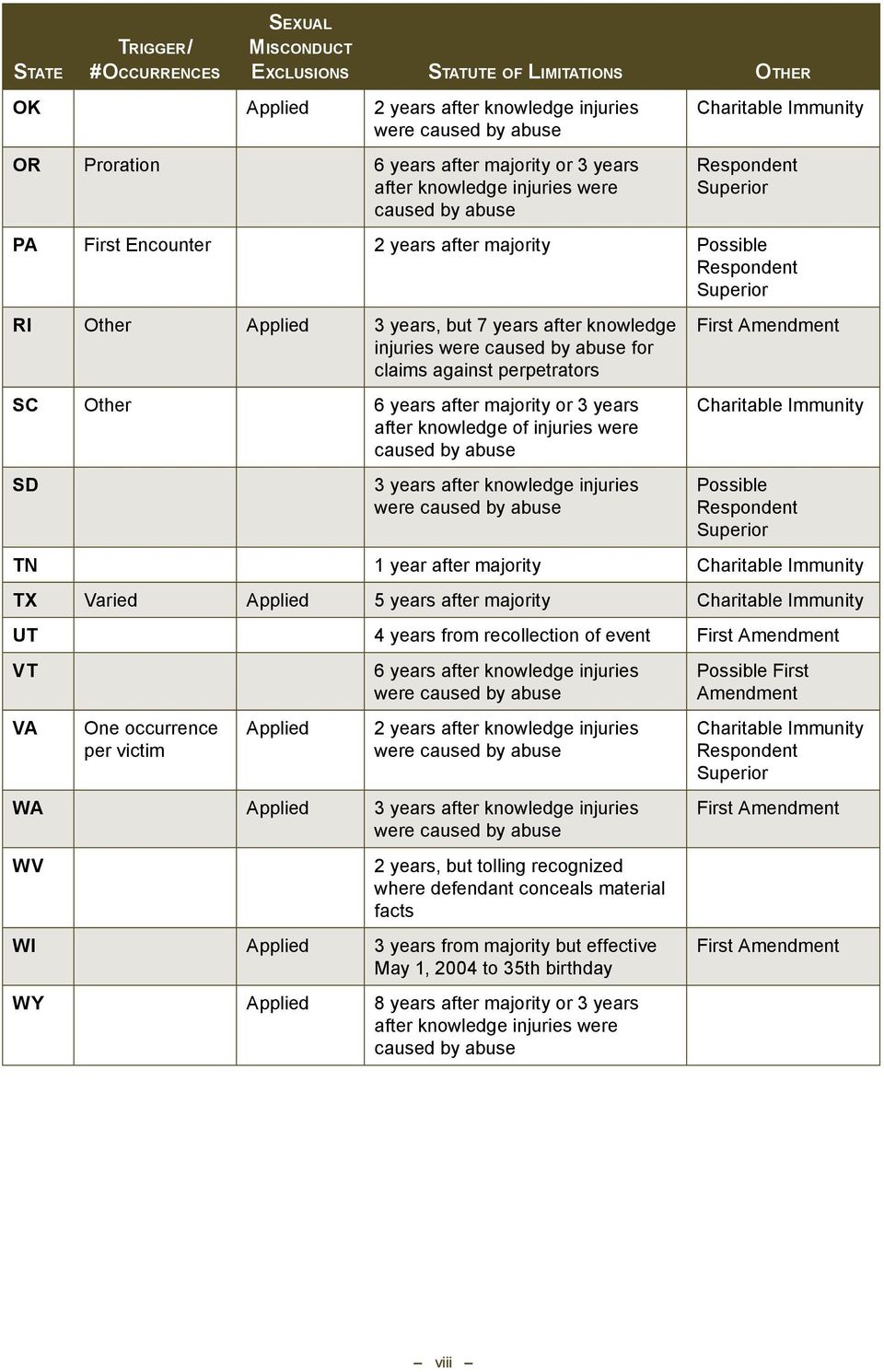
8 STATE TRIGGER/ #OCCURRENCES SEXUAL MISCONDUCT EXCLUSIONS STATUTE OF LIMITATIONS OTHER AL Applied 2 years after majority AK Applied 3 years after majority or knowledge injuries caused by abuse for misdemeanors. No limitations period for felonies Possible Respondeat Superior AZ Applied 2 years from recollection of event Possible Respondeat Superior AR Applied 3 years from recollection of event CA Applied To 26th birthday or three years after knowledge injuries were caused by abuse plus Sunshine Legislation for claims pending or brought in 2003 CO Applied Generally 2 years, but 6 years after disability removed or cause of action accrues for claims against perpetrators Possible Respondeat Superior First Amendment CN Applied 17 years after majority Possible Respondeat Superior DE Applied 2 years after majority unless injury inherently unknowable due to disability DC Not Applied 3 years from recollection of event FL Applied 7 years after majority or 4 years after knowledge injuries were caused by abuse GA Applied 5 years after age of majority Charitable Immunity HI First Encounter Applied 2 years after knowledge injuries were caused by abuse ID 5 years after majority IL Proration 10 years after majority or 5 years after knowledge injuries were caused by abuse IN IA 2 years from recollection of event. 4 years after knowledge injuries were caused by abuse of child under age of 14 KS Proration Applied 3 years after knowledge injuries were caused by abuse Possible Respondeat Superior vi

9 STATE TRIGGER/ #OCCURRENCES SEXUAL MISCONDUCT EXCLUSIONS STATUTE OF LIMITATIONS OTHER KY 5 years after majority or after knowledge of abuse LA Proration Applied 10 years after majority Possible Respondeat Superior, First Amendment ME Not Applied No limitations Charitable Immunity, First Amendment MD Not Applied 7 years after majority Charitable Immunity, First Amendment MA Applied 3 years after knowledge injuries were caused by abuse MI Applied 2 to 3 years after majority MN Proration Applied 6 years after knowledge injuries were caused by abuse Charitable Immunity Possible Respondeat Superior MI Applied 3 years after majority Possible Respondeat Superior MO First Encounter Not Applied 3 years after discovery injury was caused by abuse MT Applied 3 years after knowledge injuries were caused by abuse NE 4 years after majority NV Applied 10 years after knowledge injuries were caused by abuse NH NJ 3 years from recollection of event 2 years after knowledge injuries were caused by abuse NM Applied Later of 24th birthday or 3 years after knowledge injuries were caused by abuse First Amendment Possible Respondeat Superior Charitable Immunity, First Amendment NY Not Applied 3 years after majority First Amendment NC Applied 3 years after bodily harm becomes apparent but no more than 10 years from last act ND Applied 2 years after knowledge injuries were caused by abuse First Amendment Respondent Superior OH Applied 1 year from recollection of event First Amendment vii

10 STATE TRIGGER/ #OCCURRENCES SEXUAL MISCONDUCT EXCLUSIONS STATUTE OF LIMITATIONS OTHER OK Applied 2 years after knowledge injuries were caused by abuse OR Proration 6 years after majority or 3 years after knowledge injuries were caused by abuse Charitable Immunity Respondent Superior PA First Encounter 2 years after majority Possible Respondent Superior RI Applied 3 years, but 7 years after knowledge injuries were caused by abuse for claims against perpetrators SC 6 years after majority or 3 years after knowledge of injuries were caused by abuse First Amendment Charitable Immunity SD 3 years after knowledge injuries were caused by abuse Possible Respondent Superior TN 1 year after majority Charitable Immunity TX Varied Applied 5 years after majority Charitable Immunity UT 4 years from recollection of event First Amendment VT VA One occurrence per victim Applied 6 years after knowledge injuries were caused by abuse 2 years after knowledge injuries were caused by abuse WA Applied 3 years after knowledge injuries were caused by abuse WV 2 years, but tolling recognized where defendant conceals material facts WI Applied 3 years from majority but effective May 1, 2004 to 35th birthday WY Applied 8 years after majority or 3 years after knowledge injuries were caused by abuse Possible First Amendment Charitable Immunity Respondent Superior First Amendment First Amendment viii
11 ALABAMA The Alabama Supreme Court applied the inferred intent rule to claims involving sexual abuse of minor children and refused to provide coverage for the perpetrator of the abuse. State Farm Fire & Cas. Co. v. Davis, 612 So.2d 458 (Ala. 1993); See also Horace Mann Ins. Co. v. Cecil Fore, 785 F. Supp. 947 (M.D. Ala. 1992) (Claims against teacher for sexual abuse of students fell within intended injury exclusion in policy); Cf. State Auto Ins. Co. v. McIntyre, 652 F. Supp (N.D. Ala. 1987) (Grandfather accused of nonviolent sexual abuse of granddaughter covered under homeowner s policy because court found no specific intent to cause bodily injury). The Alabama courts employ a subjective standard to determine whether intentional acts exclusions apply to non-perpetrators. See Capital Alliance Ins. Co. v. Thorough-Clean Inc., 639 So. 2d 1349 (Ala. 1994) (Required a high degree of certainty to trigger an intentional act exclusion and found coverage for employer of alleged rapist); Sphere Drake Ins. Co. v. Shoney s Inc., 923 F. Supp (M.D. Ala. 1996) (Assault and battery exclusion did not bar coverage for claims of negligent supervision.) However, the Alabama Supreme Court held that where a policy excluded coverage for bodily injury which is either expected or intended by an insured, there was no coverage for the perpetrator s wife. State Farm Fire and Casualty Co. v. Davis, 612 So.2d 458 (Ala. 1993). In a case alleging negligence and vicarious liability against the employer of an employee who touched claimant in a sexually offensive manner and made sexual remarks, the court found no coverage based on an exclusion for injuries resulting from sexual and/or physical abuse by any employee. CNA International v. CPB Enterprises Inc., 982 F. Supp. 831 (S.D. Ala. 1997); Cf. Sentry Ins. Co. v. Miller, 914 F. Supp. 496 (M.D. Ala. 1996), aff d in part, rev d in part, 114 F.3d 1202 (11th Cir. 1997) (Exclusion for personal accidents... arising out of... sexual molestation... did not preclude coverage for negligence claims alleging inadvertent contact). Personal injury actions premised on negligence must be brought within two years of the accrual of the cause of action. Ala. Code (1). Actions for trespass to person or liberty such as assault and battery must be brought within 6 years of the accrual of the cause of action. Id. at (1). The Supreme Court of Alabama rejected a repressed memory argument in a sexual misconduct case and also held that trauma and repression of the abuse cannot be considered insanity disability. Travis v. Ziter, 681 So. 2d 1348 (Ala. 1996). Ala. Code et seq. Employers are not liable under a theory of respondeat superior for the sexual misconduct of their employees. Doe v. Swift, 570 So. 2d 1209 (Ala. 1990); Joyner v. AAA Cooper Transp., 477 So.2d 364 (Ala. 1985). 1

12 ALASKA Alaska courts apply the inferred intent rule in molestation cases so that intentional act exclusions preclude coverage for perpetrators of sexual misconduct. See Kim and T.O. v. National Indemnity Co. 6 P.3d 264 (Alaska. 2000), overruled on other grounds, Shaw v. State Farm Mut. Auto Ins. Co., 19 P.3d 588 (Alaska. 2001); Allstate v. Roefls, 698 F. Supp. 815 (D. Alaska 1987); Cf. National Chiropractic Mutual Ins. Co. v. Doe, 23 F. Supp. 2d 1109 (D. Alaska 1998) (Coverage found where insured chiropractor performed allegedly unwanted breast exam because his actions could have been negligent and not for gratification). The inferred intent rule was codified by the Alaska legislature for victims of sexual abuse under the age of 16. Alaska Stat According to the statute, if the perpetrator is found to have committed more than one act of sexual abuse against the victim, the victim is not required to prove which specific act caused the injury. Court found no coverage for claims against sexual misconduct perpetrator and negligence claims against perpetrator s parents where intentional act exclusion negated coverage for bodily injury intentionally caused by an insured person. Allstate v. Roelfs, 698 F. Supp. 815 (D. Alaska 1987). However, when the policy language contains no such limitation, the Alaska courts have held that intentional acts exclusions would not preclude coverage for claims of negligence against potentially liable third parties. See C.P. v. Allstate Ins. Co., 996 P.2d 1216 (Alaska. 2000) (Found coverage for negligence claims against parents of a perpetrator); St. Paul Fire and Marine Ins. Co., v. F.H., 55 F.3d 1420 (9th Cir. 1995), aff d other grounds, 117 F.3d 435 (9th Cir. 1997) (Public policy does not prohibit employers from obtaining insurance to indemnify them from liability arising from the sexual misconduct of their employees). A sexual misconduct exclusion was found to preclude coverage for abuse claims against the insured. Kim and T.O. v. National Indemnity Co. 6 P.3d 264 (Alaska. 2000), overruled on other grounds, Shaw v. State Farm Mut. Auto Ins. Co., 19 P.3d 588 (Alaska. 2001). A person may not bring an action for assault, battery, or any injury to the person unless it is commenced within two years. Alaska Stat Alaska law provides that an action based on childhood sexual abuse may be brought within three years after the claimant reaches the age of majority or within three years after the claimant discovered, or through the use of reasonable diligence should have discovered, that the act caused the injury or condition. Id (c). 2

13 ALASKA The Code of Civil Procedure was amended effective June 6, 2003 to provide that a person may bring an action at any time for the following acts: (1) felony sexual abuse of a minor; (2) felony sexual assault; or (3) unlawful exploitation of a minor. However, actions involving (1) misdemeanor sexual abuse of a minor; (2) misdemeanor sexual assault; (3) incest; or (4) felony indecent exposure must be brought within 3 years. Id. at Alaska Stat et. seq. An employer may be subject to vicarious liability for an employee s sexual misconduct. See Doe v. Samaritan Counseling Center, 791 P.2d 344 (Ak. 1990) (Mental health clinic could be held liable on respondeat superior theory for sexual acts of employed therapistminister towards counseling patient). 3

14 ARIZONA Intentional acts exclusions preclude coverage for insured perpetrators of child molestation based on the inferred intent doctrine. Twin City Fire Ins. Co. v. Doe, 788 P.2d 121 (Ariz. Ct. App. 1989) (Public policy precludes coverage for minor sexual abuse); See also State Farm Fire & Cas. Co. v. Brown, 905 P.2d 527 (Ariz. Ct. App. 1995) (Perpetrator s mental disorder did not deprive him of the capacity to intend his acts of minor sexual abuse so intentional acts exclusion barred coverage); K.B. v. State Farm Fire & Cas. Co., 941 P.2d 1288 (Ariz. Ct. App. 1997). However, the presumption of intent does not apply when the perpetrator is a minor. See USAA v. DeValencia 949 P.2d 525 (Ariz. Ct. App. 1998). In Chicago Ins. Co. v. Manterola, 955 P.2d 982 (Ariz. Ct. App. 1998), the court found that a sexual misconduct exclusion barred coverage for liability arising out of alleged sexual misconduct, however, it declined to address the applicability of a sexual misconduct exclusion to a mixed claim alleging liability for both sexual and non-sexual misconduct. Personal injury actions shall be commenced within two years after the cause of action accrues. Ariz. Rev. Stat. Ann The Arizona Supreme Court applied the discovery rule where the claimant alleged repressed memory of the abuse. Doe v. Roe, 955 P.2d 951 (Ariz. 1998) (Also found the trauma of recovered memory of abuse may render a claimant of unsound mind so the discovery rule and tolling provision for unsound mind under together may toll the limitations period until a claimant both knows of the underlying abuse and is capable of bringing a claim). A sexual abuse perpetrator s threats to harm himself or his victim may have caused sufficient fear and duress in the victim to raise a genuine issue of material fact as to whether the limitations period was tolled during the period of duress. Jane Doe One v. Garcia, 5 F. Supp.2d 767 (D. Ariz. 1998). Ariz. Rev. Stat et. seq. An employer may be subject to respondeat superior liability for an employee s criminal sexual assault, abuse and harassment if the acts were committed incident to employment. State v. Schallock, 941 P.2d 1275 (Ariz. 1997). The Arizona Court of Appeals ruled that the Free Exercise Clause of the First Amendment did not bar negligence claims against a church where pastor allegedly defrauded and seduced claimant. Rashedi v. General Board of Church of the Nazarene, 54 P.3d 349 (Ariz. App. 2002). 4

15 ARKANSAS Arkansas courts apply the inferred intent rule so that intentional act exclusions preclude coverage to perpetrators of sexual misconduct. CNA Ins. Co. v. McGinnis, 666 S.W.2d 689 (Ark. 1984); Siverball Amusement Inc. v. Utah Fire Ins. Co., 842 F. Supp (W.D. Ark. 1994), aff d, 33 F.3d (8th Cir. 1994). An intentional act exclusion did not preclude coverage for negligence claims brought against employer of employee who sexually molested a minor. Siverball Amusement Inc. v. Utah Fire Ins. Co., 842 F. Supp (W.D. Ark. 1994), aff d, 33 F.3d 1476 (8th Cir. 1994). In a case where a resident of a temporary facility brought an action against the facility alleging rape by a fellow resident, the Arkansas Supreme Court held that a sexual action exclusion barred coverage. See Western World Ins. Co. v. Branch, 965 S.W.2d 760 (Ark. 1998); See also Govar v. Chicago Ins. Co., 879 F.2d 1581 (8th Cir. Ak. Law 1989). Actions for assault and battery must be commenced within one year after the cause of action accrues. Ark. Code. Ann Any civil action based on sexual abuse that occurred when the injured person was a minor, but is not discovered until after the person reached the age of majority, must be brought within three years from the time of discovery of the abuse by the injured party. A claim based on an assertion of more than one act of sexual abuse is not limited to the injured party s first discovery of the relationship between any of those acts and the injury, but may be based on the injured party s discovery of the effect of the series of acts. Id. at Ark. Code Ann et. seq. In Arkansas employers are not vicariously liable for the sexual misconduct of their employees. See Porter v. Harshfield, 948 S.W.2d 83 (Ark. 1997); Regions Bank & Trust v. Stone County Skilled Nursing Home Facility, 49 S.W.3d 107 (Ark. 2001). In a case where members of a church filed discovery motions asserting a statutory right to financial data and other business information, the Arkansas Supreme Court held that the dispute was ecclesiastical in nature. Gibson v. Brown, 749 S.W.2d 297 (Ark. 1988). 5
16 CALIFORNIA Where a child care worker s husband molested three children over a period of many months and the policy provided that repeated exposure to the same general conditions is one occurrence, the court found that there was one occurrence for each child that was abused. State Farm Fire and Casualty Co. v. Elizabeth N., 12 Cal. Rptr. 2d 327 (Cal. Ct. App. 1992). Where a foster parent negligently failed to stop her husband from molesting a child over a three-year period and the policy provided coverage for act(s), errors or omissions... occurring during the policy period with limits of $500,000 each claim, the court found there was $1.5 million in insurance coverage available. National Union Fire Ins. Co. v. Lynette C., 33 Cal. Rptr.2d 496 (Cal. Ct. App. 1994). The California courts have applied the inferred intent rule to instances of child abuse and held there is no coverage for a perpetrator because molestation constitutes an intentional act causing intentional harm. J.C. Penny Cas. Ins. Co. v. M.K. 278 Cal. Rptr. 2d. 64 (Cal. 1991); Quan v. Truck Ins. Exchange, 79 Cal. Rptr. 2d 134 (Cal. Ct. App. 1998); Farmer v. Allstate Ins. Co., 311 F. Supp. 2d 884 (C.D. Cal. 2004); Cf. State Farm Fire & Cas. Co. v. Nycum, 943 F.2d 1100 (9th Cir. 1991(Cal.)) (Where allegations did not raise to conclusive presumption that touching was intentional child molestation.) Where damages are sought for a perpetrator s sexual as well as separable non-sexual conduct, an insurer may owe a duty to defend. Horace Mann Ins. Co. v. Barbara B., 17 Cal. Rptr. 210 (Cal. 1993). Negligence-based claims brought against supervisory defendant are excluded from coverage if the policy precluded coverage for acts of any insured as opposed to the insured. See Allstate Ins. Co. v. Gilbert 852 F.2d 449 (9th Cir. 1988); American States Ins. Co. v. Borbor, 826 F.2d 888 (9th Cir. 1987); Farmer v. Allstate, 311 F. Supp. 2d 884 (C.D. Cal. 2004). The California courts have generally upheld sexual misconduct exclusions. See Farmer v. Allstate Ins. Co., 311 F. Supp. 2d 884 (C.D. Cal. 2004) (no coverage for actions by day care center employee who sexually abused child or for day care center operator s negligent supervision of employee where policy excluded coverage for bodily injury arising out of sexual molestation inflicted upon any person by or at the direction of an insured person [or] an employee of an insured person. ); Northland Ins. Co. v. Briones, 97 Cal. Rptr. 2d 127 (Cal. Ct. App. 2000) (No coverage where instructor allegedly raped, assaulted and stalked female student and policy did not apply to injury arising out of physical abuse, sexual abuse, sexual molestation or sexual harassment by anyone... ); Jane D. v. Ordinary Mutual, 38 Cal. Rptr. 2d. 131 (Cal. Ct. App. 1995) (No coverage where adult female was induced by priest to engage in sexual relations during counseling and policy excluded licentious, immoral, or sexual behavior intended to lead to or culminate in sexual act because any allegations of nonsexual conduct were inseparably intertwined with the excluded sexual misconduct); Cf. National Union Fire Ins. Co. v. Lynette C., 279 Cal. Rptr. 394 (Cal Ct. App. 1991), modified on remand, 33 Cal. Rptr. 2d 496 (Cal. Ct. App. 1994) (Coverage found for foster mother who negligently failed to protect foster child from molestation where policy excluded coverage if insured acted with actual lasciviousness or immoral purpose and intent). 6

17 CALIFORNIA Actions for personal injuries must be brought within one year. Cal. Civ. Proc. Code 340(3). The California Code was amended in 1998 to provide different limitations periods for actions brought against perpetrators as opposed to third parties. Claims against perpetrators were required to be brought within the later of: (1) eight years of age of majority; or, (2) three years from discovery that psychological injury or illness occurring after the age of majority was caused by the sexual abuse. Cal. Civ. Proc. Code 340.1(a). Claims against non-perpetrators were required to be brought before the claimant s 26th birthday. Id. at 340.1(b). See Debbie Reynolds Professional Rehearsal Studios v. Johnson, 30 Cal. Rptr. 2d 514 (Cal. App. Ct. 1994) (Extended limitations period does not apply to third parties); Cf. David T. v. Doe 2, No. E (Cal. App. Ct., 4th Dist. Division 2, April 11, 2000) (court reached contrary result to Debbie Reynolds decision). The California Code was amended again in These amendments extended the limitations period for claims against nonperpetrators who knew or had reason to know of unlawful sexual conduct by an employee and others and failed to take steps to avoid acts of further unlawful conduct by that person to eight years after majority or three years after discovery that injuries were caused by the abuse. Id. at 340(a) and (b). These amendments also provided that claims which could now be brought against non-perpetrators, but were otherwise barred as of January 1, 2003, were revived if commenced within one year of January 1, Id. at 340(c). The California courts have addressed the application of the repressed memory rule. See Lent v. Doe, 47 Cal. Rptr. 2d 389 (Cal. Ct. App. 1995) (Failure to connect abuse to injuries was reasonable given the trauma caused by the abuse); Tietge v. Western Province, 64 Cal. Rptr. 2d 53 (Cal. Ct. App. 1997). Cal. Penal Code et seq. The California courts have generally not allowed vicarious liability. John R. v. Oakland Unified Minor School District, 256 Cal. Rptr. 766 (Cal. 1989) (School District not vicariously liable for molestation of student by math teacher); Jeffrey v. Central Baptist Church, 243 Cal. Rptr. 128 (Cal. Ct. App. 1988); Rita Milla v. Roman Catholic Archbishop of Los Angeles, 232 Cal. Rptr. 685 (Cal. Ct. App. 1986) (Priests sexual contact with 16-year-old was not an act performed incident their priestly duties.) However, a trial court recently refused to summarily dismiss claims alleging vicarious liability in sexual abuse cases finding that the issue of whether the perpetrator s abuse was within the scope of employment is a question of fact to be determined on summary judgment or trial based on the facts of the individual case. The Clergy Cases III, Judicial Council Coordinated Proceeding No (Cal. Super. Ct. Alameda Cty. Sept. 24, 2004). 7

18 COLORADO An intent to injure may be inferred as a matter of law for claims alleging intentional conduct and negligence where an adult perpetrator engaged in sexual activities with a child. See Allstate Ins. Co. v. Troelstrup, 789 P.2d 415 (Colo. 1990); Colorado Farm Bureau Mut. Ins. Co. v. Snowbarger, 934 P.2d 909 (Colo. Ct. App. 1997). Intent to harm has also been inferred where the perpetrator was a minor. Swentkowski by and through Reed v. Dawson, 881 P.2d 437 (Colo. Ct. App. 1994). For case brought against insured and his minor son arising out of the son s sexual assault on another minor, the negligence claims against the parent were not covered since the intentional acts exclusion precluded coverage when any insured intended or expected harm. Swentkowski by and through Reed v. Dawson, 881 P.2d 437 (Colo. Ct. App. 1994). The Colorado courts have upheld sexual misconduct exclusions and found that they do not violate public policy. Bohrer v. Church Mutual Ins. Co., 965 P.2d 1258 (Colo. 1998); Church v. Mut. Ins. Co. v. Klein, 940 P.2d 1001 (Colo. Ct. App. 1996); Physicians Nat l Risk Retention Group, Inc. v. Price, 968 F.2d 1224 (10th Cir. 1992). The limitations period for tort actions is two years. Colo. Rev. Stat Actions based on a sexual assault or a sexual offense against a child shall be commenced either six years after a disability has been removed for a person under disability or six years after a cause of action accrues, whichever occurs later. Id. at The term person under a disability includes victims of sexual assault where there is a special relationship or where the victim resides in an institution. Id. at (3.5) (a). If a claimant brings a civil action 15 years or more after attaining the age of 18, the claimant may only recover damages for medical and counseling treatment and expenses plus costs and fees. Id. at (3.5)(c). A cause of action shall accrue when both the injury and its cause are known or should have been known by the exercise of reasonable diligence. Id. at See also Colburn v. Kopit, 59 P.3d 295 (Colo. Ct. App. 2002) (Cause of action for breach of fiduciary duty or negligence accrues on date claimant had knowledge of facts which would put a reasonable person on notice of the nature and extent of an injury and that the injury was caused by the wrongful conduct of another); Ayon v. Gourley, 185 F.3d 873 (10th Cir. 1999); Sailsbery v. Parks, 983 P.2d 137 (Colo. Ct. App. 1999); Cassidy v. Smith, 817 P.2d 555 (Colo. Ct. App. 1991). The six-year limitations period does not apply to claims against parties other than the perpetrator. Sandoval v. Archdiocese of Denver, 8 P.3d 598 (Colo. Ct. App. 2000). Claims for fraudulent concealment are insufficient if claimants knew or should have known the basis of their claims. P.R. v. Zavaras, 2002 W. L (10th Cir. 2002). 8

19 COLORADO Colo. Rev. Stat et. seq. The trust funds of a charitable institution cannot be seized or appropriated to satisfy a tort liability. Hemenway v. Presbyterian Hosp. Ass n of Colo., 419 P.2d 312 (Colo. 1966); Michard v. Myron Stratton Home, 355 P.2d 1078 (Colo. 1960). A religious employer may not be held vicariously liable for a clergy member s sexual acts with a parishioner because such conduct is outside the scope of employment. Moses v. Diocese of Colo., 863 P.2d 310 (Colo. 1993); Destefano v. Grabrian, 763 P.2d 275 (Col. 1988) Sexual activity by a Catholic priest was found to fall outside the beliefs and doctrine of religion and thus claims arising out of that conduct, including breach of fiduciary duty, negligent hiring and supervision, are not barred by the First Amendment. Bear Valley Church of Christ v. DeBose, 928 P.2d 1315 (Col. 1996); Destefano v. Grabrian, 763 P.2d 275 (Col. 1988); Cf. Ayon v. Gourley, 47 F. Supp.2d (D. Colo. 1998), aff d on other grounds, 185 F.3d 873 (10th Cir. 1999) (Negligent hiring, negligent supervision and outrageous conduct claims against a religious institution were precluded by the First Amendment because they required excessive entanglement with, and inquiry into, church policy and doctrine on the choice of priests). 9
20 CONNECTICUT Courts recognize an inferred intent to harm when adults sexually assault children. Colonial Penn Ins. Co. v. Dimitriadis, 2003 WL (Conn. Super. Nov. 14, 2003); Atlantic Mut. Ins. Co. v. Pope, 2001 WL (Conn. Super. June 28, 2001). A 15-year-old abuser was old enough to realize and appreciate the consequences of his actions and thus intend to cause harm to his victim. Covenant Ins. Co. v. Sloat, 2003 WL (Conn. Super. May 25, 2003). An insured can rebut the presumption of intentional misconduct by producing evidence of a mental disease or illness. Mount Vernon Fire Ins. v. Morris, 2004 WL (Conn. Super. July 1, 2004). Abuse and molestation exclusion precluded coverage for pre-school in suit arising out of molestation of female student by three minor male students. Cmty. Action for Greater Middlesex County, Inc. v. Am. Alliance Ins. Co., 757 A.2d 1074 (Conn. 2000). A sexual misconduct exclusion was upheld in connection with negligence claims against a day care for an employee s sexual abuse of a minor child. Mount Vernon Fire Ins. v. Morris, 2004 WL (Conn. Super. July 1, 2004). See also Covenant Ins. Co. v. Sloat, 2003 WL (Conn. Super. May 25, 2003); Electric Ins. v. Castrovinci, 2003 WL (D. Conn. Dec. 10, 2003); Middlesex Mut. Assur. Co., 2003 WL (Conn. Super. Sept. 16, 2003). Tort actions shall be brought within three years from the date of the act or omission complained of. Conn. Gen. Stat Actions to recover damages for personal injury to a minor, including emotional distress, caused by sexual abuse, sexual exploitation or sexual assault, may be brought seventeen years from the date such person attains the age of majority. Conn. Gen. Stat d (2001); Cf. Nutt v. Norwich Roman Catholic Diocese, 56 F. Supp. 2d 195 (D. Conn. 1999) (Three-year statute applies to claims based on conduct, including sexual abuse, occurring after claimant has attained the age of majority) d applies to all claims for personal injury to a minor caused by sexual abuse, not just claims against perpetrators. Todd M. v. Richard L., 696 A.2d 1063 (Conn. Super. Ct. 1995); Doe v. Indian Mountain School, 921 F. Supp. 82 (D. Conn. 1995); Nutt v. Norwich Roman Catholic Diocese, 921 F. Supp. 66 (D. Conn. 1995). The Connecticut fraudulent concealment tolling statute applies to claims governed by the sexual assault statute of limitations. Martinelli v. Bridgeport Roman Catholic Diocesan Corp., 196 F.3d 409 (2nd Cir. 1999) (30-year delay in bringing suit). Conn. Gen. Stat. 17a-101 et. seq. 10
21 CONNECTICUT Sexual abuse perpetrated by a Catholic priest is outside the scope of his employment and therefore the church may not be held vicariously liable for such acts. Beach v. Jean, 746 A.2d 228 (Conn. Super. Ct. 1999); Doe v. Hartford Roman Catholic Diocesan Corp., 716 A.2d 960 (Conn. Super. Ct. 1998); Nutt v. Norwich Roman Catholic Diocese et al., 921 F. Supp. 66 (D. Conn. 1995); Cf. Mullen v. Horton, 700 A.2d 1377 (Conn. App. Ct. 1997) (Religious employer held vicariously liable for employee s abuse of adult during counseling sessions because employer may have benefited from the illegal acts). The First Amendment does not bar claims against religious institutions for negligent hiring, training, retention and supervision of clergy. Martinelli v. Bridgeport Roman Catholic Diocesan Corp., 196 F.3d 409 (2d Cir. 1999); Rosado v. Bridgeport Roman Catholic Diocesan Corp., 716 A.2d 967 (Conn. Super. Ct. 1998); Doe v. Hartford Roman Catholic Diocesan Corp., 716 A.2d 960 (Conn. Super. Ct. 1998); Nutt v. Norwich Roman Catholic Diocese et al., 921 F. Supp. 66 (D. Conn. 1995). 11
22 DELAWARE Intentional acts exclusions preclude coverage for bodily injury which is expected or intended by an insured perpetrator based on the inferred intent doctrine that sexual molestation of a minor is, by its nature, intended or expected to cause injury. Motley v. Maddox, C.A WL (Del. Super. Ct. Feb 19, 1992); See also Nationwide Mutual Ins. Co., v. Flagg et. al., 2001 WL (Del. Super. Ct. July 3, 2001). An exclusion for intentional acts of an insured precludes coverage for all claims against any insured, even claims of negligence against a non-perpetrator, arising out of sexual misconduct. Motley v. Maddox, 1992 WL (Del. Super. Ct. Feb. 19, 1992). Sexual molestation exclusion, which precluded coverage for acts of sexual molestation by or at the direction of an insured, an insured s employee or any other person, precluded coverage to both the policyholder and her son who sexually abused a minor at the policyholder s day care center. Motley v. Maddox, 1992 WL (Del. Super. Ct. Feb. 19, 1992). Actions for personal injuries shall be commenced within two years after the cause of action accrues. Del. Code Ann. tit. 10, The discovery rule tolls the limitations periods for an inherently unknowable injury to a blamelessly ignorant claimant where the injury develops gradually. Warner v. University of Delaware, 1995 WL (Del. Super. Ct. Oct. 2, 1995) (Childhood sexual abuse does not toll the limitations period or implicate the discovery rule unless the injury was inherently unknowable due to physical or mental disability); See also Garcia v. Nekarda, 1993 WL (Del. Super. Ct. Feb. 19, 1993) (Where minor claimant revealed abuse to school teacher five years prior to her parent s lawsuit, the suit was barred because a responsible adult knew of the harm outside the two-year limitations period). Del. Code Ann. tit. 16, 902 et. seq. The Delaware courts have rejected the doctrine of charitable immunity. Quinn v. Kent Gen. Hosp., Inc., 617 F.Supp (D. Del. 1985); Vanaman v. Milford Mem. Hosp., Inc. 262 A.2d 263 (De. Super. Ct. 1970), rev d. on other grounds, 272 A.2d 718 (Del. 1970). However, volunteers and workers of nonprofit organizations are immune from civil liability for alleged negligent acts or omissions in connection with the organization s activities, except for willful and wanton or grossly negligent misconduct. Del. Code Ann. tit (b) and (d). 12
23 DISTRICT OF COLUMBIA Not addressed in sexual misconduct setting Not addressed in sexual misconduct setting In a declaratory judgment lawsuit arising out of a counselor s sexual contact with a mentally ill patient, the Court of Appeals referenced, but did not address on appeal, the trial court s finding that a sexual action exclusion did not bar coverage where allegations of unauthorized trips to restaurants and bars were not necessarily sexual in connotation and purpose and did not bar coverage for claim for negligent hiring and supervision. Potomac Residence Club, et al. v. Western World Ins. Co., 711 A.2d 1228 (D.C. 1998), rehearing en banc granted per curiam, 711 A.2d 1250 (D.C. 1998) (settled before decision). The limitations period is one year for actions for assault and battery and three years for actions for which a limitation is not otherwise specifically prescribed. D.C. Code Ann (4) and (8) The District of Columbia courts have applied the discovery rule to cases involving sexual abuse of a minor. See Farris v. Compton, 652 A.2d 49 (D.C.1994) (Discovery rule extended limitations period to claims by sisters that they repressed memory of abuse by their brother); Cf. Cevenini v. Archbishop of Washington, 707 A.2d 768 (D.C. 1998) (Actions against a priest and the archdiocese were timebarred because the claimants had notice of the abuse within three years of when they turned 18 and because the archdiocese s failure to disclose information when it transferred the priest to other parishes did not constitute fraudulent concealment). D.C. Code Ann et. seq. Where a woman was raped by an employee of a foreign government, the court held that respondeat superior liability did not apply because sexual assault could never fall within the scope of office or employment or further an employer s business, even if the assault was committed while the employee was on duty. Guzel v. State of Kuwait, 818 F. Supp. 6 (D. D.C. 1993); See also Boykin v. District of Columbia, 484 A.2d 560 (D.C. 1984) (Sexual assault on school child by a District employee was outside the scope of employment); Sebastian v. District of Columbia, 636 A.2d 958 (D.C. 1994) (Ambulance attendant s sexual molestation of passenger was outside the scope of employment). 13
24 FLORIDA Coverage under a claims-made policy is triggered by insured s discovery of a claim and the provision of notice to insurer within the policy term, so if the claim is not reported during the policy period, then no liability attaches. Panatropic Power Products, Inc. Fireman s Fund Ins. Co., 141 F. Supp.2d 1366 (S.D. Fla. 2001); See also GuideOne Elite Ins. Co. v. Old Cutler Presbyterian Church Inc., 328 F. Supp.2d 1346 (S.D. Fla. 2004) (In footnote court found because one individual committed criminal sexual acts on two individuals, there was one occurrence). Courts apply inferred intent rule in cases involving sexual abuse of minors such that intentional acts exclusions preclude coverage for the perpetrator. Landis v. Allstate Ins. Co., 546 So.2d 1051 (Fla. 1989); Allstate Ins. Co. v. Bailey, 723 F. Supp. 665 (M.D. Fla. 1989); Allstate Ins. Co. v. McCranie, 716 F. Supp (S.D. Fla. 1989), State Farm Fire & Casualty Co. v. Tippett, et al., 864 So.2d 31 (Fla. App. 4th Dist. 2003). Claims of negligent hiring and supervision against day care center arising out of purported molestation of students by teachers were covered under school operators liability policy. United States Fidelity & Guaranty v. Toward, 734 F. Supp. 465 (S.D. Fla. 1990); Farrer v. U. S. Fidelity and Guaranty Co., 809 So.2d 85 (Fla. App. 4th Dist. 2002) (Insurer had duty to defend taxi-cab employer in suit by passenger who alleged sexual assault by driver); Cf. Sunshine Birds & Supplies, Inc. v. U.S. Fidelity & Guaranty Co., 696 So.2d 907 (Fla. App. 3d Dist. 1997) (Suggested that if insureds had actual knowledge of their employees proclivity to molest young children, this would not qualify as insurable risk); Allstate Ins. Co. v. McCranie, 716 F. Supp (S.D. Fla. 1989) (No coverage for negligence claims against a non-perpetrator where the co-insured was the perpetrator and the intentional acts exclusion provided no coverage if any insured caused or expected bodily injury). A sexual abuse exclusion precluded coverage for negligence claims against a day care operator arising out of sexually battery of minors. Casualty Indemnity Exchange v. Small Fry Educational Day Care Centers, 709 F. Supp (S.D. Fla. 1989); See also TIG Ins. Co. v. Sweet Factory, Inc., 748 So. 2d. 337 (Fla. App. 5th Dist. 1999) (No coverage for insured employer where damages claims were interwoven with and arose out of alleged sexual harassment and policy excluded damages arising out of harassment); Guideone Elite Ins. Co. v. Old Cutler Presbyterian Church, Inc., 328 F. Supp.2d 1346 (S.D. Fla. 2004) (No coverage for injuries that arise from sexual misconduct). 14
25 FLORIDA Florida has a four-year limitations period for personal injury actions. Fla. Stat. Ann (3). An action founded on alleged abuse may be commenced at any time within seven years after the age of majority, or within four years after the injured person leaves the dependency of the abuser, or within four years from the time of discovery by the injured party of both the injury and the causal relationship between the injury and the abuse, whichever occurs later. Fla. Stat. Ann (7). Neither the extended limitations period nor the continuing tort doctrine applied to claimant s claims against her father alleging sexual abuse over 26 years because she knew that she had been the victim of abuse and that she suffered injury. Tobin v. Damian, 772 So.2d 13 (Fla. App. 4th Dist. 2000). In a case alleging negligent hiring and retention against the church and bishop based on allegations of sexual abuse of a minor by a priest, the court held the four-year statute applied, not the extended statute which applies only to intentional torts based on abuse. Doe v. Dorsey, 683 So.2d 614 (Fla. App. 5th Dist. 1996), abrogated on other grounds, Malicki v. Doe, 814 So.2d 347 (Fla. 2002). Fla. Stat. Ann et. seq. Pastor s sexual assault of victim was outside the scope of his employment with the church and thus the church was not vicariously liable for the acts. Elders v. United Methodist Church, 793 So. 2d 1038 (Fla. App. 3d Dist. 2001); Iglesia Cristiana La Casa Del Senor, Inc. v. L.M., 783 So.2d 353 (Fla. App. 3d Dist. 2001). The First Amendment does not bar claims against church, diocese and bishop alleging breach of fiduciary duty, negligent hiring, supervision and retention based on pastor s relationship with parishioner); Doe v. Evans, 814 So. 2d 370 (Fla. 2002), See also Malicki v. Doe, 814 So. 2d 347 (Fla. 2002); Elders v. United Methodist Church, 793 So. 2d 1038, (Fla. App. 3d Dist., 2001). 15
26 GEORGIA Courts recognize an inferred intent to harm when adults sexually assault children. Roe v. State Farm Ins. & Cas. Co., 376 S.E.2d 876 (Ga. 1989); Allstate Ins. Co. v. Jarvis, 393 S.E.2d 489 (Ga. Ct. App. 1990); Harden v. State Farm & Cas. Co., 605 S.E.2d 37 (Ga. Ct. App. 2004). Where an insurance policy excluded coverage for bodily injury expected or intended... [or] which is the result of willful and malicious acts of an insured, there was no coverage for negligence claims against insured arising out of alleged sexual abuse of insured s husband and co-insured under policy because negligence claim was the result of husband s willful acts. Harden v. State Farm Fire & Cas. Co., 605 S.E.2d 37 (Ga. Ct. App. 2004). It is not contrary to public policy for insurers to limit coverage of their insured s sexual misconduct. Am. Home Assurance Co. v. Smith, 462 S.E.2d 441 (Ga. Ct. App. 1995). There is a two-year limitations period for personal injury actions. Ga. Code. Ann Civil actions for recovery of damages suffered as a result of childhood sexual abuse shall be commenced within five years of the date the claimant attains the age of majority. Id. at Causes of action arising out of sexual contact accrue at the time of the acts, regardless of the fact that the claimant may not have recognized or discovered the full impact of the harm until later. Hickey v. Askren, 403 S.E.2d 225 (Ga. Ct. App. 1991); M.H.D. v. Westminster Schools, 172 F.3d 797 (11th Cir. 1999). The Georgia legislature determined that the discovery rule does not apply to claims governed by Ga. Code. Ann et. seq. In Georgia, charitable institutions are not liable for the negligence of their officers and employees unless they fail to exercise ordinary care in the selection or retention of such officers and employees. Ga. Code Ann ; See also Harrell v. Louis Smith Memorial Hosp., 397 S.E.2d 746 (Ga. Ct. App. 1990); Y.M.C.A. v. Bailey, 130 S.E.2d 242 (Ga. Ct. App. 1963). 16
27 HAWAI I Employee s claim of ongoing sexual harassment in workplace and retaliatory wrongful discharge constituted one occurrence under employer s general liability coverage and thus only one policy limit was available. C.I.M. Ins. Corp. v. Masamitsu, 74 F. Supp.2d 975 (D. Hawaii 1999). Not addressed in sexual misconduct setting Not addressed in sexual misconduct setting Patient s malpractice claim against psychologist arising out of sexual misconduct was excluded from coverage by policy provision excluding coverage for claims arising out of sexual activity. Chicago Ins. Co. v. Griffin, 817 F. Supp. 861 (D. Hawaii 1993). Hawaii has a two-year limitation period for personal injury actions. Haw. Rev. Stat Hawaiian law also provides that an action for childhood sexual abuse must be brought within two years from the time the victim reaches the age of majority. Haw. Rev. Stat However, the courts have stated that the discovery rule may apply to claims of childhood sexual abuse where a claimant was unable to discover psychological injury caused by the abuse. Dunlea v. Dappen, 924 P.2d 196 (Hawaii 1996), abrogated on other grounds, Hac v. University of Hawaii, 73 P.3d 46 (Hawaii 2003). Haw. Rev. Stat et. seq. A therapist s sexual misconduct with a patient is not within the scope of employment so as to subject the employer to respondeat superior liability. Sharples v. State of Hawaii, 793 P.2d 175 (Hawaii 1990). 17
28 IDAHO The Idaho courts apply the inferred intent rule in sexual misconduct cases so that an intentional act exclusion precludes coverage to perpetrators. State Farm Fire & Cas. Co. v. Doe, 946 P.2d 1333 (Idaho 1997); Mutual Of Enumclaw v. Wilcox, 843 P.2d 154 (Idaho 1992). In case where molestation victims sued a day care center employee for negligently failing to warn of or report her husband s sexual abuse of children, the Idaho Supreme Court found that the employee s alleged negligence was not an occurrence, because it was the husband s abusive conduct that caused the injury. Mutual of Enumclaw v. Wilcox, 843 P.2d 154 (Idaho 1992). Not addressed. An action to recover damages for personal injury must be brought within 2 years. Idaho Code 5-219(4). Actions against a person who has committed sexual abuse of a child must be brought within five years from the date that the victim reaches the age of 18. Id. at and This statute applies to causes of action that occurred on or after July 1, The Idaho courts do not toll the statute of limitations for repressed memories. See Bonner v. Roman Catholic Diocese of Boise, 913 P.2d 567 (Idaho 1996) (Two brothers allegedly sexually abused by a priest were barred by the statute of limitations even if the full effect of the abuse was not felt until years later). The Idaho Supreme Court also held that the five-year statute of limitations in did not apply to claims against a non-perpetrator school district which was sued pursuant to Section 1983 of the Federal Civil Rights Act. See Osborn v. Salinas, 958 P.2d 1142 (Idaho 1998). Idaho Code et.al. 18
29 Did you know? The John Jay College of Criminal Justice Study of Sexual Misconduct in the Catholic Church found there were 4,392 priests accused of engaging in sexual abuse of 10,667 minor victims between 1950 and 2002 and that 81% of the victims were male. The above-referenced study also found that the majority of the priests victims (78%) between 1950 and 2002 were between the ages of 11 and 17 when the abuse began. The Diagnostic and Statistical Manual of the American Psychiatric Association (IV) classifies pedophilia as a psychiatric disorder and defines it as the sexual attraction of an adult to pre-pubescent children. This is contrasted with ephehophilia, the term for homosexual attraction to adolescent males. Per the National Clearinghouse "Child Maltreatment 2003" report, in 2003, 906,000 children in the U.S. were victims of abuse or neglect. Of this number 9.9 percent, or 89,694 children were reportedly sexually abused. This number is relatively unchanged from the 10 percent or 89,600 reported in Virginia's Fairfax County Child Protective Services currently estimates that nationally, 1 in 4 girls, 1 in 7 boys, and 15 to 25 percent of all children may be sexually abused. 19
30 ILLINOIS In a case alleging that insured diocese negligently retained and supervised a priest causing a minor female to be sexually abused during more than one policy period, the court found negligent supervision constituted an occurrence in each policy period in which abuse took place. The loss was allocated between policy periods based on the number of months of abuse within each period divided by the total number of months where there was sexual abuse. The court also found that a separate retention and policy limit were potentially available to cover the loss. Roman Catholic Diocese of Joliet v. Interstate Fire Ins. Co., 685 N.E.2d 932 (Ill. App. Ct. 1997). Courts upheld exclusions for bodily injury expected and intended by the insured where the insured was the perpetrator because the intent to harm was inferred by the conduct. See Hartford Ins. Co. of Ill. v. Kelly, 723 N.E.2d 288 (Ill. App. Ct. 1999); State Farm Fire & Casualty Co. v. Watters, 644 N.E.2d 492 (Ill. App. Ct. 1994); Western States Ins. v. Bobo, 644 N.E.2d 486 (Ill. App. Ct. 1994); Scudder v. Hanover Ins. Co., 559 N.E.2d 559 (Ill. App. Ct. 1990). Intent to harm will not be inferred where the perpetrator is a minor. Country Mutual Ins. Co. v. Hagan, 698 N.E.2d 271 (Ill. App. Ct. 1998). The Illinois courts look to the allegations in the complaint to determine whether non-perpetrator s actions are intentional and thus excluded from coverage. See Westfield National Ins. Co. v. Continental Community Bank, 804 N.E. 2d 601 (Ill. App. Ct. 2003) (Claims that aunt was aware of her husband s prior criminal involvement with minors and inappropriate physical encounters with minor claimants not covered because aunt reasonably should have anticipated or expected the injuries); Cf. American Family Mut. Ins. Co. v. Enright, 781 N.E. 2d 394 (Ill. App. Ct. 2002) (Held insurer that issued business owners package policy had duty to defend insured whose employee sexually assaulted a patient because the complaint sought to hold insured liable for its own negligent conduct); United States Fidelity & Guaranty Co. v. Open Sesame Child Care Center, 819 F. Supp. 756 (N.D. Ill. 1993) (Intent to harm may be imputed to the perpetrator s employer with respect to respondeat superior claims, but not to claims of negligent hiring.) The Illinois courts have upheld sexual misconduct exclusions to deny coverage for the perpetrator of the abuse. See Illinois State Medical Ins. Services v. Chichon, 629 N.E.2d 822 (Ill. App. Ct. 1994); American Home Assurance Co. v. Stone, 864 F. Supp. 767 (N.D. Ill. 1994), aff d., 61 F.3d 1321 (7th Cir. 1995). However, the Appellate Court of Illinois found an insurer had a duty to defend a claim of negligent hiring against an employer whose employee sexually molested a claimant where the policy excluded coverage for intentional injury arising out of sexual molestation inflicted upon any person by or at the direction of an insured. American Family Mut. Ins. Co. v. Enright, 781 N.E. 2d 394 (Ill. App. Ct. 2002). 20
31 ILLINOIS The limitations period for personal injury claims is two years from the date of discovery. 735 Ill. Comp. Stats. 5/ The limitations period for actions based on childhood sexual abuse is ten years from the age of majority or removal of legal disability or five years from the date the person abused discovers or through the use of reasonable diligence should discover that the act of abuse occurred and that the injury was caused by it. Id. at 5/ (b). The limitations period does not run when the person abused is subject to threats, intimidation, manipulation or fraud perpetrated by the abuser or person acting in the interest of the abuser. Id (d). The discovery rule may serve to toll the limitations period where a claimant claims repressed memories of the abuse. See Clay v. Kuhl, 696 N.E.2d 1245 (Ill. App. Ct. 1998); M.E.H. v. L.H., 669 N.E.2d 1228 (Ill. App. Ct. 1996); D.P. v. M.J.O., 640 N.E.2d 1323 (Ill. App. Ct. 1994). The discovery rule applies to suits against perpetrators and to nonperpetrators who had a duty to protect the child victim. Hobert v. Covenant Children s Home, 723 N.E.2d 384 (Ill. App. Ct. 2000). The limitations period begins to run when the claimant is aware that injuries were sustained and that they were wrongfully caused. See Parks v. Knownacki, 737 N.E.2d 287 (Ill.2000). A statute of repose was in effect from January 1, 1991 to 1994 that precluded litigants over age 30 from commencing an action based on childhood sexual abuse. 735 ILCS 5/ (b). Although the statute was repealed, it created a vested right for defendants such that anyone who attained age 30 prior to 1994 is barred from bringing a claim. See M.E.H. v. L.H., 669 N.E.2d 1228 (Ill. App. Ct. 1996); Benton v. Vonnahmen, 679 N.E.2d 1270 (Ill. App. Ct. 1997). 325 Ill. Comp. Stats. 511 et. seq. The Illinois courts have held that an employee s sexual assault upon a third party is outside the scope of the employment. See Amato v. Greenquist, 679 N.E.2d 446 (Ill. App. Ct. 1997); Deloney v. Board of Education of Thornton, 666 N.E.2d 792 (Ill. App. Ct. 1996); Randi F. v. High Ridge YMCA, 524 N.E.2d 966 (Ill. App. Ct. 1988); Webb v. Jewel Companies, Inc., 485 N.E.2d 409 (Ill. App. Ct. 1985). The Illinois courts have declined to entertain cases involving the interpretation of religious doctrine. See Baumgartner v. The First Church of Christ, 490 N.E.2d 1319 (Ill. App. Ct. 1986). Claims against clergy for breach of fiduciary duty are not actionable under Illinois law. Amato v. Greenquist, 679 N.E.2d 446 (Ill. App. Ct. 1997). However, a negligence action against a church for failure to protect plaintiffs from sexual misconduct by its clergy would not require the court to adjudicate or interpret religious policies, practices, doctrines or tenets, so such an action is not barred by a church s right to freely exercise its religion. Bivin v. Wright, 656 N.E.2d 1121 (Ill. App. Ct. 1995). 21
32 INDIANA Indiana courts have adopted the inferred intent rule in cases involving sexual molestation of children and found no duty to defend or indemnify an alleged perpetrator of abuse. See Wiseman v. Leming, 574 N.E.2d 327 (Ind. App. Ct. 1991); See also State Farm Fire & Cas. Co. v. C. F., 812 N.E.2d 181 (Ind. App. 2004) (Minor child s sexual abuse of another minor not an occurrence ). In a case where the policy excluded intentional acts of the insured, coverage was barred only for the person who committed the intentional act, while language of an insured would bar coverage for each person under the policy. Wayne Township Bd. of School Commissioners v. Indiana Ins. Co., 650 N.E.2d 1205 (Ind. App. Ct. 1995). Not addressed. The limitations period for personal injury claims is two years from the date of discovery. Ind. Code The Indiana courts charge parents with the responsibility to discover their children s injuries from sexual abuse See Fager v. Hundt, 610 N.E.2d 246 (Ind. 1993) (Refused to apply discovery rule because the responsibility to discover the child s injuries and recognize that they may have been caused by tortious acts of others falls to the parents); Doe v. Shultz-Lewis Child & Family Services, Inc., 718 N.E.2d 738 (Ind. 1999). A claimant who alleges repressed memory must: prove the tortious acts alleged; show that the defendant breached a duty to inform or engaged in wrongful conduct which prevented discovery of the cause of action during the statutory period; provide expert opinion evidence as to the repressed memory of the abuse; and, show the exercise of due diligence in commencing an action. Doe Schultz-Lewis Child & Family Services Inc., 718 N.E. 2d 738 (Ind. 1999); See also Doe v. United Methodist Church, 673 N.E.2d 839 (Ind. App. Ct. 1997). Ind. Code et. seq. Indiana courts have held that an employee s sexual assault upon a third party is outside the scope of the employment. Konkle v. Henson, 672 N.E.2d 450 (Ind. App. Ct. 1996). The Indiana courts have held that a review of sexual misconduct claims against a minister or priest does not require an inquiry into religious or church doctrine or practice so that First Amendment does not afford protection to the church for sexual misconduct claims. Konkle v. Henson, 672 N.E.2d 450 (Ind. App. Ct. 1996). 22
33 IOWA Insured s intent to injure the victim by committing sexual acts is inferred and therefore injuries to victim are within intentional injury exclusions. Altena v. United Fire & Cas. Co., 422 N.W.2d 485 (Iowa 1988). Not addressed. An action for personal injuries must be brought within two years of the date of discovery. Iowa Code (1998). The limitations period for injuries resulting from sexual abuse that occurred when the injured person was a child, but not discovered until after the injured person is of the age of majority, is four years from the time the injured party discovers both the injury and the causal relationship between the injury and the sexual abuse. Iowa Code 614.8A. Child for purposes of the statute means one under the age of 14. Doe v. Cherwitz, 518 N.W.2d 362 (Iowa 1994). Iowa Code 614.8A, effective July 1, 1990, does not apply retroactively, but claims arising out of abuse which occurred prior to July 1, 1990 can be brought under the common law discovery rule. Frideres v. Schlitz, 540 N.W. 2d 261 (Iowa 1995). The limitations period for injuries suffered as a result of sexual abuse by a counselor, therapist or school employee is five years from the date the victim was last treated or last enrolled in the school. Iowa Code Under the common law discovery rule, the limitations period is tolled until the claimant knew or should have known both the fact of the injury and its cause. Frideres v. Schlitz, 113 F.3d 897 (8th Cir. 1998); See also Borchard v. Anderson, 542 N.W.2d 247 (Iowa 1996) (Claimant bears the burden of showing that the discovery rule applies.) Iowa Code et. seq. An employee acts outside the scope of his employment during any alleged sexual abuse. Godar v. Edwards, 588 N.W.2d 701 (Iowa 1999) (Sexual abuse of student by school curriculum director). However, an employer can be held liable under respondeat superior if the employer knew or should have known of past misconduct of the employee which would have made sexual abuse foreseeable. Murphy v. Pleasantville School Dist., 2000 WL (S.D. Iowa 2000); See also Doe v. Hartz, 52 F. Supp. 2d 1027 (N.D. Iowa 1999) (Motion to dismiss respondeat superior claim denied where plaintiff alleged church knew or should have known of past misconduct by priest). 23
34 KANSAS In a case involving a teacher s sexual abuse of a student over a three year period, the court found one policy limit available for each policy period during which the sexual abuse occurred. Kansas State Bank & Trust v. Midwest Mut. Ins. Co., 1992 WL (D. Kan. Nov. 17, 1992), aff d, 25 F. 3d 1057 (10th Cir. 1994). Intent to harm is inferred when sexual abuse is perpetrated by an adult on a child. State Farm Ins. Co. v. Gerrity, 968 P.2d 270 (Kan. App. Ct. 1998); Troy v. Allstate Ins. Co., 789 F. Supp (D. Kan. 1992). See also Crawford v. Plumm, 2003 WL (D. Kan., November 24, 2003) (Recognized a civil cause of action for childhood sexual abuse). Not addressed in sexual misconduct setting Sexual misconduct form operated to limit insurer s liability. Kansas State Bank & Trust v. Midwest Mut. Ins. Co., 1993 WL (D. Kan. Feb. 2, 1993) aff d, 25 F.3d 1057 (10th Cir. 1994). One year for actions for assault or battery. Kan. Stat. Ann No action for recovery of damages suffered as a result of childhood sexual abuse shall be brought more than three years after the date the person attains 18 years of age or more than three years from the date the person discovers or reasonably should have discovered that the injury or illness was caused by childhood sexual abuse, whichever occurs later. Id. at Kansas Senate Bill No. SB436 would increase the three years to five years. (Feb. 2004). Question of whether claimants discovered their injuries were caused by childhood sexual abuse within 3 years of filing suit was one of fact for the jury to resolve. Shirley v. Reif, 920 P.2d 405 (Kan. 1996). A sexual abuse claim which occurred before the effective date of (July 1, 1992) may not be revived. Ripley v. Tolbert, 921 P.2d 1210 (Kan. 1996); Swartz v. Swartz, 894 P.2d 209 (Kan. App. Ct. 1995). Kan. Stat. Ann et. seq. Courts have held that sexual misconduct by an employee is generally not done in furtherance of any purpose of the employer, and thus employers may not be held vicariously liable for such acts. Casas v. City of Overland Park, 2001 WL (D. Kan. May 14, 2001); Doe v. MTMJ, Inc., 927 F. Supp (D. Kan. 1996); Willcox v. Boeing Military Airplane Co., 1989 WL (D. Kan. Aug. 23, 1989); Focke v. U.S., 597 F. Supp (D. Kan. 1982). 24
35 KENTUCKY Kentucky subscribes to the rule that sexual molestation is inherently injurious or substantially certain to result in some injury, so that the intent to injure or the expectation that injury will result can be inferred as a matter of law. Goldsmith v. Physicians Ins. Co. of Ohio, 890 S.W.2d 644 (Ky. Ct. App. 1994). In Westfield Ins. Co. v. Tech Dry, Inc., 336 F.3d 503 (6th Cir. 2003), the court found an employer s retention of an employee who assaulted and murdered a client was an occurrence. Not addressed. Actions for personal injuries shall be commenced within 1 year after the cause of action accrued. Ky. Rev. Stat. Ann (1) (a). Civil actions based on childhood sexual abuse or assault shall be brought before whichever of the following periods last expires: (a) five years of the commission of the act; (b) five years of the date the victim knew or should have known of the act; or (c) five years after the victim attains the age of 18. Ky. Rev. Stat Legislation was introduced on January 15, 2004 to extend the five years to twenty years. See Kentucky House Bill No The Kentucky courts have refused to toll the five year statute of limitations where there is no evidence that the defendant concealed or had knowledge of the perpetrator s abuse of children. See McGinnis v. Roman Catholic Diocese of Covington, 2003 WL (Ky. App. Sep. 12, 2003). See also Rigazio v. Archdiocese of Louisville, 853 S.W.2d 295 (Ky. Ct. App. 1993) (Limitations period not tolled where 24 year old was aware of the sexual abuse when he was a minor, but alleged repressed memory of the abuse thereafter); Roman Catholic Diocese of Covington v. Sector, 966 S.W.2d 286 (Ky. Ct. App. 1998) (Diocese s awareness and concealment of its employee s sexual molestation of minors prior to his abuse of claimant tolled the limitations period). Ky. Rev. Stat. Ann et. seq. A diocese could not be held vicariously liable for a priest s sexual affair with claimant s ex-wife because adultery was not within the priest s scope of employment even though the priest was providing marriage counseling to the couple. Osborne v. Payne, 31 S.W.3d 911 (Ky. 2000); See also Roman Catholic Diocese of Covington v. Sector, 966 S.W.2d 286 (Ky. Ct. App. 1998). 25
36 LOUISIANA In a case where two priests molested 31 children over a seven year period, the Fifth Circuit Court of Appeals, applying Louisiana law, found that the initial molestation of each claimant during each policy period constituted a separate occurrence. Society of Roman Catholic Church of Diocese of Lafayette and Lake Charles, Inc v. Interstate Fire & Cas. Co., 26 F.3d 1359 (5th Cir. 1994), appeal after remand, 126 F.3d 727 (5th Cir. 1997). Louisiana courts have adopted the inferred intent rule in molestation in cases so that intentional act exclusions preclude coverage for one accused of molesting a minor. See L.M. v. J.P.M. and State Farm Ins. Co., 714 So.2d 809 (La. App. 1998); Smith v. Perkins, 648 So.2d 482 (La. App. 1994), writ denied, 651 So.2d. 292 (La. 1995). In negligence case against baby sitter alleging sexual molestation by sitter s son, court found that an intentional acts exclusion did not preclude coverage. Johnson v. Ned, 2001 WL (La. App. Oct. 3, 2001). See also, Jones v. Doe, 673 So.2d 1163 (La. App. 1996) (intentional acts exclusion did not bar negligence claim against parents whose son perpetrated sexual abuse of a minor). The Louisiana courts have upheld sexual acts exclusions to preclude coverage to perpetrators and to other potentially liable parties. See Sanchez v. Callegan, 753 So.2d 403 (La. Ct. App. 2000) (No coverage for negligence claims against perpetrator s spouse because but for the excluded sexual act, there would be no damage); Jones v. Doe, 673 So.2d 1163 (La. App. 1996) (Molestation exclusion precluded coverage for negligence claims against school board); Stein v. Martin, 709 So.2d 1041 (La. App. 1998) (Sexual misconduct exclusion precluded coverage for nursery school operations); Duplantis v. State Farm, 606 So.2d 51 (La. App. 1992) (Exclusion precluded coverage for claims against insured and its employees); Cf. Newby v. Jefferson Parish School Board, 738 So.2d 93 (La. App. 1999) (Sexual molestation exclusion did not preclude coverage for claim involving consensual sexual intercourse). There is a one year prescriptive period for tort-based (delictual) claims which begins to run from the day injury or damage is sustained. La. Civ. Code. Ann In 1993 there was legislation to provide a ten-year prescriptive period for an action against a person for sexual abuse of a minor which begins to run from the day the minor attains majority; however, every claimant 21 years of age and older at the time the action is filed shall file a certificate of merit. La. Rev. Stat. Ann. 9: The Louisiana courts refused to apply this statute retroactively. G.B.F. v. Keys, 687 So.2d 632, 635 (La. Ct. App. 1997); Harrison v. Gore, 660 So. 2d 563 (La. Ct. App. 1995). The above prescriptive period applies to negligence claims arising out of a party s duty to prevent sexual abuse. See Mimmitt v. National Railroad Passenger Corp., 2000 WL (E.D. La. Sept. 27, 2000); Hall v. Hebert, 2001 WL (La.Ct. App. June 22, 2001); Dugas v. Durr, 707 So.2d (La. Ct. App. 1998). 26
37 LOUISIANA The doctrine of contra non valentem suspends the running of prescription where the cause of action is not known or reasonably discoverable by the claimant or where the defendant prevents the claimant from filing suit. See Wimberly v. Gatch, 635 So.2d 206 (La. 1994) (Parents failure to discover neighbor s abuse of their five-year old son was the direct result of the defendant s conduct, thus suspending the running of the prescriptive period until the son disclosed the abuse); Cf. J.A.G. v. Schmaltz, 682 So. 2d 331 (La. App. 1996) (Claimant did not prove that he repressed, suppressed or avoided all memory of the alleged abuse); Doe v Ainsworth, 540 So.2d 425 (La. App. 1989) (Claimant was aware of the experiences and their perverse nature and therefore prescriptive period was not tolled). La. Rev. Stat. Ann. Children s Code Arts. 603 et seq. The Louisiana courts have rendered mixed decisions on vicarious liability for sexual conduct. See Sanborn v. Methodist Behavioral Resources, 866 So.2d 299 (La. App. 2004) (Sexual assault of client by substance abuse counselor was not within the scope of employment); Rambo v. Webster Parish School Board, 745 So. 2d 770 (La. App. 2000) (Janitor s sexual assault of eight-year-old student was not within course and scope of employment); Baumeister v. Plunkett, 673 So.2d 994 (La. 1996) (Hospital not vicariously liable for employee sexual battery); Aaron v. New Orleans Riverwalk Association, 580 So.2d 1119 (La. App. 1991) (Employer not vicariously liable for rape of employee by perpetrators who obtained access with aid of co-employees); Cf. Harrington v. The Louisiana State Board Of Elementary, 714 So. 2d 845 (La. App. 1998) (Found rape was in course of teacher / student relationship); Latullas v. State of Louisiana, 658 So.2d 800 (La. App. 1995) (State liable for prison guard s rape of inmate); Doe v. The Roman Catholic Church For The Archdiocese of New Orleans, 615 So.2d 410 (La. Ct. App. 1993) (Jury could have reasonably found that Church Youth Organization leader s molestation of 14-year-old was within course and scope of his duties); Samuels v. Southern Baptist Hospital, 594 So.2d 571 (La. App. 1992) (Hospital vicariously liable for hospital assistant s sexual assault of patient). A claim for clergy malpractice stemming from a priest s disclosure of claimant s past experiences of sexual abuse by his father failed because of First Amendment. Lann v. Davis, 793 So.2d 463 (La. App. 2001); See also Roppolo v. Moore, 644 So. 2d 206 (La. Ct. App. 1995); Glass v. The First United Pentacostal Church of Deridder, 676 So. 2d 724 (La. App. 1996) (Defamation and intentional infliction of emotional distress claims against church and minister were barred by First Amendment) 27
38 MAINE Intentional acts exclusions preclude coverage for bodily injury expected or intended by an insured perpetrator based on the inferred intent doctrine that sexual molestation of a minor inherently carries with it the intent to cause injury. Perreault v. Maine Bonding & Cas. Co., 568 A.2d 1100 (Me. 1990) (Also held that public policy precludes coverage for a perpetrator s sexual abuse of minor). An exclusion for intentional acts of the insured does not bar coverage for negligence of another insured which contributed to sexual abuse, because negligence is accidental and thus an insurable occurrence. Hanover Ins. Co. v. Crocker, 688 A.2d 928 (Me. 1997). However, an exclusion for intentional acts of an insured does bar coverage for another insured s negligence because such wording precludes coverage for claims due to any insured s intentional acts. Korhonen v. Allstate Ins. Co., 827 A.2d 833 (Me. 2003); Johnson v. Allstate Ins. Co., 687 A.2d 642 (Me. 1997). Court denied summary judgment to insurer finding that where there was no physical contact between the abuser and the victim, there was no sexual action/sexual contact that would warrant exclusion under the policy s sexual misconduct exclusion. Thomas v. Maine Bonding & Cas. Co., 2003 Me. Super. LEXIS 48 (Super. Ct. Feb. 28, 2003). All civil actions shall be commenced within 6 years after the cause of action accrues. Me. Rev. Stat. Ann. tit. 14, 752. There is no limitations period for actions based on minor sexual abuse; such actions may be commenced at any time. Id. at 752-C. A Federal District Court certified the issue of whether 752-C applies to actions against non-perpetrators to the Maine Supreme Judicial Court. Allen v. Forest, 257 F. Supp. 2d 276 (D. Me. 2003). Me. Rev. Stat. tit. 22, 4011 et seq. The defense of charitable immunity is available if an institution: 1) has no capital stock and makes no profits or dividends; and, 2) derives funds mainly from public and private charity and holds those funds in trust for mainly charitable purposes. Child v. Central Maine Med. Ctr., 575 A.2d 318 (Me. 1990).Charitable immunity is waived to the extent a charitable organization has insurance coverage and damages for tort liability shall not exceed policy limits. Me. Rev. Stat. Ann. tit. 14, 158. The First Amendment bars claims against church entities based on underlying acts of sexual misconduct by clergy or church members because adjudication of the issues would interfere with matters concerning religious doctrine or organization. Swanson v. Roman Catholic Bishop of Portland, 692 A.2d 441 (Me. 1997); See also Bryan R. v. Watchtower Bible and Tract Soc y of N.Y. Inc., 738 A.2d 839 (Me. 1999). 28
39 MARYLAND Sexual abuse of a minor by an adult is inherently injurious irrespective of a perpetrator s subjective intent such that an adult insured s intent to engage in sexual contact with a child embodies an intent to injure for the purpose of applying the intentional injury exclusion. Pettit v. Erie Insurance Exchange, 709 A.2d 1287 (Md. 1998); See also Harpy v. Nationwide Mut. Fire Ins. Co., 545 A.2d 718 (Md. Ct. Spec. App. 1988). Where pedophile sexually abused two minor brothers, the Maryland Court of Special Appeals noted that a sexual molestation exclusion in one of the perpetrator s homeowner s insurance policies would have barred coverage if the exclusion had been approved by the Maryland Insurance Commissioner prior to the abuse. Pettit v. Erie Insurance Exchange, 699 A.2d 550 (Md. Ct. Spec. App. 1997), aff d, 709 A.2d 1287 (Md. 1998). A civil action shall be filed within three years from the date it accrues unless another provision of the code provides a different period of time within which an action shall be commenced. Md. Code Ann., Cts. & Jud. Proc An action for assault shall be filed within one year from the date it accrues. Id. at The Maryland Legislature enacted Code Sexual Abuse of a Minor effective October 1, 2003, providing that an action for damages arising out of alleged sexual abuse that occurred while the victim was a minor shall be filed within seven years of the date that the victim attains the age of majority. The act specifically provides that it does not apply retroactively to revive any action that was previously barred. Md. Code Ann. Cts. & Jud. Proc The Maryland courts have not applied the discovery rule to cases involving sexual abuse of a minor. See Doe v. Maskell, 679 A.2d 1087 (Md. 1996) (Alleged repression of memory of past sexual abuse did not activate the discovery rules); Murphy v. Merzbacher, 697 A.2d 861 (Md. 1997) (Statute barred claims that instructor sexually abused minors and threatened them and their families so they would not report abuse). Md. Code Ann., Fam. Law et. seq. In Maryland the funds of an organization held in trust for charitable purposes should not be used to pay tort damage awards. Montrose Christian School Corp. v. Walsh, 770 A.2d 111 (Md. 2001). A county employer was not liable under respondeat superior for police officer s rape of female motorist because rape was not within the scope of his employment, there was no express or implied authority for sexual assault and the assault did not further the employer s business. Wolfe v. Anne Arundel County, 821 A.2d 52 (Md. 2003). Under the First Amendment s Establishment and the Free Exercise clauses, civil courts have no authority to second-guess ecclesiastical decisions made by hierarchical church bodies. Downs v. Roman Catholic Archbishop of Baltimore, 683 A.2d 808 (Md. Ct. Spec. App. 1996); See also Borchers v. Hrychuk, 727 A.2d 388 (Md. Ct. Spec. App. 1999) (court declined to recognize the tort of clergy malpractice because to do so would require courts to become entangled with religious doctrine). 29
40 MASSACHUSETTS Allegations of numerous acts of child abuse and negligence by various defendants at different locations precluded a finding that the injuries resulted from a single occurrence. Worcester Ins. Co. v. Fells Acres Day Sch. Inc., 558 N.E.2d 958 (Mass. 1990). The Massachusetts courts have precluded coverage for claims against insureds who sexually molested minors, finding that an intent to injure may be inferred as a matter of law from acts of child molestation. See Worcester Ins. Co. v. Fells Acres Day Sch. Inc., 558 N.E.2d 958 (Mass. 1990) (Also holding associated injuries to abused children s parents were not precluded by exclusion for expected or intended injury); Doe v. Liberty Mutual Ins. Co., 667 N.E.2d 1149 (Mass. 1996); United Serv. Automobile Assoc. v. Doe, 792 N.E.2d 708 (Mass. App. Ct. 2003). Intentional acts exclusions have also been upheld to preclude coverage for claims of sexual harassment and battery against adults. Timpson v. Transamerica Ins. Co., 669 N.E.2d 1092 (Mass. Ct. App. 1996); Terrio v. McDonough, 450 N.E.2d 190 (Mass. Ct. App. 1983). Intentional acts exclusion did not preclude coverage for negligence claims against adoptive parents in whose home minors were sexually abused by adopted child. Horace Mann Ins. Co. v. John Doe, 1994 WL (Mass. Super. Ct. May 4, 1994). Sexual misconduct exclusions have been upheld to preclude coverage to perpetrators and to potentially liable third parties and are not against public policy. See Franklin v. Professional Risk Management Services, Inc., 987 F. Supp. 71 (D. Mass. 1997) ( Undue Familiarity clause barred coverage for patient s claims of sexual misconduct against psychiatrist); Fireman s Fund Ins. Co. v. Frederick Bromberg, 1999 WL (Mass. Super. Ct. Aug. 2, 1999) (Sexual misconduct exclusion precluded coverage for claims of sexual molestation by insured); Hillcrest Educational Centers, Inc. v. Continental Ins. Co., 1995 WL (Mass. Super. Ct. Mar. 28, 1995) (Sexual misconduct exclusion barred coverage for claim against residential educational facility for claims arising out of rape of a student by a former employee.) 30
41 MASSACHUSETTS Massachusetts has a three-year limitation period for tort actions. Mass. Gen. Laws ch A. There is a discovery rule whereby actions for sexual abuse of a minor shall be commenced within three years from the acts alleged to have caused an injury or condition or within three years of the time the victim discovered or reasonably should have discovered that an emotional or psychological injury or condition was caused by said act, whichever period expires later. Id. at 260 4C. In order to survive a motion for summary judgment a claimant must show that the nature of the abuse was such that it would cause an objectively reasonable person to fail to recognize the causal connection between it and the injuries that it caused. Doe v. Creighton, 786 N.E.2d 1211 (Mass. 2003) (Found victim s delay in filing suit for sexual abuse was not objectively reasonable and therefore statute of limitations not tolled where victim was 16 years old at the time of abuse and the injuries were immediate and obvious). The discovery rule applies to tort actions against perpetrators and non-perpetrators of the abuse and one need not apprehend the full extent or nature of an injury in order for a cause of action to accrue. See Phinney v. Morgan, 654 N.E.2d 77 (Mass. App. Ct. 1995); Flanagan v. Grant, 79 F.3d 1 (1st Cir. 1996) ; See also Ross v. Garabedian, 742 N.E.2d 1046 (Mass. 2001) (Found sufficient evidence to defeat motion for summary judgment on statute of limitations issue where it was unclear whether plaintiff perceived a causal connection between a defendant s misconduct and the alleged psychological harm). Mass. Gen.Laws Ann. Ch A et. seq. If a tort is committed in the course of any activity carried on to accomplish directly the charitable purposes of a corporation, trust or association, then liability shall not exceed twenty thousand dollars exclusive of interest and costs. Mass. Ann. Laws ch. 231, 85K. Sexual assault committed by an employee does not trigger vicarious liability of the employer. Jane Doe v. Purity Supreme, Inc., 422 Mass. 563 (Mass. 1996); Worcester Ins. Co. v. Fells Acres Day Sch. Inc., 558 N.E.2d 958 (Mass. 1990); Timpson v. Transamerica Ins. Co., 669 N.E.2d 1092 (Mass. App. Ct. 1996). However, an employer may be liable by reason of ratification of the employee s intentional torts. See Gagne v. O Donoghue, 1996 WL (Mass. Super. Ct. Jun. 26, 1996) (Found evidence to withstand a motion for summary judgment whereby diocese may have ratified sexual abuse committed by priest by failing to investigate and discipline). Clerics are not immune from liability for directing or permitting a subordinate to do something that would expose a third party to danger. Leary v. Geoghan, 2000 WL (Mass. Super. Ct. Jun. 28, 2000); Mendez v. Geoghan, 1999 WL (Mass. Super. Ct. Aug. 2, 1999); Gagne v. O Donoghue, 1996 WL (Mass. Super. Ct. Jun. 26, 1996) (Negligent hiring and supervision claims against religious organization arising out of sexual molestation of children by priest not barred by the First Amendment). Documents from priest s personnel file are not protected by the First Amendment or analogous provisions of the Massachusetts Constitution. Soc y of Jesus of New Eng. v. Commonwealth, 808 N.E.2d 272 (Mass. 2004), aff d, 818 N.E.2d 559 (Mass. 2004). 31
42 MICHIGAN Courts have upheld exclusions for bodily injury expected and intended by the insured where the insured was the perpetrator of sexual abuse against children because the intent to harm was inferred by the conduct. See Fire Ins. Exch. v. Diehl, 545 N.W.2d 602 (Mich. 1995); Auto-Owners Ins. Co. v. Gardipey, 434 N.W.2d 220 (Mich. App. Ct. 1988). However, the Michigan Supreme Court refused to extend the inferred-intent rule to cases where the perpetrator is a child. See Fire Ins. Exch. v. Diehl, 545 N.W.2d 602 (Mich. 1995); Cf. Weekley v. Jameson, 561 N.W.2d 408 (Mich. App. Ct. 1997) (Applied the inferredintent rule to a mentally handicapped adult who sexually molested a minor). The Michigan courts have upheld sexual misconduct exclusions. See Auto Club Group Ins. Co. v. Chincak, 2001 WL (Mich. App. Ct. June 8, 2001) (Sexual misconduct exclusion barred coverage for claims arising out of the sexual abuse of neighborhood children by insured s minor child); Meridian Mut. Ins. Co. v. Bidle, 1997 U.S. Dist. LEXIS 7043 (S.D. Mich. Apr. 11, 1997), aff d, 1998 U.S. App. LEXIS (6th Cir. Jun. 23, 1998) (Sexual misconduct exclusion in a homeowner s policy precluded coverage for claims against the child perpetrator of sexual assault and the derivative claims against the perpetrator s parents); Brotherhood Mut. Ins. Co. v. DeLauter, 1998 WL (6th Cir. July 17, 1998) (Exclusion which precluded coverage for liability arising from any act or conduct of a sexual, molesting, or criminally deviant nature barred coverage for all liability arising out of sexual misconduct including claims against a nonperpetrator). The limitations period for personal injury claims is 2 years from the date of discovery for claims of assault and battery and 3 years from the date of discovery for all other personal injury claims. Mich. Comp. Laws In Lemmerman v. Fealk, 534 N.W.2d 695 (Mich. 1995), where a 54- year-old woman sued her aunt and her father s estate for alleged childhood sexual abuse, the Michigan Supreme Court held that neither the discovery rule nor the insanity disability statute extended the time allowable for bringing suit in a repressed memory situation and that the question of tolling the allowable time for bringing claims allegedly due to repressed memory should be addressed by the legislature. See also Delmeyer v. Archdiocese of Detroit, 593 N.W.2d 560 (Mich. App. Ct. 1999) (Noted Lemmerman did not address whether the statute of limitations should be tolled in repressed memory cases where the defendant has made express and unequivocal admissions of childhood sexual contact with the plaintiff); See also Doe v. Archdiocese of Detroit, 692 N.W. 2d 398 (Mich. App. Ct. 2004) (Found claimant failed to state a fraudulent concealment that avoids the statutes of limitation); Guerra v. Garratt, 564 N.W.2d 121 (Mich. App. Ct. 1997) (Repressed memory did not constitute a handicap under the Michigan Handicappers Civil Rights Act or a disability under the Americans with Disabilities Act). 32
43 MICHIGAN Mich. Comp. Laws Ann et. seq. There is no appellate precedent in Michigan which addresses the issue of respondeat superior liability in the context of a sexual misconduct claim. Nevertheless, in Teadt v. Lutheran Church Missouri Synod, 603 N.W.2d 816 (Mich. App. Ct. 1999) the Court of Appeals acknowledged that the trial court had dismissed plaintiff s respondeat superior claims against a church because the minister who was involved in a sexual relationship was clearly acting outside of the scope of his employment. 33
44 MINNESOTA In a case where a priest sexually abused a minor male over an eightyear period, the negligent supervision of the priest can constitute an occurrence during each policy period in which the minor was molested. Diocese of Winona v. Interstate Fire & Cas. Co., 89 F.3d 1386 (8th Cir. 1996). An occurrence is not the time when the wrongful act was committed, but when the victim was actually injured. Redeemer Covenant Church of Brooklyn Park v. Church Mut. Ins. Co.., 567 N.W.2d 71 (Minn. Ct.App.1997). Intent to injure, for purposes of intentional acts exclusion in an insurance policy, is inferred as matter of law from acts of sexual abuse. Allstate Ins. Co. v. S.F. 518 N.W. 2d 37 (Minn. 1994) (Insured s act of false imprisonment of his daughter while he sexually assaulted her was inextricably linked with his overall intentional plan to sexually assault her and therefore excluded). This is true even if they acts are committed by a minor who allegedly lacked subjective intent to injure. Illinois Farmers Ins. Co. v. Judith G., 379 N.W. 2d 638 (Minn. Ct. App. 1986); See also Auto-Owners Ins. Co. v. Todd, 547 N.W.2d 696 (Minn. 1996). However, the inferred intent rule does not apply to situations where the perpetrator suffers from mental illness. B.M.B. v. State Farm Fire & Casualty Co., 664 N.W.2d 817 (Minn. 2003). Where diocesan and archdiocesan officials knew priest had previously molested minors, there was no occurrence within the terms of the insurers policies and they were not entitled to coverage for the time after they learned of the molestation. Diocese of Winona v Interstate Fire & Cas. Co., 89 F.3d 1386 (8th Cir. 1996). Where a policy has a joint obligations clause which provided that the responsibilities, acts and failures to act of [an] insured person will be binding upon another [insured], there was no coverage for a negligent supervision claim arising from a sexual assault. Allstate Ins. Co. v. Steele, 74 F. 3d 878 (8th Cir. 1996). Minnesota courts interpret sexual misconduct exclusions broadly so as to guard against indemnifying for intentional and criminal acts. See D.W.H. v. Steele, 512 N.W.2d 586 (Minn. 1994) (No coverage for sexual assault by minor resident of foster care home on another resident); See also State Farm Fire & Cas. v. Williams, 355 N.W.2d 421 (Minn. 1984) (No coverage for nonconsensual sexual acts); Mork Clinic v. Fireman s Fund Ins. Co., 575 N.W.2d 598 (Minn. Ct. App. 1998) (Professional liability policy does not cover damages caused by sexual misconduct of a physician); Metropolitan Property and Cas. Ins. Co. and Affiliates v. Miller, 589 N.W.2d 297 (Minn. 1999) (No duty to defend and indemnify insured for negligently failing to warn of or prevent sexual molestation). 34
45 MINNESOTA The period of limitations is 2 years for personal injuries resulting from assault, battery, false imprisonment, or other tort. Minn. Stat Actions for damages caused by sexual abuse must be commenced within 6 years of the time the claimant knew or had reason to know that the injury was caused by the sexual abuse. Id. at This section applies to an action for damages commenced against a person who caused the personal injury either by (1) committing the sexual abuse, or (2) negligently permitting the sexual abuse to occur. Id. at (d). This rule, known as the delayed discovery rule, exists to protect individuals who are psychologically, physically or emotionally unable to recognize that they have been abused within the time constraints of See W.J.L. v. Bugge, 573 N.W.2d 677 (Minn. 1998); Blackowiak v. Kemp, 546 N.W.2d 1 (Minn. 1996).Delayed discovery rule applies to claims asserting respondeat superior liability. D.M.S. v. Barber, 645 N.W.2d 383 (Minn. 2002). Note: Legislation seeking to extend the statute of limitations for sexual abuse to minors was narrowly defeated by the Minnesota legislature in Minn. Stat. Ann et. seq. In Fahrendorff ex rel. Fahrendorff v. North Homes, Inc., 597 N.W.2d 905 (Minn. 1999), the Minnesota Supreme Court found it was a question of fact whether an employer could be strictly liable for sexual abuse in a group home industry because an employer engaged in that business should bear the loss associated with such abuse as a foreseeable cost of doing business. The Minnesota courts heard cases against religious organizations. See Black v. Snyder, 471 N.W.2d 715 (Minn. Ct. App. 1991) (Permitting litigation of sexual harassment claim against church). An award of punitive damages against church for negligence in permitting sexual abuse of child did not violate the Free Exercise Clause. Mrozka v. Archdiocese of St. Paul & Minneapolis, 482 N.W.2d 806 (Minn. Ct. App. 1992).Claims for clergy malpractice and negligent counseling were dismissed in an action against a minister and church conference. Odenthal v. Minnesota Conference of Seventh-Day Adventists, 657 N.W.2d 569 (Minn. App. 2003). The First Amendment did not require dismissal of negligence claims against church for sexual misconduct of pastor where neutral principles of law could be applied without regard to particular religious doctrine. Olson v. First Church of Nazarene, 661 N.W.2d 254 (Minn. App. 2003). See also, J. M. v. Minnesota Dist. Council, 658 N.W.2d 589 (Minn. App. 2003). 35
46 MISSISSIPPI An intentional acts exclusion precluded coverage where an employer and its CEO were sued for sexual harassment. American States Ins. Co. v. Natchez Steam Laundry and Simmons, 131 F.3d 551 (5th Cir. 1998); See also American Guarantee and Liability Ins. Co. v. The 1906 Co., 129 F.3d 802 (5th Cir. 1997) (Injuries stemming from surreptitious videotaping of models in dressing room were intended and expected from standpoint of photographer). Where claims against employer for negligent hiring, training and entrustment are related to and interdependent on intentional misconduct of an employee, then there is no coverage. See American Guarantee and Liability Ins. Co. v. The 1906 Company, 129 F.3d 802 (5th Cir. 1997). The Mississippi courts have applied sexual molestation exclusions to claims against perpetrators and other potentially liable parties. See Lincoln County School District v. Doe, 749 So.2d 943 (Miss. 1999); Titan Indemnity Co. v. Williams, 743 So.2d 1020 (Miss. Ct. App. 1999) (Holding professional services exclusion precluded coverage for claim against teachers for failure to provide proper supervision); Am. Nat l Gen. Ins. Co. v. Jackson, 203 F. Supp. 2d 674 (S.D. Miss. 2001); Foreman v. Continental Casualty Co., 770 F.2d 487 (5th Cir. 1985). Actions for assault and battery shall be commenced within one year after the cause of action accrued. Miss. Code Ann Actions for which no other period of limitations is prescribed shall be commenced within three years after the cause of action accrued. Id. at In actions for which no other limitations is prescribed that involve latent injury or disease, the cause of action does not accrue until the claimant has discovered, or by reasonable diligence should have discovered, the injury. Id. Miss. Code Ann et seq. The Mississippi courts have refused to subject employers to vicarious liability. See L.T. v. City of Jackson, 145 F. Supp. 2d 750 (S.D. Miss. 2000); Tichenore v. Roman Catholic Church of Archdiocese of New Orleans, 32 F. 3d 953 (5th Cir. 1994) (Held that molestation was outside the scope of a priest s duties and that the archdiocese did not ratify the molestations by allowing the priest to have contact with young males); Saulsberry v. Atlantic Richfield Co., 673 F. Supp. 811 (N.D. Miss. 1987) (Employer not subject to vicarious liability for employee s sexual harassment of co-employee). In a case by a parishioner against a church for alleged taping of conversation between the parishioner and her husband, the court found that the claims for negligent misrepresentation, negligent infliction of emotional distress, clergy malpractice and negligent supervision and retention were barred by the First Amendment. Mabus v. St. James Episcopal Church, 884 So.2d 747 (Miss. 2004); See also Mallette v. Church of God International, 789 So.2d 120 (Miss. Ct. App. 2001) (Held First Amendment bars certain negligence claims against religious institutions.) 36
47 MISSOURI In a case alleging negligent retention and supervision of volunteer basketball coach who sexually abused children, the court found a single occurrence per each claimant with the insurance coverage existing at the time of the first sexual encounter deemed triggered. May v. Maryland Cas. Corp., 792 F. Supp. 63 (E.D. Mo. 1992); See also Zipkin v. Freeman, 436 S.W.2d 753 (Mo. 1968) (Finding a continuous tort occurring over three years constituted one claim ). Courts have upheld exclusions for bodily injury expected and intended by the insured where the insured was the perpetrator because the intent to harm was inferred by the conduct. American Family Mutual Ins. Co. v. Copeland-Williams, 941 S.W.2d 625 (Mo. App. 1997); State Farm Fire & Cas. Co. v. Caley, 936 S.W.2d 250 (Mo. App. 1997). A Missouri court found no coverage for negligence claims against a nonperpetrator where an intentional acts exclusion provided no coverage if any insured caused or expected bodily injury. See American Family Mutual Ins. Co. v. Copeland-Williams, 941 S.W. 2d 625 (Mo. App. 1997). In a case alleging that homeowners negligently supervised children in their care, causing them to be sexually abused by a third person, it was held that an exclusion for bodily injury arising out of any sexual act did not apply to preclude coverage. St. Paul Fire & Marine Ins. Co. v. Schrum, 149 F.3d 878 (8th Cir. 1998). There is a two-year limitations period for assault or battery and a five year limitations period for personal injury claims. Mo. Rev. Stat and (4). There is a 10-year limitations period for personal injury claims caused to an individual by a person within the third degree of affinity or consanguinity who subjects such individual to sexual contact. Id. at See Ridder v. Hibsch, 94 S.W.3d 470 (Mo. App. 2003) (Limitations period begins to run at the time of the act). The Missouri statute was updated in 2004 to provide that a person has until age 21 or three years from the date the person discovers or reasonably should have discovered that the injury was caused by the abuse, whichever occurs later, to bring an action. Mo. Rev. Stat See H.R.B. v. Archbishop Rigali, 18 S.W.3d 440 (Mo. App. 2000) (Claimant s damage was sustained and capable of ascertainment at the time of the abuse); Straub v. Tull, 128 S.W.3d 157 (Mo. App. 2004) (Longer statute of limitations applied to claims by daughter against father for childhood sexual abuse who did not connect her injuries with the abuse). Cf. Harris v. Hollingsworth, 150 S.W.2d 85 (Mo. App. 2004) (Longer limitations period did not apply to daughter whose claim first became viable prior to enactment of ). Mo. Rev. Stat et seq. Intentional sexual activity and intentional infliction of emotional distress do not fall within the scope of priest s employment and diocese cannot be held liable under an agency theory. Newyear v. Church Ins. Co., 155 F.3d 1041 (8th Cir. 1998); Gibson v. Brewer, 952 S.W.2d 239 (Mo. 1997); Gray v. Ward, 950 S.W.2d 232 (Mo. 1997). Claims against a religious organization for negligent ordination and supervision of clergy are barred by the First Amendment; however, claims for intentional failure to supervise clergy are not barred. Gibson v. Brewer, 952 S.W.2d 239 (Mo. 1997); Gray v. Ward, 950 S.W.2d 232 (Mo. 1997). 37
48 MONTANA Sexual molestation of a child is necessarily an intentional act for which the intent to harm is inferred and therefore is not covered. New Hampshire Ins. Group v. Strecker, 798 P.2d 130 (Mont. 1990); See also Farmers Union Mut. Ins. v. Kienenberger, 847 P.2d 1360 (Mont. 1993). In an action where insured parents sought coverage from insurer for negligent supervision claim brought against them for injuries sustained by a woman who was raped by their 13-year-old son, the Montana Supreme Court granted the insurer s motion for summary judgment finding that the claimant s injuries were caused by an insured person s intentional act. Farmers Union Mut. Ins. v. Kienenberger, 847 P.2d 1360 (Mont. 1993). A sexual misconduct exclusion precluded coverage for claims of negligence against non-perpetrators. Employers Mut. Co. v. G.D d/b/a Day Care Center, 894 F.2d 409 (9th Cir. 1990); See also Northfield Ins. Co. v. Montana Inc. of Counties, 10 P.3d 813 (Mont. 2000) (Involved validity of sexual misconduct exclusions, but action dismissed for lack of justifiable controversy). The limitations period for childhood sexual abuse claims is 3 years after the abuse caused the injury, or 3 years after the claimant discovered or reasonably should have discovered that the injury was caused by the act of childhood sexual abuse. Mont. Code Ann This statute was expressly made retroactive and applicable to all causes of action commenced on or after October 1, 1989 regardless of when the cause of action arose. Mont. Sess. Laws 5, Ch. 158 (1989); Day v. Dayne, 929 P.2d 864 (Mont. 1996). The limitations period for sexual abuse has been interpreted to apply to negligence claims against third parties. Werre v. David, 913 P.2d 625, 630 (Mont. 1996). Mont. Code Ann et. seq. The relationship between a church and its members may give rise to a fiduciary relationship. Davis v. Church of Jesus Christ of Latter Day Saints, 852 P.2d 640 (Mont. 1993). The Montana courts have addressed the First Amendment in employment and defamation claims. See Miller v. Catholic Diocese of Great Falls, 728 P.2d 794 (Mont. 1986); Parker-Bigback v. St. Labre School, 7 P.3d 361, 364 (Mont. 2000); Rasmussen v. Bennett, 741 P.2d 755, 759 (Mont. 1987). 38
49 NEBRASKA The Supreme Court of Nebraska has held that regardless of the actor s subjective intent, an intent to inflict injury can be inferred as a matter of law in cases of sexual abuse. See State Farm Fire and Cas. Co. v. Van Gorder, 455 N.W.2d 543 (Neb. 1990); Torrison v. Overman, 549 N.W.2d 124 (Neb. 1996). Not addressed. Not addressed. Nebraska has a one-year limitations period for assault and battery actions and a four-year limitations period for all other personal injury actions. Neb. Rev. Stat. Ann and 212. The Nebraska courts have held that a cause of action accrues when the injured party holding the cause of action discovers or in the exercise of reasonable diligence should have discovered the existence of the injury. Teater v. State of Neb., 559 N.W.2d 758 (Neb. 1997) (Statute barred claims of childhood sexual abuse that were filed 22 years following the first report of abuse and more than two years after the alleged victim had reached the age of majority). Neb. Rev. Stat et. seq. 39
50 NEVADA Where county was sued for negligent licensing and monitoring of a day care center because an employee sexually molested over 40 children during a three-year time period, the Nevada Supreme Court found that the county s failure to act with the requisite care in licensing the employee was a single occurrence for purposes of liability limits in the county s liability insurance policy. Washoe County v. Transcontinental, 878 P.2d 306 (Nev. 1994). The Nevada Supreme Court adopted the inferred intent rule so as to preclude coverage for acts of sexual misconduct. Rivera v. Nevada Medical Liability Ins. Co., 814 P.2d 71 (Nev. 1991); See also Allstate v. Foster, 693 F. Supp. 886 (D. Nev. 1988); Cf. Allstate v. Jack S, 709 F. Supp. 963 (D. Nev. 1989) (court refused to infer intent to harm as a matter of law where 14-year-old girl committed sexual act upon threeyear-old boy whom she was babysitting). Where coverage was excluded for bodily injury... which may reasonably be expected to result from the intentional criminal acts of an insured person the court found no coverage for insured sexual perpetrator or for his wife who was sued for negligence. Allstate Ins. Co. v. Foster, 693 F. Supp. 886 (D. Nev. 1988). Where a physician raped a patient subsequent to a gynecological examination, the Nevada Supreme Court found that a sexual misconduct exclusion precluded coverage. Rivera v. Nevada Medical Liability Ins. Co., 814 P.2d 71 (Nev. 1991) An action for assault, battery or other injuries to the person caused by the wrongful act or neglect of another can be commenced within two years. Nev. Rev. Stat An action to recover damages for an injury to a person arising from the sexual abuse of the claimant that occurred when the claimant was less than 18 years of age must be commenced within 10 years after the plaintiff reaches 18 years of age or discovers or reasonably should have discovered that his injury was caused by the sexual abuse, whichever occurs later. Id. at Nev. Rev. Stat. 432 B.010 et seq. The Nevada Supreme Court found that a group home leader who sexually assaulted a female acted within the course and scope of his employment and held the state vicariously liable for his actions. Department of Human Resources v. Jimenez, 935 P.2d 274 (Nev. 1997), opin. withdrawn, 941 P.2d 969). 40
51 NEW HAMPSHIRE Courts have upheld exclusions for bodily injury expected and intended by the insured where the insured was the perpetrator because the intent to harm was inferred by the conduct. See Vermont Mut. Ins. Co. v. Malcolm, 517 A.2d 800 (N.H. 1986); Pennsylvania Millers Mut. Ins. Co. v. Doe, 882 F. Supp. 195 (D. N.H. 1994), aff d without opinion sub nom., Pennsylvania Millers Mut. Ins. Co. v. Cheever, 47 F.3d 1156 (1st Cir. 1995); Litteer v. Utica Mut. Ins. Co., Inc., 898 F. Supp. 35 (D. N.H. 1995). Not addressed. The limitations period for personal injury claims is three years from the date of discovery. N.H. Rev. Stat. Ann. 508:4. However, abuse that predates 1986 but is not discovered until later is subject to a sixyear rather than a three-year limitations period. See Conrad v. Hazen, 665 A.2d 372 (N.H. 1995); Taylor v. Litteer, 925 F. Supp. 898 (D. N.H. 1996). The common law discovery rule may toll the limitations period where a claimant claims repressed memories of the abuse. See McCollum v. D Arcy, 638 A.2d 797 (N.H. 1994). The claimant has the burden of substantiating the allegations of abuse and validating the phenomenon of repressed memory. Id; See also Taylor v. Litteer, 925 F. Supp. 898 (D. N.H. 1996).The New Hampshire courts have ruled that it is not appropriate to grant a Motion to Dismiss based upon a limitations defense since a fully developed record is necessary to determine whether the discovery rule applies. See McLean v. Gaudet, 769 F. Supp. 30 (D. N.H. 1990); Durant v. Durant, 1994 WL (June 27, 1994). N.H. Rev. Stat. Ann. 169-C.2 et seq. 41
52 NEW JERSEY Exclusions for bodily injury expected and intended by the insured preclude coverage for perpetrators of sexual abuse against children because the intent to harm is inferred by the conduct. Atlantic Employers Ins. Co. v. Tots & Toddlers Pre-School Day Care Center, Inc., 571 A.2d 300 (N.J. App. Ct. 1990); See also Prudential Property & Casualty Ins. Co. v. Boylan, 704 A.2d 597 (N.J. App. Ct. 1998) (Intent to harm inferred in respect to the sexual abuse of a 5-year-old girl by a 15-year-old boy); Cf. Atlantic Employers Ins. Co. v. Chartwell Manor School, 655 A.2d 954 (N.J. App. Ct. 1995) (If there is a reasonable probability that the alleged acts were not sexual in nature, such as when a student s genitals were held by a teacher to protect them during a spanking, the subjective intent of the actor should be examined). No intent to harm was imputed to parents of a 15-year-old boy who were sued for negligent supervision after their son sexually abused a five-year old girl in their home. Prudential Property & Casualty Ins. Co. v. Boylan, 704 A.2d 597 (N.J. App. Ct. 1998). Not addressed. The limitations period for personal injury claims is two years from the date of discovery. N.J. Stat. Ann 2A:14-2. New Jersey enacted a Child Sexual Abuse Act in 1992 which established a statutory cause of action for childhood sexual abuse and set forth a limitations period of 2 years from the date the person abused reasonably discovers the injury and the injury s causal relationship to the act of sexual abuse. Id. at 2A:61B-1. This statute requires a plenary hearing where the court (and not the jury) shall hear evidence of the mental state of the victim to determine whether the statute of limitations was tolled. J.L. & B.Z. v. J.F., 722 A.2d 558 (N.J. App. Ct. 1999); D.M. v. River Dell Regional High School, 862 A.2d 1226 (N.J. App. Ct. 2004) (Plenary hearing not required where claimant admitted he recognized that he had been injured by abuse six years earlier); See also Smith v. Estate of Kelly, 778 A. 2d 1162 (Rejected claim that the statute of limitations should be tolled due to religious duress ); Hardwick v. Americas Boychoir School, 845 A.2d 619 (N.J. App. Ct. 2004) (Recognized that while statutory cause of action provided by Sexual Abuse Act only applied to perpetrators or supervisors standing in loco parentis, the limitations period applied to all actions based on sexual abuse of a child). N.J. Stat. Ann. 9:6-8.9 et. seq. 42
53 NEW JERSEY The New Jersey Charitable Immunity Statute bars negligence claims against charitable institutions. N.J. Stat. Ann. 2A:53A-7. See Schultz v. Roman Catholic Diocese of Newark, 472 A.2d 531 (N.J. 1984) (Negligent hiring claim against diocese for the alleged sexual abuse of a minor by an instructor was barred); See also Rivera v. Alonso, 1989 WL (D. N.J. Oct. 18, 1989) (Claim against diocese of negligent hiring of abusive priest did not rise to the level of a willful or wanton act and therefore was barred by charitable immunity); Cf. Hardwick v. America Boy Choir School 845 A.2d 619 (N.J. Ct. App. 2004) (Charitable Immunity Act is inapplicable to persons whose liability is premised upon Child Sexual Abuse Act). The New Jersey courts have addressed the issue whether the First Amendment bars certain types of claims against religious organizations. See McKelvey v. Pierce, 800 A.2d 840 (N.J. 2002); F.G. v. MacDonell, 696 A.2d 697 (N.J. 1997) (First Amendment barred claim of clergy malpractice.) 43
54 NEW MEXICO In a case involving the archdiocese s alleged negligent retention and supervision of priests who sexually molested minors, court found coverage must be calculated on a per-priest, per-year basis despite number of persons harmed by a particular priest in any one year. Roman Catholic Church of the Archdiocese of Santa Fe v. Centennial Ins. Co., NO.SF (c) (N.Mex. Dist. Ct. March 15, 1995). In another case involving minors sexually abused from 1968 to 1970 who did not realize the nature of their resulting injuries until 1992, the court held that the insurers on risk when the abuse took place and when claimants became aware of their injuries had a duty to defend. Servants of the Paraclete, Inc. v. Great Amer. Ins. Co., 857 F. Supp. 822 (D. N.M. 1994), amended in part, clarified in part, 866 F. Supp (N.M. 1994). An intentional acts exclusion precludes coverage for an insured s intentional acts of sexual abuse based on the inferred intent doctrine. See Sena v. Travelers Ins. Co., 801 F. Supp. 471 (D. N.M. 1992); New Mexico Physicians Mut. Liab. Co. v. LaMure, et al., 860 P.2d 734 (N.M. 1993) (Criminal acts exclusion barred coverage under professional liability policy for doctor s sexual abuse of patient). An exclusion for intentional acts of the insured would not bar coverage for alleged negligence of a non-perpetrator connected with the abuse, but an exclusion for intentional acts of an insured would bar coverage for a non-perpetrator s negligence because the bar is for claims against any insured arising out of underlying sexual abuse. Sena v. Travelers Ins. Co., 801 F. Supp. 471 (D. N.M. 1992). The Supreme Court of New Mexico held that a sexual misconduct exclusion bars coverage for all claims arising from alleged sexual misconduct; however, the insurer has a duty to defend all claims until it can establish that all claims fall within the sexual misconduct exclusion. Lopez v. New Mexico Pub. Sch. Ins. Auth., 870 P.2d 745 (N.M. 1994). Actions for injuries to the person must be brought within three years. N.M. Stat. Ann An action based on childhood sexual abuse may be filed the later of: (1) the victim s 24th birthday; or (2) three years from when the victim knew or had reason to know of the abuse and that the abuse caused injury to the victim, as established by competent medical or psychological testimony. Id at In a case based on and not the childhood sexual abuse statute, the court held that the discovery rule did not toll the limitations period beyond the date claimant first became aware of significant injuries from minor sexual abuse, such as acquisition of venereal disease and an unwanted pregnancy. Martinez-Sandoval v. Kirsch, et al., 884 P.2d 507 (N.M. Ct. App. 1994). 44
55 NEW MEXICO Where no physical injury would have led a minor sexual abuse victim to discover the psychological injury caused by the abuse, it was a jury question whether the claimant knew or should have known of the causal connection between the abuse and injury to determine when the limitations period began to run under Kevin J. v. Sager, 999 P.2d 1026 (N.M. Ct. App. 1999). N.M. Stat. Ann. 32A-4-1 et seq. The Supreme Court of New Mexico held that there was no agency relationship between an out-of-state diocese and its former priest and, therefore, that diocese had no duty to warn a parishioner who was abused by the priest while he was employed in another, state. Tescero v. Roman Catholic Diocese of Norwich, 48 P.3d 50 (N.M. 2002). 45
56 NEW YORK The number of occurrences equals the number of policy periods during which an insured s actions led to exposure of children to abusive conditions in foster home. Safeguard Ins. Co. v. Angel Guardian Home, 946 F. Supp. 221 (E.D.N.Y. 1996) Injuries caused by sexual misconduct are deemed intentional as a matter of law and thus within meaning of intentional injury exclusion. Allstate Ins. Co. v. Mugavero, 581 N.Y.S.2d 142 (N.Y. 1992); See also Sormani v. Orange County Community College, 693 N.Y.S.2d 624 (N.Y. App. Div. 1999) (Sexual abuse, sexual harassment and unlawful imprisonment by insured not an occurrence under general liability policy). Intentional acts exclusion did not bar coverage for negligence claims against non-perpetrator. RJC Realty Holding Corp. v. Republic Franklin Ins. Co., 777 N.Y. S.2d 4 (N.Y. 2004); ACE Fire Underwriters Ins. Co. v. Orange-Ulster Bd., 779 N.Y.S.2d 545 (Sup. Ct. 2004); Watkins Glen Central School Dist. v. National Union Fire Ins. Co., 732 N.Y.S.2d 70 (N.Y. App. Div. 2001). Sexual misconduct limitations are not against public policy. See American Home Assur. Co. v. McDonald, 712 N.Y.S.2d 507 (N.Y. App. Div. 2000) (Sexual misconduct limitation which required that the misconduct be with or to any former or current patient or client of any insured, did not apply where plaintiff was not a patient of the insured). See also Towne Bus Corp. v. Insurance Co. of the State of Pa., 744 N.Y.S.2d 394 (Sup. Ct. 2002). An action to recover damages for a personal injury must be commenced within 3 years. N.Y. CPLR 214. An action to recover damages for assault, battery or false imprisonment must be brought within one year. Id. at 215. In an action against a priest, diocese and church officials to recover damages for alleged sexual abuse by the priest, the one-year statute of limitations applied to action against priest and three-year limitations period applied to action against diocese and church officials for negligent retention and supervision. Sharon B. v. Reverend S., 665 N.Y.S.2d 139 (N.Y. App. Div. 1997). New York does not recognize the common law delayed discovery rule in sexual abuse cases. Bassile v. Covenant House, 594 N.Y.S.2d 192 (N.Y. App. Div. 1993); Mars v. Diocese of Rochester, 775 N.Y.S.2d 681 (N.Y. App. Div. 2004); N.M. v. Westchester County Health Care Corp., 781 N.Y.S.2d 370 (N.Y. App. Div. 2004). Equitable tolling of the statute of limitations is allowed where the defendant actively prevents the victim from asserting a cause of action by use of deception, concealment, threats or other misconduct. Doe v. Roe, 2004 WL (Sup. Ct. Dec. 17, 2004). N.Y. Soc. Serv. Law 411 et seq. 46
57 NEW YORK Employer is not liable for sexual abuse committed by an employee under the doctrine of respondeat superior because sexual assault is not within the scope of employment and could not be in furtherance of the employer s business. Wende C. v. United Methodist Church, 776 N.Y.S.2d 390 (N.Y. App. Div. 2004); Joshua S. v. Casey, 615 N.Y.S.2d 200 (N.Y. App. Div. 1994). Where student alleged sexual abuse by counselor, there could be no negligent hiring claim against the foundation where claimant failed to show foundation had prior knowledge of counselor s sexual conduct or that a background check would have uncovered such knowledge. Murray v. Research Foundation of State University of New York, 707 N.Y.S.2d 816 (N.Y. Sup. Ct. 2000); See also Koran I. v. New York City of Bd. of Educ., 683 N.Y.S.2d 228 (N.Y. App. Div. 1998) (School principal s failure to perform a background check on a volunteer could not serve as the basis for a cause of action for negligent hiring). Claims of negligence, breach of fiduciary duty and intentional infliction of emotional distress were not available to a woman who claimed an inappropriate sexual relationship with a priest during counseling since such claims would foster excessive entanglement with religion. Ehrens v. The Lutheran Church-Missouri Synod, 269 F. Supp. 2d 328 (S.D.N.Y. 2003); See also Mars v. Diocese of Rochester, 763 N.Y.S.2d 885 (Sup. Ct. 2003); Langford v. Roman Catholic Diocese of Brooklyn, 705 N.Y.S.2d 661 (N.Y. App. Div. 2000); Cf. Kenneth R. v. Roman Catholic Diocese of Brooklyn, 654 N.Y.S.2d 791 (N.Y. App. Div. 1997) (First Amendment does not prevent an action for negligent supervision and retention against a diocese which had notice of a priest s propensity to sexually abuse children). 47
58 NORTH CAROLINA Courts have upheld policy exclusions for expected or intended bodily injury to claims against perpetrators of childhood sexual abuse based on the inferred intent doctrine. Nationwide Mutual Ins. Co. v. Abernathy, 445 S.E.2d 618 (N.C. Ct. App. 1994); Allstate Ins. Co. v. Lahood, 2004 WL (N.C. Ct. App. 2004). Intent to harm is also inferred in acts of sexual harassment of adults. Russ v. Great American Ins. Cos., 464 S.E.2d 723 (N.C. Ct. App. 1995). Exclusions for intentional conduct do not preclude coverage for an employer s alleged negligent hiring and supervision of an employee-perpetrator because the employer s liability is predicated on negligence, not intentional or criminal acts. Durham Board of Education v. National Union Fire Ins. Co. of Pittsburgh, 426 S.E.2d 451 (N.C. Ct. App. 1993). Court upheld sexual molestation exclusion in homeowner s policy to preclude coverage to insured music teacher who sexually molested minor student. Nationwide Mutual Ins. Co. v. Abernethy, 445 S.E.2d 618 (N.C. Ct. App. 1994). Claims for assault, battery, injury to the person or rights of another must be brought within three years N.C. Sess. Laws 175. There is a statutory discovery rule which provides that a personal injury cause of action shall not accrue until bodily harm becomes apparent or reasonably should have been apparent; however, no cause of action shall accrue more than 10 years from the last act or omission which gives rise to the cause of action. N.C. Gen. Stat. 1-52(16). Allegations of mental illness or post-traumatic stress disorder from childhood sexual abuse may present evidence of adult incompetence to toll the limitations period, but such allegations can be defeated with evidence from a mental health professional that the claimant s emotional distress could have been diagnosed within three years of manifestation. Soderlund v. Kuch, 546 S.E.2d 632 (N.C. Ct. App. 2001); See also Leonard v. England, 445 S.E.2d 50 (N.C. Ct. App. 1994), review denied, 455 S.E.2d 663 (N.C. 1995) (Claimant s alleged post traumatic stress disorder and repressed memory as a result of grandmother s sexual abuse of her 28 years prior to filing suit constituted evidence that claimant was rendered incompetent, thereby tolling the statute of limitations). N.C. Gen Stat. 7B-101 et. seq. In a case alleging negligent retention and supervision against church organizations arising out of sexual misconduct by a church minister, the court found that the First Amendment prohibited inquiry into the religious organizations hire or discharge decisions but that courts may resolve claims of negligent retention and supervision since they need only inquire into whether the church knew or had reason to know of a minister s propensity to engage in sexual misconduct. Smith v. Privette, 495 S.E.2d 395 (N.C. Ct. App. 1998). 48
59 NORTH DAKOTA An insured s sexual molestation of a child is precluded from coverage under public policy and intentional act exclusions of insurance policies because an intent to harm is inferred from the act. See Nodak Mut. Ins. Co. v. Heim, 559 N.W.2d 846 (N.D. 1997). Sexual misconduct exclusion precluded coverage for negligence claims against the perpetrator s wife because the claims arose out of the sexual molestation. Northwest G.F. Mut. Ins. Co. v. Norgard, 518 N.W.2d 179 (N.D. 1994). There is a two-year statute of limitations for assault and battery and a six-year statute of limitations for actions for injury to the person when not otherwise expressly provided. N.D. Cent. Code and 18. The discovery rule applies to sexual abuse claims so that the limitations period does not begin to run until the claimant knows, or with reasonable diligence should know, that a potential claim exists. See Peterson v. Huso, 552 N.W.2d 83 (N.D. 1996) (Held two-year statute of limitations period did not run until the claimant discovered her injury from the abuse); Osland v. Osland, 442 N.W.2d 907 (N.D. 1989). N.D. Cent. Code et. seq. An employer may be held liable for the sexual misconduct of an employee. Nelson v. Gillette, 571 N.W.2d 332 (N.D. 1997) (Fact questions existed as to whether social worker s alleged sexual abuse of a child in foster care was within the scope of his employment); McLean v. Kirby Co., 490 N.W.2d 229 (N.D. 1992) (Employer vicariously liable for rape of customer by salesman where there was a foreseeable risk of physical harm to customers when salesman s background was not investigated); Cromp v. Greyhound Lines, Inc WL (D. N.D. Dec. 12, 2003) (Fact question existed as to whether sexual assault by bus driver was within scope of employment where assault occurred in hotel room provided by employer and where perpetrator met victim on the job). 49
60 OHIO Courts have upheld exclusions for expected and intended bodily injury where the insured was the perpetrator because the intent to harm was inferred by the conduct. See Gearing v. Nationwide Ins. Co., 665 N.E.2d 1115 (Ohio 1996); Cuervo v. Cincinnati Ins. Co., 665 N.E.2d 1121 (Ohio 1996), holding modified by Doe v. Shaffer, 738 N.E. 2d 1243 (Ohio 2000). A court must look to the intentions or expectations of the negligent third party and not the intentions or expectations of the perpetrator of the sexual misconduct in determining whether an intentional acts exclusion applies. See Doe v. Shaffer, 738 N.E.2d 1243 (Ohio 2000); United Ohio Ins. Co. v. Myers, 2002 WL (Ohio App. Dec. 4, 2002). Sexual misconduct exclusion precluded coverage for claims against a sexual offender and for claims against a non-perpetrator for failure to ensure that the sexual misconduct would not be committed. See Prudential Prop. & Casualty Ins. Co. v. Emmert, 1996 WL (Ohio. Ct. App. June 27, 1996). The limitations period for personal injury claims is two years after the cause of action arose. Ohio Rev. Code Ann The limitations period for assault and battery claims is one year after the cause of action accrues. Id. at The limitations period for derivative claims, such as claims by parents of the abused minor for loss of consortium and treatment expenses, is four years after the cause of action accrues. Id. at (D). The discovery rule may toll the limitations period where a claimant claims repressed memories of the abuse. See Ault v. Jasko, 637 N.E.2d 870 (Ohio 1994) (Found one-year limitations period began to run when the claimant knows, or by the exercise of reasonable diligence should have known, that she had been injured by the defendant s conduct); See also Doe v. First United Methodist Church, 629 N.E. 2d 402 (Ohio 1994). However, in the absence of repressed memories, the discovery rule does not apply. Doe v. Catholic Diocese of Cleveland, 813 N.E.2d 977 (Ohio App. 2004); Cramer v. Archdiocese of Cincinnati, 814 N.E.2d 97 (Ohio App. 2004). The discovery rule does not toll the limitations period for parents claims related to the sexual abuse of their minor children. Loudin v. Mills, 2000 WL (Ohio App. May 12, 2000). Evidence of post-traumatic stress disorder and major depression are insufficient to establish that the victim of sexual abuse was of unsound mind so as to toll the limitations period for legal disabilities. Livingston v. Diocese of Cleveland, 710 N.E.2d 330 (Ohio App. 1998); See also Casey v. Casey, 673 N.E.2d 210 (Ohio App. 1996) (Evidence of alcoholism and drug abuse, without more, is insufficient to establish unsound mind ). Ohio Rev. Code Ann et seq. 50
61 OHIO Ohio courts have held that nonconsensual sexual contact between an employee and another person, where the employer did not promote such activity, was outside of the scope of employment. See Byrd v. Faber, 565 N.E.2d 584 (Ohio 1991); Kuhn v. Youlten, 692 N.E.2d 226 (Ohio App. 1997); Gebhart v. College of Mt. St. Joseph, 665 N.E.2d 223 (Ohio App. 1995); Mills v. Deehr, 2004 WL (Ohio App. May 6, 2004). The Ohio Supreme Court held that while the First Amendment would bar allegations of negligent hiring and retention against a church, it would not protect a religious institution where facts were the institution knew or should have known of the employee s criminal or tortious propensities. Byrd v. Faber, 565 N.E.2d 584 (Ohio 1991); See also Doe v. First Presbyterian Church, 710 N.E.2d 367 (Ohio App. 1998). The First Amendment also does not act as a bar to claims which do not specifically concern church doctrine or religious practice. Bennett v. Evangelical Lutheran Church, 647 N.E.2d 566 (Ohio App. 1994). 51
62 OKLAHOMA Courts infer intent to inflict harm when an adult perpetrator sexually molests a child such that coverage is precluded. Allstate Ins. Co. v. Thomas, 684 F. Supp (W.D. Okla. 1988). See also Church Ins. Co. v. Shaw, 930 F.2d 32 (10th Cir. 1991) (Claims of negligence and breach of fiduciary relationship against perpetrator priest were not an occurrence under church s liability policy). Criminal acts exclusion applied to preclude coverage for negligence claims against insured church arising out of sexual abuse of minor females by church employee. All American Ins. Co. v. Burns, 971 F.2d 438 (10th Cir. 1992); See also American Manufacturers Mut. Ins. Co. v. Wodarski, 68 F.3d 483 (10th Cir. 1995). No coverage for employer where employee sexually assaulted female tenant at apartment complex because employee s acts were attributable to the employer); Cf. Lutheran Benevolent Ins. Co. v. Nat l Catholic Risk Retention Group, Inc., 939 F. Supp (N.D. Okla. 1995) (Church s retention of priest after learning that the priest allegedly had sexually molested a child constituted an occurrence within the meaning of the church s excess liability insurance policy). A sexual contact exclusion barred coverage for professional malpractice claims arising out of sexual relationship between patient and therapist and the exclusion was found not to be against public policy. St. Paul Fire & Marine Ins. Co. v. Gold, 149 F.3d 1191 (10th Cir. 1998). In another case a sexual misconduct exclusion barred claims against insured day care center resulting from sexual molestation of children by employees of the day care center. Kansas City Fire & Marine Ins. Co. v. Happiness is a Learning Center, Inc., 968 F.2d 1224 (10th Cir. 1992); Cf. Lutheran Benevolent Ins. Co. v. Nat l Catholic Risk Retention Group, 939 F. Supp W.D. Okla. (1995) (A sexual misconduct limited coverage endorsement did not pre-empt coverage under policy s general liability provisions). Oklahoma has a two-year limitation period for personal injury claims and 1 year limited period for actions based on assault or battery. Okla. Stat. tit. 12, 95 (3) and 95 (4). The limitations period for actions based on childhood sexual abuse is: (a) two years from the act alleged to have caused the injury or condition or (b) two years from the time the victim discovered or reasonably should have discovered that the injury or condition was caused by the act or that the act caused the injury for which the claim is brought. Id. at 95(6). The evidence should include proof that the victim had psychologically repressed the memory of the facts upon which the claim was predicated and that there was corroborating evidence that the sexual abuse actually occurred. Any action based on intentional conduct must be commenced within 20 years of the victim reaching the age of 18. Id. See Weathers v. Fulgenzi, 884 P.2d 538 (Okla. 1994) (Discovery rule did not apply to adult females sexual abuse claims against therapist); Lovelace v. Keohane, 831 P.2d 624 (Okla. 1992) (Discovery rule did not apply to claims arising out of sexual relationship between adult female plaintiff suffering from multiple personality disorder and priest). 52
63 OKLAHOMA Okla. Stat. tit. 10, 7101 et. seq. Any volunteer shall be immune from liability in a civil action on the basis of any act or omission of the volunteer resulting in damage or injury if: (1) the volunteer was acting in good faith and within the scope of the volunteer s official functions and duties for a charitable organization ; and (2) the damage or injury was not caused by gross negligence or willful and wanton misconduct by the volunteer. Okla. Stat. tit. 76, 31(A). In any civil action against a charitable organization or not-for-profit corporation for damages based on the conduct of a volunteer, the doctrine of respondeat superior shall apply notwithstanding the immunity granted to the volunteer. Id. at 31(B). Minister s deviant sexual conduct with children was outside the scope of his employment. N.H. v. Presbyterian Church, 998 P. 2d 592 (Okla. 1999). 53
64 OREGON Where a priest sexually molested a minor male during four policy periods, the Ninth Circuit applied Oregon law and found that there were four occurrences. Interstate Fire & Casualty Co. v. Archdiocese of Portland Oregon, 35 F.3d 1325 (9th Cir. 1994), modified, 139 F.3d 1234 (9th Cir. 1998). Generally the Oregon courts have adopted the inferred intent rule for perpetrators of sexual abuse and precluded coverage to them under intentional acts exclusions. See State Farm Fire and Cas. Co v. Reuter, 700 P.2d 236 (Or. 1985); Mutual Of Enumclaw v. Merrill, 794 P.2d 818 (Or. Ct. App. 1990); Cf. American Cas. Co. v. Corum, 910 P.2d 1151 (Or. Ct. App. 1996) (Coverage not precluded as a matter of law where insured nurse probed claimant s genital area because the act at issue could be considered a vaginal examination); Walthers v. Travelers Cas. & Sur. Co., 1999 WL (D.Or. Sept. 16, 1999) (Accidental sexual touching by dentist). A student s claim that a school district negligently hired, supervised, trained and retained a teacher who sexually abused him satisfied the accident requirement for occurrence based bodily injury coverage. North Clackamas School District v. Oregon School Boards Association Property And Casualty Trust, 991 P.2d 1089 (Or. Ct. App. 1999). Not addressed. Actions for assault and battery and injury to persons shall be commenced within two years. Or. Rev. Stat (1). An action based on conduct that constitutes child abuse or conduct knowingly allowing, permitting or encouraging child abuse accruing while the person entitled to bring the action is under 18 years of age shall be commenced not more than 6 years after that person attains the age of 18, or if the injured person has not discovered the injury or the causal connection between the injury and the child abuse, nor in the exercise of reasonable care should have discovered the injury or the causal connection between the injury and the child abuse, not more than three years from the date the injured person discovers or in the exercise of reasonable care should have discovered the injury or the causal connection, whichever period is longer. Id. at (1). The extended limitations period applies to negligence claims against non-perpetrators and to respondeat superior claims against employers. See Walther v. Gossett, 941 P.2d 575 (Or. Ct. App. 1997); Lourim v. Swensen, 977 P.2d 1157 (Or. 1999). An Oregon court rejected an adult claimant s attempt to toll the limitations period by claiming she was unaware of the causal connection between the abuse and her injuries where she had meetings with a psychiatrist and failed to introduce evidence of posttraumatic stress disorder. Flaningham v. Flaningham, 929 P.2d 1084 (Or. Ct. App. 1996). Cf. Jasmin v. Ross, 33 P. 3d 725 (Or. Ct. App. 2001) (Affirming jury verdict in favor of adult claimant who alleged sexual abuse as a minor more than six years prior to filing suit where there was evidence that she was unable to confront the cause of her injuries due to post-traumatic stress disorder). 54
65 OREGON Or. Rev. Stat. 419B. 005, et. seq. The Oregon Supreme Court found that if allegations of conduct related to employment resulted in the acts that caused the injury, then the employer could be liable for an employee s sexual misconduct under a theory of respondeat superior. See Fearing v. Bucher, 328 Or. 367 (Or. 1999) (Priest s cultivation of a trusting relationship with the claimant was motivated, at least in part, by a desire to further the interests of the archdiocese); See also Lourim v. Swensen, 977 P.2d 1157 (Or. 1999) (Molestation of boy scout). Cf. Minnis and Little John s Pizza v. Oregon Mut. Ins. Co., 48 P.3d 137 (Or. 2002) (No vicarious liability for sexual harassment where employee was not acting within time and space limits authorized by his employment); Vinsonhaler v. Quantum Residential Corp., 73 P.3d 930 (Or. Ct. App. 2003) (No vicarious liability for sexual harassment of tenants by building manager). 55
66 PENNSYLVANIA In a case alleging sexual abuse of three children from 1986 to 1988, the court found one occurrence per child with the occurrence date being the initial negligent failure to prevent the abuse. General Accident Ins. Co. v. Allen, 708 A.2d 828 (1998); See also D Auria v. Zurich Ins. Co., 352 Pa. Super. 231, 507 A.2d 857 (1986) (Physician s six-year sexual and drug-related affair with a patient was a continuing tort for which there was only one claim and not a separate malpractice in each policy period). Courts have upheld exclusions for bodily injury expected and intended by the insured where the insured was the perpetrator because the intent to harm was inferred by the conduct. General Accident Ins. Co. v. Allen, 708 A.2d 828 (Pa. Super. 1998); Erie Ins. Exchange v. Claypoole, 673 A.2d 348 (Pa. Super. 1996); Aetna Casualty & Surety Co. v. Roe, 650 A.2d 94 (Pa. Super. 1994); Wiley v. State Farm Fire & Casualty Co., 995 F.2d 457 (3d Cir. 1993). courts have refused to infer intent where the alleged victim is of the age of majority and allegedly consented to the sexual conduct. See Teti v. Huron Ins. Co., 914 F. Supp (E.D. Pa. 1996); Aetna Life & Casualty Co. v. Barthelemy, 33 F.3d 189 (3d Cir. 1994). The inferred intent rule is not applied where the perpetrator is a minor. Allstate v. Sanchez, 2003 WL (E.D. Pa. Jul. 30, 2003). Where the policy excluded coverage for intentional acts of the insured, coverage was barred only for the person who committed the intentional act and not the co-insured who was sued for negligence in connection with the abuse. General Accident Ins. Co. v. Allen, 708 A.2d 828 (Pa. Super. 1998); See also Miller v. Quincy Mut. Fire Ins. Co WL (E.D. Pa. Dec. 4, 2003). Where the policy excludes coverage for intentional acts of any insured, one insured s intentional acts bar negligent supervision claims against other insureds. Allstate Ins. Co. v. Kenney, 2003 WL (E.D. Pa. Oct. 8, 2003); Allstate v. Sanchez, 2003 WL (E.D. Pa. Jul. 30, 2003). Not addressed. Claims for personal injury and assault and battery must be commenced within two years. 42 Pa. Cons. Stat. Ann The Pennsylvania Supreme Court refused to apply the discovery rule to toll the limitations period in a sexual abuse case alleging repressed memory finding that the discovery rule would only apply where no amount of reasonable diligence would have enabled the injured party to discern the injury. Dalrymple v. Brown, 701 A.2d 164 (Pa. 1997); Matthews v. Roman Catholic Diocese of Pittsburgh, 2004 WL (Pa. Com. Pl. Aug. 3, 2004). 23 Pa. Cons. Stat. Ann et seq. 56
67 PENNSYLVANIA The Pennsylvania courts have rendered mixed decisions as to whether an employee s sexual assault is outside the scope of the employment for purposes of respondeat superior liability. See Sanchez v. Montanez, 645 A.2d 383 (Pa. 1994) (Sexual assault of child outside scope of employment);r. A. v. First Church of Christ, 748 A.2d 692 (Pa. Super. 2000); Cf. Nardella v. Dattilo, 1997 WL (Pa. March 21, 1997) (Priest s sexual affair with an adult parishioner he was counseling was arguably within the scope of employment so as to defeat a motion to dismiss). The disclosure of relevant, non-privileged documents to an adversary in civil litigation does not constitute a threat of governmental interference with the free exercise of religion and therefore does not violate the First Amendment. Hutchison v. Luddy, 606 A.2d 905 (Pa. Super. 1992). 57
68 RHODE ISLAND In a case where a diocese negligently supervised a priest who sexually abused a minor male during two policy periods, the court looked to the number of actions or lapses in action on the part of the supervisor to determine the number of occurrences and not to the number of policy years over which the injuries may span. Lee v. Interstate Fire & Casualty Co., 86 F.3d 101 (7th Cir. 1996) (applying Rhode Island law). The inferred intent rule applies to perpetrators of sexual abuse of a minor. Sanzi v. Shetty, 2005 WL (R.I. Jan. 20, 2005); Peerless Ins. Co. v. Viegas, 667 A.2d 785 (R.I. 1995). The Rhode Island Supreme Court held that a sexual misconduct exclusion precludes coverage for claims that a Boy Scout leader sexually molested a troop member. American Commerce Ins. Co. v. Porto, 811 A.2d 1185 (R.I. 2002); See also Howard v. Guidant Mut. Ins. Group, 785 A.2d 561 (R.I. 2001) (Sexual misconduct exclusion precluded coverage for minister s sexual misconduct with parishioner). The limitations period for personal injury claims is three years from the date the cause of action accrues. R.I. Gen. Laws The limitations period for actions against perpetrators resulting from childhood sexual abuse is seven years from the date the person abused discovers or reasonably should have discovered that the act of abuse occurred and that the injury was caused by it. Id. at Claims against non-perpetrators for injuries resulting from childhood sexual abuse are governed by the three-year limitations period. See Kelly v. Marcantonio, 678 A.2d 873 (R.I. 1996); See also Ryan v. Roman Catholic Bishop of Providence, 2003 WL (R.I. Aug. 26, 2003). Repressed recollection of past sexual abuse may qualify as unsound mind disability as long as the trial court concludes as a matter of law that the evidence of repressed memory is sufficiently valid and reliable. See Smith v. O Connell, 997 F. Supp. 226 (Dist. R.I. 1998), aff d sub nom, Kelly v. Marcantonio, 187 F.3d 192 (1st Cir. 1999) (Found unsound mind means idiocy and lunacy ); See also Heroux v. Gelineau, 2001 WL (R.I. Super. July 27, 2001) (Claimant s psychological reaction to sexual trauma which resulted in repressed memory did not constitute unsound mind and thus did not toll the limitations period). R.I. Gen.Laws et. seq. A minister s sexual relationship with a parishioner did not fall within the scope of employment and therefore no cause of action for respondeat superior existed. Howard v. Guidant Mut. Ins. Group, 785 A.2d 561 (R.I. 2001). See also Doe v. O Connell, 1988 WL (R.I. Super. Jan. 28, 1988). The free exercise clause of the First Amendment bars examination of church discipline of minister for alleged sexual relationship with female parishioner. Martin v. Howard, 784 A.2d 291 (R.I. 2001); See also Heroux v. Carpenter, 1998 WL (R.I. Super. Jan. 23, 1998) (court prohibited from adjudicating claims that hierarchical church defendants negligently hired, retained, disciplined or counseled their priests but court must protect the interests of children if the church defendants engaged in a knowing and deliberate course of conduct which failed to prevent harm); Smith v. O Connell, 986 F. Supp 73 (D. R.I. 1997). 58
69 SOUTH CAROLINA A sexual misconduct claim is deemed made on the date the claim is reported to the insured. Loadholt v. South Carolina State Budget and Control Board, 528 S.E.2d 670 (S.C. Ct. App. 2000). Sexual abuse of a minor is so inherently injurious that a perpetrator s intent to harm is inferred as a matter of law and such abuse does not constitute an insurable occurrence. Manufacturers and Merchants Mutual Ins. Co. v. Harvey, 498 S.E.2d 222 (S.C. Ct. App. 1998); State Farm Fire & Cas. Co. v. Barrett, 530 S.E. 2d 132 (S.C. Ct. App. 2000) (Sexual harassment in employment). Negligent supervision claims against grandparents for permitting grandchildren to be in the company of potential abusers were not excluded by intentional acts exclusions. Manufacturers and Merchants Mutual Ins. Co. v. Harvey, 498 S.E.2d 222 (S.C. Ct. App. 1998). Not addressed. Personal injury actions must be commenced within 3 years after the person knew or by the exercise of reasonable diligence should have known that he had a cause of action. S.C. Code Ann Actions for assault or battery must be brought within 2 years. Id at Effective August 31, 2001, an action to recover damages arising out of an act of sexual abuse may be brought within the later of six years after the person reaches the age of 21 or within three years from the time of discovery of the injury and the causal relationship between the injury and the sexual abuse. S.C. Code Ann In a case decided prior to , the court held that repressed memory of sexual abuse tolls the limitations period but such an action must be corroborated with independent verifiable, objective evidence including expert testimony to prove both the abuse and the repressed memory. Moriarty v. Garden Sanctuary Church of God, 534 S.E.2d 672 (S.C. 2000) (Failure to discover the extent of an injury does not implicate the discovery rule). S.C. Code Ann et. seq. The South Carolina Tort Claims Act limits tort liability imposed on charitable organizations to $300,000 per person and $600,000 aggregate. S.C. Code Ann An action against the charitable entity constitutes a complete bar to any action against the entity s employee unless it is proved that the employee acted in a reckless, willful or grossly negligent manner. Id. An employer is not vicariously liable for an employee s criminal sexual assault because such acts are outside the scope of employment. See Brockington v. Pee Dee Mental Health Center, 433 S.E. 2d 16 (S.C. Ct. App. 1993) (Mental health employee not acting within scope of employment when he sexually molested minor patient); See also Doe v. South Carolina State Budget and Control Board, 494 S.E. 2d 469 (S.C. Ct. App. 1998), aff d, 523 S.E. 2d 457 (S.C. 1999) (Police officer s sexual assaults of women grossly exceeded the scope of his duties). 59
70 SOUTH DAKOTA South Dakota public policy does not allow insurance coverage for intentionally tortious acts. S.D. CL ( All contracts which have for their object, directly or indirectly, to exempt anyone from responsibility for his own fraud or willful injury to the person or property of another or from violation of law whether willful or negligent, are against the policy of the law. ); St. Paul Fire & Marine Ins. Co. v. Engelmann, 639 N.W.2d 192 (S.D. 2002) (Rapes of patients by physician during gynecological examinations were not covered under either general liability or professional liability policy). The intention or expectation to inflict bodily injury will be inferred as a matter of law for acts of criminal sexual contact. American Family Ins. Co. v. Purdy, 483 N.W.2d 197 (S.D. 1992). Not addressed Three years for actions for personal injury and two years for assault or battery. S.D. Codified Laws and 15. A civil action based on intentional conduct for injury suffered as a result of childhood sexual abuse shall be commenced within three years of the act alleged to have caused the injury or condition, or three years from the time the victim discovered or reasonably should have discovered that the injury or condition was caused by the act, whichever period expires later. Id. at This statute applies retroactively and may revive a previously expired cause of action. See Stratmeyer v. Stratmeyer, 567 N.W.2d 220 (S.D. 1997); Delonga v. Diocese of Sioux Falls, 329 F. Supp. 2d 1092 (D. S.D. 2004). S.D. Codified Laws 26-8A-1 et. seq. An employer may be vicariously liable for the sexual torts of an employee based upon a foreseeability test that evaluates whether a sufficient nexus exists between the agent s employment and the activity which caused the injury. St. John v. United States, 240 F.3d 671 (8th Cir. 2001) (Question of fact existed regarding whether exhusband s alleged rape of former wife occurred during the scope of his employment as a police officer); Primeaux v. United States, 181 F.3d 876 (8th Cir. 1999) (Rape of motorist by police officer was not within scope of employment); Red Elk v. United States, 62 F.3d 1102 (8th Cir. 1995) (Rape of girl by police officer who stopped her for curfew violation was within scope of employment). 60
71 TENNESSEE Courts have upheld exclusions for expected or intended injury when claims against insured are for sexual abuse of a minor because sexual abuse of a minor is intended or expected to cause injury. State Farm Fire and Casualty Co. v. Pickral, 1997 WL (Tenn. Ct. App. Feb. 26, 1997). Intent to harm is also inferred when the perpetrator is a minor. Tennessee Farmers Mutual Ins. Co. v. Anderson, 1989 WL (Tenn. Ct. App. March 17, 1989). An intentional acts exclusion would not preclude insurance coverage to parents for claims of negligent supervision of a minor perpetrator of sexual abuse. Tennessee Farmers Mutual Ins. Co. v. Anderson, 1989 WL (Tenn. Ct. App. March 17, 1989). Not addressed. Personal injury actions shall be commenced within 1 year after the cause of action accrues. Tenn. Code. Ann (a) (1). The limitations period is tolled when the claimant does not discover and reasonably could not be expected to discover a right of action. Hunter v. Brown, 955 S.W.2d 49 (Tenn. 1997) (Limitations period not tolled because claimant was aware of the abuse). The discovery rule does not toll the limitations period merely because a claimant did not know the full extent of injuries from the sexual abuse, especially when there is no evidence of repressed memory and claimant knew the sexual abuse was wrong. Doe v. Coffee County Board of Educ., 852 S.W.2d 899 (Tenn. Ct. App. 1992). Tenn. Code Ann et. seq. Tennessee courts have adopted the trust-fund immunity rule whereby a charitable institution s assets used exclusively for carrying out charitable pursuits are immune from execution of judgments for tort liability. Webb v. Blount Memorial Hospital, 196 F. Supp. 114 (E.D. Tenn. 1961), aff d., 303 F.2d 437 (6th Cir. 1962). Employer is not vicariously liable for an employee s criminal acts, including sexual assault, because such acts are normally outside the scope of employment. Jane Doe v. Linder Construction Co., 845 S.W. 2d 173 (Tenn. 1992). 61
72 TEXAS The Texas courts have addressed the number of occurrences from the standpoint of the number of injured persons and the holdings varied depending on the policy. In one case a day care center employee molested three children and the court found that there was only one occurrence based on a sexual misconduct endorsement which provided that all acts of sexual misconduct by one person, or two or more persons acting together would constitute one occurrence. Preferred Risk Mutual Ins. Co. v. Watson 937 S.W.2d 148 (Tex. App. 1997). In another case, two children were sexually abused by one employee and the court rejected the argument that the perpetrator s tendencies were a common cause of each child s injuries or that the employer s negligence was the single cause, and instead found that the abuse of each child constituted a separate occurrence. H.E. Butt Grocery Co. v. National Union Fire Ins. Co., 150 F.3d 526 (5th Cir. 1998). Under Texas law sexual molestation is an intentional injury as a matter of law. J.E.M. v. Fidelity & Casualty Co. of New York, 928 S.W.2d 668 (Tex. App. 1996); Allen v. Automobile Ins. Co. of Hartford, 892 S.W.2d 198 (Tex. App. 1994); Maayeh v. Trinity Lloyd s Ins. Co., 850 S.W.2d 193 (Tex. App. 1992). The Texas Supreme Court, in a case involving a policy with a separation-of-insureds clause, held that the perpetrator s intent is not imputed to the insured in determining whether the insured s actions were an occurrence under the policy. King v. Dallas Fire Ins. Co., 85 S.W. 3d 185 (Tex. 2002); See also Roman Catholic Diocese of Dallas v. Interstate Fire & Cas. Co., 133 S.W. 3d 887 (Tex. App. 2004) (Holding that perpetrator s intent should not be imputed to insured even where policy contains no separation-of-insureds provision); State Farm General Ins. Co. v. White, 955 S.W. 2d 474 (Tex. App. 1997) (court refused to apply an intentional act exclusion to allegations of negligent failure to report and stop abuse of children at a day care center). Where nursing home employee subjected nurses to sexual harassment an exclusion for claims arising out of sexual abuse or licentious, immoral or sexual behavior barred coverage for both the nursing home and the employee. Old Republic Ins. Co. v. Comprehensive Health Care Assoc., 2 F.3d 105 (5th Cir. 1993); See also American Home Assurance Co. v. Stephens, 164 F.3d 956 (5th Cir. 1999) (Not against public policy for an insurer to limit coverage for therapist s non-sexual misconduct that allegedly occurred in the same course of professional treatment as sexual misconduct). 62
73 TEXAS Texas has a two-year limitations period for personal injury claims. Tex. Civ. Prac. & Rem. Code Ann Texas enacted a five-year limitations period in June 1995 that applies if injury arises as a result of sexual assault or aggravated sexual assault as defined in the Texas Penal Code. Id. at In a case decided prior to the enactment of , the court rejected a claimant s repressed memory argument to toll the limitation period for an abuse claim because the abuse was not objectively verifiable. S.V. v. R.V., 933 S.W.2d 1 (Tex. 1996); See also John Doe XV v. Roman Catholic Diocese of Dallas, 2001 Tex. App. LEXIS 5178 (Tex. App. July 31, 2001) (Claims of unsound mind and fraudulent concealment did not toll statute of limitations); L.C. v. A.D., 971 S.W.2d 512 (Tex. App. 1997) (Claimant who claimed her father abused her earlier and who had been informed by therapists of the likelihood of incest in her past had sufficient information to discover the cause of action); Sanchez v. Archdiocese of San Antonio, 873 S.W.2d 87 (Tex. App. 1994) (Rejected repressed memory argument where claimant was aware she had been injured). Tex. Fam. Code Ann et seq. There is a limit of liability of $500,000 each person and $1,000,000 each occurrence for civil actions brought against charitable organizations and their employees for damages based on an act or omission in the course and scope of employment. Tex. Civ. Prac. & Rem. Code Ann et seq. These limits do not apply to an act or omission that is intentional, willful, wantonly negligent or done with conscious indifference or reckless disregard for the safety of others. Id at An employer may be liable for an intentional tort of its employee under the doctrine of respondeat superior if the employee s conduct was within the scope of his employment. See Sanders v. Casa View Baptist Church, 134 F. 3d 331 (5th Cir. 1998) (Church not liable under respondeat superior theory for minister s sexual contact with married women because he did not have actual or apparent authority to engage in marital counseling). Where the parents of a minor female alleged a church, while attempting to exorcize demons from their daughter, conducted rituals that left her bruised, scratched and terrified, the court issued a writ to prevent discovery finding the claims would require an impermissible evaluation of religious beliefs. In re Pleasant Glade Assembly of God, 991 S.W. 2d 85 (Tex. App. 1999); See also Tilton v. Moye, 869 S.W.2d 955 (Tex. 1994). 63
74 UTAH The Utah courts examine the surrounding circumstances such as the parties ages, nature of their relationship, past experience and whether the perpetrator reasonably should have known that his actions were substantially certain to cause harm to determine whether an intentional act exclusion would preclude coverage for the perpetrator. See Allstate Ins Co. v. Patterson, 904 F. Supp (D. Ut. 1995) (Did not apply intentional act exclusions to claim where teenage boys sexually assaulted another male). Intentional and criminal acts exclusions did not preclude coverage for negligence actions against non-perpetrators particularly where the exclusions do not contain an insured language. See Allstate Ins Co. v. Patterson, 904 F. Supp (D. Ut. 1995). Not addressed. There is a one-year limitations period for actions for assault and battery and a four-year limitations period for actions for negligence. Utah Code Ann and For actions based on abuse suffered as a child, an action should be brought (a) within four years after the person attains the age of 18 years or (b) four years after the discovery of the abuse, whichever period expires later. Utah Code Ann The knowledge of a parent or guardian shall not be imputed to a person under the age of 18 and the civil action may be brought only against a living person who intentionally perpetrated the abuse or negligently permitted it to occur. Id. This statute does not apply retroactively to claims which accrued prior to Roark v. Crabtree, 893 P.2d 1058 (Ut. 1995); Olsen v. Hooley, 865 P.2d 1345 (Ut. 1993); Burkholz v. Joyce, 972 P.2d 1235 (Ut. 1998); Cf. Olesen v. Hooley, 865 P.2d 1345 (Ut. 1993) (Where claimant repressed memory of abuse for 12 years the court found exceptional circumstances which tolled the limitations period). Utah Code Ann. 62A-4a-402 et. seq. The Utah courts have held that sexual misconduct of employees is outside the course and scope of their employment. See J.H. v. West Valley City, 840 P. 2d 115 (Utah 1992) (No vicarious liability where a juvenile was molested by a police officer); C.C. v. Roadrunner Trucking Inc., 823 F. Supp. 913 (D. Utah 1993) (Truck driver s rape of hitchhiker outside scope of employment); Birkner v. Salt Lake County, 771 P. 2d 1053 (Utah 1989) (Therapist s sexual misconduct with a client outside scope of employment); Jackson v. Righter, 891 P. 2d 1387 (Utah 1995) (Boss romantic relationship with employee outside scope and course of employment). Communications between a bishop and a father who was accused of sexually abusing his adopted daughter were found to be privileged. See Scott v. Hammock, 870 P.2d 947 (Ut. 1994). 64
75 VERMONT Courts have upheld exclusions for bodily injury expected and intended by the insured in situations involving the sexual abuse of minors because the intent to harm was inferred by the conduct. See Nationwide Mut. Fire Ins. Co. v. LaJoie, 661 A.2d 85 (Vt. 1995); See also T.B.H. v. Meyer, 716 A.2d 31 (Vt. 1998). However, intent to harm will not necessarily be inferred where the perpetrator is a minor. Northern Security Ins. Co. v. Perron, 777 A.2d 151 (Vt. 2001). An intentional acts exclusion does not bar claims of negligent supervision against the perpetrator s employer. Northern Security Ins. Co. v. Perron, 777 A.2d 151 (Vt. 2001). Not addressed. The statute of limitations for personal injury claims is three years from the date of discovery. Vt. Stat. Ann. tit. 12, 512. There is a special statute of limitations for actions based on childhood sexual abuse which provides a limitations period of six years from the act alleged to have caused the injury or six years from the date the person abused discovered that the injury or condition was caused by the act. Id. at 522. The discovery rule for childhood sexual abuse claims is not subject to a reasonableness requirement. Barquin v. Roman Catholic Diocese of Burlington, Vermont, 839 F. Supp. 275 (D. Vt. 1993). Vt. Stat. Ann.tit. 33, 4911 et. seq. A Vermont Federal Court acknowledged that inquiry by a court or jury into the policies and practices of a religious organization in supervising and hiring clergy may foster excessive entanglement with religion, but if there was knowledge of perverted sexual proclivities, then the institution might well be held accountable. See Barquin v. Roman Catholic Diocese of Burlington, 839 F. Supp. 275 (D. Vt. 1993). 65
76 VIRGINIA Continuous and repeated acts of sexual molestation constitute exposure to substantially the same general conditions and thus constitute a single occurrence which entitles the insured to only one policy limit, regardless of the number of acts of abuse. S.F. v. West American Ins. Co., 463 S.E.2d 450 (Va. 1995) (Employee s continuous and repeated sexual molestation of seven minors constituted one occurrence per victim, for a total of seven occurrences). Alleged intentional torts arising out of minor sexual abuse are not covered under a liability policy because such claims are not for injury arising out of an occurrence or accident. American and Foreign Ins. Co. v. Church Schools in the Diocese of Virginia, 645 F. Supp. 628 (E.D. Va. 1986); See also St. Paul Fire and Marine Ins. Co. v. Jacobson, 826 F. Supp. 155 (E.D. Va. 1993), aff d, 48 F.3d 778 (4th Cir. 1995) (Coverage would be precluded under intentional acts exclusions and Virginia public policy for intentional criminal sexual misconduct). Allegations of negligence arising out of intentional sexual abuse may state a claim for a potentially covered occurrence under the policy. American and Foreign Ins. Co. v. Church Schools in the Diocese of Virginia, 645 F. Supp. 628 (E.D. Va. 1986). A professional liability policy s sexual misconduct provision which provided a reduced sublimit for alleged sexual misconduct was not against public policy, even where non-sexual misconduct was also alleged. McConaghy v. RLI Ins. Co., 882 F. Supp. 540 (E.D. Va. 1995). An action for personal injuries shall be brought within two years after the cause of action accrues. Va. Code Ann (A). For injury resulting from sexual abuse occurring during the infancy or incapacity of the person, the statute of limitations runs upon removal of the disability of infancy or incapacity or, if the fact of the injury and its causal connection to the sexual abuse has not been known, when the fact of the injury and the causel connection to the sexual abuse is first communicated to the person by a licensed physician, psychologist or clinical psychologist. Id. at (6). The parents of a sexually abused minor do not get the benefit of this tolling provision. Mahoney v. Becker, 435 S.E.2d 139 (Va. 1993). The statute applicable to a 1983 Civil Rights claim that a county made false allegations of abuse against stepparents was two years. Gedrich v. Fairfax County Dept. of Social Services, 282 F. Supp. 2d 439 (E.D. Va. 2003). Va.Code Ann et. seq. 66
77 VIRGINIA A charity is not liable for the negligent acts of its servants or agents if due care was exercised in the hiring and retention of them and agents, servants and volunteers of a charity are immune from negligence liability if they acted directly for the benefit of the charity. Bhatia v. Mehak, Inc., 551 S.E.2d 358 (Va. 2001); See also Moore v. Warren, 463 S.E.2d 459 (Va. 1995); Mooring v. Virginia Wesleyan College, et al., 514 S.E.2d 619 (Va. 1999); Cf. J. v. Victory Tabernacle Baptist Church, 372 S.E.2d 391 (Va. 1988) (Church could be liable for negligent hiring despite doctrine of charitable immunity where it hired a convicted pedophile and sex offender who repeatedly raped and sexually assaulted a young girl). Sexual misconduct perpetrated while an employee is supposed to be performing services for the employer or during course of the employer s business creates a presumption that the sexual abuse was committed within the scope of employment. Majorana v. Crown Central Petroleum Corp., 539 S.E.2d 426 (Va. 2000) (Where gas station attendant sexually assaulted a patron it was for the jury to decide whether the assault was within the scope of employment); Cf. Webb v. United States of America, 24 F. Supp.2d 608 (W.D. Va. 1998) (Doctor s sexual molestation of patient during examination was not within the scope of his employment). 67
78 WASHINGTON Intentional acts exclusions preclude coverage for injury expected or intended by an insured perpetrator based on the inferred intent doctrine that sexual molestation of a minor is intended or expected to cause injury. Rodriguez v. Williams, 729 P.2d 627, 630 (Wash. 1986); Farmers Ins. Co. v. Hembree, 773 P.2d 105 (Wash. Ct. App. 1989); See also American Econ. Ins. Co. v. Estate of Wilker, 977 P.2d 677 (Wash. Ct. App. 1999), rev.den., denied, 994 P.2d 844 (Wash. 2000). Exclusions that bar coverage for intentional acts of an insured also preclude coverage for non-perpetrators. See Farmers Ins. Co. v. Hembree, 773 P.2d 105 (Wash. Ct. App. 1989); Caroff v. Farmers Ins. Co. of Washington, 989 P.2d 1233 (Wash. Ct. App. 1999), rev.den.; 10 P.3d 1073 (Wash. 2000). Sexual misconduct exclusions bar coverage for claims arising out of alleged sexual abuse. Caroff v. Farmers Ins. Co. of Washington, 989 P.2d 1233 (Wash. Ct. App. 1999), rev.den., 10 P.3d 1073 (Wash. 2000); National Union Fire Ins. Co. of Pittsburgh v. Northwest Youth Services, et al., 983 P.2d 1144 (Wash. Ct. App. 1999), rev.den., 994 P.2d 845 (Wash. 2000). It is not against public policy for an insurance policy to provide less coverage for sexual misconduct claims than nonsexual misconduct claims; however, it violates public policy to provide less coverage for non-sexual misconduct merely because sexual misconduct is alleged to have occurred at the same time. American Home Assurance Co. v. Cohen, 881 P.2d 1001 (Wash. 1994). An action for injury to the person shall be commenced within three years. Wash. Rev. Code Ann A victim of childhood sexual abuse may file suit within the later of (1) three years from the abusive act; (2) three years from when the victim discovered or reasonably should have discovered that the injury or condition was caused by the abusive act; or (3) three years from when the victim discovered that the abusive act caused the injury for which the claim is brought. Id. at This limitations period extends to negligence causes of action against non-perpetrators who are alleged to have failed to prevent the abuse. C.J.C. v. Corporation of Catholic Bishop of Yakima, 985 P.2d 262 (Wash. 1999); Cloud ex rel. Cloud v. Summers, 991 P.2d 1169 (Wash. Ct. App. 1999); See also Hollman v. Corcoran, 949 P.2d 386 (Wash. Ct. App. 1997) (Limitation period for childhood sexual abuse is tolled until the victim discovers the causal connection between the abuse and the injuries for which the claim is brought); Arnold v. Amtrak, 2001 WL (9th Cir. June 21, 2001). Wash. Rev. Code et seq. 68
79 WASHINGTON An employer is not subject to respondeat superior liability under Washington law for an employee s intentional sexual misconduct. C.J.C. v. Corporation of the Catholic Bishop of Yakima, 985 P.2d 262 (Wash. 1999); Niece v. Elmview Group Home, 929 P.2d 420 (Wash. 1997). The First Amendment does not preclude imposing a duty of reasonable care on a church so long as liability is predicated upon secular conduct, such as minor sexual abuse, and does not involve interpretation of church doctrine or religious beliefs. C.J.C. v. Corp. of the Catholic Bishop of Yakima, 985 P.2d 262 (Wash. 1999). However, the First Amendment may preclude adjudication of a negligent supervision claim arising out of a minister s sexual misconduct if the church s authority is so diffuse as to require the court s consideration and interpretation of the church s laws and doctrines. Germain v. Pullman Baptist Church, 980 P.2d 809 (Wash. Ct. App. 1999); See also S.H.C. v. Sheng-Yen Lu, 54 P.3d 174 (Wash. Ct. App. 2002). 69
80 WEST VIRGINIA Intentional acts exclusions preclude coverage for injury which is expected or intended by an insured perpetrator based on the inferred intent doctrine that sexual molestation of a minor is, by its nature, intended or expected to cause injury. Horace Mann Ins. Co. v. Leeber, 376 S.E.2d 581 (W.Va. 1988); See also Smith v. Animal Urgent Care, Inc., 542 S.E.2d. 827 (W.Va. 2000). Cf. Tackett v. American Motorists Ins. Co., 584 S.E. 2d 158 (W. Va. 2003) (Insurer had duty to defend store employee accused of sexual misconduct of customer where allegations of invasion of privacy triggered personal injury coverage and there was the intentional acts exclusion applicable to this coverage). Intentional acts exclusions preclude coverage for negligence claims against a perpetrator s employer or any other negligent parties arising out of the perpetrator s sexual misconduct because the essence of such claims remains the underlying intentional acts of sexual misconduct. Smith v. Animal Urgent Care, Inc., 542 S.E.2D 827 (W.Va. 2000); See also West Virginia Fire & Cas. Co. v. Stanley, 2004 WL (W. Va. May 21, 2004) (No coverage for sexual abuse by insureds son of his niece during visits to the insureds home). Not addressed. Actions for personal injuries shall be brought within two years after the cause of action accrues. W. Va. Code (b). Minority and insanity toll the limitations period except no case may be brought more than 20 years after the cause of action accrues. Id. at West Virginia court recognized that the discovery rule may toll the limitations period when a claimant was prevented from knowing about the tort claim or the wrongdoer s identity due to defendant s conduct. See Miller v. Monongalia County Board of Education, 556 S.E. 2d 427 (W. Va. 2001) (Student s allegations that defendant board fraudulently concealed material facts tolled limitations period for suit to recover for injuries from sexual misconduct by teacher); Cf. Albright v. White, 503 S.E.2d 860 (W. Va. 1998) (Suit time-barred because claimant alleged repressed memory of childhood sexual abuse for 25 years, which exceeded the 20-year period described by ). W.Va. Code 49-6A-1 et. seq. 70
81 WISCONSIN Sexual assaults upon a minor are so certain to result in injury that intent to injure is inferred as a matter of law. Guerin v. School Dist. of Menomonee Falls, 585 N.W.2d 826 (Wis. Ct. App. 1998). Where a grandfather allegedly engaged in sexually explicit conduct with his four grandchildren, an intentional acts exclusion precluded homeowner s insurance coverage for negligence claims against perpetrator s spouse. Jessica M.F. v. Liberty Mut. Fire. Ins. Co., 561 N.W.2d 787 (Wis. Ct. App. 1997). Sexual molestation exclusion precluded coverage for bodily and psychological injuries caused by the molestation. Tara N. v. Economy Fire & Cas. Ins. Co., 540 N.W.2d 26 (Wis. Ct. App. 1995); see also Taryn E.F. v. Joshua M.C., 505 N.W.2d 418 (Wis. Ct. App.1993), IPCI Ltd. v. Old Republic Ins. Co., 758 F. Supp. 478 (E.D. Wis. 1991). The limitations period for personal injury claims is three years from the date of discovery. Wis. Stat The limitations period for assault, battery or other intentional tort is two years from the date of discovery. Id. at Wisconsin has a limitations period for sexual assault of a child. Wis. Stat, S Actions filed before Septemper 1, 2001 had to be brought two years after discovery of injury and cause. Actions filed after September 1, 2001, but barred by May 1, 2004, had to be brought five years after discovery of injury and cause. Actions not otherwise barred as of May 1, 2004, must be brought before a claimant reaches 35 years of age. The Wisconsin courts that addressed application of the discovery rule to actions commenced prior to the revised statute of limitations found that the discovery rule did not to apply to claims of negligent retention and supervision. Schauer v. Diocese of Green Bay, 687 N.W.2d 766 (Wis. App. 2004); See also Doe 67C v. Archdiocese of Milwaukee, 2004 WL (Wis. App. Jully 30, 2004); Doe v. Archdiocese of Milwaukee, 565 N.W.2d 94 (Wis. 1997); Pritzlaff v. Archdiocese of Milwaukee, 533 N.W.2d 780 (Wis. 1995). Wis. Stat et. seq. Drug abuse counselor s sexual relationship with a patient did not subject the clinic to vicarious liability as the counselor s actions fell outside the scope of his employment. Block v. Gomez, 549 N.W.2d 783 (Wis. Ct. App. 1996). The First Amendment barred a negligent supervision claim against a religious organization for a priest s sexual activity since such a determination would require interpretation of church canons and internal church policies and practices. Pritzlaff v. Archdiocese of Milwaukee, 533 N.W.2d 780 (Wis. 1995); See also L.L.N. v. Clauder, 563 N.W.2d 434 (Wis. 1997). 71
82 WYOMING A federal district court interpreting Wyoming law held that where an insurance policy contains a separation-of-insureds or severability clause, allegation against the perpetrator s partner for negligent failure to warn a claimant about the perpetrator s sexual predatory nature was an occurrence under the policy. Harper v. Gulf Ins. Co., 2002 WL (D. Wyo. Dec. 20, 2002). Sexual misconduct exclusion barred coverage for actions involving sexual abuses regardless of whether the abuse was caused intentionally by a perpetrator or negligently by a supervisory defendant. Harper v. Gulf Ins. Co., 2002 WL (D. Wyo. Dec. 20, 2002). Actions for personal injury must be brought within four years after the cause of action accrues. Wyo. Stat. Ann (a) (iv). Civil actions based on sexual assault against a minor must be brought within the later of: eight years after the minor s eighteenth birthday or three years after the discovery. Id. at (b). The extended limitations period begins to run when the claimant discovered or in the exercise of reasonable diligence should have discovered the psychic trauma. McCreary v. Weast, 971 P.2d 974 (Wyo. 1999). Wyo. Stat. Ann et. seq. 72
83 73
84 555 College Road East Princeton, NJ Tel: (609) Copyright 2005 American Re-Insurance Company. All rights reserved. The American Re name and logo are registered marks of American Re-Insurance Company.
Coverage and liability issues in Sexual
 Coverage and liability issues in Sexual misconduct claims 5th Edition, 2010 MUNICH RE In the US, Munich Re provides access to a full range of property-casualty reinsurance and specialty insurance products
Legal Exemptions for Religious Based Medical Neglect. Ariel Alvarez Montclair State University April 19, 2013 Center for Child Advocacy
 Legal Exemptions for Religious Based Medical Neglect Ariel Alvarez Montclair State University April 19, 2013 Center for Child Advocacy Overview *About the research and goals. *Methods *Results *Discussion
FORC QUARTERLY JOURNAL OF INSURANCE LAW AND REGULATION
 The plaintiff in Schmidt filed suit against her employer, Personalized Audio Visual, Inc. ("PAV") and PAV s president, Dennis Smith ("Smith"). 684 A.2d at 68. Her Complaint alleged several causes of action
Rule 3.3: Candor Toward the Tribunal
 American Bar Association CPR Policy Implementation Committee Variations of the ABA Model Rules of Professional Conduct Rule 3.3: Candor Toward the Tribunal (a) A lawyer shall not knowingly: (1) make a
50-State Analysis. School Attendance Age Limits. 700 Broadway, Suite 810 Denver, CO 80203-3442 303.299.3600 Fax: 303.296.8332
 0-State Analysis School Attendance Age Limits 700 Broadway, Suite 810 Denver, CO 80203-32 303.299.3600 Fax: 303.296.8332 Introduction School Attendance Age Limits By Marga Mikulecky April 2013 This 0-State
State Laws Addressing Extension of Workers Compensation Coverage to Public Health Volunteers
 PUBLIC HEALTH AGENCY OPERATIONS 50-State Survey State Laws Addressing Extension of Workers Compensation Coverage to Public Health As of May 31, 2014 Please note that this document describes the content
MEDCHI, THE MARYLAND STATE MEDICAL SOCIETY HOUSE OF DELEGATES CL Report 3-13. A Fifty State Survey of Tort Reform Provisions
 MEDCHI, THE MARYLAND STATE MEDICAL SOCIETY HOUSE OF DELEGATES CL Report 3-13 INTRODUCED BY: SUBJECT: REFERRED TO: Council on Legislation A Fifty State Survey of Tort Reform Provisions Reference Committee
Summary of State Laws Related to Auto Insurance
 Summary of State Laws Related to Auto Insurance Rate Filing Laws for (Prior Form Filing Approval, Use & Laws (Prior File, File & Use, Approval, Use No File, Flex & File, File & Rating) Use, No File) Fault
days. Reply to claimant Life: Affirm or deny coverage every 45 days If settlement period specified, If settlement period specified,
 The date following each state indicates the last time information for the state was reviewed/changed. AL 27-1-17 Health 45 days for paper claims; 30 days for electronic claims. 1 ½% per month. If claim
Legislative - Federal
 TORT REFORM Definition One: Improve the civil justice system [to] one that s fair, efficient and predictable. Sherman Joyce, President American Tort Reform Association Definition Two: Tort reforms are
Mandatory Reporting of Child Abuse 6/2009 State Mandatory Reporters Language on Privilege Notes Alabama
 Alabama any other person called upon to render aid to any child ALA. CODE 26-14-10 Alaska ALA. CODE 26-14-3(a) paid employees of domestic violence and sexual assault programs, and crisis intervention and
Professional Liability Insurance Changes in Practice as a Result of the Affordability or Availability of Professional Liability Insurance
 Overview of the 2015 ACOG Survey on Professional Liability By Andrea M. Carpentieri, MA, James J. Lumalcuri, MSW, Jennie Shaw, MPH, and Gerald F. Joseph, Jr., MD, FACOG The 2015 Survey on Professional
VCF Program Statistics (Represents activity through the end of the day on June 30, 2015)
 VCF Program Statistics (Represents activity through the end of the day on June 30, 2015) As of June 30, 2015, the VCF has made 12,712 eligibility decisions, finding 11,770 claimants eligible for compensation.
Construction Defect Action Reform Act
 COLORADO REVISED STATUTES Title 13. Courts and Court Procedure Damages Regulation of Actions and Proceedings Article 20. Actions Part 8. Construction Defect Actions for Property Loss and Damage Construction
CUNDIFF V. STATE FARM: ALLOWING DOUBLE RECOVERY UNDER UIM COVERAGE
 CUNDIFF V. STATE FARM: ALLOWING DOUBLE RECOVERY UNDER UIM COVERAGE AND WORKERS COMPENSATION Melissa Healy INTRODUCTION In Cundiff v. State Farm Mutual Automobile Insurance Co., the Arizona Supreme Court
FOR PROPERTY LOSS AND DAMAGE 1
 13-20-801. Short title Colorado Revised Statutes Title 13; Article 20; Part 8: CONSTRUCTION DEFECT ACTIONS FOR PROPERTY LOSS AND DAMAGE 1 This part 8 shall be known and may be cited as the Construction
(1) It was something fairly and naturally incidental to the employer's business assigned to the employee; and
 Employer Liability for Employee Conduct by Lisa Mann 05-01-2000 EMPLOYER LIABILITY FOR EMPLOYEE CONDUCT: When Does An Employer Have to Pay? by Lisa Mann Modrall, Sperling, Roehl, Harris & Sisk, P.A. Employers
IN THE COURT OF COMMON PLEAS OF PHILADELPHIA COUNTY FIRST JUDICIAL DISTRICT OF PENNSYLVANIA CIVIL TRIAL DIVISION
 IN THE COURT OF COMMON PLEAS OF PHILADELPHIA COUNTY FIRST JUDICIAL DISTRICT OF PENNSYLVANIA CIVIL TRIAL DIVISION PRUDENTIAL PROPERTY : MAY TERM, 2004 & CASUALTY INSURANCE COMPANY, Plaintiff, : No. 0621
Notices of Cancellation / Nonrenewal and / or Other Related Forms
 Forms are listed alphabetically by form title. INDEX POLICY CODES 1. Auto 2. Fire and Multiple Peril 3. Liability 4. Property, other than Fire and Multiple Peril (e.g. Crime & Inland Marine) 5. Workers
JENNIFER (COLMAN) JACOBI MMG INSURANCE COMPANY. in the Superior Court (Hancock County, Cuddy, J.) in favor of Jennifer (Colman)
 MAINE SUPREME JUDICIAL COURT Decision: 2011 ME 56 Docket: Han-10-526 Argued: April 12, 2011 Decided: May 10, 2011 Reporter of Decisions Panel: SAUFLEY, C.J., and ALEXANDER, SILVER, MEAD, GORMAN, and JABAR,
ESCROW AGENCY APPLICATION FORM
 COMPANY FORM BUSINESS TYPE: ESCROW AGENCY APPLICATION FORM Escrow Construction Control Only* Type of Initial Application (check all that apply): Principal Office 1 st License Application Branch Office(s)
ILLINOIS OFFICIAL REPORTS
 ILLINOIS OFFICIAL REPORTS Appellate Court Illinois Farmers Insurance Co. v. Keyser, 2011 IL App (3d) 090484 Appellate Court Caption ILLINOIS FARMERS INSURANCE COMPANY, Plaintiff-Appellant, v. CHARLES W.
AAIS Mobile-Homeowners 2008 Series
 Policy Forms and Endorsements IT IS WOLTERS KLUWER FINANCIAL SERVICES' POLICY TO LIMIT THE SALE OF BUREAU FORMS TO THE MEMBERS AND SUBSCRIBERS OF THOSE RESPECTIVE BUREAUS. PURCHASE AND USE OF BUREAU FORMS
WHAT IS IT, HOW TO DEAL WITH IT, AND WHERE IS IT GOING?
 WHAT IS IT, HOW TO DEAL WITH IT, AND WHERE IS IT GOING? Moderator: Paul H. Leonard Policyholders view: Andrew M. Weiner Insurers view: Wallace C. Magathan, III First Party Hull Claims Third Party Passenger
Offer in Compromise. Attach Application Fee and Payment (check or money order) here. IRS Received Date. (Rev. May 2012) Section 3
 Form 656 (Rev. May 2012) Department of the Treasury Internal Revenue Service Offer in Compromise Attach Application Fee and Payment (check or money order) here. Section 1 Your Contact Information Your
IN THE SUPREME COURT OF TEXAS
 IN THE SUPREME COURT OF TEXAS NO. 13-1006 IN RE ESSEX INSURANCE COMPANY, RELATOR ON PETITION FOR WRIT OF MANDAMUS PER CURIAM Rafael Zuniga sued San Diego Tortilla (SDT) for personal injuries and then added
NAAUSA Security Survey
 NAAUSA Security Survey 1. How would you rate the importance of each of the following AUSA security improvements. Very important Somewhat important Not too important Not at all important Secure parking
Uniform Application for Business Entity Adjuster License/Registration (Please Print or Type)
 Business Entity License/Registration (Please Print or Type) Check appropriate box for license requested. Resident License Resident Designated Home State: License #: Non-Resident Designated Home State:
OVERPAYMENTS IN GENERAL
 IN GENERAL This chapter deals with state law provisions identifying, establishing, and collecting overpayments. All states have provisions addressing these matters. A state s law generally differs in the
Payroll Tax Chart Results
 Payroll Tax Chart Results Terminated Employee -- Involuntary Terminated Employee -- Vacation Pay Terminated Employee -- Voluntary Taxing Authority Federal Payment Date for Involuntary Termination No provision
Video Voyeurism Laws
 Video Voyeurism Laws Federal Law Video Voyeurism Prevention Act of 2004, 18 U.S.C.A. 1801. Jurisdiction limited to maritime and territorial jurisdiction, or federal property including but not limited to
RATE FILING METHODS FOR PROPERTY/CASUALTY INSURANCE, WORKERS COMPENSATION, TITLE 11/05
 11/05 Explanation: In a state with, a filing may be deemed to have been approved after a certain number of days. If such a provision exists, the number of days is noted in parentheses. File and use states
IN THE COURT OF APPEAL OF THE STATE OF CALIFORNIA SECOND APPELLATE DISTRICT DIVISION EIGHT
 Filed 2/11/15 Estate of Thomson CA2/8 NOT TO BE PUBLISHED IN THE OFFICIAL REPORTS California Rules of Court, rule 8.1115(a), prohibits courts and parties from citing or relying on opinions not certified
AAIS Commercial Umbrella Liability Program
 Policy Forms and Endorsements THIS REFERENCE GUIDE FEATURES FORMS CONTAINED IN THE COMMERCIAL UMBRELLA LIABITY PROGRAM 1.0 AND COMMERCIAL UMBRELLA LIABITY PROGRAM 09 10. IT IS WOLTERS KLUWER FINANCIAL
If assigned, National Producer Number (NPN)
 Individual or Apprentice License/Registration (Please Print or Type) Check appropriate box for license requested. Resident License Resident Designated Home State: License #: Non-Resident Designated Home
By Heather Howell Wright, Bradley Arant Boult Cummings, LLP. (Published July 24, 2013 in Insurance Coverage, by the ABA Section Of Litigation)
 Tiara Condominium: The Demise of the Economic Loss Rule in Construction Defect Litigation and Impact on the Property Damage Requirement in a General Liability Policy By Heather Howell Wright, Bradley Arant
U.S. Department of Housing and Urban Development: Weekly Progress Report on Recovery Act Spending
 U.S. Department of Housing and Urban Development: Weekly Progress Report on Recovery Act Spending by State and Program Report as of 3/7/2011 5:40:51 PM HUD's Weekly Recovery Act Progress Report: AK Grants
IN THE UNITED STATES DISTRICT COURT FOR THE DISTRICT OF ARIZONA
 Thompson v. Hartford Accident and Indemnity Company et al Doc. 1 1 1 WO William U. Thompson, v. IN THE UNITED STATES DISTRICT COURT FOR THE DISTRICT OF ARIZONA Plaintiff, Property & Casualty Insurance
Case 1:07-cv-00389-MJW-BNB Document 51 Filed 08/21/2008 Page 1 of 8 IN THE UNITED STATES DISTRICT COURT FOR THE DISTRICT OF COLORADO
 Case 1:07-cv-00389-MJW-BNB Document 51 Filed 08/21/2008 Page 1 of 8 IN THE UNITED STATES DISTRICT COURT FOR THE DISTRICT OF COLORADO Civil Action No. 07-cv-00389-MJW-BNB ERNA GANSER, Plaintiff, v. ROBERT
THE RIGHT TO INDEPENDENT COUNSEL
 THE RIGHT TO INDEPENDENT COUNSEL Julie A. Shehane Cooper & Scully, P.C. 900 Jackson Street, Suite 100 Telephone: 214-712 712-9546 Telecopy: 214-712 712-9540 Email: [email protected] 2015 This
Discovery in Bad Faith Insurance Claims: State of the Law, Successful Strategies. Teleconference Program Wednesday, March 29, 2006
 Discovery in Bad Faith Insurance Claims: State of the Law, Successful Strategies Teleconference Program Wednesday, March 29, 2006 Topic III A. Who is suing? Does it matter? 1. Whether suit is brought by
BAD FAITH LAW IN FLORIDA
 BAD FAITH LAW IN FLORIDA CINCINNATI, OH COLUMBUS, OH DETROIT, MI FT. MITCHELL, KY ORLANDO, FL SARASOTA, FL www.smithrolfes.com 2012 This handout is meant to provide a top-line overview of bad faith law
Creditor protection Laws for LI and Annuities
 Creditor protection Laws for LI and Annuities Provided by Duggan & Bertsch AL $5,000 Ala. Code 6-10-2. AK $54,000 Alaska Stat. 09.38.010 Ala. Code 19-3-1 for assets held in qualified trusts. Alaska Stat.
Revisiting The Duty to Defend After the Exhaustion of the Policy Limits
 Revisiting The Duty to Defend After the Exhaustion of the Policy Limits Introduction The duty to defend and the duty to indemnify are distinct duties with the duty to defend wider in scope than the duty
ORDER GRANTING SUMMARY JUDGMENT. THIS MATTER comes on for consideration of DEFENDANT S MOTION FOR I. STATEMENT OF THE CASE
 DISTRICT COURT, EL PASO COUNTY, COLORADO Court address: P.O. Box 2980 270 South Tejon Street Colorado Springs, CO 80903 DATE FILED: July 29, 2014 2:12 PM CASE NUMBER: 2013CV2249 Phone Number: (719) 452-5279
Cancellation/Nonrenewal Surplus Lines Exemptions
 Cancellation/Nonrenewal Surplus Lines Exemptions * Indicates updates in laws or regulations for the state Contact: Tina Crum, [email protected], 847-553-3804 Disclaimer: This document was prepared by
In The NO. 14-98-00234-CV. UNITED STATES AUTOMOBILE ASSOCIATION, Appellant
 Affirmed and Opinion filed January 13, 2000. In The Fourteenth Court of Appeals NO. 14-98-00234-CV UNITED STATES AUTOMOBILE ASSOCIATION, Appellant V. UNDERWRITERS AT INTEREST and STEVEN RICHARD BISHOP,
IN THE SUPERIOR COURT OF THE STATE DELAWARE IN AND FOR NEW CASTLE COUNTY
 IN THE SUPERIOR COURT OF THE STATE DELAWARE IN AND FOR NEW CASTLE COUNTY ATTORNEYS LIABILITY PROTECTION ) SOCIETY, INC., a Risk Retention Group, ) ) Plaintiff / Counterclaim ) Defendant, ) ) v. ) ) JAY
ehealth Price Index Trends and Costs in the Short-Term Health Insurance Market, 2013 and 2014
 ehealth Price Index Trends and Costs in the Short-Term Health Insurance Market, 2013 and 2014 June 2015 1 INTRODUCTION In this report, ehealth provides an analysis of consumer shopping trends and premium
Table 12: Availability Of Workers Compensation Insurance Through Homeowner s Insurance By Jurisdiction
 AL No 2 Yes No See footnote 2. AK No Yes No N/A AZ Yes Yes Yes No specific coverage or rate information available. AR No Yes No N/A CA Yes No No Section 11590 of the CA State Insurance Code mandates the
LIMITED LIABILITY COMPANY ORGANIZATION CHART
 LIMITED LIABILITY COMPANY ORGANIZATION CHART The following Chart has been designed to allow you in a summary format, determine the minimum requirements to form a limited liability company in all 50 states
Miscellaneous Professional Liability Application
 Capitol Indemnity Corporation Capitol Specialty Insurance Corporation Miscellaneous Professional Liability Application 800 West 47 th Street, Suite 515 Kansas City, MO 64112 Phone: 877-224-9748 Fax: 816-298-1301
3/10/2015. HLDI data providers have 85% share of U.S. auto insurance market
 Stopping the Crash Before it Happens: Collision Avoidance Technology & More Evaluations of Collision Avoidance Systems Using Insurance Data Lifesavers 2015 Chicago, IL March 15, 2015 Matthew Moore, Vice
2005 Thomson/West. No Claim to Orig. U.S. Govt. Works.
 IL ST CH 735 5/13-202.2 Page 1 Formerly cited as IL ST CH 110 13-202.2 West's Smith-hurd Illinois Compiled Statutes Annotated Currentness Chapter 735. Civil Procedure Act 5. Code of Civil Procedure Article
ARIZONA TORT CLAIMS ACT & IMMUNITIES INTRODUCTION. Claims against public entities and public employees require special attention.
 ARIZONA TORT CLAIMS ACT & IMMUNITIES I. INTRODUCTION Claims against public entities and public employees require special attention. Public entities and public employees are protected from certain liabilities
IN THE COURT OF APPEAL OF THE STATE OF CALIFORNIA SECOND APPELLATE DISTRICT DIVISION EIGHT
 Filed 10/11/13 CERTIFIED FOR PUBLICATION IN THE COURT OF APPEAL OF THE STATE OF CALIFORNIA SECOND APPELLATE DISTRICT DIVISION EIGHT ED AGUILAR, Plaintiff and Respondent, v. B238853 (Los Angeles County
STATE SUPPLEMENTAL HEALTH PRIVACY LAWS
 AL None N/A AK None N/A AZ None N/A AR None N/A CA Health and Safety Code 1280.15 Civil Code 56.101 Civil Code 56.13 Civil Code 56.17 Civil Code 56.20 Requires clinics and health facilities to report any
MEDICAL MALPRACTICE STATE STATUTORY
 MEDICAL MALPRACTICE STATE STATUTORY REFERENCE GUIDE 41 MEDICAL MALPRACTICE STATE STATUTORY REFERENCE GUIDE The following references to statutes relevant to medical malpractice cases are intended exclusively
trial court and Court of Appeals found that the Plaintiff's case was barred by the statute of limitations.
 RESULTS Appellate Court upholds decision that malpractice action barred September 2, 2015 The South Carolina Court of Appeals recently upheld a summary judgment obtained by David Overstreet and Mike McCall
2012 IL App (1st) 111507-U. No. 1-11-1507 IN THE APPELLATE COURT OF ILLINOIS FIRST JUDICIAL DISTRICT
 2012 IL App (1st) 111507-U SIXTH DIVISION November 30, 2012 No. 1-11-1507 NOTICE: This order was filed under Supreme Court Rule 23 and may not be cited as precedent by any party except in the limited circumstances
Title XLV TORTS. Chapter 768 NEGLIGENCE. View Entire Chapter
 Title XLV TORTS Chapter 768 NEGLIGENCE View Entire Chapter 768.28 Waiver of sovereign immunity in tort actions; recovery limits; limitation on attorney fees; statute of limitations; exclusions; indemnification;
= This information has been updated by the state department of insurance.
 STATUTORY MINIMUM CAPITAL AND SURPLUS REQUIREMENTS The chart below identifies the minimum capital and surplus requirement for each Uniform State. A link to the Application instructions for Primary Application,
CLAIMS AGAINST FIRE DEPARTMENTS IN WASHINGTON AND OREGON. By: Jack Slavik. COZEN AND O'CONNOR 1201 Third Avenue Seattle WA 98101
 CLAIMS AGAINST FIRE DEPARTMENTS IN WASHINGTON AND OREGON By: Jack Slavik COZEN AND O'CONNOR 1201 Third Avenue Seattle WA 98101 Atlanta, GA Charlotte, NC Cherry Hill, NJ Chicago, IL Columbia, SC Dallas,
Federation of State Boards of Physical Therapy Jurisdiction Licensure Reference Guide Topic: Continuing Competence
 This document reports CEU requirements for renewal. It describes: Number of required for renewal Who approves continuing education Required courses for renewal Which jurisdictions require active practice
Lexington Insurance Company The Power of Financial Strength
 Despite the significant and growing need for organizations to better protect themselves against allegations of sexual misconduct, increasing numbers of insurers specifically exclude such coverage. But
How To Rate Plan On A Credit Card With A Credit Union
 Rate History Contact: 1 (800) 331-1538 Form * ** Date Date Name 1 NH94 I D 9/14/1998 N/A N/A N/A 35.00% 20.00% 1/25/2006 3/27/2006 8/20/2006 2 LTC94P I F 9/14/1998 N/A N/A N/A 35.00% 20.00% 1/25/2006 3/27/2006
JUDGMENT AFFIRMED. Division II Opinion by JUDGE TERRY Casebolt and Furman, JJ., concur. Announced June 10, 2010
 COLORADO COURT OF APPEALS Court of Appeals No. 09CA0830 Arapahoe County District Court No. 08CV1981 Honorable Michael Spear, Judge Travelers Property Casualty Company of America, Plaintiff-Appellant, v.
Summary of State "Price Gouging" Statutes and Regulations*
 Summary of State "Price Gouging" Statutes and Regulations* State Authority Prohibited Acts Penalties Enforced by AL Ala. Code Prohibits "unconscionable prices" for sale or rental of any $1,000 per violation,
STATE INCOME TAX WITHHOLDING INFORMATION DOCUMENT
 STATE INCOME TAX WITHHOLDING INFORMATION DOCUMENT Zurich American Life Insurance Company (ZALICO) Administrative Offices: PO BOX 19097 Greenville, SC 29602-9097 800/449-0523 This document is intended to
Conflicts between the insurer and the insured can arise from the fact that the duty
 AN ANALYSIS OF MARYLAND LAW REGARDING AN INSURER S DUTY TO DEFEND INCLUDING AN ANALYSIS OF THE TYPES OF CONFLICTS OF INTEREST BETWEEN AN INSURED AND THE INSURER THAT MAY REQUIRE THE INSURER TO ACCEPT AND
NOT TO BE PUBLISHED IN OFFICIAL REPORTS IN THE COURT OF APPEAL OF THE STATE OF CALIFORNIA FOURTH APPELLATE DISTRICT DIVISION THREE
 Filed 5/28/15 Lopez v. Fishel Co. CA4/3 NOT TO BE PUBLISHED IN OFFICIAL REPORTS California Rules of Court, rule 8.1115(a), prohibits courts and parties from citing or relying on opinions not certified
*Time is listed as approximate as an offender may be charged with other crimes which may add on to the sentence.
 Victims of drunk driving crashes are given a life sentence. In instances of vehicular homicide caused by drunk drivers, these offenders rarely receive a life sentence in prison. Laws vary greatly on the
HP0868, LD 1187, item 1, 123rd Maine State Legislature An Act To Recoup Health Care Funds through the Maine False Claims Act
 PLEASE NOTE: Legislative Information cannot perform research, provide legal advice, or interpret Maine law. For legal assistance, please contact a qualified attorney. Be it enacted by the People of the
AAIS Personal and Premises Liability Program
 Policy Forms and Endorsements IT IS WOLTERS KLUWER FINANCIAL SERVICES' POLICY TO LIMIT THE SALE OF BUREAU FORMS TO THE MEMBERS AND SUBSCRIBERS OF THOSE RESPECTIVE BUREAUS. PURCHASE AND USE OF BUREAU FORMS
FEBRUARY 1997 LAW REVIEW MOLESTATION LIABILITY EXAMINES SCOPE OF EMPLOYMENT & FORESEEABILITY. James C. Kozlowski, J.D., Ph.D. 1997 James C.
 MOLESTATION LIABILITY EXAMINES SCOPE OF EMPLOYMENT & FORESEEABILITY James C. Kozlowski, J.D., Ph.D. 1997 James C. Kozlowski In determining agency liability for sexual molestation by its employees, an employer
RATE FILING METHODS FOR PROPERTY/CASUALTY INSURANCE, WORKER S COMPENSATION, TITLE 5/06
 Explanation: In a state with prior approval, a filing may be deemed to have been approved after a certain number of days. If such a provision exists, the number of days is noted in parentheses. File and
This chart accompanies Protection From Creditors for Retirement Plan Assets, in the January 2014 issue of The Tax Adviser.
 This chart accompanies Protection From Creditors for Retirement Plan Assets, in the January 2014 issue of The Tax Adviser. State-by-state analysis of IRAs as exempt property State State Statute IRA Alabama
Province of Alberta LIMITATIONS ACT. Revised Statutes of Alberta 2000 Chapter L-12. Current as of December 17, 2014. Office Consolidation
 Province of Alberta LIMITATIONS ACT Revised Statutes of Alberta 2000 Current as of December 17, 2014 Office Consolidation Published by Alberta Queen s Printer Alberta Queen s Printer 5 th Floor, Park Plaza
Pro Hac Vice Admission Rules
 AMERICAN BAR ASSOCIATION CENTER FOR PROFESSIONAL RESPONSIBILITY CPR POLICY IMPLEMENTATION COMMITTEE Pro Hac Vice Admission Rules Recommendation: The American Bar Association adopts a Model Rule on Pro
D.C., A MINOR V. HARVARD-WESTLAKE SCH., 98 Cal. Rptr. 3d 300. Plaintiff D.C., a student, appealed a Los Angeles Superior Court decision in favor of
 D.C., A MINOR V. HARVARD-WESTLAKE SCH., 98 Cal. Rptr. 3d 300 Raquel Rivera Rutgers Conflict Resolution Law Journal November 22, 2010 Brief Summary: Plaintiff D.C., a student, appealed a Los Angeles Superior
IN THE UNITED STATES COURT OF APPEALS FOR THE ELEVENTH CIRCUIT. No. 14-11987 Non-Argument Calendar. Docket No. 1:13-cv-02128-WSD.
 Case: 14-11987 Date Filed: 10/21/2014 Page: 1 of 11 [PUBLISH] IN THE UNITED STATES COURT OF APPEALS FOR THE ELEVENTH CIRCUIT No. 14-11987 Non-Argument Calendar Docket No. 1:13-cv-02128-WSD PIEDMONT OFFICE
2016 IL App (1st) 133918-U. No. 1-13-3918 IN THE APPELLATE COURT OF ILLINOIS FIRST DISTRICT
 2016 IL App (1st) 133918-U No. 1-13-3918 SIXTH DIVISION May 6, 2016 NOTICE: This order was filed under Supreme Court Rule 23 and may not be cited as precedent by any party except in the limited circumstances
Federation of State Boards of Physical Therapy Jurisdiction Licensure Reference Guide Topic: Continuing Competence
 This document reports CEU (continuing education units) and CCU (continuing competence units) requirements for renewal. It describes: Number of CEUs/CCUs required for renewal Who approves continuing education
IN THE COURT OF APPEAL OF THE STATE OF CALIFORNIA SECOND APPELLATE DISTRICT DIVISION SIX
 Filed 12/18/14 Zulli v. Balfe CA2/6 NOT TO BE PUBLISHED IN THE OFFICIAL REPORTS California Rules of Court, rule 8.1115(a), prohibits courts and parties from citing or relying on opinions not certified
How To Sue Allstate Insurance Company
 Case 0:07-cv-60771-JIC Document 30 Entered on FLSD Docket 08/07/07 09:36:18 Page 1 UNITED STATES DISTRICT COURT SOUTHERN DISTRICT OF FLORIDA MRI SCAN CENTER, INC., on itself and all others similarly situated,
Introduction to Directors and Offi cers Liability Insurance
 CHAPTER 1 Martin J. O Leary Introduction to Directors and Offi cers Liability Insurance The following is a brief, general overview of coverage afforded under the Directors and Officers Liability Insurance
Federation of State Boards of Physical Therapy Jurisdiction Licensure Reference Guide Topic: PTA Supervision Requirements
 These tables provide information on what type of supervision is required for PTAs in various practice settings. Definitions Onsite Supervision General Supervision Indirect Supervision The supervisor is
Mortgage Broker / Mortgage Originator Bond Requirements Nationwide
 Surety One Email: [email protected] Facsimile: 919-834-7039 Mail: P.O. Box 37284, Raleigh, NC 27627 Mortgage Broker / Mortgage Originator Bond Requirements Nationwide AK Mortgage Broker License
RECOGNIZING BAD FAITH CASES
 RECOGNIZING BAD FAITH CASES Michael J. Mohlman Smith Coonrod Mohlman, LLC 7001 W. 79th Street Overland Park, KS 66204 Telephone: (913) 495-9965; Facsimile: (913) 894-1686 [email protected] www.smithcoonrod.com
Should Interlocks Be Required for All DUI Offenders?
 Should Interlocks Be Required for All DUI Offenders? Lifesavers Annual Conference Lake Buena Vista, FL June 15, 2012 Anne T. McCartt Insurance Institute for Highway Safety (IIHS) Nonprofit, independent
57 of 62 DOCUMENTS. No. 5-984 / 05-0037 COURT OF APPEALS OF IOWA. 2006 Iowa App. LEXIS 172. March 1, 2006, Filed
 Page 1 57 of 62 DOCUMENTS JAMES C. GARDNER, JR., Plaintiff-Appellant, vs. HEARTLAND EXPRESS, INC., and NATIONAL UNION FIRE INSURANCE COMPANY, Defendants-Appellees. No. 5-984 / 05-0037 COURT OF APPEALS
IN THE UNITED STATES COURT OF APPEALS FOR THE ELEVENTH CIRCUIT. No. 14-10913 Non-Argument Calendar. D.C. Docket No. 8:12-cv-01066-MSS-TBM.
 Case: 14-10913 Date Filed: 12/15/2014 Page: 1 of 11 IN THE UNITED STATES COURT OF APPEALS FOR THE ELEVENTH CIRCUIT No. 14-10913 Non-Argument Calendar D.C. Docket No. 8:12-cv-01066-MSS-TBM GEICO GENERAL
A. RECOVERY ON DERIVATIVE LIABILITY CLAIMS
 A. RECOVERY ON DERIVATIVE LIABILITY CLAIMS The employer's duty to members of the public in both negligent hiring and negligent supervision cases stems from the principle that the employer receives benefits
Case 2:08-cv-04597-LDD Document 17 Filed 02/05/09 Page 1 of 7 IN THE UNITED STATES DISTRICT COURT FOR THE EASTERN DISTRICT OF PENNSYLVANIA
 Case 2:08-cv-04597-LDD Document 17 Filed 02/05/09 Page 1 of 7 IN THE UNITED STATES DISTRICT COURT FOR THE EASTERN DISTRICT OF PENNSYLVANIA SUZANNE BUTLER, Individually and as : Administratrix of the Estate