
Medicare Hospital Quality Chartbook
|
|
|
- Laureen Gilmore
- 10 years ago
- Views:
Transcription
1 Medicare Hospital Quality Chartbook Performance Report on Outcome Measures SEPTEMBER 2014 AMI COPD Heart Failure Pneumonia Stroke Density day Risk standardized Mortality Rate (%) 20 Risk-Standardized Mortality Rate (%) Heart Failure AMI Pneumonia COPD Stroke July June 2011 July June 2012 July June 2013 Year PREPARED BY Yale New Haven Health Services Corporation Center for Outcomes Research and Evaluation

2

3 List of Contributors Jennifer Schwartz, PhD, MPH Kelly M. Strait, MS Amena Keshawarz, MPH Smitha S. Vellanky, MSc Emily M. Reilly, MPH Jeptha P. Curtis, MD Sarah E. Deacon, BA Megan E. Gorby, MPH, MS Shu-Xia Li, PhD Jacqueline N. Grady, MS Weiwei Zhang, MPH Leora I. Horwitz, MD, MHS Zhenqiu Lin, PhD Harlan M. Krumholz, MD, SM Susannah M. Bernheim, MD, MHS Lisa G. Suter, MD CMS Hospital Quality Chartbook 2014 List of Contributors 1

4 page intentionally left blank 2 CMS Hospital Quality Chartbook 2014

5 Table of Contents List of Figures List of Tables Executive Summary What are Risk-Standardized Outcome Rates? QUALITY Condition-Specific Measures Trends Distributions APPENDICES Appendix I: Measure Cohort Descriptions Appendix II: Cohort Definition Codes Appendix III: Return-to-Hospital Rates Appendix IV: Other Data Sources Appendix V: Hospital Referral Region (HRR) Ranking Methodology Appendix VI: Figure Explanations Appendix VII: References 26 Geographic Variation 29 Procedure-Specific Measures 30 Trends 34 Distributions 38 Geographic Variation 39 Hospital-Wide Readmission Measure 40 Trends 42 Distributions 43 Geographic Variation 45 SURVEILLANCE 47 Condition-Specific Measures 48 Disparities 58 Observation Stays 69 Procedure-Specific Measures 70 Disparities 74 Observation Stays 77 Hospital-Wide Readmission Measure 78 Disparities 79 Observation Stays CMS Hospital Quality Chartbook 2014 Table of Contents 3

6 page intentionally left blank 4 CMS Hospital Quality Chartbook 2014

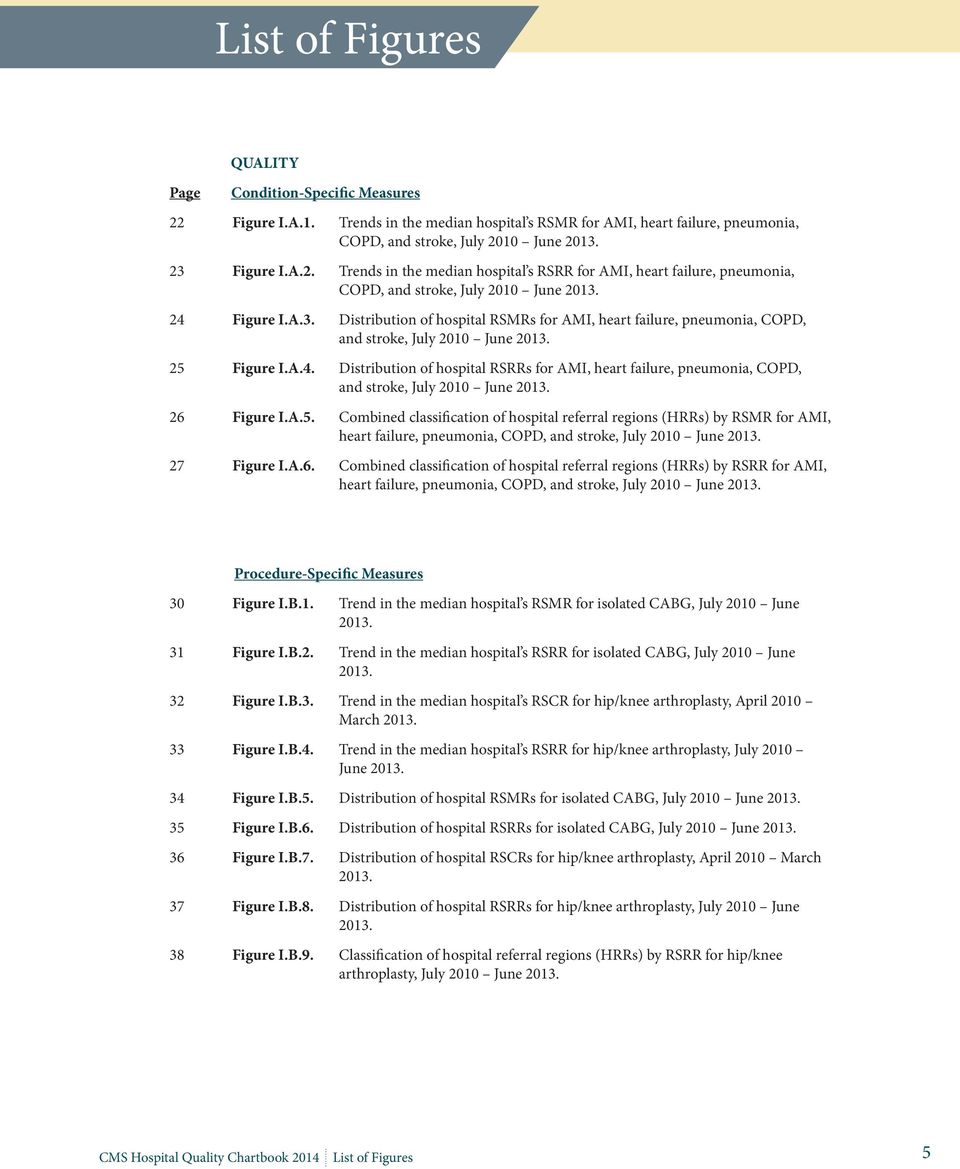
7 List of Figures Page QUALITY Condition-Specific Measures 22 Figure I.A.1. Trends in the median hospital s RSMR for AMI, heart failure, pneumonia, COPD, and stroke, July 2010 June Figure I.A.2. Trends in the median hospital s RSRR for AMI, heart failure, pneumonia, COPD, and stroke, July 2010 June Figure I.A.3. Distribution of hospital RSMRs for AMI, heart failure, pneumonia, COPD, and stroke, July 2010 June Figure I.A.4. Distribution of hospital RSRRs for AMI, heart failure, pneumonia, COPD, and stroke, July 2010 June Figure I.A.5. Combined classification of hospital referral regions (HRRs) by RSMR for AMI, heart failure, pneumonia, COPD, and stroke, July 2010 June Figure I.A.6. Combined classification of hospital referral regions (HRRs) by RSRR for AMI, heart failure, pneumonia, COPD, and stroke, July 2010 June Procedure-Specific Measures 30 Figure I.B.1. Trend in the median hospital s RSMR for isolated CABG, July 2010 June Figure I.B.2. Trend in the median hospital s RSRR for isolated CABG, July 2010 June Figure I.B.3. Trend in the median hospital s RSCR for hip/knee arthroplasty, April 2010 March Figure I.B.4. Trend in the median hospital s RSRR for hip/knee arthroplasty, July 2010 June Figure I.B.5. Distribution of hospital RSMRs for isolated CABG, July 2010 June Figure I.B.6. Distribution of hospital RSRRs for isolated CABG, July 2010 June Figure I.B.7. Distribution of hospital RSCRs for hip/knee arthroplasty, April 2010 March Figure I.B.8. Distribution of hospital RSRRs for hip/knee arthroplasty, July 2010 June Figure I.B.9. Classification of hospital referral regions (HRRs) by RSRR for hip/knee arthroplasty, July 2010 June CMS Hospital Quality Chartbook 2014 List of Figures 5
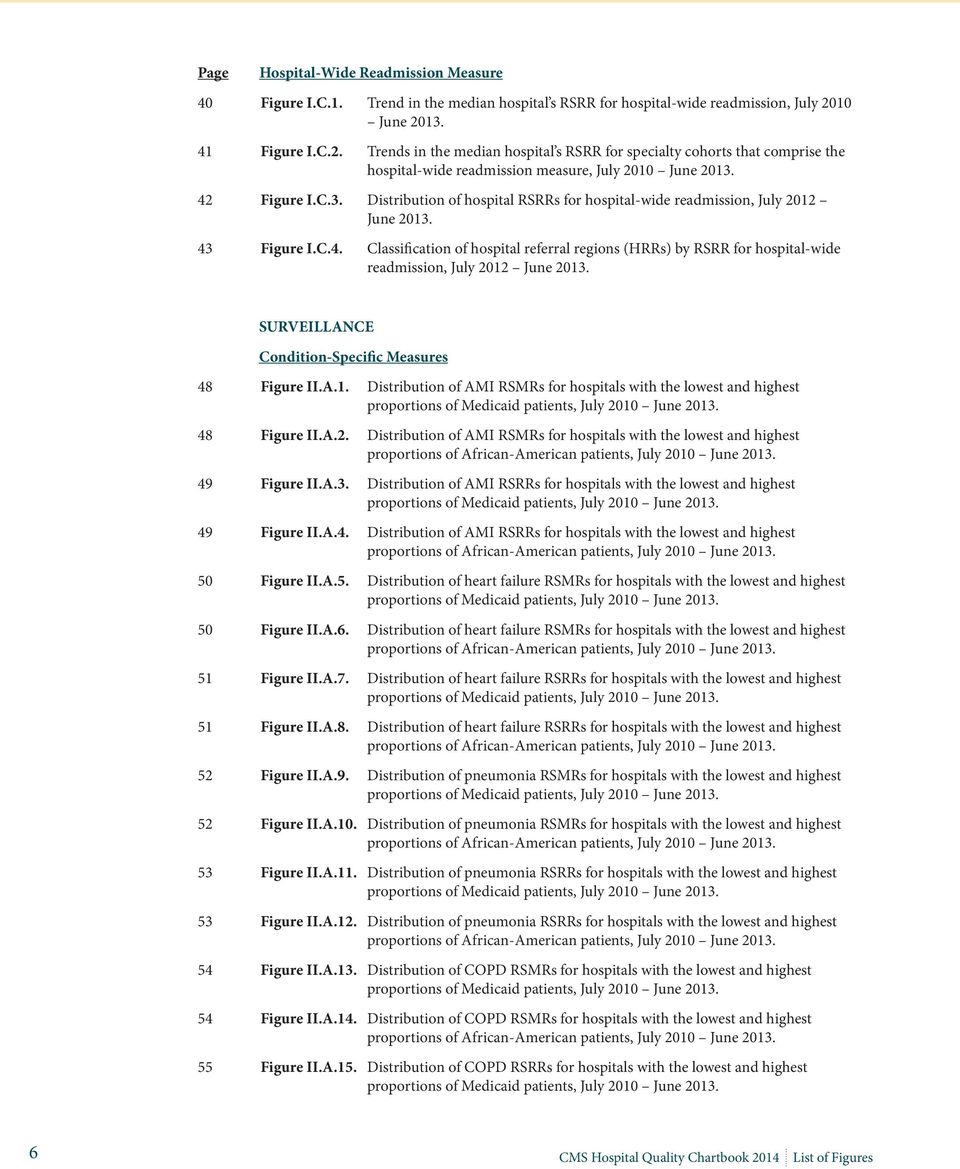
8 Page Hospital-Wide Readmission Measure 40 Figure I.C.1. Trend in the median hospital s RSRR for hospital-wide readmission, July 2010 June Figure I.C.2. Trends in the median hospital s RSRR for specialty cohorts that comprise the hospital-wide readmission measure, July 2010 June Figure I.C.3. Distribution of hospital RSRRs for hospital-wide readmission, July 2012 June Figure I.C.4. Classification of hospital referral regions (HRRs) by RSRR for hospital-wide readmission, July 2012 June SURVEILLANCE Condition-Specific Measures 48 Figure II.A.1. Distribution of AMI RSMRs for hospitals with the lowest and highest proportions of Medicaid patients, July 2010 June Figure II.A.2. Distribution of AMI RSMRs for hospitals with the lowest and highest proportions of African-American patients, July 2010 June Figure II.A.3. Distribution of AMI RSRRs for hospitals with the lowest and highest proportions of Medicaid patients, July 2010 June Figure II.A.4. Distribution of AMI RSRRs for hospitals with the lowest and highest proportions of African-American patients, July 2010 June Figure II.A.5. Distribution of heart failure RSMRs for hospitals with the lowest and highest proportions of Medicaid patients, July 2010 June Figure II.A.6. Distribution of heart failure RSMRs for hospitals with the lowest and highest proportions of African-American patients, July 2010 June Figure II.A.7. Distribution of heart failure RSRRs for hospitals with the lowest and highest proportions of Medicaid patients, July 2010 June Figure II.A.8. Distribution of heart failure RSRRs for hospitals with the lowest and highest proportions of African-American patients, July 2010 June Figure II.A.9. Distribution of pneumonia RSMRs for hospitals with the lowest and highest proportions of Medicaid patients, July 2010 June Figure II.A.10. Distribution of pneumonia RSMRs for hospitals with the lowest and highest proportions of African-American patients, July 2010 June Figure II.A.11. Distribution of pneumonia RSRRs for hospitals with the lowest and highest proportions of Medicaid patients, July 2010 June Figure II.A.12. Distribution of pneumonia RSRRs for hospitals with the lowest and highest proportions of African-American patients, July 2010 June Figure II.A.13. Distribution of COPD RSMRs for hospitals with the lowest and highest proportions of Medicaid patients, July 2010 June Figure II.A.14. Distribution of COPD RSMRs for hospitals with the lowest and highest proportions of African-American patients, July 2010 June Figure II.A.15. Distribution of COPD RSRRs for hospitals with the lowest and highest proportions of Medicaid patients, July 2010 June CMS Hospital Quality Chartbook 2014 List of Figures
9 Page 55 Figure II.A.16. Distribution of COPD RSRRs for hospitals with the lowest and highest proportions of African-American patients, July 2010 June Figure II.A.17. Distribution of stroke RSMRs for hospitals with the lowest and highest proportions of Medicaid patients, July 2010 June Figure II.A.18. Distribution of stroke RSMRs for hospitals with the lowest and highest proportions of African-American patients, July 2010 June Figure II.A.19. Distribution of stroke RSRRs for hospitals with the lowest and highest proportions of Medicaid patients, July 2010 June Figure II.A.20. Distribution of stroke RSRRs for hospitals with the lowest and highest proportions of African-American patients, July 2010 June Figure II.A.21. Trends in the median hospital s observed readmission rate, ED visit rate, and observation stay rate for the AMI readmission cohort, July 2010 June Figure II.A.22. Correlation of RSRRs and post-discharge observation stay rates (observed) for the AMI readmission cohort, July 2010 June Figure II.A.23. Trends in the median hospital s observed readmission rate, ED visit rate, and observation stay rate for the heart failure readmission cohort, July 2010 June Figure II.A.24. Correlation of RSRRs and post-discharge observation stay rates (observed) for the heart failure readmission cohort, July 2010 June Figure II.A.25. Trends in the median hospital s observed readmission rate, ED visit rate, and observation stay rate for the pneumonia readmission cohort, July 2010 June Figure II.A.26. Correlation of RSRRs and post-discharge observation stay rates (observed) for the pneumonia readmission cohort, July 2010 June Figure II.A.27. Trends in the median hospital s observed readmission rate, ED visit rate, and observation stay rate for the COPD readmission cohort, July 2010 June Figure II.A.28. Correlation of RSRRs and post-discharge observation stay rates (observed) for the COPD readmission cohort, July 2010 June Figure II.A.29. Trends in the median hospital s observed readmission rate, ED visit rate, and observation stay rate for the stroke readmission cohort, July 2010 June Figure II.A.30. Correlation of RSRRs and post-discharge observation stay rates (observed) for the stroke readmission cohort, July 2010 June Procedure-Specific Measures 70 Figure II.B.1. Distribution of isolated CABG RSMRs for hospitals with the lowest and highest proportions of Medicaid patients, July 2010 June Figure II.B.2. Distribution of isolated CABG RSMRs for hospitals with the lowest and highest proportions of African-American patients, July 2010 June Figure II.B.3. Distribution of isolated CABG RSRRs for hospitals with the lowest and highest proportions of Medicaid patients, July 2010 June Figure II.B.4. Distribution of isolated CABG RSRRs for hospitals with the lowest and highest proportions of African-American patients, July 2010 June CMS Hospital Quality Chartbook 2014 List of Figures 7

10 Page 72 Figure II.B.5. Distribution of hip/knee arthroplasty RSCRs for hospitals with the lowest and highest proportions of Medicaid patients, April 2010 March Figure II.B.6. Distribution of hip/knee arthroplasty RSCRs for hospitals with the lowest and highest proportions of African-American patients, April 2010 March Figure II.B.7. Distribution of hip/knee arthroplasty RSRRs for hospitals with the lowest and highest proportions of Medicaid patients, July 2010 June Figure II.B.8. Distribution of hip/knee arthroplasty RSRRs for hospitals with the lowest and highest proportions of African-American patients, July 2010 June Figure II.B.9. Trends in the median hospital s observed readmission rate, ED visit rate, and observation stay rate for the hip/knee arthroplasty readmission cohort, July 2010 June Figure II.B.10. Correlation of RSRRs and post-discharge observation stay rates (observed) for the hip/knee arthroplasty readmission cohort, July 2010 June Hospital-Wide Readmission Measure 78 Figure II.C.1. Distribution of hospital-wide RSRRs for hospitals with the lowest and highest proportions of Medicaid patients, July 2012 June Figure II.C.2. Distribution of hospital-wide RSRRs for hospitals with the lowest and highest proportions of African-American patients, July 2012 June Figure II.C.3. Trends in the median hospital s observed readmission rate, ED visit rate, and observation stay rate for the hospital-wide readmission cohort, July 2010 June Figure II.C.4. Correlation of RSRRs and post-discharge observation stay rates (observed) for the hospital-wide readmission cohort, July 2012 June APPENDIX 103 Appendix VI Figure 1. Example line graph. 103 Appendix VI Figure 2. Example density plot. 104 Appendix VI Figure 3. Example density scatterplot. 8 CMS Hospital Quality Chartbook 2014 List of Figures

11 page intentionally left blank CMS Hospital Quality Chartbook

12 page intentionally left blank 10 CMS Hospital Quality Chartbook 2014

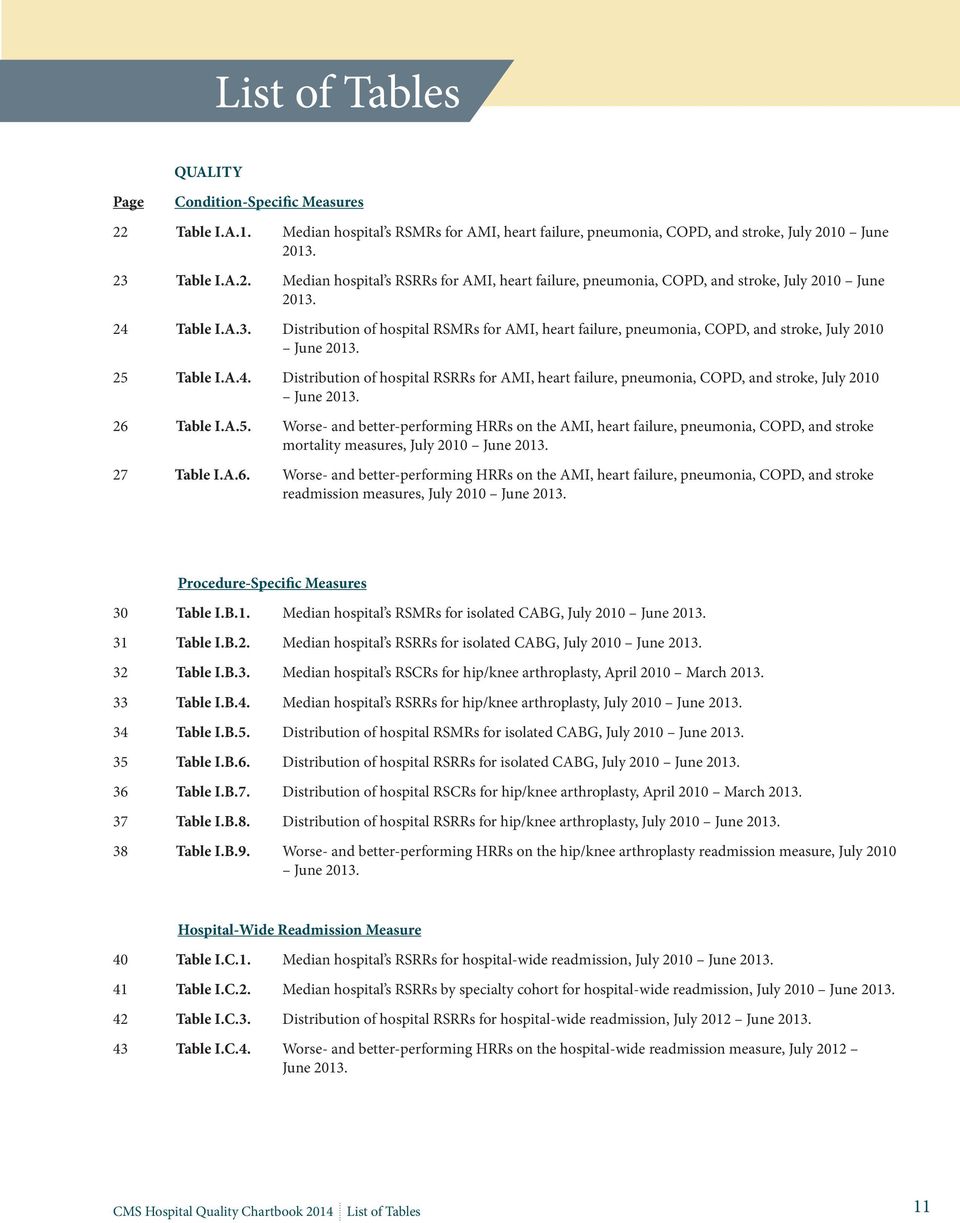
13 List of Tables Page QUALITY Condition-Specific Measures 22 Table I.A.1. Median hospital s RSMRs for AMI, heart failure, pneumonia, COPD, and stroke, July 2010 June Table I.A.2. Median hospital s RSRRs for AMI, heart failure, pneumonia, COPD, and stroke, July 2010 June Table I.A.3. Distribution of hospital RSMRs for AMI, heart failure, pneumonia, COPD, and stroke, July 2010 June Table I.A.4. Distribution of hospital RSRRs for AMI, heart failure, pneumonia, COPD, and stroke, July 2010 June Table I.A.5. Worse- and better-performing HRRs on the AMI, heart failure, pneumonia, COPD, and stroke mortality measures, July 2010 June Table I.A.6. Worse- and better-performing HRRs on the AMI, heart failure, pneumonia, COPD, and stroke readmission measures, July 2010 June Procedure-Specific Measures 30 Table I.B.1. Median hospital s RSMRs for isolated CABG, July 2010 June Table I.B.2. Median hospital s RSRRs for isolated CABG, July 2010 June Table I.B.3. Median hospital s RSCRs for hip/knee arthroplasty, April 2010 March Table I.B.4. Median hospital s RSRRs for hip/knee arthroplasty, July 2010 June Table I.B.5. Distribution of hospital RSMRs for isolated CABG, July 2010 June Table I.B.6. Distribution of hospital RSRRs for isolated CABG, July 2010 June Table I.B.7. Distribution of hospital RSCRs for hip/knee arthroplasty, April 2010 March Table I.B.8. Distribution of hospital RSRRs for hip/knee arthroplasty, July 2010 June Table I.B.9. Worse- and better-performing HRRs on the hip/knee arthroplasty readmission measure, July 2010 June Hospital-Wide Readmission Measure 40 Table I.C.1. Median hospital s RSRRs for hospital-wide readmission, July 2010 June Table I.C.2. Median hospital s RSRRs by specialty cohort for hospital-wide readmission, July 2010 June Table I.C.3. Distribution of hospital RSRRs for hospital-wide readmission, July 2012 June Table I.C.4. Worse- and better-performing HRRs on the hospital-wide readmission measure, July 2012 June CMS Hospital Quality Chartbook 2014 List of Tables 11
14 Page SURVEILLANCE Condition-Specific Measures 48 Table II.A.1. Distribution of AMI RSMRs by proportion of Medicaid patients, July 2010 June Table II.A.2. Distribution of AMI RSMRs by proportion of African-American patients, July 2010 June Table II.A.3. Distribution of AMI RSRRs by proportion of Medicaid patients, July 2010 June Table II.A.4. Distribution of AMI RSRRs by proportion of African-American patients, July 2010 June Table II.A.5. Distribution of heart failure RSMRs by proportion of Medicaid patients, July 2010 June Table II.A.6. Distribution of heart failure RSMRs by proportion of African-American patients, July 2010 June Table II.A.7. Distribution of heart failure RSRRs by proportion of Medicaid patients, July 2010 June Table II.A.8. Distribution of heart failure RSRRs by proportion of African-American patients, July 2010 June Table II.A.9. Distribution of pneumonia RSMRs by proportion of Medicaid patients, July 2010 June Table II.A.10. Distribution of pneumonia RSMRs by proportion of African-American patients, July 2010 June Table II.A.11. Distribution of pneumonia RSRRs by proportion of Medicaid patients, July 2010 June Table II.A.12. Distribution of pneumonia RSRRs by proportion of African-American patients, July 2010 June Table II.A.13. Distribution of COPD RSMRs by proportion of Medicaid patients, July 2010 June Table II.A.14. Distribution of COPD RSMRs by proportion of African-American patients, July 2010 June Table II.A.15. Distribution of COPD RSRRs by proportion of Medicaid patients, July 2010 June Table II.A.16. Distribution of COPD RSRRs by proportion of African-American patients, July 2010 June Table II.A.17. Distribution of stroke RSMRs by proportion of Medicaid patients, July 2010 June Table II.A.18. Distribution of stroke RSMRs by proportion of African-American patients, July 2010 June Table II.A.19. Distribution of stroke RSRRs by proportion of Medicaid patients, July 2010 June Table II.A.20. Distribution of stroke RSRRs by proportion of African-American patients, July 2010 June Procedure-Specific Measures 70 Table II.B.1. Distribution of isolated CABG RSMRs by proportion of Medicaid patients, July 2010 June Table II.B.2. Distribution of isolated CABG RSMRs by proportion of African-American patients, July 2010 June Table II.B.3. Distribution of isolated CABG RSRRs by proportion of Medicaid patients, July 2010 June CMS Hospital Quality Chartbook 2014 List of Tables

15 Page 71 Table II.B.4. Distribution of isolated CABG RSRRs by proportion of African-American patients, July 2010 June Table II.B.5. Distribution of hip/knee arthroplasty RSCRs by proportion of Medicaid patients, April 2010 March Table II.B.6. Distribution of hip/knee arthroplasty RSCRs by proportion of African-American patients, April 2010 March Table II.B.7. Distribution of hip/knee arthroplasty RSRRs by proportion of Medicaid patients, July 2010 June Table II.B.8. Distribution of hip/knee arthroplasty RSRRs by proportion of African-American patients, July 2010 June Hospital-Wide Readmission Measure 78 Table II.C.1. Distribution of hospital-wide RSRRs by proportion of Medicaid patients, July 2012 June Table II.C.2. Distribution of hospital-wide RSRRs by proportion of African-American patients, July 2012 June APPENDIX 92 Appendix II Table 1. Procedure categories defining the surgery/gynecology cohort. 93 Appendix II Table 2. Diagnosis categories defining the cardiorespiratory cohort. 93 Appendix II Table 3. Diagnosis categories defining the cardiovascular cohort. 93 Appendix II Table 4. Diagnosis categories defining the neurology cohort. 93 Appendix II Table 5. Diagnosis categories defining the medicine cohort. 97 Appendix III Table 1. Return-to-hospital rates for AMI readmission cohort. 97 Appendix III Table 2. Return-to-hospital rates for heart failure readmission cohort. 97 Appendix III Table 3. Return-to-hospital rates for pneumonia readmission cohort. 98 Appendix III Table 4. Return-to-hospital rates for COPD readmission cohort. 98 Appendix III Table 5. Return-to-hospital rates for stroke readmission cohort. 98 Appendix III Table 6. Return-to-hospital rates for hip/knee arthroplasty readmission cohort. 98 Appendix III Table 7. Return-to-hospital rates for hospital-wide readmission cohort. 101 Appendix V Table 1. HRR combined score classification. 102 Appendix V Table 2. Possible HRR score combinations for AMI, heart failure, pneumonia, COPD, and stroke mortality and readmission. CMS Hospital Quality Chartbook 2014 List of Tables 13

16 Executive Summary The 2014 edition of the Medicare Hospital Quality Chartbook provides a comprehensive overview of national performance on the Centers for Medicare and Medicaid Services (CMS s) hospital mortality, complication, and unplanned readmission measures, and investigates select hospital practices that may impact their performance on the measures. The first section of the Medicare Hospital Quality Chartbook, Quality, examines performance of the nation s hospitals over time, across hospitals, and by region. The second section, Surveillance, investigates performance among hospitals with diverse patient populations (i.e., high proportions of Medicaid or African-American patients), and examines utilization of different types of post-discharge care. In 2014, CMS will publically release individual hospital performance on 13 quality measures as part of the Hospital Inpatient Quality Reporting (IQR) program. We have included all of these measures in this year s Medicare Hospital Quality Chartbook, as well as newly developed mortality and readmission measures following isolated coronary artery bypass graft (CABG) surgery, which are not currently publicly reported: Condition-specific measures: Acute myocardial infarction (AMI) mortality and readmission Heart failure mortality and readmission Pneumonia mortality and readmission Chronic obstructive pulmonary disease (COPD) mortality and readmission Ischemic stroke mortality and readmission Procedure-specific measures: Primary elective total hip and/or knee arthroplasty complication and readmission Isolated CABG surgery mortality and readmission Hospital-wide measures: Hospital-wide readmission In the 2014 Medicare Hospital Quality Chartbook, data from July 2010 through June 2013 are used for the condition-specific mortality and readmission measure analyses, the hospital-wide readmission measure trends analyses, the hip/knee arthroplasty readmission measure analyses, and the CABG mortality and readmission measure analyses. The remaining hospital-wide readmission measure analyses use data from July 2012 through June 2013, and the hip/knee arthroplasty complication measure analyses use data from April 2010 through March CMS Hospital Quality Chartbook 2014 Executive Summary

17 Quality When examining hospital performance over time, analyses indicated a general pattern of decline in risk-standardized mortality rates (RSMRs), risk-standardized complication rates (RSCRs), and risk-standardized readmission rates (RSRRs). However, there were no discernable patterns in changes over time in RSMRs following admission for heart failure and COPD, and there was an increase in RSMRs following admission for CABG surgery. There continues to be variation among hospitals in RSMRs, RSCRs, and RSRRs. The full range of hospital performance varies by measure, from 4.9 percentage points (hip/knee arthroplasty RSCRs) to 15.7 percentage points (pneumonia RSMRs). Also, hospital quality continues to vary by geographic region. Only eight hospital referral regions (HRRs) achieved performance levels that were better than the national average on four or more of the condition-specific mortality measures, and only two performed better than the national average on four or more of the condition-specific readmission measures. Surveillance Mortality, complication, and readmission rates for hospitals serving the lowest proportions of Medicaid or African- American patients overlap with those rates for hospitals serving the highest proportions of these patients. Hospitals serving the lowest and highest proportions of Medicaid or African-American patients did not consistently have higher or lower RSMRs. However, for the complication and readmission measures, the median outcome rates were consistently lower for hospitals serving the lowest proportions of Medicaid or African-American patients compared with hospitals serving the highest proportions of these patients. Across all readmission measure cohorts, analyses indicated increases in post-discharge observation stays and/or emergency department (ED) visits between July 2010 and June Specifically, post-discharge ED visits increased for all condition-specific, procedure-specific, and hospital-wide admissions. Post-discharge observation stays also increased for most condition-specific, procedure-specific, and hospital-wide admissions, except for admissions in the stroke and hip/ knee arthroplasty cohorts. Hospital post-discharge observation stay utilization remained below 3% over this three-year period for all condition-specific, procedure-specific, and hospital-wide admissions (July 2012 to June 2013). There was either no or a very weak correlation between hospitals use of observation stays in the 30 days following hospitalization and their RSRRs. CMS Hospital Quality Chartbook 2014 Executive Summary 15

18 page intentionally left blank 16 CMS Hospital Quality Chartbook 2014

19 What are Risk-Standardized Outcome Rates? Measuring Key Hospital Outcomes The hospital outcome measures in this report include the Centers for Medicare and Medicaid Services (CMS s) risk- standardized mortality rates (RSMRs), risk-standardized readmission rates (RSRRs), and risk-standardized complication rates (RSCRs) for Medicare fee-for-service (FFS) patients aged 65 or older admitted to the hospital for acute myocardial infarction (AMI), heart failure, pneumonia, chronic obstructive pulmonary disease (COPD), ischemic stroke, coronary artery bypass graft (CABG) surgery, and elective total hip and/or knee arthroplasty (i.e., joint replacement). This report also includes the 30-day hospital-wide readmission measure for Medicare FFS patients aged 65 or older admitted to the hospital for all conditions. The AMI, heart failure, pneumonia, COPD, stroke, hip/knee, and hospital-wide measures are publicly reported by CMS on the Hospital Compare website, and the CABG measures are intended for public reporting on Hospital Compare in Fiscal Year (FY) 2016 and incorporation into the Hospital Inpatient Quality Reporting (IQR) program in FY 2017 [1]. Measured Outcomes The mortality measures assess death from any cause within 30 days of a hospitalization, regardless of whether the patient dies while still in the hospital or after discharge from the hospital. The readmission measures assess unplanned readmissions for any reason within 30 days of discharge from a hospital stay. Patients may have been readmitted to the same hospital or to a different hospital. In all readmission measures, planned readmissions are removed from the outcome. The complication measure assesses the occurrence of significant medical and/or surgical complications within 7 to 90 days, depending on the complication, following hospitalization for total hip and/or knee arthroplasty. Risk Adjustment To ensure accurate assessment of each hospital, the measures use statistical models to adjust for key differences in patient risk factors that are clinically relevant and that have strong relationships with the outcome (e.g., age and patient comorbidities). For each patient, risk factors are obtained from Medicare claims extending 12 months prior to and including the index admission. The statistical models adjust for patient differences based on the clinical status of the patient at the time of admission. Accordingly, only comorbidities that convey information about the patient at that time or in the 12 months prior not complications that arise during the course of the index admission are included in risk adjustment. Calculating the Risk-Adjusted Outcome The mortality, readmission, and complication measures use hierarchical logistic regression to create RSMRs, RSRRs, and RSCRs for each hospital, respectively. These measures are designed to adjust for differences in case mix and to account for random variation so that they reflect each hospital s quality of care. The RSMRs, RSRRs, and RSCRs are calculated as the ratio of the number of predicted outcomes (deaths, readmissions, or complications) over the number of expected outcomes, multiplied by the national mortality/readmission/complication rate. For each hospital, the numerator of the ratio is the number of deaths/readmissions/complications within the outcome ascertainment period (30 days for the mortality and readmission measures and 7-90 days for the complication measure, depending upon the complication) predicted on the basis of the hospital s performance with its observed case mix, and the denominator is the number of deaths/readmissions/complications expected on the basis of the nation s performance with that specific hospital s case mix. This approach is analogous to a ratio of observed to expected used in other types of statistical analyses, and conceptually allows for a comparison of a particular hospital s performance given its case mix to an average hospital s performance with the same case mix. Thus, a ratio less than 1.0 indicates a lower-than-expected mortality, readmission, or complication rate and better quality, whereas a ratio greater than 1.0 indicates a higher-than-expected mortality, readmission, or complication rate and worse quality. CMS Hospital Quality Chartbook 2014 What are Risk-Standardized Outcome Rates? 17

20 page intentionally left blank 18 CMS Hospital Quality Chartbook 2014

21 Quality In the first section of the 2014 Centers for Medicare and Medicaid Services (CMS s) Medicare Hospital Quality Chartbook, we present trends and distributions of hospital-level results and summarize geographic variation in performance on hospital outcome measures. This section of the Medicare Hospital Quality Chartbook is intended to capture the state of hospital quality across the nation for a wide variety of conditions and procedures by providing information about trends in outcomes and continued variation in quality. For the condition-specific measures, we demonstrate decreased risk-standardized mortality rates (RSMRs) for acute myocardial infarction (AMI), pneumonia, and ischemic stroke between July 2010 and June 2013, while heart failure and chronic obstructive pulmonary disease (COPD) fluctuated over this three-year period. Unplanned risk- standardized readmission rates (RSRRs) decreased for all condition-specific measures over the three-year period, with AMI and heart failure showing the largest improvement. In this same time period, hospitals showed continued variation in quality across all condition-specific measures, suggesting continued opportunity to reduce these rates across the country. The full range of variation in RSMRs among U.S. hospitals was narrowest following admission for COPD and widest following admission for pneumonia. The full range of variation in RSRRs was narrowest following admission for AMI and widest following admission for heart failure. Overall, the range of performance variation has narrowed over time following admissions for AMI, heart failure, and pneumonia, potentially suggesting greater consistency in quality across hospitals [2]. For the procedure-specific measures, RSMRs increased following isolated coronary artery bypass graft (CABG) surgery between July 2010 and June Risk-standardized complication rates (RSCRs) following primary elective hip/knee arthroplasty (total joint replacement) decreased between April 2010 and March Unplanned RSRRs following CABG surgery and hip/knee arthroplasty both decreased over this three-year period. The full range of hospital performance varied by measure from 4.9% (hip/knee arthroplasty RSCR) to 11.0% (CABG RSRR). For the hospital-wide readmission measure, RSRRs decreased between July 2010 and June The distribution of RSRRs showed variation with regard to unplanned hospital-wide readmissions, suggesting continued opportunity to reduce these rates across the country. In the geographic variation analyses, we identified two hospital referral regions (HRRs) that performed worse than the national rate on four or more of the condition-specific risk-standardized mortality measures, and eight HRRs that performed better than the national rate on four or more of these measures. Also, 16 HRRs performed worse than the national rate on four or more of the condition-specific risk-standardized readmission measures, and two HRRs performed better than the national rate on four or more of the measures. Geographic variation was not investigated for the CABG measures. There was no HRR-level geographic variation on the hip/knee complication measure. We identified 10 HRRs that performed worse than the national rate on the hip/ knee arthroplasty risk-standardized readmission measure, and two HRRs that performed better than the national rate on this measure. With regard to the hospital-wide risk-standardized readmission measure, we identified 46 HRRs that performed worse than the national rate, while 37 HRRs performed better than the national rate. CMS Hospital Quality Chartbook 2014 Quality 19
22 page intentionally left blank 20 CMS Hospital Quality Chartbook 2014
23 AMI, Heart Failure, Pneumonia, COPD, Stroke Background TRENDS DISTRIBUTIONS GEOGRAPHIC VARIATION This section focuses on the trends, distributions, and geographic variation in hospital performance on the mortality and readmission measures from July 2010 through June 2013 for the following conditions: Acute myocardial infarction (AMI) Heart failure Pneumonia Chronic obstructive pulmonary disease (COPD) Ischemic stroke These measures are publicly reported annually as part of the Hospital Inpatient Quality Reporting (IQR) program on Hospital Compare. The Centers for Medicare and Medicaid Services (CMS s) hospital-level 30-day all-cause risk-standardized mortality measures have been publicly reported for AMI and heart failure since 2007 and for pneumonia since In 2011, Veteran s Health Administration (VA) hospitals were also included in the public reporting for the AMI, heart failure, and pneumonia mortality measures. In October 2013, CMS implemented these measures in the Hospital Value-Based Purchasing (HVBP) Program. Starting in December 2014, COPD and stroke mortality measures will be publicly reported. CMS began publicly reporting the hospital-level 30-day all-cause risk-standardized readmission measures for AMI, heart failure, and pneumonia in In parallel with the mortality measures, starting in 2011, VA hospitals have also been included in public reporting for these three measures. Starting in 2012, these measures were included in the Hospital Readmissions Reduction Program (HRRP). Beginning in December 2014, COPD and stroke readmission measures will be publicly reported. In Fiscal Year (FY) 2015, the COPD readmission measure will be included in the HRRP [1]. CMS Hospital Quality Chartbook 2014 Quality Condition-Specific Measures 21
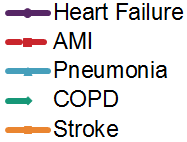
24 TRENDS AMI, HEART FAILURE, PNEUMONIA, COPD, STROKE MORTALITY Are mortality rates changing over time? FIGURE I.A.1. Trends in the median hospital s RSMR for AMI, heart failure, pneumonia, COPD, and stroke, July 2010 June Risk-standardized Mortality Rate (%) The Centers for Medicare and Medicaid Services (CMS) began publicly reporting hospital-level 30-day risk-standardized mortality rates (RSMRs) following admissions for acute myocardial infarction (AMI) and heart failure in 2007; for pneumonia in 2008; and for chronic obstructive pulmonary disease (COPD) and ischemic stroke in 2014 as part of the Hospital Inpatient Quality Reporting (IQR) program. Figure I.A.1 and Table I.A.1 display trends in the median hospital s RSMR between July 2010 and June The median hospital s RSMR for AMI decreased by 0.9 percentage points from July 2010 to June Over the three-year period, the median hospital s RSMR for heart failure fluctuated; the median hospital s RSMR for pneumonia decreased by 0.4 percentage points; the median hospital s RSMR for COPD fluctuated; and the median hospital s RSMR for stroke decreased by 0.5 percentage points. 0 July June 2011 July June 2012 July June 2013 Year AMI RSMR Heart Failure RSMR Pneumonia RSMR COPD RSMR Stroke RSMR Hospital RSMRs following admissions for AMI, pneumonia, and stroke declined by 0.9, 0.4, and 0.5 percentage points, respectively, between July 2010 and June Over this three-year period, there was no clear pattern of change in the RSMRs following admissions for heart failure and COPD. TABLE I.A.1. Median hospital s RSMRs for AMI, heart failure, pneumonia, COPD, and stroke, July 2010 June Median (Range) of Hospital s RSMR (%) July 2010 June 2011 July 2011 June 2012 July 2012 June (12.2, 18.8) 11.8 (7.8, 16.9) 12.0 (7.0, 20.4) 7.8 (5.5, 12.1) 15.5 (11.2, 22.4) 14.6 (10.9, 2) 11.7 (7.6, 16.8) 11.7 (7.2, 18.7) 7.6 (5.5, 11.2) 15.2 (10.5, 21.1) 14.4 (10.6, 20.1) 12.0 (8.3, 17.1) 11.6 (7.3, 2) 7.9 (5.2, 12.4) 15.0 (10.8, 20.6) Source Data and Population: Condition-Specific Mortality Measure Cohort data July 2010 June 2013 (Appendix I). Notes: 1) Veterans Health Administration (VA) hospitals are included in this analysis, except in the stroke and COPD measures. 2) The results of hospitals with fewer than 25 cases of the condition in each year are not shown; however, these hospitals are included in the calculations. 3) The bars on the graph represent the interquartile range. 4) For AMI, the total number of hospitals was 1,781 in 10/11; 1,746 in 11/12; and 1,750 in 12/13. 5) For heart failure, the total number of hospitals was 2,916 in 10/11; 2,813 in 11/12; and 2,785 in 12/13. 6) For pneumonia, the total number of hospitals was 3,524 in 10/11; 3,358 in 11/12; and 3,383 in 12/13. 7) For COPD, the total number of hospitals was 2,789 in 10/11; 2,701 in 11/12; and 2,728 in 12/13. 8) For stroke, the total number of hospitals was 1,871 in 10/11; 1,864 in 11/12; and 1,822 in 12/13. 8) For more information about figures, see Appendix VI. Prepared for CMS by YNHHSC/CORE. 22 CMS Hospital Quality Chartbook 2014 Quality Condition-Specific Measures

25 AMI, HEART FAILURE, PNEUMONIA, COPD, STROKE READMISSION TRENDS Are unplanned readmission rates changing over time? FIGURE I.A.2. Trends in the median hospital s RSRR for AMI, heart failure, pneumonia, COPD, and stroke, July 2010 June Risk-standardized Readmission Rate (%) July June 2011 July June 2012 July June 2013 Year The Centers for Medicare and Medicaid Services (CMS) began publicly reporting hospital-level 30-day risk-standardized readmission rates (RSRRs) after admissions for acute myocardial infarction (AMI), heart failure, and pneumonia in 2009, and chronic obstructive pulmonary disorder (COPD) and ischemic stroke in 2014 as part of the Hospital Inpatient Quality Reporting (IQR) program. Figure I.A.2 and Table I.A.2 display trends in the median hospital s RSRRs between July 2010 and June The median hospital s RSRRs decreased over the three year period for all measures, with RSRRs following hospitalization for AMI and heart failure experiencing the largest overall reductions of 1.6 and 1.5 percentage points, respectively. RSRRs following hospitalization for pneumonia decreased by 1.2 percentage points; RSRRs following hospitalization for COPD decreased by 1.1 percentage points; and RSRRs after hospitalization for stroke decreased by 1.0 percentage point over the three years. TABLE I.A.2. Median hospital s RSRRs for AMI, heart failure, pneumonia, COPD, and stroke, July 2010 June AMI RSRR Heart Failure RSRR Pneumonia RSRR COPD RSRR Stroke RSRR Median (Range) Hospital s RSRR (%) July 2010 June 2011 July 2011 June 2012 July 2012 June (15.2, 22.6) 23.4 (18.7, 3) 17.8 (14.7, 24.8) 21.1 (16.9, 25.7) 13.7 (11.2, 17.4) 17.8 (14.6, 20.7) 22.6 (17.6, 29.3) 17.4 (14.9, 21.7) 20.9 (17.8, 26.0) 13.3 (10.9, 16.6) 17.0 (14.1, 20.6) 21.9 (17.0, 28.2) 16.6 (13.9, 22.3) 20.0 (16.2, 25.1) 12.7 (10.1, 16.2) Source Data and Population: Condition-Specific Readmission Measure Cohort data July 2010 June 2013 (Appendix I). Notes: 1) Veterans Health Administration (VA) hospitals are included in this analysis, except in the COPD and stroke analyses. 2) The results of hospitals with fewer than 25 cases of the condition in each year are not shown; however, these hospitals are included in the calculations. 3) The bars on the graph represent the interquartile range. 4) For AMI, the total number of hospitals was 1,632 in 10/11, 1,627 in 11/12, and 1,637 in 12/13. 5) For heart failure, the total number of hospitals was 3,120 in 10/11, 3,018 in 11/12, and 2,963 in 12/13. 6) For pneumonia, the total number of hospitals was 3,611 in 10/11, 3,449 in 11/12, and 3,454 in 12/13. 7) For COPD, the total number of hospitals was 3,000 in 10/11, 2,890 in 11/12, and 2,875 in 12/13. 8) For stroke, the total number of hospitals was 1,842 in 10/11, 1,821 in 11/12, and 1,777 in 12/13. 9) For more information about figures, see Appendix VI. Hospital RSRRs following admissions for AMI, heart failure, pneumonia, COPD, and stroke declined by 1.6, 1.5, 1.2, 1.1, and 1.0 percentage points, respectively, between July 2010 and June Prepared for CMS by YNHHSC/CORE. CMS Hospital Quality Chartbook 2014 Quality Condition-Specific Measures 23
26 DISTRIBUTIONS AMI, HEART FAILURE, PNEUMONIA, COPD, STROKE MORTALITY Density Density To what extent do mortality rates vary across hospitals? FIGURE I.A.3. Distribution of hospital RSMRs for AMI, heart failure, pneumonia, COPD, and stroke, July 2010 June Variation in 30-day risk-standardized mortality rates (RSMRs) reflects differences in performance among U.S. hospitals, with wider distributions suggesting more variation in quality and narrower distributions suggesting less variation in quality. Quality improvement efforts seek to lower the overall rate of mortality AMI COPD Heart Failure Pneumonia Stroke and decrease variation between hospitals. To examine the variation in RSMRs AMI COPD Heart Failure Pneumonia Stroke from July 2010 to June 2013 following admission for acute myocardial infarction (AMI), heart failure, pneumonia, chronic obstructive pulmonary disease (COPD), and ischemic stroke among U.S. hospitals, we report the distribution of RSMRs in Figure I.A.3 and Table I.A AMI, heart failure, pneumonia, COPD and stroke RSMRs were distributed over interquartile ranges (IQRs) of 1.8, 1.9, 2.3, 1.3, and 2.3 percentage points, 0.3 respectively. Therefore, the conditions differ in the degree of performance variation, with pneumonia and stroke showing the widest IQRs of RSMRs and COPD showing the narrowest IQR day Risk standardized Mortality Rate (%) day Risk standardized Mortality Rate (%) Compared with publicly reported data presented in the 2013 Medicare Hospital Quality Chartbook from July 2009 through June 2012, the IQRs of RSMRs decreased from 1.9 to 1.8 percentage points for AMI, from 2.0 to 1.9 percentage points for heart failure, and from 2.4 to 2.3 percentage points for pneumonia [2]. These results potentially indicate greater consistency in performance among hospitals, yet the full range of RSMRs suggests continued opportunity for reducing mortality across the country. Approximately half of U.S. hospitals have AMI, heart failure, pneumonia, COPD, and stroke RSMRs within a 1.8, 1.9, 2.3, 1.3, and 2.3 percentage point range around the median hospital s RSMR, respectively, with ranges from 9.0 percentage points for COPD to 15.7 percentage points for pneumonia. TABLE I.A.3. Distribution of hospital RSMRs for AMI, heart failure, pneumonia, COPD, and stroke, July 2010 June Maximum 90% 75% Median (50%) 25% 10% Minimum Distribution of RSMRs (%) AMI Heart Failure Pneumonia COPD Stroke Source Data and Population: Condition-Specific Mortality Measure Cohort data July 2010 June 2013 (Appendix I) Notes: 1) Veterans Health Administration (VA) hospitals are included in these analyses, except for in the COPD and stroke analyses. 2) The results of hospitals with fewer than 25 cases of the condition over the three-year period are not shown; however, these hospitals are included in the calculations. 3) The number of hospitals included in the analyses was 2,619 for AMI; 3,980 for heart failure; 4,432 for pneumonia; 3,827 for COPD; and 2,918 for stroke. 4) For more information about figures, see Appendix VI. Prepared for CMS by YNHHSC/CORE. 24 CMS Hospital Quality Chartbook 2014 Quality Condition-Specific Measures
27 AMI, HEART FAILURE, PNEUMONIA, COPD, STROKE READMISSION DISTRIBUTIONS To what extent do unplanned readmission rates vary across hospitals? Density Density FIGURE I.A.4. Distribution of hospital RSRRs for AMI, heart failure, pneumonia, COPD, and stroke, July 2010 June AMI COPD Heart Failure Pneumonia Stroke AMI COPD Heart Failure Pneumonia Stroke day Risk standardized Readmission Rate (%) day Risk standardized Readmission Rate (%) Variation in 30-day risk-standardized readmission rates (RSRRs) reflects differences in performance among U.S. hospitals, with wider distributions suggesting more variation in quality and narrower distributions suggesting less variation in quality. Quality improvement efforts seek to lower the overall rate of readmission and decrease variation in quality between hospitals. To examine the variation in RSRRs following admission for acute myocardial infarction (AMI), heart failure, pneumonia, chronic obstructive pulmonary disorder (COPD), and ischemic stroke among U.S. hospitals, we report the distribution of RSRRs in Figure I.A.4 and Table I.A.4. AMI, heart failure, pneumonia, COPD, and stroke RSRRs were distributed over interquartile ranges (IQRs) of 1.4, 2.0, 1.6, 1.6, and 1.5 percentage points, respectively. Therefore, the conditions differ in the degree of performance variation, with heart failure showing the widest IQR of RSRRs and AMI showing the narrowest IQR. Compared with publicly reported data presented in the 2013 Medicare Hospital Quality Chartbook from July 2009 through June 2012, the IQRs of RSRRs decreased from 1.5 to 1.4 percentage points for AMI, from 2.3 to 2.0 percentage points for heart failure, and from 1.7 to 1.6 percentage points for pneumonia. These results potentially indicate greater consistency in performance among hospitals, yet the full range of RSRRs suggests continued opportunity for reducing readmissions across the country. Approximately half of U.S. hospitals have AMI, heart failure, pneumonia, COPD, and stroke RSRRs within a 1.4, 2.0, 1.6, 1.6, and 1.5 percentage point range around the median hospital s RSRR, respectively, with ranges from 7.5 percentage points for AMI to 14.6 percentage points for heart failure. TABLE I.A.4. Distribution of hospital RSRRs for AMI, heart failure, pneumonia, COPD, and stroke, July 2010 June Distribution of RSRRs (%) Maximum 90% 75% Median (50%) 25% 10% Minimum AMI Heart Failure Pneumonia COPD Stroke Source Data and Population: Condition-Specific Readmission Measure Cohort data July 2010-June 2013 (Appendix I). Notes: 1) Veterans Health Administration (VA) hospitals are included in these analyses, except for the COPD and stroke analyses. 2) The results of hospitals with fewer than 25 cases of the condition over the three-year period are not shown; however, these hospitals are included in the calculations. 3) The number of hospitals included in the analyses was 2,355 for AMI; 4,068 for heart failure; 4,433 for pneumonia; 3,905 for COPD; and 2,846 for stroke. 4) For more information about figures, see Appendix VI. Prepared for CMS by YNHHSC/CORE. CMS Hospital Quality Chartbook 2014 Quality Condition-Specific Measures 25
28 GEOGRAPHIC VARIATION AMI, HEART FAILURE, PNEUMONIA, COPD, STROKE MORTALITY Does overall hospital performance on the AMI, heart failure, pneumonia, COPD, and stroke mortality measures differ by geographic location? FIGURE I.A.5. Combined classification of hospital referral regions (HRRs) by RSMR for AMI, heart failure, pneumonia, COPD, and stroke, July 2010 June Figure I.A.5 displays combined geographic variation in the 30-day risk-standardized mortality rates (RSMRs) following hospitalization for acute myocardial infarction (AMI), heart failure, pneumonia, chronic obstructive pulmonary disease (COPD), and ischemic stroke from July 2010 to June Geographic areas are divided by hospital referral region (HRR). The darkest areas represent the HRRs that performed worse than the national rate on at least four of the five condition-specific risk-standardized mortality measures, and the lightest areas represent the HRRs that performed better than the national rate on at least four of the five measures. Performance categories were determined for each of the condition-specific riskstandardized mortality measures using a scoring system that assigned three points for performing significantly better than the national mortality rate, two points for performing similarly to the national mortality rate, and one point for performing significantly worse than the national mortality rate. The scores were combined to get a total score for each HRR. For more information on the definition of HRRs and the combined map score calculation methodology, please see Appendix V. We identified two HRRs (1%) that performed worse than the national rate on four or more of the condition-specific risk-standardized mortality measures, and eight HRRs (3%) that performed better than the national rate on four or more of the measures. These results are listed in Table I.A.5. TABLE I.A.5. Worse- and better-performing HRRs on the combined AMI, heart failure, pneumonia, COPD, and stroke mortality measures, July 2010 June WORSE- PERFORMING HRRs Little Rock, AR South Bend, IN BETTER PERFORMING HRRs Los Angeles, CA Miami, FL Chicago, IL Melrose Park, IL Boston, MA Manhattan, NY Cleveland, OH Allentown, PA Source Data and Population: Condition-Specific Mortality Measure Cohort data, July 2010 June 2013 (Appendix I). Notes: 1) Veterans Health Administration (VA) hospitals are included in this analysis, except for in the COPD and stroke analyses. 2) For more information about the definition of HRR and the map methodology, see Appendix V. Prepared for CMS by YNHHSC/CORE. 26 CMS Hospital Quality Chartbook 2014 Quality Condition-Specific Measures
29 AMI, HEART FAILURE, PNEUMONIA, COPD, STROKE READMISSION GEOGRAPHIC VARIATION Does overall hospital performance on the AMI, heart failure, pneumonia, COPD, and stroke unplanned readmission measures differ by geographic location? FIGURE I.A.6. Combined classification of hospital referral regions (HRRs) by RSRR for AMI, heart failure, pneumonia, COPD, and stroke, July 2010 June Figure I.A.6 displays combined geographic variation in the 30-day risk-standardized readmission rates (RSRRs) following hospitalization for acute myocardial infarction (AMI), heart failure, pneumonia, chronic obstructive pulmonary disease (COPD), and ischemic stroke from July 2010 to June Geographic areas are divided by hospital referral region (HRR). The darkest areas represent the HRRs that performed worse than the national rate on at least four of the five condition-specific risk-standardized readmission measures, and the lightest areas represent the HRRs that performed better than the national rate on at least four of the five measures. Performance categories were determined for each of the condition-specific riskstandardized readmission measures using a scoring system that assigned three points for performing significantly better than the national readmission rate, two points for performing similarly to the national readmission rate, and one point for performing significantly worse than the national readmission rate. The scores were combined to get a total score for each HRR. For more information on the definition of HRRs and the combined map score calculation methodology, please see Appendix V. We identified 16 HRRs (5%) that performed worse than the national rate on four or more of the condition-specific risk-standardized readmission measures, and two HRRs (1%) that performed better than the national rate on four or more of the measures. These results are listed in Table I.A.6. TABLE I.A.6. Worse- and better-performing HRRs on the combined AMI, heart failure, pneumonia, COPD, and stroke readmission measures, July 2010 June WORSE PERFORMING HRRs Washington, DC Miami, FL Blue Island, IL Chicago, IL Lexington, KY Boston, MA Detroit, MI Hackensack, NJ Newark, NJ East Long Island, NY Manhattan, NY White Plains, NY Philadelphia, PA Memphis, TN Nashville, TN Charleston, WV BETTER PERFORMING HRRs Colorado Springs, CO Madison, WI Source Data and Population: Condition-Specific Readmission Measure Cohort data July 2010 June 2013 (Appendix I). Notes: 1) Veterans Health Administration (VA) hospitals are included in these analyses, except for the COPD and stroke analyses. 2) The AMI, heart failure, pneumonia, COPD, and stroke readmission measures are included on the map. 3) For more information about the definition of HRR and the map methodology, see Appendix V. Prepared for CMS by YNHHSC/CORE. CMS Hospital Quality Chartbook 2014 Quality Condition-Specific Measures 27
30 page intentionally left blank 28 CMS Hospital Quality Chartbook 2014
31 CABG, Hip/Knee Arthroplasty Background TRENDS DISTRIBUTIONS GEOGRAPHIC VARIATION This section focuses on the trends, distributions, and geographic variation of the mortality, complication and readmission measures for the following procedures: Isolated coronary artery bypass graft (CABG) surgery Primary elective total hip and/or knee arthroplasty Specifically, this section examines trends and distributions of the CABG mortality and readmission measures, trends and distributions of the hip/knee arthroplasty complication and readmission measures, and geographic variation in readmission following hip/knee arthroplasty. The analyses for the CABG measures use data from July 2010 through June The analyses for the hip/knee complication measure use 2014 publicly reported data from April 2010 through March 2013; analyses for the hip/knee readmission measure use 2014 publicly reported data from July 2010 through June Isolated CABG is a common procedure associated with considerable morbidity, mortality, and health care spending. Both mortality and readmission rates following isolated CABG vary across hospitals. In 2007, there were 114,028 hospitalizations for CABG surgery among Medicare FFS patients in the U.S [3, 4]. The data reported in the 2014 Medicare Hospital Quality Chartbook for the CABG mortality and readmission measures summarize the results shared with hospitals this year (2014) as part of a national dry run. The dry run is a period in which hospitals have the opportunity to become familiar with the measures and their results in advance of public reporting. The Centers for Medicare and Medicaid Services (CMS) plans to publicly report the hospital-level 30-day all-cause risk-standardized mortality and readmission measures following CABG surgery on Hospital Compare beginning in Fiscal Year (FY) These measures will be included as a part of the Hospital Inpatient Quality Reporting (IQR) program in FY The CABG readmission measure will also be included in the Hospital Readmissions Reduction Program (HRRP) in FY 2017 [1]. Hip and knee replacements are common surgeries performed on more than 600,000 Medicare feefor-service (FFS) beneficiaries each year. The hip/knee arthroplasty complication measure identifies the following complications following an elective hip/knee replacement: acute myocardial infarction (AMI), pneumonia, or sepsis/septicemia during hospitalization or within 7 days of admission; surgical site bleeding, pulmonary embolism or death during hospitalization or within 30 days of admission; or mechanical complications, periprosthetic joint infection, or wound infection during hospitalization or within 90 days of admission. CMS began publicly reporting the hospital-level risk-standardized complication measure and the hospital-level 30-day all-cause risk-standardized readmission measure following primary elective hip/knee arthroplasty on Hospital Compare in In FY 2015, the hip/ knee arthroplasty readmission measure will be included in HRRP, and in FY 2019 the hip/knee arthroplasty complication measure will be included in the Hospital Value-Based Purchasing (HVBP) Program [1]. CMS Hospital Quality Chartbook 2014 Quality Procedure-Specific Measures 29
32 TRENDS CABG MORTALITY Are mortality rates after isolated CABG surgery changing over time? FIGURE I.B.1. Trend in the median hospital s RSMR for isolated CABG, July 2010 June Risk-standardized Mortality Rate (%) July June 2011 July June 2012 July June 2013 Year Coronary artery bypass graft (CABG) surgery is a common procedure associated with considerable morbidity, mortality, and health care spending [3, 4]. The Centers for Medicare and Medicaid Services (CMS) plans to publicly report hospitallevel 30-day risk-standardized mortality rates (RSMRs) following isolated CABG surgery on Hospital Compare in Fiscal Year (FY) 2016 and in the Hospital Inpatient Quality Reporting (IQR) program in FY 2017 [1]. Isolated CABG procedures are those performed without concomitant high-risk cardiac and non-cardiac procedures, such as valve replacement. Figure I.B.1 and Table I.B.1 display trends in the median hospital s 30-day RSMR following CABG surgery between July 2010 and June The median hospital s RSMR increased by 0.1 percentage points from July 2010 to June TABLE I.B.1. Median hospital s RSMRs for isolated CABG, July 2010 June Median (Range) of Hospital s RSMR (%) CABG RSMR July 2010 June 2011 July 2011 June 2012 July 2012 June (1.8, 6.2) 3.1 (2.2, 4.7) 3.2 (1.8, 8.7) Source Data and Population: CABG Mortality Measure Cohort data, July 2010 June 2013 (Appendix I). Notes: 1) Veterans Health Administration (VA) hospitals are not included in this analysis. 2) The results of hospitals with fewer than 25 cases of the condition in each year are not shown; however, these hospitals are included in the calculations. 3) The bars on the graph represent the interquartile range. 4) The total number of hospitals was 726 in 10/11; 689 in 11/12; and 664 in 12/13. 5) For more information about figures, see Appendix VI. Prepared for CMS by YNHHSC/CORE. RSMRs following CABG surgery increased from 3.1% in July 2010 to 3.2% in June CMS Hospital Quality Chartbook 2014 Quality Procedure-Specific Measures
33 CABG READMISSION TRENDS Are unplanned readmission rates after isolated CABG surgery changing over time? FIGURE I.B.2. Trend in the median hospital s RSRR for isolated CABG, July 2010 June Risk-standardized Readmission Rate (%) July June 2011 July June 2012 July June 2013 Year Coronary artery bypass graft (CABG) surgery is a common procedure associated with considerable morbidity, mortality, and health care spending [3, 4]. According to a 2007 report by the Medicare Payment Advisory Committee (MedPAC), among the seven conditions associated with the most costly potentially preventable readmissions in the U.S., CABG ranked as having the highest potentially preventable readmission rate within 15 days following discharge (13.5%) and the second highest average Medicare payment per readmission ($8,136) [5]. The Centers for Medicare and Medicaid Services (CMS) plans to publicly report hospital-level 30-day risk-standardized readmission rates (RSRRs) following isolated CABG surgery on Hospital Compare beginning in Fiscal Year (FY) 2016 and in the Hospital Inpatient Quality Reporting (IQR) program in FY Isolated CABG procedures are those performed without concomitant high-risk cardiac and non-cardiac procedures, such as valve replacement. Figure I.B.2 and Table I.B.2 display trends in the median hospital s 30-day RSRR following CABG surgery between July 2010 and June The median hospital s RSRR decreased by 1.9 percentage points from July 2010 to June TABLE I.B.2. Median hospital s RSRRs for isolated CABG, July 2010 June CABG RSRR Median (Range) Hospital s RSRR (%) July 2010 June 2011 July 2011 June 2012 July 2012 June (13.5, 20.6) 15.5 (12.4, 20.3) 14.8 (12.0, 18.5) Source Data and Population: CABG Readmission Measure Cohort data, July 2010 June 2013 (Appendix I). Notes: 1) Veterans Health Administration (VA) hospitals are not included in this analysis. 2) The results of hospitals with fewer than 25 cases of the condition in each year are not shown; however, these hospitals are included in the calculations. 3) The bars on the graph represent the interquartile range. 4) The total number of hospitals was 707 in 10/11; 674 in 11/12; and 649 in 12/13.5) For more information about figures, see Appendix VI. Prepared for CMS by YNHHSC/CORE. Hospital RSRRs following CABG surgery decreased from 16.7% in July 2010 to 14.8% in June CMS Hospital Quality Chartbook 2014 Quality Procedure-Specific Measures 31
34 TRENDS HIP/KNEE ARTHROPLASTY COMPLICATIONS Are complication rates after elective total hip and/or knee arthroplasty changing over time? FIGURE I.B.3. Trend in the median hospital s RSCR for hip/knee arthroplasty, April 2010 March Risk-standardized Complication Rate (%) April March 2011 April March 2012 April March 2013 Year Total hip and/or knee arthroplasty, also known as hip and/or knee replacements, are common elective surgeries performed on more than 600,000 Medicare fee-for-service beneficiaries each year [6, 7]. The hip/knee arthroplasty complication measure identifies the following complications following an elective hip/knee replacement: acute myocardial infarction (AMI), pneumonia, or sepsis/septicemia during hospitalization or within 7 days of admission; surgical site bleeding, pulmonary embolism or death during hospitalization or within 30 days of admission; or mechanical complications, periprosthetic joint infection, or wound infection during hospitalization or within 90 days of admission. The Centers for Medicare and Medicaid Services (CMS) began publicly reporting the hospital-level risk-standardized complication rates (RSCRs) following admission for primary elective hip/knee arthroplasty on Hospital Compare in Figure I.B.3 and Table I.B.3 display trends in the median hospital s RSCR after hip/knee arthroplasty between April 2010 and March The median hospital s RSCR following hip/knee arthroplasty decreased by 0.3 percentage points from April 2010 to March TABLE I.B.3. Median hospital s RSCRs for hip/knee arthroplasty, April 2010 March Median (Range) Hospital s RSCR (%) April 2010 March 2011 April 2011 March 2012 April 2012 March 2013 Hip/Knee Arthroplasty RSCR 3.4 (1.9, 7.2) 3.3 (1.8, 5.5) 3.1 (1.8, 5.4) Source Data and Population: Hip/Knee Arthroplasty Complication Measure Cohort data, April 2010 March 2013 (Appendix I). Notes: 1) Veterans Health Administration (VA) hospitals are not included in this analysis. 2) The results of hospitals with fewer than 25 cases of the condition in each year are not shown; however, these hospitals are included in the calculations. 3) The bars on the graph represent the interquartile range. 4) The total number of hospitals was 2,179 in 10/11; 2,140 in 11/12; and 2,149 in 12/13 for this analysis. 5) For more information about figures, see Appendix VI. Prepared for CMS by YNHHSC/CORE. Hospital RSCRs following hip/knee arthroplasty decreased from 3.4% in April 2010 to 3.1% in March CMS Hospital Quality Chartbook 2014 Quality Procedure-Specific Measures
35 HIP/KNEE ARTHROPLASTY READMISSION TRENDS Are unplanned readmission rates after elective total hip and/or knee arthroplasty changing over time? FIGURE I.B.4. Trend in the median hospital s RSRR for hip/knee arthroplasty, July 2010 June Risk-standardized Readmission Rate (%) July June 2011 July June 2012 July June 2013 Year Total hip and/or knee arthroplasty, also known as hip and/or knee replacements, are common elective surgeries performed on more than 600,000 Medicare fee-for-service beneficiaries each year [6, 7]. The Centers for Medicare and Medicaid Services (CMS) began publicly reporting the hospital-level 30-day risk-standardized readmission rates (RSRRs) following admission for primary elective hip/knee arthroplasty on Hospital Compare in Figure I.B.4 and Table I.B.4 display trends in the median hospital s RSRR after hip/knee arthroplasty between July 2010 and June The median hospital s RSRR following hip/knee arthroplasty decreased by 0.6 percentage points over the three year period. TABLE I.B.4. Median hospital s RSRRs for hip/knee arthroplasty, July 2010 June Median (Range) Hospital s RSRR (%) July 2010 June 2011 July 2011 June 2012 July 2012 June 2013 Hip/Knee RSRR 5.4 (3.7, 8.1) 5.2 (3.6, 7.6) 4.8 (2.9, 7.3) Source Data and Population: Hip/knee arthroplasty Readmission Measure Cohort data, July 2010 June 2013 (Appendix I). Notes: 1) Veterans Health Administration (VA) hospitals are not included in this analysis. 2) The results of hospitals with fewer than 25 cases of the condition in each year are not shown; however, these hospitals are included in the calculations. 3) The bars on the graph represent the interquartile range. 4) The total number of hospitals was 2,173 in 10/11; 2,153 in 11/12; and 2,151 in 12/13 in this analysis. 5) For more information about figures, see Appendix VI. Prepared for CMS by YNHHSC/CORE. Hospital RSRRs following hip/knee arthroplasty decreased from 5.4% in July 2010 to 4.8% in June CMS Hospital Quality Chartbook 2014 Quality Procedure-Specific Measures 33
36 DISTRIBUTIONS CABG MORTALITY To what extent do mortality rates after isolated CABG surgery vary across hospitals? FIGURE I.B.5. Distribution of hospital RSMRs for isolated CABG, July 2010 June Density day Risk standardized Mortality Rate (%) Variation in 30-day risk-standardized mortality rates (RSMRs) reflects differences in performance among U.S. hospitals, with wider distributions suggesting more variation in quality and narrower distributions suggesting less variation in quality. Quality improvement efforts seek to lower the overall rate of mortality and decrease variation in quality between hospitals. To examine the variation in RSMRs following isolated coronary artery bypass graft (CABG) surgery ( isolated CABG procedures are those performed without concomitant high-risk cardiac and non-cardiac procedures, such as valve replacement), we report the distribution of RSMRs among U.S. hospitals from July 2010 to June 2013 in Figure I.B.5 and Table I.B.5. CABG RSMRs were distributed over an interquartile range (IQR) of 1.0 percentage point between July 2010 and June Specifically, the median 30-day RSMR for this time frame was 3.2% with an IQR of 2.7% to 3.7%. Although the overall rate is low, the range of RSMRs suggests continued opportunity for improvement. Source Data and Population: CABG Mortality Measure Cohort data, July 2010 June 2013 (Appendix I) Notes: 1) Veterans Health Administration (VA) hospitals are not included in these analyses. 2) The results of hospitals with fewer than 25 cases of the condition over the three-year period are not shown; however, these hospitals are included in the calculations. 3) The number of hospitals included in this analysis was 1,081. 4) For more information about figures, see Appendix VI. Prepared for CMS by YNHHSC/CORE. Approximately half of U.S. hospitals have CABG RSMRs within a 1.0 percentage point range around the median hospital s RSMR, with the full spectrum of RSMRs ranging from 1.5% to 6.7%. TABLE I.B.5. Distribution of hospital RSMRs for isolated CABG, July 2010 June Maximum 90% 75% Median (50%) 25% 10% Minimum Distribution of CABG RSMRs (%) CMS Hospital Quality Chartbook 2014 Quality Procedure-Specific Measures
37 CABG READMISSION DISTRIBUTIONS To what extent do unplanned readmission rates following isolated CABG surgery vary across hospitals? FIGURE I.B.6. Distribution of hospital RSRRs for isolated CABG, July 2010 June Density day Risk standardized Readmission Rate (%) Variation in 30-day risk-standardized readmission rates (RSRRs) reflects differences in performance among U.S. hospitals, with wider distributions suggesting more variation in quality and narrower distributions suggesting less variation in quality. Quality improvement efforts seek to lower the overall rate of readmission and decrease variation in quality between hospitals. To examine the variation in RSRRs following isolated coronary artery bypass graft (CABG) surgery ( isolated CABG procedures are those performed without concomitant high-risk cardiac and non-cardiac procedures, such as valve replacement) among U.S. hospitals from July 2010 to June 2013, we report the distribution of RSRRs in Figure I.B.6 and Table I.B.6. CABG RSRRs were distributed over an interquartile range (IQR) of 2.2 percentage points between July 2010 and June Specifically, the median 30-day RSRR for this time frame was 15.7% with an IQR of 14.7%-16.9%. The range of RSRRs suggests opportunity for reducing readmissions across the country. Approximately half of U.S. hospitals have CABG RSRRs within a 2.2 percentage point range around the median hospital s RSRR, with the full spectrum of RSRRs ranging from 11.2% to 22.2%. TABLE I.B.6. Distribution of hospital RSRRs for isolated CABG, July 2010 June Maximum 90% 75% Median (50%) 25% 10% Minimum Distribution of CABG RSRRs (%) Source Data and Population: CABG Readmission Measure Cohort data, July 2010-June 2013 (Appendix I). Notes: 1) Veterans Health Administration (VA) hospitals are not included in these analyses. 2) The results of hospitals with fewer than 25 cases of the condition over the three-year period are not shown; however, these hospitals are included in the calculations. 3) The number of hospitals included in the analyses was 1,074. 4) For more information about figures, see Appendix VI. Prepared for CMS by YNHHSC/CORE. CMS Hospital Quality Chartbook 2014 Quality Procedure-Specific Measures 35
38 DISTRIBUTIONS HIP/KNEE ARTHROPLASTY COMPLICATIONS To what extent do elective total hip and/or knee arthroplasty complication rates vary across hospitals? FIGURE I.B.7. Distribution of hospital RSCRs for hip/knee arthroplasty, April 2010 March Density day Risk standardized Complication Rate (%) Variation in risk-standardized complication rates (RSCRs) reflects differences in performance among U.S. hospitals, with wider distributions suggesting more variation in quality and narrower distributions suggesting less variation in quality. To examine the variation in RSCRs following total hip and/or knee arthroplasty among U.S. hospitals from April 2010 to March 2013, we report the distribution of RSCRs in Figure I.B.7 and Table I.B.7. Total hip and/or knee arthroplasty RSCRs were distributed over an interquartile range (IQR) of 0.8 percentage points between April 2010 and March Specifically, the median RSCR for this timeframe was 3.3% with an IQR of 2.9%-3.7%. Compared with publicly reported data presented in the 2013 Medicare Hospital Quality Chartbook from July 2009 through March 2012, the IQR of hip/knee arthroplasty RSCRs decreased from 0.9 to 0.8 percentage points. These results potentially indicate greater consistency in performance among hospitals, yet the full range of RSCRs suggests continued opportunity for reducing readmissions across the country. Source Data and Population: Hip/Knee Arthroplasty Complication Measure Cohort data, April 2010 March 2013 (Appendix I). Notes: 1) Veterans Health Administration (VA) hospitals are not included in this analysis. 2) The results of hospitals with fewer than 25 cases of the condition over the three year period are not shown; however, these hospitals are included in the calculation. 3) The number of hospitals included in the analysis was 2,832. 4) For more information about figures, see Appendix VI. Prepared for CMS by YNHHSC/CORE. Approximately half of U.S. hospitals have hip/knee arthroplasty RSCRs within a 0.8 percentage point range around the median hospital s RSCR, with the full spectrum of RSCRs ranging from 1.5% to 6.4%. TABLE I.B.7. Distribution of hospital RSCRs for hip/knee arthroplasty, April 2010 March Maximum 90% 75% Median (50%) 25% 10% Minimum Distribution of hip/knee arthroplasty RSCRs (%) CMS Hospital Quality Chartbook 2014 Quality Procedure-Specific Measures
39 HIP/KNEE ARTHROPLASTY READMISSION DISTRIBUTIONS To what extent do unplanned readmission rates after elective total hip and/or knee arthroplasty vary across hospitals? FIGURE I.B.8. Distribution of hospital RSRRs for hip/knee arthroplasty, July 2010 June Density day Risk standardized Readmission Rate (%) Variation in 30-day risk-standardized readmission rates (RSRRs) reflects differences in performance among U.S. hospitals, with wider distributions suggesting more variation in quality and narrower distributions suggesting less variation in quality. To examine the variation in RSRRs following total hip and/or knee arthroplasty among U.S. hospitals from July 2010 to June 2013, we report the distribution of RSRRs in Figure I.B.8 and Table I.B.8. Total hip and/or knee arthroplasty RSRRs were distributed over an interquartile range (IQR) of 0.8 percentage points between July 2010 and June Specifically, the median RSRR for this time frame was 5.1% with an IQR of 4.8% 5.6%. Compared with publicly reported data presented in the 2013 Medicare Hospital Quality Chartbook from July 2009 through June 2012, the IQR of hip/knee arthroplasty RSRRs decreased from 0.9 to 0.8 percentage points. These results potentially indicate greater consistency in performance among hospitals, yet the full range of RSRRs suggests continued opportunity for reducing readmissions across the country. Approximately half of U.S. hospitals have hip/knee arthroplasty RSRRs within a 0.8 percentage point range around the median hospital s RSRR, with the full spectrum of RSRRs ranging from 2.8% to 9.4%. TABLE I.B.8. Distribution of hospital RSRRs for hip/knee arthroplasty, July 2010 June Maximum 90% 75% Median (50%) 25% 10% Minimum Distribution of hip/knee arthroplasty RSRRs (%) Source Data and Population: Hip/Knee Arthroplasty Readmission Measure Cohort data, July 2010-June 2013 (Appendix I). Notes: 1) Veterans Health Administration (VA) hospitals are not included in these analyses. 2) The results of hospitals with fewer than 25 cases of the condition over the three-year period are not shown; however, these hospitals are included in the calculations. 3) The number of hospitals included in the analyses was 2,833. 4) For more information about figures, see Appendix VI. Prepared for CMS by YNHHSC/CORE. CMS Hospital Quality Chartbook 2014 Quality Procedure-Specific Measures 37
40 GEOGRAPHIC VARIATION HIP/KNEE ARTHROPLASTY READMISSION Does hospital performance on the elective total hip and/or knee arthroplasty unplanned readmission measure differ by geographic location? FIGURE I.B.9. Classification of hospital referral regions (HRRs) by RSRR for hip/knee arthroplasty, July 2010 June Figure I.B.9 displays geographic variation in the 30-day risk-standardized readmission rate (RSRR) following hospitalization for elective total hip and/ or knee arthroplasty from July 2010 to June Geographic areas are divided by hospital referral region (HRR). The darkest areas represent the HRRs that performed worse than the national rate on the hip/knee arthroplasty risk-standardized readmission measure, and the lightest areas represent the HRRs that performed better than the national rate on the hip/knee arthroplasty readmission measure. The remaining HRRs in medium-green have hip/knee arthroplasty RSRRs similar to the national rate. We identified 10 HRRs (3%) that performed worse than the national rate on the hip/knee arthroplasty risk-standardized readmission measure, and two HRRs (1%) that performed better than the national rate on the hip/knee arthroplasty readmission measure. These results are listed in Table I.B.9. The median RSRR for the worse-performing HRRs was 5.5%, while the median for the better-performing HRRs was 4.5%. TABLE I.B.9. Worse- and better-performing HRRs on the hip/knee arthroplasty readmission measure, July 2010 June WORSE- PERFORMING HRRs Birmingham, AL Washington, DC Blue Island, IL Chicago, IL Baltimore, MD Boston, MA Newark, NJ East Long Island, NY Philadelphia, PA Milwaukee, WI BETTER PERFORMING HRRS Lincoln, NE Seattle, WA Source Data and Population: Hip/Knee Arthroplasty Readmission Measure Cohort data, July 2010 June 2013 (Appendix I). Notes: 1) Veterans Health Administration (VA) hospitals are not included in this analysis. 2) For more information about the definition of HRR and the map methodology, see Appendix V. Prepared for CMS by YNHHSC/CORE. 38 CMS Hospital Quality Chartbook 2014 Quality Procedure-Specific Measures
41 Hospital-Wide Readmission Background TRENDS DISTRIBUTIONS GEOGRAPHIC VARIATION This section focuses on the trends, distributions, and geographic variation of the readmission measure from July 2010 June 2013 for the following cohort: Hospital-wide readmission Studies have shown that hospital readmissions for a wide range of conditions within 30 days of discharge are related to quality of inpatient or transitional care and can be reduced through hospital-level interventions [8]. The hospital-wide readmission measure assesses unplanned readmission within 30 days of discharge, and includes more than 90% of Medicare fee-for-service (FFS) patients admitted for any condition or procedure [8]. The hospital-wide risk-standardized readmission rate (RSRR) is a summary score derived from the results of each of the following specialty cohorts: medicine, surgery/ gynecology, cardiorespiratory, cardiovascular, and neurology [8]. Combining the results into a summary score improves model performance and patient-level discrimination, and may increase the utility of the measure by illuminating differences in performance across specialty areas within hospitals, allowing hospitals to better target quality improvement efforts. CMS began publicly reporting the hospital-wide readmission measure on Hospital Compare in 2013 as part of the Hospital Inpatient Quality Reporting (IQR) program. One year of data is used in public reporting of this measure. CMS Hospital Quality Chartbook 2014 Quality Hospital-Wide Readmission 39
42 TRENDS HOSPITAL-WIDE READMISSION Is the rate of hospital-wide unplanned readmission changing over time? FIGURE I.C.1. Trend in the median hospital s RSRR for hospital-wide readmission, July 2010 June Risk-standardized Readmission Rate(%) July June 2011 July May 2012 July June 2013 Year The Centers for Medicare and Medicaid Services (CMS) began publicly reporting the hospital-wide readmission measure, which assesses unplanned all-cause 30-day readmissions, in 2013 as part of the Hospital Inpatient Quality Reporting (IQR) program. Unlike the other IQR program outcome measures, the hospital-wide readmission measure uses only one year of admissions. The hospital-wide risk-standardized readmission rate (RSRR) is a summary score derived from the results of each of the following specialty cohorts: medicine, surgery/ gynecology, cardiorespiratory, cardiovascular, and neurology [8]. Figure I.C.1 and Table I.C.1 display trends in the median hospital s hospital-wide RSRR between July 2010 and June The median hospital s RSRR decreased by 0.8 percentage points from July 2010 to June TABLE I.C.1. Median hospital s RSRRs for hospital-wide readmission, July 2010 June Hospital-Wide RSRR Median (Range) Hospital s RSRR (%) July 2010 July 2011 July 2012 June 2011 May 2012* June (11.9, 22.2) 16.0 (11.2, 23.6) 15.5 (11.0, 21.4) *June 2012 was excluded from the analysis due to a data processing issue. Source Data and Population: Hospital-Wide Readmission Measure Cohort data, July 2010 June 2013 (Appendix I). Notes: 1) Veterans Health Administration (VA) hospitals are not included in this analysis. 2) The results of hospitals with fewer than 25 cases of the condition in each year are not shown; however, these hospitals are included in the calculations. 3) The bars on the graph represent the interquartile range. 4) The total number of hospitals was 4,683 in 10/11; 4,651 in 11/12; and 4,651 in 12/13. 5) For more information about figures, see Appendix VI. Prepared for CMS by YNHHSC/CORE. Hospital-wide unplanned RSRRs decreased from 16.3% in July 2010 to 15.5% in June CMS Hospital Quality Chartbook 2014 Quality Hospital-Wide Readmission
43 HOSPITAL-WIDE READMISSION TRENDS Is the rate of unplanned readmission within each specialty cohort changing over time? FIGURE I.C.2. Trends in the median hospital s RSRR for specialty cohorts that comprise the hospital-wide readmission measure, July 2010 June Risk-standardized Readmission Rate (%) July June 2011 July May 2012 July June 2013 Year The hospital-wide unplanned 30-day risk-standardized readmission rate (RSRR) is a summary score derived from the results of each of the following specialty cohorts: medicine, surgery/gynecology, cardiorespiratory, cardiovascular, and neurology [8]. From July 2010 to June 2013, the median hospital s overall hospital-wide RSRR declined from 16.3% to 15.5%. Examining this decline by specialty cohort provides further insight into whether the decline was driven by improvements in a specific cohort, or reflected broad improvements across all specialty cohorts. Figure I.C.2 and Table I.C.2 display the median hospital s 30-day RSRR for each specialty cohort that comprises the hospitalwide readmission measure from July 2010 to June The RSRRs for all specialty cohorts decreased over the three-year period. The cardiorespiratory and neurology cohorts demonstrated the largest overall reductions of 1.2 and 0.9 percentage points, respectively, over the three years. RSRRs for the medicine, surgery/gynecology, and cardiovascular cohorts decreased by 0.8, 0.6, and 0.3 percentage points, respectively. Reductions in the overall hospital-wide RSRR were driven by decreases in RSRRs for all of the specialty cohorts that make up the measure. TABLE I.C.2. Median hospital s RSRRs by specialty cohort for hospital-wide readmission, July 2010 June Median (Range) Hospital s RSRR (%) Medicine RSRR Surgery/Gynecology RSRR Cardiorespiratory RSRR Cardiovascular RSRR Neurology RSRR July 2010 June 2011 July 2011 May 2012* July 2012 June (13.2, 29.9) 11.9 (8.5, 16.8) 20.8 (15.7, 30.0) 14.2 (11.1, 17.9) 14.2 (10.9, 20.4) 17.5 (12.6, 26.6) 11.7 (8.2, 16.4) 20.3 (15.3, 28.0) 14.0 (11.1, 17.8) 13.7 (10.8, 17.5) 17.0 (13.0, 25.6) 11.3 (8.0, 15.9) 19.6 (14.9, 27.0) 13.9 (10.8, 18.3) 13.3 (10.8, 18.0) *June 2012 was excluded from the analysis due to a data processing issue. CMS Hospital Quality Chartbook 2014 Quality Hospital-Wide Readmission Source Data and Population: Hospital-Wide Readmission Measure Cohort data, July 2010 June 2013 (Appendix I). Notes: 1) Veterans Health Administration (VA) hospitals are not included in this analysis. 2) The results of hospitals with fewer than 25 cases of the condition in each year are not shown; however, these hospitals are included in the calculations. 3) The bars on the graph represent the interquartile range. 4) For the medicine cohort there were 4,473 hospitals in 10/11; 4,406 in 11/12; and 4,401 in 12/13. 5) For the surgery/gynecology cohort there were 3,345 hospitals in 10/11; 3,281 in 11/12; and 3,266 in 12/13. 6) For the cardiorespiratory cohort there were 4,283 hospitals in 10/11; 4,163 in 11/12; and 4,171 in 12/13. 7) For the cardiovascular cohort there were 3,162 hospitals in 10/11; 2,940 in 11/12; and 2,918 in 12/13. 8) For the neurology cohort there were 2,728 hospitals in 10/11; 2,583 in 11/12; and 2,569 in 12/13. 9) For more information about figures, see Appendix VI. 41
44 DISTRIBUTIONS HOSPITAL-WIDE READMISSION To what extent do hospital-wide unplanned readmission rates vary across hospitals? FIGURE I.C.3. Distribution of hospital RSRRs for hospital-wide readmission, July 2012 June Density day Risk standardized Readmission Rate (%) Variation in 30-day risk-standardized readmission rates (RSRRs) reflects differences in performance among U.S. hospitals, with wider distributions suggesting more variation in quality and narrower distributions suggesting less variation in quality. To examine the variation in hospital-wide RSRRs from July 2012 to June 2013, we report the distribution of RSRRs in Figure I.C.3 and Table I.C.3. Hospital-wide RSRRs were distributed over an interquartile range (IQR) of 1.0 percentage point between July 2012 and June Specifically, the median one-year RSRR from July 2012 to June 2013 was 15.5% (IQR: 15.1%-16.1%). Compared with publicly reported data presented in the 2013 Medicare Hospital Quality Chartbook from January 2011 through December 2011, the IQR of hospital-wide RSRRs decreased from 1.3 to 1.0 percentage points. These results potentially indicate greater consistency in performance among hospitals, yet the full range of RSRRs suggests continued opportunity for reducing readmissions across the country. TABLE I.C.3. Distribution of hospital RSRRs for hospital-wide readmission, July 2012 June Hospital-Wide RSRR (%) Maximum 90% 75% Median (50%) 25% 10% Minimum Source Data and Population: Hospital-Wide Readmission Measure Cohort data, July 2012 June 2013 (Appendix I). Notes: 1) Veterans Health Administration (VA) hospitals are not included in this analysis. 2) The results of hospitals with fewer than 25 cases of the condition over the one-year period are not shown; however, these hospitals are included in the calculation. 3) The number of hospitals included in the analysis was 4,651. 4) For more information about figures, see Appendix VI. Prepared for CMS by YNHHSC/CORE. Approximately half of U.S. hospitals have hospital-wide RSRRs within a 1.0 percentage point range around the median hospital s RSRR, with the full spectrum of RSRRs ranging from 11.0% to 21.4%. 42 CMS Hospital Quality Chartbook 2014 Quality Hospital-Wide Readmission
45 HOSPITAL-WIDE READMISSION GEOGRAPHIC VARIATION Does overall performance on the hospital-wide unplanned readmission measure differ by geographic location? FIGURE I.C.4. Classification of hospital referral regions (HRRs) by RSRR for hospital-wide readmission, July 2012 June Figure I.C.4 displays geographic variation in the 30 day hospital-wide risk-standardized readmission rates (RSRRs) from July 2012 to June Geographic areas are divided by hospital referral region (HRR). The darkest areas represent the HRRs that performed worse than the national rate on the hospital-wide risk-standardized readmission measure, and the lightest areas represent the HRRs that performed better than the national rate on the hospital-wide riskstandardized readmission measure. The remaining HRRs in medium-blue have hospital-wide RSRRs that are similar to the national rate. We identified 46 HRRs (15%) that performed worse than the national rate on the hospital-wide riskstandardized readmission measure, while 37 HRRs (12%) performed better than the national rate on the hospital-wide readmission measure. These results are listed in Table I.C.4. The median RSRR for the worseperforming HRRs was 16.0%, while the median RSRR for the better-performing HRRs was 14.9%. TABLE I.C.4. Worse- and better-performing HRRs on the hospital-wide readmission measure, July 2012 June WORSE-PEFORMING HRRS Jonesboro, AR St. Louis, MO Little Rock, AR Las Vegas, NV Los Angeles, CA Camden, NJ New Haven, CT Hackensack, NJ Washington, DC New Brunswick, NJ Fort Lauderdale, FL Newark, NJ Miami, FL Paterson, NJ Orlando, FL Binghamton, NY Blue Island, IL Bronx, NY Chicago, IL Elmira, NY Joliet, IL East Long Island, NY Lexington, KY Manhattan, NY Louisville, KY White Plains, NY Paducah, KY Greenville, NC Monroe, LA Cleveland, OH Shreveport, LA Philadelphia, PA Baltimore, MD Sayre, PA Takoma Park, MD Memphis, TN Boston, MA Nashville, TN Ann Arbor, MI Richmond, VA Dearborn, MI Charleston, WV Detroit, MI Huntington, WV Royal Oak, MI Jackson, MS BETTER-PERFORMING HRRS Phoenix, AZ Redding, CA Santa Rosa, CA Colorado Springs, CO Denver, CO Grand Junction, CO Pueblo, CO Sarasota, FL Honolulu, HI Boise, ID Indianapolis, IN South Bend, IN Des Moines, IA Wichita, KS Bangor, ME Portland, ME Grand Rapids, MI Muskegon, MI Missoula, MT Omaha, NE Asheville, NC Charlotte, NC Hickory, NC Eugene, OR Medford, OR Portland, OR Greenville, SC Sioux Falls, SD Fort Worth, TX Tyler, TX Salt Lake City, UT Seattle, WA Spokane, WA Appleton, WI Green Bay, WI Madison, WI Milwaukee, WI Source Data and Population: Hospital-Wide Readmission Measure Cohort data, July 2012 June 2013 (Appendix I). Notes: 1) Veterans Health Administration (VA) hospitals are not included in this analysis. 2) For more information about the definition of HRR and the map methodology, see Appendix V. Prepared for CMS by YNHHSC/CORE. CMS Hospital Quality Chartbook 2014 Quality Hospital-Wide Readmission 43
46 page intentionally left blank 44 CMS Hospital Quality Chartbook 2014
47 Surveillance In the second section of the 2014 Centers for Medicare and Medicaid Services (CMS s) Medicare Hospital Quality Chartbook, we examine special measurement topics of national interest and respond to stakeholders concerns related to the measures. Specifically, we focus on two important topics: 1) potential socioeconomic and race-based disparities in hospital performance on the measures and 2) monitoring return-to-hospital rates in the post-discharge period. For the condition-specific risk-standardized mortality measures, hospitals serving the lowest and highest proportions of Medicaid or African-American patients did not consistently have higher or lower mortality rates. Specifically, compared with hospitals serving the highest proportions of Medicaid or African-American patients, hospitals serving the lowest proportions had higher median heart failure and pneumonia mortality rates. For the condition-specific risk-standardized readmission measures, hospitals serving the lowest proportions of Medicaid or African-American patients had readmission rates that were lower than hospitals serving the highest proportions of these patients. Across condition-specific readmission measures, there was an increase in post-discharge observation stay use following hospitalizations for AMI, heart failure, pneumonia, and chronic obstructive pulmonary disease (COPD). However, increases in observation stay rates were smaller than the total decrease in observed readmission rates for each condition. There was no increase in post-discharge observation stay use following hospitalization for ischemic stroke. There was an increase in post-discharge ED visit rates following hospitalizations for AMI, heart failure, pneumonia, COPD, and stroke. There were very weak but statistically significant inverse associations between observed post-discharge observation stay rates and risk-standardized readmission rates (RSRRs) for the AMI, heart failure, pneumonia, and COPD cohorts; there was no significant correlation between observed post-discharge observation stays and RSRRs following stroke hospitalization. For the coronary artery bypass graft (CABG) surgery mortality and readmission measures, hospitals serving the lowest proportions of Medicaid or African-American patients had mortality rates that were lower than or equal to hospitals serving the highest proportions of these patients. Return-to-hospital rates were not examined in the CABG surgery readmission cohort. For the elective total hip/knee arthroplasty risk-standardized complication and readmission measures, hospitals with the lowest proportions of Medicaid or African-American patients had complication and readmission rates that were lower than hospitals with the highest proportions of these patients. There was no increase in post-discharge observation stay use following hip/knee arthroplasty, although there was an increase in post-discharge ED visits. There was no significant correlation between observed post-discharge observation stays and hip/knee arthroplasty RSRRs. For the hospital-wide readmission measure, hospitals serving the lowest proportions of Medicaid or African- American patients had readmission rates that were lower than hospitals serving the highest proportions of these patients. From 2010 to 2013, there was an increase in both hospital-wide post-discharge observation stay rates and ED visit rates. There was no significant correlation between observed post-discharge observation stays and hospital-wide RSRRs. CMS Hospital Quality Chartbook 2014 Surveillance 45
48 page intentionally left blank 46 CMS Hospital Quality Chartbook 2014
49 AMI, Heart Failure, Pneumonia, COPD, Stroke Background DISPARITIES OBSERVATION STAYS & EMERGENCY DEPARTMENT VISITS This section focuses on potential socioeconomic and race-based disparities in hospital performance on the mortality and readmission measures, and monitors return-to-hospital rates in the 30-day post-discharge period from July 2010 through June 2013 for the following conditions: Acute myocardial infarction (AMI) Heart failure Pneumonia Chronic obstructive pulmonary disease (COPD) Ischemic stroke The analyses in this section are used to examine potential consequences of publicly reporting hospital outcomes. Many stakeholders are concerned that hospitals caring for large numbers of Medicaid or African-American patients may not perform as well on hospital outcome measures [1]. To address this concern, we compare hospital performance of hospitals that care for the lowest proportions of Medicaid patients with hospitals that care for the highest proportions of Medicaid patients. Similarly, we compare performance of hospitals that care for the lowest and highest proportions of African-American patients. Stakeholders are also concerned about the rising rates of post-discharge observation stays among Medicare fee-for-service (FFS) beneficiaries. Specifically, recent press reports and research have raised concerns that hospitals may be avoiding readmissions by placing more patients under observation stay status or keeping them in the emergency department (ED) [9, 10]. To characterize hospital use of post-discharge observation stays, we analyze the hospital-level trends and distributions of post-discharge observation stays and ED visit rates within 30 days of an inpatient hospitalization for each condition. We also examine the correlation between hospital-level 30-day all cause risk-standardized readmission rates (RSRRs) and 30-day observation stay rates following an admission. CMS Hospital Quality Chartbook 2014 Surveillance Condition-Specific Measures 47
50 DISPARITIES AMI MORTALITY How do hospitals caring for high proportions of Medicaid or African- American patients perform on the AMI mortality measure? FIGURE II.A.1. Distribution of AMI RSMRs for hospitals with the lowest FIGURE II.A.2. Distribution of AMI RSMRs for hospitals with the lowest and and highest proportions of Medicaid patients, July 2010 June highest proportions of African-American patients, July 2010 June High proportion Low proportion High proportion Low proportion High proportion High proportion Low proportion Low proportion Density Density Density day Risk standardized Mortality Rate (%) day Risk standardized Mortality Rate (%) day Risk standardized 10 Mortality 20 Rate (%) day Risk standardized Mortality Rate (%) For the acute myocardial infarction (AMI) mortality measure, we compared the 30-day risk-standardized mortality rates (RSMRs) for hospitals with the lowest overall proportion of Medicaid patients ( 8% of a hospital s patients bottom decile of all hospitals) to hospitals with the highest overall proportion of Medicaid patients ( 30% of a hospital s patients top decile of all hospitals). We also compared the RSMRs for hospitals with the lowest proportion of African-American Medicare fee-for-service (FFS) patients (0% of a hospital s patients bottom decile of all hospitals) to hospitals with the highest proportion of African-American Medicare FFS patients ( 23% of a hospital s patients top decile of all hospitals). Figures II.A.1 and II.A.2 and Tables II.A.1 and II.A.2 display the comparisons. The RSMRs following AMI hospitalization for the median hospitals with the lowest and highest proportions of Medicaid patients were 14.3% [interquartile range (IQR): 13.6%-15.4%] and 14.9% (IQR: 14.0%-15.7%), respectively. The RSMRs following AMI hospitalization for the median hospitals with the lowest and highest proportions of African-American patients were 15.1% (IQR: 14.2%-15.9%) and 14.8% (IQR: 13.8%-15.7%), respectively. Among hospitals with the lowest proportions of Medicaid patients, the median AMI RSMR was 0.6 percentage points lower than among hospitals with the highest proportions. Among hospitals with the lowest proportions of African-American patients, the median RSMR was 0.3 percentage points higher than among hospitals with the highest proportions. TABLE II.A.1. Distribution of AMI RSMRs by proportion of Medicaid TABLE II.A.2. Distribution of AMI RSMRs by proportion of Africanpatients, July 2010 June American patients, July 2010 June AMI RSMR (%) AMI RSMR (%) Lowest proportion ( 8%) Highest proportion No (0%) African-American Highest proportion ( 23%) Medicaid patients; ( 30%) Medicaid patients; patients; African-American patients; n=250 n=250 n=253 n=252 Maximum Maximum % % % % Median (50%) Median (50%) % % % % Minimum Minimum Source Data and Population: AMI Mortality Cohort data, July 2010 June 2013 (Appendix I); 2012 Medicare Part A Inpatient Claims data to calculate proportion of African-American Medicare FFS patients (Appendix IV); 2011 American Hospital Association (AHA) data to calculate overall proportion of Medicaid patients (Appendix IV). Notes: 1) Veterans Health Administration (VA) hospitals are not included in this analysis. 2) The results of hospitals with fewer than 25 cases of the condition over the three-year period are not shown; however, these hospitals are included in the calculations. 3) The proportion of African-American patients is calculated among all Medicare FFS patients. 4) The proportion of Medicaid patients is calculated among all hospital patients. 5) All hospitals with 0% African-American or Medicaid patients were included in the lowest decile. 6) For more information about figures, see Appendix VI. 48 Prepared for CMS by YNHHSC/CORE. CMS Hospital Quality Chartbook 2014 Surveillance Condition-Specific Measures
51 AMI READMISSION DISPARITIES How do hospitals caring for high proportions of Medicaid or African- American patients perform on the AMI readmission measure? FIGURE II.A.3. Distribution of AMI RSRRs for hospitals with the lowest FIGURE II.A.4. Distribution of AMI RSRRs for hospitals with the lowest and and highest proportions of Medicaid patients, July 2010 June highest proportions of African-American patients, July 2010 June High proportion High proportion Low proportion Low proportion High proportion Low proportion High proportion Low proportion Density Density Density Density day Risk standardized 30 day Risk standardized Readmission Mortality Rate Rate (%) (%) day 30 day Risk standardized Risk standardized Readmission Mortality Rate Rate (%) (%) For the acute myocardial infarction (AMI) readmission measure, we compared the 30-day risk-standardized readmission rates (RSRRs) for hospitals with the lowest overall proportion of Medicaid patients ( 8% of a hospital s patients bottom decile of all hospitals) to hospitals with the highest overall proportion of Medicaid patients ( 30% of a hospital s patients top decile of all hospitals). We also compared the RSRRs for hospitals with the lowest proportion of African-American Medicare fee-for-service (FFS) patients (0% of a hospital s patients bottom decile of all hospitals) to hospitals with the highest proportion of African-American Medicare FFS patients ( 23% of a hospital s patients top decile of all hospitals). Figures II.A.3 and II.A.4 and Tables II.A.3 and II.A.4 display the comparisons. The RSRRs following AMI hospitalization for the median hospitals with the lowest and highest proportions of Medicaid patients were 17.8% [interquartile range (IQR): 17.1%-18.4%] and 18.2% (IQR: 17.5%-18.8%), respectively. The RSRRs following AMI hospitalization for the median hospitals with the lowest and highest proportions of African-American patients were 17.5% (IQR: ) and 18.3% (IQR: ), respectively. Among hospitals with the lowest proportions of Medicaid patients, the median AMI RSRR was 0.4 percentage points lower than among hospitals with the highest proportions. Among hospitals with the lowest proportions of African-American patients, the median RSRR was 0.8 percentage points lower than among hospitals with the highest proportions. TABLE II.A.3. Distribution of AMI RSRRs by proportion of Medicaid TABLE II.A.4. Distribution of AMI RSRRs by proportion of African- patients, July 2010 June American patients, July 2010 June AMI RSRR (%) AMI RSRR (%) Maximum 90% 75% Median (50%) 25% 10% Minimum Lowest proportion ( 8%) Highest proportion ( 30%) No (0%) Highest proportion ( 23%) Medicaid patients; Medicaid patients; African-American patients; African-American patients; n=227 n=228 n=229 n= Maximum 90% 75% Median (50%) 25% 10% Minimum Source Data and Population: AMI Readmission Cohort data, July 2010 June 2013 (Appendix I); 2012 Medicare Part A Inpatient Claims data to calculate proportion of African-American Medicare FFS patients (Appendix IV); 2011 American Hospital Association data to calculate overall proportion of Medicaid patients (Appendix IV). Notes: 1) Veterans Health Administration (VA) hospitals are not included in this analysis. 2) The results of hospitals with fewer than 25 cases of the condition over the three-year period are not shown; however, these hospitals are included in the calculations. 3) The proportion of African-American patients is calculated among all Medicare FFS patients. 4) The proportion of Medicaid patients is calculated among all hospital patients. 5) For more information about figures, see Appendix VI. 6) All hospitals with 0% African-American or Medicaid patients were included in the lowest decile. Prepared for CMS by YNHHSC/CORE. CMS Hospital Quality Chartbook 2014 Surveillance Condition-Specific Measures 49
52 DISPARITIES HEART FAILURE MORTALITY How do hospitals caring for high proportions of Medicaid or African- American patients perform on the heart failure mortality measure? FIGURE II.A.5. Distribution of heart failure RSMRs for hospitals with the FIGURE II.A.6. Distribution of heart failure RSMRs for hospitals with the lowest lowest and highest proportions of Medicaid patients, July 2010 June and highest proportions of African-American patients, July 2010 June High proportion High proportion Low proportion Low proportion High proportion High proportion Low proportion Low proportion Density Density Density Density day 30 day Risk standardized Risk standardized Mortality Mortality Rate (%) Rate (%) day 30 day Risk standardized Risk standardized Mortality Mortality Rate Rate (%) (%) For the heart failure mortality measure, we compared the 30-day risk-standardized mortality rates (RSMRs) for hospitals with the lowest overall proportion of Medicaid patients ( 7% of a hospital s patients bottom decile of all hospitals) to hospitals with the highest overall proportion of Medicaid patients ( 29% of a hospital s patients top decile of all hospitals). We also compared the RSMRs for hospitals with the lowest proportion of African-American Medicare fee-for-service (FFS) patients (0% of a hospital s patients bottom decile of all hospitals) to hospitals with the highest proportion of African-American Medicare FFS patients ( 23% of a hospital s patients top decile of all hospitals). Figures II.A.5 and II.A.6 and Tables II.A.5 and II.A.6 display the comparisons. The RSMRs following heart failure hospitalization for the median hospitals with the lowest and highest proportions of Medicaid patients were 11.8% [interquartile range (IQR): 11.0%-12.6%] and 11.7% (IQR: 10.7%-12.7%), respectively. The RSMRs following heart failure hospitalization for the median hospitals with the lowest and highest proportions of African-American patients were 12.2% (IQR: 11.5% 13.1%) and 11.4% (IQR: 10.4%-12.3%), respectively. Among hospitals with the lowest proportions of Medicaid patients, the median heart failure RSMR was 0.1 percentage points higher than among hospitals with the highest proportions. Among hospitals with the lowest proportions of African-American patients, the median RSMR was 0.8 percentage points higher than among hospitals with the highest proportions. TABLE II.A.5. Distribution of heart failure RSMRs by proportion of TABLE II.A.6. Distribution of heart failure RSMRs by proportion of Medicaid patients, July 2010 June African-American patients, July 2010 June Heart Failure RSMR (%) Heart Failure RSMR (%) Maximum 90% 75% Median (50%) 25% 10% Minimum Lowest proportion ( 7%) Highest proportion ( 29%) No (0%) Highest proportion ( 23%) Medicaid patients; Medicaid patients; African-American patients*; African-American patients; n=381 n=380 n=556 n= Maximum % % Median (50%) % % Minimum *14% of hospitals had no (0%) African-American patients. Source Data and Population: Heart Failure Mortality Cohort data, July 2010 June 2013 (Appendix I); 2012 Medicare Part A Inpatient Claims data to calculate proportion of African-American Medicare FFS patients (Appendix IV); 2011 American Hospital Association data to calculate the overall proportion of Medicaid patients (Appendix IV). Notes: 1) Veterans Health Administration (VA) hospitals are not included in this analysis. 2) The results of hospitals with fewer than 25 cases of the condition over the three-year period are not shown; however, these hospitals are included in the calculations. 3) The proportion of Medicaid patients is calculated among all hospital patients. 4) The proportion of African-American patients is calculated among all Medicare FFS patients. 5) All hospitals with 0% African-American or Medicaid patients were included in the lowest decile. 6) For more information about figures, see Appendix VI. 50 Prepared for CMS by YNHHSC/CORE. CMS Hospital Quality Chartbook 2014 Surveillance Condition-Specific Measures
53 HEART FAILURE READMISSION DISPARITIES How do hospitals caring for high proportions of Medicaid or African- American patients perform on the heart failure readmission measure? FIGURE II.A.7. Distribution of heart failure RSRRs for hospitals with the FIGURE II.A.8. Distribution of heart failure RSRRs for hospitals with the lowest lowest and highest proportions of Medicaid patients, July 2010 June and highest proportions of African-American patients, July 2010 June High proportion Low proportion High proportion Low proportion High proportion Low proportion High proportion Low proportion Density Density Density Density day Risk standardized Readmission Rate (%) 30 day Risk standardized Mortality Rate (%) day 30 day Risk standardized Risk standardized Readmission Mortality Rate Rate (%) (%) For the heart failure readmission measure, we compared the 30-day risk-standardized readmission rates (RSRRs) for hospitals with the lowest overall proportion of Medicaid patients ( 7% of a hospital s patients bottom decile of all hospitals) to hospitals with the highest overall proportion of Medicaid patients ( 29% of a hospital s patients top decile of all hospitals). We also compared the RSRRs for hospitals with the lowest proportion of African-American Medicare fee-for-service (FFS) patients (0% of a hospital s patients bottom decile of all hospitals) to hospitals with the highest proportion of African-American Medicare FFS patients ( 23% of a hospital s patients top decile of all hospitals). Figures II.A.7 and II.A.8 and Tables II.A.7 and II.A.8 display the comparisons. The RSRRs following heart failure hospitalization for the median hospitals with the lowest and highest proportions of Medicaid patients were 22.3% [interquartile range (IQR): 21.6%-23.2%] and 23.3% (IQR: 22.0%-24.5%), respectively. The RSRRs following heart failure hospitalization for the median hospitals with the lowest and highest proportions of African-American patients were 22.3% (IQR: ) and 23.5% (IQR: ), respectively. Among hospitals with the lowest proportions of Medicaid patients, the median heart failure RSRR was 1.0 percentage point lower than among hospitals with the highest proportions. Among hospitals with the lowest proportions of African-American patients, the median RSRR was 1.2 percentage points lower than among hospitals with the highest proportions. TABLE II.A.7. Distribution of heart failure RSRRs by proportion of TABLE II.A.8. Distribution of heart failure RSRRs by proportion of Medicaid patients, July 2010 June African-American patients, July 2010 June Heart Failure RSRR (%) Heart Failure RSRR (%) Maximum 90% 75% Median (50%) 25% 10% Minimum Lowest proportion ( 7%) Highest proportion No (0%) Highest proportion ( 23%) Medicaid patients; ( 29%) Medicaid patients; African-American patients*; African-American patients; n=391 n=392 n=607 n= Maximum % % Median (50%) % % Minimum *15% of hospitals had 0% African-American patients. Source Data and Population: Heart Failure Readmission Cohort data, July 2010 June 2013 (Appendix I); 2012 Medicare Part A Inpatient Claims data to calculate proportion of African-American Medicare FFS patients (Appendix IV); 2011 American Hospital Association (AHA) data to calculate overall proportion of Medicaid patients (Appendix IV). Notes: 1) Veterans Health Administration (VA) hospitals are not included in this analysis. 2) The results of hospitals with fewer than 25 cases of the condition over the three-year period are not shown; however, these hospitals are included in the calculations. 3) The proportion of Medicaid patients is calculated among all hospital patients. 4) The proportion of African-American patients is calculated among all Medicare FFS patients. 5) For more information about figures, see Appendix VI. 6) All hospitals with 0% African-American or Medicaid patients were included in the lowest decile. Prepared for CMS by YNHHSC/CORE. CMS Hospital Quality Chartbook 2014 Surveillance Condition-Specific Measures 51
54 DISPARITIES PNEUMONIA MORTALITY How do hospitals caring for high proportions of Medicaid or African- American patients perform on the pneumonia mortality measure? FIGURE II.A.9. Distribution of pneumonia RSMRs for hospitals with the FIGURE II.A.10. Distribution of pneumonia RSMRs for hospitals with the lowest lowest and highest proportions of Medicaid patients, July 2010 June and highest proportions of African-American patients, July 2010 June High proportion Low proportion High proportion Low proportion High proportion Low proportion High proportion Low proportion Density Density Density Density day Risk standardized 10 Mortality 20 Rate (%) day Risk standardized Mortality Rate (%) day Risk standardized 10 Mortality 20 Rate (%) day Risk standardized Mortality Rate (%) For the pneumonia mortality measure, we compared the 30-day risk-standardized mortality rates (RSMRs) for hospitals with the lowest overall proportion of Medicaid patients ( 7% of a hospital s patients bottom decile of all hospitals) to hospitals with the highest overall proportion of Medicaid patients ( 28% of a hospital s patients top decile of all hospitals).we also compared the RSMRs for hospitals with the lowest proportion of African-American Medicare fee-for-service (FFS) patients (0% of a hospital s patients bottom decile of all hospitals) to hospitals with the highest proportion of African-American Medicare FFS patients ( 22% of a hospital s patients top decile of all hospitals). Figures II.A.9 and II.A.10 and Tables II.A.9 and II.A.10 display the comparisons. The RSMRs following pneumonia hospitalization for the median hospitals with the lowest and highest proportions of Medicaid patients were 11.9% [interquartile range (IQR): 10.8%-13.0%] and 11.8% (IQR: 10.7%-13.0%), respectively. The RSMRs following pneumonia hospitalization for the median hospitals with the lowest and highest proportions of African-American patients were 12.2% (IQR: 11.1%-13.4%) and 11.9% (IQR: 10.8%-13.1%), respectively. Among hospitals with the lowest proportions of Medicaid patients, the median pneumonia RSMR was 0.1 percentage points higher than among hospitals with the highest proportions. Among hospitals with the lowest proportions of African- American patients, the median RSMR was 0.3 percentage points higher than among hospitals with the highest proportions. TABLE II.A.9. Distribution of pneumonia RSMRs by proportion of TABLE II.A.10. Distribution of pneumonia RSMRs by proportion of Medicaid patients, July 2010 June African-American patients, July 2010 June Pneumonia RSMR (%) Pneumonia RSMR (%) Maximum 90% 75% Median (50%) 25% 10% Minimum Lowest proportion ( 7%) Highest proportion ( 28%) No (0%) Highest proportion ( 22%) Medicaid patients; Medicaid patients; African-American patients*; African-American patients; n=425 n=426 n=844 n= Maximum % % Median (50%) % % Minimum *20% of hospitals had no (0%) African-American patients. Source Data and Population: Pneumonia Mortality Cohort data, July 2010 June 2013 (Appendix I); 2012 Medicare Part A Inpatient Claims data to calculate proportion of African-American Medicare FFS patients (Appendix IV); 2011 American Hospital Association (AHA) data to calculate overall proportion of Medicaid patients (Appendix IV). Notes: 1) Veterans Health Administration (VA) hospitals are not included in this analysis. 2) The results of hospitals with fewer than 25 cases of the condition over the three-year period are not shown; however, these hospitals are included in the calculations. 3) The proportion of Medicaid patients is calculated among all hospital patients. 4) The proportion of African-American patients is calculated among all Medicare FFS patients. 5) All hospitals with 0% African-American or Medicaid patients were included in the lowest decile. 6) For more information about figures, see Appendix VI. 52 Prepared for CMS by YNHHSC/CORE. CMS Hospital Quality Chartbook 2014 Surveillance Condition-Specific Measures
55 PNEUMONIA READMISSION DISPARITIES How do hospitals caring for high proportions of Medicaid or African- American patients perform on the pneumonia readmission measure? FIGURE II.A.11. Distribution of pneumonia RSRRs for hospitals with the FIGURE II.A.12. Distribution of pneumonia RSRRs for hospitals with the lowest lowest and highest proportions of Medicaid patients, July 2010 June and highest proportions of African-American patients, July 2010 June High High proportion Low Low proportion High High proportion proportion Low Low proportion Density Density Density Density day Risk standardized Mortality Rate (%) 30 day Risk standardized Readmission Rate (%) day Risk standardized Mortality Rate (%) 30 day Risk standardized Readmission Rate (%) For the pneumonia readmission measure, we compared the 30-day risk-standardized readmission rates (RSRRs) for hospitals with the lowest overall proportion of Medicaid patients ( 6% of a hospital s patients bottom decile of all hospitals) to hospitals with the highest overall proportion of Medicaid patients ( 28% of a hospital s patients top decile of all hospitals). We also compared the RSRRs for hospitals with the lowest proportion of African-American Medicare fee-for-service (FFS) patients (0% of a hospital s patients bottom decile of all hospitals) to hospitals with the highest proportion of African-American Medicare FFS patients ( 22% of a hospital s patients top decile of all hospitals). Figures II.A.11 and II.A.12 and Tables II.A.11 and II.A.12 display the comparisons. The RSRRs following pneumonia hospitalization for the median hospitals with the lowest and highest proportions of Medicaid patients were 17.0% [interquartile range (IQR): 16.3%-17.6%] and 17.6% (IQR: 16.7%-18.5%), respectively. The RSRRs following pneumonia hospitalization for the median hospitals with the lowest and highest proportions of African-American patients were 16.9% (IQR: ) and 17.8% (IQR: ), respectively. Among hospitals with the lowest proportions of Medicaid patients, the median pneumonia RSRR was 0.6 percentage points lower than among hospitals with the highest proportions. Among hospitals with the lowest proportions of African-American patients, the median RSRR was 0.9 percentage points lower than among hospitals with the highest proportions. TABLE II.A.11. Distribution of pneumonia RSRRs by proportion of TABLE II.A.12. Distribution of pneumonia RSRRs by proportion of Medicaid patients, July 2010 June African-American patients, July 2010 June Pneumonia RSRR (%) Pneumonia RSRR (%) Maximum 90% 75% Median (50%) 25% 10% Minimum Lowest proportion ( 6%) Highest proportion ( 28%) No (0%) Highest proportion ( 22%) Medicaid patients; Medicaid patients; African-American patients*; African-American patients; n=428 n=427 n=860 n= Maximum % % Median (50%) % % Minimum *20% of hospitals had no (0%) African-American patients. Source Data and Population: Pneumonia Readmission Cohort data July 2010 June 2013 (Appendix I); 2012 Medicare Part A Inpatient Claims data to calculate proportion of African-American Medicare FFS patients (Appendix IV); 2011 American Hospital Association (AHA) data to calculate overall proportion of Medicaid patients (Appendix IV). Notes: 1) Veterans Health Administration (VA) hospitals are not included in this analysis. 2) The results of hospitals with fewer than 25 cases of the condition over the three-year period are not shown; however, these hospitals are included in the calculations. 3) The proportion of Medicaid patients is calculated among all hospital patients. 4) The proportion of African-American patients is calculated among all Medicare FFS patients. 5) All hospitals with 0% African-American or Medicaid patients were included in the lowest decile. 6) For more information about figures, see Appendix VI. Prepared for CMS by YNHHSC/CORE. CMS Hospital Quality Chartbook 2014 Surveillance Condition-Specific Measures 53
56 DISPARITIES COPD MORTALITY How do hospitals caring for high proportions of Medicaid or African-American patients perform on the COPD mortality measure? FIGURE II.A.13. Distribution of COPD RSMRs for hospitals with the FIGURE II.A.14. Distribution of COPD RSMRs for hospitals with the lowest and lowest and highest proportions of Medicaid patients, July 2010 June highest proportions of African-American patients, July 2010 June High proportion Low proportion High proportion Low proportion High proportion Low proportion High proportion Low proportion Density Density day 30 day Risk standardized Risk standardized Mortality Mortality Rate Rate (%) (%) 30 day 30 day Risk standardized Risk standardized Mortality Mortality Rate Rate (%) (%) For the chronic obstructive pulmonary disease (COPD) mortality measure, we compared the 30-day risk-standardized mortality rates (RSMRs) for hospitals with the lowest overall proportion of Medicaid patients ( 7% of a hospital s patients bottom decile of all hospitals) to hospitals with the highest overall proportion of Medicaid patients (> 29% of a hospital s patients top decile of all hospitals). We also compared the RSMRs for hospitals with the lowest proportion of African-American Medicare fee-for-service (FFS) patients (0% of a hospital s patients bottom decile of all hospitals) to hospitals with the highest proportion of African-American Medicare FFS patients (> 23% of a hospital s patients top decile of all hospitals). Figures II.A.13 and II.A.14 and Tables II.A.13 and II.A.14 display the comparisons The RSMRs following COPD hospitalization for the median hospitals with the lowest and highest proportions of Medicaid patients were 7.7% [interquartile range (IQR): 7.3%-8.3%] and 7.7% (IQR: 7.0%-8.4%), respectively. The RSMRs following COPD hospitalization for the median hospitals with the lowest and highest proportions of African-American patients were 7.8% (IQR: 7.4%-8.4%) and 7.6% (IQR: 7.0%-8.3%), respectively. Among hospitals with the lowest proportions of Medicaid patients, the median COPD RSMR was the same as among hospitals with the highest proportions. Among hospitals with the lowest proportions of African-American patients, the median RSMR was percentage points higher than among hospitals with the highest proportions. TABLE II.A.13. Distribution of COPD RSMRs by proportion of Medic- TABLE II.A.14. Distribution of COPD RSMRs by proportion of Africanaid patients, July 2010 June American patients, July 2010 June COPD RSMR (%) COPD RSMR (%) Lowest proportion ( 7%) Highest proportion No (0%) Highest proportion ( 23%) Medicaid patients; ( 29%) Medicaid patients; African-American patients*; African-American patients; n=378 n=378 n=525 n=381 Maximum Maximum % % % % Median (50%) Median (50%) % % % % Minimum Minimum *14% of hospitals had no (0%) African-American patients. Source Data and Population: COPD Mortality Cohort data July 2010 June 2013 (Appendix I); 2012 Medicare Part A Inpatient Claims data to calculate proportion of African-American Medicare FFS patients (Appendix IV); 2011 American Hospital Association (AHA) data to calculate overall proportion of Medicaid patients (Appendix IV). Notes: 1) Veterans Health Administration (VA) hospitals are not included in this analysis. 2) The results of hospitals with fewer than 25 cases of the condition over the three-year period are not shown; however, these hospitals are included in the calculations. 3) The proportion of Medicaid patients is calculated among all hospital patients. 4) The proportion of African-American patients is calculated among all Medicare FFS patients. 5) All hospitals with 0% African-American or Medicaid patients were included in the lowest decile. 6) For more information about figures, see Appendix VI. 54 Prepared for CMS by YNHHSC/CORE. CMS Hospital Quality Chartbook 2014 Surveillance Condition-Specific Measures
57 COPD READMISSION DISPARITIES How do hospitals caring for high proportions of Medicaid or African-American patients perform on the COPD readmission measure? FIGURE II.A.15. Distribution of COPD RSRRs for hospitals with the lowest FIGURE II.A.16. Distribution of COPD RSRRs for hospitals with the lowest and highand highest proportions of Medicaid patients, July 2010 June est proportions of African-American patients, July 2010 June High proportion Low proportion High High proportion Low Low proportion Density Density Density Density day Risk standardized Readmission Mortality Rate Rate (%) (%) day 30 day Risk standardized Readmission Mortality Rate (%) For the chronic obstructive pulmonary disease (COPD) readmission measure, we compared the 30-day risk-standardized readmission rates (RSRRs) for hospitals with the lowest overall proportion of Medicaid patients ( 7% of a hospital s patients bottom decile of all hospitals) to hospitals with the highest overall proportion of Medicaid patients (> 29% of a hospital s patients top decile of all hospitals). We also compared the RSRRs for hospitals with the lowest proportion of African-American Medicare fee-for-service (FFS) patients (0% of a hospital s patients bottom decile of all hospitals) to hospitals with the highest proportion of African-American Medicare FFS patients (> 23% of a hospital s patients top decile of all hospitals). Figures II.A.15 and II.A.16 and Tables II.A.15 and II.A.16 display the comparisons. The RSRRs following COPD hospitalization for the median hospitals with the lowest and highest proportions of Medicaid patients were 20.4% [interquartile range (IQR): 20.0%-21.1%] and 20.8% (IQR: 20.1%-21.7%), respectively. The RSRRs following COPD hospitalization for the median hospitals with the lowest and highest proportions of African-American patients were 20.5% (IQR: 20.0%-21.1%) and 20.9% (IQR: 2%-21.9%), respectively. Among hospitals with the lowest proportions of Medicaid patients, the median COPD RSRR was 0.4 percentage points lower than among hospitals with the highest proportions. Among hospitals with the lowest proportions of African-American patients, the median RSRR was 0.4 percentage points lower than among hospitals with the highest proportions. TABLE II.A.15. Distribution of COPD RSRRs by proportion of Medicaid TABLE II.A.16. Distribution of COPD RSRRs by proportion of Africanpatients, July 2010 June American patients, July 2010 June COPD RSRR (%) COPD RSRR (%) Lowest proportion ( 7%) Highest proportion ( 29%) No (0%) Highest proportion ( 23%) Medicaid patients; Medicaid patients; African-American patients*; African-American patients; n=385 n=385 n=563 n=389 Maximum Maximum % % % % Median (50%) Median (50%) % % % % Minimum Minimum *14% of hospitals had no (0%) African-American patients. Source Data and Population: COPD Readmission Cohort data July 2010 June 2013 (Appendix I); 2012 Medicare Part A Inpatient Claims data to calculate proportion of African-American Medicare FFS patients (Appendix IV); 2011 American Hospital Association (AHA) data to calculate overall proportion of Medicaid patients (Appendix IV). Notes: 1) Veterans Health Administration (VA) hospitals are not included in this analysis. 2) The results of hospitals with fewer than 25 cases of the condition over the three-year period are not shown; however, these hospitals are included in the calculations. 3) The proportion of Medicaid patients is calculated among all hospital patients. 4) The proportion of African-American patients is calculated among all Medicare FFS patients. 5) For more information about figures, see Appendix VI. 6) All hospitals with 0% African-American or Medicaid patients were included in the lowest decile. Prepared for CMS by YNHHSC/CORE. CMS Hospital Quality Chartbook 2014 Surveillance Condition-Specific Measures 55
58 DISPARITIES STROKE MORTALITY How do hospitals caring for high proportions of Medicaid or African-American patients perform on the stroke mortality measure? FIGURE II.A.17. Distribution of stroke RSMRs for hospitals with the lowest FIGURE II.A.18. Distribution of stroke RSMRs for hospitals with the lowest and and highest proportions of Medicaid patients, July 2010 June highest proportions of African-American patients, July 2010 June High proportion Low proportion High proportion Low proportion High proportion Low proportion High proportion Low proportion Density Density Density day Risk standardized 10 Mortality 20 Rate (%) day Risk standardized 10 Mortality 20 Rate (%) day Risk standardized Mortality Rate (%) 30 day Risk standardized Mortality Rate (%) For the stroke mortality measure, we compared the 30-day risk-standardized mortality rates (RSMRs) for hospitals with the lowest overall proportion of Medicaid patients ( 8% of a hospital s patients bottom decile of all hospitals) to hospitals with the highest overall proportion of Medicaid patients (> 30% of a hospital s patients top decile of all hospitals). We also compared the RSMRs for hospitals with the lowest proportion of African-American Medicare fee-for-service (FFS) patients (0% of a hospital s patients bottom decile of all hospitals) to hospitals with the highest proportion of African-American Medicare FFS patients (> 23% of a hospital s patients top decile of all hospitals). Figures II.A.17 and II.A.18 and Tables II.A.17 and II.A.18 display the comparisons. The RSMRs following stroke hospitalization for the median hospitals with the lowest and highest proportions of Medicaid patients were 15.0% [interquartile range (IQR):13.8%-16.2%] and 15.3% (IQR: 14.0%-16.5%), respectively. The RSMRs following stroke hospitalization for the median hospitals with the lowest and highest proportions of African-American patients were 15.7% (IQR: 14.9%-16.8%) and 14.6% (IQR: 13.5% 15.9%), respectively. Among hospitals with the lowest proportions of Medicaid patients, the median stroke RSMR was 0.3 percentage points lower than among hospitals with the highest proportions. Among hospitals with the lowest proportions of African- American patients, the median RSMR was 1.1 percentage points higher than among hospitals with the highest proportions. TABLE II.A.17. Distribution of stroke RSMRs by proportion of Medicaid TABLE II.A.18. Distribution of stroke RSMRs by proportion of Africanpatients, July 2010 June American patients, July 2010 June Stroke RSMR (%) Stroke RSMR (%) Lowest proportion ( 8%) Highest proportion No (0%) Highest proportion ( 23%) Medicaid patients; ( 30%) Medicaid patients; African-American patients; African-American patients; n=289 n=289 n=290 n=291 Maximum Maximum % % % % Median (50%) Median (50%) % % % % Minimum Minimum Source Data and Population: Stroke Mortality Cohort data, July 2010 June 2013 (Appendix I); 2012 Medicare Part A Inpatient Claims data to calculate proportion of African-American Medicare FFS patients (Appendix IV); 2011 American Hospital Association (AHA) data to calculate overall proportion of Medicaid patients (Appendix IV). Notes: 1) Veterans Health Administration (VA) hospitals are not included in this analysis. 2) The results of hospitals with fewer than 25 cases of the condition over the three-year period are not shown; however, these hospitals are included in the calculations. 3) The proportion of Medicaid patients is calculated among all hospital patients. 4) The proportion of African-American patients is calculated among all Medicare FFS patients. 5) All hospitals with 0% African-American or Medicaid patients were included in the lowest decile. 6) For more information about figures, see Appendix VI. 56 Prepared for CMS by YNHHSC/CORE. CMS Hospital Quality Chartbook 2014 Surveillance Condition-Specific Measures
59 STROKE READMISSION DISPARITIES How do hospitals caring for high proportions of Medicaid or African-American patients perform on the stroke readmission measure? FIGURE II.A.19. Distribution of stroke RSRRs for hospitals with the lowest FIGURE II.A.20. Distribution of stroke RSRRs for hospitals with the lowest and and highest proportions of Medicaid patients, July 2010 June highest proportions of African-American patients, July 2010 June High proportion Low proportion High proportion Low proportion High proportion Low proportion High proportion Low proportion Density Density Density Density day Risk standardized 10 Readmission 20 Rate (%) day Risk standardized Mortality Rate (%) day 10 Risk standardized Readmission 20 Rate (%) day Risk standardized Mortality Rate (%) For the stroke readmission measure, we compared the 30-day risk-standardized readmission rates (RSRRs) for hospitals with the lowest overall proportion of Medicaid patients ( 8% of a hospital s patients bottom decile of all hospitals) to hospitals with the highest overall proportion of Medicaid patients ( 30% of a hospital s patients top decile of all hospitals). We also compared the RSRRs for hospitals with the lowest proportion of African-American Medicare fee-for-service (FFS) patients (0% of a hospital s patients bottom decile of all hospitals) to hospitals with the highest proportion of African-American Medicare FFS patients ( 23% of a hospital s patients top decile of all hospitals). Figures II.A.19 and II.A.20 and Tables II.A.19 and II.A.20 display the comparisons. The RSRRs following stroke hospitalization for the median hospitals with the lowest and highest proportions of Medicaid patients were 13.0% [interquartile range (IQR): 12.4%-13.8%] and 13.5% (IQR: 12.8%-14.5%), respectively. The RSRRs following stroke hospitalization for the median hospitals with the lowest and highest proportions of African-American patients were 12.8% (IQR: ) and 14.0% (IQR: ), respectively. Among hospitals with the lowest proportions of Medicaid patients, the median stroke RSRR was 0.5 percentage points lower than among hospitals with the highest proportions. Among hospitals with the lowest proportions of African-American patients, the median RSRR was 1.2 percentage points lower than among hospitals with the highest proportions. TABLE II.A.19. Distribution of stroke RSRRs by proportion of Medicaid TABLE II.A.20. Distribution of stroke RSRRs by proportion of Africanpatients, July 2010 June American patients, July 2010 June Stroke RSRR (%) Stroke RSRR (%) Maximum 90% 75% Median (50%) 25% 10% Minimum Lowest proportion ( 8%) Highest proportion No (0%) Highest proportion ( 23%) Medicaid patients; ( 30%) Medicaid patients; African-American patients; African-American patients; n=282 n=283 n=284 n= Maximum % % Median (50%) % % Minimum Source Data and Population: Stroke Readmission Cohort data July 2010 June 2013 (Appendix I); 2012 Medicare Part A Inpatient Claims data to calculate proportion of African-American Medicare FFS patients (Appendix III); 2011 American Hospital Association (AHA) data to calculate overall proportion of Medicaid patients (Appendix IV). Notes: 1) Veterans Health Administration (VA) hospitals are not included in this analysis. 2) The results of hospitals with fewer than 25 cases of the condition over the three-year period are not shown; however, these hospitals are included in the calculations. 3) The proportion of Medicaid patients is calculated among all hospital patients. 4) The proportion of African-American patients is calculated among all Medicare FFS patients. 5) For more information about figures, see Appendix VI. 6) All hospitals with 0% African-American or Medicaid patients were included in the lowest decile. Prepared for CMS by YNHHSC/CORE. CMS Hospital Quality Chartbook 2014 Surveillance Condition-Specific Measures 57
60 OBSERVATION STAYS AMI READMISSIONS, OBSERVATION STAYS, AND ED VISITS Is the trend in hospital-level observation stays and ED visits following AMI hospitalizations continuing to rise? FIGURE II.A.21. Trends in the median hospital s observed readmission rate, ED visit rate, and observation stay rate for the AMI readmission cohort, July 2010 June Return to Hospital Rates (%) July - Dec Jan - Jun July - Dec Jan - Jun July - Dec Jan - Jun Year In the 2013 Medicare Hospital Quality Chartbook, we documented increases in both post-discharge observation stays and emergency department (ED) visits following hospitalization for acute myocardial infarction (AMI) [3]. Given these increases and the concern that hospitals may be avoiding hospital readmissions by placing more patients under observation stay status or keeping them in the ED [9, 10], we once again examined return-to-hospital rates following AMI hospitalizations in the publicly reported data. In Figure II.A.21, we show trends in the observed rates of post-discharge observation stays and ED visits among patients without a readmission in the 30 days following index admissions for AMI, as well as observed readmission rates, from July 2010 through June The median 30-day post-discharge observation stay rate is low compared with the 30-day observed readmission rate, but the use of post-discharge observation stays rose 0.7% (from 1.5% to 2.2%) during this time period (Appendix III). We observed a 1.8% decrease in the observed readmission rate during this time period, suggesting that replacement by post-discharge observation stays likely does not fully explain the observed reduction in readmission rates. The median 30-day post-discharge ED visit rate (for patients with ED visits but no observation stays or readmissions) increased 1.2% (from 7.7% to 8.9%) over the three-year period. In addition, we identified hospital variation in post-discharge observation stay use (median rate: 2.1%; interquartile range (IQR): 0.9%-3.4%), with 18.0% of hospitals using no post-discharge observation stays and 5% of hospitals having a post-discharge observation stay rate following AMI above 6.5%. Among the patients who returned to the hospital for either a readmission or an observation stay within 30 days following discharge from an index admission for an AMI, we calculated the proportion of patients with a post-discharge observation stay. Results showed that 10.3% (IQR: 4.5%-16.7%) of the median hospital s combined observation stay/readmission rate was due to observation stays. These data indicate that some hospitals were disproportionately using post-discharge observation stays at higher rates. Source Data and Population: AMI Readmission Cohort data, July 2010 June 2013 (Appendix I). From 2010 to 2013, there was a 0.7 percentage point increase in observation stay rates following AMI hospitalization, but this increase is smaller than the decline in observed readmission rates (1.8 percentage points). Post-discharge ED visit rates following discharge increased by 1.2 percentage points. Notes: 1) Veterans Health Administration (VA) hospitals are not included in this analysis. 2) The results of hospitals with fewer than 25 cases of the condition in each six-month period for the three-year trend and over the full three-year period for the remaining analyses are not shown; however, these hospitals are included in the calculations. 3) The bars on the graph represent the interquartile range. 4) For more information about figures, see Appendix VI. Prepared for CMS by YNHHSC/CORE. 58 CMS Hospital Quality Chartbook 2014 Surveillance Condition-Specific Measures
61 AMI RSRRS AND OBSERVATION STAYS OBSERVATION STAYS Do hospitals with high rates of observation stays have lower AMI riskstandardized readmission rates? FIGURE II.A.22. Correlation of RSRRs and post-discharge observation stay rates (observed) for the AMI readmission cohort, July 2010 June Risk standardized Readmission Rate (%) Observation Stay Rate (Observed) (%) Given the variation in the use of post-discharge observation stays among hospitals and concerns about observation stays potentially replacing readmissions, we examined the relationship between hospitals observation stay rates in the 30 days following hospitalization for acute myocardial infarction (AMI) and their risk-standardized readmission rates (RSRRs) following AMI hospitalization. Figure II.A.22 shows the association between observed hospital-level, postdischarge observation stay rates and RSRRs. There are 2,378 hospitals shown in the figure and many have overlapping information; therefore, dark dots represent many hospitals with the same information and light dots indicate there are fewer hospitals with the same information. There was a statistically significant, but weak inverse correlation (r=-0.15, p<0.0001) between observed post-discharge observation stay rates and RSRRs [11], suggesting that higher post-discharge observation stay rates are associated with lower AMI RSRRs. There was a significant but weak inverse association between hospital-level post-discharge observation stay use and RSRRs following AMI. Source Data and Population: AMI Readmission Cohort data, July 2010 June 2013 (Appendix I). Notes: 1) Veterans Health Administration hospitals are not included in this analysis. 2) The results of hospitals with fewer than 25 cases of the condition over the three-year period are not shown; however, these hospitals are included in the calculations. 3) For more information about figures, see Appendix VI. Prepared for CMS by YNHHSC/CORE. CMS Hospital Quality Chartbook 2014 Surveillance Condition-Specific Measures 59
62 OBSERVATION STAYS HEART FAILURE READMISSIONS, OBSERVATION STAYS, AND ED VISITS Is the trend in hospital-level observation stays and ED visits following heart failure hospitalizations continuing to rise? FIGURE II.A.23. Trends in the median hospital s observed readmission rate, ED visit rate, and observation stay rate for the heart failure readmission cohort, July 2010 June Return to Hospital Rates (%) July - Dec Jan - Jun July - Dec Jan - Jun July - Dec Jan - Jun Year In the 2013 Medicare Hospital Quality Chartbook, we documented increases in both post-discharge observation stays and emergency department (ED) visits following heart failure hospitalization [2]. Given these increases and the concern that hospitals may be avoiding hospital readmissions by placing more patients under observation stay status or keeping them in the ED [9, 10], we once again examined return-to-hospital rates following heart failure hospitalizations in the publicly reported data. In Figure II.A.23, we show trends in the observed rates of post-discharge observation stays and ED visits among patients without a readmission in the 30 days following index admissions for heart failure, as well as observed readmission rates, from July 2010 through June The median 30-day post-discharge observation stay rate is low compared with the 30-day observed readmission rate, but the use of post-discharge observation stays rose 0.5% (from 0.9% to 1.4%) during this time period (Appendix III). We observed a 2.6% decrease in the observed readmission rate during this time period, suggesting that replacement by post-discharge observation stays likely does not fully explain the observed reduction in readmission rates. The median 30-day post-discharge ED visit rate (for patients with ED visits but no observation stays or readmissions) increased 0.7% (from 7.0% to 7.7%) over the three-year period. In addition, we identified hospital variation in post-discharge observation stay use (median rate: 1.5%; interquartile range (IQR): 0.5%-2.5%), with 19.9% of hospitals using no post-discharge observation stays and 5% of hospitals having a post-discharge observation stay rate following heart failure above 4.9%. Among the patients who returned to the hospital for either a readmission or an observation stay within 30 days following discharge from an index admission for heart failure, we calculated the proportion of patients with a post-discharge observation stay. Results showed that 6.1% (IQR: 2.3%-10.5%) of the median hospital s combined observation stay/readmission rate was due to observation stays. These data indicate that some hospitals were disproportionately using post-discharge observation stays at higher rates. From 2010 to 2013, there was a 0.5 percentage point increase in observation stay rates following heart failure hospitalization, and a 0.7 percentage point increase in post-discharge ED visit rates. However, these increases were smaller than the total decline in observed readmission rates (2.6 percentage points). Source Data and Population: Heart Failure Readmission Cohort data, July 2010 June 2013 (Appendix I). Notes: 1) Veterans Health Administration (VA) hospitals are not included in this analysis. 2) The results of hospitals with fewer than 25 cases of the condition in each six-month period for the three-year trend and over the full three-year period for the remaining analyses are not shown; however, these hospitals are included in the calculations.3) The bars on the graph represent the interquartile range. 4) For more information about figures, see Appendix VI. Prepared for CMS by YNHHSC/CORE. 60 CMS Hospital Quality Chartbook 2014 Surveillance Condition-Specific Measures
63 HEART FAILURE RSRRS AND OBSERVATION STAYS OBSERVATION STAYS Do hospitals with high rates of observation stays have lower heart failure risk-standardized readmission rates? FIGURE II.A.24. Correlation of RSRRs and post-discharge observation stay rates (observed) for the heart failure readmission cohort, July 2010 June Risk standardized Readmission Rate (%) Observation Stay Rate (Observed) (%) Given the variation in the use of post-discharge observation stays among hospitals and concerns about observation stays potentially replacing readmissions, we examined the relationship between hospitals observation stay rates in the 30 days following heart failure hospitalization and their risk standardized readmission rates (RSRRs) following heart failure hospitalization. Figure II.A.24 shows the association between observed hospital-level, post-discharge observation stay rates and RSRRs. There are 4,092 hospitals shown in the figure and many have overlapping information; therefore, dark dots represent many hospitals with the same information and light dots indicate there are fewer hospitals with the same information. There was a statistically significant, but very weak inverse correlation (r=-0.04, p=0.0071) between post-discharge observation stay rates and RSRRs following heart failure hospitalization [11] suggesting higher observation stay rates are associated with lower heart failure RSRRs. There was a significant but very weak inverse association between hospital-level post-discharge observation stay use and RSRRs following heart failure. Source Data and Population: Heart Failure Readmission Cohort data, July 2010 June 2013 (Appendix I). Notes: 1) Veterans Health Administration (VA) hospitals are not included in this analysis. 2) The results of hospitals with fewer than 25 cases of the condition over the three- year period are not shown; however, these hospitals are included in the calculations. 3) For more information about figures, see Appendix VI. Prepared for CMS by YNHHSC/CORE. CMS Hospital Quality Chartbook 2014 Surveillance Condition-Specific Measures 61
64 OBSERVATION STAYS PNEUMONIA READMISSIONS, OBSERVATION STAYS, AND ED VISITS Is the trend in hospital-level observation stays and ED visits following pneumonia hospitalizations continuing to rise? FIGURE II.A.25. Trends in the median hospital s observed readmission rate, ED visit rate, and observation stay rate for the pneumonia readmission cohort, July 2010 June Return to Hospital Rates (%) July - Dec Jan - Jun July - Dec Jan - Jun July - Dec Jan - Jun Year In the 2013 Medicare Hospital Quality Chartbook, we documented increases in post-discharge observation stays and emergency department (ED) visits following pneumonia hospitalization [2]. Given this increase and the concern that hospitals may be avoiding hospital readmissions by placing more patients under observation stay status or keeping them in the ED [9, 10], we once again examined return-to-hospital rates following pneumonia hospitalizations in the publicly reported data. In Figure II.A.25, we show trends in the observed rates of post-discharge observation stays and ED visits among patients without a readmission in the 30 days following index admissions for pneumonia, as well as observed readmission rates, from July 2010 through June The median 30-day post-discharge observation stay rate is low compared with the 30-day observed readmission rate, but the use of post-discharge observation stays rose 0.8% (from 0.0% to 0.8%) during this time period (Appendix III). We observed a 2.2% decrease in the observed readmission rate during this time period, suggesting that replacement by postdischarge observation stays likely does not explain the observed reduction in readmission rates. The median 30-day post-discharge ED visit rate (for patients with ED visits but no observation stays or readmissions) increased 0.3% (from 6.8% to 7.1%) over the three-year period. In addition, we identified hospital variation in post-discharge observation stay use (median rate: 1.1%; interquartile range (IQR): %-2.0%), with 24.6% of hospitals using no post-discharge observation stays and 5% of hospitals having a post-discharge observation stay rate following pneumonia above 3.8%. Among the patients who returned to the hospital for either a readmission or an observation stay within 30 days following discharge from an index admission for pneumonia, we calculated the proportion of patients with a post-discharge observation stay. Results showed that 6.1% (IQR: 1.1%-11.1%) of the median hospital s combined observation stay/readmission rate was due to observation stays. These data indicate that some hospitals were disproportionately using post-discharge observation stays at higher rates. From 2010 to 2013, there was a 0.8 percentage point increase in observation stay rates following pneumonia hospitalization and a 0.3 percentage point increase in post-discharge ED visit rates. However, these increases were smaller than the total decline in observed readmission rates (2.2 percentage points). Source Data and Population: Pneumonia Readmission Cohort data, July 2010 June 2013 (Appendix I). Notes: 1) Veterans Health Administration (VA) hospitals are not included in this analysis. 2) The results of hospitals with fewer than 25 cases of the condition in each six-month period for the three-year trend and over the full three-year period for the remaining analyses are not shown; however, these hospitals are included in the calculations. 3) The bars on the graph represent the interquartile range. 4) For more information about figures, see Appendix VI. Prepared for CMS by YNHHSC/CORE. 62 CMS Hospital Quality Chartbook 2014 Surveillance Condition-Specific Measures
65 PNEUMONIA RSRRS AND OBSERVATION STAYS OBSERVATION STAYS Do hospitals with high rates of observation stays have lower pneumonia risk-standardized readmission rates? FIGURE II.A.26. Correlation of RSRRs and post-discharge observation stay rates (observed) for the pneumonia readmission cohort, July 2010 June Risk standardized Readmission Rate (%) Observation Stay Rate (Observed) (%) 12 Given the variation in the use of post-discharge observation stays among hospitals and concerns about observation stays potentially replacing readmissions, we examined the relationship between hospitals observation stay rates in the 30 days following pneumonia hospitalization and their risk standardized readmission rates (RSRRs) following pneumonia hospitalization. Figure II.A.26 shows the association between observed hospital-level, postdischarge observation stay rates and RSRRs. There are 4,454 hospitals shown in the figure and many have overlapping information; therefore, dark dots represent many hospitals with the same information and light dots indicate there are fewer hospitals with the same information. There is a statistically significant, but very weak inverse correlation (r=-0.04, p=0.0069) between observed post-discharge observation stay rates and RSRRs following pneumonia hospitalization [11], suggesting that higher observation stay rates are associated with lower pneumonia RSRRs. There was a significant but very weak inverse association between hospital-level postdischarge observation stay use and RSRRs following pneumonia hospitalization. Source Data and Population: Pneumonia Readmission Cohort data, July 2010 June 2013 (Appendix I). Notes: 1) Veterans Health Administration (VA) hospitals are not included in this analysis. 2) The results of hospitals with fewer than 25 cases of the condition across the three- year period are not shown; however, these hospitals are included in the calculations. 3) For more information about figures, see Appendix VI. Prepared for CMS by YNHHSC/CORE. CMS Hospital Quality Chartbook 2014 Surveillance Condition-Specific Measures 63
66 OBSERVATION STAYS COPD READMISSIONS, OBSERVATION STAYS, AND ED VISITS Is the trend in hospital-level observation stays and ED visits following COPD hospitalizations continuing to rise? FIGURE II.A.27. Trends in the median hospital s observed readmission rate, ED visit rate, and observation stay rate for the COPD readmission cohort, July 2010 June Return to Hospital Rates (%) July - Dec Jan - Jun July - Dec Jan - Jun July - Dec Jan - Jun Year Due to concerns that hospitals may be avoiding hospital readmissions by placing more patients under observation stay status or keeping them in the emergency department (ED) [9, 10], we examined return-to-hospital rates following chronic obstructive pulmonary disease (COPD) hospitalizations. In Figure II.A.27, we show trends in the observed rates of post-discharge observation stays and ED visits among patients without a readmission in the 30 days following index admissions for COPD, as well as observed readmission rates, from July 2010 through June The median 30-day post-discharge observation stay rate is low compared with the 30-day observed readmission rate, but the use of post-discharge observation stays rose 1.2% (from 0% to 1.2%) during this time period (Appendix III). We observed a 2.6% decrease in the observed readmission rate during this time period, suggesting that replacement by post-discharge observation stays does not fully explain the observed reduction in readmission rates. The median 30-day post-discharge ED visit rate (for patients with ED visits but no observation stays or readmissions) increased 0.8% (from 7.1% to 7.9%) over the three-year period. In addition, we identified variation in post-discharge observation stay use (median rate: 1.3%; interquartile range (IQR): 0.4%-2.2%), with 21.5% of hospitals using no post-discharge observation stays and 5% of hospitals having a post-discharge observation stay rate following COPD above 4.3%. Among the patients who returned to the hospital for either a readmission or an observation stay within 30 days following discharge from an index admission for COPD, we calculated the proportion of patients with a post-discharge observation stay. Results showed that 5.9% (IQR: 2.1% 10.0%) of the median hospital s combined observation stay/readmission rate was due to observation stays. These data indicate that some hospitals are disproportionately using post-discharge observation stays at higher rates. From 2010 to 2013, there was a 1.2 percentage point increase in observation stay rates following COPD hospitalization and a 0.8 percentage point increase in post-discharge ED visit rates. However, these increases were smaller than the total decline in observed readmission rates (2.6 percentage points). Source Data and Population: COPD Readmission Cohort data, July 2010 June 2013 (Appendix I). Notes: 1) Veterans Health Administration (VA) hospitals are not included in this analysis. 2) The results of hospitals with fewer than 25 cases of the condition in each six-month period for the three-year trend and over the full three-year period for the remaining analyses are not shown; however, these hospitals are included in the calculations. 3) The bars on the graph represent the interquartile range. 4) For more information about figures, see Appendix VI. Prepared for CMS by YNHHSC/CORE. 64 CMS Hospital Quality Chartbook 2014 Surveillance Condition-Specific Measures
67 COPD RSRRS AND OBSERVATION STAYS OBSERVATION STAYS Do hospitals with high rates of observation stays have lower COPD risk-standardized readmission rates? FIGURE II.A.28. Correlation of RSRRs and post-discharge observation stay rates (observed) for the COPD readmission cohort, July 2010 June Risk standardized Readmission Rate (%) Observation Stay Rate (Observed) (%) Given the variation in the use of post-discharge observation stays among hospitals and concerns about observation stays potentially replacing readmissions, we examined the relationship between hospitals observation stay rates in the 30 days following chronic obstructive pulmonary disease (COPD) hospitalization and their risk-standardized readmission rates (RSRRs) following COPD hospitalization. There was a significant but very weak inverse association between hospital-level use of postdischarge observation stays and RSRRs following COPD hospitalization. Figure II.A.28 shows the association between observed hospital-level, post-discharge observation stay rates and RSRRs. There are 3,905 hospitals shown in the figure and many have overlapping information; therefore, dark dots represent many hospitals with the same information and light dots indicate there are fewer hospitals with the same information. There was a statistically significant, but very weak inverse correlation (r=-0.03, p=0.0486) between observed post-discharge observation stay rates and RSRRs [11], suggesting higher observation stay rates are associated with lower COPD RSRRs. Source Data and Population: COPD Readmission Cohort data, July 2010 June 2013 (Appendix I). Notes: 1) Veterans Health Administration (VA) hospitals are not included in this analysis. 2) The results of hospitals with fewer than 25 cases of the condition across the three- year period are not shown; however, these hospitals are included in the calculations. 3) For more information about figures, see Appendix VI. Prepared for CMS by YNHHSC/CORE. CMS Hospital Quality Chartbook 2014 Surveillance Condition-Specific Measures 65
68 OBSERVATION STAYS STROKE READMISSIONS, OBSERVATION STAYS, AND ED VISITS Is the trend in hospital-level observation stays and ED visits following stroke hospitalizations continuing to rise? FIGURE II.A.29. Trends in the median hospital s observed readmission rate, ED visit rate, and observation stay rate for the stroke readmission cohort, July 2010 June Return to Hospital Rates (%) July - Dec Jan - Jun July - Dec Jan - Jun July - Dec Jan - Jun Year Due to concerns that hospitals may be avoiding hospital readmissions by placing more patients under observation stay status or keeping them in the emergency department (ED) [9, 10], we examined return-to-hospital rates following ischemic stroke hospitalizations. In Figure II.A.29, we show trends in the observed rates of post-discharge observation stays and ED visits among patients without a readmission in the 30 days following index admissions for stroke, as well as observed readmission rates, from July 2010 through June The median 30-day post-discharge observation stay rate following stroke hospitalization remained at 0% over the three-year period (Appendix III). We observed a 1.4% decrease in the observed readmission rate during this time period. The median 30-day post-discharge ED visit rate (for patients with ED visits but no observation stays or readmissions) increased 0.4% (from 6.7% to 7.1%) over the three-year period. In addition, we identified hospital variation in post-discharge observation stay use (median rate: 1.1%; interquartile range (IQR): 0.0%-2.1%), with 29.9% of hospitals using no post-discharge observation stays and 5% of hospitals having a post-discharge observation stay rate following stroke above 4.1%. Among the patients who returned to the hospital for either a readmission or an observation stay within 30 days following discharge from an index admission for a stroke, we calculated the proportion of patients with a post-discharge observation stay. Results showed that 7.9% (IQR: 0.0%-14.3%) of the median hospital s combined observation stay/readmission rate was due to observation stays. These data indicate that some hospitals are disproportionately using post-discharge observation stays at higher rates. From 2010 to 2013, there was no increase in observation stay rates following stroke hospitalization and 0.4 percentage point increase in post-discharge ED visit rates. However, this increase was smaller than the total decline in observed readmission rates (1.4 percentage points). Source Data and Population: Stroke Readmission Cohort data, July 2010 June 2013 (Appendix I). Notes: 1) Veterans Health Administration (VA) hospitals are not included in this analysis. 2) The results of hospitals with fewer than 25 cases of the condition in each six-month period are not shown as a part of the three-year trend; however, these hospitals are included in the calculations. The results of hospitals with fewer than 25 cases of the condition over the entire three-year period are not shown in the remaining analyses; however, these hospitals are included in the calculations. 3) The bars on the graph represent the interquartile range. 4) For more information about figures, see Appendix VI. Prepared for CMS by YNHHSC/CORE. 66 CMS Hospital Quality Chartbook 2014 Surveillance Condition-Specific Measures
69 STROKE RSRRS AND OBSERVATION STAYS OBSERVATION STAYS Do hospitals with high rates of observation stays have lower stroke risk-standardized readmission rates? FIGURE II.A.30. Correlation of RSRRs 18 and post-discharge observation stay rates (observed) for the stroke readmission cohort, July 2010 June Risk Standardized Readmission Rate (%) Risk standardized Readmission Rate (%) Observation Stay Rate (Observed) (%) Observation Stay Rate (Observed) (%) max Given the variation in the use of post-discharge observation stays among hospitals and the concerns about observation stays potentially replacing readmissions, we examined the relationship between hospitals observation stay rates in the 30 days following ischemic stroke hospitalization and their risk-standardized readmission rates (RSRRs) following stroke hospitalization. There was no significant association between hospital-level use of post-discharge observation stays and RSRRs following stroke hospitalization. Figure II.A.30 shows the association between observed hospital-level, post-discharge observation stay rates and RSRRs. There are 2,846 hospitals shown in the figure and many have overlapping information; therefore, dark dots represent many hospitals with the same information and light dots indicate there are fewer hospitals with the same information. There was no significant correlation (r=-0.02, p=450) between observed post-discharge observation stay rates and RSRRs [11]. This finding indicates that observed post-discharge observation stays do not have a significant association with RSRRs following stroke hospitalization. Source Data and Population: Stroke Readmission Cohort data, July 2010 June 2013 (Appendix I). Notes: 1) Veterans Health Administration (VA) hospitals are not included in this analysis. 2) The results of hospitals with fewer than 25 cases of the condition across the three- year period are not shown; however, these hospitals are included in the calculations. 3) For more information about figures, see Appendix VI. Prepared for CMS by YNHHSC/CORE. CMS Hospital Quality Chartbook 2014 Surveillance Condition-Specific Measures 67
70 page intentionally left blank 68 CMS Hospital Quality Chartbook 2014
71 CABG, Hip/Knee Arthroplasty Background DISPARITIES OBSERVATION STAYS & EMERGENCY DEPARTMENT VISITS This section focuses on potential socioeconomic and race-based disparities in hospital performance on the mortality, complication, and readmission measures, and monitors return-to-hospital rates in the 30-day post-discharge period for the following procedures: Isolated coronary artery bypass graft (CABG) surgery Primary elective total hip and/or knee arthroplasty The analyses in this section are used to explore potential consequences of publicly reporting hospital outcomes. The analyses for the CABG measures and the hip/knee arthroplasty readmission measure include data from July 2010 through June 2013 while the analyses for the hip/knee complication measure include data from April 2010 through March Many stakeholders are concerned that hospitals caring for large numbers of Medicaid or African-American patients may not perform as well on hospital outcome measures [1]. To address this concern, we compare hospital performance of hospitals that care for the lowest proportions of Medicaid patients with hospitals that care for the highest proportions of Medicaid patients. Similarly, we compare performance of hospitals that care for the lowest and highest proportions of African-American patients. Stakeholders are also concerned about the rising rates of post-discharge observation stays among Medicare fee-for-service (FFS) beneficiaries. Specifically, recent press reports and research have raised concerns that hospitals may be avoiding readmissions by placing more patients under observation stay status or keeping them in the emergency department (ED) [9, 10]. To characterize hospital use of postdischarge observation stays, we analyze the hospital-level trends and distributions of post-discharge observation stays and ED visit rates within 30 days of an inpatient hospitalization for hip/knee arthroplasty. We also examine the correlation between hospital-level risk-standardized readmission rates (RSRRs) and 30-day observation stay rates following an admission for hip/knee arthroplasty. CMS Hospital Quality Chartbook 2014 Surveillance Procedure-Specific Measures 69
72 DISPARITIES CABG MORTALITY How do hospitals caring for high proportions of Medicaid or African- American patients perform on the isolated CABG mortality measure? FIGURE II.B.1. Distribution of isolated CABG RSMRs for hospitals with the FIGURE II.B.2. Distribution of isolated CABG RSMRs for hospitals with the lowest lowest and highest proportions of Medicaid patients, July 2010 June and highest proportions of African-American patients, July 2010 June High proportion Low proportion High proportion Low proportion High proportion Low proportion High proportion Low proportion Density Density Density Density day Risk standardized Mortality Rate (%) day Risk standardized Mortality Rate (%) day Risk standardized Mortality Rate (%) 30 day Risk standardized Mortality Rate (%) For the isolated coronary artery bypass graft (CABG) surgery mortality measure ( isolated CABG procedures are those performed without concomitant high-risk cardiac and non-cardiac procedures, such as valve replacement), we compared the 30-day risk-standardized mortality rates (RSMRs) for hospitals with the lowest overall proportion of Medicaid patients ( 8% of a hospital s patients bottom decile of all hospitals) to hospitals with the highest overall proportion of Medicaid patients ( 30% top decile of all hospitals). Similarly, we compared the RSMRs for hospitals with the lowest proportion of African-American Medicare fee-for-service (FFS) patients (0% of a hospital s patients bottom decile of all hospitals) to hospitals with the highest proportion of African-American Medicare FFS patients ( 21% of a hospital s patients top decile of all hospitals). Figures II.B.1 and II.B.2 and Tables II.B.1 and II.B.2 display the comparisons. The RSMRs following CABG surgery for the median hospitals with the lowest and highest proportions of Medicaid patients were 3.1% [interquartile range (IQR): 2.6%-3.6%] and 3.2% (IQR: 2.7%-3.7%), respectively. The RSMRs following CABG surgery for the median hospitals with the lowest and highest proportions of African-American patients were both 3.2%, with IQRs of 2.8%-3.6% and 2.7%-3.8%, respectively. Among hospitals with the lowest proportions of Medicaid patients, the median CABG RSMR was 0.1 percentage points lower than among hospitals with the highest proportions. Hospitals with the lowest and highest proportions of African- American patients had the same median RSMRs following CABG surgery. TABLE II.B.1. Distribution of isolated CABG RSMRs by proportion of TABLE II.B.2. Distribution of isolated CABG RSMRs by proportion of Medicaid patients, July 2010 June African-American patients, July 2010 June CABG RSMR (%) CABG RSMR (%) Lowest proportion ( 8%) Highest proportion No (0%) Highest proportion ( 21%) Medicaid patients; ( 30%) Medicaid patients; African-American patients; African-American patients; n=107 n=107 n=108 n=108 Maximum Maximum % % % % Median (50%) Median (50%) % % % % Minimum Minimum Source Data and Population: CABG Mortality Cohort data July 2010 June 2013 (Appendix I); 2012 Medicare Part A Inpatient Claims data to calculate proportion of African-American Medicare FFS patients (Appendix IV); 2011 American Hospital Association (AHA) data to calculate overall proportion of Medicaid patients (Appendix IV). Notes: 1) Veterans Health Administration (VA) hospitals are not included in this analysis. 2) The results of hospitals with fewer than 25 cases of the condition over the three-year period are not shown; however, these hospitals are included in the calculations. 3) The proportion of Medicaid patients is calculated among all hospital patients. 4) The proportion of African-American patients is calculated among all Medicare FFS patients. 5) All hospitals with 0% African American or Medicaid patients were included in the lowest decile. 6) For more information about figures, see Appendix VI. 70 Prepared for CMS by YNHHSC/CORE. CMS Hospital Quality Chartbook 2014 Surveillance Procedure-Specific Measures
73 CABG READMISSION DISPARITIES How do hospitals caring for high proportions of Medicaid or African- American patients perform on the isolated CABG readmission measure? FIGURE II.B.3. Distribution of isolated CABG RSRRs for hospitals with the FIGURE II.B.4. Distribution of isolated CABG RSRRs for hospitals with the lowest lowest and highest proportions of Medicaid patients, July 2010 June and highest proportions of African-American patients, July 2010 June High proportion Low proportion High proportion Low proportion 0.5 High proportion Low proportion 0.5 High proportion Low proportion Density Density Density Density day Risk standardized Readmission Rate (%) day Risk standardized Readmission Rate (%) For the isolated coronary artery bypass graft (CABG) surgery readmission measure ( isolated CABG procedures are those performed without 30 day Risk standardized Mortality Rate (%) 30 day Risk standardized Mortality Rate (%) concomitant high-risk cardiac and non-cardiac procedures, such as valve replacement), we compared the 30-day risk-standardized readmission rates (RSRRs) for hospitals with the lowest overall proportion of Medicaid patients ( 8% of a hospital s patients bottom decile of all hospitals) to hospitals with the highest overall proportion of Medicaid patients ( 30% of a hospital s patients top decile of all hospitals). Similarly, we compared the RSRRs for hospitals with the lowest proportion of African-American Medicare fee-for-service (FFS) patients (0% of a hospital s patients bottom decile of all hospitals) to hospitals with the highest proportion of African-American Medicare FFS patients ( 21% of a hospital s patients top decile of all hospitals). Figures II.B.3 and II.B.4 and Tables II.B.3 and II.B.4 display the comparisons. The RSRRs following CABG surgery for the median hospitals with the lowest and highest proportions of Medicaid patients were 15.5% [interquartile range (IQR): 14.6%-16.6%] and 16.1% (IQR: 15.3%-17.1%), respectively. The RSRRs following CABG surgery for the median hospitals with the lowest and highest proportions of African-American patients were 15.3% (IQR: 14.3%-16.5%) and 16.2% (IQR: 15.2%-17.3%), respectively. Among hospitals with the lowest proportions of Medicaid patients, the median RSRR following CABG surgery was 0.6 percentage points lower than among hospitals with the highest proportions. Among hospitals with the lowest proportions of African-American patients, the median RSRR following CABG surgery was 0.9 percentage points lower than among hospitals with the highest proportions. TABLE II.B.3. Distribution of isolated CABG RSRRs by proportion of TABLE II.B.4. Distribution of isolated CABG RSRRs by proportion of Medicaid patients, July 2010 June African-American patients, July 2010 June CABG RSRR (%) CABG RSRR (%) Lowest proportion ( 8%) Highest proportion ( 30%) No (0%) Highest proportion ( 21%) Medicaid patients; Medicaid patients; African-American patients; African-American patients; n=107 n=107 n=107 n=107 Maximum Maximum % % % % Median (50%) Median (50%) % % % % Minimum Minimum Source Data and Population: CABG Readmission Cohort data July 2010 June 2013 (Appendix I); 2012 Medicare Part A Inpatient Claims data to calculate proportion of African-American Medicare FFS patients (Appendix IV); 2011 American Hospital Association (AHA) data to calculate overall proportion of Medicaid patients (Appendix IV). Notes: 1) Veterans Health Administration (VA) hospitals are not included in this analysis. 2) The results of hospitals with fewer than 25 cases of the condition over the three-year period are not shown; however, these hospitals are included in the calculations. 3) The proportion of Medicaid patients is calculated among all hospital patients. 4) The proportion of African-American patients is calculated among all Medicare FFS patients. 5) For more information about figures, see Appendix VI. 6) All hospitals with 0% African-American or Medicaid patients were included in the lowest decile. Prepared for CMS by YNHHSC/CORE. CMS Hospital Quality Chartbook 2014 Surveillance Procedure-Specific Measures 71
74 DISPARITIES HIP/KNEE ARTHROPLASTY COMPLICATION How do hospitals caring for high proportions of Medicaid or African-American patients perform on the elective total hip and/or knee arthroplasty complication measure? FIGURE II.B.5. Distribution of hip/knee arthroplasty RSCRs for hospitals with FIGURE II.B.6. Distribution of hip/knee arthroplasty RSCRs for hospitals with the the lowest and highest proportions of Medicaid patients, April 2010 March lowest and highest proportions of African-American patients, April 2010 March High proportion Low proportion High proportion Low proportion High proportion Low proportion High proportion Low proportion Density Density Density 0.4 Density day Risk standardized 5 Complication 10 Rate (%) day 5 Risk standardized 10 Complication Rate 15 (%) 30 day Risk standardized Complication Rate (%) 30 day Risk standardized Complication Rate (%) For the elective total hip/knee arthroplasty complication measure, we compared the risk-standardized complication rates (RSCRs) for hospitals with the lowest overall proportion of Medicaid patients ( 7% of a hospital s patients bottom decile of all hospitals) to hospitals with the highest overall proportion of Medicaid patients ( 28% of a hospital s patients top decile of all hospitals). Similarly, we compared the RSCRs for hospitals with the lowest proportion of African-American Medicare fee-for-service (FFS) patients (0% of a hospital s patients bottom decile of all hospitals) to hospitals with the highest proportion of African-American Medicare FFS patients ( 19% of a hospital s patients top decile of all hospitals). Figures II.B.5 and II.B.6 and Tables II.B.5 and II.B.6 display the comparisons. The RSCRs following hip/knee arthroplasty for the median hospitals with the lowest and highest proportions of Medicaid patients were 3.1% [interquartile range (IQR): 2.8 %-3.5%] and 3.3% (IQR: 3.1%-3.7%), respectively. The RSCRs following hip/knee arthroplasty for the median hospitals with the lowest and highest proportions of African-American patients were 3.3% (IQR: 3.0%-3.6%) and 3.4% (IQR: 3.1%-3.8%), respectively. Among hospitals with the lowest proportions of Medicaid patients, the median hip/knee arthroplasty RSCR was percentage points lower than among hospitals with the highest proportions. Among hospitals with the lowest proportions of African-American patients, the median RSCR was 0.1 percentage point lower than among hospitals with the highest proportions. TABLE II.B.5. Distribution of hip/knee arthroplasty RSCRs by propor- TABLE II.B.6. Distribution of hip/knee arthroplasty RSCRs for hospitals tion of Medicaid patients, April 2010 March with the lowest and highest proportions of African-American patients, April Hip/Knee Arthroplasty RSCR (%) 2010 March Hip/Knee Arthroplasty RSCR (%) Maximum 90% 75% Median (50%) 25% 10% Minimum Low proportion ( 7%) High proportion ( 28%) No (0%) High proportion ( 19%) Medicaid patients; Medicaid patients; African-American patients; African-American patients; n=279 n=279 n=282 n= Maximum % % Median (50%) % % Minimum Source Data and Population: Hip/Knee Arthroplasty Complication Cohort data, April 2010 March 2013 (Appendix I); 2012 Medicare Part A Inpatient Claims data to calculate proportion of African- American Medicare FFS patients (Appendix IV); 2011 American Hospital Association (AHA) data to calculate overall proportion of Medicaid patients (Appendix IV). Notes: 1) Veterans Health Administration (VA) hospitals are not included in this analysis. 2) The results of hospitals with fewer than 25 cases of the condition over the three-year period are not shown; however, these hospitals are included in the calculations. 3) The proportion of Medicaid patients is calculated among all hospital patients. 4) The proportion of African-American patients is calculated among all Medicare FFS patients. 5) All hospitals with 0% African-American or Medicaid patients were included in the lowest decile. 6) For more information about figures, see Appendix VI. 72 Prepared for CMS by YNHHSC/CORE.. CMS Hospital Quality Chartbook 2014 Surveillance Procedure-Specific Measure
75 HIP/KNEE ARTHROPLASTY READMISSION DISPARITIES How do hospitals caring for high proportions of Medicaid or African-American patients perform on the elective total hip and/or knee arthroplasty readmission measure? FIGURE II.B.7. Distribution of hip/knee arthroplasty RSRRs for hospitals with FIGURE II.B.8. Distribution of hip/knee arthroplasty RSRRs for hospitals with the the lowest and highest proportions of Medicaid patients, July 2010 June lowest and highest proportions of African-American patients, July 2010 June High High proportion proportion Low Low proportion proportion High High proportion proportion Low Low proportion proportion Density Density Density Density day Risk standardized Complication Readmission Rate Rate (%) (%) day 30 day Risk standardized Readmission Complication Rate Rate (%) (%) For the elective total hip/knee arthroplasty readmission measure, we compared the 30-day risk-standardized readmission rates (RSRRs) for hospitals with the lowest overall proportion of Medicaid patients ( 7% of a hospital s patients bottom decile of all hospitals) to hospitals with the highest overall proportion of Medicaid patients ( 28% of a hospital s patients top decile of all hospitals). Similarly, we compared the RSRRs for hospitals with the lowest proportion of African-American Medicare fee-for-service (FFS) patients (0% of a hospital s patients bottom decile of all hospitals) to hospitals with the highest proportion of African-American Medicare FFS patients ( 20% of a hospital s patients top decile of all hospitals). Figures II.B.7 and II.B.8 and Tables II.B.7 and II.B.8 display the distributions. The RSRRs following hip/knee arthroplasty for the median hospitals with the lowest and highest proportions of Medicaid patients were 5.0% [interquartile range (IQR): 4.7%-5.4%] and 5.2% (IQR: 4.9%-5.5%), respectively. The RSRRs following hip/knee arthroplasty for the median hospitals with the lowest and highest proportions of African-American patients were 5.0% (IQR: 4.8%-5.3%) and 5.4% (IQR: 5.0%-5.8%), respectively. Among hospitals with the lowest proportions of Medicaid patients, the median hip/knee arthroplasty RSRR was percentage points lower than among hospitals with the highest proportions. Among hospitals with the lowest proportions of African- American patients, the median RSRR was 0.4 percentage points lower than among hospitals with the highest proportions. TABLE II.B.7. Distribution of hip/knee arthroplasty RSRRs by TABLE II.B.8. Distribution of hip/knee arthroplasty RSRRs by proportion of Medicaid patients, July 2010 June proportion of African-American patients, July 2010 June Hip/Knee Arthroplasty RSRR (%) Hip/Knee Arthroplasty RSRR (%) Maximum 90% 75% Median (50%) 25% 10% Minimum Lowest proportion ( 7%) Highest proportion No (0%) Highest proportion ( 20%) Medicaid patients; ( 28%) Medicaid patients; African-American patients; African-American patients; n=279 n=278 n=281 n= Maximum % % Median (50%) % % Minimum Source Data and Population: Hip/Knee Arthroplasty Readmission Cohort data, July 2010 June 2013 (Appendix I); 2012 Medicare Part A Inpatient Claims data to calculate proportion of African-American Medicare FFS patients (Appendix III); 2011 American Hospital Association (AHA) data to calculate overall proportion of Medicaid patients (Appendix III). Notes: 1) Veterans Health Administration (VA) hospitals are not included in this analysis. 2) The results of hospitals with fewer than 25 cases of the condition over the three-year period are not shown; however, these hospitals are included in the calculations. 3) The proportion of Medicaid patients is calculated among all hospital patients. 4) The proportion of African-American patients is calculated among all Medicare FFS patients. 5) All hospitals with 0% African-American or Medicaid patients were included in the lowest decile. 6) For more information about figures, see Appendix VI. Prepared for CMS by YNHHSC/CORE. CMS Hospital Quality Chartbook 2014 Surveillance Procedure-Specific Measure 73

76 OBSERVATION STAYS HIP/KNEE ARTHROPLASTY READMISSIONS, OBSERVATION STAYS, AND ED VISITS Is the trend in hospital-level observation stays and ED visits following elective total hip and/or knee arthroplasty continuing to rise? FIGURE II.B.9. Trends in the median hospital s observed readmission rate, ED visit rate, and observation stay rate for the hip/knee arthroplasty readmission cohort, July 2010 June Return to Hospital Rates (%) July - Dec Jan - Jun July - Dec Jan - Jun July - Dec Jan - Jun Year Due to concerns that hospitals may be avoiding hospital readmissions by placing more patients under observation stay status or keeping them in the emergency department (ED) [9, 10], we examined return-to-hospital rates following hip/knee arthroplasty. In Figure II.B.9, we show trends in the observed rates of post-discharge observation stays and ED visits among patients without a readmission in the 30 days following index admissions for hip/knee arthroplasty, as well as observed readmission rates from July 2010 to June The median 30-day post-discharge observation stay rate remained at 0% over the three-year period (Appendix III). We observed a 1.0% decrease in the observed readmission rate during this time period, suggesting that replacement by post-discharge observation stays does not explain the observed reduction in readmission rates. The median 30 day post-discharge ED visit rate for patients with ED visits but no observation stays or readmissions increased 0.3% (from 5.6% to 5.9%) over the three-year period. In addition, we identified hospital variation in post-discharge observation stay use (median rate: 0.7%; interquartile range (IQR): 0.0%-1.3%), with 29.3% of hospitals using no post-discharge observation stays and 5% of hospitals having a post-discharge observation stay rate above 2.7%. Among the patients who returned to the hospital for either a readmission or an observation stay within 30 days following discharge from an index admission, we calculated the proportion of patients with a post-discharge observation stay. Results showed that 12.0% (IQR: 0.0%-20.0%) of the median hospital s combined observation stay/readmission rate was due to observation stays. These data indicate that some hospitals are disproportionally using post-discharge observation stays at higher rates. From 2010 to 2013, there was no increase in post-discharge observation stay rates following hip/knee arthroplasty, and a 0.3 percentage point increase in post-discharge ED visit rates. These increases were smaller than the total decline in observed readmission rates (1.0 percentage point). Source Data and Population: Hip/Knee Arthroplasty Readmission Cohort data, July 2010 June 2013 (Appendix I). Notes: 1) Veterans Health Administration (VA) hospitals are not included in this analysis. 2) The results of hospitals with fewer than 25 cases of the condition in each six-month period for the three-year trend and over the full three-year period for the remaining analyses are not shown; however, these hospitals are included in the calculations. 3) The bars on the graph represent the interquartile range. 4) For more information about figures, see Appendix VI. Prepared for CMS by YNHHSC/CORE. 74 CMS Hospital Quality Chartbook 2014 Surveillance Procedure-Specific Measures
77 HIP/KNEE ARTHROPLASTY RSRRS AND OBSERVATION STAYS OBSERVATION STAYS Do hospitals with high rates of observation stays have lower elective total hip and/or knee arthroplasty risk-standardized readmission rates? FIGURE II.B.10. Correlation of RSRRs and post-discharge observation stay rates (observed) for the hip/knee arthroplasty readmission cohort, July 2010 June Risk standardized Readmission Rate (%) Observation Stay Rate (Observed) (%) Given the variation in the use of post-discharge observation stays and concerns about observation stays potentially replacing readmissions, we examined the relationship between hospitals observation stay rates in the 30 days following hip/ knee arthroplasty and their risk-standardized readmission rate (RSRR). Figure II.B.10 shows the association between observed hospital-level, post-discharge observation stay rates and RSRRs. There are 2,833 hospitals shown in the figure and many have overlapping information; therefore, dark dots represent many hospitals with the same information and light dots indicate there are fewer hospitals with the same information. There was no correlation (r=0.00, p=0.8910) between observed post-discharge observation stay rates and RSRRs for hip/knee arthroplasty [11]. This finding indicates that observed post-discharge observation stays do not have a significant association with RSRRs following hip/knee arthroplasty. There was no significant association between observed hospital-level post-discharge observation stay use and hip/knee arthroplasty RSRRs. Source Data and Population: Hip/Knee Arthroplasty Readmission Cohort data, July 2010 June 2013 (Appendix I). Notes: 1) Veterans Health Administration (VA) hospitals are not included in this analysis. 2) The results of hospitals with fewer than 25 cases of the condition across the three- year period are not shown; however, these hospitals are included in the calculations. 3) For more information about figures, see Appendix VI. Prepared for CMS by YNHHSC/CORE. CMS Hospital Quality Chartbook 2014 Surveillance Procedure-Specific Measures 75
78 page intentionally left blank 76 CMS Hospital Quality Chartbook 2014
79 Hospital-Wide Readmission Background DISPARITIES OBSERVATION STAYS & EMERGENCY DEPARTMENT VISITS This section focuses on potential socioeconomic and race-based disparities in hospital performance on the readmission measure, and monitors return-to-hospital rates in the 30-day post-discharge period from July 2012 through June 2013 for the following cohort: Hospital-wide readmission Many stakeholders are concerned that hospitals caring for large numbers of Medicaid or African-American patients may not perform as well on hospital outcome measures [1]. To address this concern, we compare hospital performance of hospitals that care for the lowest proportion of Medicaid patients with hospitals that care for the highest proportion of Medicaid patients. Similarly, we compare performance of hospitals that care for the lowest and highest proportions of or African-American patients. Stakeholders are also concerned about the rising rates of post-discharge observation stays among Medicare fee-for-service (FFS) beneficiaries. Specifically, recent press reports and research have raised concerns that hospitals may be avoiding readmissions by placing more patients under observation stay status or keeping them in the emergency department (ED) [9, 10]. To characterize hospital use of postdischarge observation stays, we analyze the hospital-level trends and distributions of post-discharge observation stays and ED visit rates within 30 days of an inpatient hospitalization qualifying for inclusion in the hospital-wide cohort. We also examine the correlation between hospital-level risk-standardized readmission rates (RSRRs) and 30-day observation stay rates following an admission. CMS Hospital Quality Chartbook 2014 Surveillance Hospital-Wide Readmission 77
80 DISPARITIES HOSPITAL-WIDE READMISSION How do hospitals caring for high proportions of Medicaid or African- American patients perform on the hospital-wide readmission measure? FIGURE II.C.1. Distribution of hospital-wide RSRRs for hospitals with the lowest and highest proportions of Medicaid patients, July 2012 June High proportion Low proportion High proportion Low proportion High proportion Low proportion High proportion Low proportion FIGURE II.C.2. Distribution of hospital-wide RSRRs for hospitals with the lowest and highest proportions of African-American patients, July 2012 June Density Density Density day 5 Risk standardized 10 15Readmission 20 Rate (%) day Risk standardized Readmission Rate (%) day 5 Risk standardized 10 Readmission 15 Rate 20 (%) day Risk standardized Readmission Rate (%) For the hospital-wide readmission measure, we compared the 30-day risk-standardized readmission rates (RSRRs) for hospitals with the lowest overall proportion of Medicaid patients ( 5% of a hospital s patients bottom decile of all hospitals) to hospitals with the highest overall proportion of Medicaid patients ( 28% of a hospital s patients top decile of all hospitals). Similarly, we compared the RSRRs for hospitals with the lowest proportion of African-American Medicare fee-for-service (FFS) patients (0% of a hospital s patients bottom decile of all hospitals) to hospitals with the highest proportion of African-American Medicare FFS patients ( 22% of a hospital s patients top decile of all hospitals). Figures II.C.1 and II.C.2 and Tables II.C.1 and II.C.2 display the comparisons. The hospital-wide RSRRs for the median hospitals with the lowest and highest proportions of Medicaid patients were 15.4% [interquartile range (IQR): 15.0%-15.8%] and 15.9% (IQR: 15.2%-16.6%), respectively. The hospital-wide RSRRs for the median hospitals with the lowest and highest proportions of African-American patients were 15.4% (IQR: 15.2%-15.8%) and 16.1% (IQR: 15.5%-16.9%), respectively. Among hospitals with the lowest proportions of Medicaid patients, the median hospital-wide RSRR was 0.5 percentage points lower than among hospitals with the highest proportions. Among hospitals with the lowest proportions of African-American patients, the median hospital-wide RSRR was 0.7 percentage points lower than among hospitals with the highest proportions. TABLE II.C.1. Distribution of hospital-wide RSRRs by propor- TABLE II.C.2. Distribution of hospital-wide RSRRs by proportion of Medicaid patients, July 2012 June tion of African-American patients, July 2012 June Hospital-Wide RSRR (%) Hospital-Wide RSRR (%) Lowest proportion Highest proportion No (0%) Highest proportion ( 22%) ( 5%) Medicaid ( 28%) Medicaid African-American patients*; African-American patients; n=458 patients; n=457 n=977 patients; n=464 Maximum Maximum % % % % Median (50%) Median (50%) % % % % Minimum Minimum *21% of hospitals had 0% African-American Medicare FFS patients. Source Data and Population: Hospital-Wide Readmission Measure Cohort data, July 2012 June 2013 (Appendix I); 2012 Medicare Part A Inpatient Claims data to calculate proportion of African-American Medicare FFS patients (Appendix IV); 2011 American Hospital Association (AHA) data to calculate overall proportion of Medicaid patients (Appendix IV). Notes: 1) Veterans Health Administration (VA) hospitals are not included in this analysis. 2) The results of hospitals with fewer than 25 cases of the condition over the one-year period are not shown; however, these hospitals are included in the calculations. 3) The proportion of Medicaid patients is calculated among all hospital patients. 4) The proportion of African-American patients is calculated among all Medicare FFS patients. 5) All hospitals with 0% African-American or Medicaid patients were included in the lowest decile. 6) For more information about figures, see Appendix VI. 78 Prepared for CMS by YNHHSC/CORE. CMS Hospital Quality Chartbook 2014 Surveillance Hospital-Wide Readmission
81 HOSPITAL-WIDE READMISSIONS, OBSERVATION STAYS, AND ED VISITS OBSERVATION STAYS Are hospitals use of observation stays and ED visits following discharge from the hospital for all conditions continuing to rise? FIGURE II.C.3. Trends in the median hospital s observed readmission rate, ED visit rate, and observation stay rate for the hospital-wide readmission cohort, July 2010 June Return to Hospital Rates (%) July - Dec Jan - Jun July - Dec Jan - May July - Dec Jan - Jun Year Due to concerns that hospitals may be avoiding hospital readmissions by placing more patients under observation stay status or keeping them in the emergency department (ED) [9, 10], we examined return-to-hospital rates following hospitalizations for all causes. In Figure II.C.3, we show trends in the observed rates of post-discharge observation stays and ED visits among patients without a readmission in the 30 days following index admissions for all causes, as well as observed readmission rates from July 2010 to June The median 30-day post-discharge observation stay rate is low compared with the 30-day readmission rate, but the use of post-discharge observation stays rose 0.4% (from 1.2% to 1.6%) during this time period (Appendix III). We observed a 1.1% decrease in the observed readmission rate during this time period, suggesting that replacement by post-discharge observation stays likely does not explain the observed reduction in readmission rates. The median 30-day post-discharge ED visit rate (for patients with ED visits but no observation stays or readmissions) increased 0.4% (from 8.0% to 8.4%). In addition, we identified hospital variation in post-discharge observation stay use (median rate: 1.6%; interquartile range (IQR): 1.0% - 2.4%), with 7.8% of hospitals having no post-discharge observation stays and 5.0% of hospitals having a post-discharge observation stay rate above 4.3%. Among the patients who returned to the hospital for either a readmission or an observation stay within 30 days following discharge from an index admission, we calculated the proportion of patients with a post-discharge observation stay. Results showed that 10.0% (IQR: 6.3% %) of the median hospital s combined observation stay/readmission rate was due to observation stays. These data indicate that some hospitals were disproportionally using post-discharge observation stays at higher rates. Source Data and Population: Hospital-Wide Readmission Cohort data, July 2010 June 2013 (Appendix I). Notes: 1) Veterans Health Administration (VA) hospitals are not included in this analysis. 2) The results of hospitals with fewer than 25 cases in each time period are not shown; however, these hospitals are included in the calculations. 3) The bars on the graph represent the interquartile range. 4) For more information about figures, see Appendix VI. Prepared for CMS by YNHHSC/CORE. From 2010 to 2013, there was a 0.4 percentage point increase in hospital-wide post-discharge observation stay rates, and a 0.4 percentage point increase in post-discharge ED visit rates. However, these increases are smaller than the total decline in observed readmission rates (1.1 percentage points). CMS Hospital Quality Chartbook 2014 Surveillance Hospital-Wide Readmission 79
82 OBSERVATION STAYS HOSPITAL-WIDE RSRRS AND OBSERVATION STAYS Do hospitals with high rates of observation stays have lower hospitalwide risk-standardized readmission rates? FIGURE II.C.4. Correlation of RSRRs and post-discharge observation stay rates (observed) for the hospital-wide readmission cohort, July 2012 June Risk standardized Readmission Rate (%) Observation Stay Rate (Observed) (%) 12 Figure II.C.4 shows the association between observed hospital- level, post-discharge observation stay rates and RSRRs. There are 4,651 hospitals shown in the figure and many have overlapping information; therefore, dark dots represent many hospitals with the same information and light dots indicate there are fewer hospitals with the same information. There was no statistically significant correlation (r=0.02, p=0.3072) between post-discharge observation stay rates and RSRRs for all-cause unplanned readmissions [11]. This finding indicates that observed post-discharge observation stay rates were not associated with all-cause unplanned RSRRs. There was no significant association between observed hospital-level post-discharge observation stay use and hospitalwide RSRRs. Given the variation in the use of post-discharge observation stays among hospitals and concerns about observation stays potentially replacing readmissions, we examined the relationship between hospitals observation stay rates in the 30 days following discharge from an index admission for any cause and their hospital-wide risk-standardized readmission rate (RSRR). Source Data and Population: Hospital-Wide Readmission Cohort data, July 2012 June 2013 (Appendix I). Notes: 1) Veterans Health Administration (VA) hospitals are not included in this analysis. 2) The results of hospitals with fewer than 25 cases of the condition in the one-year period are not shown; however, these hospitals are included in the calculations. 3) For more information about figures, see Appendix VI. Prepared for CMS by YNHHSC/CORE. 80 CMS Hospital Quality Chartbook 2014 Surveillance Hospital-Wide Readmission
83 Appendices CMS Hospital Quality Chartbook 2014 Appendices 81
84 page intentionally left blank 82 CMS Hospital Quality Chartbook 2014
85 MEASURE COHORT DESCRIPTIONS APPENDIX I A. Condition-Specific Mortality Measures Index Admissions Included in the Condition-Specific Mortality Measures An index admission is the hospitalization to which the mortality outcome is attributed and includes admissions for patients: Having a principal discharge diagnosis of acute myocardial infarction (AMI), heart failure, pneumonia, chronic obstructive pulmonary disease (COPD), or stroke for each respective measure 1,2 ; Enrolled in Medicare fee-for-service (FFS) or who are VA beneficiaries 3 ; Aged 65 or over; Not transferred from another acute care facility 4 ; and Enrolled in Part A and Part B Medicare for the 12 months prior to the date of the index admission. This requirement is dropped for patients with an index admission within a VA hospital. Index Admissions Excluded from the Condition-Specific Mortality Measures 5 The mortality measures exclude index admissions for patients: Discharged alive on the day of admission or the following day who were not transferred 6 ; With inconsistent or unknown vital status or other unreliable demographic (age and gender) data; Enrolled in the Medicare hospice program or used VA hospice services any time in the 12 months prior to the index admission, including the first day of the index admission; or Discharged against medical advice (AMA). For patients with more than one admission in a given year for a given condition, only one index admission for that condition is randomly selected for inclusion in the cohort. Additionally, for index admissions that occur during the transition between measure reporting periods, June and July of each year, the measures include admissions only if they were the first to occur in the 30 days prior to a patient s death. Additional admissions in that 30-day period are excluded. This exclusion criterion is applied after one admission per patient per year is randomly selected to avoid assigning a single death to two admissions in two separate reporting periods. For example, a patient who is admitted on June 18, 2011, readmitted on July 2, 2011, and subsequently dies on July 15, 2011: if both admissions are randomly selected for inclusion (one for the July 2010-June 2011 time period and the other for the July 2011-June 2012 time period), the measure will exclude the July 2, 2011 admission to avoid assigning the death to two admissions. Patients Transferred Between Hospitals The measures include patients admitted to a non-federal acute care hospital or VA hospital with a diagnosis of AMI, heart failure, pneumonia, COPD, or stroke who are not transferred from another acute care facility (VA or nonfederal). The measures consider admission to the first hospital as the start of an acute episode of care and assigns the patient s outcome to the hospital that initially admitted him/her. For patients seen in the emergency department who are then admitted to the hospital or transferred to another hospital, the measures assign them to the hospital that initially admits them as an inpatient. 1 For specific International Classification of Diseases, 9th Revision, Clinical Modification (ICD-9-CM) codes used to define the cohort for each condition, refer to Appendix II. 2 The COPD measure cohort also includes admissions with a principal discharge diagnosis of respiratory failure and a secondary discharge diagnosis of COPD. 3 VA beneficiaries are only included in the AMI, heart failure, and pneumonia mortality and readmission measures. 4 The acute episode is included in the measure, but the death is attributed to the hospital where the patient was initially admitted rather than the hospital receiving the transferred patient. 5 As a part of data processing prior to measure calculation, records are removed for non-short-term acute care facilities such as psychiatric facilities, rehabilitation facilities, or long-term care hospitals. Additional data cleaning steps include removing claims with stays longer than one year, claims with overlapping dates, and stays for patients not listed in the Medicare enrollment file, as well as records for providers with invalid provider IDs. 6 This exclusion criterion only applies to the AMI, heart failure, and pneumonia mortality measures. CMS Hospital Quality Chartbook 2014 Appendices 83
86 APPENDIX I MEASURE COHORT DESCRIPTIONS B. Condition-Specific Readmission Measures Index Admissions Included in the Condition-Specific Readmission Measures An index admission is the hospitalization to which the readmission outcome is attributed and includes admissions for patients: Having a principal discharge diagnosis of AMI, heart failure, pneumonia, COPD, or stroke for each respective measure 7,8 ; Enrolled in Medicare fee-for-service (FFS) or who are VA beneficiaries 9 ; Aged 65 or over; Discharged from non-federal acute care hospitals or VA hospitals 10 alive; Not transferred to another acute care facility; and Enrolled in Part A and Part B Medicare for the 12 months prior to the date of the index admission. This requirement is dropped for patients with an index admission within a VA hospital. Index Admissions Excluded from the Condition-Specific Readmission Measures 11 The readmission measures exclude index admissions for patients: Without at least 30 days post-discharge enrollment in FFS Medicare. This exclusion applies only to patients who have index admissions in non-va hospitals; or Discharged against medical advice (AMA). With regard to the AMI cohort, patients admitted and discharged on the same day are not included as index admissions because it is unlikely these patients had clinically significant AMIs. Finally, admissions within 30 days of discharge from an index admission are not considered index admissions. Thus, no hospitalization will be counted as both an index admission and a readmission within the same measure. However, because the cohorts for the readmission measures are determined independently of each other, a readmission in one measure may qualify as an index admission in other CMS readmission measures. Patients Transferred Between Hospitals The measures consider multiple contiguous hospitalizations a single acute episode of care. Admissions to a hospital within one day of discharge from another hospital are considered transfers whether or not the first institution indicates intent to transfer the patient in the discharge disposition code. Readmissions for transferred patients are attributed to the hospital that ultimately discharges the patient to a non-acute care setting (e.g., home or skilled nursing facility). Thus, if a patient is admitted to Hospital A, transferred to Hospital B, and ultimately discharged from Hospital B to a non-acute care setting, a readmission within 30 days of discharge to any acute care hospital is attributed to Hospital B. If a patient is readmitted to the same hospital on the same day of discharge for the same diagnosis as the index admission, then the patient is considered to have had one single continuous admission in the measures. However, if the diagnosis at readmission is different from the index admission, this is considered a readmission in the measures. 7 For specific International Classification of Diseases, 9th Revision, Clinical Modification (ICD-9-CM) codes used to define the cohort for each condition, refer to Appendix II. 8 The COPD measure cohort also includes admissions with a principal discharge diagnosis of respiratory failure and a secondary discharge diagnosis of COPD. 9 VA beneficiaries are only included in the AMI, heart failure, and pneumonia mortality and readmission measures. 10 VA hospitals are only included in the AMI, heart failure, and pneumonia mortality and readmission measures. 11 As a part of data processing prior to the measure calculation, records are removed for non-short-term acute care facilities such as psychiatric facilities, rehabilitation facilities, or long-term care hospitals. Additional data cleaning steps include removing claims with stays longer than one year, claims with overlapping dates, and records for providers with invalid provider IDs. 84 CMS Hospital Quality Chartbook 2014 Appendices
87 MEASURE COHORT DESCRIPTIONS APPENDIX I C. Procedure-Specific Mortality and Complication Measures Index Admissions Included in the Coronary Artery Bypass Graft (CABG) Mortality Measure An index admission is the hospitalization to which the mortality outcome is attributed and includes index admission for patients: Having a qualifying isolated CABG procedure 12 ; isolated CABG procedures are defined as those procedures without any of the following: Valve procedures Procedures to correct atrial and/or ventricular septal defects Procedures to correct congenital anomalies Other open cardiac procedures Heart transplants Aorta or other non-cardiac arterial bypass procedures Head, neck, intracranial vascular procedures Enrolled in Medicare fee-for-service (FFS); Aged 65 or over; and Enrolled in Part A and Part B Medicare for the 12 months prior to the date of the index admission. Index Admissions Excluded from the CABG Mortality Measure 13 This measure excludes index admissions for patients: With inconsistent or unknown vital status or other unreliable demographic (e.g., age and gender) data; or Discharged against medical advice (AMA). After applying these exclusion criteria, we randomly select one index admission per patient per year for patients with multiple index admissions in a year. Therefore, we exclude all other eligible index admissions in that given year. Patients Transferred Between Hospitals Patients who are admitted to an acute care hospital on the same day or the day after discharge from an eligible admission are identified as transferred in the measure. Following a CABG procedure, transfer to another acute care facility is most likely due to a complication of the surgery or the perioperative care the patient received; hence, the mortality risk is likely attributed to the care provided by the hospital that performed the CABG procedure, even among transferred patients. Therefore, the mortality outcome is attributed to the hospital performing the first ( index ) CABG procedure. For example, a patient may be admitted to Hospital A for a CABG that qualifies them for inclusion in the measure and is then transferred to Hospital B. The initial admission to Hospital A and the admission to Hospital B are considered one acute episode of care, made up of two inpatient admissions, and the mortality outcome would be attributed to Hospital A. CMS Hospital Quality Chartbook 2014 Appendices 85
88 APPENDIX I MEASURE COHORT DESCRIPTIONS Index Admissions Included in the Hip/Knee Arthroplasty Complication Measure An index admission is the hospitalization to which the complication outcome is attributed and includes index admissions for patients: Having a qualifying elective primary total hip arthroplasty (THA) / total knee arthroplasty (TKA) procedure 14 ; elective primary THA/TKA procedures are defined as those procedures without any of the following: Femur, hip, or pelvic fractures coded in principal or secondary discharge diagnosis fields of the index admission; Partial hip arthroplasty (PHA) procedures with a concurrent THA/TKA; Revision procedures with a concurrent THA/TKA; Resurfacing procedures with a concurrent THA/TKA; Mechanical complication coded in the principal discharge diagnosis field; Malignant neoplasm of the pelvis, sacrum, coccyx, lower limbs, or bone/bone marrow or a disseminated malignant neoplasm coded in the principal discharge diagnosis field; Removal of implanted devices/prostheses; Transfer from another acute care facility for the THA/TKA. Enrolled in Medicare fee-for-service (FFS); Aged 65 or over; and Enrolled in Part A and Part B Medicare for the 12 months prior to the date of the index admission. Index Admissions Excluded from the Hip/Knee Arthroplasty Complication Measure 15 This measure excludes index admissions for patients: Discharged against medical advice (AMA); or With more than two THA/TKA procedure codes during the index hospitalization. After applying these exclusion criteria, we randomly select one index admission for patients with multiple index admissions in a calendar year. Therefore, we exclude all other eligible index admissions in that year. Patients Transferred Between Hospitals Multiple contiguous hospitalizations are considered a single acute episode of care in the measures. Admissions to another hospital within one day of discharge are considered transfers, regardless of the discharge disposition code of the previous admission. The THA/TKA complication measure does not include index admissions for patients who are transferred into the index hospital, as they likely do not represent elective THA/TKA procedures. Patients admitted for the index procedure and subsequently transferred to another acute care facility are included in the measure, as transfer following THA/TKA likely indicates a complication of care occurring during the index hospitalization. In this case, the complication outcome is attributed to the hospital performing the initial THA/TKA procedure. 12 For specific International Classification of Diseases, 9th Revision, Clinical Modification (ICD-9-CM) codes used to define the cohort for each condition, refer to Appendix II. 13 As a part of data processing prior to measure calculation, records are removed for non-short-term acute care facilities such as psychiatric facilities, rehabilitation facilities, or long-term care hospitals. Additional data cleaning steps include removing claims with stays longer than one year, claims with overlapping dates, and stays for patients not listed in the Medicare enrollment file, as well as records for providers with invalid provider IDs. 14 For specific International Classification of Diseases, 9th Revision, Clinical Modification (ICD-9-CM) codes used to define the cohort for each condition, refer to Appendix II. 15 As a part of data processing prior to measure calculation, records are removed for non-short-term acute care facilities such as psychiatric facilities, rehabilitation facilities, or long-term care hospitals. Additional data cleaning steps include removing claims with stays longer than one year, claims with overlapping dates, and stays for patients not listed in the Medicare enrollment file, as well as records for providers with invalid provider IDs. 86 CMS Hospital Quality Chartbook 2014 Appendices
89 MEASURE COHORT DESCRIPTIONS APPENDIX I D. Procedure-Specific Readmission Measures Index Admissions Included in the CABG Readmission Measure An index admission is the hospitalization to which the readmission outcome is attributed and includes index admissions for patients: Having a qualifying isolated CABG procedure 16 ; isolated CABG procedures are defined as those procedures without any of the following: Valve procedures Procedures to correct atrial and/or ventricular septal defects Procedures to correct congenital anomalies Other open cardiac procedures Heart transplants Aorta or other non-cardiac arterial bypass procedures Head, neck, intracranial vascular procedures Enrolled in Medicare fee-for-service (FFS); Aged 65 or over; Discharged from non-federal acute care hospitals alive; and Enrolled in Part A and Part B Medicare for the 12 months prior to the date of the index admission. Index Admissions Excluded from the CABG Readmission Measure 17 This measure excludes index admissions for patients: Without at least 30 days post-discharge enrollment in FFS Medicare; Discharged against medical advice (AMA); or With subsequent qualifying CABG procedures during the measurement period. Only the first qualifying CABG admission during the measurement period is included as an index admission for the measure. Patients Transferred Between Hospitals Patients who are admitted to an acute care hospital on the same day or the day after discharge from an eligible admission are identified as transferred in the measure. Following a CABG procedure, transfer to another acute care facility is most likely due to a complication of the surgery or the perioperative care the patient received; hence the readmission risk is likely attributed to the care provided by the hospital performing the CABG procedure, even among transferred patients. Therefore, the readmission outcome is attributed to the hospital performing the first ( index ) CABG procedure, even if this is not the discharging hospital. For example, a patient may be admitted to Hospital A for a CABG that qualifies them for inclusion in the measure and is then transferred to Hospital B. The initial admission to Hospital A and the admission to Hospital B are considered one acute episode of care, made up of two inpatient admissions, and the readmission outcome would be attributed to Hospital A. Index Admissions Included in the Hip/Knee Arthroplasty Readmission Measure An index admission is the hospitalization to which the readmission outcome is attributed and includes index admissions for patients: Having a qualifying elective primary THA/TKA procedure 18 ; elective primary THA/TKA procedures are defined as those procedures without any of the following: Femur, hip, or pelvic fractures coded in principal or secondary discharge diagnosis fields of the index admission; CMS Hospital Quality Chartbook 2014 Appendices 87
90 APPENDIX I MEASURE COHORT DESCRIPTIONS Partial hip arthroplasty (PHA) procedures with a concurrent THA/TKA; Revision procedures with a concurrent THA/TKA; Resurfacing procedures with a concurrent THA/TKA; Mechanical complication coded in the principal discharge diagnosis field; Malignant neoplasm of the pelvis, sacrum, coccyx, lower limbs, or bone/bone marrow or a disseminated malignant neoplasm coded in the principal discharge diagnosis field; Removal of implanted devices/prostheses; and Transfer from another acute care facility for the THA/TKA. Enrolled in Medicare fee-for-service (FFS); Aged 65 or over; Discharged from non-federal acute care hospitals alive; and Enrolled in Part A and Part B Medicare for the 12 months prior to the date of the index admission. Index Admissions Excluded from the Hip/Knee Arthroplasty Readmission Measure 19 This measure excludes index admissions for patients: Without at least 30 days post-discharge enrollment in FFS Medicare; Discharged against medical advice (AMA); Admitted for the index procedure and subsequently transferred to another acute care facility; or With more than two THA/TKA procedure codes during the index hospitalization. Finally, admissions within 30 days of discharge from an index admission are not considered index admissions. Thus, no hospitalization will be counted as both a readmission and an index admission within this measure. However, because the cohorts for the readmission measures are determined independently of each other, a readmission in one measure may qualify as an index admission in other CMS measures. Patients Transferred Between Hospitals Multiple contiguous hospitalizations are considered a single acute episode of care in the measure. Admissions to a hospital within one day of discharge from another hospital are considered transfers, whether or not the first institution indicates intent to transfer the patient in the discharge disposition code. The THA/TKA readmission measure does not include admissions for patients transferred in to the index hospital, as they likely do not represent elective THA/TKA procedures. Patients admitted for the index procedure and subsequently transferred to another acute care facility are excluded, as it is diffcult to determine which hospital the readmission outcome should be attributed. 16 For specific International Classification of Diseases, 9th Revision, Clinical Modification (ICD-9-CM) codes used to define the cohort for each condition, refer to Appendix II. 17 As a part of data processing prior to measure calculation, records are removed for non-short-term acute care facilities such as psychiatric facilities, rehabilitation facilities, or long-term care hospitals. Additional data cleaning steps include removing claims with stays longer than one year, claims with overlapping dates, and stays for patients not listed in the Medicare enrollment file, as well as records for providers with invalid provider IDs. 18 For specific International Classification of Diseases, 9th Revision, Clinical Modification (ICD-9-CM) codes used to define the cohort for each condition, refer to Appendix II. 19 As a part of data processing prior to measure calculation, records are removed for non-short-term acute care facilities such as psychiatric facilities, rehabilitation facilities, or long-term care hospitals. Additional data cleaning steps include removing claims with stays longer than one year, claims with overlapping dates, and stays for patients not listed in the Medicare enrollment file, as well as records for providers with invalid provider IDs. 88 CMS Hospital Quality Chartbook 2014 Appendices
91 MEASURE COHORT DESCRIPTIONS APPENDIX I E. Hospital-Wide Readmission Measure Index Admissions Included in the Hospital-Wide Readmission Measure An index admission is the hospitalization to which the readmission outcome is attributed and includes index admissions for patients: Enrolled in Medicare fee-for-service (FFS); Aged 65 or over; Discharged from non-federal acute care hospitals; Without an in-hospital death; Not transferred to another acute care facility; and Enrolled in Part A Medicare for the 12 months prior to the date of the index admission. Index Admissions Excluded from the Hospital-Wide Readmission Measure 20 This measure excludes index admissions for patients: Admitted to Prospective Payment System (PPS)-exempt cancer hospitals; Without at least 30 days post-discharge enrollment in FFS Medicare; Discharged against medical advice (AMA); Admitted for primary psychiatric diagnoses; Admitted for rehabilitation; or Admitted for medical treatment of cancer. In addition, specific Clinical Classification Software (CCS) categories that are excluded from the hospital-wide readmission measure can be found in the 2014 Measures Updates and Specifications Report for Hospital-Wide All- Cause Unplanned Readmission [12]. Patients Transferred Between Hospitals Multiple contiguous hospitalizations are considered a single acute episode of care in the measure. Admissions to a hospital within one day of discharge from another hospital are considered transfers, whether or not the first institution indicates intent to transfer the patient in the discharge disposition code. Readmissions for transferred patients are attributed to the hospital that ultimately discharges the patient to a nonacute care setting (e.g., home or skilled nursing facility). Thus, if a patient is admitted to Hospital A, transferred to Hospital B, and ultimately discharged from Hospital B to a non-acute care setting, a readmission within 30 days of discharge to any acute care hospital is attributed to Hospital B. If a patient is readmitted to the same hospital on the same day of discharge for the same diagnosis as the index admission, then the patient is considered to have had one single continuous admission in the measure. However, a diagnosis at the readmission that differs from the index admission is considered a readmission. Specialty Cohort Assignment Each admission is assigned to one of five mutually exclusive specialty cohorts: medicine, surgery/gynecology, cardiorespiratory, cardiovascular, and neurology. The cohorts reflect organization of patient care within hospitals. To assign admissions to cohorts, admissions are first screened for the presence of an eligible surgical procedure category. Admissions with an eligible surgical procedure category are assigned to the surgical cohort, regardless of the diagnosis code entered at admission. All remaining admissions are assigned to cohorts based on the discharge condition category of the principal diagnosis. See Appendix II for more information on the assignment of patients to specialty cohorts. 20 As a part of data processing prior to measure calculation, records are removed for non-short-term acute care facilities such as psychiatric facilities, rehabilitation facilities, or long-term care hospitals. Additional data cleaning steps include removing claims with stays longer than one year, claims with overlapping dates, and stays for patients not listed in the Medicare enrollment file, as well as records for providers with invalid provider IDs. CMS Hospital Quality Chartbook 2014 Appendices 89
92 page intentionally left blank 90 CMS Hospital Quality Chartbook 2014
93 COHORT DEFINITION CODES APPENDIX II A. Condition-Specific Measures International Classification of Diseases, 9th Revision, Clinical Modification (ICD-9-CM) Codes Defining Acute Myocardial Infarction (AMI), Heart Failure, Pneumonia, Chronic Obstructive Pulmonary Disease (COPD), and Acute Ischemic Stroke The specific ICD-9-CM codes meeting the inclusion criteria for acute myocardial infarction (AMI), heart failure, pneumonia, chronic obstructive pulmonary disease (COPD), and stroke measure cohorts are as follows: For the AMI measures: , , , , 410, 411, , , , , , , , , , , , , , and For the heart failure measures: , , , , , , , , , 428.0, 428.1, , , , , , , , , , , , , and For the pneumonia measures: 480.0, 480.1, 48, 480.3, 480.8, 480.9, 481, 482.0, 482.1, 482.2, , , , , , , , , , , , , , 482.9, 483.0, 483.1, 483.8, 485, 486, 487.0, and For the COPD measures: , , 491.8, 491.9, 492.8, , , , 496, *, *, *, 799.1* *Principal diagnosis when combined with a secondary diagnosis of acute exacerbation of COPD (491.21, , , ) For the stroke measures: , , , , , , , , and B. Procedure-Specific Measures ICD-9-CM Codes Defining Coronary Artery Bypass Graft (CABG) and Hip/Knee Arthroplasty The specific ICD-9-CM codes meeting the inclusion criteria for the coronary artery bypass graft (CABG) and hip/ knee arthroplasty measure cohorts are as follows: For the CABG measures: 36.1x, 36.11, 36.12, 36.13, 36.14, 36.15, 36.16, 36.17, and For the hip/knee arthroplasty measures: and C. Hospital-Wide Readmission Measure Clinical Classification Software (CCS) Diagnosis and Procedure Categories Defining the Hospital-Wide Readmission Measure Specialty Cohorts The specific ICD-9-CM codes meeting the inclusion criteria for the hospital-wide readmission measure specialty cohorts are grouped by the Agency for Healthcare Research and Quality (AHRQ) Clinical Classification Software (CCS) diagnosis and procedure categories. The specific CCS categories that are included in each specialty cohort are listed in Appendix II Table 1, Appendix II Table 2, Appendix II Table 3, Appendix II Table 4, and Appendix II Table 5. CMS Hospital Quality Chartbook 2014 Appendices 91
94 APPENDIX II COHORT DEFINITION CODES Appendix II Table 1. Procedure categories defining the surgery/gynecology cohort. AHRQ Procedure CCS 1 Incision and excision of CNS Description 2 Insertion; replacement; or removal of extracranial ventricular shunt 3 Laminectomy; excision intervertebral disc 9 Other OR therapeutic nervous system procedures 10 Thyroidectomy; partial or complete 12 Other therapeutic endocrine procedures 13 Corneal transplant 14 Glaucoma procedures 15 Lens and cataract procedures 16 Repair of retinal tear; detachment 17 Destruction of lesion of retina and choroid 20 Other intraocular therapeutic procedures 21 Other extraocular muscle and orbit therapeutic procedures 22 Tympanoplasty 23 Myringotomy 24 Mastoidectomy 26 Other therapeutic ear procedures 28 Plastic procedures on nose 30 Tonsillectomy and/or adenoidectomy 33 Other OR therapeutic procedures on nose; mouth and pharynx 36 Lobectomy or pneumonectomy 42 Other OR Rx procedures on respiratory system and mediastinum 43 Heart valve procedures 44 Coronary artery bypass graft (CABG) 49 Other OR heart procedures 51 Endarterectomy; vessel of head and neck 52 Aortic resection; replacement or anastomosis 53 'Varicose vein stripping; lower limb 55 Peripheral vascular bypass 56 Other vascular bypass and shunt; not heart 59 Other OR procedures on vessels of head and neck 60 Embolectomy and endarterectomy of lower limbs 66 Procedures on spleen 67 Other therapeutic procedures; hemic and lymphatic system 72 Colostomy; temporary and permanent 73 Ileostomy and other enterostomy 74 Gastrectomy; partial and total 75 Small bowel resection 78 Colorectal resection 79 Local excision of large intestine lesion (not endoscopic) 80 Appendectomy 84 Cholecystectomy and common duct exploration 85 Inguinal and femoral hernia repair 86 Other hernia repair 89 Exploratory laparotomy 90 Excision; lysis peritoneal adhesions AHRQ Procedure CCS Description 94 Other OR upper GI therapeutic procedures 96 Other OR lower GI therapeutic procedures 99 Other OR gastrointestinal therapeutic procedures 101 Transurethral excision; drainage; or removal urinary obstruction 103 Nephrotomy and nephrostomy 104 Nephrectomy; partial or complete 105 Kidney transplant 106 Genitourinary incontinence procedures 112 Other OR therapeutic procedures of urinary tract 113 Transurethral resection of prostate (TURP) 114 Open prostatectomy 118 Other OR therapeutic procedures; male genital 119 Oophorectomy; unilateral and bilateral 120 Other operations on ovary 121 Ligation or occlusion of fallopian tubes 122 Removal of ectopic pregnancy 123 Other operations on fallopian tubes 124 Hysterectomy; abdominal and vaginal 125 Other excision of cervix and uterus 126 Abortion (termination of pregnancy) 127 Dilatation and curettage (D&C); aspiration after delivery or abortion 129 Repair of cystocele and rectocele; obliteration of vaginal vault 131 Other non-or therapeutic procedures; female organs 132 Other OR therapeutic procedures; female organs 133 Episiotomy 134 Cesarean section 135 Forceps; vacuum; and breech delivery 136 Artificial rupture of membranes to assist delivery 137 Other procedures to assist delivery 139 Fetal monitoring 140 Repair of current obstetric laceration 141 Other therapeutic obstetrical procedures 142 Partial excision bone 143 Bunionectomy or repair of toe deformities 144 Treatment; facial fracture or dislocation 145 Treatment; fracture or dislocation of radius and ulna 146 Treatment; fracture or dislocation of hip and femur 147 Treatment; fracture or dislocation of lower extremity (other than hip or femur) 148 Other fracture and dislocation procedure 150 Division of joint capsule; ligament or cartilage 151 Excision of semilunar cartilage of knee 152 Arthroplasty knee 153 Hip replacement; total and partial 154 Arthroplasty other than hip or knee 157 Amputation of lower extremity 92 CMS Hospital Quality Chartbook 2014 Appendices
95 COHORT DEFINITION CODES APPENDIX II Appendix II Table 4. Diagnosis categories defining the neurology cohort. AHRQ Procedure CCS 158 Spinal fusion Description 160 Other therapeutic procedures on muscles and tendons 161 Other OR therapeutic procedures on bone 162 Other OR therapeutic procedures on joints 164 Other OR therapeutic procedures on musculoskeletal system 166 Lumpectomy; quadrantectomy of breast 167 Mastectomy 172 Skin graft 175 Other OR therapeutic procedures on skin and breast 176 Other organ transplantation Appendix II Table 2. Diagnosis categories defining the cardiorespiratory cohort. AHRQ Diagnosis CCS 56 Cystic Fibrosis 103 Pulmonary heart disease Description 108 Congestive heart failure; non-hypertensive 122 Pneumonia (except that caused by tuberculosis or sexually transmitted disease) 125 Acute bronchitis 127 Chronic obstructive pulmonary disease and bronchiectasis 128 Asthma 131 Respiratory failure; insuffciency; arrest (adult) Appendix II Table 3. Diagnosis categories defining the cardiovascular cohort. AHRQ Diagnosis CCS 96 Heart valve disorders Description 97 Peri-; endo-; and myocarditis; cardiomyopathy (except that caused by tuberculosis or sexually transmitted) 100 Acute myocardial infarction 101 Coronary atherosclerosis and other heart disease 102 Nonspecific chest pain 104 Other and ill-defined heart disease 105 Conduction disorders 106 Cardiac dysrhythmias 107 Cardiac arrest and ventricular fibrillation 114 Peripheral and visceral atherosclerosis 115 Aortic; peripheral; and visceral artery aneurysms 116 Aortic and peripheral arterial embolism or thrombosis 117 Other circulatory disease 213 Cardiac and circulatory congenital anomalies AHRQ Diagnosis Description CCS 78 Other CNS infection and poliomyelitis 79 Parkinson`s disease 80 Multiple sclerosis 81 Other hereditary and degenerative nervous system conditions 82 Paralysis 83 Epilepsy; convulsions 85 Coma; stupor; and brain damage 95 Other nervous system disorders 109 Acute cerebrovascular disease 110 Occlusion or stenosis of precerebral arteries 111 Other and ill-defined cerebrovascular disease 112 Transient cerebral ischemia 113 Late effects of cerebrovascular disease 216 Nervous system congenital anomalies 227 Spinal cord injury 233 Intracranial injury Appendix II Table 5. Diagnosis categories defining the medicine cohort. AHRQ Diagnosis Description CCS 1 Tuberculosis 2 Septicemia (except in labor) 3 Bacterial infection; unspecified site 4 Mycoses 5 HIV infection 6 Hepatitis 7 Viral infection 8 Other infections; including parasitic 9 Sexually transmitted infections (not HIV or hepatitis) 10 Immunizations and screening for infectious disease 46 Benign neoplasm of uterus 47 Other and unspecified benign neoplasm 48 Thyroid disorders 49 Diabetes mellitus without complication 50 Diabetes mellitus with complications 51 Other endocrine disorders 52 Nutritional deficiencies 53 Disorders of lipid metabolism 54 Gout and other crystal arthropathies 55 Fluid and electrolyte disorders 57 Immunity disorders 58 Other nutritional; endocrine; and metabolic disorders CMS Hospital Quality Chartbook 2014 Appendices 93
96 APPENDIX II COHORT DEFINITION CODES AHRQ Diagnosis CCS 59 Deficiency and other anemia 60 Acute posthemorrhagic anemia 61 Sickle cell anemia Description 62 Coagulation and hemorrhagic disorders 63 Diseases of white blood cells 64 Other hematologic conditions 76 Meningitis (except that caused by tuberculosis or sexually transmitted disease) 77 Encephalitis (except that caused by tuberculosis or sexually transmitted disease) 84 Headache; including migraine 86 Cataract 87 Retinal detachments; defects; vascular occlusion; and retinopathy 88 Glaucoma 89 Blindness and vision defects 90 Inflammation; infection of eye (except that caused by tuberculosis or sexually transmitted disease) 91 Other eye disorders 92 Otitis media and related conditions 93 Conditions associated with dizziness or vertigo 94 Other ear and sense organ disorders 98 Essential hypertension 99 Hypertension with complications and secondary hypertension 118 Phlebitis; thrombophlebitis and thromboembolism 119 Varicose veins of lower extremity 120 Hemorrhoids 121 Other diseases of veins and lymphatics 123 Influenza 124 Acute and chronic tonsillitis 126 Other upper respiratory infections 129 Aspiration pneumonitis; food/vomitus 130 Pleurisy; pneumothorax; pulmonary collapse 132 Lung disease due to external agents 133 Other lower respiratory disease 134 Other upper respiratory disease 135 Intestinal infection 136 Disorders of teeth and jaw 137 Diseases of mouth; excluding dental 138 Esophageal disorders 139 Gastroduodenal ulcer (except hemorrhage) 140 Gastritis and duodenitis 141 Other disorders of stomach and duodenum 142 Appendicitis and other appendiceal conditions 143 Abdominal hernia 144 Regional enteritis and ulcerative colitis AHRQ Diagnosis Description CCS 145 Intestinal obstruction without hernia 146 Diverticulosis and diverticulitis 147 Anal and rectal conditions 148 Peritonitis and intestinal abscess 149 Biliary tract disease 151 Other liver diseases 152 Pancreatic disorders (not diabetes) 153 Gastrointestinal hemorrhage 154 Noninfectious gastroenteritis 155 Other gastrointestinal disorders 156 Nephritis; nephrosis; renal sclerosis 157 Acute and unspecified renal failure 158 Chronic renal failure 159 Urinary tract infections 160 Calculus of urinary tract 161 Other diseases of kidney and ureters 162 Other diseases of bladder and urethra 163 Genitourinary symptoms and ill-defined conditions 164 Hyperplasia of prostate 165 Inflammatory conditions of male genital organs 166 Other male genital disorders 167 Nonmalignant breast conditions 168 Inflammatory diseases of female pelvic organs 169 Endometriosis 170 Prolapse of female genital organs 171 Menstrual disorders 172 Ovarian cyst 173 Menopausal disorders 175 Other female genital disorders 197 Skin and subcutaneous tissue infections 198 Other inflammatory condition of skin 199 Chronic ulcer of skin 200 Other skin disorders 201 Infective arthritis and osteomyelitis (except that caused by tuberculosis or sexually transmitted disease 202 Rheumatoid arthritis and related disease 203 Osteoarthritis 204 Other non-traumatic joint disorders 205 Spondylosis; intervertebral disc disorders; other back problems 206 Osteoporosis 207 Pathological fracture 208 Acquired foot deformities 209 Other acquired deformities 210 Systemic lupus erythematosus and connective tissue disorders 94 CMS Hospital Quality Chartbook 2014 Appendices
97 COHORT DEFINITION CODES APPENDIX II AHRQ Diagnosis Description CCS 211 Other connective tissue disease 212 Other bone disease and musculoskeletal deformities 214 Digestive congenital anomalies 215 Genitourinary congenital anomalies 217 Other congenital anomalies 225 Joint disorders and dislocations; trauma-related 226 Fracture of neck of femur (hip) 228 Skull and face fractures 229 Fracture of upper limb 230 Fracture of lower limb 231 Other fractures 232 Sprains and strains 234 Crushing injury or internal injury 235 Open wounds of head; neck; and trunk 236 Open wounds of extremities 237 Complication of device; implant or graft 238 Complications of surgical procedures or medical care 239 Superficial injury; contusion 240 Burns 241 Poisoning by psychotropic agents 242 Poisoning by other medications and drugs AHRQ Diagnosis Description CCS 243 Poisoning by non-medicinal substances 244 Other injuries and conditions due to external causes 245 Syncope 246 Fever of unknown origin 247 Lymphadenitis 248 Gangrene 249 Shock 250 Nausea and vomiting 251 Abdominal pain 252 Malaise and fatigue 253 Allergic reactions 255 Administrative/social admission 256 Medical examination/evaluation 257 Other aftercare 258 Other screening for suspected conditions (not mental disorders or infectious disease) 259 Residual codes; unclassified 653 Delirium, dementia, and amnestic and other cognitive disorders 660 Alcohol-related disorders 661 Substance-related disorders 663 Screening and history of mental health and substance abuse codes CMS Hospital Quality Chartbook 2014 Appendices 95
98 page intentionally left blank 96 CMS Hospital Quality Chartbook 2014
99 RETURN-TO-HOSPITAL RATES APPENDIX III Return-to-Hospital Visits Median and range of readmission, emergency department (ED) visits, and observation stay rates for acute myocardial infarction (AMI), heart failure, pneumonia, chronic obstructive pulmonary disease (COPD), stroke, hip/knee arthroplasty, and hospital-wide readmission cohorts. Appendix III Table 1. Return-to-hospital rates for AMI readmission cohort. This table corresponds to Figure II.A.21 (page 58) in the main text. Median (Range) of Return-to-Hospital Rates for AMI (%) July-Dec 2010 Jan-Jun 2011 July-Dec 2011 Jan-Jun 2012 July-Dec 2012 Jan-Jun 2013 Readmission (0, 46.4) (0, 52.0) (0, 40.0) (0, 42.9) (0, 40.5) (2.2, 43.6) ED Visits (0, 29.4) (0, 27.0) (0, 28.6) (0, 28.2) (0, 27.6) (0, 28.1) Observation Stays (0, 13.9) (0, 15.4) (0, 16.1) (0, 17.8) (0, 19.4) (0, 21.9) Appendix III Table 2. Return-to-hospital rates for heart failure readmission cohort. This table corresponds to Figure II.A.23 (page 60) in the main text. Median (Range) of Return-to-Hospital Rates for Heart Failure (%) July-Dec 2010 Jan-Jun 2011 July-Dec 2011 Jan-Jun 2012 July-Dec 2012 Jan-Jun 2013 Readmission (3.2, 52.0) (3.4, 60.6) (0, 53.8) (0, 51.9) (0, 51.4) (0, 57.5) ED Visits (0, 30.8) (0, 30.6) (0, 32.1) (0, 27.7) (0, 33.3) (0, 31.1) Observation Stays (0, 11.8) (0, 15.2) (0, 17.2) (0, 15.2) (0, 16.1) (0, 15.6) Appendix III Table 3. Return-to-hospital rates for pneumonia readmission cohort. This table corresponds to Figure II.A.25 (page 62) in the main text. Median (Range) of Return-to-Hospital Rates for Pneumonia (%) July-Dec 2010 Jan-Jun 2011 July-Dec 2011 Jan-Jun 2012 July-Dec 2012 Jan-Jun 2013 Readmission (0, 50.8) (0, 44.8) (0, 46.9) (0, 41.9) (0, 42.2) (0, 38.5) ED Visits (0, 30.0) (0, 33.3) (0, 28.0) (0, 28.0) (0, 34.6) (0, 30.3) Observation Stays (0, 16.7) (0, 11.5) (0, 12.1) (0, 15.4) (0, 16.0) (0, 15.2) CMS Hospital Quality Chartbook 2014 Appendices 97
100 APPENDIX III RETURN-TO-HOSPITAL RATES Appendix III Table 4. Return-to-hospital rates for COPD readmission cohort. This table corresponds to Figure II.A.27 (page 64) in the main text. Median (Range) of Return-to-Hospital Rates for COPD (%) July-Dec 2010 Jan-Jun 2011 July-Dec 2011 Jan-Jun 2012 July-Dec 2012 Jan-Jun 2013 Readmission (0, 51.5) (0, 50.0) (0, 60.0) (0, 52.0) (2.9, 53.6) (0, 54.8) ED Visits (0, 26.7) (0, 33.3) (0, 29.7) (0, 26.7) (0, 35.7) (0, 31.3) Observation Stays (0, 13.3) (0, 22.2) (0, 15.6) (0, 11.8) (0, 17.2) (0, 19.2) Appendix III Table 5. Return-to-hospital rates for stroke readmission cohort. This table corresponds to Figure II.A.29 (page 66) in the main text. Median (Range) of Return-to-Hospital Rates for Stroke (%) July-Dec 2010 Jan-Jun 2011 July-Dec 2011 Jan-Jun 2012 July-Dec 2012 Jan-Jun 2013 Readmission (0, 34.4) (0, 38.5) (0, 41.4) (0, 35.1) (0, 32.0) (0, 40.0) ED Visits (0, 34.6) (0, 26.7) (0, 28.0) (0, 32.3) (0, 33.3) (0, 30.8) Observation Stays (0, 13.9) (0, 16.7) (0, 14.8) (0, 12.1) (0, 18.5) (0, 15.4) Appendix III Table 6. Return-to-hospital rates for hip/knee arthroplasty readmission cohort. This table corresponds to Figure II.B.9 (page 74) in the main text. Median (Range) of Return-to-Hospital Rates for Hip/Knee Arthroplasty (%) July-Dec 2010 Jan-Jun 2011 July-Dec 2011 Jan-Jun 2012 July-Dec 2012 Jan-Jun 2013 Readmission (0, 21.6) (0, 25.0) (0, 23.3) (0, 28.6) (0, 22.6) (0, 24.1) ED Visits (0, 23.5) (0, 28.6) (0, 30.3) (0, 23.1) (0, 25.0) (0, 26.5) Observation Stays (0, 8.1) (0, 9.2) (0, 8.6) (0, 12.5) (0, 10.0) (0, 8.3) Appendix III Table 7. Return-to-hospital rates for hospital-wide readmission cohort. This table corresponds to Figure II.C.3 (page 79) in the main text. Median (Range) of Return-to-Hospital Rates for Hospital-Wide Readmission (%) July-Dec 2010 Jan-Jun 2011 July-Dec 2011 Jan-Jun 2012 July-Dec 2012 Jan-Jun 2013 Readmission (0, 44.7) (0, 36.6) (0, 54.7) (0, 52.9) (0, 38.3) (0, 43.6) ED Visits (0, 28.0) (0, 31.3) (0, 31.3) (0, 37.8) (0, 27.6) (0, 28.6) Observation Stays (0, 15.7) (0, 12.0) (0, 10.7) (0, 14.3) (0, 15.4) (0, 14.3) 98 CMS Hospital Quality Chartbook 2014 Appendices
101 OTHER DATA SOURCES APPENDIX IV 1. American Hospital Association (AHA) Annual Survey Database Fiscal Year This data was used to determine the overall proportion of Medicaid beneficiaries at each hospital. 2. Medicare Part A Inpatient Claims This data was used to determine the proportion of African-American Medicare fee-for-service patients at each hospital. CMS Hospital Quality Chartbook 2014 Appendices 99
102 page intentionally left blank 100 CMS Hospital Quality Chartbook 2014
103 HOSPITAL REFERRAL REGION (HRR) RANKING METHODOLOGY APPENDIX V Definition The geographic distribution of risk-standardized mortality rates (RSMRs), risk-standardized readmission rates (RSRRs), and risk-standardized complication rates (RSCRs) was reported using the Hospital Referral Region (HRR) for each hospital based on the definition of HRRs produced by the Dartmouth Atlas of Health Care project [13]. HRRs are categorizations of regional market areas for tertiary medical care defined by at least one hospital that performs both major cardiovascular procedures and neurosurgery. HRR-level RSMRs, RSRRs, and RSCRs were calculated as a weighted average of hospital risk-standardized rates for each HRR, with the inverse of the variance of the hospital risk-standardized rate as the weight. The variance of each hospital risk-standardized rate was estimated using the bootstrap simulation results. To categorize quality at the HRR level, we ran a linear mixed-effect model using the HRR risk-standardized rate as the dependent variable with HRR as the independent variable. If the random intercept of the HRR was significantly different from zero, then we categorized the HRR as better or worse performing depending on the directionality of the estimate; otherwise we categorized the HRR as average performing. For geographic variation maps that display results of a single measure, these performance categories were directly applied. For geographic variation maps that display combined results for several measures, we applied the calculation methodology described below. Combined Geographic Variation Maps (pages 26 and 27) Score Calculation and Supplemental Data Utilizing the above HRR measure methodology, we created geographic variation maps with the following combined measures to provide summary information regarding HRR-level performance variation across measures: Acute myocardial infarction (AMI), heart failure, pneumonia, chronic obstructive pulmonary disease (COPD), and stroke mortality measures; and AMI, heart failure, pneumonia, COPD, and stroke readmission measures For each measure that an HRR was classified as worse, it received a score of 1. For each measure that an HRR was classified as average, it received a score of 2. For each measure that an HRR was classified as better, it received a score of 3. For each HRR, we summarized the scores it received for each measure. For example, if an HRR was better performing on AMI and heart failure mortality, and average performing on pneumonia, stroke and COPD mortality, the HRR received a combined score of 12 ( ). Based on the combined score, we categorized HRRs as better performing, moderately better performing, average performing, moderately worse performing, and worse performing (Appendix V Table 1.). Appendix V Table 1. HRR combined score classification. HRR classification based on combined score Combined score (minimum = 5) Poor performing 5 or 6 Moderately poor performing 7 or 8 Average performing 9, 10, or 11 Moderately well performing 12 or 13 Well performing 14 or 15 CMS Hospital Quality Chartbook 2014 Appendices 101
104 APPENDIX V HOSPITAL REFERRAL REGION (HRR) RANKING METHODOLOGY Hospital Referral Region (HRR) Scores Appendix V Table 2 displays all possible combinations to get each HRR combined score for condition-specific mortality and readmission, respectively, and the number of HRRs with each combination. The numerical pattern must be present to achieve the combined score; however, any measure may be assigned any score contained in the pattern. For example, to achieve a combined score of 6 in the mortality measures calculation, at least one measure must have a score of 2 and four measures must have a score of 1. Measures 1 through 4 may have a score of 2, however, rather than only Measure 5. Appendix V Table 2. Possible HRR score combinations for AMI, heart failure, pneumonia, COPD, and stroke mortality and readmission. Combined Score Measure 1 Measure 2 Measure 3 Measure 4 Measure 5 Number of HRRs with combination - Mortality Number of HRRs with combination - Readmission CMS Hospital Quality Chartbook 2014 Appendices
105 FIGURE EXPLANATIONS APPENDIX VI Line Graphs Appendix VI Figure 1. Example line graph. 30 A B Outcome (%) C months Time A line graph visually represents the relationship between independent and dependent variables. In the Chartbook, line graphs are typically used to show how an outcome (mortality/complication/readmission) rate has changed over time. A line graph can illustrate whether the outcome rate is increasing, decreasing, or remaining the same over a given time period. In Appendix VI Figure 1, line A illustrates an outcome that is not changing over time. Line B shows an outcome that starts at a low rate but steadily increases over time. Line C shows an outcome that starts at a high rate but steadily decreases over time. Density Plots Appendix VI Figure 2. Example density plot. Density Outcome (%) A density plot shows the estimate of an unobservable underlying probability density function. In Chartbook, we present and interpret the density plots in a similar fashion to histograms. In Appendix VI Figure 2, the horizontal axis (x-axis) shows the outcome rate and the vertical axis (y-axis) shows the density. If you calculate the area under the curve between the two red lines shown on the figure, you could estimate the proportion of hospitals that have outcome rates between 10% and 20%. For the outcome shown in this example, the majority of hospitals had a risk-standardized outcome rate between 5% and 25%. CMS Hospital Quality Chartbook 2014 Appendices 103
106 APPENDIX VI FIGURE EXPLANATIONS Density Scatterplots Appendix VI Figure 3. Example density scatterplot. 24 max 22 Variable Variable 1 0 A density scatterplot displays information about the data in two dimensions. Like a conventional scatterplot, the horizontal position of the dot is determined by the variable along the horizontal axis (x-axis) and the vertical position of the dot is determined by the variable along the vertical axis (y-axis). Therefore, scatterplots illustrate how the variable on the horizontal axis (x-axis) relates to the variable on the vertical axis (y-axis). For example, if the vertical axis is readmission rate and the horizontal axis is observation stays, and the position of the hospital dot is in the upper-left corner, then that hospital had a high rate of readmissions but a low rate of observation stay use. Additionally, the color of the dot in a density scatterplot provides information about the number of hospitals that fall into a given area; the darker the color of the dot, the greater the number of hospitals that have that position on the scatterplot. The relationship between the two variables can be determined by examining the overall pattern of the dots. 104 CMS Hospital Quality Chartbook 2014 Appendices
107 REFERENCES APPENDIX VII 1. Hospital Inpatient Prospective Payment Systems for Acute Care Hospitals, Final Rule. Federal Register / 22 August 2014; 2. Medicare Hospital Quality Chartbook 2013: Performance Report on Outcome Measures. Prepared by Yale New Haven Health Services Corporation Center for Outcomes Research and Evaluation for the Centers for Medicare and Medicaid Services 2013; HospitalQualityInits/Downloads/-Medicare-Hospital-Quality-Chartbook-2013.pdf. 3. Suter LG, Wang C, Araas M, et al. Hospital-level 30-day All-Cause Mortality Following Coronary Artery Bypass Graft Surgery: Updated Measure Methodology Report: Yale New Haven Health Services Corporation/Center for Outcomes Research & Evaluation (CORE); Suter LG, Wang C, Araas M, et al. Hospital-level 30-day All-Cause Unplanned Readmission Following Coronary Artery Bypass Graft Surgery: Updated Measure Methodology Report: Yale New Haven Health Services Corporation/Center for Outcomes Research & Evaluation (CORE); Medicare Payment Advisory Commission. Report to the Congress: assessing alternatives to the sustainable growth rate system: MedPAC; Grosso L, Curtis J, Geary L, et al. Hospital-level Risk-Standardized Complication Rate Following Elective Primary Total Hip Arthroplasty (THA) And/Or Total Knee Arthroplasty (TKA) Measure Methodology Report: Yale New Haven Health Services Corporation/Center for Outcomes Research & Evaluation (CORE); Grosso L, Curtis J, Geary L, et al. Hospital-level 30-Day All-Cause Risk-Standardized Readmission Rate Following Elective Primary Total Hip Arthroplasty (THA)And/Or Total Knee Arthroplasty (TKA) Measure Methodology Report: Yale New Haven Health Services Corporation/Center for Outcomes Research & Evaluation (CORE); Horwitz L, Partovian C, Lin Z, et al. Hospital Wide All Cause Unplanned Readmission Measure: Final Technical Report. 2011; blobkey=id&blobnocache=true&blobwhere= &blobheader=multipart%2foctetstream&blobheadername1=content-disposition&blobheadervalue1=attachment%3bfilename% 3DDryRun_HWR_TechReport_ pdf&blobcol=urldata&blobtable=MungoBlobs. 9. Baugh CW, Schuur JD. Observation Care High-Value Care or a Cost-Shifting Loophole? New England Journal of Medicine. 2013;369(4): Rising KL, White LF, Fernandez WG, Boutwell AE. Emergency Department Visits After Hospital Discharge: A Missing Part of the Equation. Annals of Emergency Medicine. 62(2): Taylor R. Interpretation of the Correlation Coeffcient: A Basic Review. Journal of Diagnostic Medical Sonography. January 1, 1990;6(1): Horwitz L, Grady J, Lin Z, et al Measure Updates and Specifications Report: Hospital Wide All Cause Unplanned Readmission Measure (Version 3.0). 2014; blobkey=id&blobnocache=true&blobwhere= &blobheader=multipart%2foctetstream&blobheadername1=content-disposition&blobheadervalue1=attachment%3bfilename% 3DRdmsn_Msr_Updts_HWR_0714.pdf&blobcol=urldata&blobtable=MungoBlobs. 13. The Dartmouth Institute for Health Policy and Clinical Practice. The Dartmouth Atlas of Health Care. 2014; Available from: CMS Hospital Quality Chartbook 2014 Appendices 105
Medicare Hospital Quality Chartbook
 Medicare Hospital Quality Chartbook Performance Report on Outcome Measures SEPTEMBER 2013 PREPARED BY Yale New Haven Health Services Corporation Center for Outcomes Research and Evaluation List of Contributors
Prepared by Yale New Haven Health System Corporation Center for Outcomes Research and Evaluation
 Medicare Hospital Quality Chartbook 2011 Performance Report on Readmission Measures for Acute Myocardial Infarction, Heart Failure, and Pneumonia September 15, 2011 Prepared by Yale New Haven Health System
The Centers for Medicare & Medicaid Services (CMS) Acute Care Hospital Fiscal Year (FY) 2018 Quality Improvement Program Measures
 ID Me asure Name NQF # - (HRRP) ID Me asure Name NQF # - (HRRP) ID Me asure Name NQF # - (HRRP) CMS Measures Fiscal Year 2018 The Centers for Medicare & Medicaid Services (CMS) Acute Care Fiscal Year (FY)
HCUP Methods Series Overview of Key Readmission Measures and Methods Report # 2012-04
 HCUP Methods Series Contact Information: Healthcare Cost and Utilization Project (HCUP) Agency for Healthcare Research and Quality 540 Gaither Road Rockville, MD 20850 http://www.hcup-us.ahrq.gov For Technical
Massachusetts Acute Care Hospital Readmissions Profile: July, 2012 to June, 2013 Boston Medical Center September 2015
 Massachusetts Acute Care Hospital Readmissions Profile: July, 2012 to June, 2013 Boston Medical Center September 2015 In June, 2015 the Center for Health Information and Analysis (CHIA) released Hospital-Wide
CMS National Dry Run: All-Cause Unplanned Readmission Measure for 30 Days Post Discharge from Inpatient Rehabilitation Facilities
 CMS National Dry Run: All-Cause Unplanned Readmission Measure for 30 Days Post Discharge from Inpatient Rehabilitation Facilities Special Open Door Forum October 20, 2015 2-3 PM ET RTI International is
2014 Measure Updates and Specifications Report Hospital-Wide All-Cause Unplanned Readmission Version 3.0
 2014 Measure Updates and Specifications Report Hospital-Wide All-Cause Unplanned Readmission Version 3.0 Submitted By: Yale New Haven Health Services Corporation/Center for Outcomes Research & Evaluation
Medicare Advantage special needs plans
 O n l i n e A p p e n d i x e s14 Medicare Advantage special needs plans 14-A O n l i n e A p p e n d i x Additional data on Medicare Advantage special needs plans and information on quality TABLE 14 A1
How Will Hospital Readmission Penalties Impact Skilled Nursing Facilities?
 How Will Hospital Readmission Penalties Impact Skilled Nursing Facilities? Patrick V. Trotta, CPA Director of ElderCare Provider Services Glass Jacobson [email protected] 410 356 1000 Presentation
Preventing Readmissions
 Emerging Topics in Healthcare Reform Preventing Readmissions Janssen Pharmaceuticals, Inc. Preventing Readmissions The Patient Protection and Affordable Care Act (ACA) contains several provisions intended
Aiming for Fewer Hospital U-turns: The Medicare Hospital Readmission Reduction Program
 Aiming for Fewer Hospital U-turns: The Medicare Hospital Readmission Reduction Program Cristina Boccuti and Giselle Casillas For Medicare patients, hospitalizations can be stressful; even more so when
Hospital-Wide (All-Condition) 30 Day Risk-Standardized Readmission Measure
 Hospital-Wide (All-Condition) 30 Day Risk-Standardized Readmission Measure DRAFT Measure Methodology Report Submitted By Yale New Haven Health Services Corporation/Center for Outcomes Research & Evaluation
Refining the hospital readmissions reduction program
 Refining the hospital readmissions reduction program C h a p t e r4 C H A P T E R 4 Refining the hospital readmissions reduction program Chapter summary In this chapter In 2008, the Commission reported
Methodological Issues in Comparing Hospital Performance: Measures, Risk Adjustment, and Public Reporting
 Methodological Issues in Comparing Hospital Performance: Measures, Risk Adjustment, and Public Reporting Harlan M. Krumholz, MD Yale University School of Medicine July 31, 2015 2015 National Forum on Pay
CHIA HOSPITAL-WIDE ADULT ALL-PAYER READMISSIONS IN MASSACHUSETTS: 2011-2013 JUNE 2015 CENTER FOR HEALTH INFORMATION AND ANALYSIS
 CENTER FOR HEALTH INFORMATION AND ANALYSIS HOSPITAL-WIDE ADULT ALL-PAYER READMISSIONS IN MASSACHUSETTS: 2011-2013 JUNE 2015 CHIA CONTENTS EXECUTIVE SUMMARY...1 I. INTRODUCTION...2 II. STATEWIDE ALL-PAYER
In Utilization and Trend In Quality
 AHA Taskforce on Variation in Health Care Spending O Hare Hilton, Chicago February 10, 2010 Allan M. Korn, M.D., FACP Senior Vice President, Clinical Affairs and Chief Medical Officer Variation In Utilization
FY2015 Final Hospital Inpatient Rule Summary
 FY2015 Final Hospital Inpatient Rule Summary Interventional Cardiology (IC) Peripheral Interventions (PI) Rhythm Management (RM) On August 4, 2014, the Centers for Medicare & Medicaid Services (CMS) released
Reducing Readmissions with Predictive Analytics
 Reducing Readmissions with Predictive Analytics Conway Regional Health System uses analytics and the LACE Index from Medisolv s RAPID business intelligence software to identify patients poised for early
Overview of the Hospital Value-Based Purchasing (VBP) Fiscal Year (FY) 2017
 Overview of the Hospital Value-Based Purchasing (VBP) Fiscal Year (FY) 2017 Audio for this event is available via INTERNET STREAMING. No telephone line is required. Computer speakers or headphones are
Hospital Inpatient Quality Reporting (IQR) Program
 Clinical Process Measures Program Changes for Fiscal Year 2014 Beginning with January 1, 2012 discharges; hospitals will begin data collection and submission for 4 new measures. Hospitals will not be required
HOSPITAL VALUE- BASED PURCHASING. Initial Results Show Modest Effects on Medicare Payments and No Apparent Change in Quality-of- Care Trends
 United States Government Accountability Office Report to Congressional Committees October 2015 HOSPITAL VALUE- BASED PURCHASING Initial Results Show Modest Effects on Medicare Payments and No Apparent
The Survey of Undergraduate and Graduate Programs in Communication. Sciences and Disorders has been conducted since 1982-83. Surveys were conducted in
 Introduction The Survey of Undergraduate and Graduate Programs in Communication Sciences and Disorders has been conducted since 1982-83. Surveys were conducted in 1982-83, 1983-84, 1984-85, 1985-86, 1986-87,
CARE GUIDELINES FROM MCG
 3.0 2.5 2.0 1.5 1.0 CARE GUIDELINES FROM MCG Evidence-based guidelines from MCG span the continuum of care, supporting clinical decisions and care planning, easing transitions between care settings, and
Presented by Kathleen S. Wyka, AAS, CRT, THE AFFORDABLE CA ACT AND ITS IMPACT ON THE RESPIRATORY C PROFESSION
 Presented by Kathleen S. Wyka, AAS, CRT, THE AFFORDABLE CA ACT AND ITS IMPACT ON THE RESPIRATORY C PROFESSION At the end of this session, you will be able to: Identify ways RT skills can be utilized for
FY2015 Proposed Hospital Inpatient Rule Summary
 FY2015 Proposed Hospital Inpatient Rule Summary Cardiac Rhythm Management (CRM) Electrophysiology (EP) Interventional Cardiology (IC) Peripheral Intervention (PI) On April 30, 2014, the Centers for Medicare
Hospital Performance Differences by Ownership
 100 TOP HOSPITALS RESEARCH HIGHLIGHTS This paper evaluates whether hospital ownership is associated with differing levels of performance on Truven Health 100 Top Hospitals balanced scorecard measures.
Value-Based Purchasing Program Overview. Maida Soghikian, MD Grand Rounds Scripps Green Hospital November 28, 2012
 Value-Based Purchasing Program Overview Maida Soghikian, MD Grand Rounds Scripps Green Hospital November 28, 2012 Presentation Overview Background and Introduction Inpatient Quality Reporting Program Value-Based
Trends in Life Expectancy and Causes of Death Following Spinal Cord Injury. Michael J. DeVivo, Dr.P.H.
 Trends in Life Expectancy and Causes of Death Following Spinal Cord Injury Michael J. DeVivo, Dr.P.H. Disclosure of PI-RRTC Grant James S. Krause, PhD, Holly Wise, PhD; PT, and Emily Johnson, MHA have
Assessment of Patient Outcomes of Rehabilitative Care Provided in Inpatient Rehabilitation Facilities (IRFs) and After Discharge
 Assessment of Patient Outcomes of Rehabilitative Care Provided in Inpatient Rehabilitation Facilities (IRFs) and After Discharge PREPARED FOR: ARA Research Institute PRESENTED BY: Al Dobson, Ph.D. PREPARED
See page 331 of HEDIS 2013 Tech Specs Vol 2. HEDIS specs apply to plans. RARE applies to hospitals. Plan All-Cause Readmissions (PCR) *++
 Hospitalizations Inpatient Utilization General Hospital/Acute Care (IPU) * This measure summarizes utilization of acute inpatient care and services in the following categories: Total inpatient. Medicine.
Interventional Cardiology Peripheral Interventions Rhythm Management
 FY2016 Hospital Inpatient Rule (IPPS) Interventional Cardiology Peripheral Interventions Rhythm Management On April 17, 2015 the Centers for Medicare and Medicaid Services (CMS) released the Hospital Inpatient
Value-Based Programs. Blue Plans Improving Healthcare Quality and Affordability through Innovative Partnerships with Clinicians
 Value-Based Programs Blue Plans Improving Healthcare Quality and Affordability through Innovative Partnerships with Clinicians Issue: U.S. healthcare spending exceeds $2.8 trillion annually. 1 With studies
Henry Ford Health System Care Coordination and Readmissions Update
 Henry Ford Health System Care Coordination and Readmissions Update September 2013 BACKGROUND Most hospital readmissions are viewed as avoidable, costly, and in some cases as a potential marker of poor
OFFICE OF INSPECTOR GENERAL SPECIAL FRAUD ALERT FRAUD AND ABUSE IN NURSING HOME ARRANGEMENTS WITH HOSPICES
 OFFICE OF INSPECTOR GENERAL SPECIAL FRAUD ALERT FRAUD AND ABUSE IN NURSING HOME ARRANGEMENTS WITH HOSPICES March 1998 The Office of Inspector General was established at the Department of Health and Human
Evidence Based Practice to. Value Based Purchasing. Barb Rogness BSN MS Building Bridges May 2013
 Evidence Based Practice to Value Based Purchasing Barb Rogness BSN MS Building Bridges May 2013 Why this topic? Value based Purchasing is here and not going away. It will grow by leaps and bounds. The
How To Know The Nursing Workforce
 FAST FACTS The Nursing Workforce 2014: Growth, Salaries, Education, Demographics & Trends RN Job Growth Rate (new and replacement) By State/Region, 2012-2022) 14 states project an annual growth rate of
Specialty Excellence Award and America s 100 Best Hospitals for Specialty Care 2013-2014 Methodology Contents
 Specialty Excellence Award and America s 100 Best Hospitals for Specialty Care 2013-2014 Methodology Contents Introduction... 2 Specialty Excellence Award Determination... 3 America s 100 Best Hospitals
COUNCIL OF GRADUATE PROGRAMS IN COMMUNICATION SCIENCES AND DISORDERS 1996-97 NATIONAL SURVEY OF UNDERGRADUATE AND GRADUATE PROGRAMS
 COUNCIL OF GRADUATE PROGRAMS IN COMMUNICATION SCIENCES AND DISORDERS 1996-97 NATIONAL SURVEY OF UNDERGRADUATE AND GRADUATE PROGRAMS Conducted by the Information Exchange Committee Linda Petrosino Bowling
Improving risk adjustment in the Medicare program
 C h a p t e r2 Improving risk adjustment in the Medicare program C H A P T E R 2 Improving risk adjustment in the Medicare program Chapter summary In this chapter Health plans that participate in the
The MetLife Market Survey of Assisted Living Costs
 The MetLife Market Survey of Assisted Living Costs October 2005 MetLife Mature Market Institute The MetLife Mature Market Institute is the company s information and policy resource center on issues related
June 22, 2012. Dear Administrator Tavenner:
 Submitted Electronically Marilyn Tavenner Acting Administrator Centers for Medicare & Medicaid Services Department of Health and Human Services Room 445-G Hubert H. Humphrey Building 200 Independence Avenue
CLINICAL QUALITY MEASURES FINALIZED FOR ELIGIBLE HOSPITALS AND CRITICAL ACCESS HOSPITALS BEGINNING WITH FY 2014
 CLINICAL QUALITY MEASURES FINALIZED FOR ELIGIBLE HOSPITALS AND CRITICAL ACCESS HOSPITALS BEGINNING WITH FY 2014 e 55 0495 2 Emergency Department (ED)- 1 Emergency Department Throughput Median time from
Essential Hospitals VITAL DATA. Results of America s Essential Hospitals Annual Hospital Characteristics Survey, FY 2012
 Essential Hospitals VITAL DATA Results of America s Essential Hospitals Annual Hospital Characteristics Survey, FY 2012 Published: July 2014 1 ABOUT AMERICA S ESSENTIAL HOSPITALS METHODOLOGY America s
How We Rate Hospitals
 How We Rate Hospitals June 2014 1. Overview....................................................................... 2 2. Patient Outcomes 2.1 Avoiding infections.......................................................
Innovations@Home. Home Health Initiatives Reduce Avoidable Readmissions by Leveraging Innovation
 How Does CMS Measure the Rate of Acute Care Hospitalization (ACH)? Until January 2013, CMS measured Acute Care Hospitalization (ACH) through the Outcomes Assessment and Information Set (OASIS) reporting
FINANCIAL IMPLICATIONS OF EXCESS HOSPITAL READMISSIONS JOSESPH B. HENDERSON, J.D.
 FINANCIAL IMPLICATIONS OF EXCESS HOSPITAL READMISSIONS JOSESPH B. HENDERSON, J.D. Executive MHA Candidate, 2013 University of Southern California Sol Price School of Public Policy Abstract A 2007 Medicare
Measure Information Form (MIF) #275, adapted for quality measurement in Medicare Accountable Care Organizations
 ACO #9 Prevention Quality Indicator (PQI): Ambulatory Sensitive Conditions Admissions for Chronic Obstructive Pulmonary Disease (COPD) or Asthma in Older Adults Data Source Measure Information Form (MIF)
Using Medicare Hospitalization Information and the MedPAR. Beth Virnig, Ph.D. Associate Dean for Research and Professor University of Minnesota
 Using Medicare Hospitalization Information and the MedPAR Beth Virnig, Ph.D. Associate Dean for Research and Professor University of Minnesota MedPAR Medicare Provider Analysis and Review Includes information
Atlanta Rankings 2014
 Atlanta Rankings Major National Magazine and Study Rankings BUSINESS FACILITIES Metro Business Rankings Lowest Cost of Doing Business 2. Orlando, FL 3. Charlotte, NC 4. San Antonio, TX 5. Tampa, FL 6.
THE USE OF TECHNOLOGY TO IMPROVE QUALITY AND REDUCE COSTS FOR HOSPITALS IN GEORGIA
 THE USE OF TECHNOLOGY TO IMPROVE QUALITY AND REDUCE COSTS FOR HOSPITALS IN GEORGIA Health Policy and Management Capstone Project Spring 2014 2 Index I. Introduction II. III. IV. Description of Hospitals
Hospital Compare Downloadable Database Data Dictionary
 System Requirements Specification Hospital Compare Downloadable Database Data Dictionary Centers for Medicare & Medicaid Services https://data.medicare.gov/data/hospital-compare of Contents Introduction...
The Role of Insurance in Providing Access to Cardiac Care in Maryland. Samuel L. Brown, Ph.D. University of Baltimore College of Public Affairs
 The Role of Insurance in Providing Access to Cardiac Care in Maryland Samuel L. Brown, Ph.D. University of Baltimore College of Public Affairs Heart Disease Heart Disease is the leading cause of death
Nurse Practitioners and Physician Assistants in the United States: Current Patterns of Distribution and Recent Trends. Preliminary Tables and Figures
 Nurse Practitioners and Physician Assistants in the United States: Current Patterns of Distribution and Recent Trends Preliminary Tables and Figures Kevin M. Stange, PhD Assistant Professor Gerald R. Ford
Affordable Care Act and Bariatric Surgery. John Morton, MD, MPH, FASMBS, FACS Chief, Bariatric and Minimally Invasive Surgery Stanford University
 Affordable Care Act and Bariatric Surgery John Morton, MD, MPH, FASMBS, FACS Chief, Bariatric and Minimally Invasive Surgery Stanford University Tertiary Prevention Prevention of disease progression and
Fiscal Year 2016 proposed Inpatient and Long-term Care Hospital policy and payment changes (CMS-1632-P)
 Fiscal Year 2016 proposed Inpatient and Long-term Care Hospital policy and payment changes (CMS-1632-P) Date 2015-04-17 Title Fiscal Year 2016 proposed Inpatient and Long-term Care Hospital policy and
Moving Towards Bundled Payment
 ISSUE BRIEF Moving Towards Bundled Payment Introduction The fee-for-service system of payment for health care services is widely thought to be one of the major culprits in driving up U.S. health care costs.
Post discharge tariffs in the English NHS
 Post discharge tariffs in the English NHS Martin Campbell Department of Health 4th June 2013 Contents Rationale and objectives Non payment for avoidable readmissions Development of post discharge tariffs
Summary Evaluation of the Medicare Lifestyle Modification Program Demonstration and the Medicare Cardiac Rehabilitation Benefit
 The Centers for Medicare & Medicaid Services' Office of Research, Development, and Information (ORDI) strives to make information available to all. Nevertheless, portions of our files including charts,
Examining the Drivers of Readmissions and Reducing Unnecessary Readmissions for Better Patient Care
 American Hospital association september 2011 TrendWatch Examining the Drivers of Readmissions and Reducing Unnecessary Readmissions for Better Patient Care Nearly one-fifth of Medicare beneficiaries roughly
EMR Effectiveness: The Positive Benefit Electronic Medical Record Adoption has on Mortality Rates
 EMR Effectiveness: The Positive Benefit Electronic Medical Record Adoption has on Mortality Rates With clinical data and analytics support provided by Healthgrades 2 Executive Summary Given the billions
THE PRIVATE INSURANCE MARKET: THE INFLUENCE OF NEW PAYMENT AND DELIVERY MODELS. Carmella Bocchino Executive Vice President May 13, 2015
 THE PRIVATE INSURANCE MARKET: THE INFLUENCE OF NEW PAYMENT AND DELIVERY MODELS Carmella Bocchino Executive Vice President May 13, 2015 1 Plans Driving a Move Toward Value Value Based Benefit Design Innovative
ACOs and Bundled Payments. The Patient Protection and Affordable Care Act (ACA) I. The Basics. Medicare s Financial Condition
 ACOs and Bundled Payments ACO and Bundled Payments What You Need To Know Missouri Health Care Association August 2014 Brian Hickman, CPA Brad Brotherton, CPA Sherri Robbins, RN, LNHA, CLNC, RAC-CT I. The
How Regulations Affect Coding and Documentation
 How Regulations Affect Coding and Documentation Byline Deborah Neville, RHIA, CCS-P Director Revenue Cycle, Coding and Compliance for Elsevier, Inc. INTRODUCTION Regulations, laws, mandates, and guidelines
October 18, 2013. Articulating the Value Proposition of Innovative Medical Technologies in the Healthcare Reform Landscape
 October 18, 2013 Articulating the Value Proposition of Innovative Medical Technologies in the Healthcare Reform Landscape Outline The Changing Landscape Evolving Care Delivery and Incentive Models Provider
Risk Adjustment in the Medicare ACO Shared Savings Program
 Risk Adjustment in the Medicare ACO Shared Savings Program Presented by: John Kautter Presented at: AcademyHealth Conference Baltimore, MD June 23-25, 2013 RTI International is a trade name of Research
HOW TO UNDERSTAND YOUR QUALITY AND RESOURCE USE REPORT
 HOW TO UNDERSTAND YOUR QUALITY AND RESOURCE USE REPORT CONTENTS A BACKGROUND AND PURPOSE OF THE MID-YEAR QUALITY AND RESOURCE USE REPORTS... 1 B EXHIBITS INCLUDED IN THE MID-YEAR QUALITY AND RESOURCE USE
NHIS State Health insurance data
 State Estimates of Health Insurance Coverage Data from the National Health Interview Survey Eve Powell-Griner SHADAC State Survey Workshop Washington, DC, January 13, 2009 U.S. DEPARTMENT OF HEALTH AND
HOSPITAL USE AND MORTALITY AMONG MEDICARE BENEFICIARIES IN BOSTON AND NEW HAVEN
 SPECIAL ARTICLE HOSPITAL USE AND MORTALITY AMONG MEDICARE BENEFICIARIES IN BOSTON AND NEW HAVEN JOHN E. WENNBERG, M.D., JEAN L. FREEMAN, PH.D., ROXANNE M. SHELTON, M.A., AND THOMAS A. BUBOLZ, PH.D. From
Achieving Quality and Value in Chronic Care Management
 The Burden of Chronic Disease One of the greatest burdens on the US healthcare system is the rapidly growing rate of chronic disease. These statistics illustrate the scope of the problem: Nearly half of
The role of t he Depart ment of Veterans Affairs (VA) as
 The VA Health Care System: An Unrecognized National Safety Net Veterans who use the VA health care system have a higher level of illness than the general population, and 60 percent have no private or Medigap
Brief Research Report: Fountain House and Use of Healthcare Resources
 ! Brief Research Report: Fountain House and Use of Healthcare Resources Zachary Grinspan, MD MS Department of Healthcare Policy and Research Weill Cornell Medical College, New York, NY June 1, 2015 Fountain
Medicare Patient Readmission Rates in Thirteen Philadelphia Hospitals
 Center Public Health Initiatives IDEAS SCIENCE ACTION Medicare Patient Readmission Rates in Thirteen Philadelphia Hospitals This report uses available Philadelphia data provided by the US Department of
Chapter Three Accountable Care Organizations
 Chapter Three Accountable Care Organizations One of the most talked-about changes in health care delivery in recent decades is Accountable Care Organizations, or ACOs. Having gained the attention of both
Site-neutral payments for select conditions treated in inpatient rehabilitation facilities and skilled nursing facilities
 C h a p t e r6 Site-neutral payments for select conditions treated in inpatient rehabilitation facilities and skilled nursing facilities C H A P T E R 6 Site-neutral payments for select conditions treated
Exploring healthcare variation in Australia
 Exploring healthcare variation in Australia Luke Slawomirski Program Manager, Implementation Support Visiting Fellow, University of Technology Sydney Sep 18, 2014 Outline 1. Australia and its healthcare
The MetLife Market Survey of Nursing Home & Home Care Costs
 The MetLife Market Survey of Nursing Home & Home Care Costs September 2005 MetLife Mature Market Institute The MetLife Mature Market Institute is the company s information and policy resource center on
Trends in Medigap Enrollment and Coverage Options, 2013
 November 2014 Trends in Medigap Enrollment and Coverage Options, 2013 www.ahipresearch.org LIST OF TABLES AND FIGURES TABLE 1. TABLE 2. TABLE 3. TABLE 4. Distribution of Medigap Companies with Standardized
FY 2015 Inpatient PPS Proposed Rule Quality Provisions Webinar
 FY 2015 Inpatient PPS Proposed Rule Quality Provisions Webinar June 2, 2014 AAMC Staff: Scott Wetzel, [email protected] Mary Wheatley, [email protected] The AAMC has moved. New Address: 655 K Street, Washington
The Evolution of UnitedHealth Premium
 The Evolution of UnitedHealth Premium Power to transform heath care delivery Why We Do What We Do? Achieving the The Triple Aim! The root of the problem in
National Provider Call: Hospital Value-Based Purchasing (VBP) Program
 National Provider Call: Hospital Value-Based Purchasing (VBP) Program Fiscal Year 2016 Overview for Beneficiaries, Providers and Stakeholders Cindy Tourison, MSHI Lead, Hospital Inpatient Quality Reporting
Mapping State Proficiency Standards Onto the NAEP Scales:
 Mapping State Proficiency Standards Onto the NAEP Scales: Variation and Change in State Standards for Reading and Mathematics, 2005 2009 NCES 2011-458 U.S. DEPARTMENT OF EDUCATION Contents 1 Executive
Ending Veteran and Veteran Family Homelessness: The Homeless Veteran Supported Employment Program (HVSEP)
 Ending Veteran and Veteran Family Homelessness: The Homeless Veteran Supported Employment Program (HVSEP) Carma A. Heitzmann, Ph.D. National Program Manager HVSEP VHA Homeless Program Office [email protected]
Taking Aim at Reducing Hospital Readmission Rates
 Taking Aim at Reducing Hospital Readmission Rates It has been three years since the Centers for Medicare & Medicaid Services (CMS) implemented progressive penalties to hospitals that have higher 30-day