
Doing business in Switzerland
|
|
|
- Patrick Prosper Stanley
- 10 years ago
- Views:
Transcription
1 Doing business in Switzerland
2 Contents Introduction PKF Switzerland INTRODUCTION 7 COUNTRY PROFILE 7 DOMESTIC POLITICS 7 ECONOMIC OVERVIEW 8 COMPETITIVE ADVANTAGES 9 Education System 9 Telecommunications / IT 9 Transport System 9 Quality of Life 10 Competitive tax Environment 10 Government Support 10 LIVING AND WORKING IN SWITZERLAND 11 REQUIREMENTS TO ENTER 11 WORKING IN SWITZERLAND 11 EU Nationals 11 Non EU Nationals 12 Swiss Permits 12 REGISTRATION 13 EMPLOYMENT CONTRACT AND WORKING CONDITIONS 13 ACCOMMODATION AND LIVING EXPENSES 13 SOCIAL SECURITY SYSTEM 14 Pillar I 14 Pillar II 14 Pillar III 14 Health Insurance 14 PKF Doing Business in Switzerland -

3 TAXATION 15 Tax on Personal Income and Wealth 15 Exceptions 16 RESIDENTIAL REAL ESTATE 18 Other formalities 19 DOING BUSINESS IN SWITZERLAND BANKING AND FINANCE 20 SWISS BANKING 20 REGULATORY SYSTEM 20 Legal forms of banking regulation 20 Swiss Financial Market Supervisory Authority (FINMA) 21 SIX Swiss Exchange and the Swiss Bankers Association 21 Supervision of UBS & CS Group (the Big Banks ) 22 Siwss Nationale Bank 22 Supervision of other banks & security dealers 22 RELATIONS WITH CLIENTS 23 OPENING A SWISS BANK ACCOUNT 24 Private 24 Corporate 25 MONETARY POLICY AND INTEREST RATE STABILITY 25 SWISS FINANCIAL MARKET 26 OVERVIEW 26 Six Swiss Exchange 26 BUSINESS ENVIRONMENT 27 Securities Dealers 27 Portfolio Managers and Financial Intermediaries 27 Collective investment schemes legislation 28 DIONG BUSINESS IN SWITZERLAND 29 BUSINESS STRUCTURES 29 OVERVIEW 29 BUSINESS STRUCTURES 30 Stock Corporation 30 Limited Liability Company 32 Partnerships 33 Sole Properietorship 34 Branches 35 PKF Doing Business in Switzerland -

4 ESTABLISHMENT PROCEDURES 36 SWISS CORPORATE TAXATION 36 Introduction 36 Income Tax 36 Capital Tax 37 Withholding Tax 37 Special Tax Regimes 38 Holding Companies 38 Domiciliary Company 38 Mixed Company 38 Others 38 Stamp Duties 38 Real estate taxes 39 Value Added Tax 39 Double Taxation Treaties 39 INCENTIVES AND SUBSIDIES 39 REAL ESTATE 40 Property Acquisition 40 Property Rental 40 APPENDIX I 41 USEFUL ADDRESSES AND WEBSITES 41 APPENDIX II 42 SWISS TAX FRAMEWORK 42 APPENDIX III 43 MAIN SWISS VEHICLES 43 PKF Doing Business in Switzerland -

5 Forword Think Global, Act Local PKF Switzerland is a member of the PKF International network. PKF International Limited (PKFI) administers PKF network of legally independent member firma PKFI is the 10 TH largest global accountancy network and its member firms have $2.4 billion aggregate fee income (year end June 2010). The PKF network has over 245 member firms and correspondents in 440 locations in around 125 countries providing accounting and business advisory services PKFI member firms have around 2200 partners and more than staff. PKF International is a network member of the Forum of Firms, an organisation dedicated to consistent and high quality standards of financial reporting and auditing practices worldwide. PKF Switzerland is a forum of legally independent, locally based and globally oriented member firms of PKF International, whose mission is to provide their clients with a personalised quality service whilst cultivating the values of integrity, professionalism and independence. Each member company of PKF Switzerland enjoys the advantages of a close relationship with the local market and each individual client, simultaneously providing a complete range of services at world-class standards. PKF Switzerland is able to combine a high quality audit and advisory approach with an in depth knowledge of the local market and tailor-made services for small and medium enterprises. Creative solutions grounded in practical experience and a high level of expertise is the idea behind PKF business thinking. PKF Certifica SA is a member firm of the PKF International Limited network of legally independent firms and does not accept any responsibility or liability for the actions or inactions on the part of any other individual member firm or firms. PKF Doing Business in Switzerland

6 Dynamism, professionalism and an international network at your service: Assurance Internal Audit Forensic Business Consulting Tax Accounting PKF Doing Business in Swizzerland
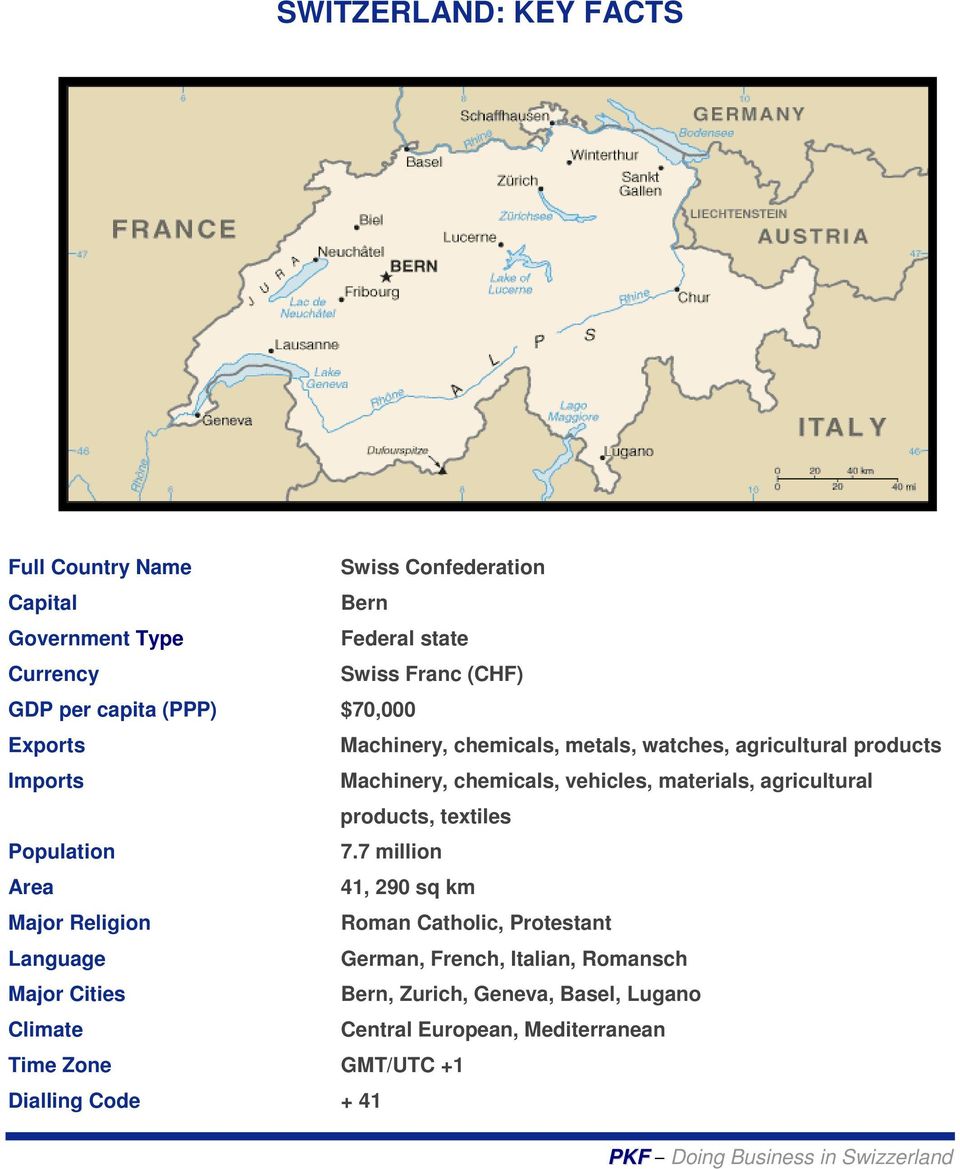
7 SWITZERLAND: KEY FACTS Full Country Name Swiss Confederation Capital Bern Government Type Federal state Currency Swiss Franc (CHF) GDP per capita (PPP) $70,000 Exports Machinery, chemicals, metals, watches, agricultural products Imports Machinery, chemicals, vehicles, materials, agricultural products, textiles Population 7.7 million Area 41, 290 sq km Major Religion Roman Catholic, Protestant Language German, French, Italian, Romansch Major Cities Bern, Zurich, Geneva, Basel, Lugano Climate Central European, Mediterranean Time Zone GMT/UTC +1 Dialling Code + 41 PKF Doing Business in Swizzerland
8 in Switzerland Lugano, TI PKF Certifica SA Via Pretorio 9 CH Lugano Tel: Fax: [email protected] Genève, GE SCF Révision S.A. Route des Acacias 54 CH Carouge Tel : Fax : [email protected] Zurich, ZH PKF Consulting AG Lavaterstrasse 40 CH Zurich Tel: Fax: [email protected] Zurich, ZH PKF Wirtschaftsprüfung AG Lavaterstrasse 40 CH Zurich Tel: Fax: [email protected] Zug, ZG PKF Consulting AG Metallstrasse 9 CH Zug Tel: Fax: [email protected] PKF Doing Business in Swizzerland

9 PKF Doing Business in Swizzerland

10 Introduction Country Profile Switzerland is an ideal example of a successful multicultural and multilingual society living in a harmonized way. The Swiss Confederation occupies a small landlocked territory of about 41,290 square km and has a population of 7.7 million. Strategically located in the heart of Europe, it shares borders with Germany, France, Italy, Austria and Liechtenstein. The linguistic geography of Switzerland is very broad and consists of four languages: German, French, Italian and Romansch (based on Latin and spoken by a small minority in the Canton Graubunden). English is widely spoken especially among professionals. Domestic Politics Switzerland has a stable, consensus-based, governance system designed to cultivate direct democracy. The 26 cantons are the member states of the Federal State of Switzerland. As a highly decentralized true confederation of states, political and administrative responsibilities are divided among the federal (national), cantonal and municipal levels of government. Each canton has its own constitution, code of civil procedure and parliament chamber. The Constitution provides for the separation of the three branches of government: the Federal Assembly, the Federal Council and the Federal Tribunal. Being located at the heart of the European Economic Area (EEA) there is a well-established Swiss-EU relationship mostly concerning trade, labour and transport issues. PKF Doing Business in Swizzerland - 7

11 Economic Overview Switzerland is a peaceful, prosperous and modern market economy with a per capita GDP among the highest in the world. The economic downturn has not been as deep in Switzerland as in most other OECD countries. The relative lack of imbalance and debt burden is expected to allow the Swiss economy to return to the pre-crisis levels of economic activity faster than its west European peers. GDP: Stable with high indicators. Average annual GDP varies between 450 and 500 billion (US$). Inflation: Low inflation with constant indicators between 0.5 and 2 per cent. Unemployment: Switzerland has one of the steadiest and proactive employment markets offering top-quality employee benefit solutions. Shows lowest unemployment levels in Europe. Private Consumption: Being strongly correlated with the GDP development, the interest rate level and the monetary environment, private consumption in Switzerland is rather strong (55% of GDP approximately), driven by a generally positive consumer sentiment. Industrial Production: Swiss industrial production is focused on value-added products such as pharmaceuticals, electronic devices, precision tools and industrial machinery. Imports / Exports: Traditionally Switzerland s exports exceed imports by far. The reason is that Switzerland processes several import commodities and resells them to its trade partners at a profitable margin. PKF Doing Business in Swizzerland - 8
12 Competitive advantages Switzerland has one of the most advantageous competitive positions in the international market thanks to the skills of the employees and the human resources. Education System Switzerland claims to have one of the world s best education systems and pays much attention to the importance of human resources. The educational level largely determines employment prospects and plays a key role in international competitiveness. Almost the entire Swiss population is literate and local educational procedures differ from canton to canton, but the basic structure relies on a dual system common to all the cantons. Telecommunications / IT Leading role is given to the development and implementation of the forward-looking, innovative and sustainable ICT (Information and Communication Technology) solutions. The Swiss government and the private sector are important in developing and defusing ICT (Information and Communication Technology) for infrastructure, content and applications. According to the Economist Intelligence Unit, spending per capita on information and communications technology in Switzerland is one of the highest in the world and well above the Western European average. The IT intensive industries such as financial services occupy a large share of the economy. Transport Systems The Swiss transport system is known to be one of the finest in the world. The dense network of railroads, bus and tramway lines together with systematic timetables allow one to reach any point in the country in no time. Annually many funds are invested into transportation infrastructure and road building. Highways and motorways across the country connect France, Germany, Italy, Liechtenstein and Austria. PKF Doing Business in Swizzerland - 9
13 The International airports of Zurich, Geneva, Basel and Lugano receive flights from all over the world and have their own railway and bus stations directly connected to all major cities in Switzerland and neighbouring countries. Quality of Life Switzerland is rated one of the highest in terms of quality of life thanks to its stable political scene, sustainable social system and strong economic factors. With one of the highest GDP per capita, Switzerland has one of the lowest crime levels in the world. Moreover the quality of food, other goods and services are very high and of great importance to the population. Switzerland offers as well a wide range of opportunities for free time, leisure, culture and sport. The country is extremely visited by tourists who appreciate reaching a variety of landscapes all embodying truly rare beauty. Competitive Tax Environment Switzerland is internationally known for its favourable tax environment. For businesses special tax rulings are offered by most cantons in Switzerland that can reduce the already moderate tax burden to extremely attractive levels. Furthermore both individuals and legal entities can benefit from double taxation treaties and bilateral agreements. Government Support Switzerland offers support on various levels to entrepreneurs willing to move or create a business on the territory. New companies, especially if active in the field of innovative technologies, are supported at both the federal and the cantonal levels through a vast number of available incentives and subsidies. PKF Doing Business in Swizzerland - 10
14 Living and Working in Switzerland The Swiss versatile nature is also reflected in its demographic features of population. Officially over a fifth of the countries total population is made up of resident foreigners and temporary foreign workers. The proportion of foreigners in Switzerland is the second highest in all of the OECD and contributes to three-quarters of the total population growth. Requirements to Enter Foreign nationals who wish to enter Switzerland must comply with the entry and customs regulations. In any case, a valid and accepted travel document is required in addition to a visa (in certain cases), confirmation of sufficient funds, and adequate accommodation available. Validity of the ID and Visa provisions vary in accordance with nationality. For further information on requirements to enter please visit: ID and Visa provisions: > Topics> Entry Swiss embassies and consulates: > Representations Working in Switzerland Gainfully employed foreign nationals are an important part of the Swiss economy where special interest is expressed towards highly-qualified personnel. In the past few years great effort has been made towards facilitating the entry process for this particular immigration category. Switzerland can be defined as having a dual admission system when welcoming foreign employees and their families: EU Nationals - Immigrants from the EU/EFTA countries in principle are granted the same treatment as Swiss nationals with regard to residence provisions and access to the labour market. Free right to enter and stay in Switzerland is granted, provided that a work and residence permit are obtained (which is a formality in the presence of an employment agreement). PKF Doing Business in Swizzerland - 11
15 For more information: >Topics>EU/EFTA citizens in Switzerland Non EU Nationals For the remainder of foreign nationals (so called Third Countries) and some of the EU citizens willing to live and work on Swiss territory the entry process is much more complex. Visas are limited and must be obtained before entering the country. Swiss Permits - There are four main permits available: Short-term residence and trainee permit (L) Permit type L is issued for up to 12 months upon presentation of an employment contract with the same validity period. However the trainee permit is issued to individuals aged eighteen to thirty willing to increase their qualification and may be extended for up to 18 months. Long-term residence permit (B) Generally issued for one year upon presentation of an employment contract and may be renewed annually. Cross-border commuter permit (G) Issued to foreign workers living abroad, provided that they return home at least weekly. Settlement Permit (C) can be obtained by individuals from the EU-10 and EU-15 countries after a regular and continuous stay in Switzerland of five or ten years respectively. For more information on employment and work permits please visit: > Topics> Labour/Work Permits PKF Doing Business in Swizzerland - 12

16 Registration When planning to stay in Switzerland for more than three months and/or to start employment, each person must register with his/her local authority (municipality) within eight to fourteen days of arrival. Employment Contract and Working Conditions Switzerland is known for good working conditions and pays great attention to its monitoring and improvement. The employment contract is generally regulated by the Swiss Code of Obligations and can be concluded for a definite or an indefinite period, on a full or part-time basis. The salary may be calculated by periods of time (time wage) or according to the work carried out (piece wage). From the legal aspect, there is no minimum wage unless stipulated in a collective employment contract. Regular termination terms vary between one and three months depending on the duration of the employment period. In case of termination of employment both contractual parties are protected by law from abusive employment termination. Maximum working hours vary between 45 and 50 hours per week and depend on the industry e.g. 45 hour limit is applied to industrial workers and office staff. The legal standard for employment holidays is four weeks. However holidays will depend on the employer, the employment contract and age of the employee. Accommodation and Living Expenses According to the Swiss Immigration Office the average accommodation expenses in larger cities make up over 20% of the average salary. The generally high accommodation costs and the compulsory health insurance contribute to the high cost of living. However there are the benefits of extremely low crime, efficient social security networks, high level of quality of life and a widespread and efficient public transport system. List of real estate market links Real estate portals ; PKF Doing Business in Swizzerland - 13

17 Social Security System The Swiss social security system is based on the so-called three pillar system, a threefold system of public, employment and private insurance. These must allow the previous standard of living to be maintained at the time of retirement, in case of invalidity or death, for the individual or the survivors. Pillars I and II target the obligatory benefits meanwhile Pillar III covers private social security. Pillar I This pillar is composed of Old Age and Survivor s Insurance (OASI) and Disability Insurance (DI). The OASI/DI social security is obligatory for all domiciled persons or those exercising a lucrative professional activity in Switzerland. The OASI covers insured persons from the loss of income due to retirement or invalidity and aims to ensure a basic lifestyle and provide financial benefits in case of invalidity. The minimum annual contribution is CHF 460. For the gainfully employed, the OASI/DI contribution is 10.3% of the gross salary and is paid fifty-fifty between employer and employee. Pillar II This pillar covers a professional social security to allow aged, surviving and invalid people with OASI/DI pension, maintain the previous life standards. All gainfully employed professionals in Switzerland with an annual income of at least CHF 20,880 have to be insured. Contributions depend on the age of the insured person and are usually split equally between employer and employee. Pillar III The third pillar is an optional personal insurance to further increase benefits at retirement. Third pillar insurances are often seen as a form of saving and offer certain tax benefits. Health Insurance Covers medical expenses and guarantees access to good medical treatment. This insurance is usually arranged individually to suit individual needs. This insurance is compulsory for all Swiss nationals and residents. Anyone working or residing in Switzerland must arrange to be insured within three months. PKF Doing Business in Swizzerland - 14
18 In Switzerland Health Insurance is usually paid on a monthly basis and considered to be one of World s most expensive. However applicable exemptions and premium reductions are available. For more information Taxation In the past few years Switzerland has worked hard to come up with new ideas for its tax system and to improve an already favourable tax climate. The Swiss tax system mirrors the country s federal structure and is based on the constitution where all 26 cantons have the full right to exercise taxation except for those taxes that are exclusively reserved for the federal government. Swiss fiscal structure can be classified into two levels of taxation- the federal and the cantonal/communal. Tax on Personal Income and Wealth All individuals with permanent or temporary residence in Switzerland are subject to taxation, both federal and cantonal/municipal. Taxes are levied and collected by the cantonal tax authorities and are assessed for a period of one year on the basis of a tax return to be filed by the taxpayer. Personal Income Tax Paid by resident individuals on their worldwide income (with limited exceptions of foreign investments), after certain allowed deductions, at both the cantonal/municipal and the federal level. Total income is calculated from dependent or independent personal activities, from compensatory or subsidiary payments, and income from movable and immovable property. The individual tax rates are typically progressive, whereas a maximum tax rate of 11.5% applies at the federal level. However every canton/municipality may set its own tax rates up to a maximum of approximately 30%. Typical total income tax burden in Switzerland may range between 10% and 35% (for top quartile incomes). It is important to point out that capital gains in Switzerland are usually exempt from taxation. PKF Doing Business in Swizzerland - 15
19 Tax on Wealth Individuals in Switzerland are subject to taxation on their net wealth (net assets). Net wealth tax is levied only at the cantonal/communal level in accordance with the respective cantonal tax laws. The tax is based on the balance of the combined gross assets of both immovable property and movable assets such as bank deposits, securities, real estate, etc. Taxes are also levied on assets not yielding any income. Wealth tax is progressive and ranges from 0.5 % o to 5% o approximately of the net wealth. Exceptions: Expatriates are foreign managers and certain specialists seconded to Switzerland on a temporary basis for a period of up to five years. Qualifying professionals may claim tax relief on expenses incurred due to their stay such as: relocation and travel costs to and from Switzerland, some of the accommodation costs, costs for school age children. Cross-border commuter is a person who lives in the selected countries e.g. Austria, France, Germany, Italy and Liechtenstein and work in Switzerland. The Swiss taxation of such individuals differs and may result in partial taxation, depending on their place of work and domicile. Lump-sum taxation ( LSt ) qualifying persons are temporary or permanent residents in Switzerland that enter for the first time or have been absent for at least ten years, and are not gainfully employed. Anyway Swiss citizens can profit from Lump-sum taxation for just one year. Lump-sum taxation is a form of special tax arrangement provided by both federal and cantonal tax legislations and may also result in subsequent treaty relief on foreign-source income. Main Features of LSt: - no wealth tax; - taxable amount for the purpose of income tax to be agreed upon tax authorities; - minimum taxable income about CHF p/annum i.e. about CHF taxes p/annum however: PKF Doing Business in Swizzerland - 16
20 Taxable amount to correspond to the effective yearly expenses of the taxpayer; Taxable amount not to be less than 5 times rental value or rent of Swiss real estate of the tax payer; Taxable amount not to be less than income of Swiss source, if any. - the taxpayer may choose whether or not to declare foreign income or/and wealth; - ordinary donation and inheritance tax; - no exit taxes in Switzerland. Conditions to qualify for LSt: - EU citizens No activity in Switzerland after becoming Swiss resident and no activity in Switzerland for at least 10 years. - Non-EU citizens Same as above listed for EU citizens. At least 55 years old and/or the special links or relationships representing particular interest for the Canton in granting the residence permit. Exceptions on age limitation possible but very rare. PKF Doing Business in Swizzerland - 17

21 Residential Real Estate When willing to purchase real estate in Switzerland it is important to consider that the legal situation may vary depending on the origin and the legal status of the foreign purchaser. Similarly, the location of the property may also alter the legal situation, depending on whether or not it is located in a tourist area. The Federal Law provides foreign citizens with conditions for purchase and legal framework in a form of Lex Furgler-Koller-Friedrich or LFAIE. LFAIE stipulates sales to foreigners on the basis of annual quotas per tourist region and has the following conditions: - Non-Swiss (not residing in Switzerland) may only own ONE property per family in Switzerland - The owner must occupy the property as a holiday home - Restrictions may apply in regards to the size of the living area - The property can be rented out for up to 11 months per annum - The restrictions on property resale apply and vary in accordance with location EU citizens When desiring to acquire a residential property as a main residence and/or a holiday home, only the EU/EFTA nationals with Swiss domicile or in possession of a B type permit enjoy the same treatment as Swiss citizens. All other residents in possession of a valid permit or without one are subject to restrictions or LFAIE rules. Non-EU citizens If acquiring a main residence in Switzerland, all non-eu foreigners are subject to limitations, unless in possession of a Swiss domicile or a B type permit. Meanwhile when buying a holiday home, only persons with Swiss domicile have no limitations. In all other cases permission is needed and LFAIE rules apply. PKF Doing Business in Swizzerland - 18
22 Other formalities Financing Mortgage: The standard mortgage granted by Swiss banks for purchases with only the property as security is 50 to 70% (depending on the income) of the total purchase price; Fire Insurance: In some cantons fire insurance for the building and its furniture is compulsory; Recordings in the Land Registry: The acquisition of the property is made legal with the recording of the purchaser(s) in the Land Registry; Annual co-property charges: Estimated average costs of maintaining a building are usually between 0.9% and 1.1% of the purchase price; Taxes: The fiscal value of the property (usually 2/3 of the market value) is used to determine taxable wealth and rental value which constitutes the basis for the income tax. In most cases both are levied at the place of residence of the owner.. PKF Doing Business in Swizzerland - 19
23 Doing Business in Switzerland Banking and Finance Swiss Banking Overview The Swiss banking sector is considered to be the key sector in the Swiss economy with an international reputation for competence and sophistication. Banks are engaged in all types of activities in relation to both private and commercial specialisation. Switzerland is the world s leader in private banking. The role of the country s central bank is held by the Swiss National Bank (SNB) with Union Bank of Switzerland (UBS) and Credit Suisse (CS) being the country s major banks. For more information on Swiss Banking Regulatory System Switzerland is not bound by European Legislation because it is neither a member state of the European Union (EU) nor of the European Economic Area (EEA). This allows Switzerland the autonomy to regulate its financial services industry as it deems fit. Legal forms of banking regulation Banking regulation can be expressed in various legal forms. In Switzerland, the fundamental principles are codified in the federal legislation (e.g. in the Banking Act, the Stock Exchange Act, the Financial Market Supervision Act) while concrete details are set out in government ordinances (e.g. in the Banking Ordinance and in the Stock Exchange Ordinance). In addition, there are ordinances and circulars issued by the Swiss Financial Market Supervisory Authority (FINMA) as well as self-regulatory directives, guidelines and recommendations issued by the financial sector itself, but under supervision of FINMA, in particular by the Swiss Bankers Association (SBA). PKF Doing Business in Swizzerland - 20
24 For more information Swiss Financial Market Supervisory Authority (FINMA) The main organization responsible for the regulation of banks and financial markets is FINMA which works as an independent federal regulatory authority. Under a dualistic supervisory system FINMA monitors and inspects the audit companies execute the audits and the special inspections commissioned by FINMA. For more information SIX Swiss Exchange and the Swiss Bankers Association Certain aspects of securities brokering, such as the organisation of trading, are subject to self regulation through the SIX Swiss Exchanges and under the overall supervision of FINMA through the Swiss Banking Association. The SIX Swiss Exchanges also ensure compliance with the regulatory framework for securities insurance and trading, as well as monitoring and enforcing compliance with these regulations. For more information on SIX Swiss Exchange PKF Doing Business in Swizzerland - 21
25 Supervision of UBS & CS Group (the Big banks ) The two "big" banks - UBS AG and the Credit Suisse Group - together account for over 50% of the balance sheet total of all banks in Switzerland. Both UBS AG (UBS) and Credit Suisse Group AG (CS) are classified as big banks and play an important role in the Swiss banking system. Due to their size, complexity, organisation and business activities both banks are subject to more rigorous control. For that reason both institutions are individually monitored by Supervision of UBS and Supervision of CS Group. Swiss Nationale Bank As opposed to FINMA, the SNB s responsibility is to monitor the compliance with liquidity rule. It also acts as supervisory authority for payments and securities settlement systems. For more information on SNB Supervision of other banks & security dealers FINMA supervisory activities draw heavily on the work of recognised audit firms that are delegated to conduct regular sectorial audits of institutions and, in so doing, provide direct supervision. In FINMA, the Supervision of Wealth Management Banks and Securities Dealers, and the Supervision of Retail, Commercial and Trading Banks departments are responsible for monitoring banks, securities dealers and mortgage bond institutions. Institutions that form an economic unit with other companies in the financial sector are also monitored on a consolidated basis as part of the supervision of financial services groups. PKF Doing Business in Swizzerland - 22
26 Relations with Clients Main Competences Provision of a first-class banking service to retail, corporate and high-net worth clients Privacy & Legal Security Legal protection and confidentiality is provided through federal laws and regulations for the clients of Swiss banks Efficiency - Efficiency in managing individual and corporate assets using the most modern methods of information processing and communication systems Reliability - Social political and financial stability along with sustainability of fundamental banking principles Professionalism - Multilingual staff permanently trained in order to meet the requirements of the comprehensive and demanding system of Swiss Banking standard PKF Doing Business in Swizzerland - 23
27 Opening a Swiss Bank Account Private: Regular: - Any adult person can open an account in Switzerland, as long as they are able to provide the bank with official and valid identification documents and to document the beneficial owner, if the account s assets have a different or an additional beneficial owner. The legal origin of the assets has to be proven. Numbered: - Identical to the one for regular clients. The numbered accounts are intended to offer an enhanced level of internal security and confidentiality. - This type of account enjoys no additional legal privacy in terms of confidentiality and should not be used for international wire transfers - For international payment services the identity for the numbered account has to be disclosed. Limitations: - The provision of financial services may be refused to so-called politically-exposed persons who may pose a reputational risk, or in case of doubts about the origins of the funds. PKF Doing Business in Swizzerland - 24
28 Corporate: A company may open a Swiss bank account regardless of whether its registered office is located in Switzerland or not. Swiss-registered legal entities: - Standard entities that conduct commercial, services and manufacturing business and therefore are listed in the Swiss Commercial Register (SCR) should provide the Bank with the relevant extract from SCR. Foreign-registered & non SCR-listed legal entities: - Should provide the bank with an extract from the Register of commerce or the equivalent documents allowing the bank to identify the company, ascertain its existence and determine its representatives. - The same is applicable to the companies operating within a country that does not operate an official Register of commerce. - This documentation should not be older than 12 months. Domiciliary companies: - These are both Swiss and foreign-registered companies that conduct no operational activity and, accordingly, have neither own personnel nor own physical premises. - In addition, they must also declare the identity of the beneficial owners of their assets with a specific form (Form A). Monetary Policy and Interest Rate Stability The SNB s monetary policy strategy consists of three elements. First, the SNB states how it defines price stability. Second, it bases its monetary policy decisions on a medium-term inflation forecast. Third, it sets an operational target range for its chosen reference interest rate, the three-month Libor. PKF Doing Business in Swizzerland - 25
29 Swiss Financial Market Overview Switzerland is not only world famous for banking but also for non-life insurance and reinsurance, commodities trading and trade finance. The Swiss financial market has a strong role in supporting the national economy and includes the following financial market segments: Swiss fixed income (bond) market Swiss derivatives market Swiss options and futures market Swiss foreign investment market Swiss foreign exchange market Swiss mutual fund markets With each segment falling into the category either related to a trading or exchange system, a clearing and settlement system or a payment system which deals with payment of dealings. SIX Swiss Exchange is a principal security settlement organisation that organises, operates and regulates key aspects of Switzerland s capital market. The shares traded on SIX Swiss Exchange are mainly held in Swiss-based accounts of domestic and international investors. Bonds, exchange traded funds (ETFs), exchange traded structured funds (ETSFs) and other investment funds are also traded on the SIX Swiss Exchange Platform. The SMI or the Swiss Market Index is the principal index of the SIX Swiss Exchange. PKF Doing Business in Swizzerland - 26
30 Business Environment Securities Dealers Securities dealers are those falling into criteria defined within the Stock Exchange Act and engaged in securities and other directly related transactions. All Swiss securities dealers, both Swiss and foreign, must obtain a license under the Stock Exchange Act from the FINMA. If the securities dealers are banks, then they should also comply with the Banking Act. Only after the licence has been obtained may the legal entity register in the register of commerce and start securities dealing activities. To obtain a licence, the applicant should be able to provide the FINMA with the following: - evidence of meeting conditions regarding: corporate documentation, structure and organisation of the business, management; - provide necessary information on certain shareholders, and key management persons. The detailed criteria for obtaining a licence and the provisions which regulate business conduct are listed within the Stock Exchange Act. Portfolio Managers and Financial Intermediaries Portfolio Managers This type of financial sector enjoys a very liberal regulatory and market framework as it does not fall under either the Banking Act or the Stock Exchange Act. The Portfolio manager can be represented by any type of legal entity or legal person that administers their client s funds. The Portfolio managers are subject to the Anti-Money Laundering Act (AMLA). Such provision is aimed at ensuring the quality of the capital used in the transaction. Moreover the Swiss Bankers Association provides banks with the Due Diligence Agreement and has introduced also the Portfolio Management Guidelines for the exercise of asset management mandates. PKF Doing Business in Swizzerland - 27
31 Financial Intermediaries Financial Intermediaries are broadly defined to include legal entities and private persons who by profession accept possession of funds. Both can either be self-regulated and a member of a recognised Swiss selfregulatory organisation or directly subordinated to FINMA. Organisations who are neither regulated nor selfregulated must obtain a licence for their activities from the Federal Control Office for the Prevention of Money Laundering. Collective investment schemes legislation Swiss investment law defines an investment fund as being a pool of assets raised from investors as a result of public offering for the purpose of collective investment. The fund is managed by the fund management company that acts on investor interests in accordance with the principle of risk diversification. Open-end collective investments schemes are funds established on a contractual basis or an investment company with variable capital (SICAV). Meanwhile a close-end collective investment scheme take the form of a limited partnership for collective investment or an investment company with fixed capital (SICAF). The investment funds are supervised by FINMA and must comply with the legal framework established within the Collective Investment Schemes Act (CISA), Collective Investment Scheme Ordinance (CISO) as well as Ordinance of the Swiss Federal banking Commission on Collective Investment Schemes (CISO- SFBC). The CISA has been brought in line with the new EU fund directive UCITS (Undertakings for Collective Investments in Transferable Securities) and provides basic regulations aimed at investor protection by ensuring transparency and functionality of the market. However CISO and CISO-SFBC were established to provide more detailed investment regulations. PKF Doing Business in Swizzerland - 28
32 Doing Business in Switzerland Business Structures Overview Switzerland represents a highly competitive and innovative business environment and therefore it serves as an excellent test market for all kinds of businesses. Economic freedom, which is guaranteed under the Swiss Constitution, allows anyone, including foreign nationals, to operate a business, to form a company or to hold an interest in one. However, foreign nationals must have both work and residence permits in order to conduct a business personally or on a permanent basis. There are two main types of business entities clearly distinguished and defined by Swiss law: Capital-based companies - stock corporation and limited liability company Partnership-type companies - limited or general partnership and sole partnership The business entities are governed by the Civil Code or the Swiss Code of Obligations. At the Federal level the legal entities are domiciled in a particular canton where the Commercial Register is held. Anyone trading, manufacturing or otherwise engaged in business must be registered in the relevant register of commerce. The Register is a public document. PKF Doing Business in Swizzerland - 29
33 Before choosing a form of a business it is important that the following factors are carefully considered: Amount and source of capital required Risk/liability issues Governance and legal restrains Tax treatments Social security expectations and insurance requirements Business Structures Stock Corporation A stock corporation, hereinafter SA/AG, is a legal entity acting as a joint stock company similar to the corporation in US and the public limited company in UK. It is formed by at least one individual or corporation with a registered share capital and its own corporate name. The liability of shareholders is limited to the amount subscribed for share capital. The AG is often chosen by foreign companies as a legal form for Swiss subsidiaries due to its appropriateness for large companies and small to medium size businesses. This legal form can be considered as being the most prevalent among Swiss companies. The shareholders of the AG enjoy the right of anonymity. a) Formation Requisites - Must be registered in Commercial Registry. - Minimum share capital CHF At least 50% of share capital (CHF ) must be paid up upon constitution. - The share capital can be divided into bearer or registered shares of a minimum par value of CHF 0.01 each. - Bearer shares must be paid in full and transferred by way of assignment, or if certificates are issued, by physical transfer. Registered share certificates must be endorsed, and the transfer of registered shares must be entered in the company s share ledger. PKF Doing Business in Swizzerland - 30
34 - A contribution in kind is subject to a special report by the founders, which needs to be confirmed by the auditors. - There are no requirements of nationality or residence for directors, however at least one person with individual signature power must legally reside in Switzerland. Alternatively it is possible to have two Swiss resident persons with dual signature power. - The incorporation is completed with the entry of the entity into the register of commerce. b) Taxation: AG is subject to the following taxes: - Corporate Tax: Income tax levied on both federal and cantonal/municipal levels, and capital tax just at cantonal level. Total income tax is based on the worldwide income and depending on the canton and community of residence may vary between 12% and 26% on profit before taxes. - Capital tax is approximately 0.3% - 0.6% of net-worth. - Withholding tax: On dividends and interests. - Stamp duties: Usually issued on capital upon formation if equity exceeds CHF 1 million. - VAT depending on the activities performed and turnover achieved. - Double taxation treaties and tax exemptions are available. c) Accounting & Audit Swiss law requires that a financial statement (balance sheet, income statement and annex) drawn up annually according to Swiss generally accepted accounting principles. The accounting system of the company can be based on any internationally accepted standard (Swiss GAAP/FER, IFRS or US- GAAP) and in any currency. For tax purposes the financial statements have to be prepared according to the Swiss law (OR) and in Swiss Francs. For non listed companies, the accounts are only submitted to the tax authorities and are not open for disclosure. Consolidation of financial statements of subsidiaries is required when two of the following measures are met in two consecutive fiscal years: Total assets CHF10 million Total turnover CHF20 million An average workforce over the year of 200 employees PKF Doing Business in Swizzerland - 31
35 The requirements of the audit depend on activities, financial accounts and total employees. The full audits apply for companies: - Required to prepare consolidated financial statements - Listed on the stock exchange - Exceeding two of the three following measures in two successive fiscal years Total assets CHF 10 million Total turnover CHF 20 million An average workforce over the year of 50 employees or more In a full audit, the auditor must also confirm the existence of an internal control system set up to the specifications of the board of directors (regarding the preparation of the annual report). Companies which - according to the criteria contained in Art. 727 OR - are not subject to a full audit are, in principle, subject to a limited audit. During the limited audit, the auditor obtains less assurance than during a full audit. The auditor s attestation is therefore also less binding than one from a full audit. Small entities, that are not subject to a full audit, and with the consent of all the shareholders, can decide for opting out (no audit required) if they employ less than 10 full time employees; (full-time equivalents averaged over one year). Limited Liability Company The limited liability company, hereinafter GmbH, is a capital company with its own legal personality. This entity form is an alternative to the AG due to similar costs and formation procedures involved. Both forms require the execution of a public deed of formation by all founders, and members liability is limited to the registered capital. Recently the proportion of GmbH has been on the rise thanks to reduced structural and capital costs in comparison AG, and therefore its viability for small-medium businesses. However as opposed to Stock Corporation it has stronger disclosure requirements. PKF Doing Business in Swizzerland - 32
36 a) Formation Requisites - Must be registered in Commercial Registry. - Share capital of the company must amount to at least CHF and may not exceed CHF 2 million. At least 50% of share capital must be paid in cash or in kind by each of the members upon the formation of the company. - Each shareholder has an interest in the nominal capital in the form of one or more nominal quotes having a nominal value of at least CHF All members and all capital contributions or alterations need to be notified to the register of commerce on an annual basis. - No bearer shares allowed. - Swiss residents shall be able to legally bind the company. b) Taxation, Accounting & Audit Taxation, accounting and audit procedures applied as per AG/SA. Partnerships a) Types of partnerships General Partnership The general partnership is a person-centred association of at least two individuals, which normally has an economic purpose and operates as a commercial business. Legal entities are not allowed to join a general partnership, as it has no legal personality. It is formed and operates in accordance with a partnership agreement where strict non-competition obligations apply to all partners. Partners are liable for any debts the partnership may incur, meaning that all partners are subsidiary, personally, jointly and severally liable. No minimum capital is required. The general partnership is subject to registration in the Commercial Registry, even if considered to be established even before registration. Anonymity is preserved for each partner, unless required by tax authorities in regards to a specific partner. PKF Doing Business in Swizzerland - 33
37 Limited Partnership Limited partnership is an association of at least two individuals or legal entities, of which at least one partner (the general partner) is fully liable for all the liabilities of the partnership. As opposed to the general partnership, limited partnerships may have legal entities as members. Furthermore the partnership must consist of at least one fully liable general partner, in contrast with limited partners whose liability is limited to the amount of their contributions. According to the Swiss Code of Obligation the general partner must be an individual (and not a corporate investor). Recently Switzerland introduced a new law regulating collective investment schemes. Under this law, LPP can be used as appropriate scheme for private equity investments. Thanks to LLP Switzerland has strengthened its status as a financial centre, as this type of partnership is no longer forced to move to Luxembourg, Ireland or the Channel Islands. b) Taxation of Partnerships General and limited partnerships are not regarded as tax entities. Any profits made are taxed as personal income of the partners. The same applies to partnerships assets that are subject to the personal net-worth tax of partners. c) Accounting Commercial bookkeeping rules apply as per the Swiss Code of Obligations, that requires double entry accounts with balance, inventory and income statement. Audit is not required. Sole Proprietorship Sole proprietorship is similar to general partnership, but created by only one person (entrepreneur). This means, that a single person manages the business and does not create a company. The entrepreneur provides the capital and is therefore fully and unlimitedly liable for the debts of the business. If the business is successful it can easily be converted into a corporation such as AG or GmbH. PKF Doing Business in Swizzerland - 34
38 a) Formation Requisites - No cogent statutory provisions and formal acts of foundation i.e. no minimum capital requirements - Subject to inscription in the Commercial Registry only if turnover exceeds CHF b) Taxation A sole proprietorship is not subject to cantonal or federal taxation. However the sole proprietor is liable for income tax and net-worth tax on profits generated and assets owned by the business. c) Accounting Swiss commercial bookkeeping rules apply as per the Swiss Code of Obligations, that requires double entry accounts with balance, inventory and income statement. Audit is not required. Branches As far as licensing, registration, taxation and accounting records are concerned a branch is treated as any Swiss company. The branch office is legally dependant on the principal enterprise and therefore must carry the same company name along with business activities. a) Formation Requisites - Must be registered in Commercial Registry - In case of branch of foreign company, it must have a legal representative whose legal residence is in Switzerland b) Taxation - Treated as legal entities - Share issuance tax not levied upon formation - Withholding tax not levied on profits from Swiss branch to its foreign headquarters PKF Doing Business in Swizzerland - 35
39 c) Accounting Commercial bookkeeping rules apply as per Swiss Code of Obligations, that requires double entry accounts with balance, inventory and income statement. Audit is not required. Establishment Procedures Local banks, consulting firms, fiduciary companies, company law attorneys, and the economic development agency of the selected canton can assist to manage the project locally until the start of operations. The usual procedure of company incorporation takes on average between two to four weeks and depends on the type of legal form chosen and canton of location. Swiss highly specialized financial advisors are available to assist towards the completed incorporation and in the management of the business. For more information on procedures and costs or Swiss Corporate Taxation Introduction The Swiss tax rates for companies are among the lowest anywhere in Europe. Total corporate taxes are approximately 17-28% on PBT and are levied at federal, cantonal and municipal levels. Such approach is resulting in inter-cantonal, inter-municipal tax competition and constantly lower tax burdens. The Swiss corporate taxation is explained in detail below. Income Tax a) General Principle: Swiss resident companies are taxed on worldwide income. In principle any expenses incurred to achieve a profit and recorded in the statutory accounts are deductible for tax purposes. Whereas not commercially justified expenses are not tax deductable. Taxable profit is therefore based on the profit and loss statement for the period as adjusted for tax purposes. PKF Doing Business in Swizzerland - 36
40 b) Federal Level For corporations and cooperatives resident in Switzerland (with registered office or place of effective management in Switzerland) the Swiss Federation levies a flat rate tax of 8.5% on profit after taxes, corresponding to 7.8% on profit before tax. c) Cantonal Level Depending on the canton and the municipality, the effective tax rate of the canton and municipal tax range between approximately 10% and 20%. Capital Tax Only cantons levy an annual capital tax on cantonal/communal level that varies from canton to canton and depends on the tax status of the company. Capital tax is charged on the following basis: Share capital, paid-in-surplus, legal reserves, other reserves, retained earnings Any provisions disallowed as deductions for tax purposes Debt that economically under Swiss law has the character of equity Withholding Tax In Switzerland the aim of the withholding tax is to prevent tax evasion and is levied at 35 percent rate upon payment of dividends, interest on bank deposits, bonds and bond-like loans. Switzerland has concluded double tax treaties with approximately 90 countries allowing for total or partial tax relief, generally by way of refund. In particular with EU countries, withholding tax is no longer due if certain criteria are met. It has to be put into evidence that Switzerland has recently agreed with Governments of Germany and the United Kingdom that, where residents of those two countries have liquid assets in Switzerland, Withholding Tax will be deduced from future income and gains derived from those PKF Doing Business in Swizzerland - 37
41 assets. There will also be a one off tax charge in respect of unreported income from the past. The charges will not apply if the owners of the assets can demonstrate that tax in their home country is not due. The rules are complex and further advice should be sought from a PKF Switzerland Office. Special Tax Regimes Various tax privileges exist at the cantonal level in particular for holding and domiciliary/mixed companies, provided that certain requirements are met. Holding Companies Holding companies are legal entities whose primary business purpose is, according to the by-laws, to hold and manage long term equity investments. Profits from qualifying participations are in principle tax exempt. To benefit from the holding tax privilege, which basically reduces taxation to 7.8% on profits other than from qualifying participations, two-third of the total assets shall consist of equity investments or twothird of total income shall derive from equity investments. Domiciliary Company The domiciliary company tax privilege is granted to companies with purely administrative activity in Switzerland. Effective tax rate depends on the importance of the activity carried out in Switzerland. Mixed Company Granted to companies with predominant foreign business, this tax ruling is generally used by international trading companies and may reduce the total effective income tax rate to 10 % approximately. Others Other tax advantages can be obtained for principal companies and finance branches. Stamp Duties A stamp duty of 1% is levied on issued capital exceeding CHF 1 Mio of AG and GMBH. Moreover a stamp duty between 0.15% and 0.3% applies to certain securities transfers. PKF Doing Business in Swizzerland - 38
42 Real estate taxes The amount of tax levied on capital gains from property will depend on the canton where the property is located. The right to tax such gains is reserved to the cantons. The taxation systems adopted by cantons vary between special cantonal real estate gains and the ordinary corporate income tax. The rates are set by each canton and vary considerably. Value Added Tax The Swiss VAT model is similar to the EU model. The standard VAT rate is 8%. Lower rates apply for accommodation services (3.8%) and food, water, agricultural products, medical products, books, newspapers, and cultural services (2.5%). Exclusion from VAT is applied to certain business activities such as the healthcare sector, education, culture, sports, social care, most banking and insurance, real estate and gambling. The exemption is applicable to export of goods and some of the international business models. VAT registration is compulsory for businesses exceeding CHF turnover. Double Taxation Treaties Switzerland concluded approximately 90 tax treaties aimed at minimizing double taxation on dividends, royalties & interest payments. Incentives and Subsidies There are several promotional measures at both the federal and cantonal level that are granted in connection with investment projects, creation of jobs and at the federal level there are 3 main incentives available under certain conditions: Tax holiday up to 10 years Interest subsidies on bank credits Guarantee for loans received by banks PKF Doing Business in Swizzerland - 39
43 Each canton offers in addition its own promotional measures especially in connection with investments in innovative technology and job creation. Cantonal incentives and subsidies can extend well beyond federal ones. Real Estate Companies registered abroad, and Swiss companies controlled by persons abroad qualify as foreigners for the purposes of property acquisition. Legal entities have an option to buy or rent the real estate in Switzerland. When making a decision, the legal limitations should be taken into account. These limitations may vary in accordance with the type of the property, its usage and location. Property Acquisition Foreigners may buy commercial property and land without particular limitations. Commercial property may also be bought as investment and be rented to a third party. In principle no permit is required to buy real estate used for a business activity i.e. professional or industrial activity. Property Rental For properties rented for business purposes, no special limitations apply. When desiring to rent commercial property in Switzerland there are commercial zones of high cantonal interest available. Close to the city, such commercial zones allow for easy B2B collaboration, easy access to transportation and highways. PKF Doing Business in Swizzerland - 40
44 Appendix I Useful addresses and websites General Integration Office DFA/DEA Bundeshaus Ost CH-3003 Berne Tel: Fax: [email protected] Immigration, entry, residence and labour market Federal Office of Migration (FOM) Quellenweg 6 CH-3003 Berne-Wabern Tel: Fax: [email protected] Social Security Federal Social Insurance Office Effingerstrasse 20 CH-3003 Berne Tel: Fax: [email protected] Incentives State Secretariat of Economic Affairs SECO Effingerstrasse 31 CH-3003 Berne Tel: Fax: Unemployment insurance, labour market, job placement State Secretarial for Economic Affairs (SECO) Labour Market and Unemployment Insurance Effingerstrasse 31 CH-3003 Berne Tel: Fax: [email protected] Taxes Swiss Federal Tax Administration Division for International Fiscal Law and Double Taxation Matters Eigerstrasse 65 CH-3003 Berne Tel: Fax: [email protected] Buying Property Federal Office of Justice Office for Land Registry and Real Estate Law Bundesrain 20 CH-3003 Berne Tel: Fax: Banking Swiss Bankers Association P.O. Box 4182 CH-4002 Basel Tel Fax: [email protected] PKF Doing Business in Swizzerland - 41
45 Appendix II SWISS TAX FRAMEWORK Confederation Cantons Communes Profit tax (legal entities) X X X Capital tax (legal entities) X X Income tax (individual) X X X Wealth tax (individual) X X Real estate tax X X Donation tax X X Inheritance tax (depending on the canton) Tax in disposal of real estates X X X Withholding tax X Stamp duty on issuance and/or negotiations X VAT X PKF Doing Business in Switzerland - Economic and Market Landscape 42
46 Appendix III MAIN SWISS VEHICLES: (Stock Corporation SA and Limited Liability Company SAGL) SA SAGL Share Capital Min. CHF (at least 50% to be paid in) Min. CHF (to be fully paid in) Shareholders/ members At least 1 (individual or legal entity). No requirements of citizenship/residence At least 1 (individual or legal entity). No requirements of citizenship/residence Form of shares/units Registered or bearer Registered Directors/ managers One or more members. At least 1 individual, director or manager, able to represent the company (alone or with other individual domiciled in Switzerland), must be domiciled in Switzerland. No requirements of citizenship. No legal entities. One or more members. At least 1 individual, director or manager, able to represent the company (alone or with other individual domiciled in Switzerland), must be domiciled in Switzerland. No requirements of citizenship. No legal entities. Audit - Compulsory only in specific cases (full or limited audit) - Opting out - Compulsory only in specific cases (full or limited audit) - Opting out Object Any object/activity provided that in conformity with the law Any object/activity provided that in conformity with the law Time for incorporation Once the capital is paid in, 1-2 days Once the capital is paid in, 1-2 days PKF Doing Business in Switzerland - Economic and Market Landscape 43
German Tax Facts. The Expatriate Financial Guide to Germany
 The Expatriate Financial Guide to Germany German Tax Facts Introduction Tax Year Assessment Basis Income Tax Taxation in Germany occurs at a national and municipal level. The Ministry of Finance controls
TAX I NFO. Lump-sum taxation. Taxation based on costs
 TAX Lump-sum taxation Taxation based on costs Introduction In this world, nothing is more certain than death and taxes (Benjamin Franklin) If Benjamin Franklin was right, the question arises as to how
Legal Guide to Forming a Corporation in Luxembourg
 Legal Guide to Forming a Corporation in Luxembourg March 2008 Business in the Grand-Duchy of Luxembourg (the GDL ) may be carried out by individual trader(s) or by way of forming a corporate entity, whereby
Belgium in international tax planning
 Belgium in international tax planning Presented by Bernard Peeters and Mieke Van Zandweghe, tax division at Tiberghien Belgium has improved its tax climate considerably in recent years. This may be illustrated
Joint Ventures in Switzerland
 Joint Ventures in Switzerland by Dr Peter C Schaufelberger, LLM and Dr oec HSG Richard W Allemann, of SvH Schaufelberger & van Hoboken, attorneys at law, Zurich-Zollikon Introduction Traditionally, Switzerland
Luxembourg Life Assurance for International Investors
 Luxembourg Life Assurance for International Investors 2 3 CONTENTS 4 Luxembourg Life Assurance for International Investors 4 A truly international focus 6 Maximum protection 8 Solutions designed for sophisticated
Ordinance on Collective Investment Schemes
 English is not an official language of the Swiss Confederation. This translation is provided for information purposes only and has no legal force. Ordinance on Collective Investment Schemes (Collective
Income in the Netherlands is categorised into boxes. The above table relates to Box 1 income.
 Worldwide personal tax guide 2013 2014 The Netherlands Local information Tax Authority Website Tax Year Tax Return due date Is joint filing possible Are tax return extensions possible Belastingdienst www.belastingdienst.nl
Monaco Corporate Taxation
 Introduction Monaco is a sovereign principality. France is a guarantor of the sovereignty and territorial integrity of Monaco, while Monaco is to conform to French interests. Although the Prince is the
Federal Act on Collective Investment Schemes
 English is not an official language of the Swiss Confederation. This translation is provided for information purposes only and has no legal force. Federal Act on Collective Investment Schemes (Collective
Individual taxes, summary
 Individual taxes, summary Significant developments There have been no significant tax or regulatory developments in the past year. Territoriality and residence Switzerland taxes its residents on their
Living and Working in Austria. 1 l Income tax in Austria 2 l Social Security in Austria 3 l Residence And Work Permits in Austria
 Tax l Accounting l Audit l Advisory Living and Working in Austria 1 l Income tax in Austria 2 l Social Security in Austria 3 l Residence And Work Permits in Austria We are pleased to present you in our
How To Limit Tax Competition In Swissitzerland
 Robert Waldburger University of St. Gallen Tax competition in Europe National Report Switzerland I. General aspects of the domestic tax situation 1. The notion of 'tax competition' in domestic legal and
Setting up your Business in SINGAPORE Issues to consider
 SINGAPORE is commerce, industry, heritage, culture and entertainment all rolled into a little island of slightly over 700 square kilometres with a population of 5.4 million. Here at the crossroads of Asia,
British heritage, Swiss know-how
 British heritage, Swiss know-how Barclays recent awards Best Private Bank Client Service Highly Commended Foreign Private Bank External Asset Manager Platform Best Overall Private Bank - UK 2016 2016 2015
British Virgin Islands Insurance Companies
 British Virgin Islands Insurance Companies Foreword This memorandum has been prepared for the assistance of those who are considering the formation of insurance companies in the British Virgin Islands.
Contract Work in Switzerland. A Brief Guide
 Contract Work in Switzerland. A Brief Guide Introduction to Swissroll There are approximately 1,000,000 foreign employees in Switzerland, 25% of which commute from outside the country. Swissroll are registered
Thinking Beyond Borders
 INTERNATIONAL EXECUTIVE SERVICES Thinking Beyond Borders Tanzania kpmg.com Tanzania Introduction Taxation of individuals under the Income Tax Act 2004 (ITA) is on the basis of both residence and source.
HONG KONG Corporate information:
 HONG KONG Corporate information: Hong Kong is the richest city in China, its economy is one of the most liberal in the world. It is a financial and commercial hub of global significance. Hong Kong is a
Insurance/Reinsurance - Sweden
 Page 1 of 7 Newsletters Law Directory Deals News Conferences Appointments My ILO Home Insurance/Reinsurance - Sweden Overview (March 2006) Contributed by Advokatfirman Vinge March 14 2006 Introduction
Spanish Tax Facts. The Expatriate Financial Guide to Spain
 The Expatriate Financial Guide to Spain Spanish Tax Facts Introduction Tax Year Assessment Basis Taxation in Spain occurs at a national level and at a regional ( Autonomous Community ) or municipal level.
Planning your future.
 Planning your future. Preserving your wealth. We live in a world whose main constant is change. 2 Introduction Introduction 3 Structuring your wealth in a changing world. We live in a world whose main
Mexico. Rodolfo Trampe, Jorge Díaz, José Palomar and Carlos López. Von Wobeser y Sierra, S.C.
 Mexico Rodolfo Trampe, Jorge Díaz, José Palomar and Carlos López Market overview 1 What kinds of outsourcing take place in your jurisdiction? In Mexico, a subcontracting regime (understood as the regime
Macau SAR Tax Profile
 Macau SAR Tax Profile Produced in conjunction with the KPMG Asia Pacific Tax Centre Updated: June 2015 Contents 1 Corporate Income Tax 1 2 Income Tax Treaties for the Avoidance of Double Taxation 5 3 Indirect
Belgium: Tax treatment of immigrating taxpayers
 Belgium: Tax treatment of immigrating taxpayers IFA Congres Madrid 30 May 2014 Marc Vandendijk Tax Lawyer VANDENDIJK & PARTNERS Rue Edith Cavellstraat 66 1180 Brussels Tel.: + 32 (0)2.343.33.45 E-MAIL:
The Bermuda Stock Exchange
 The Bermuda Stock Exchange Foreword This Memorandum has been prepared for the assistance of anyone who requires information about the Bermuda Stock Exchange. It deals in broad terms with the Bermuda Stock
Doing Business in Russia
 Doing Business in Russia www.bakertillyinternational.com Contents 1 Fact Sheet 2 2 Business Entities and Accounting 4 2.1 Companies 4 2.2 Partnerships 5 2.3 Branches and Representative Offices 6 2.4 Individual
CYPRUS TAX CONSIDERATIONS
 TAXATION The following summary of material Cyprus, US federal income and United Kingdom tax consequences of ownership of the GDRs is based upon laws, regulations, decrees, rulings, income tax conventions
Introduction. The Expatriate Financial Guide for UK Expatriates Working Overseas
 Introduction The Expatriate Financial Guide for UK Expatriates Working Overseas An individual who is considering a move from the UK in order to work overseas will need to take into account a number of
A 5.5% solidarity surcharge is imposed on the income tax liability of all taxpayers.
 Worldwide personal tax guide 2013 2014 Germany Local information Tax Authority Website Tax Year Tax Return due date 31 May 2013 Is joint filing possible Are tax return extensions possible 2013 income tax
FOREWORD. Namibia. Services provided by member firms include:
 FOREWORD A country's tax regime is always a key factor for any business considering moving into new markets. What is the corporate tax rate? Are there any incentives for overseas businesses? Are there
TURKEY CORPORATE TAX (KURUMLAR VERGISI) The basic rate of corporation tax for resident and non-resident companies in Turkey is 20%.
 TURKEY CORPORATE TAX (KURUMLAR VERGISI) The basic rate of corporation tax for resident and non-resident companies in Turkey is 20%. Corporations in Turkey can be regarded as either limited or unlimited
APPLICATION FOR AFFILIATION TO THE ASSOCIATION ROMANDE DES INTERMÉDIAIRES FINANCIERS (ARIF) (DIRECTIVE 1)
 APPLICATION FOR AFFILIATION TO THE ASSOCIATION ROMANDE DES INTERMÉDIAIRES FINANCIERS (ARIF) (DIRECTIVE 1) February 2013 Please print and complete the present document fully in printing characters, tick
tax incentives Office for Economic Affairs (SPECo) Economic Promotion setting-up, establishing and developing businesses
 Office for Economic Affairs (SPECo) Economic Promotion Ferring pharmaceuticals Alain Herzog / EPFL tax incentives setting-up, establishing and developing businesses E CONTENTS 3.... PROFIT AND CAPITAL
PRIVATE WEALTH MANAGEMENT COMPANIES
 PRIVATE WEALTH MANAGEMENT COMPANIES (SPFs) www.bdo.lu 2 Private Wealth Management Companies (SPFs) TABLE OF CONTENT FOREWORD 3 1. INTRODUCTION 4 2. ACTIVITIES OF AN SPF 2.1 Permitted activities...5 2.2
Switzerland. A company to which property and casualty insurance legislation applies.
 Switzerland International Comparison of Insurance * May 2009 Switzerland General Insurance Definition Definition of property and casualty insurance company A company to which property and casualty insurance
Federal Act on Combating Money Laundering and Terrorist Financing in the Financial Sector 1
 English is not an official language of the Swiss Confederation. This translation is provided for information purposes only and has no legal force. Federal Act on Combating Money Laundering and Terrorist
PRACTICAL LAW EMPLOYEE SHARE PLANS LABOUR AND EMPLOYEE BENEFITS VOL 2 MULTI-JURISDICTIONAL GUIDE 2011/12. The law and leading lawyers worldwide
 PRACTICAL LAW MULTI-JURISDICTIONAL GUIDE 2011/12 EMPLOYEE SHARE PLANS LABOUR AND EMPLOYEE BENEFITS VOL 2 The law and leading lawyers worldwide Essential legal questions answered in 21 key jurisdictions
A GUIDE TO RETIREMENT ANNUITY TRUST SCHEMES ( RATS ) IN GUERNSEY
 A GUIDE TO RETIREMENT ANNUITY TRUST SCHEMES ( RATS ) IN GUERNSEY TABLE OF CONTENTS INTRODUCTION... 3 WHAT IS A RETIREMENT ANNUITY TRUST SCHEME?... 3 THE TRUSTEES... 4 APPROVAL... 4 TRANSFERS FROM OTHER
DOMICILIATION OF FOREIGNERS IN SW IT ZE RL A ND
 DOMICILIATION OF FOREIGNERS IN SW IT ZE RL A ND March 2012 This note provides a brief overview of Swiss taxation as it applies to foreigners taking up residence in Switzerland, and looks at the conditions
The Expatriate Financial Guide to
 The Expatriate Financial Guide to Australian Tax Facts Australia Introduction Tax Year Assessment Basis Income Tax Taxation in Australia is mostly at a national/federal level with property taxes (council
Holding companies in Ireland
 Holding companies in Irel David Lawless Paul Moloney Dillon Eustace, Dublin Irel has long been a destination of choice for holding companies because of its low corporation tax rate of 12.5 percent, participation
ESTONIA MONEY LAUNDERING AND TERRORISM FINANCING PREVENTION ACT
 ESTONIA MONEY LAUNDERING AND TERRORISM FINANCING PREVENTION ACT Important Disclaimer This translation has been generously provided by the Estonian Financial Supervision Authority. This does not constitute
SETTING UP IN. France FACTS & FIGURES
 SETTING UP IN France FACTS & FIGURES 02 NIS Global is an international group of independent accounting and advisory firms set up to provide mutual clients with support as they establish and maintain operations
Income tax for individuals is computed on a monthly basis by applying the above progressive tax rates to employment income.
 Worldwide personal tax guide 2013 2014 China Local information Tax Authority Website Tax Year Tax Return due date Is joint filing possible Are tax return extensions possible State Administration of Taxation
Act on Insurance. The National Council of the Slovak Republic has adopted the following Act: SECTION I PART ONE GENERAL PROVISIONS
 Act on Insurance Full wording of Act No 8/2008 Coll. of 28 November 2007 on Insurance and on amendments and supplements to certain laws, as amended by Act No 270/2008 Coll., Act No 552/2008 Coll., Act
- Compulsory buildings insurance:
 Information on legal provisions governing the insurance business in the Principality of Liechtenstein within the framework of the free movement of services and/or by way of a branch establishment Information
GUIDE TO INVESTMENT FUNDS IN BERMUDA
 GUIDE TO INVESTMENT FUNDS IN BERMUDA CONTENTS PREFACE 1 1. Introduction 2 2. Principal Regulatory Framework 2 3. Investment Fund Structures and Forms 4 4. Segregated Accounts Companies and the Segregation
GUIDE TO INVESTMENT FUNDS IN THE CAYMAN ISLANDS
 GUIDE TO INVESTMENT FUNDS IN THE CAYMAN ISLANDS CONTENTS PREFACE 1 1. Cayman Islands - Jurisdiction of Choice 2 2. Investment Funds 3 3. Investment Fund Structures 4 4. Investment Fund Vehicles 5 5. Director
Ministry of Labour and Social Policy LAW ON VOLUNTARY FULLY FUNDED PENSION INSURANCE (189347.11)
 Ministry of Labour and Social Policy LAW ON VOLUNTARY FULLY FUNDED PENSION INSURANCE 1 Table of Contents CHAPTER 1 GENERAL PROVISIONS... 3 CHAPTER 2 VOLUNTARY PENSION FUNDS... 7 CHAPTER 3 PENSION COMPANIES
Receita Federal do Brasil (RFB) www.receita.fazenda.gov.br 1 January to 31 December Last working day of April following end of tax year
 Worldwide personal tax guide 2013 2014 Brazil Local Information Tax Authority Receita Federal do Brasil (RFB) Website www.receita.fazenda.gov.br Tax Year 1 January to 31 December Tax Return due date: Last
Slovenia. Chapter. Avbreht, Zajc & Partners Ltd. 1 General: Treaties. 2 Transaction Taxes. Ursula Smuk
 Chapter Avbreht, Zajc & Partners Ltd. Ursula Smuk 1 General: Treaties 1.1 How many income tax treaties are currently in force in? 44 income tax treaties are currently in force in. 1.2 Do they generally
Articles of Association Swiss Life Holding Ltd
 Articles of Association Swiss Life Holding Ltd (Translation of the original text in German) I. Company name, object and registered office 1. Company name, legal form Under the corporate name Swiss Life
ACT of 27 May 2004 on Investment Funds 1. Part I General Provisions
 The present English text is furnished for information purposes only. The original Polish text published in the Journal of Laws is binding in all respects. ACT of 27 May 2004 on Investment Funds 1 Part
How To Choose An Exchange Traded Fund
 ETFs and Tax Paul Amery, Moderator Editor www.indexuniverse.eu Yvonne Kunihira-Davidson, Panelist Director Burt, Staples & Maner LLP Nathan Hall, Panelist Partner KPMG Dan Draper, Panelist Global Head
The above are the rates of the personal income tax (imposta sul reddito delle persone fisiche, or IRPEF).
 Worldwide personal tax guide 2013 2014 Italy Local information Tax Authority Italian Revenue Agency Website www.agenziaentrate.gov.it Tax Year 1 January to 31 December Tax Return due date 30 September
CODE OF ETHICS FOR THE MANAGEMENT OF COLLECTIVE INVESTMENT SCHEMES
 CODE OF ETHICS FOR THE MANAGEMENT OF COLLECTIVE INVESTMENT SCHEMES Table of Contents I Objectives 2 II Scope, binding force 2 III Code of Ethics for the Asset Manager of Collective Investment Schemes 2
Corporate tax relief in Switzerland. Edition 2008
 Corporate tax relief in Switzerland Edition 2008 Contents 3 Introduction Taxes in Switzerland 4 1. Qualifying Dividends and Capital gains 5 2. Newly established companies (tax holiday) 6 3. Holding companies
UNITED KINGDOM LIMITED LIABILITY PARTNERSHIPS
 UNITED KINGDOM LIMITED LIABILITY PARTNERSHIPS Background A United Kingdom Limited Liability Partnership (LLP) has become a very popular vehicle for international commercial activity. This is because the
Isle of Man Government
 Isle of Man Government Commitment to Combating Money Laundering and the Financing of Terrorism & Proliferation Council of Ministers June 2012 Isle of Man Government Commitment to Combating Money Laundering
Worldwide personal tax guide 2013 2014. Japan. Local information. 2013 National Income Tax Rates Taxable Income Band National Income Tax Rates
 Worldwide personal tax guide 2013 2014 Japan Local information Tax Authority Ministry of Finance Website www.mof.go.jp Tax Year 1 January to 31 December Tax Return due date 15 March Is joint filing possible
TAX CARD 2015 GREECE. Table of Contents
 GREECE TAX CARD TAX CARD 2015 GREECE Table of Contents 1. Individuals 1.1 Personal Income Tax 1.1.1 Employment and Pension Income 1.1.2 Income from Individual Practices and Freelance Professions 1.1.3
COUNTRY PROFILE HONG KONG
 COUNTRY PROFILE HONG KONG 1. Economy and foreign investments 2. Tax Rates 3. Tax Treaties 4. Tax Credits 5. Property Tax 6. Excise Tax 7. Stamp Duty 8. Capital Duty 9. Estate Duty 10. Other duties, fees
Definition of Public Interest Entities (PIEs) in Europe
 Definition of Public Interest Entities (PIEs) in Europe FEE Survey October 2014 This document has been prepared by FEE to the best of its knowledge and ability to ensure that it is accurate and complete.
TAX DEVELOPMENTS IN POLAND UPDATE 2009
 TAX DEVELOPMENTS IN POLAND UPDATE 2009 WARDYŃSKI & PARTNERS TAX PRACTICE APRIL 2010 1/8 INTRODUCTION The purpose of this report is to present key tax developments in Poland in 2009 which may be relevant
8. Licensing and Permitting Egypt Open for Business
 Egypt s Investment Promotion Program 8. Licensing and Permitting Egypt Open for Business Egyptʹs Investment Promotion Program 8.1. Business Licensing Forms of Companies and Their Legal Frameworks Overview
MALTA: A JURISDICTION OF CHOICE
 MALTA: A JURISDICTION OF CHOICE LONDON - September 2012 Doing business from Malta can make a huge difference for your business UHY BUSINESS ADVISORY SERVICES LIMITED Updated September, 2012 An attractive
Insurance Tax Act 1. Section 1 Tax basis
 Insurance Tax Act 1 Date of signature: 8 April 1922 Full citation: Insurance Tax Act as published on 10 January 1996 (Federal Law Gazette I, p. 22), most recently amended by Article 1 of the Act of 5 December
Self Managed Super Funds Take charge
 Self Managed Super Funds Take charge Gain control of your financial future with a Self-Managed Super Fund (SMSF) About Markiewicz & Co. Markiewicz & Co. is one of Australia s leading full service investment
Introduction of the tax law office of Jelle Folkeringa
 Introduction of the tax law office of Jelle Folkeringa As the client, you determine the target. I will add my creativity, expertise and passion in my work in finding solutions for challenging tax affairs
Law No. 82/1991 on the accounting system, republished, as further amended and completed ( Law No. 82/1991 );
 96 Chapter 7 Accounting System 1. General The Romanian accounting system underwent continuous reform in the past years with the aim to improve, simplify and at the same time increase the accuracy and comprehensibility
a b Welcome home Make your dream of owning your own home come true with UBS s versatile financing products
 Welcome home Make your dream of owning your own home come true with UBS s versatile financing products A quick guide to everything you need to know about home financing. Contents The basics 4 Advice 6
ACT ON COLLECTIVE INVESTMENT
 ACT ON COLLECTIVE INVESTMENT The full wording of Act No. 594/2003 Coll. on collective investment, as amended by Act No. 635/2003 Coll., Act No. 747/2004 Coll., Act No. 213/2006 Coll., Act No. 209/2007
THE CROATIAN PARLIAMENT DECISION PROMULGATING THE ACT ON INVESTMENT FUNDS WITH A PUBLIC OFFERING
 THE CROATIAN PARLIAMENT Pursuant to Article 89 of the Constitution of the Republic of Croatia, I hereby pass the DECISION PROMULGATING THE ACT ON INVESTMENT FUNDS WITH A PUBLIC OFFERING I hereby promulgate
Application Processing Monitoring the processing of the application with the regulator, and liaising with the parties involved
 Investment Funds The use of foreign companies for investment fund activities is a widely spread practice amongst international investors. Abacus offers a comprehensive solution for investment funds and
Guide to Japanese Taxes
 Guide to Japanese Taxes CONTENTS 1. Introduction --------------------------------------------------------------------------------------------- 1 (1) Principle of Taxation under the Law (2) Self-Assessment
U.S. Taxation of Foreign Investors
 PART OF THE LEHMAN TAX LAW KNOWLEDGE BASE SERIES United States Taxation Of Investors U.S. Taxation of Foreign Investors Non Resident Alien Individuals & Foreign Corporations By Richard S. Lehman Esq. TAX
Overview of the Swiss Tax System Applicable to Corporate Taxpayers
 Overview of the Swiss Tax System Applicable to Corporate Taxpayers Overview of the Swiss Tax System Applicable to Corporate Taxpayers 1 Foreword This Overview has been prepared for the assistance of those
p r o v i d i n g c o n f i d e n c e t h r o u g h p e r f o r m a n c e
 Hong Kong Services p r o v i d i n g c o n f i d e n c e t h r o u g h p e r f o r m a n c e HOW TRIDENT TRUST CAN ASSIST YOU IN HONG KONG Trident Trust has had a multilingual presence in Hong Kong for
UNOFFICIAL TRANSLATION. Explanatory Memorandum
 UNOFFICIAL TRANSLATION Explanatory Memorandum Article 1, paragraphs 491 to 500, of Law No 228 of 24 December 2012, hereinafter referred to the Law, has introduced a tax on financial transactions applying
German Corporate Governance Code
 (as amended on May 26, 2010) Government Commission German Corporate Governance Code 1. Foreword 1 This German Corporate Governance Code (the "Code") presents essential statutory regulations for the management
MALTA Jurisdictional Guide
 MALTA Jurisdictional Guide GENERAL INFORMATION The Republic of Malta is situated in the centre of the Mediterranean, south of Sicily, east of Tunisia and north of Libya. Malta gained its independence from
THE SWISS LUMP-SUM TAXATION REGIME: A NATURAL EVOLUTION
 Reprinted from The Journal of International Tax, Trust and Corporate Planning 2013 THE SWISS LUMP-SUM TAXATION REGIME: A NATURAL EVOLUTION Philippe Pulfer and Olivier Sigg * INTRODUCTION Swiss tax law
GENERAL TERMS AND CONDITIONS
 GENERAL TERMS AND CONDITIONS Contents A. SCOPE...3 B. CONFIDENTIALITY, NAME, INTELLECTUAL PROPERTY AND TAX EXEMPT STATUS OF THE WTO...3 B.1. Confidentiality...3 B.2. Use of the name, logo or official seal
Private Equity funds. Venture Capital funds. Hedge funds. Other structures. 2.2 Laws. Retail funds UCITS; non-ucits;
 Luxembourg Regulation FUNDS AND FUND MANAGEMENT 2010 2.1 Type of funds UCITS funds Three classes of funds comply with the definition of UCITS as set out in the EU UCITS Directive 85/611/EEC that was transposed
DOING BUSINESS IN SWEDEN
 DOING BUSINESS IN SWEDEN CONTENTS 1 Introduction 3 2 Business environment 4 3 Foreign Investment 7 4 Setting up a Business 9 5 Labour 12 6 Taxation 14 7 Accounting & reporting 17 8 UHY Representation in