
TELEFÓNICA, S.A. AND SUBSIDIARIES COMPOSING THE TELEFÓNICA GROUP
|
|
|
- Stanley Conley
- 10 years ago
- Views:
Transcription
1 AUDIT REPORT, CONSOLIDATED ANNUAL FINANCIAL STATEMENTS, AND CONSOLIDATED MANAGEMENT REPORT ALL FOR THE YEAR ENDED DECEMBER 31, 2011

2

3

4 TELEFÓNICA, S.A. AND SUBSIDIARIES COMPOSING THE TELEFÓNICA GROUP CONSOLIDATED FINANCIAL STATEMENTS (CONSOLIDATED ANNUAL ACCOUNTS) AND CONSOLIDATED MANAGEMENT REPORT FOR THE YEAR ENDED DECEMBER 31, 2011

5 TELEFÓNICA GROUP CONSOLIDATED STATEMENT OF FINANCIAL POSITION AT DECEMBER 31 (MILLIONS OF EUROS) ASSETS NOTE A) NON-CURRENT ASSETS 108, ,721 Intangible assets (Note 6) 24,064 25,026 Goodwill (Note 7) 29,107 29,582 Property, plant and equipment (Note 8) 35,463 35,797 Investment properties 6 5 Investments in associates (Note 9) 5,065 5,212 Non-current financial assets (Note 13) 8,678 7,406 Deferred tax assets (Note 17) 6,417 5,693 B) CURRENT ASSETS 20,823 21,054 Inventories 1,164 1,028 Trade and other receivables (Note 11) 11,331 12,426 Current financial assets (Note 13) 2,625 1,574 Tax receivables (Note 17) 1,567 1,331 Cash and cash equivalents (Note 13) 4,135 4,220 Non-current assets held for sale TOTAL ASSETS (A+B) 129, ,775 EQUITY AND LIABILITIES NOTE A) EQUITY 27,383 31,684 Equity attributable to equity holders of the parent 21,636 24,452 Non-controlling interests (Note 12) 5,747 7,232 B) NON-CURRENT LIABILITIES 69,662 64,599 Non-current interest-bearing debt (Note 13) 55,659 51,356 Non-current trade and other payables (Note 14) 2,092 2,304 Deferred tax liabilities (Note 17) 4,739 6,074 Non-current provisions (Note 15) 7,172 4,865 C) CURRENT LIABILITIES 32,578 33,492 Current interest-bearing debt (Note 13) 10,652 9,744 Current trade and other payables (Note 14) 17,855 19,251 Current tax payables (Note 17) 2,568 2,822 Current provisions (Note 15) 1,503 1,675 TOTAL EQUITY AND LIABILITIES (A+B+C) 129, ,775 The accompanying Notes 1 to 25 and Appendices I to VI are an integral part of these consolidated statements of financial position

6 TELEFÓNICA GROUP CONSOLIDATED INCOME STATEMENTS FOR THE YEARS ENDED DECEMBER 31 (MILLIONS OF EUROS) INCOME STATEMENT NOTE Revenues (Note 19) 62,837 60,737 56,731 Other income (Note 19) 2,107 5,869 1,645 Supplies (18,256) (17,606) (16,717) Personnel expenses (11,080) (8,409) (6,775) Other expenses (Note 19) (15,398) (14,814) (12,281) OPERATING INCOME BEFORE DEPRECIATION AND AMORTIZATION (OIBDA) 20,210 25,777 22,603 Depreciation and amortization (Note 19) (10,146) (9,303) (8,956) OPERATING INCOME 10,064 16,474 13,647 Share of (loss) profit of associates (Note 9) (635) Finance income Exchange gains 2,795 3,508 3,085 Finance costs (3,609) (3,329) (3,581) Exchange losses (2,954) (3,620) (3,625) Net financial expense (Note 16) (2,941) (2,649) (3,307) PROFIT BEFORE TAX FROM CONTINUING OPERATIONS 6,488 13,901 10,387 Corporate income tax (Note 17) (301) (3,829) (2,450) PROFIT FOR THE YEAR FROM CONTINUING OPERATIONS 6,187 10,072 7,937 Profit after taxes from discontinued operations (Note 18) PROFIT FOR THE YEAR 6,187 10,072 7,937 Non-controlling interests (Note 12) (784) 95 (161) PROFIT FOR THE YEAR ATTRIBUTABLE TO EQUITY HOLDERS OF THE PARENT 5,403 10,167 7,776 Basic and diluted earnings per share from continuing operations attributable to equity holders of the parent (euros) Basic and diluted earnings per share attributable to equity holders of the parent (euros) (Note 19) (Note 19) The accompanying Notes 1 to 25 and Appendices I to VI are an integral part of these consolidated income statements

7 CONSOLIDATED STATEMENT OF COMPREHENSIVE INCOME Year ended December 31 (MILLIONS OF EUROS) Profit for the year 6,187 10,072 7,937 Other comprehensive income (loss) (Losses)gains on measurement of available-for-sale investments (13) (61) 638 Reclassification of losses (gains) included in the income statement (4) Income tax impact 3 (57) (105) (7) Losses on hedges (921) (291) (794) Reclassification of losses (gains) included in the income statement (77) Income tax impact (494) (156) (609) Translation differences (1,265) 820 1,982 Actuarial gains (losses) and impact of limit on assets for defined benefit pension plans (Note 15) (85) (94) (189) Income tax impact (57) (59) (136) Share of income (loss) recognized directly in equity of associates and others 58 (84) 233 Reclassification of (gains) losses included in the income statement Income tax impact (9) (61) 235 Total other comprehensive income (loss) (1,774) 628 2,001 Total comprehensive income recognized in the year 4,413 10,700 9,938 Attributable to: Equity holders of the parent 4,002 10,409 9,418 Non-controlling interests ,413 10,700 9,938 The accompanying Notes 1 to 25 and Appendices I to VI are an integral part of these consolidated statements of comprehensive income - 4 -

8 CONSOLIDATED STATEMENT OF CHANGES IN EQUITY (MILLIONS OF EUROS) Share capital Share premium Legal reserve Revaluation reserve Attributable to equity holders of the parent Treasury shares Retained earnings Hedges Equity of associates Translation differences Total Available-forsale investments Noncontrolling interests Financial positionat December 31, , (1,376) 19, (42) (943) 24,452 7,232 31,684 Profit for the year , , ,187 Other comprehensive income (loss) (52) (7) (494) 49 (897) (1,401) (373) (1,774) Total comprehensive income ,351 (7) (494) 49 (897) 4, ,413 Dividends paid (Note 12) (6,852) (6,852) (876) (7,728) Net movement in treasury shares (777) (777) - (777) Acquisitions and disposals of non-controlling interests (323) 661 (1,200) (539) and business combinations (Note 5) Other movements (15) 371 (206) Financial position at December 31, , (1,782) 19, (2,163) 21,636 5,747 27,383 Financial position at December 31, , (527) 16,685 (39) (1,373) 21,734 2,540 24,274 Profit for the year , ,167 (95) 10,072 Other comprehensive income (loss) (55) 84 (156) (61) Total comprehensive income , (156) (61) , ,700 Dividends paid (Note 12) (5,872) (5,872) (440) (6,312) Net movement in treasury shares (849) (849) - (849) Acquisitions and disposals of non-controlling interests ,307 4,307 and business combinations (Note 5) Other movements (16) - (954) (970) 534 (436) Financial position at December 31, , (1,376) 19, (42) (943) 24,452 7,232 31,684 Financial position at December 31, , (2,179) 16,069 (566) 1,413 (216) (3,611) 17,231 2,331 19,562 Profit for the year , , ,937 Other comprehensive income (loss) (136) 527 (609) 235 1,625 1, ,001 Total comprehensive income 7, (609) 235 1,625 9, ,938 Dividends paid (Note 12) (4,557) (4,557) (295) (4,852) Hyperinflation restatement to 01/01/09 (Note 2) Net movement in treasury shares (656) (656) - (656) Acquisitions and disposals of non-controlling interests (122) (122) Capital reduction (Note 12) (141) ,308 (2,167) Other movements (15) - (300) (315) 106 (209) Financial position at December 31, , (527) 16,685 (39) (1,373) 21,734 2,540 24,274 The accompanying Notes 1 to 25 and Appendices I to VI are an integral part of these consolidated statements of changes in equity. Total equity - 5 -

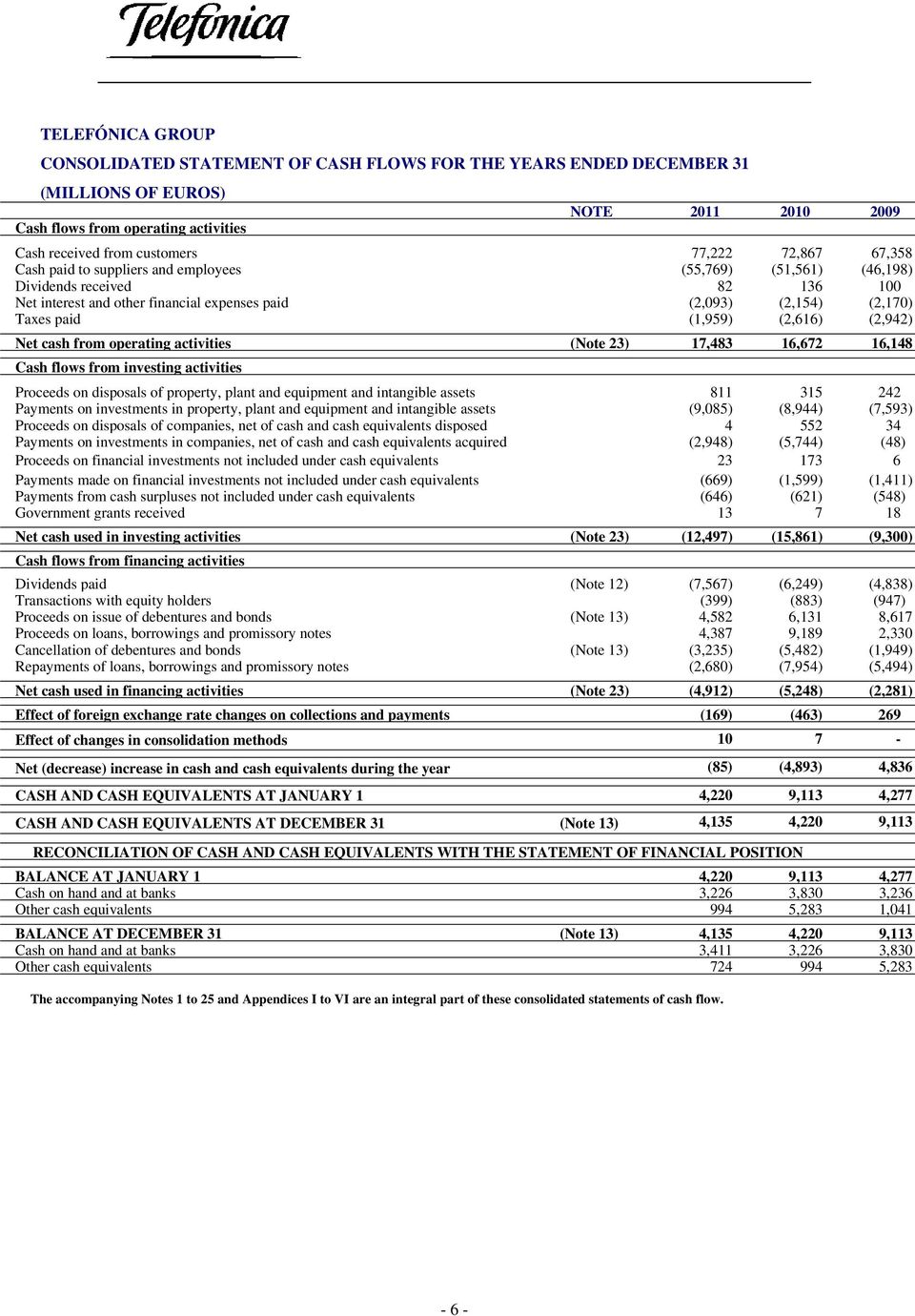
9 TELEFÓNICA GROUP CONSOLIDATED STATEMENT OF CASH FLOWS FOR THE YEARS ENDED DECEMBER 31 (MILLIONS OF EUROS) NOTE Cash flows from operating activities Cash received from customers 77,222 72,867 67,358 Cash paid to suppliers and employees (55,769) (51,561) (46,198) Dividends received Net interest and other financial expenses paid (2,093) (2,154) (2,170) Taxes paid (1,959) (2,616) (2,942) Net cash from operating activities (Note 23) 17,483 16,672 16,148 Cash flows from investing activities Proceeds on disposals of property, plant and equipment and intangible assets Payments on investments in property, plant and equipment and intangible assets (9,085) (8,944) (7,593) Proceeds on disposals of companies, net of cash and cash equivalents disposed Payments on investments in companies, net of cash and cash equivalents acquired (2,948) (5,744) (48) Proceeds on financial investments not included under cash equivalents Payments made on financial investments not included under cash equivalents (669) (1,599) (1,411) Payments from cash surpluses not included under cash equivalents (646) (621) (548) Government grants received Net cash used in investing activities (Note 23) (12,497) (15,861) (9,300) Cash flows from financing activities Dividends paid (Note 12) (7,567) (6,249) (4,838) Transactions with equity holders (399) (883) (947) Proceeds on issue of debentures and bonds (Note 13) 4,582 6,131 8,617 Proceeds on loans, borrowings and promissory notes 4,387 9,189 2,330 Cancellation of debentures and bonds (Note 13) (3,235) (5,482) (1,949) Repayments of loans, borrowings and promissory notes (2,680) (7,954) (5,494) Net cash used in financing activities (Note 23) (4,912) (5,248) (2,281) Effect of foreign exchange rate changes on collections and payments (169) (463) 269 Effect of changes in consolidation methods Net (decrease) increase in cash and cash equivalents during the year (85) (4,893) 4,836 CASH AND CASH EQUIVALENTS AT JANUARY 1 4,220 9,113 4,277 CASH AND CASH EQUIVALENTS AT DECEMBER 31 (Note 13) 4,135 4,220 9,113 RECONCILIATION OF CASH AND CASH EQUIVALENTS WITH THE STATEMENT OF FINANCIAL POSITION BALANCE AT JANUARY 1 4,220 9,113 4,277 Cash on hand and at banks 3,226 3,830 3,236 Other cash equivalents 994 5,283 1,041 BALANCE AT DECEMBER 31 (Note 13) 4,135 4,220 9,113 Cash on hand and at banks 3,411 3,226 3,830 Other cash equivalents ,283 The accompanying Notes 1 to 25 and Appendices I to VI are an integral part of these consolidated statements of cash flow
10 TELEFÓNICA, S.A. AND SUBSIDIARIES COMPOSING THE TELEFÓNICA GROUP NOTES TO THE CONSOLIDATED FINANCIAL STATEMENTS (CONSOLIDATED ANNUAL ACCOUNTS) FOR THE YEAR ENDED DECEMBER 31, 2011 (1) BACKGROUND AND GENERAL INFORMATION Telefónica Group organizational structure Telefónica, S.A. and its subsidiaries and investees (the Telefónica Group or "the Group ) make up an integrated group of companies operating mainly in the telecommunications, media and contact center industries. The parent company of the Group is Telefónica, S.A. ( Telefónica or the Company ), a public limited company incorporated on April 19, 1924 for an indefinite period.its registered office is at calle Gran Vía 28, Madrid (Spain). Appendix V lists the subsidiaries, associates and investees in which the Telefónica Group has direct or indirect holdings, their corporate purpose, country, functional currency, share capital, the Telefónica Group s effective shareholding and their method of consolidation. Corporate structure of the Group Telefónica s basic corporate purpose, pursuant to Article 4 of its Bylaws, is the provision of all manner of public or private telecommunications services, including ancillary or complementary telecommunications services or related services.all the business activities that constitute this stated corporate purpose may be performed either in Spain or abroad and wholly or partially by the Company, either through shareholdings or equity interests in other companies or legal entities with an identical or a similar corporate purpose. In 2011, the Telefónica Group followed a regional, integrated management model based on three business areas by geographical market and integrated wireline and wireless businesses in Spain, Latin America and the rest of Europe. On September 5, 2011, the Executive Committee of Telefónica s Board of Directors approved a new organizational structure with the aim of reinforcing its growth story, actively participating in the digital world and capturing the most of the opportunities afforded by its global scale and industrial alliances.more detailed information on the activities carried out by the Group is provided in Note 4.The business activities carried out by most of the Telefónica Group companies are regulated by broad ranging legislation, pursuant to which permits, concessions or licenses must be obtained in certain circumstances to provide the various services. In addition, certain wireline and wireless telephony services are provided under regulated rate and price systems. (2) BASIS OF PRESENTATION OF THE CONSOLIDATED FINANCIAL STATEMENTS The accompanying consolidated financial statements were prepared from the accounting records of Telefónica, S.A. and of each of the companies comprising the Telefónica Group, whose individual 7

11 financial statements were prepared in accordance with the generally accepted accounting principles prevailing in the various countries in which they are located, and for purposes of these consolidated financial statements are presented in accordance with the International Financial Reporting Standards (IFRS) adopted by the European Union, which for the purposes of the Telefónica Group are not different from those issued by the International Accounting Standards Board (IASB), to give a true and fair view of the consolidated equity and financial position at December 31, 2011, and of the consolidated results of operations, changes in consolidated equity and the consolidated cash flows obtained and used in the year then ended.the figures in these consolidated financial statements are expressed in millions of euros, unless otherwise indicated, and therefore may be rounded.the euro is the Group s reporting currency. The accompanying consolidated financial statements for the year ended December 31, 2011 were prepared by the Company s Board of Directors at its meeting on February 22, 2012 for submission for approval at the General Shareholders Meeting, which is expected to occur without modification. Note 3 contains a detailed description of the most significant accounting policies used to prepare these consolidated financial statements. For comparative purposes, the accompanying financial statements for 2011 include the consolidated statement of financial position at December 31, 2010 and the consolidated income statement, the consolidated statement of comprehensive income, the consolidated statement of changes in equity, the consolidated statement of cash flows and the notes thereto for the year ended December 31, 2010 and, on a voluntary basis, Comparative information and main changes in the consolidation scope The main events andchanges in the consolidation scope affecting comparability of the consolidated information for 2011 and 2010 (see Appendix I for a more detailed explanation of the changes in consolidation scope in 2010 and the main transactions in 2009) are as follows: 2011 a) Extension of the strategic partnership agreement with China Unicom Expanding on the existing strategic partnership, on January 23, 2011, Telefónica, S.A. and China Unicom (Hong Kong) Limited ( China Unicom ) signed an extension to their Strategic Partnership Agreement, in which both companies agreed to strengthen and deepen their strategic cooperation in certain business areas, and committed to investing the equivalent of 500 million US dollars in ordinary shares of the other party.telefónica acquired through its subsidiary Telefónica Internacional, S.A.U. 282,063,000 ordinary shares of China Unicom from third parties for 358 million euros. Subsequent to the execution of this transaction, Telefónica, through Telefónica Internacional, S.A.U., has a shareholding of approximately 9.57% of the voting shares of China Unicom. China Unicom completed the acquisition of Telefónica shares on January 28, 2011, giving it ownership of 1.37% of the Company s capital. 8

12 In recognition of China Unicom's stake in Telefónica, approval was given at Telefónica s General Shareholders' Meeting for the appointment of a board member named by China Unicom, in accordance with prevailing legislation and the Company's Bylaws. b) Corporate structure in Brazil On March 25, 2011 the Boards of Directors of each of the subsidiaries controlled by Telefónica, Vivo Participações and Telesp, approved the terms and conditions of a merger and restructuring process whereby all shares of Vivo Participações that were not owned by Telesp were exchanged for Telesp shares, at a rate of 1.55 new Telesp shares for each Vivo Participações share. These shares then became the property of Telesp, whereby Vivo Participações then became a wholly owned subsidiary of Telesp. The restructuring process was approved by the shareholders of Vivo Participações at the Extraordinary General Shareholders Meeting held on April 27, 2011 and by the shareholders of Telesp at the Extraordinary General Shareholders Meeting held on the same date, following authorization by Anatel thebrazilian telecommunications regulator. Once the shares were exchanged, the Telefónica Group became the owner of 73.9% of Telesp which, in turn, has 100% ownership of the shares of Vivo, S.A. The impact on equity attributable to equity holders of the parent arising from this transaction was an increase of 661 million euros (an increase of 984 million euros in Retained earnings offset by the impact of translation differences), against net equity attributable to noncontrolling interests. On June 14, 2011, the respective Boards of Directors of Vivo Participações and Telesp approved a restructuring plan whose objective is to simplify the corporate structure of both companies and foster their integration, eliminating Vivo Participações from the corporate chain through the incorporation of its total equity into Telesp, and concentrating all mobile telephony activities in Vivo, S.A. (now a direct subsidiary of Telesp). The transaction was also subject to authorization from the Brazilian telecommunications regulator and wasapproved at the General Shareholders Meetings of both companies on October 3, 2011.The company emergingfrom the merger changed its name of incorporation to Telefónica Brasil, S.A. As a result of the merger of the Brazilian companies Telesp and Vivo Participações in October 2011, the tax value of certain assets identified in the purchase price allocation changes, among them licenses, as they become tax deductible under Brazilian tax regulation. The change in the tax value of the licenses requires the reversal of the deferred tax liability recognized in the prior purchase price allocation, resulting in an impact to Corporate income tax in the accompanying consolidated income statement in the amount of 1,288 million euros (952 million euros in profit attributable to equity holders of the parent company)(note 17). 9

13 c) Redundancy plan in Spain 2010 On July 7, 2011, Telefónica de España, S.A.U. agreed with workers representatives a collective redundancy procedure for the period from 2011 to 2013 for up to a maximum of 6,500 employees, through voluntary, universal and non-discriminatory programs.the Redundancy Plan was approved by employment authorities on July 14, The Group has recognized the cost of the 2011 Redundancy Plan, per Company estimates, under Personnel expenses in the accompanying consolidated income statement in an amount of 2,671 million euros (see Note 15). a) Acquisition of 50% of Brasilcel, N.V. On July 28, 2010, Telefónica, S.A. and Portugal Telecom, SGPS, S.A. ( Portugal Telecom ) signed an agreement for the acquisition by Telefónica, S.A. of 50% of the share capital of Brasilcel, N.V. ( Brasilcel ) owned by Portugal Telecom. (Brasilcel owned approximately 60% of Vivo Participaçoes, S.A.). This transaction was completed on September 27, 2010, terminating the joint venture agreements entered into by Telefónica and Portugal Telecom in Vivo Participaçoes, S.A. was changed from the proportionate to full consolidation method within the scope of consolidation as of the transaction completion date. On December 21, 2010, the merger between Telefónica and Brasilcel was registered in the Madrid Mercantile Register, with the Company becoming a direct shareholder of the Brazilian consolidated group Vivo, with 59.6% of its capital stock. Pursuant to Brazilian legislation, on October 26, 2010, Telefónica, S.A. announced a tender offer for the voting shares of Vivo Participaçoes, S.A. ( Vivo Participaçoes ) held by noncontrolling interests representing approximately 3.8% of its capital stock. This offer was approved by the Brazilian market regulator (C.V.M.) on February 11, 2011 and, after its execution, Telefónica acquired an additional 2.7% of the Brazilian company's capital stock, for a total of 62.3%. Additionally, in accordance with IFRS 3 (see Note 3.c), the Telefónica Group remeasured the previously held 50% investment in Brasilcel, generating a capital gain of 3,797 million euros, recognized under "Other income" in the accompanying consolidated income statement for 2010 (Note 19). The main impacts of this transaction are explained in Note 5. b) Acquisition of HanseNet Telekommunikation GmbH On December 3, 2009, Telefónica s subsidiary in Germany, Telefónica Deutschland GmbH ( Telefónica Deutschland ), signed an agreement to acquire all of the shares of German company HanseNet Telekommunikation GmbH ( HanseNet ).The transaction was completed on February 16, 2010, the date on which the Telefónica Group completed the acquisition of 100% of the shares of HanseNet.The amount initially paid out was approximately 913 million euros, which included 638 million euros of refinanced debt, 10

14 andan acquisition cost in the amount of 275 million euros, which was ultimately reduced by 40 million euros upon completion of the transaction (Note 5). This company has been included in the Telefónica Group s consolidation scope under the full consolidation method. c) Devaluation of the Venezuelan Bolívar Regarding the devaluation of the Venezuelan Bolívar on January 8, 2010, the two main factors to consider with respect to the Telefónica Group s 2010 financial statements were: The decrease in the Telefónica Group s net assets in Venezuela as a result of the new exchange rate, with a balancing entry in translation differences under equity of the Group, generating an effect of approximately 1,810 million euros at the date of devaluation. The translation of results and cash flows from Venezuela at the new devalued closing exchange rate. Key performance indicators The Group uses a series of indicators in its decision-making which it considers provide a better indication of its performance.these indicators, different from accounting measures, are as follows: Operating income before depreciation and amortization (OIBDA) Operating income before depreciation and amortization (OIBDA) is calculated by excluding depreciation and amortization from operating income to eliminate the impact of investments in fixed assets that cannot be directly controlled by management in the short term.oibda is considered to be more important for investors as it provides a gauge of segment operating performance and profitability using the same measures utilized by management.this metric also allows for comparisons with other companies in the telecommunications sector without consideration of their asset structure. OIBDA is used to track the performance of the business and to establish operating and strategic targets.oibda is a commonly reported measure and is widely used among analysts, investors and other interested parties in the telecommunications industry, although not a measure explicitly defined in IFRS, and therefore, may not be comparable to similar indicators used by other companies.oibda should not be considered as an alternative to operating income as a measurement of our operating results or as an alternative to cash flows from operating activities as a measurement of our liquidity. 11

15 The following table presents the reconciliation of OIBDA to operating income for the Telefónica Group for the years ended December 31, 2011, 2010 and 2009: Millions of euros OIBDA 20,210 25,777 22,603 Depreciation and amortization (10,146) (9,303) (8,956) OPERATING INCOME 10,064 16,474 13,647 The following table presents the reconciliation of OIBDA to operating income for each business segment for the years ended December 31, 2011, 2010 and 2009: 2011 Millions of euros Telefónica Spain Telefónica Latin America Telefónica Europe Other and eliminations Total Group OIBDA 5,072 10,941 4,233 (36) 20,210 Depreciation and amortization (2,088) (4,783) (3,117) (158) (10,146) OPERATING INCOME 2,984 6,158 1,116 (194) 10, (revised 1 ) Millions of euros Telefónica Spain Telefónica Latin America Telefónica Europe Other and eliminations Total Group OIBDA 8,520 13,713 4,080 (536) 25,777 Depreciation and amortization (2,009) (3,954) (3,201) (139) (9,303) OPERATING INCOME 6,511 9, (675) 16, (revised 1 ) Millions of euros Telefónica Spain Telefónica Latin America Telefónica Europe Other and eliminations Total Group OIBDA 9,757 9,041 3,999 (194) 22,603 Depreciation and amortization (2,140) (3,700) (2,988) (128) (8,956) OPERATING INCOME 7,617 5,341 1,011 (322) 13,647 1 Revised to present, for comparative purposes, results for Telefónica International Wholesale Services (TIWS) and Telefónica North America (TNA), formerly part of Telefónica Latin America, and consolidated within Telefónica Europe since January 1,

16 Debt indicators The following table presents the reconciliation between the Telefónica Group s gross financial debt, net financial debt and net debt at December 31, 2011, 2010 and 2009: Millions of euros 31/12/11 31/12/10 31/12/09 Gross financial debt... 66,311 61,100 56,791 Other payables (e.g. bills payable)... 1,583 1, Other current payables (deferred payment for the acquisition of Brasilcel, N.V.) - 1,977 - Cash and cash equivalents... (4,135) (4,220) (9,113) Non-current financial investments... (4,830) (3,408) (2,736) Current financial investments... (2,625) (1,574) (1,906) Net financial debt... 56,304 55,593 43,551 Commitments related to financial guarantees Net commitments related to workforce reduction... 1,810 1,710 2,261 Net debt... 58,114 57,303 45,883 The Company calculated net financial debt from gross consolidated financial debt asof Decembre 31, 2011 by including other payables/receivables (e.g. bills payable/receivable) in the amount of 1,583 million euros, reduced by 4,135 million euros of cash and cash equivalents and 7,455 million euros of current financial investments and certain investments in financial assets with maturitiesgreater than one year, included in the consolidated statement of financial, under Noncurrent financial assets. After adjustment for these items, net financial debt at December 31, 2011 amounted to 56,304 million euros, an increase of 1.3% from 2010 (55,593 million euros). (3) ACCOUNTING POLICIES The principal accounting policies used in preparing the accompanying consolidated financial statements are as follows: a) Translation methodology The financial statements of the Group s foreign subsidiaries were translated to euros at the year-end exchange rates, except for: 1. Capital and reserves, which were translated at historical exchange rates. 2. Income statements, which were translated at the average exchange rates for the year. 3. Statements of cash flow, which were translated at the average exchange rate for the year. Goodwill and statement of financial position items remeasured to fair value when a stake is acquired in a foreign operation are recognized as assets and liabilities of the company acquired and therefore translated at the closing exchange rate. The exchange rate differences arising from the application of this method are included in Translation differences under Equity attributable to equity holders of the parent in the accompanying consolidated statements of financial position, net of the portion of said differences attributable to non-controlling interests, which is shown under Non-controlling interests. When the Company loses control of a foreign subsidiary, either through total or partial sale or dilution of its interest, the entire cumulative translation difference since January 1, 2004 (the IFRS transition date) applicable to such operation is recognized in income together with any gain or loss from the loss of control.transactions in the stock of subsidiaries that do not result in loss of control are recognized within equity, with a reallocation of the related 13

17 cumulative translation difference.all other transactions resulting in the total or partial sale of the Company s interest in an entity not controlled by the Company will result in a proportionate recognition of the related cumulative translation difference in income. The financial statements of Group companies whose functional currency is the currency of a hyperinflationary economy are adjusted for inflation in accordance with the procedure described in the following paragraph prior to their translation to euros.once restated, all items of the financial statements are converted to euros using the closing exchange rate.amounts shown for prior years for comparative purposes are not modified. To determine the existence of hyperinflation, the Group assesses the qualitative characteristics of the economic environment of the country, such as the trends in inflation rates over the previous three years.the financial statements of companies whose functional currency is the currency of a hyperinflationary economy are adjusted to reflect the changes in purchasing power of the local currency, such that all items in the statement of financial position not expressed in current terms (non-monetary items) are restated by applying a general price index at the financial statement closing date, and all income and expense, profit and loss are restated monthly by applying appropriate adjustment factors.the difference between initial and adjusted amounts is taken to profit or loss. In that regard, as indicated in Note 2, Venezuela has been classified as a hyperinflationary economy in 2011 and The inflation rates used to prepare the restated financial information are those published by the Central Bank of Venezuela.On an annual basis, these rates are 27.59% and 27.18% for 2011 and 2010, respectively. b) Foreign currency transactions Monetary transactions denominated in foreign currencies are translated to euros at the exchange rates prevailing on the transaction date, and are adjusted at year end to the exchange rates then prevailing. All realized and unrealized exchange gains or losses are taken to the income statement for the year, with the exception of gains or losses arising from specific-purpose financing of investments in foreign investees designated as hedges of foreign currency risk to which these investments are exposed (see Note 3 i), and exchange gains or losses on intra-group loans considered part of the net investment in a foreign operation, which are included under Other comprehensive income. 14

18 c) Goodwill - For acquisitions occurring from January 1, 2010, the effective date of Revised IFRS 3, Business combinations, goodwill represents the excess of acquisition cost over the fair values of identifiable assets acquired and liabilities assumed at the acquisition date.cost of acquisition is the sum of the fair value of consideration delivered and the value attributed to existing non-controlling interests.for each business combination, the company determines the value of non-controlling interests at either their fair value or their proportional part of the net identifiable assets acquired.after initial measurement, goodwill is carried at cost, less any accumulated impairment losses.whenever an equity interest is held in the acquiree prior to the business combination (business combinations achieved in stages), the carrying value of such previously held equity interest is remeasured at its acquisition-date fair value and the resulting gain or loss, if any, is recognized in profit or loss. - For acquisitions after January 1, 2004, the IFRS transition date, and prior to January 1, 2010, the effective date of Revised IFRS 3, Business combinations, goodwill represents the excess of the acquisition cost over the acquirer s interest, at the acquisition date, in the fair values of identifiable assets, liabilities and contingent liabilities acquired from a subsidiary or joint venture.after initial measurement, goodwill is carried at cost, less any accumulated impairment losses. - In the transition to IFRS, Telefónica availed itself of the exemption allowing it not to restate business combinations taking place before January 1, As a result, the accompanying consolidated statements of financial position include goodwill net of amortization deducted until December 31, 2003, arising before the IFRS transition date, from the positive consolidation difference between the amounts paid to acquire shares of consolidated subsidiaries, and their carrying amounts plus increases in the fair value of assets and liabilities recognized in equity. In all cases, goodwill is recognized as an asset denominated in the currency of the company acquired. Goodwill is tested for impairment annually or more frequently if there are certain events or changes indicating the possibility that the carrying amount may not be fully recoverable. The potential impairment loss is determined by assessing the recoverable amount of the cash generating unit (or group of cash-generating units) to which the goodwill relates when originated.if this recoverable amount is less than the carrying amount, an irreversible impairment loss is recognized in income (see Note 3 f). d) Intangible assets Intangible assets are stated at acquisition or production cost, less any accumulated amortization or any accumulated impairment losses. The useful lives of intangible assets are assessed individually to be either finite or indefinite.intangible assets with finite lives are amortized systematically over the useful economic life and assessed for impairment whenever events or changes indicate that their carrying amount may not be recoverable.intangible assets with indefinite useful lives are not amortized, but are tested for impairment annually, or more frequently in the event of indications that their carrying amount may not be recoverable (see Note 3 f). 15

19 Management reassesses the indefinite useful life classification of these assets on an annual basis. Amortization methods and schedules are revised annually at year end and, where appropriate, adjusted prospectively. Research and development costs Research costs are expensed as incurred.costs incurred in developing new products to be marketed or used for the Group s own network, and whose future economic viability is reasonably certain, are capitalized and amortized on a straight-line basis over the period during which the related project is expected to generate economic benefits, starting upon its completion. Recoverability is considered to be reasonably assured when the Group can demonstrate the technical feasibility of completing the intangible asset, whether it will be available for use or sale, its intention to complete and its ability to use or sell the asset and how the asset will generate future economic benefits. As long as intangible assets developed internally are not in use, the associated capitalized development costs are tested for impairment annually or more frequently if there are indications that the carrying amount may not be fully recoverable.costs incurred in connection with projects that are not economically viable are charged to the consolidated income statement for the year in which this circumstance becomes known. Service concession arrangements and licenses These arrangements relate to the acquisition cost of the licenses granted to the Telefónica Group by various public authorities to provide telecommunications services and to the value assigned to licenses held by certain companies at the time they were included in the Telefónica Group. These concessions are amortized on a straight-line basis over the duration of related licenses from the moment commercial exploitation commences. Customer base This primarily represents the allocation of acquisition costs attributable to customers acquired in business combinations, as well as the acquisition value of this type of assets in a third-party acquisition entailing consideration.amortization is on a straight-line basis over the estimated period of the customer relationship. Software Software is stated at cost and amortized on a straight-line basis over its useful life, generally estimated to be between three and five years. 16

20 e) Property, plant and equipment Property, plant and equipment is stated at cost less any accumulated depreciation and any accumulated impairment in value.land is not depreciated. Cost includes external and internal costs comprising warehouse materials used, direct labor used in installation work and the allocable portion of the indirect costs required for the related investment.the latter two items are recorded as revenues under Other income - Own work capitalized. Cost includes, where appropriate, the initial estimate of decommissioning, retirement and site reconditioning costs when the Group is under obligation to incur such costs due to the use of the asset. Interest and other financial expenses incurred and directly attributable to the acquisition or construction of qualifying assets are capitalized.qualifying assets at the Telefónica Group are those assets that require a period of at least 18 months to bring the assets to their intended use or sale. The costs of expansion, modernization or improvement leading to increased productivity, capacity or efficiency or to a lengthening of the useful lives of assets are capitalized when recognition requirements are met. Upkeep and maintenance expenses are expensed as incurred. The Telefónica Group assesses the need to write down, if appropriate, the carrying amount of each item of property, plant and equipment to its recoverable amount, whenever there are indications that the asset s carrying amount exceeds the higher of its fair value less costs to sell or its value in use.the impairment provision is not maintained if the factors giving rise to the impairment disappear (see Note 3 f). The Group s subsidiaries depreciate their property, plant and equipment, net of their residual values, once they are in full working condition using the straight-line method based on the assets estimated useful lives, calculated in accordance with technical studies which are revised periodically based on technological advances and the rate of dismantling, as follows: Years of estimated useful life Buildings Plant and machinery Telephone installations, networks and subscriber equipment 5 20 Furniture, tools and other items 2 10 Assets estimated residual values and methods and depreciation periods are reviewed, and adjusted if appropriate, prospectively at each financial year end. f) Impairment of non-current assets Non-current assets, including property, plant and equipment, goodwill and intangible assets are evaluated at each reporting date for indications of impairment losses.wherever such indications exist, or in the case of assets which are subject to an annual impairment test, recoverable amount is estimated.an asset s recoverable amount is the higher of fair value less costs to sell and value in use.in assessing value in use, the estimated future cash flows deriving from the use of the asset or its cash generating unit, as applicable, are discounted to their present value using a pre-tax discount rate that reflects current market assessments of the time value of money and the risks specific to the asset.when the carrying amount of an asset 17

21 exceeds its recoverable amount, the asset is considered to be impaired.in this case, the carrying amount is written down to recoverable amount and the resulting loss is taken to the income statement.future depreciation or amortization charges are adjusted for the asset s new carrying amount over its remaining useful life.each asset is assessed individually for impairment, unless the asset does not generate cash inflows that are largely independent of those from other assets (or cash generating units). The Group bases the calculation of impairment on the business plans of the various cash generating units to which the assets are allocated.these business plans generally cover a period of three to five years.for periods after the term of the strategic plan, an expected constant or decreasing growth rate is applied to the projections based on these plans.the growth rates used in 2011 and 2010 are as follows: Rates Businesses in Spain 0.51%-0.59% 0.91%-1.10% Businesses in Latin America 1.75%-2.58% 1.66%-2.56% Businesses in Europe 0.96%-1.07% 1.28%-1.46% The main variables used by management to determine recoverable amounts are ARPU (average revenues per user), customer acquisition and retention costs, share of net adds in accesses, market shares, investments in non-current assets, growth rates and discount rates. Tax discount rates are adjusted for country and business risks.the following ranges of rates were used in 2011 and 2010: Rates Businesses in Spain 7.5%-14.8% 7.8%-8.6% Businesses in Latin America 7.3%-17.8% 7.2%-17.3% Businesses in Europe 5.9%-11.2% 6.3%-10.9% When there are new events or changes in circumstances that indicate that a previously recognized impairment loss no longer exists or has been decreased, a new estimate of the asset s recoverable amount is made.a previously recognized impairment loss is reversed only if there has been a change in the estimates used to determine the asset s recoverable amount since the last impairment loss was recognized.if that is the case, the carrying amount of the asset is increased to its recoverable amount.the reversal is limited to the net carrying amount that would have been determined had no impairment loss been recognized for the asset in prior years.such reversal is recognized in profit or loss and the depreciation charge is adjusted in future periods to allocate the asset s revised carrying amount.impairment losses relating to goodwill cannot be reversed in future periods. g) Lease payments The determination of whether an arrangement is, or contains a lease is based on the substance of the agreement and requires an assessment of whether the fulfillment of the arrangement is dependent on the use of a specific asset and the agreement conveys a right to the Telefónica Group to the use of the asset. Leases where the lessor does not transfer substantially all the risks and benefits of ownership of the asset are classified as operating leases.operating lease payments are recognized as an expense in the income statement on a straight-line basis over the lease term. 18
22 Leases are classified as finance leases when the terms of the lease transfer substantially all the risks and rewards incidental to ownership of the leased item to the Group.These are classified at the inception of the lease, in accordance with its nature and the associated liability, at the lower of the present value of the minimum lease payments or the fair value of the leased property.lease payments are apportioned between finance costs and reduction of the principal of lease liability so as to achieve a constant rate of interest on the remaining balance of the liability.finance costs are reflected in the income statement over the lease term. In firm sale and leaseback transactions resulting in a finance lease, the asset sold is not derecognized and the case received is considered finance for the lease term. However, when the sale and leaseback transaction results in an operating lease, and it is clear that both the transaction and subsequent lease income are established at fair value, the asset is derecognized and any gain or loss generated on the transaction is recognized. h) Investments in associates The Telefónica Group s investments in companies over which it exercises significant influence but does not control or jointly control with third parties are accounted for using the equity method.the Group evaluates whether it exercises significant influence not only on the basis of its percentage ownership but also on the existence of qualitative factors such representation on the board of directors of the investee, its participation in decision-making processes, interchange of managerial personnel and access to technical information.the carrying amount of investments in associates includes related goodwill and the consolidated income statement reflects the share of profit or loss from operations of the associate.if the associate recognizes any gains or losses directly in equity, the Group also recognizes the corresponding portion of these gains or losses directly in its own equity. The Group assesses the existence of indicators of impairment of the investment in each associate at each reporting date in order to recognize any required valuation adjustments.to do so, the recoverable value of the investment as a whole is determined as described in Note 3.f. i) Financial assets and liabilities Financial investments All normal purchases and sales of financial assets are recognized in the statement of financial position on the trade date, i.e. the date that the Company commits to purchase or sell the asset.the Telefónica Group classifies its financial instruments into four categories for initial recognition purposes:financial assets at fair value through profit or loss, loans and receivables, held-to-maturity investments and available-for-sale financial assets.when appropriate, the Company re-evaluates the designation at each financial year end. Financial assets held for trading, i.e., investments made with the aim of realizing short-term returns as a result of price changes, are included in the category financial assets at fair value through profit or loss and presented as current or non-current assets, depending on their maturity. Derivatives are classified as held for trading unless they are designated as effective hedging instruments.the Group also classifies certain financial instruments under this category when doing so eliminates or mitigates measurement or recognition inconsistencies that could arise from the application of other criteria for measuring assets and liabilities or for recognizing gains and losses on different bases.also in this category are financial assets for which an investment and disposal strategy has been designed based on their fair value.financial instruments included in this category are recorded at fair value and are remeasured at 19
23 subsequent reporting dates at fair value, with any realized or unrealized gains or losses recognized in the income statement. Financial assets with fixed maturities that the Group has the positive intention and ability legal and financial to hold until maturity are classified as held-to-maturity and presented as Current assets or Non-current assets, depending on the time left until settlement.financial assets falling into this category are measured at amortized cost using the effective interest rate method.gains and losses are recognized in the income statement when the investments are settlement or impaired, as well as through the amortization process. Financial assets which the Group intends to hold for an unspecified period of time and could be sold at any time to meet specific liquidity requirements or in response to interest-rate movements are classified as available-for-sale.these investments are recorded under Noncurrent assets, unless it is probable and feasible that they will be sold within 12 months.financial assets in this category are measured at fair value.gains or losses arising from changes in fair value are recognized in equity at each financial year end until the investment is derecognized or determined to be impaired, at which time the cumulative gain or loss previously reported in equity is recognized in profit or loss.dividends from available-for-sale investments are recognized in the income statement when the Group has the right to receive the dividend.fair value is determined in accordance with the following criteria: 1. Listed securities on active markets: Fair value is considered to be quoted market price or other valuation references available at the closing date. 2. Unlisted securities: Fair value is determined using valuation techniques such as discounted cash flow analysis, option valuation models, or by reference to arm s length market transactions. Exceptionally, with equity instruments, when fair value cannot be reliably determined, the investments are carried at cost. Loans and receivables include financial assets with fixed or determinable payments that are not quoted in an active market and do not fall into any of the previous categories.these assets are carried at amortized cost using the effective interest rate method.gains and losses are recognized in the income statement when the loans and receivables are derecognized or impaired, as well as through the amortization process.trade receivables are recognized at the original invoice amount.a valuation adjustment is recorded when there is objective evidence of customer collection risk.the amount of the valuation adjustment is calculated as the difference between the carrying amount of the doubtful trade receivables and their recoverable amount.as a general rule, current trade receivables are not discounted. The Group assesses at each reporting date whether a financial asset is impaired.if there is objective evidence that an impairment loss on a financial asset carried at amortized cost has been incurred, the amount of the loss is measured as the difference between the asset s carrying amount and the present value of estimated future cash flows (excluding future expected credit losses that have not been incurred) discounted at the financial asset s original effective interest rate. For equity instruments included in available-for-sale financial assets, the Company assesses individually for each security whether there is any objective evidence that an asset is impaired as a result of one or more events indicating that the carrying amount of the security will not be recovered.if there is objective evidence that an available-for-sale financial instrument is impaired, the cumulative loss recognized in equity, measured as the difference between the 20
24 acquisition cost (net of any principal payments and amortization made) and the fair value at that date, less any impairment loss on that investment previously recognized in the income statement, is removed from equity and recognized in the consolidated income statement. Financial assets are only fully or partially derecognized when: 1. The rights to receive cash flows from the asset have expired. 2. An obligation to pay the cash flows received from the asset to a third party has been assumed. 3. The rights to receive cash flows from the asset have been transferred to a third party and all the risks and rewards of the asset have been substantially transferred. Cash and cash equivalents Cash and cash equivalents comprise cash on hand and at banks, demand deposits and other highly liquid investments with an original maturity of three months or less.these items are stated at historical cost, which does not differ significantly from realizable value. For the purpose of the consolidated statement of cash flows, cash and cash equivalents are shown net of any outstanding bank overdrafts. Preferred stock Preferred shares are classified as a liability or equity instrument depending on the issuance terms.a preferred share issue is considered equity only when the issuer is not obliged to give cash or another financial instrument in the form of either principle repayment or dividend payment, whereas it is recorded as a financial liability on the statement of financial position whenever the Telefónica Group does not have the right to avoid cash payments. Issues and interest-bearing debt These debts are recognized initially at the fair value of the consideration received less directly attributable transaction costs.after initial recognition, these financial liabilities are measured at amortized cost using the effective interest rate method.any difference between the cash received (net of transaction costs) and the repayment value is recognized in the income statement over the life of the debt.interest-bearing debt is considered non-current when its maturity is over 12 months or the Telefónica Group has full discretion to defer settlement for at least another 12 months from the reporting date. Financial liabilities are derecognized when the obligation under the liability is discharged, cancelled or expires.where an existing financial liability is replaced by another from the same lender under substantially different terms, such an exchange is treated as a derecognition of the original liability and the recognition of a new liability, and the difference between the respective carrying amounts is recognized in the income statement. Derivative financial instruments and hedge accounting Derivative financial instruments are initially recognized at fair value, normally equivalent to cost.their carrying amounts are subsequently remeasured at fair value.derivatives are carried as assets when the fair value is positive and as liabilities when the fair value is negative.they are classified as current or non-current depending on whether they fall due within less than or after one year, respectively.derivatives that meet all the criteria for consideration as long-term 21
25 hedging instruments are recorded as non-current assets or liabilities, depending on their positive or negative values. The accounting treatment of any gain or loss resulting from changes in the fair value of a derivative depends on whether the derivative in question meets all the criteria for hedge accounting and, if appropriate, on the nature of the hedge. The Group designates certain derivatives as: 1. Fair value hedges, when hedging the exposure to changes in the fair value of a recognized asset or liability or a firm transaction; 2. Cash flow hedges, when hedging exposure to variability in cash flows that is either attributable to a particular risk associated with a recognized asset or liability or a highly probable forecast transaction; or 3. Hedges of a net investment in a foreign operation. A hedge of the foreign currency risk of a firm commitment may be accounted for as a fair value or a cash flow hedge. Changes in fair value of derivatives that qualify as fair value hedges are recognized in the income statement, together with changes in the fair value of the hedged asset or liability attributable to the risk being hedged. Changes in the fair value of derivatives that qualify and have been assigned to hedge cash flows, which are highly effective, are recognized in equity.the portion considered ineffective is taken directly to the income statement.fair value changes from hedges that relate to firm commitments or forecast transactions that result in the recognition of non-financial assets or liabilities are included in the initial measurement of those assets or liabilities.otherwise, changes in fair value previously recognized in equity are recognized in the income statement in the period in which the hedged transaction affects profit or loss. An instrument designed to hedge foreign currency exposure from a net investment in a foreign operation is accounted for in a similar manner to cash flow hedges. The application of the Company s corporate risk-management policies could result in financial risk-hedging transactions that make economic sense, yet do not comply with the criteria and effectiveness tests required by accounting policies to be treated as hedges.alternatively, the Group may opt not to apply hedge accounting criteria in certain instances.in these cases, gains or losses resulting from changes in the fair value of derivatives are taken directly to the income statement.transactions used to reduce the exchange rate risk relating to the income contributed by foreign subsidiaries are not treated as hedging transactions. From inception, the Group formally documents the hedging relationship between the derivative and the hedged item, as well as the associated risk management objectives and strategies.the documentation includes identification of the hedge instrument, the hedged item or transaction and the nature of the risk being hedged.in addition, it states how it will assess the hedging instrument s effectiveness in offsetting the exposure to changes in the hedged item s fair value or cash flows attributable to the hedged risk.hedge effectiveness is assessed, prospectively and retrospectively, both at the inception of the hedge relationship and on a systematic basis throughout the life of the hedge. 22
26 Hedge accounting is discontinued whenever the hedging instrument expires or is sold, terminated or settled, the hedge no longer meets the criteria for hedge accounting or the Company revokes the designation.in these instances, gains or losses accumulated in equity are not taken to the income statement until the forecast transaction or commitment affects profit or loss.however, if the hedged transaction is no longer expected to occur, the cumulative gains or losses recognized directly in equity are taken immediately to the income statement. The fair value of the derivative portfolio includes estimates based on calculations using observable market data, as well as specific pricing and risk-management tools commonly used by financial entities. j) Inventories Materials stored for use in investment projects and inventories for consumption and replacement are valued at the lower of weighted average cost and net realizable value. When the cash flows associated with the purchase of inventory are effectively hedged, the corresponding gains and losses accumulated in equity become part of the cost of the inventories acquired. Obsolete, defective or slow-moving inventories have been written down to estimated net realizable value.the recoverable amount of inventory is calculated based on inventory age and turnover. k) Treasury share instruments Treasury shares are stated at cost and deducted from equity.any gain or loss obtained on the purchase, sale, issue or cancellation of treasury shares is recognized directly in equity. Call options on treasury shares to be settled through the physical delivery of a fixed number of shares at a fixed price are considered treasury share instruments.they are valued at the amount of premium paid and are presented as a reduction in equity.if the call options are exercised upon maturity, the amount previously recognized is reclassified as treasury shares together with the price paid.if the options are not exercised upon maturity, the amount is recognized directly in equity. l) Provisions Pensions and other employee obligations Provisions required to cover the accrued liability for defined-benefit pension plans are determined using the projected unit credit actuarial valuation method.the calculation is based on demographic and financial assumptions for each country considering the macroeconomic environment.the discount rates are determined based on market yield curves.plan assets are measured at fair value.actuarial gains and losses on post-employment defined-benefit plans are recognized immediately in equity. For defined-contribution pension plans, the obligations are limited to the payment of the contributions, which are taken to the income statement as accrued. Provisions for post-employment benefits (e.g. early retirement or other) are calculated individually based on the terms agreed with the employees.in some cases, these may require actuarial valuations based on both demographic and financial assumptions. 23
27 Other provisions Provisions are recognized when the Group has a present obligation (legal or constructive), as a result of a past event, it is probable that an outflow of resources embodying economic benefits will be required to settle the obligation and a reliable estimate can be made of the amount of the obligation.when the Group expects some or all of a provision to be reimbursed, for example under an insurance contract, the reimbursement is recognized as a separate asset, but only when the reimbursement is virtually certain.the expense relating to any provision is presented in the income statement net of any reimbursement.if the effect of the time value of money is material, provisions are discounted, and the corresponding increase in the provision due to the passage of time is recognized as a finance cost. m) Share-based payments The Group has compensation systems linked to the market value of its shares, providing employees share options.certain compensation plans are cash-settled, while equity-settled in others. For cash-settled share-based transactions, the total cost of the rights granted is recognized as an expense in the income statement over the vesting period with recognition of a corresponding liability (Performance period).the total cost of the options is measured initially at fair value at the grant date using statistical techniques, taking into account the terms and conditions established in each share option plan.at each subsequent reporting date, the Group reviews its estimate of fair value and the number of options it expects to be settled, remeasuring the liability, with any changes in fair value recognized in the income statement. For equity-settled share option plans, fair value at the grant date is measured by applying statistical techniques or using benchmark securities.the cost is recognized, together with a corresponding increase in equity, over the vesting period.at each subsequent reporting date, the Company reviews its estimate of the number of options it expects to vest, with a corresponding adjustment to equity. n) Corporate income tax This heading in the accompanying consolidated income statement includes all the expenses and credits arising from the corporate income tax levied on the Spanish Group companies and similar taxes applicable to the Group s foreign operations. The income tax expense of each year includes both current and deferred taxes, where applicable. Current tax assets and liabilities for the current and prior periods are measured at the amount expected to be recovered from or paid to the taxation authorities.the tax rates and tax laws used to compute the amount are those that are enacted or substantively enacted by the reporting date. Deferred taxes are calculated based on a statement of financial position analysis of the temporary differences generated as a result of the difference between the tax bases of assets and liabilities and their respective carrying amounts. The main temporary differences arise due to discrepancies between the tax bases and carrying amounts of property, plant and equipment, intangible assets, and non-deductible provisions, as well as differences in the fair value and tax bases of net assets acquired from a subsidiary, associate or joint venture. 24
28 Furthermore, deferred taxes arise from unused tax credits and tax loss carryforwards. The Group determines deferred tax assets and liabilities by applying the tax rates that will be effective when the corresponding asset is received or the liability is settled, based on tax rates and tax laws that are enacted (or substantively enacted) at the reporting date. Deferred income tax assets and liabilities are not discounted to present value and are classified as non-current, irrespective of the date of their reversal. The carrying amount of deferred income tax assets is reviewed at each reporting date and reduced to the extent that it is no longer probable that sufficient taxable profit will be available to allow all or part of the deferred income tax asset to be utilized.unrecognized deferred income tax assets are reassessed at each reporting date and are recognized to the extent that it has become probable that future taxable profit will allow the deferred tax asset to be recovered. Deferred tax liabilities on investments in subsidiaries, branches, associates and joint ventures are not recognized if the parent company is in a position to control the timing of the reversal and if the reversal is unlikely to take place in the foreseeable future. Deferred income tax relating to items directly recognized in equity is recognized in equity.deferred tax assets and liabilities arising from the initial recognition of the purchase price allocation of business combinations impact the amount of goodwill.however, subsequent changes in tax assets acquired in a business combination are recognized as an adjustment to profit or loss. Deferred tax assets and liabilities are offset if a legally enforceable right exists to set off current tax assets against current tax liabilities and the deferred taxes relate to the same taxable entity and the same taxation authority. o) Revenue and expenses Revenue and expenses are recognized on the income statement based on an accruals basis; i.e. when the goods or services represented by them take place, regardless of when actual payment or collection occurs. The Telefónica Group principally obtains revenues from providing the following telecommunications services:traffic, connection fees, regular (normally monthly) network usage fees, interconnection, network and equipment leasing, handset sales and other services such as pay TV and value-added services (e.g. text or data messaging) and maintenance.products and services may be sold separately or in promotional packages (bundled). Revenues from calls carried on Telefónica s networks (traffic) entail an initial call establishment fee plus a variable call rate, based on call length, distance and type of service.both wireline and wireless traffic is recognized as revenue as service is provided.for prepaid calls, the amount of unused traffic generates a deferred revenue recognized in Trade and other payables on the statement of financial position.prepaid cards generally expire within 12 months and any deferred revenue from prepaid traffic is taken directly to the income statement when the card expires as the Group has no obligation to provide service after this date. Revenue from traffic sales and services at a fixed rate over a specified period of time (flat rate) are recognized on a straight-line basis over the period of time covered by the rate paid by the customer. 25
29 Connection fees arising when customers connect to the Group s network are deferred and taken to the income statement throughout the average estimated customer relationship period, which varies by type of service.all related costs, except those related to network enlargement expenses, administrative expenses and overhead, are recognized in the income statement as incurred. Installment fees are taken to the income statement on a straight-line basis over the related period.equipment leases and other services are taken to profit or loss as they are consumed. Interconnection revenues from wireline-wireless and wireless-wireline calls and other customer services are recognized in the period in which the calls are made. Revenues from handset and equipment sales are recognized once the sale is considered complete, i.e., generally when delivered to the end customer. In the wireless telephony business there are loyalty campaigns whereby customers obtain points for the telephone traffic they generate.the amount assigned to points awarded is recognized as deferred income until the points are exchanged and recognized as sales or services according to the product or service chosen by the customer.this exchange can be for discounts on the purchase of handsets, traffic or other types of services depending on the number of points earned and the type of contract involved.the accompanying consolidated statements of financial position include the related deferred revenue, based on an estimate of the value of the points accumulated at year-end, under Trade and other payables. Bundle packages, which include different elements, are sold in the wireline, wireless and internet businesses.they are assessed to determine whether it is necessary to separate the separately identifiable elements and apply the corresponding revenue recognition policy to each element.total package revenue is allocated among the identified elements based on their respective fair values (i.e. the fair value of each element relative to the total fair value of the package). As connection or initial activation fees, or upfront non-refundable fees, cannot be separately identifiable as elements in these types of packages, any revenues received from the customer for these items are allocated to the remaining elements.however, amounts contingent upon delivery of undelivered elements are not allocated to delivered elements. All expenses related to mixed promotional packages are taken to the income statement as incurred. p) Use of estimates, assumptions and judgments The key assumptions concerning the future and other relevant sources of uncertainty in estimates at the reporting date that could have a significant impact on the consolidated financial statements within the next financial year are discussed below. A significant change in the facts and circumstances on which these estimates and related judgments are based could have a material impact on the Group s results and financial position. 26
30 Property, plant and equipment, intangible assets and goodwill The accounting treatment of investments in property, plant and equipment and intangible assets entails the use of estimates to determine the useful life for depreciation and amortization purposes and to assess fair value at their acquisition dates for assets acquired in business combinations. Determining useful life requires making estimates in connection with future technological developments and alternative uses for assets.there is a significant element of judgment involved in making technological development assumptions, since the timing and scope of future technological advances are difficult to predict. When an item of property, plant and equipment or an intangible asset is considered to be impaired, the impairment loss is recognized in the income statement for the period.the decision to recognize an impairment loss involves estimates of the timing and amount of the impairment, as well as analysis of the reasons for the potential loss.furthermore, additional factors, such as technological obsolescence, the suspension of certain services and other circumstantial changes are taken into account. The Telefónica Group evaluates its cash-generating units performance regularly to identify potential goodwill impairments.determining the recoverable amount of the cash-generating units to which goodwill is allocated also entails the use of assumptions and estimates and requires a significant element of judgment. Deferred income taxes The Group assesses the recoverability of deferred tax assets based on estimates of future earnings.the ability to recover these taxes depends ultimately on the Group s ability to generate taxable earnings over the period for which the deferred tax assets remain deductible.this analysis is based on the estimated schedule for reversing deferred tax liabilities, as well as estimates of taxable earnings, which are sourced from internal projections and are continuously updated to reflect the latest trends. The recognition of tax assets and liabilities depends on a series of factors, including estimates as to the timing and realization of deferred tax assets and the projected tax payment schedule.actual Group company income tax receipts and payments could differ from the estimates made by the Group as a result of changes in tax legislation or unforeseen transactions that could affect tax balances. Provisions Provisions are recognized when the Group has a present obligation as a result of a past event, it is probable that an outflow of resources will be required to settle the obligation and a reliable estimate can be made of the amount of the obligation.this obligation may be legal or constructive, deriving from inter alia regulations, contracts, normal practices or public commitments that lead third parties to reasonably expect that the Group will assume certain responsibilities.the amount of the provision is determined based on the best estimate of the outflow of resources required to settle the obligation, bearing in mind all available information at the statement of financial position date, including the opinions of independent experts such as legal counsel or consultants. Given the uncertainties inherent in the estimates used to determine the amount of provisions, actual outflows of resources may differ from the amounts recognized originally on the basis of the estimates. 27
31 Revenue recognition Connection fees Connection fees, generated when customers connect to the Group s network, are deferred and recognized as revenue over the average estimated customer relationship period. The estimate of the average estimated customer relationship period is based on the recent history of customer churn.potential changes in estimates could lead to changes in both the amount and timing of the future recognition of revenues. Bundled offers Bundled offers that combine different elements are assessed to determine whether it is necessary to separate the different identifiable components and apply the corresponding revenue recognition policy to each element.total package revenue is allocated among the identified elements based on their respective fair values. Determining fair values for each identified element requires estimates that are complex due to the nature of the business. A change in estimates of fair values could affect the apportionment of revenue among the elements and, as a result, the date of recognition of revenues. q) Consolidation methods The consolidation methods applied are as follows: Full consolidation method for companies over which the Company controls either by exercising effective control or by virtue of agreements with the other shareholders. Proportionate consolidation method for companies which are jointly controlled with third parties (joint ventures).similar items are grouped together such that the corresponding proportion of these companies overall assets, liabilities, expenses and revenues and cash flows are integrated on a line by line basis into the consolidated financial statements. Equity method for companies in which there is significant influence, but not control or joint control with third parties. In certain circumstances, some of the Group s investees may require a qualified majority to adopt certain resolutions.this, together with other factors, is taken into account when selecting the consolidation method. All material accounts and transactions between the consolidated companies were eliminated on consolidation.the returns generated on transactions involving capitalizable goods or services by subsidiaries with other Telefónica Group companies were eliminated on consolidation. The financial statements of the consolidated companies have the same financial year-end as the parent company s individual financial statements and are prepared using the same accounting policies.in the case of Group companies whose accounting and valuation methods differed from those of the Telefónica Group, adjustments were made on consolidation in order to present the consolidated financial statements on a uniform basis. 28
32 The consolidated income statement and consolidated statement of cash flows include the revenues and expenses and cash flows of companies that are no longer in the Group up to the date on which the related holding was sold or the company was liquidated, and those of the new companies included in the Group from the date on which the holding was acquired or the company was incorporated through year end. Revenue and expenses associated with discontinued operations are presented in a separate line on the consolidated income statement.discontinued operations are those with identifiable operations and cash flows (for both operating and management purposes) and that represent a line of business or geographic unit which has been disposed of or is available for sale. The share of non-controlling interests in the equity and results of the fully consolidated subsidiaries is presented under "Non-controlling interests" on the consolidated statement of financial position and income statement, respectively. r) Acquisitions and disposals of non-controlling interests Changes in investments in subsidiaries without loss of control: Prior to January 1, 2010, the effective date of IAS 27 (Amended) Consolidated and separate financial statements, the Telefónica Group treated increases in equity investments of companies already controlled by the Group via purchases of non-controlling interests by recognizing any difference between the acquisition price and the carrying amount of the noncontrolling interest s participation as goodwill.in transactions involving the sale of investments in subsidiaries in which the Group retained control, the Telefónica Group derecognized the carrying amount of the shareholding sold, including any related goodwill.the difference between this amount and the sale price was recognized as a gain or loss in the consolidated income statement. Effective January 1, 2010, any increase or decrease in the percentage of ownership interests in subsidiaries that does not result in a loss of control is accounted for as a transaction with owners in their capacity as owners, which means that as of the aforementioned date, these transactions do not give rise to goodwill or generate profit or loss; any difference between the carrying amount of the non-controlling interests and the fair value of the consideration received or paid, as applicable, is recognized in equity. Commitments to acquire non-controlling interests (put options): Put options granted to non-controlling interests of subsidiaries are measured at the exercise price and classified as a financial liability, with a deduction from non-controlling interests on the consolidated statement of financial position at each reporting date.prior to January 1, 2010, the effective date of IAS 27 (Amended) Consolidated and separate financial statements, where the exercise price exceeded the balance of non-controlling interests, the difference was recognized as an increase in the goodwill of the subsidiary.at each reporting date, the difference was adjusted based on the exercise price of the options and the carrying amount of non-controlling interests.as of January 1, 2010, the effect of this adjustment is recognized in equity in line with the treatment of transactions with owners described in the previous paragraphs. 29
33 s) New IFRS and interpretations of the IFRS Interpretations Committee (IFRIC) The accounting policies applied in the preparation of the financial statements for the year ended December 31, 2011 are consistent with those used in the preparation of the Group s consolidated annual financial statements for the year ended December 31, 2010, except for the application of new standards, amendments to standards and interpretations published by the International Accounting Standards Board (IASB) and the IFRS Interpretations Committee (IFRIC), and adopted by the European Union, effective as of January 1, 2011, noted below: Revised IAS 24, Related party disclosures This revised standard includes the following changes:(i) it includes a partial exemption for entities with government shareholdings, which requires disclosures of information on balances and transactions with these entities only if they are significant, taken individually or collectively; and (ii) includes a new revised definition of a related party. The adoption of this standard has had no impact on the disclosures included in the Group s consolidated financial statements. Amendments to IAS 32, Classification of rights issues The purpose of this change is to clarify that rights issues that allow a set number of own equity instruments to be acquired for a fixed exercise price are classified as equity, regardless of the currency in which the exercise price is denominated, provided that the issue is aimed at all holders of the same class of shares in proportion to the number of shares they already own.the adoption of these changes has had no impact on the financial position or results of the Group. Improvements to IFRSs (May 2010) These improvements establish a series of amendments to current IFRS with the aim of removing inconsistencies and clarifying wording.these amendments have had no impact on the results or financial position of the Group. IFRIC 19, Extinguishing financial liabilities with equity instruments This interpretation establishes that:(i) when the terms of a financial liability are renegotiated with the creditor and the creditor accepts the company s equity instruments to extinguish all or part of the liability, the instruments issued are considered to be part of the consideration paid to extinguish the financial liability; (ii) these instruments must be measured at their fair value, unless this cannot be reliably estimated, in which case the valuation of the new instruments must reflect the fair value of the financial liability settled; and (iii) the difference between the carrying amount of the extinguished financial liability and the initial value of the equity instrument issued is recognized in the income statement for the period.the adoption of these criteria introduced by this new interpretation has had no impact on the financial position or results of the Group. Amendments to IFRIC 14, Prepayments when there is a minimum funding requirement This change is applied in specific situations in which the company is obligated to make minimum annual contributions to its defined benefit plan and make prepayments in order to meet this obligation.the amendment allows the company to consider the economic benefits that arise from such prepayments as an asset.the adoption of these criteria has had no impact on the financial position or results of the Group. 30
34 New standards and IFRIC interpretations issued but not effect as of December 31, 2011 At the date of preparation of the accompanying consolidated financial statements, the following IFRS, amendments and IFRIC interpretations had been published, but their application was not mandatory: Standards and amendments Mandatory application:annual periods beginning on or after IFRS 9 Financial instruments January 1, 2015 IFRS 10 Consolidated financial statements January 1, 2013 IFRS 11 Joint arrangements January 1, 2013 IFRS 12 Disclosures of interests in other entities January 1, 2013 IFRS 13 Fair value measurement January 1, 2013 Revised IAS 19 Employee benefits January 1, 2013 Revised IAS 27 Separate financial statements January 1, 2013 Revised IAS 28 Investments in associates and joint ventures January 1, 2013 Amendments to IFRS 7 Disclosures - Transfers of financial assets July 1, 2011 Disclosures Offsetting of financial assets and liabilities January 1, 2013 Disclosures - Transition to IFRS 9 January 1, 2015 Amendments to IAS 1 Presentation of items of other comprehensive income July 1, 2012 Amendments to IAS 12 Deferred tax:recovery of underlying assets January 1, 2012 Amendments to IAS 32 Offsetting of financial assets and liabilities January 1, 2014 Interpretations Mandatory application:annual periods beginning on or after IFRIC 20 Stripping costs in the production phase of a surface mine January 1, 2013 The Group is currently assessing the impact of the application of these standards, amendments and interpretations. Based on the analyses made to date, the Group estimates that their adoption will not have a significant impact on the consolidated financial statements in the initial period of application.however, the changes introduced by IFRS 9 will affect financial instruments and transactions with financial assets carried out on or after January 1, (4) SEGMENT INFORMATION Combining the wireline and wireless telephony services underscores the need to manage the business by region in order to offer customers the best integrated solutions and support wirelesswireline convergence. 31
35 To implement this management model, the Group had three large business areas in 2011:Telefónica Spain, Telefónica Europe and Telefónica Latin America, with each overseeing the integrated business.this forms the basis of the segment reporting in these consolidated financial statements. Telefónica Spain oversees the wireline and wireless telephony, broadband, internet, data, broadband TV, value added services operations and their development in Spain. Telefónica Latin America oversees the same operations in Latin America. Telefónica Europe oversees the wireline, wireless, broadband, value added services and data operations in the UK, Germany, Ireland, the Czech Republic and the Slovak Republic. The Telefónica Group is also involved in the media and contact center businesses through investments in Telefónica de Contenidos and Atento, included under Other and eliminations together with the consolidation adjustments and the remaining Group companies. The segment reporting takes into account the impact of the purchase price allocation (PPA) to assets acquired and the liabilities assumed from the companies included in each segment.the assets and liabilities presented in each segment are those managed by the heads of each segment, irrespective of their legal structure. The Group manages its borrowing activities and tax implications centrally.therefore, it does not disclose the related assets, liabilities, revenue and expenses breakdown by reportable segments. In order to present the information by region, revenue and expenses arising from intra-group invoicing for the use of the trademark and management services have been eliminated from the operating results of each Group region, while centrally-managed projects have been incorporated at a regional level.these adjustments have no impact on the Group's consolidated results. Inter-segment transactions are carried out at market prices. Key information for these segments is as follows: 2011 Millions of euros Telefónica Spain Telefónica Latin America Telefónica Europe Other and eliminations Total Group Revenues 17,284 29,237 15, ,837 External revenues 16,941 29,138 15,212 1,546 62,837 Inter-segment revenues (754) - Other operating income and expenses (12,212) (18,296) (11,291) (828) (42,627) OIBDA 5,072 10,941 4,233 (36) 20,210 Depreciation and amortization (2,088) (4,783) (3,117) (158) (10,146) OPERATING INCOME 2,984 6,158 1,116 (194) 10,064 CAPITAL EXPENDITURE 2,914 5,299 1, ,224 INVESTMENTS IN ASSOCIATES 1 3-5,061 5,065 FIXED ASSETS 15,070 43,890 28,133 1,541 88,634 TOTAL ALLOCATED ASSETS 21,428 62,923 35,247 10, ,626 TOTAL ALLOCATED LIABILITIES 12,768 27,289 9,754 52, ,243 32
36 2010 (revised 1 ) Millions of euros Telefónica Spain Telefónica Latin America Telefónica Europe Other and eliminations Total Group Revenues 18,711 25,756 15, ,737 External revenues 18,301 25,618 15,407 1,411 60,737 Inter-segment revenues (865) - Other operating income and expenses (10,191) (12,043) (11,644) (1,082) (34,960) OIBDA 8,520 13,713 4,080 (536) 25,777 Depreciation and amortization (2,009) (3,954) (3,201) (139) (9,303) OPERATING INCOME 6,511 9, (675) 16,474 CAPITAL EXPENDITURE 2,021 5,455 3, ,844 INVESTMENTS IN ASSOCIATES ,140 5,212 FIXED ASSETS 14,179 45,459 29,329 1,438 90,405 TOTAL ALLOCATED ASSETS 23,291 64,963 36,199 5, ,775 TOTAL ALLOCATED LIABILITIES 11,021 29,093 10,333 47,644 98,091 1 Revised to present, for comparative purposes, results for Telefónica International Wholesale Services (TIWS) and Telefónica North America (TNA), formerly part of Telefónica Latin America, and consolidated within Telefónica Europe since January 1, (revised 1 ) Millions of euros Telefónica Spain Telefónica Latin America Telefónica Europe Other and eliminations Total Group Revenues 19,703 22,709 13, ,731 External revenues 19,354 22,600 13,653 1,124 56,731 Inter-segment revenues (759) - Other operating income and expenses (9,946) (13,668) (9,955) (559) (34,128) OIBDA 9,757 9,041 3,999 (194) 22,603 Depreciation and amortization (2,140) (3,700) (2,988) (128) (8,956) OPERATING INCOME 7,617 5,341 1,011 (322) 13,647 CAPITAL EXPENDITURE 1,863 3,377 1, ,257 INVESTMENTS IN ASSOCIATES ,781 4,936 FIXED ASSETS 14,082 24,441 27,537 1,351 67,411 TOTAL ALLOCATED ASSETS 26,156 42,336 32,994 6, ,141 TOTAL ALLOCATED LIABILITIES 13,363 22,614 6,769 41,121 83,867 1 Revised to present, for comparative purposes, results for Telefónica International Wholesale Services (TIWS) and Telefónica North America (TNA), formerly part of Telefónica Latin America, and consolidated within Telefónica Europe since January 1,
37 The composition of segment revenues, detailed by the main countries in which the Group operates, is as follows: Millions of euros (revised 1 ) 2009(revised 1 ) Country Fixed Mobile Other and eliminations Total Fixed Mobile Other and eliminations Total Fixed Mobile Other and eliminations Total Spain 10,631 7,747 (1,094) 17,284 11,397 8,550 (1,236) 18,711 12,167 8,965 (1,429) 19,703 Latin America 29,237 25,756 22,709 Brazil 5,890 8,436 (1,799) 14,326 6,843 4,959 (683) 11,119 5,766 3,036 (426) 8,376 Argentina 1,237 2,039 (102) 3,174 1,187 1,979 (93) 3,073 1,047 1,643 (81) 2,609 Chile 1,037 1,399 (126) 2,310 1,038 1,266 (107) 2, ,010 (72) 1,831 Peru 1,069 1,088 (127) 2,030 1,097 1,001 (138) 1,960 1, (130) 1,716 Colombia (37) 1, (43) 1, (31) 1,269 Mexico N/A 1,557 N/A 1,557 N/A 1,832-1,832 N/A 1,552-1,552 Venezuela N/A 2,688 N/A 2,688 N/A 2,318-2,318 N/A 3,773-3,773 Remaining operators and inter-segment 1,591 1,728 1,583 eliminations Europe 15,524 15,724 13,954 UK 164 6,762-6, ,067-7, ,442-6,512 Germany 1,426 3,609-5,035 1,412 3,414-4, ,188-3,746 Czech Republic 913 1,217-2, ,237-2,197 1,015 1,248 (3) 2,260 Ireland N/A Remaining operators and inter-segment eliminations Other and intersegment eliminations Total Group 62,837 60,737 56,731 1 Revised to present, for comparative purposes, results for Telefónica International Wholesale Services (TIWS) and Telefónica North America (TNA), formerly part of Telefónica Latin America, and consolidated within Telefónica Europe since January 1, On September 5, 2011, the Executive Committee of Telefónica, S.A. s Board of Directors approved a new organizational structure, which will become fully operational starting in The main differences are: The streamlining and balancing of the business geographical mix based on stages of market development, leading to the configuration of two large blocks:europe and Latin America. The creation of a new business unit, Telefónica Digital, headquartered in London with regional offices in Madrid, Sao Paulo, Silicon Valley and certain strategic hubs in Asia.Its mission will be to bolster Telefónica s place in the digital world and leverage any growth opportunities arising in this environment, driving innovation, strengthening the product and service portfolio and maximizing the advantages of its large customer base. 34
38 The creation of a Global Resources operating unit designed to ensure the profitability and sustainability of the business by leveraging and unlocking economies of scale, as well as driving Telefónica s transformation into a fully global group. This new organizational structure will revolve around a nine-member Executive Committee, backed by a Transformation Committee composed of the company s senior managers. For information purposes, segment information for 2011 in accordance with the new definition of the Telefónica Group regions is as follows: 2011 Millions of euros Telefónica Latin America Telefónica Europe Other and eliminations Total Group Revenues 28,941 32,074 1,822 62,837 External revenues 28,831 31,891 2,115 62,837 Inter-segment revenues (293) - Other operating income and expenses (18,057) (22,803) (1,767) (42,627) OIBDA 10,884 9, ,210 Depreciation and amortization (4,770) (5,076) (300) (10,146) OPERATING INCOME 6,114 4,195 (245) 10,064 CAPITAL EXPENDITURE 5,263 4, ,224 INVESTMENTS IN ASSOCIATES 3 1 5,061 5,065 FIXED ASSETS 43,716 42,584 2,334 88,634 TOTAL ALLOCATED ASSETS 65,475 55,738 8, ,623 TOTAL ALLOCATED LIABILITIES 27,124 21,910 53, ,240 (5) BUSINESS COMBINATIONS AND ACQUISITIONS OF NON-CONTROLLING INTERESTS Business combinations 2011 Acquisition of Acens Technologies, S.L. On June 7, 2011, the Telefónica Group formalized the acquisition of 100% of Acens Technologies, S.L., a leader in hosting/housing in Spain for small- and medium-sized enterprises. The consideration paid for the purchase was approximately 55 million euros.after the preliminary allocation of the purchase price to the assets acquired and the liabilities assumed, the goodwill generated on the transaction was 52 million euros Acquisition of Brasilcel, N.V. As described in Note 2.b), on July 28, 2010, Telefónica and Portugal Telecom signed an agreement for the acquisition by Telefónica of 50% of the capital stock of Brasilcel, N.V. (company then 35
39 jointly owned by Telefónica and Portugal Telecom, which owned shares representing, approximately, 60% of the aforementioned capital stock of Brazilian company Vivo Participações, S.A.).The acquisition price for the aforementioned capital stock of Brasilcel was 7,500 million euros, of which 4,500 million euros was paid at the closing of the transaction on September 27, 2010, 1,000 million euros on December 30, 2010, and the remaining 2,000 million euros on October 31, Furthermore, the aforementioned agreement established that Portugal Telecom waived its right to the declared dividend payable by Brasilcel of approximately 49 million euros. In accordance with IFRS 3, the Group opted to record at fair value the non-controlling interests of Vivo Participaçoes, S.A. corresponding to non-voting shares, determining such fair value based on a discounted cash flows valuation determined in accordance with the company's business plans. In 2010, Telefónica proceeded to recognize and value the identifiable assets acquired and liabilities assumed at the date of acquisition. These values were determined using various measurement methods for each type of asset and/or liability based on the best available information.the advice of experts was also considered in addition to the various other considerations made in determining these fair values. The methods and assumptions used to measure these fair values were as follows: Licenses The fair value of the licenses was determined through the use of the Multi-period Excess Earnings Method (MEEM), which is based on a discounted cash flows analysis of the estimated future economic benefits attributable to the licenses, net of the elimination of charges related to contributing assets involved in the generation of such cash flows and excluding cash flows attributable to the customer base. This method assumes that intangible assets rarely generate income on their own.thus, the cash flows attributable to the licenses are those remaining after the return on investment of all the contributing assets required to generate the projected cash flows. Customer base The customer base was measured using the MEEM, which is based on a discounted cash flow analysis of the estimated future economic benefits attributable to the customer base, net of the elimination of charges involved in its generation.an analysis of the average length of customer relationships, using the retirement rate method, was performed in order to estimate the remaining useful life of the customer base. The objective of the analysis of useful lives is to estimate a survival curve that predicts future customer churn of our current customer base.the so-called Iowa curves were considered to approximate the survival curve of customers. Trademark The fair value of the trademark was calculated using the relief-from-royalty method.this method establishes that an asset's value is calculated by capitalizing the royalties saved by holding the intellectual property.in other words the trademark owner generates a gain in holding the intangible asset rather than paying royalties for its use.the royalties saving was calculated by applying a market royalty rate (expressed as a percentage of revenues) to future revenues expected to be 36
40 generated from the sale of products and services associated with the intangible asset.a market royalty rate is the rate, normally expressed as a percentage of net revenues, that a knowledgeable, interested holder would charge a knowledgeable, interested user for the use of an asset in an arm's length transaction. The carrying amounts, fair values, goodwill and purchase consideration cost of the identifiable assets acquired and liabilities assumed in this transaction at the acquisition date after the purchase price allocation were the following: Millions of euros Brasilcel, N.V. Carrying Fair value amount Intangible assets 3,466 8,401 Goodwill 932 N/A Property, plant and equipment 2,586 2,586 Other non-current assets 1,921 1,953 Other current assets 3,101 3,101 Financial liabilities (1,913) (1,913) Deferred tax liabilities (828) (2,506) Other liabilities and current liabilities (3,046) (3,203) Value of net assets 6,219 8,419 Purchase consideration cost 18,408 Goodwill (Note 7) - 9,989 The impact of this acquisition on cash and cash equivalents is as follows: Cash and cash equivalents of the company acquired Cash paid in the acquisition net of the declared dividend Millions of euros 401 5,448 Total net cash outflow 5,047 Of the amount of consideration agreed in the acquisition of Brasilcel (Vivo), 5,500 million euros was paid in 2010 and the remainder in Had the acquisition occurred on January 1, 2010, the Telefónica Group s revenues and OIBDA for the year would have been approximately 2,400 million and 890 million euros higher, respectively. Similarly, the contributions of the 50% stake in Brasilcel to revenues and OIBDA since the date of its acquisition to December 31, 2010 were 875 million and 360 million euros, respectively. Acquisition of HanseNet Telekommunikation GmbH (HanseNet) On December 3, 2009, Telefónica s subsidiary in Germany, Telefónica Deutschland GmbH ( Telefónica Deutschland ), signed an agreement to acquire all of the shares of German company HanseNet Telekommunikation GmbH ( HanseNet ).The Telefónica Group completed the acquisition of 100% of the shares of HanseNet on February 16, 2010.The initial amount paid was approximately 913 million euros, which included 638 million euros of refinanced debt, leaving an 37
41 acquisition cost of 275 million euros, which was finally reduced by 40 million euros at completion of the transaction. Upon the acquisition of this shareholding, the purchase price was allocated to the identifiable assets acquired and the liabilities assumed using generally accepted valuation methods for each type of asset and/or liability, based on the best available information. The complete carrying amounts, fair values, goodwill and purchase consideration cost of the identifiable assets acquired and the liabilities assumed in this transaction at the date control was obtained are as follows: Millions of euros HanseNet Carrying Fair value amount Intangible assets Goodwill 461 N/A Property, plant and equipment Other assets Financial liabilities (657) (665) Deferred tax liabilities - (101) Other liabilities and current liabilities (303) (356) Value of net assets 483 (47) Purchase consideration cost Goodwill (Note 7) In addition, the impact of this acquisition on cash and cash equivalents was as follows: Millions of euros Cash and cash equivalents of the company acquired 28 Cash paid in the acquisition 235 Total net cash outflow 207 The contributions to the Telefónica Group s revenues and OIBDA from the consolidation of HanseNet in 2010 amounted to 786 million and 77 million euros, respectively No significant business combinations were carried out in 2009 that had been completed as of December 31, Acquisitions of non-controlling interests 2011 Acquisition of non-controlling interests of Vivo Participações 38
42 As described in Note 2, on October 26, 2010, Telefónica, S.A. announced a tender offer for the acquisition of all outstanding voting shares of Vivo Participações, S.A. (Vivo Participações) not already owned or controlled by Telefónica, representing approximately 3.8% of its capital stock. This offer was approved by the Brazilian market regulator (C.V.M.) on February 11, 2011 and, after its execution, Telefónica acquired an additional 2.7% of Vivo Participações capital stock for 539 million euros, for a total of 62.3%. In addition, on March 25, 2011 the Boards of Directors of each of the subsidiaries controlled by Telefónica, Vivo Participações and Telesp approved the terms and conditions of a restructuring process whereby all shares of Vivo Participações that were not owned by Telesp were exchanged for Telesp shares, at a rate of 1.55 new Telesp shares for each Vivo share.these shares then became the property of Telesp, whereby Vivo Participações then became a wholly owned subsidiary of Telesp.Once the shares were exchanged, the Telefónica Group became the owner of 73.9% of Telesp which, in turn, has 100% ownership of the shares of Vivo Participações.The impact of this transaction on equity attributable to non-controlling interests was a decrease of 661 million euros There were no significant acquisitions of non-controlling interests in 2010.The detail of the main transactions carried out in 2010 is provided in Appendix I. (6) INTANGIBLE ASSETS The composition of and movements in net intangible assets in 2011 and 2010 are as follows: Millions of euros Translation differences and Exclusion Balance Balance at Transfers hyperinflation Inclusionof of at 12/31/10 Additions Amortization Disposals and other adjustments Companies Companies 12/31/11 Development costs (68) - (34) (1) Service concession arrangements and licenses 14, (1,041) (8) 1,387 (643) ,764 Software 3,526 1,249 (1,588) (2) 610 (63) - - 3,732 Customer base 3,143 - (595) - 1 (73) 26-2,502 Other intangible assets 2, (184) (4) (41) (53) - - 1,916 Prepayments on intangible assets 1, (1,422) (3) Net intangible assets 25,026 2,837 (3,476) (14) 501 (836) 26-24,064 39
43 Balance at 12/31/09 Additions Amortization Disposals Millions of euros Transfers and other Translation differences and hyperinflation adjustment Inclusion of Companies Exclusion of Companies Balance at 12/31/10 Development costs (55) - (18) Service concession arrangements and licenses 8,842 1,237 (836) ,639-14,566 Software 2, (1,381) ,526 Customer base 2,681 - (563) - (141) 134 1,032-3,143 Other intangible assets 1, (309) (18) ,103-2,172 Prepayments on intangible assets 74 1, (324) ,413 Net intangible assets 15,846 3,965 (3,144) (18) ,127-25,026 The gross cost, accumulated amortization and impairment losses of intangible assets at December 31, 2011 and 2010 are as follows: Balance at December 31, 2011 Millions of euros Accumulated Impairment Net intangible Gross cost amortization losses assets Development costs 787 (578) Service concession arrangements and licenses 21,228 (6,464) - 14,764 Software 15,081 (11,326) (23) 3,732 Customer base 6,181 (3,679) - 2,502 Other intangible assets 3,358 (1,437) (5) 1,916 Prepayments on intangible assets Net intangible assets 47,576 (23,484) (28) 24,064 Millions of euros Gross cost Balance at December 31, 2010 Accumulated amortization Impairment losses Net intangible assets Development costs 1,229 (1,023) Service concession arrangements and licenses 20,438 (5,872) - 14,566 Software 13,724 (10,172) (26) 3,526 Customer base 6,481 (3,338) - 3,143 Other intangible assets 3,445 (1,269) (4) 2,172 Prepayments on intangible assets 1, ,413 Net intangible assets 46,730 (21,674) (30) 25,026 Additions in 2011 include the acquisition of spectrum licenses in Spain for 842 million euros (of which 793 million euros are recognized as prepayments on intangible assets as the licenses had not yet started), the acquisition of spectrum in band H (1.9 GHz/2.1GHz) in Brazil for 349 million 40
44 euros,the acquisition of spectrum licenses in Costa Rica for 68 million euros and the acquisition of software. Additions in 2010 include the acquisition of the spectrum license in Mexico for 1,237 million euros, for the / MHz and / MHz frequencies.telefónica México acquired eight additional blocks of radioelectric spectrum, equivalent to 140 MHz in the 1900 MHz auction and 60 MHz in the 1700 MHz auction.the cost of these licenses will be paid in 20 years (Note 14). Furthermore, an advanced payment of 1,379 million euros was made for the license to use the spectrum in Germany, which was recognized as "Additions" of prepayments on intangible assets and reclassified as concessions and licenses in Finally, we also made investments in software. Changes in the consolidation scope from inclusion of companies in 2010 primarily consisted of the consolidation of all assets of HanseNet, as well as the 50% interest in Vivo Participaçoes, S.A. (Note 5). Details of the principal concessions and licenses with which the Group operates are provided in Appendix VI. At December 31, 2011 and 2010, the Group carried intangible assets with indefinite useful lives of 105 and 108 million euros, respectively, related primarily to permanent licenses to operate wireless telecommunications services in Argentina. Intangible assets are also subject to impairment tests whenever there are indicators of a potential loss in value and, in any event, at the end of each year for intangible assets with indefinite useful lives.there was no significant impairment recognized in the consolidated financial statements for 2011 and 2010 as a result of these impairment tests. Other intangible assets includes the amounts allocated to trademarks acquired in business combinations, of 2,292 million euros and 2,339 million euros at December 31, 2011 and 2010 (1,449 million euros and 1,586 million euros net of the related accumulated amortization), respectively. Translation differences and hyperinflation adjustments reflects the impact of exchange rate movements on opening balances, as well as the impact of the monetary adjustments due to hyperinflation in Venezuela.The effect of exchange rates on movements in the year is included in the column corresponding to such movement. (7) GOODWILL The movement in this heading assigned to each Group segment was the following: Millions of euros Translation differences and hyperinflation adjustments Balance at 12/31/ Balance at 12/31/10 Acquisitions Disposals Transfers Telefónica Spain 3, ,332 Telefónica Latin America 15, (2) (626) 15,044 Telefónica Europe 10,421 - (3) ,530 Other (8) 201 Total 29, (3) - (524) 29,107 41
45 Millions of euros Translation differences and hyperinflation adjustments Balance at 12/31/ Balance at 12/31/09 Acquisitions Disposals Transfers Telefónica Spain 3, ,280 Telefónica Latin America 6,320 9,201 - (350) ,672 Telefónica Europe 9, (37) ,421 Other Total 19,566 9,640 (37) (350) ,582 Goodwill generated in the acquisition of foreign companies is treated as an asset denominated in the currency of the company acquired, and is therefore subject to exchange rate differences, which are included under Translation differences. The impairment tests carried out did not identify the need to recognize any material write-downs to goodwill at the 2011 and 2010 year ends as the recoverable amount, in all cases based on value in use, was higher than carrying amount. In addition, sensitivity analyses were performed on changes reasonably expected to occur in the primary valuation variables, and the recoverable amount remained above the net carrying amount Additions in 2011 relate to the goodwill arising on the acquisition of Acens Technologies, S.L. (see Note 5) Additions in 2010 include the goodwill generated on the acquisition of Vivo Participaçoes in the amount of 9,989 million euros which, net of the goodwill from the previously held investment, results in an addition to this line item of 9,200 million euros. Similarly, the acquisitions of HanseNet and Jajah led to increases in goodwill of 282 million and 115 million euros, respectively, while the acquisition of Tuenti Technologies, S.L. led to an addition in goodwill of 42 million euros. Disposals in 2010 comprise the divestment of Manx Telecom Limited. Fluctuations in exchange rates in the various countries in which the Group operates, combined with the hyperinflationary adjustment in Venezuela, led to a decrease in goodwill of 524 million euros (increase of 763 million euros in 2010). 42
46 (8) PROPERTY, PLANT AND EQUIPMENT The composition of and movement in the items comprising net Property, plant and equipment in 2011 and 2010 were the following: Millions of euros Translation Transfers differences and Inclusion Balance at and hyperinflation of Exclusion of Balance at 12/31/10 Additions Depreciation Disposals other adjustments Companies Companies 12/31/11 Land and buildings 6, (569) (125) 381 (98) - - 5,993 Plant and machinery 24,206 2,015 (5,398) (53) 3,274 (335) 3 (4) 23,708 Furniture, tools and other items 1, (703) (3) 234 (22) 12 (3) 1,810 Total PP&E in service 32,305 2,615 (6,670) (181) 3,889 (455) 15 (7) 31,511 PP&E in progress 3,259 4,574 - (4) (4,122) ,714 Advance payments on PP&E (5) Installation materials (2) (176) (10) Net PP&E 35,797 7,387 (6,670) (187) (414) (458) 15 (7) 35,463 Millions of euros Translation Transfers differences and Inclusion Balance Balance at and hyperinflation of Exclusion of at 12/31/09 Additions Depreciation Disposals other adjustments Companies Companies 12/31/10 Land and buildings 6, (538) (40) (22) 6,152 Plant and machinery 21,391 1,447 (4,869) (57) 3,750 1,198 1,390 (44) 24,206 Furniture, tools and other items 1, (752) (3) 1,947 Total PP&E in service 29,143 1,956 (6,159) (97) 4,269 1,607 1,655 (69) 32,305 PP&E in progress 2,619 4,781 - (3) (4,370) (7) 3,259 Advance payments on PP&E (5) Installation materials (16) (143) Net PP&E 31,999 6,879 (6,159) (116) (249) 1,764 1,755 (76) 35,797 The gross cost, accumulated depreciation and impairment losses of property, plant and equipment at December 31, 2011 and 2010 are as follows: 43
47 Balance at December 31, 2011 Accumulated Impairment Gross cost depreciation losses Net PP&E Land and buildings 12,522 (6,526) (3) 5,993 Plant and machinery 100,692 (76,961) (23) 23,708 Furniture, tools and other items 7,463 (5,571) (82) 1,810 Total PP&E in service 120,677 (89,058) (108) 31,511 PP&E in progress 3, ,714 Advance payments on PP&E Installation materials (22) 226 Net PP&E 124,651 (89,058) (130) 35,463 Balance at December 31, 2010 Accumulated Impairment Gross cost depreciation losses Net PP&E Land and buildings 12,372 (6,216) (4) 6,152 Plant and machinery 100,496 (76,266) (24) 24,206 Furniture, tools and other items 7,406 (5,367) (92) 1,947 Total PP&E in service 120,274 (87,849) (120) 32,305 PP&E in progress 3, ,259 Advance payments on PP&E Installation materials (31) 225 Net PP&E 123,797 (87,849) (151) 35,797 Additions for 2011 and 2010, totaling 7,387 million euros and 6,879 million euros, respectively, reflect the Group s investment efforts made during the year. Additions in Telefónica Spain amount to 1,411 million euros in 2011, compared to 1,500 million euros in Significant investments in the wireline business include those in broadband to continue with the localized roll-out of fiber optics, TV and data services for large corporate customers, as well as the maintenance of the traditional business.investment in the wireless business mainly went to improving third generation (3G) network capacity. Telefónica Latin America s investments in 2011 and 2010 amounted to 4,401 million euros and 3,948 million euros, respectively.investment in 2011 focused mainly on the wireless business, mostly in the expansion of coverage and on 3G and GSM network capacity, and on the wireline business, network and plant upgrades and investment in broadband accounted for the bulk of the investment.customer related investments were also made in both the wireline and wireless businesses. Investment in Telefónica Europe in 2011 and 2010 amounted to 1,351 million euros and 1,254 million euros, respectively.investments in 2011 continued to be focused on improving capacity and coverage of the mobile networks in the United Kingdom and Germany as well as the broadband business, primarily in the Czech Republic and Germany. 44
48 Changes in the consolidation scope for the inclusion of companies in 2010 primarily consisted of the consolidation of the Group s interest in HanseNet, as well as the additional 50% of Vivo Participaçoes, S.A. (Note 5). Translation differences and hyperinflation adjustments reflects the impact of exchange rate movements on opening balances, as well as the impact of the monetary adjustments due to hyperinflation in Venezuela.The effect of exchange rates on movements in the year is included in the column corresponding to such movement. Telefónica Group companies have purchased insurance policies to reasonably cover the possible risks to which their property, plant and equipment used in operations are subject, with suitable limits and coverage.in addition, as part of its commercial activities and network roll-out, the Group maintains several property acquisition commitments.the timing of scheduled payments in this regard is disclosed in Note 19. Property, plant and equipment deriving from finance leases amounted to 648 million euros at December 31, 2011 (787 million euros at December 31, 2010).The most significant finance leases are disclosed in Note 22. The net amounts of Property, plant and equipment temporarily out of service at December 31, 2011 and 2010 were not significant. (9) ASSOCIATES AND JOINT VENTURES Associates The breakdown of amounts recognized in the consolidated statements of financial position and income statements related to associates is as follows: Millions of euros Description 12/31/11 12/31/10 Investments in associates 5,065 5,212 Long-term loans to associates(note 13) Short-term loans to associates Receivables from associates for current operations (Note 11) Loans granted by associates (Note 14) Payables to associates for current operations (Note 14) Revenue from operations with associates Work performed by associates and other operating expenses Share of (loss) profitof associates (635) 76 Transactions performed through Brasilcel group companies are shown at 50% until September 27, The breakdown of the main associates and key financial highlights for the last 12-month periods available at the time of preparation of these consolidated financial statements are as follows: 45
49 December 31, 2011 Millions of euros COMPANY % holding Total assets Total liabilities Operating income Profit (loss) for the year Carrying amount Market value Telco, S.p.A. (Italy) (*) 46.18% 5,410 3,300 - (1,126) 1,453 N/A DTS Distribuidora de Televisión Digital, S.A. (Spain) 22.00% 1, N/A China Unicom (Hong Kong) Limited 9.57% 53,332 27,961 22, ,031 3,665 Other 108 TOTAL 5,065 December 31, 2010 Millions of euros COMPANY % holding Total assets Total liabilities Operating income Profit (loss) for the year Carrying amount Market value Telco, S.p.A. (Italy) (*) 46.18% 6,554 3, ,055 N/A DTS Distribuidora de Televisión Digital, S.A. (Spain) 22.00% 1, , N/A China Unicom (Hong Kong) Limited 8.37% 47,494 24,238 18, ,499 2,112 Other 170 TOTAL 5,212 (*) Through this company, Telefónica effectively has an indirect stake in Telcom Italia, S.p.A. s voting shares at December 31, 2011 of approximately 10.46%, representing 7.19% of the dividend rights (10.47% and 7.20%, respectively, at December 31, 2010). The detail of the movement in investments in associates in 2011 and 2010 was the following: Investments in associates Millions of euros Balance at 12/31/09 4,936 Acquisitions 489 Disposals (473) Translation differences 321 Income 76 Dividends (97) Transfers and other (40) Balance at 12/31/10 5,212 Acquisitions 358 Disposals (3) Translation differences 218 Income (loss) (635) Dividends (45) Transfers and other (40) Balance at 12/31/11 5,065 Acquisitions and Disposals at December 31, 2011 and 2010 reflect the amounts from transactions detailed in the changes to the consolidation scope (see Appendix I).The amount for 2011 includes the investment of 358 million euros in China Unicom as part of the agreement to extend the strategic partnership (see Note 2).The amount for 2010 includes the disposal of
50 million euros due to the deconsolidation of Portugal Telecom, as well as the addition of 488 million euros for the 22% stake in DTS Distribuidora de Televisión Digital, S.A. The year 2011 reflects the impact of the adjustment made by Telco, S.p.A. to the value of its stake in Telecom Italia which, coupled with the impact of operational synergies considered in the investment and its contribution to profit for the year, resulted in a negative impact on Share of (loss) profit of associates of 620 million euros. The most significant dividends received from associates in 2011 were those from China Unicom, for 18 million euros, and DTS Distribuidora de Televisión Digital, S.A., for 18 million euros. Joint ventures On December 27, 2002, Telefónica Móviles, S.A. and PT Movéis Serviços de Telecomunicaçoes, S.G.P.S., S.A. (PT Movéis) set up a 50/50 joint venture, Brasilcel, via the contribution of 100% of the groups direct and indirect shares in Brazilian cellular operators.this company was integrated in the consolidated financial statements of the Telefónica Group using proportionate consolidation. As disclosed in Note 2, on September 27, 2010 these joint venture agreements were terminated, thereby having no impact since such date. The contributions of Brasilcel, N.V. to the Telefónica Group s 2009 consolidated statement of financial position and 2010 and 2009 consolidated income statements are as follows: (10) RELATED PARTIES Significant shareholders Millions of euros Current assets - 1,170 Non-current assets - 5,617 Current liabilities - 1,170 Non-current liabilities - 1,505 Operating revenue 2,583 (*) 2,743 Operating expenses 1,896 (*) 2,046 (*) For the period from January 1, 2010 to September 27, 2010 The main transactions between Telefónica Group companies and significant shareholders of the Company are described below.all of these transactions were carried out at market prices. Banco Bilbao Vizcaya Argentaria, S.A. (BBVA) and subsidiaries comprising the consolidated group: Financing transactions, with approximately 538 million euros drawn down at December 31, 2011 (682 million euros at December 31, 2010). Time deposits amounting to 349 million euros at December 31, 2011 (260 million euros at December 31, 2010). Derivative transactions, for a total nominal amount of approximately 23,291 million euros at December 31, 2011 (11,197 million euros at December 31, 2010). Dividends and other earnings distributed to BBVA in 2011 for 514 million euros (439 million euros in 2010). 47
51 Guarantees granted by BBVA for approximately 584 million euros at December 31, 2011 (922 million euros at December 31, 2010). Services, mainly telecommunications and telemarketing, rendered by Telefónica Group companies to the BBVA Group. Caja de Ahorros y Pensiones de Barcelona ( la Caixa ), and subsidiaries comprising the consolidated group: Financing transactions, with approximately 370 million euros drawn down at December 31, 2011 (305 million euros at December 31, 2010). Time deposits amounting to 298 million euros at December 31, 2011 (118 million euros at December 31, 2010). Derivative transactions, for a total nominal amount of approximately 800 million euros in 2011 and Dividends and other earnings distributed to la Caixa in 2011 for 366 million euros (298 million euros in 2010). Guarantees granted for 56 million euros at December 31, 2011 (47 million euros in 2010). The telecommunications services rendered by Telefónica Group companies to la Caixa group companies. Associates and joint ventures The most significant balances and transactions with associates and joint ventures and their contributions to the consolidated statement of financial position and income statement are detailed in Note 9. 48
52 Directors and senior executives During the financial year to which these accompanying consolidated annual financial statements refer, the Directors and senior executives did not perform any transactions with Telefónica or any Telefónica Group company other than those in the Group s normal trading activity and business. Compensation and other benefits paid to members of the Board of Directors and senior executives, as well as the detail of the equity interests and positions or duties held by the directors in companies engaging in an activity that is identical, similar or complementary to that of the Company are detailed in Note 21 of these consolidated financial statements. (11) TRADE AND OTHER RECEIVABLES The breakdown of this consolidated statement of financial position heading at December 31, 2011 and 2010 is as follows: Balance at Balance at Millions of euros 12/31/11 12/31/10 Trade receivables 12,282 13,002 Receivables from associates (Note 9) Other receivables 918 1,182 Allowance uncollectibles (3,135) (3,098) Short-term prepayments 1,197 1,256 Total 11,331 12,426 Public-sector net trade receivables in the countries in which the Group operates at December 31, 2011 and 2010 amounted to 779 million euros and 696 million euros, respectively. The breakdown of trade receivables at December 31, 2011 and 2010 is as follows: Millions of euros 12/31/11 12/31/10 Trade receivables billed 9,168 9,420 Trade receivables unbilled 3,114 3,582 Total 12,282 13,002 The movement in impairment losses in 2011 and 2010 is as follows: Millions of euros Impairment losses at December 31, ,589 Allowances, net of retirements 847 Amounts applied (664) Inclusion of companies 133 Exclusion of companies (1) Translation differences 194 Impairment losses at December 31, ,098 Allowances, net of retirements 784 Amounts applied (729) Inclusion of companies 2 Exclusion of companies (1) Translation differences (19) Impairment losses at December 31, ,135 49
53 The balance of trade receivables billed net of impairment losses at December 31, 2011 amounted to 6,033 million euros (6,322 million euros at December 31, 2010), of which 3,400 million euros were not yet due (3,852 million euros at December 31, 2010). Of the amounts due, only net amounts of 280 and 260 million euros are over 360 days at December 31, 2011 and 2010, respectively.they are mainly with the public sector. (12) EQUITY a) Share capital and share premium At December 31, 2011, Telefónica, S.A. s share capital amounted to 4,563,996,485 euros and consisted of 4,563,996,485 fully paid ordinary shares of a single series, par value of 1 euro, all recorded by the book-entry system and traded on the Spanish electronic trading system ( Continuous Market ), where they form part of the Ibex 35 Index, on the four Spanish Stock Exchanges (Madrid, Barcelona, Valencia and Bilbao) and listed on the New York, London, Buenos Aires and Lima Stock Exchanges. With respect to authorizations given regarding share capital, on May 18, 2011, authorization was given at the Annual Shareholders Meeting of Telefónica, S.A. for the Board of Directors, at its discretion and in accordance with the Company s needs, to increase the Company s capital, at one or several times, within a maximum period of five years from that date, under the terms of Section b) of the Corporate Enterprises Act up to a maximum increase of 2,281,998, euros, equivalent to half of Telefónica, S.A. s share capital at that date, by issuing and placing new shares, be they ordinary, preferred, redeemable, non-voting or of any other type permitted by the Law, - with or without a premium- and, in all cases, in exchange for cash, and expressly considering the possibility that the new shares may not be fully subscribed.the Board of Directors was also empowered to exclude, partially or fully, pre-emptive subscription rights under the terms of Section 506 of the Spanish Enterprises Act. In addition, at the June 2, 2010 Shareholders Meeting, authorization was given for the Board of Directors to issue fixed-income securities and preferred shares at one or several times within a maximum period of five years from that date.these securities may be in the form of debentures, bonds, promissory notes or any other kind of fixed-income security, plain or, in the case of debentures and bonds, convertible into shares of Telefónica, S.A. and/or exchangeable for shares of any of the Group companies or of any other company.they may also be preferred shares.the total maximum amount of the securities issued agreed under this authorization is 25,000 million euros or the equivalent in another currency.for promissory notes, the outstanding balance of promissory notes issued under this authorization will be calculated for purposes of the aforementioned limit.as at December 31, 2011, the Board of Directors had exercised these powers, approving two programs for the issuance of corporate promissory notes in 2011 and In addition, on June 2, 2010, shareholders voted to authorize the acquisition by the Board of Directors of treasury shares, up to the limits and pursuant to the terms and conditions established at the Shareholders Meeting, within a maximum period of five years from that date.however, it specified that in no circumstances could the par value of the shares acquired, added to that of the treasury shares already held by Telefónica, S.A. and by any of its subsidiaries, exceed the maximum legal percentage at any time (currently 10% of Telefónica, S.A. s share capital). 50
54 Finally, on December 28, 2009, the deed of capital reduction formalizing the implementation by Telefónica, S.A. s Board of Directors of the resolution adopted by the Shareholders Meeting on June 23, 2009, was executed.capital was reduced through the cancellation of treasury shares previously acquired by Telefónica, S.A. as authorized by the Shareholders Meeting.As a result, 141 million Telefónica, S.A. treasury shares were cancelled and the Company s share capital was reduced by a nominal amount of 141 million euros.article 5 of the Corporate Bylaws relating to the amount of share capital was amended accordingly to show 4,563,996,485 euros.at the same time, a reserve was established for cancelled shares as described in the Other reserves section of this Note.The cancelled shares were delisted on December 30, Proposed distribution of profit attributable to equity holders of the parent Telefónica, S.A. generated 4,910 million euros of profit in Accordingly, the Company s Board of Directors will submit the following proposed distribution of 2011 profit for approval at the Shareholders Meeting: Millions of euros Total distributable profit 4,910 b) Dividends Interim dividend (paid in May 2011) 3,394 Goodwill reserve 2 Voluntary reserves 1,514 Total 4,910 Dividends paid in 2011 At its meeting of April 12, 2011, Telefónica, S.A. s Board of Directors resolved to pay an interim dividend against 2011 profit of a fixed gross 0.75 euros per outstanding share carrying dividend rights.this dividend was paid in full on May 6, 2011, and the total amount paid was 3,394 million euros. In addition, approval was given at the General Shareholders Meeting on May 18, 2011 to pay a gross 0.77 dividend per share outstanding carrying dividend rights with a charge to unrestricted reserves.this dividend was paid in full on November 7, 2011, and the total amount paid was 3,458 million euros. In accordance with Article277 of the Corporate Enterprises Act, the following table presents the mandatory statement of accounts prepared to confirm the existence of sufficient liquidity to pay the dividend at the date of its approval. 51
55 Liquidity statement at April 12, 2011 Millions of euros Income from January 1 through March 31, ,961 Mandatory appropriation to reserves - Distributable income 5,961 Proposed interim dividend (maximum amount) 3,423 Cash position at April 12, 2011 Funds available for distribution Cash and cash equivalents 1,670 Unused credit facilities 6,593 Proposed interim dividend (maximum amount) (3,423) Difference 4,840 The Telefónica Group manages its liquidity risks (see Note 16) in order to have cash available for the following year. Dividends paid in 2010 At its meeting of April 28, 2010, the Company s Board of Directors resolved to pay an interim dividend against 2010 profit of a fixed gross 0.65 euros per outstanding share carrying dividend rights.this dividend was paid in full on May 11, 2010, and the total amount paid was 2,938 million euros. In addition, approval was given at the General Shareholders Meeting on June 2, 2010 to pay a gross 0.65 dividend per share outstanding with a charge to unrestricted reserves.this dividend was paid in full on November 8, 2010, and the total amount paid was 2,934 million euros. Dividends paid in 2009 At its meeting held on June 23, 2009, the Company s Board of Directors resolved to pay a dividend charged to unrestricted reserves for a fixed gross amount of 0.50 euros per outstanding share carrying dividend rights.this dividend was paid in full on November 11, 2009, and the total amount paid was 2,280 million euros. In addition, in May 2009 an interim dividend against 2009 profit of a gross 0.50 euros per share was paid, entailing a total payment of 2,277 million euros. c) Reserves Legal reserve According to the text of the Corporate Enterprises Act, companies must transfer 10% of profit for the year to a legal reserve until this reserve reaches at least 20% of share capital.the legal reserve can be used to increase capital by the amount exceeding 10% of the increased share capital amount.except for this purpose, until the legal reserve exceeds the limit of 20% of share capital, it can only be used to offset losses, if there are no other reserves available.at December 31, 2011, the Company had duly set aside this reserve. 52
56 Revaluation reserves The balance of Revaluation reserves arose as a result of the revaluation made pursuant to Royal Decree-Law 7/1996 dated June 7. The revaluation reserve may be used, free of tax, to offset any losses incurred in the future and to increase capital.from January 1, 2007, it may be allocated to unrestricted reserves, provided that the capital gain has been realized. The capital gain will be deemed to have been realized in respect of the portion on which the depreciation has been recorded for accounting purposes or when the revalued assets have been transferred or derecognized.in this respect, an amount of 15 million euros in 2011 (16 million euros in 2010 and 15 million euros in 2009) corresponding to revaluation reserves subsequently considered unrestricted was reclassified to Retained earnings. Retained earnings These reserves include undistributed profits of companies comprising the consolidated Group less interim dividends paid against profit for the year, actuarial gains and losses, and the impact of the asset ceiling on defined-benefit plans. d) Translation differences The translation differences relate mainly to the effect of exchange rate fluctuations on the net assets of the companies located abroad after the elimination of intra-group balances and transactions.they also include exchange rate differences resulting from intra-group monetary items considered part of the net investment in a foreign subsidiary, and the impact of the restatement of financial statements of companies in hyperinflationary economies (see Note 3.b). The Group took an exemption that allows all translation differences generated up to the IFRS transition date to be reset to zero, with the impact on prior years recognized as retained earnings. The breakdown of the accumulated contribution of translation differences at December 31 is as follows: Millions of euros Telefónica Latin America (550) 1,208 1,052 Telefónica Europe (2,071) (2,363) (2,524) Other adjustments and intra-group eliminations Total Telefónica Group (2,163) (943) (1,373) 53
57 e) Treasury shares At December 31, 2011, 2010 and 2009, Telefónica Group companies held the following shares in the Telefónica, S.A. parent company: Number of shares Euros per share Acquisition price Trading price Market value Millions of euros Treasury shares at 12/31/11 84,209, , % Treasury shares at 12/31/10 55,204, % Treasury shares at 12/31/09 6,329, % % Telefónica, S.A. directly owns all treasury shares in the Group, except for one share that is held by Telefónica Móviles Argentina, S.A. (16,896 treasury shares held by Telefónica Móviles Argentina, S.A. at December 31, 2010). In 2009, 2010 and 2011 the following transactions involving treasury shares were carried out: Number of shares Treasury shares at 12/31/08 125,561,011 Acquisitions 65,809,222 Exchange of Telefónica, S.A. shares for China Unicom shares (40,730,735) Employee share option plan (3,309,968) Share cancellation (141,000,000) Treasury shares at 12/31/09 6,329,530 Acquisitions 52,650,000 Disposals (810,151) Employee share option plan (Note 20.a) (2,964,437) Treasury shares at 12/31/10 55,204,942 Acquisitions 55,979,952 Disposals (24,075,341) Employee share option plan (Note 20.a) (2,900,189) Treasury shares at 12/31/11 84,209,364 The amount paid to acquire treasury shares in 2011 was 822 million euros (897 million and 1,005 million euros in 2010 and 2009, respectively). Treasury shares sold in 2011 and 2010 amounted to 445 million euros and 14 million euros, respectively. The amount in 2011 included 371 million euros related to the strategic alliance with China Unicom (see Note 2). Following the end of the third phase of the Performance Share Plan (see Note 20.a), a total of 2,446,104 treasury shares were added, corresponding to two derivative financial instruments arranged by the Company to meet its obligations to deliver treasury shares to managers and executives. A net 2,900,189 shares (33 million euros) were finally delivered. At the date of authorization for issue of these consolidated financial statements, Telefónica held 234 million call options on treasury shares subject to physical settlement (options on 190 million, 160 million and 150 million treasury shares at December 31, 2011, 2010 and 2009, respectively). 54
58 The Company also has a derivative financial instrument on approximately 26 million Telefónica shares, subject to net settlement, recognized under Current interest-bearing debt in the accompanying consolidated statement of financial position. f) Non-controlling interests Non-controlling interests represents the share of non-controlling interests in the equity and profit or loss for the year of fully consolidated Group companies.the movements in this heading in the 2011, 2010 and 2009 consolidated statement of financial position are as follows: Balance at 12/31/10 Capital contributions and inclusion of companies Change in translation differences Acquisitions of non-controlling interests and exclusion of companies Balance at 12/31/11 Profit/(loss) Dividends Other Millions of euros for the year paid movements Telefónica Czech Republic, a.s. 1, (25) - (161) (2) 940 Telefónica Chile, S.A (1) - (3) - 21 Telefónica Brasil, S.A. 6, (345) (539) (710) (661) 4,745 Fonditel Entidad Gestora de Fondos de Pensiones, S.A (1) - 23 Iberbanda, S.A. 2 - (4) Colombia Telecomunicaciones, S.A., ESP - - (175) Other (2) (1) 2 18 Total 7, (368) (539) (876) (486) 5,747 Balance at 12/31/09 Capital contributions and inclusion of companies Change in translation differences Acquisitions of non-controlling interests and exclusion of companies Balance at 12/31/10 Profit/(loss) Dividends Other Millions of euros for the year paid movements Telefónica Czech Republic, a.s. 1, (156) - 1,033 Telefónica Chile, S.A (1) (4) 23 Telesp Participaçoes, S.A (105) (7) 630 Brasilcel (Holdings) 885 4, (171) 6 5,506 Fonditel Entidad Gestora de Fondos de Pensiones, S.A (3) - 22 Iberbanda, S.A. 6 - (4) Colombia Telecomunicaciones, S.A., ESP - - (540) Other (3) (4) (5) 16 Total 2,540 4,310 (95) 390 (3) (440) 530 7,232 Balance at 12/31/08 Capital contributions and inclusion of companies Change in translation differences Acquisitions of non-controlling interests and exclusion of companies Balance at 12/31/09 Profit/(loss) Dividends Other Millions of euros for the year paid movements Telefónica Czech Republic, a.s. 1, (186) - 1,044 Telefónica Chile, S.A (8) (1) - 22 Telesp Participaçoes, S.A (64) Brasilcel (Holdings) (108) (41) Fonditel Entidad Gestora de Fondos de Pensiones, S.A Iberbanda, S.A. 9 - (3) Colombia Telecomunicaciones, S.A., ESP - - (104) Other 25-3 (2) (7) (3) 2 18 Total 2, (123) (295) 108 2,540 55
59 2011 The movement in 2011 includes the exchange of Telesp shares for Vivo Participações shares, which resulted in a net decrease of 661 million euros (see Note 5), included under Other movements. Acquisitions of non-controlling interests and exclusion of companies includes the impact of the tender offer for the voting shares of Vivo Participaçoes, S.A. held by non-controlling interests representing, approximately, 3.8% of its capital stock.after its execution, Telefónica acquired an additional 2.7% of the Brazilian company s capital stock for 539 million euros, for a total stake of 62.3% (Note 5). Also noteworthy were the dividends declared in the year by Telefónica Czech Republic, a.s. and Telefónica Brasil, S.A. Other movements includes the impact of the agreement signed with the holders of noncontrolling interests in Colombia Telecomunicaciones, S.A., ESP (see Notes 21.b and 3.r) 2010 As disclosed in Note 5, the Group availed itself of the option to measure the non-controlling interests of Vivo Participaçoes, S.A. at fair value at the date of acquisition (see Note 3.c) in the amount of 5,290 million euros, which has resulted in an increase in non-controlling interests of 4,304 million euros, net of the amount of the previously existing non-controlling interests. Similarly, the activity in 2010 reflected the allocation to non-controlling interests of the losses incurred by Colombia Telecomunicaciones, S.A., ESP, as described in Note 17, in the amount of 414 million euros. Other movements includes the impact of the agreement signed with the holders of noncontrolling interests in Colombia Telecomunicaciones, S.A., ESP (see Notes 21.b and 3.r) Also noteworthy was the impact of the dividends paid during that year by Brasilcel, N.V., Telefónica O2 Czech Republic, a.s. and Telesp Participaçoes, S.A The reorganization of Brasilcel Group companies in 2009 following the acquisition of the Telemig Group in 2008 decreased the balance of Non-controlling interests by 108 million euros. Also noteworthy was the impact of the dividends paid during that year by Telefónica O2 Czech Republic, a.s. and Telesp Participaçoes, S.A. 56
60 (13) FINANCIAL ASSETS AND LIABILITIES 1.- Financial assets The breakdown of financial assets of the Telefónica Group at December 31, 2011 and 2010 is as follows: December 31, 2011 Amortized cost Fair value through profit or loss Measurement hierarchy Level 2 (Other Level 3 directly (Inputs not Level 1 observable based on Held for Fair value Availablefor-sale Hedges prices) inputs) market (Quoted market observable trading option data) Held-tomaturity investments Total carrying amount Total fair value Millions of euros Non-current financial assets 1, ,310 2,720 1,521 4, , ,678 8,673 Investments Long-term credits , ,228 2,223 Deposits and guarantees ,875-1,875 1,476 Derivative instruments 1, , , ,294 4,294 Impairment losses (399) - (399) - Current financial assets , ,760 6,760 Financial investments ,625 2,625 Cash and cash equivalents ,135-4,135 4,135 Total financial assets 1, ,828 2,945 2,189 4, , ,438 15,433 December 31, 2010 Amortized cost Fair value through profit or loss Measurement hierarchy Level 2 (Other Level 3 directly (Inputs not Level 1 observable based on Held for Fair value Availablefor-sale Hedges prices) inputs) market (Quoted market observable trading option data) Held-tomaturity investments Total carrying amount Total fair value Millions of euros Non-current financial assets ,194 1,630 1,321 2, ,423-7,406 7,325 Investments Long-term credits ,118-2,938 2,838 Deposits and guarantees ,680-1,680 1,324 Derivative instruments , , ,566 2,566 Impairment losses (375) - (375) - Current financial assets , ,794 5,794 Financial investments ,574 1,574 Cash and cash equivalents ,220-4,220 4,220 Total financial assets 1, ,503 1,831 1,875 3, , ,200 13,119 The calculation of the fair values of the Telefónica Group s debt instruments required an estimate, for each currency and counterparty, of a credit spread curve using the prices of the Group s bonds and credit derivatives. Derivatives are measured using the valuation techniques and models normally used in the market, based on money-market curves and volatility prices available in the market. 57
61 a) Non-current financial assets The movement in items composing Non-current financial assets and the related impairment losses at December 31, 2011 and 2010 are as follows: Millions of euros Long-term credits and prepayments Deposits and guarantees Derivative financial assets Impairment Investments losses Total Balance at 12/31/ ,940 1,496 2,411 (513) 5,988 Acquisitions 51 1, (79) 1,838 Disposals (1) (748) (112) (389) 243 (1,007) Inclusion of companies (7) 443 Translation differences (186) (19) Fair value adjustments (128) Transfers - (83) (94) (12) (58) (247) Balance at 12/31/ ,938 1,680 2,566 (375) 7,406 Acquisitions (11) 1,574 Disposals (12) (873) (207) - 1 (1,091) Translation differences (1) (45) (53) 34 1 (64) Fair value adjustments (160) ,721-1,581 Transfers 256 (746) 28 (251) (15) (728) Balance at 12/31/ ,228 1,875 4,294 (399) 8,678 Investments includes the fair value of investments in companies where Telefónica does not exercise significant control and for which there is no specific disposal plan in the short term (see Note 3.i). Among these is the Telefónica Group's shareholding in Banco Bilbao Vizcaya Argentaria, S.A. (BBVA) since 2000 of 326 million euros (418 million euros at December 31, 2010), representing 0.90% of its share capital.in 2011, the Telefónica Group adjusted the value of its investment in BBVA by 80 million euros.in 2010, the Telefónica Group transferred 191 million euros of the value of the holding in BBVA, up to its fair value, from equity to net financial expenses. In 2011, the direct stake in Portugal Telecom and the assigned shares through the equity swaps contracts were transferred to Investments. The amount transferred was 256 million euros.at the end of 2010, they were included under Non-current assets held for sale in the consolidated statement of financial position. In this respect, economic exposure to Portugal Telecom was reduced in 2011 via partial disposals, which generated a gain of 184 million euros (see Note 19). Given the poor situation of financial markets, at year-end the Group assessed the securities in its portfolio of listed available-for-sale assets individually for impairment.the analysis did not identify the need to recognize any significant additional impairment losses. Long-term credits and prepayments includes mainly the investment of the net level premium reserves of the Group s insurance companies, primarily in fixed-income securities, amounting to 894 million and 931 million euros at December 31, 2011 and 2010, respectively, and long-term prepayments of 149 million euros and 167 million euros at December 31, 2011 and 2010, respectively. At December 2010 the amounts included the long-term credit with Telco, S.p.A. in an amount of 600 million euros, which has been classified as short term in Deposits and guarantees consists mainly of balances to cover guarantees and stood at 1,875 million euros at December 31, 2011 (1,680 million euros at December 31, 2010).These deposits will decrease as the respective obligations they guarantee are reduced. 58
62 Derivative financial assets includes the fair value of economic hedges of assets or liabilities in the consolidated statement of financial position whose maturity is 12 months or greater, as part of the Group s financial risk-hedging strategy (see Note 16). b) Current financial assets This heading in the accompanying consolidated statement of financial position at December 31, 2011 and 2010 includes mainly the following items: Investments in financial instruments recognized at fair value to cover commitments undertaken by the Group s insurance companies, amounting to 171 million euros at December 31, 2011 (160 million euros at December 31, 2010).The maturity schedule for these financial assets is established on the basis of payment projections for the commitments. Derivative financial assets with a short-term maturity or not used to hedge non-current items in the consolidated statement of financial position, which amounted to 385 million euros (371 million euros in 2010).The variation in the balance between the two years was due to exchange- and interest-rate fluctuations (see Note 16). Short-term deposits and guarantees amounted to 87 million euros at December 31, 2011 (196 million euros at December 31, 2010). Financing extended to Telco, S.p.A. for 600 million euros. Current investments of cash surpluses which, given their characteristics, have not been classified as Cash and cash equivalents. Current financial assets that are highly liquid and have maturities of three months or less from the date contracted are recorded under Cash and cash equivalents on the accompanying consolidated statement of financial position. 2.- Financial liabilities The composition of this heading at December 31, 2011 and 2010 is as follows: Millions of euros Balance at 12/31/11 Balance at 12/31/10 Issues 42,239 39,692 Interest-bearing debt 24,072 21,408 Total 66,311 61,100 Total non-current 55,659 51,356 Total current 10,652 9,744 The maturity profile of these financial liabilities at December 31, 2011 is as follows: 59
63 Maturity (Millions of euros) Subsequent Total Debentures and bonds 2,824 5,203 4,933 3,860 6,590 15,012 38,422 Promissory notes & commercial paper 1, ,832 Other marketable debt securities ,985 1,985 Loans and other payables 5,683 2,314 2,746 4,384 2,774 3,722 21,623 Derivative financial liabilities ,438 2,449 TOTAL 10,652 7,609 7,805 8,533 9,555 22,157 66,311 Millions of euros The estimate of future interest that would accrue on these financial liabilities held by the Group at December 31, 2011 is as follows:3,215 million euros in 2012, 3,083 million euros in 2013, 2,638 million euros in 2014, 2,040 million euros in 2015, 1,740 million euros in 2016 and 7,545 million euros in years after For variable rate financing, the Group mainly estimates future interest using the forward curve of the various currencies at December 31, The amounts shown in this table take into account the fair value of derivatives classified as financial liabilities (i.e., those with a negative fair value) and exclude the fair value of derivatives classified as current financial assets, in the amount of385 million euros, and those classified as non-current, for 4,294 million euros (i.e., those with a positive fair value). The composition of these financial liabilities, by category, at December 31, 2011 and 2010 is as follows: December 31, 2011 Fair value through profit or loss Measurement hierarchy Held for trading Fair value option Hedges Level 1 (Quoted prices) Level 2 (Other directly observable market inputs) Level 3 (Inputs not based on observable market data) Liabilities at amortized cost Total carrying amount Total fair value Issues ,239 42,239 42,203 Interest-bearing debt 1,246-1, ,371-21,623 24,072 21,961 Total financial liabilities 1,246-1, ,371-63,862 66,311 64,164 Millions of euros December 31, 2010 Fair value through profit or loss Measurement hierarchy Held for trading Fair value option Hedges Level 1 (Quoted prices) Level 2 (Other directly observable market inputs) Level 3 (Inputs not based on observable market data) Liabilities at amortized cost Total carrying amount Total fair value Issues ,692 39,692 39,127 Interest-bearing debt ,291-19,907 21,408 19,777 Total financial liabilities ,291-59,599 61,100 58,904 The calculation of the fair values of the Telefónica Group s debt instruments required an estimate, for each currency and subsidiary, of the credit spread curve using the prices of the Group s bonds and credit derivatives. Some of the financing arranged by various Telefónica Group companies is subject to compliance with certain financial covenants.all the covenants were being complied with at the date of these consolidated financial statements. 60
64 a) Issues The movement in issues of debentures, bonds and other marketable debt securities in 2011 and 2010 is as follows: Millions of euros Domestic currency issues Foreign currency issues Short-term promissory notes and commercial paper Other noncurrent Marketable debtsecuriti es Balance at 12/31/09 17,575 15, ,008 35,843 New issues 2,392 3,879 1,102-7,373 Redemptions, conversions and exchanges (1,269) (3,634) (311) - (5,214) Changes in consolidation scope Revaluation and other movements 96 1, (37) 1,373 Balance at 12/31/10 18,794 17,199 1,728 1,971 39,692 New issues 2,300 2, ,749 Redemptions, conversions and exchanges (2,250) (985) (66) - (3,301) Changes in consolidation scope Revaluation and other movements ,099 Balance at 12/31/11 19,485 18,936 1,833 1,985 42,239 Bonds and other marketable debt securities Telefónica, S.A. has a full and unconditional guarantee on issues made by Telefónica Emisiones, S.A.U., Telefónica Finanzas México, S.A. de C.V. and Telefónica Europe, B.V., all of which are, directly or indirectly, wholly owned subsidiaries of Telefónica, S.A. Appendix II presents the characteristics of all outstanding debentures and bond issues at year-end 2011 and 2010, as well as the significant issues made in each year. Promissory notes & commercial paper At December 31, 2011, Telefónica Europe, B.V., had a program for issuance of commercial paper, guaranteed by Telefónica, S.A., for an amount of up to 2,000 million euros. The outstanding balance of commercial paper issued under this program at December 31, 2011 was 1,596 million euros, issued at an average interest rate of 1.50% (1,613 million issued in 2010 at an average rate of 0.82%). On December 13, 2010, Telefónica Móviles, S.A. (Peru) registered a commercial paper program for an equivalent of up to 150 million US dollars (approximately 116 million euros).the outstanding balance of commercial paper issued under this program at December 31, 2011 was 13 million US dollars (approximately 9 million euros). On 20 December, 2010, Telefónica de Perú, S.A.A. registered a commercial paper program for an equivalent of up to 150 million US dollars (approximately 116 million euros).at December 31, 2011, no amount had been drawn under this program. On May 11, 2011, Telefónica Móviles Colombia, S.A. registered a commercial paper program for an equivalent of up to 350,000 million Colombian pesos (approximately 137 million euros).the outstanding balance of commercial paper issued under this program at December 31, 2011 was 318,055 million Colombian pesos (approximately 127 million euros). Total 61
65 At December 31, 2011, Telefónica, S.A. has a corporate promissory note program for 500 million euros, which can be increased to 2,000 million euros, with an outstanding balance at such date of 87 million euros (42 million euros in 2010). Other marketable debt securities This heading consists mainly of preferred shares issued by Telefónica Finance USA, LLC, with a redemption value of 2,000 million euros.these shares have the following features: Interest rate up to December 30, 2012 of 3-month Euribor, and maximum and minimum effective annual rates of 7% and 4.25%, respectively, and from then on 3-month Euribor plus a 4% spread. Interest is paid every three calendar months provided the Telefónica Group generates consolidated profit. b) Interest-bearing debt The detail of Interest-bearing debt is as follows: Millions of euros Balance at 12/31/11 Balance at 12/31/10 Noncurrent Non- Current Total Current current Total Loans and other payables 5,683 15,940 21,623 3,664 16,243 19,907 Derivative financial liabilities (Note 16) 313 2,136 2, ,178 1,501 Total 5,996 18,076 24,072 3,987 17,421 21,408 The average interest rate on outstanding loans and other payables at December 31, 2011 was 4.04% (2.56% in 2010).This percentage does not include the impact of hedges arranged by the Group. The main financing transactions included under Interest-bearing debt outstanding at December 31, 2011 and 2010 and their nominal amounts are provided in Appendix IV. Interest-bearing debt arranged in 2011 and 2010 mainly includes the following: On October 31, 2011, Telefónica Brasil took out a loan with Banco do Brasil (BNB) for 150 million US dollars (equivalent to approximately 116 million euros); On September 20, 2011, Vivo, S.A. arranged long-term financing with Banco Nacional de Desenvolvimento Econômico e Social (BNDES) for a nominal amount of up to 3,000 million Brazilian reais.principal amounts drawn under this financing at December 31, 2011 amounted to 1,004 million Brazilian reais (equivalent to 414 million euros). On May 12, 2011 Telefónica, S.A. signed an amendment to the syndicated loan agreement entered into on July 28, 2010 whereby it was agreed that, in exchange for the additional payment of certain fees and an upward adjustment to applicable interest rates, of the 5,000 million euros that would initially mature in July 2013, 2,000 million euros would be extended for another year, i.e. until July 2014, and another 2,000 million for a further three years, i.e. until July At December 31, 2011, this line of credit had been drawn down by 8,000 million euros (6,000 million euros at December 31, 2010). 62
66 On May 3, 2011, Telefónica, S.A. entered into a long-term line of credit facility for an aggregate amount of 376 million US dollars at a fixed rate with the guarantee of the Finnish Export Credits Guarantee Board (Finnvera).This credit facility is divided into four tranches:a tranche of 94 US dollars maturing on January 30, 2020, another of 90 million US dollars maturing on July 30, 2020, a third of 94 million US dollars maturing on January 30, 2021, and a fourth of 98 million US dollars maturing on July 30, At December 31, 2011, none of this credit had been drawn down. On March 29, 2011, Atento Inversiones y Teleservicios, S.A.U. and its subsidiaries, Atento, N.V. and Atento Teleservicios España, S.A.U., entered into a four-year syndicated loan agreement totaling 235 million euros.at December 31, 2011, the outstanding balance on this loan amounted to 228 million euros. On February 12, 2010, Telefónica, S.A. entered into a long-term credit facility for an aggregate amount of 472 million US dollars at fixed rates with the guarantee of the Swedish Export Credits Guarantee Board (EKN) for equipment and network purchases from a supplier in this country.this credit facility is divided into three tranches:a tranche of 232 US dollars maturing on November 30, 2018, another of 164 million US dollars maturing on April 30, 2019, and a third of 76 million US dollars maturing on November 30, During the year, it repaid 218 million US dollars of the first tranche and 154 million US dollars of the second, although since this facility has a repayment schedule at December 31, 2011, the outstanding balance amounted to 335 million US dollars (equivalent to 259 million euros). The main repayments or maturities of bank interest-bearing debt in 2011 and 2010 are as follows: On December 12, 2011, the loan facility arranged by Telefónica Finanzas, S.A.U. with the European Investment Bank (EIB) for 300 million euros matured as scheduled.this loan had the guarantee of Telefónica, S.A. On June 28, 2011, the syndicated loan facility arranged by Telefónica, S.A. on June 28, 2005 for 6,000 million euros matured as scheduled.the outstanding balance at maturity was 300 million euros (5,700 million matured in 2010). On January 5, 2011, the syndicated loan facility arranged by Telefónica Móviles Chile, S.A. on December 29, 2005 for 180 million euros (equivalent to 138 million euros) matured as scheduled. On June 21, 2011, the syndicated loan facility arranged by Telefónica Móviles Chile, S.A. on October 28, 2005 for 150 million euros (equivalent to 116 million euros) matured as scheduled. In 2011, Vivo, S.A. paid the installments included in the repayment schedule for the financing arranged with BNDES on July 13, 2007, for an aggregate amount of 318 million Brazilian reais (equivalent to approximately 131 million euros). At December 31, 2011, the nominal amount outstanding on this financing was 818 million Brazilian reais (approximately 337 million euros). In 2011, Telesp paid the installments included in the repayment schedule for the financing arranged with BNDES on October 23, 1997, for an aggregate amount of 408 million Brazilian reais (equivalent to approximately 168 million euros). At December 31, 2011, the nominal amount outstanding on this financing was 1,390 million Brazilian reais (approximately 573 million euros). 63
67 In 2011, Telefónica Móviles Colombia, S.A. paid the installments included in the repayment schedule for the financing arranged with the Inter-American Development Bank (IDB) on December 20, 2007, for an aggregate amount of 218 million US dollars (equivalent to approximately 168 million euros). At December 31, 2011, the nominal amount outstanding on this financing was 273 million US dollars (approximately 211 million euros). At December 31, 2011, the Telefónica Group had total unused credit facilities from various sources amounting to approximately 10,119 million euros (approximately 11,000 million euros at December 31, 2010), which included 2,000 million euros related to the undrawn amount of the loan to acquire Brasilcel, N.V. Loans by currency The breakdown of loans by currency at December 31, 2011 and 2010, along with the equivalent value of foreign-currency loans in euros, is as follows: Outstanding balance (in millions) Currency Euros Currency 12/31/11 12/31/10 12/31/11 12/31/10 Euros 13,099 11,778 13,099 11,778 US dollars 2,520 2,580 1,947 1,931 Brazilian reais 4,014 3,633 1,545 1,632 Argentine pesos 764 1, Colombian pesos 9,035,173 8,176,727 3,594 3,197 Yen 14,916 16, Chilean peso 106,284 54, New soles Pounds sterling Czech crown Other currencies Total Group N/A N/A 21,623 19,907 (14) TRADE AND OTHER PAYABLES The composition of Trade and other payables is as follows: Millions of euros 12/31/11 12/31/10 Non-current Current Non-current Current Trade payables - 8,888-9,038 Advances received on orders Other payables 1,620 6,684 1,761 8,162 Deferred income 472 1, ,775 Payable to associates (Note 9) Total 2,092 17,855 2,304 19,251 Deferred income principally includes the amount of connection fees not yet recognized in the income statement, customer loyalty programs, and advance payments received on prepay contracts. 64
68 Non-current Other payables mainly comprises the deferred portion of the payment for acquiring the license for spectrum use in Mexico, in the amount of 878 million euros (1,039 million euros in 2010) (Note 6). The detail of current Other payables at December 31, 2011 and 2010 is as follows: Millions of euros Balance at 12/31/11 Balance at 12/31/10 Dividends payable by Group companies Payables to suppliers of property, plant and equipment 4,393 4,455 Accrued employee benefits Deferred payment for Brasilcel, N.V. (Note 5) - 1,977 Other non-financial non-trade payables 1, Total 6,684 8,162 Information on deferred payments to suppliers of Spanish companies (Third additional provision, "Information requirement" of Law 15/2010 of July 5 th ) The Telefónica Group s Spanish companies have adapted their internal processes and payment schedules to the provisions of Law 15/2010, which establishes measures against late payments in commercial transactions.to this end contractual conditions with commercial suppliers in 2011have included payment periods equal to or inferior to 85 days, as established in the regulation. For efficiency and in line with general business practice, the Telefónica Group s companies in Spain have defined payment schedules with providers, whereby payments are made on set days, which, for the main companies, occur three times a month.invoices falling due between two payment days are settled on the following payment date in the schedule. Payments to Spanish suppliers in 2011 surpassing the established legal limit were the results of circumstances or incidents beyond the payment policies, which include the closing of agreements with suppliers over the delivery of goods or the rendering of services, or occasional processing issues. Information on contracts entered into after Law 15/2010 took effect that surpassed the established legal limit per the law is as follows: Millions of euros 2011 Amount % Payments within allowable period 8, Other Total payments to commercial suppliers 8, Weighted average days past due 38 Deferrals at year-end that exceed the limit (*) 27 (*) To adapt to Law 15/2010, the Telefónica Group s Spanish companies paid 82 million euros in early 2011 related to the outstanding balance not adapted at year-end At the date of authorization for issue of these financial statements, the Group had processed the outstanding payments, except for cases where an agreement with suppliers was being negotiated. 65
69 (15) PROVISIONS The amounts of provisions in 2011 and 2010 are as follows: 12/31/11 12/31/10 Millions of euros Current Non-current Total Current Non-current Total Employee benefits: 807 4,999 5, ,974 3,890 - Termination plans 790 3,908 4, ,858 2,756 - Post-employment defined benefit plans Other benefits Other provisions 696 2,173 2, ,891 2,650 Total 1,503 7,172 8,675 1,675 4,865 6,540 Employee benefits a) Termination plans In the last few years, the Telefónica Group has carried out early retirement plans in order to adapt its cost structure to the prevailing environment in the markets where it operates, making certain strategic decisions relating to its size and organization. In this respect, on July 29, 2003, the Ministry of Labor and Social Affairs approved a labor force reduction plan for Telefónica de España, S.A.U. through various voluntary, universal and non-discriminatory programs, which were announced on July 30, The plan concluded on December 31, 2007, with 13,870 employees taking part for a total cost of 3,916 million euros.provisions recorded for this plan at December 31, 2011 and 2010 amounted to 1,404 million and 1,825 million euros, respectively. On July 14, 2011, the Ministry of Labor and Social Affairs approved a new labor force reduction plan for Telefónica de España, S.A.U. for up to a maximum of 6,500 employeesfor the period from 2011 to 2013, through various voluntary, universal and non-discriminatory programs (the Redundancy Plan ). The cost of estimated payments for the Redundancy Plan, recognized by the Group, using actuarial criteria updatedwith a market interest rate curve (see Note 3.p) is 2,671 million euros, recognized under Personnel expenses in the accompanying consolidated income statement (see Note 19). A total of 2,359 requests for voluntary severance were received in 2011, which has resulted in 1,925 employee contracts being terminated in 2011, for which theestimated present value of future payments is 659 million euros. The provision recorded for the Redundancy Plan at December 31, 2011 amounted to 2,727 million euros. Furthermore, the Group had recorded provisions totaling 567 million euros (931 million euros at December 31, 2010) for other planned adjustments to the workforce and plans prior to The companies bound by these commitments calculated provisions required at 2011 and 2010 year-end using actuarial assumptions pursuant to current legislation, including the PERM/F C mortality tables and a variable interest rate based on market yield curves. 66
70 The movement in provisions for post employment plans in 2011 and 2010 is as follows: Millions of euros Total Provisions for post employment plans at 12/31/09 3,070 Additions 406 Retirements/amount applied (813) Transfers (3) Translation differences and accretion 96 Provisions for post employment plans at 12/31/10 2,756 Additions 2,787 Retirements/amount applied (936) Transfers (29) Translation differences and accretion 120 Provisions for post employment plans at 12/31/11 4,698 b) Post-employment defined benefit plans The Group has a number of defined-benefit plans in the countries where it operates.the following tables present the main data of these plans: 12/31/11 Spain Europe Latin America Millions of euros ITP Survival UK Germany Brazil Other Total Obligation ,001 Assets - - (971) (79) (235) (7) (1,292) Net provision before asset ceiling (24) Asset ceiling Net provision Net assets /31/10 Spain Europe Latin America Millions of euros ITP Survival UK Germany Brazil Other Total Obligation ,892 Assets - - (838) (63) (250) (5) (1,156) Net provision before asset ceiling (6) Asset ceiling Net provision Net assets
71 The movement in the present value of obligations in 2011 and 2010 is as follows: Spain Europe Latin America Millions of euros ITP Survival UK Germany Brazil Other Total Present value of obligation at 12/31/ ,771 Translation differences Current service cost Past service cost - - (35) (35) Interest cost Actuarial losses and gains Benefits paid (50) (7) (14) - (11) - (82) Plan curtailments Inclusion of companies Exclusion of companies - - (71) (71) Present value of obligation at 12/31/ ,892 Translation differences (26) 1 4 Current service cost Past service cost Interest cost Actuarial losses and gains (27) (7) Benefits paid (48) (8) (20) - (16) - (92) Plan curtailments (1) (1) Present value of obligation at 12/31/ ,001 Movements in the fair value of plan assets in 2011 and 2010 are as follows: Europe Latin America Millions of euros UK Germany Brazil Other Total Fair value of plan assets at 12/31/ Translation differences Expected return on plan assets Actuarial losses and gains (4) (5) 4 - (5) Company contributions Employee contributions Benefits paid (14) - (11) - (25) Inclusion of companies Exclusion of companies (42) (42) Fair value of plan assets at 12/31/ ,156 Translation differences 29 - (21) 1 9 Expected return on plan assets Actuarial losses and gains (13) (3) (5) - (21) Company contributions Employee contributions Benefits paid (20) - (15) - (35) Fair value of plan assets at 12/31/ ,292 68
72 The amounts of actuarial gains and losses of these plans recognized directly in equity in accordance with their asset ceilings in 2011, 2010 and 2009, before non-controlling interests and before the related tax effect, are as follows: Millions of euros Spain (48) (17) 1 Europe 14 (6) (184) Latin America (51) (71) (6) Total (85) (94) (189) The Group s principal defined-benefit plans are: a) Plans in Spain: a. ITP:Telefónica Spain reached an agreement with its employees whereby it recognized supplementary pension payments for employees who had retired as of June 30, 1992, equal to the difference between the pension payable by the social security system and that which would be paid to them by ITP (Institución Telefónica de Previsión).Once the aforementioned supplementary pension payments had been quantified, they became fixed, lifelong and non-updateable and sixty percent (60%) of the payments are transferable to the surviving spouse, recognized as such as of June 30, 1992, and to underage children. The amount for this provision totaled 412 million euros at December 31, 2011 (424 million euros at December 31, 2010). b. Survival:serving employees who did not join the defined pension plan are still entitled to receive survivorship benefits at the age of 65. The amount for this provision totaled 242 million euros at December 31, 2011 (208 million euros at December 31, 2010). These plans do not have associated assets which qualify as plan assets under IAS 19. The main actuarial assumptions used in valuing these plans are as follows: Survival ITP 12/31/11 12/31/10 12/31/11 12/31/10 Discount rate 0.787%-2.521% 0.682%-3.417% 0.787%-2.521% 0.682%-3.417% Expected rate of salary increase 2.50% 2.50% - - Mortality tables PERM/F-2000C Combined with OM77 PERM/F-2000C Combined with OM77 92% PERM 2000C/100% PERF 2000 C 92% PERM 2000C/100% PERF 2000 C b) Plans in the rest of Europe: The various O2 Group companies consolidated within the Telefónica Group have definedbenefit post-employment plans, covered by qualifying assets. The number of beneficiaries of these plans at December 31, 2011 and 2010 is as follows: Employees UK 4,590 4,617 Germany 5,979 5,839 69
73 The main actuarial assumptions used in valuing these plans are as follows: 12/31/11 12/31/10 UK Germany UK Germany Nominal rate of salary increase 4.0% 3.5% 4.5% 1% Nominal rate of pension payment increase 2.9% 1.0%-4.0% 3.5% 2.0%-4.0% Discount rate 4.9% 5.3% 5.6% 6.1% Expected inflation 3.0% 2% 3.5% 2.0%-4.0% Expected return on plan assets - Shares 7.0% N/A 7.5% N/A - UK government bonds - N/A - N/A - Other bonds 4.9% N/A 5.2% N/A - Rest of assets 3.0% 4%-4.25% 4.2% 4.10%-4.25% Mortality tables Pna00mc0.5 underpin Prf.Klaus Heubeck (RT 2005 G) Pna00mcfl0.5 Prf.Klaus Heubeck (RT 2005 G) c) Plans in Latin America: Subsidiary Telefónica Brasil (formerly Telecomunicações de São Paulo, S.A.) and its subsidiaries had various pension plan, medical insurance and life insurance obligations with employees. The main actuarial assumptions used in valuing these plans are as follows: 12/31/11 12/31/10 Discount rate 9.73% 10.25% Nominal rate of salary increase 6.54%-7.20% 6.54% % Expected inflation 4.50% 5.00% Cost of health insurance 7.64% 8.15% Expected return on plan assets 11.07%-12.08% 10.70% % Mortality tables AT 2000 M/F AT 2000 M/F In addition, Telefónica Brasil, along with other companies resulting from the privatization of Telebrás (Telecomunicações Brasileiras, S.A.) in 1998, adhered to PBS-A, a non-contribution defined benefit plan managed by Fundação Sistel de Seguridade Social, whose beneficiaries are employees that retired prior to January 31, At December 31, 2011, net plan assets amounted to 668 million Brazilian reais, equivalent to 275 million euros (579 million Brazilian reais at December 31, 2010, equivalent to 260 million euros). This plan does not have an impact on the consolidated statement of financial position, given that recovery of the assets is not foreseeable. The valuations used to determine the value of obligations and plan assets, where appropriate, were performed as of December 31, 2011 by external and internal actuaries.the projected unit credit method was used in all cases. c) Other benefits This heading mainly includes the amount recorded by Telefónica Spain related to the accrued portion of long-service bonuses to be awarded to employees after 25 years service, amounting to 210 million euros (196 million euros at December 31, 2010). 70
74 Other provisions The movement in Other provisions in 2011 and 2010 is as follows: Millions of euros Other provisions at December 31, ,695 Additions 733 Retirements/amount applied (315) Transfers 112 Inclusion of companies 341 Translation differences 84 Other provisions at December 31, ,650 Additions 707 Retirements/amount applied (480) Transfers 88 Translation differences (96) Other provisions at December 31, ,869 Other provisions includes the amount recorded in 2007 in relation to the 188 million euro fine imposed on Telefónica de España, S.A.U. by the EC anti-trust authorities. Also included are the provisions for dismantling of assets recognized by Group companies in the amount of 401 million euros in 2011 (405 million euros in 2010). Finally, Other Provisions in 2011 and 2010 also includes the provisions recorded (or used) by Group companies to cover the risks inherent in the realization of certain assets, the contingencies arising from their respective business activities and the risks arising from commitments and litigation acquired in other transactions, recognized as indicated in Note 3.1. Given the nature of the risks covered by these provisions, it is not possible to determine a reliable schedule of potential payments, if any. (16) DERIVATIVE FINANCIAL INSTRUMENTS AND RISK MANAGEMENT POLICIES The Telefónica Group is exposed to various financial market risks as a result of:(i) its ordinary business activity, (ii) debt incurred to finance its business, (iii) its investments in companies, and (iv) other financial instruments related to the above commitments. The main market risks affecting Group companies are as follows: 1. Exchange rate risk Exchange rate risk arises primarily from (i) Telefónica s international presence, through its investments and businesses in countries that use currencies other than the euro (primarily in Latin America, but also in the United Kingdom and the Czech Republic), and (ii) debt denominated in currencies other than that of the country where the business is conducted or the home country of the company incurring such debt. 2. Interest rate risk Interest rate risk arises primarily from changes in interest rates affecting (i) financial expenses on floating rate debt (or short-term debt likely to be renewed), due to changes in interest rates and (ii) the value of long-term liabilities at fixed interest rates. 71
75 3. Share price risk Share price risk arises primarily from changes in the value of the equity investments that may be bought, sold or otherwise involved in transactions, from changes in the value of derivatives associated with such investments, from changes in the value of treasury shares and from equity derivatives. The Telefónica Group is also exposed to liquidity risk if a mismatch arises between its financing needs (including operating and financial expense, investment, debt redemptions and dividend commitments) and its sources of finance (including revenues, divestments, credit lines from financial institutions and capital market transactions).the cost of finance could also be affected by movements in the credit spreads (over benchmark rates) demanded by lenders. Finally, the Telefónica Group is exposed to country risk (which overlaps with market and liquidity risks).this refers to the possible decline in the value of assets, cash flows generated or cash flows returned to the parent company as a result of political, economic or social instability in the countries where the Telefónica Group operates, especially in Latin America. The Telefónica Group actively manages these risks through the use of derivatives (primarily on exchange rates, interest rates and share prices) and by incurring debt in local currencies, where appropriate, with a view to stabilizing cash flows, the income statement and investments.in this way, it attempts to protect the Telefónica Group s solvency, facilitate financial planning and take advantage of investment opportunities. The Telefónica Group manages its exchange rate risk and interest rate risk in terms of net debt and net financial debt as calculated by them.the Telefónica Group believes that these parameters are more appropriate to understanding its debt position.net debt and net financial debt take into account the impact of the Group s cash balance and cash equivalents including derivatives positions with a positive value linked to liabilities.neither net debt nor net financial debt as calculated by the Telefónica Group should be considered an alternative to gross financial debt (the sum of current and non-current interest-bearing debt) as a measure of liquidity. For a more detailed description on reconciliation of net debt and net financial debt to gross financial debt, see Note 2. Exchange rate risk The fundamental objective of the exchange rate risk management policy is that, in event of depreciation in foreign currencies relative to the euro, any potential losses in the value of the cash flows generated by the businesses in such currencies, caused by depreciation in exchange rates of a foreign currency relative to the euro, are offset (to some extent) by savings from the reduction in the euro value of debt denominated in such currencies.the degree of exchange rate hedging employed varies depending on the type of investment. At December 31, 2011, net debt in Latin American currencies was equivalent to approximately 7,953 million euros.however, the Latin American currencies in which this debt is denominated is not distributed in proportion to the cash flows generated in each currency.the future effectiveness of the strategy described above as a hedge of exchange rate risks therefore depends on which currencies depreciate relative to euro. The Telefónica Group aims to protect itself against declines in Latin American currencies relative to the euro affecting asset values through the use of dollar-denominated debt, incurred either in Spain (where such debt is associated with an investment as long as it is considered to be an effective hedge) or in the country itself, where the market for local currency financing or hedges may be inadequate or non-existent.at December 31, 2011, the Telefónica Group s net debt denominated in dollars was equivalent to 1,373 million euros. 72
76 The Telefónica Group s aim is to maintain the same proportion of pound sterling-denominated net debt to OIBDA as the Telefónica Group s net debt to OIBDA ratio, on a consolidated basis, to reduce its sensitivity to changes in the pound sterling to euro exchange rate.pound sterlingdenominated net debt at December 31, 2011, was equivalent to 3,540 million euros, less than the 4,025 million euros at December 31, The risk-management objective to protect the investment in the Czech Republic is similar to that described for the investment in the UK, where the amount of Czech crown-denominated debt is proportional to the Telefónica Europe business unit in the Czech Republic.Czech crowndenominated net debt at December 31, 2011 was 1.7 times OIBDA in Czech crown (1.6 times in 2010) on a consolidated basis and 2.5 times (2.3 times in 2010) on a proportional basis.both were below the Telefónica Group s net debt to OIBDA ratio in The Telefónica Group also manages exchange rate risk by seeking to minimize the negative impact of any remaining exchange rate exposure on the income statement, regardless of whether there are open positions.such open position exposure can arise for any of three reasons:(i) a thin market for local derivatives or difficulty in sourcing local currency finance which makes it impossible to arrange a low-cost hedge (as in Argentina and Venezuela), (ii) financing through intra-group loans, where the accounting treatment of exchange rate risk is different from that for financing through capital contributions, and (iii) as the result of a deliberate policy decision, to avoid the high cost of hedges that are not warranted by expectations or high risk of depreciation. In 2011, exchange rate management resulted in negative exchange rate differences totaling 176 million euros (excluding the impact of monetary correction), compared to 147 million euros in negative differences in The following table illustrates the sensitivity of income loss and equity to changes in exchange rates, where:a) to calculate the impact on the income statement, the exchange rate position affecting the income statement at the end of 2011 was considered constant during 2012; and b) to calculate the impact on equity, only monetary items have been considered, namely debt and derivatives such as hedges of net investments and loans to subsidiaries associated with the investment, whose composition is considered constant in 2012 and identical to that existing at the end of In both cases, Latin American currencies are assumed to depreciate against the US dollar, and the rest of the currencies against the euro by 10%. Impact on the consolidated income statement Impact on consolidated equity Millions of euros Currency Change All currencies vs EUR 10% 112 (180) USD vs. EUR 10% European currencies vs EUR 10% 1 (353) Latin American currencies vs USD 10% All currencies vs EUR (10)% (112) 180 USD vs. EUR (10)% (15) (32) European currencies vs EUR (10)% (1) 353 Latin American currencies vs USD (10)% (96) (141) The Group s monetary position in Venezuela at December 31, 2011 is a net debtor position of 1,428 million Venezuelan bolivars (equivalent to approximately 257 million euros).however, it had an average creditor position in 2011, leading to a higher financial expense in the amount of 21 million euros. 73
77 Interest rate risk The Telefónica Group s financial expenses are exposed to changes in interest rates.in 2011, the rates applied to the largest amount of short-term debt were mainly based on the Euribor, the Czech crown Pribor, the Brazilian SELIC, the US dollar and pound sterling Libor, and the Colombian UVR.In nominal terms, at December 31, 2011, 66% of the Telefónica Group s net debt (or 70% of long-term net debt) was at rates fixed for a period longer than one year, compared to 65% of net debt (70% of long-term net debt) in Of the remaining 30% (net debt at floating or fixed rates maturing in less than one year), the interest rate on 15 percentage points was set for period of more than one year (5% of long-term debt), compared to 18 percentage points on debt at floating or fixed rates maturing in less than one year (7% of long-term net debt) at December 31, This decrease in 2011 from 2010 is due to our decision to cancel or not renew an amount equivalent to 692 million euros of caps and floors in euros, US dollars and pounds sterling, following the policy implemented in 2009 in anticipation of a fall in interest rates. In addition, early retirement liabilities were discounted to present value over the year based on the curve on the swap rate markets.the decrease in interest rates has increased the market value of these liabilities.however, this increase was nearly completely offset by the increase in the value of the hedges on these positions. Net financial expenses rose 11% to 2,941 million euros in 2011 from 2,649 million euros in 2010, mainly due to the 12.7% increase in average debt in Stripping out exchange-rate effects (and including the impact of monetary correction), net financial expense for 2011 totaled 2,764 million euros, a 10% increase from the 2,502 million euros obtained in 2010, below the 12.7% increase in average debt mentioned previously. To illustrate the sensitivity of financial expenses to variability in short-term interest rates, a 100 basis points increase in interest rates in all currencies in which Telefónica has financial positions at December 31, 2011 has been assumed, and a 100 basis points decrease in interest rates in all currencies except pound sterling and the US dollar, to avoid negative rates. The constant position equivalent to that prevailing at the end of 2011 has also been assumed. To illustrate the sensitivity of equity to variability in interest rates, a 100 basis points increase in interest rates in all currencies and in all curve periods where there isa financial position at December 31, 2011, and a 100 basis points decrease in all currencies and in all periods, have been assumed.in addition, only positions with cash flow hedges have been considered, given that they are mostly the only positions where the change in fair value due to interest rate movements is recorded in equity. Millions of euros Change in basis points (bp) (*) Impact on consolidated income statement Impact on consolidated equity +100bp (141) bp (*) Impact on results of 100bp change in all currencies, except the pound sterling and the US dollar. 74
78 Share price risk The Telefónica Group is exposed to changes in the value of equity investments that may be bought, sold or otherwise involved in transactions, from changes in the value of derivatives associated with such investments, from treasury shares and from equity derivatives. According to the Telefónica, S.A. share option plan, Performance Share Plan (PSP) and the Performance & Investment Plan (PIP) (see Note 20) the shares to be delivered to employees under such plan may be either the parent company treasury shares, acquired by them or any of its Group companies; or newly-issued shares.the possibility of delivering shares to beneficiaries of the plan in the future, in accordance with relative total shareholders return, implies a risk since there could be an obligation to hand over a maximum number of shares at the end of each phase, whose acquisition (in the event of acquisition in the market) in the future could imply a higher cash outflow than required on the start date of each phase if the share price is above the corresponding price on the phase start date.in the event that new shares are issued for delivery to the beneficiaries of the plan, there would be a dilutive effect for ordinary shareholders as a result of the higher number of shares delivered under such plan outstanding. To reduce the risk associated with variations in share price under these plans, Telefónica has acquired instruments that replicate the risk profile of some of the shares deliverable under the plan as explained in Note 20. During 2010, an incentive plan for Group employees to purchase Telefónica shares, approved at the Ordinary General Shareholders Meeting of 2009, was initiated.the cost of this plan will not exceed 50 million euros, as agreed in the aforementioned Ordinary General Shareholders Meeting (see Note 20 for further details). In addition, the Group may use part of the treasury shares of Telefónica, S.A. held at December 31, 2011 to cover shares deliverable under the PSP or the PIP.The net asset value of the treasury shares could increase or decrease depending on variations in Telefónica, S.A. s share price. Liquidity risk The Telefónica Group seeks to match the schedule for its debt maturity payments to its capacity to generate cash flows to meet these maturities, while allowing for some flexibility.in practice, this has been translated into two key principles: 1. The Telefónica Group s average maturity of net financial debt is intended to stay above 6 years, or be restored above that threshold in a reasonable period of time if it eventually falls below it.this principle is considered as a guideline when managing debt and access to credit markets, but not a rigid requirement.when calculating the average maturity for the net financial debt and part of the undrawn credit lines can be considered as offsetting the shorter debt maturities, and extension options on some financing facilities may be considered as exercised, for calculation purposes. 2. The Telefónica Group must be able to pay all commitments over the next 12 months without accessing new borrowing or accessing the capital markets (although drawing upon firm credit lines arranged with banks), assuming budget projections are met. As of December 31, 2011, the average maturity of its 56,304 million euros of net financial debt was 5.44 years. 75
79 At December 31, 2011, gross financial debt scheduled maturities in 2012 amounted to approximately 10,333 million euros (including the net position of derivative financial instruments), which is lower than the amount of funds available, calculated as the sum of:a) current financial assets and cash at December 31, 2011 (6,434 million euros excluding derivative financial instruments), b) annual cash generation projected for 2012; and c) undrawn credit facilities arranged with banks whose original maturity is over one year (an aggregate of more than 7,724 million euros at December 31, 2011), providing flexibility to the Telefónica Group with regard to accessing capital or credit markets in the next 12 months.for a further description of the Telefónica Group s liquidity and capital resources in 2012, see Note 13.2 Financial Liabilities and Appendix III. Country risk The Telefónica Group managed or mitigated country risk by pursuing two lines of action (in addition to its normal business practices): 1. Partly matching assets to liabilities (those not guaranteed by the parent company) in the Telefónica Group s Latin American companies such that any potential asset impairment would be accompanied by a reduction in liabilities; and, 2. Repatriating funds generated in Latin America that are not required for the pursuit of new, profitable business development opportunities in the region. Regarding the first point, at December 31, 2011, the Telefónica Group s Latin American companies had net financial debt not guaranteed by the parent company of 6,564 million euros, which represents 11.7% of consolidated net financial debt. Regarding the repatriation of funds to Spain, it received 3,139 million euros from the Group s Latin America companies in 2011, of which 2,379 million euros was from dividends, 402 million euros from intra-group loans (payments of interest and repayments of principal), 112 million euros from financial investments, 28 million euros from capital reductions and 219 million euros from other items. These amounts were equally offset by additional amounts invested in Mexico (65 million euros).as a result of the foregoing, net funds repatriated to Spain from the Group s Latin America companies amounted to the equivalent of 3,074 million euros at December 31, In this regard, it is worth noting that since February 2003, Venezuela has had an exchange control mechanism in place, managed as indicated above by the Currency Administration Commission (CADIVI).The body has issued a number of regulations ( providencias ) governing the modalities of currency sales in Venezuela at official exchange rates.foreign companies which are duly registered as foreign investors are entitled to request approval to acquire currencies at the official exchange rate by the CADIVI, in line with regulation number 029, article 2, section c) "Remittance of earnings, profits, income, interest and dividends from international investment."telefónica Venezolana, C.A. (formerly Telcel, C.A.), a Telefónica Group subsidiary in Venezuela, obtained the aforementioned requested approval on 295 million Venezuelan bolivars in 2006, 473 million Venezuelan bolivars in 2007 and 785 million Venezuelan Bolivars in At December 31, 2011, payment of two dividends agreed by the company in the amount of 5,882 million Venezuelan bolivars is pending approval by the CADIVI. 76
80 Credit risk The Telefónica Group trades in derivatives with creditworthy counterparties. Therefore, Telefónica, S.A. generally trades with credit entities with senior debt ratings of at least A. In Spain, where most of the Group s derivatives portfolio is held, there are netting agreements with financial institutions, with debtor or creditor positions offset in case of bankruptcy, limiting the risk to the net position.in addition, since Lehman went bankrupt, the credit ratings of rating agencies have proved to be less effective as a credit risk management tool.therefore, the 5-year CDS (Credit Default Swap) of credit institutions has been added. This way, the CDS of all the counterparties with which Telefónica, S.A. operates is monitored at all times in order to assess the maximum allowable CDS for operating at any given time. Transactions are generally only carried out with counterparties whose CDS is below the threshold. For other subsidiaries, particularly those in Latin America, assuming a stable sovereign rating provides a ceiling which is below A, trades are with local financial entities whose rating by local standards is considered to be of high creditworthiness. Meanwhile, with credit risk arising from cash and cash equivalents, the Telefónica Group places its cash surpluses in high quality and highly liquid money-market assets.these placements are regulated by a general framework, revised annually.counterparties are chosen according to criteria of liquidity, solvency and diversification based on the conditions of the market and countries where the Group operates.the general framework sets:(i) the maximum amounts to be invested by counterparty based on its rating (long-term debt rating); (ii) the maximum tenor of the investment, set at 180 days; and (iii) the instruments in which the surpluses may be invested (money-market instruments). The Telefónica Group considers managing commercial credit risk as crucial to meeting its sustainable business and customer base growth targets in a manner that is consistent with its riskmanagement policy. This is based on continuous monitoring of the risk assumed and the resources necessary to optimize the risk-reward ratio in its operations.particular attention is given to those clients that could cause a material impact on the Group's financial statements for which, depending on the segment and type of relation, hedging instruments or collateral may be required to mitigate exposure to credit risk. All Group companies adopt policies, procedures, authorization guidelines, and homogeneous management practices, in consideration of the particularities of each market and best international practices, and incorporating this commercial credit risk management model into the Group's decision making processes, both from a strategic and day to day operating perspective, which risk assessment guides the commercial offering available for the various credit profiles. The Telefónica Group s maximum exposure to credit risk is initially represented by the carrying amounts of the financial assets (Notes 10, 11 and 13) and the guarantees given by the Telefónica Group. Several Telefónica Group companies provide operating guarantees granted by external counterparties, which are offered during their normal commercial activity, in bids for licenses, permits and concessions, and spectrum acquisitions.at December 31, 2011, these guarantees amounted to approximately 2,545 million euros (see Note 21.e). 77
81 Capital management Telefónica s corporate finance department, which is in charge of Telefónica s capital management, takes into consideration several factors when determining Telefónica s capital structure, with the aim of ensuring sustainability of the business and maximizing the value to shareholders. Telefónica monitors its cost of capital with a goal of optimizing its capital structure. In order to do this, Telefónica monitors the financial markets and updates to standard industry approaches for calculating weighted average cost of capital, or WACC. Telefónica also uses a net financial debt ratio below 2.35x OIBDA in the medium term (excluding items of a non-recurring or exceptional nature), enabling to obtain and maintain the desired credit rating over the medium term, and with which the Telefónica Group can match the potential cash flow generation with the alternative uses that could arise at all times. These general principles are refined by other considerations and the application of specific variables, such as country risk in the broadest sense, or the volatility in cash flow generation, when determining the Telefónica Group s financial structure. Derivatives policy At December 31, 2011, the nominal value of outstanding derivatives with external counterparties amounted to 178,641 million euros equivalent, a 27% increase from 140,272 million euros equivalent at December 31, This figure is inflated by the use in some cases of several levels of derivatives applied to the nominal value of a single underlying liability.for example, a foreign currency loan can be hedged into floating rate, and then each interest rate period can be fixed using a fixed rate hedge, or FRA (forward rate agreement).even using such techniques to reduce the position, it is still necessary to take extreme care in the use of derivatives to avoid potential problems arising through error or a failure to understand the real position and its associated risks. Telefónica s derivatives policy emphasizes the following points: 1) Derivatives based on a clearly identified underlying. Acceptable underlyings include profits, revenues and cash flows in either a company s functional currency or another currency.these flows can be contractual (debt and interest payments, settlement of foreign currency payables, etc.), reasonably certain or foreseeable (property, plant, and equipment purchases, future debt issues, commercial paper programs, etc.).the acceptability of an underlying asset in the above cases does not depend on whether it complies with accounting rules requirements for hedge accounting, as is required in the case of certain intragroup transactions, for instance.parent company investments in subsidiaries with functional currencies other than the euro also qualify as acceptable underlying assets. Economic hedges, which are hedges with a designated underlying asset and which in certain circumstances offset fluctuations in the underlying asset value, do not always meet the requirements and effectiveness tests laid down by accounting standards for treatment as hedges.the decision to maintain positions that cease to qualify as effective or fail to meet other requirements will depend on the marginal impact on the income statement and how far this might compromise the goal of a stable income statement.in any event, the variations are recognized in the income statement. 78
82 2) Matching of the underlying to one side of the derivative. This matching basically applies to foreign currency debt and derivatives hedging foreign currency payments by Telefónica Group subsidiaries.the aim is to eliminate the risk arising from changes in foreign currency interest rates.nonetheless, even when the aim is to achieve perfect hedging for all cash flows, the lack of liquidity in certain markets, especially in Latin American currencies, has meant that historically there have been mismatches between the terms of the hedges and those of the debts they are meant to hedge.the Telefónica Group intends to reduce these mismatches, provided that doing so does not involve disproportionate costs.in this regard, if adjustment does prove too costly, the financial timing of the underlying asset in foreign currency will be modified in order to minimize interest rate risk in foreign currency. In certain cases, the timing of the underlying as defined for derivative purposes may not be exactly the same as the timing of the contractual underlying. 3) Matching the company contracting the derivative and the company that owns the underlying. Generally, the aim is to ensure that the hedging derivative and the hedged asset or liability belong to the same company.sometimes, however, the holding companies (Telefónica, S.A. and Telefónica Internacional, S.A.) have arranged hedges on behalf of a subsidiary that owns the underlying asset.the main reasons for separating the hedge and the underlying asset were possible differences in the legal validity of local and international hedges (as a result of unforeseen legal changes) and the different credit ratings of the counterparties (of the Telefónica Group companies as well as those of the banks). 4) Ability to measure the derivative s fair value using the valuation systems available to the Telefónica Group. The Telefónica Group uses a number of tools to measure and manage risks in derivatives and debt.the main ones are Kondor+, licensed by Reuters, which is widely used by financial institutions, and MBRM specialist financial calculator libraries. 5) Sale of options only when there is an underlying exposure. Telefónica considers the sale of options when:i) there is an underlying exposure (on the consolidated statement of financial position or associated with a highly probable cash outflow) that would offset the potential loss for the year if the counterparty exercised the option, or ii) the option is part of a structure in which another derivative offsets any loss.the sale of options is also permitted in option structures where, at the moment they are taken out, the net premium is either positive or zero. For instance, it would be possible to sell short-term options on interest rate swaps that entitle the counterparty to receive a certain fixed interest rate, below the level prevailing at the time the option was sold.this would mean that if rates fell and the counterparty exercised its option, the Group would swap part of its debt from floating rate to a lower fixed rate, having received a premium. 79
83 6) Hedge accounting The main risks that may qualify for hedge accounting are as follows: Variations in market interest rates (either money-market rates, credit spreads or both) that affect the value of the underlying asset or the measurement of the cash flows; Variations in exchange rates that change the value of the underlying asset in the company s functional currency and affect the measurement of the cash flow in the functional currency; Variations in the volatility of any financial variable, asset or liability that affect either the valuation or the measurement of cash flows on debt or investments with embedded options, whether or not these options are separable; and Variations in the valuation of any financial asset, particularly shares of companies included in the portfolio of Available-for-sale financial assets. Regarding the underlying: Hedges can cover all or part of the value of the underlying; The risk to be hedged can be for the whole period of the transaction or for only part of the period; and The underlying may be a highly probable future transaction, or a contractual underlying (loan, foreign currency payment, investment, financial asset, etc.) or a combination of both that defines an underlying with a longer term. This may on occasion mean that the hedging instruments have longer terms than the related contractual underlying.this happens when the Group enters into longterm swaps, caps or collars to protect ourselves against interest rate rises that may raise the financial expense of its promissory notes, commercial paper and some floating rate loans which mature earlier than their hedges.these floating rate financing programs are highly likely to be renewed and Telefónica commits to this by defining the underlying asset in a more general way as a floating rate financing program whose term coincides with the maturity of the hedge. Hedges can be of three types: Fair value hedges. Cash flow hedges.such hedges can be set at any value of the risk to be hedged (interest rates, exchange rates, etc.) or for a defined range (interest rates between 2% and 4%, above 4%, etc.).in this last case, the hedging instrument used is options and only the intrinsic value of the option is recognized as an effective hedge.changes in the time value of options are recognized in the income statement.to prevent excessive swings in the income statement from changes in time value, the hedging ratio (amount of options for hedging relative to the amount of options not treated as hedges) is assigned dynamically, as permitted by the standard. 80
84 Hedges of net investment in consolidated foreign subsidiaries.generally, such hedges are arranged by the parent company and the other Telefónica holding companies.wherever possible, these hedges are implemented through real debt in foreign currency.often, however, this is not always possible as many Latin American currencies are non-convertible, making it impossible for non-resident companies to issue local currency debt.it may also be that the debt market in the currency concerned is too thin to accommodate the required hedge (for example, the Czech crown and pounds sterling), or that an acquisition is made in cash with no need for market financing.in these circumstances derivatives, either forwards or cross-currency swaps are used to hedge the net investment. Hedges can comprise a combination of different derivatives. Management of accounting hedges is not static, and the hedging relationship may change before maturity.hedging relationships may change to allow appropriate management that serves the Group s stated principles of stabilizing cash flows, stabilizing net financial income/expense and protecting share capital.the designation of hedges may therefore be cancelled, before maturity, because of a change in the underlying, a change in perceived risk on the underlying or a change in market view.derivatives included in these hedges may be reassigned to new hedges where they meet the effectiveness test and the new hedge is well documented.to gauge the efficiency of transactions defined as accounting hedges, the Group analyzes the extent to which the changes in the fair value or in the cash flows attributable to the hedged item would offset the changes in fair value or cash flows attributable to the hedged risk using a linear regression model. The main guiding principles for risk management are established by Telefónica s Finance Department and implemented by company financial officers (who are responsible for balancing the interests of each company and those of the Telefónica Group).The Corporate Finance Department may allow exceptions to this policy where these can be justified, normally when the market is too thin for the volume of transactions required or on clearly limited and small risks.new companies joining the Telefónica Group as a result of mergers or acquisitions may also need time to adapt. 81
85 The breakdown of the financial results recognized in 2011, 2010 and 2009 is as follows: (Millions of euros) Interest income Dividends received Other financial income Interest expenses (2,671) (2,514) (3,036) Ineffective portion of cash flow hedges 1 (16) (17) Accretion of provisions and other liabilities (106) (145) (254) Changes in fair value of financial assets at fair value through profit or loss Changes in fair value of financial liabilities at fair value through profit or loss (808) (39) (132) Transfer from equity to profit and loss from cash flow (210) (73) 77 hedges Transfer from equity to profit and loss from available-forsale assets (3) (202) 4 Gain/(loss) on fair value hedges (427) (Loss)/gain on adjustment to items hedged by fair value hedges (747) (211) 439 Other expenses (528) (290) (269) Net finance costs excluding foreign exchange differences (2,782) (2,537) (2,767) The breakdown of Telefónica s derivatives at December 31, 2011, their fair value at year-end and the expected maturity schedule are as set forth in the table below: Millions of euros Fair value:at Maturity (notional amount) (*) Derivatives 12/31/11 (**) Subsequent years Total Interest rate hedges (81) (1,785) 668 (825) 8,217 6,275 Cash flow hedges 866 (1,118) 1,086 (350) 11,380 10,998 Fair value hedges (947) (667) (418) (475) (3,163) (4,723) Exchange rate hedges (962) ,702 7,446 Cash flow hedges (932) ,519 7,090 Fair value hedges (30) (12) Interest and exchange rate hedges (618) (76) 1,110 (45) 2,547 3,536 Cash flow hedges (597) (31) 1, ,098 3,291 Fair value hedges (21) (45) (48) (111) Hedge of net investment in foreign operations (81) (1,427) (160) (280) (1,313) (3,180) Derivatives not designated as hedges (488) 9,375 (480) (144) (1,516) 7,235 Interest rate (230) 8,038 (579) (144) (2,404) 4,911 Exchange rate (255) 1, ,325 Interest and exchange rate (3) (1) (1) (*) For hedges, the positive amount is in terms of fixed payment. For foreign currency hedges, a positive amount means payment in functional vs. foreign currency. (**) Positive amounts indicate payables. 82
86 The breakdown of Telefónica s derivatives at December 31, 2010, their fair value at year-end and the expected maturity schedule are as set forth in the table below: Millions of euros Fair value:at Maturity (notional amount) (*) Derivatives 12/31/10 (**) Subsequent years Total Interest rate hedges (355) (5,850) 60 (2,083) 7,202 (671) Cash flow hedges 266 (3,504) 556 (438) 8,487 5,101 Fair value hedges (621) (2,346) (496) (1,645) (1,285) (5,772) Exchange rate hedges (405) 1, ,323 6,344 Cash flow hedges (404) 1, ,323 6,221 Fair value hedges (1) Interest and exchange rate hedges (31) ,162 2,595 4,282 Cash flow hedges (87) ,148 2,252 3,837 Fair value hedges Hedge of net investmentin foreign operations (234) (2,221) (118) (160) (1,030) (3,529) Derivatives not designated as hedges (411) 4, (289) (428) 4,440 Interest rate (245) 4, (427) (1,316) 2,914 Exchange rate (168) 528 (107) ,447 Interest and exchange rate 2 80 (1) (*) For hedges, the positive amount is in terms of fixed payment. For foreign currency hedges, a positive amount means payment in functional vs. foreign currency. (**) Positive amounts indicate payables. A list of derivative products entered into at December 31, 2011 and 2010 is provided in Appendix III. (17) INCOME TAX MATTERS Consolidated tax group Pursuant to a Ministerial Order dated December 27, 1989, since 1990 Telefónica, S.A. has filed consolidated tax returns for certain Group companies.the consolidated tax group comprised 48 companies in 2011 (46 in 2010). Deferred taxes The movements in deferred taxes in 2011 and 2010 are as follows: Millions of euros Deferred tax Deferred tax assets liabilities Balance at December 31, ,693 6,074 Additions 2, Disposals (1,326) (1,688) Transfers 48 (145) Translation differences and hyperinflation (163) (302) adjustments Company movements and others 3 21 Balance at December 31, ,417 4,739 83
87 Millions of euros Deferred tax Deferred tax assets liabilities Balance at December 31, ,971 3,082 Additions 1, Disposals (2,270) (421) Transfers (16) 365 Translation differences and hyperinflation adjustments Company movements and others 580 2,150 Balance at December 31, ,693 6,074 Additions of deferred tax assets in 2011 include the tax impact of the labor force reduction plan for Telefónica in Spain (see Note 15). Meanwhile, Disposals of deferred tax assets include the impact of the Group s labor force reduction plans carried out and which were recorded in previous years. The movement in Deferred tax liabilities in 2011 includes mainly the reversal of a deferred tax liability as a result of the merger between Brazilian companies Telesp and Vivo Participações, S.A. in October in the amount of 1,288 million euros (see Note 2). Expected realization of deferred tax assets and liabilities In the majority of cases, realization of the Group s deferred tax assets and liabilities depends on the future activities carried out by the different companies, tax regulations in the different countries in which these companies operate, and on the strategic decisions affecting the companies.in this regard, the expected realization is based on a series of assumptions that may be altered as the corresponding situations continue to develop. Under the assumptions made, the estimated realization of deferred tax assets and liabilities recognized in the consolidated statement of financial position at December 31, 2011 is as follows: 12/31/11 Total Less than 1 year More than 1 year Deferred tax assets 6,417 1,094 5,323 Deferred tax liabilities 4, ,962 Deferred tax assets Deferred tax assets in the accompanying consolidated statement of financial position include tax loss carryforwards, unused tax credits recognized (deductions) and deductible temporary differences recognized at the end of the reporting period. Tax credits for loss carryforwards The available tax loss carryforwards in Spain at December 31, 2011 at the main Group companies amounted to 4,933 million euros (4,575 million euros for companies belonging to the tax group). The consolidated statement of financial position at December 31, 2011 includes a 729 million euro deferred tax asset corresponding to 2,430 million euros of recognized tax loss carryforwards in Spain. 84
88 The 2002 tax return included a negative adjustment of 2,137 million euros from Telefónica Móviles, S.A. (now Telefónica, S.A.) arising through the transfer of certain holdings of Group companies acquired in previous years, which was challenged by the Spanish tax authorities.the challenging of this adjustment in the tax audit has not affected the consolidated financial statements as in accordance with past rulings by the tax authorities, which differed from the interpretation put forward by the Company, the Company decided then not to recognize it. In relation to the sale by Terra Networks, S.A. (now Telefónica, S.A.) of its stake in Lycos Inc. in 2004, the Company began procedures to recognize a higher tax loss of up to 7,418 million euros because of measuring as acquisition value for tax purposes, the market value of Lycos Inc. shares received, rather than their carrying amount, in conformity with Article 159 of the Spanish Corporation Law.No effect on the consolidated financial statements has been considered until the Company receives a definitive ruling on this procedure. Telefónica Europe has recognized 439 million euros, mainly from the Telefónica Germany Group, which has tax credits and deductible temporary differences incurred in prior years amounting to 7,682 million euros, of which 412 million euros have been recognized as deferred tax assets in line with the prospects of generating future taxable earnings. These tax credits do not expire. Unused tax credits recognized in the consolidated statement of financial position at the Latin American subsidiaries at December 31, 2011 amounted to 323 million euros. Deductions The Group has recognized an amount of 191 million euros of unused tax credits, generated primarily from export activity, in the consolidated statement of financial position at December 31, Temporary differences Temporary differences are generated as a result of the difference between tax bases of the assets and liabilities and their respective carrying amounts.deductible temporary differences, tax deductions and credits and tax loss carryforwards give rise to deferred tax assets on the consolidated statement of financial position, whereas taxable temporary differences in tax bases give rise to deferred tax liabilities on the consolidated statement of financial position.the sources of deferred tax assets and liabilities from temporary differences recognized at December 31, 2011 and 2010 are as follows: Millions of euros Deferred tax Deferred tax Deferred tax Deferred tax assets liabilities assets liabilities Property, plant and equipment Intangible assets 268 2, ,522 Personnel commitments 1, Provisions 1, , Investments in subsidiaries, associates and joint ventures Other Total 4,735 4,739 3,982 6,074 The net movements of assets and liabilities resulting from temporary differences recognized directly in equity in 2011 and 2010 amounts to 239 million euros and 63 million euros, respectively, as shown in the consolidated statement of comprehensive income. 85
89 Tax payables and receivables Current tax payables and receivables at December 31, 2011 and 2010 are as follows: Millions of euros Balance at Balance at 12/31/11 12/31/10 Taxes payable: Tax withholdings Indirect taxes 1,018 1,164 Social security Current income taxes payable Other Total 2,568 2,822 Millions of euros Balance at Balance at 12/31/11 12/31/10 Tax receivables: Indirect tax Current income taxes receivable Other Total 1,567 1,331 Reconciliation of book profit before taxes to taxable income The reconciliation between accounting profit and the income tax expense for 2011, 2010 and 2009 is as follows: Millions of euros Accounting profit before tax 6,488 13,901 10,387 Tax expense at prevailing statutory rate (30%) 1,946 4,170 3,116 Effect of statutory rate in other countries (19) (52) (20) Variation in tax expense from new taxes (15) Permanent differences (22) (69) (402) Changes in deferred tax charge due to changes in tax rate (26) (21) - Capitalization of tax deduction and tax relief (97) (112) (143) Use of loss carryforwards (200) (134) (5) Increase / (Decrease) in tax expense arising from temporary differences (1,344) (42) (82) Other Income tax expense 301 3,829 2,450 Breakdown of current/deferred tax expense Current tax expense 1,557 2,455 3,848 Deferred tax benefit (1,256) 1,374 (1,398) Total income tax expense 301 3,829 2,450 The income tax expense for 2011 includes the reversal of a deferred tax liability as a result of the merger between Brazilian companies Telesp and Vivo Participações, S.A.in October for 1,288 million euros (see Note 2), included in the preceding table under Increase/(Decrease) in tax expense arising from temporary differences. 86
90 The permanent differences arise mainly from events that produce taxable income not recognized in the consolidated income statement, as well as impacts recognized in profit before tax that do not generate taxable profit.noteworthy in this respect in 2010 is the portion of the capital gain obtained from the remeasurement of the previously held investment in Brasilcel (see Note 2), as it relates to temporary differences on investments in subsidiaries (see Note3.n). In addition, permanent differences for 2010 include the recognition of tax credits in Mexico and Terra Brasil, in the amounts of 75 million euros and 63 million euros, respectively, based on the estimates of taxable income of each of the companies according to the updated business plan. In addition, subsequent to the review of tax assets recognized in the consolidated statement of financial position at the end of 2010, it was determined that the 864 million euros of tax assets recognized at Colombia Telecomunicaciones, S.A. should be derecognized since the company s revised business plans did not ensure that there would be sufficient taxable profit to allow the deferred tax asset to be utilized. Tax inspections and tax-related lawsuits On September 25, 2002, tax inspections commenced at several companies included in tax group 24/90, of which Telefónica, is the parent company for the years from 1998 to The tax assessments related to this review, which included settlement agreements and imposed fines on Telefónica, were signed by the company in disagreement in October 2004 and July The total amount of these assessments was 140 million euros. In April 2007, Telefónica filed an administrative appeal before the National Court of Justice, requesting the annulment of the settlement as well as the inclusion of other concepts in its favor not contemplated in the inspection. In the process,it was requested that the execution of the settlements and penalties appealed be suspended by providing the appropriate guarantees.on February 22, 2010, Telefónica received the notification of the ruling by the National Court of Justice dated February 4, 2010, in which it partially accepted the Company s allegations, annulling the imposition of sanctions.on May 18, 2010, the National Court of Justice accepted Telefónica, S.A.'s appeal and ruled on April 5, 2010 to refer the case to the Supreme Court.On June 4, 2010, the tax authorities filed an appeal before the Supreme Court against one of the rulings of the National Court of Justice partially accepting Telefónica s allegations.in January 2011, Telefónica submitted a brief of opposition against that appeal before the Supreme Court. In addition, a new tax inspection commenced in June 2006 and concluded in July 2008 for the periods The income tax statements for such periods included a negative adjustment for 2,317 million euros which was challenged by the Spanish tax authorities, although this did not affect the consolidated financial statements as it was not recognized. At the same time, the Treasury challenged the export credits claimed, which amounted to deductions of approximately 346 million euros. Telefónica filed an administrative appeal before the Central Administrative Economic Court, which on September 10, 2009 ruled against the interests of the Company. Telefónica, S.A. filed an administrative appeal before the National Court of Justice against this resolution of September 10, Telefónica, S.A. filed the claim in April Telefónica presented in writing its conclusions in April
91 Additional, in June 2010, new inspections of various companies in the 24/90 tax group, of which Telefónica, S.A. is the parent, were initiated. The taxes subject to review were corporate income tax for the years 2005 to 2007, VAT, tax withholdings and payments on account in respect of personal income tax, tax on investment income, property tax and nonresident income tax for the years 2006 to Meanwhile, Telecomunicações de São Paulo, S.A. Telefónica Brasil has a number of appeals underway regarding the ICMS similar to VAT- levied on telecommunications services.there is a dispute with the Brazilian tax authorities over which services should be subject to settlement of this tax.in most cases, the authorities require the collection of the ICMS on complementary or auxiliary services to base telecommunications service.to date, all the related procedures are being contested in all instances (administrative and judicial). The aggregate amount of these assessments, updated to take into account interests, fines and other items, is approximately 1,077 million euros. On February 11, 2011, Telefónica del Perú, S.A.A. was notified of the decision of the tax court concluding the administrative instance in the matter regarding income tax for 2000 and 2001 and the respective payments on account, noted by the tax authorities in 2005, confirming the reservations of the National Tax Administration (SUNAT) regarding (i) financial charges, (ii) provisions for doubtful collectibles, (iii) lease expenses (TPI), (iv) non-divestment reorganization and (v) overhead. The company has submitted various appeals at the judicial level, petitioning the courts to overturn the decision, considering that it was based on insufficient legal grounds.telefónica del Perú has paid 38 million euros, in compliance with a collection enforcement rule established in order to have the company pay the amount until a definitive resolution of the matter is reached. No additional provisions are deemed necessary for recognition in the consolidated financial statements of the Group at December 31, 2011 as a result of the final resolution of tax litigation and ongoing inspections. Years open for inspection The years open for review by the tax inspection authorities for the main applicable taxes vary from one consolidated company to another, based on each country s tax legislation, taking into account their respective statute-of-limitations periods.in Spain, as a result of the tax audit completed in 2008, the main companies of the tax group are open to inspection for all years from In the other countries in which the Telefónica Group has a significant presence, the years open for inspection by the relevant authorities are generally as follows: The last seven years in Argentina The last five years in Brazil, Mexico, Colombia and the Netherlands The last four years in Venezuela, Nicaragua and Peru The last three years in Chile, Ecuador, El Salvador, the US and Panama The last two years in Uruguay In Europe, the main companies have open to inspection the last six years in the United Kingdom, the last eight years in Germany, and the last three years in the Czech Republic. 88
92 The tax audit of the open years is not expected to give rise to additional material liabilities for the Group. (18) DISCONTINUED OPERATIONS None of the Group s principal operations were discontinued in 2011, 2010 or (19) REVENUE AND EXPENSES Revenues: The breakdown of Revenues is as follows: Millions of euros Rendering of services 58,415 56,434 52,498 Net sales 4,422 4,303 4,233 Total 62,837 60,737 56,731 Other income The breakdown of Other income is as follows: Millions of euros Ancillary income Own work capitalized Government grants Gain on disposal of assets 861 4, Total 2,107 5,869 1,645 The gain on disposal of assets in 2011 relates mainly to the disposal of non-strategic items of property, plant and equipment of the Group, mostly in Latin America, for 564 million euros (with 200 million euros by Telefónica Brasil and 240 million euros by Telefónica Móviles Mexico) and the gain on the partial settlement of the equity swap contracts on the investment in Portugal Telecom for 184 million euros (see Note 13). The gain on disposal of assets in 2010 included the capital gain recognized in accordance with IFRS 3 resulting from the remeasurement of the previously held interest in Brasilcel, as described in Note 5, in the amount of 3,797 million euros.it also included gains on the sale of certain nonstrategic Group property, plant and equipment and the sale of Manx, for 260 million euros and 61 million euros, respectively. 89
93 Other expenses The breakdown of Other expenses in 2011, 2010 and 2009 is as follows: Millions of euros Leases 1,033 1,083 1,068 Advertising 1,457 1,419 1,123 Other external services 10,529 9,726 7,729 Taxes other than income tax 1,328 1,279 1,203 Other operating expenses Change in trade provisions Losses on disposal of fixed assets and changes in provisions for fixed assets Total 15,398 14,814 12,281 In 2010, the Group approved firm commitments in connection with the Telefónica Foundation s social welfare projects, in order to provide it with adequate financing to enable it to carry out its forecast short and medium-term plans, in the amount of 400 million euros.these commitments were partially met with the contribution of certain properties in 2011 to the foundation, generating a gain of 40 million euros.outstanding commitments at the end of the year amounted to 259 million euros. Estimated schedule The estimated payment schedule for the next few years on operating leases, purchase and contractual commitments is as follows: 12/31/11 Total Less than 1 1 to 3 3 to 5 Over 5 year years years years Operating lease obligations 9,613 1,543 2,591 2,114 3,365 Purchase and other contractual obligations 2,568 1, The main finance lease transactions are described in Note 22. Headcount and employee benefits a) Number of employees The table below presents the breakdown of the Telefónica Group s average number of employees in 2011, 2010 and 2009, together with total headcount at December 31 each year.the employees shown for each subgroup include the Telefónica Group companies with similar activities in accordance with the segment reporting Telefónica Spain Average Year-end Average Year-end Average Year-end 35,168 33,929 35,313 35,379 35,318 35,338 Telefónica Latin America 60,589 61,527 55,164 60,909 50,709 51,606 Telefónica Europe 26,715 26,085 26,517 25,968 28,249 27,023 Subsidiaries and other companies 163, , , , , ,459 Total 286, , , , , ,426 90
94 The number of employees shown in the table above corresponds to the consolidated companies.it is worth highlighting the large number of employees at the various companies of the Atento Group performing contact center activities, whose average and year-end headcount for 2011 were 152,197 and 156,734, respectively. Of the final headcount at December 31, 2011, approximately 53.5% are women (51.5% and 51.8% at December 31, 2010 and December 31, 2009, respectively). Personnel expenses in 2011 include the amount related to the labor force reduction plan of Telefónica de España, S.A.U. The amount recognized by the Group to undertake the restructuring in Spain was 2,671 million euros (Note 15). In 2010, the Group reduced its workforce as part of the integration of its businesses, entailing provisions of 670 million euros in the different companies comprising the Group, including provision made in Germany for the integration of Telefónica Germany and HanseNet in an amount of 202 million euros. b) Employee benefits The Telefónica Group has arranged a defined-contribution pension plan for its employees in Spain.Under this plan, the company makes contributions of 4.51% of the regular base salary (6.87% for employees of Telefónica de España, S.A.U. whose hiring date was prior to June 30, 1992).This is in addition to a 2.21% compulsory contribution by each participant.this plan is entirely externalized in outside funds. At December 31, 2011, a total of 49,580 Group employees were covered by the pension plans managed by the subsidiary Fonditel Entidad Gestora de Fondos de Pensiones, S.A. (51,572 and 52,915 at December 31, 2010 and 2009, respectively).the contributions made by the various companies in 2011 amounted to 104 million euros (99 million euros and 97 million euros in 2010 and 2009, respectively). Furthermore, in 2006, the Group approved a Pension Plan for Senior Executives, wholly funded by the company, which complements the previous plan.this plan envisages annual defined contributions equivalent to specific percentages of the executives fixed remuneration, in accordance with their professional category, and extraordinary contributions in accordance with the circumstances of each executive, payable in line with the conditions of said Plan.No provision was made for this plan as it has been fully externalized. Depreciation and amortization The breakdown of Depreciation and amortization on the consolidated income statement is as follows: Millions of euros Depreciation of property, plant and equipment 6,670 6,159 6,095 Amortization of intangible assets 3,476 3,144 2,861 Total 10,146 9,303 8,956 Earnings per share Basic earnings per share amounts are calculated by dividing net profit for the year attributable to ordinary equity holders of the parent by the weighted average number of ordinary shares outstanding during the year. 91
95 Diluted earnings per share amounts are calculated by dividing net profit for the year attributable to ordinary equity holders of the parent (adjusted for any dilutive effects inherent in converting potential ordinary shares issued) by the weighted average number of ordinary shares outstanding during the year plus the weighted average number of ordinary shares that would be issued on the conversion of all the dilutive potential ordinary shares into ordinary shares. Both basic and diluted earnings per share attributable to equity holders of the parent are calculated based on the following data: Millions of euros Profit attributable to ordinary equity holders of the parent from continuing operations 5,403 10,167 7,776 Profit attributable to ordinary equity holders of the parent from discontinued operations Total profit attributable to equity holders of the parent for basic earnings 5,403 10,167 7,776 Adjustment for dilutive effects of the conversion of potential ordinary shares Total profit attributable to equity holders of the parent for diluted earnings 5,403 10,167 7,776 Number of shares Thousands Weighted average number of ordinary shares (excluding treasury shares) for basic earnings per share 4,511,165 4,522,228 4,552,656 Telefónica, S.A. share option plan. 1,675 6,017 7,908 Weighted average number of ordinary shares (excluding treasury shares) outstanding for diluted earnings per share 4,512,840 4,528,245 4,560,564 The denominators used in the calculation of both basic and diluted earnings per share have been adjusted to reflect any transactions that changed the number of shares outstanding without a corresponding change in equity as if they had taken place at the start of the first period under consideration. There have been no transactions involving existing or potential ordinary shares between the end of the year and the date of preparation of the consolidated financial statements. Basic and diluted earnings per share attributable to equity holders of the parent broken down by continuing and discontinued operations are as follows: Figures in euros Continuing operations Discontinued operations Total Basic earnings per share Diluted earnings per share
96 (20) SHARE-BASED PAYMENT PLANS At year-end 2011, 2010 and 2009, the Telefónica Group had the following shared-based payment plans linked to the share price of Telefónica, S.A. The main plans in force at the end of 2011 are as follows: a) Telefónica, S.A. share plan: Performance Share Plan At the General Shareholders Meeting of Telefónica, S.A. on June 21, 2006, its shareholders approved the introduction of a long-term incentive plan for managers and senior executives of Telefónica, S.A. and other Telefónica Group companies.under this plan, selected participants who met the qualifying requirements were given a certain number of Telefónica, S.A. shares as a form of variable compensation. The Plan was initially intended to last seven years.it is divided into five phases, each three years long, beginning on July 1 (the Start Date ) and ending on June 30 three years later (the End Date ).At the start of each phase the number of shares to be awarded to Plan beneficiaries is determined based on their success in meeting targets set.the shares are delivered, assuming targets are met, at the End Date of each phase.each phase is independent from the others.the first started on July 1, 2006 (with shares delivered on July 1, 2009) and the fifth phase on July 1, 2010 (with any shares to be delivered from July 1, 2013). Award of the shares is subject to a number of conditions: - The beneficiary must continue to work for the company throughout the three-year duration of each phase, subject to certain special conditions related to departures. - The actual number of shares awarded at the end of each phase will depend on success in meeting targets and the maximum number of shares assigned to each executive.success is measured by comparing the Total Shareholder Return ( TSR ), which includes both share price and dividends offered by Telefónica shares, with the TSRs offered by a basket of listed telecoms companies that comprise the comparison group.each employee who is a member of the plan is assigned at the start of each phase a maximum number of shares.the actual number of shares awarded at the end of the phase is calculated by multiplying this maximum number by a percentage reflecting their success at the date in question.this will be 100% if the TSR of Telefónica is equal to or better than that of the third quartile of the Comparison Group and 30% if Telefónica's TSR is in line with the average.the percentage rises linearly for all points between these two benchmarks.if the TSR is below average no shares are awarded. June 30, 2009 marked the end of the first phase of this plan, which entailed the following maximum number of shares allocated: No. of shares Unit fair value End date 1 st phase July 1, ,530, June 30, 2009 With the maturity of the plan, in July 2009 a total of 3,309,968 shares (corresponding to a total of 4,533,393 gross shares less a withholding of 1,224,610 shares prior to delivery and at the option of the employee) were delivered to Telefónica Group directors included in the first phase.the shares delivered were deduced from the Company s treasury shares in
97 All the shares included in the first phase of the plan were hedged with a derivative instrument acquired in The cost of this instrument was 46 million euros, which in unit terms is 6.43 euros per share.at June 30, 2009, the bank with which the financial instrument was entered into delivered the contracted shares to Telefónica, S.A. These were accounted for as treasury shares. The second phase of the plan matured on June 30, 2010, with the maximum number of shares allocated as follows: No. of shares Unit fair value End date 2 nd phase July 1, ,556, June 30, 2010 With the maturity of the second phase of the plan on June 30, 2010, a total of 2,964,437 shares (corresponding to a total of 4,091,071 gross shares less a withholding of 1,132,804 shares prior to delivery, at the option of the employee) were delivered to Telefónica Group directors included in the second phase.the shares delivered were deducted from the Company s treasury shares in The third phase of the plan matured on June 30, 2011, with the maximum number of shares allocated as follows: No. of shares Unit fair value End date 3 rd phase July 1, ,286, June 30, 2011 With the maturity of the third phase of the plan on June 30, 2011 a total of 2,900,189 shares (corresponding to a total of 4,166,304 gross shares less a withholding of 1,266,115 shares prior to delivery, at the option of the employee) were delivered to Telefónica Group directors included in the third phase.the shares delivered were deducted from the Company s treasury shares in The third phase of the Plan was partially covered through two financial instruments relating to 2,446,104 shares at a cost of euros per share. The maximum number of the shares issuable in each of the two outstanding phases at December 31, 2011 is as follows: Phase No. of shares assigned Outstanding shares at 12/31/11 Unit fair value End date 4th phase July 1, ,356,597 5,407, June 30, th phase July 1, ,025,657 4,684, June 30, 2013 This plan is equity-settled via the delivery of shares to the participants.accordingly, a balancing entry for the 49, 42 and 43 million euros of employee benefits expenses recorded in 2011, 2010 and 2009, respectively, was made in equity. 94
98 In relation to the fourth phase of the Plan and for the sole purpose of ensuring the shares necessary at the end of this phase, Telefónica, S.A. purchased an instrument from a financial institution with the same features as the Plan whereby, at the end of the phase, Telefónica will obtain part of the shares necessary to settle the phase (4 million shares).the cost of the financial instrument was 36 million euros, equivalent to 8.41 euros per option (see Note 16). b) Telefónica, S.A. share option plan targeted at Telefónica Europe employees: Performance Cash Plan In addition to the Performance Share Plan, another plan called the Performance Cash Plan, operating under the same conditions as the Performance Share Plan is targeted at Telefónica Europe.This plan entails delivery to this segment s executives of a specific number of theoretical options in Telefónica, S.A. which, in the event, would be cash-settled at the end of each phase via a payment equivalent to the market value of the shares on settlement date up to a maximum of three times the notional value of the shares at the delivery date. The value of theoretical options is established as the average share price in the 30 days immediately prior to the start of each phase, except for the first phase, where the average share price during the 30 days immediately prior to May 11, 2006 (12.83 euros) was taken as the reference. The estimated duration of this plan is also 7 years, with 5 phases, each of 3 years, commencing on July 1 of each year, starting in Like the Telefónica, S.A. Performance Share Plan, the performance rate for setting payments is measured based on the TSR on Telefónica shares with respect to the comparison group s TSRs, in line with the following criteria: Below average 0% Average 30% Equal to or higher than the third quartile 100% The number of options assigned at December 31, 2011 was 358,860 (364,601 and 412,869 at December 31, 2010 and 2009, respectively). The fair value at December 31, 2011 of the options delivered in each phase in force at that time was euros per option. This value is calculated by taking the Telefónica share price and including the estimated TSR and is updated at each year end. c) Telefónica, S.A. global share plan: Global Employee Share Plan At the June 23, 2009 General Shareholders Meeting of Telefónica, S.A., the shareholders approved the introduction of a Telefónica, S.A. share incentive plan for all employees of the Telefónica Group worldwide, with certain exceptions.under this plan, participants that meet the qualifying requirements are offered the possibility of acquiring Telefónica, S.A. shares, with this company assuming the obligation of giving participants a certain number of Telefónica, S.A. shares free of charge. 95
99 The initial duration of the plan is intended to be two years.employees subscribed to the plan can acquire Telefónica, S.A. shares through monthly installments of up to 100 euros (or the local currency equivalent), up to a maximum of 1,200 euros over a twelve-month period of (acquisition period).the delivery of shares will occur, where applicable, when the plan is consolidated, as of September 1, 2012, subject to a number of conditions: - The beneficiary must continue to work for the company throughout the two-year duration of the plan (consolidation period), subject to certain special conditions related to departures. - The actual number of shares to be delivered at the end of the consolidation period will depend on the number of shares acquired and retained by each employee.each employee who is a member of the plan, has remained a Group employee, and has retained the shares acquired for an additional twelve-month period after the acquisition date, will be entitled to receive one free share per share acquired and retained at the end of the consolidation period. The acquisition period opened in August 2010, and at December 31, 2011, 37,230 employees had adhered to the plan.this plan is equity-settled via the delivery of shares to the participants.accordingly, a balancing entry for the 21 and 11 million euros of employee benefits expenses recorded in 2011 and 2010, respectively, was made in equity. d) Long-term incentive plan based on Telefónica, S.A. shares: Performance and Investment Plan At the General Shareholders Meeting held on May 18, 2011, a new long-term share-based incentive plan called Performance and Investment Plan (the Plan or PIP ) was approved for Telefónica Group directors and executive officers. This plan will take effect following completion of the Performance Share Plan. Under this Plan, a certain number of shares of Telefónica, S.A. will be delivered to plan participants selected by the Company who decide to participate on compliance with stated requirements and conditions. The Plan lasts five years and is divided into three independent three-year phases (i.e. delivery of the shares for each three-year phase three years after the start date). The first phase began on July 1, 2011 (with the delivery of the related shares from July 1, 2014). The second phase will begin on July 1, 2012 (with delivery of the related shares from July 1, 2015). The third phase will begin on July 1, 2013 (with delivery of the related shares from July 1, 2016). The specific number of Telefónica, S.A. shares deliverable within the maximum amount established to each member at the end of each phase will be contingent and based on the Total Shareholder Return ( TSR ) of Telefónica, S.A. shares (from the reference value) throughout the duration of each phase compared to the TSRs of the companies included in the Dow Jones Global Sector Titans Telecommunications Index.For the purposes of this Plan, these companies make up the comparison group ( Comparison Group ). The TSR is the indicator used to determine the Telefónica Group s medium- and long-term value generation, measuring the return on investment for each shareholder.for the purposes of this Plan, the return on investment of each phase is defined as the sum of the increase or decrease in the Telefónica, S.A. share price and dividends or other similar items received by the shareholder during the phase in question. 96
100 At the beginning of each phase, each Participant is allocated a theoretical number of shares.according to the Plan, the number of shares to be delivered will range from: - 30% of the number of theoretical shares if Telefónica, S.A. s TSR is at least equal to the Comparison Group s median, and - 100% if Telefónica, S.A. s TSR is within the third quartile or higher than the Comparison Group s. The percentage is calculated using linear interpolation when it falls between the median and third quartile. - No shares will be delivered if Telefónica, S.A. s TSR is below the Comparison Group s median. The Plan includes an additional condition regarding compliance by all or part of the Participants with a target investment and holding period of Telefónica, S.A. shares through each phase ( Co-Investment ), to be determined for each participant, as appropriate, by the Board of Directors based on a report by the Nominating, Compensation and Corporate Governance Committee.Participants meeting the co-investment requirement will receive an additional number of shares, provided the rest of the requirements established in the Plan are met. In addition, and independently of any other conditions or requirements that may be established, in order to be entitled to receive the corresponding shares, each Participant must be a Telefónica Group employee at the delivery date for each phase, except in special cases as deemed appropriate. Shares will be delivered at the end of each phase (i.e., in 2014, 2015, and 2016, respectively).the specific delivery date will be determined by the Board of Directors or the committee or individual entrusted by the Board to do so. The shares to be delivered to Participants, subject to compliance with the pertinent legal requirements in this connection, may be either (a) treasury shares in Telefónica, S.A. acquired by Telefónica, S.A. itself or by any of the Telefónica Group companies; or (b) newly-issued shares. The first allocation of shares under this Plan was made on July 1, Therefore, the maximum number of shares assigned (including the amount of co-investment) under the Plan at December 31, 2011 is as follows: Phase No. of shares assigned Unit value fair End date 1 st phase July 1, ,545, June 30, 2014 In connection with the PIP Plan, Telefónica, S.A. acquired an instrument from a financial institution with the same features of the plan, whereby at the end of the phase, Telefónica will obtain part of the shares necessary to settle the phase (4 million shares). The cost of the financial instrument is 37 million euros, equivalent to 9.22 euros per option 97
101 e) Restricted Share Plan (RSP) At Telefónica, S.A.'s General Shareholders' Meeting held on May 18, 2011, the Company approved the roll-out of the Restricted Share Plan (RSP), a long-term share-based incentive plan with two primary aims:(a) to retain and motivate certain high-potential employees, and (b) to retain key personnel upon new acquisitions, providing them with an ownership interest in the Company through rights convertible to shares. The RSP is established for a five-year period, with independent deliveries permitted at any time between 2011 and At each delivery date the Company extends certain Restricted Share Units (RSUs) carrying the right to automatically receive the same number of Telefónica, S.A. shares at the end of the vesting period, subject to compliance with certain length-ofservice requirements. Delivery of shares is conditional on compliance with certain service-related conditions, namely: 1. Final delivery:participants must have been employed by the Company continuously from the grant date to the conversion date 2. Final delivery:participants must have worked for a minimum period of 12 months within the vesting period 3. The specific duration of the vesting period will be set on a case-by-case basis. The required deliveries at December 31, 2011 were not significant. (21) OTHER INFORMATION a) Litigation and arbitration Telefónica and its group companies are party to several lawsuits or proceedings that are currently in progress in the law courts and administrative and arbitration bodies of the various countries in which the Telefónica Group is present. Considering the reports of the Company s legal advisors regarding these proceedings, it is reasonable to assume that this litigation or cases will not materially affect the financial position or solvency of Telefónica Group, regardless of the outcome. Among unresolved cases or those underway in 2011 (see Note 17 for details of tax-related cases), the following are of special note: Contentious proceedings in connection with the merger between Terra Networks, S.A. and Telefónica On September 26, 2006, Telefónica was notified of the claim filed by former shareholders of Terra Networks, S.A. (Campoaguas, S.L., Panabeni, S.L. and others) alleging breach of contract in respect of the terms and conditions set forth in the Prospectus of the Initial Public Offering of shares of Terra Networks, S.A. dated October 29, This claim was rejected via a ruling issued on September 21, 2009, and the appellants were charged for the court costs.this ruling was 98
102 appealed on December 4, On June 16, 2010, Telefónica was notified of the written appeal filed by the appellants.telefónica opposed this appeal in January Cancellation of the UMTS license granted to Quam GMBH in Germany. In December 2004, the German Telecommunications Market Regulator revoked the UMTS license granted in 2000 to Quam GmbH, in which Telefónica has a stake.after obtaining a suspension of the revocation order, on January 16, 2006, Quam GmbH filed a suit against the order with the German courts.this claim sought two objectives:1) to overturn the revocation order issued by the German Telecommunications Market Regulator, and 2) if this failed, to be reimbursed for the total or partial payment of the original amount paid for the license; i.e. 8,400 million euros. This claim was rejected by the Cologne Administrative Court.Quam GmbH appealed the decision before the Supreme Administrative Court of North Rhine-Westphalia, which also rejected its appeal. Lastly, Quam GmbH filed a new appeal, at third instance, before the Federal Supreme Court for Administrative Cases, which was not admitted for processing. Quam GmbH appealed this decision on August 14, On August 17, 2011, after the oral hearing, the Federal Administrative Court rejected Quam GMBH s appeal at third instance. In October 2011, Quam GmbH filed a constitutional complaint for the German Federal Constitutional Court (Karlsruhe). Appeal against the European Commission ruling of July 4, 2007 against Telefónica de España s broadband pricing policy. On July 9, 2007, Telefónica was notified of the decision issued by the European Commission ( EC ) imposing a fine of approximately 152 million euros for breach of the former article 82 of EC Treaty rules by charging unfair prices between whole and retail broadband access services.the ruling charged Telefónica with applying a margin squeeze between the prices it charged competitors to provide regional and national wholesale broadband services and its retail broadband prices using ADSL technology between September 2001 and December On September 10, 2007, Telefónica and Telefónica de España filed an appeal to overturn the decision before the General Court of the European Union.The Kingdom of Spain, as an interested party, also lodged an appeal to overturn the decision.meanwhile, France Telecom and the Spanish Association of Bank Users (AUSBANC) filed requests to intervene, which the General Court admitted. A hearing was held on May 23, 2011, at which Telefónica presented its case.a ruling has yet to be issued as of December 31, Claim against the decision by Agencia Nacional de Telecomunicações (ANATEL) regarding the inclusion of interconnection and network usage revenues in the Fundo de Universalização de Serviços de Telecomunicações (FUST). Vivo Group operators, together with other wireless operators, appealed ANATEL s decision of December 16, 2005, to include interconnection and network usage revenues and expenses in the calculation of the amounts payable into the Fund for Universal Access to Telecommunications 99
103 Services (Fundo de Universalização de Serviços de Telecomunicações or FUST for its initials in Portuguese) a fund to pay for the obligations to provide universal service- with retroactive application from On March 6, 2007, a ruling in favor of the wireless operators was issued, stating that it was not appropriate to include the revenues received from other operators in the taxable income for the FUST s calculation and rejecting the retroactive application of ANATEL s decision.anatel filed an appeal to overturn this decision with Brasilia Regional Federal Court no. 1. This appeal is pending resolution. At the same time, Telefónica Brasil and Telefónica Empresas, S.A., together with other wireline operators through ABRAFIX (Associação Brasileira de Concessionárias de Serviço Telefonico Fixo Comutado) appealed ANATEL s decision of December 16, 2005, also obtaining injunctions.on June 21, 2007, Federal Regional Court no.1 ruled that it was not appropriate to include the interconnection and network usage revenues and expense in the FUST s taxable income and rejected the retroactive application of ANATEL s decision.anatel filed an appeal to overturn this ruling on April 29, 2008 before Brasilia Federal Regional Court no. 1. No further action has been taken since then.the amount of the claim is quantified at 1% of the interconnection revenues. Public civil procedure by the Sao Paulo government against Telefónica Brasil for alleged reiterated malfunctioning in the services provided by Telefónica Brasil compensation for damages to the customers affected This proceeding was filed by the Public Ministry of the State of Sao Paulo for alleged reiterated malfunctioning in the services provided by Telefónica Brasil, seeking compensation for damages to the customers affected.a general claim is filed by the Public Ministry of the State of Sao Paulo, for 1,000 million Brazilian reais (approximately 448 million euros), calculated on the company s revenue base over the last five years. In April 2010, a ruling in first instance convicting the Telefónica Group was issued.on May 5, 2010, Telefónica Basil filed an appeal before the Sao Paolo Court of Justice, suspending the effect of the ruling.no further action has been taken since then. Case before the Directorate General for Competition of the European Commission Telefónica / Portugal Telecom On January 5, 2011, the European Commission sent a request to Telefónica, S.A. for information on the agreements entered into with Portugal Telecom SGPS, S.A. (Portugal Telecom) for the purchase of its ownership interest in Brasilcel, N.V., a joint venture in which both are venturers and owner of Brazilian company Vivo. On January 19, 2011, the European Commission initiated formal proceedings to investigate whether Telefónica and Portugal Telecom had infringed on European Union anti-trust laws with respect to a clause contained in these agreements. After responding to a number of requests for information from the European Commission, on September 24, 2011, Telefónica received a list of charges from the European Commission. On January 13, 2012, it presented its response to the charges. 100
104 b) Commitments Telefónica Internacional, S.A.U. as strategic partner of Colombia Telecomunicaciones, S.A. ESP. Pursuant to the terms of the Framework Investment Agreement signed on April 18, 2006 between Telefónica Internacional, S.A.U., the Colombian government and Colombia Telecomunicaciones, S.A. ESP, shareholders of Colombia Telecomunicaciones, S.A. ESP may offer, from April 28, 2006, at any time and in a single package, all the shares they hold in Colombia Telecomunicaciones, S.A. ESP to Telefónica Internacional, S.A.U., who shall be obliged to acquire them, directly or via one of its subsidiaries.the sale/purchase price of each share will be determined based on a per share valuation of each share offered for sale by an independent investment bank designated by agreement between the two parties. Guarantees provided for Ipse 2000 (Italy). The Telefónica Group had provided guarantees for the Italian company Ipse 2000 S.p.A. (holder of a UMTS license in Italy and in which the Company has a stake through Solivella B.V.) to ensure the amounts payable to the Italian government in connection with the grant of the license.in November 2010, the last of the 10 monthly payments scheduled was paid.therefore, the guarantee expired on that day.pending was the release letter to be issued by the Italian government, which is finally issued.there are no other risks or commitments related to this matter. Acquisition of radioelectric spectrum by Telefónica Móviles España S.A.U. Telefónica Móviles España S.A.U. has won the concessions for the private use of public radioelectric spectrum in the 800 MHz, 900 MHz and 2.6 GHz bands, all until December 31, The total amount these concessions is 842 million euros, of which 441 million euros has already been paid, leaving an outstanding amount to be paid by June 1, 2012, of 401 million euros. The contingencies arising from the litigation and commitments described above were evaluated (see Note 3.1) when the consolidated financial statements for the year ended December 31, 2011 were prepared.the provisions recorded in respect of the commitments taken as a whole are not material. c) Environmental matters Through its investees and in line with its environmental policy, the Telefónica Group has undertaken various environmental-management initiatives and projects.in 2011 and 2010, these initiatives and projects resulted in expenditure and investment for insignificant amounts, which were recognized in the consolidated income statement and consolidated statement of financial position, respectively. The Group has launched various projects aimed at improving current systems to reduce the environmental impact of its existing installations, with project costs being added to the cost of the installation to which the project relates. In addition, in line with its commitment to the environment, the Group announced the creation of a Climate Change Office to provide a framework for strategic and RD&I projects in the quest for energy efficient solutions.this initiative entails the launch and implementation of solutions in each area that contribute to optimizing the Company's processes (operations, suppliers, employees, customers and society). 101
105 In the area of operations, the main objective is to develop and implement projects that will allow for more efficient networks and systems by reducing and optimizing energy consumption. In the area of suppliers, active efforts are underway to include energy efficiency criteria in the purchasing process for all product lines in the Telefónica Group s value chain. In the area of employees, the aim is to foster among the Company s employees a culture of respect and awareness regarding the environment and energy saving. In the area of customers, work is being carried out to better leverage ICTs (information and communication technologies) and increase energy efficiency with the objective of reducing carbon emissions. And finally, in the area of society, the objective is to promote change in citizens behavior through actions by the Telefónica Group. The Group has also rolled out internal control mechanisms sufficient to pre-empt any environmental liabilities that may arise in future, which are assessed at regular intervals either by Telefónica staff or renowned third-party institutions.no significant risks have been identified in these assessments. d) Auditors fees The expenses accrued in respect of the fees for services rendered to the various member firms of the Ernst & Young international organization, to which Ernst & Young, S.L. (the auditors of the Telefónica Group) belongs, amounted to million euros and million euros in 2011 and 2010, respectively. The detail of these amounts is as follows: Millions of euros Audit services (1) Audit-related services (2) Tax services (3) All other services (4) TOTAL The description of the fees paid to the various member firms of the Ernst & Young international organization is as follows: (1) Audit services:services included under this heading are mainly the audit of the annual and reviews of interim financial statements, work to comply with the requirements of the Sarbanes-Oxley Act (Section 404) and the review of the 20-F report to be filed with the US Securities and Exchange Commission (SEC). (2) Audit-related services:this heading mainly includes services related to the review of the information required by regulatory authorities, agreed financial reporting procedures not requested by legal or regulatory bodies and the review of corporate responsibility reports. (3) Tax services:no such services were provided in The services in 2010 related to the review of tax obligations. 102
106 (4) All other services:the services included under this heading relate to training. Ernst & Young s fees include amounts in respect of fully and proportionately consolidated Telefónica Group companies.a total of 0.07 and 0.04 million euros, respectively, corresponding to 50% of the fees paid by proportionately consolidated companies, were included in 2011 and 2010, respectively. The expenses accrued in respect of the fees for services rendered to other auditors in 2011 and 2010 amounted to million euros and million euros, respectively, as follows: Millions of euros Audit services Audit-related services Tax services: All other services (consulting, advisory, etc) TOTAL Other auditors fees include amounts in respect of fully and proportionately consolidated Telefónica Group companies.in 2011 and 2010, a total of 0.02 million euros and 0.02 million euros, respectively, corresponding to 50% of the fees by proportionately consolidated companies, were included. e) Trade and other guarantees The Company is required to issue trade guarantees and deposits for concession and spectrum tender bids (see Note 16) and in the ordinary course of its business.no significant additional liabilities in the accompanying consolidated financial statements are expected to arise from guarantees and deposits issued. f) Directors and Senior executives compensation and other benefits Directors compensation The compensation of Telefónica, S.A. s Directors is governed by Article 28 of the Bylaws, which states that the compensation amount that the Company may pay to all of its Directors as remuneration and attendance fees shall be fixed by the shareholders at the General Shareholders Meeting, which amount shall remain unchanged until and unless the shareholders decide to modify it. The Board of Directors shall determine the exact amount to be paid within such limit and the distribution thereof among the Directors. This compensation, as laid down in said article of the Bylaws, is compatible with other professional or employment compensation accruing to the Directors by reason of any executive or advisory duties that they perform for the Company, other than the supervision and collective decision-making duties inherent in their capacity as Directors. Accordingly, on April 11, 2003, shareholders set the maximum gross annual amount to be paid to the Board of Directors at 6 million euros. This includes a fixed payment and fees for attending meetings of the Board of Director s advisory or control Committees. Total compensation paid to Telefónica, S.A. s Directors for discharging their duties in 2011 amounted to 4,549,501 euros in fixed compensation. 103
107 The compensation paid to Telefónica, S.A. directors in their capacity as members of the Board of Directors, the Executive Committee and/or the advisory and control Committees consists of a fixed amount payable monthly plus fees for attending the meetings of the Board s advisory or control committees. Board members other than the Chairman do not receive any amounts for their directorships, but only the corresponding amounts for discharging their executive duties as stipulated in their respective contracts. The following table presents the fixed amounts established for membership to the Telefónica, S.A. Board of Directors, Executive Commission and the advisory or control Committees: (Amounts in euros) Position Board of Directors Executive Commission Advisory or Control Committees Chairman 300, ,000 28,000 Vice Chairman 250, ,000 - Board member: Executive Proprietary Independent Other external - 150, , , , , ,000-14,000 14,000 14,000 In addition, the amounts paid for attendance at each of the Advisory or Control Committee s meetings is 1,250 euros. 104
108 Individual breakdown The following table presents the breakdown by item of the compensation and benefits paid to Telefónica, S.A. Directors in 2011: (euros) Director Wage/ Compensation 1 Fixed Payment Board Committees 2 Attendance fees 3 Short-term Variable Compensation 4 Other items 5 TOTAL Executive Mr. César Alierta Izuel 2,530, , ,015, ,300 6,911,540 Mr.Julio Linares López 1,973, ,011, ,084 5,110,764 Mr.José María Álvarez-Pallete López 316, , ,570 Proprietary Mr.Isidro Fainé Casas 250, , , ,000 Mr.Vitalino Nafría Aznar 250,000 56,000 26, ,250 Mr.José María Abril Pérez 150, ,167 13, ,917 Mr.Antonio Massanell Lavilla 150,000 70,000 32, , ,500 Mr.Chang Xiaobing 87, ,500 Independent Mr.David Arculus 150,000 28,000 11, ,250 Ms.Eva Castillo Sanz 150,000 42,000 25, ,000 Mr.Carlos Colomer Casellas 150, ,000 21, , ,250 Mr.Alfonso Ferrari Herrero 150, ,000 58, , ,250 Mr.Luiz Fernando Furlán 150,000 14,000 5, ,000 Mr.Gonzalo Hinojosa Fernández 150, ,000 48, , ,500 de Angulo Mr.Pablo Isla Álvarez de Tejera 150,000 75,833 13, ,583 Mr.Javier de Paz Mancho 150, ,000 11, , ,250 Other external Mr.Fernando de Almansa 150,000 56,000 25, , ,000 Moreno-Barreda Mr.Peter Erskine 150, ,000 27, , ,250 1 Wage/Compensation: Cash compensation with a predefined payment frequency, accruable or not over time and payable contractually, irrespective of effective attendance by the Director to Telefónica, S.A. Board Meetings. Includes non-variable remuneration accrued, as appropriate, by the Director for discharging any related executive duties. 2 Fixed Payment Board Committees: Amount of items other than attendance to meetings payable to Directors for membership to the Executive Committee or advisory or control Committees of Telefónica, S.A., irrespective of effective attendance to meetings of said Committees. 3 Attendance fees: Amounts payable for attendance to meetings of the advisory or control Committees of Telefónica, S.A. 4 Short-term variable compensation: Variable amount linked to the performance or achievement of individual or group objectives (quantitative or qualitative) and commensurate with other compensation or any other reference in euros for a period of up to a year. 5 Other items: Includes, inter alia,amounts paid for membership to the various regional advisory committees in Spain, and the Telefónica Corporate University Advisory Council. It is duly noted that Mr. Vitalino Nafría Aznar tendered his resignation as Director on December 14, Appointed to replace him by the method of co-option was Mr. Ignacio Moreno Martínez, which did not receive any compensation in this respect in The following table presents the specific compensation paid to Directors of Telefónica, S.A. for membership of the various advisory or control Committees in 2011: 105
109 Amounts in euros Board Members Audit and Control Nomination, Compensation and Corporate Governance Human Resources and Corporate Reputation and Responsibility Regulation Service Quality and Customer Service International Affairs Innovation Strategy TOTAL Mr.César Alierta Izuel Mr.Isidro Fainé Casas Mr.Vitalino Manuel Nafría Aznar 26,500-16,500 21,500-17, ,250 Mr.Julio Linares López Mr.José María Abril Pérez ,250 15,667-35,917 Mr.José Fernando de Almansa Moreno-Barreda ,500-34,250-25,250 81,000 Mr.José María Álvarez-Pallete López Mr.David Arculus ,250-19,000-39,250 Ms.Eva Castillo Sanz ,500 20, ,250 67,000 Mr.Carlos Colomer Casellas - 17, ,750-41,750-77,250 Mr.Peter Erskine - 20, ,000 39,250 83,500 Mr.Alfonso Ferrari Herrero 27,750 38,000 17,750 21,500 20,250 20,250-25, ,750 Mr.Luiz Fernando Furlán , ,000 Mr.Gonzalo Hinojosa Fernández de Angulo 40,500 22,750 19,000-20,250 20,250-24, ,750 Mr.Pablo Isla Álvarez de Tejera - 20,250 14,000 35,500 14,000-5,833-89,583 Mr.Antonio Massanell Lavilla 25,250-16,500-34,250-26, ,500 Mr.Francisco Javier de Paz Mancho ,000 16,500-17, ,250 Mr.Chang Xiaobing TOTAL 120, , , , , , , ,000 1,062,000
110 The following presents also a breakdown of the amounts received from other Telefónica Group companies by Directors for discharging executive duties or for membership of the companies governing bodies: (euros) Director Wage/ Compensation 1 Attendance fees 2 Short-term variable compensation 4 Other items 4 TOTAL Executive Mr. José María Álvarez-Pallete López 961, ,140,138 57,553 2,159,400 Proprietary Mr. Vitalino Nafría Aznar 16, ,737 Independent Mr. David Arculus 86, ,456 Ms. Eva Castillo Sanz 240, ,847 Mr. Alfonso Ferrari Herrero 297, ,275 Mr. Luiz Fernando Furlán 299, ,406 Mr. Javier de Paz Mancho 840, ,667 Other external Fernando de Almansa Moreno-Barreda 436, ,214 Mr. Peter Erskine 86, ,456 1 Wage/Compensation: Cash compensation with a predefined payment frequency, accruable or not over time and payable contractually, irrespective of effective attendance by the Director to Board Meetings or similar of the Telefónica Group company in question. Includes non-variable remuneration accrued, as appropriate, by the Director for discharging executive duties. 2 Attendance fees: Amounts payable for attendance to meetings of the Board of Directors or similar bodies of any Telefónica Group company. 3 Short-term variable compensation: Variable amount linked to the performance or achievement of individual or group objectives (quantitative or qualitative) and commensurate with other compensation or any other reference in euros for a period of up to a year. 4 Other items: Other amounts related to pension schemes. With respect to employee benefits, the following table presents a breakdown of internal or external contributions made in 2011 to both long-term savings schemes (including retirement and any other survival benefit) financed fully or partially by the Company for Directors, along with any other compensation in kind received by the Director during the year: Director (Executive) Contributions to pension plans Contribution to the Pension Plan for Senior Executives 1 Compensation in kind 2 Mr. César Alierta Izuel 8,402 1,014,791 57,955 Mr. Julio Linares López 9, ,033 83,923 Mr. José María Álvarez-Pallete López 7, ,563 17,346 1 Contributions to the Pension Plan for Executives set up in 2006, funded exclusively by the Company to complement the existing Pension Plan. It entails defined contributions equivalent to a certain percentage of the Director s fixed remuneration in accordance with their professional category within the Telefónica Group s organization. 2 Compensation in kind includes life and other insurance premiums (e.g. general medical and dental insurance). Share-based payment plans information is as follows: (i) The Performance Share Plan ( PSP ) approved at the General Shareholders Meeting of June 21, 2006, whose fifth and final phase began in Under this plant, shares corresponding to the third phase were delivered in July In accordance with the general terms and conditions, a rate of 97.8% was applied to the theoretical number of shares assigned to each participant to determine the number of shares to deliver. Accordingly, the shares delivered in the third phase of the PSP to the three Executive Directors were as follows: 145,544 shares to Mr. César Alierta Izuel, 99,233 shares to Mr. 107
111 Julio Linares López, and 66,155 shares to Mr. José María Álvarez-Pallete López.Likewise, the maximum number of shares corresponding to the fourth and fifth cycle of the PSP that will be delivered (from July 1, 2012 and July 1, 2013, respectively) to each of the Executive Directors of Telefónica, upon completion of conditions for delivery, is as follows: D. César Alierta Izuel (173,716 shares and 170,897 shares for the fourth and fifth cycles, respectively), D. Julio Linares López (130,287 and 128,173 shares for the fourth and fifth cycles, respectively), D. José María Álvarez-Pallete López (78,962 and 77,680 for the fourth and fifth cycles, respectively); and (ii) The Performance & Investment Plan ( PIP ) approved at the General Shareholders Meeting of May 18, Under this plan, participants who meet qualifying requirements receive a number of Telefónica shares as variable remuneration. The first phase of this plan began in 2011, once the PSP had finished. The theoretical number of shares assigned and the maximum possible number of shares to be received by the Executive Directors in the first phase of the PIP if the co-investment requirement established in the Plan and the maximum target TSR established for each phase are met are as follows: (i) to Mr. César Alierta Izuel: 249,917 theoretical shares and a maximum of 390,496 shares; to Mr. Julio Linares López: 149,950 theoretical shares and a maximum of 234,298; and Mr. José María Álvarez-Pallete López: 79,519 theoretical shares and a maximum of 124,249 shares. Furthermore, at the General Shareholders Meeting of Telefónica, S.A. on June 23, 2009, its shareholders approved the introduction of a Telefónica, S.A. share incentive plan for all employees, including executives and board members, of the Telefónica Group worldwide. Under this plan, employees that meet the qualifying requirements are offered the possibility of acquiring Telefónica, S.A. shares, with this company assuming the obligation of giving participants a certain number of shares free of charge. The maximum sum each employee can assign to this plan is 1,200 euros, while the minimum is 300 euros. The three board members decided to participate in this plan, contributing the maximum, i.e. 100 euros a month, over 12 months. Therefore, at the date of preparing these financial statements, the three executive Directors had acquired a total of 212 shares through this plan, whereby they are entitled to receive, free of charge, an equivalent number of shares providing that, among other conditions, they retain the acquired shares during the consolidation period (12 months from the end of the acquisition period). It should be noted that the external Directors do not receive and did not receive in 2011 any compensation in the form of pensions or life insurance, nor do they participate in the share-based payment plans linked to Telefónica s share price. In addition, the Company does not grant and did not grant in 2011 any advances, loans or credits to the Directors, or to its top executives, thus complying with the requirements of the U.S.A. Sarbanes-Oxley Act, which is applicable to Telefónica, S.A. as a listed company in that market. 108
112 Senior executives compensation Meanwhile, the seven senior executives 1 of the Company in 2011, excluding those that are also members of the Board of Directors, received since their appointment a total for all items in 2011 of 12,122,954 euros. In addition, the contributions by the Telefónica Group in 2011 with respect to the Pension Plan described in Note 20 for these Directors amounted to 2,709,866 euros. Contribution to the pension plan amounted to 50,208 euros and compensation in kind including life and other insurance premiums (e.g. general medical and dental insurance) to 154,955 euros. Meanwhile, a total of 299,377 shares corresponding to the third phase of the PSP were delivered to senior executives of the Company, who had that consideration at the time of the delivery.the maximum number of shares corresponding to the fourth and fifth cycle of the PSP assigned to senior executives of the Company are394,779 shares in the fourth cycle and 350,485 shares in the fifth cycle. Regarding the Performance and Investment Plan approved at the General Shareholders Meeting of May 18, 2011, a total of 457,949 shares were assigned to all executive directors of the Company. g) Equity interests and positions held or duties performed in companies engaging in an activity that is identical, similar or complementary to that of the Company Pursuant to Section 229 of the consolidated Corporate Enterprises Act, introduced by Royal Legislative Decree 1/2010 of July 2, details are given below of (i) the direct and indirect interests held by members of the Board of Directors of Telefónica, S.A., and by persons related thereto as set out in Section 231 of the consolidated Corporate Enterprises Act and (ii) the positions or duties carried out by those individuals, both of the foregoing in respect to companies with the same, analogous, or similar corporate purpose as that of Telefónica, S.A. Name Activity performed Company Position or functions Stake% 2 Mr.Isidro Fainé Casas Telecommunications Abertis Infraestructuras, S.A. Vice Chairman < 0.01% Mr.David Arculus Telecommunications British Sky Broadcasting Group, Plc. -- < 0.01% Telecommunications BT Group, Plc. -- < 0.01% Mr.Ignacio Martínez Moreno Telecommunications Conitas Comunicaciones, S.A. Director 4.89% 1 In this context, senior executive are taken as being those individuals who, in fact or in law, perform senior management duties, reporting directly to the Board of Directors or executive Committees or the CEOs thereof, including in all cases the Manager of Internal Audit. 2 In cases where the shareholding is less than 0.01% of share capital, <0.01% is noted. 109
113 Information on Board member Chang Xiaobing, Executive Chairman of China Unicom (Hong Kong) Limited, is not included in this section given that: in accordance with Article 26 bis of the Company's Bylaws, whereby "(...) the following shall not be deemed to be in a situation of effective competition with the Company, even if they have the same or a similar or complementary corporate purpose:(...) companies with which Telefónica, S.A. maintains a strategic alliance", Mr.Xiaobing's interests are not in conflict with those of Telefónica, S.A. Mr.Xiaobing holds no stakes in the capital of the companies in which he is a Board member (Section 229 of the Corporate Enterprises Act). In addition, for information purposes, details are provided below on the positions or duties performed by members of the Board of Directors of Telefónica, S.A. in those companies whose activity is identical, similar or complementary to the corporate purpose of the Company, of any Telefónica Group company, or of any company in which Telefónica, S.A. or any of its Group companies holds a significant interest whereby it is entitled to board representation in those companies or in Telefónica, S.A. Name Company Position or functions Mr.César Alierta Izuel Telecom Italia, S.p.A. China Unicom (Hong Kong) Limited Director Director Mr.Julio Linares López Telecom Italia, S.p.A. Director Mr.Alfonso Ferrari Herrero Telefónica Chile, S.A. Telefónica del Perú, S.A.A. Acting Director Director Atento Inversiones y Teleservicios, S.A.U. Non-executive Chairman Mr.Francisco Javier de Paz Mancho Telefónica Brasil, S.A. Director Telefónica de Argentina, S.A. Director Telefónica Brasil, S.A. Director Mr.José Fernando de Almansa Moreno- Barreda Telefónica de Argentina, S.A. Telefónica del Perú, S.A.A. Director Director Telefónica Móviles México, S.A. de C.V. Director 110
114 Telefónica Europe, Plc. Chairman of the Board of Directors Mr.José María Álvarez- Pallete López Telefónica Czech Republic, a.s. Telefónica de Argentina, S.A. Chairman of Supervisory Board Acting Director Telefónica del Perú, S.A.A. Director Telefónica Móviles Colombia, S.A. Acting Director Telefónica Datacorp, S.A.U. Director (*) Mr.Luiz Fernando Furlán Telefónica Brasil, S.A. Director Ms.María Eva Castillo Sanz Telefónica Czech Republic, a.s. First Vice Chairman of Supervisory Board China United Network Communications Group Company Limited Chairman Mr.Chang Xiaobing China United Network Communications Corporation Limited Chairman China Unicom (Hong Kong) Limited Executive Chairman China United Network Communication Limited Chairman (*) On February 3, 2012, Mr. José María Álvarez-Pallete López tendered his resignation as Director of Telefónica DataCorp, S.A.U. 111
115 (22) FINANCE LEASES The principal finance leases at the Telefónica Group are as follows: a) Future minimum lease payment commitments in relation to finance leases at Telefónica Europe companies. Millions of euros Present value Revaluation Pending payment Within one year From one to five years Total These commitments arise from plant and equipment lease agreements.between March 30, 1991 and April 9, 2001, finance lease agreements were signed between Telefónica UK and a number of US leasing trusts.a part of the radio and switch equipment of its GSM network is subject to the terms of said agreements.the agreements have a term of 16 years and an early purchase option after the first 12 years. At December 31, 2011 and 2010, net assets under this lease amounting to 197 and 201 million euros, respectively, were recognized under property, plant and equipment. b) Finance lease agreement at Colombia Telecomunicaciones, S.A., ESP. Similarly, via its subsidiary Colombia Telecomunicaciones, S.A., ESP, the Group has a finance lease agreement with PARAPAT, the consortium which owns the telecommunications assets and manages the pension funds for the entities which were predecessors to Colombia Telecomunicaciones, S.A., E.S.P., and which regulate the operation of assets, goods and rights relating with the provision of telecommunications services by the company, in exchange for financial consideration. This agreement includes the transfer of these assets and rights to Colombia Telecomunicaciones, S.A., ESP once the last installment of the consideration has been paid in line with the payment schedule over a period of 17 years from 2006: Million euros Present value Revaluation Future payments , ,479 Subsequent years 1,360 2,023 3,383 Total 2,698 2,464 5,162 The net amount of property, plant and equipment recorded under the terms of this lease was 421 million euros at December 31, 2010 (470 million euros at December 31, 2010). 112
116 (23) CASH FLOW ANALYSIS Net cash from operating activities Net cash from operating activities increaseed 4.86% to17,483 million euros in 2011 from 16,672 million euros in 2010, which in turn represented an increase of 3.24% from 16,148 million euros in In 2011, the Telefónica Group obtained operating cash flow (operating revenue less payments to suppliers for expenses and employee benefits expenses) totaling 21,453 million euros, 0.69% more than the 21,306 million euros generated in Cash received from customers increased by 5.98% to 77,222 million euros in 2011 from 72,867 million euros in 2010.This increase, which helped improve operating cash flow from the prior year, was driven by the larger contribution from Vivo to consolidated customer collections following the acquisition of an additional 50% of the company in 2010, efforts to manage current assets in the various regions and the positive results of by Telefónica s global efficiency projects. Cash payments to suppliers and employees in 2011 amounted to 55,769 million euros, up 8.16% from the 51,561 million euros recorded in This increase was due to Vivo s larger share of consolidated payments to suppliers compared to 2010, commercial efforts undertaken in the various regions and payments of certain restructuring expenses, which were offset by containment and management of current liabilities, which contributed positively to the generation of operating cash flow. Meanwhile, as compared to 2010, cash payments to employees in 2011 followed the trend resulting from costs associated with the change in average headcount, in line with In 2010, operating cash flow was 0.69% more than the 21,160 million euros generated in This improvement was due to the robust growth of consolidated income, which continued to accelerate in all regions, underpinned by significant business diversification and the high level of commercial activity, above all in wireline and wireless broadband.this growth was driven simultaneously by policies to strengthen customer loyalty and bundling voice, broadband and television services. Cash received from customers increased by 8.18% to 72,867 million euros in 2010 from 67,358 million euros in Telefónica Latin America continued to enjoy accelerating growth due to diversification and enhanced commercial effort.telefónica Europe saw a sharp rise in income, while the businesses in Spain generated operating cash flow thanks to a considerable and effective commercial efforts and cost controls In 2010, cash paid to suppliers and employees increased11.61% to 51,561 million eurosfrom 46,198 million euros in This increase was attributable to a higher supply of handsetss in Telefónica Latin America, partially offset by lower mobile termination expenses in Telefónica Spain and Telefónica Europe, and increased commercial effort in the three regions.attempts to increase the efficiency of the cost structure contributed positively to the generation of operating cash flow. Cash flows arising from payments of interest and other finance costs were relatively steady in 2011 despite the increase in interest rates during the year and the rise in financial debt, mostly due to payments of deferred interest, decreasing by 0.4% to 2,011 million euros. In 2010, payments of interest and other finance expenses decrease 0.74% to 2,154 million euros from 2,170 million euros in 2009, in line with the decline in interest rates during the year and despite the increase in financial debt during the year. 113
117 Tax payments amounted to 1,959 million euros in 2011, down 25.1% compared with 2010 (2,616 million euros), primarily because no tax payments on account for the tax group were made in 2011.In 2010, payments on account amounted to 729 million euros, compared to 1,297 million euros in 2009.Tax paid in 2010 decreased by 326 million euros, a 11.1% decrease from 2,942 million euros in 2009, primarily attributable to lower tax payments on accounts in Net cash used in investing activities Net cash used in investing activities decreased by 21.21% in 2011 to 12,497 million euros from 15,861 million euros in 2010, primarily due to the decrease in payments for investments in companies net of cash and cash equivalents. During the year, payments for investments in companies amounted to 2,948 million euros, with the principal investments being:the third payment for the acquisition in 2010 of 50% of Brasilcel, N.V., for which a total of 1,970 million euros was paid in the year; the payment to non-controlling interests of Vivo of 539 million euros; the acquisition of an additional 1.2% of the share capital of China Unicom for 358 million euros; and the acquisition of Acens for 52 million euros, net of cash and cash equivalents. Payments on financial investments not included in cash equivalents amounted to 669 million euros in 2011 and mainly include legal deposits, financial investments by Telefónica insurance companies, the repurchase of Telefónica S.A. bonds in secondary markets and options on equity instruments. In 2010, payments for investments in companies which amounted to 5,744 million euros, with the main investments being the acquisition of 50% of Brasilcel, for a total of 5,047 million (net of cash and cash equivalents), the acquisition of 22% of the share capital of DTS, Distribuidora de Televisión Digital S.A. (230 million euros) and the acquisitions in Europe of JaJah Inc. and the German company HanseNet Telekommunikation GmbH ( HanseNet ) for 150 million euros and 207 million euros, respectively, net of cash and cash equivalents. Payments on financial investments not included in cash equivalents amounted to 1,599 million euros in This includes payments of 638 million euros for the refinancing in connection with the acquisition of 100% of shares of HanseNet and the financing provided to Telco, SpA, for 600 million euros at December 31, Proceeds on disposals of companies in 2010 (552 million euros) primarily related to divestments in Meditelcom for 380 million euros and in Manx Telecom Limited for 157 million euros (in the latter case, net of cash and cash equivalents). Payments on investments in companies (net of cash and cash equivalents acquired) in 2009 amounted to 48 million euros.the principal investments were the acquisition of shares of noncontrolling shareholders of the Telefónica Argentina Group for 22 million euros, which represented the acquisition of an additional 1.8% stake, and the payment of Telefónica Chile, S.A. s second takeover for 18 million euros. In 2009, proceeds on disposals of companies amounted to 34 million euros.the main transaction in this respect was the sale of Meditelcom for 20 million euros. Payments on investments in property, plant and equipment and intangible assets totalled 9,085 million euros in 2011, 1.57% higher than the prior year (8,944 million euros).this increase was due to the rise in acquisitions of property, plant and equipment and intangible assets during the period, particularly the purchases of spectrum licenses in Brazil and Spain (349 million euros and 441 million euros, respectively).payments on investments in property, plant and equipment and intangible assets increased 17.8% to 8,944 million euros in 2010 from 7,593 million euros in 114
118 2009.This increase was due to the rise in acquisitions of property, plant and equipment and intangible assets during the period, particularly the purchases of spectrum licenses in Mexico and Germany (276 million euros and 1,379 million euros, respectively). Proceeds on disposals of property, plant and equipment and intangible assets amounted to 811 million euros in 2011, an increase of 157% from 315 million euros 2010, primarily due to receipts from the disposal of non-strategic assets (693 million euros).in 2009, this item amounted to 242 million euros. In 2011, net cash flows from cash surpluses not included under cash equivalents amounted to 646 million euros, 3.97% higher than the 621 million euros recorded in Net investments in 2009 amounted to 548 million euros. Net cash used in financing activities In 2011, net cash used in financing activities amounted to 4,912 million euros, 6.41% lower than in 2010 (5,248 million euros).the decrease was primarily due to lower cash outflow from the redemption of bonds and debentures (3,235 million euros compared to 5,482 million euros in 2010), which was not offset by proceeds from new issues of bonds and debentures, which declined from6,131 million euros in 2010 to 4,582 million euros in 2011, to higher proceeds from the sale of treasury shares (375 million euros) and declines in both proceeds and payments on loans, credit facilities and promissory notes, whichpayments declined from 7,954 million euros in 2010 to 2,680 million euros in 2011.The decrease in proceeds from and payments on loans was primarily due to the drawdown in 2010 of 6,000 million on the syndicated facility agreement signed on July 28, and to several voluntary repayments amounting to 5,700 million euros under its 6,000 million euros credit facility of June 2005 (see Note 13).These decreases were partly offset by an increase in the dividend paid by Telefónica, S.A., which amounted to 6,852 million euros compared with 5,872 million euros in Net cash used in financing activities in 2010 increased by 130% to 5,248 million in 2010 euros from2,281 million euros in 2009, mainly due to the higher dividend distributed by Telefónica, S.A. of 5,872 million euros (4,557 million euros in 2009), the higher cash outflow due to redemption of bonds and debentures upon maturity, totaling 5,482 million euros (1,949 million euros in 2009) and repayments of loans, credit facilities and promissory notes for 7,954 million euros (5,494 million euros in 2009). (24) EVENTS AFTER THE REPORTING PERIOD The following events regarding the Telefónica Group took place between December 31, 2011 and the date of authorization for issue of the accompanying consolidated financial statements: Financing On January 5, 2012, Telefónica Europe, B.V. arranged financing guaranteed by Telefónica, S.A. with China Development Bank (CDB) for an aggregate amount of 375 million US dollars (equivalent to approximately 290 million euros) at a floating rate and maturing in This financing was completed on February 15, On January 21, 2012, MMO2, Plc repaid at maturity the bonds issued on January 25, 2002, for an aggregate amount of 375 pounds sterling (equivalent to approximately 481 million euros). 115
119 On February 7, 2012, Telefónica Emisiones, S.A.U., as part of the European medium-term notes program ( EMTN ) registered with the Financial Services Authority (FSA) in London and updated on June 20, 2011, extended the issue of bonds made on February 7, 2011 for an initial aggregate amount of 1,200 million euros maturing on February 7, 2017, by 120 million euros.these bonds are guaranteed by Telefónica, S.A. On February 21, 2012, Telefónica Emisiones, S.A.U., as part of the EMTN registered with the Financial Servies Authority (FSA)in London and updated on June 20, 2011, issue bonds for an aggregate amount of 1,500 million euros maturing on February 21, These bonds are guaranteed by Telefónica, S.A. Sale of Telefónica s stake in Hispasat, S.A. On February 21, 2012, Telefónica de Contenidos, S.A.U., a company wholly owned by Telefónica, S.A., reached an agreement to sell its 13.23% stake in Hispasat, S.A. to Abertis Telecom, S.A. for 124 million euros in cash, which it will receive when the transaction is closed. Closing of the transaction is subject, inter alia, to approval by the Spanish Cabinet. (25) ADDITIONAL NOTE FOR ENGLISH TRANSLATION These consolidated financial statements were originally prepared in Spanish. In the event of a discrepancy,thespanish-language version prevails. 116
120 APPENDIX I:CHANGES IN THE CONSOLIDATION SCOPE The following changes took place in the consolidation scope in 2011: Telefónica Spain On June 7, 2011, the Telefónica Group formalized the acquisition of 100% of Acens Technologies, S.L., a leader in hosting/housing in Spain for small- and medium-sized enterprises.the consideration paid for the purchase was 55 million euros.this company has been included in the Telefónica Group s consolidation scope using the full consolidation method. In August, Telefónica de España, S.A.U. increased its stake in Iberbanda, S.A. from 51% to 100%.The Telefónica Group still consolidates this company using the full consolidation method. Telefónica Salud, S.A., a 51% subsidiary of the Group, was sold off from the Telefónica Group in the year.this company, which had been fully consolidated in the Telefónica Group, was removed from the consolidation scope. Telefónica Latin America In February 2011, the Costa Rican company Telefónica Costa Rica, S.A. was included in the Telefónica Group s consolidation scope using the full consolidation method following payment by Telefónica, S.A. of 2.2 million US dollars corresponding to 100% of its initial share capital. On March 25, 2011 the Boards of Directors of each of the subsidiaries controlled by Telefónica, Vivo Participações and Telecomunicações de São Paulo S.A. Telesp approved the terms and conditions of a restructuring process whereby all shares of Vivo Participações that were not owned by Telesp were exchanged for Telesp shares, at a rate of 1.55 new Telesp shares for each Vivo Participações share.these shares then became the property of Telesp, whereby Vivo Participações then became a wholly owned subsidiary of Telesp. On June 14, 2011, the Boards of Directors of Vivo Participações and Telesp approved a restructuring plan whose objective is to simplify the corporate structure of both companies and foster their integration, eliminating Vivo Participações from the corporate chain through the incorporation of its total equity into Telesp, and concentrating all mobile telephony activities in Vivo, S.A. (now a direct subsidiary of Telesp). In October, the company arising from the merger changed its name to Telefónica Brasil, S.A. At the end of 2011, the Telefónica Group owned of 73.9% of Telefónica Brasil which, in turn, has 100% ownership of the shares of Vivo, S.A. Both companies are still fully consolidated in the Telefónica Group s consolidation scope. In April, the Spanish company Wayra Investigación y Desarrollo, S.L. was incorporated.its corporate purpose is to identify talent in Spain and Latin America in the field of new Information and Communication Technologies (ICT) and promote its development through integral support and provide the entrepreneurs with the necessary tools and financing.this company has been included in the Telefónica Group s consolidation scope using the full consolidation method. Also in 2011, Wayra incorporated companies in Peru, Venezuela, Mexico, Argentina and Colombia.All of these companies have been included in the Telefónica Group s consolidation scope using the full consolidation method. As of January 1, 2011, Telefónica Brasil included GTR Participações e Emprendimentos, S.A., TVA Sul Paraná, S.A., Lemontree, S.A. and Comercial Cabo TV São Paulo, S.A. in its consolidated financial statements using the full consolidation method. Up until 2010, these companies had been included in the Telefónica Group s consolidated financial statements through the equity method of accounting. 117
121 Telefónica Europe German company Telefónica Germany GmbH & Co.OHG, a wholly owned subsidiary of the Telefónica Group, set up a German company, Telefónica Global Online Services, GmbH, with initial capital of 25 thousand euros. Other companies In accordance with the strategic partnership agreement reached by Telefónica, S.A. and China Unicom on January 23, 2011, Telefónica, S.A. paid 358 million euros to increase its ownership interest in China Unicom by approximately 1.2% to 9.6%.The Telefónica Group continues to account for this investment using the equity method of accounting. In December, Telefónica, S.A. incorporated Luxembourg company Telefónica Luxembourg Holding, S.à.r.l. with initial share capital of 12,500 euros.it is the company s sole shareholder.this company has been included in the Telefónica Group s consolidation scope using the full consolidation method. In December, Telefónica Digital España, S.L., formerly Terra Networks Asociadas, S.L.U., a wholly owned subsidiary of Telefónica, S.A., incorporated Sonora Music Streaming España, S.L. Unipersonal, subscribing and paying out the entire initial share capital of 3 thousand euros. Also in December, Telefónica, S.A. subscribed and paid out the entire share capital of Telefónica Digital Holdings, S.L.U., which amounted to 3 thousand euros. Atento Italia, S.R.L. was wound up and liquidated in This company, which had been fully consolidated, was removed from the Telefónica Group s consolidation scope. Solivella Investments, B.V. and 3G Mobile AG, both of which were fully consolidated, were wound up in 2011 and therefore removed from the Telefónica Group s consolidation scope. Changes to the 2010 consolidation scope are described in the following sections. Telefónica Spain In April 2010, Teleinformática y Comunicaciones, S.A. (Telyco) sold its subsidiary Telyco Marruecos, S.A. This company, which had been fully consolidated in the Telefónica Group, was removed from the consolidation scope. In August, Telefónica Móviles España, S.A.U., a wholly owned subsidiary of Telefónica, S.A., acquired approximately 91.2% of the Spanish company Tuenti Technologies, S.L. Following a subsequent rights offering, the Telefónica Group increased its stake in the company s share capital to 91.38%. This company is included in the consolidated financial statements of the Telefónica Group using the full consolidation method. Telefónica Latin America On June 30, the Telefónica Chile group embarked on a corporate restructuring.the restructuring was executed through the acquisition by Inversiones Telefónica Móviles Holding Limitada of all assets of fixed line telephony in Chile through its acquisition of Telefónica Internacional Chile, Ltda. On September 27, 2010, Telefónica acquired 50% of the shares of Brasilcel (a Dutch company that owns shares representing, approximately, 60% of the share capital stock of Brazilian company Vivo Participações, S.A.) owned by Portugal Telecom, having made a first payment, as agreed, of 4,500 million euros.the Brasilcel Group, which was previously proportionately 118
122 consolidated in the Telefónica Group, has been fully consolidated since September 2010 (100% of all assets and liabilities of the Brazilian group are consolidated.subsequently, in December 2010, a cross-border merger was completed whereby the Dutch company was taken over by Telefónica, S.A. Telefónica Europe In January 2010, the Telefónica Group, through its wholly owned subsidiary Telefónica Europe Plc, acquired 100% of the shares of Jajah Inc. for 145 million euros.this company has been included in the Telefónica Group s consolidation scope using the full consolidation method. On December 3, 2009, the Telefónica Group s subsidiary in Germany, Telefónica Deutschland GmbH ( Telefónica Deutschland ), signed an agreement to acquire all of the shares of German company HanseNet Telekommunikation GmbH ( HanseNet ).The transaction was completed on February 16, 2010, the date on which the Telefónica Group completed the acquisition of 100% of the shares of HanseNet.The amount initially paid out was approximately 913 million euros, which included 638 million euros of refinanced debt, leaving an acquisition cost of 275 million euros, which was finally reduced by 40 million euros on completion of the transaction.this company has been included in the Telefónica Group s consolidation scope using the full consolidation method. In June 2010, British company Manx Telecom Limited was sold for approximately 164 million euros.the sale generated a gain of 61 million euros.this company, which had been fully consolidated in the Telefónica Group, was removed from the consolidation scope. Other companies In April 2010, Chilean company Telefónica Factoring Chile, S.A., which is 50% owned by the Telefónica Group, was incorporated.this company is included in the consolidation scope using the equity method. In February 2010, Irish company Telfin Ireland Limited was incorporated, with an initial share capital of approximately 919 million euros, fully subscribed by its sole shareholder Telefónica, S.A. This company has been included in the Telefónica Group s consolidation scope using the full consolidation method. In June 2010, the Telefónica Group reduced its ownership interest in Portugal Telecom by 7.98%.In addition, Telefónica entered into three equity swap contracts for Portugal Telecom shares with a number of financial institutions, all subject to net settlement, which grant Telefónica the equivalent total return of the investment.the company, included in the consolidation scope using the equity method of accounting, was removed from the consolidation scope on June 30, In December 2010, Telefónica, S.A., through subsidiary Telefónica de Contenidos, S.A.U., completed the acquisition of 22% of the capital stock of D.T.S., Distribuidora de Televisión Digital S.A. for approximately 488 million euros, 228 million euros of which was settled by cancelling the subordinated loan between Telefónica de Contenidos, S.A.U. (as creditor) and Sogecable, S.A. (currently Prisa Televisión, S.A.U., as debtor).this company was included in the consolidation scope using the equity method of accounting. Changes to the 2009 consolidation scope are described in the following sections. 119
123 Telefónica Europe BT Cellnet Ltd and SPT Telecom Finance, B.V. were liquidated.both fully consolidated companies were excluded from the scope of consolidation of the Telefónica Group. In December, German company Telefónica Global Services, GmbH, a wholly owned subsidiary of the Telefónica Group, established German company Telefónica Global Roaming, GmbH, with initial capital of 25 thousand euros.the company was fully consolidated in the Telefónica Group. Telefónica Latin America Pursuant to Chilean law, on December 1, 2008, Telefónica, S.A., through subsidiary Inversiones Telefónica Internacional Holding, Ltda., launched a second tender offer ( second offer ) for all the shares of Compañía de Telecomunicaciones de Chile, S.A. (CTC) Telefónica did not already hold (representing 3.25% of CTC s capital). Upon completion of the second offer, Telefónica s indirect stake in CTC s share capital increased from 97.89% to 96.75% at the date the CNMV was notified on January 9, This Chilean company is still fully consolidated in the Telefónica Group. In order to restructure the Brazilian Vivo Group, Telemig Celular, S.A. was taken over by Telemig Celular Participaçoes, S.A., which in turn was taken over by Vivo Participaçoes, S.A. Subsequent to this operation, the first two companies, which had been consolidated using proportionate consolidation, were excluded from the Telefónica Group.The Telefónica Group consolidated Vivo Participaçoes, S.A. using proportionate consolidation. As part of the aforementioned restructuring, on November 19 Tagilo Participaçoes, Ltda., Sudestecel Participaçoes, Ltda., Avista Participaçoes, Ltda. and Vivo Brasil Comunicações Ltda. were taken over by Portelcom Participaçoes, S.A. All these companies were excluded from the scope of consolidation of the Telefónica Group in which they had been previously proportionately consolidated. On December 3, 2009, following approval by the Comisión Nacional de Valores de la República Argentina, the Argentine securities regulatory, Telefónica, S.A. acquired shares representing 1.8% of the share capital of Telefónica de Argentina, S.A. held by minority shareholders for a price of approximately 23 million euros.this acquisition gave the Telefónica Group a 100% stake in this Argentinean company.this company is still fully consolidated in the consolidated financial statements of the Telefónica Group. On October 21, 2009, Telefónica, S.A. and China Unicom (Hong Kong) Limited ( China Unicom ) completed the mutual share exchange agreement through which Telefónica, through Telefónica Internacional, S.A.U., subscribed for 693,912,264 newly issued shares of China Unicom, satisfied by the contribution in kind to China Unicom of 40,730,735 Telefónica shares.this involved an investment of approximately 1,000 million US dollars in ordinary shares in the other party.subsequent to this acquisition, the Telefónica Group increased its stake in voting capital from 5.38% to 8.06%. On November 5, 2009, an agreement was reached to repurchase shares from one of the major shareholders of China Unicom, SK Telecom Co., Ltd.("SKT ).Subsequent to this acquisition and the redemption of these shares, considering the share capital of China Unicom, Telefónica held 8.37% of China Unicom's share capital.the Telefónica Group accounts for this investment using the equity method. 120
124 Other companies In February 2009, Telefónica International Wholesale Services II, S.L. was incorporated with an initial capital of 3,006 euros, fully subscribed and paid up by Telefónica, S.A. The company has been incorporated into the Telefónica Group's financial statements. In 2009, Telefónica International Wholesale Services II, S.L. incorporated the European companies TIWS Hungary, TIWS Sweden and TIWS Latvia, subscribing and paying up 100% of their respective share capital.all of these companies were included in the Telefónica Group s consolidation scope using the full consolidation method. Spanish company Telefónica Remesas, S.A. was incorporated by Telefónica Telecomunicaciones Públicas, S.A., a wholly owned Telefónica Group subsidiary, with initial capital of 0.3 million euros, fully subscribed and paid.the company was included in the Telefónica Group s consolidation scope using the full consolidation method. Telefónica Móviles España, S.A., a 100% owned subsidiary of Telefónica, S.A., sold its 32.18% stake in Moroccan company Medi Telecom, S.A. (Méditel) and the company s outstanding loans, for 400 million euros to the rest of Méditel s local partners.this company, which in the prior year was accounted for by the Telefónica Group using the equity method, was removed from the consolidation scope. The Spanish company Atento Teleservicios España, S.A.U., a solely owned subsidiary of the Telefónica Group, was taken over in 2009 by the Dutch company Atento EMEA, B.V. This fully consolidated company was excluded from the scope of consolidation. Subsequent to Sintonia, S.A. selling its stake in Telco, S.p.A. (Telco), an Italian company that held a 22.45% stake in the telecommunications operator Telecom Italia, S.p.A., Telefónica, S.A. increased its stake in Telco from 42.3% to 46.18%, retaining the effective stake in Telecom Italia, S.p.A. through this company of 10.36% of its voting share capital.this company is still included in the consolidated financial statements of the Telefónica Group under the equity method. In November, Telefónica Servicios Audiovisuales, S.A., a wholly owned subsidiary of the Telefónica Group, acquired 100% of Spanish company Gloway Broadcast Services, S.L. ( Gloway ) for approximately 6 million euros.the company was fully consolidated in the financial statements of the Telefónica Group. 121
125 APPENDIX II:DEBENTURES AND BONDS The list and main features of outstanding debentures and bonds at December 31, 2011 are as follows (in millions of euros): Telefónica and its instrumental companies Maturity (nominal) Subsequent Debentures and bonds Currency % Interest rate years Total CAIXA 07/21/29 ZERO COUPON EUR 6.386% ABN 15Y BOND EUR x GBSW10Y Telefónica, S.A T. EUROPE BV SEP_00 GLOBAL D USD 8.250% TEBV FEB_03 EMTN FIXED TRANCHE A EUR 5.125% - 1, ,500 TEBV FEB_03 EMTN FIXED TRANCHE B EUR 5.875% T.EUROPE BV JULY A 2007 JPY 2.110% T.EUROPE BV JULY B 2007 JPY 1 x JPYL6M % Telefónica Europe, B.V , ,466 3,266 EMTN O2 EUR (I) EUR 4.375% ,750-1,750 EMTN O2 GBP (I) GBP 5.375% EMTN O2 GBP (II) GBP 5.375% TELEF EMISIONES JUN 06 TRANCHE C USD 6.421% TELEF EMISIONES JUN 06 TRANCHE D USD 7.045% ,546 1,546 TELEF EMISIONES SEPTEMBER 06 EUR 4.393% TELEF EMISIONES DECEMBER 06 GBP 5.888% TELEF EMISIONES FEBRUARY 07 EUR 4.674% - - 1, ,500 TELEF EMISIONES JUNE B 07 CZK 4.351% TELEF EMISIONES JUNE C 07 CZK 4.623% TELEF EMISIONES JULY A 07 USD 5.855% TELEF EMISIONES JULY C 07 USD 6.221% TELEF EMISIONES JUNE 08 EUR 5.580% - 1, ,250 TELEF EMISIONES FEBRUARY 09 EUR 5.431% - - 2, ,000 TELEF EMISIONES APRIL 2016 EUR 5.496% ,000-1,000 TELEF EMISIONES APRIL 3, 2016 EUR 5.496% TELEF EMISIONES JULY 6, 2015 USD 4.949% TELEF EMISIONES JULY 15, 2019 USD 5.877% TELEF EMISIONES JUNE 2015 EUR 1 x EURIBOR3M % TELEF EMISIONES JULY B 07 USD 1 x USDL3M % TELEF EMISIONES JANUARY 07 A EUR 1 x EURIBOR6M % TELEF EMISIONES JANUARY 07 B EUR 1 x EURIBOR3M % TELEF EMISIONES NOVEMBER 11, 2019 EUR 4.693% ,750 1,750 EMTN GBP 12/09/ GBP GBP 5.289% TELEF EMISIONES DECEMBER 09 EUR 1 x EURIBOR3M % TELE EMISIONES MARCH 10 EUR 3.406% , ,400 TELEF EMISIONES APRIL 1, 2010 USD 2.582% TELEF EMISIONES APRIL 2, 2010 USD 3.729% TELEF EMISIONES APRIL 3, 2010 USD 5.134% ,082 1,082 TELEF EMISIONES SEPTEMBER 10 EUR 3.661% ,000 1,000 EMTN GBP 10/08/ GBP GBP 5.445% TELEF EMISIONES FEBRUARY 2011 EUR 4.750% ,200 1,200 TELEF EMISIONES FEBRUARY 2011 USD 3.992% TELEF EMISIONES FEBRUARY 2011 USD 5.462% ,159 1,159 TELEF EMISIONES MARCH 2011 EUR 4.750% TELEF EMISIONES NOVEMBER 2011 EUR 4.967% ,000-1,000 TELEF EMISIONES NOVEMBER 2011 JPY % Telefónica Emisiones, S.A.U 616 3,414 4,299 3,462 6,252 11,984 30,027 Total Telefónica, S.A. and its instrumental companies 916 4,914 4,299 3,512 6,252 13,514 33,
126 Foreign operators % Interest Maturity Debentures and bonds Currency rate Subsequent years Series F UF 6.000% Series L UF 3.750% Series N CLP 3.500% Series M CLP 6.050% Total Telefónica Chile, S.A Bond A CLP 5.600% Bond C CLP 6.300% Bond D UF 3.600% USD bond CLP 2.875% Telefónica Móviles Chile, S.A Series B USD 8.000% Series C USD 8.500% Commercial paper USD 4.000% Commercial paper USD 4.000% Otecel, S.A CB TELEFONICA FINANZAS MEXICO B MXN 9.250% T FINANZAS MEX EMISIÓN 0710 FIJ MXN 8.070% T. FINANZAS MEX EMISION 0710 VAR MXN TIIE bp Telefónica Finanzas México, S.A T. Peru 4 th Program (10 th Series A) PEN 7.875% T. Peru 4 th Program (10 th Series B) PEN 6.438% T. Peru 4 th Program (16 th Series A) PEN 6.000% T. Pu 4 th Program (4 th Series A) PEN 6.625% T. Peru 4 th Program (16 th Series B) PEN 6.250% T. Peru 4 th Program (41 st Series A) PEN 7.938% T. Peru 4 th Program (42 nd Series A) PEN 7.375% T. Peru 4 th Program (42 nd Series B) PEN 5.313% T. Peru 4 th Program (42 nd Series C) PEN 6.063% T. Peru 5 th Program (5 th Series A) PEN 6.188% T. Peru 5 th Program (3 rd Series A) PEN 4.375% T. Peru 5 th Program (25 th Series A) PEN 4.313% T. Peru 5 th Program (25 th Series B) PEN 4.313% T. Peru 5 th Program (31 st Series A) PEN 7.500% T. Peru 4 th Program (45 th Series A) USD 6.688% T. Peru Senior Notes PEN 8.000% T. Peru 5 th Program (33 rd Series A) PEN 6.813% T. Peru 5 th Program (29 th Series A) PEN 6.188% PROG1EM1B PEN 7.900% PROG1EM1D PEN 8.075%
127 Foreign operators % Interest Maturity Debentures and bonds Currency rate Subsequent years T. Peru 4 th Program (19 th Series A) PEN VAC % T. Peru 4 th Program (36 th Series A) PEN VAC % T. Peru 4 th Program (12 th Series A) PEN VAC % T. Peru 4 th Program (36 th Series B) PEN VAC % T. Peru 4 th Program (19 th Series B) PEN VAC % T. Peru 4 th Program (37 th Series A) PEN VAC % T. Peru 4 th Program (19 th Series C) PEN VAC % T. Peru 5 th Program (22 nd Series Aa) PEN VAC % T. Peru 5 th Program (22 nd Series Ab) PEN VAC % T. Peru 5 th Program (22 nd Series Ac) PEN VAC % Telefónica del Perú, S.A.A T.M. Peru 1 st Program (3 rd Series A) PEN 7.438% T.M. Peru 1 st Program (3 rd Series B) PEN 7.688% T.M. Peru 1 st Program (16 th Series A) PEN 8.188% T.M. Peru 1 st Program (18 th Series A) PEN 6.313% T.M. Peru 1 st Program (18 th Series B) PEN 6.375% T.M. Peru 2 nd Program (3 rd Series A) PEN 5.750% T.M. Peru 2 nd Program (11 th Series A) PEN 7.750% T.M. Peru 2 nd Program (9 th Series A) PEN 6.813% T.M. Peru 2 nd Program (9 th Series B) PEN 6.375% T.M. Peru 2 nd Program (11 th Series B) PEN 7.375% T.M. Peru 2 nd Program (1 st Series C) PEN 4.75% Telefónica Móviles Perú, S.A Nonconvertible bonds BRL 1.06 x CDI Nonconvertible bonds BRL 1.08 x CDI Nonconvertible bonds BRL 1.12 x CDI Nonconvertible bonds BRL IPCA + 7% Convertible bonds (Telemig) I BRL IPCA + 0.5% Convertible bonds (Telemig) II BRL IPCA + 0.5% Convertible bonds (Telemig) III BRL IPCA + 0.5% Brasilcel Group Total issues other operators ,551 TOTAL OUTSTANDING DEBENTURES AND BONDS ,280 4,899 3,818 6,527 13,900 35,958 Total 124
128 The list and main features of outstanding debentures and bonds at December 31, 2010 are as follows (in millions of euros): Telefónica and its instrumental companies Maturity (nominal) Subseq Curren uent Debentures and bonds cy % Interest rate years Total CAIXA 07/21/29 ZERO COUPON EUR 6.39% ABN 15Y BOND EUR xGBSW10Y Telefónica, S.A T. EUROPE BV SEP_00 GLOBAL D USD 8.250% TEBV FEB_03 EMTN FIXED TRANCHE A EUR 5.125% - - 1, ,500 TEBV FEB_03 EMTN FIXED TRANCHE B EUR 5.875% T.EUROPE BV JULY A 2007 JPY 2.110% T.EUROPE BV JULY B 2007 JPY 1 x JPYL6M % Telefónica Europe, B.V , ,435 3,211 EMTN O2 EUR (I) EUR 4.375% ,750 1,750 EMTN O2 EURO (II) EUR 3.750% 2, ,250 EMTN O2 GBP (I) GBP 5.375% EMTN O2 GBP (II) GBP 5.375% TELEF EMISIONES JUN 06 TRANCHE B USD 5.984% TELEF EMISIONES JUN 06 TRANCHE C USD 6.421% TELEF EMISIONES JUN 06 TRANCHE D USD 7.045% ,497 1,497 TELEF EMISIONES SEPTEMBER 06 EUR 4.393% TELEF EMISIONES DECEMBER 06 GBP 5.888% TELEF EMISIONES FEBRUARY 07 EUR 4.674% , ,500 TELEF EMISIONES JUNE B 07 CZK 4.351% TELEF EMISIONES JUNE C 07 CZK 4.623% TELEF EMISIONES JULY A 07 USD 5.855% TELEF EMISIONES JULY C 07 USD 6.221% TELEF EMISIONES JUNE 08 EUR 5.580% - - 1, ,250 TELEF EMISIONES FEBRUARY 09 EUR 5.431% , ,000 TELEF EMISIONES APRIL 2016 EUR 5.496% ,000 1,000 TELEF EMISIONES APRIL 2016 EUR 5.496% TELEF EMISIONES JULY 6, 2015 USD 4.949% TELEF EMISIONES JULY 15, 2019 USD 5.877% TELEF EMISIONES JUNE 2015 EUR 1 x EURIBOR3M % TELEF EMISIONES JULY B 07 USD 1 x USDL3M % TELEF EMISIONES JANUARY 06 A EUR 1 x EURIBOR6M % TELEF EMISIONES JANUARY 06 B EUR 1 x EURIBOR3M % TELEF EMISIONES NOVEMBER 11, 2019 EUR 4.693% ,750 1,750 EMTN GBP 12/09/ GBP GBP 5.289% TELEF EMISIONES DECEMBER 09 EUR 1 x EURIBOR3M % TELEF EMISIONES MARCH 10 EUR 3.406% ,400 1,400 TELEF EMISIONES APRIL 1, 2010 USD 2.582% TELEF EMISIONES APRIL 2, 2010 USD 3.729% TELEF EMISIONES APRIL 3, 2010 USD 5.134% ,048 1,048 TELEF EMISIONES SEPTEMBER 10 EUR 3.661% ,000 1,000 EMTN GBP 10/08/ GBP GBP 5.445% Telefónica Emisiones, S.A.U. 2, ,345 4,285 3,409 13,503 28,160 Total Telefónica, S.A. and its instrumental companies ,845 4,285 3,459 14,999 31,
129 Foreign operators % Interest Maturity (nominal) Debentures and bonds Curre ncy rate Subseque nt years Total Marketable debentures USD 8.850% Telefónica Argentina, SA Serie F UFC 6.00% Serie L UFC 3.75% Serie N UFC 3.50% Serie M CLP 6.05% Telefónica Chile, S.A Bond A CLP 5.60% USD bond USD 2.875% Telefónica Móviles Chile, S.A Series C USD 8.50% Series A USD 7.75% Series B USD 8.00% Commercial paper USD 3.75% Commercial paper USD 3.80% Otecel, S.A CB TELEFÓNICA FINANZAS MEXICO B MXN 9.25% T FINANZAS MEX EMISIÓN 0710 FIJ MXN 8.07% T. FINANZAS MEX EMISION 0710 VAR MXN TIIE bps Telefónica Finanzas México, S.A T. Peru 4 th Program (4 th Series A) PEN 6.625% T. Peru 4 th Program (9 th Series A) PEN % T. Peru 4 th Program (9 th Series B) PEN 6.375% T. Peru 4 th Program (10 th Series A) PEN 7.875% T. Peru 4 th Program (10 th Series B) PEN % T. Peru 4 th Program (12 th Series A) PEN VAC % T. Peru 4 th Program (14 th Series B) PEN % T. Peru 4 th Program (14 th Series C) PEN 5.750% T. Peru 4 th Program (16 th Series A) PEN 6.000% T. Peru 4 th Program (16 th Series B) PEN 6.250% T. Peru 4 th Program (19 th Series A) PEN VAC % T. Peru 4 th Program (19 th Series B) PEN VAC % T. Peru 4 th Program (19 th Series C) PEN VAC % T. Peru 4 th Program (36 th Series A) PEN VAC % T. Peru 4 th Program (36 th Series B) PEN VAC % T. Peru 4 th Program (37 th Series A) PEN VAC % T. Peru 4 th Program (40 th Series A) PEN 5.875% T. Peru 4 th Program (40 th Series B) PEN 4.875% T. Peru 4 th Program (41 st Series A) PEN % T. Peru 4 th Program (42 nd Series A) PEN % T. Peru 4 th Program (42 nd Series B) PEN % T. Peru 4 th Program (42 nd Series C) PEN % T. Peru 4 th Program (45 th Series A) USD 6.685% T. Peru 5 th Program (1 st Series A) PEN 3.50% T. Peru 5 th Program (1 st Series B) PEN 3.50%
130 Foreign operators % Interest Maturity (nominal) Debentures and bonds Curre ncy rate Subseque nt years Total T. Peru 5 th Program (3 rd Series A) PEN 4.38% T. Peru 5 th Program (5 th Series A) PEN % T. Peru 5 th Program (25 th Series A) PEN % T. Peru 5 th Program (25 th Series B) PEN % T. Peru 5 th Program (25 th Series B) PEN 7.50% T. Peru 5 th Program (33 rd Series A) PEN % T. Peru 5 th Program (22 nd Series A) PEN VAC % T. Peru Senior Notes PEN 8.000% Telefónica del Perú, S.A T.M. Peru 1 st Program (2 nd Series A) PEN % T.M. Peru 1 st Program (2 nd Series B) PEN % T.M. Peru 1 st Program (2 nd Series C) PEN % T.M. Peru 1 st Program (3 rd Series A) PEN % T.M. Peru 1 st Program (3 rd Series B) PEN % T.M. Peru 1 st Program (16 th Series A) PEN % T.M. Peru 1 st Program (18 th Series A) PEN % T.M. Peru 1 st Program (18 th Series B) PEN % T.M. Peru 2 nd Program (3 rd Series A) PEN 5.750% T.M. Peru 2 nd Program (9 th Series A) PEN % T.M. Peru 2 nd Program (9 th Series B) PEN % T.M. Peru 2 nd Program (11 th Series A) PEN 7.750% Telefónica Móviles, S.A. (Peru) Nonconvertible bonds BRL 1.20 x CDI Nonconvertible bonds BRL 1.06 x CDI Nonconvertible bonds BRL 1.08 x CDI Nonconvertible bonds BRL 1.12 x CDI Nonconvertible bonds BRL IPCA + 7% Convertible bonds (Telemig) BRL IPCA + 0.5% Vivo Participações, S.A O2 pounds sterling issue GBP 7.625% MMO2, Plc Total issues other operators 318 1, ,067 TOTAL OUTSTANDING DEBENTURES AND BONDS 3,316 1,942 5,228 4,912 3,753 15,398 34,
131 The main debentures and bonds issued by the Group in 2011 are as follows: Nominal value (millions of Currency of Item Date Maturity (millions) euros) (1) issuance Interest rate EMTN bonds 02/07/11 02/07/17 1,200 1,200 EUR % 03/21/11 02/07/ EUR % 11/03/11 02/03/16 1,000 1,000 EUR % 11/04/11 11/04/16 7, JPY % U.S. Shelf (SEC)bond 02/16/11 02/16/16 1, USD % 02/16/11 02/16/21 1,500 1,159 USD % Telefónica Emisiones, S.A.U. Bond 11/22/11 11/22/16 66, CLP % 11/22/11 11/22/ UFC UF % Telefónica Móviles Chile, S.A. Bond 10/04/11 10/05/ PEN % Telefónica del Perú, S.A.A. Bond 03/24/11 03/24/ PEN % Telefónica Móviles, S.A. (Peru) Securitization 11/17/11 10/10/ USD % 11/23/11 10/10/ USD % Otecel, S.A. Exchange rate at December 31, 2011 The main debentures and bonds issued by the Group in 2010 are as follows: Nominal value (millions of Currency of Item Date Maturity (millions) euros) (1) issuance Interest rate EMTN bonds 03/24/10 03/24/15 1,400 1,400 EUR 3.406% 09/19/10 09/18/17 1,000 1,000 EUR 3.661% 10/08/10 10/08/ GBP 5.445% U.S. Shelf (SEC)bond 04/26/10 04/26/13 1, USD 2.582% 04/26/10 04/27/ USD 3.729% 04/26/10 04/27/20 1,400 1,048 USD 5.134% Telefónica Emisiones, S.A.U. U.S. Shelf (SEC)bond 11/09/10 11/09/ USD 2.875% Telefónica Móviles Chile, S.A. Peso bonds 07/19/10 07/06/20 2, MXN 8.07% 07/19/10 07/14/14 4, MXN TIIE bp Telefónica Finanzas México, S.A. de CV. Bond 04/23/10 04/23/ PEN 4.313% 04/29/10 04/29/ PEN 4.313% 06/18/10 06/18/ PEN 7.5% 08/20/10 08/23/ PEN 6.813% Telefónica del Perú, S.A.A. Bond 06/09/10 06/09/ PEN 5.75% 06/09/10 06/09/ PEN 7.75% 09/09/10 09/10/ PEN % 10/14/10 10/15/ PEN 6.375% Telefónica Móviles, S.A. (Peru) 11/19/10 11/13/ USD 3.75% Otecel, S.A. (1) Exchange rate at December 31,
132 APPENDIX III:FINANCIAL INSTRUMENTS The detail of the type of financial instruments arranged by the Group (notional amount) by currency and interest rates at December 31, 2011 is as follows: Fair value Subsequent Underlying Associated Millions of Euros Total TOTAL years debt derivatives EURO 5,187 5,396 5,447 7,094 8,808 9,224 41,156 31,251 10,767 42,018 Floating rate (1,221) 639 2,751 1,887 3,288 (4,392) 2,952 12,087 (9,152) 2,935 Spread - Ref Euribor (1.71%) (0.33%) 0.56% 1.75% 0.46% (0.02%) Fixed rate 6,408 2,907 2,696 5,207 5,070 12,816 35,104 16,064 19,919 35,983 Interest rate 1.46% 2.31% 4.67% 3.03% 5.09% 3.63% Rate cap - 1, ,100 3,100-3,100 OTHER EUROPEAN CURRENCIES Instruments in CZK , ,495 1,622 Floating rate ,063 1,078 Spread - (0.09%) - (0.02%) Fixed rate , Interest rate 1.12% 4.17% % Rate cap Instruments in GBP (755) ,754 3,063 4,477 (944) 3,533 Floating rate ,209 2, ,010 2,136 Spread % Fixed rate (1,419) - 76 (48) 377 1, ,812 (2,954) 858 Interest rate (0.34%) % 1.46% 5.88% 6.31% Rate cap AMERICA Instruments in USD (15) 784 (13) 56 (1,490) 2,880 2,202 14,814 (13,446) 1,368 Floating rate (44) (49) (1,424) 1, ,547 (525) 1,022 Spread 2.02% 0.71% (1.18%) (1.35%) (0.05%) 0.01% Fixed rate (134) (77) 1,642 1,837 13,267 (12,921) 346 Interest rate (9.74%) 5.47% (14.48%) 27.57% (28.28%) 10.77% Rate cap Instruments in UYU (15) (14) (14) - (14) Floating rate Spread Fixed rate (15) (14) (14) - (14) Interest rate 4.23% Rate cap Instruments in ARS Floating rate Spread Fixed rate Interest rate 14.55% 19.00% Rate cap Instruments in BRL (303) ,920 1, ,674 Floating rate (966) (309) 167 (142) Spread (0.31%) 1.17% 2.91% 3.36% 12.03% 10.77% Fixed rate ,736 1, ,816 Interest rate 9.32% 9.47% 9.82% 9.71% 7.84% Rate cap Instruments in CLP (297) (199) 496 Floating rate Spread 2.26% 1.48% 1.09% 0.98% 1.45% Fixed rate (354) (14) 610 (304) 306 Interest rate 0.76% 3.66% 5.97% Rate cap Instruments in UFC (3) (8) 330 Floating rate Spread Fixed rate (3) (8) 330 Interest rate (3.54%) 6.00% 5.43% 6.00% 6.00% Rate cap Instruments in PEN Floating rate (8) (5) (5) (5) (5) Spread 3.55% 3.47% 3.47% 3.47% 3.47% 3.48% Fixed rate Interest rate 6.51% 6.60% 7.35% 7.48% 7.35% 7.37% Rate cap Instruments in COP ,432 1, ,402 Floating rate
133 Fair value Subsequent Underlying Associated Millions of Euros Total TOTAL years debt derivatives Spread 3.78% 3.24% 3.20% 3.22% 3.31% Fixed rate Interest rate 4.47% 6.48% 6.71% 5.22% 5.22% 5.30% Rate cap Instruments in UVR ,437 2,723 2,723-2,723 Floating rate ,437 2,723 2,723-2,723 Spread Fixed rate Interest rate Rate cap Instruments in VEB (1,653) (4) (3) (1,660) (1,671) - (1,671) Floating rate Spread Fixed rate (1,653) (4) (3) (1,660) (1,671) - (1,671) Interest rate 1.68% 14.19% 16.00% Rate cap Instruments in UDI (32) (32) (32) (76) (21) 91 (102) Floating rate (32) (32) (32) (76) (21) 91 (102) Spread 3.63% 5.21% 5.26% 4.66% 6.50% (3.18%) Fixed rate Interest rate Rate cap Instruments in MXN , (166) 754 Floating rate (2) (26) 222 Spread % Fixed rate , (140) 532 Interest rate 10.13% 3.70% 5.19% 3.70% 3.70% 3.95% Rate cap Instruments in GTQ (6) (6) (19) - (19) Floating rate (6) (6) (6) - (6) Spread 0.01% Fixed rate (13) - (13) Interest rate Rate cap ASIA Instruments in JPY (532) (12) Floating rate (150) - Spread Fixed rate (382) (12) Interest rate Rate cap TOTAL 55,854 58,535 (2,230) 56,305 Floating rate 10,172 18,353 (6,448) 11,905 Fixed rate 41,988 36,543 4,218 40,761 Rate cap 3,694 3,639-3,639 Currency options
134 The table below is an extract of the previous table that shows the sensitivity to interest rates originated by our position on interest rate swaps categorized into instruments entered into for trading purposes and instruments entered into for purposes other than trading at December 31, 2011: INTEREST RATE SWAPS Maturity Subsequent years TOTAL Fair value Millions of euros TRADING PURPOSES EUR (78) Fixed to fixed Receiving leg (2,023) - (35) (20) - - (2,078) (2,081) Average interest rate 1.60% % - Paying leg 2, ,078 2,108 Average spread 1.60% % 1.63% % - Fixed to floating (527) Receiving leg (475) (1,405) (1,447) (745) (2,145) (6,626) (12,843) (8,061) Average interest rate 15.34% 2.76% 2.22% 3.15% 0.41% 3.15% 2.99% - Paying leg 475 1,405 1, ,145 6,626 12,843 7,534 Average spread 0.17% 0.85% 1.35% 0.60% 2.57% % - Floating to fixed Receiving leg (7,458) (710) (1,325) - (3,485) (1,325) (14,303) (12,663) Average spread (0.05%) 1.56% % % - Paying leg 7, ,325-3,485 1,325 14,303 13,071 Average interest rate 0.92% 2.35% 3.14% % 7.80% 1.99% - Floating to floating Receiving leg (4,123) - - (50) - - (4,173) (4,191) Average interest rate (0.08%) (0.08%) - Paying leg 4, ,173 4,205 Average spread (0.08%) % - - (0.08%) - USD 54 Fixed to floating (42) Receiving leg - - (39) (39) (124) (286) (488) (529) Average interest rate % 1.66% 1.15% 3.61% 2.62% - Paying leg Average spread Floating to fixed Receiving leg (128) (464) (100) (105) (19) (1,021) (1,837) (655) Average spread 2.57% 3.61% % - Paying leg ,021 1, Average interest rate % 2.52% 1.07% 3.31% 2.05% - GBP (3) Fixed to floating (11) Receiving leg Average interest rate Paying leg - - (60) (48) (108) (341) (557) (570) Average spread % 1.46% 1.75% 2.25% 2.01% - Floating to fixed Receiving leg Average spread % % 2.00% - Paying leg - - (156) - - (269) (425) (426) Average interest rate NON TRADING PURPOSES EUR Fixed to floating (70) (70) (1,039) Receiving leg (594) (1,654) (2,815) (1,005) (3,093) (2,650) (11,811) (12,717) Average interest rate 4.26% 4.69% 3.26% 2.32% 2.80% 3.41% 3.35% - Paying leg 594 1,654 2,815 1,005 3,093 2,580 11,741 11,678 Average spread 0.04% 0.03% 0.01% 0.03% 0.01% % - Floating to fixed ,561 Receiving leg (4,776) (4,476) (2,330) (6,302) (3,120) (13,303) (34,307) (24,704) Average spread 1.03% 0.65% 0.74% 0.32% % - Paying leg 4,776 4,476 2,330 6,302 3,120 13,303 34,307 26,265 Average interest rate 0.92% 1.33% 1.62% 2.70% 3.13% 3.19% 2.43% - Floating to floating Receiving leg (42) (42) (43) 131
135 Average spread 0.43% % - Paying leg Average interest rate (0.10%) (0.10%) - USD (1,916) Fixed to floating (1,949) Receiving leg (222) (1,711) (79) (1,973) (5,103) (5,356) (14,444) (12,663) Average interest rate 0.61% 2.97% 3.07% 3.04% 3.25% 4.45% 3.59% - Paying leg 222 1, ,973 5,103 5,356 14,444 10,714 Average spread 2.27% 0.14% % 1.90% % - Floating to fixed Receiving leg (28) (685) (28) (28) (28) - (797) (800) Average spread Paying leg Average interest rate 4.34% 3.35% 4.34% 4.34% 4.34% % - MXN (9) Floating to fixed (9) Receiving leg - - (222) - (166) - (388) (417) Average spread % % % - Paying leg Average interest rate % 2.66% 2.66% % - GBP (174) Fixed to floating (248) Receiving leg - - (599) - - (1,257) (1,856) (2,106) Average interest rate % % 4.22% - Paying leg ,257 1,856 1,858 Average spread Floating to fixed Receiving leg (484) - (484) (484) Average spread Paying leg Average interest rate % % - JPY (10) Fixed to floating (10) Receiving leg (150) (70) - (220) (230) Average interest rate Paying leg Average spread 0.34% % % - CLP (8) Fixed to floating (7) Receiving leg - (22) (31) - (171) - (224) (246) Average interest rate % 4.51% % % - Paying leg Average spread % % - Floating to fixed (1) Receiving leg (78) (103) (181) (182) Average spread Paying leg Average interest rate 1.15% 3.76% % - Foreign exchange and interest rate options, by maturity, at December 31, 2010 are as follows: CURRENCY OPTIONS MATURITIES Millions of euros Put USD / Call EUR Subsequent years Notional amount of options bought ,662 Strike 1.32% 1.49% 1.54% 1.38% Notional amount of options sold Strike 1.26% 1.20% 132
136 INTEREST RATE OPTIONS MATURITIES Subsequent Millions of euros years Collars - - Notional amount of options bought ,698 Strike Cap 5.05% % 4.76% Strike Floor 3.30% % 3.63% Caps Notional amount of options bought 2,749 Strike 4.37% Notional amount of options sold 3, ,698 Strike 4.95% % 5.22% Floors Notional amount of options bought ,698 Strike 0.96% % 0.99% Notional amount of options sold Strike Cash flows receivable or payable on derivative financial instruments settled via the swap of nominals, by currency of collection/payment, along with contractual maturities are as follows: Millions of euros Currency swaps Subsequent years Receive ARS Pay ARS Receive BRL Pay BRL (258) (136) (151) (197) (177) (38) (957) Receive CLP Pay CLP (252) (206) (212) (527) (231) - (1,428) Receive COP Pay COP (214) (37) (37) (12) (12) (21) (333) Receive CZK Pay CZK (114) (159) (228) (159) (378) - (1,038) Receive EUR ,151-2,489 Pay EUR (582) (2,943) (72) (3,176) (4,533) (8,034) (19,340) Receive GBP Pay GBP (484) - (484) Receive JPY Pay JPY Receive MAD Pay MAD (90) (90) Receive MXN Pay MXN (51) (51) (51) (51) (51) (645) (900) Receive PEN Pay PEN (29) (15) (15) (15) (35) (23) (132) Receive UFC Pay UFC (100) (66) - (166) Receive USD 306 3, ,203 4,690 8,419 21,400 Pay USD (189) (260) (73) (277) (54) - (853) Receive UDI Pay UDI TOTAL ,098 Forwards Receive ARS Pay ARS (197) (197) Total 133
137 Receive BRL Pay BRL (192) (192) Receive CLP Pay CLP (91) (91) Receive COP Pay COP (190) (190) Receive CZK Pay CZK (604) (604) Receive EUR 3, ,661 Pay EUR (3,350) (19) (3,369) Receive GBP 2, ,530 Pay GBP (994) (994) Receive MXN Pay MXN (597) (597) Receive PEN Pay PEN (93) (93) Receive UFC Pay UFC (20) (20) Receive USD 1, ,704 Pay USD (1,792) (1,792) TOTAL The detail of the type of financial instruments by the Group notional amount by currency and interest rates at December 31, 2010 was as follows: Fair value Subsequent Millions of Euros Total Underlying Associated TOTAL years debt derivatives EURO 6,343 3,777 7,548 3,677 6,933 11,336 39,614 34,588 6,151 40,739 Floating rate 796 1,855 6,862 1,195 2,529 (5,177) 8,060 8,575 (784) 7,791 Spread - Ref Euribor 0.12% 0.59% 0.22% 0.04% 1.16% 11.70% (6.81%) Fixed rate 5,547 (228) (14) 2,482 4,404 15,263 27,454 21,870 6,648 28,518 Interest rate (0.46%) 3.69% (157%) 4.78% 3.24% 25.17% 14.86% Rate cap - 2, ,250 4,100 4, ,430 OTHER EUROPEAN (469) 1, ,377 5,485 3,882 1,589 5,471 CURRENCIES Instruments in CZK , ,527 1,572 Floating rate Spread - (0.00%) (0.09%) - (0.02%) - (0.04%) Fixed rate , ,081 1,126 Interest rate 1.81% 4.17% % % Rate cap Instruments in GBP (1,115) 1, ,377 3,931 3, ,899 Floating rate ,340 2, ,818 1,919 Spread % % Fixed rate (1,115) ,921 1,249 3,210 (1,874) 1,336 Interest rate (1.99%) 7.57% 6.44% % 31.12% Rate cap AMERICA (1,035) 1,639 1,982 1, ,006 9,739 17,237 (8,700) 8,537 Instruments in USD (257) ,270 1,736 12,880 (11,715) 1,165 Floating rate (153) (73) (86) 329 1,950 (1,787) 163 Spread 1.84% 0.80% 0.69% 0.76% (0.56%) 0.53% 0.53% Fixed rate (114) (93) 160 (42) 90 1,344 1,345 10,867 (9,931) 936 Interest rate (23.54%) 3.93% 7.83% 1.05% 27.27% (86.84%) (82.40%) Rate cap Instruments in UYU (48) (48) 2-2 Floating rate Spread Fixed rate (48) (48) 2-2 Interest rate 3.40% % - - Rate cap Instruments in ARS
138 Fair value Subsequent Millions of Euros Total Underlying Associated TOTAL years debt derivatives Floating rate Spread Fixed rate Interest rate 13.29% % Rate cap Instruments in BRL (1,127) , ,256 Floating rate (1,608) (341) (636) 388 (248) Spread (0.90%) 3.89% 3.28% 5.57% 1.26% - (16.67%) Fixed rate ,562 1, ,504 Interest rate 7.53% 7.60% 4.61% 7.58% 7.77% 27.24% 7.98% Rate cap Instruments in CLP (64) (129) Floating rate (56) Spread (2.53%) 1.63% 1.48% % % Fixed rate (8) (216) 106 (110) Interest rate (24.06%) 3.86% 3.66% % Rate cap Instruments in UFC Floating rate Spread Fixed rate Interest rate 40.94% 7.45% 6.00% 5.43% 6.00% 6.00% 13.62% Rate cap Instruments in PEN , ,255 Floating rate Spread Fixed rate , ,255 Interest rate 18.68% 6.23% 6.73% 6.58% 7.95% 31.05% 17.06% Rate cap Instruments in COP , ,276 Floating rate Spread 2.22% 3.10% 3.11% 3.14% 3.00% 3.00% 2.86% Fixed rate (23) Interest rate 2.42% 8.43% 7.09% 7.09% % Rate cap Instruments in UVR ,523 2,582 2,582-2,582 Floating rate Spread Fixed rate ,523 2,582 2,582-2,582 Interest rate 12.38% % 74.28% 72.88% Rate cap Instruments in VEB (1,082) (1,082) (1,084) - (1,084) Floating rate Spread Fixed rate (1,082) (1,082) (1,084) - (1,084) Interest rate 1.66% % - - Rate cap Instruments in UDI (246) (246) Floating rate (246) (246) Spread 3.56% 3.52% 3.12% 3.09% 3.09% 2.98% 3.07% Fixed rate Interest rate Rate cap Instruments in MXN , Floating rate (70) Spread 0.45% % % 0.55% Fixed rate Interest rate 3.57% 9.10% 4.00% 4.00% 4.00% 5.16% 5.11% Rate cap Instruments in GTQ (6) (6) Floating rate (6) (6) Spread Fixed rate Interest rate Rate cap ASIA (1) (1) 295 (301) (6) Instruments in JPY (1) (1) 295 (301) (6) Floating rate (138) - Spread Fixed rate (1) (1) 157 (163) (6) Interest rate (0.04%) (0.04%) 135
139 Fair value Subsequent Millions of Euros Total Underlying Associated TOTAL years debt derivatives Rate cap TOTAL 4,838 6,740 9,700 5,913 7,927 19,719 54,837 56,002 (1,261) 54,741 Floating rate (905) 2,895 8,179 2,486 3,221 (3,305) 12,571 10, ,202 Fixed rate 5,733 1, ,417 4,696 21,646 37,581 40,454 (2,055) 38,399 Rate cap 10 2, ,378 4,685 4, ,140 Currency options (175) Other 931 The table below is an extract of the previous table that shows the sensitivity to interest rates originated by the Group s position on interest rate swaps categorized into instruments entered into for trading purposes and instruments entered into for purposes other than trading at December 31, 2010: INTEREST RATE SWAPS Maturity Subsequent Millions of euros years TOTAL Fair value TRADING PURPOSES EUR (88) Fixed to fixed Receiving leg (35) (20) - (55) (50) Average interest rate Paying leg Average spread % 1.63% % Fixed to floating (308) Receiving leg (1,685) (420) (1,250) (1,255) (575) (2,359) (7,544) (6,141) Average interest rate 4.62% 4.25% 3.46% 2.50% 3.57% 3.37% 3.59% Paying leg 1, ,250 1, ,359 7,544 5,833 Average spread 0.00% 0.00% 0.95% 1.56% 0.77% 2.45% 1.24% Floating to fixed Receiving leg (5,327) (175) (710) (1,000) - (2,185) (9,397) (8,812) Average spread 0.00% 0.00% 2.00% 0.00% % 0.15% Paying leg 5, ,000-2,185 9,397 9,030 Average interest rate 1.03% 2.17% 2.35% 3.43% % 1.94% Floating to floating (1) Receiving leg (50) - (50) (52) Average interest rate Paying leg Average spread USD Fixed to floating (13) Receiving leg (68) (37) (322) (427) (440) Average interest rate 3.08% % 3.26% 2.95% Paying leg Average spread % % Floating to fixed Receiving leg (206) (67) (449) - (102) (876) (1,700) (633) Average spread 0.35% 3.99% 3.61% % Paying leg , Average interest rate 0.50% % 3.54% 2.03% - 136
140 NON TRADING PURPOSES EUR (784) Fixed to floating (661) Receiving leg (2,039) (504) (1,654) (3,055) (1,005) (3,318) (11,575) (12,218) Average interest rate 3.23% 3.50% 3.77% 4.69% 3.33% 3.47% 3.78% Paying leg 2, ,654 3,055 1,005 3,318 11,575 11,557 Average spread 0.80% 0.01% 0.05% 0.03% 0.01% 0.00% 0.16% Floating to fixed (123) Receiving leg (11,699) (556) (550) (2,230) (5,412) (11,832) (32,279) (15,695) Average spread 0.19% % 2.35% % Paying leg 11, ,230 5,412 11,832 32,279 15,572 Average interest rate 2.64% 2.82% 3.74% % 3.72% 3.01% - USD (880) Fixed to floating (928) Receiving leg (776) (42) (1,501) (42) (1,875) (4,891) (9,127) (9,539) Average interest rate % % % 2.64% Paying leg , ,875 4,891 9,127 8,611 Average spread Floating to fixed Receiving leg (28) (28) (664) (28) (28) (28) (804) (802) Average spread Paying leg Average interest rate 4.34% 4.34% 4.34% 3.35% 4.34% 4.34% 4.31% - MXN (1) Floating to fixed (1) Receiving leg (85) (121) (206) (69) Average spread 0.61% 0.25% - Paying leg Average interest rate 8.16% 3.37% - GBP Fixed to floating (64) Receiving leg (581) - (1,220) (1,801) (1,867) Average interest rate 5.25% % 2.66% - Paying leg ,220 1,801 1,803 Average spread % 1.11% - Floating to fixed Receiving leg (628) (470) (1,098) (1,099) Average spread Paying leg ,098 1,165 Average interest rate 5.12% 4.96% 2.13% - JPY (4) Fixed to floating (4) Receiving leg - - (138) (138) (142) Average interest rate 1.68% 1.68% - Paying leg Average spread CLP (35) Fixed to floating Receiving leg - - (24) (33) - - (57) (56) Average interest rate 4.12% 4.51% % - Paying leg Average spread Floating to fixed (36) Receiving leg (297) (60) (110) (467) (355) Average spread 1.55% % - Paying leg Average interest rate % 3.74% 1.11% - 137
141 Foreign exchange and interest rate options, by maturity, at December 31, 2010 were as follows: CURRENCY OPTIONS MATURITIES Subsequent years Put USD / Call EUR Notional amount of options ,609 bought Strike 1.59% 1.49% 1.54% 1.38% Notional amount of options sold Strike 1.49% 1.20% INTEREST RATE OPTIONS MATURITIES Subsequent Figures in euros years Collars Notional amount of - 1,406,622, ,179,179,407 tions bought Strike Cap % % Strike Floor % % Caps Notional amount of - 4,430,888, options bought Strike % Notional amount of - 5,837,510, ,179,179,407 options sold Strike % % Floors Notional amount of - 1,706,622, ,121,333,140 options bought Strike % % Notional amount of - 700,000, options sold Strike % Cash flows receivable or payable on derivative financial instruments settled via the swap of nominals, by currency of collection/payment, along with contractual maturities at December 31, 2010 were as follows: Millions of euros Subsequent years Total Currency swaps Receive ARS Pay ARS (54) (54) Receive BRL Pay BRL (202) (73) (5) (84) (199) - (563) Receive CLP Pay CLP (408) (271) (221) (228) (565) - (1,693) Receive COP Pay COP (198) (198) (25) (25) - - (446) Receive CZK Pay CZK (117) (117) (164) (235) (164) - (797) Receive EUR ,493 Pay EUR (870) (485) (2,928) (41) (3,145) (8,286) (15,755) Receive GBP Pay GBP (628) (470) (1,098) Receive JPY Pay JPY
142 Receive MAD Pay MAD - (89) (89) Receive MXN Pay MXN (12) (12) (12) (12) (12) (182) (242) Receive PEN Pay PEN (17) (28) (19) (14) (14) (54) (146) Receive UFC Pay UFC (133) (103) (236) Receive USD 1, , ,007 8,104 17,237 Pay USD (185) - (112) - (268) - (565) Receive UDI Pay UDI TOTAL (24) Forwards Receive ARS Pay ARS (229) (229) Receive BRL Pay BRL (156) (156) Receive CLP Pay CLP (129) (129) Receive COP Pay COP (295) (295) Receive CZK Pay CZK (718) (718) Receive EUR 3, ,357 Pay EUR (3,055) (32) (18) (3,105) Receive GBP 2, ,265 Pay GBP (1,031) (1,031) Receive MXN Pay MXN (746) (746) Receive PEN Pay PEN (12) (12) Receive UFC Pay UFC (11) (11) Receive USD 2, ,398 Pay USD (2,107) (2) (2,109) TOTAL (2)
143 APPENDIX IV:INTEREST-BEARING DEBT The main financing transactions included under this heading outstanding at December 31, 2011 and 2010 and their nominal amounts are as follows: Descriptive name summary Contractual limit amount Currency Outstanding principal balance (millions of euros) Arrangement date Maturity date (millions) 12/31/11 12/31/10 Total Telefónica, S.A. and its instrument companies Telefónica, S.A syndicated facility 650 EUR /28/05 06/28/11 Telfisa EIB bilateral facility 300 EUR /12/06 12/12/11 Telefónica Europe, B.V syndicated facility 4,200 GBP 2,965 2,945 Tramo D (*) 2,100 GBP 2,502 2,459 12/07/06 12/14/12 Tramo E (*) 2,100 GBP /07/06 12/14/13 Telefónica, S.A syndicated facility 8,000 EUR 8,000 6,000 Tranche A.1 1,000 EUR 1,000 3,000 07/28/10 07/28/13 Tranche A.2 2,000 EUR 2,000-07/28/10 07/28/14 Tranche A.3 2,000 EUR 2,000-07/28/10 07/28/16 Tranche B 3,000 EUR 3,000 3,000 07/28/10 07/28/15 Bilateral loan 160 EUR /22/10 12/22/15 Telfisa EIB bilateral facility 100 EUR /31/07 01/31/15 Telfisa EIB bilateral facility 375 EUR /30/08 01/30/15 Telfisa EIB bilateral facility 253 USD /15/04 09/15/16 Cajas Telefónica, S.A Saving Bank s 700 syndicated facility 700 EUR /21/06 04/21/17 Telefónica, S.A. ECAs EKN loan 472 USD /12/10 11/30/19 Telefónica Europe, B.V. bilateral 15,000 JPY /16/07 07/27/37 Other operators Telefónica Chile 2005 syndicated facility 150 USD /28/05 06/21/11 Móviles Chile 2006 syndicated facility 180 USD /29/05 01/05/11 Cesky financing 115 EUR /30/97 07/30/12 Telefónica Chile 2008 syndicated facility 150 USD /09/08 05/13/13 Telefónica Brasil bilateral loan Banco do Brasil 150 USD /31/11 10/25/13 Vivo bilateral loan - BNDES 818 BRL /13/07 08/15/14 Colombia Telecomunicaciones loan 310,000 COP /28/09 12/28/14 Vivo EIB bilateral 265 USD /29/08 03/02/15 Atento syndicated facility 235 EUR /29/11 03/29/15 Telefónica Brasil bilateral loan - BNDES 1,390 BRL /23/97 05/15/15 Móviles Colombia IDB financing 273 USD Tranche A 83 USD /20/07 11/15/14 Tranche B 190 USD /20/07 11/15/12 Vivo bilateral loan - BNB 255 BRL /30/08 10/30/16 Telefónica Brasil bilateral loan - BNDES 3,000 BRL /20/11 07/15/19 Others 6,157 6,069 Total 21,623 19,907 (*) Multi-currency loan 140
144 APPENDIX V:MAIN COMPANIES COMPRISING THE TELEFÓNICA GROUP The table below lists the main companies comprising the Telefónica Group at December 31, 2011 and the main investments consolidated using the equity method. Included for each company are the company name, corporate purpose, country, functional currency, share capital (in million of functional currency units), the Telefónica Group's effective shareholding and the company or companies through which the Group holds a stake. Name and corporate purpose Country Currency Capital Parent company: Telefónica, S.A. Spain EUR 4,564 Telefónica Spain % Telefónica Group Holding company Telefónica de España, S.A.U. Telecommunications service provider Telefónica Móviles España, S.A.U. Wireless communications services provider Acens Technologies, S.L. Hosting, housing and telecommunications solutions service provider Telefónica Soluciones Sectoriales, S.A.U. Consulting services for ICT companies Teleinformática y Comunicaciones, S.A.U. (TELYCO) Promotion, marketing and distribution of telephone and telematic equipment and services Telefónica Serv. de Informática y Com. de España, S.A.U. Telecommunications systems, networks and infrastructure engineering Telefónica Cable, S.A.U. Cable telecommunication services provider Iberbanda, S.A. Broadband telecommunications operator Telefónica Telecomunicaciones Públicas, S.A.U. Installation of public telephones Interdomain, S.A.U. Internet resources operator Telefónica Remesas, S.A. Remittance management Tuenti Technologies, S.L. Private social platform Spain EUR 1, % Telefónica, S.A. (100%) Spain EUR % Telefónica, S.A. (100%) Spain EUR % Telefónica de España, S.A.U. (100%) Spain EUR % Telefónica de España, S.A.U. (100%) Spain EUR 8 100% Telefónica de España, S.A.U. (100%) Spain EUR 5 100% Telefónica de España, S.A.U. (100%) Spain EUR 3 100% Telefónica de España, S.A.U. (100%) Spain EUR 2 100% Telefónica de España, S.A.U. (100%) Spain EUR 1 100% Telefónica de España, S.A.U. (100%) Spain EUR - 100% Spain EUR - 100% Telefónica Soluciones Sectoriales, S.A. (100%) Telefónica Telecomunicaciones Públicas, S.A.U. (100%) Spain EUR % Telefónica Móviles España, S.A.U. (91.38%) Telefónica Latin America Telefónica Internacional, S.A.U. Investment in the telecommunications industry abroad Telefónica International Holding, B.V. Holding company Spain EUR 2, % Telefónica, S.A. (100%) Netherlands EUR - 100% Telefónica Internacional, S.A.U. (100%) 141
145 Name and corporate purpose Country Currency Capital % Telefónica Group Holding company Latin American Cellular Holdings, B.V. Holding company Telefónica Datacorp, S.A.U. Telecommunications service provider and operator Telefónica Brasil, S.A. Wireline telephony operator in Sao Paulo Vivo, S.A. Wireless services operator Compañía Internacional de Telecomunicaciones, S.A. Holding company Telefónica de Argentina, S.A. Telecommunications service provider Telefónica Móviles Argentina Holding, S.A. Holding company Telefónica Venezolana, C.A. Wireless communications operator Telefónica Móviles Chile, S.A. Wireless communications services operator Telefónica Chile, S.A. Local and international long distance telephony services provider Telefónica del Perú, S.A.A. Local, domestic and international long distance telephone service provider Telefónica Móviles Perú, S.A.C. Wireless communications services provider Netherlands EUR % Telefónica, S.A. (100%) Spain EUR % Telefónica, S.A. (100%) Brazil BRL 37, % Telefónica Internacional, S.A.U. (29.42%) Sao Paulo Telecomunicaçoes Participaçoes, Ltda. (19.72%) Brazil BRL 7, % Telefónica, S.A. (24.72%) Telefónica Chile, S.A. (0.06%) Telefónica Brasil, S.A.(100%) Argentina ARS % Telefónica Holding de Argentina, S.A. (47.22%) Telefónica Móviles Argentina Holding, S.A. (42.77%) Telefónica International Holding, B.V. (10.01%) Argentina ARS % Compañía Internacional de Telecomunicaciones, S.A. (51.49%) Telefónica Internacional, S.A. (16.20%) Telefónica Móviles Argentina, S.A. (29.56%) Telefónica International Holding, B.V. (0.95%) Telefónica, S.A. (1.80%) Argentina ARS 1, % Venezuela VEF 1, % Chile CLP 589, % Chile CLP 578, % Peru PEN 2, % Telefónica, S.A. (75%) Telefónica Internacional, S.A.U. (25%) Latin America Cellular Holdings, B.V. (97.04%) Telefónica, S.A. (0.09%) Comtel Comunicaciones Telefónicas, S.A. (2.87%) TEM Inversiones Chile Ltda. (99.99%) Inversiones Telefónica Internacional Holding Ltda. (53.00%) Telefónica Internacional de Chile, S.A. (44.89%) Telefónica Internacional, S.A.U. (49.90%) Latin America Cellular Holdings, B.V. (48.28%) Telefónica, S.A. (0.15%) Peru PEN % Telefónica del Perú, S.A.A. (99.99%) 142
146 Name and corporate purpose Country Currency Capital % Telefónica Group Holding company Colombia Telecomunicaciones, S.A. ESP Communications services operator Telefónica Móviles Colombia, S.A. Wireless communications operator Telefónica Móviles México, S.A. de C.V. (MEXICO) Holding company Pegaso Comunicaciones y Sistemas, S.A. de C.V. Wireless telephone and communications services Telefónica Móviles del Uruguay, S.A. Wireless communications and services operator Telefónica Larga Distancia de Puerto Rico, Inc. Telecommunications service operator Telefónica Móviles Panamá, S.A. Wireless telephony services Telefónica Móviles El Salvador, S.A. de C.V. Provision of wireless and international long distance communications services Telefónica Móviles Guatemala, S.A. Wireless, wireline and radio paging communications services provider Telefonía Celular de Nicaragua, S.A. Wireless telephony services Otecel, S.A. Wireless communications services provider Telefónica de Costa Rica TC, S.A. Wireless communications Wayra Investigacion y Desarrollo, S.L. Talent identification and development in ICT. WY Telecom, S.A. de C.V. Talent identification and development in ICT. Wayra Argentina, S.A. Talent identification and development in ICT. Wayra Colombia, S.A.S. Technological innovation-based business project development Proyecto Wayra, C.A. Commercial, industrial and mercantile activities Columbia COP 909, % Columbia COP % Telefónica Internacional, S.A.U. (52.03%) Olympic, Ltda. (50.57%) Telefónica, S.A. (49.43%) Mexico MXN 50, % Telefónica, S.A. (100%) Mexico MXN 27, % Uruguay UYU % Puerto Rico USD - 98% Panama USD % El Salvador USD % Telefónica Móviles México, S.A. de C.V. (100%) Latin America Cellular Holdings, B.V. (68.00%) Telefónica, S.A. (32.00%) Telefónica Internacional Holding, B.V. (98%) Telefónica, S.A. (56.31%) Panamá Cellular Holdings, B.V. (43.69%) Telefónica El Salvador Holding, S.A. de C.V. (99.18%) Guatemala GTQ 1, % TCG Holdings, S.A. (65.99%) Telefónica, S.A. (13.60%) Guatemala Cellular Holdings, B.V. (13.12%) Panamá Cellular Holdings, B.V. (7.27%) Nicaragua NIO % Ecuador USD % Latin America Cellular Holdings, B.V. (100%) Ecuador Cellular Holdings, B.V. (100%) Costa Rica CRC 91, % Telefónica, S.A. (100%) Spain EUR - 100% Mexico MXN 8 100% Argentina ARS 7 100% Columbia COP 5 100% Telefónica Internacional, S.A.U. (100%) Telefónica Móviles México, S.A. de C.V. (98%) Pegaso PCS, S.A. de C.V. (2%) Telefónica Móviles Argentina, S.A. (90%) Telefónica Internacional Holding, B.V. (10%) Telefónica Móviles Colombia, S.A. (100%) Venezuela VEF 2 100% Telefónica Venezolana, C.A. (100%) 143
147 Name and corporate purpose Country Currency Capital % Telefónica Group Holding company Wayra Perú Aceleradora de Proyectos, S.A.C. Technological innovation-based business project development Terra Networks Brasil, S.A. ISP and portal Terra Networks México, S.A. de C.V. ISP, portal and real-time financial information services Terra Networks Perú, S.A. ISP and portal Terra Networks Argentina, S.A. ISP and portal Terra Networks Guatemala, S.A. ISP and portal Telefónica Holding Atticus, B.V. Holding company Telefónica Europe Peru PEN 2 100% Brazil BRL 1, % Mexico MXN % Peru PEN % Argentina ARS 7 100% Guatemala GTQ % Netherlands EUR - 100% Telefónica del Perú, S.A.A. (99.99%) Telefónica Móviles Perú, S.A.C. (0.01%) Sao Paulo Telecomunicaçoes Participaçoes, Ltda.(100%) Terra Networks Mexico Holding, S.A. de C.V. (99.99%) Telefónica Internacional, S.A.U. (99.99%) Telefónica Internacional, S.A.U. (99.99%) Telefónica International Holding, B.V. (0.01%) Telefónica Internacional, S.A.U. (99.99%) Telefónica Internacional, S.A.U. (100%) Telefónica Europe plc Holding company MmO2 plc Holding company O2 Holdings Ltd. Holding company Telefónica UK Ltd. Wireless communications services operator Tesco Mobile Ltd. (*) Wireless telephony services O2 (Europe) Ltd. Holding company Telefónica Germany GmbH & Co.OHG Wireless communications services operator Telefonica Ireland Ltd. Wireless communications services operator Jajah Inc. IP telephony platform Telefónica Czech Republic, a.s. Telecommunications service provider Telefónica Slovakia, s.r.o. Wireless telephony, internet and data transmission services UK GBP % Telefónica, S.A. (100%) UK GBP % Telefónica Europe plc (99.99%) UK GBP % MmO2 plc (100%) UK GBP % O2 Networks Ltd. (80.00%) O2 Cedar Ltd. (20.00%) UK GBP - 50% O2 Communication Ltd. (50.00%) UK EUR 1, % Telefónica, S.A. (100%) Germany EUR % Ireland EUR % Telefónica Germany Verwaltungs GmBh (99.99%) Telefónica O2 Germany Management GmBh (0.01%) O2 Netherland Holdings B.V. (97.06%) Kilmaine, Ltd. (2.94%) US USD - 100% Telefónica Europe plc (100%) Czech Republic Slovak Republic CZK 32, % Telefónica, S.A. (69.41%) EUR % Telefónica Czech Republic, a.s. (100%) 144
148 Name and corporate purpose Country Currency Capital % Telefónica Group Holding company Telefónica International Wholesale Services II, S.L. International services provider Telefónica International Wholesale Services, S.L. International services provider Telefónica International Wholesale Services America, S.A. Provision of high bandwidth communications services Telefónica International Wholesale Services USA, Inc. Provision of high bandwidth communications services Spain EUR - 100% Telefónica, S.A. (100%) Spain EUR % Uruguay UYU 14, % US USD % Telefónica, S.A. (92.51%) Telefónica Datacorp, S.A.U.(7.49%) Telefónica, S.A. (74.36%) Telefónica International Wholesale Services, S.L. (25.64%) T. International Wholesale Services America, S.A. (100%) Other companies Telefónica Global Services, GmbH Purchasing services Telefónica Global Roaming, GmbH Optimization of network traffic Telefónica Compras Electrónicas, S.L. Development and provision of information society services Telefónica de Contenidos, S.A.U. Organization and operation of multimedia servicerelated businesses Televisión Federal S.A.- TELEFE Provision and operation TV and radio broadcasting services Atlántida Comunicaciones, S.A. Media Telefónica Servicios Audiovisuales, S.A.U. Provision of all type of audiovisual telecommunications services Telefónica On The Spot Services, S.A.U. Provision of telemarketing services Telefónica Broadcast Services, S.L.U. DSNG-based transmission and operation services Telefónica Learning Services, S.L. Vertical e-learning portal Red Universal de Marketing y Bookings Online, S.A. (RUMBO) (*) Online travel agency Atento Inversiones y Teleservicios, S.A.U. Holding company Atento Ceská Republika, a.s. Provision of call-center services Atento Teleservicios España, S.A.U. Provision of all type of telemarketing services Germany EUR - 100% Germany EUR - 100% Spain EUR - 100% Telefónica Germany GmbH & Co.OHG (100%) Telefónica Global Services, GmbH (100%) Telefónica Global Services, GmbH (100%) Spain EUR 1, % Telefónica, S.A. (100%) Argentina ARS % Argentina ARS % Spain EUR 6 100% Spain EUR 1 100% Spain EUR - 100% Spain EUR 1 100% Spain EUR % Atlántida Comunicaciones S.A. (79.02%) Enfisur S.A. (20.98%) Telefónica Media Argentina S.A. (93.02%) Telefónica Holding de Argentina, S.A. (6.98%) Telefónica de Contenidos, S.A.U. (100%) Telefónica de Contenidos, S.A.U. (100%) Telefónica Servicios Audiovisuales, S.A.U. (100%) Telefónica Digital España, S.L. (100%) Telefónica Digital España, S.L. (50.00%) Spain EUR % Telefónica, S.A. (100%) Czech Republic CZK 1 100% Atento Inversiones y Teleservicios, S.A. (100%) Spain EUR 1 100% Atento N.V. (100%) 145
149 Name and corporate purpose Country Currency Capital % Telefónica Group Holding company Atento Impulsa, S.L.U. Management of specialist job centers for people with disabilities Atento N.V. Holding company and telecommunications service provider Atento Brasil, S.A. Provision of call-center services Atento Colombia, S.A. Provision of call-center services Atento Argentina, S.A. Provision of call-center services Atento Mexicana, S.A. de C.V. Provision of call-center services Teleatento del Perú, S.A.C. Provision of call-center services Atento Chile, S.A. Telecommunications services provider Atento Centroamérica, S.A. Provision of call-center services Telfin Ireland Ltd. Intragroup financing Telefónica Digital España, S.L. Holding company Telefónica Ingeniería de Seguridad, S.A.U. Security services and systems Telefónica Engenharia de Segurança do Brasil, Ltda. Security services and systems Telefónica Capital, S.A.U. Finance company Lotca Servicios Integrales, S.L. Aircraft ownership and operation Fonditel Pensiones, Entidad Gestora de Fondos de Pensiones, S.A. Administration of pension funds Spain EUR - 100% Netherlands EUR - 100% Atento Teleservicios España, S.A. (100%) Atento Inversiones y Teleservicios, S.A. (100%) Brazil BRL % Atento N.V. (100%) Columbia COP 2, % Atento N.V. (94.98%) Atento Mexicana, S.A. De C.V. (5.00%) Atento Venezuela, S.A. (0.01%) Atento Brasil, S.A. (0.004%) Teleatento del Perú, S.A.C. (0.004%) Argentina ARS 4 100% Atento Holding Chile, S.A. (75.56%) Atento N.V. (24.44%) Mexico MXN % Atento N.V. (100%) Peru PEN % Atento N.V. (83.33%) Atento Holding Chile, S.A. (16.67%) Chile CLP 11, % Atento Holding Chile, S.A. (71.16%) Telefónica Chile, S.A. (27.44%) Telefónica Empresas Chile, S.A. (0.96%) Telefónica Larga Distancia, S.A. (0.44%) Guatemala GTQ % Atento N.V. (99.99%) Atento El Salvador, S.A. de C.V. (0.01%) Ireland EUR - 100% Telefónica, S.A. (100%) Spain EUR 7 100% Telefónica, S.A. (100%) Spain EUR 7 100% Telefónica, S.A. (100%) Brazil BRL % Telefónica Ingeniería de Seguridad, S.A. (99.99%) Spain EUR 7 100% Telefónica, S.A. (100%) Spain EUR % Telefónica, S.A. (100%) Spain EUR % Telefónica Capital, S.A. (70.00%) 146
150 Name and corporate purpose Country Currency Capital % Telefónica Group Holding company Fonditel Gestión, Soc. Gestora de Instituciones de Inversión Colectiva, S.A. Administration and representation of collective investment schemes Telefónica Investigación y Desarrollo, S.A.U. Telecommunications research activities and projects Telefónica Investigación y Desarrollo de México, S.A. de C.V. Telecommunications research activities and projects Telefónica Luxembourg Holding, S.à.r.L. Holding company Casiopea Reaseguradora, S.A. Reinsurance Pléyade Peninsular, Correduría de Seguros y Reaseguros del Grupo Telefónica, S.A. Distribution, promotion or preparation of insurance contracts Telefónica Insurance, S.A. Direct insurance transactions Seguros de Vida y Pensiones Antares, S.A. Life insurance, pensions and health insurance Telefónica Finanzas, S.A.U. (TELFISA) Integrated cash management, consulting and financial support for Group companies Fisatel Mexico, S.A. de C.V. Integrated cash management, consulting and financial support for Group companies Telfisa Global, B.V. Integrated cash management, consulting and financial support for Group companies Telefónica Europe, B.V. Fund raising in capital markets Telefónica Finance USA, L.L.C. (**) Financial intermediation Telefónica Emisiones, S.A.U. Financial debt instrument issuer Spiral Investments, B.V. Holding company Telefónica Global Technology, S.A.U. Gloabl management and operation of IT systems Telefónica Móviles Soluciones y Aplicaciones, S.A. IT and communications services provider Spain EUR 2 100% Telefónica Capital, S.A. (100%) Spain EUR 6 100% Telefónica, S.A. (100%) Mexico MXN - 100% Telefónica Investigación y Desarrollo, S.A. (100%) Luxembourg EUR 8 100% Telefónica, S.A. (100%) Luxembourg EUR 4 100% Spain EUR - 100% Luxembourg EUR 6 100% Spain EUR % Telefónica Luxembourg Holding, S.à.r.L. (100%) Telefónica Finanzas, S.A.U. (TELFISA) (83.33%) Telefónica, S.A. (16.67%) Casiopea Reaseguradora, S.A. (95.00%) Seguros de Vida y Pensiones Antares, S.A. (5.00%) Telefónica, S.A. (89.99%) Casiopea Reaseguradora, S.A. (10.01%) Spain EUR 3 100% Telefónica, S.A. (100%) Mexico MXN 5 100% Telefónica, S.A. (100%) Netherlands EUR - 100% Telefónica, S.A. (100%) Netherlands EUR - 100% Telefónica, S.A. (100%) US EUR 2, % Telefónica Europe, B.V. (0.01%) Spain EUR - 100% Telefónica, S.A. (100%) Netherlands EUR % Telefónica Móviles España, S.A.U. (100%) Spain EUR % Telefónica, S.A. (100%) Chile CLP 7, % Telefónica S.A. (100%) 147
151 Name and corporate purpose Country Currency Capital % Telefónica Group Holding company Aliança Atlântica Holding B.V. Holding company Telefónica Gestión de Servicios Compartidos España, S.A. Management and administrative services rendered Telefónica Gestión de Servicios Compartidos, S.A.C. Management and administrative services rendered Telefónica Gestión de Servicios Compartidos, S.A. Management and administrative services rendered Telefónica Gestión de Servicios Compartidos, S.A. Management and administrative services rendered Cobros Serviços de Gestao, Ltda. Management and administrative services rendered Tempotel, Empresa de Trabajo Temporal, S.A. Temporary employment agency Telefonica Serviços Empresariais do BRASIL, Ltda. Management and administrative services rendered Telefónica Gestión de Servicios Compartidos México, S.A. de C.V. Management and administrative services rendered Telefónica Servicios Integrales de Distribución, S.A.U. Distribution services provider Netherlands EUR % Telefónica, S.A. (50.00%) Telefónica Brasil, S.A. (43.99%) Spain EUR 8 100% Telefónica, S.A. (100%) Argentina ARS % T. Gestión de Servicios Compartidos España, S.A. (95.00%) Telefónica, S.A. (4.99%) Chile CLP 1, % Telefónica Chile, S.A.(97.89%) Peru PEN 1 100% Brazil BRL % Spain EUR - 100% Brazil BRL % Mexico MXN % Spain EUR 2 100% T. Gestión de Servicios Compartidos España, S.A. (99.99%) Telefónica del Perú, S.A.A. (0.01%) T. Gestión de Servicios Compartidos España, S.A. (99.33%) T. Gestión de Servicios Compartidos España, S.A. (100%) T. Gestión de Servicios Compartidos España, S.A. (99.99%) T. Gestión de Servicios Compartidos España, S.A. (100%) T. Gestión de Servicios Compartidos España, S.A. (100%) Companies accounted for using the equity method Telefónica Factoring España, S.A. Factoring services provider Telefónica Factoring Do Brasil, Ltd. Factoring services provider Telefónica Factoring Mexico, S.A. de C.V. SOFOM ENR Factoring services provider Telefónica Factoring Perú, S.A.C. Factoring services provider Telefónica Factoring Colombia, S.A. Factoring services provider Telco, S.p.A. Holding company DTS Distribuidora de Televisión Digital, S.A. Broadcasting, satellite TV signal transmission and linkage services Spain EUR % Telefónica, S.A. (50.00%) Brazil BRL % Mexico MXN % Peru PEN % Columbia COP 4, % Telefónica, S.A. (40.00%) Telefónica Factoring España, S.A. (10.00%) Telefónica, S.A. (40.5%) Telefónica Factoring España, S.A. (9.50%) Telefónica, S.A. (40.5%) Telefónica Factoring España, S.A. (9.50%) Telefónica, S.A. (40.5%) Telefónica Factoring España, S.A. (9.50%) Italy EUR 2, % Telefónica, S.A. (46.18%) Spain EUR % Telefónica de Contenidos, S.A.U. (22%) 148
152 Name and corporate purpose Country Currency Capital % Telefónica Group Holding company Hispasat, S.A. Operation of a satellite telecommunications system China Unicom (Hong Kong) Limited Telecommunications service operator (*) Consolidated by using proportionate consolidation method (**) Fully consolidated with 100% of voting rights Spain EUR % China RMB 2, % Telefónica de Contenidos, S.A.U. (13.23%) Telefónica Internacional, S.A.U. (9.57%) Through these consolidated financial statements, Telefónica (Germany) GmbH & Co.OHG, complies with the provisions of Art.264b HGB [ Handelsgesetzbuch :Germany code of commerce], and is exempt in accordance with the stipulations of Art.264b HGB. 149
153 APPENDIX VI:KEY REGULATORY ISSUES AND CONCESSIONS AND LICENSES HELD BY THE TELEFÓNICA GROUP In order to provide network services, the Group must obtain general authorizations, concessions or licenses from the national regulatory authorities of the countries in which the Group operates.procedures for obtaining licenses are also applicable to radio frequency permits for the Group s mobile operators.the duration of a license or of the rights to use spectrum depend on the legal framework applicable in the country in question. The main issues regarding the regulatory environment in which the Group operates, as well as the service licenses, concessions and authorizations held by the Group at December 31, 2011, are described below. Regulatory environment The regulatory debate in 2011 remained focused on the roll-out of ultra-high speed networks, roaming charges and net neutrality, all important issues for the development of the European telecommunications market and the Information Society. In March 2011, the European Commission held a roundtable with 39 executives of telecommunications, equipment and content companies to discuss speeding up Next Generation network deployment.in July, the industry representatives presented 11 specific proposals regarding the sustainability of the internet ecosystem, interoperability, the framework for investments and network funding.this initiative sparked debate over new mechanisms for fiber network development, particularly co-investment between operators and public-private funding. In this connection, in October the Commission held a consultation on the current costs and pricing of copper networks and the future fiber networks.the Commission encourages investment in fiber and is currently looking at how to set prices for current and future wholesale services to achieve this goal. In April, the Commission released a report on Net Neutrality, in which it maintains the nonregulatory alternative.it did, however, pose the need to know and supervise operators traffic management practices.the Commission turned to BEREC to draft a set of guidelines for transparency and minimum quality of service standards. In July, the Commission released a proposal for a review of the Roaming Regulation aimed a achieving a long-term solution to continued high roaming costs.the proposal entails a dramatic change to how roaming services have been provided in Europe until now.from July 2014, mobile operators would be forced to separate the sale of roaming services from their domestic services.this would allow users to choose a different operator for calls made in other Member States.The proposal includes a transitional period during which the current maximum prices would be applied until the structural measure is implemented.retail data roaming prices would also include new caps. In Spain, the government reorganized spectrum during the year 2011 to prepare the industry for mobile broadband.in an auction, Telefónica Móviles España, S.A.U. obtained 6 MHz (2x10 MHz each) in the 800 MHz (2x10 MHz), 900 MHz (2x10 MHz) and 2.6 GHz (2x20 MHz each) bands for a total of 842 million euros, of which it has already paid 441 million euros.it has until June 1, 2012, to pay the remaining 401 million euros. The government also held a tender to appoint the operator(s) in charge of providing components of the universal service.telefónica de España, S.A.U. was appointed public electronic communications network connection and public telephony service provider.it was also entrusted with drafting and delivering the telephone directory to subscribers of public telephone 150
154 service.telefónica Telecomunicaciones Públicas, S.A.U. was engaged to oversee the part of universal service dealing with having a sufficient number of public pay telephones. The concession for the appointment of the universal service operator is for five years, from January 1, 2012 to December 31, Also during the year, the government passed Royal Decree 726/ 2011, of May 20, which states that connection to the public electronic communications network with internet access, guaranteed under the universal service, must allow for broadband data communication with download speeds of at least 1Mbit per second. As regards regulation of relevant markets, a general Service Level Agreement (SLA) model was implemented within the scope of NEON (new national operator environment)- to ensure quality indicators in wholesale offers.the Spanish telecoms regulator, Comisión del Mercado de Telecomunicaciones (CMT), raised the price of the unbundled loop and cut prices for wholesale access to the telephone network (AMLT).The regulator put a freeze on monthly charges and finally approved the new wholesale broadband service (NEBA), which will replace the current indirect access service.lastly, in December 2011, the CMT launched a public consultation on mobile network call termination rates, proposing a reduction of %. The government prepared a draft bill amending General Telecommunications Law 32/2003, of November 3, to adapt it to the package of EU directives on electronic communications.it set the deadline for transposing these directives into Spanish law at May 25, The November 20 general elections and the dissolution of the house of representatives delayed passage of this law for its presentation to congress and the senate in the new legislature.accordingly, the directives were not transposed within the established timeframe. Finally, the European Commission brought the Kingdom of Spain before the European Court of Justice in 2011 for failure to eliminate within the established timeframe the tax included in the law on funding of RTVE, which affects Telefónica España, S.A.U., Telefónica Móviles, S.A.U. and Telefónica Telecomunicaciones Públicas, S.A.U. as electronic communications operators (0.9% of gross operating revenues excluding those obtained in the wholesale market) and providers of conditional access services to pay TV (1.5% of gross operating income). In the other European markets where Telefónica operates, discussions surrounding the procedures for awarding and sharing radioelectric spectrum intensified in In Germany, the regulator launched a public consultation to identify demand for spectrum in the 900 MHz and 1800 MHz frequencies from A decision in this respect should come in On October 21, 2011, amid the process for refarming, the regulator adopted the decision not to redistribute spectrum in the 900 MHz frequency, allowing Telefónica Germany to keep the spectrum allotted to it. In the Czech Republic, in September 2011 the regulator (CTO) published the terms and conditions for a combined spectrum auction in the 800 MHz, 1800 MHz and 2.6 GHz bands.this auction will be held during the second half of At the end of 2011, in Slovakia, the regulator set the guidelines for initiating an allocation of frequencies in the 800 MHz, 1800 MHz and 2.6 GHz bands in the first quarter of In Ireland, the regulator continued to hold public consultations on a future spectrum auction expected to take place in Because of delays in the auction, Telefónica Ireland was given a provisional license in the 900 MHz band until The national regulators also continued to adopt measures aimed at reducing mobile termination rates (MTRs). In the United Kingdom, in March 2011, regulator OFCOM adopted a decision to 151
155 reduce termination rates. Both Vodafone and Everything Everywhere appealed this decision before the Competition Appeals Tribunal (CAT), with the support of Telefónica UK. In the resolution to this appeal, the CAT agreed to bring forward the date of application of the rates for the year included in the OFCOM resolution (2015) to 2014, as it deemed this would help competition and, ultimately, consumers. In Germany, the regulator adopted a decision in February 2011, with retroactive effects from December 1, 2010, cutting MTRs.The MTRs will remain effective until November 30, The German regulator also launched a consultation implementing a more stringent cost model, which is expected to be applied when the next MTRs are established. In Slovakia, in May 2011, the regulator decided not to extend the asymmetric application of MTRs to Telefónica Slovakia. In the Czech Republic, the regulator, CTO, reduced MTRs in two steps.from July 1, 2011, the price is 1.08 Czech crown per minute. In Ireland, MTRs are established based on the average price of MTRs published by the BEREC. In Latin America, in February 2011, the fine levied by the anti-trust authorities of Argentina imposed on Telefónica for late filing of notification of the concentration move related to the new composition of the company controlling Telecom Argentina was reduced to 50 million Argentine pesos (from million Argentine pesos initially, equivalent to approximately 19 million euros). In Brazil, in June 2011, the country s President approved the new general targets for universal service plan (PGMU) applicable for 2011 to The PGMU lowers the targets for public telephone its large cities and sets out the installation of public telephones in remote and inaccessible areas.along with approval of the PGMU, Telefónica signed a revised CFTS contract, valid between 2011 and The principal change relates to the end of restrictions on cable TV concessionaires, enabling Telefónica to exercise its option to acquire full control of TVA (the Abril group s cable TV company). Meanwhile, Telefónica Brasil signed a memorandum of understanding with the Communications Ministry to participate in the national broadband plan.with this document, Telefónica undertakes to offer 1 MB private broadband plans at a maximum price of 35 Brazilian reais and to gradually service all cities of São Paulo until In June, Vivo signed the terms of operation of band H (1.8 GHz) spectrum, which it was awarded in the 2010 tender. In October 2011, Anatel approved the fixed-mobile rate adjustment regulation, which entails a gradual reduction of these rates by applying a CPI- factor.this reduction factor is 18% in 2012, 12% in 2013 and 10% in The absolute decrease in public rates must be passed on to mobile interconnection prices (VU-M). In Peru, on December 28, 2011, Osiptel set the cap on local calls from fixed telephones of Telefónica del Perú, S.A.A. customers to mobile telephony networks, for both personal and trunk communications.this new rate, in place since last December 30, came alongside a new rate scheme, which grants fixed telephony operators control over the rates for fixed-to-mobile calls. In Chile, in line with the rate-setting procedure for the 5-year period from 2009 to 2014, the country s ministry adopted a series of measures, including rates on local calls, access and minor local telephony service.in addition, rates were regulated for unbundled wholesale broadband (Bitstream).For mobile rates, a cap was placed on access fees for network usage, while the time structure was also modified.a new rate-setting process will begin at the end of
156 On July 16, 2011, a new net neutrality law in Chile came into effect.long-distance service was eliminated in some regions of the country between October and November.Around the beginning of 2014, it will be eliminated throughout the country. Subtel called for bids in a public tender to allocate public fixed and/or mobile data transmission service in the MHz and MHz frequency bands.bids will be received and opened on April 19, In Mexico, through 2011, the Federal Telecommunications Commission ( Cofetel ), in a plenary meeting, issued a number of resolutions over interconnection disputes lodged by various operators.among these, it set a mobile telephone call termination rate in Telefónica México s mobile network and for other operators of Mexican pesos per minute of interconnection, measured by second and without rounding.telefónica México has filed an administrative appeal to Cofetel s resolutions, although to date they have not been resolved.in May 2011, the Supreme Court ruled that Cofetel s resolutions regarding interconnection should not be suspended without effect as it was an issue on public interest. On October 27, 2011, the CFC declared all mobile operators (except Nextel) in the switched termination services market to be dominant operators.appeals were filed against these resolutions on December 13 and 16. In Venezuela, CONATEL published a government order in February setting reference levels for setting interconnection prices for use of mobile telephone services based on long-run incremental costs with a breakdown of network components by CONATEL, which will only step in to set price where consensus is not reached in disputes among operators over interconnection prices during the period specified in the interconnection regulations. In Colombia, the Telecommunications Regulation Commission (CRT) set a scaled reduction in mobile access charges from April 2012 to 2015 for both usage and capacity and initiated an individual administrative proceeding against COMCEL (América Móviles group) as the dominant operator.in May 2011, it designed a new protection scheme for convergent users.in August, it established a new interconnection regime for converging networks, laying down the general terms for network access for content and application providers.in December, it established the terms for providing content and application services on mobile networks, setting new government rules on numbering and mobile internet quality.it approved maximum regulated SMS rates among mobile operators from January 1, 2012 to December 31, It also issued the terms for net neutrality, allowing for product differentiation by customer usage profile and prohibiting arbitrary discrimination of traffic. In Ecuador, the July 2010 ruling that Claro (América Móviles group) was the dominant mobile operator in the relevant mobile/domestic mobile market pursuant to an application submitted by Telecsa and MoviStar was upheld.the National Communications Department established the requirement that Claro share the infrastructure; MoviStar and Claro entered into a sharing agreement that covers the inclusion of base stations.this agreement is still in force. In Guatemala, Congress unveiled a number of draft bills in Noteworthy of these regarding the renewal of frequency licenses is the proposed increase in license periods to 25 years from 15 years. In El Salvador, amendments (interconnection prices and maximum rates) were made in April to the Telecommunications Law to establish that the ANR will set base interconnection prices and rates for fixed and mobile telephony users based on a cost model recognized by the UIT.The approved amounts must be reviewed each year.in addition, the country migrated to a system in which fixed-to-mobile call rates are set by the fixed telephony operator, which only has to pay the mobile operator an interconnection fee.the outcome of the first cost review by ANR was notified to operators in July In July 2012, the ANR must disclose the results of the approved fees and rates review. 153
157 In Panama, the National Public Services Regulator (ASEP) brought forward the deadline for portability to November 29, 2011 from the initial estimate of March 2012, declaring portability applicable first to mobile operators and then to fixed operators. In Costa Rica, on January 7, 2011 the regulator (SUTEL) awarded Telefónica with one of the three licenses applied for, subject to the technical, financial and legal requirements laid down in the bidding documents.in May 2011, Telefónica and the Costa Rican government entered into an agreement for the use and operation of radioelectric spectrum to provide mobile telecommunications services for a period of 15 years.telefónica began operations in November Main concessions and licenses held by the Telefónica Group Spain In accordance with the European Union regulatory framework, companies wishing to operate a telecommunications network or provide electronic communication services must notify the Spanish telecommunications market regulator (Comisión del Mercado de Telecomunicaciones, CMT) prior to commencing such activities.every three years, operators must notify the CMT of their intention to continue these activities. Concessions for the use of spectrum are auctioned through a competitive, non-discriminatory procedure.telefónica Móviles España holds rights to provide mobile services in certain spectrum bands.the main concessions are as follows: Technology Duration End date Renewal period 800 MHz 19 years December 31, MHz (Pp. technological neutrality) 19 years December 31, DCS-1800 (Pp. technological neutrality) UMTS 20 years (+ 5 extension) 19 years December 31, April 18, 2020 (+ April 5-18, 2025) 5 years 2.6 GHz 19 years December 31, UK Telefónica UK has provided GSM services since July In January 2011, this license was modified to enable the UMTS roll-out on the 900 MHz (2 x 17.4 MHz) and 1800MHz (2 x 5.8 MHz) frequency bands.this license is for an indefinite period.in April 2000, Telefónica UK obtained a UMTS license expiring on December 13, 2021 (2 x 10 MHz + 5 MHz).Telefónica UK may apply for indefinite validity for this license.to be eligible, it must agree to provide coverage to 90% of the population. Germany Telefónica O2 Germany obtained a GSM license for the 1800 MHz frequency band in October 1998, as well as a separate license for the 900 MHz band in February 2007 (GSM900 2 x 5 MHz and GSM 1800:2 x 17.4 MHz).The GSM licenses expire on December 31,
158 These licenses are for a set period of time, although they may be renewed.the German regulator launched a public consultation to identify demand for spectrum in the 900 MHz and 1800 MHz frequencies from A decision in this respect is expected for On October 21, 2011, amid the process for refarming, the regulator adopted the decision not to redistribute spectrum in the 900 MHz frequency, allowing Telefónica Germany to keep the spectrum allotted to it. In August 2000, Telefónica Germany obtained a UMTS license expiring on December 31, 2020 (2 x 9.9 MHz). In May 2010, after a spectrum auction procedure, Telefónica Germany acquired 10 MHz in the 800 MHz band (Digital Dividend), 20 MHz in the 2.6 GHz band (paired), 10 MHz in the 2.6 GHz band (unpaired), 5 MHz in the 2.0 GHz band (paired), and 20 MHz in the 2.0 GHz band (unpaired).these licenses expire in The assigned frequencies may be used for any technology. Czech Republic Telefónica Czech Republic provides electronic mobile communications services in the 900 MHz and 1800 MHz bands, under the GSM standard, in accordance with CTO licenses valid until February 7, 2016; in the 2100 MHz band under the UMTS standard, valid until January 1, 2022; and in the 450 MHz band for CDMA 2000, valid until February 7, The Czech government has granted an individual license to operate the CDMA network, which is valid under November 30, The amendment to the Electronic Communications Law, which took effect on January 1, 2012, grants Telefónica Czech Republic (as the previous license holder) the right to obtain a new license in the same 450 MHz frequency without having to participate in a selection process. Slovakia On September 7, 2006, Telefónica Slovakia secured a license for supplying electronic communications services through the public network using the GSM and UMTS mobile network standards.the license was granted for 20 years and expires in September Ireland Since March 1997, Telefónica Ireland has been providing GSM services under a license granted in May The GSM900 license is for a 15-year period (GSM900:2 x 7.2 MHz).In May 2011, the company was provisionally granted a license to extend the validity of its license until January 2013).In 2000, the company obtained another GSM 1800 license (2 x 14.4 MHz), also for 15 years.in October 2002, the company secured a 20-year UMTS license (2 x 15 MHz + 5 MHz). Brazil In Brazil, concessions are awarded for providing services under the public system and authorizations are granted for providing private system services.the only service provided under both systems is the Commuted Fixed Telephony Service (CFTS).All other services are provided under the private system. The main differences between the systems relate to the obligations which operators have to fulfil.public services concessionaires, such as Telefónica Brasil, are required to expand the network (universal service obligations) and ensure continuity in service undertakings.these obligations are not imposed on operators that provide services under the private system. 155
159 In the state of São Paulo, Telefónica Brasil provides local and long-distance CFTS under the public system.in the remaining states of Brazil, Telefónica Brasil provides local and long-distance CFTS, and broadband services, all under the private system. In 2005, Telefónica Brasil s concession arrangements for local and long-distance services were extended for an additional 20-year period. Telefónica Brasil s authorization for local and long-distance services under the private system was granted for an unlimited period of time. Telefónica Brasil also holds an authorization to provide broadband data services under the private system in the state of São Paulo for an unlimited period of time. Licenses for personal mobile services carry the right to provide mobile services for an unlimited period of time.however, the use of spectrum is restricted in accordance with the specific license conditions.all Telefónica s Brazilian mobile operators are integrated under Vivo and hold the following licenses: Vivo-Rio Grande do Sul ( A band) until 2022 (renewed in 2006); Vivo-Rio de Janeiro ( A band) until 2020 (renewed in 2005); Vivo-Espírito Santo ( A band) until 2023 (renewed in 2008); Vivo-Bahia ( A band) and Vivo-Sergipe ( A band) until 2023 (renewed in 2008); Vivo-São Paulo ( A band) until 2023 or 2024, for the cities of Ribeirão Preto and Guatapará (renewed in 2008); Vivo-Paraná/Santa Catarina ( B band) until 2013; Vivo-Distrito Federal ( A band) until 2021 (renewed in 2006); Vivo-Acre ( A band), Vivo-Rondônia ( A band), Vivo-Mato Grosso ( A band) and Vivo-Mato Grosso do Sul ( A band) until 2024 (renewed in 2008); Vivo-Goiás/Tocantins ( A band) until 2023 (renewed in 2008); Vivo-Amazonas/Roraima/Amapá/Pará/Maranhão ( B band) until 2013; Vivo Minas Gerais* ( A band) until 2023 (renewed in 2007); Vivo for the cities in which CTBC Telecom operates in the state of Minas Gerais* ( E band) until 2020; * Vivo Participações S.A. was incorporated by Vivo S.A. in License renewals for A and B bands must be requested 30 months in advance of the expiry date.spectrum rights may be renewed only once, for a 15-year period.after this period, the license must be renegotiated. License renewals for the E band must be requested between 36 and 48 months in advance of the expiry date.spectrum rights may be renewed only once, for a 15-year period.after this period, the license must be renegotiated. 156
160 In December 2007, ANATEL auctioned off nationally 15 blocks in the 1900 MHz band ( L band).vivo won 13 through Brasil, except in the northern region and the towns of Londrina and Tamarana in the state of Paraná.The spectrum licenses, along with the related renewal dates, are as follows: Vivo-Rio Grande do Sul ( L band) until 2022 (renewed in 2006) or also to 2022 for cities in the Pelotas metropolitan area; Vivo-Rio de Janeiro ( L band) until 2020 (renewed in 2005); Vivo-Espírito Santo ( L band) until 2023 (renewed in 2008); Vivo-Bahia ( L band) and Vivo-Sergipe ( L band) until 2023 (renewed in 2008); Vivo-São Paulo ( L band) until 2023, the cities of Ribeirão Preto, Guatapará and Bonfim Paulista (all renewed in 2008) until 2024, and the cities where CTBC Telecom operates in the state of São Paulo until 2022; Vivo-Paraná (excluding the cities of Londrina and Tamarana)/Santa Catarina ( L band) until 2013; Vivo-Federal District ( L band) until 2021 (renewed in 2006); Vivo-Acre ( L band), Vivo-Rondônia ( L band), Vivo-Mato Grosso ( L band) and Vivo-Mato Grosso do Sul ( L band) until 2024 (renewed in 2008) and the city of Paranaíba de Mato Grosso do Sul until 2022; Vivo-Goiás/Tocantins ( L band) until 2023 (renewed in 2008) and the cities where CTBC Telecom operates in the state of Goiás until 2022; and Vivo-Alagoas/Ceará/Paraíba/Piauí/Pernambuco/Rio Grande do Norte ( L band) until 2022; License renewals for the L band must be requested between 36 and 48 months in advance of the expiry date.spectrum rights may be renewed only once, for a 15-year period.after this period, the license must be renegotiated. In April 2008, ANATEL auctioned off 36 blocks 2100 MHz band (3G licenses).vivo obtained nine in the J band through Brasil, enabling it to provide nationwide coverage in 3G.The spectrum licenses, along with the related renewal dates, are as follows: Vivo-Rio Grande do Sul (including cities in the Pelotas metropolitan area) ( J band) until 2023; Vivo-Rio de Janeiro ( J band) until 2023; Vivo-Espírito Santo ( J band) until 2023; Vivo-Bahia ( J band) and Vivo-Sergipe ( J band) until 2023; Vivo-São Paulo (including the cities of Ribeirão Preto, Guatapará and Bonfim Paulista and the cities where CTBC Telecom operates in the state of São Paulo) ( J band) until 2023; 157
161 Vivo-Paraná (including the cities of Londrina and Tamarana)/Santa Catarina ( J band) until 2023; Vivo-Federal District ( J band) until 2023; Vivo-Acre ( J band), Vivo-Rondônia ( J band), Vivo-Mato Grosso ( J band) and Vivo-Mato Grosso do Sul (including the city of Paranaíba) ( J band) until 2023; Vivo-Goiás (including the cities where CTBC Telecom operates in the state of Goiás)/Tocantins ( J band) until 2023; Vivo-Alagoas/Ceará/Paraíba/Piauí/Pernambuco/Rio Grande do Norte ( J band) until 2023; Vivo-Amazonas/Roraima/Amapá/Pará/Maranhão ( J band) until 2023; and Vivo-Minas Gerais (including the cities where CTBC Telecom operates in the state of Minas Gerais) ( J band) until 2023 * Vivo Participações S.A. was incorporated by Vivo S.A. in License renewals for the J band must be requested between 36 and 48 months in advance of the expiry date.spectrum rights may be renewed only once, for a 15-year period.after this period, the license must be renegotiated. In December 2010, ANATEL auctioned off 169 licenses in the 900 MHz, 1800 MHz and 2100 MHz frequencies.vivo secured 23 blocks, 14 in 1800 MHz frequency band D, E, M and extension bands, and 9 in the 900 MHz extension bands, giving it nationwide coverage in the 1800 MHz frequency band.the spectrum licenses are up for renewal in "M" Band (1800 MHz) in the Federal District and the states of Paraná, Santa Catarina, Rio Grande do Sul, Goiás, Tocantins, Mato Grosso do Sul, Mato Grosso, Rondônia and Acre; Extension of the 1800 MHz band throughout the State of São Paulo; D" Band (1800 MHz) in the cities of Pelotas, Morro Redondo, Capão do Leão and Turuçu in the state of Rio Grande do Sul; "E" Band (1800 MHz) in the states of Alagoas, Ceará, Paraíba, Piauí, Pernambuco and Rio Grande do Norte; Extension of the 900 MHz band in the State of Rio de Janeiro; Extension of the 900 MHz band in the State of Espírito Santo; Extension of the 900 MHz band in the States of Goiás, Tocantins, Mato Grosso do Sul, Mato Grosso, Rondônia and Acre and the Federal District, with the exception of the cities of Paranaíba in the state of Mato Grosso do Sul and the cities of Buriti Alegre, Cachoeira Dourada, Inaciolândia, Itumbiara, Paranaiguara and São Simão, in the state of Goiás; Extension of the 900 MHz band in the State of Rio Grande do Sul, with the exception of the cities of Pelotas, Morro Redondo, Capão do Leão and Turuçu; 158
162 Extension of the 900 MHz band in the cities of registry area number 43 in the state of Paraná with the exception of the cities of Londrina and Tamarana; Extension of the 900 MHz band in the States of Paraná and Santa Catarina with the exception of the cities of registry area number 43 in the state of Paraná and the cities of Londrina and Tamarana; Extension of the 900 MHz band in the state of Bahía; Extension of the 900 MHz band in the state of Sergipe; Extension of the 900 MHz band in the states of Amazonas, Amapá, Maranhão Pará and Roraima; Extension of the 1800 MHz band in the state of São Paulo, with the exception of the cities in the metropolitan area of São Paulo and the cities where CTBC Telecom operates in the state of São Paulo; Extension of the 1800 MHz band in the States of Amazonas, Amapá, Maranhão Pará and Roraima; Extension of the 1800 MHz band in the city of Paranaíba in the state of Mato Grosso do Sul; Extension of the 1800 MHz band in the cities of Buriti Alegre, Cachoeira Dourada, Inaciolândia, Itumbiara, Paranaiguara and São Simão, in the state of Goiás; Another extension of the 1800 MHz band in the cities of Buriti Alegre, Cachoeira Dourada, Inaciolândia, Itumbiara, Paranaiguara and São Simão, in the state of Goiás; Extension of the 1800 MHz band in the states of Rio do Janeiro, Espírito Santo, Bahía and Sergipe; Extension of the 1800 MHz band in the states of Amazonas, Amapá, Maranhão Pará and Roraima; Extension of the 1800 MHz band in the states of Alagoas, Ceará, Paraíba, Piauí, Pernambuco and Rio Grande do Norte; Extension of the 1800 MHz band in the city of Paranaíba in the state of Mato Grosso do Sul, and the cities of Buriti Alegre, Cachoeira Dourada, Inaciolândia, Itumbiara, Paranaiguara and São Simão, in the state of Goiás; Extension of the 1800 MHz band in the cities of Londrina and Tamarana in the state of Paraná; It is also worth highlighting that Vivo has a MCS multimedia communication services- license allowing it to provide nationwide service for an unlimited period of time. Along with approval of the PGMU, Telefónica signed a revised CFTS contract, valid between 2011 and 2015 after which the terms must be revised again.the principal change relates to the end of restrictions on cable TV concessionaires, enabling Telefónica to exercise its option to acquire full control of TVA (the Abril group s cable TV company). 159
163 Mexico Authorizations to provide mobile telephone services in Mexico (mobile and personal communications services, PCS, in the 800 MHz and 1900 MHz bands, respectively) are granted through concessions. Telefónica Móviles México and its subsidiaries and investees hold 40 licenses for providing telecommunications services. Concessions in the A band (800 MHz) mobile telephone services were initially granted in 1990 and were renewed in May 2010 for a 15-year period.in addition, at the same time a concession was granted for the installation, operation and development of a public telecommunications network for the same length as the aforementioned concessions. The subsidiary Pegaso Comunicaciones y Sistemas, S.A. de C.V. holds a concession for providing public telecommunications services, granted in 1998, and nine licenses for providing personal communications services (PCS) in the 1900 MHz band, until These licenses are renewable for an additional 20-year period.renewal has been requested for all licenses. In April 2005, Telefónica México obtained four additional licenses in the same 1900 MHz band, for providing personal communications services (PCS) for a 20-year period, with possible renewal for an additional 20-year period. In addition, new concessions were awarded during 2010:eight spectrum concessions in the 1900 MHz band for providing personal communications services (PCS) and for a greater bandwidth in regions 1,2,3,4,5,6,7 and 9, for a period of 20 years; and six new concessions in band GHz to provide AWS services in regions 2,3,4,5,6,7 and 9, for a period of 20 years. On January 6, 2011, the Communications and Transport Department ( SCT ) granted Grupo de Telecomunicaciones Mexicanas, S.A. de C.V. ( GTM ) a concession to install, operate and exploit a public telecommunication network to provide restricted TV and data transmission via satellite throughout the country.also in 2011, GTM initiated procedures to obtain a concession for the rights to broadcast and receive signals of frequency bands linked to foreign satellite systems that cover or may provide services throughout Mexico for the purposes of providing satellite internet.the authority has yet to issue a ruling.however, on December 20, 2011, GTM received a favorable opinion by the Federal Competition Commission ( CFC ), which is required before the concession can be granted. Venezuela Telefónica Venezolana, C.A. holds a mobile telephone concession for operating and offering mobile services in the 800 MHz band, with national coverage.this concession was granted in 1991 and expires on May 31, The concession is renewable for up to 20 years, at the discretion of CONATEL.In line with prevailing legislation, Telefónica Venezolana, C.A. submitted the application for renewal of the general MHz and 890 to 902 concession (related to the provision of subscription TV services, radiodetermination PTT-, wireless telephony and data access network), to CONATEL, 90 days before their expiry.on May 31, 2011, CONATEL renewed these licenses for another 11 years.pursuant to these renewals, the new expiry of the concessions is November 28, Telefónica Venezolana, C.A. also holds a private network services concession granted in 1993 and renewed in 2007, until December 15, This concession allows Telefónica Venezolana, C.A. to provide private point-to-point and point-to-multipoint telecommunications services for companies. 160
164 In 2001, Telefónica Venezolana, C.A. secured a concession for offering nationwide wireless fixed access services using wireless technology in the subscriber loop until August 24, In 2000, Telefónica Venezolana, C.A. received a general authorization for offering local, national long-distance and international long-distance telephony services and for operating telecommunications networks, for a 25-year period to December 15, In 2007, the remaining services provided by Telefónica Venezolana, C.A. were incorporated into this license, namely mobile, private networks, Internet access and transport services.on the same date, the company secured a concession for operating in the 1900 MHz band for a 15-year period until November 2022, renewable for a 10-year period. Via administrative order PADS-GST-00120, of March 31, 2011, the regulator granted Telefónica Venezolana, C.A. the Land Mobile Radio (for "Push to Talk" service) license, enabling it provide nationwide service in the assigned mobile telephony bands.the license expires on December 15, 2025, i.e. the same expiration date as its general HGT-001 license covering all the specific telecommunications services it can provide. Sistemas Timetrac, C.A. initially began operating under the 10-year concession No.SRMT-C-001 granted on July 30, While this concession expired on July 30, 2006, it was not until March 10, 2008 that CONATEL converted the licenses, granting the general HGTS license, which includes radiodetermination and telecommunications network creation and operation.the regulator set expressly the expiration of this license at September 23, On May 21, 2010, procedures were initiated to renew the license and, according to a statement issued by the regulator, definitive renewal will be given once the technical rule containing the allocation of frequency bands (CUNABAF) is published. Chile Telefónica Chile holds the following telecommunications services licenses: Local public telephony services.telefónica Chile holds a renewable license for local telephony services in all regions of Chile, for a 50-year period.this license was awarded in 1982, except for the X and XI regions, which were incorporated into the license in In addition, Telefónica Chile holds other nationwide renewable licenses for local telephone services, exclusively targeting rural areas.it also holds a renewable nationwide license for public data transmission services for a period of 30 years from July 1995 and another four renewable licenses for public data transmission services for a period of 30 years from June Telefónica Chile also has a renewable nationwide license for public VOIP services, for a period of 30 years from August Long distance licenses.through its subsidiary Telefónica Larga Distancia, Telefónica Chile holds renewable licenses for a 30-year period as from November 1989, to install and operate a national fiber optics network, a national base station network and other transmission equipment, and to provide national and international long-distance services, including voice, data and image transmission throughout Chile.In addition, the company holds renewable nationwide public data transmission services licenses for a 30-year period as from June Telefónica also holds indefinite licenses for providing national and international long-distance services through central switches and nationwide cable and fiber optic networks. Public data transmission services.since March 1987, Telefónica Empresas holds a license for an indefinite period for providing public nationwide data transmission services. 161
165 Public mobile telephony services. Since November 1989, Telefónica Móviles Chile has held licenses for an indefinite period for providing public mobile telephone services throughout Chile in the 800 MHz band. In addition, the company holds three licenses for providing nationwide mobile telecommunications services in the 1900 MHz band. These concessions may be renewed for successive 30-year periods from November 2002, at the request of the license holder. Limited television license.telefónica Multimedia holds a license to establish, operate and use part of the 2.6 GHz band spectrum in Santiago de Chile for intermediate telecommunications services, authorizing the frequencies used for communicating voice, data and images, for a thirty-year period as from May The company also has a limited license to provide television services in the 2.6 GHz band.since December 2005, the company holds a 10-year renewable license for providing limited satellite television services.in addition, since January 2006, it has a limited license for providing nationwide television services in the largest cities, except in region III, in Telefónica Chile s VDSL broadband network, for an indefinite period.furthermore, in March 2007 the company was awarded a limited license for providing television services through the VDSL broadband network in the Santiago de Chile metropolitan area, for an indefinite period. Argentina Telefónica de Argentina holds licenses, all of which have been granted for an unlimited period, allowing it to provide fixed telephony services, international telecommunications services, local services in the northern and southern regions; long-distance, international telecommunications services and data transmission in the northern region; and Internet and international data transmission access services. Telefónica Móviles de Argentina s licenses for providing mobile services include PCS licenses and the corresponding authorizations for using spectrum in different regions, as well as licenses for trunk services or closed groups of users, in different cities. These licenses do not expire, although they may be cancelled by SECOM in the event of failure to comply with the license terms. Colombia In March 1994, the company was awarded concessions for providing mobile services in the eastern region, along the Caribbean coast and in the western region, for a 10-year period, renewed for another 10 years to March Prior to that year, Telefónica Móviles Colombia may waive the concessions, renew the spectrum use permit for a 10-year period, and subsequently negotiate an extension.if Telefónica Móviles Colombia continues to hold its current concessions until 2014, in that year it must seek registration as a telecommunications operator and request permission to use spectrum. In addition, Telefónica Móviles Colombia holds nationwide carrier service concessions granted in June 1998 and November 1998 (initially for 10 years, renewed for an additional 10 years).in 2008, these concessions were rolled over into a convergent permit to provide carrier services for an additional 10 years (which may be extended for a further 10 years).as in the preceding case, Telefónica Móviles Colombia may waive these licenses and seek registration as an operator under the general authorization system set out by law. 162
166 In 2011, Telefónica Móviles obtained a license via Resolution 2105 of 2011 to operate 15 MHz spectrum in the 1900 frequency band after participating in an auction held by the ICT Ministry.The ICT Ministry requested applicants to send, by January 6, 2012, statements of interest in acquiring spectrum in the 1.7, 2.1 and 2.5 GHz bands in order to verify plurality in participating in the allocation process. With respect to fixed telephone services, the law establishes an indefinite permit for all operators to operate as local exchange carriers, nationwide.colombia Telecomunicaciones registered in November 8, 2011, enabling it to provide all telecommunications networks and services; e.g. long-distance carrier services, value-added services, domestic carrier services and mobile services. Peru Telefónica del Perú, S.A. provides nationwide fixed telecommunications services under two concessions granted on May 16, 1994 by the Transport and Communications Ministry.The concessions were initially for 20 years, with partial renewal for additional five-year periods up to a maximum of 20 years.to date, three partial renewals extending the concession to November 27, 2027 have been approved. Telefónica Móviles Peru has four mobile services concessions, each for 20-year periods renewable for equal periods.although the concession periods for providing mobile service in Lima and Callao have expired, they remain valid by law until the renewals are processed.it also holds three 20-year concessions to provide domestic and international long-distance carrier services expiring between 2019 and 2022, three 20-year concessions to provide fixed mobile telephone services expiring between 2019 and 2028 and three concessions for local carrier services expiring between 2016 and Ecuador Otecel renewed the mobile telephony services concession under which it provides advanced mobile services, including 3G services.the concession expires in November 2023 and may be renewed for an additional 15-year period. In addition, Otecel holds a fixed and mobile carrier services concession expiring in This concession may be renewed for an additional 15-year period.the different licenses for providing added-value mobile services and Internet access services expire in This license has been renewed until June 2, 2021 and may be extended for another 10 years. 163
167 Other countries in Latin America Country License/Concession Type of services Spectrum Band Expiry Costa Rica Concession Telecommunication services (7) 10.6 MHz/850 MHz 2026 (8) 30 MHz/1800 MHz 20 MHz/2100 MHz El Salvador Concession Telecommunication services (1) 25 MHz/800 MHz Concession Telecommunication services (1) 30 MHz/1900 MHz Band B 2018(2) Band C 2021 Guatemala Concession Telecommunication services (1) 80 MHz/1900 MHz Bands B, C, E and F 2014(3) Concession Telecommunication services (1) 2014(3) Concession Telecommunication services (1) 2014(3) Nicaragua Concession Mobile telecommunication services Concession Mobile telecommunication services 25 MHz/800 MHz Additional spectrum 60 MHz /1900 Panama Concession GSM/UMTS 25 MHz /800 10MHz/1900 MHz Uruguay License Mobile telephony 25 MHz/800 MHz Band A 2023(4) Bands B, D, E and F Band A Band F 2023(4) 2016(5) (6) (1) In accordance with the Telecommunications Law all of these concessions were granted to provide any type of telecommunication services. (2) Concessions for the use of spectrum are granted for a period of 20 years and may be renewed for additional 20 year periods once the procedures established by the Telecommunications Law are fulfilled. (3) These concessions are granted for a period of 15 years and may be renewed for successive 15 year periods at the holder s request.in order to renew a concession the holder must prove to the regulatory agency that the spectrum has actually been used during the prior 15-year period.these concessions expire in (4) Telefonía Celular de Nicaragua, S.A. ("TCN") obtained a concession in 1992 for a period of 10 years to use the 25 MHz spectrum in band A of 800 MHz in order to provide mobile telecommunication services.this concession was renewed for a period of 10 years from August 2013 until July The regulatory agency awarded TCN additional spectrum of 65 MHz in bands B, D, E and F of The concession may be renewed for an additional 10-year periods via negotiation with TELCOR two years in advance of the expiry of the current concession, subject to compliance by the operator with certain conditions. (5) The concession is valid for 20 years and expires in It is renewable for an additional period in accordance with the concession contract.the Government of Panama granted the right to use 10MHz (5+5) in the 1900 MHz until 2016, which can be renewed for a further period. (6) The expiry date depends upon the spectrum awarded:800 MHz band (12.5 MHz MHz) 20 years from July 2004; 1900 MHz band (5 MHz + 5 MHz) 20 years from December 2002; and 1900 MHz band (5 MHz + 5 MHz) 20 years from July (7) Except for traditional basic telephone services through copper networks. (8) The concession may be renewed for a period that added to the initial period and previous renewals does not exceed 25 years from the start date. 164
168 2011 CONSOLIDATED MANAGEMENT REPORT 165
169 FINANCIAL RESULTS The Telefónica Group is one of the world s leading mobile and fixed communications services providers. Its strategy is to become the leader in the new digital world and transform the possibilities it brings into reality. Against this backdrop and with the aim of reinforcing its growth story, actively participating in the digital world and capturing the most of the opportunities afforded by its scale and industrial alliances, a new organizational structure was approved in September This new structure, which will become fully operational in 2012, will be as follows: Telefónica Digital Telefónica Latin America Telefónica Europe Telefónica Global Resources This new organization should bolster the Telefónica Group s place in the digital world, enabling it to tap any growth opportunities arising in this environment, drive innovation, strengthen the product and services portfolio and maximize the advantages afforded by its large customer bases in an increasingly connected world. In addition, the creation of a Global Resources operating unit ensures the profitability and sustainability of the business by leveraging economies of scale and accelerating the transformation into a fully global Group. Telefónica Europe s and Telefónica Latin America s objective is to shore up the results of the business and generate sustainable growth through available capacity, backed by the Global Corporation. The three differentiated segments, Telefónica Spain ( T. Spain ), Telefónica Europe ( T. Europe ) and Telefónica Latin America ( T. Latam ), have been maintained for the presentation of this report as the organizational change took place virtually at the end of the year. The Telefónica Group s growth strategy for the next few years is geared towards: Improving the customer experience to continue increasing the number of accesses Leading growth: o o o Boosting the penetration of smartphones in all markets to accelerate the growth of mobile data, unlocking the value of its increased usage. Defending the competitive position in the fixed line business with a focus on broadband, offering faster speeds, bundled offers and full IP voice and video services. Leveraging growth opportunities arising in an increasingly digital environment, e.g. video, OTT, financial services, cloud computing, ehealth and media. 166
170 Continuing efforts to transform the Group s operating model: o o o Increasing network capacity in key markets through technological advances or acquisitions of spectrum. Accelerating the transformation primarily through the systems area. Proceeding towards becoming an international digital and online service provider group. Maximizing economies of scale to boost efficiency The Telefónica Group has operations in Spain, the United Kingdom, Germany, the Czech Republic, Ireland and Slovakia in Europe, as well as Mexico and several countries in Central America, and Brazil, Venezuela, Colombia, Peru, Argentina, Chile, Uruguay and Ecuador in Latin America. Telefónica also has an industrial alliance with Telecom Italia, S.p.A. and a strategic alliance with China Unicom, having increased its stake in China Unicom to 9.6% in In addition, the Partners Program was created in line with the objective of unlocking the value of Telefónica s scale, for which three operators have already signed up (Bouygues, Etisalat and Sunrise). This initiative makes a host of services available to selected operators under commercial terms that allow the partners to leverage on Telefónica s scale and to cooperate in key business areas (e.g. roaming, services to multinationals, procurement, handsets, etc.) Highlights The Group obtained free cash flow of 9,270 million euros, up 9.5%, while maintaining a strong investment effort amid an adverse economic environment. Growth in accesses remained strong (7%), driven by an 8.4% increase in mobile accesses. Also noteworthy was the sharp growth of the data business, due to the increasing mobile broadband penetration, which accounts for 16% of Telefónica s mobile access base in 2011, up from 11% in Revenue have also increased by 3.5%, with Latin America as the Group s main growth driver, contributing 6.4 percentage points (pp) to consolidated revenue growth (excluding the impact of foreign exchange-rates and hyperinflation in Venezuela)and representing 47% of revenue and 54% of OIBDA. Investment remained high (10,224 million euros of capital expenditures ( CapEx ), including 1,296 million euros of spectrum acquisitions in Spain, Brazil, Costa Rica and Colombia), thus ensuring future growth. 167
171 ACCESSES(thousands of accesses) % Var %Var 09/10 10/11 Fixed telephony accesses (1) 40, , , % -3.0% Internet and data accesses 15, , , % 2.8% Narrowband 1, , % -30.8% Broadband (2) 13, , , % 5.5% Other (3) % -5.4% Mobile Accesses 202, , , % 8.4% Prepay 142, , , % 7.3% Contract 59, , , % 10.9% Pay TV (4) 2, , , % 18.7% Unbundled loops 2, , , % 15.8% Share ULL % -22.3% Full ULL 1, , , % 20.2% Wholesale ADSL (5) % 23.6% Other (6) 1, , , % 6.8% Final Clients Accesses 260, , , % 6.5% Wholesale Accesses 4, , , % 14.2% Total Accesses 264, , , % 6.6% (1) PSTN (including Public Use Telephony) x1; ISDN Basic access x1; ISDN Primary access; 2/6 Access x30. Company s accesses for internal use included and total fixed wireless included. Includes VoIP and Naked ADSL. (2) ADSL, satellite, optical fiber, cable modem and broadband circuits. (3) Retail circuits other than broadband. (4) Includes 153 thousand clients of TVA from June (5) Includes ULL rented by T. Germany and T.UK. (6) Circuits for other operators. Includes Wholesale Line Rental (WLR) in Spain. 168
172 ACCESSES BY REGION 265 8,7% 288 6,6% 307 Interanual variation 64% 9,0% 64% 9,6% 66% 19% 14,3% 18% 1,7% 20% 3,2% 19% 17% -1,1% 15% España Europa Latam As the preceding chart shows, Telefónica captured market growth (as can be observed in the preceding accesses information) despite the economic downturn, the negative impact of regulatory developments and stiff competition. 169
173 The Telefónica Group s strategy is predicated on capturing growth in its markets and especially on attracting high-value customers. This strategy led to a 7% increase in total accesses, driven primarily by the mobile business, with growth in mobile broadband and higher penetration of contract accesses. Total mobile broadband customers stood at 38 million at December 31, 2011, representing a 16% penetration of the Group s total mobile access base. In addition to the explanation of 2011 results, at December 31, 2011 the Telefónica Group holds significant direct and indirect stakes (of over 5% in all cases) in listed telecommunications companies other than those in which it has control. They are China Unicom, Telecom Italia, S.A., Zon Multimedia, S.p.A. and Hispasat, S.A. CONSOLIDATED RESULTS (millions of euros) vs vs 2009 Total Percentage of revenues Total Percentage of revenues Total Percentage of revenues Importe % Importe % Revenue from operations 62, % 60, % 56, % 2, % 4, % Other income 2, % 5, % 1, % -3, % 4, % Supplies -18, % -17, % -16, % % % Personnel expenses -11, % -8, % -6, % -2, % -1, % Other expenses -15, % -14, % -12, % % -2, % Operating income before depreciation and amortization (OIBDA) 20, % 25, % 22, % -5, % 3, % (1) Depreciation and amortization -10, % -9, % -8, % % % Operating income 10, % 16, % 13, % -6, % 2, % Share of profit (loss) of associates % % % % % Net financial income (expenses) -2, % -2, % -3, % % % Corporate Income tax % -3, % -2, % 3, % -1, % Profit for the year from continuing operations 6, % 10, % 7, % -3, % 2, % Income (loss) from discontinued operations Profit for the year 6, % 10, % 7, % -3, % 2, % Non-controlling interests Profit for the year attributable to equity holders of the parent % % % % % 5, % 10, % 7, % -4, % 2, % 2011 Consolidated Results Consolidated results in 2011 reflect the impact of consolidation of 100% of Vivo since October 1, 2010, consolidated at 50% prior to said date. Revenues: Revenues rose 3.5% in 2011 to 62,837 million euros. The full consolidation of Vivo had an impact of 2,396 million euros. Meanwhile, exchange-rates and the impact of hyperinflation 170
174 in Venezuela subtracted 0.7p.p. from revenue growth in the year. Excluding both impacts, revenues are on line with those of the prior year, with Latin America as the region with the highest contribution to revenues (47%) as well as to its growth. Overall revenue growth was driven by the growth of accesses, with average revenue per access for the Group declining due to decreases in average revenues per mobile access in Spain and the rest of Europe as further discussed in the segment information and widespread decreases in revenue in the fixed line voice business. Excluding the impact of declines in interconnection tariffs, revenue growth was slightly more than 1pp. Other income: Other income reflects gains on disposals of non-strategic assets in the year, mainly in Latin America, in the amount of 541 million euros, and the positive impact derived from the partial reduction of the Group s economic exposure from its stake in Portugal Telecom (184 million euros). The variance in other income from 2010 is primarily due to the 2010 recognition of a capital gain of 3,797 million euros arising from the remeasurement of the previously held investment in Brasilcel. Other income in 2010 also reflects gains on disposals of non-strategic assets and the sale of Manx, for 260 million euros and 61 million euros, respectively. Other income in 2011 also reflects the impact of lower ancillary income. Total expenses, which include supplies, personnel expenses and other expenses (mainly external services and taxes other than corporate income tax), were 44,734 million euros in 2011, up 9.6%. The increase reflects the impact of full consolidation of Vivo from October 2010 of 1,574 million euros, and the increase in personnel expenses due to the recognition in 2011 of 2,671 million euros of restructuring costs related to the labor force reduction plan approved by the Group in Spain. In 2010, personnel expenses included 658 million euros of costs from the restructuring of workforces of several Group companies. Also in 2010, 400 million euros of firm commitments related to the Telefónica Foundation s social program were recognized. Excluding the aforementioned effects, total expenses slightly exceeded revenue growth due to: Supplies and external services, related to stronger commercial activity following the increasing take-up of smartphones in all regions, which implies higher handset costs in Latin America due to greater levels of commercial activity and to higher spending on 3G network deployment. However, total supplies were offset by lower mobile interconnection expenses. Personnel expenses related to the increased headcount levels in Brazil and wage growth linked to higher inflation in some of the region s markets. As a result of the above, OIBDA in 2011 amounted to 20,210 million euros. Depreciation and amortization increased by 9.1% in 2011, reflecting both the full consolidation of Vivo and the amortization of assets in Vivo s purchase price allocation (336 million euros in 2011 compared to 84 million euros in 2010). The share of (loss) profit of associates reflects a loss of 635 million euros in 2011, compared to a profit of 76 million euros in The variance is due to the impact of the adjustment made by Telco, S.p.A. to the value of its stake in Telecom Italia, coupled with the impact of operational synergies considered in the investment made in this company and the removal of Portugal Telecom from the scope of consolidation. Net financial expenses increased by 11% in 2011 to 2,941 million euros, primarily a result of the 13% increase in average financial debt to a total of 56,351 million euros. This implied an average cost of debt of 5.22% which, adjusting for exchange-rate differences, fell to below 5% (4.91%). 171
175 Net financial debt increased by 711 million euros in 2011 to 56,304 million euros at December 31, Corporate income tax in 2011 totaled 301 million euros, on profit before tax of 6,488 million euros. In 2011, deferred tax liabilities recognized in the Vivo purchase price allocation of 1,288 million euros (952 million euros in profit for the year attributable to equity holders of the parent) were reversed as a result of the change in the tax value of certain assets upon the merger of Telesp and Vivo, as they became tax deductible under Brazilian tax regulation. Profit attributable to non-controlling interests subtracted 784 million euros from net profit in 2011, primarily attributable to non-controlling interests share in the profits of Telefónica Brasil (864 million euros), who were also affected by the exchange of Telesp shares for shares of Vivo Participaçoes, and in Telefónica Czech Republic (95 million euros). These impacts more than offset the non-controlling interests share of losses of Telefónica Telecom in Colombia. As a result of all of the factors noted above, consolidated profit for 2011 amounted to 5,403 million euros Consolidated Results Excluding foreign exchange-rate effects and the consideration of Venezuela as a hyperinflationary economy, revenue from operations would have increased by 4.9% in 2010 as compared to Other income amounted to 5,869 million euros in 2010, compared to 1,645 million euros in In 2010, this income included a 3,797 million euros capital gain arising from the positive impact of remeasuring the previously held investment in Vivo at the acquisition date of the 50% of Brasilcel held by Portugal Telecom. Other income in 2009 included a 220 million euros gain on the sale of the stake in Medi Telecom. Total expenses of the Telefónica Group, which include supplies, personnel expenses and other expenses (mainly external services and taxes other than corporate income tax), rose 14.1% to 40,829 million euros in 2010 from 35,773 million euros in This increase was caused by the recognition of non-recurring restructuring costs of 1,262 million euros in the second half of 2010, derived primarily from the restructuring of the workforces of several companies (658 million euros) and firm commitments related to the Telefónica Foundation's social program (400 million euros, 280 million euros of which was recognized by Telefónica, S.A. and the remainder in Telefónica Latin America). Excluding foreign exchange-rate effects and Venezuela's consideration as hyperinflationary economy, total expenses would have increased by 11.1% in 2010 compared to Supplies, excluding foreign exchange-rate effects and the consideration of Venezuela as a hyperinflationary economy, would have increased by 3.1% from 2009 to Variance was mainly the result of lower mobile termination expenses in Telefónica Spain, which offset the increase in demand for terminals in our three geographic regions. Personnel expenses, excluding foreign exchange-rate effects and the consideration of Venezuela as a hyperinflationary economy, would have increased by 20.5% from 2009 to The increase was primarily due to restructuring of the workforces of several Group companies. It is worth mentioning that in the third quarter of the year, 202 million euros were recognized, principally for restructuring expenses booked in Germany. The increase was also affected by the reassessment of estimates made in years prior to 2009 of employee obligations, capitalized as a decrease in costs, proceeding primarily from T. Spain. Other expenses, excluding foreign exchange-rate effects and the consideration of Venezuela as a hyperinflationary economy, would have increased by 16.8% in 2010 compare with This 172
176 increase was mainly the result of an increased commercial effort in the three areas and higher network management and systems costs at T. Latam. This item also included firm commitments related to the Telefónica Foundation's social program (400 million euros). As a result of the above, OIBDA amounted to 25,777 million euros in Depreciation and amortization increased 3.9% to 9,303 million euros in 2010 from 8,956 million euros in Excluding foreign exchange-rate effects and the consideration of Venezuela as a hyperinflationary economy, depreciation and amortization would have increased by 1.6% from 2009 to The increase was primarily due to the increase in depreciation and amortization at T. Latam and T. Europe. Amortization includes the amortization recognized in the fourth quarter related to the assets assumed as part of the purchase price allocation of Vivo (84 million euros). As a result of the above, Telefónica s operating income increased 20.7% to 16,474 million euros in 2010 from 13,647 million euros in Excluding foreign exchange-rate effects and the consideration of Venezuela as a hyperinflationary economy, operating income would have increased by 22.4% in the year. The share of profit of associates in 2010 amounted to 76 million euros, 61.7% higher due mainly to the improved results from the Company s stake in Telco, S.p.A. Net financial expense decreased by 20% in 2010 to 2,649 million euros. The effect derived from the consideration of Venezuela as a hyperinflationary economy resulted in a reduction in net financial expense of 521 million euros in Excluding such effect, the performance in 2010 is largely explained by the following Changes in accumulated foreign exchange gains and losses at December 31, 2010 from the year before, which resulted in lower expenses of 172 million euros. The drop in interest rates in the year, changes in the present value of the obligations arising from redundancy programs and other financial transactions, which combined to reduce costs by 410 million euros. The change in the volume of debt led to an increase in finance costs of 254 million euros. The net impact of these factors was a 156 million euros savings in costs in The 191 million euro expense corresponding to the transfer of the value of the investment in BBVA to its fair value from equity to financial results. This interest continues to be recognized as an available for sale financial asset. Net financial expense at December 2010 (excluding the aforementioned 191 million euro expense) amounted to 2,458 million euros, representing 4.9% of average total debt of 49,999 million euros. Corporate income tax increased to 3,829 million euros in 2010 from 2,450 million euros in 2009 (an increase of 56.2%), affected by the reassessment of the value of recognized tax assets in Colombia in the amount of 864 million euros. In addition, a tax effect of 321 million euros was recognized deriving from the remeasurement of the previously held investment in Vivo at its fair value at the date of acquisition of the 50% of Brasilcel held by Portugal Telecom. The increase was partially offset by 138 million euros due to tax credits generated in Mexico and Terra Brazil, which are based on the expected taxable income to be generated by the companies. Profit for the year attributable to non-controlling interests amounted to 95 million euros in 2010, compared to a loss of 161 million euros in 2009, mainly caused by the non-controlling interests share of losses of Telefónica Telecom, which increased after the reassessment of the value of recognized tax assets mentioned above, which more than offset the non-controlling interests share of the profits of Vivo, Telesp, and Telefónica Czech Republic. 173
177 As a result of all of the above, profit for the year attributable to equity holders of the parent increased by 30.7% to 10,167 million euros in 2010 from 7,776 million euros in SEGMENT RESULTS (millions of euros) Var 09/10 Var 10/ % total 2010 % total 2011 % total reported ex fx (*) reported ex fx (*) Revenues 56,731 60,737 62, % 4.9% 3.5% 4.2% T España 19, % 18, % 17, % -5.0% -5.0% -7.6% -7.6% T Europa 13, % 15, % 15, % 12.7% 10.1% -1.3% -1.0% T Latam 22, % 25, % 29, % 13.4% 10.0% 13.5% 15.1% OIBDA 22,603 25,777 20, % 13.0% -21.6% -21.2% T España 9, % 8, % 5, % -12.7% -12.7% -40.5% -40.5% T Europa 3, % 4, % 4, % 2.0% -0.6% 3.8% 3.7% T Latam 9, % 13, % 10, % 51.7% 50.6% -20.2% -19.4% OIBDA Margin 39.8% 42.4% 32.2% T España 49.5% 45.5% 29.3% T Europa 28.7% 25.9% 27.3% T Latam 39.8% 53.2% 37.4% Operating Income 13,647 16,474 10, % 22.4% -38.9% -38.1% T España 7, % 6, % 2, % -14.5% -14.5% -54.2% -54.2% T Europa 1, % % 1, % -13.1% -16.8% 27.0% 26.5% T Latam 5, % 9, % 6, % 82.7% 88.0% -36.9% -35.5% Net Income 7,776 10,167 5,403 (*) excluding foreign-exchange rate effects and the consideration of Venezuela being considered a hyperinflationary economy 174
178 CONTRIBUTION TO REVENUE AND OIBDA BY COUNTRY Revenues 2009 Revenues 2010 Revenues 2011 Fil+Res T Latam T Europe T Spain t+eli. L. South L. North Spain 34.7% United Kingdom11.5% Germany 6.6% Czech Republic 3.9% Slovakia 0.1% Ireland 1.6% 0.9% 24.6% Brazil 14.8% Mexico 2.7% Venezuela 6.7% Colombia 2.2% Peru 3.0% Argentina 4.6% Chile 3.2% 2.8% 40.0% 0.6% 30.8% 11.9% 7.9% 3.4% 0.2% 1.4% 1.1% 25.9% 18.3% 3.0% 3.8% 2.5% 3.2% 5.1% 3.6% 2.8% 42.4% 0.9% 27.5% 11.0% 8.0% 3.2% 0.3% 1.2% 1.1% 24.7% 22.8% 2.5% 4.3% 2.5% 3.2% 5.1% 3.7% 2.5% 46.5% 1.3% 175
179 Oibda 2009 Oibda 2010 Oibda 2011 T Spain Spain 43.2% United Kingdom 7.4% 33.1% 7.1% 25.1% 9.1% Germany 4.1% 3.7% 6.0% T Europe Czech Republic 4.7% Slovakia -0.1% Ireland 1.3% 3.7% 0.0% 1.1% 4.4% 0.2% 1.0% 0.2% 0.3% 0.2% Fil+Res T Latam t+eli. L. South L. North Brazil Mexico Venezuela Colombia Peru Argentina Chile 17.7% 14.0% 2.5% 8.0% 1.8% 3.2% 4.4% 3.4% 2.8% 40.0% -0.9% 15.8% 15.7% 2.4% 4.2% 1.9% 3.2% 4.2% 4.2% 17.4% 53.2% -2.1% 20.9% 26.2% 2.8% 5.8% 2.7% 3.7% 5.4% 5.1% 2.4% 54.1% -0.2% As the preceding charts show, the Telefónica Group has high geographic diversification, with Europe (including Spain) and Latin America showing similar shares in Spain and Brazil are the largest single contributors to Group revenue and OIBDA, followed by the UK, Germany, Venezuela, Argentina and Chile. Together, these countries accounted for 83% of OIBDA and 82% of Group revenue in 2011 (72% of OIBDA and 81% of revenue in 2010 and 84% of OIBDA and 82% of revenue in 2009, respectively), and are therefore those on which our discussion of segment results is focused. 176
180 CONTRIBUTION TO GROWTH BY COUNTRY ( excluding foreign-exchange rate effects and the consideration of Venezuela being considered a hyperinflationary economy) T Spain Spain United Kingdom Revenues Revenues % y-o-y growth. Ex Fx % y-o-y growth Exchange rate effect Germany Czech Republic T Europe Slovakia Ireland Fil+Res T Latam t+eli. L. South L. North Brazil Mexico Venezuela Colombia Peru Argentina Chile T Spain Spain United Kingdom OIBDA OIBDA % y-o-y growth. Ex Fx % y-o-y growth Exchange rate effect Germany Czech Republic T Europe Slovakia Ireland Fil+Res T Latam t+eli. L. South L. North Brazil Mexico Venezuela Colombia Peru Argentina Chile
181 SEGMENT OUTLOOK TELEFONICA LATIN AMERICA ACCESSES (thousands of accesses) % Var 09/10 %Var 10/11 Fixed telephony accesses (1) 24, , , % -1.8% Internet and data accesses 7, , , % 7.9% Narrowband (2) 1, % -42.3% Broadband (3)(4) 6, , , % 12.7% Other (5) % -6.3% Mobile accesses 134, , , % 11.4% Prepay 111, , , % 9.8% Contract 23, , , % 17.8% Pay TV (6) 1, , , % 25.9% Final Clients Accesses 168, , , % 9.6% Wholesale Accesses % -9.0% Total Accesses 168, , , % 9.6% (1) PSTN (including Public Use Telephony) x1; ISDN Basic access x1; ISDN Primary access; 2/6 Access x30. Company s accesses for internal use included and total fixed wireless accesses included. (2) Includes narrowband ISP of Terra Brasil and Terra Colombia. (3) Includes broadband ISP of Terra Brasil and Terra México. (4) Includes ADSL, optical fiber, cable modem and broadband circuits. (5) Retail circuits other than broadband. (6) Includes 153 thousand clients of TVA from June Evolution of competitive position T.Latam Mobile Market Share (1) Brazil 29.7% 29.7% 29.5% Argentina 33.0% 31.0% 29.8% Chile 42.8% 41.4% 39.1% Peru 63.2% 63.4% 61.4% Colombia 21.3% 22.4% 22.4% Venezuela 36.9% 32.7% 32.7% Mexico 20.9% 21.5% 21.1% Central America 22.4% 22.5% 21.7% Ecuador 28.4% 28.2% 28.4% Uruguay 39.3% 38.5% 38.0% (1) Company estimation 178
182 T.Latam Share of ADSL (1) Brasil 23.2% 24.8% 21.9% Argentina 32.0% 31.9% 31.1% Chile 46.1% 45.5% 43.0% Perú 93.9% 91.2% 90.1% Colombia 18.9% 20.8% 18.1% (1) Company estimation Key trends in the mobile business: Considerable growth in accesses in 2011 (11%), driven by an 18.7% increase in Brazil to 71.6 million accesses despite the disconnection of approximately one million inactive pre-pay mobile accesses in the year. This marked acceleration in the pace of growth from the prior year and boosted Brazil s share of total accesses. The contract customer base grew 18% in 2011 and represented 21% of the total mobile accesses in the region, in line with the region s established growth strategy. Mobile broadband accesses soared 114% and represented 10% of the region s total accesses, helping drive overall growth in revenues. Traffic in T. Latam grew 13% in 2011, outperforming the growth of accesses. Total mobile ARPU in the region excluding foreign exchange-rate and hyperinflation effects rose despite reductions to interconnection tariffs in the year. Key trends in the fixed line business: Broadband accesses grew 13% in 2011 to 8.4 million, due to better service and faster speeds at more competitive prices amid fierce competition. The commercial repositioning drove a 26% increase in TV accesses to 2.3 million. There was a limited fixed line access loss (-2%), offset by the ongoing commitment to bundling of services as the best line-retention tool. RESULTS (millions of euros) T Latinoamérica Var 09/10 Var 10/ Reported ex fx Reported ex fx Revenues 22,709 25,756 29, % 10.0% 13.5% 15.1% OIBDA 9,041 13,713 10, % 50.6% -20.2% -19.4% OIBDA Margin 39.8% 53.2% 37.4% 13.4 p.p p.p. (15.8 p.p.) (16.0 p.p.) Depreciation and (3,700) (3,954) (4,783) amortization 6.9% -4.0% 21.0% 21.1% Operating Income 5,341 9,759 6, % 88.0% -36.9% -35.5% 179
183 2011 Results T. Latam represented 47% of consolidated revenue and 54% of consolidated OIBDA in It was also the largest contributor (6.4p.p.) to revenue growth in the year. With respect to OIBDA, the contribution was a negative 10.3pp as 2010 reflects a 3,797 million euros gain deriving from the remeasurement of the previously held investment in Vivo at its fair value at the date of acquisition of the 50% of Brasilcel held by Portugal Telecom. T. Latam reported a 13.5% increase in revenue to 29,237 million in 2011, despite the negative impact (-1.6p.p.) of foreign exchange-rate effects and hyperinflation in Venezuela. Results for this region are also impacted by the full consolidation of Vivo since October 2010, as previously mentioned. Also, excluding Mexico, which was affected by the performance of pre-pay revenues and the sharp reduction in mobile termination rates, revenue growth was strong in the region. As shown in the accompanying discussion, the growth in the mobile business was driven by significant increases in both the customer base and mobile ARPU in virtually all countries. Revenue in the fixed line business was hit by the drop in fixed lines, which outweighed the growth in broadband and TV, with lower ARPUs due to intense commercial activity. Finally, revenue trends indicate higher growth in mobile service revenues due to the Group's efforts to boost commercial activity (e.g. increased spending by content and service providers, increased cost of high-end handsets) in a bid to tap the growth potential of the market despite the negative short-term impact on commercial expenses. Brazil represented 49% of total revenue in Latin America in 2011, reinforcing its status as the region s leading market and the main driver of Telefónica s organic revenue growth in Latin America. OIBDA for Telefónica Latin America fell 20.2% in 2011 to 10,941 million euros, affected by: The consolidation of the remaining 50% of Vivo, which would have added nearly 900 million euros had it occurred at the beginning of Foreign exchange-rates and hyperinflation in Venezuela, which subtracted 128 million euros from OIBDA in Latin America. The recognition in 2010 of a 3,797 million euros gain deriving from the remeasurement of the previously held investment in Vivo at its fair value at the date of acquisition of the 50% of Brasilcel held by Portugal Telecom. The recognition in 2010 of non-recurring restructuring charges of 410 million euros. Excluding these effects, OIBDA for T. Latam was virtually flat in 2011, as revenue growth was offset by the increased commercial activity (as a result of larger share of high-end handsets), and efforts to enhance quality affecting network and system costs- and customer service Results Revenues at Telefónica Latin America increased 13.4% to 25,756 million euros in 2010 from 22,709 million euros in 2009 (an increase of 10% excluding foreign exchange-rate effects and the consideration of Venezuela as a hyperinflationary economy). Telefónica Latin America s revenues were affected considerably by the acquisition of the additional 50% stake in Vivo (50%), which led to its full consolidation in the fourth quarter of If we included an additional 50% of Vivo in the fourth quarter of 2009, revenues for 2009 would have increased by slightly more than 686 million euros, leaving an increase in the year of nearly 7%, driven by growth in the mobile businesses in all operations as a result of the growth in accesses throughout the region. 180
184 Telefónica Latin America s OIBDA increased 51.7% to 13,713 million euros in 2010 from 9,041 million euros in 2009 (an increase of 50.6% excluding foreign exchange-rate effects and the consideration of Venezuela as a hyperinflationary economy). OIBDA was affected by a number of factors: The positive impact of remeasuring the previously held 50% investment in Vivo at its fair market value at the date of acquisition of 50% of the share capital of Brasilcel held by Portugal Telecom (3,797 million euros). For comparative purposes, the additional 50% of Vivo results for the fourth quarter of 2009 should be considered (250 million euros). In 2010, personnel expenses were impacted by non-recurring workforce restructuring expenses, mainly in Argentina (40 million euros), Brazil (60 million euros), Peru (23 million euros), Colombia (10 million euros) and Chile (12 million euros). Additionally, expenses reflected firm commitments related to the Telefónica Foundation s social program in the amount of 120 million euros. Total non-recurring expenses recognized in 2010 amounted to 410 million euros. Excluding these impacts, OIBDA rose 9%, driven by the positive revenue performance and greater efficiencies achieved stemming from regional integration projects and gains on the disposal of non-strategic assets (61 million euros and 242 million euros, respectively). Brazil ACCESSES (thousands of accesses) Var 09/10 Var 10/11 BRAZIL Fixed telephony accesses (1) 11, , , % -2.8% Internet and data accesses 3, , , % 2.5% Narrowband % -51.9% Broadband (2) 2, , , % 9.9% Other (3) % -3.3% Mobile accesses 51, , , % 18.7% Pre-Pay 41, , , % 16.3% Contract 9, , , % 27.6% Pay TV (4) % 43.7% Final Clients Accesses 66, , , % 14.8% Wholesale Accesses % -17.3% Total Accesses 66, , , % 14.8% (1) PSTN (including Public Use Telephony) x1; ISDN Basic access x1; ISDN Primary access, 2/6 Access x30 Company s accesses for internal use included. Total "fixed wireless" accesses included. (2) Includes ADSL, cable modem and broadband circuits. (3) Retail circuits other than broadband. (4) Includes 153 thousand clients of TVA from June
185 The Brazilian telecommunications market continues to grow rapidly and leads the region in the adoption of new services, with significant progress in mobile and broadband data. In this setting, the evolution of the company s operations in Brazil has also been positive. Market leadership continues to be held in terms of accesses and revenues, although the share of fixed broadband accesses has eroded due to aggressive commercial efforts by competitors; and to this end, products and services offered have been improved. During the year, the company launched fixed mobile service in 90 cities outside Sao Paulo, expanding fixed services beyond its traditional service territories. It also launched a push to talk mobile service and began offering high definition to satellite TV customers. Additionally, after acquiring spectrum in 2010, the company began commercial activity in 2011 in the 1800MHz band in the North and Northeast regions in October, in the Bahia, Sergipe and Espiritu Santo in November, and in Sao Paulo, Rio and Parana Santa Catalina in December, boosting its commercial position, especially in the pre-pay segment. It also repositioned pre-pay with a new Vivo sempre rate, boosting top-ups and local and longdistance traffic. As a result of all the new commercial initiatives, Telefónica reached 87.2 million accesses in Brazil at the end of 2011 (+15% year over year), with strong growth in both mobile (+19% year over year) and fixed broadband (+10% year over year) accesses. RESULTS (millions of euros) % Var 09/10 % Var 10/ M.Local M.Local Brazil Revenues 8,376 11,119 14, % 12.1% 28.8% 28.7% Wireless Business 3,036 4,959 8, % 37.9% n.c. n.c. Service revenues 2,792 4,649 8, % 40.3% n.c. n.c. Wireline Business 5,766 6,843 5, % 0.2% n.c. n.c. OIBDA 3,139 4,074 5, % 9.6% 30.2% 30.0% OIBDA Margin 37.5% 36.6% 37.0% -0.9 p.p p.p. 0.4 p.p. 0.4 p.p. Capex 1,228 1,797 2, % 23.6% 37.4% 37.2% OpCF (OIBDA - Capex) 1,911 2,277 2, % 0.6% 24.5% 24.3% 2011 Results Revenues: Revenues trends were impacted by a number of factors: The inclusion of the additional 50% stake in Vivo in the fourth quarter of 2010, which precludes the comparison to prior year results. The full consolidation of TVA as June 2011, retroactively to January 1, 2011; which contributed 81 million euros in revenue and 22 million euros in OIBDA in In addition, following the transfer of the long-distance license from Telesp to Vivo in the last quarter of 2011, independent of ownership of the license, long-distance revenues were reclassified such that long-distance revenues arising in the mobile network are attributed to the mobile business and those from the fixed network to the fixed line business, and shown net of 182
186 eliminations. This has no impact on revenues at consolidated level, but affects comparability of the mobile and fixed line businesses with prior year. Like-for-like mobile service revenues (i.e. including the impacts in both years) were 10.6% higher, in line with the growth in the customer base, with ARPU falling 3.6% due to aggressive commercial activity in the region. Data business revenues, representing 24% of service revenues had a solid performance and have thus become a key driver of the company s future growth. Brasil-Mobile % Var 09/10 %Var 10/11 Traffic (million 52,134 77,463 92, % n.c. minutes) ARPU (EUR) % n.c. Revenue in the fixed line business, adjusted for the transfer of the long-distance license decreased by 1.4% in local currency. Growth in broadband (+11% in local currency) and TV (45% in local currency, although not comparable due to the addition of TVA) was not high enough to compensate the decline in the traditional voice business resulting primarily from the loss of open lines (neither bundled nor pre-pay nor controlled usage). OIBDA: OIBDA in Brazil amounted to 5,302 million euros in 2011, and, as with revenues, is not comparable to prior year results due to the impact of consolidation of the additional 50% stake in Vivo since October The contribution to OIBDA in the first nine months of 2010 would be approximately 900 million euros. Excluding this impact and 60 million euros recognized in 2010 related to workforce restructuring expenses, OIBDA margin would be comparable in 2011 and OIBDA also reflects gains from the disposal of non-strategic assets of 186 million euros in 2011 and 117 million euros in 2010, respectively Results: Revenues for Telefónica Latin America in Brazil increased 32.8% to 11,119 million euros in 2010 from 8,376 million euros in 2009 (an increase of 12.1% in local currency), due primarily to the acquisition of 50% of Vivo. With respect to Vivo, Telefónica Latin America s mobile business in Brazil, revenue growth was driven by the increase in the customer base (usage and data). With respect to Telesp, Telefónica Latin America s fixed line business in Brazil, revenue growth was virtually flat excluding foreign exchange-rate effects, as growth in the broadband and data businesses was undermined by the decrease in traditional business revenues. Telefónica Latin America s OIBDA in Brazil increased 29.8% to 4,074 million euros in 2010 from 3,139 million euros in 2009 (an increase of 9.6% in local currency), including the consolidation of the additional 50% of Vivo. For comparative purposes, the fourth quarter impact of consolidating the additional 50% of Vivo in 2009 of approximately 250 million euros should be considered, in addition to the 60 million euros workforce restructuring expenses was recognized in
187 Argentina ACCESSES (thousands of accesses) Var 09/10 Var 10/11 ARGENTINA Fixed telephony accesses (1) 4, , , % -0.2% Fixed wireless % 7.6% Internet and data accesses 1, , , % 8.3% Narrowband % -45.7% Broadband (2) 1, , , % 10.8% Mobile accesses 15, , , % 3.8% Pre-Pay 10, , , % 2.0% Contract 5, , , % 7.0% Final Clients Accesses 21, , , % 3.3% Wholesale Accesses % 7.0% Total Accesses 21, , , % 3.3% (1) PSTN (including Public Use Telephony) x1; ISDN Basic access x1; ISDN Primary access, 2/6 Access x30 Company s accesses for internal use included. Total "fixed wireless" accesses included. (2) Includes ADSL, cable modem and broadband circuits. Telefónica de Argentina continued its focus on value rather than volume in 2011, causing a loss in mobile access market share (29.8%, -1.2pp from 2010), albeit maintain its market leadership with respect to revenue share. The mobile business had strong commercial activity in the year, with net adds in accesses exceeding those of 2010, and had strong performance from the contract segment, which delivered annual growth of 7% and a penetration rate of 37% of the total access base. In the fixed line business, the company retained its market leadership in both fixed line and broadband accesses, maintaining growth in the number of lines, unlike the other operations in the region. 184
188 RESULTS (millions of euros) % Var 09/10 % Var 10/11 Argentina M.Local M.Local Revenues 2,609 3,073 3, % 17.9% 3.3% 14.5% Wireless Business 1,643 1,979 2, % 20.6% 3.0% 14.2% Service revenues 1,522 1,845 1, % 21.4% 1.9% 12.9% Wireline Business 1,047 1,187 1, % 13.5% 4.3% 15.6% OIBDA 986 1,082 1, % 9.8% 0.2% 11.1% OIBDA Margin 36.8% 34.3% 33.4% -2.5 p.p p.p p.p p.p. Capex % 25.2% 12.6% 24.9% OpCF (OIBDA - Capex) % 2.5% -7.0% 3.1% 2011 Results Revenues: Growth in mobile service revenues (12.9% excluding foreign exchange-rate effects) was driven by a base of higher value customers, as seen in the increase in ARPU and the weight of the contract segment. Mobile data ARPU growth was driven by both the positive performance of SMS and the higher number of customers with data rates. Argentina-Mobile % Var 09/10 %Var 10/11 Traffic (million 15,562 17,550 18, % 7.1 % minutes) ARPU (EUR) % 17.3 % Revenues in the fixed line business rose 15.6% in local currency due to higher internet and content revenues (+29.5%) propelled by the growth in broadband, and revenues from data, IT and leasing of capacity (+18.1%). OIBDA at Telefónica de Argentina reached 1,085 million euros, an increase of 11.1% in local currency, not reflecting the growth percentages in revenue due to the general rise in prices that impacted operating expenses Results Revenues: Telefónica Móviles Argentina s revenues increased 20.4% to 1,979 million euros in 2010 from 1,643 million euros in 2009 (an increase of 20.6% in local currency). This increase was primarily driven by an increase of 21.3% in service revenues in 2010 (an increase of 21.4% in local currency). This growth in local currency was mainly due to data revenue growth and increased usage. Revenues in the fixed line business increased 13.3% to 1,187 million euros in 2010 from 1,047 million euros in 2009 (an increase of 13.5% in local currency), with 6.3% growth in the traditional fixed line business, 29.2% growth in the Internet TV and content business, and 16.9% growth in the data and IT businesses. Telefónica Latin America s OIBDA in Argentina increased 9.8% in local currency, impacted by the recognition of a workforce restructuring plan in 2010 for 40 million euros. 185
189 Venezuela ACCESSES (thousands of accesses): Var 09/10 Var 10/11 VENEZUELA Mobile accesses 10, , , % -0.8% Pre-Pay 9, , , % -1.9% Contract % 12.1% Fixed wireless 1, % -8.6% Pay TV % 65.0% Total Accesses 11, , , % -1.1% The 2011 service offering has remained a market benchmark, reinforcing market leadership through a strategy focused on maximizing customer value and innovation. As such, services launched in the year include Movitalk (push to talk) and HD pay TV services. Likewise, as a result of being in a country with a high penetration of smartphones, continued focus remained on commercial campaigns to promote mobile broadband take-up. RESULTS (millions of euros) % Var 09/10 % Var 10/11 Venezuela M.Local M.Local Revenues 3,773 2,318 2, % 15.0% 15.9% 11.2% Service revenues 2,841 2,073 2, % 21.3% 17.5% 12.8% OIBDA 1,818 1,087 1, % 10.4% 8.2% 4.4% OIBDA Margin 48.2% 46.9% 43.8% -1.3 p.p p.p p.p p.p. Capex % 18.7% 26.9% 0.9% OpCF (OIBDA - Capex) 1, % 7.7% 1.3% 5.6% 2011 Results Revenues: Growth in mobile service revenue (12.8% excluding foreign exchange-rate effects) was driven by higher ARPU despite reductions in interconnection tariffs (a negative impact of 22 million euros in the year). Venezuela- Mobile % Var 09/10 %Var 10/11 Traffic (million 14,951 14,195 14, % 2.4 % minutes) ARPU (EUR) % 24.8 % Data revenues remained a key growth driver, rising 23.7% in the year and representing 36% (+3p.p.) of mobile service revenues. OIBDA: OIBDA for 2011 was 1,177 million euros, increasing 4.4% from the prior year. The company s OIBDA margin stood at 43.8% (-3.1p.p. year over year), with continued high levels of 186
190 efficiency in an environment of widespread price increases that translated into higher personnel and subcontract expenses Results Revenue: Service revenues in 2010 rose 21.3% in local currency and excluding the consideration of Venezuela as a hyperinflationary economy. This growth in local currency was due primarily to an integrated service offer (mobile, fixed, pay TV and broadband) and the excellent performance of smartphone revenues. OIBDA increased by 10.4% in local currency and excluding the consideration of Venezuela as a hyperinflationary economy. Chile ACCESSES (thousands of accesses) Var 09/10 Var 10/11 CHILE Fixed telephony accesses (1) 2, , , % -4.7% Internet and data accesses % 6.1% Narrowband % -12.3% Broadband (2) % 6.9% Other (3) % -55.9% Mobile accesses 7, , , % 8.6% Pre-Pay 5, , , % 9.0% Contract 2, , , % 7.7% Pay TV (4) % 14.5% Final Clients Accesses 10, , , % 6.4% Wholesale Accesses % -2.2% Total Accesses 10, , , % 6.4% (1) PSTN (including Public Use Telephony) x1; ISDN Basic access x1; ISDN Primary access, 2/6 Access x30 Company s accesses for internal use included. Total "fixed wireless" accesses included. (2) Includes ADSL, cable modem and broadband circuits. (3) Retail circuits other than broadband. Telefónica Chile managed 9.5 million mobile accesses at December 31, 2011, an increase of 9% amid fierce competition. During the year, the company disconnected 360 thousand inactive prepay accesses. The company retained market leadership on accesses (39.1%), despite aggressive commercial activity in the country. In the fixed line business, broadband accesses increased by 7%, and the TV business has a positive performance well due to the launch of HD channels, in line with the strategy aimed at segmenting the portfolio. 187
191 RESULTS (millions of euros) % Var 09/10 % Var 10/11 Chile M.Local M.Local Revenues 1,831 2,197 2, % 4.3% 5.2% 4.8% Wireless Business 1,010 1,266 1, % 9.0% 10.5% 10.1% Service revenues 918 1,175 1, % 11.2% 9.2% 8.9% Wireline Business 893 1,038 1, % 1.1% -0.1% -0.4% OIBDA 763 1,092 1, % 24.5% -5.2% -5.5% OIBDA Margin 41.7% 49.7% 44.8% 8.0 p.p. 8.0 p.p p.p p.p. Capex % 29.3% 2.4% 2.1% OpCF (OIBDA - Capex) % 20.4% -12.0% -12.3% 2011 Results Revenues: Mobile revenues rose 10.1% in local currency to 1,399 million euros in 2011, fuelled by the strong growth in service revenues. Service revenues increased by 8.9% in local currency, as a result of the growth in the customer base, offsetting the downtrend in ARPU caused by the drop in usage from pre-pay customers. Data revenues also had a positive performance, with a 34% increase in the year in local currency, and now account for 19% of service revenues. Chile-Mobile % Var 09/10 %Var 10/11 Traffic (million 10,521 11,791 12, % 3.6 % minutes) ARPU (EUR) % -4.1 % Fixed line revenues in Chile remained stable with respect to 2010, with a 12.3% increase in internet, TV and content revenues offsetting an 8% decrease in local currency in traditional business revenues. OIBDA: OIBDA declined 5.5% in local currency, partly because of the recognition in 2010 of the damage compensation received on insurance contracts following the earthquake in February and gains from the disposal of non-strategic assets (15 million euros). Gains on the sale of nonstrategic assets in 2011 amounted to 50 million euros. OIBDA for the year was also impacted by the 24% increase in supply costs (excluding foreign exchange-rate effects) caused by higher interconnection costs from increased traffic and higher equipment costs resulting from higher commercial activity in the mobile business with purchases of high-end handsets Results Telefónica Latin America s revenues from Chile increased 4.3% in local currency due to positive revenue performance of both businesses. With respect to Telefónica Móviles Chile, Telefónica Latin America s mobile business in Chile, revenues increased 9.0% in local currency. Service revenues increased by 27.9% to 1,175 million euros in 2010 (an increase of 11.2% in local currency) due to growth in voice and data services revenues. With respect to Telefónica Latin America s fixed line business in Chile, revenues in 2010 increased 16.3% to 1,038 million from 893 million in 2009 (an increase of 1.1% in local currency). Broadband, pay TV, data and IT businesses growth offset the decrease in revenues from the traditional fixed telephony business. 188
192 Telefónica Latin America s OIBDA in Chile increased 43.2% to 1,092 million euros in 2010 from 763 million euros in 2009 (an increase of 24.5% in local currency). Mexico ACCESSES (thousands of accesses) MEXICO Var 09/10 Var 10/11 Mobile accesses 17, , , % 0.4% Pre-Pay 16, , , % 0.5% Contract 1, , , % -0.5% Fixed wireless % 31.8% Total Accesses 17, , , % 1.3% The year 2011 was marked by the commercial repositioning of the company to adapt its tariffs in the wake of reductions in interconnection tariffs and by application of a more restrictive customer acquisition and retention policy. The group managed 19.7 million accesses at the end of 2011, in line with the prior year. RESULTS (millions of euros) % Var 09/10 % Var 10/11 Mexico M.Local M.Local Revenues 1,552 1,832 1, % 5.0% -15.0% -12.3% Service revenues 1,412 1,651 1, % 4.1% -16.0% -13.3% OIBDA % -1.7% -8.2% -5.2% OIBDA Margin 36.3% 34.0% 36.7% -2.3 p.p p.p. 2.7 p.p. 2.7 p.p. Capex 251 1, n.s. n.s % -69.2% OpCF (OIBDA - Capex) c.s. c.s. c.s. c.s Results Revenue: Service revenues decreased by 13.3% in local currency to 1,387 million euros, principally the result of reductions in interconnection tariffs as previously mentioned and the impact of lower revenue from outgoing traffic in the pre-pay segment caused by lower usage, prompting the company to launch new commercial offers in the second half of the year. OIBDA: The decrease in OIBDA was caused by the company s overall commercial repositioning effort and the 3G network deployment, as well as the impact of the interconnection tariff reductions described above. Another highlight in 2011 was the gain on the sale of non-strategic assets of 240 million euros Results Revenue: Mobile service revenues grew 4.1% in 2010 as a result of the customer base increase and new tariff plans. Telefónica Latin America s OIBDA in Mexico increased by 10.5% to 623 million euros in 2010 from 564 million euros in 2009 (a decrease of 1.7% in local currency). 189
193 Peru ACCESSES (thousands of accesses) Var 09/10 Var 10/11 PERU Fixed telephony accesses (1) 2, , , % -0.8% Fixed wireless % -17.3% Internet and data accesses , % 26.5% Narrowband % -38.7% Broadband (2) , % 28.2% Other (3) % 6.1% Mobile accesses 11, , , % 11.9% Pre-Pay 10, , , % 9.7% Contract 1, , , % 21.5% Pay TV % 15.7% Final Clients Accesses 15, , , % 10.7% Wholesale Accesses na -3.7% Total Accesses 15, , , % 10.7% (1) PSTN (including Public Use Telephony) x1; ISDN Basic access x1; ISDN Primary access, 2/6 Access x30 Company s accesses for internal use included. Total "fixed wireless" accesses included. (2) Includes ADSL, cable modem and broadband circuits. (3) Retail circuits other than broadband. Telefónica reinforced its leadership of the Peruvian market in 2011, with an 11% increase in total accesses, driven by growth in the mobile, pay TV and fixed broadband businesses. RESULTS (millions of euros) % Var 09/10 % Var 10/11 Peru M.Local M.Local Revenues 1,716 1,960 2, % 2.0% 3.6% 6.1% Wireless Business 840 1,001 1, % 6.4% 8.7% 11.3% Service revenues % 9.7% 8.1% 10.6% Wireline Business 1,006 1,097 1, % -2.6% -2.5% -0.2% OIBDA % 1.8% -7.6% -5.3% OIBDA Margin 41.5% 41.4% 37.0% -0.1 p.p p.p p.p p.p. Capex % -2.7% 2.3% 4.8% OpCF (OIBDA - Capex) % 4.6% -13.2% -11.1% Overall, the business performed well, resulting in a 6% increase in revenue in local currency despite the reduction in interconnection tariffs in the mobile network in October, due to the strong performance by the mobile business and the defense of the traditional business. OIBDA is not comparable to the prior year due to 2010 gains from the disposal of non-strategic assets (39 million euros) and costs of workforce restructuring (23 million euros). 190
194 Colombia ACCESSES (thousands of accesses) Var 09/10 Var 10/11 COLOMBIA Fixed telephony accesses (1) 1, , , % -6.7% Internet and data accesses % 12.0% Narrowband % 41.5% Broadband (2) % 11.7% Other (3) na na Mobile accesses 8, , , % 13.9% Pre-Pay 7, , , % 12.3% Contract 1, , , % 18.9% Pay TV % 24.2% Final Clients Accesses 11, , , % 11.3% Wholesale Accesses na na Total Accesses 11, , , % 11.3% (1) PSTN (including Public Use Telephony) x1; ISDN Basic access x1; ISDN Primary access, 2/6 Access x30 Company s accesses for internal use included. Total "fixed wireless" accesses included. (2) Includes ADSL, cable modem and broadband circuits. (3) Retail circuits other than broadband. Despite strong competition, Telefónica was very active commercially, ending the year with 13.8 million accesses (+11% from 2010). RESULTS (millions of euros) % Var 09/10 % Var 10/11 Colombia M.Local M.Local Revenues 1,269 1,529 1, % 1.3% 2.1% 4.5% Wireless Business % 7.1% 5.0% 7.5% Service revenues % 5.7% 4.5% 6.9% Wireline Business % -4.2% -2.7% -0.4% OIBDA % 2.6% 11.5% 14.2% OIBDA Margin 31.3% 31.7% 34.6% 0.4 p.p. 0.4 p.p. 2.9 p.p. 2.9 p.p. Capex % -11.0% 21.2% 24.1% OpCF (OIBDA - Capex) % 55.4% -9.9% -7.8% Solid business growth resulted in a 4.5% increase in revenues in local currency, with an increase in revenues from the mobile business and stability in revenues in the traditional business. OIBDA increased by 14.2%, affected heavily by sales of non-strategic assets in 2011 (25 million euros) and 2010 (71 million euros). The comparability of OIBDA is also affected by the recognition in 2010 of 85 million euros of non-recurring workforce restructuring expenses, bad debts provisions, and third-party claims. 191
195 TELEFÓNICA SPAIN ACCESSES (thousands of accesses) % Var 09/10 %Var 10/11 Fixed telephony accesses (1) 14, , , % -7.3% Naked ADSL % -9.6% Internet and data accesses 5, , , % -2.9% Narrowband % -38.0% Broadband (2) 5, , , % -2.0% Other (3) % -16.6% Mobile accesses 23, , , % -0.6% Prepay (4) 8, , , % -7.1% Contract 15, , , % 2.6% Pay TV % 5.7% WLR (5) ns 49.6% Unbundled loops 2, , , % 16.3% Shared ULL % -22.3% Full ULL (6) 1, , , % 20.9% Wholesale ADSL % 26.4% Other % -29.2% Final Clients Accesses 44, , , % -2.8% Wholesale Accesses 2, , , % 20.9% Total Accesses 46, , , % -1.1% (1) PSTN (including Public Use Telephony) x1; ISDN Basic access x1; ISDN Primary access; 2/6 Access x30. Company s accesses for internal use included. Includes VoIP and Naked ADSL. (2) ADSL, satellite, optical fiber and broadband circuits. (3) Leased lines. (4) Wholesale Line Rental. (5) Includes naked shared loops. (6) Wholesale circuits. Competitive positioning Mobile Market Share (1) España 42.5% 41.4% 39.6% Share of ADSL (1) España 55.6% 53.4% 49.7% (1) Company estimation 192
196 2011 Results: The year was shaped by the economic downturn, with a weakening of the main macroeconomic indicators in the latter months of the year, and a fierce competitive scenario with intense commercial pressure. At the end of 2011, Telefónica Spain managed a total of 47.1 million accesses, virtually the same as in 2010 (-1%) despite heavy pressure from competitors. Against this backdrop, the Company s market share fell slightly in Fixed broadband internet accesses fell 2.0% in 2011 as the commercial strategy focused more on value amid stiff competition, with a slowdown in promotional activity in certain months of the year, until the September launch of the new ADSL offer, which boosted activity and net adds in the latter part of the year. Telefónica Spain took a number of key steps in the course of the year focused on reducing its operating costs, primarily through the labor force reduction plan, and improving the Company's competitive position. At the end of the third quarter, the Company launched its new services catalog, promoting customer exclusivity by offering cross-discounts for customers whose entire telecommunications spend is with Movistar. The Company completed the repositioning of its commercial offer in the fourth quarter of 2011 with the launch of new mobile rates for contract customers, featuring a combined voice, data and SMS offer, increasing value to customers by eliminating the voice rate structure that varied depending on time of call and call destination, or the inclusion of unlimited SMS in all data tariffs. Rates are now structured by usage in accordance with the amount each customer wishes to spend. Also in the fourth quarter of 2011, voice tariffs were streamlined for pre-pay customers with a highly competitive and flexible offer. In the fixed line business, in the third quarter Telefónica launched 10 mega ADSL with valueadded services at euros a month, while in the fourth quarter it enhanced its offer with a basic ADSL plan at euros per month (excluding value-added services and fixed-to-mobile calls). Value-added services packages enjoyed greater take-up. RESULTS (millions of euros) % Var 09/10 %Var 10/11 España Revenues 19,703 18,711 17, % -7.6% Wireless business 8,965 8,550 7, % -9.4% Service Revenues 7,828 7,270 6, % -9.9% Wireline business 12,167 11,397 10, % -6.7% OIBDA 9,757 8,520 5, % -40.5% OIBDA Margin 49.5% 45.5% 29.3% -4.0 p.p p.p. Capex 1,863 2,021 2, % 44.2% OpCF (OIBDA - Capex) 7,894 6,499 2, % -66.8% Revenue fell 7.6% in 2011 to 17,284 million euros, decreased by lower ARPU in the various services and trends in accesses amid waning consumption and stronger price pressure. Revenues in the fixed line business decreased by 6.7% to 10,631 million euros, mostly because of declines in revenues from traditional access of 10.6% (7% fall in accesses and lower amounts 193
197 recognized from universal service), the decrease in revenues from voice services of 9.0% (reduction in traffic carried and increasing weight of flat rates) the decrease of revenues from retail broadband services of 10.1% (10.2% decrease in effective broadband ARPU due to lower effective prices from the promotions carried out and the new prices launched in the latter part of the year). Revenues from the mobile business decreased by 9.4% in 2011 to 7,747 million euros, due mainly to the 9.9% decrease in mobile service revenues (as a result of a 10% decline in ARPU explained below- and a virtually stable customer base) % Var 09/10 %Var 10/11 Traffic (million minutes) 42,039 41,700 39, % -4.3 % ARPU (EUR) % % Prepay % % Contract % % Data ARPU % 9.9 % % rev. non-sms over data revenues 60.6% 66.6% 74.6% 6.0 p.p. 7.9 p.p. Mobile traffic continued to reflect lower customer usage, falling 4.3% in Total ARPU fell 10.2% in 2011 to 22.9 euros, undermined by a 15.7% fall in voice ARPU because of the reduction in interconnection tariffs, lower usage and downward pressure on retail prices. Conversely, data ARPU rose 9.9% in 2011, representing 26% of total ARPU (+5pp) fuelled by the rapid growth of mobile broadband. Non-P2P SMS revenues continue to be the biggest growth driver in the data business, increasing by 24.1% in 2011 and representing 75% of total data revenue (+8pp). Data revenue has a solid increase of 10.9% in Turning to OIBDA, the difference in 2011 is affected by the recognition of workforce restructuring expenses (2,591 million euros in the third quarter of 2011 and 202 million euros in the fourth quarter of 2010). OIBDA in 2011 amounted to 5,072 million euros, down 40.5% from 2010 due to the negative impact of expenses related to the labor force reduction plan. Excluding the workforce restructuring expenses recognized (2,591 million euros in the third quarter of 2011 and 202 million euros in the fourth quarter of 2010); OIBDA would have decreased by 12% in 2011, mostly due to the decline in revenues Results: In line with its strategy of strengthening its social networking presence, Telefónica acquired control of Tuenti in 2010, and began consolidating its financial results in Telefónica Spain s mobile business from August 2010, although the impact was not significant. Telefónica Spain s revenues fell 5.0% in 2010 to 18,711 million euros, mostly affected by the operating environment, greater pressure on customer revenues and lower revenues from the universal service. Revenues from Telefónica Spain s fixed line business decreased 6.3% to 11,397 million euros, principally due to decreases in revenues from traditional accesses of 13.1%, (lower revenue from the universal service and reduction in the number of accesses), revenues from traditional voice services of 10.9% (affected by lower traffic, mostly international and fixed-to-mobile, and the increasing portion of traffic included in national flat tariff plans), and revenues from retail broadband of 4.3% (8.7% decrease effective ARPU on the back of price promotions held). 194
198 Revenues from Telefónica Spain s mobile business decreased by 4.6% to 8,550 million euros, due mainly to a 7.1% fall in mobile service revenues (3.1pp caused by lower interconnection prices) triggered above all by the 7.3% fall in ARPU (see below). Traffic was 0.8% lower, underscoring lower customer usage and the impact of the various promotional campaigns conducted in 2009 and Total ARPU fell 7.3% to 25.4 euros in 2010, with a 9.5% fall in voice ARPU because of the interconnection price cuts, lower usage and downward pressure on prices. Conversely, data ARPU rose 1.6% in the year, underpinned by a larger contribution by connectivity revenues. As a result, data ARPU represented 21.4% of total ARPU (+1.9pp compared to 2009). Non-P2P SMS contributed 67% of data revenue. With the growth in connectivity revenues, data revenues accounted for 21% of services at the end of Turning to OIBDA, the difference in actual figures was affected by the recognition of nonrecurring restructuring expenses related to workforce reduction plans (202 million euros millions) and the TV tax (107 million euros). In addition, figures for 2009 include the capital gain of 220 million euros from the sale of Medi Telecom. Telefónica Spain s OIBDA decreased 12.7% to 8,520 million euros in 2010, impacted by the effects previously mentioned, as well as by lower usage and stronger price pressure, which caused revenues to fall, and by a strong commercial effort compared to the year before. TELEFÓNICA EUROPE ACCESSES (thousands of accesses) % Var 09/10 %Var 10/11 Fixed telephony accesses (1) 1, , , % 4.9% Internet and data accesses 1, , , % 0.9% Narrowband ns -13.5% Broadband 1, , , % 2.7% Other (2) % 6.9% Mobile accesses 44, , , % 3.4% Prepay 23, , , % -0.8% Contract 20, , , % 7.9% Pay TV % 6.1% Final Clients Accesses 47, , , % 3.3% Wholesale Accesses (3) 1, , , % -2.8% Total Accesses 49, , , % 3.2% (1) PSTN (including Public Use Telephony) x1; ISDN Basic access x1; ISDN Primary access; 2/6 Access x30. Company s accesses for internal use included. Includes VoIP and Naked ADSL. (2) Retail circuits other than broadband. (3) Includes unbundled lines by T. Germany '- Starting March 2010, T. Europe includes accesses from HanseNet. 195
199 Competitive positioning T.Europa Mobile Market Share (1) Reino Unido 26.2% 26.6% 26.6% Alemania 14.6% 15.7% 16.1% República Checa 39.2% 38.5% 38.0% Irlanda 32.3% 32.0% 33.2% Eslovaquia 9.8% 14.7% 18.3% (1) Company estimation Despite the economic downturn and tough competition in its markets, Telefónica Europe was still able to expand its customer base in 2011, through growth in the contract customers base and mobile broadband take-up, two key factors to achieving higher value. T. Europe represents 24.7% of revenues and 20.9% of consolidated OBIDA of the Group in It contributed 0.6pp to the Group s OIBDA growth excluding foreign exchange-rate effects, principally due to the 1.1pp contribution from Germany. However, in terms of revenues, T. Europe contributed negatively by 0.3pp due to annual declines in revenues in the UK, the Czech Republic and Ireland, heavily impacted by reductions in interconnection tariffs. Key trends in the mobile business: Growth in accesses of 3%, led by the contribution and growth of Germany, with 24.5 million accesses at December 31, 2011 and a 6.1% annual increase, due to a 7.8% increase in mobile accesses. Commercial momentum was healthy, backed by a sharp increase in mobile contract customers, with net adds of 1.8 million 2011, an increase of 8% from Mobile broadband accesses soared 31% and represented 31% of the region s total accesses, driving growth in revenues. ARPUs of some European operators are under heavy pressure, affected by interconnection price cuts, an adverse economic backdrop (with waning consumption) and, in some cases, decreases in prices amid fierce competitive pressure. RESULTS (millions of euros) T Europa Var 09/10 Var 10/ Reported ex fx Reported ex fx Revenues 13,954 15,724 15, % 10.1% -1.3% -1.0% OIBDA 3,999 4,080 4, % -0.6% 3.8% 3.7% OIBDA Margin 28.7% 25.9% 27.3% (2.7 p.p.) (2.6 p.p.) 1.3 p.p. 1.2 p.p. Depreciation and amortization (2,988) (3,201) (3,117) 7.1% 4.4% -2.6% -2.5% Operating Income 1, , % -16.8% 27.0% 26.5% 2011 Results: Revenues declined 1.3% to 15,524 million in 2011, with a negative foreign exchange-rate effect of 0.3pp. Revenues from operations were undermined by reductions in interconnection tariffs. 196
200 Excluding this impact, revenues would have increased by 1.7% compared to The mobile strategy, predicated on boosting mobile broadband penetration and limited use data rates, was the main factor driving revenue growth. As a result of this strategy, non-p2p SMS data revenue grew 33.5% and represented 43% of total data revenue. Total data revenue increased 10.9% and represented 42% of mobile service revenue (+6pp compared to 2010). OIBDA rose 3.8% to 4,233 million euros in Foreign exchange-rates had a positive impact of 0.1pp. The growth of OIBDA was affected by the recognition in the second half of 2010 of non-recurring restructuring costs, related mainly to workforce restructuring for 230 million euros. Excluding this impact, Telefónica Europe s OIBDA would have fallen by 2.5% in OIBDA suffered from pressure on revenues (including the impact of reductions in interconnection tariffs) and higher commercial costs for customer loyalty efforts linked to increased commercial activity in the second half of the year above all related to the launch of high-end smartphones in the fourth quarter of Results In January 2010, Telefónica Europe acquired the telecommunications services innovator Jajah and in February, through Telefónica Germany, HanseNet, which provides fixed telephony, internet, broadband and pay TV services in Germany. In June 2010, it sold Manx Telecom. Telefónica Europe s revenues increased by 12.7% in 2010 to 15,724 million euros. HanseNet and Jajah contributed 807 million euros. Revenue growth accelerated over the course of the year excluding the impact of the reduction in mobile interconnection tariffs. The increase was due to positive revenue performances in the UK and Germany, which more than offset decreases in Ireland and the Czech Republic, both impacted by the difficult economic environment. Non-P2P SMS data revenue obtained organic growth of 26.4% in the year, driven by the growing take-up of mobile broadband, which represented 36% of data revenue. OIBDA increased 2% to 4,080 million euros in 2010, to which HanseNet and Jajah contributed 71 million euros in the year. The increase in expenses during the year was affected by nonrecurring restructuring costs, mostly in relation to workforce reductions recognized in the second half of the year (320 million euros), as well as the capital gain from the sale of Manx of 61 million euros. OIBDA in like-for-like terms and excluding the impact of foreign exchange-rates would have increased by 3.8%, largely due to positive revenue performance and efforts to enhance efficiency. UK ACCESSES (thousands of accesses) TELEFÓNICA UK Var 09/10 Var 10/11 Fixed telephony accesses (1) na ns Internet and data accesses % -7.6% Broadband % -7.6% Mobile accesses 21, , , % -0.2% Pre-Pay 11, , , % -4.1% Contract 9, , , % 4.2% Final Clients Accesses 21, , , % 0.1% Wholesale Accesses (2) na na Total Accesses 21, , , % 0.3% 197
201 (1) PSTN (including Public Use Telephony) x1; ISDN Basic access x1; ISDN Primary access; 2/6 Access x30 Company s accesses for internal use included. Includes VoIP and Naked ADSL. (2) Includes Unbundled Lines by T. UK The UK market remained extremely competitive in 2011, let alone suffered from an adverse economic climate. The company focused on a value over volume strategy in the first half of the year, before concentrating on commercial efforts again in the second half, offering a new rate structure for smartphones in August and following a proactive customer retention program in the contract segment. The company stepped up its commitment to offering customers the best service experience, including innovative digital services, customer service and a smartphone offer. This is the basis of Telefónica UK s customer-centric strategy and has helped the company to remain the operator with the least number of complaints in the market. As a result of its commercial strategy, Telefónica UK s mobile contract accesses increased by 4% in 2011, representing 49% of the total mobile customer base (+2.1pp from 2010) of 22.2 million. Steady demand for smartphones increased the penetration of these handsets to 38% at the end of 2011, up from 29% the year before. RESULTS (millions of euros): % Var 09/10 % Var 10/ M.Local M.Local Telefónica UK Revenues 6,512 7,201 6, % 6.5% -3.8% -2.7% Service revenues 5,936 6,513 6, % 5.6% -4.8% -3.7% OIBDA 1,680 1,830 1, % 4.9% 0.3% 1.5% OIBDA Margin 25.8% 25.4% 26.5% -0.4 p.p p.p. 1.1 p.p. 1.1 p.p. Capex % 14.7% 2.0% 3.3% OpCF (OIBDA - Capex) 1,078 1,113 1, % -0.5% -0.8% 0.3% Revenue: Telefónica UK reported a 3.8% decrease in revenue to 6,926 million euros, with foreign exchange-rates contributing a negative 1.1pp. Mobile service revenue was down 4.8% (- 3.7% excluding foreign exchange-rate effects) at 6,198 million euros. These results were heavily impacted by reductions in interconnection tariffs; excluding this impact, service revenues would have decreased by 0.4%, from lower customer growth and ARPU trends. Total ARPU slumped 6.6%, or 3.5% excluding the reduction in interconnection tariffs. Voice ARPU plunged 14.6% (-9.2% excluding reductions in interconnection tariffs) because of the optimization of traffic consumption outside of minute bundles, the reduction in tariff rates amid stiff competition and the adverse macroeconomic climate. Data ARPU growth held steady at 5.1%, with more than 80% of contract customers with data tariffs opting for limited data usage. 198
202 % Var Ml %Var Ml /10 10/11 T. UK Traffic (million minutes) 53,856 58,143 52, % % ARPU (EUR) % -6.6 % Prepay % % Contract % -7.6 % Data ARPU % 5.1 % % rev. non-sms over data revenues 27.4% 32.8% 40.5% 5.4 p.p. 7.7 p.p. Mobile voice traffic was 10% lower in 2011, due to the decrease in the pre-pay customer base and the optimization of usage. OIBDA at Telefónica UK increased by 0.3% to 1,836 million euros in 2011 and was 1.5% higher excluding the impact of foreign exchange-rates. That said, 72 million euros of non-recurring restructuring expenses were recognized in Excluding this impact as well, OIBDA would have fallen by 2.3% on the back of lower revenue Results Revenue: Telefónica UK reported a 10.6% jump in total revenue in 2010 to 7,201 million euros, with foreign exchange-rates contributing a positive 4.1pp. Mobile service revenue increased 9.7% (or 5.6% excluding foreign exchange-rate effects) to 6,513 million euros. Interconnection tariff reductions had a considerable impact, without which service revenue would have increased by 9.2%, driven by increasing penetration of the contract segment in total accesses and the larger number of smartphone users. Non-P2P SMS revenue continued to grow in the year by 31.7% excluding the impact of foreign exchange-rates. As a result, total data revenue represented 40% of mobile service revenue in 2010, nearly 2pp higher than in Total ARPU in 2010 fell 2.1% (excluding foreign exchange-rate effects), heavily impacted by reductions in interconnection tariffs. Otherwise, ARPU would have increased by 1.2% in the year. Voice ARPU fell 6.5% (excluding foreign exchange-rate effects), while data ARPU increased by 5.3% (excluding foreign exchange-rate effects) due to growing demand for data services by smartphone users. Mobile traffic increased by 8.0% in 2010 to 58,143 million minutes, driven by the growth of the contract customer base and a higher unit usage per customer in the pre-pay segment. Telefónica UK s OIBDA increased 4.9% to 1,830 million euros in 2010 excluding foreign exchange-rate effects. In the year s fourth quarter, the company took at 72 million euros nonrecurring restructuring charge, mostly related to a workforce and store restructuring in line with the Company s reorganization, which will enable it to place greater efforts on capturing new business opportunities and improving customer service. Also excluding this impact, OIBDA would have increased by 9.0%, mostly due to growth in revenues despite the higher commercial costs related to increased mobile broadband demand. 199
203 Germany ACCESSES (thousands of accesses) TELEFÓNICA GERMANY Var 09/10 Var 10/11 Fixed telephony accesses (1) 0.0 1, ,055.1 na 7.2% Internet and data accesses , ,922.3 ns 0.3% Narrowband na -13.2% Broadband , ,587.7 ns 2.3% Mobile accesses 15, , , % 7.8% Pre-Pay 7, , , % 4.0% Contract 7, , , % 11.9% Pay TV na 7.9% Final Clients Accesses 15, , , % 6.8% Wholesale Accesses (2) 1, , , % -6.6% Total Accesses 17, , , % 6.1% (1) PSTN (including Public Use Telephony) x1; ISDN Basic access x1; ISDN Primary access; 2/6 Access x30 Company s accesses for internal use included. Includes VoIP and Naked ADSL. (2) Includes Unbundled Lines by T. Germany Telefónica Germany performed well in 2011, bolstering its competitive position in the German market with a higher market share by seizing good commercial momentum with its O2 Blue rates, its MyHandy offer, activity with partners and progress unlocking the value of its data business. The company has begun 2012 with the January launch of new limited data usage smartphone rates, enhancing customer value by integrating voice, data and SMS. In addition, it has entered into a long-term network cooperation deal with Deutsche Telekom for the rollout of a new 3G and LTE transmission network to take advantage of the growing market for mobile data, allowing them to operate cost-efficiently, quickly and flexibly. Telefónica Germany achieved a 6% increase in accesses in 2011, fuelled by 8% growth in mobile accesses on the back of a 12% larger contact customer base. Demand for smartphones remained strong in the year, raising mobile broadband penetration by 6pp to 26% at December 31, The shares of commercial activity with smartphones reached 90% in the fourth quarter of 2011, the highest in the market. Fixed broadband accesses grew 2% in 2011, ending the year at 2.6 million. 200
204 RESULTS (millions of euros) % Var 09/10 % Var 10/ M.Local M.Local Telefónica Germany Revenues 3,746 4,826 5, % 28.9% 4.3% 4.3% Service revenues 2,861 2,932 2, % 2.5% 0.5% 0.5% OIBDA , % 2.8% 29.1% 29.1% OIBDA Margin 24.5% 19.6% 24.2% -4.9 p.p p.p. 4.7 p.p. 4.7 p.p. Capex 796 2, n.a. n.a % -72.9% OpCF (OIBDA - Capex) 122-1, c.s. c.s % % Revenue: Total revenue rose 4.3% in 2011 to 5,035 million euros. Results for 2010 included the results of HanseNet as of mid February, while 2011 results included them for the full year. Excluding this impact, revenue would have increased by 1.6%. Mobile services revenues performed positively, especially at the end of 2011, and are heavily affected by the reductions in interconnection tariffs. Excluding this effect, mobile services rose 7.1%, driven by growth in the customer base and trends in ARPU. Non-P2P SMS data revenue growth (+49%) was a key driver of revenue, leveraging the increasing penetration of smartphones and the adoption of limited use data rates. Total ARPU fell 7.8% in the year due to the sharp reduction in interconnection prices in December Excluding this impact, total ARPU would have only slipped 1.6%, mainly due to the weak performance of the pre-pay segment. The regulation affected voice ARPU, with an 18.5% drop in the year. This was partly offset by the good performance of data ARPU (+13.2%) due to increasing mobile broadband penetration and strong take-up of limited use data rates. % Var Ml %Var Ml /10 10/11 T. Germany Traffic (million minutes) 23,257 25,543 27, % 9.6 % ARPU (EUR) % -7.8 % Prepay % -7.0 % Contract % -8.4 % Data ARPU % 13.2 % % rev. non-sms over data revenues 36.7% 41.9% 50.4% 5.2 p.p. 8.5 p.p. Mobile service revenues soared 10% in 2011 on the back of growth in the customer base and an overall increase in usage. OIBDA increased 29% to 1,219 million euros in Excluding the impact of the consolidation of HanseNet results from February in 2010 and for 12 months in 2011 and the 202 million euros of restructuring provisions recognized in 2010, OIBDA in 2011 would have increased by 4.9%. OIBDA growth was driven by higher revenues and efficiency gains achieved through the restructuring plan and other efficiencies, which offset the increase in commercial costs. 201
205 2010 Results Revenues at Telefónica Germany in 2010 increased 28.9% to 4,826 million euros. This amount includes the results of HanseNet since mid February Excluding this impact, revenue would have increased by 7.9% in The positive revenues performance was mainly the result of the healthy mobile service revenues and strong demand for smartphones, especially through the My Handy product, which eliminates the handset subsidiary from mobile service revenues. Mobile service revenues increased by 2.5% in 2010 to 2,932 million euros. Excluding the impact of interconnection price cuts, the increase would have been 3.8%. Growth was mainly achieved from the increase in access and continued growth in non-p2p SMS data revenue (+31.4% in 2010 to 42% of total revenues compared to 37% in 2009). Mobile data revenues rose 15.4% to 970 million euros in 2010, representing 33% of total mobile service revenues. OIBDA at Telefónica Germany increased 2.8% to 944 million euros in OIBDA growth was affected by the inclusion of HanseNet s results since February 2010 and the recognition of 202 million euros of non-recurring expenses related to workforce restructuring in Excluding these two impacts, OIBDA growth would have been 11.2%, due mainly to the termination of national roaming agreements in 2009, growth in revenue and cost-savings achieved from the company s ongoing commitment to efficiency and despite the increase in commercial costs related to smartphone sales in the latter part of the year. Czech Republic and Slovakia ACCESSES (thousands of accesses) TELEFÓNICA CZECH REPUBLIC Var 09/10 Var 10/11 Fixed telephony accesses (1) 1, , , % -5.2% Naked ADSL % 45.0% VoIP % 35.0% Internet and data accesses % 8.0% Narrowband % -14.3% Broadband % 11.5% Other (2) % 6.9% Mobile accesses 4, , , % 2.1% Pre-Pay 2, , , % -4.2% Contract 2, , , % 6.5% Pay TV % 5.0% Final Clients Accesses 7, , , % 1.2% Wholesale Accesses % 9.8% Total Accesses 7, , , % 1.4% (1) PSTN (including Public Use Telephony) x1; ISDN Basic access x1; ISDN Primary access; 2/6 Access x30 Company s accesses for internal use included. Includes VoIP and Naked ADSL. (2) Retail circuits other than broadband. 202
206 TELEFÓNICA SLOVAKIA Var 09/10 Var 10/11 Mobile accesses , % 32.2% Pre-Pay % 22.0% Contract % 48.9% Total Accesses , % 32.2% Accesses in the Czech Republic increased 1.4% in 2011 on the back of growth in mobile and fixed broadband accesses. Access growth remained strong in Slovakia, above all in the contract segment. RESULTS (millions of euros) % Var 09/10 % Var 10/ M.Local M.Local Telefónica Czech Republic (1) Revenues 2,260 2,197 2, % n.c. -3.0% n.c. Service revenues 1,123 1, % n.c. -7.7% n.c. OIBDA 1, % n.c. -2.3% n.c. OIBDA Margin 46.6% 43.4% 43.7% -3.2 p.p. 0.3 p.p. Capex % n.c. 2.1% n.c. OpCF (OIBDA - Capex) % n.c. -3.7% n.c. (1) Include Eslovaquia, except in service revenues Revenues in the Czech Republic and Slovakia amounted to 2,130 million euros in 2011, with improvement in the second half of the year. In Slovakia, growth in the customer base led to higher revenues in OIBDA totaled 931 million euros in 2011, affected by major efficiency initiatives, sales of nonstrategic assets and wide margins in Slovakia, which resulted in a small decrease in OIBDA than in revenue in the year. 203
207 Ireland ACCESSES (thousands of accesses) TELEFÓNICA IRLAND Var 09/10 Var 10/11 Internet and data accesses na ns Broadband na ns Mobile accesses 1, , , % -4.3% Pre-Pay 1, % -10.0% Contract % 3.2% Total Accesses 1, , , % -3.5% In Ireland, results were hampered by an extremely adverse business environment, with a reduction in the customer base, due mostly to a smaller number of pre-pay customers as the contract customer base held steady. RESULTS (millions of euros) % Var 09/10 % Var 10/ M.Local M.Local Telefónica Irland Revenues % -6.3% -14.7% -14.7% Service revenues % -7.5% -13.1% -13.1% OIBDA % -9.0% -25.0% -25.0% OIBDA Margin 33.4% 32.4% 28.5% -1.0 p.p p.p p.p. Capex % -4.1% 1.4% 1.4% OpCF (OIBDA - Capex) % -10.3% -32.5% -32.5% Telefónica Ireland sustained a 14.7% fall in revenue in 2011, interconnection price cuts having a major impact on mobile service revenue. Revenue fell on the back of lower ARPU amid efforts to optimize usage. The fall in OIBDA reflects the drop in mobile service revenues and higher commercial costs caused by increased demand for smartphones. 204
208 SERVICES AND PRODUCTS Mobile business Telefónica offers a wide variety of mobile and related services and products to personal and business customers.although they vary from country to country, our principal services and products are as follows: Mobile voice services:our principal service in all of our markets is mobile voice telephony. Value added services:customers in most of the markets have access to a range of enhanced mobile calling features, including voice mail, call hold, call waiting, call forwarding and three-way calling. Mobile data and Internet services:current data services offered include Short Messaging Services, or SMS, and Multimedia Messaging Services, or MMS, which allow customers to send messages with images, photographs and sounds.customers may also receive selected information, such as news, sports scores and stock quotes.we also provide mobile broadband connectivity and Internet access.through mobile Internet access, customers are able to send and receive , browse the Internet, download games, purchase goods and services in m-commerce transactions and use our other data services. Wholesale services:telefónica has signed network usage agreements with several MVNOs in different countries. Corporate services:telefónica provides business solutions, including mobile infrastructure in offices, private networking and portals for corporate customers that provide flexible online billing. Roaming:Roaming agreements allow Telefónica customers to use their mobile handsets when they are outside their service territories, including on an international basis. Fixed wireless.telefónica provides fixed voice telephony services through mobile networks in Venezuela, Argentina, Peru, Mexico, Ecuador, El Salvador, Guatemala and Nicaragua. Trunking and paging:in Spain and Guatemala, Telefónica provides digital mobile services for closed user groups of clients and paging services. Fixed business The principal services Telefónica offers in its fixed businesses in Spain, Europe and Latin America are: Traditional fixed telecommunication services:principal traditional fixed telecommunication services include PSTN lines; ISDN accesses; public telephone services; local, domestic and international long distance and fixed-to-mobile communications services; corporate communications services; supplementary value added services (including call waiting, call forwarding, voice and text messaging, advanced voic services and conference-call facilities); video telephony; business oriented value-added services; intelligent network services; leasing and sale of handset equipment; and telephony information services. 205
209 Internet and broadband multimedia services:the principal Internet and broadband multimedia services include Internet service provider service; portal and network services; retail and wholesale broadband access through ADSL, naked ADSL (broadband connection without the monthly fixed line fee); narrowband switched access to Internet for universal service, and other technologies; residential-oriented value-added services (including instant messaging, concerts and video clips by streaming video, e-learning, parental control, firewall protection, anti-virus protection, content delivery and personal computer sales); television services such as Imagenio, our IPTV business, cable television and satellite television; companies-oriented value-added services, like puesto integral o puesto informático, which includes ADSL, computer and maintenance for a fixed price and VoIP services.telefónica Spain also provides services based on Fiber to the Home (FTTH), including a new range of products and services named FUTURA. This line of products includes high speed Internet access (currently up to 30Mb), which allows Telefónica Spain to provide its customers with advanced IPTV services such as Multiroom (allowing clients to watch different TV channels in different rooms) and Digital Video Recording (DVR). Data and business-solutions services:the data and business-solutions services principally include leased lines; virtual private network, or VPN, services; fiber optics services; the provision of hosting and application, or ASP, service, including web hosting, managed hosting, content delivery and application, and security services; outsourcing and consultancy services, including network management, or CGP; and desktop services and system integration and professional services. Wholesale services for telecommunication operators: wholesale services for telecommunication operators principally include domestic interconnection services; international wholesale services; leased lines for other operators network deployment; and local loop leasing under the unbundled local loop regulation framework). It also includes bit stream services, bit stream naked, wholesale line rental accesses and leased ducts for other operators fiber deployment. 206
210 SHARE PRICE PERFORMANCE The sovereign debt crisis across Europe, which led to Portugal s bailout and Greece s application for a second rescue, lingering doubts regarding financial stability in the rest of the European peripherals and pressure from rating agencies caused Europe s main stock indices to retreat in 2011 (AthexComposite:-51.9%; PSI-20:-27.6%; FTSEMIB:-25.2%; EStoxx %; CAC %; DAX-14.7%; Ibex % and FTSE %). Shaping market performance in 2011 was the sovereign debt crisis, especially in southern Europe.For instance, Spain s benchmark 10-year bond ending 2011 yielding 5.1% (5.5% at the end of 2010), leaving the spread with the German bund at basis points (248.9bp at the end of 2010).Portugal s bond spread at the year-end stood at 1,153.3bp (compared to bp at the end of 2010), Italy s at 528bp (compared to 185.1bp) and Greece s at 3,313.5bp (compared to 950.9bp). Telefónica s share price closed 2011 down 21.1% at euros per share.it underperformed its European sector benchmark index by 6.2%, mostly due to macroeconomic risk in Spain given the country s high exposure to southern Europe, and to Vodafone s 7.9% gain given it large index weight.europe s other main operators also ended the year in the end, with France Telecom down by 22.2%, KPN by 15.3%, Telecom Italia by 14.6% and Deutsche Telekom by 8.2%.Telefónica s total return, however, was only 12.1% lower including the dividends paid in 2011 (0.75 euros per share on May 6, 2011 and 0.77 euros per share on November 7, 2011). At the end of 2011, Telefónica was the world s seventh largest telecommunications company by market cap (61,089 million euros) and 65 th largest companies in the world of any kind. Daily trading volume in Telefónica shares on Spain s continuous market was 56.4 million shares in 2011 (59.8 million shares in 2010). 207
211 RESEARCH, DEVELOPMENT AND INNOVATION Telefónica remains firmly committed to technological innovation as an essential tool for achieving competitive advantages, anticipating market trends and differentiating its products.by introducing new technologies and developing new products and business processes, we seek to become a more effective, efficient and customer-oriented Group. Telefónica has developed an open innovation model for the management of technological innovation to boost the application of technical research in the development of new commercial products and services. Telefónica focuses on certain applied research and development (R&D) priorities that are aligned with its strategy. Open innovation initiatives driving this model include the creation of a venture capital fund and involvement in business collaboration forums, among others.the model also uses the knowledge developed at technology centers, universities and startups, among other sources, and encourages innovation in conjunction with other agents (e.g. customers, universities, public administrations, suppliers, content providers and other companies), making they technological partners. Telefónica believes it cannot rely solely on acquired technology to differentiate its products from those of its competitors and to improve its market positioning.it is also important to encourage R&D initiatives in an effort to achieve this differentiation and make inroads in other innovation activities.the Group's R&D policy is geared towards: developing new products and services in order to win market share; boosting customer loyalty; driving revenue growth; enhancing innovation management; improving business practices; increasing the quality of infrastructure services to improve customer service and reduce costs; promoting global products; supporting open innovation; and creating value from the technology generated. In 2011, the technological innovation projects undertaken focused on sustainable innovation, process efficiency, creation of new revenue streams, customer satisfaction, consolidation of operations in new markets and technological leadership. Technical innovation activities are a key part of Telefónica strategy of creating value through broadband communications and services, the IP network, wireless networks and new generation networks (fiber optic). In 2011, projects were undertaken to promote greater access to information technology, new services focused on new internet business models, advanced user interfaces, mobile television and other broadband services.these initiatives, among others, were undertaken based on our objective of rapidly identifying emerging technologies that could have a relevant impact on our businesses and pilot testing these technologies in new services, applications and platform prototypes. 208
212 Most of our R&D activities are carried out by Telefónica Investigación y Desarrollo, S.A.U., (Telefónica I+D), a wholly owned subsidiary, which works mainly for the lines of business.in its operations, Telefónica I+D receives the assistance of other companies and universities.telefónica I+D s mission is centered on enhancing the Company s competitive positioning by leveraging technological innovation and product development.telefónica I+D undertakes experimental and applied research and new product development with the overriding goal of broadening the range of services offered and reducing operating costs.it also provides technical assistance to the Group s operations in Latin America and Europe. Telefónica I+D's technological innovation activities focus on certain areas: Natural P2P communication of the future, using the Internet, Web 2.0 and smartphones Video and multimedia services (combining text, audio, images and video) offering a user experience in all connected devices. Advanced solutions in emerging ITC business such as e-health, and remote patient support or monitoring. M2M (machine-to-machine) service management associated with energy efficiency and mobility. Cloud computing, which makes intensive use of resources available on the Web to develop, publish, commercialize and distribute applications. Making use of user communication profiles to uncover opportunities to operate different products and business models (marketing campaigns, target marketing, contextual services, churn reduction, cross-selling, etc.) Network and architecture services as a new global infrastructure shared by all business lines to cut operating and maintenance costs, on which the Group can roll out new services and provide greater capacity amid increasing demand for mobile data, video content and the shift from people-based Internet to an object-based Internet. At December 31, 2011, Telefónica I+D had 653 employees and collaborated with skilled professionals from over 80 companies and more than 50 universities. Research and development costs at Telefónica amounted 983 million euros and 797 million euros in 2011 and 2010, respectively, representing 1.6% and 1.3% of consolidated revenue, respectively. These figures were calculated using guidelines of the Organisation for Economic Co-operation and Development (OECD).Using these and other guidelines, there are R&D costs that, due to the length of projects and/or accounting classifications, are not included in their entirety in the consolidated statement of financial position. Telefónica registered 95 patents in 2011, of which 57 were registered with the Spanish patent office and 38 with patent offices in the European Union, the US and with other international patent offices. 209
213 FINANCING The main financing transactions carried out in the bond market in 2011 are as follows: Telefónica Emisiones, S.A.U., under its European Medium Term Note ( EMTN ) guaranteed by Telefónica, S.A., issued debt instruments for an aggregate amount of 2,370 million euros, with the following features: Issue date Maturity date Principal amount Issue currency Coupon 02/07/11 02/07/17 1,200,000,000 EUR 4.750% 03/21/11 02/07/17 100,000,000 EUR 4.750% 11/03/11 02/03/16 1,000,000,000 EUR 4.967% 11/04/11 11/04/16 7,000,000,000 JPY % Telefónica Emisiones, S.A.U., under its debt issue program registered with the United States Securities Exchange Commission (SEC), guaranteed by Telefónica, S.A., issued debt instruments for an aggregate amount of 2,750 million US dollars (equivalent to approximately 2,125 million euros), with the following features: Issue date Maturity date Principal amount Issue currency Coupon 02/16/11 02/16/16 1,250,000,000 USD 3.992% 02/16/11 02/16/21 1,500,000,000 USD 5.462% The main financing transactions carried out in the banking market in 2011 are the following: On May 3, 2011, Telefónica, S.A. entered into a long-term line of credit facility for an aggregate amount of 376 million US dollars at a fixed rate with the guarantee of the Finnish Export Credits Guarantee Board (Finnvera).This credit facility is divided into four tranches:a tranche of 94 US dollars maturing on January 30, 2020, another of 90 million US dollars maturing on July 30, 2020, a third of 94 million US dollars maturing on January 30, 2021, and a fourth of 98 million US dollars maturing on July 30, At December 31, 2011, none of this credit had been drawn down. On May 12, 2011 Telefónica, S.A. signed an amendment to the syndicated loan agreement entered into on July 28, 2010 whereby it was agreed that, in exchange for the additional payment of certain fees and an upward adjustment to applicable interest rates, of the 5,000 million euros that would initially mature in July 2013, 2,000 million euros would be extended for another year, i.e. until July 2014, and another 2,000 million for a further three years, i.e. until July At December 31, 2011, this line of credit had been drawn down by 8,000 million euros (6,000 million euros at December 31, 2010). 210
214 TRANSACTIONS WITH TREASURY SHARES At December 31, 2011, 2010 and 2009, Telefónica Group companies held the following shares in the Telefónica, S.A. parent company: No. of shares Euros per share Acquisition price Trading price Market value Millions of euros Treasury shares at 31/12/11 84,209, , % Treasury shares at 12/31/10 55,204, % Treasury shares at 12/31/09 6,329, % % Telefónica, S.A. directly owns all treasury shares in the Group, except 1 share that is held by Telefónica Móviles Argentina, S.A. (16,896 treasury shares held by Telefónica Móviles Argentina, S.A. at December 31, 2010). In 2009, 2010 and 2011, the following transactions involving treasury shares were carried out: No. of shares Treasury shares at 12/31/08 125,561,011 Acquisitions 65,809,222 Exchange of Telefónica, S.A. shares for China Unicom shares (40,730,735) Employee share option plan (3,309,968) Share cancellation (141,000,000) Treasury shares at 12/31/09 6,329,530 Acquisitions 52,650,000 Disposals (810,151) Employee share option plan (2,964,437) Treasury shares at 12/31/10 55,204,942 Acquisitions 55,979,952 Disposals (24,075,341) Employee share option plan (2,900,189) Treasury shares at 12/31/11 84,209,364 The amount paid to acquire treasury shares in 2011 was 822 million euros (897 million euros and 1,005 million euros in 2010 and 2009, respectively). Treasury shares sold in 2011 and 2010 amounted to 445 million euros and 14 million euros, respectively. The amount in 2011 included 371 million euros related to the strategic alliance with China Unicom (see Note 2). Following the end of the third phase of the Performance Share Plan (see Note 20), a total of 2,446,104 treasury shares were added, corresponding to two derivative financial instruments arranged by the Company to meet its obligations to deliver treasury shares to managers and executives. A net 2,900,189 shares (33 million euros) was finally delivered. At the date of authorization for issue of these consolidated financial statements, Telefónica held 234 million call options on treasury shares subject to physical settlement (options on 190 million, 160 million and 150 million treasury shares at December 31, 2011, 2010 and 2009, respectively). The Company also has a derivative financial instrument on approximately 26 million Telefónica shares, subject to net settlement, recognized under Current interest-bearing debt of the accompanying consolidated statement of financial position. 211
215 RISKS AND UNCERTAINTIES FACING THE COMPANY The Telefónica Group s business is conditioned by a series of intrinsic risk factors that affect exclusively the Group, as well as a series of external factors that are common to businesses of the same sector.the risks described below are the most significant: Group related risks Country risk (investments in Latin America).At December 31, 2011, approximately 48.5% of the Group s assets were located in Latin America.In addition, approximately 46.5% of its revenues from operations for 2011 were derived from its Latin American operations.at December 31, 2011 approximately 54.5% of its assets and 49.0% of the income from the Latin American segment were derived from its Brazil transactions.the Telefónica business is especially sensitive to any of the risks related to Latin America described in this section, particularly if they affect or arise in Brazil. The Group s investments and operations in Latin America could be affected by a series of risks related to economic, political and social factors in these countries, collectively denominated country risk, including risks related to the following: government regulation or administrative polices, as well as the terms of licenses and concessions under which the Telefónica Group operates, may change unexpectedly and negatively affect the economic conditions or business environment in which it operates, and, therefore, our interests in such countries; inflation may rise, currencies may be devalued or may depreciate or currency restrictions and other restraints on transfer of funds may be imposed; governments may expropriate or nationalize assets or increase their participation in the economy and companies; economic downturns, political instability and civil disturbances may negatively affect the Telefónica Group s operations in such countries. Foreign currency and interest rate risk.the Telefónica Group s business is exposed to various types of market risks, above all the impact of changes in interest rates or foreign currency exchange-rates. The Telefónica Group uses a variety of strategies to manage this risk, mainly through the use of financial derivatives, which themselves are also exposed to risk.these risk management strategies may not achieve the desired effect, while these hedges are exposed to counterparty risk. Dependence on external sources of financing.the performance, expansion and improvement of networks, the development and distribution of the Telefónica Group s services and products, as well as the development and implementation of new technologies or the renewal of licenses require a substantial amount of financing. The performance of the financial markets in terms of liquidity, cost of credit, access and volatility, continues to be overshadowed by persisting uncertainty regarding certain factors such as the pace of the economic recovery, the health of the international banking system or the increasing concerns regarding the burgeoning deficits of some European countries.worsening conditions in international financial markets due to any of these factors may make it more difficult and expensive for the Telefónica Group to refinance its debt at December 31, 2011, average net debt 212
216 maturing in the next six years is approximately 6,850 million euros per year- or take on additional debt if necessary. In addition, the capacity to raise capital in the international capital markets would be impaired in terms of access and cost if Telefónica s credit ratings were downgraded. Nonetheless, after the downgrade to the long-term credit rating, funds were raised in the capital markets through Telefónica Emisiones, S.A.U. in 2011 for an aggregate amount of 4,495 million euros. In February 2012, it tapped the European market with a 1,500 million euro issue of bonds maturing February 21, 2018 with an annual coupon of 4.797%. Moreover, market conditions could make it harder to renew existing undrawn bilateral credit lines, 24% of which, at December 31, 2011, initially mature prior to December 31, Finally, the current financial situation could make it more difficult and costly for our shareholders to raise funds. Risks related to our industry Current global economic situation.the Telefónica Group s business is impacted by general economic conditions in each of the countries in which it operates.the uncertainty about whether the economic recovery will continue may negatively affect the level of demand of existing and prospective customers, as customers may no longer deem critical the services offered by the Group.The main macroeconomic factors that could have an adverse impact on consumption and, accordingly, demand for our services and the Telefónica Group s results include the dearth of credit as banks adjust their balance sheets, trends in the labor market, further erosion of consumer confidence, with an immediate increase in saving rates, or needs for greater fiscal adjustment, which would undermine household income levels.this risk is high in Europe, but basically negligible in the rest of the countries where the Telefónica Group operates. Similarly, the sovereign debt crisis in certain Euro Area countries and rating downgrades in some of these should be taken into account. Any further deterioration in sovereign debt markets or greater restrictions on credit in the banking sector could have an adverse impact on Telefónica s ability to raise finance and/or obtain liquidity.this could have an adverse impact on the Group s businesses, financial position, results or cash flow. In addition, there could be other possible follow-on effects from the economic crisis on the Group s business, including insolvency of key customers or suppliers. Highly regulated markets.as a multinational telecommunications company that operates in regulated markets, the Telefónica Group is subject to different laws and regulations in each of the jurisdictions in which it provides services and in which supranational (e.g. the European Union), national, state, regional local authorities intervene to varying degrees and as appropriate.this regulation is strict in the countries in which the Company holds a dominant position. In Europe, wholesale mobile network termination rates came down in There were considerable reductions in many of the countries where the Group operates, notably in the UK (with a final reduction scheduled for 2015 and a decrease in prices compared to the end of 2010 of over 83%) and Germany (cuts of over 50% since December 2010).In Spain, in December 2011, the regulator (CMT) launched a public consultation on mobile network call termination rates, proposing a reduction of between 75% and 80%. Other services with regulated prices include SMS and call roaming.in this case, a declining scale for maximum wholesale and retail prices is in place, with Telefónica already having been forced to cut the maximum prices of voice calls, text messages and wholesale roaming prices by 2012 by 213
217 11.43%, 36.36% and 60%, respectively, from those in force in mid In July, the European Commission released a proposal for a review of the Roaming Regulation aimed at achieving a long-term solution.according to this proposal, from July 2014, mobile operators would be forced to separate the sale of roaming services from their domestic services.this would allow users to choose a different operator for calls made in other Member States.The proposal includes a transitional period during which the current maximum prices would be applied until the structural measure is implemented.retail data roaming prices would also include new caps. Finally, regarding net neutrality, the Commission released a report on net neutrality in which it maintains the non-regulatory alternative.it did, however, pose the need to know and supervise operators traffic management practices.moreover, the Commission turned to BEREC to draft a set of guidelines for transparency and minimum quality of service standards. Nevertheless, regulators could also adopt at any time measures or additional requirements to reduce roaming prices and fixed and/or mobile termination rates, and force Telefónica to provide third-party access to its networks. Moreover, in Latin America there is a move to review and reduce- mobile network termination prices.for instance, reductions have been approved in Mexico and Chile of 61% and 60%, respectively.in Brazil, in October 2011, the regulator (Anatel) approved the regulation fixedmobile rate adjustment regulation, which entails a gradual reduction of these rates by applying a CPI- factor.this reduction factor is 18% in 2012, 12% in 2013 and 10% in The absolute decrease in public rates must be passed on to mobile interconnection rates (VU-M).In addition, there is a trend toward reductions in termination rates in Peru, Venezuela and Colombia. Meanwhile, the regulatory landscape in Europe has changed as a consequence of the approval in 2009 of the European Union s common regulatory framework, which had to be transposed into national law by Member States by May However, as of the date of preparation of this document, of the countries in which the Telefónica Group operates, Spain and Germany had yet to transpose this community law.the regulatory principles established suggest that the new frameworks in each Member State could result in increased regulatory pressure on the local competitive environment.this framework supports the possibility of national regulators, in specific cases and under exceptional conditions, establishing the functional separation between the wholesale and retail businesses of operators with significant market power and vertically integrated operators, whereby they would be required to offer equal wholesale terms to third-party operators that acquire these products. The recommendation on the application of the European regulatory policy to next-generation broadband networks drawn up by the European Commission could play a key role in the incentives for operators to invest in net fixed broadband networks in the short and medium term, thus affecting the outlook for the business and competition in this market segment.the European Commission is currently recording the respective recommendations on cost accounting and nondiscrimination which could apply more regulatory pressure to fixed operators. Meanwhile, as the Group provides most of its services under licenses, authorizations or concessions, it is vulnerable to economic fines for serious breaches and, ultimately, revocation or failure to renew these licenses, authorizations or concessions or the granting of new licenses to competitors for the provisions of services in a specific market. The Telefónica Group pursues their renewal to the extent provided by the contractual conditions, though it cannot guarantee that it will always complete this process successfully or under the most beneficial terms for the Group.In many cases it must satisfy certain obligations, including, among others, minimum specified quality standards, service and coverage conditions and capital 214
218 investment.failure to comply with these obligations could result in the imposition of fines or even revocation or forfeiture of the license, authorization or concession. In addition, since the Telefónica Group holds a leading market share in many of the countries where it operates, the Group could be affected by regulatory actions of antitrust or competition authorities.these authorities could prohibit certain actions, such as making further acquisitions or continuing to engage in particular practices or impose fines or other penalties on the Company, which, if significant, could result in loss of market share and/or in harm to future growth of certain businesses. Highly competitive markets and markets subject to constant technological development.the Telefónica Group operates in markets that are highly competitive and subject to constant technological development.therefore, it is subject to the effects of actions by competitors in these markets and its ability to anticipate and adapt to constant technological changes taking place in the industry. To compete effectively with these competitors, the Telefónica Group needs to successfully market its products and services and respond to both commercial actions by competitors and other competitive factors affecting these markets, anticipating and adapting promptly to technological changes, changes in consumer preferences and general economic, political and social conditions.failure to do so appropriately could have an adverse impact on the Telefónica Group s financial position, operating results and cash flow. New products and technologies arise constantly, while the development of existing products and technologies can render obsolete the products and services the Telefónica Group offers and the technology it uses.this can force Telefónica to investment in the development of new products, technology and services so it can continue to complete effectively with current or future competitors.this can reduce the revenue margins it obtains.in this respect, margins from traditional voice and data business are shrinking, while new sources of revenues are arising from mobile internet. One technology that telecommunications operators, including Telefónica (in Spain and Latin America), are focused on is the new FTTx-type network, which offers broadband access using optical fiber with superior services, e.g. internet speed of up to 100mb or HD television services.however, heft investment is required to deploy these networks, which entails fully or partially substituting the copper of the access to with fiber optics.as things stand now, scant demand for the capabilities offered by these new networks to end users could make it difficult to quantify the return on investment and justify the high investment. In addition, many of these network upgrade tasks and the ability to offer new products or services is not entirely under the Telefónica Group s control and could be constrained by applicable regulation. Limitations on spectrum capacity could be costly and curtail growth.telefónica s mobile operations in a number of countries may rely on the availability of spectrum.the Company s failure to obtain sufficient or appropriate capacity and spectrum coverage, and assume the related costs of obtaining this capacity, could have an adverse impact on the quality of services and on the Company s ability to provide new services, potential adversely affecting the Group s financial position and results of operations. Specifically, in Germany, the regulator launched a public consultation to identify demand for spectrum in the 900 MHz and 1800 MHz frequencies from A decision in this respect is expected for Regarding the allocation of new spectrum and the related costs, in 2011, 215
219 additional spectrum was awarded in Spain covering all bands attributed to mobile services for a total costs for all blocks of approximately 842 million euros. Supplier failures.as a mobile and fixed telephony operator and provider of telecommunications services and products, the Telefónica Group, like other companies in the industry, depends upon a small number of major suppliers for essential products and services, mainly network infrastructure and mobile handsets.these suppliers may, among other things, extend delivery times, raise prices and limit supply due to their own shortages and business requirements. If these suppliers fail to deliver products and services to the Telefónica Group on a timely basis, it could jeopardize network deployment and expansion plans, which in some cases could adversely affect the Telefónica Group s ability to satisfy its license terms and requirements or have an adverse impact on the Telefónica Group s businesses and the results of its operations. Risks associated with unforeseen network interruptions.unanticipated network interruptions as a result of system failures whether accidental or otherwise, including due to network, hardware or software failures, which affect the quality of or cause an interruption in the Telefónica Group s service, could lead to customer dissatisfaction, reduced revenues and traffic, costly repairs, fines or other types of measures imposed by regulatory authorities and could harm the Telefónica Group s reputation. Telefónica attempts to mitigate these risks through a number of measures, including backup systems and protective systems such as firewalls, virus scanners and building security.however, these measures are not always effective.although the Telefónica Group carries business interruption insurance, its insurance policy may not provide coverage in amounts sufficient to compensate for potential losses. Electromagnetic radio emissions and possible health risks.currently, there is significant public concern regarding alleged potential effects of electromagnetic fields, emitted by mobile telephones and base stations, on human health. This social concern has caused certain governments and administrations to take measures that have hindered the deployment of the infrastructures necessary to ensure quality of service and affected the deployment criteria of new networks. In May 2011, the specialized body of the World Health Organization in research on cancer (IARC) recently classified electromagnetic fields of mobile telephony as possibly carcinogenic, a classification which also includes products such as coffee and pickled foods.the World Health Organization subsequently indicated, in its fact sheet no.193 published in June 2011, that to date it cannot be confirmed that the use of a mobile telephone has adverse effects on health, although it was announced that in 2012 a formal assessment of this risk will be conducted, taking into account all scientific evidence available. Regardless of the scientific evidence that may be obtained and even though the Telefónica Group has considered these risks and has a action plan of the various countries in which it provides services to assure compliance of codes of good practices and relevant regulations, this concern, which may affect the capacity to capture or retain customers or may discourage the use of the mobile telephone, should not be ruled out. The adoption of new measures by governments or administrations or other regulatory interventions in this respect that may also arise in the future may adversely affect the Group s business, financial position, results and cash flow. 216
220 Risk of asset impairment.the Telefónica Group reviews on an annual basis, or more frequently where the circumstances require, the value of assets and cash-generating units, to assess whether their carrying values can be supported by the future cash flows expected, including, in some cases synergies included in acquisition cost.potential changes in the regulatory, business, economic or political environment may result in the need to introduce changes to the estimates made and recognize impairment losses in goodwill, intangible assets or fixed assets.though the recognition of impairments of items of property, plant and equipment, intangible assets and financial assets results in a non-cash charge on the income statement, it could adversely affect the Telefónica Group s operating results.in this respect, the Telefónica Group has taken impairment losses on certain of its investments, affecting the results of the year when they were made. In 2011, an impairment loss was recognized on the stake in Telco, S.p.A. which, coupled with the impact of the recovery of part of the operational synergies considered in the investment and the contribution to profit for the year, resulted in a negative impact of 620 million euros. Other risks Litigation and other legal proceedings.telefónica and Telefónica Group companies are party to lawsuits and other legal proceedings in the ordinary course of their businesses, the financial outcome of which is unpredictable.an adverse outcome in, or any settlement of, these or other proceedings could result in significant costs and may have a material adverse effect on the Telefónica Group s business, financial position, results of operations and cash flow. 217
221 TREND EVOLUTION We are an integrated diversified telecommunications group that offers a wide range of services, mainly in Spain, Europe, and Latin America.Our activity is based upon providing fixed and mobile services, Internet and data, pay TV and value added services, among others.our operations in 25 countries, managed through a regional organization geared towards certain businesses in global units, enable us to leverage our strong local positioning, as well as the advantages afforded by our scale, two features that have been reinforced by the opportunities arising from our holdings in and strategic alliances with China Unicom and Telecom Italia. As a multinational telecommunications company that operates in regulated markets, we are subject to different laws and regulations in each of the jurisdictions in which we provide services.we can expect the regulatory landscape to continue to change in Europe as a consequence of the revised regulations resulting from the implementation of the review of the common regulatory framework currently in place in the European Union.In addition, we may also face pressure from regulatory initiatives in some European countries regarding tariffs, the reform of rights of spectrum use and allocation, issues related to the quality of service, and the regulatory treatment of new broadband infrastructure deployments. We face intense competition in most of our markets, and we are therefore subject to the effects of actions taken by our competitors.the intensity of the competition may deepen, which could have an impact on tariff structures, consumption, market share and commercial activity and negatively affect the number of customers, revenues and profitability. However, we are in a strong competitive position in most of the markets where we operate, Sin embargo, enabling us to continue taking advantage of the growth opportunities that arise in these markets, such as by boosting both fixed and mobile broadband services and by furthering the development of services beyond connectivity, information technology services and related businesses.in this respect, Telefónica seeks to lead the industry by anticipating trends in the new digital environment. As a result, Telefónica embarked on a restructuring in September 2011 with the aim of reinforcing its growth story, actively participating in the digital world and capturing the most of the opportunities afforded by its scale and industrial alliances.this new organization gave rise to two cross-cutting areas, Telefónica Digital and Telefónica Global Resources, in addition to the Telefónica Europe and Telefónica Latin America segments.this structure should bolster Telefónica s place in the digital world, enabling it to tap any growth opportunities arising in this environment, drive innovation, strengthen the product and services portfolio and maximize the advantages afforded by its global customer bases in an increasingly connected world.in addition, the creation of a Global Resources operating unit ensures the profitability and sustainability of the business by leveraging economies of scale and driving Telefónica s transformation into a fully global company.telefónica Europe s and Telefónica Latin America s objective is to shore up the results of the business and generate sustainable growth through available capacity, backed by the Global Corporation. In Spain, following the commercial positioning carried out at the end of 2011, Telefónica will continue to intensify its commercial commitment to offering quality services, increasing the effectiveness of its sales channels and further improving the quality and features of its networks to increase customer satisfaction through targeted commercial offerings that ensure the best response to their communications needs.in this respect, we will continue to boost innovation to offer the best products and services, drive the mobile and fixed broadband growth and bundling services to provide the best integrated communications solution in the market.efficiency will continue to play a very important role in all areas of management, both in commercial and operational areas, including systems, networks and processes.we will focus on our customers and their satisfaction, while continuing to remain committed to ensuring T. Spain remains the best place to work. 218
222 In Latin America, our strategy is based on a regional model that captures growth and efficiency of scale without losing sight of the local management of the client.the mobile business will continue to play a fundamental role as an engine of regional growth.that is why we will continue to improve the capacity and coverage of our networks, adapting our distribution channel to enhance the quality of our offerings both in voice and data in order to keep and attract high-value customers.regarding the fixed telephony business, we will encourage the increase of broadband speed and expand the supply of bundled services.meanwhile, we will further advance efficiency, in operational and commercial terms, and attempt to achieve further synergies by implementing global, regional and local projects. In Europe, customers will remain at the center of our strategy and management priorities in the region in order to guarantee a high level of customer satisfaction with our services.with the objective of offering our customers the best value, we will boost the mobile and fixed broadband services, adding new products and services to our current services.in such a competitive market such as presently prevails, we will dedicate our efforts on reinforcing our market positioning.another objective in coming years is to improve operating efficiency, for which we will roll out several local and regional initiatives, with the support of Telefónica Global Resources. In summary, in the context of intense competition and regulatory pressure on pricing, Telefónica will continue strengthening its business model to make it more efficient and capture the synergies arising from the integrated approach of businesses, processes and technologies, while focusing even more on the client. 219
223 EVENTS AFTER THE REPORTING PERIOD The following events regarding the Telefónica Group took place between December 31, 2011 and the date of authorization for issue of the accompanying consolidated financial statements: Financing On January 5, 2012, Telefónica Europe, B.V. arranged financing guaranteed by Telefónica, S.A. with China Development Bank (CDB) for an aggregate amount of 375 million US dollars (equivalent to approximately 290 million euros) at a floating rate and maturing in This financing was paid on February 15, On January 21, 2012, MMO2, Plc repaid at maturity the bonds issued on January 25, 2002, for an aggregate amount of 375 pounds sterling (equivalent to approximately 481 million euros). On February 7, 2012, Telefónica Emisiones, S.A.U., as part of the European medium-term notes program ( EMTN ) registered with the Financial Services Authority (FSA) in London and updated on June 20, 2011, extended the issue of bonds made on February 7, 2011 for an initial aggregate amount of 1,200 million euros maturing on February 7, 2017, by 120 million euros.these bonds are guaranteed by Telefónica, S.A. On February 21, 2012, Telefónica Emisiones, S.A.U., as part of the European medium-term notes program ( EMTN ) registered with the Financial Services Authority (FSA) in London and updated on June 20, 2011, issue bonds for an aggregate amount of 1,500 million euros maturing on February 21, These bonds are guaranteed by Telefónica, S.A. Sale of Telefónica s stake in Hispasat, S.A. On February 21, 2012, Telefónica de Contenidos, S.A.U., a wholly owned company by Telefónica, S.A., reached an agreement to sell its 13.23% stake in Hispasat, S.A. to Abertis Telecom, S.A. for 124 million euros in cash, which it will receive when the transaction is closed. Closing of the transaction is subject, inter alia, to approval by the Spanish Cabinet. 220
224 ANNUAL CORPORATE GOVERNANCE REPORT LISTED LIMITED COMPANIES ISSUER S PARTICULARS YEAR ENDED: COMPANY TAX ID NO. (CIF): A Corporate name: TELEFÓNICA, S.A
225 ANNUAL CORPORATE GOVERNANCE REPORT FOR LISTED LIMITED COMPANIES For a better understanding of this model report and how to fill it out, and its subsequent preparation, please read the instructions provided at the end. A OWNERSHIP STRUCTURE A.1 Complete the following table on the company s share capital: Date of last modification Share capital ( ) Number of shares Number of voting rights ,563,996, ,563,996,485 4,563,996,485 Indicate whether different types of shares exist with different associated rights: No A.2 List the direct and indirect holders of significant ownership interests in your organization at year-end, excluding directors: Name or corporate name of shareholder Number of direct voting rights Number of indirect voting rights (*) % of total voting rights Banco Bilbao Vizcaya Argentaria, S.A. 257,947, , Caja de Ahorros y Pensiones de Barcelona, la Caixa 0 246,898, Blackrock, Inc ,257,
226 Name or corporate name of indirect shareholder Banco Bilbao Vizcaya Argentaria, S.A. Banco Bilbao Vizcaya Argentaria, S.A. Caja de Ahorros y Pensiones de Barcelona, la Caixa Caja de Ahorros y Pensiones de Barcelona, la Caixa Blackrock, Inc. Through: name or corporate name of direct shareholder BBVA Broker Correduria de Seguros y Reaseguros, S.A. BBVA Seguros, S.A. de Seguros y Reaseguros Number of direct voting rights % of total voting rights 12, , Caixabank, S.A. 246,855, VidaCaixa, S.A. de Seguros y Reaseguros Blackrock Investment Management (UK) 43, ,257, Indicate the most significant movements in the shareholder structure during the year. A.3 Complete the following tables on company directors holding voting rights through company shares. Name or corporate name of director Number of direct voting rights Number of indirect voting rights (*) % of total voting rights Mr. César Alierta Izuel 4,228,033 78, Mr. Isidro Fainé Casas 495, Mr. José María Abril Pérez 92,160 98, Mr. Julio Linares López 408,128 1, Mr. Alfonso Ferrari Herrero 571,364 18, Mr. Antonio Massanell Lavilla 2, Mr. Carlos Colomer Casellas 16,664 63, Mr. David Arculus 10,
227 Mr. Francisco Javier de Paz Mancho 53, Mr. Gonzalo Hinojosa Fernández de Angulo 85, , Mr. Ignacio Moreno Martínez 12, Mr. José Fernando de Almansa Moreno-Barreda 19, Mr. José María Álvarez-Pallete López 317, Mr. Luiz Fernando Furlán 10, Ms. María Eva Castillo Sanz 94, Mr. Pablo Isla Álvarez de Tejera 8, Mr. Peter Erskine 69, % of total voting rights held by the Board of Directors Complete the following tables on share options held by directors. Name or corporate name of director Number of direct share options Number of indirect share options Equivalent number of shares % of total voting rights Mr. César Alierta Izuel Mr. César Alierta Izuel 2 Mr. César Alierta Izuel 3 Mr. Julio Linares López 344, , , ,000, , , , ,
228 Mr. Julio Linares López 2 Mr. Carlos Colomer Casellas Mr. José María Álvarez-Pallete López Mr. José María Álvarez-Pallete López 2 149, , , , , , , A.4 Indicate, as applicable, any family, commercial, contractual or corporate relationships between owners of significant shareholdings, insofar as these are known by the company, unless they are insignificant or arise from ordinary trading or exchange activities. A.5 Indicate, as applicable, any commercial, contractual or corporate relationships between owners of significant shareholdings, and the company and/or its group, unless they are insignificant or arise from ordinary trading or exchange activities. Type of relationship: Corporate Brief description: Joint shareholding with Telefónica Móviles España, S.A.U. in Mobipay España, S.A. Name or company name of related party Banco Bilbao Vizcaya Argentaria, S.A. A.6 Indicate whether any shareholders agreements have been notified to the company pursuant to article 112 of the Securities' Market Act (Ley del Mercado de Valores). Provide a brief description and list the shareholders bound by the agreement, as applicable. % of share capital affected: 0.87 Yes
229 Brief description of the agreement: In accordance with the provisions of article 112, section 2 of the Securities Market Act 24/1988, of July 28 (currently replaced by article 531 section 1 of the revised text of the Corporate Enterprises Act approved by Royal Legislative decree 1/2010, of 2 July), on 22 October 2009, the Company notified the Spanish Securities Commission in writing that on September 6, 2009 it had entered into a mutual share exchange agreement between Telefónica and China Unicom (Hong Kong) Limited, whose clauses 8.3 and 9.2 are considered a shareholder agreement as per article 530 of the Corporate Enterprises Act. By virtue of these clauses, Telefónica may not, while the strategic alliance agreement is in force, offer, issue or sell a significant number of its shares or any convertible security or security that confers the right to subscribe or acquire a significant number of shares of Telefónica, S.A. to any of the main competitors of China Unicom (Hong Kong) Limited. In addition, China Unicom (Hong Kong) Limited undertook not to sell, use or transfer, directly or indirectly, for a period of one year its share in Telefónica s voting share capital (excluding intragroup transfers). This undertaking is without effect, the aforementioned period of one year having expired. At the same time, both parties also assumed similar obligations with respect to the share capital of China Unicom (Hong Kong) Limited. This mutual share exchange agreement, which includes the shareholder agreement, was filed with the Madrid Mercantile Registry on November 24, Members of the shareholders' agreement: China Unicom (Hong Kong) Limited Telefónica, S.A. Indicate whether the company is aware of the existence of any concerted actions among its shareholders. Give a brief description as applicable. No Expressly indicate any amendments to or termination of such agreements or concerted actions during the year. Expanding on the existing strategic partnership, on January 23, 2011, Telefónica, S.A. and China Unicom (Hong Kong) Limited ( China Unicom ) signed an extension to their Strategic Partnership Agreement, in which both companies agreed to strengthen and deepen their strategic cooperation in certain business areas, and committed to investing the equivalent of 500 million US dollars in ordinary shares of the other party. Telefónica agreed to acquire through its subsidiary Telefónica Internacional, S.A.U. a number of China Unicom shares to the value of 500 million US dollars from third parties, within nine months from the agreement date. In recognition of China Unicom's stake in Telefónica, the latter commits to proposing the appointment of a board member nominated by China Unicom in the next General Shareholders' Meeting, in accordance with prevailing legislation and the Company's Bylaws. The General Shareholders' Meeting held on 18 May 2011 duly approved the appointment of China Unicom's nominee, Mr. Chang Xiaobing, as member of the Board of Directors. China Unicom completed the acquisition of Telefónica shares on January 28, 2011, giving it ownership of 1.37% of the Company s capital
230 The Telefónica Group purchased China Unicom shares during 2011 to the amount of 358 million euros. At 31 December 2011 the Telefónica Group held a 9.57% stake in the company. A.7 Indicate whether any individuals or bodies corporate currently exercise control or could exercise control over the company in accordance with article 4 of the Spanish Securities Market Act. If so, identify. No A.8 Complete the following tables on the company s treasury shares. At year-end: Number of shares held directly Number of shares held indirectly (*) % of total share capital 84,209, (*) Through: Name or corporate name of direct shareholder Number of shares held directly Telefónica Móviles Argentina, S.A. 1 Total: 1 Give details of any significant changes during the year, in accordance with Royal Decree 1362/2007. Date of notification Total number of direct shares acquired Total number of indirect shares acquired % of total share capital 06/07/ ,623, , Gain/(loss) on treasury shares sold during the year (thousands of euros) 3,473 A.9 Give details of the applicable conditions and time periods governing any resolutions of the General Shareholders Meeting authorizing the Board of Directors to purchase and/or transfer the treasury shares. At the General Shareholders Meeting of Telefónica of June 2, 2010, shareholders renewed the authorization granted by the General Shareholders' Meeting of June 23, 2009, for the derivative acquisition of treasury shares, either directly or through Group companies, in the terms literally transcribed below:
231 To authorize, pursuant to the provisions of Section 75 et seq. of the Spanish Companies Act [Ley de Sociedades Anónimas, or LSA for its initials in Spanish], the derivative acquisition by Telefónica, S.A. either directly or through any of the subsidiaries of which it is the controlling company at any time and as many times as it deems appropriate, of its own fullypaid shares through purchase and sale, exchange or any other legal transaction. The minimum price or consideration for the acquisition shall be equal to the par value of the shares of its own stock acquired, and the maximum acquisition price or consideration for the acquisition shall be equal to the listing price of the shares of its own stock acquired by the Company on an official secondary market at the time of the acquisition. Such authorization is granted for a period of 5 years as from the date of this General Shareholders Meeting and is expressly subject to the limitation that the par value of the Company s own shares acquired pursuant to this authorization added to those already held by Telefónica, S.A. and any of its controlled subsidiaries shall at no time exceed the maximum amount permitted by the Law at any time, and the limitations on the acquisition of the Company s own shares established by the regulatory Authorities of the markets on which the shares of Telefónica, S.A. are traded shall also be observed. It is expressly stated for the record that the authorization granted to acquire shares of its own stock may be used in whole or in part to acquire shares of Telefónica, S.A. that it must deliver or transfer to directors or employees of the Company or of companies of its Group, directly or as a result of the exercise by them of option rights, all within the framework of duly approved compensation systems referencing the listing price of the Company s shares. To authorize the Board of Directors, as broadly as possible, to exercise the authorization granted by this resolution and to implement the other provisions contained therein; such powers may be delegated by the Board of Directors to the Executive Commission, the Executive Chairman of the Board of Directors, the Chief Operating Officer or any other person expressly authorized by the Board of Directors for such purpose. To deprive of effect, to the extent of the unused amount, the authorization granted under Item IV on the Agenda by the Ordinary General Shareholders Meeting of the Company on June 23, 2009" A.10 Indicate, as applicable, any restrictions imposed by Law or the company s bylaws on exercising voting rights, as well as any legal restrictions on the acquisition or transfer of ownership interests in the share capital. Indicate whether there are any legal restrictions on exercising voting rights: No Maximum percentage of legal restrictions on voting rights a shareholder can exercise
232 Indicate whether there are any restrictions included in the bylaws on exercising voting rights. No Maximum percentage of restrictions under the company s bylaws on voting rights a shareholder can exercise 0 Indicate if there are any legal restrictions on the acquisition or transfer of share capital. No A.11 Indicate whether the General Shareholders Meeting has agreed to take neutralization measures to prevent a public takeover bid by virtue of the provisions of Act 6/2007. No If applicable, explain the measures adopted and the terms under which these restrictions may be lifted. B COMPANY MANAGEMENT STRUCTURE B.1 Board of Directors B.1.1. List the maximum and minimum number of directors included in the bylaws. Maximum number of directors 20 Minimum number of directors 5 B.1.2 Complete the following table with board members details. Name or corporate name of director Representative Position on the board Date of first appointment Date of last appointment Election procedure Mr. César Alierta Izuel - Chairman Vote at General Shareholders Meeting
233 Mr. Isidro Fainé Casas - Vice Chairman Vote at General Shareholders Meeting Mr. José María Abril Pérez - Vice Chairman Vote at General Shareholders Meeting Mr. Julio Linares López - Chief Operating Officer Vote at General Shareholders Meeting Mr. Alfonso Ferrari Herrero - Director Vote at General Shareholders Meeting Mr. Antonio Massanell Lavilla - Director Vote at General Shareholders Meeting Mr. Carlos Colomer Casellas Mr. Chang Xiaobing Mr. David Arculus - Director Director Director Vote at General Shareholders Meeting Vote at General Shareholders Meeting Vote at General Shareholders Meeting Mr. Francisco Javier de Paz Mancho - Director Vote at General Shareholders Meeting Mr. Gonzalo Hinojosa Fernández de Angulo - Director Vote at General Shareholders Meeting Mr. Ignacio Moreno Martínez - Director Cooption Mr. José Fernando de Almansa Moreno- Barreda - Director Vote at General Shareholders Meeting Mr. José María Álvarez-Pallete - Director Vote at General Shareholders
234 López Meeting Mr. Luiz Fernando Furlán - Director Vote at General Shareholders Meeting Ms. María Eva Castillo Sanz Director Vote at General Shareholders Meeting Mr. Pablo Isla Álvarez de Tejera Mr. Peter Erskine - Director Director Vote at General Shareholders Meeting Vote at General Shareholders Meeting Total number of directors 18 Indicate any board members who left during this period. Name or corporate name of director Status of the director at the time Leaving date Mr. Vitalino Manuel Nafría Aznar Proprietary B.1.3 Complete the following tables on Board members and their respective categories: EXECUTIVE DIRECTORS Name or corporate name of director Committee proposing appointment Post held in the company Mr. César Alierta Izuel Nominating, Compensation and Corporate Governance Committee Executive Chairman Mr. Julio Linares López Nominating, Compensation and Corporate Governance Committee Chief Operating Officer (C.O.O.) Mr. José María Álvarez-Pallete López Nominating, Compensation and Corporate Governance Committee Chairman Telefónica Europe
235 Total number of executive directors 3 % of the board EXTERNAL PROPRIETARY DIRECTORS Name or corporate name of director Mr. Isidro Fainé Casas Mr. José María Abril Pérez Mr. Antonio Massanell Lavilla Mr. Chang Xiaobing Mr. Ignacio Moreno Martínez Committee proposing appointment Nominating, Compensation and Corporate Governance Committee Nominating, Compensation and Corporate Governance Committee Nominating, Compensation and Corporate Governance Committee Nominating, Compensation and Corporate Governance Committee Nominating, Compensation and Corporate Governance Committee Name or corporate name of significant shareholder represented or proposing appointment Caja de Ahorros y Pensiones de Barcelona, la Caixa Banco Bilbao Vizcaya Argentaria, S.A. Caja de Ahorros y Pensiones de Barcelona, la Caixa China Unicom (Hong Kong) Limited Banco Bilbao Vizcaya Argentaria, S.A. Total number of proprietary directors 5 % of the board INDEPENDENT EXTERNAL DIRECTORS Name or corporate name of director Profile Mr. Alfonso Ferrari Herrero Industrial Engineer. Formerly Executive Chairman of Beta Capital, S.A. and senior manager at Banco Urquijo. Mr. Carlos Colomer Casellas Graduate in Economics. Chairman of the Colomer Group. Mr. David Arculus Graduate in Engineering and Economics. Director of Pearson, Plc., Chairman of Numis, Plc., and Aldemore Bank, Plc
236 Mr. Francisco Javier de Paz Mancho Graduate in Information and Advertising. Law Studies. IESE Business Management Program. Formerly Chairman of the Stateowned company MERCASA. Mr. Gonzalo Hinojosa Fernández de Angulo Industrial Engineer. Formerly Chairman and CEO of Cortefiel Group. Mr. Luiz Fernando Furlán Degrees in chemical engineering and business administration, specializing in financial administration. From 2003 to 2007 he was Minister of Development, Industry and Foreign Trade of Brazil. Ms. María Eva Castillo Sanz Degrees in Business, Economics and Law. Previously Head of Merrill Lynch s Private Banking operations in Europe, the Middle East, & Africa (EMEA). Mr. Pablo Isla Álvarez de Tejera Law Graduate. Member of the Body of State Lawyers (on sabbatical). Chairman and CEO of Inditex, S.A. Total number of independent directors 8 % of the board OTHER EXTERNAL DIRECTORS Name or corporate name of director Mr. José Fernando de Almansa Moreno-Barreda Committee proposing appointment Nominating, Compensation and Corporate Governance Committee Mr. Peter Erskine Nominating, Compensation and Corporate Governance Committee Total number of other external directors 2 % of the board List the reasons why these cannot be considered proprietary or independent directors and detail their relationships with the company, its executives or shareholders
237 Name or corporate name of director Mr. Peter Erskine Mr. José Fernando de Almansa Moreno- Barreda Reasons On December 31, 2007, Mr. Peter Erskine resigned from his managerial post in the Telefónica Group and therefore went from being an Executive Director to being classified in the Other external directors category. Mr. de Almansa was appointed a Member of the Board of Directors of Telefónica, S.A. with the qualification of independent Director, on February 26, 2003, following a favorable report from the Nominating, Compensation and Corporate Governance Committee. In accordance with the criteria established in the Unified Code on Good Governance with regard to the qualification of Directors and taking into account the concurrent circumstances in this specific case, the Company considers that Mr. Almansa belongs to the category of other external directors, for the following reasons: - He is an Acting Director (independent and non-proprietary) of Grupo Financiero BBVA Bancomer, S.A. de C.V. (controlling company of BBVA Group related to financial services in Mexico) and of BBVA Bancomer, S.A., and has never had an executive role. - He was the CEO of the Mexican company Servicios Externos de Apoyo Empresarial, S.A. de C.V., belonging to the BBVA Group, until March Company, executive or shareholder with whom the relationship is maintained Telefónica, S.A. BBVA Bancomer List any changes in the category of each director which have occurred during the year. B.1.4 Explain, when applicable, the reasons why proprietary directors have been appointed upon the request of shareholders who hold less than 5% of the share capital. Name or corporate name of shareholder China Unicom (Hong Kong) Limited Reasons As explained in section A.6 of this report, on January 23, 2011, expanding on their existing strategic partnership, Telefónica, S.A. and China Unicom (Hong Kong) Limited ( China Unicom )
238 signed an extension to their Strategic Partnership Agreement, in which both companies agreed to strengthen and deepen their strategic cooperation in certain business areas, and committed to investing the equivalent of 500 million US dollars in ordinary shares of the other party. Telefónica also agreed to propose the appointment of a board member nominated by China Unicom in the next General Shareholders' Meeting, in accordance with prevailing legislation and the Company's Bylaws. The General Shareholders' Meeting held on 18 May 2011 approved the appointment of China Unicom's nominee, Mr. Chang Xiaobing, as member of the Board of Directors in accordance with the addendum to the Strategic Partnership Agreement signed in January This commitment to China Unicom is a consequence of the Strategic Partnership, which is intended to strengthen Telefónica's position in the global communications market. Provide details of any rejections of formal requests for board representation from shareholders whose equity interest is equal to or greater than that of other shareholders who have successfully requested the appointment of proprietary directors. If so, explain why these requests have not been entertained. No B.1.5 Indicate whether any director has resigned from office before their term of office has expired, whether that director has given the board his/her reasons and through which channel. If made in writing to the whole board, list below the reasons given by that director. Yes Name of director Mr. Vitalino Manuel Nafría Aznar Reasons for resignation Mr. Vitalino Manuel Nafri Aznar tendered his voluntary resignation verbally to the Chairman of the Board of Directors, citing personal reasons. The rest of the Board was duly notified at the meeting held on 14 December,
239 B.1.6 Indicate what powers, if any, have been delegated to the Chief Executive Officer. Mr. César Alierta Izuel Executive Chairman (Chief Executive Officer): The Chairman of the Company, as the Chief Executive Officer, has been expressly delegated all the powers of the Board of Directors, except those that cannot be delegated by Law, by the Company Bylaws, or by the Regulations of the Board of Directors which establish, in Article 5.4, the competencies that the Board of Directors reserves itself, and may not delegate. Article 5.4 specifically stipulates that the Board of Directors reserves the power to approve: (i) approve the general policies and strategies of the Company; (ii) evaluate the performance of the Board of Directors, its Committees and the Chairman; (iii) appoint Senior Executives, as well as the remuneration of Directors and Senior Executives; and (iv) decide strategic investments. Mr. Julio Linares López Chief Operating Officer: The Chief Operating Officer has been delegated those powers of the Board of Directors related to the management of the business and the performance of the highest executive functions over all the Company s business areas, except those which cannot be delegated by Law, under the Company Bylaws or according to the Regulations of the Board of Directors. B.1.7 List the directors, if any, who hold office as directors or executives in other companies belonging to the listed company s group. Name or corporate name of director Corporate name of the group company Post Mr. Alfonso Ferrari Herrero Telefónica Chile, S.A. Telefónica del Perú, S.A.A. Acting Director Director Mr. Francisco Javier de Paz Mancho Atento Inversiones y Teleservicios, S.A.U. Telefónica Brasil, S.A. Chairman Director Telefónica de Argentina, S.A. Director Mr. José Fernando de Telefónica Brasil, S.A. Director
240 Almansa Moreno-Barreda Telefónica de Argentina, S.A. Director Telefónica del Perú, S.A.A. Director Telefónica Móviles México, S.A. de C.V. Director Telefónica Czech Republic, a.s. Chairman of Supervisory Board Telefónica DataCorp, S.A.U. Director Mr. José María Álvarez- Pallete López Telefónica de Argentina, S.A. Telefónica del Perú, S.A.A. Acting Director Director Telefónica Europe, Plc. Chairman of the Board of Directors Telefónica Móviles Colombia, S.A. Acting Director Mr. Luiz Fernando Furlán Telefónica Brasil, S.A. Director Ms. María Eva Castillo Sanz Telefónica Czech Republic, a.s. First Vice Chairman of Supervisory Board B.1.8 List any company board members who likewise sit on the boards of directors of other non-group companies that are listed on official securities markets in Spain, insofar as these have been disclosed to the company. Name or corporate name Name of listed company Post Mr. César Alierta Izuel Mr. Isidro Fainé Casas International Consolidated Airlines Group, S.A. ( IAG ) Caixabank, S.A. Abertis Infraestructuras, S.A. Repsol YPF, S.A. Director Chairman Vice Chairman 2nd vice chairman
241 Mr. Carlos Colomer Casellas Ahorro Bursátil, S.A. SICAV Inversiones Mobiliarias Urquiola S.A. SICAV Chairman Chairman Mr. Pablo Isla Alvarez de Tejera Inditex, S.A. Chairman- CEO B.1.9 Indicate and, where appropriate, explain whether the company has established rules about the number of boards on which its directors may sit. Yes Explanation of rules The Regulations of the Board of Directors (Article 29.2) establish as one of the obligations of the Directors that they must devote the time and efforts required to perform their duties and, to such end, shall report to the Nominating, Compensation and Corporate Governance Committee on their other professional obligations if they might interfere with the performance of their duties as Directors. B.1.10 In relation with Recommendation 8 of the Unified Code, indicate the company s general policies and strategies that are reserved for approval by the Board of Directors in plenary session. Investment and financing policy Yes Design of the structure of the corporate group Corporate governance policy Corporate social responsibility policy Yes Yes Yes The strategic or business plans, management targets and annual budgets Remuneration and evaluation of senior officers Yes Yes Risk control and management, and the periodic monitoring of internal information and control systems Yes
242 Dividend policy, as well as the policies and limits applying to treasury stock Yes B.1.11 Complete the following tables on the aggregate remuneration paid to directors during the year. a) In the reporting company: Concept In thousands Fixed remuneration 9,162 Variable remuneration 7,027 Per diems 320 Statutory compensation 0 Share options and/or other financial instruments 3,698 Other 2,213 TOTAL: 22,420 Other benefits In thousands Advances 0 Loans 0 Pension funds and plans: Contributions 18 Pension funds and plans: Obligations 0 Life insurance premiums 142 Guarantees issued by the company in favor of directors 0 b) For company directors sitting on other governing bodies and/or holding senior management posts within group companies: Concept In thousands Fixed remuneration 3,324 Variable remuneration 1,140 Per diems 0 Statutory compensation 0 Share options and/or other financial instruments 1,000 Other 268 TOTAL: 5,
243 Other benefits In thousands Advances 0 Loans 0 Pension funds and plans: Contributions 8 Pension funds and plans: Obligations 0 Life insurance premiums 11 Guarantees issued by the company in favor of directors 0 c) Total remuneration by type of director: Type of director By company By group Executive 17,721 3,427 External proprietary 1, External independent 2,789 1,765 Other external Total 22,420 5,732 d) Remuneration as percentage of profit attributable to the parent company: Total remuneration received by directors (in thousand ) 28,152 Total remuneration received by directors/profit attributable to parent company (%) 0.5 B.1.12 List any members of senior management who are not executive directors and indicate total remuneration paid to them during the year. Mr. Matthew Key Name or corporate name Mr. Santiago Fernández Valbuena Mr. Luis Abril Pérez Mr. Ramiro Sánchez de Lerín García-Ovies Mr. Calixto Ríos Pérez Mr. Guillermo Ansaldo Lutz Post Chairman Telefónica Digital Chairman Telefónica Latin America Technical General Secretary to the Chairman General Legal Secretary and of the Board of Directors Internal Auditing Manager General Manager of Global Resources Mr. Ángel Vilá Boix General Manager of Finance and Corporate Development Total remuneration received by senior management (in thousand ) 19,
244 B.1.13 Identify, in aggregate terms, any indemnity or golden parachute clauses that exist for members of the senior management (including executive directors) of the company or of its group in the event of dismissal or changes in control. Indicate whether these agreements must be reported to and/or authorized by the governing bodies of the company or its group. Number of beneficiaries 10 Board of Directors General Shareholders Meeting Body authorizing clauses Yes No Is the General Shareholders Meeting informed of such clauses? Yes B.1.14 Describe the procedures for establishing remuneration for board members and the relevant provisions in the bylaws. Process for establishing board members remuneration and relevant provisions in the bylaws Directors compensation shall consist of a fixed and specific monthly remuneration for belonging to the Board of Directors, the Steering Committee and the Board's Advisory or Control Committees, and fees for attending meetings of the Advisory or Control committees. The amount that the Company may pay to all of its Directors as remuneration and attendance fees shall be fixed by the shareholders at the General Shareholders Meeting, which amount shall remain unchanged until and unless the shareholders decide to modify it. To this effect, the General Shareholders Meeting held on April 11, 2003 fixed the maximum gross annual sum for remuneration of the Board of Directors at 6 million euros. The Board of Directors shall determine the exact amount to be paid within such limit and the distribution thereof among the Directors. In accordance with Article 35 of the Regulations of the Board of Directors, Directors shall be entitled to receive the compensation set by the Board of Directors in accordance with the Bylaws and following a report of the Nominating, Compensation and Corporate Governance Committee. In accordance with article 5 of the same regulations, the Board of Directors expressly reserves the powers to approve both the remuneration policy for Directors and decisions on the remuneration of Directors. The Nominating, Compensation and Corporate Governance Committee has the following powers and duties (article 22 of the Regulations of the Board of Directors):
245 - To propose to the Board of Directors, within the framework established in the Bylaws, the compensation for the Directors and review it periodically to ensure that it is in keeping with the tasks performed by them. - To propose to the Board of Directors the extent and amount of the compensation, rights and remuneration of a financial nature, of the Chairman and the executive Directors, including the basic terms of their contracts, for the purpose of implementing said contracts. - To prepare and propose to the Board of Directors an annual report regarding the compensation policy for Directors. Additionally, apart from such compensation as is provided for under the previous section, other remuneration systems may be established, either indexed to the market value of the shares, or consisting of shares or share options for Directors. The application of such compensation systems must be authorized by the General Shareholders Meeting, which shall fix the share value that is to be taken as the term of reference thereof, the number of shares to be given to each Director, the exercise price of the share options, the term of this compensation system and such other terms and conditions as are deemed appropriate. The remuneration systems set out in the preceding paragraphs, arising from membership of the Board of Directors, shall be deemed compatible with any other professional or work-based compensations to which the Directors may be entitled in consideration of whatever executive or advisory services they may provide for the Company other than such supervisory and decision-making duties as may pertain to their posts as Directors, which shall be subject to the applicable legal provisions. Indicate whether the board has reserved for plenary approval the following decisions. On the proposal of the company s chief executive, the appointment and removal of senior officers, and their compensation clauses. Yes Directors remuneration, and, in the case of executive directors, the additional remuneration for their executive functions and other contract conditions. Yes
246 B.1.15 Indicate whether the Board of Directors approves a detailed remuneration policy and specify the points included. Yes The amount of the fixed components, itemized where necessary, of board and board committee attendance fees, with an estimate of the fixed annual payment they give rise to. Yes Variable components Yes The main characteristics of pension systems, including an estimate of their amount of annual equivalent cost. Yes The conditions that the contracts of executive directors exercising executive functions shall respect. Yes B.1.16 Indicate whether the board submits a report on the directors' remuneration policy to the advisory vote of the General Shareholders Meeting, as a separate point on the agenda. Explain the points of the report regarding the remuneration policy as approved by the board for forthcoming years, the most significant departures in those policies with respect to that applied during the year in question and a global summary of how the remuneration policy was applied during the year. Describe the role played by the Remuneration Committee and whether external consultancy services have been procured, including the identity of the external consultants. No
247 Role of the Remunerations Committee - To propose to the Board of Directors, within the framework established in the Bylaws, the compensation for the Directors. - To prepare and propose to the Board of Directors an annual report regarding the policy for Directors' compensation. The annual report drawn up by Telefónica, S.A. regarding the policy for Directors' compensation deals with the following: - Objectives of the compensation policy - Detailed structure of compensation. - Scope of application and reference parameters for variable remuneration. - Relative importance of variable remuneration with regard to fixed remuneration. - Basic terms of the contracts of Executive Directors. - Changes in remuneration over time. - Process for the preparation of the compensation policy. Have external consultancy firms been used? Identity of external consultants Yes TOWERS WATSON B.1.17 List any board members who are likewise members of the boards of directors, or executives or employees of companies that own significant holdings in the listed company and/or group companies. Name or corporate name of director Mr. Isidro Fainé Casas Mr. Antonio Massanell Lavilla Name or corporate name of significant shareholder Caja de Ahorros y Pensiones de Barcelona, la Caixa Caja de Ahorros y Pensiones de Barcelona, la Caixa Post Chairman of Criteria Caixaholding, S.A. Chairman of Caja de Ahorros y Pensiones de Barcelona, la Caixa Chairman of Caixabank, S.A. General Manager of Caixabank, S.A. Director of Bousorama, S.A
248 Chairman of Barcelona Digital Technological Centre Director of Caixa Capital Risc, S.G.E.C.R., S.A. Chairman of Port Aventura Entertainment, S.A. Director of e-la Caixa, S.A. Director of Mediterranea Beach & Golf Community, S.A. Director of Serveis Informátics de la Caixa, S.A. Mr. José Fernando de Almansa Moreno-Barreda Banco Bilbao Vizcaya Argentaria, S.A. Acting Director of Grupo Financiero BBVA Bancomer, S.A. de C.V. Acting Director of BBVA Bancomer, S.A. List, if appropriate, any relevant relationships, other than those included under the previous heading, that link members of the Board of Directors with significant shareholders and/or their group companies. Name or company name of director with relationship Name or company name of significant shareholder with relationship Description of relationship Mr. José María Abril Pérez Mr. Ignacio Moreno Martínez Banco Bilbao Vizcaya Argentaria, S.A. Banco Bilbao Vizcaya Argentaria, S.A. Early retirement. Formerly Wholesale and Investment Banking Manager. Formerly General Manager of Chairman's Office B.1.18 Indicate whether any changes have been made to the regulations of the Board of Directors during the year. Yes
249 During the meeting held on 12 April 2011 the Board of Directors of Telefónica, S.A. approved the partial modification of the Regulations of the Board of Directors, the main purpose being to adapt them to the new legislation published up to that time regarding listed public companies and corporations and to bring them into line with the changes to the bylaws which would be approved by the 2011 General Shareholders' Meeting. Consequently, with a view to coordinating the regulatory texts dealing with the corporate governance of the Company, the implementation of the partial amendments to the Regulations was postponed until the corresponding changes to the bylaws were approved, which took place on 18 May The amendments to the Regulations of the Board proposed in April 2011 were particularly concerned with the following changes in legislation: (i) Law 12/2010, of 30 June, modifying Law 19/1988, of 12 July, concerning auditing, Law 24/1988, of 28 July, concerning the securities market, and the revised text of the Spanish Companies Act approved by Royal Legislative Decree 1564/1989, of 22 December, to bring it into line with EU regulations; (ii) Royal Legislative decree 1/2010, of 2 July, approving the revised text of the Corporate Enterprises Act; and (iii) Law 2/2011, of 4 March, on sustainable economy. The following articles of the Regulations of the Board of Directors were amended: - Article 10.- Appointment, re-election and ratification of Directors. - Article 21.- The Audit and Control Committee. - Article 30.- Duty of loyalty. - Article 32.- Specific applications of the duty of loyalty. - Article 36.- Report on compensation policy. These modifications were notified to the CNMV and inscribed in the Mercantile Register of Madrid on June 24, B.1.19 Indicate the procedures for appointing, re-electing, appraising and removing directors. List the competent bodies and the processes and criteria to be followed for each procedure. Appointment Telefónica s Bylaws state that the Board of Directors shall be composed of a minimum of five members and a maximum of twenty, to be appointed at the General Shareholders Meeting. The Board of Directors may, in accordance with the Corporate Enterprises Act and the Company Bylaws, provisionally co-opt Directors to fill any vacancies. The Board of Directors shall have the power to fill, on an interim basis, any vacancies that may arise after the General Shareholders Meeting, by coopting the persons who are to fill such vacancies until the holding of the next General Shareholders Meeting. Also, in all cases, proposed appointments of Directors must follow the procedures set out in the Company s Bylaws and the Regulations of the Board of Directors and be preceded by the appropriate favorable report by the Nominating, Compensation and Corporate Governance Committee and in the case of independent Directors, by the corresponding proposal by the committee
250 Therefore, in exercise of the powers delegated to it, the Appointments, Compensation and Good Governance Committee must report, based on criteria of objectivity and the best interests of the Company, on proposals to appoint, re-appoint or remove Company Directors, taking into account the skills, knowledge and experience required of candidates to fill the vacancies. In line with the provisions of its Regulations, the Board of Directors, exercising the right to fill vacancies by interim appointment and to propose appointments to the shareholders at the General Shareholders Meeting, shall ensure that, in the composition of the Board of Directors, external or non-executive Directors represent an ample majority over executive Directors. Similarly, the Board shall ensure that the total number of independent Directors represents at least one third of the total number of Board members. The nature of each Director shall be explained by the Board of Directors to the shareholders at the General Shareholders Meeting at which the appointment thereof must be made or ratified. Furthermore, such nature shall be reviewed annually by the Board after verification by the Nominating, Compensation and Corporate Governance Committee, and reported in the Annual Corporate Governance Report. In any case, and in the event of re-election or ratification of Directors by the General Shareholders Meeting, the report of the Nominating, Compensation and Corporate Governance Committee, or, in the case of independent Directors, the proposal of said Committee, will contain an assessment of the work and effective time devoted to the post during the last period in which it was held by the proposed Director. Lastly, both the Board of Directors and the Nominating, Compensation and Corporate Governance Committee shall ensure, within the scope of their respective powers, that those proposed for the post of Director should be persons of recognized caliber, qualifications and experience, who are willing to devote the time and effort necessary to carrying out their functions, and shall take extreme care in the selection of persons to be appointed as independent Directors. Re-election Directors are appointed for a period of five years, and may be re-elected for one or more subsequent five-year periods. As with appointments, proposals for the reappointment of Directors must be preceded by the corresponding report by the Appointments, Compensation and Good Governance Committee, and in the case of independent Directors by the corresponding proposal by the committee. Appraisal In accordance with the Regulations of the Board of Directors, the latter reserves expressly the duty to approve on a regular basis its functioning and the functioning of its Committees, it being the duty of the Nominating, Compensation and Corporate Governance Committee to organize and coordinate, together with the Chairman of the Board of Directors, the regular assessment of said body
251 In accordance with the above, it should be noted that the Board of Directors and its Committees carry out a periodic evaluation of the operation of the Board of Directors and of the Committees thereof in order to determine the opinion of Directors regarding the workings of these bodies and to establish any proposals for improvements to ensure the optimum working of the company s governing bodies. Removal and dismissal Directors shall cease to hold office when the term for which they were appointed expires, or when so resolved by the shareholders at the General Shareholders' Meeting in the exercise of the powers legally granted to them. The Board of Directors shall not propose the termination of the appointment of any independent Director before the expirations of their statutory term, except in the event of just cause, recognized by the Board on the basis of a prior report submitted by the Nominating, Compensation and Corporate Governance Committee. Specifically, due grounds shall be deemed to exist when the Director has failed to perform the duties inherent to his position. The Board may also propose the termination of the appointment of independent Directors in the case of Takeover Bids, mergers or other similar corporate transactions that represent a change in the structure of the Company s capital. B.1.20 Indicate the cases in which directors must resign. In accordance with Article 12 of the Regulations of the Board of Directors, Directors must tender their resignation to the Board of Directors and formalize such resignation in the following cases: a) When they cease to hold the executive positions to which their appointment as Directors is linked, or when the reasons for which they were appointed no longer exist. b) When they are affected by any of the cases of incompatibility or prohibition established by statute. c) When they are severely reprimanded by the Nominating, Compensation and Corporate Governance Committee for having failed to fulfill any of their obligations as Directors. d) When their remaining on the Board might affect the Company's credit or reputation in the market or otherwise jeopardize its interests. The conditions listed above under "Removal" (B.1.19) must also be taken into consideration
252 B.1.21 Indicate whether the duties of chief executive officer fall upon the Chairman of the Board of Directors. If so, describe the measures taken to limit the risk of powers being concentrated in a single person. Yes Measures for limiting risk - Pursuant to the provisions of the Regulations of the Board of Directors, the actions of the Chairman must always be in accordance with the guidelines and criteria established by the shareholders at the General Shareholders Meeting and by the Board of Directors and its Committees. - Likewise, all agreements or decisions of particular significance for the Company must be previously submitted for the approval of the Board of Directors or the relevant Board Committee, as the case may be. - The Board of Directors reserves the power to approve: the general policies and strategies of the Company; the evaluation of the Board, its Committees and its Chairman; the appointment of senior executive officers, as well as the compensation policy for Directors and senior executive officers; and strategic investments. - In addition, reports and proposals from the different Board Committees are required for the adoption of certain resolutions. - It is important to note that the Chairman does not hold the casting vote within the Board of Directors. - The Board of Directors of the Company, at its meeting held on December 19, 2007, agreed to appoint Mr. Julio Linares López as the Chief Executive (Chief Operating Officer) of Telefónica, S.A., reporting directly to the Chairman and with responsibility over all of Telefónica Group s Business Units. Indicate, and if necessary, explain whether rules have been established that enable any of the independent directors to convene board meetings or include new items on the agenda, to coordinate and voice the concerns of external directors and oversee the evaluation by the Board of Directors. No B.1.22 Are qualified majorities, other than legal majorities, required for any type of decisions? No Describe how resolutions are adopted by the Board of Directors and specify, at least, the minimum attendance quorum and the type of majority for adopting resolutions
253 Description of resolution: All resolutions Quorum % Personal or proxy attendance of one half plus one of all Directors Type of majority % Resolutions shall be adopted by a majority of votes cast by the Directors present at the meeting in person or by proxy, except in those instances in which the Law requires the favorable vote of a greater number of Directors for the validity of specific resolutions and in particular for: (i) the appointment of Directors not holding a minimum of shares representing a nominal value of 3,000 euros, (Article 25 of the Company Bylaws) and (ii) for the appointment of Chairman, Vice Chairman, CEO or member of the Executive Committee, when the requirements explained in the following section shall apply B.1.23 Indicate whether there are any specific requirements, apart from those relating to the directors, to be appointed Chairman. Yes Description of requirements In order for a Director to be appointed Chairman, said Director must have served on the Board for at least three years prior to any such appointment. However, such length of service shall not be required if the appointment is made with the favorable vote of at least 85 percent of the members of the Board of Directors. B.1.24 Indicate whether the Chairman has the casting vote. No B.1.25 Indicate whether the bylaws or the regulations of the Board of Directors set any age limit for directors. No
254 Age limit for Chairman Age limit for CEO Age limit for directors B.1.26 Indicate whether the bylaws or the regulations of the Board of Directors set a limited term of office for independent directors. No Maximum number of years in office 0 B.1.27 If there are few or no female directors, explain the reasons and describe the initiatives adopted to remedy this situation. Explanation of reasons and initiatives The search for women who meet the necessary professional profile is a question of principle and, in this regard, it is clear that Telefónica has taken this concern on board. In this regard, it should be noted that, on January 23, 2008, the Board of Directors unanimously agreed to coopt, at the proposal of the Nominating, Compensation and Corporate Governance Committee, Ms. María Eva Castillo Sanz as an Independent Director of Telefónica. This appointment was ratified by the Ordinary General Shareholders Meeting of Telefónica held on April 22, 2008, and she was thus appointed as a Member of the Board of the Company for a term of five years. Likewise, on December 19, 2007, the Board of Directors unanimously agreed, following a favorable report from the Nominating, Compensation and Corporate Governance Committee, to appoint Ms. María Luz Medrano Aranguren as the Deputy Secretary General and Secretary of the Board of Directors of Telefónica. Article of the Regulations of the Board of Directors stipulates that the Board of Directors and the Nominating, Compensation and Corporate Governance Committee shall ensure, within the scope of their respective powers, that the candidates chosen are persons of recognized caliber, qualifications and experience, who are willing to devote a sufficient portion of their time to the Company, and shall take extreme care in the selection of the persons to be appointed as independent Directors. Therefore, the selection procedure described above is based exclusively on the personal merits of the candidates ( recognized caliber, qualifications and experience ) and their ability to dedicate themselves to their work as members of the board. There is thus no implicit bias against the selection of women directors, if, among the potential candidates, there are women who meet the professional profile sought in each case
255 Indicate in particular whether the Appointments and Remunerations Committee has established procedures to ensure the selection processes are not subject to implicit bias that will make it difficult to select female directors, and make a conscious effort to search for female candidates who have the required profile. Yes Indicate the main procedures In accordance with article 10.3 of the Board Regulations, the Board of Directors and the Nominating, Compensation and Corporate Governance Committee shall ensure, within the scope of their respective powers, that the candidates chosen are persons of recognized caliber, qualifications and experience, who are willing to devote a sufficient portion of their time to the Company, and shall take extreme care in the selection of the persons to be appointed as independent Directors. B.1.28 Indicate whether there are any formal processes for granting proxies at board meetings. If so, give brief details. In accordance with Article 18 of the Regulations of the Board of Directors, Directors must attend meetings of the Board in person, and when unable to do so in exceptional cases, they shall endeavor to ensure that the proxy they grant to another member of the Board includes, as far as is practicable, appropriate instructions. Such proxies may be granted by letter or any other means that, in the Chairman s opinion, ensures the certainty and validity of the proxy granted. B.1.29 Indicate the number of board meetings held during the year and how many times the board has met without the Chairman s attendance. Number of board meetings 12 Number of board meetings held in the absence of its chairman 0 Indicate how many meetings of the various board committees were held during the year. Number of meetings of the Executive or Delegated Committee 17 Number of meetings of the Audit and Compliance Committee 11 Number of meetings of the Appointments and Remunerations Committee
256 Number of meetings of the Appointments Committee 0 Number of meetings of the Remunerations Committee 0 B.1.30 Indicate the number of board meetings held during the financial year without the attendance of all members. Non-attendance will also include proxies granted without specific instructions. Number of non-attendances by directors during the year 1 % of non-attendances of the total votes cast during the year B.1.31 Indicate whether the individual and consolidated financial statements submitted for authorization for issue by the board by the board are certified previously. No Identify, where applicable, the person(s) who certified the company s individual and consolidated financial statements prior to their authorization for issue by the board. B.1.32 Explain the mechanisms, if any, established by the Board of Directors to prevent the individual and consolidated financial statements it prepares from being laid before the General Shareholders Meeting with a qualified Audit Report. Through the Audit and Control Committee, the Board of Directors plays an essential role in supervising the preparation of the Company's financial information, controlling and coordinating the various players that participate in this process. To achieve this objective the Audit and Control Committee s work addresses the following basic issues: 1. To supervise the process of preparing and submitting regulated financial information. With respect thereto, it shall be responsible for supervising the process of preparation and the integrity of the financial information relating to the Company and the Group, reviewing compliance with regulatory requirements, the proper determination of the scope of consolidation, and the correct application of accounting standards, informing the Board of Directors thereof. 2. To supervise the effectiveness of the Company s internal control system and risk management systems, and to discuss with the auditors significant weaknesses in the internal control system detected during the audit. With respect thereto, it shall be responsible for proposing to the Board of Directors a risk control and management policy
257 3. To establish and maintain appropriate relations with the Auditor in order to receive, for review by the Committee, information on all matters that could jeopardize the independence thereof, as well as any other matters relating to the audit procedure, and such other communications as may be provided for in auditing legislation and in technical auditing regulations. In any event, the Audit and Control Committee must receive, on an annual basis, written confirmation from the Auditor of its independence vis-à-vis the entity or entities directly or indirectly related thereto, as well as information regarding additional services of any kind provided to such entities by the Auditor or by the persons or entities related thereto pursuant to the provisions of the revised text of the Law on Auditing of Financial Statements approved in Royal Legislative Decree 1/2011, of 1 July. 4. To issue on an annual basis, prior to the issuance of the audit report, a report stating an opinion regarding the independence of the Auditor. This report must in all cases include an opinion on the provision of the additional services referred to in the previous paragraph. 5. To supervise internal audit and, in particular: a) To ensure the independence and efficiency of the internal audit function; b) To propose the selection, appointment and removal of the person responsible for internal audit; c) To propose the budget for such service; d) To review the internal audit work plan and its annual activities report; e) To receive periodic information on its activities; and f) To verify that the senior executive officers take into account the conclusions and recommendations of its reports. The Audit and Control Committee verifies both the periodical financial information and the Annual Financial Statements, ensuring that all financial information is drawn up according to the same professional principles and practices. To this effect, the Audit and Control Committee meets whenever appropriate, having held eleven (11) meetings in the course of Furthermore, the External Auditor participates regularly in the Audit and Control Committee meetings, when called to do so by the Committee, to explain and clarify different aspects of the audit reports and other aspects of its work. Additionally, and when requested by the Committee, other members of the management of the Company and its subsidiaries have attended Committee meetings to explain specific matters that are directly within their scope of competence. In particular, managers from the finance, planning and control areas, as well as those in charge of internal audit, have attended these meetings. The members of the Committee have held separate meetings with each of these when it was deemed necessary to closely monitor the preparation of the Company s financial information. The above notwithstanding, Article 41 of the Regulations of the Board of Directors establishes that the Board of Directors shall endeavor to prepare the final financial statements in a manner that that will create no reason for qualifications from the
258 Auditor. However, whenever the Board considers that it should maintain its standards, it shall publicly explain the contents and scope of the discrepancies. B.1.33 Is the Secretary of the board also a director? No B.1.34 Explain the procedures for appointing and removing the Secretary of the board, indicating whether his/her appointment and removal have been notified by the Appointments Committee and approved by the board in plenary session. Appointment and removal procedure In accordance with article 15 of the Regulations of the Board of Directors, the Board of Directors, upon the proposal of the Chairman, and after a report from the Nominating, Compensation and Corporate Governance Committee, shall appoint a Secretary of the Board, and shall follow the same procedure for approving his/her removal. Does the Appointments Committee propose appointments? Does the Appointments Committee advise on dismissals? Do appointments have to be approved by the board in plenary session? Do dismissals have to be approved by the board in plenary session? Yes Yes Yes Yes Is the Secretary of the board entrusted in particular with the function of overseeing corporate governance recommendations? Yes Remarks The Secretary of the Board shall, at all times, attend to the formal and substantive legality of the Board s actions, the conformance thereof to the Bylaws, the Regulations for the General Shareholders Meeting and of the Board, and maintain in consideration the corporate governance recommendations assumed by the
259 Company in effect from time to time (article 15 of the Regulations of the Board). B.1.35 Indicate and explain, where applicable, the mechanisms implemented by the company to preserve the independence of the auditor, financial analysts, investment banks and rating agencies. With regards to the independence of the external Auditor of the Company, Article 41 of the Regulations of the Board of Directors establishes that the Board shall, through the Audit and Control Committee, establish a stable and professional relationship with the Company s Auditor, strictly respecting the independence thereof. The Auditing and Control Committee has a fundamental responsibility, as specified in article 21 of the Regulations of the Board, to establish and maintain appropriate relations with the Auditor in order to receive, for review by the Committee, information on all matters that could jeopardize the independence thereof, as well as any other matters relating to the audit procedure, and such other communications as may be provided for in auditing legislation and in technical auditing regulations. In any event, the Audit and Control Committee must receive, on an annual basis, written confirmation from the Auditor of its independence vis-à-vis the entity or entities directly or indirectly related thereto, as well as information regarding additional services of any kind provided to such entities by the Auditor or by the persons or entities related thereto pursuant to the provisions of the revised text of the Law on Auditing of Financial Statements approved in Royal Legislative Decree 1/2011, of 1 July. The Committee must also issue on an annual basis, prior to the issuance of the audit report, a report stating an opinion regarding the independence of the Auditor. This report must in all cases include an opinion on the provision of the additional services referred to in the previous paragraph. In addition, in accordance with Article 21 of the Regulations of the Board of Directors, it is the Audit and Control Committee that proposes to the Board of Directors, for submission to the shareholders at the General Shareholders Meeting, the appointment of the Auditor as well as, if necessary, the appropriate terms for the hiring thereof, the scope of its professional engagement and the revocation or nonrenewal of its appointment. Likewise, the External Auditor has direct access to the Audit and Control Committee and participates regularly in its meetings, in the absence of the Company management team when this is deemed necessary. To this effect, and in keeping with United States legislation on this matter, the external Auditors must inform the Audit and Control Committee at least once a year on the most significant generally accepted auditing policies and practices followed in the preparation of the Company s financial and accounting information affecting key elements in the financial statements which may have been discussed with the management team, and of all relevant communications between the Auditors and the Company management team
260 In accordance with internal Company regulations and in line with the requirements imposed by US legislation, the engagement of any service from the Company's external Auditors must always have the prior approval of the Audit and Control Committee. Moreover, the engagement of non-audit services must be done in strict compliance with the Accounts Audit Law and the Sarbanes-Oxley Act published in the United States and subsequent regulations. For this purpose, and prior to the engagement of the Auditors, the Audit and Control Committee studies the content of the work to be done, evaluating any situations that may jeopardize independence of the Company's external Auditor and specifically supervises the percentage the fees paid for such services represent in the total revenue of the auditing firm. In this respect, the Company reports the fees paid to the external auditor, including those paid for non-audit services, in its Notes to the Financial Statements, in accordance with prevailing legislation. B.1.36 Indicate whether the company has changed its external audit firm during the year. If so, identify the incoming audit firm and the outgoing auditor. No Outgoing auditor Incoming auditor Explain any disagreements with the outgoing auditor and the reasons for the same. No B.1.37 Indicate whether the audit firm performs non-audit work for the company and/or its group. If so, state the amount of fees paid for such work and the percentage they represent of all fees invoiced to the company and/or its group. Yes Company Group Total Amount of non-audit work (in thousands ) Amount of non-audit work as a % of the total amount billed by the audit firm
261 B.1.38 Indicate whether the audit report on the previous year's financial statements is qualified or includes reservations. Indicate the reasons given by the Chairman of the Audit Committee to explain the content and scope of those reservations or qualifications. No B.1.39 Indicate the number of consecutive years during which the current audit firm has been auditing the financial statements of the company and/or its group. Likewise, indicate for how many years the current firm has been auditing the financial statements as a percentage of the total number of years over which the financial statements have been audited. Company Group Number of consecutive years 7 7 Number of years audited by current audit firm/number of years the company s financial statements have been audited (%) Company Group B.1.40 List any equity holdings of the members of the company s Board of Directors in other companies with the same, similar or complementary types of activity to that which constitutes the corporate purpose of the company and/or its group, and which have been reported to the company. Likewise, list the posts or duties they hold in such companies. Name or corporate name of director Mr. Isidro Fainé Casas Corporate name of the company in question Abertis Infraestructuras, S.A. % share Post or duties Vice Chairman BT Group Plc Mr. David Arculus British Sky Broadcasting Group Plc
262 B.1.41 Indicate and give details of any procedures through which directors may receive external advice. Yes Details of procedure Article 28 of the Regulations of the Board of Directors stipulates that in order to receive assistance in the performance of their duties, the Directors or any of the Committees of the Board may request that legal, accounting, financial or other experts be retained at the Company s expense. The engagement must necessarily be related to specific problems of a certain significance and complexity that arise in the performance of their office. The decision to retain such services must be communicated to the Chairman of the Company and shall be implemented through the Secretary of the Board, unless the Board of Directors does not consider such engagement to be necessary or appropriate. B.1.42 Indicate whether there are procedures for directors to receive the information they need in sufficient time to prepare for meetings of the governing bodies. Yes Details of procedure The Company adopts the measures necessary to ensure that the Directors receive the necessary information, specially drawn up and geared to preparing the meetings of the Board and its Committees, sufficiently in advance. Under no circumstances shall such requirement not be fulfilled on the grounds of the importance or the confidential nature of the information, except in absolutely exceptional cases. In this regard, at the beginning of each year the Board of Directors and its Committees shall set the calendar of ordinary meetings to be held during the year. The calendar may be amended by resolution of the Board itself, or by decision of the Chairman, in which case the Directors shall be made aware of the amendment as soon as practicable. Also, and in accordance with Recommendation 19 of the Unified Good Governance Code, at the beginning of the year the Board and its Committees shall prepare an Action Plan detailing the actions to be carried out and their timing for each year, as per their assigned powers and duties. Likewise, all the meetings of the Board and the Board Committees have a pre-established Agenda, which is communicated at least three days prior to
263 the date scheduled for the meeting together with the call for the session. For the same purpose, the Directors are sent the documentation related to the Agenda of the meetings sufficiently in advance. Such information is subsequently supplemented with the written documentation and presentations handed out to the Directors at the meeting. To provide all the information and clarifications necessary in relation to certain points deliberated, the Group s senior executive officers attend nearly all the Board and Committee meetings to explain the matters within their competencies. Furthermore, and as a general rule, the Regulations of the Board of Directors expressly establish that Directors are granted the broadest powers to obtain information about all aspects of the Company, to examine its books, records, documents and other data regarding corporate transactions. The exercise of the right to receive information shall be channeled through the Chairman or Secretary of the Board of Directors, who shall respond to the requests made by the Directors, providing them with the requested information directly or offering them the proper contacts at the appropriate level of the organization. B.1.43 Indicate and, where appropriate, give details of whether the company has established rules obliging directors to inform the board of any circumstances that might harm the organization s name or reputation, tendering their resignation as the case may be. Yes Details of rules In accordance with Article 12 of the Regulations of the Board of Directors, Directors must tender their resignation to the Board of Directors and formalize such resignation when their remaining on the Board might affect the Company s credit or reputation in the market or otherwise jeopardizes its interests. Likewise, article 32. h) of the Regulations establishes that Directors must report to the Board any circumstances related to them that might damage the credit or reputation of the Company as soon as possible. B.1.44 Indicate whether any director has notified the company that he/she has been indicted or tried for any of the offences stated in article 124 of the Spanish Companies Act (LSA for its initials in Spanish). No
264 Indicate whether the Board of Directors has examined this matter. If so, provide a justified explanation of the decision taken as to whether or not the director should continue to hold office. No Decision Explanation B.2. Committees of the Board of Directors B.2.1 Give details of all the committees of the Board of Directors and their members. NOMINATING, COMPENSATION AND CORPORATE GOVERNANCE COMMITTEE Name Post Type Mr. Alfonso Ferrari Herrero Chairman Independent Mr. Carlos Colomer Casellas Member Independent Mr. Gonzalo Hinojosa Fernández de Angulo Mr. Pablo Isla Álvarez de Tejera Member Member Independent Independent Mr. Peter Erskine Member Other external AUDIT AND CONTROL COMMITTEE Name Post Type Mr. Gonzalo Hinojosa Fernández de Angulo Chairman Independent Mr. Alfonso Ferrari Herrero Member Independent Mr. Antonio Massanell Lavilla Member Proprietary
265 HUMAN RESOURCES, AND CORPORATE REPUTATION AND RESPONSIBILITY COMMITTEE Name Post Type Mr. Francisco Javier de Paz Mancho Chairman Independent Mr. Alfonso Ferrari Herrero Member Independent Mr. Antonio Massanell Lavilla Mr. Gonzalo Hinojosa Fernández de Angulo Mr. Pablo Isla Álvarez de Tejera Member Member Member Proprietary Independent Independent REGULATION COMMITTEE Name Post Type Mr. Pablo Isla Álvarez de Tejera Chairman Independent Mr. Alfonso Ferrari Herrero Member Independent Mr. David Arculus Member Independent Mr. Francisco Javier de Paz Mancho Mr. José Fernando de Almansa Moreno-Barreda Member Member Independent Other external Ms. María Eva Castillo Sanz Member Independent SERVICE QUALITY AND CUSTOMER SERVICE COMMITTEE Name Post Type Mr. Antonio Massanell Lavilla Chairman Proprietary Mr. Alfonso Ferrari Herrero Member Independent Mr. Carlos Colomer Casellas Member Independent Mr. Gonzalo Hinojosa Fernández de Angulo Member Independent Ms. María Eva Castillo Sanz Member Independent Mr. Pablo Isla Álvarez de Tejera Member Independent
266 INTERNATIONAL AFFAIRS COMMITTEE Name Post Type Mr. José Fernando de Almansa Moreno-Barreda Chairman Other external Mr. Alfonso Ferrari Herrero Member Independent Mr. David Arculus Member Independent Mr. Francisco Javier de Paz Mancho Mr. Gonzalo Hinojosa Fernández de Angulo Member Member Independent Independent Mr. José María Abril Pérez Member Proprietary Mr. Luiz Fernando Furlán Member Independent EXECUTIVE COMMISSION Name Post Type Mr. César Alierta Izuel Chairman Executive Mr. Isidro Fainé Casas Vice Chairman Proprietary Mr. José María Abril Pérez Vice Chairman Proprietary Mr. Alfonso Ferrari Herrero Member Independent Mr. Carlos Colomer Casellas Member Independent Mr. Francisco Javier de Paz Mancho Mr. Gonzalo Hinojosa Fernández de Angulo Member Member Independent Independent Mr. Julio Linares López Member Executive Mr. Peter Erskine Member Other external STRATEGY COMMITTEE Name Post Type Mr. Peter Erskine Chairman Other external Mr. Alfonso Ferrari Herrero Member Independent Mr. Gonzalo Hinojosa Fernández de Angulo Mr. José Fernando de Almansa Moreno-Barreda Member Member Independent Other external Ms. María Eva Castillo Sanz Member Independent
267 INNOVATION COMMITTEE Name Post Type Mr. Carlos Colomer Casellas Chairman Independent Mr. Antonio Massanell Lavilla Member Proprietary Mr. José María Abril Pérez Member Proprietary Mr. Julio Linares López Member Executive Mr. Peter Erskine Member Other external B.2.2 Indicate whether the Audit Committee is responsible for the following. To supervise the preparation process, monitoring the integrity of financial information on the company and, if applicable, the group, and revising compliance with regulatory requirements, the adequate boundaries of the scope of consolidation and correct application of accounting principles. To regularly review internal control and risk management systems, so main risks are correctly identified, managed and notified. To safeguard the independence and efficacy of the internal audit function; propose the selection, appointment, reappointment and removal of the head of internal audit; propose the department s budget; receive regular report-backs on its activities; and verify that senior management are acting on the findings and recommendations of its reports. To establish and supervise a mechanism whereby staff can report, confidentially and, if necessary, anonymously, any irregularities they detect in the course of their duties, in particular financial or accounting irregularities, with potentially serious implications for the firm. To submit to the board proposals for the selection, appointment, reappointment and removal of the external auditor, and the engagement conditions. To receive regular information from the external auditor on the progress and findings of the audit program and check that senior management are acting on its recommendations. To ensure the independence of the external auditor. Yes Yes Yes Yes Yes Yes Yes
268 In the case of groups, the Committee should urge the group auditor to take on the auditing of all component companies. Yes B.2.3 Describe the organizational and operational rules and the responsibilities attributed to each of the board committees. International Affairs Committee. a) Composition. The International Affairs Committee shall consist of such number of Directors as the Board of Directors determines from time to time, but in no case less than three, and the majority of its members shall be External Directors. The Chairman of the International Affairs Committee shall be appointed from among its members. b) Duties. Notwithstanding any other duties that the Board of Directors may assign thereto, the primary mission of the International Affairs Committee shall be to strengthen and bring relevant international issues to the attention of the Board of Directors for the proper development of the Telefónica Group. In that regard, it shall have the following duties, among others: (i) To pay special attention to institutional relations in the countries in which the companies of the Telefónica Group operate. (ii) To review those matters of importance that affect it in international bodies and forums, or those of economic integration. (iii) To review regulatory and competition issues and alliances. (iv) To evaluate the programs and activities of the Company s various Foundations and the resources used to promote its image and international social presence. c) Action Plan and Report. As with the Board and its Committees, at the beginning of each year and in accordance with Article 19 b) 3. of the Regulations of the Board of Directors, the International Affairs Committee shall prepare an Action Plan detailing the actions to be taken and their timing for each year in each of their fields of action. The Committee also draws up an internal Activities Report, summarizing the main activities and actions taken during the year, detailing the issues discussed at its meetings and highlighting certain aspects regarding its powers and duties, composition and operation. As per Article 19 b) 3. of the Regulations of the Board of Directors, in order that it may properly exercise its duties, the Board of Directors is kept fully informed of the issues dealt with by the International Affairs Committee
269 Audit and Control Committee. Pursuant to the provisions of Article 31 bis of the Company Bylaws of Telefónica, S.A., Article 21 of the Regulations of the Board of Directors regulates the Audit and Control Committee in the following terms: a) Composition. The Audit and Control Committee shall consist of not less than three nor more than five Directors appointed by the Board of Directors. All members of the Committee must be External Directors, not Executive Directors, and at least one must be an Independent Director. When appointing such members, the Board of Directors shall take into account the appointees knowledge and experience in matters of accounting, auditing and risk management. The Chairman of the Audit and Control Committee, who shall in all events be an Independent Director, shall be appointed from among its members, and shall be replaced every four years; he/she may be re-elected after the passage of one year from the date when he/she ceased to hold office. b) Duties. Without prejudice to any other tasks that the Board of Directors may assign thereto, the primary duty of the Audit and Control Committee shall be to support the Board of Directors in its supervisory duties. Specifically, it shall have at least the following powers and duties: 1) To report, through its Chairman, to the General Shareholders Meeting on matters raised thereat by the shareholders that are within the purview of the Committee; 2) To propose to the Board of Directors, for submission to the shareholders at the General Shareholders Meeting, the appointment of the Auditor mentioned in Article 264 of the Spanish Companies Act (Ley de Sociedades de Capital), as well as, where appropriate, terms for the hiring thereof, the scope of its professional engagement and the revocation or renewal of its appointment. 3) To supervise internal audit and, in particular: a) To ensure the independence and efficiency of the internal audit function; b) To propose the selection, appointment and removal of the person responsible for internal audit; c) To propose the budget for such service; d) To review the internal audit work plan and its annual activities report; e) To receive periodic information on its activities; and f) To verify that the senior executive officers take into account the conclusions and recommendations of its reports
270 4) To supervise the process of preparing and submitting regulated financial information. With respect thereto, it shall be responsible for supervising the process of preparation and the integrity of the financial information relating to the Company and the Group, reviewing compliance with regulatory requirements, the proper determination of the scope of consolidation, and the correct application of accounting standards, informing the Board of Directors thereof. 5) To supervise the effectiveness of the Company s internal control system and risk management systems, and to discuss with the auditors significant weaknesses in the internal control system detected during the audit. With respect thereto, it shall be responsible for proposing to the Board of Directors a risk control and management policy, which shall identify at least the following: a) the types of risk (operational, technological, financial, legal and reputational) facing the company; b) the setting of the risk level which the company considers acceptable; c) the measures to mitigate the impact of the identified risks, should they materialize; d) the control and information systems to be used to control and manage the above-mentioned risks. 6) To establish and supervise a mechanism to allow employees to confidentially and anonymously report potentially significant irregularities, particularly any financial and accounting irregularities detected within the Company. 7) To establish and maintain appropriate relations with the Auditor in order to receive, for review by the Committee, information on all matters that could jeopardize the independence thereof, as well as any other matters relating to the audit procedure, and such other communications as may be provided for in auditing legislation and in technical auditing regulations. In any event, the Audit and Control Committee must receive, on an annual basis, written confirmation from the Auditor of its independence vis-à-vis the entity or entities directly or indirectly related thereto, as well as information regarding additional services of any kind provided to such entities by the Auditor or by the persons or entities related thereto pursuant to the provisions of the revised text of the Law on Auditing of Financial Statements approved in Royal Legislative Decree 1/2011, of 1 July. 8) To issue on an annual basis, prior to the issuance of the audit report, a report stating an opinion regarding the independence of the Auditor. This report must in all cases include an opinion on the provision of the additional services referred to in paragraph 7) above. c) Operation. The Audit and Control Committee shall meet at least once every quarter and as often as appropriate, when called by its Chairman
271 In the performance of its duties, the Audit and Control Committee may require that the Company s Auditor and the person responsible for internal audit, and any employee or senior executive officer of the Company, attend its meetings. d) Action Plan and Report. As with the Board and its Committees, at the beginning of each year and in accordance with Article 19 b) 3. of the Regulations of the Board of Directors, the Audit and Control Committee shall prepare an Action Plan detailing the actions to be taken and their timing for each year in each of their fields of action. The Committee also draws up an internal Activities Report, summarizing the main activities and actions taken during the year, detailing the issues discussed at its meetings and highlighting certain aspects regarding its powers and duties, composition and operation. As per Article 19 b) 3. of the Regulations of the Board of Directors, in order that it may properly exercise its duties, the Board of Directors is kept fully informed of the issues dealt with by the Audit and Control Committee. Service Quality and Customer Service Committee. a) Composition. The Service Quality and Customer Service Committee shall consist of such number of Directors as the Board of Directors determines from time to time, but in no case less than three, and the majority of its members shall be external directors. The Chairman of the Service Quality and Customer Service Committee shall be appointed from among its members. b) Duties. Without prejudice to any other duties that the Board of Directors may assign thereto, the Service Quality and Customer Service Committee shall have at least the following duties: (i) To periodically examine, review and monitor the quality indices of the principal services provided by the companies of the Telefónica Group. (ii) To evaluate levels of customer service provided by such companies. c) Action Plan and Report. As with the Board and its Committees, at the beginning of each year and in accordance with Article 19 b) 3. of the Regulations of the Board of Directors, the Service Quality and Customer Service Committee shall prepare an Action Plan detailing the actions to be taken and their timing for each year in each of their fields of action. The Committee also draws up an internal Activities Report, summarizing the main activities and actions taken during the year, detailing the issues discussed at its meetings and highlighting certain aspects regarding its powers and duties, composition and operation
272 As per Article 19 b) 3. of the Regulations of the Board of Directors, in order that it may properly exercise its duties, the Board of Directors is kept fully informed of the issues dealt with by the Service Quality and Customer Services Committee. Strategy Committee. a) Composition. The Board of Directors shall determine the number of members of this Committee. The Chairman of the Strategy Committee shall be appointed from among its members. b) Duties. Without prejudice to any other tasks that the Board of Directors may assign thereto, the primary duty of the Strategy Committee shall be to support the Board of Directors in the analysis and follow up of the global strategy policy of the Telefónica Group. c) Action Plan and Report. As with the Board and its Committees, at the beginning of each year and in accordance with Article 19 b) 3. of the Regulations of the Board of Directors, the Strategy Committee shall prepare an Action Plan detailing the actions to be taken and their timing for each year in each of their fields of action. The Committee also draws up an internal Activities Report, summarizing the main activities and actions taken during the year, detailing the issues discussed at its meetings and highlighting certain aspects regarding its powers and duties, composition and operation. As per Article 19 b) 3. of the Regulations of the Board of Directors, in order that it may properly exercise its duties, the Board of Directors is kept fully informed of the issues dealt with by the Strategy Committee. Innovation Committee. a) Composition. The Board of Directors shall determine the number of members of this Committee. The Chairman of the Innovation Committee shall be appointed from among its members. b) Duties. The Innovation Committee is primarily responsible for advising and assisting in all matters regarding innovation. Its main object is to perform an examination, analysis and periodic monitoring of the Company s innovation projects, to provide guidance and to help ensure their implementation and development across the Group
273 c) Action Plan and Report. As with the Board and its Committees, at the beginning of each year and in accordance with Article 19 b) 3. of the Regulations of the Board of Directors, the Innovation Committee shall prepare an Action Plan detailing the actions to be taken and their timing for each year in each of their fields of action. The Committee also draws up an internal Activities Report, summarizing the main activities and actions taken during the year, detailing the issues discussed at its meetings and highlighting certain aspects regarding its powers and duties, composition and operation. As per Article 19 b) 3. of the Regulations of the Board of Directors, in order that it may properly exercise its duties, the Board of Directors is kept fully informed of the issues dealt with by the Innovation Committee. Nominating, Compensation and Corporate Governance Committee. a) Composition. The Nominating, Compensation and Corporate Governance Committee shall consist of not less than three nor more than five Directors appointed by the Board of Directors. All members of the Committee must be external Directors and the majority thereof must be independent Directors. The Chairman of the Nominating, Compensation and Corporate Governance Committee, who shall in all events be an independent Director, shall be appointed from among its members. b) Duties. Notwithstanding other duties entrusted it by the Board of Directors, the Nominating, Compensation and Corporate Governance Committee shall have the following duties: 1) To report, following standards of objectivity and conformity to the corporate interest, on the proposals for the appointment, re-election and removal of Directors and senior executive officers of the Company and its subsidiaries, and evaluate the qualifications, knowledge and experience required of candidates to fill vacancies. 2) To report on the proposals for appointment of the members of the Executive Commission and of the other Committees of the Board of Directors, as well as the Secretary and, if applicable, the Deputy Secretary. 3) To organize and coordinate, together with the Chairman of the Board of Directors, a periodic assessment of the Board, pursuant to the provisions of Article 13.3 of these Regulations. 4) To inform on the periodic assessment of the performance of the Chairman of the Board of Directors. 5) To examine or organize the succession of the Chairman such that it is properly understood and, if applicable, to make proposals to the Board of Directors so that such succession occurs in an orderly and well-planned manner
274 6) To propose to the Board of Directors, within the framework established in the Bylaws, the compensation for the Directors and review it periodically to ensure that it is in keeping with the tasks performed by them, as provided in Article 35 of these Regulations. 7) To propose to the Board of Directors, within the framework established in the Bylaws, the extent and amount of the compensation, rights and remuneration of a financial nature, of the Chairman, the executive Directors and the senior executive officers of the Company, including the basic terms of their contracts, for purposes of the contractual implementation thereof. 8) To prepare and propose to the Board of Directors an annual report regarding the Director compensation policy. 9) To supervise compliance with the Company s internal rules of conduct and the corporate governance rules thereof in effect from time to time. 10) To exercise such other powers and perform such other duties as are assigned to such Committee in these Regulations. c) Operation. In addition to the meetings provided for in the annual schedule, the Nominating, Compensation and Corporate Governance Committee shall meet whenever the Board of Directors of the Company or the Chairman thereof requests the issuance of a report or the approval of proposals within the scope of its powers and duties, provided that, in the opinion of the Chairman of the Committee, it is appropriate for the proper implementation of its duties. d) Action Plan and Report. As with the Board and its Committees, at the beginning of each year and in accordance with Article 19 b) 3. of the Regulations of the Board of Directors, the Nominating, Compensation and Corporate Governance Committee shall prepare an Action Plan detailing the actions to be taken and their timing for each year in each of their fields of action. The Committee also draws up an internal Activities Report, summarizing the main activities and actions taken during the year, detailing the issues discussed at its meetings and highlighting certain aspects regarding its powers and duties, composition and operation. As per Article 19 b) 3. of the Regulations of the Board of Directors, in order that it may properly exercise its duties, the Board of Directors is kept fully informed of the issues dealt with by the Nominating, Compensation and Corporate Governance Committee. Human Resources and Corporate Reputation and Responsibility Committee. a) Composition. The Human Resources and Corporate Reputation and Responsibility Committee shall consist of such number of Directors as the Board of Directors determines
275 from time to time, but in no case less than three, and the majority of its members shall be external Directors. The Chairman of the Human Resources, Reputation and Corporate Responsibility Committee shall be appointed from among its members. b) Duties. Without prejudice to any other tasks that the Board of Directors may assign thereto, the Human Resources and Corporate Reputation and Responsibility Committee shall have at least the following duties: (i) To analyze, report on and propose to the Board of Directors the adoption of the appropriate resolutions on personnel policy matters. (ii) To promote the development of the Telefónica Group s Corporate Reputation and Responsibility project and the implementation of the core values of the Group. c) Action Plan and Report. As with the Board and its Committees, at the beginning of each year and in accordance with Article 19 b) 3. of the Regulations of the Board of Directors, the Human Resources, Corporate Reputation and Responsibility Committee shall prepare an Action Plan detailing the actions to be taken and their timing for each year in each of their fields of action. The Committee also draws up an internal Activities Report, summarizing the main activities and actions taken during the year, detailing the issues discussed at its meetings and highlighting certain aspects regarding its powers and duties, composition and operation. As per Article 19 b) 3. of the Regulations of the Board of Directors, in order that it may properly exercise its duties, the Board of Directors is kept fully informed of the issues dealt with by the Human Resources, Corporate Reputation and Responsibility Committee. Regulation Committee. a) Composition. The Regulation Committee shall consist of such number of Directors as the Board of Directors determines from time to time, but in no case less than three, and the majority of its members shall be external Directors. The Chairman of the Regulation Committee shall be appointed from among its members. b) Duties. Notwithstanding other duties entrusted to it by the Board of Directors, the Regulation Committee shall have at least the following functions: (i) To monitor on a permanent basis the principal regulatory matters and issues affecting the Telefónica Group at any time, through the study, review and discussion thereof
276 (ii) To act as a communication and information channel between the Management Team and the Board of Directors in regulatory matters and, where appropriate, to advise the latter of those matters deemed important or significant to the Company or to any of the companies of its Group in respect of which it is necessary or appropriate to make a decision or adopt a particular strategy. c) Action Plan and Report. As with the Board and its Committees, at the beginning of each year and in accordance with Article 19 b) 3. of the Regulations of the Board of Directors, the Regulation Committee shall prepare an Action Plan detailing the actions to be taken and their timing for each year in each of their fields of action. The Committee also draws up an internal Activities Report, summarizing the main activities and actions taken during the year, detailing the issues discussed at its meetings and highlighting certain aspects regarding its powers and duties, composition and operation. As per Article 19 b) 3. of the Regulations of the Board of Directors, in order that it may properly exercise its duties, the Board of Directors is kept fully informed of the issues dealt with by the Regulation Committee. Executive Commission. a) Composition. The Executive Commission shall consist of the Chairman of the Board, once appointed as a member thereof, and not less than three nor more than ten Directors appointed by the Board of Directors. In the qualitative composition of the Executive Commission, the Board of Directors shall seek to have external or non-executive Directors constitute a majority over the executive Directors. In all cases, the affirmative vote of at least two-thirds of the members of the Board of Directors shall be required in order for the appointment or reappointment of the members of the Executive Commission to be valid. b) Duties. The Board of Directors, always subject to the legal provisions in force, has delegated all its powers to an Executive Commission, except those that cannot be delegated by Law, by the Company Bylaws, or by the Regulations of the Board of Directors. The Executive Commission provides the Board of Directors with a greater efficiency and effectiveness in the execution of its tasks, since it meets more often. c) Operation. The Executive Commission shall meet whenever called by the Chairman, and shall normally meet every fifteen days
277 The Chairman and Secretary of the Board of Directors shall act as the Chairman and Secretary of the Executive Commission. One or more Vice Chairmen and a Deputy Secretary may also be appointed. A quorum of the Executive Commission shall be validly established with the attendance, in person or by proxy, of one-half plus one of its members. Resolutions shall be adopted by a majority of the Directors attending the meeting (in person or by proxy), and in the case of a tie, the Chairman shall cast the deciding vote. c) Relationship with the Board of Directors. The Executive Commission shall report to the Board in a timely manner on the matters dealt with and the decisions adopted at the meetings thereof, with a copy of the minutes of such meetings made available to the members of the Board (article 20.c of the Regulations of the Board of Directors). B.2.4 Identify any advisory or consulting powers and, where applicable, the powers delegated to each of the committees. Committee name International Affairs Committee Audit and Control Committee Service Quality and Customer Service Committee Strategy Committee Innovation Committee Nominating, Compensation and Corporate Governance Committee Human Resources and Corporate Reputation and Responsibility Committee Regulation Committee Executive Commission Brief description Consultative and control committee Consultative and control committee Consultative and control committee Consultative and control committee Consultative and control committee Consultative and control committee Consultative and control committee Consultative and control committee Corporate Body with general decision-making powers and express delegation of all powers corresponding to the Board of Directors except for those that cannot be delegated by law, bylaws or regulations. B.2.5 Indicate, as appropriate, whether there are any regulations governing the board committees. If so, indicate where they can be consulted, and whether any amendments have been made during the year. Also indicate whether an annual report on the activities of each committee has been prepared voluntarily
278 International Affairs Committee The organization and operation of the Board of Directors Committees are governed by specific regulations contained in the Regulations of the Board of Directors. This document is available for consultation on the company website. As mentioned in section B.2.3 above, the Board Committees draw up an internal Report summarizing the main activities and actions taken during the year, detailing the issues discussed at the meetings and highlighting certain aspects regarding their powers and duties, composition and operation. Audit and Control Committee The organization and operation of the Board of Directors Committees are governed by specific regulations contained in the Regulations of the Board of Directors. In addition, the Audit and Control Committee is specifically regulated in article 31 bis of the Bylaws. These documents are available for consultation on the company website. At its meeting held on 12 April 2011 the Company's Board of Directors approved the partial modification of the Regulations of the Board of Directors, with a view to adapting them to new legislation published to that date concerning corporate enterprises and listed limited companies. The Committee's composition and duties were also modified in the bylaws by a resolution passed at the General Shareholders' Meeting last year. Consequently, with a view to coordinating the regulatory texts dealing with the corporate governance of the Company, the implementation of the partial amendments to the Regulations was postponed until the corresponding changes to the bylaws were approved, which took place on 18 May The amendments to the Regulations of the Board proposed in April 2011 were particularly concerned with the following changes in legislation: (i) Law 12/2010, of 30 June, modifying Law 19/1988, of 12 July, concerning auditing, Law 24/1988, of 28 July, concerning the securities market, and the revised text of the Spanish Companies Act approved by Royal Legislative Decree 1564/1989, of 22 December, to bring it into line with EU regulations; (ii) Royal Legislative decree 1/2010, of 2 July, approving the revised text of the Corporate Enterprises Act; and (iii) Law 2/2011, of 4 March, on sustainable economy. The articles in the Regulations of the Board of Directors which were modified include Article 21, concerning the Audit and Control Committee, which was amended to bring the duties of the Committee into line with the text of the eighteenth additional provision of the Spanish Securities Market Law, modified by Law 12/2010. As mentioned in section B.2.3 above, the Board Committees draw up an internal Report summarizing the main activities and actions taken during the year, detailing the issues discussed at the meetings and highlighting certain aspects regarding their powers and duties, composition and operation
279 Service Quality and Customer Service Committee The organization and operation of the Board of Directors Committees are governed by specific regulations contained in the Regulations of the Board of Directors. This document is available for consultation on the company website. As mentioned in section B.2.3 above, the Board Committees draw up an internal Report summarizing the main activities and actions taken during the year, detailing the issues discussed at the meetings and highlighting certain aspects regarding their powers and duties, composition and operation. Strategy Committee The organization and operation of the Board of Directors Committees are governed by specific regulations contained in the Regulations of the Board of Directors. This document is available for consultation on the company website. As mentioned in section B.2.3 above, the Board Committees draw up an internal Report summarizing the main activities and actions taken during the year, detailing the issues discussed at the meetings and highlighting certain aspects regarding their powers and duties, composition and operation. Innovation Committee The organization and operation of the Board of Directors Committees are governed by specific regulations contained in the Regulations of the Board of Directors. This document is available for consultation on the company website. As mentioned in section B.2.3 above, the Board Committees draw up an internal Report summarizing the main activities and actions taken during the year, detailing the issues discussed at the meetings and highlighting certain aspects regarding their powers and duties, composition and operation. Nominating, Compensation and Corporate Governance Committee The organization and operation of the Board of Directors Committees are governed by specific regulations contained in the Regulations of the Board of Directors. This document is available for consultation on the company website. As mentioned in section B.2.3 above, the Board Committees draw up an internal Report summarizing the main activities and actions taken during the year, detailing the issues discussed at the meetings and highlighting certain aspects regarding their powers and duties, composition and operation. Human Resources and Corporate Reputation and Responsibility Committee The organization and operation of the Board of Directors Committees are governed by specific regulations contained in the Regulations of the Board of Directors. This document is available for consultation on the company website. As mentioned in section B.2.3 above, the Board Committees draw up an internal Report summarizing the main activities and actions taken during the year detailing
280 the issues discussed at the meetings and highlighting certain aspects regarding their powers and duties, composition and operation. Regulation Committee The organization and operation of the Board of Directors Committees are governed by specific regulations contained in the Regulations of the Board of Directors. This document is available for consultation on the company website. As mentioned in section B.2.3 above, the Board Committees draw up an internal Report summarizing the main activities and actions taken during the year detailing the issues discussed at the meetings and highlighting certain aspects regarding their powers and duties, composition and operation. Executive Commission The organization and operation of the Board of Directors Committees are governed by specific regulations contained in the Regulations of the Board of Directors. The Executive Commission is also regulated by Article 31 of the Bylaws. These documents are available for consultation on the company website. B.2.6 Indicate whether the composition of the Executive Committee reflects the participation within the board of the different types of directors. Yes C RELATED-PARTY TRANSACTIONS C.1 Indicate whether the board plenary sessions have reserved the right to approve, based on a favorable report from the Audit Committee or any other committee responsible for this task, transactions which the company carries out with directors, significant shareholders or representatives on the board, or related parties. Yes C.2 List any relevant transactions entailing a transfer of assets or liabilities between the company or its group companies and the significant shareholders in the company. Name or corporate name of significant shareholder Name or corporate name of the company or its group company Nature of the relationship Type of transaction Amount (in thousands ) Banco Bilbao Vizcaya Rest of Telefónica Contractual Finance agreements, loans 305,
281 Argentaria, S.A. Group and capital contributions (borrower) Banco Bilbao Vizcaya Argentaria, S.A. Rest of Telefónica Group Contractual Finance costs 27,365 Banco Bilbao Vizcaya Argentaria, S.A. Rest of Telefónica Group Contractual Commitments acquired 16,165 Banco Bilbao Vizcaya Argentaria, S.A. Rest of Telefónica Group Contractual Finance leases (lessor) 8,606 Banco Bilbao Vizcaya Argentaria, S.A. Banco Bilbao Vizcaya Argentaria, S.A. Banco Bilbao Vizcaya Argentaria, S.A. Banco Bilbao Vizcaya Argentaria, S.A. Banco Bilbao Vizcaya Argentaria, S.A. Banco Bilbao Vizcaya Argentaria, S.A. Banco Bilbao Vizcaya Argentaria, S.A. Banco Bilbao Vizcaya Argentaria, S.A. Banco Bilbao Vizcaya Argentaria, S.A. Banco Bilbao Vizcaya Argentaria, S.A. Banco Bilbao Vizcaya Argentaria, S.A. Banco Bilbao Vizcaya Argentaria, S.A. Banco Bilbao Vizcaya Argentaria, S.A. Banco Bilbao Vizcaya Rest of Telefónica Group Rest of Telefónica Group Rest of Telefónica Group Rest of Telefónica Group Rest of Telefónica Group Rest of Telefónica Group Rest of Telefónica Group Rest of Telefónica Group Rest of Telefónica Group Rest of Telefónica Group Rest of Telefónica Group Rest of Telefónica Group Contractual Contractual Contractual Financing agreements: capital contributions and loans (lender) Repayment or cancellation of loans and finance leases (lessor) Sale of goods (finished or in progress) 71,760 2,708 6,741 Contractual Other income 2,760 Contractual Finance income 14,274 Contractual Receipt of services 16,134 Contractual Leases 716 Contractual Guarantees and deposits given 583,789 Contractual Other expenses 3,434 Contractual Contractual Guarantees and deposits received Commitments acquired 46 16,516 Contractual Services rendered 217,702 Telefónica, S.A. Contractual Finance income 2,892 Telefónica, S.A. Contractual Financing agreements: 277,
282 Argentaria, S.A. Banco Bilbao Vizcaya Argentaria, S.A. Banco Bilbao Vizcaya Argentaria, S.A. Banco Bilbao Vizcaya Argentaria, S.A. Banco Bilbao Vizcaya Argentaria, S.A. Banco Bilbao Vizcaya Argentaria, S.A. Banco Bilbao Vizcaya Argentaria, S.A. Banco Bilbao Vizcaya Argentaria, S.A. Banco Bilbao Vizcaya Argentaria, S.A. Caja de Ahorros y Pensiones de Barcelona, la Caixa Caja de Ahorros y Pensiones de Barcelona, la Caixa Caja de Ahorros y Pensiones de Barcelona, la Caixa Caja de Ahorros y Pensiones de Barcelona, la Caixa Caja de Ahorros y Pensiones de Barcelona, la Caixa Caja de Ahorros y Pensiones de Barcelona, la Caixa Caja de Ahorros y Pensiones de Barcelona, la capital contributions and loans (lender) Telefónica, S.A. Contractual Finance costs 6,166 Telefónica, S.A. Contractual Commitments acquired 23,274,960 Telefónica, S.A. Contractual Receipt of services 2,201 Telefónica, S.A. Telefónica, S.A. Telefónica, S.A. Telefónica, S.A. Telefónica, S.A. Rest of Telefónica Group Rest of Telefónica Group Rest of Telefónica Group Rest of Telefónica Group Rest of Telefónica Group Rest of Telefónica Group Rest of Telefónica Group Contractual Contractual Contractual Contractual Contractual Finance agreements, loans and capital contributions (borrower) Guarantees and deposits received Guarantees and deposits given Dividends received Dividends and other distributed earnings 232, , ,390 Contractual Receipt of services 19,858 Contractual Finance agreements, loans and capital contributions (borrower) 14,826 Contractual Finance costs 995 Contractual Commitments acquired 259 Contractual Services rendered 36,555 Contractual Contractual Finance leases (lessor) Guarantees and deposits received 2,
283 Caixa Caja de Ahorros y Pensiones de Barcelona, la Caixa Rest of Telefónica Group Contractual Guarantees and deposits given 56,307 Caja de Ahorros y Pensiones de Barcelona, la Caixa Rest of Telefónica Group Contractual Finance income 11 Caja de Ahorros y Pensiones de Barcelona, la Caixa Rest of Telefónica Group Contractual Commitments acquired 44,354 Caja de Ahorros y Pensiones de Barcelona, la Caixa Caja de Ahorros y Pensiones de Barcelona, la Caixa Caja de Ahorros y Pensiones de Barcelona, la Caixa Caja de Ahorros y Pensiones de Barcelona, la Caixa Caja de Ahorros y Pensiones de Barcelona, la Caixa Caja de Ahorros y Pensiones de Barcelona, la Caixa Caja de Ahorros y Pensiones de Barcelona, la Caixa Caja de Ahorros y Pensiones de Barcelona, la Caixa Caja de Ahorros y Pensiones de Barcelona, la Caixa Caja de Ahorros y Pensiones de Barcelona, la Caixa Caja de Ahorros y Pensiones de Barcelona, la Rest of Telefónica Group Rest of Telefónica Group Rest of Telefónica Group Rest of Telefónica Group Rest of Telefónica Group Telefónica, S.A. Telefónica, S.A. Telefónica, S.A. Contractual Repayment or cancellation of loans and finance leases (lessor) Contractual Other income 0 Contractual Leases 2,199 Contractual Sale of goods (finished or in progress) 0 27,629 Contractual Other expenses 30 Contractual Contractual Contractual Finance agreements, loans and capital contributions (borrower) Financing agreements: capital contributions and loans (lender) Guarantees and deposits given 355, ,472 Telefónica, S.A. Contractual Finance costs 7,764 Telefónica, S.A. Contractual Finance income 3,040 Telefónica, S.A. Contractual Dividends and other distributed earnings ,
284 Caixa Caja de Ahorros y Pensiones de Barcelona, la Caixa Telefónica, S.A. Contractual Commitments acquired 800,000 Caja de Ahorros y Pensiones de Barcelona, la Caixa Telefónica, S.A. Contractual Receipt of services 1,670 Caja de Ahorros y Pensiones de Barcelona, la Caixa Telefónica, S.A. Contractual Guarantees and deposits received 0 C.3 List any relevant transactions entailing a transfer of assets or liabilities between the company or its group companies, and the company s managers or directors. C.4 List any relevant transactions undertaken by the company with other companies in its group that are not eliminated in the process of drawing up the consolidated financial statements and whose subject matter and terms set them apart from the company s ordinary trading activities. C.5 Identify, where appropriate, any conflicts of interest affecting company directors pursuant to article 127.ter of the LSA. No C.6 List the mechanisms established to detect, determine and resolve any possible conflicts of interest between the company and/or its group, and its directors, management or significant shareholders. The Company policy has established the following principles governing possible conflicts of interest that may affect Directors, senior executive officers or significant shareholders: With respect to Directors, Article 32 of the Regulations of the Board of Directors establishes that Directors shall inform the Board of Directors of any situation of direct or indirect conflict they may have with the interest of the company. In the event of conflict, the Director affected shall refrain from participating in the deliberation to which the conflict refers. Moreover, and in accordance with the provisions set out in the Regulations of the Board, Directors shall refrain from participating in votes that affect matters in which they or persons related to them have a direct or indirect interest
285 Likewise, the aforementioned Regulations establish that Directors shall not directly or indirectly enter into professional or commercial transactions with the Company or with any of the companies of the Group, if such transactions are unrelated to the ordinary course of business of the Company or not performed on an arm s length basis, unless the Board of Directors is informed thereof in advance and, with the prior report of the Nominating, Compensation and Corporate Governance Committee, it approves the transaction upon the affirmative vote of at least 90% of the Directors present in person or by proxy. Directors must also report with respect to themselves as well as the persons related thereto (a) the direct or indirect interests held by them and (b) the offices held or duties performed at any company that is in a situation of real competition with the Company. For purposes of the provisions of this paragraph, the following shall not be deemed to be in a situation of actual competition with the Company, even if they have the same or a similar or complementary corporate purpose: (i) companies controlled thereby (within the meaning of Article 42 of the Commercial Code); and (ii) companies with which Telefónica, S.A. has established a strategic alliance. Likewise, for purposes of the provisions hereof, proprietary Directors of competitor companies appointed at the request of the Company or in consideration of the Company s interest in the capital thereof shall not be deemed to be in a situation of competition. With regards to significant shareholders, Article 39 of the Regulations of the Board of Directors stipulates that the Board of Directors shall be aware of the transactions that the Company enters into, either directly or indirectly, with Directors, with significant shareholders or shareholders represented on the Board, or with persons related thereto. The performance of such transactions shall require the authorization of the Board, after a favorable report of the Nominating, Compensation and Corporate Governance Committee, unless they are transactions or operations that form part of the customary or ordinary activity of the parties involved that are performed on customary market terms and in insignificant amounts for the Company. The transactions referred to in the preceding sub-section shall be assessed from the point of view of equal treatment of shareholders and the arm s-length basis of the transaction, and shall be included in the Annual Corporate Governance Report and in the periodic information of the Company upon the terms set forth in applicable laws and regulations. With respect to senior executive officers, the Internal Code of Conduct for Securities Markets Issues sets out the general principles of conduct for the persons subject to the said regulations who are involved in a conflict of interest. The aforementioned Code includes all the Company Management Personnel within the concept of affected persons. In accordance with the provisions of this Code, senior executive officers are obliged to (a) act at all times with loyalty to the Telefónica Group and its shareholders, regardless of their own or other interests; (b) refrain from interfering in or influencing the making of decisions that may affect individuals or entities with whom there is a conflict; and (c) refrain from receiving information classified as confidential which may affect such conflict. Furthermore, these persons are obliged to inform the Company Regulatory Compliance Unit of all transactions that may potentially give rise to conflicts of interest
286 C.7 Is more than one group company listed in Spain? No Identify the listed subsidiaries in Spain D RISK CONTROL SYSTEMS D.1 Give a general description of risk policy in the company and/or its group, detailing and evaluating the risks covered by the system, together with evidence that the system is appropriate for the profile of each type of risk. The Telefónica Group's business is conditioned by a series of intrinsic risk factors that affect exclusively the Group, as well as a series of external factors that are common to businesses of the same sector. The risks described below are the most significant: Group-related risks Country risk (investments in Latin America).At December 31, 2011, approximately 48.5% of the Telefónica Group s assets were located in Latin America. In addition, approximately 46.5% of its revenues from operations for 2011 were derived from its Latin American operations. At December 31, 2011 approximately 58.5% of its assets and 49.0% of the income from the Latin American segment were derived from its Brazil transactions. The Telefónica business is especially sensitive to any of the risks related to Latin America described in this section, particularly if they affect or arise in Brazil. The Group s investments and operations in Latin America could be affected by a series of risks related to economic, political and social factors in these countries, collectively denominated country risk, including risks related to the following: government regulation or administrative polices, as well as the terms of licenses and concessions under which the Telefónica Group operates, may change unexpectedly and negatively affect the economic conditions or business environment in which it operates, and, therefore, the Group s interests in such countries; inflation may rise, currencies may be devalued or may depreciate or currency restrictions and other restraints on transfer of funds may be imposed; governments may expropriate or nationalize assets or increase their participation in the economy and companies; economic downturns, political instability and civil disturbances may negatively affect the Telefónica Group s operations in such countries. Foreign currency and interest rate risk. The Telefónica Group s business is exposed to various types of market risks, above all the impact of changes in interest rates or foreign currency exchange rates. The Telefónica Group uses a variety of strategies to manage this risk, mainly through the use of financial derivatives, which themselves are also exposed to risk. These risk management strategies may not achieve the desired effect, while these hedges are exposed to counterparty risk
287 See Note 16 of the consolidated financial statement for a more detailed description of the use of financial instruments to manage risk. Dependence on external sources of financing. The performance, expansion and improvement of networks, the development and distribution of the Telefónica Group s services and products, as well as the development and implementation of new technologies or the renewal of licenses require a substantial amount of financing. The evolution of financial markets in terms of liquidity, cost of credit, access and volatility, continues to be overshadowed by persisting uncertainty regarding certain factors such as the pace of the economic recovery, the health of the international banking system or the increasing concerns regarding the burgeoning deficits of some European countries. Worsening conditions in international financial markets due to any of these factors may make it more difficult and expensive for the Telefónica Group to refinance its debt (at December 31, 2011, average net debt maturing in the next six years is approximately 6,850 million euros per year) or take on additional debt if necessary. In addition, the capacity to raise capital in the international capital markets would be impaired in terms of access and cost if Telefónica s credit ratings were downgraded. On September 28, 2011, Fitch Ratings announced that it was downgrading Telefónica s long-term rating from A-, negative outlook, to BBB+, stable outlook, and on December 21, 2011, Standard and Poor's rating Services (S&P) confirmed our BBB+ rating but changed the outlook from stable to negative and on February 2, 2012, Moody's confirmed our BBB+ credit rating, also changing the outlook from stable to negative. Despite this uncertainty, Telefónica, through its subsidiary Telefónica Emisiones, S.A.U., raised funds in the capital markets in 2011 for an aggregate amount of 4,495 million euros. In February 2012, it tapped the European market with a 1,500 million euro issue of bonds maturing February 21, 2018 with an annual coupon of 4.797%. Moreover, the current market conditions could make it harder to renew existing undrawn bilateral credit lines, 24% of which, at December 31, 2011 initially mature prior to December 31, Finally, the current financial situation could make it more difficult and costly to raise additional equity capital from shareholders. Risks related to the Group s industry Current global economic situation. The Telefónica Group s business is impacted by general economic conditions in each of the countries in which it operates. The uncertainty about whether the economic recovery will continue may negatively affect the level of demand of existing and prospective customers, as customers may no longer deem critical the services offered by the Group. The main macroeconomic factors that could have an adverse impact on consumption and, accordingly, demand for our services and the Telefónica Group s results include the dearth of credit as banks adjust their balance sheets, trends in the labor market, further erosion of consumer confidence, with an immediate increase in saving rates, or needs for greater fiscal adjustment, which would undermine household income levels. This risk is high in Europe, but basically negligible in the rest of the countries where the Telefónica Group operates. Similarly, the sovereign debt crisis in certain euro-area countries and rating downgrades in some of these should be taken into account. Any further deterioration in sovereign debt markets or greater restrictions on credit in the banking sector could have an adverse impact on Telefónica s ability to raise financial and/or obtain liquidity. This could have a negative effect on the Group s businesses, financial position, results or cash flow. In addition, there could be other possible follow-on effects from the economic crisis on the Group s business, including insolvency of key customers or suppliers. Highly regulated markets. As a multinational telecommunications company that operates in regulated markets, the Telefónica Group is subject to different laws and regulations in each of the jurisdictions in which it provides services and in which supranational regulators such as the European Union and national, state, regional and local authorities intervene to varying
288 degrees and as appropriate. This regulation is strict in the countries in which the Company holds a dominant position. In Europe, wholesale mobile network termination rates came down in There were considerable reductions in many of the countries where the Group operates, notably in the UK (with a final reduction scheduled for 2015 and a decrease in prices compared to the end of 2010 of over 83%) and Germany (cuts of over 50% since December 2010). In Spain, in December 2011, the regulator (CMT) launched a public consultation on mobile network call termination rates, proposing a reduction of between 75% and 80%. Other services with regulated prices include SMS and call roaming. In this case, a declining scale for maximum wholesale and retail prices is in place, with Telefónica already having been forced to cut the maximum prices of voice calls, text messages and wholesale roaming prices from those in force in mid 2011 by 11.43%, 36.36% and 60%, respectively, by mid In July, the European Commission released a proposal for a review of the Roaming Regulation aimed at achieving a long-term solution. According to this proposal, from July 2014, mobile operators would be forced to separate the sale of roaming services from their domestic services. This would allow users to choose a different operator for calls made in other Member States. The proposal includes a transitional period during which the current maximum prices would be applied until the structural measure is implemented. Retail data roaming prices would also include new caps. Finally, regarding net neutrality, the Commission released a report on net neutrality in which it maintains the non-regulatory alternative. It did, however, pose the need to know and supervise operators traffic management practices. Moreover, the Commission turned to BEREC to draft a set of guidelines for transparency and minimum quality of service standards. Nevertheless, regulators could also adopt at any time measures or additional requirements to reduce roaming prices and fixed and/or mobile termination rates, and force Telefónica to provide third-party access to its networks. Moreover, in Latin America there is a move to review and reduce mobile network termination prices. For instance, reductions have been approved in Mexico and Chile of 61% and 60%, respectively. In Brazil, in October 2011, the regulator (Anatel) approved the fixedmobile rate adjustment regulation, which entails a gradual reduction of these rates by applying a CPI- factor. This reduction factor is 18% in 2012, 12% in 2013 and 10% in The absolute decrease in public rates must be passed on to mobile interconnection rates (VU-M). In addition, there is a trend toward reductions in termination rates in Peru, Venezuela and Colombia. Meanwhile, the regulatory landscape in Europe has changed as a consequence of the approval in 2009 of the European Union s common regulatory framework, which had to be transposed into national law by Member States by May At the date of preparation of this document, of the countries in which the Telefónica Group operates, Spain and Germany had yet to transpose this community law. The regulatory principles established suggest that the new frameworks in each Member State could result in increased regulatory pressure on the local competitive environment. This framework supports the possibility of national regulators, in specific cases and under exceptional conditions, establishing the functional separation between the wholesale and retail businesses of operators with significant market power and vertically integrated operators, whereby they would be required to offer equal wholesale terms to thirdparty operators that acquire these products. The recommendation on the application of the European regulatory policy to next-generation broadband networks drawn up by the European Commission could play a key role in the incentives for operators to invest in net fixed broadband networks in the short and medium term, thus affecting the outlook for the business and competition in this market segment. The European Commission is currently recording the respective recommendations on cost accounting and non-discrimination which could apply more regulatory pressure to fixed operators
289 Meanwhile, as the Group provides most of its services under licenses, authorizations or concessions, it is vulnerable to economic fines for serious breaches and, ultimately, revocation or failure to renew these licenses, authorizations or concessions or the granting of new licenses to competitors for the provisions of services in a specific market. The Telefónica Group pursues their renewal to the extent provided by the contractual conditions, though it cannot guarantee that it will always complete this process successfully or under the most beneficial terms for the Group. In many cases it must satisfy certain obligations, including, among others, minimum specified quality standards, service and coverage conditions and capital investment. Failure to comply with these obligations could result in the imposition of fines or even revocation or forfeiture of the license, authorization or concession. In addition, since the Telefónica Group holds a leading market share in many of the countries where it operates, the Group could be affected by regulatory actions of antitrust or competition authorities. These authorities could prohibit certain actions, such as making further acquisitions or continuing to engage in particular practices or impose fines or other penalties on the Company, which, if significant, could result in loss of market share and/or in harm to future growth of certain businesses. Highly competitive markets and markets subject to constant technological development. The Telefónica Group operates in markets that are highly competitive and subject to constant technological development. Therefore, it is subject to the effects of actions by competitors in these markets and its ability to anticipate and adapt to constant technological changes taking place in the industry. To compete effectively, the Telefónica Group needs to successfully market its products and services and respond to both commercial actions by competitors and other competitive factors affecting these markets, anticipating and adapting promptly to technological changes, changes in consumer preferences and general economic, political and social conditions. Failure to do so appropriately could have an adverse impact on the Telefónica Group s financial position, operating results and cash flow. New products and technologies arise constantly, while the development of existing products and technologies can render obsolete the products and services the Telefónica Group offers and the technology it uses. This can force Telefónica to invest in the development of new products, technology and services so it can continue to compete effectively with current or future competitors, which may reduce the revenue margins it obtains. In this respect, margins from the traditional voice and data businesses are shrinking, while new sources of revenues are arising from mobile internet. One technology that telecommunications operators, including Telefónica (in Spain and Latin America), are focused on is the new FTTx-type network, which offers broadband access using optical fiber with superior services, e.g. internet speed of up to 100mb or HD television services. However, hefty investment is required to deploy these networks, which entails fully or partially substituting the copper of the access loop with fiber optics. As things stand now, scant demand for the capabilities offered by these new networks to end users could make it difficult to quantify the return on investment and justify the high investment. In addition, many of these network upgrade tasks and the ability to offer new products or services are not entirely under the Telefónica Group s control and could be constrained by applicable regulation. Limitations on spectrum capacity could be costly and curtail growth. Telefónica s mobile operations in a number of countries may rely on the availability of spectrum. The Company s failure to obtain sufficient or appropriate capacity and spectrum coverage, and assume the related costs of obtaining this capacity, could have an adverse impact on the quality of services and on the Company s ability to provide new services, potentially adversely affecting the Group s financial position and results of operations
290 Specifically, in Germany, the regulator launched a public consultation to identify demand for spectrum in the 900 MHz and 1800 MHz frequencies from A decision in this respect is expected for Regarding the allocation of new spectrum and the related costs, in 2011, additional spectrum was awarded in Spain covering all bands attributed to mobile services for a total costs for all blocks of approximately 842 million euros. Supplier failures. As a mobile and fixed telephony operator and provider of telecommunications services and products, the Telefónica Group, like other companies in the industry, depends upon a small number of major suppliers for essential products and services, mainly network infrastructure and mobile handsets. These suppliers may, among other things, extend delivery times, raise prices and limit supply due to their own shortages and business requirements. If these suppliers fail to deliver products and services to the Telefónica Group on a timely basis, it could jeopardize network deployment and expansion plans, which in some cases could adversely affect the Telefónica Group s ability to satisfy its license terms and requirements or have an adverse impact on the Telefónica Group s businesses and the results of its operations. Risks associated with unforeseen network interruptions. Unanticipated network interruptions as a result of system failures whether accidental or otherwise, including those due to network, hardware or software failures, which affect the quality of or cause an interruption in the Telefónica Group s service, could lead to customer dissatisfaction, reduced revenues and traffic, costly repairs, penalties or other measures imposed by regulatory authorities and could harm the Telefónica Group s reputation. Telefónica attempts to mitigate these risks through a number of measures, including backup systems and protective systems such as firewalls, virus scanners and other security measures on its premises. However, these measures are not always effective. Although the Telefónica Group carries business interruption insurance, its insurance policy may not provide coverage in amounts sufficient to compensate for potential losses. Electromagnetic radio emissions and possible health risks. Currently, there is significant public concern regarding alleged potential effects of electromagnetic fields, emitted by mobile telephones and base stations, on human health. This social concern has caused certain governments and administrations to take measures that have hindered the deployment of the infrastructures necessary to ensure quality of service and affected the deployment criteria of new networks. In May 2011, the specialized body of the World Health Organization in research on cancer (IARC) classified electromagnetic fields of mobile telephony as possibly carcinogenic, a classification which also includes products such as coffee and pickled foods. The World Health Organization subsequently indicated, in its fact sheet no. 193 published in June 2011, that to date it cannot be confirmed that the use of a mobile telephone has adverse effects on health, although it was announced that in 2012 a formal assessment of this risk will be conducted, taking into account all scientific evidence available. Irrespective of the scientific evidence that may be obtained and even though the Telefónica Group has considered these risks and has an action plan for the various countries in which it provides services, to ensure compliance with codes of good practice and relevant regulations, this concern, which may affect the capacity to capture or retain customers or may discourage the use of the mobile telephone, should not be disregarded. The adoption of new measures by governments or administrations or other regulatory interventions in this respect that may also arise in the future may adversely affect the Group s business, financial position, results and cash flow. Risk of asset impairment. The Telefónica Group reviews on an annual basis, or more frequently where the circumstances require, the value of assets and cash-generating units, to assess whether their carrying values can be supported by the future cash flows expected,
291 including, in some cases synergies allowed for in acquisition cost. Potential changes in the regulatory, business, economic or political environment may result in the need to introduce changes to the estimates made and recognize impairment losses in goodwill, intangible assets or fixed assets. Although the recognition of impairments of property, plant and equipment, intangible assets and financial assets results in a non-cash charge on the income statement, it could adversely affect the results of the Telefónica Group s operations. In this respect, the Telefónica Group has taken impairment losses on certain of its investments, affecting the results of the year when they were made. In 2011, an impairment loss was recognized on the stake in Telco, S.p.A. which, coupled with the impact of the recovery of part of the operational synergies considered in the investment and the contribution to profit for the year, resulted in a negative impact of 620 million euros. Other risks Litigation and other legal proceedings. Telefónica and Telefónica Group companies are party to lawsuits and other legal proceedings in the ordinary course of their businesses, the financial outcome of which is unpredictable. An adverse outcome in, or any out of court settlement of, these or other proceedings could result in significant costs and may have a material adverse effect on the Telefónica Group s business, financial condition, results of operations and cash flow. D.2 Indicate whether the company or group has been exposed to different types of risk (operational, technological, financial, legal, reputational, fiscal ) during the year. Yes If so, indicate the circumstances and whether the established control systems worked adequately. Risks occurring in the year Risk of asset impairment. Circumstances responsible for this occurrence The Telefónica Group has taken impairment losses on certain of its investments, affecting the results of the year when they were made. Operation of control systems The Telefónica Group reviews on an annual basis, or more frequently where the circumstances require, the value of assets and cash-generating units, to assess whether their carrying values can be supported by the future cash flows expected, including, in some cases synergies allowed for in acquisition cost. Potential changes in the regulatory, business, economic or political environment may result in the need to introduce changes to the estimates made and recognize impairment losses in goodwill, intangible assets or fixed assets. Although the recognition of impairments of property, plant and equipment, intangible assets and financial assets results in a non-cash charge on the income statement, it could adversely affect the results of the Telefónica Group s operations. In this respect, the Telefónica Group has taken impairment losses on certain of its investments, affecting the results of the year when they were made. In 2011, as recorded in the Company's financial statements, an impairment loss was recognized on the stake in Telco, S.p.A. which, coupled with the impact of the recovery of part of the operational synergies considered in the
292 investment and the contribution to profit for the year, resulted in a negative impact of 620 million euros. The Company also transferred 80 million euros of the value of its holding in BBVA, up to its fair value. D.3 Indicate whether there is a committee or other governing body in charge of responsible for establishing and supervising these control systems. Yes If so, please explain its duties. Name of the Committee or Body Audit and Control Committee Description of duties The Board of Directors of Telefónica, S.A. has constituted an Audit and Control Committee whose powers and duties and rules of operation are set out in the Company Bylaws and in the Regulations of the Board of Directors. Such regulations comply with all legal requirements as well as with the recommendations for good corporate governance issued by both national and international bodies. Unless dealing with specific issues, the following shall be invited to attend Committee meetings: the External Auditor, representatives of the Legal General Secretariat and the Board, as well as representatives from the following departments: Strategic, Finance and Development, Internal Audit, Intervention and Inspection, Planning, Budgets and Control, Operations and Human Resources. Occasionally, as mentioned above, other managers from within the Group are invited to inform the Committee on specific areas of interest to it. The duties of the Committee are established in the Company Bylaws of Telefónica, S.A. (art. 31 bis), and in the Regulations of the Board of Directors (art. 21), as described in section B.2.3 of this Report.. In addition, the Company has designed a system of information to which the Chairman and the members of the Audit and Control Committee have access, through which they can obtain, if they wish, information on the conclusions of internal auditing reports and on the fulfillment of recommendations subject to specific monitoring
293 Likewise, within the Group, Committees have been set up in those companies whose shares are listed on stock market in countries other than Spain, with similar duties to those described for the Audit and Control Committee of Telefónica, S.A. D.4 Identify and describe the processes for compliance with the regulations applicable to the company and/or its group. The vast majority of the companies comprising the Telefónica Group operate in the telecommunications sector, which is subject to regulation in nearly all the countries where the Group is present. Among the basic objectives of the internal control model described above is compliance with laws and regulations that affect the Telefónica Group s activities. In particular, the Group has units exercising specific control over this type of risk, especially through its legal services and in the areas of corporate regulation in the Group companies. E GENERAL SHAREHOLDERS MEETINGS E.1 Indicate the quorum required for constitution of the General Shareholders' Meeting established in the company's bylaws. Describe how it differs from the system of minimum quorums established in the LSA. No Quorum required for first call Quorum required for second call Quorum % other than that established in article 102 of the LSA for general cases Quorum % other than that established in article 103 of the LSA for the special cases described in article E.2 Indicate and, as applicable, describe any differences between the company s system of adopting corporate resolutions and the framework set forth in the LSA. No
294 E.3 List all shareholders rights regarding the General Shareholders Meetings other than those established under the LSA. Telefónica grants all shareholders the rights related to the General Shareholders Meetings set out in the LSA. Likewise, with a view to encouraging shareholders participation in the GSM, pursuant to Article 11 of the Regulations for the General Shareholders Meeting of Telefónica, S.A., shareholders may at all times and after providing evidence of their status as such, make suggestions through the Shareholder Service [Servicio de Atención al Accionista] regarding the organization and operation of the General Shareholders Meeting and the powers of the shareholders thereat. E.4 Indicate the measures, if any, adopted to encourage shareholder participation at General Shareholders Meetings. The primary goal of the Regulations of the General Shareholders Meeting of Telefónica, S.A. is to offer the shareholder a framework that guarantees and facilitates the exercise of their rights in their relationship with the governing body of the Company. Particular emphasis is placed on the shareholders right to receive information and to participate in the deliberations and voting, by ensuring the widest possible dissemination of the call to meeting and of the proposed resolutions that are submitted to the shareholders at the General Shareholders Meeting. In addition to the measures required by the applicable law in effect, the following are specific measures envisaged in the Regulations of the General Shareholders Meeting with a view to facilitating shareholders attendance and participation therein: * WEBSITE From the date of publication of the notice of the call to the General Shareholders Meeting, and in order to facilitate shareholders attendance and participation therein, the Company shall include in its website, to the extent available and in addition to the documents and information required by the Law, all materials that the Company deems advisable for such purposes and in particular, but not exclusively, the following: a) The text of all the proposed resolutions that are to be submitted to the shareholders at the General Shareholders Meeting and that have by then been approved by the Board of Directors, provided, however, that the Board of Directors may amend such proposals up to the date of the Meeting when so permitted by the Law. b) Information regarding the place where the General Shareholders Meeting is to be held, describing, when appropriate, the means of access to the meeting room. c) The procedure to obtain attendance cards or certificates issued by the entities legally authorized to do so. d) The means and procedures to grant a proxy for the General Shareholders Meeting. e) If established, the means and procedures to cast votes from a distance. f) Any other matters of interest for purposes of following the proceedings at the Meeting, such as whether or not simultaneous interpretation services will be provided, the possibility that the General Shareholders Meeting be followed by audio-visual means, or information in other languages
295 The Company shareholders may obtain all the aforementioned information through the corporate website, or may request that it be sent or delivered to them without charge through the mechanisms established on the website for this purpose. * SUGGESTIONS MADE BY THE SHAREHOLDERS As indicated above, without prejudice to the shareholders right, in such cases and under such terms as are provided in the Law, to have certain matters included in the Agenda for the Meeting that they request be called, the shareholders may at all times and after providing evidence of their status as such, make suggestions through the Shareholder Service [Servicio de Atención al Accionista] regarding the organization and operation of the General Shareholders Meeting and the powers of the shareholders thereat. Likewise, through the Shareholder Service, shareholders may request all types of information, documentation and clarifications required in relation to the General Shareholders Meeting, either through the Company website or by calling the toll-free line. * ELECTRONIC SHAREHOLDERS' FORUM On occasion of the call to meeting and until each General Shareholders' Meeting is held, the Company shall place into operation on its website ( an Electronic Shareholders' Forum, which shall be accessible, with appropriate safeguards, by both individual shareholders and by any voluntary associations they may create as provided by law, in order to facilitate their communication prior to a General Shareholders' Meeting being held. Proposed resolutions sought to be presented as a supplement to the agenda notified in the call to meeting may be published in the Forum, together with requests for adherence to such proposals, initiatives to reach the percentage sufficient to exercise a minority right provided by Law as well as proxy offers or solicitations. * PROXY GRANTING AND REPRESENTATION The Chairman of the General Shareholders Meeting, or the Secretary for the Meeting acting under a delegation of powers, shall resolve all questions arising in connection with the validity and effectiveness of the documents setting forth the right of any shareholder to attend the General Shareholders Meeting, whether individually or by grouping shares with other shareholders, as well as the granting of a proxy or of powers of representation to another person, and shall ensure that only such documents as fail to meet the minimum essential requirements are considered invalid or ineffective and provided that the defects therein have not been cured. E.5 Indicate whether the General Shareholders Meetings is presided by the Chairman of the Board of Directors. List measures, if any, adopted to guarantee the independence and correct operation of the General Shareholders Meeting. Yes
296 Details of measures The General Shareholders Meeting of Telefónica, S.A. has established its principles of organization and operation in a set of Regulations, approved by the General Shareholders Meeting, and the Chairman must always act in line with the principles, criteria and guidelines set out therein. In addition to establishing the principles of organization and operation of the General Shareholders' Meeting, gathering and organizing the different aspects of calling, organizing and holding the General Shareholders Meeting in a single text, the document provides mechanisms to: - Facilitate shareholders exercise of their relevant rights, with particular attention to the shareholders right to information and to participate in the deliberations and voting. - Ensure the utmost transparency and efficiency in the establishment of the shareholders will and in decision-making at the Meeting, ensuring the widest possible dissemination of the call to meeting and of the proposed resolutions. Furthermore, in accordance with the Regulations of the Board of Directors, the conduct of the Chairman of the Board must always be in accordance with the decisions and criteria established by the shareholders at the General Shareholders Meeting (in addition to the Board of Directors and the Board Committees). E.6 Indicate the amendments, if any, made to the General Shareholders Meeting regulations during the year. At the General Shareholders' Meeting held on May 18, 2011, shareholders approved a partial amendment of the Regulations of the General Shareholders' Meeting to adjust them to legislative changes concerning corporate enterprises and listed limited companies to that date, in particular (i) Royal Legislative decree 1/2010, of 2 July, approving the revised text of the Corporate Enterprises Act; and (ii) Royal Legislative decree 13/2010, of 3 December, on fiscal, labor and liberalization measures designed to encourage investment and to create jobs. This reform of the Regulations of the General Shareholders' Meeting was also complemented with the reform of the Company Bylaws which was also approved by the General Shareholders Meeting of May 18, 2011, responding additionally to the need to ensure the internal consistency of the regulations and corporate governance of Telefónica, S.A. The specific amendments introduced to the Regulations of the General Shareholders' Meeting were: - Article 5.- Amended to ensure the enumerated powers of the General Shareholders' Meeting reflect those set out in article 160 of the Corporate Enterprises Act, in line with the amendments to article 14 of the Company Bylaws. - Article Amended to adapt the text taken from article 173 of the Corporate Enterprises Act to article 6, section 2 of Royal Legislative decree 13/2010, in line with the amendment to article 16.1 of the Company Bylaws. - Article 11.- Amended to incorporate the provision concerning the Electronic Shareholders' Forum included in article 539 of the Corporate Enterprises Act
297 - Article Amended to replace a reference to the Spanish Companies Act with one to the Corporate Enterprises Act and a reference to article 114 of the Securities Market Act with one to article 514 (currently article 526) of the Corporate Enterprises Act. - Article Amended to agree with modified article 16 of the Company's Bylaws allowing for the possibility of holding the General Shareholders' Meeting on premises other than those of the registered offices (any location in Spain) if so agreed by the Board of Directors and in accordance with the provisions of article 175 of the Corporate Enterprises Act. E.7 Indicate the attendance figures for the General Shareholders Meetings held during the year. Date of general meeting % attending in person Attendance data % by proxy % remote voting Total Electronic means Other E.8 Briefly indicate the resolutions adopted at the General Shareholders Meetings held during the year and the percentage of votes with which each resolution was adopted. GENERAL SHAREHOLDERS' MEETING - MAY 18, 2011 Items on agenda Summary of proposal Votes in favor Votes against Abstentions Result of the vote I Approval of the Annual Accounts for Fiscal Year ,207,810,618 (93.284%) 5,956,363 (0.252%) 152,982,880 (6.464%) Approved II Distribution of a dividend to be charged to unrestricted reserves. 2,219,645,239 (93.785%) 4,149,697 (0.175%) 142,954,925 (6.040%) Approved III.1 Amendment of articles 1, 6.2, 7, 14, 16.1, 17.4, 18.4, 31 bis and 36 of the Company's Bylaws. 2,223,675,521 (93.955%) 433,129 (0.018%) 142,641,211 (6.027%) Approved III.2 Addition of a new section 5 to article 16 of the Company's Bylaws. 2,208,538,171 (93.314%) 15,555,091 (0.657%) 142,656,599 (6.028%) Approved III.3 IV.1 Addition of a new article 26 bis to the Company's Bylaws. Amendment of Articles 5, 8.1, 11 and 13.1 of 2,223,321,465 (93.940%) 2,221,601,233 (93.867%) 771,470 (0.033%) 2,549,750 (0.108%) 142,656,926 (6.028%) 142,598,878 (6.025%) Approved Approved
298 the Regulations for the General Shareholders' Meeting. IV.2 Amendment to article 14.1 of the Regulations of the General Shareholders' Meeting. 2,221,561,630 (93.866%) 2,567,030 (0.108%) 142,621,201 (6.026%) Approved V.1 Re-election of Mr. Isidro Fainé Casas as Director. 1,814,864,916 (76.682%) 401,429,841 (16.961%) 150,455,104 (6.357%) Approved V.2 Re-election of Mr. Vitalino Manuel Nafría Aznar as Director. 1,855,363,380 (78.393%) 363,702,533 (15.367%) 147,683,948 (6.240%) Approved V.3 Re-election of Mr. Julio Linares López as Director. 1,944,245,758 (82.148%) 277,433,490 (11.722%) 145,070,613 (6.130%) Approved V.4 Re-election of Mr. David Arculus as Director. 2,192,558,357 (92.640%) 30,152,806 (1.274%) 144,038,698 (6.086%) Approved V.5 Re-election of Mr. Carlos Colomer Casellas as Director. V.6 Re-election of Mr. Peter Erskine as Director. 2,159,448,026 (91.241%) 1,860,884,336 (78.626%) 63,286,058 (2.674%) 352,593,877 (14.898%) 144,015,777 (6.085%) 153,271,648 (6.476%) Approved Approved V.7 Re-election of Mr. Alfonso Ferrari Herrero as Director. 2,137,217,589 (90.302%) 85,512,315 (3.613%) 144,019,957 (6.085%) Approved V.8 Re-election of Mr. Antonio Massanell Lavilla as Director. 1,866,463,963 (78.862%) 349,569,679 (14.770%) 150,716,219 (6.368%) Approved V.9 Appointment of Mr. Chang Xiaobing as Director. 1,925,895,607 (81.373%) 292,272,374 (12.349%) 148,581,880 (6.278%) Approved VI To authorize the Board of Directors in order that, under Section b) of the Corporate Enterprises Act, it may increase the share capital of the company. 2,033,763,073 (85.931%) 182,876,859 (7.727%) 150,109,929 (6.342%) Approved VII Re-election of the Auditor for Fiscal Year ,222,589,711 (93.909%) 1,788,628 (0.076%) 142,371,522 (6.015%) Approved VIII Approval of a long-term incentive Plan based on shares of Telefónica, S.A. aimed at members of the Executive Team of the Telefónica Group. 2,186,188,141 (92.371%) 29,190,388 (1.233%) 151,371,332 (6.396%) Approved IX Approval of a long-term incentive restricted Plan based on shares of Telefónica, S.A. aimed at Employees and Executive Personnel of the Telefónica Group. 2,159,764,629 (91.254%) 62,981,871 (2.661%) 144,003,361 (6.084%) Approved
299 X Approval of global purchase plan of Telefónica, S.A. shares for employees of the Telefónica Group 2,185,541,679 (92.344%) 38,741,588 (1.637%) 142,466,594 (6.020%) Approved XI Delegation of powers to formalize, interpret, correct and implement the resolutions adopted by the General Shareholders Meeting. 2,223,620,267 (93.952%) 682,863 (0.029%) 142,446,731 (6.019%) Approved E.9 Indicate whether the bylaws impose any minimum requirement on the number of shares required to attend the General Shareholders Meetings. Yes Number of shares required to attend the General Shareholders Meetings 300 E.10 Indicate and explain the policies pursued by the company with reference to proxy voting at the General Shareholders Meeting. As indicated above, with a view to facilitating shareholders attendance and participation in the General Shareholders Meetings, the Company has established the following policies in keeping with the legislation in effect: * Voting by proxy at the General Shareholders Meeting: - Every shareholder having the right to attend the General Shareholders Meeting may be represented thereat by another person, even if not a shareholder. The proxy must be granted specifically for each Meeting, either by using the proxy-granting form printed on the attendance card or in any other manner permitted by the Law. - Shareholders that do not hold the minimum number of shares required to attend the Meeting (300 shares) may at all times grant a proxy in respect thereof to a shareholder having the right to attend the Meeting, as well as group together with other shareholders in the same situation until reaching the required number of shares, following which a proxy must be granted to one of such shareholders. * Voting instructions: - The documents setting forth the proxies or powers of attorney for the General Shareholders Meeting shall contain instructions regarding the direction of the vote. If no express instructions are given, it shall be understood that the proxy-holder must vote in favor of the proposed resolutions put forward by the Board of Directors regarding the matters on the agenda and against those proposals which, albeit not included in the Agenda, may be submitted to a vote in said Meeting * Proxies:
300 - If the document setting forth the proxy or power of attorney does not state the specific person or persons to whom the shareholder grants the proxy, such proxy shall be deemed granted in favor of any of the following: the Chairman of the Board of Directors of the Company, or the person that stands in for him as Chairman of the General Shareholders Meeting, or such person as is appointed by the Board of Directors, with notice of such appointment being given in advance in the official notice of the call to meeting. Finally, to facilitate the maximum participation by shareholders, the Chairman of the General Shareholders Meeting, or the Secretary for the Meeting acting under a delegation of powers, shall resolve all questions arising in connection with the validity and effectiveness of the documents setting forth the right of any shareholder to attend the General Shareholders Meeting, as well as the granting of a proxy or of powers of representation to another person, and shall ensure that only such documents as fail to meet the minimum essential requirements are considered invalid or ineffective and provided that the defects therein have not been rectified. E.11 Indicate whether the company is aware of the policy of institutional investors on whether or not to participate in the company s decision-making processes. No E.12 Indicate the address and mode of accessing corporate governance content on your company s website. Telefónica complies with the applicable legislation and best practices in terms of the content of the website concerning Corporate Governance. In this respect, it fulfils both the technical requirements for access and for content for the Company website, through direct access from the homepage of Telefónica, S.A. ( in the section Shareholders and Investors ( which includes not only all of the information that is legally required, but also information that the Company considers to be of interest. All the available information included on the Company website, except for certain specific documents, is available in two languages: Spanish and English. F DEGREE OF COMPLIANCE WITH CORPORATE GOVERNANCE RECOMMENDATIONS Indicate the degree of the company s compliance with Corporate Governance recommendations. Should the company not comply with any of them, explain the recommendations, standards, practices or criteria the company applies. 1. The bylaws of listed companies should not place an upper limit on the votes that can be cast by a single shareholder, or impose other obstacles to the takeover of the company by means of share purchases on the market
301 See sections: A.9, B.1.22, B.1.23 and E.1, E.2. Explain According to Article 21 of the Company s Bylaws, no shareholder may cast a number of votes in excess of 10 percent of the total voting capital existing at any time, regardless of the number of shares held by such shareholder. In determining the maximum number of votes that each shareholder may cast, only the shares held by each such shareholder shall be computed, and those held by other shareholders that have granted their proxy to the first-mentioned shareholder shall not be computed, without prejudice to the application of the aforementioned limit of 10 percent to each of the shareholders that have granted a proxy. The limitation established in the preceding paragraphs shall also apply to the maximum number of votes that may be collectively or individually cast by two or more shareholder companies belonging to the same group of entities, as well as to the maximum number of votes that may be cast by an individual or corporate shareholder and the entity or entities that are shareholders themselves and which are directly or indirectly controlled by such individual or corporate shareholder. In addition, Article 25 of the Bylaws stipulates that no person may be appointed as Director unless they have held, for more than three years prior to their appointment, a number of shares of the Company representing a nominal value of at least 3,000 euros, which shares the Director may not transfer while in office. These requirements shall not apply to those persons who, at the time of their appointment, are related to the Company under an employment or professional relationship, or when the Board of Directors resolves to waive such requirements with the favorable vote of at least 85 percent of its members. Article 26 of the Bylaws establishes that, in order for a Director to be appointed Chairman, Vice Chairman, Chief Executive Officer or member of the Executive Commission, it shall be necessary for such Director to have served on the Board for at least the three years immediately prior to any such appointment. However, such length of service shall not be required if the appointment is made with the favorable vote of at least 85 percent of the members of the Board of Directors. The Company Bylaws (article 21) restrict the number of shares that may be cast by a single shareholder or by shareholders belonging to the same group in order to achieve a suitable balance and protect the position of minority shareholders, thus avoiding a potential concentration of votes among a reduced number of shareholders, which could impact on the guiding principle that the General Shareholders Meeting must act in the interest of all the shareholders. Telefónica believes that this measure does not entail a device designed to block public tender offers, but rather guarantees that any takeover shall require, in the interest of all shareholders, an offer for one hundred percent of the capital, because, naturally, and as taught by experience, potential offerors may make their offer conditional upon the removal of the defense mechanism. Notwithstanding the above, in accordance with the provisions of article 527 of the Corporate Enterprises Act, from July any clauses in the bylaws of listed corporations that restrict the number of shares that may be cast by a single shareholder or by shareholders belonging to the same group were null and void. In addition, the special requirements for appointment as Director (Article 25 of the Bylaws) or as Chairman, Vice Chairman, Chief Executive Officer or member of the Executive Commission (Article 26 of the Bylaws) are justified by the desire that access to the management decision
302 making body and to the most significant positions thereon is reserved to persons who have demonstrated their commitment to the Company and who, in addition, have adequate experience as members of the Board, such that continuity of the management model adopted by the Telefónica Group may be assured in the interest of all of its shareholders and stakeholders. In any event, these special requirements may be waived by broad consensus among the members of the Board of Directors, namely, with the favorable vote of at least 85 percent of its members, as provided by the aforementioned articles of the Bylaws. 2. When a dominant and a subsidiary company are stock market listed, the two should provide detailed disclosure on: a) The type of activity they engage in, and any business dealings between them, as well as between the subsidiary and other group companies; b) The mechanisms in place to resolve possible conflicts of interest. See sections: C.4 and C.7 Not applicable 3. Even when not expressly required under company law, any decisions involving a fundamental corporate change should be submitted to the General Shareholders' Meeting for approval or ratification. In particular: a) The transformation of listed companies into holding companies through the process of subsidiarization, i.e. reallocating core activities to subsidiaries that were previously carried out by the originating firm, even though the latter retains full control of the former; b) Any acquisition or disposal of key operating assets that would effectively alter the company's corporate purpose; c) Operations that effectively add up to the company's liquidation. Complies 4. Detailed proposals of the resolutions to be adopted at the General Shareholders Meeting, including the information stated in Recommendation 28, should be made available at the same time as the publication of the Meeting notice. Complies 5. Separate votes should be taken at the General Meeting on materially separate items, so shareholders can express their preferences in each case. This rule shall apply in particular to: a) The appointment or ratification of directors, with separate voting on each candidate;
303 b) Amendments to the bylaws, with votes taken on all articles or group of articles that are materially different. See section: E.8 Complies 6. Companies should allow split votes, so financial intermediaries acting as nominees on behalf of different clients can issue their votes according to instructions. See section: E.4 Complies 7. The Board of Directors should perform its duties with unity of purpose and independent judgment, according all shareholders the same treatment. It should be guided at all times by the company's best interest and, as such, strive to maximize its value over time. It should likewise ensure that the company abides by the laws and regulations in its dealings with stakeholders; fulfills its obligations and contracts in good faith; respects the customs and good practices of the sectors and territories where it does business; and upholds any additional social responsibility principles it has subscribed to voluntarily. Complies 8. The board should see the core components of its mission as to approve the company's strategy and authorize the organizational resources to carry it forward, and to ensure that management meets the objectives set while pursuing the company's interests and corporate purpose. As such, the board in full should reserve the right to approve: a) The company's general policies and strategies, and, in particular: i) The strategic or business plans, management targets and annual budgets; ii) iii) iv) Investment and financing policy; Design of the structure of the corporate group; Corporate governance policy; v) Corporate social responsibility policy; vi) vii) Remuneration and evaluation of senior officers; Risk control and management, and the periodic monitoring of internal information and control systems. viii) Dividend policy, as well as the policies and limits applying to treasury stock
304 See sections: B.1.10, B.1.13, B.1.14 and D.3 b) The following decisions: i) On the proposal of the company s chief executive, the appointment and removal of senior officers, and their compensation clauses. See section: B ii) See section: Directors remuneration, and, in the case of executive directors, the additional consideration for their management duties and other contract conditions. B iii) iv) The financial information that all listed companies must periodically disclose. Investments or operations considered strategic by virtue of their amount or special characteristics, unless their approval corresponds to the General Shareholders Meeting; v) The creation or acquisition of shares in special purpose vehicles or entities resident in countries or territories considered tax havens, and any other transactions or operations of a comparable nature whose complexity might impair the transparency of the group. c) Transactions which the company conducts with directors, significant shareholders, shareholders with board representation or other persons related thereto ( related-party transactions ) However, board authorization need not be required for related-party transactions that simultaneously meet the following three conditions: 1. They are governed by standard form contracts applied on an across-theboard basis to a large number of clients; 2. They go through at market prices, generally set by the person supplying the goods or services; 3. Their amount is no more than 1% of the company s annual revenues. It is advisable that related-party transactions should only be approved on the basis of a favorable report from the Audit Committee or some other committee handling the same function; and that the directors involved should neither exercise nor delegate their votes, and should withdraw from the meeting room while the board deliberates and votes. Ideally the above powers should not be delegated with the exception of those mentioned in b) and c), which may be delegated to the Executive Committee in urgent cases and later ratified by the full board. See sections: C.1 and C.6 Complies
305 9. In the interests of maximum effectiveness and participation, the Board of Directors should ideally comprise no fewer than five and no more than fifteen members. See section: B.1.1 Explain The complexity of the Telefónica Group organizational structure, given the considerable number of companies it comprises, the variety of sectors it operates in, its multinational nature, as well as its economic and business relevance, justify the fact that the number of members of the Board is adequate to achieve an efficient and operative operation. In addition, it is important to bear in mind the Company s large number of Board committees, which ensures the active participation of all its Directors. 10. External directors, proprietary and independent, should occupy an ample majority of board places, while the number of executive directors should be the minimum practical bearing in mind the complexity of the corporate group and the ownership interests they control. See sections: A.2, A.3, B.1.3 and B Complies 11. In the event that some external director can be deemed neither proprietary nor independent, the company should disclose this circumstance and the links that person maintains with the company or its senior officers, or its shareholders. See section: B.1.3 Complies 12. That among external directors, the relation between proprietary members and independents should match the proportion between the capital represented on the board by proprietary directors and the remainder of the company's capital. This proportional criterion can be relaxed so the weight of proprietary directors is greater than would strictly correspond to the total percentage of capital they represent: 1. In large cap companies where few or no equity stakes attain the legal threshold for significant shareholdings, despite the considerable sums actually invested. 2. In companies with a plurality of shareholders represented on the board but not otherwise related. See sections: B.1.3, A.2 and A.3 Explain
306 The aforementioned recommendation number 12 refers to the composition of the group of external Directors. As stated in section B.1.3 of this Annual Corporate Governance Report, at December 31, 2011, the group of external Directors of Telefónica, S.A. was composed of 15 members (of a total of 18 Members), of whom five are proprietary Directors, eight are independent and two fall under the "other external Directors" category. Of the five proprietary directors, two act in representation of Caja de Ahorros y Pensiones de Barcelona ( la Caixa ), which holds 5.410% of the capital stock of Telefónica, S.A., and two act in representation of Banco Bilbao Vizcaya Argentaria, S.A. (BBVA), which holds 5.658% of the capital stock, and one acts in representation of China Unicom (Hong Kong) Limited (China Unicom) which holds 1.37% of the capital stock. Applying the proportional criteria established in article 243 of the Corporate Enterprises Act (and formerly in article 137 of the Spanish Companies Act, to which Recommendation 12 of the Unified Code refers to), regarding the total number of directors, the stakes held by la Caixa and BBVA are sufficient to entitle each entity to appoint a director. Moreover, it must be taken into account that Recommendation 12 stipulates that this strict proportionality criterion can be relaxed so the weight of proprietary directors is greater than would strictly correspond to the total percentage of capital they represent in large cap companies where few or no equity stakes attain the legal threshold for significant shareholdings, despite the considerable sums actually invested. In this regard, Telefónica is the listed company on Spanish stock exchanges with the highest stock market capitalization, reaching the figure of 61,089 million euros at December 31, 2011, which means a very high absolute value of the stakes of la Caixa and BBVA in Telefónica (that of la Caixa is 3,305 million euros, and that of BBVA is 3,456 million euros), which justifies the overrepresentation of these entities on the Board of Directors, rising from one member of the board each (to which they would strictly have the right in accordance with Article 243 of the Spanish Corporations Law) to two members, i.e. permitting the appointment of just one more proprietary director over the strictly legal proportion. On January 23, 2011, China Unicom, expanding on the existing strategic partnership, signed an extension to their Strategic Partnership Agreement with Telefónica, S.A., in which both companies agreed to strengthen and deepen their strategic cooperation in certain business areas, and committed to investing the equivalent of 500 million US dollars in ordinary shares of the other party. In recognition of Chain Unicom s stake in Telefónica, at the General Shareholders Meeting held on May 18, 2011 the Company approved the appointment of the Board member named by China Unicom. 13. The number of independent directors should represent at least one third of all board members. See section: B.1.3 Complies 14. The nature of each director should be explained to the General Meeting of Shareholders, which will make or ratify his or her appointment. Such determination
307 should subsequently be confirmed or reviewed in each year s Annual Corporate Governance Report, after verification by the Nomination Committee. Said Report should also disclose the reasons for the appointment of proprietary directors at the urging of shareholders controlling less than 5% of capital; and explain any rejection of a formal request for a board place from shareholders whose equity stake is equal to or greater than that of others applying successfully for a proprietary directorships. See sections: B.1.3 and B.1.4 Complies 15. When women directors are few or non existent, the board should state the reasons for this situation and the measures taken to correct it; in particular, the Nomination Committee should take steps to ensure that: a) The process of filling board vacancies has no implicit bias against women candidates; b) The company makes a conscious effort to include women with the target profile among the candidates for board places. See sections: B.1.2, B.1.27 and B.2.3. Explain The search for women who meet the necessary professional profile is a question of principle and, in this regard, it is clear that Telefónica has taken this concern on board. In this regard, it should be noted that, on January 23, 2008, the Board of Directors unanimously agreed to coopt, at the proposal of the Nominating, Compensation and Corporate Governance Committee, Ms. María Eva Castillo Sanz as an Independent Director of Telefónica. This appointment was ratified by the Ordinary General Shareholders Meeting of Telefónica held on April 22, 2008, and she was thus appointed as a Member of the Board of the Company for a term of five years. Likewise, on December 19, 2007, the Board of Directors unanimously agreed, following a favorable report from the Nominating, Compensation and Corporate Governance Committee, to appoint Ms. María Luz Medrano Aranguren as the Deputy Secretary General and Secretary of the Board of Directors of Telefónica. Article of the Regulations of the Board of Directors stipulates that the Board of Directors and the Nominating, Compensation and Corporate Governance Committee shall ensure, within the scope of their respective powers, that the candidates chosen are persons of recognized caliber, qualifications and experience, who are willing to devote a sufficient portion of their time to the Company, and shall take extreme care in the selection of the persons to be appointed as independent Directors. Therefore, the selection procedure described above is based exclusively on the personal merits of the candidates ( recognized caliber, qualifications and experience ) and their ability to dedicate themselves to their work as members of the board. There is thus no implicit bias against the selection of women directors, if, among the potential candidates, there are women who meet the professional profile sought in each case
308 16. The Chairman, as the person responsible for the proper operation of the Board of Directors, should ensure that directors are supplied with sufficient information in advance of board meetings, and work to procure a good level of debate and the active involvement of all members, safeguarding their rights to freely express and adopt positions; he or she should organize and coordinate regular evaluations of the board and, where appropriate, the company s chief executive, along with the chairmen of the relevant board committees. See section: B.1 42 Complies 17. When a company's Chairman is also its chief executive, an independent director should be empowered to request the calling of board meetings or the inclusion of new business on the agenda; to coordinate and give voice to the concerns of external directors; and to lead the board s evaluation of the Chairman. See section: B.1.21 Partially complies Although there are no specific powers granted to an independent Director to these effects, the Company considers that this recommendation can be deemed as complied with for the following reasons: In accordance with Article 29 of the Regulations of the Board of Directors, all the Directors of the Company, including all independent Directors, may request that a meeting of the Board of Directors be called whenever they consider it necessary, or that the items they deem appropriate be included in the Agenda. - In addition, in accordance with article 13.3 of said Regulations, the Chairman of the Nominating, Compensation and Corporate Governance Committee a post that shall always be given to an independent Director (article 22 of the Regulations) and the Chairman of the Board of Directors shall be responsible for organizing and coordinating a periodic assessment of the Board. 18. The Secretary should take care to ensure that the board's actions: a) Adhere to the spirit and letter of laws and their implementing regulations, including those issued by regulatory agencies; b) Comply with the company bylaws and the regulations of the General Shareholders Meeting, the Board of Directors and others; c) Are informed by those good governance recommendations of the Unified Code that the company has subscribed to. In order to safeguard the independence, impartiality and professionalism of the Secretary, his or her appointment and removal should be proposed by the Nomination Committee and approved by a full board meeting; the relevant appointment and removal procedures being spelled out in the board's regulations
309 See section: B.1.34 Complies 19. The board should meet with the necessary frequency to properly perform its functions, in accordance with a calendar and agendas set at the beginning of the year, to which each director may propose the addition of other items. See section: B.1.29 Complies 20. Director absences should be kept to the bare minimum and quantified in the Annual Corporate Governance Report. When directors have no choice but to delegate their vote, they should do so with instructions. See sections: B.1.28 and B.1.30 Complies 21. When directors or the Secretary express concerns about some proposal or, in the case of directors, about the company's performance, and such concerns are not resolved at the meeting, the person expressing them can request that they be recorded in the minute book. Complies 22. The board in full should evaluate the following points on a yearly basis: a) The quality and efficiency of the board's operation; b) Starting from a report submitted by the Nomination Committee, how well the Chairman and chief executive have carried out their duties; c) The performance of its committees on the basis of the reports furnished by the same. See section: B.1.19 Complies 23. All directors should be able to exercise their right to receive any additional information they require on matters within the board's competence. Unless the bylaws or board regulations indicate otherwise, such requests should be addressed to the Chairman or Secretary. See section: B.1.42 Complies
310 24. All directors should be entitled to call on the company for the advice and guidance they need to carry out their duties. The company should provide suitable channels for the exercise of this right, extending in special circumstances to external assistance at the company's expense. See section: B.1.41 Complies 25. Companies should organize induction programs for new directors to acquaint them rapidly with the workings of the company and its corporate governance rules. Directors should also be offered refresher programs when circumstances so advise. Complies 26. Companies should require their directors to devote sufficient time and effort to perform their duties effectively, and, as such: a) Directors should apprise the Nomination Committee of any other professional obligations, in case they might detract from the necessary dedication; b) Companies should lay down rules about the number of directorships their board members can hold. See sections: B.1.8, B.1.9 and B.1.17 Complies 27. The proposal for the appointment or renewal of directors which the board submits to the General Shareholders Meeting, as well as provisional appointments by the method of co-option, should be approved by the board: a) On the proposal of the Nomination Committee, in the case of independent directors. b) Subject to a report from the Nomination Committee in all other cases. See section: B.1.2 Complies 28. Companies should post the following director particulars on their websites, and keep them permanently updated: a) Professional experience and background; b) Directorships held in other companies, listed or otherwise; c) An indication of the director s classification as executive, proprietary or independent; In the case of proprietary directors, stating the shareholder they represent or have links with
311 d) The date of their first and subsequent appointments as a company director; and e) Shares held in the company and any options on the same. Complies 29. Independent directors should not stay on as such for a continued period of more than 12 years. See section: B.1.2 Complies 30. Proprietary directors should resign when the shareholders they represent dispose of their ownership interest in its entirety. If such shareholders reduce their stakes, thereby losing some of their entitlement to proprietary directors, the latter s number should be reduced accordingly. See sections: A.2, A.3 and B.1.2 Complies 31. The Board of Directors should not propose the removal of independent directors before the expiry of their tenure as mandated by the bylaws, except where just cause is found by the board, based on a proposal from the Nomination Committee. In particular, just cause will be presumed when a director is in breach of his or her fiduciary duties or comes under one of the disqualifying grounds enumerated in section III. 5 (Definitions) of this Code. The removal of independents may also be proposed when a takeover bid, merger or similar corporate operation produces changes in the company s capital structure, in order to meet the proportionality criterion set out in Recommendation 12. See sections: B.1.2, B.1.5 and B.1.26 Complies 32. Companies should establish rules obliging directors to inform the board of any circumstance that might harm the organization s name or reputation, tendering their resignation as the case may be, with particular mention of any criminal charges brought against them and the progress of any subsequent trial. The moment a director is indicted or tried for any of the crimes stated in article 124 of the Public Limited Companies Act, the board should examine the matter and, in view of the particular circumstances and potential harm to the company's name and reputation, decide whether or not he or she should be called on to resign. The board should also disclose all such determinations in the Annual Corporate Governance Report. See sections: B.1.43, B
312 Complies 33. All directors should express clear opposition when they feel a proposal submitted for the board's approval might damage the corporate interest. In particular, independents and other directors unaffected by the conflict of interest should challenge any decision that could go against the interests of shareholders lacking board representation. When the board makes material or reiterated decisions about which a director has expressed serious reservations, then he or she must draw the pertinent conclusions. Directors resigning for such causes should set out their reasons in the letter referred to in the next Recommendation. This terms of this Recommendation should also apply to the Secretary of the board, director or otherwise. Complies 34. Directors who give up their place before their tenure expires, through resignation or otherwise, should state their reasons in a letter to be sent to all members of the board. Irrespective of whether such resignation is filed as a significant event, the motive for the same must be explained in the Annual Corporate Governance Report. See section: B.1.5 Complies 35. The company's remuneration policy, as approved by its Board of Directors, should specify at least the following points: a) The amount of the fixed components, itemized where necessary, of board and board committee attendance fees, with an estimate of the fixed annual payment they give rise to. b) Variable components, in particular: i) The types of directors they apply to, with an explanation of the relative weight of variable to fixed remuneration items; ii) Performance evaluation criteria used to calculate entitlement to the award of shares or share options or any performance-related remuneration; iii) The main parameters and grounds for any system of annual bonuses or other non cash benefits; and iv) An estimate of the sum total of variable payments arising from the remuneration policy proposed, as a function of degree of compliance with pre-set targets or benchmarks
313 c) The main characteristics of pension systems (for example, supplementary pensions, life insurance and similar arrangements), with an estimate of their amount or annual equivalent cost. d) The conditions to apply to the contracts of executive directors exercising senior management functions, among them: i) Duration; ii) iii) See section: Notice periods; and Any other clauses covering hiring bonuses, as well as indemnities or golden parachutes in the event of early termination of the contractual relation between company and executive director. B.1.15 Complies 36. Remuneration comprising the delivery of shares in the company or other companies in the group, share options or other share-based instruments, payments linked to the company s performance or membership of pension schemes should be confined to executive directors. The delivery of shares is excluded from this limitation when directors are obliged to retain them until the end of their tenure. See sections: A.3, B.1.3 Complies 37. External directors' remuneration should sufficiently compensate them for the dedication, abilities and responsibilities that the post entails, but should not be so high as to compromise their independence. Complies 38. In the case of remuneration linked to company earnings, deductions should be computed for any qualifications stated in the external auditor s report. Not applicable 39. In the case of variable awards, remuneration policies should include technical safeguards to ensure they reflect the professional performance of the beneficiaries and not simply the general progress of the markets or the company s sector, atypical or exceptional transactions or circumstances of this kind. Complies
314 40. The Board should submit a report on the directors remuneration policy to the advisory vote of the General Shareholders Meeting, as a separate point on the agenda. This report can be supplied to shareholders separately or in the manner each company sees fit. The report will focus on the remuneration policy the board has approved for the current year, with reference, as the case may be, to the policy planned for future years. It will address all the points referred to in Recommendation 35, except those potentially entailing the disclosure of commercially sensitive information. It will also identify and explain the most significant changes in remuneration policy with respect to the previous year, with a global summary of how the policy was applied over the period in question. The role of the Remuneration Committee in designing the policy should be reported to the Meeting, along with the identity of any external advisors engaged. See sections: B.1.16 Partially complies At the Company s Ordinary General Shareholders Meeting, the annual report regarding the Board of Directors compensation policy is given to shareholders for information purposes, containing the information stipulated in recommendation 40 of the Unified Good Governance Code and made available to shareholders from the date of publication of the call for the General Shareholders Meeting. Telefónica provides extensive information at its Annual General Shareholders Meetings, through the presentations made thereat by the General Secretary and Secretary of the Board of Directors of the Company, regarding the contents and highlights of such Report on the Compensation Policy for the Board of Directors. As regards submitting such report to a consultative vote at the General Shareholders Meeting, as a separate item on the agenda, Telefónica did not deem it advisable for the General Shareholders' Meeting held on May 18, 2011 because it believes that this matter falls outside the purview of the shareholders at a General Meeting and, in addition, because it is a highly strategic issue and a vote thereon might therefore lead to open debate at each Meeting, thus generating instability and uncertainty. The Annual Report on Directors' Compensation referred to in article 61 ter of the Securities Market Act will be submitted to a consultative vote at the General Shareholders' Meeting to be held in the first half of 2012, as a separate item on the agenda. 41. The notes to the annual accounts should list individual directors remuneration in the year, including: a) A breakdown of the compensation obtained by each company director, to include where appropriate: i) Participation and attendance fees and other fixed directors payments; ii) Additional compensation for acting as chairman or member of a board committee;
315 iii) iv) Any payments made under profit-sharing or bonus schemes, and the reason for their accrual; Contributions on the director s behalf to defined-contribution pension plans, or any increase in the director s vested rights in the case of contributions to defined-benefit schemes; v) Any severance packages agreed or paid; vi) vii) Any compensation they receive as directors of other companies in the group; The remuneration executive directors receive in respect of their senior management posts; viii) Any kind of compensation other than those listed above, of whatever nature and provenance within the group, especially when it may be accounted a related-party transaction or when its omission would detract from a true and fair view of the total remuneration received by the director. b) An individual breakdown of deliveries to directors of shares, share options or other share-based instruments, itemized by: i) Number of shares or options awarded in the year, and the terms set for their execution; ii) Number of options exercised in the year, specifying the number of shares involved and the exercise price; iii) Number of options outstanding at the annual close, specifying their price, date and other exercise conditions; iv) Any change in the year in the exercise terms of previously awarded options. c) Information on the relation in the year between the remuneration obtained by executive directors and the company s profits, or some other measure of enterprise results. Complies 42. When the company has an Executive Committee, the breakdown of its members by director category should be similar to that of the board itself. The Secretary of the board should also act as secretary to the Executive Committee. See sections: B.2.1 and B.2.6 Complies 43. The board should be kept fully informed of the business transacted and decisions made by the Executive Committee. To this end, all board members should receive a copy of the Committee s minutes
316 Complies 44. In addition to the Audit Committee mandatory under the Securities Market Act, the Board of Directors should form a committee, or two separate committees, of Nomination and Remuneration. The rules governing the make-up and operation of the Audit Committee and the committee or committees of Nomination and Remuneration should be set forth in the board regulations, and include the following: a) The Board of Directors should appoint the members of such committees with regard to the knowledge, aptitudes and experience of its directors and the terms of reference of each committee; discuss their proposals and reports; and be responsible for overseeing and evaluating their work, which should be reported to the first board plenary following each meeting; b) These committees should be formed exclusively of external directors and have a minimum of three members. Executive directors or senior officers may also attend meetings, for information purposes, at the Committees invitation. c) Committees should be chaired by an independent director. d) They may engage external advisors, when they feel this is necessary for the discharge of their duties. e) Meeting proceedings should be minuted and a copy of the minutes sent to all board members. See sections: B.2.1 and B.2.3 Complies 45. The job of supervising compliance with internal codes of conduct and corporate governance rules should be entrusted to the Audit Committee, the Nomination Committee or, as the case may be, separate Compliance or Corporate Governance committees. Complies 46. All members of the Audit Committee, particularly its chairman, should be appointed with regard to their knowledge and background in accounting, auditing and risk management matters. Complies 47. Listed companies should have an internal audit function, under the supervision of the Audit Committee, to ensure the proper operation of internal reporting and control systems
317 Complies 48. The head of internal audit should present an annual work program to the Audit Committee, report to it directly on any incidents arising during its implementation, and submit an activities report at the end of each year. Complies 49. Control and risk management policy should specify at least: a) The different types of risk (operational, technological, financial, legal, reputational, ) the company is exposed to, with the inclusion under financial or economic risks of contingent liabilities and other off-balance sheet risks; b) The determination of the risk level the company sees as acceptable; c) Measures in place to mitigate the impact of risk events should they occur; d) The internal reporting and control systems to be used to control and manage the above risks, including contingent liabilities and off-balance sheet risks. See sections: D Complies 50. The Audit Committee s role should be: 1. With respect to internal control and reporting systems: a) Monitor the preparation and the integrity of the financial information prepared on the company and, where appropriate, the group, checking for compliance with legal provisions, the accurate demarcation of the consolidation perimeter, and the correct application of accounting principles. b) Review internal control and risk management systems on a regular basis, so main risks are properly identified, managed and disclosed. c) Monitor the independence and efficacy of the internal audit function; propose the selection, appointment, reappointment and removal of the head of internal audit; propose the department s budget; receive regular reportbacks on its activities; and verify that senior management are acting on the findings and recommendations of its reports. d) Establish and supervise a mechanism whereby staff can report, confidentially and, if necessary, anonymously, any irregularities they detect in the course of their duties, in particular financial or accounting irregularities, with potentially serious implications for the firm. 2. With respect of the external auditor:
318 a) Make recommendations to the board for the selection, appointment, reappointment and removal of the external auditor, and the terms of his engagement. b) Receive regular information from the external auditor on the progress and findings of the audit program, and check that senior management are acting on its recommendations. c) Monitor the independence of the external auditor, to which end: i) The company should notify any change of auditor to the CNMV as a significant event, accompanied by a statement of any disagreements arising with the outgoing auditor and the reasons for the same. ii) The Committee should ensure that the company and the auditor adhere to current regulations on the provision of non-audit services, the limits on the concentration of the auditor s business and, in general, other requirements designed to safeguard auditors independence; iii) The Committee should investigate the issues giving rise to the resignation of any external auditor. d) In the case of groups, the Committee should urge the group auditor to take on the auditing of all component companies. See sections: B.1.35, B.2.2, B.2.3 and D.3 Complies 51. The Audit Committee should be empowered to meet with any company employee or manager, even ordering their appearance without the presence of another senior officer. Complies 52. The Audit Committee should prepare information on the following points from Recommendation 8 for input to board decision-making: a) The financial information that all listed companies must periodically disclose. The Committee should ensure that interim statements are drawn up under the same accounting principles as the annual statements and, to this end, may ask the external auditor to conduct a limited review. b) The creation or acquisition of shares in special purpose vehicles or entities resident in countries or territories considered tax havens, and any other transactions or operations of a comparable nature whose complexity might impair the transparency of the group. c) Related-party transactions, except where their scrutiny has been entrusted to some other supervision and control committee. See sections: B.2.2 and B.2.3 Complies
319 53. The Board of Directors should seek to present the annual accounts to the General Shareholders Meeting without reservations or qualifications in the audit report. Should such reservations or qualifications exist, both the Chairman of the Audit Committee and the auditors should give a clear account to shareholders of their scope and content. See section: B.1.38 Complies 54. The majority of Nomination Committee members or Nomination and Remuneration Committee members as the case may be should be independent directors. See section: B.2.1 Complies 55. The Nomination Committee should have the following functions in addition to those stated in earlier recommendations: a) Evaluate the balance of skills, knowledge and experience on the board, define the roles and capabilities required of the candidates to fill each vacancy, and decide the time and dedication necessary for them to properly perform their duties. b) Examine or organize, in appropriate form, the succession of the chairman and chief executive, making recommendations to the board so the handover proceeds in a planned and orderly manner. c) Report on the senior officer appointments and removals which the chief executive proposes to the board. d) Report to the board on the gender diversity issues discussed in Recommendation 14 of this Code. See section: B.2.3 Complies 56. The Nomination Committee should consult with the company s Chairman and chief executive, especially on matters relating to executive directors. Any board member may suggest directorship candidates to the Nomination Committee for its consideration. Complies 57. The Remuneration Committee should have the following functions in addition to those stated in earlier recommendations:
320 a) Make proposals to the Board of Directors regarding: i) The remuneration policy for directors and senior officers; ii) The individual remuneration and other contractual conditions of executive directors. iii) The standard conditions for senior officer employment contracts. b) Oversee compliance with the remuneration policy set by the company. See sections: B.1.14, B.2.3 Complies 58. The Remuneration Committee should consult with the Chairman and chief executive, especially on matters relating to executive directors and senior officers. Complies G OTHER INFORMATION OF INTEREST If you consider that there is any material aspect or principle relating to the Corporate Governance practices followed by your company that has not been addressed in this report, specify and explain below. ALL NOTES RELATED TO SECTION G ARE INCLUDED IN THE APPENDIX TO THIS ANNUAL REPORT ON CORPORATE GOVERNANCE. You may include in this section any other information, clarification or observation related to the above sections of this report. Specifically indicate whether the company is subject to corporate governance legislation from a country other than Spain and, if so, include the compulsory information to be provided when different to that required by this report. Binding definition of independent director: List any independent directors who maintain, or have maintained in the past, a relationship with the company, its significant shareholders or managers, when the significance or importance thereof would dictate that the directors in question may not be considered independent pursuant to the definition set forth in section 5 of the Unified Good Governance Code
321 No This annual corporate governance report was adopted by the company s Board of Directors at its meeting held on: List whether any directors voted against or abstained from voting on the approval of this Report. No ***** This Annual Corporate Governance Report was originally prepared in Spanish. In the event of a discrepancy, the Spanish-language version prevails
322 APPENDIX TO THE TELEFÓNICA, S.A ANNUAL REPORT ON CORPORATE GOVERNANCE I.- SECTION G OF THE ANNUAL REPORT ON CORPORATE GOVERNANCE: OTHER INFORMATION OF INTEREST If you consider that there is any material aspect or principle relating to the Corporate Governance practices followed by your company that has not been addressed in this report, specify and explain below. GENERAL CLARIFICATION: It is hereby stated that the details contained in this report refer to the Financial Year ended on December 31, 2011, except in those issues in which a different date of reference is specifically mentioned. - Note 1 to Section A.3.] It should be noted that the Company has an Internal Code of Conduct for Securities Markets Issues setting out, among other issues, the general operating principles for Directors and senior executive officers when carrying out personal trades involving securities issued by Telefónica and financial instruments and contracts whose underlying securities or instruments are issued by the Company. The general operating principles of this Internal Code of Conduct include transactions subject to notification, action limitations as well as the minimum holding period when acquiring securities in the Company, during which time these may not be transferred, except in the event of extraordinary situations that justify their transfer, subject to authorization by the Regulatory Compliance Committee. - Note 2 to Section A.3.] On September 16, 2011, the Executive Chairman of the Company, Mr. César Alierta Izuel, notified the CNMV of the purchase of 100,000 call options granting the right to acquire 10 million shares of Telefónica, S.A. up to the maturity date on June 20, 2014, with an exercise price of 18 euros. On December 28, 2011, Mr. Carlos Colomer Casellas notified the CNMV of his ownership of various put options on shares of Telefónica, S.A., to be settled by offset. Mr. Colomer thus holds 63,508 put options on Telefónica shares, with an exercise price of 16 euros on 31,250, maturing on June 30, 2012 and of 15.5 euros on the remaining 32,258 which mature on the same date. The amounts appearing in Section A.3. of this report under Number of direct options (i.e. Mr. César Alierta Izuel, 344,613; Mr. Julio Linares López, 258,460; and Mr. José María Álvarez-Pallete López, 156,642) related to the maximum number of shares corresponding to the fourth and fifth phases of the Performance Share Plan to be delivered (from July 1, 2012 and July 1, 2013) if all the terms established for such delivery are met
323 At the General Shareholders Meeting of Telefónica, S.A. on May 18, 2011, its shareholders approved the introduction of a long-term incentive plan for managers and senior executives of the Group (including Executive Directors) known as the Performance & Investment Plan ( PIP ). Under this plan, participants who met the qualifying requirements were awarded a certain number of Telefónica, S.A. shares as a form of variable compensation. Said General Shareholders' Meeting approved the maximum number of shares to be awarded to Executive Directors subject to their meeting the Co-Investment requirement established in the Plan and the maximum target TSR established for each phase. In accordance with the above, the amounts appearing in Section A.3. of this report under Number of direct options and "Equivalent number of shares" (i.e. Mr. César Alierta Izuel, 249, ,496; Mr. Julio Linares López, 149, ,298; and Mr. José María Álvarez- Pallete López, 79, ,249) relate to the theoretical number of shares assigned and the maximum possible number of shares to be received if the co-investment requirement established in the Plan and the maximum target TSR established for each phase are met. - Note 3 to Sections A.10 and E.2] Article 21 of the Company Bylaws establishes that the General Shareholders Meeting shall adopt its resolutions with the majority of votes established by law, cast by the shareholders present in person or by proxy. Each share whose holder is present at the General Shareholders Meeting in person or by proxy shall give the right to one vote, except in the case of non-voting shares, subject to the provisions of Law. Notwithstanding the provisions of the preceding paragraph, no shareholder may cast a number of votes in excess of 10 percent of the total voting capital existing at any time, regardless of the number of shares held by such shareholder. In determining the maximum number of votes that each shareholder may cast, only the shares held by each such shareholder shall be computed, and those held by other shareholders that have granted their proxy to the first-mentioned shareholder shall not be computed, without prejudice to the application of the aforementioned limit of 10 percent to each of the shareholders that have granted a proxy. The limit described above also applies to the number of votes that can be cast either jointly or separately by two or more legal entity shareholders belonging to the same corporate group and to the number of votes that may be cast altogether by an individual or legal entity shareholder and any entity or entities that they directly or indirectly control and which are also shareholders. For purposes of the provisions contained in the preceding paragraph, the provisions of article 4 of the current Securities Market Act of July 28, 1998 (in the reference to article 42 of the Commercial Code) shall apply in order to decide whether or not a group of entities exists and to examine the situations of control indicated above. Without prejudice to the limitations upon the right to vote described above, all shares present at the Meeting shall be computed for purposes of determining the existence of a quorum in constituting the Meeting, provided, however, that the 10 percent limit on the number of votes
324 established in article 21 of the Company's Bylaws shall apply to such shares at the time of voting. Notwithstanding the above, in accordance with the provisions of article 527 of the Corporate Enterprises Act, from July any clauses in the bylaws of listed corporations that directly or indirectly restrict the number of shares that may be cast by a single shareholder or by shareholders belonging to the same group will be null and void. - Note 4 to Section B.1.7.] On February 3, 2012, Mr. José María Álvarez-Pallete López tendered his resignation as Director of Telefónica DataCorp, S.A.U. - Note 5 to Section B.1.10.] Although the investment and financing policy is not included literally in article 5.4. of the Regulations of the Board of Directors, in practice said policy is the exclusive competency of the Board of Directors of the Company. Note 6 to Section B.1.11.] In order to ensure maximum transparency in this matter, and in accordance with the information provided in the Notes to the Financial Statements corresponding to the financial year 2011, below we provide the remuneration and benefits received by the Directors of Telefónica, S.A. in the year i) Directors compensation The compensation of Telefónica, S.A. s Directors is governed by Article 28 of the Bylaws, which states that the compensation amount that the Company may pay to all of its Directors as remuneration and attendance fees shall be fixed by the shareholders at the General Shareholders Meeting, which amount shall remain unchanged until and unless the shareholders decide to modify it. The Board of Directors shall determine the exact amount to be paid within such limit and the distribution thereof among the Directors. This compensation, as laid down in said article of the Bylaws, is compatible with other professional or employment compensation accruing to the Directors by reason of any executive or advisory duties that they perform for the Company, other than the supervision and collective decision-making duties inherent in their capacity as Directors. Accordingly, on April 11, 2003, shareholders set the maximum gross annual amount to be paid to the Board of Directors at 6 million euros. This includes a fixed payment and fees for attending meetings of the Board of Director s advisory or control Committees. Total compensation paid to Telefónica, S.A. s Directors for discharging their duties in 2011 amounted to 4,549,501 euros in fixed compensation and fees for attending the Board s advisory or control committee meetings. Therefore, the compensation paid to Telefónica, S.A. directors in their capacity as members of the Board of Directors, the Executive Commission and/or the advisory and control committees consists of a fixed amount payable monthly plus fees for attending the meetings of the Board s advisory or control committees. Executive Board members other than the Chairman do not
325 receive any amounts for their directorships, but only the corresponding amounts for discharging their executive duties as stipulated in their respective contracts. The following table presents the fixed amounts established for membership of the Telefónica, S.A. Board of Directors, Executive Commission and the advisory or control Committees: Position Board of Directors Executive Commission Advisory or Control Committees Chairman 300, ,000 28,000 Vice Chairman 250, ,000 - Board member: Executive Proprietary Independent Other external - 150, , , , , ,000-14,000 14,000 14,000 (Euros) (euros) In addition, the amount paid for attendance at each of the Advisory or Control Committee meetings is 1,250 euros. ii) Individual breakdown The following table presents the breakdown by item of the compensation and benefits paid to Telefónica, S.A. directors in 2011: Executive Director Salary/ Compensation 1 Fixed Payment Board Committees Attendan ce fees 3 Variable short-term remuneratio n 4 Other items 5 TOTAL Mr. César Alierta Izuel 2,530, , ,015, ,300 6,911,540 Mr. Julio Linares López 1,973, ,011, ,084 5,110,764 Mr. José María Álvarez- 316, , ,570 Pallete López Proprietary Mr. Isidro Fainé Casas 250, , , ,000 Mr. Vitalino Nafría Aznar 250,000 56,000 26, ,250 Mr. José María Abril 150, ,167 13, ,917 Pérez Mr. Antonio Massanell 150,000 70,000 32, , ,500 Lavilla Mr. Chang Xiaobing 87, ,500 Independent Mr. David Arculus 150,000 28,000 11, ,250 Ms. Eva Castillo Sanz 150,000 42,000 25, ,000
326 Mr. Carlos Colomer 150, ,000 21, , ,250 Casellas Mr. Alfonso Ferrari 150, ,000 58, , ,250 Herrero Mr. Luiz Fernando Furlán 150,000 14,000 5, ,000 Mr. Gonzalo Hinojosa 150, ,000 48, , ,500 Fernández de Angulo Mr. Pablo Isla Álvarez de 150,000 75,833 13, ,583 Tejera Mr. Javier de Paz Mancho 150, ,000 11, , ,250 Other external Mr. Fernando de Almansa 150,000 56,000 25, , ,000 Moreno-Barreda Mr. Peter Erskine 150, ,000 27, , ,250 1 Salary/Compensation: Cash compensation on an established schedule, whether or not consolidable over time, and payable in consideration of the mere fact of employment, regardless of the director's actual attendance at meetings of the Board of Telefónica, S.A. Also includes fixed components of pay earned by the director for performing executive duties, as the case may be. 2 Fixed Payment Board Committees: Amount of items other than attendance at meetings payable to Directors for membership of the Executive Committee or advisory or control Committees of Telefónica, S.A., irrespective of effective attendance at meetings of said Committees. 3 Attendance fees: Amounts payable for attendance at meetings of the advisory or control Committees of Telefónica, S.A. 4 Short-term variable compensation: Variable amount linked to the performance or achievement of individual or group objectives (quantitative or qualitative) and commensurate with other compensation or any other reference in euros for a period of up to a year. 5 Other items: Includes, inter alia, amounts paid for membership of the various regional advisory committees in Spain, and the Telefónica Corporate University Advisory Council. It is duly noted that Mr. Vitalino Nafría Aznar tendered his resignation as Director on December 14, Appointed to replace him by the method of co-option was Mr. Ignacio Moreno Martínez, who did not receive any compensation in this respect in The following table presents the specific compensation paid to Directors of Telefónica, S.A. for membership of the various advisory or control Committees in 2011:
327 Board Members Human Nominating, Resources, Service Audit Compensation Corporate Quality and International and Regulation and Corporate Reputation Customer Affairs Control Governance and Service Innovation Strategy TOTAL Responsibility Mr. César Alierta Izuel Mr. Isidro Fainé Casas Mr. Vitalino Manuel Nafría Aznar 26,500-16,500 21,500-17, ,250 Mr. Julio Linares López Mr. José María Abril Pérez ,250 15,667-35,917 Mr. José Fernando de Almansa Moreno-Barreda ,500-34,250-25,250 81,000 Mr. José María Álvarez-Pallete López Mr. David Arculus ,250-19,000-39,250 Ms. Eva Castillo Sanz ,500 20, ,250 67,000 Mr. Carlos Colomer Casellas - 17, ,750-41,750-77,250 Mr. Peter Erskine - 20, ,000 39,250 83,500 Mr. Alfonso Ferrari Herrero 27,750 38,000 17,750 21,500 20,250 20,250-25, ,750 Mr. Luiz Fernando Furlán , ,000 Mr. Gonzalo Hinojosa Fernández de Angulo 40,500 22,750 19,000-20,250 20,250-24, ,750 Mr. Pablo Isla Álvarez de Tejera - 20,250 14,000 35,500 14,000-5,833-89,583 Mr. Antonio Massanell Lavilla 25,250-16,500-34,250-26, ,500 Mr. Francisco Javier de Paz Mancho ,000 16,500-17, ,250 Mr. Chang Xiaobing TOTAL 120, , , , , , , ,000 1,062,000 Figures in euros
328 The following presents a breakdown of the amounts received from other Telefónica Group companies by Directors for discharging executive duties or for membership of the companies governing bodies: (euros) Executive Director Salary/ Compensation 1 Attendan ce fees 2 Variable short-term Other items 4 TOTAL remuneration 3 Mr. José María Álvarez-Pallete 961, ,140,138 57,553 López 2,159,400 Proprietary Mr. Vitalino Nafría Aznar 16, ,737 Independent Mr. David Arculus 86, ,456 Ms. Eva Castillo Sanz 240, ,847 Mr. Alfonso Ferrari Herrero 297, ,275 Mr. Luiz Fernando Furlán 299, ,406 Mr. Javier de Paz Mancho 840, ,667 Other external Mr. Fernando de Almansa Moreno- 436, Barreda 436,214 Mr. Peter Erskine 86, ,456 1 Salary/Compensation: Cash compensation on an established schedule, whether or not consolidable over time, and payable in consideration of the mere fact of employment, regardless of the director's actual attendance at meetings of the board or analogous organ of the Telefónica Group entity in question. Also includes fixed components of pay earned by the director for performing executive duties, as the case may be. 2 Attendance fees: Amounts payable for attendance to meetings of the Board of Directors or similar bodies of any Telefónica Group company. 3 Short-term variable compensation: Variable amount linked to the performance or achievement of individual or group objectives (quantitative or qualitative) and commensurate with other compensation or any other reference in euros for a period of up to a year. 4 Other items: Other amounts related to pension schemes. With respect to employee benefits, the following table presents a breakdown of internal or external contributions made in 2011 to both long-term savings schemes (including retirement and any other survival benefit) financed fully or partially by the Company for Directors, along with any other compensation in kind received by the Director during the year:
329 Board Members (Executive) Contributions to pension plans Contributions to the Plan de Previsión Social 1 Compensation in kind 2 Mr. César Alierta Izuel 8,402 1,014,791 57,955 Mr. Julio Linares López 9, ,033 83,923 Mr. José María Álvarez-Pallete López 7, ,563 17,346 1 Contributions to the Plan de Previsión Social for Executives, set up in 2006, funded exclusively by the Company to complement the existing Pension Plan. It entails defined contributions equivalent to a certain percentage of the Director s fixed remuneration in accordance with their professional category within the Telefónica Group s organization. 2 Compensation in kind" includes life and other insurance premiums (e.g. general medical and dental insurance). Share-based payment plans information is as follows: (i) The Performance Share Plan (PSP), which was approved at the General Shareholders Meeting of June 21, 2006, began its fifth and final phase in 2010, In accordance with the terms of the Plan, the shares corresponding to the third phase of the Plan were delivered in July As established in the general conditions for this phase, a coefficient of 97.8% was applied to the theoretical number of shares assigned to each participant to determine the number of shares to be delivered. Accordingly, the shares delivered in the third phase of the PSP to the three Executive Directors were as follows: 145,544 shares to Mr. César Alierta Izuel, 99,233 shares to Mr. Julio Linares López, and 66,155 shares to Mr. José María Álvarez-Pallete López. Meanwhile, it is laid down that the maximum number of shares for the fourth and the fifth phase of this Plan to be delivered (from July 1, 2012 and July 1, 2013), to each Executive Director of the Company, in case the covenants are met, are as follows: Mr César Alierta Izuel (173,716 shares for the fourth phase, and 170,897 shares for the fifth phase), Mr Julio Linares López (130,287 shares for the fourth phase, y 128,173 shares for the fifth phase), Mr José María Álvarez-Pallete López (78,962 shares for the fourth phase, y 77,680 shares for the fifth phase); and (ii) The Performance & Investment Plan ( PIP ) approved at the General Shareholders Meeting of May 18, Under this plan, participants who meet qualifying requirements receive a number of Telefónica shares as variable remuneration. The first phase of this plan began in 2011, once the PSP had finished. The theoretical number of shares assigned and the maximum possible number of shares to be received by the Executive Directors in the first phase of the PIP, if the co-investment requirement established in the Plan and the maximum target TSR established for each phase are met, are as follows (i) to Mr. César Alierta Izuel: 249,917 theoretical shares and a maximum of 390,496 shares; to Mr. Julio Linares
330 López: 149,950 theoretical shares and a maximum of 234,298; and Mr. José María Álvarez-Pallete López: 79,519 theoretical shares and a maximum of 124,249 shares. Furthermore, at the General Shareholders Meeting of Telefónica, S.A. on June 23, 2009, the Company's shareholders approved the introduction of a Telefónica, S.A. share incentive plan for all employees, including executives and board members, of the Telefónica Group worldwide. Under this plan, employees that meet the qualifying requirements are offered the possibility of acquiring Telefónica, S.A. shares, with this company assuming the obligation of giving participants a certain number of shares free of charge. The maximum sum each employee can assign to this plan is 1,200 euros, while the minimum is 300 euros. The three board members decided to participate in this plan, contributing the maximum, i.e. 100 euros a month, over 12 months. Therefore, at the date of preparing these financial statements, the three executive Directors had acquired a total of 212 shares through this plan, whereby they are entitled to receive, free of charge, an equivalent number of shares providing that, among other conditions, they retain the acquired shares during the consolidation period (12 months from the end of the acquisition period). It should be noted that the external Directors do not receive and did not receive in 2011 any compensation in the form of pensions or life insurance, nor do they participate in the share-based payment plans linked to Telefónica s share price. In addition, the Company does not grant and did not grant in 2011 any advances, loans or credits to the Directors, or to its top executives, thus complying with the requirements of the U.S.A. Sarbanes-Oxley Act, which is applicable to Telefónica, S.A. as a listed company in that market. - Note 7 to Section B.1.11.] Subsection b). The Fixed Payment includes both the amounts of the salaries received from other Telefónica Group companies by the members of the Board of Directors in their capacity as executives, and the amount received by the members of the Board of Directors as fixed allowance for belonging to the Board of Directors of any of the companies of the Group or of its respective Committees. - Note 8 to Section B.1.11.] It is noted that the total amount of the contributions made by the Telefónica Group during 2011 to the Pension Plan for Senior Executives was 1,658, euros on behalf of Executive Directors is recorded under the category "Other" in the compensation tables included under points a) and b) of section B.1.11 of the 2011 Annual Corporate Governance Report, as it was done in the Annual Corporate Governance Reports for 2008, 2009 and This is because said Plan is an employee benefit that differs to the general pension plan by which Telefónica remunerates its employees (including executive Directors)
331 which is recorded under the sections on "Pension Funds and Plans" in the aforementioned section B.1.11 of the Annual Corporate Governance Report. - Note 9 to Section B.1.12.] Total remuneration received by senior management includes the economic valuation of the compensation received under the Performance Share Plan, as well as contributions made by the Telefónica Group in 2011 to the Pension Plan. In order to ensure maximum transparency in this matter, and in accordance with the information provided in the Notes to the Financial Statements corresponding to the financial year 2011, below we provide the remuneration and benefits received by the Directors of Telefónica, S.A. in the year. The seven senior executives of the Company in 2011, excluding those that are also members of the Board of Directors, received since their appointment a total for all items in 2011 of 12,122,954 euros. In addition, the contributions made by the Telefónica Group in 2011 with respect to the Pension Plan for these senior executive officers amounted to 2,709,866 euros. Contribution to the pension plan amounted to 50,208 euros and compensation in kind including life and other insurance premiums (e.g. general medical and dental insurance) to 154,955 euros. Meanwhile, a total of 299,377 shares corresponding to the third phase of the PSP were delivered to senior executives of the Company. In relation to the fourth and the fifth phase of the forementioned Plan, assigned to senior executives of the Company amounts to 394,779, chares for the fourth phase and 350,485 for the fifth one. Regarding the PIP approved at the General Shareholders Meeting of May 18, 2011, a total of 457,949 shares were assigned to all executive directors of the Company. - Note 10 to Section B.1.16.] The Board plans to submit a report on the directors remuneration policy to the advisory vote of the General Shareholders Meeting, as a separate point on the agenda, during Note 11 to Section B.1.21.] Although there are no specific powers granted to an independent Director to these effects, the Company considers that this recommendation can be deemed as complied with for the following reasons: - In accordance with Article 29 of the Regulations of the Board of Directors, all the Directors of the Company, including all independent Directors, may request that a meeting of the Board of Directors be called whenever they consider it necessary, or that the items they deem appropriate be included in the Agenda
332 - Furthermore, in accordance with Article 13.3 of said Regulations, the Chairman of the Board of Directors, together with the Chairman of the Nominating, Compensation and Corporate Governance Committee who shall in all events be an independent Director (Article 22 of the Regulations) shall be responsible for organizing and coordinating a periodic assessment of the Board. - Note 12 to Section B.1.29.] In 2011, the other Board Committees held the following meetings: - Human Resources and Corporate Reputation and Responsibility Committee: 4 - Regulation Committee: 6 - Service Quality and Customer Service Committee: 4 - International Affairs Committee: 4 - Innovation Committee: 11 - Strategy Committee: 10 - Note 13 to Section B.1.31.] In accordance with the US securities market regulations, the information contained in the Annual Report on form 20-F (which includes the consolidated Annual Financial Statements of the Telefónica Group), filed with the Securities and Exchange Commission, is certified by the Executive Chairman of the Company and by the CFO and Director of Corporate Development. However, this certification is made after the Financial Statements have been prepared by the Board of Directors of the Company. - Note 14 to Section B.1.39.] Financial year 1983 was the first audited by an external auditor. Prior to that, the financial statement were revised by chartered accountants ( censores de cuentas ). Therefore, 1983 is the base year taken for calculating the percentage in the case of audits of the Individual Annual Accounts of Telefónica, S.A. and 1991 is the date taken for the calculation of the percentage in the case of the Consolidated Annual Accounts, as 1991 was the first year in which the Telefónica Group prepared Consolidated Annual Accounts. - Note 15 to Section C.2.] The transactions included under Commitments Undertaken in amounts of 23,274,960 and 800,000 euros, the first with Banco Bilbao Vizcaya Argentaria, S.A. and the second with Caja de Ahorros y Pensiones de Barcelona, la Caixa, entail transactions with derivatives. You may include in this section any other information, clarification or observation related to the above sections of this report
333 Specifically indicate whether the company is subject to corporate governance legislation from a country other than Spain and, if so, include the compulsory information to be provided when different to that required by this report. II.- ADDITIONAL DISCLOSURE REQUIREMENTS UNDER ARTICLE 61 BIS OF THE SPANISH SECURITIES MARKET ACT Disclosure requirements under Article 61 bis of the Spanish Securities Market Act are as follows: Securities that are not admitted to trading on a regulated market in a Member State, where appropriate with an indication of the different classes of shares and, for each class, the rights and obligations attaching to it. Not applicable. Any restrictions on the transfer of securities and any restrictions on voting rights. Nothing in the Company By-Laws imposes any restriction or limitation on the free transfer of Telefónica shares. Pursuant to Article 21 of the Company's By-Laws, no shareholder may cast a number of votes in excess of 10 percent of the total voting capital existing at any time, regardless of the number of shares held by such shareholder.in determining the maximum number of votes that each shareholder may cast, only the shares held by each such shareholder shall be computed, and those held by other shareholders that have granted their proxy to the first-mentioned shareholder shall not be computed, without prejudice to the application of the aforementioned limit of 10 percent to each of the shareholders that have granted a proxy. The limitation established in the preceding paragraphs shall also apply to the maximum number of votes that may be collectively or individually cast by two or more shareholder companies belonging to the same group of entities, as well as to the maximum number of votes that may be cast by an individual or corporate shareholder and the entity or entities that are shareholders themselves and which are directly or indirectly controlled by such individual or corporate shareholder. However, this restriction on voting rights ceased to be legally binding (section 527 of the Corporate Enterprises Act) on July 1,
334 Rules governing the amendment of the article of association. The procedure for amending the Bylaws is regulated by sections 285 et seq. of the consolidated text of the Corporate Enterprises Act, according to which changes in the Company's By-Laws must be decided by the Shareholders' Meeting with the majorities stipulated in sections 194 and 201 of the abovementioned Act. Also, the directors shall draft the wording of the proposed amendment in full and they shall also draft a written report justifying the proposal. Article 14 of the By-Laws and article 5 of the Regulations for the General Shareholders Meeting expressly include, among the powers of shareholders acting at a General Shareholders Meeting, that of amending the By-Laws. Article 21 of the Regulations for the General Shareholders Meeting regulates the voting procedure for the proposals, stating that, in the case of amendments to the By-Laws, when a single item on the agenda includes different matters, such matters shall be separately submitted to a vote. Significant agreements to which the company is a party and which take effect, alter or terminate upon a change of control of the company following a takeover bid and the effects thereof. The Company has no significant agreements outstanding that would take effect, alter or terminate in the event of a change of control following a Takeover Bid. Agreements between the Company and its board members or employees providing for compensation if they are made redundant without valid reason following a takeover bid. In general, the contracts of Executive Directors and some managers of the executive team include a clause giving them the right to receive the economic compensation indicated below in the event that their employment relationship is ended for reasons attributable to the Company and/or due to objective reasons such as a change of control in the Company. However, if the employment relationship is terminated for a breach attributable to the executive director or executive, he/she will not be entitled to any compensation whatsoever. That notwithstanding, in certain cases the severance benefit to be received by the Executive Director or Executive, according to their contract, does not meet these general criteria, but rather are based on other circumstances of a personal or professional nature or on the time when the contract was signed. The agreed economic compensation for the termination of the employment relationship, where applicable, consists of a maximum of three times annual salary plus another year based on length of service at the Company. The annual salary on which the indemnity is based is the last fixed salary and the arithmetical mean of the sum of the last two payments received by contract. Meanwhile, contracts that tie employees to the Company under a common employment relationship do not include indemnity clauses for the termination of their employment. In
335 these cases, the employee is entitled to any indemnity set forth in prevailing labor legislation. This notwithstanding, contracts of some Company employees, depending on their level and seniority, as well as their personal or professional circumstances and when they signed their contracts, establish by contract, in some cases, their right to receive compensation in the same circumstances as in the preceding paragraph, generally consisting of a year and a half of salary. The annual salary on which the indemnity is based is the last fixed salary and the average amount of the last two variable payments received by contract. A description of the main characteristics of the internal control and risk management systems with regard to statutory financial reporting. A. The entity s control environment The Board of Telefónica, S.A (hereinafter Telefónica) assumes the ultimate responsibility of ensuring that an adequate and effective Internal Control over Financial Reporting System (SCIIF in Spanish) exists and is updated. Likewise, the Regulations of the Board of Directors state that the primary duty of the Audit and Control Committee shall be to support the Board of Directors in its supervisory duties. Specifically, it shall have at least the following powers and duties: To supervise the process of preparing and submitting regulated financial information and the effectiveness of the Company s internal control system and risk management systems. With respect thereto, it shall be responsible for supervising the process of preparation and the integrity of the financial information relating to the Company and the Group, reviewing compliance with regulatory requirements, the proper determination of the scope of consolidation, and the correct application of accounting standards, informing the Board of Directors thereof. To ensure the independence of the External Auditor, supervising their work and acting as a channel of communication between the Board of Directors and the External Auditor, as well as between the External Auditor and the Company management team. To supervise internal audit and, in particular: to ensure the independence and efficiency of the internal audit function; to receive periodic information on its activities; and to verify that the senior executive officers take into account the conclusions and recommendations of its reports. In order to carry out this function, the Audit and Control Committee is assisted by the Internal Audit department which periodically submits its activities report to the Committee. The Audit and Control Committee shall meet monthly and as often as appropriate. The different areas and functional units of the Telefónica Group play a key role in Internal Control over Financial Reporting System as they are responsible for preparing,
336 maintaining and updating the different procedures that govern their operations and identify the tasks to be carried out, as well as the persons in charge of the same. The Corporate Finance Department regularly issues the corresponding instructions to the teams involved in the different Group companies in charge of preparing financial information. These instructions outline the processes, procedures, accounting and other regulations to be followed to guarantee that the consolidated financial information is gathered in accordance with the current legal framework. The Board of Directors is responsible for designing and reviewing the Company s organizational structure, ensuring there is an adequate separation of functions and that satisfactory coordinating mechanisms among the different areas are established. With regard to the principles which guide the Company s actions, we would note that in December 2006, the Telefónica Group approved a code of conduct and business ethics, The Telefónica Business Principles, which are applicable to all Group employees and all organizational levels (management and non-management). The Business Principles are available on the Telefónica Group intranet and there are procedures in place to update, monitor and disseminate these throughout the Telefónica Group. They expressly mention issues regarding recording transactions and preparation of financial information. A specially-designed Committee is responsible for monitoring these Business Principles. This Committee meets periodically and comprises representatives from Telefónica s Human Resources, Reputation, General Secretariat and Group Internal Audit departments, as well as representatives from each of the geographical areas in which Telefónica is present. As part of its remit, this Committee coordinates the activities of the various business areas, with particular emphasis on monitoring the actions inherent in the Business Principles. For example, as the Internal Audit area is involved, it is able to answer potential queries regarding the need to carry out specific actions should notifications of failure to comply with the Business Principles be received. Also, through this Committee, its members agree on ways to help disseminate the Business Principles to the Group, as well as monitoring communication and training initiatives in this matter. For this last initiative, and as part of the on-line training platform, there is a specific course on these principles. By taking part in this abovementioned course, employees pledge to adhere to these business principles. Also, since April 2004 the Telefónica Group has a complaints channel which can be accessed directly via the Telefónica intranet. This was approved by the Audit and Control Committee and Group employees were notified according to the established procedures. This complaints channel allows all Telefónica Group employees to report, anonymously if chosen, two types of irregularities: Any irregularities detected in the internal control system, accounting or the audit of the financial statements. These are reported directly to the Secretary of the Telefónica Audit and Control Committee
337 Other irregularities, including those related to the Business Principles. These complaints are reported either to the Business Principles office or the Internal Audit Department. The Telefónica Audit and Control Committee receives all complaints regarding internal controls, accounting or the audit of the financial statements. All complaints of this nature will be treated and resolved by the Committee appropriately. With regard to employee training in financial and control issues, we would note that in 2007 the Telefónica Corporate University (Universitas Telefónica) was opened to help contribute to the Telefónica Group s advancement through lifelong learning. All the University s training programs are based on developing the corporate culture, the business strategy and management and leadership skills. Personnel involved in preparing and reviewing financial information are also offered refresher courses in this area. Likewise, the Telefónica Accounting Policies Department offers training plans to all personnel working in the Group s financial areas, with the aim of informing them of any accounting or financial changes which are applicable to their job of preparing consolidated financial information. Finally, the Telefónica Group also has an on-line training platform which includes a finance school providing specific training and refresher courses on financial information, as well as an internal control school providing instruction on auditing, internal control and risk management. B. Risk assessment in financial reporting Given the vast number of processes involved in financial reporting at the Telefónica Group, a model has been developed to select the most significant processes by applying a so-called Scope Definition Model. This model is applied to the financial information reported by subsidiaries or companies managed by Telefónica. The model selects the accounts with the largest balance or difference and identifies the processes used to generate this information. Once the processes have been identified, the risks inherent in the processes affecting financial reporting are analyzed. This identification procedure covers all the financial reporting objectives of existence and occurrence, completeness, valuation, presentation, disclosure and fraud. Risk identification is carried out on an annual basis. In addition to the previously mentioned Model, financial risks maps are used to detect other processes which, even though they have not been identified as critical processes by the Scope Definition Model, pose significant risks to financial information. In the process of identifying the consolidation scope, the Telefónica Consolidation Department periodically monitors the changes in the Group s scope
338 C. Control activities On March 26, 2003 the Telefónica Board approved the "Regulations governing disclosure and reporting to the markets" (NCIM in Spanish). These regulate the basic principles of operation of the financial disclosure control processes and systems which guarantee that all relevant consolidated financial information is communicated to the company s senior executives and its management team, assigning to the Internal Audit the duty of periodically assessing the functioning of these processes and systems. Each quarter the Finance Department submits the periodic financial information to the Audit and Control Committee, highlighting the main events and accounting criteria applied and clarifying any major events which occurred during the period. Likewise, the Telefónica Group has documented financial processes in place which stipulate common criteria for preparing financial information in all Group companies, as well as any outsourced activities. The Company follows documented procedures for preparing consolidated financial information whereby those employees responsible for the different areas are able to verify this information. In this regard, there is a Coordination and Control Committee comprising employees responsible for these areas. They are able to submit the results of their reviews in order to correctly prepare the financial information which will be presented to the Company s decision-making bodies (Audit and Control Committee and, if applicable, the Board of Directors). Also, and pursuant to the internal regulations, the Executive Chairmen and the Finance Directors must submit a certificate to the Finance Department stating that they have reviewed the financial information being presented, that the financial statements give a true and fair view, in all material respects, of the financial position, results and cash position, and that there are no significant risks to the business or unhedged risks which may have a material impact on the Company s equity and financial position. In relation to the accounting close, the Consolidation and Accounting Policies Department issues instructions setting out the calendar and contents for the financial reporting period for the preparation of the consolidated annual financial statements. These instructions are mandatory for all Telefónica consolidation subgroups and subsidiaries. The Corporate Finance Department reviews the key judgments, estimates, valuations and forecasts to identify critical accounting policies that require the use of estimates and value judgments. In these cases, the Corporate Finance Department also establishes the necessary operational co-ordination actions with the rest of the Telefónica Group units for their specific areas of activity and knowledge before presenting them to the Audit and Control Committee. The most relevant are dealt with by the Audit and Control Committee. Senior management defines the format for presenting the annual financial statements prior to approval by the Board
339 The critical processes involved in financial reporting at the Telefónica Group, as well as its controls, are evaluated by the internal audit function, which looks at the degree of documentation and revision, as well as its operation. In order to establish an adequate evaluation process, the Telefónica Group has three general levels, which are applied according to the type of controls, the level of risk of the processes or the activities being evaluated: General Evaluation Model, Self-Appraisal Questionnaires (to determine the degree of internal control in all Group companies, even those which are considered less significant in terms of their contribution to the consolidated financial figures) and Focused Tests (a tool used to evaluate the general controls of the ICFR). The General Evaluation Model follows the same working scheme for each company listed on a foreign exchange: critical accounts are defined based on their materiality; the processes and systems associated with the critical accounts are identified; the risks and controls inherent in financial reporting associated with these processes are identified; the controls are evaluated; audit testing is carried out and should any incidences in the effectiveness of them be detected, recommendations are proposed to guarantee the correct functioning of Internal Control over Financial Reporting System. The Global IT systems department of the Telefónica Group is responsible for the IT systems at all the Group s businesses. One of its many and various duties is to define and implement policies and security standards for applications and infrastructures (in conjunction with the Security and Networks departments), which includes IT aspects of the internal control model. In the Telefónica Group the Internal Audit is charged with monitoring the general controls over the IT systems. The processes for controlling the IT systems are grouped into 22 general control objectives, which in turn are grouped together in the following four categories: Physical security (security at the data processing centre and facilities, information backup, contingency plans, information recovery in the event of disasters and business continuity at the different data processing centers and IT facilities); Logistics security (program access control, user applications and data handling control, productive database data access control, appropriate separation of duties); Systems development (methodology for developing and maintaining systems, controls inherent in an application, methodological steps for applications, project start-up); and Systems operation (non-programmed tasks, application testing, interruption monitoring, incident management). When a process or part of a process concerning financial information is outsourced, suppliers are requested to present the ISAE 3402 certificate. When Teléfonica or any of its subsidiaries engage the services of an independent expert whose findings may materially affect the consolidated financial statements, as part of the selection process the competence, training, credentials and independence of the third party is verified directly by the area contracting the service and, if applicable, the procurement department. The finance department has control activities in place to
340 guarantee the validity of the data, the methods used and the reasonableness of the assumptions used by the third party. Likewise, there is an internal procedure for engaging independent experts which requires specific levels of approval. D. Information and Communication The Consolidation and Accounting Policies Department of Telefónica is charged with defining and updating the accounting policies used for preparing the consolidated financial information. Thus, this area publishes IFRS (International Financial Reporting Standards) information bulletins summarizing the main changes to accounting methodology, as well as clarifications on various other related issues. Also, the Telefónica Group has an Accounting Policies Manual which is updated periodically. The objectives of this manual are: to align the corporate accounting principles and policies with IFRS; to maintain accounting principles and policies which ensure that the information is comparable within the Group and offers optimum management of the source of information; to improve the quality of the accounting information of the various Group companies and of the Consolidated Group by disclosing, agreeing and introducing accounting principles which are unique to the Group; and to facilitate the accounting integration of acquired and newly-created companies into the Group s accounting system by means of a reference manual. This Manual is mandatory for all companies belonging to the Telefónica Group, and shall be applied to their reporting methods when preparing the consolidated financial statements. There is a also a compliance manual for consolidation reporting which includes specific instructions on preparing the disclosures which comprise the reporting for the consolidation of the Telefónica Group s financial statements and the preparation of consolidated financial information. Likewise, the Telefónica Group uses a specific IT tool for the reporting of the individual financial statements at its various subsidiaries, as well as the necessary notes and disclosures for preparing the consolidated annual financial statements. This tool is used to carry out the consolidation process and its subsequent analysis. The system is managed centrally and uses the same accounts plan. E. Monitoring Telefónica is listed on the New York Stock Exchange and is therefore subject to the regulatory requirements established by the US authorities applicable to all companies trading on this exchange
341 Among these requirements is the "Sarbanes-Oxley Act" and, specifically, Section 404 which stipulates that all listed companies must evaluate on an annual basis the effectiveness of its ICFR procedures and structure. As noted above, the Telefónica Group has an Internal Audit function which reports hierarchically to the Legal General Secretariat and the Board and functionally to the Audit and Control Committee. Its activities include ensuring compliance with applicable laws, internal regulations and the principles of the Group s Code of Ethics; safeguarding the equity s assets, the efficiency and effectiveness of operations, the reliability of the information, controlled transparency with third parties and safeguarding the image of the Telefónica Group. The Audit and Control Committee also provides support in monitoring the correct functioning of the ICFR system. The system is monitored twice a year in order to offer a preliminary assessment to help resolve any major incidences in advance by establishing the corresponding action plans for the managers in charge. In April 2011 the Audit and Control Committee was informed of the findings of the Internal Control over Financial Reporting System review which directly affected 20 companies, 267 material accounting items, 587 critical processes and 184 IT systems, with a total of 5,110 control activities reviewed covering approximately 80% on the main accounting headings. In order to assess the status of the general controls at Telefónica, "Focused Tests" have been carried out to analyze the controls established by the Company s management which are more closely associated with the general control environment and apply to all of the Company s processes. A total of 25 control objectives were reviewed. Also, Self-Appraisal Questionnaires have been filled out by the employees in charge of the 282 Group companies certifying their assessment of a series of issues related to internal control in their area of responsibility. The results of the final appraisal were presented at the February 2012 meeting of the Audit and Control Committee. No material weaknesses or significant shortcomings in the ICFR structure and procedures were identified. Each year the External Auditor issues its own opinion on the effectiveness of ICFR. At the date of this report, the External Auditor has not notified the Audit and Control Committee of the existence of any control shortcomings which constitute material weaknesses or significant deficiencies. Furthermore, the External Auditor participates regularly in the Audit and Control Committee meetings, when called to do so by the Committee, to explain and clarify different aspects of the audit reports and other aspects of its work
342 F. External auditor review The attached information on Internal Control over Financial Reporting System (SCIIF in Spanish) has been submitted to review by the External Auditor, whose report is attached as an appendix to this document. ******* This Appendix to the Telefónica, S.A Annual Report on Corporate Governance was originally prepared in Spanish. In the event of a discrepancy, the Spanish-language version prevails
343
344
AUDIT REPORT, CONSOLIDATED ANNUAL FINANCIAL STATEMENTS, AND CONSOLIDATED MANAGEMENT REPORT ALL FOR THE YEAR ENDED DECEMBER 31, 2009
 AUDIT REPORT, CONSOLIDATED ANNUAL FINANCIAL STATEMENTS, AND CONSOLIDATED MANAGEMENT REPORT ALL FOR THE YEAR ENDED DECEMBER 31, 2009 TELEFÓNICA, S.A. AND SUBSIDIARIES COMPOSING THE TELEFÓNICA GROUP CONSOLIDATED
Consolidated financial statements
 Summary of significant accounting policies Basis of preparation DSM s consolidated financial statements have been prepared in accordance with International Financial Reporting Standards (IFRS) as adopted
MATRIX IT LTD. AND ITS SUBSIDIARIES CONSOLIDATED FINANCIAL STATEMENTS
 CONSOLIDATED FINANCIAL STATEMENTS AS OF DECEMBER 31, 2013 CONSOLIDATED FINANCIAL STATEMENTS AS OF DECEMBER 31, 2013 NIS IN THOUSANDS INDEX Page Auditors' Reports 2-4 Consolidated Statements of Financial
Note 2 SIGNIFICANT ACCOUNTING
 Note 2 SIGNIFICANT ACCOUNTING POLICIES BASIS FOR THE PREPARATION OF THE FINANCIAL STATEMENTS The consolidated financial statements have been prepared in accordance with International Financial Reporting
Consolidated Statement of Financial Position Sumitomo Corporation and Subsidiaries As of March 31, 2016 and 2015. Millions of U.S.
 Consolidated Statement of Financial Position Sumitomo Corporation and Subsidiaries As of March 31, 2016 and 2015 ASSETS Current assets: Cash and cash equivalents 868,755 895,875 $ 7,757 Time deposits 11,930
ANNUAL FINANCIAL RESULTS FOR THE YEAR ENDED 31 JULY 2014 FONTERRA ANNUAL FINANCIAL RESULTS 2014 A
 ANNUAL FINANCIAL RESULTS FOR THE YEAR ENDED 31 JULY 2014 FONTERRA ANNUAL FINANCIAL RESULTS 2014 A CONTENTS DIRECTORS STATEMENT 1 INCOME STATEMENT 2 STATEMENT OF COMPREHENSIVE INCOME 3 STATEMENT OF FINANCIAL
G8 Education Limited ABN: 95 123 828 553. Accounting Policies
 G8 Education Limited ABN: 95 123 828 553 Accounting Policies Table of Contents Note 1: Summary of significant accounting policies... 3 (a) Basis of preparation... 3 (b) Principles of consolidation... 3
Principal Accounting Policies
 1. Basis of Preparation The accounts have been prepared in accordance with Hong Kong Financial Reporting Standards ( HKFRS ). The accounts have been prepared under the historical cost convention as modified
(Amounts in millions of Canadian dollars except for per share amounts and where otherwise stated. All amounts stated in US dollars are in millions.
 Notes to the Consolidated Financial Statements (Amounts in millions of Canadian dollars except for per share amounts and where otherwise stated. All amounts stated in US dollars are in millions.) 1. Significant
ANNUAL FINANCIAL RESULTS
 ANNUAL FINANCIAL RESULTS For the year ended 31 July 2013 ANNUAL FINANCIAL RESULTS 2013 FONTERRA CO-OPERATIVE GROUP LIMITED Contents: DIRECTORS STATEMENT... 1 INCOME STATEMENT... 2 STATEMENT OF COMPREHENSIVE
Brussels, March 2014 Summary of significant accounting policies
 Brussels, March 2014 Summary of significant accounting policies Tessenderlo Chemie NV (hereafter referred to as the "company"), the parent company, is domiciled in Belgium. The consolidated financial statements
Consolidated Financial Statements Notes to the Consolidated Financial Statements for Fiscal Year 2014
 171 The most important exchange rates applied in the consolidated financial statements developed as follows in relation to the euro: Currency Average rate Closing rate Country 1 EUR = 2014 2013 2014 2013
Residual carrying amounts and expected useful lives are reviewed at each reporting date and adjusted if necessary.
 87 Accounting Policies Intangible assets a) Goodwill Goodwill represents the excess of the cost of an acquisition over the fair value of identifiable net assets and liabilities of the acquired company
ATS AUTOMATION TOOLING SYSTEMS INC. Annual Audited Consolidated Financial Statements
 Annual Audited Consolidated Financial Statements For the year ended March 31, 2014 MANAGEMENT S RESPONSIBILITY FOR FINANCIAL REPORTING The preparation and presentation of the Company s consolidated financial
Cathay Life Insurance Co., Ltd. Financial Statements As of December 31, 2006 and 2007 With Independent Auditors Report
 Financial Statements With Independent Auditors Report The reader is advised that these financial statements have been prepared originally in Chinese. These financial statements do not include additional
INGENICO GROUP Consolidated Financial Statements
 INGENICO GROUP Consolidated Financial Statements December 31, 2014 Ingenico Consolidated Financial Statements December 31, 2014 I. CONSOLIDATED INCOME STATEMENTS For the years ended December 31, 2014 and
Acal plc. Accounting policies March 2006
 Acal plc Accounting policies March 2006 Basis of preparation The consolidated financial statements of Acal plc and all its subsidiaries have been prepared in accordance with International Financial Reporting
Samsung Life Insurance Co., Ltd. Separate Financial Statements March 31, 2013 and 2012
 Separate Financial Statements Index Page(s) Report of Independent Auditors 1-2 Separate Financial Statements Statements of Financial Position 3 Statements of Comprehensive Income 4 5 Statements of Changes
In addition, Outokumpu has adopted the following amended standards as of January 1, 2009:
 1. Corporate information Outokumpu Oyj is a Finnish public limited liability company organised under the laws of Finland and domiciled in Espoo. The parent company, Outokumpu Oyj, has been listed on the
WWW.SIEMENS.COM/AR/CONSOLIDATED- FINANCIAL-STATEMENTS
 The Consolidated Financial Statements are prepared in accordance with International Financial Reporting Standards (IFRS) as adopted by the European Union (EU), the supplementary requirements of German
Statutory Financial Statements
 Statutory Financial Statements for the year ended December 31, 2007 by Kardan NV, Amsterdam, the Netherlands Consolidated IFRS Financial Statements Consolidated IFRS Balance Sheet 54 Consolidated IFRS
KOREAN AIR LINES CO., LTD. AND SUBSIDIARIES. Consolidated Financial Statements
 Consolidated Financial Statements December 31, 2015 (With Independent Auditors Report Thereon) Contents Page Independent Auditors Report 1 Consolidated Statements of Financial Position 3 Consolidated Statements
SIGNIFICANT GROUP ACCOUNTING POLICIES
 SIGNIFICANT GROUP ACCOUNTING POLICIES Basis of consolidation Subsidiaries Subsidiaries are all entities over which the Group has the sole right to exercise control over the operations and govern the financial
Transition to International Financial Reporting Standards
 Transition to International Financial Reporting Standards Topps Tiles Plc In accordance with IFRS 1, First-time adoption of International Financial Reporting Standards ( IFRS ), Topps Tiles Plc, ( Topps
Summary of significant accounting policies
 1 (14) Summary of significant accounting policies The principal accounting policies applied in the preparation of Neste's consolidated financial statements are set out below. These policies have been consistently
Significant Accounting Policies
 Apart from the accounting policies presented within the corresponding notes to the financial statements, other significant accounting policies are set out below. These policies have been consistently applied
NOTES TO THE FINANCIAL STATEMENTS
 NOTES TO THE FINANCIAL STATEMENTS 1 SIGNIFICANT ACCOUNTING POLICIES (a) Statement of compliance These financial statements have been prepared in accordance with all applicable Hong Kong Financial Reporting
Notes to the Consolidated Financial Statements
 1. General The Company is a public limited company incorporated in Hong Kong and its shares are listed on The Stock Exchange of Hong Kong Limited (the Stock Exchange ). The address of the registered office
SAMPLE MANUFACTURING COMPANY LIMITED CONSOLIDATED FINANCIAL STATEMENTS. Year ended December 31, 2011
 SAMPLE MANUFACTURING COMPANY LIMITED CONSOLIDATED FINANCIAL STATEMENTS Year ended SAMPLE MANUFACTURING COMPANY LIMITED CONSOLIDATED FINANCIAL STATEMENTS For the year ended The information contained in
136 ST ENGINEERING / ABOVE & BEYOND
 136 ST ENGINEERING / ABOVE & BEYOND Independent auditors report Members of the Company Singapore Technologies Engineering Ltd Report on the financial STATEMENTS We have audited the accompanying financial
D. Consolidated Financial Statements
 Consolidated 254 D.1 Consolidated Statements of Income 255 D.2 Consolidated Statements of Comprehensive Income 256 D.3 Consolidated Statements of Financial Position 257 D.4 Consolidated Statements of Cash
Shin Kong Investment Trust Co., Ltd. Financial Statements for the Years Ended December 31, 2014 and 2013 and Independent Auditors Report
 Shin Kong Investment Trust Co., Ltd. Financial Statements for the Years Ended, 2014 and 2013 and Independent Auditors Report INDEPENDENT AUDITORS REPORT The Board of Directors and stockholder Shin Kong
Fiat Group Consolidated Financial Statements
 Fiat Group 120 Income Statement 121 Statement of Comprehensive Income 122 Statement of Position 124 Statement of Cash Flows 125 Statement of Changes in Equity 126 Income Statement pursuant to Consob Resolution
Acerinox, S.A. and Subsidiaries. Consolidated Annual Accounts 31 December 2014. Consolidated Directors' Report 2014. (With Auditors Report Thereon)
 Acerinox, S.A. and Subsidiaries Consolidated Annual Accounts 31 December 2014 Consolidated Directors' Report 2014 (With Auditors Report Thereon) (Free translation from the original in Spanish. In the event
IFrS. Disclosure checklist. July 2011. kpmg.com/ifrs
 IFrS Disclosure checklist July 2011 kpmg.com/ifrs Contents What s new? 1 1. General presentation 2 1.1 Presentation of financial statements 2 1.2 Changes in equity 12 1.3 Statement of cash flows 13 1.4
Acerinox, S.A. and Subsidiaries. Consolidated Annual Accounts 31 December 2013. Consolidated Directors' Report 2013. (With Auditors Report Thereon)
 Acerinox, S.A. and Subsidiaries Consolidated Annual Accounts 31 December 2013 Consolidated Directors' Report 2013 (With Auditors Report Thereon) (Free translation from the original in Spanish. In the event
OBRASCÓN HUARTE LAIN, S.A. AND SUBSIDIARIES. Consolidated financial statements and directors report for the year ended 31 December 2013
 OBRASCÓN HUARTE LAIN, S.A. AND SUBSIDIARIES Consolidated financial statements and directors report for the year ended 31 December 2013 CONTENT CONSOLIDATED FINANCIAL STATEMENTS Consolidated balance sheets
Example Consolidated Financial Statements. International Financial Reporting Standards (IFRS) Illustrative Corporation Group 31 December 2010
 Example Consolidated Financial Statements International Financial Reporting Standards (IFRS) Illustrative Corporation Group 1 Introduction 2010 The preparation of financial statements in accordance with
Cathay Life Insurance Co., Ltd. Financial Statements For The Three Months Ended March 31, 2012 and 2011 With Independent Auditors Review Report
 Financial Statements For The Three Months Ended March 31, 2012 and 2011 With Independent Auditors Review Report The reader is advised that these financial statements have been prepared originally in Chinese.
An Overview. September 2011
 An Overview September 2011 September 2011 Insights into IFRS: An overview 1 INSIGHTS INTO IFRS: AN OVERVIEW Insights into IFRS: An overview brings together all of the individual overview sections from
C O N T E N T S. Balances Sheets at 31 December 2008 and 2007 2. Income Statements for the years ended 31 December 2008 and 2007 4
 C O N T E N T S Page Balances Sheets at 31 December 2008 and 2007 2 Income Statements for the years ended 31 December 2008 and 2007 4 Statements of Changes in Equity for the years ended 31 December 2008
Annual Report 2009 Financial Information
 Annual Report 2009 Financial Information Financial Information 2009 Contents 01 Chief Executive Officer and Chief Financial Officer s Responsibility Statement 02 2009 Consolidated Financial Statements
FUBON LIFE INSURANCE CO., LTD. AND SUBSIDIARIES. CONDENSED CONSOLIDATED INTERIM FINANCIAL STATEMENTS JUNE 30, 2013 and 2012
 FUBON LIFE INSURANCE CO., LTD. AND SUBSIDIARIES CONDENSED CONSOLIDATED INTERIM FINANCIAL STATEMENTS JUNE 30, 2013 and 2012 (with Independent Auditors Report Thereon) Address: 14F, No. 108, Sec. 1, Tun
Preliminary Final report
 Appendix 4E Rule 4.3A Preliminary Final report AMCOR LIMITED ABN 62 000 017 372 1. Details of the reporting period and the previous corresponding period Reporting Period: Year Ended Previous Corresponding
ILLUSTRATIVE FINANCIAL STATEMENTS YEAR ENDED 31 DECEMBER 2013 International Financial Reporting Standards
 ILLUSTRATIVE FINANCIAL STATEMENTS YEAR ENDED 31 DECEMBER 2013 International Financial Reporting Standards 2 A Layout (International) Group Ltd Annual report and financial statements For the year ended
EXPLANATORY NOTES. 1. Summary of accounting policies
 1. Summary of accounting policies Reporting Entity Taranaki Regional Council is a regional local authority governed by the Local Government Act 2002. The Taranaki Regional Council group (TRC) consists
CONSOLIDATED FINANCIAL STATEMENTS AND NOTES
 CONSOLIDATED FINANCIAL STATEMENTS AND NOTES Consolidated Income Statements p.2 Statements of profit or loss and other comprehensive Income p.3 Statements of financial position p.4 Consolidated Cash Flow
The consolidated financial statements of
 Our 2014 financial statements The consolidated financial statements of plc and its subsidiaries (the Group) for the year ended 31 December 2014 have been prepared in accordance with International Financial
Financials. Ahold Annual Report 2014 63. Financials
 at a glance Financials Annual Report 2014 63 Financials Financial statements 64 Consolidated income statement 65 Consolidated statement of comprehensive income 66 Consolidated balance sheet 67 Consolidated
Consolidated financial statements of MTY Food Group Inc. November 30, 2015 and 2014
 Consolidated financial statements of MTY Food Group Inc. Independent auditor s report...1 2 Consolidated statements of income... 3 Consolidated statements of comprehensive income... 4 Consolidated statements
NOTES TO THE ANNUAL FINANCIAL STATEMENTSNOTE
 NOTES TO THE ANNUAL FINANCIAL STATEMENTSNOTE Notes to the ANNUAL FINANCIAL STATEMENTS 19 1. SUMMARY OF SIGNIFICANT ACCOUNTING POLICIES The principal accounting policies adopted in the preparation of these
Consolidated Financial Statements. FUJIFILM Holdings Corporation and Subsidiaries. March 31, 2015 with Report of Independent Auditors
 Consolidated Financial Statements FUJIFILM Holdings Corporation and Subsidiaries March 31, 2015 with Report of Independent Auditors Consolidated Financial Statements March 31, 2015 Contents Report of Independent
NOTES TO THE FINANCIAL STATEMENTS For the financial year ended 31 March 2012
 For the financial year ended 31 March These notes form an integral part of and should be read in conjunction with the accompanying financial statements. 1. GENERAL The Company, Singapore Telecommunications
Notes to the Financial Statements
 These notes form an integral part of and should be read in conjunction with the accompanying financial statements. 1. General The Company is a public limited company domiciled and incorporated in Singapore.
How To Account For A Financial Adjustment In The Year Ending March 31, 2015
 Notes Notes to to Consolidated Consolidated Financial Financial Statements Statements Mitsubishi Corporation FINANCIAL SECTION 1. REPORTING ENTITY Mitsubishi Corporation
CONSOLIDATED FINANCIAL STATEMENTS
 CONSOLIDATED FINANCIAL STATEMENTS * * * The accompanying notes are part of the consolidated financial statements. Contents Consolidated Income Statement... 3 Consolidated Statement of Comprehensive Income...
18 BUSINESS ACCOUNTING STANDARD FINANCIAL ASSETS AND FINANCIAL LIABILITIES I. GENERAL PROVISIONS
 APPROVED by Resolution No. 11 of 27 October 2004 of the Standards Board of the Public Establishment the Institute of Accounting of the Republic of Lithuania 18 BUSINESS ACCOUNTING STANDARD FINANCIAL ASSETS
HARMONIC DRIVE SYSTEMS INC. AND CONSOLIDATED SUBSIDIARIES CONSOLIDATED FINANCIAL STATEMENTS MARCH 31, 2013
 HARMONIC DRIVE SYSTEMS INC. AND CONSOLIDATED SUBSIDIARIES CONSOLIDATED FINANCIAL STATEMENTS MARCH 31, 2013 HARMONIC DRIVE SYSTEMS INC. AND CONSOLIDATED SUBSIDIARIES CONSOLIDATED BALANCE SHEETS ASSETS
ASPE at a Glance. Standards Included in Topic
 ASPE AT A GLANCE ASPE AT A GLANCE This publication has been compiled to assist users in gaining a high level overview of Accounting Standards for Private Enterprises (ASPE) included in Part II of the CPA
NEPAL ACCOUNTING STANDARDS ON BUSINESS COMBINATIONS
 NAS 21 NEPAL ACCOUNTING STANDARDS ON BUSINESS COMBINATIONS CONTENTS Paragraphs OBJECTIVE 1 SCOPE 2-14 Identifying a business combination 5-10 Business combinations involving entities under common control
KIRIN HOLDINGS COMPANY, LIMITED
 KIRIN HOLDINGS COMPANY, LIMITED CONSOLIDATED FINANCIAL STATEMENTS FOR THE YEARS ENDED DECEMBER 31, 2013 AND 2012 TOGETHER WITH INDEPENDENT AUDITOR S REPORT Consolidated Balance Sheets Kirin Holdings Company,
FLUIDRA, S.A. AND SUBSIDIARIES. Consolidated Annual Accounts and Consolidated Directors Report
 FLUIDRA, S.A. AND SUBSIDIARIES Consolidated Annual Accounts and Consolidated Directors Report (Prepared in accordance with International Financial Reporting Standards as adopted by the European Union)
Address: 296, Jen Ai Road, Sec. 4, Taipei, Taiwan, R.O.C. Telephone: 886-2-2755-1399
 Consolidated Statements For The Years Ended 2013 and With Independent Auditors Report The reader is advised that these financial statements have been prepared originally in Chinese. These financial statements
Ahold Annual Report 2012 73 Ahold at a glance Our strategy Our performance Governance Financials Investors
 Ahold Annual Report 73 Ahold at a glance Our strategy Our performance Governance Financials Investors Consolidated income statement Consolidated statement of comprehensive income Consolidated balance sheet
PART III. Consolidated Financial Statements of Hitachi, Ltd. and Subsidiaries: Independent Auditors Report 47
 PART III Item 17. Financial Statements Consolidated Financial Statements of Hitachi, Ltd. and Subsidiaries: Schedule: Page Number Independent Auditors Report 47 Consolidated Balance Sheets as of March
BANCO COOPERATIVO ESPAÑOL, S.A. AND SUBSIDIARIES. Consolidated Annual Accounts and Directors Report. 31 December 2010. (With Auditors Report Thereon)
 BANCO COOPERATIVO ESPAÑOL, S.A. AND SUBSIDIARIES Consolidated Annual Accounts and Directors Report 31 December 2010 (With Auditors Report Thereon) (Free translation from the original in Spanish. In the
ACER INCORPORATED AND SUBSIDIARIES. Consolidated Balance Sheets
 Consolidated Balance Sheets June 30, 2015, December 31, 2014, and (June 30, 2015 and 2014 are reviewed, not audited) Assets 2015.6.30 2014.12.31 2014.6.30 Current assets: Cash and cash equivalents $ 36,400,657
Financial Statements 2014
 Financial Statements 2014 This financial statement is part of Heijmans annual report 2014. The complete English version of the annual report will be published a number of weeks after the publication of
Summary of Significant Accounting Policies FOR THE FINANCIAL YEAR ENDED 31 MARCH 2014
 46 Unless otherwise stated, the following accounting policies have been applied consistently in dealing with items which are considered material in relation to the financial statements. The Company and
POLICY MANUAL. Financial Management Significant Accounting Policies (July 2015)
 POLICY 1. Objective To adopt Full Accrual Accounting and all other applicable Accounting Standards. 2. Local Government Reference Local Government Act 1995 Local Government (Financial Management) Regulations
Consolidated financial statements 2011
 Consolidated financial statements 2011 Page 1 4.2 Consolidated financial statements 4.2.1 Consolidated income statement ( million) 2011 2010 Sales of goods and services 41,192 37,654 Sales financing revenues
International Accounting Standard 21 The Effects of Changes in Foreign Exchange Rates
 International Accounting Standard 21 The Effects of Changes in Foreign Exchange Rates Objective 1 An entity may carry on foreign activities in two ways. It may have transactions in foreign currencies or
IFRS Illustrative Consolidated Financial Statements 2014
 IFRS Illustrative Consolidated Financial Statements 2014 1 PKF International Limited administers a network of legally independent member firms which carry on separate businesses under the PKF Name. PKF
Samsung Electro-Mechanics Co., Ltd. Consolidated financial statements Years ended December 31, 2009 and 2008 with independent auditors report
 Consolidated financial statements Years ended with independent auditors report Consolidated financial statements Years ended with independent auditors report Contents Page Independent auditors report 1-2
WAM ACQUISITION, S.A.
 CONSOLIDATED STATEMENT OF FINANCIAL POSITION FOR THE YEARS ENDED ASSETS 31/12/2009 31/12/2008 31/12/2007 Tangible assets (note 7) Land and buildings 87,200 87,870 90,327 Data processing hardware and software
2 This Standard shall be applied by all entities that are investors with joint control of, or significant influence over, an investee.
 International Accounting Standard 28 Investments in Associates and Joint Ventures Objective 1 The objective of this Standard is to prescribe the accounting for investments in associates and to set out
MOL Hungarian Oil and Gas Public Limited Company and Subsidiaries
 MOL Hungarian Oil and Gas Public Limited Company and Subsidiaries Consolidated financial statements prepared in accordance with International Financial Reporting Standards together with the independent
Jollibee Foods Corporation and Subsidiaries
 Jollibee Foods Corporation and Subsidiaries Consolidated Financial Statements December 31, 2013 and 2012 and Years Ended December 31, 2013, 2012 and 2011 and Independent Auditors Report SyCip Gorres Velayo
CONSOLIDATED INCOME STATEMENT for the year ended 31st December
 CONSOLIDATED INCOME STATEMENT for the year ended 31st December HK$ million Notes 2012 2011 Group turnover 5 4,105 3,493 Share of turnover of jointly controlled entities 5 1,644 1,532 5,749 5,025 Group
Consolidated Financial Statements
 Consolidated Financial Statements For the year ended February 20, 2016 Nitori Holdings Co., Ltd. Consolidated Balance Sheet Nitori Holdings Co., Ltd. and consolidated subsidiaries As at February 20, 2016
ACCOUNTING POLICIES. for the year ended 30 June 2014
 ACCOUNTING POLICIES REPORTING ENTITIES City Lodge Hotels Limited (the company) is a company domiciled in South Africa. The group financial statements of the company as at and comprise the company and its
Investments in Associates and Joint Ventures
 International Accounting Standard 28 Investments in Associates and Joint Ventures In April 2001 the International Accounting Standards Board (IASB) adopted IAS 28 Accounting for Investments in Associates,
Volex Group plc. Transition to International Financial Reporting Standards Supporting document for 2 October 2005 Interim Statement. 1.
 Volex Group plc Transition to International Financial Reporting Standards Supporting document for 2 October 2005 Interim Statement 1. Introduction The consolidated financial statements of Volex Group plc
CEZ GROUP CONSOLIDATED FINANCIAL STATEMENTS PREPARED IN ACCORDANCE WITH INTERNATIONAL FINANCIAL REPORTING STANDARDS AS OF DECEMBER 31, 2010
 CEZ GROUP CONSOLIDATED FINANCIAL STATEMENTS PREPARED IN ACCORDANCE WITH INTERNATIONAL FINANCIAL REPORTING STANDARDS AS OF DECEMBER 31, 2010 TOGETHER WITH INDEPENDENT AUDITOR S REPORT INDEPENDENT AUDITOR'S
Accounting policies. General information. Comparatives for 2011. Summary of significant accounting policies. Changes in accounting policies
 Accounting policies General information This document constitutes the Annual Report and Financial Statements in accordance with UK Listing Rules requirements and the Annual Report on Form 20-F in accordance
Notes to the Financial Statements
 178 Sime Darby Berhad l Annual Report 2012 Notes to the For the financial year ended 30 June 2012 Amounts in RM million unless otherwise stated 1. Basis of Preparation a. General The Company is principally
Investments and advances... 313,669
 Consolidated Financial Statements of the Company The consolidated balance sheet, statement of income, and statement of equity of the Company are as follows. Please note the Company s consolidated financial
The Kansai Electric Power Company, Incorporated and Subsidiaries
 The Kansai Electric Power Company, Incorporated and Subsidiaries Consolidated Financial Statements for the Years Ended March 31, 2003 and 2002 and for the Six Months Ended September 30, 2003 and 2002 The
Consolidated financial statements
 Consolidated financial statements Year ended December 31, 2009 (in blank) Consolidated Financial Statements 2 CONSOLIDATED INCOME STATEMENT... 6 STATEMENT OF COMPREHENSIVE INCOME... 7 CONSOLIDATED STATEMENT
Indian Accounting Standard (Ind AS) 21 The Effects of Changes in Foreign Exchange Rates
 Indian Accounting Standard (Ind AS) 21 The Effects of Changes in Foreign Exchange Rates Contents Paragraph OBJECTIVE 1-2 SCOPE 3-7 DEFINITIONS 8-16 Elaboration on the definitions 9-16 Functional currency
TURKISH BANK A.Ş. CONSOLIDATED FINANCIAL STATEMENTS FOR THE YEAR ENDED 31 DECEMBER 2008
 CONSOLIDATED FINANCIAL STATEMENTS FOR THE YEAR ENDED 31 DECEMBER 2008 To the Board of Directors of Turkish Bank A.Ş. Đstanbul INDEPENDENT AUDITOR S REPORT We have audited the accompanying consolidated
Türkiye İş Bankası A.Ş. Separate Financial Statements As at and for the Year Ended 31 December 2015
 Türkiye İş Bankası A.Ş. Separate Financial Statements As at and for the Year Ended 2015 29 April 2016 This report includes 93 pages of separate financial statements together with their explanatory notes.
Reporting under IFRSs. Example consolidated financial statements 2013 and guidance notes
 Reporting under IFRSs Example consolidated financial statements 2013 and guidance notes Important Disclaimer: This document has been developed as an information resource. It is intended as a guide only
CONSOLIDATED BALANCE SHEET ASSETS
 INDEX CONSOLIDATED ANNUAL ACCOUNTS Auditor's Report 3 Consolidated Balance sheet 4 Consolidated Income Statement 6 Consolidated Statement of Comprehensive Income 7 Consolidated Statement of Changes in