
FLOOD PROTECTION HANDBOOK
|
|
|
- Christiana Reynolds
- 10 years ago
- Views:
Transcription
1 FLOOD PROTECTION HANDBOOK Jan 2011 There is sense in flood defence The Workshop Bears Lane Swaffham Norfolk TEL:
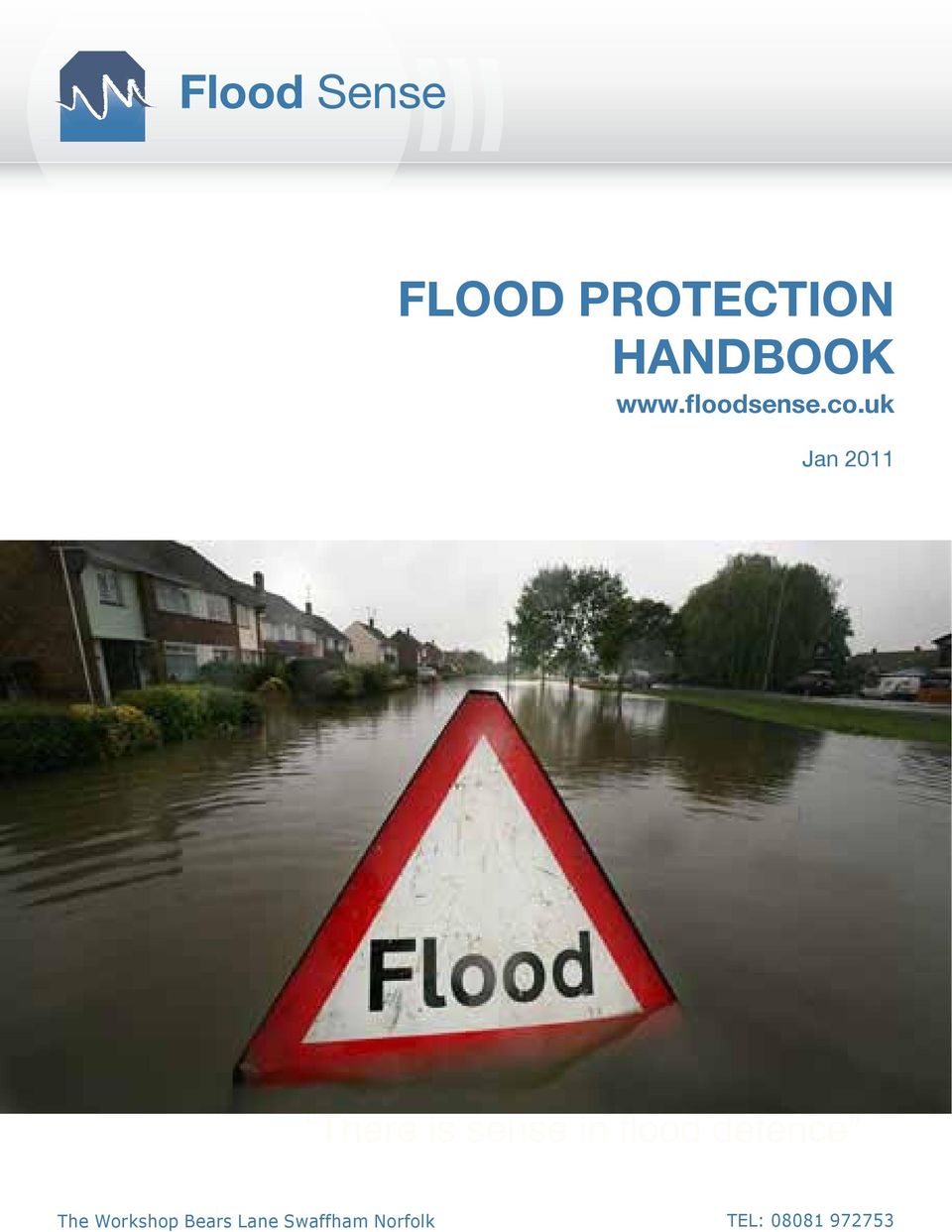
2 February 18th 2011 Dear Property Owner / Landlord / Tennant, You have this Flood Protection Handbook because you may be in an area subject to flooding problems. Flooding affects many residents of the UK. Some experience fast moving floodwaters, others have frequent, but slow-moving runoff water problems in their streets or gardens / drives during local downpours. Some people have had repeated floods, while others have yet to be impacted. Regardless of what you have seen, the next flood could be worse. We cannot ignore our flood risks. Floods take lives and damage property. They can be emotionally devastating to you and your family, both while they are happening and later when you have to deal with their aftermath. The governments and councils of England and Wales are working together to reduce the threat of flooding by building and maintaining flood protection works. However, flood control projects are very expensive, take years to complete, and will not offer 100% protection. There are various flood monitoring and warning programs provided by local councils of England and Wales and the Environment Agency that provide advance notice of a pending hazard. New developments are closely regulated by local councils to reduce the impact of flooding. While they are doing what they can, there are things that you can do, too. You can prevent future damage by flood proofing your building or buildings and making personalised flood preparedness plans. You can learn important flood safety rules and health precautions, and minimise your losses during flood recovery. This handbook is designed to help you do all those things. If followed, the guidelines will go a long way toward protecting your family and your home or business from the next flood. If you would like to know more about flood protecting your home, please call Floodsense for a free flood check. Sincerely Kevin Williams Flood Sense Flood Sense 2

3 How to use this handbook If you have just been flooded see Chapter 6: After the flood... page 24 If you heard a flood warning see Chapter 5: During the Flood... page 22 If things are quiet and dry see Chapter 3: Before a flood, preparing a response plan...15 This handbook was prepared by Kevin Williams of Flood Sense Record your IMPORTANT PHONE NUMBERS AND CONTACTS on the page provided at the end of the text. This handbook will also be available on-line at Disclaimer This handbook is not intended to replace the advice and guidance of an experienced professional, who is able to examine a building and assess a particular situation. It contains general information based on current research and comments from experienced professionals. However, the reader must assume responsibility for adapting this information to fit his or her specific conditions. The reader is advised to seek professional assistance to evaluate or to repair extensive building damage, including related electrical components. Flood Sense 3
4 How to use this handbook Chapter 1: Flood Hazards 5 Impact of Flooding 6 Chapter 2 : 8 Causes of Flooding 8 Chapter 2: Government Flood Programs 8 Flood Control Projects 10 River / Stream / Sea 10 Defence Maintenance 10 Floodplain Areas 10 Building Regulations 11 Flood Insurance 11 Chapter 3: Before the Flood 12 Know Your Flood Hazard 13 Flood Response Plan 13 Flood Survival Kit 14 Chapter 4: Flood proofing your building 15 Basement Cracks 16 Sump Flooding 16 Sewer System Backup 17 Backwater Valve 17 Inflatable Textile Bladders 18 Check / Ball Valves 18 Flood protection barriers 19 Dry Flood-proofing 20 Wet Flood-proofing 21 (basements) 21 Chapter 5: During the Flood 22 Turning Off the Utilities 22 Take Care of Yourself 24 Chapter 6: After the Flood 24 Give Your Home First Aid 25 How to drain a basement 27 Mud removal tips 27 Get Organised 27 Tips on Insurance Claims 28 Website addresses 29 Important phone numbers & contacts 30 Flood Safety Outdoors 31 Flood Safety Indoors 31 Flood Sense 4

5 Chapter 1 : Flood Hazards Many people think that if they haven t been flooded yet, they never will be. However, it s just not so! Areas in England and Wales have experienced the worst flooding for decades This chapter reviews flood hazards and how a flood, worse than any you may have already experienced, could affect you. Causes of Flooding 1. Flooding occurs when the amount of water arriving on land (from rainfall, snow melt, surface flow, flow in watercourses or inundation by the sea) exceeds the capacity of the land to discharge that water (by infiltration, surface flow, piped drainage or surface watercourses). It can occur on any level or near-level areas of land but the main concern is with such areas adjacent to watercourses (fluvial flood plains) or low-lying ground next to the coast (coastal flood plains). The limits of flood plains cannot be defined precisely because floods with similar probability can arise from different combinations of event that will have different impacts. They are often delineated by the estimated peak water level of an appropriate flooding event on the watercourse or at the coast. On rivers, this has generally been taken to be the flood with a 1% annual probability of exceedance (the 1 in 100-year return-period flood) or the highest known water level. In coastal areas, because of the generally more dynamic nature of coastal flooding, the 0.5% annual probability (the 1 in 200-year return-period flood) or the highest known flood is generally used. It is recognised, however, that floods of greater magnitude than these will occur; such floods constitute extreme events. Locally flooding may occur due to groundwater overflowing, overland sheet flow or run-off exceeding the capacity of piped drainage during periods of heavy or prolonged rainfall. Such local flooding can only be addressed on a site-specific basis. 2. The principal cause of river flooding is excessive rainfall or snow melt within a limited period, which overwhelms the drainage capacity of land, particularly when the ground is already saturated or when channels become blocked. Inundation by the sea is largely due to combinations of high tide, storm surge and wave activity but may also be associated with structural failure of defences. Some areas are subject to combinations of tidal and river impacts. The impacts can be aggravated by: The growth of built development in catchments and other changes in land use, which increase the rate and volume of run-off; Sediment movement that has changed river cross-sections and affected flood levels; Lack of maintenance of flood defence systems, watercourses, culverts (including the flood relief areas around them) and road gullies, particularly where this leads to channel blockage; Canalisation, modification and diversion of rivers and watercourses, which increase the rate of flow and decrease the time taken for water to travel within a catchment; and Building of structures (eg embankments) which restrict flows over historical flood plains and thereby create additional flood risks both upstream and downstream. Flood Sense 5

6 3. Flooding is, therefore, a combination of human activity and natural physical conditions. In determining the risk posed by flooding, account needs to be taken of the likely depth, speed and extent of inundation and the potential for anticipatory action to be taken as a result of flood warnings. Rapid flows due to flash flooding or inundation by the sea following failure of defences pose a greater risk to life than a steady rise in water level. The consequences also vary with land use. For example, overtopping and possible failure of a flood defence defending a densely populated urban area is an extreme risk; the same event affecting agricultural land is unlikely to involve a serious threat to human life. Impact of climate change 4. There is mounting evidence that the global climate is changing as a result of human activity. Sea level will rise globally as a result of thermal expansion of the oceans, melt- water from alpine ice and snow and from polar ice caps in Greenland and Antarctica. The current best estimate is for a 210mm rise between 2000 and However, this estimate is very uncertain and it could be as low as 100mm or as high as 550mm, depending on the future level of greenhouse gas emissions and the sensitivity of the climate system; the best- estimate sea-level rise is based on central estimates of each of these. To the climate-induced sea-level rise has to be added the movement of land, which is generally falling in the south- east and rising in the north and west. UK Climate Impacts Programme scenarios, which include both sea-level rise from climate change and land movement, estimate a rise of 410mm in East Anglia and 210mm in west Scotland by Impact of Flooding If you haven t personally experienced a flood, it is hard to envision the severity of damage that it can cause. Flooding affects people and their property in many ways: Flooding presents a safety hazard to people and animals. Flooding causes health problems, both physical and emotional. Flooding damages buildings and landscaping. Flooding damages the contents of buildings. Safety Hazards Moving water causes more safety problems than standing water. Anything that is stored outside, and not securely anchored to the ground, can be carried away by floodwaters, i.e., toys, firewood, fuel tanks, structures, tools or vehicles. Floods become much more forceful as they accumulate debris. The debris can batter or impale people, as well as structures. Floodwaters can conduct electrical currents and hide debris. Be sure to look for potential electrical sources and stay away from any water in contact with them. Floods may structurally damage floors and stairs, making them unstable. Experiments have shown that a person is less able to stand up in a flood as depth or velocity increase. They showed that a six-feet tall adult would be knocked over in four feet of water that is moving at a velocity of only one foot per second, or in one foot of water that is moving at four feet per second. Smaller people will have trouble in even shallower and slower floodwaters. More people are killed trying to drive on flooded streets or bridges than in any other single flood situation. Cars can float in as little as 18 inches of water, and flooding may hide a washed out road with what appears to be only a few inches of water. Flood Sense 6

7 Health Hazards Floodwaters are not clean. They carry mud, silt, road oil, and even sewage. Food, cosmetics, medicines, stuffed animals, baby toys, and any similar items that contact floodwaters, become contaminated and must be thrown out. Clothes and dishes need to be washed thoroughly in clean water with soap to disinfect them. Mould spores and bacteria grow in damp areas and are difficult to remove completely. If a potable water system becomes contaminated, the health department recommends boiling all water to be used for drinking and domestic cleaning. Floods also take a toll on people s mental health, caused by both the immediate dangers as well as future concerns. The stresses caused by flooding are aggravated by fatigue during cleanup and anxiety over lost income, health risks, and damage to irreplaceable items. Children and the elderly are especially susceptible to negative impacts from stress. Chapter 6 - After the Flood discusses ways of coping with these problems. As discussed previously, moving water can transport debris from the ground surface as it flows downstream. The debris acts like a battering ram, capable of damaging or dislodging large structures, like buildings and bridges. It scours the ground, removing grass and plants and eroding channel banks. The flood becomes more destructive as it moves downstream. Contents Damage Wet wooden furniture may be so badly warped that it can t be used. Other furnishings, like upholstery, carpeting, mattresses and books, are usually not worth the cost of drying them out and restoring them. Kitchens manufactured from mdf / chipboard will start to break down very quickly. Mould and mildew will quickly spread through the remaining debris. Flooded electrical appliances will not work safely, until they are professionally dried and cleaned. Building / Exterior Damage Standing water can seep through building walls, soak wood, dissolve drywall and contaminate insulation. Electrical components may short when flooded, creating a fire or shocking safety hazard. If improperly dried, wet wood will warp and plywood will split, requiring replacement of stairs, flooring, etc. Mould is a big source of property damage, as well as being a health risk during floods. As the water gets deeper, it puts more pressure on walls and floors. A flood that is over a metre may crack or break a standard house wall. Even very shallow flooding on the surface can put over seven feet of water pressure on a belowgrade basement wall or floor, causing cracks, leaks, or even buckling. Flood Sense 7

8 Chapter 2 : Government Flood Programs There are many existing, governmentsponsored programs to prevent or reduce flood damage. You re not alone in tackling potential flood problems. Causes of Flooding Flood Alert Public Information Programs This handbook is only one of several ways to obtain flood protection advice. Current law requires that people purchasing flood-prone property be advised, in writing, of the potential flood hazard. In depth information can be found on the environment agency s web site You should: Flood Alert means flooding is possible. check local news and weather forecasts and water levels near you be prepared to put into action any plans you have made to deal with flooding in your area Other contact websites and contact numbers can be found on the contacts page of this booklet. Flood Warnings If flooding is forecast for your area, the Environment Agency will issue warnings to show how dangerous the situation is. The three types of warning are: Flood Warning You should: Flooding is expected. Immediate action required Flood Alert Flood Warning Severe Flood Warning act now by moving cars, pets, food, valuables and important documents to safety put flood protection equipment in place Turn off gas, electricity and water supplies if it s safe to do so Flood Sense 8

9 You should try to stop any water from getting into your home by: putting plugs in sinks and baths and weighing them down with sandbags, pillowcases or plastic bags filled with garden soil, or heavy objects If you don t have valves fitted which allow the flow of water in one direction (non-return valves), you should: plug water inlet pipes with towels or cloths disconnect any equipment that uses water (like washing machines and dishwashers) Severe Flood Warning You should: Severe flooding and danger to life. collect the things you need for evacuation stay in a high place with a means of escape, avoid electricity sources and avoid walking or driving through flood water co-operate with the emergency services call 999 immediately if you are in danger In the event you are evacuated If the emergency services tell you to evacuate, you should follow their instructions and leave your home. Refusing to leave on their advice will put you, your family and those trying to help you at risk. You ll be taken to an evacuation centre run by your local council. Free food and bedding will be provided but you should bring spare clothing, essential medication and babycare items if you need them. Most evacuation centres will let you take your pets. You should put cats and small animals in a pet carrier or secure box and bring enough food for them. The people who run the centres are trained to give you support and advice. They will help you through the stress of a flood and prepare you for what to do afterwards. Warnings no longer in force The warnings no longer in force message means that no further flooding is currently expected in your area (There is no symbol to accompany this message). You should: keep listening to weather reports and only return to evacuated buildings if you are told it is safe to do so beware of sharp objects and pollution flood water may still be around for several days after the flood contact your insurance company and ask their advice before starting to clean up if your property or belongings are damage Flood Sense 9

10 Flood Control Projects No district, local or county council can stop flooding completely. Flood protection is improved by installing larger culverts and bridges, armoring channels and embankments, and building retaining walls or earthen berms to redirect street flooding away from buildings. River / Stream / Sea Defence Maintenance Accumulated debris and low tree limbs are removed to keep channels clear, especially at bridges and culverts, so storm water can flow more readily along its drainage path. If you see debris clogging or other potential flood problems in local streams, please report the condition to your local authority or local Environmental Agency office. Floodplain Areas One of the best ways to prevent flood damage is to keep the floodplains open. If there are no buildings in the floodplains, there will be little opportunity for property damage. Broadly speaking A floodplain is the lowland adjacent to a river, lake or sea. Floodplains are designated by the frequency of the flood that is large enough to cover them. For example, the 10-year floodplain will be covered by the 10-year flood and the 100-year floodplain by the 100-year flood. The above photo is an example of a floodplain area that has been kept open. These areas provide recreational opportunities for the community and a place for temporary flood detention storage. The Environmental Agency coordinates and funds flood control projects and maintenance programs. Its maintenance programs include: mowing and clearing debris, weed thinning, tree and bush management, floodgate and sluice maintenance, maintaining flood barriers and pumping stations, inspection and repair of flood defence structures, general watercourse surveys, weir / bridge inspections, outfall maintenance, clearance of culverts and replacement of culverts, retaining walls, and other deteriorated structures. Flood Sense 10

11 Building Regulations Flood Insurance Parliament and local authorities have adopted specific regulations to help ensure that new construction will not make our flooding problems worse. Construction is regulated on sites that are in floodplains. New buildings and substantial improvements to existing buildings in the floodplain must be built or flood proofed to one foot or more above the 100-year regulatory flood level. Most flood construction projects and regulations are designed to protect people and property from the estimated 100-year flood, by keeping them out of harm s way. The 100-year flood has a one percent (0.01) probability of being equalled or exceeded every year. This is considered a cost- effective design standard for most construction projects, though some uses require different protection standards. Floods larger than the 100-year design flood can and frequently do occur. There are different building regulations for developments located outside the floodplain. However, most construction projects must submit a drainage plan, to demonstrate that the proposed water runoff will not overload the drainage / sewer system. Whether you know or not that your area is at risk of flooding, it s likely your insurance company will as most UK insurers have copies of the Environment Agency s flood risk mapping. Being aware and taking action to reduce the risk of flooding to your property may even bring your insurance premiums down. Anyone can access the same information that is available to insurance companies by using the Environment Agency s flood map. The Flood Map allows you to find out what the likelihood of flooding from rivers and the sea is in your local area. Site address can be found on the contacts page of this booklet. If you are finding it difficult to get insurance you could try: Talking to one of the brokers who specialise in properties that are difficult to insure. You should be able to find these brokers in the Yellow Pages. You can also find a broker on the British Insurance Brokers Association website or by calling its broker helpline on Contacting the ABI. They can provide you with details of possible insurers. Contacting the National Flood Forum (NFF) which may also be able to help. The NFF is an independent, grassroots organisation, which offers support to those affected by flooding. For more information, visit the National Flood Forum website or contact the National Flood Forum on Flood Sense 11

12 Chapter 3 : Before the Flood The time to protect yourself from flooding is before the flood. This chapter covers three ways to do that: flood preparedness, flood response planning and insurance. Flood Preparedness Many preparations can be done prior to the next flood. The following checklist will help you prepare: 1. Determine how bad flooding could be on your property (see the guidelines in the box). Lists of resources and contacts are provided in the back of this manual. 2. Be familiar with official warning and evacuation procedures. 3. Purchase your own water alarm if your flooding comes from sewer backup or basement seepage. The alarm can give you precious extra time to minimize potential property damage. A water alarm is similar to a smoke alarm; it beeps when water touches it. Floodsense can offer further advice on this if it is required. 4. Talk to your insurance agent about your home owner s insurance coverage. Consider separate flood and sewer backup insurance policies. 5. Prepare a list of emergency telephone numbers, including the number for your insurance agent. Make copies and keep them in your car, at work, or other safe location away from your home. 6. Assemble the supplies you will need for cleanup and recovery and put them in a safe place, above the expected floodwater elevation. Chapter 4 lists possible supplies. 7. Make a record of all your personal property. Go through your house room by room and make a household inventory. Take photographs or camcorder records of inside and outdoors. Inventory forms are available free from most insurance companies, or you can make your own. 8. Put photocopies of inventory records, insurance policies, deeds, logbooks, wills, telephone numbers, bank and credit card account numbers, and other valuable papers at a location away from your house, such as a safe deposit box. 9. Write a flood response plan and keep copies in your car and at work, near the utility meters, or other prominent places. The Environment Agency can provide a sample flood response plan to get you started. A link to this is here business/topics/flooding/32362.aspx. Keep a copy of your response plan with this handbook too. 10. Check out the appropriate flood proofing options for your house in Chapter 4 (page XX) Flood Sense 12
13 Know Your Flood Hazard Ask your local authority the following questions: How high would the 100-year flood be in my neighbourhood? Can I expect fast-moving water, or water filled with debris? How much warning time can I expect? How will I get the flood warning? What streets are likely to be flooded or barricaded near my neighbourhood? Flood Response Plan Preparing a flood response plan will help you think through all the details that demand attention after a flood watch or warning is issued. Walk through your home or business with this handbook, and make notes of how to adjust these instructions to your own situation. Writing it down will help you remember everything, which is especially important when everyone is in a hurry and excited because of an imminent flood. Be sure to include Important Phone Numbers in your plan. The flood response plan needs to be based on your own property s flood risk and how much lead time you have following a flood watch or warning. For example, if you are warned of a life- threatening flash flood, you should get out of the area immediately, without worrying about the backup power supply to your sump pump. Your plan should be a checklist of steps to take before floodwaters reach your home or business. If you have only a few minutes following a Flood Warning, these activities might be on your flood response plan: Monitor local radio or TV stations for flood information and evacuation instructions. Pre-plan two places where family members or staff can meet if you are split up, one place in close proximity and another place that is out of the flood area. These places could be at another business premises or friends house on higher ground. If you leave, take your pets, medicine, and other things you will need if you can t return home or to your business for a day or two. Leave a note explaining where you have gone, when you left and how to contact you. If you leave, lock your home or business premises. If you have 15 to 30 minutes following a Flood Warning, include additional flood response activities like these: Read the safety precautions on the back cover of this handbook. Install flood protection equipment and any other prepared flood proofing measures. Turn off the electricity and water if you anticipate that they might be flooded. If you are able to, turn off the electricity to only the area that will be affected i.e. basement (if you have one), ground floor or both leaving you with power to the rest of your home or business. When you prepare a response plan, mark your fuse box breakers to show the electrical circuits that serve these areas. If you turn off the gas- be sure to relight your pilot light. You must determine if shutting off the gas is necessary. Fortunately, you can pre-plan your intended response to different conditions when you prepare an emergency response plan. Flood Sense 13

14 Test the backup power supply to your sump pump if installed (speak to floodsense for further advice on this). Move the most valuable or damage-prone contents in your home or business to above the flood level or to another safe place. These include small carpets, lower drawers to cabinets, and cleaning fluids or hazardous chemicals. They can be moved to the upper floors of your home or business or placed on top of cabinets, if floodwaters will not be that deep. While you re working on a flood response plan, think about the other types of emergencies you might face, such as fires. The Environment Agency can help you with ideas to include in a flood/disaster response plan. uk/pdf/geho1009brdl-e-e.pdf Flood Survival Kit Prepare as much of your Flood Survival Kit as possible now and store it away in a suitable and accessible location. Spare blankets can be stored in Space Bags that cost only a few pounds and will keep them dry. For other items we recommend plastic storage boxes with lids. Important documents in a waterproof wallet or container Torch and spare batteries Blankets and warm clothing Waterproofs including rubber gloves First-aid kit, including waterproof plasters/ dressings A list of useful telephone numbers Your mobile phone Supply of bottled water Stock of non-perishable food items, camping stove and a tin opener Portable radio and supply of batteries A portable pet carrier for each of your pets & emergency pet supplies. Flood Sense 14

15 Chapter 4 : Flood proofing your building Before you invest too much money in flood-proofing, talk to an engineer or architect, an experienced contractor like Floodsense This chapter covers changes that you can make to your building to prevent or reduce damage by floodwaters. Flood Preparedness Different flood-proofing techniques are appropriate for different types of buildings and flood hazards. Use the following guidelines to select applicable techniques: If you have a basement, read about basement cracks, sump pumping, sewer backup, barriers and wet flood- proofing. If your house is on a slab foundation and the 100-year flood is estimated to be less than three feet deep on your first floor, read about barriers and dry flood-proofing. If your house is on a crawlspace and the 100-year flood is estimated to be less than three feet deep on your first floor, read about barriers, wet flood-proofing, and elevation. If the 100-year flood is estimated to be over three feet deep on your first floor or will include high velocities and/or debris flow, read about relocation. Helpful Resources Prepare your property for flooding, published by the Environment Agency. agency. gov.uk/pdf/geho1009brdl-e-e.pdf CIRIA: Repair and Restoration of buildings following floods Association of British Insurers: Flood resilience and resistance fact sheet for insurers and loss adjusters, er.aspx?contentid=24922 It is important that people understand that the predicted 100-year flood elevation is only an estimate, based on current technical standards for hydrology. Many times the floodwater elevation is higher than anticipated due to larger storms, saturated ground from prior storms or large volumes of debris in the water. It is important that people understand that the predicted 100-year flood elevation is only an estimate, based on current technical standards for hydrology. Many times the floodwater elevation is higher than anticipated due to larger storms, saturated ground from prior storms or large volumes of debris in the water. Flood Sense 15

16 Basement Cracks Groundwater can seep into your basement around pipes or through cracks in the walls or floor. The seepage path may be difficult to determine if the walls have been covered with panelling or other finishing. The best way to deal with a groundwater problem is to waterproof the walls and relieve the water pressure through a footing drain system and sump pump. See next section on Sump Flooding Cracks can be repaired and the walls can be waterproofed from inside or outside. Waterproofing on the outside is more effective because groundwater pressure forces the sealer into the foundation. The best technique is to dig a ditch around the basement wall so that you can apply a commercial sealant to the exterior walls. This can be done by a handy person (many home maintenance manuals have instructions for this), or a commercial waterproofing company. Precautions Waterproofing alone is recommended only for groundwater problems. Surface water will put much more pressure on the building s walls and can even break them. If the building will be affected by surface flooding, the owner should also install a barrier and an underground drain. There have been many instances of disreputable contractors doing basement waterproofing, because the work is hidden and sloppy work may not show up for several years. Therefore, ask the waterproofing supplier or company to provide references of buildings in your area that have used their material or technique before you sign a contract. Cost ,000 or more A homeowner can seal up cracks from the inside with a tube of sealant. Using a commercial waterproofing company to completely seal the exterior of all the basement walls will cost more. Costs should be used as estimates only, as they can vary widely depending on location, size and complexity of the work. Sump Flooding Basement flooding caused by saturated ground can be corrected by installing a footing drain around the foundation. The drain collects groundwater and directs it to a sump. When the sump fills, water is pumped out to a drainageway or onto the ground away from the building. Depending on local conditions, the drain and pumping system may have to handle large volumes of water. If the pump is blocked with debris, is overloaded or loses power, the system designed to keep groundwater out of your basement can act as a conduit to bring water in. You can prevent sump flooding by doing one or more of these floodproofing projects: Clean the pump intake to remove blockages, Install a larger sump pump, or add more pumps, Connect the pump to a backup power supply, like a battery system or generator, Disconnect the downspouts from the footing drain, or Redirect the downspouts and sump pump discharge further away from the house. Precautions When the basement is full of water, it is hard to tell how it got in. It s a good idea to check for cracks in the walls and install sewer backup protection, too. Turn off the electricity before entering a flooded area. If your backup source of electricity is a generator, be sure it is set up outside or vent it to the outside to exhaust deadly carbon monoxide fumes. Set the backup power supply above the expected flood level. Cost A homeowner can redirect the downspouts and sump pump discharge in a few minutes at no cost. An additional sump pump will cost around 100, a battery backup system including a marine style battery is , and a standby generator can cost up to 550. Prices are approximate. Flood Sense 16
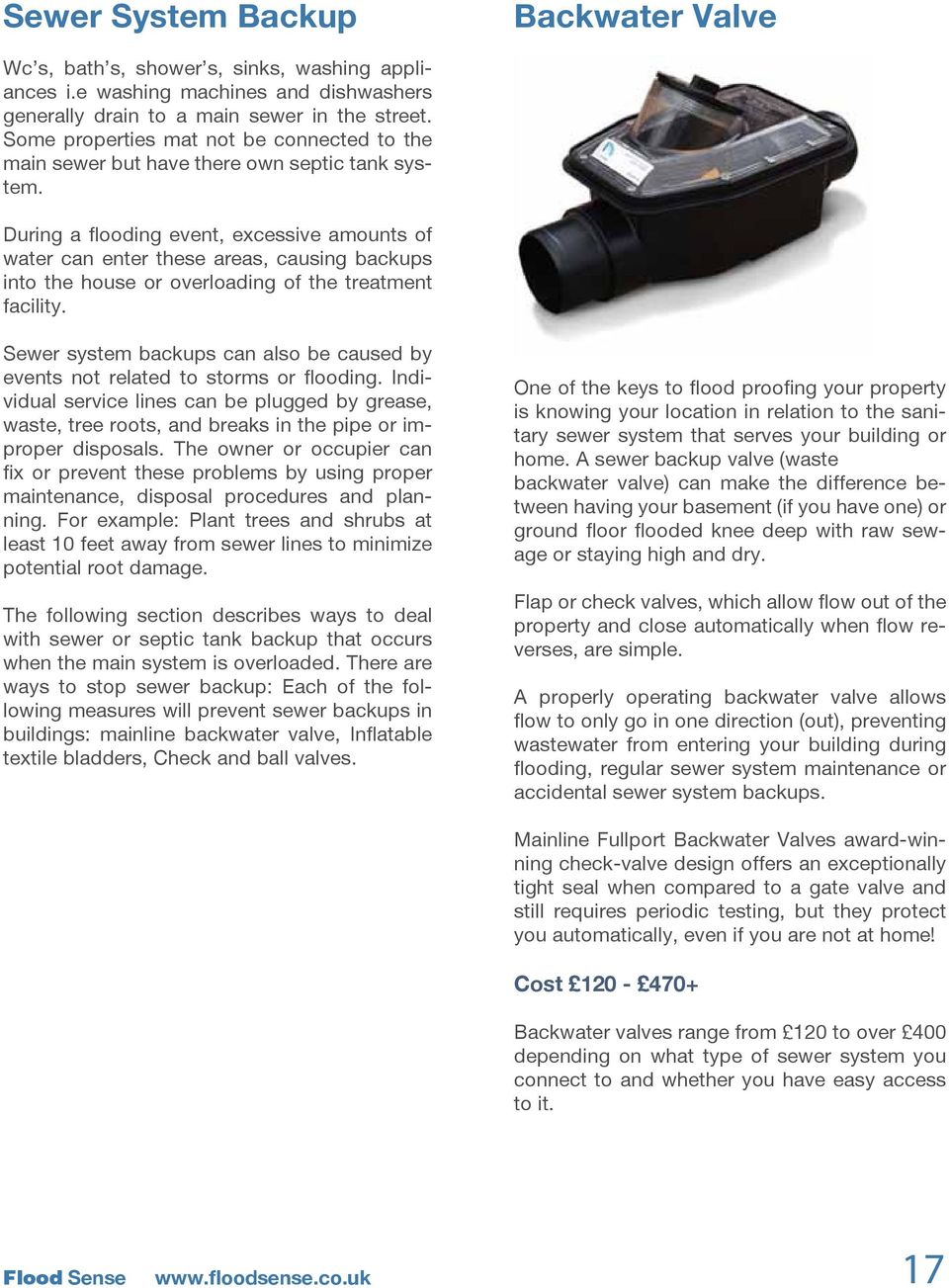
17 Sewer System Backup Backwater Valve Wc s, bath s, shower s, sinks, washing appliances i.e washing machines and dishwashers generally drain to a main sewer in the street. Some properties mat not be connected to the main sewer but have there own septic tank system. During a flooding event, excessive amounts of water can enter these areas, causing backups into the house or overloading of the treatment facility. Sewer system backups can also be caused by events not related to storms or flooding. Individual service lines can be plugged by grease, waste, tree roots, and breaks in the pipe or improper disposals. The owner or occupier can fix or prevent these problems by using proper maintenance, disposal procedures and planning. For example: Plant trees and shrubs at least 10 feet away from sewer lines to minimize potential root damage. The following section describes ways to deal with sewer or septic tank backup that occurs when the main system is overloaded. There are ways to stop sewer backup: Each of the following measures will prevent sewer backups in buildings: mainline backwater valve, Inflatable textile bladders, Check and ball valves. One of the keys to flood proofing your property is knowing your location in relation to the sanitary sewer system that serves your building or home. A sewer backup valve (waste backwater valve) can make the difference between having your basement (if you have one) or ground floor flooded knee deep with raw sewage or staying high and dry. Flap or check valves, which allow flow out of the property and close automatically when flow reverses, are simple. A properly operating backwater valve allows flow to only go in one direction (out), preventing wastewater from entering your building during flooding, regular sewer system maintenance or accidental sewer system backups. Mainline Fullport Backwater Valves award-winning check-valve design offers an exceptionally tight seal when compared to a gate valve and still requires periodic testing, but they protect you automatically, even if you are not at home! Cost Backwater valves range from 120 to over 400 depending on what type of sewer system you connect to and whether you have easy access to it. Flood Sense 17
18 Inflatable Textile Bladders Check / Ball Valves The U bend toilet bung is an example of a simple, inflatable device used to prevent sewage backflow coming back up the toilet under flood conditions. Essentially the U bend toilet bung is a strong rubber bag, attached to a hose with a Schrader valve on the end. The bung is normally supplied with a hand pump. To use the valve, gently push the deflated bag down into the toilet under the water level, into the U bend at the bottom of the toilet. The hose which is attached to the rubber bag goes under the toilet seat and rests to the side of the toilet. Connect the valve of the hand pump to the valve on the hose and simply pump up the bag until it is totally inflated and firm to the touch, being careful not to over pump. (This works using the same method as pumping up a bicycle tyre). At the maximum inflation the sealing area will be severely restricted reducing the maximum allowable back pressure Once the threat of sewage backflow has subsided, simply deflate the bag by applying pressure to the pin on the valve of the hose. This can be done by pushing your finger or thumb onto the pin of the valve to let the air escape from the bag. Remove the bag and hose from the toilet and rinse off using a mild detergent. Allow to dry and store away. Cost from 50 The cost for this type of inflatable textile barrier start from about 50 comprising of a pvc bung, hose with Schrader valve and hand pump. A check valve, non-return valve or one-way valve is a mechanical device, which allows fluid to flow through it in only one direction. Check valves are two-port valves, meaning they have two openings in the body, one for fluid to enter and the other for fluid to leave. There are various types of check valves used in a wide variety of applications. Check valves can be installed on washing machines, dishwashers, sinks, baths, showers etc to prevent sewage backflow. They are available in a wide range of sizes and costs. Check valves generally are very small, simple, and inexpensive. Check valves work automatically and most are not controlled by a person or any external control; accordingly, most do not have any valve handle or stem. The bodies (external shells) of most check valves are made of plastic or metal. An important concept in check valves is the cracking pressure which is the minimum upstream pressure at which the valve will operate. A swing check valve or tilting disc check valve is check valve in which the disc, the movable part to block the flow, swings on a hinge, either onto the seat to block reverse flow or off the seat to allow forward flow. Cost from 5.00 Due to the various makes and sizes on the market we can only give you an indication from how much you can expect to pay. Flood Sense 18

19 Check / Ball Valves Flood protection barriers A ball check valve is a check valve in which the closing member, the movable part to block the flow, is a spherical ball. In some ball check valves, the ball is spring-loaded to help keep it shut. For those designs without a spring, reverse flow is required to move the ball toward the seat and create a seal. The interior surface of the main seats of ball check valves are more or less conically-tapered to guide the ball into the seat and form a positive seal when stopping reverse flow. Ball check valves are often very small, simple, and cheap and like the above can be installed onto outlets leading from washing machines, dishwashers, sinks, baths, showers etc Cost from 5.00 Due to the various makes and sizes on the market we can only give you an indication from how much you can expect to pay. A flood-barrier is a secondary flood-proofing system to be used when the design elevation of the building is below the Base Flood Elevation. The purpose is to form a watertight seal in front of all building openings in order to prevent floodwaters from penetrating the structure. This system is to be removable and only used at time of storm or flood warning and in conjunction with other flood-proofing design criteria. A form of flood resistance, flood barriers come in many different formations, the correct barrier should be fitted depending on potential flood requirements. In cases of severe flooding (where floodwater rises above 1 metre) keeping water out of your property can be more harmful than letting it in. The stress on the building caused by that amount of water can damage the structure and foundations of the building. Therefore you should never block doors, windows or air-vents over 1 metre in height. Cost from A simple flood protection barrier can be made from a sheet of ply board cut to fit an opening and fixed in place with batons, screws and mastic sealant. After market products can range in price from a few pounds to a few hundred depending on type of opening and type of product required. More information on these can be obtained from contacting Floodsense. Flood Sense 19

20 Dry Flood-proofing This term covers several techniques for sealing up a building to ensure that floodwaters cannot get inside it. All areas below the flood protection level are made watertight. Walls are coated with waterproofing compounds or plastic sheeting. Openings (doors, windows, and vents) are closed, either permanently, with removable shields, or with sandbags. A sewer backup protection measure is installed. All of the previously described flood protection methods belong to this category. Many dry flood proofed buildings do not look any different from those that have not been modified. Dry flood proofing is most appropriate for buildings on concrete slab floors (without basements) with no cracks, and subject to less than three feet of water. To ensure that the slab is watertight and sound, a careful inspection is recommended. A subsurface drainage system with a sump pump is needed in areas where waters will stay at flood stage for more than a few hours. waterproofed to protect them from high groundwater, if a footing drain is installed to keep the water pressure from building up. See the following section on Wet Flood proofing to protect sub grade foundation walls and floors. Many commercial waterproofing compounds are made to protect wood from rain, but they will not withstand the pressures of standing water. Some deteriorate over time, so check with the supplier to be sure the waterproofing compound is appropriate for sealing your basement walls from water. Closing openings depends on having adequate warning time and having someone present who knows what to do. Cost ,000 Dry flood proofing costs can range from 100 when a handyperson simply applies a waterproofing compound, to 20,000 or more for a more secure and attractive approach that works even when no one is home. Precautions A dry flood proofing project may require planning approval from your local authority. Footing drains should be designed and inspected during installation by an engineer. Check with the planning department of your local authority to be sure that your project does not violate any legal requirements. A building should not be dry flood proofed if floodwaters may be more than three feet deep or move faster than five feet per second. It is very tempting for the owner of a dry flood proofed building to try to keep the flood out, even if floodwaters get deeper than two or three feet. This can result in collapsed walls, buckled floors, and danger to the occupants. Basements should not be dry flood proofed if the floodwater will touch the walls, because of the potentially destructive water pressure on the walls and floors. Basement walls can be Flood Sense 20

21 Wet Flood-proofing (basements) If floodwaters in the vicinity are touching the property, they are probably also seeping down between the soil and the exterior of the basement walls. Even if the outside water is only a few feet deep at the ground surface, it is putting pressure on the basement walls and floor equal to that of a standing body of water seven or more feet deep, about 750 pounds of pressure per square foot. A similar depth of dry soil exerts less than 100 pounds per square foot. Most walls and floors are not built to withstand that kind of pressure. As a result, waterproofed basement walls and floors can be cracked, buckled, or broken by the pressure of floodwater. Instead of just a wet basement, you may end up with both a wet basement and broken walls. One way to deal with this is to remove everything that could be damaged by a flood and let the water in. This is called wet flood proofing. Several modification methods can be used to minimize potential damage to the building and its contents if floodwaters are allowed inside. These techniques range from moving a few valuable items to higher elevations within the house to rebuilding the floodable area. Wet flood proofing has one advantage over the other approaches: no matter how little you do, you will reduce your damages. Simply moving furniture and electrical appliances out of the flood- prone area can prevent thousands of pounds in damage. Precautions Moving contents is dependent on adequate warning time and the presence of someone who knows what to do. Flooding an area where there is electricity, paint, or other hazardous materials can create a safety hazard. There will still be a need for cleanup, with its accompanying health problems. Cost ,000 You can accomplish some wet flood proofing, just by moving valuables and hazardous materials out of the floodable area. Reconstructing a floodable area with water-resistant materials and relocating utilities can be much more expensive. In the latter case, structural components below the flood level are replaced with materials that are not subject to water damage. For example, concrete block walls are used instead of wooden studs and gypsum wallboard. The boiler, washing machine, tumble dryer etc are kept to the higher floors of the property. Another approach is to raise these items on blocks or platforms where the flooding is not deep. Many people wet flood proof their basements, crawlspaces, garages, and accessory buildings simply by relocating all hard-to-move valuables, such as heavy furniture and electrical outlets. Vents can be placed on the foundation walls to ensure that floodwaters can get into and out of the crawlspace to equalize water pressure on walls and floors. Flood Sense 21
22 Chapter 5 : During the Flood Storms and floods can occur very quickly. You should be on the alert when you see storms brewing. When in doubt, turn on your radio or television and listen for weather information. Flash floods can occur at any time along the Front Range. Follow your flood response plan (see section 3) Turning Off the Utilities Turning off your utilities could prevent greater damage if your building gets flooded. Electricity The most important utility to turn off is the electricity Gas Floodwaters may knock out pilot lights and silt may get into burners if you have a floor standing boiler. If there is a chance that the pilot light could be flooded, you should turn off the gas before you leave to prevent a fire or potentially explosive safety hazard. After the flood, contact a gas safe registered plumber to check your appliance (if there are signs it has been in contact with flood water). Fuel Oil Tanks If you have a fuel oil or propane tank, turn off the fuel valve at the tank if the pilot light might be inundated or the supply lines might be broken by a flood. Make sure that your outdoor fuel tanks are securely anchored to the ground in flood prone areas. Propane tanks usually belong to the fuel supplier; ask the supplier how to properly secure the tanks. After the flood, contact an OFTEC / Gas Safe registered plumber to check your appliance (if there are signs it has been in contact with flood water). Water Since your sinks are usually turned off, you shouldn t worry about turning all the water to the house off during shallow flooding. However, if your washing machine is in the basement, or if the floodwaters around your property could be several feet deep, the floodwaters could get into the water lines through the appliances. Planning can help you to develop an informed, well thought out response to potential hazards before they happen. If you have the time, turn off the water supply to the appliances or the property. There usually is a valve near the water meter or where the service line enters the house. The water valve has a handle, similar to an outside tap. Turn it all the way clockwise. Flood Sense 22
23 Simple steps to stay safe during a flood. Listen to and act on the advice of the emergency services and follow these simple steps: 1. Put people before property. Move your family and pets upstairs, with a means of escape. 2. Gather essential items (like water, blankets, a torch, first aid kit, essential medication and food) and put them out of the way of flood water to keep dry 3. Listen to local radio for updates or call Floodline on Put plugs in sinks and baths. Weigh them down with a sandbag, a pillowcase or plastic bag filled with garden soil, or a heavy object to avoid water backing up through drains into sinks and toilets if you do not have any sewage backflow prevention. 5. Turn off gas, electricity and water supplies when flood water is about to enter your home if safe to do so. DO NOT touch sources of electricity when standing in flood water. Courtesy of Floodguards Ltd Flood water can rise quickly, stay calm and reassure those around you. Call 999 if you are in danger. Flood Sense 23
24 Chapter 6 : After the Flood If you ve been flooded, you should get a copy of Repairing your home or business after a flood, published jointly by the ABI (Association of British Insurers) and the National Flood Forum or contact Floodsense who will you a copy. This chapter covers the three steps you should take the first few days after a flood. Additional steps are explained in Repairing your home or business after a flood. Take Care of Yourself Step 1 You and your family have been through a disaster. It has disrupted your life, and you must allow time for things to return to normal. You should recognise that the flood can take its toll on you as well as your property. You need to look after yourself and your family while you focus on cleanup and recovery. Your hidden enemy is stress. Watch for signs of trouble like short tempers, getting upset over little things, having difficulty sleeping, bad dreams, aches, pains, stomach problems, apathy, and depression. These are ways your body tells you that times are difficult. Reactions to stress are common and usually temporary. Here are some things you and your family can do to relieve your tensions. Keep the family together. Togetherness provides mutual support. Discuss your problems. Talk to family and friends. Share your anxieties. Let others talk to you to help release tension. Crying is a natural response to a disaster. It s also a great way to release pent-up emotions. Set a manageable schedule. Make a prioritised list of jobs to do one at a time. Watch for signs of stress. Signs of stress are often noticed by other people more readily than by the person experiencing the stress. Listen to them. Seek help. If you can t shake feelings of despair and stress, get professional help. Flood proof as you rebuild. Nobody likes being subject to the whims of nature. Preparing for a future flood can increase your sense of control over your destiny. Care for your children. Be understanding of their fears and stress. Avoid scolding children for behaviour that might be flood-related, such as bedwetting, thumb sucking, or clinging to you. Remember, they are going through a rough time too. Stay healthy. When you work in an area that has been flooded, you probably will be exposed to dangerous chemicals and germs. Minimize contact with floodwater and debris by wearing protective clothing, like rubber boots and gloves, a mask or respirator. Rest often and eat well. You are more likely to suffer from stress and health problems when you are weak. Flood Sense 24
25 Health Hints Wash your hands thoroughly. This is especially important before eating, cooking, or smoking. Confirm that the water is clean and safe. Don t drink it or wash dishes until you re sure. Disinfect dishes and all items that floodwaters touched. Watch out for fatigue. When your body is tired, you are more prone to accidents, back strain, and depression. Report health hazards. Call your local Environmental Health Department if there are animal carcasses, rats, dangerous chemicals, or other health hazards on your property. Give Your Home First Aid Step 2 Read the safety precautions on the back cover of this handbook. Numerous people have died over the years through flooding in the UK. Many of those fatalities are due to electrocution or other accidents that occur after the floodwaters have gone down. Your first job is to make sure everything is safe before you enter the area. Follow these steps: 1. Stay tuned to a radio or TV to find out when you can go back home. 2. Check with your insurance agent to find out what cleanup and repair work is covered. This will help you to prepare a plan to restore your property. 3. Walk around the outside of your house and check for loose power lines and gas leaks. You can detect leaking gas by the putrid, rotten egg smell of chemicals that have been added to make a gas leak noticeable. Report gas smells to national gas emergency number ( ) 4. Check the foundation for cracks or other damage. Examine porch roofs and overhangs to be sure their supports are structurally sound. Look for gaps between the steps and the house. If you see obvious damage, have a qualified builder or surveyor check the house before you go in. For help, call your local building control officer from your local or county council. 5. Turn off the electricity at your house, even if your local energy company has turned off the main supply line (They may turn it back on when you re not ready). Call an electrician if you would have to go through water to get to your fuse box, if the boxes are wet, or if you are not comfortable with electrical matters. 6. Turn off the gas only if necessary. DO NOT ENTER AN AREA IF YOU SMELL GAS FUMES. 7. Call the national gas emergency number ( ) from a safe offsite place to report a gas leak. 8. Go inside carefully. It may be easier to enter your house through a window if the door will not open easily. Look carefully at the ceiling before you go in, to be sure it is not ready to fall. Do not smoke, use candles or other open flames until the house has been well ventilated. Turn on a torch before entering, as there may be explosive gases. DO NOT ENTER AN AREA IF YOU SMELL GAS FUMES. Alert someone outside of the house that you intend to enter, and ask them to call for help if you do not return or answer their call. 9. Photograph the flood damage for insurance reimbursement purposes, prior to beginning cleanup operations. 10. Rescue the most valuable items. Find and protect the irreplaceable, like money, Flood Sense 25
26 jewellery, insurance papers, photographs, and family heirlooms. Wash the mud off before it has a chance to dry. Wrap wet photographs and important papers in plastic bags and temporarily freeze them, until you have time to clean and dry them. Put sturdier items in a safe dry place, inside a plastic bag, or take them to a friend s home for safekeeping. 11. Keep the damage from getting worse. Open the windows and doors (if weather permits) to reduce the interior humidity and ventilate any odours or gas fumes. Check the basic structural integrity of the building before attempting to cover holes in the roof, walls, or windows with boards, tarps, or plastic sheeting to keep out the wind and rain. Save labour and material receipts for insurance reimbursement. 12. Repair sagging floors or roof sections. Use 4 x 4 s or other heavy lumber to brace weak areas. If you are uncertain how to shore up floor or ceiling joists, call a local builder. Save labour and material receipts for insurance reimbursement. 13. Remove tree limbs or other trash that may have landed on or floated into the house. Save disposal receipts for insurance reimbursement. 14. Check for broken or leaking water pipes. If you find any, cut off the water supply by turning off the mains tap. If the water pipes are not leaking, you can use your tap water for hosing things down and cleaning. However, do not drink or cook with tap water until your water provider declares it safe. 15. I f y o u h a v e o n e, drain your basement slowly. The water in saturated ground puts tremendous pressure on your basement walls and floors. The water inside your flooded basement is counteracting this pressure. If you do not follow the instructions for emptying the basement gradually, your walls and floor may lose the support they need to counteract the pressure from the outside water. The weight of the saturated earth could then cause the walls to crack and collapse, buckling the floors and seriously damaging your home. Follow the checklist of steps provided to safely drain your basement. 16. Get rid of the mud and silt. Most of the health hazards brought by a flood are in the mud and silt that is left after the water drains away. Therefore, it is very important to clean it out as soon as possible. This is more effective if you do it before the mud dries out. Follow the steps below. Things to take when its safe Flashlight and batteries First aid kit Battery-operated radio Waterproof boots or waders Hard hat, boots with hard soles Camera or video camera to record damage Tools: crowbar, hammer, saw, pliers, etc. Drinking water Trash bags A wooden stick for turning things over and scaring away small animals!! Cleaning supplies: Shovels Buckets, hose Rubbish bags Mops, brooms, brushes o Rubber gloves Rags Cleaners and disinfectants Lubricating oil Flood Sense 26
27 How to drain a basement Follow these steps: 1. Make sure the electricity is off. 2. If there is no floodwater on top of the ground, start pumping the water out of the basement. 3. Pump the water level down two to three feet. Mark the level and wait overnight. 4. Check the water level the next day. If the water went back up, it is still too early to try to drain the basement. 5. Wait overnight. Then pump the water down two to three feet again. Check the level the next day. 6. When the water stops going back up, pump down another two to three feet and wait overnight. Repeat steps 4 through 6 until all water is pumped out of the basement. Mud removal tips First, shovel out the mud and move furniture and debris outside. Next, make sure the electricity is turned off. Remove all light bulbs from sockets that have been flooded. Disconnect and throw away flooded wall switches and outlets. They should be replaced later with new ones. Hose the house down, inside and out. If you have an attachment that sprays soap, wash and then rinse the walls and floors. Hose the opened electrical outlets, switch boxes, and light sockets. Do not let the water sit on the floor too long, especially if your floor is particleboard or another wood product that falls apart when wet. Get Organised Step 3 Before you try to clean up and repair everything, you need to assess your damage and develop a recovery plan. Follow the steps below to make the best use of your time and money. 1. Call your insurance provider. How much of your loss is covered will depend on your policy. Your provider will also tell you what to throw away, and what to save for the adjuster to examine. Find out if your insurance covers living expenses while your house is being repaired. If you do not have coverage, your provider can still advise you where to get help with cleanup and repairs. 2. Check for structural damage. Broken basement or foundation walls, shifted stairs, or slanted floors and walls could mean that these items will have to be rebuilt from the ground up. Repair safety hazards such as broken stairs before you proceed any further. 3. If you have structural damage, check with your local or county council building control, Surveyor or Builder before you start any reconstruction. 4. Ask the big question. Odds are that the area where you live will flood again. Before you spend a great deal of money and effort repairing and rebuilding, ask yourself, Do I really want to be flooded again? Study the flood proofing options in this handbook. 5. Start listing the damage. List the damage room by room. If possible, take pictures or video recordings of the damaged items as you clean up. Keep receipts for cleanup supplies, equipment rental, hired help, and temporary housing expenses. Keep a sample of items such as a piece of carpet to show the value of what you have thrown away. good records are needed for insurance claims. Flood Sense 27
28 6. Make a recovery plan. A recovery plan is simply a list of jobs that need to be done. Planning can help you save time and money. Besides, being methodical and keeping everyone busy can ease tension. You will start seeing progress as you finish each project. 7. Start making lists. Begin with the projects such as replace boiler and dry the walls. 8. Decide what you can and cannot do yourself. You can save money by doing much of the cleanup and repair work yourself. However, jobs like shoring up foundations and replacing electrical boxes are best left to the professionals. Save all receipts for material, equipment rental, labour and disposal fees for insurance reimbursement records if covered. 9. Decide if you need financial assistance. After a flood, there are usually extra sources of help for the uninsured, if you need to replace items or hire a professional. Check the local newspaper, radio, and TV stations for notices about Red Cross, church, and government assistance. Even if you are insured, or think you can cover all your expenses, it makes sense to take advantage of whatever additional help is available. In the case of government assistance, you have already paid for it with your tax payments and deserve a share of the funds set aside for disaster aid. Tips on Insurance Claims You are supposed to be reimbursed fairly for your loss, but you are not supposed to profit from a disaster. You cannot collect more than the face value of your policy, or for uninsured items, like landscaping. There are no financial incentives to encourage the adjuster to give you a small claim payment. Your adjuster will probably be from out of town. Get his or her name, company, and telephone number. In most cases you will be reimbursed for the actual cash value of an item, not its replacement cost. Your policy should list an office and telephone number to call with questions 10. Keep the windows open as much as possible to begin drying out things. Get a copy of Repairing your home or business after a flood, published jointly by the ABI (Association of British Insurers) and the National Flood Forum or contact Floodsense who will you a copy. It will explain more steps to finish cleaning and repairing your building. Flood Sense 28
29 Website addresses Professional organisation Area of expertise Website Telephone Floodsense Flood protection Barriers Products, advice Environment Agency Environmental issues Flooding Flood Protection Association Property-level flood protection National flood forum Flood advice / support Royal Institution of Chartered Surveyors Building flood surveys Association of Building Engineers Building flood surveys Chartered Institution of Water and Environmental Management British Hydrological Society Flood risk assessments Flood risk assessments Institution of Civil Engineers Community-level flood protection schemes Flood Sense 29
30 Important phone numbers & contacts Emergencies : Police, Fire and Ambulance To report gas hazards call national gas emergency number Complete the following information as part of your flood response plan Family Meeting Place Alternate Family Meeting Place Local Builder Contact no Local authority Building Inspector Contact no Local Radio FM / MW frequency Local Non-Emergencies: Police Fire Department Local Environment Agency no Insurance Agent Contact details Insurance Company Name /Policy No. Local Environmental Health Officer contact details Flood Sense 30
31 Flood Safety Outdoors Do not walk through flowing water. Many flood deaths are caused by drowning. Six inches of moving water can knock you off your feet. Use a pole to test the depth of standing water before you proceed. Do not drive through a flooded area. More drowning deaths occur in cars than anywhere else. Do not drive around road barriers as they indicate danger ahead. Two feet of water will carry away most vehicles. Stay away from power lines and electrical wires. Electricity can travel through water.electrocution is a major cause of death during floods. Report broken power lines to National Grids 24-hour electricity Emergency Number Flood Safety Indoors Turn off your electricity if your building is flooded. Some appliances can shock you, even after they have been unplugged. Do not use appliances or motors that have gotten wet, unless they have been taken apart, cleaned and dried. Watch out for hiding animals. Small animals may seek shelter in your home once they ve been flooded out of their own. Look before you step. Mud can be very slippery to walk on. Broken glass, nails and other debris may be deposited by receding floodwaters. Be alert for gas leaks. Leave the area immediately if you smell gas fumes. Use a torch to inspect for damage. Do not smoke or use open flames unless you are sure that the gas has been turned off and the area has been ventilated. Carbon monoxide is deadly. Only use a generator or any gas-powered machine outdoors in a well ventilated area. This includes camping stoves and lanterns. Clean everything that got wet. Floodwater can be contaminated with sewage and hazardous chemicals. Do not consume anything that has contacted floodwater. Contaminated food, cosmetics and medicines are health hazards and must disposed of. Before using, clean dishes and other washable items with soap and potable water. Take good care of yourself and your family. Recovering from a flood includes taking care of both physical and emotional needs. The psychological impacts of a disaster may last a lot longer than the physical impacts. Learn how to recognize and care for anxiety, stress and fatigue. Flood Sense 31
A Guide to Flood Resilient Repairs
 A Guide to Flood Resilient Repairs A Guide to Flood Resilient Repairs Some five million people live under the threat of flooding that s one in ten houses in the UK and 200,000 are very high risk. This
CITY OF NORTH RIDGEVILLE 7307 AVON BELDEN ROAD NORTH RIDGEVILLE, OH 44039 (440) 353-0819 WWW.NRIDGEVILLE.ORG
 CITY OF NORTH RIDGEVILLE 7307 AVON BELDEN ROAD NORTH RIDGEVILLE, OH 44039 (440) 353-0819 WWW.NRIDGEVILLE.ORG WHY IS THERE WATER IN MY BASEMENT? There are two major sources of water in a basement as the
BASEMENT FLOODING. Prevention Guide for. Homeowners
 BASEMENT FLOODING Prevention Guide for Homeowners 1 Did You Know? Floods are the most common hazards in Canada. Water damage is a common cause of loss for homeowner insurance. A heavy rainfall can result
TOWN OF HARRISBURG FIRE DEPARTMENT 6450 Morehead Road, Harrisburg North Carolina 28075 Phone: 704 455 3574 Fax 704 455 6391 www.harrisburgfd.
 FLOOD FACTS AND SAFETY TIPS Floods are one of the most common hazards in the United States. Flood effects can be local, impacting a neighborhood or community, or very large, affecting entire river basins
PREPARING FOR A FLOOD
 Floods are typically caused by seasonal melting snow, ice jams, heavy spring rains and summer thunderstorms. Flash flooding is often caused by violent rain storms or breaking dams, and usually occurs with
During a flood Practical advice on what to do to stay safe in a flood
 During a flood Practical advice on what to do to stay safe in a flood We are the Environment Agency. It s our job to make people aware of flooding from rivers and the sea, provide flood warning services
PREVENTING WET OR FLO ODED BASEMENTS
 PREVENTING WET OR FLO ODED BASEMENTS TABLE OF CONTENTS Prevention Tips...Page 1 Why is there Water in my Basement?...Page 2 City of Saskatoon Sewer Systems...Page 3 Why Does Saskatoon Have Two Separate
Protect Your Property
 Protect Your Property There are many ways you can protect your home, garage or other property from the types of flood damage experienced in your community. Different techniques are appropriate for different
HOUSEHOLD FLOOD PLAN
 HOUSEHOLD FLOOD PLAN INTRODUCTION Flooding can happen quickly and often when you least expect it. It can be a devastating and traumatic experience. Having a flood plan for your household can reduce your
foundation designed to keep water out of the basement.
 Preventing Sewer Backups To safeguard your home against flooding from sewer backups, you should understand your home's basic plumbing and the preventative techniques discussed in this brochure. Basement
FLOOD DAMAGE PRECAUTIONS
 FLOOD DAMAGE PRECAUTIONS 1. Prepare for flood events: Know how to shut off the electricity and gas to your house in a flood event. Make a list of emergency numbers and identify a safe place to go make
What to do if sewage floods your property
 What to do if sewage floods your property This leaflet will answer some of your questions and concerns, as well as give you helpful information and advice. What we will do for you Sewer flooding is unpleasant
St. Joseph, Missouri Water Protection Homeowners Guide to Your Sewer
 St. Joseph, Missouri Water Protection Homeowners Guide to Your Sewer Out of Sight, Out of Mind: Don t wait until you have a problem to maintain your private lateral sewer line. Keeping Excess Water Out
Flood Protection Tips
 Flood Protection Tips Information About Floodplains and Flood Prevention What is a floodplain? Floodplains serve many useful purposes, and those that are preserved in their natural or nearly natural state
Prevention. Cause. Causes: Groundwater seepage through the basement walls. Prevention: OPEN 24 Hours. Surface runoff. Sanitary sewer backup
 U n d e r s t a n d i n g B a s e m e n t F l o o d i n g Cause hen a basement floods, it is a source of stress and frustration for everyone involved. The City of Lansing wants to be a resource of information
DISTRICT OF COLUMBIA WATER AND SEWER AUTHORITY. a guide to PREVENTING SEWER BACKUPS AND FLOODING
 DISTRICT OF COLUMBIA WATER AND SEWER AUTHORITY a guide to PREVENTING SEWER BACKUPS AND FLOODING Sewer backups and flooding can damage District homes and businesses. Sewer blockages are most commonly found
would your business stay afloat? A guide to preparing your business for flooding
 would your business stay afloat? A guide to preparing your business for flooding Flooding is the most common and widespread natural disaster in the UK. Since 1998 there has been at least one serious flood
RETURNING HOME SAFELY AFTER FLOODING. Keep yourself safe and healthy, with these simple checklists.
 RETURNING HOME SAFELY AFTER FLOODING Keep yourself safe and healthy, with these simple checklists. BEFORE RETURNING HOME Do not return home until your local municipality and/or authorities announce you
INFORMATION BULLETIN BUSINESS FLOOD PLANNING AND MITIGATION GUIDE ACE GLOBAL RISK ENGINEERING. Flood risk assessment. Introduction
 ACE GLOBAL RISK ENGINEERING INFORMATION BULLETIN BUSINESS FLOOD PLANNING AND MITIGATION GUIDE Introduction The most common cause of flooding is due to established water storage areas (natural and man-made)
Scottish. Your household flood plan. Flood Forum supporting flood risk communities. A practical guide prepared by The Scottish Flood Forum
 Scottish Flood Forum supporting flood risk communities Your household flood plan A practical guide prepared by The Scottish Flood Forum About this plan Flooding can happen very quickly and often when you
Flooding - Worksheet 1-5
 Flooding - Worksheet 1-5 1. Fascinating Facts 1 - Flooding in Scotland 2. Fascinating Facts 2 - Who does what 3. Fascinating Facts 3 - Preparing for a flood 4. Flood quiz 5. Flood quiz answer sheet Aims
National Flood Safety Awareness Week is March 16-20, 2015
 Armond Budish Cuyahoga County Executive FOR IMMEDIATE RELEASE Media Contacts: Christopher Harris: (216) 443 7157 or [email protected] Rich Luchette: (216) 698 5637, (216) 797 0931, or [email protected]
good to know... SEWER BACKUP A guide to protecting your home
 good to know... SEWER BACKUP A guide to protecting your home Maximize your insurance coverage Installing specific loss mitigation devices will maximize the coverage limit that is available to you on your
Flood Warning & Evacuation Plan
 1.00 Planning and Procedures for Staff / Management This Evacuation Plan records the contingency measures that have been drawn up to provide maximum safety to the management and staff using Esperanto Way
Preparing Your Business for a Flood
 CHECKLISTS Before a Flood Stay in touch with what s happening and listen for warnings and advisories through the media or through local community messaging. A flood watch means flooding is possible. A
Preparation. Preparation. Step 2 Prepare an emergency kit. Step 1 Prepare your emergency plan. Step 4 Tune into warnings
 This emergency toolkit provides you with steps to take before and during emergencies to protect you and your property. The Victoria State Emergency Service (SES) is a volunteer organisation dedicated to
Pennsylvania Flood Safety Awareness Week March 6-10th, 2015
 Pennsylvania Flood Safety Awareness Week March 6-10th, 2015 David J. Nicosia Warning Coordination Meteorologist National Weather Service Binghamton, NY Flooding is a coast to coast threat to the United
Environment Agency 0800 807 060. Anglian Water 03457 145 145. Local Authority Contact your own local authority directly for more information.
 NUMBERS USEFUL Environment Agency 0800 807 060 Anglian Water 03457 145 145 AND CONTACTS DEALING WITH FLOODING FROM Local Authority Contact your own local authority directly for more information. SEWERS
Flooding: Advice for the Public
 Flooding: Advice for the Public This document contains advice on: planning for flooding before it happens, what to do during a flood, recovering and cleaning up after a flood Public Health England has
Protect Your Home From Flooding. A guide for Lethbridge Residents
 Protect Your Home From Flooding A guide for Lethbridge Residents Every year, millions of litres of water flow into the City of Lethbridge s stormwater and wastewater collection systems from residential
Standard Operating Procedures for Flood Preparation and Response
 Standard Operating Procedures for Flood Preparation and Response General Discussion Hurricanes, tropical storms and intense thunderstorms support a conclusion that more severe flooding conditions than
Sewer and Stormwater Back-ups Policy Adopted by Council October 4, 2010
 Sewer and Stormwater Back-ups Policy Adopted by Council October 4, 2010 A. Purpose The purpose of this policy is to explain how and why sewer or stormwater backups occur, what to do in the event a homeowner
Cleaning up after sewage backup
 Be prepared Being prepared before an emergency strikes will benefit you greatly in: Reducing your stress and protecting your health. Minimizing possible exposure to health hazards. Minimizing loss to personal
Water Damage A Rising Concern
 Water Damage A Rising Concern Consumer Information Guide Changing weather patterns and the increased severity of rainstorms has led to increased water losses, making water damage the number one property
would your business stay afloat?
 would your business stay afloat? A guide to preparing your business for flooding Environment Agency A guide to preparing your business for flooding 0 Flooding is the most common and widespread natural
All about. insurance and. water damage
 All about insurance and water damage Water damage: Tops the list of home insurance claims Water damage now accounts for nearly half of the amounts paid for home insurance claims in Quebec, well ahead of
How To Prevent Flooding From Groundwater
 Flooding from groundwater Practical advice to help you reduce the impact of flooding from groundwater We are the Environment Agency. It s our job to make people aware of flooding from rivers and the sea,
minimum deductible may be increased significantly.
 ABOUT YOUR HOUSE CE 50 Basement flooding is unfortunately a common occurrence in many parts of Canada. But the good news is that many types of basement flooding may be avoided. This publication explains
Flooding Fast Facts. flooding), seismic events (tsunami) or large landslides (sometime also called tsunami).
 Flooding Fast Facts What is a flood? Flooding is the unusual presence of water on land to a depth which affects normal activities. Flooding can arise from: Overflowing rivers (river flooding), Heavy rainfall
Home Repair After a Hurricane Disaster
 FACILITATOR GUIDE ACTIVITY: COMING HOME AFTER A DISASTER Purpose: The purpose of this activity is to educate individuals and families about what to consider after their home has been damaged after a disaster
a guide to PREVENTING HOME FLOODING DURING STORMS
 DISTRICT OF COLUMBIA WATER AND SEWER AUTHORITY a guide to PREVENTING HOME FLOODING DURING STORMS DCWATER.COM Updated August 15, 2012 Flooding can damage District homes and businesses. It results when the
How to Protect Your Property Against Plumbing Disasters
 How to Protect Your Property Against Plumbing Disasters Over 15 Years of Experience Servicing Toronto & GTA Available 24-Hours a Day CONTENT Why Your Home Plumbing Matters...2 Plumbing 101...3 Caring For
Does Part of My Basement Floor Have to Be Removed to Install. Where Does the Water from the Sump Pump Go?...Page 5
 PROTECTIVE PLUMBING - WHAT IS IT? TABLE OF CONTENTS Protective Plumbing What is it?...page 1 What is Foundation Drainage?...Page 2 What is a Sump Pumping System?...Page 4 Does Part of My Basement Floor
Useful information to help you protect your home or business from the risks of flooding
 communities Flood Resilience Guide Useful information to help you protect your home or business from the risks of flooding Contents Introduction...................................................................
DUBLIN CITY COUNCIL FLOOD FORUM
 DUBLIN CITY COUNCIL FLOOD FORUM PROPERTY FLOOD PROTECTION GUIDE DCC Customer Services (Drainage) DCC Flood Forum Tel: 222 0700 Tel: 222 3294 DCC Afterhours Tel: 679 6186 0 Rev 1 Aug 2013 DUBLIN CITY COUNCIL
SANITARY SEWER BACKUP. Causes & Prevention
 SANITARY SEWER BACKUP Causes & Prevention A. PURPOSE The purpose of this publication is twofold: 1. It provides homeowners with basic information on the causes of sanitary sewer backups. 2. It provides
DWELLING ADJACENT TO 2, FIELD LANE, MORTON, NR GAINSBOROUGH, LINCOLNSHIRE.
 FLOOD EMERGENCY PLAN FOR DWELLING ADJACENT TO 2, FIELD LANE, MORTON, NR GAINSBOROUGH, LINCOLNSHIRE. MARCH 2014 Introduction In accordance with Environment Agency advice this Flood Emergency Plan is proportionate
5.0 OVERVIEW OF FLOOD DAMAGE REDUCTION MEASURES
 5.0 OVERVIEW OF FLOOD DAMAGE REDUCTION MEASURES Flood damage reduction consists of two basic techniques structural and non-structural. Structural methods modify the flood and take the flood away from people
What to do before, during and after a flood
 Suffolk Flood Risk Management Partnership What to do before, during and after a flood Practical advice on what to do to protect yourself and your property If you need help to understand this information
Protecting your property from Flooding. SCOTTISH ENVIRONMENT PROTECTION AGENCY www.sepa.org.uk
 SCOTTISH ENVIRONMENT PROTECTION AGENCY www.sepa.org.uk Protecting your property from Flooding Contents Introduction... 3 The sources of flooding... 4 Assessing the risk of flooding... 5 How water can enter
Flood Evacuation Plan
 Former Girdlestones Site Wilford Bridge Road - Melton Flood Evacuation Plan Contents PART ONE Flood Evacuation Plan 1 Introduction 2 Flood Risk 3 Preparing for a flood 4 Flood Kit 5 Flood Response 5.1
OVER-HEAD SEWER ASSISTANCE GRANT
 OVER-HEAD SEWER ASSISTANCE GRANT The Village of North Aurora has a vested interest in the proper operation of the North Aurora sanitary system. Understanding that some residential users of the sanitary
FACT SHEET: HAZARDOUS MATERIALS ACCIDENTS
 FACT SHEET: HAZARDOUS MATERIALS ACCIDENTS A hazardous materials accident can occur anywhere. Communities located near chemical manufacturing plants are particularly at risk. However, hazardous materials
The Town of Lakeshore Basement Flooding Information to Residents
 The Town of Lakeshore Basement Flooding Information to Residents The following information is intended for residents that have homes connected to Municipal storm and sanitary sewers. However, rural residents
Emergency Restoration Specialists. Water Damage TIP SHEET. For Homeowners
 Emergency Restoration Specialists Water Damage TIP SHEET For Homeowners Water damage can be deceptive. Water penetrates into structural cavities creating trapped pockets of saturation. The detection of
Department of Public Utilities. Information for Property Owners & Residents about Sewer Backup Incidents. September 2014.
 Department of Public Utilities Information for Property Owners & Residents about Sewer Backup Incidents September 2014 Page 1 of 6 General Information The City of New Bern Utilities Department makes a
ALL YOU NEED TO KNOW...
 ALL YOU NEED TO KNOW... What do you know about your septic tank system? For the purposes of this booklet, a septic tank system refers to any kind of on-site sewage management system including traditional
later damage - Loss ControL
 later damage - Loss ControL axisinsurance.ca Table of Contents EXECUTIVE SUMMARY... 1 FACILITY SYSTEMS WATER DAMAGE... 2 Frozen Pipes.....................................................................................
City of Green Bay Department of Public Works Engineering Department
 City of Green Bay Department of Public Works Engineering Department The Difference Between Sanitary & Storm Sewers Contact Information: Department of Public Works City Hall 100 North Jefferson Street,
Preventing water damage in the basement
 Preventing water damage in the basement Thousands of home insurance claims are filed every year. Some losses are major, others aren t, but they re always an inconvenience and usually avoidable! As prevention
Rainwater is directed away from walls at surface. Any water infiltrating is captured in drains below foundation
 Ground Surface Rainwater is directed away from walls at surface. Any water infiltrating is captured in drains below foundation Ground Surface Soil Ground Water Level Basement Wall Groundwater drains to
Extreme Wet Weather in Brookfield. How to Keep Your Basement Dry During Heavy Rains and Floods
 Extreme Wet Weather in Brookfield How to Keep Your Basement Dry During Heavy Rains and Floods Relating Stormwater Drainage to Sewer Backups Brookfield has two separate sewer systems Storm sewer system
Flood Checklist ACTION TO BE TAKEN BEFORE THE FLOOD SEASON
 Flood Checklist The following may serve as a checklist when preparing for a flood. This checklist should be tailored to processes/operations, flood protection equipment and flood potentials at your specific
A Guide to Sewer Backups
 A Guide to Sewer Backups Milton Department of Public Works General Information A sewer backup creates a stressful and emotional situation for the homeowner/renter. In some cases, it may cause health and
Preparing for A Flood
 Preparing for A Flood 1. Know if you are in a flood prone area. 2. Each year, update flood procedures to be followed by your company, employees and tenants: Including Emergency Contacts Evacuation Plans
What to do before, during and after a flood. Practical advice on what to do to protect yourself and your property
 What to do before, during and after a flood Practical advice on what to do to protect yourself and your property We are the Environment Agency. It s our job to make people aware of flooding from rivers
bout your HOUSE Avoiding Basement Flooding CE 50
 A bout your HOUSE CE 50 Is Basement Flooding a Common Problem? Basement flooding is unfortunately a common occurrence in many parts of Canada. Basement flooding related insurance claims in Canada are estimated
VILLAGE OF GRANVILLE SEWER BACK-UP and WATER LEAK POLICIES
 VILLAGE OF GRANVILLE SEWER BACK-UP and WATER LEAK POLICIES SEWER BACK-UP POLICY General Sewer back-ups are an unfortunate, but common problem in older communities. A sewer back-up can create a health or
31. ECO-INFO -- SEPTIC SAFE PROTECT YOUR HEALTH AND ENVIRONMENT YOUR SEPTIC PUMP-OUT SYSTEM with SELF ASSESSMENT TROUBLE SHOOTING GUIDE
 31. ECO-INFO -- SEPTIC SAFE PROTECT YOUR HEALTH AND ENVIRONMENT YOUR SEPTIC PUMP-OUT SYSTEM with SELF ASSESSMENT TROUBLE SHOOTING GUIDE Edited 21/12/01 Wyong Shire Council has many non sewered areas that
TIMELY INFORMATION Flood Recovery
 DISASTER RECOVERY SERIES TIMELY INFORMATION Flood Recovery Flood Recovery: Home Salvaging Flood Damaged Furniture Before you start salvaging flood damaged furniture, decide which pieces are worth restoring.
Sewage Back-Ups: Information for Residents
 Sewage Back-Ups: Information for Residents Background: Severe rainstorms, floods, and even spring thaws can put a strain on sanitary sewers and septic systems. Large volumes of storm water and ground water
Flooding in Brisbane
 Flooding in Brisbane A guide for residents photo provided by Conan Whitehouse Brisbane is a thriving, world-class city, enjoyed by residents and visitors. Like many cities around the world, Brisbane has
A quick guide to our floodcare scheme
 A quick guide to our floodcare scheme What to do in case of sewer flooding We re here to help We appreciate that dealing with the results of sewage flooding is always unpleasant and we know how upsetting
Protecting Your Home From Water Damage
 1 P a g e Protecting Your Home From Water Damage The first signs of water damage might seem trivial. But warnings like water stains on the ceilings or a leak under the kitchen sink can lead to real problems,
Plugging Home Drains to Prevent Sewage Backup
 AE-1476 Plugging Home Drains to Prevent Sewage Backup Why plug drains For homes in areas of the country prone to flooding or heavy rain, taking a few steps to prepare for water levels that could result
Structural Damage Due to Floods
 Structural Damage Due to Floods By Craig D. Rogers, P.E. The Federal Emergency Management Agency (FEMA) reports that each year approximately 90 percent of all disaster-related property damage results from
Downspout to storm sewer. Leaky laterals
 Flooded street Surface water through MH top Blocked street catch basin Cracked MH or sewer Property line Downspout to storm sewer BREATHERS Leaky laterals Weeping Tile to sanitary or storm sewer BASEMENT
OPERATIONS AND MAINTENANCE INFORMATION FOR: THE CANPLAS BACKWATER VALVE THE CHEMTROL BALL SHUT OFF VALVE SUMP PUMPS AND WASTEWATER EJECTOR PUMPS
 OPERATIONS AND MAINTENANCE INFORMATION FOR: THE CANPLAS BACKWATER VALVE THE CHEMTROL BALL SHUT OFF VALVE SUMP PUMPS AND WASTEWATER EJECTOR PUMPS THE LOUISVILLE AND JEFFERSON COUNTY METROPOLITAN SEWER DISTRICT
First in Service First in Safety
 7840 Nagle Avenue Morton Grove, Illinois 60053 847-470-5235 Fax - 847-965-9511 Wind Damage; Frequently Asked Questions: What can I do with branches that fall in my yard? Bring them out to the parkway;
Source Water Protection Practices Bulletin Managing Sanitary Sewer Overflows and Combined Sewer Overflows to Prevent Contamination of Drinking Water
 United States Office of Water EPA 916-F-01-032 Environmental Protection (4606) July 2001 Agency Source Water Protection Practices Bulletin Managing Sanitary Sewer Overflows and Combined Sewer Overflows
Georgia Creson Assistant Director of Career Development, Fine Arts 410-225-2420
 Georgia Creson Assistant Director of Career Development, Fine Arts 410-225-2420 created by Olivia Huynh '13 The Craft Emergency Relief Fund (CERF+) is a national artists' service organization whose mission
Household customer. Wastewater flooding guidelines. www.thameswateruk.co.uk
 Household customer Wastewater flooding guidelines www.thameswateruk.co.uk We are very sorry that you have recently suffered wastewater flooding to your property. This leaflet has been designed to answer
Protecting your home against adverse weather
 Protecting your home against adverse weather Contents Click on a title below to jump straight to that section. Keep informed Be covered Prepare for storms Prepare for flooding - in your home Prepare for
After a flood. Practical advice on recovering from a flood
 After a flood Practical advice on recovering from a flood 11558_Flood leaflets_after_v6.indd 1 19/11/07 15:15:15 We are the Environment Agency. It s our job to make people aware of flooding from rivers