
Payroll Deductions and Remittances
|
|
|
- Bryce Carpenter
- 10 years ago
- Views:
Transcription
1 Employers Guide Payroll Deductions and Remittances T4001(E) Rev. 05

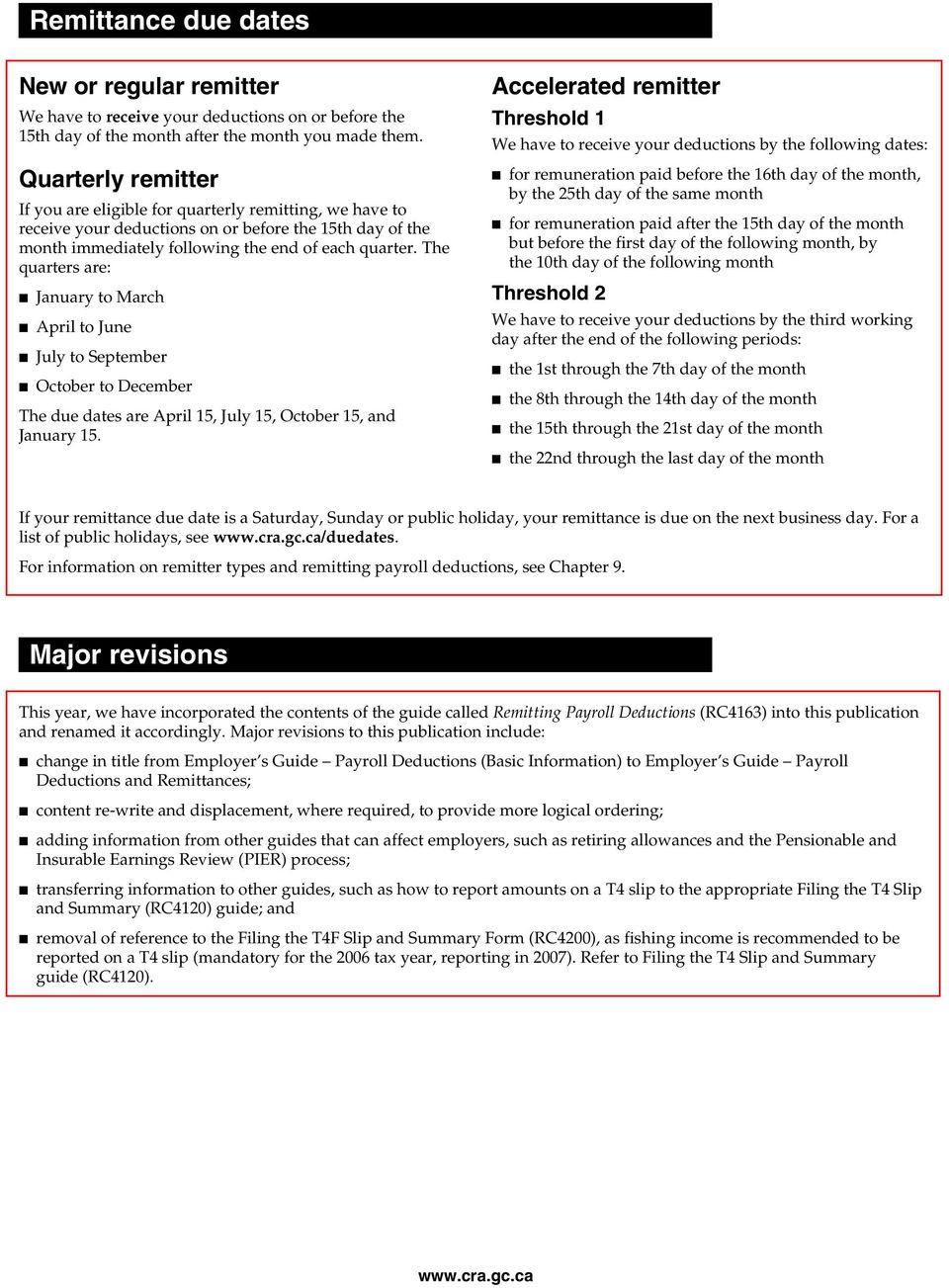
2 Remittance due dates New or regular remitter We have to receive your deductions on or before the 15th day of the month after the month you made them. Quarterly remitter If you are eligible for quarterly remitting, we have to receive your deductions on or before the 15th day of the month immediately following the end of each quarter. The quarters are: January to March April to June July to September October to December The due dates are April 15, July 15, October 15, and January 15. Accelerated remitter Threshold 1 We have to receive your deductions by the following dates: for remuneration paid before the 16th day of the month, by the 25th day of the same month for remuneration paid after the 15th day of the month but before the first day of the following month, by the 10th day of the following month Threshold 2 We have to receive your deductions by the third working day after the end of the following periods: the 1st through the 7th day of the month the 8th through the 14th day of the month the 15th through the 21st day of the month the 22nd through the last day of the month If your remittance due date is a Saturday, Sunday or public holiday, your remittance is due on the next business day. For a list of public holidays, see /duedates. For information on remitter types and remitting payroll deductions, see Chapter 9. Major revisions This year, we have incorporated the contents of the guide called Remitting Payroll Deductions (RC4163) into this publication and renamed it accordingly. Major revisions to this publication include: change in title from Employer s Guide Payroll Deductions (Basic Information) to Employer s Guide Payroll Deductions and Remittances; content re-write and displacement, where required, to provide more logical ordering; adding information from other guides that can affect employers, such as retiring allowances and the Pensionable and Insurable Earnings Review (PIER) process; transferring information to other guides, such as how to report amounts on a T4 slip to the appropriate Filing the T4 Slip and Summary (RC4120) guide; and removal of reference to the Filing the T4F Slip and Summary Form (RC4200), as fishing income is recommended to be reported on a T4 slip (mandatory for the 2006 tax year, reporting in 2007). Refer to Filing the T4 Slip and Summary guide (RC4120).
3 Do you need more information? If you need more help after you read this publication, visit our Web site at or call You can get forms and publications from our Web site at /forms or by calling Teletypewriter users If you use a teletypewriter (TTY), you can call our toll-free, bilingual enquiry service at Our Web site To get the most updated payroll information and products, we invite you to visit our Web site at /payroll. Electronic mailing list We can notify you immediately about new information on payroll deductions and remittances. To subscribe, free of charge, visit our Web site at /lists. Related publications Filing the T4 Slip and Summary Form (RC4120) Deducting Income Tax on Pension and Other Income, and Filing the T4A Slip and Summary Form (RC4157) Taxable Benefits (T4130) Employee or Self-Employed? (RC4110) Employer Visits Program We offer an on-site consultative service to provide any help you may need with payroll deductions. As part of this program, we can visit you to help with problems you have. If you would like information about this service, call Filing information returns You have to file a T4 or T4A information return, as applicable, and give information slips to your employees each year by the last day of February following the calendar year to which the information returns apply. For information on how to report the employees income and deductions on the appropriate slips and summary form, visit /slips or obtain one of the related publications. Electronic filing information can be found at /magmedia or /t4internet. Your opinion counts! If you have any comments or suggestions on the information contained in this guide, we want to hear from you. Please send your comments to: Client Services Directorate Canada Revenue Agency 750 Heron Road Ottawa ON K1A 0L5 Major payroll deductions changes that have taken place since last year are outlined in red. Visually impaired persons can get our publications in braille, large print, or etext (computer diskette), or on audiocassette from our Web site at /alternate or by calling weekdays from 8:15 a.m. to 5:00 p.m. (Eastern time). La version française de ce guide est intitulée Guide de l employeur Les retenues sur la paie et les versements.

4 Table of contents Page Chapter 1 Before you start... 5 Who should use this guide?... 5 Do you need to register for a payroll deductions account?... 5 Chapter 2 General information... 5 Are you an employer?... 5 What are your responsibilities?... 6 Payroll deductions tables... 7 Changes to your business entity... 8 Penalties and interest... 8 How do you appeal an assessment or a ruling?... 9 Chapter 3 Canada Pension Plan contributions... 9 Under what conditions do you deduct CPP contributions? Amounts and benefits subject to CPP contributions Employment, benefits and payments not subject to CPP contributions CPP contribution rate and maximum How do you determine how much CPP contributions to deduct? Prorating the maximum contribution for the year Commissions paid at irregular intervals Employees who are between 60 and 70 years old CPP overpayment Recovering CPP contributions CPP coverage by foreign employers Canada s social security agreements with other countries Chapter 4 Employment Insurance premiums Under what condition do you deduct EI premiums? Amounts and benefits subject to EI premiums Employment, benefits and payments not subject to EI premiums EI premium rate and maximum Quebec Parental Insurance Plan (QPIP) How can you reduce the rate of your EI premiums if you have a short-term disability plan? How do you determine how much EI premiums to deduct? EI overpayment Recovering EI premiums Establishing the number of insurable hours for Record of Employment purposes EI and the Record of Employment Chapter 5 Pensionable and Insurable Earnings Review (PIER) Chapter 6 Deducting income tax Form TD1, Personal Tax Credits Return Form TD1X, Statement of Commission Income and Expenses for Payroll Tax Deductions Form TD3F, Fisher s Election to Have Tax Deducted at Source Remuneration subject to income tax Page Reducing remuneration subject to income tax How do you calculate how much income tax you have to deduct? Non-resident employees who perform services in Canada Chapter 7 Special payments Bonuses and retroactive pay increases Directors fees Employees profit sharing plan (EPSP) Overtime pay Prescribed plans or arrangements Retirement compensation arrangements Retiring allowances Retroactive lump-sum payments Salary deferral arrangements Vacation pay and public holidays Wages in lieu of termination notice Wage-loss replacement plans Workers compensation awards Special payments chart Chapter 8 Special situations Barbers, hairdressers, taxi drivers and drivers of other passenger-carrying vehicles Emergency volunteers Employees of a temporary-help service firm Employees with power saws or tree trimmers Employing a caregiver, baby-sitter, or maid Employment outside or partly outside Canada Fishers and Employment Insurance Placement and employment agency workers Repayment of salary or wages by an employee Salary paid in error Seasonal agricultural workers program Status Indian employees Chapter 9 Remitting payroll deductions Are you a new remitter? Remitter types and due dates Remittance forms Remittance methods Do you have more than one account? Notice of Assessment Service bureaus Remitting error Appendices Appendix 1 Year-end calculation of deductions for employee CPP contributions (2005) Appendix 2 Employee s CPP basic exemption for various 2005 pay periods Appendix 3 Year-end calculation of deductions for employee EI premiums (2005) Appendix 4 Canada s social security agreements with other countries Where to find

5 Chapter 1 Before you start Who should use this guide? You should use this guide if you are: an employer; a trustee; or a payer of other amounts related to an employment We also provide guidelines for estate executors, liquidators, administrators, and corporate directors. For information on taxi and other drivers, and barbers and hairdressers, see page 32. Do not use this guide if you are self-employed and need coverage under the Canada Pension Plan. For information, see the General Income Tax and Benefit Guide. Do you need to register for a payroll deductions account? You need to register for a payroll account if: you pay salaries or wages; you pay tips and gratuities; you pay bonuses and vacation pay; you provide benefits and allowances to employees; or you need to deduct and remit amounts from other types of remuneration (such as pension or superannuation). If you need a payroll account and you already have a Business Number (BN), you only need to add a payroll deductions account to your existing BN. However, if you don t have a BN, you must request one and register for a payroll account before your first remittance due date. For information on the BN and CRA business accounts or to register on-line, visit our Web site at /bn. You can also consult the publication called The Business Number and Your Canada Revenue Agency Accounts (RC2). Contacts and Authorized Representatives As a business owner, partner, director, trustee, or officer of a business, you can designate business account contacts, such as one or more employees, to discuss your account matters with us. If you want to authorize a representative from outside your business, such as an accountant, bookkeeper, lawyer, or a firm, you have to complete Form RC59, Business Consent Form, or a letter of consent and send it to your tax centre. This will allow us to communicate with your authorized representative without delay. The protection of confidential information is important to us. Visit our Web site at /bn or call to get information on how to add, replace, or delete your contacts and authorized representatives. Employment in Quebec The Quebec provincial government administers its own provincial pension plan called the Quebec Pension Plan (QPP), its own provincial income tax and, effective January 1, 2006, the Quebec Parental Insurance Plan (QPIP). Visit the Revenu Québec Web site at or write to Revenu Québec, 3800 de Marly Street, Sainte-Foy QC G1X 4A5, if one of the following situations applies and you need more information: the employee has to report to your place of business in Quebec; or the employee does not have to report to your place of business, but you pay the employee from your place of business in Quebec. Chapter 2 General information Are you an employer? We generally consider you to be an employer if: you pay salaries, wages (including advances), bonuses, vacation pay, or tips to your employees; or you provide certain taxable benefits or allowances, such as board and lodging, to your employees. An employer-employee relationship exists if you have the right to control and direct the person or people who perform the services. We explain this relationship in this guide as employment under a contract of service. Although a written contract might indicate that an individual is self-employed or working under a contract for services, we may not consider the individual as such if there is evidence of an employer-employee relationship. The written contract and working conditions must be examined to determine if an employer-employee relationship exists. If you re not sure if the person working for you is considered an employee, see the publication called Employee or Self-Employed? (RC4110). If you or a person working for you have any doubt about whether an employer-employee relationship exists, you can request a ruling. Complete Form CPT1, Request for a Ruling as to the Status of a Worker Under the Canada Pension Plan or Employment Insurance Act, and send it to the attention of Revenue Collections, at any tax services office. Employment by a trustee A trustee includes a liquidator, receiver, receiver-manager, trustee in bankruptcy, assignee, executor, administrator, sequestrator, or any other person who performs a function similar to the one a trustee performs. A trustee does the following: authorizes a payment or causes a payment to be made for another person; and administers, manages, distributes, winds up, controls, or otherwise deals with another person s property, business, estate, or income. 5
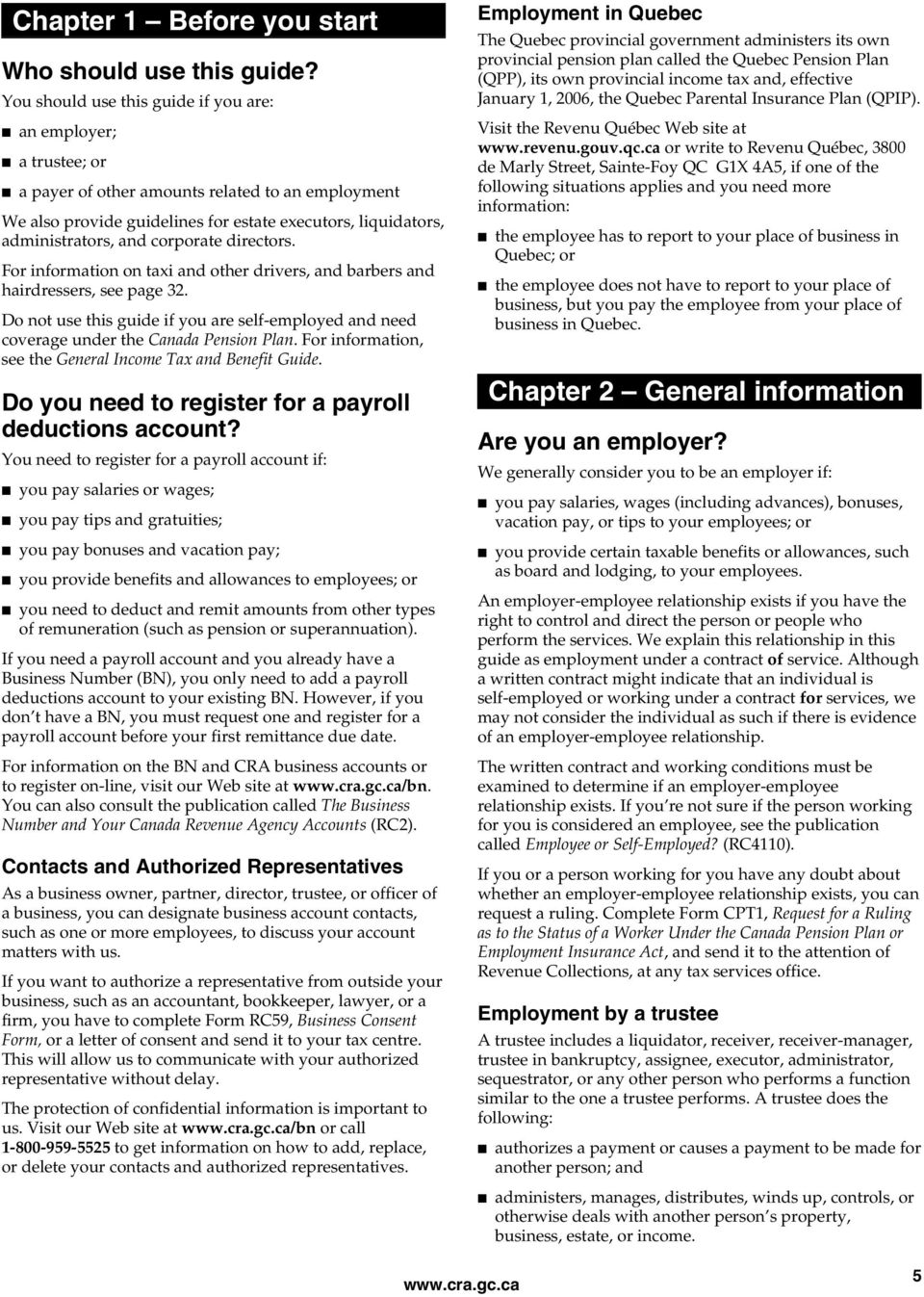
6 The trustee is jointly and severally liable for deducting and remitting the tax for all payments the trustee makes. Trustee in bankruptcy Under the Canada Pension Plan and the Employment Insurance Act, the trustee in bankruptcy is the agent of the bankrupt employer in the event of an employer s liquidation, assignment, or bankruptcy. If a bankrupt employer has deducted Canada Pension Plan (CPP) contributions, Employment Insurance (EI) premiums, or income tax from amounts employees received before the bankruptcy, and the employer has not remitted these amounts to us, the trustee must hold the amounts in trust. These amounts are not part of the estate in bankruptcy and should be kept separate. If a trustee carries on the bankrupt employer s business, the trustee has to continue to deduct and remit the necessary CPP contributions, EI premiums, and income tax according to the bankrupt employer s remittance schedule. T4 slips should be prepared and filed in the usual way. Amounts paid by a trustee to employees of a bankrupt corporation to settle claims for wages that the bankrupt employer did not pay are considered taxable income. However, this income is not subject to CPP, EI, and income tax withholdings. These payments are to be reported on T4A slips. Estate executors or liquidators, and administrators Fees paid to executors or liquidators and administrators are either income from office or employment or business income, depending on whether the executor or administrator acts in this capacity in the regular course of business. To determine if the fees paid are subject to CPP contributions, see page 10. Payer of other amounts A payer of other amounts can be an employer, trustee, estate executor, liquidator, administrator, or a corporate director who pays other types of income related to an employment. This income can include pension or superannuation, lump-sum payments, self-employed commissions, annuities, retiring allowances, or any other type covered in this publication or in the Deducting Income Tax on Pension and Other Income, and Filing the T4A Slip and Summary Form (RC4157). These types of amounts are to be reported on a T4A slip. What are your responsibilities? You are responsible for deducting, remitting, and reporting payroll deductions. You also have responsibilities in situations such as hiring an employee, when an employee leaves or if the business ceases operations. The following are responsibilities the employer, and in some circumstances, the trustee and payer must follow. Open and maintain a payroll deductions account. If you meet the criteria to open an account on page 5, you must register to obtain one. Get your employee s social insurance number (SIN). Every employee must show you his or her SIN card to work in Canada. See the SIN topic below. Obtain a completed federal TD1 and, if applicable, a provincial or territorial TD1. New employees or recipients of other amounts such as pension income must complete this form. See page 19. Deduct CPP contributions, EI premiums, and income tax from remuneration or other amounts you pay. You should hold these amounts in trust for the Receiver General for Canada and keep them separate from the operating funds of your business. Make sure these amounts are not part of an estate in liquidation, assignment, receivership, or bankruptcy. Remit these deductions along with your share of CPP contributions and EI premiums. The CPP and EI chapters will explain how to calculate your share of contributions and the last chapter explains how and when to remit these amounts. Report the employees income and deductions on the appropriate T4 or T4A slip. You must file an information return by the end of February of the following calendar year. See page 3. Complete and issue Form INS2106, Record of Employment, when an employee leaves. See page 18. Keep records. You must keep records of what you do as our officers can ask to see them. Keep your paper and electronic records for at least six years from the end of the last tax year to which they relate. However, if you want to destroy them before the period is over, complete Form T137, Request for Destruction of Books and Records. For more information, see Information Circular 78-10, Books and Records Retention/Destruction or the guide called RC4409, Keeping Records. Social insurance number (SIN) As an employer, you have to get the correct SIN from each employee. If the employee does not give you his or her SIN, you should be able to show that you made a reasonable effort to get it. For example, if you contact an employee by mail to ask for his or her SIN, be sure to record the date of your request and keep a copy of any correspondence that relates to it. We consider this to be a reasonable effort. If you do not make a reasonable effort to get a SIN, you may be subject to a penalty of $100 for each failure. Employees also have to give you their SIN. If an employee does not do this, the employee may be subject to a penalty of $100 for each failure. Under the Canada Pension Plan Regulations, you have to tell your employees who don t have a SIN card how to get a SIN. Refer them to their local Human Resources Centre of Canada (HRCC) office within three days of the day they start work and ask them to provide you with their new SIN once they receive it. Every person employed in pensionable or insurable employment has to show their SIN card to their employer. Always use the correct name and number as shown on the employee s SIN card. An incorrect SIN can affect an 6
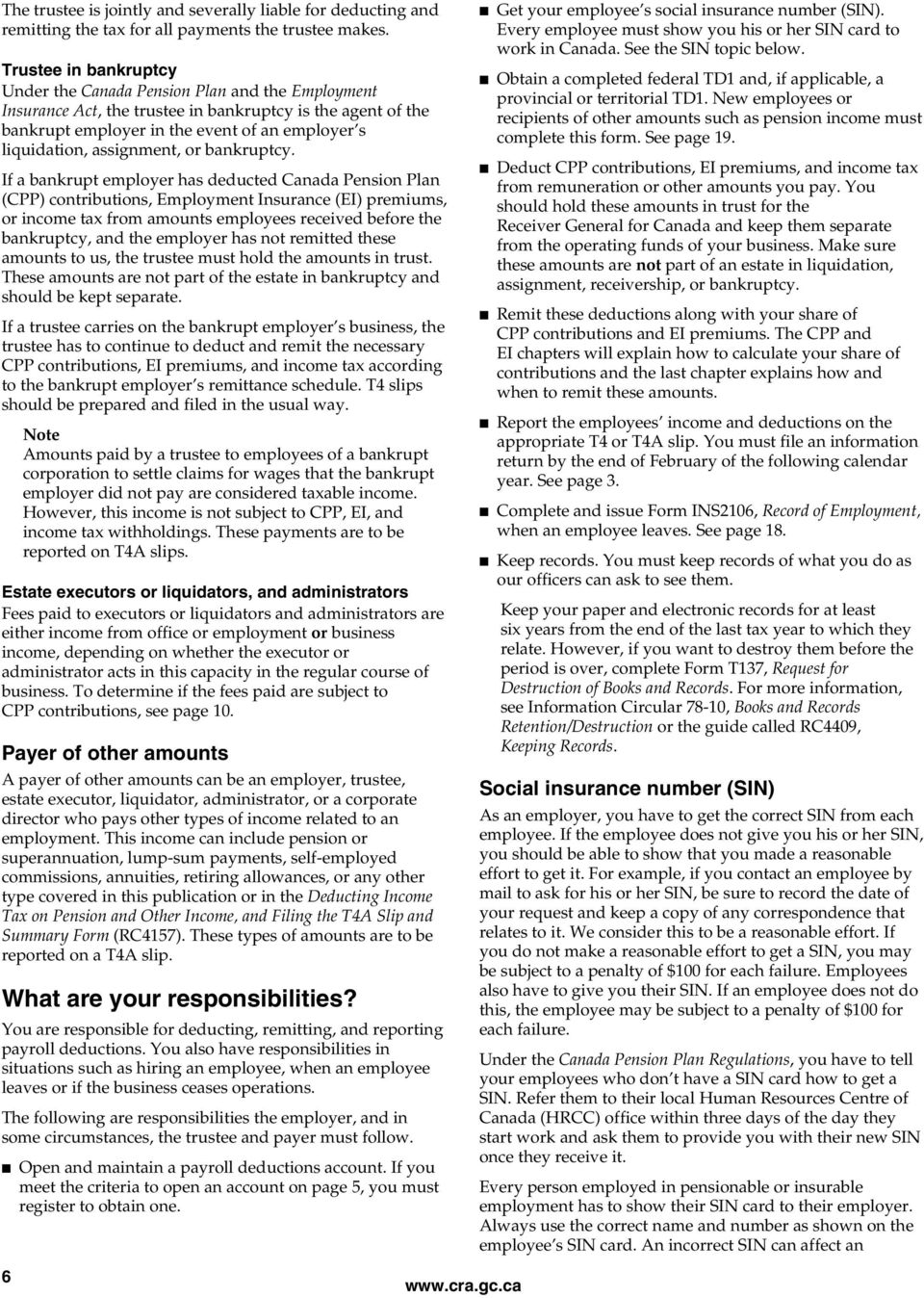
7 employee s future CPP benefits if the record of earnings file is not accurate. Also, if you report an incorrect SIN on a T4 slip that has a pension adjustment (PA) amount, the employee may receive an inaccurate annual Registered retirement savings plan (RRSP) deduction limit statement. In addition, the related information on the employee s Notice of Assessment will be inaccurate. When an employee has an interruption in earnings, you have to record the correct SIN on a Record of Employment (ROE) for EI purposes (for details on the ROE, see page 18). If you don t, you could be fined up to $2,000, imprisoned for up to six months, or both. Until such time you receive your employee s SIN, you still have to make deductions and file your information returns no later than the last day of February. If you do not, you may be subject to a penalty for late filing. If you filed a T4 slip without a SIN but subsequently received it, file an amended T4 slip and include the SIN. See Filing a T4 Slip and Summary Form (RC4120) for instructions on how to amend. For more information, see Information Circular 82-2, Social Insurance Number Legislation That Relates to the Preparation of Information Slips or visit the Social Development Canada Web site at SIN beginning with the number 9 An eligible person who is not a Canadian citizen or a permanent resident of Canada and who applies for a SIN will get a SIN beginning with the number 9. That person will be authorized to work only for a particular employer, and must have a valid employment authorization issued by Citizenship and Immigration Canada. If you hire a person whom you know is not a Canadian citizen or permanent resident, make sure that: the person s SIN begins with the number 9 ; the SIN card has an expiry date; and the person has a valid employment authorization which states that he or she will work only for you. Under the Immigration Act, only the following persons are authorized to work in Canada: Canadian citizens; permanent residents; or persons who have a valid employment authorization. Hiring someone else could lead to penalties under the Immigration Act. If a SIN begins with a 9 and the SIN card does not have an expiry date, the card is no longer valid. Refer the person to their local Human Resources Centre of Canada (HRCC) office. Payroll deductions tables The payroll deductions tables have information to help you calculate CPP contributions, EI premiums, and the amount of federal, provincial (except Quebec), and territorial income tax that you have to withhold from amounts you pay. You can get any of the following versions of the payroll deductions tables: Payroll Deductions Tables (T4032) and Payroll Deductions Supplementary Tables (T4008) You can use these tables to calculate your employees payroll deductions. You can download and print any selected pages or you can order the paper copy from our Web site at /orderforms or by calling Payroll deductions tables for all provinces and territories are available on our Web site at /payroll. They are usually posted three weeks before the printed copies are available. Tables on Diskette (TOD) (T4143) The tables on diskette are an electronic version of the Payroll Deductions Tables and Payroll Deductions Supplementary Tables. TOD calculates payroll deductions for all provinces (except Quebec) and territories. TOD calculates the deductions for any pay period, for commission income, for special payments such as bonuses and most taxable automobile benefits. TOD calculates Canada Pension Plan contributions, Employment Insurance premiums, and the federal, provincial (except Quebec), and territorial income tax that you withhold from an employee s or pensioner s income. TOD is available on our Web site at /tod. It is also available on the Electronic Document Distribution System (EDDS). Payroll Deductions Formulas for Computer Programs (T4127) If you have a computer, you may want to use these formulas instead of the printed tables to calculate your employees payroll deductions. This publication contains formulas to calculate CPP contributions, EI premiums, and federal, provincial (except Quebec), and territorial income tax. If the computer formulas you want to use are different from ours, you have to submit them to any tax services office or tax centre for approval. All the payroll deductions tables are available for each province and territory, and also for employees working outside Canada. Which provincial or territorial tax tables should you use? When you pay employment income such as salaries, wages, or commissions, you have to determine your employee s province or territory of employment. This depends on whether or not you require your employee to report for work at your place of business. If the employee reports for work at your place of business, the province or territory of employment is the province or territory where your business is located. 7
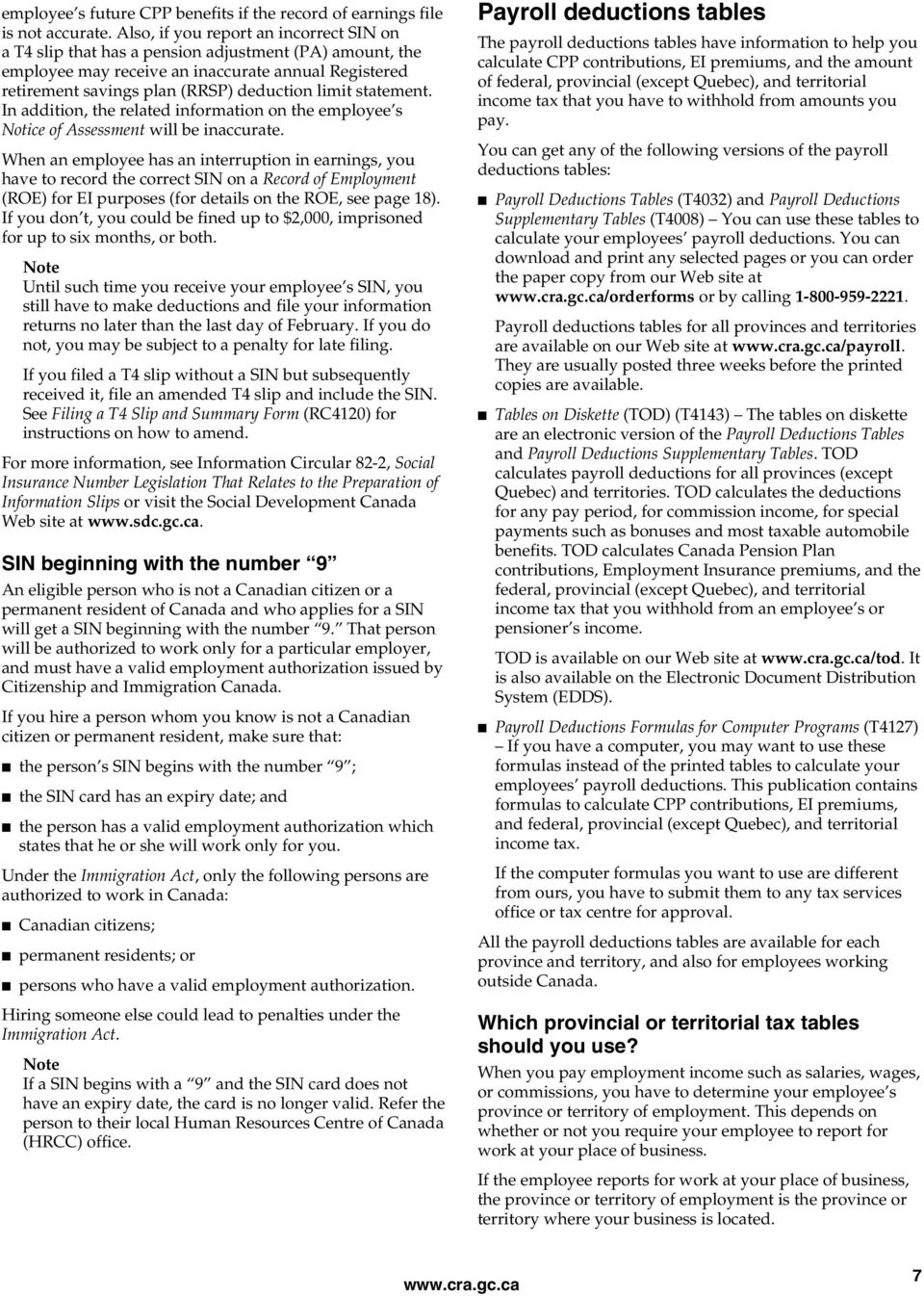
8 To withhold payroll deductions, use the tax tables for that province or territory of employment. Example 1 Your head office is in Ontario, but you require your employee to report to your place of business in Manitoba. In this case, use the Manitoba Payroll Deductions Tables. Example 2 Your employee lives in Quebec, but you require your employee to report to your place of business in New Brunswick. In this case, use the New Brunswick Payroll Deductions Tables. If you do not require your employee to report for work at your place of business, the employee s province or territory of employment is the province or territory where your business is located and from where you pay your employee s salary. Example Your employee does not have to report to any of your places of business, but you pay the employee from your office in Quebec. In this case, use the Quebec Payroll Deductions Tables. The employee is not subject to CPP contributions, but could be subject to Quebec Pension Plan (QPP) contributions. An employee who lives in one province or territory but works in another one may be subject to excessive tax deductions. If so, he or she can ask for a reduction in tax deductions, by getting a letter of authority from any tax services office. For more information, see Letter of authority on page 21. An employee who lives in one province or territory but works in another may not have enough tax deducted. If this is the case, the employee should request additional tax deductions at source on Form TD1, Personal Tax Credits Return. If you paid amounts other than employment income, such as pension income, use the provincial or territorial table of the recipient s province or territory of residence. What should you do if you do not have any employees for a period of time? Inform us by calling our TeleReply service or send us your completed remittance form and indicate when you expect to have employees subject to deductions. To find out how to use our TeleReply service, see page 40. Changes to your business entity What should you do if your business stops operating? Remit all CPP contributions, EI premiums, and income tax withheld to your tax centre within seven days of the day your business ends. Calculate the pension adjustment (PA) that applies to your former employees who accrued benefits for the year under your registered pension plan (RPP) or deferred profit sharing plan (DPSP). Prepare and give a Record of Employment (ROE) to each former employee. See page 18 for information. Complete and file the necessary T4 or T4A slips and summary form with the Ottawa Technology Centre within 30 days of the day your business ends. Distribute copies of the T4 or T4A slips to your former employees. For information on how to complete the T4 or T4A slips and summary form, get the publication called Filing the T4 Slip and Summary Form (RC4120) or Deducting Income Tax on Pension and Other Income, and Filing the T4A Slip and Summary Form (RC4157). What happens if you change your business status? If you change your business status, we consider you to be a new employer. You may need a new Business Number (BN) and a new payroll account. Call to let us know if your business status has or will change in the near future. The following are examples of changes to a business status: You are the sole proprietor of a business and you decide to incorporate. You and a partner own a business. Your partner leaves the business and sells his half interest to you, making you a sole proprietor. You and your partners own part of a business. The group decides to incorporate. Your corporation merges with one or more corporations to form a new one. What should you do if your business goes through a restructure or reorganization? Effective January 1, 2004, a successor employer who has acquired all or part of a business and who has immediately succeeded the former employer as the new employer of an employee, may, under certain circumstances, take into consideration the amounts deducted, remitted, or paid under the Canada Pension Plan and/or the Employment Insurance Act. Visit our Web site at /cppeiexplained to see if you can benefit from these legislative changes. If your business does not qualify from this new policy and you know that some employees paid the maximum CPP/EI deductions for the year before the restructure or reorganization, you may want to ask for administrative relief for your employees. For more information, call Penalties and interest Penalty Failure to deduct We can assess a penalty of 10% of the required amount of CPP, EI, and income tax you failed to deduct. 8
9 If you are subject to this penalty more than once in a calendar year, we may apply a 20% penalty to the second or later failures if they were made knowingly or under circumstances of gross negligence. Penalty Failure to remit We can assess a penalty of 10% up to 20% of the amount you failed to remit when: you withhold the amounts, but do not remit them; or we receive the amounts you withheld past the due date. Example A remittance that was due on January 15 of the current year (for deductions made in December of the previous year) is considered late when paid with the previous year s information return (T4, T4A), and this return is filed after January 15. Normally, we only apply this penalty to the part of the amount you failed to remit that is more than $500. However, we may apply the penalty to the total amount if the failure was made knowingly or under circumstances of gross negligence. We will apply a penalty on a non-sufficient funds cheque. If the remittance due date is a Saturday, Sunday, or public holiday, your remittance is due on the next business day. Interest We can charge interest from the day your payment is due. For due dates, see page 37. Obligations and liabilities Offences and punishment If you fail to comply with the withholding, remitting, and reporting requirements, you may be prosecuted. You could be fined from $1,000 up to $25,000, or you could be fined and imprisoned for a term of up to 12 months. Director s liability If a corporation (including for-profit or non-profit corporations) fails to withhold, remit, or pay amounts held in trust for the Receiver General for Canada (CPP, EI, income tax, and GST/HST), the directors of the corporation at the time of the failure may be held personally liable along with the corporation to pay the amount due. This amount includes penalties and interest. However, if the directors take action to ensure the corporation makes the necessary deductions or remittances, we will not hold the directors personally responsible. See Information Circular 89-2, Directors Liability Section of the Income Tax Act and Section 323 of the Excise Tax Act. Waiving penalties and interest The fairness provisions of the Income Tax Act give us certain discretion to cancel or waive all or a part of interest charges and penalties. This flexibility allows us to consider extraordinary circumstances that may have prevented you from fulfilling your obligations under the Canada Pension Plan, Employment Insurance Act, and the Income Tax Act. See Information Circular 92-2, Guidelines for the Cancellation and Waiver of Interest and Penalties. How do you appeal an assessment or a ruling? If you receive an assessment for CPP contributions, EI premiums, or income tax that you do not agree with, or you have received a rulings letter and you disagree with the decision, you have 90 days after the date of the assessment or notification of the ruling to appeal. However, before you file an appeal, you may want to call to discuss the matter. This could solve the problem and save you the time and trouble of appealing. To appeal the amount of income tax that we indicate you owe, you can: file Form T400A, Objection Income Tax Act; or write to the chief of appeals at any tax services office or tax centre. State the reasons why you do not agree with the assessment, and give all the related facts. To appeal the CPP contributions or EI premiums that we indicate you owe, or to appeal the rulings decision, you can: file Form CPT100, Appeal Under the Canada Pension Plan and/or Employment Insurance Act; or write to the chief of appeals at any tax services office. Attach a copy of the assessment or ruling, state the reasons why you do not agree with the assessment or ruling, and give all the related facts. For information on how to appeal a CPP and/or EI assessment or ruling, see the publication called Your Appeal Rights Employment Insurance and Canada Pension Plan Coverage (P133). Chapter 3 Canada Pension Plan contributions F or Canada Pension Plan (CPP) purposes, contributions are not calculated from the first dollar of pensionable earnings. Contributions are calculated using the amount of pensionable earnings less an exempt amount that is based on the period of employment. If used improperly, some payroll software programs, in-house payroll programs, and bookkeeping methods can calculate unwarranted or incorrect refunds of CPP contributions for both employees and employers. The improper calculations treat all employment as if it were full-year employment, which incorrectly reduces both the employee s and employer s contributions. For example, when a part-year employee does not qualify for the full annual exemption, a program may indicate that the employer should report a CPP overdeduction in box 22, Income tax deducted, of the T4 slip. This may result in an 9

10 unwarranted refund of tax to the employee when the employee files his or her income tax and benefit return. When employees receive refunds for apparent CPP overdeductions, their pensionable service is adversely affected. This could affect their CPP income when they retire. In addition, employers who report such overdeductions receive a credit to which they are not entitled (because the employee worked for them for less than 12 months). Under what conditions do you deduct CPP contributions? You have to deduct CPP contributions from an employee s remuneration if that employee: is 18 or older, but younger than 70; is in pensionable employment during the year; and does not receive a CPP retirement or disability pension. s CPP deductions should start effective the first pay period that falls on or after the first of the month following the employee s 18 th birthday. Quebec employers deduct Quebec Pension Plan (QPP) contributions instead of CPP contributions. For information on withholding and remitting the QPP, see the Guide for Employers Source Deductions and Contributions, which you can get from Revenu Québec. Amounts and benefits subject to CPP contributions You generally deduct CPP contributions from the following amounts and benefits: salary, wages, commissions, or other remuneration (including advances on account of future earnings), wages in lieu of termination notice, bonuses; most cash/non cash taxable benefits and allowances, certain rent-free and low-rent housing, the value of board and lodging (other than an exempt allowance paid to an employee at a special work site or remote work location), interest-free and low-interest loans, employer contributions to an employee s registered retirement savings plan (RRSP), group term life insurance premiums, personal use of an automobile that you as the employer own or lease, holiday trips, subsidized meals, and certain gifts, prizes, and awards; honorariums from employment or office, a share of profit that an employer paid, incentive payments, directors fees, management fees, fees paid to board or committee members, and executor s, liquidator s, or administrator s fees earned to administer an estate (as long as the executor, liquidator, or administrator does not act in this capacity in the regular course of business); certain tips and gratuities received for services performed; remuneration received while retired, on vacation, furlough, sabbatical, or sick leave, or for lost-time pay from a union, vacation pay, payments received under a supplementary unemployment benefit (SUB) plan that does not qualify as a SUB plan under the Income Tax Act (for example., employer paid maternity and parental top up amounts), and payments for sick leave credits; wage-loss benefits that an employee receives from a wage-loss replacement plan (these benefits may or may not be subject to CPP contributions for more information, see page 28); benefits derived from stock option plans; and the salary you continue to pay to an employee before or after a workers compensation board claim is decided, as well as: any advance or loan you make that is more than the workers compensation award; any advance or loan not repaid to you; or a top-up amount you pay in addition to the workers compensation award paid by a workers compensation board. If you pay any of these amounts to a former employee and you have to deduct CPP contributions, use the rate in effect when you make the payment. Employment, benefits and payments not subject to CPP contributions Excluded employment Do not deduct CPP contributions from payments for these types of employment: employment in agriculture, an agricultural enterprise, horticulture, fishing, hunting, trapping, forestry, logging, and lumbering, by an employer who pays the employee cash remuneration: of less than $250 in a calendar year; and for a period of less than 25 working days in the same year the working days don t have to be consecutive; When the employee works 25 days or more, the employment is pensionable from the first day of work. casual employment if it is for a purpose other than your usual trade or business; employment as a teacher on exchange from a foreign country; employment of a spouse or common-law partner if you cannot deduct the remuneration paid as an expense under the Income Tax Act; employment of your child or a person that you maintain if no cash remuneration is paid; employment of a person you do not regularly employ if that person helps you in a rescue or relief operation; employment of a person in connection with a circus, fair, parade, carnival, exposition, exhibition, or other similar activity, except for entertainers, if that person: is not your regular employee; and works for less than seven days in the year; 10
11 When the employee works seven days or more, the employment is pensionable from the first day of work. employment by a government body as an election worker if the worker: is not a regular employee of the government body; and works for less than 35 hours in a calendar year; When the employee works 35 hours or more, the employment is pensionable from the first day worked. employment of a member of a religious order who has taken a vow of perpetual poverty. This applies whether the remuneration is paid directly to the order or the member pays it to the order. Excluded benefits and payments Do not deduct CPP contributions from: pension payments, lump-sum payments from a pension plan, death benefits, amounts that a trustee allocated under a profit sharing plan or that a trustee paid under a deferred profit sharing plan, benefits received under a supplementary unemployment benefit (SUB) plan that qualifies as a SUB plan under the Income Tax Act, and retiring allowances or severance payments received upon or after retirement to recognize long service, or for loss of office or employment; wage-loss benefits that an employee receives from a wage-loss replacement plan (these benefits may or may not be subject to CPP contributions for information, see page 28); payments you make after an employee dies, except for amounts the employee earned and was owed before the date of death; an advance or a loan equal to a workers compensation award you pay to an employee, before or after the workers compensation board claim is decided (for information on situations when CPP contributions are required, see Amounts and benefits subject to CPP contributions discussed earlier in this chapter for information on workers compensation, see page 28); and amounts for the residence of a clergy member if he receives a tax deduction for the residence. CPP contribution rate and maximum You have to deduct CPP contributions from the amounts and benefits you pay or provide to your employees. In addition, you must contribute the same amount that you deduct from your employees remuneration. Example CPP contributions you deducted from your employees in the month... $ Your share of CPP contributions... $ Total amount you remit for CPP contributions... $ Each year, we determine: the maximum pensionable earnings from which you deduct CPP ($41,100 for 2005); the annual basic exemption, which is a base amount from which you do not deduct CPP contributions ($3,500 for 2005); and the rate you use to calculate the amount to deduct from your employees (4.95% for 2005). You stop deducting CPP contributions when you reach the employee s maximum pensionable earnings or the maximum employee contribution for the year ($1, for 2005). The employee s contribution rate, for the next year, can be found in each version of the Payroll Deductions Tables, which are usually available in mid-december each year. The maximum pensionable earnings applies to each job the employee holds with different employers (different business numbers). If an employee leaves one employer during the year to start work with another employer, the new employer also has to deduct CPP contributions without taking into account what was paid by the previous employer. This is the case even if the employee has paid the maximum contribution amount during the previous employment. However, if your business went through a restructure or reorganization, see page 8. Any overpayments will be refunded to employees when they file their income tax and benefit returns. Employers are not entitled to a refund. You may have a place of business in Quebec and in another province or territory. If you transfer an employee from Quebec to another province or territory, you have to prepare two T4 slips: one showing the province of employment as Quebec, the remuneration the employee earned in Quebec, the QPP contributions deducted, the applicable pensionable earnings, and any other applicable deductions; and the other showing the other province or territory of employment, the remuneration the employee earned in that other province or territory, the CPP contributions deducted, the applicable pensionable earnings, and any other applicable deductions. In such a case, when calculating the amount of Canada Pension Plan (CPP) contributions, you can take into account the Quebec Pension Plan (QPP) contributions you deducted from that employee throughout the year. The total contributions to both plans cannot be more than the maximum contribution for the year. How do you determine how much CPP contributions to deduct? Use one of the following methods: the tables on diskette (TOD) method; the table method; 11

12 the formula method; or the manual calculation method see below. See the section called Payroll deductions tables, on page 7 to find out which method is best for you. The manual calculation method To calculate the amount using this method, follow these steps: Step 1: Calculate the basic pay-period exemption that applies. To do this, divide the basic yearly exemption ($3,500 for 2005) by the number of pay periods in the year (see Appendix 2 at the end of this guide). Step 2: Subtract the result of Step 1 from the employee s gross pay and taxable benefits and allowances for each pay period. Step 3: Multiply the result of Step 2 by the current year s CPP contribution rate (4.95% for 2005). Do not exceed the maximum for the year. The result is the amount of contributions you should withhold from the employee. As an employer, you have to pay the same amount as your employee. Example Weekly salary... $500 Taxable benefit... $ 50 Total... $550 Step 1: $3, = $67.30 (do not round off) Step 2: $550 $67.30 = $ Step 3: $ % = $23.89 In this case, you would have to send in CPP contributions of: Employee s contribution... $23.89 Employer s contribution... $23.89 Total... $47.78 A pay period means the period for which you pay earnings or other remuneration to an employee. Once you have established your type of pay period, the pay period exemption (see Appendix 2) must remain the same, even when an unpaid leave of absence occurs or when earnings are paid for part of a pay period. Prorating the maximum contribution for the year When to prorate You will have to prorate the maximum contribution for the year when: an employee turns 18 in the year (use the number of months after the month the employee turns 18); an employee turns 70 in the year (use the number of months up to and including the month the employee turns 70); a retirement pension is payable to an employee under the CPP (use the number of months before the month the pension is payable for information, see Employees who are between 60 and 70 years old, later in this chapter); an employee is considered to be disabled under the CPP (use the number of months up to and including the month the person was considered to be disabled and the number of months following the month the person ceased to be disabled); or an employee dies in the year (use the number of months up to and including the month of death). In some cases, the requirements are different for QPP. For information, see the Guide for Employers Source Deductions and Contributions, which you can get from Revenu Québec. How to prorate To prorate the maximum contribution for the year, follow these steps: Step 1: Deduct the year s basic exemption ($3,500 for 2005) from the year s maximum pensionable earnings ($41,100 for 2005). Step 2: Multiply the result of Step 1 by the number of pensionable months. Step 3: Divide the result of Step 2 by 12 (months). Step 4: Multiply the result of Step 3 by the CPP rate that applies for the year (4.95% for 2005). Example 1 Brent turned 18 on May 15, He receives $2,000 a month ($24,000 a year). This amount is less than the maximum pensionable earnings ($41,100) that are subject to CPP contributions. January to May 2005 No CPP contributions June to December 2005 Pay period: monthly Earnings: $2,000 Basic yearly CPP exemption: $3,500 Prorate basic yearly exemption per month: $3, = $ (do not round off) Monthly deduction: $2,000 $ = $1,708.34; $1, % = $84.56 Prorated maximum contribution for /12 ($41,100 $3,500) 4.95% = $1, Brent s total CPP contributions for 2005 should not be more than $1, Example 2 Maria turned 70 on February l5, She receives $800 per week ($41,600 per year). This amount is more than the maximum pensionable earnings ($41,100) that are subject to CPP contributions. 12
13 January to February 2005 Pay period: weekly Earnings: $800 Basic yearly CPP exemption: $3,500 Prorate basic yearly exemption per week: $3, = $67.30 (do not round off) Weekly deduction: $800 $67.30 = $732.70; $ % = $36.27 March to December 2005 No CPP contributions Prorated maximum contribution for /12 ($41,100 $3,500) 4.95% = $ Maria s total CPP contributions for 2005 should not be more than $ Commissions paid at irregular intervals If an employee always gets paid on commission and is paid only after selling something (which does not occur regularly), you have to prorate the maximum contribution for the number of days in the year between payments. Example Sylvie, your employee, always works on commission. You pay her only when she sells something. However, this does not occur regularly. On June 1, 2005, you paid her a $1,800 commission. The last time you paid her a commission was March 16, There are 77 days between these two payments. Calculate the required contribution for 2005 as follows: Prorate the basic yearly exemption: (days) $3,500 = $ You have to deduct CPP contributions of: $1,800 $ = $1,061.64; 1, % = $52.55 The amount you have to remit is: Employee s contribution... $52.55 Employer s contribution... $52.55 Total...$ Employees who are between 60 and 70 years old These employees can apply for a CPP retirement pension. You have to deduct CPP contributions from their remuneration until the end of the month before the month that the pension becomes payable. Social Development Canada sends an award letter to employees who get a pension. The letter indicates the date the pension becomes payable. An employee has to show you this letter to prove that contributions are no longer required. An employee may work after the age of 60 and not apply for a CPP retirement pension. As a result, you have to deduct contributions until the end of whichever occurs first: the month before the employee receives the retirement pension; or the month in which the employee turns 70. For information on eligibility for a CPP retirement pension, contact your local Human Resources Centre of Canada (HRCC) office. The requirements are different for QPP. For information on QPP, see the Guide for Employers Source Deductions and Contributions, which you can get from Revenu Québec. CPP overpayment If, during a year, you have overdeducted CPP contributions from your employee s remuneration (for example, the maximum amount of pensionable earnings was reached, or the employee was not employed in pensionable employment), you should reimburse the employee the amount deducted in error and adjust your payroll records to reflect the reduced deduction. This will result in a credit on the CRA payroll account equal to the employee and employer part of the overdeduction. You may then reduce a future remittance in the same calendar year. Do not include the reimbursed amount on the T4 slip. If you cannot reimburse the overpayment, show the total CPP contributions deducted and the correct pensionable earnings on the T4 slip of the employee. If you reported the employee s overpayment on the T4 slip, you can ask for a refund by completing Form PD24, Application For a Refund of Overdeducted CPP Contributions and/or EI Premiums. Your request must be made no later than four years from the end of the year in which the overpayment occurred. Recovering CPP contributions If you receive a Notice of Assessment or if you discover that you have underdeducted CPP contributions, you can recover the employee s contributions from later payments to the employee. The deductions can be equal to, but not more than, the amount you should have deducted from each payment. However, you cannot recover a contribution amount that has been outstanding for more than 12 months. The employer s share is your responsibility. If you should have made a deduction in a previous year and you recover it through a deduction in the current year, do not report the recovered amount on the current year s T4 slip. Instead, amend the previous year s T4. The recovered amount does not affect the current year-to-date CPP contributions. 13

14 Example a) You did not deduct or remit CPP contributions that should have been deducted as follows: Month CPP September $23.40 October $23.40 November $24.10 December $24.70 Total $95.60 b) After auditing the records, we issue a Notice of Assessment as follows: Employee Employer Total CPP contributions $95.60 $95.60 $ Penalties and interest are added to the total. c) The following year, you can recover $95.60 for CPP from the employee as follows: Current Employer s deduction recovery April $24.70 $23.40 (for September) May $24.70 $23.40 (for October) June $25.10 $24.10 (for November) July $25.10 $24.70 (for December) Total $95.60 Details on the Pensionable and insurable earnings review is contained in Chapter 5. CPP coverage by foreign employers If you are a foreign employer who does not have a place of business in Canada, you can apply to have employment that you provide in Canada covered under the CPP. This coverage is optional. Even if your country does not have a social security agreement with Canada, you can apply for coverage by completing Form CPT13, Application for Coverage of Employment in Canada Under the Canada Pension Plan by an Employer Resident Outside Canada. You can get more information on CPP coverage from a CPP/EI eligibility officer at any tax services office. Canada s social security agreements with other countries Canada has reciprocal social security agreements with other countries. These agreements ensure that only one plan covers an employee CPP or a foreign social security plan. To find out which country has CPP coverage provisions with Canada, see Appendix 4. You can get application forms (for CPT#, see Appendix 4) for coverage or for extending coverage under the CPP from our Web site at /forms. If you have questions about coverage under the Quebec Pension Plan in other countries, send them to the following address: Ministère des Relations avec les citoyens et de l immigration Régie des rentes du Québec Bureau des ententes de sécurité sociale 1055, boul. René-Lévesque Est, 13 e étage Montréal QC H2L 4S5 Chapter 4 Employment Insurance premiums Y ou have to withhold Employment Insurance (EI) premiums from each dollar of insurable earnings up to the yearly maximum. After you have deducted the maximum for the year, you should not deduct any more premiums, even though the excess remuneration is still considered insurable. For 2005, the maximum annual insurable earnings is $39,000. Under what condition do you deduct EI premiums? You have to deduct EI premiums from an employee s remuneration if that employee is in insurable employment during the year. Insurable employment includes most employment in Canada under a contract of service (employer-employee relationship see page 5). There is no age limit for deducting EI premiums. Some employment outside Canada is also insurable (see page 33). Certain workers who are not employees might be considered to be in insurable employment. Examples of such workers are taxi and other passenger-vehicle drivers, barbers and hairdressers, and fishers (see page 32). Amounts and benefits subject to EI premiums Most earnings (including tips and gratuities) and allowances that you pay completely or partly in cash to an employee are insurable. Employer contributions to employees registered retirement savings plans (RRSPs) are considered to be a benefit in cash and are insurable. As a result, you have to deduct EI premiums from these amounts. In cases where the employees cannot withdraw amounts from the group RRSP until they retire or cease to be employed, your contributions are not insurable. For information about workers compensation awards, see page 28. Wage-loss benefits that an employee receives from a wage-loss replacement plan may or may not be subject to EI premiums. For information, see page

15 Employment, benefits and payments not subject to EI premiums Excluded employment Even if there is a contract of service, employment is not insurable and is not subject to EI premiums in the following situations: casual employment if it is not for your usual trade or business; employment when you and your employee do not deal with each other at arm s length. There are two main categories of employees who could be affected: related persons and non-related persons. Related persons: These are individuals connected by blood relationship, marriage, common-law relationship, or adoption. In cases where the employer is a corporation, the employee will be related to the corporation when the employee is related to a person who either controls the corporation or is a member of a related group that controls the corporation. Non-related persons: an employment between you and a non-related employee can be determined to be noninsurable if it is apparent from the circumstances of employment that you were not dealing with each other in the way arm s length parties normally would. when a corporation employs a person who controls more than 40% of the corporation s voting shares; employment that is an exchange of work or services; employment by an employer in agriculture, in an agricultural enterprise, or in horticulture when: the person receives no cash remuneration; or works less than seven days with the same employer during the year; employment of a person connected with a circus, fair, parade, carnival, exposition, exhibition, or other similar activity, except for entertainers, if that person: is not your regular employee; and works for less than seven days in the year; If the employee works seven days or more, the employment is insurable from the first day of work. employment of a person in a rescue operation, as long as you do not regularly employ that person for that purpose; employment by a government body as an election worker if the worker: is not a regular employee of the government body; and works for less than 35 hours in a calendar year; If the employee works 35 hours or more, the employment is insurable from the first hour worked. employment in Canada under an exchange program if the employer paying the remuneration is not resident in Canada; employment of a member of a religious order who has taken a vow of poverty (this applies whether the remuneration is paid directly to the order, or the member pays it to the order); any employment when premiums have to be paid according to the unemployment insurance laws of any state of the United States, the District of Columbia, Puerto Rico, or the Virgin Islands, or according to the Railroad Unemployment Insurance Act of the United States; employment in Canada of a non-resident person if the unemployment insurance laws of any foreign country require someone to pay premiums for that employment; employment in Canada by a foreign government or an international organization, except when the foreign government or international organization agrees to cover its Canadian employees under Canada s EI legislation (in this case, the employment is insurable if Human Resources and Skills Development Canada agrees); or employment under the Self-employment assistance and Job creation partnerships employment benefits established by the Canada Employment and Immigration Commission under section 59 of the Employment Insurance Act, or under a similar benefit that a provincial government or other organization provides and is the subject of an agreement under section 63 of the Employment Insurance Act. If you have any doubts as to whether or not you should deduct EI premiums when employing family members or other non-related employees whose circumstances of employment are unusual, we suggest that you request a ruling from Revenue Collections at any tax services office by completing form CPT1, Request for a Ruling as the Status of a Worker under the Canada Pension Plan or Employment Insurance Act. Excluded benefits and payments Do not deduct EI premiums from the following types of benefits and payments: a supplementary unemployment benefit (SUB) payment, except for other types of benefits paid under a SUB, such as benefits for a temporary stoppage of work; any non-cash benefit including contributions to an employee s locked in RRSP, except the value of board and lodging that individuals received for their employment in a pay period if you pay them cash remuneration during the pay period; any amount excluded as income under paragraph 6(1)(a) or (b) or subsection 6(6) or (16) of the Income Tax Act; a retiring allowance for information on the make-up of a retiring allowance, see page 26; amounts you pay to an employee to cover the waiting period or to increase the maternity, parental or compassionate care benefits if the following two conditions are met: 15

16 the total amount of your payment and the EI weekly benefits does not exceed the employee s normal weekly gross salary; and your payment does not reduce any other accumulated employment benefits such as banked sick leave, vacation leave credits, or retiring allowance. an advance or a loan equal to the workers compensation award that you pay to employees before or after the workers compensation board claim is decided (see page 28); a top-up amount you pay to an employee in addition to the workers compensation award paid by a workers compensation board after the workers compensation board is decided (see page 29); and top-ups to wage-loss replacement plans that are not subject to EI premiums (see page 28). EI premium rate and maximum You have to deduct EI premiums from insurable earnings you pay to your employees. In addition, you must pay 1.4 times the amount of the employee s premiums. Example EI premiums you deducted from your employees in the month... $ Your share of EI premiums ( 1.4)... $ Total amount you remit for EI premiums... $ Each year, we determine: the maximum annual insurable earnings from which you deduct EI ($39,000 for 2005); and a premium rate that you use to calculate the amount to deduct from your employees (1.95% for 2005). You stop deducting EI premiums when you reach the employee s maximum annual insurable earnings or the maximum annual employee premium. ($ for 2005). The employee s premium rates, for the next year, can be found in each version of the Payroll Deductions Tables, which are usually available in mid-december each year. The annual maximum for insurable earnings applies to each job the employee holds with different employers. If an employee leaves one employer during the year to start work with another employer, the new employer also has to deduct EI premiums without taking into account what was paid by the previous employer. This is the case even if the employee has paid the maximum premium amount during the previous employment. However, if your business went through a restructure or reorganization, see page 8. We will refund any overpayments to employees when they file their income tax and benefit return. Employers are not entitled to a refund. Quebec Parental Insurance Plan (QPIP) Beginning January 1, 2006, maternity, parental, and adoption benefits for residents of Quebec are being administered by the province of Quebec. The QPIP replaces similar benefits that Quebec residents were receiving under the Employment Insurance Act. All employers who have employees working in Quebec will deduct a reduced EI premium rate for all those employees regardless of their province or territory of residence. For information, visit /payroll and click on What s New. For Quebec s specific requirements, visit Revenu Québec s Web site at How can you reduce the rate of your EI premiums if you have a short-term disability plan? Some employers provide a wage-loss replacement plan for short-term disability to their employees. If the plan meets certain standards established by the EI Regulations, the employer s EI premiums could be paid at a reduced rate (less than 1.4 times the employee s premiums). To benefit from a reduced employer premium rate, you have to register with the EI Premium Reduction Program by submitting: an initial application, which you can find in HRSDC s publication called Guide for Employers EI Premium Reduction Program; and a copy of the short-term disability plan provided to your employees. You can get the guide at your local Human Resources Centre of Canada (HRCC) office, through the HRSDC Web site, or by contacting: Human Resources and Skills Development Canada Premium Reduction Program P.O. Box Bathurst NB E2A 4T5 Telephone: Fax: (506) Web site: The employer s EI premiums are reduced only in respect of employees covered by the approved plan (this includes employees serving an eligibility period under the plan of three months or less). These employees will continue to be reported under the current account, which will be set at a reduced rate. An officer of the EI Premium Reduction Program will ask you to open, under your BN, an additional payroll deductions account to make a separate remittance for employees not covered by the plan. You have to file a separate T4 Information Return for each payroll deductions account under your BN. For employees covered under an approved plan, report their income and deductions using your payroll deductions account at the reduced EI premium rate (for example, RP0001). 16

17 For employees who are not covered by the plan, report their income and deductions using your payroll deductions account at the standard rate of 1.4 times the employee s premiums (for example, RP0002). Where an employee was reported under both accounts in the same calendar year, file a separate T4 slip for each period. How do you determine how much EI premiums to deduct? Use one of the following methods: the tables on diskette (TOD) method; the table method; the formula method; or the manual calculation method see below. See the section called Payroll deductions tables, on page 7 to find out which method is best for you. The manual calculation method Use this method if you pay your employees more than the maximum amount that appears in Part C of the Payroll Deductions Tables (T4032). To calculate the amount using this method, multiply the employee s insurable earnings by the employee s EI premium rate (1.95% for 2005), which you can find in the Payroll Deductions Tables for the appropriate year. The result is the EI premium to be deducted. The employee s maximum EI premium amount cannot be more than the maximum EI premium amount for the year. The yearly maximum appears in Part C of the Payroll Deductions Tables (usually available in mid-december each year). Stop deducting when you reach the maximum EI premium amount. As an employer, your EI premium payable is 1.4 (unless a reduced rate applies) times the EI premium payable by each employee. EI overpayment If, during a year, you have overdeducted EI premiums from your employee (for example, the maximum amount of insurable earnings was reached, or the employee was not employed in insurable employment), you should reimburse the employee the amount deducted in error and adjust your payroll records to reflect the reduced deduction. This will result in a credit on the CRA payroll account equal to the employee and employer portion of the overdeduction. You may reduce a future remittance in the same calendar year. Do not include the reimbursed amount on the T4 slip. If you cannot refund the overpayment, show the total EI premiums deducted and the correct insurable earnings on the T4 slip of the employee. Once you have reported the employee s overpayment on the T4 slip, you can ask us for a refund by completing Form PD24, Application For a Refund of Overdeducted CPP Contributions or EI Premiums. Your request must be made no later than three years from the end of the year in which the overpayment occurred. Recovering EI premiums If you receive a Notice of Assessment or discover that you have underdeducted EI premiums, you can recover the employee s premiums from later payments to the employee. The recovered premium can be equal to, but not more than, the premium you should have deducted from each payment of remuneration. However, you cannot recover a premium that has been outstanding for more than 12 months. The employer s share is your responsibility. If you should have made a deduction in a previous year and you recover it through a deduction in the current year, do not report the recovered premium on the current year s T4 slip. Instead, amend the previous year s T4 slip. The recovered amount does not affect the current year-to-date EI premiums. Example a) You did not deduct or remit EI premiums that you should have deducted as follows: Month EI September $74.00 October $74.00 November $78.00 December $75.00 Total $ b) After auditing the records, we issue a Notice of Assessment as follows: Employee Employer Total EI premiums $ $ $ The employer premiums are 1.4 employee premiums. Penalty and interest are added to that amount. c) The following year, you can recover the employee s premiums of $ as follows: Current Recovered Employee s premium premium deduction April $ $74.00 (for September) = $ May $ $74.00 (for October) = $ June $ $78.00 (for November) = $ July $ $75.00 (for December) = $ $ Details on the Pensionable and insurable earnings review is contained in Chapter 5. Establishing the number of insurable hours for Record of Employment purposes Hours of work are used to determine if workers are entitled to benefits and for how long. Employers have to keep records of and report total hours of insurable employment for the last 53 consecutive weeks (or less if the period of employment is shorter). 17
18 The number of insurable hours is determined as follows: For an employee who is paid hourly The number of insurable hours is the number of hours actually worked and paid. For an employee who is not paid hourly If the employer knows the number of hours that the employee actually worked and for which he or she was paid, we consider the employee to have that number of insurable hours. For example, an employee who is paid on an annual basis but whose employment contract specifies 32 hours as the usual hours of work per week would be credited with 32 insurable hours. If the employer does not know the actual number of hours worked, the employer and the employee can agree on the number of insurable hours of work for which he or she is paid. For example, an agreement on hours on the value of piecework would determine the number of insurable hours. However, if no contract or agreement on hours exists or can be reached, we determine the number of insurable hours by dividing the insurable earnings by the minimum wage. The result cannot be more than seven hours per day or 35 hours per week. Hours limited by federal or provincial statutes Full-time employees who are limited by law to less than 35 hours per week will be credited 35 insurable hours per week. Part-time employees in these circumstances are credited with a proportionate number of hours. Military and police Full-time members of the Canadian Forces or a police force will be credited 35 insurable hours per week, unless the employer keeps and provides the actual number of hours worked on the Record of Employment. Overtime One hour of overtime work equals one hour of insurable employment, even if the rate of pay is higher. Worker called in to work The number of insurable hours equals the number of hours paid. Stand-by hours Standby hours are insurable if: the standby hours are paid at a rate equal to or above the rate paid for the hours the employees would have worked; or the employee is present at the employer s premises, waiting for the employer to request his services, as required under a contract of employment, and these hours are paid, regardless of the rate paid. Public holiday One hour of work during a public holiday equals one hour of insurable employment, even if the rate of pay is higher. For more information contact your Human Resources and Skills Development Canada office. Paid leave One hour of vacation time taken, paid sick leave, or compensatory time off is considered to be one insurable hour. Remuneration paid with no hours attached An employee who receives vacation pay without actually taking any leave does not generate any insurable hours. This also applies to such remuneration as bonuses, gratuities, lieu-of-notice payments, and retiring allowances. Payments of banked overtime is subject to EI premiums, however there are no insurable hours attached to the payment if the employee is not taking the time off. EI and the Record of Employment You have to complete Form INS 2106, Record of Employment (ROE), when an employee stops working for you (this is considered an interruption of earnings). This happens when the employment ends or an employee leaves because of pregnancy, injury, illness, adoption leave, layoff, leave without pay, or dismissal. For more information on the ROE, see the publication called How to Complete the Record of Employment (ROE), which is available at your nearest Human Resources and Skills Development Canada office or on their Web site at Chapter 5 Pensionable and Insurable Earnings Review (PIER) E ach year, we check the calculations you made on the T4 slips that you send us with your T4 Summary form. We do this to make sure that the CPP-pensionable and EI-insurable earnings you reported agree with the deductions you sent in. We check the calculations by matching the pensionable and insurable earnings you reported with the required CPP contributions or EI premiums indicated in the Payroll Deductions Tables (T4032). We then compare these required amounts with the CPP contributions and EI premiums indicated on the T4 slips. If there is a difference between the contributions or premiums required and the ones you reported, we print the figures on a PIER listing. If you file on magnetic media or via the Internet and report an employee number on your T4 slips, we will display the employee number on the PIER listing. We will send you the listing showing the name of the affected employees and the figures we used in the calculations. The listing will also show any balance due. s You will be responsible for remitting the balance due, including your employee s share. If you agree with our calculations and are remitting the exact amount shown on the PIER listing as payment (either by mail or at your financial institution), do not send the listing back. We only need the listing if you are correcting the figures or a SIN, or are submitting information we should update on our file. Why is a review important? We verify these calculations so that your employees or their beneficiaries will receive the proper: 18
19 CPP benefits if the employees retire, become disabled, or die; and EI benefits if the employees become unemployed, take maternity, parental or compassionate care leave. If you report insufficient amounts, it could reduce a person s benefits. CPP deficiency calculations If your employee has 52 pensionable weeks during the year, you usually calculate the required CPP contributions as follows: Step 1: Subtract the CPP basic exemption for the year from the CPP pensionable earnings shown in box 26 (or box 14 if box 26 is blank) on the employee s T4 slip. Step 2: Multiply the result of Step 1 by the current year s CPP contribution rate. The yearly CPP basic exemption is found in Appendix 2 and the CPP rate appears on page 11. The result is the employee s yearly CPP contributions, which you report in box 16 of the T4 slip. If you did not report pensionable earnings in box 26 of the T4 slip, we base the calculation on the amount in box 14, Employment earnings, up to the maximum allowable amount. There may be cases when you have to prorate the CPP basic exemption for the year. For information, see page 12. In these cases, to verify the employee s CPP contributions before you file the T4 slip, you can complete the Year-end calculation of deductions for employee Canada Pension Plan contributions. See Appendix 1. EI deficiency calculations To calculate the required EI premiums, multiply the EI-insurable earnings shown in box 24 (or box 14 if box 24 is blank) of the employee s T4 slip, by the current year s EI premium rate. The yearly EI premium rate appears in the Payroll Deductions Tables (T4032). The result is the employee s yearly EI premiums, which you report in box 18 of the T4 slip. If you did not report insurable earnings in box 24 of the T4 slip, we base the calculation on box 14, Employment income, up to the maximum allowable amount. To verify the employee s EI premiums before you file the T4 slip, you can complete the Year-end calculation of deductions for employee Employment Insurance premiums. See Appendix 3 at the end of this guide. If you put an X in box 28 (CPP/QPP and EI exempt) of the T4 slip and you reported amounts in boxes 16 or 17, and 26 for CPP/QPP, or in boxes 18 and 24 for EI, our processing system ignores the X. For more information, see Box 28 Exempt (CPP/QPP and EI) in the guide called Filing the T4 Slip and Summary Form (RC4120). To get information on how to avoid common reporting errors, see Filing the T4 Slip and Summary Form (RC4120). Chapter 6 Deducting income tax A s an employer or payer, you are responsible for withholding income tax from the remuneration or other income you pay. We have forms to help you determine how much income tax to deduct: Most employees and recipients complete Form TD1, Personal Tax Credits Return. Employees who are paid commissions and who claim expenses may choose to complete Form TD1X, Statement of Commission Income and Expenses for Payroll Tax Deductions, instead of completing Form TD1. Fishers complete Form TD3F, Fisher s Election to Have Tax Deducted at Source. Form TD1, Personal Tax Credits Return There are two types of Form TD1, Personal Tax Credits Return federal and provincial or territorial. Both forms, once completed, are used to determine the amount of federal and provincial or territorial tax to be deducted from an individual s employment income or other income such as pension income. Individuals who will receive salary, wages, commissions, employment insurance benefits, pensions, or other remuneration have to complete a federal Form TD1 and, if more than the basic personal amount is claimed, a provincial or territorial Form TD1 for Quebec, see Employment in Quebec below. Employees should complete new TD1 forms within seven days of any changes to a situation that will affect their income tax and benefit returns. Employees who do not complete new forms may be subject to a penalty of $25 for each day the form is late. The minimum penalty is $100; the maximum is $2,500. Employees do not have to complete new TD1 forms if their personal tax credit amounts have not changed for the year. The provincial or territorial Form TD1 that the employee completes should be the form for the province or territory of employment. The section Which provincial or territorial tax tables should you use? on page 7, explains how to determine the province or territory of employment. The same section also explains what to do if the employee lives in one province or territory and works in another. If the income is not employment income (for example, pension income), use the provincial or territorial Form TD1 for the recipient s province or territory of residence. It is a serious offence to knowingly accept a Form TD1 that contains false or deceptive statements. If you think a Form TD1 contains incorrect information, call Have a completed Form TD1 on file for each of your employees or recipients. We may ask to see it. 19

20 Employment in Quebec Individuals who work or receive other income (such as pension income) in the province of Quebec have to complete a federal Form TD1, Personal Tax Credits Return, and a provincial Form TP V, Source Deductions Return. Individuals who incur expenses related to earning commissions have to complete a federal Form TD1X, Statement of Commission Income and Expenses for Payroll Tax Deductions, and a provincial Form TP-1015.R.13.1-V. Quebec forms can be obtained from Revenu Québec (see page 5). Claim codes The total amount an employee claims will determine which claim code you will use. Claim codes are listed in each version of the Payroll Deductions Tables. In some cases, you will use one claim code for the federal Form TD1 and another claim code for the provincial or territorial form TD1. If you use Tables on Diskette (TOD), you will find a listing of the claim codes on the Help Menu by selecting Index, and then What s New?. Request for more tax deductions from employment income Employees can choose to have more tax deducted from the remuneration they receive in a year. To do this, they have to file a new federal Form TD1 that shows how much more tax they want deducted. This amount stays the same until they file a new Form TD1. You should advise part-time employees that it could be beneficial to have more income tax deducted from the remuneration they receive by completing Form TD1. In this way, they can avoid having to pay a large amount of tax when they file their income tax and benefit returns, especially if they have worked part-time for different employers during the year. Deduction for living in a prescribed zone Employees who live in a prescribed zone during a continuous period of at least six months (that begins or ends in the taxation year) may be entitled to claim a residency deduction when filing their return. As a result, these employees may request a reduction in payroll deductions by claiming it on Form TD1. If you provide employment benefits for board, lodging, transportation, or travel assistance, see Chapter 3 of the publication called Taxable Benefits (T4130). Form TD1X, Statement of Commission Income and Expenses for Payroll Tax Deductions There is only one Form TD1X for federal, provincial, and territorial tax purposes for Quebec, see Employment in Quebec on page 20. Employees who are paid in whole or in part by commission and who claim expenses may choose to complete this form instead of Form TD1. They can estimate their income and expenses by using one of the following two figures: their previous year s figures, if they were paid by commission in that year; or the current year s estimated figures. Employees who elect to complete Form TD1X have to give it to you by one of the following dates: on or before January 31; within one month of the date their employment starts; within one month of the date their personal situation changes; or within one month of the date any change occurs that will substantially change the amounts previously reported. An employee may choose, at any time during the year, to revoke in writing the election he or she made by completing Form TD1X. Tax deductions from commission remuneration If an employee is paid on commission or receives a salary plus commission, you can deduct tax in one of the following ways: Employees who earn commission without expenses If you pay commission at the same time you pay salary, add this amount to the salary, then use the table method. If you pay commissions periodically or the amounts fluctuate, you may want to use the bonus method to determine the tax to deduct from the commission payment. See Bonuses and retroactive pay increases on page 22 to find out how to do this. Employees who earn commission with expenses To calculate the amount of tax to deduct, you can use the tables on diskette (TOD), the formula method or the manual calculation method found in Part A of the Payroll Deductions Tables (T4032). If an employee does not file Form TD1X, or revokes in writing during the year the election he or she made in completing Form TD1X, calculate the tax deductions using the table method. Form TD3F, Fisher s Election to Have Tax Deducted at Source When a fisher sells a catch, the fisher can choose to have the buyer, also known as the designated employer, withhold income tax at a rate of 20% from the proceeds of the sale. To do this, the fisher must complete Form TD3F with the designated employer and send a copy of the completed form to the tax centre. The designated employer is then responsible to withhold, remit and report the amounts withheld. See employer responsibilities on page 6 and rules for fishers and EI on page

21 Remuneration subject to income tax You have to withhold income tax at source from the following types of remuneration: salary and wages including retroactive payments and wages in lieu of termination notice; Salary or wages include advances against future earnings, cashed-out sick leave credits, the value of free board and lodging, and any other taxable allowances or benefits that you should prorate to your pay period. tips and gratuities; bonuses and vacation pay (including cashed-out vacation pay); pensions, retiring allowances (also called severance pay), and death benefits; benefits under a supplementary unemployment benefit plan (including maternity and parental top-up payments); fees and commissions; and additional amounts that you as an employer pay while participating in a job creation project that Human Resources and Skills Development Canada has approved. Reducing remuneration subject to income tax Certain amounts you withhold from the remuneration you pay an employee in a year automatically reduce the amount of gross remuneration on which you have to deduct income tax for the pay period. You do not need a letter of authority (see Letter of authority below) to deduct less tax if you withhold any of the following amounts: employees contributions to a registered pension plan (RPP) for details on how to determine the exact amount of these contributions, see the section called Contributions to a registered pension plan (RPP) later in this chapter; union dues; contributions to a retirement compensation arrangement (RCA) or certain pension plans; or contributions to a registered retirement savings plan (RRSP) provided you have reasonable grounds to believe the contribution can be deducted by the employee for the year (see the section called RRSP contributions you withhold from remuneration you pay an employee ). Do not subtract CPP contributions and EI premiums to determine the remuneration subject to tax deductions. Example David is paid weekly (52 pay periods per year) and receives taxable benefits. He contributes to a registered pension plan (RPP), pays union dues, and lives in a prescribed zone. Calculate the amount of remuneration subject to tax deductions at source that David receives weekly, as follows: Basic salary (weekly)... $500 Plus: taxable benefits... $ 50 Gross remuneration... $550 Minus: weekly deductions for: RPP contributions... $25.00 union dues... $ 5.50 living in a prescribed zone ($7.50 per day 7 days)... $ $ 83 Remuneration subject to tax deductions at source... $467 Letter of authority To reduce remuneration on which you have to deduct tax in situations other than the ones we described above, you need a letter of authority from a tax services office. For example, if you do not withhold the deductible RRSP contribution but your employee makes the contributions or payments himself or herself during the year, or if an employee who lives in one province or territory but works in another is subject to excessive tax deductions, the employee has to give you a copy of a letter of authority that we issued. To get a letter of authority, the employee has to send a completed Form T1213, Request to Reduce Tax Deductions at Source, or a written request to the Client Services Division of any tax services office. The employee should include documents that support his or her position why less tax should be deducted. For example, if the employee regularly contributes to an RRSP in the year, he or she should provide documents to show the amounts he or she contributes. It takes us about four to six weeks to process a request of this type. We usually issue a letter of authority for a specific tax year. If an employee has a balance owing or has not filed outstanding income tax and benefit returns, we will not usually issue a letter of authority. Keep all letters of authority with your payroll records so our officers can examine them. Canadian resident employees applying for the overseas employment tax credit, non-resident employees, and non-resident directors should not complete Form T1213. RRSP contributions you withhold from remuneration As indicated earlier, a registered retirement savings plan (RRSP) contribution that you withhold from remuneration you pay an employee in a year automatically reduces the remuneration on which you have to deduct tax. However, you have to have reasonable grounds to believe that the contribution can be deducted by the employee for the year. This applies to an RRSP contribution you withhold from remuneration that is subject to income tax, regardless of the amount of the payment or whether it is paid periodically or in a lump sum. The employees cannot receive the amounts and then purchase an RRSP themselves. The contributions have to be transferred by the employer directly to the employee s 21
22 RRSP or to his or her spouse or common-law partner s RRSP (except for the eligible part of a retiring allowance that has to be transferred only to the employee s RRSP). Generally, we consider you have reasonable grounds to believe your employee can deduct the contribution if you have either confirmation by the employee that the contribution can be deducted for the year, or a copy of his or her RRSP deduction limit statement from a Notice of Assessment. Confirmation of the employee s RRSP deduction limit is not needed for the eligible part of a retiring allowance because a special deduction under paragraph 60(j.1) of the Income Tax Act applies to this amount. For information on how to calculate the eligible part of a retiring allowance, see page 26. Contributions to an RPP If the Registered Pension Plan (RPP) design requires or permits employees to make contributions, you have to determine the amount of contributions that your employee can deduct on his or her income tax and benefit returns. You have to do this before you can calculate the amount of tax to withhold. In addition to contributions for current service, make sure you consider any contributions for past service. For information on contributions to an RPP for current or past service, see Interpretation Bulletin IT-167, Registered Pension Plans Employee s Contributions, and the publication called RRSPs and Other Registered Plans for Retirement (T4040). You have to report these contributions on a T4 slip. For information on how to report RPP contributions on a T4 slip, see Box 20 RPP contributions in the publication called Filing the T4 Slip and Summary Form (RC4120). How do you calculate how much income tax you have to deduct? Use one of the following methods: the tables on diskette (TOD) method; the table method; the formula method; or the manual calculation method. For information on the manual calculation method, see the instructions in the section called Step-by-step calculation of tax deductions in Part A of the Payroll Deductions Tables (T4032). See Payroll deductions tables, on page 7 to determine which method is best for you. You have to deduct tax according to the claim code that corresponds to the total claim amount on Form TD1. If an employee states that his or her total expected income from all sources will be less than the total claim amount, do not deduct any federal, provincial or territorial tax. However, if you know this statement is false, you have to deduct tax on the amounts you pay. If you need advice, call Tax deductions on other types of income For tax deductions on other types of income, such as bonuses, directors fees, and retiring allowances, see Chapter 7. For other lump-sum payments not described here, see the publication called Deducting Income Tax on Pension and Other Income, and Filing the T4A Slip and Summary Form (RC4157). Labour-sponsored funds tax credits Tax deductions at source can be reduced by the tax credit that applies to the purchase by the employee of approved shares of capital stock in a labour-sponsored venture capital corporation. For information on the labour-sponsored funds tax credit, see Part A of the Payroll Deductions Tables (T4032). Non-resident employees who perform services in Canada Employees not resident in Canada, who are in regular and continuous employment in Canada, are subject to tax deductions in the same way as Canadian residents. This applies whether or not the employer is a resident of Canada. A tax treaty between Canada and the country of residence of a non-resident employee providing service in Canada may provide relief from Canadian tax deductions. Application for a waiver of tax withholding A non-resident employee who wants a reduction of the withholding based on a tax treaty should complete a Form R102, Non-Resident Employee Waiver Application, and forward it to the International Section of the tax services office of the employee. This new form is only available electronically and can be found at /forms. Payments to non-resident individuals, partnerships, or corporations for services rendered in Canada (that they did not perform in the ordinary course of an office or employment) are subject to tax withholdings. In addition, if you pay or credit an amount to a non-resident of Canada, such as interest, a dividend, rental income, a royalty, pension income, a retiring allowance, or other similar types of income, or if you pay, credit, or provide an amount as a benefit for film or video acting services rendered in Canada, see the Non-Resident Withholding Tax Guide (T4061). Chapter 7 Special payments F or all your withholdings, use the rates in force on the date you make your payment. Bonuses and retroactive pay increases If you paid bonuses and retroactive pay increases to your employees, you have to deduct the following amounts: Canada Pension Plan (CPP) contributions (without taking into consideration the annual basic exemption); 22
23 Employment Insurance (EI) premiums; and income tax. CPP contributions If you have already deducted the yearly maximum CPP contribution from an employee s income, do not deduct more contributions. In addition, do not take into account any contributions that a previous employer deducted in the same year. Example Joseph receives a retroactive pay increase of $450 on June 29. His wage record for the year indicates that, to date, you have deducted $300 in CPP contributions. Maximum CPP contribution for the year... $1, Contributions to date for the year... $ Maximum that you can deduct for Joseph for the rest of the year... $1, Multiply the retroactive pay increase of $450 the CPP rate of 4.95%... $22.28 You should deduct CPP contributions of $22.28 from Joseph s retroactive pay increase up to the maximum for the year. EI premiums You have to deduct EI premiums from bonuses and retroactive pay increases. Make sure that you do not deduct more than the maximum for the year. In addition, do not take into account any contributions that a previous employer deducted in the same year. Income tax To determine how much income tax to deduct from bonuses or retroactive pay increases, take the total remuneration for the year (including the bonus or increase) and subtract the following amounts: registered pension plan contributions; union dues; a deduction for living in a prescribed zone; and an amount that a tax services office or court order has authorized. If the result is $5,000 or less, deduct 15% tax (10% in Quebec) from the bonus or retroactive pay increase. If the result is more than $5,000, the amount you deduct depends on whether the bonus is paid once a year or more than once a year. Examples 1 and 2 show you how to determine the amount to deduct in the case of a bonus. Example 3 shows you how to determine this amount in the case of a retroactive pay increase. Tables on Diskette (TOD) calculates the CPP contributions, EI premiums, and income tax on bonuses and retroactive pay increases. For more information on TOD, see Payroll deductions tables on page 7. Example 1 First or once-a-year bonus payment Donna earns a salary of $400 per week. In September, you gave her a bonus of $300. Her province of employment is British Columbia. The claim code that applies to her TD1 and TD1BC forms is 1. Step 1 Divide the bonus by the number of pay periods in the year ($ = $5.77). Step 2 Add the $5.77 to the current pay rate of $400. As a result, the adjusted pay rate for the year is $ per week. Step 3 In the Payroll Deductions Tables, go to Part D, Federal tax deductions, and Part E, Provincial tax deductions. Also, turn to the Weekly (52 pay periods a year) table to find the increased weekly tax you should deduct on the additional $5.77 per week. Calculate as follows: Find the federal and provincial tax you deduct on $ per week. Subtract the federal and provincial tax you deduct on $400 per week. The result is the tax you have to deduct on the additional $5.77 per week. Step 4 Multiply the additional tax you deduct per week by 52 (the number of pay periods in the year). This gives you the amount of income tax to deduct from the bonus of $300. Example 2 More than one bonus payment a year Mario earns a salary of $400 per week (amount 1). You paid him bonuses of $300 in January and $780 in February. His province of employment is Alberta. The claim code that applies to his TD1 and TD1AB forms is 1. The calculation must take into account all bonuses you paid during the year. You have to calculate for the entire year the amount of tax to deduct, regardless of when you paid the bonus. Step 1 Divide the bonus you paid in January by the number of pay periods in the year ($ = $5.77) (amount 2). Add the $5.77 to the weekly salary of $400 to determine the adjusted weekly pay before the February bonus ($400 + $5.77 = $405.77). Step 2 Divide the last bonus you paid to Mario by the number of pay periods in the year ($ = $15) (amount 3). Add amounts 1, 2, and 3 to determine the adjusted weekly pay for the year of $ ($400 + $ $15). Step 3 In the Payroll Deductions Tables, go to Part D Federal tax deductions and Part E Provincial tax deductions. Turn to the Weekly (52 pay periods a year) table to find the increased weekly tax you should deduct on the additional $15 per week. Calculate as follows: Find the federal and provincial tax you deduct on $ per week. 23
24 Subtract the federal and provincial tax you deduct on $ per week. The result is the tax you have to deduct on the additional $15. Step 4 Multiply the additional tax per week by 52 to determine the amount to deduct on the bonus of $780. To calculate tax on additional bonuses, repeat steps 1 to 4. Example 3 Retroactive pay increase Irene s pay increased from $440 to $460 per week. The increase was retroactive to 12 weeks, which gives her a total retroactive payment of $240 (12 $20). Her province of employment is Nova Scotia. The claim code that applies to her TD1 and TD1NS forms is 6. Step 1 In the Payroll Deductions Tables, go to Part D, Federal tax deductions, and Part E, Provincial tax deductions. Turn to the Weekly (52 pay periods a year) table to find the increase in the weekly tax that you should deduct because of the increased pay rate. Calculate as follows: Find the federal and provincial tax you deduct on $460 per week. Subtract the federal and provincial tax you deduct on $440 per week. The result is the tax you have to deduct on the additional $20 per week. Step 2 Multiply the increase in the weekly tax you deduct by the number of weeks to which the retroactive pay increase applies. This amount represents the tax you should deduct on the retroactive payment. Directors fees Resident and non-resident directors You have to report directors fees, whether paid to a non-resident for services rendered in Canada or to a Canadian resident, on a T4 slip, not a T4A slip. A non-resident director is not considered to be employed in Canada for purposes of the Act, when he or she does not attend any meeting or perform any other functions in Canada. You only pay directors fees CPP contributions You have to deduct CPP contributions on directors fees if the employment is performed in Canada. When only director s fees are paid to non-resident director of a corporation, deduct CPP contributions. Do not deduct CPP contributions if the employment is performed wholly or partly outside Canada. To determine the CPP contributions to withhold on directors fees, prorate the basic CPP exemption over the number of times you pay the fees during the year. Example Alan is the director of your corporation. He does not receive remuneration as an employee. You pay him a directors fee of $4,050 every three months. Calculate the contribution in the following way: Prorate the basic yearly CPP exemption to get the quarterly amount: $3,500 4 = $875. The amount from which you deduct contributions is $3,175 ($4,050 $875). The amount of CPP contributions you send in for this payment is: Director s contribution ($3, %)... $ Employer s contribution... $ Total... $ EI premiums Do not deduct EI premiums from resident or non-resident directors fees. Income tax If you only pay directors fees and you estimate that the total of these fees will not be more than the claim amount on Form TD1 (or the basic personal amount if a person does not file Form TD1), do not deduct income tax. If you estimate that directors fees will be more than the claim amount on Form TD1, you have to deduct income tax. To calculate the amount to deduct, use the Federal tax deductions and the Provincial tax deductions Monthly table in parts D and E of the Payroll Deductions Tables and calculate as follows: Divide the fees by the number of months that have passed since the last payment or since the first day of the year, whichever is later. Find the monthly deduction and multiply it by the number of months that have passed since the last payment or since the first day of the year, whichever is later. Add to the tax shown in the tables, the EI credit amount calculated in Part A, Deducting tax from income not subject to CPP contributions or EI premiums. The result is the income tax to deduct from the fee. You pay directors fees in addition to a salary If you pay both a salary and directors fees, add the fees to the salary for that pay period to calculate the amount of tax to deduct. Whether CPP contributions and EI premiums are required will be based on the status of the resident director or worker s employment. If, after analyzing the facts relating to the director or worker s employment, you are still in doubt, you can ask for a ruling from any tax services office. Application for a waiver of tax withholding A non-resident director of a corporation who wants a reduction of the withholding based on a tax treaty should complete a Form R102, Non-Resident Employee Waiver Application, available through our Web site at 24
25 /forms, and forward it to the International Section of the tax services offices serving the director. Employees profit sharing plan (EPSP) An EPSP is an arrangement that allows an employer to share profits with all, or a designated group of employees. Under an EPSP, amounts are paid to a trustee to be held and invested for the benefit of the employees who are beneficiaries of the plan. Each year, the trustee is required to allocate to such beneficiaries all employer contributions, profits from trust property, capital gains and losses, and certain amounts in respect of forfeitures. Report payments from EPSPs on a T4PS slip instead of a T4 slip. See Interpretation Bulletin IT-379, Employees Profit Sharing Plans Allocations to Beneficiaries. Overtime pay CPP contributions, EI premiums, and income tax You have to deduct CPP contributions, EI premiums, and income tax from overtime pay. When the overtime pay is paid in the same pay period that it is earned, add the overtime pay to the employee s regular pay and make the deductions from the total amount in the usual way. When the overtime pay is paid in a later pay period, treat the overtime pay as a bonus and make the deductions using the method outlined in the previous section Bonuses and retroactive pay increases. Prescribed plans or arrangements Prescribed plans or arrangements, as described in the advanced income tax rulings document ATR-39, Deferred Salary Leave Plan, are not covered by the salary-deferral rules on page 27. Treat the deferred amounts in these cases as income in the year the employee receives them. Report it on the employee s T4 slip for that year. To find out how to report pension adjustments under these circumstances, see the Pension Adjustment Guide (T4084). If you have employees who participate in a prescribed plan, deduct CPP contributions, EI premiums, and income tax in the following way: CPP contributions Deduct CPP contributions from: the participant s net salary (the salary minus the deferred amounts) while the person is working; and the deferred amounts when you pay them to the participant during the leave period. EI premiums Deduct EI premiums from the participant s gross salary (including deferred amounts) while the person is working. Do not deduct more than the yearly maximum. Do not deduct EI premiums when you pay these to the participant during the leave period. Income tax Deduct income tax from the following amounts: the participant s net salary (the salary minus the deferred amounts) while the person is working; the deferred amounts when you pay them to the participant during the leave period; and the interest income and other amounts earned by the deferred amount and paid to the participant in the year they are earned. Withdrawal from the prescribed plan When a participant withdraws from the plan because he or she ceases to be employed, you have to consider the withdrawal as employment income. Deduct CPP contributions and income tax, but not EI premiums. Custodians and trustees who administer a prescribed plan have the same responsibilities as an employer for withholding, remitting, and reporting deductions. Retirement compensation arrangements A retirement compensation arrangement (RCA) is a plan or arrangement between an employer and an employee under which: contributions are made by the employer to a custodian; and the custodian may be required to make payments to the employee or another person on, after, or in view of, the employee s retirement, the loss of an office or employment, or any substantial change in the services the employee provides. Withholding and remitting If you are an employer and you set up a retirement compensation arrangement, you have to deduct a 50% refundable tax on any contributions you make to a custodian of the arrangement, and remit the amount of refundable tax you collect to the Receiver General for Canada on or before the 15th day of the month following the month during which it was withheld. Before you make any contributions to the custodian, you have to file Form T733, Application for a Retirement Compensation Arrangement (RCA) Account Number, to apply for account numbers for both the employer and the custodian of the RCA. The custodian has to deduct income tax from any distributions (periodic or lump-sum payments) made out of the RCA and remit the amount of income tax collected to the Receiver General for Canada. Before the custodian makes any distributions out of the RCA, he or she has to file Form T735, Application for a Remittance Number for Tax Withheld from a Retirement Compensation Arrangement (RCA), to apply for a remittance account number. The custodian has to file a T4A-RCA information return to report the distributions. This information return consists of 25
26 a T4A-RCA Summary form and the related T4A-RCA slips, and has to be sent to the RCA Unit, Winnipeg Tax Centre by the last day of February following the calendar year to which the information return applies. For more information on this type of plan or arrangement, your responsibilities, and the forms you have to file, see the Retirement Compensation Arrangements Guide (T4041) or contact the RCA Unit at the Winnipeg Tax Centre. Retiring allowances A retiring allowance (also called severance pay) is an amount paid to officers or employees when or after they retire from an office or employment in recognition of long service or for the loss of office or employment. A retiring allowance includes: payments for unused sick-leave credits on termination; and amounts individuals receive when their office or employment is terminated, even if the amount is for damages (wrongful dismissal). A retiring allowance does not include: a superannuation or pension benefit; an amount an individual receives as a result of an employee s death; a benefit derived from certain counselling services; payments for accumulated vacation leave not taken prior to retirement; pay in lieu of termination notice (see page 28); and damages for violations or alleged violations of an employee s human rights awarded under human rights legislation (these damages are not taxable). If you pay a retiring allowance to a resident of Canada, deduct income tax from any part you pay directly to the recipient. Use the lump-sum withholding rates shown on page 27 to deduct income tax. If you pay a retiring allowance to a non-resident of Canada, you have to withhold 25% of the retiring allowance (subject to various tax conventions and agreements). Send this amount to the Receiver General for Canada on the non-resident s behalf. For more information, see Interpretation Bulletin IT-337, Retiring Allowances, and T4145, Electing Under Section 217 of the Income Tax Act. Transfer of a retiring allowance There are situations when a person can transfer all or part of a retiring allowance to a registered pension plan (RPP) or a registered retirement savings plan (RRSP). A retiring allowance may be paid over one or more years. The amounts paid in any particular year may be transferred to an RRSP or an RPP, but cannot exceed the employee s eligible portion of the retiring allowance minus the eligible portion transferred by the employee in a prior year. The amount of retiring allowance paid in each year should be reported in Box 26 of a T4A slip each year. The accumulated payments cannot exceed the total eligible amount. The balance should be reported in Box 27. For example, if an employee receives $60,000 payable in instalments of $10,000 over 6 years and has an eligible amount of $40,000, the amounts reported in the first 4 years should be reported in Box 26, while the amounts paid in years 5 and 6 should be reported in Box 27. You do not have to deduct income tax on the amount of eligible retiring allowance that is transferred directly to the recipient s RPP or RRSP. If you transfer the amount to an RPP, you may have to report a pension adjustment (PA). For information, contact your plan administrator. The amount that is eligible for transfer under section 60(j.1) of the Income Tax Act is limited to: $2,000 for each year or part of a year before 1996 that the retiree worked for you (or a person related to you); plus $1,500 for each year or part of a year before 1989 of that employment in which none of your contributions to the RPP or DPSP were vested in the employee s name when you paid the retiring allowance. Determine the equivalent number of years of vesting by referring to the terms of the particular plan. The number can be a fraction. The recipient can contribute the non-eligible part to his or her RRSP, or to a spousal or common-law partner s RRSP, up to the amount of the recipient s available RRSP deduction limit. In this situation, you will withhold income tax. However, you can contribute directly on the recipient s behalf the non-eligible part to his or her RRSP or to a spousal or common-law partner RRSP if you have reasonable grounds to believe that the amount can be claimed based the recipient s RRSP deduction limit. In this situation, you do not have to deduct income tax on the amount of the retiring allowance that you transfer directly. Example 1 In November 2001, you pay Bruno, your ex-employee, who is single, a retiring allowance of $50,000. He worked for you from 1980 to 2001 (22 years, including part-years of service). According to the terms of the pension plan, his contributions are not vested in the pension plan. Therefore, you can only reimburse his contributions to the plan. Calculate the amount of retiring allowance eligible for transfer as follows: $2, years (from 1980 to 1995, including part-years of service)... $32,000 plus $1,500 9 years (from 1980 to 1988, including part-years of service)... $13,500 Total eligible for transfer... $45,500 You can no longer transfer $2,000 per year of service to an RPP or RRSP for 1996 and later years. Bruno is allowed to transfer directly $45,500 to an RPP or RRSP without tax deductions. 26
27 The difference of $4,500 between the allowance paid and the maximum eligible for transfer could be directly transferred to Bruno s RRSP without tax deductions if he informs you that it is within his deduction limit. Example 2 Colette is retiring. She is paid a retiring allowance of $35,000 in recognition of long service, of which $12,000 is eligible for transfer to her RRSP (under par. 60(j.1) of the Income Tax Act). Colette wants you to transfer to her RRSP the total amount of the eligible retiring allowance ($12,000). She also requests that you direct an additional $11,000 to her RRSP and gives you a written statement indicating that her RRSP deduction limit is $11,000. You have to calculate the amount of remuneration subject to tax deductions at source as follows: Retiring allowance... $35,000 Minus: Retiring allowance eligible for transfer to RRSP...$12,000 Transfer to RRSP based on Colette s deduction limit: Retiring allowance non-eligible for transfer to RRSP...$11, $23,000 Remuneration subject to tax deductions at source... $12,000 You do not need a letter of authority from the CRA to reduce the tax withheld from the amounts of the payment that were transferred to Colette s RRSP. Report retiring allowances on a T4A slip instead of a T4 slip. See Deducting Income Tax on Pension and Other Income, and Filing the T4A Slip and Summary Form (RC4157). For information, see Interpretation Bulletin IT-337, Retiring Allowances. Retroactive lump-sum payments Certain lump-sum payments totalling $3,000 or more (not including interest) are eligible for a special tax calculation. The payments must have been paid to an individual for one or more proceeding years throughout which the individual was a resident of Canada. The payments must have been paid after 1994 and relate to years 1978 and later. Eligible sources of income are: Income from an office or employment received under the terms of an order or judgment of a competent tribunal, an arbitration award, or an agreement to terminate a legal proceeding (including amounts received as damages). A different tax treatment may apply if the employee is deceased. In such a situation, call Wage-loss replacement benefits. The payer has to provide the following information in writing to the recipient: The year in which the lump-sum payment was made to the recipient. A complete description of the lump-sum payment and the circumstances that required it to be paid. The total amount of the lump-sum payment, including a breakdown between the principal and the interest element, if any, of the payment. The principal amount of the lump-sum payment that relates to the current and each of the preceding years covered by the payment. The payer can provide all the information indicated above to the recipient by using Form T1198, Statement of Qualifying Retroactive Lump-Sum Payment. The employee has to send Form T1198 to us, and request the special tax calculation in his or her income tax and benefit return. Withholding rates for lump-sum payments Use these federal and provincial composite rates: 10% (5% in Quebec) on amounts up to $5,000; 20% (10% in Quebec) on amounts from $5,000 to $15,000; and 30% (15% in Quebec) on amounts over $15,000. The tax withheld may not always be enough to account for the tax owed when the employee files his income tax return for that year. To avoid this situation, you can, on the employee s request, deduct more tax. For other types of payments to which the lump-sum tax rates would apply, see the publication called Deducting Income Tax on Pension and Other Income, and Filing the T4A Slip and Summary Form (RC4157). Salary deferral arrangements A salary deferral arrangement is a plan or arrangement made between an employee and an employer. Under such an arrangement, an employee postpones receiving salary and wages to a later year. Treat the deferred salary and wages as employment income in the year the employee earns the amount. Report it on the employee s T4 slip for that year. Vacation pay and public holidays If your employee receives regular salary while on vacation, continue to deduct, as you normally would based on the pay period. Also, deduct as you normally would when part of the pay period includes a public holiday (such as Christmas Day). The employee takes holidays When you pay vacation pay and your employee takes holidays, you have to deduct CPP contributions, EI premiums, and income tax in the following way: 27
28 CPP contributions Deduct CPP contributions from vacation pay in the same way as you would from regular pay. See page 9 for more information. Do not deduct more than the maximum for the year. EI premiums Deduct EI premiums from vacation pay. Do not deduct more than the maximum for the year. Income tax When you calculate the amount of income tax to deduct, use the tax table that applies to the period of vacation. For example, for one week of paid vacation, use the weekly tax deduction table. The employee does not take holidays When you pay vacation pay and your employee does not take holidays, deduct CPP contributions, EI premiums, and income tax in the following way: CPP contributions To deduct CPP contributions, use the method we explained earlier in this chapter under the heading Bonuses and retroactive pay increases. EI premiums Deduct EI premiums from vacation pay. Do not deduct more than the maximum for the year. Income tax Use the method we explained earlier in this chapter under Bonuses and retroactive pay increases. Include in the employee s income any contributions you make to a trust for vacation credits that an employee earns in the year. Deduct income tax from this amount as if you had paid the amount directly to the employee. For more information, see Interpretation Bulletin IT-389, Vacation Pay Trusts Established Under Collective Agreement. Wages in lieu of termination notice When you pay an employee an amount in lieu of termination notice under the terms of an employment contract or federal, provincial, or territorial employment labour standards, the amount is considered employment income, whether or not it is paid on termination of the employment. Deduct CPP contributions, EI premiums, and income tax. To determine the amounts to deduct, include the wages in lieu of termination notice with the regular income, if any, for the pay period. You can use the bonus method to determine the tax to deduct from the wages in lieu of termination notice if the calculation of the tax using the Payroll Deductions Tables causes hardship to the employee. See Bonuses and retroactive pay increases on page 22 to find out how to do this. Wage-loss replacement plans A wage-loss replacement plan is an arrangement between an employer and employees, or between an employer and a group or association of employees, under which the employees are compensated with benefits on a periodic basis for the loss of employment income as a result of sickness, disability, maternity, or accident. Wage-loss benefits are subject to CPP contributions and EI premiums when: you pay benefits directly to an employee from a wage-loss replacement plan where you fund any part of the plan; or an employee receives benefits from a trustee or an insurance company through a wage-loss replacement plan where you: fund any part of the plan; exercise a degree of control over the terms of the plan; and determine the eligibility for benefits. Wage-loss benefits are not subject to CPP contributions and EI premiums when an employee receives benefits from a trustee or insurance company where you: do not exercise a degree of control over the terms of the wage-loss replacement plan; and do not determine the eligibility for benefits. Although the payments are subject to income tax, no withholding is required. The trustee or insurance company has to report these payments on a T4A slip. For information about wage-loss replacement plans, see Interpretation Bulletin IT-428, Wage Loss Replacement Plans. Workers compensation awards When an employee cannot work because of an employment-related injury, a workers compensation board may award benefits as compensation for lost wages. Reporting requirements An employer who continues to pay an employee s salary before and after a workers compensation board claim is decided is not allowed to retroactively reduce earnings in the current year, or amend a previous-year T4 slip, and call the earnings workers compensation benefits. As a result, the employee has to report, in the year it is received, the salary he or she receives before and after a workers compensation board claim is decided. Our policy applies to: self-insured employers who are directly liable for the cost of amounts that the workers compensation board awards to employees; and regular employers who are not directly liable for the cost of amounts that the workers compensation board awards to employees. For more information, see Interpretation Bulletin IT-365, Damages, Settlements and Similar Receipts. 28
29 Since employers cannot amend T4 slips or the current-year payroll records, they are not able to recover their share of the CPP and EI contributions. Advances or loans Advances or loans made to an employee that are equivalent to an anticipated workers compensation award will not be treated as employment income. As a result, you do not have to deduct CPP contributions, EI premiums, and income tax on this amount. It is not reported on a T4 slip at year end. We do not consider any interest that accumulates on advances or loans while waiting for a claim decision as a taxable benefit. Advances or loans not repaid Normally, the advance or loan is offset or repaid when the claim is paid by the workers compensation board. However, if the workers compensation board denies an award, and the advance or loan is not repaid in the year the claim is settled, we consider the employee to have received a benefit from employment in the year that the award is refused. The amount of the loan or advance has to be reported on a T4 slip with CPP contributions, EI premiums, and income tax withheld. If the claim is denied, and you use the employee s sick leave credits to repay the loan, this amount has to be reported on a T4 slip with CPP contributions, EI premiums, and income tax withheld. If income tax deductions cause undue hardship to the employee, he or she can contact any tax services office to ask for a letter of authority. This will allow you to deduct less tax. Advances by a third party If an insurance company pays an employee an amount equivalent to his or her regular salary, the insurer will issue a T4A slip. If the payments are later repaid by the workers compensation board or by the employee to the insurance company, the insurance company will issue, for the year of the repayment, a receipt or a letter to the employee. This will allow the employee to claim a deduction for the repayment of this amount on his or her income tax and benefit return. Top-up amount A top-up amount is an amount you pay your employee in addition to the amount of a workers compensation award the employee is paid by a workers compensation board. Exclude a top-up amount (even if it is paid as sick leave) from insurable earnings if you pay it after the claim is accepted by the workers compensation board. However, the top-up amount is subject to CPP contributions and income tax, and you have to report it on a T4 slip at year-end. An amount you pay in addition to an advance or loan is not a top-up amount if you pay it while waiting for a decision on a workers compensation board claim. This amount is considered to be employment income, and you have to withhold CPP contributions, EI premiums, and income tax. Adjustment period for new workers compensation claims In many cases, an employer prepares payroll cheques in advance. As a result, it may not always be possible to place an employee on a loan or advance system immediately after he or she files a claim. If this happens, we allow you a reasonable period (normally one pay period) to adjust the payroll records to an advance or a loan basis. Commission de la santé et de la sécurité au travail (CSST) In Quebec, workers compensation benefits are administered by the Commission de la santé et de la sécurité au travail (CSST). Employers in Quebec are still required to follow the instructions for the federal requirements. For more information on Quebec s requirement for CSST, get the Guide for Employers from Revenu Québec. How to treat workers compensation board payments under different circumstances Employer continues to pay regular wages Example John is injured at work on July 10, He continues to be paid his regular wages until February 6, 2006, when the workers compensation board pays his claim. The employer is reimbursed by the workers compensation board. Results All wages paid in 2004, 2005, and 2006 are to be reported on a T4 slip for each of those years, with CPP contributions, EI premiums, and income tax withheld. John will report these T4 slips on his income tax and benefit return for the appropriate year. In 2006, the year of the award, the employer is not allowed to adjust box 14, Employment income, of the T4 slip or to reduce the CPP contributions, EI premiums, and income tax withheld in 2004, 2005, or When completing the T4 slip for 2006, the employer will enter code 77 in the Other information area, and report the total amount of the workers compensation board award for the three years. When John files his 2006 income tax and benefit return, he will claim this amount as a deduction for other employment expenses (repayment of salary or wages). If there is any unused amount and John does not have other types of income in 2006, this amount may become a non-capital loss. Employer pays advances equal to the expected workers compensation board award and an amount in addition to this advance Example Mary is injured on April 2, 2005, and is away from work until June 6, Her employment contract states that her employer will pay an amount equal to her regular net pay. 29
30 This amount will be in the form of advances equal to the anticipated workers compensation board award and an amount paid in addition to this advance. Results The amount of the advance equal to the amount of workers compensation board award received by Mary is not considered to be employment income. As a result, the employer will not have to deduct CPP contributions, EI premiums, and income tax on this amount. The amount paid by the employer in addition to the advance, while waiting for a decision, is considered to be employment income in the year it is paid and is subject to CPP contributions, EI premiums, and income tax. In 2006, when the claim is paid, her employer has to offset the amount received from the workers compensation board against the advances made in the following way: If the amounts are equal, no amount will be recorded in the Other information area of the T4 slip. If the advances are more than the amount of the award, the difference is considered to be employment income. Mary s employer has to report this income on a T4 slip with CPP contributions, EI premiums, and income tax withheld. No entry is needed in the Other information area. If, after the claim is paid by the workers compensation board, the employer continues to pay an amount in addition to the workers compensation award, this amount is considered to be a top-up amount and the employer has to withhold CPP contributions and income tax but no EI premiums. It will be reported on a T4 slip in the year paid. If the claim is disallowed, the advance not repaid becomes employment income in the year the claim is disallowed. If Mary does not repay the advance the employer has to report the amount of the advance on a T4 slip with CPP contributions, EI premiums, and income tax withheld. If Mary repays the advance, the employer does not have to report the amount on a T4 slip. The amount of the advance is not reported in the Other information area, under code 77 of the T4 slip, because it was never included in income. 30
31 Special payments chart The following chart will help you determine whether or not to withhold CPP, EI, or income tax on the following special payments you make to your employees. Special payments CPP contributions 1 EI premiums 1 Tax deductions 1. Bonuses and retroactive pay increases Yes Yes Yes 2. Directors fees paid to residents of Canada or to non-residents Fee only Yes 2 No Yes 3 Fee in addition to salary Yes/No 4 Yes/No 4 Yes 3. Employee profit sharing plans (EPSP) No No No 4. Overtime pay, including banked overtime pay Yes Yes Yes 5. Retirement compensation arrangements (RCA) No No Yes 6. Retiring allowances (also called severance pay) No No Yes 7. Retroactive lump-sum payments Yes Yes Yes 8. Salary deferral arrangements on amounts earned Yes Yes Yes 9. Prescribed plans or arrangements on amounts received Yes/No 5 Yes/No 5 Yes 10. Vacation pay, public holidays, and lump-sum vacation payment Yes Yes Yes 11. Wages in lieu of termination notice Yes Yes Yes 12. Wage loss replacement plans Paid by the employer Yes Yes Yes Paid by third party/trustee and the employer does the following: funds any part of the plan determines the eligibility of the benefits, and exercises a degree of control over the plan Paid by third party/trustee and the employer does not do the following: funds any part of the plan determine the eligibility of the benefits or exercises a degree of control over the plan Yes Yes Yes No No Yes Workers compensation arrangements No No No Employee s salary paid before or after a worker s compensation board claim is decided Yes Yes Yes Advances or loans equal to the workers compensation award No No No Amount paid in addition to an advance or loan Yes Yes 7 Yes Top-up amounts paid before claim is accepted Yes Yes Yes Top-up amounts paid after the claim is accepted Yes No Yes Top-up amounts paid as sick leave Yes No Yes 1 If you have already deducted the total yearly maximum contributions from the employee s income, do not deduct more contributions. Do not consider amounts deducted by previous employers during the same year. 2 Do not deduct CPP contributions when the employment is performed wholly or partly outside Canada. 3 Do not deduct income tax if you estimate that the total fee will not be more than the total claim amount on Form TD1. 4 Determination to deduct CPP, EI or both depends on the status of the resident director or worker s employment. 5 To determine if you have to deduct CPP, EI or both, see Prescribed plans or arrangements on page Although the amounts are taxable no withholding is required. An amount you pay in addition to an advance or loan is not a top-up amount if you pay it while waiting for a decision on a workers compensation board claim. This amount is considered as employment income. 31
32 Chapter 8 Special situations Barbers, hairdressers, taxi drivers and drivers of other passenger-carrying vehicles If these workers are your employees, you have to deduct Canada Pension Plan (CPP) contributions, Employment Insurance (EI) premiums, and income tax as you would for regular employees. If these workers are not your employees, special rules apply. Barbers and hairdressers This class of workers includes barbers, hairdressers, manicurists, beauticians, massage therapists, and other people who provide services that are normally offered in a barbershop or hairdressing business. CPP contributions and income tax For CPP and income tax purposes, we consider individuals who are not employed under a contract of service to be self-employed. They are responsible for paying their CPP contributions and income tax. Do not deduct CPP or income tax from these workers. EI premiums For EI purposes, we consider the owner, proprietor, or operator of the barbershop or hairdressing business to be the employer of the individuals who perform services in connection with the establishment, even if the individuals are not employed under a contract of service. If you own or operate the business, you have to pay both the worker s share and your share of EI premiums. There are two ways to determine the insurable earnings for a week, depending on whether or not you know the worker s weekly earnings: a) If you know how much the worker earned in a pay period, the amount of the individual s insurable earnings is the total actual earnings from the individual s employment for the pay period up to the yearly maximum. b) If you do not know how much the worker earned in a pay period, the amount of insurable earnings is the lesser of: the number of days worked in the week multiplied by $100; or $500. As the employer, you have to send in the EI premiums that you paid for your workers. Drivers of taxis and other passenger-carrying vehicles Drivers who are not employed under a contract of service may be in insurable employment. At the taxi industry s request, a special EI regulation was created to protect taxi and passenger-vehicle drivers who are not employees. The regulation was created because these workers often go through periods without work. The regulation applies to drivers who: do not own more than 50% of the vehicle; and do not own or operate a business. The earnings of these workers are insurable even though they are not employees. We consider the company for which the drivers are providing driving services to be a deemed employer for EI purposes. A driver is considered to be the owner/operator if both of the following conditions are met: the driver is in a position to gain a profit or risk a loss from the operation of the taxi business; the driver possesses the right to operate a taxicab(s). CPP contributions and income tax For CPP and income tax purposes, individuals who are not employed under a contract of service are considered to be self-employed. They are responsible for paying their CPP contributions and income tax. Do not deduct CPP or income tax from these workers. When the workers have an interruption in earnings, you have to complete Form INS 2106, Record of Employment (ROE), within five days of the last day worked. For information, see page 18. EI premiums If you are the deemed employer, you have to pay both the driver s share and your share of EI premiums. The drivers insurable earnings are to be calculated based on the net revenue. There are two ways to determine the insurable earnings for a week, depending on whether or not you know the driver s actual earnings and expenses: a) If you know how much the driver earned in a week and the expenses the driver incurred while operating the vehicle, the insurable earnings should be calculated as the difference between the two amounts. b) If you do not know how much the driver earned in a week and/or the expenses the driver incurred while operating the vehicle, the amount of insurable earnings is the lesser of: the number of days worked in the week multiplied by $100; or $500. Emergency volunteers The Income Tax Act provides an exemption of up to $1,000 on amounts an individual receives from a government, municipality, or public authority. This exemption applies to the following individuals: volunteer fire-fighters; volunteer ambulance technicians; and 32
33 emergency service volunteers who help in the search or rescue of individuals, or in other emergency situations and disasters. The $1,000 exemption only applies if the amount paid for the duties that the individual performs is a nominal amount in comparison to what it would have cost in the same circumstances to have the same duties performed by a regular full-time or part-time individual. The $1,000 exemption does not apply if the individual was employed in the year by the same public authority for the same or similar duties (such as a full-time fire-fighter who from time to time acts as a volunteer fire-fighter or rescue worker for his employer). Rules for CPP contributions, EI premiums, and income tax deductions Amounts received by volunteers are treated differently for purposes of the Canada Pension Plan, Employment Insurance Act, and the Income Tax Act. CPP contributions The EI conditions below also apply for CPP purposes. However, if the individual qualifies for the exemption for income tax purposes, only the amount that is more than $1,000 is subject to CPP contributions. If the individual does not qualify for the exemption, deduct CPP contributions on the total amount paid. EI premiums Even if an individual is considered to be a volunteer for income tax purposes, the amount received (including the amount of the exemption up to the maximum of $1,000) is subject to EI premiums if all of the following conditions are met: the individual receives an hourly wage, salary, or other fixed amount of remuneration; the individual has to adhere to a fixed work schedule; and the individual must be available and obligated to intervene when an emergency happens (for example, a fire) during the schedule fixed by his or her employer. However, if the individual must be available during the fixed work schedule, but he or she is not obligated to intervene when the emergency happens, the amount received by the individual is not subject to EI premiums. Income tax As indicated earlier, if the individual qualifies for the exemption, there is no income tax to pay on the first $1,000 he or she receives. Deduct income tax only on the amount that is more than $1,000. However, if the individual does not qualify for the exemption, deduct income tax on the total amount paid. Employees of a temporary-help service firm You may be the proprietor of a temporary-help service firm. Temporary-help service firms are service contractors who provide their employees to clients for assignments. The assignments may be temporary, depending on the clients needs. Workers of these firms are usually employees of the firms. As a result, you have to deduct CPP contributions, EI premiums, and income tax. You also have to remit these amounts and report them on a T4 slip. If you have any doubts about whether an employer-employee relationship exists for CPP and EI purposes, see the publication called Employee or Self-Employed? (RC4110) or complete Form CPT1, Request for a Ruling as to the Status of a Worker Under the Canada Pension Plan or Employment Insurance Act, and send it to the attention of Revenue Collections, at any tax services office. Employees with power saws or tree trimmers If you are an employer in the forestry business, you probably have employees who, according to their contracts, have to use their own power saws or tree trimmers at their own expense. Rental payments you paid to employees for the use of their own power saws or tree trimmers should be included in their income. Their income should not be reduced by the cost or value of saws, trimmers, parts, gasoline, or any other materials the employee supplies. Employing a caregiver, baby-sitter, or maid If you hire a caregiver, baby-sitter, or maid, you may be considered to be the employer of that person. As an employer, you have responsibilities in the employment relationship between you and the person. When are you considered to be an employer? You are considered to be an employer when you: hire a person; establish regular working hours (for example, 9 a.m. to 5 p.m.); and assign and supervise the tasks performed. If you are not sure whether you are an employer based on these criteria, see the publication called Employee or Self-Employed? (RC4110) or complete Form CPT1, Request for a Ruling as to the Status of a Worker Under the Canada Pension Plan or Employment Insurance Act, and send it to the attention of Revenue Collections, at any tax services office. To find out what your responsibilities are as an employer, see page 6. Employment outside or partly outside Canada CPP contributions If you are a Canadian employer and you employ someone to work for you outside Canada, you should deduct CPP contributions if: the employee usually reports for work at your place of business in Canada; or 33
34 the employee is a Canadian resident and is paid from your place of business in Canada. If the employment does not meet either of these conditions, the employment outside Canada is not pensionable. As a result, do not deduct CPP from the employee s remuneration. Under certain conditions, you have the option of extending CPP coverage and deducting contributions from employment outside Canada that is not usually pensionable employment. To do this, complete Form CPT8, Application and Undertaking for Coverage of Employment in a Country Other Than Canada Under the Canada Pension Plan. Please note that Form CPT8 is not required if Canada has a reciprocal social agreement with the country of employment. A list of countries with which Canada has an agreement is found in Appendix 4 on page 44. EI premiums You have to deduct EI premiums from employment income an employee earns outside or partly outside Canada if all of these conditions apply: you, as the employer, reside in Canada or have a place of business in Canada; the employee usually resides in Canada; the employment is not insurable in the country where the employment is performed; and the employment is not excluded from insurable employment for any other reason. Income tax deductions If an employee performs services for you outside Canada, you may have to deduct income tax from that employee s remuneration. It should be noted that the employee may be entitled to a tax reduction subject to a foreign tax credit in respect of taxes paid in a foreign jurisdiction. A request for a letter of authority (see page 21) should be made. If you are not sure if you should withhold income tax, call us. Special deduction rules apply to employment on ships, trains, trucks, and aircraft. To find out more about these rules, call Overseas employment tax credit If you employ a resident of Canada to work outside Canada for more than six consecutive months, the employee may be entitled to an overseas employment tax credit. The six consecutive months of employment may start in the current year or a previous year. The employment duties performed outside Canada must either be to get a contract for the employer or relate to a contract under which the employer carried on business outside Canada. The contract or business must relate to: the exploration for or exploitation of petroleum, natural gas, minerals, or other similar resources; any construction, installation, agricultural, or engineering activity; or any prescribed activity. An employee who is eligible for the credit may ask you to reduce the amount of tax you deduct. The employee should send a completed Form T626, Overseas Employment Tax Credit, with a covering letter to the International Section of the tax services office of the employer with the following information: qualification of the employer as a specified employer; qualification of the employer s contacts qualifying activities; and qualification of the employee residency, employment terms and duties, and tax situation. If we approve the reduction in tax deductions, we will send the employee a letter of authorization stating that you can reduce the amount of tax deductions. Keep this letter for our officers to examine. For more information on this subject, see Interpretation Bulletin IT-497, Overseas Employment Tax Credit. Certain Canadian individuals cannot claim the overseas employment tax credit when they are employed by a Canadian firm that contracts with a foreign firm to provide the individual s services. The credit is not available in such situations if the Canadian firm employs less than six full-time employees and is either: a corporation that the individual owns, or the individual is related to a shareholder of the corporation who owns 10% or more of any class of shares of the corporation s capital stock; or a partnership where the individual is related to a member of the partnership or is a specified shareholder of a member of the partnership. Canadian International Development Agency (CIDA) If you are paying an employee for services under a CIDA program, you may have to deduct income tax from that employee s remuneration. If you are not sure if you should deduct income tax, call Fishers and Employment Insurance Special rules apply to self-employed fishers. For information, get the publication called Fishers and Employment Insurance (T4005). Placement and employment agency workers The following guidelines apply to workers engaged by placement or employment agencies: a) An agency that hires employees (even if they are located at a client s premises) has to deduct CPP contributions, EI premiums, and income tax from amounts paid to these employees. The agency also has to report these amounts on a T4 slip. b) An agency that places workers in an employment under the direction and control of a client of the agency and where the agency pays the worker; the agency is required to deduct CPP contributions and EI premiums, but not income tax. The agency has to prepare a T4 slip for the worker. 34
35 c) An agency that places workers in an employment under the direction and control of a client of the agency and where the client of the agency pays the worker, the client is required to deduct CPP contributions and income tax but is not required to deduct EI premiums. The client of the agency is required to prepare a T4 slip for the worker. d) An agency that hires a worker under a contract for service (independent worker) is not required to deduct CPP contributions, EI premiums, or income tax since the worker is self-employed. Neither the agency nor the client is required to file a T4 slip. Repayment of salary or wages by an employee When an employee repays an employer, in the same or a later year, for salary or wages paid when the employee did not perform his or her duties (for example, the employee was ill and received payments from a wage-loss replacement plan), the repayment is considered to be a repayment of salary and wages and may be claimed as a deduction on the employee s income tax and benefit return. You should give the employee a letter confirming the date and the amount repaid. You cannot adjust the employee s T4 slip to reduce the total employment income, the CPP pensionable and EI insurable earnings. Nor can you adjust your pay records to reflect the amount of repayment. Your part for CPP pensionable and EI insurable earnings is not refundable. Example In September 2005, Peter becomes ill and is unable to work. You continue to pay his regular salary. In February 2006, he begins to receive payments from a wage-loss replacement plan and repays you the amount of salary he received from September 2005 to February Do not adjust his 2005 T4 slip to reduce the total employment income and CPP pensionable and EI insurable earnings or the current-year pay records to reflect the amount of repayment. Peter can claim a deduction for the repayment on his 2006 income tax and benefit return. Salary paid in error If, by mistake, you make a payment or an overpayment to an employee who is not entitled to receive it, we will not consider this amount to be salary, wages, or an advance. Do not include the amount in the employee s income for the year it is received. If, after issuing a T4 slip for the employee, you determine that you made a payment by mistake, you may issue an amended T4 slip for that year to exclude this amount. When the employee repays the amount in the same or a later year, he or she is not allowed to deduct it from income. Example In 2005, because of a calculation error, you overpaid your employee $300. The employee agrees to repay this amount in You may amend the 2005 T4 slip to reduce the total employment income, as well as the CPP pensionable and EI insurable earnings, by $300. Do not adjust the amount of CPP, EI and income tax deducted. The employee will not be able to claim a deduction from income in the 2006 taxation year for the repayment, but will be able to amend their 2005 income tax return. However, the amount should be included on a T4 slip when: The employee indicates that he or she will not repay the amount. The amount should be included in employment income in the year of the overpayment. The employer forgoes his or her right to the amount. The amount should be included in employment income in the year of forgiveness. The error was obvious. If the error was so obvious that the parties ought to have known about it, the amount should be included in employment income in the year of the overpayment. There was knowledge or collusion. The amount should be included in employment income in the year of the overpayment. Seasonal agricultural workers program Seasonal agricultural workers from foreign countries, who are in regular and continuous employment in Canada, are subject to CPP, EI, and income tax deductions in the same way as Canadian residents. For program information, see the publication called Seasonal Agricultural Workers Program (RC4004). Status Indian employees The following information will help you determine which deductions you have to make for status Indians. Definitions Indian A status Indian is a person who is registered or entitled to be registered under the Indian Act. Reserve The term reserve is defined under the Indian Act and, for these purposes, includes all settlements given reserve-like treatment for taxation purposes under the Indian Settlements Remission Order and any other areas similarly treated under federal legislation such as Category I-A lands under the Cree-Naskap (of Quebec) Act. Indian living on a reserve This means an Indian lives on a reserve in a domestic establishment that is his or her principal place of residence, and that is the centre of his or her daily routine. Employer resident on a reserve When an employer is resident on a reserve, the reserve is the place where the central management and control over the employer organization is actually located. 35
36 We usually consider a group that performs the function of board of directors of an organization as exercising the central management and control of an organization. However, it may be that some other person or group manages and controls the organization. Generally, a person or group manages and controls an organization at the principal place of business. However, this activity can occur in a place other than the principal administrative office of the organization. It is a question of fact as to where the central management and control is exercised. Guidelines Following the Supreme Court of Canada decision in the Glenn Williams case, we developed guidelines to help you determine a tax exemption that applies to a status Indian s employment income. These guidelines do not reflect a change in tax policy. They deal only with determining a tax exemption under the Indian Act following the Supreme Court decision. As a result of the Williams decision, you have to examine all factors connecting income to a reserve to determine if income was earned on a reserve and is tax-exempt. When you apply all the connecting factors, be aware of unusual or exceptional circumstances where: the income may not be taxable even though it does not fall within one of the guidelines; or the income may be taxable even though it appears to fall within one of the guidelines. If you have any questions about a particular situation, contact any tax services office or tax centre. Form TD1-IN, Determination of Exemption of an Indian s Employment Income, will help you determine the type of exemption that applies to an Indian s employment income according to the Indian Act Exemption for Employment Income Guidelines. Keep a completed form on file for each employee, as we may ask to review it. Taxable salary or wages paid to status Indians CPP contributions, EI premiums, and income tax If you are an employer paying taxable salary or wages to a status Indian, you have to deduct CPP contributions, EI premiums, and income tax. Non-taxable salary or wages paid to status Indians Canada Pension Plan The employment of a status Indian whose income is exempt from tax is excluded from pensionable employment. Therefore, if you are an employer paying non-taxable salary or wages to a status Indian, you do not have to deduct CPP contributions. Application for coverage under CPP Under the CPP, you can elect to include in pensionable earnings any non-taxable salary or wages you paid to status Indians. Although you do not have to deduct CPP from non-taxable income paid to a status Indian, you can choose to provide your status Indian employees with optional CPP coverage. You can elect to do this by completing and filing Form CPT124, Application for Coverage of Employment of an Indian in Canada Under the Canada Pension Plan Whose Income is Exempt Under the Income Tax Act. However, you cannot revoke this election and you have to cover all employees. CPP coverage starts on either the date you sign the application or on a later date that you specify. Coverage cannot be retroactive to a date before the date you signed the application. Employment Insurance The non-taxable salary or wages paid to a status Indian are subject to EI premiums. EI benefits, retiring allowances, CPP payments, registered pension plan benefits, or wage-loss replacement plan benefits will usually be exempt from income tax when they are received as a result of employment income that was exempt from tax. If a part of the employment income was exempt, then a similar part of these amounts will be exempt. Chapter 9 Remitting payroll deductions Are you a new remitter? If you are a new employer or you have never remitted Canada Pension Plan (CPP) contributions, Employment Insurance (EI) premiums, or income tax deductions before, you must apply for a Business Number (BN) and register for a payroll deductions account with us, if you don t already have one. See Chapter 1 for registration information and Chapter 2 to get general information on your responsibilities. If you need help calculating or remitting your deductions, call New employers are considered regular remitters for remitting frequencies. When you make your first payment, send a cheque or money order to any tax centre. Make the cheque or money order payable to the Receiver General for Canada, and print your BN on the back. Include a letter stating: that you are a new remitter; the period your remittance covers; your complete employer name, address, and business telephone number; and your Business Number, if you have one. We will send you a remittance form in the mail each month after you make your first remittance and then following each subsequent remittance. If you do not receive a form in time for your next payment, send in the payment as described above. In your letter, be sure to indicate that you did not receive your remittance form. 36
37 Remitter types and due dates Remittance due dates are always based on when an employee is paid for his or her services (pay day) rather than the pay period for which the services are rendered. For example, if a pay period ends in January but the employee gets paid for this period in February, the remittance due date would be determined from the pay day in February. Regular remitter If you are a new employer, or your average monthly withholding amount (AMWA) two years ago was less than $15,000, you are a regular remitter and have to remit your deductions so we receive them on or before the 15th day of the month following the month you made the deductions. We consider a remittance that was due on January 15 of the current year (for deductions you made in December of the previous year) to be late if it is paid with the previous year s T4 information return, and this return is filed after January 15. Quarterly remitter Quarterly remitting gives small employers the option of remitting source deductions once every three months. To qualify for quarterly remitting, an employer has to: have an average monthly withholding amount (AMWA) of less than $1,000 in either the first or the second preceding calendar year; have a perfect compliance history in the previous 12 months; and have no outstanding GST/HST returns or T4 type information returns for the previous 12 months. We consider an employer to have a perfect compliance history when all withholdings, deductions, and remittances of income tax, GST/HST, CPP contributions, and EI premiums have been made on time, and T4 type information returns and GST/HST returns are also filed on time. You do not have to apply to remit quarterly. If you are a new eligible employer, we will notify you by mail that you have the option to remit quarterly, and we will provide more information on quarterly remitting. Employers who remain eligible to remit quarterly from one year to the next will not be re-notified by letter. If you are currently an eligible quarterly remitter, and you have not been notified to the contrary, you may continue to remit quarterly. The quarters are January to March, April to June, July to September, and October to December. Remittances are due the 15th day of the month immediately following the end of each quarter. The due dates are April 15, July 15, October 15, and January 15. s We conduct an annual review to identify employers who qualify to be quarterly remitters. However, if at any time after 12 months of business an employer feels they have met the conditions mentioned above, they can contact their tax services office and apply to remit quarterly. An employer who fails to comply with all the required conditions loses the quarterly remitting privilege. To regain the privilege, the employer has to re-establish a 12-month history of compliance. Also, an employer with multiple payroll deductions accounts must meet the compliance requirements for all accounts. If one payroll deductions account is ineligible, the employer loses the quarterly remitting privilege for all accounts. Accelerated remitter There are two groups of accelerated remitters (also called thresholds). Threshold 1 This group includes employers, including those with associated corporations, who had a total average monthly withholding amount (AMWA) of $15,000 to $49, two calendar years ago. Amounts you withhold from remuneration paid in the first 15 days of the month are due by the 25th of the same month. Amounts you withhold from the 16th to the end of the month are due by the 10th day of the following month. Threshold 2 This group includes employers, including those with associated corporations, who had a total average monthly withholding amount (AMWA) of $50,000 or more two calendar years ago. Amounts you withhold from remuneration you pay any time during the month are due by the third working day (not counting Saturdays, Sundays, or holidays) after the end of the following periods: from the 1st through the 7th day of the month; from the 8th through the 14th day of the month; from the 15th through the 21st day of the month; from the 22nd through the last day of the month. Threshold 2 remitters must remit their deductions through their Canadian financial institution. Threshold 1 and Threshold 2 accelerated remitters are considered to be monthly accelerated remitters if they have a payroll frequency of only once a month. Associated corporations If a corporation is associated with one or more corporations in the current year, and the total average monthly withholding amount in the second preceding calendar year before the current calendar year of all the associated corporations was $15,000 or more, we consider all the associated corporations to be accelerated remitters. The definition of associated corporations in the Income Tax Act applies in this situation. Remittance frequency Under the Income Tax Act, employers have the option of changing their remitting frequency based on their average monthly withholding amount in the previous year. If you want to use this option, contact any tax services office or tax 37
38 centre. We will review your account and let you know in writing when we have to receive your deductions. What if my remittance due date falls on a Saturday, Sunday, or public holiday? If your due date is a Saturday, Sunday, or public holiday, your remittance is due on the next business day. For a list of public holidays, visit /duedates. Average monthly withholding amount (AMWA) We determine the type of remitter you are by adding up all the CPP, EI, and tax amounts you had to send us for your payroll accounts two calendar years ago. We divide the total by the number of months (maximum 12) that you had to make payments in that year. For example, if you made two monthly remittances totaling $120,000 in 2004, your average monthly withholding amount for 2006 would be $60,000 ($120,000 divided by 2). If your remitter type changes based on our calculations, we will advise you in writing, usually in December, of when we have to receive your remittances for the following year. Remittance forms To make your remittance, you must use one of the following forms: Form PD7A, Statement of Account for Current Source Deductions, for regular, quarterly, and monthly accelerated remitters; or Form PD7A(TM), Statement of Account for Current Source Deductions, or Form PD7A-RB, Remittance Voucher for Current Source Deductions, for accelerated remitters (other than monthly accelerated remitters who use Form PD7A). Complete your remittance voucher (which corresponds to the bottom part of the remittance form) correctly so we can apply your remittance to your account. Form PD7A We will send Form PD7A to each eligible regular, quarterly, and monthly accelerated remitter to remit payments. Form PD7A has three parts: Top part This part is a statement of account from us. It shows: the date of your statement of account; your account number (Business Number); your business name; balances on your last statement: amounts paid for (year indicated), which are payments we received for your deductions for the year indicated; and assessed amount owing, which is the amount you had to pay on assessments of deductions, including penalties and interest; current balances: amounts paid for (year indicated), which are the amounts you paid for your deductions for the year indicated; and assessed amount owing, which is your balance owing on assessments of deductions, including penalties and interest; and an explanation of changes. For more information about accounting entries and remitting procedures, see the back of Form PD7A. Bottom part This part is your remittance form for current remittances. When you complete the bottom part, ensure that the following information is correct: Your name, address, and account number (Business Number). The gross payroll for the remitting period (rounded to the nearest dollar). This represents all remuneration that you pay before you make any deductions, such as income tax. It includes regular wages, commissions, overtime pay, paid leave, taxable benefits and allowances, piecework payments, and special payments. It is the same as the monthly total of all amounts that would appear in box 14, Employment income, on your employees T4 slips. (For quarterly remitters, it is the total of these amounts for the last month of the quarter.) The number of employees in the last pay period. This includes any employee for whom you will prepare a T4 slip, such as part-time and temporary employees, and employees absent with pay. Do not include people for whom you will not complete a T4 slip. Do not include those you did not pay in the last pay period in the month or quarter, such as employees on unpaid leave. The end of the remitting period for which deductions were withheld. Enter the month and year for which you are remitting (for regular remitters) or the last month and the year of the quarter for which you are remitting (for quarterly remitters). The amount paid. This is the total CPP, EI (employer and employee portions), and income tax you are remitting. Back of the form This part can be used if you will not be making a remittance during the month or quarter. It also provides information on our TeleReply service. If you mail your cheque or money order payable to the Receiver General for Canada, keep the top part as a record of your payment and send the bottom part of Form PD7A to the following address: Canada Revenue Agency 875 Heron Road Ottawa ON K1A 1B1 If you need more information about Form PD7A, contact the tax services office that appears under the section Explanation of changes on the form. 38
39 Form PD7A(TM) Each month, we send Form PD7A(TM) to all accelerated remitters, except monthly accelerated remitters (who receive Form PD7A). Form PD7A(TM) has two parts: Top part This part is a statement of account from us. It shows: the date of your statement of account; your account number (Business Number); your business name; balances on your last statement: amounts paid for (year indicated), which are payments we received for your deductions for the year indicated; and assessed amount owing, which is the amount you had to pay on assessments of deductions, including penalties and interest; current balances: amounts paid for (year indicated), which are the amounts you paid for your deductions for the year indicated; and assessed amount owing, which is your balance owing on assessments of deductions, including penalties and interest; and an explanation of changes. For information about accounting entries and remitting procedures, see the back of Form PD7A(TM). Bottom part This part is your remittance form for current remittances. When you complete the bottom part, ensure that the following information is correct: Your name, address, and account number (Business Number). The gross payroll for the remitting period (rounded to the nearest dollar). This represents all remuneration that you pay before you make any deductions, such as income tax. It includes regular wages, commissions, overtime pay, paid leave, taxable benefits and allowances, piecework payments, and special payments. It is the same as the total of all amounts for the remitting period that would appear in box 14, Employment income, on your employees T4 slips. The number of employees in the last pay period. This includes any employee for whom you will prepare a T4 slip, such as part-time and temporary employees, and employees absent with pay. Do not include people for whom you will not complete a T4 slip. Do not include those you did not pay in the last pay period of the remitting period, such as employees on unpaid leave. If you have various pay groups (for example, executive, hourly, and salaried), include all employees paid in each group s last pay period, but do not count any person twice. The end of remitting period (YY MM DD). Threshold 1 accelerated remitters have two remitting periods per month. Therefore, they should enter either 15th or month-end as their end of remitting period on the remittance form. Threshold 2 accelerated remitters have four remitting periods per month. Therefore, they should enter either 7th, 14th, 21st, or month-end, as their end of remitting period. The amount paid. This is the total CPP, EI (employer and employee portions), and income tax you are remitting. When you make your payment at your financial institution or tax centre, complete the top and the bottom parts of Form PD7A(TM) and present them with your payment. The recipient will date-stamp the bottom part and return the top part to you as a receipt. Threshold 2 remitters and certain payroll service companies must remit through their financial institution. Form PD7A-RB Each December, we provide accelerated remitters (except monthly accelerated remitters who receive Form PD7A) a booklet of PD7A-RB forms (either 27 or 54 forms) to use to remit payments. It is not possible to obtain additional booklets until the next year. Form PD7A-RB has two parts: Top part This part is a receipt. Bottom part This part is your remittance form when making your payment. To complete this part, see Bottom part under the heading Form PD7A(TM) on this page. E-PD7A E-PD7A is a new electronic service that lets you receive and view your Statement of Account for Current Source Deductions. The E-PD7A replaces the paper version of the PD7A and the PD7A(TM). Visit our Web site at /payroll for more information and to find out if you can register. Missing or lost remittance forms If you are a regular or quarterly remitter and do not receive your remittance form for the month or quarter, or if you lose one, send your cheque or money order made payable to the Receiver General for Canada to your tax centre. Include a short note that states your Business Number and the month or quarter for which you withheld the deductions. If you are an accelerated remitter and you did not receive your remittance forms or you lost them, call Even if you do not have a remittance form, you still have to send us your remittance so that we receive it by the due date. 39
40 Not making a remittance If you are not making a remittance for the month or quarter, you may notify us via our TeleReply service, or by mail. If you prefer not to use TeleReply, complete the remittance form and mail it to us. Be sure to indicate when you expect to have employees subject to deductions. TeleReply You can use TeleReply if you currently have no employees, are submitting nil remittance information for your payroll deductions account; and the Business Number printed on your remittance form is correct. If you use TeleReply, do not mail your remittance form to us, but fill it out and keep it for your records. Hours of operation You can use TeleReply during the following local times: Monday to Friday 8:00 a.m. to 7:30 p.m. Saturday 8:00 a.m. to 4:30 p.m. You cannot use TeleReply on public holidays. What do you do before you call TeleReply? Before you call TeleReply, you should complete the back of your remittance form, make sure the Business Number and address printed on your remittance form are correct, and have this information with you when you call TeleReply. For best results, and to ensure your privacy, do not use a cordless or cellular telephone or one with the keypad in the handset. Also, if at any time during the call we tell you that you cannot use TeleReply, you will have to mail your remittance form. How do you use TeleReply? 1. Call TeleReply at Follow the step-by-step instructions to enter your information. 3. At the end of the call, we will ask you to confirm the information you entered. 4. Write down the confirmation number we will give you and keep it and your payroll remittance form with your records. 5. If we do not give you a confirmation number, your information will not be processed. You will have to call TeleReply again or mail your completed payroll deductions remittance form to us. If you need more information, visit our Web site at /telereply or call Remittance methods There are several methods to choose from when remitting your payroll deductions, however if you are a threshold 2 remitter, you have to make your payments at your Canadian financial institution. Electronically You may be able to remit your deductions electronically through your financial institution s telephone or Internet banking services. For more information, visit our Web site at /electronicpayments or contact your financial institution. By mail You can mail a cheque or money order payable to the Receiver General to the address listed in your package or on the back of your remittance form. Print your Business Number (BN) on the back. Complete and include the bottom part of your remittance form with your payment. Allow sufficient mailing time to ensure that we receive your payment by the due date. Cheques that are post-dated to the due date are acceptable. Do not send cash in the mail. At your financial institution You can make your payment at your Canadian financial institution. Complete the remittance form and present it with your payment. The financial institution will date stamp the bottom part and return the top part to you as a receipt. Using the ATM (automated teller machine) If you use an ATM to send us a payment, allow time for the financial institution to process the payment. The institution will debit your account when you use the ATM. However, you should allow time for us to receive the payment. An ATM receipt is not proof of payment by the due date. Do you have more than one account? If you remit deductions for more than one account, make sure you provide your payroll deductions account numbers and give a breakdown of the amounts intended for each account. This enables us to credit the proper amounts to the correct accounts. Notice of Assessment If you receive a Notice of Assessment, use only the remittance form attached to the notice to make your payment. Only use Forms PD7A, PD7A(TM), and PD7A-RB for current remittances of CPP, EI, and income tax. Service bureaus Service bureaus or similar institutions that take care of payroll deductions for clients can remit a lump-sum payment for the amounts they deduct for their clients. They have to provide the following information for each client: the Business Number; the amount remitted; the gross payroll; and the number of employees in the last pay period. If you use a service bureau or similar institution to remit your deductions, you are still responsible for making sure 40
41 that the institution withholds your deductions and sends them to us on time. Remitting error If you discover that you made an error in remitting your source deductions, you should remit any shortage as soon as possible using another remittance form, or by writing a short letter giving your Business Number and the pay period for which it applies. If you have over-remitted, reduce your next remittance by the amount of the overpayment. If your remittance is late, we may apply a late-remitting penalty. 41
42 Appendices Appendix 1 Year-end calculation of deductions for employee CPP contributions (2005) The following year-end calculation will help you verify an employee s CPP contributions before you complete and file the T4 slips. This optional calculation is the only one we authorize. It does not, however, apply to employees who have earnings listed in section B below and who earned more than the annual maximum pensionable earnings. For these employees, prorate the maximum contribution for the year. We based the calculation on information in this guide and in Part B of the Payroll Deductions Formulas for Computer Programs. You can get the information you need to complete this calculation from each employee s payroll master file. Using the calculation will help you avoid the possibility of receiving a Pensionable and Insurable Earnings Review (PIER) statement. To verify deductions, follow these steps: A. Enter the salary and wages from the employee s payroll master file that you will include in box 14 of the T4 slip, Employment income... $ 1 B. Subtract from line 1 the following earnings of the employee: the amount the employee received before and including the month the employee turned $ the amount the employee received after the month the employee turned $ the amount the employee received during and after the month the employee began to receive a CPP retirement pension... $ the amount the employee received during the months the employee was considered to be disabled under CPP or QPP... $ the amount received after the month the employee died... $ Total earnings not subject to CPP contributions... $ 2 C. Pensionable earnings for the period of employment (maximum $41,100 for 2005) Line 1 minus line 2... $ 3 If you have entered an amount on line 2, enter the amount on line 3 in box 26, Pensionable earnings, on the T4 slip. D. Enter the basic exemption for the pay period (see table on next page)... $ Multiply by the number of pay periods of pensionable earnings (related to the amount on line 3). Make sure not to include pay periods that apply to the earnings listed in section B above... Prorated basic exemption that applies to the period of pensionable employment (for more information, see Chapter 2). The amount cannot be more than the maximum basic yearly exemption of $3, $ 4 E. CPP contributory earnings for the period of pensionable employment Line 3 minus line 4... $ 5 F. Enter the CPP contribution rate for employees for the year (4.95% for 2005)... 6 G. Employee s required CPP contribution for the period of pensionable employment (maximum $1, for 2005) Line 5 multiplied by the rate on line 6... $ 7 H. Enter the CPP contributions that you deducted for the period of pensionable employment shown in the employee s payroll master file... $ 8 I. Line 7 minus line 8. The result should be zero... $ 9 If there is an amount on line 9 and it is positive, you have underdeducted. If this is the case, add line 8 and line 9 and include the total in box 16, Employee s CPP contributions, of the T4 slip. If the amount on line 9 is negative, you may have overdeducted. If this is the case, verify the employee s master file to ensure that the amounts on line 1 and line 3 are correct. For more information on refunding CPP overpayments, see page
43 Appendix 2 Employee s CPP basic exemption for various 2005 pay periods Pay period Basic exemption Annually (1) $3, Semi-annually (2) $1, Quarterly (4) $ Monthly (12) $ Semi-monthly (24) $ Bi-weekly (26) $ Bi-weekly (27) $ Weekly (52) $67.30 Weekly (53) $ pay periods $ pay periods $ pay periods $ Daily (240) $14.58 Hourly (2000) $1.75 Appendix 3 Year-end calculation of deductions for employee EI premiums (2005) The following year-end calculation will help you verify an employee s EI premiums before you complete and file the T4 slips. This optional calculation is the only one we authorize. We based the calculation on information in this guide and in Part C of the Payroll Deductions Formulas for Computer Program. You can get the information you need to complete this calculation from each employee s payroll master file. Using this calculation will help you avoid the possibility of receiving a Pensionable and Insurable Earnings Review (PIER) statement. To verify the EI deduction, follow these steps: A. Enter the insurable earnings for the year as indicated in each employee s payroll master file for the period of insurable employment. If the insurable earnings are less than the maximum and different from the gross income (box 14) reported on the T4 slip, report the amount on the T4 slip in box 24, EI insurable earnings. The amount should not be more than the maximum annual amount of $39, $ 1 B. Enter the employee s EI premium rate for the year (1.95% for 2005)... 2 C. Multiply line 1 by line 2 to calculate the employee s EI premiums payable for the year. The amount should not be more than the maximum annual amount of $ for $ 3 D. Enter the employee s EI premium deductions for the period of insurable employment as indicated in the employee s payroll master file... $ 4 E. Line 3 minus line 4. The result should be zero... $ 5 If the amount on line 5 results in a difference and it is positive, you have to make an adjustment. Add line 4 and line 5, and include the total in box 18, Employee s EI premiums, on the T4 slip. If the amount on line 5 is negative, you have overdeducted. If this is the case, verify the employee s payroll master file to ensure that the amount on line 1 is correct. For more information on refunding EI overpayments, see page
44 Appendix 4 Canada s social security agreements with other countries Country Date in force CPT form number Antigua and Barbuda January 1, Austria November 1, Barbados January 1, Belgium January 1, Chile June 1, Croatia May 1, Cyprus May 1, Czech Republic January 1, Denmark January 1, Dominica January 1, Finland February 1, France March 1, Germany April 1, Greece December 1, Grenada February 1, Guernsey January 1, Hungary October 1, Iceland October 1, Ireland January 1, Israel September 1, Italy January 1, Jamaica January 1, Jersey January 1, Korea May 1, Luxembourg April 1, Malta March 1, Mexico May 1, Netherlands October 1, Norway January 1, Philippines March 1, Portugal May 1, St. Kitts and Nevis January 1, Saint Lucia January 1, Saint Vincent and the Grenadines November 1, Slovakia January 1, Slovenia January 1, Spain January 1, Sweden January 1, Switzerland October 1, Trinidad and Tobago July 1, Turkey January 1, United Kingdom April 1, United States August 1, Uruguay January 1,
45 Where to find Page Accelerated remitter (threshold 1 and 2) Agreements with other countries (CPP coverage) Appeal an assessment or a ruling... 9 Approval of computer formulas... 7 Arm s length relationship Assignment... 6 Associated corporations Authorized representative... 5 Automated teller machine (ATM) Average Monthly Withholding Amount (AMWA) Baby-sitters Bankruptcy... 6 Barbers and hairdressers Bonuses Books and records... 6 Business Number and your payroll account... 5 Business, change in legal status... 8 Business goes through a restructure or reorganization... 8 Business stops operating... 8 Canada Pension Plan (CPP) Amounts subject to CPP contributions Amounts not subject to CPP contributions Basic yearly exemption Basic exemption for various pay periods Canada s social security agreements... 14, 44 Commissions paid at irregular intervals CPP coverage by foreign employers CPP overpayment Employees between 60 and 70 years old Excluded benefits and payments Excluded employment Prorating the maximum contribution for the year Rate and maximum Recovering CPP contributions Year-end calculation of CPP... 19, 42 Canadian International Development Agency (CIDA) Caregivers Commissions... 13, 20 Contacts... 5 Contract of services... 5 Contract for services... 5 CSST (Commission de la santé et de la sécurité au travail) Deduction for living in a prescribed zone Directors fees Director s liability... 9 Emergency volunteers Employees profit sharing plan (EPSP) Employer (definition)... 5 Employer-employee relationship... 5 Employer responsibilities... 6 Employer Visits Program... 3 Employment in Quebec... 5, 20 Employment Insurance (EI) Age limit for deducting premiums Amounts subject to EI premiums EI overpayment Page Employment and payments not subject to EI premiums...15 Insurable employment (definition)...14 Premium rate and maximum...16 Quebec Parental Insurance Plan (QPIP)...16 Record of Employment (ROE)...18 Recovering EI premiums...17 Reducing the employer s rate...16 Year-end calculation of EI...43 Employment outside or partly outside Canada...33 Fees -Estate executors or liquidators and administrators...6 Filing date of information returns...3 Fishers and Employment Insurance...34 Fishers and election to have income tax deducted...20 Hiring a person who is not a Canadian citizen or a permanent resident of Canada (see SIN number )...7 Human Resources Centre of Canada (HRCC) Social Development Canada...6, 13 Human Resources and Skills Development Canada.16, 18 Income Tax Claim codes...20 Form TD1 (Individuals)...19 Form TD1-IN (Status Indian)...36 Form TD1X (Commissions with expenses)...20 Form TD3F (Fishers)...20 How do you calculate how much tax to withhold?...22 Reducing remuneration subject to income tax...21 Remuneration subject to income tax...21 Request for more tax deductions...20 Interest...9 Labour-sponsored funds tax credits...22 Letter of authority...21 Maids...33 Manicurists...32 No employees for a period during the year...39 Non-resident employees who perform services in Canada...22 Non-resident directors...24 Overseas employment tax credit...34 Overtime pay...25 Payer of other amounts...6 Payroll deductions account...5, 40 Payroll deductions tables...7 Penalties...8 Pensionable and Insurable Earnings Review (PIER)...18 Placement and employment agency workers...34 Power saw or tree trimmer...33 Provincial or territorial tax tables...7 Public holidays...2, 27 Quarterly remitters...37 Quebec Pension Plan (QPP)...5, 10 Record of Employment (ROE)...6, 18 Registered pension plan (RPP)
46 Page Registered retirement savings plan (RRSP) Regular remitter Related persons Remittance due dates... 2, 37 Remittance forms PD7A, PD7A(TM), PD7A-RB Electronic PD7A (E-PD7A) Remittance methods Electronically, mail, financial institution or ATM Repayment of salary or wages by an employee Repayment of salary paid in error Retirement compensation arrangements (RCA) Retiring allowances Retroactive lump-sum payments Withholding rates for lump-sum payments Retroactive pay increases Salary deferral arrangements and Prescribed plans Seasonal agricultural workers program Social insurance number (SIN)... 6 Page Social security agreements with other countries...14 Special payments chart...31 Status Indian...35 Application for CPP coverage...36 Suggestions for improving this guide...3 Tables on Diskette...7 Taxi drivers and drivers of other passenger-carrying vehicles...32 TeleReply service...40 Temporary-help service firms...33 Tips and gratuities...10, 14, 21 Trustee (employment by a)...5 Trustee in bankruptcy...6 Vacation pay...27 Wage-loss replacement plan...28 Wages in lieu of termination notice...28 Waiving penalties and interest...9 Workers compensation awards
47 Addresses Ottawa Technology Centre Tax Centres Ottawa Technology Centre Canada Revenue Agency 875 Heron Road Ottawa ON K1A 1G9 Summerside Tax Centre 275 Pope Road Summerside PE C1N 6A2 Shawinigan-Sud Tax Centre th Avenue Shawinigan-Sud QC G9N 7S6 Winnipeg Tax Centre 66 Stapon Road Winnipeg MB R3C 3M2 Jonquière Tax Centre 2251 René-Lévesque Boulevard Jonquière QC G7S 5J1 Sudbury Tax Services Office 1050 Notre-Dame Avenue Sudbury ON P3A 5C1 Surrey Tax Centre 9755 King George Highway Surrey BC V3T 5E1 St. John s Tax Centre 290 Empire Avenue St. John s NL A1B 3Z1
Payroll Deductions and Remittances
 Employers Guide Payroll Deductions and Remittances T4001(E) Rev. 07 Remittance due dates New or regular remitter We have to receive your deductions on or before the 15th day of the month after the month
Payroll Deductions and Remittances
 Employers Guide Payroll Deductions and Remittances T4001(E) Rev. 12 Is this guide for you? Use this guide if you are: an employer; a trustee; a payer of other amounts related to employment; or an estate
Payroll Deductions and Remittances
 Employers Guide Payroll Deductions and Remittances T4001(E) Rev.13 Is this guide for you? Use this guide if you are: an employer; a trustee; a payer of other amounts related to employment; or an estate
Filing the T4 Slip and Summary
 Employers Guide Filing the T4 Slip and Summary RC4120(E) Rev. 12 Is this guide for you? U se this guide if you are an employer (resident or non-resident) and you have paid your employees any of the following
Introduction to Payroll. Employer, Payer, or Trustee
 Introduction to Payroll The Canadian payroll system is a rather complex process, requiring employers to make proper distinctions between workers, collecting deductions from their income, remitting those
Deducting Income Tax on Pension and Other Income, and Filing the T4A Slip and Summary
 Deducting Income Tax on Pension and Other Income, and Filing the T4A Slip and Summary RC4157(E) Rev. 15 Is this guide for you? U se this guide if you are a payer, such as an employer, a trustee, an estate
The Business Number and Your Canada Revenue Agency Accounts
 The Business Number and Your Canada Revenue Agency Accounts Revised (July 1, 2006 electronic version only) RC2(E) Rev. 05 Before you start Is this booklet for you? This booklet will help you obtain a Business
REMUNERATION. - List B - Benefits and allowances that are not remuneration and therefore are not subject to tax.
 BULLETIN NO. HE 002 Issued June 2000 Revised August 2014 THE HEALTH AND POST SECONDARY EDUCATION TAX LEVY ACT REMUNERATION This bulletin will help employers understand what kind of payments, made to or
Government of Nunavut Department of Finance
 Government of Nunavut Department of Finance Taxation Division P.O. Box 2260 Iqaluit, NU X0A 0H0 Telephone: (867) 975-6820 or 1-800-316-3324 Facsimile: (867) 975-5845 E-mail: [email protected] ᑖnᓇ ᑎᑎᕋqᓯᒪᔪq
The Canada Pension Plan Retirement Pension
 CANADA PENSION PLAN The Canada Pension Plan Retirement Pension Contents The Canada Pension Plan...1 Changes to the CPP you should know about...2 Understanding the CPP...3 Deciding when to apply for your
Employers Guide. Taxable Benefits. T4130(E) Rev. 05
 Employers Guide Taxable Benefits T4130(E) Rev. 05 Do you need more information? If you need more help after you read this publication, visit our Web site at or call 1-800-959-5525. You can get forms and
CANADA PENSION PLAN. Canada Pension Plan Survivor Benefits. Death Benefit Survivor s Pension Children s Benefit
 CANADA PENSION PLAN Canada Pension Plan Survivor Benefits Death Benefit Survivor s Pension Children s Benefit Contents Introduction...1 Information for contributors about CPP survivor benefits...1 Information
Paying Your Income Tax by Instalments
 Paying Your Income Tax by Instalments Includes Form T1162A-1 P110(E) Rev. 09 Is this pamphlet for you? T his pamphlet is intended for individuals who are required to pay income tax by instalments when
Paying Your Income Tax by Instalments
 Paying Your Income Tax by Instalments Includes Form T1162A-1 P110(E) Rev. 12 Is this pamphlet for you? T his pamphlet is for individuals who are required to pay income tax by instalments when either no
Using Your Home for Daycare
 Using Your Home for Daycare P134(E) Rev. 11 Is this booklet for you? I f you run a daycare in your home, you may be able to deduct business expenses from the income you report on your income tax return.
Employee or Self-Employed?
 Employee or Self-Employed? RC110 (E) Rev. 12 Is this guide for you? Use this guide if you are: a payer or employer; or a worker. It will help you understand how to determine a worker s employment status.
This publication is provided as a guide only. It is not intended as a substitute for the Employer Health Tax Act and Regulations.
 Employer Health Tax Ministry of Finance April 2013 Remuneration This publication is provided as a guide only. It is not intended as a substitute for the Employer Health Tax Act and Regulations. Definition
Canada Pension Plan. Canada Pension Plan Disability Benefits
 Canada Pension Plan Canada Pension Plan Disability Benefits Contents Introduction... 1 CPP disability... 2 Applying for CPP disability benefits... 4 Receiving CPP disability benefits... 7 Children s benefits...
Taxable Benefits and Allowances
 Employers Guide Taxable Benefits and Allowances T4130(E) Rev. 10 Is this guide for you? U se this guide if you are an employer and you provide benefits or allowances to your employees, such as: automobile
PAYROLL SCOPE. This policy applies to all employees of the University. DEFINITIONS. Federal and provincial tax rules define employee as follows:
 Effective Date: April 22, 2002 Supersedes /Amends: n/a Originating Office: Human Resources Policy Number: HR-37 SCOPE This policy applies to all employees of the University. DEFINITIONS Federal and provincial
Taxable Benefits and Allowances
 Employers Guide Taxable Benefits and Allowances T4130(E) Rev. 12 Is this guide for you? U se this guide if you are an employer and you provide benefits or allowances to your employees, such as: automobile
The Ultimate Year End T4 Guide. A publication by PaySavvy
 The Ultimate Year End T4 Guide A publication by PaySavvy Know someone who might need help with T4 s? Share this ebook! INTRODUCTION It s not quite the most wonderful time of year. While most people are
NR4 Non-Resident Tax Withholding, Remitting, and Reporting
 NR4 Non-Resident Tax Withholding, Remitting, and Reporting 2014 T4061 (E) Rev. 14 Is this guide for you? T his guide gives information for payers and agents who make payments to non-residents of Canada
NYS-45-I (10/14) Instructions for Form NYS-45. Quarterly Combined Withholding, Wage Reporting, and Unemployment Insurance Return
 New York State Department of Taxation and Finance Important information For returns due on or after April 30th, 2015, you must electronically file your quarterly returns and pay any balance due. If you
Employee or Self-employed?
 F Employee or Self-employed? Available electronically only RC4110 (E) Rev. 15 Is this guide for you? Use this guide if you are: a payer or employer; or a worker. It will help you understand how to decide
June 2015. The Canada Pension Plan Retirement Pension
 June 2015 The Canada Pension Plan Retirement Pension Service Canada delivers the Canada Pension Plan (CPP) program on behalf of the Department of Employment and Social Development Canada. This publication
EMPLOYMENT INSURANCE. Employment Insurance Regular Benefits
 EMPLOYMENT INSURANCE Employment Insurance Regular Benefits This document can be made available in alternative formats such as Braille, large print, audio cassette, CD, DAISY, and computer diskette. Call
The Business Number and Your Canada Customs and Revenue Agency Accounts
 The Business Number and Your Canada Customs and Revenue Agency Accounts RC2(E) Rev. 01 Before you start Is this booklet for you? This booklet will help you obtain a Business Number (BN) if you need one
EI Premium Reduction Program
 Employment Insurance Guide for Employers EI Premium Reduction Program Service Canada Government of Canada Gouvernement du Canada IN-041-05-06 For further information on the Employment Insurance Premium
Canada Pension Plan Disability Benefits
 CANADA PENSION PLAN Canada Pension Plan Disability Benefits March 2013 Service Canada delivers the Canada Pension Plan (CPP) program on behalf of the Department of Human Resources and Skills Development
Provinces and territories also impose income taxes on individuals in addition to federal taxes
 Worldwide personal tax guide 2013 2014 Canada Local information Tax Authority Website Tax Year Tax Return due date Is joint filing possible Are tax return extensions possible Canada Revenue Agency (CRA)
CANADIAN CORPORATE TAXATION. A General Guide January 31, 2011 TABLE OF CONTENTS INCORPORATION OF A BUSINESS 1 POTENTIAL ADVANTAGES OF INCORPORATION 1
 CANADIAN CORPORATE TAXATION A General Guide January 31, 2011 TABLE OF CONTENTS PART A PAGE INCORPORATION OF A BUSINESS 1 POTENTIAL ADVANTAGES OF INCORPORATION 1 POTENTIAL DISADVANTAGES OF INCORPORATION
INCORPORATING YOUR BUSINESS
 November 2014 CONTENTS Advantages of incorporation Advantages of an SBC Summary INCORPORATING YOUR BUSINESS If you carry on a business, there are many tax planning opportunities which become available
Early Retirement Strategies
 If you or a member of your family is facing a permanent lay-off, voluntary early retirement or forced early retirement, there are many important decisions to be made decisions that can have a significant
T5 Guide Return of Investment Income
 T5 Guide Return of Investment Income 2014 Available electronically only T4015(E) Rev. 14 I Is this guide for you? f you make certain payments to a resident of Canada, or if you receive certain payments
LAKEHEAD UNIVERSITY EMPLOYEE PENSION PLAN MEMBER BOOKLET
 LAKEHEAD UNIVERSITY EMPLOYEE PENSION PLAN MEMBER BOOKLET 2011 1 TABLE OF CONTENTS Introduction... 3 Eligibility... 4 Contributions... 5 Individual Account... 8 Short Term Account... 8 Retirement Dates...
FACTS & FIGURES. Tax Audit Accounting Consulting
 FACTS & FIGURES Tax Audit Accounting Consulting FACTS AND FIGURES FOR TAX PREPARATION AND PLANNING JULY, 2013 CHAPTER 1B PERSONAL INCOME TAX 1.1 Federal Tax Rates - Individuals... 1 1.2 Federal Personal
Session EF1 Terminations Roundtable (double session) Presented by: David Whitten, Whitten & Lublin, LLP & Annie Chong, Thomson Reuters
 Session EF1 Terminations Roundtable (double session) Presented by: David Whitten, Whitten & Lublin, LLP & Annie Chong, Thomson Reuters Termination Presented by: Annie Chong Thomson Reuters Agenda Reasons
Unemployment Insurance Benefits - An Employer s Guide
 New York State Department of Labor Unemployment Insurance Division State Office Campus Albany, NY 12240 www.labor.ny.gov Unemployment Insurance Benefits - An Employer s Guide The New York State Unemployment
A guide to Government of Canada services for seniors and their families
 A guide to Government of Canada services for seniors and their families Services for Seniors Guide About this guide Who should use this guide? You will find the information in this guide useful if you
1999 Academic Pension Plan
 1999 Academic Pension Plan TABLE OF CONTENTS Introduction... 3 Eligibility... 3 Enrolling in the Plan... 3 Contributions... 3 Defined Benefit Component:... 3 Defined Contribution Component:... 4 Other
The Business Number and Your Canada Revenue Agency Program Accounts
 The Business Number and Your Canada Revenue Agency Program Accounts RC2(E) Rev.12 Before you start Is this booklet for you? This booklet will help you get a business number (BN) if you need one or more
A - 3 Plan deduction indicates membership in 1&2..( 24 5$6
 ! " #$%&' ( First, an important note from our lawyers. This booklet is intended only as a guide and does not establish any legal rights. It is intended as a summary of the benefits provided at the time
Employees. Table of Contents
 Table of Contents 1. Introduction 2 2. Recruitment 2 3. Pay and Leave Administration 5 3.1 Pay Administration 5 3.2 Leave Administration 7 4. Benefits 10 5. Employee Assistance Program 12 6. Conflict Resolution
Federal Budget 2014 by Jamie Golombek
 February 11, 2014 Federal Budget 2014 by Jamie Golombek The February 11, 2014 federal budget included various tax measures that will affect individuals, registered plans, employers and trusts. Rather than
Taxable Benefits and Allowances
 Employers Guide Taxable Benefits and Allowances T4130(E) Rev. 14 Is this guide for you? U se this guide if you are an employer and you provide benefits or allowances to your employees, including individuals
GENERAL INSTRUCTIONS FOR COMPLETING YOUR RETURN
 GENERAL INSTRUCTIONS FOR COMPLETING YOUR RETURN PITTSBURGH CITY & SCHOOL DISTRICT The City of Pittsburgh Earned Income Tax is levied at the rate of 1% under ACT 511. The Pittsburgh School District Earned
Group Retirement Savings Plan for Ryerson University CUPE 3904 PT&S
 Group Retirement Savings Plan for Ryerson University CUPE 3904 PT&S Prepared June 2009 Policy/Plan Number 42745 Ryerson Group Retirement Pension Plan Table of Contents An Introduction to your Group Plan,
CANADA PENSION PLAN. October 2005. Disability Benefits ISPB 153-10-05E
 CANADA PENSION PLAN October 2005 Disability Benefits ISPB 153-10-05E This booklet on Canada Pension Plan disability benefits contains general information only. When questions arise, the wording and provisions
EMPLOYMENT INSURANCE. How to Complete the Record of Employment Form
 EMPLOYMENT INSURANCE How to Complete the Record of Employment Form This document can be made available in alternative formats such as Braille, large print, audio cassette, CD, DAISY, and computer diskette.
Protected B when completed Canada Revenue Agence du revenu Agency du Canada SUSAN B
 Canada Revenue Agence du revenu Agency du Canada T1 GENERAL 2014 Income Ta and Benefit Return Complete all the sections that apply to you. For more information, see the guide. Identification First name
Taxable Benefits and Allowances
 Employers Guide Taxable Benefits and Allowances T4130(E) Rev. 13 Is this guide for you? U se this guide if you are an employer and you provide benefits or allowances to your employees, such as: automobile
Hiring Employees. Entrepreneur s Guide To: Main Office 700 California Avenue, Suite 200 Windsor, Ontario N9B 2Z2 T. 519-253-6900 F.
 Entrepreneur s Guide To: Hiring Employees Main Office 700 California Avenue, Suite 200 Windsor, Ontario N9B 2Z2 T. 519-253-6900 F. 519-255-9987 Satellite Office 39 Maidstone Avenue East Essex, Ontario
Guide for Canadian Small Businesses
 Guide for Canadian Small Businesses RC4070(E) Rev. 08 T he success of small businesses is an essential part of Canada s economic growth. At the Canada Revenue Agency (CRA), our goal is to provide all the
YORK UNIVERSITY PENSION PLAN
 YORK UNIVERSITY PENSION PLAN (Amended and Restated as at January 1, 1992) Unofficial Consolidation to December 31, 2013 This is an unofficial consolidation of the York University Pension Plan including
The Hospital Authority of Valdosta and Lowndes County dba South Georgia Medical Center
 LIFE INSURANCE COMPANY OF NORTH AMERICA 1601 CHESTNUT STREET GROUP POLICY PHILADELPHIA, PA 19192-2235 (800) 732-1603 TDD (800) 552-5744 A STOCK INSURANCE COMPANY POLICYHOLDER: POLICY NUMBER: The Hospital
Employees Retirement Plan University of Windsor Pre-Retirement Seminar
 Employees Retirement Plan University of Windsor Pre-Retirement Seminar Welcome! April 22, 2014 Presentation Overview Preparing for Retirement Sources of Retirement Income Types of Pension Plans Plan Definitions
Strategies For Dealing With An Early Retirement Package
 If you or a member of your family is facing a permanent lay-off, voluntary early retirement or forced early retirement, there are many important decisions to be made decisions that can have a significant
Fine Collection Notices
 Fine Collection Notices For redirection of earnings State Penalties Enforcement Registry A division of the Office of State Revenue Contents Introduction... 1 What is a fine collection notice?... 2 Role
Applebaum Commisso Tax Tips
 Tax Tips Corporate: Tax information everyone should know: Small business deduction: The effective tax rate for a corporation that is defined as a Canadian Controlled Private Corporation is 15.5% on the
Registered Education Savings Plans
 Registered Education Savings Plans What is a Registered Education Savings Plan? A registered education savings plan (RESP) is a contract between an individual (the subscriber) and a person or organization
Income Tax Guide to the Non-Profit Organization (NPO) Information Return
 Income Tax Guide to the Non-Profit Organization (NPO) Information Return Includes Form T1044 T4117 (E) Rev. 10 Is this guide for you? This guide is for you if you represent an organization that is: a non-profit
DELUXE CORPORATION 401(k) AND PROFIT SHARING PLAN SUMMARY PLAN DESCRIPTION
 DELUXE CORPORATION 401(k) AND PROFIT SHARING PLAN SUMMARY PLAN DESCRIPTION October 1, 2015 151027:0918 INFORMATION IN THIS SUMMARY INTRODUCTION... 1 WHY CONTRIBUTE TO THE PLAN?... 2 ELIGIBILITY... 2 Eligibility
EMPLOYMENT INSURANCE. Program. A Guide for employers offering supplemental unemployment benefits to their employees.
 EMPLOYMENT INSURANCE Program A Guide for employers offering supplemental unemployment benefits to their employees. Available online only: www.servicecanada.gc.ca This document can be made available in
Tax-Free Savings Account (TFSA), Guide for Individuals
 Tax-Free Savings Account (TFSA), Guide for Individuals RC4466(E) Rev. 13/11 Is this guide for you? T his guide is for individuals who have opened or who are considering opening a tax-free savings account
St. Thomas University
 St. Thomas University Group Policy Number: G0050234 Plan B: Support Staff Employee Name: Certificate Number: Welcome to Your Group Benefit Program Group Policy Effective Date: September 1, 2010 This Benefit
CRA requires that all offshore assets in excess of $100,000 CDN be declared by the taxpayer. Please inform us if this situation applies to you.
 T1 Personal Income Tax Checklist THE MINIMUM FEE FOR A BASIC PERSONAL TAX RETURN FOR A FAMILY WILL BE $325. THE MINIMUM FEE FOR A PERSONAL TAX RETURN FOR A FAMILY, INCLUDING SELF-EMPLOYMENT INCOME, RENTAL
Martin A. Darocha, CPA Tax and accounting services for individuals and their businesses, estates and trusts. 2015 PAYROLL TAX TOOLKIT December 2014
 , CPA Tax and accounting services for individuals and their businesses, estates and trusts. 2015 PAYROLL TAX TOOLKIT December 2014 Following is a brief summary of payroll tax information for 2015. If you
TAX, RETIREMENT & ESTATE PLANNING SERVICES. Registered Retirement Savings Plan (RRSP) THE FACTS
 TAX, RETIREMENT & ESTATE PLANNING SERVICES Registered Retirement Savings Plan (RRSP) THE FACTS Table of contents What is an RRSP?... 3 Why should I contribute to an RRSP?... 4 When can I contribute?...
THE EMPLOYEE INVESTMENT PROGRAM
 THE EMPLOYEE INVESTMENT PROGRAM The Employee Investment Program (EIP or Program) has two components: 1) The Employee Investment Plan Account governed by Internal Revenue Code Section 403(b) - the account
EMPLOYEE STOCK OPTIONS
 TAX LETTER May 2015 EMPLOYEE STOCK OPTIONS FOREIGN EXCHANGE GAINS AND LOSSES CAREGIVER AND INFIRM DEPENDENT CREDITS MAKING TAX INSTALMENTS EARNED INCOME FOR RRSP PURPOSES AROUND THE COURTS EMPLOYEE STOCK
Tax-Free Savings Account (TFSA), Guide for Individuals
 Tax-Free Savings Account (TFSA), Guide for Individuals RC4466(E) Rev. 12 Before you start Is this guide for you? This guide is intended for individuals who have opened or who are considering opening a
T4RSP and T4RIF Guide
 T4RSP and T4RIF Guide T4079(E) Rev. 15 Is this guide for you? T his guide has information on how to fill out the T4RSP and T4RIF information returns. You can find samples of these forms in Appendix A and
Federal Employees Retirement System. Information for. Disability Annuitants
 FERS Federal Employees Retirement System Information for Disability Annuitants This pamphlet provides information for disability retirees under the Federal Employees Retirement System. For a detailed description
RETIREMENT COMPENSATION ARRANGEMENTS
 RETIREMENT COMPENSATION ARRANGEMENTS REFERENCE GUIDE A Retirement Compensation Arrangement ( RCA ) can be a valuable planning tool that can effectively provide solutions to retirement planning and, in
Canada. Contact James Yager KPMG in Canada Tax Partner T: +1 416 777 8214 E: [email protected]
 Canada Introduction Liability to Canadian tax is determined by residence status for taxation purposes and the source of income derived by an individual. Income tax is levied at progressive rates on a person
F O R Y O U R F A M I L Y
 FOR YOUR FAMILY Your partner or loved ones will face many decisions upon your death. We hope this brochure makes it easier for them to make those decisions then and easier for you to talk with them about
Tax-Free Savings Account (TFSA) Guide for Issuers
 Tax-Free Savings Account (TFSA) Guide for Issuers RC4477(E) Rev. 12 Is this guide for you? T his guide is for use by tax-free savings account (TFSA) issuers and is divided into two parts. Part I contains
Local 804 Pension Plan
 Local 804 Pension Plan A guide to your pension plan benefits Union Benefit Plans Services Contact Contact us If you have any questions about the plan, please contact the plan administrator: Union Benefit
Nova Scotia College of Art & Design
 Nova Scotia College of Art & Design Plan Document Number: G0080847 Group Policy Number: G0050232 Plan - All Employees Employee Name: Certificate Number: Welcome to Your Group Benefit Program Plan Document
CANADIAN MERCHANT SERVICE GUILD
 2006 CANADIAN MERCHANT SERVICE GUILD WESTERN BRANCH PENSION PLAN (Towboats) This statement has been prepared for: 2006 CANADIAN MERCHANT SERVICE GUILD WESTERN BRANCH PENSION PLAN (Towboats) Printed March
Workers' Benefit Fund (WBF) Assessment
 Background Workers' Benefit Fund (WBF) Assessment Employers who maintain workers compensation insurance for themselves and/or their workers are subject to three types of payment, each of which sounds similar:
Your Retirement Plan
 Your Retirement Plan Coordinated Plan For ERS Tier 3 and 4 Members (Articles 14 and 15) New York State Office of the State Comptroller Thomas P. DiNapoli New York State and Local Employees Retirement System
LONG TERM DISABILITY INSURANCE PLAN. The Trustees of Ontario Teachers Insurance Plan (hereinafter called the Policyholder)
 LONG TERM DISABILITY INSURANCE PLAN Group Policyholder: The Trustees of Ontario Teachers Insurance Plan (hereinafter called the Policyholder) Plan Sponsor: Group Policy Number: 48073-902 902: OSSTF District
Canada Revenue Agency s Collections Policies
 Canada Revenue Agency s Collections Policies Individual Income Tax (T1) T4060(E) Rev. 09 Canada Revenue Agency s Collections Policies T his pamphlet outlines individual tax debtors rights and obligations
Foreign Property. Provided it is eligible, your tax return will be filed electronically.
 It is once again time to prepare your personal tax return. The 2013 return is due April 30, 2014, unless you or your spouse (if applicable) was self-employed in 2013, in which case the return is due June
Teachers Superannuation Commission Room 129 3085 Albert Street Regina, Saskatchewan S4S 0B1 Phone: 787-6440 Fax: 787-1939
 Teachers Superannuation Commission Room 129 3085 Albert Street Regina, Saskatchewan S4S 0B1 Phone: 787-6440 Fax: 787-1939 Information Manual Pension Contributions Teachers Group Life Insurance Plan Teachers
Canada Customs & Revenue Agency (CRA) Taxation Filing & Remittance Requirements Annual Publication
 Public Practice Bulletin February 2009 Canada Customs & Revenue Agency (CRA) Taxation Filing & Remittance Requirements Annual Publication To assist Alberta practicing offices, below is a publication reflecting
WHAT YOU MUST DO TO RECEIVE UNEMPLOYMENT BENEFITS
 Rev. 01/2014 Office of Unemployment Insurance Administration Unemployment Claims Unit PO Box 94094, Room 386 Baton Rouge, Louisiana 70804-9096 Unemployment Benefits Rights and Responsibilities (Benefits
Member / Beneficiary Request To Withdraw Contributions / Elect Rollover
 Orange County Employees Retirement System 2223 E. Wellington Avenue. Suite 100 Santa Ana, CA 92701 (714) 558-6200 www.ocers.org Member / Beneficiary Request To Withdraw Contributions / Elect Rollover Please
Tax-Free Savings Account (TFSA), Guide for Individuals
 Tax-Free Savings Account (TFSA), Guide for Individuals RC4466(E) Rev. 11 Before you start Is this guide for you? This guide is intended for individuals who have opened or who are considering opening a
Income Tax Preparation and Tax Software Training Manual 2012. www.thetaxshelter.ca
 0 Income Tax Preparation and Tax Software Training Manual 2012 www.thetaxshelter.ca Prepared by: Earl Boone, B.Ed., BSc. Revised Nov 14, 2014 The Tax Shelter Training 1 To the Student Most of the material
EMPLOYMENT INSURANCE. Employment Insurance Special Benefits for Self-Employed People
 EMPLOYMENT INSURANCE Employment Insurance Special Benefits for Self-Employed People Available online only: www.servicecanada.gc.ca This document can be made available in alternative formats such as Braille,