
ATSILS PRO BONO GUIDE
|
|
|
- Liliana Baldwin
- 10 years ago
- Views:
Transcription
1 ATSILS PRO BONO GUIDE A guide of to the delivery of pro bono legal services for Aboriginal and Torres Strait Islander Legal Services (ATSILS) and their clients.

2 ATSILS PRO BONO GUIDE A guide of to the delivery of pro bono legal services for Aboriginal and Torres Strait Islander Legal Services (ATSILS) and their clients. ATSILS Pro Bono Guide i
3 The National Pro Bono Resource Centre (the Centre) is an independent, non-profit organisation that encourages the provision of pro bono legal services to those in need. The Centre promotes and supports pro bono work by the legal profession by undertaking research and law reform, and providing information through publications and events. The Centre receives financial assistance from the Commonwealth, State and Territory Attorneys-General Departments and support from the University of New South Wales where it is located. See our website at ii ATSILS Pro Bono Guide
4 Foreword Aboriginal and Torres Strait Islander Legal Services (ATSILS) are front line organisations concerned with closing the gap of disadvantage between Aboriginal and non-aboriginal Australians by providing assistance in criminal law, family law and civil law. Despite a significant increase in demand for our services, ATSILS remain chronically underfunded. While the demand for legal services has doubled in the past five years, ATSILS have faced near static funding. This has undermined our capacity to provide Aboriginal and Torres Strait Islander people with access to justice, particularly in civil and family law. While recognising that pro bono legal assistance is not a substitute for adequate government funding for ATSILS, we greatly appreciate the assistance that law firms and pro bono lawyers have provided. This pro bono assistance, both legal and non-legal, has greatly helped ATSILS to meet the growing unmet legal need in our communities, and helped to relieve some of the pressure on our organisations. However the plight of Australia s first people continues as does their need for skilled legal advice and representation. By publishing this national guide with the National Pro Bono Resource Centre, we aim to provide information to ATSILS and law firms around Australia about opportunities to work together to address unfairness and discrimination in our communities and build a better future for generations to come. Frank E. Guivarra Chief Executive Officer Victorian Aboriginal Legal Service ATSILS Pro Bono Guide 1

5 Acknowledgements The Centre acknowledges that parts of this publication have been reproduced from the NSW Law Firm Directory, which was a joint initiative between the Kingsford Legal Centre and the Centre, and the Indigenous Protocols for Lawyers in the Northern Territory, which was an initiative of the Law Society of the Northern Territory. The Centre would like to extend its appreciation to the following people for their contribution: the Centre s Senior Policy and Project Manager, Skye Rose, and the various pro bono coordinators from law firms featured in this Guide. We also thank Natasha Galea for designing the publication. 2 ATSILS Pro Bono Guide

6 Table of contents 1 About the Guide Understanding Pro Bono Getting Pro Bono Help Case Studies Law Firm Profiles Pro Bono Referral Schemes ATSILS Profile Tips for Legal Practitioners Directory of ATSILS Area of Law Index State Index ATSILS Pro Bono Guide 3
7 4 ATSILS Pro Bono Guide

8 1. About the Guide Introduction

9 1. About the Guide What is the guide? This Guide provides information on how to obtain pro bono assistance, the main organisations that provide pro bono services and the range of services that might be available. It aims to help employees from Aboriginal and Torres Strait Islander Legal Services (ATSILS) in Australia make well-targeted pro bono referrals to the most appropriate law firm or pro bono referral schemes by outlining the way in which the pro bono programs operate, and the factors influencing the acceptance or refusal of a referral. It also identifies ways in which law firms and pro bono referral schemes can help ATSILS to bridge the gap between legal need in their communities and the provision of legal services. It aims to complement the services offered by the formal pro bono referral schemes around Australia (described in Part 6 of the Guide). Who is it designed for? This Guide is a resource for employees at ATSILS in Australia and the law firms and pro bono referral schemes featured in the Guide. The Guide is not designed for other indigenous legal organisations, although it may be of use to them. 6 ATSILS Pro Bono Guide

10 Introduction Why do we need it? Aboriginal and Torres Strait Islander people remain two of the most disadvantaged groups in Australia and experience higher rates of contact with the justice system than other Australians. When they do come in contact with the justice system, particularly the criminal justice system, ATSILS play a vital role in providing them with accessible, quality and culturally appropriate legal services. Unmet legal need Due to significant funding restrictions and high demand for assistance in criminal and family law, ATSILS have limited capacity to help Aboriginal and Torres Strait Islander clients with civil law matters. Tenancy, consumer, employment and social security services are no longer core priorities for ATSILS although problems in these jurisdictions equally have a profound effect on peoples lives. In regional, rural and remote areas, the need for pro bono legal assistance to help meet the demand for legal services is even greater. This gap in legal services represents an opportunity for the legal profession to provide ATSILS and their clients with pro bono assistance, particularly in civil law and non-legal assistance. Barriers to pro bono With a few notable exceptions, ATSILS underutilise the pro bono services available to them. The main reasons that ATSILS don t seek pro bono assistance are: Lack of knowledge about the availability of particular types of pro bono assistance Lack of available pro bono assistance in relevant areas of law (particularly criminal, family and native title) Reluctance to refer clients to mainstream service providers due to distance, resource implications, and cultural, language and literacy issues Lack of resources to make referrals, or lack of resources to provide ongoing support to pro bono providers in dealing with ATSILS clients. The guide aims to address some of these barriers. ATSILS Pro Bono Guide 7

11 What can I expect from the guide? This Guide aims to help ATSILS better access pro bono services. It will not be able to meet all of the unmet legal need in Aboriginal and Torres Strait Islander communities. Pro bono is a limited resource and is not a substitute for an adequately funded legal aid system. It exists to support the legal services provided by government and provides only a small proportion of the legal services delivered to Aboriginal and Torres Strait Islander people. The Guide identifies opportunities for ATSILS to obtain pro bono assistance in civil law as well as non-legal assistance (such as use of meeting rooms, training of administrative staff, and printing or publishing assistance). Pro bono will remain difficult to obtain in areas such as criminal law, family law, and care and protection matters because many legal practitioners lack the expertise in these areas. The case studies in Part 4 of this Guide illustrate how law firms have been able to assist ATSILS in these areas. How do I search the guide? To find law firms that might be able to assist in a particular area of law, such as discrimination, victims compensation, fines or credit and debt, use the Area of Law Index in Part 10. Contact information on the law firms and pro bono schemes is contained in Part 5 and Part 6. You can also use the State Index in Part 11 to find law firms and pro bono referral schemes in your State or Territory that might be able to assist. Where do I go for further information? For further information on pro bono services, contact the Centre on (02) or go to 8 ATSILS Pro Bono Guide

12 Introduction About Pro Bono 2. Understanding Pro Bono ATSILS Pro Bono Guide 9

13 2. Understanding Pro Bono What is pro bono? Pro bono is generally defined as where: 1. A lawyer, without fee or without expectation of a fee or at a reduced fee, advises and/or represents a client in cases where: (i) a client has no other access to the courts and the legal system; (ii) and/or the client s case raises a wider issue of public interest; or 2. The lawyer is involved in free community legal education and/ or law reform; or 3. The lawyer is involved in the giving of free legal advice and/ or representation to charitable and community organisations. In addition to legal advice and representation, law firms increasingly offer non-legal pro bono assistance. Examples of the services that might be available are contained in Part 4. What is a public interest matter? A matter is generally in the public interest if it: affects a significant number of people, not just an individual; raises issues of broad public concern; or impacts on disadvantaged and marginalised groups. What is a pro bono referral scheme? Pro bono referral schemes refer matters to solicitors or barristers who are able to provide pro bono assistance. They are often run by state-based legal professional associations (such as a law society or bar association) or through a Public Interest Law Clearing House (PILCHs). Public Interest Law Clearing Houses are membership-based organisations that refer matters to solicitors or barristers who are able to provide pro bono assistance where a matter is in the public interest. It is important to note that not all firms listed in this Guide are members of a PILCH or pro bono referral scheme (if one exists in their state). 10 ATSILS Pro Bono Guide

14 Who is eligible for pro bono assistance? Each law firm and pro bono scheme will have different criteria for assessing which individuals and organisations are eligible for pro bono assistance. Eligibility for pro bono assistance is sometimes determined by means and merits (for example, pro bono schemes run by professional associations apply a means and merits test) or public interest criteria (under PILCH schemes). It is therefore important to familiarise yourself with the different pro bono referral schemes and law firm pro bono programs to consider which pathway might be the most appropriate for your matter. You may be ineligible for assistance under one scheme or program, but eligible for assistance under another. The following general guidelines are not exhaustive but may help you to identify whether a matter may be eligible for pro bono assistance. Individuals An individual may be eligible for pro bono assistance if: They are unable to obtain legal aid They are unable to get help from a community legal centre, and They cannot pay for the services of a private solicitor or barrister. If an individual can afford to pay for legal services, they might still be eligible for pro bono assistance if their case raises a broader issue of public interest. Organisations Pro bono assistance may also be available for organisations that assist disadvantaged people, including ATSILS. See Part 4 for further information. About Pro Bono ATSILS Pro Bono Guide 11
15 Types of pro bono services provided Pro bono legal work takes many forms. Much of it involves legal advice and representation of individual clients, other examples include preparation of law reform submissions, corporate governance, training for community organisations and community legal education. Some law firms also offer non-legal assistance, including secretarial and publishing support, to community organisations and charities. The availability of those services will depend on a lawyer, law firm or barrister s expertise, resources, and capacity at the time you ask. Other factors such as the urgency of the request, and legal or commercial conflicts of interest may also affect whether pro bono services can be provided. Pro bono legal services Law firms provide the following pro bono legal services to community organisations and legal centres in Australia: Legal advice and representation for an individual Legal advice for community organisations Drafting law reform submissions Legal research Secondments of legal staff Preparation of community legal education materials (e.g. fact-sheets and training manuals) Co-counselling arrangements (e.g. where a firm assists a CLC or ATSILS to jointly run a litigious matter) Advice on internal management issues (e.g. taxation, incorporation, employment law, intellectual property, privacy or OH&S) Drafting employee manuals and policies Training (e.g. changes to tax law or industrial relations) Mentoring of solicitors at CLCs by senior law firm staff Assistance with law reform proposals (e.g. jointly meeting with a government working party), and Conducting continuing legal education sessions Corporate governance assistance 12 ATSILS Pro Bono Guide
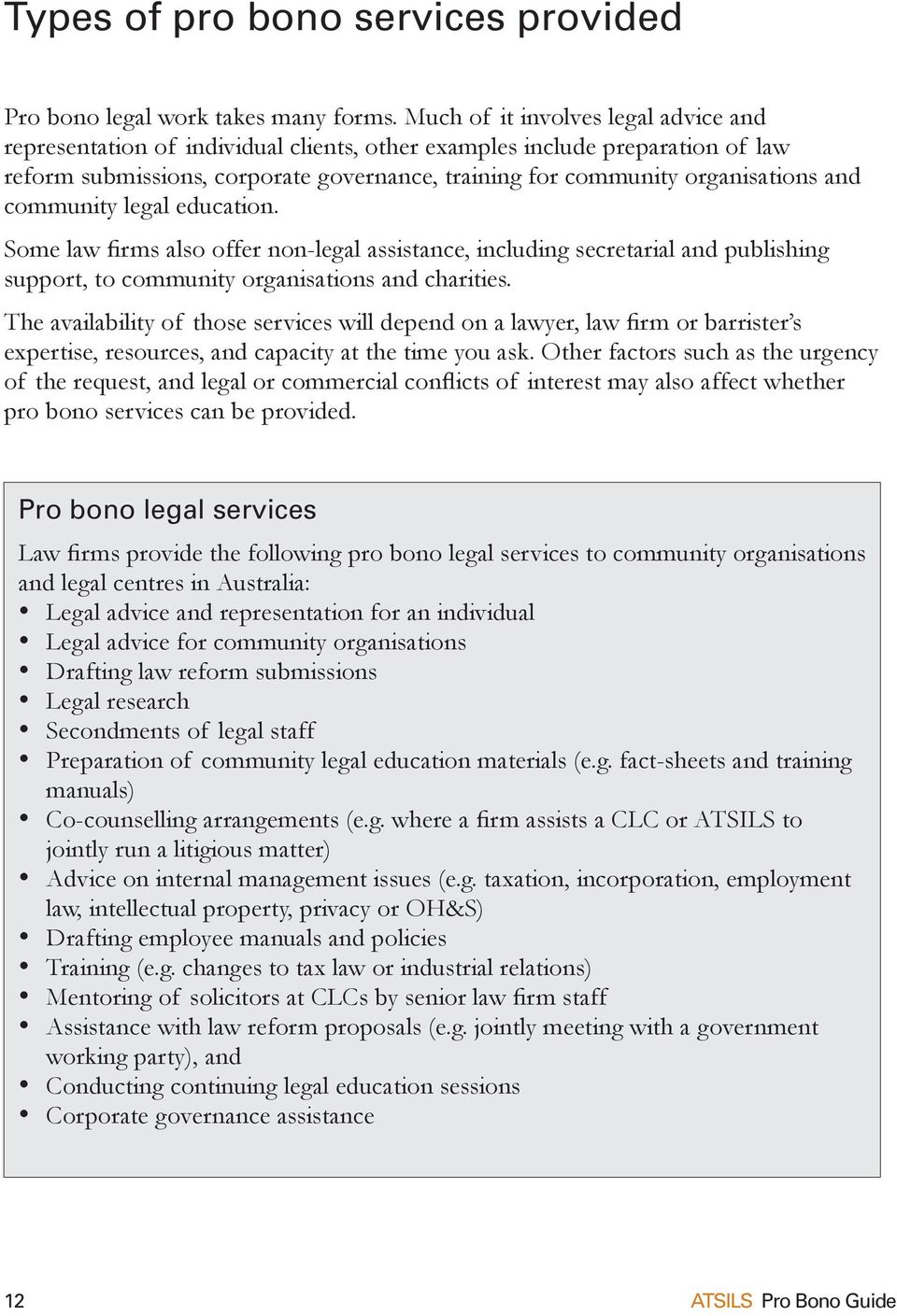
16 Non-legal services The following forms of non-legal assistance have been provided from time to time: Administrative services, including word processing (e.g. transcribing dictaphone tapes) and photocopying (e.g. photocopying training manuals, induction manuals and appeal books) Accounting and book-keeping services Assistance with design and desktop publishing and printing of resources such as reports, newsletters, brochures or business cards Mail outs (e.g. mailing out copies of a centre s annual report) Human Resources assistance (e.g. revising staff manuals) Secondment of non-legal staff on a part-time or ad-hoc basis Training of administrative staff Assistance with preparing funding applications Access to library resources (e.g. online library resources of the firm and research by librarians) Donations of office equipment (e.g. desks, computers or telephones) Information Technology (IT) services, including access to precedents and advice on IT issues, developing databases and intranet systems Access to law firm facilities for meetings, conferences and training seminars (e.g. meeting rooms, equipment and catering) Donations by the firm to support a position at ATSILS or cover conference registration Assistance with events and conferences (e.g. fundraising, providing premises and administrative support, organising speakers, designing and printing invitations and brochures) About Pro Bono ATSILS Pro Bono Guide 13
17 14 ATSILS Pro Bono Guide

18 3. Getting Getting Help Pro Bono Help ATSILS Pro Bono Guide 15 ATSILS Pro Bono Guide 15
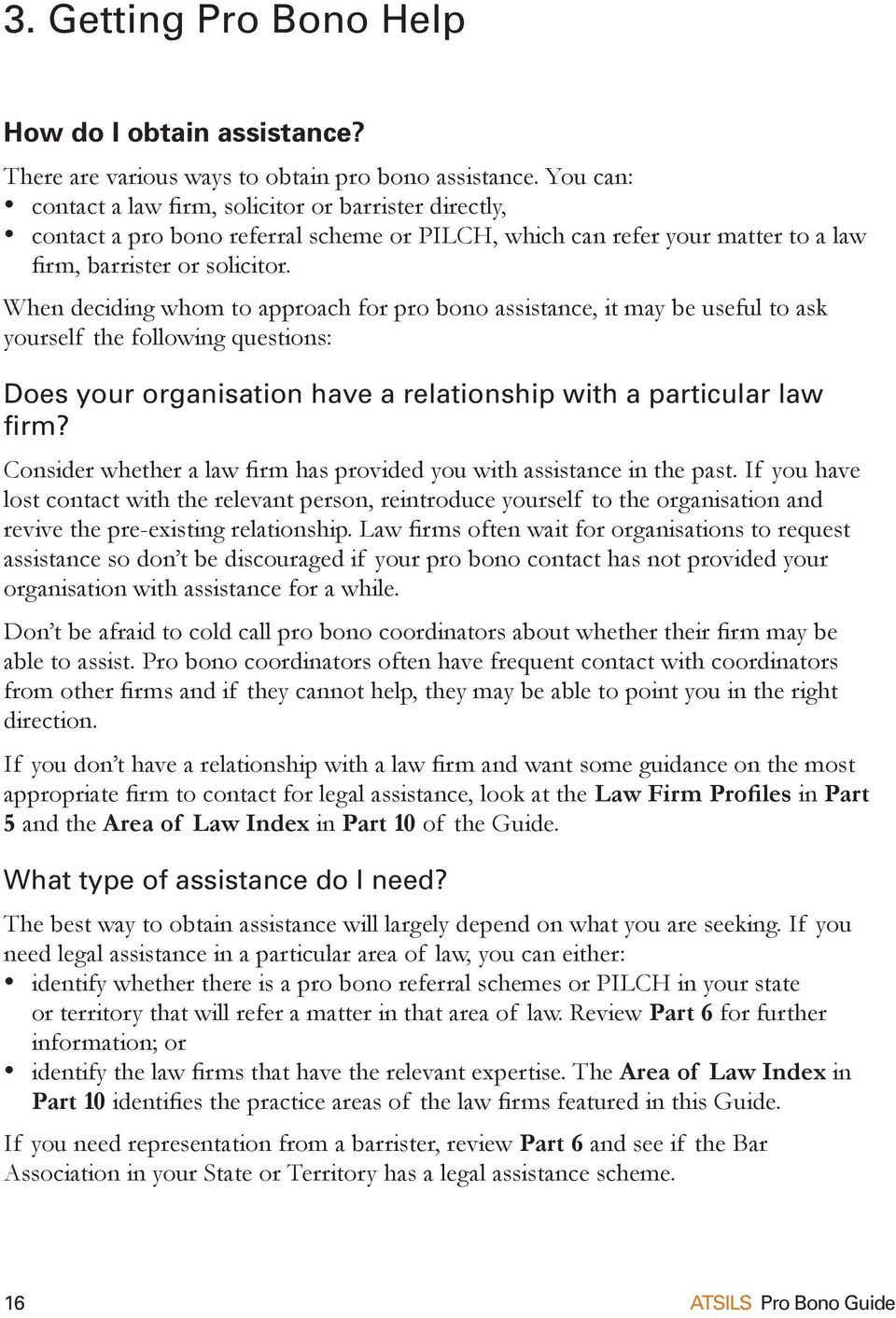
19 3. Getting Pro Bono Help How do I obtain assistance? There are various ways to obtain pro bono assistance. You can: contact a law firm, solicitor or barrister directly, contact a pro bono referral scheme or PILCH, which can refer your matter to a law firm, barrister or solicitor. When deciding whom to approach for pro bono assistance, it may be useful to ask yourself the following questions: Does your organisation have a relationship with a particular law firm? Consider whether a law firm has provided you with assistance in the past. If you have lost contact with the relevant person, reintroduce yourself to the organisation and revive the pre-existing relationship. Law firms often wait for organisations to request assistance so don t be discouraged if your pro bono contact has not provided your organisation with assistance for a while. Don t be afraid to cold call pro bono coordinators about whether their firm may be able to assist. Pro bono coordinators often have frequent contact with coordinators from other firms and if they cannot help, they may be able to point you in the right direction. If you don t have a relationship with a law firm and want some guidance on the most appropriate firm to contact for legal assistance, look at the Law Firm Profiles in Part 5 and the Area of Law Index in Part 10 of the Guide. What type of assistance do I need? The best way to obtain assistance will largely depend on what you are seeking. If you need legal assistance in a particular area of law, you can either: identify whether there is a pro bono referral schemes or PILCH in your state or territory that will refer a matter in that area of law. Review Part 6 for further information; or identify the law firms that have the relevant expertise. The Area of Law Index in Part 10 identifies the practice areas of the law firms featured in this Guide. If you need representation from a barrister, review Part 6 and see if the Bar Association in your State or Territory has a legal assistance scheme. 16 ATSILS Pro Bono Guide
20 Tips for pro bono referrals There are various ways in which you can seek pro bono assistance. One of the best ways to obtain pro bono assistance is to form a relationship with a law firm. There are benefits to developing relationships with particular firms. Firstly, it leads to a closer and more familiar connection between the parties. This familiarity leads to ideas and new projects because it provides each party with a better understanding of the other s needs and capacities. It can also improve response times to requests for pro bono assistance. Law firms may be able to provide legal and nonlegal assistance as they develop a better understanding of your organisation. In order to speed up and streamline the process of referring a matter or obtaining pro bono assistance it is important to understand how the referral process works. Seeking help from a law firm If you ask a law firm for pro bono assistance, the coordinator will consider whether the matter falls within the firm s pro bono guidelines, and whether they have the relevant expertise and resources. A coordinator will also examine whether there are any legal or commercial conflicts of interest. The following general tips may be useful in asking for assistance: Getting Help Contact a pro bono coordinator on behalf of your client Get to know the pro bono coordinators Don t refer a client directly to a firm or a number of firms. Firms prefer to deal with a referring organisation at first instance. This is a more efficient and effective use of both the client and firm s time and resources, and helps the client to get off the referral roundabout. Once a pro bono contact at a law firm knows you and your organisation, you will save time providing background information. This applies to rural and remote offices, not just metropolitan offices. Sydney firms have provided pro bono assistance as far away as Darwin, the Kimberley and Townsville. If your contact person leaves, don t be afraid to ask somebody else for assistance or seek a new contact. ATSILS Pro Bono Guide 17
21 Get to know the firms programs Don t be discouraged Nominate a single contact person Pick up the phone Manage urgent requests Many firms have particular target areas for their programs, which can include Indigenous Australians or people in regional, rural or remote Australia (see the law firm profiles in Part 5). Firms will try to provide as much assistance as possible to people in target areas, and these may align with the interests or situation of your client. Don t be discouraged if a referred matter is declined. A firm s capacity to take on matters changes. Next time you may be successful in getting help. Consider nominating one or two people within your organisation to be the firmrelationship person, preferably including the Principal Solicitor. This may also assist in developing a long-term relationship with a firm beyond ad hoc client referrals. Don t be afraid to pick up the phone. Every pro bono coordinator likes nothing more than to be able to say yes to a request for assistance. If a matter is urgent, there is a reduced likelihood that a pro bono coordinator will be able to place that matter. Therefore, contact pro bono coordinators as soon as possible after you determine pro bono assistance is required to increase the likelihood of a firm accepting the matter. 18 ATSILS Pro Bono Guide
22 Manage multiple requests Provide all relevant information If you request assistance from a number of firms, let them know this. While it may be appealing to send a group to a number of potential pro bono providers, do not send blind-carbon-copies of an because pro bono coordinators will not know who else you have asked for help. Law firm pro bono coordinators often liaise with each other to determine which of their firms can accept a referral. It is timeconsuming for a pro bono coordinator to try to place a matter within their firm, and wasteful if a number of coordinators are needlessly pursuing the same task. If you do successfully refer a matter sent to a number of firms on a group , let the other firms know. Always provide information about all parties involved in any matter in the original request as it allows firms to complete a conflict search without having to ask you for further information. Other information which you will almost always be required to provide includes: the client s income, assets and dependants; the nature of the matter; and any upcoming court dates, limitation dates or other deadlines. Collate this information before you contact the firm so that the referral can be processed more efficiently and there is less need for follow up requests for information. Getting Help ATSILS Pro Bono Guide 19
23 Consider conflicts of interest Other assistance Some firms may adopt a flexible approach to conflicts of interest. While some matters may be legally conflicted out there may be circumstances where a firm can get clearance to act, or assist in resolving matters that may otherwise appear to be conflicted. Check with the firm pro bono coordinator. If you require assistance for your organisation, other than for a particular client, the process may be much simpler. If, for example, you need assistance training administrative staff or designing publications material, it may be as easy as picking up the phone. There is generally less red tape involved with approving non-legal assistance and it may be possible for a firm to provide assistance in a shorter period of time. Although law firms will not always be in a position to provide non-legal assistance, don t be afraid to ask. 20 ATSILS Pro Bono Guide
24 Seeking help from a pro bono referral scheme Many of the tips above also apply to seeking help from a referral scheme. Information on these referral schemes is contained in Part 6 and in the State Index in Part 11. The following may also help you to obtain assistance from a scheme if one exists in your state or territory: Try one scheme at a time Provide all the relevant information Manage urgent requests Seeking help from a lawyer or barrister Apply to one scheme at a time. If you need to approach multiple schemes for assistance, let them know this. It is time-consuming for a scheme coordinator to try to place a matter with a firm, and wasteful if a number of referral scheme coordinators are needlessly pursuing the same task. If you do successfully refer a matter to a referral scheme, let the other referral schemes know. Make sure that you complete all of the relevant forms. It may also be useful to indicate whether the client has any other issues that affect his or her ability to obtain access to justice, such as a disability or homelessness. Be mindful of the time that it takes to process a request for pro bono assistance under the various schemes. If your request is urgent, make sure that you notify the scheme coordinator as soon as possible. If you know a particular lawyer or barrister who may be able to provide you with pro bono assistance and do not want to seek assistance through a pro bono referral scheme, you may want to contact the lawyer or barrister directly. You may prefer this if a particular lawyer or barrister has provided you with pro bono assistance in the past, or if the lawyer or barrister has expertise in the area of law in which you need assistance. Contact the lawyer or barrister on your client s behalf and provide him or her with all the relevant information. Getting Help ATSILS Pro Bono Guide 21
25 Disbursements A disbursement is a payment made on behalf of another person for which reimbursement in the future is expected. This may include expenses incurred by a law firm on behalf of a client for filing fees, expert reports, private investigator reports, photocopying, courier costs and taxi fares. A law firm who agrees to provide pro bono legal assistance may or may not be willing to pay for disbursements. Some firms may be willing to cover the costs of some disbursements (for example photocopying) but not others (such as filing fees). When briefing a law firm on a pro bono matter, ask whether they are willing to pay for disbursements. If they are not, it may be possible to obtain a waiver or exemption of court and tribunal fees, or to recover disbursements in limited matters from a state disbursement scheme. Generally, law firms will not be prepared to pay for the cost of a barrister if one is required. However, in some states it is possible to obtain the assistance of barristers pro bono through a bar legal assistance scheme. This involves a separate application and may take time. For further information on the state and territory disbursement schemes, go to the National Pro Bono Resource Centre website at and click on the Australian Pro Bono Manual icon. 22 ATSILS Pro Bono Guide
26 4. Case Studies The following pro bono services have been provided to CLCs and ATSILS in Australia, and illustrate the range of possible assistance that might be available. Case Studies ATSILS Pro Bono Guide 23 ATSILS Pro Bono Guide 23
27 4. Case Studies Secondments The Katherine office of the North Australian Aboriginal Justice Agency (NAAJA) (formerly known as the Katherine Aboriginal Legal Aid Service (KRALAS)) was established to provide free legal assistance to Aboriginal and Torres Strait Islander people in the Katherine region. However, due to limited funding, NAAJA (Katherine) was only able to provide assistance in criminal law and was unable to meet the increased demand for civil law assistance. The principal solicitor of NAAJA approached Blake Dawson and asked it to fund a civil law position. Blake Dawson was not able to fund the position but agreed to provide a full-time lawyer for the civil law service in Katherine. This arrangement is still in place over five years later. The position has been filled by successive secondees, each there for six months. The work includes litigation in the Local and Supreme Court, and other matters ranging from coronial inquests to housing, debts, victims compensation and the seizure of motor vehicles. Seconded lawyers have also provided community legal education and law reform assistance. This secondment has strengthened the relationship between NAAJA and Blake Dawson and resulted in the delivery of a broad range of pro bono services. Blake Dawson and North Australian Aboriginal Justice Agency (NAAJA), Katherine Clayton Utz has seconded solicitors to the Kimberley Community Legal Services (KCLS) in Kununurra since The secondments began after a chance meeting between the Clayton Utz Pro Bono Partner and the KCLS principal solicitor, at the National Association of Community Legal Centres Conference in KCLS is the most isolated community legal centre in the country, and has a single full-time lawyer. The seconded lawyer assists KCLS to provide outreach legal advice, casework assistance and community legal education to clients in remote communities across the Kimberley. Clayton Utz and Kimberley Community Legal Service, Kununurra, WA 24 ATSILS Pro Bono Guide
28 Clayton Utz provided a secondee lawyer for six weeks to ATSILS in Brisbane to cover an immediate staffing shortage in the civil law team. This secondment allowed ATSILS to continue its involvement in a significant Court of Appeal matter. Clayton Utz and the Aboriginal & Torres Strait Islander Legal Service (Qld Sth) Ltd Deacons seconded two lawyers to work at the Native Title Office (NTO) of the Torres Strait Regional Authority (TSRA) for three weeks in The NTO helps secure the legal recognition of native title for land and waters in the Torres Strait. It also provides assistance to the Prescribed Bodies Corporate (PBCs) established under the Native Title Act to manage the native title rights and interests of traditional owners. Due to limited funding, the TSRA was not able to assist the PBCs with the corporate assistance they required. The secondees helped the NTO by hosting a workshop for the PBCs about basic corporate structures. They also worked with a number of the PBCs to ensure that they complied with the Corporations (Aboriginal Torres Strait Islanders) Act, and provided commercial advice to the PBCs regarding local businesses. The secondees have since provided advice regarding the transfer of businesses and assets from local councils essential to building capacity in the region. The secondees will be also be attending a workshop in November to present to the PBCs. Deacons and Torres Strait Regional Authority (Deacons will be part of the Norton Rose Group from 1 January 2010) DLA Phillips Fox has provided a secondee to the Aboriginal Legal Service in NSW to work with kids in juvenile detention since The secondee works primarily from Cobham Boys Detention Centre and Juniperina Girls Facility and answers questions from the kids on issues such as how they can appeal their sentence and how to get bail. DLA Phillips Fox and the ALS, Parramatta Case Studies Following a request from Cape York Land Council, DLA Phillips Fox provided a lawyer for an 8-12 week secondment in Cape York to prepare a report on the Eastern Kuku Yalanji native title claim. DLA Phillips Fox and Cape York Land Council ATSILS Pro Bono Guide 25
29 Freehills has provided solicitors to the Walgett Family Violence Prevention Legal Service (WFVPLS) on six month secondments since October WFVPLS is an outreach service of the Women s Legal Service NSW. Each secondee is based at WLS, but travels to Walgett one week every month to coincide with local court sessions in Walgett and Lightning Ridge. While in Walgett, secondees attend court and undertake other work that arises from WFVPLS client matters. This includes apprehended violence orders, victim s compensation and related family law and child protection work. Freehills and the Walgett Family Violence Prevention Legal Service Gilbert + Tobin provided a secondee to Cape York Land Council to assist them with Native Title work and the corporate issues that flow from Indigenous Land Use Agreements and other Native Title Settlements. Gilbert + Tobin is part of the Indigenous Enterprise Partnership in the Cape York region. Gilbert + Tobin provides legal advice and assistance to organisations, communities and individuals setting up businesses in the region. The assistance ranges from establishing trusts to reviewing loan agreements and contracts for services. Gilbert + Tobin and the Cape York Region The Yothu Yindi Foundation has been a long-term client of Gilbert + Tobin s pro bono practice. The Foundation hosts the Garma Festival in north-east Arnhem Land each year. Gilbert + Tobin provides legal support to the Yothu Yindi Foundation in the lead up to the festival and also provides the Yothu Yindi Foundation with on the ground legal support throughout the festival by sending up to five lawyers to the festival each year. Gilbert + Tobin and the Yothu Yindi Foundation When the six ATSILS operating in NSW and the ACT consolidated to form the Aboriginal Legal Service (NSW/ACT) Limited, Mallesons Stephen Jaques provided solicitor to the Sydney Regional Aboriginal Corporation Legal Service for a threemonth secondment to help with their restructure. Mallesons Stephen Jaques and Sydney Regional Aboriginal Corporation Legal Service Minter Ellison seconded a lawyer to Darebin CLC for three months to conduct a feasibility study for the creation of outreach legal clinics to be run in conjunction with Indigenous service providers in Melbourne s northern suburbs. Minter Ellison lawyers have since conducted monthly outreach sessions at four clinics in Melbourne s Darebin region together with a community development workers and volunteer law students from the Darebin CLC. These clinics have provided an additional avenue of access to justice for Indigenous people in Melbourne s north. Minter Ellison and Darebin Community Legal Centre Inc (Darebin) 26 ATSILS Pro Bono Guide
30 Research and drafting Many law firms provide research and drafting assistance to community organisations or ATSILS. For example, Freehills has written general papers on legal issues specific to indigenous organisations. The most recent paper provided general advice on indigenous organisations and philanthropic funding. Mallesons Stephen Jaques has assisted SRACLS with corporate legal advice including a personal injury matter and with the research and drafting of submissions such as on the Australian Government discussion paper entitled A New Approach to the Family Law System. Representation Allens Arthur Robison has represented the Ghungalu and Duaringa Cultural Centre working group, for which we conducted a feasibility study for their Cultural Centre project. The firm outlined a number of ways the proposed centre could be created as a self-sustaining, economically viable project that would benefit the Ghungalu and Duaringa community and also the wider region. The firm also assisted with applications for deductible gift receipt status and income tax exemptions so that the working group could fundraise for the development of the Cultural Centre. Allens Arthur Robinson has worked with the Aboriginal Legal Service of Western Australia (ALSWA), during the last year on Redress WA, a compensation scheme for people who were abused as children in State care in Western Australia. The project involves a team of Allens lawyers interviewing the ALSWA clients and helping them to prepare detailed statements for Redress WA. Applying for compensation this way means applicants do not have to pursue their claims through court, arguably giving them a less traumatic and less costly option, with faster results. Following a referral from Redfern Legal Centre, DLA Phillips Fox represented the Wiradjuri people of Wellington Valley near Dubbo in a native title claim in the Federal Court of Australia. DLA Phillips Fox recently acted for an indigenous client in an individual communication to the United Nations Committee on the Elimination of all forms of Racial Discrimination, alleging breaches of the Convention by the Australian Government. The communication argues that Indigenous Australians are effectively denied appropriate access to social security, because they cannot access the Age Pension until age 65, notwithstanding that the current life expectancy for an Indigenous person is 59. Case Studies ATSILS Pro Bono Guide 27
31 Gilbert + Tobin represented the Saltwater people in a long running native title claim on the central New South Wales coast and represented a number of Aboriginal communities in negotiations regarding land rights, mining and Aboriginal heritage. Gilbert + Tobin represented a number of Northern Territory communities opposing the Federal Government s intervention and continues to assist these communities. More locally, it has assisted many groups in the Redfern Aboriginal community in relation to government and council proposals in the area. Corporate governance assistance Blake Dawson was approached by the Aboriginal Legal Service NSW/ACT (ALS) to provide a series of interactive corporate governance training sessions for its Board of Directors. The sessions covered Board member obligations under the Corporations Act 2001 (Cth), the ALS s constitution and the effect of recent case law on directors duties. The sessions also included practical training for Board members on how good corporate governance should work in combination with other organisational issues. ALS Board members conducted a mock Board meeting which gave them the opportunity to think on their feet, identify governance issues and practice the skills they had learned throughout the sessions. Specific projects Wills As part of their Wills Project, Blake Dawson provided legal assistance (unavailable locally) to draft wills for Aboriginal people in NSW who have been, or are to be, compensated for stolen wages to ensure that their estate would be passed on in accordance with their wishes on their death. Blake Dawson also prepared wills for traditional land owners in the Kimberley region in Western Australia who have received royalties from a mine on their traditional land. Blake Dawson also responded to a request from community workers in a town in regional NSW who were seeing serious family disputes in some Indigenous families regarding burial issues. Blake Dawson provided information seminars about estate planning to local community groups and followed the seminars with legal clinics drafting wills, powers of attorney and appointments of enduring guardian for people who were interested. DLA Phillips Fox sent lawyers to the Kimberley to draft wills for Aboriginal artists. 28 ATSILS Pro Bono Guide
32 Estate planning Blake Dawson has an estate-planning project for people with an intellectual disability and/or mental illness, and their carers. Through the project, Blake Dawson runs information sessions which deal with topics including alternative decision-makers for their children with impaired capacity, making wills and establishing trusts under their wills to meet their child s ongoing needs and advance their quality of life, finding suitable trustees and what to do with the family home. Blake Dawson also act for clients to prepare their wills and other estate planning instruments. Stolen wages In 2005, the NSW Government established the Aboriginal Trust Funds Repayment Scheme to administer the return of the monies withheld from Aboriginal people and placed into trust accounts by government agencies between 1900 and This created a demand for legal representation of the claimants before the Scheme s panel. The Public Interest Advocacy Centre and the Public Interest Law Clearing House Inc (PILCH) established a Stolen Wages Referral Scheme, by which PILCH member firms provide pro bono advice and representation to stolen wages claimants. The participating firms are Allens Arthur Robinson, Blake Dawson, Clayton Utz, Deacons,* Freehills, Henry Davis York, Gilbert + Tobin, HWL Ebsworth and Minter Ellison. *Deacons will be part of the Norton Rose Group from 1 January Coronial Inquiries The Homicide Victims Support Group is a support and counselling group for the families of homicide victims. In 2005, Henry Davis York developed a program with the Support Group to provide their members with access to pro bono legal services for the preparation of attendance at coroner s inquests. Henry Davis York also advises on associated matter such as victims compensation, child custody, wills and probate, and civil matters. Clayton Utz and Blake Dawson also represent Indigenous clients on referral from the Legal Aid Coronial Inquest Unit. Case Studies Aboriginal artists - Artists in the Black As part of the Artists in the Black program, Clayton Utz, Gilbert + Tobin, and DLA Phillips Fox have helped Aboriginal artists on a range of legal issues. This has included establishing trusts, protecting their intellectual property and representing artists in disputes with dealers and galleries. The project is designed to protect the income streams of remote Aboriginal communities. ATSILS Pro Bono Guide 29
33 Non-legal assistance Financial assistance Dubbo Aboriginal Legal Service asked Blake Dawson for assistance with printing pamphlets for a local community meeting. At the time, Blake Dawson did not have the resources available to print the colour brochures at their offices but offered to pay for the printing with a local printing business instead. Allens Arthur Robinson provided non-legal assistance to the Northern Rivers CLC by purchasing a number of library books and paying for the CLC s Christmas party. Allens Arthur Robinson installed a telephone in a local neighbourhood centre in the Northern Rivers District, connecting callers to the Northern Rivers CLC and to the legal referrals and advice line at Law Access. Freehills paid for the flights of 10 ALS lawyers in remote locations to attend the annual Aboriginal Legal Service Conference in Sydney in The Clayton Utz Foundation Fellowship has funded three 24-month graduate solicitor positions, at the Loddon Campaspe CLC in Bendigo, Victoria and at the Hawkesbury Nepean Community Legal Centre in NSW since The Fellowships build capacity at CLCs in regional Australia. Workplace giving programs Mallesons Stephen Jaques partners and staff have donated more than $75,000 to SRACLS through a Workplace Giving Program since Since 2007, the donations have supported the Custody Notification Scheme for the Aboriginal Legal Service (NSW/ACT). ALS solicitors working on the Scheme provide legal advice to detained persons and inquire into their mental and physical health to ensure they are not at risk of ill health or self-harm while in detention. Training In April 2006, Blake Dawson were approached by the ALS (NSW/ACT) to see if it could assist with training administrative staff to improve office and administrative skills. Blake Dawson sent two staff from its Service Support Group to conduct a full day of training based on the firm s own protocols for its Service Staff, including training on telephone answering procedures, taking messages, dealing with client calls and other administrative issues. ALS administrative staff travelled from all over NSW and the ACT to attend the training session. 30 ATSILS Pro Bono Guide
34 Secretaries from SRACLS attended the offices of Mallesons Stephen Jaques for secretarial training. Training was provided by Mallesons Education and Development Group. Mallesons also organised replacement legal secretaries, sourced from its legal secretarial team, to attend the offices of SRACLS, during the time the SRACLS secretaries were training at Mallesons. Legal secretaries from the Allens Arthur Robinson in Perth providing ongoing pro bono help to the Aboriginal Legal Service of Western Australia. Allens secretaries provide administrative support one day a week at the ALSWA offices, especially in relation to Redress WA applications. Office equipment Mallesons Stephen Jaques has provided SRACLS with donations of surplus computer equipment, including laptops, computers, printers and digital dictation devices. Following Mallesons office refurbishment, the ALS received surplus office furniture including board tables, chairs, shelves and filing cabinets assisting with the fit-out of the new ALS premises in Parramatta, NSW. Use of facilities Each year Blake Dawson hosts events in its client meeting rooms, including the annual Disability Discrimination Legal Centre s Hot Topics in Discrimination Law. The forum runs for one day and is designed to provide people with disability, advocates, community workers and legal practitioners with up-to-date information on developments in disability discrimination law. Freehills hosted a planning day for the Arts Law Centre s Artists in the Black Reference Group and staff in This included the use of meeting rooms, catering and the provision of services required for an evening functiongilbert + Tobin regularly hosts events for community organisations. In 2007 it hosted the Australian Indigenous Leadership Centres board meeting at its offices, providing catering and services required. Gilbert + Tobin hosted an event for Aboriginal and Torres Strait Islander Early Childhood Sector Advisory Group Incorporated so it could discuss its development plans with major funders. Case Studies Printing services As mentioned above, Dubbo ALS approached Blake Dawson for assistance with printing pamphlets for a local community meeting. Although Blake Dawson did not have the resources at the time to print the pamphlets, it offered to pay for the costs of printing by a local business. ATSILS Pro Bono Guide 31
35 32 ATSILS Pro Bono Guide
36 5. Law Firm Profiles Note: Contact details for pro bono coordinators change over time. If you have difficulty with the contact details below, check the Pro Bono Contacts in the Australian Pro Bono Manual online available at Profiles ATSILS Pro Bono Guide 33 ATSILS Pro Bono Guide 33
37 5. Law Firm Profiles Allens Arthur Robinson Pro bono contact Nicky Friedman, Head of Pro Bono and Community Services (03) Level 27, 530 Collins Street, Melbourne VIC 3000 Offices Brisbane, Melbourne, Perth, Sydney Areas of particular specialisation or interest Indigenous peoples rights Human rights, including refugee rights The rights of people with a disability or who are disadvantaged (including the homeless and those with a mental illness) Potential conflicts Some of our clients include large banking, insurance and mining corporations. We may experience conflicts with these clients. Eligibility criteria The work must: establish or preserve the rights of individuals or not-for-profit organisations in need, or seek to further a particular public good or address an issue of broad community concern. We do not provide representation in courts outside the Central Business Districts of Sydney, Melbourne, Brisbane and Perth, but may provide advice in relation to a case being run outside these areas. 34 ATSILS Pro Bono Guide
38 Referral procedure We prefer an to the pro bono contact above. Initial discussion by phone is fine. The matter will be checked for conflicts and referred to the firm s Pro Bono Committee for decision. You can expect a response within 3 to 5 days. The following information is required: The applicant s name and background details. If the applicant is an organisation, provide a contact name, information about the work of the organisation and confirmation of its not-for-profit status (e.g. via the applicant s web page). A brief summary of the matter. Details of any other party or parties involved. In litigious matters, any reasonably imminent court dates or other important dates. For individuals, a generalised assessment of means. Costs and disbursements policy The firm will generally cover up to $300 in internal disbursements and will expect the client to pay for third party costs (filing fees and searches etc). We will seek waivers for filing fees. Depending on the financial circumstances of the client, we may adopt a different approach to disbursements. Profiles ATSILS Pro Bono Guide 35
39 Arnold Bloch Leibler Pro bono contact Peter Seidel, National Pro Bono Coordinator (03) Level 21, 333 Collins Street, Melbourne, Vic 3000 Offices Melbourne, Sydney Areas of particular specialisation or interest in the context of ATSILS Corporate governance Discrimination and human rights Admin law Contractual advice Intellectual property Native title Taxation law Potential conflicts in the context of ATSILS General conflicts determined on a case by case basis. Arnold Bloch Leibler acts for many native title representative bodies, land councils and other ATSILS, Indigenous peak body or community based NGOs and Indigenous community groups/persons throughout the country and so will be conflicted in any instances involving proposed actions against such bodies, groups or persons. Eligibility criteria Provision of Arnold Bloch Leibler s skills, knowledge and resources, without expectation of fee from the client, to assist individuals or organisations in need to defend or assert rights and interests; develop the law; or improve the administration of justice, in the public interest. Referral procedure Contact Peter Seidel initially via /follow up phone call with a brief description of the matter. Costs and disbursements policy No expectation of fee from the client; external disbursements arrangements dealt with on a case by case basis. 36 ATSILS Pro Bono Guide
40 Baker & McKenzie Pro bono contact Jennifer McVicar, Director, Pro Bono and Community Service (02) Level 27, AMP Centre, 50 Bridge Street, Sydney NSW 2000 Offices Melbourne, Sydney Areas of particular specialisation or interest Fines/State Debt Recovery Office matters Early access to superannuation for cancer patients Intellectual Property Potential conflicts We are unable to take referrals in discrimination, personal injury, family or criminal law. We are likely to have a conflict with major banks. Eligibility criteria We act for disadvantaged and marginalised individuals, and charity and community organisations that serve them. Referral procedure Contact Jennifer McVicar by phone or . Costs and disbursements policy Pro bono clients are not charged for internal disbursements such as photocopying or faxing. External disbursements (filing fees, reports etc) are decided on a case-by-case basis. Profiles ATSILS Pro Bono Guide 37
41 Blake Dawson Pro bono contacts Anne Cregan, National Pro Bono Partner (02) Level 36, Grosvenor Place, 225 George Street, Sydney NSW 2000 Amelia Davis, Sydney and National Pro Bono Coordinator (02) Level 36, Grosvenor Place, 225 George Street, Sydney NSW 2000 Sarah Galloway, Melbourne Pro Bono Coordinator (03) Level 26, 181 William Street, Melbourne VIC 3000 Fiona Spencer, Melbourne Pro Bono Coordinator (03) Level 26, 181 William Street, Melbourne VIC 3000 Sarah Arthur, Canberra Pro Bono Coordinator (02) Moore Street, Canberra ACT 2601 Jon Lovell, Canberra Pro Bono Coordinator (02) Moore Street, Canberra ACT 2601 Luke Edney, Brisbane Pro Bono Coordinator (07) Level 36, Riverside Centre, 123 Eagle Street, Brisbane QLD 4000 Shannon Chapman, Perth Pro Bono Coordinator (08) Level 32, Exchange Plaza, 2 The Esplanade, PERTH WA 6000 Mary Seely, Adelaide Pro Bono Coordinator (08) [email protected] Level 4, 151 Pirie Street, Adelaide SA ATSILS Pro Bono Guide
42 Offices Adelaide, Brisbane, Canberra, Melbourne, Perth, Sydney Areas of particular specialisation or interest People with an intellectual disability or mental illness and their carers Indigenous people and organisations, and People and organisations in rural, regional and remote areas We have lawyers trained for Victims Compensation Tribunal matters. We have an interest and specialisation in issues of legal capacity and alternative decision-making. Potential conflicts Personal injury Immigration & citizenship Doctors and lawyers We are likely to have conflicts with: insurance companies large banks (though not smaller lenders) mining companies area health services, and some local councils. Eligibility criteria We act for: people who are disadvantaged and marginalised organisations assisting people who are disadvantaged and marginalised, and work for the public good on matters of broad public or community concern. We will only act if there is no other source of assistance reasonably available so we would rarely act if Legal Aid is available or if it is a matter which a solicitor would take on a speculative basis (e.g. personal injury). We represent clients outside the CBD. Profiles ATSILS Pro Bono Guide 39
43 Referral procedure We accept referrals by , phone, fax or letter to the Pro Bono Coordinator. If a referral is made to a number of firms, please let us know (e.g. by showing the group on the sent to us) so that we can liaise with the firms to determine who can act. Referrals should state: The names of all other parties Any upcoming dates (e.g. limitation periods, court dates, response deadlines) The income and assets of the client and the client s partner The number of dependents Any special circumstances, and The nature of the matter. Costs and disbursements policy Internal disbursements are not charged in pro bono matters. If the client (particularly where the client is an organisation) can pay disbursements, we ask the client to pay. We attempt to find assistance with disbursements from Legal Aid or the Law Society trust fund but can at our discretion also carry disbursements on pro bono matters. In litigation matters in costs jurisdictions we attempt to recover disbursements from the other party if we are successful. Any costs recovered are used to increase the budget of the firm s pro bono program. 40 ATSILS Pro Bono Guide
44 Carroll & O Dea Pro Bono Contact Michael O Dea, Pro Bono Manager (02) Level 18, 111 Elizabeth St, Sydney NSW 2000 Offices Canberra, Newcastle, Parramatta, Sydney, Wollongong Areas of specialisation or interest Personal injury law, employment and industrial relations law, property law, dispute resolution and commercial litigation, not-for-profit law. Potential conflicts Not known Eligibility criteria To be eligible for assistance: the individual must be unable to obtain legal aid and have a legal need; matter must have reasonable prospects of success. We typically provide pro bono assistance in New South Wales and the ACT. We will consider requests from other jurisdictions on a case-by-case basis. Referral procedure Contact Michael O Dea, Pro Bono Manager, by phone. Costs and disbursements policy We do not generally charge clients for costs and disbursements (such as photocopying) in pro bono matters. If a matter has reasonable prospects of success and is likely to result in litigation, we may enter into a no-win-no-fee arrangement with the client. In no-win-no-fee arrangements, we deduct disbursements from settlement money if the matter is successful. We clearly explain this to potential clients before we pursue a matter. Profiles ATSILS Pro Bono Guide 41
45 Chalk & Fitzgerald Pro bono Contact Dominic Beckett, Pro Bono Partner (02) Level 9, Currency House, 23 Hunter Street, Sydney NSW 2000 Offices Sydney only Areas of particular specialisation or interest We have particular experience and interest in legal issues concerning: Indigenous and community organisations Community and strategic planning Community benefits trusts and other structures Environmental and planning law Land and resource management and development Potential conflicts We are likely to have a conflict in relation to matters involving some Aboriginal Land Councils and native title representative bodies. Eligibility criteria We are happy to act pro bono for: people who are disadvantaged and marginalised, community organisations representing and assisting people who are disadvantaged and marginalised. On receiving referrals, we may investigate whether there is another body or service more appropriate or able to deal with the matter in question. We rarely act pro bono if legal aid is available or if the matter is one which a solicitor would usually be willing to act on a speculative basis (e.g. personal injury matters). As we are a small firm, and as our services are priced to make us more accessible to Indigenous and other community organisations, our ability to act on a pro bono basis is limited. We are happy to receive and consider but are unlikely to be able to assist in all requests for pro bono assistance. 42 ATSILS Pro Bono Guide
46 Referral procedure We will accept referrals by , telephone or letter addressed to the pro bono partner. All written referrals should include information on the person seeking assistance, the other parties involved and the nature of the matter to enable us to determine whether we have capacity to accept the matter and/or whether we may be conflicted in relation to the matter. Please let us know if you intend to seek assistance from a number of firms simultaneously so that we can discuss who is best able to assist. Costs and disbursements policy We will not charge internal disbursements (such as photocopying) for pro bono matters. We may charge, on a cost recovery basis, for any external disbursements. This will be determined on a case-by-case basis. In appropriate litigated matters, we will generally seek to recover our costs by seeking an order for costs against the other party. Profiles ATSILS Pro Bono Guide 43
47 Clayton Utz Pro bono contacts Belinda Wilson, Pro Bono Senior Associate (02) Level 19-35, 1 O Connell Street, Sydney NSW 2000 David Hillard, Pro Bono Partner (02) [email protected] Level 19-35, 1 O Connell Street, Sydney NSW 2000 Offices Brisbane, Canberra, Darwin, Melbourne, Perth, Sydney Areas of particular specialisation or interest Discrimination law Victims compensation People and organisations in rural, remote and regional communities Incorporation and governance of not-for-profit organisations Fundraising and tax issues Potential conflicts We are unable to act in immigration matters. It is also often difficult for us to act against some of the major banks and financial institutions. We do not act in the following areas: personal injury matters, wills, family law, and criminal law. Eligibility criteria As a guide only: Individual clients who earn less than $40,000 pa or $60,000 pa for a family, and are unable to obtain Legal Aid. They must also have $30,000 or less in net assets (excluding the individual s principal place of residence and superannuation); Indigenous and other not-for-profit organisations or community groups whose purpose is primarily charitable and whose resources are better directed towards providing services for disadvantaged people. 44 ATSILS Pro Bono Guide
48 Referral procedure We accept referrals by , phone or letter to our Pro Bono Senior Associate, Belinda Wilson or to our Pro Bono Partner, David Hillard. We will not accept matters where the potential client calls us directly, without us having first spoken to the ALS. If a referral is made to a number of firms, please let us know (e.g. by showing the group on the sent to us) so that we can liaise with the firms to determine who can act. Referrals should state: The names of all other parties Any upcoming dates (e.g. limitation periods, court dates, response deadlines) The income and assets of the client and the client s partner The number of dependents Any special circumstances, and The nature of the matter. Costs and disbursements policy We do not charge for internal disbursements, and will cover up to $200 of external disbursements incurred on each pro bono file. Profiles ATSILS Pro Bono Guide 45
49 Corrs Chambers Westgarth Pro bono contacts Val Gostencnik, National Pro Bono Partner (03) Bourke Place, 600 Bourke Street, Melbourne VIC 3000 Dixon Hearder, NSW State Pro Bono Partner (02) Governor Phillip Tower, 1 Farrer Place, Sydney NSW 2000 Daryl Clifford, Queensland State Pro Bono Partner (07) [email protected] Waterfront Place, 1 Eagle Street, Brisbane QLD 4000 Justin Fox, Victorian State Pro Bono Partner (03) [email protected] Bourke Place, 600 Bourke Street, Melbourne VIC 3000 Nicholas Ellery, Western Australia State Pro Bono Partner (08) [email protected] Woodside Plaza, 240 St George s Terrace, Perth WA ATSILS Pro Bono Guide
50 Offices Brisbane, Melbourne, Perth, Sydney Areas of particular specialisation or interest Homeless people Refugees Disadvantaged youth Indigenous people (including Indigenous business ventures, Indigenous child care and other issues facing Indigenous Australians) Public interest litigation Charity law (taxation and governance) Commercial tax Employment and industrial law Discrimination Environmental law Property Potential conflicts Corrs provides pro bono services to a range of community groups and not-for-profit organisations and accepts referrals from CLCs, PILCH and other members of the legal profession. Eligibility criteria Corrs provides pro bono services to a range of community groups and non-profit organisations and accepts referrals from the ALS, CLCs, PILCHs and other members of the legal profession. The firm does not usually represent clients in litigious matters outside the Sydney, Brisbane, Perth or Melbourne CBDs, but may consider requests to perform such work. Referral procedure Referrals can be made by contacting Val Gostencnik or Dixon Hearder by phone or . Profiles Costs and disbursements policy Corrs does not charge for legal services in matters that meet its pro bono criteria. Unless otherwise agreed, the firm only charges for out of pocket expenses actually incurred (for example, court fees, if charged). ATSILS Pro Bono Guide 47
51 Deacons (will be part of the Norton Rose Group from 1 January 2010) Pro bono contact Mitchell Mathas, Partner and National Pro Bono Co-ordinator (02) [email protected] (from 1 January 2010, [email protected]) Level 23, Grosvenor Place, 225 George Street, Sydney NSW 2000 Offices Brisbane, Canberra, Melbourne, Perth, Sydney Areas of particular specialisation or interest The establishment or maintenance of not for profit bodies, including their taxation and corporate status Terms of employment of not for profit bodies Operation of not for profit bodies, other than any commercial or trading activities Leases for not for profit bodies, except where the body includes commercial or trading operations Any work for a bona fide charity or public benevolent institution Matters where there is a clear public interest need to act to uphold the rule of law Defence of claims made against persons incurred as a consequence of them acting as good Samaritans or otherwise providing services on a charitable or benevolent basis Representation at an inquest in which the client has a clear interest in its outcome and is otherwise unable to obtain representation, and Advice or assistance in receiving a grant or gift or property or money for any not for profit organisation. Potential conflicts Acting for plaintiffs in personal injury matters Acting for native title claimants, and Acting in employment matters against a national employer. 48 ATSILS Pro Bono Guide
52 Eligibility criteria The applicant must be: from a disadvantaged or marginalised background and unable to afford legal services; or a non profit organisation that works on behalf of members of the community who are disadvantaged or marginalised, or which work for the public good; or seeking assistance in relation to public interest matters, being matters of broad public or community concern which would not otherwise be pursued. Referral procedure Contact the National Pro Bono Coordinator. Costs and disbursements policy Deacons will meet internal costs such as limited copying, telephone costs, fax sending costs and some couriers. All external disbursements must be met by the client. Deacons will assist in making applications for the waiver of filing fees and in seeking funds from Law Societies and Institutes, where available. Profiles ATSILS Pro Bono Guide 49
53 Dibbs Barker Pro Bono Contacts Ingrid Switzer, Senior Associate (02) Level 8, 123 Pitt Street, Sydney NSW Andrew Saxton, Partner (02) Level 8, 123 Pitt Street, Sydney NSW Offices Brisbane, Canberra, Perth, Sydney Areas of specialisation or interest Our broad focus areas are community needs and health. Within that, we provide advice to not-for-profit organisations and individuals on corporate governance, intellectual property, leasing, receiving grants, dispute resolution etc Potential conflicts We might not be able to act against some insurance companies, financial institutions and health professionals. Conflicts with corporate clients and government clients could also arise. Eligibility criteria Pro bono referrals will be assessed on case-by-case basis and will depend on the availability of our staff and resources. We do not often take on litigious matters. Referral procedure We prefer to accept referrals from external organisations. Each referral will be assessed on a case-by-case basis but it is unlikely that we will accept requests directly from individuals. Costs and disbursements policy Disbursements will generally need to be covered by the client, with the exception of internal disbursements (such as copying, printing, fax, telephone). Arrangements for costs and disbursements will be discussed with the client at the outset of the matter. 50 ATSILS Pro Bono Guide
54 DLA Phillips Fox Pro bono contact Nicolas Patrick, Pro Bono Partner (02) Elizabeth St, Sydney NSW 2000 Paola Fasan, Pro Bono Coordinator (Sydney) (02) Elizabeth St, Sydney NSW 2000 Offices Adelaide, Brisbane, Canberra, Melbourne, Perth, Sydney Areas of particular specialisation or interest DLA Phillips Fox undertakes most of its pro bono work in the following areas: prisoners (including those recently released), the homeless, Indigenous Australians, human rights, environmental protection. Potential conflicts We are generally unable to act against insurers. Eligibility criteria The firm undertakes pro bono work in the following circumstances: Access to justice matters (individuals) are typically assessed by a reference to means and merit Public interest matters are assessed on merits Matters are taken on only in circumstances where the firm has the expertise and capacity to provide excellent service levels Where the individual or organisation has no other appropriate form of assistance available, such as Legal Aid. Profiles Referral procedure DLA Phillips Fox prefers to receive requests for pro bono assistance by . Costs and disbursements policy DLA Phillips Fox will cover unlimited internal disbursements. The firm pays external disbursements on behalf of pro bono clients in most cases, on a discretionary basis. ATSILS Pro Bono Guide 51
55 Fisher Jeffries Pro Bono contact Nicholas Linke, Partner (08) (08) Level 1, 19 Gouger Street, Adelaide SA 5000 Offices Adelaide only Areas of specialisation or interest Aged Care & Retirement Villages Banking & Finance Construction & Infrastructure Projects Corporate Employment Government Business Health Insolvency & Corporate Reconstruction Insurance Intellectual Property Managed Funds & Financial Services Litigation & Dispute Resolution Media & Defamation Property & Development Trade Practices Wine & Hospitality Potential conflicts Conflicts are assessed on a case-by-case basis. Eligibility criteria There are no formal eligibility criteria; requests are considered on a case-by-case basis. Referral procedure Contact Nicholas Linke, Pro bono Partner, by phone or . Costs and disbursements policy The firm does not have a policy on costs and disbursements which will be determined on a case-by-case basis. 52 ATSILS Pro Bono Guide
56 Freehills Pro bono contact Annette Bain, Executive Director Freehills Foundation and Pro Bono Counsel, Freehills (02) MLC Centre, 19 Martin Place, Sydney NSW 2000 Offices Brisbane, Melbourne, Perth, Sydney Areas of particular specialisation or interest Homelessness Disadvantaged young people Mental health Indigenous matters Charity law (taxation, governance etc) Employment/ Industrial law Environmental law Intellectual property Transactional/corporate law Litigation Discrimination Property Potential conflicts We try to be as flexible as possible in dealing with potential conflicts. Please contact us if you have any queries about this. Eligibility criteria We will consider providing pro bono assistance for a matter that is in the public interest where there is no reasonable, practicable, alternative source of legal assistance available. This can include matters from metropolitan, rural and remote Australia and overseas. Profiles Referral procedure We receive requests via and telephone. Please forward requests to [email protected] or contact Annette Bain on (02) Costs and disbursements policy Generally, Freehills will carry all internal disbursements. External disbursements will be considered on an individual basis. ATSILS Pro Bono Guide 53
57 Gilbert + Tobin Pro bono contact Michelle Hannon, Pro Bono Partner (02) [email protected] 2 Park Street, Sydney NSW 2000 Tamara Sims, Pro Bono Lawyer (02) [email protected] 2 Park Street, Sydney NSW 2000 Offices Sydney Areas of particular specialisation and interest G+T s pro bono efforts concentrate on Indigenous people and communities. We also prioritise matters for: People with disabilities; Children and young people; and Refugee work. The firm does most of its pro bono work in the following areas: Apprehended Violence Orders Association incorporation for non-profit organisations Commercial/tax law Constitutional law Consumer/trade practices law Corporate law Discrimination law Litigation Employment law Guardianship matters Human rights matters Refugee law Privacy law Property law Public utilities & services Intellectual property Victims compensation work 54 ATSILS Pro Bono Guide
58 Potential conflicts We are likely to have conflicts acting against telecommunications carriers and service providers and other organisations. We act for certain Federal and NSW Government Departments but will consider acting against Government parties. We act for some major banks and other financial institutions and investment companies, a range of media, broadcasting and publishing clients, a number of major record companies, some major utilities and energy companies and some major retailers. However, please contact us if you have a matter to see if there is an actual conflict with any of these entities. Eligibility criteria Means - income, benefits, sources of financial support, assets are considered; Personal circumstances - marginalised/disadvantaged person or organisation which works with such people; Area of law - We can act in a range of litigious, employment, IP, corporate, financial and property matters or any of the areas of law listed above. We also undertake Victims Compensation, refugee, AVO, discrimination, guardianship and human rights work; Duplication of services - we will not take on matters where legal aid has been granted or where a community legal centre or another solicitor is already acting; Public Interest we do not require a matter to have a public interest aspect, however if it does we take a more lenient view of means; and Merit. We will represent clients in rural, regional and remote areas of Australia as well as clients in Sydney. We are also able to provide support and advice to Aboriginal Legal Services while they maintain the client contact, if that is preferred. Profiles ATSILS Pro Bono Guide 55
59 Referral procedure Telephone or the pro bono team, Michelle Hannon or Tamara Sims. If you use a group , we appreciate follow-up if another firm agrees to take on the matter. Referral checklist: The name of the client with their contact details; Name of the other side and any legal representatives with contact details (if available); The net income of the client or any person who provides them with financial support e.g. partner, parent; The assets of the client with approximate worth, details of any other source of financial support (e.g. trust, family support); Identification of whether the client is in a priority category e.g. Aboriginal/ Torres Strait Islander; homeless or at risk of homelessness; person with a disability, youth; A brief description of the matter; and Pending dates or deadlines (including court dates). Costs and disbursements policy Costs agreements in litigious matters are set up so that the firm charges fees and reserves the right to waive them. This is necessary to recover costs from the other side if litigation is successful. We take this approach because we do not believe an opponent should benefit (by not having to pay adverse costs) because a client has pro bono representation. Internal disbursements, for example, photocopying, couriers, are not charged. Organisational clients may be asked to cover other disbursements depending on their means; however we seek external funding for disbursements where available. In non-litigious matters, the firm does not charge fees but may recover some disbursements depending on the means of the client. Where possible, G+T attempts to recover disbursements from other sources and often meets them itself. 56 ATSILS Pro Bono Guide
60 Harmers Workplace Lawyers Pro bono contact Jenny Inness, Senior Associate/ National and Sydney Coordinator (02) Level 28, 31 Market Street, Sydney NSW 2000 Offices Brisbane, Melbourne, Sydney Areas of particular specialisation or interest Industrial relations and employment law Occupational health and safety Human rights and equal opportunity Change management Potential conflicts Conflicts are assessed on a case-by-case basis. Eligibility criteria The firm undertakes pro bono work in the following circumstances: if the matter is in the public interest if the case has reasonable merits of success if the client has insufficient financial resources if the matter cannot be readily conducted by other representatives at an affordable cost, if Harmers has available resources. Referral procedure Jenny Inness at [email protected] or call Jenny on (02) Profiles Costs and disbursements policy Harmers does not generally cover internal or external disbursements when undertaking pro bono work, but will assess this on a case-by-case basis. ATSILS Pro Bono Guide 57
61 Henry Davis York Pro bono contact Haley McEwen, Pro Bono Coordinator (02) Martin Place, Sydney NSW 2000 Offices Sydney only Areas of particular specialisation or interest We will accept matters provided they meet the firm s pro bono policy and there is expertise and capacity to do them. Potential conflicts Actions against legal practitioners Major retail banks Major insurance companies Eligibility criteria Generally - where the matter: raises issues of broad public concern; or particularly impacts on disadvantaged or marginalised groups; or is one in which a client under a disadvantage would suffer serious consequences; and requires a legal remedy or other legal assistance; or does not meet the above criteria but is specifically approved by the pro bono coordinator and committee; and falls within HDY s area of expertise Where the client: is not eligible for legal aid; and without financial hardship, cannot afford appropriate legal representation or advice; or is a non-profit organisation which works for the benefit of members of the community who are disadvantaged or marginalised or works for the public good. We are able to represent clients outside Sydney CBD, subject to capacity. Referral procedure the Pro Bono Coordinator, Haley McEwen at [email protected]. Costs and disbursements policy We will generally meet all costs and disbursements, however where there is demonstrated capacity to pay, we may pass on disbursements for payment. 58 ATSILS Pro Bono Guide
62 Holding Redlich Pro bono contact Linda Rubinstein, National Pro Bono Manager (03) William St, Melbourne VIC 3000 Offices Brisbane, Melbourne, Sydney Areas of particular specialisation or interest Employment law Discrimination Property General litigation Media, entertainment and arts law General corporate and commercial law Potential conflicts The firm will consider conflicts of interest on a case-by-case basis. Eligibility criteria The firm undertakes pro bono work in the following circumstances: for a client who would not otherwise have access to justice and whose case has legal merit in matters which involve significant issues of public interest for non-profit organisations working to promote human rights, social justice and/or the arts, and if it has the resources. Profiles Referral procedure Our preferred procedure is by to Linda Rubinstein, National Pro Bono Manager, with a detailed outline of the matter as possible. Costs and disbursements policy The firm usually covers unlimited internal disbursements (such as photocopying). However, it does not cover external disbursements other than by specific agreement. ATSILS Pro Bono Guide 59
63 Hunt & Hunt Pro Bono Contact John Kell, Partner and Pro Bono Co-ordinator (02) (02) Level 13, Gateway, 1 Macquarie Place, Sydney NSW 2000 Offices Adelaide, Brisbane, Darwin, Hobart, Melbourne, Newcastle, North-West Sydney, Perth, Sydney Areas of specialisation or interest Charity law (taxation, governance) Commercial law and dispute resolution Employment and industrial law Environmental and planning law Intellectual property Privacy Property Tax Potential conflicts We will assess conflicts on a case-by-case basis. We are likely to have conflicts in acting against insurance companies. Eligibility criteria We are willing to consider requests for pro bono assistance in all states and territories. We generally undertake pro bono work: for clients who are disadvantaged or marginalised people who cannot afford legal services; for non-profit organisations working for such people; or where the work is for the public good on matters of broad public or community concern; and where: the firm has the appropriate skills and resources to undertake the work; there are no other more appropriate avenues of assistance available for the client; and the work is approved by the firm s Pro Bono Committee. 60 ATSILS Pro Bono Guide
64 Referral procedure We receive requests by and telephone. Please forward all requests to the Pro Bono Co-ordinator (contact details above). Costs and disbursements policy Hunt & Hunt does not generally cover internal or external disbursements when undertaking pro bono work, but will assess this on a case-by-case basis. Profiles ATSILS Pro Bono Guide 61
65 HWL Ebsworth Pro Bono Contacts Meghan Magnusson, National Pro Bono Coordinator (02) Level 14, Australia Square, George Street, Sydney NSW 2000 Colin Harris, Brisbane Pro Bono Coordinator (07) Level 23, Riverside Centre, 123 Eagle Street Brisbane, Queensland 4000 Offices Brisbane, Melbourne, Sydney Areas of specialisation or interest Our priority areas are homelessness, disability and mental health and welfare rights. However, we will consider referrals outside of our priority areas. Potential conflicts We will undertake a conflict check for all potential pro bono referrals. Eligibility criteria We are willing to consider requests for pro bono assistance in all states and territories. We will consider referrals from: Marginalised or disadvantaged people who cannot afford legal services; and Not for profit organisations working on behalf of such people. We will also consider referrals involving a significant issue of public concern or interest. We make an assessment of the client s ability to pay but there is no formal means test. The firm must have the skills and capacity to accept the referral. We will ordinarily provide a merits advice prior to deciding whether to accept a litigious matter. Referral procedure Referrals should be directed to the coordinator in the relevant state by telephone or . Please provide the names of the parties, a brief outline of the nature of the matter and the applicant s financial circumstances. Costs and disbursements policy We undertake pro bono work at no cost or a substantially reduced fee. We will enter into a conditional costs agreement with clients in litigious matters. The firm meets the cost of internal disbursements. We may ask individual clients to pay for third party disbursements. We usually ask organisations to meet the cost of third party disbursements. 62 ATSILS Pro Bono Guide
66 Jackson McDonald Pro bono contact Timothy Mason, Partner/Chairman of Jackson McDonald Pro Bono Committee (08) Level 25, 140 St George s Terrace, Perth WA 6000 Offices Perth Areas of specialisation or interest We will accept matters provided they meet the firm s pro bono policy and the required work is within our capacity and expertise. We do not offer family, criminal or immigration law services. Potential conflicts We try to be as flexible as possible in accepting Pro Bono referrals, however, there are circumstances where we are unable to act due to a relationship we may have with an opposing party. We are likely to have conflicts in the following circumstances: Personal injury matters acting for plaintiffs; Acting for insured persons against an insurance company; Actions against professionals eg. Medical practitioners, legal practitioners etc; Acting against major banks and financial institutions. Eligibility criteria Generally: Matters will only be accepted where the required legal work is to be done for the public good on matters of broad public or community concern; Potential clients will be not-for-profit organisations that are unable to afford legal representation or whose resources are better directed toward providing community services than paying market rates for legal services. The firm will only accept instructions where: the Firm has the expertise and capacity to complete the work; the Firm has no conflict in providing the required legal services; and there are no other appropriate avenues for assistance for the potential client. Profiles ATSILS Pro Bono Guide 63
67 Referral procedure Matters may be referred by or letter addressed to the Chairman of the Jackson McDonald Pro Bono Committee. The referral should: identify all of the parties, including contact details; briefly describe the matter and the required legal services; and set out any relevant factors, eg, any timing issues, potential client s financial circumstances, any matters of broad public or community concern that are likely to be raised. Costs and disbursements policy We will assess each referral on a case by case basis. Jackson McDonald may provide its legal services under its Pro Bono program without charge, at a reduced charge or on other bases that may be arranged from time to time with potential clients. In most cases we will pay internal disbursements up to a capped amount and pass on any additional internal disbursements and all external disbursements to the client. Where our costs and disbursements can be recovered from another party, we will aim to do this. 64 ATSILS Pro Bono Guide
68 Lander & Rogers Pro bono contact Jo Renkin, Manager Pro Bono and Community Support (03) Level 12, Bourke Place, 600 Bourke Street, Melbourne VIC 3000 Offices Melbourne, Sydney Areas of specialisation or interest Property, Planning and Environment work - Leasing and commercial property Commercial work for not for profits contractual work, fundraising and sponsorship advice, privacy issues; and corporate governance advice Workplace relations and employment advice unfair dismissal, discrimination, reviewing policies and procedures, Occupational Health & Safety Policy submissions and reports to Government and Senate Committees Sentencing Act and Victims of Crime claims Human Rights Charter (Vic) Potential conflicts We will consider conflicts on a case-by-case basis. Eligibility criteria Our firm is interested in matters of access to justice and social inclusion. We prioritise our contribution to assist individuals or organisations whose work focuses on (i) indigenous Australians, (ii) Human Rights, and (iii) the marginalised whether due to homelessness, socio-economic considerations or mental illness. We also determine our work by consideration of questions of public interest and access to justice, individuals without means to access legal advice in line with our Pro Bono Policy. We would prefer to consider only requests for legal and non-legal assistance from Victoria and NSW as our offices are in Sydney and Melbourne. However we would consider referrals from other locations and determine our ability to assist on a case-bycase basis and subject to skills and capacity. Profiles Referral procedure requests to Jo Renkin outlining nature of the matter and any other parties involved. Costs and disbursements policy The firm provides all professional services free. We do not ordinarily pay for external disbursements although this position is reviewed when it is considered to be contrary to the interests of justice not to do so. ATSILS Pro Bono Guide 65
69 Maddocks Lawyers Pro Bono Contact Paul Woods, Pro Bono Partner (03) (03) William Street, Melbourne VIC 3000 Offices Melbourne, Sydney Areas of specialisation or interest Government law, administrative law and general commercial law Potential conflicts State Government of Victoria, municipal councils of Victoria Eligibility criteria When assessing an application, Maddocks will consider: Whether the applicant has the capacity to pay for legal assistance Whether the applicant falls within the firm s Pro Bono Policy Whether there is a sufficient element of public good to be achieved in the performance of the pro bono legal work The projected extent of the legal assistance required The projected length of the Pro Bono project Whether there are staff within the firm with sufficient expertise to carry out the pro bono work with efficiency and competency, and Whether there is any conflict of interest. We are willing to provide pro bono assistance in all states and territories. Referral procedure Maddocks prefers to take on matters referred through PILCH. Alternatively contact the Pro Bono Partner, Paul Woods. 66 ATSILS Pro Bono Guide
70 Costs and disbursements policy For matters approved by the Pro Bono Partner and Committee in accordance with this policy, our services are to be provided free of charge. For approved clients, such as charities or religious bodies, the Pro Bono Partner and Committee in consultation with the relevant Client Partner, may approve the provision of pro bono services at a fixed percentage for different types of work, at no charge or for a combination of both no charge and reduced charge rates. As a general guide, the percentages to be applied are 0%, 50%, or 75% of our usual rates. For example, we may provide miscellaneous telephone advice to a particular charitable institution at no fee (0%) and otherwise charge that institution 75% of our usual fees. The applicable fees are to be determined by the Client Partner for that client in consultation with the Pro Bono Partner and Committee. The firm will not charge for internal disbursements such as photocopying, faxing and telephone charges. The client will pay for any external disbursements unless otherwise agreed with the firm. A Cost and Disclosure letter may be required depending on the type of client. If a 100% discount is provided to the client, it is at the discretion of the Partner responsible for the matter as to whether a Cost and Disclosure letter is sent out. For example, the Partner may want to send a letter to clarify the scope of the pro bono matter or to inform the client that they will be responsible for any disbursements incurred. Profiles ATSILS Pro Bono Guide 67
71 Mallesons Stephen Jaques Pro bono contact Jane Farnsworth, Pro Bono & Community Programs Manager (02) Level 61, Governor Phillip Tower, 1 Farrer Place, Sydney NSW 2000 Offices Brisbane, Canberra, Melbourne, Perth, Sydney Areas of particular specialisation or interest We have a particular interest in: Youth related legal issues, such as adoption & housing Debt and social security Victim s compensation claims. Potential conflicts Generally, will not provide pro bono assistance to: religious organisations schools. The firm may have conflicts with: banks insurance companies local government agencies. Eligibility criteria The work must assist the needy and disadvantaged or, a non-profit organisation that itself assists the needy and disadvantaged. Matters of public interest that affect a significant number of people will also be considered. Referral procedure Applications preferred in writing (by mail, fax of letter) to the Pro Bono Coordinator, Jane Farnsworth, and should include: A brief statement of facts Details of all the parties Relevant attachments Any timing factors. Costs and disbursements policy Any third party expenses (e.g. court filing fees) are to be met by the client. Mallesons will assist in identifying pro bono/legal aid counsel. 68 ATSILS Pro Bono Guide
72 Maurice Blackburn Pro bono contact Anne Gooley, Public Interest Litigation Principal (03) Level 10, 456 Lonsdale St, Melbourne VIC 3001 Offices ACT - Canberra NSW - Newcastle, Parramatta, Sydney and a visiting office in Wollongong. QLD - Brisbane, Brown Plains, Cairns, Gold Coast, Rockhampton, Strathpine, Sunshine Coast, Townsville, plus visiting offices in Mackay and Toowoomba. VIC - Dandenong, Geelong, Melbourne, Reservoir, Ringwood, Sunshine, Traralgon, plus visiting offices in Bairnsdale, Ballarat, Box Hill, Cranbourne, Frankston, Lilydale, Melton, Oakleigh, Pakenham, Warragul, Werribee. Areas of particular specialisation or interest Human Rights Refugees/ Detainees/ Asylum Seekers Indigenous and land rights issues Climate Change Environment Potential conflicts We are unable to act in cases against unions represented by Maurice Blackburn. Eligibility criteria Cases will be selected on the basis that they seek to further a particular public good, correct a perceived injustice or otherwise address issues, which are of broad community concern. Referral procedure Applications for assistance should be forwarded to Anne Gooley, the Public Interest Litigation Principal. Profiles Costs and disbursements policy Maurice Blackburn recognises that there are individuals and organisations that work for the public good in our community that cannot afford the professional services of a lawyer. In appropriate cases, Maurice Blackburn will provide legal services to such organisations and individuals without charge or on a reduced charge basis. However where there is demonstrated capacity to pay, we may pass on disbursements for payment. We aim to recover costs from the other side in any litigious matters, so will issue a costs agreement when first retained. ATSILS Pro Bono Guide 69
73 McCabe Terrill Lawyers Pro bono contact Michael Taylor, Associate (02) Level 14, 130 Elizabeth Street, Sydney NSW 2000 Terry McCabe, Principal (02) Level 14, 130 Elizabeth Street, Sydney NSW 2000 Offices Brisbane (in association with HBM Lawyers), Melbourne, Sydney Areas of particular specialisation or interest Insurance litigation, civil litigation, commercial litigation, commercial transactions, government, property Potential conflicts Not known Eligibility criteria The matter must meet a means and merits test, and then be approved by the Pro Bono Committee. We are willing to consider requests for pro bono assistance in all states and territories. Referral procedure Contact Michael Taylor or Terry McCabe via and provide: The names of all other parties Any upcoming dates (e.g. limitation periods, court dates, response deadlines) The income of the client Any special circumstances, and A summary of the matter. Costs and disbursements policy Determined on a case-by-case basis. 70 ATSILS Pro Bono Guide
74 Middletons Pro bono contact Toby Blyth, Senior Associate/ Pro Bono Chairman (02) Level 26, 52 Martin Place, Sydney NSW 2000 Offices Melbourne, Sydney, Perth Areas of particular specialisation or interest Indigenous arts organisations. Potential conflicts We are likely to have conflicts with insurance companies and some lenders. Eligibility criteria The firm undertakes pro bono work in the following areas: charitable/ public/ environmental/ human rights, and for individuals who cannot afford legal representation. Referral procedure Contact Toby Blyth, Pro Bono Chairman, above. Costs and disbursements policy Assessed on a case-by-case basis, ranging from discounted fee to no-fee. Internal disbursements (e.g. internal photocopying) are waived. Profiles ATSILS Pro Bono Guide 71
75 Minter Ellison Pro bono contact Anton Hermann, Pro Bono Director (03) Level 23, 525 Collins St, Melbourne VIC 3000 Offices Adelaide, Brisbane, Canberra, Darwin, Gold Coast, Melbourne, Perth, Sydney Areas of particular specialisation or interest Minter Ellison s pro bono efforts target disadvantaged youth, the alleviation of poverty, homelessness and access to justice. The firm undertakes most of its pro bono in the following areas: Fines Victims compensation Governance Debt Potential conflicts Some of Minters clients include insurance companies and major banks and the firm is likely to experience conflicts with these clients. However, this will be considered on a caseby-case basis. The firm is also likely to have conflicts with matters against the Department of Immigration and Citizenship. The firm won t act for applicants in employment matters, but may be able to help with other employment issues for not-for-profits. Eligibility criteria We provide assistance to individuals in need and to not-for-profit community organisations. We are unlikely to make court/tribunal appearances outside the CBD in cities where we have offices. Referral procedure A brief to the pro bono coordinator, Anton Hermann, summarising: the matter the applicant s circumstances applicant s contact details. Costs and disbursements policy Generally the firm does not charge pro bono clients a fee. Disbursements are discussed with clients on a case-by-case basis and set out in the client agreement. 72 ATSILS Pro Bono Guide
76 Russell Kennedy Pro Bono Contact Victor Harcourt, Pro Bono Principal (03) (03) Level 12, 469 La Trobe Street, Melbourne VIC 3000 Offices Melbourne only Areas of specialisation or interest Coronial inquests Immigration law Employment and Industrial Relations Equal Opportunity law Commercial law Administrative law Discrimination Litigation Environment law Public Interest law Charity and community organisations Potential conflicts We will conduct an internal enquiry with each pro bono matter presented to us to ensure there is no conflict. If we find we are unable to assist in a matter, Russell Kennedy will advise the client as soon as our position is known. Eligibility criteria We are willing to consider requests for pro bono assistance in all states and territories. When assessing whether to accept a matter the firm will consider whether: the client has any other access to the courts and the legal system the client s case raises a wider issue of public interest the matter involves the provision of free legal advice for community legal education and/or law reform the legal advice or representation is for a charitable or community organisation the case creates a conflict with an existing matter Russell Kennedy is handling, and Russell Kennedy has the personnel to handle the matter. Profiles ATSILS Pro Bono Guide 73
77 Referral procedure Requests for assistance can be forward in writing to Victor Harcourt (see above) including details on the following: the client s name and contact details the applicant s circumstances the other parties involved a short note about the matter pending court dates or documentation deadlines The firm also accepts pro bono work via direct referrals and via pro bono schemes such as Law Institute of Victoria Legal Assistance Scheme, Public Interest Law Clearing House as well as community legal centres. Costs and disbursements policy Russell Kennedy charges no fee or in some cases a minimal fee for representation. Russell Kennedy does not usually charge for internal disbursements (e.g. photocopying, telephone, filing etc ) but each matter will be considered on a case-by-case basis. 74 ATSILS Pro Bono Guide
78 Sparke Helmore Pro bono contact Michael Rosenfeld, Pro Bono & Community Programs Director (02) or Offices Adelaide, Brisbane, Canberra, Melbourne, Newcastle, Perth, Sydney, Upper Hunter Areas of particular specialisation or interest Sparke Helmore does not target particular areas or interests, preferring to consider referrals on a case-by-case basis. However, the firm has primarily provided pro bono assistance in the following areas: Public interest law Charity law Commercial law and dispute resolution Workplace relations and occupational health and safety Environment and planning Government and administrative law Property / Intellectual Property Sparke Helmore s pro bono program is part of a broader community engagement scheme called SHARE (see Community at for further details). The firm may also contribute to legal education projects, law reform and policy work, on issues that are important to a specific community or for broader public benefit. Potential conflicts Sparke Helmore is generally unable to accept referrals from individuals in complaints or claims against the legal or medical professions, personal injury claims, family law disputes, criminal law, or immigration or citizenship matters. We consider conflicts on a case-by-case basis. Profiles Eligibility criteria Each request for pro bono work is assessed on a case-by-case basis. Sparke Helmore generally provides pro bono legal assistance to non-profit community organisations, and to low income or disadvantaged individuals who do not qualify for Legal Aid and who face barriers in accessing quality legal advice. The assistance sought must facilitate access to justice for the organisation or individual concerned, and, depending on the matter being referred, may need to satisfy a public interest criterion. A means and merits test may also apply. Acceptance of a referral is subject to any conflicts and the firm having the capacity and expertise to take the matter. ATSILS Pro Bono Guide 75
79 If Legal Aid is available to the person, or if the referral is a type of matter normally accepted by law firms on a speculative basis, it is unlikely to be eligible for pro bono assistance. Referral procedure Contact the Pro Bono & Community Programs Director by or letter. You may contact the director by telephone in advance of making a referral to discuss any queries or special circumstances. Clearly specify the legal issue or problem, the nature of the assistance required, any applicable timeframes or Court dates, and the names (if any) of other parties involved. If the referral is being made for and on behalf of a non-profit community organisation, Sparke Helmore requires correspondence on official letterhead providing some background information about the organisation and its objects, verification of its non-profit status, and confirmation that the person making the referral is authorised by the organisation to make the referral and provide instructions. Costs and disbursements policy Sparke Helmore provides pro bono legal assistance for free (or at a reduced fee). We do not usually charge for internal disbursements (e.g. telephone, photocopying, faxes, etc.) and, depending on the client s matter and means, external disbursements (e.g. filing fees, reports) up to $500 may be subsidised by the firm. In litigated matters, we may provide assistance under a conditional costs agreement which allows the firm to recover costs from a third party in successful matters. Non-Legal Pro Bono Assistance The following forms of non-legal assistance may be considered: Administrative services, including word processing and printing of resources such as reports, newsletters, etc. Assistance with mail outs Access to library resources Donations of office equipment Access to facilities for meetings, conferences and training seminars (e.g. meeting rooms, equipment and catering) and assistance with event logistics. The same referral procedure applies as for pro bono legal assistance, specifying the type of non-legal pro bono assistance being sought. 76 ATSILS Pro Bono Guide
80 6. Pro Bono Referral Schemes This section of the Guide provides a brief overview of the referral criteria and procedures of the pro bono referral schemes in Australia. These referral schemes receive, assess and refer requests for pro bono legal assistance to the private legal profession. More information on the schemes is available from their websites. Profiles Schemes ATSILS Pro Bono Guide 77 77
81 6. Pro Bono Referral Schemes The following general points may be made about these schemes: Each scheme has different eligibility criteria including means and merits tests, by which referrals are assessed, The assistance may be provided on a without-fee, reduced fee or conditional fee basis, Assistance is also generally not provided where another form of assistance is available, through for example, a CLC or Legal Aid, The schemes are discretionary, and there is no right to assistance, Clients must complete application forms and include details such as financial circumstances, and Some schemes may be limited in the areas of law in which assistance can be provided. 78 ATSILS Pro Bono Guide
82 Australian Capital Territory ACT Pro Bono Clearing House Contact ACT Pro Bono Clearing House Coordinator (02) (02) Level 3, 11 London Circuit, Canberra City Areas of pro bono assistance under the scheme Pro bono assistance may be available for: Public interest law matters that affect a significant number of people or that raise a matter of broad public concern, and Private interest law matters that have reasonable prospects of success. Eligibility criteria Two groups are eligible for assistance: not-for-profit organisations or community groups whose primary purpose is charitable and who can demonstrate a financial need for pro bono assistance, and individuals who would suffer a serious injustice if not granted legal representation and who have been refused a grant of Legal Aid, or whose matter is one outside those for which Legal Aid can provide assistance. An individual must also meet a means and merit test. Referral procedure Complete the application form (available on the website). We can post forms to applicants who do not have internet access. Any questions about the application form and attachments should be referred to the Coordinator. The Coordinator will refer the question to the assessment panel or secondee lawyer if needed. Lodge the application form with the Clearing House. The Clearing House secondee will meet with the applicant to discuss the application. The secondee lawyer will assist in completing the form, if necessary. The secondee will not provide legal advice or advise whether the application will be eligible. Assessment panel considers the application against the eligibility criteria. The panel decides whether the application is eligible. If eligible, the panel identifies the pro bono practitioners that may be able to provide assistance. The Coordinator will advise the applicant of the decision, and try to arrange a pro bono practitioner for eligible applicants, as soon as possible. ACT Schemes ATSILS Pro Bono Guide 79
83 Timeframes Assessment panels meet on Wednesdays to consider applications. An application lodged by 5pm Monday can usually be considered on the following Wednesday. Eligible applicants are placed with a pro bono practitioner as soon as possible, usually within 1 3 weeks of lodging the application. The Clearing House shuts down over the December / January holiday period. Timeframes are significantly longer at that time of the year. Costs and disbursements Practitioners accept referrals from the Clearing House on a genuinely pro bono basis, which means that the client will not be expected to pay a professional fee for the legal services provided. It is up to the practitioner accepting the retainer to disclose to the client what, if any, costs or disbursements will be involved. 80 ATSILS Pro Bono Guide
84 New South Wales Public Interest Law Clearing House NSW (PILCH) Contact Pro Bono Coordinator (02) (02) GPO Box 863, Sydney 2000 Eligibility criteria Before a case is assessed for referral, compliance with the following criteria is required: Where the request is from an individual, he or she must demonstrate an entitlement to pro bono legal assistance through: o being unable or, to the satisfaction of PILCH, ineligible to obtain Legal Aid and of insufficient means to afford the required legal services at the applicable professional charging rates; and o having a legal matter of public interest where a legal remedy or other assistance is required and the matter requires addressing pro bono publico ( for the common good ). Where the request is from a not-for-profit organisation, it must be an organisation that provides services that are in the public interest with limited resources to provide those services. For the purposes of this criterion, matters of Public Interest include matters that: particularly impact on disadvantaged or marginalised groups; or raise matters of broad public concern. PILCH s primary focus is on matters concerning: Human rights, particularly discrimination and the civil rights of people with mental illness, children, the homeless, people with disabilities and Indigenous Australians; Abuse of power by government officials; and Specific matters of current public policy concern, for example, predatory lending practices and children in detention. NSW Schemes Areas of law not dealt with Native title ATSILS Pro Bono Guide 81
85 Referral procedure Contact PILCH by telephone on (02) to discuss your request for assistance PILCH staff will record the details of your request for legal assistance and assess the request for assistance against PILCH s criteria for eligibility; If eligible, the request for legal assistance is referred to a PILCH member for assistance; PILCH will arrange an introductory meeting between the applicant and the PILCH member firm or barrister; PILCH staff will monitor the referral until the assistance is complete; If the request for legal assistance does not meet PILCH s eligibility criteria, PILCH staff will refer the applicant to an appropriate agency, where possible. Timeframes PILCH staff respond to inquiries for assistance promptly. Requests for assistance are assessed against the Eligibility Criteria above. If a matter is eligible and ready for referral, PILCH staff will attempt to refer the matter. Referral times vary depending on a number of factors, including the type of assistance required and the complexity of the matter. Urgent matters are given priority. Costs and disbursements In most cases no legal fees are charged but a PILCH member may act on a reduced fee basis, as agreed in a costs agreement with the applicant. Where possible, applicants may be asked to cover or contribute towards internal and external disbursements. 82 ATSILS Pro Bono Guide
86 NSW Law Society Pro Bono Scheme Contact The Pro Bono Solicitor (02) (02) Law Society of New South Wales 170 Phillip Street, Sydney NSW Eligibility criteria To be eligible for assistance, applicants must meet a means and merits test. Under the means test: the income plus assets and liabilities of the applicant are taken into account when assessing the financial capacity of the client. the income of co-habitants and the number of children will also be considered. Under the merits test: the matter must have a reasonable prospect for success, and the type of matter must fall within the scheme s guidelines. Areas of pro bono assistance under the scheme The scheme may accept referrals under the following areas of law: Administrative law AVOs Business law for not-for-profit organisations Care and protection (children) Criminal law Debt and credit matters Discrimination Employment and industrial law Family law (in relation to children s matters only) Immigration Tenancy Wills and estates The scheme does not accept referrals under the following areas of law: Business and commercial law matters Neighbourhood disputes Family law property settlements and maintenance Workers compensation NSW Schemes ATSILS Pro Bono Guide 83
87 Personal injury and professional negligence Defended Apprehended Violence Orders Traffic matters and motor vehicle accidents Local government and planning Victim s compensation matters. Applicants are usually individuals but may also be organisations, particularly non-profit organisations. The Pro Bono Scheme Solicitor will occasionally accept matters that are outside guidelines due to exceptional circumstances including disability, risk of physical harm to the applicant and extreme financial hardship. Referral procedure Contact the Law Society by telephone on (02) to discuss your request for assistance. Complete the Law Society application form (available at page.asp?partid=6744) and return it to the Law Society along with any relevant documents. After receiving a completed application form, the Law Society s Pro Bono solicitor will assess the request for legal assistance against the Law Society s Criteria for Eligibility. If eligible, the Law Society s Pro Bono Solicitor will contact appropriate law firms listed on the pro bono register until one is found that is willing to consider the matter. If an effective referral is made, the client and the law firm will enter into a normal client/solicitor arrangement. The law firm should provide the client with a costs agreement where there is a substantially reduced fee involved. In order to help people who cannot pay disbursements, the Law Society allows certain disbursements to be claimed by pro bono firms on its register, in accordance with its guidelines. Timeframes Successful applications generally take a minimum of two weeks to assess and refer for assistance. Costs and disbursements Law firms may take on referred matters on a no-fee or reduced-fee basis. Solicitors who accept matters from the scheme are able to access the Pro Bono Disbursement Trust Fund. 84 ATSILS Pro Bono Guide
88 NSW Bar Association Legal Assistance Referral Scheme (LARS) Contact Manager (02) (02) Selborne Chambers, 174 Phillip Street, Sydney NSW Eligibility criteria LARS aims to provide legal advice and representation at either no cost or at reduced rates to people who would not otherwise be able to obtain legal assistance without suffering severe financial hardship. Areas of pro bono assistance under the scheme Most areas of law fall within the ambit of the scheme. However, the scheme does not accept referrals in relation to: Personal injury Medical negligence Neighbourhood disputes, and AVOs. Eligibility criteria Applicants must first apply for legal aid. The scheme will then consider an applicant s gross income (which must not exceed $1,000 a week) and other financial resources available to them. It will also consider, amongst other things, whether the matter: has reasonable prospects of success has been refused Legal Aid because it lacked merit has been refused assistance from any other pro bono scheme, including Court-based pro bono schemes or law firm pro bono programs can be resolved using Community Justice Centres or alternative assistance schemes, and is subject to current court proceedings or proposed litigation and the likely length of any litigation. NSW Schemes ATSILS Pro Bono Guide 85
89 Referral procedure Complete the LARS application form (available at docs/legal_assist/lars_app.pdf) and return it to the Manager along with any relevant documents. This should include: o Details of all applications for Legal Aid or other pro bono or legal assistance and their results o The extent to which the applicant can contribute to the cost of assistance o The extent of any work likely to be sought o Verification of the applicant s income, e.g. a copy of their most recent tax return, and o Any other documents required to facilitate an application. After receiving a completed application form, the Bar Council will assess the request for legal assistance against the LARS Criteria for Eligibility. If eligible, the Bar Council considers whether there are reasonable prospects of success. Barristers are asked to provide written advice on the merits of the matter and the probability of success. The Council, or the Executive Director, then considers the advice and exercises the discretion to grant or refuse assistance. The Bar Council will then consider factors such as whether the conduct of the case is in the public interest, and the general nature of the matter with particular regard to whether there is any risk to a person s liberty. If the application is successful, LARS will take reasonable steps to find a barrister. Once the barrister has informed the Bar Council that he or she is willing to provide legal services to the applicant, the role of the Bar Association, Bar Council and LARS ceases. If necessary, LARS may direct the client to retain a solicitor in respect of the matter. If this occurs, it may still be possible to obtain pro bono assistance through a law firm or one of the other referral schemes. If referral assistance is not granted, documentation provided in support of the application is returned to the applicant. Timeframes LARS needs at least two week s notice of any court hearing date for an application to be processed. Applications for pro bono assistance in the Supreme Court, Court of Appeal, Federal Court or High Court may take longer to process. Costs and disbursements Once a matter is referred, the barrister and applicant are free to enter into a retainer and fee disclosure agreement directly (or with the applicant s solicitor, if a solicitor is instructed). An applicant must be prepared to retain a solicitor for the matter if the Bar Association considers it necessary. Fees may be charged on a no-fee, reduced-fee, instalment basis, costs recovery or conditional basis. 86 ATSILS Pro Bono Guide
90 Northern Territory Northern Territory Pro Bono Clearing House Contact Coordinator (08) (08) or Law Society Northern Territory, Suite G16, 1st Floor, Paspalis Centrepoint, Smith Street (Mall), Darwin NT Eligibility criteria The Clearing House will deal with two types of matters: public interest law matters that affect a significant number of people or raise a matter of broad public concern, which should be addressed for the common good ; and private interest law matters, litigation or otherwise. It will refer private interest legal matters, where the client is: A not-for-profit organisation or community group whose purpose(s) is primarily charitable and whom the assessing committee considers adequately demonstrates a financial need for pro bono legal assistance; or An individual: o For whom a lack of legal representation would result in a serious injustice; and o Who has been refused a grant of Legal Aid or whose matter is not one for which Legal Aid provides assistance; and o Who either: A) Is determined by the assessing committee to have insufficient means to afford legal services at professional charging rates; or B) Whose main income is a social security benefit; or C) Who holds a health care card; or D) Whose annual gross income is $45,000 or less (including the income of the individual s married or de facto spouse with whom the individual lives) and the individual has assets totalling less than $30,000 (excluding the person s principal place of residence, home contents and personal effects). The annual gross income threshold is increased by $5,000 for each individual s dependent children up to a maximum of $60,000. NT Schemes ATSILS Pro Bono Guide 87
91 Or Is an individual who does not satisfy paragraph b) above, but who the assessing committee nevertheless considers should be assisted by the Clearing House because the applicant s financial or other circumstances prevent him or her being able to obtain the requisite legal assistance. Referral procedure Send a completed application form to the Pro Bono Clearing House Co-ordinator who will refer the request to an Assessment Committee. The Assessment Committee will assess your application to determine whether you meet the scheme s eligibility criteria. If eligible, the Co-ordinator will attempt to refer your matter to a suitable lawyer from the pro bono register. If successful, the client and lawyer will enter into a normal client/solicitor arrangement. The lawyer should provide the client with a cost agreement where the Clearing House encourages lawyers to limit the amount of charges to their client. Timeframes Most referrals will not take longer than 20 working days. Costs and disbursements It is anticipated that disbursements will be paid for by the Client. The firm may elect to pay for some disbursements in relation to the matter (for example filing fees). In some circumstances, costs may be recoverable by the firm upon successful completion of the matter. 88 ATSILS Pro Bono Guide
92 Queensland Queensland Bar Association Pro Bono Scheme Contact Coordinator (07) (07) PO Box 3631, South Brisbane BC, QLD Note - the Queensland Bar Association Pro Bono Scheme operates under QPILCH. Eligibility criteria An applicant must meet the following criteria: The applicant must be unable to obtain legal aid The applicant must meet the means test, and The matter has legal merit. Areas of law not dealt with No family or criminal law. Civil law only. Referral procedure Requests for assistance can be made by individuals and organisations and from bodies such as community legal services, private practitioners, the courts, community organisations and other referral agencies. Complete the application form and provide it to QPILCH. QPILCH will assess the matter against the eligibility criteria. If eligible, the matter will be referred to a participating barrister (and law firm if necessary). Participating barristers are not obliged to accept a referral, so we cannot guarantee that a referral will be made in all matters that comply with our means and merit tests. In most cases, QPILCH will also try to find a law firm to instruct a barrister. Only in QLD Schemes ATSILS Pro Bono Guide 89
93 rare cases will a barrister be willing to accept direct instructions from a client. We provide the brief to the barrister and confirm with you when a barrister has accepted a referral. If ineligible, or if we are unable to find a participating barrister to accept the matter for referral, QPILCH will write to you explaining why your matter has not been referred and, in appropriate cases, will make suggestions as to who else you could approach for assistance. Costs and disbursements In most cases, barristers are willing to provide assistance for free on matters within our criteria. However, some matters may involve a number of applicants or groups and are expensive to run. In such cases, barristers may agree to assist on a low cost basis. Applicants may need to raise funds in order to make a contribution to the running of the case. Even where a barrister is willing to act for free the applicant may have to make a contribution towards the outlays needed to run the case, for example, travel costs. 90 ATSILS Pro Bono Guide
94 Queensland Law Society Pro Bono Scheme Contact Coordinator (07) (07) PO Box 3631, South Brisbane BC QLD Note - the Queensland Law Society Pro Bono Scheme operates under QPILCH. Eligibility criteria To be eligible for assistance, an applicant must meet the following criteria: The applicant must be unable to obtain legal aid. The applicant must meet the means test. The matter has legal merit. Areas of law not dealt with No family or criminal law. Civil law only. Referral procedure Requests can come from individuals and organisations or from bodies such as community legal services, private practitioners, the courts, community organisations and other referral agencies: The applicant should complete an application form. QPILCH will assess the matter. If eligible, the matter will be referred to a participating firm. Participating firms are not obliged to accept a referral, so we cannot guarantee that a referral will be made in all matters that comply with our means and merit tests. If a referral is accepted by a participating firm, the person or organisation seeking assistance becomes a client of the firm, creating a normal solicitor/client relationship. The firm and client will sign a pro bono client agreement which will set out the scope of the pro bono work and cost obligations (if any). We will provide the firm with a referral letter and the documents that you provided to us. We will then send you a letter advising you with contact information for the solicitor. If ineligible, or if we are unable to find a participating firm to accept the matter for QLD Schemes ATSILS Pro Bono Guide 91
95 referral, QPILCH will write to you explaining why your matter has not been referred and, in appropriate cases, will make suggestions as to who else you could approach for assistance. Costs and disbursements In most cases, law firms are willing to provide assistance for free on matters within our criteria. However, some matters may involve a number of applicants or groups and are expensive to run. In such cases, law firms may agree to assist on a low cost basis. Applicants may need to raise funds in order to make a contribution to the running of the case. Even where law firms agree to act for free you may have to make a contribution towards the disbursements needed to run your case, for example, the costs of obtaining medical reports, copying documents or paying filing fees. It is also very important to realise that if your case involves litigation and you lose the case, the court or tribunal may order that you pay all the costs (legal fees and disbursements) of the other side (the winning party). 92 ATSILS Pro Bono Guide
96 QPILCH Public Interest Referrals Contact Manager (07) (07) PO Box 3631, South Brisbane BC QLD Eligibility criteria QPILCH can refer individuals with a legal problem in the public interest to member law firms and/or barristers for pro bono assistance. Public interest matters are those that: Affect a significant number of people; Raise matters of broad public concern; Require legal intervention to avoid a significant and avoidable injustice; or Particularly impact on disadvantaged or marginalised groups. In order to be eligible for assistance, the applicant must also not be entitled to legal aid, unable to afford private legal help, and have strong prospects of success. Areas of law not dealt with Civil law only, though not family law. Referral procedure Application form, available by calling (07) or Timeframes An acknowledgement of application will be sent on the day that we receive an application. Assessment timeframe depends on complexity, amount of information supplied with application and QPILCH workload. Costs and disbursements The QPILCH referral stage is completely free. Once the matter has been referred, a pro bono costs agreement will be entered into between the firm and the client, including detailing the responsibility for disbursements/outlays. We have a Disbursement Fund that can be used for outlays such as medical and other expert reports application for funding through that Fund should be made by the firm that has taken on the referral. QLD Schemes ATSILS Pro Bono Guide 93
97 South Australia JusticeNet SA Inc (JusticeNet) Contact Executive Director (08) (08) Ligertwood Building, North Terrace, University of Adelaide, Adelaide SA Eligibility criteria JusticeNet will try to obtain pro bono legal assistance for applicants who meet the following criteria: the applicant has insufficient means to afford requisite legal services without undue hardship; and the applicant is an individual, or is a not-for-profit organisation whose purpose(s) is primarily charitable; and the applicant has a problem requiring a legal remedy for which: o there are reasonable prospects of a successful outcome; and o the applicant would suffer significant injustice if not legally represented; or o the matter concerns an issue of public interest; and the applicant is unable to obtain the requisite services from an alternative legal services provider, particularly the Legal Services Commission, a community legal centre or the Litigation Assistance Fund / Disbursements Only Fund, or a legal practitioner working on a contingency basis; and the matter is of such a nature that the applicant could not reasonably be expected to self-represent; and the assessing committee considers in all the circumstances that the matter would be an appropriate use of available pro bono legal resources. JusticeNet, in its absolute discretion, may also provide assistance in exceptional circumstances to applicants who do not meet the above criteria. 94 ATSILS Pro Bono Guide
98 Referral procedure Complete an application form. Application forms can be obtained by contacting JusticeNet on (08) or or from Applicants are encouraged to contact JusticeNet to discuss their request for assistance before lodging their application. Send the application form and copies of all relevant documentation by post to JusticeNet. JusticeNet will acknowledge receipt of the application in writing. JusticeNet will assess the application against its eligibility criteria. If the application meets the criteria JusticeNet will endeavour to refer the matter to a JusticeNet member or other lawyer for pro bono assistance. If the matter is successfully referred, the applicant will be notified in writing. The applicant will become a client of the lawyer or law firm. If the application is unsuccessful, or JusticeNet is unable to refer the matter, JusticeNet will write to the applicant explaining why the application was unsuccessful or the matter could not be referred. Timeframes It is anticipated that applications will be assessed on a weekly basis. Actual referral times will depend on a number of factors including the type of matter and complexity. JusticeNet may require additional information in some circumstances which may delay the assessment and referral process. JusticeNet will endeavour to give priority to matters which are urgent (in the opinion of JusticeNet). Costs and disbursements Making an application to JusticeNet is free. JusticeNet members will ordinarily accept referrals on a pro bono basis, that is, the applicant will not be required to pay any fees for legal services provided. A JusticeNet member or other lawyer may act for the applicant on a reduced fee or conditional fee basis, with the agreement of the applicant. Disbursements (out-of-pocket expenses) are usually the responsibility of the applicant. The JusticeNet member or other lawyer may elect to contribute towards some or all disbursements. If the matter involves litigation, and the applicant is unsuccessful, the applicant will be personally responsible for any costs (fees and disbursements) payable to the other party. These costs will not be met by JusticeNet. SA Schemes ATSILS Pro Bono Guide 95
99 Victoria Victorian Bar Legal Assistance Scheme (VBLAS) Contact Manager (03) (03) /461 Bourke St, Melbourne VIC Eligibility criteria To be eligible for legal assistance, an applicant must demonstrate to VBLAS that: they are a resident of Victoria or have a legal action which arose in Victoria they have a legal issue requiring the assistance of a barrister they case has legal merit (a reasonable prospect of success) they cannot afford to pay for legal assistance from a barrister they cannot obtain legal assistance from any other source (including Victoria Legal Aid and other legal assistance schemes), and the matter is appropriate for pro bono legal assistance. Areas of law not dealt with VBLAS will consider applications in most areas of law. However, it typically does not provide assistance in commercial matters and compensation claim matters (often referred to as no win no fee ). Referral procedure Send VBLAS a completed application form together with any further information requested. All information you provide to VBLAS will be kept confidential, subject to such disclosure as may be necessary for the purposes of assessing and referring the matter to a barrister. A lawyer at VBLAS will assess the application to determine whether it meets the scheme s eligibility criteria. If successful, VBLAS will attempt to refer the matter to a barrister and notify the applicant (or lawyer) by phone or in writing. If unsuccessful, VLAS will notify the applicant (or applicant s lawyer) and suggest other services which may be able to assist. 96 ATSILS Pro Bono Guide
100 Timeframes VBLAS will endeavour to process your application in a timely manner. VBLAS does not take responsibility for compliance with any time limits in connection with your case. Costs and disbursements The assessment of your application by VBLAS is free. If successful, VBLAS will refer your case to a barrister on a pro bono basis. In some cases, a barrister may reserve the right to charge an applicant fees in certain circumstances. This can only occur by agreement between the applicant and the barrister. For more information about fees, please contact VBLAS. Applicants are usually responsible for any out-of-pocket expenses (disbursements) that arise during their case. These expenses include filing fees for documents, court or tribunal daily sitting fees, interpreters fees, experts fees, cost of transcripts and travel expenses. If you lose your case, the Court or Tribunal may order that you pay the other party s legal costs. These costs are your responsibility and are not covered by VBLAS or the barrister. VIC Schemes ATSILS Pro Bono Guide 97
101 Law Institute of Victoria Legal Assistance Scheme (LIVLAS) Contact Co-Manager (03) (03) /461 Bourke St, Melbourne VIC Eligibility criteria To be eligible for assistance, applicants must demonstrate to LIVLAS that: they are a resident of Victoria or have a legal action which arose in Victoria; they have a legal issue which requires the assistance of a solicitor; their case has legal merit (a reasonable prospect of success); they satisfy our means test; they cannot obtain legal assistance from any other source (including Victoria Legal Aid and community legal centres); and the matter is appropriate for pro bono assistance. Areas of pro bono assistance under the scheme The Scheme arranges all aspects of legal assistance from advice to representation. LIVLAS will consider applications in most areas of law. However, we usually do not provide pro bono assistance in commercial matters and compensation claim matters that are traditionally referred to as no win no fee. Referral procedure Contact the Legal Assistance Scheme by telephone on (03) to discuss your request for assistance. If the matter is one that we may be able to refer for assistance, we will provide you with an application form. Complete the application form and return it to the Legal Assistance Scheme together with any relevant documents. Your application will be assessed against the Scheme s criteria. If your application meets the criteria, we will contact a solicitor who practises in the area of law in which you require assistance and, if possible, who practises in your local area. 98 ATSILS Pro Bono Guide
102 If the solicitor accepts the referral, we will inform you either by telephone or in writing. It is then up to you to telephone the solicitor and make an appointment. After interviewing you, the solicitor will explain the extent to which he or she is able to assist you. Once a successful referral is made, you will enter into a normal solicitor-client arrangement with the law firm. Timeframes LIVAS will endeavour to process your application in a timely manner. LIVLAS does not take responsibility for compliance with any time limits in connection with your case. Costs and disbursements Lawyers accept referred matters on a pro bono basis. Under the Scheme, assistance may be provided to you on the basis that you are responsible for all out-of-pocket expenses (called disbursements). These expenses include filing fees for documents, court or tribunal daily sitting fees, fees for photocopying and expert reports. If you lose your case, the Court/Tribunal could order that you pay the other party s legal costs. These costs are not covered by the Scheme and will have to be paid by you. VIC Schemes ATSILS Pro Bono Guide 99
103 PILCHConnect Contact Manager (03) (03) /461 Bourke St, Melbourne VIC PilchConnect assists not-for-profit community organisations rather than individuals - other schemes administered by PILCH (Vic) assist individuals (for example, the clients or members of an Aboriginal and Torres Strait Islander organisations). PilchConnect also assists groups seeking legal advice on starting up a new not-for-profit organisation. Eligibility criteria With over 120,000 community organisations in Victoria alone, our ability to refer legal work is limited by the capacity of our member firms to take on new pro bono matters. Eligibility for pro bono assistance will generally depend on an assessment of: the public interest aims and objectives of the organisation; the type of legal issue for which advice is sought; and the organisation s ability to pay for or otherwise access legal advice. For the purposes of assessing the above eligibility criteria, priority is given to those legal matters which: impact on disadvantaged or marginalised groups; or raise matters of broad public concern. Assistance for not-for-profit Aboriginal and Torres Strait Islander organisations, and those organisations providing services to Aboriginal and Torres Strait Islander people are, in general, given priority as being in the public interest. PilchConnect is a Victorian-based service. As the law which applies to community organisations differs between States and Territories, PilchConnect will give priority to those organisations operating from within Victoria. Where an organisation is national, with a Victorian branch, the legal issue in question should have a sufficient link to Victoria, or have a flow-on benefit for other Victorian community organisations. Areas of law not dealt with We are generally unable to assist with the following types of matters (unless they raise a 100 ATSILS Pro Bono Guide
104 matter of significant public interest): Internal disputes within the organisation; Legal matters requiring urgent attention; Second opinions on legal advice already obtained; Issues impacting individuals without a broader public benefit; and Complex or strategic litigation. In relation to the above matter, there are other legal assistance schemes within PILCH that are able to assist individuals and matters of significant public interest (including strategic litigation). PilchConnect staff will be happy to discuss the eligibility of an organisation s legal issue. Referral procedure Contact PilchConnect by telephone on (03) to discuss your request for legal assistance. The details of your request will be recorded and the matter will be assessed against PilchConnect eligibility criteria. If the legal issue is considered eligible, PilchConnect will attempt to refer the matter to a PILCH member law firm for pro bono assistance. If the referral is successful, PilchConnect will continue to monitor the matter until the legal assistance is completed. If the legal issue does not meet the eligibility criteria, PilchConnect staff will provide the applicant with other possible avenues for assistance. Timeframes PilchConnect will respond to inquiries promptly and will provide an assessment against the eligibility criteria in a timely manner. If a legal issue is considered to be eligible for referral, PilchConnect will attempt to refer the matter to a member law firm. The time taken during this referral process will vary according to the complexity of the matter and the capacity of law firms. Matters that have an urgent element will be given priority by PilchConnect. Costs and disbursements In the majority of cases, no legal fees are charged for legal assistance provided through a PilchConnect referral. In some cases, a law firm will act on a reduced fee basis however this will be discussed prior to any agreement. Where it is possible, referred organisations will be asked to pay for the disbursement costs associated with the legal advice, including any filing fees, and other expenses. Organisations are able to discuss these possible costs with PilchConnect staff and the law firm at the first meeting. VIC Schemes ATSILS Pro Bono Guide 101
105 Western Australia Law Access Public Interest Law Clearing House Contact Pro Bono Coordinator Law Access (08) (08) Level 4, 89 St Georges Terrace, Perth WA (click on Information for the Public then Law Access ) Eligibility criteria The matter must be a considered matter type or, if an excluded matter type which sufficiently demonstrates an exceptional circumstance; All appropriate avenues for assistance have been exhausted, for example, the Legal Aid Commission has refused assistance; The scope of the work required is beyond the capacity of a Community Legal Centre; and you are unable to afford the services of a solicitor in private practice; The matter for which assistance is sought has sufficient legal merit; and The application meets a means test. Considered Matter Types Aboriginal corporations Administrative appeals and tribunals Animal welfare Banking and finance Bankruptcy and insolvency Breach of contract Commercial law Contested deceased estates Coronial matters Corporate law Criminal injuries compensation Employment law Environmental law Human rights and equal opportunity Immigration law Indictable criminal offences Intellectual property 102 ATSILS Pro Bono Guide
106 Loans, mortgage agreements Not-for-profit associations and clubs Property and conveyancing Trade practices Any other matter as deemed appropriate by the Access to Justice Committee, at any time Excluded Matter Types Disputes going through internal complaints mechanisms Dividing fences disputes Family law dissolution of marriage, children and property maintenance Intractable disputes between neighbours Matters which are customarily or can adequately be dealt with by the applicant without legal representation or assistance Matters which are not/cannot be brought in a Western Australian court Matters which have been refused by Legal Aid WA on the basis of merit Minor criminal offences Personal injury and negligence Protection and care matters Restraining orders Native title Tenancy Uncontested deceased estates Worker s compensation Welfare rights and social security (except if at Administrative Appeals Tribunal level) Any other matter as deemed appropriate by the Access to Justice Committee, at any time Referral procedure Submit an application for pro bono assistance with all supporting documentation to the Pro Bono Coordinator by post or fax. You should provide a brief outline the facts, the relevant parties and any critical dates. The Pro Bono Coordinator will review the application for pro bono assistance and forward the request to the Access to Justice Committee, who will assess the merit of the matter and whether it should be referred. If the applicant is successful, the Pro Bono Coordinator will try to locate a legal firm/ practitioner who will to represent the client on a pro bono basis. If the applicant is unsuccessful, suggestions will be made as to other avenues for assistance. WA Schemes ATSILS Pro Bono Guide 103
107 Timeframes The application process may take several weeks. On occasion, the Pro Bono Coordinator or Access to Justice Committee member may require more information before making a decision. Law Access cannot make a guarantee that they will successfully locate a legal firm or practitioner who will assist with the matter on a pro bono basis by any deadlines stipulated, if at all. Costs and disbursements Applicants can stipulate whether they are able to contribute financially in any capacity. An interested legal firm will take this into consideration when deciding the terms upon which to engage a client. 104 ATSILS Pro Bono Guide
108 Western Australian Bar Association Contact Debbie Cole (08) (08) Level 16, 77 St Georges Terrace, Perth WA The WABA does not operate a formal pro bono service. In appropriate cases, WABA will inquire of its members whether they are willing to provide assistance in a particular case. Requests for assistance are considered on a case-by-case basis. It is a matter for individual members as to whether they are willing to assist. Eligibility criteria When considering whether to refer a matter to a barrister, the WABA will consider: financial considerations (how much you earn, what savings you might have etc) the legal merits of the matter the type of legal help you are looking for, and the potential consequences of legal assistance not being provided. Referral procedure Contact the WABA with a general outline of the matter including: o the name and contact details of the person requiring reduced fee or pro bono legal assistance and their solicitor; o the name of any other relevant people (for example, if you want to be assisted in relation to a court case, the names of any other parties to the court case); o a brief statement about the type of matter: please keep this short for example, in a few sentences describe the type of case (e.g. the criminal offence alleged, the type of civil claim or the type of family law issue) and state the court in which the matter has or will be heard o any time constraints: for example, when advice is required by, or the next court date; o whether legal aid has been sought and, if refused, the grounds of refusal; and o why the individual is unable to pay for legal assistance: for example, are they a pensioner? Has their income been stopped? Are they a registered charity? WA Schemes ATSILS Pro Bono Guide 105
109 The WABA will assess whether their members may be able to provide pro bono assistance. If the WABA determines that its members may be able to assist with your request, it will send you the information that it proposes to circulate to members for your approval. When you have approved the information for circulation, the WABA will circulate that information to members for pro bono assistance. Assistance provided by a barrister will usually be limited to preparing a legal opinion or presenting a case in court. Where the assistance involves presenting a case in court, then barristers will usually choose only to act with an instructing solicitor. If a barrister is willing to provide assistance in a particular case, the WABA will inform the person requesting pro bono assistance of the name of that barrister and it is then for the person and the barrister to make contact and confirm the terms of the pro bono referral. Timeframes WABA will let you know the results of its inquiry, generally within two days of making the inquiry of its members. Costs and disbursements The circumstances in which costs may be charged or how any disbursements will be paid are matters to be discussed and agreed by the person seeking pro bono assistance and the barrister who has indicated their willingness to provide assistance. 106 ATSILS Pro Bono Guide
110 Australia wide services Public Interest Advocacy Centre (PIAC) Contact Senior Solicitor, Indigenous Justice Program (IJP) (02) (02) Level 9, 299 Elizabeth Street, Sydney NSW 2000 PIAC is an independent, non-profit law and policy organisation that seeks to promote a just and democratic society by making strategic interventions on public interest issues. Although it is not a pro bono referral scheme, it does operate an Indigenous Justice Program. The aims of the IJP are to: Identify public interest issues which impact on Indigenous people; and Conduct public interest advocacy, litigation and policy work on behalf of Indigenous clients and communities around Australia. The IJP seeks to achieve these aims through a mix of legal advice, casework, policy interventions and community education and development. Areas of Particular Specialisation and Interest The IJP provides legal advice and assistance in the following areas: Discrimination Stolen Wages claims Human rights Consumer Advocacy and Protection Issues arising from Policing and Young People in Detention Other areas of public interest Potential Conflicts PIAC will consider conflicts on a case-by-case basis. Eligibility Criteria The IJP undertakes pro bono work in matters of public interest that impact on Indigenous people. AU Schemes ATSILS Pro Bono Guide 107
111 Referral Procedure Contact the IJP by telephone on (02) to discuss the request for assistance or the request to providing a detailed outline of the assistance required. Costs and Disbursements Policy PIAC provides no-fee or reduced fee pro bono legal assistance. In litigated matters, PIAC may provide assistance: under a conditional costs agreement in successful matters; or on a grant of Legal Aid provided the client is eligible. 108 ATSILS Pro Bono Guide
112 7. ATSILS Profile VIC Schemes ATSILS Pro Bono Guide ATSILS Profile
113 7. ATSILS Profile Background ATSILS are normally incorporated Aboriginal associations with Indigenous management committees. These organisations provide legal aid services to Aboriginal and Torres Strait Islander people at 85 permanent sites, court circuits and outreach locations in metropolitan, rural and remote areas in all states and territories in Australia. Most are located in remote or regional Australia. The ATSILS offices range in size from three staff to more than 100, including solicitors and field officers. Services provided ATSILS deliver the following services: information, initial legal advice, minor assistance and referral duty lawyer assistance, and legal casework services for criminal, civil and family law matters. About 90 percent of the work done by ATSILS is in the area of criminal law. All ATSILS provide duty lawyers who provide advice and representation to Aboriginal and Torres Strait Islander people charged with criminal offences. Most visit regional or remote communities on the day of, or on the days preceding, court. Lawyers have limited opportunities to provide advice and assistance in relation to matters not before the court. Many have 24-hour telephone advice services for criminal matters. Family and civil law services are only available in some offices. Some also provide specialised services such as mental health legal services, financial counselling services, prisoners legal services or suicide prevention programs. Most civil and family law practices are located in major metropolitan centres; some have outreach programs. In addition to providing legal information, advice and representation, most ATSILS undertake policy advocacy work on issues relevant to Aboriginal and Torres Strait Islander people. Means test Some ATSILS services are subject to means testing so not every Aboriginal and Torres Strait Islander person is eligible for assistance. While legal casework services are subject to means testing (including income and asset testing), information, advice, minor assistance and duty lawyer services are not. Guidelines for means tests are contained in the Policy Directions for the delivery of legal aid services to Indigenous Australians published by the Commonwealth Attorney-General s Department. 110 ATSILS Pro Bono Guide
114 Funding ATSILS are funded by the Commonwealth Attorney General s Department as part of the Legal Aid for Indigenous Australians Program. The Program aims to improve Aboriginal and Torres Strait Islander peoples access to legal aid services. The table below shows the total funding for the Program from to in millions based on information provided by the Australian Attorney General s Department in July 2009: LEGA Base One-off Funding NTER legal services TOTAL Note: In the Northern Territory Emergency Response (NTER) legal services are funded from a different program The Commonwealth Attorney General s Department has contracts with eight ATSILS until 30 June 2011 to deliver legal aid services to Aboriginal and Torres Strait Islander people across nine states/zones. The following services were selected through the tender process: State Australian Capital Territory New South Wales Northern Territory Queensland (North and South Zones) South Australia Tasmania Victoria Western Australia Organisation Aboriginal Legal Service (NSW/ACT) Limited Aboriginal Legal Service (NSW/ACT) Limited North Zone North Australian Aboriginal Justice Agency Limited South Zone Central Australian Aboriginal Legal Aid Service Incorporated Aboriginal and Torres Strait Islander Legal Service (Qld) Ltd Aboriginal Legal Rights Movement Incorporated Tasmanian Aboriginal Centre Incorporated Victorian Aboriginal Legal Service Co-operative Limited Aboriginal Legal Service of Western Australia Incorporated ATSILS Pro Bono Guide 111 ATSILS Profile
115 How much assistance do ATSILS provide? The overwhelming majority of legal services to Aboriginal and Torres Strait Islander people are provided through the ATSILS. The table below shows the number and type of ATSILS services provided nationally in , and Number of services provided by ATSILS ATSILS Services Information, initial legal advice, minor assistance and referral 70,620 74,347 91,352 Duty lawyer assistance 31,178 34,104 41,233 Criminal Legal Casework 62,660 66,261 70,840 Family Legal Casework 2,303 2,700 2,994 Civil Legal Casework 3,089 4,490 6,110 TOTALS 169, , ,529 1 Based on information provided by the Indigenous Legal Aid Section, Social Inclusion Division, Australian Attorney-General s Department, as at 31 July ATSILS Pro Bono Guide
116 Practitioner Tips Practitioner Tips 8. Tips for Legal Practitioners ATSILS Pro Bono Guide 113 ATSILS Profile
117 8. Tips for Legal Practitioners How can you best assist ATSILS and their clients? The most common forms of pro bono assistance provided to ATSILS are: Litigation on behalf of individual clients (particularly public interest litigation) Advice and assistance with commercial and transactional matters on behalf of individual clients Assistance with litigation conducted by an ATSILS in-house. The most useful ways that pro bono providers can assist ATSILS are to provide: additional resources, including funded positions, secondees or volunteers civil law advice for clients of ATSILS where legal aid is not available access to precedents or library resources training administrative or IT support legal policy research support with litigation undertaken by an ATSILS including legal research, specialist advice and co-counselling arrangements legal advice to ATSILS in areas such as employment law, insurance law and tax law rooms and catering for meetings sponsorship for ATSILS lawyers to attend city-based conferences or events review fact-sheets for currency and accuracy review and audit internal policies and procedures legal resources and information to ATSILS workers, including access to internal training and professional development materials legal research materials and academic articles to the ATSILS to assist them with law reform submissions word processing assistance including typing up interviews, affidavits, court documents and reports assistance with filing and lodging forms and applications in city courts and tribunals desktop publishing and formatting community legal education materials equipment assistance with writing grant applications for particular projects for example, grants to the various State/Territory Public Purpose Trust Funds, law foundations or other philanthropic trust funds company or title searches submissions to government, specific inquiries or parliamentary committees, and sponsor outreach projects. 114 ATSILS Pro Bono Guide
118 ATSILS have reported that the referral of litigation is among the least useful forms of pro bono assistance because: Pro bono providers do not typically travel to the location of the client or deal with the client directly Most clients live in regional or remote locations and, as pro bono providers do not travel, clients do not deal directly with the pro bono provider. This can be a significant drain on the resources of ATSILS Clients have difficulty in understanding that their case is not being handled by ATSILS Many indigenous clients have difficulty with English and low levels of literacy Clients often do not tell the pro bono provider that they have not understood their advice and do not complain about inadequate or inappropriate assistance Pro bono providers are not always sensitive to cultural factors affecting the client s instructions or the conduct of the case Women s legal service have reported that mainstream legal service providers have sought inappropriate orders or consent to orders with inappropriate conditions (such as residence in a major capital city) Pro bono providers often lose touch with clients and discontinue matters. Practitioner Tips What are the unmet legal needs of Aboriginal people? The main demand for legal services from Aboriginal people is in criminal and family law. However, research by the Law and Justice Foundation of NSW into access to justice and unmet legal needs has found Aboriginal people are particularly vulnerable to credit and debt, employment and family law problems. These problems are of particular concern given that they tend to be longer lasting, more difficult to resolve and likely to trigger further problems. There is also evidence that Aboriginal people are relatively less likely to seek advice to resolve their legal issues. Some possible reasons are a lack of legal services in the area in which they live, a distrust of the legal system, an aversion to the formality of court processes, a perception of lack of cultural awareness, sensitivity and compassion among legal service providers and real or perceived bias or discrimination against Aboriginal people in some legal processes. Pro bono services to Aboriginal people living in regional or remote areas are likely to be limited by the fact that smaller solicitor practices in rural areas may not have additional capacity to assist. Larger firms are geographically isolated from Indigenous clients and services and, without training, may lack the expertise in the areas of legal need and the appropriate cultural sensitivity for the effective delivery of pro bono legal services. Many Aboriginal organisations also require pro bono assistance in relation to their corporate and commercial affairs, such as reviewing policies and employment contracts. ATSILS Pro Bono Guide 115
119 Tips for delivering pro bono effectively For non-aboriginal people, communicating with some Aboriginal people and organisations may pose unique challenges. Sensitivity to language and cultural issues is vital. Further, there may be particular pressures on some Aboriginal people or organisations due to lack of resources or access to internet or telephone, which may hinder effective communication. Cultural awareness training is advisable for all lawyers working with Aboriginal and Torres Strait Islander clients. Consultations with the ATSILS and the legal profession suggest a need for improved communication between pro bono providers and their Aboriginal clients. The following tips may be of assistance in delivering pro bono effectively. They are based on the Indigenous Protocols for Lawyers in the Northern Territory and have been developed in consultation with the ATSILS and various pro bono providers. These tips are common sense but worth stating: they provide practical guidance only and a number are specific to Aboriginal people living in remote communities. General tips for effective communication Maintain a good relationship with the client Try to understand the client and the unique demands on them Be pro-active in arranging to meet with the client on a regular basis (face-to-face where possible). This is likely to minimise the risk of any miscommunication, and will give you a greater understanding of their particular needs. For example, an Aboriginal organisation may take a long time to respond to your phone messages or letters due to limited resources. They may not have received your message or correspondence. 116 ATSILS Pro Bono Guide
120 Be flexible, patient and consistent You may not be able to contact your client for weeks at a time. Remember that if a client is an Elder in their community they may have many responsibilities which they need to prioritise, including caring for grandchildren and other family members, and travelling and attending funerals for immediate and extended family. This does not mean your client is not interested in their legal matter. Practitioner Tips Be culturally sensitive but not at the expense of providing full and frank advice Notify ATSILS of changes in staff Set communication methods It is important to balance cultural sensitivity with your professional obligation to provide full and frank advice. When a pro bono coordinator leaves a law firm, advise the client whom they should contact for future enquiries. A client may not be aware that they can still obtain pro bono assistance if their point of contact within a firm moves on. Ask your client how they want you to communicate with them when you are unable to meet face-to-face. Some clients may prefer you to communicate in written plain English, where others may prefer to discuss matters via telephone, particularly if they are unable to read your letter and do not have access to somebody who can translate it or properly explain it for them. Keep in mind that mail may not be a reliable method of keeping in contact with your clients because their chance of receiving mail may be low. Some Aboriginal clients may have to collect their mail from a post office many kilometres away or from their community centre. The only telephone may be shared with the whole community. ATSILS Pro Bono Guide 117
121 Obtain multiple contact points Explain your role Don t make assumptions based on eye contact Let your client tell their story Ask non-leading, open-ended questions Give your client extra time to answer questions Have at least three points of contact for your client where you can leave messages for them. Aboriginal clients may not have regular access to internet facilities or a permanent residential address. To avoid losing contact with the client, make sure that you obtain contact details for an auntie or uncle, or the local community centre. Explain your role to the client. Keep in mind that legal practitioners are sometimes perceived to be working with police. If you are not assisting police, you should make this clear to the client. For many indigenous people sustained eye contact is considered rude and even disrespectful. This may particularly be the case if you are talking to someone of the opposite gender. Much conversation in Indigenous communities does not follow the Western question and answer method. Your client may therefore feel uncomfortable answering direct questions. This is more likely to elicit correct information from your client. If you do use leading questions, follow this up with a non-leading question for clarification. Don t feel the need to fill silence if your client takes his or her time to answer a question. Silence is important in some Aboriginal communities. Try not to interrupt your client s response. In some cases, 30 seconds is not a long time to wait. 118 ATSILS Pro Bono Guide
122 Use plain English Keep your client updated Look for opportunities to build organisational capacity Try to state concepts simply and clearly, particularly if your client has difficulty understanding English. It may not be appropriate to use legal terms. Avoid legal jargon. If you tell your client that by a certain date you will have some information for them about their legal matter, and for some reason you don t have that information by that date, you should still call your client and update them on where things are up to. Generally experience shows that being consistent in this way with your client will help to build their trust in you. If for example you are providing training to an organisation, find out whether they have employment contracts or occupational health and safety policies. The organisation may need pro bono assistance in other areas but may not think to ask. Practitioner Tips ATSILS Pro Bono Guide 119
123 Breaking down language barriers There is no universal Aboriginal language. Each nation has its own distinct language and/or dialect. It is estimated that at the time of European settlement there were more than 300 Aboriginal and Torres Strait Islander nations throughout the country speaking about 250 different languages in up to 600 dialects. In 2004, there were about 145 Aboriginal and Torres Strait Islander languages spoken but about 110 of these were severely or critically endangered. Only 18 languages were strong in the sense of being spoken by all age groups. Some Aboriginal and Torres Strait Islander languages have only a few remaining speakers. Past assimilation policies prohibited Aboriginal and Torres Strait Islander people from using their language which contributed to the breakdown of language between generations. Aboriginal English is an adaptation of the English language and is spoken by many Aboriginal people throughout Australia. While there are similarities with Australian English, accent, grammar; word meanings and language use differentiates Aboriginal English from Australian English. For more information see the Federation of Aboriginal and Torres Strait Islander Languages at or the Australian Institute of Aboriginal and Torres Strait Islander Studies at Just as similarities between traditional Aboriginal languages and dialects vary between areas, the use and meaning of Aboriginal English varies according to geographical location. Yolngu English Dictionary The Aboriginal Resource Development Service has developed legal and health dictionaries from the Yolngu group of languages that provide translation of English terms to Yolngu Matha (the language of the Yolngu people). These resources may be useful in working with Aboriginal people in the region close to Gapuwiyak in the Northern Territory. For further information go to ATSILS Pro Bono Guide
124 Interpreting services There are few publicly-funded interpreting and translating service for Aboriginal and Torres Strait Islander people. The national Telephone Interpreting Service does not provide interpreting services for Aboriginal or Torres Strait Islander people. Where a law firm represents an Aboriginal or Torres Strait Islander client on a pro bono basis fees will generally be payable. In some circumstances, such as where a matter is being jointly run by a law firm and an ATSILS, fees may be waived. The following services specialise in providing interpreting services for Aboriginal people. The list is not exhaustive. For more information on services available in your state, contact the ATSILS in your state. Practitioner Tips Kimberley Interpreting Service The Kimberley Interpreting Service provides interpreters accredited by the National Accreditation Authority for Translators and Interpreters (NAATI) in more than 18 Kimberley and central desert Indigenous languages to clients anywhere in Australia. For more information go to or call (08) or Aboriginal Interpreter Service The Aboriginal Interpreter Service provides a 24-7 booking service for Aboriginal interpreters in the Northern Territory. The service has interpreters for about 104 languages and dialects spoken across the Territory. It provides interpreting services for government and non-government agencies that require on-site Aboriginal language interpreters. Fees are generally payable. For further information call (08) (Darwin) or (08) (Alice Springs). Wangka Waltja Aboriginal Interpreting Service Wangka Waltja Aboriginal Interpreting Service Pty Ltd provides a 24hr interpreting and translating service to government and non-government organizations who work with Aboriginal people in the Northern Territory, South Australia and Western Australia. Interpreters are accredited by the NAATI at the para-professional level. For more information go to or call ATSILS Pro Bono Guide 121
125 Disbursement assistance schemes Some states and territories have a fund that can be utilised for disbursement assistance however assistance in pro bono matters is limited. Some schemes have application fees and impose exemptions (such as, for example, the exclusion of counsel fees) and caps on the amount that can be recovered, and limit assistance to cases where damages are likely to be recovered. Firms should check if the client is eligible for legal aid. Grants of legal aid generally cover disbursements as well as costs. In some jurisdictions a grant of aid just for disbursements might be possible. For information on disbursement assistance available in your state or territory, see Disbursement Assistance Schemes in the Australian Pro Bono Manual available at Court fee waivers When undertaking litigious pro bono matters, consider whether exemptions or waivers are available in respect of court or tribunal fees, such as filing fees and, in some cases, setting down and daily hearing fees. The Acts, regulations or rules for some courts and tribunals expressly provide for fee exemption, waiver, remittal or postponement of fees. Even if there is no express provision, a waiver may nonetheless be available. Court and Tribunal Fee Waiver Manuals have been published for NSW, Queensland and Victoria. These resources provide information on how to apply for a fee waiver before most courts and tribunals. Electronic copies of the Manuals are available as follows: State Resource Website NSW Queensland Victoria PIAC Court and Tribunal Fee Waiver Manual QPILCH Court and Tribunal Fee Waiver and Exemption Guide PILCH (Vic) Court and Tribunal Fee Waiver Guide. (March 2007) For further information, see the Australian Pro Bono Manual available at ATSILS Pro Bono Guide
126 Practitioner Tips Directory 9. Directory of ATSILS ATSILS Pro Bono Guide 123
127 9. Directory of ATSILS Australian Capital Territory and New South Wales Aboriginal Legal Service (NSW/ACT) Ltd Office Address Telephone/Fax Head Office Parramatta Armidale Bathurst Bourke Broken Hill Canberra Dubbo Grafton Griffith Suite 404, 56 Station Street Parramatta NSW 2150 (PO Box 197) Suite 5, 117 Faulkner St Armidale NSW 2350 (PO Box 708) 282 Howick Street Bathurst NSW 2795 (PO Box 29) 18 Richard Street Bourke NSW 2840 (PO Box 285) 35 Sulphide Street Broken Hill NSW 2880 (PO Box 494) 7 9 Moore Street Canberra ACT 2601 (PO Box 434) Carrington Avenue Dubbo NSW 2830 (PO Box 446) Victoria Street Grafton NSW 2460 (PO Box 1392) 112 Yambil Street Griffith NSW 2680 (PO Box 1374) (02) (02) (02) (02) (02) (02) (02) (02) (08) (08) (02) (02) (02) (02) (02) (02) (02) (02) ATSILS Pro Bono Guide
128 Kempsey 2/41 Belgrave Street Kempsey NSW 2440 (PO Box 40) (02) (02) Lismore Moree 3/15 Molesworth Street Lismore NSW 2480 (PO Box 671) Shop 3/4, 190 Balo Street Moree NSW 2400 (PO Box 316) (02) (02) (02) (02) Directory Moruya 8 Mirrabooka Avenue Moruya NSW 2537 (PO Box 604) (02) (02) Newcastle 50 Hunter Street Newcastle NSW 2300 (PO Box 222) (02) (02) Nowra 89 Plunkett Street Nowra NSW 2541 (PO Box 998) (02) (02) Parramatta Level 8, 33 Argyle Street Parramatta NSW 2150 (PO Box W37, Parramatta Westfield 2124) Criminal (02) (02) Care and Protection (02) (02) Redfern Level 1, 619 Elizabeth Street Redfern NSW 2016 (PO Box 2257) (02) (02) Tamworth 3 Fitzroy Street Tamworth NSW 2340 (PO Box 1323) (02) (02) Taree 1/ 80 Wynter Street Taree NSW 2430 (PO Box 447) (02) (02) Wagga Wagga 19 Trail Street Wagga Wagga NSW 2650 (PO Box 5036) (02) (02) ATSILS Pro Bono Guide 125
129 Walgett Wollongong 31 Fox Street Walgett NSW 2832 (PO Box 311) Suite 1, 65 Market Street Wollongong NSW 2500 (PO Box 191) (02) (02) (02) (02) ATSILS Pro Bono Guide
130 Northern Territory North Australian Aboriginal Justice Agency (NAAJA) Office Address Telephone/Fax Head Office - Darwin Katherine Nhulunbuy 1 Gardiner Street Darwin NT 0801 (GPO Box 0801) 32 Katherine Terrace Katherine NT 0851 (GPO Box 1254) Franklyn Street Nhulunbuy NT 0881 (PO Box 120) Free Call - all offices: Central Australian Aboriginal Legal Aid Service (CAALAS) (08) (08) (civil) (08) (criminal) (08) (08) (civil) (08) (criminal) Free Call: (08) Criminal Fax: (08) Civil Tel/Fax: (08) Free Call: Office Address Telephone/Fax Head Office - Alice Springs Tennant Creek 55 Bath Street Alice Springs NT 0870 (PO Box 1670, Alice Springs NT 0871) 68 Patterson Street Tennant Creek NT 0860 Free Call all offices: (08) (08) (08) (08) Directory ATSILS Pro Bono Guide 127
131 Queensland Aboriginal & Torres Strait Islander Legal Service (Qld) Ltd Office Address Telephone/Fax Head Office - Brisbane Beenleigh Bundaberg Cairns Charleville Chinchilla (Satellite office) Cunnamalla (Satellite office) Dalby (Satellite office) Goondiwindi (Satellite office) Hervey Bay Level 5, 183 North Quay Brisbane QLD 4000 (PO Box 13035, George St) Suite 11B, Post Office Plaza Main St Beenleigh QLD 4207 (PO Box 248) Level 1, Win Tower Building Cnr Quay and Barolin Streets Bundaberg QLD 4670 (PO Box 1709) 78 Spence Street Cairns QLD 4870 (PO Box 5488) 51 Wills St Charleville QLD 4470 (PO Box 51) No formal office address (field officer only) 29 James St Cunnamulla QLD Drayton St Dalby QLD 4405 (PO Box 637) Unit 1/7 Carbeen Crescent Goondiwindi QLD 4390 Shop 6, 25 Queens Rd Scarness QLD 4655 (PO Box 755) Free Call - all offices (07) (07) (07) (07) (07) (07) (07) (07) (07) (07) (07) (07) (07) (07) (07) (07) (07) (07) (07) ATSILS Pro Bono Guide
132 Ipswich 265 Brisbane St Ipswich QLD 4305 (PO Box 802) (07) (07) Mackay 33 Sydney Street Mackay QLD 4740 (PO Box 1058) (07) (07) Maroochydore 72B Kingsford Smith Pde Maroochydore QLD 4558 (PO Box 266) (07) (07) Directory Mt Isa 4 Simpson St Mt Isa QLD 4825 (PO Box 2269) (07) (07) Murgon 120 Lamb St Murgon QLD 4605 (PO Box 124) (07) (07) Normanton (Satellite office - also services Doomadgee and Mornington Island) c/- Post Office Normanton QLD 4890 (07) (07) Palm Island (Satellite office) Main St Palm Island QLD 4816 (07) (07) Rockhampton 89 Bolsover Street Rockhampton QLD 4700 (PO Box 894) (07) (07) Roma (Satellite office) MacDowell St Roma QLD 4455 (PO Box 733) (07) (07) Southport Level 4/25-27 Davenport St Southport QLD 4215 (PO Box 3368) (07) (07) St George (Satellite office) 88 The Terrace St George QLD 4487 (PO Box 222) (07) (07) ATSILS Pro Bono Guide 129
133 Strathpine Toowoomba Townsville Warwick (Satellite office) Shop 10D Strathpine Shopping Plaza, 445 Gympie Road, Strathpine 4500 (PO Box 2064) 8 Union Street Toowoomba QLD 4350 (PO Box 1230) 1/12 Wills St Townsville QLD 4810 (PO Box 791) Shop C, 74 Fitzroy Street Warwick QLD 4370 (07) (07) (07) (07) (07) (07) (07) (07) ATSILS Pro Bono Guide
134 South Australia Aboriginal Legal Rights Movement Inc. Office Address Telephone/Fax Head Office Adelaide Ceduna Coober Pedy King William Street Adelaide SA 5000 Corner of East Terrace & Merghiny Drive Ceduna SA 5690 Lot 24, Hutchison St Coober Pedy SA 5723 Free Call - all offices: (08) (08) (08) (08) (08) Directory Murray Bridge Port Augusta Port Lincoln Shop 1, 20 Bridge Street Murray Bridge SA 5253 (PO Box 763) 12 Church Street Port Augusta SA Dublin Street Port Lincoln SA 5606 (PO Box 800) (08) (08) (08) (08) (08) (08) ATSILS Pro Bono Guide 131
135 Tasmania Tasmanian Aboriginal Centre Inc. Office Address Telephone/Fax Head Office - Hobart 198 Elizabeth Street Hobart TAS 7001 Free Call - all offices: (03) (03) Burnie Launceston 53 Alexander Street Burnie TAS Charles Street Launceston TAS 7250 (03) (03) (03) (03) ATSILS Pro Bono Guide
136 Victoria Victorian Aboriginal Legal Service Co-operative Ltd (VALS) Office Address Telephone/Fax Head Office - Fitzroy Bairnsdale Ballarat Heywood Mildura Morwell Shepparton Swan Hill 6 Alexandra Pde Fitzroy VIC Main Street Bairnsdale VIC 3875 Suite 1, Second Floor 11 Lydiard Street Ballarat VIC Hunter Street Heywood VIC Madden Avenue Mildura VIC Buckley Street Morwell VIC High Street Shepparton VIC Nyah Road Swan Hill VIC 3585 Free Call - all offices (03) (03) (03) (03) (03) (03) (03) (03) (03) (03) (03) (03) (03) (03) (03) (03) Directory ATSILS Pro Bono Guide 133
137 Western Australia Aboriginal Legal Service of Western Australia Office Address Telephone/Fax Head Office - Perth Albany Broome 7 Aberdeen Street East Perth WA 6004 Shop 13, The Link 24 St Emilie Way Albany WA 6330 Unit 1, 7 Napier Terrace Broome WA 6725 Free Call - all offices: (08) (08) (08) (08) (08) (08) Bunbury Unit 7, Koombana Court 141 Victoria Street Bunbury WA 6230 (08) (08) Carnarvon 58 Robinson Street Carnarvon WA 6701 (08) (08) Derby Fitzroy Crossing Geraldton Halls Creek Kalgoorlie Kununurra Laverton 47 Loch Street Derby WA 6728 Shop 7, Tarunda Shopping Complex Fitzroy Crossing WA Forrest Street Geraldton WA 6530 Office 7, Halls Creek Community Resource Centre Thomas Street Halls Creek WA Maritana Street Kalgoorlie WA Konkerberry Drive Kununurra WA 6743 Shop 2, Laver Place Laverton WA 6440 (08) (08) (08) (08) (08) (08) (08) (08) After Hours: (08) (08) (08) (08) (08) (08) (08) ATSILS Pro Bono Guide
138 Meekatharra Newman Northam Roebourne South Hedland 7 Main Street Meekatharra WA 6642 Unit 2, 20 Hilditch Avenue Newman WA A Fitzgerald Street Northam WA 6401 Harding Street Roebourne WA 6718 Unit 7, Lotteries House Leake Street South Hedland WA 6722 (08) (08) (08) (08) (08) (08) (08) (08) (08) (08) After Hours: (08) Directory ATSILS Pro Bono Guide 135
139 136 ATSILS Pro Bono Guide
140 10. Area of Law Index Area of Law Index Note the following table has been largely reproduced from the NSW Law Firm Directory on the Centre s website, which was prepared in collaboration with Kingsford Legal Centre. To create or update your firm s profile, register or login at www. nationalprobono.org.au/login.asp. ATSILS Pro Bono Guide 137
141 10. Area of Law Index AAR ABL B&Mc Law Firms Corporate & NGO/ Transactional Work Contracts Establish entity Governance Organisational Disputes Consumers Bankruptcy Consumer Protection Credit & Debt Trade Practices BD C& O DEA CF CU CCW DEAC DIBBS DLAPF Criminal Law Criminal Law Discrimination & Human Rights Discrimination & Human Rights * Domestic Violence AVOs Defended Hearings * Traffic only in special circumstances 138 ATSILS Pro Bono Guide
142 FJ FREEH G+T HARMERS HDY HR H&H HWL EBS JM LR MAD MSJ MB MT MIDDL ME RK SHL Area of Law Index ** ** depends ATSILS Pro Bono Guide 139
143 AAR ABL B&Mc Law Firms Employment Law Industrial Relations Unlawful/Unfair Dismissal Workers Compensation Environment & Planning DAs BD C& O DEA CF CU CCW DEAC DIBBS DLAPF Relationships Child Support Contact and Residence Divorce ** Property Settlement Fines Fines Government Administrative Law Privacy Social Security Housing & Tenancy For tenants For not-for-profits (leases etc) ** Where no minor children, no property and special circumstances 140 ATSILS Pro Bono Guide
144 FJ FREEH G+T HARMERS HDY HR H&H HWL EBS JM LR MAD MSJ MB MT MIDDL ME RK SHL * # Area of Law Index * VIC only # NFP only ATSILS Pro Bono Guide 141
145 Law Firms AAR ABL B&Mc BD C& O DEA CF CU CCW DEAC DIBBS DLAPF Immigration & Citizenship Immigration Law Refugees Indigenous Rights Corporate Governance Native Title Stolen Wages Intellectual Property Intellectual Property Media & Communications Defamation Telecommunications Neighbourhood Issues AVOs Fencing Disputes Noise Complaints Personal Injury Personal Injury 142 ATSILS Pro Bono Guide
146 FJ FREEH G+T HARMERS HDY HR H&H HWL EBS JM LR MAD MSJ MB MT MIDDL ME RK SHL ** Area of Law Index * # ** only sports related * VIC only # NFP only ATSILS Pro Bono Guide 143
147 Law Firms Taxation AAR ABL B&Mc Charities - DGR Status & fundraising permits Stamp duty Tax exempt Status Victims Compensation Victims Compensation Wills & Estates Wills & Estates Substitute Decision Making BD C& O DEA CF CU CCW DEAC DIBBS DLAPF Power of Attorney, Appointment of Enduring Guardian Guardianship/ Protected estates 144 ATSILS Pro Bono Guide
148 FJ FREEH G+T HARMERS HDY HR H&H HWL EBS JM LR MAD MSJ MB MT MIDDL ME RK SHL Area of Law Index ATSILS Pro Bono Guide 145
149 146 ATSILS Pro Bono Guide
150 11. State Index State Index ATSILS Pro Bono Guide 147
151 11. State Index Law Firms ACT NSW NT QLD SA TAS Allens Arthur Robinson Arnold Bloch Leibler Baker & McKenzie Blake Dawson Carroll & O Dea Chalk & Fitzgerald Clayton Utz Corrs Chambers Westgarth Deacons Dibbs Barker DLA Phillips Fox Fisher Jeffries Freehills VIC WA Will consider pro bono requests from all states and territories 148 ATSILS Pro Bono Guide
152 . Gilbert + Tobin Harmers Workplace Lawyers Henry Davis York Holding Redlich Hunt & Hunt HWL Ebsworth Jackson McDonald Lander and Rogers Maddocks Malleson Stephen Jaques Maurice Blackburn McCabe Terill Lawyers Middletons Minter Ellison Russell Kennedy Sparke Helmore State Index ATSILS Pro Bono Guide 149
153 NATIONAL PRO BONO RESOURCE CENTRE Law School Building, University of New South Wales NSW 2052, Australia National Pro Bono Resource Centre, 2009 This publication is subject to copyright. Reproduction is encouraged within law firms and Aboriginal and Torres Strait Islander Legal Services. We ask that proper credit is given to the National Pro Bono Resource Centre within reproduced material. Material may not be reproduced for sale purposes without the written agreement of the National Pro Bono Resource Centre. Publication date: October 2009 National Library of Australia Cataloguing in Publication Data Title: ATSILS Pro Bono Guide Subtitle: A guide to the delivery of pro bono legal services for Aboriginal and Torres Strait Islander Legal Services (ATSILS) and their clients 1st ed Edited by Skye Rose, John Corker. Design by Natasha Galea, Imminent Media Design. Printed in Australia by Shepson Printing, Mascot. 150 ATSILS Pro Bono Guide
154 ATSILS Pro Bono Guide 151
155 152 ATSILS Pro Bono Guide
156 ATSILS PRO BONO GUIDE This guide is designed to provide information to ATSILS and law firms in order to facilitate the delivery of pro bono services to ATSILS and their clients. The guide provides: Information for ATSILS on how to obtain pro bono assistance and the services that might be available Case studies on situations where pro bono assistance has been provided to ATSILS and community legal centres Information on the 29 law firms that agreed to be in the guide as well as the 14 pro bono referral schemes, and Tips for lawyers on how they can deliver a broader range of pro bono services to ATSILS. Published by
Homeless Persons Legal Clinic Lawyer (1.0 EFT) Recruitment Pack
 Homeless Persons Legal Clinic Lawyer (1.0 EFT) Recruitment Pack SECTION 1: INTRODUCTION PILCH is a leading Victorian, not-for-profit organisation which is committed to furthering the public interest, improving
= Ó=k~íáçå~ä=pìêîÉó=Ó= = = = oééçêí=çå=íüé=éêç=äçåç=äéö~ä=ïçêâ=çñ=áåçáîáçì~ä= ^ìëíê~äá~å=_~êêáëíéêë=
 Ók~íáçå~äpìêîÉóÓ oééçêíçåíüééêçäçåçäéö~äïçêâçñáåçáîáçì~ä ^ìëíê~äá~å_~êêáëíéêë kçîéãäéêommu ^éééåçáñs oéëéçåëéëíçëìêîéóèìéëíáçåëókçêíüéêåqéêêáíçêó National Pro Bono Resource Centre The Law Building, University
= Ó=k~íáçå~ä=pìêîÉó=Ó= = = = oééçêí=çå=íüé=éêç=äçåç=äéö~ä=ïçêâ=çñ=áåçáîáçì~ä= ^ìëíê~äá~å=_~êêáëíéêë=
 Ók~íáçå~äpìêîÉóÓ oééçêíçåíüééêçäçåçäéö~äïçêâçñáåçáîáçì~ä ^ìëíê~äá~å_~êêáëíéêë kçîéãäéêommu ^éééåçáñsfff oéëéçåëéëíçëìêîéóèìéëíáçåëótéëíéêå^ìëíê~äá~ National Pro Bono Resource Centre The Law Building, University
Pro Bono Practices and Opportunities in Australia
 Pro Bono Practices and Opportunities in Australia Excerpt from: A Survey of Pro Bono Practices and Opportunities in Selected Jurisdictions September 2010 Prepared by Latham & Watkins LLP for the Pro Bono
LAWYERS AND SOCIAL CHANGE: ACCESS TO JUSTICE HOMLESS PERSONS LEGAL ADVICE SERVICE:
 LAWYERS AND SOCIAL CHANGE: ACCESS TO JUSTICE HOMLESS PERSONS LEGAL ADVICE SERVICE: LEGAL ACADEMICS, LAW STUDENTS AND LEGAL PRACTITIONERS: EDUCATION AND ACTION FOR SOCIAL CHANGE Kathleen McEvoy, University
ISSUES PAPER LEGAL REPRESENTATION AND JURISDICTIONAL LIMIT IN SMALL CLAIMS
 DEPARTMENT OF THE ATTORNEY-GENERAL AND JUSTICE ISSUES PAPER LEGAL REPRESENTATION AND JURISDICTIONAL LIMIT IN SMALL CLAIMS June 2013 Legal Policy Division Department of the Attorney-General and Justice
If you would like more information about the ALS, please visit our website at www.alsnswact.org.au
 ` Thank you for your interest in the position of SENIOR FAMILY/CARE & PROTECTION LAW SOLICITOR Parramatta with the Aboriginal Legal Service (NSW /ACT) Limited (ALS). Package $100,285 Temporary 12 months
Review of the General Insurance Code of Practice
 Flemington & Kensington Community Legal Centre Inc. Review of the General Insurance Code of Practice Joint Submission to the Insurance Council of Australia on its Review of the General Insurance Code of
Report into the Rural, Regional and Remote Areas Lawyers Survey. Prepared by the Law Council of Australia and the Law Institute of Victoria
 Report into the Rural, Regional and Remote Areas Lawyers Survey Prepared by the Law Council of Australia and the Law Institute of Victoria July 2009 Acknowledgements The Law Council is grateful for the
Referring clients to the Shopfront Youth Legal Centre: a guide for youth workers
 Referring clients to the Shopfront Youth Legal Centre: a guide for youth workers 1 Introduction The Shopfront Youth Legal Centre is a free legal service for homeless and disadvantaged young people aged
Women's Legal Service (Brisbane) response to Access to Justice Arrangements Productivity Commission Issues Paper
 4.14 Lep! 5e.rvice. 3 October 2013 Access to Justice Productivity Commission GPO Box 1428 CANBERRA CITY ACT 2601 By email: [email protected] Dear Sir/Madam Women's Legal Service (Brisbane) response
Legal Aid WA. We Help More People Than You Think. (Presentation to FCAWA October 2014)
 Legal Aid WA We Help More People Than You Think (Presentation to FCAWA October 2014) Our Aims To help people to resolve their legal problems as soon as possible. To make it easier for people to get legal
Marriage, families & separation
 FAMILY COURT OF AUSTRALIA FEDERAL CIRCUIT COURT OF AUSTRALIA This brochure will tell you This brochure provides information for people considering, or affected by separation or divorce. This brochure includes
Marriage, families & separation
 FAMILY LAW COURTS Marriage, families & separation This brochure will tell you This brochure provides information for people considering, or affected by separation or divorce. This brochure includes information
SUBMISSION TO THE AMERICAN BAR ASSOCIATION COMMISSION ON THE FUTURE OF LEGAL SERVICES
 SUBMISSION TO THE AMERICAN BAR ASSOCIATION COMMISSION ON THE FUTURE OF LEGAL SERVICES 1. INTRODUCTION Slater and Gordon is pleased to provide a submission to the American Bar Association s Commission on
Submission to the Australian Government Attorney-General s Department, the Honourable Robert McClelland MP
 Submission to the Australian Government Attorney-General s Department, the Honourable Robert McClelland MP Reform of Commonwealth legal service purchasing proposals 6 June 2008 Public Interest Law Clearing
VICTORIAN CIVIL AND ADMINISTRATIVE TRIBUNAL ANTI-DISCRIMINATION LIST. Application under section 83 of the Equal Opportunity Act 1995 (Vic)
 VICTORIAN CIVIL AND ADMINISTRATIVE TRIBUNAL ANTI-DISCRIMINATION LIST Application under section 83 of the Equal Opportunity Act 1995 (Vic) ABORIGINAL FAMILY VIOLENCE PREVENTION & LEGAL SERVICE (VICTORIA)
LEGAL COSTS IN SOUTH AUSTRALIA'S WORKERS' COMPENSATION SCHEME
 BLAKE DAWSON WALDRON SOLICITORS LEGAL COSTS IN SOUTH AUSTRALIA'S WORKERS' COMPENSATION SCHEME February 1997 Workcover Corporation,. Library Worl(Cove _. i00,waymouth Street toz.v.,.;4.'rk:iilatil Adelaide
Chapter 6B STATE ELIGIBILITY GUIDELINES. Last Amended: 1 July 2006. Manual of Legal Aid
 Chapter 6B STATE ELIGIBILITY GUIDELINES Last Amended: 1 July 2006 Manual of Legal Aid TABLE OF CONTENTS CHAPTER 6B - STATE ELIGIBILITY GUIDELINES GENERAL...3 PROVISION OF LEGAL ASSISTANCE...3 GENERAL GUIDELINES
Submission to Victoria Legal Aid s Family Law Services Review: Consultation and Options Paper
 Submission to Victoria Legal Aid s Family Law Services Review: Consultation and Options Paper February 2015 Submission to Victoria Legal Aid s Family Law Services Review: Consultation and Options Paper
Marriage, families & separation
 FAMILY COURT OF AUSTRALIA FEDERAL CIRCUIT COURT OF AUSTRALIA Marriage, families & separation Separation This brochure provides information for people considering, or affected by separation or divorce.
IF YOU DO NOT ATTEND THE CONFERENCE THE CASE MAY BE SENT TO COURT AND ORDERS MADE IN YOUR ABSENCE.
 The Case Assessment Conference the first Court event This brochure provides general information and suggests ways to prepare for what will be the first Court event most people have at the Family Court
Legal Aid Schemes and Services Approval 2013
 Legal Aid Schemes and Services Approval 2013 Family Law (Fee) Regulation 2012, Federal Magistrates and Federal Court Regulations 2012, High Court of Australia (Fees) Regulations 2012 I, NICOLA ROXON, Attorney-General,
MAURICE BLACKBURN. Reconciliation Action Plan
 MAURICE BLACKBURN Reconciliation Action Plan Our Vision Maurice Blackburn strongly supports reconciliation and is committed to working to overcome division and inequality between Aboriginal and Torres
Powers of Attorney in New South Wales. This fact sheet also contains the forms to make a general power of attorney or an enduring power of attorney.
 FACT SHEET www.lpi.nsw.gov.au March 2014 Powers of Attorney in New South Wales This fact sheet also contains the forms to make a general power of attorney or an enduring power of attorney. What is a power
Smarter, easier systems mean bookkeeping workload and complexity have diminished allowing firms in some cases to move to part-time bookkeepers.
 Changing to LEAP Office has helped many law firms to restructure successfully. Fee earners are now able to do more of their own work. Productivity of paralegals is greatly enhanced reducing production
Service Kit. www.familycourt.gov.au. documents on another person in a case
 Service Kit www.familycourt.gov.au www.familycourt.gov.au Use this Use kit this when kit when asking you for need Court to orders serve to end a marriage documents on another person in a case This kit
A guide to the free and low-cost legal services in Canberra. January 2013
 FREE LAW DIRECTORY A guide to the free and low-cost legal services in Canberra January 2013 Contents Page Cancer Patients 1 Centrelink 1 Consumer Law, Credit and Debt 2 Criminal Law 3 Discrimination 4
Best Practices Guide. for Law Firms
 Best Practices Guide for Law Firms Best Practices Guide for Law Firms DRAFT Best Practices Guide for Law Firms About PBLO PBLO s mission is to increase access to justice in Ontario by creating and promoting
VICTORIAN ACCESS TO JUSTICE REVIEW SUBMISSION TO THE DEPARTMENT OF JUSTICE. 23 February 2016
 DLA Piper Australia 140 William Street Melbourne VIC 3000 PO Box 4301 Melbourne VIC 3000 Australia DX 147 Melbourne T +61 3 9274 5000 F +61 3 9274 5111 W www.dlapiper.com VICTORIAN ACCESS TO JUSTICE REVIEW
LawCover. Professional Indemnity Insurance Policy 2009/2010 116693148 \ 0421663 \ AZO01
 LawCover Professional Indemnity Insurance Policy 2009/2010 116693148 \ 0421663 \ AZO01 This Policy sets out the conditions on which we agree to insure you. When reading this Policy, please note the use
A guide to the pro bono practices of NSW s largest law firms
 A guide to the pro bono practices of NSW s largest law firms Published by New South Wales Young Lawyers and the National Pro Bono Resource Centre A guide to the pro bono practices of NSW s largest law
HER MAJESTY S COURTS SERVICE (HMCS) Part of the Ministry of Justice (MoJ) CIVIL COURT FEES A RESPONSE BY THE ASSOCIATION OF PERSONAL INJURY LAWYERS
 HER MAJESTY S COURTS SERVICE (HMCS) Part of the Ministry of Justice (MoJ) CIVIL COURT FEES A RESPONSE BY THE ASSOCIATION OF PERSONAL INJURY LAWYERS June 2007 The Association of Personal Injury Lawyers
in the ALRC Discussion Paper relating to solicitors rules (Question 7-2) and consumer protection (Question 11-1) 1).
 RESPONSE TO THE EQUITY, CAPACITY AND DISABILITY IN COMMONWEALTH LAWS DISCUSSION PAPER 81 Legal Aid NSW submission to the Australian Law Reform Commission July 2014 Legal Aid NSW welcomes the opportunity
AUSTRALIAN PUBLIC LIBRARIES STATISTICAL REPORT 2011-2012
 AUSTRALIAN PUBLIC LIBRARIES STATISTICAL REPORT 2011-2012 Compiled by Regional Access and Public Libraries, State Library of Queensland July 2013 Foreword The National Library and the State and Territory
Greens NSW Aboriginal and Torres Strait Islander Peoples Policy
 Greens NSW Aboriginal and Torres Strait Islander Peoples Policy Updated November 2009 Principles The Greens NSW believe: 1. Aboriginal peoples are the original owners and custodians of the land now known
CIVIL DISBURSEMENTS FUND GUIDELINES
 CIVIL DISBURSEMENTS FUND GUIDELINES TABLE OF CONTENTS: Introduction... 2 Definition... 2 1. Selection of Cases... 2 2. Assessment of Applications... 2 3. Means Test... 3 4. Merits Test... 4 5. Contribution...
Application for a Practising Certificate & Membership of The Law Society of New South Wales
 Legal Profession Act 2004 ACN 000 000 699 ABN 98 696 304 966 Application for a Practising Certificate & Membership of The Law Society of New South Wales To be completed by an Australian lawyer who does
SAMPLE. Professional Indemnity Insurance (PII) Policy 2015/16. lawcover.com.au Page 1
 Professional Indemnity Insurance (PII) Policy 2015/16 Lawcover Insurance Pty Limited ABN 15 095 082 509 Level 13, 383 Kent Street Sydney NSW 2000 DX 13013 Sydney Market Street Telephone: 1800 650 748 (02)
AUSTRALIAN PUBLIC LIBRARIES STATISTICAL REPORT 2010-2011. Final Report
 AUSTRALIAN PUBLIC LIBRARIES STATISTICAL REPORT 2010-2011 Final Report Compiled by Public & Indigenous Library Services State Library of Queensland July 2012 Foreword The National Library and the State
Legal Costs, Cost Agreements, Disclosure & Billing under the The Legal Profession Uniform Law. NSW Law Society Seminar
 Legal Costs, Cost Agreements, Disclosure & Billing under the The Legal Profession Uniform Law NSW Law Society Seminar John Fleming Solicitor (Legal Costs Unit) Law Society of NSW Tel: (02) 9926 0373 Email:
Gary Lanham Special Counsel
 Gary prepares more than 100 wills annually (including tailored provisions relating to complex testamentary trusts, effective dealings with superannuation death benefits, and other testamentary provisions
CEPU Representatives Guidelines Australia Post Workers Compensation
 CEPU Representatives Guidelines Australia Post Workers Compensation Introduction This Union Representatives Guide provides information on the following rights and entitlements of workers' compensation
Guidelines on the provision of Sustainable eye care for Aboriginal and Torres Strait Islander Australians
 Guidelines on the provision of Sustainable eye care for Aboriginal and Torres Strait Islander Australians (Note: These Guidelines should not be used as a substitute for statutory responsibilities. Optometrists
COURT AND TRIBUNAL FEE WAIVER AND EXEMPTION GUIDE
 Queensland Public Interest Law Clearing House Inc COURT AND TRIBUNAL FEE WAIVER AND EXEMPTION GUIDE January 2006 3 rd Edition Preface The Queensland Public Interest Law Clearing House (QPILCH) refers requests
October 2006. Remuneration Recommendations National Association of Community Legal Centres
 October 2006 Remuneration Recommendations National Association of Community Legal Centres Contents 1. Executive Summary...2 2. Background and methodology...3 3. Work Value Assessment...6 4. Detailed Market
STORIES OF PRO BONO LAWYERS ALLEVIATING POVERTY
 STORIES OF PRO BONO LAWYERS ALLEVIATING POVERTY 17-23 OCTOBER 2010 National Pro Bono Resource Centre Law Centres Precinct, Law Building University of New South Wales NSW 2052 www.nationalprobono.org.au
Marriage, Families & Separation FAMILY COURT OF WESTERN AUSTRALIA
 Marriage, Families & Separation FAMILY COURT OF WESTERN AUSTRALIA This brochure provides information for couples considering separation or divorce. It also includes information for people affected, or
Government Lawyers and Pro Bono Legal Work John Corker, Director, National Pro Bono Resource Centre
 Government Lawyers and Pro Bono Legal Work John Corker, Director, National Pro Bono Resource Centre Paper given at the Public Sector In-House Counsel Conference 2012 30 31 July, Hotel Realm, Canberra,
Legal Information Reading Guides 2015
 Legal Information Reading Guides 2015 These reading guides contain titles that many public libraries in BC have, or can get for you. Reading guides by topic: 1. Aboriginal Law 2. Criminal Law a. Abuse
INFORMATION NOTE. Scope of legal aid services in selected places
 INFORMATION NOTE Scope of legal aid services in selected places 1. Background 1.1 In Hong Kong, under the Supplementary Legal Aid Scheme (SLAS), legal aid is currently available for cases involving personal
Access to Justice Scorecard Report
 advocacywhere we stand Access to Justice Scorecard Report Contents 1. Introduction... 2 2. Overview of survey questions asked and responses received... 2 3. Laws that are fair... 3 3.1. Examples of good
Chapter 26. Litigation guardians. CONTENTS Introduction 570 Current law 570 Community responses 571 The Commission s views and conclusions 573
 6 CONTENTS Introduction 570 Current law 570 Community responses 571 The Commission s views and conclusions 573 569 Introduction 26.1 This chapter deals with the ability of substitute decision makers to
VERIZON LEGAL DEPARTMENT PRO BONO POLICY
 VERIZON LEGAL DEPARTMENT PRO BONO POLICY I. Policy Statement Verizon is committed to providing the highest quality communications services to its customers. Verizon s services are indispensible to millions
GADSBY WICKS SOLICITORS EXPLANATION OF LEGAL TERMS
 EXPLANATION OF LEGAL TERMS Affidavit: After the event litigation insurance: Application notice: Bar Council: Barrister: Basic Charges: Before the Event Legal Expenses Insurance: Bill of costs: Bolam test:
GUIDE TO SERVING AN APPLICATION FOR DIVORCE FAMILY COURT OF WESTERN AUSTRALIA
 GUIDE TO SERVING AN APPLICATION FOR DIVORCE FAMILY COURT OF This brochure will tell you This brochure will tell you about the procedures for service of a copy of your divorce application on your former
Review by Legal Costs Committee. Legal Profession (Family Court of Western Australia) Determination 2014
 Review by Legal Costs Committee Legal Profession (Family Court of Western Australia) Determination 2014 Legal Profession (State Administrative Tribunal) Determination 2014 Legal Profession (Official Prosecutions)
PWD ACT Inc. This submission is made by People With Disabilities ACT (PWD ACT) the peak consumer organisation for people with disabilities in the ACT.
 PWD ACT Inc PO Box 717 Mawson ACT 2607 W. www.pwdact.org.au E. [email protected] P. 02 6286 4223 Introduction This submission is made by People With Disabilities ACT (PWD ACT) the peak consumer organisation
INFORMATION LEAFLET. Introduction
 INFORMATION LEAFLET Introduction This leaflet has been prepared by the Occupational Therapy Council (Australia and New Zealand) Inc (OTC) in cooperation with OT AUSTRALIA, the Australian Association of
Victorian Government Legal Services panel arrangements
 1. Background Victorian Government Legal Services panel arrangements In 2000, the Victorian Attorney-General Rob Hulls commissioned a review of the provision of legal services to the Victorian government.
The National Health Plan for Young Australians An action plan to protect and promote the health of children and young people
 The National Health Plan for Young Australians An action plan to protect and promote the health of children and young people Copyright 1997 ISBN 0 642 27200 X This work is copyright. It may be reproduced
Australian Charities and Not-for-profits Commission: Regulatory Approach Statement
 Australian Charities and Not-for-profits Commission: Regulatory Approach Statement This statement sets out the regulatory approach of the Australian Charities and Not-for-profits Commission (ACNC). It
Terms of Reference Greater Sydney Family Law Pathways Network
 Terms of Reference Greater Sydney Family Law Pathways Network Greater Sydney Family Law Pathways Network Terms of Reference 1.0 Introduction The Greater Sydney Family Law Pathways Network (the Network)
USING LAWYERS IN HONG KONG
 USING LAWYERS IN HONG KONG This Guide deals in general terms with using lawyers in Hong Kong. It aims to help a seafarer understand the legal profession in Hong Kong, and how to select, engage and if need
INQUIRY INTO OPPORTUNITIES TO CONSOLIDATE
 Submission No 77 INQUIRY INTO OPPORTUNITIES TO CONSOLIDATE TRIBUNALS IN NSW Organisation: Redfern Legal Centre Date received: 2/12/2011 2 December 2011 The Director Standing Committee on Law and Justice
Submission. September 2014
 Victims of Crime (Compensation) Amendment Bill 2014 Submission September 2014 Contact: Julian Roffe Chief Executive Victim Support Service T: 1800VICTIM E: [email protected] PO Box 6610 Halifax Street
ATTORNEY GENERAL'S DEPARTMENT OF NSW & THE DEPARTMENT OF PREMIER AND CABINET
 NSW GOVERNMENT REVIEW OF THE DUST DISEASES CLAIMS RESOLUTION PROCESS ISSUES PAPER DECEMBER 2008 ATTORNEY GENERAL'S DEPARTMENT OF NSW & THE DEPARTMENT OF PREMIER AND CABINET Issues Paper: Review of the
GUIDELINES ISSUED UNDER PART 5A OF THE EDUCATION ACT 1990 FOR THE MANAGEMENT OF HEALTH AND SAFETY RISKS POSED TO SCHOOLS BY A STUDENT S VIOLENT
 GUIDELINES ISSUED UNDER PART 5A OF THE EDUCATION ACT 1990 FOR THE MANAGEMENT OF HEALTH AND SAFETY RISKS POSED TO SCHOOLS BY A STUDENT S VIOLENT BEHAVIOUR CONTENTS PAGE PART A INTRODUCTION AND STATEMENT
Key Performance Indicators
 Disclosures and Legal Compliance - Certification of Key Performance Indicators Key Performance Indicators Certification of Key Performance Indicators for the year ended 30 June 2014 I hereby certify that
Disability Act 2006 A guide for disability service providers
 Disability Act 2006 A guide for disability service providers ii Disabilty Act 2006 A guide for disability service providers Published by the Victorian Government Department of Human Services, Melbourne,
NATIONAL MEDICAL TRAINING ADVISORY NETWORK CONSULTATION SUBMITTING YOUR FEEDBACK
 NATIONAL MEDICAL TRAINING ADVISORY NETWORK CONSULTATION SUBMITTING YOUR FEEDBACK Please review the discussion paper (available as a pdf on the HWA website www.hwaconnect.net.au/nmtan) and provide your
Fourth National Law Firm Pro Bono Survey. Final Report
 Fourth National Law Firm Pro Bono Survey Australian firms with fifty or more lawyers Final Report December 2014 National Pro Bono Resource Centre The Law Building, University of New South Wales UNSW Sydney
Professional Indemnity Insurance Questionnaire 2014 / 2015
 Professional Indemnity Insurance Questionnaire 2014 / 2015 When completed please return this form to: Records Section Queensland Law Society Law Society House GPO Box 1785 BRISBANE QLD 4001 Fax : 07 3220
NATIONAL STANDARDS FOR FINANCIAL MANAGERS
 NATIONAL STANDARDS FOR FINANCIAL MANAGERS Introduction These National Standards for Financial Managers are an initiative of the Australian Guardianship and Administration Committee and follow from and
Pro Bono Scholars Program
 Pro Bono Scholars Program A Legal Education Initiative Program Guide Hon. Jonathan Lippman Chief Judge of the State of New York PRO BONO SCHOLARS PROGRAM INFORMATIONAL GUIDE Are you interested in gaining
Data on self-represented litigants
 F Data on self-represented litigants This appendix outlines the available data on self-represented litigants (SRLs) in Australia. Information about SRLs is collected inconsistently across (and sometimes
Human Services Quality Framework. User Guide
 Human Services Quality Framework User Guide Purpose The purpose of the user guide is to assist in interpreting and applying the Human Services Quality Standards and associated indicators across all service