
Washington Administrative Code (WAC) Chapter Certification Requirements for Chemical Dependency Service Providers
|
|
|
- Rolf Collins
- 10 years ago
- Views:
Transcription
1 Washington Administrative Code (WAC) Chapter Draft 5 Distributed April 11, 2003 Effective: , 2003 Certification Requirements for Chemical Dependency Service Providers Certification Section Division of Alcohol and Substance Abuse Department of Social and Health Services State of Washington P.O. Box (MS 45330) Olympia, Washington (360)
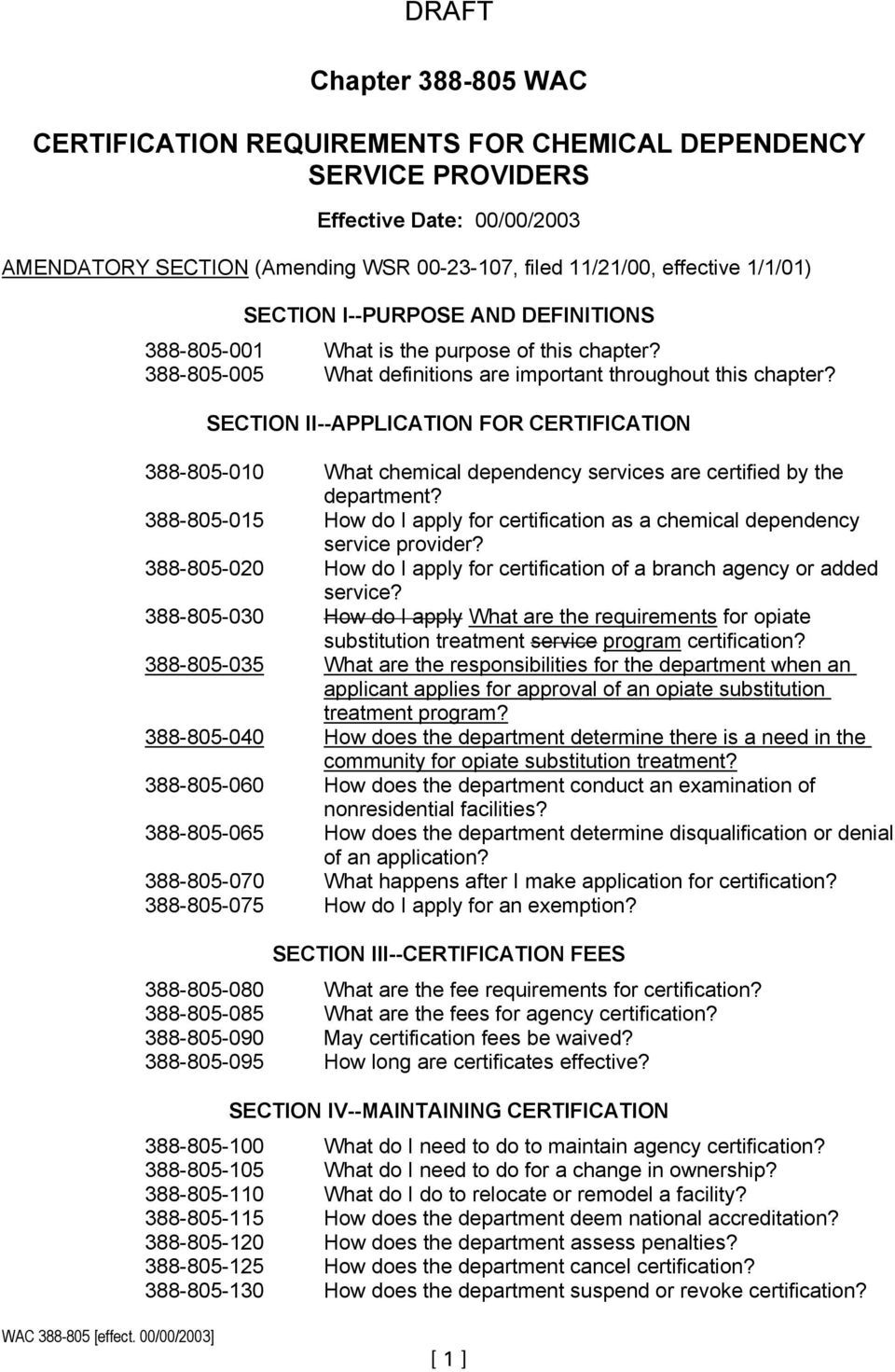
2 Chapter WAC CERTIFICATION REQUIREMENTS FOR CHEMICAL DEPENDENCY SERVICE PROVIDERS Effective Date: 00/00/2003 SECTION I--PURPOSE AND DEFINITIONS What is the purpose of this chapter? What definitions are important throughout this chapter? SECTION II--APPLICATION FOR CERTIFICATION What chemical dependency services are certified by the department? How do I apply for certification as a chemical dependency service provider? How do I apply for certification of a branch agency or added service? How do I apply What are the requirements for opiate substitution treatment service program certification? What are the responsibilities for the department when an applicant applies for approval of an opiate substitution treatment program? How does the department determine there is a need in the community for opiate substitution treatment? How does the department conduct an examination of nonresidential facilities? How does the department determine disqualification or denial of an application? What happens after I make application for certification? How do I apply for an exemption? SECTION III--CERTIFICATION FEES What are the fee requirements for certification? What are the fees for agency certification? May certification fees be waived? How long are certificates effective? SECTION IV--MAINTAINING CERTIFICATION What do I need to do to maintain agency certification? What do I need to do for a change in ownership? What do I do to relocate or remodel a facility? How does the department deem national accreditation? How does the department assess penalties? How does the department cancel certification? How does the department suspend or revoke certification? [ 1 ]
3 What is the prehearing, hearing and appeals process? SECTION V--ORGANIZATIONAL STANDARDS What are the requirements for a provider's governing body? What are the key responsibilities required of an agency administrator? What must be included in an agency administrative manual? What are the requirements for provider facilities? SECTION VI--HUMAN RESOURCE MANAGEMENT What must be included in an agency personnel manual? What are agency personnel file requirements? What are the requirements for approved supervisors of persons who are in training to become a chemical dependency professional trainees? What are the requirements to be a probation assessment officer? What are the requirements to be a probation assessment officer trainee? What are the requirements for supervising probation assessment officer trainees? What are the requirements for student practice in treatment agencies? What are the requirements to be an information school instructor? What are the requirements for using volunteers in a treatment agency? SECTION VII--PROFESSIONAL PRACTICES What must be included in the agency clinical manual? What are patients' rights requirements in certified agencies? What are the requirements for chemical dependency assessments? What are the requirements for treatment, continuing care, transfer, and discharge plans? What are the requirements for a patient record system? What are the requirements for patient record content? What are the requirements for reporting patient noncompliance? SECTION VIII--OUTCOMES EVALUATION What are the requirements for outcomes evaluation? SECTION IX--PROGRAM SERVICE STANDARDS What are the requirements for detoxification providers? What are the requirements for detox staffing and services? What are the requirements for residential providers? [ 2 ]

4 What are the requirements for residential providers admitting youth? What are the requirements for youth behavior management? What are the requirements for intensive inpatient services? What are the requirements for recovery house services? What are the requirements for long-term treatment services? What are the requirements for outpatient providers? What are the requirements for intensive outpatient treatment services? What are the requirements for outpatient services? What are the requirements for outpatient services for persons subject to chapter RCW? What are the requirements for outpatient services in a school setting? What are the requirements for providing off-site chemical dependency treatment services? What are the requirements for opiate substitution treatment program providers? What are the requirements for opiate substitution medical management? What are the requirements for opiate substitution medication management? What are the requirements for drug testing urinalysis in opiate substitution treatment? What are the requirements for opiate substitution treatment dispensaries? What are the requirements for opiate substitution treatment counseling? What are the requirements for opiate substitution treatment take-home medications? What are the requirements for free-standing ADATSA assessment providers and services? What are the requirements for DUI assessment providers? What are the requirements for DUI assessment services? What are the requirements for alcohol and other drug information school? What are the requirements for information and crisis services? What are the requirements for emergency service patrol? What are the requirements for treatment accountability for safer communities alternatives to street crime (TASC) providers and services? What are the requirements for outpatient child care when a parent is in treatment? What are the requirements for outpatient child care admission and health history? What are the requirements for outpatient child care policies? What are the requirements for an outpatient child care activity program? What are the requirements for outpatient child care behavior management and discipline? [ 3 ]

5 What are the requirements for outpatient child care diaper changing? What are the requirements for outpatient child care food service? What are the staffing requirements for outpatient child care services? [ 4 ]
6 SECTION I--PURPOSE AND DEFINITIONS WAC What is the purpose of this chapter? These rules describe the standards and processes necessary to be a certified chemical dependency treatment program. The rules have been adopted under the authority and purposes of the following chapters of law. (1) Chapter RCW, Deferred prosecution--courts of limited jurisdiction; (2) Chapter RCW, Rules of the road; (3) Chapter RCW, Discrimination--Human rights commission; (4) Chapter 70.96A RCW, Treatment for alcoholism, intoxication and drug addiction; and (5) Chapter RCW, Alcoholism and Drug Addiction Treatment and Support Act (ADATSA). [Statutory Authority: RCW 70.96A.090 and chapter 70.96A RCW , , WAC What definitions are important throughout this chapter? "Added service" means the adding of certification for chemical dependency levels of care to an existing certified agency at an approved location. "Addiction counseling competencies" means the knowledge, skills, and attitudes of chemical dependency counselor professional practice as described in Technical Assistance Publication No. 21, Center for Substance Abuse Treatment, Substance Abuse and Mental Health Services Administration, U.S. Department of Health and Human Services "Administrator" means the person designated responsible for the operation of the certified treatment service. "Adult" means a person eighteen years of age or older. "Alcoholic" means a person who has the disease of alcoholism. "Alcoholism" means a primary, chronic disease with genetic, psychosocial, and environmental factors influencing its development and manifestations. The disease is often progressive and fatal. It is characterized by impaired control over drinking, preoccupation with the drug alcohol, use of alcohol despite adverse consequences, and distortions in thinking, most notably denial. Each of these symptoms may be continuous or periodic. "Approved supervisor" means a person who meets the education and experience requirements described in WAC and through and who is available to the person being supervised. "Area" means the county in which an opiate substitution treatment program applicant proposes to locate a certified program, and counties adjacent or near to the county in which the program is proposed to be located. "Authenticated" means written, permanent verification of an entry in a patient treatment record by an individual, by means of an original signature including first initial, last name, and professional designation or job title, or initials of the name if the file includes an authentication record, and the date of the entry. If patient records are maintained electronically, unique electronic passwords, biophysical or passcard equipment are acceptable methods of authentication. "Authentication record" means a document that is part of a patient's treatment record, with legible identification of all persons initialing entries in the treatment record, and includes: (1) Full printed name; (2) Signature including the first initial and last name; and (3) Initials and abbreviations indicating professional designation or job title. [ 5 ]

7 "Bloodborne pathogens" means pathogenic microorganisms that are present in human blood and can cause disease in humans. The pathogens include, but are not limited to, hepatitis B virus (HBV) and human immunodeficiency virus (HIV). "Branch site" means a physically separate certified site where qualified staff provides a certified treatment service, governed by a parent organization. The branch site is an extension of a certified provider's services to one or more sites. Clinical indicators include inability to maintain abstinence from alcohol or other nonprescribed drugs, positive drug screens, patient report of a subsequent alcohol/drug arrest, patient leaves program against program advice, unexcused absences from treatment, lack of participation in self-help groups, and lack of patient progress in any part of the treatment plan. "CSAT" means the Federal Center For Substance Abuse Treatment, a substance abuse service center of the Substance Abuse and Mental Health Services Administration. "Certified treatment service" means a discrete program of chemical dependency treatment offered by a service provider who has a certificate of approval from the department of social and health services, as evidence the provider meets the standards of chapter WAC. "Change in ownership" means one of the following conditions: (1) When the ownership of a certified chemical dependency treatment provider changes from one distinct legal entity (owner) to a distinct other; (2) When the type of business changes from one type to another; or, (3) When the current ownership takes on a new owner of five percent or more of the organizational assets. "Chemical dependency" means a person's alcoholism or drug addiction or both. "Chemical dependency counseling" means face-to-face individual or group contact using therapeutic techniques that are: (1) Led by a chemical dependency professional (CDP), or CDP trainee under supervision of a CDP; (2) Directed toward patients and others who are harmfully affected by the use of moodaltering chemicals or are chemically dependent; and, (3) Directed toward a goal of abstinence for chemically dependent persons. "Chemical dependency professional" means a person certified as a chemical dependency professional by the Washington state department of health under chapter RCW. "Child" means a person less than eighteen years of age, also known as adolescent, juvenile, or minor. "County coordinator" means the person designated by the chief executive officer of a county to carry out administrative and oversight responsibilities of the county chemical dependency program. "Criminal background check" means a search by the Washington state patrol for any record of convictions or civil adjudication related to crimes against children or other persons, including developmentally disabled and vulnerable adults, per RCW through relating to the Washington state patrol. Critical Incidents includes serious injury or sexual assault of patients, staff members, or public citizens on the premises; a natural disaster presenting a threat to facility operation or patient safety; a bomb threat; a break in or a burglary of patient identifying information; patient abuse; suicide attempt at the facility; death at the facility; or, a case alleging patient abuse or patient neglect by an agency staff member. "Danger to self or others," for purposes of WAC , means a youth who resides in a chemical dependency treatment agency and creates a risk of serious harm to the [ 6 ]

8 health, safety, or welfare to self or others. Behaviors considered a danger to self or others include: (1) Suicide threat or attempt; (2) Assault or threat of assault; or (3) Attempt to run from treatment, potentially resulting in a dangerous or life-threatening situation. "Department" means the Washington state department of social and health services. "Determination of need" means a process used by the department for opiate substitution treatment program certification applications as described in WAC "Detoxification" or "detox" means care and treatment of a person while the person recovers from the transitory effects of acute or chronic intoxication or withdrawal from alcohol or other drugs. Diagnostic assessment statement includes an assessment of data gathered in WAC , sections 1, 2, and 3, and sufficient data to determine a patient diagnosis supported by symptoms of substance abuse or substance dependence. "Disability, a person with" means a person whom: (1) Has a physical or mental impairment that substantially limits one or more major life activities of the person; (2) Has a record of such an impairment; or (3) Is regarded as having such an impairment. "Discrete treatment service" means a chemical dependency treatment service that: (1) Provides distinct chemical dependency supervision and treatment separate from any other services provided within the facility; (2) Provides a separate treatment area for ensuring confidentiality of chemical dependency treatment services; and (3) Has separate accounting records and documents identifying the provider's funding sources and expenditures of all funds received for the provision of chemical dependency treatment services. "Domestic violence" means: (1) Physical harm, bodily injury, assault, or the infliction of fear of imminent physical harm, bodily injury, or assault between family or household members; (2) Sexual assault of one family or household member by another; (3) Stalking as defined in RCW 9A of one family or household member by another family or household member; or (4) As defined in RCW , RCW , or other Washington state statutes. "Drug addiction" means a primary, chronic disease with genetic, psychosocial, and environmental factors influencing its development and manifestations. The disease is often progressive and fatal. Drug addiction is characterized by impaired control over use of drugs, preoccupation with drugs, use of a drug despite adverse consequences, and distortions in thinking, most notably denial. Each of these symptoms may be continuous or periodic. "Essential requirement" means a critical element of chemical dependency treatment services that must be present in order to provide effective treatment. Faith-Based Organization means an agency or organization such as a church, religiously affiliated entity, or religious organization. "First steps" means a program available across the state for low-income pregnant women and their infants. First steps provides maternity care for pregnant and postpartum women and health care for infants and young children. "Governing body" means the legal entity responsible for the operation of the chemical dependency treatment service. [ 7 ]
9 "HIV/AIDS brief risk intervention (BRI)" means an individual face-to-face interview with a client or patient, to help that person assess personal risk for HIV/AIDS infection and discuss methods to reduce infection transmission. "HIV/AIDS education" means education, in addition to the brief risk intervention, designed to provide a person with information regarding HIV/AIDS risk factors, HIV antibody testing, HIV infection prevention techniques, the impact of alcohol and other drug use on risks and the disease process, and trends in the spread of the disease. "Medical practitioner" means a physician, advanced registered nurse practitioner (ARNP), or certified physician's assistant. ARNPs and midwives with prescriptive authority may perform practitioner functions related only to indicated specialty services. "Misuse" means use of alcohol or other drugs by a person in: (1) Violation of any law; or (2) Breach of agency policies relating to the drug-free work place. "Off-site treatment" means provision of chemical dependency treatment by a certified provider at a location where treatment is not the primary purpose of the site; such as in schools, hospitals, or correctional facilities. "Opiate substitution treatment ((agency)) program" means an organization that administers or dispenses an approved drug as specified in 212 CFR Part 291 for treatment or detoxification of opiate substitution. The agency is: (1) ((Approved by the Federal Food and Drug Administration)) Certified as an opioid treatment program by the Federal Center for Substance Abuse Treatment, Substance Abuse and Mental Health Services Administration; (2) ((Registered with)) Licensed by the Federal Drug Enforcement Administration; (3) Registered ((with)) by the state board of pharmacy; (4) ((Licensed by the county in which it operates)) Accredited by an opioid treatment program accreditation body approved by the Federal Center for Substance Abuse Treatment, Substance Abuse and Mental Health Services Administration; and (5) Certified as an opiate substitution treatment ((agency)) program by the department. "Outcomes evaluation" means a system for determining the effectiveness and efficiency of results achieved by patients during or following service delivery, and patient satisfaction with those results for the purpose of program improvement. "Patient" is a person receiving chemical dependency treatment services from a certified program. "Patient contact" means time spent with a client or patient to do assessments, individual or group counseling, or education. "Patient placement criteria (PPC)" means admission, continued service, and discharge criteria found in the Patient Placement Criteria for the Treatment of Substance- Related Disorders as published and revised by the American Society of Addiction Medicine (ASAM). "Probation assessment officer (PAO)" means a person employed at a certified district or municipal court probation assessment service that meets the PAO requirements of WAC "Probation assessment service" means a certified assessment service offered by a misdemeanant probation department or unit within a county or municipality. "Progress notes" are a permanent record of ongoing assessments of a patient's participation in and response to treatment, and progress in recovery. "Qualified personnel" means trained, qualified staff, consultants, trainees, and volunteers who meet appropriate legal, licensing, certification, and registration requirements. "Registered counselor" means a person registered, or certified by the state department of health as required by chapter RCW. [ 8 ]

10 "Relocation" means change in location from one office space to a new office space, or moving from one office building to another. "Remodeling" means expansion of existing office space to additional office space at the same address, or remodeling of interior walls and space within existing office space. "Restraint," for purposes of WAC , means the use of methods, by a trained staff person, to prevent or limit free body movement in case of out-of-control behavior. "Restraint" includes: (1) Containment or seclusion in an unlocked quiet room; (2) Physical restraint, meaning a person physically holds or restricts another person in a safe manner for a short time in an immediate crisis; or (3) Use of a safe and humane apparatus, which the person cannot release by oneself. "SAMHSA" means the Federal Substance Abuse and Mental Health Services Administration. Self-help group means community based support groups that address chemical dependency. "Service provider" or "provider" means a legally operated entity certified by the department to provide chemical dependency services. The components of a service provider are: (1) Legal entity/owner; (2) Facility; and (3) Staff and services. "Sexual abuse" means sexual assault, incest, or sexual exploitation. "Sexual harassment" means unwelcome sexual advances, requests for sexual favors, and other verbal or physical conduct of a sexual nature when: (1) Submission to such conduct is made either explicitly or implicitly a term or condition of employment or treatment; or (2) Such conduct interferes with work performance or creates an intimidating, hostile, or offensive work or treatment environment. "Substance abuse" means a recurring pattern of alcohol or other drug use that substantially impairs a person's functioning in one or more important life areas, such as familial, vocational, psychological, physical, or social. "Summary suspension" means an immediate suspension of certification, per RCW (4), by the department pending administrative proceedings for suspension, revocation, or other actions deemed necessary by the department. "Supervision" means: (1) Regular monitoring of the administrative, clinical, or clerical work performance of a staff member, trainee, student, volunteer, or employee on contract by a person with the authority to give directions and require change; and (2) "Direct supervision" means the supervisor is on the premises and available for immediate consultation. "Suspend" means termination of the department's certification of a provider's treatment services for a specified period or until specific conditions have been met and the department notifies the provider of reinstatement. "TARGET" means the treatment and assessment report generation tool. "Treatment services" means the broad range of emergency, detoxification, residential, and outpatient services and care. Treatment services include diagnostic evaluation, chemical dependency education, individual and group counseling, medical, psychiatric, psychological, and social services, vocational rehabilitation and career counseling that may be extended to alcoholics and other drug addicts and their families, persons incapacitated by alcohol or other drugs, and intoxicated persons. [ 9 ]

11 "Urinalysis" means analysis of a patient's urine sample for the presence of alcohol or controlled substances by a licensed laboratory or a provider who is exempted from licensure by the department of health: (1) "Negative urine" is a urine sample in which the lab does not detect specific levels of alcohol or other specified drugs; and (2) "Positive urine" is a urine sample in which the lab confirms specific levels of alcohol or other specified drugs. "Vulnerable adult" means a person who lacks the functional, mental, or physical ability to care for oneself. "Young adult" means an adult who is eighteen, nineteen, or twenty years old. "Youth" means a person seventeen years of age or younger. [Statutory Authority: RCW 70.96A.090 and chapter 70.96A RCW , , SECTION II--APPLICATION FOR CERTIFICATION WAC What chemical dependency services are certified by the department? (1) The department certifies the following types of chemical dependency services: (a) Detoxification services, which assist patients in withdrawing from alcohol and other drugs including: (i) Acute detox, which provides medical care and physician supervision for withdrawal from alcohol or other drugs; and (ii) Sub-acute detox, which is nonmedical detoxification or patient self-administration of withdrawal medications ordered by a physician, provided in a home-like environment. (b) Residential treatment services, which provide chemical dependency treatment for patients and include room and board in a twenty-four-hour-a-day supervised facility, including: (i) Intensive inpatient, a concentrated program of individual and group counseling, education, and activities for detoxified alcoholics and addicts, and their families; (ii) Recovery house, a program of care and treatment with social, vocational, and recreational activities to aid in patient adjustment to abstinence and to aid in job training, employment, or other types of community activities; and (iii) Long-term treatment, a program of treatment with personal care services for chronically impaired alcoholics and addicts with impaired self-maintenance capabilities. These patients need personal guidance to maintain abstinence and good health. (c) Outpatient treatment services, which provide chemical dependency treatment to patients less than twenty-four hours a day, including: (i) Intensive outpatient, a concentrated program of individual and group counseling, education, and activities for detoxified alcoholics and addicts and their families; (ii) Outpatient, individual and group treatment services of varying duration and intensity according to a prescribed plan; and (iii) Opiate substitution outpatient treatment, which meets both outpatient and opiate substitution treatment program service requirements. (d) Assessment services, which include: (i) ADATSA assessments, alcohol and other drug assessments of clients seeking financial assistance from the department due to the incapacity of chemical dependency. Services include assessment, referral, case monitoring, and assistance with employment; and [ 10 ]

12 (ii) DUI assessments, diagnostic services requested by the courts to determine a client's involvement with alcohol and other drugs and to recommend a course of action. (e) Information and assistance services, which include: (i) Alcohol and drug information school, an education program about the use and abuse of alcohol and other drugs, for persons referred by the courts and others, who do not present a significant chemical dependency problem, to help those persons make informed decisions about the use of alcohol and other drugs; (ii) Information and crisis services, response to persons having chemical dependency needs, by phone or in person; (iii) Emergency service patrol, assistance provided to intoxicated persons in the streets and other public places; (iv) Treatment accountability for safer communities alternatives to street crime (TASC), is a referral and case management service. TASC providers furnish a link between the criminal justice system and the treatment system. TASC identifies, assesses, and refers appropriate alcohol and other drug dependent offenders to community-based substance abuse treatment and monitors the outcome for the criminal justice system. (2) The department may certify a provider for more than one of the services listed under subsection (1) of this section when the provider complies with the specific requirements of the selected services. [Statutory Authority: RCW 70.96A.090 and chapter 70.96A RCW , , WAC How do I apply for certification as a chemical dependency service provider? (1) A potential new chemical dependency service provider, otherwise referred to as applicant, seeking certification for one or more services, as described under WAC , must: (a) Request from the department an application packet of information on how to become a certified chemical dependency service provider; and (b) Obtain a license as a residential treatment facility from the department of health, if planning to offer residential services. (2) The applicant must submit a completed application to the department that includes: (a) If the applicant is a sole provider: the name and address of the applicant, and a statement of sole proprietorship; (b) If the applicant is a partnership: the name and address of every partner, and a copy of the written partnership agreement; (c) If the applicant is a limited liability company: the name and addresses of its officers, and any owner of five percent or more of the organizational assets, and a copy of the certificate of formation issued by the state of Washington, secretary of state; (d) If the applicant is a corporation: the names and addresses of its officers, board of directors and trustees, and any owner of five percent or more or the organizational assets, and a copy of the corporate articles of incorporation and bylaws; (e) A copy of the Master Business License authorizing the organization to do business in Washington state; (f) The Social Security Number or Federal Employer Identification Number for the governing organization or person; (g) The name of the individual administrator under whose management or supervision the services will be provided; [ 11 ]

13 (h) A copy of the report of findings from a criminal background check of any owner of five percent or more of the organizational assets and the administrator; (i) Additional disclosure statements or background inquiries if the department has reason to believe that offenses, specified under RCW , have occurred since completion of the original application; (j) The physical location of the facility where services will be provided including, in the case of a location known only by postal route and box numbers, and the street address; (k) A plan of the premises assuring the chemical dependency treatment service is discrete from other programs, indicating capacities of the location for the proposed uses; (l) Floor plan showing use of each room and location of: (i) Windows and doors; (ii) Restrooms; (iii) Floor to ceiling walls; (iv) Areas serving as confidential counseling rooms; (v) Other therapy and recreation areas and rooms; (vi) Confidential patient records storage; and (vii) Sleeping rooms, if a residential facility. (m) A completed facility accessibility self-evaluation form; (n) Policy and procedure manuals specific to the agency at the proposed site, and meet the manual requirements described later in this regulation, including the: (i) Administrative manual; (ii) Personnel manual; and (iii) Clinical manual. (o) Sample patient records for each treatment service applied for; and (p) Evidence of sufficient qualified staff to deliver services. (3) In addition to the requirements in this section, a faith-based organization may implement the requirements of the federal Public Health Act, Sections and Section 1955 of 24 U.S.C. 290 and 42 U.S.C. 300x-65. (4)(3) The agency owner or legal representative must: (a) Sign the completed application form and submit the original to the department; (b) Send a copy of the completed application form to the county coordinator in the county where services will be provided; (c) Submit the application fee with the application materials; and (d) Report any changes occurring during the certification process. [Statutory Authority: RCW 70.96A.090 and chapter 70.96A RCW , , WAC How do I apply for certification of a branch agency or added service? (1) A certified chemical dependency service provider applying for a branch site or an additional certified service must request an abbreviated application packet from the department. (2) The applicant must submit an abbreviated application, including: (a) The name of the individual administrator providing management or supervision of the services; (b) A written declaration that a current copy of the agency policy and procedure manual will be maintained at the branch site and that the manual has been revised to accommodate the differences in business and clinical practices at that site; (c) An organization chart, showing the relationship of the branch to the main organization, job titles, and lines of authority; (d) Evidence of sufficient qualified staff to deliver services at the branch site; and (e) Evidence of meeting the requirements of: [ 12 ]

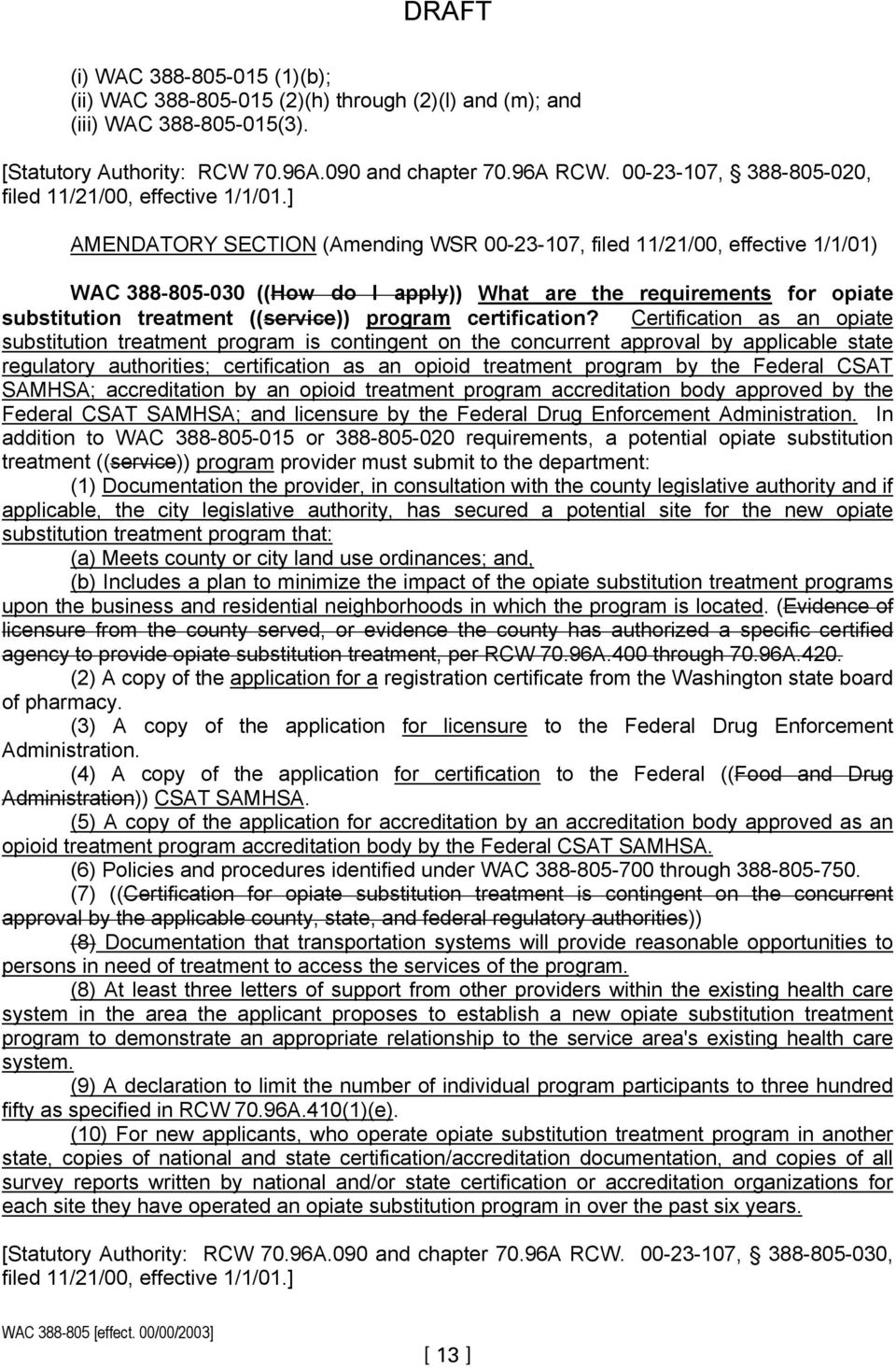
14 (i) WAC (1)(b); (ii) WAC (2)(h) through (2)(l) and (m); and (iii) WAC (3). [Statutory Authority: RCW 70.96A.090 and chapter 70.96A RCW , , WAC ((How do I apply)) What are the requirements for opiate substitution treatment ((service)) program certification? Certification as an opiate substitution treatment program is contingent on the concurrent approval by applicable state regulatory authorities; certification as an opioid treatment program by the Federal CSAT SAMHSA; accreditation by an opioid treatment program accreditation body approved by the Federal CSAT SAMHSA; and licensure by the Federal Drug Enforcement Administration. In addition to WAC or requirements, a potential opiate substitution treatment ((service)) program provider must submit to the department: (1) Documentation the provider, in consultation with the county legislative authority and if applicable, the city legislative authority, has secured a potential site for the new opiate substitution treatment program that: (a) Meets county or city land use ordinances; and, (b) Includes a plan to minimize the impact of the opiate substitution treatment programs upon the business and residential neighborhoods in which the program is located. (Evidence of licensure from the county served, or evidence the county has authorized a specific certified agency to provide opiate substitution treatment, per RCW 70.96A.400 through 70.96A.420. (2) A copy of the application for a registration certificate from the Washington state board of pharmacy. (3) A copy of the application for licensure to the Federal Drug Enforcement Administration. (4) A copy of the application for certification to the Federal ((Food and Drug Administration)) CSAT SAMHSA. (5) A copy of the application for accreditation by an accreditation body approved as an opioid treatment program accreditation body by the Federal CSAT SAMHSA. (6) Policies and procedures identified under WAC through (7) ((Certification for opiate substitution treatment is contingent on the concurrent approval by the applicable county, state, and federal regulatory authorities)) (8) Documentation that transportation systems will provide reasonable opportunities to persons in need of treatment to access the services of the program. (8) At least three letters of support from other providers within the existing health care system in the area the applicant proposes to establish a new opiate substitution treatment program to demonstrate an appropriate relationship to the service area's existing health care system. (9) A declaration to limit the number of individual program participants to three hundred fifty as specified in RCW 70.96A.410(1)(e). (10) For new applicants, who operate opiate substitution treatment program in another state, copies of national and state certification/accreditation documentation, and copies of all survey reports written by national and/or state certification or accreditation organizations for each site they have operated an opiate substitution program in over the past six years. [Statutory Authority: RCW 70.96A.090 and chapter 70.96A RCW , , [ 13 ]
15 NEW SECTION WAC What are the responsibilities for the department when an applicant applies for approval of an opiate substitution treatment program? When making a decision on an application for certification of a program, the department must: (1) Consult with the county legislative authority in the area in which an applicant proposes to locate a program and the city legislative authority in any city in which an applicant proposes to locate a program. The department will request the county and city legislative authority to notify the department of any applicable requirements or other issues that the department should consider in order to fulfill the requirements of WAC (6) and (7), or (1) through (5); (2) Not discriminate in its certification decision on the basis of the corporate structure of the applicant; (3) Consider the size of the population in need of treatment in the area in which the program would be located and certify only applicants whose programs meet the necessary treatment needs of the population; (4) Determine there is a need in the community for opiate substitution treatment and not certify more program slots than justified by the need in that community as described in WAC ; (5) Consider whether the applicant has the capability, or has in the past demonstrated the capability to provide appropriate treatment services to assist persons in meeting legislative goals of abstinence from opiates and opiate substitutes, obtaining mental health treatment, improving economic independence, and reducing adverse consequences associated with illegal use of controlled substances; (6) Hold at least one public hearing in the county in which the facility is proposed to be located and one public hearing in the area in which the facility is proposed to be located. After consultation with the county legislative authority, the department may have the public hearing in the adjacent county with the largest population, the adjacent county with the largest underserved population, or the county nearest to the proposed site. The hearing must be held at a time and location most likely to permit the largest number of interested persons to attend and present testimony. The department must notify appropriate media outlets of the time, date, and location of the hearing at least three weeks in advance of the hearing. [Statutory Authority: RCW 70.96A.090 and chapter 70.96A RCW , , NEW SECTION WAC How does the department determine there is a need in the community for opiate substitution treatment? The department will determine whether or not there is a demonstrated need in the community for opiate substitution treatment from information provided to the department by the applicant and through department consultation with the city and county legislative authority, and other appropriate community resources. A "determination of need" for a proposed program will include a review and evaluation of the following criteria: [ 14 ]

16 (1) For the number of potential clients in an area, the department will consider the size of the population in need of treatment in the area in which the program would be located using adult population statistics from the most recent area population trend reports. The department will use the established ratio of.7 percent of the adult population as an estimate for the number of potential clients with an opiate diagnosis in need of treatment services. (2) For the number of anticipated program slots in an area, the department will multiply the sum of the established ratio of.7 percent of the adult population in (1) by 35 percent to determine an estimate of the anticipated need for the number of opiate substitution treatment program slots in the area in which the program would be located. (3) Demographic and trend data from the area in which the program would be located including the most recent department county trend data, TARGET admission data for opiate substitution treatment from the area, hospital and emergency department admission data from the area, needle exchange data from the area, and other relevant reports and data from city and county health organizations demonstrating the need for opiate substitution treatment program services. (4) Availability of other opiate substitution treatment programs near the area of the applicant's proposed program. The department will determine the number of patients, capacity, and accessibility of existing opiate substitution treatment programs near the area of the applicant's proposed program and whether existing programs have the capacity to assume additional patients for treatment services. (5) Whether the population served or to be served has need for the proposed program and whether other existing services and facilities of the type proposed are available or accessible to meet that need. The assessment will include, but not limited to, consideration of the following: (a) The extent to which the proposed program meets the need of the population presently served; (b) The extent to which the underserved need will be met adequately by the proposed program; and (c) The impact of the service on the ability of low-income persons, racial and ethnic minorities, women, handicapped persons, the elderly, and other underserved groups to obtain needed health care. (6) The department will review agency policies and procedures that describe the cost of services to clients, sliding fee scales, and charity care policies, procedures, and goals. [Statutory Authority: RCW 70.96A.090 and chapter 70.96A RCW , , WAC How does the department conduct an examination of nonresidential facilities? The department must conduct an on-site examination of each new nonresidential applicant's facility or branch facility. The department must determine if the applicant's facility is: (1) Substantially as described. (2) Suitable for the purposes intended. (3) Not a personal residence. (4) Approved as meeting all building and safety requirements. [ 15 ]

17 [Statutory Authority: RCW 70.96A.090 and chapter 70.96A RCW , , WAC How does the department determine disqualification or denial of an application? The department must consider the ability of each person named in the application to operate in accord with this chapter before the department grants or renews certification of a chemical dependency service. (1) The department must deny an applicant's certification when any of the following conditions occurred and was not satisfactorily resolved, or when any owner or administrator: (a) Had a license or certification for a chemical dependency treatment service or health care agency denied, revoked, or suspended; (b) Was convicted of child abuse or adjudicated as a perpetrator of substantiated child abuse; (c) Obtained or attempted to obtain a health provider license, certification, or registration by fraudulent means or misrepresentation; (d) Committed, permitted, aided, or abetted the commission of an illegal act or unprofessional conduct as defined under RCW ; (e) Demonstrated cruelty, abuse, negligence, misconduct, or indifference to the welfare of a patient or displayed acts of discrimination; (f) Misappropriated patient property or resources; (g) Failed to meet financial obligations or contracted service commitments that affect patient care; (h) Has a history of noncompliance with state or federal regulations in an agency with which the applicant has been affiliated; (i) Knowingly, or with reason to know, made a false statement of fact or failed to submit necessary information in: (i) The application or materials attached; and (ii) Any matter under department investigation. (j) Refused to allow the department access to records, files, books, or portions of the premises relating to operation of the chemical dependency service; (k) Willfully interfered with the preservation of material information or attempted to impede the work of an authorized department representative; (l) Is in violation of any provision of chapter 70.96A RCW; or (m) Does not meet criminal background check requirements. (2) The department may deny certification when an applicant: (a) Fails to provide satisfactory application materials; or (b) Advertises itself as certified when certification has not been granted, or has been revoked or canceled. (3) The department may deny an application for certification of an opiate substitution treatment program when: (a) There is not a demonstrated need in the community for opiate substitution treatment and/or there is not a demonstrated need for more program slots justified by the need in that community; (b) There is sufficient availability, accessibility, and capacity of other certified programs near the area in which the applicant proposes to locate the program; (c) The applicant has not demonstrated in the past, the capability to provide the appropriate services to assist the persons who will utilize the program in meeting goals established by the legislature, including; [ 16 ]

18 (i) Abstinence from opiates and opiate substitutes, (ii) Obtaining mental health treatment, (iii) Improving economic independence, and (iv) Reducing adverse consequences associated with illegal use of controlled substances. (4) The applicant may appeal department decisions in accord with chapter RCW, the Washington Administrative Procedure Act and chapter WAC. [Statutory Authority: RCW 70.96A.090 and chapter 70.96A RCW , , WAC What happens after I make application for certification? (1) The department may grant an applicant initial certification after a review of application materials and an on-site visit confirms the applicant has the capacity to operate in compliance with this chapter. (2) A provider's failure to meet and maintain conditions of the initial certification may result in suspension of certification. (3) An initial certificate of approval may be issued for up to one year. (4) The provider must post the certificate in a conspicuous place on the premises. [Statutory Authority: RCW 70.96A.090 and chapter 70.96A RCW , , WAC How do I apply for an exemption? (1) The department may grant an exemption from compliance with specific requirements in this WAC chapter when a provider submits an exemption request in writing. The provider must assure the exemption request does not: (a) Jeopardize the safety, health, or treatment of patients; and (b) Impede fair competition of another service provider. (2) Providers must submit a signed letter requesting the exemption to the Supervisor, Certification Section, Division of Alcohol and Substance Abuse, P.O. Box , Olympia, WA (3) The department must approve or deny all exemption requests in writing. (4) The department and the provider must maintain a copy of the decision. [Statutory Authority: RCW 70.96A.090 and chapter 70.96A RCW , , SECTION III--CERTIFICATION FEES WAC What are the fee requirements for certification? (1) The department must set fees to be charged for certification. (2) Providers must pay certification fees: (a) At the time of application. One-half of the application fee may be refunded if an application is withdrawn before certification or denial; and (b) Within thirty days of receiving an invoice. (3) Payment must be made by check, draft, or money order made payable to the department of social and health services. (4) Fees will not be refunded when certification is denied, revoked, or suspended. [ 17 ]

19 [Statutory Authority: RCW 70.96A.090 and chapter 70.96A RCW , , WAC What are the fees for agency certification? (1) Application fees: (a) New agency $500 (b) Branch agency $500 (c) Application for adding one or more services $200 (d) Change in ownership $500 (2) Initial and annual certification fees: (a) For detoxification and residential services: $26 per licensed bed (b) For nonresidential services: (i) Large size agencies: 3,000 or more clients served per year (ii) Medium size agencies: 1,000-2,999 clients served per year (iii) Small size agencies: clients served per year (c) For agencies certified through deeming per WAC $1,125 per year $750 per year $375 per year $200 per year (3) Each year providers must complete a declaration form provided by the department indicating the number of patients served annually, the provider's national accreditation status, and other information necessary for establishing fees and updating certification information. [Statutory Authority: RCW 70.96A.090 and chapter 70.96A RCW , , WAC May certification fees be waived? (1) Certification fees may be waived when: (a) Tthe fees would not be in the interest of public health and safety;, or, (b) when Tthe fees would be to the financial disadvantage of the state; or, (c) The department determines that the cost of processing the application is so small that it warrants granting an application fee waiver. (2) Providers may submit a letter requesting a waiver of fees to the Supervisor, Certification Section, Division of Alcohol and Substance Abuse, P.O. Box 45331, Olympia, Washington, (3) Fee waivers may be granted to qualified providers who receive funding from tribal, federal, state or county government resources as follows: [ 18 ]

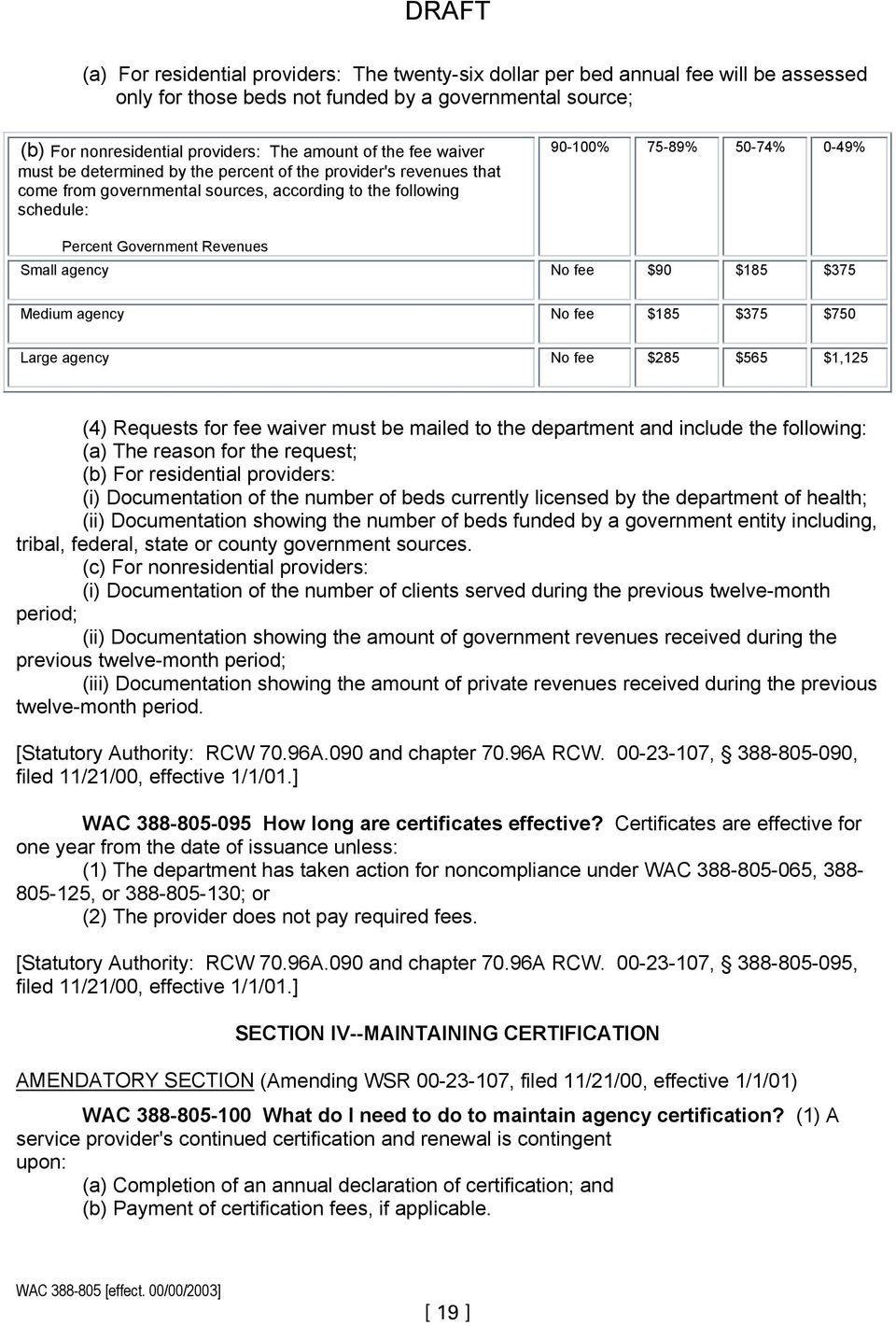
20 (a) For residential providers: The twenty-six dollar per bed annual fee will be assessed only for those beds not funded by a governmental source; (b) For nonresidential providers: The amount of the fee waiver must be determined by the percent of the provider's revenues that come from governmental sources, according to the following schedule: % 75-89% 50-74% 0-49% Percent Government Revenues Small agency No fee $90 $185 $375 Medium agency No fee $185 $375 $750 Large agency No fee $285 $565 $1,125 (4) Requests for fee waiver must be mailed to the department and include the following: (a) The reason for the request; (b) For residential providers: (i) Documentation of the number of beds currently licensed by the department of health; (ii) Documentation showing the number of beds funded by a government entity including, tribal, federal, state or county government sources. (c) For nonresidential providers: (i) Documentation of the number of clients served during the previous twelve-month period; (ii) Documentation showing the amount of government revenues received during the previous twelve-month period; (iii) Documentation showing the amount of private revenues received during the previous twelve-month period. [Statutory Authority: RCW 70.96A.090 and chapter 70.96A RCW , , WAC How long are certificates effective? Certificates are effective for one year from the date of issuance unless: (1) The department has taken action for noncompliance under WAC , , or ; or (2) The provider does not pay required fees. [Statutory Authority: RCW 70.96A.090 and chapter 70.96A RCW , , SECTION IV--MAINTAINING CERTIFICATION WAC What do I need to do to maintain agency certification? (1) A service provider's continued certification and renewal is contingent upon: (a) Completion of an annual declaration of certification; and (b) Payment of certification fees, if applicable. [ 19 ]
21 (2) Providing the essential requirements for chemical dependency treatment, including the following elements: (a) Treatment process: (i) Assessments, as described in WAC ; (ii) Treatment planning, as described in WAC (2)(a) and (10)(11); (iii) Documenting patient progress, as described in WAC (1)(b)(c) and (13); (iv) Treatment plan reviews and updates, as described in WAC (2)(a)(b), (10) (11)(g) and (12)(13)(c); (v) Patient compliance reports, as described in WAC (4)(b), (16)(17), and ; (vi) Continuing care, and discharge planning, as described in WAC (2)(c)(d)(e)(f) and (7)(a), and (17) (18) and (18) (19) ; and, (vii) Conducting individual and group counseling, as described in WAC (2)(b) and 325(12). (b) Staffing: Provide sufficient qualified personnel for the care of patients as described in WAC (5)(4) and (4)(5); (c) Facility: (i) Provide sufficient facilities, equipment, and supplies for the care and safety of patients as described in WAC (5) (4) and (6)(5); (ii) If a residential provider, be licensed by the department of health as described by WAC (1)(b). (3) Findings during periodic on-site surveys and complaint investigations to determine the provider's compliance with this chapter. During on-site surveys and complaint investigations, provider representatives must cooperate with department representatives to: (a) Examine any part of the facility at reasonable times and as needed; (b) Review and evaluate records, including patient clinical records, personnel files, policies, procedures, fiscal records, data, and other documents as the department requires to determine compliance; and (c) Conduct individual interviews with patients and staff members. (4) The provider must post the notice of a scheduled department on-site survey in a conspicuous place accessible to patients and staff. (5) The provider must correct compliance deficiencies found at such surveys immediately or as agreed by a plan of correction approved by the department. [Statutory Authority: RCW 70.96A.090 and chapter 70.96A RCW , , WAC What do I need to do for a change in ownership? (1) When a certified chemical dependency service provider plans a change in ownership, the current service provider must submit a change in ownership application form sixty or more days before the proposed date of ownership change. (2) The current provider must include the following information with the application: (a) Name and address of each new prospective owner of five percent or more of the organizational assets as required by WAC (2)(a) through (d); (b) Current and proposed name (if applicable) of the affected; (c) Date of the proposed transaction; (d) A copy of the transfer agreement between the outgoing and incoming owner(s); (e) If a corporation, the names and addresses of the proposed responsible officers or partners; [ 20 ]
22 (f) A statement regarding the disposition and management of patient records, as described under 42 CFR, Part 2 and WAC ; and (g) A copy of the report of findings from a criminal background check of any new owner of five percent or more of the organizational assets and new administrator when applicable. (3) The department must determine which, if any, WAC or requirements apply to the potential new service provider, depending on the extent of ownership and operational changes. (4) The department may grant certification to the new owner when the new owner: (a) Successfully completes the application process; and (b) Ensures continuation of compliance with rules of this chapter and implementation of plans of correction for deficiencies relating to this chapter, when applicable. [Statutory Authority: RCW 70.96A.090 and chapter 70.96A RCW , , WAC What do I do to relocate or remodel a facility? When a certified chemical dependency service provider plans to relocate or change the physical structure of a facility in a manner that affects patient care, the provider must: (1) Submit a completed agency relocation approval request form, or a request for approval in writing if remodeling, sixty or more days before the proposed date of relocation or change. (2) Submit a sample floor plan that includes information identified under WAC (2)(f) through (k). (3) Submit a completed facility accessibility self-evaluation form. (4) Provide for department examination of nonresidential premises before approval, as described under WAC (5) Contact the department of health for approval before relocation or remodel if a residential treatment facility. [Statutory Authority: RCW 70.96A.090 and chapter 70.96A RCW , , WAC How does the department deem national accreditation? (1) The department must deem accreditation by a national chemical dependency accreditation body, recognized by the department, if the treatment provider was initially certified by the department and when: (a) A major portion of the national accreditation body requirements meet or exceed chapter WAC requirements; (b) The national accreditation time intervals meet or exceed state expectations; (c) The provider notifies the department of scheduled on-site surveys; (d) The provider promptly sends a copy of survey findings, corrective action plans, and follow-up responses to the department; and (e) WAC through continue to apply at all times. (2) The department may apply an abbreviated department survey, which includes requirements specific to Washington state at its regular certification intervals. (3) The department must act upon: (a) Complaints received; and (b) Deficiencies cited by the national accreditation body for which there is no evidence of correction. [ 21 ]
23 [Statutory Authority: RCW 70.96A.090 and chapter 70.96A RCW , , WAC How does the department assess penalties? (1) When the department determines that a service provider fails to comply with provider entry requirements or ongoing requirements of this chapter, the department may: (a) Assess fees to cover costs of added certification activities; (b) Cease referrals of new patients who are recipients of state or federal funds; and (c) Notify the county alcohol and drug coordinator and local media of ceased referrals, involuntary cancellations, suspensions, revocations, or nonrenewal of certification. (2) When the department determines a service provider knowingly failed to report, as ordered by to the court pursuant to chapter RCW, a patient's noncompliance with treatment ordered by the court under chapter RCW, the department must assess the provider a fine of two hundred fifty dollars for each incident of nonreporting. [Statutory Authority: RCW 70.96A.090 and chapter 70.96A RCW , , WAC How does the department cancel certification? The department may cancel a provider's certification if the provider: (1) Ceases to provide services for which the provider is certified. (2) Voluntarily cancels certification. (3) Fails to submit required certification fees. (4) Changes ownership without prior notification and approval. (5) Relocates without prior notification and approval. [Statutory Authority: RCW 70.96A.090 and chapter 70.96A RCW , , WAC How does the department suspend or revoke certification? (1) The department must suspend or revoke a provider's certification when a disqualifying situation described under WAC applies to a current service provider. (2) The department must revoke a provider's certification when the provider knowingly failed to report, as ordered by to the court pursuant to chapter RCW, within a continuous twelve-month period, three incidents of patient noncompliance with treatment ordered by the court under chapter RCW. (3) The department may suspend or revoke a provider's certification when any of the following provider deficiencies or circumstances occur: (a) A provider fails to provide the essential requirements of chemical dependency treatment as described in WAC (2), and one or more of the following conditions occur: (i) Violation of a rule threatens or results in harm to a patient; (ii) A reasonably prudent provider should have been aware of a condition resulting in significant violation of a law or rule; (iii) A provider failed to investigate or take corrective or preventive action to deal with a suspected or identified patient care problem; (iv) Noncompliance occurs repeatedly in the same or similar areas; [ 22 ]
24 (v) There is an inability to attain compliance with laws or rules within a reasonable period of time. (b) The provider fails to submit an acceptable and timely plan of correction for cited deficiencies; or (c) The provider fails to correct cited deficiencies. (4) The department may suspend certification upon receipt of a providers written request. Providers requesting voluntary suspension must submit a written request for reinstatement of certification within one year from the effective date of the suspension. The department will review the request for reinstatement, determine if the provider is able to operate in compliance with certification requirements, and notify the provider of the results of the review for reinstatement. [Statutory Authority: RCW 70.96A.090 and chapter 70.96A RCW , , WAC What is the prehearing, hearing and appeals process? (1) In case of involuntary certification cancellation, suspension, or revocation of the certification, or a penalty for noncompliance, the department must: (a) Notify the service provider and the county coordinator of any action to be taken; and (b) Inform the provider of pre-hearing and dispute conferences, hearing, and appeal rights under chapter WAC. (2) The department may order a summary suspension of the provider's certification pending completion of the appeal process when the preservation of public health, safety, or welfare requires emergency action. [Statutory Authority: RCW 70.96A.090 and chapter 70.96A RCW , , SECTION V--ORGANIZATIONAL STANDARDS WAC What are the requirements for a provider's governing body? The provider's governing body, legally responsible for the conduct and quality of services provided, must: (1) Appoint an administrator responsible for the day-to-day operation of the program. (2) Maintain a current job description for the administrator including the administrator's authority and duties. (3) Establish the philosophy and overall objectives for the treatment services. (4) Notify the department within thirty days, of changes of the agency administrator. (5) Provide personnel, facilities, equipment, and supplies necessary for the safety and care of patients. (6) If a nonresidential provider, ensure: (a) Safety of patients and staff; and (b) Maintenance and operation of the facility. (7) Review and approve written administrative, personnel, and clinical policies and procedures required under WAC , , and (8) Ensure the administration and operation of the agency is in compliance with: (a) Chapter WAC requirements; (b) Applicable federal, state, and local laws and rules; and (c) Federal, state, and local licenses, permits, and approvals. [ 23 ]
25 (9) The governing body of a certified opiate substitution treatment program must ensure that treatment is provided to patients in compliance with 42 Code of Federal Regulations, Part (10) The governing body of a certified opiate substitution treatment program must comply with the standards of 42 Code of Federal Regulations, Part as a condition of certification. [Statutory Authority: RCW 70.96A.090 and chapter 70.96A RCW , , WAC What are the key responsibilities required of an agency administrator? (1) The administrator is responsible for the day-to-day operation of the certified treatment service, including: (a) All administrative matters; (b) Patient care services; and (c) Meeting all applicable rules and ethical standards. (2) When the administrator is not on duty or on call, a staff person must be delegated the authority and responsibility to act in the administrator's behalf. (3) The administrator must ensure administrative, personnel, and clinical policy and procedure manuals: (a) Are developed and adhered to; and (b) Are reviewed and revised as necessary, and at least annually. (4) The administrator must employ sufficient qualified personnel to provide adequate chemical dependency treatment, facility security, patient safety and other special needs of patients. (5) The administrator must ensure all persons providing counseling services are registered, certified or licensed by the department of health. (6) The administrator must ensure full-time chemical dependency professionals (CDPs), or CDP trainees, or other licensed or registered counselors in training to become a CDP do not exceed one hundred twenty hours of patient contact per month. (7) The administrator must assign the responsibilities for a clinical supervisor to at a least one person within the organization. (8) The administrator of a certified opiate substitution treatment program must ensure that the number of patients will not exceed three hundred and fifty unless authorized by the county in which the program is located. (9) The administrator or program sponsor of a certified opiate substitution treatment program must ensure that treatment is provided to patients in compliance with 42 Code of Federal Regulations, Part [Statutory Authority: RCW 70.96A.090 and chapter 70.96A RCW , , WAC What must be included in an agency administrative manual? Each service provider must have and adhere to an administrative manual that contains at a minimum: (1) The organization's: (a) Articles and certificate of incorporation if the owner is a corporation; [ 24 ]
26 (b) Partnership agreement if the owner is a partnership; or (c) Statement of sole proprietorship. (2) The agency's bylaws if the owner is a corporation. (3) Copies of a current master license and state business licenses or a current declaration statement that they are updated as required. (4) The provider's philosophy on and objectives of chemical dependency treatment with a goal of total abstinence, consistent with RCW 70.96A.011. (5) A policy Policies and procedures describing how services will be made sensitive to the needs of each patient, including assurance that: (a) Certified interpreters or other acceptable alternatives are available for persons with limited English-speaking proficiency and persons having a sensory impairment; and (b) Assistance will be provided to persons with disabilities in case of an emergency. (6) A policy addressing special needs and protection for youth and young adults, and for determining whether a youth or young adult can fully participate in treatment, before admission of: (a) A youth to a treatment service caring for adults; or (b) A young adult to a treatment service caring for youth. (7) An organization chart specifying: (a) The governing body; (b) Each staff position by job title, including volunteers, students, and persons on contract; and (c) The number of full- or part-time persons for each position. (8) A delegation of authority policy. (9) A copy of current fee schedules. (10) A policy Policies and procedures implementing state and federal regulations on patient confidentiality, including provision of a summary of 42 CFR Part 2.22 (a)(1) and (2) to each patient. (11) A policy Policies and procedures for reporting suspected child abuse and neglect. (12) A policy Policies and procedures for reporting the death of a patient to the department within one business day when: (a) The patient is in residence; or (b) An outpatient dies on the premises. (13) Patient grievance policy and procedures. (14) A policy Policies and procedures on reporting of critical incidents and actions taken to the department within two business days when an unexpected event occurs. (15) A ssmoking policy policies consistent with the Washington Clean Indoor Air Act, chapter RCW. (16) For a residential provider, a facility security policy and procedures, including: (a) Preventing entry of unauthorized visitors; and (b) Use of passes for leaves of patients. (17) For a nonresidential provider, an evacuation plan for use in the event of a disaster, addressing: (a) Communication methods for patients, staff, and visitors including persons with a visual or hearing impairment or limitation; (b) Evacuation of mobility-impaired persons; (c) Evacuation of children if child care is offered; (d) Different types of disasters; (e) Placement of posters showing routes of exit; and (f) The need to mention evacuation routes at public meetings. [ 25 ]
27 [Statutory Authority: RCW 70.96A.090 and chapter 70.96A RCW , , WAC What are the requirements for provider facilities? (1) The administrator must ensure the treatment service site: (a) Is accessible to a person with a disability; (b) Has a reception area separate from living and therapy areas; (c) Has adequate private space for personal consultation with a patient, staff charting, and therapeutic and social activities, as appropriate; (d) Has secure storage of active and closed confidential patient records; and (e) Has one private room available if youth are admitted to a detox or residential facility. (2) The administrator of a nonresidential facility must ensure: (a) Evidence of a current fire inspection approval; (b) Facilities and furnishings are kept clean, in good repair; (c) Adequate lighting, heating, and ventilation; and (d) Separate and secure storage of toxic substances, which are used only by staff or supervised persons. [Statutory Authority: RCW 70.96A.090 and chapter 70.96A RCW , , SECTION VI--HUMAN RESOURCE MANAGEMENT WAC What must be included in an agency personnel manual? The administrator must have and adhere to a personnel manual, which contains policies and procedures describing how the agency: (1) Meets the personnel requirements of WAC through (2) Conducts criminal background checks on its employees in order to comply with the rules specified in RCW through (3) Provides for a drug free work place which includes: (a) A philosophy of nontolerance of illegal drug-related activity; (b) Agency standards of prohibited conduct; and (c) Actions to be taken in the event a staff member misuses alcohol or other drugs. (4) If a nonresidential provider, provides for prevention and control of communicable disease, including specific training and procedures on: (a) Bloodborne pathogens, including HIV/AIDS and Hepatitis B; (b) Tuberculosis; and (c) Other communicable diseases. (5) Provides staff orientation prior to assigning unsupervised duties, including orientation to: (a) The administrative, personnel and clinical manuals; (b) Staff ethical standards and conduct, including reporting of unprofessional conduct to appropriate authorities; (c) Staff and patient grievance procedures; and (d) The facility evacuation plan. [Statutory Authority: RCW 70.96A.090 and chapter 70.96A RCW , , [ 26 ]
28 WAC What are agency personnel file requirements? (1) The administrator must ensure that there is a current personnel file for each employee, trainee, student, and volunteer, and for each contract staff person who provides or supervises patient care. (2) The administrator must designate a person to be responsible for management of personnel files. (3) Each person's file must contain: (a) A copy of the results of a tuberculin skin test or evidence the person has completed a course of treatment approved by a physician or local health officer if the results are positive; (b) Documentation of training on bloodborne pathogens, including HIV/AIDS and hepatitis B for all employees, volunteers, students, and treatment consultants on contract; (i) At the time of staff's initial assignment to tasks where occupational exposure may take place; (ii) Annually thereafter for bloodborne pathogens; (c) A signed and dated commitment to maintain patient confidentiality in accordance with state and federal confidentiality requirements; and (d) A record of an orientation to the agency as described in WAC (5). (4) For residential facilities, documentation of current cardiopulmonary resuscitation (CPR) and first aid training for at least one person on each shift. (5) Documentation of health department training and approval for any staff administering or reading a TB test. (6) Employees who are patients or have been patients of the agency must have personnel records: (a) Separate from clinical records; and (b) Have no indication of current or previous patient status. (7) In addition, each patient care staff member's personnel file must contain: (a) Verification of qualifications for their assigned position including: (i) For a chemical dependency professional (CDP): A copy of the person's valid CDP certification issued by the department of health (DOH); (ii) For approved supervisors: Documentation to substantiate the person meets the qualifications of an approved supervisor as defined in WAC (iii) For ((other persons providing counseling, a copy of a valid registration, certification, or license issued by the DOH)) each person engaged in the treatment of chemical dependency, including counselors, physicians, nurses, and other registered, certified, or licensed health care professionals, evidence they comply with the credentialing requirements of their respective professions. (iv) For probation assessment officers (PAO): Documentation that the person has met the education and experience requirements described in WAC ; (v) For probation assessment officer trainees: (A) Documentation that the person meets the qualification requirements described in WAC ; and (B) Documentation of the PAO trainee's supervised experience as described in WAC including an individual education and experience plan and documentation of progress toward completing the plan. (vi) For information school instructors: (A) A copy of a certificate of completion of an alcohol and other drug information school instructor's training course approved by the department; and (B) Documentation of continuing education as specified in WAC [ 27 ]
29 (b) A copy of a current job description, signed and dated by the employee and supervisor which includes: (i) Job title; (ii) Minimum qualifications for the position; (iii) Summary of duties and responsibilities; (iv) For contract staff, formal agreements or personnel contracts, which describe the nature and extent of patient care services, may be substituted for job descriptions. (c) A written performance evaluation for each year of employment: (i) Conducted by the immediate supervisor of each staff member; and (ii) Signed and dated by the employee and supervisor. [Statutory Authority: RCW 70.96A.090 and chapter 70.96A RCW , , WAC What are the requirements for approved supervisors of persons who are in training to become a chemical dependency professional trainees? (1) When an administrator decides to provide training opportunities for persons seeking to become a chemical dependency professionals (CDP) trainees, the administrator must assign an approved supervisor, as defined in WAC , to each CDP trainee chemical dependency professional trainee (CDPT), or other licensed or registered counselor. (2) Approved supervisors must provide the CDPT trainees or other licensed or registered counselor assigned to them with documentation substantiating their qualifications as an approved supervisor before the initiation of training. (3) Approved supervisors must decrease the hours of patient contact allowed under WAC (6) by twenty percent for each full-time CDPT trainee or other licensed or registered counselor supervised. (4) Approved supervisors are responsible for all patients assigned to the CDPT trainees or other licensed or registered counselor under their supervision. (5) An approved supervisor must provide supervision to a CDPT trainee or other licensed or registered counselor as required by WAC (6) CDPs must review and co-authenticate all clinical documentation of CDPT trainees or other licensed or registered counselor. (7) Approved supervisors must supervise, assess and document the progress the CDP trainees or other licensed or registered counselor under their supervision are making toward meeting the requirements described in WAC and This documentation must be provided to CDP trainees or other licensed or registered counselors trainees upon request. [Statutory Authority: RCW 70.96A.090 and chapter 70.96A RCW , , WAC What are the requirements to be a probation assessment officer? A probation assessment officer (PAO), must: (1) Be employed as a probation officer at a misdemeanant probation department or unit within a county or municipality; (2) Be certified as a chemical dependency professional, or [ 28 ]
30 (3) Have obtained a bachelor's or graduate degree in a social or health sciences field and have completed twelve quarter or eight semester credits from an accredited college or university in courses that include the following topics: (a) Understanding addiction and the disease of chemical dependency; (b) Pharmacological actions of alcohol and other drugs; (c) Substance abuse and addiction treatment methods; (d) Understanding addiction placement, continuing care, and discharge criteria, including ASAM PPC criteria; (e) Cultural diversity including people with disabilities and it's implication for treatment; (f) Chemical dependency clinical evaluation (screening and referral to include comorbidity); (g) HIV/AIDS brief risk intervention for the chemically dependent; (h) Chemical dependency confidentiality; (i) Chemical dependency rules and regulations. (4) In addition, a PAO must complete: (a) Two thousand hours of supervised experience as a PAO trainee in a state-certified DUI assessment service program if a PAO possesses a baccalaureate degree; (b) One thousand five hundred hours of experience as a PAO trainee in a state-certified DUI assessment service program if a PAO possesses a masters or higher degree. (5) PAOs, must complete fifteen clock hours each year or thirty clock hours every two years of continuing education each year in chemical dependency subject areas, which will enhance competency as a PAO beginning on January 1 of the year following the year of initial qualification. (6) A PAO is grandparented if they were qualified as a PAO by June 30, 2000, under WAC (2). [Statutory Authority: RCW 70.96A.090 and chapter 70.96A RCW , , WAC What are the requirements to be a probation assessment officer trainee? A probation assessment officer (PAO) trainee must: (1) Be employed as a probation officer at a misdemeanant probation department or unit within a county or municipality; and (2) Be directly supervised and tutored by a PAO. [Statutory Authority: RCW 70.96A.090 and chapter 70.96A RCW , , WAC What are the requirements for supervising probation assessment officer trainees? (1) Probation assessment officers (PAO) are responsible for all offenders assigned to PAO trainees under their supervision. (2) PAO trainee supervisors must: (a) Review and co-authenticate all trainee assessments entered in each offender's assessment record; (b) Assist the trainee to develop and maintain an individualized education and experience plan (IEEP) designed to assist the trainee in obtaining the education and experience necessary to become a PAO; (c) Provide the trainee orientation to the various laws and regulations that apply to the delivery of chemical dependency assessment and treatment services; [ 29 ]
31 (d) Instruct the trainee in assessment methods and the transdisciplinary foundations described in the addiction counseling competencies; (e) Observe the trainee conducting assessments; and (f) Document quarterly evaluations of the progress of each trainee. [Statutory Authority: RCW 70.96A.090 and chapter 70.96A RCW , , WAC What are the requirements for student practice in treatment agencies? (1) The treatment provider must have a written agreement with each educational institution using the treatment agency as a setting for student practice. (2) The written agreement must describe the nature and scope of student activity at the treatment setting and the plan for supervision of student activities. (3) Each student and academic supervisor must sign a confidentiality statement, which the provider must retain. [Statutory Authority: RCW 70.96A.090 and chapter 70.96A RCW , , WAC What are the requirements to be an information school instructor? (1) An information school instructor must: (a) hhave a certificate of completion of an alcohol and other drug information school instructor's training course approved by the department if not a chemical dependency professional (CDP); and (b) Not have a history of alcohol or other drug misuse for two years before being qualified by the department. (2) To remain qualified, the information school instructor must: (a) Not display misuse of alcohol or other drugs while serving as an information school instructor; and (b) Maintain information school instructor status by completing fifteen clock hours of continuing education if not a CDP,: (i) During each two-year period beginning January of the year following initial qualification; and (ii) In subject areas that increase knowledge and skills in training, teaching techniques, curriculum planning and development, presentation of educational material, laws and rules, and developments in the chemical dependency field. [Statutory Authority: RCW 70.96A.090 and chapter 70.96A RCW , , WAC What are the requirements for using volunteers in a treatment agency? (1) Each volunteer assisting a provider must be oriented as required under WAC (5). (2) A volunteer must meet the qualifications of the position to which the person is assigned. (3) A volunteer may provide counseling services when the person meets the requirements for a chemical dependency professional trainee or is a chemical dependency professional. [ 30 ]
32 [Statutory Authority: RCW 70.96A.090 and chapter 70.96A RCW , , SECTION VII--PROFESSIONAL PRACTICES WAC What must be included in the agency clinical manual? Each chemical dependency service provider must have and adhere to a clinical manual containing patient care policies and procedures, including: (1) How the provider meets WAC through requirements. (2) How the provider will meet applicable certified service standards for the level of program service requirements: of WAC through , including a description of each service offered, detailing: (a) The number of hours of treatment and education for each certified service; and (a)(b) Allowance of up to twenty percent of education time to consist of film or video presentations. (3) Identification of resources and referral options so staff can make referrals required by law and as indicated by patient needs. (4) Assurance that there is an identified clinical supervisor who: (a) Is a chemical dependency professional (CDP); (b) Reviews a sample of patient records of each CDP quarterly; and (c) Ensures implementation of assessment, treatment, continuing care, transfer and discharge plans in accord with WAC (5) Patient admission, continued service, and discharge criteria using PPC: (a) The administrator must not admit or retain a person unless the person's treatment needs can be met; (b) A chemical dependency professional (CDP), or a CDP trainee under supervision of a CDP, must assess and refer each patient to the appropriate treatment service; and (c) A person needing detoxification must immediately be referred to a detoxification provider, unless the person needs acute care in a hospital. (6) Policies and procedures to implement the following requirements: (a) The administrator must not admit or retain a person unless the person's treatment needs can be met; (b) A chemical dependency professional (CDP), or a CDP trainee under supervision of a CDP, must assess and refer each patient to the appropriate treatment service; and (c) A person needing detoxification must immediately be referred to a detoxification provider, unless the person needs acute care in a hospital. (((6))) (7) Additional requirements for opiate substitution treatment programs: (a) A program physician must ensure that a person is currently addicted to an opioid drug and that the person became addicted at least one year before admission to treatment; (b) A program physician must ensure that each patient voluntarily chooses maintenance treatment and provides informed written consent to treatment; (c) A program physician must ensure that all relevant facts concerning the use of the opioid drug are clearly and adequately explained to the patient; (d) A person under eighteen years of age needing opiate substitution treatment is required to have had two documented attempts at short-term detoxification or drug-free treatment within a twelve-month period. A waiting period of no less than seven days is required between the first and second short-term detoxification treatment. [ 31 ]
33 (e) No person under eighteen years of age may be admitted to maintenance treatment unless a parent, legal guardian, or responsible adult designated by the relevant state authority consents in writing to treatment. (f) A program physician may waive the requirement of a one year history of addiction under 7(a) of this section, for patients released from penal institutions (within 6 months after release), for pregnant patients (program physician must certify pregnancy), and for previously treated patients (up to two years after discharge). (h) Documentation in each patient's record that the service provider made a good faith effort to review if the patient is enrolled in any other opiate substitution treatment service. (i) When the medical director or program physician of an opiate substitution treatment program provider in which the patient is enrolled determines that exceptional circumstances exist, the patient may by granted permission to seek concurrent treatment at another opiate substitution treatment program provider. The justification for finding exceptional circumstances for double enrollment must be documented in the patient's record at both treatment program providers. (8) Tuberculosis screening for prevention and control of TB in all detox, residential, and outpatient programs, including: (a) Obtaining a history of preventive or curative therapy; (b) Screening and related procedures for coordinating with the local health department; and (c) Implementing TB control as provided by the department of health TB control program. (((7))) (9) HIV/AIDS information, brief risk intervention, and referral. (((8))) (10) Limitation of group counseling sessions to twelve or fewer patients. (((9))) (11) Counseling sessions with nine to twelve youths to include a second adult staff member. (((10))) (12) Provision of education to each patient on: (a) Alcohol, other drugs, and chemical dependency; (b) Relapse prevention; and (c) HIV/AIDS, hepatitis, and TB. (((11))) (13) Provision of education or information to each patient on: (a) The impact of chemical use during pregnancy, risks to the fetus, and the importance of informing medical practitioners of chemical use during pregnancy; (b) Emotional, physical, and sexual abuse; and (c) Nicotine addiction. (((12))) (14) An outline of each lecture and education session included in the service, sufficient in detail for another trained staff person to deliver the session in the absence of the regular instructor. (((13))) (15) Assigning of work to a patient by a CDP when the assignment: (a) Is part of the treatment program; and (b) Has therapeutic value. (((14))) (16) Use of self-help groups. (((15))) (17) Patient rules and responsibilities, including disciplinary sanctions for noncomplying patients. (((16))) (18) If youth are admitted, a policy and procedure for assessing the need for referral to child welfare services. (((17))) (19) Implementation of the deferred prosecution program. (((18))) (20) Policy and procedures for reporting status of persons convicted under chapter RCW to the department of licensing. (((19))) (21) Nonresidential providers must have policies and procedures on: (a) Medical emergencies; [ 32 ]
34 (b) Suicidal and mentally ill patients; (c) Medical oversight, including provision of a physical examination by a medical practitioner, on a person who: (i) Is at risk of withdrawal from barbiturates or benzodiazepines; or (ii) Used intravenous drugs in the thirty days before admission; (c)(d) Laboratory tests, including UA s and drug testing; (d)(e) Services and resources for pregnant women: (i) A pregnant woman who is not seen by a private physician must be referred to a physician or the local first steps maternity care program for determination of prenatal care needs; and (ii) Services include discussion of pregnancy specific issues and resources. (f) If using medication services: (i) A medical practitioner must evaluate each patient who is taking disulfiram at least once every ninety days; (ii) Patient medications are stored, disbursed, and recorded in accord with chapter WAC; and (iii) Only a licensed nurse or medical practitioner may administer medication. [Statutory Authority: RCW 70.96A.090 and chapter 70.96A RCW , , WAC What are patients' rights requirements in certified agencies? (1) Each service provider must ensure each patient: (a) Is admitted to treatment without regard to race, color, creed, national origin, religion, sex, sexual orientation, age, or disability, except for bona fide program criteria; (b) Is reasonably accommodated in case of sensory or physical disability, limited ability to communicate, limited English proficiency, and cultural differences; (c) Is treated in a manner sensitive to individual needs and which promotes dignity and self-respect; (d) Is protected from invasion of privacy except that staff may conduct reasonable searches to detect and prevent possession or use of contraband on the premises; (e) Has all clinical and personal information treated in accord with state and federal confidentiality regulations; (f) Has the opportunity to review their own treatment records in the presence of the administrator or designee; (g) Has the opportunity to have clinical contact with a same gender counselor, if requested and determined appropriate by the supervisor, either at the agency or by referral; (h) Is fully informed regarding fees charged, including fees for copying records to verify treatment and methods of payment available; (i) Is provided reasonable opportunity to practice the religion of their choice as long as the practice does not infringe on the rights and treatment of others or the treatment service. The patient has the right to refuse participation in any religious practice; (j) Is allowed necessary communication: (i) Between a minor and a custodial parent or legal guardian; (ii) With an attorney; and (iii) In an emergency. (k) Is protected from abuse by staff at all times, or from other patients who are on agency premises, including: (i) Sexual abuse or harassment; [ 33 ]
35 (ii) Sexual or financial exploitation; (iii) Racism or racial harassment; and (iv) Physical abuse or punishment. (l) Is fully informed and receives a copy of counselor disclosure requirements established under RCW ; (m) Receives a copy of patient grievance procedures upon request; and (n) In the event of an agency closure or treatment service cancellation, each patient must be: (i) Given thirty days notice; (ii) Assisted with relocation; (iii) Given refunds to which the person is entitled; and (iv) Advised how to access records to which the person is entitled. (2) A faith-based service provider must ensure the right of patients to receive treatment without religious coercion by ensuring that: (a) Patients must not be discriminated against when seeking services; (b) Patients have the right to decide to take part in inherently religious activities; and, (c) Patients have the right to receive a referral to another service provider if they object to a religious provider. (3)(2) A service provider must obtain patient consent for each release of information to any other person or entity. This consent for release of information must include: (a) Name of the consenting patient; (b) Name or designation of the provider authorized to make the disclosure; (c) Name of the person or organization to whom the information is to be released; (d) Nature of the information to be released, as limited as possible; (e) Purpose of the disclosure, as specific as possible; (f) Specification of the date or event on which the consent expires; (g) Statement that the consent can be revoked at any time, except to the extent that action has been taken in reliance on it; (h) Signature of the patient or parent, guardian, or authorized representative, when required, and the date; and (i) A statement prohibiting further disclosure unless expressly permitted by the written consent of the person to whom it pertains. (4)(3) A service provider must notify patients that outside persons or organizations which provide services to the agency are required by written agreement to protect patient confidentially. (5)(4) A service provider must notify an ADATSA recipient of the recipient's additional rights as required by WAC (6)(5) The administrator must ensure a copy of patients' rights is given to each patient receiving services, both at admission and in case of disciplinary discharge. (7)(6) The administrator must post a copy of patients' rights in a conspicuous place in the facility accessible to patients and staff. [Statutory Authority: RCW 70.96A.090 and chapter 70.96A RCW , , WAC What are the requirements for chemical dependency assessments? A chemical dependency professional (CDP), or a CDP trainee under supervision of a CDP, must conduct and document an assessment of each client's involvement with alcohol and other drugs. The CDP's assessment must include: [ 34 ]
36 (1) A face-to-face diagnostic interview with each client to obtain, review, evaluate, and document the following: (a) A history of the client's involvement with alcohol and other drugs, including: (i) The type of substances used; (ii) The route of administration; and (iii) Amount, frequency, and duration of use. (b) History of alcohol or other drug treatment or education; (c) The client's self-assessment of use of alcohol and other drugs; (d) A relapse history; and (e) A legal history. (2) If the client is in need of treatment, a CDP or CDP trainee under supervision of a CDP must evaluate the assessment using PPC dimensions for the patient placement decision. multidimensional assessment of the person's: (a) Acute intoxication and/or withdrawal potential risk; (b) Biomedical conditions and complications; (c) Emotional/behavioral conditions and complications; (d) Treatment acceptance/resistance; (e) Relapse/continued use potential; and (f) Recovery/living environment. (3) If an assessment is conducted on a youth, and the client is in need of treatment, the CDP, or CDP trainee under supervision of a CDP, must also obtain the following information: (a) Parental and sibling use of drugs; (b) History of school assessments for learning disabilities or other problems, which may affect ability to understand written materials; (c) Past and present parent/guardian custodial status, including running away and outof-home placements; (d) History of emotional or psychological problems; (e) History of child or adolescent developmental problems; and (f) Ability of parents/guardians to participate in treatment. (4) Documentation of the information collected, including: (a) A written summary including interpreting a diagnostic assessment statement of the data gathered in subsections (1), (2), and (3) of this section including patient strengths and needs for each dimension that supports the treatment recommendation; (b) A diagnostic assessment statement including applicable criteria and severity of involvement with alcohol and other drugs; (c) A statement regarding provision of an HIV/AIDS brief risk intervention, and referrals made; and (c)(d) Evidence the client: (i) Was notified of the assessment results; and (ii) Documentation of treatment options provided, and the client's choice; or (iii) If the client was not notified of the results and advised of referral options, the reason must be documented. (5) Documentation of the treatment recommended, using PPC. (5)(6) Completion and submission of all reports required by the courts, department of licensing, and department of social and health services in a timely manner. (6)(7) Referral of an adult or minor who requires assessment for involuntary chemical dependency treatment to the county-designated chemical dependency specialist. [Statutory Authority: RCW 70.96A.090 and chapter 70.96A RCW , , [ 35 ]
37 WAC What are the requirements for treatment, continuing care, transfer, and discharge plans? (1) A chemical dependency professional (CDP), or a CDP trainee under supervision of a CDP, must be responsible for the overall treatment plan for each patient, including: (a) Patient involvement in treatment planning; (b) Documentation of progress toward patient attainment of goals; and (c) Completeness of patient records. (2) A CDP or a CDP trainee under supervision of a CDP must: (a) Develop the individualized treatment plan based upon the assessment and update the treatment plan based upon achievement of goals, or when new problems are identified based on PPC; (b) Conduct individual and group counseling; (c) Evaluate the patient and conduct ongoing assessments in accord with PPC. In cases where it is not possible to place or provide the patient with the clinically indicated treatment, the reason must be documented as well as whether other treatment will be provided; (d) Update the treatment plan, and determine continued service needs using PPC; (e) Develop the continuing care plan using PPC; and (d)(f) Complete the discharge summary using PPC. (3) A CDP, or CDP trainee under supervision of a CDP, must also include in the treatment plan for youth problems identified in specific youth assessment, including any referrals to school and community support services. (4) A CDP, or CDP trainee under supervision of a CDP, must follow up when a patient misses an appointment to: (a) Try to motivate the patient to stay in treatment; and (b) Report a noncompliant patient to the committing authority as appropriate. (5) A CDP, or CDP trainee under supervision of a CDP, must involve each patient's family or other support persons, when the patient gives written consent: (a) In the treatment program; and (b) In self-help groups. (6) When transferring a patient from one certified treatment service to another within the same agency, at the same location, a CDP, or a CDP trainee under supervision of a CDP, must: (a) Update the patient assessment and treatment plan using PPC; and (b) Provide a summary report of the patient's treatment and progress, in the patient's record. In detox, this may be done by a nurse or physician. (7) A CDP, or CDP trainee under supervision of a CDP, must meet with each patient at the time of discharge from any treatment agency, unless in detox or when a patient leaves treatment without notice, to: (a) Finalize a continuing care plan using PPC to assist in determining appropriate recommendation for care; (b) Assist the patient in making contact with necessary agencies or services; and (c) Provide the patient a copy of the plan. (8) When transferring a patient to another treatment provider, the current provider must forward copies of the following information to the receiving provider when a release of confidential information is signed by the patient: (a) Patient demographic information; (b) Diagnostic assessment statement and other assessment information, including: (i) Documentation of the HIV/AIDS intervention; (ii) TB test result; (iii) A record of the patient's detox and treatment history; [ 36 ]
38 (iv) The reason for the transfer, based on using PPC; and (v) Court mandated or agency recommended follow-up treatment. (c) Discharge summary; and (d) The plan for continuing care or treatment. (9) A CDP, or CDP trainee under supervision of a CDP, must complete a discharge summary, within seven days of each patient's discharge from the agency, which includes: (a) The date of discharge or transfer; and, (b) A summary of the patient's progress toward each treatment goal, except in detox; and, (c) In detox, a summary of the patient's physical condition. [Statutory Authority: RCW 70.96A.090 and chapter 70.96A RCW , , WAC What are the requirements for a patient record system? Each service provider must have a comprehensive patient record system maintained in accord with recognized principles of health record management. The provider must ensure: (1) A designated individual is responsible for the record system; (2) A secure storage system which: (a) Promotes confidentiality of and limits access to both active and inactive records; and (b) Protects active and inactive files from damage during storage. (3) Patient record policies and procedures on: (a) Who has access to records; (b) Content of active and inactive patient records; (c) A systematic method of identifying and filing individual patient records so each can be readily retrieved; (d) Assurance that each patient record is complete and authenticated by the person providing the observation, evaluation, or service; (e) Retention of patient records for a minimum of five six years after the discharge or transfer of the patient; and (f) Destruction of patient records. (4) Additional requirements for opiate substitution treatment programs: (a) In addition to subsection (1) through (3) of this section, an opiate substitution treatment program provider must ensure that the patient record system comply with all federal and state reporting requirements relevant to opioid drugs approved for use in treatment of opioid addiction. (5) (4) In addition to subsection (1) through (3) of this section, providers maintaining electronic patient records must: (a) Make records available in paper form upon request: (i) For review by the department; (ii) By patients requesting record review as authorized by WAC (1)(f). (b) Provide secure, limited access through means that prevent modification or deletion after initial preparation; (c) Provide for back up of records in the event of equipment, media or human error; (d) Provide for protection from unauthorized access, including network and Internet access. (6) (5) In case of an agency closure, the provider closing its treatment agency must arrange for the continued management of all patient records. The closing provider must notify [ 37 ]
39 the department in writing of the mailing and street address where records will be stored and specify the person managing the records. The closing provider may: (a) Continue to manage the records and give assurance they will respond to authorized requests for copies of patient records within a reasonable period of time; (b) Transfer records of patients who have given written consent to another certified provider; (c) Enter into a qualified service organization agreement with a certified provider to store and manage records, when the outgoing provider will no longer be a chemical dependency treatment provider; or (d) In the event none of the arrangements listed in (a) through (c) of this subsection can be made, the closing provider must arrange for transfer of patient records to the department. [Statutory Authority: RCW 70.96A.090 and chapter 70.96A RCW , , WAC What are the requirements for patient record content? The service provider must ensure patient record content includes: (1) Demographic information; (2) A chemical dependency assessment and history of involvement with alcohol and other drugs; (3) Documentation the patient was informed of the diagnostic assessment and options for referral or the reason not informed; (4) A report of a physical examination by a medical practitioner in accord with a nonresidential provider's policy on medical oversight, when a patient is at risk of withdrawal from barbiturates or benzodiazepines, or used intravenous drugs within thirty days of admission; (5) Documentation the patient was informed of federal confidentiality requirements and received a copy of the patient notice required under 42 CFR, Part 2; (5)(6) Documentation the patient was informed of ttreatment service rules, translated when needed, signed and dated by the patient before beginning treatment; (6)(7) Voluntary consent to treatment signed and dated by the patient, parent or legal guardian, except as authorized by law for protective custody, and involuntary treatment, or the department of corrections; (7)(8) Documentation the patient received Evidence of counselor disclosure information, acknowledged by the provider and patient by signature and date; (8)(9) Evidence Documentation of the patient s of a tuberculosis test and results; (9)(10) Evidence Documentation the patient received of the HIV/AIDS brief risk intervention; (10)(11) Initial and updated individual treatment plans, including results of the initial assessment and periodic reviews, addressing: (a) Patient biopsychosocial problems; (b) Short- and long-term Ttreatment goals; (c) Estimated dates or conditions for completion of each treatment goal; (d) Approaches to resolve the problems; (e) Identification of persons responsible for implementing the approaches; (f) Medical orders, if appropriate. (11)(12) Documentation of referrals made for specialized care or services; (12)(13) At least weekly individualized documentation of ongoing services in residential services, and as required in intensive outpatient and outpatient services, including: (a) Date, duration, and content of counseling and other treatment sessions; [ 38 ]
40 (b) Ongoing assessments of each patient's participation in and response to treatment and other activities; (c) Progress notes as events occur, each shift in detox, and treatment plan reviews as specified under each treatment service of chapter WAC; and (d) Documentation of missed appointments. (13)(14) Medication records, if applicable; (14)(15) Laboratory reports, if applicable; (15)(16) Properly completed authorizations for release of information; (16)(17) Copies of all correspondence related to the patient, including reports of noncompliance; (17)(18) A copy of the continuing care plan signed and dated by the CDP and the patient; and (18)(19) The discharge summary. [Statutory Authority: RCW 70.96A.090 and chapter 70.96A RCW , , WAC What are the requirements for reporting patient noncompliance? The following standards define patient noncompliance behaviors and set minimum time lines for reporting these behaviors to the appropriate court. Chemical dependency service providers failing to report patient noncompliance with court ordered or deferred prosecution treatment requirements may be considered in violation of chapter or RCW reporting requirements and be subject to penalties specified in WAC , , and (1) For emergent noncompliance: The following noncompliance is considered emergent noncompliance and must be reported to the appropriate court within three working days from obtaining the information: (a) Patient inability failure to maintain abstinence from alcohol and other non-prescribed drugs as verified by patient self-report, identified third party report confirmed by the agency, or blood alcohol content or other laboratory test; (b) Patient reports a subsequent alcohol/drug related arrest; (c) Patient leaves program against program advice or is discharged for rule violation. (2) For non-emergent noncompliance: The following noncompliance is considered nonemergent noncompliance and must be reported to the appropriate court as required by subsection (3) and (4) of this section: (a) Patient has unexcused absences or inability failure to report. Agencies must report all patient unexcused absences, including lack of attendance failure to attend at self-help groups. Report lack failure of patient to provide agency with documentation of attendance at self-help groups if under a deferred prosecution order or required by the treatment plan. In providing this report, include the agency's recommendation for action. (b) Lack of ppatient failure to make acceptable progress in any part of the treatment plan. Report details of the patient's noncompliance behavior along with a recommendation for action. (3) If a court accepts monthly progress reports, non-emergent noncompliance may be reported in monthly progress reports, which must be mailed to the court within ten working days from the end of each reporting period. (4) If a court does not wish to receive monthly reports and only requests notification of noncompliance or other significant changes in patient status, the reports should be transmitted [ 39 ]
41 as soon as possible, but in no event longer than ten working days from the date of the noncompliance. [Statutory Authority: RCW 70.96A.090 and chapter 70.96A RCW , , SECTION VIII--OUTCOMES EVALUATION WAC What are the requirements for outcomes evaluation? Each service provider must develop and implement policies and procedures for outcomes evaluation, to monitor and evaluate outcomes for the purpose of program improvement, to monitor and evaluate program effectiveness and patient satisfaction for the purpose of program improvement. Outcomes evaluation includes: (1) A program description of: (a) Measurable program objectives in the areas of effectiveness, efficiency, and patient satisfaction; (b) Baseline measurement of program objectives; and measurement of outcomes at least two of the following times: (i) during treatment, or (ii) at discharge, or (iii) after treatment. (2) Use of the results. (3) Measurement of a representative sample of patients served by the treatment provider. [Statutory Authority: RCW 70.96A.090 and chapter 70.96A RCW , , SECTION IX--PROGRAM SERVICE STANDARDS WAC What are the requirements for detoxification providers? Detoxification services include acute and sub-acute services. To be certified to offer detoxification services, a provider must: (1) Meet WAC through , 330, and 350 requirements; and (2) Meet relevant requirements of chapter WAC. [Statutory Authority: RCW 70.96A.090 and chapter 70.96A RCW , , WAC What are the requirements for detox staffing and services? (1) The service provider must ensure staffing as follows: (a) A chemical dependency professional (CDP), or a CDP trainee under supervision of a CDP, to must assess, counsel, and attempt to motivate each patient for referral; (b) Other staff as necessary to provide services needed by each patient; (c) All personnel providing patient care, except licensed staff and CDPs, must complete a minimum of forty hours of documented training before assignment of patient care duties. The personnel training must include: [ 40 ]
42 (i) Chemical dependency; (ii) HIV/AIDS and hepatitis B education; (iii) TB prevention and control; and (iv) Detox screening, admission, and signs of trauma. (d) All personnel providing patient care must have current training in: (i) Cardio-pulmonary resuscitation (CPR); and (ii) First aid. (2) The service provider must ensure detoxification services include: (a) A staff member who demonstrates knowledge about addiction, and is skilled in observation and eliciting information, will perform a sscreening of each person prior before to admission by a person knowledgeable about alcoholism and other addictions and skilled in observation and eliciting information; (b) A chemical dependency assessment, which must be attempted within forty-eight hours of a patient's admission; (b)(c) Counseling of each patient by a CDP, or CDP trainee under supervision of a CDP, at least once: (i) Regarding the patient's chemical dependency; and (ii) Attempting to motivate each person to accept referral into a continuum of care for chemical dependency treatment. (c)(d) Sleeping arrangements that permit observation of patients; (d)(e) Separate sleeping rooms for youth and adults; and, (e)(f) Referral of each patient to other appropriate treatment services. (3) The service provider must ensure detoxification patient records include: (a) Demographic information; (b) Documentation the patient was informed of federal confidentiality requirements and received a copy of the patient notice required under 42 CFR, Part 2; (c) Documentation the patient was informed of treatment service rules, translated when needed, signed and dated by the patient before beginning treatment; (d) Voluntary consent to treatment signed and dated by the patient, parent or legal guardian, except as authorized by law for protective custody and involuntary treatment; (e) Documentation the patient received counselor disclosure information, acknowledged by the provider and patient by signature and date; (f) Documentation of the patient s tuberculosis test and results; (g) Documentation the patient received the HIV/AIDS brief risk intervention; (h) Progress notes each shift and as events occur; (i) Medication records, if applicable; (j) Laboratory reports, if applicable; (k)properly completed authorizations for release of information; (l) The discharge summary, which includes the patient s physical condition. [Statutory Authority: RCW 70.96A.090 and chapter 70.96A RCW , , WAC What are the requirements for residential providers? To be certified to offer intensive inpatient, recovery, or long-term residential services, a provider must meet the requirements of: (1) WAC through ; (2) WAC through as applicable; and (3) Chapter WAC as required for department of health licensing. [ 41 ]
43 [Statutory Authority: RCW 70.96A.090 and chapter 70.96A RCW , , WAC What are the requirements for residential providers admitting youth? A residential service provider admitting youth must ensure: (1) A youth will be admitted only with the written permission of a parent or legal guardian. In cases where the youth meets the requirements of child in need of services (CHINS) the youth may sign themselves into treatment. (2) The youth must agree to, and both the youth and parent or legal guardian must sign the following when possible: (a) Statement of patient rights and responsibilities; (b) Treatment or behavioral contracts; and (c) Any consent or release form. (3) Youth chemical dependency treatment must include: (a) Group meetings to promote personal growth; and (b) Recreational, leisure, and other therapy and related activities. (4) A certified teacher or tutor must provide each youth one or more hours per day, five days each week, of supervised academic tutoring or instruction when the youth is unable to attend school for an estimated period of four weeks or more. The provider must: (a) Document the patient's most recent academic placement and achievement level; and (b) Obtain schoolwork, where applicable, from the patient's home school or provide schoolwork and assignments consistent with the person's academic level and functioning. (5) Adult staff must lead or supervise seven or more hours of structured recreation each week. (6) Staff must conduct room checks frequently and regularly when patients are in their rooms. (7) A person fifteen years of age or younger must not room with a person eighteen years of age or older. (8) Sufficient numbers of adult staff, whose primary task is supervision of patients, must be trained and available at all times to ensure appropriate supervision, patient safety, and compliance with WAC (9) In co-ed treatment services, there must be at least one adult staff person of each gender present or on call at all times. (10) There must be at least one chemical dependency professional (CDP) for every ten youth patients. (11) Staff must document attempts to notify the parent or legal guardian within two hours of any change in the status of a youth. (12) For routine discharge, each youth must be discharged to the care of the youth's legal custodian. (13) For emergency discharge and when the custodian is not available, the provider must contact the appropriate authority. [Statutory Authority: RCW 70.96A.090 and chapter 70.96A RCW , , WAC What are the requirements for youth behavior management? (1) Upon application for a youth's admission, a service provider must: [ 42 ]
44 (a) Advise the youth's parent and other referring persons of the programmatic and physical plant capabilities and constraints in regard to providing treatment with or without a youth's consent; (b) Obtain the parent's or other referring person's agreement to participate in the treatment process as appropriate and possible; and (c) Obtain the parent's or other referring person's agreement to return and take custody of the youth as necessary and appropriate on discharge or transfer. (2) The administrator must ensure policies and procedures are written and implemented which detail least to increasingly restrictive practices used by the provider to stabilize and protect youth who are a danger to self or others, including: (a) Obtaining signed behavioral contracts from the youth, at admission and updated as necessary; (b) Acknowledging positive behavior and fostering dignity and self respect; (c) Supporting self-control and the rights of others; (d) Increased individual counseling; (e) Increased staff monitoring; (f) Verbal de-escalation; (g) Use of unlocked room for containment or seclusion; (h) Use of restraints; and (i) Emergency procedures, including notification of the parent, guardian or other referring person, and, when appropriate, law enforcement. (3) The provider must ensure staff is trained in safe and therapeutic techniques for dealing with a youth's behavioral and emotional crises, including: (a) Verbal de-escalation; (b) Crisis intervention; (c) Anger management; (d) Suicide assessment and intervention; (e) Conflict management and problem solving skills; (f) Management of assaultive behavior; (g) Proper use of restraint; and (h) Emergency procedures. (4) To prevent a youth's unauthorized exit from the residential treatment site, the provider may have: (a) An unlocked room for containment or seclusion; (b) A secure perimeter, such as a nonscalable fence with locked gates; and (c) Locked windows and exterior doors. (5) Providers using holding mechanisms in subsection (4) of this section must meet current Uniform Building Code requirements, which include fire safety and special egress control devices, such as alarms and automatic releases. (6) When less restrictive measures are not sufficient to de-escalate a behavioral crisis, clinical staff may contain or seclude a youth in a quiet unlocked room which has a window for observation and: (a) The clinical supervisor must be notified immediately of the staff person's use of a quiet room for a youth, and must determine its appropriateness; (b) A chemical dependency professional (CDP) must consult with the youth immediately and at least every ten minutes, for counseling, assistance, and to maintain direct communication; and (c) The clinical supervisor or designated alternate must evaluate the youth and determine the need for mental health consultation. [ 43 ]
45 (7) Youth who demonstrate continuing refusal to participate in treatment or continuing to exhibit behaviors that present health and safety risks to self, other patients, or staff may be discharged or transferred to more appropriate care after: (a) Interventions appropriate to the situation from those listed in subsection (2) of this section have been attempted without success; (b) The person has been informed of the consequences and return options; (c) The parents, guardian, or other referring person has been notified of the emergency and need to transfer or discharge the person; and (d) Arrangements are made for the physical transfer of the person into the custody of the youth's parent, guardian, or other appropriate person or program. (8) Involved staff must document the circumstances surrounding each incident requiring intervention in the youth's record and include: (a) The precipitating circumstances; (b) Measures taken to resolve the incident; (c) Final resolution; and (d) Record of notification of appropriate others. [Statutory Authority: RCW 70.96A.090 and chapter 70.96A RCW , , WAC What are the requirements for intensive inpatient services? (1) A chemical dependency professional (CDP), or a CDP trainee under supervision of a CDP, must: (a) Complete the initial treatment plan within five days of admission; (b) Conduct at least one face-to-face individual chemical dependency counseling session with each patient each week; (c) Provide a minimum of ten hours of chemical dependency counseling with each patient each week; (d) Document a treatment plan review, at least weekly, which updates patient status, progress toward goals, and PPC level of service; and (e) Refer each patient for ongoing treatment or support, as necessary, upon completion of treatment. (2) The provider must ensure a minimum of twenty hours of treatment services for each patient each week; up to ten hours may be education. [Statutory Authority: RCW 70.96A.090 and chapter 70.96A RCW , , WAC What are the requirements for recovery house services? (1) A chemical dependency professional (CDP), or a CDP trainee under supervision of a CDP, must provide a minimum of five hours of treatment, for each patient each week, consisting of: (a) Education regarding drug-free and sober living; and (b) Individual or group counseling. (2) A CDP, or CDP trainee under supervision of a CDP, must update patient records at least monthly; and [ 44 ]
46 (3) Staff must assist patients with general reentry living skills and, for youth, continuation of educational or vocational training. [Statutory Authority: RCW 70.96A.090 and chapter 70.96A RCW , , WAC What are the requirements for long-term treatment services? Each chemical dependency service provider must ensure each patient receives: (1) Education regarding alcohol, other drugs, and other addictions, at least two hours each week. (2) Individual or group counseling by a chemical dependency professional (CDP), or CDP trainee under supervision of a CDP, a minimum of two hours each week. (3) Education on social and coping skills. (4) Social and recreational activities. (5) Assistance in seeking employment, when appropriate. (6) Patient record review and update at least monthly. (7) Assistance with re-entry living skills. (8) A living arrangement plan. [Statutory Authority: RCW 70.96A.090 and chapter 70.96A RCW , , WAC What are the requirements for outpatient providers? To be certified to provide intensive or other outpatient services, a chemical dependency service provider must meet the requirements of: (1) WAC through ; (2) WAC through , as applicable; and (3) WAC through , if offering opiate substitution treatment program services. [Statutory Authority: RCW 70.96A.090 and chapter 70.96A RCW , , WAC What are the requirements for intensive outpatient treatment services? (1) Patients admitted to intensive outpatient treatment under a deferred prosecution order pursuant to chapter RCW, must complete intensive treatment as described in subsection (2) of this section. Any exceptions to this requirement must be approved, in writing, by the court having jurisdiction in the case. (2) Each chemical dependency service provider must ensure intensive outpatient services are designed to deliver: (a) A minimum of seventy-two hours of treatment services within a maximum of twelve weeks, (b) The first four weeks of treatment must consist of: (i) At least three sessions each week; (ii) Each group session must last at least one hour; and [ 45 ]
47 (iii) Each session must be on separate days of the week. (c) Individual chemical dependency counseling sessions with each patient every twenty hours of treatment at least once a month, or more if clinically indicated; (d) Education totaling not more than fifty percent of the treatment services of patients regarding alcohol, other drugs, relapse prevention, HIV/AIDS, hepatitis B and TB prevention, and other air/blood-borne pathogens; (e) Self-help group attendance in addition to the seventy-two hours; (f) A chemical dependency professional (CDP), or a CDP trainee under supervision of a CDP, must conduct and document a review of each patient's treatment plan in individual chemical dependency counseling sessions, if appropriate, every twenty hours of treatment at least once a month, or more if clinically indicated, to assess adequacy and attainment of goals, using PPC; (g) Upon completion of intensive outpatient treatment, a CDP, or a CDP trainee under the supervision of a CDP, must refer each patient for ongoing treatment or support, as necessary, using PPC. (3) Patients not under deferred prosecution orders, including youth patients, may be admitted to levels of care as determined appropriate using PPC. [Statutory Authority: RCW 70.96A.090 and chapter 70.96A RCW , , WAC What are the requirements for outpatient services? A chemical dependency professional (CDP), or a CDP trainee under supervision of a CDP, must: (1) Complete admission assessments within ten calendar days of admission, or by the second visit, unless participation in this outpatient treatment service is part of the same provider's continuum of care. (2) Conduct group or individual chemical dependency counseling sessions for each patient, each month, according to an individual treatment plan. (3) Assess and document the adequacy of each patient's treatment and attainment of goals: (a) Once a month for the first three months; and, (b) Quarterly thereafter or sooner if required by other laws. [Statutory Authority: RCW 70.96A.090 and chapter 70.96A RCW , , NEW SECTION WAC What are the requirements for outpatient services for persons subject to chapter RCW? (1) Patients admitted to outpatient treatment subject to chapter RCW, must complete outpatient treatment as described in subsection (2) of this section. (2) A chemical dependency professional (CDP), or a CDP trainee under supervision of a CDP, must: (a) For the first 60 days of treatment: (i) Conduct group or individual chemical dependency counseling sessions for each patient, each week, according to an individual treatment plan. [ 46 ]
48 (ii) Conduct at least one individual chemical dependency counseling session of no less than 30 minutes duration excluding a chemical dependency assessment for each patient, according to an individual treatment plan. (iii) Conduct alcohol and drug basic education for each patient. (iv) Document patient participation in self-help groups described in WAC (16)(14) for patients with a diagnosis of substance dependence. (v) For patients with a diagnosis of substance dependence who received intensive inpatient chemical dependency treatment services, the balance of the 60-day time period will consist of weekly outpatient counseling sessions according to an individual treatment plan. (b) For the next 120 days of treatment: (i) Conduct group or individual chemical dependency counseling sessions for each patient, every two weeks, according to an individual treatment plan. (ii) Conduct at least one individual chemical dependency counseling session of no less than 30 minutes duration every 60 days for each patient, according to an individual treatment plan. (c) Upon completion of 180 days of intensive treatment, a CDP, or a CDP trainee under the supervision of a CDP, must refer each patient for ongoing treatment or support, as necessary, using PPC. (3) For client s that are assessed with insufficient evidence of substance dependence or substance abuse, a CDP must refer the client to alcohol/drug information school. [Statutory Authority: RCW 70.96A.090 and chapter 70.96A RCW , , WAC What are the requirements for outpatient services in a school setting? Any certified chemical dependency service provider may offer school-based services by: (1) Meeting WAC requirements; and (2) Ensuring counseling is provided by a chemical dependency professional (CDP), or a CDP trainee under supervision of a CDP. [Statutory Authority: RCW 70.96A.090 and chapter 70.96A RCW , , WAC What are the requirements for providing off-site chemical dependency treatment services? (1) If a certified service provider wishes to offer treatment services, for which the provider is certified, at a site where clients are located primarily for purposes other than chemical dependency treatment, the administrator must: (a) Ensure off-site treatment services will be provided: (i) In a private, confidential setting that is discrete from other services provided within the off-site location; and (ii) By a chemical dependency professional (CDP) or CDP trainee under supervision of a CDP; (b) Revise agency policy and procedures manuals to include: (i) A description of how confidentiality will be maintained at each off-site location, including how confidential information and patient records will be transported between the certified facility and the off-site location; (ii) A description of how services will be offered in a manner that promotes patient and staff member safety; and (iii) Relevant administrative, personnel, and clinical practices. [ 47 ]
49 (c) Maintain a current list of all locations where off-site services are provided including the name, address (except patient in-home services), primary purpose of the off-site location, level of services provided, and date off-site services began at the off-site location. [Statutory Authority: RCW 70.96A.090 and chapter 70.96A RCW , , WAC What are the requirements for opiate substitution treatment program providers? An opiate substitution treatment program provider must meet requirements of: (1) WAC through ; (2) WAC and ; and (3) WAC through and, (4) 42 Code of Federal Regulations, Part [Statutory Authority: RCW 70.96A.090 and chapter 70.96A RCW , , WAC What are the requirements for opiate substitution medical management? (1) The medical director must assume responsibility for administering all medical services performed by the opiate substitution treatment program. (2) The medical director must be responsible for ensuring that the opiate substitution treatment program is in compliance with all applicable federal, state, and local laws and regulations. (3) A program physician or authorized healthcare professional under supervision of a program physician, must provide oversight for determination of opiate physical addiction and conducting a complete, fully documented physical evaluation for each patient before admission unless the patient is exempted by the Federal ((Food and Drug Administration)) CSAT, SAMHSA, and: (a) Be available for consultation when an opiate physical addiction determination is conducted by anyone other than the program physician; and (b) Conduct the opiate physical addiction determination for all youth patients. (4) (2) A physical examination must be conducted on each patient: (a) By a program physician or other medical practitioner; and (b) Within ((twenty-one)) fourteen days of admission. (5) (3) Following the patient's initial dose of opiate substitution treatment, the physician must establish adequacy of dose, considering: (a) Signs and symptoms of withdrawal; (b) Patient comfort; and (c) Side effects from over-medication. (6) (4) Prior to the beginning of detox At the appropriate time, a program physician must approve an individual detoxification schedule for each patient being detoxified. [Statutory Authority: RCW 70.96A.090 and chapter 70.96A RCW , , NEW SECTION [ 48 ]
50 WAC What are the requirements for opiate substitution medication management? (1) An opiate substitution treatment program must use only those opioid agonist treatment medications that are approved by the Food and Drug Administration under section 505 of the Federal Food, Drug, and Cosmetic Act (21 U.S.C. 355) for use in the treatment of opioid addiction. (2) In addition, an opiate substitution treatment program who is fully compliant with the protocol of an investigational use of a drug and other conditions set forth in the application may administer a drug that has been authorized by the Food and Drug Administration under an investigational new drug application under section 505(i) of the Federal Food, Drug, and Cosmetic Act for investigational use in the treatment of opioid addiction. Currently the following opioid agonist treatment medications will be considered to be approved by the Food and Drug Administration for use in the treatment of opioid addiction: (a) Methadone; (b) Levomethadyl acetate (LAAM); and, (c) Buprenorphine distributed as Subutex and suboxone. (3) An opiate substitution treatment program must maintain current procedures that are adequate to ensure that the following dosage form and initial dosing requirements are met: (a) Methadone shall be administered or dispensed only in oral form and shall be formulated in such a way as to reduce its potential for parenteral abuse; (b) For each new patient enrolled in a program, the initial dose of methadone shall not exceed 30 milligrams and the total dose for the first day shall not exceed 40 milligrams, unless the program physician documents in the patient's record that 40 milligrams did not suppress opiate abstinence symptoms. (4) An opiate substitution treatment program must maintain current procedures adequate to ensure that each opioid agonist treatment medication used by the program is administered and dispensed in accordance with its approved product labeling. Dosing and administration decisions shall be made by a program physician familiar with the most up-to-date product labeling. These procedures must ensure that any significant deviations from the approved labeling, including deviations with regard to dose, frequency, or the conditions of use described in the approved labeling, are specifically documented in the patient's record. [Statutory Authority: RCW 70.96A.090 and chapter 70.96A RCW , , WAC What are the requirements for drug testing urinalysis in opiate substitution treatment? (1) The provider must obtain a specimen urine sample from each patient for drug testing urinalysis: (a) At least ((once each month)) eight times per year; and (b) Randomly, without notice to the patient. (2) Staff must observe the collection of each specimen urine sample and use proper chain of custody techniques when handling each sample; (3) When a patient refuses to provide a specimen urine sample or initial the log of sample numbers, staff must consider the specimen urine positive; and (4) Staff must document a positive specimen urine and discuss the findings with the patient ((in a)) at the next scheduled counseling session ((within seven days of receiving the results of the test)). [ 49 ]
51 [Statutory Authority: RCW 70.96A.090 and chapter 70.96A RCW , , WAC What are the requirements for opiate substitution treatment dispensaries? (1) Each opiate substitution treatment provider must comply with applicable portions of 21 CFR, Part 1301 requirements, as now or later amended. (2) The administrator must ensure written policies and procedures to verify the identity of patients. (3) Dispensary staff must maintain a file with a photograph of each patient. Dispensary staff must ensure pictures are updated when: (a) The patient's physical appearance changes significantly; or (b) Every two years, whichever comes first. (4) In addition to notifying the ((Food and Drug)) Federal CSAT, SAMHSA and the Federal Drug Enforcement Administration, the administrator must immediately notify the department and the state board of pharmacy of any theft or significant loss of a controlled substance. (5) The administrator must have a written diversion control plan that contains specific measures to reduce the possibility of diversion of controlled substances from legitimate treatment use and that assigns specific responsibility to the medical and administrative staff members for carrying out the diversion control measures and functions described in the plan. [Statutory Authority: RCW 70.96A.090 and chapter 70.96A RCW , , WAC What are the requirements for opiate substitution treatment counseling? (1) A chemical dependency professional (CDP), or a CDP trainee under supervision of a CDP, must provide individual or group counseling sessions once each: (a) Week, for the first ninety days, for a new patient or a patient readmitted more than ninety days since the person's most recent discharge from opiate substitution treatment; (b) Week, for the first month, for a patient readmitted within ninety days of the most recent discharge from opiate substitution treatment; and (c) Month, for a patient transferring from another opiate substitution treatment ((agency)) program where the patient stayed for ninety or more days. (2) A CDP, or a CDP trainee under supervision of a CDP, must conduct and document a continuing care review with each patient to review progress, discuss facts, and determine the need for continuing opiate substitution treatment: (a) Between six and seven months after admission; and (b) Once every six months thereafter. (3) A CDP, or a CDP trainee under supervision of a CDP, must provide counseling in a location that is physically separate from other activities. (4) ((The administrator must ensure at least one full-time CDP, or a CDP trainee under supervision of a CDP, for each fifty patients: (a) A CDP with one or more CDP trainees may be assigned as primary counselor for up to seventy-five patients, including those assigned to the CDP trainee; and (b) A CDP trainee may be assigned up to thirty-five patients. (5))) A pregnant woman and any other patient who requests, must receive at least one-half hour of counseling and education each month on: [ 50 ]
52 (a) Matters relating to pregnancy and street drugs; (b) Pregnancy spacing and planning; and (c) The effects of opiate substitution treatment on the woman and fetus, when opiate substitution treatment occurs during pregnancy. (((6))) (5) Staff must provide at least one-half hour of counseling on family planning with each patient through either individual or group counseling. (((7))) (6) The administrator must ensure there is one staff member who has training in family planning, prenatal health care, and parenting skills. [Statutory Authority: RCW 70.96A.090 and chapter 70.96A RCW , , WAC What are the requirements for opiate substitution treatment take-home medications? (1) An opiate substitution treatment provider may authorize take-home medications for a patient when: (a) The medication is for a Sunday or legal holiday, as identified under RCW ; or (b) Travel to the facility presents a safety risk for patients or staff due to inclement weather. (2) A service provider may permit take-home medications on other days for a stabilized patient who: (a) Has received opiate substitution treatment medication for a minimum of ninety days; and (b) Had negative urines for the last sixty days. (3) The provider must meet ((21)) 42 CFR, Part ((291)) 8.12(i)(1-5) requirements. (4) The provider may arrange for opiate substitution treatment medication to be administered by licensed staff or self-administered by a pregnant woman receiving treatment at a certified residential treatment agency when: (a) The woman had been receiving treatment medication for ninety or more days; and (b) The woman's use of treatment medication can be supervised. [Statutory Authority: RCW 70.96A.090 and chapter 70.96A RCW , , WAC What are the requirements for free-standing ADATSA assessment providers and services? (1) An agency A certified to conduct ADATSA assessments provider must conduct the an ADATSA assessment for each eligible patient and be governed by the requirements under: (a) WAC through ; (b) WAC and (1), (2), (3), (4), (5), (9), (10), (15), (16), (17), ; and ; and (c) Chapter WAC. [ 51 ]
53 [Statutory Authority: RCW 70.96A.090 and chapter 70.96A RCW , , WAC What are the requirements for DUI assessment providers? (1) If located in a district or municipal probation department, each DUI service provider must meet the requirements of: (a) WAC through , (b) WAC (4), (5), and (6); (c) WAC , the administrative manual, subsections (4), (7) through (11), (13), and (14); (d) WAC , facilities, subsections (1)(b), (c), (d), and (2)(b); (e) WAC (1), (4), and (5); (f) WAC (1), (2), (3)(a) through (d), (e), (4), (6), and (7), and (8); (g) WAC , , and ; (h) WAC , volunteers; (i) WAC , clinical manual, subsections (1), (2), (3), (7), (9), (14), (18), and (19)(20)(e); (j) WAC , patients' rights; (k) WAC , assessments; (l) WAC , patient record system, subsections (3)(a) through (f), and (4) (5); (m) WAC , record content, subsections (1), (2), (3), (4), (5), (7), (8), (9), (10), (11), (12), (15), (16), and (17); and (n) WAC , outcomes evaluation; (o) WAC , DUI assessment services. (2) If located in another certified chemical dependency treatment facility, the DUI service provider must meet the requirements of: (a) WAC through ; and ; (b) WAC , , as noted in subsection (1) of this section, ; and (c) WAC [Statutory Authority: RCW 70.96A.090 and chapter 70.96A RCW , , WAC What are the requirements for DUI assessment services? (1) The administrator must limit clients to persons who have been arrested for a violation of driving while under the influence of intoxicating liquor or other drugs or in physical control of a vehicle as defined under chapter RCW; (2) A chemical dependency professional (CDP), or a CDP trainee under the supervision of a CDP, or a probation assessment officer must conduct each client assessment and ensure the assessment includes, in addition to the requirements under WAC : (a) Evaluation of the client's blood alcohol level and other drug levels at the time of arrest, if available; and (b) Assessment of the client's self-reported driving record and the abstract of the client's legal driving record. [Statutory Authority: RCW 70.96A.090 and chapter 70.96A RCW , , [ 52 ]
54 WAC What are the requirements for alcohol and other drug information school? (1) Alcohol and other drug information school providers must be governed under: (a) WAC through ; and (b) This section. (2) The provider must: (a) Inform each student of fees at the time of enrollment; and (b) Ensure adequate and comfortable seating in well-lit and ventilated rooms. (3) A certified information school instructor or a chemical dependency professional must teach the course and: (a) Advise each student there is no assumption the student is an alcoholic or drug addict, and this is not a therapy session; (b) Discuss the class rules; (c) Review the course objectives; (d) Follow curriculum contained in "Alcohol and Other Drugs Information School Training Curriculum," published in , or later amended; (e) Ensure not less than eight and not more than fifteen hours of class room instruction; (f) Administer the post-test from the above reference to each enrolled student after the course is completed; (g) Ensure individual client records include: (i) Intake form; (ii) Hours and date or dates in attendance; (iii) Source of referral; (iv) Copies of all reports, letters, certificates, and other correspondence; (v) A record of any referrals made; and (vi) A copy of the scored post-test. (h) Complete and submit reports required by the courts and the department of licensing, in a timely manner. [Statutory Authority: RCW 70.96A.090 and chapter 70.96A RCW , , WAC What are the requirements for information and crisis services? (1) Information and crisis service providers must be governed under: (a) WAC through ; and (b) This section. (2) The information and crisis service administrator must: (a) Ensure a chemical dependency professional (CDP), or a CDP trainee under supervision of a CDP, is available or on staff; (b) Maintain a current directory of certified chemical dependency service providers in the state; (c) Maintain a current list of local resources for legal, employment, education, interpreter, and social and health services; (d) Have services available twenty-four hours a day, seven days a week; (e) Ensure all staff completes forty hours of training that covers the following areas before assigning unsupervised duties: (i) Chemical dependency crisis intervention techniques; [ 53 ]
55 (ii) Alcoholism and drug abuse; and (iii) Prevention and control of TB and bloodborne pathogens. (f) Have policies and procedures for provision of emergency services, by phone or in person, to a person incapacitated by alcohol or other drugs, or to the person's family, such as: (i) General assessments; (ii) Interviews for diagnostic or therapeutic purposes; (iii) Crisis counseling; and (iv) Referral. (g) Maintain records of each patient contact, including: (i) The presenting problem; (ii) The outcome; (iii) A record of any referral made; (iv) The signature of the person handling the case; and (v) The name, age, sex, and race of the patient. [Statutory Authority: RCW 70.96A.090 and chapter 70.96A RCW , , WAC What are the requirements for emergency service patrol? (1) The emergency service patrol provider must ensure staff providing the service: (a) Have proof of a valid Washington state driver's license; (b) Possess annually updated verification of first aid and cardiopulmonary resuscitation training; (c) Have completed forty hours of training in chemical dependency crisis intervention techniques, and alcoholism and drug abuse, to improve skills in handling crisis situations; and (d) Have training on communicable diseases, including: (i) TB prevention and control; and (ii) Bloodborne pathogens such as HIV/AIDS and hepatitis. (2) Emergency service patrol staff must: (a) Respond to calls from police, merchants, and other persons for assistance with an intoxicated person in a public place; (b) Patrol assigned areas and give assistance to a person intoxicated in a public place; and (c) Conduct a preliminary assessment of a person's condition relating to the state of inebriation and presence of a physical condition needing medical attention: (i) When a person is intoxicated, but subdued and willing, transport the person home, to a certified treatment provider, or a health care facility; (ii) When a person is incapacitated, unconscious, or has threatened or inflicted harm on another person, staff must make reasonable efforts to: (A) Take the person into protective custody; and (B) Transport the person to an appropriate treatment or health care facility. (3) Emergency service patrol staff must maintain a log including: (a) The time and origin of each call received for assistance; (b) The time of arrival at the scene; (c) The location of the person at the time of the assist; (d) The name and sex of the person transported; (e) The destination of the transport and time of arrival; and (f) In case of nonpickup of a person, a notation must be made about why the pickup did not occur. [ 54 ]
56 [Statutory Authority: RCW 70.96A.090 and chapter 70.96A RCW , , WAC What are the requirements for treatment accountability for safer communities alternatives to street crime (TASC) providers and services? (1) A certified TASC provider must provide referral and case management services to each eligible patient and meet the requirements of: (a) WAC through ; (b) WAC , students; (c) WAC , volunteers; (d) WAC , clinical manual, subsections (1) through (6) (7), (9) (13) through (15) (18), and (19)(21)(a), (b), (d), (e), and (f); (e) WAC , patients' rights, subsections (1) through (3), (4), and (5) through (6), and (7); (f) WAC , assessments, subsections (1) through (6) (7); (g) WAC , treatment, continuing care, transfer, and discharge plans, subsections (1), (2)(a), (c), (d), (e), and (f), (5), and (7) through (9); (i) A CDP, or a CDP trainee under supervision of a CDP, must substitute referral and case management plans for treatment plan requirements in WAC (1) and (2)(a)(d); (ii) A CDP, or a CDP trainee under supervision of a CDP, must coordinate the referral of patients with the appropriate treatment provider for each identified problem, ensure they receive adequate treatment, and add new problems to the case management plan as they are identified; (iii) A CDP, or a CDP trainee under supervision of a CDP, must coordinate the continuing care plan of the patient with appropriate treatment providers; and, (iv) When transferring a patient to another treatment provider, a TASC provider will substitute a summary of the patient's progress toward each referral and case management goal. (h) WAC , patient record system; (i) WAC , patient record content, subsections (1) through (3) (4), (5) through (9) (10), and (11) (12) through (18) (19); (j) WAC , reporting patient noncompliance; and (k) WAC , outcomes evaluation. (2) A CDP, or a CDP trainee under supervision of a CDP, must assess and document the adequacy of each client's referral and case management plan and attainment of goals once each month. [Statutory Authority: RCW 70.96A.090 and chapter 70.96A RCW , , WAC What are the requirements for outpatient child care when a parent is in treatment? A certified outpatient chemical dependency service provider may offer child care services when the provider: (1) Notifies the department of the provider's intent to offer child care services. (2) Submits a plan indicating numbers of children to be served and physical space available for the child care service which meets WAC requirements. (3) Demonstrates capability of meeting WAC through requirements. [ 55 ]
57 (4) Has an approval letter from the department to provide child care services. [Statutory Authority: RCW 70.96A.090 and chapter 70.96A RCW , , WAC What are the requirements for outpatient child care admission and health history? (1) A chemical dependency service provider must have and implement written policies and procedures to ensure: (a) A parent serves as the responsible caregiver; and (b) Each child admitted is free of serious medical conditions and not in need of nursing care. (2) The provider must have a file for each child which includes a health history of each child, obtained on admission, including: (a) Name and phone number of the child's physician; (b) Date of last physical examination; (c) Statement of allergies and reactions, if any; (d) Notation of special health problems; (e) Immunization status; and (f) Notation of medications currently being taken. [Statutory Authority: RCW 70.96A.090 and chapter 70.96A RCW , , WAC What are the requirements for outpatient child care policies? The administrator must ensure implementation of childcare policies which include: (1) Encouragement of each parent to obtain health care for each child when necessary. (2) What to do in case of a medical emergency. (3) Protection from child abuse, neglect, and exploitation. (4) Reporting of child abuse and neglect. [Statutory Authority: RCW 70.96A.090 and chapter 70.96A RCW , , WAC What are the requirements for an outpatient child care activity program? The person designated responsible for the child care program must: (1) Address the developmental, cultural, and individual needs of each child served. (2) Offer a variety of activity choices. (3) Offer each child daily opportunities for small and large muscle activities. (4) Implement a planned program of activities, as evidenced by a current, written activity schedule. (5) Provide a variety of easily accessible, culturally and developmentally appropriate learning and play materials. (6) Promote a nurturing, respectful, supportive, and responsive environment. [Statutory Authority: RCW 70.96A.090 and chapter 70.96A RCW , , WAC What are the requirements for outpatient child care behavior management and discipline? (1) The provider and the person responsible for child care must ensure behavior management and disciplinary practices promote: [ 56 ]
58 (a) Each child's developmentally appropriate social behavior, self-control, and respect for the rights of others; and (b) Fair, reasonable, and consistent practices related to a child's behavior. (2) The following practices are prohibited by any person: (a) Corporal punishment, including biting, jerking, shaking, spanking, slapping, hitting, striking, or kicking a child, or other means of inflicting physical pain or causing bodily harm; (b) Use of a physical restraint method injurious to a child; (c) Use of a mechanical restraint, locked time-out room or closet; (d) Withholding of food; and (e) Use of derogatory terms. [Statutory Authority: RCW 70.96A.090 and chapter 70.96A RCW , , WAC What are the requirements for outpatient child care diaper changing? The administrator must ensure diaper changing policies and procedures are approved by the person developing health care policies and include: (1) A designated place for diaper changing that is: (a) Separate from food preparation areas; (b) Adjacent to a handwashing sink; (c) Sanitized between use for different children; (d) Impervious to moisture; and (e) Safe, with safety rails or straps. (2) Appropriateness of changing diapers in the child's bed. (3) Posting of diaper changing procedures accessible to staff and parents. (4) Removal of soiled disposable diapers from the premises daily. (5) Removal of soiled reusable diapers according to a commercial diaper service schedule. (6) Handwashing procedures. [Statutory Authority: RCW 70.96A.090 and chapter 70.96A RCW , , WAC What are the requirements for outpatient child care food service? The service provider must have policies that address: (1) Feeding schedules for infants and children. (2) Safe and sanitary formula preparation and storage. (3) Storage and handling of bottles and nipples in a sanitary manner, separate from diaper-changing areas. (4) Identification of prepared bottles with each child's name and date of preparation. (5) Promotion of a safe and nurturing method for child feeding including: (a) Holding infants in a semi-sitting position unless against medical advice or the child is able to sit in a high chair; (b) Interacting with the infant; and (c) Not propping bottles. [Statutory Authority: RCW 70.96A.090 and chapter 70.96A RCW , , [ 57 ]
59 WAC What are the staffing requirements for outpatient child care services? (1) The service provider must designate a person responsible for the child care program who: (a) Meets relevant personnel requirements under WAC and ; (b) Is eighteen years of age or older; and (c) Is capable of implementing WAC through (2) The service provider must maintain staffing ratios as follows: (a) One adult for up to and including four infants through eleven months of age; (b) One adult for up to and including five children twelve through twenty-nine months of age; (c) One adult for every ten children thirty months through five years of age; and (d) One adult for every fifteen children five years of age or older. (3) When there are children of mixed ages, the service provider must maintain the ratio prescribed for the youngest child in the mixed group. [Statutory Authority: RCW 70.96A.090 and chapter 70.96A RCW , , [ 58 ]
Chapter 388-877B WAC CHEMICAL DEPENDENCY SERVICES. Section One--Chemical Dependency--Detoxification Services
 Chapter 388-877B WAC CHEMICAL DEPENDENCY SERVICES Section One--Chemical Dependency--Detoxification Services WAC 388-877B-0100 Chemical dependency detoxification services--general. The rules in WAC 388-877B-0100
Department of Social and Health Services Division of Alcohol and Substance Abuse. WAC 388-805 Revision Recommendations Patient Placement Criteria
 Department of Social and Health Services Division of Alcohol and Substance Abuse WAC 388-805 Revision Recommendations Patient Placement Criteria April 2003 WAC 388-805 WAC 388-805-005 What definitions
ARTICLE 4.4. ADDICTION TREATMENT SERVICES PROVIDER CERTIFICATION
 ARTICLE 4.4. ADDICTION TREATMENT SERVICES PROVIDER CERTIFICATION Rule 1. Definitions 440 IAC 4.4-1-1 Definitions Affected: IC 12-7-2-11; IC 12-7-2-73 Sec. 1. The following definitions apply throughout
City of Pendleton, Oregon Policy on Residential Care Facilities. The City of Pendleton defines a Residential Care Facility as follows:
 City of Pendleton, Oregon Policy on Residential Care Facilities The City of Pendleton defines a Residential Care Facility as follows: Residential Facility. A facility including those licensed by or under
HOUSE BILL No. 2577 page 2
 HOUSE BILL No. 2577 AN ACT enacting the addictions counselor licensure act; amending K.S.A. 74-7501 and K.S.A. 2009 Supp. 74-7507 and repealing the existing section; also repealing K.S.A. 65-6601, 65-6602,
ARTICLE 3. BEHAVIORAL HEALTH INPATIENT FACILITIES
 Section R9-10-301. R9-10-302. R9-10-303. R9-10-304. R9-10-305. R9-10-306. R9-10-307. R9-10-308. R9-10-309. R9-10-310. R9-10-311. R9-10-312. R9-10-313. R9-10-314. R9-10-315. R9-10-316. R9-10-317. R9-10-318.
HEALTH OCCUPATIONS TITLE 19. SOCIAL WORKERS SUBTITLE 3. LICENSING
 HEALTH OCCUPATIONS TITLE 19. SOCIAL WORKERS SUBTITLE 3. LICENSING 19-301. License required; exceptions; practice without license (a) In general. -- Except as otherwise provided in this title, an individual
ASSERTIVE COMMUNITY TREATMENT TEAMS
 ARTICLE 11. ASSERTIVE COMMUNITY TREATMENT TEAMS Rule 1. Definitions 440 IAC 11-1-1 Applicability Sec. 1. The definitions in this rule apply throughout this article. (Division of Mental Health and Addiction;
ARTICLE 10. OUTPATIENT TREATMENT CENTERS
 Section R9-10-1001. R9-10-1002. R9-10-1003. R9-10-1004. R9-10-1005. R9-10-1006. R9-10-1007. R9-10-1008. R9-10-1009. R9-10-1010. R9-10-1011. R9-10-1012. R9-10-1013. R9-10-1014. R9-10-1015. R9-10-1016. R9-10-1017.
SURVEY GUIDE BEHAVIORAL HEALTH CERTIFICATION FOR MENTAL HEALTH AND SUBSTANCE ABUSE SERVICES
 SURVEY GUIDE BEHAVIORAL HEALTH CERTIFICATION FOR MENTAL HEALTH AND SUBSTANCE ABUSE SERVICES STATE OF WISCONSIN DEPARTMENT OF HEALTH SERVICES Division of Quality Assurance Bureau of Health Services Survey
CHAPTER 331. C.45:2D-1 Short title. 1. This act shall be known and may be cited as the "Alcohol and Drug Counselor Licensing and Certification Act.
 CHAPTER 331 AN ACT to license and certify alcohol and drug counselors, creating an Alcohol and Drug Counselor Committee, revising various parts of the statutory law. BE IT ENACTED by the Senate and General
RULES OF DEPARTMENT OF HEALTH DIVISION OF PAIN MANAGEMENT CLINICS CHAPTER 1200-34-01 PAIN MANAGEMENT CLINICS TABLE OF CONTENTS
 RULES OF DEPARTMENT OF HEALTH DIVISION OF PAIN MANAGEMENT CLINICS CHAPTER 1200-34-01 PAIN MANAGEMENT CLINICS TABLE OF CONTENTS 1200-34-01-.01 Purpose 1200-34-01-.06 Notifications 1200-34-01-.02 Definitions
CHAPTER 2 DRIVER EDUCATION AND EVALUATION PROGRAMS PROCEDURE MANUAL
 CHAPTER 2 DRIVER EDUCATION AND EVALUATION PROGRAMS PROCEDURE MANUAL OFFICE OF SUBSTANCE ABUSE DRIVER EDUCATION AND EVALUATION PROGRAMS (DEEP) Department of Health and Human Services 11 State House Station
Department of Mental Health and Addiction Services 17a-453a-1 2
 17a-453a-1 2 DEPARTMENT OF MENTAL HEALTH AND ADDICTION SERVICES General Assistance Behavioral Health Program The Regulations of Connecticut State Agencies are amended by adding sections 17a-453a-1 to 17a-453a-19,
UTAH DIVISION OF SUBSTANCE ABUSE AND MENTAL HEALTH SUBSTANCE USE DISORDER SERVICES MONITORING CHECKLIST (FY 2014) GENERAL PROGRAM REQUIREMENTS
 UTAH DIVISION OF SUBSTANCE ABUSE AND MENTAL HEALTH SUBSTANCE USE DISORDER SERVICES MONITORING CHECKLIST (FY 2014) Program Name Reviewer Name Date(s) of Review GENERAL PROGRAM REQUIREMENTS 2014 Division
ARTICLE 7. BEHAVIORAL HEALTH RESIDENTIAL FACILITIES
 Section R9-10-701. R9-10-702. R9-10-703. R9-10-704. R9-10-705. R9-10-706. R9-10-707. R9-10-708. R9-10-709. R9-10-710. R9-10-711. R9-10-712. R9-10-713. R9-10-714. R9-10-715. R9-10-716. R9-10-717. R9-10-718.
Request for Proposal (RFP) Chemical Dependency Outpatient Treatment Services
 Request for Proposal (RFP) Chemical Dependency Outpatient Treatment Services 1. Introduction Island County Board of County Commissioners is requesting proposals to provide Outpatient Chemical Dependency
JAN 2 2 2016. Hawaii Revised Statutes regulates numerous professions and. occupations, including marriage and family therapists.
 S.B. NO. JAN 0 A BILL FOR AN ACT THE SENATE TWENTY-EIGHTH LEGISLATURE, 0 STATE OF HAWAII RELATED TO LICENSED MARRIAGE AND FAMILY THERAPISTS. BE IT ENACTED BY THE LEGISLATURE OF THE STATE OF HAWAII: I 0
CHEMICAL DEPENDENCE INPATIENT REHABILITATION SERVICES. [Statutory Authority: Mental Hygiene Law Sections 19.07(e), 19.09(b), 19.40, 32.01, 32.
 PART 818 CHEMICAL DEPENDENCE INPATIENT REHABILITATION SERVICES [Statutory Authority: Mental Hygiene Law Sections 19.07(e), 19.09(b), 19.40, 32.01, 32.07(a)] Notice: The following regulations are provided
Substance Abuse Treatment Certification Rule Chapter 8 Alcohol and Drug Abuse Subchapter 4
 1.0 Authority Substance Abuse Treatment Certification Rule Chapter 8 Alcohol and Drug Abuse Subchapter 4 1.1 This rule is adopted pursuant to 8 V.S.A 4089b and 18 V.S.A 4806. 2.0 Purpose 2.1 This rule
DEPARTMENT OF HEALTH AND WELFARE Docket No. 16-0603-0902 Alcohol/Drug Abuse Prevention & Treatment Programs
 IDAPA 16 - DEPARTMENT OF HEALTH AND WELFARE 16.06.03 - "RULES AND MINIMUM STANDARDS GOVERNING ALCOHOL/DRUG ABUSE PREVENTION AND TREATMENT PROGRAMS" DOCKET NO. 16-0603-0902 NOTICE OF RULEMAKING - TEMPORARY
4758-6-01 Scope of practice for chemical dependency counselor assistants (CDCA).
 4758-6-01 Scope of practice for chemical dependency counselor assistants (CDCA). (A) An individual holding a valid chemical dependency counselor assistant certificate may do both of the following in addition
OPIOID/84 (1) October 26, 2007 (9:39am) (OBDAR)
 Changes the term "methadone treatment" to "opioid treatment" for purposes of the law concerning certification of opiate addiction treatment programs. Requires certification standards and certification
How To Get Counseling In Ohio
 Attachment 1 Ohio Administrative Code» 3793:2 Program Standards» Chapter 3793:2-1 Alcohol and Drug Addiction Programs 3793:2-1-08 Treatment services. (A) The purpose of this rule is to define alcohol and
ALABAMA BOARD OF MEDICAL EXAMINERS ADMINISTRATIVE CODE CHAPTER 540-X-8 ADVANCED PRACTICE NURSES: COLLABORATIVE PRACTICE TABLE OF CONTENTS
 Medical Examiners Chapter 540-X-8 ALABAMA BOARD OF MEDICAL EXAMINERS ADMINISTRATIVE CODE CHAPTER 540-X-8 ADVANCED PRACTICE NURSES: COLLABORATIVE PRACTICE TABLE OF CONTENTS 540-X-8-.01 540-X-8-.02 540-X-8-.03
Figure: 213.33(b). Texas Board of Nursing Disciplinary Matrix
 Figure: 213.33(b). Texas Board of Nursing Disciplinary Matrix In determining the appropriate disciplinary action, including the amount of any administrative penalty to assess, the Board will consider the
ARTICLE 4.1. COMMUNITY MENTAL HEALTH CENTERS; CERTIFICATION
 ARTICLE 4.1. COMMUNITY MENTAL HEALTH CENTERS; CERTIFICATION Rule 1. Definitions 440 IAC 4.1-1-1 Definitions Sec. 1. The following definitions apply throughout this article: (1) "Accreditation" means an
RULES OF THE DEPARTMENT OF MENTAL HEALTH AND DEVELOPMENTAL DISABILITIES OFFICE OF LICENSURE
 RULES OF THE DEPARTMENT OF MENTAL HEALTH AND DEVELOPMENTAL DISABILITIES OFFICE OF LICENSURE CHAPTER 0940-5-46 MINIMUM PROGRAM REQUIREMENTS FOR ALCOHOL AND DRUG RESIDENTIAL TREATMENT FACILITIES FOR CHILDREN
[CHAPTER 466D] RESPIRATORY THERAPISTS
![[CHAPTER 466D] RESPIRATORY THERAPISTS](/thumbs/27/11183213.jpg "[CHAPTER 466D] RESPIRATORY THERAPISTS") [CHAPTER 466D] RESPIRATORY THERAPISTS SECTION 466D-1 466D-2 466D-3 466D-4 466D-5 466D-6 466D-7 466D-8 466D-9 466D-10 466D-11 Definitions Respiratory therapist program License required Physician supervision
[CHAPTER 466D] RESPIRATORY THERAPISTS SECTION 466D-1 466D-2 466D-3 466D-4 466D-5 466D-6 466D-7 466D-8 466D-9 466D-10 466D-11 Definitions Respiratory therapist program License required Physician supervision
Professional Treatment Services in Facility-Based Crisis Program Children and Adolescents
 Professional Treatment Services in Facility-Based Crisis Program Children and Adolescents Medicaid and North Carolina Health Choice (NCHC) Billable Service WORKING DRAFT Revision Date: September 11, 2014
DEPARTMENT OF ALCOHOL AND DRUG PROGRAMS
 DEPARTMENT OF ALCOHOL AND DRUG PROGRAMS Adoption of Chapter 8 (commencing with Section 13000), and Amendment of Sections 9846, 10125, and 10564, Division 4, Title 9, California Code of Regulations COUNSELOR
SUBSTANCE ABUSE SERVICES APPLICATION
 DIVISION OF ALCOHOLISM AND SUBSTANCE ABUSE LICENSING AND CERTIFICATION SUBSTANCE ABUSE SERVICES APPLICATION ALCOHOLISM AND OTHER DRUG DEPENDENCY TREATMENT/INTERVENTION LICENSE OR MEDICAID CERTIFICATION
CHAPTER 23-16 LICENSING MEDICAL HOSPITALS
 CHAPTER 23-16 LICENSING MEDICAL HOSPITALS 23-16-01. Licensure of medical hospitals and state hospitals. After July 1, 1947, no person, partnership, association, corporation, limited liability company,
DEPARTMENT OF HEALTH. APPLICATION FOR LIMITED LICENSURE and Instructions
 DEPARTMENT OF HEALTH BOARD OF CLINICAL SOCIAL WORK, MARRIAGE AND FAMILY THERAPY AND MENTAL HEALTH COUNSELING APPLICATION FOR LIMITED LICENSURE and Instructions APPLICATION FOR LIMITED LICENSURE INSTRUCTIONS
CHAPTER 43-40 OCCUPATIONAL THERAPISTS
 CHAPTER 43-40 OCCUPATIONAL THERAPISTS 43-40-01. Definitions. As used in this chapter, unless the context or subject matter otherwise requires: 1. "Board" means the board of occupational therapy practice.
RULES OF THE TENNESSEE DEPARTMENT OF MENTAL HEALTH AND DEVELOPMENTAL DISABILITIES
 RULES OF THE TENNESSEE DEPARTMENT OF MENTAL HEALTH AND DEVELOPMENTAL DISABILITIES CHAPTER 0940-05-47 MINIMUM PROGRAM REQUIREMENTS FOR ALCOHOL AND DRUG OUTPATIENT DETOXIFICATION TREATMENT FACILITIES TABLE
Chapter 813. Driving Under the Influence of Intoxicants 2013 EDITION. Title 59 Page 307 (2013 Edition)
 Chapter 813 2013 EDITION Driving Under the Influence of Intoxicants GENERAL PROVISIONS 813.010 Driving under the influence of intoxicants; penalty 813.011 Felony driving under the influence of intoxicants;
HOW TO APPLY AND PREPARE FOR LICENSURE TO OPERATE A SUBSTANCE ABUSE PROGRAM IN MICHIGAN Authority: P.A. 368 of 1978, as amended
 LARA/SUB-501 (5/13) Michigan Department of Licensing and Regulatory Affairs Bureau of Health Care Services Health Facilities Division Substance Abuse Program P.O. Box 30664 Lansing, MI 48909 PHONE: (517)
MANDATORY REPORTING LAWS & RULES
 Janet Napolitano Governor Joey Ridenour Executive Director Arizona State Board of Nursing 4747 North 7th Street, Suite 200 Phoenix AZ 85014-3653 Phone (602) 889-5150 Fax (602) 889-5155 E-Mail: [email protected]
SUBSTANCE ABUSE PROGRAM OFFICE CHAPTER 65D-30 SUBSTANCE ABUSE SERVICES. Department Licensing and Regulatory Standards 65D-30.003
 SUBSTANCE ABUSE PROGRAM OFFICE CHAPTER 65D-30 SUBSTANCE ABUSE SERVICES Title Definitions 65D-30.001 65D-30.002 Department Licensing and Regulatory Standards 65D-30.003 Common Licensing Standards 65D-30.004
FLORIDA DEPARTMENT OF HEALTH BOARD OF DENTISTRY NON-PROFIT CORPORATION PERMIT APPLICATION
 FLORIDA DEPARTMENT OF HEALTH BOARD OF DENTISTRY N-PROFIT CORPORATION PERMIT APPLICATION Applications will be accepted only if completed by an officer of the non-profit organization. Any questions not applicable
TITLE TWENTY-SIX. PROFESSIONS AND OCCUPATIONS CHAPTER 61. CLINICAL SOCIAL WORKERS
 For 2015 OPR bill October 17, 2014: TITLE TWENTY-SIX. PROFESSIONS AND OCCUPATIONS CHAPTER 61. CLINICAL SOCIAL WORKERS Sec. x 26 V.S.A. 3201 is amended to read: 26 V.S.A. 3201. Definitions As used in this
Board of Speech-Language Pathology and Audiology
 Board of Speech-Language Pathology and Audiology Application for Speech-Language Pathology or Audiology Provisional Licensure With Instructions Attached Board of Speech-Language Pathology and Audiology
MISSISSIPPI DRUG COURT RULES. As Promulgated By The State Drug Court Advisory Committee
 MISSISSIPPI DRUG COURT RULES As Promulgated By The State Drug Court Advisory Committee MISSISSIPPI DRUG COURT RULES As promulgated by the STATE DRUG COURT ADVISORY COMMITTEE Distributed by the Administrative
ARTICLE 50-03 PHYSICIAN ASSISTANTS AND TECHNICIANS CHAPTER 50-03-01 PHYSICIAN ASSISTANTS
 Chapter 50-03-01 Physician Assistants 50-03-02 Technicians 50-03-03 Emergency Medical Technicians 50-03-04 Fluoroscopy Technologists ARTICLE 50-03 PHYSICIAN ASSISTANTS AND TECHNICIANS CHAPTER 50-03-01
X-Ray Technician Limited Scope Registration Application Packet
 X-Ray Technician Limited Scope Registration Application Packet Contents: 1. 686-046... Contents List/SSN Information/Mailing Information... 1 page 2. 686-027... Application Instructions Checklist...2 pages
CHAPTER 33-07-06 NURSE AIDE TRAINING, COMPETENCY EVALUATION, AND REGISTRY
 CHAPTER 33-07-06 NURSE AIDE TRAINING, COMPETENCY EVALUATION, AND REGISTRY Section 33-07-06-01 Definitions 33-07-06-02 NurseAideTraining 33-07-06-03 Nurse Aide Competency Evaluation Programs 33-07-06-04
Disability Insurance Claim Packet Instructions. Your Disability Benefit Claim. The Standard Benefit Administrators. How To Apply For Benefits
 Claim Packet Instructions Your Disability Benefit Claim This packet contains the forms necessary to apply for disability benefits. It also addresses common questions about Disability claims. Please save
Title 32: PROFESSIONS AND OCCUPATIONS
 Title 32: PROFESSIONS AND OCCUPATIONS Chapter 81: ALCOHOL AND DRUG COUNSELORS HEADING: RR 1997, c. 2, 55 (cor) Table of Contents Subchapter 1. GENERAL PROVISIONS... 3 Section 6201. STATE BOARD OF ALCOHOL
RULES OF THE TENNESSEE DEPARTMENT OF MENTAL HEALTH AND DEVELOPMENTAL DISABILITIES
 RULES OF THE TENNESSEE DEPARTMENT OF MENTAL HEALTH AND DEVELOPMENTAL DISABILITIES CHAPTER 0940-05-44 MINIMUM PROGRAM REQUIREMENTS FOR ALCOHOL AND DRUG RESIDENTIAL DETOXIFICATION TREATMENT FACILITIES TABLE
CHAPTER 2015-100. Committee Substitute for Committee Substitute for House Bill No. 21
 CHAPTER 2015-100 Committee Substitute for Committee Substitute for House Bill No. 21 An act relating to substance abuse services; amending s. 397.311, F.S.; providing definitions; conforming a cross-reference;
ALCOHOL AND/OR OTHER DRUG PROGRAM CERTIFICATION STANDARDS. Department of Alcohol and Drug Programs 1700 K Street Sacramento, California 95814-4037
 ALCOHOL AND/OR OTHER DRUG PROGRAM CERTIFICATION STANDARDS Department of Alcohol and Drug Programs 1700 K Street Sacramento, California 95814-4037 Health and Human Services Agency State of California March
OKLAHOMA. Downloaded January 2011. (d) Administrative records of the facility shall include the following information:
 OKLAHOMA Downloaded January 2011 310:675 7 8.1. ADMINISTRATIVE RECORDS (d) Administrative records of the facility shall include the following information: (15) A record of all nurse aide competency and
HIPAA Privacy Rule CLIN-203: Special Privacy Considerations
 POLICY HIPAA Privacy Rule CLIN-203: Special Privacy Considerations I. Policy A. Additional Privacy Protection for Particularly Sensitive Health Information USC 1 recognizes that federal and California
This chapter shall be known and may be cited as the Alyce Griffin Clarke Drug Court Act.
 9-23-1. Short title This chapter shall be known and may be cited as the Alyce Griffin Clarke Drug Court Act. HISTORY: SOURCES: Laws, 2003, ch. 515, 1, eff from and after July 1, 2003. 9-23-3. Legislative
12 LC 33 4683S. The House Committee on Health and Human Services offers the following substitute to HB 972: A BILL TO BE ENTITLED AN ACT
 The House Committee on Health and Human Services offers the following substitute to HB 972: A BILL TO BE ENTITLED AN ACT 1 2 3 4 5 6 7 8 9 10 11 12 13 To amend Chapter 34 of Title 43 of the Official Code
ASSERTIVE COMMUNITY TREATMENT TEAMS CERTIFICATION
 ARTICLE 5.2. ASSERTIVE COMMUNITY TREATMENT TEAMS CERTIFICATION Rule 1. Definitions 440 IAC 5.2-1-1 Applicability Sec. 1. The definitions in this rule apply throughout this article. (Division of Mental
Medical Assistant-Phlebotomist Certification Application Packet
 Medical Assistant-Phlebotomist Certification Application Packet Contents: 1. 651-007...Contents List/SSN Information/Mailing Information...1 page 2. 651-008...Application Instructions Checklist... 2 pages
Nursing Assistant Certified/Endorsement Application Packet
 Nursing Assistant Certified/Endorsement Application Packet Contents: 1. 667-029...Contents List/SSN Information/Mailing Information...1 page 2. 667-030...Application Instructions Checklist...3 pages 3.
Department of Mental Health
 Rules of Department of Mental Health Division 30 Certification Standards Chapter 3 Alcohol and Drug Abuse Programs Title Page 9 CSR 30-3.010 Definitions...5 9 CSR 30-3.020 Procedures to Obtain Certification...5
CHAPTER 15. AN ACT concerning rehabilitation of drug and alcohol dependent offenders and amending N.J.S.2C:35-14 and N.J.S.2C:35-15.
 CHAPTER 15 AN ACT concerning rehabilitation of drug and alcohol dependent offenders and amending N.J.S.2C:35-14 and N.J.S.2C:35-15. BE IT ENACTED by the Senate and General Assembly of the State of New
OREGON LAWS 2014 Chap. 104 CHAPTER 104
 OREGON LAWS 2014 Chap. 104 CHAPTER 104 AN ACT HB 4151 Relating to vulnerable persons; creating new provisions; amending ORS 124.050, 441.373, 441.677, 441.715 and 443.455 and section 23, chapter 70, Oregon
RULES AND REGULATIONS FOR LICENSING DOCTORS OF ACUPUNCTURE AND ACUPUNCTURE ASSISTANTS (R5-37.2-ACU)
 RULES AND REGULATIONS FOR LICENSING DOCTORS OF ACUPUNCTURE AND ACUPUNCTURE ASSISTANTS (R5-37.2-ACU) STATE OF RHODE ISLAND AND PROVIDENCE PLANTATIONS Department of Health July 1980 As Amended: March 1988
Behavioral Health and Human Services Licensing Board
 Behavioral Health and Human Services Licensing Board SOCIAL WORKERS, MARRIAGE AND FAMILY THERAPISTS, MENTAL HEALTH COUNSELORS, AND ADDICTION COUNSELORS A compilation of the Indiana Code and Indiana Administrative
Pierce County. Drug Court. Established September 2004
 Pierce County Drug Court Established September 2004 Policies and Procedures Updated September 2013 TABLE OF CONTENTS I. Drug Court Team II. Mission Statement III. The Drug Court Model IV. Target Population
IAC 4/1/15 Public Health[641] Ch 155, p.1
![IAC 4/1/15 Public Health[641] Ch 155, p.1](/thumbs/30/14284446.jpg "IAC 4/1/15 Public Health[641] Ch 155, p.1") IAC 4/1/15 Public Health[641] Ch 155, p.1 CHAPTER 155 LICENSURE STANDARDS FOR SUBSTANCE USE DISORDER AND PROBLEM GAMBLING TREATMENT PROGRAMS [Prior to 7/27/88, see Substance Abuse, Iowa Department of[805]
IAC 4/1/15 Public Health[641] Ch 155, p.1 CHAPTER 155 LICENSURE STANDARDS FOR SUBSTANCE USE DISORDER AND PROBLEM GAMBLING TREATMENT PROGRAMS [Prior to 7/27/88, see Substance Abuse, Iowa Department of[805]
CONNECTICUT GENERAL STATUTES CHAPTER 383c PROFESSIONAL COUNSELORS
 CONNECTICUT GENERAL STATUTES CHAPTER 383c PROFESSIONAL COUNSELORS Sec. 20-195aa. Definitions: As used in sections 20-195aa to 20-195ee, inclusive: "Professional counseling" means the application, by persons
Monterey County Behavioral Health Policy and Procedure
 Monterey County Behavioral Health Policy and Procedure Policy Title Alcohol and Other Drug Programs Driving Under the Influence Programs References See each specific subsection for applicable references
CHAPTER 2010-211. Committee Substitute for Committee Substitute for Senate Bill No. 2272 and Committee Substitute for Senate Bill No.
 CHAPTER 2010-211 Committee Substitute for Committee Substitute for Senate Bill No. 2272 and Committee Substitute for Senate Bill No. 2722 An act relating to controlled substances; amending s. 456.037,
ST. CLAIR COUNTY COMMUNITY MENTAL HEALTH Date Issued: 07/09 Date Revised: 09/11;03/13;06/14;07/15
 ST. CLAIR COUNTY COMMUNITY MENTAL HEALTH Date Issued: 07/09 Date Revised: 09/11;/13;06/14;07/15 WRITTEN BY Jim Johnson Page 1 REVISED BY AUTHORIZED BY Jessica Moeller Debra Johnson I. APPLICATION: THUMB
CHAPTER 152 SENATE BILL 1362 AN ACT
 Senate Engrossed State of Arizona Senate Fiftieth Legislature Second Regular Session 0 CHAPTER SENATE BILL AN ACT AMENDING SECTION -0, ARIZONA REVISED STATUTES; AMENDING TITLE, CHAPTER, ARTICLE, ARIZONA
INFORMATION/INSTRUCTION SHEET CERTIFIED PODIATRIC X-RAY ASSISTANT
 Chapter 461, Florida Statutes Rule Chapter 64B18-24, Florida Administrative Code INFORMATION/INSTRUCTION SHEET CERTIFIED PODIATRIC X-RAY ASSISTANT Any Certified Podiatric X-ray Assistant may perform services
Mental Health Counselor Associate. Application Packet. Contents: Important Social Security Number Information: In order to process your request:
 Mental Health Counselor Associate License Application Packet Contents: 1. 670-100... Contents List/SSN Information/Mailing Information... 1 page 2. 670-101... Application Instructions Checklist...3 pages
TEXAS ~ STATUTE Continued
 TEXAS ~ STATUTE STATUTE DATE Enacted 1981 REGULATORY BODY Texas Rev. Civ. Stat., Occupations Code, Chapter 204: Physician Assistant Licensing Act; Occupations Code Chapter 157; Authority of Physician to
REGULATION NO. 6 REGULATIONS GOVERNING THE LICENSING AND PRACTICE OF OCCUPATIONAL THERAPISTS
 REGULATION NO. 6 REGULATIONS GOVERNING THE LICENSING AND PRACTICE OF OCCUPATIONAL THERAPISTS 1. APPLICATION FOR LICENSURE. Any person who plans to practice as a licensed occupational therapist or occupational
4. Program Regulations
 MassHealth Substance Abuse Treatment Manual Subchapter Number and Title Table of Contents Transmittal Letter SAT-15 Page iv Date 07/01/06 4. Program Regulations 418.401: Introduction... 4-1 418.402: Definitions...
STATE OF NEBRASKA. Regulations Governing the Practice of: ACUPUNCTURE
 2004 STATE OF NEBRASKA Regulations Governing the Practice of: ACUPUNCTURE Department of Health and Human Services Regulation and Licensure Credentialing Division Nebraska State Office Building P.O. Box
Department of Health
 Department of Health Board of Clinical Social Work, Marriage and Family Therapy and Mental Health Counseling MARRIAGE AND FAMILY THERAPY DUAL LICENSURE APPLICATION Qualifications for Marriage and Family
CODE OF PROFESSIONAL CONDUCT EDUCATION PRACTITIONERS
 CODE OF PROFESSIONAL CONDUCT for EDUCATION PRACTITIONERS Teachers Educational Staff Associates Administrators STATE OF WASHINGTON Chapter 181-87 WAC Professional Educator Standards Board Administrative
MENTAL HEALTH PRACTICE ACT
 2013 STATE OF NEBRASKA STATUTES RELATING TO MENTAL HEALTH PRACTICE ACT MARRIAGE AND FAMILY THERAPY PROFESSIONAL COUNSELING SOCIAL WORK Department of Health and Human Services Division of Public Health
19 TH JUDICIAL ADULT DRUG COURT REFERRAL INFORMATION
 19 TH JUDICIAL ADULT DRUG COURT REFERRAL INFORMATION Please review the attached Drug Court contract and Authorization to Share Information. Once your case has been set on the adult drug court docket in
BHR Evaluation and Treatment Center
 BHR Evaluation and Treatment Center BHR s Acute and Emergency Psychiatric Services consists of four programs: Crisis Resolution Services, Triage, the Evaluation and Treatment Unit, and the Crisis Stabilization
Annotated Code of Maryland
 Annotated Code of Maryland Health Occupations Article Title 9 - Nursing Home Administrators Subtitle 1. Definitions; General Provisions. 9 101. Definitions. (a) In this title the following words have the
ARTICLE 8. ASSISTED LIVING FACILITIES
 Section R9-10-801. R9-10-802. R9-10-803. R9-10-804. R9-10-805. R9-10-806. R9-10-807. R9-10-808. R9-10-809. R9-10-810. R9-10-811. R9-10-812. R9-10-813. R9-10-814. R9-10-815. R9-10-816. R9-10-817. R9-10-818.
AN ACT. The goals of the alcohol and drug treatment divisions created under this Chapter include the following:
 ENROLLED Regular Session, 1997 HOUSE BILL NO. 2412 BY REPRESENTATIVE JACK SMITH AN ACT To enact Chapter 33 of Title 13 of the Louisiana Revised Statutes of 1950, comprised of R.S. 13:5301 through 5304,
Disability Insurance Claim Packet Instructions. Your Disability Benefit Claim. How To Apply For Benefits
 Claim Packet Instructions Your Disability Benefit Claim This packet contains the forms necessary to apply for disability benefits. It also addresses common questions about Disability claims. Please save
Robbinsville Board of Education REGULATION Section: s Regulation 5530: Substance Abuse (M) Edited: September 2014 Page 1 of 12
 R Robbinsville Board of Education REGULATION Section: s Regulation 5530: Substance Abuse (M) Edited: September 2014 Page 1 of 12 R 5530 SUBSTANCE ABUSE (M) The following procedures are established in implementation
Continued Dependent Life Insurance for a Disabled Child Instructions
 Continued Dependent Life Insurance Instructions Your application for consists of four forms. Every space should be filled in to avoid delay in processing your application. If a section does not apply,
TECHNICIAN-IN-TRAING IS NOT PERMITTED TO PRACTICE IN MONTANA IN ANY MANNER WITHOUT AN ACTIVE MONTANA REGISTRATION
 Page 1 of 8 MONTANA BOARD OF PHARMACY (301 S PARK, 4 TH FLOOR, HELENA, MT 59601 - Delivery) P. O. Box 200513 Helena, Montana 59620-0513 PHONE (406) 841-2300 FAX (406) 841-2344 E-MAIL: [email protected]
Social Worker Associate Advanced or Social Worker Associate Independent Clinical License Application Packet
 Social Worker Associate Advanced or Social Worker Associate Independent Clinical License Application Packet Contents: 1. 670-105...Contents List/SSN Information/Mailing Information...1 page 2. 670-106...Application
IC 28-1-29 Chapter 29. Debt Management Companies
 IC 28-1-29 Chapter 29. Debt Management Companies IC 28-1-29-0.5 Inapplicability; attorneys; depository financial institutions; third-party bill paying services Sec. 0.5. (a) This chapter does not apply
OFFICE OF THE DISTRICT ATTORNEY Third Judicial District Of Kansas Chadwick J. Taylor, District Attorney
 OFFICE OF THE DISTRICT ATTORNEY Third Judicial District Of Kansas Chadwick J. Taylor, District Attorney Shawnee County Courthouse Fax: (785) 251-4909 200 SE 7th Street, Suite 214 Family Law Fax: (785)
City of Los Angeles Disability Insurance Claim Packet Instructions
 Claim Packet Instructions Your Disability Benefit Claim This packet contains the forms necessary to apply for disability benefits. It also addresses common questions about Disability claims. Please save
Policy Number 13.8. Date Filed. Subject
 Total s 501 KAR 6:020 KENTUCKY CORRECTIONS Policies and Procedures Date Filed 10 References/Authority KRS 196.035, 197.020, 202A.400, 218A, 241.010, 319.005 908 KAR 1:370 ACA 4-4377, 4-4396, 4-4433, 4-4437,