
How Americans Value Public Libraries in Their Communities
|
|
|
- Adrian Russell
- 10 years ago
- Views:
Transcription
1 NUMBERS, FACTS AND TRENDS SHAPING THE WORLD FOR RELEASE DECEMBER 11, 2013 How Americans Value Public Libraries in Their Communities 54% of Americans have used a public library in the past year, and 72% live in a library household. Most say libraries are very important to their communities. FOR FURTHER INFORMATION ON THIS REPORT: Kathryn Zickuhr, Research Associate, Internet Lee Rainie, Director, Internet Kristen Purcell, Associate Director, Internet Maeve Duggan, Research Assistant, Internet URL: RECOMMENDED CITATION: Pew Research Center, December 2013, How Americans value public libraries in their communities.
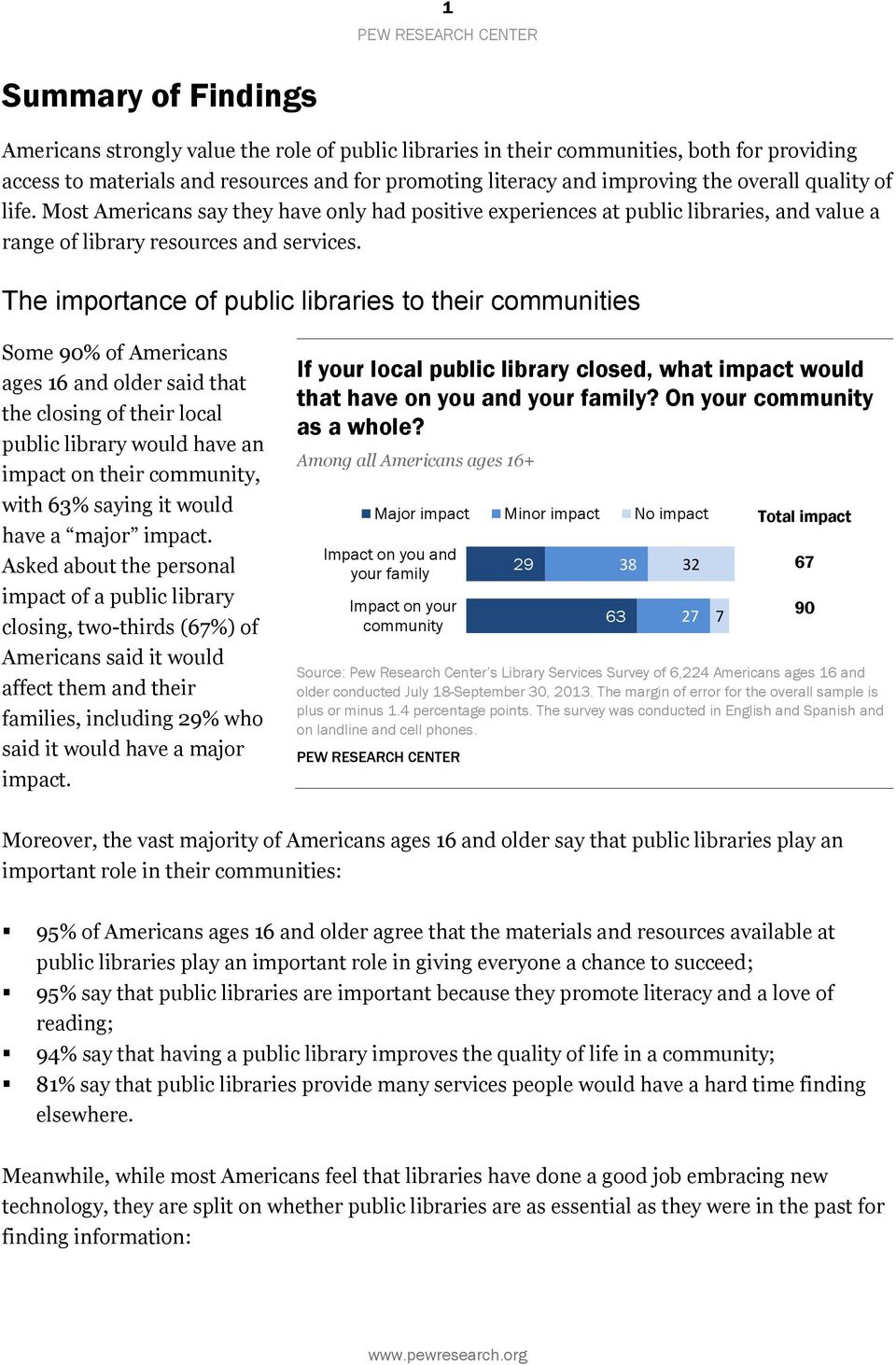
2 1 Summary of Findings Americans strongly value the role of public libraries in their communities, both for providing access to materials and resources and for promoting literacy and improving the overall quality of life. Most Americans say they have only had positive experiences at public libraries, and value a range of library resources and services. The importance of public libraries to their communities Some 90% of Americans ages 16 and older said that the closing of their local public library would have an impact on their community, with 63% saying it would have a major impact. Asked about the personal impact of a public library closing, two-thirds (67%) of Americans said it would affect them and their families, including 29% who said it would have a major impact. If your local public library closed, what impact would that have on you and your family? On your community as a whole? Among all Americans ages 16+ Major impact Minor impact No impact Total impact Impact on you and your family Impact on your community 29 Source: Pew Research Center s Library Services Survey of 6,224 Americans ages 16 and older conducted July 18-September 30, The margin of error for the overall sample is plus or minus 1.4 percentage points. The survey was conducted in English and Spanish and on landline and cell phones Moreover, the vast majority of Americans ages 16 and older say that public libraries play an important role in their communities: 95% of Americans ages 16 and older agree that the materials and resources available at public libraries play an important role in giving everyone a chance to succeed; 95% say that public libraries are important because they promote literacy and a love of reading; 94% say that having a public library improves the quality of life in a community; 81% say that public libraries provide many services people would have a hard time finding elsewhere. Meanwhile, while most Americans feel that libraries have done a good job embracing new technology, they are split on whether public libraries are as essential as they were in the past for finding information:
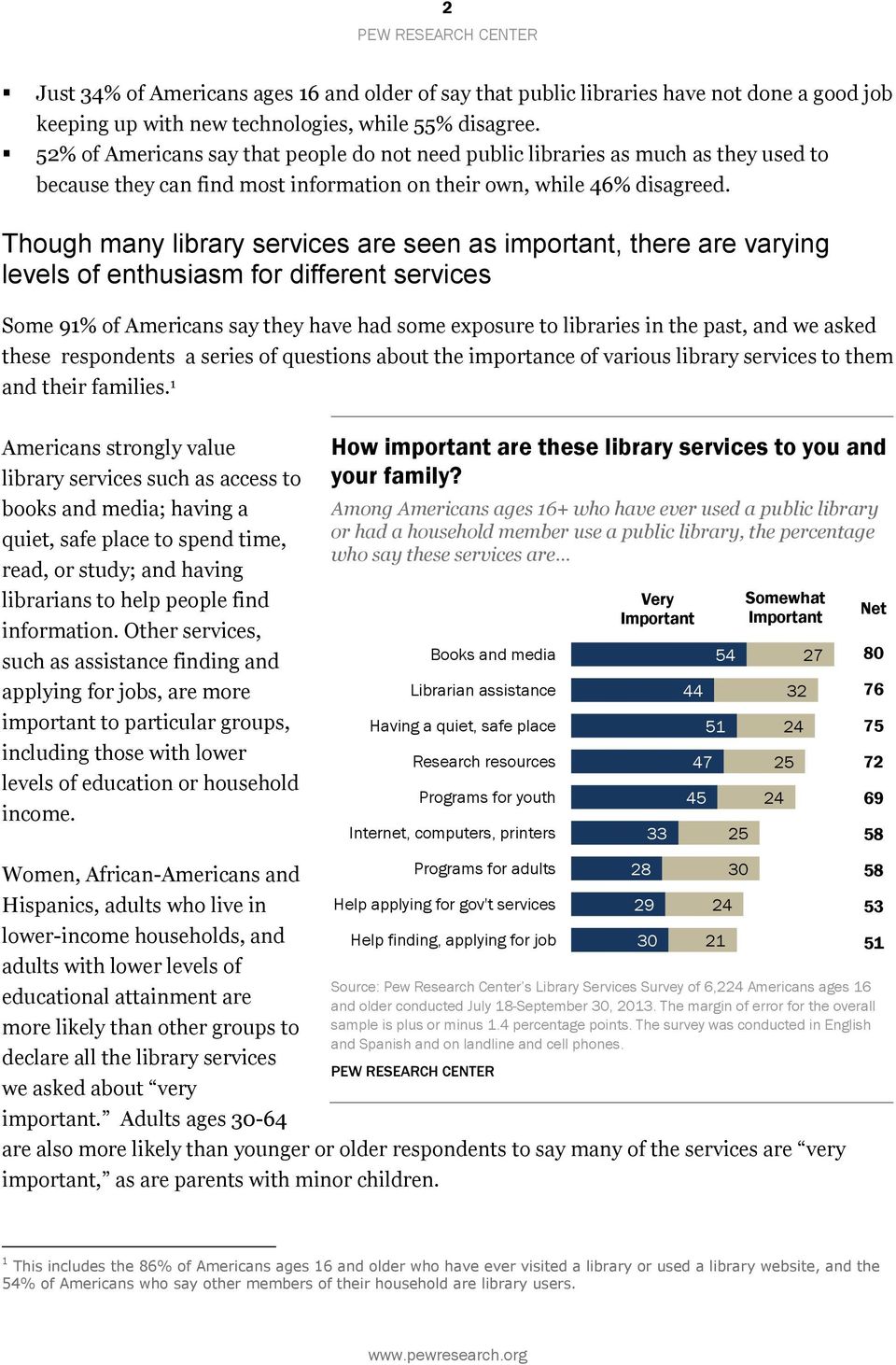
3 2 Just 34% of Americans ages 16 and older of say that public libraries have not done a good job keeping up with new technologies, while 55% disagree. 52% of Americans say that people do not need public libraries as much as they used to because they can find most information on their own, while 46% disagreed. Though many library services are seen as important, there are varying levels of enthusiasm for different services Some 91% of Americans say they have had some exposure to libraries in the past, and we asked these respondents a series of questions about the importance of various library services to them and their families. 1 Americans strongly value library services such as access to books and media; having a quiet, safe place to spend time, read, or study; and having librarians to help people find information. Other services, such as assistance finding and applying for jobs, are more important to particular groups, including those with lower levels of education or household income. How important are these library services to you and your family? Among Americans ages 16+ who have ever used a public library or had a household member use a public library, the percentage who say these services are Books and media Librarian assistance Having a quiet, safe place Research resources Programs for youth Internet, computers, printers Very Important Somewhat Important Net Women, African-Americans and Hispanics, adults who live in lower-income households, and adults with lower levels of educational attainment are more likely than other groups to declare all the library services we asked about very important. Adults ages Programs for adults Help applying for gov't services Help finding, applying for job are also more likely than younger or older respondents to say many of the services are very important, as are parents with minor children. Source: Pew Research Center s Library Services Survey of 6,224 Americans ages 16 and older conducted July 18-September 30, The margin of error for the overall sample is plus or minus 1.4 percentage points. The survey was conducted in English and Spanish and on landline and cell phones This includes the 86% of Americans ages 16 and older who have ever visited a library or used a library website, and the 54% of Americans who say other members of their household are library users.
4 3 Libraries are also particularly valued by those who are unemployed, retired, or searching for a job, as well as those living with a disability and internet users who lack home internet access: 56% of internet users without home access say public libraries basic technological resources (such as computers, internet, and printers) are very important to them and their family, compared with 33% of all respondents. 49% of unemployed and retired respondents say they librarian assistance in finding information to be very important, compared with 41% of employed respondents. 47% of job seekers say help finding or applying for a job is very important to them and their families. 40% of those living with a disability say help applying for government services is very important, compared with 27% of those without a disability. Most Americans know where their local library is, but many are unfamiliar with all the services they offer. Libraries are well known in their communities and they are usually easy to get to and relatively easy to navigate. Asked about their ability to access public libraries and public library websites: How well-informed do you feel about the different services your public library offers? Do you feel like you know 91% of Americans say they know where the closest public library is to where they currently live; among these respondents, most said the closest public library is five miles or less away from their home. 93% of Americans say that it would be easy to visit a public library in person if they wanted to, with 62% saying it would be very easy. Similarly, 82% of Americans overall say it would be easy to use their local public library s website, with 47% saying it would be very easy. 91% of Americans who have ever used a public library All or most Some of what it offers Not much Nothing at all say it is not difficult to find what they re looking for, including 35% who say it is very easy Based on Americans ages 16+ who have ever used a public library (n=5,393) Despite the fact that libraries are easily available to most, there are large numbers of Americans who say they are not sure about all the services libraries offer. Echoing the findings of our 2012 survey, 23% of those who have ever used a public library said they feel like they know all or most of the service and programs their library offers, while a plurality (47%) said that they know some of what it offers. About one in five (20%) say they don t know very much about what is offered, and 10% say they know nothing at all.

5 4 54% of Americans have used a public library in the past 12 months, and 72% live in a library household Over half (54%) of Americans ages 16 and older have used a public library in some way in the past 12 months, whether by visiting in person or using a public library website: 81% of Americans ages 16 and older have visited a public library or bookmobile at one point or another in their lives; 48% of Americans have done so in the past 12 months, down from 53% in % of those ages 16 and older have visited a public library website; 30% of Americans have done so in the past 12 months, up from 25% in Additionally, among parents with minor children living at home, 70% say that a child in the house has visited a public library or bookmobile in the past 12 months. Taken together, this means that 72% of all Americans ages 16 and older have either used a public library in the past 12 months or live in a household where another family member or a child is an active recent user of the library. Most Americans who have ever used a public library have had positive experiences Among all Americans who have ever used a public library: 94% said that based on their own experiences, they would say that public libraries are welcoming, friendly place. 91% said that they personally have never had a negative experience using a public library, either in person or online. 67% said that the public library nearest to where they live could be described as a nice, pleasant space to be ; another 22% say it s an okay space, but could use some improvements.
6 5 Table of Contents Summary of Findings 1 Table of Contents 5 Acknowledgements 6 About 7 Section 1: An Overview of Americans Public Library Use 9 Public library use and library website use 9 Library households 13 Library card holders 13 Section 2: Public Libraries Importance and Impact 14 Importance of public library services 14 Impact of a local public library closing 20 Section 3: Perceptions of Public Libraries 23 Americans perceptions of public libraries 23 Access to public libraries 25 Awareness of public library services and ease of findings things 26 Experiences at public libraries 28 Survey Questions 29 Methods 37
7 6 Acknowledgements A number of experts have helped the Pew Research Center s Internet Project in this research effort: Andrea Berstler, Director, Wicomico Public Library, Maryland Daphna Blatt, Office of Strategic Planning, The New York Public Library Richard Chabran, Adjunct Professor, University of Arizona, e-learning consultant Larra Clark, American Library Association, Office for Information Technology Policy Mike Crandall, Professor, Information School, University of Washington Catherine De Rosa, Vice President, OCLC LaToya Devezin, American Library Association Spectrum Scholar & librarian, Louisiana Amy Eshelman, Program Leader for Education, Urban Libraries Council Christie Hill, Community Relations Director, OCLC Sarah Houghton, Director, San Rafael Public Library, California Mimi Ito, Research Director of Digital Media & Learning Hub, University of California Humanities Research Institute Chris Jowaisas, Senior Program Officer, Global Libraries, Bill & Melinda Gates Foundation Patrick Losinski, Chief Executive Officer, Columbus Library, Ohio Jo McGill, Director, Northern Territory Library, Australia Dwight McInvaill, Director, Georgetown County Library, South Carolina Rebecca Miller, Editorial Director, Library Journal & School Library Journal Bobbi Newman, Blogger, Librarian By Day Annie Norman, State Librarian, Delaware Carlos Manjarrez, Director, Office of Planning, Research & Evaluation, Institute of Museum & Library Services Johana Orellana-Cabrera, American Library Association Spectrum Scholar & librarian, Texas Mayur Patel, Vice President for Strategy & Assessment, John S. & James L. Knight Foundation Gail Sheldon, Director, Oneonta Public Library, Alabama Sharman Smith, Executive Director, Mississippi Library Commission Global Libraries staff at the Bill & Melinda Gates Foundation
8 7 About this Report This report is part of a larger research effort by the Pew Research Center s Internet & American Life Project that is exploring the role libraries play in people s lives and in their communities. The research is underwritten by the Bill & Melinda Gates Foundation. This report contains findings from a nationally representative survey of 6,224 Americans ages 16 and older fielded July 18-September 30, It was conducted in English and Spanish on landline and cell phones. The margin of error for the full sample is plus or minus 1.4 percentage points. For analysis in the report is based on those who have ever visited libraries or used library websites, n=5,393 respondents ages 16 and older, and the margin of error is plus or minus 1.5 percentage points. Due to the large sample size, this report includes analyses of subgroups that are normally too small to report, such as Asian Americans. As the survey was conducted in English and Spanish, we were only able to capture the responses of English-speaking Asian Americans, who are not representative of all Asian Americans living in the United States. For instance, a 2012 Pew Research Center survey found that Asian Americans who say they are proficient in English are more likely to be younger, have higher levels of education, and are more likely to have been born in the United States. 2 Learn more at pewsocialtrends.org/asianamericans. Unlike standard Pew Research surveys of adults 18 and older, this report also contains data on Americans ages However, any analyses of behaviors based on education level or household income level exclude this younger age group and are based solely on adults ages 18 and older, which is also noted throughout the report. Disclaimer from the Bill & Melinda Gates Foundation This report is based on research funded in part by the Bill & Melinda Gates Foundation. The findings and conclusions contained within are those of the author and do not necessarily reflect positions or policies of the Bill & Melinda Gates Foundation. 2 Interviews for the 2012 Pew Research Center survey of Asian Americans were conducted in English, Cantonese, Mandarin, Vietnamese, Tagalog, Japanese, Korean, and Hindi.

9 8 About the Pew Research Center The Pew Research Center is a nonpartisan fact tank that informs the public about the issues, attitudes and trends shaping America and the world. It does not take policy positions. It conducts public opinion polling, demographic research, media content analysis and other empirical social science research. The center studies U.S. politics and policy views; media and journalism; internet and technology; religion and public life; Hispanic trends; global attitudes and U.S. social and demo-graphic trends. All of the center s reports are available at pewresearch.org. Pew Research Center is a subsidiary of The Pew Charitable Trusts. Alan Murray, President Jon Cohen, Vice President, Research Elizabeth Mueller Gross, Vice President Paul Taylor, Executive Vice President, Special Projects Andrew Kohut, Founding Director Pew Research Center 2013

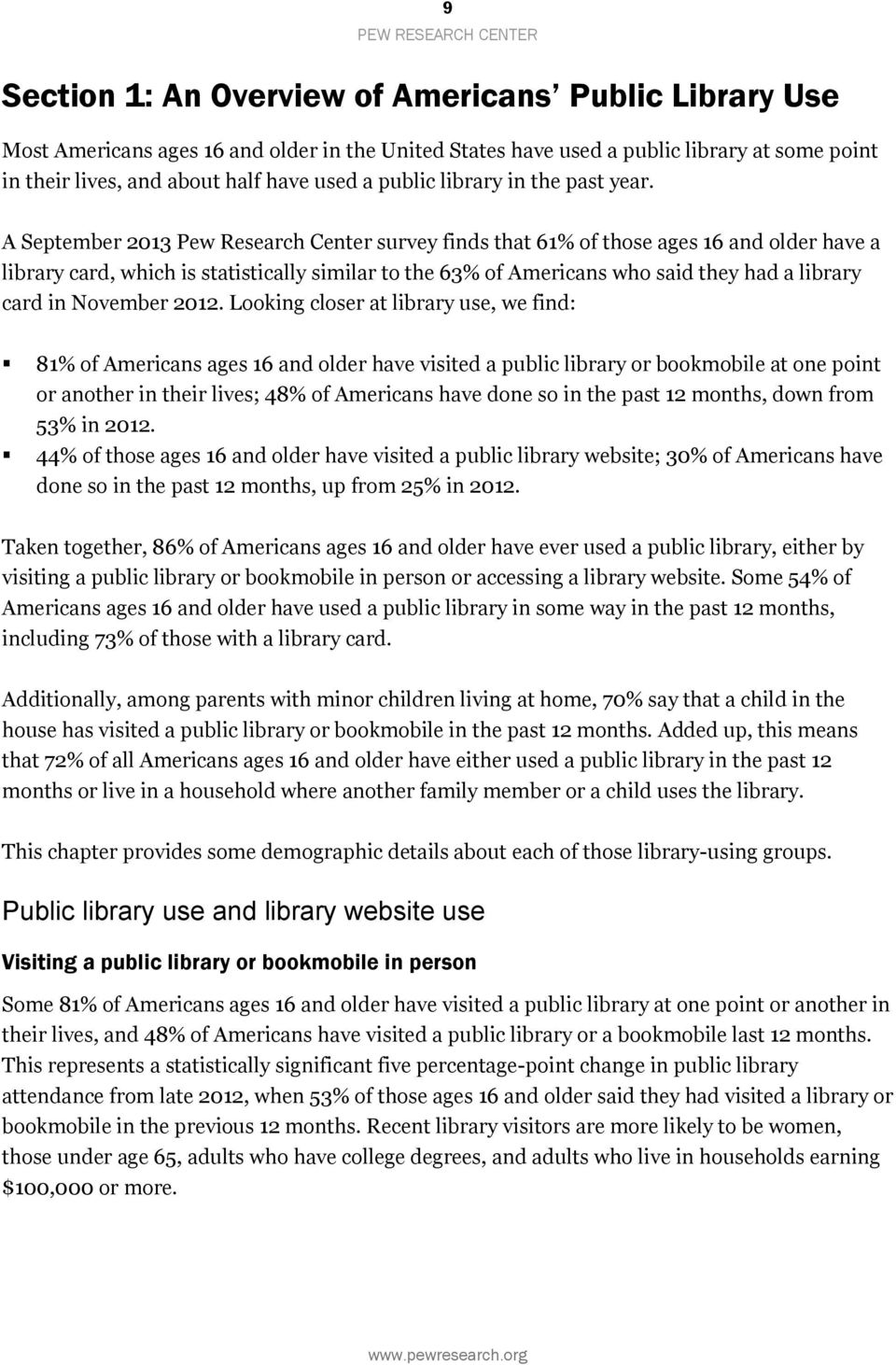
10 9 Section 1: An Overview of Americans Public Library Use Most Americans ages 16 and older in the United States have used a public library at some point in their lives, and about half have used a public library in the past year. A September 2013 Pew Research Center survey finds that 61% of those ages 16 and older have a library card, which is statistically similar to the 63% of Americans who said they had a library card in November Looking closer at library use, we find: 81% of Americans ages 16 and older have visited a public library or bookmobile at one point or another in their lives; 48% of Americans have done so in the past 12 months, down from 53% in % of those ages 16 and older have visited a public library website; 30% of Americans have done so in the past 12 months, up from 25% in Taken together, 86% of Americans ages 16 and older have ever used a public library, either by visiting a public library or bookmobile in person or accessing a library website. Some 54% of Americans ages 16 and older have used a public library in some way in the past 12 months, including 73% of those with a library card. Additionally, among parents with minor children living at home, 70% say that a child in the house has visited a public library or bookmobile in the past 12 months. Added up, this means that 72% of all Americans ages 16 and older have either used a public library in the past 12 months or live in a household where another family member or a child uses the library. This chapter provides some demographic details about each of those library-using groups. Public library use and library website use Visiting a public library or bookmobile in person Some 81% of Americans ages 16 and older have visited a public library at one point or another in their lives, and 48% of Americans have visited a public library or a bookmobile last 12 months. This represents a statistically significant five percentage-point change in public library attendance from late 2012, when 53% of those ages 16 and older said they had visited a library or bookmobile in the previous 12 months. Recent library visitors are more likely to be women, those under age 65, adults who have college degrees, and adults who live in households earning $100,000 or more.
11 10 Public library and bookmobile visitors Among all Americans ages 16+, the percentage who have ever visited a public library or bookmobile in person, and the percentage who visited one in the past 12 months % who have ever visited a public library in person % who visited a library in the past 12 months All Americans ages 16+ (n=6,224) 81% 48% a Men (n=2,840) b Women (n=3,384) 83 a 50 a Race/ethnicity a White, Non-Hispanic (n=4,323) 83 c 48 b Black, Non-Hispanic (n=697) 80 c 47 c Hispanic, English and Spanish speaking (n=739) d Asian-American, English speaking (n=160) Age a (n=214) 86 e 59 bcd b (n=945) 81 e 48 e c (n=1,590) 81 e 52 de d (n=1,842) 82 e 46 e e 65+ (n=1,526) Household income* a Less than $30,000/yr (n=1,682) b $30,000-$49,999 (n=1,030) c $50,000-$74,999 (n=787) 85 ab 51 a d $75,000-$99,999 (n=624) 85 ab 52 ab e $100,000-$149,000 (n=612) 87 ab 56 abf f $150,000+ (n=393) 86 ab 48 Education attainment* a No high school diploma (n=454) b High school grad (n=1,667) 77 a 39 a c Some College (n=1,627) 85 ab 51 ab d College + (n=2,225) 86 abc 58 abc Parent of minor a Parent (n=1,538) b b Non-parent (n=4,658) Community type a Urban (n=1,922) c b Suburban (n=3,083) 83 ac 49 c c Rural (n=1,219) * The household income and education attainment figures are only among adults ages 18 and older. Note: Columns marked with a superscript letter ( a ) or another letter indicate a statistically significant difference between that row and the row designated by that superscript letter. Statistical significance is determined inside the specific section covering each demographic trait. Source: Pew Research Center s Internet & American Life Library Services Survey of 6,224 Americans ages 16 and older conducted July 18- September 30, The margin of error for the overall sample is plus or minus 1.4 percentage points. The survey was conducted in English and Spanish and on landline and cell phones.

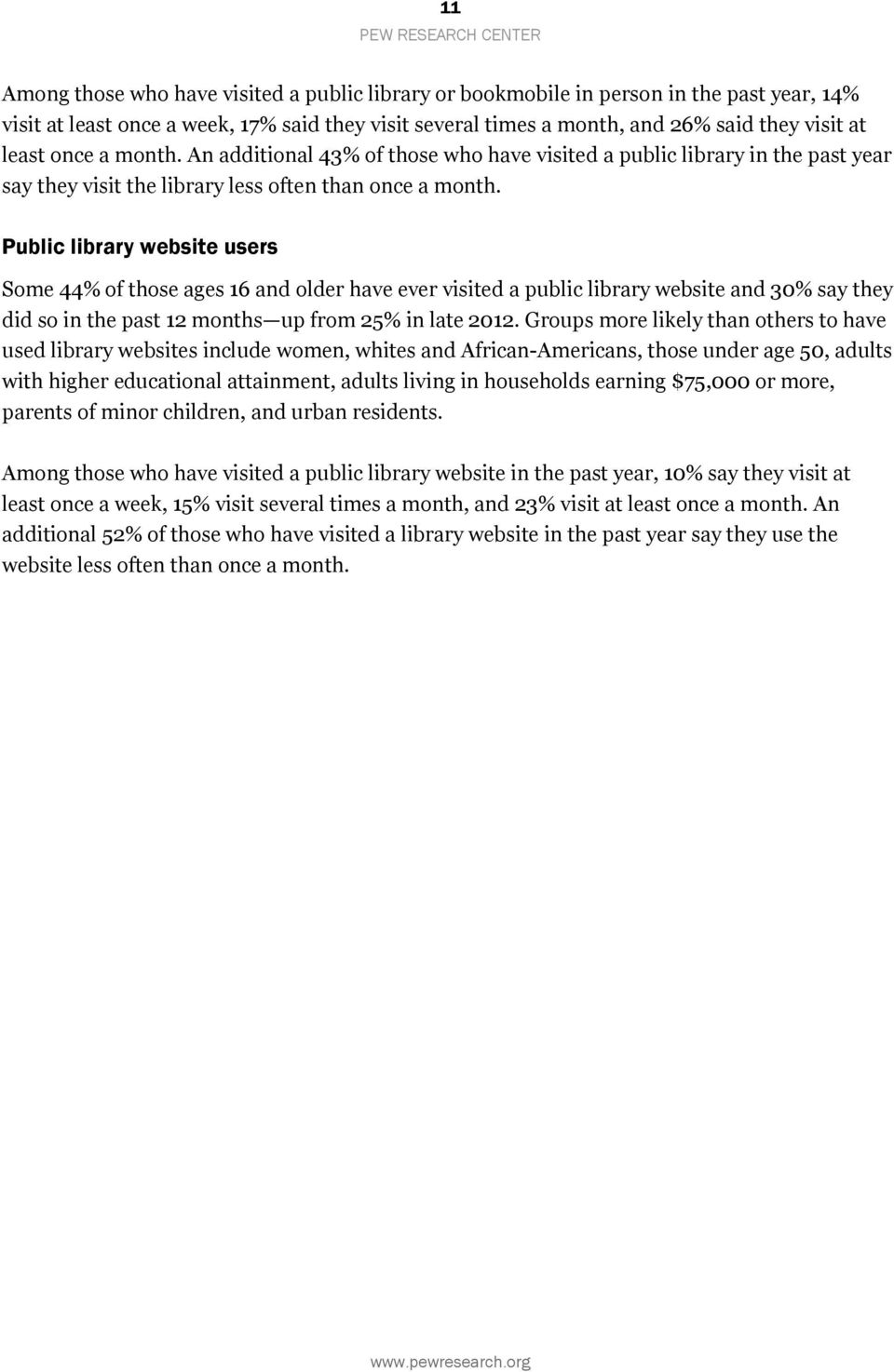
12 11 Among those who have visited a public library or bookmobile in person in the past year, 14% visit at least once a week, 17% said they visit several times a month, and 26% said they visit at least once a month. An additional 43% of those who have visited a public library in the past year say they visit the library less often than once a month. Public library website users Some 44% of those ages 16 and older have ever visited a public library website and 30% say they did so in the past 12 months up from 25% in late Groups more likely than others to have used library websites include women, whites and African-Americans, those under age 50, adults with higher educational attainment, adults living in households earning $75,000 or more, parents of minor children, and urban residents. Among those who have visited a public library website in the past year, 10% say they visit at least once a week, 15% visit several times a month, and 23% visit at least once a month. An additional 52% of those who have visited a library website in the past year say they use the website less often than once a month.
13 12 Public library website users Among all Americans ages 16+, the percentage who have ever used a public library website, and the percentage who have used a public library website in the past 12 months % who have ever used a public library website % who used a library website in the past 12 months All Americans ages 16+ (n=6,224) a Men (n=2,840) b Women (n=3,384) 49 a 34 a Race/ethnicity a White, Non-Hispanic (n=4,323) 45 c 31 c b Black, Non-Hispanic (n=697) 48 c 31 c Hispanic, English and Spanish speaking (n=739) d Asian-American, English speaking (n=160) Age a (n=214) 49 de 35 de b (n=945) 56 cde 36 de c (n=1,590) 50 de 35 de d (n=1,842) 39 e 28 e e 65+ (n=1,526) Household income* a Less than $30,000/yr (n=1,682) b $30,000-$49,999 (n=1,030) c $50,000-$74,999 (n=787) 46 a 32 a d $75,000-$99,999 (n=624) 49 ab 35 ab e $100,000-$149,000 (n=612) 57 abcd 42 abcdf f $150,000+ (n=393) 49 ab 34 Education attainment* a No high school diploma (n=454) b High school grad (n=1,667) 33 a 20 a c Some College (n=1,627) 50 ab 34 ab d College + (n=2,225) 60 abc 45 abc Parent of minor a Parent (n=1,538) 50 ab 37 b b Non-parent (n=4,658) Community type a Urban (n=1,922) 48 bc 33 c b Suburban (n=3,083) 44 c 30 c c Rural (n=1,219) * The household income and education attainment figures are only among adults ages 18 and older. Note: Columns marked with a superscript letter ( a ) or another letter indicate a statistically significant difference between that row and the row designated by that superscript letter. Statistical significance is determined inside the specific section covering each demographic trait. Source: Pew Research Center s Internet & American Life Library Services Survey of 6,224 Americans ages 16 and older conducted July 18- September 30, The margin of error for the overall sample is plus or minus 1.4 percentage points. The survey was conducted in English and Spanish and on landline and cell phones.

14 13 Overall public library use and changes over time Taken together, 86% of Americans ages 16 and older have ever used a public library or library website, and 54% have personally used a library or library website in the past 12 months. This represents a statistically significant five percentage-point decrease from the 59% of Americans who said they had visited a library in the previous 12 months in We also asked all Americans who have ever used a public library or visited a public library website (86% of those ages 16 and older) how their library use has changed in the past five years. Some 16% said their library use has increased, and 57% said it has stayed about the same; another 25% said their library use has decreased in that time. Library households As noted above, 54% of Americans ages 16 and older have personally used a public library or website in the past 12 months, and a similar proportion (54%) say other members of their household are library users. Additionally, in a separate question asked of parents with minor children living at home, 70% say that a child in the house has visited a public library or bookmobile in the past 12 months. Taken together, this means that 72% of all Americans ages 16 and older have either used a public library in the past 12 months or live in a household where another family member or a child uses the library. In a closer look at household library use, we find: 38% of Americans have both used a public library recently and live in a household where family members use the library. 18% say that while they themselves have not used a public library recently, a family member does use the library. 15% say that they personally have used the library in the past year, but no one else in their family does. Library card holders Some 61% of Americans ages 16 and older say they have a library card for a public library. These card holders are more likely to be female, white, under the age of 65, and suburban and urban residents, and are also more likely to have higher levels of education or live in higher income households. About 21% of library card holders did not visit the library in the past 12 months, and 17% of those who have used a public library in the past year say they do not have a library card. 3 Note: In November 2012, a follow-up about library use in the past 12 months was asked as separate questions later in the interview, rather than as an immediate follow-up to the ever library use question, as done for the 2013 survey.
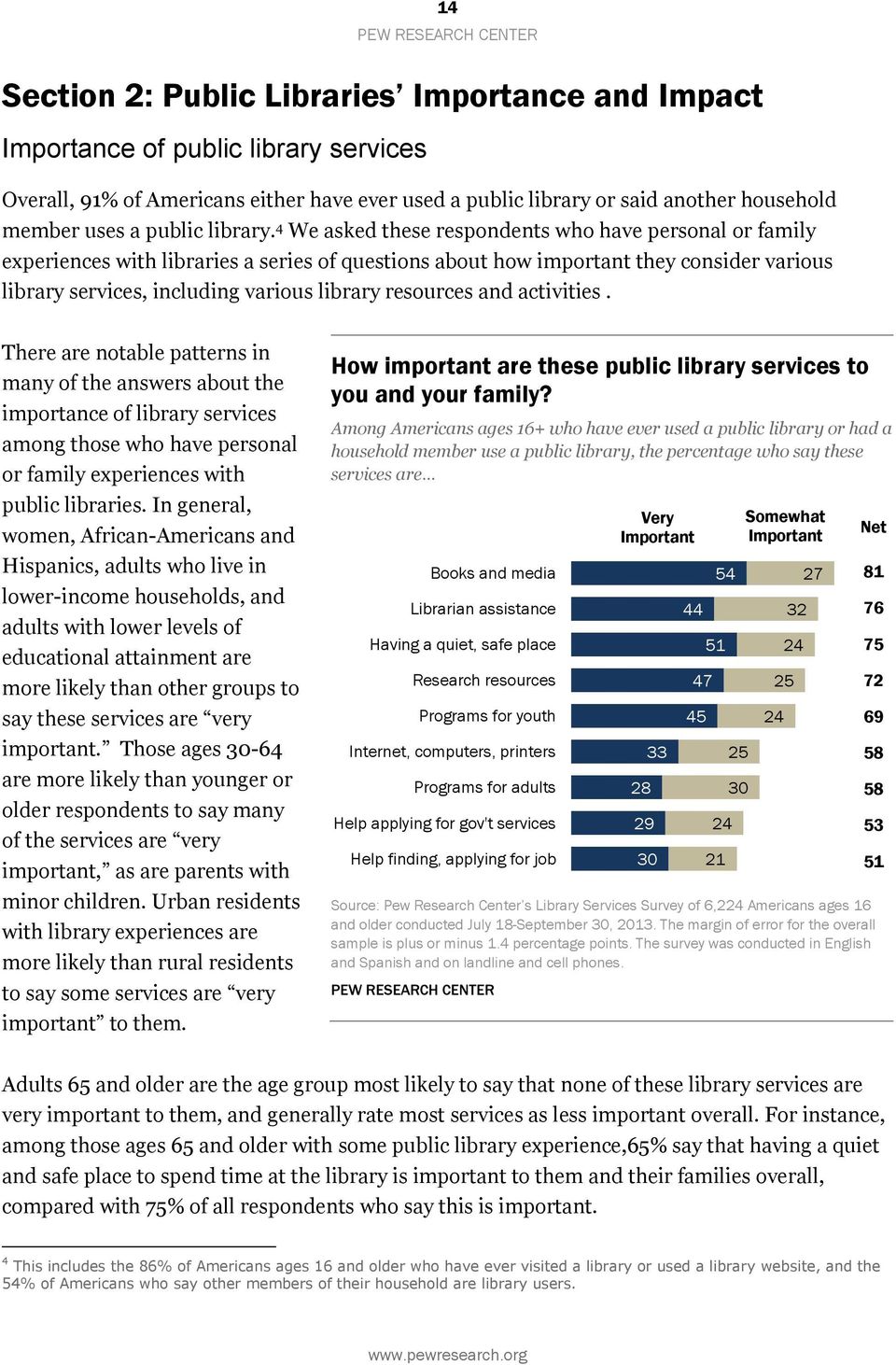
15 14 Section 2: Public Libraries Importance and Impact Importance of public library services Overall, 91% of Americans either have ever used a public library or said another household member uses a public library. 4 We asked these respondents who have personal or family experiences with libraries a series of questions about how important they consider various library services, including various library resources and activities. There are notable patterns in many of the answers about the importance of library services among those who have personal or family experiences with public libraries. In general, women, African-Americans and Hispanics, adults who live in lower-income households, and adults with lower levels of educational attainment are more likely than other groups to say these services are very important. Those ages are more likely than younger or older respondents to say many of the services are very important, as are parents with minor children. Urban residents with library experiences are more likely than rural residents to say some services are very important to them. How important are these public library services to you and your family? Among Americans ages 16+ who have ever used a public library or had a household member use a public library, the percentage who say these services are Books and media Librarian assistance Having a quiet, safe place Research resources Programs for youth Internet, computers, printers Programs for adults Help applying for gov't services Help finding, applying for job Very Important Somewhat Important Source: Pew Research Center s Library Services Survey of 6,224 Americans ages 16 and older conducted July 18-September 30, The margin of error for the overall sample is plus or minus 1.4 percentage points. The survey was conducted in English and Spanish and on landline and cell phones Net Adults 65 and older are the age group most likely to say that none of these library services are very important to them, and generally rate most services as less important overall. For instance, among those ages 65 and older with some public library experience,65% say that having a quiet and safe place to spend time at the library is important to them and their families overall, compared with 75% of all respondents who say this is important. 4 This includes the 86% of Americans ages 16 and older who have ever visited a library or used a library website, and the 54% of Americans who say other members of their household are library users.
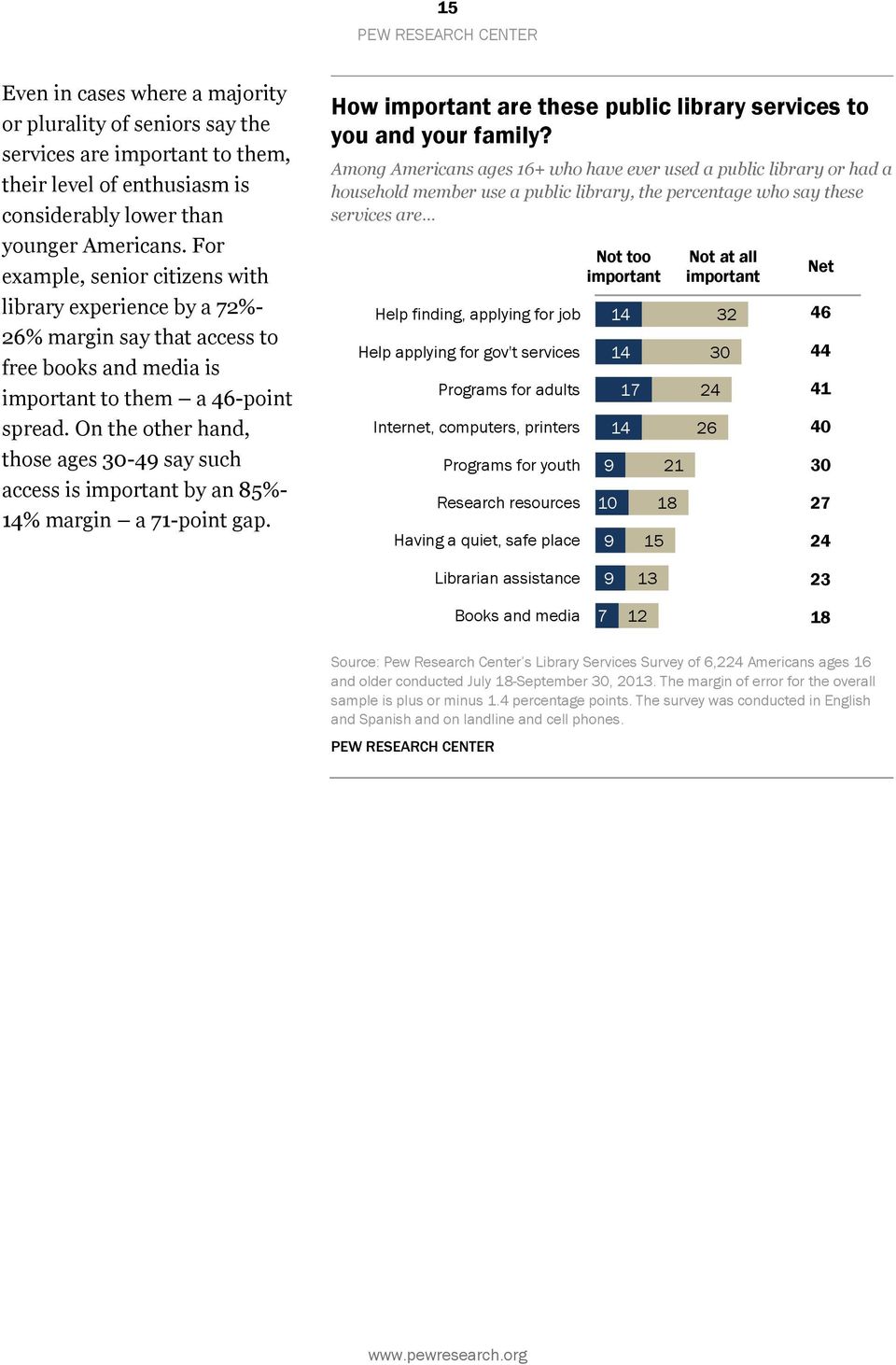
16 15 Even in cases where a majority or plurality of seniors say the services are important to them, their level of enthusiasm is considerably lower than younger Americans. For example, senior citizens with library experience by a 72%- 26% margin say that access to free books and media is important to them a 46-point spread. On the other hand, those ages say such access is important by an 85%- 14% margin a 71-point gap. How important are these public library services to you and your family? Among Americans ages 16+ who have ever used a public library or had a household member use a public library, the percentage who say these services are Help finding, applying for job Help applying for gov't services Programs for adults Internet, computers, printers Programs for youth Research resources Having a quiet, safe place Not too important Not at all important Net Librarian assistance Books and media Source: Pew Research Center s Library Services Survey of 6,224 Americans ages 16 and older conducted July 18-September 30, The margin of error for the overall sample is plus or minus 1.4 percentage points. The survey was conducted in English and Spanish and on landline and cell phones.
17 16 Oldest and youngest age groups least likely to say public library services are very important to them and their families Among Americans ages 16+ who have ever used a public library or had a household member use a public library, the % in each group who say these services are very important Books and media Quiet spaces Research resources Total Youth programs Librarian assistance Internet, computers, printers Total Job search assistance 0 Help applying to gov't services Programs for adults Total Source: Pew Research Center s Library Services Survey of 6,224 Americans ages 16 and older conducted July 18-September 30, The margin of error for the overall sample is plus or minus 1.4 percentage points. The survey was conducted in English and Spanish and on landline and cell phones.

18 17 Blacks and Hispanics are more likely than whites and Asian-Americans to say public library services are very important to them and their families Among Americans ages 16+ who have ever used a public library or had a household member use a public library, the % in each group who say these services are very important Books and media Quiet spaces Research resources Total Whites Asian Americans* Blacks Hispanics** Youth programs Librarian assistance Internet & computers Total Whites Asian Americans* Blacks Hispanics** Job search assistance Gov t services help Programs for adults Total Whites Asian Americans* Blacks Hispanics** *among English-speaking Asian-Americans ** among English- and Spanish-speaking Hispanics Source: Pew Research Center s Library Services Survey of 6,224 Americans ages 16 and older conducted July 18-September 30, The margin of error for the overall sample is plus or minus 1.4 percentage points. The survey was conducted in English and Spanish and on landline and cell phones.

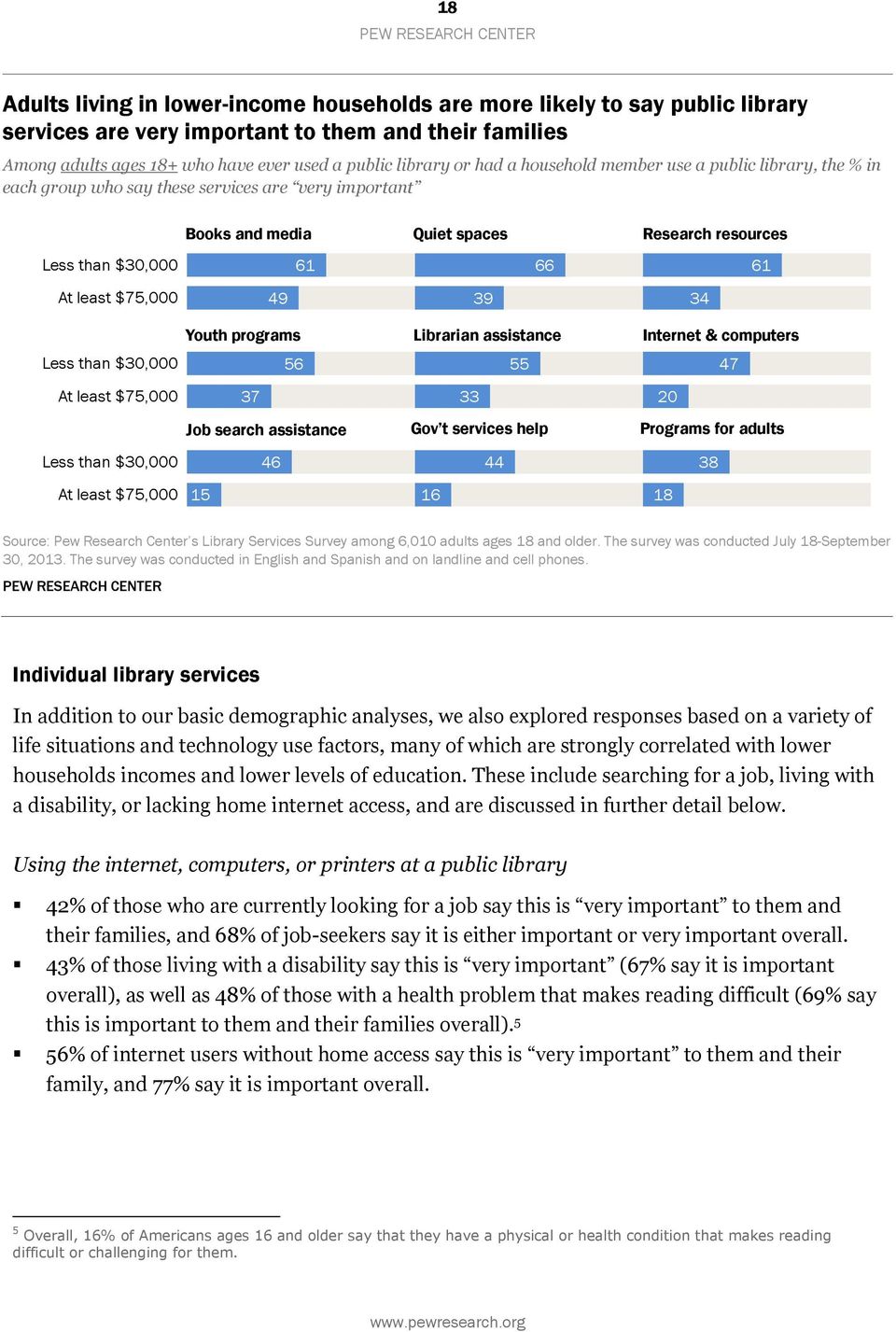
19 18 Adults living in lower-income households are more likely to say public library services are very important to them and their families Among adults ages 18+ who have ever used a public library or had a household member use a public library, the % in each group who say these services are very important Books and media Quiet spaces Research resources Less than $30, At least $75, Youth programs Librarian assistance Internet & computers Less than $30, At least $75, Job search assistance Gov t services help Programs for adults Less than $30, At least $75, Source: Pew Research Center s Library Services Survey among 6,010 adults ages 18 and older. The survey was conducted July 18-September 30, The survey was conducted in English and Spanish and on landline and cell phones. Individual library services In addition to our basic demographic analyses, we also explored responses based on a variety of life situations and technology use factors, many of which are strongly correlated with lower households incomes and lower levels of education. These include searching for a job, living with a disability, or lacking home internet access, and are discussed in further detail below. Using the internet, computers, or printers at a public library 42% of those who are currently looking for a job say this is very important to them and their families, and 68% of job-seekers say it is either important or very important overall. 43% of those living with a disability say this is very important (67% say it is important overall), as well as 48% of those with a health problem that makes reading difficult (69% say this is important to them and their families overall). 5 56% of internet users without home access say this is very important to them and their family, and 77% say it is important overall. 5 Overall, 16% of Americans ages 16 and older say that they have a physical or health condition that makes reading difficult or challenging for them.
20 19 Having a quiet and safe place to spend time, read, or study at the library 61% of job seekers say this having a quiet and safe place to spend time, read, or study at a library is very important to them and their families, compared with 49% of respondents who are not currently looking for a job. Library assistance in applying for government programs, permits, or licenses Among those with recent library experience who are unemployed but not retired, 37% say library assistance in applying for government programs, permits or licenses is very important to them and their families. 40% of those living with a disability say library assistance is very important, compared with 27% of those without a disability. Help finding or applying for a job 47% of job seekers say receiving help at the library in finding or applying for a job is very important to them and their families. 42% of those with a health problem that makes reading difficult say receiving help at the library in finding or applying for a job is very important to them and their families. Getting help from a librarian finding information 49% of those not in the workforce say receiving assistance from a librarian in finding information is very important (including 47% of retired respondents). Those living with a disability (56%) or with a health problem that makes reading difficult (59%) are also more likely than others to say that librarian assistance is very important to them and their families. Finally, internet users who lack home internet access are more likely than other respondents to say all of these services are very important to them and their families. Non-internet users are also more likely than internet users with home access to say that many of these services are very important.

21 20 Impact of a local public library closing About two-thirds (67%) of Americans ages 16 and older said that if their local public library closed, it would affect them and their families. Some 29% of Americans said that such a closer would have a major personal impact, and 38% said it would have a minor impact. Another 32% said their library s closing would have no impact on them and their families. If your local public library closed, what impact would that have on you and your family? On your community as a whole? Women, adults ages 30-64, and parents are among the groups most likely to say that their local public library s closing would have a major impact on them and their families. Many other groups are also more likely to say their library s closing would have a major personal impact: Among all Americans ages 16 and older Major impact Minor impact No impact Total impact Impact on you and your family Impact on your community 29 Source: Pew Research Center s Library Services Survey of 6,224 Americans ages 16 and older conducted July 18-September 30, The margin of error for the overall sample is plus or minus 1.4 percentage points. The survey was conducted in English and Spanish and on landline and cell phones Adults who have not graduate high school are particularly likely to say that their library s closure would have a major impact on them and their family (35%). Adults living in households earning less than $30,000 per year are the most likely of any income group to say that their library s closure would have a major impact on them and their family (34%). 37% of those living with a disability say it would have a major personal impact, compared with 28% of other respondents. Unemployed respondents are more likely than employed respondents to say that their local public library s closing would have a major impact on them and their families (31% vs 28%) The vast majority (90%) of Americans said that the closing of their local public library would impact their community as a whole, with 63% saying it would have a major impact and 27% said it would have a minor impact. Just 7% said it would have no impact on their community. Women are more likely to say their local public library s closing would have a major impact on the community than men (70% 55%), and adults ages 30 and older are more likely than younger respondents to say there would be a major impact.
22 21 Impact of public library closing on you and your family, by age group Among all Americans ages 16 and older Impact on you & your family Impact on your community Major impact Minor impact Net Major impact Minor impact Net Source: Pew Research Center s Library Services Survey of 6,224 Americans ages 16 and older conducted July 18-September 30, The margin of error for the overall sample is plus or minus 1.4 percentage points. The survey was conducted in English and Spanish and on landline and cell phones. Meanwhile, parents are more likely than non-parents to say their library s closure would have a major impact, and adults with at least some college experience are more likely to say there would be at least a minor impact overall, compared with those with lower levels of education. Impact of public library closing on you and your family, by race/ethnicity Among all Americans ages 16 and older Impact on you & your family Impact on your community Major impact Minor impact Net Major impact Minor impact Net White White Asian-American Asian-American Black Black Hispanic Hispanic Source: Pew Research Center s Library Services Survey of 6,224 Americans ages 16 and older conducted July 18-September 30, The margin of error for the overall sample is plus or minus 1.4 percentage points. The survey was conducted in English and Spanish and on landline and cell phones.
23 22 Impact of public library closing on you and your family, by education level Among American adults ages 18 and older Impact on you & your family Impact on your community Major impact Less than HS HS grad Some college College grad Minor impact Net Major impact Less than HS HS grad Some college College grad Minor impact Net Source: Pew Research Center s Library Services Survey among 6,010 adults ages 18 and older. The survey was conducted July 18- September 30, The survey was conducted in English and Spanish and on landline and cell phones.
24 23 Section 3: Perceptions of Public Libraries Americans perceptions of public libraries Public libraries roles in their communities Among Americans ages 16+, the percentage who agree or disagree with each statement Strongly agree Somewhat agree Somewhat Disagree Strongly Disagree Don't know Public libraries are important because they promote literacy and a love of reading Because it provides free access to materials and resources, the public library plays an important role in giving everyone a chance to succeed Having a public library improves the quality of life in a community Public libraries provide many services people would have a hard time finding elsewhere Source: Pew Research Center s Library Services Survey of 6,224 Americans ages 16 and older conducted July 18-September 30, The margin of error for the overall sample is plus or minus 1.4 percentage points. The survey was conducted in English and Spanish and on landline and cell phones. The vast majority of Americans ages 16 and older say that public libraries play an important role in providing free access to materials and resources, promote literacy and a love of reading, and improve the overall quality of life in a community: 95% of Americans say that because it provides free access to materials and resources, the public library plays an important role in giving everyone a chance to succeed, including 72% who say they strongly agree with this statement. Those living in urban or suburban areas are more likely to strongly agree with this statement than those living in rural areas. 95% of Americans say that public libraries are important because they promote literacy and a love of reading. 94% of Americans say that having a public library improves the quality of life in a community. Among adults, college graduates are more likely than those with lower levels of education to strongly agree with this statement.
25 24 Public libraries and technology Among Americans ages 16+, the percentage who strongly agree, somewhat agree, somewhat disagree, or strongly disagree with each statement Strongly agree Somewhat agree Somewhat Disagree Strongly Disagree Don't know People do NOT need libraries as much as they used to because they can find most info on their own Public libraries have NOT done a good job keeping up with new technologies Source: Pew Research Center s Library Services Survey of 6,224 Americans ages 16 and older conducted July 18-September 30, The margin of error for the overall sample is plus or minus 1.4 percentage points. The survey was conducted in English and Spanish and on landline and cell phones. We also asked for respondents views on the importance of public libraries at a time many Americans are increasingly connected through the internet and mobile devices and others remain offline altogether. Though respondents were generally split on whether libraries are as essential for finding information today, a majority of Americans think that that public libraries have done a good job keeping up with new technologies; most said that public libraries provide many services that people would have a hard time finding elsewhere: 81% of Americans ages 16 and older agree overall that public libraries provide many services people would have a hard time finding elsewhere, including 48% who say they strongly agree with this statement. Adults who did not graduate high school are more likely to strongly agree than college graduates, as are adults living in lower income households compared with those in households earning at least $75, % of Americans overall say that people do not need public libraries as much as they used to because they can find most information on their own. Adults with lower levels of education and those living in lower-income households are most likely to strongly agree that libraries are not as necessary for information needs. 34% of Americans overall think that public libraries have not done a good job keeping up with new technologies, while 55% disagree. Adults who did not graduate high school are more likely to agree with this statement overall than those with higher levels of education. Recent library users, particularly those who have used a library website in the past 12 months, are significantly more likely to say that libraries have done a good job keeping up with new technologies. In general, women and adults ages express the strongest positive views about public libraries, as do respondents who have used a public library in the past. African Americans and
26 25 Hispanics are also more likely than whites and English-speaking Asian Americans to have strongly positive views about libraries, though Hispanics are also most likely to strongly agree that libraries are not as needed today or that libraries have not kept up with new technologies. Americans who both use public library and have family members who use libraries are most likely to express strong positive views, although Americans who live in library households but themselves have not used a library recently are also more likely than those with no recent library exposure to express strong positive views. Access to public libraries In order to learn more about public libraries accessibility to their communities, we asked a series of questions about people s experiences around visiting public libraries and using library websites. How far away is the closest public library? Among Americans ages 16+, the % in each group who say they know where the closest public library is to their house, and how far away it is We find that the vast majority (91%) of Americans say they know where the closest public library is to where they currently live; among these respondents, most said the closest public library is five miles or less away from their home. Total Urban Suburban Rural Yes, know where it is miles or less miles miles miles Not sure Source: Pew Research Center s Library Services Survey of 6,224 Americans ages 16 and older conducted July 18-September 30, The margin of error for the overall sample is plus or minus 1.4 percentage points. The survey was conducted in English and Spanish and on landline and cell phones. Overall, 93% of Americans say that it would be easy to visit a public library in person if they wanted to, with 62% saying it would be very easy and 31% saying it would be easy. However, there was some variation by race/ethnicity, community type, and other factors: Whites are most likely to say it would be very easy to visit a public library in person (67%), compared with 59% of blacks, 44% of English-speaking Asian Americans, and 47% of English- and Spanish-speaking Hispanics. Americans living in rural (9%) or urban (7%) areas are more likely to say it would be difficult to visit a public library in person, compared with 5% of those living in suburban areas. Among those living with a disability, 15% overall say it would be difficult to visit the library, compared with 5% of non-disabled respondents.
27 26 10% of unemployed respondents, including 11% of those who are retired, say it would be difficult to visit the library overall, compared with 4% of employed respondents. When it comes to accessing a public library website, 82% of Americans say that it would be easy to use the website of a local public library overall, with 47% saying it would be very easy and 35% saying it would be easy. In addition: About half (51%) of whites and 47% of blacks say it would be very easy to use the website of a local public library, compared with 33% of Hispanics. Among those living with a disability, 25% overall say it would be difficult to visit the library website, compared with 11% of non-disabled respondents. Some 20% of unemployed respondents (including those who are retired) say it would be difficult to visit the library overall, compared with 10% of employed respondents. Awareness of public library services and ease of findings things Among Americans ages 16 and older who have ever used a public library, 23% said they feel like they know all or most of the services and programs at their public library, while a plurality (47%) said that they know some of what it offers. Another 20% said they don t know much about their public library s service, and 10% said they know nothing at all. These findings are generally consistent with the results of our November 2012 survey. 6 Adults ages generally felt more aware of library services than younger or older respondents, as did women and parents with minor children living at home. Whites and All or most Some of what it offers Not much Nothing at all blacks were also more likely than Hispanics and English-speaking Asian Americans to say they are aware of at least some of the services offered by their public library. Adults with at least some college experience generally felt more informed about the services and programs their public library offers than those with lower levels of education. There were no significant differences by household income. How well-informed do you feel about the different services and programs your public library offers? Do you feel like you know Based on Americans ages 16+ who have ever used a public library (n=5,393) 6 Library Services in the Digital Age, Part 4: What people want from their libraries
28 27 How well-informed Americans ages 16+ say they feel about public library services, by age Overall, how well-informed do you feel you are about the different services and programs your public library offers? Do you feel like you know... All or most Some of what it offers Not much Nothing at all a cde 14 d b cde 12 cd c ce d b 49 ae 18 8 e b cd Based on Americans ages 16+ who have ever used a public library (n=5,393) How well-informed Americans ages 16+ say they feel about public library services, by race/ethnicity Overall, how well-informed do you feel you are about the different services and programs your public library offers? Do you feel like you know... All or most Some of what it offers Not much Nothing at all a White d 19 9 b Asian-American c Black abd 17 8 d Hispanic ac 13 ac Based on Americans ages 16+ who have ever used a public library (n=5,393) How well-informed American adults ages 18+ feel about public library services, by education Overall, how well-informed do you feel you are about the different services and programs your public library offers? Do you feel like you know... All or most Some of what it offers Not much Nothing at all a Less than H.S d 15 cd b High school grad d 13 cd c Some college 24 ab d d College degree 27 ab 51 ab 16 5 Based on Americans ages 18+ who have ever used a public library (n=5,200) Americans say it is usually easy to find
29 28 We also asked those who have ever visited a public library in person how easy or difficult it usually is to find what they re looking for when they visit a public library. Most (56%) say it is generally easy to find what they re looking for, and an additional 35% say it is very easy. Another 5% say it is difficult, and 1% say it is very difficult. In general, adults with higher levels of education, particularly college graduates, were more likely to say it is easy to find what they are looking for at the library. what they are looking for when they are at a public library Very easy Easy Difficult Very difficult 1 5 Based on ages 16+ who have ever used a public library (n=5,393) Experiences at public libraries Among those who have ever used a public library, 67% said that the public library nearest to where they live could be described as a nice, pleasant space to be. Older respondents were more likely than younger respondents to say their library is pleasant space: 74% of those 65 and older say this, compared with 61% of year-olds. In response to a separate question, an overwhelming majority of Americans who have ever used a public library (94%) said that based on their own experiences, they would say that public libraries are welcoming, friendly place. Just 4% disagreed. Most describe local public library s physical condition positively If you had to describe the physical condition of the public library nearest you, would you say... It s a nice, pleasant space to be It s an ok space, but could use some improvements Not a pleasant space and needs a lot of improvement Have never been inside local library Based on ages 16+ who have ever used a public library (n=5,393) Similarly, 91% of those who have ever used a public library said that they personally have never had a negative experience using a public library in person or online, while 9% said they had. Some groups were more likely to report negative experiences, including year-olds (14%) and students (12%). Self-employed respondents (17%), job seekers (13%), and those living with a disability (12%) were also more likely to say they have had a negative experience at a public library.
30 29 Survey Questions Gates Libraries Typology Survey Final Topline 10/2/2013 Data for July 18 September 30, 2013 Princeton Survey Research Associates International for the Pew Research Center s Internet & American Life Project and the Gates Foundation Sample: n=6,224 people age 16 or older nationwide, including 3,102 cell phone interviews Interviewing dates: Margin of error is plus or minus 1.4 percentage points for results based on Total [n=6,224] Margin of error is plus or minus 1.5 percentage points for results based on internet users [n=5,320] Margin of error is plus or minus 1.4 percentage points for results based on cell phone owners [n=5,763] Margin of error is plus or minus 1.5 percentage points for results based on those who have ever used a public library [n=5,393] Margin of error is plus or minus 1.5 percentage points for results based on those who have ever visited a public library [n=5,078] Margin of error is plus or minus 2.1 percentage points for results based on those who have ever used a public library website [n=2,725] Margin of error is plus or minus 1.5 percentage points for results based on those who have ever used a public library or a household member ever uses the public library [n=5,661] Margin of error is plus or minus 2.0 percentage points for results based on those who visited a public library in person in the past 12 months [n=3,006] Margin of error is plus or minus 2.5 percentage points for results based on those who have used a public library website in the past 12 months [n=1,894] Q13 Do you have any physical or health conditions that make reading difficult or challenging for you? CURRENT % 16 Yes 84 No * Don t know * Refused
31 30 [READ TO ALL:] On a different topic... EMINUSE Do you use the internet or , at least occasionally? INTMOB Do you access the internet on a cell phone, tablet or other mobile handheld device, at least occasionally? 7 USES INTERNET DOES NOT USE INTERNET Current November December HOME3NW Do you ever use the internet or at HOME? Based on all internet users [N=5,320] YES NO DON T KNOW REFUSED Current * * November * [READ TO ALL:] Next, I have some questions about public libraries. In answering these questions, please think only about public libraries, NOT school or university libraries. Q17 Do you have a library card for a public library? 10 CURRENT NOV 2012 DEC 2011 % 61 Yes No * Don t know * * * Refused * * 7 In November 2012, an internet user was someone said yes to any of three questions: INTUSE, EMLOCC or Do you access the internet on a cell phone, tablet or other mobile handheld device, at least occasionally? (INTMOB). 8 November 2012 trends based on the Gates Library Services Survey, conducted October 15 November 10, 2012 among those age 16 or older [N=2,252, including 1,125 cell phone interviews]. 9 December 2011 trends based on the Gates Reading Habits Survey 2011, conducted November 16 December 21, 2011 among those age 16 or older [n=2,986 people age 16+, including an oversample of 317 e-reader only owners, 300 tablet computer only owners and 119 e-reader/tablet computer owners]. 10 December 2011 question wording was: Next, I have some questions about public libraries...do you have a library card?
32 31 Q18 Please tell me if you AGREE or DISAGREE with each of the following statements about public libraries [INSERT ITEMS; RANDOMIZE]. Do you strongly agree, somewhat agree, somewhat disagree, or strongly disagree with this statement? STRONGLY AGREE SOMEWHAT AGREE SOMEWHAT DISAGREE STRONGLY DISAGREE DON T KNOW a. Because it provides free access to materials and resources, the public library plays an important role in giving everyone a chance to succeed * b. Public libraries have NOT done a good job keeping up with new technologies c. People do NOT need public libraries as much as they used to because they can find most information on their own * d. Public libraries provide many services people would have a hard time finding elsewhere * e. Public libraries are important because they promote literacy and a love of reading * f. Having a public library improves the quality of life in a community * REFUSED Q19 If you, personally, wanted to [INSERT ITEMS IN ORDER], would that be very easy, easy, difficult or very difficult for you? VERY EASY EASY DIFFICULT VERY DIFFICULT DON T KNOW a. Visit a public library in person * * b. Use the website of a local public library * REFUSED Q20 If your local public library CLOSED, would that have a MAJOR impact, MINOR impact or NO IMPACT on... [INSERT ITEMS IN ORDER]? MAJOR IMPACT MINOR IMPACT NO IMPACT (VOL.) COMMUNITY DOES NOT HAVE A PUBLIC LIBRARY DON T KNOW a. You and your family * 1 * b. Your community as a whole * 3 * REFUSED
33 32 Q21 Have you, personally, EVER...[INSERT ITEMS IN ORDER], or is this something you ve never done? [IF YES: Have you done this in the past 12 months?] 11 a. Visited a public library or used a public library bookmobile IN PERSON TOTAL YES, HAVE DONE THIS IN THE PAST 12 MONTHS NOT IN PAST 12 MONTHS NO, HAVE NEVER DONE THIS DON T KNOW Current * * November * 0 b. Used a public library WEBSITE 12 Current * * November * * REFUSED Q22 How often do you visit public libraries or bookmobiles in person? Would you say... [READ 1-4] 13 Based on those who visited a public library in person in the past 12 months CURRENT NOV 2012 % 14 At least once a week Several times a month At least once a month Less often 38 * (DO NOT READ) Don t know * * (DO NOT READ) Refused * [n=3,006] [n=1,238] Q23 How often do you use a public library website? Would you say... [READ 1-4] 14 Based on those who used a public library website in the past 12 months CURRENT NOV 2012 % 10 At least once a week Several times a month At least once a month Less often In November 2012, follow-ups about the past 12 months were asked as separate questions later in the interview, rather than as immediate follow-up probes, as done for the current poll. Trend results shown here have been recalculated based on Total respondents. 12 In November 2012, item wording was Gone on a public library WEBSITE. 13 Response categories in November 2012 were slightly different: "Every day or almost every day, at least once a week, several times a month, at least once a month or less often". Results shown here for "At least once a week" reflect combined trend results "every day or almost every day" and "at least once a week." 14 November 2012 question wording and response categories were slightly different: "How often do you use a public library website, for any service? Would you say every day or almost every day, at least once a week, several times a month, at least once a month or less often?" Results shown here for "At least once a week" reflect combined trend results "every day or almost every day" and "at least once a week."
34 33 * (DO NOT READ) Don t know * 0 (DO NOT READ) Refused * [n=1,894] [n=587] Q24 Over the past five years, has your own use of the public library, either in-person or online, [READ 1-3; ROTATE 1-2] Based on those who have ever used a public library [N=5,393] CURRENT % 25 Decreased 16 Increased 57 Stayed about the same 1 (DO NOT READ) Don t know * (DO NOT READ) Refused Q25 Does anyone else in your household ever visit a public library or bookmobile or use a public library website? CURRENT % 54 Yes, someone in household visits or uses library 44 No one in household visits or uses library 2 Don t know * Refused
35 34 Q26 Thinking just about you and your family, how important, if at all, is each of the following library services? How about...[insert ITEMS; RANDOMIZE]? Is this very, somewhat, not too, or not at all important to you and your family? Based on those who have ever used a public library or a household member ever uses the public library [N=5,661] VERY IMPORTANT SOMEWHAT IMPORTANT NOT TOO IMPORTANT NOT AT ALL IMPORTANT DON T KNOW REFUSED a. Access to free books and media * b. Resources to do research for school or work * * c. Using the library s internet, computers or printers d. Having a quiet and safe place to spend time, read or study * * e. Programs or events for children or teens * f. Programs or events for adults * g. Help applying for government programs, permits or licenses h. Help finding or applying for a job i. Getting help from a librarian finding information * Q27 Overall, how well-informed do you feel you are about the different services and programs your public library offers? Do you feel like you know...[read 1-4] 15 Based on those who have ever used a public library CURRENT NOV 2012 % 23 ALL or MOST of the services and programs your library offers SOME of what it offers NOT MUCH of what it offers Nothing at all 7 1 (DO NOT READ) Don t know 1 * (DO NOT READ) Refused * [n=5,393] [n=1,981] 15 November 2012 question was asked of Total respondents. Trend results shown here are based only on those who have ever used a public library.
36 35 Q28 Based on your own experiences, would you say... [READ AND ROTATE 1-2] Based on those who have ever visited a public library in person [N=5,078] CURRENT % 94 Public libraries are welcoming, friendly places 4 Public libraries are NOT welcoming and friendly places 1 (DO NOT READ) Sometimes welcoming/friendly, sometimes not 1 (DO NOT READ) Don t know * (DO NOT READ) Refused Q29 Have you, personally, ever had a NEGATIVE experience using a public library, either in person or online? Based on those who have ever used a public library [N=5,393] CURRENT % 9 Yes 91 No * Don t know * Refused Q30 And in your experience, is it usually very easy, easy, difficult, or very difficult to find what you re looking for when you visit a public library? Based on those who have ever visited a public library in person [N=5,078] CURRENT % 35 Very easy 56 Easy 5 Difficult 1 Very difficult 2 Don t know 1 Refused Q31 If you had to describe the physical condition of the public library nearest you, would you say... [READ 1-4] Based on those who have ever used a public library [N=5,393] CURRENT % 67 It s a nice, pleasant space to be 22 It s an okay space but could use some improvements 1 It s not a pleasant space and needs a lot of improvement 9 Have you never been inside your local library 1 (DO NOT READ) Don t know * (DO NOT READ) Refused
37 36 Q32 Do you happen to know where the CLOSEST public library is to where you currently live, or are you not sure? CURRENT % 91 Yes, know where it is 9 Not sure * Refused Q33 Approximately how many miles from your home is the closest public library? Would you say... [READ 1-4] Based on those who know where their closest public library is located [N=5,726] CURRENT % 79 Five miles or less 14 Six to 10 miles 5 11 to 20 miles 1 More than 20 miles away * (DO NOT READ) Don t know * (DO NOT READ) Refused Q35 In the past 12 months, (has your child/have any of your children) visited a public library or bookmobile? Please do not include school libraries. Based on parents of children under age 18 CURRENT NOV 2012 % 70 Yes No 29 1 Don t know 2 * Refused 0 [n=1,538] [n=584]
38 37 Methods Pew Research Center Library Survey Prepared by Princeton Survey Research Associates International for the Pew Research Center s Internet & American Life Project October 2013 Summary The Pew Research Center Library Survey, sponsored by the Pew Research Center s Internet & American Life Project, obtained telephone interviews with a nationally representative sample of 6,224 people ages 16 and older living in the United States. Interviews were conducted via landline (nll=3,122) and cell phone (nc=3,102, including 1,588 without a landline phone). The survey was conducted by Princeton Survey Research Associates International. The interviews were administered in English and Spanish by Princeton Data Source from July 18 to September 30, Statistical results are weighted to correct known demographic discrepancies. The margin of sampling error for results based on the complete set of weighted data is ±1.4 percentage points. Results based on the 5,320 internet users17 have a margin of sampling error of ±1.5 percentage points. Details on the design, execution and analysis of the survey are discussed below. Design and data collection procedures Sample Design A combination of landline and cellular random digit dial (RDD) samples was used to represent all adults in the United States who have access to either a landline or cellular telephone. Both samples were provided by Survey Sampling International, LLC (SSI) according to PSRAI specifications. Numbers for the landline sample were drawn with probabilities in proportion to their share of listed telephone households from active blocks (area code + exchange + two-digit block number) that contained three or more residential directory listings. The cellular sample was not listassisted, but was drawn through a systematic sampling from dedicated wireless 100-blocks and shared service 100-blocks with no directory-listed landline numbers. 16 Twenty-one pretest interviews conducted on July 18 and 19 were included in the final data file since no changes were made to the questionnaire. Full data collection started on July Internet user is defined as those accessing the internet occasionally, sending or receiving , and/or accessing the internet on a cell phone, tablet, or other mobile handheld device.
39 38 Contact Procedures Interviews were conducted from July 18 to September 30, As many as 10 attempts were made to contact every sampled telephone number. Sample was released for interviewing in replicates, which are representative subsamples of the larger sample. Using replicates to control the release of sample ensures that complete call procedures are followed for the entire sample. Calls were staggered over times of day and days of the week to maximize the chance of making contact with potential respondents. Interviewing was spread as evenly as possible across the days in field. Each telephone number was called at least one time during the day in an attempt to complete an interview. For the landline sample, interviewers asked to speak with the youngest male or female ages 16 or older currently at home based on a random rotation. If no male/female was available, interviewers asked to speak with the youngest person age 16 or older of the other gender. This systematic respondent selection technique has been shown to produce samples that closely mirror the population in terms of age and gender when combined with cell interviewing. For the cellular sample, interviews were conducted with the person who answered the phone. Interviewers verified that the person was age 16 or older and in a safe place before administering the survey. Cellular respondents were offered a post-paid cash reimbursement for their participation. Weighting and analysis Weighting is generally used in survey analysis to compensate for sample designs and patterns of non-response that might bias results. The sample was weighted to match national adult general population parameters. A two-stage weighting procedure was used to weight this dual-frame sample. The first stage of weighting corrected for different probabilities of selection associated with the number of adults in each household and each respondent s telephone usage patterns.18 This weighting also adjusts for the overlapping landline and cell sample frames and the relative sizes of each frame and each sample. The first-stage weight for the i th case can be expressed as: 18 i.e., whether respondents have only a landline telephone, only a cell phone, or both kinds of telephone.
40 39 Where S LL = the size of the landline sample F LL = the size of the landline sample frame S CP = the size of the cell sample F CP = the size of the cell sample frame AD i = Number of adults in household i LL i=1 if respondent has a landline phone, otherwise LL=0. CP i=1 if respondent has a cell phone, otherwise CP=0. The second stage of weighting balances sample demographics to population parameters. The sample is balanced to match national population parameters for sex, age, education, race, Hispanic origin, region (U.S. Census definitions), population density, and telephone usage. The Hispanic origin was split out based on nativity; U.S born and non-u.s. born. The White, non- Hispanic subgroup was also balanced on age, education and region. The basic weighting parameters came from the US Census Bureau s 2011 American Community Survey data. 19 The population density parameter was derived from Census 2010 data. The telephone usage parameter came from an analysis of the July-December 2012 National Health Interview Survey Weighting was accomplished using Sample Balancing, a special iterative sample weighting program that simultaneously balances the distributions of all variables using a statistical technique called the Deming Algorithm. Weights were trimmed to prevent individual interviews from having too much influence on the final results. The use of these weights in statistical analysis ensures that the demographic characteristics of the sample closely approximate the demographic characteristics of the national population. Table 1 compares weighted and unweighted sample distributions to population parameters. 19 ACS analysis was based on all people ages 16 and older excluding those living in institutional group quarters (GCs). 20 Blumberg SJ, Luke JV. Wireless substitution: Early release of estimates from the National Health Interview Survey, July- December, National Center for Health Statistics. June The phone use parameter used for this 16+ sample is the same as the parameter we use for all 18+ surveys. No adjustment was made to account for the fact that the target population for this survey is slightly different than a standard 18+ general population survey.
41 40 Table 1: Sample Demographics Parameter Unweighted Weighted Gender Male Female Age Education HS Graduate or Less Some College/Assoc. Degree College Graduate Race/Ethnicity White/not Hispanic Black/not Hispanic Hisp - US born Hisp - born outside Other/not Hispanic Region Northeast Midwest South West County Pop. Density 1 - Lowest Highest Household Phone Use LLO Dual - few, some cell Dual - most cell CPO
42 41 Effects of Sample Design on Statistical Inference Post-data collection statistical adjustments require analysis procedures that reflect departures from simple random sampling. PSRAI calculates the effects of these design features so that an appropriate adjustment can be incorporated into tests of statistical significance when using these data. The so-called "design effect" or deff represents the loss in statistical efficiency that results from unequal weights. The total sample design effect for this survey is PSRAI calculates the composite design effect for a sample of size n, with each case having a weight, w i as: deff n i 1 n n i 1 w w 2 i 2 i formula 1 In a wide range of situations, the adjusted standard error of a statistic should be calculated by multiplying the usual formula by the square root of the design effect ( deff ). Thus, the formula for computing the 95% confidence interval around a percentage is: pˆ deff 1.96 pˆ(1 pˆ) n formula 2 where pˆ is the sample estimate and n is the unweighted number of sample cases in the group being considered. The survey s margin of error is the largest 95% confidence interval for any estimated proportion based on the total sample the one around 50%. For example, the margin of error for the entire sample is ±1.4 percentage points. This means that in 95 out every 100 samples drawn using the same methodology, estimated proportions based on the entire sample will be no more than 1.4 percentage points away from their true values in the population. It is important to remember that sampling fluctuations are only one possible source of error in a survey estimate. Other sources, such as respondent selection bias, questionnaire wording and reporting inaccuracy, may contribute additional error of greater or lesser magnitude. Response Rate Table 2 reports the disposition of all sampled telephone numbers ever dialed from the original telephone number samples. The response rate estimates the fraction of all eligible respondents
43 42 in the sample that were ultimately interviewed. At PSRAI it is calculated by taking the product of three component rates:22 Contact rate the proportion of working numbers where a request for interview was made23 Cooperation rate the proportion of contacted numbers where a consent for interview was at least initially obtained, versus those refused Completion rate the proportion of initially cooperating and eligible interviews that were completed Thus the response rate for the landline sample was 10 percent. The response rate for the cellular sample was 13 percent. 22 PSRAI s disposition codes and reporting are consistent with the American Association for Public Opinion Research standards. 23 PSRAI assumes that 75 percent of cases that result in a constant disposition of No answer or Busy are actually not working numbers.
44 43 Sample Disposition Landline Cell 116,709 61,496 Total Numbers Dialed 5,165 1,052 Non-residential 4, Computer/Fax 30 0 Cell phone 70,002 25,290 Other not working 5, Additional projected not working 32,113 34,432 Working numbers 27.5% 56.0% Working Rate 1, No Answer / Busy 8,341 6,795 Voice Mail Other Non-Contact 21,961 27,421 Contacted numbers 68.4% 79.6% Contact Rate 843 3,543 Callback 17,666 19,219 Refusal 3, Cooperating numbers 15.7% 17.0% Cooperation Rate Language Barrier 0 1,250 Child's cell phone 3,248 3,181 Eligible numbers 94.1% 68.3% Eligibility Rate Break-off 3,122 3,103 Completes 96.1% 97.5% Completion Rate 10.3% 13.2% Response Rate
51% of U.S. Adults Bank Online
 www.pewresearch.org AUGUST 7, 2013 51% of U.S. Adults Bank Online 32% of adults transact bank business on their mobile phones Susannah Fox Associate Director, Pew Internet Project http://pewinternet.org/reports/2013/online-banking.aspx
The Demographics of Social Media Users 2012
 www.pewresearch.org FEBRUARY 14, 2013 The Demographics of Social Media Users 2012 Young adults are more likely than older adults to use social media. Women, African- Americans, and Latinos show high interest
NUMBERS, FACTS AND TRENDS SHAPING THE WORLD JANUARY 09, 2015 FOR FURTHER INFORMATION ON THIS REPORT:
 NUMBERS, FACTS AND TRENDS SHAPING THE WORLD JANUARY 09, 2015 FOR FURTHER INFORMATION ON THIS REPORT: Maeve Duggan, Research Analyst, Pew Research Center Nicole B. Ellison, Associate Professor, University
Cell Phone Activities 2013
 www.pewresearch.org SEPTEMBER 16, 2013 Cell Phone Activities 2013 50% of cell owners download apps to their phones; 48% listen to music services; video calling has tripled since 2011; texting remains a
BY Aaron Smith NUMBERS, FACTS AND TRENDS SHAPING THE WORLD FOR RELEASE NOVEMBER 19, 2015 FOR FURTHER INFORMATION ON THIS REPORT:
 NUMBERS, FACTS AND TRENDS SHAPING THE WORLD FOR RELEASE NOVEMBER 19, 2015 BY Aaron Smith FOR FURTHER INFORMATION ON THIS REPORT: Aaron Smith, Associate Director, Research Dana Page, Senior Communications
Health Online 2013. Susannah Fox Associate Director, Pew Internet Project. Maeve Duggan Research Assistant, Pew Internet Project
 JANUARY 15, 2013 Health Online 2013 35% of U.S. adults have gone online to figure out a medical condition; of these, half followed up with a visit to a medical professional Susannah Fox Associate Director,
Social Media Usage: 2005-2015
 NUMBERS, FACTS AND TRENDS SHAPING THE WORLD OCTOBER 8, 2015 Social Media Usage: 2005-2015 65% of adults now use social networking sites a nearly tenfold jump in the past decade BY Andrew Perrin FOR FURTHER
35% of those ages 16 and older own tablet computers
 www.pewresearch.org OCTOBER 18, 2013 35% of those ages 16 and older own tablet computers Up from 25% last year more than half of those in households earning $75,000 or more now have tablets 24% own e-book
NUMBERS, FACTS AND TRENDS SHAPING THE WORLD FOR RELEASE APRIL 30, 2014 FOR FURTHER INFORMATION ON THIS REPORT:
 NUMBERS, FACTS AND TRENDS SHAPING THE WORLD FOR RELEASE APRIL 30, 2014 FOR FURTHER INFORMATION ON THIS REPORT: Lee Rainie, Director, Internet Project Maeve Duggan, Research Assistant, Internet Project
17% of cell phone owners do most of their online browsing on their phone, rather than a computer or other device
 JUNE 26, 2012 17% of cell phone owners do most of their online browsing on their phone, rather than a computer or other device Most do so for convenience, but for some their phone is their only option
NUMBERS, FACTS AND TRENDS SHAPING THE WORLD APRIL 3, 2014 FOR FURTHER INFORMATION ON THIS REPORT: Aaron Smith, Senior Researcher
 NUMBERS, FACTS AND TRENDS SHAPING THE WORLD APRIL 3, 2014 FOR FURTHER INFORMATION ON THIS REPORT: Aaron Smith, Senior Researcher 202.419.4500 RECOMMENDED CITATION: Pew Research Center, April 2014, Older
BY Maeve Duggan NUMBERS, FACTS AND TRENDS SHAPING THE WORLD FOR RELEASE AUGUST 19, 2015 FOR FURTHER INFORMATION ON THIS REPORT:
 NUMBERS, FACTS AND TRENDS SHAPING THE WORLD FOR RELEASE AUGUST 19, 2015 BY Maeve Duggan FOR FURTHER INFORMATION ON THIS REPORT: Maeve Duggan, Research Associate Dana Page, Senior Communications Manager
72% of Online Adults are Social Networking Site Users
 www.pewresearch.org AUGUST 5, 2013 72% of Online Adults are Social Networking Site Users Social networking sites remain most popular among young adults, but other age groups continue to increase their
Americans and text messaging
 Americans and text messaging 31% of text message users prefer texting to voice calls, and young adults stand out in their use of text messaging Aaron Smith, Senior Research Specialist 9/19/2011 http://pewinternet.org/reports/2011/cell-phone-texting-2011.aspx
Latinos and Digital Technology, 2010
 February 9, 2011 Latinos and Digital Technology, 2010 FOR FURTHER INFORMATION CONTACT: Gretchen Livingston, Senior Researcher, 1615 L St, N.W., Suite 700 Washington, D.C. 20036 Tel(202) 419-3600 Fax (202)
Social Media and Political Engagement
 OCTOBER 19, 2012 Social Media and Political Engagement 66% of social media users have employed the platforms to post their thoughts about civic and political issues, react to others postings, press friends
Teens and Technology 2013
 MARCH 13, 2013 Teens and Technology 2013 Smartphone adoption among teens has increased substantially and mobile access to the internet is pervasive. One in four teens are cell-mostly internet users, who
NUMBERS, FACTS AND TRENDS SHAPING THE WORLD FOR RELEASE JULY 16, 2015 MEDIA CONTACT FOR THIS REPORT: Dana Page, Communications Manager
 NUMBERS, FACTS AND TRENDS SHAPING THE WORLD FOR RELEASE JULY 16, 2015 MEDIA CONTACT FOR THIS REPORT: Dana Page, Communications Manager 202.419.4372 RECOMMENDED CITATION: Duggan, M., Lenhart, A., Lampe,
Privacy and Data Management on Mobile Devices
 SEPTEMBER 5, 2012 Privacy and Data Management on Mobile Devices More than half of app users have uninstalled or avoided an app due to concerns about personal information Jan Lauren Boyles Research Intern,
71% of online adults now use video sharing sites
 71% of online adults now use video sharing sites Kathleen Moore, Pew Internet Project 7/25/2011 http://pewinternet.org/reports/2011/video sharing sites.aspx Pew Research Center 1615 L St., NW Suite 700
32 PEW RESEARCH CENTER
 32 Survey Questions Pew Research Center Libraries Survey 2015 Final Topline March 17 April 12, 2015 Fieldwork conducted by Princeton Survey Research Associates International Sample: n=2,004 people ages
Americans and their cell phones
 Americans and their cell phones Mobile devices help people solve problems and stave off boredom, but create some new challenges and annoyances Aaron Smith, Senior Research Specialist 8/15/2011 http://pewinternet.org/reports/2011/cell-phones.aspx
Photo and Video Sharing Grow Online
 www.pewresearch.org OCTOBER 28, 2013 Photo and Video Sharing Grow Online More internet users are using photos and videos as a social currency: 54% of internet users have posted original photos or videos
PEW INTERNET PROJECT DATA MEMO
 PEW INTERNET PROJECT DATA MEMO BY: Amanda Lenhart, Senior Research Specialist, Sydney Jones, Research Assistant & Alexandra Rankin Macgill RE: Adults and video games DATE: Sunday, December 7, 2008 Over
1 PEW RESEARCH CENTER
 1 FOR RELEASE October, 29, 2015 BY Monica Anderson FOR FURTHER INFORMATION ON THIS REPORT: Monica Anderson, Research Analyst Lee Rainie, Director Internet, Science and Technology Research Dana Page, Senior
Digital differences. Kathryn Zickuhr Research Specialist, Pew Internet. Aaron Smith Senior Research Specialist, Pew Internet
 APRIL 13, 2012 Digital differences While increased internet adoption and the rise of mobile connectivity have reduced many gaps in technology access over the past decade, for some groups digital disparities
Adults and Cell Phone Distractions
 Adults and Cell Phone Distractions Mary Madden, Senior Research Specialist Lee Rainie, Director June 18, 2010 http://pewinternet.org/reports/2010/cell-phone-distractions.aspx Pew Internet & American Life
Location-Based Services
 www.pewresearch.org SEPTEMBER 12, 2013 Location-Based Services Location tagging on social media is up: 30% of social media users now tag their posts with their location. For mobile location services, 74%
6% of Online Adults are reddit Users
 www.pewresearch.org JULY 3, 2013 6% of Online Adults are reddit Users Young men are especially likely to visit the front page of the internet. Maeve Duggan Research Assistant, Pew Internet Project Aaron
After Boston, Little Change in Views of Islam and Violence
 MAY 7, 2013 45% Say Muslim Americans Face A Lot of Discrimination After Boston, Little Change in Views of Islam and Violence FOR FURTHER INFORMATION CONTACT THE PEW RESEARCH CENTER FOR THE PEOPLE & THE
Online Product Research
 Online Product Research 58% of Americans have researched a product or service online September 29, 2010 Jim Jansen, Senior Fellow, Pew Internet Project http://pewinternet.org/reports/2010/online-product-research.aspx
E-reader Ownership Doubles in Six Months
 E-reader Ownership Doubles in Six Months Adoption rate of e-readers surges ahead of tablet computers Kristen Purcell, Associate Director for Research, Pew Internet Project June 27, 2011 Pew Research Center
Information Age Bills Keep Piling Up What Americans Pay For and How
 Information Age Bills Keep Piling Up What Americans Pay For and How FOR IMMEDIATE RELEASE Paul Taylor, Executive Vice President Cary Funk, Senior Researcher April Clark, Research Associate MEDIA INQUIRIES
Family Caregivers are Wired for Health
 JUNE 20, 2013 Family Caregivers are Wired for Health 39% of U.S. adults provide care for a loved one, up from 30% in 2010, and many navigate health care with the help of technology Susannah Fox Associate
California Emerging Technology Fund Calls for National Policy on Affordable Broadband Rate
 Embargoed for media use: Tuesday, July 8, 2014 Contact: Mary Anne Ostrom, [email protected] Mobile: 510-381-3070 California Emerging Technology Fund Calls for National Policy on Affordable Broadband
RECOMMENDED CITATION: Pew Research Center, April 2014, America s Changing Drug Policy Landscape
 NUMBERS, FACTS AND TRENDS SHAPING THE WORLD FOR RELEASE APRIL 2, 2014 FOR FURTHER INFORMATION ON THIS REPORT: Carroll Doherty, Director, Political Research Juliana Menasce Horowitz, Senior Researcher Rob
RECOMMENDED CITATION: Pew Research Center, June 2015, Support for Same-Sex Marriage at Record High, but Key Segments Remain Opposed
 NUMBERS, FACTS AND TRENDS SHAPING THE WORLD FOR RELEASE JUNE 8, 2015 FOR FURTHER INFORMATION ON THIS REPORT: Carroll Doherty, Director of Political Research Jocelyn Kiley, Associate Director, Research
BY Aaron Smith NUMBERS, FACTS AND TRENDS SHAPING THE WORLD FOR RELEASE MARCH 10, 2016 FOR MEDIA OR OTHER INQUIRIES:
 NUMBERS, FACTS AND TRENDS SHAPING THE WORLD FOR RELEASE MARCH 10, 2016 BY Aaron Smith FOR MEDIA OR OTHER INQUIRIES: Aaron Smith, Associate Director, Research Dana Page, Senior Communications Manager 202.419.4372
Cell Phones in Africa: Communication Lifeline
 NUMBERS, FACTS AND TRENDS SHAPING THE WORLD FOR RELEASE APRIL, 20 Cell Phones in Africa: Communication Lifeline Texting Most Common Activity, but Mobile Money Popular in Several Countries FOR FURTHER INFORMATION
Photos and Videos as Social Currency Online
 SEPTEMBER 13, 2012 Photos and Videos as Social Currency Online 46% of internet users post original photos and videos online they have created themselves and 41% curate photos and videos they find elsewhere
Internet Access and Use: Does Cell Phone Interviewing make a difference?
 Internet Access and Use: Does Cell Phone Interviewing make a difference? By Evans Witt, Jonathan Best and Lee Rainie A paper prepared for The 2008 Conference of The American Association for Public Opinion
Online Dating & Relationships
 www.pewresearch.org OCTOBER 21, 2013 Online Dating & Relationships One in ten Americans have used an online dating site or mobile dating app; 66% of these online daters have gone on a date with someone
Search Engine Use 2012
 MARCH 9, 2012 Search Engine Use 2012 Even though online Americans are more satisfied than ever with the performance of search engines, strong majorities have negative views of personalized search results
Internet, broadband, and cell phone statistics
 Internet, broadband, and cell phone statistics By: Lee Rainie, Director January 5, 2010 Overview In a national survey between November 30 and December 27, 2009, we find: 74% of American adults (ages 18
BY John B. Horrigan AND Maeve Duggan
 NUMBERS, FACTS AND TRENDS SHAPING THE WORLD FOR RELEASE DECEMBER 21, 2015 BY John B. Horrigan AND Maeve Duggan FOR MEDIA OR OTHER INQUIRIES: John B. Horrigan, Senior Researcher Lee Rainie, Director, Internet,
Pearson Student Mobile Device Survey 2015
 Pearson Student Mobile Device Survey 2015 National Report: College Students Report date: Revised June, 2015 Conducted by Harris Poll This report contains public findings Table of Contents Background &
RECOMMENDED CITATION: Pew Research Center, July, 2015, The Evolving Role of News on Twitter and Facebook
 NUMBERS, FACTS AND TRENDS SHAPING THE WORLD FOR RELEASE July 14, 2015 FOR FURTHER INFORMATION ON THIS REPORT: Amy Mitchell, Director of Journalism Research Dana Page, Communications Manager 202.419.4372
Online Video 2013. Kristen Purcell Associate Director for Research, Pew Internet Project. www.pewresearch.org OCTOBER 10, 2013
 www.pewresearch.org OCTOBER 10, 2013 Online Video 2013 Over the past four years, the percent of American adult internet users who upload or post videos online has doubled from 14% in 2009 to 31% today.
THE FIELD POLL. UCB Contact
 Field Research Corporation 601 California Street, Suite 900, San Francisco, CA 94108-2814 415.392.5763 FAX: 415.434.2541 field.com/fieldpollonline THE FIELD POLL UNIVERSITY OF CALIFORNIA, BERKELEY BERKELEY
1 PEW RESEARCH CENTER
 1 NUMBERS, FACTS AND TRENDS SHAPING THE WORLD FOR RELEASE November 4, 2015 FOR FURTHER INFORMATION ON THIS REPORT: Kim Parker, Director of Social Trends Research Juliana Menasce Horowitz, Associate Director
Gauging Family Intimacy Dogs Edge Cats (Dads Trail Both)
 Gauging Family Intimacy Dogs Edge Cats (Dads Trail Both) FOR IMMEDIATE RELEASE MARCH 7, 2006 Paul Taylor, Executive Vice President Cary Funk, Senior Project Director Peyton Craighill, Project Director
Transforming Health Care: American Attitudes On Shared Stewardship
 Transforming Health Care: American Attitudes On Shared Stewardship An Aspen Institute- Survey Submitted by zogby international may 2008 2008 Report Overview A new Aspen Institute/Zogby interactive survey
Top China ON THIS REPORT: 202.419.4372
 NUMBERS, FACTS AND TRENDS SHAPING THE WORLD FOR RELEASE SEPTEMBER 24, 2015 Corruption, Pollution, Inequality Are Top Concerns in China Many Worry about Threats to Traditions and Culture BY Richard Wike
Further Decline in Credibility Ratings for Most News Organizations
 THURSDAY, AUGUST 16, 2012 Further Decline in Credibility Ratings for Most News Organizations FOR FURTHER INFORMATION CONTACT: Andrew Kohut President, Pew Research Center Carroll Doherty and Michael Dimock
Generations 2010. Kathryn Zickuhr, Web Coordinator. http://pewinternet.org/reports/2010/generations-2010.aspx 12/16/2010
 s 2010 Kathryn Zickuhr, Web Coordinator 12/16/2010 http://pewinternet.org/reports/2010/s-2010.aspx Pew Research Center 1615 L St., NW Suite 700 Washington, D.C. 20036 202-419-4500 pewinternet.org Page
How To Get A Good Answer From A Tennessee Voter Survey
 Date: June 5, 2012 To: All Interested Parties From: RE: Paul DiPerna Findings from the Tennessee K-12 & School Choice Survey Overview The Tennessee K-12 & School Choice Survey project, commissioned by
IOWA: CARSON, TRUMP TIE FOR LEAD
 Please attribute this information to: Monmouth University Poll West Long Branch, NJ 07764 www.monmouth.edu/polling Follow on Twitter: @MonmouthPoll Released: Monday, August 31, Contact: PATRICK MURRAY
HOW MUCH WILL IT COST?
 RESEARCH BRIEF HOW MUCH WILL IT COST? How Americans Use Prices In Health Care A project by Public Agenda, with support from the Robert Wood Johnson Foundation MARCH 2015 SUMMARY As Americans shoulder more
Mobile Broadband in Nevada: Access At Home or On the Go
 March 2013 Without a doubt, cell phones and mobile Internet service have changed the way that people stay in touch and access the web. The Brookings Institute anticipates that by 2015 there will be 3.1
Few See Adequate Limits on NSA Surveillance Program
 JULY 26, 2013 But More Approve than Disapprove Few See Adequate Limits on NSA Surveillance Program FOR FURTHER INFORMATION CONTACT THE PEW RESEARCH CENTER FOR THE PEOPLE & THE PRESS Michael Dimock Director
Health Topics. 80% of internet users look for health information online. http://pewinternet.org/reports/2011/healthtopics.aspx
 Health Topics 80% of internet users look for health information online Susannah Fox, Associate Director February 1, 2011 http://pewinternet.org/reports/2011/healthtopics.aspx Pew Research Center s Internet
Anonymity, Privacy, and Security Online
 www.pewresearch.org SEPTEMBER 5, 2013 Anonymity, Privacy, and Security Online 86% of adult internet users have taken steps from time to time to avoid surveillance by other people or organizations when
Online Survey of Employees Without Workplace Retirement Plans
 Online Survey of Employees Without Workplace Retirement Plans Report of Findings Conducted for: State of California October 2015 Prepared by Greenwald & Associates 2015 1 Table of Contents Methodology
NATION OK WITH SPORTS BETTING; ONLINE GAMBLING A DIFFERENT STORY
 Embargoed for release 5am, Friday, December 21, 2012 6 pp. Contact: Krista Jenkins Office: 973.443.8390 Cell: 908.328.8967 [email protected] Dan Cassino 973.896.7072 [email protected] @dancassino NATION
Americans Attitudes Toward Life Insurance
 Americans Attitudes Toward Life Insurance Survey Findings (General U.S. Adult Population) May, 2008 Products and services offered through the ING family of companies Methodology Methodology Telephone survey