
Causeway Capital Management LLC Brochure
|
|
|
- Darren Richardson
- 10 years ago
- Views:
Transcription
1 Item 1. Cover Page Causeway Capital Management LLC Brochure March 26, Santa Monica Blvd., 15 th Floor Los Angeles, CA tel fax This Brochure provides information about the qualifications and business practices of Causeway Capital Management LLC ( Causeway ). If you have any questions about the contents of this Brochure, please contact us at and/or [email protected]. The information in this Brochure has not been approved or verified by the United States Securities and Exchange Commission (the SEC ) or by any state securities authority. Additional information about Causeway also is available on the SEC s website at Causeway is a registered investment adviser, meaning that it is registered as an investment adviser under the Investment Advisers Act of 1940, as amended (the Advisers Act ). Status as a registered investment adviser does not imply a certain level of skill or training. 1
2 Item 2. Material Changes Material changes from the last annual update of Causeway s Brochure, dated March 25, 2014, include: Item 5: Added global value select and international small cap strategies; changed minimum separate account asset sizes for international value equity, international socially responsible value equity, and international value select equity separate accounts; added fee schedule and minimum account asset sizes for global value select and international small cap separate accounts; added fee schedule for International Value Equity ADR wrap programs through Adhesion Wealth Solutions Inc. and Oppenheimer Asset Management Inc.; and added fee schedule for Global Value Equity ADR wrap program through Morgan Stanley Smith Barney LLC. Item 3. Table of Contents Item 1. Cover Page... 1 Item 2. Material Changes... 2 Item 3. Table of Contents... 2 Item 4. Advisory Business... 3 Item 5. Fees and Compensation... 4 Item 6 Performance-Based Fees and Side-By-Side Management... 9 Item 7 Types of Clients Item 8 Methods of Analysis, Investment Strategies and Risk of Loss Item 9 Disciplinary Information Item 10 Other Financial Industry Activities and Affiliations Item 11 Code of Ethics, Participation or Interest in Client Transactions and Personal Trading Item 12 Brokerage Practices Item 13 Review of Accounts Item 14 Client Referrals and Other Compensation Item 15 Custody Item 16 Investment Discretion Item 17 Voting Client Securities Item 18 Financial Information

3 Item 4. Advisory Business Causeway provides international, global, and emerging markets equity investment management services to institutional clients including corporations, pension plans, sovereign wealth funds, superannuation funds, public retirement plans, Taft-Hartley pension plans, endowments and foundations, mutual funds and other collective investment vehicles, charities, private trusts and funds, wrap fee programs, and other institutions. As explained in more detail in Item 8 below, Causeway uses fundamental value equity and quantitative methods to manage its investment strategies. Causeway is organized as a Delaware limited liability company and began operations in June Causeway is headquartered in Los Angeles, California, conducting its portfolio management, trading, operations, client service, marketing production, legal, and compliance functions from that location. Sarah H. Ketterer and Harry W. Hartford own controlling voting stakes in Causeway. Ms. Ketterer serves as Causeway s chief executive officer and Mr. Hartford serves as Causeway s president. Ms. Ketterer and Mr. Hartford hold their Causeway interests through estate planning vehicles, through which they exercise their voting power. Causeway s main investment strategies are: international value equity international value select global value equity global value select emerging markets equity international opportunities and global opportunities international small cap equity global absolute return. In addition, Causeway manages American Depositary Receipt model ( ADR model ), socially responsible, and concentrated versions of certain of its strategies. The strategies primarily invest in international and U.S. equity securities using fundamental value and quantitative investment techniques. In the global absolute return strategy, Causeway also uses leverage and uses total return equity swap agreements to take long and short positions in equity securities. Causeway may also directly sell securities short in the global absolute return strategy. See Item 8 below for more information on the investment techniques used for these strategies. Causeway manages accounts in the strategies described in Item 8 below. However, Causeway tailors investment advice to specific objectives and restrictions agreed with 3

4 each client based on the client s investment objective and its financial situation. Causeway may agree with clients to impose restrictions on investing in certain securities or types of securities. Causeway cannot guarantee that a client s investment objectives will be achieved, and Causeway does not guarantee the future performance of any client s account or any specific level of performance, the success of any investment decision or strategy, or the success of the overall management of any account. The investment decisions Causeway makes for clients are subject to risks, and investment decisions will not always be profitable. See Item 8 below for more information about these risks, which clients should review carefully before deciding to engage Causeway. Causeway provides portfolio management services to sponsors of wrap fee programs, through which multiple underlying customers access Causeway s advisory services. In these programs, Causeway recommends aggregate securities weightings and related information to the program sponsor, and the sponsor or its delegate (rather than Causeway) executes transactions and provides custody services for the underlying customers. Causeway receives a portion of the wrap fee for its services to wrap fee programs. The programs underlying customers, however, may be clients of Causeway for other purposes under the Advisers Act. Please see Trade Allocation Non- Execution Clients in Item 12 below for a description of differences in the advisory services provided to wrap programs compared to services provided to non-wrap program clients. As of January 31, 2015, Causeway managed approximately $36,205,490,830 in total assets on a discretionary basis and approximately $1,539,538,196 in total assets on a nondiscretionary basis. Certain of Causeway s separate accounts invest in mutual funds sponsored by Causeway. The discretionary assets listed above exclude Causewaysponsored fund assets held in separate accounts, and thus differ from Causeway s regulatory assets under management as reported in Part 1 of Causeway s Form ADV. Item 5. Fees and Compensation Causeway generally charges fees based on a percentage of assets under management. For some accounts, it charges fees based on the performance of the account. Causeway s basic annual fee schedules for its separate accounts and wrap programs appear below. Some of Causeway s strategies are also used by mutual funds or commingled vehicles sponsored by Causeway. Information about these funds or vehicles fees and expenses, as well as relevant investment minimums and the manner in which they pay fees to Causeway, appears in the relevant prospectus or offering memoranda which are provided to investors at or before the time of investment. A. International Value Equity and International Socially Responsible Value Equity 4

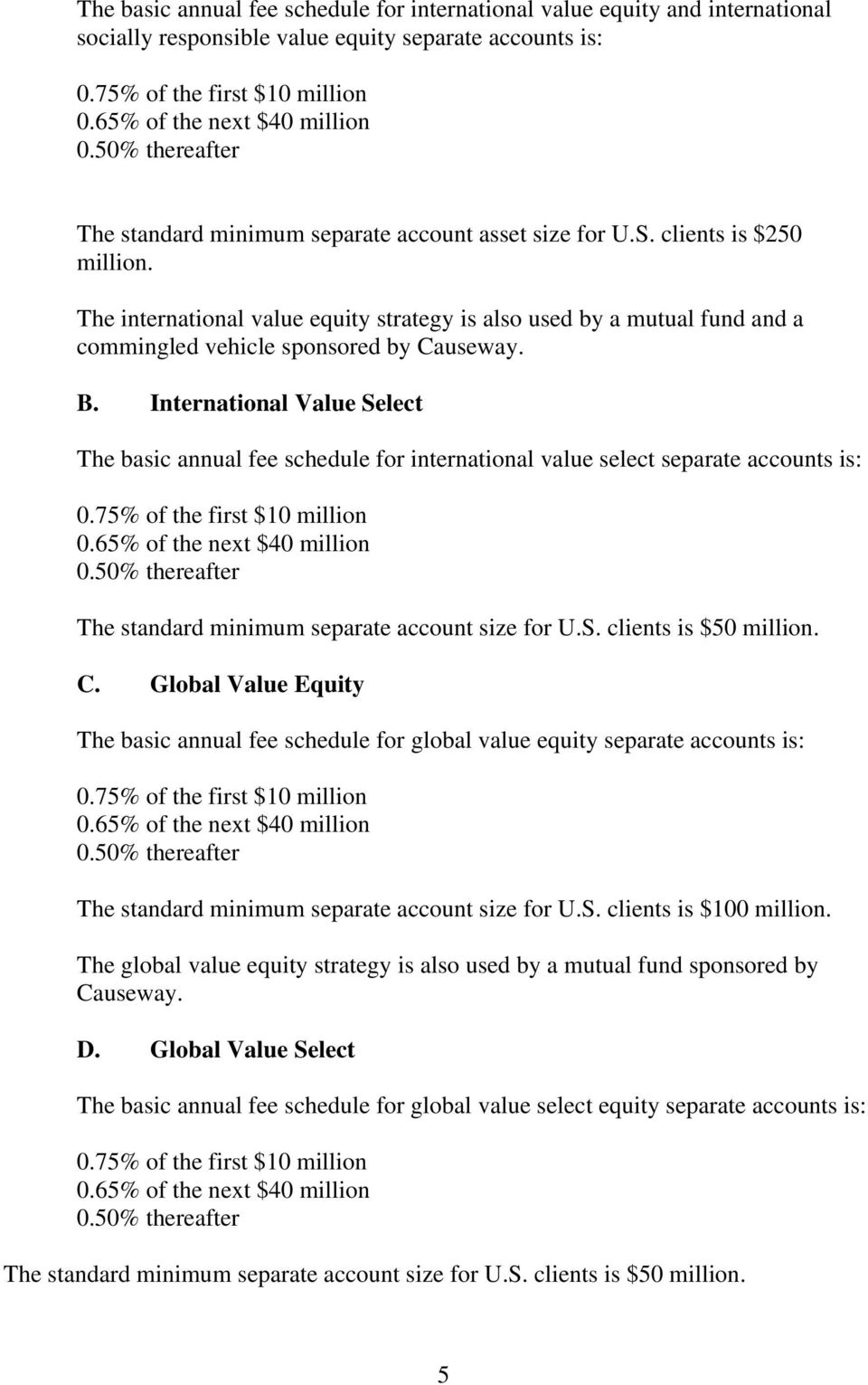
5 The basic annual fee schedule for international value equity and international socially responsible value equity separate accounts is: 0.75% of the first $10 million 0.65% of the next $40 million 0.50% thereafter The standard minimum separate account asset size for U.S. clients is $250 million. The international value equity strategy is also used by a mutual fund and a commingled vehicle sponsored by Causeway. B. International Value Select The basic annual fee schedule for international value select separate accounts is: 0.75% of the first $10 million 0.65% of the next $40 million 0.50% thereafter The standard minimum separate account size for U.S. clients is $50 million. C. Global Value Equity The basic annual fee schedule for global value equity separate accounts is: 0.75% of the first $10 million 0.65% of the next $40 million 0.50% thereafter The standard minimum separate account size for U.S. clients is $100 million. The global value equity strategy is also used by a mutual fund sponsored by Causeway. D. Global Value Select The basic annual fee schedule for global value select equity separate accounts is: 0.75% of the first $10 million 0.65% of the next $40 million 0.50% thereafter The standard minimum separate account size for U.S. clients is $50 million. 5
6 E. Emerging Markets Equity The basic annual fee schedule for emerging markets equity separate accounts is: 0.90% of the first $100 million 0.75% of the next $150 million 0.65% thereafter The standard minimum separate account asset size for U.S. clients is $100 million. The emerging markets equity strategy is also used by a mutual fund and a commingled vehicle sponsored by Causeway. F. International Opportunities and Global Opportunities The basic annual fee schedule for international opportunities and global opportunities separate accounts is: 0.75% of the first $100 million 0.65% of the next $150 million 0.55% thereafter The standard minimum separate account size for U.S. clients is $100 million. The international opportunities strategy is also used by a mutual fund and a commingled vehicle sponsored by Causeway. G. International Small Cap Equity The basic annual fee schedule for international small cap separate accounts is: 0.90% of the first $100 million 0.75% of the next $150 million 0.65% thereafter The standard minimum account size for U.S. clients is $100 million. The international small cap strategy is also used by a mutual fund sponsored by Causeway. H. Causeway Global Absolute Return Strategy The basic annual fee schedule for global absolute return separate accounts is 1.00% of total assets plus 20% of performance exceeding the 6

7 BofA Merrill Lynch 3-Month U.S. Treasury Bill Index. The standard minimum separate account size is $20 million. The global absolute return strategy is also used by a mutual fund sponsored by Causeway. I. International Value Equity and Global Value Equity ADR model wrap programs through CIBC Asset Management Inc. The annual fee schedule is: 0.40% of the first CAD$100 million 0.35% of the next CAD$700 million 0.30% thereafter J. International Value Equity and Global Value Equity ADR model wrap programs through Fortigent, LLC: Unified Managed Account Program The annual fee schedule is 0.40%. K. International Value Equity ADR model wrap program through The Northern Trust Company The annual fee schedule is 0.33%. L. International Value Equity ADR model wrap program through SEI Investments Management Corporation: SEI Managed Account Program The annual fee schedule is 0.35%. M. International Value Equity ADR model wrap program through FDx Advisors Inc.: Unified Overlay Management Program The annual fee schedule is 0.35%. N. International Value Equity and Global Value Equity ADR model wrap program through Morgan Stanley Smith Barney LLC: Select UMA and Citigroup Global Markets Inc. The annual fee schedule for international value equity is 0.33%. The annual fee schedule for global value equity is 0.35%. O. Global Value Equity ADR model wrap program through Scotia Capital Inc.: Managed-Assets Program: Summit Program. 7

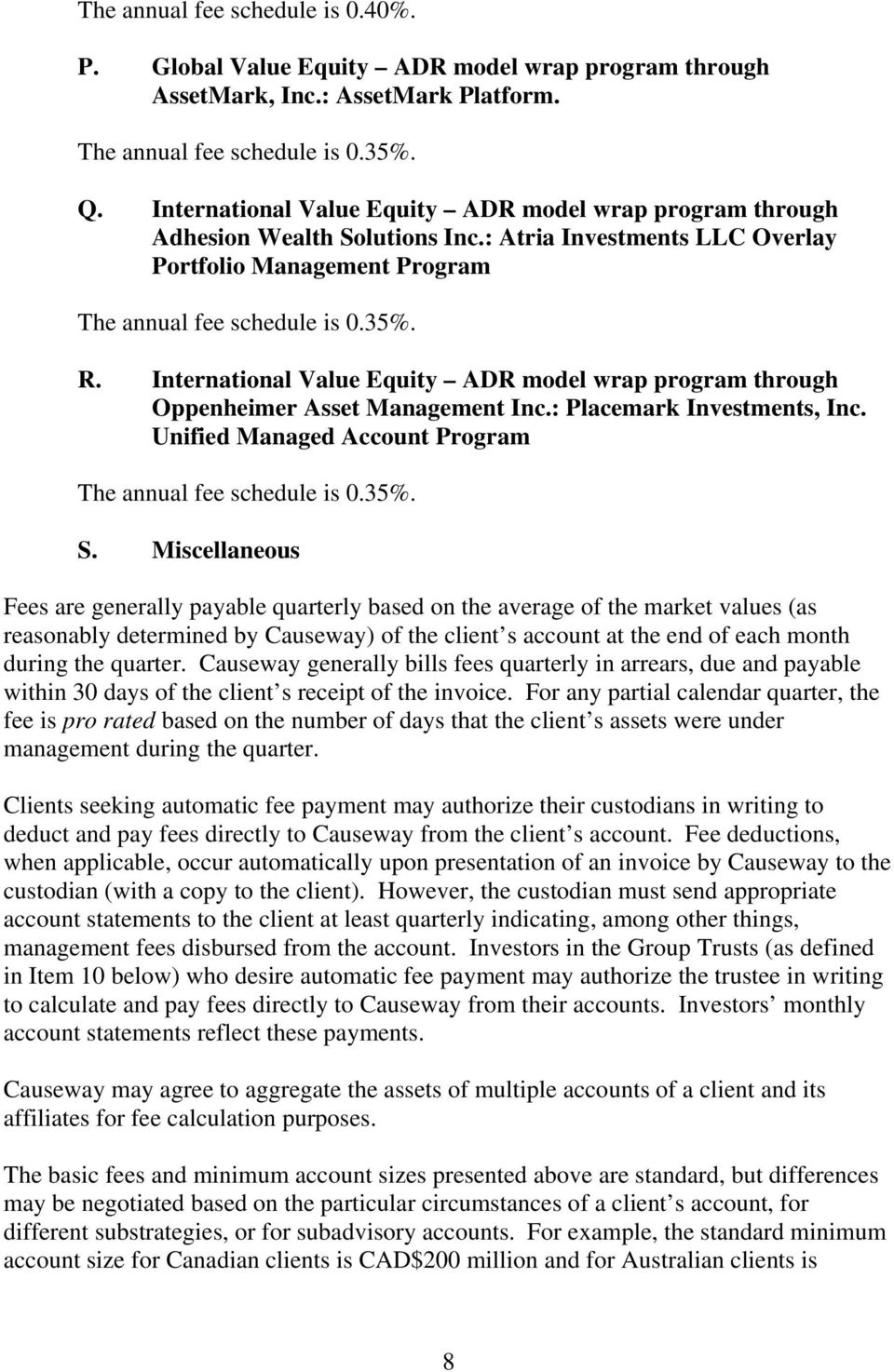
8 The annual fee schedule is 0.40%. P. Global Value Equity ADR model wrap program through AssetMark, Inc.: AssetMark Platform. The annual fee schedule is 0.35%. Q. International Value Equity ADR model wrap program through Adhesion Wealth Solutions Inc.: Atria Investments LLC Overlay Portfolio Management Program The annual fee schedule is 0.35%. R. International Value Equity ADR model wrap program through Oppenheimer Asset Management Inc.: Placemark Investments, Inc. Unified Managed Account Program The annual fee schedule is 0.35%. S. Miscellaneous Fees are generally payable quarterly based on the average of the market values (as reasonably determined by Causeway) of the client s account at the end of each month during the quarter. Causeway generally bills fees quarterly in arrears, due and payable within 30 days of the client s receipt of the invoice. For any partial calendar quarter, the fee is pro rated based on the number of days that the client s assets were under management during the quarter. Clients seeking automatic fee payment may authorize their custodians in writing to deduct and pay fees directly to Causeway from the client s account. Fee deductions, when applicable, occur automatically upon presentation of an invoice by Causeway to the custodian (with a copy to the client). However, the custodian must send appropriate account statements to the client at least quarterly indicating, among other things, management fees disbursed from the account. Investors in the Group Trusts (as defined in Item 10 below) who desire automatic fee payment may authorize the trustee in writing to calculate and pay fees directly to Causeway from their accounts. Investors monthly account statements reflect these payments. Causeway may agree to aggregate the assets of multiple accounts of a client and its affiliates for fee calculation purposes. The basic fees and minimum account sizes presented above are standard, but differences may be negotiated based on the particular circumstances of a client s account, for different substrategies, or for subadvisory accounts. For example, the standard minimum account size for Canadian clients is CAD$200 million and for Australian clients is 8
9 AUD$50 million, and the standard minimum account sizes for other non-u.s. clients may differ. Methods of fee calculation and billing may also differ depending on the specific terms of the client s agreement. Causeway may enter into performance-based fee arrangements. While the specific terms of these arrangements are negotiated with each client, they typically provide for a base fee equal to a percentage of the average market value of the account during each quarter plus a performance fee that may be (i) an additional percentage of the market value of the account if the total return of the account exceeds an agreed benchmark over an agreed period, or (ii) a percentage of account profits. See Item 6 below for more information on potential conflicts arising from performance fees. Other investment advisers may charge lower fees for comparable services. In addition to (and separate from) investment advisory fees paid to Causeway, clients will pay custodian fees to their custodians and transaction fees to broker-dealers and banks, including commissions, mark-ups, stamp and other transaction taxes, and other charges. For more information about Causeway s brokerage practices, please see Item 12 below. Further, clients will pay additional fees and expenses for any investments in mutual or commingled funds, as set forth in the applicable prospectus or offering document. Causeway does not charge fees in advance. However, certain wrap program sponsors bill their customers quarterly in advance and pay Causeway s fees monthly or quarterly. Causeway s marketing employees receive salaries and also receive bonuses based on a percentage of Causeway s advisory fees attributable to their sales of Causeway s advisory services, whether from a separate account or fund or commingled vehicle advised by Causeway. This practice presents a conflict of interest and gives Causeway s marketing employees a financial incentive to recommend investment products based on the compensation received, rather than on a client s needs. Causeway discloses this conflict to clients in this Brochure, which clients receive prior to or at the time of engaging Causeway. In addition, the standard forms of marketing materials used by Causeway s marketing employees are reviewed for appropriate disclosures. Clients have the option to purchase mutual funds advised by Causeway through other brokers or advisers that are not affiliated with Causeway. Item 6 Performance-Based Fees and Side-By-Side Management Causeway may enter into performance-based fee arrangements. Causeway manages accounts that pay performance-based fees and accounts that pay asset-based fees. Causeway faces conflicts of interest by managing accounts that pay performance-based fees and accounts that pay asset-based fees at the same time, including that Causeway has an incentive to favor accounts for which Causeway receives performance-based fees. Depending on the circumstances, Causeway may receive compensation under a performance-based fee that is larger than it otherwise might receive under asset-based fee arrangements. Performance-based fees may also create an incentive for Causeway to 9

10 make investments that are riskier or more speculative than would be the case in the absence of a performance-based fee. Causeway has written compliance policies and procedures designed to mitigate or manage these conflicts of interest, including policies and procedures to seek fair and equitable allocation of investment opportunities (including IPOs) and trade allocations (see Item 12 below) among all client accounts. To the extent an account paying a performance-based fee engages in short selling, in order to, among other things, prevent the short-selling account from interfering with the management of other accounts, Causeway has a policy that it will not enter into a short position in a security if, at the time of entering into the short position, any client or fund account managed by Causeway holds a long position in a security of the issuer. See Item 11 below. There is no guarantee that these policies or procedures will cover every situation in which a conflict of interest arises. Item 7 Types of Clients Causeway provides investment management services to institutional clients including corporations, pension plans, public retirement plans, sovereign wealth funds, superannuation funds, Taft-Hartley pension plans, endowments and foundations, mutual funds and other collective investment vehicles, charities, private trusts and funds, wrap fee programs, and other institutions. Causeway also provides investment advice to private commingled vehicles, including group trusts. Causeway has relationships with wrap program sponsors through which multiple underlying customers access Causeway's advisory services. Causeway treats each relationship with a wrap program sponsor as a single client for purposes of Form ADV, Part I, Item 5, because Causeway supplies aggregate securities weightings and related information to the program sponsor. The program sponsor or its delegate (and not Causeway) executes transactions and provides custody services for the underlying customers. The programs underlying customers may be clients of Causeway for other purposes under the Advisers Act. Separate account clients must enter into a written advisory agreement with Causeway before receiving services. Please see Item 5 above for standard minimum account sizes. Causeway lists the names of clients and Group Trust investors who are not individuals in its marketing materials unless the client or investor specifically requests to be excluded. Item 8 Methods of Analysis, Investment Strategies and Risk of Loss Causeway has a number of main investment strategies, focusing on different aspects of investing around the world. The particular methods for selecting investments vary by strategy, as described below. Causeway s main investment strategies are: 10

11 international value equity international value select global value equity global value select emerging markets equity international opportunities and global opportunities international small cap equity global absolute return ( GAR ). In addition, Causeway manages American Depositary Receipt model ( ADR model ), socially responsible, and concentrated versions of certain of its strategies, which are described further in Item 8.G below. Each investment strategy and its material risks are described below. Investing in securities involves risk of loss that clients should be prepared to bear. A. International Value Equity The investment objective of Causeway s international value equity investment strategy is to seek long-term growth of capital and income through investment primarily in equity securities of companies in developed countries located outside the U.S. The strategy may invest a portion of total assets in companies in emerging markets. The benchmark index is the MSCI EAFE Index (the EAFE Index ). When investing this strategy, Causeway follows a value style. This means that Causeway buys stocks that it believes have lower prices than their true worth. For example, stocks may be undervalued because the issuing companies are in industries that are currently out of favor with investors. However, even in those industries, certain companies may have high rates of growth of earnings and be financially sound. Causeway considers whether a company has each of the following value characteristics in purchasing or selling securities in this strategy: (i) (ii) (iii) (iv) (v) low price-to earnings ratio relative to the sector, high yield relative to the market, low price-to-book value ratio relative to the market, low price-to-cash flow ratio relative to the market, and financial strength. 11

12 Causeway s team of fundamental portfolio managers manages international value equity portfolios. The portfolio managers work as a team to make investment decisions and perform investment research. They are supported by the firm s fundamental and quantitative research analysts who perform investment research, but do not make final investment decisions for international value equity accounts. (Certain quantitative analysts are also portfolio managers of the emerging markets equity, international opportunities, global opportunities, international small cap equity, and global absolute return strategies described below.) The portfolio management and analyst team uses both quantitative screens and analysis and rigorous fundamental research to assess securities. Quantitative research includes application of market capitalization screens, and valuation and other financial strength screens by country and industry to narrow the universe of investment candidates. Fundamental research generally includes company-specific research, company visits, interviews of suppliers, customers, competitors, industry analysts, and experts, and proprietary valuation modeling. After applying additional quantitative liquidity and risk assessments, investment candidates are ranked based on forecast returns. B. International Value Select The investment objective of Causeway s international value select investment strategy is to seek long-term growth of capital and income through investment primarily in larger capitalization equity securities of companies in developed countries located outside the U.S. The strategy may invest a portion of its total assets in companies located in emerging markets. For the international value select strategy, Causeway uses the same value investing style described above under International Value Equity, while limiting investment generally in companies with market capitalizations of at least $5 billion at the time of investment. The benchmark index is the EAFE Index. C. Global Value Equity The investment objective of Causeway s global value equity investment strategy is to seek long-term growth of capital and income through investment primarily in equity securities of companies in developed countries located outside the U.S. and of companies located in the U.S. The strategy may invest a portion of its total assets in companies located in emerging markets. For the global value equity strategy, Causeway uses the same value investing style described above under International Value Equity. The benchmark index is the MSCI World Index (the World Index ). D. Global Value Select The investment objective of Causeway s global value select investment strategy is to seek long-term growth of capital and income through investment primarily in larger capitalization equity securities of companies in developed countries located outside the U.S. and of companies located in the U.S. The strategy may invest a portion of its total assets in companies located in emerging markets. For the global value select strategy, Causeway uses the same value investing style described above under International 12

13 Value Equity, while limiting non-u.s. investments generally in companies with market capitalizations of at least $5 billion at the time of investment. The benchmark index is the World Index. E. Emerging Markets Equity The investment objective of Causeway s emerging markets equity strategy is to seek long-term growth of capital by investing primarily in equity securities of companies in emerging markets. Causeway uses a quantitative investment approach to purchase and sell investments for emerging markets portfolios. Causeway s proprietary computer model analyzes a variety of factors to assist in selecting securities. The model currently analyzes factors relating to valuation, earnings growth, technical indicators, macroeconomics, currency, countries and sectors. The strategy normally invests in ten or more emerging markets and in companies with market capitalizations of generally US$500 million or greater at the time of investment. The benchmark index is the MSCI Emerging Markets Index (the EM Index ). F. International Opportunities; Global Opportunities The investment objective of Causeway s international opportunities strategy is to seek long-term growth of capital through investment primarily in equity securities of companies in developed markets excluding the U.S. - and emerging markets. using Causeway s asset allocation methodology to determine developed and emerging market weightings. For the developed markets portion of the portfolio, Causeway uses its international value equity strategy described above under International Value Equity or invests in Causeway International Value Fund. The investment objective of Causeway s global opportunities strategy is to seek long-term growth of capital through investment primarily in equity securities of companies in developed markets including the U.S. and emerging markets using Causeway s asset allocation methodology to determine developed and emerging markets weightings. For the developed markets portion of portfolios in the global opportunities strategy, Causeway uses its global value equity strategy described above in Global Value Equity or invests in Causeway Global Value Fund. For the emerging markets portion of both the international opportunities and global opportunities portfolios, Causeway uses its emerging markets strategy described above in Emerging Markets Equity or invests in Causeway Emerging Markets Fund. Causeway uses quantitative signals from systems developed and managed by its quantitative portfolio managers and qualitative input from its fundamental portfolio managers to determine the allocation of assets between the developed and emerging markets portions of international opportunities and global opportunities portfolios. Quantitative signals are generated by a proprietary asset allocation model designed by the quantitative portfolio managers to indicate when allocations to emerging markets should increase or decrease relative to the weight of emerging markets in the benchmark of the international opportunities strategy, which is the MSCI All Country World Index ex U.S., or relative to the weight of emerging markets in the benchmark of the global opportunities strategy, which is the MSCI All Country World Index. The model 13

14 currently analyzes characteristics in five categories: valuation, earnings growth, financial strength, macroeconomic, and risk aversion. Causeway s fundamental portfolio managers evaluate these quantitative signals in light of fundamental analysis and the portfolio managers, as a team, determine the allocation between developed and emerging markets. The allocation is reassessed by the quantitative model daily and adjusted periodically when deemed appropriate by the investment team. G. International Small Cap Equity The investment objective of Causeway s international small cap equity strategy is to seek long-term growth of capital through investment primarily in common stocks of companies with small market capitalizations located in developed and emerging markets outside the U.S. Small market capitalization companies are companies with market capitalizations that do not exceed the highest market capitalization of a company within the strategy s benchmark, the MSCI ACWI ex USA Small Cap Index, at the time of purchase. For the international small cap equity strategy, Causeway uses a quantitative investment approach to purchase and sell investments. Causeway s proprietary computer model analyzes a variety of fundamental and technical characteristics to assist in selecting securities. The model currently analyzes characteristics of individual securities, such as valuation, earnings growth, technical indicators, and quality. In addition to its quantitative research, Causeway s fundamental research analysts review the quantitative outputs to attempt to identify and address special issues, such as significant corporate actions or management changes, which are difficult to detect quantitatively. H. Global Absolute Return The investment objective of Causeway s global absolute return, or GAR, investment strategy is to seek long-term growth of capital with low or no correlation to the World Index. The GAR strategy takes long and short exposures to common and preferred stocks of companies located primarily in developed countries outside the U.S. and of companies in the U.S. To obtain exposure to long and short positions in securities, the GAR strategy takes direct long and short positions in securities or enters into one or more total return equity swap agreements (each, a swap agreement ). Causeway uses its fundamental global value equity strategy (described above under Global Value Equity ) to manage the strategy s long exposures. This portion of the portfolio is referred to as the global long portfolio below. Causeway uses a quantitative investment strategy, described below, to identify short exposures that it expects to underperform the World Index to manage the strategy s short exposures. This portion of the portfolio is referred to as the global short portfolio below. The dollar amount of the GAR strategy s long exposures will generally be equivalent to (within plus or minus 10 percentage points of) the dollar amount of its short exposures. By having approximately equivalent amounts of long and short exposures, the GAR strategy seeks to generate returns that have low or no correlation to the World Index, and lower volatility than the World Index. This will limit the GAR strategy s participation in a market upswing. The GAR strategy s benchmark index is the BofA Merrill Lynch 3-14

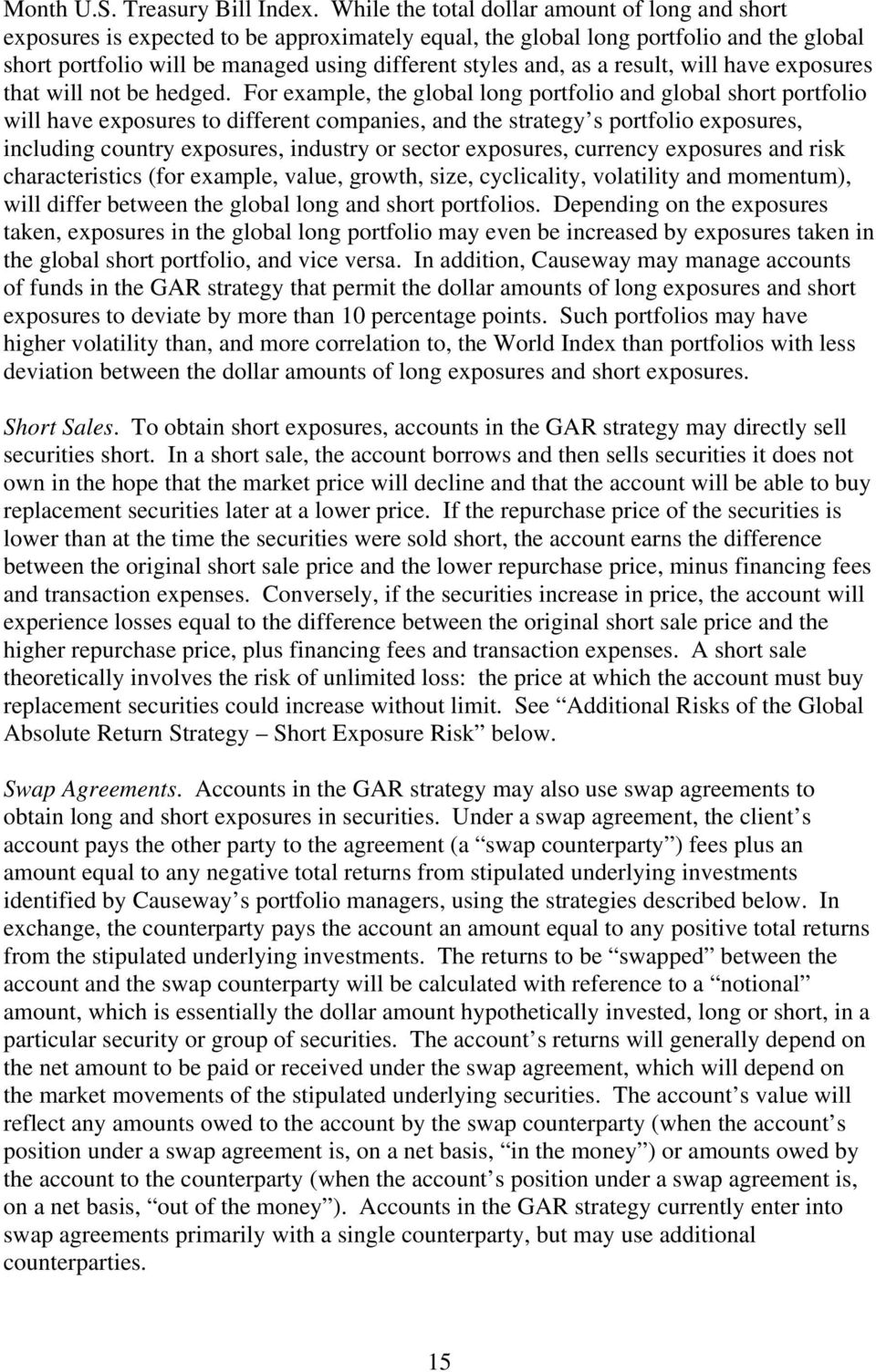
15 Month U.S. Treasury Bill Index. While the total dollar amount of long and short exposures is expected to be approximately equal, the global long portfolio and the global short portfolio will be managed using different styles and, as a result, will have exposures that will not be hedged. For example, the global long portfolio and global short portfolio will have exposures to different companies, and the strategy s portfolio exposures, including country exposures, industry or sector exposures, currency exposures and risk characteristics (for example, value, growth, size, cyclicality, volatility and momentum), will differ between the global long and short portfolios. Depending on the exposures taken, exposures in the global long portfolio may even be increased by exposures taken in the global short portfolio, and vice versa. In addition, Causeway may manage accounts of funds in the GAR strategy that permit the dollar amounts of long exposures and short exposures to deviate by more than 10 percentage points. Such portfolios may have higher volatility than, and more correlation to, the World Index than portfolios with less deviation between the dollar amounts of long exposures and short exposures. Short Sales. To obtain short exposures, accounts in the GAR strategy may directly sell securities short. In a short sale, the account borrows and then sells securities it does not own in the hope that the market price will decline and that the account will be able to buy replacement securities later at a lower price. If the repurchase price of the securities is lower than at the time the securities were sold short, the account earns the difference between the original short sale price and the lower repurchase price, minus financing fees and transaction expenses. Conversely, if the securities increase in price, the account will experience losses equal to the difference between the original short sale price and the higher repurchase price, plus financing fees and transaction expenses. A short sale theoretically involves the risk of unlimited loss: the price at which the account must buy replacement securities could increase without limit. See Additional Risks of the Global Absolute Return Strategy Short Exposure Risk below. Swap Agreements. Accounts in the GAR strategy may also use swap agreements to obtain long and short exposures in securities. Under a swap agreement, the client s account pays the other party to the agreement (a swap counterparty ) fees plus an amount equal to any negative total returns from stipulated underlying investments identified by Causeway s portfolio managers, using the strategies described below. In exchange, the counterparty pays the account an amount equal to any positive total returns from the stipulated underlying investments. The returns to be swapped between the account and the swap counterparty will be calculated with reference to a notional amount, which is essentially the dollar amount hypothetically invested, long or short, in a particular security or group of securities. The account s returns will generally depend on the net amount to be paid or received under the swap agreement, which will depend on the market movements of the stipulated underlying securities. The account s value will reflect any amounts owed to the account by the swap counterparty (when the account s position under a swap agreement is, on a net basis, in the money ) or amounts owed by the account to the counterparty (when the account s position under a swap agreement is, on a net basis, out of the money ). Accounts in the GAR strategy currently enter into swap agreements primarily with a single counterparty, but may use additional counterparties. 15
16 Financing Charges and Transaction Costs. Accounts in the GAR strategy may directly sell securities short and borrow to finance securities held long. Accounts will pay financing charges and transaction fees, including brokerage commissions and stamp taxes, to the client s prime broker for these investments. In addition, the account will pay the counterparty amounts equal to any dividends paid on securities to which the account has short exposures. When using a swap agreement, an account will pay financing charges to the counterparty based on the notional amount of long exposures, and the account will also pay transaction costs when it changes exposures to stipulated underlying investments, including brokerage commissions and stamp and other taxes. Although the account will not itself directly trade in underlying investments, the counterparty will charge the account as if it were trading directly. These charges permit the counterparty, if it desires to hedge its obligations to the account, to recover the costs of any such hedging. In addition, the account will pay the counterparty amounts equal to any dividends paid on securities to which the account has short exposures. Leverage. Accounts in the GAR strategy through the use of short sales, swap agreements, margin borrowing, or other means will obtain investment exposures greater than an account s net assets, allowing accounts effectively to increase, or leverage, their total long and short investment exposures. The GAR strategy expects to leverage its investment positions by borrowing funds from securities brokers or dealers, banks or other financial intermediaries. It may also use swaps or other derivatives to leverage account assets. Leverage increases both the possibilities for profit and the risk of loss. Borrowings will usually be from securities brokers and dealers (primarily the client s prime broker) and are typically secured by the account s securities and other assets. Under certain circumstances, such a broker or dealer may demand an increase in the collateral that secures the account s obligations, and if the account is unable to provide additional collateral, the broker or dealer could liquidate assets held in the account to satisfy the account s obligations. Liquidation in that manner could have extremely adverse consequences, including sales at disadvantageous times and prices and the acceleration of tax consequences. See Additional Risks of the Global Absolute Return Strategy below. Periodic Settlement of Swap Agreements. Causeway will settle swap positions periodically, which may cause an account to realize ordinary income and short-term capital gains, if any, that will generally be taxable at ordinary income or short-term capital gains rates rather than at lower long-term capital gains rates. Long and Short Exposures. Causeway expects that the global short portfolio will normally have higher turnover of its exposures than the global long portfolio. An account may have exposures to companies of all sizes and in any industry. The use of leverage to increase economic exposures relative to an account s net assets may result in an account obtaining greater economic exposures to particular industries than would 16
17 otherwise be the case, and being susceptible to industry-specific market or economic developments. Global Long Portfolio. Causeway uses its global value equity strategy, described above under Global Value Equity, to manage the global long portfolio of the strategy. Global Short Portfolio. The global short portfolio of the GAR strategy will have exposures primarily to short positions in common and preferred stocks of companies in developed countries located outside the U.S. and of companies in the U.S. that Causeway believes will underperform the World Index. If the World Index is increasing, a short position may underperform the World Index and still lose value. Causeway uses a quantitative investment strategy to identify, increase, or decrease exposures, and to analyze certain financial factors that the portfolio managers believe are influential in determining whether a security will underperform the World Index. These factors include, among others, valuation metrics, earnings growth, technical indicators, and financial strength/earnings quality. In addition to its quantitative research, Causeway s fundamental research analysts review the quantitative outputs to attempt to identify special issues, such as significant corporate actions or management changes, which cannot be detected quantitatively. Causeway has a policy that it will not enter into a short position in a security if, at the time of entering into the short position, any client or fund account managed by Causeway holds a long position in a security of the issuer. I. ADR Model, Socially Responsible, and Concentrated Strategies 1. ADR Models For certain clients, including certain wrap programs (see discussion of non-execution clients in Item 12 below), Causeway supplies investment instructions in the form of model securities weightings and related information to wrap program sponsors who execute and settle the trades and maintain the underlying customer accounts. Typically, these accounts invest in international companies solely through sponsored and unsponsored ADRs or ordinary shares that trade in the U.S. because the program sponsors do not use foreign currencies. Accounts in Causeway s international value ADR model and global value ADR model strategies will generally have fewer holdings, and may have different holdings, than accounts in the corresponding local share strategies because liquid ADRs are not available for all international securities. These accounts will perform differently than accounts in local share strategies. 2. Socially Responsible Causeway manages accounts which are restricted from investing in companies deriving revenues from one or more of the following social categories: abortion, birth control, military weapons, alcohol, tobacco, pornography, gambling, or other areas of social concern. Accounts in these socially responsible strategies may have fewer and different holdings than accounts in the corresponding unrestricted strategies, and will perform differently than accounts in local share strategies. 17
18 3. Concentrated Causeway manages accounts which limit the maximum number of portfolio holdings below Causeway s normal strategy parameters. Accounts with holdings restrictions may have higher volatility and will perform differently than accounts in corresponding strategies without such restrictions. J. Determining Where a Company is Located Causeway determines the country where a company is located, and thus whether a company is located outside the U.S. or in an emerging market, by referring to: its stock exchange listing; where it is registered, organized or incorporated; where its headquarters are located; its MSCI country classification; where it derives at least 50% of its revenues or profits from goods produced or sold, investments made, or services performed; or where at least 50% of its assets are located. These categories are designed to identify investments that are tied economically to, and subject to the risks of, investing outside the U.S. Investments in ETFs based on the EAFE Index or other foreign markets indices are considered foreign markets investments. Investments in ETFs based on the EM Index or other emerging markets are considered emerging markets investments. Investments in ETFs based on a single country index are considered investments in the underlying country, and investments in ETFs based on more than one underlying country index are not considered investments in the specific underlying countries. An emerging markets ETF will be considered outside the EM Index only if all of its underlying countries are not included in the EM Index. Investments in ETFs based on the MSCI ACWI ex USA Small Cap Index or other small cap indices are considered small capitalization investments. K. Investment Risks This section contains information about the general risks of Causeway s investment strategies. As with any investment strategy, there can be no guarantee that a strategy will meet its goals or that the strategy s performance will be positive for any period of time. The principal risks of Causeway s strategies are listed below: 1. Market and Selection Risk Market risk is the risk that the markets will go down in value or, for the short portfolio of the GAR strategy, that the markets will go up in value contrary to its short positions. These changes may be sharp and unpredictable. Selection risk is the risk that the investments that a strategy s portfolio managers select will underperform the market or strategies managed by other investment managers with similar investment objectives and investment strategies. 18
19 2. Issuer-Specific Risk The value of an individual security or particular type of security can be more volatile than the market as a whole and can perform differently from the value of the market as a whole. 3. Value Strategy Risk Value stocks including those selected by Causeway for all of its strategies, except for the emerging markets equity strategy, international small cap strategy and the global short portfolio of the global absolute return strategy are subject to the risks that their intrinsic value may never be realized by the market and that their prices may go down. Causeway s value discipline sometimes prevents or limits investments in stocks that are in a strategy s benchmark index. 4. Quantitative Strategy Risk Securities identified using quantitative analysis can perform differently from the market as a whole as a result of the factors used in the analysis, the weight placed on each factor, and changes in the factor s historical trends. The factors used in quantitative analysis and the weight placed on those factors may not be predictive of a security exposure s value, and the effectiveness of the factors can change over time. These changes may not be reflected in the current quantitative model. In addition, data for emerging markets companies may be less available and/or less current than data for developed markets companies, and Causeway s processes and exposure selection can be adversely affected if it relies on erroneous or outdated data. 5. Foreign and Emerging Markets Risk Foreign investments involve special risks not present in U.S. investments that can increase the chances that an account will lose money. For example, the value of an account s securities may be affected by social, political and economic developments and U.S. and foreign laws relating to foreign investment. Further, because accounts invest in securities denominated in foreign currencies, accounts securities may go down in value depending on foreign exchange rates. Other risks include trading, settlement, custodial, and other operational risks; withholding or other taxes; and the less stringent investor protection and disclosure standards of some foreign markets. All of these factors can make foreign securities less liquid, more volatile, and harder to value than U.S. securities. These risks are higher for emerging markets investments, which can be subject to greater social, economic, regulatory and political uncertainties. These risks are also higher for investments in small capitalization companies. These risks, and other risks of investing in foreign securities, are explained further below. The economies of some foreign markets often do not compare favorably with that of the U.S. in areas such as growth of gross domestic product, reinvestment of capital, 19
20 resources, and balance of payments. Some of these economies may rely heavily on particular industries or foreign capital. For example, the price of oil has seen weakening global demand, which may negatively affect the economies of countries that rely on the energy industry. They may be more vulnerable to adverse diplomatic developments, the imposition of economic sanctions against a country, changes in international trading patterns, trade barriers and other protectionist or retaliatory measures. Governmental actions such as the imposition of capital controls, nationalization of companies or industries, expropriation of assets or the imposition of punitive taxes may adversely affect investments in foreign markets. The governments of certain countries may prohibit or substantially restrict foreign investing in their capital markets or in certain industries. This could severely affect security prices. This could also impair an account s ability to purchase or sell foreign securities or transfer its assets or income back to the U.S., or otherwise adversely affect an account s operations. Other foreign market risks include foreign exchange controls, difficulties in pricing securities, defaults on foreign government securities, difficulties in enforcing favorable legal judgments in foreign courts, and political and social instability. Legal remedies available to investors in some foreign countries are less extensive than those available to investors in the U.S. Many foreign governments supervise and regulate stock exchanges, brokers and the sale of securities less than the U.S. government does. Corporate governance may not be as robust as in more developed countries. As a result, protections for minority investors may not be strong, which could affect security prices. Accounting standards in other countries are not necessarily the same as in the U.S. If the accounting standards in another country do not require as much disclosure or detail as U.S. accounting standards, it may be harder for the portfolio managers to completely and accurately determine a company s financial condition or find reliable and current data to process using quantitative techniques. Because there are usually fewer investors on foreign exchanges and smaller numbers of shares traded each day, it may be difficult for an account to buy and sell securities on those exchanges. In addition, prices of foreign securities may go up and down more than prices of securities traded in the U.S. Foreign markets may have different clearance and settlement procedures. In certain markets, settlements may not keep pace with the volume of securities transactions. If this occurs, settlement may be delayed and the assets in a client s account may be uninvested and may not be earning returns. An account also may miss investment opportunities or not be able to sell an investment because of these delays. 20
21 Changes in currency exchange rates will affect the value of an account s foreign holdings. Further, companies located in foreign countries may conduct business or issue debt denominated in currencies other than their domestic currencies, creating additional risk if there is any disruption, abrupt change in the currency markets, or illiquidity in the trading of such currencies. The costs of foreign securities transactions tend to be higher than those of U.S. transactions. International trade barriers or economic sanctions against foreign countries may adversely affect an account s foreign holdings. 6. Smaller Capitalization Companies Risk Some of Causeway s strategies, and in particular the international small cap equity and emerging markets equity strategies, may invest in smaller capitalization companies. The values of securities of smaller, less well known companies can be more sensitive to, and react differently to, company, political, market, and economic developments than the market as a whole and other types of securities. Small companies can have more limited product lines, markets, growth prospects, depth of management, and financial resources, and these companies may have shorter operating histories and less access to financing, creating additional risk. Small companies in countries with less-liquid currencies may have additional difficulties in financing and conducting their businesses. Further, small companies may be particularly affected by interest rate increases, as they may find it more difficult to borrow money to continue or expand operations, or may have difficulty in repaying any loans that have floating rates. Because of these and other risks, securities of small capitalization companies tend to be more volatile and less liquid than securities of medium and larger capitalization companies. During some periods, securities of small capitalization companies, as an asset class, have underperformed the securities of larger capitalization companies. 7. Derivatives Risk If an account invests in derivatives, the investments may not be effective as a hedge against price movements and can limit potential for growth in the value of the account. Derivatives are volatile and involve significant risks, including counterparty risk, currency risk, leverage risk, illiquidity risk, and basis risk, which are described below: Counterparty Risk Counterparty risk is the risk that the counterparty on a derivative transaction will be unable to honor its financial obligation to the account. Currency Risk Currency risk is the risk that changes in the exchange rate between two currencies will adversely affect the value (in U.S. dollar terms) of an investment. 21
22 Leverage Risk Leverage risk is the risk that relatively small market movements may result in large changes in the value of an investment. Investments that involve leverage can result in losses that greatly exceed the amount originally invested. Liquidity Risk Liquidity risk is the risk that certain securities may be difficult or impossible to sell at the time that the seller would like or at the price that the seller believes the security is currently worth. Basis Risk Basis risk is the risk that the value of a derivative instrument does not react in parallel with the value of the underlying security. 8. Additional Investment Risks of the Global Absolute Return Strategy The risks described below apply whether a global absolute return account obtains exposures through a swap agreement or makes direct investments. i. Leverage Risk By using financing and/or swap agreements, Causeway is able to obtain exposures greater than the value of a GAR account s net assets. Use of leverage involves special risks and is speculative. Leverage creates the potential for greater gains to account holders and the risk of magnified losses to account holders, depending on market conditions and a GAR account s particular exposures. Although Causeway intends to reduce volatility by obtaining exposure to both long and short positions, if Causeway is incorrect in evaluating long and/or short exposures, losses may be significant. ii. Quantitative Strategy Risk Causeway uses quantitative techniques to identify exposures for the global short portfolio of accounts in the GAR strategy. See Quantitative Strategy Risk above. While the GAR strategy seeks low or no correlation with the World Index, it may be unintentionally correlated with funds or accounts using quantitative market neutral, long-short, absolute return, hedged, or other investment strategies, especially during periods of market distress. In highly volatile or falling markets, portfolio managers using quantitative factor-based strategies may seek to reduce leverage by unwinding liquid as well as illiquid long and short securities positions simultaneously. This can cause quantitative strategies, such as the GAR strategy, to experience significant losses. iii. Short Exposure Risk The global short portfolio of accounts in the GAR strategy will be exposed primarily to short positions through short sales or swap agreements. Short positions are subject to special risks. Short positions obtain exposure to securities with the goal of closing the position at a later date when the value of the security has decreased. If the price of the 22
23 security increases before the position is closed, the GAR account will incur a loss equal to the increase in price from the time the exposure was obtained, (calculated based on the notional value of the exposure if a swap agreement is used), plus any other charges payable to the prime broker or swap counterparty. Because the GAR strategy uses leverage, the short exposures will exceed the value of a GAR account s net assets, and the risk of loss is increased. Further, since a GAR account will lose money if the value of the underlying security increases, losses on short positions are potentially unlimited. This risk is magnified in periods of market turmoil. To effect direct short sales, the account borrows the securities from a broker or other third party and sells them for market value. It closes or covers the position by returning the securities (by buying replacement securities on behalf of the lender). The obligation to replace the borrowed securities does not typically have a specified maturity date and the lender generally may require replacement of the securities whenever it chooses. As collateral for its replacement obligation, the account is generally required to leave a certain amount of cash and/or securities with the broker that effected the transactions and to deliver an additional amount of cash or other collateral upon the lender s request if the amount of the account s liability increases due to increases in the security s price or decreases in the value of the existing collateral. The lender for the account s short sales will ordinarily be the account s prime broker and all of an account s assets will ordinarily serve as collateral. Therefore, if the value of the collateral were to become inadequate to secure the account s obligations under its short positions, it is unlikely that the account would be able to provide additional collateral. If that were to occur, the prime broker would likely cause the account to buy in or close some or all of its short positions, likely at a time and on terms that are adverse to the client s account. There can be no assurance that an account in the GAR strategy will not experience losses on short positions or that it will have long positions that appreciate in value enough to offset any these losses. A GAR account s short exposures are subject to the risk that the beneficial owner of the securities sold short recalls the shares from the prime broker or swap counterparty, which the beneficial owner may do at any time to vote the shares or for other reasons. This is because in a direct short sale, a person borrows shares from the beneficial owner of the shares, sells them short, and buys them back later to return them to the beneficial owner. If the beneficial owner recalls the shares before they are returned, and replacement shares cannot be found, the prime broker or swap counterparty may force the GAR account to close out the position at a time which may not be advantageous. The closing of these short positions could adversely affect the GAR account. Short positions are also subject to the risk of a short squeeze. This is a situation in which the price of a stock rises and investors who sold short rush to buy the stock to cover their short positions and stop their losses. As the price of the stock increases, more short sellers feel compelled to cover their positions. If a GAR account holds a short position that becomes subject to a short squeeze, the price of the stock may rise rapidly, increasing the account s losses, and it may be difficult or impossible to exit the position. 23
24 iv. Management and Style Risks The global long portfolio and the global short portfolio will be managed using different styles and, as a result, will have exposures that will not be hedged. If the value of the exposures in the global short portfolio of a GAR account increases at the same time that the value of exposures in the global long portfolio of the GAR account decreases, the GAR account will be exposed to significant losses, which will be magnified by leverage. Besides having exposures to different companies, a GAR account s portfolio exposures, including country exposures, industry or sector exposures, currency exposures and risk characteristics (value, growth, size, cyclicality, volatility and momentum), will differ between the global long and short portfolios. These portfolio characteristics will not be hedged, and the global long portfolio may have exposures to portfolio characteristics to which the global short portfolio does not have the same type or extent of exposure, and vice versa. Depending on the exposures, it is possible that a GAR account could create positive correlation instead of hedging its overall exposure to a particular portfolio characteristic through both the global long and short portfolios, thereby magnifying the GAR account s exposure rather than offsetting its risk. A GAR account will be subject to losses if a portfolio characteristic to which it has exposure performs poorly, and the extent of losses will be magnified through the use of leverage. v. Liquidity Risk Liquidity risk is the risk that a GAR account will not be able to close out a long or short position or swap agreement immediately, particularly during times of market turmoil. It may also be difficult to value a long or short position or swap agreement if a GAR account has difficulty closing the position. A GAR account may have difficulty closing out a long or short position or swap agreement in a timely manner and could, as a result, incur losses that otherwise might have been avoided. vi. Prime Brokerage Account Risks Prime brokers may be used in the GAR strategy to provide financing, facilitate the short sale of securities, execute purchase and sale transactions, and hold account assets. Although a prime broker or other counterparty may collateralize its obligations to a GAR account by segregating assets and identifying them on its records as assets of the GAR account, it may not always be required to do so. Even if it does segregate and identify assets, those or similar arrangements may not always be adequate to protect the GAR account if the counterparty were to default or become insolvent and, even if they were, the GAR account could expect delays in receiving the benefit of the derivative or other contract. vii. Swap Counterparty Risks The GAR strategy may use total return equity swap agreements to obtain long and short exposures. Swap counterparty risk is the risk that the counterparty on a transaction will 24
25 be unable or unwilling to honor its financial obligation to a GAR account. For example, the GAR account bears the risk of loss of the amount expected to be received under a swap agreement in the event of the default or bankruptcy of the counterparty, or if the counterparty fails to pay the amount due. Causeway currently uses swap agreements primarily with one counterparty focusing a GAR account s exposure to the credit risk of that counterparty. Further, the swap counterparty s obligations to a GAR account likely will not be collateralized. A counterparty may be unwilling to continue to enter into swap agreements with a GAR account in the future, or may increase its fees or collateral requirements, which could impair a GAR account s ability to achieve its investment objective. A swap counterparty may also increase its collateral or margin requirements, due to regulatory requirements or otherwise, which may limit a GAR account s ability to use leverage and reduce investment returns. viii. Regulatory Risk Swap agreements that the GAR strategy may use are subject to regulation by the Commodity Futures Trading Commission ( CFTC ) and the SEC. Although the longterm impact of these regulatory requirements on Causeway and counterparties remains uncertain, they may cause counterparties to increase fees charged to an account or make them less willing to enter into swap agreements in the future. If a counterparty cannot be located to enter into transactions, the GAR strategy may not be able to be implemented. The effects of the regulatory changes could reduce investment returns or harm an account s ability to implement its investment strategy. Clients and their financial advisers should consider whether a swap s regulatory treatment impacts their operations or status under the Commodity Exchange Act in deciding whether to engage Causeway. ix. Costs A GAR account will pay the prime broker or swap counterparty significant financing charges, as well as brokerage commissions, stamp taxes, and other transaction costs on trades of the underlying securities. In addition, a GAR account will pay the prime broker or swap counterparty amounts equal to any dividends paid on securities to which the account has short exposure. These costs will reduce investment returns, and increase investment losses. 9. Miscellaneous Client accounts are normally denominated in U.S. dollars and are not hedged to the U.S. dollar. If not restricted by client investment guidelines, Causeway may, in its discretion, hedge any portion or all of a long position in a non-u.s. currency as a defensive mechanism to seek to protect the value of an account in U.S. dollars. There can be no assurance that a hedging position, if used, will be effective. Causeway measures client investment restrictions at the time of purchase (rather than at market) unless agreed differently with the client. 25
26 Causeway manages mutual funds and other commingled funds in the above-described investment strategies and the terms of the summary prospectus, prospectus, statement of additional information, offering memoranda and governing documents of such funds prevail over any conflicting terms in this Brochure. In addition, Causeway tailors investment advice to specific objectives and restrictions agreed with each client and the terms of the investment management agreement with each client prevail over any conflicting terms in this Brochure. MSCI has not approved, reviewed or produced this Brochure, makes no express or implied warranties or representations and is not liable whatsoever for any data in this Brochure. Item 9 Disciplinary Information There are no legal or disciplinary events that are material to a client s or prospective client s evaluation of Causeway s advisory business or the integrity of Causeway s management. Item 10 Other Financial Industry Activities and Affiliations Causeway is the investment adviser and sponsor of the pooled investment vehicles listed below. Investment companies registered under the Investment Company Act of 1940, as amended (the 1940 Act ): Causeway Capital Management Trust, and its series (collectively, the Funds ): Causeway International Value Fund Causeway Global Value Fund Causeway Emerging Markets Fund Causeway International Opportunities Fund Causeway International Small Cap Fund Causeway Global Absolute Return Fund Causeway also manages group trusts organized in Massachusetts for the collective investment of assets of pension and profit-sharing trusts and governmental plans (collectively, the Group Trusts ), which follow some of Causeway s main strategies noted in Item 8. Causeway also serves as subadviser for other investment companies registered under the 1940 Act. Certain employees of Causeway are registered representatives of Foreside Fund Services, LLC ( Foreside ), a registered broker-dealer. Causeway and its marketing employees solicit persons to invest in the Funds and Group Trusts. Causeway has a financial interest from its relationship with the Funds and Group Trusts because it earns management fees from the Funds and Group Trusts. Certain Causeway marketing employees have financial interests related to the Funds and Group Trusts because they earn commissions 26
27 based on management fees earned by Causeway from the Funds and Group Trusts. See Item 5 above. Causeway has invested seed capital in the Funds, and all of Causeway s portfolio managers, and certain other employees, owners and/or affiliates invest in one or more of the Funds. The prospectuses or other offering materials that are delivered to investors for the Funds disclose the management fees paid to Causeway. Causeway has an incentive to refer investors to the Funds or Group Trusts. To the extent a client s separate account invests in a Fund, the client will not be double-charged for investment advisory fees on account assets invested in the Fund. The swaps used by Causeway Global Absolute Return Fund are subject to both CFTC and SEC regulation. As a result, that Fund is a commodity pool, as defined under the Commodities Exchange Act, and Causeway is registered as a commodity pool operator, or CPO, with respect to that Fund. See Item 11 for a discussion of potential conflicts of interest arising from the activities and affiliations described above. Item 11 Code of Ethics, Participation or Interest in Client Transactions and Personal Trading Causeway has adopted a Code of Ethics in compliance with Rule 17j-1 under the 1940 Act and Rule 204A-1 under the Advisers Act. The Code of Ethics, among other things, restricts the personal investing activities of employees of Causeway who have access to investment recommendations made to clients ( Access Persons ). The Code of Ethics imposes additional stricter restrictions on employees who render investment advice ( Investment Personnel ). Among other things, the Code: requires preclearance of trades through Compliance clearing officers, except for mutual funds and other exempt securities, prohibits new purchases of stocks held in client accounts, imposes a seven day blackout for Access Persons on securities being transacted for client accounts, imposes a 60-day short-term trading profit prohibition for Investment Personnel, prohibits market timing in the Funds or any other funds subadvised by Causeway, imposes a 60-day short-term trading profit prohibition for Access Persons investing in the Funds and any funds subadvised by Causeway, and requires duplicate broker statements to be delivered to Causeway s Compliance department. In addition, all employees are prohibited from trading in a security while in possession of material nonpublic information and from engaging in transactions intended to manipulate the market. (In the course of providing investment advisory services, Causeway may come into possession of material nonpublic information which may affect Causeway's ability to buy, sell or hold a security for a client account and Causeway is not able to advise clients of such situations.) Access Persons are not permitted to solicit gifts or gratuities or accept gifts from clients, brokers or vendors that are extraordinary or 27
28 extravagant; however, customary business meals and entertainment are permitted. Giving extraordinary or extravagant gifts is not permissible. The giving of gifts or anything of value to foreign government officials is prohibited without the prior approval of the Compliance department. There is no guarantee that any such policies or procedures will cover every situation in which a conflict of interest arises. Causeway will provide a copy of its Code of Ethics to any client or prospective client upon request. Certain of the portfolio managers, research analysts, the chief operating officer, the general counsel, and other employees of Causeway, directly or through estate planning vehicles, own portions of Causeway s equity, and Ms. Ketterer and Mr. Hartford, through estate planning vehicles, each owns a controlling voting stake in Causeway. Causeway buys and sells securities for the Funds and Group Trusts that it also recommends to other clients. Causeway has invested seed capital in the Funds. All of Causeway s portfolio managers, and certain other employees, owners and/or affiliates invest in one or more of the Funds. Thus, portfolio managers may have an incentive to favor some Funds over other accounts they manage. They may also have an incentive to favor accounts based on the fees paid by the accounts. Causeway has written policies and procedures to seek fair and equitable allocations of investment opportunities and trades among accounts, which are designed to manage potential conflicts between and among the management of multiple accounts. In addition, Causeway generally manages accounts in the same strategy, whether they are Funds or separate accounts, in the same manner, subject to any restrictions imposed by the client, and monitors for material differences in performance between the Funds and similar separate accounts to manage these potential conflicts. Causeway s employees from time to time and in accordance with the Code of Ethics purchase and sell securities for their personal accounts that Causeway has also recommended to clients. Causeway manages potential conflicts arising from the personal trading activities of employees by requiring the preclearance of trades under its Code of Ethics, among other restrictions, as described above. Causeway invests client assets in securities of companies which may be clients of the firm, broker-dealers or banks used by Causeway to effect transactions for client accounts, or vendors who provide products or services to Causeway. Causeway executes transactions for clients through broker-dealers who are clients of Causeway, who may provide consulting, advisory or other services to clients of Causeway, or who may refer clients to Causeway or investors to funds managed by Causeway. Causeway votes proxies of companies who are also investment advisory clients of the firm. Causeway may have an incentive to favor the interests of these broker-dealers, banks, or companies due to their relationships with the firm. However, Causeway s research review and broker-dealer selection processes do not take these relationships into consideration when evaluating companies for investment or broker-dealers and banks for executing transactions. 28
29 From time to time, Causeway purchases data, research, and other services or products from, and pays to attend conferences sponsored by, institutional asset management consultants. These consultants conduct searches and recommend money managers potentially including Causeway to their clients. Causeway from time to time sponsors conferences for clients, prospective clients, and institutional asset management consultants and financial professionals. Causeway does not charge attendance fees, provides meals and refreshments, and may pay attendees lodging expenses for these conferences. Certain attendees may recommend money managers potentially including Causeway to their clients. In managing accounts in similar investment strategies, Causeway purchases and sells securities for some accounts that it may also recommend to other accounts. Causeway may at times give advice or take action with respect to certain accounts that differs from the advice given other accounts with similar investment strategies. In managing accounts in different investment strategies, Causeway may purchase or sell the same securities for different strategies or may sell securities in one strategy while buying the same securities for accounts in a different strategy. Causeway may, but is not obligated to, cross trades between these accounts. See Item 12 below. Some accounts pay higher management fee rates than other accounts in similar or different investment strategies. Some accounts pay performance-based fees to Causeway. The payment of different fees, including performance-based fees, may provide an incentive to Causeway to favor one account over another. Causeway manages these potential conflicts as described in Item 6 above. Actual or potential conflicts of interest, as noted above, may arise from Causeway s management responsibilities with respect to multiple accounts in similar and different investment strategies for different fee rates as described above and from portfolio managers and employees trading their personal accounts. These responsibilities may, among other things, provide incentives to portfolio managers to devote unequal time and attention across client accounts, and the differing fees, incentives and relationships with the various accounts may provide an incentive to favor certain accounts. Causeway has written compliance policies and procedures designed to mitigate or manage these conflicts of interest, including policies and procedures to seek fair and equitable allocation of investment opportunities (including IPOs) and trades among all client accounts. In addition to the potential conflicts identified above, the GAR strategy takes both long and short positions in securities. Taking a short position in a security may impact the market price of the security and the value of a client account that holds that security long. However, Causeway has a policy that it will not enter into a short position in a security if, at the time of entering into the short position, any client or fund account managed by Causeway holds a long position in a security of the issuer. 29
30 Item 12 Brokerage Practices Causeway generally has full authority to determine, without obtaining specific client consent, the particular securities and amount of securities to buy or sell, the particular broker or dealer to use, and the commission rates to pay on behalf of the client. Causeway may agree with a client to limit the foregoing authority. Where Causeway has full discretionary authority to determine the broker or dealer to use and the commission rate to pay on behalf of a client, Causeway will seek to obtain the best available price in the best available market so that a client s total costs, or proceeds, are the most favorable under the circumstances, taking into account all relevant factors. In placing brokerage, Causeway considers the size and nature of an order, the difficulty of execution and the full range and quality of a broker-dealer s services, including among other things: execution capability brokerage and research services responsiveness level of commission rates charged financial soundness back office processing capabilities participation in client commission recapture programs. In accordance with Rule 12b-1(h) under the 1940 Act, Causeway does not direct commissions or other compensation to broker-dealers in consideration for the promotion or sale of the shares of the Funds or any other mutual fund. Causeway does not, when selecting broker-dealers for a trade, consider whether the broker-dealer refers clients to Causeway or investors to funds managed by Causeway. Causeway does not adhere to any rigid formulas in selecting broker-dealers, but weighs a combination of some or all of the factors noted above. The determinative factor is not the lowest possible commission cost, but whether the transaction represents the best qualitative execution for client accounts. Relevant factors will vary for each transaction, and Causeway will not always select the broker charging the lowest commission rate. In foreign markets, including those where Causeway regularly purchases and sells securities for clients, commissions and other transaction costs are often higher than those charged in the United States. In addition, Causeway may not have the ability to negotiate commissions in some markets. 30
31 For equity agency trades, Causeway may consider proprietary or third party brokerage and research services provided by broker-dealers as a factor in their selection in accordance with Section 28(e) of the Securities Exchange Act of 1934, including under commission sharing arrangements. Causeway may effect securities transactions that cause a client to pay an amount of commission in excess of the amount of commission another broker-dealer would have charged if Causeway determines in good faith that the amount of commission is reasonable in relation to the value of brokerage and research services provided by the broker-dealer used by Causeway, viewed in terms of either the specific transaction or Causeway s overall responsibilities to the accounts for which it exercises investment discretion. When Causeway uses client brokerage commissions to obtain research or other products or services, Causeway receives a benefit because Causeway does not have to produce or pay for the research, products or services. This reduces Causeway s costs. Causeway may have an incentive to select or recommend a broker-dealer based on Causeway s interest in receiving research or other products or services, rather than on Causeway s clients interest in receiving most favorable execution. To the extent that research services may be a factor in selecting broker-dealers, these services may be in written form or through direct contact with individuals. Eligible research may include information about securities, companies, industries, markets, economics, the valuation of investments and portfolio strategy. Causeway may receive research in the form of research reports, electronic market data, computer and technical market analyses, and access to research analysts, corporate management personnel, and industry experts. The primary brokerage and research services Causeway acquired through client brokerage commissions for the last fiscal year were meetings and conference telephone calls with company managements and industry analysts and experts. Causeway uses these services to supplement its own research in its investment decision-making process. Brokerage and research services furnished by broker-dealers may be used in servicing all accounts and not all these services may be used in connection with the account that paid the commissions generating the services. As a result of receiving research, Causeway has an incentive to continue using the broker-dealers to provide services to Causeway. Traders assess broker-dealers based on best price and overall execution. Causeway believes that each trade represents a balance between (a) the market impact of execution and (b) the opportunity cost of time and share price movement of not completing the trade. Causeway s prior experience with specific broker-dealers and markets helps it make trade placement decisions. Traders monitor prices of equity trades by comparing fills generally to the stock s volume-weighted average price ( VWAP ) for the trading day. Portfolio managers and research analysts assess brokers based on research services and communicate assessments to the trading desk. Portfolio managers and traders receive weekly and annual reports 31
32 listing brokers and commissions, monitor the amount of commissions allocated among broker-dealers and seek to allocate transactions to broker-dealers who provide superior execution and research services. To assess the quality of brokers research services, Causeway s investment team rates brokers based on the quality of meetings (in person and telephonic) arranged by brokers with analysts, company managements, and industry experts, and written research deemed exceptional. Meetings and written research are graded on a sliding scale. Meetings and research grades are weighted, with more weight given to in-person meetings with company management and less to analyst and telephone meetings and written research. Based on the ratings, percentage commission targets are generated. The research analyst team updates the commission target spreadsheet quarterly. The targets are for internal use only, and do not obligate Causeway to place trades with any particular broker. In addition, Causeway uses a third party trade execution analysis service to assist the firm in assessing best execution. Pursuant to SEC interpretative guidance, Causeway uses commission sharing arrangements ( CSAs ) with certain broker-dealers. These CSA broker-dealers execute trades and credit soft dollars to pools from which Causeway directs payments to the CSA broker-dealers, third-party broker-dealers, and independent research providers based on commission targets. The use of CSAs is intended to assist Causeway in providing credits to broker-dealers who, in its judgment, provide the best access to analysts and management, and to independent research providers, while using reliable executing broker-dealers which Causeway believes will benefit Causeway s clients accounts. For purchases and sales of foreign currencies placed by Causeway, traders agree on foreign exchange prices with banks after comparing quotes to current market bid/ask information supplied by Bloomberg or another data vendor. The discussion above also generally applies to Causeway s selection of a bank for foreign currency transactions, except that research and client commission recapture programs are not considered in the selection. Causeway uses a third party foreign exchange execution analysis service to assist the firm in assessing best execution of foreign exchange transactions. Trade Allocation. Causeway s policy is to allocate investment opportunities and trade executions including initial public offerings ( IPOs ) and new issues among clients in a manner believed in good faith by Causeway to be fair and equitable over time. The overall goal is to achieve equivalent weightings in securities among all similarly managed accounts, subject to specific client restrictions or other limitations applicable to a particular client. Allocations of investment opportunities are based on an assessment of several factors including suitability, specific client investment guidelines, eligibility, and fair allocation among participating clients. Accounts in similar strategies will generally share pro rata in investment opportunities and IPOs, and Compliance department review is required for IPOs. Non-execution clients. For certain clients, including certain wrap programs, Causeway may enter into agreements to supply investment instructions in the form of securities weightings and related information to other unaffiliated investment advisers or brokerdealers who (directly or through their affiliates) execute and settle the trades and maintain 32
33 the underlying customer accounts. These arrangements are sometimes referred to as wrap fee programs because the customers of the program sponsor pay a specified fee or fees not based directly upon transactions in the customer's account, but for investment advisory services and the execution of the customer s transactions. (These types of clients are called non-execution clients because Causeway is not responsible for their trade execution, and Causeway s other clients are called execution clients. ) Nonexecution clients and Causeway s trading desk will execute trades independently and Causeway has no control over the timing or manner of implementation of any investment instructions provided to non-execution clients. Certain non-execution clients implement investment decisions by purchasing or selling ADRs or ordinary shares that trade in the U.S., while Causeway normally invests its execution clients accounts in ordinary shares that trade on foreign exchanges that are open at different times than U.S. markets. When portfolio managers make investment decisions for both execution clients and nonexecution clients at the same time, Causeway s policy is to seek to provide investment decision information to non-execution clients contemporaneously with placing similar trades for execution clients. Causeway believes that this procedure is reasonably designed to give the non-execution clients investment and trading personnel the equivalent opportunity to execute the trade at substantially the same time as Causeway s execution clients and that this procedure will result in fair and equitable allocation of investment opportunities and allocations for non-execution clients and execution clients over time. As a result of factors not due to an intent to favor one set of clients over another, Causeway may execute a trade for one or more execution clients before a nonexecution client s trade is executed, or a non-execution client may execute a trade before an execution client s trade is executed. As a result, depending on market, operational, or other factors, the execution of a prior trade may adversely affect the size of the position or the price obtainable for a client whose trade is executed later. Causeway s Compliance department will review trading data including the timing of the communication of investment instructions to non-execution clients in relation to the placement of orders for execution clients to monitor for compliance with this policy. Trade Aggregation. Causeway may (but is not obligated to) aggregate or block purchase and sale orders including IPOs and new issues to seek the efficiencies that may be available for larger transactions when it determines that investment decisions are appropriate for each participating account and it believes that aggregation is consistent with its duty to seek best execution for its clients. Prior to placing the order, Causeway computes the allocation it intends to make among participating client accounts. When aggregating orders, participating clients receive the average share price for all the transactions in that security for the aggregated order on a given business day, with transaction costs shared pro rata based on each client s participation. If the aggregated order is entirely filled, Causeway will allocate the securities among clients in accordance with its previous allocation computation. Securities purchased or sold in an aggregated order that is not completely filled on a trading day are allocated pro rata, when possible, to the participating client accounts in proportion to the size of the order placed for each account. Causeway may, however, increase or decrease the amount of securities allocated to each account if necessary due to cash constraints or to avoid holding odd-lot 33
34 or small numbers of shares for particular clients. Additionally, if Causeway is unable to fully execute an aggregated order and Causeway determines that it would be impractical to allocate a small number of securities among the accounts participating in the transaction on a pro rata basis, Causeway may allocate such securities in a manner determined in good faith to be a fair allocation. In the event an allocation would result in accounts receiving odd lots or small, de minimis, numbers of shares, Causeway s trading system (Charles River) automatically reallocates the shares to participating accounts using a random algorithm. The Compliance department reviews IPOs and new issues, including any non-pro rata allocation. Model weight changes for non-execution clients cannot be blocked with purchase and sale orders for execution clients. Trading Errors. Causeway has adopted policies and procedures for trading errors that may occur from time to time. Errors discovered prior to the end of the trade date may be canceled or corrected through reallocation if appropriate so that clients suffer no gain or loss. Errors not discovered and corrected by such time are corrected in the affected client s account. The client keeps any resulting gain and Causeway reimburses the client for any loss that is material and is caused by Causeway's breach of its applicable standard of care or material breach of contract. Directed Brokerage. Certain clients direct Causeway to use specific broker-dealers that provide commission recapture benefits including cash rebates, products, services, and expense payments or reimbursements to the clients based on the trades that Causeway places for the client s account. Causeway generally will not agree to seek to direct more than 10 15% of commissions to a particular commission recapture program. Clients directing Causeway to use specific broker-dealers for transactions (i) may pay higher commissions on some transactions than might be attainable by Causeway, (ii) may receive less favorable execution of some transactions, (iii) may forego the possible benefit of volume discounts for aggregated transactions (see above), (iv) may not be able to participate in new issues sold by other broker-dealers, and (v) may restrict Causeway from receiving research-related products and services available from other brokerdealers. Item 13 Review of Accounts Causeway s portfolio managers normally review client portfolios each business day using computerized reports which include securities held, weightings, country exposures, cash, performance information, and other data for each account. The firm s quantitative portfolio managers are responsible for reviewing accounts in the emerging markets, international opportunities, global opportunities, international small cap, and GAR strategies. The firm s fundamental portfolio managers are responsible for reviewing accounts in the international value, international value select, global value, global value select, international opportunities, global opportunities, and GAR strategies. No specific number of accounts is assigned to each portfolio manager. The reviews evaluate factors 34
35 including performance, risk, strategic positioning of portfolios, and compliance with client investment objectives and restrictions. In addition, Causeway s traders review accounts for execution clients (as defined in Item 12 above) pretrade, with automated support, for compliance with client investment restrictions. Causeway provides written reports to clients on a monthly or quarterly basis depending on the agreement with the client. Reports contain portfolio holdings and values, purchases and sales, market commentary, total assets, performance and attribution information, country weightings, industry weightings, and other portfolio characteristics. Representatives of Causeway also meet in person or by conference telephone with clients periodically depending on arrangements with the client. Item 14 Client Referrals and Other Compensation Causeway does not receive economic benefits from anyone who is not a client for providing investment advisory services to clients although, arguably, the use of soft dollars confers an economic benefit to Causeway. As discussed in Item 12 above, conflicts of interest may arise from Causeway s use of soft dollars. See Item 12 above for more information. From time to time, Causeway may compensate unaffiliated entities for client referrals, subject to the requirements of Rule 206(4)-3 under the Advisers Act and any applicable state securities laws. Thus, these entities have a financial incentive to recommend Causeway s services. Currently, Causeway has arrangements to compensate (i) a UK entity for client referrals through its manager search service for an asset-based fee payable over three years based on assets referred, (ii) an Australian entity for client referrals for an annual retainer fee and a percentage of management fees earned from referred clients payable over three years, and (iii) a Canadian entity for client referrals for a percentage of management fees earned from referred clients payable over three years. Compensation arrangements will be disclosed to clients at the time of the solicitation or referral as required by the Advisers Act. Item 15 Custody Causeway does not hold client funds or securities. Client funds and securities are held by banks, broker-dealers, or other qualified custodians who send monthly or quarterly account statements directly to clients. Causeway also provides reports to clients on a monthly or quarterly basis, depending on the agreement with the client. Clients should compare the account statements they receive from their qualified custodians with those they receive from Causeway. 35
36 Causeway may have custody over some client accounts because the client authorizes Causeway to deduct its fees directly from its accounts otherwise held at a qualified custodian. Causeway also manages the investment portfolios of the Group Trusts, the assets of which are held by a trustee which is a bank that is not affiliated with Causeway. The Group Trusts are subject to audits at least annually by an independent public accountant. Their audited financial statements are prepared in accordance with generally accepted accounting principles and distributed to all investors within 120 days of the end of their fiscal years. Item 16 Investment Discretion Causeway accepts discretionary authority to manage securities accounts on behalf of clients, except for non-discretionary accounts including certain of the non-execution accounts described in Item 12 above. Causeway enters into written investment management agreements with clients which set forth Causeway s discretionary authority to manage assets and contain investment guidelines and restrictions. Where Causeway has discretionary authority, it may agree with clients to limit its discretion. Customary restrictions on Causeway s authority may include limits on the amount of total account assets invested in a single company, industry, or country, or in cash, emerging markets, or derivative instruments. The GAR strategy may include limits on leverage. Item 17 Voting Client Securities Causeway votes the proxies of companies owned by clients who have granted Causeway voting authority. Clients may decide not to delegate proxy voting authority to Causeway. When Causeway has proxy voting authority, it votes proxies solely in the best interests of clients in accordance with its Proxy Voting Policies and Procedures. Causeway s policies and procedures are designed to ensure, to the extent feasible, that votes cast are consistent with certain basic principles: increasing shareholder value maintaining or increasing shareholder influence over the board of directors and management establishing and enhancing a strong and independent board of directors maintaining or increasing the rights of shareholders aligning the interests of management and employees with those of shareholders with a view toward the reasonableness of executive compensation and shareholder dilution. Causeway s guidelines also recognize that a company s management is charged with day-to-day operations and, therefore, Causeway generally votes on routine business matters in favor of management s proposals or positions. Under its guidelines, Causeway 36
37 generally votes for distributions of income, appointment of auditors, director compensation (unless deemed excessive), management s slate of director nominees (except nominees with poor attendance or who have not acted in the best interests of shareholders), financial results/director and auditor reports, share repurchase plans, and changing corporate names and other similar matters. Causeway generally votes with management on social issues because it believes management is responsible for handling them. Causeway generally votes against antitakeover mechanisms and generally opposes cumulative voting and attempts to classify boards of directors. Causeway votes other matters including equity-based compensation plans on a case-by-case basis. Causeway s interests may conflict with clients on certain proxy votes where Causeway might have a significant business or personal relationship with the company or its officers. Causeway s chief operating officer in consultation with the general counsel and chief compliance officer decides if a vote involves a material conflict of interest. If so, Causeway may obtain instructions or consent from the client on voting or will vote in accordance with a for or against or with management guideline if one applies. If no such guideline applies, Causeway will follow the recommendation of an independent third party such as Institutional Shareholder Services (ISS). Non-U.S. proxies may involve a number of problems that restrict or prevent Causeway s ability to vote, or otherwise make voting impractical. As a result, Causeway will only use its best efforts to vote clients non-u.s. proxies. In addition, Causeway will not vote proxies (U.S. or non-u.s.) if it does not receive adequate information from the client s custodian in sufficient time to cast the vote. Causeway may not be able to vote proxies for securities that a client has loaned to a third party. This is only a summary of Causeway s Proxy Voting Policies and Procedures. To obtain a full copy or information on how portfolio securities held in your account have been voted, please contact Causeway by phone at or by at [email protected]. Certain clients choose to vote their own securities and communicate this in the investment management agreement or by other written notice to Causeway. These clients will receive their proxies or other solicitations directly from their custodians, and may contact Causeway at the above telephone number or with questions about a particular proxy solicitation. Causeway is not responsible for taking action on bankruptcy, class action or other securities litigation claims affecting client account assets or for monitoring these proceedings. Clients interested in participating in these matters should contact their own legal and other advisers. 37
38 Item 18 Financial Information Causeway does not require clients to prepay fees. Causeway knows of no present financial condition that is reasonably likely to impair Causeway s ability to meet contractual commitments to clients. Causeway has not been the subject of a bankruptcy petition at any time during the past ten years. 38
39 Item 1. Cover Page Causeway Capital Management LLC Brochure Supplement March 26, 2015 This Brochure Supplement contains information about the following portfolio managers of Causeway Capital Management LLC ( Causeway ): Sarah H. Ketterer Harry W. Hartford James A. Doyle Jonathan P. Eng Kevin Durkin Conor Muldoon Foster Corwith Alessandro Valentini Ellen Lee Arjun Jayaraman MacDuff Kuhnert Joe Gubler The business address and telephone number of Causeway and each portfolio manager is: Santa Monica Blvd., 15 th Floor Los Angeles, CA tel fax This brochure supplement provides information about the portfolio managers listed above that supplements Causeway s brochure. You should have received a copy of that brochure. Please contact Kurt Decko, chief compliance officer, if you did not receive Causeway s brochure or if you have any questions about the contents of this supplement. 1
40 Item 1. Educational Background and Business Experience Sarah H. Ketterer is the chief executive officer of Causeway. She is a portfolio manager of Causeway s international value equity, international value select, global value equity, global value select, international opportunities, global opportunities, and global absolute return strategies. She is also a portfolio manager of Causeway s American Depositary Receipt ( ADR ) model and socially responsible versions of its international value and global value strategies, the socially responsible version of its international opportunities strategy, and the concentrated version of its global opportunities strategy. Ms. Ketterer co-founded and became chief executive officer and a portfolio manager of Causeway in June Prior to that, she was with the Hotchkis and Wiley division of Merrill Lynch Investment Managers, L.P. ( HW-MLIM ) since 1996, where she was a managing director, portfolio manager, and cohead of the International and Global Value Equity Team in Los Angeles. Ms. Ketterer has a BA in Economics and Political Science from Stanford University and an MBA from the Amos Tuck School, Dartmouth College. She was born in Item 2. Disciplinary Information There are no legal or disciplinary events that are material to a client s or prospective client s evaluation of Ms. Ketterer. Item 3. Other Business Activities Ms. Ketterer is not actively engaged in any investment-related business or occupation outside of her employment with Causeway. Item 4. Additional Compensation No person who is not a client provides an economic benefit to Ms. Ketterer for providing advisory services, other than Causeway. Ms. Ketterer does not receive compensation, including incentive compensation, based on the number or amount of sales, client referrals, or new accounts. However, as a controlling owner of the firm (through estate planning entities), Ms. Ketterer is entitled to distributions of the firm s profits based on her ownership interest. Item 5. Supervision The portfolio managers manage client portfolios as a team. Ms. Ketterer, chief executive officer, and Harry W. Hartford, president, supervise Causeway s portfolio managers advisory activities on behalf of Causeway. The telephone number of Ms. Ketterer and Mr. Hartford is Ms. Ketterer and Mr. Hartford monitor the advice that the portfolio managers provide to clients by conducting regular meetings with the portfolio managers to review company research and portfolio construction. To assist them in monitoring portfolio managers, Ms. Ketterer and Mr. Hartford also receive computerized 2
41 reports of client portfolios each business day which include securities held, weightings, country exposures, cash, performance information, and other data for each account. Ms. Ketterer and Mr. Hartford are not separately supervised. 3
42 Item 1. Educational Background and Business Experience Harry W. Hartford is the president of Causeway. He is a portfolio manager of Causeway s international value equity, international value select, global value equity, global value select, international opportunities, global opportunities, and global absolute return strategies. He is also a portfolio manager of Causeway s American Depositary Receipt ( ADR ) model and socially responsible versions of its international value and global value strategies, the socially responsible version of its international opportunities strategy, and the concentrated version of its global opportunities strategy. Mr. Hartford co-founded and became president and a portfolio manager of Causeway in June Prior to that, he was with HW-MLIM since 1996, where he was a managing director, portfolio manager, and co-head of the International and Global Value Equity Team in Los Angeles. Mr. Hartford has a BA, with honors, in Economics from the University of Dublin, Trinity College, an MSc in Economics from Oklahoma State University, and is a Phi Kappa Phi member. He was born in Item 2. Disciplinary Information There are no legal or disciplinary events that are material to a client s or prospective client s evaluation of Mr. Hartford. Item 3. Other Business Activities Mr. Hartford is not actively engaged in any investment-related business or occupation outside of his employment with Causeway. Item 4. Additional Compensation No person who is not a client provides an economic benefit to Mr. Hartford for providing advisory services, other than Causeway. Mr. Hartford does not receive compensation, including incentive compensation, based on the number or amount of sales, client referrals, or new accounts. However, as a controlling owner of the firm (through estate planning entities), Mr. Hartford is entitled to distributions of the firm s profits based on his ownership interest. Item 5. Supervision The portfolio managers manage client portfolios as a team. Sarah H. Ketterer, chief executive officer, and Harry W. Hartford, president, supervise Causeway s portfolio managers advisory activities on behalf of Causeway. The telephone number of Ms. Ketterer and Mr. Hartford is Ms. Ketterer and Mr. Hartford monitor the advice that the portfolio managers provide to clients by conducting regular meetings with the portfolio managers to review company research and portfolio construction. To assist them in monitoring portfolio managers, Ms. Ketterer and Mr. Hartford also receive computerized reports of client portfolios each business day which include securities held, 4
43 weightings, country exposures, cash, performance information, and other data for each account. Ms. Ketterer and Mr. Hartford are not separately supervised. 5
44 Item 1. Educational Background and Business Experience James A. Doyle is a portfolio manager of Causeway s international value equity, international value select, global value equity, global value select, international opportunities, global opportunities, and global absolute return strategies. He is also portfolio manager of Causeway s American Depositary Receipt ( ADR ) model and socially responsible versions of its international value and global value strategies, the socially responsible version of its international opportunities strategy, and the concentrated version of its global opportunities strategy. Mr. Doyle joined the firm in June 2001 as a portfolio manager. Previously, Mr. Doyle was with HW-MLIM since 1997, where he was a vice president, portfolio manager, and the head of investment research for the International and Global Value Equity Team in Los Angeles. Mr. Doyle has a BA in Economics from Northwestern University and an MBA in Finance from the Wharton School, University of Pennsylvania. He was born in Item 2. Disciplinary Information There are no legal or disciplinary events that are material to a client s or prospective client s evaluation of Mr. Doyle. Item 3. Other Business Activities Mr. Doyle is not actively engaged in any investment-related business or occupation outside of such person s employment with Causeway. Item 4. Additional Compensation No person who is not a client provides an economic benefit to Mr. Doyle for providing advisory services, other than Causeway. Mr. Doyle does not receive compensation, including incentive compensation, based on the number or amount of sales, client referrals, or new accounts. However, Mr. Doyle receives distributions of firm profits based on his minority equity ownership interest. Item 5. Supervision The portfolio managers manage client portfolios as a team. Sarah H. Ketterer, chief executive officer, and Harry W. Hartford, president, supervise the advisory activities of Causeway s portfolio managers, including Mr. Doyle, on behalf of Causeway. The telephone number of Ms. Ketterer and Mr. Hartford is Ms. Ketterer and Mr. Hartford monitor the advice that the portfolio managers, including Mr. Doyle, provide to clients by conducting regular meetings with the portfolio managers to review company research and portfolio construction. To assist them in monitoring portfolio managers, Ms. Ketterer and Mr. Hartford also receive computerized reports of client portfolios each business day which include securities held, weightings, country exposures, cash, performance information, and other data for each account. 6
45 Item 1. Educational Background and Business Experience Jonathan P. Eng is a portfolio manager of Causeway s international value equity, international value select, global value equity, global value select, international opportunities, global opportunities, and global absolute return strategies. He is also a portfolio manager of Causeway s American Depositary Receipt ( ADR ) model and socially responsible versions of its international value and global value strategies, the socially responsible version of its international opportunities strategy, and the concentrated version of its global opportunities strategy. Mr. Eng joined the firm in July 2001 as a research associate. He was promoted to portfolio manager in February From 1997 to July 2001, Mr. Eng was with HW-MLIM in Los Angeles and London, where he was an equity research associate for the International and Global Value Equity Team. Mr. Eng has a BA in History and Economics from Brandeis University and an MBA from the Anderson Graduate School of Management at UCLA. He was born in Item 2. Disciplinary Information There are no legal or disciplinary events that are material to a client s or prospective client s evaluation of Mr. Eng. Item 3. Other Business Activities Mr. Eng is not actively engaged in any investment-related business or occupation outside of his employment with Causeway. Item 4. Additional Compensation No person who is not a client provides an economic benefit to Mr. Eng for providing advisory services, other than Causeway. Mr. Eng does not receive compensation, including incentive compensation, based on the number or amount of sales, client referrals, or new accounts. However, Mr. Eng receives distributions of firm profits based on his minority equity ownership interest. Item 5. Supervision The portfolio managers manage client portfolios as a team. Sarah H. Ketterer, chief executive officer, and Harry W. Hartford, president, supervise the advisory activities of Causeway s portfolio managers, including Mr. Eng, on behalf of Causeway. The telephone number of Ms. Ketterer and Mr. Hartford is Ms. Ketterer and Mr. Hartford monitor the advice that the portfolio managers provide to clients by conducting regular meetings with the portfolio managers, including Mr. Eng, to review company research and portfolio construction. To assist them in monitoring portfolio managers, Ms. Ketterer and Mr. Hartford also receive computerized reports of client 7
46 portfolios each business day which include securities held, weightings, country exposures, cash, performance information, and other data for each account. 8
47 Item 1. Educational Background and Business Experience Kevin Durkin is a portfolio manager of Causeway s international value equity, international value select, global value equity, global value select, international opportunities, global opportunities, and global absolute return strategies. He is also a portfolio manager of Causeway s American Depositary Receipt ( ADR ) model and socially responsible versions of its international value and global value strategies, the socially responsible version of its international opportunities strategy, and the concentrated version of its global opportunities strategy. Mr. Durkin joined the firm in June 2001 as a research associate. He was promoted to portfolio manager in January From 1999 to June 2001, Mr. Durkin was with HW-MLIM in Los Angeles, where he was an equity research associate for the International and Global Value Equity Team. Mr. Durkin has a BS, cum laude, from Boston College and an MBA from the University of Chicago. He was born in Item 2. Disciplinary Information There are no legal or disciplinary events that are material to a client s or prospective client s evaluation of Mr. Durkin. Item 3. Other Business Activities Mr. Durkin is not actively engaged in any investment-related business or occupation outside of his employment with Causeway. Item 4. Additional Compensation No person who is not a client provides an economic benefit to Mr. Durkin for providing advisory services, other than Causeway. Mr. Durkin does not receive compensation, including incentive compensation, based on the number or amount of sales, client referrals, or new accounts. However, Mr. Durkin receives distributions of firm profits based on his minority equity ownership interest. Item 5. Supervision The portfolio managers manage client portfolios as a team. Sarah H. Ketterer, chief executive officer, and Harry W. Hartford, president, supervise the advisory activities of Causeway s portfolio managers, including Mr. Durkin, on behalf of Causeway. The telephone number of Ms. Ketterer and Mr. Hartford is Ms. Ketterer and Mr. Hartford monitor the advice that the portfolio managers provide to clients by conducting regular meetings with the portfolio managers, including Mr. Durkin, to review company research and portfolio construction. To assist them in monitoring portfolio managers, Ms. Ketterer and Mr. Hartford also receive computerized reports of client portfolios each business day which include securities held, weightings, country exposures, cash, performance information, and other data for each account. 9
48 Item 1. Educational Background and Business Experience Conor Muldoon is a portfolio manager of Causeway s international value equity, international value select, global value equity, global value select, international opportunities, global opportunities, and global absolute return strategies. He is also a portfolio manager of Causeway s American Depositary Receipt ( ADR ) model and socially responsible versions of its international value and global value strategies, the socially responsible version of its international opportunities strategy, and the concentrated version of its global opportunities strategy. Mr. Muldoon joined the firm in June 2003 as a research associate and was promoted to portfolio manager in September From 1995 to June 2003, Mr. Muldoon was an investment consultant for Fidelity Investments where he served as a liaison between institutional clients and investment managers within Fidelity. Mr. Muldoon has a BSc and an MA from the University of Dublin, Trinity College, and an MBA with high honors from the University of Chicago. Mr. Muldoon is also a CFA charterholder.* He was born in * To earn the CFA designation, candidates must successfully pass through the CFA Program, a graduate-level self-study program that combines a broad curriculum with professional conduct requirements, culminating in three sequential exams Level I, Level II, and Level III. The primary goal of the CFA Program is to enable candidates to become effective investment professionals by teaching them the basic concepts and principles in relevant topic areas. Item 2. Disciplinary Information There are no legal or disciplinary events that are material to a client s or prospective client s evaluation of Mr. Muldoon. Item 3. Other Business Activities Mr. Muldoon is not actively engaged in any investment-related business or occupation outside of his employment with Causeway. Item 4. Additional Compensation No person who is not a client provides an economic benefit to Mr. Muldoon for providing advisory services, other than Causeway. Mr. Muldoon does not receive compensation, including incentive compensation, based on the number or amount of sales, client referrals, or new accounts. However, Mr. Muldoon receives distributions of firm profits based on his minority equity ownership interest. Item 5. Supervision The portfolio managers manage client portfolios as a team. Sarah H. Ketterer, chief executive officer, and Harry W. Hartford, president, supervise advisory activities of 10
49 Causeway s portfolio managers, including Mr. Muldoon, on behalf of Causeway. The telephone number of Ms. Ketterer and Mr. Hartford is Ms. Ketterer and Mr. Hartford monitor the advice that the portfolio managers provide to clients by conducting regular meetings with the portfolio managers, including Mr. Muldoon, to review company research and portfolio construction. To assist them in monitoring portfolio managers, Ms. Ketterer and Mr. Hartford also receive computerized reports of client portfolios each business day which include securities held, weightings, country exposures, cash, performance information, and other data for each account. 11
50 Item 1. Educational Background and Business Experience Foster Corwith is a portfolio manager of Causeway s international value equity, international value select, global value equity, global value select, international opportunities, global opportunities, and global absolute return strategies. He is also a portfolio manager of Causeway s American Depositary Receipt ( ADR ) model and socially responsible versions of its international value and global value strategies, the socially responsible version of its international opportunities strategy, and the concentrated version of its global opportunities strategy. Mr. Corwith joined the firm in July 2006 as a research associate and was promoted to portfolio manager in April During the summer of 2005, Mr. Corwith worked as a research analyst at Deutsche Asset Management, where he was responsible for researching consumer staples companies. From 2003 to 2004, Mr. Corwith was a project manager in the Corporate Services group of The Bank of New York where he oversaw the integration of trading platforms for 200 broker-dealer clients acquired during the firm s merger with Mellon Financial. From , Mr. Corwith was an analyst in Credit Suisse First Boston s prime brokerage unit where he worked as a liaison between the group s security lending, technology, and account management groups. From , Mr. Corwith was a management trainee at Donaldson Lufkin & Jenrette working with the equity research team. Mr. Corwith has a BA, cum laude, from Tufts University, an MBA from the University of Chicago, and is a CFA charterholder.* He was born in * To earn the CFA designation, candidates must successfully pass through the CFA Program, a graduate-level self-study program that combines a broad curriculum with professional conduct requirements, culminating in three sequential exams Level I, Level II, and Level III. The primary goal of the CFA Program is to enable candidates to become effective investment professionals by teaching them the basic concepts and principles in relevant topic areas. Item 2. Disciplinary Information There are no legal or disciplinary events that are material to a client s or prospective client s evaluation of Mr. Corwith. Item 3. Other Business Activities Mr. Corwith is not actively engaged in any investment-related business or occupation outside of his employment with Causeway. Item 4. Additional Compensation No person who is not a client provides an economic benefit to Mr. Corwith for providing advisory services, other than Causeway. 12
51 Mr. Corwith does not receive compensation, including incentive compensation, based on the number or amount of sales, client referrals, or new accounts. However, Mr. Corwith receives distributions of firm profits based on his minority equity ownership interest. Item 5. Supervision The portfolio managers manage client portfolios as a team. Sarah H. Ketterer, chief executive officer, and Harry W. Hartford, president, supervise the advisory activities of Causeway s portfolio managers, including Mr. Corwith, on behalf of Causeway. The telephone number of Ms. Ketterer and Mr. Hartford is Ms. Ketterer and Mr. Hartford monitor the advice that the portfolio managers provide to clients by conducting regular meetings with the portfolio managers, including Mr. Corwith, to review company research and portfolio construction. To assist them in monitoring portfolio managers, Ms. Ketterer and Mr. Hartford also receive computerized reports of client portfolios each business day which include securities held, weightings, country exposures, cash, performance information, and other data for each account. 13
52 Item 1. Educational Background and Business Experience Alessandro Valentini is a portfolio manager of Causeway s international value equity, international value select, global value equity, global value select, international opportunities, global opportunities, and global absolute return strategies. He is also a portfolio manager of Causeway s American Depositary Receipt ( ADR ) model and socially responsible versions of its international value and global value strategies, the socially responsible version of its international opportunities strategy, and the concentrated version of its global opportunities strategy. Mr. Valentini joined the firm in July 2006 as a research associate and was promoted to portfolio manager in April During the summer of 2005, Mr. Valentini worked as a research analyst at Thornburg Investment Management where he conducted fundamental research for the international value and domestic value funds, focusing on the European telecommunication and Canadian oil sectors. From , Mr. Valentini worked as a financial analyst at Goldman Sachs in the European Equities Research-Sales division in New York. Mr. Valentini has an MBA from Columbia Business School, with honors, an MA in Economics from Georgetown University and a BS, magna cum laude, from Georgetown University. Mr. Valentini is a CFA charterholder.* He was born in * To earn the CFA designation, candidates must successfully pass through the CFA Program, a graduate-level self-study program that combines a broad curriculum with professional conduct requirements, culminating in three sequential exams Level I, Level II, and Level III. The primary goal of the CFA Program is to enable candidates to become effective investment professionals by teaching them the basic concepts and principles in relevant topic areas. Item 2. Disciplinary Information There are no legal or disciplinary events that are material to a client s or prospective client s evaluation of Mr. Valentini. Item 3. Other Business Activities Mr. Valentini is not actively engaged in any investment-related business or occupation outside of his employment with Causeway. Item 4. Additional Compensation No person who is not a client provides an economic benefit to Mr. Valentini for providing advisory services, other than Causeway. Mr. Valentini does not receive compensation, including incentive compensation, based on the number or amount of sales, client referrals, or new accounts. However, Mr. Valentini receives distributions of firm profits based on his minority equity ownership interest. 14
53 Item 5. Supervision The portfolio managers manage client portfolios as a team. Sarah H. Ketterer, chief executive officer, and Harry W. Hartford, president, supervise the advisory activities of Causeway s portfolio managers, including Mr. Valentini, on behalf of Causeway. The telephone number of Ms. Ketterer and Mr. Hartford is Ms. Ketterer and Mr. Hartford monitor the advice that the portfolio managers provide to clients by conducting regular meetings with the portfolio managers, including Mr. Valentini, to review company research and portfolio construction. To assist them in monitoring portfolio managers, Ms. Ketterer and Mr. Hartford also receive computerized reports of client portfolios each business day which include securities held, weightings, country exposures, cash, performance information, and other data for each account. 15
54 Item 1. Educational Background and Business Experience Ellen Lee is a portfolio manager of Causeway s international value equity, international value select, global value equity, global value select, international opportunities, global opportunities, and global absolute return strategies. She is also a portfolio manager of Causeway s American Depositary Receipt ( ADR ) model and socially responsible versions of its international value and global value strategies, the socially responsible version of its international opportunities strategy, and the concentrated version of its global opportunities strategy. Ms. Lee joined the firm in August From 2001 to 2004, Ms. Lee was an associate in the Mergers and Acquisitions division of Credit Suisse First Boston in Seoul, and from 1999 to 2000, she was an analyst in the Mergers and Acquisitions division of Credit Suisse First Boston in Hong Kong. Ms. Lee has a BA in Business Administration from Seoul National University and an MBA from the Stanford Graduate School of Business. She was born in Item 2. Disciplinary Information There are no legal or disciplinary events that are material to a client s or prospective client s evaluation of Ms. Lee. Item 3. Other Business Activities Ms. Lee is not actively engaged in any investment-related business or occupation outside of her employment with Causeway. Item 4. Additional Compensation No person who is not a client provides an economic benefit Ms. Lee for providing advisory services, other than Causeway. Ms. Lee does not receive compensation, including incentive compensation, based on the number or amount of sales, client referrals, or new accounts. However, Ms. Lee receives distributions of firm profits based on her minority equity ownership interest. Item 5. Supervision The portfolio managers manage client portfolios as a team. Sarah H. Ketterer, chief executive officer, and Harry W. Hartford, president, supervise the advisory activities of Causeway s portfolio managers, including Ms. Lee, on behalf of Causeway. The telephone number of Ms. Ketterer and Mr. Hartford is Ms. Ketterer and Mr. Hartford monitor the advice that the portfolio managers provide to clients by conducting regular meetings with the portfolio managers, including Ms. Lee, to review company research and portfolio construction. To assist them in monitoring portfolio managers, Ms. Ketterer and Mr. Hartford also receive computerized reports of client portfolios each business day which include securities held, weightings, country exposures, cash, performance information, and other data for each account. 16
55 Item 1. Educational Background and Business Experience Arjun Jayaraman, PhD, CFA, is head of the quantitative research group at Causeway. He is a portfolio manager of Causeway s emerging markets equity, international opportunities, international opportunities socially responsible, global opportunities, international small cap, and global absolute return strategies. Dr. Jayaraman joined the firm in 2006 as a portfolio manager. From 2004 to 2005, Dr. Jayaraman was a portfolio manager for quantitative strategies at PanAgora Asset Management. He was the lead portfolio manager of its non-u.s. large cap core equity portfolios and was the coportfolio manager of its global large cap core equity portfolios. From , Dr. Jayaraman managed similar portfolios at Putnam Investments in addition to working closely with the teams that managed Putnam s traditional non-u.s. strategies. Dr. Jayaraman has a BA in Economics from Columbia University, a PhD from New York University (Stern School of Business), and is a CFA charterholder.* He was born in * To earn the CFA designation, candidates must successfully pass through the CFA Program, a graduate-level self-study program that combines a broad curriculum with professional conduct requirements, culminating in three sequential exams Level I, Level II, and Level III. The primary goal of the CFA Program is to enable candidates to become effective investment professionals by teaching them the basic concepts and principles in relevant topic areas. Item 2. Disciplinary Information There are no legal or disciplinary events that are material to a client s or prospective client s evaluation of Dr. Jayaraman. Item 3. Other Business Activities Dr. Jayaraman is not actively engaged in any investment-related business or occupation outside of his employment with Causeway. Item 4. Additional Compensation No person who is not a client provides an economic benefit to Dr. Jayaraman for providing advisory services, other than Causeway. Dr. Jayaraman does not receive compensation, including incentive compensation, based on the number or amount of sales, client referrals, or new accounts. However, Dr. Jayaraman receives distributions of firm profits based on his minority equity ownership interests. Item 5. Supervision 17
56 Sarah H. Ketterer, chief executive officer, and Harry W. Hartford, president, supervise the advisory activities of Causeway s portfolio managers, including Dr. Jayaraman, on behalf of Causeway. The telephone number of Ms. Ketterer and Mr. Hartford is Ms. Ketterer and Mr. Hartford monitor the advice that the portfolio managers provide to clients by conducting regular meetings with the portfolio managers, including Dr. Jayaraman, to review company research and portfolio construction. In addition, Ms. Ketterer and Mr. Hartford also review significant portfolio rebalances proposed for Causeway s quantitative strategies managed by Dr. Jayaraman. 18
57 Item 1. Educational Background and Business Experience MacDuff Kuhnert, CFA, is a portfolio manager of Causeway s emerging markets equity, international opportunities, international opportunities socially responsible, global opportunities, international small cap, and global absolute return strategies. He joined Causeway as a quantitative research associate in July 2001 and was promoted to portfolio manager in March From 1996 to July 2001, Mr. Kuhnert worked for HW-MLIM as a quantitative research associate, where he created and developed advanced quantitative models used in the international value investment process. Mr. Kuhnert has a BA in Chemistry from Dartmouth College, and is a CFA charterholder.* He was born in * To earn the CFA designation, candidates must successfully pass through the CFA Program, a graduate-level self-study program that combines a broad curriculum with professional conduct requirements, culminating in three sequential exams Level I, Level II, and Level III. The primary goal of the CFA Program is to enable candidates to become effective investment professionals by teaching them the basic concepts and principles in relevant topic areas. Item 2. Disciplinary Information There are no legal or disciplinary events that are material to a client s or prospective client s evaluation of Mr. Kuhnert. Item 3. Other Business Activities Mr. Kuhnert is not actively engaged in any investment-related business or occupation outside of his employment with Causeway. Item 4. Additional Compensation No person who is not a client provides an economic benefit Mr. Kuhnert for providing advisory services, other than Causeway. Mr. Kuhnert does not receive compensation, including incentive compensation, based on the number or amount of sales, client referrals, or new accounts. However, Mr. Kuhnert receives distributions of firm profits based on his minority equity ownership interest. Item 5. Supervision Sarah H. Ketterer, chief executive officer, and Harry W. Hartford, president, supervise the advisory activities of Causeway s portfolio managers, including Mr. Kuhnert, on behalf of Causeway. The telephone number of Ms. Ketterer and Mr. Hartford is Ms. Ketterer and Mr. Hartford monitor the advice that the portfolio managers provide to clients by conducting regular meetings with the portfolio managers, including Mr. Kuhnert, to review company research and portfolio construction. In addition, Ms. 19
58 Ketterer and Mr. Hartford also review significant portfolio rebalances proposed for Causeway s quantitative strategies managed by Mr. Kuhnert. 20
59 Item 1. Educational Background and Business Experience Joe Gubler, CFA, is a portfolio manager of Causeway s emerging markets equity, international opportunities, international opportunities socially responsible, global opportunities, international small cap, and global absolute return strategies. He joined Causeway as a quantitative research associate in April 2005 and was promoted to portfolio manager in January From 2002 to April 2005, Mr. Gubler worked as Director of Engineering for the MonsterTRAK division of Monster.com. He was responsible for a cross-functional team that developed, enhanced, and maintained the software that powers the monstertrak.com website. From 1999 to 2002, Mr. Gubler developed database-enabled web applications for a wide range of companies, including the National Academy of Recording Arts and Sciences, the Recording Industry Association of America, Disney, NameSafe.com, and Array Networks. Mr. Gubler has a BS, cum laude, in Physics from UC Irvine, an MS in Physics from UC San Diego, and an MBA from the UCLA Anderson Graduate School of Management, and is a CFA charterholder.* He was born in * To earn the CFA designation, candidates must successfully pass through the CFA Program, a graduate-level self-study program that combines a broad curriculum with professional conduct requirements, culminating in three sequential exams Level I, Level II, and Level III. The primary goal of the CFA Program is to enable candidates to become effective investment professionals by teaching them the basic concepts and principles in relevant topic areas. Item 2. Disciplinary Information There are no legal or disciplinary events that are material to a client s or prospective client s evaluation of Mr. Gubler. Item 3. Other Business Activities Mr. Gubler is not actively engaged in any investment-related business or occupation outside of his employment with Causeway. Item 4. Additional Compensation No person who is not a client provides an economic benefit Mr. Gubler for providing advisory services, other than Causeway. Mr. Gubler does not receive compensation, including incentive compensation, based on the number or amount of sales, client referrals, or new accounts. However, Mr. Gubler receives distributions of firm profits based on his minority equity ownership interest. Item 5. Supervision 21
60 Sarah H. Ketterer, chief executive officer, and Harry W. Hartford, president, supervise the advisory activities of Causeway s portfolio managers, including Mr. Gubler, on behalf of Causeway. The telephone number of Ms. Ketterer and Mr. Hartford is Ms. Ketterer and Mr. Hartford monitor the advice that the portfolio managers provide to clients by conducting regular meetings with the portfolio managers, including Mr. Gubler, to review company research and portfolio construction. In addition, Ms. Ketterer and Mr. Hartford also review significant portfolio rebalances proposed for Causeway s quantitative strategies managed by Mr. Gubler. 22
61 Causeway Capital Management LLC PRIVACY NOTICE The following notice is provided to customers who are individuals: Causeway Capital Management LLC collects nonpublic information about you from the following sources: Information we receive about you on applications or other forms; Information you give us orally; and Information about your transactions with us or others. We do not disclose any nonpublic personal information about our customers or former customers, except as permitted by law. We restrict access to nonpublic personal information about you to those employees who need to know that information to provide products and services to you. We maintain physical, electronic and procedural safeguards to guard your nonpublic personal information.
62 CAUSEWAY CAPITAL MANAGEMENT LLC Compensation Disclosure Statement Causeway Capital Management LLC ( Causeway ) is providing the following information pursuant to U.S. Department of Labor regulations under Section 408(b)(2) of ERISA to ERISA plan clients of Morgan Stanley Smith Barney LLC ( MSSB ) and Citigroup Global Markets Inc. ( CGMI ) in the Select UMA Program ( Program ) with an allocation to Causeway s International SMA investment strategy or Global Equity Value ADR investment strategy. Services Causeway provides investment management services by providing investment models that contain investment instructions concerning securities to be purchased, held or sold to MSSB or its designee for implementation with respect to client accounts in the Program with an allocation to Causeway s International SMA investment strategy pursuant to an equity sub-manager agreement among MSSB, CGMI, and Causeway (the Agreement ). The investment management services that Causeway provides to your ERISA plan are described in Causeway s Form ADV, Part 2A disclosure brochure at Item 8 [Methods of Analysis, Investment Strategies and Risk of Loss], Item 12 [Brokerage Practices-Nonexecution clients], Item 16 [Investment Discretion], and Item 17 [Voting Client Securities]. Status Causeway provides its services to your ERISA plan as a fiduciary (as defined by ERISA) and as an investment adviser registered under the Investment Advisers Act of 1940, as amended. Compensation For the services that Causeway provides pursuant to the Agreement, it receives a portion of the fee that MSSB and/or CGMI receives from you in connection with the Program. Causeway also may receive indirect compensation in the form of non-cash gifts of nominal value (no greater than $100 per year), occasional meals or entertainment, or reimbursement or subsidies in connection with attendance at conferences and other events that may be attended by plan sponsors or representatives. Causeway receives no other compensation, direct or indirect, in connection with the services provided to your plan under the Program.
FORM ADV PART 2A BROCHURE
 November 4, 2015 FORM ADV PART 2A BROCHURE Thornburg Investment Management, Inc. 2300 North Ridgetop Road, Santa Fe, NM 87506 www.thornburg.com 1-800-533-9337 This brochure provides information about the
Jarus Wealth Advisors LLC
 Jarus Wealth Advisors LLC Firm Brochure - Form ADV Part 2A This brochure provides information about the qualifications and business practices of Jarus Wealth Advisors LLC. If you have any questions about
Myles Wealth Management, LLC. 59 North Main Street Florida, NY 10921 845-651-3070. Form ADV Part 2A Firm Brochure.
 Myles Wealth Management, LLC 59 North Main Street Florida, NY 10921 845-651-3070 Form ADV Part 2A Firm Brochure February 23, 2015 This Brochure provides information about the qualifications and business
How To Run A Financial Planning Firm
 Lamorinda Financial Planning, LLC Firm Brochure - Form ADV Part 2A This brochure provides information about the qualifications and business practices of Lamorinda Financial Planning, LLC. If you have any
Danison & Associates, Inc. 2150 Tremont Center Columbus, Ohio 43221 (614)-487-6040 March 31, 2011
 Item 1 Cover Page Danison & Associates, Inc. 2150 Tremont Center Columbus, Ohio 43221 (614)-487-6040 March 31, 2011 This Brochure provides information about the qualifications and business practices of
i-cthru Inc. Form ADV Part 2A Client Brochure
 i-cthru Inc. Tamarind Hill Road 33 Upper Prince s Quarter Saint Maarten, Dutch Caribbean Mailing address 1562 First Ave # 205-2863 New York, NY 10028-4004 USA http://www.i-cthru.com Form ADV Part 2A Client
Forward Management, LLC 101 California Street, 16th Floor San Francisco, CA 94111 415-869-6300 www.forwardinvesting.
 Forward Management, LLC 101 California Street, 16th Floor San Francisco, CA 94111 415-869-6300 www.forwardinvesting.com March 1, 2015 This Brochure provides information about the qualifications and business
FREE MARKET U.S. EQUITY FUND FREE MARKET INTERNATIONAL EQUITY FUND FREE MARKET FIXED INCOME FUND of THE RBB FUND, INC. PROSPECTUS.
 FREE MARKET U.S. EQUITY FUND FREE MARKET INTERNATIONAL EQUITY FUND FREE MARKET FIXED INCOME FUND of THE RBB FUND, INC. PROSPECTUS December 31, 2014 Investment Adviser: MATSON MONEY, INC. 5955 Deerfield
EATON VANCE HEXAVEST GLOBAL EQUITY FUND Supplement to Summary Prospectus dated December 1, 2015
 EATON VANCE HEXAVEST GLOBAL EQUITY FUND Supplement to Summary Prospectus dated December 1, 2015 1. The following replaces Fees and Expenses of the Fund : Fees and Expenses of the Fund This table describes
Pillar Wealth Management, LLC. Client Brochure
 Pillar Wealth Management, LLC. Client Brochure This brochure provides information about the qualifications and business practices of Pillar Wealth Management, LLC.. If you have any questions about the
Pillar Wealth Management, LLC. Client Brochure
 Pillar Wealth Management, LLC. Client Brochure This brochure provides information about the qualifications and business practices of Pillar Wealth Management, LLC.. If you have any questions about the
ADELL, HARRIMAN & CARPENTER, INC. Investment Management & Financial Counsel
 ADELL, HARRIMAN & CARPENTER, INC. Investment Management & Financial Counsel Part 2A of Form ADV The Brochure 2700 Post Oak Blvd., Suite 1200 Houston, TX 77056 (713) 621-1155 www.ahcinvest.com Updated:
Unison Advisors LLC. The date of this brochure is March 29, 2012.
 Unison Advisors LLC 2032 Belmont Road NW, #619 Washington, DC 20009 T 646 290 7697 F 646 290 5477 www.unisonadvisors.com The date of this brochure is March 29, 2012. This brochure provides information
Investment Advisory Disclosure Brochure
 ADV Part 2A Appendix 1 211 E. High Street, Pottstown, PA 19464 610.323.5860 800.266.6532 www.mlfa.com Investment Advisory Disclosure Brochure March 25, 2013 This wrap fee program brochure provides information
(expenses that you pay each year as a percentage of the value of your investment)
 July 31, 2015 SUMMARY PROSPECTUS SAAT Core Market Strategy Allocation Fund (SKTAX) Class A Before you invest, you may want to review the Fund s prospectus, which contains information about the Fund and
Item 2 Material Changes
 Item 1 Cover Page Prutzman Wealth Management, LLC dba Prutzman Wealth Management 201 W. Liberty Street, Suite 207 Reno, NV 89501 (800) 865-4202 www.prutzmanwm.com 8/31/2015 This Brochure provides information
F I R M B R O C H U R E
 Part 2A of Form ADV: F I R M B R O C H U R E Dated: 03/24/2015 Contact Information: Bob Pfeifer, Chief Compliance Officer Post Office Box 2509 San Antonio, TX 78299 2509 Phone Number: (210) 220 5070 Fax
Form ADV Part 2A Brochure March 30, 2015
 Item 1 Cover Page Form ADV Part 2A Brochure March 30, 2015 OneAmerica Securities, Inc. 433 North Capital Avenue Indianapolis, Indiana, 46204 Telephone: 877-285-3863, option 6# Website: www.oneamerica.com
Pioneer Funds. Supplement to the Summary Prospectuses, as in effect and as may be amended from time to time, for: May 1, 2015
 Pioneer Funds May 1, 2015 Supplement to the Summary Prospectuses, as in effect and as may be amended from time to time, for: Fund Pioneer Absolute Return Bond Fund Pioneer AMT-Free Municipal Fund Pioneer
BLACKROCK FUNDS SM BlackRock Emerging Markets Long/Short Equity Fund (the Fund )
 BLACKROCK FUNDS SM BlackRock Emerging Markets Long/Short Equity Fund (the Fund ) Supplement dated May 6, 2016 to the Fund s Summary Prospectus and Prospectus, each dated November 27, 2015 Effective immediately,
Harmonic Investment Advisors
 Item 1 Cover Page Harmonic Investment Advisors 1020 W. Main Ave Ste 480 Boise, ID 83702 P: 208-947-3345 F: 208-947-9039 Website: Harmonicadvisors.com This brochure provides information about the qualifications
Part 2A of Form ADV: Firm Brochure
 Direct Clients Part 2A of Form ADV: Firm Brochure Wellesley Investment Advisors, Inc. 20 William Street Wellesley, MA 02481 781-416-4000 www.wellesleyinvestment.com March 31, 2015 This brochure provides
Delphi Management, Inc. Firm Brochure (Part 2A of Form ADV)
 Item 1. Cover Page Delphi Management, Inc. Firm Brochure (Part 2A of Form ADV) This brochure provides information about the qualifications and business practices of Delphi Management, Inc. ( Delphi ).
Insurance Dedicated Funds: Variable Insurance Trusts
 At a Glance September 2015 Insurance Dedicated Funds: Variable Insurance Trusts Our goal at GSAM is to meet the financial goals of investors worldwide, now and in the future, with innovative investment
Form ADV Part 2A Disclosure Brochure
 Form ADV Part 2A Disclosure Brochure Effective: February 3, 2014 This Disclosure Brochure provides information about the qualifications and business practices of Congress Capital Partners, LLP ( Congress
GeoWealth Management, LLC. 444 N. Michigan Avenue, Suite 820 Chicago, IL 60611. March 2015
 FORM ADV PART 2A: Firm Brochure GeoWealth Management, LLC 444 N. Michigan Avenue, Suite 820 Chicago, IL 60611 March 2015 CRD 148222 This (the Brochure ) provides information about the qualifications and
Part 2A of Form ADV: Firm Brochure
 Part 2A of Form ADV: Firm Brochure Item 1 Cover Page A. VL Capital Management LLC 55 West Church Street Orlando, FL 32801 Mailing Address: P.O. Box 1493 Orlando, FL 32802 Phone: (407) 412-6298 Effective
Lincoln Premier Series Wealth Management Program Wrap Fee Program Brochure
 Lincoln Premier Series Wealth Management Program Wrap Fee Program Brochure March 30, 2016 Lincoln Financial Advisors Corporation 1300 South Clinton St., Suite 150 Fort Wayne, IN 46802 (800) 237-3813 www.lfa-sagemark.com
Brochure. Form ADV Part 2A. Item 1 - Cover Page HBK Wealth Management. CRD# 168419 9360 Montgomery Road Cincinnati, Ohio 45242 (513) 942-9700
 Brochure Form ADV Part 2A Item 1 - Cover Page HBK Wealth Management CRD# 168419 9360 Montgomery Road Cincinnati, Ohio 45242 (513) 942-9700 www.hbkwealthmanagement.com March 16, 2016 This brochure provides
Robin Hood Online Financial Planning Development, LLC
 Item 1 - Cover Page Robin Hood Online Financial Planning Development, LLC 2808 Kensington Road Winston-Salem, NC 27106 Phone: (336) 723-6030 [email protected] www.gorobinhood.com July 17, 2013 Brochure
Clear Perspectives Financial Planning, LLC Firm Brochure
 Clear Perspectives Financial Planning, LLC Firm Brochure This brochure provides information about the qualifications and business practices of Clear Perspectives Financial Planning, LLC. If you have any
J.H. ELLWOOD & ASSOCIATES, INC. 33 West Monroe, Suite 1850 Chicago, IL 60603 (312) 782-5432 www.ellwoodassociates.com.
 J.H. ELLWOOD & ASSOCIATES, INC. 33 West Monroe, Suite 1850 Chicago, IL 60603 (312) 782-5432 www.ellwoodassociates.com March 31, 2015 This brochure provides information about the qualifications and business
Accretive Wealth Management, LLC Firm Brochure - Form ADV Part 2A
 Accretive Wealth Management, LLC Firm Brochure - Form ADV Part 2A This brochure provides information about the qualifications and business practices of Accretive Wealth Management, LLC. If you have any
Pinnacle Associates Ltd. SEC File Number: 801 20841
 Item 1 Cover Page Pinnacle Associates Ltd. SEC File Number: 801 20841 Brochure Dated: March 31, 2014 335 Madison Avenue New York, New York 10017 www.pinnacle-ny.com (212) 652-3200 Fax: 212-949-2029 This
Bollinger. Capital Management
 Bollinger, Inc. 1200 Aviation Blvd. Suite 201 Redondo Beach, CA 90278 310-798-8855 www.bollingercapital.com Investment Advisor Brochure (Form ADV Part 2A) Updated December 2015 Item 1 Cover Page This Brochure
Solomon Hess SBA Management LLC 4301 North Fairfax Drive Arlington VA 22203 703.356.3333 www.solomonhess.com March 19, 2014
 Item 1 Cover Page Solomon Hess SBA Management LLC 4301 North Fairfax Drive Arlington VA 22203 703.356.3333 www.solomonhess.com March 19, 2014 Form ADV, Part 2; our Disclosure Brochure or Brochure as required
G&G Planning Concepts, Inc. Part 2A of Form ADV The Brochure
 G&G Planning Concepts, Inc. Part 2A of Form ADV The Brochure 9 East 40 th Street, 15 th Floor, New York, NY 10016 www.gassmanfg.com Updated: March 28, 2014 This brochure provides information about the
ALLOCATION STRATEGIES A, C, & I SHARES PROSPECTUS August 1, 2015
 ALLOCATION STRATEGIES A, C, & I SHARES PROSPECTUS August 1, 2015 Investment Adviser: RidgeWorth Investments A Shares C Shares I Shares Aggressive Growth Allocation Strategy SLAAX CLVLX CVMGX Conservative
Part 2A Brochure. Investus Financial Planning, Inc. 1765 Santa Ana Ave, U-202 Costa Mesa, CA 92627 949-645-1403
 Part 2A Brochure Investus Financial Planning, Inc. 1765 Santa Ana Ave, U-202 Costa Mesa, CA 92627 949-645-1403 This brochure provides information about the qualifications and business practices of Investus
ADVISORSHARES TRUST. AdvisorShares Pacific Asset Enhanced Floating Rate ETF NYSE Arca Ticker: FLRT
 ADVISORSHARES TRUST AdvisorShares Pacific Asset Enhanced Floating Rate ETF NYSE Arca Ticker: FLRT Supplement dated February 26, 2016 to the Summary Prospectus, Prospectus, and Statement of Additional Information
JANNEY MONTGOMERY SCOTT LLC
 JANNEY MONTGOMERY SCOTT LLC Managed Account (Wrap Fee) Program Disclosure Brochure 1717 Arch Street Philadelphia, PA 19103 Main (215) 665-6000 Toll-free (800) 526-6397 www.janney.com August 17, 2015 This
Affordable Life Plans, LLC
 Affordable Life Plans, LLC Firm Brochure - Form ADV Part 2A This brochure provides information about the qualifications and business practices of Affordable Life Plans, LLC. If you have any questions about
Thoroughbred Financial Services, LLC Investment Advisory Brochure
 Thoroughbred Financial Services, LLC Investment Advisory Brochure This brochure provides information about the qualifications and business practices of Thoroughbred Financial Services, LLC. If you have
Keystone Financial Planning, Inc.
 Keystone Financial Planning, Inc. 7261 Engle Road Suite 308 Middleburg Heights, Ohio 44130 Telephone: 440.234.6323 Facsimile: 440.234.6844 Website: www.keystonefin.com February 10, 2014 FORM ADV PART 2
LVIP Dimensional Non-U.S. Equity RPM Fund. Summary Prospectus April 30, 2013
 LVIP Dimensional Non-U.S. Equity RPM Fund (formerly LVIP Dimensional Non-U.S. Equity Fund) (Standard and Service Class) Summary Prospectus April 30, 2013 Before you invest, you may want to review the Fund
IPS RIA, LLC CRD No. 172840
 IPS RIA, LLC CRD No. 172840 ADVISORY CLIENT BROCHURE 10000 N. Central Expressway Suite 1100 Dallas, Texas 75231 O: 214.443.2400 F: 214-443.2424 FORM ADV PART 2A BROCHURE 1/26/2015 This brochure provides
CAPITAL RESEARCH AND MANAGEMENT COMPANY 333 South Hope Street, 55 th Floor Los Angeles, California 90071 Phone: (213) 486-9200 www.thecapitalgroup.
 CAPITAL RESEARCH AND MANAGEMENT COMPANY 333 South Hope Street, 55 th Floor Los Angeles, California 90071 Phone: (213) 486-9200 www.thecapitalgroup.com Form ADV, Part 2A Date: September 28, 2015 This brochure
Brown Advisory Strategic Bond Fund Class/Ticker: Institutional Shares / (Not Available for Sale)
 Summary Prospectus October 30, 2015 Brown Advisory Strategic Bond Fund Class/Ticker: Institutional Shares / (Not Available for Sale) Before you invest, you may want to review the Fund s Prospectus, which
A&B ASSET MANAGEMENT SERVICES, INC. dba A&B Advisors. FORM ADV, PART 2A FIRM BROCHURE Effective: 01/01/13
 [Type text] ASSET MANAGEMENT SERVICES, INC. dba Advisors FORM ADV, PART 2A FIRM BROCHURE Effective: 01/01/13 This Brochure provides information about the qualifications and business practices of Asset
Brown Advisory WMC Strategic European Equity Fund Class/Ticker: Institutional Shares / BAFHX Investor Shares / BIAHX Advisor Shares / BAHAX
 Summary Prospectus October 30, 2015 Brown Advisory WMC Strategic European Equity Fund Class/Ticker: Institutional Shares / BAFHX Investor Shares / BIAHX Advisor Shares / BAHAX Before you invest, you may
Retirement Funding Advisors, Inc. 8031 M-15 Clarkston, MI 48348 248-620-8035
 Firm Brochure (Form ADV Part 2A) Retirement Funding Advisors, Inc. 8031 M-15 Clarkston, MI 48348 248-620-8035 May 31, 2011 This brochure provides information about the qualifications and business practices
Crawford Investment Counsel, Inc. 600 Galleria Parkway, Suite 1650 Atlanta, Georgia 30339 (770) 859-0045 WWW.CRAWFORDINVESTMENT.
 Form ADV Part 2A Item 1 - Cover Page 600 Galleria Parkway, Suite 1650 Atlanta, Georgia 30339 (770) 859-0045 WWW.CRAWFORDINVESTMENT.COM Date of Brochure: March 31, 2014 This ( Brochure ) provides information
Skyline Advisors Wrap Fee Program. Skyline Advisors, Inc. 405 32nd Street, Suite 201 Bellingham, WA 98225
 Item 1: Cover Page for Part 2A Appendix 1 of Form ADV: Wrap Fee Program Brochure May 2015 Skyline Advisors Wrap Fee Program Sponsored By: Skyline Advisors, Inc. 405 32nd Street, Suite 201 Bellingham, WA
Seix Total Return Bond Fund
 Summary Prospectus Seix Total Return Bond Fund AUGUST 1, 2015 (AS REVISED FEBRUARY 1, 2016) Class / Ticker Symbol A / CBPSX R / SCBLX I / SAMFX IS / SAMZX Before you invest, you may want to review the
FIRM BROCHURE DATED: FEBRUARY 11, 2015 POSITIVE RETIREMENT OUTCOMES, LLC 116 MAIN STREET, SUITE 200 MEDWAY, MA 02053
 Item 1 Cover page FIRM BROCHURE DATED: FEBRUARY 11, 2015 POSITIVE RETIREMENT OUTCOMES, LLC 116 MAIN STREET, SUITE 200 MEDWAY, MA 02053 WWW.POSITIVERETIREMENTOUTCOMES.COM Contact: Brian D. Dillon, President
EP Asia Small Companies Fund EP Latin America Fund EP China Fund Each a series of Investment Managers Series Trust
 EP Asia Small Companies Fund EP Latin America Fund EP China Fund Each a series of Investment Managers Series Trust Supplement dated June 30, 2015, to the Summary Prospectus dated March 5, 2015, and the
AMERICAN WEALTH MANAGEMENT, INC
 AMERICAN WEALTH MANAGEMENT, INC 1050 Crown Pointe Parkway Suite 1230 Atlanta, Georgia 30338 770-392-8740 or 1-800-633-4613 [email protected] This Brochure provides information about the qualifications
Summary Prospectus August 28, 2015, as revised September 21, 2015
 EXCHANGE TRADED CONCEPTS TRUST ROBO Global TM Robotics and Automation Index ETF Summary Prospectus August 28, 2015, as revised September 21, 2015 Principal Listing Exchange for the Fund: NASDAQ Stock Market
Item 1: Cover Page LLC. Firm Brochure - Form ADV Part 2A
 Item 1: Cover Page Selective Wealth Management LLC Firm Brochure - Form ADV Part 2A This brochure provides information about the qualifications and business practices of Selective Wealth Management LLC.
SUMMARY PROSPECTUS SIT Emerging Markets Equity Fund (SIEMX) Class A
 January 31, 2016 SUMMARY PROSPECTUS SIT Emerging Markets Equity Fund (SIEMX) Class A Before you invest, you may want to review the Fund s prospectus, which contains information about the Fund and its risks.
LPL FINANCIAL FIRM BROCHURE
 LPL Financial LLC 75 State Street, 24th Floor, Boston, MA 02109 www.lpl.com (617) 423-3644 September 21, 2015 This brochure provides information about the qualifications and business practices of LPL Financial.
Hollis Capital Management, LLC
 Hollis Capital Management, LLC 100 Spear Street, Suite 935 San Francisco, CA 94105 (415) 546-2205 April 1, 2011 This brochure provides information about the qualifications and business practices of Hollis
Rockhaven Capital Management, LLC 132 Rock Haven Lane Pittsburgh, PA 15228 412-260- 7917 www.rockhavencapital.com 09/30/12
 Item 1 Cover Page Rockhaven Capital Management, LLC 132 Rock Haven Lane Pittsburgh, PA 15228 412-260- 7917 www.rockhavencapital.com 09/30/12 This Brochure provides information about the qualifications
International Research & Asset Management
 International Research & Asset Management 2301 Cedar Springs, Ste. 150 Dallas, TX 75201 214-754-0770 www.intlresearch.com Form ADV Part II A January 1, 2011 This Brochure provides information about the
May 1, 2015 as amended June 1, 2015
 INSTITUTIONAL INVESTOR May 1, 2015 as amended June 1, 2015 DATE TARGET FUNDS MyDestination 2005 Fund MyDestination 2015 Fund MyDestination 2025 Fund MyDestination 2035 Fund MyDestination 2045 Fund MyDestination
Clients First Wealth Management, LLC Firm Brochure - Form ADV Part 2A
 Clients First Wealth Management, LLC Firm Brochure - Form ADV Part 2A This brochure provides information about the qualifications and business practices of Clients First Wealth Management, LLC. If you
NET WORTH ADVISORY GROUP. Registered Investment Advisor
 NET WORTH ADVISORY GROUP Registered Investment Advisor Form ADV Part 2A Investment Advisor Brochure NET WORTH ADVISORY GROUP, LLC Form ADV Part 2A Investment Advisor Brochure Name of Registered Investment
Part 2A of Form ADV: Firm Brochure. April 18, 2016
 Part 2A of Form ADV: Firm Brochure Item 1 Cover Page April 18, 2016 This is the Firm Brochure, also known as Form ADV Part 2, for Naylor & Company Investments, LLC (Naylor & Company), which is owned and
1 Year 3 Years 5 Years 10 Years
 Summary Prospectus Gerstein Fisher Multi-Factor International Growth Equity Fund Trading Symbol: GFIGX March 30, 2015 Before you invest, you may want to review the Fund s prospectus, which contains more
Bond Fund of the TIAA-CREF Life Funds
 Summary Prospectus MAY 1, 2015 Bond Fund of the TIAA-CREF Life Funds Ticker: TLBDX Before you invest, you may want to review the Fund s prospectus, which contains more information about the Fund and its
Custom Wealth Manager Wrap Fee Program Brochure
 Custom Wealth Manager Wrap Fee Program Brochure March 30, 2016 Lincoln Financial Securities Corporation 1300 South Clinton St., Suite 150 Fort Wayne, IN 46802 (800) 258-3648 www.lfsecurities.com This wrap
STEWARD FUNDS MANAGING WEALTH, PROTECTING VALUES SOCIALLY RESPONSIBLE SCREENED FUNDS. PROSPECTUS August 28, 2015
 STEWARD FUNDS MANAGING WEALTH, PROTECTING VALUES SOCIALLY RESPONSIBLE SCREENED FUNDS Steward Large Cap Enhanced Index Fund Individual Class SEEKX Institutional Class SEECX Steward Small-Mid Cap Enhanced
Northwest Quadrant, LLC 63088 NE 18 th Street, Suite 190 Bend, OR 97701 (541) 388-9888. Firm Contact: Tyler Simones Chief Compliance Officer
 Item 1: Cover Page Part 2A Appendix 1 of Form ADV: Wrap Fee Program January 2015 Northwest Quadrant, LLC 63088 NE 18 th Street, Suite 190 Bend, OR 97701 (541) 388-9888 Firm Contact: Tyler Simones Chief
Brochure - Part 2A of Form ADV
 Brochure - Part 2A of Form ADV Horizon Investments, LLC 13024 Ballantyne Corporate Place, Suite 225 Charlotte, NC 28277 704-544-2399 www.horizoninvestments.com This brochure provides information about
The Advisors Inner Circle Fund. Westwood LargeCap Value Fund. Summary Prospectus March 1, 2015 Ticker: Institutional Shares WHGLX
 The Advisors Inner Circle Fund Westwood LargeCap Value Fund Summary Prospectus March 1, 2015 Ticker: Institutional Shares WHGLX Before you invest, you may want to review the Fund s complete prospectus,
KMH Wealth Management, LLC PO Box 2549 101 S. Main St. Suite 300 Victoria, TX 77902 FORM ADV PART 2 BROCHURE
 KMH Wealth Management, LLC PO Box 2549 101 S. Main St. Suite 300 Victoria, TX 77902 361 573-4383 Fax 361 573-1168 www.kmhwealth.com [email protected] 3/19/2014 FORM ADV PART 2 BROCHURE This brochure provides
Brochure (Part 2A for Form ADV)
 Brochure (Part 2A for Form ADV) NFP Advisor Services, LLC 1250 Capital of Texas Hwy., S. Austin, Texas 78746 512-697-6000 (phone) 512-697-5429 (fax) Dated: September 2, 2014 This brochure provides information
FIRM BROCHURE (ADV PART 2A)
 SYNERGY WEALTH MANAGEMENT LLC FIRM BROCHURE (ADV PART 2A) JULY 24, 2015 Synergy Wealth Management, LLC 660 Cascade W. Parkway SE, Suite 250 Grand Rapids, MI 49546 Phone: (616) 285-7818 Fax: (616) 285-7819
Target Retirement Funds
 Prospectus March 1, 2015 Target Retirement Funds Institutional Class Administrative Class Investor Class Harbor Target Retirement Income Fund HARAX HARBX HARCX Harbor Target Retirement 2015 Fund HARGX
Foundry Partners, LLC May 28, 2015
 Form ADV Part 2A: Firm Brochure Foundry Partners, LLC May 28, 2015 Principal Office Foundry Partners, LLC 510 First Ave. North, Suite 409 Minneapolis, MN 55403 Phone: 612.376.2800 Fax: 612.376.2700 www.foundrypartnersllc.com
Schafer Cullen Capital Management, Inc. 645 Fifth Avenue, New York, NY 10022 1-212-644-1800 1-800-644-6595 www.schafer-cullen.
 Item 1 Cover Page Schafer Cullen Capital Management, Inc. 645 Fifth Avenue, New York, NY 10022 1-212-644-1800 1-800-644-6595 www.schafer-cullen.com July 1, 2015 Previously Updated March 20, 2015 This Brochure
Catalyst/Princeton Floating Rate Income Fund Class A: CFRAX Class C: CFRCX Class I: CFRIX SUMMARY PROSPECTUS NOVEMBER 1, 2015
 Catalyst/Princeton Floating Rate Income Fund Class A: CFRAX Class C: CFRCX Class I: CFRIX SUMMARY PROSPECTUS NOVEMBER 1, 2015 Before you invest, you may want to review the Fund s complete prospectus, which
LPL FINANCIAL FIRM BROCHURE
 LPL Financial LLC 75 State Street, 24th Floor, Boston, MA 02109 www.lpl.com (617) 423-3644 March 31, 2014 This brochure provides information about the qualifications and business practices of LPL Financial.
WISLAR WEALTH MANAGEMENT, LLC 10 East Broad Street Hopewell, NJ 08525
 WISLAR WEALTH MANAGEMENT, LLC 10 East Broad Street Hopewell, NJ 08525 A SEC Registered Advisory Firm 1 FIRM BROCHURE, MARCH 2011 This brochure provides information about the qualifications and business
March 9, 2011. Additional information about Edward Vance also is available on the SEC s website at www.adviserinfo.sec.gov
 Item 1 Cover Page EVIM, LLC dba Edward Vance Investment Management Business contact: Edward Vance 2607 Vineville Ave. Suite 104 Macon, GA 31204 vanceinvestments.com edwardvanceinvestmentmanagement.com
FORM ADV PART 2 Brochure
 FORM ADV PART 2 Brochure Guardian Wealth Management, Inc. 311 SW Water Street Suite 210 Peoria, IL 61602 309/692 1460 Email: [email protected] Website: www.gwmanagers.com March 31, 2015 This brochure
Cetera Advisor Networks LLC 200 North Sepulveda Boulevard Suite 1300 El Segundo, California 90245 310.326.3100 www.ceteraadvisornetworks.
 ADV PART 2A AND APPENDIX 1 ITEM 1 COVER PAGE Cetera Advisor Networks LLC 200 North Sepulveda Boulevard Suite 1300 El Segundo, California 90245 310.326.3100 www.ceteraadvisornetworks.com June 11, 2015 This
Dennis Matthew Breier d/b/a Fairwater Wealth Management
 Item 1 Cover Page Dennis Matthew Breier d/b/a Fairwater Wealth Management Registered Investment Adviser 16W455 S. Frontage Road, Suite 311 Burr Ridge, Illinois 60527 (630) 282-6520 phone (630) 282-6520