
Grid Data Integration based on Schema-mapping
|
|
|
- Damian Rogers
- 10 years ago
- Views:
Transcription
1 Grid Data Integration based on Schema-mapping Carmela Comito and Domenico Talia DEIS, University of Calabria, Via P. Bucci 41 c, Rende, Italy {ccomito, Abstract. Data integration is the flexible and managed federation, analysis, and processing of data from different distributed sources. Data integration is a key issue for exploiting the availability of large, heterogeneous, distributed and highly dynamic data volumes on Grids. This paper presents a framework for integrating heterogeneous XML data sources distributed among the nodes of a Grid. We present a query reformulation algorithm to combine and query XML documents through a decentralized point-topoint mediation process among the different data sources based on schema mappings. The above cited XML integration formalism is exposed as a Grid Service within an OGSA-based Grid architecture. 1 Introduction The huge amount of data today available in a digital format requires solutions for their integrated access and analysis. The goal of data integration systems is to combine heterogeneous data residing at different sites by providing a unified view of this data. Data integration on Grids has to deal with unpredictable, highly dynamic data volumes. So, traditional approaches to data integration, such as FDBMS [1] and the use of mediator/wrapper middleware [2], are not suitable in Grid settings. The federation approach is a rather rigid configuration where resources allocation is static and optimization cannot take advantage of evolving circumstances in the execution environment. The design of mediator/wrapper integration systems must be done globally and the coordination of mediators has to be done centrally, which is an obstacle to the exploitation of evolving characteristics of dynamic environments. As a consequence, data sources cannot change often and significantly, otherwise they may violate the mappings to the mediated schema. Recently, several works on data management in peer-to-peer (P2P) systems are moving along this direction [3, 4]. All these systems focus on an integration approach not based on a global schema: each peer represents an autonomous information system, and data integration is achieved by establishing mappings among the various peers. The Grid community is devoting great attention toward the management of structured and semi-structured data such as databases and XML data. The most significant examples of such efforts are the OGSA Data Access and Integration

2 2 Comito, C., and Talia, D. (OGSA-DAI) [5] and the OGSA Distributed Query Processor (OGSA-DQP) [6] projects. However, till today only few of those projects [7,8] actually meet schemaintegration issues necessary for establishing semantic connections among heterogeneous data sources. For these reasons, we designed the XMAP framework for integrating heterogeneous XML data sources distributed over a Grid. By designing this framework, we aim at developing a decentralized network of semantically related schemas that enables the formulation of distributed queries over heterogeneous data sources. We designed a method to combine and query XML documents through a decentralized point-to-point mediation process among the different data sources based on schema mappings. We offer a decentralized service-based architecture that exposes this XML integration formalism as a Grid Service [9]. We refer to this architecture as the Grid Data Integration System (GDIS). The GDIS infrastructure exploits the middleware provided by OGSA-DQP, OGSA-DAI, and Globus Toolkit 3 [10], building on top of them schema-integration services. 2 XMAP: A Decentralized XML Data Integration Framework In this section, we briefly describe the XMAP framework [11], a decentralized network of semantically related XML schemas that enables the formulation of queries over heterogeneous, distributed data sources. The environment is modeled as a system composed of a number of Grid nodes, where each node can hold one or more XML databases. These nodes are connected to each other through declarative mappings rules. 2.1 Integration Model Our integration model is based on schema mappings to translate queries between different schemas. The goal of a schema mapping is to capture structural as well as terminological correspondences between schemas. As mentioned before, traditional centralized architecture of data integration systems is not suitable for highly dynamic and distributed environments such as the Grid. Thus, we propose an approach inspired from [4] where the mapping rules are established directly among source schemas without relying on a central mediator or a hierarchy of mediators. In consequence, in our integration model, there is no global schema representing all data sources in a unique data model but a collection of local schemas (the native schema of each data source). The specification of mappings is thus flexible and scalable. Regardless of the total number of nodes composing the system, each source schema is directly connected to only a small number of other schemas. However, it remains reachable from all other schemas that belong to its transitive closure. For any mapping M, its closure is defined as the set of rules that can be derived from M by repeated composition of schema paths. In other words, the system supports two different kinds of mapping to connect schemas semantically: point-to-point mappings and transitive mappings. In transitive mappings, data sources are related through one

3 Grid Data Integration based on Schema-mapping 3 or more mediator schemas. For example, if we have a source A directly connected to a source B and B connected to C, A is connected to both B and C. Establishing the mappings this way creates a graph of semantically related sources where each of the sources knows its direct semantic neighbors (point-to-point mapping) and can learn about the mappings of its neighbors (transitive mapping). Therefore, in our integration model all nodes are equal: there is no distinction between data sources and mediators. Each node acts both as a data source contributing data and as a local mediator providing an uniform view over the data provided by other nodes. We address structural heterogeneity among XML data sources by associating paths in different schemas. Mappings are specified as path expressions that relate a specific element or attribute (together with its path) in the source schema to related elements or attributes in the destination schema. The data integration model we propose is indeed based on path-to-path mappings expressed in the XPath [12] query language, assuming XML Schema as the data model for XML sources. Specifically, this means that a path in a source is described in terms of XPath expressions. The mapping rules are specified in XML documents called XMAP documents. Each source schema in the framework is associated to an XMAP document containing all the mapping rules related to it. 2.2 The XMAP Reformulation Algorithm In this section we present an algorithm to reformulate an XPath query on the basis of the mapping rules established for the schema over which the query is formulated. In the following, we suppose that we have a set of XML data sources, that each data source is compliant to an XML Schema and that, for each schema, an XMAP document containing the mappings related to this schema is provided. Our query processing approach exploits the semantic connections established in the system by performing the query reformulation algorithm before executing the query, in order to gain further knowledge. This way, when a query is posed over the schema of a source, the system will be able to use data from any source that is transitively connected by semantic mappings. Indeed, it will reformulate the given query expanding and translating it into appropriate queries for each semantically related source. Thus, the user can retrieve data from all the related sources in the system by simply submitting a single XPath query. The query reformulation algorithm uses as input an XPath query and the mappings, and it produces as output zero, one or more reformulated queries. We describe now in details the logic of the algorithm. In this discussion, we use Q to denote the input XPath query, S the source schema over which Q is formulated, M the mappings in the system and Q Ri the reformulated queries produced by the algorithm. Figure 1 describes an example of use of the XMAP algorithm. Here a query Q is formulated over the schema S 1. In the first step the algorithm identifies the paths P 1 and P 2 in Q and produces as output the set P. Next, exploiting the XMAP document associated to the schema S 1, the algorithm finds two mapping rules connecting S 1 to S 2 trough the paths P 1 and P 2. More precisely, one of these
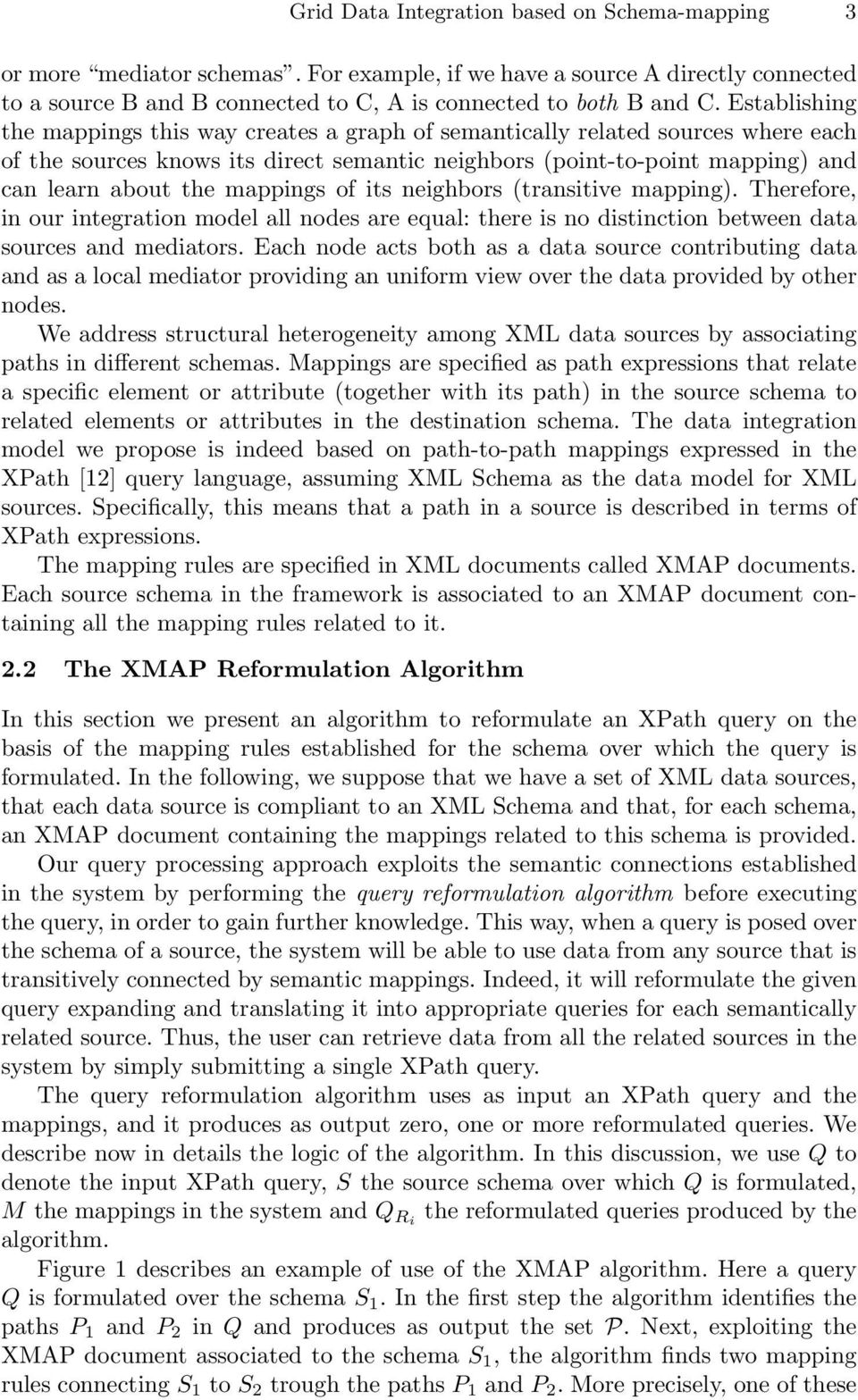
4 4 Comito, C., and Talia, D. Q=/Artist[style="Cubism"]/artefact/title /Artist[style="Cubism"] /artefact/title 1 5 Q R 1 =/Info/kind/Painter[School="Cubism"]/Painting/Title Q =/Info/kind/Sculptor[style="Cubism"]/artefact R 2 P P 1 =/Artist/style P 2 =/Artist/artefact/title 2 S 1 Artist id style Name artefact title category XMAP S 2 Info code first-name last-name kind Painter School Painting Title Sculptor artefact Style 3 4 destination set P * =/Info/kind/Painter/School, * 1,2 S 2 /Info/kind/Sculptor/Style P * 2,2=/Info/kind/Painter/Painting/Title, /Info/kind/Sculptor/artefact candidate set P 1,2=/Info/kind/Painter/School, S 2 /Info/kind/Sculptor/Style P 2,2=/Info/kind/Painter/Painting/Title, /Info/kind/Sculptor/artefact Fig. 1. Example of use of the XMAP algorithm. rules relates P1 to two paths in S 2, respectively /Info/kind/Painter/School and /Info/Kind/Sculptor/Artefact. Similarly, the other mapping rules relates P 2 to /Info/Kind/Painter/Painting/Title and /Info/Kind/Sculptor/artefact. So, the second step of the algorithm produces as output a candidate set composed of the elements P i,j and the (candidate) schema S 2. In the considered example as the schema S 2 has correspondences for both paths P 1 and P 2, it is identified as a destination schema, so it can be used to reformulate the query Q. In particular, the algorithm produces two reformulations of the query Q over the schema S 2, respectively Q R1 and Q R2. 3 The Grid Data Integration System (GDIS) The XMAP reformulation algorithm has been deployed and used in the Grid Data Integration System (GDIS). GDIS is a decentralized service-based data integration architecture for Grid databases; it has been extensively described in [13]. The GDIS system offers a wrapper/mediator-based approach to integrate data sources: it adopts the XMAP decentralized mediator approach to handle semantic heterogeneity over data sources, whereas syntactic heterogeneity is hidden behind ad-hoc wrappers. In the GDIS architecture (see [13]), the query reformulation engine is run by the data integration nodes. Specifically, these nodes offer: (i) a set of data integration utilities allowing to establish mappings, and (ii) the query reformulation algorithm introduced by the XMAP integration formalism. These utilities are exposed through the porttypes of the proposed OGSA-GDI data integration service.

5 Grid Data Integration based on Schema-mapping 5 GDIS is designed as a service-based distributed architecture where each node exposes data resources and data integration facility as Grid Data Services (GDSs) [14]. In so doing, the GDIS system introduces the OGSA-based Grid Data Integration (GDI) service that extends OGSA-DAI and OGSA-DQP porttypes with additional functionality both to enable users to specify semantic mappings (in the form of XMAP documents) among a set of data sources, and to execute the XMAP query rewriting algorithm. Among the porttypes introduced by GDI the most important is the Query Reformulation Algorithm (QRA) porttype, that performs the XMAP query reformulation algorithm and receives as input a query and the schema mappings and produces as output a set of reformulated queries. The reformulated queries will be forwarded to the Grid Data Service porttype offered by the OGSA-DQP distributed query service (GDQS). References 1. Sheth, A.P., Larson, J.A.: Federated database systems for managing distributed, heterogeneous, and autonomous databases. ACM Computing Surveys 22 (1990) Levy, A.Y., Rajaraman, A., Ordille, J.J.: Querying heterogeneous information sources using source descriptions. In: VLDB. (1996) Calvanese, D., Damaggio, E., Giacomo, G.D., Lenzerini, M., Rosati, R.: Semantic data integration in P2P systems. In: DBISP2P. (2003) Halevy, A.Y., Suciu, D., Tatarinov, I., Ives, Z.G.: Schema mediation in peer data management systems. In: ICDE. (2003) Antonioletti, M., et al.: OGSA-DAI: Two years on. In: Global Grid Forum 10 Data Area Workshop. (2004) 6. Alpdemir, M.N., Mukherjee, A., Gounaris, A., Paton, N.W., Watson, P., Fernandes, A.A.A., Fitzgerald, D.J.: OGSA-DQP: A service for distributed querying on the grid. In: EDBT. (2004) Calvanese, D., Giacomo, G.D., Lenzerini, M., Rosati, R., Vetere, G.: Hyper: A framework for peer-to-peer data integration on grids. In: ICSNW. (2004) Brezany, P., Woehrer, A., Tjoa, A.M.: Novel mediator architectures for grid information systems. FGCS - Grid Computing: Theory, Methods and Applications. 21 (2005) Foster, I., Kesselman, C., Nick, J.M., Tuecke, S.: The physiology of the grid: An open grid services architecture for distributed systems integration. Open Grid Service Infrastructure WG, Global Grid Forum (2002) Sandholm, T., Gawor, J.: Globus toolkit 3 core A grid service container framework. Globus Toolkit Core White Paper (2003) Comito, C., Talia, D.: XML data integration in OGSA grids. In: Proceedings of the First VLDB Workshop on Data Management in Grids, LNCS (2005) 12. Clark, J., DeRose, S.: XML path language (XPath) version 1.0. W3C Recommendation (1999) Comito, C., Talia, D.: GDIS: A service-based architecture for data integration on grids. In: GADA. (2004) Foster, I., Tuecke, S., Unger, J.: OGSA data services. DAIS-WG Informational Draft, 9th Global Grid Forum (2003)
XML Data Integration in OGSA Grids
 XML Data Integration in OGSA Grids Carmela Comito and Domenico Talia University of Calabria Italy [email protected] Outline Introduction Data Integration and Grids The XMAP Data Integration Framework
INTEGRATION OF XML DATA IN PEER-TO-PEER E-COMMERCE APPLICATIONS
 INTEGRATION OF XML DATA IN PEER-TO-PEER E-COMMERCE APPLICATIONS Tadeusz Pankowski 1,2 1 Institute of Control and Information Engineering Poznan University of Technology Pl. M.S.-Curie 5, 60-965 Poznan
GENERIC DATA ACCESS AND INTEGRATION SERVICE FOR DISTRIBUTED COMPUTING ENVIRONMENT
 GENERIC DATA ACCESS AND INTEGRATION SERVICE FOR DISTRIBUTED COMPUTING ENVIRONMENT Hemant Mehta 1, Priyesh Kanungo 2 and Manohar Chandwani 3 1 School of Computer Science, Devi Ahilya University, Indore,
KNOWLEDGE GRID An Architecture for Distributed Knowledge Discovery
 KNOWLEDGE GRID An Architecture for Distributed Knowledge Discovery Mario Cannataro 1 and Domenico Talia 2 1 ICAR-CNR 2 DEIS Via P. Bucci, Cubo 41-C University of Calabria 87036 Rende (CS) Via P. Bucci,
2. Create (if required) 3. Register. 4.Get policy files for policy enforced by the container or middleware eg: Gridmap file
 Policy Management for OGSA Applications as Grid Services (Work in Progress) Lavanya Ramakrishnan MCNC-RDI Research and Development Institute 3021 Cornwallis Road, P.O. Box 13910, Research Triangle Park,
Integrating XML Data Sources using RDF/S Schemas: The ICS-FORTH Semantic Web Integration Middleware (SWIM)
 Integrating XML Data Sources using RDF/S Schemas: The ICS-FORTH Semantic Web Integration Middleware (SWIM) Extended Abstract Ioanna Koffina 1, Giorgos Serfiotis 1, Vassilis Christophides 1, Val Tannen
Query Answering in Peer-to-Peer Data Exchange Systems
 Query Answering in Peer-to-Peer Data Exchange Systems Leopoldo Bertossi and Loreto Bravo Carleton University, School of Computer Science, Ottawa, Canada {bertossi,lbravo}@scs.carleton.ca Abstract. The
Using Ontologies to Enhance Data Management in Distributed Environments
 Using Ontologies to Enhance Data Management in Distributed Environments Carlos Eduardo Pires 1, Damires Souza 2, Bernadette Lóscio 3, Rosalie Belian 4, Patricia Tedesco 3 and Ana Carolina Salgado 3 1 Federal
Peer Data Management Systems Concepts and Approaches
 Peer Data Management Systems Concepts and Approaches Armin Roth HPI, Potsdam, Germany Nov. 10, 2010 Armin Roth (HPI, Potsdam, Germany) Peer Data Management Systems Nov. 10, 2010 1 / 28 Agenda 1 Large-scale
A View Integration Approach to Dynamic Composition of Web Services
 A View Integration Approach to Dynamic Composition of Web Services Snehal Thakkar, Craig A. Knoblock, and José Luis Ambite University of Southern California/ Information Sciences Institute 4676 Admiralty
A Survey Study on Monitoring Service for Grid
 A Survey Study on Monitoring Service for Grid Erkang You [email protected] ABSTRACT Grid is a distributed system that integrates heterogeneous systems into a single transparent computer, aiming to provide
Web Service Based Data Management for Grid Applications
 Web Service Based Data Management for Grid Applications T. Boehm Zuse-Institute Berlin (ZIB), Berlin, Germany Abstract Web Services play an important role in providing an interface between end user applications
Collaborative & Integrated Network & Systems Management: Management Using Grid Technologies
 2011 International Conference on Computer Communication and Management Proc.of CSIT vol.5 (2011) (2011) IACSIT Press, Singapore Collaborative & Integrated Network & Systems Management: Management Using
A View Integration Approach to Dynamic Composition of Web Services
 A View Integration Approach to Dynamic Composition of Web Services Snehal Thakkar University of Southern California/ Information Sciences Institute 4676 Admiralty Way, Marina Del Rey, California 90292
Grid-based Distributed Data Mining Systems, Algorithms and Services
 Grid-based Distributed Data Mining Systems, Algorithms and Services Domenico Talia Abstract Distribution of data and computation allows for solving larger problems and execute applications that are distributed
GRIDB: A SCALABLE DISTRIBUTED DATABASE SHARING SYSTEM FOR GRID ENVIRONMENTS *
 GRIDB: A SCALABLE DISTRIBUTED DATABASE SHARING SYSTEM FOR GRID ENVIRONMENTS * Maha Abdallah Lynda Temal LIP6, Paris 6 University 8, rue du Capitaine Scott 75015 Paris, France [abdallah, temal]@poleia.lip6.fr
Accessing XML Documents using Semantic Meta Data in a P2P Environment
 Accessing XML Documents using Semantic Meta Data in a P2P Environment Dominic Battré and Felix Heine and AndréHöing University of Paderborn Paderborn Center for Parallel Computing Fürstenallee 11, 33102
Grid Technology and Information Management for Command and Control
 Grid Technology and Information Management for Command and Control Dr. Scott E. Spetka Dr. George O. Ramseyer* Dr. Richard W. Linderman* ITT Industries Advanced Engineering and Sciences SUNY Institute
Cloud Computing and Software Agents: Towards Cloud Intelligent Services
 Cloud Computing and Software Agents: Towards Cloud Intelligent Services Domenico Talia ICAR-CNR & University of Calabria Rende, Italy [email protected] Abstract Cloud computing systems provide large-scale
GSiB: PSE Infrastructure for Dynamic Service-oriented Grid Applications
 GSiB: PSE Infrastructure for Dynamic Service-oriented Grid Applications Yan Huang Department of Computer Science Cardiff University PO Box 916 Cardiff CF24 3XF United Kingdom [email protected]
MapCenter: An Open Grid Status Visualization Tool
 MapCenter: An Open Grid Status Visualization Tool Franck Bonnassieux Robert Harakaly Pascale Primet UREC CNRS UREC CNRS RESO INRIA ENS Lyon, France ENS Lyon, France ENS Lyon, France [email protected]
Constraint-based Query Distribution Framework for an Integrated Global Schema
 Constraint-based Query Distribution Framework for an Integrated Global Schema Ahmad Kamran Malik 1, Muhammad Abdul Qadir 1, Nadeem Iftikhar 2, and Muhammad Usman 3 1 Muhammad Ali Jinnah University, Islamabad,
Interacting the Edutella/JXTA Peer-to-Peer Network with Web Services
 Interacting the Edutella/JXTA Peer-to-Peer Network with Web Services Changtao Qu Learning Lab Lower Saxony University of Hannover Expo Plaza 1, D-30539, Hannover, Germany qu @learninglab.de Wolfgang Nejdl
Classic Grid Architecture
 Peer-to to-peer Grids Classic Grid Architecture Resources Database Database Netsolve Collaboration Composition Content Access Computing Security Middle Tier Brokers Service Providers Middle Tier becomes
Integration of Distributed Healthcare Records: Publishing Legacy Data as XML Documents Compliant with CEN/TC251 ENV13606
 Integration of Distributed Healthcare Records: Publishing Legacy Data as XML Documents Compliant with CEN/TC251 ENV13606 J.A. Maldonado, M. Robles, P. Crespo Bioengineering, Electronics and Telemedicine
OWL based XML Data Integration
 OWL based XML Data Integration Manjula Shenoy K Manipal University CSE MIT Manipal, India K.C.Shet, PhD. N.I.T.K. CSE, Suratkal Karnataka, India U. Dinesh Acharya, PhD. ManipalUniversity CSE MIT, Manipal,
Data Integration using Agent based Mediator-Wrapper Architecture. Tutorial Report For Agent Based Software Engineering (SENG 609.
 Data Integration using Agent based Mediator-Wrapper Architecture Tutorial Report For Agent Based Software Engineering (SENG 609.22) Presented by: George Shi Course Instructor: Dr. Behrouz H. Far December
Schema mapping and query reformulation in peer-to-peer XML data integration system
 Control and Cybernetics vol. 38 (2009) No. 1 Schema mapping and query reformulation in peer-to-peer XML data integration system by Tadeusz Pankowski Institute of Control and Information Engineering Poznań
Using Peer to Peer Dynamic Querying in Grid Information Services
 Using Peer to Peer Dynamic Querying in Grid Information Services Domenico Talia and Paolo Trunfio DEIS University of Calabria HPC 2008 July 2, 2008 Cetraro, Italy Using P2P for Large scale Grid Information
Resource Management on Computational Grids
 Univeristà Ca Foscari, Venezia http://www.dsi.unive.it Resource Management on Computational Grids Paolo Palmerini Dottorato di ricerca di Informatica (anno I, ciclo II) email: [email protected] 1/29
Writing Grid Service Using GT3 Core. Dec, 2003. Abstract
 Writing Grid Service Using GT3 Core Dec, 2003 Long Wang [email protected] Department of Electrical & Computer Engineering The University of Texas at Austin James C. Browne [email protected] Department
Data Grids. Lidan Wang April 5, 2007
 Data Grids Lidan Wang April 5, 2007 Outline Data-intensive applications Challenges in data access, integration and management in Grid setting Grid services for these data-intensive application Architectural
Data Integration Hub for a Hybrid Paper Search
 Data Integration Hub for a Hybrid Paper Search Jungkee Kim 1,2, Geoffrey Fox 2, and Seong-Joon Yoo 3 1 Department of Computer Science, Florida State University, Tallahassee FL 32306, U.S.A., [email protected],
FIPA agent based network distributed control system
 FIPA agent based network distributed control system V.Gyurjyan, D. Abbott, G. Heyes, E. Jastrzembski, C. Timmer, E. Wolin TJNAF, Newport News, VA 23606, USA A control system with the capabilities to combine
Integrating Heterogeneous Data Sources Using XML
 Integrating Heterogeneous Data Sources Using XML 1 Yogesh R.Rochlani, 2 Prof. A.R. Itkikar 1 Department of Computer Science & Engineering Sipna COET, SGBAU, Amravati (MH), India 2 Department of Computer
Load Balancing in Peer-to-Peer Data Networks
 Load Balancing in Peer-to-Peer Data Networks David Novák Masaryk University, Brno, Czech Republic [email protected] Abstract. One of the issues considered in all Peer-to-Peer Data Networks, or Structured
Lightweight Data Integration using the WebComposition Data Grid Service
 Lightweight Data Integration using the WebComposition Data Grid Service Ralph Sommermeier 1, Andreas Heil 2, Martin Gaedke 1 1 Chemnitz University of Technology, Faculty of Computer Science, Distributed
Digital libraries of the future and the role of libraries
 Digital libraries of the future and the role of libraries Donatella Castelli ISTI-CNR, Pisa, Italy Abstract Purpose: To introduce the digital libraries of the future, their enabling technologies and their
XOP: Sharing XML Data Objects through Peer-to-Peer Networks
 22nd International Conference on Advanced Information Networking and Applications XOP: Sharing XML Data Objects through Peer-to-Peer Networks Itamar de Rezende, Frank Siqueira Department of Informatics
Principles of Distributed Database Systems
 M. Tamer Özsu Patrick Valduriez Principles of Distributed Database Systems Third Edition
Big Data Analytics. Rasoul Karimi
 Big Data Analytics Rasoul Karimi Information Systems and Machine Learning Lab (ISMLL) Institute of Computer Science University of Hildesheim, Germany Big Data Analytics Big Data Analytics 1 / 1 Introduction
Techniques to Produce Good Web Service Compositions in The Semantic Grid
 Techniques to Produce Good Web Service Compositions in The Semantic Grid Eduardo Blanco Universidad Simón Bolívar, Departamento de Computación y Tecnología de la Información, Apartado 89000, Caracas 1080-A,
Grid Security : Authentication and Authorization
 Grid Security : Authentication and Authorization IFIP Workshop 2/7/05 Jong Kim Dept. of Computer Sci. and Eng. Pohang Univ. of Sci. and Tech. (POSTECH) Contents Grid Security Grid Security Challenges Grid
OGSA-DQP: A Service-Based Distributed Query Processor for the Grid
 OSA-DQP: A Service-Based Distributed Query Processor for the rid M. Nedim Alpdemir 1, Arijit Mukherjee 2, Anastasios ounaris 1, Norman W.Paton 1, Paul Watson 2, Alvaro A.A. Fernandes 1, Jim Smith 2 (1)
A P2P SERVICE DISCOVERY STRATEGY BASED ON CONTENT
 A P2P SERVICE DISCOVERY STRATEGY BASED ON CONTENT CATALOGUES Lican Huang Institute of Network & Distributed Computing, Zhejiang Sci-Tech University, No.5, St.2, Xiasha Higher Education Zone, Hangzhou,
P ERFORMANCE M ONITORING AND A NALYSIS S ERVICES - S TABLE S OFTWARE
 P ERFORMANCE M ONITORING AND A NALYSIS S ERVICES - S TABLE S OFTWARE WP3 Document Filename: Work package: Partner(s): Lead Partner: v1.0-.doc WP3 UIBK, CYFRONET, FIRST UIBK Document classification: PUBLIC
A Semantic Approach for Access Control in Web Services
 A Semantic Approach for Access Control in Web Services M. I. Yagüe, J. Mª Troya Computer Science Department, University of Málaga, Málaga, Spain {yague, troya}@lcc.uma.es Abstract One of the most important
Grid based Integration of Real-Time Value-at-Risk (VaR) Services. Abstract
 Grid based Integration of Real-Time Value-at-Risk (VaR) s Paul Donachy Daniel Stødle Terrence J harmer Ron H Perrott Belfast e-science Centre www.qub.ac.uk/escience Brian Conlon Gavan Corr First Derivatives
Semantic Interoperability for Data Integration Framework using Semantic Web Services and Rule-based Inference: A case study in healthcare domain
 Semantic Interoperability for Data Integration Framework using Semantic Web Services and Rule-based Inference: 1 Suphachoke Sonsilphong, 2 Ngamnij Arch-int Semantic Mining Information Integration Laboratory
On Rewriting and Answering Queries in OBDA Systems for Big Data (Short Paper)
 On Rewriting and Answering ueries in OBDA Systems for Big Data (Short Paper) Diego Calvanese 2, Ian Horrocks 3, Ernesto Jimenez-Ruiz 3, Evgeny Kharlamov 3, Michael Meier 1 Mariano Rodriguez-Muro 2, Dmitriy
Modern Databases. Database Systems Lecture 18 Natasha Alechina
 Modern Databases Database Systems Lecture 18 Natasha Alechina In This Lecture Distributed DBs Web-based DBs Object Oriented DBs Semistructured Data and XML Multimedia DBs For more information Connolly
Deferred node-copying scheme for XQuery processors
 Deferred node-copying scheme for XQuery processors Jan Kurš and Jan Vraný Software Engineering Group, FIT ČVUT, Kolejn 550/2, 160 00, Prague, Czech Republic [email protected], [email protected] Abstract.