
National Rehabilitation Reporting System
|
|
|
- Alison Day
- 10 years ago
- Views:
Transcription
1 National Rehabilitation Reporting System Privacy Impact Assessment

2 The contents of this publication may be reproduced in whole or in part, provided the intended use is for non-commercial purposes and full acknowledgement is given to the Canadian Institute for Health Information. Canadian Institute for Health Information 495 Richmond Road, Suite 600 Ottawa, Ontario K2A 4H6 Phone: Fax: Canadian Institute for Health Information
3
4

5 Table of Contents National Rehabilitation Reporting System Privacy Impact Assessment Executive Summary... iii 1 Introduction PIA Objectives and Scope NRS Background and Context Background Description of the NRS The Current and Intended Scope of the NRS Types of Organizations Population Scope Nature of Information Collected Architecture and Data Flows for the NRS NRS Overview Diagram Description of NRS Data NRS Data Accessible to Users External to CIHI NRS Data Accessible to Internal CIHI Users Authorities Governing the NRS General NRS eservices User Agreement Privacy Analysis Principle 1: Accountability for Personal Health Information Principle 2: Identifying Purposes for Personal Health Information Principle 3: Consent for the Collection, Use or Disclosure of Personal Health Information Principle 4: Limiting Collection of Personal Health Information Principle 5: Limiting Use, Disclosure and Retention of Personal Health Information Limiting Use Reporting and Return of Own Data to Data Providers Data Made Available to the Public Limiting Disclosure Third-Party Data Requests Retention of NRS Information Principle 6: Accuracy of Personal Health Information Principle 7: Safeguards for Personal Health Information Principle 8: Openness About the Management of Personal Health Information... 15

6 3.9 Principle 9: Individual Access to, and Amendment of, Personal Health Information Principle 10: Complaints About CIHI s Handling of Personal Health Information Conclusion Appendix 1 Listing of NRS Data Elements Appendix 2 Glossary of Terms ii

7 Executive Summary This privacy impact assessment (PIA) examines the privacy, confidentiality and security risks associated with the National Rehabilitation Reporting System (NRS). The NRS collects information from Canadian hospitals on inpatient physical rehabilitation patients to support decision-making and planning of inpatient rehabilitation services. The NRS also provides national comparative reporting and identifies clinical and administrative gaps in rehabilitation information. The NRS reports on patients receiving inpatient rehabilitation for a range of conditions, including orthopedic trauma or surgery, stroke and spinal cord dysfunction. The NRS records patient impairments, activity limitations and/or participation restrictions in data elements, including patient identifiers (never including names) and socio-demographic, administrative and health characteristics. In addition, the NRS includes information on patient activities and participation, measured using a proprietary tool called the FIM instrument, i to assess functional independence. The NRS data and reports are provided to participating facilities, regional health authorities and ministries of health. CIHI also provides data to researchers under controlled circumstances and published reports for public consumption. A review of the 10 privacy principles set out in the Canadian Standard Association s Model Code for the Protection of Personal Information as they apply to the NRS concludes that the mitigation measures currently in place for any identified risks are such that CIHI and its data providers are prepared to accept and manage any remaining risks. i. The 18-item FIM instrument is the property of Uniform Data System for Medical Rehabilitation, a division of UB Foundation Activities, Inc. CIHI 2009 iii
8

9 1 Introduction The Canadian Institute for Health Information (CIHI) collects and analyzes information on health and health care in Canada. Its goal is to provide timely, accurate and comparable information to inform health policies, support the effective delivery of health services and raise awareness among Canadians of the factors that contribute to good health. CIHI obtains data directly from organizations such as hospitals, regional health authorities and ministries of health, including personal health information about recipients of health services, registration and practice information about health professionals and health facility information. Hospital-based inpatient rehabilitation is an important component in the continuum of health services in Canada. Health professionals such as nurses, physiotherapists, occupational therapists and physicians specializing in physical medicine and rehabilitation assist patients in maximizing their physical and cognitive function through training and education, and prepare them to return to the community following illness or injury. The NRS was developed to support data collection by hospitals for adult rehabilitation patients who receive these inpatient services in hospitals. Patients reported in the NRS include only those with a primary health condition that is physical or cognitive in nature. The term rehabilitation in the context of NRS reporting does not include rehabilitation services provided for a mental health condition or for drug or alcohol addiction. CIHI works with participating hospitals to facilitate the submission of standardized data. This ensures high-quality data to support decision-making and planning of inpatient rehabilitation services, and provides for national comparative reporting for quality-improvement purposes. At the same time, clinical and administrative gaps in rehabilitation information can be identified and evaluated. CIHI s Privacy and Legal Services, headed by the chief privacy officer and general counsel, working with the NRS program manager, engages in appropriate risk management and escalates any issues of concern to the Privacy, Confidentiality and Security team and/or the senior management team, the members of which represent key positions throughout the organization with experience in data management, privacy and security. No privacy risks were identified in this assessment. 1.1 PIA Objectives and Scope The purpose of this privacy impact assessment is to examine the privacy, confidentiality and security risks associated with the NRS. It includes a review of the 10 privacy principles set out in the Canadian Standards Association s Model Code of the Protection of Personal Information as they apply to the NRS. This PIA also includes a summary of potential privacy risks that have been identified, along with any measures put in place to avoid or mitigate those risks. CIHI
10 2 NRS Background and Context 2.1 Background CIHI has been promoting health information standards for hospital-based inpatient rehabilitation services since 1995, when the organization initiated a national pilot study to develop and evaluate indicators, a minimum data set and a related case mix grouping methodology. The CIHI pilot study, involving more than 2,000 adult rehabilitation patients, collected information on the characteristics and effectiveness of rehabilitation services in six provinces. Based on the positive results of the pilot, in 1998 the National Rehabilitation Advisory Group (NRAG) recommended that this data set be used to develop a national reporting system for inpatient rehabilitation services. The NRS was first implemented as a national prototype reporting system for inpatient rehabilitation services in April The development of the NRS was a component of the Health Information Roadmap Initiative, a collaborative effort among CIHI, Statistics Canada, Health Canada, provincial and territorial health departments and many others. In February 2001, CIHI began producing NRS comparative reports for facilities, focusing on key indicators such as the following: Average Admission/Discharge Function Scores; Average Length of Stay by Rehabilitation Client Group; and Average Days Waiting for Admission/Discharge to/from Rehabilitation. In addition, since its inception, the NRS has added a new case mix grouping methodology and includes indicators related to this methodology in its reports. As well, reports were initially printed and couriered to all facilities, but with the advent of electronic reporting at CIHI, NRS reports have been produced and made available to participating facilities through a secure ereporting portal (described in Section 2.4). 2.2 Description of the NRS The purpose of the NRS is to: Collect, process and analyze data on adult inpatient rehabilitation services; Support management decision-making at the facility, regional and provincial/territorial levels; Facilitate provincial/territorial and national comparative reporting; Support analysis and research; and Support CIHI s mandate to provide Canadians with essential statistics and analyses about their health and the health care system. 2 CIHI 2009
11 2.3 The Current and Intended Scope of the NRS The scope of the NRS can be described in terms of the following: The types of organizations that capture and submit data; The populations whose data are captured in the reporting system; and The nature of the information that is collected on those populations Types of Organizations All facilities participating in the NRS provide hospital-based inpatient rehabilitation services. These services may be provided in large, free-standing rehabilitation hospitals or within rehabilitation units of larger acute care hospitals. Participant facilities in the NRS are selfclassified as either general or specialty facilities. This classification is specific to the NRS and is intended to facilitate comparative reporting; it is not necessarily consistent with facility classification methods used in various provinces or regions. According to the NRS definitions, a general rehabilitation facility is a rehabilitation unit or collection of beds designated for rehabilitation purposes that is part of a general hospital offering multiple levels or types of care. A specialty rehabilitation facility is one that may provide more extensive and specialized inpatient rehabilitation services and is commonly a free-standing facility or a specialized unit within a hospital. The rehabilitation team at the facility decides which profile most closely represents its rehabilitation program(s) and categorizes itself as general or specialty when beginning submissions to the NRS Population Scope The NRS is designed to accept data on all individuals age 13 and older who have been admitted to the types of facilities described in At this time, the NRS data set is primarily targeted for adult patients (age 18 and older) Nature of Information Collected The NRS indicators and reports provide a source of information for defining and describing functional outcomes for individuals who have received rehabilitation services. For greater comparability, this information is grouped according to the nature of the illness or injury. Patient groups include those with impairments, activity limitations and/or participation restrictions associated with various types of conditions, referred to as Rehabilitation Client Groups (RCGs): Stroke Orthopedic Conditions Brain Dysfunction Cardiac Conditions Neurological Conditions Pulmonary Conditions Spinal Cord Dysfunction Burns Amputation of Limb Congenital Deformities Arthritis Other Disabling Impairments Pain Syndromes Major Multiple Trauma Developmental Disabilities Debility Medically Complex The two most commonly seen RCGs are orthopedic conditions and stroke. These two groups represent approximately two-thirds of all records. CIHI

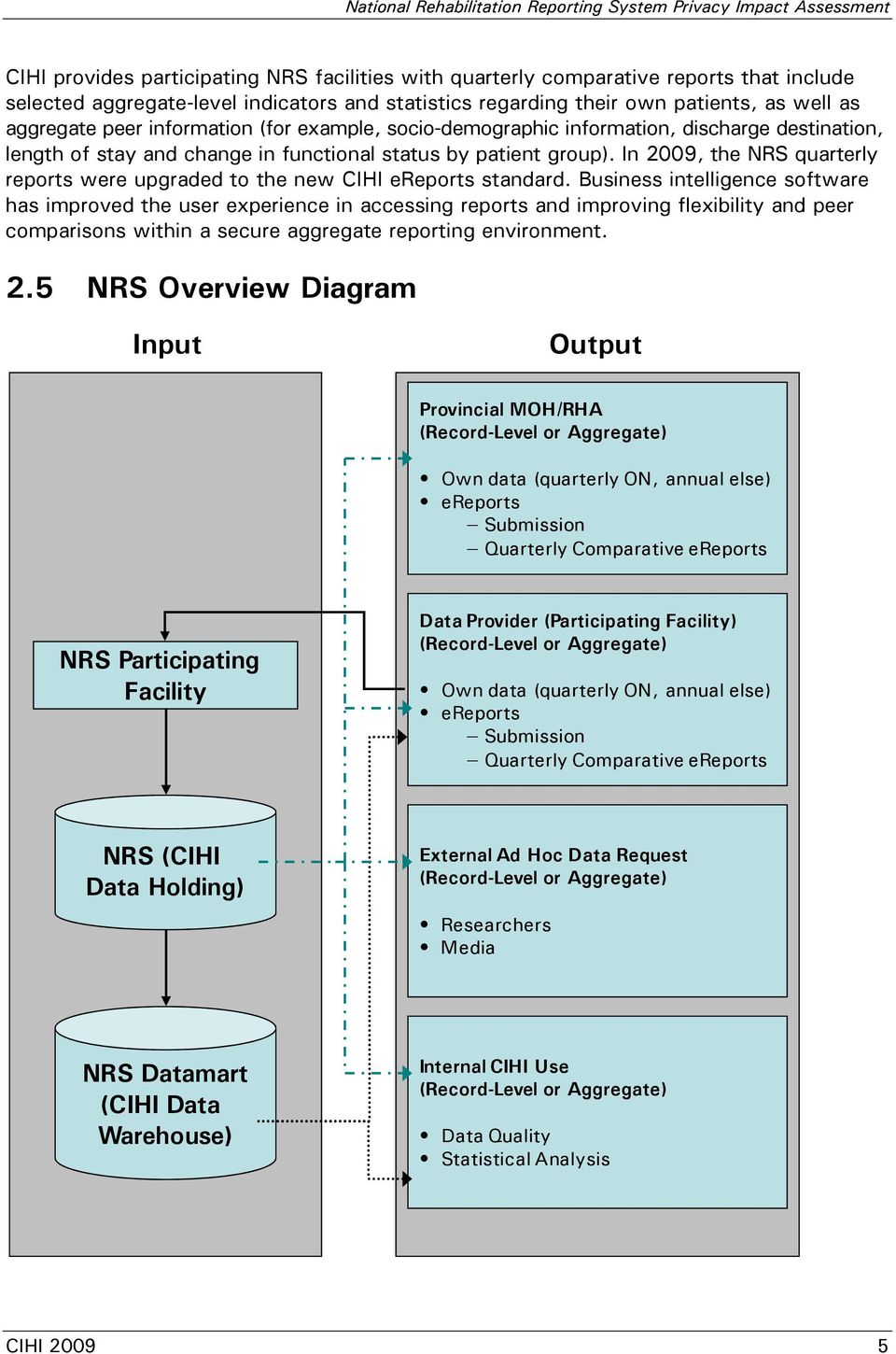
12 Most patients admitted to facilities participating in the NRS (over 90%) are admitted from acute care units at the same hospital or in another hospital. As of May 2009, there were over 467,000 records in the NRS database at CIHI, with over 220,000 complete sets of admission and discharge records (that is, episodes of care) submitted by 113 hospitals in nine provinces. No data is submitted currently from Quebec, the Northwest Territories, Nunavut or the Yukon. Submission of inpatient rehabilitation data to the NRS is primarily voluntary in all provinces, except Ontario. In October 2002, the Ontario Ministry of Health and Long-Term Care mandated that all facilities with designated inpatient rehabilitation beds submit NRS data to CIHI for all admissions to those beds. As a result, just under three-quarters of the hospitals currently submitting data are from Ontario. 2.4 Architecture and Data Flows for the NRS CIHI is a secondary data collector of inpatient rehabilitation information the NRS relies on the submission of data collected by organizations responsible for providing publicly funded inpatient rehabilitation services in Canada, including provincial and territorial ministries of health, regional health authorities and individual inpatient rehabilitation facilities. The data submitted is, for the most part, required by the organizations themselves in order to do their business: to plan, conduct and manage the delivery of inpatient rehabilitation services. The NRS is a relational database. Data is stored in separate tables and linked through unique identifiers. An overview diagram of the inputs and outputs of the NRS is included in Section 2.5. CIHI has implemented a technical solution that supports data submission, data processing and management, and reporting requirements. The NRS: Captures patient-specific data for individuals across inpatient rehabilitation programs and episodes of care over time; Provides feedback to data providers on data quality and facilitates error corrections; and Generates data files and management and analytic reports for data providers and other authorized stakeholders (for example, ministries of health, researchers). Data is submitted electronically to CIHI through a secure web application. Data specifications and other associated documentation, such as file layouts, are supplied to data providers in electronic format. All submissions to CIHI must conform to its submission and edit specifications. Vendors that have developed data collection software for data providers must also be licensed with CIHI in order to receive these specifications and must successfully submit test data to CIHI prior to the submission of live data using their products. Privacy management for the vendors who may have access to personal health information is the responsibility of the data provider, in compliance with any applicable privacy laws in the respective jurisdiction. Facilities submit NRS data directly to CIHI using vendor software. The data-flows into and out of NRS are set out in the overview diagram in Section CIHI 2009

13 CIHI provides participating NRS facilities with quarterly comparative reports that include selected aggregate-level indicators and statistics regarding their own patients, as well as aggregate peer information (for example, socio-demographic information, discharge destination, length of stay and change in functional status by patient group). In 2009, the NRS quarterly reports were upgraded to the new CIHI ereports standard. Business intelligence software has improved the user experience in accessing reports and improving flexibility and peer comparisons within a secure aggregate reporting environment. 2.5 NRS Overview Diagram Input Output Provincial MOH/RHA (Record-Level or Aggregate) Own data (quarterly ON, annual else) ereports Submission Quarterly Comparative ereports NRS Participating Facility Data Provider (Participating Facility) (Record-Level or Aggregate) Own data (quarterly ON, annual else) ereports Submission Quarterly Comparative ereports NRS (CIHI Data Holding) External Ad Hoc Data Request (Record-Level or Aggregate) Researchers Media NRS Datamart (CIHI Data Warehouse) Internal CIHI Use (Record-Level or Aggregate) Data Quality Statistical Analysis CIHI
14 2.6 Description of NRS Data The NRS data set consists of data elements grouped into the following major categories: Patient Identifiers: These are data elements used to identify individual records. Patient names are never collected for the NRS database. Socio-Demographics: Information such as full date of birth, sex, living arrangements and vocational status are collected to provide valuable information on the types of patients admitted to rehabilitation programs. Administrative: Data is collected on wait times for admission and discharge, service interruptions and provider types in order to better understand accessibility to rehabilitation, factors influencing length of stay and resource utilization. Health Characteristics: Diagnoses and related comorbidities at admission provide information on conditions most often seen in a rehabilitation setting and conditions that may affect a patient s ability to progress in the rehabilitation program. Activities and Participation: This is the largest section of the data set and provides clinical data on the motor and cognitive functional abilities of rehabilitation patients. The data is collected using the 18-item FIM instrument, and six additional cognitive data elements developed at CIHI. Together, these provide further information on the cognitive abilities of rehabilitation patients. Within the Activities and Participation category, the NRS data set contains clinical data on functional status based on the 18-item FIM instrument. The FIM instrument is used to measure outcomes of functional independence at admission and discharge, and optionally on follow-up after discharge. It is composed of 18 items (13 motor items and 5 cognitive items) that are rated on a seven-level scale representing gradations from independent (7) to dependent (1) function, for an overall maximum score of 126 (18 items x 7). The FIM instrument measures disability and looks at the caregiver burden associated with the level of disability. The overall FIM instrument score can be broken down into motor and cognitive subscales to provide further detail on identifying areas of functional loss. In addition to the data collected using the FIM instrument, additional cognitive elements and elements assessing instrumental activities of daily living and health status, sociodemographic, administrative and health characteristics information are also collected for each rehabilitation patient. A full list of data elements included in the NRS can be found in Appendix NRS Data Accessible to Users External to CIHI The NRS data is a key source of information for inpatient rehabilitation facilities, ministries, researchers and the public. This information can be used for the following: Federal, provincial, territorial and regional accountability reporting of comparable health indicators of access, outcomes and service utilization; Inpatient rehabilitation program, facility and system-level strategic and operational management, benchmarking and quality improvement; and Clinical and policy research and analysis. 6 CIHI 2009

15 Beyond returning NRS data to providers and their associated provincial ministries of health in the form of key rehabilitation indicators in the NRS ereports, as well as record-level data files of provider or provincial data, NRS data is disclosed in a number of circumstances. CIHI provides the public with aggregate statistics and analysis based on NRS data. In addition, CIHI discloses de-identified record-level data for approved research purposes, subject to CIHI standard practices for avoiding residual disclosure and the requisite security mechanisms outlined in CIHI s third-party data request process. Personal health information is provided only in very limited circumstances, such as with the consent of the rehabilitation patients to whom the information relates. All such disclosures of information are subject to applicable laws, CIHI s privacy and confidentiality policies and any agreements between CIHI and the jurisdictions to disclose data. CIHI s Privacy Policy ii sets out its disclosure provisions. CIHI s general approach is to mask, aggregate and truncate information to a level that allows the recipients to conduct required and authorized research or analysis while protecting the confidentiality of individuals. 2.8 NRS Data Accessible to Internal CIHI Users Consistent with CIHI policy, internal CIHI users are only given access to NRS information that is necessary for their jobs, that is, on a need-to-know basis, including data processing and quality management; the production of statistics and data files; and conducting analyses. All authorized users are made aware of their obligations and responsibilities for privacy and confidentiality. All CIHI staff are required to sign a confidentiality agreement at the commencement of employment and are subsequently required to renew their commitment to privacy yearly. At CIHI, sensitive data elements such as the health card number are encrypted before the data set is used for analysis or report production. Health card numbers in an unencrypted form are only available in submission files to IT Operations staff when performing client support data-quality activities. CIHI staff who are authorized to use NRS data have different levels of access to the data ordinary or special depending on the nature of the work they are required to perform. Ordinary access relates to access to de-identified NRS data sets. De-identified means that the personal health information has been modified so that the identity of the individual cannot be determined by a reasonably foreseeable method. In some cases, a specific analysis may require CIHI analytical staff to have special, controlled access granted on a limited basis to use data elements as submitted by the provider organizations, including the unique patient identifier (for example, health card number). In these cases, an exception process to access the restricted health card number is followed, and includes approval by CIHI s Privacy, Confidentiality and Security team. ii. Privacy and Confidentiality of Health Information at CIHI: Principles and Procedures for the Protection of Health Information (November 2007) < Privacy_and_Confidentiality_of_Health_Information_at_CIHI_EN.pdf>. CIHI

16 2.9 Authorities Governing the NRS General CIHI adheres to its Principles and Policies for the Protection of Personal Health Information (updated November 2007, 3rd edition) and to any applicable privacy legislation and/or agreements. Legislation All provinces and territories have public-sector privacy legislation in place. Canadian privacy legislation includes provisions that authorize public bodies covered by the acts to disclose person-identifiable data, without the consent of the individual, for statistical purposes. Alberta, Saskatchewan, Manitoba and Ontario (legislation pending in Newfoundland and Labrador and New Brunswick) also have health information specific privacy legislation with express lawful authority to use and disclose personal health information, without individual consent, for purposes of management of the health system, including statistical analysis and reporting. Examples of such provisions include: The Personal Health Information Protection Act (PHIPA) of Ontario, whereby custodians can disclose personal health information to CIHI without patient consent pursuant to section 29 as permitted by section 45(1). CIHI is recognized as a prescribed entity under PHIPA: Requirement for consent S. 29. A health information custodian shall not collect, use or disclose personal health information about an individual unless, (a) it has the individual s consent under this Act and the collection, use or disclosure, as the case may be, to the best of the custodian s knowledge, is necessary for a lawful purpose; or (b) the collection, use or disclosure, as the case may be, is permitted or required by this Act. Disclosure for planning and management of health system S. 45(1) A health information custodian may disclose to a prescribed entity personal health information for the purpose of analysis or compiling statistical information with respect to the management of, evaluation or monitoring of, the allocation of resources to or planning for all or part of the health system, including the delivery of services, if the entity meets the requirements under subsection (3). The Personal Health Information Act (to be proclaimed) of Newfoundland and Labrador recognizes CIHI as a body to which a custodian may disclose personal health information without the consent of the individual who is the subject of the information: Disclosure for health related purposes S. 39. (1) A custodian may disclose personal health information without the consent of the individual who is the subject of the information [...] (h) to the Canadian Institute for Health Information or other entity prescribed in the regulations for the purpose of compiling and analyzing statistical information to assist in the management, evaluation and monitoring of the allocation of resources, health system planning and delivery of health care services in accordance with the terms of an agreement between the Canadian Institute for Health Information or other entity and the province; [...] 8 CIHI 2009

17 The Personal Health Information Privacy and Access Act (to be proclaimed) of New Brunswick also explicitly recognizes CIHI as a body to which a custodian may disclose personal information relating to an individual without the consent of the individual: Disclosure for health care programs or other programs 38(1) A custodian may disclose personal health information relating to an individual without the consent of the individual if the disclosure is [...] (h) to the Canadian Institute for Health Information or other entity prescribed by regulation for the purpose of compiling and analyzing statistical information to assist in the management, evaluation and monitoring of the allocation of resources, health system planning and delivery of health care services in accordance with the terms of an agreement between the Canadian Institute for Health Information or other entity and the Province, [...] Furthermore, CIHI is recognized as an information manager under both the Health Information Act of Alberta and the Personal Health Information Act of Manitoba. Agreements CIHI has in place the following types of agreements: Bilateral and data-sharing agreements between the provinces and territories and CIHI in support of data collection, and any subsequent data sharing with authorized users. Data-sharing and other types of agreements negotiated between other data providers and CIHI, which set out the purpose, use, disclosure and retention requirements, as well as any subsequent data sharing that may be permitted NRS eservices User Agreement CIHI requires an eservices user agreement with each participating facility in order to access NRS reports, including comparative reports, as well as reports used by facilities to monitor submissions and data quality. The agreement encompasses CIHI s and the facility s responsibilities in providing and managing user access to the reporting environment, and ensuring the privacy and confidentiality of the information in the reports including the facility s own data as well as data belonging to peer organizations. As well, the agreement details limitations on the use of the data. Previously, this required the signature of three separate agreements covering enrs access, privacy and confidentiality, and peer sharing. As part of the enhancement to the new ereporting environment in 2009, all NRS facilities are now required to sign a new, comprehensive eservices agreement. Only authorized and registered external users are able to access aggregate-level NRS reports via CIHI s restricted web-based applications for NRS. These applications are accessed via secure sessions encrypted according to industry standards. To become a registered user, the chief executive officer (or designate) of an organization must sign an eservices agreement that governs the use of the data and authorized individuals at the organization. This agreement stipulates, among other privacy requirements, that users must not attempt to identify any specific individual using the NRS information. User profiles are set up to limit access to the statistics and reports required for the person s job requirements. With each use of the application, the user must agree to the online privacy, confidentiality and security statement. CIHI

18 The eservices agreement limits NRS participant organizations rights to use and disclose confidential information, including personal health information and facility-identifiable information, obtained through CIHI ereports. Participating facilities are able to see chart numbers for patients at their own facilities on submission reports, for the purposes of correcting submission errors and resubmitting the data. No other personal health information is available in NRS ereports. Specifically, participant organizations and their users are permitted to use such data solely for internal, non-commercial, local/regional evidence-based decision-making, planning and analytical purposes. Confidential information cannot be disclosed to any third party, except as expressly permitted in the eservices agreement or as required by law. Specifically, publication or disclosure outside of the participant organization is permitted only where all reasonable attempts to prevent the identification of individuals are employed and there are no cell sizes with fewer than five units of observation. Facility-identifiable information cannot be released unless the written consent of each facility identified in the information has been obtained prior to release. Participants assume responsibility for ensuring that users of CIHI ereports within their organizations are aware of the terms and conditions of the eservices agreement. All users must review and agree to the terms and conditions outlined above each time they log in to the ereports system. Participant organizations agree to immediately notify CIHI of any unauthorized access or use or any other breach of confidentiality or security of which they become aware. In addition, the eservices agreement sets out the following specific requirements and responsibilities with respect to usernames and passwords: Each user must create a user profile (name, title and address), username and password on CIHI s website as instructed by CIHI. Participant organizations and their users are aware that usernames and passwords are confidential and not to be shared. Participant organizations are fully responsible for all activities that occur under their means of access. 10 CIHI 2009

19 3 Privacy Analysis 3.1 Principle 1: Accountability for Personal Health Information CIHI s president and chief executive officer is accountable for ensuring compliance with CIHI s Privacy Policy. CIHI has a chief privacy officer, a corporate privacy, confidentiality and security team, a privacy and data protection subcommittee of its board of directors and an external chief privacy advisor. The NRS participant organizations are subject to the requirements of data protection laws in their respective jurisdictions and the independent oversight of privacy commissioners or their equivalents. 3.2 Principle 2: Identifying Purposes for Personal Health Information CIHI has identified the purposes of the NRS. These have been recognized as being in the public interest. The purposes of the NRS are clearly stated on the CIHI website and in the NRS reports and bulletins, as well as in this privacy assessment. Facilities, ministries of health and regional health authorities participate in the NRS only after establishing that it is in their best interest, and the best interests of their inpatient rehabilitation patients, to do so. 3.3 Principle 3: Consent for the Collection, Use or Disclosure of Personal Health Information Data providers are responsible for meeting the statutory requirements in their respective jurisdictions, where applicable, at the time the data is initially collected. CIHI is a secondary user of personal health information, specifically for the planning and management of the health system and for research purposes. 3.4 Principle 4: Limiting Collection of Personal Health Information All data elements collected in the NRS are required for established purposes. Individual names (of patients and assessors) are stripped from the patient record at the source, and only key personal identifiers required to support authorized data quality and statistical analysis activities are submitted to CIHI, including health card number, full or partial postal code of patient residence, chart number, full date of birth and sex. CIHI

20 3.5 Principle 5: Limiting Use, Disclosure and Retention of Personal Health Information Limiting Use CIHI uses NRS data only for analyses and reporting, consistent with the identified purposes and CIHI s mandate and core functions. CIHI does not use personal health information for purposes other than those for which it was collected, except with the consent of the individual or as authorized or required by law. The uses of the NRS are in accordance with CIHI s policies and procedures and are subject to confidentiality/non-disclosure service agreements with NRS participating facilities, and any data-sharing agreements that CIHI may have with the data providers provincial ministries of health. Analysts within CIHI use information with identifiers (such as the health card number) scrambled and/or encrypted. As outlined in Section 2.8, original, unencrypted health card numbers as supplied by data providers are only used by IT Operations staff to perform limited data quality activities and provide client support. Where data linkage is required for analytical purposes, CIHI has policies and procedures in place to review and authorize such linkages. In the NRS, data is linked using a meaningless number assigned to a record instead of the health card number in order to prevent use of the health card number. In addition, CIHI allows only authorized staff to access and use all record-level NRS data on a need-to-know basis, that is, when required to perform their duties Reporting and Return of Own Data to Data Providers Where required, and as allowed under CIHI s Privacy Policy, CIHI provides data cuts (copies of the record-level data) back to the facilities providing the data and their respective provincial or territorial ministries of health upon request. Where authorized by law and the facility, this information may also be provided to regional health authorities. Such data cuts contain personal health information and are prepared, retained, released and/or archived securely according to CIHI s Privacy Policy. The NRS provides submitting organizations, whether they are facilities, regional health authorities or ministries of health, with reports on the outcome of their data submissions (Submission Reports), including details of records that contain errors in order for these organizations to investigate and, where necessary, correct and resubmit data. CIHI creates and discloses statistics and indicators based on submitted NRS data, in the form of electronic quarterly comparative reports (enrs or ereports), to registered clients: organizations that participate in the NRS, their respective regional health organizations (where appropriate) and/or provincial or territorial ministries of health. These reports include aggregate data on patient characteristics, clinical outcomes, service utilization and quality indicators, and may include small cell sizes (that is, fewer than five units of observation). 12 CIHI 2009

21 Each participating facility in enrs (ereports) can access information that includes facilityspecific indicators and indicators comparing information across facilities. The comparative information does not contain any person-identifying information, and is available online only to authorized and registered users. As previously indicated in Section 2.9.2, participants sign a service agreement that details the terms and conditions of usage of online service, and registered users are trained in their obligations to maintain the privacy and security of the information. Users are reminded of their security and privacy obligations through on-screen acknowledgements Data Made Available to the Public CIHI provides information to the public such as annual reports that contain statistics and analysis based on NRS data. NRS information is also included in media releases. All NRS information that is made public is in the form of aggregate, non-identifiable data, in accordance with the CIHI Privacy Policy, and reviewed for residual disclosure Limiting Disclosure CIHI makes aggregate-level statistics and analyses based on NRS data available to data providers and ministries of health. CIHI s general approach is to mask, aggregate and truncate information to a level that allows the recipients to conduct research and analysis while protecting the confidentiality of individuals. Where aggregate data is not sufficient for a project s purposes, on a case-by-case basis and as detailed in CIHI s Privacy Policy, CIHI may disclose to external third-party requestors de-identified record-level data relevant to their purposes. Personal health information may be disclosed only where the consent of the individuals concerned has been obtained or where the disclosure is authorized or required by law, and where the recipient has entered into a confidentiality/non-disclosure agreement with CIHI Third-Party Data Requests CIHI receives third-party data requests, primarily from researchers, for data to support research and analysis. Disclosures are made at the highest degree of anonymity possible to achieve the purpose of the request. Whenever possible, data is aggregated. Where aggregate data is not sufficiently detailed for the identified purpose, only the data elements required for the specified purpose are provided. Identifiers are removed, and data elements that would lead to possible re-identification are truncated or rolled up to broader categories. For example, while CIHI has the full postal code for patient residence, the lowest level of geography CIHI might release in a third-party record-level request, with sufficient justification, is the first three characters of the postal code (the Forward Sortation Area). Similarly, age (in single years or groups) or age categories would be provided rather than full date of birth. Personal health card numbers are not disclosed. Personal health information will not be disclosed unless: Disclosure is required or authorized by law; or External data recipients have obtained the consent of the individuals concerned and have signed non-disclosure/confidentiality agreements. CIHI
22 Third-party data requests must be made using CIHI s two-part Client Information Request Form. It requires information on the proposed analyses, the individuals involved and the data being requested. The form is reviewed by CIHI in accordance with its Privacy Policy and, if approved, requestors must then complete a confidentiality/non-disclosure agreement that details the limits for the use of the data and binds the researcher to protect the information properly, to respect the sensitivity and confidentiality of the data, not to attempt to re-identify anyone in the data set and to destroy the data in a timely way in accordance with the agreement. It also requires the requestor to allow CIHI to audit compliance with the terms of the agreement Retention of NRS Information CIHI retains personal health information in the NRS, in electronic format, permanently for long-term analysis and reporting. The ongoing retention of data is intended to provide historical trend analyses and to support future publications arising from the use of the data. 3.6 Principle 6: Accuracy of Personal Health Information CIHI has a comprehensive data-quality program. Any known data-quality issues are addressed by the data provider or documented in data-limitations documentation, which is made available to users upon request. Along with other internal initiatives, CIHI conducts a series of edit checks on NRS data submitted to CIHI. The purpose is to identify duplicate records, missing records, invalid data (that is, data that does not conform to the edit specifications) and inconsistencies such as impossible combinations of data elements. Such records are rejected, and CIHI requires the submitting organization to revise the data and resubmit it. To facilitate this process, facilities receive detailed submission reports that identify all errors at the record level and the reason for the error. These reports are available online through a restricted web-based application available only to authorized and registered users. On an annual basis, NRS data is subjected to a rigorous quality evaluation through the application of the 58 criteria of the CIHI Data Quality Framework. This process results in detailed information regarding data quality, assisting data users in assessing the data s fitness for use and allowing CIHI to identify areas for continuous data-quality improvement. CIHI produces an annual NRS data-quality report for deputy ministers of health. 3.7 Principle 7: Safeguards for Personal Health Information CIHI has established physical, technical and administrative security practices to ensure the confidentiality and security of its data holdings. For example, CIHI conducts an annual vulnerability assessment and penetration testing of select information systems (ethical hack). The intent of the assessment is to gather information on the selected systems and applications and then examine this information for weaknesses that could ultimately be used to compromise the underlying system, and hence personal health information. 14 CIHI 2009
23 Physical, technological and administrative safeguards are in place to protect the NRS data during transmission, to store it securely and to limit access to authorized staff at CIHI. Data is transmitted to CIHI from participating organizations/data providers in an encrypted and secure format using the electronic Data Submission Service (edss) web application. edss uses a secure, 128-bit encrypted SSL (Secure Sockets Layer) session between CIHI and data providers for the purpose of data transfer. This level of encryption is considered industry standard and is used for most internet banking and e-commerce applications. The encrypted file transmission from edss is received on a file transfer protocol (FTP) server on a segregated section of the CIHI network and moved promptly into the protected area, where it is decrypted. The protected area has additional firewalls and is not linked to externally facing servers. In addition to this system, CIHI currently accepts data from the Winnipeg Regional Health Authority to be transmitted through the Manitoba Ministry of Health, at their request. Manitoba Health completes a number of checks, including encryption of the health card number and then submits the data to CIHI via an encrypted, password-protected CD. Upon receipt, CIHI IT Operations staff then load the data into CIHI s secure data-submission system. The technical infrastructure developed to run NRS functions ensures that appropriate access restrictions are in place to limit access to authorized users. CIHI policies and procedures, together with physical security measures, also limit uses to authorized personnel for authorized purposes only. NRS reports reside and are accessed on CIHI s secure extranet architecture and are delivered to authorized external users via encrypted sessions using 128-bit SSL technology. Reports are refreshed each quarter. The software developed to support these NRS functions further ensures that appropriate access restrictions are in place (through CIHI Client Services) to limit access and use of the NRS to authorized users for authorized purposes only. Participant facilities must sign a service agreement to govern the use of the data, which stipulates that the information will not be used to identify any individual. Access codes and user profiles are set up to limit access to the statistics and reports required for the job requirements of authorized users at participating facilities. With each use of the application, the user must agree to the online privacy, confidentiality and security statement. 3.8 Principle 8: Openness About the Management of Personal Health Information CIHI makes information available about its Privacy Policy, data practices and programs relating to the management of personal health information on its corporate website ( Information about NRS data is set out in this document and is available on CIHI s website, as well as from NRS program area staff. CIHI
24 3.9 Principle 9: Individual Access to, and Amendment of, Personal Health Information Individuals requesting access to their own inpatient rehabilitation information are referred to the organization that provided the data, since the data held at CIHI does not contain sufficient personal identifiers (such as name or address) to accurately identify an individual. Following the access request, the individual may ask the data provider to amend incorrect data. The data provider can then send any updated information to CIHI as part of its normal NRS processing procedures Principle 10: Complaints About CIHI s Handling of Personal Health Information As set out in CIHI s Principles and Policies for the Protection of Personal Health Information (November 2007, 3rd edition), complaints about CIHI s handling of personal health information are investigated by the chief privacy officer. If an individual does not believe that his or her challenge has been satisfactorily resolved, he or she may appeal to CIHI s external chief privacy advisor, who will report his findings to CIHI s president and chief executive officer. If a complaint is found to be justified, CIHI takes appropriate corrective measures. 4 Conclusion This PIA summarizes CIHI s assessment of the privacy implications of the NRS. No privacy risks were identified in this assessment. 16 CIHI 2009
25 Appendix 1 Listing of NRS Data Elements By Type of Assessment The data elements contained in the NRS were recommended by the CIHI National Rehabilitation Advisory Group in September 1998 and the National Rehabilitation Expert Working Group (October 1999) to support priority indicators for national reporting of inpatient rehabilitation services. Recommended mandatory and optional data elements are also identified by admission, discharge and follow-up record. The X represents the data-collection point and (X) indicates the option to modify (revise or add) data. The data elements with an (X) are repeated on the corresponding assessment forms. Type Facility Identifiers Mandatory Client Identifiers Data Element Number and Name 1A. Facility number or code 1B. Facility type (general, specialty) 1C. Facility size (# approved beds) 1D. Facility size (# operating beds) Admission Discharge Submit to CIHI prior to start of data collection. Follow-Up (Optional) Mandatory 2. Assessment type X X X Optional 3. Program type (facility defined) X Mandatory 4. Chart number to record on all forms for tracking Mandatory 5. Health card number X Mandatory 6. Province/territory issuing health card number Socio-Demographic Data Mandatory 7. Sex X Mandatory 8. Birthdate X Mandatory 9. Estimated birthdate X Mandatory 10. Primary language X Mandatory 11A. Country of residence X Mandatory 11B. Postal code of residence X Mandatory 11C. Province/territory of residence X Mandatory 12. Pre-hospital living arrangements X X X X Mandatory 13. Post-discharge living arrangements X Mandatory 14. Pre-hospital living setting X Mandatory 15. Post-discharge living setting X X CIHI
26 Type Data Element Number and Name Admission Discharge Follow-Up (Optional) Mandatory 16. Informal support received X X X Mandatory 17. Pre-hospital vocational status X Mandatory 18. Post-discharge vocational status X Mandatory 87. Aboriginal status X Administrative Data Mandatory 19A. Admission class X (X) Mandatory 19B. Readmission within 1 month X Mandatory 19C. Readmission planned or unplanned X Mandatory 20A. Date ready for admission known X Mandatory 20B. Date ready for admission X Mandatory 21. Admission date X Mandatory 22. Referral source X Mandatory 23A. Referral source province/territory X Mandatory 23B. Referral source facility number X Mandatory 24. Responsibility for payment X (X) Mandatory 25A. Service interruption start date X Mandatory 25B. Service interruption return date X Mandatory 84. Service interruption reason X Mandatory 25D. Service interruption transfer status X Mandatory 28A. Provider type(s) X Optional 28B. Provider type ID number X Mandatory 29. Date ready for discharge X Mandatory 30. Discharge date *if 19A = 4 X* X Mandatory 31. Reason for discharge X Mandatory 32. Referred to X Mandatory 33A. Referred to province/territory X Mandatory 33B. Referred to facility number X Health Characteristics Mandatory 34. Rehabilitation Client Group (RCG) X (X) Mandatory 38. ASIA impairment (traumatic spinal cord only) Mandatory 39. Date of onset X Optional 40A. Height X X X 18 CIHI 2009
27 Type Data Element Number and Name Admission Discharge Optional 40B. Weight X X Mandatory 80. Most responsible health condition ICD-10-CA Mandatory 81. Pre-admit comorbid health condition ICD-10-CA Mandatory 82. Post-admit comorbid health condition ICD-10-CA Mandatory 83. Transfer or death health condition ICD-10-CA *if 19A = 4 Mandatory 84. Service interruption reason ICD-10-CA Mandatory 86. Pre-admit comorbid procedure or intervention CCI Activities and Participation X X (X) X *X X X X Follow-Up (Optional) Mandatory 41. Eating FIM instrument X X X Mandatory 42. Grooming FIM instrument X X X Mandatory 43. Bathing FIM instrument X X X Mandatory 44. Dressing upper body FIM instrument Mandatory 45. Dressing lower body FIM instrument X X X X X X Mandatory 46. Toileting FIM instrument X X X Mandatory 47. Bladder management FIM instrument Mandatory 48. Bowel management FIM instrument Mandatory 49. Transfers: bed, chair, wheelchair FIM instrument X X X X X X X X X Mandatory 50. Transfers: toilet FIM instrument X X X Mandatory 51. Transfers: tub or shower FIM instrument Mandatory 52. Locomotion: walk/wheelchair FIM instrument X X X X X X Mandatory 53. Locomotion: stairs FIM instrument X X X Mandatory 54. Comprehension FIM instrument X X X Mandatory 55. Expression FIM instrument X X X Mandatory 56. Social interaction FIM instrument X X X CIHI
28 Type Data Element Number and Name Admission Discharge Follow-Up (Optional) Mandatory 57. Problem solving FIM instrument X X X Mandatory 58. Memory FIM instrument X X X Mandatory 59. Impact of pain X X X Optional 60. Meal preparation X X X Optional 61. Light housework X X X Optional 62. Heavy housework X X X Mandatory 64. Communication verbal expression Mandatory 65. Communicating written expression Mandatory 66. Communication auditory comprehension Mandatory 67. Comprehension reading comprehension X X X X X X X X X X X X Mandatory 68. Financial management X X X Mandatory 69. Orientation X X X Mandatory 70. General health status X X X Mandatory 79. Glasses/hearing aid flag X X X Follow-Up Assessment (Optional) (If follow-up assessment is completed, the following data elements are included. There are mandatory and optional items if this assessment is completed.) Mandatory 72. Follow-up assessment date X Mandatory 73A. Hospitalizations since discharge X Mandatory 73B. Days in hospital X Mandatory 74. Respondent type X Mandatory 76. Follow-up living arrangements X Mandatory 77. Follow-up living setting X Mandatory 16. Informal support X Optional 78. Follow-up vocational status X Mandatory FIM instrument (18 items) X Mandatory 59. Impact of pain X Optional 60. Meal preparation X Optional 61. Light housework X Optional 62. Heavy housework X 20 CIHI 2009
29 Type Data Element Number and Name Mandatory 64. Communication verbal expression Mandatory 65. Communicating written expression Mandatory 66. Communication auditory comprehension Mandatory 67. Comprehension reading comprehension Admission Discharge Follow-Up (Optional) Mandatory 68. Financial management X Mandatory 69. Orientation X Mandatory 70. General health status X Mandatory 75. Reintegration to normal living X Mandatory 85. Health condition reason for hospitalization ICD-10-CA X X X X X CIHI
30 Appendix 2 Glossary of Terms Term aggregate data Case Mix Group (CMG) Comparative Reports de-identified data electronic Data Submission Service (edss) web application FIM instrument general rehabilitation facility means of access mitigation measures personal health information Definition Data that has been compiled from record-level data to a level of aggregation that ensures that the identity of individuals cannot be determined by reasonably foreseeable methods. A categorization of patients into statistically and clinically homogeneous groups based on the collection of clinical and administrative data. Reports provided to participating NRS facilities on a quarterly basis. The reports include a set of indicators, based on the NRS data submitted up to and including the most recent quarter. Personal health information that has been modified to the fullest extent possible using appropriate methodologies, so that the identity of the individual cannot be determined by a reasonably foreseeable method. Secure, 128-bit encrypted SSL (Secure Sockets Layer) session between CIHI and data providers used by CIHI for the purpose of data submission to CIHI databases, including NRS. The FIM instrument measures disability and looks at the caregiver burden associated with the level of disability. A rehabilitation unit or collection of beds designated for rehabilitation purposes that is part of a general hospital offering multiple levels or types of care. Collectively, any username(s), password(s) and/or access code(s) issued by CIHI. Means of reducing the possibility of privacy breaches. Health information about an individual that identifies the individual or may be used or manipulated by a reasonably foreseeable method to identify the individual, or may be linked by a reasonably foreseeable method to other information that identifies the individual. Personal health information does not include provider information or health facility information as defined in CIHI s Policy on Health Facility Identifiable Information. prescribed entity privacy impact assessment privacy risk For purposes of the Ontario Personal Health Information Protection Act, an organization prescribed by the regulations made under this act to which personal health information may be disclosed for the purpose of analysis or compiling statistical information with respect to the management of, evaluation or monitoring of, the allocation of resources to or planning for all or part of the health system, including the delivery of services. A tool used to assess the possible privacy-related consequences of systems and practices for the collection, use and disclosure of personal information, including personal health information. An undesirable event with the potential to compromise privacy or breach data confidentiality. 22 CIHI 2009
31 Term production database record-level data residual disclosure residual risk specialty rehabilitation facility Definition The database into which CIHI places raw data files received from data providers. A series of edits is applied to the data prior to acceptance into the production database to ensure that the data complies with CIHI data collection standards. Data in which each record is related to a single individual or organization (also referred to as micro-data). The combination of released information with other available information that reveals previously unknown information about an individual. The remaining risk after the mitigation measures have been applied to the identified privacy risks. A specialty rehabilitation facility is one that may provide extensive and specialized inpatient rehabilitation services and is commonly a free-standing facility or a specialized unit within a hospital. CIHI
32 Taking health information further À l avant-garde de l information sur la santé
National System for Incident Reporting
 National System for Incident Reporting Privacy Impact Assessment The contents of this publication may be reproduced in whole or in part, provided the intended use is for non-commercial purposes and full
pic Home Care Reporting System Privacy Impact Assessment
 pic Home Care Reporting System Privacy Impact Assessment Who We Are Established in 1994, CIHI is an independent, not-for-profit corporation that provides essential information on Canada s health system
Inpatient Rehabilitation in Canada
 Inpatient Rehabilitation in Canada 2006 2007 N a t i o n a l R e h a b i l i t a t i o n R e p o r t i n g S y s t e m All rights reserved. No part of this publication may be reproduced or transmitted
Privacy Policy on the Collection, Use, Disclosure and Retention of Personal Health Information and De-Identified Data, 2010
 pic pic Privacy Policy on the Collection, Use, Disclosure and Retention of Personal Health Information and De-Identified Data, 2010 Updated March 2013 Our Vision Better data. Better decisions. Healthier
Your Health System: Insight Privacy Impact Assessment (October 2015)
 Your Health System: Insight Privacy Impact Assessment (October 2015) Table of contents 10 quick facts about Your Health System: Insight... 6 Definitions... 7 1 Introduction... 8 2 Background... 8 3 Description
How To Ensure Health Information Is Protected
 pic pic CIHI Submission: 2011 Prescribed Entity Review October 2011 Who We Are Established in 1994, CIHI is an independent, not-for-profit corporation that provides essential information on Canada s health
Report of the Information & Privacy Commissioner/Ontario. Review of the Canadian Institute for Health Information:
 Information and Privacy Commissioner of Ontario Report of the Information & Privacy Commissioner/Ontario Review of the Canadian Institute for Health Information: A Prescribed Entity under the Personal
Easy Reference Guide to the National Rehabilitation Reporting System
 pic pic pic Easy Reference Guide to the National Rehabilitation Reporting System Standards and Data Submission Our Vision Better data. Better decisions. Healthier Canadians. Our Mandate To lead the development
National Rehabilitation Reporting System, Data Quality Documentation, 2011 2012
 pic pic National Rehabilitation Reporting System, Data Quality Documentation, 2011 2012 Standards and Data Submission Our Vision Better data. Better decisions. Healthier Canadians. Our Mandate To lead
Exploring inpatient rehabilitation data and information with CIHI s National Rehabilitation Reporting System
 Exploring inpatient rehabilitation data and information with CIHI s National Rehabilitation Reporting System Ian Joiner Manager, Rehabilitation and Mental Health 1 Key points for this presentation > Not-for-profit
INSTITUTE FOR SAFE MEDICATION PRACTICES CANADA
 INSTITUTE FOR SAFE MEDICATION PRACTICES CANADA PRIVACY IMPACT ASSESSMENT (PIA) ON ANALYZE-ERR AND CURRENT DATA HANDLING OPERATIONS VERSION 3.0-2 JULY 11, 2005 PREPARED IN CONJUNCTION WITH: ISMP Canada
Privacy and Security Framework, February 2010
 Privacy and Security Framework, February 2010 Updated April 2014 Our Vision Better data. Better decisions. Healthier Canadians. Our Mandate To lead the development and maintenance of comprehensive and
Data Quality Documentation, Hospital Morbidity Database Multi-Year Information
 pic pic pic Data Quality Documentation, Hospital Morbidity Database Multi-Year Information Types of Care Our Vision Better data. Better decisions. Healthier Canadians. Our Mandate To lead the development
SCHEDULE "C" to the MEMORANDUM OF UNDERSTANDING BETWEEN ALBERTA HEALTH SERVICES AND THE ALBERTA MEDICAL ASSOCIATION (CMA ALBERTA DIVISION)
 SCHEDULE "C" to the MEMORANDUM OF UNDERSTANDING BETWEEN ALBERTA HEALTH SERVICES AND THE ALBERTA MEDICAL ASSOCIATION (CMA ALBERTA DIVISION) ELECTRONIC MEDICAL RECORD INFORMATION EXCHANGE PROTOCOL (AHS AND
Occupational Therapists in Canada, 2010 National and Jurisdictional Highlights and Profiles
 Occupational Therapists in Canada, 2010 National and Jurisdictional Highlights and Profiles October 2011 Spending and Health Workforce Who We Are Established in 1994, CIHI is an independent, not-for-profit
National Association of Pharmacy Regulatory Authority s Privacy Policy for Pharmacists' Gateway Canada
 Introduction National Association of Pharmacy Regulatory Authority s Privacy Policy for Pharmacists' Gateway Canada This Privacy Policy describes the manner in which the National Association of Pharmacy
Taking care of what s important to you
 A v i v a C a n a d a I n c. P r i v a c y P o l i c y Taking care of what s important to you Table of Contents Introduction Privacy in Canada Definition of Personal Information Privacy Policy: the ten
Canadian Patient Experiences Survey Inpatient Care: Frequently Asked Questions
 September 2014 Canadian Patient Experiences Survey Inpatient Care: Frequently Asked Questions Background... 3 1. What is the Canadian Patient Experiences Survey Inpatient Care?... 3 2. What factors were
SCHEDULE "C" ELECTRONIC MEDICAL RECORD INFORMATION EXCHANGE PROTOCOL
 SCHEDULE "C" to the MEMORANDUM OF UNDERSTANDING AMONG ALBERTA HEALTH SERVICES, PARTICIPATING OTHER CUSTODIAN(S) AND THE ALBERTA MEDICAL ASSOCIATION (CMA ALBERTA DIVISION) ELECTRONIC MEDICAL RECORD INFORMATION
Title Draft Pan-Canadian Primary Health Care Electronic Medical Record Content Standard, Version 2.0 Data Extract Specifi cation Business View
 pic Title Draft Pan-Canadian Primary Health Care Electronic Medical Record Content Standard, Version 2.0 Data Extract Specifi cation Business View Primary Health Care Who We Are Established in 1994, CIHI
HEALTH INFORMATION ACT (HIA) BILL QUESTIONS AND ANSWERS
 HEALTH INFORMATION ACT (HIA) BILL QUESTIONS AND ANSWERS KEY HIA CONCEPTS AND PROVISIONS Q. What is the purpose of the legislation? To protect clients personal health information. To set rules on the collection,
Regulated Nurses, 2013
 Report July 2014 Spending and Health Workforce Our Vision Better data. Better decisions. Healthier Canadians. Our Mandate To lead the development and maintenance of comprehensive and integrated health
Data Quality Documentation, Continuing Care Reporting System, 2010 2011
 pic Data Quality Documentation, Continuing Care Reporting System, 2010 2011 Standards and Data Submission Our Vision Better data. Better decisions. Healthier Canadians. Our Mandate To lead the development
BC Surgical Patient Registry (SPR) Communications Backgrounder
 BC Surgical Patient Registry (SPR) Communications Backgrounder BC Surgical Patient Registry i Table of Contents 1.0 Introduction...3 2.0 Purpose...3 3.0 Surgical Patient Registry (SPR)...4 4.0 SPR and
Best Practice Guidelines for Managing the Disclosure of De-Identified Health Information
 Best Practice Guidelines for Managing the Disclosure of De-Identified Health Information Prepared by the: Health System Use Technical Advisory Committee Data De-Identification Working Group October 2010
2016 MEDICAL REHABILITATION PROGRAM DESCRIPTIONS
 2016 MEDICAL REHABILITATION PROGRAM DESCRIPTIONS Contents Comprehensive Integrated Inpatient Rehabilitation Program... 2 Outpatient Medical Rehabilitation Program... 2 Home and Community Services... 3
National Physician Database. Data Submission Specifications Manual. Version 4.0
 National Physician Database Data Submission Specifications Manual Version 4.0 Revised September 2009 Printed in Canada 2009. Contents of this publication may be reproduced in whole or in part provided
Best Practices for Protecting Individual Privacy in Conducting Survey Research
 Best Practices for Protecting Individual Privacy in Conducting Survey Research CONTENTS Foreword... 1 Introduction... 2 Privacy Considerations at Each Stage of a Survey Research Project... 5 Stage 1: Issue
THE PHYSICIAN S ROLE IN HELPING PATIENTS RETURN TO WORK AFTER AN ILLNESS OR INJURY (UPDATE 2000)
 CMA POLICY THE PHYSICIAN S ROLE IN HELPING PATIENTS RETURN TO WORK AFTER AN ILLNESS OR INJURY (UPDATE 2000) This policy addresses the role of attending physicians in assisting their patients to return
Sex Differences in Profiles & Outcomes of Patients with Traumatic Brain Injury in an Inpatient Rehabilitation Sample
 Sex Differences in Profiles & Outcomes of Patients with Traumatic Brain Injury in an Inpatient Rehabilitation Sample Dr. Angela Colantonio Vincy Chan Tatyana Mollayeva Background & Significance Traumatic
Privacy and Security Incident Management Protocol
 Our Vision Better data. Better decisions. Healthier Canadians. Our Mandate To lead the development and maintenance of comprehensive and integrated health information that enables sound policy and effective
The Regulation and Supply of Nurse Practitioners in Canada: Health Expenditure Estimates
 The Regulation and Supply of Nurse Practitioners in Canada: Preliminary Technical Provincial Appendix and Territorial Government Health Expenditure Estimates 1974 1975 to 2004 2005 The Regulation and
Conducting Surveys: A Guide to Privacy Protection. Revised January 2007 (updated to reflect A.R. 186/2008)
 Conducting Surveys: A Guide to Privacy Protection Revised January 2007 (updated to reflect A.R. 186/2008) ISBN 978-0-7785-6101-9 Produced by: Access and Privacy Service Alberta 3rd Floor, 10155 102 Street
Privacy and Security Resource Materials for Saskatchewan EMR Physicians: Guidelines, Samples and Templates. Reference Manual
 Privacy and Security Resource Materials for Saskatchewan EMR Physicians: Guidelines, Samples and Templates Guidelines on Requirements and Good Practices For Protecting Personal Health Information Disclaimer
Canadian Provincial and Territorial Early Hearing Detection and Intervention. (EHDI) Programs: PROGRESS REPORT
 Canadian Provincial and Territorial Early Hearing Detection and Intervention (EHDI) Programs: PROGRESS REPORT www.sac-oac.ca www.canadianaudiology.ca 1 EHDI PROGRESS REPORT This progress report represents
ChangeIt Privacy Policy - Canada
 ChangeIt Privacy Policy - Canada 1. Policy on Privacy of Personal Information Formulating Change Inc. ( FCI, we, us or our ) is committed to protecting the privacy and security of your Personal Information
Personal Health Information Privacy Policy
 Personal Health Information Privacy Policy Privacy Office Document ID: 2478 Version: 6.2 Owner: Chief Privacy Officer Sensitivity Level: Low Copyright Notice Copyright 2014, ehealth Ontario All rights
Good Samaritan Inpatient Rehabilitation Program
 Good Samaritan Inpatient Rehabilitation Program Living at your full potential. Welcome When people are sick or injured, our goal is their maximum recovery. We help people live to their full potential.
How To Know The
 Central LHIN Health Service Needs Assessment and Gap Analysis: Appendix O: Analysis on Hospital Rehab Services November, 2008 Canadian Hospital Rehab Statistics and Highlights Nationally, the vast majority
PARTICIPATION AGREEMENT REGARDING THE IMPLEMENTATION OF A CANADA~WIDE INSURANCE OF PERSONS (LIFE AND HEALTH) QUALIFICATION PROGRAM
 PARTICIPATION AGREEMENT REGARDING THE IMPLEMENTATION OF A CANADA~WIDE INSURANCE OF PERSONS (LIFE AND HEALTH) QUALIFICATION PROGRAM This agreement ("Participation Agreement" or "this Agreement") is made
Rehabilitation Services at Hospitals 3.08. Chapter 3 Section. Background DESCRIPTION OF REHABILITATION ELIGIBILITY FOR REHABILITATION
 Chapter 3 Section 3.08 Ministry of Health and Long-Term Care Rehabilitation Services at Hospitals Background DESCRIPTION OF REHABILITATION Rehabilitation services in Ontario generally provide support to
Table of Contents. Preface... 1. 1 CPSA Position... 2. 1.1 How EMRs and Alberta Netcare are Changing Practice... 2. 2 Evolving Standards of Care...
 March 2015 Table of Contents Preface... 1 1 CPSA Position... 2 1.1 How EMRs and Alberta Netcare are Changing Practice... 2 2 Evolving Standards of Care... 4 2.1 The Medical Record... 4 2.2 Shared Medical
SENATE, No. 368 STATE OF NEW JERSEY. Introduced Pending Technical Review by Legislative Counsel PRE-FILED FOR INTRODUCTION IN THE 1996 SESSION
 SENATE, No. STATE OF NEW JERSEY Introduced Pending Technical Review by Legislative Counsel PRE-FILED FOR INTRODUCTION IN THE SESSION By Senators MATHEUSSEN and LYNCH 0 0 AN ACT concerning subacute care
Policy Guideline Relating to the Delivery of Personal Support Services by Community Care Access Centres and Community Support Service Agencies, 2014
 Policy Guideline Relating to the Delivery of Personal Support Services by Community Care Access Centres and Community Support Service Agencies, 2014 April, 2014 1 of 14 Policy Guideline Relating to the
3. Consent for the Collection, Use or Disclosure of Personal Information
 PRIVACY POLICY FOR RENNIE MARKETING SYSTEMS Our privacy policy includes provisions of the Personal Information Protection Act (BC) and the Personal Information Protection and Electronic Documents Act (Canada),
HEALTH INFORMATION STANDARDS COMMITTEE FOR ALBERTA MENTAL HEALTH REPORTING REQUIREMENTS INPATIENT INTERVAL REPORTING DATA SET
 Health Information Data Standard HEALTH INFORMATION STANDARDS COMMITTEE FOR ALBERTA MENTAL HEALTH REPORTING REQUIREMENTS INPATIENT INTERVAL REPORTING DATA SET Status: Accepted in Draft Amendment Version
PARTNERSHIP HEALTHPLAN OF CALIFORNIA POLICY / PROCEDURE:
 PARTNERSHIP HEALTHPLAN OF CALIFORNIA POLICY/PROCEDURE Policy Number: MCUP3003 (previously UP100303) Reviewing Entities: Credentialing IQI P & T QUAC Approving Entities: BOARD CEO COMPLIANCE FINANCE PAC
Pharmacist Workforce, 2012 Provincial/Territorial Highlights
 pic pic Pharmacist Workforce, 2012 Provincial/Territorial Highlights Spending and Health Workforce Our Vision Better data. Better decisions. Healthier Canadians. Our Mandate To lead the development and
The Health Information Protection Act
 1 The Health Information Protection Act being Chapter H-0.021* of the Statutes of Saskatchewan, 1999 (effective September 1, 2003, except for subsections 17(1), 18(2) and (4) and section 69) as amended
Standards for DOCUMENTATION
 Standards for DOCUMENTATION Revised June 2015 (1/17) MISSION The Nurses Association of New Brunswick is a professional organization that exists to protect the public and to support nurses by promoting
DISCHARGE ABSTRACTS DATABASE (HOSPITAL SEPARATIONS) DATA DICTIONARY
 DISCHARGE ABSTRACTS DATABASE (HOSPITAL SEPARATIONS) DATA DICTIONARY Includes discharges, transfers and deaths of in-patients from acute care hospitals in BC, including day surgeries. Fields are available
The Regulation and Supply of Nurse Practitioners in Canada. Preliminary Provincial and Territorial Government. Health Expenditure Estimates
 The Regulation and Supply of Nurse Practitioners in Canada Preliminary Provincial and Territorial Government Health Expenditure Estimates 1974 1975 to 2004 2005 All rights reserved. Contents of this publication
Privacy and Management of Health Information: Standards for CARNA s Regulated Members
 Privacy and Management of Health Information: Standards for CARNA s Regulated Members September 2011 Permission to reproduce this document is granted; please recognize CARNA. College and Association of
SAM KARAS ACUTE REHABILITATION CENTER
 SAM KARAS ACUTE REHABILITATION CENTER 1 MEDICAL CARE Sam Karas Acute Rehabilitation The Sam Karas Acute Rehabilitation Center is a comprehensive and interdisciplinary inpatient unit. Medical care is directed
In the event of any inconsistency between this standard and any legislation that governs the practice of physiotherapists, the legislation governs.
 Record Keeping College publications contain practice parameters and standards which should be considered be all Ontario physiotherapists in the care of their patients and in the practice of the profession.
Privacy Policy on the Responsibilities of Third Party Service Providers
 Privacy Policy on the Responsibilities of Third Party Service Providers Privacy Office Document ID: 2489 Version: 3.1 Owner: Chief Privacy Officer Sensitivity Level: Low Copyright Notice Copyright 2014,
NATIONAL POPULATION HEALTH STUDY OF NEUROLOGICAL CONDITIONS. Invitation To Submit A Letter Of Intent (LOI) Guide To Applicants
 Enhanced Surveillance for Chronic Disease Program NATIONAL POPULATION HEALTH STUDY OF NEUROLOGICAL CONDITIONS Invitation To Submit A Letter Of Intent (LOI) Guide To Applicants January 2010 Table of Contents
ensure prompt restart of critical applications and business activities in a timely manner following an emergency or disaster
 Security Standards Symantec shall maintain administrative, technical, and physical safeguards for the Symantec Network designed to (i) protect the security and integrity of the Symantec Network, and (ii)
REHABILITATION SERVICES
 REHABILITATION SERVICES Table of Contents GENERAL... 2 TERMS AND ABBREVIATIONS... 2 PRIOR AUTHORIZATION REQUIREMENTS FOR MEDICAID REIMBURSEMENT OF INPATIENT REHABILITATION SERVICES (Updated 4/1/11)...
Information Governance and Management Standards for the Health Identifiers Operator in Ireland
 Information Governance and Management Standards for the Health Identifiers Operator in Ireland 30 July 2015 About the The (the Authority or HIQA) is the independent Authority established to drive high
Organization of the health care system and the recent/evolving human resource agenda in Canada
 Organization of the health care system and the recent/evolving human resource agenda in Canada 1. Organization - the structural provision of health care. Canada has a predominantly publicly financed health
Shared EMR Access Administrator (AA) Guide ~ External
 Shared EMR Access Administrator (AA) Guide ~ External Developed and maintained by: Information Stewardship Office (ISO) Information Sharing Framework Governance Committee (ISF GC) TABLE OF CONTENTS Purpose
Rehabilitation System Standards
 TRAUMA DISTINCTION Standards Protocols Performance Indicators Excellence and Innovation Program Overview Rehabilitation System Standards Trauma Distinction recognizes trauma systems that demonstrate clinical
BERKELEY COLLEGE DATA SECURITY POLICY
 BERKELEY COLLEGE DATA SECURITY POLICY BERKELEY COLLEGE DATA SECURITY POLICY TABLE OF CONTENTS Chapter Title Page 1 Introduction 1 2 Definitions 2 3 General Roles and Responsibilities 4 4 Sensitive Data
Information Circular
 Information Circular Enquiries to: Brooke Smith Senior Policy Officer IC number: 0177/14 Phone number: 9222 0268 Date: March 2014 Supersedes: File No: F-AA-23386 Subject: Practice Code for the Use of Personal
GENERAL ADMISSION CRITERIA INPATIENT REHABILITATION PROGRAMS
 Originator: Case Management Original Date: 9/94 Review/Revision: 6/96, 2/98, 1/01, 4/02, 8/04, 3/06, 03/10, 3/11, 3/13 Stakeholders: Case Management, Medical Staff, Nursing, Inpatient Therapy GENERAL ADMISSION
Draft Pan-Canadian Primary Health Care Electronic Medical Record Content Standard, Version 2.0 (PHC EMR CS) Frequently Asked Questions
 December 2011 Draft Pan-Canadian Primary Health Care Electronic Medical Record Content Standard, Version 2.0 (PHC EMR CS) Frequently Asked Questions Background and History What is primary health care?
BLUEPRINT FOR THE FEDERATION OF IDENTITY MANAGEMENT
 BLUEPRINT FOR THE FEDERATION OF IDENTITY MANAGEMENT Identity Policy and Programs (IPP) June 7, 2010 - Draft Page 1 of 29 TABLE OF CONTENTS BLUEPRINT FOR THE...4 Executive Summary...4 FEDERATION OF IDENTITY
Documentation Standards for Regulated Members
 Documentation Standards for Regulated Members January 2013 Approved by the College and Association of Registered Nurses of Alberta Provincial Council, January 2013. Permission to reproduce this document
Inpatient Rehabilitation Guidebook
 Inpatient Rehabilitation Guidebook Welcome to Alta Bates Summit Medical Center s Regional Rehabilitation Program Our experienced and caring team will provide you with outstanding care as you begin your
United States Trustee Program
 United States Trustee Program Privacy Impact Assessment for the Credit Counseling/Debtor Education System (CC/DE System) Issued by: Larry Wahlquist, Privacy Point of Contact Reviewed by: Approved by: Vance
NURSING HOMES OPERATION REGULATION
 Province of Alberta NURSING HOMES ACT NURSING HOMES OPERATION REGULATION Alberta Regulation 258/1985 With amendments up to and including Alberta Regulation 164/2015 Office Consolidation Published by Alberta
Selected Annotated Bibliography Personal Health Information, Privacy and Access
 A. National Personal Information Protection and Electronic Documents Act, S.C. 2000, c. 5 canlii.org/en/ca/laws/stat/sc-2000-c-5/latest/sc-2000-c-5.html Privacy Act, R.S.C. 1985, c. P-21 canlii.org/en/ca/laws/stat/rsc-1985-c-p-21/latest/rsc-1985-c-p-21.html
Federal Trade Commission Privacy Impact Assessment
 Federal Trade Commission Privacy Impact Assessment for the: W120023 ONLINE FAX SERVICE December 2012 1 System Overview The Federal Trade Commission (FTC, Commission or the agency) is an independent federal
ADMINISTRATIVE MANUAL Policy and Procedure
 ADMINISTRATIVE MANUAL Policy and Procedure TITLE: Privacy NUMBER: CH 100-100 Date Issued: April 2010 Page 1 of 7 Applies To: Holders of CDHA Administrative Manual POLICY 1. In managing personal information,
STANDARDS OF PRACTICE (2013)
 STANDARDS OF PRACTICE (2013) COLLEGE OF ALBERTA PSYCHOLOGISTS STANDARDS OF PRACTICE (2013) 1. INTRODUCTION The Health Professions Act (HPA) authorizes and requires the College of Alberta Psychologists
Electronic Health Records
 Electronic Health Records AN OVERVIEW OF FEDERAL AND PROVINCIAL AUDIT REPORTS APRIL 2010 Office of the Auditor General of Canada Bureau du vérificateur général du Canada PARTICIPATING LEGISLATIVE AUDIT
Health Care Provider Guide
 Health Care Provider Guide Diagnostic Imaging Common Service Project, Release 1 Version: 1.4 Copyright Notice Copyright 2014, ehealth Ontario All rights reserved No part of this document may be reproduced
The Rehab Program At Stillwater Medical Center Disclosure Statement January 1 2014 December 31-2014. Patient Name.
 Patient Name Mission Statement The mission of Stillwater Medical Center/ Rehab Center is: to provide an intensive, interdisciplinary rehabilitation program of the highest quality that will result in the